Category: Business

  • MIL-Evening Report: Trump has flagged 200% tariffs on Australian pharmaceuticals. What do we produce here, and what’s at risk?

    Source: The Conversation (Au and NZ) – By Joe Carrello, Research Fellow, The University of Melbourne

    Tanya Dol/Shutterstock

    US President Donald Trump’s proposed tariffs on Australia’s pharmaceutical exports to the United States has raised alarm among industry and government leaders.

    There are fears that, if implemented, the tariffs could cost the Australian economy up to A$2.8 billion. That’s both in direct exports and as inputs to third countries that produce drugs also hit by tariffs.

    The proposed tariffs come amid growing pressure from pharmaceutical lobby groups in the US for Trump to use trade negotiations as a tool to make changes to the Pharmaceutical Benefits Scheme (PBS) and raise Australian drug prices.

    In response, Treasurer Jim Chalmers stated the government would not compromise the integrity of the PBS to do a deal with the Trump administration. Nationals Senator Bridget McKenzie also confirmed bipartisan support for the PBS.

    Our largest export market for pharmaceuticals

    The US is Australia’s biggest pharmaceutical export market, accounting for 38% of total Australian pharmaceutical exports and valued at $2.2 billion last year.

    About 87% of exports to the US consist of blood plasma products, mainly from manufacturing giant CSL. These are used for transfusions in a range of medical and surgical situations.

    In a submission to the US Commerce Department, which is reviewing the sector, CSL called for tariffs to be phased in over five years, and for an exemption for certain biotech equipment.

    Trump floated proposed tariffs potentially as high as 200%. But he also said these would not be imposed for “about a year, a year and a half” to allow negotiations to take place.

    If tariffs are eventually implemented, there are fears domestic manufacturing may suffer, with negative flow-on effects for Australian research and innovation in the sector.

    How does the PBS work?

    The PBS is an Australian government program aimed at providing affordable prescription medicines to Australians.

    It helps reduce the cost of essential medications, ensuring access to treatments for a wide range of medical conditions. Medicines included on the PBS are subsidised by the government, with the patient making a capped co-payment. More than 900 medicines were listed on the scheme in 2023–24, costing the government $17.7 billion.

    Decisions to list medications on the PBS are made by the health minister based on recommendations from the Pharmaceutical Benefits Advisory Committee. The committee evaluates the clinical effectiveness, safety, cost-effectiveness (“value for money”) and estimated financial impact of new medications.

    If approved, the PBS uses this information to negotiate directly with pharmaceutical companies, helping to keep prices affordable.

    How does the US system compare?

    This contrasts with the US system, which operates more under free-market principles. In the US, pharmaceuticals are subsidised through private health insurance or government programs such as Medicaid. Neither directly negotiates with pharmaceutical companies.

    The fragmented nature of the US system enables pharmaceutical companies to maintain higher prices, as there is no central authority to enforce cost controls. Studies have shown that prices for pharmaceuticals in the US are, on average, 2.78 times those in 33 other countries.

    In addition, in the US pharmaceutical companies are granted extensive patent protections. These provide exclusive rights to sell their drugs for a certain period.

    This exclusivity often leads to monopolistic pricing practices, as generic competitors are barred from entering the market until the patent expires.

    In Australia, patents also exist. But the PBS mitigates their impact by negotiating prices and promoting the use of cost-effective alternatives, such as generics, once they become available.

    Industry lobbying

    US pharmaceutical industry bodies have long criticised the PBS. They claim the scheme “undervalues new innovative medicines by setting prices based on older inferior medicines and generics, and through use of low and outdated monetary thresholds per year of life gained from clinically proven treatments”.

    The slow process to list drugs on the PBS has also attracted criticism. The advisory committee meets only three times a year, with resources currently being stretched beyond capacity.

    In response to these criticisms, the Australian government commissioned a review, which was completed in 2024. It provided 50 recommendations to ensure Australians can continue to access effective, safe and affordable medicines in an equitable and timely way.

    The government has established an advisory group to work on implementing these recommendations. However, it is unclear whether proposed changes will appease the powerful US pharmaceutical industry.

    I am responsible for evaluating new health technologies for consideration of government subsidy through the Pharmaceutical Benefits Scheme (PBS) and Medicare Benefits Schedule (MBS)

    ref. Trump has flagged 200% tariffs on Australian pharmaceuticals. What do we produce here, and what’s at risk? – https://theconversation.com/trump-has-flagged-200-tariffs-on-australian-pharmaceuticals-what-do-we-produce-here-and-whats-at-risk-260909
    MIL OSI AnalysisEveningReport.nz

  • MIL-Evening Report: Trump has flagged 200% tariffs on Australian pharmaceuticals. What do we produce here, and what’s at risk?

    Source: The Conversation (Au and NZ) – By Joe Carrello, Research Fellow, The University of Melbourne

    Tanya Dol/Shutterstock

    US President Donald Trump’s proposed tariffs on Australia’s pharmaceutical exports to the United States has raised alarm among industry and government leaders.

    There are fears that, if implemented, the tariffs could cost the Australian economy up to A$2.8 billion. That’s both in direct exports and as inputs to third countries that produce drugs also hit by tariffs.

    The proposed tariffs come amid growing pressure from pharmaceutical lobby groups in the US for Trump to use trade negotiations as a tool to make changes to the Pharmaceutical Benefits Scheme (PBS) and raise Australian drug prices.

    In response, Treasurer Jim Chalmers stated the government would not compromise the integrity of the PBS to do a deal with the Trump administration. Nationals Senator Bridget McKenzie also confirmed bipartisan support for the PBS.

    Our largest export market for pharmaceuticals

    The US is Australia’s biggest pharmaceutical export market, accounting for 38% of total Australian pharmaceutical exports and valued at $2.2 billion last year.

    About 87% of exports to the US consist of blood plasma products, mainly from manufacturing giant CSL. These are used for transfusions in a range of medical and surgical situations.

    In a submission to the US Commerce Department, which is reviewing the sector, CSL called for tariffs to be phased in over five years, and for an exemption for certain biotech equipment.

    Trump floated proposed tariffs potentially as high as 200%. But he also said these would not be imposed for “about a year, a year and a half” to allow negotiations to take place.

    If tariffs are eventually implemented, there are fears domestic manufacturing may suffer, with negative flow-on effects for Australian research and innovation in the sector.

    How does the PBS work?

    The PBS is an Australian government program aimed at providing affordable prescription medicines to Australians.

    It helps reduce the cost of essential medications, ensuring access to treatments for a wide range of medical conditions. Medicines included on the PBS are subsidised by the government, with the patient making a capped co-payment. More than 900 medicines were listed on the scheme in 2023–24, costing the government $17.7 billion.

    Decisions to list medications on the PBS are made by the health minister based on recommendations from the Pharmaceutical Benefits Advisory Committee. The committee evaluates the clinical effectiveness, safety, cost-effectiveness (“value for money”) and estimated financial impact of new medications.

    If approved, the PBS uses this information to negotiate directly with pharmaceutical companies, helping to keep prices affordable.

    How does the US system compare?

    This contrasts with the US system, which operates more under free-market principles. In the US, pharmaceuticals are subsidised through private health insurance or government programs such as Medicaid. Neither directly negotiates with pharmaceutical companies.

    The fragmented nature of the US system enables pharmaceutical companies to maintain higher prices, as there is no central authority to enforce cost controls. Studies have shown that prices for pharmaceuticals in the US are, on average, 2.78 times those in 33 other countries.

    In addition, in the US pharmaceutical companies are granted extensive patent protections. These provide exclusive rights to sell their drugs for a certain period.

    This exclusivity often leads to monopolistic pricing practices, as generic competitors are barred from entering the market until the patent expires.

    In Australia, patents also exist. But the PBS mitigates their impact by negotiating prices and promoting the use of cost-effective alternatives, such as generics, once they become available.

    Industry lobbying

    US pharmaceutical industry bodies have long criticised the PBS. They claim the scheme “undervalues new innovative medicines by setting prices based on older inferior medicines and generics, and through use of low and outdated monetary thresholds per year of life gained from clinically proven treatments”.

    The slow process to list drugs on the PBS has also attracted criticism. The advisory committee meets only three times a year, with resources currently being stretched beyond capacity.

    In response to these criticisms, the Australian government commissioned a review, which was completed in 2024. It provided 50 recommendations to ensure Australians can continue to access effective, safe and affordable medicines in an equitable and timely way.

    The government has established an advisory group to work on implementing these recommendations. However, it is unclear whether proposed changes will appease the powerful US pharmaceutical industry.

    I am responsible for evaluating new health technologies for consideration of government subsidy through the Pharmaceutical Benefits Scheme (PBS) and Medicare Benefits Schedule (MBS)

    ref. Trump has flagged 200% tariffs on Australian pharmaceuticals. What do we produce here, and what’s at risk? – https://theconversation.com/trump-has-flagged-200-tariffs-on-australian-pharmaceuticals-what-do-we-produce-here-and-whats-at-risk-260909

    MIL OSI AnalysisEveningReport.nz

  • MIL-Evening Report: Albanese’s China mission – managing a complex relationship in a world of shifting alliances

    Source: The Conversation (Au and NZ) – By James Laurenceson, Director and Professor, Australia-China Relations Institute (UTS:ACRI), University of Technology Sydney

    Prime Minister Anthony Albanese leaves for China on Saturday, confident most Australians back the government’s handling of relations with our most important economic partner and the leading strategic power in Asia.

    Albanese’s domestic critics have lambasted him for meeting Chinese leader Xi Jinping before United States President Donald Trump. They are also aggrieved at his refusal to label China a security threat.

    But neither criticism really stacks up.

    An Albanese-Trump meeting would have happened last month on the sidelines of a G7 gathering in Canada. It was Trump who left early, standing up more leaders than just Albanese.

    Nor is Albanese the first Australian prime minister to meet a Chinese president before an American one. His predecessor Tony Abbott caught up with Xi a few weeks after coming to office in 2013, before he had a chance to meet President Barack Obama.

    ‘Friends, not foes’

    Meanwhile, polling indicates just one in five Australians see the relationship with China first and foremost as “a threat to be confronted”. Rather, a clear two-thirds majority see it as “a complex relationship to be managed”.

    Albanese is also regarded as more competent than his opposition counterpart in handling Australia’s foreign policy generally – and better at managing the China relationship specifically.

    The prime minister’s Chinese hosts also have an incentive to ensure his visit is a successful one.

    In the past fortnight, China’s ambassador in Canberra, Xiao Qian, has penned opinion pieces in two of Australia’s biggest media outlets, insisting Australia and China are “friends, not foes” and touting the “comprehensive turnaround” in bilateral ties since Labor won government in May 2022.

    Beijing and Washington view each other as their geopolitical priority. Beijing can make it harder for Washington to enlist security allies such as Canberra in this rivalry by maintaining its own strong and constructive bilateral ties with Australia.

    And quite apart from the competition with the US, China relied on Australia last year as its fifth largest import source.

    Plenty of complaints

    None of this is to say Albanese’s visit will be easy, because Australia-China relations are rarely smooth.

    Canberra continues to have many complaints about China’s international behaviour.

    For example, Foreign Minister Penny Wong recently signed a joint statement with her counterparts in Washington, Tokyo and New Delhi expressing “serious concerns regarding dangerous and provocative actions” by China in the East and South China Seas, and the “abrupt constriction […] of key supply chains”.

    Wong has also said the government remains “appalled” by the treatment of Australians imprisoned in China, including Dr Yang Jun, who is facing espionage charges he strongly denies.

    Defence Minister Richard Marles has voiced Canberra’s alarm at Beijing’s “no limits agreement” with Moscow, and claimed China has

    engaged in the biggest conventional military build-up since the end of the second world war.

    However, this assessment is contested by independent Australian analysts.

    Beijing also has plenty of complaints. They include Canberra’s ongoing pursuit of closer military cooperation with the US and UK through the AUKUS pact.

    There is also the commitment to forcing the sale of the lease to operate the Port of Darwin that is currently held by a Chinese company.

    Reliable trading partner

    Albanese has already made clear his visit to China will have a strong economic focus.

    While grappling with security challenges, any Australian government, Labor or Coalition, must face the reality that last year, local companies sold more to China – worth A$196 billion – than our next four largest markets combined.

    China is also, by far, Australia’s biggest supplier, putting downward pressure on the cost of living.

    Research produced by Curtin University, commissioned by the Australia-China Business Council, finds trade with China increases disposable income of the average Australian household by $2,600, or 4.6% per person.

    In an ideal world, Australia would have a more diversified trading mix.

    But again, any Australian government or business must grapple with the reality that obvious major alternative markets, like the US, are not only less interested in local goods and services, but are walking away from their past trade commitments.

    Under the Australia-US Free Trade Agreement signed two decades ago, Australian exporters selling to the US faced an average tariff of just 0.1%. But nowadays Washington applies a baseline tariff of 10% on most Australian imports.

    Meanwhile, owing to the China-Australia Free Trade Agreement struck in 2015, Beijing applies an average tariff of just 1.1%.

    No wonder more Australians now say China is a more reliable trading partner than the US.

    This also explains Alabese’s response when he was asked in April if he would support Trump’s trade war against China:

    It would be extraordinary if the Australian response was “thank you” and we will help to further hurt our economy

    Likewise, Trade Minister Don Farrell is adamant Australia’s interests will determine the Albanese government’s choices, not “what the Americans may or may not want”.

    We don’t want to do less business with China, we want to do more business with China.

    Deeper trade ties with Asia, including China, are not just about making a buck. Wong has stressed the national security implications of a strong economic relationship:

    [It is] an investment in our security. Stability and prosperity are mutually reinforcing.

    All of this means Albanese’s six-day visit to China is shaping up to be time well spent.

    James Laurenceson does not work for, consult, own shares in or receive funding from any company or organisation that would benefit from this article, and has disclosed no relevant affiliations beyond their academic appointment.

    ref. Albanese’s China mission – managing a complex relationship in a world of shifting alliances – https://theconversation.com/albaneses-china-mission-managing-a-complex-relationship-in-a-world-of-shifting-alliances-260404

    MIL OSI AnalysisEveningReport.nz

  • MIL-Evening Report: Does AI actually boost productivity? The evidence is murky

    Source: The Conversation (Au and NZ) – By Jon Whittle, Director, Data61, CSIRO

    Roman Samborskyi/Shutterstock

    There’s been much talk recently – especially among politicians – about productivity. And for good reason: Australia’s labour productivity growth sits at a 60-year low.

    To address this, Prime Minister Anthony Albanese has convened a productivity round table next month. This will coincide with the release of an interim report from the Productivity Commission, which is looking at five pillars of reform. One of these is the role of data and digital technologies, including artificial intelligence (AI).

    This will be music to the ears of the tech and business sectors, which have been enthusiastically promoting the productivity benefits of AI. In fact, the Business Council of Australia also said last month that AI is the single greatest opportunity in a generation to lift productivity.

    But what do we really know about how AI impacts productivity?

    What is productivity?

    Put simply, productivity is how much output (goods and services) we can produce from a given amount of inputs (such as labour and raw materials). It matters because higher productivity typically translates to a higher standard of living. Productivity growth has accounted for 80% of Australia’s income growth over the past three decades.

    Productivity can be thought of as individual, organisational or national.

    Your individual productivity is how efficiently you manage your time and resources to complete tasks. How many emails can you respond to in an hour? How many products can you check for defects in a day?

    Organisational productivity is how well an organisation achieves its goals. For example, in a research organisation, how many top-quality research papers are produced?

    National productivity is the economic efficiency of a nation, often measured as gross domestic product per hour worked. It is effectively an aggregate of the other forms. But it’s notoriously difficult to track how changes in individual or organisational productivity translate into national GDP per hour worked.

    AI and individual productivity

    The nascent research examining the relationship between AI and individual productivity shows mixed results.

    A 2025 real-world study of AI and productivity involved 776 experienced product professionals at US multinational company Procter & Gamble. The study showed that individuals randomly assigned to use AI performed as well as a team of two without. A similar study in 2023 with 750 consultants from Boston Consulting Group found tasks were 18% faster with generative AI.

    A 2023 paper reported on an early generative AI system in a Fortune 500 software company used by 5,200 customer support agents. The system showed a 14% increase in the number of issues resolved per hour. For less experienced agents, productivity increased by 35%.

    But AI doesn’t always increase individual productivity.

    A survey of 2,500 professionals found generative AI actually increased workload for 77% of workers. Some 47% said they didn’t know how to unlock productivity benefits. The study points to barriers such as the need to verify and/or correct AI outputs, the need for AI upskilling, and unreasonable expectations about what AI can do.

    A recent CSIRO study examined the daily use of Microsoft 365 Copilot by 300 employees of a government organisation. While the majority self-reported productivity benefits, a sizeable minority (30%) did not. Even those workers who reported productivity improvements expected greater productivity benefits than were delivered.

    AI and organisational productivity

    It’s difficult, if not impossible, to attribute changes in an organisation’s productivity to the introduction of AI. Businesses are sensitive to many social and organisational factors, any one of which could be the reason for a change in productivity.

    Nevertheless, the Organisation for Economic Co-operation and Development (OECD) has estimated the productivity benefits of traditional AI – that is, machine learning applied for an industry-specific task – to be zero to 11% at the organisational level.

    A 2024 summary paper cites independent studies showing increases in organisational productivity from AI in Germany, Italy and Taiwan.

    In contrast, a 2022 analysis of 300,000 US firms didn’t find a significant correlation between AI adoption and productivity, but did for other technologies such as robotics and cloud computing. Likely explanations are that AI hasn’t yet had an effect on many firms, or simply that it’s too hard to disentangle the impact of AI given it’s never applied in isolation.

    AI productivity increases can also sometimes be masked by additional human labour needed to train or operate AI systems. Take Amazon’s Just Walk Out technology for shops.

    Publicly launched in 2018, it was intended to reduce labour as customer purchases would be fully automated. But it reportedly relied on hiring around 1,000 workers in India for quality control. Amazon has labelled these reports “erroneous”.

    More generally, think about the unknown number (but likely millions) of people paid to label data for AI models.

    AI and national productivity

    The picture at a national level is even murkier.

    Clearly, AI hasn’t yet impacted national productivity. It can be argued that technology developments take time to affect national productivity, as companies need to figure out how to use the technology and put the necessary infrastructure and skills in place.

    However, this is not guaranteed. For example, while there is consensus that the internet led to productivity improvements, the effects of mobile phones and social media are more contested, and their impacts are more apparent in some industries (such as entertainment) than others.

    Productivity isn’t just doing things faster

    The common narrative around AI and productivity is that AI automates mundane tasks, making us faster at doing things and giving us more time for creative pursuits. This, however, is a naive view of how work happens.

    Just because you can deal with your inbox more quickly doesn’t mean you’ll spend your afternoon on the beach. The more emails you fire off, the more you’ll receive back, and the never-ending cycle continues.

    Faster isn’t always better. Sometimes, we need to slow down to be more productive. That’s when great ideas happen.

    Imagine a world in which AI isn’t simply about speeding up tasks but proactively slows us down, to give us space to be more innovative, and more productive. That’s the real untapped opportunity with AI.

    Jon Whittle works at CSIRO which receives R&D funding from a wide range of government and industry clients.

    ref. Does AI actually boost productivity? The evidence is murky – https://theconversation.com/does-ai-actually-boost-productivity-the-evidence-is-murky-260690

    MIL OSI AnalysisEveningReport.nz

  • MIL-OSI Analysis: Why Texas Hill Country, where a devastating flood killed more than 120 people, is one of the deadliest places in the US for flash flooding

    Source: The Conversation – USA (2) – By Hatim Sharif, Professor of Civil and Environmental Engineering, The University of Texas at San Antonio

    A Kerrville, Texas, resident watches the flooded Guadalupe River on July 4, 2025. Eric Vryn/Getty Images

    Texas Hill Country is known for its landscapes, where shallow rivers wind among hills and through rugged valleys. That geography also makes it one of the deadliest places in the U.S. for flash flooding.

    In the early hours of July 4, 2025, a flash flood swept through an area of Hill Country dotted with summer camps and small towns about 70 miles northwest of San Antonio. More than 120 people died in the flooding. The majority of them were in Kerr County, including more than two dozen girls and counselors at one summer camp, Camp Mystic. Dozens of people were still unaccounted for a week later.

    The flooding began with a heavy downpour, with more than 10 inches of rain in some areas, that sent water sheeting off the hillsides and into creeks. The creeks poured into the Guadalupe River.

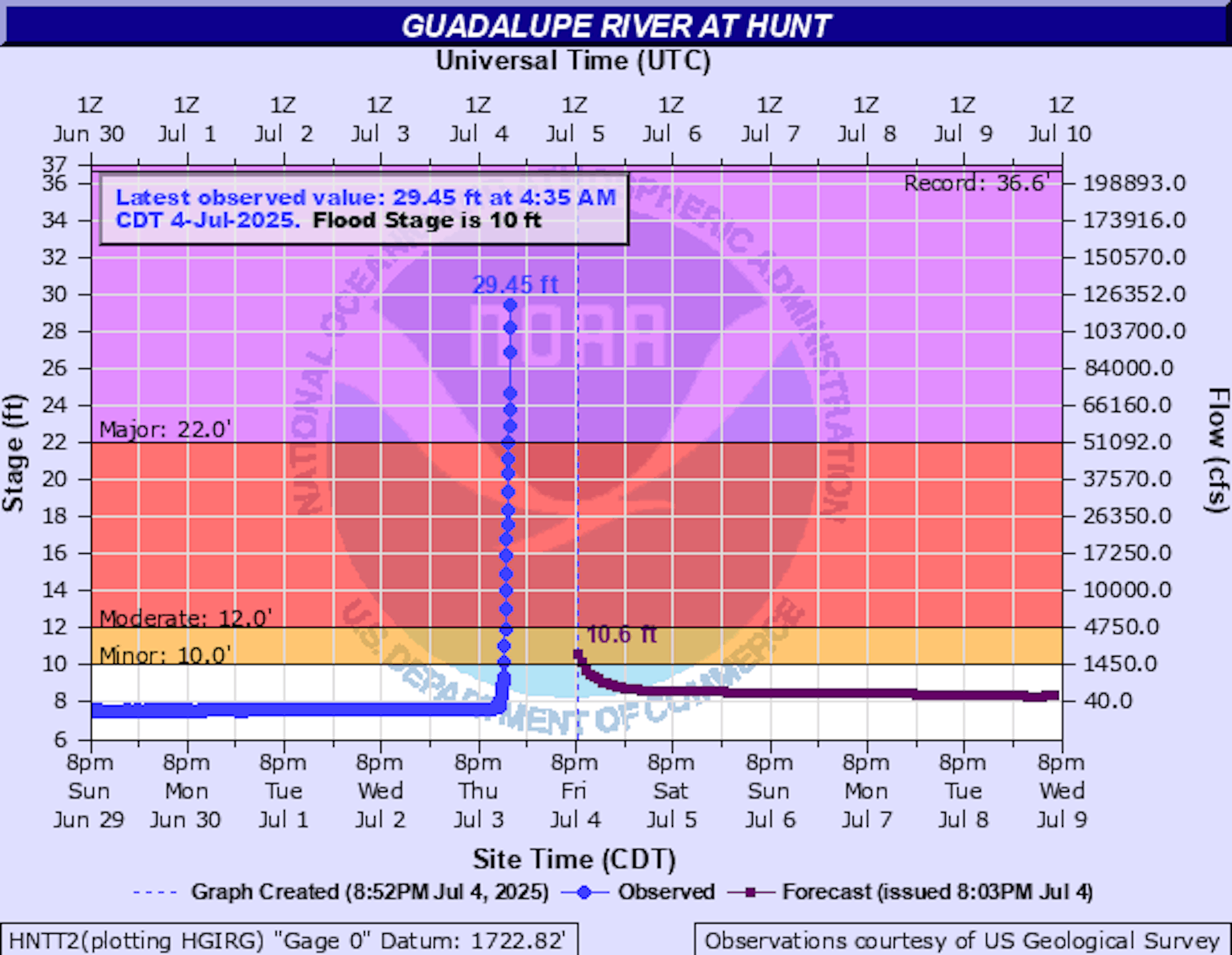
    A river gauge at Hunt, Texas, near Camp Mystic, showed how quickly the river flooded: Around 3 a.m. on July 4, the Guadalupe River was rising about 1 foot every 5 minutes at the gauge, National Weather Service data shows. By 4:30 a.m., it had risen more than 20 feet. As the water moved downstream, it reached Kerrville, where the river rose even faster.

    Flood expert Hatim Sharif, a hydrologist and civil engineer at the University of Texas at San Antonio, explains what makes this part of the country, known as Flash Flood Alley, so dangerous.

    What makes Hill Country so prone to flooding?

    Texas as a whole leads the nation in flood deaths, and by a wide margin. A colleague and I analyzed data from 1959 to 2019 and found 1,069 people had died in flooding in Texas over those six decades. The next highest total was in Louisiana, with 693.

    Many of those flood deaths have been in Hill County. It’s part of an area known as Flash Flood Alley, a crescent of land that curves from near Dallas down to San Antonio and then westward.

    The hills are steep, and the water moves quickly when it floods. This is a semi-arid area with soils that don’t soak up much water, so the water sheets off quickly and the shallow creeks can rise fast.

    When those creeks converge on a river, they can create a surge of water that wipes out homes and washes away cars and, unfortunately, anyone in its path.

    Hill Country has seen some devastating flash floods. In 1987, heavy rain in western Kerr County quickly flooded the Guadalupe River, triggering a flash flood similar to the one in 2025. Ten teenagers being evacuated from a camp died in the rushing water.

    San Antonio, at the eastern edge of Hill Country, was hit with a flash flood on June 12, 2025, that killed 13 people whose cars were swept away by high water from a fast-flooding creek near an interstate ramp in the early morning.

    Why does the region get such strong downpours?

    One reason Hill Country gets powerful downpours is the Balcones Escarpment.

    The escarpment is a line of cliffs and steep hills created by a geologic fault. When warm air from the Gulf rushes up the escarpment, it condenses and can dump a lot of moisture. That water flows down the hills quickly, from many different directions, filling streams and rivers below.

    As temperature rise, the warmer atmosphere can hold more moisture, increasing the downpour and flood risk.

    A tour of the Guadalupe River and its flood risk.

    The same effect can contribute to flash flooding in San Antonio, where the large amount of paved land and lack of updated drainage to control runoff adds to the risk.

    What can be done to improve flash flood safety?

    First, it’s important for people to understand why flash flooding happens and just how fast the water can rise and flow. In many arid areas, dry or shallow creeks can quickly fill up with fast-moving water and become deadly. So people should be aware of the risks and pay attention to the weather.

    Improving flood forecasting, with more detailed models of the physics and water velocity at different locations, can also help.

    Probabilistic forecasting, for example, can provide a range of rainfall scenarios, enabling authorities to prepare for worst-case scenarios. A scientific framework linking rainfall forecasts to the local impacts, such as streamflow, flood depth and water velocity, could also help decision-makers implement timely evacuations or road closures.

    Education is particularly essential for drivers. One to two feet of moving water can wash away a car. People may think their trucks and SUVs can go through anything, but fast-moving water can flip a truck and carry it away.

    Officials can also do more to barricade roads when the flood risk is high to prevent people from driving into harm’s way. We found that 58% of the flood deaths in Texas over the past six decades involved vehicles. The storm on June 12 in San Antonio was an example. It was early morning, and drivers had poor visibility. The cars were hit by fast-rising floodwater from an adjacent creek.

    This article, originally published July 5, 2025, has been updated with the death toll rising.

    Hatim Sharif does not work for, consult, own shares in or receive funding from any company or organization that would benefit from this article, and has disclosed no relevant affiliations beyond their academic appointment.

    ref. Why Texas Hill Country, where a devastating flood killed more than 120 people, is one of the deadliest places in the US for flash flooding – https://theconversation.com/why-texas-hill-country-where-a-devastating-flood-killed-more-than-120-people-is-one-of-the-deadliest-places-in-the-us-for-flash-flooding-260555

    MIL OSI Analysis

  • MIL-OSI United Nations: UNICEF deplores ‘unconscionable’ killing of families lining up for aid in Gaza

    Source: United Nations 2

    Catherine Russell said she was appalled by the reported killing of 15 Palestinians, including nine children and four women, who were waiting in line for nutritional supplements provided by Project Hope, a UNICEF partner organization.

    The incident occurred in Deir Al-Balah. An additional 30 people were injured, including 19 children. News reports indicate that it resulted from an Israel strike. 

    ‘Mothers seeking a lifeline’

    “The killing of families trying to access life-saving aid is unconscionable,” she said in a statement.

    These were mothers seeking a lifeline for their children after months of hunger and desperation.”

    They included Donia, whose one-year-old son, Mohammed, was killed. She reported that the boy had spoken his first words to her just hours earlier.

    “Donia now lies in a hospital bed, critically injured by the blast, clutching Mohammed’s tiny shoe,” said Ms. Russell.  “No parent should have to face such tragedy.”

    A ‘cruel reality’

    For the UNICEF chief, “this is the cruel reality confronting many in Gaza today after months of insufficient aid being allowed into the territory, and parties to the conflict failing to uphold basic responsibilities to protect civilians.”

    She explained that “the lack of aid means children are facing starvation while the risk of famine grows,” warning that “the number of malnourished children will continue to rise until life-saving aid and services are resumed at full scale.”

    “International law is clear: all parties to the conflict have an obligation to protect civilians and ensure the safe and unimpeded delivery of humanitarian assistance,” she said.

    “We call on Israel to urgently review its rules of engagement to ensure full compliance with international humanitarian law, notably the protection of civilians including children, and to conduct a thorough and independent investigation of this incident and all allegations of violations.”

    UN condemns killings

    The UN yet again condemned the killing of civilians in Gaza, Spokesperson Stéphane Dujarric told journalists in New York.

    Furthermore, the UN humanitarian affairs office OCHA “stresses that parties are bound by international humanitarian law to prevent such excessive death and injury of civilians in the midst of war,” he added.

    OCHA reported that another strike on Thursday reportedly hit the office of a humanitarian partner in Gaza City. Three staff there were killed. 

    Fuel running out

    Mr. Dujarric also updated journalists on the dire fuel situation in Gaza, which impacts both the population and humanitarians.

    A UN team managed to bring roughly 75,000 litres of fuel from Israel into the beleaguered enclave on Wednesday, marking the first such provision in 130 days.

    He warned, however, that fuel is still running out and services will shut down if greater volumes do not enter immediately.

    Water services at risk

    We and our humanitarian partners need hundreds of thousands of litres of fuel each day to keep essential lifesaving and life-sustaining operations going, meaning the amount entered yesterday isn’t sufficient to cover even one day of energy requirements,” he said.

    One aid partner reported that fuel shortages could soon cut off supplies of clean drinking water to about 44,000 children, he added, which would further increase the risk of cholera, diarrhoea, dysentery and other waterborne illnesses. 

    Meanwhile, UN partners providing education services said that between October 2023 and this June, 626 temporary learning spaces have been established in Gaza, with 240,000 students enrolled, roughly half of them girls. 

    However, only 299 spaces are currently operational due to the ongoing displacement orders, funding shortfalls and other challenges.

    Aid workers also going hungry

    Humanitarian partners in Gaza – who include first responders, health workers, and aid workers – “continue to deliver food and other assistance under intolerable conditions, and they themselves are facing hunger,” said Mr. Dujarric.

    “A number of our own colleagues are also facing hunger. They also face water scarcity and threats to their personal safety, just like everyone else in Gaza,” he added.

    The Spokesperson reiterated the UN’s long-standing message that “this catastrophic situation must end.”  He stressed that “a ceasefire is not only urgent, it is long overdue,” while also calling for the unconditional and immediate release of all hostages. 

    © UNFPA Palestine

    Some Palestinians have been forced to flee their homes in the West Bank.

    West Bank operations

    Mr. Dujarric also addressed the situation in the West Bank, where humanitarians report and continue to warn of the intensification of Israeli operations in the northern areas.

    These operations are causing massive destruction, driving further humanitarian needs and dampening hopes of thousands of displaced families that they will eventually be able to go back home,” he said.

    “Meanwhile, attacks, harassment and intimidation by Israeli settlers against Palestinians have become a daily reality.”

    He cited a settler attack on 3 July that led to the displacement of the Mu’arrajat East Bedouin community in the central West Bank. 

    “This is the ninth community to be fully displaced in the Ramallah and Jericho areas since January 2023 following the recurrent attacks by Israeli settlers.” 

    MIL OSI United Nations News

  • MIL-OSI: Amalgamated Financial Corp. Announces Second Quarter 2025 Earnings Conference Call

    Source: GlobeNewswire (MIL-OSI)

    NEW YORK,, July 10, 2025 (GLOBE NEWSWIRE) — Amalgamated Financial Corp. (“Amalgamated” or the “Company”) (Nasdaq: AMAL) today announced that its second quarter 2025 financial results will be released before market open on Thursday, July 24, 2025. The Company will host a conference call at 11:00 a.m. Eastern Time on the same day to discuss the financial results.

    Investors and analysts interested in participating in the call are invited to dial 1-877-407-9716 (international callers please dial 1-201-493-6779) approximately 10 minutes prior to the start of the call. A live audio webcast of the conference call will be available on the website at https://ir.amalgamatedbank.com/.

    A replay of the conference call will be available within two hours of the conclusion of the call and can be accessed both online and by dialing 1-844-512-2921 (international callers please dial 1-412-317-6671). The pin to access the telephone replay is 13754662. The replay will be available until July 31, 2025.  

    About Amalgamated Financial Corp.

    Amalgamated Financial Corp. is a Delaware public benefit corporation and a bank holding company engaged in commercial banking and financial services through its wholly owned subsidiary, Amalgamated Bank. Amalgamated Bank is a New York-based full-service commercial bank and a chartered trust company with a combined network of five branches across New York City, Washington D.C., and San Francisco, and a commercial office in Boston. Amalgamated Bank was formed in 1923 as Amalgamated Bank of New York by the Amalgamated Clothing Workers of America, one of the country’s oldest labor unions. Amalgamated Bank provides commercial banking and trust services nationally and offers a full range of products and services to both commercial and retail customers. Amalgamated Bank is a proud member of the Global Alliance for Banking on Values and is a certified B Corporation®. As of March 31, 2025, our total assets were $8.3 billion, total net loans were $4.6 billion, and total deposits were $7.4 billion. Additionally, as of March 31, 2025, our trust business held $35.7 billion in assets under custody and $14.2 billion in assets under management.

    Investor Contact:
    Jamie Lillis
    Solebury Strategic Communications
    shareholderrelations@amalgamatedbank.com 
    800-895-4172

    Source: Amalgamated Financial Corp.

    The MIL Network

  • MIL-OSI: Enact to Host Second Quarter 2025 Earnings Call July 31st

    Source: GlobeNewswire (MIL-OSI)

    RALEIGH, N.C., July 10, 2025 (GLOBE NEWSWIRE) — Enact Holdings, Inc. (Nasdaq: ACT) (Enact) announced it will issue its second quarter earnings release after the market closes on July 30, 2025. Enact will host a conference call to review second quarter 2025 financial results on July 31, 2025 at 8:00 a.m. (ET).

    Enact’s earnings release, summary presentation and financial supplement will be available through the company’s website, https://ir.enactmi.com/, at the time of their release to the public.

    Participants interested in joining the call’s live question and answer session are required to pre-register by clicking here to obtain a dial-in number and unique PIN. It is recommended to join at least 15 minutes in advance, although you may register ahead of the call and dial in at any time during the call. If you wish to join the call but do not plan to ask questions, a live webcast of the event will be available on our website, https://ir.enactmi.com/news-and-events/events.

    The webcast also will be archived on the company’s website for one year.

    About Enact Holdings, Inc.
    Enact (Nasdaq: ACT), operating principally through its wholly-owned subsidiary Enact Mortgage Insurance Corporation since 1981, is a leading U.S. private mortgage insurance provider committed to helping more people achieve the dream of homeownership. Building on a deep understanding of lenders’ businesses and a legacy of financial strength, we partner with lenders to bring best-in class service, leading underwriting expertise, and extensive risk and capital management to the mortgage process, helping to put more people in homes and keep them there. By empowering customers and their borrowers, Enact seeks to positively impact the lives of those in the communities in which it serves in a sustainable way. Enact is headquartered in Raleigh, North Carolina.

    This press release was published by a CLEAR® Verified individual.

    The MIL Network

  • MIL-OSI: Glacier Bancorp, Inc. Announces Second Quarter Earnings Release and Conference Call

    Source: GlobeNewswire (MIL-OSI)

    KALISPELL, Mont., July 10, 2025 (GLOBE NEWSWIRE) — Glacier Bancorp, Inc. (NYSE: GBCI) will report second quarter financial results after the market closes on July 24, 2025. A conference call for investors is scheduled for 11:00 a.m. Eastern Time on Friday, July 25, 2025.

    Please note that our conference call host no longer offers a general dial-in number.

    Investors who would like to join the call may now register by following this link to obtain dial-in instructions: https://register-conf.media-server.com/register/BI39099c48cd94493cadee5c8f4fe748e5

    To participate via the webcast, log on to: https://edge.media-server.com/mmc/p/zusost57

    If you are unable to participate during the live webcast, the call will be archived on our website, www.glacierbancorp.com.

    Glacier Bancorp, Inc. is the parent company for Glacier Bank and its bank divisions: Altabank (American Fork, UT) Bank of the San Juans (Durango, CO), Citizens Community Bank (Pocatello, ID), Collegiate Peaks Bank (Buena Vista, CO), First Bank of Montana (Lewistown, MT), First Bank of Wyoming (Powell, WY), First Community Bank Utah (Layton, UT), First Security Bank (Bozeman, MT), First Security Bank of Missoula (Missoula, MT), First State Bank (Wheatland, WY), Glacier Bank (Kalispell, MT), Heritage Bank of Nevada (Reno, NV), Mountain West Bank (Coeur d’Alene, ID), The Foothills Bank (Yuma, AZ), Valley Bank (Helena, MT), Western Security Bank (Billings, MT), and Wheatland Bank (Spokane, WA).

    CONTACT:
    Randall M. Chesler, CEO
    (406) 751-4722
    Ron J. Copher, CFO
    (406) 751-7706

    The MIL Network

  • MIL-OSI: Ingersoll Rand Schedules Second Quarter 2025 Earnings Release and Conference Call

    Source: GlobeNewswire (MIL-OSI)

    DAVIDSON, N.C., July 10, 2025 (GLOBE NEWSWIRE) — Ingersoll Rand Inc. (NYSE: IR), a global provider of mission-critical flow creation and life science and industrial solutions, will issue its second quarter 2025 earnings release after the market closes on Thursday, July 31, 2025.

    Ingersoll Rand will also host a live earnings conference call to discuss the second quarter results on Friday, August 1, 2025, at 8 a.m. Eastern Time. To participate in the call, please dial +1-888-330-3073, domestically, or +1-646-960-0683, internationally, and use access code 8970061.

    A real-time audio webcast of the presentation can be accessed via the Events and Presentations section of the Ingersoll Rand Investor Relations website here, where related materials will be posted prior to the conference call.

    A replay of the webcast will be available after conclusion of the conference and can be accessed on Investor Relations Website here.

    About Ingersoll Rand Inc.
    Ingersoll Rand Inc. (NYSE:IR), driven by an entrepreneurial spirit and ownership mindset, is dedicated to Making Life Better for our employees, customers, shareholders, and planet. Customers lean on us for exceptional performance and durability in mission-critical flow creation and life science and industrial solutions. Supported by over 80+ respected brands, our products and services excel in the most complex and harsh conditions. Our employees develop customers for life through their daily commitment to expertise, productivity, and efficiency. For more information, visit www.IRCO.com.

    Investors:
    Matthew Fort
    Matthew.Fort@irco.com

    Media:
    Sara Hassell
    Sara.Hassell@irco.com

    The MIL Network

  • MIL-OSI: Midland States Bancorp, Inc. to Announce Second Quarter 2025 Financial Results on Thursday, July 24

    Source: GlobeNewswire (MIL-OSI)

    EFFINGHAM, Ill., July 10, 2025 (GLOBE NEWSWIRE) — Midland States Bancorp, Inc. (NASDAQ: MSBI) announced today that it will issue its second quarter 2025 financial results after market close on Thursday, July 24, 2025. Along with the press release announcing the financial results, the Company will publish an investor presentation that will be available on the Webcasts and Presentations page of its investor relations website.

    About Midland States Bancorp, Inc.

    Midland States Bancorp, Inc. is a community-based financial holding company headquartered in Effingham, Illinois, and is the sole shareholder of Midland States Bank. As of March 31, 2025, the Company had total assets of approximately $7.28 billion, and its Wealth Management Group had assets under administration of approximately $4.10 billion. The Company provides a full range of commercial and consumer banking products and services and business equipment financing, merchant credit card services, trust and investment management, insurance and financial planning services. For additional information, visit https://www.midlandsb.com/ or https://www.linkedin.com/company/midland-states-bank.

    CONTACTS:
    Eric T. Lemke, Chief Financial Officer, at elemke@midlandsb.com or (217) 342-7321

    The MIL Network

  • MIL-OSI: RXO Offers Factoring and LoadPay to Carriers Through Expanded Relationship with Triumph

    Source: GlobeNewswire (MIL-OSI)

    DALLAS and CHARLOTTE, N.C., July 10, 2025 (GLOBE NEWSWIRE) — RXO (NYSE: RXO), a leading provider of asset-light transportation solutions, and Triumph (Nasdaq: TFIN), a financial and technology company focused on payments, factoring, intelligence and banking solutions for the transportation industry, today announced the expansion of their relationship to deliver new financial tools and services to carriers.

    RXO has launched RXO Extra | Factoring, a Triumph-powered offering that includes Factoring as a Service™ and LoadPay™, Triumph’s digital banking solution for carriers. The services provide carriers, even those that don’t haul for RXO, with access to seamless factoring and fast, reliable payments, including same-day payments, on approved invoices. They are available 24 hours a day, seven days a week, including weekends and holidays.

    “Our expanded relationship with Triumph is enabling us to provide carriers with even more ways to improve their efficiency and profitability,” said Lou Amo, president of RXO’s truck brokerage business. “RXO Extra | Factoring allows carriers to get paid by RXO and other freight providers more quickly and easily.”

    Factoring as a Service (FaaS) is a white-labeled solution powered by the Triumph Network that enables brokers to offer branded factoring and payment services directly to carriers. It combines Triumph’s funding and technology infrastructure to help brokers improve carrier cash flow and strengthen relationships. LoadPay is Triumph’s purpose-built digital bank account for carriers, allowing payments to be received in minutes on approved invoices. RXO currently uses Triumph’s audit and payment capabilities.

    RXO Extra | Factoring is part of RXO Extra™, a loyalty program and discount marketplace for carriers. By hauling loads through RXO Connect®, carriers rise through loyalty tiers to earn more savings and bonuses on loads. In addition, through industry partnerships, RXO Extra offers carriers discounts on fuel, maintenance and tires, retail, and more.

    “RXO continues to demonstrate its commitment to the carrier community by delivering tools that simplify operations and improve cash flow,” said Aaron P. Graft, founder and chief executive officer of Triumph Financial. “We’re proud to expand our work with RXO and help carriers across their network transact confidently.”

    Carriers can learn more about RXO Extra | Factoring by visiting https://rxo.com/carriers/rxo-extra/rxo-extra-factoring.

    About Triumph

    Triumph (Nasdaq: TFIN) is a financial and technology company focused on payments, factoring, intelligence and banking to modernize and simplify freight transactions. Headquartered in Dallas, Texas, its portfolio of brands includes Triumph, TBK Bank and LoadPay. www.Triumph.io

    About RXO

    RXO (NYSE: RXO) is a leading provider of asset-light transportation solutions. RXO offers tech-enabled truck brokerage services together with complementary solutions including managed transportation and last mile delivery. The company combines massive capacity and cutting-edge technology to move freight efficiently through supply chains across North America. The company is headquartered in Charlotte, N.C. www.RXO.com

    About LoadPay

    LoadPay is a modern digital banking solution built for the freight industry. Designed to help carriers better manage their cash flow, LoadPay offers fast and flexible access to funds, along with tools specifically tailored to meet the demands of transportation businesses. LoadPay is a product of TBK Bank, SSB d/b/a Triumph, a financial and technology company focused on modernizing and simplifying freight transactions. www.LoadPay.com

    Forward-Looking Statements

    This press release contains forward-looking statements within the meaning of the federal securities laws. Investors are cautioned that such statements are predictions and that actual events or results may differ materially. Triumph Financial’s expected financial results or other plans are subject to a number of risks and uncertainties. For a discussion of such risks and uncertainties, which could cause actual results to differ from those contained in the forward-looking statements, see “Risk Factors” and the forward-looking statement disclosure contained in the Company’s Annual Report on Form 10-K, filed with the Securities and Exchange Commission on February 11, 2025. Forward-looking statements speak only as of the date made, and Triumph Financial undertakes no duty to update the information.

    Source: Triumph

    Triumph Investor Contact
    Luke Wyse, lwyse@tfin.com

    Triumph Media Contact
    Amanda Tavackoli, atavackoli@tfin.com

    RXO Media Contact
    Nina Reinhardt, nina.reinhardt@rxo.com

    RXO Investor Contact
    Kevin Sterling, kevin.sterling@rxo.com

    The MIL Network

  • MIL-OSI: Little Pepe Launches Stage 5 as Presale Surges Past $4.8 Million

    Source: GlobeNewswire (MIL-OSI)

    DUBAI, United Arab Emirates, July 10, 2025 (GLOBE NEWSWIRE) — Little Pepe ($LILPEPE) has officially sold out Stage 4 of its presale and the project has crossed the $4.8 million mark, signaling rising enthusiasm and investor confidence in the meme coin project. As Stage 5 kicks off, the new token price of $0.0014 reflects the surging demand and growing momentum behind what many now consider one of the most promising meme coins of 2025. With each phase selling out faster than the last, investors are now eyeing Stage 5 as a critical opportunity to enter before further price increases and upcoming exchange listings.

    Little Pepe — A Meme Coin Built on Real Infrastructure

    What separates Little Pepe from the bunch of meme projects coming into the market is its backbone—a totally functioning Ethereum-like minded Layer 2 network referred to as the Little Pepe Chain. While most meme tokens are deployed immediately on Ethereum or BNB Smart Chain, $LILPEPE is a custom-built infrastructure designed for speed, scalability, and ultra-low transaction fees.

    This innovative approach adds long-term utility and flexibility, allowing Little Pepe to serve more than just meme coin enthusiasts. Developers and users alike can benefit from the high throughput and minimal costs, opening the door for a range of applications and use cases far beyond what traditional meme coins offer.

    Over $4.8M Raised

    Stage 4 wrapped up with Little Pepe securing over $4.8 million in funding from a rapidly expanding community of whale investors. The milestone places $LILPEPE some of the most successful ongoing presales this year, highlighting its particular position at the intersection of meme culture and real tech advancement.

    Social platforms like X, Telegram, and Reddit have become the hotspots for ongoing conversations about the project, drawing in thousands of users who are looking for every presale update and getting ready for potential exchange listings. The momentum has created a viral effect, propelling interest in Stage 5 to new highs.

    Stage 5 Opens at $0.0014

    Now that Stage 5 is live, the price of $LILPEPE has increased to $0.0014—a modest jump that reflects both the project’s current traction and its anticipated growth. With previous stages selling out rapidly, the urgency among new buyers is growing. Each new phase brings a higher entry price, and the presale is only accessible via the official website: littlepepe.com.

    For early adopters, this phase offers what could be one of the final chances to buy in before centralized exchange listings potentially send the price much higher. As more media coverage and community-generated content continue to highlight the project, visibility is expected to rise dramatically in the coming weeks.

    Little Pepe’s Unique Appeal in a Crowded Market

    The crypto space has no shortage of meme coins, but few manage to blend cultural resonance with blockchain innovation like Little Pepe. At its core, the project leverages the viral potential of internet humor while remaining grounded in performance and scalability.

    Unlike tokens that rely purely on influencer hype or speculative pumps, Little Pepe has built its foundation on real tech. Its Layer 2 structure provides the kind of speed and affordability that most meme coins lack, making it a more attractive long-term hold.

    Looking Ahead: Exchange Listings and Expansion

    While the presale is still ongoing, many are already speculating on what comes next. Exchange listings are expected once the final presale stage is completed, and that could significantly expand access to $LILPEPE on a global scale. With a working blockchain, engaged community, and proven investor demand, Little Pepe appears well-positioned to make that leap.

    Until then, Stage 5 remains the focus—and the momentum isn’t slowing down. As the token’s price climbs and the presale nears its final rounds, $LILPEPE continues to attract attention as one of the most exciting meme coins in the crypto space today.

    About Little Pepe

    Little Pepe is a next-gen Layer 2 blockchain designed to merge meme culture with high-speed, low-cost decentralized infrastructure. Built for scalability, security, and accessibility, Little Pepe supports EVM-compatible applications and is powered by means of the $LILPEPE token. The project’s mission is to create a meme coin environment wherein utility meets virality, empowering users through cutting-edge technology and lightning-fast transactions.

    For more information:
    Website: https://littlepepe.com/
    Telegram: https://t.me/littlepepetoken
    Twitter: https://x.com/littlepepetoken

    Contact Details: COO- James Stephen Email: media@littlepepe.com

    Disclaimer: This content is provided by Little Pepe. The statements, views, and opinions expressed in this content are solely those of the content provider and do not necessarily reflect the views of this media platform or its publisher. We do not endorse, verify, or guarantee the accuracy, completeness, or reliability of any information presented. We do not guarantee any claims, statements, or promises made in this article. This content is for informational purposes only and should not be considered financial, investment, or trading advice.Investing in crypto and mining-related opportunities involves significant risks, including the potential loss of capital. It is possible to lose all your capital. These products may not be suitable for everyone, and you should ensure that you understand the risks involved. Seek independent advice if necessary. Speculate only with funds that you can afford to lose. Readers are strongly encouraged to conduct their own research and consult with a qualified financial advisor before making any investment decisions. However, due to the inherently speculative nature of the blockchain sector—including cryptocurrency, NFTs, and mining—complete accuracy cannot always be guaranteed.Neither the media platform nor the publisher shall be held responsible for any fraudulent activities, misrepresentations, or financial losses arising from the content of this press release. In the event of any legal claims or charges against this article, we accept no liability or responsibility.Globenewswire does not endorse any content on this page.

    Legal Disclaimer: This media platform provides the content of this article on an “as-is” basis, without any warranties or representations of any kind, express or implied. We assume no responsibility for any inaccuracies, errors, or omissions. We do not assume any responsibility or liability for the accuracy, content, images, videos, licenses, completeness, legality, or reliability of the information presented herein. Any concerns, complaints, or copyright issues related to this article should be directed to the content provider mentioned above.

    A photo accompanying this announcement is available at https://www.globenewswire.com/NewsRoom/AttachmentNg/d3c8f246-5f7a-4d94-8109-afc10647151d

    The MIL Network

  • MIL-OSI: Inception Growth Acquisition Limited Announces Postponement of the Special Meeting to July 25, 2025 and Extension of Redemption Request Deadline

    Source: GlobeNewswire (MIL-OSI)

    New York, July 10, 2025 (GLOBE NEWSWIRE) — Inception Growth Acquisition Limited (the “Company”), a blank check company, today announced that its previously announced special meeting of shareholders (the “Special Meeting”) will be postponed from 10:00 a.m. Hong Kong Time on July 14, 2025 to 10:00 a.m. Hong Kong Time on July 25, 2025 and accordingly, the deadline for stockholders to submit redemption requests will be extended to July 23, 2025.

    The physical location of the Special Meeting remains at the offices of Loeb & Loeb LLP, 2206-19 Jardine House, 1 Connaught Place Central, Hong Kong SAR, and virtually via teleconference using the following dial-in information:

    US Toll Free   +1 866 213 0992
    Hong Kong Toll   +852 2112 1888
    Participant Passcode   2910077#

    As a result of the postponement, the deadline for delivery of redemption requests from the Company’s stockholders in connection with the proposed business combination has been extended from July 10, 2025 (two business days before the originally scheduled Special Meeting) to July 23, 2025 (two business days before the postponed Special Meeting). Stockholders who have already submitted redemption requests may revoke such requests prior to the new deadline in accordance with the procedures described in the definitive proxy statement in relation to the Special Meeting (the “Original Proxy Statement”) filed with by the Company with the Securities and Exchange Commission (the “SEC”) on May 27, 2025, and the supplement (the “Supplement”) to the Original Proxy Statement, which was filed by the Company with the SEC on June 26, 2025.

    The record date for determining the Company stockholders entitled to receive notice of and to vote at the Special Meeting remains the close of business on May 27, 2025 (the “Record Date”). Stockholders as of the Record Date are eligible to vote, even if they have subsequently sold their shares.

    If you have questions regarding the certification of your position or delivery of your shares, please contact:

    Continental Stock Transfer & Trust Company, LLC
    1 State Street 30th Floor
    New York, NY 10004-1561
    E-mail: spacredemptions@continentalstock.com

    Other than as indicated herein, no other changes have been made to the Original Proxy Statement as amended and supplemented by the Supplement, or the proxy card as originally filed and mailed. Stockholders are advised to review the Supplement carefully and to consider it together with the Original Proxy Statement, both available on the SEC’s EDGAR database at www.sec.gov, for complete details regarding the matters to be voted in the Special Meeting.

    The Company’s stockholders who have questions regarding the postponement, or the Special Meeting, or would like to request documents may contact the Company’s proxy solicitor, Advantage Proxy, Inc., at (877) 870-8565, or banks and brokers can call (206) 870-8565, or by email at ksmith@advantageproxy.com.

    If you have already voted, you do not need to vote again unless you would like to change or revoke your prior vote on any proposal. In addition, stockholders who have already submitted a redemption request with respect to the shares held by them may withdraw such request by contacting our transfer agent. If you would like to change or revoke your prior vote on any proposal, or reverse a redemption request, please refer to the Proxy Statement for additional information on how to do so.

    If you have already submitted a proxy and do not wish to change your vote, you need not take any further action. If you have submitted a proxy and wish to change your vote, you may revoke your proxy at any time before it is exercised at the Special Meeting as provided in the Original Proxy Statement. Please note, however, that if your shares are held in street name by a broker or other nominee and you wish to revoke a proxy, you must contact the broker or nominee to revoke any prior voting instructions.

    About Inception Growth Acquisition Limited

    Inception Growth Acquisition Limited is a blank check company incorporated under the laws of Delaware whose business purpose is to effect a merger, capital stock exchange, asset acquisition, stock purchase, reorganization, or similar business combination with one or more businesses or entities.

    Forward Looking Statements

    This press release includes forward-looking statements that involve risks and uncertainties. Forward-looking statements are statements that are not historical facts. Such forward-looking statements, including but not limited to the date of the Special Meeting, are subject to risks and uncertainties, which could cause actual results to differ from the forward-looking statements. The Company expressly disclaims any obligations or undertaking to release publicly any updates or revisions to any forward-looking statements contained herein to reflect any change in the Company’s expectations with respect thereto or any change in events, conditions or circumstances on which any statement is based.

    Additional Information and Where to Find It

    On May 27, 2025, the Company filed a definitive proxy statement, and on June 26, 2025, the Company filed a supplement to the definitive proxy statement with the SEC in connection with its solicitation of proxies for the Special Meeting. INVESTORS AND SECURITY HOLDERS OF THE COMPANY ARE URGED TO READ THE SUPPLEMENT, THE ORIGINAL PROXY STATEMENT (INCLUDING ANY AMENDMENTS OR SUPPLEMENTS THERETO) AND OTHER DOCUMENTS THE COMPANY FILES WITH THE SEC CAREFULLY IN THEIR ENTIRETY WHEN THEY BECOME AVAILABLE AS THEY WILL CONTAIN IMPORTANT INFORMATION. Investors and security holders will be able to obtain free copies of the definitive proxy statement (including any amendments or supplements thereto) and other documents filed with the SEC through the web site maintained by the SEC at www.sec.gov or by contacting the Company’s proxy solicitor.

    Participants in the Solicitation

    The Company and its respective directors and officers may be deemed to be participants in the solicitation of proxies from shareholders in connection with the Special Meeting. Additional information regarding the identity of these potential participants and their direct or indirect interests, by security holdings or otherwise, is set forth in the definitive proxy statement. You may obtain free copies of these documents using the sources indicated above.

    Contact

    Inception Growth Acquisition Limited
    Investor Relationship Department
    (315) 636-6638

    The MIL Network

  • MIL-OSI Russia: Financial news: Optimization of issuers’ reporting: proposals from the Bank of Russia.

    Translation. Region: Russian Federal

    Source: Central Bank of Russia –

    An important disclaimer is at the bottom of this article.

    The Bank of Russia plans to improve the quality of issuers’ reporting, increase its value and ensure greater demand. Your suggestions the regulator puts it up for public discussion.

    First of all, it is proposed to eliminate duplication of information. Currently, issuers are required to publish reports on their activities twice a year – at the end of 6 and 12 months. Moreover, these documents have static sections where there is no promptly updated information, for example, a section on corporate governance. It is advisable to disclose such information in the annual report – a key tool for communicating with investors. Moreover, the regulator considers it necessary to standardize this document: it will have mandatory chapters that the issuer will be able to structure at its own discretion. Currently, there are no strict requirements for its composition – it is important that it simply exists.

    The Bank of Russia also proposes to eliminate the time lag between the publication of consolidated financial statements and the issuer’s report, which explains the reasons for achieving such results. According to the regulator, these documents should be disclosed simultaneously so that the market has up-to-date information on the company’s activities.

    One of the important initiatives is the transition from manual preparation of reports to electronic formats. The use of machine-readable forms will reduce the time for processing and analyzing data, which will help investors make investment decisions based on high-quality information.

    The discussion of the Bank of Russia’s initiatives will last until August 1, 2025 inclusive.

    Preview photo: Cristina Conti / Shutterstock / Fotodom

    Please note: This information is raw content obtained directly from the source of the information. It is an accurate report of what the source claims and does not necessarily reflect the position of MIL-OSI or its clients.

    MIL OSI Russia News

  • MIL-OSI Russia: Financial news: Prospects for the development of the retail mutual fund market: report of the Bank of Russia

    Translation. Region: Russian Federal

    Source: Central Bank of Russia –

    An important disclaimer is at the bottom of this article.

    The Bank of Russia has analyzed and summarized the accumulated law enforcement practice in the retail mutual investment fund (MIF) market, international experience, as well as initiatives of market participants, and proposes to discuss possible directions for the development of this segment.

    One of the development vectors may be the expansion of investment opportunities for retail funds. It is proposed to increase the list of non-traded securities in which they can invest, but to set a limit. Digital financial assets may also appear in the list of objects available for mutual funds for investment. This will require creating a legal framework, as well as developing a procedure for separating and storing such assets. But retail funds will not be able to start investing in them immediately, but over time.

    Market participants also proposed creating opportunities for the emergence of funds with increased financial leverage in Russia. These are borrowed funds or derivative financial instruments that the fund additionally uses to generate profit. Currently, the amount of financial leverage that a mutual fund for non-qualified investors can take on is limited to 20% of the fund’s net asset value (with the possibility of deviation up to 40% as a result of market factors). The Bank of Russia believes that increasing the leverage entails increased risks and requires additional investor protection measures.

    The idea of creating a fund of funds also requires a comprehensive assessment. Currently, in Russia, a management company cannot acquire investment units of one mutual fund under its management as part of the assets of another mutual fund under its management. However, in international practice, there are master-feeder fund structures – this is the name for a central fund consisting of assets collected from other funds under its management. The regulator proposes to discuss the prospects for using such structures in Russia, as well as the problems that they will help solve in the collective investment market.

    In addition, the report considers proposals to speed up operations with units. Currently, the procedures for issuing, redeeming and exchanging investment units of open-end mutual funds, as a rule, take place within 1 to 4 business days from the moment the client provides all the necessary documents and makes the payment. It is proposed to consider the possibility of reducing this period so that operations are carried out in T 0 mode.

    More about possible scenarios for the development of retail mutual fundsread in the report. Answers to questions presented in the material, comments and suggestions to it can be sent up to and including September 1.

    Preview photo: Tools Konten / Shutterstock / Fotodom

    Please note: This information is raw content obtained directly from the source of the information. It is an accurate report of what the source claims and does not necessarily reflect the position of MIL-OSI or its clients.

    MIL OSI Russia News

  • MIL-OSI Russia: Financial news: The Bank of Russia has published a ranking of insurers based on complaints about compulsory motor third-party liability insurance for 2024

    Translation. Region: Russian Federal

    Source: Central Bank of Russia –

    An important disclaimer is at the bottom of this article.

    Results presented in two tables: insurers with a client base of more than 2 million OSAGO contracts and small companies that do not exceed this threshold. This breakdown will help car owners compare companies of the same size.

    The ranking is based on statistics of complaints to the Bank of Russia on MTPL issues for 2024, for which consumer rights violations were confirmed and supervisory measures were taken. Companies are distributed by the level of the consumer risk indicator — from highest to lowest. It is calculated as the ratio of the number of complaints about a specific insurer to every 10 thousand contracts concluded by it. Insurance companies that received only one complaint are not included in the ranking.

    Preview photo: Pushish Images / Shutterstock / Fotodom

    Please note: This information is raw content obtained directly from the source of the information. It is an accurate report of what the source claims and does not necessarily reflect the position of MIL-OSI or its clients.

    MIL OSI Russia News

  • MIL-OSI Russia: Over the year, the number of small and medium-sized companies has grown by 3%.

    Translation. Region: Russian Federal

    Source: Ministry of Economic Development (Russia) – Ministry of Economic Development (Russia) –

    An important disclaimer is at the bottom of this article.

    According to the annual update of the Unified Register of Small and Medium-Sized Businesses, which is administered by the Federal Tax Service of Russia, the country has recorded an increase in companies and individual entrepreneurs. Currently, there are almost 6.4 million SMEs.

    “Based on the results of the annual update of the Unified Register of Small and Medium-Sized Businesses in Russia, 6.4 million operating companies and individual entrepreneurs have been registered. This is the highest figure since 2017, when the register was launched. We are recording a stable positive trend: compared to the previous period, the number of SMEs has increased by 3.2%, or about 200 thousand. Such results confirm the high role of small and medium businesses in the country’s economy and the effectiveness of the measures taken to support and develop them,” said Deputy Prime Minister of the Russian Federation Alexander Novak.

    The annual update of the Unified Register takes place on July 10 and reflects the most current number of SME entities. It is carried out on the basis of the reports submitted by entrepreneurs at the beginning of the year for the previous period. Companies and individual entrepreneurs that no longer meet the SME criteria or have not submitted the required reports within the established deadline are excluded from the register.

    “More and more enterprises are demonstrating dynamic development, going beyond the criteria established for small and medium-sized businesses. If previously about three thousand companies made the annual transition beyond the SME sector, this year their number approached five thousand. This indicates qualitative growth of business, its transition to a new level of maturity and scale. For such companies, we are already developing special measures to support SMEs in order to ensure their stable development and further integration into a higher-level economy,” explained Maxim Reshetnikov, Minister of Economic Development of Russia.

    “The Ministry of Economic Development of Russia also notes positive dynamics in the growth of the number of medium-sized enterprises. Currently, more than 22 thousand medium-sized companies are registered, their number has grown by 6% over the year, and by 19% compared to 2023,” commented Deputy Minister of Economic Development of Russia Tatyana Ilyushnikova.

    As a result of monthly updates of the Unified Register of SMEs, as a rule, an increase in the number of small and medium-sized enterprises is recorded. However, during the annual update, which is carried out on July 10, a reduction in the total number of entities is usually observed. This is primarily due to the administrative features of maintaining the register and does not reflect the real state of the SME sector.

    Please note: This information is raw content obtained directly from the source of the information. It is an accurate report of what the source claims and does not necessarily reflect the position of MIL-OSI or its clients.

    MIL OSI Russia News

  • MIL-OSI Russia: Dmitry Patrushev discussed export development with the leadership of industry unions.

    Translation. Region: Russian Federal

    Source: Government of the Russian Federation – Government of the Russian Federation –

    An important disclaimer is at the bottom of this article.

    Deputy Prime Minister Dmitry Patrushev held a meeting dedicated to the development of Russian agricultural exports. It was attended by Minister of Agriculture Oksana Lut, the leadership of industry unions, and business representatives.

    The Deputy Prime Minister stressed the importance of implementing the decree of the President of Russia on increasing the volume of export deliveries. The participants of the meeting discussed the dynamics of exports of agricultural products this year and the necessary measures to improve the efficiency of existing export support mechanisms.

    Following the meeting, the heads of industry associations and unions will carry out the necessary work with each exporting company and will take special control over the achievement of planned export indicators for the current year. The Russian Ministry of Agriculture, in turn, has been instructed to take the necessary measures in a timely manner to ensure positive export dynamics.

    Please note: This information is raw content obtained directly from the source of the information. It is an accurate report of what the source claims and does not necessarily reflect the position of MIL-OSI or its clients.

    MIL OSI Russia News

  • MIL-OSI Russia: Tatyana Golikova spoke at a joint meeting of the State Duma committees.

    Translation. Region: Russian Federal

    Source: Government of the Russian Federation – Government of the Russian Federation –

    An important disclaimer is at the bottom of this article.

    Deputy Prime Minister Tatyana Golikova spoke at a joint meeting of the State Duma committees in preparation for holding a government hour on the topic “On priorities in implementing the demographic policy of the Russian Federation.” The meeting was also attended by Minister of Labor and Social Protection Anton Kotyakov, Minister of Finance Anton Siluanov, Minister of Culture Olga Lyubimova, representatives of the Ministry of Health and the Ministry of Construction and Housing and Utilities.

    “Our absolute priority is to preserve the population. This is the main national goal, designated by the President of the country. And this is a national goal for many years. Because within this goal, the birth rate is, of course, the most difficult issue. And the birth rate is not a momentary decision. It is a person’s motivation to start a family. And this is our hard and painstaking work. And I will start with the basics of state policy to support traditional spiritual and moral values. This is, in fact, the key issue. Fostering in society an attitude towards family, towards a child, towards parents, towards grandparents. Towards a multi-generational, dynastic family. And pride in the fact that this family exists,” said Tatyana Golikova.

    The Deputy Prime Minister emphasized that today, on average, a woman gives birth to her first child at the age of 26, and the average age of a woman at the birth of a child is 29.

    “As our President says, the entire infrastructure should be built around the family. And this means that all our priorities, our national projects should work towards this idea,” noted Tatyana Golikova. “What we are seeing today is a great commitment to urbanization. And this commitment to urbanization leads to the fact that individual settlements are left without people. We must create the appropriate infrastructure around. This settlement must live, so that it is interesting to live in it.”

    According to the Deputy Prime Minister, 80.4% of births today occur in cities. At the same time, by the end of 2024, the total fertility rate in Russia as a whole was 1.4, and in the village – 1.6.

    In addition, on the eve of the government hour, Tatyana Golikova met with all factions of the State Duma – United Russia, the Communist Party of the Russian Federation, the Liberal Democratic Party of Russia, A Just Russia and New People. The meetings were also attended by the Minister of Labor and Social Protection Anton Kotyakov, the Minister of Health Mikhail Murashko, the Minister of Finance Anton Siluanov, representatives of the Ministry of Construction and Housing and Public Utilities and the Ministry of Culture.

    Please note: This information is raw content obtained directly from the source of the information. It is an accurate report of what the source claims and does not necessarily reflect the position of MIL-OSI or its clients.

    MIL OSI Russia News

  • MIL-OSI Russia: Financial news: Monitoring of industry financial flows: payments in June at the level of the first quarter

    Translation. Region: Russian Federal

    Source: Central Bank of Russia –

    An important disclaimer is at the bottom of this article.

    In June, the volume of incoming payments processed through the Bank of Russia increased after a decline in May and was 0.1% higher than the average level in Q1 2025.

    Excluding extractive industries, oil product manufacturing and public administration, receipts decreased by 0.6%. A decrease in incoming payments in June was recorded in the consumer, investment and external demand sectors.

    Read more in the next issue “Monitoring of industry financial flows”.

    Preview photo: thinkhubstudio / Shutterstock / Fotodom

    Please note: This information is raw content obtained directly from the source of the information. It is an accurate report of what the source claims and does not necessarily reflect the position of MIL-OSI or its clients.

    MIL OSI Russia News

  • MIL-OSI USA: Statement of the Department of Justice Antitrust Division on the Closing of Its Investigation of the Merger of T-Mobile and UScellular

    Source: US State Government of Utah

    Assistant Attorney General Gail Slater of the Justice Department’s Antitrust Division issued the following statement today in connection with the closing of the Department’s investigation into the proposed acquisition of UScellular by T-Mobile:

    “After a thorough investigation, the Antitrust Division determined prudentially not to seek an injunction to prevent T-Mobile from closing on its proposed acquisition of UScellular. The investigation nevertheless raised concerns about competition in the relevant markets for mobile wireless services and the availability of wireless spectrum needed to fuel competition and entry. Specifically, as part of the investigation, the Department considered the potential impact on consumers resulting from the elimination of UScellular from the market, the potential for consumer benefits, and the potential impact of the further consolidation of wireless spectrum.

    “With respect to the potential impact on consumers, for years, Americans have witnessed the too-familiar pattern of local or regional companies that discern and cater to their customers’ needs vanishing in favor of the ‘one size fits all’ approach of national brands. UScellular, whose tagline was ‘America’s locally grown wireless,’ noted the ‘sea of sameness’ among the ‘Big 3’ national carriers — Verizon, AT&T, and T-Mobile — and resolved to be ‘fundamentally different’ in how it went to market. The company understood the unmet needs of customers whom they identified as ‘Heartland Families’ or ‘Farmtown Frugals’. UScellular met those needs by building networks, pricing plans, and service offerings that its customers valued, and which for many years the Big 3 often did not offer. To the chagrin of its Big 3 competitors, UScellular maintained a sizable customer base within its network footprint by virtue of its strong emphasis on transparency, integrity, and localized customer service. Accordingly, as part of its investigation, the Department considered the impact of the potential disappearance of the services offered to those customers of UScellular — soon to become T-Mobile customers following the merger — that chose UScellular over T-Mobile or its national competitors.

    “In addition to the potential impact on consumers resulting from the elimination of UScellular from the market, the Department also investigated the potential for consumer benefits. Specifically, the Department considered how UScellular subscribers would fare if UScellular continued as a business without completing this transaction. That aspect of the investigation made clear that, due in part to its limited regional footprint and unique structural limitations, UScellular simply could not keep up with the escalating cost of capital investments in technology required to compete vigorously in the relevant market. This would, in turn, lead to the slow degradation of its network quality. In contrast, T-Mobile has publicly committed that it will integrate the two networks in a way that provides UScellular customers with faster data speeds, while T-Mobile customers will obtain broader coverage in rural areas. Accordingly, the Department concluded the loss of the local offerings that UScellular customers value was outweighed by the immediate improvements in network quality promised by this proposed transaction. That conclusion is bolstered by the competitive realities of future investment in wireless networks and spectrum.

    “In sum, the Department evaluated the likelihood of harm to competition and the potential effects of the transaction on consumers and determined that, on balance, the potential harm and offsetting benefits of the transaction do not warrant an enforcement action. UScellular’s inability to maintain its competitive position would result in declining value to its subscriber base, whereas the transaction offers them hope that they will be able to experience the benefits of a more robust cellular network.

    “More broadly, the Department’s investigation made clear that we stand at a pivotal moment for the wireless industry. The transaction comes near the tail end of a decades-long trend toward consolidation-by-acquisition that has now left most consumers with meaningful choices among just the ‘Big 3’ national carriers. Economists and historians, appropriately, will debate whether this trend ultimately redounded to the benefit of competition and consumers, but the stark facts of today merit our immediate attention: together, the Big 3 account for more than 90 percent of the roughly 335 million mobile subscriptions in the United States.

    “As the Department observed in 2019, when T-Mobile acquired Sprint, ‘The merger would also leave the market vulnerable to increased coordination among the remaining three carriers. Increased coordination harms consumers through a combination of higher prices, reduced innovation, reduced quality, and fewer choices.’ The Department also noted at the time that ‘competition between Sprint and T-Mobile to sell wireless service wholesale to [mobile virtual network operators] has benefited consumers by facilitating innovation by some MVNOs.’  These concerns remain highly relevant.

    “Spectrum, a national resource that belongs to the American people, is critical to competition in the relevant markets for mobile wireless services. This transaction, and two other deals contingent on its closing, will consolidate yet more spectrum in the Big 3’s oligopoly, which controls more than 80 percent of the mobile wireless spectrum in the country. The Department investigated these spectrum transfers and concluded that they would not result in sufficient harm to competition to warrant an enforcement action, yet the risks to future competition due to further spectrum aggregation by the Big 3 are acute. As revealed in the merging parties’ advocacy in defense of the proposed transaction, the increased revenues and profitability that the Big 3 obtain through transactions like these enable them to even more dramatically outbid independent rivals for spectrum at future auctions.

    “It is of concern to the United States that continued spectrum aggregation by the Big 3 threatens to impede the path for a fourth national player to emerge and challenge the entrenched incumbents with new and innovative offerings. Where future spectrum consolidation transactions threaten this path, the Antitrust Division stands ready to investigate and, if warranted by the facts and evidence, use its enforcement power to protect competition and American consumers.”

    *          *          *

    This statement is limited by the Department’s obligation to protect the confidentiality of certain information obtained in its investigations. As in most of its investigations, the Department’s evaluation has been highly fact-specific, and many of the relevant underlying facts are not public. Consequently, readers should not draw overly broad conclusions regarding how the Department is likely in the future to analyze other collaborations or activities, or transactions involving particular firms. Enforcement decisions are made on a case-by-case basis, and the analysis and conclusions discussed in this statement do not bind the Department in any future enforcement actions. 

    MIL OSI USA News

  • MIL-OSI USA: Statement of the Department of Justice Antitrust Division on the Closing of Its Investigation of the Merger of T-Mobile and UScellular

    Source: US State Government of Utah

    Assistant Attorney General Gail Slater of the Justice Department’s Antitrust Division issued the following statement today in connection with the closing of the Department’s investigation into the proposed acquisition of UScellular by T-Mobile:

    “After a thorough investigation, the Antitrust Division determined prudentially not to seek an injunction to prevent T-Mobile from closing on its proposed acquisition of UScellular. The investigation nevertheless raised concerns about competition in the relevant markets for mobile wireless services and the availability of wireless spectrum needed to fuel competition and entry. Specifically, as part of the investigation, the Department considered the potential impact on consumers resulting from the elimination of UScellular from the market, the potential for consumer benefits, and the potential impact of the further consolidation of wireless spectrum.

    “With respect to the potential impact on consumers, for years, Americans have witnessed the too-familiar pattern of local or regional companies that discern and cater to their customers’ needs vanishing in favor of the ‘one size fits all’ approach of national brands. UScellular, whose tagline was ‘America’s locally grown wireless,’ noted the ‘sea of sameness’ among the ‘Big 3’ national carriers — Verizon, AT&T, and T-Mobile — and resolved to be ‘fundamentally different’ in how it went to market. The company understood the unmet needs of customers whom they identified as ‘Heartland Families’ or ‘Farmtown Frugals’. UScellular met those needs by building networks, pricing plans, and service offerings that its customers valued, and which for many years the Big 3 often did not offer. To the chagrin of its Big 3 competitors, UScellular maintained a sizable customer base within its network footprint by virtue of its strong emphasis on transparency, integrity, and localized customer service. Accordingly, as part of its investigation, the Department considered the impact of the potential disappearance of the services offered to those customers of UScellular — soon to become T-Mobile customers following the merger — that chose UScellular over T-Mobile or its national competitors.

    “In addition to the potential impact on consumers resulting from the elimination of UScellular from the market, the Department also investigated the potential for consumer benefits. Specifically, the Department considered how UScellular subscribers would fare if UScellular continued as a business without completing this transaction. That aspect of the investigation made clear that, due in part to its limited regional footprint and unique structural limitations, UScellular simply could not keep up with the escalating cost of capital investments in technology required to compete vigorously in the relevant market. This would, in turn, lead to the slow degradation of its network quality. In contrast, T-Mobile has publicly committed that it will integrate the two networks in a way that provides UScellular customers with faster data speeds, while T-Mobile customers will obtain broader coverage in rural areas. Accordingly, the Department concluded the loss of the local offerings that UScellular customers value was outweighed by the immediate improvements in network quality promised by this proposed transaction. That conclusion is bolstered by the competitive realities of future investment in wireless networks and spectrum.

    “In sum, the Department evaluated the likelihood of harm to competition and the potential effects of the transaction on consumers and determined that, on balance, the potential harm and offsetting benefits of the transaction do not warrant an enforcement action. UScellular’s inability to maintain its competitive position would result in declining value to its subscriber base, whereas the transaction offers them hope that they will be able to experience the benefits of a more robust cellular network.

    “More broadly, the Department’s investigation made clear that we stand at a pivotal moment for the wireless industry. The transaction comes near the tail end of a decades-long trend toward consolidation-by-acquisition that has now left most consumers with meaningful choices among just the ‘Big 3’ national carriers. Economists and historians, appropriately, will debate whether this trend ultimately redounded to the benefit of competition and consumers, but the stark facts of today merit our immediate attention: together, the Big 3 account for more than 90 percent of the roughly 335 million mobile subscriptions in the United States.

    “As the Department observed in 2019, when T-Mobile acquired Sprint, ‘The merger would also leave the market vulnerable to increased coordination among the remaining three carriers. Increased coordination harms consumers through a combination of higher prices, reduced innovation, reduced quality, and fewer choices.’ The Department also noted at the time that ‘competition between Sprint and T-Mobile to sell wireless service wholesale to [mobile virtual network operators] has benefited consumers by facilitating innovation by some MVNOs.’  These concerns remain highly relevant.

    “Spectrum, a national resource that belongs to the American people, is critical to competition in the relevant markets for mobile wireless services. This transaction, and two other deals contingent on its closing, will consolidate yet more spectrum in the Big 3’s oligopoly, which controls more than 80 percent of the mobile wireless spectrum in the country. The Department investigated these spectrum transfers and concluded that they would not result in sufficient harm to competition to warrant an enforcement action, yet the risks to future competition due to further spectrum aggregation by the Big 3 are acute. As revealed in the merging parties’ advocacy in defense of the proposed transaction, the increased revenues and profitability that the Big 3 obtain through transactions like these enable them to even more dramatically outbid independent rivals for spectrum at future auctions.

    “It is of concern to the United States that continued spectrum aggregation by the Big 3 threatens to impede the path for a fourth national player to emerge and challenge the entrenched incumbents with new and innovative offerings. Where future spectrum consolidation transactions threaten this path, the Antitrust Division stands ready to investigate and, if warranted by the facts and evidence, use its enforcement power to protect competition and American consumers.”

    *          *          *

    This statement is limited by the Department’s obligation to protect the confidentiality of certain information obtained in its investigations. As in most of its investigations, the Department’s evaluation has been highly fact-specific, and many of the relevant underlying facts are not public. Consequently, readers should not draw overly broad conclusions regarding how the Department is likely in the future to analyze other collaborations or activities, or transactions involving particular firms. Enforcement decisions are made on a case-by-case basis, and the analysis and conclusions discussed in this statement do not bind the Department in any future enforcement actions. 

    MIL OSI USA News

  • MIL-OSI Security: Statement of the Department of Justice Antitrust Division on the Closing of Its Investigation of the Merger of T-Mobile and UScellular

    Source: United States Attorneys General

    Assistant Attorney General Gail Slater of the Justice Department’s Antitrust Division issued the following statement today in connection with the closing of the Department’s investigation into the proposed acquisition of UScellular by T-Mobile:

    “After a thorough investigation, the Antitrust Division determined prudentially not to seek an injunction to prevent T-Mobile from closing on its proposed acquisition of UScellular. The investigation nevertheless raised concerns about competition in the relevant markets for mobile wireless services and the availability of wireless spectrum needed to fuel competition and entry. Specifically, as part of the investigation, the Department considered the potential impact on consumers resulting from the elimination of UScellular from the market, the potential for consumer benefits, and the potential impact of the further consolidation of wireless spectrum.

    “With respect to the potential impact on consumers, for years, Americans have witnessed the too-familiar pattern of local or regional companies that discern and cater to their customers’ needs vanishing in favor of the ‘one size fits all’ approach of national brands. UScellular, whose tagline was ‘America’s locally grown wireless,’ noted the ‘sea of sameness’ among the ‘Big 3’ national carriers — Verizon, AT&T, and T-Mobile — and resolved to be ‘fundamentally different’ in how it went to market. The company understood the unmet needs of customers whom they identified as ‘Heartland Families’ or ‘Farmtown Frugals’. UScellular met those needs by building networks, pricing plans, and service offerings that its customers valued, and which for many years the Big 3 often did not offer. To the chagrin of its Big 3 competitors, UScellular maintained a sizable customer base within its network footprint by virtue of its strong emphasis on transparency, integrity, and localized customer service. Accordingly, as part of its investigation, the Department considered the impact of the potential disappearance of the services offered to those customers of UScellular — soon to become T-Mobile customers following the merger — that chose UScellular over T-Mobile or its national competitors.

    “In addition to the potential impact on consumers resulting from the elimination of UScellular from the market, the Department also investigated the potential for consumer benefits. Specifically, the Department considered how UScellular subscribers would fare if UScellular continued as a business without completing this transaction. That aspect of the investigation made clear that, due in part to its limited regional footprint and unique structural limitations, UScellular simply could not keep up with the escalating cost of capital investments in technology required to compete vigorously in the relevant market. This would, in turn, lead to the slow degradation of its network quality. In contrast, T-Mobile has publicly committed that it will integrate the two networks in a way that provides UScellular customers with faster data speeds, while T-Mobile customers will obtain broader coverage in rural areas. Accordingly, the Department concluded the loss of the local offerings that UScellular customers value was outweighed by the immediate improvements in network quality promised by this proposed transaction. That conclusion is bolstered by the competitive realities of future investment in wireless networks and spectrum.

    “In sum, the Department evaluated the likelihood of harm to competition and the potential effects of the transaction on consumers and determined that, on balance, the potential harm and offsetting benefits of the transaction do not warrant an enforcement action. UScellular’s inability to maintain its competitive position would result in declining value to its subscriber base, whereas the transaction offers them hope that they will be able to experience the benefits of a more robust cellular network.

    “More broadly, the Department’s investigation made clear that we stand at a pivotal moment for the wireless industry. The transaction comes near the tail end of a decades-long trend toward consolidation-by-acquisition that has now left most consumers with meaningful choices among just the ‘Big 3’ national carriers. Economists and historians, appropriately, will debate whether this trend ultimately redounded to the benefit of competition and consumers, but the stark facts of today merit our immediate attention: together, the Big 3 account for more than 90 percent of the roughly 335 million mobile subscriptions in the United States.

    “As the Department observed in 2019, when T-Mobile acquired Sprint, ‘The merger would also leave the market vulnerable to increased coordination among the remaining three carriers. Increased coordination harms consumers through a combination of higher prices, reduced innovation, reduced quality, and fewer choices.’ The Department also noted at the time that ‘competition between Sprint and T-Mobile to sell wireless service wholesale to [mobile virtual network operators] has benefited consumers by facilitating innovation by some MVNOs.’  These concerns remain highly relevant.

    “Spectrum, a national resource that belongs to the American people, is critical to competition in the relevant markets for mobile wireless services. This transaction, and two other deals contingent on its closing, will consolidate yet more spectrum in the Big 3’s oligopoly, which controls more than 80 percent of the mobile wireless spectrum in the country. The Department investigated these spectrum transfers and concluded that they would not result in sufficient harm to competition to warrant an enforcement action, yet the risks to future competition due to further spectrum aggregation by the Big 3 are acute. As revealed in the merging parties’ advocacy in defense of the proposed transaction, the increased revenues and profitability that the Big 3 obtain through transactions like these enable them to even more dramatically outbid independent rivals for spectrum at future auctions.

    “It is of concern to the United States that continued spectrum aggregation by the Big 3 threatens to impede the path for a fourth national player to emerge and challenge the entrenched incumbents with new and innovative offerings. Where future spectrum consolidation transactions threaten this path, the Antitrust Division stands ready to investigate and, if warranted by the facts and evidence, use its enforcement power to protect competition and American consumers.”

    *          *          *

    This statement is limited by the Department’s obligation to protect the confidentiality of certain information obtained in its investigations. As in most of its investigations, the Department’s evaluation has been highly fact-specific, and many of the relevant underlying facts are not public. Consequently, readers should not draw overly broad conclusions regarding how the Department is likely in the future to analyze other collaborations or activities, or transactions involving particular firms. Enforcement decisions are made on a case-by-case basis, and the analysis and conclusions discussed in this statement do not bind the Department in any future enforcement actions. 

    MIL Security OSI

  • MIL-Evening Report: Will my private health insurance cover my surgery? What if my claim is rejected?

    Source: The Conversation (Au and NZ) – By Yuting Zhang, Professor of Health Economics, The University of Melbourne

    shurkin_son/Shutterstock

    The Australian Competition & Consumer Commission (ACCC) has fined Bupa A$35 million for unlawfully rejecting thousands of health insurance claims over more than five years.

    Between May 2018 and August 2023 Bupa incorrectly rejected claims from patients who had multiple medical procedures, with at least one of those procedures covered under their health insurance policy.

    Instead of paying the portion of the treatment that was covered, Bupa’s automated systems wrongly rejected the entire claim.

    Bupa admitted these errors were due to system problems and poor staff guidance, and has started to recompensate members.

    So you may be worried whether your private health insurance will cover you for the procedures you need.

    Here’s what you need to know about the different types of hospital cover. And if your claim is rejected, what to do next.

    From basic to gold

    As of March 2025, 45.3% of Australians have private health insurance for hospital cover. There are four tiers: basic, bronze, silver and gold.

    Each tier has a minimum set of “clinical categories”. These are groups of hospital treatments that must be covered.

    For example, basic hospital cover only has three mandatory inclusions: rehabilitation, hospital psychiatric services and palliative care. But this is “restricted” cover, meaning patients will often still have to pay substantial out-of-pocket costs for these services.

    Basic cover is entry-level cover, mainly for people who want to avoid the Lifetime Health Cover loading and the Medicare Levy Surcharge. These are both ways of encouraging people to take up private health insurance while young and keeping it, especially people on higher incomes.

    At the other end of the scale is gold cover, which includes unrestricted cover for all defined clinical categories, including pregnancy and birth.

    You can generally change your level of cover at any time. When you upgrade to include new services or increase benefits for existing services, you will need to serve new waiting periods for those new or increased benefits.

    A common waiting period is 12 months for pre-existing conditions (any ailment, illness or condition that you had signs or symptoms of during the six months before upgrading, even if undiagnosed), and for pregnancy and birth-related services. But there is generally only a two-month waiting period for psychiatric care, rehabilitation or palliative care, even if it’s for a pre-existing condition.

    It’s a good idea to review your policy every two years because your health needs and financial circumstances can change.

    How much do companies pay out?

    The proportion of premiums that are paid out to cover medical claims is known as the “average payout ratio”. And this has been about 84–86% over most of the past 20 years.

    This does not mean your health insurer will pay out 84–86% of your individual claim. This national average accounts for the percentage of all premiums in any one year, across all insurers, that’s paid out in claims.

    The payout ratios vary by insurer and are slightly higher for not-for-profit health insurers than for-profit insurers.

    That’s because for-profit health insurers have pressure to deliver profits to shareholders and have incentives to minimise payouts and control costs.

    If not properly managed, these incentives may result in higher out-of-pocket expenses and denied claims.

    Why has my claim been rejected?

    Common reasons for claims to be rejected include:

    • the policy excluded or restricted the clinical category

    • the waiting period was not served

    • incorrect information (for example, a doctor billed an incorrect item number)

    • what’s known as “mixed coverage” (as in the Bupa scandal), where not everything in a claim is covered, but the entire claim is declined.

    What if I think there’s an error?

    If your health insurance company refuses your claim, you can request a detailed explanation in writing.

    If you believe your claim has been incorrectly denied, you can make a formal complaint directly with the insurer. For this you need to check your policy documents, and gather supporting evidence. This may include detailed invoices, medical reports, referral letters and correct item numbers.

    If you are not satisfied with the outcome of the health fund’s internal review, or the fund doesn’t respond with the specific time-frame (for instance, 30–45 days), you can escalate your complaint.

    You can get in touch with the Commonwealth Ombudsman (phone: 1300 362 072). This provides a free, independent complaint handling service for a range of consumer issues, including health insurance.

    Bupa customers concerned about a “mixed coverage” claim can contact the company directly.

    What can governments do?

    The Bupa scandal, along with ongoing concerns about transparency and rising out-of-pocket costs, highlights the need for policy reforms to better protect consumers.

    The government should require health insurers and health-care providers to give clear estimates of all potential out-of-pocket costs for a procedure before it happens. This would avoid unexpected bills and help consumers make informed decisions about their health care.

    The government could also let the ACCC or the Australian Prudential Regulation Authority conduct regular, independent audits of insurers’ claims systems and practices.

    Yuting Zhang has received funding from the Australian Research Council (future fellowship project ID FT200100630), Department of Veterans’ Affairs, the Victorian Department of Health, National Health and Medical Research Council and Eastern Melbourne Primary Health Network. In the past, Professor Zhang has received funding from several US institutes including the US National Institutes of Health, Commonwealth fund, Agency for Healthcare Research and Quality, and Robert Wood Johnson Foundation. She has not received funding from for-profit industry including the private health insurance industry.

    ref. Will my private health insurance cover my surgery? What if my claim is rejected? – https://theconversation.com/will-my-private-health-insurance-cover-my-surgery-what-if-my-claim-is-rejected-260702

    MIL OSI AnalysisEveningReport.nz

  • MIL-OSI Canada: Tribunal Issues Determination of Reasonable Indication of Injury—Steel Strapping from China, South Korea, Türkiye and Vietnam

    Source: Government of Canada News (2)

    Ottawa, Ontario, July 10, 2025—The Canadian International Trade Tribunal today determined that there is a reasonable indication that the dumping of steel strapping from China, South Korea, Türkiye and Vietnam, and subsidizing of steel strapping from China have caused injury or are threatening to cause injury to the domestic industry.

    The Tribunal’s inquiry was conducted pursuant to the Special Import Measures Act as a result of the initiation of dumping and subsidizing investigations by the Canada Border Services Agency (CBSA). The CBSA will continue its investigations and, by August 8, 2025, will issue preliminary determinations.

    The Tribunal is an independent quasi-judicial body that reports to Parliament through the Minister of Finance. It hears cases on dumped and subsidized imports, safeguard complaints, complaints about federal government procurement and appeals of customs and excise tax rulings. When requested by the federal government, the Tribunal also provides advice on other economic, trade and tariff matters.

    MIL OSI Canada News

  • MIL-OSI USA: Larsen Announces Release of Funding for Local Transportation Projects

    Source: United States House of Representatives – Congressman Rick Larsen (2nd Congressional District Washington)

    Larsen Announces Release of Funding for Local Transportation Projects

    Washington, D.C., July 10, 2025

    Today, Representative Rick Larsen released the following statement:

    “I’m pleased that funding for several Northwest Washington transportation projects has been released by the Department of Transportation so local governments can move forward with their work as expected.

    • $1,238,680 for the Nooksack Indian Tribe to remove a culvert in Jones Creek under a BNSF Railway line in Acme (awarded Fiscal Year 2022)
    • $1,876,265 for Lummi Indian Business Council to build a new bus maintenance facility (awarded FY22)
    • $8,862,951 for Whatcom Transportation Authority to replace eight 2011 diesel buses with eight low or no emission buses (awarded FY22)
    • $9,644,865 for Whatcom Transportation Authority to purchase 11 low or no emission buses to replace three diesel buses and eight hybrid buses (awarded FY23)
    • $2,000,000 for the City of Burlington to identify which of the city’s 16 at-grade rail crossings is most suitable for grade separation to improve safety and reduce traffic congestion (awarded FY23)
    • $80,000 for the City of Ferndale’s Road Safety Improvement Plan (awarded FY24)
    • $95,000 for Samish Indian Nation’s Transportation Safety Action Plan (awarded FY24)
    • $100,000 for the City of Sedro-Woolley’s SS4A Action Plan (awarded FY24)
    • $18,090,000 for the City of Everett to eliminate two at-grade railroad crossings that pose significant risks to public safety through the construction of an overpass and new integrated roundabout near the Smith Island railroad terminal in Everett (awarded FY24)
    • $400,000 for the City of Everett to develop a supplemental Speed Management Plan (awarded FY24)

    “I will continue to push Secretary Duffy to release and obligate the funding for other Northwest Washington projects that received awards, such as the $19,500,000 grant for Skagit Transit to renovate its Maintenance, Operations, and Administration Facility and the $2,000,000 grant for to the City of Lynden to complete planning for its project to relocate Pepin Creek (both awarded FY25).”

    ###

    MIL OSI USA News

  • MIL-OSI USA: Griffith Visits Connect Health + Wellness in Martinsville

    Source: United States House of Representatives – Congressman Morgan Griffith (R-VA)

    U.S. Representative Morgan Griffith (R-VA), Chairman of the House Committee on Energy and Commerce Subcommittee on Health, visited Connect Health + Wellness in Martinsville, Virginia. The visit featured discussions focused on rural health care issues with hospital leadership and staff. 

    “The Martinsville-Henry County area is served by dedicated health care professionals, like those at Connect Health + Wellness,” said Representative Griffith. “I am thankful for the opportunity to tour their dental facility in Martinsville. As the new chairman of the Health Subcommittee, I support finding ways that help our rural hospitals provide critical health care access to rural communities.”

    “At Connect Health + Wellness, we are deeply committed to expanding access to high-quality and affordable medical and dental care, particularly in the rural communities we serve,” said Connect Health + Wellness CEO Marcus Stone. “We are honored to welcome Representative Griffith and to have the opportunity to showcase our work as part of the ongoing conversation about strengthening rural healthcare in our region.”

    Pictured: Rep. Griffith tours the Connect Health + Wellness dental facility.

    BACKGROUND

    This July, Representative Griffith was named Chairman of the House Committee on Energy and Commerce Subcommittee on Health. 

    In a recent Rules Committee hearing, Congressman Griffith committed to working with Energy and Commerce Committee Chairman Brett Guthrie to explore improvements to health care access for rural communities.

    Connect Health + Wellness is a Federally Qualified Health Center (FQHC).

    ###

    MIL OSI USA News

  • MIL-OSI USA: Luján Questions President Trump’s NOAA Administrator Nominee on Putting Facts and Science First

    US Senate News:

    Source: US Senator for New Mexico Ben Ray Luján

    Dr. Neil Jacobs was involved in the 2019 “Sharpiegate,” when President Trump altered a hurricane map to falsely show Hurricane Dorian hitting Alabama, contradicting official forecasts

    Washington, D.C. – U.S. Senator Ben Ray Luján (D-N.M.), a member of the Senate Committee on Commerce, Science, and Transportation, questioned Dr. Neil Jacobs, President Trump’s nominee to lead the National Oceanic and Atmospheric Administration (NOAA), about his commitment to telling the truth during emergencies.

    Dr. Jacobs, who previously served as acting NOAA Administrator during President Trump’s first term, had defended the president’s dissemination of inaccurate weather information during a severe weather emergency. The Committee hearing came in the wake of deadly flooding in New Mexico and Texas, which claimed three lives in Ruidoso.

    MSNBC – All in With Chris Hayes: Trump’s Pick to Lead NOAA Faces Senate

    WATCH: Chris Hayes Highlights Senator Lujan’s Questioning of Dr. Neil Jacobs

    Washington Post – Trump’s NOAA pick stands by budget cuts, calls staffing ‘a top priority’

    “When Sen. Ben Ray Luján (D-New Mexico) asked whether Jacobs believed Americans should have to pay for access to the best forecasting data, he answered no.”

    ABC News – Senate considers Neil Jacobs, ‘Sharpiegate’ scientist, as NOAA administrator

    “When asked by Sen. Ben Ray Luján, D-NM, on Wednesday whether he would “make the same decision again,” Jacobs replied, “There’s probably some things I would do differently.”

    The Hill – Amid bipartisan concern, NOAA nominee pledges to make Weather Service staffing a ‘top priority’

    “Asked by Sen. Ben Ray Luján (D-N.M.) whether he would “sign off on an inaccurate statement due to political pressure in the same event,” Jacobs said no.”

    An excerpt of the exchange is available HERE and below: 

    Sen. Luján: September 1, 2019, when you were NOAA’s acting administrator, President Trump erroneously tweeted Alabama had been hit hard by Hurricane Dorian. 

    Shortly after, the National Weather Service Birmingham office issued the accurate statement, “Alabama will not see any impacts from Dorian.”

    Three days later, President Trump went on TV and displayed a weather map altered with a black Sharpie line to show that Dorian would hit Alabama.

    Two days after that, you helped draft a release rebuking the Birmingham NWS, and repeating President Trump’s baseless claims that Hurricane Dorian could impact Alabama.

    You told the Department of Commerce Office of Inspector General in their investigation that you “definitely felt like our jobs were on the line,” and while you did not like it, you would make the same decision again to edit a less inflammatory statement as the least bad option. Dr. Jacobs, do I have it right? Is that correct?

    Dr. Jacobs: That is what the report found.

    Sen. Luján: You would do nothing differently?

    Dr. Jacobs: There are probably some things I would do differently, and a lot of this that I did after that, I guess, to change any potential future outcome.

    Sen. Luján: I just had constituents die in New Mexico and constituents in Texas. Would you sign off on an inaccurate statement due to political pressure in the same event, yes or no?

    Dr. Jacobs: No.

    Sen. Luján: I appreciate that very much.

    MIL OSI USA News

  • MIL-OSI Russia: China and the United States maintain close trade and economic contacts at various levels – Ministry of Commerce of the People’s Republic of China

    Translation. Region: Russian Federal

    Source: People’s Republic of China in Russian – People’s Republic of China in Russian –

    An important disclaimer is at the bottom of this article.

    Source: People’s Republic of China – State Council News

    BEIJING, July 10 (Xinhua) — China and the United States maintain close economic and trade exchanges at many levels, Chinese Ministry of Commerce spokesperson He Yongqian said Thursday.

    He Yongqian made the remarks at a regular briefing when asked about a possible meeting in early August between the US Commerce Secretary and other senior trade officials with Chinese negotiators.

    The official representative noted that since May this year, guided by the consensus of the leaders of China and the United States, trade and economic delegations of the two countries have held high-level trade talks in Geneva and London, reaching consensus in Geneva and framework agreements in London. According to He Yongqian, the parties are working to practically implement these results, stabilizing bilateral trade relations.

    She expressed the hope that the United States will move towards China, adhere to the principles of mutual respect, peaceful coexistence and win-win cooperation, and make good use of the mechanism of China-US economic and trade consultations, continuing to strengthen dialogue and communication.

    The spokesperson of the Chinese Ministry of Commerce called on the US side to take concrete measures to uphold and implement the important consensus reached by the two heads of state during their recent telephone conversation, so as to promote stable, healthy and sustainable trade and economic relations between China and the US, and bring more certainty and stability to global economic development. –0–

    Please note: This information is raw content obtained directly from the source of the information. It is an accurate report of what the source claims and does not necessarily reflect the position of MIL-OSI or its clients.

    .

    MIL OSI Russia News