Category: Business

  • MIL-OSI Economics: Underwriting Auction for sale of Government Securities for ₹27,000 crore on June 20, 2025

    Source: Reserve Bank of India

    Government of India has announced the sale (re-issue) of Government Securities, as detailed below, through auctions to be held on June 20, 2025 (Friday).

    As per the extant scheme of underwriting commitment notified on November 14, 2007, the amounts of Minimum Underwriting Commitment (MUC) and the minimum bidding commitment under Additional Competitive Underwriting (ACU) auction, applicable to each Primary Dealer (PD), are as under:

    (₹ crore)
    Security Notified Amount MUC amount per PD Minimum bidding commitment per PD under ACU auction
    6.75% GS 2029 15,000 358 358
    7.09% GS 2054 12,000 286 286

    The underwriting auction will be conducted through multiple price-based method on June 20, 2025 (Friday). PDs may submit their bids for ACU auction electronically through Core Banking Solution (E-Kuber) System between 09:00 A.M. and 09:30 A.M. on the day of underwriting auction.

    The underwriting commission will be credited to the current account of the respective PDs with RBI on the day of issue of securities.

    Ajit Prasad          
    Deputy General Manager
    (Communications)    

    Press Release: 2025-2026/562

    MIL OSI Economics

  • MIL-OSI Russia: TIR Export-Import Operations Launched in China-SCO Demonstration Zone in Qingdao

    Translation. Region: Russian Federal

    Source: People’s Republic of China in Russian – People’s Republic of China in Russian –

    Source: People’s Republic of China – State Council News

    BEIJING, June 19 (Xinhua) — The China-SCO Regional Economic and Trade Cooperation Demonstration Zone in the eastern Chinese coastal city of Qingdao recently received the first two trucks carrying imported canned beef under the TIR international road system. Thus, in addition to export operations, the zone has also started import operations under the TIR system, according to Qingdao Customs.

    TIR is an international system that simplifies the transportation of goods between countries. Within this system, the goods are sealed at the starting point of the route and checked only upon arrival at the destination, and at intermediate border crossings, checkpoint officers only check the TIR carnet data and the customs seal for the vehicle. This reduces the time of transportation and reduces possible risks associated with administrative customs control procedures and damage to the goods.

    China joined the TIR Convention in July 2016.

    According to Gao Lin, CEO of one of the local foreign trade companies, for his company, transport operating within the TIR system has significant advantages over sea shipping in terms of shorter transportation time and, in comparison with air transport, due to lower costs, which has made it possible to significantly save both on time and on the cost of import-export logistics.

    According to customs data, there are currently four TIR routes operating in the China-SCO Demonstration Zone: China-Russia, China-Kyrgyzstan-Uzbekistan, China-Kazakhstan and China-Belarus-Russia.

    In the first five months of 2025, the number of TIR shipments from the zone was 169, up 245 percent year-on-year, with the total value of cargo transported reaching 121 million yuan (about 16.87 million US dollars), up 329 percent, making the zone the leader in China in terms of TIR shipment volume. -0-

    MIL OSI Russia News

  • MIL-OSI: SBM Offshore signs an operations and maintenance contract for FPSO GranMorgu with TotalEnergies

    Source: GlobeNewswire (MIL-OSI)

    Amsterdam, June 19, 2025

    SBM Offshore announces that it has signed an operations and maintenance contract with TotalEnergies EP Suriname B.V., an affiliate of TotalEnergies, for the FPSO GranMorgu, as part of the field development project located in Block 58 in Suriname.

    The operations and maintenance contract covers the operation readiness phase before first oil as well as the operations and maintenance services for a minimal period of two years after first oil with extension options.

    This contract reinforces SBM Offshore’s long-term strategic partnership with TotalEnergies and marks a significant milestone as SBM Offshore becomes the first FPSO operator in Suriname. It is a testimony to SBM Offshore’s focus on excellence throughout the entire project’s lifecycle, from the allocation of our eighth Fast4Ward® MPF hull to our extensive experience in asset management supporting TotalEnergies’ operations.


    Corporate Profile

    SBM Offshore is the world’s deepwater ocean-infrastructure expert. Through the design, construction, installation, and operation of offshore floating facilities, we play a pivotal role in a just transition. By advancing our core, we deliver cleaner, more efficient energy production. By pioneering more, we unlock new markets within the blue economy. 
    More than 7,800 SBMers collaborate worldwide to deliver innovative solutions as a responsible partner towards a sustainable future, balancing ocean protection with progress.
    For further information, please visit our website at www.sbmoffshore.com.

    Financial Calendar   Date Year
    Half Year 2025 Earnings   August 7 2025
    Third Quarter 2025 Trading Update   November 13 2025
    Full Year 2025 Earnings   February 26 2026
    Annual General Meeting   April 15 2026
    First Quarter 2026 Trading Update   May 7 2026

    For further information, please contact:

    Investor Relations

    Wouter Holties
    Corporate Finance & Investor Relations Manager

    Media Relations

    Giampaolo Arghittu
    Head of External Relations

    Market Abuse Regulation

    This press release may contain inside information within the meaning of Article 7(1) of the EU Market Abuse Regulation.

    Disclaimer

    Some of the statements contained in this release that are not historical facts are statements of future expectations and other forward-looking statements based on management’s current views and assumptions and involve known and unknown risks and uncertainties that could cause actual results, performance, or events to differ materially from those in such statements. These statements may be identified by words such as ‘expect’, ‘should’, ‘could’, ‘shall’ and / or similar expressions. Such forward-looking statements are subject to various risks and uncertainties. The principal risks which could affect the future operations of SBM Offshore N.V. are described in the ‘Impacts, Risks and Opportunities’ section of the 2024 Annual Report.

    Should one or more of these risks or uncertainties materialize, or should underlying assumptions prove incorrect, actual results and performance of the Company’s business may vary materially and adversely from the forward-looking statements described in this release. SBM Offshore does not intend and does not assume any obligation to update any industry information or forward-looking statements set forth in this release to reflect new information, subsequent events or otherwise.

    This release contains certain alternative performance measures (APMs) as defined by the ESMA guidelines which are not defined under IFRS. Further information on these APMs is included in the 2024 Annual Report, available on our website Annual Reports – SBM Offshore.

    Nothing in this release shall be deemed an offer to sell, or a solicitation of an offer to buy, any securities. The companies in which SBM Offshore N.V. directly and indirectly owns investments are separate legal entities. In this release “SBM Offshore” and “SBM” are sometimes used for convenience where references are made to SBM Offshore N.V. and its subsidiaries in general. These expressions are also used where no useful purpose is served by identifying the particular company or companies.

    “SBM Offshore®“, the SBM logomark, “Fast4Ward®”, “emissionZERO®” and “F4W®” are proprietary marks owned by SBM Offshore.

    Attachment

    The MIL Network

  • MIL-Evening Report: Who are Iran’s allies? And would any help if the US joins Israel in its war?

    Source: The Conversation (Au and NZ) – By Ali Mamouri, Research Fellow, Middle East Studies, Deakin University

    As Israel continues its attacks on Iran, US President Donald Trump and other global leaders are hardening their stance against the Islamic Republic.

    While considering a US attack on Iran’s nuclear sites, Trump has threatened Iran’s supreme leader, claiming to know his location and calling him “an easy target”. He has demanded “unconditional surrender” from Iran.

    Meanwhile, countries such as Germany, Canada, the UK and Australia have toughened their rhetoric, demanding Iran fully abandon its nuclear program.

    So, as the pressure mounts on Iran, has it been left to fight alone? Or does it have allies that could come to its aid?

    Has Iran’s ‘axis of resistance’ fully collapsed?

    Iran has long relied on a network of allied paramilitary groups across the Middle East as part of its deterrence strategy. This approach has largely shielded it from direct military strikes by the US or Israel, despite constant threats and pressure.

    This so-called “axis of resistance” includes groups such as Hezbollah in Lebanon, the Popular Mobilisation Forces (PMF) in Iraq, the Houthi militants in Yemen, as well as Hamas in Gaza, which has long been under Iran’s influence to varying degrees. Iran also supported Bashar al-Assad’s regime in Syria before it was toppled last year.

    These groups have served both as a regional buffer and as a means for Iran to project power without direct engagement.

    However, over the past two years, Israel has dealt significant blows to the network.

    Hezbollah — once Iran’s most powerful non-state ally — has been effectively neutralised after months of attacks by Israel. Its weapons stocks were systematically targeted and destroyed across Lebanon. And the group suffered a major psychological and strategic loss with the assassination of its most influential leader, Hassan Nasrallah.

    In Syria, Iranian-backed militias have been largely expelled following the fall of Assad’s regime, stripping Iran of another key foothold in the region.

    That said, Iran maintains strong influence in Iraq and Yemen.

    The PMF in Iraq, with an estimated 200,000 fighters, remains formidable. The Houthis have similarly sized contingent of fighters in Yemen.

    Should the situation escalate into an existential threat to Iran — as the region’s only Shiite-led state — religious solidarity could drive these groups to become actively involved. This would rapidly expand the war across the region.

    The PMF, for instance, could launch attacks on the 2,500 US troops stationed in Iraq. Indeed, the head of Kata’ib Hezbollah, one of the PMF’s more hardline factions, promised to do so:

    If America dares to intervene in the war, we will directly target its interests and military bases spread across the region without hesitation.

    Iran itself could also target US bases in the Persian Gulf countries with ballistic missiles, as well as close the Strait of Hormuz, through which about 20% of the world’s oil supply flows.

    Will Iran’s regional and global allies step in?

    Several regional powers maintain close ties with Iran. The most notable among them is Pakistan — the only Islamic country with a nuclear arsenal.

    For weeks, Iranian Supreme Leader Ali Khamenei has tried to align Iran more closely with Pakistan in countering Israel’s actions in Gaza.

    In a sign of Pakistan’s importance in the Israel-Iran war, Trump has met with the country’s army chief in Washington as he weighs a possible strike on its neighbour.

    Pakistan’s leaders have also made their allegiances very clear. Prime Minister Shehbaz Sharif has offered Iran’s president “unwavering solidarity” in the “face of Israel’s unprovoked aggression”. And Pakistani Defence Minister Khawaja Asif recently said in an interview Israel will “think many times before taking on Pakistan”.

    These statements signal a firm stance without explicitly committing to intervention.

    Yet, Pakistan has also been working to de-escalate tensions. It has urged other Muslim-majority nations and its strategic partner, China, to intervene diplomatically before the violence spirals into a broader regional war.

    In recent years, Iran has also made diplomatic overtures to former regional rivals, such as Saudi Arabia and Egypt, in order to improve relations.

    These shifts have helped rally broader regional support for Iran. Nearly two dozen Muslim-majority countries — including some that maintain diplomatic relations with Israel — have jointly condemned Israel’s actions and urged de-escalation.

    It’s unlikely, though, that regional powers such as Saudi Arabia, Egypt, the United Arab Emirates and Turkey would support Iran materially, given their strong alliances with the US.

    Iran’s key global allies, Russia and China, have also condemned Israel’s strikes. They have previously shielded Tehran from punitive resolutions at the UN Security Council.

    However, neither power appears willing — at least for now — to escalate the confrontation by providing direct military support to Iran or engaging in a standoff with Israel and the US.

    Theoretically, this could change if the conflict widens and Washington openly pursues a regime change strategy in Tehran. Both nations have major geopolitical and security interests in Iran’s stability. This is due to Iran’s long-standing “Look East” policy and the impact its instability could have on the region and the global economy.

    However, at the current stage, many analysts believe both are unlikely to get involved directly.

    Moscow stayed on the sidelines when Assad’s regime collapsed in Syria, one of Russia’s closest allies in the region. Not only is it focused on its war in Ukraine, Russia also wouldn’t want to endanger improving ties with the Trump administration.

    China has offered Iran strong rhetorical support, but history suggests it has little interest in getting directly involved in Middle Eastern conflicts.

    Ali Mamouri does not work for, consult, own shares in or receive funding from any company or organisation that would benefit from this article, and has disclosed no relevant affiliations beyond their academic appointment.

    ref. Who are Iran’s allies? And would any help if the US joins Israel in its war? – https://theconversation.com/who-are-irans-allies-and-would-any-help-if-the-us-joins-israel-in-its-war-259265

    MIL OSI AnalysisEveningReport.nz

  • MIL-OSI: Amundi Third-Party Distribution Investor Workshop: a powerful growth engine

    Source: GlobeNewswire (MIL-OSI)

    Amundi Third-Party Distribution Investor Workshop:
    a powerful growth engine

    Today, Amundi, the leading European Asset Manager1 with €2.25tn2 of assets under management, will hold a workshop for investors focused on its Third-Party distribution platform. The workshop will be led by Fannie Wurtz, Head of Distribution & Wealth, ETFs and Chair of Asia, Vincent Mortier, Group Chief Investment Officer and Guillaume Lesage, Group Chief Operating Officer.

    At Amundi, Third-party distribution covers the Group’s global activity with banking networks3, private banks & wealth managers, digital banks and platforms, asset managers as well as insurers and IFAs.

    This business has been the fastest-growing at Amundi in the past 4 years. Its assets under management have more than doubled since 2020 to reach €401bn at end-2024, achieving Amundi’s 2025 target one year ahead of plan.

    Its scalable platform now represents 18% of Amundi’s total assets and 57% of its retail Assets. The strong momentum during the 2021-2024 period – with net inflows of +€74bn – has continued in the first quarter of 2025 with a further +€8bn of net inflows.

    The attractive growth potential of the platform with all client types, in all countries is supported by market tailwinds and macro trends, but most of all by the differentiating expertise of Amundi.

    The continued success of the business line is underpinned by key market trends:

    • Increasing global financial wealth, expected to grow by +6% a year to reach $367tn in 2028;
    • Expansion of the private pensions market in Europe and Asia to support an ageing population;
    • Continued growth in the digital wealth segment;
    • Concentration of relationships with asset managers in favour of the large players offering a wide range of products and services.

    Amundi Third-party Distribution business line leverages Amundi’s core strengths – diversification, investment performance, partnership approach and technology and scale.

    It provides tailored solutions to serve, at best, the needs of more than 600 clients, in 27 countries, through its diversified capabilities:

    • Investment solutions, including active & treasury products, ETF & Index, structured products and Real Assets;
    • Model portfolios;
    • Servicing, marketing and training;
    • Technology and digital tools;
    • Wrapping solutions.

    Fannie Wurtz, Head of Distribution & Wealth & ETF Divisions, said:

    ‘Third-party distribution is a powerful growth engine that draws on Amundi’s core strengths. The combination of our scale, diversification and global reach, with our ability to provide tailored solutions and local support, allows us to address the end-to-end needs of a wide range of client types in this fast-growing segment of the retail market. Building on our successful results over the last four years, Amundi is well-placed to capitalise on long-term market trends and opportunities, and see further growth potential in 2025 and beyond.”

    This event will be held at Amundi London offices and webcast via Zoom, a replay will be available soon after the event at about.amundi.com, in the « Shareholders » section, along with the slides and transcript of the event.

    About Amundi

    As Europe’s leading asset manager among the world’s top 10 players1, Amundi offers its 100m clients – individuals, institutions and corporates – a full range of savings and investment solutions in active and passive management, in traditional and real assets. This offer is enriched with services and technological tools that cover the entire savings value chain. A subsidiary of the Crédit Agricole group, Amundi is listed on the stock exchange and currently manages more than €2.2tn in assets under management4.

    Its six international management platforms5, its financial and extra-financial research capacity, as well as its long-standing commitment to responsible investment make it a leading player in the asset management landscape.

    Amundi’s clients benefit from the expertise and advice of 5,700 professionals in 35 countries.

    Amundi, a trusted partner that acts every day in the interest of its clients and society.

    www.amundi.com  

    Press contacts:        
    Natacha Andermahr 
    Tel. +33 1 76 37 86 05
    natacha.andermahr@amundi.com 

    Corentin Henry
    Tel. +33 1 76 36 26 96
    corentin.henry@amundi.com

    Investor contacts:
    Cyril Meilland, CFA
    Tel. +33 1 76 32 62 67
    cyril.meilland@amundi.com 

    Thomas Lapeyre
    Tel. +33 1 76 33 70 54
    thomas.lapeyre@amundi.com 

    Annabelle Wiriath

    Tel. + 33 1 76 32 43 92

    annabelle.wiriath@amundi.com


    1        Source: IPE “Top 500 Asset Managers” published in June 2025 based on assets under management as of 31/12/2024
    2As of 31 March 2025
    3Excluding partner networks: Crédit Agricole/LCL, Société Générale, UniCredit, Banco Sabadell, Bawag, and the partners of our JVs State Bank of India, Agricultural Bank of China, Bank of China, South Korea’s NongHyup Bank and Morroco’s Attijariwafa Bank.
    4Amundi data as of 31/03/2025
    5Paris, London, Dublin, Milan, Tokyo and San Antonio (through our strategic partnership with Victory Capital)

    Attachment

    The MIL Network

  • MIL-OSI: Amundi Third-Party Distribution Investor Workshop: a powerful growth engine

    Source: GlobeNewswire (MIL-OSI)

    Amundi Third-Party Distribution Investor Workshop:
    a powerful growth engine

    Today, Amundi, the leading European Asset Manager1 with €2.25tn2 of assets under management, will hold a workshop for investors focused on its Third-Party distribution platform. The workshop will be led by Fannie Wurtz, Head of Distribution & Wealth, ETFs and Chair of Asia, Vincent Mortier, Group Chief Investment Officer and Guillaume Lesage, Group Chief Operating Officer.

    At Amundi, Third-party distribution covers the Group’s global activity with banking networks3, private banks & wealth managers, digital banks and platforms, asset managers as well as insurers and IFAs.

    This business has been the fastest-growing at Amundi in the past 4 years. Its assets under management have more than doubled since 2020 to reach €401bn at end-2024, achieving Amundi’s 2025 target one year ahead of plan.

    Its scalable platform now represents 18% of Amundi’s total assets and 57% of its retail Assets. The strong momentum during the 2021-2024 period – with net inflows of +€74bn – has continued in the first quarter of 2025 with a further +€8bn of net inflows.

    The attractive growth potential of the platform with all client types, in all countries is supported by market tailwinds and macro trends, but most of all by the differentiating expertise of Amundi.

    The continued success of the business line is underpinned by key market trends:

    • Increasing global financial wealth, expected to grow by +6% a year to reach $367tn in 2028;
    • Expansion of the private pensions market in Europe and Asia to support an ageing population;
    • Continued growth in the digital wealth segment;
    • Concentration of relationships with asset managers in favour of the large players offering a wide range of products and services.

    Amundi Third-party Distribution business line leverages Amundi’s core strengths – diversification, investment performance, partnership approach and technology and scale.

    It provides tailored solutions to serve, at best, the needs of more than 600 clients, in 27 countries, through its diversified capabilities:

    • Investment solutions, including active & treasury products, ETF & Index, structured products and Real Assets;
    • Model portfolios;
    • Servicing, marketing and training;
    • Technology and digital tools;
    • Wrapping solutions.

    Fannie Wurtz, Head of Distribution & Wealth & ETF Divisions, said:

    ‘Third-party distribution is a powerful growth engine that draws on Amundi’s core strengths. The combination of our scale, diversification and global reach, with our ability to provide tailored solutions and local support, allows us to address the end-to-end needs of a wide range of client types in this fast-growing segment of the retail market. Building on our successful results over the last four years, Amundi is well-placed to capitalise on long-term market trends and opportunities, and see further growth potential in 2025 and beyond.”

    This event will be held at Amundi London offices and webcast via Zoom, a replay will be available soon after the event at about.amundi.com, in the « Shareholders » section, along with the slides and transcript of the event.

    About Amundi

    As Europe’s leading asset manager among the world’s top 10 players1, Amundi offers its 100m clients – individuals, institutions and corporates – a full range of savings and investment solutions in active and passive management, in traditional and real assets. This offer is enriched with services and technological tools that cover the entire savings value chain. A subsidiary of the Crédit Agricole group, Amundi is listed on the stock exchange and currently manages more than €2.2tn in assets under management4.

    Its six international management platforms5, its financial and extra-financial research capacity, as well as its long-standing commitment to responsible investment make it a leading player in the asset management landscape.

    Amundi’s clients benefit from the expertise and advice of 5,700 professionals in 35 countries.

    Amundi, a trusted partner that acts every day in the interest of its clients and society.

    www.amundi.com  

    Press contacts:        
    Natacha Andermahr 
    Tel. +33 1 76 37 86 05
    natacha.andermahr@amundi.com 

    Corentin Henry
    Tel. +33 1 76 36 26 96
    corentin.henry@amundi.com

    Investor contacts:
    Cyril Meilland, CFA
    Tel. +33 1 76 32 62 67
    cyril.meilland@amundi.com 

    Thomas Lapeyre
    Tel. +33 1 76 33 70 54
    thomas.lapeyre@amundi.com 

    Annabelle Wiriath

    Tel. + 33 1 76 32 43 92

    annabelle.wiriath@amundi.com


    1        Source: IPE “Top 500 Asset Managers” published in June 2025 based on assets under management as of 31/12/2024
    2As of 31 March 2025
    3Excluding partner networks: Crédit Agricole/LCL, Société Générale, UniCredit, Banco Sabadell, Bawag, and the partners of our JVs State Bank of India, Agricultural Bank of China, Bank of China, South Korea’s NongHyup Bank and Morroco’s Attijariwafa Bank.
    4Amundi data as of 31/03/2025
    5Paris, London, Dublin, Milan, Tokyo and San Antonio (through our strategic partnership with Victory Capital)

    Attachment

    The MIL Network

  • MIL-OSI: TGS and Viridien Announce Launch of Laconia Phase III OBN Survey in the Gulf of America

    Source: GlobeNewswire (MIL-OSI)

    OSLO, Norway (19 June 2025) – TGS, a global leader in energy data and intelligence, in collaboration with Viridien, an advanced technology, digital and Earth data company, today announced the commencement of Laconia Phase III in the Gulf of America. This latest phase in the large-scale Laconia ocean bottom node (OBN) survey program spans approximately 150 OCS blocks and follows the well-received Laconia Phases I and II launched by Viridien in July 2024.

    The program will be acquired by TGS and provide Ultra Long Offset OBN data using TGS’ ZXPLR™ nodes and the Sercel Tuned Pulse Source (TPS™). TPS is a low-frequency broadband marine seismic source that enhances geophysical imaging clarity by improving low-frequency, deep penetrating sound energy. The Laconia Phase III dataset, imaged by Viridien’s Subsurface Imaging experts, will improve subsurface clarity, aiming to unlock further potential in the central Keathley Canyon area. This acreage is anticipated to be highly sought after in future lease sales for those companies targeting the Paleogene play, which is increasingly attractive following recent success in industry implementation of 20k technologies. Leveraging Viridien’s advanced proprietary Elastic Full-Waveform Inversion (E-FWI) and Reverse Time Migration (RTM) imaging technologies, the Laconia Phase III survey is designed to deliver best-in-class seismic data to support both exploration and development activities.

    Laconia Phase III OBN acquisition started in May this year and will continue through Q3 2025 with delivery of initial products scheduled for Q1 2026.  The project is supported by industry funding.

    “TGS remains committed to supporting the energy industry with the highest quality seismic solutions,” stated Kristian Johansen, CEO of TGS. “Laconia Phase III represents another significant step forward in our ability to deliver advanced data products in one of the world’s most important offshore regions. Through cooperation with Viridien and the combination of our leading edge OBN acquisition and imaging technologies, we are confident this project will provide tremendous value to our customers.”

    “The success of our Laconia OBN program is a compelling example of the value that technological innovation brings to offshore exploration,” said Sophie Zurquiyah, CEO of Viridien. “By teaming up with TGS on Laconia Phase III, we are leveraging our respective strengths to deliver a high-impact dataset in one of the world’s most prospective offshore regions. The early-out results from Laconia Phase I have already attracted considerable industry attention, highlighting the effectiveness of our advanced imaging capabilities.” 


    For more information, visit TGS.com or contact:


    Bård Stenberg

    VP IR & Communication

    Mobile: +47 992 45 235

    investor@tgs.com

    About TGS

    TGS provides advanced data and intelligence to companies active in the energy sector. With leading-edge technology and solutions spanning the entire energy value chain, TGS offers a comprehensive range of insights to help clients make better decisions. Our broad range of products and advanced data technologies, coupled with a global, extensive and diverse energy data library, make TGS a trusted partner in supporting the exploration and production of energy resources worldwide. For further information, please visit www.tgs.com (https://www.tgs.com/).


    Forward Looking Statement

    All statements in this press release other than statements of historical fact are forward-looking statements, which are subject to a number of risks, uncertainties and assumptions that are difficult to predict and are based upon assumptions as to future events that may not prove accurate. These factors include volatile market conditions, investment opportunities in new and existing markets, demand for licensing of data within the energy industry, operational challenges, and reliance on a cyclical industry and principal customers. Actual results may differ materially from those expected or projected in the forward-looking statements. TGS undertakes no responsibility or obligation to update or alter forward-looking statements for any reason.


    The MIL Network

  • Indian stock market trades flat amid US Fed policy decision

    Source: Government of India

    Source: Government of India (4)

    Indian benchmark indices opened on a flat note Thursday, reacting cautiously to the US Federal Reserve’s latest policy decision and weak cues from Asian markets. Early trade saw selling pressure across IT, PSU banking, FMCG, and pharma sectors.

    At around 9:34 am, the Sensex was trading marginally higher by 1.66 points at 81,446.32, while the Nifty edged up by 9.90 points to 24,821.95, showing a minimal gain of 0.04%.

    The Nifty Bank index was up by 43.15 points, or 0.08%, at 55,871.90. Meanwhile, the Nifty Midcap 100 dropped 40.35 points, or 0.07%, to 58,068.85, whereas the Nifty Smallcap 100 gained 25.60 points, or 0.14%, reaching 18,404.05.

    Analysts noted that while the US Federal Reserve left interest rates unchanged, it maintained its projection of two rate cuts this year. However, an increasing number of policymakers now foresee no cuts at all.

    “Additionally, the Fed slightly revised its long-term outlook, projecting just one quarter-point cut each in 2026 and 2027,” said Mandar Bhojane of Choice Broking.

    Market experts believe the 24,500–25,000 range for the Nifty will likely hold unless geopolitical developments — particularly from the Israel-Iran conflict — shift the market mood.

    “If there’s news of de-escalation, the Nifty may break out of the upper band. However, any escalation, especially affecting the Strait of Hormuz and causing a spike in crude oil prices, could threaten the 24,500 support level,” said Dr. V.K. Vijayakumar, Chief Investment Strategist at Geojit Financial Services.

    Among Sensex stocks, Tech Mahindra, IndusInd Bank, Infosys, HCLTech, PowerGrid, and Tata Steel were the top losers in early trade. On the other hand, Titan, M&M, Kotak Mahindra Bank, and Tata Motors emerged as top gainers.

    Foreign Institutional Investors (FIIs) remained net buyers on June 18, purchasing equities worth ₹890 crore. Domestic Institutional Investors (DIIs) also showed buying interest, investing ₹1,091 crore during the session.

    Across Asia, markets in Bangkok, Japan, Seoul, Jakarta, Hong Kong, and China were trading in the red.

    Meanwhile, US markets ended on a mixed note in the previous session, reacting to the Federal Reserve’s policy announcement and Fed Chair Jerome Powell’s comments. The Dow Jones closed at 42,171.66, down 44.14 points or 0.10%, while the S&P 500 dipped 1.85 points to 5,980.87. The Nasdaq, however, gained 25.18 points to close at 19,546.27, up 0.13%.

    — IANS

  • MIL-Evening Report: Overhead power lines kill millions of birds a year. Scientists found a way to help cut the devastating toll

    Source: The Conversation (Au and NZ) – By James Pay, Postdoctoral Research Fellow, School of Natural Sciences, University of Tasmania

    Wolfram Steinberg/picture alliance via Getty Images

    Millions of birds are killed by power lines each year. Sometimes they collide with the lines when flying and are either electrocuted or fatally injured. Other times they are electrocuted when perching on power poles.

    Power line collisions are one of the leading causes of injury and death for large birds of prey. In Tasmania, an endangered population of wedge-tailed eagles lost 110 individuals to power lines between 2017 and 2023.

    New research I led, the first of its kind in Australia, used GPS tracking data to predict which power lines were most dangerous for these eagles.

    We hope the findings will help protect birds and other wildlife from overhead wires as electricity networks expand.

    Power lines and birds: a fatal mix

    Overhead power lines span more than 90 million kilometres of our planet. The network keeps growing as demand for electricity rises and renewable energy projects expand into new areas.

    In the United States alone, between 12 and 64 million birds are estimated to be killed by power lines each year. These deaths can damage populations of some species.

    Birds can also be killed when perched on poles – for example, if they stretch their wings and connect two energised parts.

    The economic costs can be considerable – disrupting electricity services, causing fires and damaging infrastructure.

    Energy companies can reduce the risks through various measures. They include attaching objects to power lines to make them more visible to birds, and redesigning poles to reduce the likelihood of electrocution.

    But these solutions can be expensive, and challenging to implement on a large scale. So, prioritising the riskiest power lines is the most cost-effective solution.

    The presence of bird carcasses has traditionally been used as a way to identify high-risk power lines. But this approach can give a biased picture, because people are more likely to find dead birds in accessible, less vegetated areas.

    New research by my colleagues and I explores a different approach.

    Tracking Tasmania’s wedgies

    We used GPS tracking of animal movements to predict which power lines were most dangerous for Tasmania’s wedge-tailed eagles.

    GPS tracking can record a bird’s location, altitude and speed – as frequently as every few seconds. This detailed information can show how birds behave around power lines, helping identify when and where they’re most at risk.

    In 2017, my colleagues and I attached lightweight GPS trackers to 23 Tasmanian wedge-tailed eagles, then analysed six years of tracking data. We identified more than 9,400 power line crossings at risky altitudes.

    We then linked these crossings to different landscape features. This allowed us to build a model predicting where eagles are most likely to cross power lines at dangerous heights across Tasmania.

    Power line crossings were most likely at or near open land, forest edges, rural residential developments, wet forest and freshwater sources. Risky crossings peaked in autumn and winter.

    Almost half of known collisions occurred on the 20% of Tasmania’s power line network with the highest risk.

    Importantly, we tested our predictions against locations where eagles had collided with power lines. The model accurately predicted many of these collision sites, confirming that areas with more low-flying eagle activity carry a greater risk of collisions.

    This means our model can not only pick up on known hotspots, but can reveal risky areas that would be missed if carcass records were used exclusively to identify risk. It also means dangerous power lines can be identified before birds have died.

    GPS information can show how birds behave around power lines.
    Julian Stratenschulte/picture alliance via Getty Images

    A powerful new tool

    Our research is part of a growing number of studies examining animal movement to improve wildlife management.

    Risky animal behaviours have been monitored using GPS trackers and then used to inform models predicting the risk of wildlife interactions with road vehicles, wind turbines and aircraft.

    Recently, GPS tracking data was used in Europe, North Africa and North America to map and reduce wildlife risks around power lines.

    Like ours, these studies can help guide where devices should be attached to lines and inform where new lines are built.

    GPS tracking data offers a powerful tool to guide the sustainable design of power lines, target mitigation efforts, and make our expanding energy infrastructure safer for wildlife.

    James Pay receives funding from the Australian Research Council (LP210200539), NRM South, Woolnorth Renewables, TasNetworks, the Bookend Trust, New Forests, Norske Skog, ACEN Renewables, Ark Energy and Goldwind Australia.

    ref. Overhead power lines kill millions of birds a year. Scientists found a way to help cut the devastating toll – https://theconversation.com/overhead-power-lines-kill-millions-of-birds-a-year-scientists-found-a-way-to-help-cut-the-devastating-toll-258295

    MIL OSI AnalysisEveningReport.nz

  • MIL-OSI Russia: Moscow to help industrial enterprises strengthen information security

    Translation. Region: Russian Federal

    Source: Moscow Government – Government of Moscow –

    The capital’s enterprises will be provided with modern domestic technologies and solutions in the field of information security (IS). A number of special events will also be organized for them to exchange experience and test advanced information systems. The corresponding agreement was signed at the XXVIII St. Petersburg International Economic Forum by the Minister of the Moscow Government, the head of the capital’s Department of Investment and Industrial Policy Anatoly Garbuzov and the general director of the Solar Group of Companies (GC), vice president for information security of the public joint-stock company Rostelecom Igor Lyapunov.

    “Information security of the industrial sector plays a key role in ensuring national security. It is especially relevant in the context of growing digitalization of production and the increase in the volume of data processed by enterprises every day. The city’s initiative will allow industrialists to improve their competencies in the field of information security on the basis of the capital’s Bank of Technologies service and ensure reliable protection of corporate resources, technological processes, confidential data and personal information from cyber threats,” noted Anatoly Garbuzov.

    The parties will organize joint work with industrial enterprises of Moscow to inform about modern domestic technologies in the field of information security and to improve the efficiency of production processes. In addition, comprehensive solutions in the areas of information security, multifunctional platforms and systems that combine advanced Russian developments and expertise will be tested. Thematic events are also planned to develop the theoretical and practical skills of the organizations’ employees.

    In 2024, the Bank of Technologies service included nine information security solutions from the Solar group of companies for the capital’s business and the public sector. The list included a DLP platform, a next-generation firewall, and a service for controlling user access to the Internet.

    The Bank of Technologies service has been expanded with new high-tech developments

    The service also includes technologies in the field of monitoring the efficiency of employees’ working hours and protecting workstations from targeted attacks, an IdM system, a platform for managing privileged access and a solution for monitoring access to confidential information. The secure development segment features a Russian application code analyzer.

    “Moscow is home to the largest and most significant companies, federal agencies and control centers of critical information infrastructure facilities, which daily repel the most powerful flow of cyberattacks in Russia. Many of these organizations are protected by Solar Group. Our information security products are based on attack-centric technologies, deep expertise in repelling cyber threats, and experience in implementing and operating in the largest infrastructures in Russia. In this way, we help provide turnkey protection for corporations, small and medium-sized businesses,” said Igor Lyapunov, CEO of Solar Group.

    “Bank of Technologies”— a free Moscow service that helps save time and quickly select the necessary high-tech tools and innovative IT solutions for digitalization and automation of production, product lifecycle management, information security, mathematical modeling, expansion of new lines. The online registry contains over 530 advanced proven domestic developments.

    Get the latest news quicklyofficial telegram channel the city of Moscow.

    Please note: This information is raw content directly from the source of the information. It is exactly what the source states and does not reflect the position of MIL-OSI or its clients.

    Please Note; This Information is Raw Content Directly from the Information Source. It is access to What the Source Is Stating and Does Not Reflect

    https: //vv.mos.ru/nevs/ite/155459073/

    MIL OSI Russia News

  • MIL-OSI Asia-Pac: Consumer Council chief named

    Source: Hong Kong Information Services

    Secretary for Commerce & Economic Development Algernon Yau today welcomed the Consumer Council’s appointment of Alaina Shum as its Chief Executive from August 21.

    The appointment was made following an open recruitment and selection process.

    Mr Yau said Ms Shum is well placed to lead the Consumer Council due to her extensive management experience in public organisations.

    Ms Shum is currently Vocational Training Council Deputy Executive Director, responsible for strategic development work on the Mainland and overseas, and for the promotion of collaboration among various stakeholders.

    “I hope that the Consumer Council, under Ms Shum’s leadership, will continue to join hands with various sectors to further enhance the protection of consumer rights and interests,” Mr Yau added.

    MIL OSI Asia Pacific News

  • MIL-OSI Australia: Straight from the source – June 2025

    Source: New places to play in Gungahlin

    In between writing Straight from the source each month, I’m quite active on LinkedInExternal Link, sharing regular reminders and messages. I hope you’ve also been seeing my updates to the not-for-profit (NFP) sector there, especially about lodging the 2023–24 NFP self-review return.

    I’ve met and spoken to many NFPs at various events across Brisbane, Canberra, Sydney, Melbourne, Darwin and Alice Springs over the last 6 weeks, and I’m always encouraged by the passion and commitment of people making a difference in the community.

    My message remains constant: ‘we’re here to help you get it right!’

    NFP self-review return helping NFPs identify their correct status

    The NFP self-review return was introduced to enhance transparency and integrity across the NFP population who self-assess as income tax exempt. As anticipated, with the first year of lodgment now behind us we’ve seen some shifts in the NFP population, with some NFP organisations identifying their correct taxable status at law.

    While our data is still being assessed, our preliminary observations indicate that as of 31 May 2025:

    • Over 29,000 NFPs have lodged their self-review return for the 2023–24 income year – these organisations will have their future year returns pre-populated making it easier to lodge the 2024–25 return. Around 97% of NFPs who have lodged have confirmed their eligibility to an income tax exemption.
    • Around 4,000 NFPs have registered with the Australian Charities and Not-for-profits Commission (ACNC) as a charity, having realised they cannot self-assess as income tax exempt.
    • Almost 1,000 NFPs have lodged a non-lodgment advice (NLA) with the ATO to indicate that they are taxable NFPs with taxable income less than $416. Around 600 NFPs have lodged income tax returns disclosing combined total income in the millions.
    • Many NFPs have also cancelled their ABN because the NFP no longer exists, which is a legislative requirement of holding an ABN.

    We expect a continued shift in the NFP population as organisations continue to review their purpose, activities and identify their correct taxable status. Here is what you need to know.

    Charitable NFPs

    NFPs with solely charitable purposes must be registered with the ACNC and endorsed by the ATO to access an income tax exemption. There’s no provision in the tax law for a charitable organisation to self-assess an income tax exemption. So, unless you’re registered with the ACNC, you are a taxable NFP.

    Charitable NFPs should pay particular attention to the following points:

    • ensure you’re compliant with the ACNC governance standards, external conduct standards and that your Annual Information Statement (AIS) is lodged with the ACNC as non-lodgment can affect your income tax status and access to other tax concessions
    • meet all your tax and employer obligations as this is a requirement of maintaining your taxable status
    • reach out for assistance early if you’re having difficulty with any of your tax, super and registry obligations.

    Lodgment obligations for NFPs with an active ABN that self-assess as income tax exempt

    Since 1 July 2024, NFPs that have an active ABN and self-assess as income tax exempt have been required to lodge an annual NFP self-review return. The self-review return is due between 1 July and 31 October each year. It can be lodged using Online services for business, through the self-help phone service or by a registered tax agent.

    To demonstrate that the entity is operating as an NFP, it needs to have and follow requisite NFP clauses in their governing documents. We’ve provided additional time through to 30 June 2026 for NFPs to update their governing documents. To be eligible for this additional time your organisation must not have made any distribution of income or assets to particular individuals or members.

    NFPs that haven’t lodged their first self-review return are required to lodge their 2023–24 return as soon as possible. Once the 2023–24 return is lodged, we can prepopulate future returns to make compliance even easier.

    If you haven’t yet lodged your 2023–24 return, when you log into online services this tax time you will see you have 2 NFP self-review returns due. You need to lodge your return for 2023–24 first, as they need to be lodged sequentially. Here are some handy tips:

    • Refer to our update, connect and lodge flowchart on the ATO website for a step-by-step guide on how to update your ABN details and set up access to Online services for business. You can find the flowchart by visiting ato.gov.au/NFPlodgmentsteps.
    • If you’re having trouble lodging online, you can still lodge your return using our automated self-help phone service on 13 72 26.
    • Check out our tailored guidance that supports NFPs at ato.gov.au/NFPtaxexempt and we encourage you to subscribe to our NFP newsletter at subscribe.news.ato.gov.auExternal Link. You’ll be kept up to date with how to meet your tax and super obligations.
    • We also maintain a dedicated NFP Advice Service on 1300 30 248. If you have a question, you can call our team.

    Taxable NFPs

    If you don’t meet the requirements of the self-assessing income tax exempt categories, or you’re charitable, haven’t registered with the ACNC and have been endorsed by us, you’re a taxable NFP.

    Taxable NFPs may have to lodge income tax returns and pay income tax, or in some instances notify us of a non-lodgment advice.

    The following points are important for taxable NFPs:

    • Identify all sources of income. This may include income from your members such as membership fees, income from non-members and income earned from other sources such as bank interest.
    • Use our mutuality guide to find out if you can apply the mutuality principle when calculating taxable income. The guide will help you to identify your members and non-members, and how to correctly classify revenue and expenses.
    • If you’re a taxable NFP company and your taxable income is $416 or less, you can meet your lodgment obligation by downloading and completing the non-lodgment advice form.
    • If you do have income tax to pay but can’t pay on time, reach out to us early to discuss support options you can access to meet your tax and super obligations.

    Other news

    Engage early if you have a debt to pay – NFPs aren’t exempt from our debt collection action. Our key message is for NFPs to seek early support from us when they’re having difficulty meeting their reporting and/or payment obligations. Employer obligations is a significant focus area for us given the NFP sector employs 10% of Australia’s workforce.

    Giving fund reforms – Treasury has opened consultation on Giving fund reforms and invites your feedback on the following proposed changes:

    • renaming ancillary funds to giving funds in the tax law
    • aligning the annual distribution rate between public and private giving funds
    • increasing the annual distribution rate
    • allowing funds to smooth distributions across years.

    Submissions to this consultation can be made up until 1 August 2025 and the paper is available on the Treasury website at Giving fund reforms: distribution rate and smoothingExternal Link.

    Read the government’s announcement on the Treasury website for more information at Supporting philanthropic givingExternal Link.

    ATO Vulnerability Framework – Our draft ATO Vulnerability Framework to support people experiencing vulnerability has been published and is open for public consultation.

    You’re invited to share your feedback to help us refine our final version so that it reflects the needs and experiences of the people it’s designed to support. Responses can be submitted up until 18 July 2025.

    Super guarantee rate – A reminder that the super guarantee (SG) rate will increase to 12% on 1 July 2025. This is the final scheduled increase. The 12% rate will need to be applied for all salary and wages paid to eligible workers on and after 1 July. This is even if some or all of the pay period it relates to is before 1 July. Employers need to remember to pay SG in full, on time and to the right fund. The next quarterly due date is 28 July. Contributions must be paid quarterly but can be paid more frequently.

    In summary

    We remain committed to supporting NFPs through education and guidance as part of our transitionary approach. Our goal is to help organisations understand and meet their tax, super and registry obligations with confidence.

    We encourage early engagement, and when organisations reach out before issues escalate we can work together to find practical solutions. We want to avoid situations where delaying action to meet lodgment and payment obligations can lead to more complex challenges.

    Our focus continues to be on prevention and tailored support. Whether it’s understanding income tax obligations, applying the mutuality principle, or accessing support when facing financial difficulty, we’re here to help you get it right.

    Let’s keep the conversation going – because when we work together, we can ensure the NFP sector remains strong, sustainable and compliant.

    I look forward to speaking with many of you at future events.

    Take care and stay safe
    Jennifer

    MIL OSI News

  • MIL-OSI: Complexity stops investors opening SMSFs: moomoo launches one-stop service for them

    Source: GlobeNewswire (MIL-OSI)

    Moomoo Australia and New Zealand chief executive officer Michael McCarthy.

    SYDNEY, June 19, 2025 (GLOBE NEWSWIRE) — Investors want to open self-managed super funds, to invest in cryptocurrency, and make use of artificial intelligence, found investment platform moomoo Australia and New Zealand in its recent survey of share investors.

    But a key finding was that the complexity and cost of opening a SMSF is stopping those interested in opening a fund from doing so.

    SMSF complexity holds investors back

    Moomoo aims to simplify the complex setup of SMSFs, which is why 24% of interested Australians say they haven’t opened a fund. At the same time, moomoo and its partners offer a transparent range of fees to reassure the 21% of people that cite costs as their reason for not opening a SMSF.

    A key third reason interested Australians hold back from opening a SMSF is not knowing what to invest in (24%). So, moomoo is providing a broad range of news and content, including from SMSF experts, to help investors manage their super to deliver for the long term.

    “There are clear, legitimate reasons that even those Australians familiar with share investing and interested in opening a self-managed super fund, haven’t done so. We answer these concerns head on with our trading account service, administration partner services, and sophisticated investing resources,” says moomoo Australia and New Zealand chief executive officer Michael McCarthy.

    Not only can investors use moomoo to set up a SMSF trading account, but also our partners for investment guidance, and other services including fund setup, rollovers, reporting, compliance and ongoing management.

    They want to make use of artificial intelligence

    Most Australian share investors (67%) would use artificial intelligence in their SMSF investing, found moomoo Australia.

    Specifically, survey results show a third would use AI for their SMSF investment strategy, while 37% would use it to analyse individual investments. A third would also use AI to help manage the fund, and almost 30% to meet compliance requirements. Just over a quarter of respondents would use AI tools to meet all four needs.

    “Australians’ recognition of the power of AI to lessen the burden of managing a SMSF is particularly interesting given that they cite the complication of opening a SMSF as a leading reason for not doing so,” explains Mr McCarthy.

    “This need comes at the right time for moomoo, with our AI assistant launching this month. Combined with the platform’s other AI-powered features, including our trend projection and market monitoring automation, we’re using the full power of artificial intelligence to really help investors make easier, smarter, more informed trades.”

    An appetite for cryptocurrency

    Australians interested in opening a SMSF are far more likely to trade Bitcoin than those who already own a self-managed super fund, found moomoo Australia.

    Almost two thirds (60%) of those interested in SMSFs are either trading or want to trade cryptocurrencies, particularly Bitcoin (88%) and Ethereum (56%). Almost a third are interested in stablecoins and altcoins.

    But for the more conservative current SMSF owners, just over half (55%) are trading crypto or would like to. And they’re far more diversified in their interest, with 40% trading or wanting to trade Bitcoin, a third focused on memecoins and a sizeable minority (27%) on stablecoins.

    “There is strong investor interest in cryptocurrency. And the moomoo platform provides for them, with access to more than 26,000 securities across the Australian, US and Hong Kong markets, including a broad range of crypto-based stocks and exchange-traded funds,” says Mr McCarthy.

    About the survey

    Moomoo Australia surveyed 153 sharemarket investors experienced in trading and managing superannuation (independent of the moomoo platform). About one third of respondents held a self-managed super fund, with 22% interested in opening one.

    Characteristics of those that own or would like to own a SMSF are quite similar. Generally, aged over 45, they work full time with a household income between $50,000 and $150,000. Those not yet running a SMSF have less share-trading experience (about one year) and are less confident in their investment knowledge (describing themselves as ‘intermediate’).

    Australians that invest in shares and hold a self-managed super fund, or want to:

    • are either intermediate (41%) or advanced (35%) in their level of investment knowledge
    • believe their retirement balance can be up to $200,000 (23%), $500,000 (32%), $1m (26%)
    • would use AI investing tools (67%), to strategise (33%) and analyse investments (37%)
    • believe AI is great for SMSF reporting (37%), management (37%), but isn’t secure (31%).

    Those that haven’t yet set up a SMSF:

    • haven’t done so because they’re satisfied with their current fund (55%), see the process as too complex (23%) or don’t believe they have enough funds (23%)
    • would want to invest in Australian stocks (76%), property (55%), crypto (39%), ETFs (30%)
    • would not invest in crypto (36%), futures (24%), bonds (18%), non-US global stocks (18%).

    About moomoo

    Through moomoo, investors can access local and international markets, choosing from more than 26,000 shares and ETFs – more securities than most broking platforms in Australia – to shape their own retirement investment strategy. We’ve partnered with four administration service providers – Intello, Superannuation Warehouse, Just Superfund, SMSFai – to provide a one-stop service to clients.

    Moomoo Australia is a next-generation investment platform that integrates investment transactions, up-to-date news, real-time market data, and an active trading community. It offers investors access to securities across the Australian, United States and Hong Kong markets.

    Moomoo is owned by Futu Holdings, a global fintech operation listed on the Nasdaq. It operates in seven world markets including Japan and the United States.

    Media contact (to arrange interviews and photos)

    Moomoo Australia and New Zealand senior content manager Byron Smith, phone 0411 272 701, email pr@au.moomoo.com

    A photo accompanying this announcement is available at https://www.globenewswire.com/NewsRoom/AttachmentNg/96e9e2b9-ad94-4bd6-aa93-c67fc0855d76

    The MIL Network

  • MIL-OSI Analysis: Can a foreign government hack WhatsApp? A cybersecurity expert explains how that might work

    Source: The Conversation – Global Perspectives – By David Tuffley, Senior Lecturer in Applied Ethics & CyberSecurity, Griffith University

    On The Back Of Camera/Shutterstock

    Earlier today, Iranian officials urged the country’s citizens to remove the messaging platform WhatsApp from their smartphones. Without providing any supporting evidence, they alleged the app gathers user information to send to Israel.

    WhatsApp has rejected the allegations. In a statement to Associated Press, the Meta-owned messaging platform said it was concerned “these false reports will be an excuse for our services to be blocked at a time when people need them most”. It added that it does not track users’ location nor the personal messages people are sending one another.

    It is impossible to independently assess the allegations, given Iran provided no publicly accessible supporting evidence.

    But we do know that even though WhatsApp has strong privacy and security features, it isn’t impenetrable. And there is at least one country that has previously been able to penetrate it: Israel.

    3 billion users

    WhatsApp is a free messaging app owned by Meta. With around 3 billion users worldwide and growing fast, it can send text messages, calls and media over the internet.

    It uses strong end-to-end encryption meaning only the sender and recipient can read messages; not even WhatsApp can access their content. This ensures strong privacy and security.

    Advanced cyber capability

    The United States is the world leader in cyber capability. This term describes the skills, technologies and resources that enable nations to defend, attack, or exploit digital systems and networks as a powerful instrument of national power.

    But Israel also has advanced cyber capability, ranking alongside the United Kingdom, China, Russia, France and Canada.

    Israel has a documented history of conducting sophisticated cyber operations. This includes the widely cited Stuxnet attack that targeted Iran’s nuclear program more than 15 years ago. Israeli cyber units, such as Unit 8200, are renowned for their technical expertise and innovation in both offensive and defensive operations.

    Seven of the top 10 global cybersecurity firms maintain R&D centers in Israel, and Israeli startups frequently lead in developing novel offensive and defensive cyber tools.

    A historical precedent

    Israeli firms have repeatedly been linked to hacking WhatsApp accounts, most notably through the Pegasus spyware developed by Israeli-based cyber intelligence company NSO Group. In 2019, it exploited WhatsApp vulnerabilities to compromise 1,400 users, including journalists, activists and politicians.

    Last month, a US federal court ordered the NSO Group to pay WhatsApp and Meta nearly US$170 million in damages for the hack.

    Another Israeli company, Paragon Solutions, also recently targeted nearly 100 WhatsApp accounts. The company used advanced spyware to access private communications after they had been de-encrypted.

    These kinds of attacks often use “spearphishing”. This is distinct from regular phishing attacks, which generally involve an attacker sending malicious links to thousands of people.

    Instead, spearphishing involves sending targeted, deceptive messages or files to trick specific individuals into installing spyware. This grants attackers full access to their devices – including de-encrypted WhatsApp messages.

    A spearphishing email might appear to come from a trusted colleague or organisation. It might ask the recipient to urgently review a document or reset a password, leading them to a fake login page or triggering a malware download.

    Protecting yourself from ‘spearphishing’

    To avoid spearphishing, people should scrutinise unexpected emails or messages, especially those conveying a sense of urgency, and never click suspicious links or download unknown attachments.

    Hovering the mouse cursor over a link will reveal the name of the destination. Suspicious links are those with strange domain names and garbled text that has nothing to do with the purported sender. Simply hovering without clicking is not dangerous.

    Enable two-factor authentication, keep your software updated, and verify requests coming through trusted channels. Regular cybersecurity training also helps users spot and resist these targeted attacks.

    David Tuffley does not work for, consult, own shares in or receive funding from any company or organisation that would benefit from this article, and has disclosed no relevant affiliations beyond their academic appointment.

    ref. Can a foreign government hack WhatsApp? A cybersecurity expert explains how that might work – https://theconversation.com/can-a-foreign-government-hack-whatsapp-a-cybersecurity-expert-explains-how-that-might-work-259261

    MIL OSI Analysis

  • MIL-OSI Analysis: Are Israel’s actions in Iran illegal? Could it be called self-defence? An international law expert explains

    Source: The Conversation – Global Perspectives – By Shannon Bosch, Associate Professor (Law), Edith Cowan University

    Israel’s major military operation against Iran has targeted its nuclear program, including its facilities and scientists, as well as its military leadership.

    In response, the United Nations Security Council has quickly convened an emergency sitting. There, the Israeli ambassador to the UN Danny Danon defended Israel’s actions as a “preventative strike” carried out with “precision, purpose, and the most advanced intelligence”. It aimed, he said, to:

    dismantle Iran’s nuclear programme, eliminate the architects of its terror and aggression and neutralise the regime’s ability to follow through on its repeated public promise to destroy the state of Israel.

    So, what does international law say about self-defence? And were Israel’s actions illegal under international law?

    When is self-defence allowed?

    Article 2.4 of the UN charter states:

    All members shall refrain in their international relations from the threat or use of force against the territorial integrity or political independence of any state, or in any other manner inconsistent with the Purposes of the United Nations.

    There are only two exceptions:

    1. when the UN Security Council authorises force, and
    2. when a state acts in self-defence.

    This “inherent right of individual or collective self-defence”, as article 51 of the UN charter puts it, persists until the Security Council acts to restore international peace and security.

    So what’s ‘self-defence’ actually mean?

    The International Court of Justice (ICJ) has consistently interpreted self-defence narrowly.

    In many cases, it has rejected arguments from states such as the United States, Uganda and Israel that have sought to promote a more expansive interpretation of self-defence.

    The 9/11 attacks marked a turning point. The UN Security Council affirmed in resolutions 1368 and 1373 that the right to self-defence extends to defending against attacks by non-state actors, such as terrorist groups. The US, invoking this right, launched its military action in Afghanistan.

    The classic understanding of self-defence – that it’s justified when a state responds reactively to an actual, armed attack – was regarded as being too restrictive in the age of missiles, cyberattacks and terrorism.

    This helped give rise to the idea of using force before an imminent attack, in anticipatory self-defence.

    The threshold for anticipatory self-defence is widely seen by scholars as high. It requires what’s known as “imminence”. In other words, this is the “last possible window of opportunity” to act to stop an unavoidable attack.

    As set out by then-UN Secretary-General Kofi Annan in 2005:

    as long as the threatened attack is imminent, no other means would deflect it and the action is proportionate, this would meet the accepted interpretation of self defence under article 51.

    As international law expert Donald Rothwell points out, the legitimacy of anticipatory self-defence hinges on factual scrutiny and strict criteria, balancing urgency, legality and accountability.

    However, the lines quickly blurred

    In 2002, the US introduced a “pre-emptive doctrine” in its national security strategy.

    This argued new threats – such as terrorism and weapons of mass destruction – justified using force to forestall attacks before they occurred.

    Critics, including Annan, warned that if the notion of preventive self-defence was widely accepted, it would undermine the prohibition on the use of force. It would basically allow states to act unilaterally on speculative intelligence.

    Annan acknowledged:

    if there are good arguments for preventive military action, with good evidence to support them, they should be put to the Security Council, which can authorise such action if it chooses to.

    If it does not so choose, there will be, by definition, time to pursue other strategies, including persuasion, negotiation, deterrence and containment – and to visit again the military option.

    This is exactly what Israel has failed to do before attacking Iran.

    Lessons from history

    Israel’s stated goal was to damage Iran’s nuclear program and prevent it from developing a nuclear weapon that could be used against it.

    This is explicitly about preventing an alleged, threatened, future attack by Iran with a nuclear weapon that, according to all publicly available information, Iran does not currently possess.

    This is not the first time Israel has advanced a broad interpretation of self-defence.

    In 1981, Israel bombed Iraq’s Osirak nuclear reactor, which was under construction on the outskirts of Baghdad. It claimed a nuclear-armed Iraq would pose an unacceptable threat. The UN Security Council condemned the attack.

    As international law stands, unless an armed attack is imminent and unavoidable, such strikes are likely to be considered unlawful uses of force.

    While there is still time and opportunity to use non-forcible means to prevent the threatened attack, there’s no necessity to act now in self defence.

    Diplomatic engagement, sanction, and international monitoring of Iran’s nuclear program – such as through the International Atomic Energy Agency – remain the lawful means of addressing the emerging threat posed by Tehran.

    Preserving the rule of law

    The right to self-defence is not a blank cheque.

    Anticipatory self-defence remains legally unsettled and highly contested.

    So were Israel’s attacks on Iran a legitimate use of “self-defence”? I would argue no.

    I concur with international law expert Marko Milanovic that Israel’s claim to be acting in preventive self-defence must be rejected on the facts available to us.

    In a volatile world, preserving these legal limits is essential to avoiding unchecked aggression and preserving the rule of law.

    Shannon Bosch does not work for, consult, own shares in or receive funding from any company or organisation that would benefit from this article, and has disclosed no relevant affiliations beyond their academic appointment.

    ref. Are Israel’s actions in Iran illegal? Could it be called self-defence? An international law expert explains – https://theconversation.com/are-israels-actions-in-iran-illegal-could-it-be-called-self-defence-an-international-law-expert-explains-259259

    MIL OSI Analysis

  • MIL-OSI Analysis: Jaws at 50: how a single movie changed our perception of white sharks forever

    Source: The Conversation – Global Perspectives – By John Long, Strategic Professor in Palaeontology, Flinders University

    Shane Myers Photography/Shutterstock

    It’s been 50 years since Steven Spielberg’s movie Jaws first cast a terrifying shadow across our screens.

    At a low point during production, Spielberg worried he’d only ever be known for “a big fish story”. The film, however, did not tank.

    Jaws broke box office records and became the highest-grossing movie at the time, only surpassed by the first Star Wars released two years later in 1977.

    A combination of mass advertising, familiar “hero” tropes and old-school showmanship launched Jaws as the first modern blockbuster.

    Hollywood, and our relationship to oceans and the sharks within them, would never be the same.

    The novel Jaws was based on was a bestseller in its own right.
    Snap Shot/Shutterstock

    An unrealistic monster

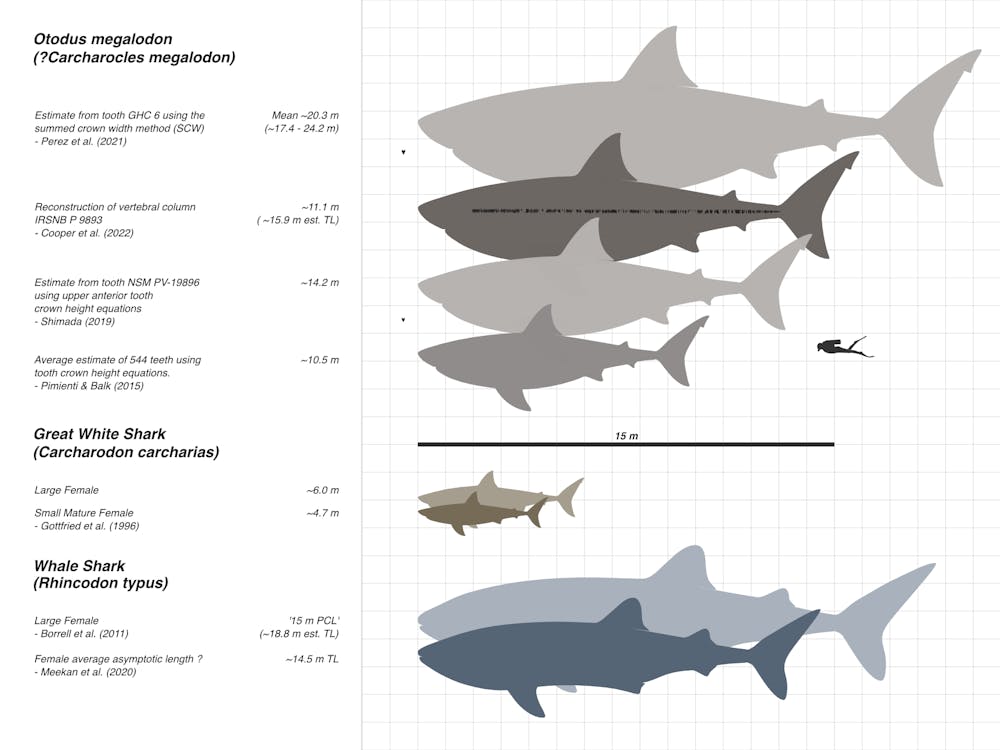
    In Peter Benchley’s 1974 novel that Jaws is based on, the shark is 6 metres long. For added screen excitement, in the movie it grew to a whopping 7.6 metres.

    However, that’s unrealistically large.

    The average size of a mature great white (Carcharodon carcharias, also known as the white shark) is between 4.6 and 4.9 metres for female sharks and up to 4 metres for male sharks.

    The largest recorded living specimens peak at about 6 metres, with one monster specimen caught in Cuba in 1945 reaching 6.4 metres.

    Earth’s oceans have seen bigger predatory sharks in the past. The biggest one of all time was the megalodon (Otodus megalodon) which lived from 23 to 3 million years ago, and may have been up to 24 metres in length. However, it looked nothing like the modern white shark.

    We don’t know precisely how big the megalodon was, but certainly larger than the great white shark.
    Steveoc 86/Wikimedia Commons, CC BY-SA

    They’re not even directly related – another thing scientists learned quite recently.

    Who was the megalodon, then?

    White sharks first evolved between 6 and 4 million years ago in the shadows of the megalodon. A recent study showed the megalodon’s large serrated teeth show signs of it being a supreme opportunistic super-predator.

    That means it ate just about anything, but especially liked whales and marine mammals.


    Read more:
    Friday essay: Giant shark megalodon was the most powerful superpredator ever. Why did it go extinct?


    But white sharks are not directly related to the megalodon, whose lineage began with a shark called Cretalamna during the age of dinosaurs about 100 million years ago.

    By contrast, the white shark lineage began with an ancient mako shark, Carcharodon hastalis. It was 7 to 8 metres long and had large, similarly shaped teeth to the modern white shark but lacking serrated edges.

    A fossil intermediate species, Carcharodon hubbelli shows the transition over time from weakly serrated to strongly serrated teeth.

    White shark fossil species. Left, the serrated fossil tooth teeth of the extant white shark; right, a similarly shaped unserrated tooth of the extinct giant mako shark which gave rise to white sharks.
    John Long, CC BY

    How did Jaws affect white shark populations?

    Last year, the International Shark Attack File reported 47 unprovoked shark bites to humans worldwide, resulting in seven fatalities. This was well below the previous ten-year average of 70 bites per year; your chances of getting bitten by a shark are extremely rare.

    Following the movies that made up the Jaws franchise, there was an increase in hunting and killing sharks – with a particular focus on great white sharks that were already going into a decline due to overfishing, trophy hunting and lethal control programs.

    Between 80% and 90% of white sharks have disappeared globally since the middle of the 20th century. Recent estimates calculate there are probably less than 500 individual white sharks in Australian waters right now.

    When Jaws first aired, scientists didn’t know how long sharks took to reproduce, or how many offspring a white shark could have each year. We now know it takes about 26 years for a male and 33 years for a female to sexually mature before they can start having pups.

    Data about white shark births is sparse, but recently a 5.6-metre-long female caught on a drum line off the coast of Queensland had just four large pups inside her. This is a very small number. Some large sharks, such as the whale shark, can give birth to up to 300 young.

    Now that we know just how slow they are to breed, it’s clear it will take many decades to reestablish the “pre-Jaws” population of white sharks – important apex predators in the marine ecosystem.

    Charlie Huveneers from Flinders University about to take a tissue sample for research on white sharks. There is still a lot we don’t know about their biology.
    Andrew Fox, Adelaide, CC BY

    Will white sharks survive?

    White sharks are currently listed as vulnerable.

    This classification means if we don’t change the current living conditions for white sharks, including impacts caused by human activities such as commercial fishing, and the impacts of climate change and ocean pollution, they will continue to decline and eventually could go extinct.

    Currently, white sharks are protected in several countries and form the basis for an important tourist industry in Australia, South Africa, western United States and most recently Nova Scotia, Canada.

    These sharks are iconic apex predators that fascinate people. One of us (John) went cage diving with them recently off the Neptune Islands of South Australia and can attest to how breathtaking it is to watch them in their natural environment.

    In terms of economic impact, they are worth far more alive than dead.

    White sharks are a growing tourism draw in several countries.
    Andrew Fox, Adelaide, CC BY

    There’s still much we don’t know about white sharks

    The complete white shark genome was first published only in 2019. It has 4.63 billion base pairs, making it much larger than the human genome (3.2 billion base pairs).

    The genome revealed some surprising things, like how white sharks show strong molecular adaptations for wound-healing processes, and a suite of “genome stability” genes – those used in DNA repair or DNA damage response.

    The transcriptome (or sum total of the messenger RNA) of the white shark showed greater similarity to the human transcriptome than to that of other fishes. This hints that “unexpressed genes” in the shark could one day play a role in uncovering genetic pathways for potential cures in human diseases.

    Jaws and its sequels certainly brought white sharks to the attention (and nightmares) of humans, with devastating impacts on how we treated them as a species.

    Our relationship with white sharks reflects our relationship with nature more broadly – a feared antagonist within the current capitalist paradigm; an enemy to be tamed, contained or consumed.

    As we learn more of the peril and potential of these remarkable creatures, we can learn how to live with them, to see beyond our fears and value their role within our delicate ocean ecosystems.

    John Long receives funding from The Australian Research Council.

    Heather L. Robinson does not work for, consult, own shares in or receive funding from any company or organisation that would benefit from this article, and has disclosed no relevant affiliations beyond their academic appointment.

    ref. Jaws at 50: how a single movie changed our perception of white sharks forever – https://theconversation.com/jaws-at-50-how-a-single-movie-changed-our-perception-of-white-sharks-forever-258306

    MIL OSI Analysis

  • MIL-OSI Analysis: Is Sabrina Carpenter’s Man’s Best Friend album cover satire or self-degradation? A psychology expert explores our reactions

    Source: The Conversation – Global Perspectives – By Katrina Muller-Townsend, Lecturer in Psychology, Edith Cowan University

    Island Records

    Sabrina Carpenter’s Man’s Best Friend album cover has fans divided.

    Carpenter poses on all fours, her glossy blond hair grasped by a male figure cropped from the frame. Her wide-eyed expression intensifies an ambiguous performance of subservience, tapping into a visual language tied to female objectification, from classic pin-up imagery to contemporary pop culture.

    The emotionally loaded image plays on her hyper-feminine, tongue-in-cheek pop star persona, forcing us to question where irony ends and objectification begins.

    Is it satire, or self-degradation?

    Up for debate

    At first glance, the cover seems like just another stylised, provocative pop image. It delivers what we’ve come to expect: a bold, ironic twist on the exaggerated Juno-style pose she reinvents on stage.

    To some fans, it’s clever satire: a pop star reclaiming and amplifying her image to mock industry norms. Satire uses exaggeration, irony, or humour to critique power structures – and Carpenter’s pose walks that tightrope.

    To others it crosses a line, reinforcing regressive attitudes about women’s sexuality and drawing criticism from domestic violence advocates.

    The debate reflects our unresolved discomfort about gender, power and control. There is a tension between Carpenter’s ironic persona and the submissive pose, creating uncertainty for the viewer.

    We can use psychology to better understand this dichotomy.

    The schema violation

    This mismatch between expectation and perception is a schema violation.

    A schema is a mental shortcut: a template built from experience and unspoken rules that helps us make sense of the world and predict what to expect. When something breaks that pattern, it’s called a schema violation.

    Carpenter’s brand is cheeky, self-aware irony – so when she adopts a pose steeped in submission and hyper-femininity as in this album image, it feels off.

    That can trigger cognitive dissonance: the mental tension we feel when two ideas (here, empowerment and obedience) don’t align.

    To resolve the conflict, some fans reinterpret the image as feminist sarcasm. Others reject it, fearing it panders to outdated, dangerous norms.

    Both reactions reflect our emotional and ideological investments in who Carpenter is or should be.

    Exploring confirmation bias

    Part of this conflicted reaction is driven by confirmation bias: our tendency to filter information to support what we already believe.

    Fans who see Carpenter as witty and empowered interpret the image as intentionally ironic. Others – more sceptical of the industry’s history of exploiting female sexuality – view it as a throwback to damaging norms.

    Either way, our interpretations often reflect more about ourselves than about Carpenter’s intent.

    When her image contradicts both her public persona and our social values, it creates a gap between what we think is right and what we want to be right. So, we try to explain it away, by either defending the image or criticising it.

    Satire and scandal

    Carpenter’s cover follows a long tradition of female artists whose work straddles satire and scandal, complicating public reception.

    Madonna’s Like a Prayer drew outrage for mixing religion with sexual imagery. Yet it positioned her as a provocateur – a woman resisting the lack of agency that so often defines sexualised media.

    Miley Cyrus’ Bangerz era shocked fans with a bold shift from Hannah Montana innocence to hypersexualised rebellion, challenging the narrow roles women in pop culture are confined to.

    Doja Cat’s shift from glam pop princess to glitch villainess unsettled audiences. Was it satire, rebellion, or just chaos?

    These women, like Carpenter, force us to confront our own discomfort with women who won’t stay in one lane.

    Performer and provocateur

    Audience reaction is also shaped by emotional investment in Carpenter’s persona. Through carefully curated social media, interviews and lyrics, fans build intimate narratives forming parasocial relationships – one-sided emotional bonds with celebrities.

    When an image contradicts that imagined persona, it can feel jarring, even like betrayal.

    Audiences often expect idols to be empowering but not polarising, sexy but safe, to challenge norms – but only in ways that affirm our own values.

    Carpenter’s image breaks that implicit contract, which creates discomfort for some viewers.

    Carpenter’s cover raises uncomfortable but necessary questions about how much freedom female artists have to be both critical and complicit. Can they play with society and play along, to be both performer and provocateur?

    This highlights the double bind many women face in media and popular culture. Female artists are expected to both subvert and satisfy; to entertain without offending; empower without alienating. The burden to be palatable and provocative is one male artists rarely face.

    It’s what we make of it

    Is Carpenter undermining herself or subverting the system? Perhaps both. Or perhaps the image isn’t the message: our reaction is.

    The image forces us to confront not only our perception of Sabrina Carpenter but also our cultural discomfort with women who defy neat categorisation. Satire demands interpretation, especially when it comes from women addressing sex or power.

    More than provocation, Carpenter’s cover mirrors our cultural struggle to accept women who defy simple labels of satire or submission. The image can reflect broader social ideals and tensions projected onto public figures.

    What we see says more about our assumptions than her intent. Understanding those reactions doesn’t kill the fun – it deepens it.

    Katrina Muller-Townsend does not work for, consult, own shares in or receive funding from any company or organisation that would benefit from this article, and has disclosed no relevant affiliations beyond their academic appointment.

    ref. Is Sabrina Carpenter’s Man’s Best Friend album cover satire or self-degradation? A psychology expert explores our reactions – https://theconversation.com/is-sabrina-carpenters-mans-best-friend-album-cover-satire-or-self-degradation-a-psychology-expert-explores-our-reactions-259043

    MIL OSI Analysis

  • MIL-OSI: Questerre reports on AGM voting results

    Source: GlobeNewswire (MIL-OSI)

    CALGARY, Alberta, June 18, 2025 (GLOBE NEWSWIRE) — Questerre Energy Corporation (“Questerre” or the “Company”) (TSX,OSE:QEC) announced today that, at its annual meeting of shareholders held on June 18, 2025 (the “Meeting”), all matters presented for approval at the Meeting were approved.

    At the Meeting, a vote was held by ballot which approved an ordinary resolution to fix the number of directors to be elected at the Meeting at six. In addition, each of the five nominees proposed in the Company’s Management Information Circular dated May 8, 2025 (the “Circular”) were elected as directors to hold office until the next annual meeting of shareholders or until their successors are duly elected or appointed, unless their office is earlier vacated in accordance with the by-laws of the Company. The detailed results of the vote conducted by ballot are set out below:

              Nominees Votes For Votes Withheld
                Michael Binnion 52,542,484 (99.95%) 28,375 (0.05%)
                Mireille Fontaine 52,534,719 (99.93%) 36,140 (0.07%)
                Hans Jacob Holden 52,526,484 (99.92%) 44,375 (0.08%)
                Dennis Sykora 52,537,484 (99.94%) 33,375 (0.06%)
                Jauvonne Kitto 52,541,719 (99.94%) 29,140 (0.06%) 
                Bjorn Inge Tonnessen 52,537,484 (99.94%) 33,375 (0.06%)
             

    By vote held by ballot, the ordinary resolution to approve the appointment of Ernst & Young LLP, Chartered Professional Accountants, as the auditors of the Company to hold office until the next annual meeting of shareholders or until their successors are appointed and authorizing the directors of the Company to fix their remuneration, was approved.

    By vote held by ballot, the ordinary resolution to adopt and approve the shareholder rights plan of the Corporation as set forth in the Circular, was approved.

    Questerre is an energy technology and innovation company. It is leveraging its expertise gained through early exposure to low permeability reservoirs to acquire significant high-quality resources. We believe we can successfully transition our energy portfolio. With new clean technologies and innovation to responsibly produce and use energy, we can sustain both human progress and our natural environment.

    Questerre is a believer that the future success of the oil and gas industry depends on a balance of economics, environment, and society. We are committed to being transparent and are respectful that the public must be part of making the important choices for our energy future.

    The MIL Network

  • MIL-OSI New Zealand: Greenpeace submits against the Regulatory Standards Bill and its far-right fringe ideas

    Source: Greenpeace

    Greenpeace Aotearoa has today filed its submission opposing the Regulatory Standards Bill and calling for it to be rejected in full.
    The Greenpeace submission has pulled no punches, stating:
    “Dressed up in the language of freedom and liberty, this Bill promotes a fringe libertarian worldview that individuals and corporations are entitled to harm nature and others, and if restrictions are placed on them, then they should be compensated.”
    “This ideology is fundamentally at odds with our nation’s deeply-rooted values of fairness, care, and collective responsibility.”
    “At its core, this Bill is an attempt by a far-right politician to create a bill of rights for corporations, at the expense of the rights of New Zealanders, the rights of nature, and the rights of Māori guaranteed to them under Te Tiriti o Waitangi.”
    “If enacted, it will, without doubt, erode environmental protection, lead to the extinction of precious native wildlife, and impair the Government’s ability to take action on climate change.”
    The Greenpeace Aotearoa submission goes on to warn that the Bill would open the floodgates for corporations to expect taxpayer handouts for any regulation that protects public health and the environment, or tries to manage the cost of living. It gives a series of chilling examples:
    • If rules were strengthened to prevent catastrophic oil spills such as the Deepwater Horizon disaster, the executives at BP oil would expect millions from the taxpayer.
    • Basic protections for our drinking water or lakes and rivers, would see Fonterra making complaints to an unelected regulatory standards board and expecting a public payout.
    • Supermarket giants would expect compensation for any efforts to limit price gouging and bring down grocery prices.
    • Offshore shareholders of multinational forestry companies would expect a payout for any new laws compelling them to prevent further deaths of New Zealand forestry workers.
    • Even the Tobacco industry would expect taxpayer dollars simply for efforts to save New Zealanders’ lives and get us to a smoke-free reality.

    MIL OSI New Zealand News

  • MIL-OSI New Zealand: Israel’s NZ Energy Deals In Spotlight – PSNA congratulates Mercury Energy abandoning contract with Israel’s Ormat Technologies but Contact Energy should follow

    Source: Palestine Solidarity Network Aotearoa (PSNA)

    Palestine Solidarity Network Aotearoa is congratulating Mercury Energy’s terminating its contract with Israel’s Ormat Technologies to design the Ngatamariki geothermal power station near Taupo.

    PSNA Co-Chair Maher Nazzal says it appears Mercury has acknowledged the legal jeopardy of Israeli companies operating throughout the world.

    “The International Court of Justice last year declared Israel’s presence in the Occupied Palestinian Territories is illegal and called on everyone to stop giving ‘aid or assistance’ to Israel which will help it to maintain its illegal occupation.”

    “Mercury’s decision is in line the ICJ findings and we welcome it as a victory for the Boycott Divestment and Sanctions campaign to isolate Israel.”

    “No New Zealand companies should have any dealings with Israel, either directly or indirectly.”

    “Israel is a rogue genocide and apartheid state – a threat and an embarrassment to all of humanity,” Nazal says.“But the Ormat contract with Mercury is not the only one.  We are now renewing our calls on Contact Energy to do the same and cut its links with Ormat Technologies.”

    “If Contact doesn’t follow Mercury, then I’m sure many electricity consumers will take the Israeli connection in mind and so switch from Contact to Mercury.”

    Maher Nazzal

    Co-Chair PSNA


    Here is a copy of the letter we sent to Contact Energy in November last year:

    15 November 2024

    Mike Fuge

    Chief Executive Officer

    Contact Energy


    c/o Louise Wright

    Head of Communications and Reputation

    Kia ora Mr Fuge,

    Contact Energy partnering with the racist apartheid state of Israel

    We noted your media release of 13 November 2024 (“Contact invests to redevelop Wairakei”) which confirms Contact is investing to begin replacing the Wairakei geothermal power station.

    What your release doesn’t mention is that you are intending to partner with an Israeli company, Ormat Technologies, through an Engineering, Procurement, and Construction (EPC) contract to build the new plant. Ormat has confirmed this in their own announcement dated a day earlier.

    It is not tenable for Contact Energy to sign off on this agreement and we are requesting the company withdraw from doing so immediately. Signing this proposed agreement would be a kick in the teeth for Palestinians suffering from industrial-scale slaughter at the hands of the apartheid state of Israel in which Ormat Technologies is embedded.

    Ormat Technologies has its main production facilities based in Yavne, Israel. Yavne is a city build over the Palestinian town of Yibna from which Palestinians were ethnically cleansed in 1948 and to which they have sought their right of return since 1948, only to be denied by racist Israeli policies.

    That Contact would even consider signing an agreement with an Israeli company in light of Palestinian calls for BDS (Boycott Divestment and Sanctions) against Israel and particularly after 13 months of genocide where most of the 43,000 confirmed victims have been women and children – is an outrage which makes a mockery of your carefully-crafted corporate story which claims to be based on “tikanga” and principles of respect for people and the planet.

    We urge you to do the right thing today and dismantle your links with Ormat and any associated Israeli companies. Palestinians and Palestinian New Zealanders have the right to demand no less from you.

    Please respond without unnecessary delay. 

    Ngā mihi.

    Nā,


    John Minto

    National Chair PSNA

    MIL OSI New Zealand News

  • MIL-OSI Economics: Money Market Operations as on June 18, 2025

    Source: Reserve Bank of India


    (Amount in ₹ crore, Rate in Per cent)

      Volume
    (One Leg)
    Weighted
    Average Rate
    Range
    A. Overnight Segment (I+II+III+IV) 5,99,803.47 5.18 3.50-6.55
         I. Call Money 15,058.07 5.27 4.75-5.35
         II. Triparty Repo 3,98,470.60 5.19 5.00-5.25
         III. Market Repo 1,83,650.70 5.14 3.50-5.40
         IV. Repo in Corporate Bond 2,624.10 5.48 5.30-6.55
    B. Term Segment      
         I. Notice Money** 69.50 5.15 5.00-5.25
         II. Term Money@@ 370.00 5.50-6.00
         III. Triparty Repo 200.00 5.30 5.30-5.30
         IV. Market Repo 980.89 4.99 1.00-5.50
         V. Repo in Corporate Bond 0.00
      Auction Date Tenor (Days) Maturity Date Amount Current Rate /
    Cut off Rate
    C. Liquidity Adjustment Facility (LAF), Marginal Standing Facility (MSF) & Standing Deposit Facility (SDF)
    I. Today’s Operations
    1. Fixed Rate          
    2. Variable Rate&          
      (I) Main Operation          
         (a) Repo          
         (b) Reverse Repo          
      (II) Fine Tuning Operations          
         (a) Repo          
         (b) Reverse Repo          
    3. MSF# Wed, 18/06/2025 1 Thu, 19/06/2025 1,389.00 5.75
    4. SDFΔ# Wed, 18/06/2025 1 Thu, 19/06/2025 2,96,073.00 5.25
    5. Net liquidity injected from today’s operations [injection (+)/absorption (-)]*       -2,94,684.00  
    II. Outstanding Operations
    1. Fixed Rate          
    2. Variable Rate&          
      (I) Main Operation          
         (a) Repo          
         (b) Reverse Repo          
      (II) Fine Tuning Operations          
         (a) Repo          
         (b) Reverse Repo          
    3. MSF#          
    4. SDFΔ#          
    D. Standing Liquidity Facility (SLF) Availed from RBI$       7,332.31  
    E. Net liquidity injected from outstanding operations [injection (+)/absorption (-)]*     7,332.31  
    F. Net liquidity injected (outstanding including today’s operations) [injection (+)/absorption (-)]*     -2,87,351.69  
    G. Cash Reserves Position of Scheduled Commercial Banks
         (i) Cash balances with RBI as on June 18, 2025 9,60,917.95  
         (ii) Average daily cash reserve requirement for the fortnight ending June 27, 2025 9,54,173.00  
    H. Government of India Surplus Cash Balance Reckoned for Auction as on¥ June 18, 2025 0.00  
    I. Net durable liquidity [surplus (+)/deficit (-)] as on May 30, 2025 5,84,684.00  
    @ Based on Reserve Bank of India (RBI) / Clearing Corporation of India Limited (CCIL).
    – Not Applicable / No Transaction.
    ** Relates to uncollateralized transactions of 2 to 14 days tenor.
    @@ Relates to uncollateralized transactions of 15 days to one year tenor.
    $ Includes refinance facilities extended by RBI.
    & As per the Press Release No. 2019-2020/1900 dated February 06, 2020.
    Δ As per the Press Release No. 2022-2023/41 dated April 08, 2022.
    * Net liquidity is calculated as Repo+MSF+SLF-Reverse Repo-SDF.
    ¥ As per the Press Release No. 2014-2015/1971 dated March 19, 2015.
    # As per the Press Release No. 2023-2024/1548 dated December 27, 2023.
    Ajit Prasad          
    Deputy General Manager
    (Communications)    
    Press Release: 2025-2026/561

    MIL OSI Economics

  • MIL-OSI: Altius Inspiro Wins 2025 Fortress Cybersecurity Award for Network Security

    Source: GlobeNewswire (MIL-OSI)

    MANILA, Philippines, June 19, 2025 (GLOBE NEWSWIRE) — Altius Inspiro, a leader in digital CX and outsourcing solutions, has proudly received the 2025 Fortress Cybersecurity Award, presented by the Business Intelligence Group. This esteemed accolade underscores the company’s groundbreaking innovation in fortifying systems, infrastructure, and data against a constantly evolving threat landscape.

    The Fortress Cybersecurity Awards honor organizations that go beyond compliance to develop secure systems and processes using innovative, measurable, and proactive approaches to cybersecurity. Altius Inspiro stood out for its remarkable achievements in strengthening digital resilience and advancing security practices.

    Through cutting-edge enhancements, Altius Inspiro redefined network security by implementing robust measures such as two-factor and multi-factor authentication systems, coupled with intrusion prevention strategies to mitigate threats before they materialize. By consolidating technologies under a Secure Access Service Edge (SASE) Cloud Platform, the company not only improved performance but also generated significant cost efficiencies. Additionally, the integration of AI-powered threat detection tools, including Microsoft Sentinel, allowed the organization to proactively anticipate and counteract cybersecurity risks, resulting in a marked improvement in their cybersecurity metrics and overall resilience.

    Ryo Ohashi, President and CEO of Altius Inspiro, expressed his gratitude for this recognition, stating, “This award emphasizes our relentless dedication to staying ahead of digital threats. Our teams work tirelessly to innovate and deliver advanced cybersecurity solutions that protect the systems and data of our clients, partners, and communities. This recognition serves as validation of their commitment to building trust and ensuring resilience in an increasingly complex digital world.”

    Altius Inspiro’s strides in cybersecurity demonstrate not only a commitment to safeguarding digital ecosystems but also its leadership at the forefront of industry innovation. This award solidifies the company’s position as a trusted partner in navigating the challenges of the modern threatscape.

    About Altius Inspiro, Inc. 

    Altius Inspiro is a global leader in digital customer experience management and business process outsourcing, serving Fortune 1000 companies across diverse industries. With a reputation for operational excellence and digital innovation, the company delivers next-generation CX solutions powered by strategy, advanced analytics, and technology. Altius Inspiro is a subsidiary of Altius Link, Inc., supported by shareholders KDDI Corporation and Mitsui & Co., Ltd. 

    For more information, visit www.inspiro.com.

    Contact:

    Raymond Boholano
    Vice President, Marketing and Corporate Communications
    raymond.boholano@inspiro.com

    The MIL Network

  • MIL-OSI: TEMPUS AI SHAREHOLDER ALERT: CLAIMSFILER REMINDS INVESTORS WITH LOSSES IN EXCESS OF $100,000 of Lead Plaintiff Deadline in Class Action Lawsuit Against Tempus AI, Inc. – TEM

    Source: GlobeNewswire (MIL-OSI)

    NEW ORLEANS, June 18, 2025 (GLOBE NEWSWIRE) — ClaimsFiler, a FREE shareholder information service, reminds investors that they have until August 12, 2025 to file lead plaintiff applications in a securities class action lawsuit against Tempus AI, Inc. (NasdaqGS: TEM), if they purchased the Company’s shares between August 6, 2024 and May 27, 2025, inclusive (the “Class Period”). This action is pending in the United States District Court for the Northern District of Illinois.

    Get Help

    Tempus investors should visit us at https://claimsfiler.com/cases/nasdaq-tem/ or call toll-free (844) 367-9658. Lawyers at Kahn Swick & Foti, LLC are available to discuss your legal options.

    About the Lawsuit

    Tempus and certain of its executives are charged with failing to disclose material information during the Class Period, violating federal securities laws.

    On May 28, 2025, Spruce Point Capital Management, LLC reported numerous issues with the Company’s management, operations and financial reporting, including that: (i) Tempus CEO Eric Lefkofsky and his associates have a history cashing out of companies before public shareholders incur losses or lackluster returns; (ii) Tempus’ actual AI capabilities are overstated; (iii) board members and other executives have been associated with troubled companies with restated financial results; (iv) signs of aggressive accounting and financial reporting are present; (v) there are issues with the AstraZeneca and Pathos AI deal that merit scrutiny; and (vi) the Company’s recent financial guidance revision reveals weakness in core operations.

    On this news, the price of Tempus’ shares fell $12.67 per share, or 19.23%, from a closing price of $65.87 per share on May 27, 2025, to a closing price of $53.20 per share on May 28, 2025.

    The case is Shouse v. Tempus AI. Inc., et al., No. 25-cv-06534.

    About ClaimsFiler

    ClaimsFiler has a single mission: to serve as the information source to help retail investors recover their share of billions of dollars from securities class action settlements. At ClaimsFiler.com, investors can: (1) register for free to gain access to information and settlement websites for various securities class action cases so they can timely submit their own claims; (2) upload their portfolio transactional data to be notified about relevant securities cases in which they may have a financial interest; and (3) submit inquiries to the Kahn Swick & Foti, LLC law firm for free case evaluations.

    To learn more about ClaimsFiler, visit www.claimsfiler.com.

    The MIL Network

  • MIL-OSI China: SCIO briefing on the Private Sector Promotion Law of the People’s Republic of China

    Source: People’s Republic of China – State Council News

    中文

    Speakers:

    Mr. Wang Ruihe, deputy director of the Legislative Affairs Commission of the Standing Committee of the National People’s Congress

    Ms. Zheng Bei, vice chairwoman of the National Development and Reform Commission

    Mr. Wang Zhenjiang, vice minister of justice

    Ms. Cong Lin, vice minister of the National Financial Regulatory Administration

    Mr. Fang Guanghua, vice chairman of the All-China Federation of Industry and Commerce

    Chairperson:

    Ms. Xing Huina, deputy director general of the Press Bureau of the State Council Information Office (SCIO) and spokesperson of the SCIO

    Date:

    May 8, 2025


    Xing Huina:

    Ladies and gentlemen, good morning. Welcome to this press conference held by the State Council Information Office (SCIO). The 15th session of the Standing Committee of the 14th National People’s Congress (NPC) voted to pass the Private Sector Promotion Law of the People’s Republic of China on April 30, which will come into effect on May 20, 2025. To help everyone better understand the law, today we have invited Mr. Wang Ruihe, deputy director of the Legislative Affairs Commission of the NPC Standing Committee; Ms. Zheng Bei, vice chairwoman of the National Development and Reform Commission (NDRC); Mr. Wang Zhenjiang, vice minister of justice; Ms. Cong Lin, vice minister of the National Financial Regulatory Administration (NFRA); and Mr. Fang Guanghua, vice chairman of the All-China Federation of Industry and Commerce (ACFIC), to brief you on the Private Sector Promotion Law and answer your questions.

    Now, I’ll give the floor to Mr. Wang for his introduction.

    Wang Zhenjiang:

    Good morning, everyone. I am very pleased to attend this morning’s press conference together with colleagues from the Legislative Affairs Commission of the NPC Standing Committee, the NDRC, the NFRA and the ACFIC. Thank you all for your concern and support for the legislative work associated with the Private Sector Promotion Law. Next, I will introduce the research, drafting and formulation of the law.

    The Central Committee of the Communist Party of China (CPC) and the State Council attach great importance to the development of the private economy. Since the reform and opening up in 1978, China’s private economy has developed rapidly under the guidance of the Party’s lines, principles and policies. Especially since the 18th CPC National Congress, the Party Central Committee with Comrade Xi Jinping at its core has taken a series of major measures to promote the development of the private economy. The private economy has continued to play an increasingly important role in China’s national economy and social development. At the same time, due to a combination of multiple internal and external factors, such as changes in the external environment and inadequate policy implementation, the private economy faces some difficulties and challenges in areas including fair participation in market competition, equal access to production factors, obtaining investment, financing and services, and the protection of legitimate rights and interests. There is an urgent need to codify the guiding principles and effective practices of the CPC Central Committee and the State Council on the private economy, in order to consolidate the achievements of reforms. It is also necessary to promptly improve relevant institutional measures to address prominent issues in practice, respond to public concerns, boost confidence and unleash the internal dynamism of private enterprises. These efforts will foster a legal environment and social atmosphere conducive to the development of all forms of ownership, including the private economy, enable us to stay focused on managing our own affairs well, and further consolidate the momentum of economic recovery and long-term growth. We will counter the uncertainties of a rapidly changing external environment with a firm commitment to high-quality development. Formulating the Private Sector Promotion Law is a major decision and deployment made by the Party Central Committee with Comrade Xi Jinping at its core. The need to formulate this law was clearly stated at the third plenary session of the 20th CPC Central Committee. The 2024 Central Economic Work Conference explicitly called for the introduction of this law.

    In accordance with the work plan, the Ministry of Justice and the NDRC requested the Legislative Affairs Commission of the NPC Standing Committee to take the lead in forming a drafting task force composed of 17 relevant departments from central and state organs. The task force thoroughly studied and comprehended the guiding principles of General Secretary Xi Jinping’s important instructions and the key points of his speech delivered at the symposium on private enterprises on Feb. 17 this year. The task force, in line with the guidelines and policies of the CPC Central Committee and the State Council, widely solicited public opinions, conducted in-depth research and analysis, and drafted the law. After the third plenary session of the 20th CPC Central Committee, the task force revised the draft in alignment with the session’s guiding principles, solicited public opinions again, and further refined it based on public feedback. After being discussed and approved at a State Council executive meeting, the draft was submitted to the NPC Standing Committee for deliberation in December 2024. The NPC Standing Committee reviewed the draft three times — in December 2024, February 2025 and April 2025 — and released it again for public comment during the period. On April 30, 2025, the 15th session of the 14th NPC Standing Committee voted to pass the Private Sector Promotion Law of the People’s Republic of China, which will officially come into effect on May 20.

    The law consists of nine chapters and 78 articles, establishing and improving relevant systems and mechanisms around fair competition, investment and financing promotion, scientific and technological innovation, regulatory guidance, service support and the protection of rights and interests. It translates the CPC Central Committee’s commitment to equal treatment and protection of the private economy into concrete legal provisions, in a bid to continuously improve a stable, fair, transparent and predictable environment for its development. As the first foundational law dedicated to the development of the private economy, the law marks a major step in implementing the decisions of the third plenary session of the 20th CPC Central Committee and the important remarks made by General Secretary Xi Jinping at the symposium on private enterprises. It is a vivid embodiment of Xi Jinping Thought on the Rule of Law and Xi Jinping Thought on Economy, a landmark event in building China’s socialist market economy, and a milestone in the development of its private sector. The law marks several breakthroughs. It is the first to enshrine into legal doctrine the principle of “unswervingly consolidating and developing the public sector and unswervingly encouraging, supporting and guiding the development of the non-public sector.” It is the first to clearly define the legal status of the private economy, and the first to explicitly state that “promoting the private sector’s sustained, healthy and high-quality development is a long-term major national policy.” This fully demonstrates the firm commitment of the CPC Central Committee in supporting the growth of the private sector and sends a clear message that developing the private economy remains a consistent and enduring policy of both the Party and the state. This will further unleash the internal drive and creative vitality of the private economy, boost confidence among private business operators, and inspire their entrepreneurial spirit and determination, fostering a strong sense of commitment to the nation and strengthening their resolve to be builders of socialism with Chinese characteristics and contributors to Chinese modernization.

    Laws alone cannot implement themselves. We hope all regions and government departments will take the adoption of the Private Sector Promotion Law as an opportunity to rigorously implement its provisions, ensuring thorough and accurate publicity and interpretation of the law and full compliance with its requirements, and promote the promulgation and implementation of supporting regulations as soon as possible. Efforts should be made to coordinate and refine the supportive and guarantee measures, and improve the institutional system for the development of the private sector. We need to further improve the law-based business environment, and effectively protect the legitimate rights and interests of private economic organizations and their operators in accordance with the law. We will step up efforts to foster a positive social atmosphere that supports the development of private businesses, and promote their sustained, healthy and high-quality development.

    That is all for my introduction. Now, my colleagues and I are ready to answer your questions. Thank you.

    Xing Huina:

    The floor is now open for questions. Please raise your hand and state the news outlet you represent before asking your questions.

    MIL OSI China News

  • MIL-OSI China: US companies cut more workforces: data

    Source: People’s Republic of China – State Council News

    U.S. public companies have reduced their white-collar workforces by a collective 3.5 percent over the past three years, according to employment data-provider Live Data Technologies, with one in five companies in the S&P 500 having shrunk over the past decade.

    “The cuts go beyond typical cost-trimming and speak to a broader shift in philosophy,” reported The Wall Street Journal about the development. “Adding talent, once a sign of surging sales and confidence in the future, now means leaders must be doing something wrong.”

    New technologies like generative artificial intelligence are allowing companies to do more with less. But there’s more to this movement. From Amazon in Seattle to Bank of America in Charlotte, North Carolina, and at companies big and small everywhere in between, there’s a growing belief that having too many employees is itself an impediment. “The message from many bosses: Anyone still on the payroll could be working harder,” noted the report.

    All of the shrinking turns on its head the usual cycle of hiring and firing. Companies often let go of workers in recessions, then staff up when the economy picks up. Yet the workforce cuts in recent years coincide with a surge in sales and profits, heralding a more fundamental shift in the way leaders evaluate their workforces, it added. 

    MIL OSI China News

  • MIL-OSI China: Chinese e-commerce giant JD.com launches express delivery service in Saudi Arabia

    Source: People’s Republic of China – State Council News

    JINGDONG Logistics, the logistics arm of Chinese e-commerce giant JD.com, launched an express delivery service in Saudi Arabia on Wednesday, as part of its efforts to expand globally.

    According to a statement released by the company, the new service, named JoyExpress, is a self-operated B2C express delivery service.

    Covering most regions of the kingdom, JoyExpress offers doorstep delivery options, including cash-on-delivery, and delivery as fast as the same day or next day.

    “JINGDONG Logistics will provide leading-edge services to our customers in Saudi Arabia and align with Saudi Vision 2030 strategy with its focus on logistics and job creation,” said Charlie Peng, head of the Middle East section at JINGDONG Logistics, during the launch ceremony.

    “JINGDONG Logistics’ investment in Saudi Arabia aligns with our national vision to become a global logistics hub,” said Rayan Albakri, deputy minister of Saudi Arabia’s Ministry of Transport and Logistics Services, during the ceremony.

    In Saudi Arabia, JINGDONG Logistics is building a network of warehouses, transfer and sorting centers, and a growing number of delivery stations.

    In China, JD.com operates more than 3,600 warehouses and 19,000 delivery stations and service outlets, employing nearly 510,000 front-line operational staff. 

    MIL OSI China News

  • MIL-OSI China: Russian investment fund to cooperate with Chinese digital trade platform

    Source: People’s Republic of China – State Council News

    The Russian Direct Investment Fund (RDIF) and Qifa, a Chinese-founded B2B digital trade platform operating across the Russia-China corridor, inked a strategic partnership on Wednesday at the St. Petersburg International Economic Forum (SPIEF) to advance cross-border digital trade and expand bilateral commerce.

    The collaboration agreement, signed on the sidelines of the forum, underscores joint efforts to modernize trade processes through technological integration. “RDIF and Qifa, a Russia-China B2B digital trade platform, have agreed to partner in developing digital trade and scaling bilateral trade volumes,” the fund stated in a press release.

    According to RDIF, the initiative will harness AI-driven solutions to streamline trade workflows, enhancing transparency and operational efficiency for businesses. This, in turn, is expected to drive product assortment expansion and cost optimization — key levers for accelerating trade growth in line with bilateral strategic objectives.

    “China leads in trade volume with Russia, with a robust e-commerce ecosystem already in place. RDIF’s focus on facilitating market access for Sino-Russian enterprises makes this partnership with Qifa an important step in elevating cross-border digital trade,” said Kirill Dmitriev, CEO of RDIF, in a statement.

    The 28th St. Petersburg International Economic Forum runs from June 18 to 21 this year, gathering delegates from over 100 countries and regions. 

    MIL OSI China News

  • MIL-Evening Report: ER Report: A Roundup of Significant Articles on EveningReport.nz for June 19, 2025

    ER Report: Here is a summary of significant articles published on EveningReport.nz on June 19, 2025.

    Australian citizens in Iran and Israel are desperate to leave. Is the government required to help?
    Source: The Conversation (Au and NZ) – By Jane McAdam, Scientia Professor and ARC Laureate Fellow, Kaldor Centre for International Refugee Law, UNSW Sydney As thousands of Australian citizens and permanent residents stuck in Iran and Israel continue to register for repatriation flights, the government is scrambling to find safe ways to evacuate them. With

    Popular period-tracking apps can hold years of personal data – new NZ research finds mixed awareness of risk
    Source: The Conversation (Au and NZ) – By Anna Friedlander, PhD Candidate in Sociology, University of Waikato Shutterstock/Krotnakro Period-tracking apps are popular digital tools for a range of menstrual, reproductive and general health purposes. But the way these apps collect and use data involves risk. Many apps encourage users to log information well beyond their

    Migrating bogong moths use the stars and Earth’s magnetic field to find ancestral summer caves each year
    Source: The Conversation (Au and NZ) – By Eric Warrant, Professor of Zoology at the University of Lund, Visiting Fellow at the Australian National University, and Adjunct Professor, University of South Australia Vik Dunis/iNaturalist, CC BY-NC It’s a warm January summer afternoon, and as I traverse the flower-strewn western slopes of Australia’s highest mountain, Mount

    Jaws at 50: how a single movie changed our perception of white sharks forever
    Source: The Conversation (Au and NZ) – By John Long, Strategic Professor in Palaeontology, Flinders University Shane Myers Photography/Shutterstock It’s been 50 years since Steven Spielberg’s movie Jaws first cast a terrifying shadow across our screens. At a low point during production, Spielberg worried he’d only ever be known for “a big fish story”. The

    Robot eyes are power hungry. What if we gave them tools inspired by the human brain?
    Source: The Conversation (Au and NZ) – By Adam D Hines, Research Fellow, Centre for Robotics, Queensland University of Technology A hexapod robot navigating outdoors. Adam Hines Robots are increasingly becoming a part of our lives – from warehouse automation to robotic vacuum cleaners. And just like humans, robots need to know where they are

    Winter viruses can trigger a heart attack or stroke, our study shows. It’s another good reason to get a flu or COVID shot
    Source: The Conversation (Au and NZ) – By Tu Nguyen, PhD Candidate, Department of Paediatrics, University of Melbourne, Murdoch Children’s Research Institute Irina Shatilova/Shutterstock Winter is here, along with cold days and the inevitable seasonal surge in respiratory viruses. But it’s not only the sniffles we need to worry about. Heart attacks and strokes also

    School playgrounds are one of the main locations for bullying. How can they be set up to stop it?
    Source: The Conversation (Au and NZ) – By Brendon Hyndman, Associate Dean (Academic), Faculty of Arts and Education, Charles Sturt University Dan Kenyon/ Getty Images Children spend thousands of hours in playgrounds at school. A lot of this time does not have the same levels of teacher preparation and supervision as classrooms do. Research shows

    Would you cheat on your tax? It’s a risky move, the tax office knows a lot about you
    Source: The Conversation (Au and NZ) – By Robert B Whait, Senior Lecturer in Taxation Law, University of South Australia Soon, more than 15 million Australians should be lodging a tax return with the Australian Taxation Office in the hope of receiving at least a small refund. About 60% of taxpayers use an accountant to

    Companies are betting on AI to help lift productivity. Workers need to be part of the process
    Source: The Conversation (Au and NZ) – By Llewellyn Spink, AI Corporate Governance Lead, Human Technology Institute, University of Technology Sydney The Conversation, CC BY-NC Australia’s productivity is flatlining, posting the worst vitals we’ve seen in 60 years. Politicians and chief executives are prescribing artificial intelligence (AI) like it’s the new penicillin – a wonder

    Is Sabrina Carpenter’s Man’s Best Friend album cover satire or self-degradation? A psychology expert explores our reactions
    Source: The Conversation (Au and NZ) – By Katrina Muller-Townsend, Lecturer in Psychology, Edith Cowan University Island Records Sabrina Carpenter’s Man’s Best Friend album cover has fans divided. Carpenter poses on all fours, her glossy blond hair grasped by a male figure cropped from the frame. Her wide-eyed expression intensifies an ambiguous performance of subservience,

    Kicked out for coming out: more than half of LGBTIQ+ flatmates face discrimination for their identity
    Source: The Conversation (Au and NZ) – By Brodie Fraser, Senior Research Fellow, He Kāinga Oranga Housing and Health Research Programme, University of Otago Sangar Akreyi/Getty Images People who belong to the LGBTIQ+ community say flatting is fraught with difficulties that go well beyond learning new routines and sharing space with strangers. Our new research

    Tracing the Drax family’s millions – a story of British landed gentry, slavery and sugar plantations
    Source: The Conversation (Au and NZ) – By Paul Lashmar, Reader in Journalism, City St George’s, University of London ‘Planting the sugar-cane’: vast fortunes were made from the trades in both sugar and human slaves in the Americas. Schomburg Center for Research in Black Culture, Photographs and Prints Division, The New York Public Library Rich

    Nineteen Eighty-Four might have been inspired by George Orwell’s fear of drowning
    Source: The Conversation (Au and NZ) – By Nathan Waddell, Associate Professor in Twentieth-Century Literature, University of Birmingham George Orwell had a traumatic relationship with the sea. In August 1947, while he was writing Nineteen Eighty-Four (1949) on the island of Jura in the Scottish Hebrides, he went on a fishing trip with his young

    What happens when aid is cut to a large refugee camp? Kenyan study paints a bleak picture
    Source: The Conversation (Au and NZ) – By Olivier Sterck, Associate professor, University of Oxford Humanitarian needs are rising around the world. At the same time, major donors such as the US and the UK are pulling back support, placing increasing strain on already overstretched aid systems. Global humanitarian needs have quadrupled since 2015, driven

    Grok’s ‘white genocide’ responses show how generative AI can be weaponized
    Source: The Conversation (Au and NZ) – By James Foulds, Associate Professor of Information Systems, University of Maryland, Baltimore County Someone altered the AI chatbot Grok to make it insert text about a debunked conspiracy theory in unrelated responses. Cheng Xin/Getty Images The AI chatbot Grok spent one day in May 2025 spreading debunked conspiracy

    Politics with Michelle Grattan: an ‘impatient’ Jim Chalmers on taking political risks in Labor’s second term
    Source: The Conversation (Au and NZ) – By Michelle Grattan, Professorial Fellow, University of Canberra Asanka Ratnayake/Getty Images While the world’s media is largely focused on conflict in the Middle East, the focus for many Australians remains at home, with the government preparing the long task ahead of trying to lift Australia’s productivity. Last week,

    View from The Hill: Jim Chalmers wants to get on with economic reform and tax is in his sights
    Source: The Conversation (Au and NZ) – By Michelle Grattan, Professorial Fellow, University of Canberra Jim Chalmers speaking to the National Press Club June 18, 2025. Screenshot from the ABC Broadcast, CC BY-NC Jim Chalmers cast his Wednesday National Press Club speech as a second instalment in a two-part presentation that was kicked off by

    Iran’s long history of revolution, defiance and outside interference – and why its future is so uncertain
    Source: The Conversation (Au and NZ) – By Amin Saikal, Emeritus Professor of Middle Eastern and Central Asian Studies, Australian National University; and Vice Chancellor’s Strategic Fellow, Victoria University Israeli Prime Minister Benjamin Netanyahu has gone beyond his initial aim of destroying Iran’s ability to produce nuclear weapons. He has called on the Iranian people

    95 lawyers demand stronger NZ stand over Israel amid Middle East tensions
    Asia Pacific Report Ninety-five New Zealand lawyers — including nine king’s counsel — have signed a letter demanding Prime Minister Christopher Luxon, Foreign Minister Winston Peters and two other ministers urge the government to take a stronger stand against Israel’s “catastrophic” actions in Gaza. The letter has been sent amid rising tensions in the region,

    Gay and bisexual men will soon be able to donate blood and plasma
    Source: The Conversation (Au and NZ) – By Yasmin Mowat, Clinical Project Manager, Kirby Institute, UNSW Sydney AnnaStills/Getty Images Many gay and bisexual men have been excluded from donating blood and plasma (the liquid portion of blood) for decades because of rules developed during the HIV crisis in the 1980s. The Australian Red Cross’ blood

    MIL OSI AnalysisEveningReport.nz

  • MIL-Evening Report: ER Report: A Roundup of Significant Articles on EveningReport.nz for June 19, 2025

    ER Report: Here is a summary of significant articles published on EveningReport.nz on June 19, 2025.

    Australian citizens in Iran and Israel are desperate to leave. Is the government required to help?
    Source: The Conversation (Au and NZ) – By Jane McAdam, Scientia Professor and ARC Laureate Fellow, Kaldor Centre for International Refugee Law, UNSW Sydney As thousands of Australian citizens and permanent residents stuck in Iran and Israel continue to register for repatriation flights, the government is scrambling to find safe ways to evacuate them. With

    Popular period-tracking apps can hold years of personal data – new NZ research finds mixed awareness of risk
    Source: The Conversation (Au and NZ) – By Anna Friedlander, PhD Candidate in Sociology, University of Waikato Shutterstock/Krotnakro Period-tracking apps are popular digital tools for a range of menstrual, reproductive and general health purposes. But the way these apps collect and use data involves risk. Many apps encourage users to log information well beyond their

    Migrating bogong moths use the stars and Earth’s magnetic field to find ancestral summer caves each year
    Source: The Conversation (Au and NZ) – By Eric Warrant, Professor of Zoology at the University of Lund, Visiting Fellow at the Australian National University, and Adjunct Professor, University of South Australia Vik Dunis/iNaturalist, CC BY-NC It’s a warm January summer afternoon, and as I traverse the flower-strewn western slopes of Australia’s highest mountain, Mount

    Jaws at 50: how a single movie changed our perception of white sharks forever
    Source: The Conversation (Au and NZ) – By John Long, Strategic Professor in Palaeontology, Flinders University Shane Myers Photography/Shutterstock It’s been 50 years since Steven Spielberg’s movie Jaws first cast a terrifying shadow across our screens. At a low point during production, Spielberg worried he’d only ever be known for “a big fish story”. The

    Robot eyes are power hungry. What if we gave them tools inspired by the human brain?
    Source: The Conversation (Au and NZ) – By Adam D Hines, Research Fellow, Centre for Robotics, Queensland University of Technology A hexapod robot navigating outdoors. Adam Hines Robots are increasingly becoming a part of our lives – from warehouse automation to robotic vacuum cleaners. And just like humans, robots need to know where they are

    Winter viruses can trigger a heart attack or stroke, our study shows. It’s another good reason to get a flu or COVID shot
    Source: The Conversation (Au and NZ) – By Tu Nguyen, PhD Candidate, Department of Paediatrics, University of Melbourne, Murdoch Children’s Research Institute Irina Shatilova/Shutterstock Winter is here, along with cold days and the inevitable seasonal surge in respiratory viruses. But it’s not only the sniffles we need to worry about. Heart attacks and strokes also

    School playgrounds are one of the main locations for bullying. How can they be set up to stop it?
    Source: The Conversation (Au and NZ) – By Brendon Hyndman, Associate Dean (Academic), Faculty of Arts and Education, Charles Sturt University Dan Kenyon/ Getty Images Children spend thousands of hours in playgrounds at school. A lot of this time does not have the same levels of teacher preparation and supervision as classrooms do. Research shows

    Would you cheat on your tax? It’s a risky move, the tax office knows a lot about you
    Source: The Conversation (Au and NZ) – By Robert B Whait, Senior Lecturer in Taxation Law, University of South Australia Soon, more than 15 million Australians should be lodging a tax return with the Australian Taxation Office in the hope of receiving at least a small refund. About 60% of taxpayers use an accountant to

    Companies are betting on AI to help lift productivity. Workers need to be part of the process
    Source: The Conversation (Au and NZ) – By Llewellyn Spink, AI Corporate Governance Lead, Human Technology Institute, University of Technology Sydney The Conversation, CC BY-NC Australia’s productivity is flatlining, posting the worst vitals we’ve seen in 60 years. Politicians and chief executives are prescribing artificial intelligence (AI) like it’s the new penicillin – a wonder

    Is Sabrina Carpenter’s Man’s Best Friend album cover satire or self-degradation? A psychology expert explores our reactions
    Source: The Conversation (Au and NZ) – By Katrina Muller-Townsend, Lecturer in Psychology, Edith Cowan University Island Records Sabrina Carpenter’s Man’s Best Friend album cover has fans divided. Carpenter poses on all fours, her glossy blond hair grasped by a male figure cropped from the frame. Her wide-eyed expression intensifies an ambiguous performance of subservience,

    Kicked out for coming out: more than half of LGBTIQ+ flatmates face discrimination for their identity
    Source: The Conversation (Au and NZ) – By Brodie Fraser, Senior Research Fellow, He Kāinga Oranga Housing and Health Research Programme, University of Otago Sangar Akreyi/Getty Images People who belong to the LGBTIQ+ community say flatting is fraught with difficulties that go well beyond learning new routines and sharing space with strangers. Our new research

    Tracing the Drax family’s millions – a story of British landed gentry, slavery and sugar plantations
    Source: The Conversation (Au and NZ) – By Paul Lashmar, Reader in Journalism, City St George’s, University of London ‘Planting the sugar-cane’: vast fortunes were made from the trades in both sugar and human slaves in the Americas. Schomburg Center for Research in Black Culture, Photographs and Prints Division, The New York Public Library Rich

    Nineteen Eighty-Four might have been inspired by George Orwell’s fear of drowning
    Source: The Conversation (Au and NZ) – By Nathan Waddell, Associate Professor in Twentieth-Century Literature, University of Birmingham George Orwell had a traumatic relationship with the sea. In August 1947, while he was writing Nineteen Eighty-Four (1949) on the island of Jura in the Scottish Hebrides, he went on a fishing trip with his young

    What happens when aid is cut to a large refugee camp? Kenyan study paints a bleak picture
    Source: The Conversation (Au and NZ) – By Olivier Sterck, Associate professor, University of Oxford Humanitarian needs are rising around the world. At the same time, major donors such as the US and the UK are pulling back support, placing increasing strain on already overstretched aid systems. Global humanitarian needs have quadrupled since 2015, driven

    Grok’s ‘white genocide’ responses show how generative AI can be weaponized
    Source: The Conversation (Au and NZ) – By James Foulds, Associate Professor of Information Systems, University of Maryland, Baltimore County Someone altered the AI chatbot Grok to make it insert text about a debunked conspiracy theory in unrelated responses. Cheng Xin/Getty Images The AI chatbot Grok spent one day in May 2025 spreading debunked conspiracy

    Politics with Michelle Grattan: an ‘impatient’ Jim Chalmers on taking political risks in Labor’s second term
    Source: The Conversation (Au and NZ) – By Michelle Grattan, Professorial Fellow, University of Canberra Asanka Ratnayake/Getty Images While the world’s media is largely focused on conflict in the Middle East, the focus for many Australians remains at home, with the government preparing the long task ahead of trying to lift Australia’s productivity. Last week,

    View from The Hill: Jim Chalmers wants to get on with economic reform and tax is in his sights
    Source: The Conversation (Au and NZ) – By Michelle Grattan, Professorial Fellow, University of Canberra Jim Chalmers speaking to the National Press Club June 18, 2025. Screenshot from the ABC Broadcast, CC BY-NC Jim Chalmers cast his Wednesday National Press Club speech as a second instalment in a two-part presentation that was kicked off by

    Iran’s long history of revolution, defiance and outside interference – and why its future is so uncertain
    Source: The Conversation (Au and NZ) – By Amin Saikal, Emeritus Professor of Middle Eastern and Central Asian Studies, Australian National University; and Vice Chancellor’s Strategic Fellow, Victoria University Israeli Prime Minister Benjamin Netanyahu has gone beyond his initial aim of destroying Iran’s ability to produce nuclear weapons. He has called on the Iranian people

    95 lawyers demand stronger NZ stand over Israel amid Middle East tensions
    Asia Pacific Report Ninety-five New Zealand lawyers — including nine king’s counsel — have signed a letter demanding Prime Minister Christopher Luxon, Foreign Minister Winston Peters and two other ministers urge the government to take a stronger stand against Israel’s “catastrophic” actions in Gaza. The letter has been sent amid rising tensions in the region,

    Gay and bisexual men will soon be able to donate blood and plasma
    Source: The Conversation (Au and NZ) – By Yasmin Mowat, Clinical Project Manager, Kirby Institute, UNSW Sydney AnnaStills/Getty Images Many gay and bisexual men have been excluded from donating blood and plasma (the liquid portion of blood) for decades because of rules developed during the HIV crisis in the 1980s. The Australian Red Cross’ blood

    MIL OSI AnalysisEveningReport.nz

  • MIL-OSI New Zealand: 62 percent fewer scam texts reported after Internal Affairs crackdown

    Source: New Zealand Government

    Minister of Internal Affairs Brooke van Velden says the Department of Internal Affairs [the Department] has made significant progress in tackling scams in New Zealand, with a 62 per cent drop in reports of SMS scams in 2024 from 2023, following the Department’s investigations into scammers.
    The Department’s 2024 Digital Messaging Transparency Report, published this week, details some of the actions the Department has taken to catch people perpetrating scams, including by conducting search warrants and seizing equipment.
    “Scams cause serious financial and emotional harm, often preying on vulnerable people in our communities. I’m pleased the Department’s work is making a real impact in reducing scams and holding perpetrators accountable,” says Ms van Velden.
    In 2024 the Department received over 103,000 reports of SMS scams, conducted six search warrants, and seized almost $400,000 worth of scam equipment as well as $162,000 in cash. One of the search warrants resulted in the arrest of a 19-year-old Auckland man and the seizure of a cell site simulator. A cell site simulator is a false cell tower which tricks nearby mobile devices into connecting to the fraudulent network so that scam text messages can be sent to the connected phones.
    Commerce and Consumer Affairs Minister Scott Simpson, who is the lead anti-scams Minister, welcomes the report’s findings and highlights the Government’s increasing focus on keeping New Zealanders safer from scammers.
    “Online financial scams cause significant harm to New Zealanders – reported losses have been nearly $200 million a year, but some estimate this to be as high as $2 billion. Often scams affect the more vulnerable people in our community and our loved ones. We are taking action to change this. I intend to make announcements in due course on further work we intend to do to reduce scams across New Zealand,” says Mr Simpson.
    “The prevalence of scams also hurts the wider economy, as people become less comfortable with transacting online. Building back people’s trust by reducing scams is part of rebuilding the economy and reducing the cost of living,” says Ms van Velden.
    The report is available at: https://www.dia.govt.nz/Spam-Transparency-reports

    MIL OSI New Zealand News