Category: Business

  • MIL-OSI Global: The rise of psychedelic capitalism: Work harder and be happy about it?

    Source: The Conversation – Canada – By Kevin Walby, Associate Professor of Criminal Justice, University of Winnipeg

    Once stigmatized and outlawed, psychedelics are moving from the counterculture to the mainstream. From Prince Harry’s use of psilocybin to National Football League quarterback Aaron Rodgers’ adventures with ayahuasca, our media is awash with accounts of their professed benefits.

    Hundreds of universities around the world are now engaging in psychedelic research. And psychedelic legalization initiatives are taking hold.

    Psychedelics are becoming big business. Just as private capital flooded the cannabis sector years ago, a psychedelic gold rush is underway.

    Wealthy entrepreneurs are investing in the psychedelic industry while biotechnology start-ups are raising capital and running clinical trials on novel psychedelic molecules. Venture capitalists are eyeing the prospects of a new lucrative mass market.

    The authors of this article have a new book out: ‘Psychedelic Capitalism’ published by Fernwood.
    (Fernwood)

    Three causes for concern

    To date, most debates about psychedelics have offered little critical analysis of their relationship to the political economy of modern capitalism and broader power structures. In our new book Psychedelic Capitalism, we make three central claims about the so-called psychedelic renaissance.

    First, the medicalization of psychedelics is likely to restrict access and reinforce existing health and social inequalities.

    Second, the corporatization of psychedelics will enable economic elites to dominate the market while appropriating the vast reservoir of knowledge built up by Indigenous communities, public institutions and underground researchers.

    And third, rather than representing progressive drug reform, the limited legalization of select psychedelics for medical use will help to entrench and sustain the drug war and the criminalization of most drug use.

    Ignoring community knowledge

    Across North America, we’re seeing a medicalization of psychedelics, where a range of problems are presented as treatable by these substances. This is happening in a way that boosts corporate control of the process and pushes aside community and Indigenous knowledge.

    We have seen this scenario play out in Australia. Substances such as psilocybin and MDMA are legally available, but only through a doctor’s prescription and at great financial cost — raising questions about equity, access and who these therapies are for.

    Framing psychedelics as pharmaceutical commodities and individualized health-care solutions reinforces the prohibitionist narrative that these substances are unsuitable for use outside of the medical context. This narrative shifts attention away from how medicalized use might perpetuate a neoliberal ideology — locating mental “disorder” within an individual, rather than addressing more systemic causes such as poverty, inequality and social exclusion.

    It also disregards centuries of traditions created by Indigenous community use, as well as the values of the psychedelic underground.

    A system built on expensive individual therapy, medically trained gatekeepers and hyper-controlled clinical access is not the model that most advocates have envisioned.

    A pill-only model for productivity and happiness

    The foundations of psychedelic capitalism were largely created by public innovation at the public’s expense and are now in the process of being taken over by private capital.

    Psychedelic conferences increasingly resemble corporate trade shows. The psychedelic tourism industry continues to expand and cater to elite clients. For-profit companies like Mind Medicine and Compass Pathways are eliminating psychotherapy from their treatment protocols and embracing a “pill-only” model favoured by Big Pharma.

    Psychedelics, including microdosing and psychedelic-assisted therapy, are marketed as a way for the general population to extract more work out of their already overworked lives, and to be happy about it in the process.

    Companies are competing to capture intellectual property to harness profits from existing compounds and erect legal barriers around new chemicals and their applications.

    The for-profit ketamine industry already offers a glimpse into the future of corporatized psychedelic therapy. This includes a lack of attention to risks, deceitful marketing and little consideration to therapeutic care.

    There has been a surge of new patent applications (and granted patents) in the U.S. on substances such as psilocybin, LSD, DMT, 5-MeO DMT and mescaline that seek to secure exclusivity, monopolize supply chains and privatize knowledge that already exists in the public domain.

    Psychedelics have been swept up into the well-rehearsed capitalist playbook where private players are fabricating exclusionary rights over what are ultimately the products of collective human struggle and intellectual achievement.

    Medical legalization of psychedelics

    The medicalized approach to psychedelic mainstreaming also connects to drug law and policy.

    Across North America, the biomedical approach is the main influence on drug law and the primary avenue for psychedelic access in most jurisdictions. This approach is widely supported by psychedelic capitalists who have a financial stake in medical legalization and want to limit legal access to anything outside of the medical-pharma frame.

    In the United States, places like Oregon and Colorado have more holistic legal models that include elements of community control to prevent corporate capture. But most state initiatives remain limited in scope and are centred around medicalized therapy, particularly for military veterans. Even in Oregon, which has been lauded for its progressive drug policies, there has been an unmistakable drift toward medicalization.

    Canada’s cannabis industry exemplifies how processes of legalization can become intertwined with the interests of corporate-dominated industries.

    As Michael Devillaer, professor of psychiatry and behavioural neurosciences and author of Buzz Kill (2024), has explained, the cannabis industry has prioritized profit maximization, product promotion and increased consumption at the expense of public health concerns.

    What is best for public interest?

    As the medical legalization of psychedelics deepens, we are likely to see the intensification of criminal penalties for recreational and other uses.

    In fact, police seizures of psychedelics like psilocybin in the U.S. have increased in recent years. Global arrests for the transportation of compounds such as ayahuasca, iboga and peyote have also increased.

    These problems are likely to be exacerbated by systems of bifurcated scheduling, where a drug product is placed in a different class from the active ingredient or substance.

    For example, if the U.S. Food and Drug Administration (FDA) were to approve psilocybin for depression or MDMA for PTSD, it is likely that only FDA-approved medicinal psilocybin and MDMA products would be rescheduled, while the substances themselves would continue to be prosecuted as restricted narcotics.

    It is in the public interest to move beyond a myopic focus on medical legalization to a more open, decriminalized model of public access. An approach like this would not only mitigate the threats associated with corporate capture, it would also reduce the harms associated with criminalization and the war on drugs.

    Community-controlled decriminalization is a better path to mainstreaming psychedelics than relinquishing power to the medical industry and pharmaceutical cartels that provide monopolized services to primarily affluent customers.

    And treating drug use and dependence as a public health issue and incentivizing harm reduction and support services for at-risk populations would go a long way to mitigating the tragedies of the drug war.

    Kevin Walby receives funding from the Social Sciences and Humanities Research Council of Canada.

    Jamie Brownlee does not work for, consult, own shares in or receive funding from any company or organisation that would benefit from this article, and has disclosed no relevant affiliations beyond their academic appointment.

    ref. The rise of psychedelic capitalism: Work harder and be happy about it? – https://theconversation.com/the-rise-of-psychedelic-capitalism-work-harder-and-be-happy-about-it-253003

    MIL OSI – Global Reports

  • MIL-OSI Global: Believe it or not, there was a time when the US government built beautiful homes for working-class Americans to deal with a housing crisis

    Source: The Conversation – USA – By Eran Ben-Joseph, Professor of Landscape Architecture and Urban Planning, Massachusetts Institute of Technology (MIT)

    The U.S. Housing Corporation built nearly 300 homes in Bremerton, Wash., during World War I. National Archives

    In 1918, as World War I intensified overseas, the U.S. government embarked on a radical experiment: It quietly became the nation’s largest housing developer, designing and constructing more than 80 new communities across 26 states in just two years.

    These weren’t hastily erected barracks or rows of identical homes. They were thoughtfully designed neighborhoods, complete with parks, schools, shops and sewer systems.

    In just two years, this federal initiative provided housing for almost 100,000 people.

    Few Americans are aware that such an ambitious and comprehensive public housing effort ever took place. Many of the homes are still standing today.

    But as an urban planning scholar, I believe that this brief historic moment – spearheaded by a shuttered agency called the United States Housing Corporation – offers a revealing lesson on what government-led planning can achieve during a time of national need.

    Government mobilization

    When the U.S. declared war against Germany in April 1917, federal authorities immediately realized that ship, vehicle and arms manufacturing would be at the heart of the war effort. To meet demand, there needed to be sufficient worker housing near shipyards, munitions plants and steel factories.

    So on May 16, 1918, Congress authorized President Woodrow Wilson to provide housing and infrastructure for industrial workers vital to national defense. By July, it had appropriated US$100 million – approximately $2.3 billion today – for the effort, with Secretary of Labor William B. Wilson tasked with overseeing it via the U.S. Housing Corporation.

    Over the course of two years, the agency designed and planned over 80 housing projects. Some developments were small, consisting of a few dozen dwellings. Others approached the size of entire new towns.

    For example, Cradock, near Norfolk, Virginia, was planned on a 310-acre site, with more than 800 detached homes developed on just 100 of those acres. In Dayton, Ohio, the agency created a 107-acre community that included 175 detached homes and a mix of over 600 semidetached homes and row houses, along with schools, shops, a community center and a park.

    Designing ideal communities

    Notably, the Housing Corporation was not simply committed to offering shelter.

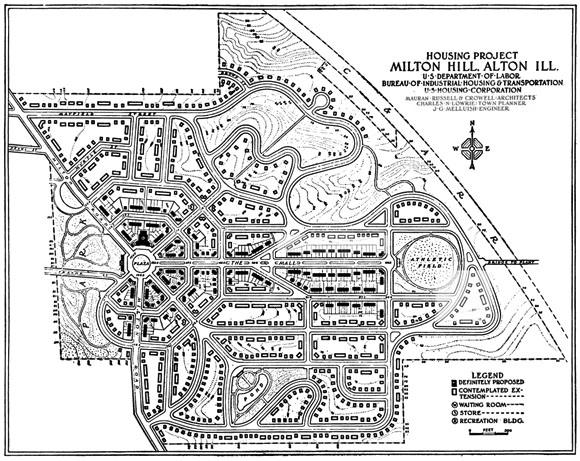
    Its architects, planners and engineers aimed to create communities that were not only functional but also livable and beautiful. They drew heavily from Britain’s late-19th century Garden City movement, a planning philosophy that emphasized low-density housing, the integration of open spaces and a balance between built and natural environments.

    Milton Hill, a neighborhood designed and developed by the United States Housing Corporation in Alton, Ill.
    National Archives

    Importantly, instead of simply creating complexes of apartment units, akin to the public housing projects that most Americans associate with government-funded housing, the agency focused on the construction of single-family and small multifamily residential buildings that workers and their families could eventually own.

    This approach reflected a belief by the policymakers that property ownership could strengthen community responsibility and social stability. During the war, the federal government rented these homes to workers at regulated rates designed to be fair, while covering maintenance costs. After the war, the government began selling the homes – often to the tenants living in them – through affordable installment plans that provided a practical path to ownership.

    A single-family home in Davenport, Iowa, built by the U.S. Housing Corporation.
    National Archives

    Though the scope of the Housing Corporation’s work was national, each planned community took into account regional growth and local architectural styles. Engineers often built streets that adapted to the natural landscape. They spaced houses apart to maximize light, air and privacy, with landscaped yards. No resident lived far from greenery.

    In Quincy, Massachusetts, for example, the agency built a 22-acre neighborhood with 236 homes designed mostly in a Colonial Revival style to serve the nearby Fore River Shipyard. The development was laid out to maximize views, green space and access to the waterfront, while maintaining density through compact street and lot design.

    At Mare Island, California, developers located the housing site on a steep hillside near a naval base. Rather than flatten the land, designers worked with the slope, creating winding roads and terraced lots that preserved views and minimized erosion. The result was a 52-acre community with over 200 homes, many of which were designed in the Craftsman style. There was also a school, stores, parks and community centers.

    Infrastructure and innovation

    Alongside housing construction, the Housing Corporation invested in critical infrastructure. Engineers installed over 649,000 feet of modern sewer and water systems, ensuring that these new communities set a high standard for sanitation and public health.

    Attention to detail extended inside the homes. Architects experimented with efficient interior layouts and space-saving furnishings, including foldaway beds and built-in kitchenettes. Some of these innovations came from private companies that saw the program as a platform to demonstrate new housing technologies.

    One company, for example, designed fully furnished studio apartments with furniture that could be rotated or hidden, transforming a space from living room to bedroom to dining room throughout the day.

    To manage the large scale of this effort, the agency developed and published a set of planning and design standards − the first of their kind in the United States. These manuals covered everything from block configurations and road widths to lighting fixtures and tree-planting guidelines.

    A single-family home in Bremerton, Wash., built by the U.S. Housing Corporation.
    National Archives

    The standards emphasized functionality, aesthetics and long-term livability.

    Architects and planners who worked for the Housing Corporation carried these ideas into private practice, academia and housing initiatives. Many of the planning norms still used today, such as street hierarchies, lot setbacks and mixed-use zoning, were first tested in these wartime communities.

    And many of the planners involved in experimental New Deal community projects, such as Greenbelt, Maryland, had worked for or alongside Housing Corporation designers and planners. Their influence is apparent in the layout and design of these communities.

    A brief but lasting legacy

    With the end of World War I, the political support for federal housing initiatives quickly waned. The Housing Corporation was dissolved by Congress, and many planned projects were never completed. Others were incorporated into existing towns and cities.

    Yet, many of the neighborhoods built during this period still exist today, integrated in the fabric of the country’s cities and suburbs. Residents in places such as Aberdeen, Maryland; Bremerton, Washington; Bethlehem, Pennsylvania; Watertown, New York; and New Orleans may not even realize that many of the homes in their communities originated from a bold federal housing experiment.

    These homes on Lawn Avenue in Quincy, Mass., in 2019 were built by the U.S. Housing Corporation.
    Google Street View

    The Housing Corporation’s efforts, though brief, showed that large-scale public housing could be thoughtfully designed, community oriented and quickly executed. For a short time, in response to extraordinary circumstances, the U.S. government succeeded in building more than just houses. It constructed entire communities, demonstrating that government has a major role and can lead in finding appropriate, innovative solutions to complex challenges.

    At a moment when the U.S. once again faces a housing crisis, the legacy of the U.S. Housing Corporation serves as a reminder that bold public action can meet urgent needs.

    Eran Ben-Joseph does not work for, consult, own shares in or receive funding from any company or organization that would benefit from this article, and has disclosed no relevant affiliations beyond their academic appointment.

    ref. Believe it or not, there was a time when the US government built beautiful homes for working-class Americans to deal with a housing crisis – https://theconversation.com/believe-it-or-not-there-was-a-time-when-the-us-government-built-beautiful-homes-for-working-class-americans-to-deal-with-a-housing-crisis-253512

    MIL OSI – Global Reports

  • MIL-OSI Global: Tomato trade dispute between the US and Mexico is boiling over again – with 21% tariffs due in July

    Source: The Conversation – USA – By Andrew Muhammad, Professor of Agriculture and Resource Economics, University of Tennessee

    The country of origin – Mexico – is noted on the label of a package of Campari tomatoes for sale in the produce section of a Safeway grocery store on March 4, 2025, in Denver. AP Photo/David Zalubowski

    Although technically they’re a fruit, tomatoes are one of the most-consumed vegetables, according to the U.S. Department of Agriculture. Among the fresh produce the nation buys from foreign countries, tomatoes often rank first or second, behind avocados.

    This trade is now jeopardized because the Trump administration has revived a three-decade-old effort to limit imports.

    As economists who study global trade issues affecting agricultural commodities and processed food products, we have assessed the benefits of imported tomatoes and other products on consumers and businesses. Fresh tomato imports ensure year-round availability for consumers, contribute significantly to the U.S. economy by generating billions in sales and supporting thousands of jobs, and promote competitive pricing that benefits both consumers and businesses.

    New import restrictions could put all that at risk because domestic production cannot satisfy national demand. For tomatoes, like steel and other products, efforts to reverse trade imbalances can decrease consumer satisfaction and potentially destroy more jobs and economic activity than they create.

    Initiating a dumping investigation

    This tussle over tomatoes began in the 1990s.

    At that time, unprecedented growth in tomato imports from Mexico prompted U.S. producers to ask the Clinton administration to investigate whether they were being sold at unfairly low prices. If that were the case, it would violate both World Trade Organization rules and U.S. trade policy.

    The U.S. responded with an antidumping investigation, conducted by the Department of Commerce and U.S. International Trade Commission. The agencies were tasked with seeing if imports are being sold in the U.S. at less than fair market value – the definition of dumping.

    Dumping can harm domestic producers by depressing local prices to compete with imports, causing financial distress. An antidumping duty is essentially a tariff.

    The Commerce Department ruled against Mexican producers, finding that they had engaged in dumping, but reached an agreement with them. Mexican tomato exporters agreed to set minimum prices, leading the U.S. to call off its investigation. The U.S. and Mexico have subsequently entered into a string of suspension agreements over the years.

    The first was implemented in 1996, and the most recent took effect in 2019 during President Donald Trump’s prior term after his administration had threatened to impose a 17.5% tomato tariff.

    Squashing the tomato suspension agreement

    But in April 2025, the Commerce Department announced that it would withdraw from the latest tomato suspension agreement. The Trump administration plans to begin to impose, starting in July, antidumping duties of 21% on fresh tomatoes imported from Mexico.

    It is not obvious at this stage if American importers and consumers will bear the full burden of this tariff, or if Mexican tomato exporters will absorb this cost.

    This move is supposed to benefit fresh tomato producers in the U.S. – most of which are in Florida, with a significantly smaller number located in California. The tariffs could, however, hurt produce distributors, wholesalers and retailers, as well as American consumers.

    People in the U.S. have become accustomed to buying fresh tomatoes to toss into their salads and stuff into their sandwiches year-round, even though in most of the country you can only harvest field-grown tomatoes in the warmest months of the year.

    Focusing only on fresh tomatoes

    This dispute doesn’t involve all the tomatoes and tomato products Americans eat.

    U.S. tomato production is split into two main categories. Fresh tomatoes are usually purchased in a supermarket’s fresh produce section, to be consumed whole, chopped or sliced. This dispute is about those tomatoes.

    The other kind is processing tomatoes, which companies use for making tomato paste, canned or stewed tomatoes and tomato sauce. California leads the nation in processing tomato production. Unlike fresh tomatoes, where the U.S. imports far more than it produces or exports, the U.S. is actually running a trade surplus in processed tomato products.

    When the North American Free Trade Agreement was implemented in January 1994, U.S. fresh tomato production was more than four times the quantity of imported fresh tomatoes: 3.7 billion pounds (1.7 million metric tons) produced versus only 870 million pounds (400,000 metric tons) imported.

    Domestic production has steadily declined since then, while imports have increased. Imported fresh tomatoes are now twice as plentiful: 2.2 billion pounds (1 million metric tons) were grown in the U.S. in 2023, compared with 4.4 billion pounds (2 million metric tons)“ imported .

    This happened as Americans were eating more fresh tomatoes than ever: almost 20 pounds (9 kilograms) per capita in 2023.

    Mexico supplies most of the fresh tomatoes Americans buy in supermarkets.
    Justin Sullivan/Getty Images

    Influx didn’t clearly affect prices

    In 2024, fresh tomato imports totaled US$3.6 billion, with $3.1 billion coming from Mexico. This was a 367% increase since NAFTA took effect, adjusted for inflation.

    Given that costs of production are lower in Mexico for many products, especially in the fresh produce sector where labor costs are less than half U.S. levels, you might figure that this arrangement has kept prices for fresh tomatoes in the U.S. low. But there’s little evidence to support that. Instead, the opposite seems true.

    In 1995, the price that U.S. importers paid of Mexican tomatoes was 31 cents per pound. Since then, import prices have steadily increased to 74 cents per pound in 2024. They have often exceeded prices paid to American farmers and kept pace with the overall rise in food prices the past three decades.

    While restricting imported Mexican tomatoes might benefit U.S. tomato producers by making it easier for them to raise their prices, there are other factors to consider. Imports play a crucial role in boosting economic activity and creating jobs. According to a recent study, these imports generated a total economic impact of more than $8 billion.

    The extra $5 billion comes from all the value-added activities associated with getting that produce from the border to consumers. That total economic impact supports approximately 47,000 U.S. jobs tied to tomato storage, distribution, wholesaling and retailing.

    We would expect antidumping duties on imported fresh tomatoes to increase prices, and reduce the amount of fresh tomatoes Americans can buy. That would also shrink some of the economic impact and eliminate some of the jobs spurred by the imported tomato boom.

    The authors do not work for, consult, own shares in or receive funding from any company or organization that would benefit from this article, and have disclosed no relevant affiliations beyond their academic appointment.

    ref. Tomato trade dispute between the US and Mexico is boiling over again – with 21% tariffs due in July – https://theconversation.com/tomato-trade-dispute-between-the-us-and-mexico-is-boiling-over-again-with-21-tariffs-due-in-july-255813

    MIL OSI – Global Reports

  • MIL-OSI Global: Leaders can promote gender equity without deepening polarization − here’s how

    Source: The Conversation – USA – By Colleen Tolan, Postdoctoral Researcher for the Center for Women in Business, Rutgers University

    Dialogue can make a difference. Pixelfit/E+/Getty Images

    Americans largely agree that women have made significant gains in the workplace over the past two decades. But what about men? While many Americans believe women are thriving, over half believe men’s progress has stalled or even reversed.

    To make matters more complex, recent research has revealed a massive divide along gender and partisan lines. The majority of Republican men think full gender equity in America has been achieved, while the majority of Democratic women think there’s still work to be done.

    As researchers at the Rutgers Center for Women in Business, we think this divide matters a lot. And for business leaders, this gap isn’t just a social or political issue. It’s a leadership challenge with direct implications for team cohesion and morale. If gender equity efforts are seen by some employees as a loss rather than a collective gain, leaders risk inadvertently entrenching division.

    When equity feels like a loss

    Efforts to advance gender equity often come with the reassurance that equality isn’t a zero-sum game – that women’s advancement need not come at men’s expense. Data backs this up, showing, for example, that having gender-diverse executive teams can boost company profits by as much as 21%.

    Yet workers’ perceptions of gender equity efforts tell another story.

    For example, 61% of Americans believe changing gender norms have made it easier for women to be successful at work, but only 36% say the same for men. What’s more, 61% of men think women have equal job opportunities, but only 33% of women believe the same thing.

    These differences reveal an important truth: Perception, not policy alone, shapes how equity efforts are received.

    Involving men in the equity conversation

    Research suggests men and women associate power with different psychological outcomes. Men are more likely to associate power with control, while for women, power is more often linked to a feeling of freedom. As a result, efforts to share power may feel more liberating to women but destabilizing to men – particularly to those already in power.

    But this doesn’t mean one’s gain needs to come at another’s expense – just that people make sense of change through the lens of their own identities and experiences.

    When men perceive progress for women as a threat to their status or opportunity, resistance grows, even in the face of data suggesting otherwise. This cycle becomes especially difficult to break because it requires challenging one’s own beliefs, which isn’t always easy.

    This is why learning about others’ experiences is so useful. For example, a man and a woman might be equally ambitious and capable, but perhaps only one of them experiences being routinely interrupted in meetings. These differences in personal history and lived experience shape how work environments are interpreted and therefore navigated.

    Understanding this diversity of perspectives and discussing lived experiences can help gender equity efforts become more effective. Building a truly equitable future requires acknowledging that feelings about efforts required to reach that future may differ widely.

    With that in mind, here are some best practices for leaders to consider as they navigate the changing landscape.

    Preparing for differences in perspective

    Avoid zero-sum thinking. If men think gender equity efforts will erode their opportunities or diminish their own power, they’ll disengage. Leaders should instead frame equity as essential to team and business success – and ground conversations in metrics that show how inclusion drives outcomes.

    Know that the stakes may vary. Women may see gender equity as a matter of justice or even survival, and when stakes are existential, compromise can be difficult. At the same time, they may experience organizational progress toward gender equity as a personal win. Publicizing these changes and their mutually beneficial gains can help to create a more cohesive team where everyone can thrive.

    Be aware that different clocks are ticking. Some men may view change as happening too quickly, destabilizing established norms. Women, on the other hand, may feel progress is too slow, given centuries of systemic inequity. Holding both views as worthy of respect requires teamwork. Encourage dialogue where the goal is mutual understanding rather than unity.

    Building coalitions around shared experiences

    Promote policies that benefit everyone. By promoting policies such as hybrid work and parental leave that benefit everyone, workplaces will attract and retain a more diverse workforce, which leads to greater innovation. Encourage men to take advantage of these policies and ensure your company culture makes it acceptable to do so. This enables men to actually experience the benefit of these initiatives. Align efforts around shared values – such as the desire for healthier families, better education or stronger economies.

    Use both/and thinking. Supporting men who express fears about status loss can open space for dialogue. Provide that space. At the same time, acknowledge the ongoing struggles women continue to face and their fears about workplaces returning to “the way they used to be.” One viewpoint does not need to negate the other.

    Prioritize lived experience. Rather than insisting that everyone see gender equity the same way, find ways for men to experience mutually beneficial initiatives. Then, encourage dialogue about experiences rather than ideas.

    Bridge divides with dialogue

    Mixed mentorship matters. Pairing employees with mentors of different backgrounds – across gender, race, age, department or seniority level – can help them cultivate curiosity and learn from one another.

    Activate resource groups. Groups focused on cross-cultural engagement provide employees with a platform to discuss challenges, share experiences and collaborate on inclusion initiatives. Additionally, encouraging allies to participate in employee resource groups and business resource groups fosters increased openness and understanding. Leaders can support groups by providing resources, visibility and executive sponsorship.

    Embrace discomfort. In general, people work to avoid feeling uncomfortable. However, discomfort is often necessary for growth. Starting with this premise and encouraging thoughtful, open and honest discussions about sensitive topics and potential fears can help foster transparency and build trust. Leaders can facilitate these conversations through town halls, roundtable discussions or dedicated dialogue sessions.

    Progress depends not just on metrics and policies but on trust, communication and humility. When people feel seen and heard – whether they’re feeling empowered or uncertain – they’re more likely to engage.

    In other words, the real opportunity isn’t to win an argument about whether gender equity is “done,” but to build organizations where everyone can see a future for themselves in the workplace – and feel as if they have a role in shaping it.

    The authors do not work for, consult, own shares in or receive funding from any company or organization that would benefit from this article, and have disclosed no relevant affiliations beyond their academic appointment.

    ref. Leaders can promote gender equity without deepening polarization − here’s how – https://theconversation.com/leaders-can-promote-gender-equity-without-deepening-polarization-heres-how-254921

    MIL OSI – Global Reports

  • MIL-OSI Global: In what order did the planets in our solar system form?

    Source: The Conversation – USA – By Christopher Palma, Teaching Professor of Astronomy & Astrophysics, Penn State

    An artistic rendition of our solar system, including the Sun and eight planets. vjanez/iStock via Getty Images

    Curious Kids is a series for children of all ages. If you have a question you’d like an expert to answer, send it to CuriousKidsUS@theconversation.com.


    Are planets in the solar system that are closer to the Sun older than the ones further away? – Gavriel, age 10, Paducah, Kentucky


    A cloud of collapsing gas created our Sun, the first thing to form in our solar system. This happened about 4½ billion years ago.

    Then the planets began to emerge, as the billions of particles of gas and dust left over from the Sun’s formation became a flattened disk.

    Known as a protoplanetary disk, it was enormous and surrounded the Sun for billions of miles. Within the disk, the gas and dust particles started to collide, solidify and stick together, like snowflakes clumping together to form snowballs.

    As the particles clung together, the microscopic grains became pebble-size objects and then grew and grew. Some became rocks the size of baseballs, others the size of a house, and a few as big as a planet.

    This process, called accretion, is how everything in the solar system – planets, moons, comets and asteroids – came into being.

    Telescopes can see young solar systems being born. This image is a protoplanetary disk from a distant star in the Milky Way galaxy.
    NASA/ALMA/ESO/NAOJ/NRAO/A.Isella;/B.Saxton/NRAO/AUI/NSF

    The ice line

    By studying computer models and observing the creation of other star systems, astronomers like us have learned a lot about the early days of our solar system.

    When the Sun was still forming and the protoplanetary disk was making planets, there was a distance from the Sun where it was cold enough for ice to gather. That place, the ice line – sometimes called the snow line – was in what’s now the asteroid belt, which is between Mars and Jupiter.

    Today, of course, ice is found on almost every planet, even on Mercury. But back then, only the young protoplanets beyond the ice line were cold enough to have it. The ice, gas and dust, slamming into each other for millions of years, accumulated into enormous bodies that ultimately became giant planets – Jupiter, Saturn, Uranus and Neptune.

    While all this was happening, the smaller planets inside the ice line were forming too. But with less raw material to work with, Mercury, Venus, Earth and Mars took much longer.

    Today, it’s believed that Jupiter and Saturn, the largest planets, were the first to fully form, both within a few million years. Uranus and Neptune were next, within 10 million years. The inner planets, including Earth, took at least 100 million years, maybe more.

    To put it another way, the four planets closest to the Sun are the youngest; the two planets farthest out, the next youngest; and the two in between, the oldest. The difference in age between the youngest and oldest planets is perhaps 90 million years.

    That sounds like an enormous age difference, but in space, 90 million years isn’t really that long – less than 1% of the total time the universe has been around. One way to consider it: Think of Earth as a little sister with a big brother, Jupiter, who’s 2 or 3 years older.

    Taken by the Hubble Space Telescope in 2019, this is a photo of Jupiter, the fifth planet out from the Sun.
    NASA/JPL-Caltech/SwRI/MSSS/Kevin M. Gill (CC-BY)

    Location, location, location

    Soon after formation the giant worlds began to migrate, moving inward toward the Sun or outward away from the Sun, before finally settling into their final orbits.

    For instance, Neptune migrated outward, switching places with Uranus, and pushed a lot of the small, icy bodies into the Kuiper Belt, a place in the outer solar system that’s home to dwarf planets Pluto, Eris and Makemake and millions of comets.

    Meanwhile, Jupiter moved inward, and its massive gravity forced some forming planets into the Sun, where they disintegrated. Along the way, Jupiter flung some smaller rocks out of the solar system altogether; the rest went to the asteroid belt.

    But most critically, as Jupiter settled into its own orbit, it moved all of the forming objects and likely finalized the location of the remaining inner planets, including Earth.

    All of Jupiter’s tugging helped put our planet in the so-called “Goldilocks zone,” a place just the right distance from the Sun, where Earth could have liquid water on its surface and the right temperature for life to evolve. If Jupiter hadn’t formed the way it did, it’s entirely possible life would not have ignited on Earth – and we would not be here today.


    Hello, curious kids! Do you have a question you’d like an expert to answer? Ask an adult to send your question to CuriousKidsUS@theconversation.com. Please tell us your name, age and the city where you live.

    And since curiosity has no age limit – adults, let us know what you’re wondering, too. We won’t be able to answer every question, but we will do our best.

    Lucas Brefka receives funding from a NASA Exoplanet Research Program grant.

    Christopher Palma does not work for, consult, own shares in or receive funding from any company or organization that would benefit from this article, and has disclosed no relevant affiliations beyond their academic appointment.

    ref. In what order did the planets in our solar system form? – https://theconversation.com/in-what-order-did-the-planets-in-our-solar-system-form-252262

    MIL OSI – Global Reports

  • MIL-OSI Global: Space tourism’s growth blurs the line between scientific and symbolic achievement – a tourism scholar explains how

    Source: The Conversation – USA – By Betsy Pudliner, Associate Professor of Hospitality and Technology Innovation, University of Wisconsin-Stout

    Blue Origin’s NS-31 flight lifted off on April 14, 2025. Justin Hamel/Getty Images

    On April 14, 2025, Blue Origin launched six women – Aisha Bowe, Amanda Nguyễn, Gayle King, Katy Perry, Kerianne Flynn and Lauren Sánchez – on a suborbital journey to the edge of space.

    The headlines called it a historic moment for women in space. But as a tourism educator, I paused – not because I questioned their experience, but because I questioned the language. Were they astronauts or space tourists? The distinction matters – not just for accuracy, but for understanding how experience, symbolism and motivation shape travel today.

    In tourism studies, my colleagues and I often ask what motivates travel and makes it a meaningful experience. These women crossed a boundary by leaving Earth’s surface. But they also stepped into a controversy about a symbolic one: the blurred line between astronaut and tourist, between scientific achievement and curated experience.

    This flight wasn’t just about the altitude they flew to – it was about what it meant. As commercial space travel becomes more accessible to civilians, more people are joining spaceflights not as scientists or mission specialists, but as invited guests or paying participants. The line between astronaut and space tourist is becoming increasingly blurred.

    Blue Origin’s NS-31 flight brought six women to the edge of space.

    In my own work, I explore how travelers find meaning in the way their journeys are framed. A tourism studies perspective can help unpack how experiences like the Blue Origin flight are designed, marketed and ultimately understood by travelers and the tourism industry.

    So, were these passengers astronauts? Not in the traditional sense. They weren’t selected through NASA’s rigorous training protocols, nor were they conducting research or exploration in orbit.

    Instead, they belong to a new category: space tourists. These are participants in a crafted, symbolic journey that reflects how commercial spaceflight is redefining what it means to go to space.

    Space tourism as a niche market

    Space tourism has its origins in 1986 with the launch of the Mir space station, which later became the first orbital platform to host nonprofessional astronauts. In the 1990s and early 2000s, Mir and its successor, the International Space Station, welcomed a handful of privately funded civilian guests – most notably U.S. businessman Dennis Tito in 2001, often cited as the first space tourist.

    Space tourism has since evolved into a niche market selling brief encounters to the edge of Earth’s atmosphere. While passengers on the NS-31 flight did not purchase their seats, the experience mirrors those sold by commercial space tourism providers such as Virgin Galactic.

    Like other forms of niche tourism – wellness retreats, heritage trails or extreme adventures – space travel appeals to those drawn to novelty, exclusivity and status, regardless of whether they purchased the ticket.

    These suborbital flights may last just minutes, but they offer something far more lasting: prestige, personal storytelling and the feeling of participating in something rare. Space tourism sells the experience of being somewhere few have visited, not the destination itself. For many, even a 10-minute flight can fulfill a deeply personal milestone.

    Tourist motivation and space tourism’s evolution

    The push-and-pull theory in tourism studies helps explain why people might want to pursue space travel. Push factors – internal desires such as curiosity, an urge to escape or an eagerness to gain fame – spark interest. Pull factors – external elements such as wishing to see the view of Earth from above or experience the sensation of weightlessness – enhance the appeal.

    Space tourism taps into both. It’s fueled by the internal drive to do something extraordinary and the external attraction of a highly choreographed, emotional experience.

    Participants in space tourism wear branded jumpsuits with the company’s logo, pose for photos and talk to the media about their experience.
    AP Photo/Tony Gutierrez

    These flights are often branded – not necessarily with flashy logos, but through storytelling and design choices that make the experience feel iconic. For example, while the New Shepard rocket the women traveled in doesn’t carry a separate emblem, it features the company’s name, Blue Origin, in bold letters along the side. Passengers wear personalized flight suits, pose for preflight photos and receive mission patches or certificates, all designed to echo the rituals of professional space missions.

    What’s being sold is an “astronaut-for-a-day” experience: emotionally powerful, visually compelling and rich with symbolism. But under tourism classifications, these travelers are space tourists – participants in a curated, short-duration excursion.

    Representation and marketing experience

    The image from the Blue Origin flight of six women boarding a rocket was framed as a symbolic victory – a girl-power moment designed for visibility and celebration – but it was also carefully curated.

    This wasn’t the first time women entered space. Since its inception, NASA has selected 61 women as astronaut candidates, many of them making groundbreaking contributions to space science and exploration. Sally Ride, Mae Jemison, Christina Koch and Jessica Meir not only entered space – they trained as astronauts and contributed significantly to science, engineering and long-duration missions. Their journeys marked historic achievements in space exploration rather than curated moments in tourism.

    Recognizing their legacy is important as commercial spaceflight creates new kinds of unique, tailored experiences, ones shaped more by media performance than by scientific milestones.

    The Blue Origin flight was not a scientific mission but rather was framed as a symbolic event. In tourism, companies, marketers and media outlets often create these performances to maximize their visibility. SpaceX has taken a similar approach with its Inspiration4 mission, turning a private orbital flight into a global media event complete with a Netflix documentary and emotional storytelling.

    The Blue Origin flight sold a feeling of progress while blending the roles between astronaut and guest. For Blue Origin, the symbolic value was significant. By launching the first all-female crew into suborbital space, the company was able to claim a historic milestone – one that aligned them with inclusion – without the cost, complexity or risk associated with a scientific mission. In doing so, they generated enormous media attention.

    Tourism education and media literacy

    In today’s world, space travel is all about the story that gets told about the flight. From curated visuals to social media posts and press coverage, much of the experience’s meaning is shaped by marketing and media.

    Understanding that process matters – not just for scholars or industry insiders, but for members of the public, who follow these trips through the narratives produced by the companies’ marketing teams and media outlets.

    Another theory in tourism studies describes how destinations evolve over time – from exploration, to development, to mass adoption. Many forms of tourism begin in an exploration phase, accessible only to the wealthy or well connected. For example, the Grand Tour of Europe was once a rite of passage for aristocrats. Its legacy helped shape and develop modern travel.

    As more people travel to a destination over time, it moves through the tourism area life cycle. During the early exploration phase, the destination has only a few tourists.
    Coba56/Wikimedia Commons

    Right now, space tourism is in the exploration stage. It’s expensive, exclusive and available only to a few. There’s limited infrastructure to support it, and companies are still experimenting with what the experience should look like. This isn’t mass tourism yet, it’s more like a high-profile playground for early adopters, drawing media attention and curiosity with every launch.

    Advances in technology, economic shifts and changing cultural norms can increase access to unique destinations that start as out of bounds to a majority of tourists. Space tourism could be the next to evolve this way in the tourism industry. How it’s framed now – who gets to go, how the participants are labeled and how their stories are told – will set the tone moving forward. Understanding these trips helps people see how society packages and sells an inspirational experience long before most people can afford to join the journey.

    Betsy Pudliner is affiliated with International Council of Hotel, Restaurant and Institutional Educators.

    ref. Space tourism’s growth blurs the line between scientific and symbolic achievement – a tourism scholar explains how – https://theconversation.com/space-tourisms-growth-blurs-the-line-between-scientific-and-symbolic-achievement-a-tourism-scholar-explains-how-255284

    MIL OSI – Global Reports

  • MIL-OSI Video: U.S. Army Special Operations Helicopters being AWESOME for 12 minutes | ASMR | Army Lethality

    Source: US Army (video statements)

    Just because we like you, here’s footage of the 160th Special Operations Aviation Regiment training. You’re welcome.

    Video by 160 PAO

    About the U.S. Army:
    The Army Mission – our purpose – remains constant: To deploy, fight and win our nation’s wars by providing ready, prompt & sustained land dominance by Army forces across the full spectrum of conflict as part of the joint force.
    Interested in joining the U.S. Army?
    Visit: spr.ly/6001igl5L
    Connect with the U.S. Army online:
    Web: https://www.army.mil
    Facebook: https://www.facebook.com/USarmy/
    X: https://www.twitter.com/USArmy
    Instagram: https://www.instagram.com/usarmy/
    LinkedIn: https://www.linkedin.com/company/us-army
    #USArmy #Soldiers #Military #Army

    https://www.youtube.com/watch?v=x1b0tux7WQk

    MIL OSI Video

  • MIL-OSI USA: May 20: NFFE-IAM, IAM Union to Welcome Minority Business Development Agency Employees Back to Work After Administrative Leave, RIF Threats

    Source: US GOIAM Union

    WASHINGTON, May 19, 2025—The National Federation of Federal Employees (NFFE-IAM) and the IAM Union (International Association of Machinists and Aerospace Workers) will gather outside the Department of Commerce on Tuesday, May 20, at 8:30 a.m. to welcome back employees of the Minority Business Development Agency (MBDA). 

    Approximately 35 employees, represented by NFFE-IAM, had been placed on administrative leave and faced a Reduction in Force (RIF) threat. Now returning to their jobs, they will be greeted with signs of support and solidarity.

    Federal workers are the backbone of our nation, providing essential services that keep our country running.

    Event Details:

    What: IAM Union and NFFE-IAM to host a visibility event to welcome back MBDA workers

    When: Tuesday, May 20, 2025, from 8:30 a.m. to 9:15 a.m.

    Where: Department of Commerce, 1401 Constitution Avenue, NW, Washington, D.C. (supporters will gather at the 14th Street main entrance)

    Who: IAM Union, NFFE-IAM, labor allies, and community supporters

    RSVP: Interested reporters can RSVP by emailing Bethany Shelton (bshelton@iamaw.org).

    Supporters will hold signs welcoming the MBDA workers back and thanking them for their work. Members of Congress, elected officials, and local community leaders are invited to attend this event.

    The IAM Union and NFFE-IAM invite members of the media to attend and cover this event. Visuals and interview opportunities will be available.

    The IAM Union (International Association of Machinists and Aerospace Workers) is one of North America’s largest and most diverse industrial trade unions, representing approximately 600,000 active and retired members in the aerospace, defense, airlines, railroad, transit, healthcare, automotive, and other industries. 

    goIAM.org | @IAM_Union

    Share and Follow:

    MIL OSI USA News

  • MIL-OSI: Cornerstone Strategic Investment Fund, Inc. Announces Completion of Rights Offering

    Source: GlobeNewswire (MIL-OSI)

    NEW YORK, May 19, 2025 (GLOBE NEWSWIRE) — Cornerstone Strategic Investment Fund, Inc. (the “Fund”) (NYSE American: CLM) (CUSIP: 21924B302) is pleased to announce the completion of its one-for-three rights offering which expired on Friday, May 16, 2025 (the “Offering”). Under the terms of the Offering, record date stockholders were entitled to purchase one newly issued share of common stock of the Fund for every three rights held. The subscription price for each newly issued share was determined to be $7.30 which, under the terms of the prospectus, was equal to the greater of (i) 112% of net asset value per share as calculated at the close of trading on the date of expiration of the Offering and (ii) 80% of the market price per share at such time.

    Based on preliminary results provided by the Fund’s subscription agent, the Fund received requests for approximately $173 million of its shares. The Fund anticipates issuing over-subscription shares under the additional subscription privilege. 

    The subscription price is higher than the original estimated subscription price of $6.61. It is anticipated that shares will be issued on or about Thursday, May 22, 2025. Stockholders are encouraged to contact their broker regarding the specifics of their account. Newly issued shares will not be entitled to the Fund’s distribution to stockholders for the month of May 2025.

    Cornerstone Strategic Investment Fund, Inc. is a closed-end, diversified management investment company and is registered with the U.S. Securities & Exchange Commission (“SEC”) under the Investment Company Act of 1940, as amended.

    Cornerstone Strategic Investment Fund, Inc. is traded on the NYSE American under the trading symbol “CLM”. The Fund’s investment adviser is Cornerstone Advisors, LLC, which also serves as the investment adviser to another closed-end fund, Cornerstone Total Return Fund, Inc. (NYSE American: CRF). For more information regarding Cornerstone Strategic Investment Fund, Inc. or Cornerstone Total Return Fund, Inc. please visit www.cornerstonestrategicinvestmentfund.com, and www.cornerstonetotalreturnfund.com.

    Past performance is no guarantee of future performance. An investment in the Fund is subject to certain risks, including market risk. In general, shares of closed-end funds often trade at a discount from their net asset value and at the time of sale may be trading on the exchange at a price that is more or less than the original purchase price or the net asset value. An investor should carefully consider the Fund’s investment objective, risks, charges and expenses. Please read the Fund’s disclosure documents before investing.

    In addition to historical information, this report contains forward-looking statements, which may concern, among other things, domestic and foreign markets, industry and economic trends and developments and government regulation and their potential impact on the Fund’s investment portfolio. These statements are subject to risks and uncertainties, including the factors set forth in the Fund’s disclosure documents, filed with the SEC, and actual trends, developments and regulations in the future and their impact on the Fund could be materially different from those projected, anticipated or implied. The Fund has no obligation to update or revise forward-looking statements.

    The MIL Network

  • MIL-OSI: Cornerstone Total Return Fund, Inc. Announces Completion Of Rights Offering

    Source: GlobeNewswire (MIL-OSI)

    NEW YORK, May 19, 2025 (GLOBE NEWSWIRE) — Cornerstone Total Return Fund, Inc. (the “Fund”) (NYSE American: CRF) (CUSIP: 21924U300) is pleased to announce the completion of its one-for-three rights offering which expired on Friday, May 16, 2025 (the “Offering”). Under the terms of the Offering, record date stockholders were entitled to purchase one newly issued share of common stock of the Fund for every three rights held. The subscription price for each newly issued share was determined to be $6.97 which, under the terms of the prospectus, was equal to the greater of (i) 112% of net asset value per share as calculated at the close of trading on the date of expiration of the Offering and (ii) 80% of the market price per share at such time.

    Based on preliminary results provided by the Fund’s subscription agent, the Fund received requests for approximately $207 million of its shares. The Fund anticipates issuing over-subscription shares under the additional subscription privilege. 

    The subscription price is higher than the original estimated subscription price of $6.29. It is anticipated that shares will be issued on or about Thursday, May 22, 2025. Stockholders are encouraged to contact their broker regarding the specifics of their account. Newly issued shares will not be entitled to the Fund’s distribution to stockholders for the month of May 2025.

    Cornerstone Total Return Fund, Inc. is a closed-end, diversified management investment company and is registered with the U.S. Securities & Exchange Commission (“SEC”) under the Investment Company Act of 1940, as amended.

    Cornerstone Total Return Fund, Inc. is traded on the NYSE American under the trading symbol “CRF”. The Fund’s investment adviser is Cornerstone Advisors, LLC, which also serves as the investment adviser to another closed-end fund, Cornerstone Strategic Investment Fund, Inc. (NYSE American: CLM). For more information regarding Cornerstone Strategic Investment Fund, Inc. or Cornerstone Total Return Fund, Inc. please visit www.cornerstonestrategicinvestmentfund.com, and www.cornerstonetotalreturnfund.com.

    Past performance is no guarantee of future performance. An investment in the Fund is subject to certain risks, including market risk. In general, shares of closed-end funds often trade at a discount from their net asset value and at the time of sale may be trading on the exchange at a price that is more or less than the original purchase price or the net asset value. An investor should carefully consider the Fund’s investment objective, risks, charges and expenses. Please read the Fund’s disclosure documents before investing.

    In addition to historical information, this report contains forward-looking statements, which may concern, among other things, domestic and foreign markets, industry and economic trends and developments and government regulation and their potential impact on the Fund’s investment portfolio. These statements are subject to risks and uncertainties, including the factors set forth in the Fund’s disclosure documents, filed with the SEC, and actual trends, developments and regulations in the future and their impact on the Fund could be materially different from those projected, anticipated or implied. The Fund has no obligation to update or revise forward-looking statements.

    The MIL Network

  • MIL-OSI Economics: RBI grants “In-principle” Approval to Emirates NBD Bank PJSC, UAE for setting up a Wholly Owned Subsidiary (WOS) in India

    Source: Reserve Bank of India

    The Reserve Bank of India (RBI) has decided to grant “in-principle” approval to Emirates NBD Bank PJSC for setting up a Wholly Owned Subsidiary (WOS) in India, under the “Scheme for Setting up of WOS by foreign banks in India”.

    Emirates NBD Bank PJSC is currently carrying on banking business in India in branch mode through its branches located in Chennai, Gurugram and Mumbai. The in-principle approval has been granted to the bank for setting up a WOS through conversion of its existing branches in India.

    The RBI would consider granting a licence for commencement of banking business in WOS mode under Section 22 (1) of the Banking Regulation Act, 1949 to Emirates NBD Bank PJSC, on being satisfied that the bank has complied with the requisite conditions laid down by RBI as part of “in-principle” approval.

    (Puneet Pancholy)  
    Chief General Manager

    Press Release: 2025-2026/369

    MIL OSI Economics

  • MIL-OSI Economics: Reserve Bank of India cancels the licence of HCBL Co-operative Bank Ltd., Lucknow

    Source: Reserve Bank of India

    The Reserve Bank of India (RBI), vide order dated May 19, 2025, has cancelled the licence of “HCBL Co-operative Bank Ltd., Lucknow”. Consequently, the bank ceases to carry on banking business, with effect from the close of business on May 19, 2025. The Commissioner and Registrar of Cooperative, Uttar Pradesh has also been requested to issue an order for winding up the bank and appoint a liquidator for the bank.

    The Reserve Bank cancelled the licence of the bank as:

    1. The bank does not have adequate capital and earning prospects. As such, it does not comply with the provisions of Section 11(1) and Section 22 (3) (d) read with Section 56 of the Banking Regulation Act, 1949.

    2. The bank has failed to comply with the requirements of Sections 22(3) (a), 22 (3) (b), 22(3)(c), 22(3) (d) and 22(3)(e) read with Section 56 of the Banking Regulation Act, 1949.

    3. The continuance of the bank is prejudicial to the interests of its depositors.

    4. The bank with its present financial position would be unable to pay its present depositors in full; and

    5. Public interest would be adversely affected if the bank is allowed to carry on its banking business any further.

    2. Consequent to the cancellation of its licence, “HCBL Co-operative Bank Ltd., Lucknow” is prohibited from conducting the business of ‘banking’ which includes, among other things, acceptance of deposits and repayment of deposits as defined in Section 5(b) read with Section 56 of the Banking Regulation Act, 1949 with immediate effect.

    3. On liquidation, every depositor would be entitled to receive deposit insurance claim amount of his/her deposits up to a monetary ceiling of ₹5,00,000/- (Rupees five lakh only) from Deposit Insurance and Credit Guarantee Corporation (DICGC) subject to the provisions of DICGC Act, 1961. As per the data submitted by the bank, 98.69% of the depositors are entitled to receive full amount of their deposits from DICGC. As on January 31, 2025, DICGC has already paid ₹21.24 crore of the total insured deposits under the provisions of Section 18A of the DICGC Act, 1961 based on the willingness received from the concerned depositors of the bank.

    (Puneet Pancholy)  
    Chief General Manager

    Press Release: 2025-2026/371

    MIL OSI Economics

  • MIL-OSI Asia-Pac: Speech by CE at Welcome Dinner for Global Prosperity Summit 2025 (English only) (with photos)

    Source: Hong Kong Government special administrative region

    Following is the speech by the Chief Executive, Mr John Lee, at the Welcome Dinner for the Global Prosperity Summit 2025 today (May 19):

    President Wu Hailong of China Public Diplomacy Association, Commissioner Cui Jianchun (Commissioner of the Ministry of Foreign Affairs of the People’s Republic of China in the Hong Kong Special Administrative Region), Mrs Regina Ip (Convenor of the Non-official Members of the Executive Council and Chairperson of Savantas Policy Institute), Professor Yang Jiemian, Chairman of the Academic Advisory Council of Shanghai Institutes for International Studies, Mr Iñaki Amate, Chair of the European Chamber of Commerce in Hong Kong, distinguished guests, ladies and gentlemen, 
    Given today’s global turmoil, connectivity has never been more important. In a time of economic uncertainty, Hong Kong serves as a welcoming financial harbour. Here, information, capital, goods and people flow freely, thanks to our common law system and a legal regime similar to that of many of the world’s leading financial hubs. With economies everywhere seeking security, seeking ways of boosting their economy, Hong Kong is proving highly attractive to them.

    MIL OSI Asia Pacific News

  • MIL-OSI Asia-Pac: Trade facilitation pact signed

    Source: Hong Kong Information Services

    The Commerce & Economic Development Bureau and the General Administration of Customs (GACC) today signed the Cooperation Arrangement on Single Window – a trade facilitation measure between Hong Kong and the Mainland.

    The co-operation arrangement was signed by Secretary for Commerce & Economic Development Algernon Yau and Minister of the GACC Sun Meijun.

    Noting that the Mainland is Hong Kong’s largest partner in trade in goods with frequent cross-boundary trade, Mr Yau said the Single Window provides a one-stop electronic platform for the trade to lodge various types of documents for trade declaration and cargo clearance.

    The arrangement will allow collaboration and interconnectivity of the systems of the two places to reach new heights, enhancing the existing mechanism of exchange and co-operation as well as exploring different areas of collaboration, he added.

    The bureau has been implementing the Single Window in three phases, with the first two phases in full service since 2020 and 2023 respectively, covering 42 types of trade documents. Phase 3 services will be rolled out in batches from 2026 onwards.

    The GACC and the Customs & Excise Department launched the Mainland-Hong Kong “Single Submission for Dual Declaration” Scheme in 2024, covering all cargo imported from the Mainland through land boundary control points. The scheme spares enterprises the time and manpower required for declaration and minimises operating costs.

    It covers all cargo passing through land boundary control points between the two places starting today, enabling industry stakeholders to reuse road cargo information when submitting to the systems of both sides. The scheme will be reprovisioned in Phase 3 of the Single Window. 

    MIL OSI Asia Pacific News

  • MIL-OSI Security: Critical measures needed to fight money laundering and terrorist financing

    Source: Interpol (news and events)

    19 May 2025

    VIENNA, Austria – Countries need to take critical measures to target the huge illicit profits generated by drug trafficking, human trafficking, migrant smuggling, and frauds and scams, international organisations urged today, warning that behind every dollar laundered is a victim – a family destroyed, a life lost, a community damaged.

    This was the urgent call to action by leaders from the Financial Action Task Force (FATF), INTERPOL and the UN Office on Drugs and Crime (UNODC) in Vienna today, at a high-level side event on the first day of the 34th Session of the Commission on Crime Prevention and Criminal Justice (CCPCJ).

    Prioritising an economic and financial crime approach to crime prevention is critical to reduce the harm that crime causes to our societies, and to ensure financial stability and economic growth.

    At today’s CCPCJ, FATF, INTERPOL and UNODC collectively called on governments to improve asset recovery efforts to remove organized crime and terrorist groups’ ability to expand value and territory, and to cooperate internationally to make financial investigations more targeted and effective.

    Finance ministers have called for greater efforts to fight crime and terrorism by cutting off the profits which enable them. The FATF, the global watchdog on illicit finance covering over 200 jurisdictions, responded to this call by tightening standards for asset recovery.

    Assessments of the FATF Global Network found that almost 80 per cent of countries are at low or moderate level of effectiveness on asset recovery.

    UNODC Executive Director Ghada Waly said:

    “This is a call to action to define innovative and scalable solutions to combat economic crime. Let us work together through our partnerships and use the opportunity of this CCPCJ and the 15th UN Crime Congress in 2026 to accelerate collective responses against criminal and terrorist financing to ensure our financial systems are drivers of peace, security, and prosperity.”

    FATF President Elisa de Anda Madrazo said:

    “The FATF is committed to providing countries with the tools and the international forum to collectively tackle the challenges we all face today. This is critical to financial stability, development, peace, and security. Global defences against illicit finance are only as strong as our weakest link, so we are sounding the alarm so that all countries work together to meet the complex, transnational threats of today. We cannot let crime thrive.”

    From the operational perspective, INTERPOL has implemented its recently launched Silver Notice, designed to improve the speed and effectiveness of international cooperation in targeting criminal assets. Currently, 51 countries that are part of the pilot have indicated they will make use of the new Notice to request information on assets worldwide.

    INTERPOL Acting Executive Director of Police Services Cyril Gout said:

    “Illicit finance is not just one of many criminal threats – it is the enabler of them all. This is why INTERPOL focuses on developing and delivering innovative tools to facilitate international law enforcement cooperation and tackle illicit financial flows. We are proud to serve as a bridge between international commitments and national action.”

    The three leaders highlighted their recent collective work in developing practical tools for practitioners to dramatically improve their capabilities in working across jurisdictional lines, with FATF President Elisa de Anda Madrazo noting that, “Criminals do not confine themselves within national borders, so we need to ensure that our borders do not provide opportunities for criminals to hide money and frustrate our pursuit of them.”

    Later this year, the three organizations, together with the Egmont Group of Financial Intelligence Units, will release practical guidance for practitioners on key avenues of international collaboration.

    The leaders stressed the strengthening of the FATF’s international standards on anti-money laundering and terrorism financing and called for accelerated progress on cooperating across borders and capacity building ahead of the UN 2026 Crime Congress, to be hosted by the United Arab Emirates.

    They also recognized the positive impact of Member States increasingly working with the private sector and civil society on joint approaches to fighting financial crime and welcomed the acceleration of operational work through public private partnerships and task forces.

    High-level participants at the event, “Global Call to Action to Combat Money Laundering and the Financing of Terrorism: International Cooperation”, discussed the critical steps that Member States must take to dramatically improve international cooperation to fight money laundering and terrorist financing, including capacity building, the effective implementation of the risk-based approach, public-private partnerships, and innovating through new technologies.

    The 15th UN Crime Congress, Abu Dhabi, 25 – 30 April 2026, will provide its Member States the opportunity to grapple with these difficult issues and to commit to scalable and innovative responses to financial crime.

    MIL Security OSI

  • MIL-OSI: Flexera appoints Mike Jerich to President to capitalize on next wave of company growth

    Source: GlobeNewswire (MIL-OSI)

    ITASCA, Ill., May 19, 2025 (GLOBE NEWSWIRE) — Flexera, the global leader in technology spend and risk management, today announced the appointment of Mike Jerich as President. Jim Ryan will remain CEO. This leadership appointment comes at a time of continued growth and momentum across Flexera’s product portfolio and customer base.

    Jerich brings over 25 years of experience in the enterprise technology sector, with a proven track record of driving operational excellence, scaling global teams, and ensuring customer retention. Most recently, he served as Chief Executive Officer at HungerRush, where he was instrumental in helping hone their strategic framework as a leading provider of restaurant technology solutions. Jerich also previously held senior leadership positions at ServiceMax (now PTC), FinancialForce, IPC Systems, IntelePeer and Level 3 Communications.

    “I’m honored to join Flexera at such a pivotal moment,” said Jerich. “With a powerful platform for FinOps, ITAM and SaaS management, we are uniquely positioned to help organizations gain visibility and insight over their technology spend and risk, regardless of the type of technology, where it lives or who owns it. I look forward to working with our talented team to accelerate innovation, strengthen our partner relationships and drive customer value.”

    As President, Jerich will be responsible for overseeing day-to-day operations, executing the company’s strategic vision, and expanding its global presence across ITAM, FinOps and SaaS Management.

    “Mike is a thoughtful, strategic technology leader with the vision, energy, and a strong operational discipline needed to drive consistent growth while we scale into our next phase,” said Jim Ryan, CEO of Flexera. “His appointment marks a new chapter in our journey—one that’s focused on impact, innovation, and capitalizing on momentum.”

    The announcement follows a series of recent milestones for Flexera, including:

    • Record company growth in 2024, driven by increasing customer and partner demands to optimize IT spend, mitigate increasing risk and rationalize complexity
    • The acquisition of Spot, bolstering the Flexera FinOps portfolio with AI-enabled Kubernetes cost management and commitment management provided by the Eco, Ocean, Elastigroup and CloudCheckr products; this comes one year after the acquisition of Snow Software
    • The launch of its Cloud License Management capability, empowering FinOps and ITAM teams to optimize software running in the cloud and drive impactful cost savings
    • Flexera executive team additions of experienced, results-driven leaders including Greg Petraetis as Chief Revenue Officer (formerly of SAP and Employ) and Leslie Alore as Senior Vice President of Marketing (formerly of Ivanti and Iron Mountain)

    As organizations navigate increasing financial pressure and volatile global market conditions, Flexera continues to deliver actionable insight at the intersection of ITAM, FinOps and SaaS management for hybrid IT environments.

    Follow Flexera

    About Flexera
    Flexera helps organizations understand and maximize the value of their technology, saving billions of dollars in wasted spend. Powered by the Flexera Technology Intelligence Platform, our award-winning IT asset management, FinOps and SaaS management solutions provide comprehensive visibility and actionable insights on an organization’s entire IT ecosystem. This intelligence enables IT, finance, procurement, FinOps and cloud teams to address skyrocketing costs, optimize spend, mitigate risk and identify opportunities to create positive business outcomes. More than 50,000 global organizations rely on Flexera and its Technopedia reference library, the largest repository of technology asset data. Learn more at flexera.com.

    For more information, contact:
    Ciri Haugh
    Flexera
    publicrelations@flexera.com

    A photo accompanying this announcement is available at https://www.globenewswire.com/NewsRoom/AttachmentNg/5a044b8a-18cb-4595-9dcf-4caffe2179c5

    The MIL Network

  • MIL-OSI: Sagtec Global Delivers 8,000 Speed+ Licenses and 200 units of FoodKiosk Machines in UAE, Marking Major Milestone in Regional Rollout

    Source: GlobeNewswire (MIL-OSI)

    KUALA LUMPUR, Malaysia, May 19, 2025 (GLOBE NEWSWIRE) — Sagtec Global Limited (NASDAQ: SAGT) (“Sagtec” or the “Company”), a leading provider of customizable software solutions, today announced the successful delivery of 8,000 Speed+ Cloud-Based Smart Ordering System licenses and 200 FoodKiosk smart self-service machines to its exclusive UAE partner, SMD Tech – FZCO (“SMD Tech”). The delivery is invoiced at US$1,345,000, representing a substantial commercial milestone in Sagtec’s strategic expansion into the Middle East and reinforcing its role as a key enabler in the region’s food and beverage (F&B) and retail digital transformation.

    The delivery, which forms part of the previously announced five-year Master Dealership Agreement with SMD Tech, represents 80% fulfillment of the initial 10,000-license commitment. The integration of 200 FoodKiosk machines adds a critical hardware component to the Speed+ ecosystem, enabling a fully automated and seamless customer ordering experience in both dine-in and quick-service environments.

    “This milestone delivery not only affirms Sagtec’s commitment to executing at scale but also signals strong demand from F&B operators seeking intelligent digital solutions,” said Kevin Ng, Chairman, Executive Director and CEO of Sagtec Global. “Together with SMD Tech, we are enabling the digital transformation of service infrastructure across Dubai and the wider UAE, combining smart software with physical automation for a complete end-to-end solution.”

    The installed Speed+ platform enables real-time order management, advanced analytics, and automated marketing integration. Coupled with the FoodKiosk terminals, businesses can now reduce wait times, optimize manpower, and boost customer engagement—key priorities in a competitive, experience-driven market.

    SMD Tech’s robust local presence and deep domain knowledge continue to accelerate deployment across key commercial zones, including malls, airports, and major F&B franchise groups.

    “We’re proud to see Speed+ and FoodKiosk adoption growing rapidly,” said Mr. Ahmed Al Mansoori, Managing Director of SMD Tech. “This partnership is transforming customer journeys in the UAE and delivering tangible operational efficiencies to our clients.”

    The deployment coincides with growing regional demand for contactless ordering and smart automation. According to Grand View Research, the Middle East’s cloud-based POS market is projected to reach US$1 billion by 2030, underlining the value of Sagtec’s integrated approach.

    About Sagtec Global Limited

    Sagtec is a leading provider of customizable software solutions, primarily serving the Food & Beverage (F&B) sector. The Company also offers software development, data management, and social media management to enhance operational efficiency across various industries. Additionally, Sagtec operates power-bank charging stations at 300 locations across Malaysia through its subsidiary, CL Technology (International) Sdn Bhd.

    For more information on the Company, please log on to https://www.sagtec-global.com/.

    About SMD Tech – FZCO

    SMD Tech – FZCO is a technology-focused enterprise based in the United Arab Emirates, specializing in digital infrastructure, IoT solutions, and enterprise transformation. With a mission to empower businesses through innovative software and hardware integration, SMD Tech delivers cutting-edge solutions tailored to the region’s fast-evolving digital ecosystem. The company is committed to driving operational excellence and future-ready growth for its clients.

    Contact Information:

    Sagtec Global Limited Contact:
    Ng Chen Lok
    Chairman, Executive Director & Chief Executive Officer
    Phone: +6011-6217 3661
    Email: info@sagtec-global.com

    The MIL Network

  • MIL-OSI: TrueCommerce EDI Achieves SAP® Certified Integration with RISE with SAP S/4HANA® Cloud

    Source: GlobeNewswire (MIL-OSI)

    COVENTRY, England and PITTSBURGH , May 19, 2025 (GLOBE NEWSWIRE) — TrueCommerce announced today that its EDI solution has achieved SAP® certification as integrated with RISE with SAP S/4HANA® Cloud. The integration supports versions 2023 and newer of the S/4HANA Cloud Private Edition, and complements TrueCommerce’s existing SAP-certified EDI integration with SAP S/4HANA Cloud Public Edition

    “Coming on the heels of our EDI integration with SAP S/4HANA Cloud Public, this latest certification for SAP S/4HANA Cloud Private extends our EDI integration offering for companies on the path to digital transformation with S/4HANA Cloud,” said Ryan Tierney, SVP of Product at TrueCommerce, a global provider of supply chain and trading partner connectivity, integration and omnichannel solutions. “As we continue to expand our portfolio, we remain focused on the future—providing our customers with cutting-edge options and the flexibility to choose the integration approach that best aligns with their unique business needs and positions them for long-term growth.” 

    Key features and benefits of TrueCommerce EDI Integration for SAP S/4HANA Cloud Private Edition include: 

    • Enhanced Efficiency and Compliance: The integration helps streamline operations by automating the exchange of critical business documents, reducing manual processes, and decreasing the potential for errors.
    • Advanced Shipping Notice (ASN) Support: Compliance with trading partners’ requirements is crucial, and the TrueCommerce solution supports various ASN types, enabling robust compliance.
    • Multi-threading Capabilities: This feature enables the simultaneous exchange of multiple large transactions—resulting in fewer delays and faster processing.
    • Integrated Documents: The integration includes comprehensive support for order-to-cash, procure-to-pay, and warehousing workflows—simplifying supply chain processes.
    • Drop Shipping and eCommerce: TrueCommerce supports drop ship orders and integrates with multiple sales channels, empowering businesses to quickly respond to market demands.

    The SAP Integration and Certification Center (SAP ICC) has certified that TrueCommerce’s EDI Integration for SAP S/4HANA Cloud Private Edition (version number 8.12.2.110) integrates with RISE with SAP S/4HANA Cloud using standard integration technologies. 

    Connect with TrueCommerce 

    About TrueCommerce 
    At TrueCommerce, we empower businesses to improve their supply chain performance and drive better business outcomes. Through a single connection to our high-performance global supply chain network, businesses receive more than just EDI, they get access to a fully integrated network that connects their customers, suppliers, logistics partners and internal systems. Our cloud-based, fully managed services help businesses achieve end-to-end supply chain management, streamlined delivery, and simplified operations. With 25+ years of expertise and trusted partnership, TrueCommerce helps businesses reach their true supply chain potential today while preparing them for the future with our integration-agnostic network. That’s why thousands of companies—from SMBs to the global Fortune 100, across various industries—rely on us. To learn more, visit https://www.truecommerce.com
    TrueCommerce is a trademark of True Commerce, Inc. All other trademarks are property of their respective owners. 

    SAP and other SAP products and services mentioned herein as well as their respective logos are trademarks or registered trademarks of SAP SE in Germany and other countries. Please see https://www.sap.com/copyright for additional trademark information and notices. All other product and service names mentioned are the trademarks of their respective companies.

    The MIL Network

  • MIL-OSI: Amanda Dana Honored with ‘Inspiring Leader Award’ by Orange Bank & Trust and Hudson Valley Investment Advisors

    Source: GlobeNewswire (MIL-OSI)

    MIDDLETOWN, N.Y., May 19, 2025 (GLOBE NEWSWIRE) — The Mid-Hudson Valley business community gathered Thursday, May 8, at The Country Club at Otterkill in Campbell Hall as Amanda Dana, Director of Tourism for Orange County and Executive Director of the Orange County Film Office, was honored with the 2025 WGW Inspiring Leader Award.

    The recognition was presented by Orange Bank & Trust Company and Hudson Valley Investment Advisors, Inc. as part of the “Women Guiding Women” (WGW) initiative, which was created to empower and elevate women in the business world.

    Dana has been an integral part of Orange County’s leadership team since 2018, when she was named Tourism Director. As the organization expanded, it acquired the Orange County Film Office, which expanded her role to include serving as Executive Director. Dana is also the Past President of Hudson Valley Tourism, Inc., the 10-county regional destination marketing organization. She has more than 25 years of sales and marketing experience in the Hudson Valley, having spent 18 years in executive recruiting/talent management, and 10 years in real estate and economic development, including a role at the Orange County Partnership, where she led its Business Retention & Expansion division.

    “Amanda’s vision, dedication, and passion have helped elevate Orange County’s profile, which has had a tremendous impact on our local economy,” said Carla Alfieri, SVP/Senior Private Banking Officer at Orange Bank & Trust Company. “She exemplifies a WGW Inspiring Leader, and we were thrilled to honor her at this year’s event.”

    Dana said, “I am truly honored to be recognized by Orange Bank & Trust Company. Promoting our region and sharing all it has to offer has been a highlight of my career, and it means so much to be acknowledged by an organization that is a cornerstone of our community.”

    The program also included a panel discussion on navigating the stages to a successful and enjoyable retirement, from your 20s to your 60s, as well as potential forks in the road that can pop up along the way. The discussion was moderated by WGW host, Kathy Cole, VP Private Banking Officer, Orange Bank & Trust, and featured Carla Alfieri, SVP/Senior Private Banking Officer, Orange Bank & Trust Company, Cynthia Hand, VP, Trust Officer, Orange Bank & Trust Company; and Kelly Lynch-Moloney, VP/Portfolio Manager, Hudson Valley Investment Advisors, Inc.

    About Orange Bank & Trust Company
    Orange Bank & Trust Company is the Hudson Valley’s premier financial institution focusing on commercial lending, business banking, payment processing and wealth management services. For more than 133 years, Orange Bank & Trust Company has been an economic engine of the community, with more than $2.5 billion in assets and playing a vital role in increasing opportunities for local businesses, creating jobs for generations of residents, spurring region-defining developments, and maximizing investments to neighborhood-serving non-profits. The Bank is regularly recognized as one of New York’s top places to work.

    L-R: Margaret Kranz, AVP Branch Manager, Orange Bank & Trust; Kathy Cole, VP Private Banking Officer, Orange Bank & Trust; Kelly Lynch-Moloney, CFP ®, VP Portfolio Manager, Hudson Valley Investment Advisors, Inc.; Amanda Dana, Director of Tourism for Orange County, Executive Director of the Orange County Film Office and 2025 Inspiring Leader Winner; Damiane Doyle, 1st VP Commercial Team Leader, Orange Bank & Trust; Cynthia Hand, Esq., VP, Trust Officer, Orange Bank & Trust; Carla Alfieri, Senior Vice President, Director of Private Banking, Orange Bank & Trust; Candice Varetoni, AVP Marketing Officer, Orange Bank & Trust

    Contact Info: Candice Varetoni, AVP Marketing Officer,
    Cvaretoni@orangebanktrust.com

    A photo accompanying this announcement is available at https://www.globenewswire.com/NewsRoom/AttachmentNg/5be3e78e-2fd6-452b-a86c-0c131bfa14d5

    The MIL Network

  • MIL-OSI: Varonis Becomes the First Data Security Platform to Achieve FedRAMP Authorization

    Source: GlobeNewswire (MIL-OSI)

    MIAMI, May 19, 2025 (GLOBE NEWSWIRE) — Varonis Systems, Inc. (Nasdaq: VRNS), the leader in data security, proudly announces that its cloud-native Data Security Platform is the first in its category to achieve Federal Risk and Authorization Management Program (FedRAMP®) Authorization.

    The industry milestone confirms that Varonis’ AI-driven platform aligns with rigorous standards for cloud-hosted security solutions and highlights the company’s commitment to providing best-in-class data security to federal agencies and public-sector organizations nationwide.

    “FedRAMP is the gold standard, and Varonis is the first and only FedRAMP-certified Data Security Platform — making us the clear choice for organizations that need to reduce their blast radius, respond to threats, and help prevent data breaches,” said Varonis CEO, President, and Co-founder Yaki Faitelson. “Our public-sector customers — as well as private-sector enterprises that demand solutions that meet exacting security standards — will now benefit from the speed to value and automation our cloud platform offers.”

    FedRAMP is a government-wide program that provides a standardized approach to security assessment, authorization, and continuous monitoring for cloud products and services. To achieve FedRAMP Moderate Authorization, Varonis’ cloud Data Security Platform successfully passed an extensive third-party assessment.

    Government agencies and federal systems integrators already rely on Varonis to support Zero Trust, insider threat detection, data loss prevention, and compliance with mandates like NIST 800-53, OMB M-21-31, M-22-09, and CISA Zero Trust guidance.

    Now, public-sector entities can accelerate their data security programs and prepare for safe AI rollouts by adopting Varonis’ industry-leading platform to:

    • Continuously discover and classify critical data like CUI
    • Identify and right-size access automatically and continuously
    • Detect advanced threats with AI-powered automation

    The Varonis Data Security Platform is available for federal agencies to purchase now. Learn more about Varonis’ federal government solutions.

    Additional Resources:

    About Varonis
    Varonis (Nasdaq: VRNS) is the leader in data security, fighting a different battle than conventional cybersecurity companies. Our cloud-native Data Security Platform continuously discovers and classifies critical data, removes exposures, and detects advanced threats with AI-powered automation.

    Thousands of organizations worldwide trust Varonis to defend their data wherever it lives — across SaaS, IaaS, and hybrid cloud environments. Customers use Varonis to automate a wide range of security outcomes, including data security posture management (DSPM), data classification, data access governance (DAG), data detection and response (DDR), data loss prevention (DLP), AI security, and insider risk management.

    Varonis protects data first, not last. Learn more at www.varonis.com.

    Investor Relations Contact:
    Tim Perz
    Varonis Systems, Inc.
    646-640-2112
    investors@varonis.com

    News Media Contact:
    Rachel Hunt
    Varonis Systems, Inc.
    877-292-8767 (ext. 1598)
    pr@varonis.com 

    The MIL Network

  • MIL-OSI: Form 8.3 – [CRANEWARE PLC – 16 05 2025] – (CGAML)

    Source: GlobeNewswire (MIL-OSI)

    FORM 8.3

    PUBLIC OPENING POSITION DISCLOSURE/DEALING DISCLOSURE BY
    A PERSON WITH INTERESTS IN RELEVANT SECURITIES REPRESENTING 1% OR MORE
    Rule 8.3 of the Takeover Code (the “Code”)

    1.        KEY INFORMATION

    (a)   Full name of discloser: CANACCORD GENUITY ASSET MANAGEMENT LIMITED (for Discretionary clients)
    (b)   Owner or controller of interests and short positions disclosed, if different from 1(a):
            The naming of nominee or vehicle companies is insufficient. For a trust, the trustee(s), settlor and beneficiaries must be named.
    N/A
    (c)   Name of offeror/offeree in relation to whose relevant securities this form relates:
            Use a separate form for each offeror/offeree
    CRANEWARE PLC
    (d)   If an exempt fund manager connected with an offeror/offeree, state this and specify identity of offeror/offeree: N/A
    (e)   Date position held/dealing undertaken:
            For an opening position disclosure, state the latest practicable date prior to the disclosure
    16 MAY 2025
    (f)   In addition to the company in 1(c) above, is the discloser making disclosures in respect of any other party to the offer?
            If it is a cash offer or possible cash offer, state “N/A”
    N/A

    2.        POSITIONS OF THE PERSON MAKING THE DISCLOSURE

    If there are positions or rights to subscribe to disclose in more than one class of relevant securities of the offeror or offeree named in 1(c), copy table 2(a) or (b) (as appropriate) for each additional class of relevant security.

    (a)      Interests and short positions in the relevant securities of the offeror or offeree to which the disclosure relates following the dealing (if any)

    Class of relevant security: 1p ORDINARY
      Interests Short positions
    Number % Number %
    (1)   Relevant securities owned and/or controlled: 583,000 1.6464    
    (2)   Cash-settled derivatives:        
    (3)   Stock-settled derivatives (including options) and agreements to purchase/sell:        
    TOTAL: 583,000 1.6464    

    All interests and all short positions should be disclosed.

    Details of any open stock-settled derivative positions (including traded options), or agreements to purchase or sell relevant securities, should be given on a Supplemental Form 8 (Open Positions).

    (b)      Rights to subscribe for new securities (including directors’ and other employee options)

    Class of relevant security in relation to which subscription right exists:  
    Details, including nature of the rights concerned and relevant percentages:  

    3.        DEALINGS (IF ANY) BY THE PERSON MAKING THE DISCLOSURE

    Where there have been dealings in more than one class of relevant securities of the offeror or offeree named in 1(c), copy table 3(a), (b), (c) or (d) (as appropriate) for each additional class of relevant security dealt in.

    The currency of all prices and other monetary amounts should be stated.

    (a)        Purchases and sales

    Class of relevant security Purchase/sale Number of securities Price per unit
    1p ORDINARY PURCHASE 5,000 2280p

    (b)        Cash-settled derivative transactions

    Class of relevant security Product description
    e.g. CFD
    Nature of dealing
    e.g. opening/closing a long/short position, increasing/reducing a long/short position
    Number of reference securities Price per unit
    NONE        

    (c)        Stock-settled derivative transactions (including options)

    (i)        Writing, selling, purchasing or varying

    Class of relevant security Product description e.g. call option Writing, purchasing, selling, varying etc. Number of securities to which option relates Exercise price per unit Type
    e.g. American, European etc.
    Expiry date Option money paid/ received per unit
    NONE              

    (ii)        Exercise

    Class of relevant security Product description
    e.g. call option
    Exercising/ exercised against Number of securities Exercise price per unit

    (d)        Other dealings (including subscribing for new securities)

    Class of relevant security Nature of dealing
    e.g. subscription, conversion
    Details Price per unit (if applicable)
    NONE      

    4.        OTHER INFORMATION

    (a)        Indemnity and other dealing arrangements

    Details of any indemnity or option arrangement, or any agreement or understanding, formal or informal, relating to relevant securities which may be an inducement to deal or refrain from dealing entered into by the person making the disclosure and any party to the offer or any person acting in concert with a party to the offer:
    Irrevocable commitments and letters of intent should not be included. If there are no such agreements, arrangements or understandings, state “none”

    NONE

    (b)        Agreements, arrangements or understandings relating to options or derivatives

    Details of any agreement, arrangement or understanding, formal or informal, between the person making the disclosure and any other person relating to:
    (i)   the voting rights of any relevant securities under any option; or
    (ii)   the voting rights or future acquisition or disposal of any relevant securities to which any derivative is referenced:
    If there are no such agreements, arrangements or understandings, state “none”

    NONE

    (c)        Attachments

    Is a Supplemental Form 8 (Open Positions) attached? NO
    Date of disclosure: 19 MAY 2025
    Contact name: MARK ELLIOTT
    Telephone number: 01253 376539

    Public disclosures under Rule 8 of the Code must be made to a Regulatory Information Service.

    The Panel’s Market Surveillance Unit is available for consultation in relation to the Code’s disclosure requirements on +44 (0)20 7638 0129.

    The Code can be viewed on the Panel’s website at www.thetakeoverpanel.org.uk.

    The MIL Network

  • MIL-OSI Global: Seven countries in Latin America where human rights are taking the biggest hit

    Source: The Conversation – UK – By Nicolas Forsans, Professor of Management and Co-director of the Centre for Latin American & Caribbean Studies, University of Essex

    Latin America is undergoing one of its most profound human rights crises in decades. The region’s civic space is shrinking rapidly, from mass surveillance and arbitrary arrests to political repression, enforced disappearances and impunity for state violence.

    The 2025 State of the World’s Human Rights report, released by Amnesty International, lays bare the magnitude of the challenge. Seven countries – Haiti, Nicaragua, Venezuela, Mexico, Colombia, Cuba and El Salvador – are at the epicentre of this authoritarian surge.

    Donald Trump’s return to the White House in January has only deepened the problem. In a separate report published in the same week, Amnesty argues that Trump’s nationalist rhetoric and policy reversals have emboldened strongman leaders. These have undercut international accountability and accelerated rights violations across the hemisphere.

    Here are the countries where the assault on human rights is being felt most acutely.


    Get your news from actual experts, straight to your inbox. Sign up to our daily newsletter to receive all The Conversation UK’s latest coverage of news and research, from politics and business to the arts and sciences. Join The Conversation for free today.


    1. Haiti

    Nowhere has the collapse in human rights been more visible than in Haiti. By the end of 2024, more than 700,000 people – half of them children – had been internally displaced due to spiralling gang violence and state failure.

    Criminal organisations routinely engaged in killings, sexual violence and attacks on hospitals and schools. A December 2024 massacre in Cité Soleil, a densely populated part of the Haitian capital Port-au-Prince, saw at least 207 people executed by the Wharf Jérémie gang.

    The justice system has all but ceased to function. Meanwhile, deportations of Haitians from the US and neighbouring Dominican Republic has surged.

    According to Amnesty, nearly 200,000 people were returned without due process in 2024 alone. Trump’s crackdown on migration, framed as necessary for border security, has accelerated these mass removals.

    2. Nicaragua

    Nicaragua’s president, Daniel Ortega, has refined authoritarianism into an efficient machine of repression. More than 5,000 civil society groups, private universities and media outlets have been closed since 2018. This included 1,500 from January to September 2024 alone.

    Over 400 critics have been stripped of nationality since 2023 and dozens of journalists have been forcibly disappeared or jailed. The legal status of hundreds of evangelical groups has also been revoked.

    In 2024, the government criminalised dissent to the point where entire sectors of civil society have vanished. Indigenous communities, meanwhile, faced displacement and armed attacks from pro-government militias, with little international response.

    3. Venezuela

    Venezuela remains mired in repression. A presidential election in July 2024, which was stolen by Nicolás Maduro, was followed by the arbitrary detention and torture of protesters – including children. Independent journalists were arrested and NGOs threatened with closure.

    Many Venezuelans subsequently fled the country. Persecutions and despair at the election results saw 20,000 people migrate northwards through the jungle of the Darién Gap in September 2024 alone, a 70% increase on the previous month.


    Read more:
    Venezuela: Maduro’s declaration of victory isn’t fooling anyone


    In reality, the numbers are probably much higher. A poll following the election indicated that 43% of those remaining in the country were considering emigrating, but official data has not been made available. More than 7.8 million citizens have left Venezuela over the past ten years, with around 28 million people still residing there.

    In June 2023, the International Criminal Court resumed its investigation into the Maduro regime for alleged crimes against humanity. But Venezuela’s government continues to obstruct justice. With Trump’s administration disinterested in multilateral mechanisms, efforts to restore democracy face steeper odds.

    4. Mexico

    Mexico’s public security has become dangerously militarised. A constitutional amendment in September 2024, a few days before the end of the Andrés Manuel López Obrador administration, placed the National Guard under military control. This has enabled widespread abuses including extrajudicial killings. Nine human rights defenders and four journalists were killed in 2024 alone.

    López Obrador’s administration undermined press freedom at home. It also failed to protect those seeking asylum. And with Trump back in office, deportations from the US to Mexico have increased. Returnees are often placed at risk of cartel violence and exploitation.

    5. Colombia

    Colombia suffered Latin America’s longest running insurgency, lasting over 50 years. Despite the country’s robust institutional frameworks, peace remains elusive. In 2024, over 195,000 people were forcibly confined by armed groups, and landmines continue to endanger more than 600,000 civilians.

    Child recruitment, sexual violence and targeted killings of former combatants from the Revolutionary Armed Forces of Colombia (Farc) rebel group have surged. Meanwhile, progress on implementing the 2016 peace accord remains slow.

    Investigations into military-perpetrated extrajudicial killings are ongoing, but face budgetary constraints and political pushback. Trump’s withdrawal of US support for transitional justice mechanisms has further weakened international backing for Colombia’s fragile reconciliation efforts.


    Read more:
    Colombia’s fragile peace process in danger as guerrilla violence rises


    6. Cuba

    The Cuban authorities are continuing to suppress dissent through arbitrary arrests, enforced disappearances and censorship. Over 100 people were arrested for protesting in 2024, with many forced into self-incriminating video confessions. Independent media and activists were subject to constant surveillance and harassment.

    Amid economic collapse, more than 18% of the population has fled the island in two years. These mass migrations often result in perilous journeys and widespread family separations. The economic crisis has been exacerbated by US sanctions reimposed and intensified under Trump.

    7. El Salvador

    President Nayib Bukele’s model of mass incarceration continues to attract global attention. Nearly 84,000 people have been arrested since 2022 under a state of emergency that suspends basic rights and legal guarantees.

    Surveillance, arbitrary detentions and public humiliation of detainees have become routine. Trump’s vocal admiration of Bukele’s “tough on crime” stance has lent international legitimacy to this dangerous approach.


    Read more:
    Nayib Bukele: El Salvador’s strongman leader doing Donald Trump’s legwork abroad


    Trump’s return to the White House has intensified human rights setbacks across Latin America. His withdrawal from human rights and climate agreements has emboldened authoritarian regimes to suppress dissent and accelerate policies to exploit resources without fear of US pressure or accountability.

    Latin American migrants in the US have also faced a resurgence of mass deportations. Rhetoric portraying migrants as criminals has fuelled xenophobia and enabled sweeping immigration raids and policy rollbacks. Sanctuary cities like Chicago have been targeted and legal protections for undocumented residents eroded.

    Latin America’s current trajectory suggests a drift not just toward repression, but a normalisation of state violence. While local resistance remains strong, particularly among grassroots activists and civil society, international solidarity has been weakened by geopolitical shifts.

    The region risks cementing a new era of authoritarian resilience – one in which the defence of human rights is not just dangerous but futile.

    Nicolas Forsans does not work for, consult, own shares in or receive funding from any company or organisation that would benefit from this article, and has disclosed no relevant affiliations beyond their academic appointment.

    ref. Seven countries in Latin America where human rights are taking the biggest hit – https://theconversation.com/seven-countries-in-latin-america-where-human-rights-are-taking-the-biggest-hit-255782

    MIL OSI – Global Reports

  • MIL-OSI Global: How aid cuts could make vulnerable communities even less resilient to climate change

    Source: The Conversation – UK – By Kalle Hirvonen, Senior Research Fellow, International Food Policy Research Insitute; Research Fellow, UNU-WIDER, United Nations University

    An irrigation project in Mozambique. Marcos Villalta / Save the Children, CC BY-NC-ND

    As global temperatures rise and climate-related disasters become more frequent, the need to adapt is rapidly increasing. That need for adaptation – from adjusting farming practices to diversifying livelihoods and strengthening infrastructure – is most acute in vulnerable low- and middle-income countries such as Bangladesh, Ethiopia, Haiti and Vietnam.

    Despite contributing a negligible share of historical global greenhouse gas emissions, these countries are facing the brunt of climate change. Yet as the demand for long-term resilience grows, international aid priorities are shifting in the opposite direction.

    Over the past three years, several major rich countries have substantially cut their development aid budgets. Remaining funds have been redirected towards emergency relief.

    This shift could undermine the climate finance commitments made by wealthy countries to mobilise US$300 billion (£228 billion) a year for climate action in the most vulnerable low- and middle-income countries by 2035.


    Get your news from actual experts, straight to your inbox. Sign up to our daily newsletter to receive all The Conversation UK’s latest coverage of news and research, from politics and business to the arts and sciences.


    Emergency aid, while vital for saving lives during crises such as droughts and floods, is reactive by nature. It arrives only after disaster has struck, often with a substantial delay.

    By contrast, climate adaptation is proactive. It focuses on anticipating future risks and helping communities prepare for changing environments.

    A key part of this is supporting transitions away from sectors like crop agriculture that are particularly vulnerable to climate-related shocks. In some cases, adapting to a changing climate may also require helping families move safely — turning relocation into a choice rather than a last resort.

    In Ethiopia, one of the world’s most drought-prone countries, a US government-funded food security programme aimed to strengthen resilience by offering livelihood training, organising savings groups and providing a US$200 lump sum to poor rural households. Research shows that this programme improved food security and protected assets during periods of drought.

    Livestock farming in the Somali region of Ethiopia which was severely affected by droughts in 2011.
    Malini Morzaria/EUECHO, CC BY-NC-ND

    In Nicaragua, families who received cash transfers alongside vocational training or investment grants were better protected against drought shocks than those relying on cash alone. These households could supplement farming with other income sources. This made them less vulnerable to drought-related losses and helped stabilise their earnings throughout the year.

    These schemes are known as “cash-plus programmes”. They help create the conditions for households to adapt and thrive. But when climate and environmental shocks overwhelm the resilience of local communities, relocation may still become the only viable option.

    That’s why proactive adaptation efforts need to be scaled up and broadened — not only to meet immediate needs but to support longer-term transitions. This includes investing in sustainable livelihoods through diversified income sources, skills training and, when necessary, enabling safe and voluntary relocation.

    Some pilot interventions that supported seasonal rural-to-urban migration have shown what’s possible. In Bangladesh, a small migration subsidy of just US$8.50 helped the participating poor farm households affected by seasonal famine cover travel costs.

    Migration for temporary work increased by 22%, and families back home experienced improvements in food security. With even modest support, people were able to access job opportunities in cities and strengthen their resilience.

    Programmes that make it easier for people to choose to move from rural areas to cities could help families move with dignity rather than in desperation. However, scaling up such initiatives successfully remains a challenge, requiring strong political commitment and effective governance.

    Climate relocation

    Without proactive planning and support, migration often happens out of necessity rather than choice. This kind of displacement typically occurs within national borders rather than across continents — contrary to popular narratives.

    In fact, 59% of the world’s forcibly displaced population live within their own country. By the end of 2023, a record 75.9 million people across 116 countries were internally displaced — a 51% increase over the previous five years, driven in part by climate change.

    A family leave their home in Oklahoma, US, as a result of the 1930s dust bowl disaster.
    Dorothea Lange/Library of Congress, Farm Security Administration/Office of War Information.

    History provides sobering lessons about relocation triggered by environmental collapse. In the 1930s, a severe drought and dust storms struck the Great Plains in the US, creating the “dust bowl”. This devastated farmland and forced millions of people to leave their homes, as economic hardship became widespread and the land so degraded that crops wouldn’t grow.

    Today, similar patterns loom as droughts, floods and rising seas threaten livelihoods around the world. Small island states such as Tuvalu face existential threats from rising sea levels, with entire communities at risk of being displaced.

    These mounting threats underscore a hard truth: the window for effective climate adaptation is rapidly closing. As climate disruptions intensify, the case for long-term investment in resilience has never been clearer. Without proactive adaptation, the cycle of crisis and response will only deepen.

    Societies can adapt, but doing so takes foresight, investment and courage. In the face of escalating climate risks, bold, forward-looking policies are not a luxury — they are a necessity. By supporting longer-term strategies, rich-country governments and aid charities can enable vulnerable communities to withstand, adapt and, when necessary, move with dignity.


    Don’t have time to read about climate change as much as you’d like?

    Get a weekly roundup in your inbox instead. Every Wednesday, The Conversation’s environment editor writes Imagine, a short email that goes a little deeper into just one climate issue. Join the 45,000+ readers who’ve subscribed so far.


    Kalle Hirvonen’s recent and ongoing research has been funded by the CGIAR Trust Fund (https://www.cgiar.org/funders/), the United States Agency for International Development (USAID), the U.S. National Institutes of Health (NIH) and the Ministry for Foreign Affairs of Finland.

    Olli-Pekka Kuusela does not work for, consult, own shares in or receive funding from any company or organisation that would benefit from this article, and has disclosed no relevant affiliations beyond their academic appointment.

    ref. How aid cuts could make vulnerable communities even less resilient to climate change – https://theconversation.com/how-aid-cuts-could-make-vulnerable-communities-even-less-resilient-to-climate-change-255358

    MIL OSI – Global Reports

  • MIL-OSI Global: Moomin merchandise and fashion: 80 years of ultra-savvy marketing that taps into childhood nostalgia

    Source: The Conversation – UK – By Kiera Vaclavik, Professor of Children’s Literature & Childhood Culture, Queen Mary University of London

    On a visit to the British Library in London to research this piece, I was preceded by a woman with a lilac-coloured tote featuring a mischievous-looking girl with a severe top knot and black dress. I instantly recognised the distinctive outline of Tove Jansson’s Little My, one of the many brilliant characters of the Moominverse.

    A committed researcher, I summoned up the courage to ask about the bag and the woman carrying it. Anna – visiting the library to work on her fairy tale novel – immediately told all about her hold-all. About how she felt a connection with “fiery and independent” Little My specifically and Moomins generally. About how they took her back to her Swedish childhood, when she would hand-knit the distinctive rotund creatures. I had clearly hit the jackpot with Anna – Moomin owner, wearer and maker, all in one.

    Anna had bought the bag in Sweden, but you don’t have to go to the Scandinavian birthplace of the Moomins to buy into their world. Anna could have gone to the Moomin emporium 30 minutes’ walk away in Covent Garden, or just shopped online.


    This is part of a series of articles celebrating the 80th anniversary of the Moomins. Want to celebrate their birthday with us? Join The Conversation and a group of experts on May 23 in Bradford for a screening of Moomins on the Riviera and a discussion of the refugee experience in Tove Jansson’s work. Click here for more information and tickets.


    Today’s Moomin empire is vast and varied. The Moomins is a brand worth multi-millions, with 800 licencees worldwide. This 80th anniversary year will see capsule collections galore from the likes of Comme des Garçons, Acne Studios and Polarn O. Pyret.

    The products span interior décor, clothing and accessories, ceramics and much, much more. Driven in part by the extension into media that includes video games and TV, Moomins can be found on everything from planes to pencils. It’s very possible to eat, sleep, wear, play Moomin – to immerse yourself entirely in the Moomin world.

    It’s all very typical of the 21st-century media and entertainment asset landscape. And yet, as Moomin aficionados know full well, none of it is new. There has been Moomin merch for as long as there have been Moomins.

    Their creator Tove Jansson took an active role in the development of the Moomin industry. Part of her training had been in illustrations for advertising and when the books and comic strips took off, she herself provided images for a drinks manufacturer selling themed whortleberry juice and other libations. Jansson also designed a board game and supported and oversaw the development of several products and lines, taking immense care over their quality and details.

    The scale of the operation soon became overwhelming and Jansson became increasingly frustrated and resentful of the demands on her creative time. One of her characters, Snufkin, is bemused by why people “liked to have things” (Finn Family Moomintroll, 1948) and the books have a certain anti-consumerist bent. From this perspective, the vast Moomin industry today goes against the spirit of the works.

    And yet. The same book in which Snufkin spoke this way is also a book (whose Finnish original title is The Hobgoblin’s Hat) full to the brim with … things. And those things are invested with immense fascination and power. As the Snork character points out “a top hat is always somewhat extraordinary, of course”.

    Jansson herself had a strong impulse to work with others to extend and flesh out her creations, releasing them from the confines of the books. She was actively involved in early stage adaptations, crafting sets and costumes, and later became absorbed in the long-term creation of a Moominhouse diorama (and series of associated tableaux) with partner Tuulikki Pietilä and physician friend Pentti Eistola.

    Making her creations tangible and tactile was clearly a huge draw for this sculptor’s daughter. One of the most striking features of the Moomins on paper is their smooth rotundity – they’re almost begging to be made into three dimensions.

    So much for the creator. But what of Moomin consumers? People around the world have clearly long wanted to feel closer to the Moomin world, and to buy into it. But why? The reasons are both aesthetic and affective. As for the Swedish-born writer I encountered at the British Library, the Moomins are often keyed into the nostalgia and innocence of childhood. And, as with Anna’s sense of kinship with Little My, people often feel an instinctive affiliation with one or more of the Moomin’s vast and varied cast.

    The books also encapsulate and convey a whole host of associations (or “values” in brand speak) which people identify with, want to share and display. Some of these are relatively banal (though fundamental) and apparent elsewhere – things like friendship, warmth, family and acceptance.

    But there are also features quite specific to Moomins and to Jansson herself: a relish of life and sensuous experience, gender fluidity, space for both light and dark, for wanderlust and the joy of cocooning at home. All of this is conveyed in words and images of exceptional quality and distinction.

    The whimsy is delivered with distinctive Scandinavian style and flair: a clean, pared-back aesthetic and sharp lines accompanied by a rich and bold colour palette. Who wouldn’t want to wear a hand-painted silk AALTO dress by Finnish designer Tuomas Merikoski that transposes the lush greens of one of the later Moomin books, The Dangerous Journey?

    Eight decades after their first publication, Moomins continue to be highly covetable and to catalyse creativity. As with Anna’s Little My tote, they are set to accompany and assist many more generations of writers and creatives in their imaginative endeavours.

    Kiera Vaclavik does not work for, consult, own shares in or receive funding from any company or organisation that would benefit from this article, and has disclosed no relevant affiliations beyond their academic appointment.

    ref. Moomin merchandise and fashion: 80 years of ultra-savvy marketing that taps into childhood nostalgia – https://theconversation.com/moomin-merchandise-and-fashion-80-years-of-ultra-savvy-marketing-that-taps-into-childhood-nostalgia-256168

    MIL OSI – Global Reports

  • MIL-OSI Russia: XX Rosneft Summer Sports Games Start in Tuapse

    Translation. Region: Russian Federal

    Source: Rosneft – Rosneft – An important disclaimer is at the bottom of this article.

    The first qualifying round of the XX Rosneft Summer Sports Games was held in Tuapse. Athletes from eight teams from Kuban, Tyumen, Bashkortostan and Yamal took part in the sports festival.

    Sports development is one of the main areas of Rosneft’s social policy. The company annually holds Summer and Winter Sports Games – the most popular events, in which thousands of oil workers take part.

    Traditionally, the Summer Games consist of a qualifying round and a final. This year, the qualifying rounds are held in May and June in nine cities across the country. About 80 teams from various Rosneft subsidiaries will take part in the competition. The program of the anniversary games consists of 13 disciplines: mini-football, volleyball, basketball, table tennis, running, shot put, kettlebell snatch, chess, shooting, powerlifting, tug-of-war and billiards. A new discipline has also been added – freestyle swimming.

    During the first qualifying round in Tuapse, 106 sets of awards were contested in individual and team standings.

    In many sports disciplines there was an equal and tough fight, the athletes demonstrated willpower, team spirit and high results. Thus, an employee of the Tuapse Oil Refinery performed 233 kettlebell snatch lifts, and an employee of Purneftegaz pushed the shot 12.33 meters.

    As a result of a tough three-day struggle, the teams of Purneftegaz and Tuapse Oil Refinery won tickets to the final part of the XX Rosneft Summer Sports Games.

    The qualifying rounds of the Rosneft Summer Games will also take place in Ryazan, Tyumen, Angarsk, Krasnodar, Samara, Khanty-Mansiysk, Ufa and Krasnoyarsk. The finals of the competition will take place in Sochi in the fall.

    Reference:

    Rosneft’s first mass sports competitions took place in 2005. Since then, competitions have become part of the Company’s corporate culture. The Summer Games are a striking example of effective promotion of a healthy lifestyle, strengthening the spirit of camaraderie and supporting mass sports. In 2024, over 2,800 Company employees from 74 subsidiaries took part in the competitions.

    Rosneft athletes also take part in all major mass sports competitions held in our country and win prizes.

    The Company has a corporate sports and health movement called “Energy of Life”, within the framework of which employees regularly engage in sports and compete in various sports disciplines. In 2024, the total number of movement participants reached 128 thousand employees. At the same time, more than 92 thousand employees took part in competitions in various sports.

    Department of Information and Advertising of PJSC NK Rosneft May 19, 2025

    Please note: This information is raw content directly from the source of the information. It is exactly what the source states and does not reflect the position of MIL-OSI or its clients.

    MIL OSI Russia News

  • MIL-OSI Russia: Meeting after 45 years: 1980 graduates gathered for a gala evening at the State University of Management

    Translation. Region: Russian Federal

    Source: State University of Management – Official website of the State –

    On May 16, a meeting of 1980 graduates was held at the State University of Management, organized by a graduate of the State University of Management, Senator of the Russian Federation Vasily Golubev.

    The vice-rector of the State University of Management, Artem Terpugov, gave a welcoming speech.

    “I congratulate you on your 45th graduation anniversary. It is gratifying to see you again within the walls of the State University of Management after so many years. It is nice that so many people came. Thank you Vasily Yuryevich, who initiated this meeting. Your graduation came at a good time, you faced interesting challenges, and then – a difficult transition period. You are the ones who accepted the first challenge of the transition period in the economy and were able to turn it in the right direction, so that today our country is among the leaders of economic development,” noted Artem Evgenievich.

    The initiator of the meeting, Vasily Golubev, also addressed his classmates.

    “I often visit the university and see the changes that are taking place: the infrastructure is changing, classrooms are being modernized, new programs are appearing. And today, GUU occupies a worthy place among the country’s universities. The economy needs it, especially in an era of change, when specialists with new thinking and new approaches are needed. We ourselves were like that, and we remain like that,” Vasily Yuryevich shared.

    The grand opening of the meeting was concluded by the adviser to the rector of the State University of Management, Sergei Chuev.

    “We are meeting in the auditorium named after Olga Vasilyevna Kozlova, a legendary leader who was the rector of our university for 35 years, and it was she who built the new buildings. We perceive our graduates as part of the university. After all, a university is not only a building, departments, programs, but also people: teachers, employees, graduates, students. It is great that there is a friendly company, that you are gathering again at GUU in such a large group,” concluded Sergey Vladimirovich.

    After that, the graduates went on a tour of the campus. Olga Kharlamova, Director of the Scientific Library of the State University of Management, spoke about the history of the State University of Management, which began in 1980, the founding and development of the library, as well as modern changes and the introduction of new technologies.

    In addition, Vasily Golubev left his wishes for the university in a special book of reviews and suggestions from honorary graduates.

    Please note: This information is raw content directly from the source of the information. It is exactly what the source states and does not reflect the position of MIL-OSI or its clients.

    MIL OSI Russia News

  • MIL-OSI USA: Prepared Remarks Before SEC Speaks

    Source: Securities and Exchange Commission

    Thank you, Cicely, for your kind introduction. Ladies and gentlemen, I am very happy to be with you at my first SEC Speaks conference as SEC Chairman, though I have been a regular at this event over the past 15 years or so.[1] 

    The event has experienced some rather precipitous fits and starts over the past couple of years, and I shall make sure that it stays on track as valuable, comprehensive public outreach by the agency. 

    I extend my thanks to the folks at the Practising Law Institute for organizing the conference. I would also like to thank:

    • The SEC staff who have the annual opportunity to talk a little bit publicly about their work over the past year and discuss some of the things that they expect to come in the next few months,
    • The commentators taking part on the various panels who can pose questions and make observations that can help to focus the discussion on critical topics and perspectives that might not be top of mind to those of us within the halls of the SEC,
    • You here live in the audience where you have a chance to meet each other and talk to panelists, and
    • You viewing online who have a convenient opportunity to participate virtually.  

    Innovation and the SEC

    Today I intend to discuss innovation. In particular, about how the Securities and Exchange Commission should not fear innovation. Rather, it should embrace and champion it.

    Markets, by their nature, evolve. They are dynamic because they are made up of human beings. When human beings encounter problems, they innovate to solve them because there is a demand — and there are rewards — for solutions. In a free society, human nature rises to the occasion with inventiveness and competitive spirit, plus Adam Smith’s invisible hand to provide incentives beyond mere altruism. All of that is a good thing.  

    Over the decades, including during my time as a Commissioner from 2002 to 2008 and before that on the staff of two SEC chairmen, the SEC has both enabled innovation and, unfortunately at times, stifled it. Fortunately, innovation — in other words, progress — eventually won the day. Let me take a few moments to revisit some recent history. 

    In the late 1960s, there was a big, beautiful bull market. Trading volume doubled to some 12 million shares a day — which I realize sounds quaint today — overwhelming the paper-based clearance and settlement systems and transfer agent duties. Efficiency began to deteriorate as rising stacks of paper stock certificates had to be physically delivered by clerks trundling carts carrying boxes of those paper certificates to and from various broker-dealers up and down Wall Street and in other financial districts all across America. Investors paid the price for this inefficiency as securities were misplaced, misdirected, lost, or delivered late. Fails ballooned and many inadequately capitalized broker-dealers were caught by that whiplash of scuttled transactions. As a Band-Aid, trading times each day were reduced and exchanges eventually closed on Wednesdays to allow firms time to process the mountains of certificates. At times, the New York Stock Exchange closed two days in a week to catch up on the paperwork.

    The breakdown over an antiquated system became known as the “Paperwork Crisis.”

    As William Dentzer, the first CEO of the Depository Trust Company, or DTC, put it: “The paperwork crisis caused the post-trade processing of hundreds of millions of dollars to be delayed or to fail entirely, dividends to investors to be misdirected, and brokerage firms to go bust.”[2]

    Very much to its credit, the SEC at the time was proactive. It was clear that what needed to be done was to move to electronic transactions and book-entry. But how would we get there? The agency constructively held roundtables and engaged with industry. It used its rulemaking authority and powers of persuasion to allow for new ways of back-office processing of trades and other efficiencies tied to information technology. As a result of that collaboration between the SEC and market participants, the DTC was eventually established as an industry co-operative, later becoming the Depository Trust & Clearing Corporation. The computerization of securities was born with the SEC very much at the forefront of advancing that effort.

    As things go, that late 1960s bull market was inevitably followed by a severe, long-lived bear market. Many broker-dealers went out of business because of the crushing downturn in revenues, rather than inadequate back-office capacity as in the preceding bull market. The SEC worked with Congress and the securities industry to enact the Securities Investor Protection Act in 1970. That law established the Securities Investor Protection Corporation, an industry-backed insurance fund to protect investors from losses in the event their broker fails. It was a positive innovation for investors in which the SEC played a significant role.

    In the late 1980s and early 1990s, the American Stock Exchange and other organizations had come up with a creative response to the SEC’s identification of program trading of index stocks as a contributor to the 1987 market break. They proposed an instrument for trading a basket of stocks — “SPIDERS” — the S&P Depository Receipts, which is a basket of equities traded as a fund.  It was the earliest exchange-traded fund, or ETF. But, the proposal languished at the Commission for several years, as the Divisions at the time raised various issues with this new fund. In no uncertain terms, Chairman Richard Breeden demanded that the Division heads “figure it out”[3] and gave them a limited amount of time to do so. He was emphatic about getting it done right away. And the SEC did. The SPDR launched in 1993. Some at the SEC were worried whether the market would accept this innovation. In fact, it took some effort by the sponsoring firms to persuade institutions to purchase the product. But, it grew to $1 billion in three years. Chairman Breeden’s view was, let the market decide; we cannot be the arbiter. I think we can all agree that the innovation of SPDRs and ETFs has been a boon for investors. 

    During Arthur Levitt’s tenure as chairman in the mid-to-late 1990s, proprietary trading systems took off in popularity, controversially drawing trading off-exchange. Chairman Levitt believed that the SEC needed to provide regulatory flexibility for the electronic markets to be able to innovate. So, Regulation Alternative Trading Systems, or “Reg ATS,” adopted in 1999, allowed for ATSs to be regulated like broker-dealers, rather than exchanges. 

    As we moved to a new century, the market came up with another innovation: the gold fund, the first commodity ETF. This concept had been internally bouncing around the Divisions like a pinball and across town to the Commodity Futures Trading Commission. Although it took a while, innovation prevailed, and investors gained the option to invest in gold without physically owning it.

    Crypto Innovation

    This brings me to today. The crypto markets have been languishing in SEC limbo for years.

    Initially, the SEC first pursued what I call the “head-in-the-sand” approach — perhaps hoping that crypto would go away. Then, it pivoted and pursued a shoot-first-and-ask-questions-later approach of regulation through enforcement. The “just come in to visit” entreaty often meant coming home to a subpoena. It seemed like a catch-22 for market participants. This environment did not create trust. In reality, the message was, “You go figure it out.” That is a fine approach if the regulator plays an active role in interacting with the marketplace to encourage solutions and adapt existing rules and practices if the existing approaches are inapposite to new developments in technology. Old ways of doing things should not be immutable, especially if Congress has granted an agency discretion to make changes consistent with Congressional intent and in the public interest. While the SEC must be faithful to its statutes in any effort to be innovative, it should use its available authority and discretion to adapt to and accommodate new developments.

    The SEC’s claim at the time that it was willing to talk to prospective registrants proved ephemeral at best because the SEC made no adaptations to registration forms or other regulatory requirements to accommodate this new technology. I have been told that market participants would in good faith enter what they thought were policy meetings with Commission staff only to receive enforcement inquiries shortly after their meeting. If that culture were not bad enough, SEC leadership for too long prevented staff from communicating with market participants when complicated legal questions arose. I am pleased to announce that I recently directed Division of Corporation Finance staff to maintain transparent interactions with the public. When staff is allowed to talk openly with industry, market participants can move more nimbly and allocate capital to productive uses. 

    It is a new day at the SEC. While I have directed Commission staff across our policy Divisions to begin drafting rule proposals related to crypto, the staff continue to “clear the brush” through staff-level statements. For example, last week the staff of the Division of Trading and Markets issued a set of FAQs that addressed broker-dealer and transfer agent questions. While the views of the staff are not rules or regulations of the Commission, they can provide useful insights for the public.[4] Ultimately, the Commission is, of course, responsible and must itself squarely address these issues to ensure that the public has clear rules of the road. 

    Last, as I mentioned at a recent Crypto Task Force roundtable, I would like the Commission to allow SEC registrants to custody and trade both securities and non-securities under one roof. Enabling this reality could reduce costs for investors while allowing non-security trading to enter a regulated environment at the federal level expeditiously. This would be an initial step towards the possibility of eventually achieving a “super-app” reality. Thank you to Commissioner Hester Peirce, the Crypto Task Force, and Trading and Markets staff for their continued efforts.       

    FinHub

    In keeping with this theme of innovation and the progress of the Crypto Task Force, we have asked Congress for reprogramming approval to integrate the functions of the agency’s Strategic Hub for Innovation and Financial Technology, or “FinHub” into other parts of the agency.  

    Established in 2018, FinHub was created during a critical period of emerging technologies. The rapid development of distributed ledger technology, including digital assets, artificial intelligence, and machine learning, required a centralized effort to build understanding at the SEC. Unfortunately, FinHub over time came to be perceived by many in the digital asset industry as a tool for enforcement rather than a tool to foster innovation. Moreover, as currently constituted, FinHub is too small to be viable and efficient, and this staff expertise can be better utilized elsewhere in the agency.

    The principles and priorities under which FinHub was founded are being integrated into the very fabric of the SEC. I will ensure that innovation will be ingrained in the culture SEC-wide, as it should be, and not focused on one small office.

    Investing in Private Funds

    Financial innovation sometimes means getting out of the way of capital formation and allowing all investors to gain the benefits of our robust markets.

    Since 2002, the SEC staff has taken the position that closed-end funds investing 15% or more of their assets in private funds should impose a minimum initial investment requirement of $25,000 and restrict sales to investors that satisfy the accredited investor standard.  As a result, many retail investors have missed out on opportunities to invest in closed-end funds that invest in private investment funds, like hedge funds and private equity funds.

    Much has changed since 2002 — including the growth of private markets and the increased oversight and enhanced reporting by both private fund advisers and registered funds. Indeed, in the last 10 years alone, private fund assets have almost tripled from $11.6 trillion to $30.9 trillion.[5]  Allowing this option could increase investment opportunities for retail investors seeking to diversify their investment allocation in line with their investment time horizon and risk tolerance.

    With this in mind, I intend to have the Commission address this situation and reconsider this 23-year-old practice concerning investments by closed-end funds in private funds. This common-sense approach will give all investors the ability to seek exposure to a growing and important asset class, while still providing the investor protections afforded to registered funds. We must consider and resolve important disclosure issues for these products, particularly for those that trade on exchanges, including conflicts of interest, illiquidity, and fees.

    CAT

    Before I close, I want to mention a topic that has drawn significant scrutiny, the Consolidated Audit Trail, known by the innocuous-sounding nickname “CAT.” This particular “CAT” has quite an appetite for data and computer power, with costs rising to nearly $250 million a year. These costs are divvied up and eventually, one way or another, fall on the shoulders of investors. The financial services industry and Congress have rightly pushed back on the seemingly endless cost increases and the risks of storing so much sensitive data together. Much of the increases are due to changing demands for information and access.

    Therefore, I have instructed the staff to undertake a comprehensive review of the CAT. In addition to examining the costs of the system, I would like to see the staff take a hard look at the reporting requirements and scope of what is collected. I look forward to the agency engaging with the public on this important issue.

    Conclusion

    As I begin my tenure as Chairman, I can tell you that we are getting back to our roots of promoting, rather than stifling, innovation. The markets innovate, and the SEC should not be in the business of telling them to stand still.

    It is a new day at the SEC, and I look forward to what we are going to be able to accomplish for investors and the markets.

    Thank you.


    [1] These remarks reflect my individual views as Chairman of the Commission and do not necessarily reflect the views of the Commission or my fellow Commissioners.

    [4] See 17 C.F.R. § 202.1(d).  Staff statements represent the views of the respective office or division; they are not rules, regulations, or statements of the Commission.  Further, the Commission neither approves nor disapproves their content.  Staff statements have no legal force or effect: they do not alter or amend applicable law, and they create no new or additional obligations for any person.

    MIL OSI USA News

  • MIL-OSI USA: Jefferson, Liquidity Facilities: Purposes and Functions

    Source: US State of New York Federal Reserve

    Thank you, President Bostic, for that kind introduction and for the opportunity to talk to this group today.1 I am delighted to be here, and I look forward to discussions at this important conference.
    The theme of today’s conference is developments in financial intermediation and potential implications for monetary policy. As this conference embarks on a larger discussion of the role of banks and nonbanks in various market segments—including credit markets, Treasury and money markets, and payments—I believe it is worth taking a step back to explore an important background factor, which is how and why central banks provide liquidity.

    The provision of liquidity by central banks is a foundational element of financial intermediation. Central banks should be able to provide liquidity effectively for the financial system to function smoothly. Today, I will take this opportunity to discuss some aspects of liquidity provision by the central banks. Of course, the main forms of liquidity provided by central banks—namely, currency and bank reserves—are the foundation of safe liquidity in the economy. It is vital for a central bank to make clear that it stands ready to provide liquidity should stress emerge. But a central bank must also take steps to minimize moral hazard. “Moral hazard” in this context refers to the concern that publicly provided liquidity might encourage private financial institutions to take on excessive risk.
    What I would like to focus on in this speech are two types of liquidity provision that aim to reduce the frictions associated with the basic operations of banks. The first type of liquidity is intraday credit, which is key in handling payment system frictions during the day, and the second one is overnight credit, which deals with a range of frictions.2 I will also highlight some design features of broadly similar liquidity facilities in three other advanced economies: the U.K., Japan, and the euro area. I believe it is valuable to look at other central banks’ experiences with liquidity provision, which entails recognizing the important differences that exist across jurisdictions and mandates and considering what lessons can be learned.
    At their core, liquidity facilities support the smooth operation and stability of the banking system, the effective implementation of monetary policy, and the furtherance of a safe and efficient payment system. This activity in turn supports the flow of credit to businesses and households. Last year, the Federal Reserve Board issued a public request for information (RFI) seeking to identify operational frictions in these facilities, and those comments are under review. I hope that today’s discussion about how facilities operate in the U.S. and around the globe can further that dialogue among participants at this conference.
    How It Works in the U.S.Let me start by discussing how liquidity provisions work in the U.S., as summarized in slide 3. Banks maintain deposit accounts at the Federal Reserve (Fed). The balances in these accounts, known as reserves, are the most liquid assets that banks have and are used to meet payment flows as households and business customers of banks carry out their regular business. Banks often experience mismatches in the timing of payment inflows and outflows, which could occasionally cause the balance in a bank’s account at the Fed to become negative. To help institutions manage this mismatch and promote the smooth functioning of the payment system, the Fed extends intraday credit, also known as daylight overdrafts.
    Intraday credit facilities provide temporary credit to depository institutions such as commercial banks and credit unions to foster the smooth functioning of the payment system. If a bank temporarily lacks the funds to process payments, it can use intraday credit to avoid delaying payments until it has sufficient liquidity. The Fed provides intraday credit on both a collateralized and an uncollateralized basis. Collateralized intraday credit is provided free of charge, whereas uncollateralized credit incurs a fee. Since this type of credit is provided on an intraday basis, the Fed expects banks to have positive balances in their accounts by the end of the operational day. If a bank has a negative balance at the end of day, it incurs an overnight overdraft and pays a penalty.
    The Fed also provides overnight credit through the discount window to approved counterparties against a broad range of collateral. This type of liquidity provision is designed to mitigate short-term misallocations of liquidity. For example, a bank may need to settle a large payment at the end of the day, but it may temporarily have insufficient funds in its account to do so. To meet the payment obligation, the bank could borrow in private interbank markets—in which financial institutions lend funds to each other on a short-term basis—or from the central bank. The rate on overnight credit also helps central banks with monetary policy implementation. In addition, overnight liquidity facilities often serve as a first line of defense against stresses, and they stand ready to provide liquidity when institutions face outflows.
    All discount window loans are collateralized, and a wide range of bank assets, including a variety of loans and securities, are eligible to serve as collateral.3 The Fed operates three separate facilities under the discount window: primary credit, secondary credit, and seasonal credit.
    The first one, primary credit, is available to generally sound banks at a rate that is currently set at the top of the target range for the federal funds rate. Providing liquidity at this rate supports the implementation of monetary policy because institutions can turn to the Fed if conditions tighten in money markets that might otherwise push overnight money market rates above levels that would be consistent with the Fed’s target range. As I noted earlier, primary credit also helps deal with idiosyncratic funding challenges that banks might be experiencing. Most of the funding provided is on an overnight basis; however, funding is available for up to 90 days.
    The next one, secondary credit, is available to banks that are not sufficiently healthy to have access to primary credit. It is available at a higher rate, features higher haircuts on collateral, and is limited to overnight credit.4
    The third facility, seasonal credit, provides short-term liquidity to smaller institutions that experience sizable seasonal fluctuations in their balance sheets. Typically, these are banks located in agricultural or tourist areas.
    Short-Term Credit Provision across JurisdictionsLooking at central banks’ experiences across jurisdictions provides useful insights about different approaches to providing liquidity.5 Central banks choose a combination of interest rates, collateral requirements, collateral valuation practices, and other design features to encourage usage of facilities while minimizing undesired consequences—in particular, moral hazard. For example, a central bank facility that provides liquidity at an attractive interest rate could be very effective in ensuring that shocks to the financial system do not disrupt the flow of credit but may potentially increase moral hazard. If that facility only accepted a narrow set of high-quality collateral, however, then the moral hazard associated with it could be reduced. Alternatively, the usage of a facility that charges an interest rate above the market rate (a so-called penalty rate) is likely limited, but if the facility accepted a broad range of collateral, usage can be encouraged.6 In these two examples, the counterbalancing choices are with respect to the interest rate charged and the eligible collateral. Different central banks might prefer one approach over the other depending on specific aspects of their frameworks and banking systems.
    Of course, there are challenges in comparing liquidity facilities across jurisdictions given important differences with respect to central banks’ legal authorities, monetary policy frameworks, the size of the economy and financial sector, and institutional structures. This divergence is also true across the four advanced economies that I will consider today: the U.S., the U.K., Japan, and the euro area. There can be large differences in each jurisdiction’s banking sector and central bank balance sheets relative to the size of their economies, highlighting the need to use caution when comparing aspects of their liquidity provision.
    With that caveat in mind, let’s look at the design features of some foreign central bank liquidity facilities that are fairly similar to the Fed’s discount window. As shown in figure 1, the Bank of England (BOE) operates two such short-term facilities: an operational standing facility and a discount window. The operational standing facility features lower rates but restricts acceptable collateral to high-quality, highly liquid sovereign debt. The discount window facility accepts a broader range of collateral but charges a higher rate.
    Which facility an eligible borrower turns to in the U.K. depends on the sorts of collateral that are being pledged. In the U.S., whether an institution has access to primary or secondary credit depends on the condition of the borrower. The BOE monitors borrower conditions, and the Fed also sets haircuts on collateral based on asset riskiness. The differences in design considerations could influence how eligible borrowers integrate these facilities into their regular liquidity management practices.
    The Bank of Japan (BOJ) has two facilities: one that provides overnight loans and another that provides somewhat longer-term funding up to three months. Because the BOJ has been operating a system with a very large supply of reserves for some time, its lending facilities tend not to be used extensively, other than in stress periods.
    The European Central Bank (ECB) operates a marginal lending facility quite similar to the Fed’s discount window. It can meet the idiosyncratic funding needs of individual banks and serves as a ceiling on interbank rates and thus helps the ECB implement monetary policy. This facility is an important element of the ECB framework even though the ECB’s approach to monetary policy implementation involves providing the banking system with a sizable amount of reserves through weekly (repo) lending operations.7
    The international differences show that central banks can accomplish their objectives using facilities with quite different designs. As I noted earlier, one of the vital purposes of a short-term liquidity facility is to be able to provide support to the banking systems during stress. The Fed, the BOE, the BOJ, and the ECB have been able to do so. Figure 2 shows short-term credit provision over time for the four central banks: the BOJ, the green line; the Fed, the black line; the ECB, the blue line; and the BOE, the red line.8 Each line is the monthly short-term credit outstanding as a share of central bank assets in 2019. This figure illustrates a few important points.
    First, at most times, use of the short-term central bank liquidity facilities is modest. Second, central bank provision of short-term liquidity can increase very rapidly during times of stress.9 For example, the Fed and the ECB provided substantial short-term liquidity during the 2007–09 financial crisis. Third, the figure also illustrates that stress is not always global in nature and peak usage does not necessarily coincide. For instance, short-term liquidity provision rose in the euro area during the European sovereign debt crisis that began in late 2009 and peaked in 2012, but it did not increase much in the U.S. Similarly, short-term liquidity provision increased in the U.S. during the March 2023 banking stress episode, but it did not increase in the euro area. I also want to highlight that during stress events, central banks complement their regular short-term standing liquidity facilities with other facilities. Therefore, stress events may not necessarily result in an increase in liquidity provision through a short-term standing facility.
    Now let’s turn to more recent developments. Over the past few years, as central banks have shrunk their balance sheets, liquidity has been gradually reduced, which has made the existing liquidity provision tools more relevant. The BOE and the ECB have indicated that they are moving toward operating frameworks in which short-term liquidity providing repo operations will play a key role.10
    The Fed has stated that it will continue to operate in an ample-reserves regime. In this regime, the primary credit rate is positioned to be slightly above the rate expected to prevail in interbank markets so use of the discount window should typically remain modest. Still, the facility remains available to be used. Figure 3 shows the discount window credit as a share of Fed assets over the past decade. As you can see from this figure, over the past few years, the discount window has been used more than was the case before the pandemic. Increased usage may be due to the discount rate being set closer to private market rates than was the case before the pandemic, the availability of longer maturity loans, and shifts in communication.
    Intraday Credit Provision across JurisdictionsJust as there are differences with respect to the provision of overnight liquidity across central banks, there are also differences in the provision of intraday credit. One difference is with respect to unresolved intraday overdrafts. As I noted earlier, it is possible for banks to incur overnight overdrafts if they fail to take such action as requesting an overnight loan, although overnight overdrafts are not considered business as usual and carry a penalty rate in the U.S., currently set at the primary credit rate plus 400 basis points.11 The BOJ does something quite similar. By charging a high penalty on overnight overdrafts, both the Fed and the BOJ discourage overdrafts.
    In contrast to the Fed and the BOJ, the ECB and the BOE can automatically convert most of the intraday overdrafts into an overnight loan from the business-as-usual facility seamlessly, without action on the part of the bank, against the same collateral at the end of the day.12 That feature creates a greater similarity between intraday credit and overnight credit in those jurisdictions. The relationship between intraday credit and overnight credit is going to be an important one for central banks amid developments in payment systems, including advances in technology and the expansion of payment system operating hours.
    ConclusionToday, I provided an overview of the Fed’s provision of liquidity through the discount window and intraday credit and highlighted some similarities and differences across jurisdictions. In summary, the Fed’s discount window and intraday credit facilities have many features that are similar to those found in other central bank facilities. While differences in institutional, legal, and financial system structures across jurisdictions make central bank short-term lending context specific, looking at the experiences of central banks across other jurisdictions is informative, as central banks share similar goals and face similar challenges when it comes to liquidity provision.
    The Fed is continually assessing and striving to improve the operational aspects of discount window and intraday credit. The Federal Reserve System has made several important advancements to ensure that liquidity provision meets the needs of the 21st century economy. For example, Reserve Banks have worked to streamline the use of electronic files when establishing access to the discount window and made technological advancements in the process for requesting a discount window loan. The Federal Reserve System launched a convenient online portal called “Discount Window Direct” for requesting and prepaying discount window loans that is generally accessible to banks 24–7. To improve familiarity with the discount window, Reserve Banks have conducted outreach to banks and made efforts to guide them in using the program.
    To complement these efforts, the Board issued an RFI last September seeking input on the operations of the discount window and intraday credit. Any issues identified in the responses to the RFI can help the Fed understand further improvements that may promote efficiency and reduce the burden on banks.
    I look forward to hearing insights you may have into central banks’ liquidity facilities and how these issues intersect with the topics that will be discussed at this conference. Thank you!
    ReferencesArseneau, David, Mark Carlson, Kathryn Chen, Matt Darst, Dylan Kirkeeng, Elizabeth Klee, Matt Malloy, Benjamin Malin, Emilie O’Malley, Friederike Niepmann, Mary-Frances Styczynski, Melissa Vanouse, and Alexandros P. Vardoulakis (2025). “Central Bank Liquidity Facilities around the World,” FEDS Notes. Washington: Board of Governors of the Federal Reserve System, February 26.
    Jefferson, Philip N. (2024a). “A History of the Fed’s Discount Window: 1913–2000,” speech delivered at Davidson College, Davidson, North Carolina, October 8.
    Jefferson, Philip N. (2024b). “The Fed’s Discount Window: 1990 to the Present,” speech delivered at the Charlotte Economics Club, Charlotte, North Carolina, October 9.

    1. The views expressed here are my own and are not necessarily those of my colleagues on the Federal Reserve Board or the Federal Open Market Committee. Return to text
    2. I refer to primary credit lending as overnight lending for simplicity even though banks are able to borrow for maturities of up to three months. The vast majority of primary credit lending is overnight. See Jefferson (2024a) and (2024b) for a summary of the evolution of the discount window. Return to text
    3. Examples of assets that may serve as collateral include, but are not limited to, U.S. Treasury securities, investment-grade corporate bonds, U.S. government agency-backed mortgage securities, commercial and industrial loans, commercial real estate loans, agricultural loans secured by farmland, one- to four-family mortgage loans, and auto loans. For more detail on assets that may serve as collateral, please see Federal Reserve Banks (n.d.), “Collateral Eligibility – Securities and Loans,” Discount Window Direct. Return to text
    4. The Fed lends less than the fair market value of the collateral provided to manage the credit risk associated with its lending operations. For example, if a bank needs a loan of $100, a portfolio of securities valued at $200 may be required to be posted if the discount or haircut associated with that portfolio is 50 percent. The difference between the amount that the Fed will lend on a particular asset and the fair market value of that asset reflects the haircut, or margin. These haircuts differ, for instance, with the historical price volatility and credit risk associated with the asset. Information on the haircuts for different assets may be found at Federal Reserve Banks (n.d.), “Collateral Valuation,” Discount Window Direct. Return to text
    5. See Arseneau and others (2025). Return to text
    6. A penalty rate in the Board’s emergency lending regulation is defined as a rate that is higher than the market rate in normal circumstances, affords liquidity in unusual and exigent circumstances, and encourages repayment of the credit and discourages use of the program or facility as the unusual and exigent circumstances that motivated the program or facility recede and economic conditions normalize. See Regulation A—Extensions of Credit by Federal Reserve Banks, 12 CFR pt. 201.4(d)(7) (2024). Return to text
    7. See Isabel Schnabel (2024), “The Eurosystem’s Operational Framework,” speech delivered at the Money Market Contact Group meeting, Frankfurt, Germany, March 14. Return to text
    8. Values in figure 2 represent the marginal lending facility for the euro area, the complementary lending facility for Japan, the operational standing lending facility for the U.K., and primary credit for the U.S. Return to text
    9. See Jefferson (2024a) for a longer historical perspective on the Fed’s liquidity provision over time. Return to text
    10. See, for example, B (2024), “Transitioning to a Repo-Led Operating Framework,” discussion paper (London: BOE, December 9).
    See, for example, Schnabel, “The Eurosystem’s Operational Framework.” Return to text
    11. See Board of Governors of the Federal Reserve System (2023), Federal Reserve Policy on Payment System Risk (PDF), (Washington: Board of Governors), p. 33. Return to text
    12. The BOE is a special case because, for most institutions, intraday overdrafts are seamlessly converted into an overnight loan if the institution signed up to use the operational standing facility in advance. Institutions that have not signed up in advance and end the day with an overdrawn reserve account face an overdraft charge of 2 percent plus the Bank Rate or another rate set at discretion. Return to text

    MIL OSI USA News

  • MIL-OSI: Hyra Holdings Approves $500M Venture Fund and IPO Roadmap to 2030 at 2025 Annual Meeting

    Source: GlobeNewswire (MIL-OSI)

    HANOI, Vietnam, May 19, 2025 (GLOBE NEWSWIRE) — Hyra Holdings, a global technology investment group, today announced the formal approval of the Hyra Combinator Fund, a $500 million venture initiative aimed at accelerating innovation in AI, fintech, and post-quantum security. The decision was made at the company’s 2025 Annual General Meeting (AGM), where shareholders also reaffirmed the group’s IPO roadmap targeting 2030.

    These initiatives mark strategic milestones for Hyra Holdings as it expands its role as a catalyst for frontier innovation in emerging markets.


    The 2025 Annual General Meeting marks a strategic turning point in Hyra Holdings’ global expansion journey

    Hyra Combinator Fund: Fueling Deeptech in Emerging Markets

    The Hyra Combinator Fund will operate under a blended capital model, pooling resources from Hyra Holdings, global VC firms, and public–private co-investment platforms. By 2030, the fund aims to back over 150 high-potential startups working in:

    • Decentralized AI infrastructure
    • Next-generation fintech and digital banking
    • Post-quantum cryptography and cybersecurity

    “We’re not just allocating capital—we’re building deep, long-term innovation infrastructure in regions where it’s most needed,” said Chung Tran, Founder & Chairman of Hyra Holdings.

    Shark Pham Thanh Hung Joins as Independent Board Member

    At the AGM, Hyra Holdings also welcomed Mr. Pham Thanh Hung (Shark Hung) as an Independent Board Member, reinforcing the company’s commitment to good corporate governance and strategic capital alignment.

    “My role is to provide independent oversight, promote transparency, and help connect Hyra with domestic and international investment partners. Hyra’s vision in decentralized AI and post-quantum security is both timely and globally relevant,” said Mr. Pham Thanh Hung

    IPO Roadmap and Hybrid Holding Model

    Although still a private company, Hyra Holdings has adopted an IPO-ready structure aligned with international standards. The group operates under a Hybrid Holding Model—centralized strategic direction at the parent level with decentralized execution through its product companies.

    The IPO roadmap includes potential listings in Singapore, Dubai, and the United States, with targets for 2030 including:

    • Launch of 9 flagship technology products
    • Expansion into 30+ international markets
    • Development of a decentralized compute infrastructure exceeding 1 billion TFLOPS

    About Hyra Holdings

    Hyra Holdings is a global innovation group founded in 2021 and headquartered in Vietnam, with operations across Southeast Asia, the Middle East, and the United States. The company invests in and builds foundational technologies in decentralized AI, Layer-3 blockchain, fintech, and post-quantum security, combining venture capital strategy with product ecosystem development to enable inclusive and sustainable innovation at scale.

    Media Contact
    Website: https://hyraholdings.com
    Email: press@hyraholdings.com
    LinkedIn: https://linkedin.com/company/hyraholdings

    Photos accompanying this announcement are available at:
    https://www.globenewswire.com/NewsRoom/AttachmentNg/d4b2fc09-0e34-4ee7-9c64-bc15fab22f11
    https://www.globenewswire.com/NewsRoom/AttachmentNg/bb9df965-4a79-4a07-a322-821f0112fd53

    The MIL Network

  • MIL-OSI: Form 8.3 – [GLOBALDATA PLC – 16 05 2025] – (CGWL)

    Source: GlobeNewswire (MIL-OSI)

    FORM 8.3

    PUBLIC OPENING POSITION DISCLOSURE/DEALING DISCLOSURE BY
    A PERSON WITH INTERESTS IN RELEVANT SECURITIES REPRESENTING 1% OR MORE
    Rule 8.3 of the Takeover Code (the “Code”)

    1.        KEY INFORMATION

    (a)   Full name of discloser: CANACCORD GENUITY WEALTH LIMITED (for Discretionary clients)
    (b)   Owner or controller of interests and short positions disclosed, if different from 1(a):
            The naming of nominee or vehicle companies is insufficient. For a trust, the trustee(s), settlor and beneficiaries must be named.
    N/A
    (c)   Name of offeror/offeree in relation to whose relevant securities this form relates:
            Use a separate form for each offeror/offeree
    GLOBALDATA PLC
    (d)   If an exempt fund manager connected with an offeror/offeree, state this and specify identity of offeror/offeree: N/A
    (e)   Date position held/dealing undertaken:
            For an opening position disclosure, state the latest practicable date prior to the disclosure
    16 MAY 2025
    (f)   In addition to the company in 1(c) above, is the discloser making disclosures in respect of any other party to the offer?
            If it is a cash offer or possible cash offer, state “N/A”
    N/A

    2.        POSITIONS OF THE PERSON MAKING THE DISCLOSURE

    If there are positions or rights to subscribe to disclose in more than one class of relevant securities of the offeror or offeree named in 1(c), copy table 2(a) or (b) (as appropriate) for each additional class of relevant security.

    (a)      Interests and short positions in the relevant securities of the offeror or offeree to which the disclosure relates following the dealing (if any)

    Class of relevant security: 0.01p ORDINARY
      Interests Short positions
    Number % Number %
    (1)   Relevant securities owned and/or controlled: 11,066,280 1.3721    
    (2)   Cash-settled derivatives:        
    (3)   Stock-settled derivatives (including options) and agreements to purchase/sell:        
    TOTAL: 11,066,280 1.3721    

    All interests and all short positions should be disclosed.

    Details of any open stock-settled derivative positions (including traded options), or agreements to purchase or sell relevant securities, should be given on a Supplemental Form 8 (Open Positions).

    (b)      Rights to subscribe for new securities (including directors’ and other employee options)

    Class of relevant security in relation to which subscription right exists:  
    Details, including nature of the rights concerned and relevant percentages:  

    3.        DEALINGS (IF ANY) BY THE PERSON MAKING THE DISCLOSURE

    Where there have been dealings in more than one class of relevant securities of the offeror or offeree named in 1(c), copy table 3(a), (b), (c) or (d) (as appropriate) for each additional class of relevant security dealt in.

    The currency of all prices and other monetary amounts should be stated.

    (a)        Purchases and sales

    Class of relevant security Purchase/sale Number of securities Price per unit
    0.01p ORDINARY SALE 2,000 187.76p

    (b)        Cash-settled derivative transactions

    Class of relevant security Product description
    e.g. CFD
    Nature of dealing
    e.g. opening/closing a long/short position, increasing/reducing a long/short position
    Number of reference securities Price per unit
    NONE        

    (c)        Stock-settled derivative transactions (including options)

    (i)        Writing, selling, purchasing or varying

    Class of relevant security Product description e.g. call option Writing, purchasing, selling, varying etc. Number of securities to which option relates Exercise price per unit Type
    e.g. American, European etc.
    Expiry date Option money paid/ received per unit
    NONE              

    (ii)        Exercise

    Class of relevant security Product description
    e.g. call option
    Exercising/ exercised against Number of securities Exercise price per unit

    (d)        Other dealings (including subscribing for new securities)

    Class of relevant security Nature of dealing
    e.g. subscription, conversion
    Details Price per unit (if applicable)
    NONE      

    4.        OTHER INFORMATION

    (a)        Indemnity and other dealing arrangements

    Details of any indemnity or option arrangement, or any agreement or understanding, formal or informal, relating to relevant securities which may be an inducement to deal or refrain from dealing entered into by the person making the disclosure and any party to the offer or any person acting in concert with a party to the offer:
    Irrevocable commitments and letters of intent should not be included. If there are no such agreements, arrangements or understandings, state “none”

    NONE

    (b)        Agreements, arrangements or understandings relating to options or derivatives

    Details of any agreement, arrangement or understanding, formal or informal, between the person making the disclosure and any other person relating to:
    (i)   the voting rights of any relevant securities under any option; or
    (ii)   the voting rights or future acquisition or disposal of any relevant securities to which any derivative is referenced:
    If there are no such agreements, arrangements or understandings, state “none”

    NONE

    (c)        Attachments

    Is a Supplemental Form 8 (Open Positions) attached? NO
    Date of disclosure: 19 MAY 2025
    Contact name: MARK ELLIOTT
    Telephone number: 01253 376539

    Public disclosures under Rule 8 of the Code must be made to a Regulatory Information Service.

    The Panel’s Market Surveillance Unit is available for consultation in relation to the Code’s disclosure requirements on +44 (0)20 7638 0129.

    The Code can be viewed on the Panel’s website at www.thetakeoverpanel.org.uk.

    The MIL Network