NewzIntel.com

    • Checkout Page
    • Contact Us
    • Default Redirect Page
    • Frontpage
    • Home-2
    • Home-3
    • Lost Password
    • Member Login
    • Member LogOut
    • Member TOS Page
    • My Account
    • NewzIntel Alert Control-Panel
    • NewzIntel Latest Reports
    • Post Views Counter
    • Privacy Policy
    • Public Individual Page
    • Register
    • Subscription Plan
    • Thank You Page

Category: Business

  • MIL-OSI: Sophos Accelerates Business Growth and Profitability for MSPs with the Launch of MSP Elevate Program

    Source: GlobeNewswire (MIL-OSI)

    OXFORD, United Kingdom, May 13, 2025 (GLOBE NEWSWIRE) — Sophos, a global leader of innovative security solutions for defeating cyberattacks, today launched MSP Elevate, a new business-accelerating program for managed service providers (MSPs). With the new program, Sophos enables MSPs to expand their business with high-value, differentiated cybersecurity offerings that elevate their customers’ cyber defenses and rewards growth with additional investment to fuel further success.

    With the increasing complexity and sophistication of today’s cyberattacks, organizations are increasingly turning to MSPs for 24/7, human-led monitoring and management of their cybersecurity environments. This has made Managed Detection and Response (MDR) a major focus for MSPs with 81% currently offering a MDR service, according to the Sophos MSP Perspectives 2024 report. MSP Elevate helps MSPs to differentiate themselves as a high-value provider to customers by delivering unique business-enhancing benefits, including an exclusive high-value Sophos MDR service offering.

    Managing multiple cybersecurity platforms is a major overhead for MSPs and consumes valuable billable hours. MSPs estimate that consolidating on a single platform would slash their day-to-day management time by 48%*. MSP Elevate includes Network-in-a-Box bundles that enable MSPs to manage the full network stack through the unified Sophos Central platform, freeing-up staff for business generation activities. Furthermore, the single biggest perceived risk to MSP’s businesses is the shortage of in-house cybersecurity expertise*. Sophos’ network solutions respond automatically to threats across the customer environment, enabling MSPs to elevate their customers’ defenses without adding workload.

    “MSP Elevate is the first of many business-driving MSP programs following the powerhouse union of Sophos and Secureworks,” said Chris Bell, senior vice president of global channel, alliances and corporate development. “As a channel-first organization that defends more than 250,000 customers of MSPs, we are constantly looking for opportunities to reward our partners and invest in their success when they grow their business with us. MSP Elevate fuels long-term growth for our partners by providing MSPs with exclusive solution access, discounts, rebates and training to deliver the best possible value to customers.”

    Sophos MSP Elevate program benefits include:

    • Exclusive Access to the Sophos MDR Bundle for MSP: Includes access to Sophos MDR Complete premium service tier with 24/7 incident response, 1 year data retention, Sophos Network Detection and Response (NDR), and all Sophos integration packs, enabling defenders to leverage all available telemetry from across the customer environment to accelerate threat detection and response.
    • Simplified Sales Process: Speeds up time to deployment and reduces MSP overhead. With the new MDR Bundle for MSP, partners can quickly and easily allocate a single SKU to the customer for all their current and future MDR needs.
    • Discounted Network-in-a-Box Hardware Bundle: Access to Sophos’ advanced network security solutions, including Sophos Firewall, Sophos Switch and Sophos Wireless Access Points at a significant discount. These products work together to automate threat response and are managed through Sophos Central.
    • Growth-Based Rebates: As part of our commitment to grow with and invest in our partners, the program will recognize and reward MSPs that increase their Sophos MSP monthly billings.
    • Architect-Level Training Courses: Equip MSPs to increase their in-house services delivery capabilities with trainings on Sophos Endpoint and Sophos Firewall.
    • Invite-Only Access to Sophos Summits: Gain exclusive access to hands-on training and enablement, Ask the Experts sessions, attend exclusive Sophos events and meet with Sophos executive leadership to influence the Sophos roadmap and MSP strategy.
    • Future benefits: Introduction of new program benefits to increase MSP’s profitability, customer defenses and overall value as a service provider.

    “MSP Elevate enables MSPs to quickly deploy a comprehensive MDR service that eliminates blind spots by leveraging all available telemetry from across the customers’ environment,” said Raja Patel, chief product officer, Sophos. “This enhanced visibility accelerates threat detection and response while delivering improved return for customers on their existing technology investments. Furthermore, the service adapts seamlessly as the technology environment evolves over time, future-proofing customers’ defenses and providing both commercial and cybersecurity peace of mind.”

    MSP Elevate is a non-exclusive commitment to sell Sophos’ best-in-class cybersecurity solutions available on the Sophos Central platform, including Sophos MDR, Sophos Endpoint powered by Intercept X, and Sophos Firewall. To access the program benefits, MSPs need to commit to a minimum monthly spend for a 12-month period. As a pre-requisite to joining MSP Elevate, partners need to be part of the MSP Flex program, which enables MSPs to offer Sophos solutions on a monthly billing basis.

    “Joining MSP Elevate is a no-brainer. This new program adds further rocket fuel to the MSP growth trajectory we’ve enjoyed with Sophos over the last 17 years. Not all MDR offerings are the same, and I’m excited to be able to offer a superior service based around value and quality of outcomes that will elevate my customers’ defenses and differentiate my business in this increasingly crowded market,” said Craig Faiers, sales director, Arc.

    With 80% of MSPs offering MDR through a specialist vendor for delivery*, partners can choose to have Sophos fully deliver the MDR service or to use Sophos to augment in-house teams, including for the provision of out-of-hours coverage. This is particularly important considering 88% of ransomware attacks start outside of standard business hours, according to Sophos’ Active Adversary report.

    Sophos MDR is the service most trusted by MSPs to secure their clients and currently defends more than 18,000 MSP-managed customer environments against advanced threats, including ransomware. This unmatched breadth of customer coverage delivers unparalleled insights into attacks on MSP-managed environments that are continually leveraged to update customers’ defenses in real-time, optimizing their protection from ever-evolving attacks.

    To learn more about MSP Elevate, visit www.sophos.com/elevate. Sophos partners can sign up for the MSP Elevate Program on the Sophos Partner Portal at https://www.sophos.com/en-us/partners/partner-portal.

    *According to the Sophos MSP Perspectives 2024 report

    About Sophos
    Sophos is a global leader and innovator of advanced security solutions for defeating cyberattacks. The company acquired Secureworks in February 2025, bringing together two pioneers that have redefined the cybersecurity industry with their innovative, native AI-optimized services, technologies and products. Sophos is now the largest pure-play Managed Detection and Response (MDR) provider, supporting more than 28,000 organizations. In addition to MDR and other services, Sophos’ complete portfolio includes industry-leading endpoint, network, email, and cloud security that interoperate and adapt to defend through the Sophos Central platform. Secureworks provides the innovative, market-leading Taegis XDR/MDR, identity threat detection and response (ITDR), next-gen SIEM capabilities, managed risk, and a comprehensive set of advisory services. Sophos sells all these solutions through reseller partners, Managed Service Providers (MSPs) and Managed Security Service Providers (MSSPs) worldwide, defending more than 600,000 organizations worldwide from phishing, ransomware, data theft, other every day and state-sponsored cybercrimes. The solutions are powered by historical and real-time threat intelligence from Sophos X-Ops and the newly added Counter Threat Unit (CTU). Sophos is headquartered in Oxford, U.K. More information is available at www.sophos.com.

    The MIL Network –

    May 13, 2025
  • MIL-OSI: Altus Group Releases its Q1 2025 Pan-European Dataset Analysis on CRE Valuation Trends

    Source: GlobeNewswire (MIL-OSI)

    LONDON, May 13, 2025 (GLOBE NEWSWIRE) — Altus Group Limited (“Altus”) (TSX: AIF), a leading provider of commercial real estate (“CRE”) intelligence, today released its Q1 2025 Pan-European dataset analysis on European property market valuation trends.

    Each quarter, Altus Group centralizes and aggregates CRE valuation data for the European market, pulling insights into the factors driving commercial property valuations. The Q1 2025 aggregate dataset included Pan-European open-ended diversified funds, representing €29 billion in assets under management. The funds cover 17 countries and primarily span the industrial, office, retail and residential property sectors.

    “We’re encouraged to see the slow but steady growth across all major property sectors for the third consecutive quarter, reinforcing cautious optimism in the European real estate market,” said Phil Tily, Senior Vice President at Altus Group. “The resilience of residential and industrial assets reflects ongoing investor appetite for sectors underpinned by strong cashflows and rental growth. While macroeconomic conditions remain mixed, the stabilization in yields and improved fundamentals point to a maturing recovery cycle across the region.”

    Commercial property values across the Pan-European valuation dataset increased for the third consecutive quarter in Q1, rising 0.8% over Q4 and 2% year-over-year. All sectors are seeing gains, albeit with a mixed set of results from a yield and cashflow perspective.

    Key highlights by sector include:

    • Residential: The residential sector was the top performer in Q1 with a 1.5% value increase over Q4 2024. The improvement continued to be driven by comparatively strong cash flow fundamentals with above-average rent growth for the second consecutive quarter. The Netherlands was the strongest market in Q1, supported by increased market rents.
    • Industrial: After leading performance in Q4 2024, the industrial sector saw modest growth in Q1 2025, up 0.8% over Q4 2024. Yields held steady over the quarter, but a further strengthening of cashflows and an increase in market rents and contract rents helped industrial values rise marginally for a fourth consecutive quarter. While values improved across all industrial market, Italy and Spain had the largest gains in Q1.
    • Office: Office values rose 0.8% in Q1 2025 over Q4 2024, up for three consecutive quarters. Yield improvement and strengthening cash flows contributed to the rise in values. France saw the largest valuation gains, whereas Germany and the U.K. experienced declines in value this quarter.
    • Retail: The retail sector also saw modest growth in Q1, with values rising 0.5% over Q4 2024. Rising yields held back values for shopping centres in Q1, while declining yields boosted values for high street shops and supermarkets. Retail warehouses continue to be the top performing asset within the sector over the past year.
    • Other: Outside of the main sectors, student accommodation assets surpassed hotels and led performance this quarter, with values rising by 3.0% over Q4 2024.

    To download a review of the sector trends by asset class, please click here.

    About Altus Group

    Altus connects data, analytics, and expertise to deliver the intelligence necessary to drive optimal CRE performance.  The industry’s top leaders rely on our market-leading solutions and expertise to power performance and mitigate risk. Our global team of ~2,000 experts are making a lasting impact on an industry undergoing unprecedented change – helping shape the cities where we live, work, and build thriving communities. For more information about Altus (TSX: AIF) please visit www.altusgroup.com. 

    FOR FURTHER INFORMATION PLEASE CONTACT:

    Elizabeth Lambe
    Director, Global Communications, Altus Group
    +1-416-641-9787
    elizabeth.lambe@altusgroup.com

    The MIL Network –

    May 13, 2025
  • MIL-OSI Economics: Using a Mythic agent to optimize penetration testing

    Source: Securelist – Kaspersky

    Headline: Using a Mythic agent to optimize penetration testing

    Introduction

    The way threat actors use post-exploitation frameworks in their attacks is a topic we frequently discuss. It’s not just about analysis of artifacts for us, though. Our company’s deep expertise means we can study these tools to implement best practices in penetration testing. This helps organizations stay one step ahead.

    Being experts in systems security assessment and information security in general, we understand that a proactive approach always works better than simply responding to incidents that have already occurred. And when we say “proactive”, we imply learning new technologies and techniques that threat actors may adopt next. That is why we follow the latest research, analyze new tools, and advance our pentesting expertise.

    This report describes how our pentesters are using a Mythic framework agent. The text is written for educational purposes only and intended as an aid for security professionals who are conducting penetration testing with the system owner’s consent.

    It’s worth noting that Kaspersky experts assign a high priority to the detection of the tools and techniques described in this article as well as many similar others employed by threat actors in real-world attacks.

    These efforts to counter malicious actors use solutions like Kaspersky Endpoint Security that utilize the technologies listed below.

    • Behavioral analysis tracks processes running in the operating system, detects malicious activity, providing added security for critical OS components such as the Local Security Authority Subsystem Service process.
    • Exploit prevention stops threat actors from taking advantage of vulnerabilities in installed software and the OS itself.
    • Fileless threats protection detects and blocks threats that, instead of residing in the file system as traditional files, exist as scheduled tasks, WMI subscriptions, and so on.
    • There are many others too.

    However, it’s worth noting that since our study discusses a sophisticated attack controlled directly by a malicious actor (or a pentester), more robust defense calls for a layered approach to security. This must incorporate security tools to help SOC experts quickly detect malicious activity and respond in real time.

    These include Endpoint Detection and Response, Network Detection and Response and Extended Detection and Response solutions as well as Managed Detection and Response services. They provide continuous monitoring and response to potential incidents. Usage of threat intelligence to acquire up-to-date and relevant information about attacker tactics and techniques is another cornerstone of comprehensive defense against sophisticated threats and targeted attacks.

    This study is the product of our exploration and analysis: how we as defenders can best prepare and what we should expect. What follows is part one of the report in which we compare pentesting tools and choose the option that suits the objectives of our study. Part two deals with how to communicate with the chosen framework and achieve our objectives.

    An overview of ready-made solutions

    Selecting pentesting tools can prove a challenging task. Few pentesters can avoid detection by EPP or EDR solutions. As soon as a pentesting tool gains popularity among attackers, defensive technologies begin detecting not only its behavior, but also its individual components. Besides, the ability to detect the tool becomes a key performance indicator for these technologies. As a result, pentesters have to spend more time preparing for a project.

    At the same time, many existing solutions have flaws that impede pentesting. Ethical hackers, for example, frequently use Cobalt Strike. The Beacon agent uses a specific opcode sequence in platform version 4.9.1. To avoid detection by security solutions, opcodes must be changed, but that breaks the agent.

    Immutable opcode sequence for Cobalt Strike agent

    Another example is Metasploit’s Meterpreter payload, whose signatures appear in Microsoft’s antivirus database more than 230 times, making the tool significantly more difficult to use in projects.

    The Sliver framework is an open-source project. It is in active development, and it can handle pentesting tasks. However, this project has a number of drawbacks, too.

    1. The size of a payload generated by the framework is 8–9 megabytes. This reduces flexibility because the ideal size of a pentesting agent that ensures versatility is about 100 KB.
    2. Stability issues. We’ve seen active sessions drop. The framework once lacked support for automatically using a proxy server from the Windows configuration, which also complicated its use. This has since been addressed.

    The Havoc framework and its Demon payload are currently gaining popularity: both are evolving, and both support evasion techniques. However, the framework currently suffers from a lack of compliance with operational security (OPSEC) principles and stability issues. Additionally, payload customization in Havoc is limited by rigid parameters.

    As you can see, we cannot fully rely on open-source projects for pentesting due to their significant shortcomings. On the other hand, creating tools from scratch would require extra resources, which is inefficient. So, it’s crucial to strike the right balance between building in-house solutions and leveraging open-source projects.

    Payload structure

    First, let’s define what kind of payload is required for pentesting. We had decided to split it into three modules: Stage 0, Stage 1 and Stage 2. The first module, Stage 0, creates and runs the payload. It must generate an artifact, such as a shellcode, a DLL or EXE file, or a VBA script, and provide maximum flexibility by offering customizable parameters for running the payload. This module also handles the circumvention of security measures and monitors the runtime environment.

    The second module (Stage 1) must allow the operator to examine the host, perform initial reconnaissance, and then use that information to establish persistence via a payload maintaining covert communications. After successfully establishing persistence, this module must launch the third module (Stage 2) to perform further activities such as lateral movement, privilege escalation, data exfiltration, and credential harvesting.

    Three payload modules

    The Stage 0 module has to be written from scratch, as available tools quickly get detected by security systems and become useless for penetration testing. To implement the Stage 1 module, we settled on a hybrid approach: partially modifying existing open-source projects while implementing some features in-house. For the third module (Stage 2), we also used open-source projects with minor modifications.

    This article details the implementation of the second module (Stage 1) in detail.

    Formulating requirements

    In light of the objectives outlined above, we will formulate the requirements for the Stage 1 module.

    1. Dynamic functionality, or modularity, for increased resilience. In addition, dynamic configuration allows adding techniques via new modules without changing the functional core.
    2. Ensuring that the third payload module (Stage 2) runs.
    3. Minimal size (100–200 KB) and minimal traces left in the system.
    4. The module must comply with OPSEC principles and allow operations to run undetected by security controls. This means we must provide a mechanism for evading signature-based memory scanning.
    5. Employing non-standard (hidden) communication channels, outside of HTTP and TCP, to establish covert persistence and avoid network detection.

    Choosing the best solution

    While defining the requirements, we recognized the need for a modular design. To begin, we need to determine the best way to add new features while running the tasks. One widely used method for dynamically adding functionality is reflective DLL injection, introduced in 2008. This type of injection has both its upsides and downsides. The ReflectiveLoader function is fairly easy to detect, so we’d need a custom implementation for a dynamic configuration. This is an effective yet costly way of achieving modularity, so we decided to keep looking.

    The PowerShell Empire framework, whose loader is based on reflective PowerShell execution, gained popularity in the mid-2010s. The introduction of strict monitoring and rigid policies surrounding PowerShell marked the end of its era, with .NET assemblies, executed reflectively using the Assembly.Load method, gaining popularity. Around this time, toolkits like SharpSploit and GhostPack emerged. Cobalt Strike’s execute-assembly feature, introduced in 2018, allowed for .NET assembly injection into a newly created process. Process creation followed by injection is a strong indicator of compromise and is subject to rigorous monitoring. Injecting code requires considerable planning and tailored resources, plus it’s easily detectable. It’s best used after you’ve already performed initial reconnaissance and established persistence.

    The next stage of framework evolution is the execution of object files in memory. An object file (COFF, Common Object File Format) is a file that represents a compiled version of the source code. Object files are typically not full-fledged programs: they are needed to link and build a project. An object file includes several important elements ensuring that the executable code functions correctly.

    • Header contains information about the architecture, timestamp, number of sections and symbols, and other metadata.
    • Sections are blocks that may include assembly code, debugging information, linker directives, exception information, and static data.
    • Symbol table contains functions and variables, and information about their location in memory.

    Using object files allows you to avoid loading a CLR environment into the process, such as when using a .NET assembly and the Assembly.Load method.

    Moreover, COFF is executed in the current context, without the need to create a process and inject the code into it. The feature was introduced and popularized in 2020 by the developers of the Cobalt Strike framework. And in 2021, TrustedSec developed the open-source COFF Loader that serves the same purpose: the tool loads a COFF file from disk and runs it. This functionality perfectly aligns with our objectives because it enables us to perform the required actions: surveying, gaining persistence within the system and initiating the next module via an object file – if we incorporate network retrieval and in-memory execution of the file in the project. In addition, when using COFF Loader, the pentester can remain undetected in the system for a long time.

    To interact with the agent in this study, we decided to use BOFs (Beacon Object Files) designed for Cobalt Strike Beacon. The internet offers a wide variety of open-source tools and functions created for BOFs. By using different BOFs as separate modules, we can easily add new techniques at any time without modifying the agent’s core.

    Another key requirement for Stage 1 is a minimal payload size. Several approaches can achieve this: for instance, using C# can result in a Stage 1 size of around 20 KB. This is quite good, but the payload will then have a dependency on the .NET framework. If we use a native language like C, the unencrypted payload will be approximately 50 KB, which fits our needs.

    Our payload requirements are supported by the Mythic framework. Its microservice architecture makes it easy to add arbitrary server-side functionality. For example, the module assembly process takes place inside a container and is fully defined by us. This allows us to replace specific strings with arbitrary values if detected. Furthermore, Mythic supports both standard communication protocols (HTTPS, TCP) and covert channels, such as encrypted communication over Slack or Telegram. Finally, the use of C ensures a small payload size. All of these factors make the Mythic framework and the agent interacting with it to execute BOFs an optimal choice for launching the second module.

    Communication model

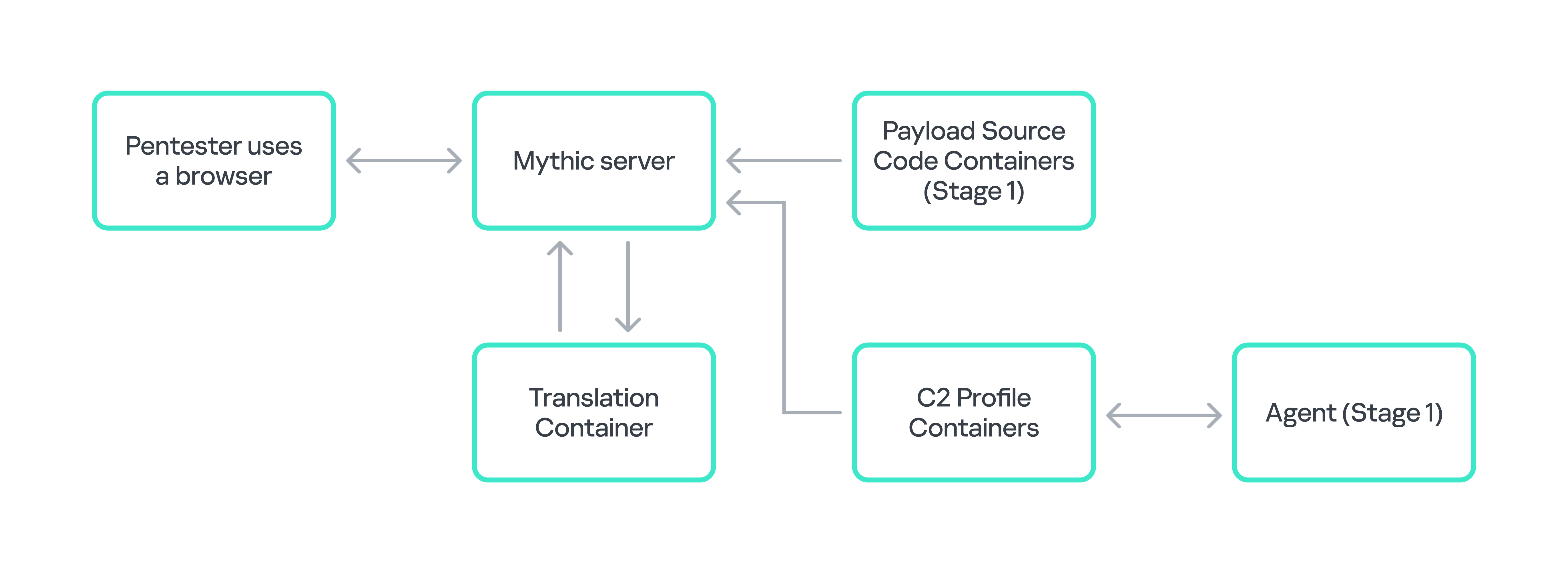
    In the communication process between the agent and the framework, we need to focus on three elements: payload containers, C2 profile containers, and the translation container. Payload containers hold the agent’s source code and are responsible for building the payload. C2 profile containers are responsible for communicating with the agent. They must receive traffic from the agent and send it to Mythic for further processing. The translation container handles the encryption and decryption of network traffic. We’ll be using HTTP when interacting with Mythic, so the C2 profile will be a web server listening on ports 80 and 443.

    Communication flow between the agent and the Mythic framework

    Loading an object file

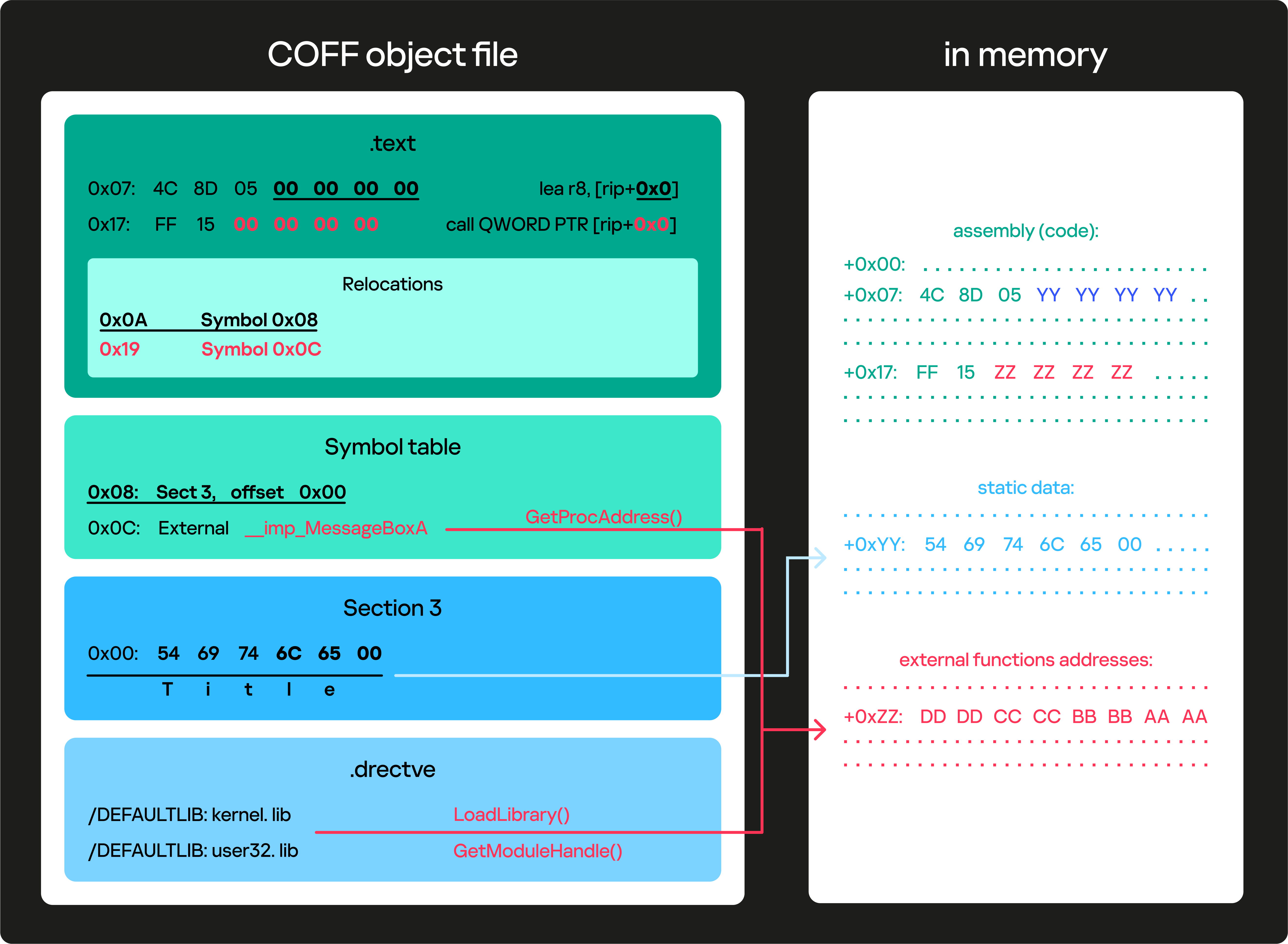
    To load and execute an object file, the agent must read the .text section and replace all zeros with relative addresses of external functions and static data. This is known as symbol relocation, which addresses references within a particular section of the object file. Furthermore, the agent places these symbols in memory, for example, after the code section.

    To find external functions, we’ll have to analyze the libraries specified in the linker directives of the object file. To do this, we used the functions LoadLibrary, GetModuleHandle and GetProcAddress.

    The diagram below clarifies how an object file is loaded and memory is allocated for its components.

    Object file representation on disk (left) and in memory (right)

    The downsides of the solution

    The method described above has a number of shortcomings. Because object file execution is blocking, multiple tasks cannot run simultaneously. For long-term tasks, other methods such as process injection are necessary; however, this is not a critical flaw for the second module, as it is not intended for long-running tasks.

    Several other shortcomings are difficult to mitigate. For example, since the object file is executed in the current thread, a critical error will terminate the process. Furthermore, during the execution of the object file in memory, the VirtualAlloc function is used for section mapping and relocation. A call to this WinAPI might alert the security system.

    Implementing additional functionality during development and compilation can help complicate analysis and detection for more efficient pentesting and a longer agent life cycle.

    Conclusion

    Mythic’s features make it a convenient pentesting tool that covers the bulk of pentesting objectives. To utilize this framework efficiently, we created an agent that extends ready-made solutions with our own code. This configuration gave us suitable flexibility and enhanced protection against detection, which is most of what a pentester asks of a working tool.

    MIL OSI Economics –

    May 13, 2025
  • MIL-OSI United Kingdom: UK Government Overseas Network to Sell Scotland Around the World

    Source: United Kingdom – Government Statements

    News story

    UK Government Overseas Network to Sell Scotland Around the World

    Scottish Secretary drives forward Brand Scotland with new campaign fund.

    The UK Government’s drive to sell Brand Scotland around the world will get a boost with the launch of a new fund for overseas campaigns. 

    The Scottish Secretary, Ian Murray, is offering the UK’s international network grants of up to £20,000 for innovative and creative activities to market Scotland overseas. 

    One of Ian Murray’s priorities at the Scotland Office is Brand Scotland – promoting Scottish goods and services overseas and encouraging inward investment in Scotland. This is a key part of the UK Government’s Plan for Change.

    The US and India free trade agreements signed last week show just how popular Scottish products are overseas. The India deal slashed tariffs for Scotch – great news for our whisky producers who want to expand their overseas markets.

    This new fund will complement an extensive programme of overseas visits planned for Scotland Office ministers over the year, following on from Ian Murray’s recent successful trips to Norway, Malaysia, Singapore, Washington and New York.

    Scottish Secretary Ian Murray said:

    “Brand Scotland is a fantastic opportunity to promote all that is great about Scotland around the world, and show investors the opportunities of Scotland. Through the Foreign, Development and Commonwealth Office, the UK has an extensive overseas network, which works day in day out to promote our country. This exciting new fund will boost the overseas network’s ability to promote Scotland and all it has to offer in many key markets. Brand Scotland is a key part of the UK Government’s Plan for Change, to boost growth and put more money in people’s pockets.”

    Foreign Secretary David Lammy said:

    “The UK-India free trade deal slashing whisky export tariffs is a prime example of how the UK Government is unlocking growth opportunities to deliver for people in every corner of the country, as part of our Plan for Change.

    “The Foreign, Commonwealth & Development Office is looking forward to showcasing Brand Scotland around the world as part of our mission to turbo charge the economy and put more money back in people’s pockets.

    “Kickstarting economic growth is in this government’s DNA so my diplomats will be working tirelessly to shout about everything Scotland has to offer, not least its world-beating food and drink.”

    Brand Scotland leverages Scotland’s unique cultural assets and the UK’s soft power. The UK Government’s overseas network will have the opportunity to bid for funds. Projects will support Scotland-focused trade missions and trade events. We expect bids to be creative and go beyond ‘business as usual’.

    Bids will be assessed on their ability to deliver measurable outcomes and foster long-term relationships with stakeholders in host countries. Bids will be reviewed by officials from the Scotland Office, FCDO, and the Department for Business and Trade – with the Scotland Office giving final sign-off.

    Share this page

    The following links open in a new tab

    • Share on Facebook (opens in new tab)
    • Share on Twitter (opens in new tab)

    Updates to this page

    Published 13 May 2025

    MIL OSI United Kingdom –

    May 13, 2025
  • MIL-OSI Asia-Pac: Results of monthly survey on business situation of small and medium-sized enterprises for April 2025

    Source: Hong Kong Government special administrative region

         The Census and Statistics Department (C&SD) released today (May 13) the results of the Monthly Survey on Business Situation of Small and Medium-sized Enterprises (SMEs) for April 2025.
     
         The current diffusion index (DI) on business receipts amongst SMEs decreased from 43.5 in March 2025 in the contractionary zone to 41.2 in April 2025, whereas the one-month’s ahead (i.e. May 2025) outlook DI on business receipts was 43.6. Analysed by sector, the current DIs on business receipts for majority of the surveyed sectors dropped in April 2025 as compared with previous month, particularly for the import and export trades (from 45.1 to 40.2) and business services (from 48.4 to 45.3).
      
         The current DI on new orders for the import and export trades decreased from 46.6 in March 2025 to 42.0 in April 2025, whereas the outlook DI on new orders in one month’s time (i.e. May 2025) was 43.8.
     
    Commentary
     
         A Government spokesman said that business sentiment among SMEs and their outlook in one month’s time both weakened in April, as the headwinds and uncertainties in the external environment increased sharply after the United States (US) announced significant increases in import tariffs last month. The overall employment situation also softened.
     
         Looking ahead, while trade tensions have eased somewhat of late, the uncertainty of US’ trade policy will still affect the economic outlook and business sentiment. The Government will continue to monitor the situation closely.
     
    Further information
     
         The Monthly Survey on Business Situation of Small and Medium-sized Enterprises aims to provide a quick reference, with minimum time lag, for assessing the short-term business situation faced by SMEs. SMEs covered in this survey refer to establishments with fewer than 50 persons engaged. Respondents were asked to exclude seasonal fluctuations in reporting their views. Based on the views collected from the survey, a set of diffusion indices (including current and outlook diffusion indices) is compiled. A reading above 50 indicates that the business condition is generally favourable, whereas that below 50 indicates otherwise. As for statistics on the business prospects of prominent establishments in Hong Kong, users may refer to the publication entitled “Report on Quarterly Business Tendency Survey” released by the C&SD.
     
         The results of the survey should be interpreted with care. The survey solicits feedback from a panel sample of about 600 SMEs each month and the survey findings are thus subject to sample size constraint. Views collected from the survey refer only to those of respondents on their own establishments rather than those on the respective sectors they are engaged in. Besides, in this type of opinion survey on expected business situation, the views collected in the survey are affected by the events in the community occurring around the time of enumeration, and it is difficult to establish precisely the extent to which respondents’ perception of the business situation accords with the underlying trends. For this survey, main bulk of the data were collected around the last week of the reference month.
     
         More detailed statistics are given in the “Report on Monthly Survey on the Business Situation of Small and Medium-sized Enterprises”. Users can browse and download the publication at the website of the C&SD (www.censtatd.gov.hk/en/EIndexbySubject.html?pcode=B1080015&scode=300).
     
         Users who have enquiries about the survey results may contact Industrial Production Statistics Section of the C&SD (Tel: 3903 7246; email: sme-survey@censtatd.gov.hk).

    MIL OSI Asia Pacific News –

    May 13, 2025
  • MIL-OSI: The OpenSSL Corporation and the OpenSSL Foundation Certify Results of Technical Advisory Committee Elections

    Source: GlobeNewswire (MIL-OSI)

    NEWARK, N.J., May 13, 2025 (GLOBE NEWSWIRE) — The OpenSSL Corporation and the OpenSSL Foundation certify results of the Technical Advisory Committee (TAC) elections. Members have been elected to advise on technical direction, architecture, and security priorities for the OpenSSL Library.

    Newly Elected Members

    The OpenSSL Corporation TAC Members

    • Academics – Nicola Tuveri (Tampere University)
    • Committers – Shane Lontis
    • Distributions – Dmitry Belyavskiy (Red Hat)
    • Individuals – Aditya Koranga
    • Large Businesses – Craig Lorentzen (Amazon)
    • Small Businesses – Paul Yang (ToneFlow)

    The OpenSSL Foundation TAC Members

    • Academics – Nicola Tuveri (Tampere University)
    • Committers – Dmitry Belyavskiy
    • Distributions – vacant
    • Individuals – Igor Ustinov
    • Large Businesses – Barry Fussell (Cisco)
    • Small Businesses – Aditya Koranga (CORAN Labs)

    Looking Ahead

    The newly elected TAC members will begin their one year terms immediately. They will work closely with the Business Advisory Committees (BACs), the Board of Directors of the OpenSSL Corporation and the OpenSSL Foundation, and the community to shape the OpenSSL Project’s future.

    For more details about the TACs members, the voting process, or the role of the Technical Advisory Committees, please visit the OpenSSL Communities website or contact us at communities@openssl.org.

    The MIL Network –

    May 13, 2025
  • MIL-OSI Economics: APEC Backs Global Push for WTO Investment Facilitation for Development Agreement Jeju, Republic of Korea | 13 May 2025 Issued by the Committee on Trade and Investment and the Investment Experts’ Group APEC member economies have expressed collective support for the Investment Facilitation for Development (IFD) Agreement, calling for its integration into the World Trade Organization (WTO) legal framework.

    Source: APEC – Asia Pacific Economic Cooperation

    With cross-border investment facing growing barriers and uncertainty, APEC member economies have expressed collective support for the Investment Facilitation for Development (IFD) Agreement, calling for its integration into the World Trade Organization (WTO) legal framework.

    The agreement aims to improve transparency, streamline procedures and create a more predictable environment for investors, particularly in developing economies.

    Meeting in Jeju during the Second APEC Senior Officials’ Meeting and Related Meetings, the Committee on Trade and Investment and the Investment Experts’ Group issued a joint statement encouraging broader participation in the IFD Agreement and its incorporation into the WTO legal framework.

    “The IFD Agreement has significant potential to improve the investment and business climate across the world, reducing the cost of investment and making it easier for investors in all sectors to operate, expand and contribute to economic growth,” said Christopher Tan, Chair of the APEC Committee on Trade and Investment.

    Tan noted that the IFD Agreement will contribute to the Putrajaya Vision 2040’s goal of delivering a transparent and predictable trade and investment environment in the Asia Pacific Region, and further the region’s interest to attract and sustain investment.

    “Incorporating the IFD Agreement into the WTO framework would be a major step forward for global trade and investment, and a win for the region,” he added.

    The joint statement further reinforces the newly updated Investment Facilitation Action Plan (IFAP) 2025, underscoring APEC economies’ shared recognition of the IFD Agreement as a key driver in advancing the region’s investment goals.

    “The effective implementation of the IFD Agreement has the potential to significantly boost investment flows, foster inclusive economic growth and narrow the development gap between economies,” said Faizal Mohd Yusof, Convenor of the APEC Investment Experts’ Group.

    “It is essential that we sustain momentum toward integrating this Agreement into the WTO framework, ensuring that all economies, regardless of their level of development, can fully benefit,” he concluded.

    Read the Statement of the APEC Committee on Trade and Investment, together with the APEC Investment Experts’ Group Supporting the Investment Facilitation for Development Agreement here.


    For more information or media inquiries, please contact:
    [email protected]

    MIL OSI Economics –

    May 13, 2025
  • MIL-OSI USA: DCCA NEWS RELEASE: DCCA DISCIPLINARY ACTIONS (THROUGH APRIL 2025)

    Source: US State of Hawaii

    DCCA NEWS RELEASE: DCCA DISCIPLINARY ACTIONS (THROUGH APRIL 2025)

    Posted on May 12, 2025 in Latest Department News, Newsroom

    STATE OF HAWAIʻI

    KA MOKU ʻĀINA O HAWAIʻI


    JOSH GREEN, M.D.

    GOVERNOR

    KE KIAʻĀINA


    KA ʻOIHANA PILI KĀLEPA


    NADINE Y. ANDO

    DIRECTOR

    KA LUNA HOʻOKELE


    DENISE P. BALANAY

    SENIOR HEARINGS OFFICER

    DCCA DISCIPLINARY ACTIONS

    (Through April 2025)


    May 12, 2025

    HONOLULU – The state Department of Commerce and Consumer Affairs (DCCA) and its respective state Boards and Commissions released a summary of disciplinary actions through the month of April 2025, taken on individuals and entities with professional and vocational licenses in Hawai‘i. These disciplinary actions include dispositions based upon either the results of contested case hearings or settlement agreements submitted by the parties. Respondents enter into settlement agreements as a compromise to claims and to conserve on the expenses of proceeding with an administrative hearing.

    The DCCA and the Boards and Commissions are responsible for ensuring those with professional and vocational licenses are performing up to the standards prescribed by state law.


    Respondent:      Leah R. Swift

    Case Number:   RNS 2024-29-L

    Sanction:            Voluntary license surrender

    Effective Date:  4-3-25

    RICO alleges that on April 16, 2024, the Board issued Respondent a license subject to conditions, including compliance with a one-year monitoring agreement with Pu‘ulu Lapa‘au, and that Respondent is not in compliance with the one-year monitoring program, in potential violation of HRS § 457-12(a). (Board approved Settlement Agreement.)


    Respondent:     Express Scripts Pharmacy, Inc. dba Express Scripts

    Case Number: PHA 2024-20-L

    Sanction:            $500 fine

    Effective Date: 2-27-25

    RICO alleges that Respondent was disciplined by the state of Michigan, in potential violation of HRS § 436B-19(13). (Board approved Settlement Agreement.)


    Respondents:   Anchor Properties HI, LLC and Nathan V. Wong

    Case Number: REC 2024-373-L

    Sanction:            $1,000 fine

    Effective Date: 4-25-25

    RICO alleges that Respondents, as managing agent for Hanohano Hale, received a request for condominium association records, and that fulfillment of the request took longer than 30 days without proper response as to the reason for the delay, in potential violation of HRS § 514B-154.5(c). (Commission approved Settlement Agreement.)


    Respondent:     Brandon Ray Holmes

    Case Number: REC 2024-408-L

    Sanction:            $1,500 fine

    Effective Date: 4-25-25

    RICO alleges that on August 1, 2024, Respondent was convicted of Driving under the Influence in the District Court of the Second Circuit, in potential violation of HRS § 436B-19(12).(Commission approved Settlement Agreement.)


    Respondent:     Alex G. Ramos dba Triple A Electrical Service

    Case Number: CLB 2022-481-L

    Sanction:            $10,000 fine

    Effective Date: 4-25-25

    RICO alleges that Respondent aided and abetted an unlicensed contractor by pulling permits for the unlicensed contractor on many projects, in potential violation of HRS § 444-9.3.(Commission approved Settlement Agreement.)

    BusinessCheck is an online platform designed to serve as a comprehensive resource for researching licensed professionals. This tool empowers users to verify licenses, review complaint histories and discover when a business was established, all in one place. Please visit businesscheck.hawaii.gov to verify a professional’s license status, confirming their qualifications, compliance with regulations and accountability to a governing body.


    # # #

    Media Contact:

    Communications Office

    Department of Commerce and Consumer Affairs

    Phone: 808-586-2760

    Email: [email protected]

    MIL OSI USA News –

    May 13, 2025
  • MIL-OSI Economics: NOIA Urges Certainty on Offshore Energy Tax Credits

    Source: National Ocean Industries Association – NOIA

    Headline: NOIA Urges Certainty on Offshore Energy Tax Credits

    For Immediate Release: Monday, May 12, 2025NOIA .org
    NOIA Urges Certainty on Offshore Energy Tax Credits
    Washington, D.C. – National Ocean Industries Association President Erik Milito issued the following statement in regards to the House Ways & Means Committee reconciliation package:
    “NOIA continues to support efforts by Congress and the Administration to promote U.S. energy dominance. However, we caution against the premature repeal or phase-out of current tax credits, as such changes risk disrupting vital investments in American manufacturing, infrastructure, ports, shipbuilding, and offshore energy projects nationwide.
    “Through a long-term lens—spanning a decade or more—American companies have made substantial investments in offshore energy based on the stability of the current tax framework. Sudden changes to the tax code could inject significant uncertainty, jeopardizing capital allocation, project planning, and job creation across the energy sector and the broader economy.
    “As budget reconciliation discussions move forward, we urge a collaborative approach that maintains certainty for businesses that have made meaningful U.S. investments under the existing credit structure. These tax credits provide a meaningful boost to the U.S. in the global competition to meet surging AI-driven energy demand, secure critical mineral supply chains, and revitalize domestic shipbuilding—all while supporting affordability and reliability for American consumers.”
    ##
    About NOIAThe National Ocean Industries Association (NOIA) represents and advances a dynamic and growing offshore energy industry, providing solutions that support communities and protect our workers, the public and our environment.

    MIL OSI Economics –

    May 13, 2025
  • MIL-OSI Economics: Buffalo Bills announce Verizon as Official 5G Network and a Founding Partner of new Highmark Stadium

    Source: Verizon

    Headline: Buffalo Bills announce Verizon as Official 5G Network and a Founding Partner of new Highmark Stadium

    Verizon partnership to include:

    • Ownership of the Distributed Antenna System (DAS)
    • Integration of Verizon Business Services and Solutions to drive sustainability, operations and fan experiences
    • Premium programming, sweepstakes and onsite activations; unique access and experiences will be available for Verizon customers
    • Verizon to  donate to Buffalo-based Veterans One Stop

    NEW YORK – The Buffalo Bills today announced Verizon will be the exclusive wireless telecommunications partner of the new Highmark Stadium, set to open in 2026. The agreement also establishes Verizon as a Founding Partner of New Highmark Stadium.

    “Partnering with Verizon as the Official 5G Network and a Founding Partner for the new Highmark Stadium is a major step in enhancing the fan experience at every level,” said Pete Guelli, Buffalo Bills, EVP & Chief Operating Officer, Buffalo Bills. “Verizon’s technical expertise and leadership in 5G will transform how our fans connect with the game and each other, bringing cutting-edge connectivity to our stadium and its surrounding campus. Together, we’re setting a new standard for live sports, creating immersive, seamless experiences that will keep our fans at the forefront of innovation.”

    As the Official 5G Network for the new Highmark Stadium, Verizon will own the neutral host Distributed Antenna System (DAS) in the new stadium and provide state-of-the-art technology and wireless solutions to keep fans connected. The Bills will also integrate Verizon Business Solutions and services in the new stadium to drive sustainability, power operations and streamline fan experiences. While the new stadium is under construction, Verizon Business is providing temporary WiFi access points to the site to power the design, integration/logistics and installation of the facility.

    “Bills fans are some of the most passionate in the league, and we’re excited for the opportunity to bring them the power of Verizon 5G at the new Highmark Stadium to elevate their game-day experience like never before,” said Chris Flood, Atlantic North Market President, Verizon. “From ultrafast connectivity to enhanced in-stadium features, our partnership with the Bills is all about delivering an immersive experience that keeps fans engaged every play of the game. Together, we’re providing the technology that enhances every moment, both on and off the field, to deliver a next-level fan experience.”

    The new stadium will seat 60,000 with an expandable capacity to hold special events, will include state-of-the-art video and scoreboards, sound system, administrative and event staff offices and lockers, broadcast facilities, team store, locker rooms, food service kitchens and concessions, signage, sports lighting, maintenance, and storage areas, plaza, parking, and site landscaping.

    Fans interested in becoming a priority list member, which includes access to visit the Bills Stadium Experience and purchase seats following current Season Ticket Members, can sign up at Billsstadiumexperience.com.

    In addition to always-on connectivity, Bills fans and stadium attendees will benefit from premium programming, sweepstakes and onsite activations. Unique access and experiences will be available for Verizon customers throughout the season/year. Furthermore, Verizon is donating an additional $20,000 to the Veterans One-Stop Center – a Buffalo-based nonprofit that improves the quality of life of local veterans, service members and their families – following the company’s November 2024 donation of $20,000 to the same organization, for a total donation of $40,000 toward the cause.

    The Bills collaborated with global, premium experiences company Legends to secure Verizon as a founding partner for Highmark Stadium. Legends is the Bills consultant on project development, global partnerships, premium sales, ticket sales, retail, and hospitality for New Highmark Stadium.

    Verizon brings a mix of public and private network capabilities, a robust technology ecosystem, and 5G partnerships that enable leagues, teams, and stadium operators to create and deliver a first-class fan experience and achieve desired venue operations outcomes. Learn more about how Verizon is elevating the connected venue approach for sports, entertainment and campus partners through Enterprise Intelligence.


    About Highmark Stadium

    Highmark Stadium, home of the National Football League’s Buffalo Bills, will open in 2026 in Orchard Park, New York, a suburb of Buffalo. In conjunction with Legends and architectural firm Populous, the Bills have left no stone unturned in covering every innovative element of new stadium design and fan amenities, featuring iconic Buffalo architecture and the deep-rooted spirit of Bills Mafia. The open-air, football-first venue will feature premium, reserved seating that delivers an elevated game day experience & atmosphere. A striking canopy structure will provide seating bowl coverage, enhancing fan comfort and protection from the elements. Fans will enjoy 360-degree concourses, frictionless food and beverage marketplaces, and cutting-edge audio/visual features that will set a new sporting stadium standard. With expandable capacity, Highmark Stadium will be the premier destination for major events beyond football. This transformative project is a public-private partnership between the Buffalo Bills, New York State, and Erie County. For the latest updates, download the Bills App or visit buffalobills.com.

    MIL OSI Economics –

    May 13, 2025
  • MIL-OSI Economics: Introducing Samsung Galaxy S25 Edge on Verizon

    Source: Verizon

    Headline: Introducing Samsung Galaxy S25 Edge on Verizon

    [What’s new]

    Introducing the Samsung Galaxy S25 Edge: where unparalleled elegance meets uncompromising power. This groundbreaking device, available at Verizon, offers the advanced capabilities of the Galaxy S25 Ultra in an exceptionally thin and light smartphone.

    Verizon preorders start May 13 in Titanium Silver, Icyblue and Jetblack, with 256GB or 512GB storage starting at $30.55/month for 36 months (0% APR; $1,099.99 retail). Galaxy S25 Edge will be widely available on May 30.

    [Why Verizon is the best place to get a Galaxy S25 Edge]

    • Galaxy S25 Edge, on us, with select trade-in and 3-year price lock: For a limited time, new and current Verizon customers on any myPlan can get a new Galaxy S25 Edge on us when they trade in any Apple, Google or Samsung smartphone, regardless of its condition. Verizon continues to provide value for its customers with an industry-leading guarantee — a 3-year price lock on all myPlan and myHome network plans and free satellite texting. Price guarantee applies to base monthly rate only.
    • Perks built for you: myPlan and myHome customers can save over 40% on five of the most popular subscription services, Netflix & Max and Disney+, Hulu and ESPN+. All 5 for just $20/mo. Choose what you want, when you want it.

    [How to get your Galaxy S25 Edge]

    • Visit verizon.com, the My Verizon app or a Verizon store to preorder your Galaxy S25 Edge starting May 13.
    • Verizon Business customers can get up to $1,000 off the Galaxy S25 Edge at verizonbusiness.com.
    • Visible customers can purchase the new Galaxy S25 Edge at visible.com starting May 30.
    • Galaxy S25 Edge will be widely available on May 30.

    Smartphone offer: $1,099.99 (256 GB only) purchase w/new or upgrade smartphone line on Unlimited Ultimate, postpaid Unlimited Plus or Unlimited Welcome plan (min. $65/mo w/Auto Pay (+taxes/fees) for 36 mos) req’d. Less $1,100 trade-in/promo credit applied over 36 mos.; promo credit ends if eligibility req’s are no longer met; 0% APR. For upgrades, trade-in phone must be active on account for 60 days prior to new device purchase. Trade-in must be from Samsung, Apple or Google; trade-in terms apply.

    3-yr price guarantee: myPlan: Applies to the then-current base monthly rate for your talk, text, and data. Excludes taxes, fees, surcharges, additional plan discounts or promotions, and third-party services. Void if any of the lines are canceled or moved to an ineligible plan. Plan perks, taxes, fees, and surcharges are subject to change. myHome: Price guarantee for 3-5 years, depending on internet plan, for new and existing myHome customers. Applies only to the then-current base monthly rate exclusive of any other setup and additional equipment charges, discounts or promotions, plan perk and any other third-party services.

    Business offer: New line or device upgrade w/device payment agmt & My Biz Plan w/$20 monthly add-on spending or Business Unlimited Pro plan req’d. Up to $1,000 credit, varying by smartphone trade-in, applied to acct over the term of your agmt (up to 36 mos, 0% APR); promo credit ends when eligibility requirements are no longer met. Select biz customers w/6 or more mos of VZ service: credits begin in 1-2 bills. Other biz customers: credits begin 2-3 bills after trade-in is received by VZ. Smartphone trade-in must be received by VZ w/in 90 days & meet program requirements. Credit(s) will be charged back to acct if trade-in is not received within 90 days, differs from appraisal and/or does not meet program requirements. Most trade-in device conditions accepted; exclusions apply. 10-line trade-in limit per order. Cannot be combined with other device offers. Offer ends 6.30.2025.

    MIL OSI Economics –

    May 13, 2025
  • MIL-OSI Economics: Thales celebrates 50 years in Greece

    Source: Thales Group

    Headline: Thales celebrates 50 years in Greece

    13 May 2025

    Share this article

    On the occasion of DEFEA, Greece’s premier defence exhibition, Thales, a global leader in advanced technologies for the Defence, Aerospace and Cyber & Digital sectors, celebrates its 50th anniversary of operations in Greece. This milestone underscores Thales’ enduring commitment to fostering technological advancement and contributing to the nation’s economic growth and security.

    Pascale Sourisse and Laurence Auer, French Ambassador in Greece, on the occasion of DEFEA and Thales’s 50th anniversary in Greece. ” id=”image-4840937d-79e6-483b-af1e-44c108955785″ data-id=”4840937d-79e6-483b-af1e-44c108955785″ data-original=”https://cdn.uc.assets.prezly.com/4840937d-79e6-483b-af1e-44c108955785/-/inline/no/RGB-140.jpg” data-mfp-src=”https://cdn.uc.assets.prezly.com/4840937d-79e6-483b-af1e-44c108955785/-/resize/1200x/-/format/auto/” alt=”Pascale Sourisse and Laurence Auer, French Ambassador in Greece, on the occasion of DEFEA and Thales’s 50th anniversary in Greece. “/>
    Pascale Sourisse and Laurence Auer, French Ambassador in Greece, on the occasion of DEFEA and Thales’s 50th anniversary in Greece.

    Since establishing its presence in Greece 50 years ago, Thales has been at the forefront of delivering innovative solutions tailored to the needs of the Greek market. From cutting-edge avionics and state-of-the-art defence systems to secure communications and air traffic management systems, Thales has been instrumental in supporting Greece’s infrastructure and capabilities.

    Thales is a long-time supplier of major systems to the Hellenic Armed Forces, and today services a significant installed base in the country. This includes avionics and mission systems for the Dassault Aviation Rafale and Mirage 2000/2000-5 combat aircraft, as well as large-scale air defence systems. Thales combat systems are deployed by the Hellenic Navy on board surface vessels, including the FDI Hellenic Ship (HS) naval program. Furthermore, Thales tactical radios, electronic warfare, optronic systems and surveillance radars are in service with the Army.

    In civil markets, Thales has supplied much of the country’s air traffic management systems. Thales Hellas has also developed a local cybersecurity capability thanks to European support programs and the Thales Group’s experience in the cyber domain. Locally, Thales Hellas operates a Cyber Lab, serving Greek authorities as well as local universities and competence centres.

    Core to Thales’s growth story in Greece is collaboration with local industry. Thales is developing partnerships with Greek defence and technology companies to leverage local expertise and enhance the capabilities of the Greek defence and aerospace eco-system. In April, Thales Hellas held its first Innovation & Partnership event welcoming more than 120 participants from 75 Greek companies. Additionally, Thales is contributing to the development of Greek industry through a network of local SMEs and participates in European Programs in cooperation with Greek Universities and Research Centres.

    “This 50 year anniversary milestone comes at a pivotal moment for the future of Europe and its strategic autonomy. Thales fully supports Greece’s vision to develop sovereign capabilities and increase its defence industry involvement, playing a strong role within European and NATO nations. We stand ready to further deepen our ties with Greek industry in developing our local capability in Greece – growing our defence services, air traffic management and cyber footprint. Through our continued investments in local teams, strong collaborations, and innovation in the country, we will continue to play our part developing a robust Greek industry.” , said Pascale Sourisse, President & CEO, Thales International.

    “Our journey has been defined by a steadfast dedication to helping Greece protect its critical infrastructure through advanced technology and continuous collaboration. We look forward to further strengthening our ties and continuing our legacy of innovation and excellence for many more years to come.”‘, declared Vincent Megaides, Country Director Thales Greece, Cyprus and Malta.

    About Thales

    Thales (Euronext Paris: HO) is a global leader in advanced technologies for the Defence, Aerospace, and Cyber & Digital sectors. Its portfolio of innovative products and services addresses several major challenges: sovereignty, security, sustainability and inclusion.

    The Group invests more than €4 billion per year in Research & Development in key areas, particularly for critical environments, such as Artificial Intelligence, cybersecurity, quantum and cloud technologies.

    Thales has more than 83,000 employees in 68 countries. In 2024, the Group generated sales of €20.6 billion.

    About Thales in Greece

    Thales has been active in Greece for 50 years, expanding its historical presence in Defence, to serve Air Traffic Control, Transport and Space markets.

    Thales is long-standing partner to the Hellenic Armed Forces, providing avionics and mission systems for the Mirage 2000 and Rafale aicraft, as well as large-scale air defence systems for the Air Force and the Navy. Thales tactical radios, optronic systems and surveillance radars are also in service with the Army.

    Thales has also implemented the ACCS system in Larissa for NATO with its local engineers. Thales has supplied much of the country’s air traffic control systems as transport solutions. In the Space domain, Thales also supplies the Hellasat 3 communications satellite, which entered into service in 2017.

    Thales is also a leader in civil identity and biometric solutions.

    Coopération locale

    Thales soutient un écosystème de partenaires industriels locaux dans des projets de développement en Grèce. Le Groupe est aussi membre actif de plusieurs organisations industrielles, dont SEV (Fédération hellénique d’entreprises), HASDIG (Hellenic Aerospace & Defence Industries Group) et EVIDITE (Association spatiale grecque).

    Thales Hellas est un fournisseur accrédité de systèmes de défense auprès du ministère grec de la Défense et a signé un protocole d’accord avec HAFA (Hellenic Airforce Academy).

    MIL OSI Economics –

    May 13, 2025
  • MIL-Evening Report: Sussan Ley makes history, but faces unprecedented levels of difficulty

    Source: The Conversation (Au and NZ) – By Mark Kenny, Professor, Australian Studies Institute, Australian National University

    As if by visual metaphor, Sussan Ley’s task seemed both obvious and impossible in her first press conference as the new Liberal leader.

    Three years ago this month, Ley had done something uncannily similar to what Ted O’Brien was doing now. Then, it had been her standing next to Peter Dutton as his dutiful deputy. The freshly installed pair talked a big game about the contest ahead, assured of the urgency of their mission and the potency of their message.

    Ley had enthusiastically supported Dutton’s leadership. But now in 2025, it was Ley fronting the press, this time as the new leader following the catastrophic rejection of that Dutton-Ley project, the Liberal Party’s worst ever defeat.

    It was the inexperienced O’Brien at her side, newly elected as her bright-eyed second in command.

    Policy rethink?

    Sharpening the metaphor, it had been O’Brien who had acted as chief design architect and salesperson for one of the Coalition’s most expensive yet unloved policies in the May 2025 election – nuclear power stations, government built and operated.

    Back in 2022, Dutton’s task had seemed difficult, but success was far from unimaginable as he faced a new Labor government elected with a record-low primary vote and a tiny two-seat majority.

    Ley’s degree of difficulty three years hence is some orders of magnitude greater, not least because of O’Brien’s nuclear energy policy – which will be high on the list of policies to be reviewed, and presumably ditched, if a Liberal recovery is to occur.

    Stripping away unhelpful policy that is nonetheless beloved in sections of the party’s conservative and right wing base, is a threshold challenge for Ley – one of a panoply of traps and trying circumstances she confronts.

    Ley’s challenges

    First, there’s the simple maths given the Coalition now trails the Labor Party by a staggering 50-plus seats.

    Few observers think the Coalition can seriously compete for government at the 2028 election. Thus, Ley needs to keep hope alive among Liberal mps and senators, even when the prize of power seems two terms away.

    Then there’s her task of leading the Liberal Party back to the political centre-ground or as she puts it, meeting Australian voters “where they are”. This seems like politics 101. Yet she faces many internal sceptics.

    Leadership tightrope

    At 29 votes to 25, Ley’s victory against a more right-wing candidate, Angus Taylor was narrow and reportedly relied on the votes of senators whose terms end on June 30.

    In other words, even her current majority could evaporate.

    It is worth remembering that by December 2009, just two years after the Howard government ended, the Liberal Party was already on to its third opposition leader.

    Doing it her way

    So what effect will she have on the Liberal Party? In her first press conference she gave several clues.

    In contradistinction to Dutton, who avoided Parliament House press conferences and searching interviews, Ley gave a crisp three word answer when asked if she would front up to these rituals of public accountability – “yes, I will”.

    She promised to make tax reform and economic policy the “core business” of the party she leads.

    There was also a marked, if measured, departure from the bombastic declarative culture war politics of Dutton on matters like standing in front of the Aboriginal flag and welcome to country ceremonies at public events. On both, she expressed a more pragmatic acceptance:

    If it’s meaningful, if it matters, if it resonates, then it’s in the right place and as environment minister and health minister I listened carefully and participated in Welcome to Country ceremonies. If it’s done in a way that is ticking a box on a Teams meeting then I don’t think it is relevant.

    On other matters, she noted pointedly that RG Menzies had founded the party as the “Liberal” party not the conservative party, while acknowledging a breadth of alternative opinions among her parliamentary colleagues:

    Our Liberal Party reflects a range of views from all walks of life that are welcome in our party room and that is one of our great strengths.

    Ley the history-maker

    That Ley is the first ever woman to lead the federal Liberal Party will pose potential challenges.

    To pretend that gender stereotyping will play no role in any undermining by internal critics and media would be to ignore history.

    Asked about the exodus of female voters from the Coalition at the election, Ley said, “We did let women down, there is no doubt about that,” as she expressed the need for “genuine, serious” engagement:

    I want to say right here and now we need more women in our party. We need more women in the organisation, and we need more women in this party room.

    However, she pointedly stopped short of backing affirmative action quotas in the Liberal Party even as she called for more women in the parliament.

    Gaza about-face

    Perhaps the most telling “real-time” demonstration of the uneasy balance she hopes to achieve as leader of a party that has shifted markedly to the right, was when she as was asked about the Israel-Gaza question.

    As a former member of a cross party group called Parliamentary Friends of Palestine, Ley had implored parliament in 2008 to “think not of the Palestinian leadership, think of the people”.

    She had described Gaza as “besieged, contained, and on the brink of starvation” while warning that a “crushing economic embargo feeds fury and resentment” both in Gaza and the West Bank:

    Israel has many friends in this country and in this parliament. The Palestinians, by comparison, have few. Theirs is not a popular cause […] but it is one I support.

    Asked about her view now, Ley felt the need to circle back to stress her principle concern over the rising tide of antisemitism in Australia. She now says the “hideous events” of October 7 has changed her thinking on the matter.

    Gaza has given Sussan Ley an early lesson on the difficulties leaders face when it comes to straddling highly contentious issues.

    Mark Kenny does not work for, consult, own shares in or receive funding from any company or organisation that would benefit from this article, and has disclosed no relevant affiliations beyond their academic appointment.

    – ref. Sussan Ley makes history, but faces unprecedented levels of difficulty – https://theconversation.com/sussan-ley-makes-history-but-faces-unprecedented-levels-of-difficulty-256336

    MIL OSI Analysis – EveningReport.nz –

    May 13, 2025
  • MIL-OSI China: Announcement on Open Market Operations No.89 [2025]

    Source: Peoples Bank of China

    Announcement on Open Market Operations No.89 [2025]

    (Open Market Operations Office, May 13, 2025)

    The People’s Bank of China conducted reverse repo operations in the amount of RMB180 billion through quantity bidding at a fixed interest rate on May 13, 2025.

    Details of the Reverse Repo Operations

    Maturity

    Rate

    Bidding Volume

    Winning Bid Volume

    7 days

    1.40%

    RMB180 billion

    RMB180 billion

    Date of last update Nov. 29 2018

    2025年05月13日

    MIL OSI China News –

    May 13, 2025
  • MIL-OSI China: Meituan to launch Keeta in Brazil, pledges $1B investment

    Source: People’s Republic of China – State Council News

    Photo taken on Sept. 1, 2022 shows an unmanned delivery vehicle at the booth of Meituan at the 2022 China International Fair for Trade in Services (CIFTIS) in Beijing, capital of China. [Photo/Xinhua]

    Chinese on-demand service leader Meituan said on Monday it will invest $1 billion in Brazil over the next five years and launch its food delivery brand Keeta there in the coming months, marking its latest push in going global.

    Meituan’s announcement came during a China-Brazil business seminar held in Beijing on Sunday, co-hosted by ApexBrasil and several other trade authorities.

    “Brazil is a huge market with great potential,” said Wang Xing, founder and CEO of Meituan. “Keeta aims to enhance the consumer experience, support the growth of local restaurants, and create more employment opportunities.”

    According to the agreement, Keeta will build a nationwide on-demand delivery network in Brazil and provide local partners with a suite of digital and marketing tools to grow their businesses. The company said it intends to leverage its experience in digital services to strengthen Brazil’s service trade infrastructure.

    “Going global is one of Meituan’s long-term strategies,” Wang said. “We are excited to bring our food delivery experience and advanced technology to new markets like Brazil, just as we’ve done in the Asia-Pacific and the Middle East. We look forward to offering more choices to Brazilian consumers and contributing to the country’s economic development.”

    Keeta is currently operating in China’s Hong Kong, where it has helped partner restaurants double their sales since launching two years ago. The brand also debuted in Saudi Arabia in September 2024, where it now covers all major cities, with user numbers and order volumes rising steadily.

    MIL OSI China News –

    May 13, 2025
  • MIL-OSI China: Chinese firms still look for US growth

    Source: People’s Republic of China – State Council News

    A pedestrian crosses an intersection around the World Trade Center, New York City, the United States, on Jan 3, 2025. [Photo/Xinhua]

    Chinese companies in the United States plan to expand business operations despite geopolitical and profitability challenges, according to a survey released by the China General Chamber of Commerce – USA on Monday.

    The Annual Business Survey Report on Chinese Enterprises in the US tracks key performance trends and sentiment among Chinese companies with US operations, based on data collected from nearly 100 Chinese firms in March to early April.

    While some firms grow in size and revenue (37 percent now generate more than $100 million annually, up by 2 percentage points from 2023), the data reveals that profitability lags.

    In general, the survey shows a slight margin recovery in 2024, with 43 percent of respondents reported earnings before interest and taxes (EBIT) margins between 0 and 15 percent — up from 38 percent the previous year.

    The share of companies experiencing severe declines also dropped sharply, with only 10 percent seeing margins fall by more than five points, compared with 27 percent in 2023.

    “The reduction in severe declines reflects better cost/revenue management,” noted the report.

    Still, while extreme losses have declined, most enterprises are operating with thin margins and limited capacity for reinvestment.

    While 23 percent of firms reported operating margin improvements between 0 and 5 percentage points, up from 15 percent in 2023, only 7 percent achieved high margins of 15 percent or more, a significant drop from 11 percent in 2023.

    Meanwhile, nearly 1 in 4 companies reported losses, with 17 percent reporting losses up to 15 percent.

    A further 17 percent of companies reported breaking even, while 10 percent did not disclose or were unsure about their margins.

    “High-margin performers became scarcer, while loss-makers persisted,” the report said, underscoring the pressure on business fundamentals.

    The survey found that 60 percent of respondents plan to maintain their current level of investment in the US through 2025, suggesting a preference for stability in light of ongoing economic and policy uncertainties.

    While 1 in 5 companies plan to increase investment, the same number plan reductions, indicating a split in business confidence.

    Concerns about a deteriorating geopolitical environment reinforce a cautious outlook. A striking 90 percent of companies identified US-China political and cultural tensions as the most pressing challenge for operations in 2025 and 2026.

    “Inflation and the unstable US economy,” and “frictions in US-China economic and trade relations” were cited by 80 percent and 73 percent of companies, respectively.

    Additionally, 60 percent flagged “uncertainty in US foreign investment policies” and “unstable US policies toward foreign investments” as top challenges, reflecting increased difficulty and risk in investment decisions.

    Asked about their key business objectives for US investment in 2025 and 2026, 83 percent of companies surveyed said they aimed to improve profitability, and 70 percent reported that they planned to recover and grow their existing business, showing a strong intention to strengthen and expand current operations.

    As of July 2024, CGCC’s Chinese member companies have invested at least $140 billion, employed more than 230,000 people, and indirectly supported over a million jobs in the US, the CGCC reported.

    The CGCC warned that recent tariff changes, which occurred after the survey concluded, may have deepened business pessimism even further. On Monday, China and the US announced a series of tariff reductions to de-escalate trade tensions.

    The US agreed to remove 91 percentage points in the additional tariffs it had imposed on China, while China reciprocated by removing 91 percentage points in its additional tariffs on the US.

    The US will pause 24 percentage points of additional ad valorem duties — tariffs levied in proportion to the value of goods — on Chinese imports for 90 days, and China will do the same for 24 percentage points of its modified additional ad valorem rates of duty for imports from the US.

    Still, a 90-day suspension, while welcome, creates significant uncertainty for both Chinese and US companies’ business planning and costs, analysts said.

    The USCBC’s 2024 Member Survey, released in September, noted that US companies’ financial performance in China remained healthy in 2023, with 80 percent being profitable, and a larger share (42 percent) of companies seeing revenues grow by 20 percent or less compared with the 2023 survey results (28 percent).

    Looking ahead, 72 percent of respondents expected that the profit margins of their China operations will be equal to or greater than their global average in 2024, matching companies’ expections in 2023, according to the USCBC survey.

    At an embassy event last week, China’s top envoy in the US Xie Feng said that in 2022 alone, the revenue of the US-owned enterprises in China significantly exceeded those of Chinese-owned enterprises in the US by more than $400 billion.

    MIL OSI China News –

    May 13, 2025
  • MIL-OSI China: China and LatAm join hands to draw blueprint for next decade of cooperation

    Source: People’s Republic of China – State Council News

    Amid the accelerating changes in the global landscape, the 4th ministerial meeting of the China-Community of Latin American and Caribbean States (CELAC) Forum opened Tuesday in Beijing.

    The return to Beijing 10 years after the forum’s debut ministerial meeting marks a significant milestone. It is expected to further advance the vision of a China-Latin America community with a shared future and enhance cooperation among the developing countries of the Global South.

    United by a commitment to multilateralism and self-improvement as Global South nations, China and Latin America have achieved plenty over the past decade. Against this backdrop, the forum has grown into a vital platform that enhances mutual political trust, aligns development strategies, and strengthens people-to-people bonds.

    Over the past years, close high-level contacts and strategic communication have guided China-LAC relations through a shifting international landscape, paving the way for a new stage of equality, mutual benefit, innovation, and openness, with tangible benefits for both peoples.

    Deepened political trust was evident when Panama, El Salvador, the Dominican Republic, Nicaragua, and Honduras established or restored diplomatic ties with China, and when Venezuela, Uruguay, Colombia, and Nicaragua upgraded or established a strategic partnership with China.

    Notably, relations between Brazil and China have been elevated to foster a community with a shared future for a more just world and a sustainable planet. The China-proposed Belt and Road Initiative (BRI) is contributing to development in more than 20 economies in the LAC region, highlighted by multiple landmark cooperation projects currently underway.

    China is now Latin America’s second-largest trading partner, and the region has become the second-largest destination for overseas Chinese investment, with 600.8 billion U.S. dollars in stock by the end of 2023. Currently, China has five free trade partners in the region. The country has been the largest market for Chilean cherries for years, and Chinese companies account for 37 percent of automobiles sold in Ecuador.

    The China-LAC cooperation is also expanding into new sectors, such as renewable energy, digital technology, and transnational e-commerce, with dynamics driven by successful bilateral forums on science and technology innovation, digital technology cooperation, and space cooperation, all under the framework of the China-CELAC Forum. China’s cloud computing, big data and AI technologies have widely empowered local industries to facilitate digital transformation.

    High-level BRI construction is also helping advance the region’s industrial upgrade, such as fully equipping Trinidad and Tobago’s Phoenix Park Industrial Estate with a state-of-the-art 5G network.

    The deepening of China-LAC relations has boosted employment, including the creation of higher-income jobs through BRI projects. Among recent examples is the April reopening of the Mexico City Metro’s key Line 1, a project assisted by Chinese expertise aimed at improving residents’ transit experience.

    Meanwhile, a wide range of programs have strengthened cultural exchanges and the people-to-people bonds. These include Chinese government scholarships and vocational training programs for CELAC member countries, the China-LAC Youth Development Forum, the China-LAC Cultural Exchange Year, and China’s foreign aid projects aimed at improving livelihoods.

    Standing at a new historical starting point, China-LAC relations and cooperation are expected to build on the previous accomplishments and enter a new era replete with opportunities and broader prospects.

    The China-CELAC Forum meeting in Beijing is sending a strong message of unity from the Global South, particularly in response to the increasing uncertainty and unpredictability stemming from rising unilateralism, protectionism, and bullying actions.

    Undoubtedly, enhancing China-LAC relations and collaboration will contribute to stability and foster positive momentum in a tumultuous world. 

    MIL OSI China News –

    May 13, 2025
  • MIL-OSI Asia-Pac: SCED to attend APEC trade ministers meeting in Korea

    Source: Hong Kong Government special administrative region

    SCED to attend APEC trade ministers meeting in Korea 
    Under the theme “Building a Sustainable Tomorrow” for APEC this year, the meeting will focus discussions on topics under three priorities: “Connect, Innovate, Prosper”. 
    Mr Yau will also meet with other trade ministers to exchange views on issues of mutual interest on the sidelines of the MRT Meeting.
     
    Mr Yau will return to Hong Kong on the morning of May 17. During his absence, the Under Secretary for Commerce and Economic Development, Dr Bernard Chan, will be the Acting Secretary for Commerce and Economic Development.
    Issued at HKT 9:00

    NNNN

    CategoriesMIL-OSI

    MIL OSI Asia Pacific News –

    May 13, 2025
  • MIL-OSI: JD.com Announces First Quarter 2025 Results

    Source: GlobeNewswire (MIL-OSI)

    BEIJING, May 13, 2025 (GLOBE NEWSWIRE) — JD.com, Inc. (NASDAQ: JD and HKEX: 9618 (HKD counter) and 89618 (RMB counter), the “Company” or “JD.com”), a leading supply chain-based technology and service provider, today announced its unaudited financial results for the three months ended March 31, 2025.

    First Quarter 2025 Highlights

    • Net revenues were RMB301.1 billion (US$141.5 billion) for the first quarter of 2025, an increase of 15.8% from the first quarter of 2024.
    • Income from operations was RMB10.5 billion (US$1.5 billion) for the first quarter of 2025, compared to RMB7.7 billion for the first quarter of 2024. Operating margin was 3.5% for the first quarter of 2025, compared to 3.0% for the first quarter of 2024. Non-GAAP2income from operations was RMB11.7 billion (US$1.6 billion) for the first quarter of 2025, compared to RMB8.9 billion for the first quarter of 2024. Non-GAAP operating margin was 3.9% for the first quarter of 2025, compared to 3.4% for the first quarter of 2024. Operating margin of JD Retail before unallocated items was 4.9% for the first quarter of 2025, compared to 4.1% for the first quarter of 2024.
    • Net income attributable to the Company’s ordinary shareholders was RMB10.9 billion (US$1.5 billion) for the first quarter of 2025, compared to RMB7.1 billion for the first quarter of 2024. Net margin attributable to the Company’s ordinary shareholders was 3.6% for the first quarter of 2025, compared to 2.7% for the first quarter of 2024. Non-GAAP net income attributable to the Company’s ordinary shareholders was RMB12.8 billion (US$1.8 billion) for the first quarter of 2025, compared to RMB8.9 billion for the first quarter of 2024. Non-GAAP net margin attributable to the Company’s ordinary shareholders was 4.2% for the first quarter of 2025, compared to 3.4% for the first quarter of 2024.
    • Diluted net income per ADS was RMB7.19 (US$0.99) for the first quarter of 2025, compared to RMB4.53 for the first quarter of 2024. Non-GAAP diluted net income per ADS was RMB8.41 (US$1.16) for the first quarter of 2025, compared to RMB5.65 for the first quarter of 2024.

    “We saw a strong start to the year, with solid results on both the top and bottom lines in Q1,” said Sandy Xu, Chief Executive Officer of JD.com. “Our performance was supported by improving consumer sentiment and continued enhancements to JD’s supply chain capabilities and user experience. User growth was particularly strong during the quarter, reflecting the increasing trust and mindshare JD has earned from consumers and further strengthening our ecosystem. We are also seeing encouraging signs from new initiatives, and we believe these emerging opportunities will further position us for long-term, high-quality growth.”

    “In the first quarter, both our product and service revenues achieved double-digit growth year-on-year, further accelerating on a sequential basis, while bottom line also continued to expand steadily,” said Ian Su Shan, Chief Financial Officer of JD.com. “In particular, we maintained and further enhanced robust momentum of our core JD Retail business, while exploring exciting new opportunities for our long-term success. We also remained very committed to shareholder returns. We completed our annual dividend payout in April, and further executed upon our share repurchase program during the first quarter.”

    Updates of Share Repurchase Program

    Pursuant to the Company’s share repurchase program of up to US$5.0 billion adopted in August 2024 and effective through August 2027, the Company repurchased a total of approximately 80.7 million Class A ordinary shares (equivalent to 40.4 million ADSs) for a total of approximately US$1.5 billion from January 1, 2025 to the date of this announcement. The remaining amount under the share repurchase program was US$3.5 billion as of the date of this announcement.

    The total number of shares repurchased by the Company from January 1, 2025 to the date of this announcement amounted to approximately 2.8% of its ordinary shares outstanding as of December 31, 20243. All of these ordinary shares were repurchased from both Nasdaq and the Hong Kong Stock Exchange pursuant to the share repurchase program.

    Business Highlights

    • JD Retail:In the first quarter, JD.com deepened its strategic partnerships with leading digital product manufacturers such as Xiaomi. The collaborations focus on product innovation, marketing initiatives, and other key areas, aiming to capture the emerging market opportunities driven by consumption support policies and the rise of AI large language models. Together with its partners, JD.com is committed to providing its users with more intelligent and diverse product offerings, along with enhanced purchasing and service experience.

      In the first quarter, JD.com debuted a range of new products online from renowned fashion brands, such as La Prairie, Crocs, and Massimo Dutti. Leveraging its platform advantages and integrated supply chain capabilities, JD.com is dedicated to offering an enriched selection of fashionable products and superior shopping experience for a wide range of consumers.

      In April, JD.com announced the launch of an export-to-domestic sales program. JD.com aims to procure no less than RMB200 billion worth of export-oriented goods for domestic sales. Through this initiative, JD.com will work with Chinese manufactures to strengthen their presence in the domestic market and provide consumers with more better and cheaper products.

    • New Business:In February 2025, JD.com officially launched its food delivery business. Starting from core retail, JD is expanding into on-demand retail and food delivery, meeting users’ demands in various scenarios. Rooted in the Company’s ecosystem, JD Food Delivery is not a stand-alone business. It operates in a market with big opportunities and demands, such as users’ demand for quality meals, merchants’ need for reasonable commissions, and riders’ desire for better protections. JD has the right strength, culture and advantage to address such opportunities and demands, particularly with its “better and cheaper” user mindshare, the “thirty-five cents” principle that insists on only reasonable profit margins, and its strong logistics operation and management capabilities. JD Food Delivery is set to generate synergetic effects with the Company’s existing businesses, including enriching location-based product supplies, upgrading last mile fulfillment network, and contributing to user growth and engagement. JD Food Delivery has achieved substantial progress in a very brief time, a proof of the great potentials of the food delivery industry and JD’s precise grasp of the industry demands and strong execution capabilities.
    • JD Health:In the first quarter, JD Health further strengthened its position as the first online marketplace for new and specialty medicine launches. It debuted several innovative medicines online during the quarter from pharmaceutical companies including Pfizer, Esteve, Innogen, and others, broadening treatment options for patients. In addition, JD Health also deepened its collaborations with leading healthcare product companies, including By-Health, Yan Palace, and LifeStyles, driving synergies in product innovation, digitalization of supply chain, and precision marketing.

      In the first quarter, JD Health made significant progress in medical AI, continuously promoting the application of AI in healthcare services, specialized diagnosis and treatment, and health management. JD Health Online Hospital has seen over 80% of its medical consultation orders aided with AI services. Its AI nutritionist has also achieved a user satisfaction rate of 91%.

    • JD Logistics:In the first quarter, JD Logistics (“JDL”) continued to expand its global footprint. In January, JDL officially launched an international air cargo route between Shenzhen, China, and Bangkok, Thailand, enabling more efficient cross-border flow of goods. In March, JDL’s second warehouse in Warsaw, Poland commenced operations, offering integrated supply chain and logistics services to support both Chinese enterprises and local European businesses with streamlined and efficient logistics solutions.

      On March 24, 2025, JDL officially launched its operations center in Hong Kong, marking a significant step-up in expanding the coverage of its express delivery network and boosting service efficiency in the region. Since upgrading its services in Hong Kong in October 2023, JDL has been persistently deepening its footprint in the market. It has been providing premium express delivery services to consumers, and at the same time, cultivating a mutually beneficial ecosystem in collaboration with local businesses.

    Environment, Social and Governance

    • Starting from March 1, 2025, JD.com has begun to contribute the social insurances and the housing fund for its full-time food delivery riders, including both portions that are to be contributed by employers and individuals. In addition, JD.com will also provide accident and health insurances for its part-time food delivery riders. JD.com has become the first platform in China to provide such extensive social benefit coverage for full-time food delivery riders.
    • As a testament to JD.com’s unwavering commitment to creating more jobs and making contribution to the society, the total personnel under the JD Ecosystem4 was approximately 700,000 as of March 31, 2025, including the Company’s employees, part-time staff and interns, as well as the personnel of the Company’s affiliates in the JD Ecosystem. The total expenditure for such human resources, together with the expenditure for external personnel who work for the JD Ecosystem, amounted to RMB128.8 billion for the twelve months ended March 31, 2025.

    First Quarter 2025 Financial Results

    Net Revenues. Net revenues increased to RMB301.1 billion (US$41.5 billion) by 15.8% for the first quarter of 2025 from RMB260.0 billion for the first quarter of 2024. Net product revenues increased by 16.2%, while net service revenues increased by 14.0% for the first quarter of 2025, compared to the first quarter of 2024.

    Cost of Revenues. Cost of revenues increased to RMB253.2 billion (US$34.9 billion) by 15.0% for the first quarter of 2025 from RMB220.3 billion for the first quarter of 2024.

    Fulfillment Expenses. Fulfillment expenses, which primarily include procurement, warehousing, delivery, customer service and payment processing expenses, increased to RMB19.7 billion (US$2.7 billion) by 17.4% for the first quarter of 2025 from RMB16.8 billion for the first quarter of 2024. Fulfillment expenses as a percentage of net revenues was 6.6% for the first quarter of 2025, compared to 6.5% for the first quarter of 2024.

    Marketing Expenses. Marketing expenses increased to RMB10.5 billion (US$1.5 billion) by 13.9% for the first quarter of 2025 from RMB9.3 billion for the first quarter of 2024. Marketing expenses as a percentage of net revenues was 3.5% for the first quarter of 2025, compared to 3.6% for the first quarter of 2024.

    Research and Development Expenses. Research and development expenses increased to RMB4.6 billion (US$0.6 billion) by 14.6% for the first quarter of 2025 from RMB4.0 billion for the first quarter of 2024. Research and development expenses as a percentage of net revenues was 1.5% for the first quarter of 2025, compared to 1.6% for the first quarter of 2024.

    General and Administrative Expenses. General and administrative expenses increased to RMB2.4 billion (US$0.3 billion) by 22.2% for the first quarter of 2025 from RMB2.0 billion for the first quarter of 2024. General and administrative expenses as a percentage of net revenues remained stable at 0.8% for the first quarter of 2025 and 2024.

    Income from Operations and Non-GAAP Income from Operations. Income from operations increased to RMB10.5 billion (US$1.5 billion) by 36.8% for the first quarter of 2025 from RMB7.7 billion for the first quarter of 2024. Operating margin was 3.5% for the first quarter of 2025, compared to 3.0% for the first quarter of 2024. Non-GAAP income from operations increased to RMB11.7 billion (US$1.6 billion) by 31.4% for the first quarter of 2025 from RMB8.9 billion for the first quarter of 2024. Non-GAAP operating margin was 3.9% for the first quarter of 2025, compared to 3.4% for the first quarter of 2024. Operating margin of JD Retail before unallocated items for the first quarter of 2025 was 4.9%, compared to 4.1% for the first quarter of 2024.

    Non-GAAP EBITDA. Non-GAAP EBITDA increased to RMB13.7 billion (US$1.9 billion) by 27.0% for the first quarter of 2025 from RMB10.8 billion for the first quarter of 2024. Non-GAAP EBITDA margin was 4.6% for the first quarter of 2025, compared to 4.1% for the first quarter of 2024.

    Net Income Attributable to the Company’s Ordinary Shareholders and Non-GAAP Net Income Attributable to the Company’s Ordinary Shareholders. Net income attributable to the Company’s ordinary shareholders increased to RMB10.9 billion (US$1.5 billion) by 52.7% for the first quarter of 2025 from RMB7.1 billion for the first quarter of 2024. Net margin attributable to the Company’s ordinary shareholders was 3.6% for the first quarter of 2025, compared to 2.7% for the first quarter of 2024. Non-GAAP net income attributable to the Company’s ordinary shareholders increased to RMB12.8 billion (US$1.8 billion) by 43.4% for the first quarter of 2025 from RMB8.9 billion for the first quarter of 2024. Non-GAAP net margin attributable to the Company’s ordinary shareholders was 4.2% for the first quarter of 2025, compared to 3.4% for the first quarter of 2024.

    Diluted EPS and Non-GAAP Diluted EPS. Diluted net income per ADS increased to RMB7.19 (US$0.99) by 58.7% for the first quarter of 2025 from RMB4.53 for the first quarter of 2024. Non-GAAP diluted net income per ADS increased to RMB8.41 (US$1.16) by 48.8% for the first quarter of 2025 from RMB5.65 for the first quarter of 2024.

    Cash Flow and Working Capital

    As of March 31, 2025, the Company’s cash and cash equivalents, restricted cash and short-term investments totaled RMB203.4 billion (US$28.0 billion), compared to RMB241.4 billion as of December 31, 2024. For the first quarter of 2025, free cash flow of the Company was as follows:

        For the three months ended
        March 31,
    2024
        March 31,
    2025
        March 31,
    2025
        RMB RMB US$
        (In millions)
         
    Net cash used in operating activities   (11,315 )   (18,262 )   (2,517 )
    Less: Impact from consumer financing receivables included in the operating cash flow   (1,281 )   (1,018 )   (140 )
    Less: Capital expenditures, net of related sales proceeds   (2,880 )   (2,323 )   (320 )
    Capital expenditures for development properties   (1,360 )   (915 )   (126 )
    Other capital expenditures*   (1,520 )   (1,408 )   (194 )
    Free cash flow   (15,476 )   (21,603 )   (2,977 )
                       

    * Including capital expenditures related to the Company’s headquarters in Beijing and all other CAPEX.

    Net cash provided by investing activities was RMB16.2 billion (US$2.2 billion) for the first quarter of 2025, consisting primarily of net cash received from maturity of time deposits and wealth management products and cash received from disposal of equity investments and investment securities, partially offset by cash paid for capital expenditures.

    Net cash used in financing activities was RMB7.3 billion (US$1.0 billion) for the first quarter of 2025, consisting primarily of net cash paid for repayment of borrowings and cash paid for repurchase of ordinary shares.

    For the twelve months ended March 31, 2025, free cash flow of the Company was as follows:

        For the twelve months ended
        March 31,
    2024
        March 31,
    2025
        March 31,
    2025
        RMB RMB US$
        (In millions)
         
    Net cash provided by operating activities   69,813     51,148     7,048  
    (Less)/Add: Impact from consumer financing receivables included in the operating cash flow   (1,191 )   131     18  
    Less: Capital expenditures, net of related sales proceeds   (18,045 )   (13,666 )   (1,883 )
    Capital expenditures for development properties   (11,332 )   (6,841 )   (943 )
    Other capital expenditures   (6,713 )   (6,825 )   (940 )
    Free cash flow   50,577     37,613     5,183  
                       

    Supplemental Information

    The Company reports three reportable segments, JD Retail, JD Logistics, and New businesses. JD Retail, including JD Health and JD Industrials, among other operating segments, mainly engages in online retail, online marketplace and marketing services in China. JD Logistics includes both internal and external logistics businesses. New Businesses mainly include Dada, JD Property, Jingxi and overseas businesses.

      For the three months ended  
      March 31,
    2024 
      March 31,
    2025 
      March 31,
    2025
     
      RMB RMB US$  
      (In millions, except percentage data)  
    Net revenues:        
    JD Retail 226,835     263,845     36,359    
    JD Logistics 42,137     46,967     6,472    
    New Businesses 4,870     5,753     793    
    Inter-segment eliminations* (13,793 )   (15,483 )   (2,134 )  
    Total consolidated net revenues 260,049     301,082     41,490    
    Less: cost of revenues:        
    JD Retail (190,062 )   (219,395 )   (30,234 )  
    JD Logistics (39,052 )   (43,785 )   (6,034 )  
    New Businesses (4,031 )   (4,586 )   (632 )  
    Inter-segment eliminations* 12,892     14,539     2,004    
    Less: operating expenses:        
    JD Retail (27,448 )   (31,604 )   (4,355 )  
    JD Logistics (2,861 )   (3,037 )   (418 )  
    New Businesses (1,509 )   (2,494 )   (344 )  
    Inter-segment eliminations* 901     944     130    
    Income/(loss) from operations:        
    JD Retail 9,325     12,846     1,770    
    JD Logistics 224     145     20    
    New Businesses (670 )   (1,327 )   (183 )  
    Total segment income from operations 8,879     11,664     1,607    
    Unallocated items** (1,179 )   (1,131 )   (156 )  
    Total consolidated income from operations 7,700     10,533     1,451    
    Share of results of equity investees (730 )   1,330     183    
    Interest expense (601 )   (600 )   (82 )  
    Others, net 2,696     2,079     287    
    Total consolidated income before tax 9,065     13,342     1,839    
             
    YoY% change of net revenues:        
    JD Retail 6.8 %   16.3 %      
    JD Logistics 14.7 %   11.5 %      
    New Businesses (19.2 )%   18.1 %      
             
    Operating margin:        
    JD Retail 4.1 %   4.9 %      
    JD Logistics 0.5 %   0.3 %      
    New Businesses (13.8 )%   (23.1 )%      
                     

    * The inter-segment eliminations mainly consist of revenues from supply chain solutions and logistics services provided by JD Logistics to JD Retail, on-demand delivery and retail services provided by Dada to JD Retail and JD Logistics, and property leasing services provided by JD Property to JD Logistics.

    ** Unallocated items include share-based compensation, amortization of intangible assets resulting from assets and business acquisitions, effects of business cooperation arrangements, and impairment of goodwill and intangible assets, which are not allocated to segments.

    The table below sets forth the revenue information:

      For the three months ended  
      March 31,
    2024
      March 31,
    2025
      March 31,
    2025
    YoY%
    Change
      RMB   RMB   US$  
      (In millions, except percentage data)
    Electronics and home appliances revenues 123,212   144,295   19,884 17.1 %
    General merchandise revenues 85,296   98,014   13,507 14.9 %
    Net product revenues 208,508   242,309   33,391 16.2 %
    Marketplace and marketing revenues 19,289   22,320   3,076 15.7 %
    Logistics and other service revenues 32,252   36,453   5,023 13.0 %
    Net service revenues 51,541   58,773   8,099 14.0 %
    Total net revenues 260,049   301,082   41,490 15.8 %


    Conference Call

    JD.com’s management will hold a conference call at 8:00 am, Eastern Time on May 13, 2025, (8:00 pm, Beijing/Hong Kong Time on May 13, 2025) to discuss the first quarter 2025 financial results.

    Please register in advance of the conference using the link provided below and dial in 15 minutes prior to the call, using participant dial-in numbers, the Passcode and unique access PIN which would be provided upon registering. You will be automatically linked to the live call after completion of this process, unless required to provide the conference ID below due to regional restrictions.

    PRE-REGISTER LINK: https://s1.c-conf.com/diamondpass/10046856-37hfgr.html

    CONFERENCE ID: 10046856

    A telephone replay will be available for one week until May 20, 2025. The dial-in details are as follows:

    US: +1-855-883-1031
    International: +61-7-3107-6325
    Hong Kong: 800-930-639
    Chinese Mainland: 400-120-9216
    Passcode: 10046856
       

    Additionally, a live and archived webcast of the conference call will also be available on the JD.com’s investor relations website at http://ir.jd.com.

    About JD.com

    JD.com is a leading supply chain-based technology and service provider. The Company’s cutting-edge retail infrastructure seeks to enable consumers to buy whatever they want, whenever and wherever they want it. The Company has opened its technology and infrastructure to partners, brands and other sectors, as part of its Retail as a Service offering to help drive productivity and innovation across a range of industries.

    Non-GAAP Measures

    In evaluating the business, the Company considers and uses non-GAAP measures, such as non-GAAP income/(loss) from operations, non-GAAP operating margin, non-GAAP net income/(loss) attributable to the Company’s ordinary shareholders, non-GAAP net margin attributable to the Company’s ordinary shareholders, free cash flow, non-GAAP EBITDA, non-GAAP EBITDA margin, non-GAAP net income/(loss) per share and non-GAAP net income/(loss) per ADS, as supplemental measures to review and assess operating performance. The presentation of these non-GAAP financial measures is not intended to be considered in isolation or as a substitute for the financial information prepared and presented in accordance with accounting principles generally accepted in the United States of America (“U.S. GAAP”). The Company defines non-GAAP income/(loss) from operations as income/(loss) from operations excluding share-based compensation, amortization of intangible assets resulting from assets and business acquisitions, effects of business cooperation arrangements, gain on sale of development properties and impairment of goodwill and long-lived assets. The Company defines non-GAAP net income/(loss) attributable to the Company’s ordinary shareholders as net income/(loss) attributable to the Company’s ordinary shareholders excluding share-based compensation, amortization of intangible assets resulting from assets and business acquisitions, effects of business cooperation arrangements and non-compete agreements, gain/(loss) on disposals/deemed disposals of investments and others, reconciling items on the share of equity method investments, loss/(gain) from fair value change of long-term investments, impairment of goodwill, long-lived assets and investments, gain on sale of development properties and tax effects on non-GAAP adjustments. The Company defines free cash flow as operating cash flow adjusting the impact from consumer financing receivables included in the operating cash flow and capital expenditures, net of related sales proceeds. Capital expenditures include purchase of property, equipment and software, cash paid for construction in progress, purchase of intangible assets, land use rights and asset acquisitions. The Company defines non-GAAP EBITDA as non-GAAP income/(loss) from operations plus depreciation and amortization excluding amortization of intangible assets resulting from assets and business acquisitions. Non-GAAP basic net income/(loss) per share is calculated by dividing non-GAAP net income/(loss) attributable to the Company’s ordinary shareholders by the weighted average number of ordinary shares outstanding during the periods. Non-GAAP diluted net income/(loss) per share is calculated by dividing non-GAAP net income/(loss) attributable to the Company’s ordinary shareholders by the weighted average number of ordinary shares and dilutive potential ordinary shares outstanding during the periods, including the dilutive effects of share-based awards as determined under the treasury stock method and convertible senior notes. Non-GAAP net income/(loss) per ADS is equal to non-GAAP net income/(loss) per share multiplied by two.

    The Company presents these non-GAAP financial measures because they are used by management to evaluate operating performance and formulate business plans. Non-GAAP income/(loss) from operations, non-GAAP net income/(loss) attributable to the Company’s ordinary shareholders and non-GAAP EBITDA reflect the Company’s ongoing business operations in a manner that allows more meaningful period-to-period comparisons. Free cash flow enables management to assess liquidity and cash flow while taking into account the impact from consumer financing receivables included in the operating cash flow and the demands that the expansion of fulfillment infrastructure and technology platform has placed on financial resources. The Company believes that the use of the non-GAAP financial measures facilitates investors to understand and evaluate the Company’s current operating performance and future prospects in the same manner as management does, if they so choose. The Company also believes that the non-GAAP financial measures provide useful information to both management and investors by excluding certain expenses, gain/loss and other items that are not expected to result in future cash payments or that are non-recurring in nature or may not be indicative of the Company’s core operating results and business outlook.

    The non-GAAP financial measures have limitations as analytical tools. The Company’s non-GAAP financial measures do not reflect all items of income and expense that affect the Company’s operations or not represent the residual cash flow available for discretionary expenditures. Further, these non-GAAP measures may differ from the non-GAAP information used by other companies, including peer companies, and therefore their comparability may be limited. The Company compensates for these limitations by reconciling the non-GAAP financial measures to the nearest U.S. GAAP performance measure, all of which should be considered when evaluating performance. The Company encourages you to review the Company’s financial information in its entirety and not rely on a single financial measure.

    CONTACTS:

    Investor Relations
    Sean Zhang
    +86 (10) 8912-6804
    IR@JD.com

    Media Relations
    +86 (10) 8911-6155
    Press@JD.com

    Safe Harbor Statement

    This announcement contains forward-looking statements. These statements are made under the “safe harbor” provisions of the U.S. Private Securities Litigation Reform Act of 1995. These forward-looking statements can be identified by terminology such as “will,” “expects,” “anticipates,” “future,” “intends,” “plans,” “believes,” “estimates,” “confident” and similar statements. Among other things, the business outlook and quotations from management in this announcement, as well as JD.com’s strategic and operational plans, contain forward-looking statements. JD.com may also make written or oral forward-looking statements in its periodic reports to the U.S. Securities and Exchange Commission (the “SEC”), in announcements made on the website of the Hong Kong Stock Exchange, in its annual report to shareholders, in press releases and other written materials and in oral statements made by its officers, directors or employees to third parties. Statements that are not historical facts, including statements about JD.com’s beliefs and expectations, are forward-looking statements. Forward-looking statements involve inherent risks and uncertainties. A number of factors could cause actual results to differ materially from those contained in any forward-looking statement, including but not limited to the following: JD.com’s growth strategies; its future business development, results of operations and financial condition; its ability to attract and retain new customers and to increase revenues generated from repeat customers; its expectations regarding demand for and market acceptance of its products and services; trends and competition in China’s e-commerce market; changes in its revenues and certain cost or expense items; the expected growth of the Chinese e-commerce market; laws, regulations and governmental policies relating to the industries in which JD.com or its business partners operate; potential changes in laws, regulations and governmental policies or changes in the interpretation and implementation of laws, regulations and governmental policies that could adversely affect the industries in which JD.com or its business partners operate, including, among others, initiatives to enhance supervision of companies listed on an overseas exchange and tighten scrutiny over data privacy and data security; risks associated with JD.com’s acquisitions, investments and alliances, including fluctuation in the market value of JD.com’s investment portfolio; natural disasters and geopolitical events; change in tax rates and financial risks; intensity of competition; and general market and economic conditions in China and globally. Further information regarding these and other risks is included in JD.com’s filings with the SEC and the announcements on the website of the Hong Kong Stock Exchange. All information provided herein is as of the date of this announcement, and JD.com undertakes no obligation to update any forward-looking statement, except as required under applicable law.

    JD.com, Inc.
    Unaudited Interim Condensed Consolidated Balance Sheets
    (In millions, except otherwise noted)
         
        As of
        December 31,
    2024
      March 31,
    2025
      March 31,
    2025
        RMB   RMB   US$
    ASSETS            
    Current assets            
    Cash and cash equivalents   108,350   96,778   13,336
    Restricted cash   7,366   9,279   1,279
    Short-term investments   125,645   97,385   13,420
    Accounts receivable, net (including consumer financing receivables of RMB2.0 billion and RMB1.3 billion as of December 31, 2024 and March 31, 2025, respectively)(1)   25,596   31,380   4,324
    Advance to suppliers   7,619   6,140   846
    Inventories, net   89,326   95,434   13,151
    Prepayments and other current assets   15,951   15,712   2,165
    Amount due from related parties   4,805   3,344   461
    Assets held for sale   2,040   1,778   245
    Total current assets   386,698   357,230   49,227
    Non-current assets            
    Property, equipment and software, net   82,737   83,054   11,445
    Construction in progress   6,164   7,039   970
    Intangible assets, net   7,793   7,510   1,035
    Land use rights, net   36,833   36,820   5,074
    Operating lease right-of-use assets   24,532   25,621   3,531
    Goodwill   25,709   25,709   3,543
    Investment in equity investees   56,850   52,138   7,185
    Marketable securities and other investments   59,370   71,755   9,888
    Deferred tax assets   2,459   2,430   335
    Other non-current assets   9,089   8,556   1,179
    Total non-current assets   311,536   320,632   44,185
    Total assets   698,234   677,862   93,412
                 
    JD.com, Inc.
    Unaudited Interim Condensed Consolidated Balance Sheets
    (In millions, except otherwise noted)
         
        As of
        December 31,
    2024
      March 31,
    2025
      March 31,
    2025
        RMB   RMB   US$
    LIABILITIES            
    Current liabilities            
    Short-term debts   7,581   4,230   583
    Accounts payable   192,860   176,736   24,355
    Advance from customers   32,437   34,055   4,693
    Deferred revenues   2,097   2,166   299
    Taxes payable   9,487   5,496   757
    Amount due to related parties   1,367   2,954   407
    Accrued expenses and other current liabilities   45,985   50,626   6,976
    Operating lease liabilities   7,606   7,801   1,075
    Liabilities held for sale   101   65   9
    Total current liabilities   299,521   284,129   39,154
    Non-current liabilities            
    Deferred revenues   502   424   58
    Unsecured senior notes   24,770   24,758   3,412
    Deferred tax liabilities   9,498   8,440   1,163
    Long-term borrowings   31,705   31,492   4,340
    Operating lease liabilities   18,106   19,151   2,639
    Other non-current liabilities   835   797   110
    Total non-current liabilities   85,416   85,062   11,722
    Total liabilities   384,937   369,191   50,876
                 
    MEZZANINE EQUITY   484   263   36
                 
    SHAREHOLDERS’ EQUITY            
    Total JD.com, Inc. shareholders’ equity (US$0.00002 par value, 100,000 million shares authorized, 2,981 million shares issued and 2,883 million shares outstanding as of March 31, 2025)   239,347   234,322   32,291
    Non-controlling interests   73,466   74,086   10,209
    Total shareholders’ equity   312,813   308,408   42,500
                 
    Total liabilities, mezzanine equity and shareholders’ equity   698,234   677,862   93,412
                 
    (1)   JD Technology performs credit risk assessment services for consumer financing receivables business and absorbs the credit risk of the underlying consumer financing receivables. Facilitated by JD Technology, the Company periodically securitizes consumer financing receivables through the transfer of those assets to securitization plans and derecognizes the related consumer financing receivables through sales type arrangements.
     
    JD.com, Inc.  
    Unaudited Interim Condensed Consolidated Statements of Operations  
    (In millions, except per share data)  
       
      For the three months ended  
      March 31,
    2024
        March 31,
    2025
        March 31,
    2025
     
      RMB RMB US$  
    Net revenues        
    Net product revenues 208,508     242,309     33,391    
    Net service revenues 51,541     58,773     8,099    
    Total net revenues 260,049     301,082     41,490    
    Cost of revenues (220,279 )   (253,234 )   (34,897 )  
    Fulfillment (16,806 )   (19,737 )   (2,720 )  
    Marketing (9,254 )   (10,543 )   (1,453 )  
    Research and development (4,034 )   (4,621 )   (637 )  
    General and administrative (1,976 )   (2,414 )   (332 )  
    Income from operations(2)(3) 7,700     10,533     1,451    
    Other income/(expenses)        
    Share of results of equity investees (730 )   1,330     183    
    Interest expense (601 )   (600 )   (82 )  
    Others, net(4) 2,696     2,079     287    
    Income before tax 9,065     13,342     1,839    
    Income tax expenses (1,700 )   (2,063 )   (285 )  
    Net income 7,365     11,279     1,554    
    Net income attributable to non-controlling interests shareholders 235     389     53    
    Net income attributable to the Company’s ordinary shareholders 7,130     10,890     1,501    
             
    Net income per share:        
    Basic 2.28     3.76     0.52    
    Diluted 2.27     3.59     0.50    
    Net income per ADS:        
    Basic 4.56     7.51     1.04    
    Diluted 4.53     7.19     0.99    
                       
    JD.com, Inc.
    Unaudited Interim Condensed Consolidated Statements of Operations
    (In millions, except per share data)
     
        For the three months ended
        March 31,
    2024
      March 31,
    2025
      March 31,
    2025
        RMB   RMB   US$
                 
    (2) Includes share-based compensation as follows:
    Cost of revenues     (26 )     (7 )     (1 )
    Fulfillment     (110 )     (71 )     (10 )
    Marketing     (83 )     (62 )     (9 )
    Research and development     (175 )     (217 )     (30 )
    General and administrative     (365 )     (410 )     (56 )
    Total     (759 )     (767 )     (106 )
                             
    (3) Includes amortization of business cooperation arrangement and intangible assets resulting from assets and business acquisitions as follows:  
    Fulfillment     (103 )     (49 )     (7 )
    Marketing     (219 )     (279 )     (38 )
    Research and development     (66 )     (36 )     (5 )
    General and administrative     (32 )     —       —  
    Total     (420 )     (364 )     (50 )
                             
    (4) “Others, net” consists of interest income; gains/(losses) related to long-term investments without significant influence, including fair value changes, acquisitions or disposals gains/(losses), and impairments; government incentives; foreign exchange gains/(losses); and other non-operating income/(losses).  
    JD.com, Inc.  
    Unaudited Non-GAAP Net Income Per Share and Per ADS  
    (In millions, except per share data)  
       
      For the three months ended  
      March 31,
    2024
      March 31,
    2025
      March 31,
    2025
     
      RMB   RMB   US$  
                 
    Non-GAAP net income attributable to the Company’s ordinary shareholders 8,899   12,758   1,758  
                 
    Non-GAAP net income per share:  
    Basic 2.85   4.40   0.61  
    Diluted 2.83   4.21   0.58  
                 
    Non-GAAP net income per ADS:  
    Basic 5.69   8.80   1.21  
    Diluted 5.65   8.41   1.16  
                 
    Weighted average number of shares:            
    Basic 3,126   2,898      
    Diluted 3,144   3,035      
                 
    JD.com, Inc.    
    Unaudited Interim Condensed Consolidated Statements of Cash Flows and Free Cash Flow    
    (In millions)    
         
      For the three months ended  
      March 31,
    2024
        March 31,
    2025
        March 31,
    2025
     
      RMB RMB US$  
             
    Net cash used in operating activities (11,315 )   (18,262 )   (2,517 )  
    Net cash provided by investing activities 28,414     16,236     2,237    
    Net cash used in financing activities (7,445 )   (7,288 )   (1,004 )  
    Effect of exchange rate changes on cash, cash equivalents and restricted cash (130 )   (345 )   (47 )  
    Net increase/(decrease) in cash, cash equivalents and restricted cash 9,524     (9,659 )   (1,331 )  
    Cash, cash equivalents, and restricted cash at beginning of period, including cash and cash equivalents classified within assets held for sale 79,451     115,716     15,946    
    Less: Cash, cash equivalents, and restricted cash classified within assets held for sale at beginning of period (53 )   —*     —*    
    Cash, cash equivalents, and restricted cash at beginning of period 79,398     115,716     15,946    
    Cash, cash equivalents, and restricted cash at end of period, including cash and cash equivalents classified within assets held for sale 88,922     106,057     14,615    
    Less: Cash, cash equivalents, and restricted cash classified within assets held for sale at end of period (3 )   —*     —*    
    Cash, cash equivalents and restricted cash at end of period 88,919     106,057     14,615    
             
             
    Net cash used in operating activities (11,315 )   (18,262 )   (2,517 )  
    Less: Impact from consumer financing receivables included in the operating cash flow (1,281 )   (1,018 )   (140 )  
    Less: Capital expenditures, net of related sales proceeds (2,880 )   (2,323 )   (320 )  
    Capital expenditures for development properties (1,360 )   (915 )   (126 )  
    Other capital expenditures (1,520 )   (1,408 )   (194 )  
    Free cash flow (15,476 )   (21,603 )   (2,977 )  
                       

    *Absolute value is less than RMB1 million or US$1 million.

    JD.com, Inc.  
    Supplemental Financial Information and Business Metrics
    (In RMB billions, except turnover days data)
     
     
        Q1 2024   Q2 2024   Q3 2024   Q4 2024   Q1 2025
    Cash flow and turnover days                    
    Operating cash flow – trailing twelve months (“TTM”)   69.8   74.0   52.8   58.1   51.1
    Free cash flow – TTM   50.6   55.6   33.6   43.7   37.6
    Inventory turnover days(5) – TTM   29.0   29.8   30.4   31.5   32.8
    Accounts payable turnover days(6) – TTM   51.8   57.0   57.5   58.6   57.6
    Accounts receivable turnover days(7) – TTM   5.4   5.7   5.8   5.9   6.4
    (5) TTM inventory turnover days are the quotient of average inventory over the immediately preceding five quarters, up to and including the last quarter of the period, to cost of revenues of retail business for the last twelve months, and then multiplied by 360 days.

    (6) TTM accounts payable turnover days are the quotient of average accounts payable for retail business over the immediately preceding five quarters, up to and including the last quarter of the period, to cost of revenues of retail business for the last twelve months, and then multiplied by 360 days.

    (7) TTM accounts receivable turnover days are the quotient of average accounts receivable over the immediately preceding five quarters, up to and including the last quarter of the period, to total net revenues for the last twelve months and then multiplied by 360 days. Presented are the accounts receivable turnover days excluding the impact from consumer financing receivables.

     
    JD.com, Inc.  
    Unaudited Reconciliation of GAAP and Non-GAAP Results    
    (In millions, except percentage data)  
       
      For the three months ended
      March 31,
    2024
        March 31,
    2025
        March 31,
    2025
      RMB RMB US$
           
    Income from operations 7,700     10,533     1,451
    Add: Share-based compensation 759     767     106
    Add: Amortization of intangible assets resulting from assets and business acquisitions 309     252     35
    Add: Effects of business cooperation arrangements 111     112     15
    Non-GAAP income from operations 8,879     11,664     1,607
    Add: Depreciation and other amortization 1,908     2,038     281
    Non-GAAP EBITDA 10,787     13,702     1,888
           
    Total net revenues 260,049     301,082     41,490
           
    Non-GAAP operating margin 3.4 %   3.9 %    
           
    Non-GAAP EBITDA margin 4.1 %   4.6 %    
           
    JD.com, Inc.
    Unaudited Reconciliation of GAAP and Non-GAAP Results
    (In millions, except percentage data)
     
      For the three months ended
      March 31,
    2024
        March 31,
    2025
        March 31,
    2025
      RMB RMB US$
           
    Net income attributable to the Company’s ordinary shareholders 7,130     10,890     1,501  
    Add: Share-based compensation 592     650     90  
    Add: Amortization of intangible assets resulting from assets and business acquisitions 143     186     26  
    Add: Reconciling items on the share of equity method investments(8) 370     964     133  
    Add: Impairment of goodwill, long-lived assets, and investments 558     437     60  
    (Reversal of)/Add: (Gain)/Loss from fair value change of long-term investments (8 )   874     120  
    Reversal of: Gain on disposals/deemed disposals of investments and others (22 )   (1,172 )   (162 )
    Add: Effects of business cooperation arrangements 111     112     15  
    Add/(Reversal of): Tax effects on non-GAAP adjustments 25     (183 )   (25 )
    Non-GAAP net income attributable to the Company’s ordinary shareholders 8,899     12,758     1,758  
           
    Total net revenues 260,049     301,082     41,490  
           
    Non-GAAP net margin attributable to the Company’s ordinary shareholders 3.4 %   4.2 %    
           
    (8) To exclude the GAAP to non-GAAP reconciling items on the share of equity method investments and share of amortization of intangibles not on their books.
     

    __________________

    1   The U.S. dollar (US$) amounts disclosed in this announcement, except for those transaction amounts that were actually settled in U.S. dollars, are presented solely for the convenience of the readers. The conversion of Renminbi (RMB) into US$ in this announcement is based on the exchange rate set forth in the H.10 statistical release of the Board of Governors of the Federal Reserve System as of March 31, 2025, which was RMB7.2567 to US$1.00. The percentages stated in this announcement are calculated based on the RMB amounts.
    2   See the sections entitled “Non-GAAP Measures” and “Unaudited Reconciliation of GAAP and Non-GAAP Results” for more information about the non-GAAP measures referred to in this announcement.
    3   The number of ordinary shares outstanding as of December 31, 2024 was approximately 2,903 million shares.
    4   JD Ecosystem is a closely integrated business network providing comprehensive service for customers and comprises the Company and certain affiliates who share the “JD” brand name, currently including Jingdong Technology Holding Co., Ltd. and Allianz Jingdong General Insurance Company Ltd..

    The MIL Network –
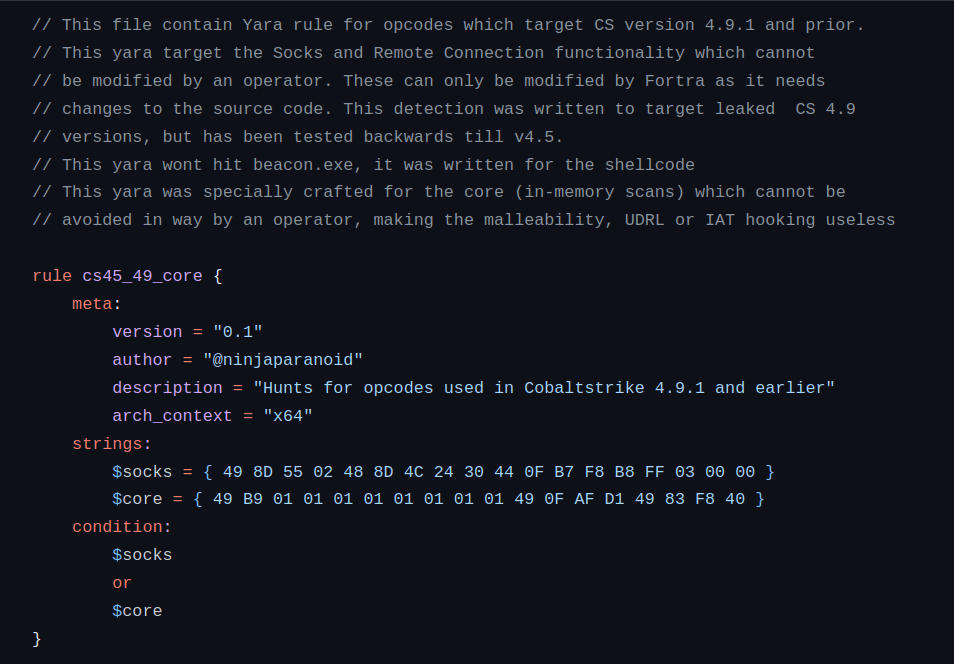
    May 13, 2025
  • MIL-OSI Russia: Dialogue between Science and Business: Polytechnic and Rostelecom Discuss IT Development

    Translation. Region: Russian Federal

    Source: Peter the Great St Petersburg Polytechnic University – Peter the Great St Petersburg Polytechnic University –

    Representatives of Rostelecom visited the Polytechnic University: Deputy President and Chairman of the Board Darius Khalitov, Advisor to the President Alexey Sergeev, Director of the North-West Macroregional Branch Alexander Loginov and Deputy General Director of RTK IT Roman Khazeev.

    The guests were met by the Advisor to the Rector’s Office of SPbPU Vladimir Glukhov, Vice-Rector for Information Technology Andrey Lyamin, Vice-Rector for Youth Policy and Communication Technologies Maxim Pasholikov and Head of the Public Relations Department Marianna Dyakova.

    At the Technopolis Polytech research building, the Rostelecom delegation visited the Supercomputer Center and met with university scientists engaged in developments in the field of computer and AL technologies.

    At the meeting, the Director of the Institute of Computer Science and Cybersecurity Dmitry Zegzhda presented the institute’s capabilities in training personnel for the industry and conducting research in the interests of industrial partners. The head of the ICSSC noted that knowledge of information technology is necessary for representatives of all professions today. All specialties of the institute, where more than 4.5 thousand students study, are in demand, on average, the competition is 30 people per place. In its development strategy, the institute is focused on interaction with industry and the public sector, continuity of education and interdisciplinarity, opening laboratories and centers of end-to-end information technology.

    Lev Utkin, Chief Researcher at the Higher School of Artificial Intelligence Technologies, spoke about research and developments used, for example, to diagnose diseases, and about the use of predictive analytics and explanatory intelligence both in medicine and in solving various production problems. Vladimir Mulyukha, Director of the Higher School of Artificial Intelligence Technologies, recalled joint projects with Rostelecom and outlined opportunities for expanding cooperation.

    In his response, Rostelecom Deputy President Darius Khalitov noted that the company can cooperate with Polytech in training personnel, using new technologies in the field of AI and in the expert assessment of Polytech scientists. Darius Ravilevich was especially interested in technologies using predictive analytics, which are based on the institute’s own neural networks based on the LLM model of learning on concepts.

    I found the programs in the field of artificial intelligence and cyberpsychology very promising, I have not seen anything like that anywhere else. In a sense, IT is becoming a cross-cutting discipline that will permeate applied areas, and there will be many reasons for cooperation, – summed up Darii Khalitov.

    Then Rostelecom representatives visited the Youth Trajectory Center “Polytech Tower”, where they met with the student team “Omnivorous” – the bronze prize winner of the international championship “Battle of Robots”. The conversation turned out to be very informative and productive, because Rostelecom is the sponsor of our team, and they have something to discuss with the guys. In particular, they talked about the possibility of creating their own track for training, so as not to go to Moscow every time for this with a 110-kilogram robot.

    At the end of the visit, Darii Khalitov became a guest of the live broadcast of the Lepota project in the Polytechnic TV studio. The broadcast was dedicated to Radio Day, which is celebrated on May 7, because it was the invention of radio that became, as they say now, a breakthrough into the world of unlimited possibilities for the development of information transmission technologies. Today it is already digital technologies, tomorrow – artificial intelligence, and the day after tomorrow…

    So, answering a question from one of the viewers How do new communication technologies affect the security of users’ personal data? Darius Khalitov said: In the flow of information in which we exist, one of the trends of telecommunications companies is cyber privacy. For us, citizens who use digital services every day, cyber privacy in 10-15 years will become, in a sense, a luxury for which we will be willing to pay. More and more services will appear that allow you to limit the distribution or receipt of information.

    To the question “Is it possible for a global communications provider to emerge?” the guest on the air answered that given the current excess of information, a hybrid between distributed data storage technologies and centralized management would be appropriate in the future. “You can’t concentrate everything in one place,” the expert explained. “Communications are the information bread of the 21st century, and the first thing we do when we wake up is watch the news on our phone, and only then do we go to breakfast. Therefore, access to information is already a critical infrastructure. And it must be fault-tolerant.”

    Please note: This information is raw content directly from the source of the information. It is exactly what the source states and does not reflect the position of MIL-OSI or its clients.

    MIL OSI Russia News –

    May 13, 2025
  • MIL-OSI Russia: Sports complex with rugby arena to appear in Khoroshevo-Mnevniki

    Translation. Region: Russian Federal

    Source: Moscow Government – Government of Moscow –

    The city will allocate a site in the Mnevnikovskaya floodplain for the construction of a multifunctional complex with a rugby arena. This was announced by the Deputy Mayor of Moscow for Urban Development Policy and Construction Vladimir Efimov.

    A modern cluster is being formed in the Khoroshevo-Mnevniki district, which will include several sports complexes. Ice arenas, a training center for national football teams, a tennis center and other facilities will appear there. For their construction, the city provides investors with land for rent to implement large-scale investment projects.

    “A rugby stadium with accompanying infrastructure will be built as part of the sports cluster on the territory of the Mnevnikovskaya floodplain as part of the implementation of a large-scale investment project. For this, the city will provide 4.34 hectares of land. The future investor will also be able to build a public and business complex on the site. The total area of the facilities will be 140 thousand square meters,” said Vladimir Efimov.

    The land plot will be provided on Nizhnie Mnevniki Street next to the Alexander Ovechkin International Hockey Academy complex, which is already under construction.

    “The land plot will be allocated to the investor for five years – this is the maximum term for the project. It is planned to build a rugby arena here with a field measuring 122 by 80 meters and stands for three thousand seats. The area of the business part of the stadium and the premises under the stands will be 20 thousand square meters. A multifunctional complex with an area of 120 thousand square meters will appear nearby, which will include office, retail real estate and a hotel,” she noted.

    Ekaterina Solovieva, Minister of the Moscow Government, Head of the Moscow Department of City Property.

    The city provides land plots to investors if their project meets the criteria for implementing large-scale investment projects. This mechanism of interaction between the city and business has been used in the capital since 2016 and applies to industrial production, social, sports, business and transport infrastructure facilities.

    Construction of the International Hockey Academy continues in the Mnevnikovskaya floodplainSergei Sobyanin: Accessible mass sports will become Moscow’s calling cardThe city has allocated land plots for the construction of three sports complexes in the Mnevnikovskaya floodplain

    Earlier about construction in the Mnevnikovskaya floodplain Sergei Sobyanin spoke about the construction of social facilities, as well as the creation of business and sports clusters.

    The construction of social facilities in Moscow corresponds to the goals and initiatives of the national project “Infrastructure for life”.

    Get the latest news quicklyofficial telegram channel the city of Moscow.

    Please note: This information is raw content directly from the source of the information. It is exactly what the source states and does not reflect the position of MIL-OSI or its clients.

    Please Note; This Information is Raw Content Directly from the Information Source. It is access to What the Source Is Stating and Does Not Reflect

    https: //vv.mos.ru/nevs/ite/153733073/

    MIL OSI Russia News –

    May 13, 2025
  • MIL-OSI Russia: Sergei Sobyanin named new areas that will appear in colleges from September

    Translation. Region: Russian Federal

    Source: Moscow Government – Government of Moscow –

    New areas of study are appearing in Moscow educational institutions. Modernization of colleges is one of the main projects in the field of education, Sergei Sobyanin wrote in his blog.

    “New equipment for laboratories and workshops, more practical classes, active cooperation with future employers, increasing student admissions and, of course, expanding the areas of study – these are the main priorities of our work. Today, city colleges train specialists in more than 150 in-demand specialties – from cooking and tourism to information technology and medicine,” said the Mayor of Moscow.

    In the 2025/2026 academic year, the choice of educational programs will become even wider. For example, several new areas of study are offered by the College of Communications No. 54 named after P.M. Vostrukhin. In particular, for the first time, enrollment will be opened for the Quantum Communications program. Students will learn to work with optical and measuring devices, master the unique quantum key distribution system, which is the basis for creating secure communication channels. They will study in modern laboratories equipped with advanced equipment.

    The students will undergo industrial practice with the college’s partners: PJSC Moscow City Telephone Network, JSC Russian Railways, Rosatom State Corporation, PJSC Rostelecom, JSC Gazprombank and others. Graduates will be able to work as designers, installers and administrators of quantum networks, commissioning engineers.

    The same college begins to train operators of automatic assembly lines for electronic equipment and devices. At the same time, students will receive an additional qualification – assembler of electronic equipment and devices. The students will undergo practical training at the largest enterprises of the electronics industry in Moscow: JSC Scientific and Production Organization Orion (holding Russian Space Systems), OOO Biforkom Tek, OOO SMTekh, OOO M-Plata, OOO Nexta, GUP Gamma, AO Ostec and others. Graduates will be able to work at enterprises producing electronics.

    The P.M. Vostrukhin College of Communications No. 54 and the Moscow State College of Electromechanics and Information Technology will open enrollment for the Intelligent Integrated Systems program. Students will learn how to create smart energy systems, manage traffic flows, implement precision farming projects, and develop intelligent systems for smart homes.

    The guys will be expected to do their internships in such companies as JSC InfoTeKS and Astra Group, IEK Group LLC, Wiren Board LLC, NVP Bolid CJSC, Universal Rectek LLC and Droneskhab LLC. Young specialists will create artificial intelligence models and work with systems based on them.

    The Moscow State College of Electromechanics and Information Technology will open recruitment for the specialty of developer of computer games, augmented and virtual reality. Students will undergo practical training at Aeroplan JSC, Addon LLC and Modum Lab LLC. Graduates will be able to develop game projects, create interactive applications, VR and AR technologies, and also work in visual effects and animation studios.

    The N.N. Godovikov College is opening a new course called “Technical Operation of Electrified and Flight-Navigation Complexes”. There you can study to become an aircraft mechanic, an electrical equipment fitter and an electronic device fitter. The students will have the opportunity to work in an electrical installation workshop and an aviation equipment laboratory, and will do their practical training at PAO Yakovlev. Graduates will be able to get jobs at airports and aviation technical bases.

    The Moscow Transport College will introduce a new program called “Automation and Telemechanics in Transport”. Students will gain skills in designing, installing, adjusting and operating automated systems that ensure the smooth and safe movement of metro trains. Starting from their first year, they will undergo practical training at the facilities of the Moscow Metro, the college’s key partner and main employer. Graduates will be able to work as technicians, electrical mechanics and adjustment engineers.

    “A diploma from a Moscow college is a guarantee of employment in a sought-after and promising specialty,” concluded Sergei Sobyanin.

    Please note: This information is raw content directly from the source of the information. It is exactly what the source states and does not reflect the position of MIL-OSI or its clients.

    Please Note; This Information is Raw Content Directly from the Information Source. It is access to What the Source Is Stating and Does Not Reflect

    https: //vv.mos.ru/mayor/tkhemes/12665055/

    MIL OSI Russia News –

    May 13, 2025
  • MIL-OSI Russia: A new technology park will appear in Nekrasovka as part of a large-scale investment project

    Translation. Region: Russian Federal

    Source: Moscow Government – Government of Moscow –

    As part of the implementation of a large-scale investment project (MaIP), a modern industrial and technology park will appear in Nekrasovka. The corresponding agreement will be concluded based on the results of the tender, said the Deputy Mayor of Moscow for Transport and Industry Maxim Liksutov.

    “The key task for further industrial development set by Sergei Sobyanin is the creation and scaling of high-tech production in the city. Thus, in the south-east of the capital, as part of a large-scale investment project, a modern industrial technology park with an area of more than 5.3 thousand square meters will appear. Here it will be possible to place enterprises of high-tech industries that ensure a high level of energy efficiency and environmental friendliness of production,” said Maxim Liksutov.

    Since 2024, land plots for the construction of new enterprises can be obtained under simplified conditions based on the results of tenders. In this case, an urban development plan for the site is prepared, the maximum area of the future enterprise is determined, and the necessary types of permitted land use are established.

    “This is already the second land plot intended for the construction of an industrial facility within the framework of the MAIP, which was sold through a bidding mechanism. The first agreement concluded as a result of the bidding provides for the construction of an industrial technology park with an area of about 14 thousand square meters in the Novokosino district,” noted the Minister of the Moscow Government, head of the capital’s Department of Investment and Industrial Policy

    Anatoly Garbuzov.

    The investor will be able to build an industrial facility at the intersection of Projected Drives No. 83 and 4296.

    According to Ekaterina Solovieva, Minister of the Moscow Government, Head of the Department of City Property, the agreement on the implementation of a large-scale investment project in the Nekrasovka district, which the city will conclude following the results of the auction, provides for the subsequent lease of 0.7 hectares of land at a preferential rate of one ruble per year. Such a support measure will allow the investor to reduce the costs of creating jobs, as well as to quickly establish the production of products important for the life and economy of the city.

    The site intended for the implementation of a large-scale investment project has a convenient location, which will allow the entrepreneur to build optimal routes for the delivery of materials during construction. The Kazan direction of the Moscow Railway is in close proximity, and the North-Eastern Chord and Novorizhanskoye Highway are also nearby.

    The implementation of such projects allows for the development of urban infrastructure, the creation of jobs and thus the maintenance of high dynamics of business activity. This is especially important in areas of promising development, such as Nekrasovka.

    Today, about 100 MAIPs have been approved or are being implemented in the capital, within the framework of which industrial enterprises will appear in different areas of the city and about 60 thousand jobs will be created.

    Investors received 53 plots from the city at a preferential rate of one ruble per year

    Get the latest news quicklyofficial telegram channel the city of Moscow.

    Please note: This information is raw content directly from the source of the information. It is exactly what the source states and does not reflect the position of MIL-OSI or its clients.

    Please Note; This Information is Raw Content Directly from the Information Source. It is access to What the Source Is Stating and Does Not Reflect

    https: //vv.mos.ru/nevs/ite/153750073/

    MIL OSI Russia News –

    May 13, 2025
  • MIL-OSI: GFO-X Launches Regulated Digital Asset Derivatives Trading Venue

    Source: GlobeNewswire (MIL-OSI)

    First Institutional Trade Successfully Executed 

    The New UK Trading Venue Brings Institutional-Grade Market Infrastructure, Central Clearing, and Deep Liquidity to Digital Asset Derivatives 

    LONDON, May 13, 2025 (GLOBE NEWSWIRE) — GFO-X today announced the successful launch of its UK FCA regulated trading venue for centrally cleared digital asset derivatives. The venue is designed to meet the increasing institutional demand for secure, transparent, and compliant digital asset futures and options. GFO-X brings together best-in-class market infrastructure, deep liquidity, and central clearing to solve for credit and significantly reduce counterparty risk. 

    As part of its successful debut, the first institutional trade between two leading financial institutions, Virtu Financial and IMC, was executed on GFO-X and centrally cleared through LCH DigitalAssetClear, marking a milestone in the evolution of institutional-grade digital asset markets. The new venue brings additional depth, breadth, and diversification to the limited choices in centrally cleared digital asset index derivatives. 

    GFO-X CEO, Arnab Sen, said, “The launch of GFO-X is a further foundational step toward increased institutional digital asset derivatives trading, providing the infrastructure, central clearing, robust risk mitigation, and liquidity. With our first trade executed between two leading financial institutions providing deep liquidity, we are expanding the market for centrally cleared digital asset derivatives.”

    Addressing the Institutional Surge in Digital Asset Derivatives Demand

    The global market for digital asset derivatives has seen explosive growth, with options and futures trading volumes growing exponentially. Institutional investors, including hedge funds, proprietary trading firms, and asset managers, increasingly turn to structured products underpinned by derivatives to hedge risk, enhance yield strategies, and gain exposure to crypto markets with greater regulatory clarity. 

    GFO-X has been purpose-built to bridge the gap between traditional finance and digital assets by offering: 

    • Regulated Trading & Transparency – Operating under UK FCA authorisation, ensuring compliance with global financial standards. 
    • Institutional-Grade Liquidity – Deep order books supported by industry leading market makers and participants, including IMC, Laser Digital and Virtu Financial. 
    • Leading Clearing Bank integrations at launch – including ABN AMRO Clearing, Nomura and Standard Chartered. 
    • Central Clearing for Counterparty Risk Mitigation by LCH DigitalAssetClear ensures secure margining, collateral management, and default protections. 
    • Advanced Market Infrastructure – A high-speed matching engine designed for low-latency execution and high-frequency trading. 

    With institutional adoption accelerating, GFO-X will continue expanding its product suite, initially offering Bitcoin index futures and options. 

    Market participants can now onboard and begin trading, with several additional leading financial institutions already lined up for integration. As institutions increasingly seek regulated, scalable solutions for digital asset derivatives trading, GFO-X is positioned to become a premier venue in the evolving landscape of institutional crypto derivative markets. 

    For more information about GFO-X and its upcoming developments, please visit www.gfo-x.com or contact sales@gfo-x.com. For press enquiries, contact Serra Balls, Eterna Partners gfo-x@eternapartners.com.

    Marcus Robinson, Head of DigitalAssetClear and CDSClear, LCH, said, “We are delighted to partner with GFO-X to launch this highly anticipated service from LCH SA. The regulated clearing infrastructure within LSEG’s post trade ecosystem has allowed us to build something meaningful for our participants and address the availability of options for a rapidly growing asset class. It is essential that we find ways to offer regulated, segregated and trusted routes to provide customers with a diverse breadth of services and we are excited to continue working with GFO-X to offer a regulated marketplace for this asset class.” 

    Barry Polak, Lead Product Commerce, ABN AMRO Clearing, said, “We are excited to partner with GFO-X, the UK’s first regulated and centrally cleared trading venue dedicated to digital asset derivatives. This strategic collaboration underscores our shared commitment to advancing the institutional digital asset futures and options market. By leveraging LCH DigitalAssetClear’s clearing services, we enhance transaction security and minimise counterparty risk, offering our clients unparalleled confidence in trading Bitcoin futures and options. A logical step to continue to lead the way to safe and transparent markets.”

    Osi Lilian, IMC Strategic Investments Co-Lead, said, “IMC was proud to be one of the earliest investors in GFO-X in 2021. We aligned with their vision of establishing the UK’s first regulated and centrally cleared trading venue for digital asset derivatives, built on secure, high-performance technology and robust risk management. As a market maker, our strategic connection with GFO-X underscores our commitment to the institutional digital asset futures and options market – a rapidly evolving space we believe holds significant potential for continued growth and opportunity.”

    Olivier Dang, Head of Ventures at Laser Digital, said, “We are thrilled to partner with GFO-X as they launch the UK’s first regulated and centrally cleared trading venue dedicated to digital asset derivatives. This collaboration aligns perfectly with our vision to drive innovation and growth in the digital asset market.”

    Andy Ross, Global Head, Prime & Financing, Financing & Securities Service, Standard Chartered, said, “We’re delighted to support the launch of GFO-X derivatives and to join LCH SA as a general clearing member to enable our clients to trade and clear. We continue to invest in servicing our clients broadly across the crypto space in coin, token and derivative form.

    “Virtu makes markets globally and is excited to support new and innovative platforms for digital assets in this role. We see broadening adoption and increasing demand as the crypto markets continue to mature and embrace the risk management benefits and capital efficiencies of centralised clearing.”

    About GFO-X 
    GFO-X is the UK’s first regulated and centrally cleared trading venue dedicated to digital asset derivatives. 
      
    GFO-X provides comprehensive risk management with clearing provided by the London Stock Exchange Group’s (LSEG) LCH SA DigitalAssetClear. 
      
    Combining proprietary high-performance technology with industry-leading partnerships and infrastructure, GFO-X delivers the requirements necessary to grow the institutional digital asset derivatives market.   
      
    Backed by M&G Investments and authorised by the UK Financial Conduct Authority (FCA) in 2022, GFO-X’s regulation-first approach has enabled it to partner with some of the largest financial institutions in the world.  
      
    GFO-X believes the digital asset futures and options markets will grow exponentially over the coming years as the asset class matures and more sophisticated investors begin to participate in greater size. By solving market constraints such as counterparty risks and technology challenges, GFO-X has been established to deliver a robust market structure and innovative products to propel the next leg of growth of the digital asset ecosystem.

    Contact:

    GFO-X@eternapartners.com
    +44 7762943498

    The MIL Network –

    May 13, 2025
  • MIL-OSI Russia: The first student career forum was held at IPMET

    Translation. Region: Russian Federal

    Source: Peter the Great St Petersburg Polytechnic University – Peter the Great St Petersburg Polytechnic University –

    The student body of the Institute of Industrial Management, Economics and Trade of SPbPU held a large-scale career event — the forum “IPMEiT Career: Step into the Future”. As part of a single career day, participants had the opportunity to attend lectures on professional development issues, as well as take part in interactive sessions aimed at developing and improving career skills. More than 200 students took part in the event.

    The program of the event was designed in such a way that students not only gained new knowledge, but also really got closer to their career dreams – be it their first internship or a conscious choice of a professional path.

    The forum began with a welcoming speech by the Director of IPMEiT Vladimir Shchepinin: Today’s forum is not only a platform for interaction between employers and students, but also an important step towards the professional development of future IPMEiT graduates. Our students are active, enthusiastic, and serious about choosing their future profession. They are ready for new challenges and opportunities. I wish everyone productive work, useful contacts, and inspiration for new achievements! Employers should find the best of the best, and participants should do everything to ensure that this day remains in their memory forever!

    Immediately after the opening, a job fair began, in which 20 partner companies took part. Among them: VTB Bank, Kept, P

    During the lecture by Changellenge, students learned about the key aspects of effective resume writing, learned about employers’ requirements for young professionals, and also analyzed the most common questions asked during interviews. The career block of the forum also included a case game in the format of “Case Thursday”, organized by the student association “Case Club SPbPU” together with Nikoliers. Participants were asked to solve a practical problem related to the analysis of the real estate market. Working in teams, they presented their solutions and received professional feedback from experts.

    In the educational block of the forum, students listened to a lecture on financial topics from the company “Trust Technologies”, learned about key professions in the field of finance and received practical recommendations on starting a career in this area. And at the master class of the company ESI Logistics

    “IPMET hosts quite a large number of thematic career events every year, but there has never been a global event that would unite the entire institute around career opportunities,” said Anastasia Nikitina, Chair of PROF.IPMET and the main organizer of the forum. “We tried to make the event based on the requests and wishes of students. At first, the idea seemed difficult to implement, but thanks to cooperation with the institute’s management and higher schools, after a month of active preparation, my team and I were able to help IPMET students take a small but very important step towards their careers and future.”

    The IPMET Career: Step into the Future forum has become a great start for the institute’s new tradition. The organizers are already full of inspiration for the next season and invite everyone to take another confident step towards new horizons!

    Please note: This information is raw content directly from the source of the information. It is exactly what the source states and does not reflect the position of MIL-OSI or its clients.

    MIL OSI Russia News –

    May 13, 2025
  • MIL-OSI China: Beijing expands disturbance-free list to protect company growth

    Source: People’s Republic of China – State Council News

    Beijing has further expanded its “no unnecessary intervention” policy for companies, optimizing regulatory approaches to support innovation and healthy growth in key sectors.

    According to municipal market regulation administration, the city has added 128,000 companies to the disturbance-free list, bringing the total to 231,000.

    For companies on the list, regulators usually conduct non-intrusive, remote inspections, significantly reducing on-site visits.

    Currently, scientific and technological firms account for 40% of the companies on the list, including 23,000 in artificial intelligence and other high-tech fields.

    So far this year, 77% of the inspections have been off-site. The first batch of companies added on the list have seen a 79.1% drop in inspections.

    Authorities noted that eligibility is based on the companies’ credit and risks, and those on the list will be continuously monitored for compliance.

    MIL OSI China News –

    May 13, 2025
  • MIL-OSI Asia-Pac: President Lai interviewed by Japan’s Nikkei  

    Source: Republic of China Taiwan

    In a recent interview with Japan’s Nikkei, President Lai Ching-te responded to questions regarding Taiwan-Japan and Taiwan-United States relations, cross-strait relations, the semiconductor industry, and the international economic and trade landscape. The interview was published by Nikkei on May 13.
    President Lai indicated that Nikkei, Inc. is a global news organization that has received significant recognition both domestically and internationally, and that he is deeply honored to be interviewed by Nikkei and grateful for their invitation. The president said that he would like to take this rare opportunity to thank Japan’s government, National Diet, society, and public for their longstanding support for Taiwan. Noting that current Prime Minister Ishiba Shigeru and former Prime Ministers Abe Shinzo, Suga Yoshihide, and Kishida Fumio have all strongly supported Taiwan, he said that the peoples of Taiwan and Japan also have a deep mutual affection, and that through the interview, he hopes to enhance the bilateral relationship between Taiwan and Japan, deepen the affection between our peoples, and foster more future cooperation to promote prosperity and development in both countries.
    Following is the text of the questions and the president’s responses:
    Nikkei: What is your personal view regarding the free trade system and the recent tariff war?
    President Lai: Over the past few decades, the free economy headed by the Western world and led by the US has brought economic prosperity and political stability to Taiwan and Japan. At the same time, we have also learned or followed many Western values.
    I believe that Taiwan and Japan are exemplary students, but some countries are not. Therefore, the biggest crisis right now is China, which exploits the free trade system to engage in plagiarism and counterfeiting, infringe on intellectual property rights, and even provide massive government subsidies that facilitate the dumping of low-priced goods worldwide, which has a major impact on many countries including Japan and Taiwan. If this kind of unfair trade is not resolved, the stable societies and economic prosperity we have painstakingly built over decades, as well as some of the values we pursue, could be destroyed. I therefore think it is worthwhile for us to observe the recent willingness of the US to address unfair trade, and if necessary, offer assistance.
    Our national strategic plan for Taiwanese industries is for them to be rooted in Taiwan while expanding their global presence and marketing worldwide. Therefore, while the 32 percent tariff increase imposed by the US on Taiwan is indeed a major challenge, we are willing to address it seriously and find opportunities within that challenge, making Taiwan’s strategic plan for industry even more comprehensive.
    Nikkei: What is your view on Taiwan’s trade arrangements?
    President Lai: In 2010 China accounted for 83.8 percent of Taiwan’s outbound investment, but last year it accounted for only 7.5 percent. In 2020, 43.9 percent of Taiwan’s exports went to China, but that figure dropped to 31.7 percent in 2024. We have systematically transferred investments from Taiwanese enterprises to Japan, Southeast Asia, Europe, and the US. Therefore, last year Taiwan’s largest outbound investment was in the US, accounting for roughly 40 percent of the total. Nevertheless, only 23.4 percent of Taiwanese products were sold to the US, with 76.6 percent sold to places other than the US. 
    In other words, we don’t want to put all our eggs in one basket, and hope to establish a global presence. Under these circumstances, Taiwan is very eager to cooperate with Japan. At this moment, the Indo-Pacific and international community really need Japan’s leadership, especially to make the Comprehensive and Progressive Agreement for Trans-Pacific Partnership (CPTPP) excel in its functions. We also ask Japan to support Taiwan’s CPTPP accession.
    Taiwan hopes to sign an Economic Partnership Agreement (EPA) with Japan, to build closer ties in economic trade and promote further investment. We also hope to strengthen relations with the European Union, and even other regions. Currently, we are proposing an initiative on global semiconductor supply chain partnerships for democracies, because the semiconductor industry is an ecosystem. For example, Japan has materials, equipment, and technology; the US has IC design and marketing; Taiwan has production and manufacturing; and the Netherlands excels in equipment. We therefore hope to leverage Taiwan’s advantages in production and manufacturing to connect the democratic community and establish a global non-red supply chain for semiconductors, ensuring further world prosperity and development in the future, and ensuring that free trade can continue to function without being affected by dumping, which would undermine future prosperity and development.
    We want industries to expand their global presence and market internationally while staying rooted here in Taiwan. Having industries rooted in Taiwan involves promoting pay raises for employees, tax cuts, and deregulation, as well as promoting enterprise investment tax credits. We have also proposed Three Major Programs for Investing in Taiwan for Taiwanese enterprises. We are actively resolving issues regarding access to water, electricity, land, human resources, and professional talent so that the business community can return to Taiwan to invest, or enterprises in Taiwan can increase their investments. We are also actively signing bilateral investment agreements with friends and allies so that when our companies invest and expand their presence abroad, their rights and interests as investors are ensured. 
    Additionally, as I just mentioned, we hope to sign an EPA with Japan, similar to the Taiwan-US Initiative on 21st-Century Trade and the Economic Prosperity Partnership Dialogue, or the Enhanced Trade Partnership arrangement with the United Kingdom, or similar agreements or memorandums of understanding with Canada and Australia that allow Taiwanese products to be marketed worldwide. Those are our overall arrangements.
    Looking at the history of Taiwan’s industrial development, of course it began in Taiwan, and then moved west to China and south to Southeast Asia. We hope to take this opportunity to strengthen cooperation with Japan to the north, across the Pacific Ocean to the east, and develop the North American market, making Taiwan’s industries even stronger. In other words, while we see the current reciprocal tariffs imposed by the US as a kind of challenge, we also view these changes positively.
    Nikkei: Due to pressure from China, it is difficult for Taiwan to participate in international frameworks such as the CPTPP or sign an EPA with Japan. What is your view on this situation?
    President Lai: The key point is what kind of attitude we should adopt in viewing China’s acts of oppression. If we act based on our belief in free trade, or on the universal values we pursue – democracy, freedom, and respect for human rights – and also on the understanding that a bilateral trade agreement between Taiwan and Japan would contribute to the economic prosperity and development of both countries, or that Taiwan’s accession to the CPTPP would benefit progress and prosperity in the Indo-Pacific region, then I personally hope that our friends and allies will strongly support us.
    Nikkei: Regarding the Trump administration’s “reciprocal tariff” policy and the possibility of taxing semiconductors, how do you interpret their intentions? How does Taiwan plan to respond?
    President Lai: Since President Trump took office, I have paid close attention to interviews with both him and his staff. Several of his main intentions are: First, he wants to address the US fiscal situation. For example, while the US GDP is about US$29 trillion annually, its national debt stands at US$36 trillion, which is roughly 124 percent of GDP. Second, annual government spending exceeds US$6.5 trillion, but revenues are only around US$4.5 trillion, resulting in a nearly US$2 trillion deficit each year, about 7 percent of GDP. Third, the US pays nearly US$1.2 trillion in interest annually, which exceeds the US$1 trillion defense budget and accounts for more than 3 percent of GDP. Fourth, he still wants to implement tax cuts, aiming to reduce taxes for 85 percent of Americans. This would cost between US$500 billion and US$1 trillion. These points illustrate his first goal: solving the fiscal problem.
    Second, the US feels the threat of China and believes that reindustrialization is essential. Without reindustrialization, the US risks a growing gap in industrial capacity compared to China. Third, in this era of global smart technology, President Trump wants to lead the nation to become a world center of AI. Fourth, he aims to ensure world peace and prevent future wars. So, if you ask me what the US seeks to achieve, I would say these four areas form the core of its intentions. That is why President Trump has raised tariffs, demanded that trading partners purchase more American goods, and encouraged friendly and allied nations to invest in the US, all in order to achieve these goals.
    The 32 percent reciprocal tariff poses a critical challenge for Taiwan, and we must treat it seriously. Our approach is not confrontation, but negotiation to reduce tariffs. We have also agreed to measures such as procurement, investment, resolving non-tariff trade barriers, and addressing origin washing in order to effectively reduce the trade deficit between Taiwan and the US. Of course, through this negotiation process, we also hope to turn challenges into opportunities. First, we aim to start negotiations from the proposal of zero tariffs and seek to establish a bilateral trade agreement with the US. Second, we hope to support US reindustrialization and its aim to become a world AI hub through investment, while simultaneously upgrading and transforming Taiwan’s industries. This would help further integrate Taiwan’s industries into the US economic structure, ensuring Taiwan’s long-term development. 
    As I have repeatedly emphasized, Taiwan’s national industrial strategy is for industries to stay firmly rooted in Taiwan while expanding their global presence and marketing worldwide. We have gone from moving westward across the Taiwan Strait, to shifting southbound, to working closer northward with Japan, and now the time is ripe for us to expand eastward by investing in North America. In other words, while we take this challenge seriously to protect national interests and ensure that no industry is sacrificed, we also hope these negotiations will lead to deeper Taiwan-US trade relations through Taiwanese investment in the US. These are our expectations.
    Naturally, the reciprocal tariffs imposed by the US will have an impact on Taiwanese industries. In response, the Taiwanese government has already proposed support measures for affected industries totaling NT$93 billion. In addition, we have outlined broader needs for Taiwan’s long-term development, which will be covered by a special budget proposal of NT$410 billion. This has already been approved by the Executive Yuan and will be submitted to the Legislative Yuan for review. This special budget proposal addresses four main areas: supporting industries, stabilizing employment, protecting people’s livelihoods, and enhancing resilience.
    As for tariffs on semiconductors, Taiwan Semiconductor Manufacturing Company (TSMC) has committed to investing in the US at the request of its customers. I believe TSMC’s industry chain will follow suit. These are concrete actions that are unrelated to tariffs. However, if the US were to invoke Section 232 and impose tariffs on semiconductors or related industries, it would discourage Taiwanese semiconductor and ICT investments in the US. We will make this position clear to the US going forward.
    Among Taiwan’s exports to the US, there are two main categories: ICT products and electronic components, which together account for 65.4 percent. These are essential to the US, unlike final goods such as cups, tables, or mattresses. What Taiwan sells to the US are the technological products required by AI designers like NVIDIA, AMD, Amazon, Google, and Apple. Therefore, we will make sure the US understands clearly that we are not exporting end products, but the high-tech components necessary for the US to reindustrialize and become a global AI center. Furthermore, Taiwan is also willing to increase its defense budget and military procurement. We are committed to defending ourselves and are strongly willing to cooperate with friends and allies to ensure regional peace and stability. This is also something President Trump hopes to see.
    Nikkei: Could TSMC’s fabs overseas weaken Taiwan’s strategic position as a key hub for semiconductor manufacturing? And could that then give other countries fewer incentives to protect Taiwan?
    President Lai: Political leaders around the world including Japan’s Prime Minister Ishiba and former Prime Ministers Abe, Suga, and Kishida have emphasized, at the G7 and other major international fora, that peace and stability in the Taiwan Strait are essential for global security and prosperity. In other words, the international community cares about Taiwan and supports peace and stability in the Taiwan Strait because Taiwan is located in the first island chain in the Indo-Pacific, directly facing China. If Taiwan is not protected, China’s expansionist ambitions will certainly grow, which would impact the current rules-based international order. Thus, the international community willingly cares about Taiwan and supports stability in the Taiwan Strait. That is the reason, and it has no direct connection with TSMC. After all, TSMC has not made investments in that many countries. That point, I think, is clear. 
    TSMC’s investments in Japan, Europe, and the US are all natural, normal economic and investment activities. Taiwan is a democratic country whose society is based on the rule of law, so when Taiwanese companies need to invest around the world for business needs, the government will support those investments in principle so long as they do not harm national interests.
    After TSMC Chairman C.C. Wei (魏哲家) held a press conference with President Trump to announce the investment in the US, he returned to Taiwan to hold a press conference with me here at the Presidential Office, where he explained to the Taiwanese public that TSMC’s R&D center will remain in Taiwan and that the facilities it has already committed to investing in here will not change and will not be affected. So, to put it another way, TSMC will not be weakened by its investment in the US. I want to emphasize this once more: Taiwan has strengths in semiconductor manufacturing, and Taiwan is very willing to work alongside other democratic countries to promote the next stage of global prosperity and development.
    Nikkei: It feels as though we are returning to what was previously called the Cold War, with two opposing blocs – East and West – facing off again. Between the US and China, which side should we choose?
    President Lai: Some experts and scholars describe the current situation as entering a new Cold War era between democratic and authoritarian camps. Others assert that the war has already begun, including information warfare, economic and trade wars, and the ongoing wars in Europe – the Russo-Ukrainian War – and the Middle East, and the Israel-Hamas conflict. These are all matters experts have cautioned about. I am not a historian, so I will not attempt to define today’s political situation from an academic standpoint. However, I believe that every country has a choice. That is to say, Taiwan, Japan, or any other nation does not necessarily have to choose between the US and China. What we are deciding is whether our country will maintain a democratic constitutional system or regress into an authoritarian regime. This is essentially a choice of values – not merely a choice between two major powers.
    Taiwan’s situation is different from other countries because we face a direct threat from China. We have experienced military conflicts such as the August 23 Artillery Battle and the Battle of Guningtou – actual wars between the Republic of China and the People’s Republic of China. China’s ambition to annex Taiwan has never wavered. Today, China’s political and military intimidation, as well as internal united front infiltration, are growing increasingly intense. Therefore, to defend democracy and sovereignty, protect our free and democratic system, and ensure the safety of our people’s lives and property, Taiwan’s choice is clear.
    China’s military exercises are not limited to the Taiwan Strait, and include the East China Sea, South China Sea, and even the Sea of Japan, as well as areas around Korea and Australia. Taiwan, Japan, Australia, and the Philippines are all democratic nations. Taiwan’s choice is clear, and I believe Japan also has no other choice. We are all democratic countries whose people have long pursued the universal values of democracy, freedom, and respect for human rights. That is what is most important.
    Nikkei: As tensions between the US and China intensify, what roles can Taiwan and Japan play?
    President Lai: In my view, Japan is a powerful nation. I sincerely hope that Japan can take a leading role amid these changes in the international landscape. I believe that countries in the Indo-Pacific region are also willing to respond. I think there are several areas where we can work together: first, democracy and peace; second, innovation and prosperity; and third, justice and sustainability.
    In the face of authoritarian threats, we should let peace be our beacon and democracy our compass as we respond to the challenges posed by authoritarian states. Second, as the world enters an era characterized by the comprehensive adoption of smart technologies, Japan and Taiwan should collaborate in the field of innovation to further drive regional prosperity and development. Third is justice and sustainability. Because international society still has many issues that need to be resolved, Taiwan and Japan can cooperate for the public good, helping countries in need around the world, and cooperating to address climate change and achieve net-zero transition by 2050.
    Nikkei: Do you hope that the US will continue to be a leader in the liberal democratic system?
    President Lai: Although the US severed diplomatic ties with the Republic of China, for the past few decades it has assisted Taiwan in various areas such as national defense, security, and countering threats from China, based on the Taiwan Relations Act and the Six Assurances. Taiwan has also benefited, directly and indirectly, in terms of politics, democracy, and economic prosperity thanks to the US. Therefore, Taiwan naturally hopes that the US remains strong and continues to lead the world.
    When the US encounters difficulties, whether financial difficulties, reindustrialization issues, or becoming a global center for AI, and hopes to receive support from its friends and allies to jointly safeguard regional peace and stability, Taiwan is willing to stand together for a common cause. If the US remains strong, that helps Taiwan, the Indo-Pacific region, and the world as a whole.
    The vital role of the US on the global stage has not changed. However, after decades of shouldering global responsibilities, it has encountered some issues. Now, it has to make adjustments, and I firmly believe it will do so swiftly, and quickly resume its leadership role in the world.
    Nikkei: I remember you said during your election campaign that you would like to invite China’s President Xi Jinping for bubble tea. Have you changed your mind?
    President Lai: Taiwan is a peace-loving country, and Taiwanese society is inherently kind. Therefore, we hope to get along peacefully with China, living in peace and mutual prosperity. So, during my term as vice president, I was expressing the goodwill of Taiwanese society. Of course, I understand that China’s President Xi would have certain difficulties in accepting this. However, I must emphasize that the goodwill of Taiwanese society has always existed. If China reflects on the past two or three decades, it will see that its economy was able to develop with Taiwan as its largest foreign investor. Every year, 1 to 2 million Taiwanese were starting businesses or investing in China, creating numerous job opportunities and stabilizing Chinese society. While many Taiwanese businesses have profited, Chinese society has benefited even more. In addition, every time a natural disaster occurs, if China is in need, Taiwanese always offer donations. Therefore, I hope that China can face the reality of the Republic of China’s existence, and understand that the people of Taiwan hope to continue living free and democratic lives with respect for human rights. I also hope China can pay attention to the goodwill of Taiwanese society. We have not abandoned the notion that as long as there is parity, dignity, exchange, and cooperation, the goodwill of choosing dialogue over confrontation and exchange over containment will always exist.
    Nikkei: What is your view on the national security reforms in response to China’s espionage activities and infiltration attempts?
    President Lai: China’s united front infiltration activities in Taiwan are indeed very serious. China’s ambitions to annex Taiwan rely not only on the use of political and military intimidation, but also on its long-term united front and infiltration activities in Taiwanese society. Recently, the Taiwan High Prosecutors Office of the Ministry of Justice prosecuted 64 spies, which is three times the number in 2021. In addition to active-duty military personnel, many retired military personnel were also indicted. Moreover, Taiwan also has the Chinese Unification Promotion Party, which has a background in organized crime, Rehabilitation Alliance Party, which was established by retired military personnel, and Republic of China Taiwan Military Government, which is also composed of retired generals. These are all China’s front organizations, and they plan one day to engage in collaboration within Taiwan. This shows the seriousness of China’s infiltration in Taiwan. Therefore, in the recent past I convened a high-level national security meeting and proposed 17 response strategies across five areas. The five areas include the following: first, to address China’s threat to Taiwan’s sovereignty; second, to respond to the threat of China’s obscuring the Taiwanese people’s sense of national identity; third, to respond to the threat of China’s infiltrating and recruiting members of the ROC Armed Forces as spies; fourth, to respond to the threat of China’s infiltration of Taiwanese society through societal exchanges and united front work; and fifth, to respond to the threat of China using “integration plans” to draw Taiwan’s young people and Taiwanese businesses into its united front activities. In response to these five major threats, I have proposed 17 response strategies. One of which is to restore the military trial system. If active-duty military personnel commit military crimes, they must be subject to military trials. This expresses the Taiwanese government’s determination to respond to China’s united front infiltration and the subversion of Taiwan.
    Nikkei: What actions can Taiwan take to guard against China’s threats to regional security? 
    President Lai: Many people are worried that the increasingly tense situation may lead to accidental conflict and the outbreak of war. My view is that Taiwan is committed to facing China’s various threats with caution. Taiwan is never the source of these problems. If there is an accidental conflict and it turns into a full-scale war, it will certainly be a deliberate act by China by using an accidental conflict as a pretext. When China expanded its military presence in the East China Sea and South China Sea, the international community did not stop it; when China conducted exercises in the Taiwan Strait, the international community did not take strong measures to prevent this from happening. Now, China is conducting gray-zone exercises, which are aggressions against not only the Taiwan Strait, the South China Sea, and the East China Sea, but also extending to the Sea of Japan and waters near South Korea. At this moment, Taiwan, the Philippines, Japan, and even the US should face these developments candidly and seriously. We must exhibit unity and cooperation to prevent China’s gray-zone aggression from continuing to expand and prevent China from shifting from a military exercise to combat. If no action is taken now, the situation may become increasingly serious.
    Nikkei: Some US analysts point out that China will have the ability to invade Taiwan around 2027. How do you assess the risk of a Chinese invasion at this stage?
    President Lai: As the country on the receiving end of threats and aggression, Taiwan must plan for the worst and make the best preparations. Our armed forces have a famous saying: “Do not count on the enemy not showing up; count on being ready should it strike.” This is why I proposed the Four Pillars of Peace action plan. First, we must strengthen our national defense. Second, we must strengthen economic resilience. Not only must our economy remain strong, but it must also be resilient. We cannot put all our eggs in the same basket, in China, as we have done in the past. Third, we must stand shoulder to shoulder with friends and allies such as Japan and the US, as well as the democratic community, and we must demonstrate the strength of deterrence to prevent China from making the wrong judgment. Fourth, I would like to emphasize again that as long as China treats Taiwan with parity and dignity, Taiwan is willing to conduct exchanges and cooperate with China and seek cross-strait peace and mutual prosperity through exchanges and cooperation.
    Nikkei: Amid intensifying US-China confrontation, in which areas do you think Taiwan and Japan should strengthen cooperation? In addition, Japan’s Ishiba administration is also a minority government. What are your expectations for the Ishiba administration?
    President Lai: In the face of rapid and tremendous changes in the political situation, every government faces considerable challenges, especially for minority governments. But the Japanese government led by Prime Minister Ishiba has quite adequately responded with various strategies. Furthermore, Japan is different from Taiwan. Although Japan’s ruling party lacks a majority, political parties in Japan engage in competition domestically while exhibiting unity externally. Taiwan’s situation is more challenging, because the ruling and opposition parties hold different views on the direction of the country, due to differences in national identity.
    In the future, I hope that Taiwan and Japan will enjoy even more comprehensive cooperation. I have always believed that deep historical bonds connect Taiwan and Japan. Over the past several decades, when encountering natural disasters and tragedies, our two nations have assisted each other with mutual care and support. The affection between the people of Taiwan and Japan is like that of a family. In addition, both countries face the threat of authoritarianism. We share a mission to safeguard universal values such as democracy, freedom, and respect for human rights. Our two countries should be more open to cooperation in various areas to maintain regional peace and stability as well as to strengthen cooperation in economic and industrial development, such as for semiconductor industry chains and everyday applications of AI, including robots and drones. We can also cooperate on climate change response, such as in hydrogen energy and other strategies. Our two countries should also continue to strengthen people-to-people exchanges. I would like to take this opportunity to once again invite our good friends from Japan to visit Taiwan for tourism and learn more about Taiwan. The Taiwanese people wholeheartedly welcome our Japanese friends.
     

    MIL OSI Asia Pacific News –

    May 13, 2025
  • MIL-OSI: Metric Capital Partners closes fifth fund at EUR 1 Billion

    Source: GlobeNewswire (MIL-OSI)

    LONDON, May 13, 2025 (GLOBE NEWSWIRE) — Metric Capital Partners LLP (“Metric” or “the Firm”), the pan-European private capital investment firm, today announced the final close of MCP V (“the Fund”) and its ancillary vehicles with total commitments of EUR 1 billion. 

    Founded in 2011, Metric provides bespoke capital solutions to companies seeking alternatives to traditional debt or equity financing. Since inception, the Firm has invested in 46 companies across a wide range of sectors and geographies.

    MCP V attracted commitments from a diverse group of institutional investors, including sovereign wealth funds, corporate and state pension plans, and family offices, with a well-balanced geographic representation across North America, Europe, the Middle East, and Asia.

    Investors’ interest in MCP V was driven by Metric’s differentiated investment strategy as the Firm looks to provide flexible capital to ambitious companies looking to execute transformational initiatives and transactions. This bespoke structuring typically enables Metric to benefit from meaningful downside protection while retaining significant upside potential. By not typically requiring control, Metric is often viewed as a long-term, growth-oriented, supportive partner by management teams and shareholders looking to unlock value whilst containing dilution. Metric’s strategy is further underpinned by its deep origination capabilities and the expertise to execute opportunities throughout economic cycles, as evidenced by the Firm’s track record since inception.  

    The successful closing of MCP V follows a highly active 18-month period during which the Firm achieved four exits from its third and fourth funds generating returns over invested capital well over 2x and proceeds to LPs of over EUR 500 million.

    The Firm has also been extremely active in the deployment of its fifth fund, with 3 investments completed prior to its final close, each performing ahead of initial expectations.

    The Firm’s ability to generate returns for investors through exits whilst maintaining an active, yet highly disciplined, deployment of new funds has set it apart from its peers and generated significant momentum to achieve a successful final close of its fifth fund despite the volatile macro and fundraising environment.

    John Sinik, Founder and Managing Partner of Metric Capital, commented:

    “We are excited to announce the closing of our fifth fund at our target size and are grateful for the continued commitment and support shown by our investors.

    Our ability to garner investors’ interest, notwithstanding a challenging fundraising environment, is a true testament to the uniqueness of our investment strategy as well as the strengths of the team and our portfolio. We see exciting opportunities ahead for Metric as we continue achieving target returns through our disciplined investment approach.

    “The Fund is already off to a strong start, with close to 40% of capital committed across three high-performing European companies with other deals significantly progressed in the pipeline. This early momentum reflects the strength of Metric’s origination capabilities, and our ability to execute with speed and precision.”

    About Metric Capital Partners 

    Metric Capital Partners is a leading pan-European private capital fund manager. The Firm has raised in excess of EUR3.5 bn of capital from its global investor base and operates with offices in London, Luxembourg, Madrid, Munich, Paris and Stockholm. Since its inception in 2011, MCP has completed 46 investments across a variety of industries and geographies. 

    For further information please contact: 

    Justine Crestois, CDR, mail: justine.crestois@cdrconsultancy.com 

    The MIL Network –

    May 13, 2025
  • MIL-OSI Africa: African Mining Week (AMW) to Highlight Mineral Traceability as a Catalyst for Investment, Supply Chain Reform

    Source: Africa Press Organisation – English (2) – Report:

    CAPE TOWN, South Africa, May 13, 2025/APO Group/ —

    The upcoming African Mining Week – Africa’s premier gathering for mining stakeholders, scheduled for October 1 – 3, 2025, in Cape Town – will feature a high-level panel focused on mineral traceability and supply chain optimization.

    Titled Mineral Traceability: Reshaping Global Supply Chains and Geopolitical Influence, the session will bring together key players from public and private sectors, including mineral traders and certification bodies. The discussion will explore how traceability frameworks are driving investment, improving transparency and creating real economic impact in Africa’s mineral-rich economies.

    African countries, in partnership with global partners, are implementing innovative traceability mechanisms to strengthen governance and ensure local beneficiation across the mining value chain. In Ghana, the government established the Ghana Gold Board in early 2025 to centralize the purchase and trade of domestically produced gold. Now the exclusive buyer, trader and exporter of the resource, the agency is designed to combat illegal gold trade, enhance transparency and ensure the gold sector contributes directly to GDP growth.

    In Botswana, a new partnership with the G7 Diamond Technical Team, announced in November 2024, aims to develop an export certification system for rough diamonds. The system, which will be operational by 2025, will ensure diamonds are traceable across the supply chain. Namibia and Angola have revealed plans to adopt similar platforms in 2025.

    Rwanda launched the Inkomane Trading System in October 2024 to enhance transparency across the mining lifecycle. The platform enables stakeholders to manage operations, payroll and mineral trades while complying with new laws around exploration, production and monetization. In February 2025, UK-based company Aterian resumed operations in Rwanda after aligning with the system’s requirements.

    In October 2024, the Copper Mark, the International Council on Mining and Metals, the Mining Association of Canada and the World Gold Council launched the Consolidated Mining Standard Initiative. The initiative aims to harmonize existing mining standards under one consolidated framework, promoting responsible sourcing and ensuring comprehensive traceability. Once finalized, the standard is expected to be adopted by nearly 100 companies operating across 600 sites in around 60 countries, including many in Africa.

    Further strengthening transparency in mineral reporting, the African Union’s African Minerals Development Centre introduced the Pan-African Resource Reporting Code in April 2024. The framework aims to ensure public reporting aligns with Africa’s development agenda, specifically the Africa Mining Vision and Agenda 2063, emphasizing sustainability, equity, and economic transformation.

    Private mining firms are also leveraging technology to support traceability. De Beers registers Botswana’s diamond output using Tracr, a blockchain-enabled platform. Meanwhile, in the Democratic Republic of Congo, companies like Cobalt Blockchain, Glencore and Eurasian Resources Group have piloted blockchain solutions to trace cobalt from source to market.

    As mineral traceability becomes increasingly crucial to securing sustainable investment and ensuring accountability in resource use, African Mining Week 2025 will spotlight the continent’s leading practices and ongoing efforts in building robust, transparent mineral value chains.

    MIL OSI Africa –

    May 13, 2025
  • MIL-OSI Africa: Mining in Motion to Unlock New Era of Artisanal and Small-Scale Miners (ASGM)-Large-Scale Miners (LSM) Collaboration in Ghana

    Source: Africa Press Organisation – English (2) – Report:

    ACCRA, Ghana, May 13, 2025/APO Group/ —

    Ghana is expanding its gold mining sector to drive employment creation and sustainable economic growth. To achieve this socioeconomic development agenda, cooperation between artisanal and small-scale miners (ASGM) and large-scale miners (LSM) is imperative.

    The upcoming Mining in Motion Summit – Ghana’s premier gathering for mining stakeholders, scheduled for June 2 – 4, 2025 in Accra – will feature a panel discussion highlighting collaboration between ASGM and LSM players in driving industry expansion.

    Titled Fostering Synergies Between ASM and LSM: Maximizing Gold Value Through Collaboration and sponsored by Newmont Africa, the session will include representatives from the Ghana National Association of Small-Scale Miners, the World Gold Council and the ECOWAS Chamber of Mines.

    Ghana’s Minerals Commission is leading efforts to reduce land-use conflicts by demarcating zones for ASGM within or near large-scale mining concessions, enabling regulated and peaceful coexistence between the two sectors.

    Additionally, initiatives such as the Community Mining Scheme and the World Bank-funded Ghana Landscape Restoration and Small-Scale Mining Project are fostering legal and sustainable operations by ASGM groups within designated areas. These initiatives not only curb illegal mining but also promote shared infrastructure use such as road networks with LSM companies operating in the same regions.

    Ghana is also promoting dialogue and shared learning through multi-stakeholder platforms such as the Mining in Motion Summit. The event brings together regulatory authorities, ASGM leaders and major LSM firms, including Newmont Africa, AngloGold Ashanti, Emirates Gold, Rand Refinery and representatives from the World Gold Council. These engagements ensure that the needs and perspectives of both small- and large-scale operators are incorporated into national mining policies and development strategies.

    Organized by the Ashanti Green Initiative under the leadership of Oheneba Kwaku Duah, Prince of Ghana’s Ashanti Kingdom, and hosted in partnership with the World Bank and the World Gold Council, the 2025 edition of the summit will convene under the theme: Sustainable Mining & Local Growth – Leveraging Resources for Global Impact. The event aims to align Ghana’s mining agenda with global sustainability goals, while promoting inclusive growth.

    Stay informed about the latest advancements, network with industry leaders, and engage in critical discussions on key issues impacting small-scale miners and medium to large scale mining in Ghana. Secure your spot at the Mining in Motion 2025 Summit by visiting www.MiningInMotionSummit.com. For sponsorship opportunities or delegate participation, contact Sales@ashantigreeninitiative.org.

    MIL OSI Africa –

    May 13, 2025
←Previous Page
1 … 784 785 786 787 788 … 2,041
Next Page→
NewzIntel.com

NewzIntel.com

MIL Open Source Intelligence

  • Blog
  • About
  • FAQs
  • Authors
  • Events
  • Shop
  • Patterns
  • Themes

Twenty Twenty-Five

Designed with WordPress