Category: Child Poverty

  • MIL-OSI Europe: AFRICA – “Neocolonialism in fishing”: The fishing industry in West African countries is in crisis

    Source: Agenzia Fides – MIL OSI

    photo nigrizia.it

    by Cosimo GrazianiBanjul (Agenzia Fides) – In West African countries, the local fishing industry is in crisis. European countries are also to blame for this. Gambian activist Mustapha Manneh also spoke out at the United Nations World Oceans Conference, which took place this year in Nice from June 9 to 13.The core of the problem is the fishing of local species to produce fish feed for aquaculture farms in Greece and Turkey. The phenomenon affects the entire region and has the same characteristics: local species such as sardines and bonga are caught in large quantities and processed locally into fish feed for aquaculture; the produced material is shipped to Turkey, Greece, and China (these are the currently known destinations), where it is used in fish farms. The fish produced, in the case of Turkish farms, are mainly sea bream and bass. These farmed fish reach the stores of the destination countries and the tables of consumers, unaware that the consumed fillets are causing social and economic problems for entire populations on the African continent, where in the meantime, hundreds of families have lost their only source of income. As Manneh points out, the fishermen can no longer bring home enough fish to feed their families and face ever-increasing fuel costs: Whereas they used to be able to catch large quantities of fish in a shorter time, using only 20 liters of diesel, they now have to stay away longer to ensure a sufficient catch, and the amount of fuel required has at least tripled.The fishermen are not the only ones hit hard: an entire social fabric has been affected by this problem. In Senegal and Gambia, the fish was caught by men and sold by women, a system that, in its own way, also ensured relative social and economic equality. Now that catches are scarce, markets have disappeared in many cases, along with the stalls run by women, who must now find other sources of income. Another problem that fishermen in West Africa have faced in recent years is the presence of fishing boats from other countries—for example, from China—which significantly reduces the availability of fish to catch. In Guinea-Bissau, fishing boats from other countries often use trawling, which is prohibited due to the damage it can cause to ecosystems. The presence of foreign fishing boats in African waters is often regulated by agreements such as those concluded by the European Union with these countries. According to Manneh, their presence in Gambia is viewed with growing hostility by the local population, especially young people. The EU signed the last of a long line of fishing protocols with Gambia in 2019, which expire on July 30. This protocol stipulated that vessels from Spain, Greece, and France could fish in Gambian territorial waters for an annual fee of €550,000, a fee that was intended, among other things, to finance measures to protect the marine ecosystem. Similar agreements have been concluded with other countries in the region: In the case of Guinea-Bissau, the agreement was approved by the European Parliament last April and provides for compensation of up to €100 million per year. Alongside this agreement, the Parliament adopted a recommendation calling on the European Commission and Guinea-Bissau to improve fishing controls in the African country’s territorial waters. The fishing crisis in West African countries is also fueling illegal emigration to Europe. From the coasts of Senegal, it is possible to reach the Canary Islands, which belong to Spain. While reaching the Canary Islands represents an alternative to poverty for many, others become smugglers for the same reason, earning a living by transporting migrants. In Gambia, earnings for a single trip on a boat full of migrants can reach up to €200,000, an unimaginable sum for a Gambian fisherman. (Agenzia Fides, 10/7/2025)
    Share:

    MIL OSI Europe News

  • MIL-OSI NGOs: UK: Government’s unchecked use of tech and AI systems leading to exclusion of people with disabilities and other marginalized groups 

    Source: Amnesty International –

    People with disabilities, those living in poverty or who have serious health conditions are being left in a bureaucratic limbo due to digital exclusion caused by the Department of Work and Pensions’ (DWP) unchecked roll-out of technologies, Amnesty International said today in a new report. 

    The report, “Too Much Technology, Not Enough Empathy” exposes how the DWP’s constant testing, rolling out, and rolling back of costly artificial intelligence (AI) and digital technologies for Universal Credit (UC), Personal Independence Payment (PIP), and other social security schemes has created an inaccessible social security system for people who are already marginalized and at risk of poverty in the UK.  

    Many people requiring social security do not have access to digital technologies, internet or internet connected devices. Their affordability coupled with language barriers and long waiting times for telephone services have led to digital exclusion from DWP’s systems. 

    “The DWP’s mission to reduce ‘costs’ is the beating heart of fascination with, and overreliance on, problematic tech. People are struggling to make ends meet and put food on the table due to cuts in social security and yet the DWP is more concerned about experimental technologies to surveil claimants,” said Imogen-Richmond Bishop, Researcher on Technology, Economic, Social and Cultural Rights. 

    “The tech-enabled system to claim and manage welfare benefits is resulting in relentless dehumanization and strain for people who are already wrestling to access their basic needs in a broken system.” 

    The research is an extension of Amnesty International’s 2025 report, “Social Insecurity: The devastating human rights impact of social security system failures in the UK”that details how the UK’s social security system requires a wholesale overhaul to put it back on track to being human rights compliant and ensure a decent standard of living. The struggles in accessing adequate social security payments to prevent poverty are intersectional and complex, with technology forming one component of the broader social support ecosystem. 

    The tech-enabled system to claim and manage welfare benefits is resulting in relentless dehumanization and strain for people who are already wrestling to access their basic needs in a broken system.

    Imogen-Richmond Bishop, Researcher on Technology, Economic, Social and Cultural Rights

    Both investigations draw their findings from questionnaires, focus group interviews with social security recipients and social security advisors, and build on previous work done by civil society. In total, views of 782 people were captured through this process that took place from October 2024 to January 2025. 

    Perfect storm of pre-existing flaws and new problems 

    The use of digital technologies combined with further cuts to the UK’s social security system after years of austerity has created a perfect storm, where pre-existing flaws are being exacerbated, and new problems linked to these new technologies are being created. 

    Automated systems and the use of AI in the assessment and provision of social security can introduce a significant risk of errors in decision making, due to biased or discriminatory algorithms, with serious consequences for claimants.  

    Digital exclusion can be experienced due to a person’s living conditions, educational attainment, health status, and income levels – complex factors that are not always fully captured by automated social security systems.   

    For one of the claimants interviewed by Amnesty International, gender, and socio-economic status all represented barriers to her access to services online. 

    “You know, have some form of compassion, you know, make the forms and things easier. I mean, I’m quite illiterate. I mean, a lot of women, and men of my age, can’t use them […] So they’re stuffed. They send me letters on my phone. I can’t open them. So I ring up. I can’t open it. I haven’t got an iPad. I can’t afford an iPad, you know,” the claimant told Amnesty International. 

    Human rights implications 

    The digitized and sweeping data collection has also created an all-seeing social security system that impacts claimants’ rights to privacy, data protection, and human dignity. 

    Using extensive amounts of data to determine eligibility for state support is not new. However, the scale and the breadth of the data used, and the speed with which it is processed now is new and can bring with it new unintended consequences and human rights risks.  

    “DWP’s experimentation with tech systems has jeopardised human rights and reduced people in need to data points. The success of a claim can be dependent on whether they neatly fit into a box or meet set criteria rather than their actual eligibility. Technology in this instance has oversimplified people’s complex realities and this demeans people’s needs especially when they are unable to get the support they need from a human case worker,” said Imogen Richmond-Bishop. 

    Amnesty International wrote to the DWP ahead of the publication of the report and provided a comprehensive summary of the research findings and the methodology. DWP declined to comment on the substance of the report at this time of publication.  

    The UK authorities must carry out an independent, and impartial review of the social security system as well as the digital systems used by the DWP and scrap any that violate human rights. We need laws to regulate AI to ensure it doesn’t contribute to human rights violations. Digital systems must be transparent, explainable, and never mandatory.  

    Background: 

    In May 2025, Amnesty International’s “Social Insecurity” report, exposed how cuts, sanctions and systemic failings of the UK’s social security system are pushing people deeper into poverty. 

    Amnesty International has also done research on public sector automation and digitalization in Denmark, Netherlands, India, Serbia, and supported work in France and Sweden on the resulting human rights risks and impacts of algorithmic decision-making in these jurisdictions.   

    MIL OSI NGO

  • MIL-OSI Africa: Burkina Faso Economic Update: Energy for Economic Growth

    Source: APO


    .

    According to the World Bank’s April 2025 Burkina Faso Economic Update, the country’s economy grew by 4.9% in 2024 compared to 3.0% in 2023. Real per capita GDP growth also increased from 0.7% to 2.5% over the same period.

    This acceleration is attributed mainly to the performance of services and agriculture, supported by an improved security situation, favorable weather conditions, and increased government support to the agriculture sector.

    However, inflation increased in 2024 to 4.2% from 0.7% in 2023, driven by the spike in food prices, caused by market speculation linked to a late start to the rainy season. Despite this, the strong growth in the agriculture and services sectors in 2024 reduced the extreme poverty rate by 3 points to 23.2%, with a sharper decline in rural areas. Despite this, the absolute number of people living in poverty remains high, exceeding 5.5 million.

    The report also notes a decline in the twin deficits (fiscal and current account) in 2024. The fiscal deficit improved in 2024 from 6.5% to 5.6% of GDP, thanks to better control of public spending and increased revenue mobilization. At the same time, the current account deficit also improved from 8.0% of GDP in 2023 to 6.4% in 2024, due to the rise in gold prices which boosted the value of exports. However, the financing of this deficit largely relied on regional markets, in an environment of high interest rates.

    The report highlights that the short- and medium-term outlook remains positive but is subject to multiple risks such as insecurity, climate shocks, debt refinancing, and challenges in the financial sector. Assuming these risks abate, growth is expected to strengthen to 5% over the medium term, driven by buoyant services, an expected recovery of industry, notably through improved energy access, and favorable average weather conditions for agriculture.

    Inflation, meanwhile, is expected to gradually stabilize within the WAEMU target range. This outlook, combined with continued fiscal consolidation, is expected to enable a continued but moderate reduction in poverty estimated at about 1 percentage point per year.

    Regarding the economy, Daniel Pajank and Ibrahim Nana, co-authors of the report, call for “Strengthening the mobilization and efficiency of public resources, including through the continuous modernization of the tax administration, the broadening of the tax base and the optimization of public spending, while improving debt management and mobilizing more concessional financing.”

    The Special Chapter on Energy for Economic Growth provides an assessment of the electricity sector in Burkina Faso and concrete recommendations to achieve the objectives set in the National Electrification Strategy. It highlights the key role of energy in the country’s economic transformation. According to Hamoud Abdel Wedoud Kamil, World Bank Country Manager for Burkina Faso, “Affordable, reliable, and sustainable electricity is essential to improve productivity in agriculture, support the growth of services, and revive the industrial sector.”

    Despite the efforts made, access to electricity remains limited in Burkina Faso, with a rate well below the regional average. This situation constitutes a major obstacle to inclusive growth and reduces economic opportunities for a large part of the population, particularly in rural areas.

    The co-authors of the chapter dedicated to the energy sector, Regina Nesiama Miller and Adwoa Asantewaa, emphasize that “An ambitious reform of the sector, including pricing based on the cost of electricity production and the expansion of off-grid access, would be essential to reduce vulnerabilities and ensure inclusive growth.

    Finally, the report recommends tackling the structural constraints to the country’s economic transformation, particularly in the electricity sector, which remains characterized by some of the region’s highest generation costs and heavy reliance on imported fuels. 

    Distributed by APO Group on behalf of The World Bank Group.

    MIL OSI Africa

  • MIL-OSI China: International journalists explore development of China’s Xinjiang

    Source: People’s Republic of China – State Council News

    A total of 24 journalists from 23 countries have participated in a media tour of northwest China’s Xinjiang Uygur Autonomous Region, focusing on its role as the core zone of the Silk Road Economic Belt.

    Organized by China’s State Council Information Office, the delegation visited communities, businesses, cultural venues and religious sites in the cities of Urumqi, Turpan and Kashgar from June 30 to July 8, gaining firsthand insight into the harmonious lives of Xinjiang’s residents of various ethnic groups, the region’s economic growth driven by innovation and its vibrant cultural heritage.

    After watching a documentary on counter-terrorism and visiting an exhibition highlighting Xinjiang’s efforts in this field, Zabeirou Souley, president of Times newspaper in Niger, noted that his country faces similar challenges and can learn from China’s experience.

    Citing visits to the Id Kah Mosque in Kashgar and the Xinjiang Islamic Institute, he said that people in Xinjiang fully enjoy freedom of religious belief.

    As a historic hub along the ancient Silk Road, Xinjiang is now experiencing renewed vitality in economic, trade and cultural exchanges under the Belt and Road Initiative.

    During the tour, journalists were impressed by Xinjiang’s advancements in modern agriculture and high-tech industries.

    Toshimichi Kitafuji, a reporter from Japan’s Kyodo News, showed interest in the region’s innovative applications, such as automotive testing under extreme heat, salt-tolerant rice cultivation, drone-assisted cotton farming and AI-driven automated production in cotton processing.

    “As a key hub of the Silk Road Economic Belt, Xinjiang holds immense potential for future growth,” he said.

    Xinjiang’s rich cultural diversity also captivated the foreign visitors.

    Samia Boulahlib, a reporter from Algeria’s El Moudjahid, expressed admiration for the traditional performances in the ancient city of Kashgar, which showcased the city’s deep historical and cultural roots.

    At an exhibition hall in Jiashi County, Abdiqani Abdullahi Ahmed from the Somalia National News Agency learned about local residents’ decades-long struggle for clean drinking water — one of the projects exemplifying China’s historic feat of shaking off absolute poverty.

    “I saw these with my own eyes. Everyone here has something to do and they live happily,” he said. 

    MIL OSI China News

  • MIL-OSI United Kingdom: Edinburgh to launch Bloomberg Philanthropies innovation team to reduce poverty and reach net zero

    Source: Scotland – City of Edinburgh

    View of Edinburgh from Arthur Seat – a Getty image

    Edinburgh is one of 19 new local authorities joining the international Bloomberg Philanthropies i-team initiative, which provides support and expertise to tackle pressing local challenges.

    The City of Edinburgh Council today announced plans for an Innovation Team which will work towards tackling the city’s ambitions of reaching net zero and ending poverty.

    The ‘i-team’, supported by Bloomberg Philanthropies, will include three specialised staff charged with helping the Council and civic and community-based partners design and implement services that improve people’s lives. They will receive technical assistance from regional and global specialists, and benefit from learnings from peers in local authorities across the region and around the world.  

    City of Edinburgh Council Leader Jane Meagher said:

    Edinburgh is one of the most successful cities in the world and yet we face unprecedented pressures. Our population growth, and appeal as a fantastic place to live and visit, makes it challenging to provide the best quality housing and support to residents who need it most. Likewise, Edinburgh’s world-famous environment, both built and natural, needs to be managed sustainably and protected from the effects of climate change.

    The support from Bloomberg Philanthropies’ international i-team initiative will provide a huge boost towards our aims of tackling poverty and hitting net zero, by helping us to establish a brand-new innovation team within the Council. I look forward to working with this team, and all our partners, as we work to deliver a fairer and stronger capital city.

    James Anderson, who leads the Government Innovation program at Bloomberg Philanthropies, said:

    Realising efficient, effective government is an inside job—and the Innovation Teams we support around the world are critical to building that engine within the city halls they serve. We are glad to expand this model to 19 new municipal teams in Europe, who will join the growing number of public officials working locally, creatively, and ambitiously to break down silos, break through problems, and deliver results residents see and feel.

    To date, the Bloomberg Philanthropies i-team initiative has reached over 100 cities across 16 countries and four continents—representing more than 100 million residents—and inspired hundreds of other local governments to embrace innovation systems and practices.

    Published: July 10th 2025

    MIL OSI United Kingdom

  • MIL-OSI United Kingdom: Retrofit project that has made council homes warmer and has saved tenants money wins award

    Source: City of Birmingham

    Birmingham City Council tenants in more than 2,000 households are now living in greener, warmer council homes thanks to a scheme that won a Retrofit Project of the Year award.

    Birmingham City Council’s Social Housing Decarbonisation Fund (SHDF) programme won the Retrofit Project of the Year for the Midlands and Wales at the Unlock Net Zero Awards.

    The scheme – completed by sustainable regeneration specialist Equans, on behalf of the council – has helped tenants save £600-£1200 each year on energy bills, depending on the home and measures installed. Solar panels placed on buildings can save residents as much as £4 per day in electricity.

    The work will save 2,500 tonnes of carbon per year – the equivalent of driving over 1400 petrol cars for a year. You would need to plant over 41,000 trees and let them grow for ten years to offset 2,500 tonnes of carbon.

    Testing at the homes shows that retrofitted properties now have an Energy Performance Certificate of at least a C, with some reaching an A rating—the most energy-efficient rating available.

    Work to be done – Dreghorn Road, before works were undertaken as part of the scheme.

    The measures installed have included external wall insulation, new windows and doors, loft insulation, solar panels, high heat retention storage heaters and smart hot water tanks.

    To give residents greater control over their energy usage, the scheme installed smart energy monitoring devices into some homes, which also provides valuable data to the council highlighting how the retrofit measures perform, levels of dampness, and if tenants are experiencing fuel poverty.

    Councillor Nicky Brennan, cabinet member for housing and homelessness, said: 

    “Having greener, energy-efficient homes reduces our tenants’ energy bills, which is especially important during this cost-of-living crisis.

    “It is also great to see how the work has transformed the look and feel of neighbourhoods, building a greater sense of pride among residents.

    “These investments don’t just save tenants money, they also significantly contribute to the council’s net zero agenda. 

    “I am pleased to see that the award judges have said that our retrofit scheme has set a benchmark for excellence in retrofit delivery, one that has combined cutting-edge technology with resident-focused design.

    “I would also like to thank our delivery partner, Equans, who have been vital in identifying which properties were most in need of improvements and aligning this with our wider capital works programme. It has helped minimise disruption for our residents and maximised the benefits for them.”

    Rebecca Reynolds, Head of Sustainability at Equans, said:

    “This ambitious project shows the vast benefits of retrofitting homes on a large scale and the far reaching impact this has. It has drastically reduced the carbon emissions of council housing in Birmingham and improved thousands of lives by making homes more comfortable and affordable to live in.

    “It is vital that existing homes are modernised and made energy efficient for the next generation and we’re delighted that this scheme has won this much coveted award and the national recognition it deserves.”

    MIL OSI United Kingdom

  • MIL-OSI NGOs: Africa’s richest four hold more wealth than half the continent – Oxfam

    Source: Oxfam –

    • In 2000, Africa had no billionaires. Today it has 23 whose combined wealth has soared by 56% in just the past five years, reaching a staggering $112.6 billion. 

    • Africa’s richest 5% hold nearly $4 trillion in wealth – more than double the combined wealth of the rest of the continent. 

    • Despite soaring poverty, African governments show least commitment to reducing inequality, and that commitment has declined since 2022. 

    • An extra 1% tax on wealth and 10% tax on income of Africa’s richest 1% could raise $66 billion annually, more than enough to close the funding gaps for free quality education and universal access to electricity. 

    Today, just four of Africa’s richest billionaires hold $57.4 billion in wealth — more than the combined wealth of 750 million people, or half the continent’s population, according to a new Oxfam report.  

    The report Africa’s inequality crisis and the rise of the super-rich launched ahead of the African Union Mid-Year Coordination Meeting in Malabo, Equatorial Guinea, warns that the explosive concentration of wealth is accelerating inequality, driven by policies that enrich elites while starving public services. 

    Fati N’Zi-Hassane, Director, Oxfam in Africa, said:  

    “Africa’s wealth is not missing. It’s being siphoned off by a rigged system that allows a small elite to amass vast fortunes while denying hundreds of millions even the most basic services. This is an utter policy failure —unjust, avoidable and entirely reversible.’’   

    Africa is one of the most unequal regions in the world and has some of the highest poverty rates. Nearly half (23) of the world’s 50 most unequal countries are African, while extreme poverty has soared: seven in ten people living in extreme poverty today are in Africa, compared to just one in ten in 1990. Hunger is also worsening, with nearly 850 million Africans experiencing hunger — an increase of 20 million since 2022.   

    Despite deepening poverty and widening inequalities, African governments remain the least committed globally to narrowing the gap — slashing budgets for public services like education, health and social protection, while imposing some of the world’s lowest wealth taxes on the ultra-rich.  On average, the continent collects just 0.3% of GDP in wealth taxes. This is less than any other region and well below Asia (0.6%), Latin America (0.9%), and OECD countries (1.8%). Over the past decade, that already meagre share has dropped by nearly 25%. 

    For each dollar African countries raise from personal income and wealth taxes, they collect nearly three dollars from indirect taxes like Value Added Tax (VAT) — levies that deepen inequality. 

    The consequences are glaring. Half of Africa’s population live in 19 countries where income inequality has worsened or stagnated over the past decade. The richest 5% in Africa now hold nearly $4 trillion in wealth, more than double the combined wealth of the remaining 95% of the continent’s population. 

    Fatouma, a mother of 10 children who sells vegetables in El Afweyn, Somalia says: “Meat is a luxury we cannot afford in many homes. I earn about two dollars a day while the price of one kilo of flour has tripled.” 

    “Africa’s wealth is not missing. It’s being siphoned off by a rigged system that allows a small elite to amass vast fortunes while denying hundreds of millions even the most basic services. This is an utter policy failure —unjust, avoidable and entirely reversible.’’ 

    Fati N’Zi-Hassane, Director, Oxfam in Africa

    Oxfam International

    The report also finds that:  

    • In just three days, someone in Africa’s richest 1% earns what it takes a person in the poorest half an entire year to make.
    • Even if they lost almost all their wealth (keeping just 0.01%) Africa’s five richest men would still be 56 times richer than the average person on the continent.
    • Men in Africa own three times more wealth than women, the widest gender wealth gap of all regions in the world.
    • Over the past five years, African billionaires have increased their wealth by 56%.  

    As debt burdens mount, governments across the continent are squeezing the poor – gutting essential public services – while shielding the wealthiest from fair taxation. An earlier report by Oxfam and Development Finance International found that 94% of African countries with active World Bank and International Monetary Fund (IMF) loans (44 out of 47 countries) have slashed spending on education, health and social protection in 2023-2024 to repay debt. This significantly undermines the AU’s goal of reducing inequality by 15% over the next 10 years.  

    “The solution is not far-fetched: tax the rich and invest in the majority. Anything less is a betrayal. If African leaders are serious about their commitments, they must stop rewarding the few and start building economies that work for everyone,” added N’Zi-Hassane.  

    Some African governments are already proving that fairer economies are possible. Morocco and South Africa collect 1.5% and 1.2% of their GDP from property taxes, respectively — among the highest in the continent. In Seychelles, the poorest 50% have seen their income share grow by 76% since 2000, while the richest 1% have lost two-thirds of theirs. The government also guarantees universal healthcare, free quality education, along with a robust welfare system for the most vulnerable.   

    A modest tax on Africa’s richest – just 1% more on wealth and 10% more on income – could generate $66 billion a year for the continent (2.29% of Africa’s GDP), according to the report. This would be more than enough to close the funding gaps needed to deliver free quality education and provide electricity to every home and business still in the dark.  

    ‘‘Every African woman, man and child deserves to live in dignity. When a handful of billionaires are allowed to hoard obscene wealth while millions are trapped in poverty, the system becomes not just broken but morally bankrupt. As leaders meet for AU Summit, delay is indefensible. Taxing the super-rich isn’t just fair — it’s essential for building the Africa we want,’’ said N’Zi-Hassane.  

    MIL OSI NGO

  • MIL-OSI NGOs: Africa’s richest four hold more wealth than half the continent – Oxfam

    Source: Oxfam –

    • In 2000, Africa had no billionaires. Today it has 23 whose combined wealth has soared by 56% in just the past five years, reaching a staggering $112.6 billion. 

    • Africa’s richest 5% hold nearly $4 trillion in wealth – more than double the combined wealth of the rest of the continent. 

    • Despite soaring poverty, African governments show least commitment to reducing inequality, and that commitment has declined since 2022. 

    • An extra 1% tax on wealth and 10% tax on income of Africa’s richest 1% could raise $66 billion annually, more than enough to close the funding gaps for free quality education and universal access to electricity. 

    Today, just four of Africa’s richest billionaires hold $57.4 billion in wealth — more than the combined wealth of 750 million people, or half the continent’s population, according to a new Oxfam report.  

    The report Africa’s inequality crisis and the rise of the super-rich launched ahead of the African Union Mid-Year Coordination Meeting in Malabo, Equatorial Guinea, warns that the explosive concentration of wealth is accelerating inequality, driven by policies that enrich elites while starving public services. 

    Fati N’Zi-Hassane, Director, Oxfam in Africa, said:  

    “Africa’s wealth is not missing. It’s being siphoned off by a rigged system that allows a small elite to amass vast fortunes while denying hundreds of millions even the most basic services. This is an utter policy failure —unjust, avoidable and entirely reversible.’’   

    Africa is one of the most unequal regions in the world and has some of the highest poverty rates. Nearly half (23) of the world’s 50 most unequal countries are African, while extreme poverty has soared: seven in ten people living in extreme poverty today are in Africa, compared to just one in ten in 1990. Hunger is also worsening, with nearly 850 million Africans experiencing hunger — an increase of 20 million since 2022.   

    Despite deepening poverty and widening inequalities, African governments remain the least committed globally to narrowing the gap — slashing budgets for public services like education, health and social protection, while imposing some of the world’s lowest wealth taxes on the ultra-rich.  On average, the continent collects just 0.3% of GDP in wealth taxes. This is less than any other region and well below Asia (0.6%), Latin America (0.9%), and OECD countries (1.8%). Over the past decade, that already meagre share has dropped by nearly 25%. 

    For each dollar African countries raise from personal income and wealth taxes, they collect nearly three dollars from indirect taxes like Value Added Tax (VAT) — levies that deepen inequality. 

    The consequences are glaring. Half of Africa’s population live in 19 countries where income inequality has worsened or stagnated over the past decade. The richest 5% in Africa now hold nearly $4 trillion in wealth, more than double the combined wealth of the remaining 95% of the continent’s population. 

    Fatouma, a mother of 10 children who sells vegetables in El Afweyn, Somalia says: “Meat is a luxury we cannot afford in many homes. I earn about two dollars a day while the price of one kilo of flour has tripled.” 

    “Africa’s wealth is not missing. It’s being siphoned off by a rigged system that allows a small elite to amass vast fortunes while denying hundreds of millions even the most basic services. This is an utter policy failure —unjust, avoidable and entirely reversible.’’ 

    Fati N’Zi-Hassane, Director, Oxfam in Africa

    Oxfam International

    The report also finds that:  

    • In just three days, someone in Africa’s richest 1% earns what it takes a person in the poorest half an entire year to make.
    • Even if they lost almost all their wealth (keeping just 0.01%) Africa’s five richest men would still be 56 times richer than the average person on the continent.
    • Men in Africa own three times more wealth than women, the widest gender wealth gap of all regions in the world.
    • Over the past five years, African billionaires have increased their wealth by 56%.  

    As debt burdens mount, governments across the continent are squeezing the poor – gutting essential public services – while shielding the wealthiest from fair taxation. An earlier report by Oxfam and Development Finance International found that 94% of African countries with active World Bank and International Monetary Fund (IMF) loans (44 out of 47 countries) have slashed spending on education, health and social protection in 2023-2024 to repay debt. This significantly undermines the AU’s goal of reducing inequality by 15% over the next 10 years.  

    “The solution is not far-fetched: tax the rich and invest in the majority. Anything less is a betrayal. If African leaders are serious about their commitments, they must stop rewarding the few and start building economies that work for everyone,” added N’Zi-Hassane.  

    Some African governments are already proving that fairer economies are possible. Morocco and South Africa collect 1.5% and 1.2% of their GDP from property taxes, respectively — among the highest in the continent. In Seychelles, the poorest 50% have seen their income share grow by 76% since 2000, while the richest 1% have lost two-thirds of theirs. The government also guarantees universal healthcare, free quality education, along with a robust welfare system for the most vulnerable.   

    A modest tax on Africa’s richest – just 1% more on wealth and 10% more on income – could generate $66 billion a year for the continent (2.29% of Africa’s GDP), according to the report. This would be more than enough to close the funding gaps needed to deliver free quality education and provide electricity to every home and business still in the dark.  

    ‘‘Every African woman, man and child deserves to live in dignity. When a handful of billionaires are allowed to hoard obscene wealth while millions are trapped in poverty, the system becomes not just broken but morally bankrupt. As leaders meet for AU Summit, delay is indefensible. Taxing the super-rich isn’t just fair — it’s essential for building the Africa we want,’’ said N’Zi-Hassane.  

    MIL OSI NGO

  • MIL-OSI China: OPEC seminar focuses on energy transition, calls for stronger global cooperation

    Source: People’s Republic of China – State Council News

    Artists perform at the opening ceremony of the 9th OPEC International Seminar in Vienna, Austria, on July 9, 2025. [Photo/Xinhua]

    The 9th OPEC International Seminar opened on Wednesday, bringing together global energy leaders to discuss key issues including energy transitions, market stability, energy security, investment, technology, and innovation.

    Under the theme “Charting Pathways Together: The Future of Global Energy,” the two-day event features exhibitions, ministerial sessions, and high-level roundtables aimed at exploring energy security and cooperation across the energy sector.

    OPEC Secretary General Haitham Al Ghais said at the opening ceremony that 2025 holds special significance for OPEC, marking its 65th anniversary and the 60th anniversary of its Vienna headquarters. How to reduce carbon emissions while achieving energy security, improving energy accessibility and reducing global energy poverty is a key topic of the seminar, he added.

    Meanwhile, Saudi Energy Minister Abdulaziz bin Salman Al Saud highlighted that energy transition is not a threat, but an opportunity to drive innovation, investment and economic development.

    In a video address, Mohsen Paknejad, president of the OPEC Conference for 2025, urged countries to commit to peace and cooperation to ensure secure and sustainable energy supplies.

    During the seminar, the organization will launch the 19th edition of the World Oil Outlook, one of its flagship publications that provides in-depth review and analysis of the global oil and energy industries and offers assessments of various scenarios in the medium- and long-term development.

    The first OPEC International Seminar was held in 2001. As one of the most influential platforms for dialogue and cooperation in the energy sector, this year’s seminar attracted numerous ministers from OPEC member countries, representatives from major energy-producing and consuming nations, heads of international organizations, executives from energy companies and financial institutions, as well as experts and scholars. 

    MIL OSI China News

  • MIL-OSI USA: Murphy, Blumenthal Support Legislation to Fund Community Violence Intervention

    US Senate News:

    Source: United States Senator for Connecticut – Chris Murphy

    July 09, 2025

    WASHINGTON–U.S. Senators Chris Murphy (D-Conn.) and Richard Blumenthal (D-Conn.) co-sponsored the Break the Cycle of Violence Act, legislation that would create a new Office of Community Violence Intervention (CVI) and a new grant program within the Department of Health and Human Services to award $5 billion in grants to community-based, nonprofit organizations and eligible units of local government to create or support evidence-based and prevention programs to interrupt cycles of violence. U.S. Representative Steven Horsford (D-Nev.-04) introduced companion legislation in the House.

    “Community violence intervention programs work – we’ve seen proof of that in Connecticut and in cities across the country. The Bipartisan Safer Communities Act made a historic $250 million investment in these programs, helping lead to the largest two-year drop in gun violence rates in our country’s history. This legislation doubles down on that investment and makes sure we keep putting federal dollars behind evidence-based strategies that save lives and make communities safe,” said Murphy.

    “The gun violence epidemic requires tested and true community-centered solutions to break tragic cycles of violence. Here in Connecticut, dozens of organizations are saving lives through community violence intervention programs, but they do so with severely limited resources. While the Trump Administration slashes the life-saving grants these organizations depend on, our Break the Cycle of Violence Act makes investments that will save lives and make our communities safer,” said Blumenthal.

    Murphy’s past support for robust community-based violence intervention programs includes his Bipartisan Safer Communities Act (BSCA), which provided millions in grants to community-based nonprofits that directly provided counseling and support to at-risk youth, and families traumatized by gun violence. On day one of his presidency, President Trump shut down the White House Office of Gun Violence Prevention responsible for coordinating efforts across the federal government and working with states and local governments to identify available resources for impacted communities. On April 30th, the Department of Education (ED) notified grant recipients of the School-Based Mental Health Services (SBMH) and Mental Health Service Professional (MHSP) Grant Programs, which BSCA funded, that their funding would not be continued after this fiscal year.

    The Break the Cycle of Violence Act provisions include:

    • $5 billion investment in anti-violence programs to create and support violence interruption and crisis management initiatives.
    • $1.5 billion investment in workforce training and job opportunities, including improved youth employment and training activities, paid work experience for school aged youth, and partnerships with community-based organizations to serve youth in high-crime and high-poverty areas.
    • An Office of Community Violence Intervention at HHS to implement evidence-based violence reduction initiatives.
    • A Community Violence Intervention Advisory Committee to ensure people with expertise in community violence intervention have a voice in CVI policies.
    • A National Community Violence Response Center to provide technical assistance for implementing community violence intervention and prevention programs.

    The bill is endorsed by Community Justice, Sandy Hook Promise, Giffords Gun Violence Prevention & Advocacy, and Everytown for Gun Safety.

    The Break the Cycle of Violence Act is cosponsored by U.S. Senators Cory Booker (D-N.J.), Lisa Blunt Rochester (D-Del.), Chris Coons (D-Del.), Alex Padilla (D-Calif.), Bernie Sanders (I-Vt.), Ed Markey (D-Mass.), Tina Smith (D-Minn.), Elizabeth Warren (D-Mass.), Tammy Duckworth (D-Ill.), Tammy Baldwin (D-Wis.), Ron Wyden (D-Ore.), Kirsten Gillibrand (D-N.Y.), Mazie Hirono (D-Hawaii), Jack Reed (D-R.I.), Democratic Leader Chuck Schumer (D-N.Y.), and Sheldon Whitehouse (D-R.I.).

    To read the full text of the bill, click here.

    MIL OSI USA News

  • MIL-OSI USA: Murphy, Blumenthal Support Legislation to Fund Community Violence Intervention

    US Senate News:

    Source: United States Senator for Connecticut – Chris Murphy

    July 09, 2025

    WASHINGTON–U.S. Senators Chris Murphy (D-Conn.) and Richard Blumenthal (D-Conn.) co-sponsored the Break the Cycle of Violence Act, legislation that would create a new Office of Community Violence Intervention (CVI) and a new grant program within the Department of Health and Human Services to award $5 billion in grants to community-based, nonprofit organizations and eligible units of local government to create or support evidence-based and prevention programs to interrupt cycles of violence. U.S. Representative Steven Horsford (D-Nev.-04) introduced companion legislation in the House.
    “Community violence intervention programs work – we’ve seen proof of that in Connecticut and in cities across the country. The Bipartisan Safer Communities Act made a historic $250 million investment in these programs, helping lead to the largest two-year drop in gun violence rates in our country’s history. This legislation doubles down on that investment and makes sure we keep putting federal dollars behind evidence-based strategies that save lives and make communities safe,” said Murphy.
    “The gun violence epidemic requires tested and true community-centered solutions to break tragic cycles of violence. Here in Connecticut, dozens of organizations are saving lives through community violence intervention programs, but they do so with severely limited resources. While the Trump Administration slashes the life-saving grants these organizations depend on, our Break the Cycle of Violence Act makes investments that will save lives and make our communities safer,” said Blumenthal.
    Murphy’s past support for robust community-based violence intervention programs includes his Bipartisan Safer Communities Act (BSCA), which provided millions in grants to community-based nonprofits that directly provided counseling and support to at-risk youth, and families traumatized by gun violence. On day one of his presidency, President Trump shut down the White House Office of Gun Violence Prevention responsible for coordinating efforts across the federal government and working with states and local governments to identify available resources for impacted communities. On April 30th, the Department of Education (ED) notified grant recipients of the School-Based Mental Health Services (SBMH) and Mental Health Service Professional (MHSP) Grant Programs, which BSCA funded, that their funding would not be continued after this fiscal year.
    The Break the Cycle of Violence Act provisions include:
    $5 billion investment in anti-violence programs to create and support violence interruption and crisis management initiatives.
    $1.5 billion investment in workforce training and job opportunities, including improved youth employment and training activities, paid work experience for school aged youth, and partnerships with community-based organizations to serve youth in high-crime and high-poverty areas.
    An Office of Community Violence Intervention at HHS to implement evidence-based violence reduction initiatives.
    A Community Violence Intervention Advisory Committee to ensure people with expertise in community violence intervention have a voice in CVI policies.
    A National Community Violence Response Center to provide technical assistance for implementing community violence intervention and prevention programs.
    The bill is endorsed by Community Justice, Sandy Hook Promise, Giffords Gun Violence Prevention & Advocacy, and Everytown for Gun Safety.
    The Break the Cycle of Violence Act is cosponsored by U.S. Senators Cory Booker (D-N.J.), Lisa Blunt Rochester (D-Del.), Chris Coons (D-Del.), Alex Padilla (D-Calif.), Bernie Sanders (I-Vt.), Ed Markey (D-Mass.), Tina Smith (D-Minn.), Elizabeth Warren (D-Mass.), Tammy Duckworth (D-Ill.), Tammy Baldwin (D-Wis.), Ron Wyden (D-Ore.), Kirsten Gillibrand (D-N.Y.), Mazie Hirono (D-Hawaii), Jack Reed (D-R.I.), Democratic Leader Chuck Schumer (D-N.Y.), and Sheldon Whitehouse (D-R.I.).
    To read the full text of the bill, click here.

    MIL OSI USA News

  • MIL-OSI USA: Murphy, Blumenthal Support Legislation to Fund Community Violence Intervention

    US Senate News:

    Source: United States Senator for Connecticut – Chris Murphy

    July 09, 2025

    WASHINGTON–U.S. Senators Chris Murphy (D-Conn.) and Richard Blumenthal (D-Conn.) co-sponsored the Break the Cycle of Violence Act, legislation that would create a new Office of Community Violence Intervention (CVI) and a new grant program within the Department of Health and Human Services to award $5 billion in grants to community-based, nonprofit organizations and eligible units of local government to create or support evidence-based and prevention programs to interrupt cycles of violence. U.S. Representative Steven Horsford (D-Nev.-04) introduced companion legislation in the House.

    “Community violence intervention programs work – we’ve seen proof of that in Connecticut and in cities across the country. The Bipartisan Safer Communities Act made a historic $250 million investment in these programs, helping lead to the largest two-year drop in gun violence rates in our country’s history. This legislation doubles down on that investment and makes sure we keep putting federal dollars behind evidence-based strategies that save lives and make communities safe,” said Murphy.

    “The gun violence epidemic requires tested and true community-centered solutions to break tragic cycles of violence. Here in Connecticut, dozens of organizations are saving lives through community violence intervention programs, but they do so with severely limited resources. While the Trump Administration slashes the life-saving grants these organizations depend on, our Break the Cycle of Violence Act makes investments that will save lives and make our communities safer,” said Blumenthal.

    Murphy’s past support for robust community-based violence intervention programs includes his Bipartisan Safer Communities Act (BSCA), which provided millions in grants to community-based nonprofits that directly provided counseling and support to at-risk youth, and families traumatized by gun violence. On day one of his presidency, President Trump shut down the White House Office of Gun Violence Prevention responsible for coordinating efforts across the federal government and working with states and local governments to identify available resources for impacted communities. On April 30th, the Department of Education (ED) notified grant recipients of the School-Based Mental Health Services (SBMH) and Mental Health Service Professional (MHSP) Grant Programs, which BSCA funded, that their funding would not be continued after this fiscal year.

    The Break the Cycle of Violence Act provisions include:

    • $5 billion investment in anti-violence programs to create and support violence interruption and crisis management initiatives.
    • $1.5 billion investment in workforce training and job opportunities, including improved youth employment and training activities, paid work experience for school aged youth, and partnerships with community-based organizations to serve youth in high-crime and high-poverty areas.
    • An Office of Community Violence Intervention at HHS to implement evidence-based violence reduction initiatives.
    • A Community Violence Intervention Advisory Committee to ensure people with expertise in community violence intervention have a voice in CVI policies.
    • A National Community Violence Response Center to provide technical assistance for implementing community violence intervention and prevention programs.

    The bill is endorsed by Community Justice, Sandy Hook Promise, Giffords Gun Violence Prevention & Advocacy, and Everytown for Gun Safety.

    The Break the Cycle of Violence Act is cosponsored by U.S. Senators Cory Booker (D-N.J.), Lisa Blunt Rochester (D-Del.), Chris Coons (D-Del.), Alex Padilla (D-Calif.), Bernie Sanders (I-Vt.), Ed Markey (D-Mass.), Tina Smith (D-Minn.), Elizabeth Warren (D-Mass.), Tammy Duckworth (D-Ill.), Tammy Baldwin (D-Wis.), Ron Wyden (D-Ore.), Kirsten Gillibrand (D-N.Y.), Mazie Hirono (D-Hawaii), Jack Reed (D-R.I.), Democratic Leader Chuck Schumer (D-N.Y.), and Sheldon Whitehouse (D-R.I.).

    To read the full text of the bill, click here.

    MIL OSI USA News

  • MIL-OSI New Zealand: GAZA: Siege on fuel could cut off supplies of clean water to about 44,000 children supported by Save the Children in matter of days

    Source: Save the Children

    Fuel shortages in Gaza could cut off supplies of clean drinking water to about 44,000 children supported by Save the Children in a matter of days, increasing the risk of waterborne illnesses such as cholera, diarrhoea and dysentery, with these children only a small number of those impacted by fuel running out. 
    Save the Children relies on fuel to transport safe, clean water daily to over 50 communities across the Gaza Strip, including about 44,072 children. But fuel supplies have been entirely restricted from entering Gaza since Israeli authorities imposed a total siege on 2 March, putting the entire humanitarian response at risk of grinding to a halt. 
    Access to safe water is a fundamental human right, critical not just for drinking but for staving off disease that is rife across Gaza, where nearly everyone now lives in crowded shelters and tents having been displaced multiple times. Acute watery diarrhoea – one of the world’s biggest killers of children – is present in 39% of people seeking medical consultations, according to the UN, and malnutrition is rife. 
    The child rights organisation said it is critical – and obligatory under International Humanitarian Law – that Israeli authorities fully lift the siege on fuel and aid in parallel to current ceasefire talks, and that humanitarian access – and children’s lives – are not used as bargaining chips in negotiations. 
    Other aid organisations have sounded the alarm about their own operations as fuel supplies dry up, impacting water, sanitation and any remaining health facilities The UN is warning that hundreds of newborn babies in incubators are at imminent risk of death in a matter of days if the power goes off. 
    Ahmad Alhendawi, Save the Children’s Regional Director for the Middle East, Eastern Europe and North Africa, said: 
    ” Access to safe water is a fundamental human right. But in Gaza, it could now be denied to 44,072 children we deliver it to as fuel runs dry. 
    “Not only is food and aid being withheld to an entire population on the brink – fuel that powers the systems that are critical for survival has not been allowed in for four months. This lack of fuel is posing a severe threat to the entire humanitarian response across Gaza. 
    “There is no time to waste. While a definitive, lasting ceasefire is desperately needed to spare children from bombs and bullets, talks should not distract from the desperate need inside Gaza for fuel, aid and commercial supplies. These should not be used as bargaining chips – children need both safety and life-sustaining resources, as is their right and the Government of Israel’s obligation to provide under international humanitarian law. The siege must immediately be lifted.” 
    Save the Children is on the ground in Gaza, as we have been for decades, ready to deliver lifesaving aid alongside our partners. Our teams deliver lifesaving water, run child-friendly spaces that offer safe places for children to play and receive psychosocial support, and set up temporary learning centres to help children continue their education during the crisis. Save the Children is running a primary healthcare centre in Deir Al-Balah, providing essential services to children, mothers, and families, including screening and treatment for malnutrition.  
    About Save the Children NZ:
    Save the Children works in 120 countries across the world. The organisation responds to emergencies and works with children and their communities to ensure they survive, learn and are protected.
    Save the Children NZ currently supports international programmes in Fiji, Cambodia, Bangladesh, Laos, Nepal, Vanuatu, Solomon Islands and Papua New Guinea. Areas of work include child protection, education and literacy, disaster risk reduction and climate adaptation, and alleviating child poverty.

    MIL OSI New Zealand News

  • MIL-OSI Europe: Press release – Balance crisis response with predictability in next EU budget, MEPs demand

    Source: European Parliament

    On Wednesday, MEPs stressed that cohesion and agriculture policies must remain strong and distinct in the EU’s long-term budget (MFF), ahead of next week’s Commission proposal.

    Commissioner for Budget, Anti-Fraud and Public Administration Piotr Serafin told MEPs “we are united in belief that EU budget has to be modernised, the world around us is changing rapidly, and new challenges require smarter responses.” This means, he said, a more flexible and simple multiannual financial framework (MFF). In the search for flexibility, predictability must be preserved as well, he added, noting that the national and regional partnership plans could help achieve that. The EU must also face the debate on new revenue sources, as from 2028 onwards, around €25 billion will be committed annually to repaying loans from the NextGenerationEU instrument. He advocated new revenues that neither overburden national budgets, nor create extensive financial obligations

    Siegfried Mureșan (EPP, RO), co-rapporteur for the MFF file, said that, while the budget needs to be open to unexpected developments, it must also offer certainty to those who invest and keep the economy going, and to farmers, students, researchers and small and medium-sized enterprises. Mureșan said the “Parliament’s utmost priority is that the identity and strength of the common agriculture and cohesion policies be preserved.” This entails a distinct budget for farmers, separate legal bases for cohesion and agriculture, and a clear role for regions in cohesion policy. “You cannot have security without food security and you cannot have a competitive economy without an investment policy. This is why our traditional policies, the common agriculture policy and the cohesion policy are today more relevant than ever,” he said. Mureșan added that the EU also needs to improve its security and defence, for which only 1.2% of the previous MFF was allocated. “Our new priorities have to be security, defence, and competitiveness, and these are interlinked,” Mureșan said.

    Article 162 of the EU Treaty underscores that it is a key instrument to strengthen the social dimension of the EU. “Nor do we want to fragment cohesion policy, which must continue to be the EU’s main investment tool“, she said, noting that only if the current financing level is maintained can the EU stay competitive and resilient.

    During the debate, MEPs also asked the Commission to focus on modernisation and reform, ensure simplification and transparency, cut bureaucracy and insist on efficiency and better spending of available resources. They insisted the new EU budget should be able to tackle current challenges in agriculture, deal with migration, protect cohesion and enhance growth without hurting employment and social standards. Some speakers insisted on involving regional and local authorities and non-profit sector institutions in budget decision-making to ensure a balanced and inclusive outcome for the benefit of EU citizens.

    Others called for new own resources for the EU and increased investment, including private investment in defence, green and social objectives and infrastructure. The Commission should, in their view, take citizens’ concerns seriously and enhance the fight against poverty and climate change, support education, health and research, and boost innovation, energy and digital security.

    Background

    Parliament adopted its priorities on the post-2027 long-term budget during the May plenary session. The co-rapporteurs will hold a press conference on Tuesday 15 July at 09:30 in the Parliament’s press conference room in Brussels, on Parliament’s key points ahead of the Commission’s proposal expected the next day. To be adopted, the next long-term budget will need the approval of the Parliament, granted by a majority of its component members.

    MIL OSI Europe News

  • MIL-OSI Europe: Written question – Rechanneling of RRP funds towards maintaining scholarships and ensuring equitable access to education in Romania – E-002703/2025

    Source: European Parliament

    Question for written answer  E-002703/2025
    to the Commission
    Rule 144
    Nicolae Ștefănuță (Verts/ALE)

    The Romanian Ministry of Education has announced that it may cut grants for students and schoolchildren. According to the data submitted by student organisations, reducing the scholarship fund by around 40 % would mean fewer beneficiaries and much lower amounts per student or schoolchild, when those from disadvantaged backgrounds already experience major difficulties in accessing education.

    Given the crucial role of education in the development of society and the principles of equal opportunities, promoted at EU level, I would like to put the following question:

    Can funds from the National Recovery and Resilience Plan (NRRP) or other sources of EU funding be redirected or supplemented in order to support scholarships for students and schoolchildren in Romania, so as to ensure continuity and equity in access to education for all young people, regardless of their backgrounds?

    I believe that such a measure would make a significant contribution to preventing early school and university leaving, to reducing poverty and to supporting Romania’s objectives on social inclusion and human capital development within the ambit of the European Union.

    Submitted: 2.7.2025

    Last updated: 9 July 2025

    MIL OSI Europe News

  • MIL-OSI United Nations: Yemen deserves hope and dignity, Security Council hears

    Source: United Nations 2

    For over a decade, Yemen has endured conflict between Houthi rebels and government forces. Millions of lives and livelihoods remain at risk, and the conflict shows no sign of ending.

    The appetite for a military escalation remains,” Hans Grundberg, UN Special Envoy for Yemen, told ambassadors.

    While violence remains an immediate threat, he noted that the economy has now become the “most active frontline” of the conflict: the national currency in free fall and purchasing power rapidly declining, poverty is a daily threat.

    The little money people do have in their pockets is either falling in value or literally falling apart,” he said.

    Currently, 17 million people face food insecurity – a number that could rise to 18 million by September without swift and expanded humanitarian aid.  More than one million children under the age of five are suffering from life-threatening malnutrition, putting them at risk of permanent physical and cognitive harm.

    “We haven’t seen this level of deprivation since before the UN-brokered truce in early 2022,” said Tom Fletcher, UN Under-Secretary-General for Humanitarian Affairs.

    Regional instability deepens the crisis

    Broader instability in the Middle East has further worsened Yemen’s situation, Mr. Grundberg said, pointing to recent attacks by Ansar Allah (as the Houthi rebels are formally called) on commercial ships in the Red Sea and retaliatory strikes by Israel on key Yemeni infrastructure, including ports and a power station.

    Yemen must not be drawn deeper into the regional crisis that threatens to unravel the already extremely fragile situation in the country. The stakes for Yemen are simply too high,” he said.

    Nevertheless, he noted that the ceasefire between Iran and Israel did spark hope that momentum for negotiations in Yemen might resume.

    Still, he stressed that Yemen’s peace process must solely depend on regional dynamics.

    “Yemen must advance regardless, moving from simply managing shocks and volatility to developing practical steps that lay the groundwork for lasting solutions,” he said.

    Negotiations must prevail

    Without meaningful peace negotiations, Yemen’s humanitarian crisis will only deepen, Mr. Grundberg warned.

    A military solution remains a dangerous solution that risks deepening Yemen’s suffering,” he said.

    He highlighted recent progress in Taiz governorate, where both parties agreed to jointly manage water supplies – a move that will provide safe drinking water to over 600,000 people.

    This agreement also promotes sustainable water access, reducing reliance on humanitarian aid.

    “While negotiations may not be easy, they offer the best hope for addressing, in a sustainable and long-term manner, the complexity of the conflict,” Mr. Grundberg said.

    Call for international support

    Mr. Grundberg called on the Security Council to continue prioritizing Yemen.

    He also reiterated UN calls for all detained humanitarians, including UN staff, and called on donors to ensure sufficient funding to sustain aid organizations on the ground.

    Yemen’s future depends on our collective resolve to shield it from further suffering and to give its people the hope and dignity they so deeply deserve,” Mr. Grundberg said.

    MIL OSI United Nations News

  • MIL-OSI United Nations: Deputy Secretary-General’s remarks at the Opening Ceremony of the International Conference on the Blue Economy in the Gulf of Guinea [as delivered]

    Source: United Nations secretary general

    H.E. Mr. Joseph Dion Ngute, Prime Minister of the Republic of Cameroon; Personal Representative of the President of Cameroon, H.E. Mr. Paul Biya; H.E. Mr. Philemon Yang, President of the UN General Assembly; H.E. Mr. José Mba Abeso, Executive Secretary of the Gulf of Guinea Commission; Mr. Peter Thomson, UN Special Envoy for the Ocean; Honourable Ministers; Excellencies; Ladies and Gentlemen;

    I wish to express my deep appreciation to the President, Government, and people of Cameroon for hosting this landmark conference on the Blue Economy in the Gulf of Guinea – a region whose waters and people I hold close to heart, as a Nigerian and UN partner over the decades.

    Allow me also to thank the President of the UN General Assembly for his leadership and shining the spotlight on the Blue Economy – in the Gulf of Guinea and globally.

    Excellencies,

    We gather at a moment of both urgency and opportunity. The ocean – our planet’s blue heart – is under threat. But it is also a source of solutions and the attainment of our Global Goals.

    As the Secretary-General reminded us last month in Nice, the destinies of Africa and the ocean are deeply intertwined. For millions across this continent, the ocean is not only a source of life and identity but it is also a source of hope.

    Nowhere is this truer than in the Gulf of Guinea. Our coastal waters, rich in biodiversity and cultural heritage, hold immense potential for economic transformation. Yet, this potential remains largely untapped. Today, the ocean economy accounts for less than 10% of GDP in the region and we must change that with a sense of urgency and scale.

    Therefore, I propose three areas of action that will ensure the Blue Economy delivers for the people in the region which provides a home and livelihood to the over 100 million people in coastal areas, 60 % of which are young people.

    First, we must protect the ocean that sustains us.

    Climate change is warming and acidifying our seas, eroding coastlines, and threatening the livelihoods of coastal communities. Coral reefs are bleaching. Fisheries are collapsing. Sea levels are rising – swallowing homes, ports, deltas, and futures.

    This is not just an environmental crisis. It is a human crisis. Hundreds of millions of people face a future shaped by flooding, food insecurity, transnational crime and displacement. We must act now to safeguard biodiversity, cut emissions, reduce maritime pollution, and build coastal resilience.

    That is why I urge all countries in the Gulf of Guinea to integrate ocean-based climate action into their Nationally Determined Contributions ahead of COP30.

    As we advance on the roadmap from Baku to Belém, these NDCs must reflect the full potential of the Blue Economy – not only as a strategy for mitigation and adaptation, but as a transformative engine for inclusive growth, scaling climate finance, and long-term prosperity.

    This journey offers a critical opportunity to align regional ambition with global momentum and deliver tangible progress for people and planet.

    In this context, the near-finalization of the Treaty on Biodiversity Beyond National Jurisdiction – known as the BBNJ Treaty – is a historic milestone. This agreement is vital to protecting marine biodiversity in areas beyond national jurisdiction, which make up nearly two-thirds of the ocean.

    I urge countries who have not yet ratified the BBNJ Treaty to do so without delay and to accelerate implementation.

    There has also been significant progress towards the Global Biodiversity Framework’s target of protecting 30% of the ocean by 2030 and the launch of the 30×30 Ocean Action Plan. The United Nations stands ready to support all countries national efforts to translate this global commitment into local action.

    As marine ecosystems are choking with plastic pollution, we must accelerate progress toward a legally binding global treaty on plastic pollution. The mounting crisis of microplastics and toxic chemicals infiltrating our oceans demands urgent and coordinated action to sustain fisheries, protect biodiversity, and reduce negative impact on tourism and people’s sources of income.

    This requires not only industry reform but also changes in our daily consumption and waste management systems. Let us apply existing tools based on the polluter pays principle and work with the private sector to keep our oceans clean.

    The launch of the Ocean Rise and Coastal Resilience Coalition in Nice is a call to action. I encourage cities and communities across the Gulf of Guinea to join this global movement for adaptation and innovation to find sustainable solutions to rising sea levels, for the cities of our future. 

    Second, we must unlock the economic power of the ocean.

    Africa’s share of global ocean exports remains modest. But the potential is vast – from sustainable aquaculture and offshore wind to marine biotechnology and eco-tourism.

    Two-thirds of marine species remain undiscovered. They hold the keys to new medicines, low-carbon foods, and bio-based materials. This is a nearly $11 billion market opportunity waiting to be seized for our young people.

    It also holds the key to nourishing our communities, improving nutrition, and building resilient livelihoods across the region. As we head to the 2nd UN Food System Stocktake in Addis Ababa its role in transforming the food systems will be central.

    But to do so, we need investment. At last week’s Financing for Development Conference in Sevilla, we were reminded of the $4 trillion annual gap in sustainable development financing. Reforming the global financial architecture is essential – but so is aligning capital with climate resilience and nature-positive growth.

    This is not just as a sectoral opportunity, but an integrated part of our global financing agenda. We need to work hand in hand with the private sector to unlock new forms of financing and to create an enabling environment for entrepreneurship to drive innovation, create jobs, and unlock new opportunities across the Blue Economy, especially for young people and women.

    Third, and critically, we must ensure security at sea.

    Piracy, trafficking, and transnational crime continue to threaten the Gulf of Guinea. These are not isolated threats – they are linked to broader patterns of instability and terrorism, particularly in the Sahel.

    ECOWAS, ECCAS, and the Gulf of Guinea Commission have demonstrated commendable leadership in advancing regional cooperation to enhance maritime security across the Gulf of Guinea.

    Their efforts have led to the establishment of Regional Maritime Security Centers in West and Central Africa, as well as Multinational Maritime Coordination Centres in countries such as Cabo Verde, Congo, and Ghana. These institutions form a vital architecture for regional stability and ocean governance.

    I therefore call on regional governments, international partners, and the private sector to build on this foundation – recognizing that maritime security is not only a matter of safety, but a cornerstone for sustainable development.

    Excellencies,

    The Secretary-General has called for a political and financial surge to protect our ocean and unleash its potential. That surge must begin here, in the Gulf of Guinea.

    Let us translate the momentum from Nice to Yaoundé into action.

    Let us scale local innovations and forge partnerships that cross borders and sectors.

    And let us remember: the Blue Economy is not only central to SDG 14 – Life Below Water – it is also a powerful enabler of the entire 2030 Agenda and Agenda 2063.

    From ending poverty and hunger, to advancing health, education, gender equality, and climate action, the ocean connects and sustains every dimension of sustainable development.

    The tide is with us. Now we must sail it forward – together in solidarity.

    Thank you.

    ***
     

    MIL OSI United Nations News

  • MIL-OSI Africa: Teen pregnancy a threat to social and economic development

    Source: Government of South Africa

    Deputy Minister in the Presidency responsible for Women, Youth, and Persons with Disabilities Steve Letsike says the scourge of teenage pregnancy is not only a health concern but a threat to the nation’s social and moral fibre and future prosperity.

    “Teenage pregnancy is robbing too many of our girls of their childhood and their future, and it will take all of us working together to turn the tide,” Letsike said.

    Addressing a stakeholder engagement in Pretoria earlier today aimed at addressing the persistent ongoing scourge of teenage pregnancy in South Africa, Letsike said in 2024 alone, over 90 000 pregnancies were recorded among girls aged 10 to 19 and 2 328 of those pregnancies were in girls between 10 and 14 years old.   

    “To call this alarming would be an understatement. These are children, some barely in their teens, some not even teenagers, now forced into motherhood,” Letsike said.

    Letsike said a child as young as 10 becoming pregnant was not just a statistic but evidence of a profound societal failure and a horrific crime because a girl that young cannot legally give consent.

    “This crisis threatens the very foundation of our social and economic development as teenage pregnancy poses a serious threat to the health, rights, education and socio-economic well-being of girls.

    “When a young girl becomes a mother, her chances of finishing school plummet, her job prospects diminish and she often becomes trapped in a cycle of poverty.

    “In other words, today’s teen pregnancy is tomorrow’s poverty and inequality. We must recognise this as not only a public health issue but a social justice emergency,” the Deputy Minister said.

    Letsike said the high incidence of adolescent pregnancy in the country was interlinked with other scourges of HIV and other STI infection rates, child sexual abuse, statutory rape, gender-based violence and femicide (GBVF), poverty, educational exclusion, substance abuse and even toxic elements of popular culture.  

    “To craft effective solutions, we must honestly confront how and why so many young girls are getting pregnant,” Letsike said.

    Deputy Minister in the Presidency Nonceba Mhlauli said teenage pregnancy in South Africa has reached deeply concerning levels with more than 90 000 births recorded among girls aged 10 to 19.

    “These are not just numbers, they are a stark reflection of our socio-economic challenges and a call to action. Teenage pregnancy is more than a health crisis,” she said.

    Mhlauli said the response to teenage pregnancy must be urgent, coordinated and compassionate.

    “Government cannot do this work alone. We need the support of all pillars of society, parents, faith leaders, educators, civil society, the media and the private sector.

    “As the Presidency, we are committed to supporting this cause through improved coordination, targeted interventions and policy coherence because the future of our country depends on the safety, empowerment and well-being of our children,” she said.

    Chairperson of the National Youth Development Agency (NYDA) Board Asanda Luwaca said “young girls are our sisters, our classmates, our cousins, our peers and children”.

    “It is an indictment of our inability, as a collective, to fully protect the bodies, rights and dreams of girls, especially those from poor, rural and marginalised communities, especially differently abled.

    “We know that teenage pregnancy is not a standalone issue. It is deeply interwoven with child sexual abuse, gender-based violence and femicide (GBVF), educational exclusion, toxic gender norms, substance abuse, and the predatory dynamics of poverty,” she said.

    Luwaca said teenage pregnancy was not just about health, but injustice.

    “It is about gender inequality, poverty, exploitation, broken family systems, absent accountability and a dangerous silence that protects perpetrators more than it protects girls.

    “And until we confront these intersecting issues head-on with honesty, bravery and unflinching determination, we will continue to fail the young women of this nation. South Africa has the policies. We have the frameworks. What we need now is unapologetic implementation across every level of society,” Luwaca said.

    The engagement with stakeholders is part of an initiative to establish a Roadmap to South Africa’s Teenage Pregnancy Prevention and Management Response. – SAnews.gov.za

    MIL OSI Africa

  • MIL-OSI Analysis: My city was one of hundreds expecting federal funds to help manage rising heat wave risk – then EPA terminated the grants

    Source: The Conversation – USA – By Brian G. Henning, Professor of Philosophy and Environmental Studies and Science, Gonzaga University

    The Pacific Northwest heat wave of 2021 left cities across Washington state sweltering in dangerous temperatures. AP Photo/Ted S. Warren

    In June 2021, a deadly heat wave pushed temperatures to 109 degrees Fahrenheit (43 Celsius) in Spokane, Washington, a northern city near the Idaho border where many homes weren’t built with central air conditioning.

    As the heat lingered for over a week, 19 people died in Spokane County and about 300 visited hospitals with signs of heat-related illnesses.

    Scientists say it’s not a matter of if, but when, another deadly heat wave descends on the region. To help save lives, the city teamed up with my university, Gonzaga, to start preparing for a hotter future.

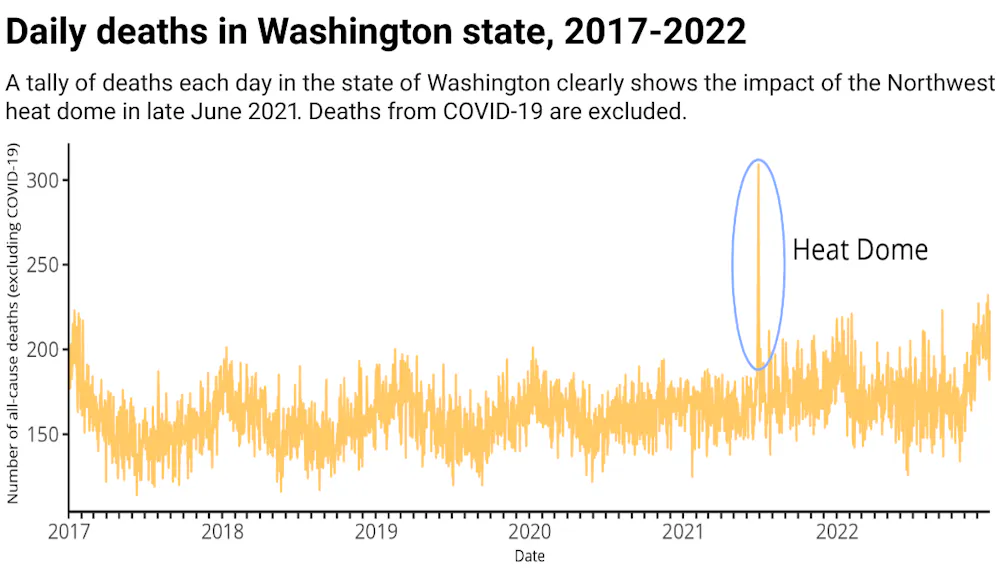
    A chart of all deaths, excluding COVID-19, shows the extraordinary impact the 2021 heat dome had in Washington.
    ‘In the Hot Seat’ report, 2022

    We were excited and relieved when the community was awarded a US$19.9 million grant from the Environmental Protection Agency to help it take concrete steps to adapt to climate change and boost the local economy in the process. The grant would help establish resilience hubs with microgrids and help residents without air conditioning install energy-efficient cooling systems. The city doesn’t have the means to make these improvements on its own, even if they would save lives and money in the long run.

    Less than a year later, the Trump administration abruptly terminated the funding.

    Spokane’s grant wasn’t the only one eliminated – about 350 similar grants that had been awarded to help communities across the country manage climate changes, from extreme heat and wildfire smoke to rising seas and flooding, were also terminated on the grounds that they don’t meet the White House’s priorities. Many other grants to help communities have also been terminated.

    Many of the communities that lost funding are like Spokane: They can’t afford to do this kind of work on their own.

    Why cities like Spokane need the help

    Like many communities in the American West, Spokane was founded in the late 19th century on wealth from railroads and resource extraction, especially gold, silver and timber.

    Today, it is a city of 230,000 in a metro area of a half-million people, the largest on the I-90 corridor between Minneapolis and Seattle. In many ways, Spokane could be on the cusp of a renaissance.

    In January 2025, the U.S. Department of Commerce announced a $48 million grant to develop a tech hub that could put the Inland Northwest on a path to become a global leader in advanced aerospace materials. But then, in May, the Trump administration rescinded that grant as well.

    The lost grants left the economy – and Spokane’s ability to adapt fast enough to keep up with climate changes – uncertain.

    Heat waves are becoming a growing risk in Spokane, known for its river and falls that tumble near downtown.
    Roman Eugeniusz/Wikimedia Commons, CC BY-SA

    This is not a wealthy area. The median household income is nearly $30,000 less than the state average. More than 13 out of every 100 people in Spokane live in poverty, above the national average, and over 67% of the children are eligible for free or reduced lunch.

    The city is a light blue island in a dark red sea, politically speaking, with a moderate mayor. Its congressional district has voted Republican by wide margins since 1995, the year that then-House Speaker Tom Foley lost his reelection bid.

    Lessons from the 2021 heat dome

    The 2021 heat wave was a catalyzing event for the community. The newly formed Gonzaga Institute for Climate, Water and the Environment brought together a coalition of government and community partners to apply for the EPA’s Climate and Environmental Justice Community Change Grant Program. The grants, funded by Congress under the Inflation Reduction Act of 2022, were intended to help communities most affected by pollution and climate change build adaptive capacity and boost the safety of their residents.

    A key lesson from the 2021 heat dome was that temporary, or pop-up, cooling centers don’t work well. People just weren’t showing up. Our research found that the best approach is to strengthen existing community facilities that people already turn to in moments of difficulty.

    Half the $19.9 million award was for outfitting five resilience hubs in existing libraries and community centers with solar arrays and battery backup microgrids, allowing them to continue providing a safe, cool space during a heat wave if the power shuts down.

    The locations and plans for five resilience hubs to serve Spokane, and the infrastructure they would receive.
    Gonzaga Institute for Climate, Water and the Environment

    Another $8 million in grant funding was meant to provide 300 low- to moderate-income homeowners with new high-efficiency electric heat pump heating, ventilation and air conditioning systems, providing more affordable utility bills while improving their ability to cool their homes and reducing fossil fuel emissions.

    Communities are left with few options

    Now, this and other work is at risk in Spokane and cities and towns like it around the country that also lost funding.

    According to the Trump administration, the program – designed to help hundreds of communities around the country become safer – was “no longer consistent with EPA funding priorities.”

    A class action lawsuit was recently filed over the termination of the grants by a coalition that includes Earth Justice and the Southern Environmental Law Center. If the case is successful, Spokane could see its funding restored.

    Meanwhile, the city and my team know we have to move fast, with whatever money and other resources we can find, to help Spokane prepare for worsening heat. We formed the Spokane Climate Resilience Collaborative – a partnership between community organizations, health officials and the city – as one way to advance planning for and responding to climate hazards such as extreme heat and wildfire smoke.

    As concentrations of heat-trapping gasses accumulate in the atmosphere, both the frequency and severity of heat waves increase. It is only a matter of time before another deadly heat dome arrives.

    Brian G. Henning receives funding from the Environmental Protection Agency.

    ref. My city was one of hundreds expecting federal funds to help manage rising heat wave risk – then EPA terminated the grants – https://theconversation.com/my-city-was-one-of-hundreds-expecting-federal-funds-to-help-manage-rising-heat-wave-risk-then-epa-terminated-the-grants-259009

    MIL OSI Analysis

  • MIL-OSI Africa: Minister tables R509 million DPME budget

    Source: Government of South Africa

    The Department of Planning, Monitoring and Evaluation (DPME) has been allocated a budget of R509 million for the 2025/26 financial year, which will support efforts to strengthen government capacity and deliver on South Africa’s key development priorities.

    Minister in the Presidency for Planning, Monitoring and Evaluation, Maropene Ramokgopa, supported by Deputy Minister Seiso Mohai, presented the 2025 Budget Vote of the department in Parliament on Tuesday.

    Addressing Parliament, Minister Ramokgopa highlighted the DPME’s key mandate to coordinate and integrate government planning, monitor implementation of the National Development Plan (NDP) Vision 2030 and the Medium-Term Development Plan (MTDP) 2024–2029, and evaluate government programmes to improve performance and accountability across the state.

    “Over the past few years, attempts have been made to strengthen the mandate of DPME through the Planning Bill. We are now shifting focus and considering a White Paper process which will enable us to clarify a cohort of questions that have been raised by various stakeholders within and outside of government,” said the Minister.

    The Minister reported significant progress, including Cabinet approval of the MTDP 2024–2029 in February 2025, with implementation already underway. The MTDP’s strategic priorities are:

    • Driving inclusive economic growth and job creation,
    • Reducing poverty and addressing the high cost of living,
    • Building a capable, ethical, and developmental state.

    “Successful implementation of the MTDP must be demonstrated through the achievement of its set targets and improved living conditions of citizens. It is not enough to plan — we must see results, and we must be held accountable for those results,” said Ramokgopa.

    The DPME is facilitating the alignment of national, provincial, and local government planning processes, including efforts to integrate the MTDP with Provincial Growth and Development Strategies, beginning with the Northern Cape.

    The Minister emphasised the department’s role in reforming State-Owned Enterprises (SOEs), with the tabling of the National State Enterprises Bill (B1-2024), which proposes a centralised shareholder model to improve SOE governance, performance, and economic impact.

    In addition, the DPME is leading the implementation of a forward-looking Evidence Plan to enhance research, evaluation, and data systems. This will enable evidence-based decision-making and improve transparency and accountability, supported by modernised reporting and digital dashboards.

    “Our work must be backed by credible evidence, and that evidence must lead to impact. We are committed to building a state that listens, learns, and delivers measurable change,” said Ramokgopa. 

    The Minister noted the importance of strengthening collaboration with Parliament, oversight institutions, and other stakeholders, highlighting recent capacity-building workshops and ongoing bilateral engagements.

    South Africa’s role as Chair of the Development Working Group under the G20 Presidency was also underscored, with priorities including mobilising finance for development, advancing social protection floors, and championing global public goods. – SAnews.gov.za

    MIL OSI Africa

  • MIL-OSI Africa: SARS gets largest chunk of Treasury Budget transfers

    Source: Government of South Africa

    SARS gets largest chunk of Treasury Budget transfers

    National Treasury has been allocated R91.835 billion over the medium-term, with the South African Revenue Service (SARS) receiving the largest component of the transfers.

    Tabling National Treasury’s Budget Vote in Parliament, Finance Minister Enoch Godongwana said the department’s budget (excluding direct charges) over the medium-term is R91.835 billion, which is an average growth rate of 6.2% from 2024/25 – 2027/28.

    “The largest component is for transfers to SARS, which is allocated R45.760 billion (or 49.8%) of the department’s budget for operations and capital projects over the medium-term.

    “This is an increase of R8 billion of the SARS baseline compared to the 2024 Estimate of Expenditure. Part of this increase is to improve effectiveness in revenue collection by enhancing their ability to collect debt through better systems, increasing staff capacity and modernising their processes to establish e-invoicing for VAT, instant payment systems and upgrades of customs infrastructure,” Godongwana said on Tuesday.

    Last week, National Treasury published monthly debt collection data from SARS for the first time to monitor progress and improve transparency.

    The budget allocation per economic classification over the medium-term is as follows:

    • R3.422 billion on compensation of employees;
    • R6.983 billion on goods and services;
    • R78.554 billion on transfers and subsidies;
    • R89 million on payment of capital assets, and
    • and R2.786 billion on payment for financial assets.

    Sustainable public finances

    National Treasury’s Annual Performance Plan 2025/26 sets out clear and ambitious programmes to realise its goals of job creation, lowering poverty and greater inclusion. 

    “In terms of restoring sustainability and the impact of our public finances, a review of how the government spends money has been central to our policy efforts. To achieve all of our national priorities we need to realise much greater efficiencies on the spending side,” the Minister said.

    As such there are new reviews that government plans to conduct, namely:

    • An audit of ghost workers in the public service using a data-driven approach that links administrative and financial databases to identify bogus and non-existent employees and immediately remove them from the system.
    • An infrastructure conditional grant review. This will assess why provinces and municipalities underspend, why projects are not delivered on time and within budget, and where relevant, why the quality of the deliverables is poor; and
    • A review of the remuneration of executives and board members of public entities. The aim is to develop a standardised framework for all schedule three public entities, based on their mandates, areas of influence, and the complexity of a given organisation.

    Financial Action Task Force grey list

    With South Africa completing all 22 recommended action items outlined by the Financial Action Task Force (FATF), the Minister stressed that the country must continue to strengthen the laws to fight illicit and corrupt financing.

    “Lastly, I am happy to say that our endeavors, not just the National Treasury’s but the government’s as a whole, to remove South Africa from the Financial Action Task Force grey list, are succeeding,” he said.

    South Africa was placed on the FATF grey list due to deficiencies in its anti-money laundering and counter-terrorism financing (AML/CFT) regime.

    The FATF recently confirmed that South Africa has substantially completed its action plan and warrants an on-site assessment. 

    The on-site assessment will be to verify that the implementation of AML/CFT reforms has begun and is being sustained, and that the necessary political commitment remains in place to sustain implementation in the future.

    The on-site visit will take place before the next FATF Plenary, and, if the outcome of the visit is positive, the FATF will delist South Africa from the greylist at its next Plenary in October 2025. Preparations for the on-site visit have commenced.

    “A General Laws Anti-Money Laundering and Combating Terrorism Financing Bill, to further improve our ability to combat money laundering, terrorism financing and proliferation financing, is being finalised for another round of public comment, and tabling in Parliament in the third quarter of 2025.

    “Similarly, the National Treasury has made substantial progress implementing the State Capture Commission recommendations through multiple concrete actions. SARS investigations have recovered R4.8 billion in unpaid taxes, while professional bodies like the South African Institute of Chartered Accountants (SAICA) have imposed consequence management including disbarment,” the Minister said.

    The Financial Intelligence Centre launched the ‘Enablers Project’ with law enforcement to trace state capture fund flows, and a 10-year ban was imposed on Bain & Co (currently under litigation).

    “Critically, a central register now tracks dismissed officials and those who have resigned during their disciplinary processes across all government spheres,” Godongwana said. – SAnews.gov.za

    nosihle

    MIL OSI Africa

  • MIL-OSI Africa: Department working on turning SA into a successful tourism nation

    Source: Government of South Africa

    Department working on turning SA into a successful tourism nation

    Tourism is a vehicle for creating jobs, destroying poverty and creating inclusive economic growth and sustainability, says Deputy Minister of Tourism Maggie Sotyu.

    “The nation has given this Government of National Unity a clear mandate to turn South Africa into a successful tourism nation and to unite all of us – citizens, visitors and tourists alike – in the joy of discovering our country, discovering each other, and in the shared hope of equality for all,” said the Deputy Minister.

    She was speaking at the tabling of the department’s Budget Vote in Cape Town on Tuesday.

    Sotyu said sustainable SMMEs are key drivers of inclusive growth and poverty eradication; therefore, economic growth without transformation entrenches exclusion and transformation without growth is unsustainable

    The department, together with South African Tourism, champions conditions for sustainability. 

    “To lower the many barriers that inhibit SMMEs’ entry into the hotel industry, for example, the department has a programme called the Tourism Grading Support Programme (TGSP) which continues to subsidise grading costs. 

    “In financial year 2024/25, the TGSP supported 2 970 establishments, encouraging active participation in the TGCSA’s grading system. These efforts contribute to the standardisation of service excellence, helping South Africa to remain competitive in global tourism markets.”

    To sustain profits and benefit the local economy, the department will continue to support the tourism industry towards reaching the threshold of local development.

    “Some big hotels do not appear in the list of graded establishments on the website of the Tourism Grading Council but still ‘sell’ themselves as 5-star hotels. 

    “To ensure that the grading system remains world-class and relevant to our local environment in South Africa, we have initiated the Grading Criteria Review which will be finalised this financial year. 

    “Grading of tourist establishments that host international events is a crucial factor in the sustainability of economic growth and job creation. 

    “It is for this reason the South African National Conventions Bureau (SANCB), through the Meetings, Incentives, Conferences and Exhibitions (MICE) sub-sector, will focus on capitalising on previous successes to accelerate growth through the consolidation of multiple national efforts when bidding for international meetings.”

    The secured conferences will also contribute to the regional spread of business events. 

    Given that tourism is a highly labour-intensive industry, people will rightfully expect to see significant local employment within these successfully bided international conferences. 

    The Deputy Minister said the biggest international conference to be held in South Africa later this year, the G20, will be a catalyst for this yearned-for job creation. 

    “The G20 presents an opportunity to showcase the nation’s unparalleled hospitality, world-class infrastructure, quality-assured accommodations, and experiences, as well as its ability to host global events. 

    “As the department, we are very committed to ensure that no one is left behind on the knowledge, importance and benefit of this G20,” said Sotyu. – SAnews.gov.za

    Janine

    MIL OSI Africa

  • MIL-OSI Africa: Sierra Leone’s President Julius Maada Bio Launches National Water Security and WASH Access Project, Calls for Collective Action on Clean Water and Sanitation

    Source: APO – Report:

    .

    His Excellency President Dr Julius Maada Bio has officially launched the Water Security and WASH Access Project, a landmark $180 million, World Bank-funded initiative under the theme “Securing Water, Enabling Dignity, and Advancing Development.” The 10-year Multiphase Programmatic Approach aims to reach 4 million people by 2035, achieving 90% national WASH coverage.

    In his keynote address, President Bio described the launch as a historic milestone in Sierra Leone’s ongoing quest for equity, dignity, and sustainable development. He emphasized that access to safe water and sanitation is a fundamental right, not a privilege.

    “My government is guided by the belief that access to safe water and sanitation is not a favour extended to the few, but a right guaranteed to all,” the President declared. “That is why WASH is at the heart of our National Development Plan and central to our Human Capital Development agenda.”

    The President decried the daily challenges faced by citizens, stating that no child should have to walk miles for water before school, no mother should risk infection during childbirth due to lack of clean water, and no community should endure the indignity of open defecation or waterborne diseases in the 21st century.

    He affirmed that the new WASH programme marks a decisive step to break the cycle of deprivation. Structured in three progressive phases, the initiative provides a coherent roadmap to achieving water security and sanitation access nationwide. Each phase, he assured, will be robustly monitored, implemented with transparency, and tied to incentive-based delivery mechanisms.

    President Bio said the programme envisions a future where water poverty is eradicated, girls stay in school thanks to improved sanitation, health facilities are safe and functional, ecosystems are protected, and 5,000 jobs, including 2,000 for women, are created through a gender-responsive recovery.

    He also announced plans to establish a Water Administration House to consolidate oversight, regulation, and coordination within the sector. The President reaffirmed his government’s support to strengthen the Ministry of Water Resources and Sanitation, to enforce standards, attract investment, and coordinate stakeholders.

    “This multiphase programmatic approach is a shining example of what is possible when national ownership meets international solidarity,” he said, adding that the project aligns with Sustainable Development Goal 6: Clean Water and Sanitation for All.

    President Bio acknowledged the efforts of the Minister of Water Resources and Sanitation, the WASH sector public servants, GUMA Valley Water Company, SALWACO, EWRC, and the National Water Resources Management Agency (NWRMA), calling on all stakeholders to deliver with integrity and excellence.

    “As your President, I reaffirm my full commitment to this agenda. We will ensure the programme is fully resourced and that every Sierra Leonean, in both rural hamlets and urban wards, feels the impact of this transformative investment,” he declared. “Water is not just a development commodity; it is a symbol of justice, a foundation of peace, and a building block of national resilience.”

    World Bank Country Manager Dr Abdu Muwonge praised President Bio for his strong advocacy on behalf of the country, recalling how, President Bio personally made a plea in Washington for investment in Sierra Leone’s WASH sector two years ago, which, he noted, resulted in funding this transformative initiative.

    Dr Muwonge urged a holistic and inclusive strategy, strengthening the capacity of sector institutions such as GUMA, SALWACO, and local councils, while calling for nationwide engagement in the stewardship of water resources.

    Minister of Water Resources and Sanitation, Dr Sao-Kpato Hannah Max-Kyne, described the occasion as a defining moment in delivering President Bio’s development vision and called for national collaboration on implementation and the development of a clear, focused roadmap to address WASH sector challenges.

    – on behalf of State House Sierra Leone.

    MIL OSI Africa

  • MIL-OSI United Nations: In South Asia, anaemia threatens women’s health and economic futures

    Source: United Nations 4

    The warning, issued jointly by UN agencies and the regional socio-economic bloc SAARC on Wednesday, underscores South Asia’s status as the “global epicentre” of anaemia among adolescent girls and women.

    An estimated 259 million already suffer from the condition, which impairs the body’s ability to carry oxygen, contributing to chronic fatigue, poor maternal outcomes, and reduced educational and economic participation.

    This is a clarion call for action,” said Sanjay Wijesekera, Regional Director for the UN Children’s Fund (UNICEF), which together with the UN World Health Organization (WHO) and SAARC prepared the analysis.

    When half of all adolescent girls and women in South Asia are anaemic, it is not only a health issue – it is a signal that systems are failing them.

    A far-reaching but preventable condition

    Anaemia doesn’t just affect women and girls – it contributes to 40% of the world’s low birth weight cases and affects child growth and learning, particularly in poorer households.

    The economic toll is staggering: anaemia costs South Asia an estimated $32.5 billion annually, perpetuating cycles of poverty and poor health.

    Yet, the condition is preventable and treatable. Proven solutions include iron and folic acid supplementation, iron- and vitamin-rich diets, better sanitation and infection control, and stronger maternal health services.

    Experts stress that multi-sector collaboration is critical for sustained progress.

    A nurse speaks to women about nutritious food in western India’s Sabarkantha district, were many women and girls suffer from iron deficiency.

    Integrated efforts crucial

    In nearly every country, progress hinges on strengthening health systems, expanding nutrition programmes, and reaching adolescent girls and women in marginalised communities.

    Sri Lanka, where 18.5 per cent of women of reproductive age are anaemic, is scaling up its national nutrition initiative, focusing on the most affected districts.

    India and Pakistan are also seeing encouraging signs. In India, high-burden states are integrating iron supplementation into school and maternal care programmes. Pakistan has piloted community-based nutrition initiatives linked to reproductive health services, enabling early detection and follow-up care.

    In Bangladesh, school-based health initiatives are reaching adolescents with fortified meals and health education, coordinated across health, education, and agriculture ministries.

    Community-driven action works

    The Maldives and Bhutan are prioritising early prevention through childhood nutrition, food fortification, and public awareness campaigns. Though smaller in population, both are investing in anaemia surveillance and inter-ministerial collaboration.

    Nepal stands out for its equitable results: since 2016, the country has cut anaemia among women of reproductive age by 7 per cent, with larger declines in poorer areas. Its female community health volunteers are key, providing counselling and referrals in remote regions and linking vulnerable households to public services.

    Man Kumari Gurung, a public health nurse in Karnali Province, credits the achievements to a range of community-driven efforts.

    “Pregnant women receive eggs, chicken and nutritious food through programmes like Sutkeri Poshan Koseli (Nutrition Gift for New Mothers),” she said. “Cash grants also help with transport to hospitals, supporting safer births and better nutrition.”

    © UNICEF/InceptChang

    A nurse checks a pregnant woman’s weight and vital signs at a clinic in Galigamuwa, Sri Lanka.

    Everyone has a role

    Ending anaemia requires leadership and teamwork. Governments must lead, but communities, health workers, schools, and families all play a part.

    Stronger health systems, better data, and coordinated action across sectors can help girls and women reach their full potential – building healthier communities and stronger economies.

    Young people and mothers are at the heart of South Asia’s development goals. Ensuring that they are healthy, nourished and empowered is not just a moral imperative, it is a strategic investment in the future of our societies,” said Md. Golam Sarwar, Secretary General of SAARC.

    MIL OSI United Nations News

  • MIL-OSI Analysis: AI is driving down the price of knowledge – universities have to rethink what they offer

    Source: The Conversation – Global Perspectives – By Patrick Dodd, Professional Teaching Fellow, Business School, University of Auckland, Waipapa Taumata Rau

    For a long time, universities worked off a simple idea: knowledge was scarce. You paid for tuition, showed up to lectures, completed assignments and eventually earned a credential.

    That process did two things: it gave you access to knowledge that was hard to find elsewhere, and it signalled to employers you had invested time and effort to master that knowledge.

    The model worked because the supply curve for high-quality information sat far to the left, meaning knowledge was scarce and the price – tuition and wage premiums – stayed high.

    Now the curve has shifted right, as the graph below illustrates. When supply moves right – that is, something becomes more accessible – the new intersection with demand sits lower on the price axis. This is why tuition premiums and graduate wage advantages are now under pressure.


    According to global consultancy McKinsey, generative AI could add between US$2.6 trillion and $4.4 trillion in annual global productivity. Why? Because AI drives the marginal cost of producing and organising information toward zero.

    Large language models no longer just retrieve facts; they explain, translate, summarise and draft almost instantly. When supply explodes like that, basic economics says price falls. The “knowledge premium” universities have long sold is deflating as a result.

    Employers have already made their move

    Markets react faster than curriculums. Since ChatGPT launched, entry-level job listings in the United Kingdom have fallen by about a third. In the United States, several states are removing degree requirements from public-sector roles.

    In Maryland, for instance, the share of state-government job ads requiring a degree slid from roughly 68% to 53% between 2022 and 2024.

    In economic terms, employers are repricing labour because AI is now a substitute for many routine, codifiable tasks that graduates once performed. If a chatbot can complete the work at near-zero marginal cost, the wage premium paid to a junior analyst shrinks.

    But the value of knowledge is not falling at the same speed everywhere. Economists such as David Autor and Daron Acemoglu point out that technology substitutes for some tasks while complementing others:

    • codifiable knowledge – structured, rule-based material such as tax codes or contract templates – faces rapid substitution by AI

    • tacit knowledge – contextual skills such as leading a team through conflict – acts as a complement, so its value can even rise.

    Data backs this up. Labour market analytics company Lightcast notes that one-third of the skills employers want have changed between 2021 and 2024. The American Enterprise Institute warns that mid-level knowledge workers, whose jobs depend on repeatable expertise, are most at risk of wage pressure.

    So yes, baseline knowledge still matters. You need it to prompt AI, judge its output and make good decisions. But the equilibrium wage premium – meaning the extra pay employers offer once supply and demand for that knowledge settle – is sliding down the demand curve fast.

    What’s scarce now?

    Herbert Simon, the Nobel Prize–winning economist and cognitive scientist, put it neatly decades ago: “A wealth of information creates a poverty of attention.” When facts become cheap and plentiful, our limited capacity to filter, judge and apply them turns into the real bottleneck.

    That is why scarce resources shift from information itself to what machines still struggle to copy: focused attention, sound judgement, strong ethics, creativity and collaboration.

    I group these human complements under what I call the C.R.E.A.T.E.R. framework:

    • critical thinking – asking smart questions and spotting weak arguments

    • resilience and adaptability – staying steady when everything changes

    • emotional intelligence – understanding people and leading with empathy

    • accountability and ethics – taking responsibility for difficult calls

    • teamwork and collaboration – working well with people who think differently

    • entrepreneurial creativity – seeing gaps and building new solutions

    • reflection and lifelong learning – staying curious and ready to grow.

    These capabilities are the genuine scarcity in today’s market. They are complements to AI, not substitutes, which is why their wage returns hold or climb.

    What universities can do right now

    1. Audit courses: if ChatGPT can already score highly on an exam, the marginal value of teaching that content is near zero. Pivot the assessment toward judgement and synthesis.

    2. Reinvest in the learning experience: push resources into coached projects, messy real-world simulations, and ethical decision labs where AI is a tool, not the performer.

    3. Credential what matters: create micro-credentials for skills such as collaboration, initiative and ethical reasoning. These signal AI complements, not substitutes, and employers notice.

    4. Work with industry but keep it collaborative: invite employers to co-design assessments, not dictate them. A good partnership works like a design studio rather than a boardroom order sheet. Academics bring teaching expertise and rigour, employers supply real-world use cases, and students help test and refine the ideas.

    Universities can no longer rely on scarcity setting the price for the curated and credentialed form of information that used to be hard to obtain.

    The comparative advantage now lies in cultivating human skills that act as complements to AI. If universities do not adapt, the market – students and employers alike – will move on without them.

    The opportunity is clear. Shift the product from content delivery to judgement formation. Teach students how to think with, not against, intelligent machines. Because the old model, the one that priced knowledge as a scarce good, is already slipping below its economic break-even point.

    Patrick Dodd does not work for, consult, own shares in or receive funding from any company or organisation that would benefit from this article, and has disclosed no relevant affiliations beyond their academic appointment.

    ref. AI is driving down the price of knowledge – universities have to rethink what they offer – https://theconversation.com/ai-is-driving-down-the-price-of-knowledge-universities-have-to-rethink-what-they-offer-260493

    MIL OSI Analysis

  • PM Modi shares highlights of meetings with Chile President, UN Chief and Rousseff at BRICS

    Source: Government of India

    Source: Government of India (4)

    Prime Minister Narendra Modi on Tuesday shared glimpses of his meetings with key international figures — including Chilean President Gabriel Boric Font, United Nations Secretary-General Antonio Guterres and former Brazilian President Dilma Rousseff — held on the sidelines of the BRICS Summit in Rio de Janeiro.

    Sharing details about his meeting with Chilean President Gabriel Boric Font, PM Modi highlighted the growing friendship between the two nations.

    “Delighted to have met President Gabriel Boric Font of Chile during the Rio BRICS Summit. India-Chile friendship is getting stronger and stronger!” PM Modi said in a post on X.

    https://x.com/narendramodi/status/1942569161743556985

    In April, the Chilean President paid a state visit to India accompanied by a high-level delegation, including ministers, Members of Parliament, senior officials, business associations, media and prominent Chileans involved in the India-Chile cultural connect.

    During that visit, which marked 76 years of diplomatic relations between the two countries, both leaders discussed in detail the historic diplomatic ties established in 1949, growing trade linkages, people-to-people connections, cultural exchanges and the warm and cordial bilateral relations. They also expressed their desire to further expand and deepen the multifaceted relationship in all areas of mutual interest.

    PM Modi also met United Nations Secretary-General António Guterres in Rio de Janeiro on Monday.

    Taking to X, PM Modi said, “Interacted with Mr. António Guterres, UN Secretary-General, on the sidelines of the BRICS Summit in Rio de Janeiro yesterday.”

    https://x.com/narendramodi/status/1942568681692893508

    India’s deepening engagement with the UN is based on its steadfast commitment to multilateralism and dialogue as the keys to achieving shared goals and addressing common global challenges, including peacebuilding and peacekeeping, sustainable development, poverty eradication, environment, climate change, terrorism, disarmament, human rights, health and pandemics, migration, cyber security, space and frontier technologies such as Artificial Intelligence, and comprehensive reform of the United Nations, including reform of the Security Council.

    PM Modi also shared details about his productive conversation with former Brazilian President Dilma Rousseff, who now heads the New Development Bank (NDB).

    Rousseff was in Rio de Janeiro to celebrate the progress made by the ‘BRICS Bank’ and discuss reforms of global financial institutions within the BRICS framework.

    “Productive interaction with Dilma Rousseff, President of the New Development Bank and former President of Brazil,” the Prime Minister said on X.

    https://x.com/narendramodi/status/1942569414353703136

    Earlier in the day, Lula welcomed PM Modi at the Alvorada Palace in Brasilia, where he was given a ceremonial reception featuring a 114-horse escort for his car. The two leaders then held a restricted-format meeting, followed by delegation-level discussions and the signing of agreements.

    —IANS

  • MIL-OSI Russia: China hopes to work with the UN to build a more just and reasonable international order – Premier of the State Council of the People’s Republic of China

    Translation. Region: Russian Federal

    Source: People’s Republic of China in Russian – People’s Republic of China in Russian –

    An important disclaimer is at the bottom of this article.

    Source: People’s Republic of China – State Council News

    RIO DE JANEIRO, July 8 (Xinhua) — China is willing to deepen communication and cooperation with the United Nations to jointly promote the building of a fairer and more reasonable international order, Chinese Premier Li Qiang said in Rio de Janeiro, Brazil, on Tuesday.

    Li Qiang made the statement during a meeting with UN Secretary-General Antonio Guterres on the sidelines of the 17th BRICS Leaders’ Meeting.

    As the Premier of the State Council pointed out, in the 80 years since its founding, the UN has made important contributions to maintaining world peace and tranquility and promoting common development.

    Noting that today’s world is facing increasing instability and uncertainty, Li Qiang stressed that the UN should play a more effective role.

    According to him, the concept of building a community with a shared future for mankind and the three major global initiatives put forward by Chinese President Xi Jinping are largely consistent with the purposes and principles of the UN Charter and reflect China’s firm commitment and pragmatic approach to supporting multilateralism and the cause of the UN.

    The more complex the international situation becomes, the more important it is to uphold the authority of the UN, the head of the Chinese government continued, adding that China firmly supports the central role of the world organization in global governance and is willing to work with all parties to implement genuine multilateralism and more effectively advance the cause of the UN.

    Today, when global security is facing serious challenges, China is making significant efforts to promote dialogue for political resolution of hot spot issues and will continue to support the unique role of the UN in reducing tensions, Li Qiang stressed.

    He also noted that all parties should prioritize development on the international agenda, jointly strengthen global cooperation for development, direct resources primarily to key areas such as poverty reduction, education, employment and capacity building, and promote global partnership for development.

    Li Qiang assured that China, as a responsible major developing country, will continue to steadily expand opening-up, share its opportunities with the world and promote common development.

    China supports the UN’s role as a key channel for addressing governance gaps in emerging areas such as artificial intelligence, cyberspace, polar regions and outer space, the premier added. -0-

    Please note: This information is raw content obtained directly from the source of the information. It is an accurate report of what the source claims and does not necessarily reflect the position of MIL-OSI or its clients.

    .

    MIL OSI Russia News

  • MIL-OSI NGOs: UK: Amnesty International and disabled people back UN concern over PIP and UC bill

    Source: Amnesty International –

    Protests against the PIP and UC bill in Rachel Reeves’s constituency

    UK: AMNESTY INTERNATIONAL AND DISABLED PEOPLE BACK UN CONCERNS OVER PIP AND UC BILL

    Amnesty International and The Disabled Persons Organisations Forum England (DPOFE) and have called for the PIP and UC bill to be scrapped after the UN wrote to the UK Government raising concerns over its impact on disabled people

    The letter highlights concerns that the remaining cuts to universal credit could lead to increased poverty despite previous UN condemnation of grave and systemic rights violations.

    “Disabled People’s Organisations faced such hostility from our government that we reached out for help to the UN. They have now answered our call” Rick Burgess Co-Chair of The Disabled Persons Organisations Forum England (DPOFE)

    “It should shame the Government that the UN has felt the need to intervene over their brutal cuts to Universal Credit” – Amnesty International’s Economic, Social and Cultural Rights Lead Jen Clark

    Disabled Persons Organisations Forum England and Amnesty International have called on the Government to scrap the PIP and UC bill, following a letter by the UN raising concerns over the impact of the bill. The UN letter highlight a lack of consultation with disabled people, inadequate impact assessments, and regressive policy changes that risk deepening poverty and rights violations, particularly for those with complex needs, amongst other concerns.

    The UN have called for a response to their letter by the 11th of August.

    Commenting on the UN’s letter, Rick Burgess, co-founder of Co-Chair of the DPOFE and Amnesty International UK Disabled People’s Human Rights Network said: “Disabled People’s Organisations faced such hostility from our government that we reached out for help to the UN. They have now answered our call and it is clear that Keir Starmer risks further destroying disabled people’s human rights if his government carries on with its Bills and does not change ableist assumptions about us. It is utterly shameful we have to yet again appeal for international help to defend us against our own government.”

    Commenting on the proposed cuts to Universal Credit, Amnesty International’s Economic, Social and Cultural Rights Lead, Jen Clark said:

    “It should shame the Government that the UN has felt the need to intervene over these rushed, shambolic brutal cuts to Universal Credit and wider social security reform. These cuts will leave young disabled people or those with illnesses that vary day to day, such as mental health conditions and multiple sclerosis, at high risk of being pushed into poverty and unable to access their basic rights to food, housing and the care they need. Following the pause on the cuts to PIP, the bill should now be fully scrapped. It is unforgivable that the Government is choosing to balance the books by impoverishing some of the most vulnerable people in our society, instead of asking the very wealthiest to pay more.”

    View latest press releases

    MIL OSI NGO

  • MIL-OSI NGOs: UK: Amnesty International and disabled people back UN concern over PIP and UC bill

    Source: Amnesty International –

    Protests against the PIP and UC bill in Rachel Reeves’s constituency

    UK: AMNESTY INTERNATIONAL AND DISABLED PEOPLE BACK UN CONCERNS OVER PIP AND UC BILL

    Amnesty International and The Disabled Persons Organisations Forum England (DPOFE) and have called for the PIP and UC bill to be scrapped after the UN wrote to the UK Government raising concerns over its impact on disabled people

    The letter highlights concerns that the remaining cuts to universal credit could lead to increased poverty despite previous UN condemnation of grave and systemic rights violations.

    “Disabled People’s Organisations faced such hostility from our government that we reached out for help to the UN. They have now answered our call” Rick Burgess Co-Chair of The Disabled Persons Organisations Forum England (DPOFE)

    “It should shame the Government that the UN has felt the need to intervene over their brutal cuts to Universal Credit” – Amnesty International’s Economic, Social and Cultural Rights Lead Jen Clark

    Disabled Persons Organisations Forum England and Amnesty International have called on the Government to scrap the PIP and UC bill, following a letter by the UN raising concerns over the impact of the bill. The UN letter highlight a lack of consultation with disabled people, inadequate impact assessments, and regressive policy changes that risk deepening poverty and rights violations, particularly for those with complex needs, amongst other concerns.

    The UN have called for a response to their letter by the 11th of August.

    Commenting on the UN’s letter, Rick Burgess, co-founder of Co-Chair of the DPOFE and Amnesty International UK Disabled People’s Human Rights Network said: “Disabled People’s Organisations faced such hostility from our government that we reached out for help to the UN. They have now answered our call and it is clear that Keir Starmer risks further destroying disabled people’s human rights if his government carries on with its Bills and does not change ableist assumptions about us. It is utterly shameful we have to yet again appeal for international help to defend us against our own government.”

    Commenting on the proposed cuts to Universal Credit, Amnesty International’s Economic, Social and Cultural Rights Lead, Jen Clark said:

    “It should shame the Government that the UN has felt the need to intervene over these rushed, shambolic brutal cuts to Universal Credit and wider social security reform. These cuts will leave young disabled people or those with illnesses that vary day to day, such as mental health conditions and multiple sclerosis, at high risk of being pushed into poverty and unable to access their basic rights to food, housing and the care they need. Following the pause on the cuts to PIP, the bill should now be fully scrapped. It is unforgivable that the Government is choosing to balance the books by impoverishing some of the most vulnerable people in our society, instead of asking the very wealthiest to pay more.”

    View latest press releases

    MIL OSI NGO