Category: China

  • MIL-OSI Analysis: From glass and steel to rare earth metals, new materials have changed society throughout history

    Source: The Conversation – USA – By Peter Mullner, Distinguished Professor in Materials Science and Engineering, Boise State University

    Steel played a large role in the Industrial Revolution. Monty Rakusen/DigitalVision via Getty Images

    Many modern devices – from cellphones and computers to electric vehicles and wind turbines – rely on strong magnets made from a type of minerals called rare earths. As the systems and infrastructure used in daily life have turned digital and the United States has moved toward renewable energy, accessing these minerals has become critical – and the markets for these elements have grown rapidly.

    Modern society now uses rare earth magnets in everything from national defense, where magnet-based systems are integral to missile guidance and aircraft, to the clean energy transition, which depends on wind turbines and electric vehicles.

    The rapid growth of the rare earth metal trade and its effects on society isn’t the only case study of its kind. Throughout history, materials have quietly shaped the trajectory of human civilization. They form the tools people use, the buildings they inhabit, the devices that mediate their relationships and the systems that structure economies. Newly discovered materials can set off ripple effects that shape industries, shift geopolitical balances and transform people’s daily habits.

    Materials science is the study of the atomic structure, properties, processing and performance of materials. In many ways, materials science is a discipline of immense social consequence.

    As a materials scientist, I’m interested in what can happen when new materials become available. Glass, steel and rare earth magnets are all examples of how innovation in materials science has driven technological change and, as a result, shaped global economies, politics and the environment.

    How innovation shapes society: Pressures from societal and political interests (orange arrows) drive the creation of new materials and the technologies that such materials enable (center). The ripple effects resulting from people using these technologies change the entire fabric of society (blue arrows).
    Peter Mullner

    Glass lenses and the scientific revolution

    In the early 13th century, after the sacking of Constantinople, some excellent Byzantine glassmakers left their homes to settle in Venice – at the time a powerful economic and political center. The local nobility welcomed the glassmakers’ beautiful wares. However, to prevent the glass furnaces from causing fires, the nobles exiled the glassmakers – under penalty of death – to the island of Murano.

    Murano became a center for glass craftsmanship. In the 15th century, the glassmaker Angelo Barovier experimented with adding the ash from burned plants, which contained a chemical substance called potash, to the glass.

    The potash reduced the melting temperature and made liquid glass more fluid. It also eliminated bubbles in the glass and improved optical clarity. This transparent glass was later used in magnifying lenses and spectacles.

    Johannes Gutenberg’s printing press, completed in 1455, made reading more accessible to people across Europe. With it came a need for reading glasses, which grew popular among scholars, merchants and clergy – enough that spectacle-making became an established profession.

    By the early 17th century, glass lenses evolved into compound optical devices. Galileo Galilei pointed a telescope toward celestial bodies, while Antonie van Leeuwenhoek discovered microbial life with a microscope.

    The glass lens of the Vera Rubin Observatory, which surveys the night sky.
    Large Synoptic Survey Telescope/Vera Rubin Observatory, CC BY

    Lens-based instruments have been transformative. Telescopes have redefined long-standing cosmological views. Microscopes have opened entirely new fields in biology and medicine.

    These changes marked the dawn of empirical science, where observation and measurement drove the creation of knowledge. Today, the James Webb Space Telescope and the Vera C. Rubin Observatory continue those early telescopes’ legacies of knowledge creation.

    Steel and empires

    In the late 18th and 19th centuries, the Industrial Revolution created demand for stronger, more reliable materials for machines, railroads, ships and infrastructure. The material that emerged was steel, which is strong, durable and cheap. Steel is a mixture of mostly iron, with small amounts of carbon and other elements added.

    Countries with large-scale steel manufacturing once had outsized economic and political power and influence over geopolitical decisions. For example, the British Parliament intended to prevent the colonies from exporting finished steel with the iron act of 1750. They wanted the colonies’ raw iron as supply for their steel industry in England.

    Benjamin Huntsman invented a smelting process using 3-foot tall ceramic vessels, called crucibles, in 18th-century Sheffield. Huntsman’s crucible process produced higher-quality steel for tools and weapons.

    One hundred years later, Henry Bessemer developed the oxygen-blowing steelmaking process, which drastically increased production speed and lowered costs. In the United States, figures such as Andrew Carnegie created a vast industry based on Bessemer’s process.

    The widespread availability of steel transformed how societies built, traveled and defended themselves. Skyscrapers and transit systems made of steel allowed cities to grow, steel-built battleships and tanks empowered militaries, and cars containing steel became staples in consumer life.
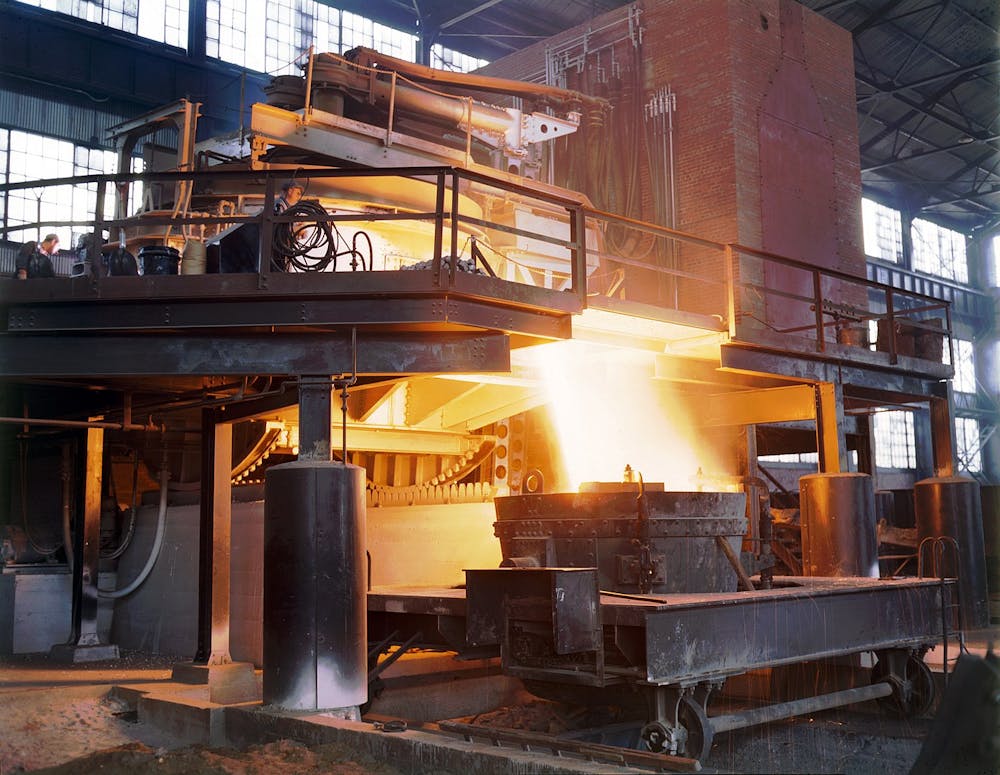
    White-hot steel pouring out of an electric arc furnace in Brackenridge, Penn.
    Alfred T. Palmer/U.S. Library of Congress

    Control over steel resources and infrastructure made steel a foundation of national power. China’s 21st-century rise to steel dominance is a continuation of this pattern. From 1995 to 2015, China’s contribution to the world steel production increased from about 10% to more than 50%. The White House responded in 2018 with massive tariffs on Chinese steel.

    Rare earth metals and global trade

    Early in the 21st century, the advance of digital technologies and the transition to an economy based on renewable energies created a demand for rare earth elements.

    Offshore turbines use several tons of rare earth magnets to transform wind into electricity.
    Hans Hillewaert/Wikimedia Commons, CC BY-SA

    Rare earth elements are 17 chemically very similar elements, including neodymium, dysprosium, samarium and others. They occur in nature in bundles and are the ingredients that make magnets super strong and useful. They are necessary for highly efficient electric motors, wind turbines and electronic devices.

    Because of their chemical similarity, separating and purifying rare earth elements involves complex and expensive processes.

    China controls the majority of global rare earth processing capacity. Political tensions between countries, especially around trade tariffs and strategic competition, can risk shortages or disruptions in the supply chain.

    The rare earth metals case illustrates how a single category of materials can shape trade policy, industrial planning and even diplomatic alliances.

    Mining rare earth elements has allowed for the widespread adoption of many modern technologies.
    Peggy Greb, USDA

    Technological transformation begins with societal pressure. New materials create opportunities for scientific and engineering breakthroughs. Once a material proves useful, it quickly becomes woven into the fabric of daily life and broader systems. With each innovation, the material world subtly reorganizes the social world — redefining what is possible, desirable and normal.

    Understanding how societies respond to new innovations in materials science can help today’s engineers and scientists solve crises in sustainability and security. Every technical decision is, in some ways, a cultural one, and every material has a story that extends far beyond its molecular structure.

    The National Science Foundation, the Department of Energy, NASA, and other national and regional agencies have funded former research of Peter Mullner.

    ref. From glass and steel to rare earth metals, new materials have changed society throughout history – https://theconversation.com/from-glass-and-steel-to-rare-earth-metals-new-materials-have-changed-society-throughout-history-258244

    MIL OSI Analysis

  • MIL-OSI Analysis: War, politics and religion shape wildlife evolution in cities

    Source: The Conversation – USA – By Elizabeth Carlen, Living Earth Collaborative Postdoctoral Fellow, Washington University in St. Louis

    A Buddhist monk in Hong Kong releases fish and chants prayers during a ceremony to free the spirits of tsunami victims. Samantha Sin/AFP via Getty Images

    People often consider evolution to be a process that occurs in nature in the background of human society. But evolution is not separate from human beings. In fact, human cultural practices can influence evolution in wildlife. This influence is highly pronounced in cities, where people drastically alter landscapes to meet their own needs.

    Human actions can affect wildlife evolution in a number of ways. If people fragment habitat, separated wildlife populations can evolve to be more and more different from each other. If people change certain local conditions, it can pressure organisms in new ways that mean different genes are favored by natural selection and passed on to offspring – another form of evolution that can be driven by what people do.

    In a recent review, evolutionary biologists Marta Szulkin, Colin Garroway and I, in collaboration with scientists spread across five continents, explored how cultural processes – including religion, politics and war – shape urban evolution. We reviewed dozens of empirical studies about urban wildlife around the globe. Our work highlights which human cultural practices have and continue to shape the evolutionary trajectory of wild animals and plants.

    Religious practices

    If you’ve traveled internationally, you may have noticed the menu at any one McDonald’s restaurant is shaped by the local culture of its location. In the United Arab Emirates, McDonald’s serves an entirely halal menu. Vegetarian items are common and no beef is served in Indian McDonald’s. And in the United States, McDonald’s Filet-O-Fish is especially popular during Lent when observant Catholics don’t consume meat on Fridays.

    Similarly, ecosystems of cities are shaped by local cultural practices. Because all wildlife are connected to the environment, cultural practices that alter the landscape shape the evolution of urban organisms.

    Populations of fire salamanders have different genes depending on which side of city walls in Oviedo, Spain, they live on.
    Patrice Skrzynski via Getty Images

    For example, in Oviedo, Spain, people constructed walls around religious buildings between the 12th and 16th centuries. This division of the city led to different populations of fire salamanders inside and outside the walls. Because salamanders can’t scale these walls, those on opposite sides became isolated from each other and unable to pass genes back and forth. In a process that scientists call genetic drift, over time salamanders on the two sides became genetically distinct − evidence of the two populations evolving independently.

    Imagine dumping out a handful of M&Ms. Just by chance, some colors might be overrepresented and others might be missing. In the same way, genes that are overrepresented on one side of the wall can be in low numbers or missing on the other side. That’s genetic drift.

    Introducing non-native wildlife is another way people can alter urban ecosystems and evolutionary processes. For example, prayer animal release is a practice that started in the fifth or sixth century in some sects of Buddhism. Practitioners who strive to cause no harm to any living creature release captive animals, which benefits the animal and is meant to improve the karma of the person who released it.

    However, these animals are often captured from the wild or come from the pet trade, thereby introducing non-native wildlife into the urban ecosystem. Non-natives may compete with local species and contribute to the local extinction of native wildlife. Capturing animals nearby has downsides, too. It can diminish local populations, since many die traveling to the release ceremony. The genetic diversity of these local populations in turn decreases, reducing the population’s ability to survive.

    More than a thousand sparrows killed by peasants in 1958 are displayed on a cart near Beijing, China.
    Sovphoto/Universal Images Group via Getty Images

    Influence of politics

    Politically motivated campaigns have shaped wildlife in various ways.

    Starting in 1958, for instance, the Chinese Communist Party led a movement to eliminate four species that were considered pests: rats, flies, mosquitoes and sparrows. While the first three are commonly considered pests around the world, sparrows made the list because they were “public animals of capitalism” due to their fondness for grain. The extermination campaign ended up decimating the sparrow population and damaging the entire ecosystem. With sparrows no longer hunting and eating insects, crop pests such as locusts thrived, leading to crop destruction and famine.

    In the United States, racial politics may be shaping evolutionary processes in wildlife.
    For instance, American highways traverse cities according to political agendas and have often dismantled poor neighborhoods of color to make way for multilane thoroughfares. These highways can change how animals are able to disperse and commingle. For example, they prevent bobcats and coyotes from traveling throughout Los Angeles, leading to similar patterns of population differentiation as seen in fire salamanders in Spain.

    Wildlife during and after war

    Human religious and political agendas often lead to armed conflict. Wars are known to dramatically alter the environment, as seen in current conflicts in Gaza and Ukraine.

    The Russia-Ukraine war affected migration of greater spotted eagles.
    Nimit Virdi via Getty Images

    While documenting evolutionary changes to urban wildlife is secondary to keeping people safe during wartime, a handful of studies on wildlife have come out of active war zones. For example, the current Russia-Ukraine war affected the migration of greater spotted eagles. They made large diversions around the active war zone, arriving later than usual at their breeding grounds. The longer route increased the energy the eagles used during migration and likely influenced their fitness during breeding.

    Wars limit access to resources for people living in active war zones. The lack of energy to heat homes in Ukraine during the winter has led urban residents to harvest wood from nearby forests. This harvesting will have long-term consequences on forest dynamics, likely altering future evolutionary potential.

    A similar example is famine that occurred during the Democratic Republic of Congo’s civil wars (1996-1997, 1998-2003) and led to an increase in bushmeat consumption. This wildlife hunting is known to reduce primate population sizes, making them more susceptible to local extinction.

    Even after war, landscapes experience consequences.

    For example, the demilitarized zone between North Korea and South Korea is a 160-mile (250-kilometer) barrier, established in 1953, separating the two countries. Heavily fortified with razor wire and landmines, the demilitarized zone has become a de facto nature sanctuary supporting thousands of species, including dozens of endangered species.

    The collapse of the Soviet Union and the end of the Cold War led to the establishment of the European Green Belt, which runs along the same path as the Iron Curtain. This protected ecological network is over 7,800 miles (12,500 kilometers) long, allowing wildlife to move freely across 24 countries in Europe. Like the Korean DMZ, the European Green Belt allows for wildlife to move, breed and exchange genes, despite political boundaries. Politics has removed human influence from these spaces, allowing them to be a safe haven for wildlife.

    While researchers have documented a number of examples of wildlife evolving in response to human history and cultural practices, there’s plenty more to uncover. Cultures differ around the world, meaning each city has its own set of variables that shape the evolutionary processes of wildlife. Understanding how these human cultural practices shape evolutionary patterns will allow people to better design cities that support both humans and the wildlife that call these places home.

    Ideas for this article were developed as part of a NSF funded Research Coordination Network (DEB 1840663). Elizabeth Carlen was funded by the Living Earth Collaborative.

    ref. War, politics and religion shape wildlife evolution in cities – https://theconversation.com/war-politics-and-religion-shape-wildlife-evolution-in-cities-260184

    MIL OSI Analysis

  • MIL-OSI Analysis: Fewer people doesn’t always mean better outcomes for nature – just look at Japan

    Source: The Conversation – Global Perspectives – By Peter Matanle, Senior Lecturer in Japanese Studies, University of Sheffield

    Satellite photo of rural Saga prefecture, Japan, showing farmland disuse, consolidation and intensification and urban development. Google Earth Pro, CC BY-NC-ND

    Since 1970, 73% of global wildlife has been lost, while the world’s population has doubled to 8 billion. Research shows this isn’t a coincidence but that population growth is causing a catastrophic decline in biodiversity.

    Yet a turning point in human history is underway. According to UN projections, the number of people in 85 countries will be shrinking by 2050, mostly in Europe and Asia. By 2100, the human population is on course for global decline. Some say this will be good for the environment.

    In 2010, Japan became the first Asian country to begin depopulating. South Korea, China and Taiwan are following close behind. In 2014, Italy was the first in southern Europe, followed by Spain, Portugal and others. We call Japan and Italy “depopulation vanguard countries” on account of their role as forerunners for understanding possible consequences in their regions.

    Given assumptions that depopulation could help deliver environmental restoration, we have been working with colleagues Yang Li and Taku Fujita to investigate whether Japan is experiencing what we have termed a biodiversity “depopulation dividend” or something else.


    Get your news from actual experts, straight to your inbox. Sign up to our daily newsletter to receive all The Conversation UK’s latest coverage of news and research, from politics and business to the arts and sciences.


    Since 2003, hundreds of citizen scientists have been collecting biodiversity data for the Japanese government’s Monitoring Sites 1,000 project. We used 1.5 million recorded species observations from 158 sites.

    These were in wooded, agricultural and peri-urban (transitional spaces on outskirts of cities) areas. We compared these observations against changes in local population, land use and surface temperature for periods of five to 20 years.

    Our study, published in the journal Nature Sustainability, includes birds, butterflies, fireflies, frogs and 2,922 native and non-native plants. These landscapes have experienced the greatest depopulation since the 1990s.

    Due to the size of our database, choice of sites and the positioning of Japan as a depopulation vanguard for north-east Asia, this is one of the largest studies of its kind.

    Japan is not Chernobyl

    Biodiversity continued to decrease in most of the areas we studied, irrespective of population increase or decrease. Only where the population remains steady is biodiversity more stable. However, the population of these areas is ageing and will decline soon, bringing them in line with the areas already seeing biodiversity loss.

    Unlike in Chernobyl, where a sudden crisis caused an almost total evacuation which stimulated startling accounts of wildlife revival, Japan’s population loss has developed gradually. Here, a mosaic pattern of changing land use emerges amid still-functioning communities.

    While most farmland remains under cultivation, some falls into disuse or abandonment, some is sold for urban development or transformed into intensively farmed landscapes. This prevents widespread natural succession of plant growth or afforestation (planting of new trees) that would enrich biodiversity.

    In these areas, humans are agents of ecosystem sustainability. Traditional farming and seasonal livelihood practices, such as flooding, planting and harvesting of rice fields, orchard and coppice management, and property upkeep, are important for maintaining biodiversity. So depopulation can be destructive to nature. Some species thrive, but these are often non-native ones that present other challenges, such as the drying and choking of formerly wet rice paddy fields by invasive grasses.

    Vacant and derelict buildings, underused infrastructure and socio-legal issues (such as complicated inheritance laws and land taxes, lack of local authority administrative capacity, and high demolition and disposal costs) all compound the problem.

    An abandoned house, or akiya, in Niigata prefecture, Japan.
    Peter Matanle, CC BY-NC-ND

    Even as the number of akiya (empty, disused or abandoned houses) increases to nearly 15% of the nation’s housing stock, the construction of new dwellings continues remorselessly. In 2024, more than 790,000 were built, due partly to Japan’s changing population distribution and household composition. Alongside these come roads, shopping malls, sports facilities, car parks and Japan’s ubiquitous convenience stores. All in all, wildlife has less space and fewer niches to inhabit, despite there being fewer people.

    What can be done?

    Data shows deepening depopulation in Japan and north-east Asia. Fertility rates remain low in most developed countries. Immigration provides only a short-term softer landing, as countries currently supplying migrants, such as Vietnam, are also on course for depopulation.

    Our research demonstrates that biodiversity recovery needs to be actively managed, especially in depopulating areas. Despite this there are only a few rewilding projects in Japan. To help these develop, local authorities could be given powers to convert disused land into locally managed community conservancies.

    Nature depletion is a systemic risk to global economic stability. Ecological risks, such as fish stock declines or deforestation, need better accountability from governments and corporations. Rather than spend on more infrastructure for an ever-dwindling population, for example, Japanese companies could invest in growing local natural forests for carbon credits.

    Depopulation is emerging as a 21st-century global megatrend. Handled well, depopulation could help reduce the world’s most pressing environmental problems, including resource and energy use, emissions and waste, and nature conservation. But it needs to be actively managed for those opportunities to be realised.


    Don’t have time to read about climate change as much as you’d like?

    Get a weekly roundup in your inbox instead. Every Wednesday, The Conversation’s environment editor writes Imagine, a short email that goes a little deeper into just one climate issue. Join the 45,000+ readers who’ve subscribed so far.


    Nothing to disclose

    Kei Uchida received funding from JSPS Kakenhi 20K20002.

    Masayoshi K. Hiraiwa does not work for, consult, own shares in or receive funding from any company or organisation that would benefit from this article, and has disclosed no relevant affiliations beyond their academic appointment.

    ref. Fewer people doesn’t always mean better outcomes for nature – just look at Japan – https://theconversation.com/fewer-people-doesnt-always-mean-better-outcomes-for-nature-just-look-at-japan-259414

    MIL OSI Analysis

  • MIL-OSI Analysis: Rare wooden tools from Stone Age China reveal plant-based lifestyle of ancient lakeside humans

    Source: The Conversation – Global Perspectives – By Bo Li, Professor, Environmental Futures Research Centre, School of Science, University of Wollongong

    Excavation at the Gantangqing site. Liu et al.

    Ancient wooden tools found at a site in Gantangqing in southwestern China are approximately 300,000 years old, new dating has shown. Discovered during excavations carried out in 2014–15 and 2018–19, the tools have now been dated by a team of archaeologists, geologists, chronologists (including me) and paleontologists.

    The rare wooden tools were found alongside an assortment of animal and plant fossils and stone artifacts.

    Taken together, the finds suggest the early humans at Gantangqing were surprisingly sophisticated woodworkers who lived in a rich tropical or subtropical environment where they subsisted by harvesting plants from a nearby lake.

    The location of the Gantangqing site and excavation trenches.
    Liu et al. / Science

    Why ancient wooden tools are so rare

    Wood usually decomposes relatively rapidly due to microbial activity, oxidation, and weathering. Unlike stone or bone, it rarely survives more than a few centuries.

    Wood can only survive for thousands of years or longer if it ends up buried in unusual conditions. Wood can last a long time in oxygen-free environments or extremely dry areas. Charred or fire-hardened wood is also more durable.

    At Gantangqing, the wooden objects were excavated from low-oxygen clay-heavy layers of sediment formed on the ancient shoreline of Fuxian Lake.

    Wooden implements are extremely rare from the Early Palaeolithic period (the first part of the “stone age” from around 3.3 million years ago until 300,000 years ago or so, in which our hominin ancestors first began to use tools). Indeed, wooden tools more than even 50,000 years old are virtually absent outside Africa and western Eurasia.

    As a result, we may have a skewed understanding of Palaeolithic cultures. We may overemphasise the role of stone tools, for example, because they are what has survived.

    What wooden tools were found at Gantangqing?

    The new excavations at Gantangqing found 35 wooden specimens identified as artificially modified tools. These tools were primarily manufactured from pine wood, with a minority crafted from hardwoods.

    Some of the tools had rounded ends, while others had chisel-like thin blades or ridged blades. Of the 35 tools, 32 show marks of intentional modification at their tips, working edges, or bases.

    Two large digging implements were identified as heavy-duty digging sticks designed for two-handed use. These are unique forms of digging implements not documented elsewhere, suggesting localised functional adaptations. There were also four distinct hook-shaped tools — likely used for cutting roots — and a series of smaller tools for one-handed use.

    Nineteen of the tools showed microscopic traces of scraping from shaping or use, while 17 exhibit deliberately polished surfaces. We also identified further evidence of intensive use, including soil residues stuck to tool tips, parallel grooves or streaks along working edges, and characteristic fracture wear patterns.

    The tools from Gantangqing are more complete and show a wider range of functions than those found at contemporary sites such as Clacton in the UK and Florisbad in South Africa.

    The wooden tools from Gantangqing took a variety of forms.
    Liu et al. / Science

    How old are the Gantangqing wooden tools?

    The team used several techniques to figure out the age of the wooden tools. There is no way to determine their age directly, but we can date the sediment in which they were found.

    Using a technique called infrared stimulated luminescence, we analysed more than 10,000 individual grains of minerals from different layers. This showed the sediment was deposited roughly between 350,000 and 200,000 years ago.

    Dating the different layers of sediment excavated at the site produced a detailed timeline.
    Liu et al. / Science

    We also used different techniques to date a mammal tooth found in one of the layers to roughly 288,000 years old. This was consistent with the mineral results.

    Next we used mathematical modelling to bring all the dating results together. Our model indicated that the layers containing stone tools and wooden implements date from 360–300,000 years ago to 290–250,000 years ago.

    What was the environment like?

    Our research indicates the ancient humans at Gantangqing inhabited a warm, humid, tropical or subtropical environment. Pollen extracted from the sediments reveals 40 plant families that confirm this climate.

    Plant fossils further verify the presence of subtropical-to-tropical flora dominated by trees, lianas, shrubs and herbs. Wet-environment plants show the local surroundings were a lakeside or wetlands.

    Animal fossils also fit this picture, including rhinoceros and other mammals, turtles and various birds. The ecosystem was likely a mosaic of grassland, thickets and forests. Evidence of diving ducks confirms the lake must have been at least 2–3 metres deep during human occupation.

    Examples of stone and bone tools found at Gantangqing.
    Liu et al. / Science

    What were the Gantangqing wooden tools used for?

    The site contained evidence of plants such as storable pine nuts and hazelnuts, fruit trees such as kiwi, raspberry-like berries, grapes, edible herbs and fern fronds.

    There were also aquatic plants that would have provided edible leaves, seeds, tubers and rhizomes. These were likely dug up from shallow mud near the shore, using wooden tools.

    These findings suggest the Gantangqing hominins may have made expeditions to the lake shore, carrying purpose-made wooden digging sticks to harvest underground food sources. To do this, they would have had to anticipate seasonal plant distributions, know exactly what parts of different plants were edible, and produce specialised tools for different tasks.

    Why the Gantangqing site is important

    The wooden implements from Gantangqing represent the earliest known evidence for the use of digging sticks and for the exploitation of underground plant storage organs such as tubers within the Oriental biogeographic realm. Our discovery shows the use of sophisticated wood technology in a very different environmental context from what has been seen at sites of similar age in Europe and Africa.

    The find significantly expands our understanding of early hominin woodworking capabilities.

    The hominins who lived at Gantangqing appear to have lived a heavily plant-based subsistence lifestyle. This is in contrast to colder, more northern settings where tools of similar age have been found (such as Schöningen in Germany), where hunting large mammals was the key to survival.

    The site also shows how important wood – and perhaps other organic materials – were to “stone age” hominins. These wooden artifacts show far more sophisticated manufacturing skill than the relative rudimentary stone tools found at sites of similar age across East and Southeast Asia.

    The excavation, curation, and research of the Gantangqing site were supported by
    National Cultural Heritage Administration (China), Yunnan Provincial Institute of
    Cultural Relics and Archaeology, Yuxi Municipal Bureau of Culture and Tourism,
    Chengjiang Municipal Bureau of Culture and Tourism, Australian Research Council
    (ARC) Discovery Projects, Strategic Priority Research Program of the Chinese
    Academy of Sciences, Hong Kong Research Grants Council (RGC), National Natural
    Science Foundation of China (NSFC).

    ref. Rare wooden tools from Stone Age China reveal plant-based lifestyle of ancient lakeside humans – https://theconversation.com/rare-wooden-tools-from-stone-age-china-reveal-plant-based-lifestyle-of-ancient-lakeside-humans-260204

    MIL OSI Analysis

  • MIL-OSI Analysis: Hong Kong’s light fades as another pro-democracy party folds

    Source: The Conversation – Global Perspectives – By Brendan Clift, Lecturer in Law & Justice, UNSW Sydney

    Thomas Yau/Shutterstock

    The demise of one of Hong Kong’s last major pro-democracy parties, the League of Social Democrats, is the latest blow to the city’s crumbling democratic credentials.

    The league is the third major opposition party to disband this year. The announcement coincides with the fifth anniversary this week of the national security law, which was imposed by Beijing to suppress pro-democracy activity.

    The loss of this grassroots party, historically populated by bold and colourful characters, vividly illustrates the dying of the light in once-sparkling Hong Kong.

    The city is now greyed and labouring under a repressive internal security regime that has crushed civil society’s freedoms and democratic ambitions.

    Authoritarian crackdown

    The world witnessed Hong Kong at its brightest during the 2014 Umbrella Movement, when hundreds of thousands of pro-democracy protesters camped out on city streets for several months.

    We also saw the brutal sequel in 2019, when paramilitarised police sought to put down further civil unrest and protesters fought back.

    Since then, “lawfare” has been the preferred strategy of China’s national government and its Hong Kong satellite. The new approach has included a vast security apparatus and aggressive prosecutions.

    When Beijing intervened in July 2020, it was nominally about national security. In reality, the new law was designed and used to bring Hongkongers to heel.

    Civil freedoms were further curtailed by a home-grown security law, introduced last year to fill the gaps.

    International standards such as the Johannesburg Principles, endorsed by the United Nations, require national security laws to be compatible with democratic principles, not to be used to eliminate democratic activity.

    Prison or exile

    The League of Social Democrats occupied the populist left of the pro-democracy spectrum. It stood apart from contemporaries such as the Democratic Party and the Civic Party, which were dominated by professionals and elites, and have since been disbanded.

    The League was most notably represented by the likes of “Long Hair” Leung Kwok-hung– known for his Che Guevara t-shirts and banana-throwing – and broadcaster and journalism academic Raymond Wong Yuk-man, also known as “Mad Dog”.

    Despite their rambunctious styles, these men had real political credentials and were repeatedly elected to legislative office. But Leung is now imprisoned for subversion, while Wong has left for Taiwan.

    Leung Kwok-hung was sentenced to subversion under the national security law.
    Edwin Kwok/Shutterstock

    Party leaders such as Jimmy Sham Tsz-kit and Figo Chan Ho-wun were also prominent within the Civil Human Rights Front. It was responsible for the annual July 1 protest march that attracted hundreds of thousands of people every year. The front is yet another pro-democracy organisation that has dissolved.

    Sham and Chan have been jailed for subversion and unlawful assembly under the colonial-era Public Order Ordinance, which has been used to prosecute hundreds of activists.

    Zero tolerance

    The demise of these diverse organisations are not natural occurrences, but the result of a deliberate authoritarian programme.

    Under China, Hong Kong’s political system has been half democratic at best. But it now resembles something from the darkest days of colonialism, with pre-approved candidates, appointed legislators and zero tolerance for critical voices.

    The effort to eliminate opposition has seen the pro-independence National Party formally banned and scores of pro-democracy figures jailed after mass trials.

    Activists and watchdogs are stymied by the national security law. It criminalises – among other things – engagement and lobbying with international organisations and foreign governments.

    Distinctive voices such as law professor Benny Tai Yiu-ting, media mogul Jimmy Lai Chee-ying and firebrand politician Edward Leung Tin-kei have been jailed and silenced, as have many moderates and lesser-known figures.

    Shattered dreams

    Then there are the millions of ordinary Hongkongers whose dreams of a liberal and self-governing region under mainland China’s umbrella – as promised in the lead up to the 1997 handover – have been shattered.

    Some activists have fled overseas. The more outspoken are the subjects of Hong Kong arrest warrants.

    But countless ex-protesters remain in the city, where it is impermissible to speak critically of power, and where mandatory patriotic education may ensure new generations will never even think to speak up.

    Much blame lies with the British, who failed to institute democratic elections until the last gasp of their rule in Hong Kong. This was despite the colony tolerating liberalism and habit-forming democratic activity over a longer period.

    Now China, after almost three decades in charge, has responded to democratic challenges by defaulting to authoritarian control. Hong Kong can only be grateful it has been spared a Tiananmen-style incident. Nor has it experienced the full genocidal extent of the so-called “peripheries playbook” Beijing has used in Tibet and Xinjiang.

    Turmoil and authoritarian swings in the United States and elsewhere give China an opportunity to present as a voice of reason on the international stage.

    But we should not forget its commitment to repressive politics at home, nor what its support of belligerent regimes such as Putin’s Russia might mean for Taiwan, the region and the world.

    Above all, we should not forget the people, in Hong Kong and elsewhere, who made it their life’s work to achieve democracy only to be rewarded with prison or exile.

    Brendan Clift does not work for, consult, own shares in or receive funding from any company or organisation that would benefit from this article, and has disclosed no relevant affiliations beyond their academic appointment.

    ref. Hong Kong’s light fades as another pro-democracy party folds – https://theconversation.com/hong-kongs-light-fades-as-another-pro-democracy-party-folds-260186

    MIL OSI Analysis

  • MIL-OSI Analysis: How Donald Trump’s economic policies, including uncertainty around tariffs, are damaging the US economy

    Source: The Conversation – UK – By John Whittaker, Senior Teaching Fellow in Economics, Lancaster University

    Donald Trump set a deadline of July 9 2025 for trade deals to be made before he hits some of the world’s biggest economies with his controversial tariffs. It’s impossible to predict what will happen on the day, but it is already clear that his economic policies are damaging American interests.

    Just look at the state of US government debt for example. Currently it stands at US$36 trillion (£26 trillion). And with total economic output (GDP) worth US$29 trillion per year, that debt is 123% of GDP, the highest it has been since 1946.

    Government debts are alarmingly high in other countries too (the UK’s is at 104% of GDP, with France at 116% and China at 113%), but the US is towards the top of the range.

    The recently passed budget reconciliation bill (what Trump calls the “big beautiful bill”) is projected to add US$3 trillion to that debt over the next decade. With these sorts of numbers, there is little prospect of putting US debt on a downward track.


    Get your news from actual experts, straight to your inbox. Sign up to our daily newsletter to receive all The Conversation UK’s latest coverage of news and research, from politics and business to the arts and sciences.


    In 2024, the US government had to borrow an additional US$1.8 trillion to cover spending not supported by tax revenue (the budget deficit). This is equivalent to 6.2% of GDP, a number that is officially predicted to rise to 7.3% during the next 30 years.

    The predictable consequence of this fiscal profligacy and the chaotic tariff programme is the high rates of interest that the US government is having to pay for its borrowing.

    For instance, the interest rate on ten-year US government debt (otherwise known as its yield) has risen from 0.5% in mid-2020 to 4.3% now. And as government debt yields rise, so do interest rates on mortgages and corporate borrowing.

    The power of the dollar

    For decades, the United States has enjoyed a high level of trust in the strength, openness and stability of its economy.

    As a result, US bonds or “treasuries”, the financial assets that the government sells to raise money for public spending, have long been considered safe investments by financial institutions around the world. And the US dollar has been the dominant currency for international payments and debts.

    Sometimes referred to as “exorbitant privilege”, this status of the US dollar as the world’s reserve currency brings big advantages. It benefits US consumers by making imported goods cheaper (albeit contributing to the trade deficits (when US imports to a country are worth more than its exports) which bother the president so much).

    It also means the US government can borrow a lot of money before doubts arise about its ability to repay. Investors will generally buy as many bonds as the US govt needs to issue to pay for its spending.

    The dominance of the dollar in international transactions also brings political power, such as the ability to exclude Russia from major global payment systems.

    But this privilege is being eroded by the US president’s tariff agenda. Economic motives aside, it is the way they are being applied – their size and the unpredictability – that is really sapping investor confidence.

    It’s costly to adjust trading patterns and supply chains in response to tariffs. So when the scope of future tariffs is unknown, the rational response is to stop investing while awaiting greater certainty.

    The dollar has lost 8% in value since the beginning of the year, reflecting investor doubts about the US economy, and making imports even more expensive.

    Financial markets are vulnerable

    But perhaps the biggest danger to US financial markets is a sudden rise in yields on government debt. No investor wants to be left holding a bond when its yield rises because – as with all fixed-interest debt – the rise in yield causes the bond’s market value to fall. This is because new bonds are issued with a higher yield, making existing bonds less attractive and less valuable.

    A bond holder expecting a rise in yield therefore has an incentive to sell it before the rise occurs. But the rise in yield can become self-reinforcing if the scramble to sell becomes a stampede.

    Indeed, there was a jump in US yields after the increases in trade tariffs announced on “liberation day” in early April, with the yield on ten-year treasuries rising by 0.5% in just four days.

    Damaged dollar?
    Dilok Klaisataporn/Shutterstock

    Fortunately, this rise was halted on April 10 when the tariffs were abruptly paused, allegedly in response to the fall in bond prices and an accompanying fall in share prices. The opinion of a senior central banker, that financial markets had been close to “meltdown”, was one of several such warnings.

    The dollar is unlikely to be quickly dislodged from its pedestal as the world’s reserve currency, as the alternatives are not attractive. The euro is not suitable because it is the currency of 20 EU countries, each with its own separate government debt. Nor is the Chinese yuan a likely contender, given the Chinese government involvement in managing the yuan exchange rate.

    But since March, foreign central banks have been selling off US treasuries, often choosing to hold gold instead.

    On Trump’s watch, the reputation of the US dollar as the ultimate safe asset has been tarnished, leaving the financial system more vulnerable – and borrowing more expensive.

    John Whittaker does not work for, consult, own shares in or receive funding from any company or organisation that would benefit from this article, and has disclosed no relevant affiliations beyond their academic appointment.

    ref. How Donald Trump’s economic policies, including uncertainty around tariffs, are damaging the US economy – https://theconversation.com/how-donald-trumps-economic-policies-including-uncertainty-around-tariffs-are-damaging-the-us-economy-259809

    MIL OSI Analysis

  • MIL-OSI Analysis: International student activism histories show how education can foster democracy

    Source: The Conversation – Canada – By Reuben Rose-Redwood, Professor of Geography and Associate Dean Academic, Faculty of Social Sciences, University of Victoria

    On March 25, 2025, a Turkish PhD student at Tufts University, Rümeysa Öztürk, was walking in a Boston suburb when she was detained by plain-clothed federal agents. A video of the encounter went viral, sparking fear and outrage in the United States and beyond.

    Since March, a growing number of international students in the U.S. have had their visas revoked or their legal status terminated for everything from engaging in political activism to minor infractions such as traffic tickets.

    The tightening of restrictions is part of a broader effort by President Donald Trump’s administration to impose its political will on colleges and universities. These governmental interventions have caused deep concern about the future of higher education, democracy, scientific research and the rule of law in the U.S.


    Read more:
    Three scientists speak about what it’s like to have research funding cut by the Trump administration


    Many of the revoked student visas were restored in late April as a result of nearly 100 federal lawsuits. But the Trump administration continues to target international students for deportation.

    In Öztürk’s case, her visa was revoked for co-authoring an op-ed in a student newspaper a year earlier. The op-ed called on the university to acknowledge the plausible claim of a Palestinian genocide and divest from companies with links to Israel.

    Boston Globe video: Tufts student Rümeysa Öztürk detained by immigration authorities.

    Other international students, scholars and permanent residents have also been detained for participating in pro-Palestinian protests on university campuses.

    Just before the Gaza campus encampment movement arose in April 2024, we published an edited book, International Student Activism and the Politics of Higher Education. Our book brought together interdisciplinary scholars to examine how international students have engaged in political activism and advocacy through case studies.

    This leads us to consider what lessons the history of international student politics might hold for addressing current challenges.

    Host and home country relations

    Although the backlash against international student activism has captured headlines recently, there’s a long history of international students participating in political life during their studies abroad.

    These political activities have ranged from protests against tuition hikes to involvement in lobbying and demonstrations related to global geopolitical issues.

    The first key lesson we have learned is that the very presence of international students on university campuses is a political matter that depends on a measure of good will between the host and home countries.

    For instance, when diplomatic relations between Canada and Saudi Arabia broke down in 2018 due to a dispute over alleged Saudi human rights violations, the Saudi government ordered its students to leave Canada and study elsewhere. Despite this order, thousands of Saudi students chose to stay in Canada even after Saudi authorities withdrew government scholarships to support them.

    Political courage in face of risks

    A second lesson is that international student activists have often demonstrated extraordinary political courage when the risks of government retaliation are high.

    After the First World War, Korean nationals studying in the U.S. took inspiration from the American Revolution to advocate for an independent Korea. At the time, participation in the independence movement was punishable by death in Japanese-occupied Korea.

    Following the Tiananmen Square massacre in 1989, Chinese students and scholars in the U.S. also protested against political repression in China at great risk of persecution if they returned to their home country.

    Building political solidarity

    A third important lesson is that the international student experience offers an opportunity for students to build political solidarity across national divisions.

    The international solidarity movement for Palestine is a prime example.

    During the 1960s, support for Palestine was widespread among international students of different nationalities in strongholds of student politics such as Paris. In recent years, international students have forged new alliances through the pro-Palestinian protest movement against the Gaza war on campuses around the world.


    Read more:
    The renaming of universities and campus buildings reflects changing attitudes and values


    Ebbs and flows of activism

    International students have engaged in diverse forms of “front-stage” and “back-stage” political action in different contexts.

    Front-stage political activism includes participation in protests, demonstrations, occupations and other political acts that are publicly visible.

    Some protests are responses to specific policy changes at colleges and universities. At the University of Victoria, where we both work, international students protested tuition increases in 2019, blockading administrative buildings and occupying the Senate chambers.

    Other front-stage political actions — such as the 2024 Gaza campus protests — are part of global movements.

    But front-stage protests are only half the story. They often ebb and flow throughout the school year and come with significant risks due to the precarious status of international students as visa holders.

    Given the heightened risks under the Trump administration, some international students are advocating for more strategic back-stage political activism to minimize public attention.

    In a recent editorial, Janhavi Munde, an international student at Wesleyan University, noted that within the current political environment, “it might be smarter and safer to create change in the background” in order to “provide more scope for impactful activism — as opposed to getting arrested the day of your first on-campus protest.”

    Strengthening democratic culture

    The current debate over international student activism in the U.S. raises broader questions about the very purpose of higher education in democratic societies.

    When asked at a news conference why Öztürk, the Turkish student at Tufts University, was detained, U.S. Secretary of State Marco Rubio explained that “we gave you a visa to come and study and get a degree, not to become a social activist that tears up our university campuses.”

    This narrow understanding of higher education reduces the richness of the educational experience — where learning occurs both within and beyond the classroom — to a one-dimensional focus on schooling to receive a credential.

    One of the main aims of higher education in democracies is to foster critical thinking and civic engagement. When international students actively participate in campus political life, this strengthens the democratic culture of higher education and society.

    More than a century ago, American philosopher John Dewey observed in Democracy and Education that education is essential to striving for the democratic ideal. He argued that “democracy is more than a form of government; it is primarily a mode of associated living.” For Dewey, education could foster democracy through “the breaking down of those barriers of class, race and national territory.”

    Equal dignity of all people

    As geographers, we take inspiration from Russian geographer Peter Kropotkin’s classic 1885 essay where he observed that, in a:

    “time of wars, of national self-conceit, of national jealousies and hatreds … geography must be — in so far as the school may do anything to counterbalance hostile influences — a means of dissipating these prejudices and of creating other feelings more worthy of humanity.”

    When international students such as Öztürk urge us to “affirm the equal dignity and humanity of all people,” they are displaying political courage by embodying the ideals of freedom and democracy at a time when these founding principles of the U.S. are increasingly under threat.

    Reuben Rose-Redwood has received funding from the Social Sciences and Humanities Council of Canada.

    CindyAnn Rose-Redwood has received funding from the Social Sciences and Humanities Council of Canada.

    ref. International student activism histories show how education can foster democracy – https://theconversation.com/international-student-activism-histories-show-how-education-can-foster-democracy-257600

    MIL OSI Analysis

  • MIL-OSI China: Senior official urges boosting sci-tech, industrial innovation toward high-quality development

    Source: People’s Republic of China – State Council News

    Senior official urges boosting sci-tech, industrial innovation toward high-quality development

    HEFEI, July 4 — Senior Chinese official Wang Xiaohong has urged efforts to adhere to the new development philosophy, effectively boost sci-tech and industrial innovation, and achieve new results in the country’s high-quality development.

    Wang, a member of the Secretariat of the Communist Party of China Central Committee and state councilor, made the remarks during an investigation and research tour in east China’s Anhui Province between Thursday and Friday.

    During the tour, Wang urged efforts to transform and upgrade traditional industries while fostering and expanding emerging industries, and continuously enhance the capability of original innovation.

    He also stressed the need to actively develop the low-altitude economy on a safe and secure basis, devise more beneficial policies for the people and enterprises, and ensure law enforcement is carried out in a strict, procedure-based, impartial, and civilized manner.

    MIL OSI China News

  • MIL-OSI China: China stands ready to strengthen bond of cooperation with Greece — Chinese premier

    Source: People’s Republic of China – State Council News

    China stands ready to strengthen bond of cooperation with Greece — Chinese premier

    Chinese Premier Li Qiang meets with Greek Deputy Prime Minister Kostis Hatzidakis on the island of Rhodes, Greece, July 4, 2025. [Photo/Xinhua]

    RHODES, Greece, July 4 — China stands ready to strengthen the bond of cooperation with Greece, Chinese Premier Li Qiang said here on Friday.

    During his meeting here with Greek Deputy Prime Minister Kostis Hatzidakis, Li also said China is willing to work with Greece to leverage complementary advantages, advance the implementation of the plan for the Port of Piraeus in a high-quality manner, and promote more optimized and balanced development of the bilateral trade.

    During the meeting, he noted that Chinese President Xi Jinping met with Greek Prime Minister Kyriakos Mitsotakis during his visit to China in November 2023 and reached important consensus on deepening bilateral relations.

    Over the past two years, Li said, China and Greece have actively implemented the outcomes of the visit and promoted high-quality development of the Belt and Road cooperation, delivering more benefits to the peoples of both countries.

    Noting that next year marks the 20th anniversary of the China-Greece comprehensive strategic partnership, Li said China is willing to work with Greece to continue firmly supporting each other’s core interests and major concerns, expand practical cooperation in various fields and achieve more concrete results.

    China is also ready to work with Greece to enhance cooperation in such fields as clean energy, power transmission and transformation, and artificial intelligence (AI), and foster new drivers for economic growth, said Li, adding that China supports and encourages more capable Chinese enterprises to actively invest in Greece in accordance with market principles.

    The Chinese premier also encouraged both sides to promote mutual learning between civilizations, facilitate tourism and other people-to-people exchanges, and enhance the friendship between the two peoples.

    Noting that China and the European Union (EU) share extensive common interests, Li said that as unilateralism and protectionism are rising globally, China and the EU should jointly send a positive message of supporting multilateralism and free trade, and work together to safeguard economic globalization and international economic and trade order.

    It is hoped that Greece will continue to play a constructive role in promoting the development of China-EU relations, he said.

    For his part, Hatzidakis said that Greece and China are both ancient civilizations, and Greece attaches great importance to developing its relations with China.

    Noting that Greece is willing to implement the consensus reached by the two heads of state, he said that Greece stands ready to further enhance high-level exchanges with China, deepen practical cooperation in such areas as trade, investment, shipping, energy and tourism, promote people-to-people exchanges, strengthen dialogue between civilizations, so as to advance the development of Greece-China comprehensive strategic partnership.

    China is a major country with significant international influence, he said, adding that Greece is ready to strengthen multilateral coordination with China, jointly uphold the purposes and principles of the UN Charter and address global challenges such as climate change.

    Greece is also willing to contribute to the development of EU-China relations, he added.

    The Chinese premier left Beijing on the same day for Rio de Janeiro, Brazil to attend the 17th BRICS Summit upon invitation, making a stopover on the island of Rhodes, Greece.

    Chinese Premier Li Qiang meets with Greek Deputy Prime Minister Kostis Hatzidakis on the island of Rhodes, Greece, July 4, 2025. [Photo/Xinhua]

    MIL OSI China News

  • MIL-OSI Submissions: International student activism histories show how education can foster democracy

    Source: The Conversation – Canada – By Reuben Rose-Redwood, Professor of Geography and Associate Dean Academic, Faculty of Social Sciences, University of Victoria

    On March 25, 2025, a Turkish PhD student at Tufts University, Rümeysa Öztürk, was walking in a Boston suburb when she was detained by plain-clothed federal agents. A video of the encounter went viral, sparking fear and outrage in the United States and beyond.

    Since March, a growing number of international students in the U.S. have had their visas revoked or their legal status terminated for everything from engaging in political activism to minor infractions such as traffic tickets.

    The tightening of restrictions is part of a broader effort by President Donald Trump’s administration to impose its political will on colleges and universities. These governmental interventions have caused deep concern about the future of higher education, democracy, scientific research and the rule of law in the U.S.


    Read more:
    Three scientists speak about what it’s like to have research funding cut by the Trump administration


    Many of the revoked student visas were restored in late April as a result of nearly 100 federal lawsuits. But the Trump administration continues to target international students for deportation.

    In Öztürk’s case, her visa was revoked for co-authoring an op-ed in a student newspaper a year earlier. The op-ed called on the university to acknowledge the plausible claim of a Palestinian genocide and divest from companies with links to Israel.

    Boston Globe video: Tufts student Rümeysa Öztürk detained by immigration authorities.

    Other international students, scholars and permanent residents have also been detained for participating in pro-Palestinian protests on university campuses.

    Just before the Gaza campus encampment movement arose in April 2024, we published an edited book, International Student Activism and the Politics of Higher Education. Our book brought together interdisciplinary scholars to examine how international students have engaged in political activism and advocacy through case studies.

    This leads us to consider what lessons the history of international student politics might hold for addressing current challenges.

    Host and home country relations

    Although the backlash against international student activism has captured headlines recently, there’s a long history of international students participating in political life during their studies abroad.

    These political activities have ranged from protests against tuition hikes to involvement in lobbying and demonstrations related to global geopolitical issues.

    The first key lesson we have learned is that the very presence of international students on university campuses is a political matter that depends on a measure of good will between the host and home countries.

    For instance, when diplomatic relations between Canada and Saudi Arabia broke down in 2018 due to a dispute over alleged Saudi human rights violations, the Saudi government ordered its students to leave Canada and study elsewhere. Despite this order, thousands of Saudi students chose to stay in Canada even after Saudi authorities withdrew government scholarships to support them.

    Political courage in face of risks

    A second lesson is that international student activists have often demonstrated extraordinary political courage when the risks of government retaliation are high.

    After the First World War, Korean nationals studying in the U.S. took inspiration from the American Revolution to advocate for an independent Korea. At the time, participation in the independence movement was punishable by death in Japanese-occupied Korea.

    Following the Tiananmen Square massacre in 1989, Chinese students and scholars in the U.S. also protested against political repression in China at great risk of persecution if they returned to their home country.

    Building political solidarity

    A third important lesson is that the international student experience offers an opportunity for students to build political solidarity across national divisions.

    The international solidarity movement for Palestine is a prime example.

    During the 1960s, support for Palestine was widespread among international students of different nationalities in strongholds of student politics such as Paris. In recent years, international students have forged new alliances through the pro-Palestinian protest movement against the Gaza war on campuses around the world.


    Read more:
    The renaming of universities and campus buildings reflects changing attitudes and values


    Ebbs and flows of activism

    International students have engaged in diverse forms of “front-stage” and “back-stage” political action in different contexts.

    Front-stage political activism includes participation in protests, demonstrations, occupations and other political acts that are publicly visible.

    Some protests are responses to specific policy changes at colleges and universities. At the University of Victoria, where we both work, international students protested tuition increases in 2019, blockading administrative buildings and occupying the Senate chambers.

    Other front-stage political actions — such as the 2024 Gaza campus protests — are part of global movements.

    But front-stage protests are only half the story. They often ebb and flow throughout the school year and come with significant risks due to the precarious status of international students as visa holders.

    Given the heightened risks under the Trump administration, some international students are advocating for more strategic back-stage political activism to minimize public attention.

    In a recent editorial, Janhavi Munde, an international student at Wesleyan University, noted that within the current political environment, “it might be smarter and safer to create change in the background” in order to “provide more scope for impactful activism — as opposed to getting arrested the day of your first on-campus protest.”

    Strengthening democratic culture

    The current debate over international student activism in the U.S. raises broader questions about the very purpose of higher education in democratic societies.

    When asked at a news conference why Öztürk, the Turkish student at Tufts University, was detained, U.S. Secretary of State Marco Rubio explained that “we gave you a visa to come and study and get a degree, not to become a social activist that tears up our university campuses.”

    This narrow understanding of higher education reduces the richness of the educational experience — where learning occurs both within and beyond the classroom — to a one-dimensional focus on schooling to receive a credential.

    One of the main aims of higher education in democracies is to foster critical thinking and civic engagement. When international students actively participate in campus political life, this strengthens the democratic culture of higher education and society.

    More than a century ago, American philosopher John Dewey observed in Democracy and Education that education is essential to striving for the democratic ideal. He argued that “democracy is more than a form of government; it is primarily a mode of associated living.” For Dewey, education could foster democracy through “the breaking down of those barriers of class, race and national territory.”

    Equal dignity of all people

    As geographers, we take inspiration from Russian geographer Peter Kropotkin’s classic 1885 essay where he observed that, in a:

    “time of wars, of national self-conceit, of national jealousies and hatreds … geography must be — in so far as the school may do anything to counterbalance hostile influences — a means of dissipating these prejudices and of creating other feelings more worthy of humanity.”

    When international students such as Öztürk urge us to “affirm the equal dignity and humanity of all people,” they are displaying political courage by embodying the ideals of freedom and democracy at a time when these founding principles of the U.S. are increasingly under threat.

    Reuben Rose-Redwood has received funding from the Social Sciences and Humanities Council of Canada.

    CindyAnn Rose-Redwood has received funding from the Social Sciences and Humanities Council of Canada.

    ref. International student activism histories show how education can foster democracy – https://theconversation.com/international-student-activism-histories-show-how-education-can-foster-democracy-257600

    MIL OSI

  • MIL-OSI Submissions: Fewer people doesn’t always mean better outcomes for nature – just look at Japan

    Source: The Conversation – Global Perspectives – By Peter Matanle, Senior Lecturer in Japanese Studies, University of Sheffield

    Satellite photo of rural Saga prefecture, Japan, showing farmland disuse, consolidation and intensification and urban development. Google Earth Pro, CC BY-NC-ND

    Since 1970, 73% of global wildlife has been lost, while the world’s population has doubled to 8 billion. Research shows this isn’t a coincidence but that population growth is causing a catastrophic decline in biodiversity.

    Yet a turning point in human history is underway. According to UN projections, the number of people in 85 countries will be shrinking by 2050, mostly in Europe and Asia. By 2100, the human population is on course for global decline. Some say this will be good for the environment.

    In 2010, Japan became the first Asian country to begin depopulating. South Korea, China and Taiwan are following close behind. In 2014, Italy was the first in southern Europe, followed by Spain, Portugal and others. We call Japan and Italy “depopulation vanguard countries” on account of their role as forerunners for understanding possible consequences in their regions.

    Given assumptions that depopulation could help deliver environmental restoration, we have been working with colleagues Yang Li and Taku Fujita to investigate whether Japan is experiencing what we have termed a biodiversity “depopulation dividend” or something else.


    Get your news from actual experts, straight to your inbox. Sign up to our daily newsletter to receive all The Conversation UK’s latest coverage of news and research, from politics and business to the arts and sciences.


    Since 2003, hundreds of citizen scientists have been collecting biodiversity data for the Japanese government’s Monitoring Sites 1,000 project. We used 1.5 million recorded species observations from 158 sites.

    These were in wooded, agricultural and peri-urban (transitional spaces on outskirts of cities) areas. We compared these observations against changes in local population, land use and surface temperature for periods of five to 20 years.

    Our study, published in the journal Nature Sustainability, includes birds, butterflies, fireflies, frogs and 2,922 native and non-native plants. These landscapes have experienced the greatest depopulation since the 1990s.

    Due to the size of our database, choice of sites and the positioning of Japan as a depopulation vanguard for north-east Asia, this is one of the largest studies of its kind.

    Japan is not Chernobyl

    Biodiversity continued to decrease in most of the areas we studied, irrespective of population increase or decrease. Only where the population remains steady is biodiversity more stable. However, the population of these areas is ageing and will decline soon, bringing them in line with the areas already seeing biodiversity loss.

    Unlike in Chernobyl, where a sudden crisis caused an almost total evacuation which stimulated startling accounts of wildlife revival, Japan’s population loss has developed gradually. Here, a mosaic pattern of changing land use emerges amid still-functioning communities.

    While most farmland remains under cultivation, some falls into disuse or abandonment, some is sold for urban development or transformed into intensively farmed landscapes. This prevents widespread natural succession of plant growth or afforestation (planting of new trees) that would enrich biodiversity.

    In these areas, humans are agents of ecosystem sustainability. Traditional farming and seasonal livelihood practices, such as flooding, planting and harvesting of rice fields, orchard and coppice management, and property upkeep, are important for maintaining biodiversity. So depopulation can be destructive to nature. Some species thrive, but these are often non-native ones that present other challenges, such as the drying and choking of formerly wet rice paddy fields by invasive grasses.

    Vacant and derelict buildings, underused infrastructure and socio-legal issues (such as complicated inheritance laws and land taxes, lack of local authority administrative capacity, and high demolition and disposal costs) all compound the problem.

    An abandoned house, or akiya, in Niigata prefecture, Japan.
    Peter Matanle, CC BY-NC-ND

    Even as the number of akiya (empty, disused or abandoned houses) increases to nearly 15% of the nation’s housing stock, the construction of new dwellings continues remorselessly. In 2024, more than 790,000 were built, due partly to Japan’s changing population distribution and household composition. Alongside these come roads, shopping malls, sports facilities, car parks and Japan’s ubiquitous convenience stores. All in all, wildlife has less space and fewer niches to inhabit, despite there being fewer people.

    What can be done?

    Data shows deepening depopulation in Japan and north-east Asia. Fertility rates remain low in most developed countries. Immigration provides only a short-term softer landing, as countries currently supplying migrants, such as Vietnam, are also on course for depopulation.

    Our research demonstrates that biodiversity recovery needs to be actively managed, especially in depopulating areas. Despite this there are only a few rewilding projects in Japan. To help these develop, local authorities could be given powers to convert disused land into locally managed community conservancies.

    Nature depletion is a systemic risk to global economic stability. Ecological risks, such as fish stock declines or deforestation, need better accountability from governments and corporations. Rather than spend on more infrastructure for an ever-dwindling population, for example, Japanese companies could invest in growing local natural forests for carbon credits.

    Depopulation is emerging as a 21st-century global megatrend. Handled well, depopulation could help reduce the world’s most pressing environmental problems, including resource and energy use, emissions and waste, and nature conservation. But it needs to be actively managed for those opportunities to be realised.


    Don’t have time to read about climate change as much as you’d like?

    Get a weekly roundup in your inbox instead. Every Wednesday, The Conversation’s environment editor writes Imagine, a short email that goes a little deeper into just one climate issue. Join the 45,000+ readers who’ve subscribed so far.


    Nothing to disclose

    Kei Uchida received funding from JSPS Kakenhi 20K20002.

    Masayoshi K. Hiraiwa does not work for, consult, own shares in or receive funding from any company or organisation that would benefit from this article, and has disclosed no relevant affiliations beyond their academic appointment.

    ref. Fewer people doesn’t always mean better outcomes for nature – just look at Japan – https://theconversation.com/fewer-people-doesnt-always-mean-better-outcomes-for-nature-just-look-at-japan-259414

    MIL OSI

  • MIL-OSI Submissions: Rare wooden tools from Stone Age China reveal plant-based lifestyle of ancient lakeside humans

    Source: The Conversation – Global Perspectives – By Bo Li, Professor, Environmental Futures Research Centre, School of Science, University of Wollongong

    Excavation at the Gantangqing site. Liu et al.

    Ancient wooden tools found at a site in Gantangqing in southwestern China are approximately 300,000 years old, new dating has shown. Discovered during excavations carried out in 2014–15 and 2018–19, the tools have now been dated by a team of archaeologists, geologists, chronologists (including me) and paleontologists.

    The rare wooden tools were found alongside an assortment of animal and plant fossils and stone artifacts.

    Taken together, the finds suggest the early humans at Gantangqing were surprisingly sophisticated woodworkers who lived in a rich tropical or subtropical environment where they subsisted by harvesting plants from a nearby lake.

    The location of the Gantangqing site and excavation trenches.
    Liu et al. / Science

    Why ancient wooden tools are so rare

    Wood usually decomposes relatively rapidly due to microbial activity, oxidation, and weathering. Unlike stone or bone, it rarely survives more than a few centuries.

    Wood can only survive for thousands of years or longer if it ends up buried in unusual conditions. Wood can last a long time in oxygen-free environments or extremely dry areas. Charred or fire-hardened wood is also more durable.

    At Gantangqing, the wooden objects were excavated from low-oxygen clay-heavy layers of sediment formed on the ancient shoreline of Fuxian Lake.

    Wooden implements are extremely rare from the Early Palaeolithic period (the first part of the “stone age” from around 3.3 million years ago until 300,000 years ago or so, in which our hominin ancestors first began to use tools). Indeed, wooden tools more than even 50,000 years old are virtually absent outside Africa and western Eurasia.

    As a result, we may have a skewed understanding of Palaeolithic cultures. We may overemphasise the role of stone tools, for example, because they are what has survived.

    What wooden tools were found at Gantangqing?

    The new excavations at Gantangqing found 35 wooden specimens identified as artificially modified tools. These tools were primarily manufactured from pine wood, with a minority crafted from hardwoods.

    Some of the tools had rounded ends, while others had chisel-like thin blades or ridged blades. Of the 35 tools, 32 show marks of intentional modification at their tips, working edges, or bases.

    Two large digging implements were identified as heavy-duty digging sticks designed for two-handed use. These are unique forms of digging implements not documented elsewhere, suggesting localised functional adaptations. There were also four distinct hook-shaped tools — likely used for cutting roots — and a series of smaller tools for one-handed use.

    Nineteen of the tools showed microscopic traces of scraping from shaping or use, while 17 exhibit deliberately polished surfaces. We also identified further evidence of intensive use, including soil residues stuck to tool tips, parallel grooves or streaks along working edges, and characteristic fracture wear patterns.

    The tools from Gantangqing are more complete and show a wider range of functions than those found at contemporary sites such as Clacton in the UK and Florisbad in South Africa.

    The wooden tools from Gantangqing took a variety of forms.
    Liu et al. / Science

    How old are the Gantangqing wooden tools?

    The team used several techniques to figure out the age of the wooden tools. There is no way to determine their age directly, but we can date the sediment in which they were found.

    Using a technique called infrared stimulated luminescence, we analysed more than 10,000 individual grains of minerals from different layers. This showed the sediment was deposited roughly between 350,000 and 200,000 years ago.

    Dating the different layers of sediment excavated at the site produced a detailed timeline.
    Liu et al. / Science

    We also used different techniques to date a mammal tooth found in one of the layers to roughly 288,000 years old. This was consistent with the mineral results.

    Next we used mathematical modelling to bring all the dating results together. Our model indicated that the layers containing stone tools and wooden implements date from 360–300,000 years ago to 290–250,000 years ago.

    What was the environment like?

    Our research indicates the ancient humans at Gantangqing inhabited a warm, humid, tropical or subtropical environment. Pollen extracted from the sediments reveals 40 plant families that confirm this climate.

    Plant fossils further verify the presence of subtropical-to-tropical flora dominated by trees, lianas, shrubs and herbs. Wet-environment plants show the local surroundings were a lakeside or wetlands.

    Animal fossils also fit this picture, including rhinoceros and other mammals, turtles and various birds. The ecosystem was likely a mosaic of grassland, thickets and forests. Evidence of diving ducks confirms the lake must have been at least 2–3 metres deep during human occupation.

    Examples of stone and bone tools found at Gantangqing.
    Liu et al. / Science

    What were the Gantangqing wooden tools used for?

    The site contained evidence of plants such as storable pine nuts and hazelnuts, fruit trees such as kiwi, raspberry-like berries, grapes, edible herbs and fern fronds.

    There were also aquatic plants that would have provided edible leaves, seeds, tubers and rhizomes. These were likely dug up from shallow mud near the shore, using wooden tools.

    These findings suggest the Gantangqing hominins may have made expeditions to the lake shore, carrying purpose-made wooden digging sticks to harvest underground food sources. To do this, they would have had to anticipate seasonal plant distributions, know exactly what parts of different plants were edible, and produce specialised tools for different tasks.

    Why the Gantangqing site is important

    The wooden implements from Gantangqing represent the earliest known evidence for the use of digging sticks and for the exploitation of underground plant storage organs such as tubers within the Oriental biogeographic realm. Our discovery shows the use of sophisticated wood technology in a very different environmental context from what has been seen at sites of similar age in Europe and Africa.

    The find significantly expands our understanding of early hominin woodworking capabilities.

    The hominins who lived at Gantangqing appear to have lived a heavily plant-based subsistence lifestyle. This is in contrast to colder, more northern settings where tools of similar age have been found (such as Schöningen in Germany), where hunting large mammals was the key to survival.

    The site also shows how important wood – and perhaps other organic materials – were to “stone age” hominins. These wooden artifacts show far more sophisticated manufacturing skill than the relative rudimentary stone tools found at sites of similar age across East and Southeast Asia.

    The excavation, curation, and research of the Gantangqing site were supported by
    National Cultural Heritage Administration (China), Yunnan Provincial Institute of
    Cultural Relics and Archaeology, Yuxi Municipal Bureau of Culture and Tourism,
    Chengjiang Municipal Bureau of Culture and Tourism, Australian Research Council
    (ARC) Discovery Projects, Strategic Priority Research Program of the Chinese
    Academy of Sciences, Hong Kong Research Grants Council (RGC), National Natural
    Science Foundation of China (NSFC).

    ref. Rare wooden tools from Stone Age China reveal plant-based lifestyle of ancient lakeside humans – https://theconversation.com/rare-wooden-tools-from-stone-age-china-reveal-plant-based-lifestyle-of-ancient-lakeside-humans-260204

    MIL OSI

  • MIL-OSI Submissions: Hong Kong’s light fades as another pro-democracy party folds

    Source: The Conversation – Global Perspectives – By Brendan Clift, Lecturer in Law & Justice, UNSW Sydney

    Thomas Yau/Shutterstock

    The demise of one of Hong Kong’s last major pro-democracy parties, the League of Social Democrats, is the latest blow to the city’s crumbling democratic credentials.

    The league is the third major opposition party to disband this year. The announcement coincides with the fifth anniversary this week of the national security law, which was imposed by Beijing to suppress pro-democracy activity.

    The loss of this grassroots party, historically populated by bold and colourful characters, vividly illustrates the dying of the light in once-sparkling Hong Kong.

    The city is now greyed and labouring under a repressive internal security regime that has crushed civil society’s freedoms and democratic ambitions.

    Authoritarian crackdown

    The world witnessed Hong Kong at its brightest during the 2014 Umbrella Movement, when hundreds of thousands of pro-democracy protesters camped out on city streets for several months.

    We also saw the brutal sequel in 2019, when paramilitarised police sought to put down further civil unrest and protesters fought back.

    Since then, “lawfare” has been the preferred strategy of China’s national government and its Hong Kong satellite. The new approach has included a vast security apparatus and aggressive prosecutions.

    When Beijing intervened in July 2020, it was nominally about national security. In reality, the new law was designed and used to bring Hongkongers to heel.

    Civil freedoms were further curtailed by a home-grown security law, introduced last year to fill the gaps.

    International standards such as the Johannesburg Principles, endorsed by the United Nations, require national security laws to be compatible with democratic principles, not to be used to eliminate democratic activity.

    Prison or exile

    The League of Social Democrats occupied the populist left of the pro-democracy spectrum. It stood apart from contemporaries such as the Democratic Party and the Civic Party, which were dominated by professionals and elites, and have since been disbanded.

    The League was most notably represented by the likes of “Long Hair” Leung Kwok-hung– known for his Che Guevara t-shirts and banana-throwing – and broadcaster and journalism academic Raymond Wong Yuk-man, also known as “Mad Dog”.

    Despite their rambunctious styles, these men had real political credentials and were repeatedly elected to legislative office. But Leung is now imprisoned for subversion, while Wong has left for Taiwan.

    Leung Kwok-hung was sentenced to subversion under the national security law.
    Edwin Kwok/Shutterstock

    Party leaders such as Jimmy Sham Tsz-kit and Figo Chan Ho-wun were also prominent within the Civil Human Rights Front. It was responsible for the annual July 1 protest march that attracted hundreds of thousands of people every year. The front is yet another pro-democracy organisation that has dissolved.

    Sham and Chan have been jailed for subversion and unlawful assembly under the colonial-era Public Order Ordinance, which has been used to prosecute hundreds of activists.

    Zero tolerance

    The demise of these diverse organisations are not natural occurrences, but the result of a deliberate authoritarian programme.

    Under China, Hong Kong’s political system has been half democratic at best. But it now resembles something from the darkest days of colonialism, with pre-approved candidates, appointed legislators and zero tolerance for critical voices.

    The effort to eliminate opposition has seen the pro-independence National Party formally banned and scores of pro-democracy figures jailed after mass trials.

    Activists and watchdogs are stymied by the national security law. It criminalises – among other things – engagement and lobbying with international organisations and foreign governments.

    Distinctive voices such as law professor Benny Tai Yiu-ting, media mogul Jimmy Lai Chee-ying and firebrand politician Edward Leung Tin-kei have been jailed and silenced, as have many moderates and lesser-known figures.

    Shattered dreams

    Then there are the millions of ordinary Hongkongers whose dreams of a liberal and self-governing region under mainland China’s umbrella – as promised in the lead up to the 1997 handover – have been shattered.

    Some activists have fled overseas. The more outspoken are the subjects of Hong Kong arrest warrants.

    But countless ex-protesters remain in the city, where it is impermissible to speak critically of power, and where mandatory patriotic education may ensure new generations will never even think to speak up.

    Much blame lies with the British, who failed to institute democratic elections until the last gasp of their rule in Hong Kong. This was despite the colony tolerating liberalism and habit-forming democratic activity over a longer period.

    Now China, after almost three decades in charge, has responded to democratic challenges by defaulting to authoritarian control. Hong Kong can only be grateful it has been spared a Tiananmen-style incident. Nor has it experienced the full genocidal extent of the so-called “peripheries playbook” Beijing has used in Tibet and Xinjiang.

    Turmoil and authoritarian swings in the United States and elsewhere give China an opportunity to present as a voice of reason on the international stage.

    But we should not forget its commitment to repressive politics at home, nor what its support of belligerent regimes such as Putin’s Russia might mean for Taiwan, the region and the world.

    Above all, we should not forget the people, in Hong Kong and elsewhere, who made it their life’s work to achieve democracy only to be rewarded with prison or exile.

    Brendan Clift does not work for, consult, own shares in or receive funding from any company or organisation that would benefit from this article, and has disclosed no relevant affiliations beyond their academic appointment.

    ref. Hong Kong’s light fades as another pro-democracy party folds – https://theconversation.com/hong-kongs-light-fades-as-another-pro-democracy-party-folds-260186

    MIL OSI

  • MIL-OSI Submissions: How Donald Trump’s economic policies, including uncertainty around tariffs, are damaging the US economy

    Source: The Conversation – UK – By John Whittaker, Senior Teaching Fellow in Economics, Lancaster University

    Donald Trump set a deadline of July 9 2025 for trade deals to be made before he hits some of the world’s biggest economies with his controversial tariffs. It’s impossible to predict what will happen on the day, but it is already clear that his economic policies are damaging American interests.

    Just look at the state of US government debt for example. Currently it stands at US$36 trillion (£26 trillion). And with total economic output (GDP) worth US$29 trillion per year, that debt is 123% of GDP, the highest it has been since 1946.

    Government debts are alarmingly high in other countries too (the UK’s is at 104% of GDP, with France at 116% and China at 113%), but the US is towards the top of the range.

    The recently passed budget reconciliation bill (what Trump calls the “big beautiful bill”) is projected to add US$3 trillion to that debt over the next decade. With these sorts of numbers, there is little prospect of putting US debt on a downward track.


    Get your news from actual experts, straight to your inbox. Sign up to our daily newsletter to receive all The Conversation UK’s latest coverage of news and research, from politics and business to the arts and sciences.


    In 2024, the US government had to borrow an additional US$1.8 trillion to cover spending not supported by tax revenue (the budget deficit). This is equivalent to 6.2% of GDP, a number that is officially predicted to rise to 7.3% during the next 30 years.

    The predictable consequence of this fiscal profligacy and the chaotic tariff programme is the high rates of interest that the US government is having to pay for its borrowing.

    For instance, the interest rate on ten-year US government debt (otherwise known as its yield) has risen from 0.5% in mid-2020 to 4.3% now. And as government debt yields rise, so do interest rates on mortgages and corporate borrowing.

    The power of the dollar

    For decades, the United States has enjoyed a high level of trust in the strength, openness and stability of its economy.

    As a result, US bonds or “treasuries”, the financial assets that the government sells to raise money for public spending, have long been considered safe investments by financial institutions around the world. And the US dollar has been the dominant currency for international payments and debts.

    Sometimes referred to as “exorbitant privilege”, this status of the US dollar as the world’s reserve currency brings big advantages. It benefits US consumers by making imported goods cheaper (albeit contributing to the trade deficits (when US imports to a country are worth more than its exports) which bother the president so much).

    It also means the US government can borrow a lot of money before doubts arise about its ability to repay. Investors will generally buy as many bonds as the US govt needs to issue to pay for its spending.

    The dominance of the dollar in international transactions also brings political power, such as the ability to exclude Russia from major global payment systems.

    But this privilege is being eroded by the US president’s tariff agenda. Economic motives aside, it is the way they are being applied – their size and the unpredictability – that is really sapping investor confidence.

    It’s costly to adjust trading patterns and supply chains in response to tariffs. So when the scope of future tariffs is unknown, the rational response is to stop investing while awaiting greater certainty.

    The dollar has lost 8% in value since the beginning of the year, reflecting investor doubts about the US economy, and making imports even more expensive.

    Financial markets are vulnerable

    But perhaps the biggest danger to US financial markets is a sudden rise in yields on government debt. No investor wants to be left holding a bond when its yield rises because – as with all fixed-interest debt – the rise in yield causes the bond’s market value to fall. This is because new bonds are issued with a higher yield, making existing bonds less attractive and less valuable.

    A bond holder expecting a rise in yield therefore has an incentive to sell it before the rise occurs. But the rise in yield can become self-reinforcing if the scramble to sell becomes a stampede.

    Indeed, there was a jump in US yields after the increases in trade tariffs announced on “liberation day” in early April, with the yield on ten-year treasuries rising by 0.5% in just four days.

    Damaged dollar?
    Dilok Klaisataporn/Shutterstock

    Fortunately, this rise was halted on April 10 when the tariffs were abruptly paused, allegedly in response to the fall in bond prices and an accompanying fall in share prices. The opinion of a senior central banker, that financial markets had been close to “meltdown”, was one of several such warnings.

    The dollar is unlikely to be quickly dislodged from its pedestal as the world’s reserve currency, as the alternatives are not attractive. The euro is not suitable because it is the currency of 20 EU countries, each with its own separate government debt. Nor is the Chinese yuan a likely contender, given the Chinese government involvement in managing the yuan exchange rate.

    But since March, foreign central banks have been selling off US treasuries, often choosing to hold gold instead.

    On Trump’s watch, the reputation of the US dollar as the ultimate safe asset has been tarnished, leaving the financial system more vulnerable – and borrowing more expensive.

    John Whittaker does not work for, consult, own shares in or receive funding from any company or organisation that would benefit from this article, and has disclosed no relevant affiliations beyond their academic appointment.

    ref. How Donald Trump’s economic policies, including uncertainty around tariffs, are damaging the US economy – https://theconversation.com/how-donald-trumps-economic-policies-including-uncertainty-around-tariffs-are-damaging-the-us-economy-259809

    MIL OSI

  • MIL-OSI Submissions: From glass and steel to rare earth metals, new materials have changed society throughout history

    Source: The Conversation – USA – By Peter Mullner, Distinguished Professor in Materials Science and Engineering, Boise State University

    Steel played a large role in the Industrial Revolution. Monty Rakusen/DigitalVision via Getty Images

    Many modern devices – from cellphones and computers to electric vehicles and wind turbines – rely on strong magnets made from a type of minerals called rare earths. As the systems and infrastructure used in daily life have turned digital and the United States has moved toward renewable energy, accessing these minerals has become critical – and the markets for these elements have grown rapidly.

    Modern society now uses rare earth magnets in everything from national defense, where magnet-based systems are integral to missile guidance and aircraft, to the clean energy transition, which depends on wind turbines and electric vehicles.

    The rapid growth of the rare earth metal trade and its effects on society isn’t the only case study of its kind. Throughout history, materials have quietly shaped the trajectory of human civilization. They form the tools people use, the buildings they inhabit, the devices that mediate their relationships and the systems that structure economies. Newly discovered materials can set off ripple effects that shape industries, shift geopolitical balances and transform people’s daily habits.

    Materials science is the study of the atomic structure, properties, processing and performance of materials. In many ways, materials science is a discipline of immense social consequence.

    As a materials scientist, I’m interested in what can happen when new materials become available. Glass, steel and rare earth magnets are all examples of how innovation in materials science has driven technological change and, as a result, shaped global economies, politics and the environment.

    How innovation shapes society: Pressures from societal and political interests (orange arrows) drive the creation of new materials and the technologies that such materials enable (center). The ripple effects resulting from people using these technologies change the entire fabric of society (blue arrows).
    Peter Mullner

    Glass lenses and the scientific revolution

    In the early 13th century, after the sacking of Constantinople, some excellent Byzantine glassmakers left their homes to settle in Venice – at the time a powerful economic and political center. The local nobility welcomed the glassmakers’ beautiful wares. However, to prevent the glass furnaces from causing fires, the nobles exiled the glassmakers – under penalty of death – to the island of Murano.

    Murano became a center for glass craftsmanship. In the 15th century, the glassmaker Angelo Barovier experimented with adding the ash from burned plants, which contained a chemical substance called potash, to the glass.

    The potash reduced the melting temperature and made liquid glass more fluid. It also eliminated bubbles in the glass and improved optical clarity. This transparent glass was later used in magnifying lenses and spectacles.

    Johannes Gutenberg’s printing press, completed in 1455, made reading more accessible to people across Europe. With it came a need for reading glasses, which grew popular among scholars, merchants and clergy – enough that spectacle-making became an established profession.

    By the early 17th century, glass lenses evolved into compound optical devices. Galileo Galilei pointed a telescope toward celestial bodies, while Antonie van Leeuwenhoek discovered microbial life with a microscope.

    The glass lens of the Vera Rubin Observatory, which surveys the night sky.
    Large Synoptic Survey Telescope/Vera Rubin Observatory, CC BY

    Lens-based instruments have been transformative. Telescopes have redefined long-standing cosmological views. Microscopes have opened entirely new fields in biology and medicine.

    These changes marked the dawn of empirical science, where observation and measurement drove the creation of knowledge. Today, the James Webb Space Telescope and the Vera C. Rubin Observatory continue those early telescopes’ legacies of knowledge creation.

    Steel and empires

    In the late 18th and 19th centuries, the Industrial Revolution created demand for stronger, more reliable materials for machines, railroads, ships and infrastructure. The material that emerged was steel, which is strong, durable and cheap. Steel is a mixture of mostly iron, with small amounts of carbon and other elements added.

    Countries with large-scale steel manufacturing once had outsized economic and political power and influence over geopolitical decisions. For example, the British Parliament intended to prevent the colonies from exporting finished steel with the iron act of 1750. They wanted the colonies’ raw iron as supply for their steel industry in England.

    Benjamin Huntsman invented a smelting process using 3-foot tall ceramic vessels, called crucibles, in 18th-century Sheffield. Huntsman’s crucible process produced higher-quality steel for tools and weapons.

    One hundred years later, Henry Bessemer developed the oxygen-blowing steelmaking process, which drastically increased production speed and lowered costs. In the United States, figures such as Andrew Carnegie created a vast industry based on Bessemer’s process.

    The widespread availability of steel transformed how societies built, traveled and defended themselves. Skyscrapers and transit systems made of steel allowed cities to grow, steel-built battleships and tanks empowered militaries, and cars containing steel became staples in consumer life.

    White-hot steel pouring out of an electric arc furnace in Brackenridge, Penn.
    Alfred T. Palmer/U.S. Library of Congress

    Control over steel resources and infrastructure made steel a foundation of national power. China’s 21st-century rise to steel dominance is a continuation of this pattern. From 1995 to 2015, China’s contribution to the world steel production increased from about 10% to more than 50%. The White House responded in 2018 with massive tariffs on Chinese steel.

    Rare earth metals and global trade

    Early in the 21st century, the advance of digital technologies and the transition to an economy based on renewable energies created a demand for rare earth elements.

    Offshore turbines use several tons of rare earth magnets to transform wind into electricity.
    Hans Hillewaert/Wikimedia Commons, CC BY-SA

    Rare earth elements are 17 chemically very similar elements, including neodymium, dysprosium, samarium and others. They occur in nature in bundles and are the ingredients that make magnets super strong and useful. They are necessary for highly efficient electric motors, wind turbines and electronic devices.

    Because of their chemical similarity, separating and purifying rare earth elements involves complex and expensive processes.

    China controls the majority of global rare earth processing capacity. Political tensions between countries, especially around trade tariffs and strategic competition, can risk shortages or disruptions in the supply chain.

    The rare earth metals case illustrates how a single category of materials can shape trade policy, industrial planning and even diplomatic alliances.

    Mining rare earth elements has allowed for the widespread adoption of many modern technologies.
    Peggy Greb, USDA

    Technological transformation begins with societal pressure. New materials create opportunities for scientific and engineering breakthroughs. Once a material proves useful, it quickly becomes woven into the fabric of daily life and broader systems. With each innovation, the material world subtly reorganizes the social world — redefining what is possible, desirable and normal.

    Understanding how societies respond to new innovations in materials science can help today’s engineers and scientists solve crises in sustainability and security. Every technical decision is, in some ways, a cultural one, and every material has a story that extends far beyond its molecular structure.

    The National Science Foundation, the Department of Energy, NASA, and other national and regional agencies have funded former research of Peter Mullner.

    ref. From glass and steel to rare earth metals, new materials have changed society throughout history – https://theconversation.com/from-glass-and-steel-to-rare-earth-metals-new-materials-have-changed-society-throughout-history-258244

    MIL OSI

  • MIL-OSI Submissions: War, politics and religion shape wildlife evolution in cities

    Source: The Conversation – USA – By Elizabeth Carlen, Living Earth Collaborative Postdoctoral Fellow, Washington University in St. Louis

    A Buddhist monk in Hong Kong releases fish and chants prayers during a ceremony to free the spirits of tsunami victims. Samantha Sin/AFP via Getty Images

    People often consider evolution to be a process that occurs in nature in the background of human society. But evolution is not separate from human beings. In fact, human cultural practices can influence evolution in wildlife. This influence is highly pronounced in cities, where people drastically alter landscapes to meet their own needs.

    Human actions can affect wildlife evolution in a number of ways. If people fragment habitat, separated wildlife populations can evolve to be more and more different from each other. If people change certain local conditions, it can pressure organisms in new ways that mean different genes are favored by natural selection and passed on to offspring – another form of evolution that can be driven by what people do.

    In a recent review, evolutionary biologists Marta Szulkin, Colin Garroway and I, in collaboration with scientists spread across five continents, explored how cultural processes – including religion, politics and war – shape urban evolution. We reviewed dozens of empirical studies about urban wildlife around the globe. Our work highlights which human cultural practices have and continue to shape the evolutionary trajectory of wild animals and plants.

    Religious practices

    If you’ve traveled internationally, you may have noticed the menu at any one McDonald’s restaurant is shaped by the local culture of its location. In the United Arab Emirates, McDonald’s serves an entirely halal menu. Vegetarian items are common and no beef is served in Indian McDonald’s. And in the United States, McDonald’s Filet-O-Fish is especially popular during Lent when observant Catholics don’t consume meat on Fridays.

    Similarly, ecosystems of cities are shaped by local cultural practices. Because all wildlife are connected to the environment, cultural practices that alter the landscape shape the evolution of urban organisms.

    Populations of fire salamanders have different genes depending on which side of city walls in Oviedo, Spain, they live on.
    Patrice Skrzynski via Getty Images

    For example, in Oviedo, Spain, people constructed walls around religious buildings between the 12th and 16th centuries. This division of the city led to different populations of fire salamanders inside and outside the walls. Because salamanders can’t scale these walls, those on opposite sides became isolated from each other and unable to pass genes back and forth. In a process that scientists call genetic drift, over time salamanders on the two sides became genetically distinct − evidence of the two populations evolving independently.

    Imagine dumping out a handful of M&Ms. Just by chance, some colors might be overrepresented and others might be missing. In the same way, genes that are overrepresented on one side of the wall can be in low numbers or missing on the other side. That’s genetic drift.

    Introducing non-native wildlife is another way people can alter urban ecosystems and evolutionary processes. For example, prayer animal release is a practice that started in the fifth or sixth century in some sects of Buddhism. Practitioners who strive to cause no harm to any living creature release captive animals, which benefits the animal and is meant to improve the karma of the person who released it.

    However, these animals are often captured from the wild or come from the pet trade, thereby introducing non-native wildlife into the urban ecosystem. Non-natives may compete with local species and contribute to the local extinction of native wildlife. Capturing animals nearby has downsides, too. It can diminish local populations, since many die traveling to the release ceremony. The genetic diversity of these local populations in turn decreases, reducing the population’s ability to survive.

    More than a thousand sparrows killed by peasants in 1958 are displayed on a cart near Beijing, China.
    Sovphoto/Universal Images Group via Getty Images

    Influence of politics

    Politically motivated campaigns have shaped wildlife in various ways.

    Starting in 1958, for instance, the Chinese Communist Party led a movement to eliminate four species that were considered pests: rats, flies, mosquitoes and sparrows. While the first three are commonly considered pests around the world, sparrows made the list because they were “public animals of capitalism” due to their fondness for grain. The extermination campaign ended up decimating the sparrow population and damaging the entire ecosystem. With sparrows no longer hunting and eating insects, crop pests such as locusts thrived, leading to crop destruction and famine.

    In the United States, racial politics may be shaping evolutionary processes in wildlife.
    For instance, American highways traverse cities according to political agendas and have often dismantled poor neighborhoods of color to make way for multilane thoroughfares. These highways can change how animals are able to disperse and commingle. For example, they prevent bobcats and coyotes from traveling throughout Los Angeles, leading to similar patterns of population differentiation as seen in fire salamanders in Spain.

    Wildlife during and after war

    Human religious and political agendas often lead to armed conflict. Wars are known to dramatically alter the environment, as seen in current conflicts in Gaza and Ukraine.

    The Russia-Ukraine war affected migration of greater spotted eagles.
    Nimit Virdi via Getty Images

    While documenting evolutionary changes to urban wildlife is secondary to keeping people safe during wartime, a handful of studies on wildlife have come out of active war zones. For example, the current Russia-Ukraine war affected the migration of greater spotted eagles. They made large diversions around the active war zone, arriving later than usual at their breeding grounds. The longer route increased the energy the eagles used during migration and likely influenced their fitness during breeding.

    Wars limit access to resources for people living in active war zones. The lack of energy to heat homes in Ukraine during the winter has led urban residents to harvest wood from nearby forests. This harvesting will have long-term consequences on forest dynamics, likely altering future evolutionary potential.

    A similar example is famine that occurred during the Democratic Republic of Congo’s civil wars (1996-1997, 1998-2003) and led to an increase in bushmeat consumption. This wildlife hunting is known to reduce primate population sizes, making them more susceptible to local extinction.

    Even after war, landscapes experience consequences.

    For example, the demilitarized zone between North Korea and South Korea is a 160-mile (250-kilometer) barrier, established in 1953, separating the two countries. Heavily fortified with razor wire and landmines, the demilitarized zone has become a de facto nature sanctuary supporting thousands of species, including dozens of endangered species.

    The collapse of the Soviet Union and the end of the Cold War led to the establishment of the European Green Belt, which runs along the same path as the Iron Curtain. This protected ecological network is over 7,800 miles (12,500 kilometers) long, allowing wildlife to move freely across 24 countries in Europe. Like the Korean DMZ, the European Green Belt allows for wildlife to move, breed and exchange genes, despite political boundaries. Politics has removed human influence from these spaces, allowing them to be a safe haven for wildlife.

    While researchers have documented a number of examples of wildlife evolving in response to human history and cultural practices, there’s plenty more to uncover. Cultures differ around the world, meaning each city has its own set of variables that shape the evolutionary processes of wildlife. Understanding how these human cultural practices shape evolutionary patterns will allow people to better design cities that support both humans and the wildlife that call these places home.

    Ideas for this article were developed as part of a NSF funded Research Coordination Network (DEB 1840663). Elizabeth Carlen was funded by the Living Earth Collaborative.

    ref. War, politics and religion shape wildlife evolution in cities – https://theconversation.com/war-politics-and-religion-shape-wildlife-evolution-in-cities-260184

    MIL OSI

  • India, Thailand set for showdown to reach AFC Women’s Asian Cup Australia

    Source: Government of India

    Source: Government of India (4)

    All eyes will be on Chiang Mai this Saturday as India face Thailand in a winner-takes-all clash for a place at the AFC Women’s Asian Cup Australia 2026.

    After more than two months of preparation and three dominant wins in the group stage, the Blue Tigresses are one match away from rewriting history. India have never qualified for the Asian Cup through the qualifiers route — the last time they featured was in 2003, when there were none. They did play in the 2022 edition as hosts but were forced to withdraw due to a COVID-19 outbreak.

    The stakes are higher this time. The path to a first-ever FIFA Women’s World Cup in 2027 runs through Australia. “Qualification right now would be a huge boost for Indian football overall,” head coach Crispin Chettri said. “It would inspire more young girls to take up the sport and help the women’s game grow. For those already in the national team, it’s a chance to test themselves against Asia’s best — and possibly the world’s.”

    On paper, Thailand hold the edge. They are ranked 46th in the world, 24 spots above India, and have qualified for nine consecutive Asian Cups and two World Cups (2015, 2019). Yet in the qualifiers so far, the two teams have been neck and neck. India thrashed Mongolia 13-0, Timor Leste 4-0, and Iraq 5-0. Thailand beat the same opponents 11-0, 4-0, and 7-0. Both sides boast a +22 goal difference — setting up a knockout in every sense. If scores remain level after 90 minutes, the tie will be decided on penalties.

    Chettri knows Saturday’s test will be tougher but insists the approach remains unchanged. “We’ve respected every opponent and prepared diligently. Thailand are a stronger side and deserve that respect — but our plan is to finish the job in 90 minutes. We’re not thinking about penalties.”

    Midfielders Anju Tamang and Sangita Basfore know what to expect. The duo featured when India lost narrowly to Thailand 1-0 at the 2023 Asian Games in China. “They’re a quality side,” said Tamang, who has a goal and two assists so far. “They like to keep the ball and play quick, short passes. We have to fight hard and play with the right spirit to get the win.”

    For India, the equation is simple: a win in Chiang Mai keeps the dream alive — and brings the 2027 World Cup one step closer.

  • India, Thailand set for showdown to reach AFC Women’s Asian Cup Australia

    Source: Government of India

    Source: Government of India (4)

    All eyes will be on Chiang Mai this Saturday as India face Thailand in a winner-takes-all clash for a place at the AFC Women’s Asian Cup Australia 2026.

    After more than two months of preparation and three dominant wins in the group stage, the Blue Tigresses are one match away from rewriting history. India have never qualified for the Asian Cup through the qualifiers route — the last time they featured was in 2003, when there were none. They did play in the 2022 edition as hosts but were forced to withdraw due to a COVID-19 outbreak.

    The stakes are higher this time. The path to a first-ever FIFA Women’s World Cup in 2027 runs through Australia. “Qualification right now would be a huge boost for Indian football overall,” head coach Crispin Chettri said. “It would inspire more young girls to take up the sport and help the women’s game grow. For those already in the national team, it’s a chance to test themselves against Asia’s best — and possibly the world’s.”

    On paper, Thailand hold the edge. They are ranked 46th in the world, 24 spots above India, and have qualified for nine consecutive Asian Cups and two World Cups (2015, 2019). Yet in the qualifiers so far, the two teams have been neck and neck. India thrashed Mongolia 13-0, Timor Leste 4-0, and Iraq 5-0. Thailand beat the same opponents 11-0, 4-0, and 7-0. Both sides boast a +22 goal difference — setting up a knockout in every sense. If scores remain level after 90 minutes, the tie will be decided on penalties.

    Chettri knows Saturday’s test will be tougher but insists the approach remains unchanged. “We’ve respected every opponent and prepared diligently. Thailand are a stronger side and deserve that respect — but our plan is to finish the job in 90 minutes. We’re not thinking about penalties.”

    Midfielders Anju Tamang and Sangita Basfore know what to expect. The duo featured when India lost narrowly to Thailand 1-0 at the 2023 Asian Games in China. “They’re a quality side,” said Tamang, who has a goal and two assists so far. “They like to keep the ball and play quick, short passes. We have to fight hard and play with the right spirit to get the win.”

    For India, the equation is simple: a win in Chiang Mai keeps the dream alive — and brings the 2027 World Cup one step closer.

  • MIL-OSI Russia: China looks to strengthen cooperation with Greece – Premier of the State Council of China /more details/

    Translation. Region: Russian Federal

    Source: People’s Republic of China in Russian – People’s Republic of China in Russian –

    Source: People’s Republic of China – State Council News

    RHODES /Greece/, July 4 /Xinhua/ — China hopes to strengthen cooperation ties with Greece, Chinese Premier Li Qiang said on Friday on the Greek island of Rhodes.

    During the meeting with Greek Deputy Prime Minister Kostis Hadzidakis, Li Qiang stressed that China is willing to work with the Greek side to better give play to their complementary advantages, advance the implementation of the Piraeus Port Project in a high-quality manner, and promote a more optimized and balanced development of trade between the two countries.

    The head of the Chinese government recalled the meeting between Chinese President Xi Jinping and Greek Prime Minister Kyriakos Mitsotakis during his visit to China in November 2023, during which important agreements were reached on deepening bilateral relations.

    According to Li Qiang, over the past two years, China and Greece have actively implemented the results of this visit and promoted high-quality development of cooperation under the joint construction of the Belt and Road, bringing more benefits to the peoples of both countries.

    Noting that next year will mark the 20th anniversary of the establishment of China-Greece comprehensive strategic partnership, Li Qiang said China is willing to work with Greece to continue to firmly support each other’s core interests and major concerns, expand practical cooperation in various fields and achieve greater tangible results.

    China is also willing to work with Greece to expand cooperation in areas such as clean energy, power transmission and conversion, and artificial intelligence, cultivating new economic growth points, Li Qiang continued, adding that China supports and encourages more Chinese enterprises with relevant capabilities to actively increase investment in Greece based on market principles.

    The Premier of the State Council of the People’s Republic of China called on both sides to strengthen mutual learning between civilizations, increase cultural and humanitarian exchanges in such areas as tourism, and strengthen friendship between the peoples of the two countries.

    Pointing out that China and the EU have a wide range of common interests, Li Qiang said that against the backdrop of rising unilateralism and protectionism, China and the EU should jointly send a positive signal of support for multilateralism and free trade, and jointly uphold economic globalization and the international economic and trade order.

    He also expressed hope that Greece will continue to play a constructive role in promoting the development of China-EU relations.

    K. Hadzidakis, for his part, stated that both Greece and China are ancient civilizations, and Greece attaches great importance to the development of relations with the PRC.

    He noted that Greece is willing to implement the consensus reached by the heads of state of the two countries, and pointed out that Greece intends to further strengthen high-level exchanges with China, deepen practical cooperation in such areas as trade, investment, shipping, energy and tourism, promote cultural and humanitarian exchanges, strengthen dialogue between civilizations, thereby advancing the development of the Greek-Chinese comprehensive strategic partnership.

    China is a large country with significant international influence, K. Hadzidakis continued, adding that Greece is ready to strengthen multilateral cooperation with China, jointly uphold the goals and principles of the UN Charter, and jointly counter global challenges such as climate change.

    Greece is also ready to contribute to the development of relations between the EU and China, he added.

    Earlier in the day, the Chinese premier left Beijing for Rio de Janeiro, Brazil, where he will attend the 17th BRICS summit at the invitation of the leaders of the BRICS countries. On the way, the Chinese leader made a stop on the Greek island of Rhodes. –0–

    MIL OSI Russia News

  • MIL-OSI Russia: A scientific and practical conference dedicated to the “Shanghai spirit” was held in Bishkek

    Translation. Region: Russian Federal

    Source: People’s Republic of China in Russian – People’s Republic of China in Russian –

    Source: People’s Republic of China – State Council News

    BISHKEK, July 4 (Xinhua) — A scientific and practical conference titled “Shanghai Spirit: Bridges of Mutually Beneficial Cooperation and Sustainable Development within the SCO” was held in the Kyrgyz capital Bishkek on Friday. The event was attended by more than 100 representatives of political, scientific, business and other circles of China and Kyrgyzstan.

    In her speech, Chinese Ambassador to Kyrgyzstan Liu Jiangping outlined the rich content and modern value of the “Shanghai Spirit”, introduced China’s work as the SCO chair country and the organization’s achievements in cooperation. She stated that China is willing to work with all parties to develop the “Shanghai Spirit”, promote continuous achievements in the development of the SCO, and contribute to stimulating stability and development in the region.

    The Minister of Justice of Kyrgyzstan, Director of the National Institute for Strategic Initiatives under the President Ayaz Baetov, as well as other participants from the Kyrgyz side highly appreciated China’s contribution to promoting the development of the SCO and expressed Kyrgyzstan’s readiness to work together with China to continuously achieve new results in cooperation in all areas within the SCO.

    The event was jointly organized by the Chinese Embassy in Kyrgyzstan and the National Institute for Strategic Initiatives under the President of Kyrgyzstan. –0–

    MIL OSI Russia News

  • MIL-OSI Russia: At least six people dead, unknown number of children missing after flooding in central Texas

    Translation. Region: Russian Federal

    Source: People’s Republic of China in Russian – People’s Republic of China in Russian –

    Source: People’s Republic of China – State Council News

    HOUSTON, July 4 (Xinhua) — At least six people have died and an unspecified number of children from summer camps along the Guadalupe River are missing due to flooding in central Texas, local authorities said Friday.

    The massive flash flood that occurred overnight was caused by heavy rains.

    Kerr County Judge Rob Kelly confirmed the number of victims but did not disclose their identities.

    “We can’t say for sure that all the missing people have been found. We know that some people are missing,” R. Kelly said during a briefing on Friday morning.

    There are several summer camps along the river in the area, including Camp Mystic for Girls, NBC News reported.

    The camp released a statement Friday morning saying the parents of the missing children had been notified and if a parent had not been contacted, it meant their child was not reported missing. -0-

    MIL OSI Russia News

  • MIL-OSI Russia: China looks to strengthen cooperation with Greece – Premier of the State Council of China

    Translation. Region: Russian Federal

    Source: People’s Republic of China in Russian –

    Source: People’s Republic of China – State Council News

    RHODES /Greece/, July 4 /Xinhua/ — China hopes to strengthen cooperation ties with Greece, Chinese Premier Li Qiang said on Friday on the Greek island of Rhodes.

    During the meeting with Greek Deputy Prime Minister Kostis Hadzidakis, Li Qiang stressed that China is willing to work with the Greek side to better give play to their complementary advantages, advance the implementation of the Piraeus Port Project in a high-quality manner, and promote a more optimized and balanced development of trade between the two countries.

    The head of the Chinese government recalled the meeting between Chinese President Xi Jinping and Greek Prime Minister Kyriakos Mitsotakis during his visit to China in November 2023, during which important agreements were reached on deepening bilateral relations.

    According to Li Qiang, over the past two years, China and Greece have actively implemented the results of this visit and promoted high-quality development of cooperation under the joint construction of the Belt and Road, bringing more benefits to the peoples of both countries.

    Noting that next year will mark the 20th anniversary of the establishment of China-Greece comprehensive strategic partnership, Li Qiang said China is willing to work with Greece to continue to firmly support each other’s core interests and major concerns, expand practical cooperation in various fields and achieve greater tangible results.

    China is also willing to work with Greece to expand cooperation in areas such as clean energy, power transmission and conversion, and artificial intelligence, cultivating new economic growth points, Li Qiang continued, adding that China supports and encourages more Chinese enterprises with relevant capabilities to actively increase investment in Greece based on market principles.

    The Premier of the State Council of the People’s Republic of China called on both sides to strengthen mutual learning between civilizations, increase cultural and humanitarian exchanges in such areas as tourism, and strengthen friendship between the peoples of the two countries.

    Pointing out that China and the EU have a wide range of common interests, Li Qiang said that against the backdrop of rising unilateralism and protectionism, China and the EU should jointly send a positive signal of support for multilateralism and free trade, and jointly uphold economic globalization and the international economic and trade order.

    He also expressed hope that Greece will continue to play a constructive role in promoting the development of China-EU relations.

    Earlier in the day, the Chinese premier left Beijing for Rio de Janeiro, Brazil, where he will attend the 17th BRICS summit at the invitation of the leaders of the BRICS countries. On the way, the Chinese leader made a stop on the Greek island of Rhodes. –0–

    MIL OSI Russia News

  • MIL-OSI Russia: Iran Committed to Diplomacy, Calls for Retaliatory Actions: President

    Translation. Region: Russian Federal

    Source: People’s Republic of China in Russian – People’s Republic of China in Russian –

    Source: People’s Republic of China – State Council News

    TEHRAN, July 4 (Xinhua) — Iran still views diplomacy as an effective means of settling disputes, provided the other side is sincerely committed to these solutions in practice, President Masoud Pezeshkian said on Friday.

    As noted in a statement published on the website of the Iranian presidential office, M. Pezeshkian made the corresponding judgment at a meeting with Tajik President Emomali Rahmon in Khankendi, Azerbaijan, where he attended the 17th summit of the Economic Cooperation Organization (ECO) earlier that day.

    M. Pezeshkian recalled that while Iran was seeking to resolve existing problems through negotiations with the West, especially with the United States, Israel began to carry out airstrikes against it.

    “Iran continues to see negotiations and diplomacy as effective solutions to resolve differences, provided that the other side shows in practice that it is committed to these solutions,” he added.

    The Tajik president, for his part, condemned Israel’s “aggression” against Iran, stressing that all parties need to return to the negotiating table and remain committed to diplomacy to resolve differences.

    The statement said the presidents also called for accelerating the implementation of previously signed bilateral cooperation agreements in various fields, especially in the economy, trade and culture. –0–

    MIL OSI Russia News

  • MIL-OSI Russia: Azerbaijan hosted the 17th ECO summit

    Translation. Region: Russian Federal

    Source: People’s Republic of China in Russian – People’s Republic of China in Russian –

    Source: People’s Republic of China – State Council News

    Baku, July 4 (Xinhua) — Azerbaijan hosted the 17th summit of the Economic Cooperation Organization (ECO), which was held in the city of Khankendi on Friday under the chairmanship of President Ilham Aliyev, the organization’s secretariat said.

    The motto of the event is “A New Vision for a Sustainable and Climate-Resilient Future”.

    The summit was attended by representatives of all 10 ECO member states: Azerbaijan, Turkey, Iran, Pakistan, Kazakhstan, Uzbekistan, Tajikistan, Kyrgyzstan, Turkmenistan and Afghanistan.

    The summit agenda covered issues such as trade expansion, sustainable development, climate change, development of transport corridors and institutional strengthening. The summit participants reaffirmed their commitment to deepening cooperation in energy, science, education, tourism and inclusive growth.

    Participants welcomed the ceasefire between Iran and Israel as a step toward de-escalation and stressed the need for diplomatic solutions. There was a call for the expansion of nuclear-weapon-free zones.

    It was announced that the next ECO summit will be held in Iran in 2027. –0–

    MIL OSI Russia News

  • MIL-OSI Russia: Breaking: China looks to strengthen cooperation with Greece – Chinese Premier

    Translation. Region: Russian Federal

    Source: People’s Republic of China in Russian – People’s Republic of China in Russian –

    Source: People’s Republic of China – State Council News

    RHODES /Greece/, July 4 /Xinhua/ — China hopes to strengthen cooperation ties with Greece, Chinese Premier Li Qiang said on Friday on the Greek island of Rhodes.

    During the meeting with Greek Deputy Prime Minister Kostis Hadzidakis, Li Qiang also said that China is willing to work with Greece to advance the implementation of the Piraeus Port project in a high-quality manner and promote a more optimized and balanced development of trade between the two countries. –0–

    MIL OSI Russia News

  • MIL-OSI Russia: China, Germany pledge to deepen ties and cooperation

    Translation. Region: Russian Federal

    Source: People’s Republic of China in Russian – People’s Republic of China in Russian –

    Source: People’s Republic of China – State Council News

    BERLIN, July 4 (Xinhua) — Chinese Foreign Minister Wang Yi met with German Chancellor’s Foreign Policy Adviser Gunther Sautter in Berlin on Friday. The two sides agreed to promote the steady, healthy and stable development of bilateral ties.

    The interlocutors stressed that they attach great importance to the Chinese-German comprehensive strategic partnership and positively assessed its maturity and stability, which is growing day by day.

    They agreed to make thorough preparations for the next stage of high-level exchanges, make full use of the mechanisms of intergovernmental consultations and strategic dialogue, strengthen strategic communication and deepen mutual understanding, so as to jointly promote the sustainable, healthy and stable development of bilateral ties.

    The parties also agreed to resolve differences constructively and expand mutually beneficial cooperation.

    Wang Yi, also a member of the Politburo of the CPC Central Committee, said that China-Germany relations go beyond bilateral cooperation, and expressed hope that Germany will play a constructive role in the European Union to safeguard the legitimate rights and interests of both sides and jointly respond to challenges. –0–

    MIL OSI Russia News

  • MIL-OSI Russia: German Chancellor Meets with Chinese Foreign Minister

    Translation. Region: Russian Federal

    Source: People’s Republic of China in Russian – People’s Republic of China in Russian –

    Source: People’s Republic of China – State Council News

    BERLIN, July 4 (Xinhua) — German Chancellor Friedrich Merz met with Chinese Foreign Minister Wang Yi in Berlin on Friday, vowing to work with China to uphold openness and mutual benefit, promote fair trade and jointly address global crises and challenges.

    F. Merz stated that the efforts aimed at this are in the interests of both countries, noting the positive development of German-Chinese relations and the continuous development of cooperation in various areas, including politics, economics and trade.

    The Chancellor also reaffirmed the new German government’s commitment to the one-China policy.

    Wang Yi, also a member of the Politburo of the CPC Central Committee, recalled that Chinese President Xi Jinping and German Chancellor Friedrich Merz recently held an important telephone conversation, which provided strategic guidance and political guarantees to bilateral relations.

    China-Germany relations, as a mature and successful relationship between great powers, do not target, depend on or obey any third party, Wang said, adding that the relations have strong internal momentum and exhibit a high degree of stability.

    China highly appreciates the constructive and pragmatic approach of the new German government in promoting China-Germany ties, Wang continued, adding that China is willing to maintain close high-level exchanges and make full use of various consultation mechanisms to promote the steady, healthy and stable development of China-Germany relations.

    According to him, this will not only serve the interests of both countries, but will also benefit Europe and the whole world.

    Wang Yi also noted that China is pleased to see Germany developing and prospering and playing an increasingly important role in Europe and the world.

    The minister expressed confidence that the new German government will positively assess China’s development, adhere to a rational and pragmatic policy towards it, respect China’s fundamental interests in practice, support China in achieving national reunification just as China once unconditionally supported the reunification of Germany, and continue to firmly adhere to the one-China principle.

    China is committed to building a new open economic system at a higher level, and the doors of its openness will be opened wider and wider, Wang Yi assured, adding that China is willing to share its market opportunities with Germany and jointly create new development prospects.

    During the meeting, the parties also exchanged views on the Ukrainian crisis and agreed to maintain strategic communication to facilitate its peaceful resolution. –0–

    MIL OSI Russia News

  • MIL-OSI Russia: Israeli army claims control over 65% of Gaza Strip territory

    Translation. Region: Russian Federal

    Source: People’s Republic of China in Russian – People’s Republic of China in Russian –

    Source: People’s Republic of China – State Council News

    JERUSALEM, July 4 (Xinhua) — The Israel Defense Forces (IDF) announced in a statement on Friday that it has now established operational control over more than 65 percent of the Gaza Strip.

    The statement was accompanied by a military map showing areas under Israeli control, primarily in the northern, southern and eastern parts of the Palestinian enclave, as well as IDF deployment zones throughout the region.

    According to Israeli television channel Channel 12 News, when the Israeli military resumed its offensive in Gaza in March, it set a goal of controlling 75 percent of the territory.

    The IDF also said it had killed more than 100 militants in Gaza over the past week, including four senior commanders. Since March 18, the Israeli Air Force has struck more than 7,500 military infrastructure sites, including weapons depots, rocket launch sites and underground bunkers.

    Israel’s offensive, which began in October 2023, has left at least 57,130 documented Palestinians dead and 135,173 wounded, Gaza health authorities said Thursday. –0–

    MIL OSI Russia News

  • MIL-OSI Europe: Written question – Strategic risks of the proposed REACH ban on calcium cyanamide in agriculture – E-002584/2025

    Source: European Parliament

    Question for written answer  E-002584/2025
    to the Commission
    Rule 144
    Tomáš Zdechovský (PPE)

    The Commission’s proposed restriction, under the regulation on the registration, evaluation, authorisation and restriction of chemicals (REACH), on the use of calcium cyanamide as a fertiliser threatens to seriously jeopardise European strategic autonomy. While the restriction targets agricultural use, it threatens the economic viability of the only European producer, Alzchem Trostberg GmbH, which also supplies calcium cyanamide for nitroguanidine, a critical energetic material used in artillery shells, tank and naval ammunition, insensitive munitions and rocket propellants.

    If agricultural demand collapses, calcium cyanamide production may become unsustainable or cease entirely. This would dismantle the only European supply chain for nitroguanidine and force reliance on imports from China, India, Japan or other countries, many of which pose serious geostrategic risks, undermining the EU’s defence capabilities and industrial sovereignty.

    In the light of this:

    • 1.Has the Commission assessed the indirect impact of the proposed ban on the viability of calcium cyanamide production and its consequences for European defence supply chains?
    • 2.What steps will the Commission take to preserve access to this strategic raw material and prevent the collapse of the only EU-based production facility?
    • 3.Will the Commission consider a targeted exemption or alternative regulatory approach that balances environmental goals with the need to safeguard critical industrial and defence capabilities?

    Submitted: 26.6.2025

    Last updated: 4 July 2025

    MIL OSI Europe News

  • MIL-OSI Europe: Written question – SAFE in name only: the EU regulation that will be paid for by ordinary people in blood, money, new and major sacrifices and significant adversities – E-002579/2025

    Source: European Parliament

    Question for written answer  E-002579/2025
    to the Commission
    Rule 144
    Kostas Papadakis (NI)

    The introduction of the SAFE Regulation is evidence of the EU’s deeper involvement in dangerous war planning and a shift to the ‘war economy’, in the context of competition with Russia, China and the US. The regulation envisages the participation of ‘like-minded third countries’, such as Türkiye – a country which challenges the borders and sovereign rights of Member States such as Greece, while occupying 37 % of the territory of Cyprus without recognising it.

    In view of this, can the Commission say:

    • 1.What view does it take of the fact that the SAFE Regulation intensifies competition between the EU and China, Russia and the US, promoting dangerous planning and a deeper involvement in war, actions which are already jeopardising – and harming – the safety ordinary people?
    • 2.What view does it take of the need – which is at odds with the EU’s war economy plans – to raise salaries and pensions, to reinstate 13th and 14th salaries and pensions for public sector employees and to increase health, education and welfare expenditure in order to meet the needs of workers rather than to finance groups in the EU’s war industry, which, through their dangerous planning, create new avenues for profit, with unpredictable risks for ordinary people?
    • 3.What view does it take of the fact that the SAFE Regulation involves so-called ‘third countries’, including Ukraine on the grounds of Russia’s invasion and occupation of its territories, while Türkiye – a country which has, among other things, invaded and occupied territories of Cyprus, an EU Member State, since 1974 and which challenges the borders and sovereign rights of Greece – is participating in the same programme?

    Submitted: 26.6.2025

    Last updated: 4 July 2025

    MIL OSI Europe News