Source: People’s Republic of China – State Council News
Arman Kyrykbayev, assistant to the Kazakh president, reads a congratulatory message from Kazakh President Kassym-Jomart Tokayev at the opening ceremony of the China-Central Asia Cooperation Development Forum and the Third Silk Road International Communication Forum in Astana, Kazakhstan, June 22, 2025. [Photo/Xinhua]
The China-Central Asia Cooperation Development Forum and the Third Silk Road International Communication Forum were held on Sunday in Astana, the capital of Kazakhstan.
Around 240 representatives from media, think tanks, cultural institutions and business sectors across China and Central Asia engaged in in-depth discussions on topics including deepening Silk Road cooperation.
At the opening ceremony, Arman Kyrykbayev, assistant to the Kazakh president, read a congratulatory message from Kazakh President Kassym-Jomart Tokayev. In the letter, Tokayev noted that not long ago, Chinese President Xi Jinping and the heads of state of the five Central Asian countries attended the second China-Central Asia Summit, which concluded with great success.
He said the China-Central Asia Cooperation Development Forum and the Third Silk Road International Communication Forum serve as important platforms for people-to-people dialogue and cultural exchange between Central Asian countries and China. Tokayev expressed confidence that the event will further deepen exchanges and cooperation between the two sides in various fields.
In his keynote speech, Fu Hua, president of Xinhua News Agency, said President Xi attaches great importance to China-Central Asia cooperation and development. A stable, prosperous, harmonious and interconnected Central Asia is of great significance to the entire world, Fu said.
Fu said that Xinhua is willing to work together with media outlets and think tanks from Central Asian countries to strengthen media exchanges and deepen cooperation in areas such as news reporting, technological development and personnel exchanges, carry out joint research on topics of common interest based on the realities and development needs of China and Central Asia, enhance field studies, analytical assessments and sharing of information and achievements, and produce more high-quality and actionable think tank reports to offer insights and recommendations for the development of China-Central Asia cooperation.
Qiu Xiaoqi, vice president of the China Public Diplomacy Association, said the launch of the China-Central Asia forum marks a new chapter of exchange and cooperation among the media, think tanks and cultural institutions of the six countries. All parties should make earnest efforts to better tell the stories of China-Central Asia cooperation and the modernization of the Global South, he said.
Tursunali Kuziev, first deputy director of Uzbekistan’s Cultural Heritage Agency, said the Uzbek side fully agrees with the proverb “a close neighbor is better than a distant relative,” and remains committed to building a good-neighborly and mutually beneficial relationship between Central Asia and China. He expressed hope that the event would serve as an efficient platform for exchanging ideas, inspiring creativity and charting future cooperation.
Chinese Ambassador to Kazakhstan Han Chunlin said the “China-Central Asia Spirit” reflects the six countries’ strong commitment to good-neighborly relations, solidarity and mutual support. He called on the media, as a bridge for people-to-people connections, to promote a favorable public opinion environment for the high-quality development of China-Central Asia relations.
Sun Weidong, secretary-general of the Secretariat of the China-Central Asia Mechanism, said in his speech that think tanks and media from the six countries bear an important responsibility in strengthening the social foundation of a China-Central Asia community with a shared future. The Secretariat of the China-Central Asia Mechanism stands ready to work closely with all parties, actively support cooperation mechanisms and platforms in various fields, and contribute to building a closer China-Central Asia community with a shared future.
Zu Bin, director of China Huadian Corporation Ltd., said in his speech that as a leading global energy enterprise, China Huadian will fully implement the Belt and Road Initiative and the consensus reached at the China-Central Asia Summit. Upholding the principle of mutual benefit and win-win cooperation, the company aims to help Central Asian countries transform resource advantages into development strengths and promote vigorous growth of green Belt and Road cooperation, he said.
At the opening ceremony, a center on China-Central Asia regional cooperation and development was officially inaugurated.
The forum was co-hosted by Xinhua News Agency, Kazakhstan President’s TV and Radio Complex, the Communist Party of China Shaanxi Provincial Committee and the provincial government, and China Huadian Corporation.
During the event, a think tank report titled “Championing the China-Central Asia Spirit: Achievements, Opportunities and Prospects for Regional Cooperation” was released globally in Chinese, Russian and English.
Source: People’s Republic of China – State Council News
ASTANA, June 22 — The China-Central Asia News Agency Forum was held Sunday in Astana, Kazakhstan, featuring discussions on media cooperation and the adoption of a consensus.
As one of the outcomes of the recently concluded second China-Central Asia Summit, the forum was initiated and hosted by Xinhua News Agency. It was attended by heads of media outlets from five Central Asian countries, namely, Kazakhstan President’s TV and Radio Complex, Kabar News Agency of Kyrgyzstan, Khovar News Agency of Tajikistan, Media Turkmen News Agency and Uzbekistan National News Agency.
Presiding over the forum, Fu Hua, president of Xinhua News Agency, noted that under the joint guidance of Chinese President Xi Jinping and the leaders of Central Asian countries, China-Central Asia exchanges and cooperation are embracing a new and significant historical opportunity, showing a promising future.
Fu said the news agencies of the six countries have the responsibility and obligation to promote the China-Central Asia Spirit, advocate for high-quality development of regional cooperation, and tell the story of China-Central Asia cooperation well.
He called on enhancing people-to-people and cultural exchanges and mutual learning among civilizations, advancing media technology innovation and collaboration, and deepening communication among news agencies to contribute to building a China-Central Asia community with a shared future.
Leaders of the Central Asian news agencies highly praised the forum for its important role in enhancing mutual understanding and strengthening cooperation. They expressed their willingness to continue deepening exchanges and collaboration with Chinese media, including Xinhua, jointly promote the China-Central Asia Spirit, and contribute to promoting mutual learning among civilizations and achieving shared development.
Raushan Kazhibayeva, director of the Kazakhstan President’s TV and Radio Complex, noted the successful convening of the second China-Central Asia Summit has pointed the way for the development of relations between Central Asian countries and China. She said the forum vividly reflects the good-neighborly friendship and deep ties between Central Asia and China, and called on the media to support and promote the implementation of summit outcomes in the information field.
Mederbek Shermetaliev, director of the Kabar News Agency of Kyrgyzstan, said that the Belt and Road Initiative has opened new prospects for win-win cooperation between China and Central Asia. Strengthened information exchange and cooperation among all parties will help present an objective, truthful, and multidimensional image of the Central Asian countries and China, he added.
Underlining fruitful outcome of China-Central Asia media cooperation, Subhiddin Shamsiddinzoda, director of Tajikistan’s Khovar News Agency, said continued in-depth exchanges are expected on topics such as cultivating media talent, enhancing partnerships of universities and developing the creative industry.
Bekdurdy Amansaryev, general director of Media Turkmen News Agency, said that all parties should set an example in establishing an information partnership based on mutual respect, equality and mutual benefit. Noting that new technologies have expanded the space for media cooperation, he expected to strengthen collaboration in new media and promote digital transformation.
Abdusaid Kuchimov, director general of the Uzbekistan National News Agency, highlighted media’s important role in strengthening bilateral and multilateral cooperation between Central Asian countries and China. The gathering of Central Asian and Chinese media partners for close cooperation is significant for jointly addressing challenges, he added.
The participants said that in today’s world, which is marked by intertwined turmoil and rampant disinformation, Chinese and Central Asian media should stand closely united and intensify cooperation in areas such as news exchange, content dissemination, and technological innovation to foster a positive public opinion environment for regional peace and development.
The forum concluded with the adoption of the Astana Consensus of the China-Central Asia News Agency Forum.
Source: People’s Republic of China in Russian – People’s Republic of China in Russian –
Source: People’s Republic of China – State Council News
BERLIN, June 22 (Xinhua) — Yuan Jiajun, member of the Political Bureau of the Communist Party of China (CPC) Central Committee and secretary of the CPC Chongqing Municipal Committee, led a party delegation to visit Germany from June 19 to 22 at the invitation of the Social Democratic Party of Germany (SPD).
Yuan Jiajun met with German Chancellor of the Federal Chancellery Torsten Frey, SPD co-chair Saskia Esken and North Rhine-Westphalia Prime Minister Hendrik Wüst.
Yuan Jiajun also attended a number of events, including a bilateral dialogue on economic and trade cooperation and the launch ceremony of the first ASEAN Express train, an extension of the China-Europe freight rail service.
As a member of the Politburo of the CPC Central Committee said, the important agreements reached by Chinese President Xi Jinping and German Chancellor Friedrich Merz outlined the course for the further development of China-Germany comprehensive strategic partnership.
China, Yuan Jiajun pointed out, hopes to strengthen strategic communication with Germany, unleash the potential of bilateral cooperation, and promote the healthy and stable development of China-Germany and China-EU relations.
The CPC intends to deepen exchanges and contacts with various political parties in Germany to ensure a clear understanding of the goals and tasks of China’s reform and development, and promote the development of bilateral relations through concrete achievements of inter-party exchanges, he said.
Yuan Jiajun assured that Chongqing will implement the important consensus of the leaders of the two countries, expand cooperation with the German side in the fields of technological innovation, trade and economic logistics, green and low-carbon development and industry, so as to contribute to the friendly and mutually beneficial cooperation between China and Germany.
Representatives of the German side, in turn, pointed out that both Germany and China are important major countries, and strengthening cooperation between them will help bring more certainty to the world. According to representatives of the FRG, Germany expects to expand exchanges and cooperation with China at the inter-party and regional levels, strengthen contacts and coordination in international affairs, and promote progress in German-Chinese and European-Chinese relations.
During the visit, Yuan Jiajun also held separate meetings with the heads of Siemens, Mercedes-Benz Group and other representatives of German business and industry circles. He spoke about Xi Jinping Thought on Governance and the significant opportunities for China’s cooperation with other countries provided by the decisions of the Third Plenary Session of the 20th CPC Central Committee on further comprehensively deepening reform, expanding high-level opening up to external development and achieving high-quality development.
In addition, Yuan Jiajun was present at the signing of agreements on several cooperation projects. –0–
Source: People’s Republic of China in Russian – People’s Republic of China in Russian –
Source: People’s Republic of China – State Council News
ASTANA, June 22 (Xinhua) — The first China-Kazakhstan Forum on Exchanges and Cooperation in High-Tech Industries was held in Astana, the capital of Kazakhstan, on Sunday. The event, attended by government officials, enterprises and media from the two countries, discussed new opportunities for bilateral exchanges and cooperation in various cutting-edge industries, including artificial intelligence and cross-border e-commerce.
Vice Minister of Trade and Integration of Kazakhstan Asset Nusupov noted that in the era of rapid technological development, digital transformation plays a decisive role in ensuring sustainable economic growth and strengthening the positions of national economies in the global arena. He is convinced that with active interaction with Chinese partners, it is possible not only to strengthen bilateral economic ties, but also to set new benchmarks for sustainable technological growth.
According to Liu Gang, Secretary General of the International Committee for Belt and Road Think Tank Cooperation, China-Kazakhstan cooperation is at a new historical starting point. He expressed hope that through this forum, the two sides can jointly find more opportunities for cooperation and open a new chapter in the joint construction of the Belt and Road through high-quality development.
Deputy General Director for Commerce at KTZ Express Ulugbek Orazov said that it is especially important to implement new infrastructure solutions, and logistics is becoming a key element of trust between countries and partners. According to him, KTZ Express expects to ensure, together with Chinese partners, the integration of logistics and supply chain management in e-commerce using innovative technologies.
As noted by Diana Nazarbayeva, Director of International Business Development at Kazpost, China is not only a major trading partner, but also a key innovation center. Kazpost’s cooperation with Chinese marketplaces, logistics companies, and infrastructure partners is long-term and strategic, she added.
Board member and CEO of Beijing Polyking New Horizons Technology Industry Li Kangchao expressed hope that the forum will provide the company with the opportunity to develop cooperation with Kazakhstan in areas such as the creation of e-commerce infrastructure, cross-border settlement operations and training of e-commerce specialists, in order to promote further development of trade and economic exchanges and industrial development of both countries.
During the event, an agreement on cooperation in the field of e-commerce was signed between Beijing Polyking New Horizons Technology Industry and Kazpost.
The forum was organized by the New Media Center of China’s Xinhua News Agency. –0–
Source: People’s Republic of China in Russian – People’s Republic of China in Russian –
Source: People’s Republic of China – State Council News
Baku, June 22 /Xinhua/ — Azerbaijan is taking active measures to organize the export of hazelnuts, almonds and chicken products to China, Akber Aliyev, head of the department of the Food Security Agency of Azerbaijan, said in an interview with Xinhua recently.
According to him, close cooperation is underway with the General Administration of Customs of the People’s Republic of China. “We are currently working on coordinating protocols regulating exports, and we expect to sign them by the end of this year,” A. Aliyev noted.
In recent years, Azerbaijan has seen steady growth in its agricultural sector, especially crop production. The country is one of the world’s leading producers of hazelnuts, which are an important export item for Azerbaijan.
“We have already sent the necessary documentation and technical requirements to the Chinese side. We are also working with local manufacturers so that they can bring their processes into line with international standards,” the Xinhua source said.
A. Aliyev emphasized that in 2024, Azerbaijan received the official status of a country free of bird flu. This opens the way for the supply of not only nuts, but also chicken products to the Chinese market.
“After signing all the protocols, we plan to begin exporting products to China that meet the requirements of the Chinese side. We are working in stages and in close cooperation with entrepreneurs and specialized structures,” he added.
Azerbaijan is located in the southeast of Transcaucasia, at the junction of Europe and Asia. Nuts, including hazelnuts, are a specific product of Azerbaijan, which occupies one of the leading places in the world in hazelnut production. –0–
Source: People’s Republic of China in Russian – People’s Republic of China in Russian –
Source: People’s Republic of China – State Council News
ASTANA, June 22 (Xinhua) — The China-Central Asia Cooperation Forum and the 3rd Silk Road International Communication Conference are being held at the Presidential Center of Kazakhstan on Sunday.
At the opening ceremony of the forum, a congratulatory message from the President of Kazakhstan Kassym-Jomart Tokayev was read out.
“I congratulate you on the visit of the Chairman of the People’s Republic of China Mr. Xi Jinping to Kazakhstan and the beginning of the collegial meetings held on the occasion of the 2nd Central Asia-China Summit. Such events contribute to the establishment of humanitarian dialogue between Kazakhstan, the countries of Central Asia and China, and the intensification of cultural cooperation. Kazakh-Chinese relations, based on the principles of good-neighborliness, friendship and eternal comprehensive strategic partnership, are strengthening every year,” says the address, which was read by the assistant to the President of Kazakhstan Arman Kyrykbayev.
The address notes that in 2025, declared the Year of China Tourism in Kazakhstan, events will be held aimed at deepening mutual understanding and cooperation between the two countries. “I am convinced that important proposals and valuable opinions will be expressed at this meeting, which will improve communication between the media of our countries. I wish the participants fruitful work, prosperity and success,” added K.-Zh. Tokayev.
In his speech at the opening of the forum, Fu Hua, Director General of the Chinese news agency Xinhua, noted that Chinese President Xi Jinping has consistently paid special attention to the development of cooperation between China and Central Asia. According to the Director General, a stable, prosperous, harmonious and interconnected Central Asia is of great importance to the entire world.
Fu Hua said that Xinhua is willing to work with its counterparts in media and think tanks in Central Asian countries to strengthen media exchanges, deepen cooperation in various fields such as news journalism, technological development, personnel exchanges, focus on the actual situation and development needs of China and Central Asia, conduct joint research on issues of common concern, strengthen field research, analysis and evaluation, information exchange and sharing of results, issue more meaningful and practical analytical reports, and put forward proposals for developing China-Central Asia cooperation.
As Qiu Xiaoqi, deputy head of the China Society for Public Diplomacy, noted, the official launch of the China-Central Asia Cooperation Forum marks a new stage of exchanges and cooperation between the journalistic, analytical and cultural circles of the six countries, which will provide stronger and more effective intellectual support and public opinion support for the process of building a China-Central Asia community with a shared future. According to Qiu Xiaoqi, all parties should make every effort to better tell the stories of China-Central Asia cooperation and the modernization of the Global South.
First Deputy Director of the Agency for Cultural Heritage of Uzbekistan Tursunali Kuziev emphasized that the Uzbek side fully agrees with the proverb “A close neighbor is better than a distant relative” and makes constant efforts to build good-neighborly, friendly, mutually beneficial and win-win relations between Central Asia and China. He expressed hope that the current conference will become another highly effective platform for the Central Asian states and China to exchange views, stimulate innovative ideas and plan areas for future cooperation.
In his speech, Chinese Ambassador to Kazakhstan Han Chunlin pointed out that the “China-Central Asian spirit” demonstrates the six countries’ firm aspiration for good-neighborliness, friendship, solidarity and mutual assistance. According to him, the media is an important bridge and link that promotes mutual understanding and rapprochement between peoples. The ambassador called for joint efforts for common development, proper interpretation of the “China-Central Asian spirit” and the creation of a favorable public opinion environment to promote high-quality development of relations between China and Central Asia.
Speaking at the opening ceremony, Secretary-General of the China-Central Asia Format Sun Weidong stated that think tanks and media outlets of the six countries bear an important responsibility in strengthening the social foundation of the China-Central Asia community with a shared future. He assured that the Secretariat of the China-Central Asia Format is willing to work closely with all parties to actively serve the cooperation mechanisms and platforms in all areas and contribute to building an even closer China-Central Asia community with a shared future.
In his speech, Zu Bin, a board member of China Huadian Corporation, pointed out that China Huadian, as one of the world’s largest energy enterprises, intends to comprehensively implement the initiative to jointly build the “Belt and Road” and the agreement of the “China-Central Asia” summit, adhere to the concept of mutual benefit and common gain, help Central Asian countries convert their resource advantages into development advantages, and promote the rapid development of green cooperation within the framework of the “Belt and Road”.
During the forum, the analytical center’s report “Development of the China-Central Asia Spirit: Achievements, Opportunities and Prospects for Regional Cooperation” was published in Chinese, Russian and English.
The theme of the forum is “Media Integration and Accumulation of Wisdom to Create a New Chapter of China-Central Asia Cooperation.” Participants of the event discuss ways to expand regional information exchanges, launch joint projects and strengthen humanitarian ties. The organizers are the Xinhua News Agency and the Television and Radio Complex of the President of Kazakhstan. The forum is attended by about 140 representatives of the media industry of China and five Central Asian countries. –0–
Source: People’s Republic of China in Russian – People’s Republic of China in Russian –
Source: People’s Republic of China – State Council News
ASTANA, June 22 (Xinhua) — The state-run Xinhua Analytical Center on Sunday released a report in the Kazakh capital Astana titled “Development of the China-Central Asia Spirit: Achievements, Possibilities and Prospects of Regional Cooperation.”
The report describes the fruitful results of cooperation between China and Central Asia, highlights existing opportunities and challenges, and analyzes the prospects for regional cooperation.
According to the report, since the beginning of the new era, China-Central Asia cooperation has achieved fruitful results in seven key areas: trade and economic exchanges, infrastructure, energy cooperation, emerging economic sectors, enhancing development potential, mutual learning among civilizations, and safeguarding peace and tranquility.
As the authors point out, China and the five Central Asian countries have become good neighbors, friends, partners, and brothers sharing a common destiny. Together, the six countries have created a new landscape of friendly, stable, and prosperous neighborhood in Eurasia.
China and Central Asian countries have formed a “China-Central Asian spirit” of mutual respect, mutual trust, mutual benefit, mutual assistance and promoting joint modernization through high-quality development, setting a standard for regional cooperation for the world.
The report notes that China’s high-quality development and its high-level opening up to the outside world, together with a new wave of scientific, technological and industrial transformation, have provided significant opportunities for cooperation between China and Central Asian countries. However, their interaction faces risks and challenges such as unilateralism, protectionism, geopolitical risks and non-traditional security threats.
The authors emphasize that further cooperation between China and Central Asia should be guided by the concept of building a community with a shared future for mankind, as well as three major global initiatives – the Global Development Initiative, the Global Security Initiative and the Global Civilization Initiative.
The report calls for the principle of mutual support, common development, common security and friendship passed down from generation to generation to be firmly upheld. The parties should make joint efforts to consolidate the foundation of a regional community with a shared future, open a new chapter in the history of regional prosperity, build a common shield of security and stability, and compose a new symphony of people-to-people ties. –0–
One of the most sought-after items of 2025 isn’t a designer handbag or the latest tech gadget. It’s a plush elf with a snaggle-toothed grin.
Labubu (拉布布) is a global sensation. From David Beckham and Rihanna to Dua Lipa and Blackpink’s Lisa, celebrities – and even members of the Thai royal family – have been spotted showcasing their Labubu collections.
Created in 2015 by Hong Kong artist Kasing Lung for his picture-book series The Monsters, Labubu gained mass popularity when toy company Pop Mart began releasing it as blind-box collectables in 2019. The toys are often sold in these blind-boxes, where people don’t know what make they’ve bought until after opening the box.
The niche designer toy has since spiralled into a multi billion-dollar obsession. Plushies sell out within minutes, fans queue for hours, and rare editions like the human-sized mint-green-coloured Labubu have fetched over A$230,000 at auction.
Labubu isn’t just a toy. It’s a glimpse of how China’s long-awaited soft power is beginning to take shape in unexpected ways.
None of these efforts have matched the spontaneous global appeal of this small plush creature. Unlike Japan’s government-funded “Cool Japan” initiative launched in 2010, or South Korea’s highly coordinated export of creative industries, Labubu succeeded without central planning. It went viral organically: fanned by fandoms, fuelled by TikTok and amplified by celebrity endorsements.
Now, China is starting to look “cool” to the outside world.
Pop Mart’s blind-box sales model taps into the same reward mechanisms as online gaming. More than buying a toy, it’s about the thrill of unboxing the rarest edition, the social status of ownership, and the resale value of a seemingly childish product. This cultural product is emotionally charged and economically strategic.
Labubu uses ‘blind boxes’ – where buyers don’t know what model they’ll get – to emotionally hook collectors. Tatiana Diuvbanova/Shutterstock
For China, Labubu represents an unintentional yet potent form of soft power: a quirky figure that makes the country feel playful, creative and emotionally accessible.
In an era when global perceptions of China are often shaped by geopolitics, surveillance, and authoritarianism, Labubu seems to offer something different – something disarming.
How Japan and Korea use cultural exports
Japan, long celebrated for its exports of anime, fashion, and food culture, launched its “Cool Japan” strategy in 2010 to formalise and promote its creative industries abroad.
The initiative helped amplify global interest in sectors such as anime and cuisine but it often struggled with bureaucratic inefficiency, market misjudgements and unclear performance metrics.
Many of the country’s cultural successes – from Pokémon and Studio Ghibli to ramen and izakaya – were largely driven by market forces and fan communities, rather than by the government.
South Korea provides a more recent, effective model. The Korean Wave, or hallyu, has been heavily supported by state investment and infrastructure.
From the film Parasite to global icons such as K-Pop band BTS, South Korea’s cultural output has earned international acclaim and helped rebrand the nation on the world stage.
Importantly, it was a case of soft power being harnessed intentionally and strategically, with entertainment at the forefront of foreign policy.
Labubu represents a third model: accidental soft power born from a commercial ecosystem in China increasingly focused on intellectual property (IP), lifestyle branding and consumer-driven trends.
The emotional politics of toys
Beyond its political implications, the Labubu craze reflects wider shifts in global consumer culture. Today’s toy market is no longer just for children.
The adult “kidult” sector, driven by nostalgia, comfort-seeking, and collectability, is rising.
The frenzy over Labubu is part of this trend, where millennials and Gen Z buyers invest in emotionally charged objects as expressions of identity, status and belonging.
The popularity of labubu has seen long lines at PopMart shops around the world, like this one in South Jakarta. petanicupu/Shutterstock
At the same time, Labubu represents a growing intersection between play and finance. The resale markettreats plushies like speculative assets. Their scarcity creates value; their emotional resonance creates demand.
It’s capitalism with a fuzzy face.
Not everything is cuddly. In cities like London or Seoul, Pop Mart was forced to suspend sales after scuffles broke out among fans competing to buy the toys. And a surge in global counterfeits has raised growing concerns over IP protection and consumer trust.
The rise of China’s soft power
Labubu may look like a mischievous little elf, but it carries serious cultural weight.
It reflects a China that is no longer just a producer of goods, but a producer of desire.
It’s tempting to see Labubu as a fad like fidget spinners, Beanie Babies, or Tamagotchis. But it signals something deeper: a shift in how Chinese cultural products can evoke emotion, status and aspiration on a global scale.
This tiny plush toy took nearly a decade to become a global sensation. China’s hopes of fully realising its soft power potential may take even longer. But if Labubu is any indication, the way forward may depend less on state-led campaigns and more on organic, bottom-up cultural momentum.
Ming Gao receives funding from the Swedish Research Council. This research was produced with support from the Swedish Research Council grant “Moved Apart” (nr. 2022-01864). Ming Gao is a member of Lund University Profile Area: Human Rights.
One of the most sought-after items of 2025 isn’t a designer handbag or the latest tech gadget. It’s a plush elf with a snaggle-toothed grin.
Labubu (拉布布) is a global sensation. From David Beckham and Rihanna to Dua Lipa and Blackpink’s Lisa, celebrities – and even members of the Thai royal family – have been spotted showcasing their Labubu collections.
Created in 2015 by Hong Kong artist Kasing Lung for his picture-book series The Monsters, Labubu gained mass popularity when toy company Pop Mart began releasing it as blind-box collectables in 2019. The toys are often sold in these blind-boxes, where people don’t know what make they’ve bought until after opening the box.
The niche designer toy has since spiralled into a multi billion-dollar obsession. Plushies sell out within minutes, fans queue for hours, and rare editions like the human-sized mint-green-coloured Labubu have fetched over A$230,000 at auction.
Labubu isn’t just a toy. It’s a glimpse of how China’s long-awaited soft power is beginning to take shape in unexpected ways.
None of these efforts have matched the spontaneous global appeal of this small plush creature. Unlike Japan’s government-funded “Cool Japan” initiative launched in 2010, or South Korea’s highly coordinated export of creative industries, Labubu succeeded without central planning. It went viral organically: fanned by fandoms, fuelled by TikTok and amplified by celebrity endorsements.
Now, China is starting to look “cool” to the outside world.
Pop Mart’s blind-box sales model taps into the same reward mechanisms as online gaming. More than buying a toy, it’s about the thrill of unboxing the rarest edition, the social status of ownership, and the resale value of a seemingly childish product. This cultural product is emotionally charged and economically strategic.
Labubu uses ‘blind boxes’ – where buyers don’t know what model they’ll get – to emotionally hook collectors. Tatiana Diuvbanova/Shutterstock
For China, Labubu represents an unintentional yet potent form of soft power: a quirky figure that makes the country feel playful, creative and emotionally accessible.
In an era when global perceptions of China are often shaped by geopolitics, surveillance, and authoritarianism, Labubu seems to offer something different – something disarming.
How Japan and Korea use cultural exports
Japan, long celebrated for its exports of anime, fashion, and food culture, launched its “Cool Japan” strategy in 2010 to formalise and promote its creative industries abroad.
The initiative helped amplify global interest in sectors such as anime and cuisine but it often struggled with bureaucratic inefficiency, market misjudgements and unclear performance metrics.
Many of the country’s cultural successes – from Pokémon and Studio Ghibli to ramen and izakaya – were largely driven by market forces and fan communities, rather than by the government.
South Korea provides a more recent, effective model. The Korean Wave, or hallyu, has been heavily supported by state investment and infrastructure.
From the film Parasite to global icons such as K-Pop band BTS, South Korea’s cultural output has earned international acclaim and helped rebrand the nation on the world stage.
Importantly, it was a case of soft power being harnessed intentionally and strategically, with entertainment at the forefront of foreign policy.
Labubu represents a third model: accidental soft power born from a commercial ecosystem in China increasingly focused on intellectual property (IP), lifestyle branding and consumer-driven trends.
The emotional politics of toys
Beyond its political implications, the Labubu craze reflects wider shifts in global consumer culture. Today’s toy market is no longer just for children.
The adult “kidult” sector, driven by nostalgia, comfort-seeking, and collectability, is rising.
The frenzy over Labubu is part of this trend, where millennials and Gen Z buyers invest in emotionally charged objects as expressions of identity, status and belonging.
The popularity of labubu has seen long lines at PopMart shops around the world, like this one in South Jakarta. petanicupu/Shutterstock
At the same time, Labubu represents a growing intersection between play and finance. The resale markettreats plushies like speculative assets. Their scarcity creates value; their emotional resonance creates demand.
It’s capitalism with a fuzzy face.
Not everything is cuddly. In cities like London or Seoul, Pop Mart was forced to suspend sales after scuffles broke out among fans competing to buy the toys. And a surge in global counterfeits has raised growing concerns over IP protection and consumer trust.
The rise of China’s soft power
Labubu may look like a mischievous little elf, but it carries serious cultural weight.
It reflects a China that is no longer just a producer of goods, but a producer of desire.
It’s tempting to see Labubu as a fad like fidget spinners, Beanie Babies, or Tamagotchis. But it signals something deeper: a shift in how Chinese cultural products can evoke emotion, status and aspiration on a global scale.
This tiny plush toy took nearly a decade to become a global sensation. China’s hopes of fully realising its soft power potential may take even longer. But if Labubu is any indication, the way forward may depend less on state-led campaigns and more on organic, bottom-up cultural momentum.
Ming Gao receives funding from the Swedish Research Council. This research was produced with support from the Swedish Research Council grant “Moved Apart” (nr. 2022-01864). Ming Gao is a member of Lund University Profile Area: Human Rights.
Source: People’s Republic of China in Russian – People’s Republic of China in Russian –
Source: People’s Republic of China – State Council News
DAMASCUS, June 22 (Xinhua) — A suicide bomber detonated an explosive device at Mar Elias Church in the Syrian capital Damascus on Sunday during a mass, killing at least 19 people and wounding dozens more, the Syrian Observatory for Human Rights said.
According to local media, the explosion occurred in the Mar Elias church in the Al-Dueila area.
Syria’s internal security agency said the attacker belonged to the extremist group Islamic State, also known as Daesh.
The explosion caused numerous civilian casualties, the Syrian Civil Defense said, without giving exact figures.
Authorities have called on residents not to gather at the scene of the incident so as not to interfere with the work of emergency services.
At this time, no one has claimed responsibility for the attack. –0–
“Deeply saddened to learn of the passing of John McCallum, who was an inspiration, a mentor, and a friend.
“John served Canada and academia with great distinction, helping us to find solutions to our biggest economic challenges, and always with good humour and grace.
“As an exemplary public servant, economist, diplomat, and parliamentarian, John’s contributions to Canada were as deep as they were diverse. Outside of politics, his ideas and analysis established him as one of Canada’s foremost economists. As Chief Economist at the Royal Bank of Canada, his insights shaped national conversations on fiscal policy, growth, and competitiveness.
“As a Member of Parliament, he brought that same purpose and conviction to public service. His leadership in Canada’s Cabinet included serving as Minister of National Defence, Veterans Affairs, Immigration, and more. As Canada’s Ambassador to China, he brought his expertise to shaping one of Canada’s most consequential bilateral relationships.
“John believed in Canada as a place of opportunity and enormous potential. With his values of humility and service, John leaves a lasting legacy to his community and country. With my deepest condolences to John’s friends and family at this difficult time.”
Source: People’s Republic of China in Russian – People’s Republic of China in Russian –
Source: People’s Republic of China – State Council News
BEIJING, June 22 (Xinhua) — Wang Huning, chairman of the National Committee of the Chinese People’s Political Consultative Conference (CPPCC), met with Wan Muhamad Nor Matha, chairman of the National Assembly (parliament) and speaker of the House of Representatives (lower house) of Thailand, in Beijing on Sunday.
Wang Huning recalled that in February of this year, Chinese President Xi Jinping and Thai Prime Minister Phetongthan Shinawatra reached important agreements on deepening the construction of a China-Thailand community of shared destiny and indicated the future direction of development of bilateral ties.
As the CPPCC National Committee Chairman noted, China hopes to work with Thailand to seize the 50th anniversary of the establishment of diplomatic relations as an opportunity to continue the traditional friendship, strengthen the political, economic and social foundation of the China-Thailand community with a shared future, and bring greater benefits to the peoples of both countries.
Wang Huning announced the CPPCC National Committee’s intention to contribute to the development of interstate relations.
Wan Muhamad Nor Matha, for his part, stressed that Thai-Chinese friendship has a long history, and the concept of “Thailand and China are close as one family” is deeply rooted in the hearts of the people.
According to him, the Thai side supports a number of global initiatives put forward by President Xi Jinping and is willing to strengthen cooperation with China in various fields, including the joint construction of the Belt and Road, economy, trade and tourism.
Wan Muhamad Nor Matha added that the Thai parliament is committed to expanding exchanges and cooperation with China to promote the common development and prosperity of the two countries. –0–
Source: People’s Republic of China in Russian – People’s Republic of China in Russian –
Source: People’s Republic of China – State Council News
TEHRAN, June 22 (Xinhua) — Explosions rocked Iran’s southern city of Bushehr, home to a nuclear power plant, and the central province of Yazd on Sunday, Iran’s semi-official Fars News Agency reported.
As Fars reports, citing a statement by Iran’s Islamic Revolutionary Guard Corps (IRGC), the explosions in Yazd were the result of Israel’s “aggression” against two military zones in the province.
Speaking about the attacks, Yazd provincial government spokesman Saeed Rastgari said the situation was under the control of local security forces and law enforcement agencies.
Deputy Governor of Yazd Province for Political and Security Affairs Esmail Dehestani, in turn, stated that there was no damage to water and electricity infrastructure as a result of the strikes.
According to the Iranian semi-official Tasnim news agency, commenting on the explosions in Bushehr, the deputy governor of the province of the same name for political, security and social affairs, Ehsan Jahanian, explained that they occurred due to Israeli airstrikes on two military facilities.
He also added that the city’s air defense systems immediately responded to the enemy targets and destroyed them. -0-
Source: People’s Republic of China in Russian – People’s Republic of China in Russian –
Source: People’s Republic of China – State Council News
ULAN BATOR, June 22 (Xinhua) — Mongolia’s industrial output fell 0.6 percent year-on-year to 15.5 trillion tugriks (over 4.3 billion U.S. dollars) in the first five months of 2025, local media reported Sunday, citing data from the National Statistics Committee.
“The decline is due to a 4.6 percent reduction in the production of key products in the mining and extractive industries,” the official statement says.
During the reporting period, coal production volumes decreased year-on-year by 23.7 percent, while crude oil production decreased by 14.9 percent.
Currently, the mining industry remains one of the main drivers of the Mongolian economy, as Mongolia is rich in natural resources such as gold, copper and coal. –0–
Source: People’s Republic of China in Russian – People’s Republic of China in Russian –
Source: People’s Republic of China – State Council News
ASTANA, June 22 (Xinhua) — Director General of China’s Xinhua News Agency Fu Hua and Kazakh Presidential Aide Arman Kyrykbayev exchanged copies of a signed cooperation agreement in the Kazakh capital Astana on Sunday.
According to the agreement, the Xinhua New Media Center will support the Central Communications Service under the President of Kazakhstan in the field of new media technologies and provide consulting services of the think tank for the development of Kazakhstan’s big data and computing centers, as well as for the construction and operation of the China-Kazakhstan Exchange and Cooperation Center. In addition, the parties agreed to carry out labor exchanges and training.
The Kazakh side hopes that the exchange and cooperation center will provide support in such areas as cultural innovation, Kazakh-Chinese settlements, ensuring uninterrupted trade, cross-border transactions with intellectual property, personnel exchange and training. –0–
Source: The Conversation – USA – By Jeffrey Fields, Professor of the Practice of International Relations, USC Dornsife College of Letters, Arts and Sciences
People observe fire and smoke from an Israeli airstrike on an oil depot in Tehran, Iran, on June 15, 2025. Stringer/Getty Images
The two countries have been particularly hostile to each other since Iranian students took over the U.S. Embassy in Tehran in November 1979, resulting in economic sanctions and the severing of formal diplomatic relations between the nations.
Some of the major events in U.S.-Iran relations highlight the differences between the nations’ views, but others arguably presented real opportunities for reconciliation.
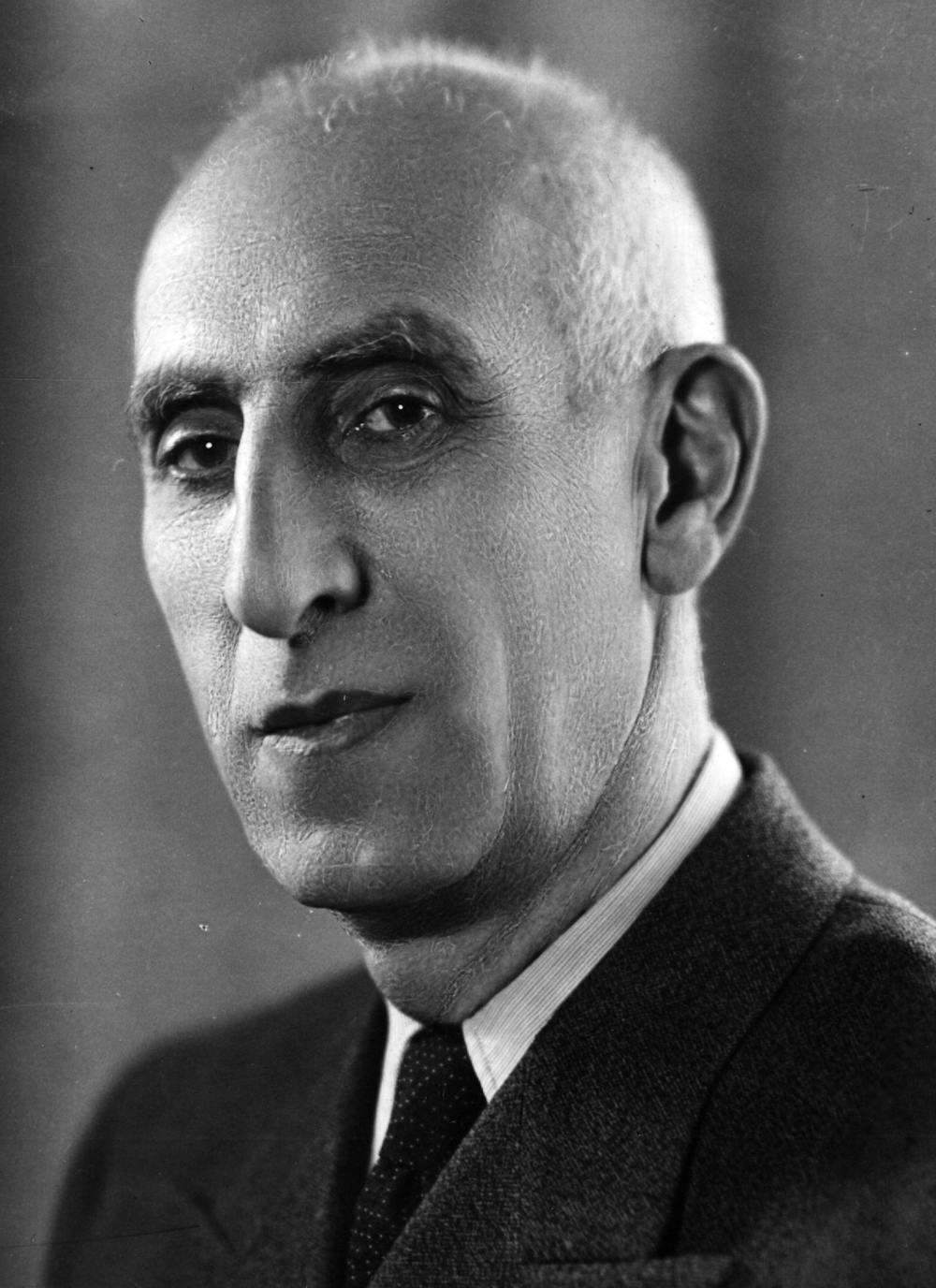
In 1951, the Iranian Parliament chose a new prime minister, Mossadegh, who then led lawmakers to vote in favor of taking over the Anglo-Iranian Oil Company, expelling the company’s British owners and saying they wanted to turn oil profits into investments in the Iranian people. The U.S. feared disruption in the global oil supply and worried about Iran falling prey to Soviet influence. The British feared the loss of cheap Iranian oil.
President Dwight Eisenhower decided it was best for the U.S. and the U.K. to get rid of Mossadegh. Operation Ajax, a joint CIA-British operation, convinced the Shah of Iran, the country’s monarch, to dismiss Mossadegh and drive him from office by force. Mossadegh was replaced by a much more Western-friendly prime minister, handpicked by the CIA.
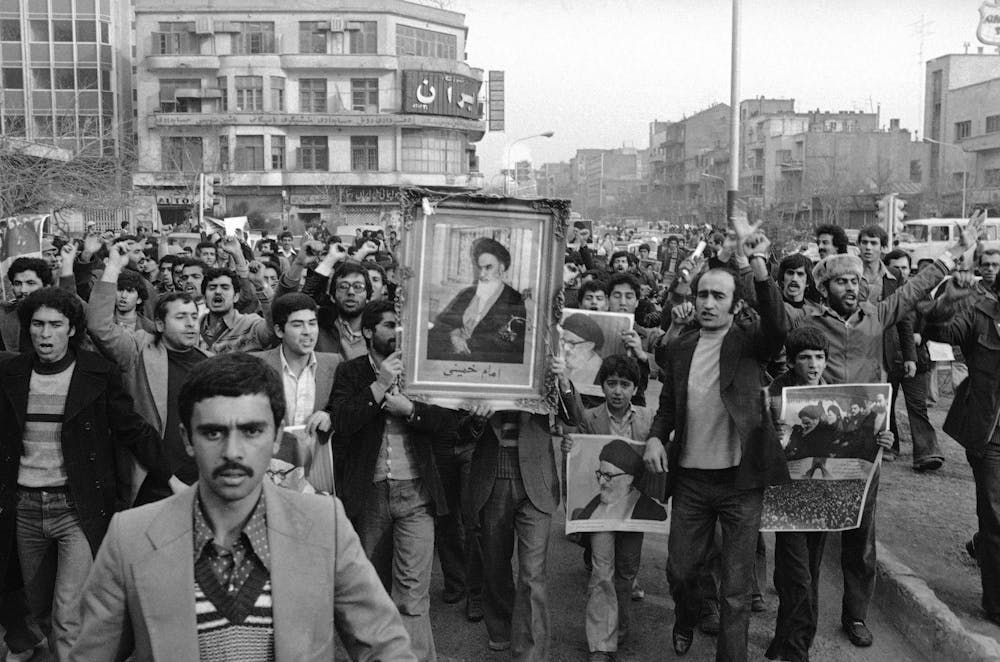
Demonstrators in Tehran demand the establishment of an Islamic republic. AP Photo/Saris
1979: Revolutionaries oust the shah, take hostages
After more than 25 years of relative stability in U.S.-Iran relations, the Iranian public had grown unhappy with the social and economic conditions that developed under the dictatorial rule of Shah Mohammad Reza Pahlavi.
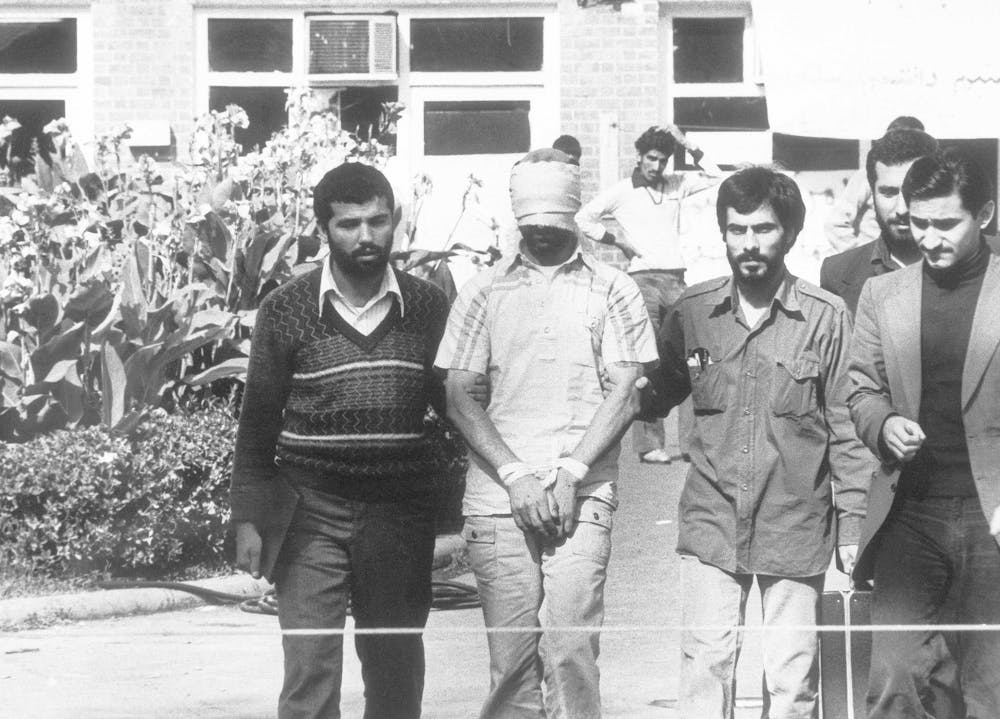
Iranian students at the U.S. Embassy in Tehran show a blindfolded American hostage to the crowd in November 1979. AP Photo
In October 1979, President Jimmy Carter agreed to allow the shah to come to the U.S. to seek advanced medical treatment. Outraged Iranian students stormed the U.S. Embassy in Tehran on Nov. 4, taking 52 Americans hostage. That convinced Carter to sever U.S. diplomatic relations with Iran on April 7, 1980.
Two weeks later, the U.S. military launched a mission to rescue the hostages, but it failed, with aircraft crashes killing eight U.S. servicemembers.
The shah died in Egypt in July 1980, but the hostages weren’t released until Jan. 20, 1981, after 444 days of captivity.
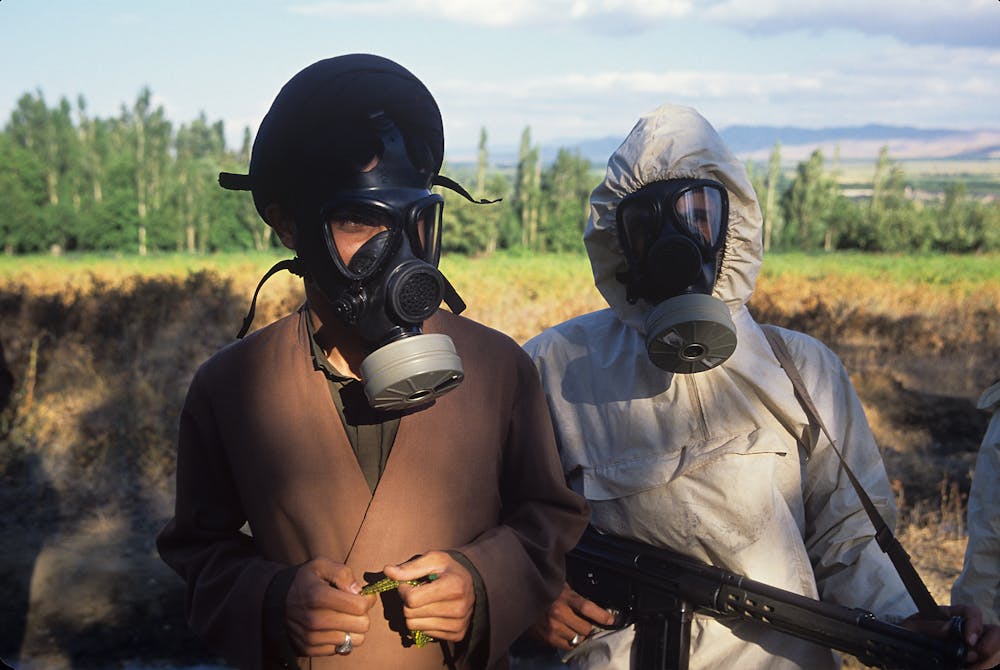
An Iranian cleric, left, and an Iranian soldier wear gas masks to protect themselves against Iraqi chemical-weapons attacks in May 1988. Kaveh Kazemi/Getty Images
The U.S. was concerned that the conflict would limit the flow of Middle Eastern oil and wanted to ensure the conflict didn’t affect its close ally, Saudi Arabia.
U.S. officials moderated their usual opposition to those illegal and inhumane weapons because the U.S. State Department did not “wish to play into Iran’s hands by fueling its propaganda against Iraq.” In 1988, the war ended in a stalemate. More than 500,000 military and 100,000 civilians died.
1981-1986: US secretly sells weapons to Iran
The U.S. imposed an arms embargo after Iran was designated a state sponsor of terrorism in 1984. That left the Iranian military, in the middle of its war with Iraq, desperate for weapons and aircraft and vehicle parts to keep fighting.
The last shipment, of anti-tank missiles, was in October 1986. In November 1986, a Lebanese magazine exposed the deal. That revelation sparked the Iran-Contra scandal in the U.S., with Reagan’s officials found to have collected money from Iran for the weapons and illegally sent those funds to anti-socialist rebels – the Contras – in Nicaragua.
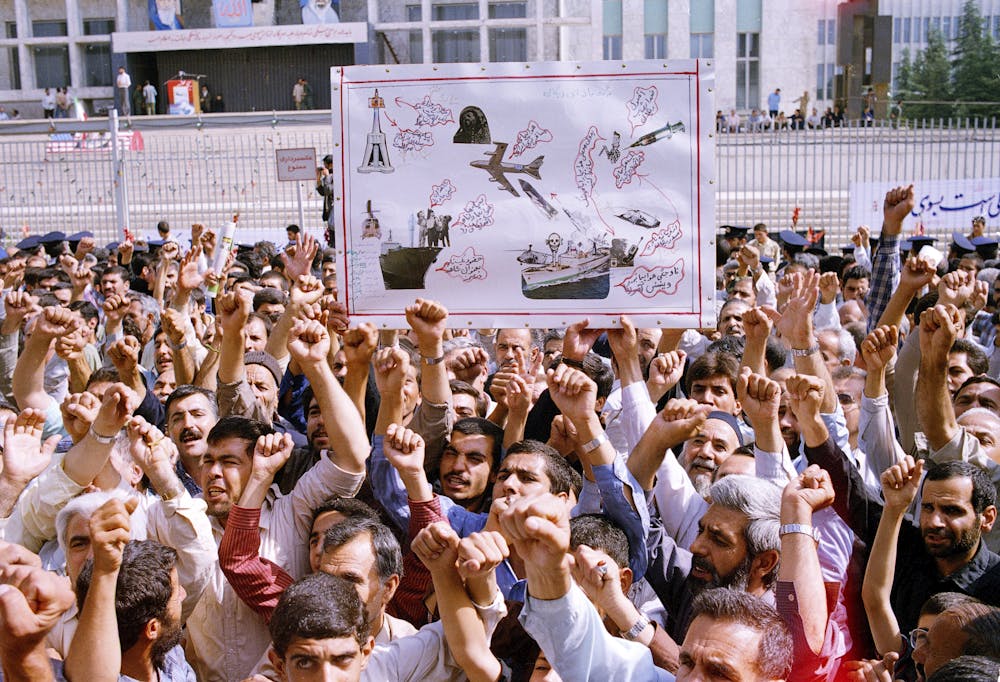
At a mass funeral for 76 of the 290 people killed in the shootdown of Iran Air 655, mourners hold up a sign depicting the incident. AP Photo/CP/Mohammad Sayyad
Either during or just after that exchange of gunfire, the Vincennes crew mistook a passing civilian Airbus passenger jet for an Iranian F-14 fighter. They shot it down, killing all 290 people aboard.
The U.S. called it a “tragic and regrettable accident,” but Iran believed the plane’s downing was intentional. In 1996, the U.S. agreed to pay US$131.8 million in compensation to Iran.
1997-1998: The US seeks contact
In August 1997, a moderate reformer, Mohammad Khatami, won Iran’s presidential election.
U.S. President Bill Clinton sensed an opportunity. He sent a message to Tehran through the Swiss ambassador there, proposing direct government-to-government talks.
Shortly thereafter, in early January 1998, Khatami gave an interview to CNN in which he expressed “respect for the great American people,” denounced terrorism and recommended an “exchange of professors, writers, scholars, artists, journalists and tourists” between the United States and Iran.
However, Supreme Leader Ayatollah Ali Khamenei didn’t agree, so not much came of the mutual overtures as Clinton’s time in office came to an end.
In his 2002 State of the Union address, President George W. Bush characterized Iran, Iraq and North Korea as constituting an “Axis of Evil” supporting terrorism and pursuing weapons of mass destruction, straining relations even further.
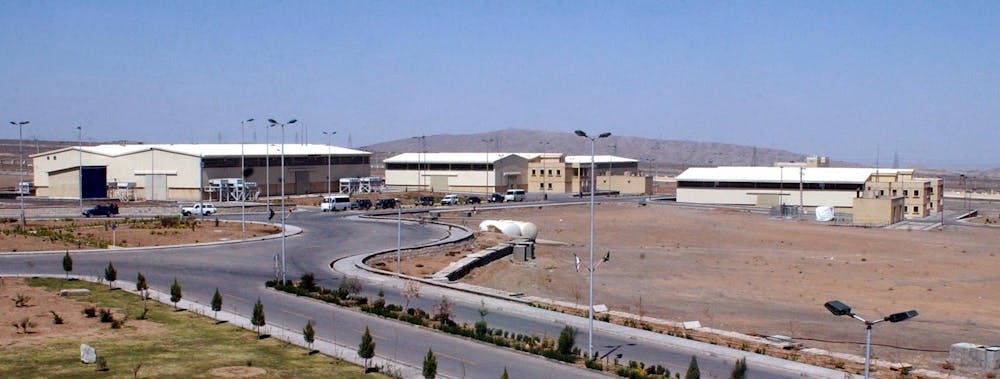
Inside these buildings at the Natanz nuclear facility in Iran, technicians enrich uranium. AP Photo/Vahid Salemi
That was a violation of the terms of the Nuclear Nonproliferation Treaty, which Iran had signed, requiring countries to disclose their nuclear-related facilities to international inspectors.
One of those formerly secret locations, Natanz, housed centrifuges for enriching uranium, which could be used in civilian nuclear reactors or enriched further for weapons.
Starting in roughly 2005, U.S. and Israeli government cyberattackers together reportedly targeted the Natanz centrifuges with a custom-made piece of malicious software that became known as Stuxnet.
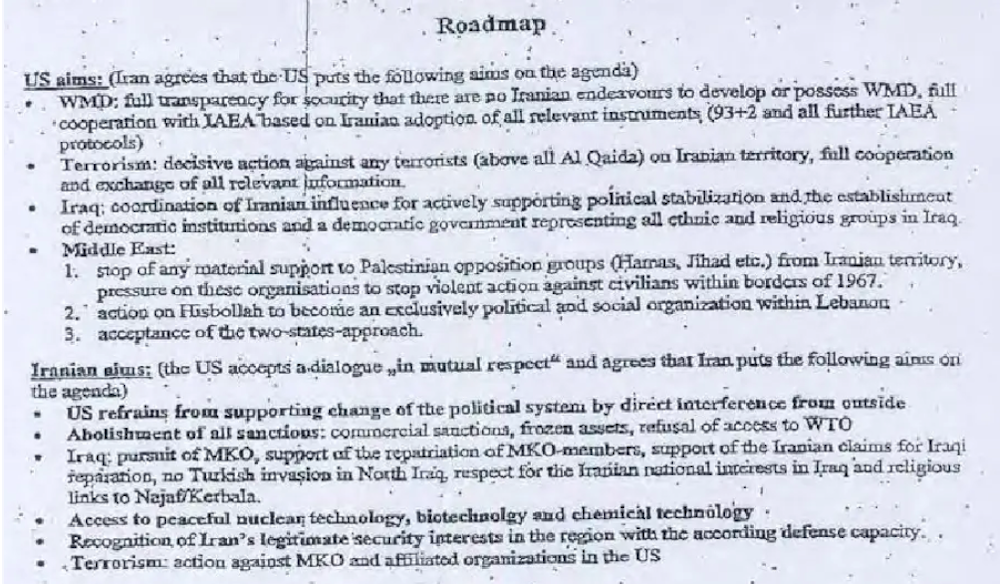
An excerpt of the document sent from Iran, via the Swiss government, to the U.S. State Department in 2003, appears to seek talks between the U.S. and Iran. Washington Post via Scribd
In May 2003, senior Iranian officials quietly contacted the State Department through the Swiss embassy in Iran, seeking “a dialogue ‘in mutual respect,’” addressing four big issues: nuclear weapons, terrorism, Palestinian resistance and stability in Iraq.
Hardliners in the Bush administration weren’t interested in any major reconciliation, though Secretary of State Colin Powell favored dialogue and other officials had met with Iran about al-Qaida.
When Iranian hardliner Mahmoud Ahmadinejad was elected president of Iran in 2005, the opportunity died. The following year, Ahmadinejad made his own overture to Washington in an 18-page letter to President Bush. The letter was widely dismissed; a senior State Department official told me in profane terms that it amounted to nothing.
After a decade of unsuccessful attempts to rein in Iran’s nuclear ambitions, the Obama administration undertook a direct diplomatic approach beginning in 2013.
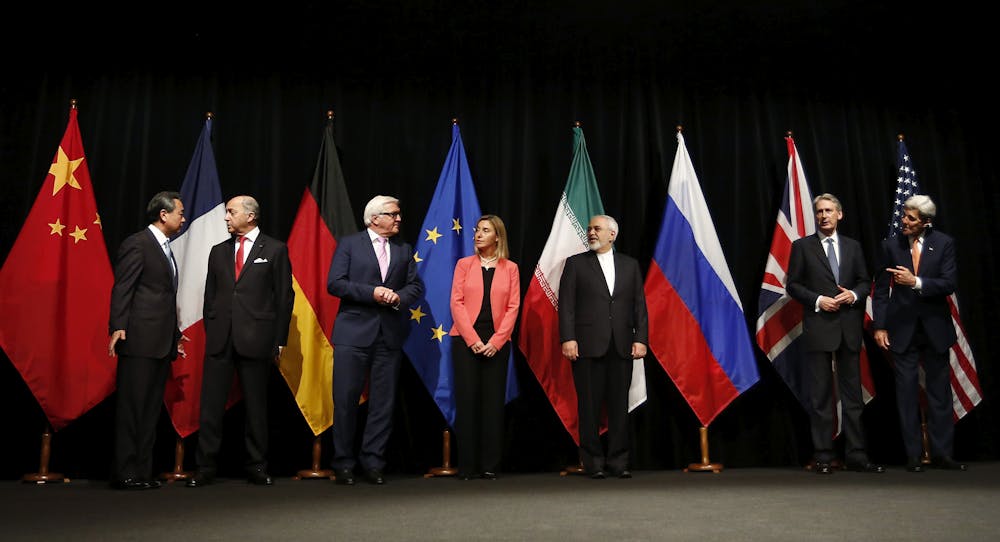
Iran, the U.S., China, France, Germany, Russia and the United Kingdom signed the deal in 2015. It severely limited Iran’s capacity to enrich uranium and mandated that international inspectors monitor and enforce Iran’s compliance with the agreement.
In return, Iran was granted relief from international and U.S. economic sanctions. Though the inspectors regularly certified that Iran was abiding by the agreement’s terms, President Donald Trump withdrew from the agreement in May 2018.
2020: US drones kill Iranian Maj. Gen. Qassem Soleimani
At the time, the Trump administration asserted that Soleimani was directing an imminent attack against U.S. assets in the region, but officials have not provided clear evidence to support that claim.
Hamas’ brazen attack on Israel on Oct. 7, 2023, provoked a fearsome militarized response from Israel that continues today and served to severely weaken Iran’s proxies in the region, especially Hamas – the perpetrator of the attacks – and Hezbollah in Lebanon.
2025: Trump 2.0 and Iran
Trump saw an opportunity to forge a new nuclear deal with Iran and to pursue other business deals with Tehran. Once inaugurated for his second term, Trump appointed Steve Witkoff, a real estate investor who is the president’s friend, to serve as special envoy for the Middle East and to lead negotiations.
Negotiations for a nuclear deal between Washington and Tehran began in April, but the countries did not reach a deal. They were planning a new round of talks when Israel struck Iran with a series of airstrikes on June 13, forcing the White House to reconsider is position.
On June 22, in the early morning hours, the U.S. chose to act decisively in an attempt to cripple Iran’s nuclear capacity, bombing three nuclear sites and causing what Pentagon officials called “severe damage.” Iran vowed to retaliate.
This story has been updated to reflect the U.S. bombing of Iranian nuclear sites on June 22, 2025.
Jeffrey Fields receives funding from the Carnegie Corporation of New York and Schmidt Futures.
Source: People’s Republic of China in Russian – People’s Republic of China in Russian –
Source: People’s Republic of China – State Council News
ISTANBUL, June 22 (Xinhua) — Iranian Foreign Minister Abbas Araghchi on Sunday strongly condemned the U.S. military aggression against the Islamic Republic’s nuclear facilities, saying Tehran is considering multiple options to respond to the “crossing of a red line.”
“The US attack on Iran is a flagrant, serious and unprecedented violation of the fundamental principles of the UN Charter and international law,” A. Araghchi emphasized at a press conference in Istanbul.
The diplomat noted that the American administration, which “tramples on the law,” bears “sole and full” responsibility for the consequences of its act of “aggression.”
“Of course, the door to diplomacy should always be open. But this is not the case now. My country is under attack, aggression, and we must respond based on our legitimate right to self-defense. We will do this as long as necessary and necessary,” A. Araghchi said.
“We are now counting the damage,” he added, calling on the world and international organizations, including the International Atomic Energy Agency, to act in accordance with their responsibilities in the face of this “violation of international law.”
The Iranian Foreign Minister also said that he would meet with Russian President Vladimir Putin in Moscow on June 23 to discuss the developments in the aftermath of the American strikes.
Currently, A. Araghchi is in Turkey, where he arrived to participate in the 51st session of the Council of Foreign Ministers of the Organization of Islamic Cooperation in Istanbul. –0–
Source: People’s Republic of China in Russian – People’s Republic of China in Russian –
Source: People’s Republic of China – State Council News
ASTANA, June 22 (Xinhua) — The China-Central Asia News Agency Forum was held in Astana, capital of Kazakhstan, on Sunday. The forum adopted the Astana Consensus of the China-Central Asia News Agency Forum, which proposes deepening cooperation between the media of China and Central Asian countries and promoting the building of a China-Central Asia community with a shared future.
The two sides noted that over the past 30 years since the establishment of diplomatic relations between China and the five Central Asian countries, their relations have been elevated to a comprehensive strategic partnership, with all-round cooperation continuously deepening. As stated in the document, the two sides are jointly building a China-Central Asia community with a shared future based on mutual assistance, common development, common security and friendship from generation to generation, making contributions to the construction of a community with a shared future for mankind.
The parties highly appreciated the results of cooperation between the media of China and the five Central Asian countries in recent years in such aspects as news exchange, high-level contacts and information coverage. It was emphasized that close communication and interaction between the media of the six countries within the framework of such multilateral mechanisms as the World Media Summit, the Global South Media and Think Tank Forum and the China-Central Asia News Agency Forum are conducive to further deepening mutual understanding and friendship between the peoples of China and Central Asia, deepening mutually beneficial cooperation and advancing the construction of a China-Central Asia community with a shared future.
The two sides noted that in the face of rapid and profound changes in the world and the complex international situation, the media of China and the five Central Asian countries should further expand exchanges, deepen cooperation, join forces and coordinate actions to promote international justice, push global governance in a more just and reasonable direction, inject new impetus into efforts to strengthen the unity and cooperation of the Global South and promote world peace and development.
The two sides agreed to develop and utilize the China-Central Asia News Agency Forum, conduct active bilateral and multilateral people-to-people exchanges, intensify high-level contacts and mutual visits of staff, organize joint reporting, professional exchange seminars and personnel training events to deepen mutual understanding, promote mutual learning and exchange of experience, and build media capacity.
The parties agreed that in the context of the rapid development of artificial intelligence /AI/ technologies, it is necessary to firmly adhere to journalistic ethics and professional standards, provide the audience with reliable, objective, comprehensive and impartial news information, oppose the use of AI technologies for such purposes as fabricating fake news and spreading rumors, and protect the authority of the media and public trust in them.
The two sides expressed support for further strengthening exchanges and cooperation in the field of economic information, as well as deepening cooperation in information exchange, holding events and sharing resources within the Belt and Road Economic Information Partnership network.
The two sides agreed to strengthen cooperation within multilateral mechanisms such as the World Media Summit, the Global South Media and Think Tank Forum and the International Committee for Belt and Road Think Tank Cooperation, actively support and participate in activities within the context of these mechanisms, and make joint contributions to their development.
The China-Central Asia News Agency Forum was initiated and held by the Chinese Xinhua News Agency within the framework of the 2nd China-Central Asia Summit. The forum was attended by the heads of the Xinhua News Agency, the Television and Radio Complex of the President of the Republic of Kazakhstan, the Kyrgyz National News Agency Kabar, the National News Agency of Tajikistan Khovar, the Media-Turkmen News Agency, and the National News Agency of Uzbekistan. –0–
Source: People’s Republic of China in Russian – People’s Republic of China in Russian –
Source: People’s Republic of China – State Council News
BEIJING, June 22 (Xinhua) — China strongly condemns the U.S. attacks on Iran and the U.S. bombing of nuclear facilities under International Atomic Energy Agency (IAEA) safeguards, a Chinese Foreign Ministry spokesman said Sunday.
The diplomat said this while commenting on the statement by US President Donald Trump that the United States had struck three nuclear facilities in Iran.
As the official representative noted, by its actions the United States seriously violated the purposes and principles of the UN Charter and international law, and also exacerbated tensions in the Middle East.
China calls on all parties to the conflict, first and foremost Israel, to cease fire as soon as possible, ensure the safety of civilians, and begin dialogue and negotiations, the official representative emphasized.
According to him, the Chinese side is ready to cooperate with the international community to consolidate efforts, defend justice, and contribute to the restoration of peace and stability in the Middle East. –0–
Source: People’s Republic of China – State Council News
Excavation work of Yellow River section of Huanggang Road Yellow River tunnel completed
Updated: June 22, 2025 21:47Xinhua
A truck runs at the construction site of the Yellow River tunnel on Huanggang Road in Jinan, east China’s Shandong Province, June 22, 2025. The excavation work of the Yellow River section of the Huanggang Road Yellow River tunnel was completed on Sunday, marking a breakthrough in the construction of the tunnel project. The 5,755-meter-long tunnel, with 3,290 meters excavated by a 17.5-meter diameter TBM, is the largest underwater TBM tunnel currently under construction in the world. [Photo/Xinhua]Staff workers work at the construction site of the Yellow River tunnel on Huanggang Road in Jinan, east China’s Shandong Province, June 22, 2025. [Photo/Xinhua]Staff workers are pictured at the construction site of the Yellow River tunnel on Huanggang Road in Jinan, east China’s Shandong Province, June 22, 2025. [Photo/Xinhua]Staff workers work at the construction site of the Yellow River tunnel on Huanggang Road in Jinan, east China’s Shandong Province, June 22, 2025. [Photo/Xinhua]A tunnel boring machine (TBM) works at the construction site of the Yellow River tunnel on Huanggang Road in Jinan, east China’s Shandong Province, June 22, 2025. [Photo/Xinhua]Staff workers work at the construction site of the Yellow River tunnel on Huanggang Road in Jinan, east China’s Shandong Province, June 22, 2025. [Photo/Xinhua]
Keir Starmer’s response to the bombing of Iran sides with the aggressors and contributes to the escalation of the conflict.
More in External Affairs
The Scottish Greens have condemned Keir Starmer’s response to the bombing of Iran as siding with the aggressors and contributing to the escalation of the conflict.
Iran had previously reached a negotiated solution to their nuclear programme with the US, China, Russa, UK and others, which was unilaterally scrapped by the first Trump administration in 2018.
It has said it is willing to discuss a new deal once it is no longer under attack.
In response to last night’s US bombings, the UK Government and Keir Starmer spoke supportively of the action.
“This is a deplorable response from the UK government, but it’s all too predictable.
“Israel expanding its war at a time when negotiations were imminent, and high-level meetings between Iran and the US were already beginning to take place, is an outrage. UN experts have called it a ‘flagrant violation’ of international law and a ‘blatant act of aggression.’
“The UK’s response has done nothing but encourage this escalation, from its ongoing material support for Israel’s routine atrocities in Gaza, to the political cover it’s now providing Israel and the US as they intensify their bombing of Iran.
“The Iranian regime is unquestionably brutal, and everyone will celebrate if the Iranian people can overthrow it. But this attack will do nothing to make that happen, and only takes the world toward ever wider conflict.
“Rather than being a voice for peace, Keir Starmer has shown a reckless disregard for international law and sided with the aggressors. In doing so he is only contributing to further death, destruction, and instability for people in the middle east and the wider world.”
Source: People’s Republic of China in Russian – People’s Republic of China in Russian –
Source: People’s Republic of China – State Council News
URUMQI, June 22 (Xinhua) — The cross-border e-commerce sector in northwest China’s Xinjiang Uygur Autonomous Region has seen dynamic growth, with the advantages of two key ports of Alashankou and Horgos as “global purchasing and selling” channels becoming increasingly evident, achieving highly efficient and smooth trade flow.
Alashankou Port has seen strong growth in cross-border e-commerce. In the first five months of this year, 55.7376 million parcels worth 3.579 billion yuan (about 492 million U.S. dollars) were exported through Alashankou in cross-border online commerce, up 103 percent year-on-year. At the Alashankou Comprehensive Bonded Zone Cross-Border E-Commerce Industrial Park, trucks loaded with toys, consumer goods and other products bearing the stamp “Made in China” are constantly streaming toward Europe, Russia and other regions.
“From January to May this year, our company’s cross-border e-commerce export volume exceeded 20 million parcels, up 50 percent year-on-year and reaching a historical high,” Kong Xianglin, deputy general manager of Oushengtong Kahang International Logistics Co., Ltd., told Xinhua. “We are currently cooperating with platforms such as Pinduoduo and AliExpress to build overseas warehouses. In the second half of the year, business with Europe is expected to grow by another 60 percent.”
With explosive growth, cross-border e-commerce at Horgos is complementing Alashankou’s success. Over the same period, the port is expected to reach 28.05 billion yuan in trade volume, a staggering 890 percent year-on-year increase. At the cargo yard of Zhongguang Zhida Co., Ltd., daily necessities, small appliances, air conditioners and other goods are packed into containers before being shipped.
“Today, our company’s trading volume has reached US$700 million, up about 110 percent from a year ago and a record high,” said Jiang Yong, deputy general manager of Zhongguang Zhida Co., Ltd. “Based on Khorgos’s advanced industrial base and highly efficient logistics network, we will continue to deepen our presence in the Central Asian and European markets,” he continued.
The strong growth of the two ports is driven by the continuous optimization of the business environment and the upgrading of infrastructure. The Alashankou Port Authority, taking advantage of the Belt and Road Initiative, has invested in building a multifunctional cross-border e-commerce industrial park, attracting 15 companies and covering all import and export models. The Horgos Cross-Border E-Commerce Industrial Park has also brought together more than 40 enterprises and is purposefully building a comprehensive service ecosystem covering the entire supply chain.
Zhang Yan, head of the New Business Model Department of Alashankou Port and Commerce Bureau, said: “We actively leverage the advantages of geographical location and industrial agglomeration, implement various support measures, solve practical difficulties for enterprises, and continuously provide cross-border e-commerce companies with turnkey services, from warehouse logistics to financial services.”
At present, Alashankou and Horgos are making the transition from a “transit corridor economy” to an “industrial cluster economy”. With innovative models and an open ecosystem, they are jointly building a digital trade hub in a key area of the Silk Road Economic Belt, giving a strong impetus to the deepening of the opening up of Xinjiang’s border areas. -0-
Source: People’s Republic of China in Russian – People’s Republic of China in Russian –
Source: People’s Republic of China – State Council News
ASTANA, June 22 (Xinhua) — The China-Central Asia News Agency Forum was held in Astana, capital of Kazakhstan, on Sunday. As one of the outcomes of the Second China-Central Asia Summit, the forum was initiated and hosted by Xinhua News Agency. It was attended by heads of Xinhua News Agency, Kazakh Presidential Television and Radio Broadcasting Complex, Kyrgyz National News Agency Kabar, Tajikistan National News Agency Khovar, Media-Turkmen News Agency and Uzbekistan National News Agency.
Fu Hua, Director General of Xinhua News Agency, chaired the forum and delivered a speech. He said that under the joint leadership of Chinese President Xi Jinping and the leaders of Central Asian countries, exchanges and cooperation between China and the countries in the region have gained new important historical opportunities and shown incredibly bright prospects. News agencies of China and Central Asia are charged with the responsibility of spreading the “Central Asia-China Spirit” and promoting high-quality development in the region, jointly telling the stories of China-Central Asia cooperation, promoting China-Central Asia people-to-people and cultural exchanges and mutual learning between civilizations, advancing innovation and cooperation in media technology, deepening exchanges and cooperation between news agencies, and contributing to promoting the building of a community with a shared future for China and Central Asia.
The officials of news agencies of the Central Asian countries highly appreciated the important role played by the China-Central Asia News Agency Forum in strengthening mutual understanding and cooperation, and expressed their willingness to continue to deepen exchanges and cooperation with Chinese media including the Xinhua News Agency, jointly promote the “Central Asia-China Spirit”, and make due contributions to promoting mutual learning among civilizations and achieving common development.
Director General of the Television and Radio Complex of the President of the Republic of Kazakhstan Raushan Kazhibayeva noted that the successful holding of the Second China-Central Asia Summit outlined the direction for the development of relations between China and the countries of the region. This forum is a vivid manifestation of good-neighborliness and deep friendship between China and the countries of Central Asia, and the media should support and promote the implementation of the results achieved at the summit.
Mederbek Shermetaliev, Director General of the Kyrgyz National News Agency Kabar, said that the Belt and Road Initiative has opened up new prospects for mutually beneficial cooperation between China and Central Asia. Strengthening information exchange and cooperation between all parties will help present an objective, truthful and three-dimensional image of China and Central Asian countries.
According to Subhiddin Shamsiddinzoda, Director of the National Information Agency of Tajikistan “Khovar”, fruitful results have been achieved in cooperation between the Central Asian countries and China in the field of media. He also expressed hope for continued in-depth exchange of views on issues such as training talents in the field of communications, strengthening cooperation between universities and promoting the development of creative industries.
Bekdurdy Amansaryev, Director General of the Media-Turkmen Information Agency, said all parties should set an example in establishing information partnerships based on mutual respect, equality and mutual benefit. New technologies have expanded the space for cooperation between media outlets, he noted, adding that he hopes to strengthen cooperation in the field of new media and promote digital transformation.
Abdusaid Kuchimov, Director General of the National News Agency of Uzbekistan, noted that the media plays an important role in strengthening bilateral and multilateral cooperation between Central Asian countries and China. Media partners from Central Asia and China came together to strengthen their cooperation, which is of great importance for discussing ways to overcome common challenges.
The forum participants agreed that the world is changing and facing many challenges, such as the spread of disinformation. The media of China and Central Asian countries should join efforts to enhance cooperation in information exchange, news dissemination and promotion of technological innovation to create a favorable information environment for regional peace and development.
Following the forum, the Astana Consensus was adopted. –0–
Source: People’s Republic of China – State Council News
JERUSALEM, June 22 (Xinhua) — The Israel Defense Forces (IDF) said in a statement that its fighter jets struck two warplanes at Dezful airport in western Iran on Sunday morning.
The statement said eight rocket launchers had been “neutralized” in separate strikes earlier in the morning, six of which were poised to fire into Israeli territory.
It reported that on Saturday evening, about 20 Israeli fighter jets struck dozens of military targets in Iran.
According to the statement, the targets hit included a military facility housing components for the production of explosives, a weapons depot and production facilities, as well as air defense systems. –0–
Source: People’s Republic of China in Russian – People’s Republic of China in Russian –
Source: People’s Republic of China – State Council News
XI’AN, June 22 (Xinhua) — “How is business going in Kazakhstan? Are there any difficulties in establishing contacts?” Begench Sakhedov, a Turkmen national, asked his business partner Wang Yi from Shaanxi Province, who was in Almaty at the time, via video link from Xi’an, northwest China’s Shaanxi Province. “Everything is going well. There are no problems in communication, even though I do not speak English or Russian, because many Kazakhs speak Chinese,” Wang Yi replied.
As transnational partners, Wang Yi and B. Sahedov jointly run a company in Xi’an that provides cultural exchange services. As trade, economic and cultural exchanges between China and Central Asian countries expand, their company, registered in September 2023, has seen good growth.
“After the successful holding of the first China-Central Asia Summit, we clearly felt that students from the five Central Asian countries have increased their desire to study in China because coming to China means more opportunities and no difficulties with employment,” the company’s business director, Turkmen Yagshi Aizhanov, told Xinhua. “In 2024, we helped more than 800 people come to study in China, most of them from the five Central Asian countries.”
As mutual visa-free travel agreements between China and Central Asian countries come into effect, travel has also become more convenient. “We are currently cooperating with more than 100 universities in China,” B. Sakhedov noted.
Xi’an, where a large number of universities and scientific and educational resources are concentrated, has become one of the popular cities for students from Central Asia who come to study in China. In recent years, many young people from Central Asia, such as B. Sakhedov, who came to China to receive higher education, choose Xi’an after graduating to start their entrepreneurial journey here.
The Qinchuanyuan Science and Technology Big Market in Xi’an New Area, Shaanxi Province, hosted an exchange of views on entrepreneurship among foreign youth. Amina Gusarova from Kyrgyzstan told Xinhua that she registered a consulting company in Xi’an late last year. “We have already signed our first order. A Chinese enterprise that needs to expand its business is going to Kyrgyzstan for a study tour, and we provide them with comprehensive services, from consulting to translation.”
“We have been implementing a pilot project on entrepreneurship among foreign specialists since May 2023. To date, 18 expat startup projects have already been attracted, most of the entrepreneurs are from five Central Asian countries,” said Han Ping, deputy head of the Department of Scientific and Technological Innovation and New Economy of Xi’an New Area in Shaanxi Province. “They have a very strong desire to work and live in China, and at the same time, they often invite business partners from Central Asia to Xi’an to seek cooperation opportunities.”
Doniyor Matmusayev from Uzbekistan is one such entrepreneur. After graduating from Northwestern Polytechnical University in 2023, he registered a trading company in Xi’an that supplies Chinese goods to Central Asian countries and Russia. “We sell Chinese construction equipment to Uzbekistan, and some Chinese brands of equipment are doing very well there; we mainly sell auto parts to Kazakhstan, but Chinese electric cars are also very popular there; and we mainly supply electronics to Russia, such as switches, servers, etc.,” he said.
Over the past two years, D. Matmusaev has worked in the provinces of Guangdong (South China), Jiangsu (East China), Zhejiang (East China), Shandong (East China) and other places. “The opening of a direct flight from Xi’an to Uzbekistan has significantly reduced the logistics shoulder. Now our electronics are delivered by air in three hours and cleared through customs on the same day,” said D. Matmusaev. “We transport large-sized equipment by road or by international freight railway routes from China to Europe. Road transportation takes 15 days, and the convenience of China-Europe express trains is not even worth mentioning.”
According to statistics from the Shaanxi Provincial Commerce Department, the province’s foreign trade turnover with the five Central Asian countries has been growing every year. In 2024, it reached 8.575 billion yuan (about 1.18 billion US dollars), which is 48.1 percent more than the previous year. Thanks to such development dynamics, Chinese ice cream has now appeared in the product range. To make the partners more confident, in early April, D. Matmusaev accompanied a client from Uzbekistan on a trip to a Chinese ice cream factory.
“Ice cream is a new project. We started working on it in March. These are types and flavors specially adapted for Uzbekistan from the supplier. From the beginning of April to the present, we have already sent 7 trucks of products, and they are very popular,” said D. Matmusayev.
Today, the total volume of trade of his company with the countries of Central Asia and Russia has exceeded 2 million US dollars. “My dream is to do global business. We are ready to expand the sphere of trade and plan to start cooperation with the regions of the Middle East, Europe and America, because Chinese products are popular in an increasing number of countries, and this is an excellent business opportunity,” shared D. Matmusaev. -0-
Source: People’s Republic of China in Russian – People’s Republic of China in Russian –
Source: People’s Republic of China – State Council News
BEIJING, June 22 (Xinhua) — Beijing authorities have urged the public to take precautions as the city continues to be gripped by a heat wave.
Temperatures in the central part of the city ranged from 34.7 to 35.6 degrees Celsius at midday on Sunday, according to the Beijing Meteorological Observatory.
A yellow alert for high temperatures was issued in the capital at 2.30pm on Friday, with meteorologists predicting continued hot weather throughout the coming week.
Local authorities advised residents to limit their time outdoors and replenish fluids in a timely manner. Workers working outdoors, such as construction workers, traffic police officers, sanitation workers, and couriers, were advised to adjust their work schedules to prevent negative phenomena such as heatstroke and sunstroke.
Beijing authorities also warned the public to use electricity safely to prevent fires, and urged parents to closely monitor children who could be at risk of drowning while trying to cool off in rivers. -0-
Source: People’s Republic of China in Russian – People’s Republic of China in Russian –
Source: People’s Republic of China – State Council News
JERUSALEM, June 22 (Xinhua) — Sirens sounded in central and northern Israel and in Israeli-controlled Jerusalem as Iran launched a new wave of ballistic missiles.
Israelis in the affected areas were advised to remain in bomb shelters.
It was Iran’s first ballistic missile strike on Israel in more than a day – and the first since the United States attacked three Iranian nuclear sites.
Israel closed its airspace as an apparent precaution following the US strike on Iran’s nuclear facilities, the Israel Airports Authority said earlier.
The IDF said in a statement that with the approval of Defense Minister Israel Katz and after assessing the situation, it was determined that changes would be made to the Home Front Command instructions immediately as of 03:45 Sunday /00:45 GMT/.
Earlier on Saturday, US President Donald Trump said the United States had completed attacks on three nuclear sites in Iran, namely “Fordo, Natanz and Isfahan.” –0–
Source: People’s Republic of China in Russian – People’s Republic of China in Russian –
Source: People’s Republic of China – State Council News
BEIJING, June 22 (Xinhua) — Chinese authorities are taking a long-term approach to economic development, investing in technology and human capital, which is evident in the evolution of emerging industries, be it green energy, industrial transformation or advanced manufacturing, said Jim Hui Neo, Managing Director of the World Economic Forum (WEF).
In an exclusive interview with Xinhua ahead of the upcoming Summer Davos forum, which will be held from June 24 to 26 in Tianjin, northern China, Neo said the expected attendance of 1,800 delegates, more than half of whom are from global businesses, indicates significant interest in China and Asia as a whole.
Companies and investors attending the event in Tianjin will seek partnerships in advanced manufacturing, technology, healthcare and other areas, she said.
Commenting on the investment climate in China and Asia, Neo noted that the “ingredients” in terms of policy coherence and consistency, availability of human capital, technology readiness and broader market support are “very strong.”
“I believe these different elements create an ecosystem that is favorable for both investors and business partnerships,” she explained.
Notably, Neo also said the Chinese economy has shown greater resilience amid global economic uncertainty. She said Asia is expected to account for about 60 percent of global GDP growth this year, with China contributing about 30 percent.
“So the outlook for Asia and China remains very strong,” Neo stressed, adding that there will be significant interest and attention to the potential of China and Asia at the upcoming meeting in Tianjin this year. “In particular, we will have sessions on China’s economic outlook, its approach to artificial intelligence, and the broader innovation ecosystem.”
Addressing growing tensions in global trade, Neo noted that the WEF has a working group on trade and investment that seeks to bring together business with governments, academia and international organizations for constructive dialogue and the formation of mutually beneficial partnerships.
“I emphasize the word ‘mutually beneficial’ because we need to look for opportunities and areas of cooperation that can benefit everyone,” she said.
Neo said the WEF has a long-standing friendship with China and looks forward to continuing to work with the Chinese government, business and people to promote dialogue between China, Asia and the rest of the world.
“There is great interest in Asia and China, and we hope to continue to create a platform for constructive dialogue, exchange of ideas and views, and to stimulate new partnerships and find solutions to global challenges,” she said.
The 2025 Summer Davos Forum, or the 16th annual meeting of the World Economic Forum’s emerging leaders, entitled “Entrepreneurship in a New Era,” will focus on five key areas: decoding the global economy, China’s prospects, transforming industries, investing in people and the planet, and new energy and materials. -0-
When US B-2 bombers hit Iran’s nuclear facilities at Fordow, Natanz and Isfahan, Donald Trump declared the strikes a success and urged the Islamic Republic to make peace or face even more devastating strikes. The US president proclaimed the might of the US military, operating in full coordination with Israel, before taking to truth social.
Trump and the Israeli prime minister, Benjamin Netanyahu, will hope that the strikes will end Iran’s nuclear programme once and for all. It may, it may not. More certain is that the operation will sound the death knell for the post-second world war global order.
After the horrors of the that war and the cold war that followed, a global order emerged seemingly predicated on a set of largely liberal rules and norms that sought to prevent a retreat into global conflict. Predicated on non-intervention, diplomacy and a respect for the rule of law, this global order was idealistic and – ultimately – aspirational.
But in recent years, this vision of global politics has come crashing down. Now America joining Israel in its attacks on Iran will rightly provoke serious questions about the future of global order and what comes next.
Get your news from actual experts, straight to your inbox.Sign up to our daily newsletter to receive all The Conversation UK’s latest coverage of news and research, from politics and business to the arts and sciences.
Trump’s decision to use US air power to land heavy blows against Iran’s nuclear programme is the latest event on a continuum which arguably reaches back to the Hamas terror attack of October 7.
Israel’s destruction of Gaza, its decapitation of Hamas and disabling of Hezbollah’s military capacity and its strikes against the Houthi rebels have consolidated Israel’s position of strength in the region, to generally positive acclaim from global audiences. Yet the spectre of Iran continued to loom large, even as its proxies were defeated
Iran has long been framed as an nefarious puppet master controlling a complex web of “proxy actors” across the Middle East each accused of doing the bidding of Tehran. The reality is rather different. While the Islamic Republic undeniably wields influence over such groups, it is not the perfidious mastermind that some would suggest, nor is it the source of all ills in the region.
Instead, Iran is in a perilous position. The Islamic Republic faces serious social and economic pressures, with the “women life freedom movement” galvanising popular opposition, while unrest across Iran’s peripheral provinces which are home to ethnic and religious minorities continues to ferment.
In recent years, diplomacy has shown it can work, ameliorating longstanding and deep-seated animosities. This was bearing fruits as seen in the gradual rapprochement between Iran and Saudi Arabia from 2023, which had been preceded by the signing of the Abraham accords in 2020.
Seen by many as a key achievement of Trump’s first presidency, this was a series of agreements between Israel and Bahrain, the United Arab Emirates, Morocco and Sudan in which the Arab countries recognised Israel and all sides signed a declaration of principles focused on mutual understanding, respect for human dignity, and cooperation.
While many in Israel and the US hoped that Saudi Arabia would officially recognise Israel, the events of October 7 and the destruction of Gaza that followed ended those hopes. Now the possibility of all-out conflict between Iran and Israel and the US risks blowing a major regional conflict with global implications.
Serious questions must be asked as to the longer-term strategy here. While Israeli officials have articulated a need for strikes on Iran’s nuclear facilities to prevent the Islamic Republic from getting a nuclear weapons capability, Iran is a signatory of the nuclear non-proliferation treaty (although it has threatened recently to quit) and key officials have regularly declared that nuclear weapons have no place in Iran’s strategic portfolio.
Israel is not a signatory to the treaty. In fact, it is thought to possess between 75 and 400 nuclear warheads. It’s hard to tell, as the country has maintained a steadfast policy of nuclear opacity, never actually admitting the extent of its nuclear capability.
New impunity?
Is this the start of a new order of impunity across the region, backed by western powers? And if so, what does this mean for the war in Ukraine and the potential for an aggressive Russia engaging in further dangerous adventurism? What does it mean for the possibility of China taking advantage in this breakdown to perhaps fulfil its generations-old ambition to unite with Taiwan, by force, if necessary? Are we seeing the shift to a world in which Donald Trump’s threats to annex Greenland – even perhaps Canada – must be taken seriously?
The contours of global politics are changing before our eyes. Gone are the norms that have served as the bedrock of the so-called liberal international order. The risk is that while this period has itself featured tragedy and suffering on an almost unimaginable scale, tearing up the rule book will be far worse.
Simon Mabon receives funding from Carnegie Corporation of New York and the Henry Luce Foundation. He is a Senior Research Fellow with the Foreign Policy Centre.
Source: People’s Republic of China in Russian – People’s Republic of China in Russian –
Source: People’s Republic of China – State Council News
DALIAN, June 22 (Xinhua) — A batch of 38 tons of fresh plums was loaded onto trucks at a production site of Longxin Fruit Co., Ltd. in Yingkou, northeast China’s Liaoning Province, and shipped to Kazakhstan. The cargo will travel by land via Tacheng Port in northwest China’s Xinjiang Uygur Autonomous Region. This is Yingkou’s first batch of plums exported to Kazakhstan.
Yingkou, with its distinct four seasons and abundant sunshine, has excellent conditions for growing plums and other specialty fruits. “Plums have good shelf life and transportability, which greatly reduces the cost of exporting by land. This year, we plan to enter the Central Asian markets, but initially we had little knowledge of the quarantine standards and market access requirements in the countries involved,” said Han Yingchun, CEO of Longxin.
According to Han Yingchun, after learning of the company’s difficulties, customs and other departments immediately organized regular training and consultations, helping the company and fruit growers improve the management of the fruit growing process to ensure that the export products meet the necessary requirements.
In order to promote the export of local special fruits including plum, Dalian Customs has continuously maintained the smooth operation of the “green channel” for inspection of export fruits at the place of origin, providing preferential measures. At the same time, the customs monitors the harvesting schedules of orchards and packing schedules of factories in real time, ensuring the principle of “application-inspection-export permit” for export fruits, achieving “zero waiting time” in customs clearance.
According to statistics, from January to May this year, Bayuquan District Customs, administratively subordinate to Dalian Customs, carried out origin inspection of 2,994.89 tons of special fruits exported to Central Asian countries, with a total value of 24.7341 million yuan (about 3.4 million US dollars). -0-