Category: Climate Change

  • MIL-OSI USA: FEMA Approves More Than $614.7 Million for Recovery in Georgia

    Source: US Federal Emergency Management Agency

    Headline: FEMA Approves More Than $614.7 Million for Recovery in Georgia

    FEMA Approves More Than $614.7 Million for Recovery in Georgia

    In the months since the 2024 storms, FEMA has approved more than $614.7 million in federal disaster assistance to help homeowners, renters and communities recover from Tropical Storm Debby and Hurricane Helene.This includes:$308.6 million approved for individuals and households. $306.1 million approved for community recovery.Under FEMA’s Individual Assistance program, homeowners and renters affected by the storms have received assistance for housing if they couldn’t live in their primary residence, as well as basic home repairs, personal property losses and other uninsured disaster-caused expenses.Under the Public Assistance program, FEMA provides funding for communities that need help to cover their costs for debris removal, life-saving emergency protective measures, and restoring public infrastructure.These numbers will increase as FEMA continues to process the nearly 400,000 applications it has received for individual assistance and the more than 1,900 projects submitted for Public Assistance.Although the deadline for submitting applications has passed, FEMA is committed to remaining in Georgia to ensure all who are eligible for assistance receive it.
    jakia.randolph
    Tue, 02/11/2025 – 13:27

    MIL OSI USA News

  • MIL-OSI Asia-Pac: Union Minister Shri Bhupender Yadav addresses the ‘XDG 2045’ Ministerial Roundtable, at World Governments Summit 2025, Dubai

    Source: Government of India

    Union Minister Shri Bhupender Yadav addresses the ‘XDG 2045’ Ministerial Roundtable, at World Governments Summit 2025, Dubai

    India expresses deep concern on failure of Developed countries to meet Financial Commitments for a Just Transition, Climate Adaptation Finance and additional funding for Biodiversity Conservation in Developing countries

    Spirit of Vasudhaiva Kutumbakam should serve as a Guiding Principle for XDG 2045: Shri Bhupender Yadav

    Posted On: 11 FEB 2025 6:26PM by PIB Delhi

    Union Minister for Environment, Forest and Climate Change, Shri Bhupender Yadav addressed a gathering of Global leaders and thinkers during the ‘XDG 2045’ Ministerial Roundtable, today at the World Government Summit, 2025 in Dubai. He presented India’s vision for sustainable development, anchored in the commitment to the Sustainable Development Goals (SDGs) and India’s ambition for a Viksit Bharat by 2047.

    Beginning his intervention, the Minister assured the august gathering of India’s unwavering commitment to the SDGs and dwelled upon India’s achievements in this direction. He said, “We have made significant progress, particularly in renewable energy, healthcare, and poverty reduction. India is rapidly expanding its renewable energy capacity and we are already among the world’s leaders in solar energy and are investing in clean technologies, electric vehicles, and climate-resilient infrastructure”. However, the Minister added that climate change and biodiversity loss remain critical challenges and these cannot be addressed without a transformative change in how the World approaches development.

    Speaking on the crucial issue of ‘Means of Implementation’, Shri Yadav pointed out that the financial resources required to achieve the SDGs, particularly in addressing climate change and environmental sustainability, remain far below what was promised by the Developed nations. Despite numerous pledges, financial flows to Developing countries have been insufficient to meet the pressing needs of climate adaptation, mitigation, and biodiversity preservation.

    The Minister expressed India’s deep concern about the failure of Developed countries to meet their financial commitments for a just transition in Developing countries, climate adaptation finance and additional funding for biodiversity conservation. He noted that without adequate financing, many Nations, particularly those with the greatest vulnerabilities, face a debt burden that threatens their ability to pursue sustainable development. Shri Yadav once again urged the Developed countries to fulfill the financial promises made and work together to close this gap, as the world approaches the final stretch towards 2030.

    Talking about India’s idea of sustainable development that promotes equity, justice, and harmony with nature, the Minister said, “Looking ahead to 2047, when India celebrates the centenary of its independence, our vision for Viksit Bharat goes beyond mere economic growth. We envision an India that is not only developed but also green, resilient, and inclusive”. He noted that the path to this future is rooted in the belief that human society and nature must coexist harmoniously. This is where India’s mission for LiFE (Lifestyle for the Environment) becomes very relevant, which promotes a pro-planet lifestyle embracing sustainability at the individual, community, and national levels, ensuring that the choices we make today contribute to a better tomorrow, he added.

    Taking cue from India’s development strategy, Shri Yadav proposed that the World should be committed to pursuing green growth and continue making concerted efforts on afforestation, sustainable agriculture, and green infrastructure to ensure that development is in harmony with the environment. “We should continue to invest in climate resilience, ensuring that communities can withstand the impacts of climate change”, he added.

    The Minister reminded the gathering that as the world pursues shared goals, it must be remembered that the future is intrinsically linked to collaboration and cooperation. He said that the spirit of Vasudhaiva Kutumbakam should serve as a guiding principle for XDG 2045. “For XDG 2045 to truly succeed, it must not merely be a set of agreements or declarations, but a global movement—a movement grounded in the principles of justice, inclusivity, and shared progress. This is why Vasudhaiva Kutumbakam must serve as the guiding principle for our collaboration, leading us to foster partnerships based on trust, mutual benefit, and an unwavering commitment to the common good. Only by embracing this worldview can we build a harmonious and sustainable future, where no one is left behind, and all countries are empowered to thrive”, he stated.

    Concluding his address, Shri Yadav encouraged world leaders to continue working together, across borders and sectors, to build a world that is more inclusive, sustainable, and prosperous for generations to come, eradicating poverty and leaving no one behind. India is ready to contribute its ideas, innovations, and actions to this collective endeavour, he added.

    *****

    VM

    (Release ID: 2101899) Visitor Counter : 50

    MIL OSI Asia Pacific News

  • MIL-OSI Europe: Answer to a written question – IUCN red list update, tree species and deforestation – E-002320/2024(ASW)

    Source: European Parliament

    The regulation on Deforestation-free products (EUDR)[1] aims to prevent the placing on the EU market of products associated with deforestation and forest degradation.

    The EUDR requires that specific commodities — soy, beef, palm oil, wood, cocoa, rubber or coffee and their derived products — placed in the EU market are deforestation free, i.e. were produced on land that has not been subject to deforestation after 31 December 2020.

    The EUDR sets mandatory due diligence requirements for any company intending to place those commodities and products on the EU market or to export such products from the EU.

    The Commission remains fully committed to the Green Deal’s[2] central objective of making the EU climate-neutral by 2050. To this end, the Commission intends to propose setting out a 90% emissions reduction target for 2040 in the European Climate Law[3]. The Commission will also develop an ambitious and robust European Climate Adaptation Plan[4].

    The EU Biodiversity Strategy for 2030[5] provides that 30% of all EU land and sea area should be covered by protected areas, and that 10% of land and sea areas, including all remaining primary and old-growth forests in the EU, should become strictly protected areas by 2030.

    According to the subsidiarity principle it is, however, up to Member States, to define the criteria and the concrete protection measures for their old-growth forests.

    A Commission Staff working document[6] with further criteria and guidance for protected area designations recommends that additional protected area designations should focus, amongst others, on the information included in European and national red lists. A European Red list of trees[7] has been published in 2019.

    • [1] Regulation (EU) 2023/1115 of the European Parliament and of the Council of 31 May 2023 on the making available on the Union market and the export from the Union of certain commodities and products associated with deforestation and forest degradation and repealing Regulation (EU) No 995/2010, OJ L 150, 9.6.2023, p. 206-247.
    • [2] https://commission.europa.eu/strategy-and-policy/priorities-2019-2024/european-green-deal_en
    • [3] https://climate.ec.europa.eu/eu-action/european-climate-law_en
    • [4] https://commission.europa.eu/document/e6cd4328-673c-4e7a-8683-f63ffb2cf648_en (p. 22).
    • [5] https://environment.ec.europa.eu/strategy/biodiversity-strategy-2030_en
    • [6] https://environment.ec.europa.eu/publications/criteria-and-guidance-protected-areas-designations-staff-working-document_en
    • [7] https://iucn.org/resources/publication/european-red-list-trees

    MIL OSI Europe News

  • MIL-OSI Europe: Answer to a written question – Need for clear commitment and real support for the cities forming part of the ‘100 smart and climate-neutral cities by 2030’ mission and which have already received the EU mission label – E-000059/2025(ASW)

    Source: European Parliament

    In its communication of 2023 on EU Missions[1], the Commission stated that the ‘implementation of the current five Missions should be continued, and support should be increased, both politically and financially’.

    It also stressed that ‘a broader portfolio of instruments needs to be mobilised, with the Horizon Europe calls serving only as seed funding and orchestrators rather than the main instruments of deployment’.

    For the Climate Neutral and Smart Cities Mission[2], this broadening of portfolio of instruments is important as the majority of the resources needed for the deployment of their Climate City contracts will have to come from the private sector.

    Beyond Research and Innovation funding, cities within the Climate Neutral and Smart Cities mission have received more than EUR 100 million of financial support from other EU programmes, other than Horizon Europe such as Connecting Europe Facility[3], LIFE[4], the European Urban Initiative[5]_[6] and the Digital Europe Programme[7].

    The Climate City Capital Hub[8], launched in June 2024, helps cities that have received the EU Mission Label[9] (18 have been targeted so far) to get projects ready for investment. It offers them advice on the best financing solutions, in close cooperation with existing advisory services, such as those offered by the European Investment Bank, and puts cities in touch with investors.

    In addition, EUR 21 million were secured in 2024 to deploy advisory services of the European Investment Bank (including European Local ENergy Assistance (ELENA)[10] and the InvestEU Advisory Hub[11]) to the cities that have received the EU Mission Label.

    Finally, the European Investment Bank also ringfenced a lending envelope of EUR 2 billion for labelled Mission Cities.

    • [1]  COM(2023) 457, 19/07/2023.
    • [2]  https://research-and-innovation.ec.europa.eu/funding/funding-opportunities/funding-programmes-and-open-calls/horizon-europe/eu-missions-horizon-europe/climate-neutral-and-smart-cities_en
    • [3]  https://cinea.ec.europa.eu/programmes/connecting-europe-facility_en
    • [4]  https://cinea.ec.europa.eu/programmes/life_en
    • [5] As regards the European Urban Initiative of Cohesion Policy, calls for innovative action proposals have included references to embed proposals in relevant urban strategies and plans such as those of the Climate Neutral and Smart Cities Mission
    • [6]  https://www.urban-initiative.eu/
    • [7]  https://commission.europa.eu/funding-tenders/find-funding/eu-funding-programmes/digital-europe-programme_en
    • [8]  https://netzerocities.eu/capital-hub/
    • [9]  https://research-and-innovation.ec.europa.eu/document/942e747e-3ccf-4121-a973-9cc8032fc421_en
    • [10] https://www.eib.org/en/products/advisory-services/elena/index
    • [11] https://investeu.europa.eu/investeu-programme/investeu-advisory-hub_en

    MIL OSI Europe News

  • MIL-OSI Europe: Answer to a written question – Extraction of rare earths on the island of Fuerteventura (Canary Islands) – E-002587/2024(ASW)

    Source: European Parliament

    The Commission is not aware of the referred prospection projects for the extraction of rare earths.

    The EU legal framework applicable to the extraction and processing of raw materials[1] aims to ensure that the activities within its scope, including mining, comply with high environmental standards.

    The Critical Raw Materials Act[2] (CRMA) provides a framework to ensure a secure and sustainable supply of critical raw materials streamlining permitting procedures in mining and in the critical raw materials supply chain while keeping environmental checks.

    I n the case of Strategic Projects for which the obligation to carry out assessments of the effects on the environment arises simultaneously from the Environmental Impact Assessment[3], Habitats[4], Birds[5], Water[6] and Waste Framework[7], Industrial Emissions[8], or the Seveso III[9] Directives, Member States shall apply a coordinated procedure fulfilling all the requirements of these acts[10].

    The regulation applies without prejudice to the obligations under the Aarhus and Espoo Conventions[11] and the requirements on public participation included in the above-mentioned legislation.

    Under the Corporate Sustainability Due Diligence Directive[12] and the Batteries Regulation[13], companies are required to take steps with regard to social and environmental risks when sourcing raw materials but those rules have not yet entered into application.

    The 2022 Communication on the EU’s outermost regions[14] stresses the importance of protecting and restoring the high biodiversity value of these regions. Several EU instruments can support biodiversity protection and restoration in the outermost region of the Canary Islands[15].

    • [1] Directive 2006/21/EC of the European Parliament and of the Council of 15 March 2006 on the management of waste from extractive industries and amending Directive 2004/35/EC, OJ L 102, 11.4.2006, p. 15-34.
    • [2] Regulation (EU) 2024/1252 of the European Parliament and of the Council of 11 April 2024 establishing a framework for ensuring a secure and sustainable supply of critical raw materials and amending Regulations (EU) No 168/2013, (EU) 2018/858, (EU) 2018/1724 and (EU) 2019/1020, OJ L, 2024/1252, 3.5.2024.
    • [3] Directive 2011/92/EU of the European Parliament and of the Council of 13 December 2011 on the assessment of the effects of certain public and private projects on the environment, OJ L 26, 28.1.2012, p. 1-21, as amended by Directive 2014/52/EU of 16 April 2014, OJ L 124, 25.4.2014, p. 1-18.
    • [4] Council Directive 92/43/EEC of 21 May 1992 on the conservation of natural habitats and of wild fauna and flora, OJ L 206, 22.7.1992, p. 7-50.
    • [5] Directive 2009/147/EC of the European Parliament and of the Council of 30 November 2009 on the conservation of wild birds (Codified version), OJ L 20, 26.1.2010, p. 7-25.
    • [6] Directive 2000/60/EC of the European Parliament and of the Council of 23 October 2000 establishing a framework for Community action in the field of water policy, OJ L 327, 22.12.2000, p. 1-73.
    • [7] Directive 2008/98/EC of the European Parliament and of the Council of 19 November 2008 on waste and repealing certain Directives, OJ L 312, 22.11.2008, p. 3-30.
    • [8] Directive (EU) 2024/1785 of the European Parliament and of the Council of 24 April 2024 amending Directive 2010/75/EU of the European Parliament and of the Council on industrial emissions (integrated pollution prevention and control) and Council Directive 1999/31/EC on the landfill of waste. OJ L, 2024/1785, 15.7.2024.
      Transposition date of this directive is 1 July 2026.
    • [9] Directive 2012/18/EU of the European Parliament and of the Council of 4 July 2012 on the control of major-accident hazards involving dangerous substances, amending and subsequently repealing Council Directive 96/82/EC, OJ L 197, 24.7.2012, p. 1-37.
    • [10] According to Article 12 of the CRMA.
    • [11] United Nations Economic Commission for Europe (UNECE) Convention on Access to Information, Public Participation in Decision-making and Access to Justice in Environmental Matters, signed at Aarhus on 25 June 1998, and UNECE Convention on environmental impact assessment in a transboundary context, signed at Espoo on 25 February 1991 and its Protocol on Strategic Environmental Assessment, signed in Kyiv on 21 May 2003.
    • [12] Directive (EU) 2024/1760 of the European Parliament and of the Council of 13 June 2024 on corporate sustainability due diligence and amending Directive (EU) 2019/1937 and Regulation (EU) 2023/2859, OJ L, 2024/1760, 5.7.2024.
    • [13] Regulation (EU) 2023/1542 of the European Parliament and of the Council of 12 July 2023 concerning batteries and waste batteries, amending Directive 2008/98/EC and Regulation (EU) 2019/1020 and repealing Directive 2006/66/EC, OJ L 191, 28.7.2023, p. 1-117.
    • [14] Communication from the Commission to the European Parliament, the Council, the European Economic And Social Committee and the Committee of the Regions, Putting people first, securing sustainable and inclusive growth, unlocking the potential of the EU’s outermost regions, COM (2022) 198 final.
    • [15] Eg. European Regional Development Fund: https://ec.europa.eu/regional_policy/funding/erdf_en or the regulation (EU) 2021/783 of the European Parliament and of the Council of 29 April 2021 establishing a Programme for the Environment and Climate Action (LIFE), and repealing Regulation (EU) No 1293/2013, OJ L 172, 17.05.2021, p.53.
    Last updated: 11 February 2025

    MIL OSI Europe News

  • MIL-OSI USA: Taking on Sky-High Utility Costs

    Source: US State of New York

    February 11, 2025

    Albany, NY

    Governor Kathy Hochul today announced new steps to protect consumers from sky-high utility costs that are making New York less affordable. In a letter to Public Service Commission Chair and Department of Public Service CEO Rory Christian, Governor Hochul calls for the rejection of Con Edison’s proposed rate hike. Governor Hochul also directed the Department of Public Service to conduct a statewide audit of utility company salaries and compensation, to ensure New York ratepayers are getting a fair deal.

    “The cost of living is too damn high and New Yorkers need more money in their pockets,” Governor Hochul said. “Of course we need safe, reliable energy sources to power our homes and businesses. But utility companies shouldn’t be jacking up costs unnecessarily – especially if they’re paying their own staff too much.”

    [embedded content]

    [embedded content]

    To address the immediate threat of Con Ed’s proposed rate hikes, which would cost New Yorkers hundreds of dollars each year, Governor Hochul today sent a letter to Public Service Commission (PSC) Chair and Department of Public Service (DPS) CEO Rory Christian urging action on behalf of New York consumers. The Governor called on DPS to act in the best interest of New Yorkers by closely scrutinizing this rate case and rejecting Con Ed’s unconscionable request to increase electricity rates by 11.4 percent and natural gas rates by 13.3 percent.

    Governor Hochul also directed DPS to conduct a first-of-its-kind audit of utility management compensation. The audit will focus on compensation for non-union utility management employees statewide and the results will inform future rate cases to protect New Yorkers from unfair rate hikes. Numerous recent management and operations audits of large, investor-owned electric and gas utilities have highlighted meaningful concerns with how utilities administer their programs. For example, in a recent audit of Central Hudson, the auditor concluded their bonus structure rewarded financial performance, but only set reliability and service quality metrics at the bare minimum.

    Over the last four years, Governor Hochul has prioritized energy affordability by:

    • Affordability policy enhancements to expand eligibility in the Energy Affordability Program and creating the Energy Affordability Guarantee, the first-in-the nation pilot program that ensures low-income New Yorkers participating in the EmPower Plus program never pay more than 6 percent of their incomes on electricity and incentivizes them to fully electrify their homes.
    • Budget appropriations to reduce ratepayer costs of EAP that provides critical utility bill relief to low-income New Yorkers.
    • Providing arrears forgiveness of more than $1 billion.
    • State procurements of renewable generation to offset ratepayer costs of developing new clean generation resources
    • $300 million to create power-ready sites for attracting new businesses through the Promote Opportunity with Electric Readiness for Underdeveloped Properties (POWER UP) Fund.

    The cost of living is too damn high and New Yorkers need more money in their pockets.”

    Governor Hochul

    Governor Hochul has prioritized affordability and helping New Yorkers with the high cost of living. To address rising costs related to home heating, Governor Hochul recently added $35 million to fund the Home Energy Assistance Program (HEAP) which supports low-income New Yorkers who need help paying utility bills; the Governor also signed legislation in 2024 to help senior citizens access this vital program. New York State Homes and Community Renewal (HCR) administers the Weatherization Assistance Program which helps HEAP-eligible households reduce energy costs, conserve energy, and improve safety and health standards.

    In her 2025 State of the State, Governor Hochul prioritized passing an affordability agenda that puts money back in the pockets of middle-class New Yorkers. Governor Hochul proposed New York’s first-ever Inflation Refund, which would give eligible New Yorkers checks of up to $500. The Governor is also calling for a tax cut that would reduce rates for middle-class families to the lowest levels in nearly 60 years and proposing a massive expansion of the Child Tax Credit.

    Embedded Flickr Album

    AARP New York State Director Beth Finkel said, “By opposing Con Edison’s latest rate hike proposal, Governor Hochul is again standing up for New Yorkers who are struggling simply to pay for their basic living expenses such as rent, food and prescription drugs. That includes the many older New Yorkers living on fixed incomes who can’t afford to have their utility bills go up even higher. New York’s population is aging rapidly, and far too many older adults are already living in poverty. The Governor is prioritizing making New York a more affordable place to live for people of all ages, and we support her in these efforts.”

    Community Service Society of New York Senior Director Carrie Tracy said, “We thank Governor Hochul for her strong defense of working families in New York and for opposing the proposed rate hikes, which would be disastrous for low- and moderate-income New Yorkers. The Community Service Society of New York has been dedicated to promoting economic opportunity for over 180 years, and we appreciate the Governor’s commitment to building a more equitable city and state.”

    Assemblymember Didi Barrett said, “In the last two years alone, we have seen eight double digit utility rate increase requests across New York State, including this most recent one from Con Ed. These rate increases are simply unsustainable for already cash-strapped New Yorkers. I thank Governor Hochul for focusing on utility affordability and I support her call for a compensation audit, increasing transparency and holding utilities accountable to our constituents.”

    MIL OSI USA News

  • MIL-OSI Global: What is Sudan virus and how similar is it to Ebola?

    Source: The Conversation – UK – By Michael Head, Senior Research Fellow in Global Health, University of Southampton

    The Ugandan government and the World Health Organization recently confirmed an outbreak of Sudan virus disease. The index (first-known) case of this outbreak is thought to be a 32-year-old male nurse from a hospital in Kampala, the capital of Uganda.

    The WHO reported two main clusters, related to the patient’s family and a hospital cluster. At the time of writing, the index case is the sole recorded death. The second case was the patient’s wife, and as of February 11, there were nine confirmed cases.

    Outbreaks of this virus are relatively rare. This new outbreak is the ninth to have been recorded since 1976 when the virus was first identified and – as was practice at the time – named after the location where this first outbreak took place, southern Sudan.

    A 2022 Sudan virus outbreak also in Uganda resulted in 164 cases and 77 deaths (a fatality rate of 47%). There are no treatments or vaccines against the Sudan virus.

    Sudan virus disease is essentially a disease very similar to Ebola. The Ebola virus has caused several high-profile outbreaks. The west Africa 2014-16 outbreak was the largest with 28,600 cases and 11,325 deaths.

    The Sudan and Ebola viruses both come from the orthoebolavirus family, but they have different proteins and genetic components, so the immune response to each virus is different. As such, it’s thought that the Ebola vaccines will not be effective against the Sudan virus.

    For the current Sudan virus outbreak, there are efforts to deploy vaccine candidates and also monoclonal antibody medicines. These medicines create antibodies that aim to stop the virus from replicating.

    In 2022, the WHO recommended two monoclonal antibodies for use against Ebola. There is enthusiasm for similar research related to treatments for the Sudan virus.

    A phase 1 vaccine trial, the earliest phase of testing in humans, is underway.

    The similarities in structure between these two types of orthoebolavirus mean that the symptoms in patients are similar. The illness for both viruses may typically begin with fever, aches and fatigue with potential progression onto diarrhoea, vomiting and unexplained bleeding.

    Laboratory testing is needed to differentiate between the diseases, though the urgent need for isolation remains.

    Early supportive treatment has been shown to reduce mortality rates of Sudan and Ebola virus disease, giving the patient time for their body to recover. This usually involves replacing fluids and treating pain, fever and other possible infections, such as malaria.

    The reporting of the 2022 Sudan virus disease outbreak described how patients would first visit care facilities that were outside of the mainstream health service. There were many new infections across late August 2022 from within private health facilities that drove transmission early on in the outbreak. This suggested a low level of infection prevention and control, and quite possibly a lack of equipment and good practice to contain serious infections.

    When cases were confirmed, most known contacts who developed symptoms were referred to specialist units for testing and hospital care. These referrals typically happened in October, and the outbreak was declared over by the end of November 2022. Although we lack vital tools such as effective vaccines and drugs, contact tracing and appropriate infection control can contain serious outbreaks such as these.

    Climate change driving distribution

    Climate change will have an effect on the geographical distribution of new and emerging infections, such as Ebola and Sudan virus disease and the Crimean-Congo virus. Mosquito-borne diseases, such as malaria and yellow fever, will find new habitats while dengue and West Nile virus are already becoming more common in Europe and North America.

    International cooperation for addressing global health threats is vital. However, these efforts will be hindered by the volatility and lack of coherence from key stakeholders such as the US government. The world faces uncertain times, and these are ideal circumstances for the Sudan virus and other infectious diseases to thrive.

    Michael Head has previously received funding from the Bill & Melinda Gates Foundation, Research England and the UK Department for International Development, and currently receives funding from the UK Medical Research Foundation.

    ref. What is Sudan virus and how similar is it to Ebola? – https://theconversation.com/what-is-sudan-virus-and-how-similar-is-it-to-ebola-249312

    MIL OSI – Global Reports

  • MIL-OSI Global: We hear about the health impact of climate-related events. But what about the health-care workers who respond to them?

    Source: The Conversation – Canada – By Christopher Buse, Assistant Professor, Health Sciences, Simon Fraser University

    In British Columbia, like elsewhere in Canada, the impacts of climate change on health and health services are apparent. In recent years, the province has experienced a range of climate change-related extreme weather events, with considerable negative consequences.

    The 2021 heat dome caused wide disruptions to emergency services and led to more than 600 heat-related deaths. Wildfires have resulted in increased reports of illness and the evacuation of tens of thousands of people from their homes.

    B.C.’s health system, still recovering from the staffing issues and burnout of the COVID-19 pandemic, has stepped up to respond to these emergencies.


    Read more:
    Wildfire smoke is an increasing threat to Canadians’ health


    Health systems are made up of people who are often members of the same disaster-stricken communities they serve. However, to date, existing studies have focused primarily on health service provision during climate-related emergencies, rather than their specific impacts on health system workers.

    In order to understand the unique challenges they face during these events, we interviewed health service workers from across B.C. and in a wide range of roles, including doctors, nurses, allied health professionals and emergency responders.

    Mental and physical health risks

    Although the nature of their experiences varied depending on their position, a majority of our interviewees reported experiencing some form of physical or mental health threat during and after climate-related emergencies.

    These health service workers — and particularly those in front-line positions like paramedics, home health workers and clinical staff — described being exposed to heat and poor air quality. This was the case for those working in the community as well as in health facilities, especially when facilities were not equipped with cooling and air filtration technologies.

    Health service workers also described suffering negative mental health impacts like stress, trauma and anxiety. Participants reported experiencing burnout due to the challenges related to organizing logistics during an emergency, compounded by long hours and back-to-back periods of intense activity.

    Climate-related events that overwhelmed infrastructure — such as the 2021 heat dome, during which wait times for an ambulance stretched up to 16 hours in some areas — caused trauma to health service workers, who were placed in situations where they were unable to provide sufficient care to all who needed it.

    System problems aggravate impact

    Interviewees also explained that these mental and physical health impacts were aggravated by pre-existing health system challenges, like the ongoing COVID-19 pandemic and staffing shortages. As described by one interviewee, concerns about COVID-19 transmission complicated clinical decision-making and created ethical dilemmas:

    “It was really challenging during the heat dome to provide adequate cooling for people when you’re supposed to follow infection prevention and control guidelines about not having fans… How do I prioritize the acute risk of heat versus the more delayed risk of COVID infection?”

    Meanwhile, staffing shortages meant health service workers had to work longer shifts and with greater frequency during climate-related events. They also experienced challenges getting to and from work because of flooded or blocked roads, or concerns for their family and homes. All of these factors can contribute to burnout.

    Adaptations to protect workers

    The good news is that adaptations are being implemented to protect against the risks shouldered by health service workers during climate-related emergencies. In our interviews, we heard about measures like facility upgrades, emergency response training, climate change education, mental health supports and the development of occupational health and safety plans.

    However, these adaptations are not happening uniformly across B.C.’s health system. In many cases, participants knew of occupational health, safety and emergency response plans for climate-related events, but were unfamiliar with or had not received direct guidance on how to follow them.

    Moreover, while the growing focus by B.C.’s health-care leaders on reducing carbon emissions is laudable, going “all-in” on mitigation may compete with resources needed to help health service workers adapt to the ongoing climate crisis. An overly technocratic approach focused exclusively on reducing carbon emissions risks undermining necessary preparation for the people responsible for keeping health systems going in emergencies.

    Building resilience and reducing systems risk

    Recognizing health service workers as community members, and understanding how they are impacted by climate-related events in their work and personal lives, is essential to building resilience.

    Our research suggests that central to building this resilience in health service workers is an organizational culture led by transformative leadership that:

    • Fosters a sense of trust;
    • Prioritizes open communication, flexibility and training; and
    • Encourages the use of mental health supports.

    In our interviews, we were heartened to hear this type of leadership within health systems is emerging.

    But there are, of course, limits to personal resilience. It is both unrealistic and unfair to expect health service workers to shoulder alone the burden of increasingly frequent and severe climate-related emergencies in the absence of systemic change, including the energy transition required to reduce emissions.

    Ultimately, the health system must continue to shift towards a culture of risk reduction to prepare for climate-related emergencies, increasing co-ordination and collaboration within and among health regions and authorities, governments and communities. This includes addressing chronic health system issues such as work-life balance and staffing shortages.

    Creating organizational cultures that are proactive and mindful that health service workers are community members first is key to adapting health systems to climate change, in B.C. and beyond.

    Christopher Buse receives funding from the Michael Smith Health Research BC, the BC Ministry of Health, Environment and Climate Change Canada and the Canadian Institutes of Health Research.

    Sandra Smiley is affiliated with UBC Medical Students for Climate Action and the UBC Political Advocacy Committee.

    Tim K. Takaro receives funding from Health Canada. He is affiliated with Protect the Planet, Canadian Association of Physicians for the Environment.

    ref. We hear about the health impact of climate-related events. But what about the health-care workers who respond to them? – https://theconversation.com/we-hear-about-the-health-impact-of-climate-related-events-but-what-about-the-health-care-workers-who-respond-to-them-249267

    MIL OSI – Global Reports

  • MIL-OSI Global: As global leaders, Canada and Norway’s co-operation is timely in the face of surging energy demand

    Source: The Conversation – Canada – By Ian H. Rowlands, Professor, School of Environment, Resources and Sustainability, University of Waterloo

    In March 2023, Canada and Norway issued a joint statement on bilateral co-operation. Notably, the statement emphasized a commitment to “achieving carbon neutrality by 2050, to promoting research collaboration and to increasing trade and investment in clean technologies and renewables that help enable a green and just transition.”

    Co-operation on energy transitions offers a timely way to strengthen this bond from 2025 onwards, more than ever in light of unfolding events on the global stage.

    Canada and Norway have a long history of strong collaboration: they have had formal bilateral relations since 1942, were founding members of the North Atlantic Treaty Organization (NATO) in 1949 and the Arctic Council in 1996 and co-signatories to the Canada-European Free Trade Association’s Free Trade Agreement since 2008.

    Canada’s and Norway’s geographical and socio-economic similarities are striking, and help explain this active kinship.

    An opportune moment

    Unfolding geopolitical developments — Russia’s invasion of Ukraine, China’s continued rise and U.S. President Donald Trump’s second term — make it desirable to deepen connections between Canada and Norway.

    As researchers in environmental policy, we argue that this collaboration should focus on advancing the energy transition. Here, both countries are faced with tremendous opportunities, but also difficult decisions that require political gumption. There are national elections that will take place in each country this year, which makes this a particularly opportune political moment to address this concern.

    Both these climate-ambitious petro-powers have great potential to co-create pathways for prosperity. Both could conceivably implement advanced energy transition strategies that focus on the use of fossil fuel reserves judiciously and purposefully to finance climate change goals.

    The National Bank of Canada envisioned something like this in a 2023 report, continuing discussions that date back at least a decade. The report concluded that:

    “Similar to Norway, Canada is well positioned to benefit from both an economic and environmental standpoint if its existing energy resources can be leveraged to finance the transition to green energy.”

    Meanwhile, Norway’s Government Pension Fund Global crossed US$1.7 trillion in 2024, bearing testament to the financial strength the country has derived from the petroleum era.

    Electrification

    The connections between fossil fuel wealth and a climate-friendly transition show much potential. However, too often those advocating for continued exploitation of carbon-based resources fail to acknowledge the accelerated phaseout timetable needed for greenhouse gas emission reductions. The use of natural gas as a transition fuel, for instance, requires a long-term plan for carbon neutrality. Without that, deployment effectively locks in decades of additional emissions.

    We are all for using national resources for wealth creation if they quicken fossil fuel phase-down. But investments that impede this — such as state support for offshore wind development to electrify offshore oil rigs in Norway — are not only counter-productive, but also hypocritical.

    The real promise these countries hold for the energy transition is in the call to electrify (almost) everything. This approach simultaneously uses two pathways: “greening” the electricity grid with low-carbon energy sources, and moving fossil fuel energy demand onto these clean electricity grids.

    Digitalization, which refers to the wider socioeconomic changes inextricably linked to the shift from analog to digital systems, should also be seen as a parallel priority to enable real-time co-ordination of electricity demand and supply across coupled sectors.

    Global leadership

    Both countries already have relatively green grids. In Canada, almost 80 per cent of electricity was generated by carbon-free sources in 2023; in Norway, the equivalent figure was greater than 98 per cent. These figures measure up favourably compared to many other countries: about 60 per cent of the world’s electricity is supplied by fossil fuels, mainly coal and natural gas.

    For context, these green and greener grids have been achieved in an era of relatively flat electricity demand in many parts of both countries. But that is changing: sector demands like mobility, heating and data centres are already proving to be significant, new consumers of electricity. Huge quantities of additional electricity have to be rapidly generated while maintaining system stability.

    Electricity demand is expected to double in both countries by 2050, reaching 1,300 TWh in Canada (more than doubling the 2023 amount of just under 600 TWh), and 260 TWh in Norway (137 TWh in 2023).

    How these two frontrunner states replace existing carbon-fuelled infrastructure and meet the anticipated growth in electricity demand is of global interest.

    Energy strategy

    In policy terms in both Canada and Norway, this strategy to electrify (almost) everything is well underway. Canada’s climate change action plan includes commitment to a green grid by 2050, and implementing Clean Electricity Regulations.

    Norway is closing in on its target of 100 per cent vehicle sales being electric. And this June, the country is hosting the United Nations-supported Internet Governance Forum, which is an area critical to the sustainable energy transition.

    Solar panels in a park in Oslo, Norway.
    (Shutterstock)

    Actions need to follow ambitions, especially in industrial processes like steel-making where deployable solutions appear further down the horizon.

    Stronger bilateral collaboration could also result in positive outcomes in geopolitical developments in the Arctic. Rapidly consolidating trade relations more broadly has rarely been so important from a political perspective. Building this collaboration along energy transition synergies presents advantages that remain gravely underexploited.

    This is likely due to the political and economic status and sway that petroleum incumbents have held. But the twin transition of low-carbon electrification and digitalization offers Canada and Norway a chance to co-operate and lead their global regions into a new era of greener energy.

    Building upon their shared geographies, structures, experiences and values, the time is ripe for collaboration on the sustainable energy transition. This could include government officials, individuals from utilities and regulators, industry representatives, members of civil society and Indigenous organizations, researchers and academics.

    Together, Canada and Norway have the potential to work in tandem to move towards a more prosperous and sustainable global future.

    Ian H. Rowlands is a member of the Board of Directors of Waterloo Region Community Energy.

    Siddharth Sareen has received funding from the Research Council of Norway, Innovation Norway, the Norwegian Agency for Development Cooperation and Horizon Europe, Horizon 2020, JPI Climate and JPI Urban Europe programmes of the European Commission.

    ref. As global leaders, Canada and Norway’s co-operation is timely in the face of surging energy demand – https://theconversation.com/as-global-leaders-canada-and-norways-co-operation-is-timely-in-the-face-of-surging-energy-demand-248283

    MIL OSI – Global Reports

  • MIL-OSI United Nations: Innovative insurance model directs millions in cash assistance to people affected by hurricane Beryl

    Source: World Food Programme

    GRENADA – The United Nations World Food Programme (WFP) has supported Caribbean nations to ensure that climate insurance payouts triggered by category-5 Hurricane Beryl in July last year are used for social subsidies to get the most vulnerable back on their feet. The Governments of Grenada, Jamaica and Saint Vincent and the Grenadines will use a US$ 5.5 million portion of the payout to assist people affected by the tropical storm.

    In Grenada alone, 34,000 people (30 percent of the population) required emergency assistance after Hurricane Beryl. Now, it is the first country to provide subsidies to people who lost income, under the Beryl Relief Income Support Programme (BRISP).

    WFP and CCRIF SPC (formerly the Caribbean Catastrophe Risk Insurance Facility) work together to link tropical cyclone and excess rainfall insurance policies with national social protection systems. Through an innovative model, financial support allows countries to top-up their sovereign insurance coverage on the condition that a fixed percentage of the payout is allocated for social assistance if and when policies are triggered. 

    “Recognising the limited fiscal space of Caribbean governments, we know that it is crucial to strengthen national systems to ensure that support reaches the people who need it most, when disaster strikes,” said Brian Bogart, Representative of the WFP Caribbean Multi-Country Office. “Hurricane Beryl’s impact was significant, and many people are still struggling to recover. WFP is committed to supporting strategies that assist people as they recover, without increasing the long-term debt burden of small island nations and derailing progress on national development goals.”

    WFP first introduced insurance policy top-up agreements in Dominica in 2021. Since then, WFP has helped expand the model to Belize, Dominica and Saint Lucia, with support from the European Union, the Government of Canada and the Global Shield Financing Facility. The Canada-CARICOM Climate Adaptation has recently provided funding to include Antigua and Barbuda, Grenada, Jamaica and Saint Vincent and the Grenadines. 

    “In the face of increasing climate-related challenges, it is imperative that we strengthen our collaborative efforts to build resilience within our Caribbean communities,” said Isaac Solomon, Acting President of the Caribbean Development Bank. ” Innovative insurance models supported by CCRIF SPC and WFP are an effective method to get relief those most affected in a timely manner.”

    “Canada was keen to build on the work that started in 2021,” said Abebech Assefa, Head of Cooperation for the Eastern Caribbean at Canada’s International Trade – Global Affairs Canada. “The idea to connect a portion of CCRIF SPC payouts to social protection systems helps ensure that these funds reach the most vulnerable people. The recent experience with Hurricane Beryl has provided an opportunity to put the concept to the test.” 

    Caribbean small island developing states (SIDS) are on the frontline of climate change. The WFP Caribbean Multi-Country Office was established in 2018 and has since supported governments in scaling-up climate solutions, including early warning systems, anticipatory action and insurance to protect food-insecure communities.

    #                 #                   #

    About WFP

    The United Nations World Food Programme is the world’s largest humanitarian organization saving lives in emergencies and using food assistance to build a pathway to peace, stability, and prosperity for people recovering from conflict, disasters, and the impact of climate change.

    Follow us on X, formerly Twitter, via @wfp_media; @wfp_Caribbean

    MIL OSI United Nations News

  • MIL-OSI Global: NOAA’s vast public weather data powers the local forecasts on your phone and TV – a private company alone couldn’t match it

    Source: The Conversation – USA – By Christine Wiedinmyer, Associate Director for Science at CIRES, University of Colorado Boulder

    A forecaster monitors incoming data for Hurricane Irma in 2017 at the National Hurricane Center, part of the NOAA. Matt McClain/The Washington Post via Getty Images

    When a hurricane or tornado starts to form, your local weather forecasters can quickly pull up maps tracking its movement and showing where it’s headed. But have you ever wondered where they get all that information?

    The forecasts can seem effortless, but behind the scenes, a vast network of satellites, airplanes, radar, computer models and weather analysts are providing access to the latest data – and warnings when necessary. This data comes from analysts at the National Oceanic and Atmospheric Administration, known as NOAA, and its National Weather Service.

    Atmospheric scientists Christine Wiedinmyer and Kari Bowen, who is a former National Weather Service forecaster, explained NOAA’s central role in most U.S. weather forecasts.

    When people see a weather report on TV, what went on at NOAA to make that forecast possible?

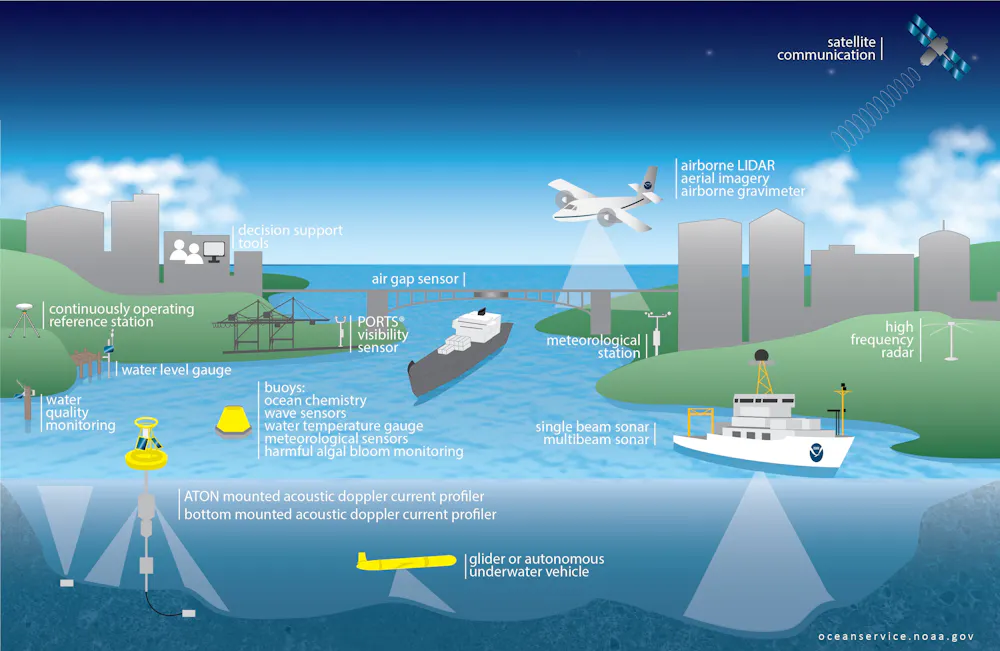
    A lot of the weather information Americans rely on starts with real-time data collected by NOAA satellites, airplanes, weather balloons, radar and maritime buoys, as well as weather stations around the world.

    All of that information goes into the agency’s computers, which process the data to begin defining what’s going on in different parts of the atmosphere.

    NOAA forecasters use computer models that simulate physics and the behavior of the atmosphere, along with their own experience and local knowledge, to start to paint a picture of the weather – what’s coming in a few minutes or hours or days. They also use that data to project seasonal conditions out over weeks or months.

    NOAA’s data comes from many sources to provide a more complete picture of developing climate and weather conditions. Communities and economies rely on that constantly updated information.
    NOAA

    When severe weather is on the way, the agency issues the official alerts you’ll see in the news and on your phone.

    All of this analysis happens before the information reaches private weather apps and TV stations.

    No matter who you are, you can freely access that data and the analyses. In fact, a large number of private companies use NOAA data to create fancy maps and other weather products that they sell.

    It would be extremely difficult to do all of that without NOAA.

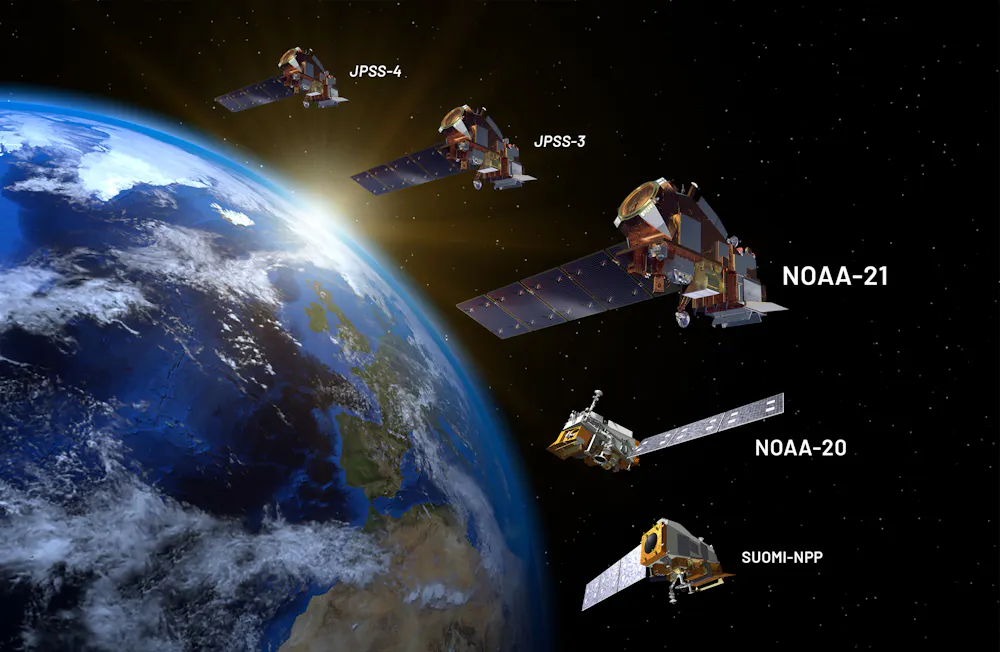
    The agency operates a fleet of 18 satellites that are packed with instruments dedicated to observing weather phenomena essential to predicting the weather, from how hot the land surface is to the water content of the atmosphere. Some are geostationary satellites which sit high above different parts of the U.S. measuring weather conditions 24/7. Others orbit the planet. Many of these are operated as part of partnerships with NASA or the Air Force.

    Some private companies are starting to invest in satellites, but it would take an enormous amount of money to replicate the range of instrumentation and coverage that NOAA has in place. Satellites only last so long and take time to build, so NOAA is continually planning for the future, and using its technical expertise to develop new instruments and computer algorithms to interpret the data.

    NOAA’s low earth orbiting satellites circle the planet from pole to pole and across the equator 14 times a day to provide a full picture of the year twice a day. The agency also has geostationary satellites that provide continuous coverage over the U.S.
    NOAA

    Maritime buoys are another measuring system that would be difficult to replicate. Over 1,300 buoys across oceans around the world measure water temperature, wind and wave height – all of which are essential for coastal warnings, as well as long-term forecasts.

    Weather observation has been around a long time. President Ulysses S. Grant created the first national weather service in the War Department in 1870. It became a civilian service in 1880 under the Department of Agriculture and is now in the Commerce Department. The information its scientists and technologists produce is essential for safety and also benefits people and industries in a lot of ways.

    Could a private company create forecasts on its own without NOAA data?

    It would be difficult for one company to provide comprehensive weather data in a reliable way that is also accessible to the entire public.

    Some companies might be able to launch their own satellite, but one satellite only gives you part of the picture. NOAA’s weather observation network has been around for a long time and collects data from points all over the U.S. and the oceans. Without that robust data, computer models and the broad network of forecasters and developers, forecasting also becomes less reliable.

    Analyzing that data is also complex. You’re not going to be able to take satellite data, run a model on a standard laptop and suddenly have a forecast.

    And there’s a question of whether a private company would want to take on the legal risk of being responsible for the nation’s forecasts and severe weather warnings.

    Neil Jacobs, nominated to oversee NOAA, explains why the agency is essential for accurate national weather forecasting, and why private companies might not want to take on the legal risk on their own.

    NOAA is taxpayer-funded, so it is a public good – its services provide safety and security for everyone, not just those who can pay for it.

    If weather data was only available at a price, one town might be able to afford the weather information necessary to protect its residents, while a smaller town or a rural area across the state might not. If you’re in a tornado-prone area or coastal zone, that information can be the difference between life or death.

    Is climate data and research into the changing climate important for forecasts?

    The Earth’s systems – its land, water and the atmosphere – are changing, and we have to be able to assess how those changes will impact weather tomorrow, in two weeks and far into the future.

    Rising global temperatures affect weather patterns. Dryness can fuel wildfires. Forecasts have to take the changing climate into account to be accurate, no matter who is creating the forecast.

    Drought is an example. The dryness of the Earth controls how much water gets exchanged with the atmosphere to form clouds and rainfall. To have an accurate weather prediction, we need to know how dry things are at the surface and how that has changed over time. That requires long-term climate information.

    NOAA doesn’t do all of this by itself – who else is involved?

    NOAA partners with private sector, academia, nonprofits and many others around the world to ensure that everyone has the best information to produce the most robust weather forecasts. Private weather companies and media also play important roles in getting those forecasts and alerts out more widely to the public.

    A lot of businesses rely on accuracy from NOAA’s weather data and forecasts: aviation, energy companies, insurance, even modern tractors’ precision farming equipment. The agency’s long-range forecasts are essential for managing state reservoirs to ensure enough water is saved and to avoid flooding.

    The government agency can be held accountable in a way private businesses are not because it answers to Congress. So, the data is trustworthy, accessible and developed with the goal to protect public safety and property for everyone. Could the same be said if only for-profit companies were producing that data?

    Christine Wiedinmyer is the CIRES Associate Director for Science. CIRES is a CU Boulder research institute that has a cooperative agreement (grant) with NOAA called the Cooperative Institute for Earth Systems Research and Data Science, CIESRDS. Wiedinmyer’s funding is primarily from NOAA, which supports more than 400 CIRES CU Boulder employees.

    Kari Bowen is the Science and Administration Manager. CIRES is a CU Boulder research institute with a cooperative agreement (grant) with NOAA called the Cooperative Institute for Earth Systems Research and Data Science, CIESRDS. Bowen’s funding is from NOAA, which supports more than 400 CIRES CU Boulder employees.

    ref. NOAA’s vast public weather data powers the local forecasts on your phone and TV – a private company alone couldn’t match it – https://theconversation.com/noaas-vast-public-weather-data-powers-the-local-forecasts-on-your-phone-and-tv-a-private-company-alone-couldnt-match-it-249451

    MIL OSI – Global Reports

  • MIL-OSI: HomeTrust Bancshares, Inc. Announces Transfer of Listing of Common Stock to the New York Stock Exchange and Change in Ticker Symbol

    Source: GlobeNewswire (MIL-OSI)

    ASHEVILLE, N.C., Feb. 11, 2025 (GLOBE NEWSWIRE) — HomeTrust Bancshares, Inc. (NASDAQ: HTBI) (“Company” or “HomeTrust”), the holding company of HomeTrust Bank, today announced that the Company will transfer the listing of its common stock from the NASDAQ Stock Market LLC (“NASDAQ”) to the New York Stock Exchange LLC (“NYSE”). HomeTrust’s common stock is expected to commence trading on the NYSE on Monday, February 24, 2025 under a new ticker symbol, “HTB”. The Company’s common stock is expected to continue to trade on NASDAQ until the close of the market on Friday, February 21, 2025.

    “We are excited to announce our partnership with the NYSE,” said Hunter Westbrook, President and Chief Executive Officer. “In joining the world’s largest stock exchange, we believe leveraging the NYSE trading platform will provide greater exposure for our Company and long-term value for our stockholders. We look forward to celebrating this occasion and milestone for HomeTrust by ringing The Opening Bell on our first of day of trading on the NYSE.”

    “We are pleased to welcome HomeTrust Bancshares, Inc. to the New York Stock Exchange,” said Tara Dziedzic, Head of US Listings, New York Stock Exchange. “As an NYSE-listed company, HomeTrust joins our community of icons, disruptors and many of its peers, leveraging the membership value that our exchange uniquely provides.”

    About HomeTrust Bancshares, Inc.

    HomeTrust Bancshares, Inc. is the holding company for HomeTrust Bank. As of December 31, 2024, the Company had assets of $4.6 billion. The Bank, founded in 1926, is a North Carolina state chartered, community-focused financial institution committed to providing value added relationship banking with over 30 locations as well as online/mobile channels. Locations include: North Carolina (the Asheville metropolitan area, the “Piedmont” region, Charlotte, and Raleigh/Cary), South Carolina (Greenville and Charleston), East Tennessee (Kingsport/Johnson City, Knoxville, and Morristown), Southwest Virginia (Roanoke Valley) and Georgia (Greater Atlanta).

    Forward-Looking Statements

    This press release may include “forward-looking statements” within the meaning of the Private Securities Litigation Reform Act of 1995. Forward-looking statements are not statements of historical fact, but instead are based on certain assumptions including statements with respect to the Company’s beliefs, plans, objectives, goals, expectations, assumptions and statements about future economic performance and projections of financial items. These forward-looking statements are subject to known and unknown risks, uncertainties and other factors that could cause actual results to differ materially from the results anticipated or implied by forward-looking statements. The factors that could result in material differentiation include, but are not limited to, the impact of bank failures or adverse developments involving other banks and related negative press about the banking industry in general on investor and depositor sentiment; the remaining effects of the COVID-19 pandemic on general economic and financial market conditions and on public health, both nationally and in the Company’s market areas; natural disasters, including the effects of Hurricane Helene; expected revenues, cost savings, synergies and other benefits from merger and acquisition activities might not be realized to the extent anticipated, within the anticipated time frames, or at all, costs or difficulties relating to integration matters, including but not limited to customer and employee retention, might be greater than expected, and goodwill impairment charges might be incurred; increased competitive pressures among financial services companies; changes in the interest rate environment; changes in general economic conditions, both nationally and in our market areas; legislative and regulatory changes; and the effects of inflation, a potential recession, and other factors described in the Company’s latest Annual Report on Form 10-K and Quarterly Reports on Form 10-Q and other documents filed with or furnished to the Securities and Exchange Commission – which are available on the Company’s website at www.htb.com and on the SEC’s website at www.sec.gov. Any of the forward-looking statements that the Company makes in this press release or in the documents the Company files with or furnishes to the SEC are based upon management’s beliefs and assumptions at the time they are made and may turn out to be wrong because of inaccurate assumptions, the factors described above or other factors that management cannot foresee. The Company does not undertake, and specifically disclaims any obligation, to revise any forward-looking statements to reflect the occurrence of anticipated or unanticipated events or circumstances after the date of such statements.

    www.htb.com

    The MIL Network

  • MIL-OSI USA: Acting Chairman Statement on Climate-Related Disclosure Rules

    Source: Securities and Exchange Commission

    Today, I am taking action on The Enhancement and Standardization of Climate-Related Disclosures for Investors rule that was adopted by the Commission on March 6, 2024 (the “Rule”).[1] The Rule is currently being challenged in litigation consolidated in the Eighth Circuit[2] and the Commission previously stayed effectiveness of the Rule pending completion of that litigation.[3] The Rule is deeply flawed and could inflict significant harm on the capital markets and our economy.

    Both Commissioner Peirce and I voted against the Rule’s adoption.[4] Commissioner Peirce said that then-existing disclosure rules were sufficient and that the “[R]ule’s anticipated benefits do not outweigh the costs.”[5] She argued that “only a mandate from Congress should put us in the business of facilitating the disclosure of information not clearly related to financial returns.”[6] I stated that the Commission was “without statutory authority or expertise” to address climate change issues and that “this [R]ule is climate regulation promulgated under the Commission’s seal.”[7]

    During the comment period, many submissions likewise urged that the Rule not be adopted. Among the reasons were that the Rule would require a large volume of financially immaterial information, financially material climate-related risks were already subject to disclosure under existing rules, and the proposed rules overstepped the SEC’s regulatory authority.[8]

    The Commission’s briefs previously submitted in the cases consolidated in the Eighth Circuit do not reflect my views. The briefs defend the Commission’s adoption of the Rule, but I continue to question the statutory authority of the Commission to adopt the Rule, the need for the Rule, and the evaluation of costs and benefits. I also question whether the agency followed the proper procedures under the Administrative Procedure Act to adopt the Rule.

    The lack of statutory authority is a weighty factor. Commissioners have a constitutional obligation to determine the bounds of the agency’s statutory authority, and my views on the Commission’s authority here were the result of lengthy study and research informed by many comments on all sides of the issue.

    These views, the recent change in the composition of the Commission, and the recent Presidential Memorandum regarding a Regulatory Freeze,[9] bear on the conduct of this litigation. I believe that the Court and the parties should be notified of these changes.

    Therefore, I have directed the Commission staff to notify the Court of the changed circumstances and request that the Court not schedule the case for argument to provide time for the Commission to deliberate and determine the appropriate next steps in these cases. The Commission will promptly notify the Court of its determination about its positions in the litigation.


    [2] Iowa v. SEC, No. 24-1522 (8th Cir.); see also Liberty Energy Inc. v. SEC, No. 24-cv-739 (N.D. Tex.).

    [5] Commissioner Peirce Statement.

    [7] Commissioner Uyeda Statement.

    [8] See, e.g., Comment of the Federal Regulation of Securities Committee of the Business Law Section of the American Bar Association (Jun. 24, 2022); Comment of the U.S. Chamber of Commerce (Jun. 16, 2022); Comment of the National Association of Convenience Stores (Jun. 8, 2022); Comment of the National Association of Manufacturers (Jun. 6, 2022).

    MIL OSI USA News

  • MIL-OSI United Kingdom: Successful event helps lead construction industry towards decarbonisation

    Source: City of Derby

    On Thursday 6 February, over 100 people from the local construction industry attended an event at The Museum of Making. The event, hosted by Derby City Council, in partnership with SCAPE aimed to give attendees a clear roadmap to decarbonisation. According to the latest data from DESNZ, 25% of the UK’s CO2e emissions come from the built environment.

    The event included an opening speech from Cabinet Member for Climate Change, Transport and Sustainability, Councillor Carmel Swan and an overview of the Council’s own ongoing journey to net zero as well as the role of procurement in delivering sustainable construction. 

    The second half of the event focused on the practicalities of decarbonisation within construction and gave participants an opportunity to hear about the Supply Chain Sustainability School and The Carbon Reduction Code. 

    The event supported the Council’s wider net zero ambition. With ongoing regeneration work across the city, the Council wants to ensure that the city develops with the climate and sustainability at the forefront of its ambitious plans. 

    Councillor Carmel Swan, Cabinet Member for Climate Change, Transport and Sustainability commented: 

    “It’s vitally important that we work alongside our construction industry and wider supply chain partners as they are key to being able to reach net zero, not just in Derby but the wider region and globally. 

    “This event has given us the perfect opportunity to open lines of communication about decarbonisation and we’ll keep those conversations going.” 

    Mark Robinson, Group Chief Executive at SCAPE, said: 

    “We were delighted to support this event, which provided a crucial platform for Derby’s construction supply chain to engage with buyers and gain practical insights into decarbonisation. The built environment is responsible for a significant proportion of the UK’s carbon emissions, so it’s vital that businesses at every level of the supply chain have the knowledge and support they need to deliver more sustainable projects. By working together and accessing initiatives like the Supply Chain Sustainability School and the Carbon Reduction Code, we can drive real change and help ensure that the industry moves towards a low-carbon future.” 

    MIL OSI United Kingdom

  • MIL-OSI Global: Five ways that illustrations can tell climate justice stories

    Source: The Conversation – UK – By Andi Misbahul Pratiwi, PhD Candidate, School of Geography, University of Leeds

    Climate change is often communicated through scientific reports, statistics and policy discussions. However, these technical approaches can be inaccessible to the public, failing to capture the experiences of those most affected.

    Climate narratives structured as stories that involve emotional engagement and personal anecdotes are more effective at mobilising communities, influencing policy and promoting pro-environmental actions across diverse audiences. By blending art with storytelling, illustrations can make complex environmental issues, such as climate justice, much more accessible to the general public.

    Illustrations are not just artistic expressions. They can amplify the voices of affected communities and help make the case for climate justice. In an era where climate action is urgent, harnessing the power of illustration can be transformative. It can challenge dominant narratives while creating more inclusive and participatory ways of understanding climate action.

    I have been collaborating with Puspita Bahari, an Indonesian fisherwomen’s movement to develop ways to communicate the effects of tidal floods and the importance of feminist solidarity. For my PhD research, I spent seven months carrying out fieldwork in three coastal villages in Demak, Central Java, Indonesia. This involved interviews, observations and creative workshops with the community.

    By drawing on 38 women’s firsthand experiences, we have published an illustrated book: Tidal Floods: Women, Fisheries, and Climate Crisis in Indonesia (2024). This story about Indonesia’s fisherwomen explores the intersections of gender, environmental change, activism and the future of the country’s coastal regions. Here are five ways that collaborative illustrations can be used to tell female-led climate justice stories:

    1. Intersectional narration

    The effects of tidal flooding on Indonesian women vary depending on location, livelihood, age and disability status. Along the coastline, women in Indonesia are involved in selling fish, processing seafood and fishing at sea, alongside domestic work.

    This book does not depict women as having a single, monolithic identity. Instead, the images portray their varied realities. These shape how they experience climate injustice and how pre-existing inequalities reproduce new climate injustices.

    Intersectional narration is storytelling that captures how different aspects of identity overlap to shape people’s experiences in complex ways. Using this, various issues such as economic hardship, domestic violence, sexual reproductive health, physical and mental health can be better represented.

    The image below illustrates these challenges. A woman with a disability is unable to use her wheelchair because the village is sinking. A pregnant woman struggles to access healthcare facilities. Fisherwomen face declining incomes due to environmental and economic pressures.

    2. Body maps

    To understand the complexity of climate impacts, I worked with women to draw body maps. As they annotated each picture, fisherwomen shared their embodied experiences of living with tidal floods as an everyday disaster.

    Body mapping is an intimate cartographic process that involves tracing the body and visually exploring one’s lived experience. This method goes beyond textual and oral narratives. It helps women recall and record body memories that might otherwise remain unspoken.

    Their body maps are not just research artefacts. They have been translated into powerful visuals so their personal stories can be shared in this book. The picture above illustrates one fisherwoman’s daily struggles, physical and physiological burdens – so the image reveals the complex, gendered, and intersectional effects of tidal floods.

    3. Historical context

    Certain pictures show how the coastal landscapes are rapidly changing and how villages are sinking at an alarming rate. This historical context is not only drawn from women’s oral narratives but also from past photo albums shared by the community.

    The picture below illustrates the landscape change over 20 years, from rice fields to tidal floodwaters.

    4. Movement and agency

    Beyond documenting vulnerabilities and the social, ecological and economic effects of climate change on women, this book shows how these women have agency. This manifests in various ways, from small acts of resilience to broader feminist solidarity.

    When they work together as a community, women can adapt through collective action. This includes planting crops, building cooperatives and holding demonstrations. Stories can play a role in moving beyond positioning women not just as victims but as people with valuable knowledge and the ability to assert their agency and drive sustainable climate action.

    5. Reflection and collective ownership

    In an era defined by uncertainty and rapid change, the ability to pause and reflect on climate justice is more valuable than ever. Certain images actively encourage readers to reflect on more tech-driven and infrastructure-focused responses to the climate crisis.

    The final pages include questions that prompt critical thinking about the links between gender, climate justice and activism. For example, “what do you think will happen if we do not address the climate crisis?”

    Rather than extracting knowledge from women, especially those in Global South countries, this book is co-created. Fisherwomen’s voices and narratives are central to the storytelling process. By reclaiming conversations about climate change that are often dominated by international forums, we can hear and learn from the people who are most affected. And hopefully inspire more climate advocacy and grassroots action.


    Don’t have time to read about climate change as much as you’d like?

    Get a weekly roundup in your inbox instead. Every Wednesday, The Conversation’s environment editor writes Imagine, a short email that goes a little deeper into just one climate issue. Join the 40,000+ readers who’ve subscribed so far.


    The creation of this book was funded by the GENERATE Project as part of a United Kingdom Research and Innovation (UKRI) Future Leaders Fellowship at the University of Leeds: www.generateproject.org.

    ref. Five ways that illustrations can tell climate justice stories – https://theconversation.com/five-ways-that-illustrations-can-tell-climate-justice-stories-249104

    MIL OSI – Global Reports

  • MIL-OSI Security: Saving Lives, Delivering the Future: Heroes in Uniform and Scrubs

    Source: United States Navy (Medical)

    Story by: Chiara M. Caputo

    U.S. Navy Medicine and Training Command (USNMRTC) Sigonella highlights the accomplishments of three remarkable physicians who have dedicated their lives to serving both their patients and their country. These leaders in military medicine embody the values of innovation, resilience, and selfless service.

    Through their tireless efforts, these physicians have not only advanced medical care within the Military Health System but have also paved the way for future generations of leaders in medicine and the armed forces. Each of their stories highlights a profound commitment to excellence and a passion for making a difference, whether on the battlefield, in clinics, or through groundbreaking research.

    We honor their contributions and celebrate their unwavering dedication to health care, military service, and the pursuit of a healthier, stronger future. Through their stories, we hope to inspire future generations and showcase the unwavering commitment of these women in uniform and in diverse roles in Navy Medicine.

    Brandi L Sakai, MD
    Commander, USN
    Board Certified Emergency Medicine Physician

    Born in Welsh, Louisiana, on June 6, 1981, Cmdr. Sakai grew up with a passion for science and the ocean. After graduating from the Louisiana School for Math, Science, and the Arts in 1998, she pursued marine biology, studying diverse ecosystems from the marshes of Louisiana to Scotland’s marine mammals and the vibrant reefs of the Virgin Islands. Her work at the Roy L. Schneider Hospital’s barometric pressure chamber sparked her drive to combine science with service, graduating cum laude with a B.S. in Biology.

    In 2005, she commissioned in the Navy through the Armed Forces Health Professions Scholarship Program (HPSP) and began medical school at Louisiana State University Health Sciences Center. Hurricane Katrina hit during her training, and Commander Sakai worked tirelessly in pop-up clinics, providing care and vaccinations to displaced communities. This experience shaped her dedication to serving others in times of crisis.
    Her Navy career has been marked by leadership and innovation. From integrating Marine medical services in Japan to creating advanced training programs for shock trauma care, she has consistently raised the bar for military medicine. As the Senior Medical Officer in Okinawa and later the Department Head of Emergency Medicine in Guantanamo Bay, she improved operations, ensured top-tier care, and earned recognition for her commitment to excellence.

    Beyond her professional achievements, Commander Sakai is a certified Emergency Medicine Diplomate and a devoted wife and mother of two. When she’s not scuba diving, sailing, or baking, she’s embracing projects that reflect her passion for problem-solving and innovation.

    Reflecting on her career, Cmdr. Sakai shared, “I had many jobs that many would consider a career. I was a PADI scuba instructor and manager of the storefront of a tour operation in St. Thomas US Virgin Islands (USVI). If you took a cruise to the island, you walked past our store on the docks. We may have said hello two decades ago! After doing the job for 5 years, I felt that I had learned all that I could, and there was no chance for advancement based on performance, so I knew that I needed something new and challenging. After getting my degree in Marine Biology and presenting environmental research to the Senate on USVI fisheries and the impact of hotel expansion, I realized that I enjoyed talking and educating people one-on-one, and speaking to rooms and presenting posters wasn’t going to make me happy. I volunteered at the local Emergency Department, and the variety and mental challenge of solving a puzzle on every patient kept me coming back. I decided to turn it into a career, but I also hated to stay in one place (there was a big wide world to explore), so I joined the Navy and never looked back. I did a General Surgery internship, and the Chaplain and I were the only Naval Officers in my first duty with the Marines in Iwakuni, Japan for 3 years. Being part of the Marines for 3 years to start my career really shaped me and set the tone for all my OCONUS tours since. My husband was an Ombudsman and found a great career as a financial educator that allows him to work virtually. If you need advice on mainland Japan, Korea, Okinawa, or Guantanamo Bay, or love medicine and want to explore your options give me a ring.”

    Meagan G. Chauvin, MD, FACOG
    Lieutenant Commander, USN
    Director of Medical Services/Staff Attending OBGYN

    A Houston, Texas native, Lt. Cmdr. Meagan Chauvin has built a remarkable career in military medicine. After earning her Bachelor of Science in Chemistry with Distinction from the U.S. Naval Academy in 2010, she completed her Medical Doctorate at the University of Texas Medical School at Houston in 2014. She completed her Obstetrics and Gynecology residency in 2018 at Naval Medical Center San Diego.

    Her first assignment as a staff OB/GYN took her to Naval Hospital Guam, where she led the OB/GYN Clinic as Department Head and earned Board Certification in Obstetrics and Gynecology. Later, at Fort Belvoir Community Hospital in Virginia, she became Department Chief of the Women’s Health Clinic, further demonstrating her leadership and dedication to women’s health.

    Now serving as the Director of Medical Services at Naval Hospital Sigonella in Italy, Lt. Cmdr. Chauvin continues to lead with excellence. Among her awards are the Defense Meritorious Service Medal and the Navy and Marine Corps Commendation Medal.

    Lt. Cmdr. Chauvin is also a proud wife to Matthew Gerard Chauvin and mom to three children—EJ, Madeline, and Ellie—balancing her professional success with a fulfilling family life. Reflecting on her career, LCDR Chauvin shared, “I was inspired to become an OBGYN, because I loved taking care of women across their lifespan and developing long-term relationships with my patients. In addition, I love welcoming babies into the world and being part of helping patients grow their families. I joined the Navy after being inspired by classmates from high school who also went to service academies. The Naval Academy was an amazing experience that led me to the most important job I can imagine, supporting Navy women and families as an OBGYN. I am proud to follow in the Navy tradition of my great grandfather, who served on a troop transport ship in WWI, and my grandfather, who joined via the Navy V-12 program during WWII.”

    Kristen Shafer, MC
    Lieutenant, USN
    Emergency Medicine Attending

    Born in New York, New York, Lt. Shafer discovered her passion for science and outreach early in life. After earning her bachelor’s degree in chemistry pre-medicine at Indiana University of Pennsylvania in 2014, she brought the wonders of chemistry to life for local elementary students through her self-created Chemistry Magic Show.

    In 2015, she pursued her Master of Science in Space Physiology and Health at King’s College London, where her thesis explored visual function and impairment in dynamic environments. She collaborated with the United Kingdom space program’s Mission X initiative, blending her love of science with public engagement.

    Lt. Shafer joined the Navy through the HPSP program and earned her Doctor of Medicine from Stony Brook University in 2020, graduating early to assist with the initial surge of COVID-19 patients in New York. She went on to complete her Emergency Medicine Residency at USNMRTC Portsmouth in 2024, where she expanded Science, Technology, Engineering, and Math (STEM) outreach programs, inspiring over 300 high school students annually.

    Now an Emergency Medicine Attending at USNMRTC Sigonella, Lt. Shafer continues her commitment to both medicine and mentorship. As Emergency Response Committee Chair, she oversees emergency preparedness, and as a liaison to local DoDEA schools, she is developing a mentorship program to introduce students to healthcare careers and military opportunities.

    With a passion for outreach and academic medicine, LT Shafer embodies the Navy’s mission to serve both on and off the field, inspiring the next generation of leaders. Reflecting on her career in emergency medicine, Lt. Shafer said, “In emergency medicine, we need to be ready for whatever comes in the door at any time. Military medicine lets me practice that medicine and be comfortable providing care not just at any time, but any place in the world and to a population that is dedicated to serving others and making a difference.”

    USNMRTC Sigonella is one of The Defense Health Agency’s Overseas Military Treatment Facilities (MTF). The staff are comprised of active duty service members, General Service (GS), contractors, and Local Nationals. It ensures maximum readiness by providing high-quality, safe patient and family-centered care to maximize force health protection for all beneficiaries, to included NATO and transient DoD forces in the U.S. Fifth Fleet and U.S. Sixth Fleet areas of operation.

    The U. S. Naval Academy (USNA) offers a variety of academic curriculums that prepare their graduates for a rewarding military career. Graduates of the USNA will accept a commission for 5 years of active duty service in the U.S. Navy or Marine Corps. For more information regarding the USNA visit: https://www.usna.edu/homepage.php.

    If you are already in or plan to attend school to be a physician, dentist, optometrist, physician assistant or clinical psychologist, the Armed Forces Health Professions Scholarship Program (HPSP) will pay your educationally based tuition and fees for up to four years of school and provide a monthly stipend paid directly to you. After graduation, you’ll join the Navy’s active duty team as a commissioned officer. In return, you agree to serve a minimum of 2 years on active duty or year for year of scholarship, whichever is longer.

    MIL Security OSI

  • MIL-OSI USA: Winter Weather Threat This Week: Get Ready Now

    Source: US Federal Emergency Management Agency

    Headline: Winter Weather Threat This Week: Get Ready Now

    Winter Weather Threat This Week: Get Ready Now

    CHICAGO – With the threat starting midweek of heavy snowfall and cold temperatures across much of the upper Midwest, FEMA’s Region 5 office in Chicago encourages everyone to prepare now. “The forecast this week is an important reminder that winter isn’t over just yet,” said acting FEMA Region 5 Regional Administrator Michael S. Chesney. “Now is the time to check local weather forecasts and warnings, learn the risks for your area and take precautions to stay safe.”Follow the instructions of state and local officials and listen to local radio or TV stations for updated emergency information.Gather supplies in case you need to stay home for several days without power. Keep in mind each person’s specific needs, including medication, and don’t forget the needs of your pets. Fully charge your phone and other electronic items before the storm in case you lose power.Avoid non-essential travel. If you must go out, make sure your vehicle is in good working condition and fill your gas tank before the storm hits. Check that your car’s emergency supply kit is fully stocked before traveling.Limit your time outside. If you need to go outside, wear layers of warm clothing. Watch for signs of frostbite and hypothermia.Heat your home safely. Remember to keep space heaters at least three feet away from items that can burn and plug them directly into the wall. Never use a gas stovetop or oven to heat your home. When using a generator, always keep it outdoors and at least 20 feet away from windows, doors and attached garages.Find even more valuable tips to help you prepare for severe winter weather by visiting #WinterReady | Ready.gov. 
    kimberly.keblish
    Mon, 02/10/2025 – 20:49

    MIL OSI USA News

  • MIL-OSI Asia-Pac: H5N1 AVIAN INFLUENZA IN WILDLIFE

    Source: Government of India

    Posted On: 11 FEB 2025 5:31PM by PIB Delhi

    In response to the question regarding the measures taken by the Government to monitor and manage the health of captive animals in zoos following the detection of H5N1 avian influenza in wildlife at the Nagpur rescue center, the written reply stated the measures taken by the Central Government:

    1. Central Zoo Authority (CZA), Ministry of Environment, Forest and Climate Change, has issued circular to all Zoos regarding their preparedness to prevent ingress of Avian Influenza and  advised zoos to comply with the National Action Plan on “Prevention, Control and Containment of Avian Influenza”.
    2. CZA advisedthe Zoos to consult Centre for Wildlife, ICAR-Indian Veterinary Research Institute, Bareilly for technical advise on Wildlife management, disease control and diagnosis.
    3. Department of Animal Husbandry& Dairying (DAHD), GoI has issued an advisory to the state for isolation of animals showing any clinical signs, closure of the establishment to the public including isolation and restriction of movement of zoo workers and use of Personal protective equipment (PPE), isolation of animal handlers, strengthening of biosecurity measures.
    4. States have been requested for surveillance of Tigers, Leopards and other wild animals and birds present in the Zoo and reporting of unusual mortality
    5. The State has been requested to follow the DAHD National Action Plan for Prevention Control and Containment of Avian Influenza 2021 especially Chapter 6 which has action points to deal with outbreaks of avian influenza in Zoos.
    6. The National Joint Outbreak Response Team (NJORT) involving members from NCDC, ICMR, Wildlife and DAHD was alsodeputed to conduct thejoint investigation and suggestion for future preparedness.
    7. Department of Animal Husbandry & Dairying, GoIconducted a review meeting on 7.1.2025 of all the stakeholders like Department of Animal Husbandry, Government of Maharashtra, Central Zoo Authority, Wildlife Division-MOEFCC, Indian Council of Medical research, National Centre for Disease Control, Ministry of Health and Family Welfare, officials of Gorewada Zoo and ICAR-National Institute of High Security Animal Diseases (NIHSAD)- Bhopal and advised all stakeholders to work in close collaboration following One Health Approach.
    8. A separate team from ICAR-NIHSAD, Bhopal and WRDDL Pune also conducted epidemiological investigations in and around the rescue centre and Chandrapur Forest area.
    9. 68 samples from the wild animals housed in the rescued centre of Gorewada Zoo were screened and they are tested negative by ICAR-NIHSAD, Bhopal as on 10.1.2025.

    In response to the question, whether there are any cases of avian flu in other wildlife sanctuaries, rescue centers, or zoos in the country, the written reply stated that no such report is received from the Ministry of Environment, Forest and Climate Change.

    Ministry of Environment, Forest and Climate Change informed that the management of recognised Zoos were advised to allot required resources or teams as per the National Action Plan on “Prevention, Control and Containment of Avian Influenza” and its addendum specific to Zoos for early detection and containment of Avian Influenza.

    This information was given by the Minister of Fisheries, Animal Husbandry and Dairying Shri Rajiv Ranjan Singh alias Lalan Singh, in a written reply in Lok Sabha

    today.

    *****

    AA

    (Release ID: 2101846) Visitor Counter : 20

    Read this release in: Hindi

    MIL OSI Asia Pacific News

  • MIL-OSI Europe: DPG Media signs new loan agreement with EIB

    Source: European Investment Bank

    DPG Media Group has signed a new lending agreement with the European Investment Bank (EIB). Built around financing eight core priorities, the EIB finances investments that support EU policy goals, including digitalisation. After a first loan signed in 2022 to support the Group’s digitalisation of media platforms, DPG has now signed a further €120 million in the framework of further digitalisation and innovation of its media.

    DPG Media plans to spend a total of €392 million in this regard over the period 2024-2026, of which 30% will be financed with an EIB loan. This financing will allow DPG Media to accelerate its digital transformation and continue to play a leading role in digital innovation as a local player. As part of the project, DPG Media expects to increase its knowledge and expertise in artificial intelligence and content distribution, in alignment with the objectives of the Digital Europe Programme.

    EIB vice-president Robert de Groot: “Digitalisation and the development of advanced technologies play a key role in Europe’s competitiveness. These technologies must be an intrinsic part of the broad support for European entrepreneurs and companies. DPG’s investments to digitise its offering and services are in line with European ambitions. EIB loans are meant to foster this type of development.”

    Erik Roddenhof, CEO of DPG Media: “We are delighted with this new long-term loan from the European Investment Bank for our investments in our further digital transformation. We deem this necessary to be able to successfully offer independent and strong media as a local media player in a rapidly changing market that is increasingly dominated by global players. With this loan, the group diversifies its debt financing, both in terms of creditors and tenors. We regard the support of the European Investment Bank primarily as a quality stamp, not only for the creditworthiness of DPG Media, but especially for our digital efforts.”

    Looking ahead, DPG will invest to further develop its digital platform for end-users and advertisers, including with AI and text-to-speech applications.

    In recent years the investments in DPG’s advertising platform ‘Trusted Web’ marked a crucial and unique step to reduce dependence on big tech: advertisers no longer need to use third-party big tech purchasing platforms and tools to buy advertising campaigns at DPG Media.

    Furthermore, DPG invested heavily in audio technology, the digitalisation of its magazines and improvement of its streaming platforms on smart TVs, and the platform now also serves multiple users (besides VTM GO, Streamz and RTL Play also use the same platform). DPG Media has also implemented a comprehensive cybersecurity strategy to ensure its platforms remain resistant to emerging threats.

    Background information

    The European Investment Bank (ElB) is the long-term lending institution of the European Union, owned by its Member States. Built around eight core priorities, it finances investments that contribute to EU policy objectives by bolstering climate action and the environment, digitalisation and technological innovation, security and defence, cohesion, agriculture and bioeconomy, social infrastructure, high-impact investments outside the EU, and the Capital Markets Union.   

    All projects financed by the EIB Group are in line with the Paris Climate Agreement, as pledged in our Climate Bank Roadmap. Almost 60% of the EIB Group’s annual financing supports projects directly contributing to climate change mitigation, adaptation, and a healthier environment.   

    DPG Media Group’s mission is to inform, entertain and inspire people. The headquarters of the international media group, which is active in the Belgian, Dutch and Danish markets, are in Antwerp. DPG Media Group has a workforce of 5,396 employees and a portfolio of 90 strong publishing, broadcasting and services brands. Every day, the DPG Media Group brands reach a total of 15 million media users, both online and offline.

    MIL OSI Europe News

  • MIL-OSI United Kingdom: Vegetable oil fuel rolls out to more bin lorries

    Source: Scotland – City of Perth

    Following a successful trial of Hydrotreated Vegetable Oil (HVO) in several of its bin lorries, Perth and Kinross Council is now extending the use of the fuel to more of its large fleet vehicles.

    HVO is used, filtered vegetable oil and it provides an environmentally-friendly alternative to diesel that helps reduce carbon emissions from previously fossil-fuelled vehicles. As a result of the six-month trial in 2024, a significant reduction in carbon emissions from the six lorries has been achieved, namely a saving of` 87 tonnes of CO2. 

    Starting from 3 February 2025, the process of running down the diesel supply in a further 18 bin lorries based at Friarton in Perth and swapping to HVO is moving forward. It is estimated that a reduction of around 500 tonnes of CO2 a year could be achieved with the changeover. 

    Convener of Climate Change and Sustainability, Councillor Richard Watters said: “The trial introduction of HVO to our bin lorries has proved to be a real success by providing a simple, readily available and much greener fuel source. It reflects the commitment we have made to reducing our carbon footprint and I look forward to seeing more of our vehicles out on the road powered by HVO.” 

    Vice-Convener, Councillor Liz Barrett said: “I warmly welcome this very significant reduction in our CO2 emissions from refuse collection.  It shows great progress towards our targets to reduce emissions from Council vehicles.  I’d like to thank our Waste Management and Fleet teams for their commitment to making a difference.” 

    Last modified on 11 February 2025

    Share this page

    Print

    MIL OSI United Kingdom

  • MIL-OSI Russia: Principality of Andorra: Staff Concluding Statement of the 2025 Article IV Mission

    Source: IMF – News in Russian

    February 11, 2025

    A Concluding Statement describes the preliminary findings of IMF staff at the end of an official staff visit (or ‘mission’), in most cases to a member country. Missions are undertaken as part of regular (usually annual) consultations under Article IV of the IMF’s Articles of Agreement, in the context of a request to use IMF resources (borrow from the IMF), as part of discussions of staff monitored programs, or as part of other staff monitoring of economic developments.

    The authorities have consented to the publication of this statement. The views expressed in this statement are those of the IMF staff and do not necessarily represent the views of the IMF’s Executive Board. Based on the preliminary findings of this mission, staff will prepare a report that, subject to management approval, will be presented to the IMF Executive Board for discussion and decision.

    Andorra La Vella – February 11, 2025

    The Andorran economy is doing well. This provides a window of opportunity to address substantial long-term challenges. The authorities have consolidated the country’s macro-financial framework and reinforced buffers. However, Andorra’s real GDP per capita—while high in absolute terms—has remained flat over the last 50 years, with growth largely driven by population increases. Going forward, population aging is both an economic and a fiscal concern, and climate change challenges an economic model largely dependent on winter tourism. Ambitious structural reforms are needed to unlock investment and lift productivity.

    Economic Outlook

    The Andorra economy continues to show resilience and to grow above its potential. Growth in 2024 surprised slightly on the upside, at an estimated 2.1 percent, driven by the service, banking and construction sectors. Inflation is subsiding gradually, reaching 2.6 percent at the end of 2024, despite limited economic slack and a still tight labor market. The current account surplus remains very large, estimated at 15.1 percent of GDP in 2024. The strong performance of banks continued in 2024 supported by high interest margins and increased fees and commissions.

    Going forward, GDP is expected to slow to the level of potential growth. Real GDP growth is forecasted at 1.7 percent in 2025 and 1.5 percent from 2027 onwards. Inflation is projected to stabilize at 1.7 percent over the medium term. Short-term risks are balanced: greater uncertainty in the global economy and the potential for adverse shocks such as deepening geoeconomic fragmentation, supply disruptions, recurrent commodity price fluctuations and a reversal of monetary policy loosening are downside risks to growth and inflation. On the upside, Andorra, like other service-oriented economies in Europe, could benefit from stronger demand, and grow faster than projected. Solid buffers mitigate risks.

    Challenges are concentrated over the medium-term, as stagnating income growth makes it challenging to address the impact of population aging and climate change. With long life expectancy and low fertility rates, Andorra’s population is expected to age rapidly—removing an engine for GDP growth and creating fiscal liabilities over the long term. Fiscal costs from pensions and healthcare will be substantial. More frequent climate shocks can affect the economic cycle in an economy largely reliant on winter tourism, and structurally warmer temperatures will require extensive adaptation.

    Policy priorities

    The solid macroeconomic position and the credibility of the policy framework provide Andorra with an opportunity for implementing far-reaching structural reforms. Diversifying the economy to enhance resilience, unlocking investment and lifting productivity to raise income levels, and addressing the costs of aging and climate change should be driving the policy agenda. The recently negotiated EU Association Agreement (EUAA), if approved by referendum, could offer an opportunity to support the reform momentum, but would also bring challenges.

    Maintaining a solid fiscal framework given spending pressures over the medium term

    Maintaining a disciplined fiscal policy within the fiscal framework is important and will provide room for more public investment. In a microstate that needs fiscal buffers against external shocks, entrenching fiscal space is important. In addition, the credibility of the fiscal framework and the primary surplus provide room for higher public investment to support potential growth and mitigate structural bottlenecks.

    • A balanced 2025 budget focused on economic priorities. The 2025 budget finds a welcome balance between maintaining a conservative fiscal stance but building on the authorities’ structural priorities, with a focus on health, housing, maintaining purchasing power, and education. Overall, the 2025 budget foresees a deficit of 0.9 percent of GDP. Given past practice of adjusting expenditures in line with incoming revenues, staff forecasts a small surplus of about 0.3 percent of GDP.
    • Room for growth-enhancing public spending. The fiscal framework, which prescribes an overall deficit limit of 1 percent of GDP and a central government debt ceiling of 40 percent of GDP, provides room for higher public spending targeted towards growth-enhancing investment. Spending should be focused on the structural needs of the economy: social and affordable housing, upskilling the workforce and addressing labor shortages, connectivity to support economic diversification, and investments to lift potential growth. As under-execution of budgeted public investment is customary, delivering on investment plans should be a policy objective.

    Over the medium term, Andorra faces rising spending pressures from aging, as well as a need to adapt to climate change—engaging reforms early is paramount. Staff estimates that by 2050, pension system expenditures will rise by 6.7 percentage points while healthcare expenditures will increase by 2 percentage points. Acting early on pension and healthcare reforms is needed to anticipate and mitigate the fiscal impact of aging.

    • Pension reform has been on the government’s agenda for some time and is overdue. The menu of options to put the system on the sustainable path is well understood, from increasing contribution rates and reducing conversion rates to increasing the retirement age. Concluding the reform in an expeditious and comprehensive manner is needed to ensure the sustainability of the social security fund in the long run.
    • A reform of the healthcare system should aim to contain long-term costs while raising healthcare revenues . Experience from other advanced economies provides a blueprint for potential measures, in 4 areas: (i) enhance cost efficiency, (ii) strengthen preventive care, (iii) increase revenues for healthcare while preserving equity, and (iv) improve governance. The National Pact brought together stakeholders and should continue its work to strengthen the healthcare system.

    · Beyond direct policies in the pension and healthcare areas, broader measures would be helpful to buffer the additional long-term fiscal costs of aging. Domestic revenue mobilization and migration policies can help.

    • Climate change also exposes the government to future contingent liabilities. Public investment needs to increase to meet Andorra’s climate change mitigation targets and to provide adequate support to the adaptation of the private sector. In addition, fiscal space will be increasingly needed to buffer the negative impact of climate shocks.

    Precautionary borrowing and a rapid reduction in public debt provide the authorities with flexibility in managing the debt profile. The authorities are reaping the benefits of an effective debt management strategy that is projected to bring public debt down to 30 percent of GDP by 2026, that lengthened its maturity to 6.3 years and that keeps public debt service low. The authorities should continue to monitor market conditions for an upcoming debt maturity of €500 million public bonds in 2027, including for further diversifying debt and extending its maturity to decrease rollover risks and mitigate consequences from potential increases in interest rates.

    Consolidating banking performance in a changing environment

    Strengthening further the resilience of the banking system during periods of high profitability is appropriate. The banking sector displays solid fundamentals, with large capital and liquidity buffers. However, given the large size of the banking sector, the supervisor should remain vigilant. Available supervisory tools should complement each other, including by supporting the lender of last resort facility introduced in 2022 by continued close supervision and a well-designed resolution framework to ensure that critical problems are identified and addressed early. The activation of a countercyclical capital buffer in 2024 was timely to increase banking system resilience during high bank profitability.

    The changing financial landscape, notably with the continued international expansion of banks and a possible EUAA, brings opportunities and challenges for Andorran banks. Banks have been growing in the EU where they run independent subsidiaries focused on private banking services, and the EUAA would facilitate this expansion, notably in the asset management business. Domestically, the EUAA has the potential to create a more dynamic domestic market but also to open Andorra to greater competition. The authorities should work closely with banks to prepare for the transition and safeguard financial stability.

    Ambitious structural reforms to unlock investment and lift productivity, support the diversification of the economy and help mitigate climate change.

    A comprehensive set of structural measures is important and should focus on the following:

    • Addressing frictions, notably labor and housing shortages. Public investment in education and well-designed immigration policies can improve knowledge capital in Andorra and raise labor productivity. Multiple housing measures were implemented recently—including the extension of existing rental contracts, the creation of a public affordable housing park, tax incentives for owners who offer affordable housing, suspension of tourist accommodation licenses, fees on empty houses and on real estate purchases by foreigners. The authorities should aim at providing market-based incentives for investing in affordable housing while minimizing distortions.
    • Creating a business environment conducive to higher investment. Recommendations encompass reducing administrative rigidities associated with doing business in Andorra, promoting access to financing, and implementing measures to attract and retain talent.
    • Supporting the development of higher value-added sectors, including the digital economy. With limited space for manufacturing, Andorra can look at the experience of peer countries that have successfully diversified towards the digital economy. Government policies, including the 2022 Law on the digital economy, entrepreneurship, and innovation and the Digitalization Strategy 2020-2030 were welcome initial steps.

    The EUAA could provide further momentum for reforms towards diversification, unlock investment, and raise productivity in Andorra, but is not without its own challenges. The agreement signals a strong commitment to deeper integration with the EU and to reinforce Andorran institutions in their coherence with EU standards. Empirical evidence on the benefits of EU membership provides useful lessons for EU association. It suggests that while the impact can be significant and positive, it builds up over time, and is conditional on well-designed domestic reforms during the accession period. While the impact varies with country-specific circumstances, it materializes through a few channels: structural reforms in the period preceding accession/association, greater capital accumulation, notably FDI, and higher productivity. In Andorra, room for increasing investment and productivity is substantial. Transition periods for key sectors such as telecom and banking mitigate the risks of disruption and fiscal space can cover transition costs. Preparedness is essential to realize the benefits of association, and reduce potential downsides, such as greater regional competition.

    The climate adaptation strategy needs to be accelerated given the macrocriticality of global warming for Andorra. Because of its higher altitude, Andorra is less exposed than other winter tourism locations in the region and should use this window of opportunity to enact needed policies, support the development of higher value-added service sectors and diversify away from winter tourism. The authorities should expedite the development and execution of a climate adaptation strategy.

    *

    The mission thanks the authorities and all our counterparts for a constructive and candid policy dialogue, for engaging in a productive and transparent collaboration, and for their hospitality during the official visit of the IMF to Andorra.

    Andorra: Selected Social and Economic Indicators

    I. Social Indicators

    Population (2023)

    85101

    Population at risk of poverty (percent, 2020)

    13

    Per capita income (2023, euros)

    40511

    Human Development Index Rank (2021)

    40 (out of 189)

    Gini Index (2020)

    32

    Life expectancy at birth (2024)

    83.9

    II. Economic Indicators

    Projections

    2022

    2023

    2024

    2025

    2026

    2027

    2028

    2029

    2030

    NATIONAL ACCOUNTS AND PRICES

    (annual change, percent, unless otherwise indicated)

    Real GDP

    9.6

    2.6

    2.1

    1.7

    1.6

    1.5

    1.5

    1.5

    1.5

    Nominal GDP

    14.2

    9.0

    5.0

    3.7

    3.4

    3.3

    3.2

    3.2

    3.2

    GDP deflator

    4.2

    6.3

    2.9

    1.9

    1.8

    1.7

    1.7

    1.7

    1.7

    (contribution to nominal GDP growth, percentage points)

    Consumption

    6.5

    7.0

    3.6

    2.5

    2.5

    2.5

    2.5

    2.4

    2.4

    Private

    6.2

    3.5

    1.7

    1.5

    1.5

    1.5

    1.5

    1.4

    1.4

    Public

    0.3

    3.4

    1.9

    1.0

    1.0

    1.0

    1.0

    1.0

    1.0

    Investment

    6.8

    -2.2

    0.9

    0.5

    0.6

    0.3

    0.3

    0.4

    0.5

    Private 1/

    6.4

    -3.1

    0.2

    0.0

    0.4

    0.1

    0.1

    0.2

    0.3

    Public

    0.4

    0.9

    0.7

    0.5

    0.2

    0.2

    0.2

    0.2

    0.2

    Net exports of goods and services

    0.9

    4.3

    0.7

    0.6

    0.4

    0.4

    0.4

    0.4

    0.4

    Exports

    18.8

    10.4

    4.2

    3.3

    2.8

    2.8

    2.9

    2.9

    2.8

    Imports

    18.0

    6.1

    3.5

    2.7

    2.5

    2.4

    2.5

    2.5

    2.4

    Prices

    Inflation (percent, period average)

    6.2

    5.6

    3.1

    2.2

    1.8

    1.7

    1.7

    1.7

    1.7

    Inflation (percent, end of period)

    7.2

    4.6

    2.6

    2.0

    1.7

    1.7

    1.7

    1.7

    1.7

    Unemployment rate (percent)

    2.1

    1.6

    1.6

    1.6

    1.8

    1.8

    1.9

    2.0

    2.0

    EXTERNAL SECTOR

    (percent of GDP, unless otherwise indicated)

    Current account

    11.6

    14.2

    15.1

    17.0

    17.0

    17.0

    17.0

    17.0

    17.0

    Balance on goods and services

    8.8

    12.0

    12.0

    12.2

    12.1

    12.1

    12.1

    12.1

    12.1

    Exports of goods and services

    80.9

    83.7

    83.7

    83.9

    83.8

    83.9

    84.1

    84.2

    84.3

    Imports of goods and services

    72.2

    71.8

    71.6

    71.7

    71.7

    71.8

    71.9

    72.1

    72.2

    Primary income, net

    4.3

    3.5

    4.3

    6.1

    6.1

    6.1

    6.1

    6.1

    6.1

    Secondary income, net

    -1.4

    -1.3

    -1.3

    -1.3

    -1.3

    -1.3

    -1.3

    -1.3

    -1.3

    Capital account

    0.0

    -0.1

    0.0

    0.0

    0.0

    0.0

    0.0

    0.0

    0.0

    Financial account

    12.7

    13.5

    15.1

    17.0

    17.0

    17.0

    17.0

    17.0

    17.0

    Errors and omissions

    1.1

    -0.6

    0.0

    0.0

    0.0

    0.0

    0.0

    0.0

    0.0

    Gross international reserves (millions of euros) 2/

    338.4

    338.7

    399.0

    399.0

    399.0

    399.0

    399.0

    399.0

    399.0

    FISCAL SECTOR

    (percent of GDP, unless otherwise indicated)

    General Government 3/

    Revenue

    39.7

    38.0

    37.9

    37.8

    37.7

    37.8

    37.8

    37.7

    37.8

    Expenditure

    34.9

    35.9

    36.5

    36.7

    36.6

    36.9

    36.9

    37.0

    37.0

    Interest

    0.7

    0.6

    0.6

    0.6

    0.6

    0.8

    0.8

    0.8

    0.8

    Primary balance

    5.6

    2.7

    2.0

    1.7

    1.6

    1.6

    1.7

    1.6

    1.6

    Net lending/borrowing (overall balance)

    4.8

    2.1

    1.5

    1.1

    1.1

    0.8

    0.9

    0.8

    0.8

    Public debt

    38.9

    35.5

    33.7

    32.5

    31.5

    30.5

    30.0

    29.5

    29.0

    Central Government 4/

    Revenue

    21.7

    19.8

    21.3

    20.8

    20.8

    20.8

    20.8

    20.8

    20.9

    Expenditure

    18.7

    19.1

    20.4

    20.5

    20.5

    20.6

    20.7

    20.6

    20.7

    Interest

    0.7

    0.5

    0.5

    0.5

    0.5

    0.7

    0.7

    0.7

    0.7

    Primary balance

    3.6

    1.2

    1.4

    0.8

    0.8

    0.9

    0.8

    0.9

    0.9

    Net lending/borrowing (overall balance)

    2.9

    0.7

    0.9

    0.3

    0.3

    0.2

    0.1

    0.2

    0.2

    Public debt

    37.1

    34.0

    32.3

    31.2

    30.1

    29.2

    28.7

    28.3

    27.9

    BANKING SECTOR5 /

    (percent, unless otherwise indicated)

    Regulatory capital to risk-weighted assets

    20.3

    21.7

    21.2

    Nonperforming loans to total gross loans

    3.3

    2.2

    2.1

    Credit to nonfinancial private sector

    Level (percent of GDP)

    116.4

    101.3

    94.5

    Corporates

    61.8

    55.1

    51.1

    Households

    54.6

    46.2

    43.4

    Growth (nominal)

    -1.7

    -5.2

    -2.0

    Corporates

    2.6

    -2.8

    -2.5

    Households

    -6.1

    -7.8

    -1.3

    Credit to public sector

    Level (percent of GDP)

    2.2

    1.8

    1.5

    Growth (nominal)

    -8.4

    -10.0

    -13.0

    Memorandum items

    Exchange rate (€/USD, period average) 6/

    0.95

    0.92

    0.92

    0.97

    0.97

    0.97

    0.97

    0.97

    0.97

    Nominal GDP (millions of euros)

    3,210

    3,501

    3,676

    3,811

    3,942

    4,070

    4,202

    4,338

    4,478

    Sources: Andorran authorities, Eurostat, and IMF staff calculations.

    1/ The contribution of private investment is derived as a residual and includes investments of state-owned enterprises.

    2/ The increase of gross international reserves in 2022 is due to €100 million deposited at the Bank of Spain, €40 million at the Banque de France, and €60 million at the Nederlandsche Bank as gross international reserves. In 2024, additional €60 million reserves were accounted, mainly deposited at the Bank of Spain.

    3/ The general government comprises the central government, local governments, and the social security fund.

    4/ The central government comprises Govern d’Andorra, as well as nonmarket, nonprofit institutional units.

    5/ 2024 data corresponds to 2024Q3.

    6/ The table reports the exchange rate €/USD because Andorra is a euroized economy.

    IMF Communications Department
    MEDIA RELATIONS

    PRESS OFFICER: Camila Perez

    Phone: +1 202 623-7100Email: MEDIA@IMF.org

    https://www.imf.org/en/News/Articles/2025/02/11/andorra-cs-2025

    MIL OSI

    MIL OSI Russia News

  • MIL-OSI Economics: Principality of Andorra: Staff Concluding Statement of the 2025 Article IV Mission

    Source: International Monetary Fund

    February 11, 2025

    A Concluding Statement describes the preliminary findings of IMF staff at the end of an official staff visit (or ‘mission’), in most cases to a member country. Missions are undertaken as part of regular (usually annual) consultations under Article IV of the IMF’s Articles of Agreement, in the context of a request to use IMF resources (borrow from the IMF), as part of discussions of staff monitored programs, or as part of other staff monitoring of economic developments.

    The authorities have consented to the publication of this statement. The views expressed in this statement are those of the IMF staff and do not necessarily represent the views of the IMF’s Executive Board. Based on the preliminary findings of this mission, staff will prepare a report that, subject to management approval, will be presented to the IMF Executive Board for discussion and decision.

    Andorra La Vella – February 11, 2025

    The Andorran economy is doing well. This provides a window of opportunity to address substantial long-term challenges. The authorities have consolidated the country’s macro-financial framework and reinforced buffers. However, Andorra’s real GDP per capita—while high in absolute terms—has remained flat over the last 50 years, with growth largely driven by population increases. Going forward, population aging is both an economic and a fiscal concern, and climate change challenges an economic model largely dependent on winter tourism. Ambitious structural reforms are needed to unlock investment and lift productivity.

    Economic Outlook

    The Andorra economy continues to show resilience and to grow above its potential. Growth in 2024 surprised slightly on the upside, at an estimated 2.1 percent, driven by the service, banking and construction sectors. Inflation is subsiding gradually, reaching 2.6 percent at the end of 2024, despite limited economic slack and a still tight labor market. The current account surplus remains very large, estimated at 15.1 percent of GDP in 2024. The strong performance of banks continued in 2024 supported by high interest margins and increased fees and commissions.

    Going forward, GDP is expected to slow to the level of potential growth. Real GDP growth is forecasted at 1.7 percent in 2025 and 1.5 percent from 2027 onwards. Inflation is projected to stabilize at 1.7 percent over the medium term. Short-term risks are balanced: greater uncertainty in the global economy and the potential for adverse shocks such as deepening geoeconomic fragmentation, supply disruptions, recurrent commodity price fluctuations and a reversal of monetary policy loosening are downside risks to growth and inflation. On the upside, Andorra, like other service-oriented economies in Europe, could benefit from stronger demand, and grow faster than projected. Solid buffers mitigate risks.

    Challenges are concentrated over the medium-term, as stagnating income growth makes it challenging to address the impact of population aging and climate change. With long life expectancy and low fertility rates, Andorra’s population is expected to age rapidly—removing an engine for GDP growth and creating fiscal liabilities over the long term. Fiscal costs from pensions and healthcare will be substantial. More frequent climate shocks can affect the economic cycle in an economy largely reliant on winter tourism, and structurally warmer temperatures will require extensive adaptation.

    Policy priorities

    The solid macroeconomic position and the credibility of the policy framework provide Andorra with an opportunity for implementing far-reaching structural reforms. Diversifying the economy to enhance resilience, unlocking investment and lifting productivity to raise income levels, and addressing the costs of aging and climate change should be driving the policy agenda. The recently negotiated EU Association Agreement (EUAA), if approved by referendum, could offer an opportunity to support the reform momentum, but would also bring challenges.

    Maintaining a solid fiscal framework given spending pressures over the medium term

    Maintaining a disciplined fiscal policy within the fiscal framework is important and will provide room for more public investment. In a microstate that needs fiscal buffers against external shocks, entrenching fiscal space is important. In addition, the credibility of the fiscal framework and the primary surplus provide room for higher public investment to support potential growth and mitigate structural bottlenecks.

    • A balanced 2025 budget focused on economic priorities. The 2025 budget finds a welcome balance between maintaining a conservative fiscal stance but building on the authorities’ structural priorities, with a focus on health, housing, maintaining purchasing power, and education. Overall, the 2025 budget foresees a deficit of 0.9 percent of GDP. Given past practice of adjusting expenditures in line with incoming revenues, staff forecasts a small surplus of about 0.3 percent of GDP.
    • Room for growth-enhancing public spending. The fiscal framework, which prescribes an overall deficit limit of 1 percent of GDP and a central government debt ceiling of 40 percent of GDP, provides room for higher public spending targeted towards growth-enhancing investment. Spending should be focused on the structural needs of the economy: social and affordable housing, upskilling the workforce and addressing labor shortages, connectivity to support economic diversification, and investments to lift potential growth. As under-execution of budgeted public investment is customary, delivering on investment plans should be a policy objective.

    Over the medium term, Andorra faces rising spending pressures from aging, as well as a need to adapt to climate change—engaging reforms early is paramount. Staff estimates that by 2050, pension system expenditures will rise by 6.7 percentage points while healthcare expenditures will increase by 2 percentage points. Acting early on pension and healthcare reforms is needed to anticipate and mitigate the fiscal impact of aging.

    • Pension reform has been on the government’s agenda for some time and is overdue. The menu of options to put the system on the sustainable path is well understood, from increasing contribution rates and reducing conversion rates to increasing the retirement age. Concluding the reform in an expeditious and comprehensive manner is needed to ensure the sustainability of the social security fund in the long run.
    • A reform of the healthcare system should aim to contain long-term costs while raising healthcare revenues . Experience from other advanced economies provides a blueprint for potential measures, in 4 areas: (i) enhance cost efficiency, (ii) strengthen preventive care, (iii) increase revenues for healthcare while preserving equity, and (iv) improve governance. The National Pact brought together stakeholders and should continue its work to strengthen the healthcare system.

    · Beyond direct policies in the pension and healthcare areas, broader measures would be helpful to buffer the additional long-term fiscal costs of aging. Domestic revenue mobilization and migration policies can help.

    • Climate change also exposes the government to future contingent liabilities. Public investment needs to increase to meet Andorra’s climate change mitigation targets and to provide adequate support to the adaptation of the private sector. In addition, fiscal space will be increasingly needed to buffer the negative impact of climate shocks.

    Precautionary borrowing and a rapid reduction in public debt provide the authorities with flexibility in managing the debt profile. The authorities are reaping the benefits of an effective debt management strategy that is projected to bring public debt down to 30 percent of GDP by 2026, that lengthened its maturity to 6.3 years and that keeps public debt service low. The authorities should continue to monitor market conditions for an upcoming debt maturity of €500 million public bonds in 2027, including for further diversifying debt and extending its maturity to decrease rollover risks and mitigate consequences from potential increases in interest rates.

    Consolidating banking performance in a changing environment

    Strengthening further the resilience of the banking system during periods of high profitability is appropriate. The banking sector displays solid fundamentals, with large capital and liquidity buffers. However, given the large size of the banking sector, the supervisor should remain vigilant. Available supervisory tools should complement each other, including by supporting the lender of last resort facility introduced in 2022 by continued close supervision and a well-designed resolution framework to ensure that critical problems are identified and addressed early. The activation of a countercyclical capital buffer in 2024 was timely to increase banking system resilience during high bank profitability.

    The changing financial landscape, notably with the continued international expansion of banks and a possible EUAA, brings opportunities and challenges for Andorran banks. Banks have been growing in the EU where they run independent subsidiaries focused on private banking services, and the EUAA would facilitate this expansion, notably in the asset management business. Domestically, the EUAA has the potential to create a more dynamic domestic market but also to open Andorra to greater competition. The authorities should work closely with banks to prepare for the transition and safeguard financial stability.

    Ambitious structural reforms to unlock investment and lift productivity, support the diversification of the economy and help mitigate climate change.

    A comprehensive set of structural measures is important and should focus on the following:

    • Addressing frictions, notably labor and housing shortages. Public investment in education and well-designed immigration policies can improve knowledge capital in Andorra and raise labor productivity. Multiple housing measures were implemented recently—including the extension of existing rental contracts, the creation of a public affordable housing park, tax incentives for owners who offer affordable housing, suspension of tourist accommodation licenses, fees on empty houses and on real estate purchases by foreigners. The authorities should aim at providing market-based incentives for investing in affordable housing while minimizing distortions.
    • Creating a business environment conducive to higher investment. Recommendations encompass reducing administrative rigidities associated with doing business in Andorra, promoting access to financing, and implementing measures to attract and retain talent.
    • Supporting the development of higher value-added sectors, including the digital economy. With limited space for manufacturing, Andorra can look at the experience of peer countries that have successfully diversified towards the digital economy. Government policies, including the 2022 Law on the digital economy, entrepreneurship, and innovation and the Digitalization Strategy 2020-2030 were welcome initial steps.

    The EUAA could provide further momentum for reforms towards diversification, unlock investment, and raise productivity in Andorra, but is not without its own challenges. The agreement signals a strong commitment to deeper integration with the EU and to reinforce Andorran institutions in their coherence with EU standards. Empirical evidence on the benefits of EU membership provides useful lessons for EU association. It suggests that while the impact can be significant and positive, it builds up over time, and is conditional on well-designed domestic reforms during the accession period. While the impact varies with country-specific circumstances, it materializes through a few channels: structural reforms in the period preceding accession/association, greater capital accumulation, notably FDI, and higher productivity. In Andorra, room for increasing investment and productivity is substantial. Transition periods for key sectors such as telecom and banking mitigate the risks of disruption and fiscal space can cover transition costs. Preparedness is essential to realize the benefits of association, and reduce potential downsides, such as greater regional competition.

    The climate adaptation strategy needs to be accelerated given the macrocriticality of global warming for Andorra. Because of its higher altitude, Andorra is less exposed than other winter tourism locations in the region and should use this window of opportunity to enact needed policies, support the development of higher value-added service sectors and diversify away from winter tourism. The authorities should expedite the development and execution of a climate adaptation strategy.

    *

    The mission thanks the authorities and all our counterparts for a constructive and candid policy dialogue, for engaging in a productive and transparent collaboration, and for their hospitality during the official visit of the IMF to Andorra.

    Andorra: Selected Social and Economic Indicators

    I. Social Indicators

    Population (2023)

    85101

    Population at risk of poverty (percent, 2020)

    13

    Per capita income (2023, euros)

    40511

    Human Development Index Rank (2021)

    40 (out of 189)

    Gini Index (2020)

    32

    Life expectancy at birth (2024)

    83.9

    II. Economic Indicators

    Projections

    2022

    2023

    2024

    2025

    2026

    2027

    2028

    2029

    2030

    NATIONAL ACCOUNTS AND PRICES

    (annual change, percent, unless otherwise indicated)

    Real GDP

    9.6

    2.6

    2.1

    1.7

    1.6

    1.5

    1.5

    1.5

    1.5

    Nominal GDP

    14.2

    9.0

    5.0

    3.7

    3.4

    3.3

    3.2

    3.2

    3.2

    GDP deflator

    4.2

    6.3

    2.9

    1.9

    1.8

    1.7

    1.7

    1.7

    1.7

    (contribution to nominal GDP growth, percentage points)

    Consumption

    6.5

    7.0

    3.6

    2.5

    2.5

    2.5

    2.5

    2.4

    2.4

    Private

    6.2

    3.5

    1.7

    1.5

    1.5

    1.5

    1.5

    1.4

    1.4

    Public

    0.3

    3.4

    1.9

    1.0

    1.0

    1.0

    1.0

    1.0

    1.0

    Investment

    6.8

    -2.2

    0.9

    0.5

    0.6

    0.3

    0.3

    0.4

    0.5

    Private 1/

    6.4

    -3.1

    0.2

    0.0

    0.4

    0.1

    0.1

    0.2

    0.3

    Public

    0.4

    0.9

    0.7

    0.5

    0.2

    0.2

    0.2

    0.2

    0.2

    Net exports of goods and services

    0.9

    4.3

    0.7

    0.6

    0.4

    0.4

    0.4

    0.4

    0.4

    Exports

    18.8

    10.4

    4.2

    3.3

    2.8

    2.8

    2.9

    2.9

    2.8

    Imports

    18.0

    6.1

    3.5

    2.7

    2.5

    2.4

    2.5

    2.5

    2.4

    Prices

    Inflation (percent, period average)

    6.2

    5.6

    3.1

    2.2

    1.8

    1.7

    1.7

    1.7

    1.7

    Inflation (percent, end of period)

    7.2

    4.6

    2.6

    2.0

    1.7

    1.7

    1.7

    1.7

    1.7

    Unemployment rate (percent)

    2.1

    1.6

    1.6

    1.6

    1.8

    1.8

    1.9

    2.0

    2.0

    EXTERNAL SECTOR

    (percent of GDP, unless otherwise indicated)

    Current account

    11.6

    14.2

    15.1

    17.0

    17.0

    17.0

    17.0

    17.0

    17.0

    Balance on goods and services

    8.8

    12.0

    12.0

    12.2

    12.1

    12.1

    12.1

    12.1

    12.1

    Exports of goods and services

    80.9

    83.7

    83.7

    83.9

    83.8

    83.9

    84.1

    84.2

    84.3

    Imports of goods and services

    72.2

    71.8

    71.6

    71.7

    71.7

    71.8

    71.9

    72.1

    72.2

    Primary income, net

    4.3

    3.5

    4.3

    6.1

    6.1

    6.1

    6.1

    6.1

    6.1

    Secondary income, net

    -1.4

    -1.3

    -1.3

    -1.3

    -1.3

    -1.3

    -1.3

    -1.3

    -1.3

    Capital account

    0.0

    -0.1

    0.0

    0.0

    0.0

    0.0

    0.0

    0.0

    0.0

    Financial account

    12.7

    13.5

    15.1

    17.0

    17.0

    17.0

    17.0

    17.0

    17.0

    Errors and omissions

    1.1

    -0.6

    0.0

    0.0

    0.0

    0.0

    0.0

    0.0

    0.0

    Gross international reserves (millions of euros) 2/

    338.4

    338.7

    399.0

    399.0

    399.0

    399.0

    399.0

    399.0

    399.0

    FISCAL SECTOR

    (percent of GDP, unless otherwise indicated)

    General Government 3/

    Revenue

    39.7

    38.0

    37.9

    37.8

    37.7

    37.8

    37.8

    37.7

    37.8

    Expenditure

    34.9

    35.9

    36.5

    36.7

    36.6

    36.9

    36.9

    37.0

    37.0

    Interest

    0.7

    0.6

    0.6

    0.6

    0.6

    0.8

    0.8

    0.8

    0.8

    Primary balance

    5.6

    2.7

    2.0

    1.7

    1.6

    1.6

    1.7

    1.6

    1.6

    Net lending/borrowing (overall balance)

    4.8

    2.1

    1.5

    1.1

    1.1

    0.8

    0.9

    0.8

    0.8

    Public debt

    38.9

    35.5

    33.7

    32.5

    31.5

    30.5

    30.0

    29.5

    29.0

    Central Government 4/

    Revenue

    21.7

    19.8

    21.3

    20.8

    20.8

    20.8

    20.8

    20.8

    20.9

    Expenditure

    18.7

    19.1

    20.4

    20.5

    20.5

    20.6

    20.7

    20.6

    20.7

    Interest

    0.7

    0.5

    0.5

    0.5

    0.5

    0.7

    0.7

    0.7

    0.7

    Primary balance

    3.6

    1.2

    1.4

    0.8

    0.8

    0.9

    0.8

    0.9

    0.9

    Net lending/borrowing (overall balance)

    2.9

    0.7

    0.9

    0.3

    0.3

    0.2

    0.1

    0.2

    0.2

    Public debt

    37.1

    34.0

    32.3

    31.2

    30.1

    29.2

    28.7

    28.3

    27.9

    BANKING SECTOR5 /

    (percent, unless otherwise indicated)

    Regulatory capital to risk-weighted assets

    20.3

    21.7

    21.2

    Nonperforming loans to total gross loans

    3.3

    2.2

    2.1

    Credit to nonfinancial private sector

    Level (percent of GDP)

    116.4

    101.3

    94.5

    Corporates

    61.8

    55.1

    51.1

    Households

    54.6

    46.2

    43.4

    Growth (nominal)

    -1.7

    -5.2

    -2.0

    Corporates

    2.6

    -2.8

    -2.5

    Households

    -6.1

    -7.8

    -1.3

    Credit to public sector

    Level (percent of GDP)

    2.2

    1.8

    1.5

    Growth (nominal)

    -8.4

    -10.0

    -13.0

    Memorandum items

    Exchange rate (€/USD, period average) 6/

    0.95

    0.92

    0.92

    0.97

    0.97

    0.97

    0.97

    0.97

    0.97

    Nominal GDP (millions of euros)

    3,210

    3,501

    3,676

    3,811

    3,942

    4,070

    4,202

    4,338

    4,478

    Sources: Andorran authorities, Eurostat, and IMF staff calculations.

    1/ The contribution of private investment is derived as a residual and includes investments of state-owned enterprises.

    2/ The increase of gross international reserves in 2022 is due to €100 million deposited at the Bank of Spain, €40 million at the Banque de France, and €60 million at the Nederlandsche Bank as gross international reserves. In 2024, additional €60 million reserves were accounted, mainly deposited at the Bank of Spain.

    3/ The general government comprises the central government, local governments, and the social security fund.

    4/ The central government comprises Govern d’Andorra, as well as nonmarket, nonprofit institutional units.

    5/ 2024 data corresponds to 2024Q3.

    6/ The table reports the exchange rate €/USD because Andorra is a euroized economy.

    IMF Communications Department
    MEDIA RELATIONS

    PRESS OFFICER: Camila Perez

    Phone: +1 202 623-7100Email: MEDIA@IMF.org

    MIL OSI Economics

  • MIL-OSI Africa: African Development Bank’s Climate Action Window channels $31m to boost climate resilience in four countries

    Source: Africa Press Organisation – English (2) – Report:

    ABIDJAN, Ivory Coast, February 11, 2025/APO Group/ —

    The Board of Directors of the African Development Bank Group (www.AfDB.org) has approved over $31 million in funding under its African Climate Action Window (CAW) to strengthen climate resilience in Sierra Leone, South Sudan, Djibouti, and Madagascar.

    The Climate Action Window of the Bank Group’s African Development Fund seeks to mobilize $4 billion by 2025 to provide rapid and coherent access to climate finance, support co-financing, and prioritize the most vulnerable countries, fragile states, and those affected by conflict. The African Development Fund is the concessional arm of the Bank Group.

    The funding, approved in November and December 2024,  will support innovative projects that respond to the CAW’s first call for project proposals. Forty-one pioneering climate adaptation projects valued at $321.75 million have been selected in the initial funding wave, with a focus on tackling climate change, bolstering livelihoods of vulnerable communities, including women and youth, and enhancing climate information systems.

    The projects will also benefit from $28.13 million in climate co-financing from sources including the Green Climate Fund.

    In Sierra Leone, the Freetown WASH and Aquatic Environment Revamping Project will receive $5 million to enhance access to sustainable water, sanitation, and hygiene (WASH) services and introduce modernized hydrometeorological observation networks and early warning systems, benefiting approximately 700,000 people. Another key component of the project is the creation of an interactive flood map for the Freetown Peninsula, a crucial tool for disaster risk reduction.

    In South Sudan, the Climate Resilient Agri-Food Systems Transformation Programme has been allocated $9.4 million to expand climate-adaptive technologies that enhance agricultural productivity and food and nutritional security. The program also has a rehabilitation element focusing on 1200 hectares of land as well as rural infrastructure and will provide training to about 8,000 individuals.

    Among expected benefits are a projected reduction of about 720,000 tonnes of CO2 emissions. and the creation of 180,000 direct jobs with a strong focus on women and youth; additionally, 90,000 farmers will learn about climate-smart farming practices.

    In Djibouti, the Youth Entrepreneurship for Climate Change Adaptation Project will receive $7.5 million to strengthen the resilience of productivity of agricultural systems, particularly for horticulture and pastoralism, including increasing the self-sufficiency rate of selected market garden crops from 10% to 30%. It is also expected to generate about 3,500 permanent jobs, a significant share of these for youth and women, and create 200 new medium small and micro enterprises.

    The Climate Resilience through Park Biodiversity Preservation Project, in Madagascar, has been allocated $9.4 million for investment in conserving biodiversity by protecting Lokobe, Nozy Hara, and Andringitra national parks.

    The project will restore 100% of these protected areas, sequestering 10 million tonnes of CO2, and creating 1,500 green jobs, with 500 specifically reserved for women. In addition to environmental conservation, it will boost agricultural production in surrounding communities to add 24,000 tonnes of rice and 14,000 tonnes of cereals, legumes and other crops. Further, 24,000 farmers will receive irrigation training, and 12 women-led farmers’ groups will be provided with agricultural kits.

    Dr. Kevin Kariuki, African Development Bank Vice President for Power, Energy, Climate Change and Green Growth, said: “The Climate Action Window is catalyzing transformative solutions in Africa’s most climate-vulnerable regions. From strengthening water security in Sierra Leone to advancing youth-led agribusiness in Djibouti and restoring biodiversity in Madagascar, these initiatives go beyond adaptation—they drive prosperity. Through investments, we are equipping communities to withstand climate shocks, create jobs, and accelerate inclusive economic growth.”

    Prof Anthony Nyong, the Bank’s Director for Climate Change and Green Growth said, “These initiatives are not just about responding to climate change—they empower communities to take control of their own futures. They show that adaptation finance can and must be directed to those vulnerable communities that need it most. The Climate Action Window is more than just a funding mechanism—it’s a lifeline for communities facing the harsh realities of climate change every day.”

    The CAW has since launched two further calls focusing on mitigation and on technical assistance, respectively.

    For more information about the Climate Action Window, click here (http://apo-opa.co/3WUGQPo).

    MIL OSI Africa

  • MIL-Evening Report: Vanuatu parliament elects Jotham Napat as new prime minister

    Jotham Napat has been elected as the new prime minister of Vanuatu.

    Napat was elected unopposed in Port Vila today, receiving 50 votes with two void votes.

    He is the country’s fifth prime minister in four years and will lead a coalition government made up of five political parties — Leaders Party, Vanua’aku Party, Graon Mo Jastis Party, Reunification Movement for Change, and the Iauko Group.

    Napat is president of the Leaders Party, which secured the most seats in the House after the snap election last month.

    The former prime minister Charlot Salwai nominated Napat for the top job.

    The nomination was seconded by Ralph Regenvanu, president of the Graon Mo Jastis Pati, before the MP for Tanna and president of the Leaders Party accepted the nomination.

    The MP for Port Vila and leader of the Union of Moderate Parties, Ishmael Kalsakau, congratulated Napat on his nomination and said there would be no other nomination for prime minister.

    Who is Jotham Napat?
    Napat, 52, is an MP for Tanna Constituency and is the president of the Leaders Party which emerged from the January 16 snap election with nine seats making it the largest party in Parliament.

    He was born on Tanna in August 1972.

    He heads a five party coalition government with more micro parties likely to affiliate to his administration in the coming days and weeks.

    More than 30 MPs were seated on the government side of the House for today’s Parliament sitting.

    Napat was first elected to the house in 2016.

    He was re-elected in 2020 and again in the snap elections of 2022 and 2025.

    Before entering Parliament he chaired the National Disaster Committee in the aftermath of the devastating Cyclone Pam.

    New government facing many challenges
    The incoming government will have a long list of urgent priorities to attend to, including the 2025 Budget and the ongoing rebuild of the central business district in the capital Port Vila after a 7.3 magnitude earthquake in December.

    That quake claimed 14 lives, injured more than 200 people, and displaced thousands.

    One voter who spoke to RNZ Pacific during last month’s election said they wanted leaders with good ideas for Vanuatu’s future.

    “And not just the vision to run the government and the nation but also who has leadership qualities and is transparent.

    “People who can work with communities and who don’t just think about themselves.”

    This article is republished under a community partnership agreement with RNZ.

    Article by AsiaPacificReport.nz

    MIL OSI AnalysisEveningReport.nz

  • MIL-OSI Submissions: OPEC Fund provides a €50 million loan to accelerate Türkiye’s green transformation

    Source: OPEC Fund for International Development (the OPEC Fund)

    February 11, 2025: The OPEC Fund for International Development (the OPEC Fund) has signed a €50 million loan agreement with the Industrial Development Bank of Türkiye (TSKB) to support investments in renewable energy, energy efficiency, climate adaptation, climate-related equipment production, and circular economy initiatives. 

    The financing, provided through an on-lending arrangement with the Republic of Türkiye’s Ministry of Treasury and Finance, marks the first collaboration between the OPEC Fund and TSKB.

    OPEC Fund President Abdulhamid Alkhalifa said: “This milestone partnership with TSKB underscores our commitment to advancing climate action and sustainable development in Türkiye. By channeling funding into renewable energy, energy efficiency, and climate-resilient industries, we aim to support Türkiye’s transition to a low-emission economy and its net zero target by 2053, while fostering inclusive and green economic growth.”

    TSKB CEO Murat Bilgiç said: “We are delighted to establish our first loan partnership with the OPEC Fund, which will help diversify our sustainable funding sources and support Türkiye’s green transformation. This secured loan aligns with national climate goals and the 2053 Long-Term Climate Strategy, contributing to sustainable development and climate adaptation efforts. We aim for this resource to finance low-emission and resilient economy projects, bringing significant benefits to our country.”

    The OPEC Fund has been a longstanding partner to Türkiye since 1976, supporting projects in key sectors including energy, infrastructure, agriculture and health.

    About the OPEC Fund

    The OPEC Fund for International Development (the OPEC Fund) is the only globally mandated development institution that provides financing from member countries to non-member countries exclusively. 

    The organization works in cooperation with developing country partners and the international development community to stimulate economic growth and social progress in low- and middle-income countries around the world. 
    The OPEC Fund was established in 1976 with a distinct purpose: to drive development, strengthen communities and empower people.
     Our work is people-centered, focusing on financing projects that meet essential needs, such as food, energy, infrastructure, employment (particularly relating to MSMEs), clean water and sanitation, healthcare and education. 
    To date, the OPEC Fund has committed more than US$29 billion to development projects in over 125 countries with an estimated total project cost of about US$225 billion. The OPEC Fund is rated AA+ (Stable Outlook) by Fitch and S&P. Our vision is a world where sustainable development is a reality for all.

    MIL OSI – Submitted News

  • MIL-OSI United Kingdom: BP’s polluting and profiteering is destroying our planet

    Source: Scottish Greens

    It is time to leave fossil fuels behind.

    The astronomical profits of BP and other oil and gas giants are destroying our planet and chaining us to a broken energy market, says the Scottish Greens’ climate spokesperson, Mark Ruskell MSP.
     
    Mr Ruskell’s comments come as BP has published profits for Q4 2024.
     
    Mr Ruskell said:

    “Households and families across our country are suffering from eye-watering bills and a broken energy market, while BP and other fossil fuel giants are reporting astronomical profits.
     
    “Our reliance on fossil fuels is hammering household budgets, and it is destroying our planet. Global temperatures are breaking records while extreme weather events are becoming the new normal.
     
    “Yet, at the same time, as these companies have been raking in obscene profits, they have squandered the opportunity to invest in renewables. They have stuck to a broken system that is harmful for people and planet.
     
    “It is time for Labour to close the loopholes in the windfall tax and ensure that these climate wreckers are paying their fair share so that we can support people who are being trapped in fuel poverty.”

     
    Mr Ruskell added:

    “Our best defence against global oil and gas prices is to make the investment that is needed in clean, green renewable energy so that we can have proper energy security and lower bills.
     
    “Leaving fossil fuels in the ground and going green is the only way that we can ensure a liveable future for generations to come.”

    MIL OSI United Kingdom

  • MIL-OSI: International Petroleum Corporation Announces 2024 Year-End Financial and Operational Results and 2025 Budget, Reserves and Guidance

    Source: GlobeNewswire (MIL-OSI)

    TORONTO, Feb. 11, 2025 (GLOBE NEWSWIRE) — International Petroleum Corporation (IPC or the Corporation) (TSX, Nasdaq Stockholm: IPCO) today released its financial and operating results and related management’s discussion and analysis (MD&A) for the three months and year ended December 31, 2024. IPC is also pleased to announce its 2025 budget, including that IPC continues to progress the development of the Blackrod Phase 1 project in Canada in line with schedule and budget. IPC previously announced the renewal of the normal course issuer bid (NCIB) under which IPC may acquire a further 5.3 million common shares up to December 2025, in addition to the 2.2 million common shares already purchased for cancellation under the NCIB in December 2024 and January 2025. IPC’s 2025 capital and decommissioning expenditure budget is USD 320 million and its 2025 average daily production guidance is between 43,000 and 45,000 barrels of oil equivalent (boe) per day (boepd). 2024 year-end proved plus probable (2P) reserves are 493 million boe (MMboe) and best estimate contingent resources (unrisked) are 1,107 MMboe.(1)(2)

    William Lundin, IPC’s President and Chief Executive Officer, comments: “We are very pleased to announce that IPC achieved strong operational results in 2024. Our average net production was 47,400 boepd for the full year, with very strong operational and ESG performance across all our areas of operation. 2024 was a very significant investment year for our Blackrod Phase 1 development project, and we have spent over two-thirds of the forecast capital expenditure by the end of 2024. We generated strong cash flows from our business, and we returned USD 102 million to shareholders through share buybacks in 2024. With gross cash resources of USD 247 million at 2024 year-end, we continue to be well positioned to deliver on our three strategic pillars of Organic Growth, Stakeholder Returns, and M&A that drive value creation for our stakeholders.(1)(3)

    On Organic Growth, we are very pleased with the progress of the development of Phase 1 of the Blackrod project, Canada, which remains in line with schedule and budget. Phase 1 of the Blackrod project continues to forecast first oil in late 2026, with peak production planned to increase to 30,000 bopd by 2028. In 2024, IPC achieved over 250% reserves replacement ratio, ending the year with 493 MMboe of 2P reserves, the highest in our history.(1)(2)

    On Stakeholder Returns, we completed the 2023/2024 NCIB program, purchasing and cancelling 8.3 million IPC common shares over the period of December 5, 2023 to December 4, 2024, representing approximately 6.5% of the common shares outstanding at the start of that program. We immediately recommenced purchasing under the renewed 2024/2025 NCIB, purchasing for cancellation 0.8 million common shares during December 2024 and over 1.4 million common shares during January 2024. We are permitted to purchase up to a further 5.3 million common shares by early December 2025, which will represent a 6.2% reduction in the number of shares common outstanding at the beginning of the 2024/2025 NCIB.

    On M&A, we continue to review potential opportunities in Canada and internationally. IPC’s principal focus continues to be on progressing the Blackrod Phase 1 development as well as developing our existing asset base in Canada, France and Malaysia.

    IPC is well-positioned for 2025 and beyond as our Blackrod Phase 1 project is progressing according to plan, our existing production operations continue to generate strong cash flows, and our balance sheet is strong. At the same time, we continue return value to our shareholders by repurchasing and cancelling our common shares under the NCIB. I look forward to another exciting year at IPC with our high quality assets and our highly skilled and motivated teams across all areas of operation.”

    2024 Business Highlights

    • Average net production of approximately 47,400 boepd for the fourth quarter of 2024 was in line with the guidance range for the period (51% heavy crude oil, 15% light and medium crude oil and 34% natural gas).(1)
    • Full year 2024 average net production was 47,400 boepd, above the mid-point of the 2024 annual guidance of 46,000 to 48,000 boepd.(1)
    • Development activities on Phase 1 of the Blackrod project progressed in 2024 on schedule and on budget, with forecast first oil in late 2026. All major third-party contracts have been executed and construction is advancing according to plan, including construction of the central processing facility (CPF) and well pad facilities, finalization of the midstream agreements for the input fuel gas, diluent and oil blend pipelines, and advancement of drilling operations. As at the end of 2024, over two-thirds of the forecast Blackrod Phase 1 development capital expenditure of USD 850 million has been spent since project sanction in early 2023.
    • Drilling activity at the Southern Alberta assets in Canada continued with a total of thirteen wells drilled during 2024.
    • Successful completion of planned maintenance shutdowns at Onion Lake Thermal (OLT) in Canada and the Bertam field in Malaysia during 2024.
    • 8.3 million common shares purchased and cancelled from December 2023 to early December 2024 under IPC’s 2023/2024 NCIB and a further 2.2 million common shares purchased for cancellation during December 2024 and January 2025 under the renewed 2024/2025 NCIB.
    • In Q3 2024, published IPC’s fifth annual Sustainability Report.

    2024 Financial Highlights

    • Operating costs per boe of USD 18.2 for the fourth quarter of 2024 and USD 17.0 for the full year, in line with the most recent 2024 guidance of less than USD 18.0 per boe for the full year.(3)
    • Strong operating cash flow (OCF) generation for the fourth quarter and full year 2024 amounted to MUSD 78 and MUSD 342, respectively.(3)
    • Capital and decommissioning expenditures of MUSD 129 for the fourth quarter and MUSD 442 for the full year 2024, in line with the full year guidance of MUSD 437.
    • Free cash flow (FCF) generation for the full year 2024 of negative MUSD 135, with negative FCF generation of MUSD 61 for the fourth quarter in line with expectations and taking into account the significant capital expenditures during the quarter in respect of the Blackrod project. FCF for the full year 2024, before 2024 Blackrod Phase 1 development expenditure of MUSD 351, was MUSD 216.(3)
    • Net debt of MUSD 209 and gross cash of MUSD 247 as at December 31, 2024.(3)
    • Net result of MUSD 0.4 for the fourth quarter of 2024 and MUSD 102 for the full year 2024.
    • Entered into a letter of credit facility in Canada during 2024 to cover operational letters of credit, giving full availability under IPC’s undrawn CAD 180 million Revolving Credit Facility.

    Reserves and Resources

    • Total 2P reserves as at December 31, 2024 of 493 MMboe, with a reserve life index (RLI) of 31 years.(1)(2)
    • Contingent resources (best estimate, unrisked) as at December 31, 2024 of 1,107 MMboe.(1)(2)
    • 2P reserves net asset value (NAV) as at December 31, 2024 of MUSD 3,083 (10% discount rate).(1)(2)(5)(6)

    2025 Annual Guidance

    • Full year 2025 average net production forecast at 43,000 to 45,000 boepd.(1)
    • Full year 2025 operating costs forecast at USD 18 to 19 per boe.(3)
    • Full year 2025 OCF guidance estimated at between MUSD 210 and 280 (assuming Brent USD 65 to 85 per barrel).(3)
    • Full year 2025 capital and decommissioning expenditures guidance forecast at MUSD 320, including MUSD 230 relating to Blackrod capital expenditure.
    • Full year 2025 FCF ranges from approximately MUSD 80 to 150 (assuming Brent USD 65 to 85 per barrel) before taking into account proposed Blackrod capital expenditures, or negative MUSD 150 to 80 including proposed Blackrod capital expenditures.(3)

    Business Plan Production and Cash Flow Guidance

    • 2025 – 2029 business plan forecasts:
      • average net production forecast approximately 57,000 boepd.(1)(8)
      • capital expenditure forecast of USD 8 per boe, including USD 3 per boe for growth expenditure.(8)
      • operating costs forecast of USD 18 to 19 per boe.(3)(8)
      • FCF forecast of approximately MUSD 1,200 to 2,000 (assuming Brent USD 75 to 95 per barrel).(3)(8)
    • 2030 – 2034 business plan forecasts:
      • average net production forecast of approximately 63,000 boepd.(1)(8)
      • capital expenditure forecast of USD 5 per boe.(8)
      • operating costs forecast of USD 18 to 19 per boe.(3)(8)
      • FCF forecast of approximately MUSD 1,600 to 2,600 (assuming Brent USD 75 to 95 per barrel).(3)(8)
      Three months ended December 31   Year ended December 31
    USD Thousands 2024   2023     2024   2023
    Revenue 199,124   198,460     797,783   853,906
    Gross profit 42,774   39,955     210,171   250,514
    Net result 415   29,710     102,219   172,979
    Operating cash flow (3) 78,158   73,634     341,989   353,048
    Free cash flow (3) (61,476 ) (64,688 )   (135,497 ) 2,689
    EBITDA (3) 76,184   66,284     335,488   350,618
    Net Cash / (Debt) (3) (208,528 ) 58,043     (208,528 ) 58,043
                     

    IPC was launched in 2017 by way of spinning off the non-Norwegian assets from Lundin Energy. The strategy and vision from the outset was to be the international E&P growth vehicle for the Lundin Group by pursuing growth organically and through acquisitions. The foundation of this strategy was and is predicated on maximising long-term stakeholder value through responsible business operations focused on operational excellence and financial resilience to underpin optimal capital allocation decision-making.

    We are very pleased with the track record of value creation achieved by the company to date. IPC’s production, reserves, resources and cash flow exposure has increased materially through accretive acquisitions supplemented by base business investment. Excluding the growth capital expenditure assigned to the Blackrod Phase 1 development, over USD 1.5 billion in free cash flow (FCF) has been generated and over USD 0.5 billion has been returned to shareholders in the form of share buybacks since inception. IPC’s current shares outstanding are less than 5% higher than the original shares outstanding upon the formation of the company. IPC is determined to build on the historical success and the growth outlook has never been brighter.(3)

    2024 was a milestone year for the company through successfully delivering the largest capital investment campaign in its history. The record investment was accompanied by strong safety, operational and financial performance. IPC returned USD 102 million of value to shareholders in the year through share repurchases, whilst maintaining a strong balance sheet.

    Oil prices were rangebound in 2024 between Brent USD 70 to 90 per barrel, with a full year Brent average of USD 81 per barrel, in line with our original oil price sensitivities guided at CMD. The fourth quarter 2024 Brent price averaged USD 75 per barrel, the lowest quarterly price average in the year. The downward trend in benchmark oil prices through the second half of 2024 has been slightly reversed in current time as continuous crude inventory draws, strong demand, underwhelming non-OPEC production growth and continued OPEC production curtailments have supported the market balance. A new administration in the White House presents uncertainty for the oil market, as looming tariffs and sanctions pose a risk to global supply chain systems and trade flows. Around 40% of our 2025 Dated Brent and WTI exposure is hedged at USD 76 per barrel and USD 71 per barrel respectively.

    The fourth quarter 2024 WTI to WCS price differentials averaged less than USD 13 per barrel, around USD 2 per barrel lower than the full year average of USD 15 per barrel. The fourth quarter differential was the lowest quarterly average since the Covid pandemic in 2020 when benchmark oil prices were more than USD 30 per barrel less than current levels. The TMX pipeline is driving the tighter differentials with excess take-away capacity in the Western Canadian Sedimentary Basin (WCSB) relative to supply. Close to 50% of our 2025 WCS to WTI differential exposure is hedged at USD 14 per barrel, which should assist in mitigating adverse effects of potential US tariffs on Canadian production.

    Natural gas prices averaged CAD 1.5 per Mcf for 2024 and in the fourth quarter. Western Canada gas storage levels continue to sit above the five-year range. This is in part due to delays of the LNG Canada start-up project which was supposed to be onstream at end 2024, start-up is now anticipated for mid-2025. IPC has around 9,600 Mcf per day hedged at CAD 2.6 per Mcf for 2025.

    Fourth Quarter and Full Year 2024 Highlights

    During the fourth quarter of 2024, IPC’s assets delivered average net production of 47,400 boepd, in line with guidance for the quarter. Full year 2024 average net production of 47,400 boepd was above the 2024 mid-point guidance range of 46,000 to 48,000 boepd.(1)

    IPC’s operating costs per boe for the fourth quarter of 2024 was USD 18.2. Full year 2024 operating costs per boe was USD 17.0, in line with the most recent 2024 annual guidance of less than USD 18 per boe.(3)

    Operating cash flow (OCF) generation for the fourth quarter of 2024 was USD 78 million. Full year 2024 OCF was USD 342 million in line with the most recent guidance of USD 335 to 342 million.(3)

    Capital and decommissioning expenditure for the fourth quarter of 2024 was USD 129 million. Full year 2024 capital and decommissioning expenditure of USD 442 million was in line with guidance of USD 437 million.

    Free cash flow (FCF) generation was in line with guidance at negative USD 61 million during the fourth quarter of 2024, reflecting the higher level of capital expenditure on the Blackrod Phase 1 development project. Full year 2024 FCF generation was negative USD 135 million, in line with the most recent guidance of negative USD 140 to 133 million.(3)

    As at December 31, 2024, IPC’s net debt position was USD 209 million. IPC’s gross cash on the balance sheet amounts to USD 247 million which provides IPC with significant financial strength to continue progressing its strategies in 2025, including advancing the Blackrod development project, returning value to shareholders through the 2024/2025 NCIB, and remaining opportunistic to mergers and acquisitions activity.(3)

    Blackrod Project

    The Blackrod asset is 100% owned by IPC and hosts the largest booked reserves and contingent resources within the IPC portfolio. After more than a decade of pilot operations, subsurface delineation and commercial engineering studies, IPC sanctioned the Phase 1 Steam Assisted Gravity Drainage (SAGD) development in the first quarter of 2023. The Phase 1 development targets 259 MMboe of 2P reserves, with a multi-year forecast capital expenditure of USD 850 million to first oil planned in late 2026. The Phase 1 development is planned for plateau production of 30,000 bopd which is expected by early 2028.(1)(2)

    As at the end of 2024, USD 591 million of cumulative growth capital, has been spent on the Blackrod Phase 1 development since sanction with a peak annual investment of USD 351 million incurred in 2024. Significant progress has been made across all key scopes of the project including but not limited to: detailed engineering, procurement, fabrication, drilling, construction, third party transport pipelines, commissioning and operations planning. Site health and safety control has been excellent with zero lost time incidents since commercial development activities commenced.

    Looking forward, USD 230 million is planned to be spent in 2025 mainly relating to advancing the remaining fabrication, construction and substantial completion of the Central Processing Facility (CPF) for the Phase 1 development. The remaining growth capital expenditure to first oil is forecast to be spent in 2026 on drilling, completions and commissioning of the CPF with first steam anticipated by end Q1 2026.

    IPC is strongly positioned to deliver within plan with a clear line of sight to start-up. The Blackrod Phase 1 project is expected to generate significant value for all our stakeholders. And with over 1 billion barrels of best estimate contingent resources (unrisked) beyond Phase 1, IPC is pleased to announce a resource maturation plan that sees significant volume maturation into reserves through low cost of less than USD 0.15 per barrel. The 2P reserves attributable to Phase 1 has increased by 40 MMboe to 259 MMboe from year end 2023 to year end 2024.(2)

    As at the end of 2024, 70% of the Blackrod Phase 1 development capital had been spent since the project sanction in early 2023. All major work streams are progressing as planned and the focus continues to be on executing the detailed sequencing of events as facility modules are safely delivered and installed at site. The total Phase 1 project guidance of USD 850 million capital expenditure to first oil in late 2026 is unchanged. IPC intends to fund the remaining Blackrod Phase 1 development costs with forecast cash flow generated by its operations and cash on hand.

    Stakeholder Returns: Normal Course Issuer Bid

    During the period of December 5, 2023 to December 4, 2024, IPC purchased and cancelled an aggregate of approximately 8.3 million common shares under the 2023/2024 NCIB. The average price of shares purchased under the 2023/2024 NCIB was SEK 131 / CAD 17 per share.

    In Q4 2024, IPC announced the renewal of the NCIB, with the ability to repurchase up to approximately 7.5 million common shares over the period of December 5, 2024 to December 4, 2025. Under the 2024/2025 NCIB, IPC repurchased and cancelled approximately 0.8 million common shares in December 2024. By the end of January 2025, IPC repurchased for cancellation over 1.4 million common shares under the 2024/2025 NCIB. The average price of common shares purchased under the 2024/2025 NCIB during December 2024 and January 2025 was SEK 135 / CAD 17.5 per share.

    As at February 7, 2025, IPC had a total of 117,781,927 common shares issued and outstanding, of which IPC holds 508,853 common shares in treasury.

    Under the 2024/2025 NCIB, IPC may purchase and cancel a further 5.3 million common shares by December 4, 2025. This would result in the cancellation of 6.2% of shares outstanding as at the beginning of December 2024. IPC continues to believe that reducing the number of shares outstanding while in parallel investing in material production growth at Blackrod will prove to be a winning formula for our stakeholders.

    Environmental, Social and Governance (ESG) Performance

    As part of IPC’s commitment to operational excellence and responsible development, IPC’s objective is to reduce risk and eliminate hazards to prevent occurrence of accidents, ill health, and environmental damage, as these are essential to the success of our business operations. During the fourth quarter and for the full year 2024, IPC recorded no material safety or environmental incidents.

    As previously announced, IPC targets a reduction of our net GHG emissions intensity by the end of 2025 to 50% of IPC’s 2019 baseline and IPC remains on track to achieve this reduction. During 2024, IPC announced the commitment to remain at end 2025 levels of 20 kg CO2/boe through to the end of 2028.(4)

    Reserves, Resources and Value

    As at the end of December 2024, IPC’s 2P reserves are 493 MMboe. During 2024, IPC replaced 251% of the annual 2024 production. The reserves life index (RLI) as at December 31, 2024, is approximately 31 years.(1)(2)

    The net present value (NPV) of IPC’s 2P reserves as at December 31, 2024 was USD 3.3 billion. IPC’s net asset value (NAV) was USD 3.1 billion or SEK 287 / CAD 37 per share as at December 31, 2024.(1)(2)(5)(6)(7)

    In addition, IPC’s best estimate contingent resources (unrisked) as at December 31, 2024 are 1,107 MMboe, of which 1,025 MMboe relate to future potential phases of the Blackrod project.(1)(2)

    2025 Budget and Operational Guidance

    IPC is pleased to announce its 2025 average net production guidance is 43,000 to 45,000 boepd. IPC forecasts operating costs for 2025 between USD 18 and 19 per boe.(1)(3)

    IPC’s 2025 capital and decommissioning expenditure budget is USD 320 million, with USD 230 million forecast relating to Blackrod capital expenditure. The remainder of the 2025 budget in Canada includes drilling and ongoing optimization work at Onion Lake Thermal and Suffield Area assets. IPC also plans to advance the next phase of infill drilling and complete well maintenance works at the Bertam field in Malaysia. IPC expects to conduct technical studies for future development potential in France. In all of IPC’s areas of operation, IPC has significant flexibility to control its pace of spend based on the development of commodity prices during 2025.

    Notwithstanding a modest production decline expected in 2025, IPC’s production per share metric remains largely unchanged relative to 2024 and 2023. IPC has prioritised capital allocation to the transformational Blackrod Phase 1 development and share buybacks as opposed to further increasing its base business investment to preserve balance sheet strength and maximise long- term shareholder value.

    Further details regarding IPC’s proposed 2025 budget and operational guidance will be provided at IPC’s Capital Markets Day presentation to be held on February 11, 2025 at 15:00 CET. A copy of the Capital Markets Day presentation will be available on IPC’s website at www.international-petroleum.com.

    Notes:

    (1) See “Supplemental Information regarding Product Types” in “Reserves and Resources Advisory” below. See also the material change report (MCR) available on IPC’s website at www.international-petroleum.com and filed on the date of this press release under IPC’s profile on SEDAR+ at www.sedarplus.ca.
    (2) See “Reserves and Resources Advisory“ below. Further information with respect to IPC’s reserves, contingent resources and estimates of future net revenue, including assumptions relating to the calculation of NPV, are described in the MCR. The reserve life index (RLI) is calculated by dividing the 2P reserves of 493 MMboe as at December 31, 2024 by the mid-point of the 2025 CMD production guidance of 43,000 to 45,000 boepd. Reserves replacement ratio is based on 2P reserves of 468 boe as at December 31, 2024, sales production during 2024 of 16.6 MMboe, net additions to 2P reserves during 2024 of 41.7 MMboe, and 2P reserves of 493 MMboe as at December 31, 2024.
    (3) Non-IFRS measure, see “Non-IFRS Measures” below and in the MD&A.
    (4) Emissions intensity is the ratio between oil and gas production and the associated carbon emissions, and net emissions intensity reflects gross emissions less operational emission reductions and carbon offsets.
    (5) Net present value (NPV) is after tax, discounted at 10% and based upon the forecast prices and other assumptions further described in the MCR. See “Reserves and Resources Advisory” below.
    (6) Net asset value (NAV) is calculated as NPV less net debt of USD 209 million as at December 31, 2024.
    (7) NAV per share is based on 119,059,315 IPC common shares as at December 31, 2024, being 119,169,471 common shares outstanding less 110,156 common shares held in treasury and cancelled in January 2025. NAV per share is not predictive and may not be reflective of current or future market prices for IPC common shares.
    (8) Estimated FCF generation is based on IPC’s current business plans over the periods of 2025 to 2029 and 2030 to 2034, including net debt of USD 209 million as at December 31, 2024, with assumptions based on the reports of IPC’s independent reserves evaluators, and including certain corporate adjustments relating to estimated general and administration costs and hedging, and excluding shareholder distributions and financing costs. Assumptions include average net production of approximately 57 Mboepd over the period of 2025 to 2029, average net production of approximately 63 Mboepd over the period of 2030 to 2034, average Brent oil prices of USD 75 to 95 per bbl escalating by 2% per year, and average Brent to Western Canadian Select differentials and average gas prices as estimated by IPC’s independent reserves evaluator and as further described in the MCR. IPC’s market capitalization is at close on January 31, 2025 (USD 1,557 million based on 146.8 SEK/share, 117.7 million IPC shares outstanding (net of treasury shares) and exchange rate of 11.10 SEK/USD). IPC’s current business plans and assumptions, and the business environment, are subject to change. Actual results may differ materially from forward-looking estimates and forecasts. See “Forward-Looking Statements” and “Non-IFRS Measures” below.

    International Petroleum Corp. (IPC) is an international oil and gas exploration and production company with a high quality portfolio of assets located in Canada, Malaysia and France, providing a solid foundation for organic and inorganic growth. IPC is a member of the Lundin Group of Companies. IPC is incorporated in Canada and IPC’s shares are listed on the Toronto Stock Exchange (TSX) and the Nasdaq Stockholm exchange under the symbol “IPCO”.

    For further information, please contact:

    Rebecca Gordon
    SVP Corporate Planning and Investor Relations
    rebecca.gordon@international-petroleum.com
    Tel: +41 22 595 10 50
          Or       Robert Eriksson
    Media Manager
    reriksson@rive6.ch
    Tel: +46 701 11 26 15
             

    This information is information that International Petroleum Corporation is required to make public pursuant to the EU Market Abuse Regulation and the Securities Markets Act. The information was submitted for publication, through the contact persons set out above, at 07:30 CET on February 11, 2025. The Corporation’s audited condensed consolidated financial statements (Financial Statements) and management’s discussion and analysis (MD&A) for the three months and year ended December 31, 2024 have been filed on SEDAR+ (www.sedarplus.ca) and are also available on the Corporation’s website (www.international-petroleum.com).

    Forward-Looking Statements
    This press release contains statements and information which constitute “forward-looking statements” or “forward-looking information” (within the meaning of applicable securities legislation). Such statements and information (together, “forward-looking statements”) relate to future events, including the Corporation’s future performance, business prospects or opportunities. Actual results may differ materially from those expressed or implied by forward-looking statements. The forward-looking statements contained in this press release are expressly qualified by this cautionary statement. Forward-looking statements speak only as of the date of this press release, unless otherwise indicated. IPC does not intend, and does not assume any obligation, to update these forward-looking statements, except as required by applicable laws.

    All statements other than statements of historical fact may be forward-looking statements. Any statements that express or involve discussions with respect to predictions, expectations, beliefs, plans, projections, forecasts, guidance, budgets, objectives, assumptions or future events or performance (often, but not always, using words or phrases such as “seek”, “anticipate”, “plan”, “continue”, “estimate”, “expect”, “may”, “will”, “project”, “forecast”, “predict”, “potential”, “targeting”, “intend”, “could”, “might”, “should”, “believe”, “budget” and similar expressions) are not statements of historical fact and may be “forward-looking statements”.

    Forward-looking statements include, but are not limited to, statements with respect to:

    • 2025 production ranges (including total daily average production), production composition, cash flows, operating costs and capital and decommissioning expenditure estimates;
    • Estimates of future production, cash flows, operating costs and capital expenditures that are based on IPC’s current business plans and assumptions regarding the business environment, which are subject to change;
    • IPC’s financial and operational flexibility to navigate the Corporation through periods of volatile commodity prices;
    • The ability to fully fund future expenditures from cash flows and current borrowing capacity;
    • IPC’s intention and ability to continue to implement its strategies to build long-term shareholder value;
    • The ability of IPC’s portfolio of assets to provide a solid foundation for organic and inorganic growth;
    • The continued facility uptime and reservoir performance in IPC’s areas of operation;
    • Development of the Blackrod project in Canada, including estimates of resource volumes, future production, timing, regulatory approvals, third party commercial arrangements, breakeven oil prices and net present values;
    • Current and future production performance, operations and development potential of the Onion Lake Thermal, Suffield, Brooks, Ferguson and Mooney operations, including the timing and success of future oil and gas drilling and optimization programs;
    • The potential improvement in the Canadian oil egress situation and IPC’s ability to benefit from any such improvements;
    • The ability of IPC to achieve and maintain current and forecast production in France and Malaysia;
    • The intention and ability of IPC to acquire further common shares under the NCIB, including the timing of any such purchases;
    • The return of value to IPC’s shareholders as a result of the NCIB;
    • IPC’s ability to implement its GHG emissions intensity and climate strategies and to achieve its net GHG emissions intensity reduction targets;
    • IPC’s ability to implement projects to reduce net emissions intensity, including potential carbon capture and storage;
    • Estimates of reserves and contingent resources;
    • The ability to generate free cash flows and use that cash to repay debt;
    • IPC’s continued access to its existing credit facilities, including current financial headroom, on terms acceptable to the Corporation;
    • IPC’s ability to identify and complete future acquisitions;
    • Expectations regarding the oil and gas industry in Canada, Malaysia and France, including assumptions regarding future royalty rates, regulatory approvals, legislative changes, and ongoing projects and their expected completion; and
    • Future drilling and other exploration and development activities.

    Statements relating to “reserves” and “contingent resources” are also deemed to be forward-looking statements, as they involve the implied assessment, based on certain estimates and assumptions, that the reserves and resources described exist in the quantities predicted or estimated and that the reserves and resources can be profitably produced in the future. Ultimate recovery of reserves or resources is based on forecasts of future results, estimates of amounts not yet determinable and assumptions of management.

    Although IPC believes that the expectations and assumptions on which such forward-looking statements are based are reasonable, undue reliance should not be placed on the forward-looking statements because IPC can give no assurances that they will prove to be correct. Since forward-looking statements address future events and conditions, by their very nature they involve inherent risks and uncertainties. Actual results could differ materially from those currently anticipated due to a number of factors and risks.

    These include, but are not limited to general global economic, market and business conditions, the risks associated with the oil and gas industry in general such as operational risks in development, exploration and production; delays or changes in plans with respect to exploration or development projects or capital expenditures; the uncertainty of estimates and projections relating to reserves, resources, production, revenues, costs and expenses; health, safety and environmental risks; commodity price fluctuations; interest rate and exchange rate fluctuations; marketing and transportation; loss of markets; environmental and climate-related risks; competition; incorrect assessment of the value of acquisitions; failure to complete or realize the anticipated benefits of acquisitions or dispositions; the ability to access sufficient capital from internal and external sources; failure to obtain required regulatory and other approvals; and changes in legislation, including but not limited to tax laws, royalties, environmental and abandonment regulations.

    Additional information on these and other factors that could affect IPC, or its operations or financial results, are included in the MD&A (See “Risk Factors”, “Cautionary Statement Regarding Forward-Looking Information” and “Reserves and Resources Advisory” therein), the Corporation’s material change report dated February 11, 2025 (MCR), the Corporation’s Annual Information Form (AIF) for the year ended December 31, 2023, (See “Cautionary Statement Regarding Forward-Looking Information”, “Reserves and Resources Advisory” and “Risk Factors”) and other reports on file with applicable securities regulatory authorities, including previous financial reports, management’s discussion and analysis and material change reports, which may be accessed through the SEDAR+ website (www.sedarplus.ca) or IPC’s website (www.international-petroleum.com).

    Management of IPC approved the production, operating costs, operating cash flow, capital and decommissioning expenditures and free cash flow guidance and estimates contained herein as of the date of this press release. The purpose of these guidance and estimates is to assist readers in understanding IPC’s expected and targeted financial results, and this information may not be appropriate for other purposes.

    Estimated FCF generation is based on IPC’s current business plans over the periods of 2025 to 2029 and 2030 to 2034, including net debt of USD 209 million as at December 31, 2024, with assumptions based on the reports of IPC’s independent reserves evaluators, and including certain corporate adjustments relating to estimated general and administration costs and hedging, and excluding shareholder distributions and financing costs. Assumptions include average net production of approximately 57 Mboepd over the period of 2025 to 2029, average net production of approximately 63 Mboepd over the period of 2030 to 2034, average Brent oil prices of USD 75 to 95 per bbl escalating by 2% per year, and average Brent to Western Canadian Select differentials and average gas prices as estimated by IPC’s independent reserves evaluator and as further described in the MCR. IPC’s current business plans and assumptions, and the business environment, are subject to change. Actual results may differ materially from forward-looking estimates and forecasts.

    Non-IFRS Measures
    References are made in this press release to “operating cash flow” (OCF), “free cash flow” (FCF), “Earnings Before Interest, Tax, Depreciation and Amortization” (EBITDA), “operating costs” and “net debt”/”net cash”, which are not generally accepted accounting measures under International Financial Reporting Standards (IFRS) and do not have any standardized meaning prescribed by IFRS and, therefore, may not be comparable with similar measures presented by other public companies. Non-IFRS measures should not be considered in isolation or as a substitute for measures prepared in accordance with IFRS.

    The definition of each non-IFRS measure is presented in IPC’s MD&A (See “Non-IFRS Measures” therein).

    Operating cash flow
    The following table sets out how operating cash flow is calculated from figures shown in the Financial Statements:

      Three months ended December 31   Year ended December 31
    USD Thousands 2024   2023     2024   2023  
    Revenue 199,124   198,460     797,783   853,906  
    Production costs and net sales of diluent to third party1 (119,371 ) (126,414 )   (447,481 ) (491,303 )
    Current tax (1,595 ) 1,588     (8,313 ) (14,457 )
    Operating cash flow 78,158   73,634     341,989   348,146  
                       

    1 Include net sales of diluent to third party amounting to USD 737 thousand for the fourth quarter of 2024 and the year ended December 31, 2024.

    The operating cash flow for the year ended December 31, 2023 including the operating cash flow contribution of the Brooks assets acquisition from the effective date of January 1, 2023 to the completion date of March 3, 2023 amounted to USD 353,048 thousand.

    Free cash flow
    The following table sets out how free cash flow is calculated from figures shown in the Financial Statements:

      Three months ended December 31   Year ended December 31
    USD Thousands 2024   2023     2024   2023  
    Operating cash flow – see above 78,158   73,634     341,989   348,146  
    Capital expenditures (126,256 ) (128,825 )   (434,713 ) (312,729 )
    Abandonment and farm-in expenditures1 (3,364 ) (1,516 )   (8,302 ) (9,199 )
    General, administration and depreciation expenses before depreciation2 (3,569 ) (5,762 )   (14,814 ) (16,886 )
    Cash financial items3 (6,445 ) (2,219 )   (19,657 ) (5,812 )
    Free cash flow (61,476 ) (64,688 )   (135,497 ) 3,520  

    1 See note 19 to the Financial Statements
    2 Depreciation is not specifically disclosed in the Financial Statements
    3 See notes 5 and 6 to the Financial Statements

    The free cash flow for the year ended December 31, 2023 including the free cash flow contribution of the Brooks assets acquisition from the effective date of January 1, 2023 to the completion date of March 3, 2023 amounted to USD 2,689 thousand. Free cash flow is before shareholder distributions and financing costs.

    EBITDA
    The following table sets out the reconciliation from net result from the consolidated statement of operations to EBITDA:

      Three months ended December 31   Year ended December 31
    USD Thousands 2024   2023     2024   2023  
    Net result 415   29,710     102,219   172,979  
    Net financial items 35,767   6,509     59,709   22,736  
    Income tax 3,852   4,691     33,325   55,362  
    Depletion and decommissioning costs 32,087   30,434     128,392   101,922  
    Depreciation of other tangible fixed assets 2,430   1,309     8,933   7,812  
    Exploration and business development costs 1,725   348     2,069   2,355  
    Depreciation included in general, administration and depreciation expenses1 308   389     1,241   1,569  
    Sale of assets2 (400 ) (7,106 )   (400 ) (19,018 )
    EBITDA 76,814   66,284     335,488   345,717  

    1 Item is not shown in the Financial Statements
    2 Sale of assets is included under “Other income/(expense)” but not specifically disclosed in the Financial Statements

    The EBITDA for the year ended December 31, 2023 including the EBITDA contribution of the Brooks assets acquisition from the effective date of January 1, 2023 to the completion date of March 3, 2023 amounted to USD 350,618 thousand.

    Operating costs
    The following table sets out how operating costs is calculated:

      Three months ended December 31   Year ended December 31
    USD Thousands 2024   2023     2024   2023  
    Production costs 120,108   126,414     448,218   491,303  
    Cost of blending (36,036 ) (44,473 )   (152,735 ) (172,996 )
    Change in inventory position (4,633 ) 1,427     (1,473 ) 3,655  
    Operating costs 79,439   83,368     294,010   321,962  
                       

    The operating costs for the year ended December 31, 2023 including the operating costs contribution of the Brooks assets acquisition from the effective date of January 1, 2023 to the completion date of March 3, 2023 amounted to USD 328,763 thousand.

    Net cash / (debt)
    The following table sets out how net cash / (debt) is calculated from figures shown in the Financial Statements:

    USD Thousands December 31, 2024   December 31, 2023  
    Bank loans (5,121 ) (9,031 )
    Bonds1 (450,000 ) (450,000 )
    Cash and cash equivalents 246,593   517,074  
    Net cash / (debt) (208,528 ) 58,043  

    1 The bond amount represents the redeemable value at maturity (February 2027).

    Reserves and Resources Advisory
    This press release contains references to estimates of gross and net reserves and resources attributed to the Corporation’s oil and gas assets. For additional information with respect to such reserves and resources, refer to “Reserves and Resources Advisory” in the MD&A and the MCR. Light, medium and heavy crude oil reserves/resources disclosed in this press release include solution gas and other by-products. Also see “Supplemental Information regarding Product Types” below.

    Reserve estimates, contingent resource estimates and estimates of future net revenue in respect of IPC’s oil and gas assets in Canada are effective as of December 31, 2024, and are included in the reports prepared by Sproule Associates Limited (Sproule), an independent qualified reserves evaluator, in accordance with National Instrument 51-101 – Standards of Disclosure for Oil and Gas Activities (NI 51-101) and the Canadian Oil and Gas Evaluation Handbook (the COGE Handbook) and using Sproule’s December 31, 2024 price forecasts.

    Reserve estimates, contingent resource estimates and estimates of future net revenue in respect of IPC’s oil and gas assets in France and Malaysia are effective as of December 31, 2024, and are included in the report prepared by ERC Equipoise Ltd. (ERCE), an independent qualified reserves auditor, in accordance with NI 51-101 and the COGE Handbook, and using Sproule’s December 31, 2024 price forecasts.

    The price forecasts used in the Sproule and ERCE reports are available on the website of Sproule (sproule.com) and are contained in the MCR. These price forecasts are as at December 31, 2024 and may not be reflective of current and future forecast commodity prices.

    The reserve life index (RLI) is calculated by dividing the 2P reserves of 493 MMboe as at December 31, 2024 by the mid-point of the 2025 CMD production guidance of 43,000 to 45,000 boepd. Reserves replacement ratio is based on 2P reserves of 468 MMboe as at December 31, 2023, sales production during 2024 of 16.6 MMboe, net additions to 2P reserves during 2024 of 41.7 MMboe and 2P reserves of 493 MMboe as at December 31, 2024.

    The reserves and resources information and data provided in this press release present only a portion of the disclosure required under NI 51-101. All of the required information will be contained in the Corporation’s Annual Information Form for the year ended December 31, 2024, which will be filed on SEDAR+ (accessible at www.sedarplus.ca) on or before April 1, 2025. Further information with respect to IPC’s reserves, contingent resources and estimates of future net revenue, including assumptions relating to the calculation of net present value and other relevant information related to the contingent resources disclosed, is disclosed in the MCR available under IPC’s profile on www.sedarplus.ca and on IPC’s website at www.international-petroleum.com.

    IPC uses the industry-accepted standard conversion of six thousand cubic feet of natural gas to one barrel of oil (6 Mcf = 1 bbl). A BOE conversion ratio of 6:1 is based on an energy equivalency conversion method primarily applicable at the burner tip and does not represent a value equivalency at the wellhead. As the value ratio between natural gas and crude oil based on the current prices of natural gas and crude oil is significantly different from the energy equivalency of 6:1, utilizing a 6:1 conversion basis may be misleading as an indication of value.

    Supplemental Information regarding Product Types

    The following table is intended to provide supplemental information about the product type composition of IPC’s net average daily production figures provided in this press release:

      Heavy Crude Oil
    (Mbopd)
    Light and Medium Crude Oil (Mbopd) Conventional Natural Gas (per day) Total
    (Mboepd)
    Three months ended        
    December 31, 2024 24.3 7.1 95.9 MMcf
    (16.0 Mboe)
    47.4
    December 31, 2023 25.7 6.6 103.8 MMcf
    (17.3 Mboe)
    49.6
    Year ended        
    December 31, 2024 23.9 7.7 95.1 MMcf
    (15.8 Mboe)
    47.4
    December 31, 2023 25.8 8.1 102.8 MMcf
    (17.1 Mboe)
    51.1
             

    This press release also makes reference to IPC’s forecast total average daily production of 43,000 to 45,000 boepd for 2025. IPC estimates that approximately 55% of that production will be comprised of heavy oil, approximately 12% will be comprised of light and medium crude oil and approximately 33% will be comprised of conventional natural gas.

    Currency
    All dollar amounts in this press release are expressed in United States dollars, except where otherwise noted. References herein to USD mean United States dollars. References herein to CAD mean Canadian dollars.

    The MIL Network

  • MIL-OSI USA: Discovery Files: Multimedia Gallery — Astronauts, Satellites, Airplanes and Solar Flares

    Source: US Government research organizations

    Astronauts, Satellites, Airplanes and Solar Flares

    Weather in outer space is unpredictable, high-energy solar particles bombard earth and objects in our orbit with radiation that can endanger the lives of astronauts and destroy electronic equipment.

    Is there a way to more accurately predict these dangerous particle bursts? We’ll explore as we look into the U.S. National Science Foundation’s “Discovery Files.”

    These cosmic rays are strong enough to reach passengers in airplanes flying over the north pole. Despite scientists’ best efforts, a clear understanding of how and when these flare-ups will occur has remained elusive.

    For decades, scientists have believed that the sun’s plasma generates high-energy particles. But these particles move so erratically and unpredictably that until now they have not been able to be simulated.

    NSF-supported researchers have created complex 3d computer models that show the exact movements of solar energy particles.

    These fully kinetic simulations track ion and electron acceleration from their electric field inception, shedding new light on the origin of particles in space and astrophysical systems.

    The findings allow a greater understanding of the origin of solar energy particles, pave the way for more accurate forecasting of dangerous cosmic weather events, and invite future simulations of other celestial bodies.

    To hear more science and engineering news, including the researchers making it, subscribe to “NSF’s Discovery Files” podcast, available wherever you get podcast.

    MIL OSI USA News

  • MIL-OSI China: Europe vows to defend interests amid new US tariff threats

    Source: China State Council Information Office

    Flags of the European Union fly outside the Berlaymont Building, the European Commission headquarters, in Brussels, Belgium, Jan. 29, 2025. [Photo/Xinhua]

    The European Commission on Monday rejected the rationale for new U.S. tariffs on European exports, vowing to protect businesses, workers, and consumers across the bloc.

    The statement came after U.S. President Donald Trump threatened to impose 25-percent tariffs on all steel and aluminum imports, reigniting fears of a transatlantic trade war.

    European Union (EU) leaders swiftly condemned the proposed tariffs, which are expected to be formally announced later on Monday. The Commission said there is “no justification” for the U.S. measures, calling them unlawful and economically harmful, particularly given the deeply integrated EU-U.S. supply and production chains.

    With European leaders signaling their readiness to retaliate, concerns are growing that the looming trade dispute could strain economic ties and disrupt global markets.

    Tariffs could backfire

    The European Commission, the EU’s executive body, strongly criticized the proposed tariffs, warning they would ultimately hurt U.S. businesses and consumers.

    “Tariffs are essentially taxes,” it said in a statement, emphasizing that the move would increase costs for American companies, drive inflation, heighten economic uncertainty, and disrupt global market integration. Given the deep interdependence between European and American industries, the EU warned that such measures would be counterproductive, effectively imposing taxes on U.S. citizens as well.

    European officials fear a repeat of 2018, when Trump’s previous steel and aluminum tariffs triggered swift EU retaliation. At the time, Brussels imposed countermeasures on U.S. goods such as whiskey, motorcycles, and orange juice.

    With the formal announcement of the new U.S. tariffs expected later on Monday, European leaders are bracing for another escalation in trade tensions.

    EU weighs retaliation

    France was among the first to respond to Trump’s tariff threat, with Foreign Minister Jean-Noel Barrot warning on Monday that the EU would retaliate if the proposed tariffs take effect.

    “There is no hesitation when it comes to defending our interests,” Barrot told French television TF1, recalling how the EU countered similar tariffs in 2018 and vowing to take the same approach if necessary.

    Germany, Europe’s largest economy, is also preparing for action. A spokesperson for the German Federal Ministry for Economic Affairs and Climate Action stated that while the EU and Germany are working to prevent the tariffs, they stand ready to implement countermeasures if needed.

    During a televised debate on Sunday ahead of upcoming elections, German Chancellor Olaf Scholz warned that the EU could “act within an hour” if Trump proceeds with tariffs on European goods.

    Industry leaders are also pushing for a firm response. Gunnar Groebler, president of the German Steel Association, urged the EU to react in a “united, strategic, and swift manner” to counter the tariff threat. “The U.S. is the largest buyer of European steel, importing around 1 million tonnes of mostly special steels from Germany alone each year,” he noted.

    A lose-lose scenario

    French President Emmanuel Macron cautioned that tariffs on EU goods would not be in the interests of the United States.

    “If Washington imposes tariffs across multiple sectors, it will drive up the cost of goods and fuel inflation in the United States,” Macron said, pointing out that European savings play a crucial role in financing the U.S. economy.

    Economic experts share Macron’s concerns. Paul Johnson, director of the London-based Institute for Fiscal Studies, warned that Trump’s planned tariffs could push up interest rates worldwide, having ripple effects on global monetary policy.

    “It is going to create additional inflation, at the very least, in the United States, and that will have knock-on effects globally, particularly on interest rates,” Johnson explained.

    Ferdinand Dudenhoeffer, a German automotive expert, argued that Trump is leveraging economic power to siphon off jobs and prosperity from other countries through his tariff policies. “He knows no friends or enemies. Even U.S. car manufacturers GM and Ford would suffer considerably from tariffs on cars from Canada and Mexico,” he said.

    Dudenhoeffer noted that U.S. net vehicle imports totaled 5.6 million units in 2024. “Trump might ask how many jobs could be created if all these vehicles were produced domestically,” he said.

    Despite the growing alarm, some analysts hold that the impact of Trump’s tariffs may be limited. Christian Helmenstein, chief economist of the Federation of Austrian Industries, described Trump’s plan as an “unfriendly pinprick” but not a severe blow.

    He told the Austrian newspaper Kurier that the U.S. imports about a quarter of its steel needs, with much of it coming from Canada, Brazil, Mexico, and South Korea rather than Europe.

    But Harald Oberhofer, an economist at the Austrian Institute of Economic Research, described Trump’s tariff plans as “an economically high-risk game.”

    He pointed out that the United States was Austria’s largest export growth market last year amid weak overall exports and a trade war could further weaken Austria’s already fragile economy, which is projected to grow by just 0.6 percent this year.

    As Trump moves closer to making his tariff announcement official, European leaders are making their stance clear: if the U.S. imposes new trade barriers, the EU stands ready to defend its economic interests with countermeasures.

    MIL OSI China News

  • MIL-OSI Global: As Trump abandons the old world order, NZ must find its place in a new ‘Pax Autocratica’

    Source: The Conversation – Global Perspectives – By Chris Ogden, Associate Professor in Global Studies, University of Auckland, Waipapa Taumata Rau

    Donald Trump is moving rapidly to change the contours of contemporary international affairs, with the old US-dominated world order breaking down into a multipolar one with many centres of power.

    The shift already includes the US leaving the World Health Organization and the Paris Climate Accords, questioning the value of the United Nations, and radical cuts to the US Agency for International Development (USAID).

    Such a new geopolitical age also involves an assertion of raw power, with Trump using the threat of tariffs to assert global authority and negotiating positions.

    While the US is not significantly less powerful, this new era may see it wield that power in more openly self-interested and isolationist ways. As new US Secretary of State Marco Rubio put it in January, “the post-war global order is not just obsolete – it is now a weapon being used against us”.

    With global democracy in retreat, the emerging international order looks to be moving in an authoritarian direction. As it does, the position of New Zealand’s vibrant democracy will come under mounting pressure.

    But world orders have come and gone for millennia, reflecting the ebb and flow of global economic, political and military power. Looking back to previous eras, and how countries and cultures responded to shifting geopolitical realities, can help us understand what is happening more clearly.

    An evolving world order

    Previous orders have often focused on specific centres – or “poles” – of power. These include the Concert of Europe from 1814 to 1914, the bipolar world of the Cold War between the US and the Soviet Union, and the unipolar world of American dominance after the end of the Cold War and since the September 11 attacks in 2001.

    Periods of single-power dominance (or hegemony) are referred to as a “pax”, from the Latin for “peace”. We have seen the Pax Romana of the Roman Empire (27 BCE to 180 AD), multiple Pax Sinicas around China (most recently the Qing Dynasty 1644 to 1912), Pax Mongolica (the Mongol Empire from 1271 to 1368) and Pax Britannica (the British Empire from 1815 to 1924).

    It is the Pax Americana of the US, from 1945 to the present, that Trump seems bent on dismantling. We now live in an international order that is visibly in flux. With autocracy on the rise and the US at its vanguard, a “Pax Autocratica” is emerging.

    This is accentuated by the rapid rise of Asia as the main sphere of economic and military growth, particularly China and India. The world’s two most populous countries had the world’s largest and third largest economies respectively in 2023, and the second and fourth highest levels of military spending.

    The simultaneous rise of multiple power centres was already challenging the Pax Americana. Now, a new international order appears to be a certainty, with Trump openly adapting to multipolarity. Several major powers now compete for global influence, rather than any one country dominating.

    China’s preference for a multipolar international order is shared by India and Russia. Without one dominant entity, it will be the political and social basis of this order, as determined by its major actors, that matters most – not who leads it.

    Pax Democratica

    The current (now waning) international order has been underpinned by specific social, political and economic values stemming from the national identity and historical experience of the US.

    According to US political expert G. John Ikenberry, former president Woodrow Wilson’s agenda for peace after the first world war sought to “reflect distinctive American ideas and ideals”.

    Woodrow imagined an order based on collective security and shared sovereignty, liberal principles of democracy and universal human rights, free trade and international law.

    As its dominance and military strength increased in the 20th century, the US also provided security to other countries. Such power enabled Washington to create open global trade markets, as well as build core global institutions like the World Bank, International Monetary Fund, World Trade Organization, United Nations and NATO.

    For Ikenberry, this Pax Americana (we might call it a Pax Democratica) rested on consent to the US’s “provision of security, wealth creation, and social advancement”. This was aided by the its more than 800 military bases in over 80 countries.

    The democratic deficit

    Trump undercuts the central tenets of this liberal world order and accelerates a slide towards authoritarianism. Like Russia, India and China, the US is also actively constraining human rights, attacking minorities and weakening its electoral system.

    This democratic retreat leaves a country such as New Zealand in a global minority. If Trump targets the region or country with economic tariffs, that precariousness might increase.

    On the other hand, previous world orders have not been truly hegemonic. Pax Britannica did not encompass the entire world. Nor did Pax Americana, which didn’t include China, India, the former Soviet bloc, much of the Islamic world and many developing countries.

    This suggests pockets of democracy can survive within a Pax Autocratica, especially in a multipolar world which is more tolerant of political independence.

    The Economist Intelligence Unit’s 2023 Democracy Index ranked New Zealand, the Nordic countries, Switzerland, Iceland and Ireland highest because their citizens

    choose their political leaders in free and fair elections, enjoy civil liberties, prefer democracy over other political systems, can and do participate in politics, and have a functioning government that acts on their behalf.

    It is these countries that can be at the vanguard of democratic resilience.

    Chris Ogden is a Senior Research Fellow with The Foreign Policy Centre, London.

    ref. As Trump abandons the old world order, NZ must find its place in a new ‘Pax Autocratica’ – https://theconversation.com/as-trump-abandons-the-old-world-order-nz-must-find-its-place-in-a-new-pax-autocratica-249358

    MIL OSI – Global Reports