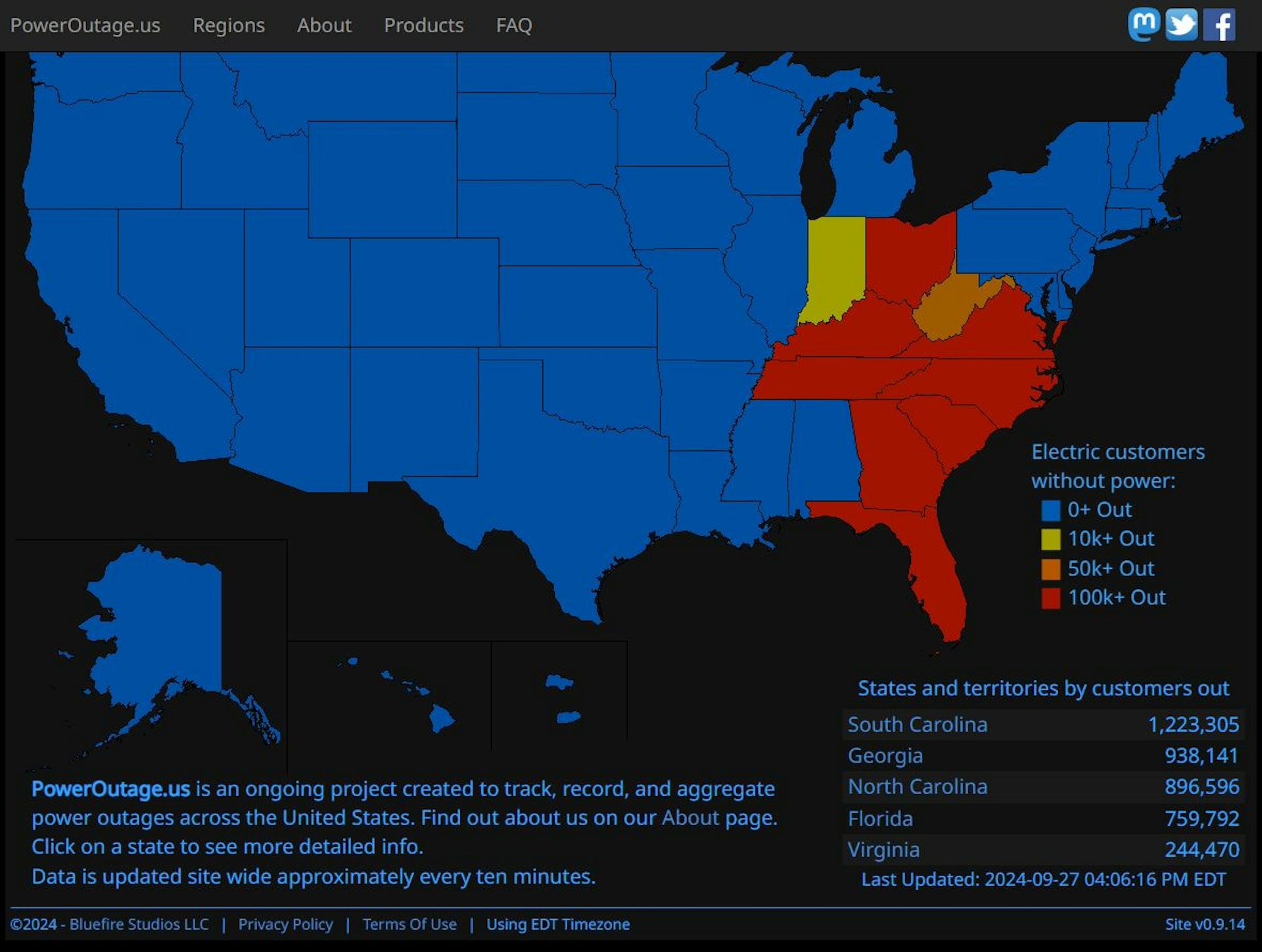
Category: Climate Change

  • MIL-OSI USA: SPC – No MDs are in effect as of Sat Sep 28 00:02:02 UTC 2024

    Source: US National Oceanic and Atmospheric Administration

    Current Mesoscale DiscussionsUpdated:  Sat Sep 28 00:01:02 UTC 2024 No Mesoscale Discussions are currently in effect.

    Notice:  The responsibility for Heavy Rain Mesoscale Discussions has been transferred to the Weather Prediction Center (WPC) on April 9, 2013. Click here for the Service Change Notice.
    Archived Convective ProductsTo view convective products for a previous day, type in the date you wish to retrieve (e.g. 20040529 for May 29, 2004). Data available since January 1, 2004.

    MIL OSI USA News

  • MIL-OSI Australia: National Statement United Nations General Assembly

    Source: Australian Government – Minister of Foreign Affairs

    President, friends –

    Steeled by the horror of the most catastrophic conflict in history, humanity forged our United Nations.

    Its purpose often defined not as taking us to heaven, but saving us from hell.

    Yet we convene this week with so much of the human family enshrouded in darkness.

    More conflict than any time since World War Two.

    Russia’s invasion of Ukraine.

    Sudan.

    Myanmar.

    Yemen.

    Gaza.

    And now Lebanon.

    Brutal, degrading conflict ingraining hatred and division; pushing peace into the unseeable distance; and pulling neighbours into an endless, reflexive cycle of blame and retaliation.

    Such entrenched violence has its own gravity: more violence becomes the path of least resistance.

    Seeing past hatred is hard. Building trust is hard. Compromise is hard. Making peace is hard.

    But the future otherwise is not worthy of our children and the present is not worthy of ourselves.

    We must remember why we built this institution.

    The UN system is where the world comes together to agree and uphold standards and rules; to protect all of the world’s peoples and the sovereignty of all nations.

    These rules always matter – never more so than in times of conflict – when they help guide us out of darkness, back toward light.

    Back on a path towards peace, stability and prosperity.

    Not long after we last gathered here, Israel was attacked by the terrorist group Hamas, which killed 1,200 people.

    This was the greatest loss of Jewish life in a single day since the Holocaust, and Hamas continues to hold hostages.

    It was an attack that cannot and should not be justified.

    Like many countries, Australia has imposed sanctions on Hamas, its leaders and financial facilitators.

    In Israel’s response, more than 40,000 Palestinians have been killed.

    More than 11,000 children.

    Nearly two million Gazans displaced, some many times over.

    More than two million facing acute food insecurity.

    This must end.

    Palestinian civilians cannot be made to pay the price of defeating Hamas.

    All lives have equal value.

    Last month we marked 75 years since the world established the Geneva Conventions – the foundations of international humanitarian law, to limit human suffering in conflict.

    War has rules. Every country in this room must abide by them.

    Even when confronting terrorists.

    Even when defending borders.

    Israel must comply with the binding orders of the International Court of Justice, including to enable the provision of basic services and humanitarian assistance at scale.

    Australia shares the frustration of the great majority of countries, more than 77 years since the General Assembly adopted Resolution 181: a plan for two states side by side – one Jewish, one Palestinian.

    77 years later, that Palestinian state still does not exist – long held out as the promise at the end of a peace process that has ground to a halt.

    The world cannot wait.

    We must all contribute new ways to break the cycle of conflict.

    Earlier this year, Australia voted in this General Assembly in support of Palestinian aspirations for full membership of the UN.

    We have sanctioned Israeli extremist settlers and will deny anyone identified as an extremist settler a visa to travel to Australia.

    But individual country actions alone are not moving the dial.

    The international community must work together to pave a path to lasting peace.

    The world cannot keep hoping the parties will do this themselves; we cannot allow any party to obstruct the prospect of peace.

    As I have said for many months, Australia no longer sees Palestinian recognition as the destination of a peace process, but a contribution of momentum towards peace.

    Australia wants to engage on new ways to build momentum, including the role of the Security Council in setting a pathway for two-states, with a clear timeline for the international declaration of Palestinian statehood.

    Because a two-state solution is the only hope of breaking the endless cycle of violence – the only hope to see a secure and prosperous future for both peoples.

    To give the Palestinian people the opportunity to realise their aspirations through self-determination.

    To strengthen the forces for peace across the region and undermine extremism.

    A two-state solution, Israel and Palestine, is the opposite of what Hamas wants.

    Hamas does not want peace, and it does not want security for the State of Israel.

    Any future Palestinian state must not be in a position to threaten Israel’s security.

    There can be no role for terrorists. And it will need a reformed Palestinian Authority.

    Right now, the suffering across the region must end. Hostages must be released. Aid must flow.

    We have provided more than $80 million in humanitarian aid to support civilians who have been devasted by this conflict.

    But humanitarian aid is not a long-term answer.

    It is now nearly 300 days since Australia and 152 other countries voted for a ceasefire.

    Today I repeat that call.

    Just as I repeat Australia’s call for a ceasefire in Lebanon, and for parties to fully implement Resolution 1701. Lebanon cannot become the next Gaza.

    We know Australia is not a central player in the Middle East, but we seek to be a constructive voice for peace and the upholding of international law, including the protection of civilians.

    In order to protect civilians, we must also protect aid workers who deliver the food, water and medicine civilians need to survive.

    Aid workers are the best of humanity. Their selfless devotion to improving the lives of others should not cost them their own.

    Yet 2023 was the deadliest year on record for aid workers, and 2024 is on track to be even worse.

    Gaza is the most dangerous place on earth to be an aid worker.

    Australia felt this deeply with the IDF’s strike against World Central Kitchen vehicles, which killed Australian Zomi Frankcom and her colleagues.

    This was not a one-off incident. More than 300 aid workers have been killed since the start of this conflict.

    This week, Australia has convened a group of ministers to pursue a new Declaration for the Protection of Humanitarian Personnel.

    The Declaration will be developed over the coming months, to demonstrate the unity of the international community’s commitment to protect aid workers and to channel that commitment into action in Gaza, in Sudan, in Ukraine and in all current and future conflicts.

    All countries will be invited to join the Declaration.

    I want to thank my fellow ministers from Brazil, Colombia, Indonesia, Japan, Jordan, Sierra Leone, Switzerland and the United Kingdom – and the humanitarian leaders who have partnered with us in this.

    As Zomi Frankcom’s family said this week:

    “People like Zomi are rare and their bravery and selflessness should be not only celebrated but protected. They can’t be brave at any cost.”

    The world’s peoples are counting on all of us here to rededicate ourselves to international humanitarian law, and the rest of the rules we have agreed to preserve peace and security.

    Russia continues its vicious assault on the people and sovereignty of Ukraine, in flagrant violation of the UN Charter.

    Aside from terrible damage and loss of life in Ukraine, Russia’s invasion of Ukraine is also propelling the global crisis in food and energy security…

    Raising the cost of living for working people all over the world.

    This year we saw Russia end the mandate of the Security Council’s Panel of Experts on the DPRK after fourteen years of unanimous support.

    The DPRK continues its unlawful activities with impunity, conducting illegal arms transfers to Russia and threatening our region, including the Republic of Korea and Japan.

    We are concerned that Russia is sharing nuclear and space information and technology with Iran.

    Rules are being blurred, undermined, and at times, blatantly violated.

    We must rally to defend these rules that protect all of us; these rules that form the character of the world that we want.

    A world where Australia and other countries have the freedom to decide our own futures, without interference and intimidation.

    A world where we can find collective solutions to our toughest problems.

    These problems are evolving and changing, but the commitment of some states to the rules underpinning the international system has not evolved for the better.

    Whether cyberattacks, interference, disinformation or economic coercion – some states circumvent the rules, putting further out of reach collective approaches to counter new and emerging threats.

    Pressing challenges like climate change, technology, poverty, reform of financial architecture – and increasingly necessary peacebuilding work.

    We need reform of the UN system to better serve us all.

    But reform cannot become a means for disruptors to dismantle protections for smaller countries.

    No state should pretend the rules don’t apply to them;

    Ignoring international rulings;

    Using might over multilateralism;

    Ruling by power alone, not by law;

    Favouring impunity rather than facing accountability;

    Forcing outcomes by economic coercion or military muscle, rather than on the level playing field we established so carefully.

    We see some states trying to set us against each other, when the challenges demand that we come together – that we stand together in support of the security, prosperity and sovereignty of all countries.

    Australia has a different vision for the world. One where no country dominates, and no country is dominated.

    When disputes inevitably arise, we insist those differences are managed through dialogue, and according to the rules, not simply by force or raw power.

    It’s why we have consistently pressed China on peace and stability in the South China Sea and Taiwan Strait.

    And why we have welcomed the resumption of leader and military level dialogue between the US and China.

    Some countries may dismiss the rules as a Western construct. Our Asia-Pacific region tells a different story.

    Take the agreement between Vietnam and Indonesia to delimit their Exclusive Economic Zone after twelve years of negotiations – an example of how long-standing maritime disputes can be resolved in accordance with international law.

    Take Vanuatu’s landmark International Court of Justice initiative on climate change.

    Or Fiji and Solomon Islands maritime boundary agreements.

    Take the Bay of Bengal Arbitration where states peacefully resolved long-standing and sensitive claims under UNCLOS: the UN Convention on the Law of the Sea.

    Or Australia and Timor-Leste initiating the first ever compulsory conciliation under UNCLOS, leading to the resolution of our maritime boundary dispute.

    We see it in the Philippines’ decision to go to the Arbitral Tribunal, constituted under the UNCLOS – and its unanimous, clear, ruling in the South China Sea arbitration between the Philippines and China, which is final and binding on the parties.

    These cases in our region illustrate how international law has been built, defended and promoted by small and medium countries from different traditions.

    The countries of our region have embedded the rules that serve us all, and we make an ongoing contribution to maintaining and promoting them.

    Together we want to pursue peaceful ways to resolve disputes.

    We know that this doesn’t happen on its own. All of us help make it happen.

    Australia is doing this by being active, by exercising agency, and by contributing our efforts to the balance of power in our region and our world.

    Our candidacy for a non-permanent seat on the Security Council for the term 2029-2030 reflects our deep commitment to contributing to international peace and security.  

    The Security Council is a foundation of our collective peace and security. But we must reform it.

    Australia wants greater permanent and non-permanent representation for Africa, Latin America and the Caribbean, and the Asia-Pacific.

    This body must represent the world as it is in the 21st century.  

    We must also reform the peacebuilding and conflict prevention architecture. It is not working.

    That will be the focus of our coming term on the Peacebuilding Commission.

    Australia will support national prevention strategies in our term, essential for local peacebuilding.    
     
    We are providing additional resources and staff to the PBC’s support and secretariat bodies.     

    And we will increase our voluntary contribution to the UN Peacebuilding Fund to $15 million per year.

    We are committed to doing all we can to de-escalate and prevent conflict.

    We do this by responding when we, or our neighbours, are coerced or have sovereignty threatened.

    We do this by supporting our region’s security – as we did at the Pacific Islands Forum this month, when we stood side-by-side with Pacific leaders to announce a Pacific-led, Australia-backed Pacific Policing Initiative.

    We do this by backing the call of Fiji’s President for a cessation of ballistic missile testing in the Pacific.

    We do this by combining reassurance and deterrence – by working with our friends and partners, openly and transparently, so no potential aggressor thinks the pursuit of conflict is worth the risk.

    But there is so much more to do.   

    For peace to be truly durable it must be built by, and for, all of society.

    That includes women.

    Yet here, in the world’s premier peace forum, only around one in ten speakers at this dais so far this week have been women.

    Gender equality is a primary predictor of peace, even more so than a state’s wealth or political system.

    That is why Australia champions the Women, Peace and Security agenda.  

    We support initiatives that we know are working, like the Southeast Asia Women Peace Mediators, who link stakeholders to enhance the potential for constructive dialogue.

    Like the Pacific Women Mediator’s Network, a locally led, vibrant and inclusive platform to support women’s political leadership.    

    And earlier this week, with Germany, Canada and the Netherlands, Australia invoked Afghanistan’s responsibility under international law for violations of the rights of women and girls.

    The Taliban have erased women from Afghanistan’s self-portrait.

    Effectively imprisoning half their society’s population immediately halves their country’s potential.

    Depleting the soul and prospects of a nation.

    Any country that wants to develop fully must encourage the full participation of all its people.

    So we can’t pursue only parts of the 2030 Agenda: we must achieve all of the Sustainable Development Goals.

    And yet, with just over five years to 2030, over a third of the SDG’s are stalled or regressing, and finance targets are not being met. 

    In times of scarcity, we need every development dollar to count.

    This is why we need to strengthen the global financial architecture.

    This is why Australia is backing the Multidimensional Vulnerability Index and the Bridgetown initiative.

    This is why Australia is championing reforms that make Multilateral Development Banks more responsive to global shocks, and build sustainability and resilience, particularly in the smallest and most vulnerable countries.

    This year, Australia committed 492 million Australian dollars to the Asian Development Fund, working with Japan to unlock a record 5 billion US dollars in new assistance to the region’s most vulnerable countries over the next decade.

    Financial pressures are further strained by the trend of trade being used as a point of leverage rather than an opportunity, as economic interdependence is misused for strategic and political ends.

    Nearly every country in this room depends on open trade with transparent and predictable rules.

    We must keep working together to uphold these trade rules that underpin our economic growth and the livelihoods of our peoples.

    Of course it’s not just finance and unfair trade arrangements that threaten development.

    Climate change is causing more disasters, reversing years of development gains overnight.

    Extreme weather threatens food and water security, with grave implications for global stability.

    Australia is acting at home, enshrining our ambitious emissions reduction targets into legislation: 43 per cent by 2030 and net zero by 2050.

    We are transforming our economy.

    Within this decade, 82 per cent of Australia’s electricity generation will be renewable, up from around 32 per cent when I first addressed you two years ago.

    We are building new industries to accelerate our economic transition and to export reliable, renewable energy to the world.

    And we are acting internationally, to respond to our partners.

    By the end of 2025, Australia will offer Climate Resilient Debt Clauses in our sovereign loans.

    And the groundbreaking Australia-Tuvalu Falepili Union Treaty entered into force on 28 August.

    It is the first time two nations have recognised, in a legally binding treaty, continuing statehood and sovereignty, notwithstanding the impacts of sea-level rise. 

    This agreement supports Tuvaluans to live and thrive at home through land reclamation and investments in infrastructure, education and health.

    At the same time, Tuvaluans have the choice to live, study and work in Australia.

    ‘Mobility with dignity’ means ensuring people have a genuine choice to stay.   

    Pacific voices have demonstrated sustained, clear and innovative leadership, as well as tremendous resilience.

    This is why we are bidding to host COP31 in partnership with the Pacific.

    We want to show the world the unique climate challenges facing our region and amplify the voices of Small Island Developing States, the custodians of our world’s oceans.

    President, we know that along with climate change, technology will define the multilateral system and development goals for decades to come.

    We want safe, accessible technology that is used for the global good – not as a tool for censorship, surveillance, exclusion and division.

    From the start of negotiations for the Global Digital Compact, Australia has advocated that all states should boost access to digital technologies that offer benefits to our world.

    We know that if countries don’t have digital infrastructure, they will miss out.

    This is why we are building sustainable south-south connectivity, including submarine cables across the Pacific.

    We also know not all knowledge is new.

    First Nations’ people’s deep knowledge must be preserved and protected.

    Australia’s Aboriginal and Torres Strait Islander peoples have been innovators, inventors and knowledge-holders for over 65,000 years.

    Whether it is firestick farming used to sustainably manage Country, or the engineering of great stone fish traps across rivers and seas.

    That unbroken line of innovation has continued to this day.

    Earlier this year, Australia’s Ambassador for First Nations People helped bring countries together to finalise the World Intellectual Property Organization Treaty on Intellectual Property, Genetic Resources and Associated Traditional Knowledge. 

    The treaty acknowledges the link between traditional knowledge, innovation and intellectual property.

    It helps First Nations communities identify and protect the use of their knowledge by others, which will in turn spur collaboration between researchers, innovators and communities, opening up new opportunities for First Nations entrepreneurship.

    This treaty is remarkable for another reason.

    It serves as a source for optimism.

    193 member states have agreed on new rules to the world’s intellectual property system.

    That is an extraordinary achievement.

    As I said at the outset, the international outlook is framed by entrenched division.

    Where consensus often seems a lost cause.

    But we collectively moved the intellectual property system a step forward.

    Just as we collectively moved forward this week with the Pact for the Future.

    And these recent wins remind us of the gains we’ve made we that need to protect.

    Of the ways our lives are better because of the United Nations.

    Of the ways our world is better because of our collective contribution to the international system.

    It promotes economic development and makes trade more fair – together supporting job creation, overcoming poverty, and enabling small and medium countries to resist coercion.

    It guards against the spread of nuclear weapons.

    It sets the standards that keep food safe.

    It assigns the satellite orbits that take the internet to the most remote reaches.

    It sets the standards that keep 120,000 flights and 12 million passengers safely in the sky every day.

    It is resolving and preventing conflicts in 53 peacekeeping and political missions.

    Each year it saves more than 350 million children from malnutrition.

    And most of all – let us always remember – we are collectively descended from people who lived in a harsher, more dangerous world…

    Who built this UN system to confine horrors of the past to history, and to give us a better life.

    We have no option and no excuse but to find a way through our challenges today, immense and intractable as they are.

    We must work together.

    We must drive change where it is needed, transparently, together.

    We must drive change to include all the world’s peoples.

    To deploy the collective agency that this forum provides, so we combat climate change, poverty and coercion…

    So we negotiate peace.

    President, friends –

    We must not allow others to divide us for their own gain…

    To dilute the protections that are inherent in the UN Charter, that are codified in the Geneva Conventions.

    Rather, we have to reinforce those protections, in the interests of all states and civilians.

    That is what Australia is for.

    A peaceful, stable and prosperous world for all.

    Where sovereignty is respected.

    Where civilians are protected.

    MIL OSI News

  • MIL-OSI USA: Governor Ron DeSantis Issues Updates on Response and Recovery Efforts to Hurricane Helene

    Source: US State of Florida

    TALLAHASSEE, Fla.—Today, Governor Ron DeSantis was joined by Florida Division of Emergency Management (FDEM) Executive Director Kevin Guthrie in Perry and Cedar Key to provide updates on recovery efforts after Hurricane Helene impacted Florida’s Big Bend region. As of this afternoon, approximately 828,548 Floridians are without power. The State of Florida has already restored 1,573,907 accounts.

    Governor DeSantis issued Executive Order 24-209 on September 24, amending EO 24-208 and declaring a state of emergency for 61 counties.

    To learn more, residents can visit FloridaDisaster.org/Guide. For updates on county resources available visit FloridaDisaster.org/Counties for a list of all 67 county emergency management contacts.

    State Preparedness Effort

    • The Florida Division of Emergency Management (FDEM) activated the State Emergency Operations Center to Level 1 on Tuesday, September 24, and is leading coordination efforts for the State Emergency Response Team.
    • The State Emergency Response Team is engaged in over 1,500 missions to assist counties in their preparation efforts. These missions accomplish vital tasks like staging response resources, protecting critical infrastructure facilities like hospitals and utility stations, and coordinating personnel statewide.
    • Seven Urban search and rescue task forces are deployed.
    • The Florida National Guard (FLNG) has mobilized nearly 3,900 Soldiers and Airmen in preparation for Hurricane Helene.
    • The FLNG has rescued 30 residents throughout the impacted area. We have mobilized 15 route clearing teams and have 13 rotary wing aircraft prepared to provide SAR and/or damage assessment support. Mississippi is providing an additional 3 rotary wing aircraft later today.
    • The FLNG is providing logistics support, law enforcement support, route clearance, search and rescue, commodity distribution, flood mitigation, aviation and other support as needed by the state.
    • The Florida State Guard (FSG) is standing by with the following:
      • 250+ Soldiers ready to deploy.
      • 10 shallow water vessel boat teams
      • 7 flat-bottom-flood rescue skiffs
      • 2 amphibious rescue vehicles
      • 2 K-9 search and rescue teams
      • 12 UTV’s
      • 15 Cut and toss crews
      • 7 search and rescue teams
      • 2 UH-60 Blackhawk for daytime aerial assessment and logistics missions
    • The Florida Department of Law Enforcement (FDLE) Mutual Aid team is coordinating law enforcement missions including search and rescue and fuel for first responders.
    • FDLE is conducting status calls with DMS to ensure State SLERS radio communications systems are operative for law enforcement.
    • FDLE’s Aviation Unit conducted an aerial survey of impacted counties in coordination with the Air Operations Branch. FDLE has flown seven missions with five aircraft.
    • The Florida Fish and Wildlife Conservation Commission (FWC) has more than 100 officers and support staff responding to areas of Florida impacted by Hurricane Helene.
    • Two Special Operations Group (SOG) teams, totaling 15 officers, from the NW Region responded to western coastal areas of the impacted area such as Franklin and Gulf counties, assisting residents in need and moved onto harder hit areas once areas were clear.
    • FWC officers are conducting welfare checks and search and rescues in coastal communities in Dixie, Levy and Taylor Counties with shallow draft vessels and specialized high-water vehicles.
    • A team of officers from the Southwest region assisted Pasco County law enforcement with high water evacuations due to storm surge conditions on Thursday night. Approximately seven people were rescued by FWC teams. Additionally, FWC officers rescued eleven people and six pets in Charlotte County due to high water conditions.
    • The Florida Department of Transportation (FDOT) has over 2,100 FDOT team members working directly on storm response.
    • Damage assessment teams are active in the field and are surveying impacts.
    • 61 Cut and Toss crews have worked since 3 a.m. and have completely cleared I-10.
    • Cut and Toss Operations
      • 577 crews are active in the field and have already cleared over 8,300 miles of roadway.
      • 129 Bridge Inspectors have inspected 1,200 bridges across the impacted areas.
      • FDOT is directly coordinating Cut & Toss Crews with Utility Response Crews to aid in swift utility restoration.
    • Westbound Gandy Bridge has reopened. One lane of eastbound Gandy Bridge has reopened.
    • Southbound Howard Frankland Bridge has reopened.
    • Sunshine Skyway Bridge is now open in both directions.
    • A 10-mile stretch of State Road 789 in Sarasota County and Manatee County has experienced extreme damage and the roadway is inaccessible. Crews are working to assess the entire corridor and have implemented an emergency contract to quickly perform repairs.
    • State Road 24 heading into Cedar Key was heavily damaged earlier this morning. Crews have completed repairs and reopened the roadway.
    • Crews are working to repair damage from erosion at Courtney Campbell Causeway.
    • Crews are working to clear sand and debris from the roadway on Gulf Blvd in Pinellas County.
    • Crews have reviewed over 7,000 traffic signals statewide. 255 signals across the impacted areas are not operational, however, crews are actively working to restore power to these locations.
    • Debris pick up has begun in South Florida- 42 crew members are FDOT has committed to perform debris pick up within fiscally constrained counties.
    • FDOT Secretary issued FDOT Emergency Order on September 23, 2024.
      • FDOT has lifted weight restrictions and is allowing bypass of weigh stations for emergency response vehicles, including utility vehicles staging for rapid response.
    • FDOT’s Post-Storm Statewide Response Efforts include:
    • Road Ranger service has been expanded to assist motorists along critical roadways.
    • Resources deployed in the field or available as needed:
      • Over 858 generators
      • Nearly 49 pumps
      • Over 70 pieces of heavy equipment and trucks are actively in the field for response efforts
      • 43 Drone team members staged to make assessments where needed
      • 5 ITS trailers
    • FDOT encourages drivers to download the FL511 app or visit FL511.com for road/bridge closures and potential detours that may be activated.
    • Remember to never drive through flooded areas. The area of the roadway beneath the water may be washed out or may conceal debris or even power lines. Turn Around; Don’t Drown.

    Transportation Modes
    Seaports

    • Port Panama City, Port of Port St. Joe, Port Tampa Bay, SeaPort Manatee, Port St. Pete, Port of Fernandina, and JAXPORT are closed waterside while awaiting Coast Guard Channel survey.

    Airports

    • All airports have reopened.
    • Please check with airlines directly on the specific status of flights.

    Rail

    • Passenger Rail:
      • Amtrak is operating. Please check with Amtrak directly for service impacts.
      • SunRail service has resumed with some service delays due to power outages.
    • Freight Rail:
      • Railroads in the impacted areas are assessing damage and conducting inspections.

    Transit

    • Transit agencies in the impacted areas are assessing conditions and resuming service where possible. Please check directly with local agency providers for service impacts.
    State-Owned Roads Closures (As of 2:30 p.m., 9/27/24) 
    State Road closures listed below. For real-time updates, Check FL511.com. 
    Bridge Closures
    • Closures
      • Northbound Howard Frankland
      • Courtney Campbell Causeway
      • One lane of eastbound Gandy Bridge
    • Alachua County
      • Debris on Roadway on NW 34th Blvd Northbound at NW 24th Ter. All lanes closed.
      • Debris on Roadway on SR-222 Both Directions from NE 27th Ave to NE 52nd St. All lanes closed.
      • Object on roadway on SR-26 / Newberry Rd East, at NW 66th St. 2 Right lanes blocked.
      • Debris on Roadway on SR-121 Northbound at NW 24th Ave. All lanes closed.
      • Debris on Roadway on SR-26 Both Directions at NE 27th Ave. All lanes closed.
      • Debris on Roadway on us-441 Northbound at NW 104th Ln. 1 Right Lane closed.
    • Baker County 
      • Debris on Roadway on US-90 Both Directions at Tiger Lake Rd. All lanes closed.
      • Debris on Roadway on US-90 Eastbound at Arnold Rhoden Rd. All lanes closed.
    • Charlotte County  
      • Flooding on E Olympia Ave Eastbound at Nesbit St. All lanes closed.
      • Flooding on E Marion Ave Westbound at Cooper St. All lanes closed.
      • Flooding on US-41 North, before West Marion Ave. All lanes closed.
      • Flooding on US-17 East, at Nesbit St. All lanes closed.
      • Flooding on US-17 West, at Cooper St. All lanes closed.
      • Flooding on McCall Rd Northbound at Myakka River. All lanes closed.
      • High Winds on Tamiami Trl Southbound at Main St. All lanes closed.
      • High Winds on Tamiami Trl Northbound at Harborside Ave. All lanes closed.
      • Flooding on SR-776 North, before El Jobean Bridge. All lanes closed.
    • Columbia County 
      • Debris on Roadway on SR-247 Both Directions at Oyster Shell Lane. All lanes closed.
      • Debris on Roadway on SR-47 Both Directions at US-41. All lanes closed.
      • Debris on Roadway on US-441 Both Directions at NE Sunny Brook St. All lanes closed.
      • Debris on Roadway on US-441 Both Directions at NW Ernest Greene Gln. All lanes closed.
      • Debris on Roadway on SR-10A Westbound at US-41. All lanes closed
      • Debris on Roadway on SR-247 Both Directions at SW Tamarack Loop. All lanes closed.
      • Debris on Roadway on SR-47 Both Directions near CR-240. All lanes closed.
      • Debris on Roadway on SR-47 Both Directions at SW Marvin Burnett Rd. All lanes closed.
      • Debris on Roadway on US-441 Both Directions from I-10 Eastbound to Georgia State Line. All lanes closed.
      • Debris on Roadway on SR-100 Both Directions at SE Douglas Rd. All lanes closed.
      • Debris on Roadway on SR-247 Both Directions at SW Norris Ave. All lanes closed.
      • Debris on Roadway on SR-247 Both Directions at SW Dairy St. All lanes closed.
      • Debris on Roadway on SR-47 Both Directions at SW Watson Rd. All lanes closed.
      • Debris on Roadway on S US Highway 441 Northbound at CR-240. All lanes closed.
      • Debris on Roadway on US-90 Westbound at SW Koonville Ave. All lanes closed.
      • Object on roadway on US-90 / Lake City East, at Sisters Welcome Rd. All lanes closed.
      • Object on roadway on US-90 / Lake City West, at Sisters Welcome Rd. All lanes closed.
      • Object on roadway on I-75 North, before MM 416. Right shoulder blocked.
      • Debris on Roadway on S US Highway 441 Both Directions at CR-18. All lanes closed.
    • Dixie County 
      • Debris on Roadway on US-19 Southbound at NE 824th St. All lanes closed.
    • Duval County 
      • Debris on Roadway on Emerson St Westbound at Rosemary St. All lanes closed.
    • Gilchrist County 
      • Debris on Roadway on SR-26 Eastbound at TL Johnson Blvd. All lanes closed.
      • Debris on Roadway on SR-47 Northbound at NE 40th Ct Rd. All lanes closed.
    • Hillsborough County 
      • Flooding on SR-618 West, ramp to 22nd St.
      • Flooding on SR-618 East, at 22nd St.
      • Bridge Closed in Hillsborough County on SR-60 West, at Ben T Davis Beach. All lanes closed.
    • Jackson County
      • Flooding on Caverns Rd Both Directions at Russell Rd. All lanes closed.
    • Jefferson County
      • Debris on Roadway on Still Rd Southbound near N Jefferson St.
      • Debris on Roadway on W Washington Hwy Both Directions near Creekside Ct. All lanes closed.
    • Lafayette County 
      • Debris on Roadway on E US 27 Northbound near CR-450. All lanes closed.
      • Debris on Roadway on S SR-51 Both Directions at SW Van Buren Rd. All lanes closed.
      • Debris on Roadway on W US 27 Both Directions at CR-536. All lanes closed.
      • Debris on Roadway on W US 27 Both Directions at NW Griffin Rd. All lanes closed.
      • Debris on Roadway on W US 27 Eastbound near SW Gary L Thomas Rd. All lanes closed.
      • Debris on Roadway on W US 27 Northbound at CR-350. All lanes closed.
      • Debris on Roadway on US-27 Northbound at SW Truman Ln. All lanes closed.
      • Debris on Roadway on E Main St Southbound at NE Willis Ave. All lanes closed.
      • Debris on Roadway on SR-349 Northbound at SR-27. All lanes closed.
        Debris on Roadway on SR-349 Northbound at CR-500. All lanes closed.
    • Lee County  
      • Flooding on US-41 Business North, at Edison Bridge. All lanes closed.
      • Flooding on Edison Bridge Northbound 0.48 Miles Beyond 2nd St. All lanes closed.
      • Flooding on SR-80 / First St West, before Park Avenue. All lanes closed.
      • Flooding in Lee County on SR-865/ San Carlos Blvd North, at Matanzas Pass Bridge. All lanes closed.
      • Flooding in Lee County on SR-865/ San Carlos Blvd South, at Matanzas Pass Bridge. All lanes closed.
      • Flooding on US-41 South, beyond N Key Dr.. All lanes closed.
    • Levy County 
      • Debris on Roadway on SR-345 Both Directions near NW 53rd Ln.
      • Debris on Roadway on SR-345 Both Directions at SE 4th St. All lanes closed.
      • Debris on Roadway on NE Highway 27 Alt Both Directions at CR-339. All lanes closed.
      • Debris on Roadway on US-19 Northbound at NW 140th St. All lanes closed.
      • Debris on Roadway on US-41 Southbound at NE 75th St. All lanes closed.
      • Debris on Roadway on SR-121 Northbound at NE 50th St. All lanes closed.
    • Madison County 
      • Debris on Roadway on SR-53 Both Directions near SR-14. All lanes closed.
      • Debris on Roadway on SR-53 Northbound at SR-10. All lanes closed.
      • Debris on Roadway on US-221 Both Directions at I-10 Eastbound. All lanes closed.
    • Manatee County 
      • Flooding in on SR-684 / Cortez Rd W East, at Gulf Dr. N (SR-789).
      • Flooding on SR-684 / Cortez Rd W West, at Gulf Dr N (SR-789). All lanes closed.
      • Flooding on SR-64 / Manatee Ave East, at Gulf Dr.. All lanes closed.
      • Flooding on SR-64 / Manatee Ave West, at Gulf Dr.. All lanes closed.
    • Pinellas County 
      • Emergency vehicles on I-275 North, at Roosevelt Blvd. All lanes closed.
      • Emergency vehicles on I-275 North, ramp from EB Ulmerton Rd. On-ramp closed.
      • Emergency vehicles on I-275 North, ramp from NB 4th St N. On-ramp closed.
      • Bridge Closed on SR-60 East, at Dr. Kiran C. Patel Blvd. All lanes blocked.
      • Bridge Closed on SR-600/Gandy Blvd East, beyond MM 3. All lanes closed.
      • Flooding on I-275 South, ramp from EB Ulmerton Rd.
      • Flooding on N Pinellas Ave Both Directions at Anclote Rd.
      • Flooding on S Pinellas Ave Southbound at W Lime St.
      • Flooding on S Pinellas Ave Northbound at E MLK Dr.
      • Flooding on Bayshore Blvd Northbound at San Christopher Dr. All lanes closed.
      • Flooding on Bayshore Blvd Southbound at Causeway Blvd. All lanes closed.
      • Flooding on Pasadena Ave Southbound at Sunset Dr S. All lanes closed.
      • Flooding on 75th Ave Northbound near Mangrove Ave. All lanes closed.
      • Flooding on Edgewater Dr Southbound from President St to Locklie St. All lanes closed.
      • Flooding on S Pinellas Ave Southbound at Meres Blvd. All lanes closed.
      • Flooding on I-275 North, beyond 4th St N.
      • Flooding on I-275 South, ramp to 54th Ave S.
      • Flooding on SR-688 East, beyond Roosevelt Blvd N.
      • Flooding on SR-688 West, before Roosevelt Blvd N.
      • Debris on Roadway on Pinellas Bayway Southbound at Palma del Mar Blvd S. All lanes closed.
    • Sarasota County  
      • Flooding on SR-789 North, at Sunset Drive. All lanes closed.
      • Flooding on SR-789 South, at Sunset Drive. All lanes closed.
    • Suwannee County 
      • Debris on Roadway on US-90 Eastbound at 149th Rd. All lanes closed.
      • Debris on Roadway on US-90 Both Directions at CR-137. All lanes closed.
      • Debris on Roadway on US-90 Westbound at 185th Rd. All lanes closed.
      • Debris on Roadway on US-90 Westbound at 63rd Dr. All lanes closed.
    • Taylor County 
      • Debris on Roadway on S Jefferson St Both Directions at S Byron Butler Pkwy. All lanes closed.
      • Debris on Roadway on SR-51 Both Directions near US-19 Southbound. All lanes closed.
      • Debris on Roadway on US-19 Both Directions at Kelly Grade. All lanes closed.
      • Debris on Roadway on US-27 Westbound at Granger Rd. All lanes closed.
      • Debris on Roadway on US-27 Eastbound at CR-296. All lanes closed.
      • Debris on Roadway on US-98 Westbound at Dice Rd. All lanes closed.
    • The Florida Department of Veterans’ Affairs (FDVA) The VISN 8 Clinical Contact Center is operational 24/7/365 for virtual care and tele-emergency care and support to Veterans enrolled for VA Health Care in Florida. 1-877-741-3400. Visit https://department.va.gov/integrated-service-networks/visn-08 for more information.
    • Robert H. Jenkins Jr. Veterans’ Domiciliary Home in Lake City lost power and is currently on generator.
    • Volunteer Florida: Disaster Legal Hotline is open to assist and refer callers: 833-514-2940
    • Samaritan’s Purse hotline: 1-833-747-1234 free assistance for homeowners affected by the disaster. Volunteers may be able to assist with removal of personal property and furniture, flood cleanup, sanitizing with shockwave treatment, chainsaw work and Debris Clean-up, temporary roof tarping.
      • 2-1-1 is open and ready to receive calls. Individuals can call for up-to-the-
      • Red Cross Hotline is open to assist: 1-800-Red Cross
      • Florida Baptists Disaster Relief Public Assistance: 904-253-0502 or text Helene to 27123. Free Assistance for homeowners affected by the disaster. Volunteers may be able to assist with Storm Debris Cleanup, Temporary Roof Tarping, Chainsaw work, and muckouts.
      • Crisis Cleanup number: 844-965-1386


    Health and Human Services

    • The Agency for Persons with Disabilities (APD) has shifted to recovery efforts and has begun post storm calls and wellness checks with clients, providers, partners, and staff in affected areas verifying status and ask about immediate needs caused by the storm and develop plans to resolve.
    • APD operated facilities in Marianna and Chattahoochee maintained power through the storm, while the Gainesville facility is without power and operating on generators. All residents, clients, and staff have reported they are safe.
    • 14 evacuated APD licensed Group Homes have also reported they are safe, and APD will continue to work with providers to see about storm damage and potential needs.
    • APD is mapping Group Homes, clients in Supported Living Facilities, and clients living in family homes in affected areas for priority follow up and wellness checks by APD teams and provider staff.
    • APD is working with partners and the State Emergency Response Team to ensure the functional and access needs of disaster survivors are met.
    • APD Hope Florida Navigators and APD emergency recovery teams standby ready for deployment to affected areas to serve disaster distribution centers as needed.
    • The Florida Department of Health’s (DOH) is deploying over 470 emergency response vehicles. Staging is currently in Leon, Liberty, Osceola, Pinellas, and Polk counties.
    • At this time, one Boil Water Notice has been reported for Marion County as a result of Hurricane Helene.
    • DOH has Special Needs Shelters available in areas impacted by Hurricane Helene. A press release has been sent statewide for additional information on special needs shelters. To find a shelter near you, please visit the county emergency management page here.
    • DOH and the Agency for Health Care Administration initiated Patient Movement Mission to support medical transport and evacuations of health care facilities.
    • The State Surgeon General signed Emergency Order 24-002, which:
      • Waives competitive procurement requirements in order to procure commodities, goods, and services expeditiously in response to the emergency.
      • Permits emergency medical transportation services to operate across county lines.
      • Permits Paramedics, Emergency Medical Technicians, and Medical Directors, as defined by Chapter 401, Florida Statutes, licensed in other U.S. states, territories, or districts to practice in Florida in response to the emergency without penalty.
      • Authorizes a reporting extension for the Prescription Drug Monitoring Program.
      • Authorizes an extension of the upcoming licensure renewal deadlines for Nursing Home Administrators, Radiological Personnel, and Athletic Trainers until October 31, 2024.
    • DOH and the Office of Insurance Regulation (OIR) sent information regarding early prescription refills permitted under Executive Order 24-209. This information was sent to the public, health insurers, managed care organizations, pharmacy benefit managers, pharmacy chains, and health care providers.
    • The Agency for Health Care Administration (AHCA) has activated reporting in the Health Facility Reporting System (HFRS) and has requested that all health care providers report their census, available beds, evacuation status, and generator status information. This information allows AHCA to assist health care providers in transferring patients if needed and ensure that health care providers in impacted areas have the necessary resources and adequate power.
    • AHCA has made 40 phone calls to health care facilities in the impacted area, to check their status.
    • As of 3 p.m., 92 health care facilities have reported evacuations. This includes:
      • 46 assisted living facilities
      • 29 nursing homes
      • 6 hospitals
      • 1 hospital emergency department
      • 5 residential treatment facilities
      • 2 residential treatment centers for children and adolescents
      • 2 adult family care home, and 2 intermediate care facility for developmentally disabled
    • 100% of operating long-term care facilities have a generator on-site. The Generator Status Map for long-term care facilities is available here.
    • As 3 p.m., there are 158 health care facilities on generator power across the state. This includes:
      • 3 hospitals
      • 77 assisted living facilities
      • 43 nursing homes.
      • 5 adult family care home
      • 2 hospices
      • 5 hospital emergency department
      • 5 intermediate care facility for the developmentally disabled
      • 10 residential treatment facilities
      • 1 residential treatment centers for children and adolescents
      • 7 crisis stabilization and short-term rtf
    • The Agency has waived all prior authorization requirements for critical Medicaid services until further notice.
    • AHCA has conducted 39 onsite post-incident assessment visits.

    Infrastructure, Roads and State Closures

    • The Florida Highway Patrol (FHP) cut teams and FDOT road clearing teams are providing aid to areas impacted by the storm.
    • FHP continues to mobilize drone assets to help assess post-storm damage and assist with rescue and recovery efforts in areas impacted by the storm.
    • FHP Troopers are assisting with escorting critical restoration and recovery vehicles from around the state to areas impacted by the storm.
    • FHP is mobilizing Quick Response Force team members to deploy to affected areas of Florida to assist with recovery efforts.
    • FHP and FDOT cut teams cleared all trees and debris from Interstate 10 and Interstate 75 and traffic flow has been restored.
    • FHP drone assets and fixed-wing aircraft are actively assisting with search and rescue efforts and storm damage assessment.
    • FHP mobilized high-water vehicles to areas affected by the storm to assist with search and rescue efforts.
    • FHP is providing security at storm response fuel sites.
    • FLHSMV has 3 Florida Licensing on Wheels (FLOW) mobiles on standby to provide mobile credentialing services in impacted areas and to those affected by the storm.
    • Florida Department of Highway Safety and Motor Vehicles (FLHSMV) issued Emergency Order 24-05, in support of Executive Order 24-209 which: waives specific requirements for commercial motor vehicles providing emergency relief; and waives the replacement fees for driver’s license and identification credentials, vehicle registrations and titles, vessel registrations and titles and temporary parking permits for impacted individuals.
    • The Department of Children and Families (DCF) has contacted over 2,000 families and group homes to ensure all children and families served are safe and to determine needs.
    • The HOPE LINE has been activated at 8 a.m. today to assist those in need of resources or other assistance after the storm. It is now available 24/7 for the next two-plus weeks at 833-GET-HOPE.
    • Activate Hope has been deployed to help connect Floridians impacted by the storm with needed resources like food, supplies, home repairs, and more. Serving as the emergency response component of the Hope Florida initiative, Activate Hope connects the private sector, nonprofits, and government to help Floridians get back on their feet following a natural disaster. Fill out the form here to get help.
    • DCF has contacted over 5,500 licensed providers in impacted areas to check for needs after the storm.
    • The State Mental Health Treatment Facilities are fully operational.
    • Through ESF 6, DCF provided staffing and emergency supplies to 32 shelters and meals to 1,000 first responders.
    • The Department of Elder Affairs (DOEA) continues to contact all Area Agencies on Aging partners to receive updates. Post storm call downs to clients are ongoing and there are currently no unmet needs.
    • The Florida Department of Education (FDOE) has been contacting school districts and state colleges following Hurricane Helene and is addressing needs to reopen as quickly as possible. Districts, colleges, and universities are conducting damage assessments following the storm. Currently, 48 school districts, 19 state colleges, and 8 universities remain closed as of Friday, September 27, 2024.
    • The Florida Department of Environmental Protection (DEP) is actively working to provide assistance to drinking water, wastewater and hazardous waste facilities. Outreach to these facilities to determine operational status is ongoing.
    • DEP’s online portal WaterTracker is now live for drinking and wastewater facilities to report their operational status.
    • DEP published a storm updates webpage to keep state park visitors updated: FloridaStateParks.org/StormUpdates. Visitors with existing camping and cabin reservations at closed parks have been notified of their reservation status.
    • DEP is working with Florida’s Water/Wastewater Agency Response Network (FlaWARN), the Florida Rural Water Association and other response agencies to dispatch generators, fuel and pump trucks and other resources to assist drinking and wastewater facilities.
    • DEP and response agencies are working 1-on-1 with partially- and non-operational drinking and wastewater facilities to get them back to operational status as quickly as possible to meet the immediate service needs of the communities they serve. Areas under boil water advisories can be found at https://www.floridahealth.gov/environmental-health/drinking-water/boil-water-notices/index.html.
    • DEP is working in conjunction with the Florida Fish and Wildlife Conservation Commission and the U.S. Coast Guard to identify oil spills and hazardous material releases in coastal and inland waterways.
    • 94 Disaster Debris Management Sites have been authorized to operate for Hurricane Helene. These sites are a critical component of expediting clean-up and reducing environmental and public health impacts post-storm and meeting federal reimbursement requirements.
    • 12 Florida State Parks strike teams have been assembled to assist with assessment and recovery efforts at impacted parks.
    • More than 60 state parks have reopened following Hurricane Helene. DEP published a storm updates webpage to keep state park visitors updated of closures: FloridaStateParks.org/StormUpdates. Visitors with existing camping and cabin reservations at closed parks have been notified of their reservation status.

    Resources for Employees, Businesses and Consumers

    • The Florida Department of Business and Professional Regulation (DBPR) has partnered with the Florida Restaurant and Lodging Association to encourage more than 71,000 Florida-licensed lodging establishments to relax pet policies and waive pet fees for evacuees.
    • DBPR has proactively communicated with more than 137,000 restaurant and lodging licensees to provide storm preparation and food safety resources.
    • DBPR has proactively contacted more than 2,300 prescription wholesale stakeholders to provide information on emergency provisions under Governor DeSantis’ Executive Order 24-211 that will help mitigate supply chain difficulties with prescription drugs and medical gas.
    • The Florida Disaster Contractors Network has been activated to connect homeowners with licensed contractors and suppliers to perform emergency repairs.
    • DBPR encourages Florida’s licensed contractors who provide post-storm construction-related services to register with its Florida Disaster Contractors Network at DCNOnline.org.
    • DBPR has distributed FloridaCommerce’s Business Damage Assessment Survey to nearly 1,000,000 licensees in impacted counties and encouraged them to report damages using the survey.
    • DBPR’s Division of Hotels and Restaurants has begun disaster assessments in impacted areas. Emergency Response Teams across the state are completing outreach to impacted businesses to reinforce food safety protocols after the storm.
    • FloridaCommerce activated the private sector hotline at (850) 815-4925, open daily 8:00 a.m. to 5:00 p.m. Inquiries may also be emailed to ESF18@em.myflorida.com.
    • Updates on business closures and business resources are updated at FloridaDisaster.biz/CurrentDisasterUpdates.
    • FloridaCommerce and the State Emergency Response Team (SERT) activated the Business Damage Assessment Survey in response to Hurricane Helene. Business owners can self-report physical and economic damage caused by Hurricane Helene. Survey responses will allow the state to expedite Hurricane Helene recovery efforts by gathering data and assessing the needs of impacted businesses. Businesses can complete the survey online by visiting FloridaDisaster.biz and selecting “Hurricane Helene” from the dropdown menu.
    • FloridaCommerce is working with the Florida Chamber, the Florida Restaurant and Lodging Association and other private sector partners to consistently update business open/close status on FloridaDisaster.biz. FloridaCommerce staff have made more than 300 calls to rural and small businesses to help with this effort.
    • Walmart has donated $500 gift cards to shelters in Hamilton, Madison and Suwannee Counties for the purchase of pet food.
    • Lowes has deployed their Tool Rental Truck to assist in recovery efforts providing a rental option for power tools from chainsaws and pressure washers, to fence post augers and compressors. The truck is also staffed with small engine mechanics to support local communities with power.
    • VISIT FLORIDA Emergency Accommodation Modules on Expedia, Priceline and Booking.com will remain available to provide real-time hotel availability and lodging resources for impacted Floridians and visitors.
    • Visit website for CareerSource openings: careersourceflorida.com
    • Comcast has opened more than 52,000 public Xfinity WiFi hotspots in Florida. The free and public hotspots are open for all, including non-Xfinity customers. For more information, click here.
    • CVS Health created pop-up pharmacies in impacted areas.
    • The Florida Department of State, Division of Elections, has contacted the United States Postal Service (USPS) about election information and vote-by-mail ballots. The Division of Elections recommended that Supervisors of Elections t contact their local district USPS to discuss a mitigation plan for ballot mailing, delivery, and return.
    • The Florida Department of Agriculture and Consumer Services (FDACS) worked with Florida’s ports and fuel industry partners to ensure adequate fuel supplies are available, and with Florida’s agricultural partners so producers have adequate resources. The Florida Forest Service staged equipment, like high-water vehicles.
    • The Commissioner of Agriculture, Wilton Simpson, has approved an Emergency Order temporarily suspending the intrastate movement requirements for animal transportation. In addition, the following states have waived their interstate import requirements for Florida pets, horses, and livestock leaving the state: Alabama, Georgia (does not include livestock), Mississippi, North Carolina, and South Carolina.
    • Commissioner Wilton Simpson has approved an emergency rule authorizing out-of-state licensed security guards to protect people and property in Florida and has approved an emergency rule to aid the distribution of liquefied petroleum gas to disaster response and recovery operations.
    • Fuel inspectors are responding to impacted areas to ensure retail fuel dispensers are working properly and testing the quality of fuel.
    • Floridians are encouraged to visit complaints.fdacs.gov or call 1-800-HELP-FLA to report water-contaminated fuel issues to the department.
    • Food safety inspectors are responding to impacted areas to conduct damage assessments and ensure the safe operation of over 12,000 potentially impacted food establishments.
    • Agricultural partners can request critical assistance for  livestock and animals in critical need, please complete this form then send it to DAIOPSAssessment@FDACS.gov, or call 863-993-5460.
    • UF/IFAS is studying the agricultural losses and damages resulting from Hurricane Helene. Producers can share information about impacts experienced at your farm, ranch, or aquaculture operation here.
    • Commissioner of Agriculture Wilton Simpson and the Florida Department of Agriculture and Consumer Services (FDACS) launched the Agriculture and Aquaculture Producers Natural Disaster Recovery Loan Program for Florida farmers, ranchers, and growers impacted by Hurricane Helene to apply for low-interest and interest-free loans. Loans can be used by eligible agriculture and aquaculture producers to restore, repair, or replace essential physical property – including fences, equipment, greenhouses, and other buildings – or to remove vegetative debris.
    • FDACS is securing and providing critical resources to our agricultural producers, such as generators, fencing, feed/water, and veterinary supplies.
    • The Department of Revenue (FDOR) has issued Emergency Order 24-001: Taxing Authority Millage and Budget Hearings to assist local taxing authorities with altering their plans for annual budget hearings because of Helene. Department of Revenue bulletin PTO 20-07 provides further instructions for local taxing authorities during declared emergencies.
    • The Florida Department of Corrections (FDC) is posting updates publicly and in real-time at FDC.myflorida.com/weather-updates.
    • The Florida Department of Juvenile Justice (DJJ) have finalized storm preparations to ensure the safety and security of staff and youth in our care. This includes fueling all vehicles, moving vehicles in low-lying and flood-prone areas to higher ground, testing and ensuring adequate fuel supplies for generators in the event of loss of power, and ensuring food, medicine, and emergency supplies are stocked and ready.

      For previous updates see below:
      9/24/2024
      9/25/2024
      9/26/2024

      Follow FDEM on X, Instagram, and Facebook for updates and visit FloridaDisaster.org/Updates for information relating to Hurricane Helene.

    ###

    MIL OSI USA News

  • MIL-OSI USA: News 09/27/2024 Blackburn Statement on Flash Flooding Emergency in Tennessee

    US Senate News:

    Source: United States Senator Marsha Blackburn (R-Tenn)
    NASHVILLE, Tenn. – U.S. Senator Marsha Blackburn (R-Tenn.) released the following statement on the impact of flash flooding and severe weather caused by Hurricane Helene in Tennessee:
    “All Tennesseans impacted by flash flooding and severe weather should follow local guidance and evacuation protocols carefully. We are working with local officials to ensure public safety, and I encourage every Tennessean to avoid dangerous areas and heed the direction of emergency personnel if traveling. We stand ready to assist and help secure any federal assistance that may be necessary,” said Senator Blackburn. 

    MIL OSI USA News

  • MIL-OSI USA: Hagerty, TN Delegation Urge Swift Approval of Disaster Declaration Following Hurricane Helene Flash Flooding

    US Senate News:

    Source: United States Senator for Tennessee Bill Hagerty

    NASHVILLE, TN—United States Senator Bill Hagerty (R-TN) today joined the Tennessee Congressional Delegation in sending a letter to President Joe Biden urging him to swiftly approve Governor Bill Lee’s request for a major disaster declaration in the wake of flash flooding caused by the remnants of Hurricane Helene. Co-signers of the letter include Senator Marsha Blackburn (R-TN), along with Representatives Diana Harshbarger (R-TN-01), Tim Burchett (R-TN-02), Chuck Fleischmann (R-TN-03), Scott DesJarlais (R-TN-04), Andy Ogles (R-TN-05), John Rose (R-TN-06), Mark Green (R-TN-07), David Kustoff (R-TN-08), and Steve Cohen (D-TN-09).

    A copy of the letter can be found here and below.

    Dear Mr. President:

    We write to urge swift approval of Governor Bill Lee’s request for a major disaster declaration pursuant to the Robert T. Stafford Disaster Relief and Emergency Assistance Act due to severe weather occurring on September 26 and 27, 2024.

    The remnants of Hurricane Helene have caused widespread damage across Tennessee, especially in East Tennessee. An estimated 6 to 10 inches of rain has fallen across the eastern part of the state over the past 48 hours. Catastrophic flash flooding has devastated communities across East Tennessee, causing I-40 to collapse and leaving homes destroyed. The Unicoi County Hospital has been inundated with flood waters, and patients and staff were forced to take shelter on the roof to await rescue. Over 75,500 power outages were reported statewide. With the heaviest rains expected to shift through Middle and West Tennessee over the weekend, more damage is expected.   

    To respond to this disaster, Governor Lee is specifically requesting an Emergency Declaration, Categories A and B, including Direct Federal Assistance. Governor Lee’s request is attached. On behalf of the State of Tennessee, we urge you to approve this request as soon as possible.

    Our offices can provide you with any additional information you need.

    Sincerely,

    MIL OSI USA News

  • MIL-OSI USA News: Statement from President Joe  Biden on Hurricane  Helene

    Source: The White House

    I am deeply saddened by the loss of life and devastation caused by Hurricane Helene across the Southeast. As the storm continues to track north, Vice President Harris and I remain focused on life-saving and life-sustaining response and recovery efforts. I am being regularly briefed by my team on the ongoing response efforts, and my Administration is in constant contact with state and local officials to ensure communities have the support and resources they need. At my direction, FEMA Administrator Deanne Criswell is traveling throughout the Southeast to assess the damage alongside other state and local officials.

    The road to recovery will be long, but know that my Administration will be with you every step of the way. We’re not going to walk away. We’re not going to give up. As we turn toward recovery efforts, we will make certain that no resource is spared to ensure that families, businesses, schools, hospitals, and entire communities can quickly begin their road to rebuilding. Jill and I are praying for those who lost loved ones from Hurricane Helene, and for those whose homes, businesses, and communities were impacted by this terrible storm.

    ###

    MIL OSI USA News

  • MIL-OSI USA: Rescue Operations Ongoing Following Helene, Needed Supplies Coming to Western NC by Air

    Source: US State of North Carolina

    Headline: Rescue Operations Ongoing Following Helene, Needed Supplies Coming to Western NC by Air

    Rescue Operations Ongoing Following Helene, Needed Supplies Coming to Western NC by Air
    mseets

    Search and rescue operations remain underway in communities across Western North Carolina and supplies are being brought into the region by air following devastating impacts from Tropical Storm Helene.

    “This is a historic and catastrophic storm for Western North Carolina and I’m grateful to first responders working right now to save lives and evacuate residents,” Governor Cooper said. “Efforts are also underway to get power and communications restored, and we’re bringing in needed supplies by air.”

    More than 200 people have been rescued from flood waters in North Carolina following Helene’s torrential rains. North Carolina’s search and rescue teams are being bolstered by teams from 19 states and three federal teams.

    Many areas in the mountains received more than 10 inches and as much as 29 inches of rain causing catastrophic flooding. High winds gusting up to hurricane strength also brought down trees, power lines and cell towers across the region.

    More than 700,000 people remained without power as of this morning and utility crews are responding from across the country for immediate restoration and repair efforts. Sixteen shelters housed approximately 1,100 residents last night.

    Cellular telephone service remains spotty west of I-77 due to significant infrastructure damage. Telecommunications partners have activated Disaster Roaming, which allows any phone on any cellular network to access any available network to connect to. Telephone service providers are working to restore communications across the area.

    “The State Emergency Response Team is working around the clock responding to severe impacts from Helene’s devastation. We are grateful for our local, state and federal partners and their teamwork to help North Carolinians hit hard by this storm,” said NC Emergency Management Director Will Ray. “Please remain aware of hazards and follow directions from local officials to protect life and safety.”

    Across North Carolina, 29 counties and 52 towns and cities have issued States of Emergency, in addition to the statewide State of Emergency declared by Governor Cooper. Governor Cooper yesterday requested a Major Disaster Declaration from the federal government for North Carolina for 39 counties and the Eastern Band of Cherokee Indians for federal Public Assistance and Individual Assistance in the aftermath of Tropical Storm Helene.

    As of Saturday morning, about 418 state-maintained roads remained closed, mostly due to flooding. Across the area, 11 landslides have been reported. This includes major closures on Interstates 26 and 40 around Asheville, plus dozens of locations along several U.S. and N.C. highway routes.

    State transportation officials continue to urge residents to avoid traveling in western North Carolina, and to consider all roads in that region closed due to damage from the storm. People should go to DriveNC.gov for the latest conditions on roads impacted by Hurricane Helene. Never drive through standing water or go around barricades and road closure signs.

    North Carolina residents should call 911 only for emergencies and dial 211 for other types of information. Up-to-date information on local conditions, shelters, traffic, power outages and resources is available at ReadyNC.gov and from county government social media.

    ###

    Sep 28, 2024

    MIL OSI USA News

  • MIL-OSI Security: MSST Honolulu enhances security operations in support of Forces Micronesia Sector Guam’s PWCS surge operations

    Source: United States INDO PACIFIC COMMAND

    Maritime Safety and Security Team (MSST) Honolulu completed quarterly surge operations in support of the U.S. Coast Guard Forces Micronesia/Sector Guam’s Ports, Waterways, and Coastal Security (PWCS) mission in Guam and the Commonwealth of the Northern Mariana Islands from Aug. 31 – Sept. 18, 2024.

    During this period, MSST Honolulu, augmented by MSST San Francisco, provided a law enforcement capable tactical crew to bolster regional security efforts.

    “We proudly support Sector Guam’s PWCS mission and strengthen our partnerships with local agencies. Through our joint operations, we are enhancing maritime security and ensuring the safety of our regional waters. Our crews love their time out here. Collaboration is key to our success, and we remain dedicated to serving the Marianas communities,” said Lt. j.g. Emily Titus, team lead of MSST Honolulu.

    Key highlights from the operation include:
    • Joint Law Enforcement Missions: MSST Honolulu participated in multiple interagency law enforcement missions, including a joint shoreside patrol with Guam’s Department of Agriculture and NOAA Enforcement Division. Crews conducted over 13 hours of collaborative patrols, significantly enhancing interagency relationships.

    • Surge Operations in Saipan: MSST personnel conducted surge LE operations in Saipan, completing 22 recreational boardings and engaging in four hours of joint patrols with Saipan’s Department of Public Safety.

    • Operational Achievements: Completed 17 hours of joint interagency patrols.

    • Interoperability Discussions: MSST Honolulu met with the Coast Guard Forces Micronesia/Sector Guam’s Enforcement Division and Guam’s Department of Agriculture to discuss interoperability and develop an operational plan for a 2025 deployment focused on marine protected species.

    “The presence of MSST Honolulu as a force multiplier is invaluable. Their specialized capabilities enhance the Coast Guard’s ability to respond effectively to emerging threats and support interagency operations. By working alongside local partners, we increase our operational capacity and build stronger relationships that are essential for ensuring the safety and security of our maritime environment throughout the Marianas,” said Lt. Chelsea Garcia, the U.S. Coast Guard Forces Micronesia/Sector Guam, Enforcement Division chief.

    Additionally, MSST Honolulu’s commitment to regional security was underscored by their involvement in Operation Irensia in June, where the team provided mission law enforcement support and training for visiting crews. During their June 2023 deployment to Guam, MSST Honolulu played a vital role in recovery efforts following Typhoon Mawar, collaborating with U.S. Coast Guard and U.S. Navy EOD Mobile Unit Five divers and Station Apra Harbor to remove obstructed buoys and conducting side scan sonar operations to reopen the port after a three-day closure. They also facilitated the first escort of essential supplies to the island once the port was operational again.

    The ongoing collaboration and operational excellence demonstrated by MSST Honolulu and MSST San Francisco crews further solidifies the Coast Guard’s commitment to ensuring the safety and security of Guam’s waters and the surrounding regions.

    -USCG-
    About U.S. Coast Guard Forces Micronesia/Sector Guam
    The U.S. Coast Guard Forces Micronesia/Sector Guam team focuses on maritime safety, security, and stewardship in Oceania. With a primary presence in Guam and Saipan and around 300 members across Guam and the Commonwealth of the Northern Mariana Islands, the team maintains a strong U.S. presence in the Micronesia sub-region and adjacent areas, closely tied to local communities.

    About MSST Honolulu
    The Maritime Safety and Security Team Honolulu is a specialized unit of the U.S. Coast Guard dedicated to enhancing maritime security and safety in the Pacific region. With a highly trained personnel team equipped to conduct law enforcement operations, port security assessments, and emergency response activities, MSST Honolulu collaborates closely with local, state, and federal agencies to safeguard vital maritime infrastructure and natural resources.

    MIL Security OSI

  • MIL-OSI USA: Governor Ron DeSantis Announces Activation of Florida Disaster Fund in Response to Hurricane Helene

    Source: US State of Florida

    TALLAHASSEE, Fla.—Today, Governor Ron DeSantis and First Lady Casey DeSantis announced the activation of the Florida Disaster Fund to support communities impacted by Hurricane Helene. The fund is a component of the Volunteer Florida Foundation and supports recovery initiatives including Activate Hope.

    The Florida Disaster Fund is the State of Florida’s official private fund established to assist Florida’s communities as they respond to and recover during times of emergency or disaster. In partnership with the public sector, private sector, and other non-governmental organizations, the Florida Disaster Fund supports response and recovery activities.

    Donations made to the Disaster Fund are tax-deductible. Donations may be made by visiting FloridaDisasterFund.org, or by mail to the below address. Checks should be made payable to the Volunteer Florida Foundation and should include “Florida Disaster Fund” in the memo line.

    Volunteer Florida Foundation
    Attention: Florida Disaster Fund
    1545 Raymond Diehl Road Suite 250
    Tallahassee, FL 32308

    Serving as the emergency response arm for the Hope Florida initiative, Activate Hope pulls together the private sector, nonprofits, and government resources to help Floridians get back on their feet following disaster. Activate Hope is currently helping to connect Floridians with food, household goods, home repairs, and resources following Hurricane Helene.

    Volunteer Florida is the state’s lead agency for volunteerism and community service. Established in 1994 as the Florida Commission on Community Service, Volunteer Florida promotes volunteerism and community service throughout the state, administers national service programs, and coordinates disaster recovery efforts in impacted communities.

    ###

    MIL OSI USA News

  • MIL-OSI USA: Hurricane Helene update from Congressman Edwards

    Source: United States House of Representatives – Congressman Chuck Edwards (NC-11)

    Dear Friend,

    Yesterday morning around 8:30 a.m., Hurricane Helene hit our beautiful mountains with a ferocity unmatched by any storm in our district’s history. We have witnessed 1,000-year flooding, and with more rain expected this afternoon, we are not out of the woods.

    But I have been encouraged by the number of neighbors I’ve seen helping neighbors, and I know our community will persist. Mountain folk are resilient. We will make it through this, together.

    To keep you informed, I am committed to sending you a daily update on the steps being taken to respond and recover from Hurricane Helene. Today is update number one, with more information to follow in the coming days. Please make sure to read it through and share it with your friends and family.

    Food and water

    • Far and wide, the biggest need of every county in NC-11 is access to food and potable water.
    • A total of 37 water systems are on a system-wide boil water advisory across North Carolina, with 31 systems awaiting results to hopefully allow for the water to be turned back on.
    • Potable water and meals are actively en route from central North Carolina to Western North Carolina.
      • Air operations for food and water deliveries begin this afternoon in areas without roadway access.

    Power and Gas

    • Power outages are widespread but accessibility for repairs is limited.
      • Currently, there is no established timeline for restorations.
    • More than 700,000 North Carolinians lost power due to the storm.
      • Power for 281,000 of the initial 700,000 has been restored, but Western North Carolina faces a unique challenge due to the high number of road closures throughout the district.
    • Duke Energy warns that Western North Carolinians should be prepared for potential multi-day outages, though energy providers are doing everything they can to restore power quickly.
    • Duke Energy has 11,000 workers working quickly and safely on repairs, including additional crews from 19 states and Canada.
    • Fuel planning is ongoing for both rescue operations and communications resources.
      • Fuel contracts have been activated.
        • A fuel contract provides a steady fuel reserve during an emergency.
    • For local governments in need of fuel for their vehicles
      • Ensure your Emergency Operation Center has submitted the request for gasoline with North Carolina Emergency Management to have your request processed and gasoline delivered.
        • Gasoline can also be delivered via air if road access is limited.

    Roads

    • North Carolina Department of Transportation has issued a “DO NOT DRIVE” message for Western North Carolina.
      • Unless it is an emergency, please do not try to travel.
    • Roughly 400 roads are closed in Western North Carolina, with the majority being in Henderson (50), Buncombe (25) and Jackson (21) counties.
    • 73 of these are primary routes including I-40, I-26, U.S. 74 at I-40 in Asheville, and dozens of U.S. and N.C. routes.
    • Most of the current closures are due to high water where the roadway is impassable or flooded, land/rockslides, downed power lines, pipe failures, and fallen trees.
    • More than 1,500 employees from across the state have deployed to Western North Carolina to address road closures related to the storm.
      • Crews are actively working to clear trees and rock/landslide debris throughout Western North Carolina to reestablish accessibility, including clearing efforts along the I-40 and I-26 corridors.

    Asheville Regional Airport

    • Asheville Regional Airport closed mid-day on Friday, September 27 due to flooding.
    • The airport is expected to reopen by mid-day today, Saturday, September 28.

    Cell Service

    • Western North Carolina has seen severe cell service outages due to the severe weather.
      • Madison County is worst affected, with less than 8 percent capacity available through Verizon.
    • Service providers have deployed Compact Rapid Deployables throughout Western North Carolina, including to Hendersonville, Lake Junaluska, and Waynesville, with more en route.
      • Compact Rapid Deployables are a transportable cell tower and internet access point, that can generate wired internet and wi-fi coverage anytime and anywhere.
    • Service providers have deployed SatCOLTs throughout Western North Carolina, including to Asheville and Hendersonville, with more en route.
      • SatCOLT stands for “Satellite Cells on Light Trucks” and are vehicles with mobile cell sites that connect via satellite and do not rely on commercial power supply.

    North Carolina National Guard

    • 410 North Carolina National Guard soldiers and airmen have been deployed to provide support to Western North Carolina so far.
      • This includes the deployment of 146 vehicles and 12 aircraft.
    • The Asheville National Guard armory has relocated to East Flat Rock due to lost power so they may continue operations and providing support to Western North Carolina.

    Shelters

    For those unable to evacuate to a safe location or in need of a place to go, the following shelters are currently open and available as of September 28:

    • Buncombe
      • A-B Technical Community College
        • 340 Victoria Rd, Asheville, NC 28801
      • First Baptist Church Swannanoa
        • 503 Park Street, Swannanoa, NC 28778
      • WNC Agricultural Center
        • 1301 Fanning Bridge Rd, Fletcher, NC 28732
    • Haywood
      • Haywood County Government Armory
        • 285 Armory Drive, Clyde, NC 28781
    • Henderson
      • Henderson County Recreation Center
        • 708 S. Grove St, Hendersonville, NC 28792
    •  Jackson
      • Cashiers Recreation Center
        • 355 Frank Allen Rd, Cashiers, NC 28717
      • Jackson County Department of Aging
        • 100 County Services Park, Sylva, NC 28779
    • McDowell
      • First Baptist Church of Old Fort
        • 203 E Main St, Old Fort, NC 28762
      • Glenwood Baptist Church
        • 1550 Old US 221 South, Marion, NC 28752
    •  Polk
      • Polk County High School
        • 1681 NC 108 Highway East, Columbus, NC 28722
    • Transylvania
      • Pisgah Forest Baptist Church
        • 494 Hendersonville Hwy, Pisgah Forest, NC 28768
    • Yancey
      • South Toe Elementary School
        • 139 South Toe School Rd, Burnsville, NC 28714
      • West Yancey Volunteer Fire Department
        • 6557 US Hwy 19, Burnsville, NC 28714

    MIL OSI USA News

  • MIL-OSI USA: Budd Statement on Western NC Recovery Efforts

    US Senate News:

    Source: United States Senator Ted Budd (R-North Carolina)
    Advance, N.C. — Today, Senator Ted Budd (R-NC) released a statement after receiving an operational briefing from the Federal Emergency Management Agency (FEMA), North Carolina Emergency Management, National Weather Service, and the American Red Cross on the damage caused by Tropical Storm Helene.
    Senator Budd said:
    “My team and I just got off a call with FEMA, North Carolina Emergency Management, National Weather Service, and the American Red Cross. 
    “It is clear that the damage in Western North Carolina is catastrophic. There is no doubt that the road to recovery will be long and difficult, but we will marshal all available resources to assist the region, including public, private, and charitable. We are all in this together.
    “I want to thank the National Guard, the Red Cross, state and local emergency personnel, and countless others for their swift assistance in helping the people of Western NC.
    “My offices in Asheville, and across the state, are ready and able to help anyone who needs assistance. Please visit ReadyNC.gov for the most up-to-date emergency information or Budd.Senate.gov to contact my team.”

    MIL OSI USA News

  • MIL-OSI USA: FEMA Administrator Surveys Damage in Florida as Hurricane Helene Response Efforts Continue

    Source: US Federal Emergency Management Agency

    Headline: FEMA Administrator Surveys Damage in Florida as Hurricane Helene Response Efforts Continue

    FEMA Administrator Surveys Damage in Florida as Hurricane Helene Response Efforts Continue

    WASHINGTON — Today, FEMA Administrator Deanne Criswell is in Florida surveying damage and assessing the need for federal resources to support Hurricane Helene response activities. 

    This whole-of-government effort includes the support of more than 2,300 federal personnel and voluntary agencies across six states. More than 800 FEMA personnel are deployed to assist with response efforts and are working to determine the scope of the storm’s impact and coordinate resource support and assistance.

    The Biden-Harris Administration approved emergency declarations in Alabama, Florida, Georgia, North Carolina, South Carolina and Tennessee. This type of declaration allows federal resources to begin flowing immediately as damage assessments are conducted to determine what additional resources may be available if a major disaster is declared.

    FEMA’s priority remains providing life-saving and life sustaining support to affected areas. FEMA deployed Urban Search and Rescue teams with more than 1,270 personnel and Swift Water Rescue Capabilities to affected states. Our non-profit partners including the American Red Cross, the Salvation Army, Convoy of Hope, Heart to Heart International and others are actively supporting survivors by providing emergency sheltering, food, water, clean up kits, healthcare supplies and other disaster relief items. Team Rubicon teams are helping to clear roads while the Salvation Army deployed seven mobile feeding units and crews.

    As people begin to assess damage, it is important to continue listening to local officials for instructions and be aware of the possibility of life-threating post-storm hazards. People can download the free FEMA App available in English and Spanish languages to receive real-time weather alerts and find local emergency shelters in their area.

    People who need help reconnecting with loved ones missing after the hurricane can call 1-800-RED-CROSS (1-800-733-2767) and provide as much detail available to assist operators in potentially locating missing loved ones. More than 540 American Red Cross volunteers are in the affected areas supporting communities with sheltering needs, reunification efforts and post-storm care.

    What People Can Do Now

    • If you evacuated, do not return home until local officials say it is safe to do so.
       
    • Stay out of floodwaters. People experiencing heavy rain and flooding should not wade through flood waters, which can contain debris, chemicals, waste and wildlife, as well as downed powerlines that can electrically charge the water. Turn Around, Don’t Drown!
       
    • Be safe during an outage. If you are without power, use only flashlights or battery-powered lanterns for emergency lighting.
       
    • Text instead of calling. While cellular service is limited in several areas, it’s easier to get in touch with loved ones by texting instead of calling.
       
    • Use generators safely. If there is a power outage, use generators safely. Always use them outdoors and at least 20 feet from windows, doors and attached garages. Make sure to keep the generator dry and protected from rain or flooding.
       
    • For people who are beginning to clean up, make sure to document any property damage with photos and video contact your insurance company for assistance and next steps.
       
    • People with a National Flood Insurance Program insurance policy who suffered flood damage can begin filing a claim with a phone call to their flood insurance agent or company.

    Responding to Hurricane Helene is a Whole-of- Community Effort

    Non-profit and charitable organizations are on the frontlines of the response to Hurricane Helene, providing critical support to people and communities. Here are just a few examples of the important work some of these organizations are doing on the ground.

    • American Red Cross (ARC) has more than 540 Red Cross responders deployed to affected areas with another 350 responders in route. As of Saturday morning, at least 1,900 people are in more than 80 shelters. More than 30 ARC Emergency Response Vehicles are supporting and 24 additional vehicles are in route. Anyone who needs a safe place to go can find information on redcross.org or by downloading the free Red Cross Emergency app by texting GETEMERGENCY to 90999.
    • Salvation Army is in Georgia providing meals at six emergency shelters. In Florida, a total of five mobile feeding units are in Tallahassee and 12 are in Perry. The Salvation Army is also responding to requests for cleanup kits and blankets. In North Carolina, South Carolina, Tennessee and Kentucky, the Salvation Army is responding to requests for meal service to communities affected by the storm. More response information is available at helpsalvationarmy.org.
    • Capacity Path Relief deployed two teams for community support in Florida’s Big Bend and southwest coastal areas and is expanding support to fill requests from numerous counties. Additional teams are collaborating with local EOCs and coordinating with agency and feeding partners. They are also offering mental health support to teams supporting the response.
    • Convoy of Hope is stationed in Perry, Florida and is distributing disaster supplies to survivors and is communicating with the Taylor County Sheriff’s Office to provide support as needed.
    • Heart to Heart International (HHI) is in Florida with hygiene kits and pharmaceuticals/healthcare supplies for survivors if needed. 
    • Crisis Cleanup is currently working to help survivors clean up damage from Hurricane Helene. Organizations that would like to help can register at www.crisiscleanup.org/register. 
    • Food for the Poor will deliver five pallets of hygiene kits to Catholic Charities in Saint Petersburg and Tampa, Florida and are deploying disaster kits which include tarps and hygiene kits, women’s care kits and children’s activity kits.
    • Operation Hope is prepared to support survivors with assistance applications, insurance claims, disaster recovery plans and document recovery. Survivors can find information by visiting www.operationhope.org. 

    mashana.davis

    MIL OSI USA News

  • MIL-OSI USA: News 09/28/2024 Blackburn Leads Tennessee Delegation in Urging Swift Approval of Disaster Declaration Following Hurricane Helene Flash Flooding

    US Senate News:

    Source: United States Senator Marsha Blackburn (R-Tenn)
    NASHVILLE, Tenn. – U.S. Senator Marsha Blackburn (R-Tenn.) led the Tennessee delegation in sending a letter to President Joe Biden urging him to swiftly approve Governor Bill Lee’s request for a major disaster declaration in the wake of flash flooding caused by the remnants of Hurricane Helene.
    Read the full letter here or below.
     Dear Mr. President:
    We write to urge swift approval of Governor Bill Lee’s request for a major disaster declaration pursuant to the Robert T. Stafford Disaster Relief and Emergency Assistance Act due to severe weather occurring on September 26 and 27, 2024. 
    The remnants of Hurricane Helene have caused widespread damage across Tennessee, especially in East Tennessee. An estimated 6 to 10 inches of rain has fallen across the eastern part of the state over the past 48 hours. Catastrophic flash flooding has devastated communities across East Tennessee, causing I-40 to collapse and leaving homes destroyed. The Unicoi County Hospital has been inundated with flood waters, and patients and staff were forced to take shelter on the roof to await rescue. Over 75,500 power outages were reported statewide. With the heaviest rains expected to shift through Middle and West Tennessee over the weekend, more damage is expected.    
    To respond to this disaster, Governor Lee is specifically requesting an Emergency Declaration, Categories A and B, including Direct Federal Assistance. Governor Lee’s request is attached. On behalf of the State of Tennessee, we urge you to approve this request as soon as possible.
    Our offices can provide you with any additional information you need.

    CO-SIGNERS

    Senator Blackburn was joined by Senator Bill Hagerty (R-Tenn.) and U.S. Representatives Chuck Fleischmann (R-Tenn.), Mark Green (R-Tenn.), Tim Burchett (R-Tenn.), Steve Cohen (D-Tenn.), Scott DesJarlais (R-Tenn.), David Kustoff (R-Tenn.), Diana Harshbarger (R-Tenn.), Andy Ogles (R-Tenn.), and John Rose (R-Tenn.) in sending the letter.

    MIL OSI USA News

  • MIL-OSI Global: Hurricane Helene power outages leave millions in the dark – history shows poorer areas often wait longest for electricity to be restored

    Source: The Conversation – USA – By Chuanyi Ji, Associate Professor of Engineering, Georgia Institute of Technology

    Strong winds from Hurricane Helene, one of the most powerful storms to hit the Southeast, flooded roads and cut power in multiple states. AP Photo/Mike Carlson

    Hurricane Helene left more than 4 million homes and businesses in the dark across Florida, Georgia and the Carolinas after hitting Florida’s Big Bend region as a powerful Category 4 storm late on Sept. 26, 2024. As Helene’s rains moved inland, and mountain rivers caused devastating flooding, officials warned that fixing downed utility lines and restoring power would take days in some areas.

    Electricity is essential to just about everyone – rich and poor, old and young. Yet, when severe storms strike, socioeconomically disadvantaged communities often wait longest to recover.

    That isn’t just a perception.

    We analyzed data from over 15 million consumers in 588 U.S. counties who lost power when hurricanes made landfall between January 2017 and October 2020. The results show that poorer communities did indeed wait longer for the lights to go back on.

    A 10 percentile drop in socioeconomic status in the Centers for Disease Control and Prevention’s social vulnerability index was associated with a 6.1% longer outage on average. This corresponds to waiting an extra 170 minutes on average for power to be restored, and sometimes much longer.

    The top map shows the total duration of power outages over eight storms by county. The lower map is a comparison with socioeconomic status taken into account, showing that counties with lower average socioeconomic status have longer outages than expected.
    Ganz et al, 2023, PNAS Nexus

    Implications for policy and utilities

    One likely reason for this disparity is written into utilities’ standard storm recovery policies. Often, these polices prioritize critical infrastructure first when restoring power after an outage, then large commercial and industrial customers. They next seek to recover as many households as they can as quickly as possible.

    While this approach may seem procedurally fair, these recovery routines appear to have an unintended effect of often making vulnerable communities wait longer for electricity to be restored. One reason may be that these communities are farther from critical infrastructure, or they may be predominantly in older neighborhoods where power infrastructure requires more significant repairs.

    Commercial areas are often higher on the priority list for faster power recovery in an outage. This store was still closed for several days during Texas’ widespread outages in 2021.
    Montinique Monroe/Getty Images

    The upshot is that households that are already at greater risk from severe weather – whether due to being in flood-prone areas or in vulnerable buildings – and those who are least likely to have insurance or other resources to help them recover are also likely to face the longest storm-caused power outages. Long outages can mean refrigerated food goes bad, no running water and delays in repairing damage, including delays in running fans to dry out water damage and avoid mold.

    Our study spanned 108 service regions, including investor-owned utilities, cooperatives and public utilities. The differential impact on poorer communities did not line up with any particular storm, region or individual utility. We also found no correlation with race, ethnicity or housing type. Only average socioeconomic level stood out.

    How to make power recovery less biased

    There are ways to improve power recovery times for everyone, beyond the necessary work of improving the stability of power distribution.

    Policymakers and utilities can start by reexamining power restoration practices and power infrastructure maintenance, such as replacing aging utility poles and trimming trees, with disadvantaged communities in mind.

    Power providers already have granular data on power usage and grid performance in their service regions. They can begin experimenting with alternative recovery routines that consider the vulnerability of their customers in ways that do not substantially affect average recovery duration.

    People in some Fort Myers, Fla., neighborhoods still lacked water and electricity more than a week after Hurricane Ian in 2022.
    Montinique Monroe/Getty Images

    For socioeconomically vulnerable regions that are likely to experience long outages because of their locations and possibly the aging energy infrastructure, utilities and policymakers can proactively ensure that households are well prepared to evacuate or have access to backup sources of power.

    For example, the U.S. Department of Energy announced in October 2023 that it would invest in developing dozens of resilience hubs and microgrids to help supply local power to key buildings within communities when the wider grid goes down. Louisiana plans several of these hubs, using solar and large-scale batteries, in or near disadvantaged communities.

    Policymakers and utilities can also invest in broader energy infrastructure and renewable energy in these vulnerable communities. The U.S. Department of Energy’s Justice40 program directs that 40% of the benefit from certain federal energy, transportation and housing investments benefit disadvantaged communities. That may help residents who need public help the most.

    Severe weather events are becoming more common as global temperatures rise. That increases the need for better planning and approaches that don’t leave low-income residents in the dark.

    Chenghao Duan, a Ph.D. student at Georgia Tech, also contributed to this article. This article, originally published on Feb. 7, 2024, has been updated with Hurricane Helene’s rising power outage toll.

    The authors do not work for, consult, own shares in or receive funding from any company or organization that would benefit from this article, and have disclosed no relevant affiliations beyond their academic appointment.

    ref. Hurricane Helene power outages leave millions in the dark – history shows poorer areas often wait longest for electricity to be restored – https://theconversation.com/hurricane-helene-power-outages-leave-millions-in-the-dark-history-shows-poorer-areas-often-wait-longest-for-electricity-to-be-restored-240001

    MIL OSI – Global Reports

  • MIL-OSI USA: Congressman Dunn Requests Expedited Major Disaster Declaration For Florida In Response To Hurricane Helene

    Source: United States House of Representatives – Congressman Neal Dunn (2nd District of Florida)

    WASHINGTON, DC – Today, Congressman Neal Dunn (Florida-02) sent a letter to President Biden supporting Governor DeSantis’ request for an expedited Major Disaster Declaration to help communities respond to Hurricane Helene. This designation will trigger the release of Federal funds essential to helping affected people and communities recover from the storm. Congressman Dunn was joined by the entire Florida Delegation in his letter to President Biden.

    “After a storm as powerful and devastating as Helene, it is imperative to mobilize Federal resources quickly to respond to the fallout,” said Congressman Dunn. “Federal assistance is absolutely essential to ensure every community impacted by Helene has the resources they need to respond to the fallout. I’m urging President Biden to heed Governor DeSantis’ request without delay and issue a Major Disaster Declaration promptly.”

    “Floridians are resilient and will continue to meet the challenges brought by Hurricane Helene head-on, but robust action by all levels of government is needed,” said Congressman Bean. “This historic weather event caused significant damage to our state, and I urge President Biden to approve Governor DeSantis’ request for a Major Disaster Declaration without delay, so we can deliver the critical federal support necessary for families, businesses and our communities to rebuild and recover.”

    On Tuesday, September 24th, Congressman Dunn sent a letter to President Biden requesting a Pre-Landfall Emergency Declaration ahead of the storm, including a request for debris removal and emergency protective measures (Categories A and B). On Wednesday, President Biden approved the emergency declaration. However, this declaration fell short of authorizing the full Category A protective measures.

    Read the full text of Congressman Dunn’s letter to President Biden here.

    MIL OSI USA News

  • MIL-OSI USA: FEMA, Federal Family Helene Response Update

    Source: US Federal Emergency Management Agency 2

    FEMA, Federal Family Helene Response Update

    WASHINGTON — Together with state, tribal and federal partners, FEMA is actively supporting Hurricane Helene response efforts. Although the immediate threat of the storm is passing, there are still post-storm hazards that can be life-threatening. Everyone in affected areas should continue to follow instructions from local officials to stay safe. 

    FEMA is not waiting to begin its work assessing impacts. Working with our state partners, we have requested that multiple teams begin flying aerial imaging missions. 

    At the direction of President Biden, FEMA Administrator Deanne Criswell is on the ground in Florida today surveying damage and assessing the need for federal resources. 

    FEMA has more than 800 deployed staff supporting states affected by the hurricane. Our distribution centers are fully stocked and ready to provide commodities and equipment to any impacted state as required. 

    FEMA is coordinating a federal force of more than 3,200 personnel each contributing their expertise and manpower to this mission. 

    • Department of Homeland Security Secretary Alejandro Mayorkas activated the Surge Capacity Force (SCF). The SCF makes rostered federal employees available to support FEMA’s response and recovery missions. 
    • Urban Search and Rescue (US&R) Urban Search and Rescue (US&R) deployed a total of 24 teams (over 1,270 personnel) to affected states. In Florida, eight US&R teams are actively responding. All teams are equipped with Swift Water Rescue Capabilities. In Georgia, two teams are deployed to support rescue operations. In North Carolina there are four teams. Additional teams and four Swift Water Mission Ready Packages are in route to the impacted areas.
    • U.S. Coast Guard (USCG) crews continue to respond with vessels and aircraft to assist search and rescue and damage assessment activities. Coast Guard personnel are working response activities, including assessing damage to USCG infrastructure and providing opportunity for USCG personnel to assess impacted personal and family property. The Coast Guard continues to respond to urgent distress to save lives, assist those impacted by the storm and support the rapid reopening of impacted ports.
    • U.S. Army Corps of Engineers (USACE) has teams positioned to provide temporary emergency power, with others prepared to deploy if needed. In addition to temporary emergency power, personnel assist the states with assessments of critical infrastructure including water/wastewater treatment facilities, debris management and road and bridge inspections as needed. They have activated six emergency operation centers in the region to coordinate operations. 
    • Department of Health and Human Services’ (HHS) has Public Health Emergencies in effect for Florida and Georgia to address the health impacts of Hurricane Helene. The declarations give the Centers for Medicare & Medicaid Services’ (CMS) health care providers and suppliers greater flexibility in meeting emergency health needs of Medicare and Medicaid beneficiaries. Their staff on the ground have begun initial assessments of the public health and health care infrastructure. The Administration for Strategic Preparedness and Response (ASPR) has positioned medical responders who can move to impacted communities in the region. These personnel include Health Care Situational Assessment teams and National Disaster Medical System’ (NDMS) Disaster Medical Assistance Teams along with several tons of medical equipment and supplies to provide medical surge support.
    • Department of Energy (DOE) activated the Energy Response Organization (ERO) and is closely monitoring impacts and restoration efforts related to Helene, including power, fuel and supply chain interruptions. The ERO and field responders are in contact with industry partners and local officials. DOE responders deployed to the Florida Emergency Operations Center, Georgia Emergency Operations Center and the North Carolina Emergency Operations Center. 
    • Environmental Protection Agency (EPA) is working closely with federal, state, local and Tribal partners to help water systems, prepare for debris management and ensure facilities, including Superfund sites, maintain critical public health and environmental protections. The agency has personnel on the ground in regional and national operations centers who are offering technical assistance and guidance to those affected by Helene. 
    • American Red Cross (ARC) has more than 540 Red Cross responders deployed to affected areas with another 350 responders are in route. As of Saturday morning, reporting indicates that at least 1900 people are still in just over 80 shelters as evacuation orders are lifted. We anticipate this number may change in the coming days and are transitioning from evacuation centers to emergency shelters where needed. There are more than 30 Emergency Response Vehicles currently supporting this event and 2 dozen additional are en route. ARC is prepared to support mass fatality and reunification efforts as well as emergency feeding. Anyone who needs a safe place to go can find information on redcross.org or download the free Red Cross Emergency app by texting GETEMERGENCY to 90999.
    • Salvation Army is in Georgia providing meals at six emergency shelters. In Florida, they have a total of 17 mobile feeding units that will serve Tallahassee (5 units) and Perry (12 units). They have teams in Perry, FL, serving the impacted areas with hot meals. Local service delivery is underway to affected communities, including shelter feeding and two feeding locations. The Salvation Army is also responding to requests for cleanup kits and blankets. In North Carolina, South Carolina, Tennessee and Kentucky, the Salvation Army is responding to requests for meal service to communities affected by the storm. More information is on helpsalvationarmy.org. 
    • USA.gov published a one-stop-shop for hurricane information.

    alex.fonseca

    MIL OSI USA News

  • MIL-OSI USA: Deputy Administrator Isobel Coleman Attends the UN General Assembly High-Level Week

    Source: USAID

    The following is attributable to Deputy Spokesperson Shejal Pulivarti:

    This week, Deputy Administrator Isobel Coleman traveled to New York City to attend meetings and events during the 79th United Nations General Assembly (UNGA). On Monday, she began her engagements by participating in a panel discussion on AI and the Future of Sustainable Development, hosted by OpenAI and the Center for Global Development. Four nonprofits presented their work with AI, and the panel discussed how the public sector can leverage AI to build a more prosperous and equitable future for all, while mitigating risks such as digital divide and information manipulation. 

    Deputy Administrator Coleman also participated in a ministerial roundtable chaired by Secretary of State Antony Blinken and co-hosted by UK Foreign Secretary David Lammy, Inter-American Development Bank President Ilan Goldfajn, and World Economic Forum President Børge Brende. The meeting brought together key actors to galvanize energy and support for new approaches and partnerships to address forced displacement and advance sustainable development outcomes. Deputy Administrator Coleman emphasized the need to chart a new path forward that brings humanitarian, development, and peace actors together with the private sector and civil society to address the root causes of these trends, reduce humanitarian need, prioritize prevention, and advance and sustain development.

    On Monday evening, the Deputy Administrator delivered remarks at a plenary session of the Clinton Global Initiative Annual Meeting 2024, highlighting the Women in the Sustainable Economy (WISE) initiative – a partnership launched by Vice President Kamala Harris in 2023 to bolster women’s economic security in green and blue sectors. Former Secretary of State Hillary Clinton announced more than $392 million in new WISE commitments, including several that advance USAID programs, bringing total WISE commitments to $1.85 billion. Deputy Administrator Coleman then announced that the Skoll Foundation joined USAID’s Climate Gender Equity Fund as the newest donor, and launched a new USAID public-private partnership, called Advancing Women for Resilient Agricultural Supply Chains, that integrates women’s empowerment into corporate sustainability approaches together with PepsiCo, Danone, McCormick & Co., Nespresso, and Unilever. 

    On Tuesday, Deputy Administrator Coleman attended the American Leaders Advancing the Sustainable Development Goals (SDGs) event, hosted by the UN Foundation and the Center for Sustainable Development. Deputy Administrator Coleman participated in a fireside chat about the U.S. government’s commitment to advancing the SDGs around the world. 

    The Deputy Administrator also met with Lolwah Rashid al-Khater, Qatar’s Minister of State for International Cooperation, to discuss ongoing humanitarian and recovery efforts in Yemen, Gaza, and Sudan. 

    Deputy Administrator Coleman also attended an investor roundtable discussion to highlight opportunities to partner with the U.S. government through Power Africa, Prosper Africa and the Millenium Challenge Corporation to invest in West African power generation. 

    On Wednesday, the Deputy Administrator participated in the launch of the Private-Sector Humanitarian Alliance, a new public-private initiative the Government of Albania proposed during its presidency of the UN Security Council in September 2023. During the launch, Deputy Administrator Coleman highlighted USAID’s approach in engaging the private sector on humanitarian assistance and applauded the Alliance’s role in pioneering private-sector engagement.  

    Deputy Administrator Coleman also met with Deputy Prime Minister and Minister of Foreign Affairs of the Republic of Moldova Mihail Popșoi to reaffirm the United States’ continued commitment to Moldova’s democracy and EU accession path. During the meeting, the two leaders discussed USAID’s support for the growth of the Moldovan economy, as well as both governments’ efforts to expose and counteract ongoing Russian attempts to meddle in Moldova’s upcoming elections. 

    On Wednesday evening, the Deputy Administrator attended President Joe Biden’s Leaders Reception.

    On Thursday, Deputy Administrator Coleman participated in a CEO-level roundtable hosted by Bank of America to discuss current challenges to and opportunities for investing in Ukraine. Deputy Administrator Coleman detailed USAID’s support to key sectors of the Ukrainian economy, including with respect to energy, agriculture, and transportation, and discussed with other panelists insurance availability and the investment landscape. 

    MIL OSI USA News

  • MIL-OSI USA: Governor Newsom issues legislative update 9.27.24

    Source: US State of California 2

    Sep 27, 2024

    SACRAMENTO – Governor Gavin Newsom today announced that he has signed the following bills:

    • AB 598 by Assemblymember Buffy Wicks (D-Oakland) – San Francisco Bay Area Regional Housing Finance Act: regional and county expenditure plans.
    • AB 653 by Assemblymember Eloise Gómez Reyes (D-Colton) – Public housing authorities: reports.
    • AB 810 by Assemblymember Laura Friedman (D-Glendale) – Postsecondary education: hiring practices: academic, athletic, and administrative positions.
    • AB 846 by Assemblymember Mia Bonta (D-Oakland) – Housing programs: rent increases.
    • AB 863 by Assemblymember Cecilia Aguiar-Curry (D-Winters) – Carpet recycling: producer responsibility organizations: fines: succession: training.
    • AB 892 by Assemblymember Dr. Jasmeet Bains (D-Bakersfield) – Kern County Hospital Authority.
    • AB 1205 by Assemblymember Rebecca Bauer-Kahan (D-Orinda) – California State University students: California Promise: Finish in Four and Through in Two.
    • AB 1359 by Assemblymember Diane Papan (D-San Mateo) – California Environmental Quality Act: geothermal exploratory projects: lead agency.
    • AB 1524 by Assemblymember Josh Lowenthal (D-Long Beach) – Postsecondary education: on-campus access to drug testing devices.
    • AB 1577 by Assemblymember Evan Low (D-Campbell) – Health facilities and clinics: clinical placements: nursing.
    • AB 1581 by Assemblymember Ash Kalra (D-San Jose) – Conservation: Restoration Management Permit Act and California State Safe Harbor Agreement Program Act.
    • AB 1777 by Assemblymember Philip Ting (D-San Francisco) – Autonomous vehicles.
    • AB 1801 by Assemblymember Dr. Corey Jackson (D-Moreno Valley) – Supportive housing: administrative office space.
    • AB 1859 by Assemblymember Juan Alanis (R-Modesto) – Coroners: duties.
    • AB 1885 by Assemblymember Dawn Addis (D-Morro Bay) – Student Success Completion Grant program.
    • AB 1889 by Assemblymember Laura Friedman (D-Glendale) – Conservation element: wildlife and habitat connectivity.
    • AB 1930 by Assemblymember Eloise Gómez Reyes (D-Colton) – Teaching credentials: Child Development Associate Teacher Permit: renewal.
    • AB 1963 by Assemblymember Laura Friedman (D-Glendale) – Pesticides: paraquat dichloride. A signing message can be found here.
    • AB 1976 by Assemblymember Matt Haney (D-San Francisco) – Occupational safety and health standards: first aid materials: opioid antagonists.
    • AB 1997 by Assemblymember Tina McKinnor (D-Inglewood) – Teachers’ Retirement Law.
    • AB 2004 by Assemblymember Cottie Petrie-Norris (D-Irvine) – County recorder: recordation of documents.
    • AB 2037 by Assemblymember Diane Papan (D-San Mateo) – Weights and measures: electric vehicle chargers.
    • AB 2047 by Assemblymember Mike Fong (D-Alhambra) – Public postsecondary education: discrimination prevention.
    • AB 2048 by Assemblymember Mike Fong (D-Alhambra) – Community colleges: systemic campus reforms: sexual harassment: report.
    • AB 2053 by Assemblymember Devon Mathis (R-Porterville) – Pupil instruction: abusive relationships.
    • AB 2057 by Assemblymember Marc Berman (D-Menlo Park) – Associate Degree for Transfer.
    • AB 2068 by Assemblymember Liz Ortega (D-San Leandro) – State agencies: call center work: reporting information.
    • AB 2082 by Assemblymember Juan Carrillo (D-Palmdale) – State highways: State Route 138: reduction.
    • AB 2107 by Assemblymember Phillip Chen (R-Yorba Linda) – Clinical laboratory technology: remote review.
    • AB 2109 by Assemblymember Juan Carrillo (D-Palmdale) – Electricity: surcharge exemption: industrial process heat recovery.
    • AB 2136 by Assemblymember Reginald Byron Jones-Sawyer, Sr. (D-Los Angeles) – Controlled substances: analyzing and testing.
    • AB 2165 by Assemblymember Eloise Gómez Reyes (D-Colton) – Pupil instruction: financial aid application.
    • AB 2181 by Assemblymember Mike Gipson (D-Carson) – Juvenile court school pupils: graduation requirements and continued education options.
    • AB 2193 by Assemblymember Chris R. Holden (D-Pasadena) – Hazing: educational institutions: prohibition and civil liability: reports and resources.
    • AB 2196 by Assemblymember Damon Connolly (D-San Rafael) – Beaver restoration.
    • AB 2229 by Assemblymember Lori Wilson (D-Suisun City) – California Healthy Youth Act: menstrual health education.
    • AB 2235 by Assemblymember Josh Lowenthal (D-Long Beach) – Public contracts: local agencies: wind infrastructure.
    • AB 2258 by Assemblymember Rick Chavez Zbur (D-Los Angeles) – Health care coverage: cost sharing.
    • AB 2292 by Assemblymember Cottie Petrie-Norris (D-Irvine) – Electrical transmission facilities: certificates of public convenience and necessity.
    • AB 2293 by Assemblymember Devon Mathis (R-Porterville) – Joint powers agreements: health care services.
    • AB 2304 by Assemblymember Alex Lee (D-San Jose) – Unlawful detainer: case records.
    • AB 2346 by Assemblymember Alex Lee (D-San Jose) – Organic waste reduction regulations: procurement of recovered organic waste products.
    • AB 2368 by Assemblymember Cottie Petrie-Norris (D-Irvine) – System reliability and outages.
    • AB 2375 by Assemblymember Josh Lowenthal (D-Long Beach) – Alcoholic beverages: on-sale general public premises: drink lids.
    • AB 2403 by Assemblymember Mia Bonta (D-Oakland) – Community colleges: student equity plan.
    • AB 2440 by Assemblymember Eloise Gómez Reyes (D-Colton) – 30×30 goal: partnering state agencies: Department of Parks and Recreation.
    • AB 2471 by Assemblymember Jim Patterson (R-Fresno) – Professions and vocations: public health nurses.
    • AB 2503 by Assemblymember Alex Lee (D-San Jose) – California Environmental Quality Act: exemption: passenger rail projects.
    • AB 2505 by Assemblymember Jesse Gabriel (D-Encino) – Attorneys: pro bono legal services.
    • AB 2509 by Assemblymember Ash Kalra (D-San Jose) – Invasive Species Council of California: activities: definitions.
    • AB 2525 by Assemblymember Rick Chavez Zbur (D-Los Angeles) – State highways: property leases.
    • AB 2527 by Assemblymember Rebecca Bauer-Kahan (D-Orinda) – Incarceration: pregnant persons.
    • AB 2580 by Assemblymember Buffy Wicks (D-Oakland) – Historical resources.
    • AB 2590 by Assemblymember Eloise Gómez Reyes (D-Colton) – San Bernardino County Transportation Authority: contracting.
    • AB 2606 by Assemblymember Cecilia Aguiar-Curry (D-Winters) – California Agave Commission.
    • AB 2613 by Assemblymember Rick Chavez Zbur (D-Los Angeles) – Jacqueline Marie Zbur Rare Disease Advisory Council.
    • AB 2624 by Assemblymember Marie Waldron (R-Valley Center) – Prisoners: employment: bereavement.
    • AB 2632 by Assemblymember Lori Wilson (D-Suisun City) – Planning and zoning: thrift retail stores.
    • AB 2633 by Assemblymember David Alvarez (D-San Diego) – California State University: joint degrees: international institutions of higher education.
    • AB 2645 by Assemblymember Tom Lackey (R-Palmdale) – Electronic toll collection systems: information sharing: law enforcement.
    • AB 2669 by Assemblymember Philip Ting (D-San Francisco) – Toll bridges: tolls.
    • AB 2672 by Assemblymember Cottie Petrie-Norris (D-Irvine) – California Alternate Rates for Energy program: public housing authority owned or administered Homekey housing facilities.
    • AB 2682 by Assemblymember Ash Kalra (D-San Jose) – Santa Clara Valley Open-Space Authority.
    • AB 2696 by Assemblymember Anthony Rendon (D-Lakewood) – Labor-related liabilities: direct contractor and subcontractor.
    • AB 2697  by Assemblymember Jacqui Irwin (D-Thousand Oaks) – Transportation electrification: electric vehicle charging stations: network roaming standards.
    • AB 2723  by Assemblymember Jacqui Irwin (D-Thousand Oaks) – The California Cradle-to-Career Data System Act.
    • AB 2729 by Assemblymember Joe Patterson (R-Rocklin) – Development projects: permits and other entitlements.
    • AB 2740 by Assemblymember Marie Waldron (R-Valley Center) – Incarcerated persons: prenatal and postpartum care.
    • AB 2754 by Assemblymember Anthony Rendon (D-Lakewood) – Employment contracts and agreements: sufficient funds: liability.
    • AB 2765 by Assemblymember Gail Pellerin (D-Santa Cruz) – Public Utilities Commission: reports: telecommunications service: backup electricity.
    • AB 2779 by Assemblymember Cottie Petrie-Norris (D-Irvine) – Independent System Operator: transmission planning.
    • AB 2780 by Assemblymember Tina McKinnor (D-Inglewood) – Carrier of Passengers Act of 2024.
    • AB 2851 by Assemblymember Mia Bonta (D-Oakland) – Metal shredding facilities: fence-line air quality monitoring.
    • AB 2859 by Assemblymember Jim Patterson (R-Fresno) – Emergency medical technicians: peer support.
    • AB 2866 by Assemblymember Gail Pellerin (D-Santa Cruz) – Pool safety: State Department of Social Services regulated facilities.
    • AB 2900 by Assemblymember Esmeralda Soria (D-Fresno) – Small agricultural truck fleet assistance program.
    • AB 2904 by Assemblymember Sharon Quirk-Silva (D-Fullerton) – Zoning ordinances: notice.
    • AB 2967 by Assemblymember Philip Ting (D-San Francisco) – Teacher Housing Act of 2016: nonprofit organization employees.
    • AB 2975 by Assemblymember Mike Gipson (D-Carson) – Occupational safety and health standards: workplace violence prevention plan: hospitals.
    • AB 2984 by Assemblymember Mike Gipson (D-Carson) – Fleeing the scene of an accident.
    • AB 2999  by Assemblymember Pilar Schiavo (D-Chatsworth) – Pupil instruction: homework policy.
    • AB 3012 by Assemblymember Tim Grayson (D-Concord) – Development fees: fee schedule template: fee estimate tool.
    • AB 3062 by Assemblymember Rebecca Bauer-Kahan (D-Orinda) – Fire protection districts: electrical corporations and local publicly owned electric utilities: prescribed or controlled burns: notice requirements.
    • AB 3122 by Assemblymember Ash Kalra (D-San Jose) – Streamlined housing approvals: objective planning standards and subdivision applications.
    • AB 3123 by Assemblymember Reginald Byron Jones-Sawyer, Sr. (D-Los Angeles) – Los Angeles County Metropolitan Transportation Authority: board code of conduct: lobbying rules.
    • AB 3138 by Assemblymember Lori Wilson (D-Suisun City) – License plates and registration cards: alternative devices.
    • AB 3161 by Assemblymember Mia Bonta (D-Oakland) – Health facilities: patient safety and antidiscrimination.
    • AB 3162 by Assemblymember Steve Bennett (D-Ventura) – Octopus: aquaculture: prohibition.
    • AB 3190 by Assemblymember Matt Haney (D-San Francisco) – Public works. A signing message can be found here.
    • AB 3221 by Assemblymember Gail Pellerin (D-Santa Cruz) – Department of Managed Health Care: review of records.
    • AB 3227 by Assemblymember David Alvarez (D-San Diego) – California Environmental Quality Act: exemption: stormwater facilities: routine maintenance.
    • AB 3264  by Assemblymember Cottie Petrie-Norris (D-Irvine) – Energy: cost framework: residential rates: demand-side management programs report: electrical transmission grid study.
    • AB 3275 by Assemblymember Esmeralda Soria (D-Fresno) – Health care coverage: claim reimbursement.
    • SB 56 by Senator Nancy Skinner (D-Berkeley) – University of California: transfer of real property.
    • SB 59 by Senator Nancy Skinner (D-Berkeley) – Battery electric vehicles: bidirectional capability. A signing message can be found here.
    • SB 219 by Senator Scott Wiener (D-San Francisco) – Greenhouse gases: climate corporate accountability: climate-related financial risk.
    • SB 440 by Senator Nancy Skinner (D-Berkeley) – Regional Housing Finance Authorities.
    • SB 536 by Senator Susan Rubio (D-Baldwin Park) – Surplus state real property: Heman G. Stark Youth Correctional Facility.
    • SB 552 by Senator Josh Newman (D-Fullerton) – Public safety: pools and spas.
    • SB 572 by Senator Lola Smallwood-Cuevas (D-Los Angeles) – Surplus state real property: community land trusts.
    • SB 583 by Senator Steve Padilla (D-San Diego) – Salton Sea Conservancy. A signing message can be found here.
    • SB 675 by Senator Monique Limόn (D-Santa Barbara) – Prescribed grazing: local assistance grant program: Wildfire and Forest Resilience Task Force.
    • SB 768 by Senator Anna Caballero (D-Merced) – California Environmental Quality Act: Department of Housing and Community Development: vehicle miles traveled: study.
    • SB 901 by Senator Thomas Umberg (D-Santa Ana) – The military: eligibility.
    • SB 951 by Senator Scott Wiener (D-San Francisco) – California Coastal Act of 1976: coastal zone: coastal development.
    • SB 1015 by Senator Dave Cortese (D-San Jose) – Nursing schools and programs.
    • SB 1098 by Senator Catherine Blakespear (D-Encinitas) – Passenger and freight rail: LOSSAN Rail Corridor.
    • SB 1101 by Senator Monique Limόn (D-Santa Barbara) – Fire prevention: prescribed fire: state contracts: maps.
    • SB 1137 by Senator Lola Smallwood-Cuevas (D-Los Angeles) – Discrimination claims: combination of characteristics.
    • SB 1150 by Senator John Laird (D-Santa Cruz) – Dissolution or nullity of marriage: restoration of former name or birth name.
    • SB 1152 by Senator Monique Limόn (D-Santa Barbara) – State Fire Marshal: fire safety: regulations: lithium-based battery systems: telecommunications infrastructure.
    • SB 1161 by Senator Josh Becker (D-Menlo Park) – Juveniles.
    • SB 1168 by Senator Monique Limόn (D-Santa Barbara) – Business entities: Secretary of State: document filings.
    • SB 1177 by Senator Steven Bradford (D-Gardena) – Public utilities: women, minority, disabled veteran, and LGBT business enterprises.
    • SB 1181 by Senator Steven Glazer (D-Orinda) – Campaign contributions: agency officers.
    • SB 1183 by Senator Melissa Hurtado (D-Sanger) – Community colleges: registered nursing programs.
    • SB 1210 by Senator Nancy Skinner (D-Berkeley) – New housing construction: electrical, gas, sewer, and water service: service connection information.
    • SB 1216 by Senator Catherine Blakespear (D-Encinitas) – Transportation projects: Class III bikeways: prohibition.
    • SB 1244 by Senator Josh Newman (D-Fullerton) – Pupil instruction: dual enrollment: College and Career Access Pathways partnerships.
    • SB 1266 by Senator Monique Limόn (D-Santa Barbara) – Product safety: bisphenol.
    • SB 1271 by Senator Dave Min (D-Irvine) – Electric bicycles, powered mobility devices, and storage batteries.
    • SB 1289 by Senator Richard D. Roth (D-Riverside) – Medi-Cal: call centers: standards and data.
    • SB 1295 by Senator Susan Rubio (D-Baldwin Park) – Automobile insurance: notice of cancellation.
    • SB 1342 by Senator Toni G. Atkins (D-San Diego) – California Environmental Quality Act: infrastructure projects: County of San Diego. A signing message can be found here.
    • SB 1357 by Senator Aisha Wahab (D-Silicon Valley) – Housing Authority of the County of Alameda.
    • SB 1382 by Senator Steven Glazer (D-Orinda) – Community and rural health clinics: building standards.
    • SB 1384 by Senator Bill Dodd (D-Napa) – Powered wheelchairs: repair.
    • SB 1415 by Senator Steven Glazer (D-Orinda) – CalWORKs: permanent housing assistance.
    • SB 1458 by Senator Ben Allen (D-Santa Monica) – The Revised Uniform Fiduciary Access to Digital Assets Act.
    • SB 1493 by Senator Catherine Blakespear (D-Encinitas) – Elections.

    The Governor also announced that he has vetoed the following bills:
     

    • AB 359 by Assemblymember Chris R. Holden (D-Pasadena) – Pupil instruction: dual enrollment: College and Career Access Pathways partnerships. A veto message can be found here.
    • AB 871 by Assemblymember Matt Haney (D-San Francisco) – Safety in employment: conveyances. A veto message can be found here.
    • AB 1832 by Assemblymember Blanca Rubio (D-Baldwin Park) – Civil Rights Department: Labor Trafficking Task Force. A veto message can be found here.
    • AB 1961 by Assemblymember Buffy Wicks (D-Oakland) – End Hunger in California Act of 2024. A veto message can be found here.
    • AB 2061 by Assemblymember Lori Wilson (D-Suisun City) – Sales and Use Tax: exemptions: zero-emission public transportation ferries. A veto message can be found here.
    • AB 2104 by Assemblymember Esmeralda Soria (D-Fresno) – Community colleges: Baccalaureate Degree in Nursing Pilot Program. A veto message can be found here.
    • AB 2182 by Assemblymember Matt Haney (D-San Francisco) – Public works. A veto message can be found here.
    • AB 2237 by Assemblymember Cecilia Aguiar-Curry (D-Winters) – Children and youth: transfer of specialty mental health services. A veto message can be found here.
    • AB 2286 by Assemblymember Cecilia Aguiar-Curry (D-Winters) – Vehicles: autonomous vehicles. A veto message can be found here.
    • AB 2381 by Assemblymember Mia Bonta (D-Oakland) – California state preschool programs: reimbursement rates. A veto message can be found here.
    • AB 2442 by Assemblymember Rick Chavez Zbur (D-Los Angeles) – Healing arts: expedited licensure process: gender-affirming health care and gender-affirming mental health care. A veto message can be found here.
    • AB 2446 by Assemblymember Liz Ortega (D-San Leandro) – Medi-Cal: diapers. A veto message can be found here.
    • AB 2513 by Assemblymember Gail Pellerin (D-Santa Cruz) – Gas stoves and ranges: warning label. A veto message can be found here.
    • AB 2724  by Assemblymember Eloise Gómez Reyes (D-Colton) – High school pupils: voter registration. A veto message can be found here.
    • AB 2725 by Assemblymember Blanca Rubio (D-Baldwin Park) – Teacher credentialing: administrative services credential: occupational and physical therapists. A veto message can be found here.
    • AB 2745 by Assemblymember Devon Mathis (R-Porterville) – Agricultural pests: public nuisance: civil penalty. A veto message can be found here.
    • AB 3061 by Assemblymember Matt Haney (D-San Francisco) –Vehicles: autonomous vehicle incident reporting. A veto message can be found here.
    • AB 3063 by Assemblymember Tina McKinnor (D-Inglewood) – Pharmacies: compounding. A veto message can be found here.
    • AB 3068 by Assemblymember Matt Haney (D-San Francisco) – Adaptive reuse: streamlining: incentives. A veto message can be found here.
    • AB 3142 by Assemblymember Reginald Byron Jones-Sawyer, Sr. (D-Los Angeles) – Los Angeles Community College District: California Center for Climate Change Education. A veto message can be found here.
    • AB 3160 by Assemblymember Jesse Gabriel (D-Encino) – Insurance, income, and corporation taxes: credits: low-income housing. A veto message can be found here.
    • SB 254 by Senator Nancy Skinner (D-Berkeley) – Correctional facilities: media access. A veto message can be found here.
    • SB 895 by Senator Richard D. Roth (D-Riverside) – Community colleges: Baccalaureate Degree in Nursing Pilot Program. A veto message can be found here.
    • SB 1067 by Senator Lola Smallwood-Cuevas (D-Los Angeles) – Healing arts: expedited licensure process. A veto message can be found here.
    • SB 1213 by Senator Toni G. Atkins (D-San Diego) – Health care programs: cancer. A veto message can be found here.
    • SB 1374 by Senator Josh Becker (D-Menlo Park) – Net energy metering. A veto message can be found here.
    • SB 1391 by Senator Susan Rubio (D-Baldwin Park) – Teachers: preparation and retention data. A veto message can be found here.

    For full text of the bills, visit: http://leginfo.legislature.ca.gov.

    Recent news

    News What you need to know: A new cross-agency collaborative will review the battery storage landscape as the technology continues to proliferate throughout California. SACRAMENTO – Governor Gavin Newsom today announced a new state-level collaborative to examine…

    News SACRAMENTO – As Hurricane Helene made landfall as a Category 4 hurricane overnight, Governor Gavin Newsom today announced the deployment of California Urban Search and Rescue (US&R) members to the area impacted by the hurricane.   In close coordination with…

    News What you need to know: Today, Governor Gavin Newsom signed three bills establishing three new state symbols: the Dungeness crab as the state crustacean, the banana slug as the state slug, and the black abalone as the state seashell. Sacramento, California –…

    MIL OSI USA News

  • MIL-OSI USA: Governor Newsom signs legislation to strengthen support, opportunities, and safety for Californians with disabilities

    Source: US State of California 2

    Sep 28, 2024

    What you need to know: Governor Newsom signed a package of bills today to improve life for Californians with disabilities at school, at home, and in the community, and increase transparency in California’s support system for people with intellectual and developmental disabilities.

    Sacramento, California – Governor Gavin Newsom signed a package of legislation today to make California more accessible and inclusive to all people with disabilities and strengthen California’s nation-leading commitment to support people with intellectual and developmental disabilities so they can live and thrive in their communities.

    “When we say ‘California for ALL,’ we mean every single person in this state should be able to thrive – and that includes those with physical, intellectual, and developmental disabilities. I’m proud to continue our historic actions to protect vulnerable students, improve statewide supports, and strengthen future opportunities for the disabled community.”

    Governor Gavin Newsom

    Bigger picture

    The bills signed by the Governor build on six years of actions to make the California dream more accessible to people with disabilities. Scores of investments and reforms will improve dyslexia detections, support special education services, and increase access to higher education, housing options, health care affordability, home care and community day services, public safety practices, civil rights protections, and more.

    A priority of the Newsom administration has been supporting the 400,000 Californians with intellectual and developmental disabilities, such as Down Syndrome and autism. A Master Plan for Developmental Services was announced in January to engage the public in modernizing the system for better outcomes for all; public meetings continue in October and a framework will be released in March 2025. This week, the first Comprehensive Dashboard on people served and services provided was unveiled by the Department of Developmental Services. On January 1, 2025, rates paid to service providers will increase and the first quality incentive program will begin. This is the culmination of nearly $2 billion invested in provider rates by the Newsom administration and Legislature since 2022 in response to a landmark rate reform study in 2019.

    What the new laws do

    Create Historic Transparency, Accountability, and Equity in Support Services for People with Intellectual and Developmental Disabilities: The State’s regional centers that provide support services to people with intellectual and developmental disabilities will now be subject to the Public Records Act. This change will increase public transparency, accountability for outcomes, and equity of services in all communities. California’s service system is funded with approximately $15 billion annually to support 400,000 people with Down Syndrome, autism, and other developmental disabilities in their homes, schools, jobs, and communities.

    The state will also begin to review and update biannually the provider rate reform study, beginning in 2025. The updated rate model will be posted on the Department of Developmental Services (DDS) website.

    Max Benson’s Law to Protect Vulnerable Students’ Safety and Rights: Prone restraint is a technique that physically or mechanically restrains students in a face down position — one of the most dangerous forms of emergency interventions, which has resulted in severe injuries and even fatalities among students. This new law protects students by prohibiting its use in ALL California schools.

    Jumpstarts Career Pathways for All: Students with disabilities who have an Individualized Education Program (IEP) will start planning for their post-secondary goals no later than age 16, and possibly as early as they begin high school– up to two years earlier than current law. One in 8 California students have an IEP and will have greater access to higher education and to work opportunities with planning that begins as early in the high school career as deemed appropriate by the student’s IEP team.

    Additional legislation signed today to support the disability community and a more inclusive California for All:

    SB 445 by Senator Anthony Portantino (D-Glendale) – Special education: standardized individualized education program template: translation.

    SB 483 by Senator Dave Cortese (D-Campbell) – Pupil rights: prone restraint.

    SB 939 by Senator Tom Umberg (D-Santa Ana) – Educational equity: school site and community resources: neurodivergent pupils.

    SB 1001 by Senator Nancy Skinner (D-Oakland) – Death penalty: intellectually disabled persons.

    SB 1197 by Senator Marie Alvarado-Gil (R-Modesto) – In-home respite services for families caring for children with an intellectual or developmental disability, including foster families.

    AB 438 by Assemblymember Blanca Rubio (D-West Covina) – Pupils with exceptional needs: individualized education programs: postsecondary goals and transition services.

    AB 1147 by Assemblymember Dawn Addis (D-San Luis Obispo) – Disability Equity, Transparency, and Accountability Act of 2024.

    AB 1938 by Assemblymember James Gallagher (R-Chico) – Special education: inclusion and universal design for learning.

    AB 2423 by Assemblymember Devon Mathis (R-Visalia) – Developmental services: rates.

    AB 2821 by Assemblymember Tim Grayson (D-Concord) – Postsecondary education: students with disabilities.

    The Governor previously signed the following bills:

    AB 1885 by Assemblymember Dawn Addis (D-San Luis Obispo) – Student Success Completion Grant program.

    AB 1906 by Assemblymember Mike Gipson (D-Gardena) – California Law Revision Commission: persons with disabilities: terminology.

    AB 2173 by Assemblymember Dawn Addis (D-San Luis Obispo) – Special education: emotional disability.

    AB 2541 by Assemblymember Jasmeet Bains (D-Delano) — Peace officer training: wandering.

    AB 3291 by the Committee on Human Services – Developmental services.

    Recent news

    News SACRAMENTO – Governor Gavin Newsom today announced that he has signed the following bills:AB 598 by Assemblymember Buffy Wicks (D-Oakland) – San Francisco Bay Area Regional Housing Finance Act: regional and county expenditure plans.AB 653 by Assemblymember Eloise…

    News What you need to know: A new cross-agency collaborative will review the battery storage landscape as the technology continues to proliferate throughout California. SACRAMENTO – Governor Gavin Newsom today announced a new state-level collaborative to examine…

    News SACRAMENTO – As Hurricane Helene made landfall as a Category 4 hurricane overnight, Governor Gavin Newsom today announced the deployment of California Urban Search and Rescue (US&R) members to the area impacted by the hurricane.   In close coordination with…

    MIL OSI USA News

  • MIL-OSI USA: Governor Newsom convenes state-level experts to collaborate on and advance battery storage technologies

    Source: US State of California 2

    Sep 27, 2024

    What you need to know: A new cross-agency collaborative will review the battery storage landscape as the technology continues to proliferate throughout California.

    SACRAMENTO – Governor Gavin Newsom today announced a new state-level collaborative to examine battery storage technologies and safety considerations as batteries proliferate in critical infrastructure and everyday life in California. 

    The collaborative brings together multiple state agencies and departments with regulatory and industry expertise, including the California Air Resources Board, California Energy Commission, California Public Utilities Commission, CAL FIRE – Office of the State Fire Marshal, the Governor’s Office of Emergency Services, and the California Governor’s Office of Business and Economic Development. 

    Battery storage is a key piece of our state’s clean energy future. As the technology evolves, California is working to advance battery safety and reliability. Working with our state experts, we’ll identify ways to enhance safety while continuing to innovate this vital technology.

    Governor Gavin Newsom

    The collaborative will review the battery storage landscape for opportunities to improve battery safety, including technology development and best practices for outreach and education, permitting and installation of battery projects, inspection and monitoring practices, and first responder training and safety. The collaborative enhances coordination between state agencies, many of which are already working on these areas.

    Press Releases, Recent News

    Recent news

    News SACRAMENTO – As Hurricane Helene made landfall as a Category 4 hurricane overnight, Governor Gavin Newsom today announced the deployment of California Urban Search and Rescue (US&R) members to the area impacted by the hurricane.   In close coordination with…

    News What you need to know: Today, Governor Gavin Newsom signed three bills establishing three new state symbols: the Dungeness crab as the state crustacean, the banana slug as the state slug, and the black abalone as the state seashell. Sacramento, California –…

    News SACRAMENTO – As leaders of Native American tribes from across California gather at the State Capitol to celebrate Native American Day, Governor Gavin Newsom proclaimed today Native American Day and announced the signing of several bills that advance tribal…

    MIL OSI USA News

  • MIL-OSI Video: G-77 Leadership Annual Ministerial Meeting – UN Chief Briefing | United Nations

    Source: United Nations (Video News)

    Opening remarks by United Nations Secretary-General, Mr. António Guterres, at United Nations Secretary-General, António Guterres, at G-77 48th Annual Ministerial Meeting.

    ——————————–

    Mr. President, Excellencies, Ladies and Gentlemen,
    Let me begin by congratulating Uganda on its leadership of the G77 plus China this year.
    And I want to salute your entire membership.
    For 60 years – year in and year out — the G77 plus China has been on the frontlines for fairness, equality, justice and solidarity.
    You have been the engine driving progress to eradicate poverty, to fight inequalities, to root out injustices in our post-colonial world.
    And you have been shining a spotlight on the need for fundamental reforms of the multilateral system.
    Reforms of the international financial architecture and the Security Council to make them more legitimate and more effective.
    Reforms to make sure our institutions reflect the realities of today’s world and respond to today’s challenges instead of the world and the challenges of 1945.
    We have taken some steps forward with the adoption of the Pact for the Future, the Declaration on Future Generations, and the Global Digital Compact.
    Of course, not everything we may have hoped for was in the final package.
    But none of the achievements would have been possible without your insistence and persistence. If you allow me an image, if you compare the documents that we approved on Sunday with the continued documents of the G7 and the G77, we have to recognize that they are much closer to the documents of the G77. One 7 makes a lot of difference.
    I commend the G77 plus China for always pushing for maximum ambition and look forward to working with you as we continue pursuing the justice your countries deserve – and our world needs.
    We still have a long way to go.
    Our world is on a knife’s edge.
    Climate chaos is worsening.
    Conflicts are raging.
    Human rights are floundering.
    Inequality and injustice are eroding trust and undermining the social contract of societies.
    The rights of women and girls are being snuffed out.
    Entire economies are drowning in debt.
    The digital divide is fast becoming a gaping chasm.
    And the Sustainable Development Goals are hanging by a thread.
    We need action on a number of fronts in line with what was approved in the Summit of the Future.
    First, financial justice.
    Finance is the fuel to drive progress on sustainable development.
    Yet so many countries remain locked out from accessing capital for essential investments.
    This situation is unsustainable – and a recipe for social unrest.
    That is why we have been pushing for fundamental reforms to the outdated, ineffective and unfair international financial system, and an SDG Stimulus to provide developing countries with the resources they need while seeking medium- and long-term solutions.
    We must keep working to make Multilateral Development Banks bigger, bolder and better, enabling them to massively scale up affordable financing for sustainable development, namely in developing countries.
    We must expand contingency financing through the recycling of Special Drawing Rights that until now have essentially benefitted rich countries and not those that have needed it the most.
    We must promote effective long-term debt restructuring that puts people and planet at the centre.
    And we must keep on working for a more inclusive and effective international tax system. I applaud the Ad Hoc Committee for drafting ambitious and practical Terms of Reference for a UN Framework Convention on International Tax Cooperation.
    Second, climate justice.
    We urgently need supercharged action to reduce emissions and avoid the worst of climate chaos.
    This must be in line with the principle of common but differentiated responsibilities and respective capabilities, in light of different national circumstances.
    Every country must create new national climate action plans – or NDCs – well ahead of COP30, that align with 1.5 degrees and put the world on track to phase out fossil fuels – fast and fairly.
    G20 countries – which together produce eighty percent of global emissions – have a responsibility to lead. I am working closely with President Lula of Brazil to drive action in the G20.
    And I urge every developing country to make sure new national climate plans double as investment plans and boost sustainable development – harnessing renewables to power prosperity and pull people out of poverty.
    The United Nations is mobilizing our entire system to support these efforts through the Climate Promise initiative.

    Full remarks [as delivered]:
    https://www.un.org/sg/en/content/sg/statement/2024-09-27/secretary-generals-remarks-the-annual-meeting-of-g77-foreign-ministers

    https://www.youtube.com/watch?v=ans48EF5avA

    MIL OSI Video

  • MIL-OSI USA: Statement from Vice President Harris on Hurricane  Helene

    US Senate News:

    Source: The White House
    My heart goes out to everyone impacted by the devastation unleashed by Hurricane Helene. Doug and I are thinking of those who tragically lost their lives and we are keeping all those who loved them in our prayers during the difficult days ahead.
    President Biden and I remain committed to ensuring that no community or state has to respond to this disaster alone. Federal personnel are on the ground to support families that have been impacted so that critical resources like food, water, and generators are available. We have also approved emergency declarations for Alabama, Florida, Georgia, North Carolina, South Carolina, and Tennessee – making resources and funding available to maximize our coordinated response efforts at the local, state, and federal levels. As we continue to respond and as communities recover, our administration will remain in constant contact with state and local officials. I have been briefed by FEMA Administrator Deanne Criswell and will continue to receive regular updates. 

    MIL OSI USA News

  • MIL-OSI USA: How to Help After Hurricane Helene

    Source: US Federal Emergency Management Agency

    Headline: How to Help After Hurricane Helene

    How to Help After Hurricane Helene

    ATLANTA – There are many ways to help those affected by Hurricane Helene across the Southeast. Here are some of the organizations providing support to people who experienced loss from the storm:

    Additionally, National VOAD members and partners are assisting communities in need. National VOAD members and partners will serve these communities as long as necessary. There is no request for donations outside of cash. do not send unsolicited donated goods, and please do not self-deploy.

    zella.campbell

    MIL OSI USA News

  • MIL-OSI USA: FEMA and Partners Respond to Hurricane Helene Across the Southeast

    Source: US Federal Emergency Management Agency

    Headline: FEMA and Partners Respond to Hurricane Helene Across the Southeast

    FEMA and Partners Respond to Hurricane Helene Across the Southeast

    WASHINGTON — Across the Southeast, FEMA is working closely with federal, state, tribal and local officials to coordinate and respond to the impacts of Hurricane Helene.  

    Anticipating the need for additional federal resources, the Biden-Harris Administration granted emergency declarations for Alabama, Florida, Georgia, South Carolina, North Carolina and Tennessee to assist these states with preparation and response efforts in the immediate aftermath of the storm. 

    FEMA’s National Response Coordination Center in Washington, D.C. and the Regional Response Coordination Center in Atlanta are activated 24-hours to coordinate moving personnel, commodities and response assets as needed. 

    Summary of additional efforts to date: 

    • FEMA Administrator Deanne Criswell and Region 4 Administrator Robert Samaan are assessing damaged areas with Florida Gov. Ron DeSantis and other state officials. 
    • More than 3,200 FEMA staff and federal partners are deployed and assisting with Hurricane Helene response.
    • Search and Rescue Teams and swift water rescue assets are continuing life-saving missions in Florida, Georgia and North Carolina, completing more than 600 rescues so far. Additional teams are deployed to South Carolina and Tennessee to assist state response efforts.
    • FEMA teams are embedded with state and local partners at Emergency Operation Centers to facilitate requests for federal support.  
    View Original‘ data-align=”center” data-asset-link=”1″ data-entity-type=”emerald” data-image-style=”large” data-asset-type=”imageasset” data-asset-id=”55423″ src=”https://www.fema.gov/sites/default/files/styles/large/public/externals/2c86ff206d3032cb8ad64acddce7dae3.jpg?itok=jz133fW2″ alt=”Caption:

    Dekle Beach, Fla. – Florida Governor Ron DeSantis, FEMA Administrator Deanne Criswell, Florida Division of Emergency Management Director Kevin Guthrie and FEMA Region 4 Administrator Robert Samaan tour damage and discuss ongoing response operations for Hurricane Helene in Florida. (FEMA photos by Kirk Hanlin, Jaclyn Rothenberg)

    ” class=”image-style-large”>

    Dekle Beach, Fla. – Florida Governor Ron DeSantis, FEMA Administrator Deanne Criswell, Florida Division of Emergency Management Director Kevin Guthrie and FEMA Region 4 Administrator Robert Samaan tour damage and discuss ongoing response operations for Hurricane Helene in Florida. (FEMA photos by Kirk Hanlin, Jaclyn Rothenberg)
    View Original‘ data-align=”center” data-asset-link=”1″ data-entity-type=”emerald” data-image-style=”large” data-asset-type=”imageasset” data-asset-id=”55429″ src=”https://www.fema.gov/sites/default/files/styles/large/public/externals/9456822f04bb66c9514cabfa9fb544d3.jpeg?itok=Uoa23LOf” alt=”Caption:

    St. Petersburg, Fla. (Sept. 28, 2024) – Colorado Task Force conducts search and rescue after Hurricane Helene.

    ” class=”image-style-large”>

    St. Petersburg, Fla. (Sept. 28, 2024) – Colorado Task Force conducts search and rescue after Hurricane Helene.
    View Original‘ data-align=”center” data-asset-link=”1″ data-entity-type=”emerald” data-image-style=”large” data-asset-type=”imageasset” data-asset-id=”55425″ src=”https://www.fema.gov/sites/default/files/styles/large/public/externals/79549d6cca51ae339c4a647e03240e68.jpg?itok=UgYd59o0″ alt=”Caption:

    Haywood County, NC– Massachusetts Task Force 1 is working alongside federal, state, and local agencies to conduct urban search and rescue operations near Haywood County, NC. On September 27, members of MA-TF1 made successful rescues of two people and multiple pets during search and rescue operations in active flood areas. (Photo Credit: Scott McGuire, MA-TF1)

    ” class=”image-style-large”>

    Haywood County, NC– Massachusetts Task Force 1 is working alongside federal, state, and local agencies to conduct urban search and rescue operations near Haywood County, NC. On September 27, members of MA-TF1 made successful rescues of two people and multiple pets during search and rescue operations in active flood areas. (Photo Credit: Scott McGuire, MA-TF1)

    mashana.davis

    MIL OSI USA News

  • MIL-OSI China: Hurricane Helene weakens to storm, death toll topping 30 in U.S.

    Source: China State Council Information Office

    Hurricane Helene has led to the death of more than 30 people in the United States though it has weakened to a tropical storm after landfall.

    The death toll has reached at least 35 across Florida, Georgia, South Carolina and North Carolina, including the death of at least 17 people in South Carolina, according to a report by The Associated Press on Friday.

    Hurricane Helene hit Florida’s Big Bend area Thursday night as a Category 4, but its impact carried far beyond into the states of Georgia, South Carolina, North Carolina, Tennessee and Virginia. Once expected to reach eight feet of rainfall, Florida’s Big Bend area received more than 15 feet.

    Near 4 million people have had their power lines cut due to the storm and are without power, according to PowerOutage.US., which tracks and records power outages across the country. There is no news on when the outages will be restored.

    In Georgia, around 115 buildings have been made structurally unsound, as officials rush to rescue those trapped inside. It has been reported that 50 Tennessee citizens are stuck on the roof of Unicoi County Hospital due to rising floodwaters. In North Carolina, 290 roads have been closed due to severe flooding and landslides. The state received close to 30 inches of rain due to the hurricane.

    Currently, efforts are underway to free people trapped in buildings and areas inaccessible by foot. State patrols are sending out boats and choppers as part of their water rescue teams. The National Guard has deployed teams to Florida to help with any requests for assistance.

    U.S. President Joe Biden has approved emergency declarations in Florida, Georgia, North Carolina, South Carolina and Alabama prior to the landfall of Hurricane Helene.

    MIL OSI China News

  • MIL-OSI USA: Rescues Completed, Emergency Supplies Rushed to Western North Carolina Communities Hit by Hurricane Helene

    Source: US State of North Carolina

    Headline: Rescues Completed, Emergency Supplies Rushed to Western North Carolina Communities Hit by Hurricane Helene

    Rescues Completed, Emergency Supplies Rushed to Western North Carolina Communities Hit by Hurricane Helene
    mseets

    Rescue and recovery operations continue to take place in western North Carolina as resources and aid are brought into the region. While North Carolina Emergency Management officials are working around the clock to support local efforts and coordinate emergency supply drop-offs, communication problems persist in the region and North Carolinians are urged to not travel to the area.

    “The catastrophic devastation to western North Carolina is like nothing we have ever seen,” said Governor Cooper. “Emergency responders are working around the clock coordinating rescues and getting resources to help people with their immediate needs as they work to save lives.”

    Connect with loved ones 

    As of 8pm Saturday, a confirmed 10 North Carolinians have lost their lives due to Helene, with latest was a man who drove his truck on a flooded road. Swiftwater and helicopter rescue crews have rescued more than 200 people since Thursday. 

    Governor Cooper has urged communications providers including cell phone carriers and utilities to restore service as quickly as possible. North Carolina’s emergency management and transportation workers are pushing to open roads and rush supplies as quickly as possible. Utilities and communications are returning in some areas, but it may be days before service is fully restored. 

    Meanwhile, North Carolina residents trying to connect with family members may call NC 211 (or 1-888-892-1162 if calling from outside the state) to report missing loved ones. People in the impacted areas can indicate they are safe by checking in on Facebook crisis response or reporting themselves safe through Red Cross Reunification by calling 1-800- ED-CROSS (1-800-733-2767). Only use 911 for life-threatening emergencies so the lines remain open for critical situations. 

    Emergency response efforts & resources

    Emergency management crews are working with local officials in western North Carolina communities to assess damage and identify needs and find solutions. The State Emergency Operations Center is working around the clock to support locals and deliver supplies and aid.

    Supplying drinkable water is a top priority for emergency crews. Seven water plants in Avery, Burke, Haywood, Jackson, Rutherford, Watauga and Yancey counties are closed, impacting nearly 70,000 households. A total of 17 water plants have reported having no power, and an additional 23 are operating on backup power. There are 50 boil water advisories in effect across western communities. Information on how to safely boil water is available on the CDC website: How to Make Water Safe in an Emergency.

    The Governor has deployed the NC National Guard with 410 troops and 146 vehicles including high water vehicles to help with rescues, transport patients to medical care and deliver personnel and equipment to help with storm response.

    Approximately 630,000 customers in North Carolina remained without power Saturday afternoon with the bulk of them within Buncombe County. Fifteen shelters are currently open and housing approximately 500 people. (See ReadyNC.gov for latest) 

    On Saturday Interstate 26 south of Asheville was opened but remains the only major thoroughfare into the region due to damage to Interstate 40 and other routes. State transportation officials continue to urge people to avoid travel anywhere in western North Carolina as about 390 roads and dozens of main highways remain closed Saturday due to flooding, downed trees, landslides or storm damage. The N.C. Department of Transportation is prioritizing work to reopen interstates, U.S. and state highways before getting to secondary routes, but the department also is working with utility companies and local emergency officials to find alternative routes and to assist in maintaining access to shelters and restoring power.

    State officials report that while many of the rivers and tributaries are still far above flood stage, waters are receding and most are expected to be back to near-normal levels by late Monday.

    For the latest updates and information, check these resources:

    • ReadyNC.gov for power outage and shelter information.
    • DriveNC.gov for road closings and travel conditions.
    • NCDPS.gov/Helene for the latest information on storm response/recovery.
    • https://fiman.nc.gov/#/ Flood Inundation Mapping and Alert Network for real-time river flood gauge

    ###

    Sep 28, 2024

    MIL OSI USA News

  • MIL-OSI Australia: Community invited to have their say on updated coastal plan

    Source: Government of Queensland

    Issued: 27 Sep 2024

    Queenslanders are invited to have their say on proposed changes to the state’s Coastal Management Plan.

    The Queensland Government’s Coastal Management Plan sets out how the coastal areas of the state should be managed and is primarily used by local governments, State land managers and port authorities to guide management decisions on the coast.

    The Coastal Plan was first developed in 2012 before a significant amendment in 2014. The updated draft plan includes content that aligns with existing coastal management principles and removes content that is now addressed through other statutory mechanisms.

    Key changes include:

    • updating the term ‘climate variability’ to ‘climate change’, specifically in relation to the risk of permanent inundation of land from sea level rise
    • the introduction of the concept of blue carbon ecosystems, such as mangroves and saltmarsh, to highlight the importance of nature-based solutions to climate change mitigation and adaptation, as well as the protection of habitat and biodiversity
    • updated references to current legislation and policies to remove duplication, specifically in relation to water quality and Indigenous cultural heritage policy which are managed through other policies and legislation
    • highlighting the need to relocate or discontinue development on State land that is within identified coastal hazard areas.

    Queensland’s coastline is a significant natural resource and provides valuable services that support the state’s economic and social well-being, but the demand for use of coastal land by communities can result in our coastal environments becoming degraded.

    Climate change impacts, including sea level rise and increasing intensity of storms and cyclones, also pose threats to low-lying coastal areas of our state.

    It is vital we implement strong coastal planning and management mechanisms to protect and conserve our important, ecological and natural values.

    Members of the public can complete a survey online at In the Loop.

    Consultation closes at 5pm, Wednesday 27 November 2024.

    Read more about Coastal management in Queensland.

    MIL OSI News

  • MIL-OSI China: China innovates carbon footprint assessment

    Source: China State Council Information Office 2

    Chinese scientists have developed a carbon footprint assessment system which spatializes a carbon footprint by integrating a geographic information system (GIS) into a full life cycle assessment (LCA). This comes as the country has advanced efforts to establish a carbon footprint management program that is both tailored to national conditions and aligned with international standards.

    Software for the GIS-LCA system was released at a seminar focusing on the construction of a carbon footprint management system. The seminar was held in Beijing on Sept. 26, 2024. [Photo courtesy of the Qingdao Institute of Bioenergy and Bioprocess Technology of the Chinese Academy of Sciences]
    Software for this GIS-LCA system was released Thursday at a seminar in Beijing that gathered representatives from relevant government departments, academia, companies and industrial associations.
    During his speech at the seminar, Xie Kechang, academician and former vice president of the Chinese Academy of Engineering, expressed how current international standards do not account for variations in carbon footprints of products that are the same but produced in different locations. He went on to add that this limitation does not suit China’s national conditions well. Xie offered guidance to the team who developed this new carbon footprint assessment system.
    Tian Yajun, chief scientist of the Qingdao Institute of Bioenergy and Bioprocess Technology at the Chinese Academy of Sciences (CAS) and leader of the team who developed this new system, also emphasized the significance of accuracy in carbon footprint calculation, stating that “an accurate and reliable carbon footprint is one of the important foundations for promoting the green and low-carbon transformation of the economy and society.”

    Tian Yajun, chief scientist of the Qingdao Institute of Bioenergy and Bioprocess Technology at the Chinese Academy of Sciences (CAS) and leader of the team developing the GIS-LCA system, spoke during the seminar held in Beijing on Sept. 26, 2024. [Photo courtesy of the Qingdao Institute of Bioenergy and Bioprocess Technology at the CAS]
    Both academics highlighted that the integration of GIS with LCA addresses this limitation and enhances assessment accuracy.
    According to Tian, also head of the Extended Energy Big Data and Strategy Research Center at the Qingdao Institute of Bioenergy and Bioprocess Technology at the CAS, this carbon footprint assessment system, built on a decade’s worth of accumulated big data, can model real-world scenarios, planning the actual paths of carbon footprints while supporting visualization in the form of flow charts.
    He added that this system can be applied in a wide variety of contexts and by a diverse array of institutions, including products, services, supply chains, companies, industrial parks, industries and governments.
    With this GIS-LCA system, Yueqing city in Zhejiang province has developed China’s first carbon footprint calculation model for local industrial clusters. It has also created a carbon footprint roadmap for electrical product supply chains. On this basis, the model has identified key points and provided plans for carbon reduction.
    In addition, the city has developed the country’s first spatialized, high-resolution background dataset for the electrical industry, as well as has established a public carbon footprint service platform that integrates products, supply chains, industries, businesses, certification bodies and the government.
    “The technology that integrates geographic information with carbon footprint assessment provides an open exploration for establishing the country’s carbon footprint management system, and a good start for us to promote a science-based, standardized and internationally recognized carbon footprint management,” said Xia Yingxian, director general for the Department of Climate Change of the Ministry of Ecology and Environment (MEE).
    According to an action plan released in June by the MEE in collaboration with 14 other government departments, China aims to preliminarily establish a carbon footprint management program with national guidelines for calculating product carbon footprints as well as calculation rules and standards for approximately 100 key products by 2027, with the intent to expand this system to include calculation rules and standards for approximately 200 key products by 2030.
    The national guidelines GB/T24067-2024, titled Greenhouse gases—Carbon footprint of products—Requirements and guidelines for qualifications, are scheduled to take effect on Oct. 1.
    Looking ahead, Tian said that he and his team look forward to developing their GIS-LCA system into an important component of China’s carbon footprint management program, and even part of international rules.
    Xia said that the MEE will collaborate with other government departments to motivate stakeholders across society to step up scientific theoretical research; establish calculation standards through pilot efforts in key regions, industries and companies; encourage collaboration in developing a national emission factor database of product carbon footprints; create diverse application scenarios; and advance international and mutual recognition of the standards.

    MIL OSI China News

  • MIL-OSI Africa: Weather service warns of light snow event

    Source: South Africa News Agency

    The South African Weather Service (SAWS) has warned of light snow over the high-lying areas of the Eastern Cape and southern KwaZulu-Natal due to an expected drop in temperatures this weekend.

    This warning comes after the recent snow event of 19 – 22 September 2024, that wreaked havoc on roads between the Free State, KwaZulu-Natal and Eastern Cape.

    The weather service noted that this system is significantly different from the previous snow event, therefore the impacts expected are not as significant as the snow event of 19 – 22 September 2024.

    The snowfall is expected to start in the Western Cape early on Sunday morning (29 September 2024) and spread eastward towards KwaZulu-Natal by Monday morning (30 September 2024). 

    “Snowfall is expected to clear up in the Western Cape and western parts of the Eastern Cape by Monday evening. Snowfall will, however, persist on Tuesday (1 October 2024) over the eastern parts of Eastern Cape and southern KwaZulu-Natal,” SAWS said on Thursday.

    Weather conditions are expected to change significantly as an upper trough system associated with a ridging high-pressure system at the surface will introduce significant cooling over the escarpment regions of South Africa (extending from the Western Cape, up to the southern parts of KwaZulu-Natal).

    “Daytime temperatures are expected to start cooling down over the Western Cape from Sunday, 29 September 2024, reaching the Eastern Cape and KwaZulu-Natal region by Monday, 30 September 2024.

    “A cold front with an associated upper trough arrives in the Western Cape on Saturday afternoon, 28 September 2024, resulting in showers and rain in the south-western parts of the Western Cape as well as isolated showers and thundershowers over the western and central interior of the country,” SAWS said.

    As the cold front moves eastward across the country, onshore flow along the south coast will continue to result in showers and rain persisting into the evening hours. 

    “With the cold front already resulting in cooler surface conditions, another upper trough associated with the ridging high-pressure behind the cold front will further cool down the surface temperatures on Sunday, 29 September 2024, especially along the high-lying regions of the Western Cape and into the southern parts of the Northern Cape. 

    “As the ridging high-pressure system continues to move eastwards, the temperatures are expected to drop further to very cold conditions (maximum temperatures of less than 10℃) over the escarpment of the Eastern Cape and southern KwaZulu-Natal into Monday, 30 September 2024. 

    “Strong to possible gale force winds as well as ocean swells between 4,0 to 6,0 m can also be expected along the south coast from Sunday into Monday morning as the ridging high-pressure moves through,” the weather service said.

    Daily rainfall accumulation is not expected to exceed 30 mm over the period of 29 September until 1 October 2024. |

    Light snowfall is likely to occur over the high-lying regions of Western Cape, Northern Cape, Eastern Cape as well as southern KwaZulu-Natal. 

    “Light snowfalls can be expected over the high-lying regions of the Western Cape and places along the extreme-southern parts of the Northern Cape. Significant marine swells with heights between 4,0 to 6,0 m can be expected between Saldanha Bay and Plettenberg Bay on Sunday morning, spreading to Port Shepstone by Monday afternoon. 

    “Strong to possible gale-force winds can also be expected between Cape Agulhas and Gqeberha (previously Port Elizabeth) on Sunday, spreading as far as East London by Monday morning.

    “Light snowfalls are expected to begin in the Eastern Cape and southern parts of KwaZulu-Natal on Monday, persisting into Tuesday morning along southern KwaZulu-Natal,” the weather service said.

    The ridging high-pressure system is ultimately expected to weaken and exit the country from Tuesday afternoon. Daytime temperatures are expected to recover quickly from Sunday into Monday across eastern South Africa. – SAnews.gov.za
     

    MIL OSI Africa

  • MIL-OSI Africa: Government warns of anticipated drop in temperatures with possible snowfall

    Source: South Africa News Agency

    Acting Minister of Cooperative Governance and Traditional Affairs, Mmamoloko Kubayi, has urged South Africans to exercise caution in light of the South African Weather Service’s (SAWS) alert regarding expected drops in temperature and possible snowfall. 

    This comes after parts of the country were hit by heavy snowfall, affecting Gauteng, Free State, Mpumalanga, KwaZulu-Natal and the Eastern Cape over the past weekend.

    Heavy snowfall caused havoc on the N3 toll route and other regional roads, stranding scores of motorists, including truck drivers and bus commuters and causing loss of life. 

    Meanwhile, according to the SAWS, light snow can be expected over the Drakensberg this weekend.

    The forecasters said weather conditions are expected to change significantly with predictions of cooling over the escarpment regions of South Africa, extending from the Western Cape up to the southern parts of KwaZulu-Natal.

    Indicators also show that daytime temperatures are likely to start cooling down over the Western Cape from Sunday, 29 September 2024, reaching the Eastern Cape and KwaZulu-Natal region by Monday, 30 September 2024. 

    In a statement released by the SAWS, the expected snowfall will follow a similar trend, starting in the Western Cape early on Sunday morning, 29 September 2024 and spreading eastward towards KwaZulu-Natal Monday morning, 30 September 2024. 

    “Snowfall is expected to clear up in the Western Cape and western parts of the Eastern Cape by Monday evening.”

    However, snowfall will persist on Tuesday, 1 October 2024, over the eastern parts of Eastern Cape and southern KwaZulu-Natal.

    According to the department, the cold front will also bring rain and showers to the Western Cape and surrounding areas.

    “Temperatures are set to drop significantly, particularly in higher regions, with some areas experiencing highs below 10°C on Monday. 

    “Strong winds and large ocean swells are anticipated along the South Coast. Rainfall is expected to be around 30 mm from September 29 to October 1, with light snowfall in high areas of the Western Cape, Northern Cape, Eastern Cape, and southern KwaZulu-Natal.” 

    The Acting CoGTA Minister has since reiterated the SAWS’ precautions for citizens to listen to warnings on the radio or television, stay indoors, dress warmly if going outside, and cover their mouths in extreme cold to protect their lungs.

    Kubayi also suggested that people avoid alcohol, caffeinated drinks, and smoking, as this increases the risk of hypothermia and frostbite. 

    She also urged residents and farmers to keep small livestock sheltered from the cold. – SAnews.gov.za
     

    MIL OSI Africa