Category: Climate Change

  • MIL-OSI Global: Development finance in a post-aid world: the case for country platforms

    Source: The Conversation – Africa – By Richard Calland, Emeritus Associate Professor in Public Law, UCT. Visiting Adjunct Professor, WITS School of Governance; Director, Africa Programme, University of Cambridge Institute for Sustainability Leadership, University of Cambridge

    With the Trump administration slashing US Agency for International Development budgets and European nations shifting overseas development aid budgets to bolster defence spending, the world has entered a “post-aid era”.

    But there is an opportunity to recast development finance as strategic investment: “country platforms”.

    Country platforms are government-led, nationally owned mechanisms that bring together a country’s climate priorities, investment needs and reform agenda, and align them with the interests of development partners, private investors and implementing agencies. They function as a strategic hub: convening actors, coordinating funding, and curating pipelines of projects for investment.

    Think of them as the opposite of donor-driven fragmentation. Instead of dozens of disconnected projects driven by external priorities, a country platform enables governments to set the agenda and direct finance to where it is needed most. That could be renewable energy, climate-smart agriculture, resilient infrastructure, or nature-based solutions.

    Country platforms are a current fad. They were the talk of the town at the 2025 Spring meetings of multilateral development banks in Washington DC. Will they quickly fade as the next big new idea comes into view? Or can they escape the limitations and failings of the finance and development aid ecosystem?

    The Independent High Level Expert Group on Climate Finance, on which I serve, is striving to find new ways to ramp up finance – both public and private – in quality and quantity. I agree with those who argue that country platforms could be the innovation that unlocks the capital urgently needed to tackle climate overshoot and buttress economic development.

    The model is already being tested. More than ten countries have launched their platforms, and more are in the pipeline.

    For African countries, the opportunity could not be more timely. African governments are racing to deliver their Nationally Determined Contributions. These are the commitments they’ve made to reduce their greenhouse gas emissions as part of climate change mitigation targets set out in the Paris Agreement. Implementing these plans is often being done under severe fiscal constraints.

    At the same time global capital is looking for investment opportunities. But it needs to be convinced that the rewards will outweigh the risks.

    Where it’s being tested

    In Africa, South Africa’s Just Energy Transition Partnership has demonstrated both the potential and the complexity of a country platform. Egypt and Senegal also have country platforms at different stages of implementation. Kenya and Nigeria are exploring similar mechanisms. The African Union’s Climate Change and Resilient Development Strategy calls for country platforms across the continent.

    New entrants can learn from countries that started first.

    But country platforms come in different shapes and sizes according to the context.

    Another promising example is emerging through Mission 300, an initiative of the World Bank and African Development Bank, working with partners like The Rockefeller Foundation, Global Energy Alliance for People and Planet, and Sustainable Energy for All. It aims to connect 300 million people to clean electricity by 2030.

    Central to this initiative are Compact Delivery and Monitoring Units. These are essentially country platforms anchored in electrification. They reflect how a well-structured country platform can make an impact. Twelve African countries are already moving in this direction. All announced their Mission 300 compacts at the Africa Heads of State Summit in Tanzania.

    This growing cohort reflects a continental commitment to putting energy-driven country platforms at the heart of Africa’s development architecture.

    Why now – and why Africa?

    A well-functioning country platform can help in a number of ways.

    Firstly, it can give the political and economic leadership a clear goal. The platform can survive elections and show stability, certainty and transparency to the investment world.

    Secondly, national ownership and strategic alignment can reduce risk and build confidence. That would encourage investment.

    Thirdly, it builds trust among development partners and investors through clear priorities, transparency, and national ownership.

    Fourthly, it moves beyond isolated pilot projects to system-level transformation – meaning structural change. The transition in one sector, energy for example, creates new value chains that create more, better and safer jobs. Country platforms put African governments in charge of their own economic development, not as passive recipients of climate finance.

    The country sets its investment priorities and then the match-making with international climate finance can begin.

    Making it work: what’s needed

    Developing the data on which a country bases its investment and development plans, and blending those with the fiscal, climate and nature data, is complex. For this reason country platforms require investment in institutional capacity, cross-ministerial collaboration, and strong coordination between finance ministries, environment agencies and economic planners. And especially, in leadership capability.

    African countries must take charge of this capacity and capability acceleration.

    Second, development partners can respond by providing money as well as supporting African leadership, aligning with national strategies, and being willing to co-design mechanisms that meet both investor expectations and local realities.

    Capacity is especially crucial given the scale of Africa’s needs. According to the African Development Bank, Africa will require over US$200 billion annually by 2030 to meet its climate goals. Donor aid will provide only a fraction of this. It will require smart, coordinated investment and careful debt management. Country platforms provide the structure to govern the process.

    Seizing the opportunity

    Country platforms represent one of the most promising innovations in climate and development finance architecture. Properly designed and led, they offer African countries the opportunity to take ownership of their climate and development futures – on their own terms.

    Country platforms could be the “buckle” that finally enables the supply and demand sides of climate finance to come together. It will require commitment, strategic and technical capability, and, above all, smart leadership.

    Richard Calland works for the University of Cambridge Institute for Sustainability Leadership. He is also an Emeritus Associate Professor at the University of Cape Town and an Adjunct Visiting Professor at the University of Witwatersrand School of Governance. He serves on the Advisory Council of the Council for the Advancement of the South African Constitution, Chairs of the Board of Sustainability Education and is a member of the Board of Chapter Zero Southern Africa.

    ref. Development finance in a post-aid world: the case for country platforms – https://theconversation.com/development-finance-in-a-post-aid-world-the-case-for-country-platforms-257994

    MIL OSI – Global Reports

  • MIL-OSI Africa: Development finance in a post-aid world: the case for country platforms

    Source: The Conversation – Africa – By Richard Calland, Emeritus Associate Professor in Public Law, UCT. Visiting Adjunct Professor, WITS School of Governance; Director, Africa Programme, University of Cambridge Institute for Sustainability Leadership, University of Cambridge

    With the Trump administration slashing US Agency for International Development budgets and European nations shifting overseas development aid budgets to bolster defence spending, the world has entered a “post-aid era”.

    But there is an opportunity to recast development finance as strategic investment: “country platforms”.

    Country platforms are government-led, nationally owned mechanisms that bring together a country’s climate priorities, investment needs and reform agenda, and align them with the interests of development partners, private investors and implementing agencies. They function as a strategic hub: convening actors, coordinating funding, and curating pipelines of projects for investment.

    Think of them as the opposite of donor-driven fragmentation. Instead of dozens of disconnected projects driven by external priorities, a country platform enables governments to set the agenda and direct finance to where it is needed most. That could be renewable energy, climate-smart agriculture, resilient infrastructure, or nature-based solutions.

    Country platforms are a current fad. They were the talk of the town at the 2025 Spring meetings of multilateral development banks in Washington DC. Will they quickly fade as the next big new idea comes into view? Or can they escape the limitations and failings of the finance and development aid ecosystem?

    The Independent High Level Expert Group on Climate Finance, on which I serve, is striving to find new ways to ramp up finance – both public and private – in quality and quantity. I agree with those who argue that country platforms could be the innovation that unlocks the capital urgently needed to tackle climate overshoot and buttress economic development.

    The model is already being tested. More than ten countries have launched their platforms, and more are in the pipeline.

    For African countries, the opportunity could not be more timely. African governments are racing to deliver their Nationally Determined Contributions. These are the commitments they’ve made to reduce their greenhouse gas emissions as part of climate change mitigation targets set out in the Paris Agreement. Implementing these plans is often being done under severe fiscal constraints.

    At the same time global capital is looking for investment opportunities. But it needs to be convinced that the rewards will outweigh the risks.

    Where it’s being tested

    In Africa, South Africa’s Just Energy Transition Partnership has demonstrated both the potential and the complexity of a country platform. Egypt and Senegal also have country platforms at different stages of implementation. Kenya and Nigeria are exploring similar mechanisms. The African Union’s Climate Change and Resilient Development Strategy calls for country platforms across the continent.

    New entrants can learn from countries that started first.

    But country platforms come in different shapes and sizes according to the context.

    Another promising example is emerging through Mission 300, an initiative of the World Bank and African Development Bank, working with partners like The Rockefeller Foundation, Global Energy Alliance for People and Planet, and Sustainable Energy for All. It aims to connect 300 million people to clean electricity by 2030.

    Central to this initiative are Compact Delivery and Monitoring Units. These are essentially country platforms anchored in electrification. They reflect how a well-structured country platform can make an impact. Twelve African countries are already moving in this direction. All announced their Mission 300 compacts at the Africa Heads of State Summit in Tanzania.

    This growing cohort reflects a continental commitment to putting energy-driven country platforms at the heart of Africa’s development architecture.

    Why now – and why Africa?

    A well-functioning country platform can help in a number of ways.

    Firstly, it can give the political and economic leadership a clear goal. The platform can survive elections and show stability, certainty and transparency to the investment world.

    Secondly, national ownership and strategic alignment can reduce risk and build confidence. That would encourage investment.

    Thirdly, it builds trust among development partners and investors through clear priorities, transparency, and national ownership.

    Fourthly, it moves beyond isolated pilot projects to system-level transformation – meaning structural change. The transition in one sector, energy for example, creates new value chains that create more, better and safer jobs. Country platforms put African governments in charge of their own economic development, not as passive recipients of climate finance.

    The country sets its investment priorities and then the match-making with international climate finance can begin.

    Making it work: what’s needed

    Developing the data on which a country bases its investment and development plans, and blending those with the fiscal, climate and nature data, is complex. For this reason country platforms require investment in institutional capacity, cross-ministerial collaboration, and strong coordination between finance ministries, environment agencies and economic planners. And especially, in leadership capability.

    African countries must take charge of this capacity and capability acceleration.

    Second, development partners can respond by providing money as well as supporting African leadership, aligning with national strategies, and being willing to co-design mechanisms that meet both investor expectations and local realities.

    Capacity is especially crucial given the scale of Africa’s needs. According to the African Development Bank, Africa will require over US$200 billion annually by 2030 to meet its climate goals. Donor aid will provide only a fraction of this. It will require smart, coordinated investment and careful debt management. Country platforms provide the structure to govern the process.

    Seizing the opportunity

    Country platforms represent one of the most promising innovations in climate and development finance architecture. Properly designed and led, they offer African countries the opportunity to take ownership of their climate and development futures – on their own terms.

    Country platforms could be the “buckle” that finally enables the supply and demand sides of climate finance to come together. It will require commitment, strategic and technical capability, and, above all, smart leadership.

    – Development finance in a post-aid world: the case for country platforms
    – https://theconversation.com/development-finance-in-a-post-aid-world-the-case-for-country-platforms-257994

    MIL OSI Africa

  • MIL-OSI Global: Extreme weather’s true damage cost is often a mystery – that’s a problem for understanding storm risk, but it can be fixed

    Source: The Conversation – USA – By John Nielsen-Gammon, Regents Professor of Atmospheric Sciences, Texas A&M University

    Hail can be destructive, yet the cost of the damage often isn’t publicly tracked. NOAA/NSSL

    On Jan. 5, 2025, at about 2:35 in the afternoon, the first severe hailstorm of the season dropped quarter-size hail in Chatham, Mississippi. According to the federal storm events database, there were no injuries, but it caused $10,000 in property damage.

    How do we know the storm caused $10,000 in damage? We don’t.

    That estimate is probably a best guess from someone whose primary job is weather forecasting. Yet these guesses, and thousands like them, form the foundation for publicly available tallies of the costs of severe weather.

    If the damage estimates from hailstorms are consistently lower in one county than the next, potential property buyers might think it’s because there’s less risk of hailstorms. Instead, it might just be because different people are making the estimates.

    Hail damage in Dallas in June 2012.
    Rondo Estrello/Flickr, CC BY-SA

    We are atmospheric scientists at Texas A&M University who lead the Office of the Texas State Climatologist. Through our involvement in state-level planning for weather-related disasters, we have seen county-scale patterns of storm damage over the past 20 years that just didn’t make sense. So, we decided to dig deeper.

    We looked at storm event reports for a mix of seven urban and rural counties in southeast Texas, with populations ranging from 50,000 to 5 million. We included all reported types of extreme weather. We also talked with people from the two National Weather Service offices that cover the area.

    Storm damage investigations vary widely

    Typically, two specific types of extreme weather receive special attention.

    After a tornado, the National Weather Service conducts an on-site damage survey, examining its track and destruction. That survey forms the basis for the official estimate of a tornado’s strength on the enhanced Fujita scale. Weather Service staff are able to make decent damage cost estimates from knowledge of home values in the area.

    They also investigate flash flood damage in detail, and loss information is available from the National Flood Insurance Program, the main source of flood insurance for U.S. homes.

    Tornadoes in May 2025 destroyed homes in communities in several states, including London, Ky.
    AP Photo/Timothy D. Easley

    Most other losses from extreme weather are privately insured, if they’re insured at all.

    Insured loss information is collected by reinsurance companies – the companies that insure the insurance companies – and gets tabulated for major events. Insurance companies use their own detailed information to try to make better decisions on rates than their competitors do, so event-based loss data by county from insurance companies isn’t readily available.

    Losing billion-dollar disaster data

    There’s one big window into how disaster damage has changed over the years in the U.S.

    The National Oceanic and Atmospheric Administration, or NOAA, compiled information for major disasters, including insured losses by state. Bulk data won’t tell communities or counties about their specific risk, but it enabled NOAA to calculate overall damage estimates, which it released as its billion-dollar disasters list.

    From that program, we know that the number and cost of billion-dollar disasters in the United States has increased dramatically in recent years. News articles and even scientific papers often point to climate change as the primary culprit, but a much larger driver has been the increasing number and value of buildings and other types of infrastructure, particularly along hurricane-prone coasts.

    Critics in the past year called for more transparency and vetting of the procedures used to estimate billion-dollar disasters. But that’s not going to happen, because NOAA in May 2025 stopped making billion-dollar disaster estimates and retired its user interface.

    Previous estimates can still be retrieved from NOAA’s online data archive, but by shutting down that program, the window into current and future disaster losses and insurance claims is now closed.

    Emergency managers at the county level also make local damage estimates, but the resources they have available vary widely. They may estimate damages only when the total might be large enough to trigger a disaster declaration that makes relief funds available from the federal government.

    Patching together very rough estimates

    Without insurance data or county estimates, the local offices of the National Weather Service are on their own to estimate losses.

    There is no standard operating procedure that every office must follow. One office might choose to simply not provide damage estimates for any hailstorms because the staff doesn’t see how it could come up with accurate values. Others may make estimates, but with varying methods.

    The result is a patchwork of damage estimates. Accurate values are more likely for rare events that cause extensive damage. Loss estimates from more frequent events that don’t reach a high damage threshold are generally far less reliable.

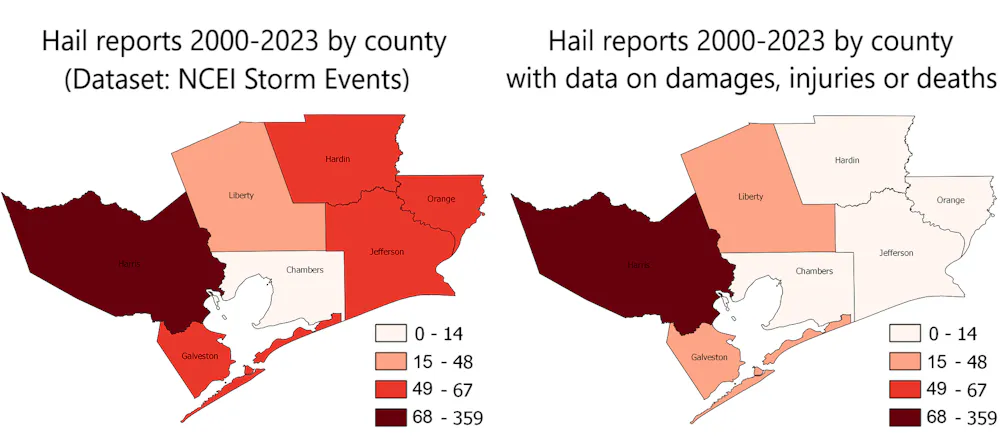
    The number of severe hail reports in southeast Texas listed in the National Centers for Environmental Information’s storm events database is strongly correlated with population. The county with the most reports and greatest detail in those reports is home to Houston. Hailstorms in the three easternmost counties are rarely associated with damage estimates.
    John Nielsen-Gammon and B.J. Baule

    Do you want to look at local damage trends? Forget about it. For most extreme weather events, estimation methods vary over time and are not documented.

    Do you want to direct funding to help communities improve resilience to natural disasters where the need is greatest? Forget about it. The places experiencing the largest per capita damages depend not just on actual damages but on the different practices of local National Weather Service offices.

    Are you moving to a location that might be vulnerable to extreme weather? Companies are starting to provide localized risk estimates through real estate websites, but the algorithms tend to be proprietary, and there’s no independent validation.

    4 steps to improve disaster data

    We believe a few fixes could make NOAA’s storm events database and the corresponding values in the larger SHELDUS database, managed by Arizona State University, more reliable. Both databases include county-level disasters and loss estimates for some of those disasters.

    First, the National Weather Service could develop standard procedures for local offices for estimating disaster damages.

    Second, additional state support could encourage local emergency managers to make concrete damage estimates from individual events and share them with the National Weather Service. The local emergency manager generally knows the extent of damage much better than a forecaster sitting in an office a few counties away.

    Third, state or federal governments and insurance companies can agree to make public the aggregate loss information at the county level or other scale that doesn’t jeopardize the privacy of their policyholders. If all companies provide this data, there is no competitive disadvantage for doing so.

    Fourth, NOAA could create a small “tiger team” of damage specialists to make well-informed, consistent damage estimates of larger events and train local offices on how to handle the smaller stuff.

    With these processes in place, the U.S. wouldn’t need a billion-dollar disasters program anymore. We’d have reliable information on all the disasters.

    John Nielsen-Gammon receives funding from the National Oceanic and Atmospheric Administration and the State of Texas.

    William Baule receives funding from NOAA, the State of Texas, & the Austin Community Foundation.

    ref. Extreme weather’s true damage cost is often a mystery – that’s a problem for understanding storm risk, but it can be fixed – https://theconversation.com/extreme-weathers-true-damage-cost-is-often-a-mystery-thats-a-problem-for-understanding-storm-risk-but-it-can-be-fixed-257105

    MIL OSI – Global Reports

  • MIL-OSI Global: Why climate is an everyday story – but media coverage still spikes around special environment days and UN summits

    Source: The Conversation – UK – By Sanam Mahoozi, PhD Candidate in Journalism, City St George’s, University of London

    Lake Urmia, Iran. Sebastian Castelier/Shutterstock

    Climate change is already happening. But 36% of the world’s population still disputes the realities of its origins and impacts. When the science is clear but public understanding lags, more lives and livelihoods are put at risk.

    The media can act as a bridge between climate solutions and public understanding. A global analysis by the Reuters Institute for the Study of Journalism found that the news media remain the primary source of climate change information, with 31% of people getting it from television and 24% from websites and social media platforms.

    Despite all of this, the mainstream media around the world is not doing enough to shoulder the responsibility of preparing the public for the impacts of climate change and environmental degradation. Research indicates that climate change coverage spikes around UN climate summits (Cops) and events like World Water Day, but drops off in between.

    That means the stories being told about the environment get the most attention during certain months and consistently less coverage throughout the rest of the year.

    I study how the media reports on climate change in authoritarian countries like Iran and across the Middle East and north Africa, a region where heat indices surpass 55°C and severe water shortages persist.

    As part of my PhD research, I found that international media reporting of the world’s most climate-vulnerable nations is sporadic, with coverage often increasing around political and environmental events.

    Reporting on environmental issues in countries facing conflict, war and political tensions is challenging, as the topic often falls low on the media’s list of priorities.

    Climate stories tend to peak around special environment days or UN climate summits.
    arda savasciogullari/Shutterstock

    When it comes to Iran, most of the news making headlines is focused on its nuclear development programme, problems with the west and violations of human rights. The fact that thousands of Iranians die each year from thirst, air pollution and heatwaves rarely makes it into international media, and when it does, it’s usually tied to a political event like protests or US economic sanctions.

    For the past few years, I have been researching and writing for news outlets about the Iranian government’s failure to take action towards mitigating climate change. While discussing the issue with climate scientists, I learned that Iran is among the top ten countries globally contributing to carbon emissions.

    I also learned that, along with Yemen and Libya, Iran is the only country left to ratify the Paris agreement, a treaty that aims to keep global temperatures to 1.5 degrees above pre-industrial times.

    However, when I analysed the media coverage, there was not nearly enough mention of this throughout the year. Most articles were published in November, around the time the UN usually holds its annual climate summits, like the UN climate summit, Cop29, hosted by Azerbaijan last year.

    This is a trend I’ve realised through my research and reporting. When the media only covers environmental issues in countries like Iran during political upheavals or climate summits, the world remains largely unaware of these ongoing challenges the rest of the time.

    Here’s the problem: just in the past few months, millions of Iranians across the country have been suffering through crippling sand and dust storms, drought and land subsidence, issues that have been exacerbated by climate change.

    My PhD research into how the media covers the environment in authoritarian regimes is supported by other studies. I found that articles about water and climate issues in Iran and the Middle East tend to peak around environmental protests and UN climate change summits.

    My study shows that Iran received the highest amount of environmental coverage during the 2021 protests in the southwestern province of Khuzestan concerning the lack of water and drought.

    The bigger picture

    When journalists, editors and media outlets delay reporting on the impact of climate change in countries like Iran, we miss the full scale of the damage. As a result, there’s less pressure on authorities to change policies or prepare the public for the growing environmental challenges like forced migration, hunger, and conflict.

    If these countries are more vulnerable to climate change and their governments are doing little to solve the problem, this urgency must be reflected in the media.

    This can be achieved if news organisations publish more stories that explore the root causes of environmental problems and include insights from experts who can offer solutions.

    If even one story can help save a lake, river or wetland from drying up, that’s a pretty powerful effect.


    Don’t have time to read about climate change as much as you’d like?

    Get a weekly roundup in your inbox instead. Every Wednesday, The Conversation’s environment editor writes Imagine, a short email that goes a little deeper into just one climate issue. Join the 45,000+ readers who’ve subscribed so far.


    Sanam Mahoozi does not work for, consult, own shares in or receive funding from any company or organisation that would benefit from this article, and has disclosed no relevant affiliations beyond their academic appointment.

    ref. Why climate is an everyday story – but media coverage still spikes around special environment days and UN summits – https://theconversation.com/why-climate-is-an-everyday-story-but-media-coverage-still-spikes-around-special-environment-days-and-un-summits-256286

    MIL OSI – Global Reports

  • MIL-OSI: Amalgamated Bank Joins Nearly $1 Billion Aggregate Financing with Greenbacker’s 674 MW Cider Solar Farm, Powering New York’s Largest Solar Project to Date

    Source: GlobeNewswire (MIL-OSI)

    NEW YORK, June 04, 2025 (GLOBE NEWSWIRE) — Amalgamated Bank, a subsidiary of Amalgamated Financial Corp. (Nasdaq: AMAL), today announced the successful closing of a $15 million commitment as part of a nearly $1 billion aggregate financing to support the construction and operation of Greenbacker Renewable Energy Company LLC’s (“Greenbacker”) utility-scale 674 MWdc (megawatts of direct current) “Cider” solar farm, the largest solar project in New York State.

    Cider is located on approximately 2,500 acres in Genesee County, New York, the state where both Greenbacker and Amalgamated Bank are headquartered. Greenbacker broke ground on the solar project—its largest to date—in late 2024, and commenced major construction activities at the site in spring 2025.

    “The Cider project and associated financing, including the new partnership with Amalgamated Bank, underscores Greenbacker’s commitment to building a more resilient energy system in New York,” said Carl Weatherley-White, Greenbacker’s interim Chief Financial Officer. “Together we are driving forward a sustainable future that delivers affordable, homegrown, clean power and meaningful economic benefits to local communities.”

    Cider’s construction is expected to support hundreds of clean energy jobs. The project is slated to enter commercial operation by the end of 2026, when it is projected to generate enough clean electricity to power over 120,000 New York homes annually.

    “We are proud to partner with Greenbacker on the Cider project, a landmark achievement for renewable energy in New York,” said Sam Brown, Chief Banking Officer at Amalgamated Bank. “This project stands as a testament to our collective mission to deliver impactful, scalable clean energy solutions. Additionally, Greenbacker’s dedication to partnering with local organized labor further underscores our unwavering support for unions and our commitment to fostering strong, sustainable communities.”

    Greenbacker’s portfolio has produced over 12 million megawatt – hours of clean energy and abated more than 8 million metric tons of carbon since 2016, reinforcing its commitment to energy transition investments across the country.

    About Greenbacker Renewable Energy Company
    Greenbacker Renewable Energy Company LLC is a publicly reporting, non-traded limited liability sustainable infrastructure company that both acquires and manages income-producing renewable energy and other energy-related businesses, including solar and wind farms, and provides asset management services to other renewable energy investment vehicles. We seek to acquire and operate high-quality projects that sell clean power under long-term contracts to high-creditworthy counterparties such as utilities, municipalities, and corporations. We are long-term owner-operators, who strive to be good stewards of the land and responsible members of the communities in which we operate. Greenbacker conducts its asset management business through its wholly owned subsidiary, Greenbacker Capital Management, LLC, an SEC-registered investment adviser. We believe our focus on power production and asset management creates value that we can then pass on to our shareholders—while facilitating the transition toward a clean energy future. For more information, please visit www.greenbackercapital.com.

    About Amalgamated Bank:
    Amalgamated Bank, the wholly owned banking subsidiary of Amalgamated Financial Corp. (Nasdaq: AMAL), is a mission-driven New York-based full-service commercial bank and a chartered trust company with a combined network branches in New York City, Washington D.C., San Francisco, and Boston. Amalgamated Bank provides commercial and retail banking products, investment management and trust and custody services, and lending services. Since their founding in 1923, Amalgamated Bank is diligent in fulfilling their mission to be America’s socially responsible bank, empowering organizations and individuals to advance positive change. The businesses that Amalgamated Bank focus’ on are generally mission aligned with our core values, including sustainable companies, clean energy, nonprofits, and B Corporations. www.amalgamatedbank.com.

    Media Contacts:  
    Chris Larson
    Media Communications
    Greenbacker
    646.569.9532
    c.larson@greenbackercapital.com

    Ayele Ajavon
    Head of Communication
    Amalgamated Bank
    929.979.5811
    Media@amalgamatedbank.com

    The MIL Network

  • MIL-OSI United Kingdom: Manchester Culture Awards 2025 – nominations now open!

    Source: City of Manchester

    The Manchester Culture Awards are back for 2025 with nominations opening this week for the prestigious awards that recognise the city’s cultural and creative highlights over the last year, as well as some of the city’s top talent working in the arts.

    The awards were launched in 2018 by the city council to acknowledge Manchester’s rapidly growing reputation for culture and the arts, with the annual awards recognising the very best of culture, creativity, and the arts in the city from the grassroots up.

    More than 350 nominations were received last year recognising individuals, events, and organisations big and small that together help make Manchester the vibrant and exciting place for culture and the arts it is.

    Nominations for this year’s awards open this week on Wednesday 4 June, with nominations accepted across eleven different categories including Young Creative of the Year, Best Event, and Best Performance, alongside other awards that shine a spotlight on some of the important themes of our times such as climate change, equality and social justice, and health and wellbeing.

    This year will also once again see a special award made in partnership with the Manchester Evening News.  The Cultural Welcome Award will be presented to an organisation or venue that provides a great welcome to everyone – whether as audience members, visitors, or participants.

    Nominees for each of the awards must either be based in the city of Manchester or have a strong track record of delivering activity for the benefit of people who live in or visit the city, or that benefits the local economy.  Nominations are welcome from the professional, amateur and community sector, as well as members of the public.

    All nominations must reflect activity that has taken place between 1 April 2024 and 31 March 2025, apart from the Cultural Welcome Award, which recognises achievement over a number of years.

    To be recognised for a Manchester Culture Award, nominees must be involved in one or more of the following: visual art, music, theatre, performance, dance, film and broadcast media, literature, digital art, photography, craft, or heritage arts.

    The award categories are:

    Bright Spark: Young Creative of the Year 

    A young person (aged 13–25) who is inspiring future generations of Mancunians and others through their creativity or is supporting others to be creative. 

    Excellence in Creative Health and Wellbeing

    Fantastic creative activity that helped people feel better in their body and/or mind. 

    Champions of Equality and Social Justice 

    Making change and creating opportunities for equality and diversity to thrive.

    Our Planet: Action on Climate Change 

    Taking action to positively benefit the environment and support climate change, or raising awareness and encouraging others to act.  

    Igniting Creativity: Culture, Education and Talent Development 

    Doing great work supporting others to develop their learning, creativity, skills and talents.

    Making it Happen: Best Business Partnership 

    A partnership that supports culture and helps it flourish in Manchester. 

    The Best Event 

     A brilliant creative or cultural event that deserves recognition. 

    The Best Performance 

    A standout performance, in any art form, that was amazing and captivated the audience. 

    The Best Exhibition

    An arts or heritage exhibition that inspired and left a lasting impact on visitors. 

    Independent Creative Award 

    A person working independently in the creative sector who is inspiring and innovating through their artform and projects

    The Cultural Welcome Award – in association with the Manchester Evening News

    An organisation or venue that provides a great welcome to everyone; whether as audience members, visitors, or participants

    A number of Special Recognition Awards for significant contributions to culture over a number of years will also be made on the night.  Previous recipients of Special Recognition Awards include poet Lemn Sissay, former Halle Music Director Sir Mark Elder, former Director of HOME Dave Moutrey OBE, poet performance artist dramatist and writer SuAndi OBE, and DJ Paulette.

    Councillor Garry Bridges, Deputy Leader, Manchester City Council, said: “Culture and creativity is a massive part of what makes Manchester the vibrant and exciting place that it is and makes a major contribution to the city’s economy – which is one of the fastest growing in Europe.

    “The incredible number of nominations we’ve had every year since the awards first began shows what an appetite for culture and the arts there is in the city. And with such a richly diverse talent pool of artists and creatives living and working here it’s no surprise that we’re a city that embraces culture and the arts.

    “The creative scene in Manchester is amazing and we can’t wait to see what this year’s nominations bring.”

    Nominations open on Wednesday 4 June and close at midnight on Friday 4 July.

    Judging will take place over the summer ahead of this year’s awards ceremony which will be held at the Hilton Hotel Deansgate on Saturday 22 November.

    Find out more information about the awards and make a nomination

    MIL OSI United Kingdom

  • MIL-OSI Video: Sudan, Guatemala  & other topics – Daily Press Briefing (3 June 2025)

    Source: United Nations (Video News)

    Noon Briefing by Stéphane Dujarric, Spokesperson for the Secretary-General.

    Highlights:
    Sudan
    Commissioner of the International Commission Against Impunity/Guatemala 
    Ninth Austrian World Summit
    Human Rights/Climate Emergency
    Deputy Secretary-General/Travels
    Gaza
    Occupied Palestinian Territory
    Syria
    Ukraine
    South Sudan
    Democratic Republic of the Congo
    Photo Exhibition
    World Bicycle Day
    Financial Contribution
    Briefings – Today

    SUDAN
    You will have seen the horrific developments in Sudan in which five members of a UN humanitarian convoy were killed last night and several more were injured during an attack near Al Koma in North Darfur.
    I can tell you that we condemn in the strongest terms this horrendous act of violence against humanitarian personnel who literally put their lives at risk attempting to reach vulnerable children and families in the famine-impacted areas.
    This joint WFP-UNICEF 15-truck convoy had travelled over 1,800 km (just about 1,118 miles) from Port Sudan, and they were carrying food and nutrition supplies. The Agencies were negotiating access to complete the journey to El Fasher when it was attacked. The route was shared in advance, and parties on the ground were notified and aware of the location of the trucks.
    Multiple trucks were burned in the attack, and critical humanitarian supplies were damaged. It is devastating the supplies have not reached the civilians in need. This is the first UN humanitarian convoy that was going to make it to El Fasher in over a year.
    All attacks on humanitarian personnel, their facilities and vehicles must stop. They are a violation under international humanitarian law. And we call for an urgent investigation and for the perpetrators to be held to account.
    We call for safe, secure operating conditions and for international humanitarian law to be respected by all parties, not just in Sudan, but in all conflict-impacted countries. Under international humanitarian law, aid convoys must be protected, and parties have the obligation to allow and facilitate rapid and unimpeded passage of humanitarian relief for civilians in need.
    And for those who were killed in line of duty in Sudan, we extend our condolences to their families and loved ones, and we wish a speedy recovery for the wounded. Shirin

    COMMISSIONER OF THE INTERNATIONAL COMMISSION AGAINST IMPUNITY/GUATEMALA 
    The Secretary-General is concerned about the announcement by the Public Prosecutor’s Office of Guatemala regarding the issuance of arrest warrants against former Commissioner of the International Commission Against Impunity in Guatemala (CICIG), Iván Velásquez, former CICIG Head of Investigations Luz Adriana Camargo — now Colombia’s Attorney General — along with 24 other former CICIG national staff and independent justice officials who collaborated with CICIG.
    The Secretary-General reiterates that the Commission’s international personnel, under the terms of the agreement between the UN and the Government of Guatemala regarding the establishment of the Commission, enjoys immunity from legal process with respect to acts done in the performance of their mission which continues even after the completion of their employment with CICIG. He recalls that under this agreement, the Government of Guatemala agreed to protect the personnel of CICIG – whether international or national – from abuse, threats, reprisals or acts of intimidation in virtue of their work for CICIG. 
    The Secretary-General reiterates his concern at the numerous reports that criminal prosecution is being carried out against those who sought to shed light on cases of corruption and worked to strengthen rule of law and the justice system in Guatemala.

    NINTH AUSTRIAN WORLD SUMMIT
    Today, the Secretary-General addressed the Ninth Austrian World Summit via a video message. He pointed out that we face a triple-whammy of woe, with pollution clogging rivers, contaminating land, and poisoning our ocean, the biodiversity being destroyed at record pace and record levels of greenhouse gases catastrophically disrupting our climate.
    The Secretary-General warned that no country, whether rich or poor, can escape these crises, and no country can solve them alone. But together, he said, we can reap the rewards of action, from cheap, secure power, to better health.

    Full highlights: https://www.un.org/sg/en/content/ossg/noon-briefing-highlight?date%5Bvalue%5D%5Bdate%5D=03+June+2025

    https://www.youtube.com/watch?v=dfQFjOD3ATM

    MIL OSI Video

  • MIL-OSI United Nations: GPDRR 2025 highlights: Tuesday 3 June 2025

    Source: UNISDR Disaster Risk Reduction

    The human cost of disasters includes lost livelihoods, homes, and cultural ties to landscapes. Where livelihoods are already fragile and being eroded, a disaster-induced displacement of even a few days can damage economic opportunities for years to come. So, the human dimension of recovery remains central to discussions as delegates convened for a second day in several preparatory events for the 8th Global Platform for Disaster Risk Reduction (GPDRR), namely: the World Resilient Recovery Conference, the Third Stakeholder Forum on DRR, and the Global Early Warning for All Multistakeholder Forum (EW4All).

    The GPDRR official programme was launched with a high-level roundtable event at lunchtime and a formal opening ceremony in the afternoon, followed by an official reception.

    Official programme

    Opening

    Kamal Kishore, Special Representative of the UN Secretary-General for Disaster Risk Reduction, and head of UNDRR, opened the event highlighting the exceptional urgency and importance of delivering on the Sendai Framework. He underscored how communities were coming together and the need to learn from their initiatives, imagination, and resourcefulness, and called for commitment from all actors.

    Recalling the recent loss of a Swiss village to a glacier landslide, Amina J. Mohammed, United Nations Deputy Secretary-General, commented that “early warning saves lives but cannot save glaciers from disappearing.” She stressed that disasters and their cascading effects annually cost up to USD 3.2 trillion and noted that record-breaking disasters make entire regions uninsurable. She called for risk-informed development across all sectors; scaled-up public and private investments in resilience; and national financial frameworks that align with adaptation needs.

    Ignazio Cassis, Minister, Federal Department of Foreign Affairs, Switzerland, observed that, “Risk today is everywhere. Fires are where wetlands were centuries ago.” Noting that the GPDRR2025 is the last Global Platform before the 2030 deadline, he urged that countries deliver on the Sendai Framework, apply science and artificial intelligence, and adopt risk mitigation metrics to mobilize and foster resources.

    Amina J. Mohammed, UN Deputy Secretary-General.

    After a musical performance on the Hang Drum and a choreographed presentation by Sendai4Youth, Patricia Danzi, Swiss Agency for Development and Cooperation, opened the Eighth Session of the GPDRR.

    Enhancing national DRR governance by 2030—A dialogue among national platforms for DRR

    In opening remarks to this high-level event, Kishore observed that the risk landscape platform is becoming increasingly complex. He recommended strengthening national DRR platforms and embedding risk reduction into national policies and frameworks; ensuring sustainable and predictable finance with policies matching sustainable long-term plans; and having a common risk assessment framework to support national entities with proper data and analytics.

    Speaking on behalf of the host country, Franziska Schmid, Swiss National Platform for Natural Hazards (PLANAT), described the work of PLANAT and highlighted challenges, including overlapping reporting mechanisms and strategies among national government entities focused on resilience. She stressed the importance of addressing duplication, developing appropriate tools, such as hazard maps and building permits, and ensuring crisis management provisions are actually functional.

    Discussions then followed in a roundtable format, moderated by Paola Albrito, UNDRR. Albrito invited delegates to: describe the demonstrated impact of their National Platforms for DRR, share lessons learned, identify remaining gaps in DRR governance, and highlight ways and opportunities to boost Sendai Framework implementation by 2030.

    View of the room during the Dialogue Among National Platforms for DRR.

    In their interventions, many called for collaboration among regional and country partners. Speakers included the Deputy Prime Minister of the Democratic Republic of Congo and Tajikistan, as well as many ministers and high-level government representatives. They highlighted lessons and challenges, including: enhancing preparedness through strengthening and modernizing approaches; improving planning and promoting concrete analyses from real-life situations at the grassroots; and mobilizing adequate financing and developing technical expertise to adequately prepare communities.

    All interventions are recorded here.

    Third Stakeholder Forum on DRR

    The Stakeholder Forum continued its deliberations throughout the day, concluding in the afternoon with reflections by supporters and participants of the Stakeholder Engagement Mechanism.

    Spotlight session—Early warning for all

    Moderator Rebecca Murphy, Global Network of Civil Society Organisations for Disaster Reduction (GNDR), invited the UNDRR Stakeholder Forum and the Multi-Stakeholder EW4All communities to combine efforts in crafting action points for the 2025 Global Platform on DRR.

    In the keynote, Gavin White, Risk-informed Early Action Partnership (REAP), summarized common themes in Early Warning, noting that: preparing for disasters is about inclusiveness, honest communication and trusting the person who is providing the guidance; and early warning systems (EWS) can act as a bridge overcoming the silo approaches among different DRR stakeholders. Panelists suggested that: while no system can predict with 100% certainty what shape hazards will take, it is crucial to build trust and understand local contexts; response planners should establish appropriate actions to follow early warnings; emergency systems must be tailored to communities’ experiences so that people can distinguish between different disasters and respond uniquely to each threat; both elderly and youth can inform EWS and response planning; and conflict zones require unique solutions that consider the fragility and power dynamics within communities.

    Bridging the gap: Critical media’s role in strengthening alerts and enhancing disaster preparedness

    Giacomo Mazzone, Media Saving Lives, moderated the session. Matthieu Rawolle, EBU Media Intelligence Service, shared examples of how terrestrial radio networks remained uninterrupted and accessible during disasters, and are used to inform the public and facilitate emergency response, especially when mobile phone and internet services are interrupted. He concluded that radio is an essential communication medium in times of crisis and requires investment.

    Raditya Jati, Deputy Minister of System and Strategy, National Disaster Management Authority, Indonesia, emphasized the need for media to go beyond reporting on casualties and housing collapse, and to incorporate education for people to prepare for disasters.

    Event rooms remained full throughout the day.

    Noting that UNDRR is the first UN agency that recognized media’s role in crises, Natalia Ilieva, Asia-Pacific Broadcasting Union, described the Media Saving Lives collaboration between the World Broadcasting Unions and UNDRR that focuses on shifting media perspectives from reactive to proactive reporting, showing the real causes for disasters and instructing people on how to avoid harm. Grégoire Ndjaka, African Broadcasting Union, highlighted the reach of radio in Africa extending to places without electricity supply. Orengiye Fyneface, African Broadcasting Union, discussed trust challenges with journalism as a disaster information source in Africa, pointing to bureaucratic hurdles that prevent journalists from reaching scientists.

    Shaping a sustainable tomorrow: Aligning the Sendai Midterm Review with the Pact for the Future

    Abraham Bugre, University of Regina, moderated this session. In her opening remarks, Toni-Shae Freckleton, UNDRR, called for transitioning from short-term responses to long-term prevention. She stated that the Pact for the Future embeds DRR and resilience building.

    Juan Carlos Uribe Vega, United Cities and Local Governments (UCLG) highlighted gaps in understanding localization and the importance of local-level governance. Jekulin Lipi Saikia, GNDR, called for a focus on listening to and working with communities, improving financial access, and increasing citizen science. Amber Fletcher, University of Regina, emphasized the role of community-driven actions, citizen science, and community engagement in reaching the diverse range of local voices. In the ensuing discussion, attendees identified communication disconnection, lack of funding, and localization among the persistent gaps between global networks and local realities.

    Closing session

    Tanjir Hossain, UNDRR Stakeholder Engagement Mechanism (SEM), moderated the closing session. Jamie Cummings, SEM, recalled her own experience of disaster when Hurricane Helene struck her hometown of Asheville, North Carolina. Describing how volunteers had operated a traditional Appalachian mule brigade to transport life-saving medications to mountain communities after roads were destroyed, she reflected that, “communities who know the land most, hold the solutions.” Martin Schuldes, German Federal Ministry for Economic Cooperation and Development (BMZ), stressed that “the substance and spirit” of the conference must translate into concrete action.

    Jilhane El Gaouzi, African Union Commission, urged all concerned to “be realistic and speed up implementation,” given that only five years remain until the Sendai Framework deadline.

    View of the panel during the Closing Session of the Stakeholder Forum.

    World Resilient Recovery Conference

    At the opening of this one-day event, Mutale Nalumongo, Vice-President, Zambia, highlighted Zambia’s promotion of climate-resilient agriculture through promotion of drought-tolerant crop varieties, access to weather-based insurance and investment in EWS, including advisories to farmers. Following further opening remarks by speakers, two plenaries and several thematic sessions took place during the day.

    Plenary 1—Taking stock of current recovery practices

    Carolina Fuentes Castellanos, Director, Santiago Network Secretariat, moderated the session.

    Sujit Mohanty, UNDRR, noted the high costs of reconstruction and the difficulties of countries that are perpetually in a state of recovery from one disaster after another, pointing to the need to address institutional fragmentation.

    Renato Umali Solidum, Jr., Department of Science and Technology, Philippines, advocated for greater cohesion between DRR and climate action as being “two sides of the same coin.” He called for transparent grant-based governance to reach at-risk commuities and address both slow-onset and sudden disasters.

    Leon Lundy, Minister of State Office, The Bahamas, highlighted the launch of The Bahamas’ National Disaster Risk Management Authority. He drew attention to the 2022 Act mandating public body disaster plans, including continuity plans, restoration timelines, and staff redeployment protocols to ensure essential services can be maintained or rapidly restored after a disaster.

    Krishna Swaroop Vatsa, National Disaster Management Authority, India, highlighted allocation of 30% of the Authority’s funds for recovery and reconstruction, which are released through an assessment-based process.

    Fuentes Castellanos offered countries the Secretariat’s support for structuring technical assistance requests.

    Plenary 2—From commitment to action: Leadership for resilient recovery

    Shivangi Chavda, GNDR, moderated the session.

    Guangzhe Chen, World Bank, described the World Bank’s recent transition to supporting infrastructure resilience efforts. He invited countries to access the Bank’s preparedness and response toolkit to strengthen their disaster reduction policies, citing recent examples from Malawi, Albania, and Madagascar.

    On financial instruments, panelists explored ways to distribute more rapid financial support, including through multi-dimensional approaches.

    On displacement following disasters, Rania Sharshr, International Organization for Migration (IOM), emphasized that one of the greatest needs of governments is access to reliable and accurate data on how displaced people have been impacted, and guidance on how to integrate these people into existing communities.

    The session concluded with the presentation of the Resilient Recovery Framework by Abhilash Panda, UNDRR.

    Thematic sessions

    Further sessions took place through the day. Besides the three sessions reported here, delegates took part in other Stakeholder Forum sessions on governance mechanisms, unlocking financial potential, housing reconstruction, and multi-hazard EWS.

    Restoring livelihood: Solutions for disaster-induced displacement and resilient recovery

    Mona Folkesson, UN Development Coordination Office (DCO), moderated the session.

    Emad Adly, Arab Network for Environment and Development, highlighted water scarcity as a key issue for the region and local-level coordination as a key challenge. Alexandra Bilak, Internal Displacement Monitoring Centre (IDMC), cited experience from the 2015 Gorkha Earthquake in Nepal to show how livelihood erosion influences the severity of displacement.

    Ibrahim Osman Farah, Vice President, Somali Regional State, Ethiopia, described livelihood restoration during return and resettlement of internally displaced persons, through ensuring cultural access to land, water, schools, and income-generating opportunities as long-term resilience-based approaches.

    Tasneem Siddiqui, University of Dhaka, recounted how students were a driving force for the university’s Refugee and Migration Research Unit, which now has formed Adaptation Committees in many local areas and supports implementation of national policies on livelihood diversification and skills training. She urged treating displacement not as a humanitarian issue, but as a human rights one.

    Aslam Perwaiz, Executive Director, Asian Disaster Preparedness Center, emphasized skill development with local communities and SMEs to create livelihood options for displaced communities.

    Driving resilience: The critical role of private sector’s operational readiness for resilient recovery

    Moderator, Cedrick Moriggi, Corporate Chief Resilience Officer Network, emphasized connecting the corporate world with the UNDRR world. Ommid Saberi, International Finance Corporation, recommended investing in the “economics of families,” or small businesses, saying even small government incentives can mobilize large funds from the private sector. Dorothee Baumann-Pauly, University of Geneva, said human rights are the enablers for resilience. Jonathan Rake, Swiss Re Solutions, highlighted the need for the private sector to engage locally and to develop and combine social programmes with parametric solutions. Chris Ulatt, Octopus, said upfront investment to boost resilience is the right move, but observed that few investors will remain for the duration of an investment. Kerry Hinds, Department of Emergency Management, Barbados, described an audit tool to ascertain risks and priorities for public-private partnerships, noting the tool helps standardize and trigger business continuity protocols for disaster risk management.

    Turning experience into action: learning from large-scale disasters

    Dilanthi Amaratunga, Intergovernmental Coordination Group for the Indian Ocean Tsunami Warning and Mitigation System, moderated the session.

    Banak Joshua Dei Wal, South Sudan’s DRR Focal Point, highlighted the need to work together and identify risks for Sendai Framework implementation to be effective.

    Saini Yang, Integrated Research on Disaster Risk (IRDR), emphasized that China’s National Flood Prevention System has proven effective, with more than an 80% decrease in flood mortality rates over the last 20 years.

    Trevor Bhupsingh, Public Safety Canada, highlighted Canada’s Disaster Financial Assistance Arrangements.

    Guy Gryspeert, Honeywell, defined resilience as the capability of preventing a crisis by having awareness and planning in place.

    Ali Hamza Pehlivan, Disaster and Emergency Management Authority (AFAD), Türkiye, highlighted the usefulness of their National Disaster Response Plan during the 2023 earthquake. Makiko Ohashi, Cabinet Office of Japan, noted the utility of planning on the assumption that a mega-disaster may occur at any time and of reviewing DDR plans in the aftermath of disasters.

    Participants engage in discussions between sessions throughout the day.

    Global Early Warning for All (EW4All) Multistakeholder Forum

    After thematic sessions during the day, EW4All concluded its discussions. Gavin White, Risk-Informed Early Action Partnership, moderated the closing session. Panelists highlighted the importance of focusing on preparedness and developing trust, the need to shift perspectives toward a systemic approach to EWS, and the need to increase private funding.

    In closing remarks, Andrea Hermenejildo, Deputy Secretary General for Risk Management, Ecuador, stressed EWS is not only a technical issue, but also involves social justice. Paola Albrito, Director, UNDRR, emphasized that EW4All is both needed and achievable. Noting the central role of local communities, she underlined that resilience is built with communities.

    Doreen Bogdan-Martin, Secretary-General, International Telecommunication Union, underlined that scaling-up EWS requires partnerships and breaking silos across economic sectors, UN agencies and industries.

    Jagan Chapagain, Secretary-General, International Federation of Red Cross and Red Crescent Societies (IFRC), stressed that inclusive action and investment in EW4All is essential.

    Celeste Saulo, Secretary-General, World Meteorological Organization (WMO), stated that having EWS in just 108 countries is neither sufficient nor acceptable, and called for closing this “justice gap” by providing EWS worldwide and accelerating the transformation needed to protect every person on Earth.

    MIL OSI United Nations News

  • MIL-OSI Europe: REPORT on the 2023 and 2024 Commission reports on Moldova – A10-0096/2025

    Source: European Parliament

    MOTION FOR A EUROPEAN PARLIAMENT RESOLUTION

    on the 2023 and 2024 Commission reports on Moldova

    (2025/2025(INI))

    The European Parliament,

     having regard to the Commission communication of 30 October 2024 entitled ‘2024 Communication on EU enlargement policy’ (COM(2024)0690), accompanied by the Commission staff working document entitled ‘Republic of Moldova 2024 Report’ (SWD(2024)0698),

     having regard to the Commission opinion of 17 June 2022 on the application by the Republic of Moldova (hereinafter ‘Moldova’) for membership of the European Union (COM(2022)0406) and the joint staff working document of 6 February 2023 entitled ‘Association Implementation Report on the Republic of Moldova’ (SWD(2023)0041),

     having regard to Regulation (EU) 2025/535 of the European Parliament and of the Council of 18 March 2025 on establishing the Reform and Growth Facility for the Republic of Moldova[1],

     having regard to its previous resolutions on Moldova,

     having regard to the Commission analytical report of 1 February 2023 on Moldova’s alignment with the EU acquis (SWD(2023)0032),

     having regard to the proposal of 9 October 2024 for a regulation of the European Parliament and of the Council on establishing the Reform and Growth Facility for the Republic of Moldova (COM/2024/0469),

     having regard to the Commission communication of 9 October 2024 on the Moldova Growth Plan (COM/2024/0470),

     having regard to the Council conclusions of 17 December 2024 on enlargement,

     having regard to the visit of the delegation of the Committee on Foreign Affairs to Moldova on 25-27 February 2025,

     having regard to Rule 55 of its Rules of Procedure,

     having regard to the report of the Committee on Foreign Affairs (A10-0096/2025),

    A. whereas, following Moldova’s application for EU membership of 3 March 2022, the European Council granted it candidate status on 23 June 2022 and subsequently decided to open accession negotiations on 14 December 2023;

    B. whereas in June 2024 negotiations on Moldova’s EU accession started;

    C. whereas Moldova held a referendum on 20 October 2024, the outcome of which confirmed the embedding of EU accession into its Constitution, despite various forms of manipulative interference to destabilise the country, illicit financing of political actors, disinformation campaigns and cyberattacks;

    D. whereas the Association Agreement[2], which includes a Deep and Comprehensive Free Trade Area (AA/DCFTA), remains the basis for political association and economic integration between the EU and Moldova, and a regular political and economic dialogue is ongoing between the two sides;

    Progress with EU accession-related reforms, in particular on the rule of law and governance

    1. Commends Moldova’s exemplary commitment and steady progress with EU accession-related reforms despite significant internal and external challenges – such as Russia’s full-scale war of aggression against Ukraine – which made it possible for accession negotiations to start in June 2024, half a year after the relevant decision by the European Council on 14 December 2023 and less than two years after the country’s application for EU membership on 3 March 2022;

    2. Recognises that EU-Moldova relations have entered into a new phase, with intensifying cooperation, gradual alignment across all policy areas of the EU acquis and advancement on the EU integration path; welcomes the progress achieved in the bilateral screening process since it started in July 2024 and the recent closing of screening for cluster 1 (fundamentals) and cluster 2 (internal market); commends and supports the ambition of the Moldovan Government to open negotiations on cluster 1 (fundamentals), cluster 2 (internal market) and cluster 6 (external relations) in the coming months, as well as completing the screening process for all clusters by the end of 2025; calls on the Commission to enhance its support to the Moldovan Government in order to ensure the successful achievement of these key objectives; encourages the Council to take a merit-based approach in its decisions on Moldova’s negotiation process; deplores the bilateralisation and instrumentalisation of the EU accession process, such as the opposition of the Hungarian Government to opening negotiations on clusters 1, 2 and 6, which has led to a delay and serves Russia’s objective of obstructing the European integration of the region;

    3. Believes that Moldova’s capacity to consolidate its current progress with EU accession-related reforms and sustain the ambitious pace towards EU membership will require the strong and genuine support of a parliamentary majority after the elections in autumn 2025;

    4. Notes that the outcomes of both the constitutional referendum on EU accession, held on 20 October 2024, and the presidential election, held on 20 October 2024 and 3 November 2024, confirmed the support of a majority of the people of Moldova for the country’s goal of EU membership and the required pro-EU reforms; underlines that this referendum and election were held professionally and with an extraordinary sense of duty and dedication, despite a massive hybrid campaign by Russia and its proxies which used various tools, such as the strategic exploitation of social media, AI-generated content, ‘leaks’ of fake documents, intimidation, which entailed various forms of manipulative interference to destabilise the country, illicit financing of political actors, vote-buying, including by Russia’s instrumentalisation of parts of the clergy from the Metropolis of Chisinau and All Moldova, disinformation campaigns and cyberattacks; recalls that these attacks had four key strategies: divide society, delegitimise institutions, discredit democratic actors and promote Russian influence; welcomes the outcome of the 2024 constitutional referendum which enshrined the commitment to joining the EU in the country’s constitution; strongly condemns the increasing attempts by Russia, pro-Russian oligarchs and Russian-sponsored local proxies to destabilise Moldova, sow divisions within Moldovan society and derail the country’s pro-EU direction through hybrid attacks, the instrumentalisation of energy supplies, disinformation, manipulation and intimidation campaigns targeting civil society organisations and independent media;

    5. Notes that the upcoming parliamentary elections on 28 September 2025 will be of crucial importance for the continuation of Moldova’s pro-EU trajectory; is concerned about the likely intensification of foreign, in particular Russian, malign interference and hybrid attacks ahead of the elections; calls for the EU to increase its support, including financial and technical support, for the Moldovan Government’s efforts to counter such interference in the country’s democratic process, including through additional sanctions listings, an extension and consolidation of the mandate and resources of the EU Partnership Mission (EUPM) in Moldova and the granting of additional support thereto, and the sharing of expertise in foreign information manipulation and interference (FIMI), countering hybrid threats and strengthening resilience; calls similarly for an increase in efforts by the Moldovan authorities and the EU in support of independent media and pro-democracy civil society, in order to enable journalists at national and regional level to counter FIMI and to strengthen digital literacy;

    6. Stresses the importance of strategic communication, debunking and combating false, Russia-promoted narratives about the EU and its policies and of highlighting the concrete short- and long-term benefits of EU accession for the people of all of Moldova, with a special focus on regions such as Gagauzia as well as socio-economically disadvantaged communities in rural areas; calls for the EU to step up its support for Moldova in this regard;

    Socio-economic reforms

    7. Welcomes the Commission’s Moldova Growth Plan,  which is aimed at supporting Moldova’s socio-economic and fundamental reforms and enhancing access to the EU’s single market; welcomes the Reform and Growth Facility for Moldova, which underpins the Growth Plan and is worth EUR 2.02 billion, making it the largest EU financial support package for Moldova since its independence; underlines that this facility provides Moldova with EUR 520 million in non-repayable support and a maximum amount of EUR 1.5 billion in loans, with an 18 % pre-financing rate, demonstrating the EU’s recognition of the urgency of supporting Moldova’s reforms and resilience; calls on the Commission to support the Moldovan authorities in implementing the necessary Reform Agenda for the effective absorption of funds from this facility, ensuring that the benefits of this support are promptly felt by Moldova’s citizens; looks forward to the announced impact assessment of the Reform and Growth Facility for Moldova in the form of a Commission staff working document within three months of the adoption of the corresponding regulation;

    8. Calls on the Commission to include adequate dedicated pre-accession funds for Moldova in the EU’s next multiannual financial framework, and to begin preparing Moldova for the efficient use of future pre-accession funds as a newly designated EU candidate country;

    9. Reiterates that the support of the people of Moldova for European integration can be strengthened with a tangible improvement in their livelihoods, by strengthening state institutions and public administration in order to use project funding effectively and to implement and enforce the EU acquis, ensuring a robust welfare system and fighting corruption and oligarchic influence and ensuring accountability; calls on the Moldovan authorities to continue to ensure the meaningful involvement of civil society organisations, diaspora, vulnerable groups and social partners, including trade unions, in order to strengthen trust in democratic institutions and processes and boost public support for EU accession-related reforms;

    10. Stresses the importance of civil society organisations in monitoring governance and progress with EU-related reforms, promoting transparency, defending human rights and countering disinformation and external malign influence by anti-reform political actors and Russian proxies;

    11. Calls for comprehensive social policy reforms to address poverty and persistent large-scale emigration, increase healthcare coverage, strengthen public education, improve working conditions and develop adequate social protection systems; emphasises that economic development must be inclusive and sustainable, with opportunities for small and medium-sized enterprises; stresses the need for targeted social investment in Moldova’s young people and rural areas to reduce regional disparities and safeguard social cohesion;

    12. Calls for special emphasis on Moldova’s participation in EU social, educational, and cultural programmes in order to promote social convergence, innovation and technological advancement;

    13. Calls on Moldova to implement the Reform Agenda, which outlines the key socio-economic and fundamental reforms to accelerate the growth and competitiveness of Moldova’s economy and its convergence with the EU on the basis of enhanced implementation of the AA/DCFTA;

    14. Strongly calls for the acceleration of Moldova’s gradual integration into the EU and the single market by continuing to align its legal and regulatory framework with the EU acquis and associating the country to more EU programmes and initiatives, including through the granting of observer status to Moldovan officials and experts in relevant EU bodies, which would deliver tangible socio-economic benefits even before the country formally joins the EU; congratulates Moldova on its inclusion in the geographical scope of the Single Euro Payments Area payment schemes, facilitating transfers in euro and reducing costs for Moldova’s citizens and businesses; welcomes Moldova’s recent progress in the transposition of the EU’s roaming and telecommunications acquis and expresses support for a swift decision on the inclusion of Moldova into the EU ‘roam like at home’ area; calls on the service providers to cooperate in good faith with the Moldovan authorities on implementing ‘roam like at home’;

    15. Welcomes the renewal of the EU’s temporary trade liberalisation measures in July 2024 in order to support Moldova’s economy, substituting the loss of trade caused by Russia’s war of aggression against Ukraine and its unfriendly policies towards Moldova; calls for the EU to take swift and significant steps towards the permanent liberalisation of its tariff-rate quotas, in order to ensure predictability and increase the country’s attractiveness to investors;

    16. Notes that the recent decision of the US administration to suspend support for civil society, independent media, key reforms and infrastructure projects has created additional urgent needs in Moldova, regarding which the EU should step in; calls on the Commission, in this regard, to increase its funding for EU instruments supporting democracy, such as the European Endowment for Democracy, and for other key projects that had until recently been funded by the US Agency for International Development (USAID) and other US agencies;

    Human rights


    17. Notes Moldova’s progress towards achieving gender equality, including its adoption of the Programme for Promoting and Ensuring Equality between Women and Men for the 2023-2027 period, and calls for its continued efforts in this regard, particularly to reduce the gender pay gap, fight against stereotypes, discrimination and gender-based violence, and to increase the representation of women in politics and business;

    18. Welcomes the efforts by the Moldovan authorities to combat violence against women and improve protection for survivors, in particular the adoption of the National Programme on Preventing and Combatting Violence against Women and Domestic Violence for the 2023-2027 period; notes that the impact of this, however, is still lacking and therefore calls for the establishment of more shelters for survivors of domestic violence, for adequate attention by the justice system to violence against women and for policy changes and increased awareness-raising among men regarding gender-based violence;

    19. Calls on the Moldovan Government to strengthen its efforts, including the effective implementation of its legislative framework, to combat racial discrimination, marginalisation, racist hate speech and hate crimes targeting members of ethnic minority groups, including the Roma;

    20. Commends Moldova’s efforts to improve the rights of the LGBTIQ+ community in recent years;

    21. Calls on the Moldovan Government to fully align its legislation on the rights of persons with disabilities with the EU acquis and to tackle the systemic problem of children with intellectual disabilities being placed in psychiatric institutions;

    Energy, environment and connectivity

    22. Condemns Russia’s instrumentalisation of energy against Moldova, most recently by halting gas supplies to the Transnistrian region on 1 January 2025, in violation of contractual obligations, and thereby provoking a serious crisis in the region; applauds the Commission’s swift proposal of a Comprehensive Strategy for Energy Independence and Resilience and its support package worth EUR 250 million, which will reduce the energy bills of Moldovan consumers, including in the Transnistrian region, support Moldova’s decoupling from Russia’s energy supplies and integrate Moldova into the EU energy market; emphasises the need for the EU and the Moldovan authorities to effectively communicate about the substantial EU support package aimed at addressing Moldova’s energy crisis;

    23. Commends the alignment of the Moldovan energy sector with the EU acquis; calls on the Moldovan Government to continue its efforts, with EU support that includes the tools available from the Reform and Growth Facility for Moldova, to diversify gas and electricity supply routes, develop connectivity, increase energy efficiency and its internal production and storage capacity, as well as advance its full integration into the EU energy market in order to ensure Moldova’s energy security and resilience; stresses the importance of the completion of the Vulcanesti-Chisinau 400 kV overhead power line by the end of 2025 in order to reduce Moldova’s reliance on energy infrastructure in the Transnistrian region; calls on the EU to mobilise the necessary resources to help compensate for the withdrawal of USAID support for Moldova’s energy sector;

    24. Commends the Moldovan Government for its progress on decarbonisation, energy efficiency and transitioning to a green economy, including doubling the share of renewable energy to 30 % by 2030; encourages the EU and its Member States to continue to provide financial support and expertise to Moldovan counterparts in this area; welcomes the adoption in 2023 of Moldova’s National Climate Change Adaptation Programme until 2030 and its Action Plan for this purpose; calls on the Moldovan Government to adopt and begin implementing its National Energy and Climate Plan for the 2025-2030 period; notes the importance of implementing the commitments of the Energy Community’s Decarbonisation Roadmap, and implementing the Monitoring, Reporting, Verification and Accreditation package with a view to introducing carbon pricing and aligning with the EU emissions trading system;

    25. Believes that an extension of the Trans-European Transport Network (TEN-T) corridor Baltic Sea-Black Sea-Aegean Sea (Corridor IX) to include the route of Chisinau-Constanta-Varna-Bourgas would be a strategic investment in the region’s transport infrastructure, enhancing connectivity and promoting economic growth, in view of the enlargement of the EU to the east and the potential positive impact of this extension on the region’s security and stability, serving as a key logistics route for NATO and enhancing the EU’s geostrategic autonomy;

    Rule of law and good governance

    26. Underlines that comprehensive justice reform remains key for the success of Moldova’s democratic and EU accession-related reforms; recognises Moldova’s sustained efforts to build an independent, impartial, accountable and professional judicial system and conclude the vetting process by the end of 2026; calls, therefore, for the EU to continue actively supporting the justice reform and the process of vetting both judges and prosecutors, including the attraction, training and recruitment of qualified judicial personnel and increase in judicial capacity;

    27. Notes that Moldova has achieved progress in the fight against and prevention of corruption, but stresses the need to continue the fight against money laundering; welcomes the entry into force in February 2024 of Moldova’s National Integrity and Anti-Corruption Programme for 2024-2028; highlights the need to ensure enhanced coordination among all key anti-corruption and justice institutions in order to implement comprehensive reforms and to ensure that they have adequate resources and capacities; stresses that results in terms of prosecution and conviction in corruption cases need to be delivered in order to ensure public trust in the ongoing reforms;

    28. Recalls the importance of continuing the investigation and bringing to justice those responsible for the 2014 bank fraud; welcomes the fact that, after long efforts by the Moldovan authorities, Interpol has finally added one of the alleged perpetrators, Vladimir Plahotniuc, to its list of internationally wanted persons;

    29. Welcomes the adoption by Moldova in 2023 of a new national strategy for preventing and combating human trafficking, aligned with the EU acquis, and the cooperation of Moldova with Europol in combating drug trafficking;


    30. Expresses its readiness to continue supporting the Parliament of Moldova through mutually agreed democracy support activities that respond to the needs of the institution, its elected members and staff; underlines the importance of the Parliament of Moldova in fostering public debate about the country’s European future and achieving a broad consensus over, and democratic legitimacy of, EU accession-related reforms across political parties and among broader society; highlights the decision of 10 March 2025 to open a European Parliament office in Chisinau to further strengthen Parliament’s engagement with the Eastern Partnership region;

    Cooperation in the field of common foreign and security policy (CFSP) and progress on resolving the Transnistrian conflict

    31. Welcomes Moldova’s consistent cooperation on foreign policy issues and the significantly increased rate, notably from 54 % in 2022 to 86 % in 2024, of its alignment with the EU’s CFSP positions and restrictive measures; invites it to continue to improve this alignment, including on restrictive measures against Russia, and to continue cooperation on preventing the circumvention of sanctions against Russia and Belarus related to Russia’s war of aggression against Ukraine;

    32. Underlines that Moldova is a key contributor to the regional and European security, including through its unwavering support to Ukraine since the start of Russia’s war of aggression, for example by welcoming Ukrainian war refugees, and through its contributions to the EU Civil Protection Mechanism, for example by deploying firefighting teams to tackle severe wildfires in Greece;

    33. Expresses its support for the EUPM in Moldova and calls on the Member States to contribute the necessary experts and financial resources, in anticipation of a potential intensification of hybrid threats; welcomes the recent extension of the EUPM’s mandate until April 2026; encourages the Moldovan authorities to make full use of the EUPM’s expertise to enhance its preparedness, particularly in view of repeated electoral interference ahead of the parliamentary elections on 28 September 2025; calls for the EU to draw from the experience gained in Moldova in protecting the electoral process and democratic institutions in the EU itself; encourages the European External Action Service and the Commission to use all available EU instruments in the area of countering hybrid threats, in order to continue to support Moldova, including by swiftly deploying a Hybrid Rapid Response Team; welcomes the establishment of Moldova’s Centre for Strategic Communications and Countering Disinformation, as a means of coordinating the fight against foreign interference among the various Moldovan institutions, and of the National Agency for Cyber Security and the National Institute for Cyber Security Innovations; notes that Moldova’s National Security Strategy, adopted in December 2023, highlights EU accession as a key objective and for the first time identifies Russia as the source of major threats to Moldova’s security; stresses the importance of improving information sharing and intelligence cooperation between Moldova and the EU and its Member States on security threats;


    34. Reiterates its full commitment to Moldova’s territorial integrity and to the peaceful resolution of the conflict, based on the sovereignty and territorial integrity of Moldova in its internationally recognised borders;

    35. Welcomes the Commission’s initiatives to include proactive support for the Transnistrian region in its energy emergency support packages, and exchange of information and practical cooperation between the Moldovan Government and the de facto authorities of the Transnistrian region throughout the energy crisis caused by Russia; welcomes the progress regarding the conditionalities for Tiraspol in light of the recent gas transit agreement and calls for the full implementation of these conditionalities, including the release of all political prisoners by Tiraspol and the dismantling of the remaining illegal checkpoints;

    36. Welcomes Moldova’s keen interest in contributing to the EU’s common security and defence policy (CSDP) and the fact that Moldova is the first country to sign a security and defence partnership with the EU; welcomes Moldova’s continued active participation in EU missions and operations under the CSDP, its interest in participation in PESCO projects and the ongoing negotiations on a framework agreement with the European Defence Agency; calls on the EU to include Moldova in the EU security and defence programmes and related budget allocations, including the European Defence Industry Programme and Readiness 2030, allowing the country to participate in joint procurement alongside the Member States;

    37. Welcomes the allocation of EUR 50 million to modernise the defence capacities of the Moldovan Armed Forces in the context of the current security challenges through the European Peace Facility (EPF) for 2024; notes that Moldova is the second-largest EPF beneficiary after Ukraine, with a total of EUR 137 million allocated since 2021; welcomes the announced support of EUR 60 million to be provided to Moldova from the EPF budget in 2025; calls on the Member States to progressively increase the EPF funding for Moldova to further enhance the country’s defence capabilities;

    °

    ° °

    38. Instructs its President to forward this resolution to the Council, the Commission, the Vice-President of the Commission / High Representative of the Union for Foreign Affairs and Security Policy, and to the President, Government and Parliament of the Republic of Moldova.

    MIL OSI Europe News

  • MIL-OSI Europe: REPORT on electricity grids: the backbone of the EU energy system – A10-0091/2025

    Source: European Parliament

    MOTION FOR A EUROPEAN PARLIAMENT RESOLUTION

    on electricity grids: the backbone of the EU energy system

    (2025/2006(INI))

    The European Parliament,

     having regard to the Treaty on the Functioning of the European Union, and in particular Article 194 thereof,

     having regard to the Commission communication of 8 July 2020 entitled ‘Powering a climate-neutral economy: An EU Strategy for Energy System Integration’ (COM(2020)0299),

     having regard to the Commission communication of 28 November 2023 entitled ‘Grids, the missing link – An EU Action Plan for Grids’ (COM(2023)0757),

     having regard to the Commission report of January 2025 entitled ‘Investment needs of European energy infrastructure to enable a decarbonised economy’[1],

     having regard to the Commission communication of 26 February 2025 entitled ‘Action Plan for Affordable Energy – Unlocking the true value of our Energy Union to secure affordable, efficient and clean energy for all Europeans’ (COM(2025)0079),

     having regard to the Commission communication of 26 February 2025 entitled ‘The Clean Industrial Deal: A joint roadmap for competitiveness and decarbonisation’ (COM(2025)0085),

     having regard to the Commission communication of 5 March 2025 entitled ‘Industrial Action Plan for the European automotive sector’ (COM(2025)0095),

     having regard to Regulation (EU) 2021/1153 of the European Parliament and of the Council of 7 July 2021 establishing the Connecting Europe Facility and repealing Regulations (EU) No 1316/2013 and (EU) No 283/2014[2] (the CEF Regulation),

     having regard to Regulation (EU) 2022/869 of the European Parliament and of the Council of 30 May 2022 on guidelines for trans-European energy infrastructure, amending Regulations (EC) No 715/2009, (EU) 2019/942 and (EU) 2019/943 and Directives 2009/73/EC and (EU) 2019/944, and repealing Regulation (EU) No 347/2013[3] (the TEN-E Regulation),

     having regard to Directive (EU) 2019/944 of the European Parliament and of the Council of 5 June 2019 on common rules for the internal market for electricity and amending Directive 2012/27/EU[4],

     having regard to Regulation (EU) 2019/943 of the European Parliament and of the Council of 5 June 2019 on the internal market for electricity[5],

     having regard to Directive (EU) 2023/2413 of the European Parliament and of the Council of 18 October 2023 amending Directive (EU) 2018/2001, Regulation (EU) 2018/1999 and Directive 98/70/EC as regards the promotion of energy from renewable sources, and repealing Council Directive (EU) 2015/652[6] (the Renewable Energy Directive),

     having regard to Directive (EU) 2024/1275 of the European Parliament and of the Council of 24 April 2024 on the energy performance of buildings[7],

     having regard to Directive (EU) 2024/1711 of the European Parliament and of the Council of 13 June 2024 amending Directives (EU) 2018/2001 and (EU) 2019/944 as regards improving the Union’s electricity market design[8],

     having regard to Regulation (EU) 2024/1747 of the European Parliament and of the Council of 13 June 2024 amending Regulations (EU) 2019/942 and (EU) 2019/943 as regards improving the Union’s electricity market design[9] (Electricity Market Design (EMD) Regulation),

     having regard to Regulation (EU) 2018/1999 of the European Parliament and of the Council of 11 December 2018 on the Governance of the Energy Union and Climate Action, amending Regulations (EC) No 663/2009 and (EC) No 715/2009 of the European Parliament and of the Council, Directives 94/22/EC, 98/70/EC, 2009/31/EC, 2009/73/EC, 2010/31/EU, 2012/27/EU and 2013/30/EU of the European Parliament and of the Council, Council Directives 2009/119/EC and (EU) 2015/652 and repealing Regulation (EU) No 525/2013 of the European Parliament and of the Council[10], which reflects the EU’s electricity interconnection targets,

     having regard to the Council conclusions on ‘Advancing Sustainable Electricity Grid Infrastructure’, as approved by the Transport, Telecommunications and Energy Council at its meeting on 30 May 2024,

     having regard to its resolution of 10 July 2020 on a comprehensive European approach to energy storage[11],

     having regard to its resolution of 19 May 2021 on a European strategy for energy system integration[12],

     having regard to the report of January 2023 by the EU Agency for the Cooperation of Energy Regulators (ACER) on electricity transmission and distribution tariff methodologies in Europe,

     having regard to the report of 19 December 2023 by ACER entitled ‘Demand response and other distributed energy resources: what barriers are holding them back?’,

     having regard to the report of April 2025 by the European Network of Transmission System Operators for Electricity (ENTSO-E) entitled ‘Bidding Zone Review of the 2025 Target Year’[13],

     having regard to Rule 55 of its Rules of Procedure,

     having regard to the report of the Committee on Industry, Research and Energy (A10-0091/2025),

    A. whereas electricity grids are essential for the Union to achieve its clean energy transition and to deliver renewable energy while supporting economic growth and prosperity; whereas inefficiencies and lack of full integration negatively impact energy prices for consumers and companies;

    B. whereas in light of the growing demand for electricity, significant investments and upgrades are required, along with regulatory oversight, to increase cross-border and national-level transmission capacity and modernise infrastructure, ensuring a decarbonised, flexible, more decentralised, digitalised and resilient electricity system;

    C. whereas poor connectivity and grid bottlenecks are among the main reasons the EU cannot fully benefit from the significant installed capacities of wind and solar energy, thereby ensuring affordable prices for households and industry; whereas the lack of strong interconnection between regions with different natural and climatic characteristics leads to the overproduction of energy and administrative limitation on renewable production in some regions, while other regions are struggling with insufficient supply and high prices;

    D. whereas transmission system operators (TSOs) are essential for integrating offshore renewable energy into the EU grid, in particular for those connected to more than one market; whereas, if TSOs fail to provide the agreed grid capacity, compensation should be paid to developers for lost export capacity, funded by congestion income; whereas such compensation should be shared fairly among TSOs and align with principles of non-discrimination and maximising cross-border trade; whereas this highlights the importance of maintaining a functioning interconnector backbone, as failures in interconnector capacity may result in costs for both producers and TSOs;

    E. whereas Europe will only reach its decarbonisation objectives if there is a coordinated, pan-European approach to electricity system planning, connecting borders, sectors and regions;

    F. whereas the planning of electricity transmission and distribution networks must be coordinated to ensure the effective development of the EU electricity system;

    G. whereas the EU electricity grid was built for a 20th century economy based on centralised, fossil fuel-fired electricity generation, and must be modernised to meet the demands of a digitalised economy with increased levels of electrification and a higher share of decentralised and variable renewable energy sources;

    H. whereas cross-border interconnectors, transmission and distribution grid infrastructure are critical for integrating renewables, reducing costs for European consumers and increasing the security of energy supply;

    I. whereas distribution level grid projects are already eligible for funds under the Connecting Europe Facility – Energy (CEF-E); whereas, however, only a small share has been allocated to distribution grids under the most recent Projects of Common Interest (PCI) list; whereas CEF-E should better reflect the role of distribution grids for the achievement of EU energy and climate targets;

    J. whereas ENTSO-E has calculated that cross-border electricity investment of EUR 13 billion per year until 2050 would reduce system costs by EUR 23 billion per year;

    K. whereas the ‘energy efficiency first’ principle is a fundamental principle of EU energy policy and is legally binding; notes that the correct implementation of this principle will significantly reduce energy consumption, thereby lowering the need for investment in electricity grids and interconnectors;

    L. whereas keeping the EU energy policy triangle of sustainability, security of supply and affordability in balance is key to a successful energy transition and to a reliable European energy system;

    M. whereas energy network planning is a long-term process closely linked to investment stability;

    N. whereas energy system flexibility needs are expected to double by 2030, in light of an increased share of renewables; whereas demand-side flexibility is therefore crucial for grid stability; whereas individual citizens, businesses and communities participating in the electricity market may bring manifold benefits to the grids, such as enhanced system efficiency, resilience, investment optimisation, improved social acceptance and lower energy costs; whereas serious delays and inconsistencies in implementing existing EU provisions on citizens’ energy, demand flexibility and smart network operations remain a concern;

    O. whereas although recycling meets between 40 % and 55 % of Europe’s aluminium and copper needs, further measures to extend recycling capacity, waste collection and supply chain efficiency must be considered;

    P. whereas the Commission and High Representative’s joint communication entitled ‘EU Action Plan on Cable Security’ highlights the importance of ensuring the secure supply of spare cable parts and the stockpiling of essential material and equipment;

    Q. whereas the electricity system blackout experienced in the Iberian Peninsula and parts of France on 28 April 2025 illustrated how important it is to increase the energy grid’s resilience by ensuring that it is well maintained, protected and balanced at all times, including through flexible system services and enhanced cross-border interconnections, to allow for an agile recovery in the event of system failure;

    R. whereas national and regional level system operators hold important responsibilities, particularly in the area of energy supply security; whereas all tasks of a regulatory nature should be performed by regulatory agencies acting in the public interest; whereas, however, alongside these responsibilities, a strengthened role for regulators and ACER in the planning processes can contribute to addressing shortcomings, such as ENTSO-E’s current 10-year network development plan (TYNDP) grid planning, as identified in the grid monitoring report; whereas, while acknowledging the TSOs’ responsibilities in drawing up these scenarios, ACER’s early involvement in the drawing-up process could help to ensure that the guidelines for the drawing-up of the scenarios are followed in accordance with the TEN-E Regulation;

    S. whereas interconnection development will contribute to further integrating the EU electricity market, which not only increases system flexibility and resilience, but also unlocks economies of scale in renewable electricity production;

    T. whereas the energy workforce will need to increase by 50 % to deploy the requisite renewable energy, grid and energy efficiency technologies[14];

    U. whereas small and medium-sized enterprises (SMEs) are the backbone of the EU’s economy, entrepreneurship and innovation, comprising 99 % of businesses, providing jobs to more than 85 million EU citizens and generating more than 58 % of the EU’s GDP;

    V. whereas increasing decentralised electricity generation and demand response are important to reduce reliance on centralised production, which may be easily targeted by physical threats or cyberthreats, or compromised by climate-related events;

    1. Calls on the Member States to fully explore, optimise, modernise and expand their electricity grid capacity, including transmission and distribution; considers electricity grids to be the central element in the EU’s transition to a competitive, net zero economy by 2050, one that is capable of accommodating high volumes of variable renewable energy technologies and/or evolving demand sources driven by increased levels of electrification and the advancement of digital technologies; notes the Member States’ prerogative to determine their own energy mix;

    2. Calls on the Commission, the Member States, ACER, EU DSO Entity[15] and ENTSO-E[16] to implement the actions of the EU grid action plan, the action plan for affordable energy, the reform of the EU’s electricity market design and the Renewable Energy Directive without delay;

    3. Points out that the completion of the EU’s energy market integration will save up to EUR 40 billion annually, and that a 50 % increase in cross-border electricity trade could increase the EU’s annual GDP by 0.1 %[17];

    Relevance of electricity grids for the European energy transition

    4. Welcomes the Commission’s communication on grids[18]; underlines the expected increase in electricity consumption of 60 % by 2030, the rising need to integrate a large share of variable renewable power into the grid, and the need for grids to adapt to a more decentralised, digitalised and flexible electricity system, including the optimisation of system operations and the full utilisation of local flexibility resources, demand response and energy storage solutions to complement wholesale markets and enhance grid resilience, resulting in an additional 23 GW of cross-border capacity by 2025 and a further 64 GW of capacity by 2030; notes that over 40 % of the Union’s distribution grids are over 40 years old and need to be updated[19];

    5. Reiterates that, by 2030, the Union needs to invest around EUR375 to 425billion in distribution grids, and, overall, EUR 584 billion, in transmission and distribution electricity grids[20], including cross-border interconnectors and the adaptation of distribution grids to the energy transition;

    6. Notes with concern that in 2023 the costs of managing transmission electricity grid congestion in the EU were EUR 4.2 billion[21] and continue to rise, and that curtailment is an obstacle to increasing the share of renewable energy sources; notes that this figure does not include the distribution electricity grid; stresses that in 2023 nearly 30 TWh of renewable electricity were curtailed across several Member States due to insufficient grid capacity; further notes the sharp increase in annual hours of negative electricity prices, rising from 154 in 2018 to 1 031 as of September 2024[22], largely driven by grid congestion at borders, and the lack of sufficient storage, flexibility and demand response in the electricity market to temporally match variable renewable electricity supply with electricity demand; stresses that addressing these issues could help to absorb surplus supply, thereby maximising the use of existing grid infrastructure, but that existing market and regulatory frameworks often fail to provide adequate incentives for achieving this;

    7. Highlights that a failure to modernise and expand the EU’s electricity grid, alongside the rapid deployment of the high volumes of variable renewable energy required to deliver on its targets, has and will continue to result in high levels of dispatch-down (instructions to reduce output); believes that the dispatch-down of renewables, caused by grid congestion and curtailment, represents an unacceptable waste of high-value renewable electricity and money; calls on the Commission, as part of its forthcoming European Grids Package, to set out an EU strategy to vastly reduce the dispatch-down of renewable electricity;

    8. Highlights the role of smart grids in improving congestion management and optimising the electricity distribution of renewables; stresses their contribution to network flexibility by integrating digital tools that facilitate demand-side response and collective self-consumption; underlines that better grid management enhances energy resilience, reduces curtailments and secures supply during peak demand periods;

    9. Highlights that the electricity grid infrastructure is a priority for achieving the EU’s strategic autonomy and its climate and energy targets; notes the Clean Industrial Deal’s commitment to electrification with a key performance indicator of a 32 % economy-wide electrification rate by 2030, which would necessitate a significant and continuous update and deployment of grids; regrets that delays in responding to requests for connection to grids result in a slower pace of electrification, even in Member States where generation from renewables is rapidly increasing;

    10. Highlights, in particular, the crucial role that energy communities can play in supporting local economies; regrets that energy communities and smaller operators face disproportionate barriers to grid access and grid funding access due to regulatory hurdles and resource constraints; calls, therefore, on the Member States that are lagging behind in this regard to fully implement the Clean Energy Package, Fit for 55 and Renewable Energy Directive provisions, empowering citizens, municipalities, SMEs and companies to actively participate in the electricity market, in particular by developing enabling frameworks for renewable energy communities and the promotion of energy-sharing schemes; calls for grid-related EU and national level funding to take into account the specific needs of projects promoted by energy communities;

    Regulatory situation and challenges

    11. Is convinced that regulatory stability is a key condition for unlocking private investments in the electricity grid and, where feasible, enabling the affordable electrification of the EU’s economy, and reiterates the need to implement already adopted legislation before assessing potential new reviews;

    12. Underlines that integrated grid planning across sectors at local, regional, national and EU levels will lead to increased system efficiency and reduced costs; calls, therefore, on the Commission and on the Member States to work towards integrated planning and to ensure that electricity network development plans are aligned with the 2021-2030 national energy and climate plans (NECPs) for all voltage levels; notes that a strengthened governance framework would help to ensure alignment between grid development plans and national and EU level policy objectives; recognises that, while the Member States are required to report on their contributions to EU targets through the NECPs, there is currently no equivalent obligation on TSOs to systematically report at EU level;

    13. Underlines that the TEN-E Regulation and the Projects of Common Interest (PCI) and Projects of Mutual Interest (PMI) are powerful tools in the development of the Union’s cross-border energy infrastructure; regrets the shortcomings in the current TYNDP for European electricity infrastructure, which results in investment interests falling short of cross-border needs[23], and that grid planning does not fully leverage cross-border and cross-sectoral savings[24]; further regrets delays regarding to the completion of PCIs; urges the Commission to introduce more coordinated, long-term cross-sectoral planning to deliver the related savings and benefits across the EU; highlights that such coordinated planning could better inform cost sharing of infrastructure across the Member States; notes that, although the TEN-E Regulation enables smart electricity grid projects with a cross-border impact to obtain PCI status, even if such projects do not cross a physical border, the PCI list in 2023 included only five such projects; strongly believes, therefore, that the PCI process needs to be strengthened, simplified and streamlined for more clarity and transparency; calls on the Member States to fully complete the PCIs; calls on the Commission to urgently propose a targeted revision of the TEN-E Regulation in order to (1) introduce a robust planning process that combines system operators’ responsibilities with a strengthened role for ACER by mandating ACER to request amendments to the scenarios and the TYNDP, (2) ensure scenarios are drawn up in line with the decarbonisation agenda and enable easier access for smart electricity grid projects, and (3) introduce a simplified application process for small and medium-sized distribution system operators (DSOs);

    14. Emphasises that network planning is a long-term process closely linked to investment stability; proposes, therefore, extending the time frame for network development plans to 20 years; highlights that grid investment is urgently required by the EU’s competitive agenda and should not be delayed;

    15. Additionally notes that the EU will continue to have strong electricity links with its neighbouring countries and therefore believes the Commission should enhance such cooperation with neighbouring countries through PMIs with non-EU countries, as provided for in the TEN-E Regulation;

    16. Strongly emphasises that CEF-E has proven to be the crucial instrument for co-financing cross-border energy infrastructure and insists on its continuation; welcomes the inclusion of offshore electricity grid projects in the Commission’s most recent allocation of grants under CEF-E;

    17. Considers the lack of detailed, reliable and comparable data on national and EU grid planning an obstacle to more efficient grids; calls therefore on the Member States to thoroughly implement the relevant provision in the Electricity Directive[25], in particular Article 32, and to encourage smaller DSOs to apply this Article’s provision;

    18. Welcomes the EU DSO Entity’s report on good practices on Distribution Network Development Plans[26] (DNDPs), which calls on the Member States to include cost-benefit analyses in their DNDPs, in order to evaluate investment opportunities; urges the Commission to develop guidelines based on this report, in cooperation with the EU DSO Entity, to harmonise and increase transparency of national development planning for distribution grids, to publish a European overview of the DNDPs and to require all transmission and distribution operators to provide energy regulators with the necessary data about their current and future grid hosting capacity information and grid planning, to enable energy regulators to properly scrutinise grid planning; calls on the Member States to implement Article 31(3) of Directive 2024/1711, which requests grid operators to publish information on the capacity available in their area of operation, in order to ensure transparency and enable stakeholders to make informed investment decisions; calls on the Commission to develop a centralised online repository for all transmission plans and DNDPs;

    19. Highlights the significant risk posed by curtailment to the viability of renewable energy investment, especially considering that many Member States fail to compensate market participants for curtailed electricity volumes, despite the requirements set out in Articles 12 and 13 of Regulation (EU) 2019/943; regrets the lack of transparency, availability and data granularity regarding curtailed renewable energy volumes and congestion management costs;

    20. Highlights the value of putting clear metrics in place to measure whether the EU is on track to deliver the grid expansion and reinforcements needed to meet its 2050 objectives; notes that such metrics could include reductions in renewable energy curtailment, lower grid development costs relative to the amount of capacity delivered, increases in the efficient use of existing infrastructure, a reduction in losses and lower raw material intensity;

    21. Notes the work done by ENTSO-E and the EU DSO Entity on harmonised definitions of available grid hosting capacity for system operators and to establish an Union-wide overview thereof; believes that national regulatory authorities (NRAs) could benefit from clear legislative provisions as to how Member States can prioritise grid connections, so as to abandon the ‘first-come, first-served’ principle; therefore asks the Commission to amend Article 6 of Directive (EU) 2019/944 on the internal market for electricity, as part of the implementation review that the Commission must complete by 31 December 2025, and to consequently introduce transparent priority connection criteria to be chosen and further defined by the Member States for (1) generation connection, such as quality and maturity of the project, level of commitment, contribution to decarbonisation, social value, and for (2) consumer connection, such as quality and maturity of the project, level of commitment, contribution to decarbonisation, public interest or its strategic and/or social value, and grid optimisation; calls on the NRAs and the Member States to provide clear prioritisation rules according to their local and national specificities to allow the ‘first-come, first-served’ approach to be abandoned by disincentivising applications for connection that are not substantiated by a solid project, that are speculative or where the developer cannot show sufficient commitment to the realisation of a project;

    22. Underlines that improved cross-border interconnections offer substantial cost-saving potential at the system level, with annual reductions in generation costs estimated at EUR 9 billion up to 2040, while requiring annual investments of EUR 6 billion in cross-border infrastructure and storage capacity;

    23. Regrets that some Member States did not achieve the 10% interconnection target by 2020 and urges them to strive to achieve the current  15% interconnection target for 2030, as set out in Regulation (EU) 2018/1999, since interconnection capacity is crucial for the functioning of the EU’s internal electricity market, leading to significant cost savings at system level and decreasing generation costs by EUR 9 billion annually to 2040[27]; regrets that the 32 GW of cross-border capacity needed by 2030 remains unaddressed[28]; deplores the delays and uncertainties regarding several interconnection projects; calls, therefore, on the Commission to propose, by June 2026 at the latest, a binding interconnection target for 2036 based on a needs assessment; stresses the need for cooperation with non-hosting Member States and for the EU and its neighbouring countries to be involved in negotiations, in order to ensure the projects’ finalisation;

    24. Highlights the need to accelerate permitting procedures for electricity infrastructure; stresses that grid expansion should not be delayed by lengthy permitting procedures or excessive reporting requirements; therefore welcomes the positive progress made regarding provisions adopted in the latest revision of the Renewable Energy Directive, specifically Article 16f thereof, and the Emergency Regulation on Permitting[29] to accelerate, streamline and simplify permit-granting procedures for grid and renewable energy projects, especially the principle of public overriding interest for grid projects; notes, however, that some of the Member States have not seen a material improvement in project permitting timelines, despite the ambitious frameworks set out at EU level; therefore urges the Member States to implement these measures without delay and calls on the Commission to closely monitor the implementation of the Renewable Energy Directive, and regularly assess if revised permitting provisions are sufficient to deliver on the EU’s objectives; additionally calls on the Commission to set out guidelines for the Member States to include a principle of tacit approval in their national planning systems, as described in Article 16a of the Renewable Energy Directive; stresses that reinforcing administrative capacity, including through adequate staffing of planning and permitting authorities, will accelerate permitting procedures;

    25. Encourages the Member States to draw up plans to designate dedicated infrastructure areas for grid projects, as outlined in Article 15e of the Renewable Energy Directive; stresses that such plans are essential to account for local specificities and ensure respect for protected areas; emphasises that these plans should be closely coordinated with the designation of acceleration areas for renewables, to ensure a streamlined, efficient and integrated approach to energy infrastructure development;

    26. Notes that often documents need to be submitted in paper form; calls on the Member States to increase the digitalisation of these processes in order to accelerate permitting procedures; calls on the Commission and the Member States to revise all EU legislation relevant to permitting, such as the Environmental Impact Assessment Directive[30], with a view to introducing mandatory digital application, submission and processing requirements;

    27. Highlights the importance of public acceptance and public engagement when developing new grid projects and calls on the Commission to develop a set of best practices to be shared among the Member States in this regard; highlights the critical importance of effective communication with citizens and communities regarding grid projects and reinforcement; notes that local-level support can help to accelerate the delivery of critical infrastructure and thus meet national and EU level objectives; urges the swift implementation of the EU’s pact for engagement with the electricity sector and coordination with national signatories (TSOs, DSOs, NRAs) to guarantee early, meaningful and regular public participation in grid projects;

    28. Calls for the convening of a TAIEX[31] Group on Permitting within the forthcoming European Grids Package to support the Member States in addressing administrative bottlenecks, enhancing regulatory capacity and accelerating project approvals through the sharing of best practices and cross-border coordination;

    29. Welcomes the initiatives announced under the Action Plan for Affordable Energy; recommends that the Commission extend the ‘tripartite contract for affordable energy for Europe’s industry’ to smaller energy producers, including energy communities, SMEs and businesses, leveraging flexibility and demand response, and link the outcome of these cooperation structures with grid planning processes at national and EU level, in order to optimise planning, investment and grid utilisation from the outset;

    30. Highlights the need for improvements to be made to the public procurement framework, in order to tackle the challenges to grid operators regarding supply chains; therefore welcomes the Commission communication on the Clean Industrial Deal and the announcement by the Commission of a forthcoming review of the Public Procurement Directives[32]; stresses public procurement’s potential for the continued development of a strong EU manufacturing supply chain for electricity grid equipment, software and services; encourages the Commission to promote resilience, sustainability and security in public procurement procedures for grid operators; advocates for greater consistency between EU regulations on public procurement; calls on the Commission to adapt EU rules on public procurement with a view to harmonising and simplifying functional tendering specifications, in order to ramp up the production capacities of grid components;

    31. Believes that adequate standardisation and common technical specifications are necessary for achieving economies of scale, and to speed up technological development; considers, additionally, that it is essential to ensure the right level of standardisation so that manufacturers’ capacity to innovate is not reduced;

    32. Reiterates the need to consider new business models between equipment manufacturers and operators, such as long-term framework agreements that encourage the shift from one-off ‘grid projects’ to sustained and structured ‘grid programmes’, which result in more predictable planning for grid technology manufacturers; calls for the streamlining of tendering processes for the provision of grid equipment and services;

    33. Stresses that this forthcoming revision of the Public Procurement Directives will allow the inclusion of sustainability, resilience and European preference criteria in EU public procurement processes for strategic sectors, in line with the provisions set out in Article 25 of Regulation (EU) 2024/1735[33]; calls for grids and related technologies to be explicitly recognised as strategic sectors, to ensure their eligibility under the revised framework; underlines that strengthening European preference in public procurement processes is essential for reducing the EU’s dependence on non-EU suppliers, enhancing supply chain security, and fostering a resilient EU industrial base capable of supporting the energy transition; welcomes the introduction by the European Investment Bank (EIB) of a ‘Grids Manufacturing Package’ to support the European supply chain with at least EUR 1.5 billion in counter-guarantees for grid component manufacturers; calls for further similar financial instruments to be developed to provide long-term investment certainty and to accelerate the scaling-up of European production capacity;

    Financing

    34. Notes that over the past five years, global investment in power capacity has increased by nearly 40 %, while investment in grid infrastructure has lagged behind; notes that estimates of investment that the EU will need to make in its grid over the 2025-2050 period range from EUR 1 950 billion to EUR 2 600 billion[34];

    35. Observes with concern that the budget allocated under CEF-E has been insufficient to expedite all PCI and PMI categories; notes that with a EUR 5.84 billion budget for 2021-2027, the programme has restricted capacity and may struggle to keep pace with investment needs; calls on the Commission and the Member States to significantly increase the CEF-E envelope and the percentage of CEF-E funds dedicated to electricity infrastructure as a separate adequate resource, when proposing the next multiannual financial framework (MFF), and to ensure that projects both at the distribution and at the transmission levels with an EU added value are eligible for budget allocated under CEF-E; encourages the Commission to further explore co-financing possibilities between CEF-E and the Renewable Energy Financing Mechanism;

    36. States that EU funding is predominantly allocated to transmission grids with relatively insignificant allocations to distribution grids, despite their significant role in the EU energy transition, demonstrated by the fact that, between 2014 and 2020, CEF-E funded around EUR 5.3 billion worth of projects, of which around EUR 1.7 billion went to transmission grids and EUR 237 million to smart distribution grids; notes that the last PCI list only contained five smart electricity projects;

    37. Deeply regrets that, whereas regional funds such as the Cohesion Fund, the European Regional Development Fund or the Recovery and Resilience Facility provide for grid investments in principle, in practice they are underutilised for grid projects; regrets also that the evaluation criteria applied to the assessment of projects submitted in response to the EU Innovation Fund’s calls for proposals prevent funding for the demonstration and manufacturing of grid technologies; calls on the Commission and the Member States to ensure that a proportionate amount of such funding is also spent on grid investment;

    38. Calls on the Member States to simplify access to the EU funds managed by the Member States for grid operators, for instance through the establishment of a one-stop-shop in those Member States in which a large share of DSOs are of a small or medium size;

    39. Calls on the Commission to propose a dedicated funding instrument, such as one based on revenues from the market-based emission reduction scheme, to allow the Member States to support decentralised and innovative grid projects with a clear EU added value, including smaller projects, ensuring its effective use by the Member States for these purposes;

    40. Emphasises the need for regulatory frameworks to attract private investment and ensure cost-reflective tariffs, in addition to public funding mechanisms;

    41. Is convinced that anticipatory investments and forward-looking investments will help to address grid bottlenecks and prevent curtailment; points out that the EMD Regulation sets out regulatory elements for anticipatory investments but lacks a harmonised definition and implementation across the Union; calls on the Member States to swiftly implement the aforementioned provisions of the EMD Regulation and remove national legal barriers, on NRAs to remove barriers as regards regulatory incentives and disincentives, and on the Commission to urgently provide guidance regarding the approval of anticipatory investments, as announced in its Action Plan for Grids[35]; believes that further harmonisation in this respect might be beneficial; calls for detailed cost-benefit analyses and scenario-based planning to assess the likelihood of future utilisation, and recommends a two-step approval process for projects with a higher risk level by first approving smaller budgets for studies or planning, followed by a second approval for the more costly steps, in order to reduce the risk of stranded assets;

    42. Acknowledges that grid investments from capital markets can be incentivised by providing market-oriented conditions, such as suitable rates of return and a robust regulatory framework; emphasises that the EU and the Member States should encourage private investments by providing risk mitigation tools or Member State guarantees; calls on the Commission and the EIB to further strengthen financing and de-risking initiatives and tools, such as counter-guarantees, to support additional electricity grid expansion and modernisation at affordable rates for system operators; emphasises the relevance of ensuring that the EU’s electricity grid is financed and therefore owned by public and private capital only from EU actors, or previously screened non-EU investors, in view of the criticality of the infrastructure;

    43. Underlines that, while investment decisions should be guided by efficiencies, including energy and cost efficiency, investments should not only be focused on capital expenditure, and that investments optimising, renewing and modernising the existing infrastructure should be equally considered; therefore welcomes Article 18 of the EMD Regulation, which calls for tariff methodologies to give equal consideration to capital and operational expenditure, and remunerate operators to increase efficiencies in the operation and development of their networks, including through energy efficiency, flexibility and digitalisation; calls on the Commission and the Member States to thoroughly implement its provisions and to focus on ensuring fair and timely compensation to system operators for the costs borne by them;

    44. Notes that the electrification of the EU economy, where technically and economically feasible, would help to drive down network tariffs by spreading the costs across a wider range of users; highlights, therefore, the importance of ensuring that the development of the future network is fully aligned with demand projections driven by increases in the level of electrification; is concerned by experts’ forecasts of network tariff increases of around  50% to 100% by 2050[36]; stresses, therefore, the need for instruments and incentives that support grid operators in efficiently managing available grid capacity, including through procuring flexibility services, with a view to reducing imminent grid investment needs; highlights that flexible connection agreements, flexible network tariffs and local flexibility markets contribute to grid efficiency; invites NRAs to promote these flexible tariffs that allow consumers to easily react to price signals while shielding vulnerable households and businesses from price peaks; calls on the Commission and the Member States to actively address bottlenecks in tariffs, connection fees and regulations to facilitate cross-border and offshore hybrid grid investment;

    45. Calls on the Member States to implement the relevant EU legal framework to unlock demand-side flexibility by accelerating the deployment of smart meters, enabling access to data from all metering devices and ensuring efficient price signals, to allow industries and households to optimise their consumption and reduce their electricity bills, and at the same time help reduce operational costs and the need for additional grid investment;

    46. Stresses that the relaxation of network tariffs and certain charges, which could have the effect of lowering electricity prices, as proposed in the Affordable Energy Action Plan, has to be accompanied by a plan to replace the sources of the funds needed for grid investment with alternatives, in order to avoid facing underinvestment of the grids in the future;

    47. Highlights the importance of minimising the additional costs on consumers’ bills resulting from the investments required to deliver the grid modernisation and expansion needed to meet the EU’s climate and competitiveness goals; asks the Commission to work with the Member States to develop a coordinated set of best practices for investments and equitable network tariff composition, with a strong emphasis on increasing transparency and removing non-energy related charges from the tariffs;

    48. Points out that transmission infrastructure and availability of cross-zonal capacities are vital for an integrated market and for the exchange of low-marginal cost renewable energies, while respecting system security; notes that the EMD Regulation sets a minimum 70 % target of capacities available for cross-zonal trade by 2025 but Member States are far from reaching it; therefore urges the Member States and their TSOs to speed up their efforts to maximise cross-zonal trading opportunities, to ensure an efficient internal electricity market, appropriate investment decisions and renewable energy integration; regrets that achieving this target has often resulted in re-dispatch costs; notes that existing cost sharing mechanisms, such as cross-border cost allocation (CBCA), inter-transmission system operator (TSO) compensation and re-dispatching cost sharing, are limited and difficult to implement, which does not encourage cross-border investments, such as in offshore grids; calls on the Commission to holistically review and improve these mechanisms to ensure that they reflect the shared benefits of infrastructure and address the diversity of electricity flows, whether internal or cross-border, including a fair and balanced cost-benefit sharing mechanism for cross-border infrastructure projects that is based on objective criteria;

    49. Takes note of the report of April 2025 by ENTSO-E on potential alternative bidding zone configurations based on location marginal pricing simulations provided by TSOs;

    Grid-enhancing technologies, digitalisation, innovative solutions and resilience

    50. Underlines that grid-enhancing technologies, digital solutions, ancillary services and data management technologies, as well as smart energy appliances, often leveraging artificial intelligence, can significantly increase the efficiency of existing grid capacities and maximise the use of existing assets, reducing the requirement for new infrastructure, for instance by providing real-time information on energy flows; therefore insists that these technologies and innovative solutions must be explored; urges NRAs to incentivise TSOs and DSOs to rely more on such technologies, weighing up the costs and benefits of their use versus grid expansion and by using remuneration schemes based on benefits rather than costs, and to benchmark the TSOs and DSOs on their uptake of such technologies; invites the Commission to further promote such innovative technologies when assessing projects that apply for EU funding;

    51. Welcomes the work accomplished by ENTSO-E and the EU DSO Entity in developing the TSO/DSO Technopedia[37] so far, and calls on the Commission to mandate the biannual updating of the Technopedia to accurately reflect the technology readiness levels (TRLs) of technologies included;

    52. Urges the Commission and the Member States to further enable and increase the digitalisation of the European electricity system, enabling the optimisation of the operation of its power system and reducing pressure on the supply chain; underlines that data sharing and data interoperability are essential for grid planning and optimisation; encourages the Member States, the NRAs, the EU DSO Entity and ACER to continue to accelerate their work on the monitoring system based on indicators measuring the performance of smart grids (‘smart grid indicators’), as set out in the Electricity Directive;

    53. Stresses the urgent need to enhance the security of critical electricity infrastructure, including interconnectors and subsea cables at risk of sabotage, and increase its resilience to extreme weather events, climate change and physical and digital attacks; highlights the need to strengthen cooperation at national, regional and EU levels;

    54. Stresses the growing risk of coordinated cyberattacks targeting the EU’s entire electricity network; recalls the importance of the rapid implementation of cybersecurity and other related network codes and the related legislation, such as the NIS 2 Directive[38] and the Cybersecurity Act[39], and encourages the Commission to correct, in upcoming legislative reviews, the status of physical grid equipment, including remotely controllable grid equipment, such as inverters, which is currently not held to a high enough cybersecurity standard, especially in cases where the manufacturer is required, under the jurisdiction of a non-EU country, to report information on software or hardware vulnerabilities to the authorities of that non-EU country; calls for enhanced EU level cooperation between all parties to strengthen preparedness and resilience; considers that NRAs should acknowledge the costs incurred by operators in adopting cybersecurity and resilience measures, and provide incentives for investments pertaining to increasing the resilience of the energy infrastructure to cyberthreats, and physical and hybrid threats, including climate adaptation measures;

    55. Underlines the need to step up efforts to protect existing and future critical undersea and onshore energy infrastructure; considers that the EU should play a broader role in preventing incidents that threaten this infrastructure, in promoting surveillance and in restoring any damaged infrastructure using state of the art technologies; calls on the Commission and the Member States to find solutions to increase the protection and resilience of critical infrastructure, including solutions to financing such measures and technologies;

    56. Recognises that new high-voltage electricity grid projects provide a multifunctional and cost-efficient opportunity to integrate additional security measures (i.e. sensors, sonar, etc.) and environmental solutions (i.e. bird deflectors, fire detectors, nature corridors, etc.) if planned in a holistic manner; asks the Commission to develop guidelines for NRAs to ensure that initial grid project planning is carried out and financed with these elements in mind;

    57. Urges the Commission, DSOs and TSOs to develop an EU-owned Common European Energy Data Space, based on technical expertise and practice utilising the available data[40] and based on a common set of rules ensuring the secure, transparent portability and interoperability of energy data, where harmonised data is safely managed, exchanged and stored in the EU; stresses that this Common European Energy Data Space should facilitate data pooling and sharing through appropriate governance structures and data sharing services, supporting critical energy operations including transmission and distribution; underlines that European TSOs, DSOs and other previously screened electricity grid actors must be able to securely and smartly operate the grid, optimising its use by integrating flexibility and innovative technologies, in line with key principles of interoperability, trust, data value and governance; notes that data exchange arrangements must also take into account interactions with non-EU parties;

    58. Recognises the potential of flexibility as a necessary tool for optimising system operations, maintaining the stability of the system and empowering consumers by incentivising them to shift their consumption patterns; stresses the importance of implementing appropriate measures to guarantee efficient price signals that incentivise flexibility, including from all end-consumers, and ensuring that all resources contribute to system security, including by accelerating the deployment of smart meters, smart energy-efficient buildings, and enabling access to data from all metering devices; asks NRAs to recognise flexibility innovations and pilot projects in the system, insofar as these do not negatively impact the grid’s overall balance and stability, in order to continue incentivising innovation;

    59. Calls on NRAs to work closely with TSOs and DSOs to assess the flexibility potential, and needs of the national systems in current and future planning, taking into consideration the presence of industry, large consumers, large generators and storage; highlights in particular the critical role that storage assets, including long-duration electricity storage, capable of providing up to 100 hours of electricity, can play in providing congestion management services to the grid; notes that in order to provide these essential system services, investors in storage assets require stable, long-term revenue models, similar to the way in which support schemes have successfully provided revenue certainty for renewable generation assets;

    Supply chain, raw materials and the need for skills

    60. Notes with concern that global growth in the demand for grid technologies has put pressure on supply chains and the availability of cables, transformers, components and critical technologies; highlights the findings in the February 2025 International Energy Agency report, ‘Building the Future Transmission Grid’[41], that it now takes two to three years to procure cables and up to four years to secure large power transformers, and that average lead times for cables and large power transformers have almost doubled since 2021;

    61. Is concerned about the long lead times for many grid technology components and remains determined to maintain European technology leadership in grid technology, emphasising the need for innovation to develop, demonstrate and scale European high-capacity grid technologies and innovative grid-enhancing technologies;

    62. Stresses that critical and strategic raw materials are essential for grid infrastructure, with aluminium and copper demand set to rise by 33 % and 35 % respectively by 2050[42]; takes note of the Commission decision recognising certain critical raw materials projects as strategic projects under the Critical Raw Materials Act[43], in order to secure access to these key materials and diversify sources of supply; calls on the Commission and the Member States to enhance recycling, and support strategic partnerships and trade agreements to this end;

    63. Highlights the need to strengthen grid supply chains to increase the supply of grid technologies at affordable costs, and thereby limit the costs borne by consumers via network charges; calls for a strategic approach to acquiring energy technologies, components or critical materials related to grids, in order to avoid developing dependencies on single suppliers outside of the EU;

    64. Believes that holistic, coordinated, long-term grid planning across the entire European energy system is needed to solve the supply chain capacity bottleneck, and that such planning provides manufacturers with essential transparency and predictability for adequately planning manufacturing capacity increases; considers that such planning must be reliable and enable new business models, such as long-term framework agreements and capacity reservation contracts;

    65. Urges the maximum standardisation of key electricity grid equipment, insofar as is technically possible, via a joint technical assessment by the Commission, DSOs, TSOs and industry, covering all voltage levels in order to scale up production, lower prices and delivery times, and promote the interoperability of systems;

    66. Stresses the urgent need to address labour shortages in the energy sector; notes that the Commission has projected that the energy workforce needs to significantly increase in order to deploy renewable energies, upgrade and expand grids, and manufacture energy efficiency, grid and other relevant technologies; regrets the shortages of electrical mechanics and fitters reported in 15 of the Member States, increasing the staffing needs of DSOs and TSOs; highlights that the energy workforce must grow by 50 % by 2030 to support the deployment of renewables[44], grid expansion and energy efficiency, with an estimated 2 million additional jobs required in electricity distribution by 2050; calls for training, upskilling and reskilling initiatives, prioritising grid-related skills to close skills gaps; welcomes university-business partnerships and targeted EU skills academies for strategic sectors, including grids; encourages DSOs and TSOs to diversify their workforce, including by increasing women’s participation;

    67. Reiterates that the Member States and the EU should cooperate to adapt the relevant skills programmes and develop best practices to fulfil the growing skills demand across all educational levels, with a strong emphasis on encouraging gender balance in the sector;

    68. Highlights the crucial role of SMEs and EU businesses in supplying the technology sector for the electricity grid; points out the need to access affordable electrification, limiting the costs related to the supply chain and ensuring a skilled workforce;

    Offshore

    69. Acknowledges the strategic relevance of offshore development in delivering the EU’s objectives of energy autonomy, increased use of renewable energy, a resilient and cost-effective electricity system and climate neutrality by 2050; stresses the importance of fully utilising the potential of Europe’s five sea basins for offshore energy generation; highlights the particular significance of the North Seas (covering the geographical area of the North Seas, including the Irish and Celtic Seas), which offer favourable conditions and the highest potential, with an agreed target of 300 GW of installed offshore generation capacity by 2050 within the framework of the North Seas Energy Cooperation; welcomes the progress made in this regard; emphasises the need to develop a meshed offshore grid, including hybrid interconnectors, particularly in the North Seas, to fully harness offshore potential and improve electricity market integration; calls on the Commission and the Member States to strengthen regional cooperation on grid planning and energy cooperation across all sea basins with the EU’s neighbouring countries, in particular the UK and Norway, specifically in offshore wind energy development and the planning and manufacturing of electricity grids;

    70. Highlights the need for a stable and predictable regulatory framework that ensures the most optimal trading arrangements to provide the required investor confidence to support the development and interconnection of offshore grid and offshore wind projects, ensuring market efficiency and efficient cross-border flows, including with non-EU countries; underlines the necessity of strengthening national grids where required to maximise the benefits of offshore energy; acknowledges that combining offshore transmission with generation assets (offshore hybrids) will be an integral part of an efficient network system, as this comes with several advantages for the European energy system but still lacks the right regulatory framework to incentivise necessary investment;

    Cooperation with non-EU countries

    71. Calls on the Member States to increase cooperation and coordination with like-minded non-EU countries such as Norway and the UK; recalls that the development of electricity infrastructure to harness the offshore wind potential of the North Seas is a shared priority for both the EU and the UK;

    72. Highlights the need for a pragmatic and cooperative approach to EU-UK electricity trading; calls on the Commission to work closely with the UK administration to agree on a mutually beneficial trading arrangement that strengthens security of supply and the pathway to net zero for both jurisdictions; additionally, believes that efficiencies of trading arrangements can be improved further; calls on the Commission to engage with its UK counterparts constructively on this matter;

    Outermost regions

    73. Stresses the unique challenges faced by the EU’s outermost regions and other areas not connected to the European electricity grid; highlights their reliance on imports and high vulnerability to electricity blackouts and extreme climate hazards; notes the importance of developing resilient and autonomous energy systems through local grid development and cleaner energy production; calls on the Commission to address these regions’ specific needs in the European Grids Package and to propose additional financial support to improve the autonomy of their energy systems, and address their lack of interconnection and absence of broader grid connection benefits;

    °

    ° °

    74. Instructs its President to forward this resolution to the Council and the Commission.

    MIL OSI Europe News

  • MIL-OSI Europe: REPORT on the 2023 and 2024 Commission reports on Montenegro – A10-0093/2025

    Source: European Parliament

    MOTION FOR A EUROPEAN PARLIAMENT RESOLUTION

    on the 2023 and 2024 Commission reports on Montenegro

    (2025/2020(INI))

    The European Parliament,

     having regard to the Stabilisation and Association Agreement between the European Communities and their Member States, of the one part, and the Republic of Montenegro, of the other part[1], which entered into force on 1 May 2010,

     having regard to Montenegro’s application for membership of the European Union of 15 December 2008,

     having regard to the Commission opinion of 9 November 2010 on Montenegro’s application for membership of the European Union (COM(2010)0670), the European Council’s decision of 16-17 December 2010 to grant Montenegro candidate status and the European Council’s decision of 29 June 2012 to open EU accession negotiations with Montenegro,

     having regard to Regulation (EU) 2021/1529 of the European Parliament and of the Council of 15 September 2021 establishing the Instrument for Pre-Accession assistance (IPA III)[2],

     having regard to Regulation (EU) 2024/1449 of the European Parliament and of the Council of 14 May 2024 on establishing the Reform and Growth Facility for the Western Balkans[3],

     having regard to the Presidency conclusions of the Thessaloniki European Council meeting of 19-20 June 2003,

     having regard to the Sofia Declaration of the EU-Western Balkans summit of 17 May 2018 and the Sofia Priority Agenda annexed thereto,

     having regard to the declarations of the EU-Western Balkans summits of 13 December 2023 in Brussels, and of 18 December 2024 in Brussels,

     having regard to the Berlin Process launched on 28 August 2014,

     having regard to the Commission communication of 6 October 2020 entitled ‘An Economic and Investment Plan for the Western Balkans’ (COM(2020)0641),

     having regard to the Commission communication of 8 November 2023 entitled ‘2023 Communication on EU Enlargement Policy’ (COM(2023)0690), accompanied by the Commission staff working document entitled ‘Montenegro 2023 Report’ (SWD(2023)0694),

     having regard to the Commission communication of 8 November 2023 entitled ‘New growth plan for the Western Balkans’ (COM(2023)0691),

     having regard to the Commission communication of 20 March 2024 on pre-enlargement reforms and policy reviews (COM(2024)0146),

     having regard to the Commission communication of 24 July 2024 entitled ‘2024 Rule of Law Report’ (COM(2024)0800), accompanied by the Commission staff working document entitled ‘2024 Rule of Law Report – The rule of law situation in the European Union: Country Chapter on the rule of law situation in Montenegro’ (SWD(2024)0829),

     having regard to the Commission communication of 30 October 2024 entitled ‘2024 Communication on EU enlargement policy’ (COM(2024)0690), accompanied by the Commission staff working document entitled ‘Montenegro 2024 Report’ (SWD(2024)0694),

     having regard to the Commission’s overview and country assessments of 31 May 2023 and of 13 June 2024 of the economic reform programme of Montenegro, and to the joint conclusions of the Economic and Financial Dialogue between the EU and the Western Balkans and Türkiye adopted by the Council on 16 May 2023 and to the joint conclusions of the Economic and Financial Dialogue between the EU and the Western Balkans Partners, Türkiye, Georgia, Republic of Moldova and Ukraine adopted by the Council on 14 May 2024,

     having regard to the EU-Montenegro Intergovernmental Accession Conferences of 22 June 2021, 13 December 2021, 29 January 2024, 26 June 2024 and 16 December 2024,

     having regard to the 11th EU-Montenegro Stabilisation and Association Council on 14 July 2022,

     having regard to the declaration and recommendations adopted at the 22nd meeting of the EU-Montenegro Stabilisation and Association Parliamentary Committee, held on 31 October and 1 November 2024,

     having regard to Montenegro’s accession to NATO on 5 June 2017,

     having regard to Special Report 01/2022 of the European Court of Auditors of 10 January 2022 entitled ‘EU support for the rule of law in the Western Balkans: despite efforts, fundamental problems persist’,

     having regard to the Council of Europe Convention on preventing and combating violence against women and domestic violence (the Istanbul Convention), ratified by Montenegro in 2013, and to the recommendations of the Commission on gender equality and combating gender-based violence,

     having regard to the World Press Freedom Index report published annually by Reporters Without Borders,

     having regard to the UN Refugee Agency (UNHCR) data on the Ukraine Refugee Situation as of April 2025,

     having regard to its recommendation of 23 November 2022 to the Council, the Commission and the Vice-President of the Commission / High Representative of the Union for Foreign Affairs and Security Policy concerning the new EU strategy for enlargement[4],

     having regard to its previous resolutions on Montenegro,

     having regard to its resolution of 29 February 2024 on deepening EU integration in view of future enlargement[5],

     having regard to Rule 55 of its Rules of Procedure,

     having regard to the report of the Committee on Foreign Affairs (A10-0093/2025),

    A. whereas enlargement is a key EU foreign policy tool and a strategic geopolitical investment in peace, stability, security and prosperity;

    B. whereas the new enlargement momentum, sparked by the changing geopolitical reality and the EU membership applications by several Eastern Partnership countries, has prompted the EU to accelerate its efforts towards delivering on its long-overdue commitments to the Western Balkans; whereas the future of the Western Balkan countries lies within the EU;

    C. whereas each country is judged on its own merits in fulfilling the Copenhagen criteria, including full respect for democracy, the rule of law, good governance, fundamental EU values and alignment with EU foreign and security policy; whereas the implementation of necessary reforms in the area of ‘fundamentals’ determines the timetable and progress in the accession process;

    D. whereas Montenegro has gone furthest in the accession process, with all 33 chapters of the EU acquis open and six provisionally closed, and has significant public support therefor;

    E whereas the EU is Montenegro’s largest trading partner, investor and provider of financial assistance;

    F whereas Montenegro is exposed to malign foreign influence, disinformation campaigns and other forms of influence, including election meddling, hybrid warfare strategies and unfavourable investments from non-EU actors, particularly Russia and China, which are trying to influence Montenegro’s political, economic and strategic trajectory and threaten democratic processes and media integrity, jeopardising the country’s prospects for EU accession;

    G. whereas on 8 June 2024, an ‘All-Serb Assembly’ took place in Belgrade with the participation of high-ranking parliamentarians under the slogan ‘One people, one Assembly’;

    Commitment to EU accession

    1. Recognises Montenegro’s firm commitment to EU accession and reaffirms its full support for the country’s future EU membership; welcomes Montenegro’s leading regional position in the EU accession process as well as the overwhelming support of Montenegro’s citizens and the majority of political actors for joining the EU in 2028;

    2. Welcomes Montenegro’s positive progress in enacting EU-related reforms and measures, underpinned by an ambitious timeline and calls for collective efforts of political actors, civil society and citizens; commends Montenegro for meeting the interim benchmarks for Chapters 23 and 24, which continue to determine the overall pace of negotiations, and for receiving a positive Interim Benchmark Assessment Report; welcomes the closure of three more negotiating chapters, bringing the total to six;

    3. Encourages all political actors to stay focused on EU integration and the required reforms; stresses the need for political stability, commitment and constructive engagement in consensus building across party lines in order to move swiftly and more effectively towards closing additional chapters in 2025, so as to achieve the country’s ambitious timeline; stresses that the reforms adopted must be implemented effectively and consistently to ensure genuine progress and full alignment with EU legislation; calls for a strengthening of the functioning of, and coordination between, state institutions in order to achieve political stability and advance the country’s substantial progress in implementing key EU-related reforms, in particular electoral and judicial reforms and the fight against organised crime and corruption;

    4. Underlines that the credibility of the EU, including its enlargement policy as a whole, would be affected if tangible progress achieved by certain Western Balkan countries does not translate into clear advancements on the EU accession path;

    5. Welcomes Montenegro’s sustained full alignment with the EU’s common foreign and security policy (CFSP), including EU restrictive measures, inter alia, those related to Russia’s war of aggression against Ukraine and those targeted against cyberattacks, as well as its support for the international rules-based order at UN level; encourages Montenegro to strengthen the enforcement of restrictive measures and avoid their circumvention and to seize the assets of those sanctioned; calls on all government representatives to respect and promote CFSP alignment and EU values and refrain from any activities that may threaten Montenegro’s strategic path towards EU membership and its sovereignty; is highly concerned, in this context, by public high officials’ statements in support of the President of the Republika Srpska entity, Milorad Dodik, who is undermining the sovereignty and territorial integrity of Bosnia and Herzegovina; regrets the participation of high-ranking parliamentarians from Montenegro in the ‘All-Serbian Assembly’ in Belgrade as well as their support for the declaration adopted on that occasion undermining the sovereignty of Montenegro, Bosnia and Herzegovina and Kosovo;

    6. Underlines the strategic importance of Montenegro’s NATO membership and welcomes its active involvement in EU common security and defence policy missions and operations, such as EU Naval Force Operation Atalanta, and in NATO and other international and multilateral missions; welcomes the decision of Montenegro’s Council for Defence and Security to approve the participation of its armed forces in the EU Military Assistance Mission in support of Ukraine and NATO’s Security Assistance and Training for Ukraine and calls on the Montenegrin Parliament to adopt these decisions, thereby reinforcing the country’s commitment to collective security;

    7. Commends Montenegro for its humanitarian and material support to Ukraine and for extending the temporary protection mechanism that grants persons fleeing Ukraine the right to stay in Montenegro for one year; recalls that Montenegro is among the Western Balkan countries hosting the largest number of Ukrainian refugees, with over 18 800 refugees from Ukraine registered in Montenegro as of 31 January 2025, according to UNHCR statistics;

    8. Remains seriously concerned by malign foreign interference, destabilisation efforts, cyberattacks, hybrid threats and disinformation campaigns, including attempts to influence political processes and public opinion, by third-country actors, which discredit the EU and undermine Montenegro’s progress on its accession path; urges Montenegro to adopt countermeasures in stronger cooperation with the EU and NATO and through increased regional cooperation among the Western Balkan countries; notes that religious institutions can be used as a tool for external influence and condemns any undue interference by the Serbian Orthodox Church in this regard; reiterates the importance of building resilience capacity against foreign information manipulation and interference, including through greater oversight of the media landscape, public awareness campaigns and media literacy programmes; recommends that Montenegro establish a dedicated hybrid threat task force;

    9. Urges the Commission, the European External Action Service (EEAS), the Delegation of the EU to Montenegro and the Montenegrin authorities to boost strategic communication to Montenegrin citizens on the benefits of the enlargement process and EU membership, as well as on the concrete accession criteria that Montenegro still needs to fulfil to align with EU requirements; urges them, furthermore, to improve the EU’s visibility in the country, including as regards EU-funded projects; calls for StratCom monitoring to be expanded in order to concentrate on cross-border disinformation threats in the Western Balkan countries and their neighbours; calls on the Commission to further support the efforts of the EEAS and the Western Balkans Task Force so as to expand outreach activities by increasing visibility in local media, fact-checking reports and partnering with civil society organisations to counter false narratives more effectively;

    10. Welcomes the Montenegrin Parliament’s renewed engagement in the Stabilisation and Association Parliamentary Committee;

    Democracy and the rule of law

    11. Recognises the Montenegrin Parliament’s key role in the accession process, notably as regards passing accession-related legislation, and underlines the importance of parliamentary cooperation in this regard; reiterates the European Parliament’s readiness to use its political and technical resources to advance the EU-related reform agenda, including through democracy support activities; notes, with concern, the re-emerging tensions and ethnic polarisation, which are slowing the reform process; calls for constructive dialogue and consensus building across the political spectrum, prioritising legislative quality, and strongly urges that solutions be found through parliamentary dialogue; calls for preventing identity politics from diverting attention from the EU agenda or straining relations with its neighbours, ensuring that Montenegro remains firmly on the EU path; welcomes the agreement between the Montenegrin Prime Minister and opposition leaders to request an opinion from the Venice Commission regarding the termination of the mandate of Constitutional Court judge Dragana Đuranović and for the opposition to return to the parliament;

    12. Expresses its concern about attempts to amend the law on Montenegrin citizenship in the Montenegrin Parliament, which could have serious and long-term implications for the country’s decision-making processes and identity, while emphasising that any discussions on identity politics must be handled with the utmost sensitivity to avoid further polarisation and should aim for broad societal consensus; encourages the Montenegrin authorities to consult and coordinate with the EU on any possible changes to the law on citizenship and stresses the importance of achieving consensus on any matters relating to this subject of crucial importance for the identity and independence of Montenegro;

    13. Strongly encourages the Montenegrin Parliament to hold inclusive and transparent public consultations and regular and meaningful engagement with civil society in decision-making from an early stage in the legislative process, notably for key legislation in the EU reform process; encourages a more active role for the Montenegrin Parliamentary Women’s Club;

    14. Calls on Montenegro to fully align its electoral legal framework with EU standards, notably as regards harmonising electoral legislation, voting and candidacy rights restrictions, transparency, dispute resolution mechanisms, campaign and media oversight, and political party and election campaign financing, and to implement the recommendations of the Organization for Security and Co-operation in Europe’s Office for Democratic Institutions and Human Rights[6]; urges Montenegro to increase transparency and control of political party spending and prevent the abuse of state resources by bringing the relevant legislation into line with EU standards, as well as enhancing the enforcement of third-party financing rules and strengthening sanctions for violations; highlights the role of the Agency for Prevention of Corruption (APC) in this regard, and calls for increased cooperation between the APC and financial intelligence authorities to detect and prevent foreign influence in political campaigns; calls, furthermore, on Montenegro to implement the recommendations of the UN Committee on the Elimination of Discrimination against Women (CEDAW) on gender parity on electoral lists;

    15. Reiterates its call on the Montenegrin authorities to establish a single nationwide municipal election day, as provided for in the Law on Local Self-Government, in order to enhance governance efficiency, reduce political tensions and strengthen the stability and effectiveness of municipal and state institutions; recalls that future disbursement of funds under the Reform and Growth Facility is contingent on the fulfilment of this reform, in line with Montenegro’s commitments in its reform agenda, and should be pursued as a matter of priority; welcomes the fact that, in 2022, elections in 14 municipalities were held on the same day; calls for a robust legislative framework in this regard; is concerned by the misconduct of the electoral process in the municipality of Šavnik;

    16. Calls on the Montenegrin authorities to adopt the Law on Government that should enable an improved governance framework and the optimisation of public administration;

    17. Underlines the importance of a professional, merit-based, transparent and depoliticised civil service; calls on Montenegro to amend and implement the relevant legislation to provide a framework for the professionalisation, optimisation and rationalisation of state administration, including procedural safeguards against politically motivated decisions on appointments and dismissals, as well as high standards for managerial positions; regrets the lack of significant progress in adopting and effectively implementing such legislation and highlights that this allows for public service recruitment to remain subject to political influence;

    18. Welcomes Montenegro’s inclusion in the Commission’s 2024 Rule of Law Report; notes, with concern, the identified deficiencies, including judicial appointments and the independence of the prosecutor’s office;

    19. Welcomes the progress made in implementing key judicial reforms, adopting a new strategic framework and completing long-outstanding judicial appointments; calls on Montenegro to fill the remaining high-level judicial positions;

    20. Urges Montenegro to further align its legal framework, including the constitution, in particular on the composition and decision-making process of the Judicial Council, with EU laws and standards on the independence, accountability, impartiality, integrity and professionalism of the judiciary,  and to further depoliticise appointments to bolster independence, implement outstanding international recommendations, and determine criteria for the retirement of judges and prosecutors in line with European standards and in full compliance with the Constitution; regrets the pending case backlog and calls on Montenegro to take measures to reduce the duration of legal proceedings, particularly for serious and organised crime cases, notably on money laundering; recommends that Montenegro adopt the amendments to the Constitution in the final stage of the country’s EU accession negotiations;

    21. Notes the steps taken in the fight against corruption, including new laws and provisions on the protection of whistleblowers, the creation of a new National Council for the fight against corruption and a new anti-corruption strategy for 2024-2028; encourages Montenegro to further align with the EU acquis and EU standards and address recommendations by the Commission, the Venice Commission and the Group of States against Corruption (GRECO); encourages the Montenegrin authorities to continue addressing existing deficiencies in the handling of organised crime cases and the seizure and confiscation of criminal assets;

    22. Urges Montenegro to step up its criminal justice response to high-level corruption, including by strengthening the effective enforcement of existing criminal legislation and imposing effective and deterrent penalties, and to create conditions for judicial institutions and independent bodies dealing with corruption to function effectively, free from political influence;

    23. Notes the work of the Agency for Prevention of Corruption and calls for it to be provided with sufficient funding and for it to be depoliticised; expects the Agency to deliver tangible results and act non-selectively to strengthen its integrity and enhance its authority in carrying out its competences effectively; calls for a stronger corruption prevention framework;

    24. Urges Montenegro to align its weapons legislation with EU law and international standards, particularly as regards technical standards for firearm markings, deactivation procedures and regulations for alarm and signal weapons, as well as to establish a standardised and effective data collection and reporting system for firearms; is appalled by the tragic mass shooting in Cetinje and expresses its condolences to the victims’ families; expresses its concern over the exploitation of this tragedy for disinformation and ethnic polarisation; urges Montenegro to strengthen its crisis communication to counter disinformation and ensure responsible media reporting in the aftermath of violent incidents; calls for systematic actions in the areas of security, mental well-being and institutional transparency, as well as in civic education and public awareness, outreach and educational initiatives, on the dangers and risks of firearms, in line with citizens’ expectations and societal needs;

    25. Calls on Montenegro to urgently fully align its visa policy with that of the EU, especially as regards countries posing irregular migration or security risks to the EU; expresses its concern that, contrary to expectations, two additional countries have been added to the visa-free regime and that Russian and Belarusian passport holders continue to benefit from a visa-free regime; notes that the harmonisation of the visa policy is also provided for in Montenegro’s reform agenda under the Reform and Growth Facility;

    26. Welcomes the ongoing cooperation between Montenegro and the European Border and Coast Guard Agency (Frontex), Europol, Eurojust and the European Union Agency for Law Enforcement Training (CEPOL), and notes the importance of this cooperation in tackling cross-border crime, including the trafficking of weapons, drugs and human beings, and in combating terrorism and extremism; welcomes the entry into force of the upgraded agreement on operational cooperation in border management with Frontex on 1 July 2023 and encourages further cooperation between Montenegro and Frontex to strengthen border management, support asylum procedures, fight smuggling and enhance readmission;

    Fundamental freedoms and human rights

    27. Regrets that the most vulnerable groups in society still face discrimination; calls on Montenegro to adopt a new anti-discrimination law and relevant strategies, through an inclusive, transparent and meaningful process that actively involves those most affected, to improve vulnerable groups’ access to rights; underlines that respect for the rights of all national minorities is an integral part of the EU acquis; calls for stronger implementation to ensure equal treatment of all ethnic, religious, national and social groups so that they are guaranteed equal rights and opportunities and can fully participate in social, political and economic life;

    28. Welcomes Montenegro’s multi-ethnic identity and calls for the further promotion of and respect for the languages, cultural heritage and traditions of local communities and national minorities, as this is closely intertwined with Montenegro’s European perspective;

    29. Underlines the multi-ethnic identity of the Bay of Kotor; stresses that Montenegro’s European perspective is closely intertwined with the protection of minorities and their cultural heritage; calls on the Montenegrin authorities to nurture the multi-ethnic nature of the state, including the traditions and cultural heritage of the Croatian community in the Bay of Kotor;

    30. Expresses its grave concern over the endangered heritage sites in Montenegro such as the Bay of Kotor and Sveti Stefan; stresses that Sveti Stefan, along with Miločer Park, was listed among the ‘7 Most Endangered heritage sites in Europe’ for 2023;

    31. Calls on the Montenegrin authorities to address the difficult living conditions of Roma people in Montenegro and the discrimination they face, and calls for more measures to promote intercultural understanding in schools; calls on the Montenegrin authorities to also take measures to improve the climate of societal inclusion for LGBTI persons;

    32. Welcomes that Montenegro has aligned its legislative and institutional framework with the EU acquis and international human rights standards regarding compliance with the UN Convention on the Rights of the Child and its optional protocols; urges the authorities to address shortcomings in implementation, namely related to accountability and monitoring;

    33. Calls for the effective implementation of strategies to uphold the rights of persons with disabilities across all sectors and policies;

    34. Condemns all hate speech, including online and gender-based hate speech, and hate crimes; welcomes the criminalisation of racism and hate speech;

    35. Emphasises the need to strengthen institutional mechanisms for gender quality and calls on the Montenegrin authorities to address the gender pay gap, to improve women’s participation in decision-making – in both the public domain, particularly public administration, and judicial and security sectors, and in business – to ensure the increased political participation of women, to introduce gender responsive budgeting, and to combat gender stereotypes and strengthen efforts to combat discrimination against women, particularly in rural areas; welcomes recent efforts aimed at boosting women’s representation in science, technology, engineering and mathematics (STEM) and encourages further efforts in technology sectors;

    36. Is deeply concerned by the high rates of gender-based violence, including domestic violence and femicide; calls on Montenegro to fully align its definitions of gender-based violence and domestic violence with the Istanbul Convention, and with recommendations of international bodies, and to set up effective protection and prevention mechanisms and support centres, and ensure effective judicial follow-up for victims of domestic and sexual violence as well as a more robust penal policy towards perpetrators; calls for the collection of disaggregated data on gender-based violence and gender disparities to improve policy responses;

    37. Regrets that the draft law on legal gender recognition was not adopted in 2024, despite it being a measure under Montenegro’s EU accession programme; urges Montenegro to adopt the law without delay;

    38. Welcomes Montenegro’s new media laws and its strategy for media policy aimed at strengthening the legal framework to effectively protect journalists and other media workers; insists on a zero-tolerance policy with regard to pressure on, harassment of, or violence against journalists, particularly by public figures; underlines the need for effective investigations, the prosecution of all instances of hate speech, smear campaigns and strategic lawsuits against journalists, and follow-up of past cases; stresses the need to ensure journalists’ rights to access information and maintain a critical stance; notes a significant improvement in Montenegro’s press freedom, demonstrated by its progress on the World Press Freedom Index;

    39. Expresses its concern over cases where journalists, academics and civil society organisations have faced pressure for exercising free speech, including instances where the police have initiated misdemeanour proceedings against them; is concerned by the use of strategic lawsuits against public participation (SLAPPs) to target journalists;

    40. Regrets the prevailing high level of polarisation in the media and its vulnerability to political interests and foreign influence as well as foreign and domestic disinformation campaigns that spread narratives that negatively impact democratic processes in the country and endanger Montenegro’s European perspective; calls on Montenegro to further develop improved media literacy programmes and include them as a core subject in education; calls on the Montenegrin authorities to ensure the editorial, institutional and financial independence of the public service broadcaster RTCG, as well as the legality of the appointment of its management and full respect for court rulings concerning RTCG; recalls that it needs to comply with the law and the highest standards of accountability and integrity; regrets that the independence of public media is being weakened and undermined; calls on all media entities to comply with legal requirements on public funding transparency;

    41. Welcomes the publication of the 2023 population census results; calls on the authorities to avoid any politicisation of the process; encourages stakeholders to use these results in a non-discriminatory manner;

    42. Welcomes Montenegro’s vibrant and constructive civil society and underlines its importance in fostering democracy and pluralism and in promoting good governance and social progress; expresses its concern over the shrinking space for civil society organisations with a critical stance, and condemns all smear campaigns, intimidation and attacks against civil society organisations, notably by political figures in the context of proposals for a ‘foreign agent law’; notes that such laws have the potential to undermine fundamental freedoms and the functioning of civil society and are inconsistent with EU values and standards; calls for a supportive legal framework and clear and fair selection criteria in relation to public funding; calls for the Council for Cooperation between the Government and non-governmental organisations to resume work; underlines the importance of building collaborative relationships and genuinely consulting civil society on draft legislation from an early stage onwards;

    Reconciliation, good neighbourly relations and regional cooperation

    43. Recalls that good neighbourly relations and regional cooperation are essential elements of the enlargement process; commends Montenegro’s active involvement in regional cooperation initiatives; recalls that good neighbourly relations are key for advancing in the accession process;

    44. Regrets that Chapter 31 could not be closed in December 2024; calls on all engaged parties to find solutions to outstanding bilateral issues in a constructive and neighbourly manner and prioritise the future interests of citizens in the Western Balkans; recalls that using unresolved bilateral and regional disputes to block candidate countries’ accession processes should be avoided; welcomes bilateral consultations between the Republic of Croatia and Montenegro on the status of unresolved bilateral issues; encourages the authorities to continue pursuing confidence-building measures;

    45. Notes Montenegro’s amendments to the Criminal Procedure Code to address legal and practical obstacles to the effective investigation, prosecution, trial and punishment of war crimes in line with relevant recommendations; calls on Montenegro to apply a proactive approach to handling war crimes cases, in line with international law and standards, to identify, prosecute and punish the perpetrators and the glorification of war crimes and ensure access to, and delivery of justice, redress and reparations for victims, and clarify the fate of missing persons; calls on Montenegro to allocate sufficient resources to specialised prosecutors and courts and proactively investigate all war crime allegations and raise issues of command responsibility, as well as to review past cases that were not prosecuted in line with international or domestic law; calls for regional cooperation in the investigation and prosecution of individuals indicted for war crimes; recognises that addressing these issues and safeguarding court-based facts are an important foundation for trust, democratic values, reconciliation and strengthening bilateral relations with neighbouring countries, and encourages Montenegro to step up these efforts;

    46. Warns against the dangers of political revisionism, which distorts historical facts for political purposes, undermines accountability and deepens societal divisions; strongly condemns the glorification of war criminals and widespread public denial of international verdicts for war crimes, including by the Montenegrin authorities; considers that President Jakov Milatović’s statement expressing regret over the participation of Montenegrin forces in the bombardment of the city of Dubrovnik was a valuable contribution to regional peace and reconciliation;

    47. Reiterates its support for the initiative to establish the Regional Commission for the establishment of facts about war crimes and other gross human rights violations on the territory of the former Yugoslavia (RECOM);

    48. Reiterates its call for the archives that concern the former republics of Yugoslavia to be opened and for access to be granted to the files of the former Yugoslav Secret Service and the Yugoslav People’s Army Secret Service in order to thoroughly research and address communist-era crimes;

    Socio-economic reforms

    49. Welcomes Montenegro’s inclusion in SEPA payment schemes, lowering costs for citizens and businesses; underlines that this opens up opportunities for business expansion, increased competitiveness, innovation and improved access to foreign direct investments;

    50. Welcomes the Growth Plan for the Western Balkans, which aims to integrate the region into the EU’s single market, promote regional economic cooperation and deepen EU-related reforms, and which includes the EUR 6 billion Reform and Growth Facility for the Western Balkans; welcomes Montenegro’s adoption of a reform agenda and encourages its full implementation; notes that the implementation of the defined reform measures under Montenegro’s reform agenda for the Growth Plan would provide access to over EUR 380 million in grants and favourable loans, subject to successful implementation; stresses the importance of inclusive stakeholder consultations, including local and regional authorities, social partners and civil society, in the design, implementation, monitoring and evaluation phases;

    51. Encourages Montenegro to make best use of all EU funding available under the Pre-accession Assistance Instrument (IPA III), the Economic and Investment Plan for the Western Balkans, the IPARD programme and the Reform and Growth Facility for the Western Balkans, to accelerate socio-economic convergence with the EU and further align its legislation with the EU on fraud prevention; recalls the conditionality of EU funding, which may be modulated or suspended in the event of significant regression or persistent lack of progress on fundamentals;

    52. Calls for the EU and the Western Balkan countries to establish a framework for effective cooperation between the European Public Prosecutor’s Office (EPPO) and the accession countries in order to facilitate close cooperation and the prosecution of the misuse of EU funds, including through the secondment of national liaison officers to the EPPO; encourages Montenegro to fully implement working arrangements with the EPPO; calls for the EU to make the necessary legal and political arrangements to extend the jurisdiction of the EPPO to EU funds devoted to Montenegro as a candidate country;

    53. Positively notes Montenegro’s economic growth; calls for more steps to reduce the budget deficit and public debt, and to further remove indirect tax exemptions that do not align with the EU acquis; welcomes the efforts to reduce these fiscal vulnerabilities; reiterates the need for increased public investment in the education system for sustainable social and economic development;

    54. Notes Montenegro’s public debt to foreign financial institutions and companies that can be used as a tool to influence its policy decisions, in particular those related to China and Russia; welcomes the efforts to reduce these vulnerabilities and calls on the authorities to further reduce economic dependence on China and to continue making use of the Economic and Investment Plan for the Western Balkans, the EU Global Gateway initiative and the Reform and Growth Facility, with a view to finding greener and more transparent alternatives for financing infrastructure projects; calls on Montenegro to increase transparency in future infrastructure projects, ensure competitive bidding and avoid excessive debt dependence on foreign creditors;

    55. Calls on the Montenegrin authorities to take measures to counter depopulation and emigration, in particular through investments in education and healthcare, especially in the north of the country, as well as through decentralisation by investing in medium-sized cities;

    56. Encourages the Montenegrin authorities to boost the digital transformation and pursue evidence-based labour market policies to address the persistently high unemployment rate, in particular among women and young people, while bolstering institutional capacity and enhancing the underlying digital policy framework, and to effectively implement the Youth Guarantee and the new Youth Strategy; urges the authorities to address brain drain as a matter of urgency; encourages the development of targeted preventive measures and incentives to legalise informal businesses and employees, as a large informal sector continues to hinder economic and social development in Montenegro;

    57. Welcomes the calls for the prompt integration of all Western Balkan countries into the EU’s digital single market before actual EU membership, which would crucially enable the creation of a digitally safe environment;

    58. Calls for more transparency in public procurement, notably for procedures via intergovernmental agreements, and for full compliance with EU rules and principles; calls on Montenegro to reduce the number of public procurement procedures without notices; expresses its concern over the financial burden and lack of transparency surrounding the construction of the Bar-Boljare motorway financed by a Chinese loan; stresses that the secrecy surrounding loan agreements and construction contracts raises accountability concerns;

    59. Expresses its concern over any agreements or projects that circumvent public procurement rules, transparency obligations and public consultation requirements, as set out in national legislation and EU standards; calls on the Government of Montenegro to ensure full respect for the principles of transparency, accountability, inclusive decision-making and the rule of law in all public infrastructure and development initiatives;

    Energy, the environment, biodiversity and connectivity

    60. Urges Montenegro to advance the green transition, with the support of EU funding, improve its institutional and regulatory framework and enhance energy resilience by finally adopting and implementing the long-overdue National Energy and Climate Plan, adopting energy efficiency laws and integrating further with EU energy markets; calls for all new green transition projects to be implemented in line with EU standards on the environment, State aid and concessions;

    61. Regrets the lack of progress on key sector reforms in the area of transport policy; calls on the Montenegrin authorities to align the country’s transport development with the Sustainable and Smart Mobility Strategy for the Western Balkans, focusing on railways, multimodality and reducing CO2 emissions and other environmental impacts, and to further implement its Transport Development Strategy and strengthen administrative capacities for the implementation of trans-European transport networks;

    62. Welcomes the reduction of data roaming charges between the EU and the Western Balkan countries and calls on the authorities, private actors and all stakeholders to take all necessary steps towards the goal of bringing data roaming prices close to domestic prices by 2028; welcomes the entry into force of the first phase of the implementation of the roadmap for roaming between the Western Balkans and the EU;

    63. Encourages the adoption of sectoral strategies for waste management, air and water quality, nature protection and climate change, ensuring strategic planning for investments; notes the lack of progress and associated rising costs in building essential waste water treatment plants to prevent sewage pollution in rivers and the sea in seven municipalities;


    °

    ° °


    64. Instructs its President to forward this resolution to the Council, the Commission, the Vice-President of the Commission / High Representative of the Union for Foreign Affairs and Security Policy, the Commissioner for Enlargement, the Commissioner for the Mediterranean, the governments and parliaments of the Member States, and to the President, Government and Parliament of Montenegro, and to have it translated and published in Montenegrin.

    MIL OSI Europe News

  • MIL-OSI United Kingdom: ‘Farming the Flood’ shows Dartmoor farmers adapting to nature

    Source: United Kingdom – Executive Government & Departments

    Press release

    ‘Farming the Flood’ shows Dartmoor farmers adapting to nature

    Farmers are turning flood challenges into environmental opportunities in this new documentary.

    ‘Farming the Flood’ shows complex issues in a positive way and how farming can become resilient to climate and biodiversity issues.

    • ‘Farming the Flood’ showcases farmers using nature-based techniques to combat flooding, created in partnership with the Dartmoor Headwaters Project. 
    • The film demonstrates the role farmers can play in increasing resilience to flooding whilst restoring biodiversity, while aligning with their business interests.

    ‘Farming The Flood’, which will be released live to the public via YouTube on June 5, follows local British farmers in Dartmoor implementing natural flood management techniques to protect communities while enhancing biodiversity.  

    Made by South West-based filmmaker Harrison Wood and Dartmoor farmer Nick Viney of Leewood Studios, the film tells the stories of farmers who are actively shaping sustainable land management across the UK.  

    The film has been jointly funded in partnership with Dartmoor Headwaters Project and Dartmoor National Park Authority. 

    Filmmakers Harrison Wood and Nick Viney

    The Dartmoor Headwaters Project is a partnership of the Environment Agency, Dartmoor National Park authority and Devon County council. The Dartmoor Headwaters Project offers farmers and landowners in the Okement, Bovey, Dean Burn, Mardle, Erme, Yealm, Colleybrook, and Blackbrook catchments support to design, fund and deliver nature-based solutions. 

    Pamela Woods of Dartmoor National Park said: 

    The effects of flooding can be devastating, causing significant damage to homes, businesses, roads and nature. By 2070 we are predicted to experience 30% more rainfall, resulting in 41% higher river flows.

    The film conveys complex issues in a positive way while showing how support and funding can help people deliver nature and climate-based solutions.  

    It is wonderful to see the vital role moorland farmers play in mitigating the risks of flooding. We hope people enjoy and learn from ‘Farming the Flood’.

    Dartmoor, where the uplands play a crucial role in flood mitigation, from reintroducing wetlands to grazing that restores ecosystems while supporting farms. Photo: Harrison Wood

    Tom Dauben, flood and coastal risk management senior advisor at the Environment Agency, said: 

    Whilst Dartmoor’s rivers and farms are the subject of this film, it highlights the really important role famers across the country can play to increase resilience of the environment and communities to the threats of the climate and biodiversity crisis. 

    Every field has a part to play in tackling these issues, and it’s great to showcase some of the work being done locally by farmers, landowners and managers in the film.

    The documentary explores the crucial role uplands can play in flood mitigation, showcasing practical solutions from reintroducing wetlands and floodplain meadows to innovative grazing techniques that restore ecosystems while maintaining productive farms. 

    These techniques slow water flow, reduce downstream flooding, and enhance carbon capture and storage – delivering multiple benefits for communities, wildlife and farmers themselves, including making river catchments resilient to climate change pressures such as increased flood risk and heightened risk of drought. 

    Nick Viney interviewing water ecosystem and wetland expert, Professor Edward Maltby. Photo: Harrison Wood

    Harrison Wood, filmmaker, said:  

    The farmers featured in this film aren’t waiting for top-down solutions – they’re acting now.

    By working with nature rather than against it, they’re demonstrating how farming can be a key player in tackling environmental challenges.

    Co-director Nick Viney, a landscape restoration specialist with decades of experience in nature recovery, provided expert context for these pioneering approaches throughout the film. 

    ‘Farming The Flood’ highlights that many of these initiatives are accessible through government and private grants, making them available to farmers of all backgrounds and scales. 

    To learn more about the Headwaters Project, please visit Dartmoor Headwaters Natural Flood Management Project  or contact headwatersnfm@dartmoor.gov.uk.

    Updates to this page

    Published 4 June 2025

    MIL OSI United Kingdom

  • MIL-OSI Europe: AMENDMENTS 029-031 – REPORT on the proposal for a regulation of the European Parliament and of the Council amending Regulation (EU) 2023/956 as regards simplifying and strengthening the carbon border adjustment mechanism – A10-0085/2025(029-031)

    Source: European Parliament

    AMENDMENTS 029-031
    REPORT
    on the proposal for a regulation of the European Parliament and of the Council amending Regulation (EU) 2023/956 as regards simplifying and strengthening the carbon border adjustment mechanism
    (COM(2025)0087 – C10-0035/2025 – 2025/0039(COD))
    Committee on the Environment, Climate and Food Safety
    Rapporteur: Antonio Decaro

    Source : © European Union, 2025 – EP

    MIL OSI Europe News

  • MIL-OSI Europe: AMENDMENTS 028-028 – REPORT on the proposal for a regulation of the European Parliament and of the Council amending Regulation (EU) 2023/956 as regards simplifying and strengthening the carbon border adjustment mechanism – A10-0085/2025(028-028)

    Source: European Parliament

    AMENDMENTS 028-028
    REPORT
    on the proposal for a regulation of the European Parliament and of the Council amending Regulation (EU) 2023/956 as regards simplifying and strengthening the carbon border adjustment mechanism
    (COM(2025)0087 – C10-0035/2025 – 2025/0039(COD))
    Committee on the Environment, Climate and Food Safety
    Rapporteur: Antonio Decaro

    Source : © European Union, 2025 – EP

    MIL OSI Europe News

  • MIL-OSI Europe: AMENDMENTS 013-015 – REPORT on the proposal for a regulation of the European Parliament and of the Council amending Regulation (EU) 2023/956 as regards simplifying and strengthening the carbon border adjustment mechanism – A10-0085/2025(013-015)

    Source: European Parliament

    AMENDMENTS 013-015
    REPORT
    on the proposal for a regulation of the European Parliament and of the Council amending Regulation (EU) 2023/956 as regards simplifying and strengthening the carbon border adjustment mechanism
    (COM(2025)0087 – C10-0035/2025 – 2025/0039(COD))
    Committee on the Environment, Climate and Food Safety
    Rapporteur: Antonio Decaro

    Source : © European Union, 2025 – EP

    MIL OSI Europe News

  • MIL-OSI Europe: AMENDMENTS 026-027 – REPORT on the proposal for a regulation of the European Parliament and of the Council amending Regulation (EU) 2023/956 as regards simplifying and strengthening the carbon border adjustment mechanism – A10-0085/2025(026-027)

    Source: European Parliament

    AMENDMENTS 026-027
    REPORT
    on the proposal for a regulation of the European Parliament and of the Council amending Regulation (EU) 2023/956 as regards simplifying and strengthening the carbon border adjustment mechanism
    (COM(2025)0087 – C10-0035/2025 – 2025/0039(COD))
    Committee on the Environment, Climate and Food Safety
    Rapporteur: Antonio Decaro

    Source : © European Union, 2025 – EP

    MIL OSI Europe News

  • MIL-OSI Europe: AMENDMENTS 009-012 – REPORT on the proposal for a regulation of the European Parliament and of the Council amending Regulation (EU) 2023/956 as regards simplifying and strengthening the carbon border adjustment mechanism – A10-0085/2025(009-012)

    Source: European Parliament

    AMENDMENTS 009-012
    REPORT
    on the proposal for a regulation of the European Parliament and of the Council amending Regulation (EU) 2023/956 as regards simplifying and strengthening the carbon border adjustment mechanism
    (COM(2025)0087 – C10-0035/2025 – 2025/0039(COD))
    Committee on the Environment, Climate and Food Safety
    Rapporteur: Antonio Decaro

    Source : © European Union, 2025 – EP

    MIL OSI Europe News

  • MIL-OSI United Kingdom: Greater Oxford: One council. Local decisions. A better place to live.

    Source: City of Oxford

    A Greater Oxford Council would bring decisions closer to the people they affect and enable improved services, more affordable homes, better transport connections, protected green spaces, and new, secure jobs. 

    The government has asked councils across England for proposals on simplifying the structure of local government in their regions. 

    In March, Oxford City Council put forward outline proposals that would see Oxfordshire’s six councils abolished and replaced with three new councils: 

    • Greater Oxford Council – covering Oxford and its Green Belt 
    • Northern Oxfordshire Council – covering most of the existing Cherwell and West Oxfordshire districts 
    • Ridgeway Council – covering most of the existing South Oxfordshire and Vale of White Horse districts combined with existing West Berkshire unitary (based on the proposals being developed by those councils, but with those villages within the Green Belt closest to the city becoming part of Greater Oxford) 

    All three councils would have natural geographic and demographic connections, local accountability to residents, and would be viable under the government’s plans. 

    Today, Oxford City Council has announced new details of its proposals, including a new boundary map for Oxfordshire, ahead of public engagement on the plans in June and July. 

    The last time local government was reorganised in Oxfordshire was in 1974. 

    For more information about the Greater Oxford proposals, visit greateroxford.org

    Greater Oxford boundaries 

    A Greater Oxford Council would cover Oxford and the communities within its Green Belt that are naturally linked to the city by work, transport and leisure. 

    View an interactive map showing the proposed Greater Oxford Council and the Green Belt. 

    Greater Oxford would cover a region with a population of about 240,000 people today, rising to about 345,000 by 2040. 

    The Greater Oxford boundary closely follows the line of Oxford’s Green Belt. 

    Currently, almost all of Oxford’s Green Belt – which was created in 1975 – sits outside the city’s administrative boundaries. 

    The Greater Oxford proposals would give local residents control of the Green Belt for the first time. 

    The government has been clear that some of the ‘Grey Belt’ – defined as “poor quality” areas of the Green Belt – in England should be developed to help deliver 1.5 million new homes over the next five years. 

    This will be a big change for Oxfordshire. 

    Rather than incrementally building around every town and village across the county, as is currently the case, Greater Oxford can ensure that high-quality, suitably dense and sustainable developments are built near to existing jobs and community facilities, with good public transport. 

    Benefits to Greater Oxford 

    New homes 

    Oxford is one of the least affordable places to live in the country. Average house prices are 13 times average salaries, and 3,500 households are on the waiting list for council homes. It’s little different in the villages around the city, where house prices are linked to the Oxford housing market and 100s of households also wait for affordable social housing. 

    The city’s current administrative boundaries are tightly drawn around existing homes and businesses, meaning there is little space to deliver the number of homes needed. 

    Greater Oxford would enable genuinely affordable homes, including new council homes, to be built at appropriate densities near to existing jobs and community facilities that have good public transport. 

    It would also mean that Oxford could tackle the housing crisis without the need to build homes in neighboring authorities, giving the Northern Oxfordshire and Ridgeway councils full control of their own housing needs. 

    The proposals would see over 40,000 new homes built within Greater Oxford by 2040. 

    If the new council follows Oxford City Council’s current planning policies, 40% of these new homes – over 16,000 homes – would be required to be new council homes. 

    Economic growth 

    Oxford has one of the fastest growing and most successful local economies in the UK.  

    Oxford is a net contributor to the UK’s economy – generating £7.6bn annually – has been ranked on of country’s top performing cities by PwC, including attraction of overseas investment, for many years. 

    The city has huge unmet demand for labs, innovation space, offices and hotels, but the current administrative boundaries – which are tightly drawn around existing homes and businesses – means Oxford’s economy is being artificially restricted. 

    The Greater Oxford proposals would see the creation of 5.9m–9.6m sq ft of research and development space and 2.1m–3.2m sq ft of other commercial space. This would create between 17,900 and 29,100 new jobs in Greater Oxford, which would generate up to £2bn a year for the UK’s economy. 

    The Greater Oxford proposals would also bring decision-making on apprenticeships and skills training back to the local level. The new council would look to increase apprenticeship and training opportunities in Greater Oxford, so local people have a proper share in the area’s growing success. 

    Transport 

    The transport system in the Greater Oxford region is in crisis.  

    There is chronic congestion in and around Oxford, which is impacting the financial sustainability of the city’s bus companies. 

    Greater Oxford would give local residents full control over Oxford’s transport for the first time in 50 years. The transport network has been run by Oxfordshire County Council since 1974. 

    The proposals would provide additional bus services to villages around the city by extending existing routes. 

    Having one council for Greater Oxford would also mean planning and transport could be properly integrated. Currently, the services are run by separate councils. 

    Environment  

    The Thames and Cherwell rivers and their tributaries flow through the heart of Greater Oxford, surrounded by vast green spaces and natural beauty. It is key that we protect and enhance these spaces. 

    The creation of a Greater Oxford Council would strengthen the control that Oxford and the main population centres around it have over the Green Belt. We would work to strengthen protection for valuable green spaces, proposals that would help wildlife to flourish, enhance biodiversity, improve the quality of our air and water, and help mitigate the impacts of climate change.  This will build on the successes of the Zero Carbon Oxford Partnership, recently expanded to Oxfordshire, which came out of the pioneering Citizen’s Assembly on Climate Change. 

    Our proposal would see the creation of a more resilient, more connected, network of nature and wildlife corridors, as well as continued support of the vital conservation and nature recovery initiatives – such as those in the Bernwood-Otmoor-Ray area at Bernwood Forest, the River Ray, and the Otmoor Basin.  

    It would also facilitate wider ecosystem benefits, including flood regulation, nature recovery and carbon storage, which are essential in protecting our homes and environment from the increasing impacts of climate change. 

    Green spaces are also just as important as urban spaces in fostering healthy communities and improving well-being. The Greater Oxford proposals would also give residents improved access to nature and the landscapes of our region, ensuring they can be enjoyed by everyone. 

    Communities 

    At the moment, only city residents can take advantage of Oxford City Council’s community services offer, which includes: 

    • Free swimming for under 17s in Oxford’s swimming pools – Barton Leisure Centre, Ferry Leisure Centre, Leys Pools and Leisure Centre, and Hinksey Outdoor Pool 

    • Free youth clubs and activities, including summer holiday activities, as part of the Oxford Youth Ambition programme 

    • Heavily discounted leisure centre membership for people on qualifying benefits, including those on carer’s allowance, foster carers and those on disability allowance 

    Under the proposals, all Greater Oxford residents – including residents of Berinsfield, Botley, Kennington, Kidlington and Wheatley – will be able to take advantage of the offer. 

    The aim would also be to extend the offer to Abbey Sports Centre in Berinsfield, Kidlington and Gosford Leisure Centre, and Park Sports Centre in Wheatley. 

    Next steps 

    Oxford City Council will carry out public engagement on its Greater Oxford proposals in June-July, including public events in Berinsfield, Botley, Kennington, Kidlington and Wheatley. 

    Following the public engagement, Oxford City Council will draw up its final Greater Oxford proposals, which will be submitted to the Government in November. 

    The final decision on local government reorganisation across England, including in Oxford and Oxfordshire, will be made by the Government in 2026. 

    New councils are expected to be created in 2028. 

    Oxford City Council carried out an initial survey on its proposals in February, which found 82% think the current two-tier local government arrangements could be improved, and 67% think councils should not be too large, so they can better meet the needs of local residents. 

    Comment 

    “Oxford’s council services are currently split between Oxford City Council and Oxfordshire County Council. This is confusing for residents and means decisions affecting the Greater Oxford area can be made by councillors from Chipping Norton or Henley. 

    “Greater Oxford will bring local decisions under one roof and closer to the people they affect – helping us build more affordable homes, provide new bus connections, protect green spaces and enhance biodiversity, and create new, secure jobs for our children and grandchildren. 

    “Our proposals will bring better services and help make Greater Oxford a fairer place to live, work and visit.” 

    Councillor Susan Brown, Leader of Oxford City Council 

    MIL OSI United Kingdom

  • MIL-OSI United Nations: UNECE study identifies pathways for digital and green energy transition in South-Eastern and Eastern Europe, the Caucasus, and Central Asia

    Source: United Nations Economic Commission for Europe

    The transition to clean energy in South-Eastern and Eastern Europe, the Caucasus, and Central Asia necessitates a comprehensive overhaul of power systems, with investment needs estimated at $150 billion by 2030. However, by embracing digitalization across all sectors – from generation and transmission to distribution and end-use – and integration with renewable energy, these countries could reduce their carbon emissions by up to 70% and energy costs by as much as 80%, subject to system-wide optimization, outlines the UNECE study “Integrating twin transition with legacy energy systems”   

    The study analyses opportunities and challenges for a digital transformation of energy systems in Albania, Belarus, Georgia, Kyrgyzstan, North Macedonia, Republic of Moldova, and Ukraine, where about 60% of the total energy mix today comes from natural gas and coal.   

    The study underscores that digital solutions and innovations such as Artificial Intelligence, Internet of Things, Digital Twins, and Virtual Power Plants, offer significant opportunities in managing and integrating distributed, often variable renewable energy-based resources. It also highlights potential to optimize legacy systems and enhance both cybersecurity and grid resilience. 

    This will require robust policy measures and initiatives to boost investments in advanced, resilient grids. It will also necessitate increased support for innovation and research, strategic planning and massive professional training.   

    Overcoming challenges 

    The study identifies key challenges to be addressed in the region’s largely outdated energy systems: 

    • Ageing energy infrastructure, much of which was built during the Soviet era. For example, in Belarus, over 60% of the thermal power plants are over 30 years old, resulting in high maintenance costs; in Georgia, the average age of electricity transmission lines exceeds 30 years, resulting in transmission losses estimated at 12%.  

    • Energy security risks due to dependence on fossil fuel imports. For example, the Republic of Moldova imports approximately 70% of its electricity, primarily from Romania and Ukraine; in Belarus, about 50% of energy needs are met through natural gas imports from the Russian Federation. 

    • Limited financial resources to invest in modernizing energy systems. For instance, Albania has struggled to secure funding for proposed solar and wind projects totalling approximately $300 million; in Belarus only about 5% of the necessary investments have been secured for planned RE installations; financial constraints limit modernization of ageing hydropower infrastructure in Kyrgyzstan. 

    • Lack of skilled workforce. For example, in Georgia, around 30% of energy sector professionals lack formal training in RE technologies.  

    • Climate and health impacts. For instance, Belarus emits approximately 8 million tonnes of CO2 annually from its energy sector alone, with coal-fired plants being significant contributors. North Macedonia’s reliance on coal contributes to air pollution levels among the highest in Europe.  

    Key strategies identified in the study include: 

    • Cross-border infrastructure projects, such as Trans-Caspian high-voltage direct current lines, are vital for enhancing regional energy trade and digital connectivity; 

    The report identifies three priority action areas: (1) scaling energy efficiency through retrofitting that embraces digital technologies; (2) promoting hybrid energy models that combine gas with hydrogen; and (3) advancing smart grids, standardization, and regional integration. 

    Importantly, the study promotes a human-centered approach to digitalization that  balances innovation with ethical considerations and prioritizes equity, social considerations, and long-term sustainability for a just transition. 

    From research to action 

    The study was showcased during a workshop “Assessing the readiness of the energy sector to implement smart digital energy-efficient technologies in Belarus in view of climate change mitigation” held in Minsk, Belarus, and online on 22 May 2025. The hybrid workshop, organized by UNECE in cooperation with UNDP Belarus and the Department of Energy Efficiency of the State Committee for Standardization of the Republic of Belarus, brought together over 100 participants including government officials, energy sector representatives, and international experts, to explore how smart digital tools can support energy efficiency, clean mobility, and climate action in Belarus.  

    For more information about UNECE work on Energy Efficiency, please visit: https://unece.org/sustainable-energy/energy-efficiency 

     Photo credit: Adobe Stock Images by Sergii.

    MIL OSI United Nations News

  • MIL-OSI United Kingdom: Unlocking billions in private capital to tackle climate change

    Source: United Kingdom – Executive Government & Departments

    Case study

    Unlocking billions in private capital to tackle climate change

    The UK’s International Climate Finance (ICF) mobilises billions in public and private funding for clean energy projects in developing countries.

    UK Prime Minister Sir Keir Starmer speaks at the Climate Investment Funds roundtable at COP29 in Baku, Azerbaijan. Picture by Simon Dawson, No 10 Downing Street.

    Public finance alone is not going to fund the global energy transition. That’s why we need innovative solutions to mobilise private investment to tackle climate change.

    The Climate Investment Funds’ Capital Market Mechanism (CCMM) demonstrates how the UK is playing a leading role in mobilising the necessary finance to support developing countries in their efforts to cut carbon emissions, build renewables and adapt to climate change.

    Launched by the UK Prime Minister at COP29, the mechanism is designed to unlock billions in climate finance by leveraging future loan repayments from previous investments. It could mobilise up to $75 billion in public and private funding for new clean energy projects in developing countries and reduce global emissions.

    Updates to this page

    Published 4 June 2025

    MIL OSI United Kingdom

  • MIL-OSI United Kingdom: Protecting mangroves in Madagascar and Indonesia

    Source: United Kingdom – Executive Government & Departments

    Case study

    Protecting mangroves in Madagascar and Indonesia

    The UK’s International Climate Finance (ICF) supports mangrove conservation to reduce the impacts of climate change, protect biodiversity and boost livelihoods.

    Mangrove monitoring in Madagascar for the Blue Forest Initiative. Source: Leah Glass, Blue Ventures.

    Mangrove forests, found in tropical and sub-tropical coastal areas, are a vital home for endangered species such as the white breasted sea eagle and olive ridley turtles. They also support coastal communities that depend on them for their livelihoods.

    Crucially, mangroves play a key role in tackling climate change, with the ability to store up to 4 times more carbon than rainforests.

    However, mangrove forests have been in severe decline for decades. To address this, the UK government is funding the Blue Forest Initiatives programme, led by the UK non-profit Blue Ventures, to protect, restore and sustainably manage mangrove forests in Madagascar and Indonesia.

    The community-led programme is working to prevent deforestation and overfishing while supporting the livelihoods of up to 70,000 people.

    With a goal of protecting approximately 80,000 hectares of mangrove forests – an area larger than the size of 100,000 football pitches, the programme is expected to save 1.7 million tonnes of carbon dioxide from being released.

    By securing the future of these critical ecosystems, the UK is not only combatting climate change but also safeguarding biodiversity and tackling extreme poverty.

    Updates to this page

    Published 4 June 2025

    MIL OSI United Kingdom

  • MIL-OSI United Kingdom: Helping communities adapt to storms in Bangladesh

    Source: United Kingdom – Government Statements

    Case study

    Helping communities adapt to storms in Bangladesh

    The UK’s International Climate Finance (ICF) supports AI-based forecasting to boost extreme weather preparedness in Bangladesh.

    UK International Climate Finance supports AI-based forecasting to increase extreme weather preparedness in Bangladesh.

    Extreme weather events such as storms are getting more frequent and intense all over the world due to a more unstable climate. For many Bangladeshi coastal communities, tidal surges can be devastating for people’s livelihoods.

    CLARE (Climate, Adaptation and Resilience), a research programme on climate adaptation and resilience jointly run by the UK and Canada, is piloting an innovative AI-based forecasting system to provide early warnings and help with long-term planning against storms.

    When Cyclone Remal hit in 2024, displacing over 120,000 people, the project was able to provide timely information by identifying 30 at-risk embankment points. This allowed local people to effectively mobilise resources in real-time and strengthen embankments to limit damage.

    Once completed, the AI model is set to be adopted by government and humanitarian groups across the country.

    The project shows how we’re providing value for money by helping communities adapt to the impacts of climate change. Using data from tide stations and drone surveys, the project will aim to provide highly accurate forecasts for tidal surges.

    Updates to this page

    Published 4 June 2025

    MIL OSI United Kingdom

  • MIL-OSI United Kingdom: Supporting farmers to go green in Zambia

    Source: United Kingdom – Government Statements

    Case study

    Supporting farmers to go green in Zambia

    The UK’s International Climate Finance (ICF) backs sustainable farming and eco-tourism in Zambia to cut emissions and create jobs.

    People working on Zambia Integrated Forest Landscapes Project.

    Since 2018, the UK has been supporting the Zambia Integrated Forest Landscapes Project (ZIFL Programme) to support rural communities in the Eastern Province of Zambia, one of the poorest regions of Africa.

    In June 2024, Zambia signed an ERPA (Emission Reductions Purchase Agreements). This agreement will ensure local people receive payments in exchange for reducing emissions.

    With a goal to cut emissions by 30 million tonnes, equivalent to the UK’s annual emissions from livestock farming, the project has already trained over 100,000 farmers in sustainable techniques like crop rotation and agroforestry.

    As well as cutting carbon, the project is also working with the Luambe and Lukusuzi National Parks to help build roads and campsites, creating rural jobs through eco-tourism and ensuring the protection of wildlife.

    UK International Climate Finance supports the Zambia Integrated Forest Landscapes Project.

    People working on Zambia Integrated Forest Landscapes Project.

    Updates to this page

    Published 4 June 2025

    MIL OSI United Kingdom

  • MIL-Evening Report: Extreme weather events have slowed economic growth, adding to the case for another rate cut

    Source: The Conversation (Au and NZ) – By Stella Huangfu, Associate Professor, School of Economics, University of Sydney

    Australia’s economy slowed sharply in the March quarter, growing by just 0.2% as government spending slowed and extreme weather events dampened demand. That followed an increase of 0.6% in the previous quarter.

    The national accounts report from the Australian Bureau of Statistics (ABS) showed annual growth steady at 1.3%, below market forecasts for an improvement to 1.5%.

    The result is also weaker than the Reserve Bank of Australia’s forecasts.

    The ABS said: “Extreme weather events further dampened domestic demand and reduced exports”, with the impact particularly evident in mining, tourism and shipping.

    This report on Gross Domestic Product (GDP) will be a key consideration for the Reserve Bank’s next meeting on July 7–8, helping shape its decision on whether to cut rates again. In May, the central bank cut the cash rate by 0.25% to 3.85%.

    On balance, the softer than expected pace of growth makes another rate cut in July a bit more likely.

    Private demand drives growth as public spending slumps

    Household spending slowed to 0.4% in the quarter from 0.7%. Essential spending led the way, with a sharp 10.2% rise in electricity costs due to a warmer-than-usual summer and reduced electricity bill rebates. Food spending also increased as Queenslanders stocked up ahead of Tropical Cyclone Alfred.

    Investment also contributed to growth, though its composition shifted. Private investment rose 0.7%, driven by a rebound in house building and strong non-dwelling construction, particularly in mining and electricity projects. But business investment in equipment and machinery slumped.

    Public investment fell 2.0%, ending a run of positive growth since September 2024. This decline, which detracted 0.1 percentage points from GDP, reflected the completion or delay of energy, rail and road projects.

    “Public spending recorded the largest detraction from growth since the September quarter 2017”, the ABS said.

    Disappointing trade performance

    Exports unexpectedly became the main drag on growth in the March quarter, marking a sharp turnaround from December 2024.

    Total exports fell 0.8%, led by a drop in services – particularly travel – due to weaker foreign student arrivals and lower spending. Goods exports also declined as bad weather disrupted coal and natural gas shipments, and demand from key markets like China and Japan softened.

    The growth outlook is soft

    Given the weaker-than-expected growth in the March quarter, Australia’s economic outlook remains soft.

    A disappointing sign in the report was another fall in GDP per head of population, known as GDP per capita. This measure declined by 0.2%, after just one quarterly rise and seven previous quarters of a “per capita recession”, when population growth outpaces economic growth.

    The household saving rate continue to rise in the March quarter, back to pre-COVID levels at 5.2%. This is because income grew faster than spending, and households remain cautious amid economic uncertainty. Additional government support also boosted savings.

    The economic slowdown reflects weak household spending and a notable pullback in public sector investment. With domestic demand under strain, short-term growth prospects appear limited as the economy continues to adjust to past interest rate hikes and the early effects of the recent cuts.

    The Reserve Bank began cutting official rates in February – its first move after 13 consecutive hikes between May 2022 and November 2023 – but the impact has yet to flow through. The next GDP figures, due on September 3, will offer a clearer picture of how the February and May rate cuts are shaping the recovery.

    Trade tensions add uncertainty

    Global conditions have become more unsettled, with rising trade tensions and shifting geopolitical alliances putting pressure on international trade. Renewed tariff threats – particularly from the US – are disrupting global supply chains. For export-reliant Australia, this increases the risk of weaker trade volumes and greater exposure to external shocks.

    At the same time, China’s post-pandemic recovery is losing momentum, dragged down by weak consumer demand and a struggling property sector.

    Given Australia’s close trade ties with China, any sustained slowdown there poses a clear threat to export earnings and broader economic growth. Together, these global headwinds are adding to the uncertainty surrounding Australia’s economic outlook.

    A balancing act on rates

    With demand soft and the economy losing momentum, the Reserve Bank may cut interest rates again at its July meeting to help boost growth. Key sectors like household spending, public services and mining have been under pressure. A further rate cut could support confidence and encourage more spending.

    However, the monthly inflation report for April adds uncertainty. While headline inflation held steady at 2.4% over the year to April, underlying measures ticked higher.
    The monthly rate excluding volatile items such as fuel and fresh food rose to 2.8%, up from 2.6%. That suggests price pressures are becoming more widespread.

    These mixed signals leave the RBA facing a delicate balancing act. Upcoming data, particularly the employment report on June 19 and the May monthly inflation indicator on June 25, will be critical in determining whether inflation is easing enough to justify another cut or showing signs of persistence that call for caution.

    The Conversation

    Stella Huangfu does not work for, consult, own shares in or receive funding from any company or organisation that would benefit from this article, and has disclosed no relevant affiliations beyond their academic appointment.

    ref. Extreme weather events have slowed economic growth, adding to the case for another rate cut – https://theconversation.com/extreme-weather-events-have-slowed-economic-growth-adding-to-the-case-for-another-rate-cut-257962

    MIL OSI AnalysisEveningReport.nz

  • MIL-OSI USA: Governor Polis Signs Bills into Law Supporting Service Members, Veterans, and Military Connected Coloradans and Families

    Source: US State of Colorado

    DENVER – Today, Governor Polis bills into law to support members of the military, veterans, and military connected families. 

    Governor Polis signed the following bills into law: 

    • SB25-279 – Colorado Code of Military Justice Updates, sponsored by Senators Matt Ball Byron Pelton, and Representatives Monica Duran and Andrew Hartsook
    • SB25-282 – Protections for Veterans Seeking Benefits, sponsored by Senators Matt Ball and Byron Pelton, and Representatives Lisa Feret and Ryan Armagost
    • HB25-1083 – Vehicle Transactions Deployed Military Families, sponsored by Representatives Eliza Hamrick and Marry Bradfield, and Senators Lisa Frizell and Dafna Michaelson Jenet 

    “Military families and veterans have long called Colorado home, and we are committed to continuing our work to expand resources for military connected Colordans by protecting veterans benefits, creating more transportation options for military families, and ensuring mission readiness for active military personnel,” said Governor Polis. 

    Governor Polis also signed SB25-304 – Measures to Address Sexual Assault Kit Backlog, sponsored by Representatives Willford and Froelich, and Senator Weissman. 

    “Everyone who has experienced sexual assault deserves justice and this new law moves us closer to ensuring that. I thank the bill sponsors for their work to address this urgent situation and help hold perpetrators accountable,” said Governor Polis. 

    Governor Polis also signed the following bills into law administratively: 

    • HB25-1031 – Law Enforcement Whistleblower Protection, sponsored by Representatives Bacon and Clifford, and Senators Roberts and B. Pelton
    • HB25-1198– Regional Planning Roundtable Commission, sponsored by Representatives Froelich and Brown, and Senator Winter
    • HB25-1313 – Modify Laws Within Purview of the Capital Development Committee, sponsored by Representatives Story and Lindsay, and Senators Mullica and Hinrichsen
    • HB25-1322 – Enforce Insurer Compliance Requests Insurance Policy, sponsored by Representatives Carter and Espenoza, and Senators Exum and Roberts
    • HB25-1329 – Foreign Third-Party Litigation Financing, sponsored by Representatives Mabrey and Soper, and Senators Frizell and Gonzales
    • SB25-083 – Limitations on Restrictive Employment Agreements, sponsored by Senators Daugherty and Frizell, and Representatives Brown and Garcia Sander
    • SB25-142 – Changes to Wildfire Resiliency Code Board, sponsored by Senators Baisley and Cutter, and Representative Velasco
    • SB25-145 – Online Cancellation of Automatic Renewal Contracts, sponsored by Senator Kipp, and Representative Lindsay and Zokaie
    • SB25-147 – Modify Board Management Public Employees’ Retirement Association, sponsored by Senators B. Pelton and Kolker, and Representatives Garcia Sander and Lukens
    • SB25-165 – Licensure of Electricians, sponsored by Senators B. Pelton and Daugherty, and Representatives Lindstedt and Woog
    • SB25-193 – Sunset Primary Care Payment Reform Collaborative, sponsored by Senators Ball and Mullica, and Representatives Garcia Sander and McCormick
    • SB25-214 – Healthy School Meals Program For All, sponsored by Senators Bridges and Amabile, and Representatives Sirota and Taggart
    • SB25-262 – Changes to Money in the Capital Construction Fund, sponsored by Senators Amabile and Kirkmeyer, and Representatives Bird and Taggart
    • SB25-268 – Changes to Money in the Marijuana Tax Cash Fund, sponsored by Senators Bridges and Kirkmeyer, and Representatives Bird and Sirota
    • SB25-271 – Repeal Obsolete Family & Medical Leave Study, sponsored by Senators Ball and Rich, and Representatives Espenoza and Luck
    • SB25-274 – Amend Delivery Requirements Wine Direct Shipping, sponsored by Senators Rodriguez and Lundeen, and Representatives Lindstedt and Hartsook
    • SB25-275 – Nonsubstantive Relocation of Definitions in Colorado Revised Statutes, sponsored by Senators Ball and Catlin, and Representatives Luck and Espenoza
    • SB25-287 – Capitol Building Advisory Committee Modifications, sponsored by Senator Michaelson Jenet and Representative Lindstedt
    • SB25-291 Division Criminal Justice Spending Authority Community Corrections, sponsored by Senators Amabile and Kirkmeyer, and Representatives Sirota and Taggart
    • SB25-293 – Transfers from License Plate Cash Fund, sponsored by Senators Bridges and Kirkmeyer, and Representatives Bird and Sirota
    • SB25-307 – Decarbonization Tax Credits Administration Cash Fund, sponsored by Senators Amabile and Bridges, and Representatives Sirota and Bird
    • SB25-311 – Inactive Cash Funds, sponsored by Senators Amabile and Kirkmeyer, and Representatives Bird and Taggart
    • SB25-314 – Recovery Audit Contractor Program, sponsored by Senators Kirkmeyer and Bridges, and Representatives Bird and Sirota
    • SB25-320 – Commercial Motor Vehicle Transportation, sponsored by Senators Bridges and Kirkmeyer, and Representatives Bird and Taggart
    • SB25-321 – Motor Vehicle Emissions Inspection Facilities, sponsored by Senators Kirkmeyer and Rodriguez, and Representatives Joseph and Gonzalez
    • SB25-317 – Transfer Cash Fund Investment Earnings to General Fund, sponsored by Senators Kirkmeyer and Bridges, and Representatives Bird and Taggart
    • HB25-1038 – Postsecondary Credit Transfer Website, sponsored by Representatives Hamrick and Johnson, and Senators Marchman and Baisley
    • HB25-1121 – Permanent Trailer Registration, sponsored by Representatives Suckla and Lukens, and Senators R. Pelton and Marchman
    • HB25-1189 – Motor Vehicle Registration Reform & Fees, sponsored by Representatives Mauro and Weinberg, and Senator Wallace
    • HB25-1014 – Increasing Efficiency Division of Water Resources, sponsored by Representatives Johnson and Lukens, and Senators Roberts and Simpson
    • HB25-1236 – Residential Tenant Screening, sponsored by Representatives Lindsay and Zokaie, and Senators Weissman and Jodeh
    • HB25-1249 – Tenant Security Deposit Protections, sponsored by Representatives Ricks and Bacon, and Senators Exum and Danielson
    • HB25-1289 – Metropolitan District Leases & Property Tax Exemptions, sponsored by Representatives Zokaie and Richardson, and Senators Weissman and Frizell
    • HB25-1333 – Legislative Human Resources Division, sponsored by Speaker McCluskie and Majority Leader Duran, and Senate President Coleman and Majority Leader Rodriguez
    • HB25-1335 – Tax Credit Availability, sponsored by Representatives Sirota and Taggart, and Senators Bridges and Kirkmeyer
    • SB25-018 – Online Search of Sales & Use Tax, sponsored by Senators Bridges and Kipp, and Representative Taggart
    • SB25-026 – Adjusting Certain Tax Expenditures, sponsored by Senator Mullica, and Representatives Marshall and Joseph
    • SB25-027 – Trauma-Informed School Safety Practices, sponsored by Senators Marchman and Representatives Joseph and Gonzalez
    • SB25-037 – Coal Transition Grants, sponsored by Senators Roberts and Kirkmeyer, and Representatives Taggart and Mauro
    • HB25-1149 – Comprehensive Black History & Culture Education in K-12, sponsored by Representative English, and Senator Exum
    • HB25-1117 – Vehicle Immobilization Company Regulation, sponsored by Representatives Joseph and Boesenecker, and Senators Gonzales and Weissman
    • SB25-297 – Implementation of Colorado Natural Medicine Initiative, sponsored by Senator Ball, and Representative Feret
    • HB25-1209 – Marijuana Regulation Streamline, sponsored by Representatives Lindstedt and Willford, and Senator Gonzales and Majority Leader Rodriguez
    • HB25-1245 – Heating Ventilation & Air Conditioning Improvement Projects in Schools, sponsored by Representatives Lieder and Hamrick, and Senators Kipp and Danielson
    • HB25-1130 – Labor Requirements for Government Construction Projects, sponsored by Representative Carter and Majority Leader Monica Duran, and Senators Danielson and Kolker
    • HB25-1284 – Regulating Apprentices in Licensed Trades, sponsored by Majority Leader Duran and Senator Sullivan
    • SB25-048 – Diabetes Prevention & Obesity Treatment Act, sponsored by Senators Michaelson Jenet and Mullica, and Representatives Brown and Mabrey
    • HB25-1208 – Local Governments Tip Offsets for Tipped Employees, sponsored by Representatives Woodrow and Valdez, and Senators Amabile and Daugherty
    • HB25-1330 – Exempting Quantum Computing Equipment Right to Repair, sponsored by Representatives Titone and Soper, and Senators Hinrichsen and Baisley
    • HB25-1274 – Healthy School Meals for All Program, sponsored by Representative Garcia, and Senators Michaelson Jenet and Wallace

    ###

    MIL OSI USA News

  • MIL-OSI New Zealand: French authorities block Greenpeace ship from participating in UN Ocean Conference

    Source: Greenpeace

    French authorities have blocked Greenpeace International’s ship Arctic Sunrise from entering the port of Nice, where the “One Ocean Science Congress” and the UN Ocean Conference are being hosted. This was retaliation against Greenpeace France, highlighting the weaknesses of the French network of Marine Protected Areas last month in the Mediterranean Sea, in an expedition on board the Arctic Sunrise.
    Greenpeace International will write a formal letter of complaint to the United Nations, deploring the behaviour of the hosting French government. Civil society participation is a core element of the UN Ocean Conference.
    The presence of the Arctic Sunrise in Nice would coincide with the 40th anniversary of the bombing of the Rainbow Warrior by French secret services in Auckland.
    Greenpeace Aotearoa spokesperson Ellie Hooper says, “It’s ironic that so close to the 40th anniversary of the French Government’s attempt to silence Greenpeace here in Auckland by bombing the Rainbow Warrior, the French Government is again trying to shut us down by blocking our ship from entering Nice.”
    “But just like we were not silenced then, neither will we be silenced now. Climate change, ecosystem collapse, and accelerating species extinction pose an existential threat, and our work has never been more important.”
    The Arctic Sunrise had been invited by the French Ministry of Foreign Affairs to participate in the “One Ocean Science Congress” and in the Ocean wonders parade taking place right before the UN Ocean Conference.
    Greenpeace International had intended to deliver the messages of three million people calling for a moratorium on deep sea mining to the politicians attending the conference. The ship’s entry to Nice has now been blocked.
    Mads Christensen, Greenpeace International’s Executive Director, says, “The French authorities’ attempt to silence fair criticism ahead of this UN Ocean Conference is clearly a political decision and is utterly unacceptable. Greenpeace and our ships have been working peacefully to protect the oceans for decades. The Arctic Sunrise highlighted the failure of the French government to properly protect its Marine Protected Areas – where bottom trawling is still permitted – and now we are being punished.
    “France wants this to be a moment where they present themselves as saviours of the oceans, while they want to silence any criticism of their own failures in national waters. We will not be silenced. We believe the voices of the three million calling for a stop to deep sea mining must be heard in Nice. Greenpeace and the French government share the same objective to get a moratorium on deep sea mining, which makes the ban of the Arctic Sunrise from Nice even more absurd.”
    Millions of people around the world have joined Greenpeace’s campaign to stop deep sea mining from starting. In 2023, the Arctic Sunrise crew took action at sea to bear witness to the threat of the deep sea mining industry. They peacefully protested against The Metals Company, which had been publicly accused of “environmental piracy” by the French government a few weeks ago, given their attempt to bypass international law by requesting an exploitation permit through President Trump’s administration.
    Right now, the Rainbow Warrior is in the Tasman Sea to expose the damage being done to ocean life there and will be in New Zealand to mark the anniversary of the bombing in Auckland on 10 July.
    Onboard photographer Fernando Pereira died in the attack, which came soon after Operation Exodus, in which the Greenpeace flagship had evacuated victims of American nuclear tests on Rongelap Atoll and was preparing to oppose French nuclear tests on Mururoa Atoll.
    Following the first-ever deep sea mining licence application by The Metals Company to the United States, Greenpeace says that now is the time to resist and stop this industry from starting.
    This UN Ocean Conference will be a key moment to galvanise support ahead of the July meeting of the International Seabed Authority, the UN regulator.

    MIL OSI New Zealand News

  • MIL-OSI USA: Rep. Dan Goldman Leads House Democrats in Demanding Federal Budget Fully Fund Public Broadcasting

    Source: US Congressman Dan Goldman (NY-10)

    Funding Request Comes Amid Trump Administration’s Continued Attacks on Public Journalism 


    Goldman is Co-Chair of the Bipartisan Public Broadcasting Caucus 


    Read the Letter Here 

    Washington, D.C – Co-Chair of the Congressional Public Broadcasting Caucus Congressman Dan Goldman (NY-10), alongside Congresswoman Lizzie Fletcher (TX-07) and Congresswoman Doris Matsui (CA–07) led 103 of their House Democratic colleagues in writing to the House Appropriations Committee Chairman Robert Aderholt and Ranking Member Rosa DeLauro to request the federal government’s budget for the 2026 Fiscal Year fully fund public programming, including $535 million for the Corporation for Public Broadcasting’s (CPB) two-year advance, level funding of $31 million for the Department of Education’s Ready To Learn grant program, and level funding of $60 million for public broadcasting Interconnection system. 

    The letter comes as the Trump administration continues to attack public journalism’s editorial independence and crack down on public broadcasting nationwide. This month, the administration issued an unlawful Executive Order directing CPB to cease all funding for NPR and PBS, which support local TV and radio news outlets across the country. Goldman’s letter highlights the critical role that CPB plays not only in ensuring all Americans have access to trusted and reliable news, but also emergency response tools for state and local municipalities and educational programming for kids of all ages. 

    “Without federal support for public broadcasting, many localities would struggle to receive timely, reliable local news and educational content, especially remote and rural communities that commercial newsrooms are increasingly less likely to invest in. In states such as Alaska, Minnesota, North Dakota, and Texas, rural public radio stations are often the only weekly or daily news source in their communities. Even in places with other daily or weekly news sources, those outlets may not be directing resources toward original or locally based stories, leaving it to public stations to fill the gap,” the Members wrote. 

    CPB-funded public media reaches nearly 99.7% percent of the American population, and its funding funds over 1,500 public television and radio stations across the country, supporting approximately 20,000 local jobs. The members also emphasize the load-bearing role that the CPB-funded public broadcasting infrastructure plays in individual states’ emergency response.  

    “Between January 1, 2023, and January 1, 2024, nearly 8,500 Wireless Emergency Alerts (WEAs) were issued by federal, state, and local authorities and transmitted over the PBS Warning, Alert, and Response Network (PBS WARN) system. Additionally, National Public Radio (NPR) and the Public Radio Satellite System enable local public radio stations to issue text and image alerts and other information to mobile phones, “connected car” smart dashboards, HD radios, and online streams. In fact, NPR has been named as a resource in at least 20 states’ emergency plans,” the Members continued. 

    Founded in 1967 as a private, non-profit corporation, the CPB’s structure shields its content decisions from political influence and is compelled by law to uphold “strict adherence to objectivity and balance.” In addition to emergency response systems and local journalism, federal funding for CPB also enables public broadcasting to support educational content that parents nationwide rely on to help their children learn, averaging 16 million monthly users and more than 350 million monthly streams across digital platforms, allowing people at all income levels and from all parts of the country to access consistent, high-quality, educational content for free.  

    “We urge you to continue your support for our nation’s local public broadcasting stations with level funding of $535 million for the Corporation for Public Broadcasting’s two-year advance, level funding of $31 million for the Ready To Learn grant program, and level funding of $60 million for public broadcasting Interconnection,” the Members concluded. 

    Read the letter here or below: 

    Dear Chairman Aderholt and Ranking Member DeLauro:  

    Thank you for the strong bipartisan support that the Labor, Health and Human Services and Education Subcommittee has provided to our local public broadcasting stations through the Corporation for Public Broadcasting (CPB), the Ready To Learn program, and public media’s interconnection system. As you craft the Fiscal Year (FY) 2026 Labor, Health and Human Services, Education and Related Agencies appropriations bill, we request that you maintain this legacy and continue to support strong funding for these critical programs.  

    Corporation for Public Broadcasting  

    Objectivity and balance and diversity of thought in public broadcasting are essential to serving the public interest and preserving the public’s trust. That’s why in the Public Broadcasting Act of 1967, Congress authorized the creation of the Corporation for Public Broadcasting (CPB), a private, nonprofit corporation wholly independent of the federal government, to steward the federal government’s investment in public media. This structure shields content decisions from political influence and the statute compels CPB to uphold “strict adherence to objectivity and balance in all programs or series of programs of a controversial nature.”   

    For more than 50 years, Congress has provided funding for the CPB with strong bipartisan support. Since 1976, Congress provides such funding as a two-year advance appropriation, serving as a firewall that protects public media’s independence from politically motivated interference. It makes possible the long-term planning required to ensure public media’s educational and public affairs programming meets the highest academic and journalistic standards and has become the bedrock for CPB’s longstanding public-private partnership in service to all Americans.   

    Federal funding for the CPB is the foundation of public media’s national-local, public-private partnership. Distributed according to a statutory formula, CPB’s administrative expenses are capped at 5% and approximately 70% of all CPB’s two-year advance are distributed to eligible public media stations. CPB funds more than 1,500 public television and radio stations across the country, supporting approximately 20,000 local jobs, and representing the only locally licensed, controlled, and directed media in America. With CPB funding, public media reaches nearly 99.7% percent of the American population living in rural, small town, and urban communities in all 50 states, the District of Columbia, and four commonwealths and territories. Every $1 of federal funding contributing to that programming, generates $7 from local sources — a tremendous return on the taxpayer investment.   

    This federal funding is critical to the work of all local public broadcasting stations to provide essential services and programming to local communities; enable local journalism that address current issues in an objective, fair, and balanced manner; facilitate local public safety and emergency alert services, and support educational services to millions of students, teachers, parents and caregivers. Unlike commercial media, public media operates under a unique statutory mandate to serve the public interest, focusing on educational and cultural enrichment and public safety, not profit.   

    Without federal support for public broadcasting, many localities would struggle to receive timely, reliable local news and educational content, especially remote and rural communities that commercial newsrooms are increasingly less likely to invest in. In states such as Alaska, Minnesota, North Dakota, and Texas, rural public radio stations are often the only weekly or daily news source in their communities. Even in places with other daily or weekly news sources, those outlets may not be directing resources toward original or locally based stories, leaving it to public stations to fill the gap.   

    We request level funding of $535 million for CPB’s two-year advance.  

    Public Safety

    Covering nearly 99 percent of the U.S. population, public broadcasting stations play an irreplaceable role as an emergency response tool that states and localities depend on.  

    Public television stations provide critical redundancy through the PBS Warning, Alert, and  Response Network (PBS WARN) which sends geo-targeted Wireless Emergency Alert (WEA) messages issued by more than 1,600 local, state, tribal, territorial, and federal authorities from the Federal Emergency Management Agency (FEMA) to cellular carriers, all along public media infrastructure. Between January 1, 2023, and January 1, 2024, nearly 8,500 WEAs were issued by federal, state, and local authorities and transmitted over the PBS WARN system. Additionally, National Public Radio (NPR) and the Public Radio Satellite System enable local public radio stations to issue text and image alerts and other information to mobile phones, “connected car” smart dashboards, HD radios, and online streams. In fact, NPR has been named as a resource in at least 20 states’ emergency plans, for example, in Florida, “The National Test will be relayed to the three Primary Entry Point stations in Florida: WOKV (690 AM) – Jacksonville, WFLF (540 AM) – Orlando, WAQI (710 AM) – Miami.” Natural disasters do not stay within the lines of human-drawn state borders – that is why it’s imperative that federal emergency communications coordinated through the CPB-funded PBS WARN and Public Radio Satellite System are able to get comprehensive information to those at risk in real time.   

    In addition to transmitting emergency alerts, public radio stations provide flexible, live coverage of emergencies and connect lifesaving information to first responders and residents during unfolding events. During Hurricanes Helene and Milton, even as many other news sources lost power and internet, Blue Ridge Public Radio remained online in the Asheville, North Carolina area and delivered hourly local updates and statements from public officials to the more than 500,000 people impacted by power outages in the region. In Florida, a network of 14 public media stations across the state began coverage of Hurricane Helene a week before its major landfall, granting residents direct access to real-time weather alerts and updates across all platforms and apps.  In Texas, Houston Public Media was able to utilize its over-the-air signal to connect first responders and residents in the Gulf Coast region with lifesaving information during the May Derecho and Hurricane Beryl last year.  

    Without public media, the federal and state governments would have to decide between funding replacement emergency alerting systems or forgo ensuring that all residents have access to life-saving information. For rural communities, large expanses and low population density would raise substantial financial barriers.  

    Education  

    Public broadcasting networks also support educational content that parents nationwide rely on to help their children learn, averaging 16 million monthly users and more than 350 million monthly streams across digital platforms. Public media is committed to providing education services to all Americans. Public broadcasting allows people at all income levels and from all parts of the country—rural and urban—to have access to consistent, high-quality, educational content for free.  

    Through a unique partnership among the U.S. Department of Education, CPB, and PBS, the Ready To Learn program funds the development of educational television and digital media targeted at preschool and early elementary school children and their families. More than 100 studies have demonstrated that this program’s research-based content builds and improves the early literacy and math skills for children, ages two to eight. For the majority of American children (60% in 2020) who don’t have the means or opportunity to attend preschool, Ready To Learn content provides an essential “school readiness” experience.  

    We are requesting level funding of $31 million in FY 2026 to continue the impact of Ready to Learn created content and the scope of local station outreach to the kids, families, teachers, and schools that need it most.  

    Community Connection

    Local public broadcasting stations are some of the last locally controlled and locally operated media in the country, especially in more rural and remote areas. The local focus of the stations builds civic leadership, strengthens the fabric of our local communities, and ensures that invaluable culture and unique local voices are preserved for generations to come.   

    For example, West Virginia Public Broadcasting partners with educators and local libraries in Boone County to deliver high-quality early childhood education to area children, setting them up for future success. The station also produces its broadcast music program, Mountain Stage, showcasing local and regional music that is distributed by NPR for a national audience. Across the country, South Dakota Public Broadcasting is streaming state legislative meetings, making state government accessible to every South Dakotan. These services serve state interests, often saving states money by offering higher quality services at lower costs.  

    Interconnection  

    All of these services depend on public broadcasting’s interconnection system – the satellite and digital infrastructure and supporting operations that provide every local public media station across the country with access to programming from national, regional, and independent content providers and the capability to share their local content with others. This system ensures that cellular customers can receive geo-targeted emergency alerts and warnings, enabling public media to be the fail-safe for reliable public safety services, even when power grids and internet services are down.   

    Level funding of $60 million in FY 2026 for the interconnection system is essential to support its system-wide infrastructure while also efficiently address growing needs in the system, including: cybersecurity, content delivery networks, and data management, among others.  

    We urge you to continue your support for our nation’s local public broadcasting stations with level funding of $535 million for the Corporation for Public Broadcasting’s two-year advance, level funding of $31 million for the Ready To Learn grant program, and level funding of $60 million for public broadcasting Interconnection.  

    Thank you for your consideration and attention to this important request. 

    ### 

    MIL OSI USA News

  • MIL-OSI USA: NC Health and Human Services Secretary Dev Sangvai Visits Walter B. Jones Alcohol and Drug Abuse Treatment Center and Longleaf Neuro-Medical Treatment Center

    Source: US State of North Carolina

    Headline: NC Health and Human Services Secretary Dev Sangvai Visits Walter B. Jones Alcohol and Drug Abuse Treatment Center and Longleaf Neuro-Medical Treatment Center

    NC Health and Human Services Secretary Dev Sangvai Visits Walter B. Jones Alcohol and Drug Abuse Treatment Center and Longleaf Neuro-Medical Treatment Center
    jawerner

    North Carolina Health and Human Services Secretary Dev Sangvai today visited two state operated healthcare facilities, Longleaf Neuro-Medical Treatment Center (NTC) and Walter B. Jones Alcohol and Drug Abuse Treatment Center (ADATC), dedicated to providing critical specialized care to people in eastern North Carolina.  

    Secretary Sangvai’s first stop was Longleaf NTC in Wilson, one of three state operated healthcare facilities which serves adults with chronic and complex medical conditions that co-exist with neurodevelopmental, and/or neurocognitive disorders and/or a diagnosis of severe and persistent mental illness. He was joined by State Health Director and Chief Medical Officer Dr. Lawrence Greenblatt; Deputy Secretary for Licensing and Facilities Karen Burkes; Deputy Chief Medical Officer and Chief Psychiatrist Dr. Carrie Brown; and Longleaf NTC leadership. During the visit, they toured a resident hall and two recently completed renovation projects in the kitchen and outdoor verandah.  

    The facility faces several challenges including staffing shortages and retention, particularly with nursing positions. Currently, the overall staffing vacancy rate is more than 43% with over 200 open positions. Longleaf NTC relies heavily on contract staffing to support staff shortages, and long-term investments are needed to help further support the workforce.

    “The health care workforce in North Carolina is vital to the health of our communities,” said NC Health and Human Services Secretary Dev Sangvai. “Together we will work toward solutions, like increased pay and retention efforts, to fill these critical positions and ensure people continue to receive the care they need.”

    Leadership also highlighted successes including the facility’s return to normal operations after taking in residents of Black Mountain Neuro-Medical Treatment Center who were displaced during Hurricane Helene. 

    Secretary Sangvai then toured and met with staff at Walter B. Jones ADATC in Greenville, one of two substance use disorder treatment centers operated by the NCDHHS Division of State Operated Healthcare Facilities (DSOHF). They visited a newly opened residential unit, cafeteria and Opioid Treatment Center at the facility.

    Walter B. Jones ADATC leaders cited hiring and recruitment challenges among their top concerns, including the inability to offer competitive wages. Currently, the staffing vacancy rate is more than 38% with over 55 open positions. These workforce challenges limit the facility’s operating capacity which is currently at 35 beds out of 42 total.  

    “State operated healthcare facilities are the backbone to providing critical and complex services to some of the most vulnerable people in North Carolina,” said Secretary Sangvai. “If we want to create a healthier North Carolina, we must retain positions to attract and maintain staff and providers in these vital facilities.”

    Current North Carolina House and Senate budget proposals eliminate hundreds of NCDHHS positions. Any reductions in the workforce at NCDHHS DSOHF facilities would limit the ability to staff and operate more beds and could permanently reduce the number of patients able to be served if it becomes law.  

    Jun 3, 2025

    MIL OSI USA News

  • MIL-Evening Report: Curious Kids: can spiders swim?

    Source: The Conversation (Au and NZ) – By Leanda Denise Mason, Vice Chancellor Research Fellow in Conservation Ecology, Edith Cowan University

    A great raft spider (_Dolomedes plantarius_). Salparadis/Shutterstock

    Can spiders swim?

    Waubra Preschool students, Victoria, Australia

    What a great question!

    Most spiders don’t swim by choice. But they sure can survive in water when they need to. From floating like a boat, to paddling like a rower, to carrying their own scuba bubbles, spiders have developed brilliant ways to deal with water.

    Let’s dive into the science in some more detail, and look at how spiders handle getting their paws wet, with examples from our local bush.

    Spiders can run across water

    Water has surface tension – this acts like a kind of invisible skin that can hold up small, light objects.

    Many spiders are tiny and have water-repellent hairs on their legs, so they can stand or run on water without sinking.

    For example, fishing spiders wait at the water’s edge and scuttle across the surface to grab insects, tadpoles or even small fish.

    If prey escapes underwater, this spider can even hide beneath the water’s surface briefly, then come back up.

    Spiders can hold their breath underwater for days

    Spiders don’t have gills, so they can’t get oxygen from water like fish do. But they have evolved clever strategies for staying alive if they stay in the water for a long time.

    For example, the Australian Sydney funnel-web spider often falls into backyard swimming pools. People might see one and think it drowned, but it can actually survive underwater for hours by holding its breath much longer than a human could.

    That’s because it breathes much more slowly than we do. Like many spiders, it has both tracheae (tiny air tubes) and book lungs (they look like a book with many pages) for breathing. Some spiders can close these and become watertight, to hold their breath for a long time.

    Some trapdoor spiders have been recorded only taking a breath every six minutes.

    Do not burst their bubble

    Some spiders take the air with them like a scuba diver.

    On the Great Barrier Reef coast, a little intertidal spider called Desis bobmarleyi actually lives part of its life under seawater. At high tide, it hides in a silk-lined air pocket in coral or shells. It uses the long hairs on its legs and body to trap a bubble around itself so it can breathe underwater between the tides. When the tide goes out, this spider comes out to hunt on the wet reef.

    And in other parts of the world, there’s the famous diving bell spider, the only spider that spends its whole life entirely underwater.

    It weaves an underwater silk web that it fills with air – like an underwater house. This spider can stay underwater for more than a day at a time by letting its air-bubble vessel actively pull oxygen from the water.

    Can you spot Desis bobmarleyi among the corals?
    coenobita/iNaturalist, CC BY

    Flood proofing, trapdoor spider style

    Some spiders sit tight and make their homes flood-proof. Remember those trapdoor spiders we mentioned? Trapdoor spiders live snug in burrows underground with a silken lid on top (like a little trapdoor).

    In areas that get sudden heavy rains, a trapdoor spider might build its burrow with a raised entrance – a bit like a chimney – so water flows around or over it rather than straight in.

    Some Australian trapdoor spiders in the outback clay pans have been found to build thick muddy silk doors that fit perfectly like a bath plug into the surrounding soil. The water just goes straight over the top.

    Even if water does get in, some trapdoor spiders can seal their bodies and essentially hold their breath. They don’t swim in their flooded burrows, but they can wait out a flood without drowning.

    Some trapdoor spiders have been recorded only taking a breath every six minutes.
    Dr Leanda Mason

    What to do with a soggy spider

    If you ever find a spider struggling in water – say in a swimming pool or even in a bucket – you can help as long as you’re careful.

    First, always ask an adult before trying to assist a spider. Nobody has died in Australia in 60 years from spider venom. But some (such as the Sydney funnel-web) can still be fatal, so you must be sure not to touch or provoke it.

    A good way to save a spider in a pool is to use a net or a scoop with a long handle. Gently lift the spider out and put it on the ground away from the water. The spider might look dead at first, but don’t be surprised if it “comes back to life” as it dries out – just like trapdoor spiders do.

    And remember: never poke a spider with your bare hands, even if it seems lifeless. Spiders such as funnel-webs can still bite underwater or right after being rescued, and they will defend themselves if they feel threatened. So, play it safe and use tools or ask an adult or a spider expert to help.

    If anyone is bitten, get an adult to seek medical attention immediately.

    Next time you’re exploring nature (or even looking into the toilet), keep an eye out for our eight-legged friends and how they interact with water. You might spot a little spider boat captain or an air-bubble diver right in your backyard.

    Leanda Denise Mason does not work for, consult, own shares in or receive funding from any company or organisation that would benefit from this article, and has disclosed no relevant affiliations beyond their academic appointment.

    ref. Curious Kids: can spiders swim? – https://theconversation.com/curious-kids-can-spiders-swim-257832

    MIL OSI AnalysisEveningReport.nz

  • MIL-OSI NGOs: Greenpeace USA’s “Dirty Dems” called out in Capitol Rotunda 

    Source: Greenpeace Statement –

    SACRAMENTO, CA (June 3, 2025)—Today, as legislators are in session moving bills toward key legislative deadlines, Greenpeace USA activists deployed banners in the Capitol Rotunda naming nine Democrats who take large sums of money from the oil and gas industry and receive failing grades on progressive issues. Activists also took to the Legislative Swing Space, hand-delivering letters, posting flyers, and handing out postcards – reminding all legislators that their corporate donors and voting records are matters of public interest. 

    These activities in the Capitol come as a continuation of Greenpeace USA’s ongoing “Dirty Dems” campaign, a collaboration with California Working Families Party and Courage California that holds California State legislators accountable for their damaging connections to the oil and gas industry and their failure to support critical climate, economic justice, and progressive priorities.

    Photos from today’s event will be available at this link [later this evening]. 

    Amy Moas, Ph.D., Greenpeace USA Senior Climate Campaigner, said: “Today, we’re in Sacramento putting legislators on notice – the Assembly Members and Senators who take the most money from the oil and gas industry and have a poor voting record on progressive issues will be exposed. Real leadership is about accountability to California’s communities who are suffering in the face of the mounting climate crisis – not to the corporate donors writing checks. 

    “The Dirty Dems we’ve named have turned their backs on the people who elected them. But by no means are they the only culprits in California’s Legislature selling out their communities to corporate donors instead of protecting them. There are elected officials on both sides of the aisle who must do better – everyone in Sacramento needs to put communities first.  

    “The toxic oil and gas industry continues to make record profits while we suffer the costs. Every dollar these legislators take from corporate cronies contributes to bigger wildfires, hotter heatwaves, more climate devastation, and more harm to our most vulnerable communities. We need brave bold action from our legislators to address the climate crisis. It is time the polluters who created this mess pay to clean it up.”   

    “Dirty Dems” Class of 2025

    Nine legislators have been named in the “Dirty Dems” Class of 2025: Jasmeet Bains, Mike Gipson, Melissa Hurtado, Stephanie Nguyen, Blanca Pacheco, James Ramos, Blanca Rubio, Susan Rubio, and Esmeralda Soria. You can read more about each of their campaign donations and voting records here

    Holding the Legislators Accountable

    Thousands of candidates and elected officials have already signed what’s known as the “No Fossil Fuel Money Pledge,” showing that people who refuse to take corporate donations can – and will – win. Find out more about the pledge and those who have already signed here

    ###

    Contact: Greenpeace USA, [email protected]

    Greenpeace USA is part of a global network of independent campaigning organizations that use peaceful protest and creative communication to expose global environmental problems and promote solutions that are essential to a green and peaceful future. Greenpeace USA is committed to transforming the country’s unjust social, environmental, and economic systems from the ground up to address the climate crisis, advance racial justice, and build an economy that puts people first. Learn more at www.greenpeace.org/usa.

    MIL OSI NGO