Category: Climate Change

  • MIL-OSI Canada: Next stop for free trade: Ontario!

    Source: Government of Canada regional news

    MIL OSI Canada News

  • MIL-Evening Report: These 5 roadblocks are standing in the way of energy-efficient homes

    Source: The Conversation (Au and NZ) – By Jaime Comber, Senior Research Consultant in Energy Futures, University of Technology Sydney

    Westend61, GettyImages

    We all want homes that keep us warm in winter and cool in summer, without breaking the bank. However, Australian homes built before 2003 have a low average energy rating of 1.8 stars out of 10. This means they’re often uncomfortable to live in and expensive to run.

    There’s a strong case for a “renovation wave” of home energy upgrades across Australia. Reducing the use of fossil gas and improving the energy efficiency of existing housing by nearly 50% is also central to achieving net zero emissions by 2050.

    Energy-saving upgrades such as solar panels, batteries, insulation, draught-proofing and hot water heat pumps also reduce the cost of energy bills. So while there’s an upfront cost, upgrades can reduce household expenses in the long run.

    We wanted to find out what’s holding people back from getting energy-saving upgrades. We surveyed 100 Australian households and interviewed 19 people about their experiences. Our new research revealed five major barriers that stop these upgrades from being accessible to most households. Suppliers, governments and community organisations can all help overcome these barriers.

    Embarking on home energy upgrades can be an emotional rollercoaster ride.
    RACE for 2030

    1. Information about upgrades is confusing and overwhelming

    Households told us the amount of information out there about energy saving upgrades is overwhelming and sometimes conflicting. There are many different types of upgrades and product choices, making it challenging to identify which options provide the best value and what to do first. People found it difficult to know what information and which suppliers to trust.

    Households need clear information from a trusted source about what their homes need. Many governments internationally, such as Scotland, provide online resources and tools to provide tailored advice to help with this.

    Energy upgrade programs run by neutral community organisations and councils can also help, such as Rewiring Australia’s Electrify 2515 or Geelong Sustainability’s Electric Homes Program. These programs use their expertise to vet suppliers and ensure households receive good deals and high quality products.

    2. Homes need to engage multiple suppliers and tradespeople

    Many households worked on their home gradually, one upgrade at a time. Each upgrade involved a labour-intensive process of researching products, selecting companies, getting quotes and managing the disruptions caused by the installation. One Sydney homeowner told us:

    The process of needing both a plumber and an electrician to change to induction cooking was frustrating. [We had to] to coordinate availability times and appliance delivery.

    Australians need companies that can do multiple upgrades at once, to simplify and streamline the process. In Ireland, the government helped stimulate a market for organisations that can cover all the upgrades needed by a household.

    Ireland has “One Stop Shops” for home energy upgrades (Sustainable Energy Authority of Ireland)

    3. Households are losing opportunities for straightforward upgrades

    Every year, Australians invest billions in home renovations. They spent more than A$3 billion in the December 2024 quarter alone.

    One of the best times to improve your home is during major renovations or when old appliances, such as hot water systems, break down. If you’re already facing disruptions and need to spend money, it can be an easy and more cost-effective way to increase your home’s energy efficiency at the same time.

    Yet our research found advice on energy-saving upgrades was rarely provided to people undertaking major renovations or emergency replacements unless they asked for it. Households needed to seek out builders, architects and tradespeople who specialised in sustainability to get advice on an energy-saving renovation.

    Providing energy upgrades to homes should be a standard component of modern renovations. Otherwise, households are missing out on easy and more affordable opportunities to get these upgrades.

    4. Many tradespeople lack knowledge of energy-saving upgrades

    Our research found tradespeople are the most common point of contact for households. They can be a valuable source of information and advice to facilitate upgrades. However, many households reported difficulty finding tradespeople knowledgeable about – and willing to install – energy-saving upgrades.

    Some upgrades, such as solar panels, require specialised workforces. Others, such as hot water heat pumps are usually installed by regular plumbers and electricians.

    Some tradespeople lack the knowledge to advise on energy-saving upgrades or need training to install new technologies to a high standard. This situation leaves households vulnerable to misinformation, with a shortage of skilled workers to do their upgrades.

    Tradespeople require increased support and incentives to make energy-saving measures part of their skill set. This is especially true in regional areas, where there are fewer products and workers available.

    5. The costs are too high for many households

    A final, significant barrier was the cost of home upgrades, which often caused households to drop out early in the process. Australian households, particularly those with less disposable income, need more help with the upfront cost.

    One way to do this is through targeted government rebates, which are currently only available in some regions. Another is affordable and accessible financing, like that available in Tasmania and the ACT. The national Home Energy Upgrades Fund could also be extended to make sure available finance matches the scale of the challenge.

    Also needed are long-term reforms such as mandatory disclosure of energy performance when homes are sold and minimum energy standards for rental properties, which are currently only required in some jurisdictions in Australia. When these are both addressed we can make comfortable, and affordable homes the norm rather than the exception.

    Keeping warm in winter and cool in summer is the number one motivation for energy saving upgrades.
    RACE for 2030

    A worthwhile journey

    Roadblocks aside, households also shared the joy and satisfaction of completing home energy upgrades. While the journey was often difficult, those who reached the end of the road were overwhelmingly pleased with the results. A homeowner who had installed solar panels and undertaken draught-proofing and insulation in Adelaide said:

    It’s nice not to have huge electricity bills, and but I find it’s that day to day stuff of actually being comfortable that makes the biggest difference.

    This research was undertaken by Jaime Comber, Kamyar Soleimani, Ed Langham, Nimish Biloria, Leena Thomas and Kerryn Wilmot from the University of Technology, Sydney.

    Jaime Comber received funding for this research as part of the Energy Upgrades for Australian Homes (EUAH) initiative – a national collaboration between research, industry and government partners to enable scalable, community-led energy upgrades. EUAH is funded through the RACE for 2030 cooperative research centre, which includes contributions from the NSW Government, Government of South Australia and Knauf Insulation. The project is led by Climate-KIC Australia and Monash University.

    Ed Langham undertakes contract research for government, community and consumer advocates, and the clean energy industry. This research was funded as part of the RACE for 2030 Cooperative Research Centre’s Energy Upgrades for Australian Homes project, which is co-funded by Australian Government, NSW Government, Government of South Australia and Knauf Insulation. Ed is also affiliated with Schumacher Institute for Sustainable Systems, based in the UK.

    Nimish Biloria receives funding through the RACE for 2030 Cooperative Research Centre. This research was undertaken as part of the Energy Upgrades for Australian Homes initiative, which is funded in part by the NSW Government, the Government of South Australia, and Knauf Insulation. Before this, Nimish Biloria has received funding from various governmental bodies, not-for-profit organizations, and the Industry such as the Department of Industry, Innovation and Science, Australian Renewable Energy Agency (ARENA), City of Sydney, AusIndustry Smart Cities and Suburbs Program, Transport for New South Wales, Commonwealth Bank of Australia, Leigh Place Aged Care, Sydney, NSW, HMI Technologies.

    ref. These 5 roadblocks are standing in the way of energy-efficient homes – https://theconversation.com/these-5-roadblocks-are-standing-in-the-way-of-energy-efficient-homes-256906

    MIL OSI AnalysisEveningReport.nz

  • MIL-OSI Global: Kids care deeply about our planet, so adults need to start listening

    Source: The Conversation – Canada – By Jen Kostuchuk, PhD Candidate, Sociology, University of Victoria

    “I wish adults knew that I really care about the environment and want to help, but I sometimes feel like my ideas don’t matter because I’m just a kid.”

    This is what a nine-year-old respondent told us when we asked how they feel about the environment.

    In today’s current political climate, many adults seem resigned to climate catastrophe and even dabble in climate change denialism. However, our survey of 1,000 youth aged eight to 14 from Canada and the United States found that children care deeply about the planet and are ready to take action.

    The findings from our report were produced as part of an ongoing study with the Humanity in Motion Society, a Canadian non-profit organization focused on engaging youth as key stakeholders in advancing environmental stewardship.

    Almost 90 per cent of the kids we spoke to recognize climate change as a real and urgent problem, calling for intergenerational collaboration and bolder environmental mitigation and adaptation commitments.

    It turns out that our nine-year-old respondent speaks for many children. Kids know what’s at stake, want a seat at the table and need adults to act with them.

    What kids told us

    Some of the kids in the survey talk about the action they want adults to take to tackle climate change. (Humanity in Motion Society)

    Many of the kids told us they regularly take action to mitigate their carbon footprint, including recycling, embracing reusable items and conserving energy. Their accounts are consistent with numerous academic studies on youth involvement in environmental citizenship.

    However, many understand individual action alone is not enough. In fact, most kids recognize that systemic accountability is necessary to tackle the climate crisis. As one kid in Grade 6 shared:

    “I wish big industry and governments would stop asking us to do something when they continue to fly in private jets [and] drill for oil and more; we are asked to recycle.”

    Kids have a deep understanding of current political issues, including the cost-of-living crisis and the harmful “drill baby drill” sentiments, but also underscore a stark disconnect: while we instil environmentally responsible values in our children, elected leaders remain consistently inactive on these very same issues.


    Read more:
    The oil and gas industry has been lying about global warming for decades — accountability is long overdue


    Kids play active roles in knowledge sharing

    The kids in this study display impressive knowledge about the steps that need to be taken to address the climate crisis. Our findings demonstrate that youth are not just passive recipients of knowledge but, rather, play an active role in being climate communicators.

    For example, two thirds of our respondents say their friends learn about climate change directly from them. Even though many children note that they do not have climate clubs at school, they are curious about the role of big oil, deforestation and corporate greed in the ongoing climate crisis.

    In addition to teachers and parents being the most influential sources of knowledge for children, social media content has an impact on kids’ environmental behaviour and feelings of empowerment.

    Specifically, our data shows that talking to others online has a significant positive relationship with reported sustainable behaviour, and that watching videos has a significant positive relationship with how much kids feel they can make a difference. One young girl reflected on using Tiktok for insights on climate change while also capturing an awareness among her generation:

    “I would say if there’s a really big issue, like, I know there’s something called the Climate Clock in New York…I mean, the thing with social media, you never know what’s true and untrue, but that thing [Climate Clock] came on my ‘For You’ page…and everybody in the comments, they were saying ‘this is very real, we have to do something about it.’”

    This shows that kids would benefit greatly from spaces to continue in-person environmental discussions with adults in the room. One young respondent captured the potential for meaningful engagement:

    “There are a lot of things that can be done, curriculum integrations…sustainable skills like critical thinking, problem-solving, collaboration, and maybe explore the ecosystems and biodiversities and actually encourage students to design and implement climate-friendly projects and carry out field trips and organize visits to renewable energy sites or environmental organizations and sometimes, maybe occasionally, the school can invite climate experts, activists or scientists.”

    These ideas were shared by others who called on adults to lead more experiential approaches to climate education inside the classroom and beyond.

    Adults can help by providing opportunities in the classroom and beyond for kids to discuss cliamte change.
    (Shutterstock)


    Read more:
    Teachers need bolder action from our school boards to educate in and for a climate emergency


    Five calls to action

    Here are five ways to help bring about change:

    1. Adults need to step up. Adults play a critical role in shaping how youth engage in climate action. Our report found that teachers and parents, in addition to the internet, are among the most influential learning sources for youth today. Kids often take pro-environmental values, actions and cues from their parents.

    2. Apathy is not an option if we want change. Youth are looking to leaders and elected officials to invest heavily in infrastructure and education to improve our environment.

    3. Intergenerational collaboration promotes better environmental values. Despite the consequences of climate change, youth share a sense of optimism and emphasize the need for intergenerational responsibility.

    4. Provide spaces for youth to take leadership roles and engage in climate dialogue. Kids want to do more to build a sustainable future, but don’t know where to begin. Providing opportunities in the classroom and beyond are critical next steps to raise the next generation of climate leaders.

    5. Promote bold action. Kids should be able to answer the call of many climate activists who recognize the need to pursue a greener economy by working together.

    Our survey findings highlight a hopeful message about young people’s engagement in climate action, underscoring their impressive knowledge of the systemic changes required to address the crisis.

    As adults across the political spectrum bicker about climate policy, young people are growing impatient and hoping to lead the way. Our results refocus attention on the future we’re creating and challenge us to listen seriously to children when they seek to address what may be their generation’s greatest crisis.

    Sean Lyons has received funding from Mitacs in support of an earlier iteration of the study discussed here.

    Erik Steiner and Jen Kostuchuk do not work for, consult, own shares in or receive funding from any company or organisation that would benefit from this article, and have disclosed no relevant affiliations beyond their academic appointment.

    ref. Kids care deeply about our planet, so adults need to start listening – https://theconversation.com/kids-care-deeply-about-our-planet-so-adults-need-to-start-listening-257304

    MIL OSI – Global Reports

  • MIL-OSI China: UNICEF launches campaign to empower children as climate leaders

    Source: People’s Republic of China – State Council News

    The “Step Up for Climate” campaign is launched in Beijing, May 30, 2025. [Photo provided to China.org.cn]

    UNICEF launched a six-month climate awareness campaign in Beijing on Friday aimed at encouraging Chinese children and adolescents to adopt low-carbon lifestyles and take active roles in addressing climate change.

    “Children are least responsible for climate change and the most affected by its impacts. But the right support is available. And children have the power to lead change,” said Amakobe Sande, UNICEF representative to China, during the launch ceremony of the “Step Up for Climate” campaign.

    The initiative, jointly organized by UNICEF China, the National Center for Climate Change Strategy and International Cooperation (NCSC), the Center for Environmental Education and Communications of the Ministry of Ecology and Environment (CEEC), and the Chinese Meteorological Society, will focus on empowering youth to become climate leaders at home, in schools and throughout their communities.

    Sande emphasized the increasing impact of extreme weather events on children’s health and well-being, as well as the growing risks for pregnant women. She highlighted UNICEF’s global and local initiatives to address these challenges, including efforts to reduce carbon emissions and prepare children to adapt to a changing climate.

    “UNICEF is working with China’s Ministry of Education to integrate green skills into technical and vocational education,” she noted. “We are also collaborating with the Ministry of Ecology and Environment to advocate for the incorporation of a child focus in the China National Climate Change Health Adaptation Action Plan (2024-2030).”

    Ding Ding, deputy director of the NCSC, spoke about the critical role young people play in tackling climate change.

    “Young people possess a keen awareness of global issues and a strong sense of responsibility,” she said, adding that rather than passively experiencing the impacts of climate change, they should actively shape solutions with their creativity, vitality and unique perspectives.

    Yan Shidong, director of the CEEC, noted that the initiative supports both China’s carbon peaking and carbon neutrality goals and serves as an essential platform for youth participation in global climate governance.

    “In recent years, university environmental groups in China have consistently developed innovative climate solutions,” Yan said. “At COP29 in Azerbaijan, Chinese youth delegates shared the story of China’s ecological civilization, presenting solutions inspired by Chinese wisdom.”

    During the launch event, young climate advocates showcased their projects. Student Ye Lisiqi introduced a school-based carbon market that rewards students with carbon credits for sustainable actions. The program includes competitions both within and between schools and has already cut carbon emissions by 880 kilograms.

    The “Step Up for Climate” campaign will run for six months, continuing through COP30, the 30th session of the Conference of the Parties to the United Nations Framework Convention on Climate Change.

    MIL OSI China News

  • MIL-OSI Global: Forecasters expect a busy 2025 hurricane season – a storm scientist explains why and what meteorologists are watching

    Source: The Conversation – USA – By Colin Zarzycki, Associate Professor of Meteorology and Climate Dynamics, Penn State

    U.S. forecasters with the National Oceanic and Atmospheric Administration are expecting an above-normal 2025 Atlantic hurricane season, with 13 to 19 named storms, and 6 to 10 of those becoming hurricanes.

    But, how do they know what’s likely to happen months in the future?

    I’m an atmospheric scientist who studies extreme weather. Let’s take a look at what Atlantic hurricane forecasts are based on and why those forecasts can shift during the season, which runs from June 1 to Nov. 30.

    What goes into a seasonal forecast

    Think of the preseason hurricane forecast as the 30,000-foot view: It can’t predict if or when a storm will hit a particular location, but it can offer insight into how many storms are likely to form throughout the entire Atlantic, and how active the season overall might be.

    These outlooks rely heavily on two large-scale climate factors.

    The first is the sea surface temperature in areas where tropical cyclones tend to form and grow. Hurricanes draw their energy from warm ocean water. So when the Atlantic is unusually warm, as it has been in recent years, it provides more fuel for storms to form and intensify.

    Once water temperatures are 79 degrees Fahrenheit (26 degrees Celsius), hurricanes can form. Most of the Gulf was above that by late May 2025.
    NOAA/NESDIS

    The second key ingredient that meteorologists have their eye on is the El Niño–Southern Oscillation, which forecasters refer to as ENSO. ENSO is a climate cycle that shifts every few years between three main phases: El Niño, La Niña, and a neutral space that lives somewhere in between.

    During El Niño, winds over the Atlantic high up in the troposphere – roughly 25,000 to 40,000 feet – strengthen and can disrupt storms and hurricanes. La Niña, on the other hand, tends to reduce these winds, making it easier for storms to form and grow. When you look over the historical hurricane record, La Niña years have tended to be busier than their El Niño counterparts, as we saw from 2020 through 2023.

    We’re in the neutral phase as the 2025 hurricane season begins, and probably will be for at least a few more months. That means upper-level winds aren’t particularly hostile to hurricanes, but they’re not exactly rolling out the red carpet either.

    At the same time, sea surface temperatures are running warmer than the 30-year average, but not quite at the record-breaking levels seen in some recent seasons.

    Taken together, these conditions point to a moderately above-average hurricane season.

    It’s important to emphasize that these factors merely load the dice, tilting the odds toward more or fewer storms, but not guaranteeing an outcome. A host of other variables influence whether a storm actually forms, how strong it becomes, and whether it ever threatens land.

    The smaller influences forecasters can’t see yet

    Once hurricane season is underway, forecasters start paying close attention to shorter-term influences.

    These subseasonal factors evolve quickly enough that they don’t shape the entire season. However, they can noticeably raise or lower the chances for storms developing in the coming two to four weeks.

    One factor is dust lofted from the Sahara Desert by strong winds and carried from east to west across the Atlantic.

    These dust plumes tend to suppress hurricanes by drying out the atmosphere and reducing sunlight that reaches the ocean surface. Dust outbreaks are next-to-impossible to predict months in advance, but satellite observations of growing plumes can give forecasters a heads-up a couple weeks before the dust reaches the primary hurricane development region off the coast of Africa.

    Dust blowing in from the Sahara Desert can tamp down hurricane activities by shading the ocean over the main development region for hurricanes and drying out the atmosphere, just off the African coast. This plume spread over 2,000 miles in June 2020.
    NASA

    Another key ingredient that doesn’t go into seasonal forecasts but becomes important during the season are African easterly waves. These “waves” are clusters of thunderstorms that roll off the West African coast, tracking from east to west across the ocean. Most major storms in the Atlantic basin, especially in the peak months of August and September, can trace their origins back to one of these waves.

    Forecasters monitor strong waves as they begin their westward journey across the Atlantic, knowing they can provide some insight about potential risks to U.S. interests one to two weeks in advance.

    Also in this subseasonal mix is the Madden–Julian Oscillation. The MJO is a wave-like pulse of atmospheric activity that moves slowly around the tropics every 30 to 60 days. When the MJO is active over the Atlantic, it enhances the formation of thunderstorms associated with hurricanes. In its suppressed phase, storm activity tends to die down. The MJO doesn’t guarantee storms – or a lack of them – but it turns up or down the odds. Its phase and position can be tracked two or three weeks in advance.

    Lastly, forecasters will talk about the Loop Current, a deep river of warm water that flows from the Caribbean into the Gulf of Mexico.

    When storms pass over the Loop Current or its warm eddies, they can rapidly intensify because they are drawing energy from not just the warm surface water but from warm water that’s tens of meters deep. The Loop Current has helped power several historic Gulf storms, including Hurricanes Katrina in 2005 and Ida in 2021.

    The Loop Current stretched well into the Gulf in May 2022. The scale, in meters, shows the maximum depth at which temperatures were 78 F (26 C) or greater.
    Nick Shay/University of Miami, CC BY-ND

    But the Loop Current is always shifting. Its strength and location in early summer may look very different by late August or September.

    Combined, these subseasonal signals help forecasters fine-tune their outlooks as the season unfolds.

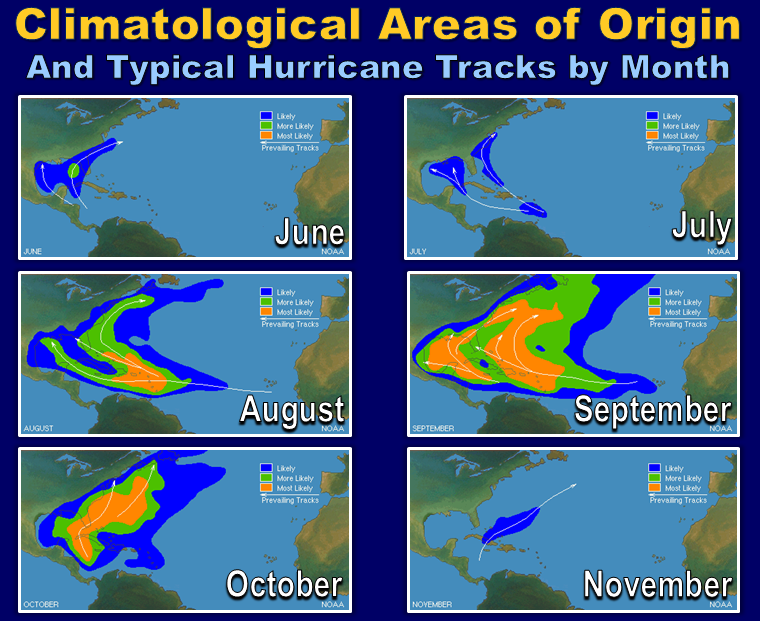
    Where hurricanes form shifts over the months

    Where storms are most likely to form and make landfall also changes as the pages of the calendar turn.

    In early summer, the Gulf of Mexico warms up faster than the open Atlantic, making it a notable hotspot for early-season tropical storm development, especially in June and July. The Texas coast, Louisiana, and the Florida Panhandle often face a higher early-season risk than locations along the Eastern seaboard.

    These are generally the busiest areas during each month of hurricane season, but that doesn’t mean hurricanes won’t make landfall elsewhere.
    NOAA

    By August and September, the season reaches its peak. This is when those waves moving off the coast of Africa become a primary source of storm activity. These long-track storms are sometimes called “Cape Verde hurricanes” because they originate near the Cape Verde Islands off the African coast. While many stay over open water, others can gather steam and track toward the Caribbean, Florida or the Carolinas.

    Later in the hurricane season, storms are more likely to form in the western Atlantic or Caribbean, where waters are still warm and upper-level winds remain favorable. These late-season systems have a higher probability of following atypical paths, as Sandy did in 2012 when it struck the New York City region and Milton did in 2024 before making landfall in Florida.

    At the end of the day, the safest way to think about hurricane season is this: If you live along the coast, don’t let your guard down. Areas susceptible to hurricanes are never totally immune from hurricanes, and it only takes one to make it a dangerous – and unforgettable – season.

    Colin Zarzycki’s research lab receives funding from the U.S. National Science Foundation, Department of Energy, and National Oceanic and Atmospheric Administration.

    ref. Forecasters expect a busy 2025 hurricane season – a storm scientist explains why and what meteorologists are watching – https://theconversation.com/forecasters-expect-a-busy-2025-hurricane-season-a-storm-scientist-explains-why-and-what-meteorologists-are-watching-257223

    MIL OSI – Global Reports

  • MIL-OSI: Starscope: Does Starscope Monocular Really Work for Stargazing & Hiking? Read Full Starscope Monocular Telescope Consumer Report!

    Source: GlobeNewswire (MIL-OSI)

    San Diego, CA, May 31, 2025 (GLOBE NEWSWIRE) — Introduction: Why the Starscope Monocular Is Gaining Popularity in 2025

    Whether you’re a nature lover, hiker, hunter, or stargazer, having the right optical gear can make or break your outdoor experience. In 2025, one compact device has been making waves among adventurers and outdoor enthusiasts alike — the Starscope Monocular.

    This rugged, pocket-sized monocular telescope has sparked major attention across the US, UK, Canada, and Australia. Why? Because it’s delivering high-powered vision, smartphone adaptability, and military-grade durability — all at a fraction of the size and weight of traditional binoculars or telescopes.

    From birdwatching on weekend hikes to spotting distant wildlife or gazing at the moon, Starscope promises ultra-clear, zoomed-in views without the bulk. It’s not just a camera add-on — it’s a full-on telescope designed for your hand.

    But does the Starscope Monocular actually live up to the hype? Can it truly replace bulky binoculars or expensive spotting scopes?

    In this in-depth Starscope Monocular review, we’ll uncover:

    • How it works and what makes it different
    • Real-world reviews from actual users in 2025
    • Key specs and performance in outdoor settings
    • Updated pricing and bundle deals
    • Where to buy it safely (and avoid knockoffs)

    Let’s zoom into the facts and see if Starscope really is the best monocular telescope worth your money this year.

    What Is Starscope? A Closer Look at This Trending Monocular Telescope

    The Starscope Monocular is a high-definition optical device designed to give users a clear, zoomed-in view of distant objects — whether you’re exploring mountains, observing wildlife, attending sports events, or simply stargazing. Marketed as a compact alternative to bulky binoculars and traditional telescopes, Starscope is engineered for both convenience and clarity.

    What Makes It Stand Out?

    Unlike conventional monoculars that often compromise on image quality or build strength, Starscope combines 10x magnification, BAK-4 prisms, and multi-coated lenses in a single rugged unit. It’s built using advanced military-grade materials that make it water-resistant, fog-proof, and shockproof, making it suitable for rough outdoor conditions.

    Smartphone Compatibility

    One of the standout features of the Starscope monocular is its smartphone adapter compatibility. You can easily attach your smartphone to capture stunning long-range photos and videos — perfect for wildlife photography, sightseeing, or even amateur astronomy.

    Compact, Travel-Ready Design

    At just under 300 grams, the Starscope monocular fits easily into your palm, pocket, or backpack. Its lightweight build and ergonomic grip allow for one-hand use, making it a practical choice for adventurers on the go.
    Don’t Miss Out: The Starscope Monocular Is Selling Fast – See What You’ve Been Missing!

    Who Is It Made For?

    Starscope is ideal for:

    • Hikers and backpackers
    • Hunters and birdwatchers
    • Sports fans
    • Stargazers and amateur astronomers
    • Travelers exploring scenic views

    Starscope Monocular Features & Technical Specifications

    The Starscope Monocular isn’t just another gadget — it’s an all-in-one optical solution engineered for sharp clarity, long-range zoom, and outdoor resilience. Below, we break down the core features and specifications that make this monocular a standout choice in 2025.

    Optical Power & Precision

    • 10x Magnification Power
      Starscope allows you to zoom in on distant objects with crystal-clear detail — up to 10 times closer. Whether it’s a mountaintop or a distant stadium seat, the detail remains sharp and focused.
    • 42mm Objective Lens Diameter
      The large 42mm lens collects more light for brighter images, especially in low-light settings like early morning or dusk. It enhances your visual experience when birdwatching or stargazing.
    • Field of View
      Starscope offers a wide field of view, making it easier to scan landscapes or follow moving targets without frequent repositioning.

    Advanced Lens & Prism Technology

    • BAK-4 Prism
      Built with professional-grade BAK-4 (Barium Crown Glass) prisms, which provide greater light transmission and edge-to-edge sharpness — reducing distortion and glare.
    • Multi-Coated Lens
      Each lens surface is coated to enhance image brightness, reduce reflections, and improve contrast. This ensures a vibrant, high-resolution image even in bright sunlight.

    Discover the Best Monocular of 2025 – The Starscope Telescope Is All You Need Outdoors

    Rugged, Outdoor-Ready Construction

    • Weatherproof Design
      Starscope is sealed to resist water, fog, and dust — perfect for hiking, camping, or kayaking. You don’t have to worry about a sudden downpour or misty mornings.
    • Shock-Resistant Casing
      The exterior shell is made from a durable polymer composite that absorbs impact, making the device drop-resistant and travel-friendly.
    • Slip-Resistant Grip
      Ergonomic texture provides a firm hold, even in wet conditions or while wearing gloves.

    Smartphone Compatibility

    • Universal Phone Adapter
      Easily attaches to most smartphones to transform the Starscope into a powerful telephoto lens. Capture distant landscapes, record HD video, or take zoomed-in wildlife shots without blur.
    • Tripod Mount Ready
      A standard mount allows you to attach it to a tripod for long sessions or time-lapse recordings.

    How Does the Starscope Telescope Work?

    Starscope uses high-powered optics to deliver a detailed image of faraway scenes. It works by channeling light through precision-engineered lenses and a BAK-4 prism system, which enhances brightness, sharpness, and contrast.

    When light enters the objective lens, it travels through a series of internal glass prisms and coatings that reduce glare and distortion. The result is a magnified, high-definition view that looks vibrant and realistic, even at long distances.

    The monocular’s alignment with your smartphone camera adds further functionality — turning your phone into a zoom lens for pictures and video.

    Over 100,000 Sold – Is Starscope the Best Monocular in 2025? See Real Results

    How To Use Starscope Monocular?

    To use the Starscope Monocular effectively, follow these steps:

    1. Remove Lens Caps: Take off both the front and rear lens caps to prepare the monocular for use. 
    2. Adjust the Eyecup: If you wear glasses, twist the eyecup down; if not, keep it extended for optimal viewing comfort. 
    3. Hold the Monocular Properly: Grip the monocular with one hand, placing your index finger on the focus adjustment dial and your pinky near the front for stability.
    4. Focus the Image: Look through the eyepiece and rotate the focus dial with your index finger until the image becomes sharp and clear.
    5. Attach to a Tripod (Optional): For extended viewing sessions or increased stability, mount the monocular onto a tripod using the built-in 1/4″ thread. 
    6. Connect to a Smartphone (Optional): Use a compatible smartphone adapter to align your phone’s camera with the monocular’s eyepiece, allowing you to capture distant images or videos.
    7. Maintenance Tips:
      • Cleaning: Use a soft lens brush or blower to remove dust. For smudges, gently wipe with a microfiber cloth in a circular motion. 
      • Storage: Store the monocular in a cool, dry place and avoid exposing it to extreme temperatures or moisture.

    Safety Precaution: Never look directly at the sun through the monocular, as this can cause serious eye damage. 

    By following these steps, you can maximize your experience with the Starscope Monocular, whether you’re observing wildlife, enjoying scenic views, or stargazing.

    Zoom In Like Never Before – Grab the Starscope Monocular at 50% Off Today Only!

    Starscope Monocular Benefits: Why People Are Choosing It Over Binoculars

    • Ultra Lightweight: Fits in your pocket or backpack without bulk.
    • One-Hand Operation: Perfect for trekking or scouting terrain.
    • Crisp Image Quality: See vivid details from hundreds of yards away.
    • Photo & Video Ready: Use with your phone to capture distant sights.
    • Durability: Survives drops, splashes, and harsh weather.
    • Low-Light Visibility: Great for sunrise or twilight exploration.

    How to Use the Starscope Monocular for Hiking, Hunting, Stargazing & Travel

    1. Hold with one hand and align the eyepiece with your dominant eye.
    2. Twist the focus ring slowly until the image is sharp.
    3. Attach your smartphone using the provided adapter.
    4. Use your phone’s camera to zoom further, take pictures, or record.
    5. Optionally mount it to a tripod for steady viewing.

    Starscope Price & Where to Buy the Starscope Monocular

    Starscope is available exclusively through the official website. Avoid third-party platforms like Amazon or eBay, which may sell unauthorized or fake versions.

    • 1x Monocular: $47.99 (was $106.64)
    • 2x Monoculars: $95.99 (was $213.29)
    • 3x Monoculars: $107.99 (was $319.93)
    • 4x Monoculars: $143.99 (was $426.58)

    All packages may include bonus accessories like tripods or smartphone adapters. Discounts reflect 50%–62% savings.

    Shipping, Delivery Time & Refund Policy

    • Shipping: Worldwide delivery available.
    • Delivery Time: 5–12 business days depending on region.
    • Refund Policy: 30-day money-back guarantee. Unused items may be returned for a full refund (minus shipping & handling).

    Disclaimer: Prices & return policy are subject to change. Always check the official website for the most accurate and up-to-date pricing before purchasing.

    Real Customer Experiences from the USA, UK, Canada & Australia

    Sarah – Denver, USA: “Used the Starscope on a solo hiking trip in Colorado. I spotted wildlife from a mile away. The view was sharp and steady even without a tripod.”

    James – Perth, Australia: “Took mine on a camping trip. Loved the phone attachment. Captured amazing photos of distant cliffs and birds.”

    Michael – Toronto, Canada: “It’s so much easier to carry than my old binoculars. Feels solid and works even in light rain. Definitely my go-to for birding.”

    Lucy – Manchester, UK: “Perfect for stargazing in rural England. I could clearly see lunar craters and Jupiter’s moons — very impressed.”

    Explore Farther with the Starscope Telescope – Perfect for Stargazing, Hiking & Travel

    Starscope FAQs – Common Questions Answered

    Q: Can I buy Starscope on Amazon or Walmart?
    A: No. Starscope is exclusively sold through its official website. Any listings on Amazon, Walmart, or eBay may be counterfeit or unauthorized, and they do not qualify for the official warranty or refund policy.

    Q: Does it work at night?
    A: It does well in low-light but not total darkness. Great for dawn/dusk.

    Q: Is it suitable for people who wear glasses?
    A: Yes. It has adjustable eye relief.

    Q: What’s the warranty?
    A: 30-day satisfaction guarantee, with optional extended warranty at checkout.

    Q: Is Starscope compatible with all smartphones?

    A: Yes — most smartphones can be used with Starscope via the universal phone adapter included in bundle deals. Some manual adjustment may be required depending on your phone’s camera position.

    Q: Can I use it for stargazing?

    A: Absolutely. While not a full telescope, it provides a crisp view of the moon, planets, and stars, making it suitable for amateur astronomy.

    Q: Is it waterproof?

    A: Yes. Starscope is water-resistant, fog-proof, and shockproof, making it reliable in rugged outdoor environments. However, it should not be fully submerged in water.
    Turn Your Phone into a Pro Camera with the Starscope Monocular – Limited Stock Left!

    Environmental Impact: Is the Starscope Monocular Eco-Friendly?

    In an era where sustainability is paramount, evaluating the environmental impact of products like the Starscope Monocular is essential.

    ♻️ Materials and Manufacturing

    The Starscope Monocular is constructed using durable materials, including a BAK4 prism and multi-coated lenses, ensuring longevity and reducing the need for frequent replacements. Its robust design contributes to a longer product lifespan, which can mitigate environmental impact over time.

    Sustainable Practices

    While specific details about the manufacturing processes and sourcing of materials for the Starscope Monocular are limited, the product’s durability suggests a focus on quality. However, without explicit information on eco-friendly practices or certifications, it’s challenging to fully assess its environmental friendliness.

    Energy Efficiency

    The monocular operates without batteries or electricity, relying solely on optical components. This energy-free operation minimizes its carbon footprint during use, aligning with sustainable practices.

    Packaging and Distribution

    Information regarding the packaging materials and distribution methods is not readily available. Eco-conscious consumers may wish to inquire directly with the manufacturer for details on packaging sustainability and shipping practices.
    Get the Best Monocular for Outdoor Adventures – Order Your Starscope Before It’s Gone
    Common Starscope Problems & How to Fix Them
    Even high-quality devices like the Starscope Monocular can encounter minor issues. Here are some common problems users have reported — and how to resolve them quickly:

    Problem: Blurry or Out-of-Focus Image

    Fix:

    • Rotate the focus ring slowly while looking through the eyepiece.
    • Make sure the lens is clean and free of fingerprints or smudges.
    • If using with a smartphone, ensure the adapter is properly aligned.

    Problem: Smartphone Adapter Doesn’t Fit Properly

    Fix:

    • Loosen and adjust the clamp arms carefully — most adapters are universal but may require repositioning for multi-lens phones.
    • Try removing your phone case to improve alignment.

    Problem: Double Vision or Image Distortion

    Fix:

    • Clean both lenses with a microfiber cloth.
    • Make sure the monocular isn’t fogged up (especially when moving between temperature zones).
    • Check if the internal lens is misaligned due to a drop — in rare cases, customer support may need to assist.

    Problem: View Is Too Dark or Dim

    Fix:

    • Ensure you are not using it in complete darkness — Starscope is optimized for daylight and low-light, but not for nighttime use.
    • Wipe off any moisture or condensation from the lens.

    Problem: Can’t See Anything Through the Eyepiece

    Fix:

    • Remove all lens caps.
    • Adjust your eye position — the exit pupil must align with your eye.
    • Twist the eyecup if you’re wearing glasses.

    Problem: Scratched or Smudged Lens

    Fix:

    • Use only soft, non-abrasive cloths (preferably microfiber).
    • Avoid using paper towels, shirts, or abrasive materials that could damage the lens coating.

    When to Contact Support

    If none of the above solutions help, or if your monocular is damaged during shipping, contact Starscope’s official support through their website for warranty service or a replacement.
    The #1 Trending Starscope Telescope Is Back – See Why Outdoor Enthusiasts Swear by It

    Starscope for Amateur Astronomy: Can It Replace a Telescope?

    While Starscope isn’t a professional-grade telescope, it’s surprisingly capable for casual astronomy. With 10x magnification and a 42mm lens, users can observe:

    • The moon’s surface with visible craters
    • Bright planets like Jupiter or Saturn (as small dots)
    • Star clusters and constellations

    It’s an excellent tool for beginners who want to explore the night sky without investing in bulky gear. For best results, use Starscope in low-light rural settings away from city pollution.Starscope Monocular for Birdwatching: A Birder’s Perspective
    Birdwatchers praise Starscope for its:

    • Silent operation (no clicking or zoom noise)
    • Sharp detail from long distances
    • Ability to quickly scan trees or open fields

    Whether you’re spotting hummingbirds in your backyard or waterfowl across a lake, the wide field of view and smartphone camera compatibility make bird identification much easier.

    Pros and Cons of Starscope Monocular

    Pros

    • High-Quality Optics
      Equipped with BAK-4 prism and multi-coated lenses for sharp, bright images.
    • 10x Magnification
      Ideal for long-distance viewing — from wildlife to stargazing.
    • Lightweight & Portable
      Weighs less than 300g and fits in your pocket or backpack.
    • Smartphone Compatible
      Easily attaches to most phones for HD photo and video capture.
    • Durable & Weather-Resistant
      Water-resistant, fog-proof, and shockproof — built for outdoor use.
    • Easy One-Hand Operation
      Ergonomic grip and simple focus adjustment make it user-friendly.
    • Affordable Compared to Binoculars or Telescopes
      Offers telescope-like performance without the high cost.
    • Tripod-Compatible
      Great for steady shots or long observation sessions.

    Cons

    • Not for Complete Darkness
      Performs well in low light but isn’t night-vision capable.
    • No Digital Zoom or Auto-Focus
      Manual focus only; relies on user adjustment.
    • Limited Availability
      Only sold via the official website — not available on Amazon or retail stores.
    • Best for Casual Use
      May not satisfy professional wildlife photographers or astronomers.
    • Phone Adapter Fit May Vary
      Some users may need to adjust alignment for specific phone models.

    Upgrade Your View – The Starscope Monocular Delivers Zoom Like Nothing Else

    How Starscope Enhances Smartphone Photography

    Transform your phone into a pro-level camera by attaching Starscope. It works like a telephoto zoom lens, ideal for:

    • Wildlife photography at long distances
    • Capturing landscapes or cliffs
    • Recording sports or outdoor events

    Tips:

    • Use a tripod for steady shots
    • Clean the lens before attaching
    • Zoom only slightly with your phone to reduce pixelation

    Maintenance Tips: How to Care for Your Starscope Monocular

    To ensure your Starscope lasts for years:

    • Clean lenses gently using microfiber cloths only
    • Avoid touching the glass with fingers
    • Store in a dry case to prevent moisture buildup
    • Use lens caps when not in use
    • Don’t submerge it, even though it’s water-resistant

    Starscope Safety and Usage Guidelines

    • Never look at the sun through the monocular.
    • Use caution when using near children (small parts, strap).
    • Avoid dropping it — though durable, internal alignment may shift.
    • Adjust the eyecup if you wear glasses.

    Over 100,000 Sold – Is Starscope the Best Monocular in 2025? See Real Reviews

    Starscope Gift Ideas: Who It’s Perfect For in 2025

    Looking for a thoughtful gift? Starscope is ideal for:

    • Outdoor lovers (hikers, campers)
    • Retirees or dads who enjoy nature
    • Kids interested in science or astronomy
    • Travelers and explorers

    With its sleek design and practical value, it makes a great gift for birthdays, holidays, or Father’s Day.
    Starscope for Travel Photography: A Backpacker’s Tool
    For photographers on the move, bulky lenses and gear are a hassle. That’s where the Starscope Monocular becomes a game-changer. Its compact build and powerful optics make it an ideal companion for travel photography, particularly in rugged or remote areas.
    Whether you’re hiking in Patagonia, road-tripping across the U.S., or exploring historical ruins abroad, Starscope helps you:

    • Zoom in on distant scenes with clarity
    • Snap close-ups of wildlife or architectural details
    • Use your smartphone to record landscapes that feel larger than life

    Its lightweight frame fits easily in a backpack side pocket, and unlike DSLR zoom lenses, there’s no need to worry about lens swapping, battery life, or electronic failure.
    Lightweight. Powerful. Unmatched. Get the Starscope Monocular and Explore More Today!
    Starscope for Sports & Events: Get Closer to the Action
    Want front-row views from the cheap seats? Starscope lets you see the game, match, or concert like you’re sitting VIP.
    The monocular is perfect for:

    • Live sports: football, baseball, racing, etc.
    • Outdoor concerts or festivals
    • Parades and fireworks

    With 10x zoom and smartphone connectivity, users can record their experience with surprisingly clear footage. Many reviewers praise its ability to zoom in on player movements, stage performances, or racing cars without blur or distortion.
    No more pixelated phone zooms or asking someone else for binoculars — Starscope brings the action to you in real time, wherever you’re seated.

    Who Should Buy the Starscope Monocular? Final Verdict

    If you’re someone who loves the outdoors, wants to explore farther without carrying bulky gear, and values crisp visuals from afar — Starscope is a smart buy in 2025. Its powerful zoom, rugged build, and mobile compatibility make it a practical investment.

    Highly recommended for:

    • Hikers
    • Travelers
    • Stargazers
    • Birdwatchers
    • Outdoor sports fans

    Media Contact:
    Company nameStarscope
    7864 Ronson Roa, Ste A San Diego 92111
    https://www.monostarscope.com/

    E-mail: support@monostarscope.com

    Disclaimer: The statements have not been evaluated by the Food and Drug Administration. This product is not intended to diagnose, treat, cure, or prevent any disease. Individual results may vary. Always consult a healthcare professional before taking any dietary supplements.
    Disclosure: This article is for informational purposes only and does not constitute medical advice. The content may include affiliate links, meaning we may earn a commission if you purchase through recommended links. Always consult a healthcare professional before starting any new supplement regimen.

    Content Accuracy Disclaimer
    Every effort has been made to ensure the accuracy of the information presented in this article. However, due to the dynamic nature of product formulations, promotions, and availability, details may change without notice. The publisher makes no warranties or representations as to the current completeness or accuracy of any content, including product claims, pricing, or ingredient lists.
    It is the responsibility of the reader to verify product information directly through the official website or manufacturer prior to making a purchasing decision. Any reliance placed on the information in this article is done strictly at your own risk.

    Affiliate Disclosure
    This article may contain affiliate links. If you purchase a product or service through these links, the publisher may earn a commission at no additional cost to you. These commissions help support the creation of in-depth reviews and educational wellness content.
    The publisher only promotes products that have been independently evaluated and deemed potentially beneficial to readers. However, this compensation may influence the content, topics, or products discussed in this article. The views and opinions expressed are those of the author and do not necessarily reflect the official policy or position of any affiliate partner or product provider.

    Related Link
    Power Saver Pro

    Attachment

    The MIL Network

  • MIL-OSI Africa: Land degradation neutrality- a pathway to sustainable futures for vulnerable communities 

    Source: South Africa News Agency

    By Bernice Swarts

    As the world battles escalating environmental challenges, from climate change to biodiversity loss, one crisis continues to be overshadowed – that is land degradation. Every year, over 100 million hectares of productive land are lost or degraded, affecting the lives of more than 1.3 billion people globally.

    In regions already grappling with poverty, hunger, and unemployment, this environmental degradation becomes a multiplier of vulnerability.

    The recent Global Land Degradation Neutrality – Integrated Land Use Planning (LDN–ILUP) Inception Workshop that took place in Sandton, South Africa marked a critical turning point in the global fight against Desertification, Land Degradation, and Drought (DLDD). For four days, experts, government representatives, and development partners from 18 participating countries gathered to refine targets and develop strategies aimed at restoring our planet’s productive land. This meeting was not just another technical gathering – it was a platform of hope for millions whose lives and livelihoods depend on healthy land.

    At the heart of this initiative is the principle of Land Degradation Neutrality (LDN), a concept rooted in sustainability and inclusivity. It recognises that land restoration cannot succeed without the active participation of people at the grassroots level. These are the farmers, herders, and communities whose daily decisions directly influence land and water resources. Empowering them to implement sustainable practices remains vital.

    Bringing the issue of land degradation home to our country, it must be noted that South Africa, is currently presiding over the G20 under the theme: “Solidarity, Equality and Sustainability.”  Our country will use its presidency of the G20 to place the issues of DLDD at the heart of G20 member states and tackle degradation in the country. Our argument is that the G20 – representing the world’s largest economies – must lead by example in addressing land degradation as an integral part of climate and development discourse.

    The G20 Environment and Climate Sustainability Working Group (ECSWG) – which is led by our department – will focus on DLDD, along with other critical areas such as biodiversity, climate change, and ocean health. But while global policy alignment is essential, real progress lies in concrete actions on the ground—large-scale restoration projects, transboundary collaboration, and integration of Sustainable Land Management (SLM) into national development plans.

    To this end, existing initiatives such as the Changwon Initiative, African Forest Landscape Restoration Initiative (AFR100), the Great Green Wall, and the United Nations Decade on Ecosystem Restoration must be harnessed and scaled up. These programmes provide tested frameworks for land restoration and resilience building.

    However, none of these ambitions will materialise without adequate and sustained financial support. Development and financial partners must step up their efforts. While we acknowledge the critical support provided by entities like the Global Mechanism of the UNCCD, Global Environment Facility, and development partners from Canada and Germany, there remains a significant financing gap. Innovation in resource mobilisation is urgently needed, whether through blended finance, public-private partnerships, or carbon markets. South Africa will therefore call on the developed nations under the G20 to provide more financial support to developed countries to tackle land degradation.

    It must also be noted that we cannot continue to formulate frameworks and strategies without addressing the daily realities faced by vulnerable communities. If we are serious about achieving the targets of the UNCCD, Convention on Biological Diversity, and the Paris Agreement, financial commitments must match the scale of ambition.

    I must commend all dignitaries from all over the world who attended the workshop. I want to reiterate that the workshop should not be seen as a standalone event. It must be viewed as a launchpad for action—an opportunity to demonstrate that LDN is not merely a technical term, but a vehicle for change, resilience, and hope. As global citizens, we owe it to future generations to restore the land they will inherit.

    Let this be the moment we stop talking and start restoring.
     

    *Bernice Swarts is the Deputy Minister of Forestry, Fisheries and the Environment

    MIL OSI Africa

  • MIL-OSI USA: SPC – No MDs are in effect as of Sat May 31 04:02:02 UTC 2025

    Source: US National Oceanic and Atmospheric Administration

    Current Mesoscale DiscussionsUpdated:  Sat May 31 04:05:03 UTC 2025 No Mesoscale Discussions are currently in effect.

    Notice:  The responsibility for Heavy Rain Mesoscale Discussions has been transferred to the Weather Prediction Center (WPC) on April 9, 2013. Click here for the Service Change Notice.
    Archived Convective ProductsTo view convective products for a previous day, type in the date you wish to retrieve (e.g. 20040529 for May 29, 2004). Data available since January 1, 2004.

    MIL OSI USA News

  • MIL-Evening Report: ER Report: A Roundup of Significant Articles on EveningReport.nz for May 31, 2025

    ER Report: Here is a summary of significant articles published on EveningReport.nz on May 31, 2025.

    Detroit’s population grew in 2023, 2024 − a strategy to welcome immigrants helps explain the turnaround from decades of population decline
    Source: The Conversation (Au and NZ) – By Paul N. McDaniel, Associate Professor of Geography, Kennesaw State University The Mexican-American community in southwest Detroit held a rally in March 2025, asking ICE to leave the immigrant community alone. Jim West/UCG/Universal Images Group via Getty Images Detroit’s population grew in 2024 for the second year in

    Hurricane season is here, but FEMA’s policy change could leave low-income areas less protected
    Source: The Conversation (Au and NZ) – By Ivis García, Associate Professor of Landscape Architecture and Urban Planning, Texas A&M University Hurricane Harvey inundated the Cottage Grove neighborhood of Houston in 2018. Scott Olson/Getty Images When powerful storms hit your city, which neighborhoods are most likely to flood? In many cities, they’re typically low-income areas.

    Shock NSW Senate result as One Nation beats Labor to win final seat
    Source: The Conversation (Au and NZ) – By Adrian Beaumont, Election Analyst (Psephologist) at The Conversation; and Honorary Associate, School of Mathematics and Statistics, The University of Melbourne The button was pressed to electronically distribute preferences for the New South Wales Senate today. All analysts expected Labor to win the final seat, for a three

    GPs will be a great help for managing ADHD medications. But many patients will still need specialists
    Source: The Conversation (Au and NZ) – By Adam Guastella, Professor and Clinical Psychologist, Michael Crouch Chair in Child and Youth Mental Health, University of Sydney The New South Wales government this week announced reforms that will allow some GPs to treat and potentially diagnose attention-deficit hyperactivity disorder (ADHD). This aims to make ADHD care

    Will elections for judges make Mexico the ‘most democratic country in the world’? Critics fear the opposite
    Source: The Conversation (Au and NZ) – By Luis Gómez Romero, Senior Lecturer in Human Rights, Constitutional Law and Legal Theory, University of Wollongong On Sunday, Mexico will hold an unprecedented election, becoming the first country in the world to allow voters to elect judges at every level. Voters will elect approximately half the judges

    What is mantle cell lymphoma? Magda Szubanski’s ‘rare and fast-moving’ cancer, explained
    Source: The Conversation (Au and NZ) – By John (Eddie) La Marca, Senior Research Officer, Blood Cells and Blood Cancer, WEHI (Walter and Eliza Hall Institute of Medical Research) Lisa Maree Williams/Getty Beloved Australian actor, Magda Szubanski, has revealed she’s been diagnosed with a “very rare, very aggressive, very serious” blood cancer called mantle cell

    Keith Rankin Analysis – Who, neither politician nor monarch, executed 100,000 civilians in a single night?
    Analysis by Keith Rankin. Who, neither politician nor monarch, executed 100,000 civilians in a single night? Answer: Curtis LeMay, American Air Force General, in the wee hours of 10 March 1945. While authorised by his immediate superior, this firebombing of Tokyo was a decentralised military operation which received subsequent popular approval. It was called ‘Operation

    ER Report: A Roundup of Significant Articles on EveningReport.nz for May 30, 2025
    ER Report: Here is a summary of significant articles published on EveningReport.nz on May 30, 2025.

    MIL OSI AnalysisEveningReport.nz

  • MIL-OSI Asia-Pac: SFST promotes HK’s measures for integrating traditional and digital finance at Web Summit Vancouver (with photos)

    Source: Hong Kong Government special administrative region

    SFST promotes HK’s measures for integrating traditional and digital finance at Web Summit Vancouver  
    The Web Summit, a mega event for the tech sector, attracted over 10 000 tech investors, entrepreneurs and industry leaders across the world each time it is hosted. This is the first time the Summit has been held in Vancouver. Mr Hui engaged in a panel discussion session titled “Local to global: Strategies for tech success”, which was joined by the Minister of Jobs, Economic Development and Innovation of the Province of British Columbia, Canada, Ms Diana Gibson. They had an illuminating discussion on the various approaches taken in building dynamic fintech economies, ranging from developing talent, attracting investment to creating opportunities.
     
    Mr Hui said that as one of the top three international financial centres and a leading international green finance hub, Hong Kong is pioneering the integration of traditional and digital finance with a view to strengthening its position as Asia’s gateway for financial innovation. The city is striving to accelerate green and sustainable finance and virtual asset development, with a view to making them key components of the diversified financial value chain. The Hong Kong Monetary Authority has already commenced sandbox experimentation of Project Ensemble, which is a new wholesale central bank digital currency project to support the development of the tokenisation market in Hong Kong.
     
          The fintech ecosystem is thriving in Hong Kong, with around 1 100 fintech companies and start-ups, including 10 licensed virtual asset trading platforms, eight digital banks and four virtual insurers. Pledged to continue playing a leading role in facilitating green and sustainable financing and investment for the global agenda of green transition, Hong Kong issued a policy statement last October to set out its policy stance and approach on the responsible application of artificial intelligence in the financial market. The Government also launched a roadmap last December to require publicly accountable entities (PAEs) to adopt the International Financial Reporting Standards – Sustainability Disclosure Standards (ISSB Standards) and to provide a well-defined pathway for large PAEs to fully adopt the ISSB Standards no later than 2028. This brings Hong Kong among the first jurisdictions to align its local requirements with ISSB Standards. As an initial step, the Stock Exchange of Hong Kong Limited has already started to implement in phases new climate disclosure requirements to reflect the ISSB Standard No. 2: Climate-related Disclosures since this January.
     
    Mr Hui also updated the Summit on the latest passage of legislation last week establishing a licensing regime for fiat-referenced stablecoins issuers in Hong Kong, as a way to further enhance Hong Kong’s regulatory framework on virtual asset activities for supporting the healthy, responsible and sustainable development of Hong Kong’s stablecoin and the broader digital asset ecosystem. Hong Kong is among the first batch of regions to have introduced stablecoin legislation and strives to fully implement the licensing regime within this year, with a view to approving the first batch of licences as soon as practicable.
     
    Looking forward, Hong Kong will soon promulgate a second policy statement on the development of virtual assets to explore the convergence of traditional finance and virtual assets. A consultation on the licensing regimes for virtual asset over-the-counter trading services and custodian services will also be conducted within this year.
     
    During his stay at the Summit, Mr Hui visited exhibition booths manned by Hong Kong delegates. He was pleased to learn that the Hong Kong delegates received encouraging feedback over the past few days, reflecting the world-class standard of Hong Kong fintech talent and their appeal to investors.
     
         In the afternoon, Mr Hui paid a courtesy call to the Consul General of the People’s Republic of China in Vancouver, Mr Yang Shu. Mr Yang said Hong Kong has always been a window of the country to the world and will continue to be. He encouraged Hong Kong to keep up with its work in deepening international exchanges and co-operation.
     
    Before concluding his visit to Canada, Mr Hui visited Bank of Montreal and met with the Senior Vice President & Head, Mid-Market, Commercial Bank, Mr Andrew Hung, and Senior Vice President & Head, BC & Yukon, Mr Greg Vriend. He told them that in a world full of geopolitical uncertainties, Hong Kong’s financial market is emerging as a risk-off haven for investors and attracting more investments owing to its connectivity with the Mainland and the world at large, bringing greater prospects for the banking sector and different financial areas.
     
    Mr Hui will return to Hong Kong in the early hours of May 31 (Vancouver time).
    Issued at HKT 9:40

    NNNN

    MIL OSI Asia Pacific News

  • MIL-OSI Canada: Advancing North American energy dominance

    Joined by Parliamentary Secretary Chantelle de Jonge, the delegation will showcase Alberta’s position as a leader in responsible energy development in Washington, D.C.

    While in the U.S. capital from June 2-7, Alberta’s delegations will meet with industry leaders, technology innovators and American government officials to advance partnerships and lay the foundation for advancing North American energy dominance and alleviating global energy poverty.

    They will leverage their attendance at the Energy Council’s 2025 Federal Energy and Environmental Matters Conference, the U.S. Energy Streams 10th Washington Energy Forum and the S&P Global Oil Sands Dialogue to support Alberta in becoming a major global energy supplier.

    This mission comes at an important time in Alberta’s relationship with the U.S., as we work to broaden our trade partnerships globally and navigate complex geopolitical environments.

    “While Alberta seeks to enter new global markets, we know that the U.S. remains our largest trading partner, and we believe that through advocacy – this important relationship can and will be maintained. Alberta’s energy future is unstoppable and has a key role to play in helping the U.S. meet its growing energy needs and global energy dominance ambition in a secure and reliable way unmatched by any other energy partner.”

    Danielle Smith, Premier

    “The world needs more of Alberta’s oil, gas and minerals to meet ever evolving energy needs and reduce reliance on products from conflict zones. Alberta can play a crucial role in advancing North American energy dominance and we will work on the partnerships that will lead to a secure energy future.”

    Brian Jean, Minister of Energy and Minerals

    “Alberta’s competitive electricity market and business-friendly environment make our province a destination of choice for investors and a leader in innovative technologies. I am proud to carry that message to our partners south of the border as we continue to build our energy future.”

    Nathan Neudorf, Minister of Affordability and Utilities

    “Alberta is a global leader in responsible energy development. I look forward to working with our U.S. partners to advance new opportunities in our energy sector that will reap benefits on both sides of the border.”

    Chantelle de Jonge, parliamentary secretary for Affordability and Utilities

    This mission builds on the success of CERAWeek in March and is part of Alberta’s continued efforts to promote our vast resource base and responsible energy sector and increase market access for the province’s ethically produced energy, both traditional and emerging.

    Trip expenses for elected officials and staff will be posted on the travel and expense disclosure page.

    Alberta’s government is committed to working with national and international partners to advance shared interests that can lead to new opportunities for people and businesses in Alberta and around the world. By working with industry, researchers and other governments, Alberta is implementing its Emissions Reduction and Energy Development Plan and offering a business-friendly environment primed for investment and growth.

    Itinerary for Premier Smith*

    June 3

    • Travel to Washington, D.C.
    • Meeting with industry partners
    • Attend U.S. Energy Streams 10th Washington Energy Forum Welcome Reception

    June 4

    • Deliver keynote address at day one of the U.S. Energy Streams 10th Washington Energy Forum
    • Bilateral meetings with U.S. legislators
    • Return to Alberta

    *Subject to change.

    Itinerary for Minister Jean*

    June 1

    • Travel to Washington, D.C.

    June 2

    • Minister speaking at CGAI-AmCham Canada Event: Washington DC Natural Gas Dialogue 

    June 3

    • Minister to attend S&P Global Oil Sands Dialogue
    • Participate in panel discussion: The future of North American oil integration
    • U.S. Energy Stream Summit Welcome Reception

    June 4

    • Attending day one of the U.S. Energy Stream Summit

    June 5

    • Day two of the U.S. Energy Stream Summit
    • Minister attending welcome reception for the Energy Council’s 2025 Federal Energy and Environmental Matters Conference

    June 6

    • Minister delivering keynote address at The Energy Council’s 2025 Federal Energy and Environmental Matters Conference
    • Meetings with elected officials

    June 7

    • Travel to return to Edmonton

    *Subject to change.

    Itinerary for Minister Neudorf*

    June 4

    • Travel to Washington, D.C.

    June 5-6

    • Attend the Energy Council’s 2025 Federal Energy and Environmental Matters Conference

    June 7

    • Attend the Energy Council’s 2025 Federal Energy and Environmental Matters Conference
    • Return to Alberta

    *Subject to change.

    Itinerary for Parliamentary Secretary de Jonge*

    June 4

    • Travel to Washington, D.C.

    June 5-7

    • Attend the Energy Council’s 2025 Federal Energy and Environmental Matters Conference

    June 8

    • Personal time

    June 9

    • Return to Alberta

    *Subject to change.

    MIL OSI Canada News

  • MIL-OSI Security: Two Foreign Nationals Indicted for Directing Interstate Stalking and Harassment Scheme and Conspiring to Procure Sensitive U.S. Military Technology

    Source: Office of United States Attorneys

    Richard G. Frohling, Acting United States Attorney for the Eastern District of Wisconsin, and Bilal Essayli, United States Attorney for the Central District of California announced that federal grand juries in Milwaukee, WI and Los Angeles, CA each returned indictments charging two foreign nationals, Cui Guanghai, 43, of China, and John Miller, 63, of the United Kingdom and a U.S. lawful permanent resident, with interstate stalking and conspiracy to commit interstate stalking (Los Angeles) and conspiracy, smuggling, and violations of the Arms Export Control Act (Milwaukee).

    “As alleged, the defendants targeted a U.S. resident for exercising his constitutional right to free speech and conspired to traffic sensitive American military technology to the Chinese regime,” said Deputy Attorney General Todd Blanche. “This is a blatant assault on both our national security and our democratic values. This Justice Department will not tolerate foreign repression on U.S. soil, nor will we allow hostile nations to infiltrate or exploit our defense systems. We will act decisively to expose and dismantle these threats wherever they emerge.”

    “The defendants allegedly plotted to harass and interfere with an individual who criticized the actions of the People’s Republic of China while exercising their constitutionally protected free speech rights within the United States of America,” said FBI Deputy Director Dan Bongino. “The same individuals also are charged with trying to obtain and export sensitive U.S. military technology to China. I want to commend the good work of the FBI and our partners in the U.S and overseas in putting a stop to these illegal activities.”

    Allegations in the Eastern District of Wisconsin

    According to court documents, beginning in November 2023, Miller and Cui solicited the procurement of U.S. defense articles, including missiles, air defense radar, drones, and cryptographic devices with associated crypto ignition keys for unlawful export from the United States to the People’s Republic of China from two individuals (Individual 5 and Individual 6).   

    In connection with the scheme, Cui and Miller discussed with Individuals 5 and 6 ways to export a cryptographic device from the United States to the People’s Republic of China, including concealing the device in a blender, small electronics, or motor starter, and shipping the device first to Hong Kong. Cui and Miller paid approximately $10,000 as a deposit for the cryptographic device via a courier in the United States and a wire transfer to a U.S. bank account.

    Allegations in the Central District of California

    According to court documents, beginning in October 2023, Cui and Miller enlisted two individuals (Individual 1 and Individual 2) inside the United States to carry out a plot to prevent the Victim from protesting President Xi’s appearance at the Asia Pacific Economic Cooperation (APEC) summit in November 2023. The Victim had previously made public statements in opposition to the policies and actions of the PRC government and President Xi.

    “The indictment alleges that Chinese foreign actors targeted a victim in our nation because he criticized the Chinese government and its president,” said U.S. Attorney Bill Essayli for the Central District of California. “My office will continue to use all legal methods available to hold accountable foreign nationals engaging in criminal activity on our soil.”

    Unbeknownst to Cui and Miller, Individual 1 and Individual 2 were affiliated with and acting at the direction of the FBI.

    In the weeks leading up to the APEC summit, Cui and Miller directed and coordinated an interstate scheme to surveil the Victim, to install a tracking device on the Victim’s car, to slash the tires on the Victim’s car, and to purchase and destroy a pair of artistic statues created by the Victim depicting President Xi and President Xi’s wife.

    A similar scheme took place in the spring of 2025, after the Victim announced that he planned to make public an online video feed depicting two new artistic statues of President Xi and his wife. In connection with these plots, Cui and Miller paid two other individuals (Individual 3 and Individual 4), approximately $36,500 to convince the Victim to desist from the online display of the statues. Unbeknownst to Cui and Miller, Individual 3 and Individual 4 were also affiliated with and acting at the direction of the FBI.

    If convicted, Cui and Miller face the following maximum penalties: five years for conspiracy; five years for interstate stalking; twenty years for violation of the Arms Export Control Act; ten years for smuggling.

    The FBI is investigating the case.  The United States is coordinating with Serbian authorities regarding the pending extraditions of Cui and Miller in Serbia.

    Assistant U.S. Attorneys Benjamin Taibleson for the Eastern District of Wisconsin, and David Ryan and Amanda B. Elbogen for the Central District of California, along with Trial Attorneys Leslie Esbrook and Menno Goedman of the National Security Division’s Counterintelligence and Export Control Section are prosecuting the cases, with valuable assistance provided by the Justice Department’s Office of International Affairs.

    An indictment is merely an allegation. All defendants are presumed innocent until proven guilty beyond a reasonable doubt in a court of law.

    # # #

    For Additional Information Contact:

    Public Information Officer

    Kenneth.Gales@usdoj.gov

    414-297-1700

    Follow us on Twitter

    MIL Security OSI

  • MIL-OSI New Zealand: Universities – Experts examine climate impacts on Pacific health – UoA

    Source: University of Auckland (UoA)

    The devastating impacts of climate change on health in the Pacific Islands will be discussed at a symposium at the University of Auckland on 5 June.

    Dr Roannie Ng Shiu, a director of the university’s Te Poutoko Ora a Kiwa – Centre for Pacific and Global Health, says the symposium will not only examine the health impacts of climate change in the Pacific, but share potential solutions.

    Climate change is driving up temperatures in the islands – and heat is a “silent killer”, says Ng Shiu, a key speaker at the symposium.

    “More than 2000 people died of heat-related conditions in the Pacific Islands between 2000 and 2022. Heat stroke is the main cause of death,” she says.

    While health services can advise people to stay cool and hydrated, poor access to clean drinking water in many Pacific Islands makes that more difficult, Ng Shiu says.

    “What we really need is a better international commitment to reducing greenhouse gases.

    “Pacific people are resilient. We’ve been adapting for years, but our adaptation measures can’t keep up with the rate the climate is changing,” she says.

    Increasingly hot, wet weather is causing spikes of diseases, such as dengue fever, zika, chikungunya, which are spread throughout the Pacific by Aedes mosquitos. In Papua New Guinea, malaria is also a growing risk.

    “Two young people have died from dengue fever in Fiji and Samoa over the past few weeks – one was a 12-year-old boy – and there’s an outbreak in Tonga too.”

    Ng Shiu says one solution to infectious diseases rising as the climate warms is to better integrate health and meteorological surveillance systems.

    She says more funding is needed so weather services can provide warnings to Pacific health services about upcoming periods of wet, hot weather, enabling agencies to fumigate areas where mosquitos breed.

    Funding is also required for research into the mental health impacts of climate change in the Pacific, Ng Shiu says.

    “We’re hearing about children in Fiji who have been traumatised by cyclones destroying their villages, so as soon as they hear strong winds, they run away from school in terror.”

    New Zealand government policies are exacerbating climate change, rather than turning the tide, she says.

    “New Zealand is supposed to be the heart of the Pacific, so they should be doing more to protect it.”

    Speakers at the symposium will include Te Poutoko Ora a Kiwa director Professor Sir Collin Tukuitonga, Te Whatu Ora Director of Public Health Dr Corina Grey, University of Auckland Professor Cliona Ni Mhurchu, and Fred Hollows Foundation NZ chief executive Dr Audrey Aumua.

    Pacific Islands experts travelling to Aotearoa to speak at the event include director of the Fiji Institute of Pacific Health Research at Fiji National University Associate Professor Donald Wilson and Samoa’s Director General of Health Aiono Professor Alec Ekeroma.

    Te Poutoko council chair and former New Zealand Director-General of Health Professor Sir Ashley Bloomfield will facilitate a panel discussion at the symposium, featuring University of Auckland Professors Jemaima Tiatia-Siau and Dame Teuila Percival, and Ekeroma, Wilson and Grey.

    Tagata Pasifika director and reporter John Pulu will be MC and Reverend Igasiatama Mokele will offer opening and closing prayers.

    The symposium on Vulnerability to Vitality – Pacific and Global Health responses in a changing climate is on 5 June from 9am to 4pm at Fale Pasifika, 22 Wynyard Street, Auckland.

    The public and media are welcome to attend. Register here: http://www.eventbrite.co.nz/e/te-poutoko-ora-a-kiwa-research-symposium-2025-tickets-1235148936719

    MIL OSI New Zealand News

  • MIL-OSI New Zealand: NIWA releases Seasonal Climate Outlook – June to August 2025

    Source: NIWA

    Air temperatures are expected to be above average across all New Zealand regions for this winter season, according to NIWA’s Seasonal Climate Outlook for June – August 2025. While cold snaps and frost will occur, they are expected to be less frequent than usual, says NIWA Principal Scientist Chris Brandolino.
    Rainfall totals during the three months ahead are expected to be above normal for the north of the North Island and near normal for the east of the South Island. For all remaining regions of the country, rainfall is forecast to be near normal or above normal.
    Higher than normal atmospheric pressure is expected to the east of the country, leading to north-easterly flow anomalies that may shift to a more north-westerly direction towards the end of the three-month period. Low pressure systems forming north of the country are still expected to affect New Zealand and may lead to heightened risks for heavy rainfall events.
    More – including what it means for where you are: 
    Please see the attached Word or PDF for the full Seasonal Climate Outlook for June – August 2025, including background, summaries, graphs and regional outlooks 
    The SCO is also available via the NIWA website:  Seasonal Climate Outlook June – August 2025 | NIWA
    Watch the video presentation of the Seasonal Climate Outlook with Principal Scientist – Forecasting and Media, Chris Brandolino for more detailed week-by-week rainfall tr

    MIL OSI New Zealand News

  • MIL-OSI United Nations: Integrating risk into national development: Fiji’s approach to a risk-informed disaster risk reduction strategy

    Source: UNISDR Disaster Risk Reduction

    Fiji’s United Nations Sustainable Development Cooperation Framework (UNSDCF) 2023-2027 was developed with a comprehensive risk analysis integrated from the outset. Recognizing the country’s acute vulnerability to climate change, cyclones, flooding, sea-level rise and economic shocks, the UNSDCF underscored the importance of resilience-building and disaster risk reduction (DRR) across all sectors-not limited to environmental or disaster portfolios, but extending to health, education, gender, and economic sectors.

    Concurrently, Fiji updated key national frameworks, including the National Disaster Risk Reduction Policy 2018-2030 and the Climate Change Act 2021. These instruments were directly informed by risk and vulnerability assessments that also contributed to the UNSDCF.

    The National DRR Policy is aligned with the Sendai Framework for Disaster Risk Reduction and incorporates core principles from the UNSDCF, including a whole-of-society approach, strengthened risk governance, investment in risk reduction, and the principle of building back better.

    The coordination between the Government of Fiji and the UN system was notably robust, particularly through the Ministry of Rural and Maritime Development and Disaster Management and the National Disaster Management Office (NDMO). This ensured a bi-directional flow of risk information-informing both the UNSDCF and national DRR strategies.

    Fiji has transitioned from a reactive model of disaster response to a proactive, risk-informed development paradigm-saving lives, safeguarding infrastructure, and bolstering resilience to future shocks to safeguard development. The evolution of its DRR policies in tandem with the UNSDCF has repositioned resilience and risk management as central elements of national development, rather than peripheral emergency response mechanisms.

    Key impacts

    • Mainstreaming DRR across sectors: Risk reduction is now integrated into planning, budgeting and implementation across education, health, infrastructure, gender equality and climate policy. For instance, new schools and health facilities must be cyclone-resilient by design.
    • Strengthened risk governance and institutions: The Ministry of Rural and Maritime Development and Disaster Management has received enhanced capacity and resources. Local authorities now have clearer mandates for disaster preparedness and early action. Community-Based Disaster Risk Management (CBDRM) initiatives at the village level empower communities to manage risk.
    • Improved access to climate finance and international support: With coherent, risk-informed national strategies, Fiji has secured funding from sources such as the Green Climate Fund (GCF), supporting major investments in resilient infrastructure development and early warning systems.
    • Enhanced early warning and anticipatory action systems: With support through the UNSDCF, Fiji has upgraded early warning systems for cyclones, tsunamis and floods, linking them to community evacuation plans and drills. Anticipatory actions such as evacuation and supply pre-positioning now occur before hazards strike, reducing casualties and economic losses.
    • Resilient recovery through “Build Back Better” principles: Post-disaster reconstruction projects-such as those following Tropical Cyclone Harold in 2020-have not merely restored infrastructure but have improved it to better withstand future events.

    Lessons learned for replication and adaptation

    1. Risk-informed UNSDCFs anchor DRR in national development: In Fiji, the UNSDCF served as a strategic platform to align government priorities with international support and evidence-based risk analysis. It enabled integration of DRR at national, sectoral and community levels.
    2. Political leadership and institutional coordination are essential: The success of Fiji’s approach is attributed to strong leadership from the Prime Minister’s Office and the Ministry of Disaster Management, coupled with cross-sectoral coordination among ministries.
    3. Localization and community participation are critical: CBDRM initiatives have ensured that national DRR policies are locally owned and contextually relevant, integrating indigenous knowledge into planning and action.
    4. UNSDCFs support resource for DRR and resilience investments: A clearly articulated, risk-informed development agenda helped Fiji attract international climate and development finance, while also catalyzing partnerships with civil society and the private sector.
    5. Policy coherence between DRR and climate change enhances outcomes: Fiji developed its Climate Change Act 2021 and National DRR Policy in a coordinated manner, reinforcing synergies and avoiding policy fragmentation.
    6. Investing in risk information systems strengthens accountability: Fiji’s efforts to enhance data systems-including hazard mapping, GIS, and disaggregated vulnerability data-have improved planning, monitoring and targeted interventions.

    MIL OSI United Nations News

  • MIL-OSI United Nations: Tunisia: Inclusive, multi-hazard and multi-sectoral disaster risk reduction strategies triggering funding for resilience

    Source: UNISDR Disaster Risk Reduction

    In 2019, Tunisia formally endorsed its National Disaster Risk Reduction (DRR) Strategy, developed through an inclusive, participatory process. With support from the United Nations Office for Disaster Risk Reduction (UNDRR) and the UNDP Country Office, the strategy integrates biological hazards and prioritizes post-COVID-19 recovery through a ‘build back better’ approach. This forward-looking framework aligns with national strategies on climate change, biodiversity and sustainable development, and now forms a cornerstone of Tunisia’s Comprehensive Strategy for Ecological Transformation, endorsed by the Council of Ministers in February 2023.

    One of the strategy’s most significant outcomes has been the launch of a six-year (2021-2027) Comprehensive Programme for Disaster Risk Management and Resilience, which has attracted US$ 125 million in investment from the World Bank and the French Development Agency . This programme aims to enhance Tunisia’s preparedness and response capacities for disasters and climate shocks.

    The programme was shaped through extensive national consultations, particularly with the Ministry of Environment, which serves as the National Sendai Framework Focal Point. It resulted in the “Blended Programme for Resilience to Natural Disasters”, built around four interlinked pillars aimed at strengthening institutional, legislative and financial systems, fostering a robust culture of preparedness and recovery.:

    1. Flood risk management in urban areas: A US$ 42 million initiative led by the Ministry of Equipment and Housing focuses on strategic flood mitigation to protect urban populations and infrastructure.
    2. Enhanced early warning systems: With a US$ 24 million investment, the National Meteorological Institute is upgrading its meteorological and hydrological capabilities to deliver timely and reliable disaster alerts.
    3. Innovative disaster risk financing: Under the Ministry of Finance, a US$ 30 million project is developing disaster insurance mechanisms to provide financial protection to families and businesses impacted by natural hazards.
    4. Institutional and legislative strengthening: A US$ 2.5 million initiative is advancing legal and institutional frameworks to enhance coordination and capacity-building for DRR.

    Key impacts

    • Mainstreaming DRR into development planning: Tunisia embedded DRR into its national ecological transformation strategy, elevating resilience as a cross-cutting development priority and aligning it with climate action goals.
    • Mobilizing high-level political and financial support: The integration of DRR into national development planning helped mobilize US$ 125 million in external funding for the implementation of the Comprehensive Programme for Disaster Risk Management and Resilience (2021-2027) .
    • Fostering whole-of-government collaboration: The inclusive development process ensured inter-ministerial cooperation, securing buy-in from all sectors and levels of government.
    • Strengthening financial governance for DRR: A newly established Resilience Unit within the Ministry of Finance has improved the mobilization and management of financial resources for resilience. Legislative updates have empowered local authorities with greater roles in disaster risk management.
    • Leveraging a joint UN approach and international partnerships: Collaboration between UNDRR, UNDP and international partners has enabled the use of global expertise and cost-sharing to support local resilience-building efforts.

    Lessons learned for replication or adaptation

    1. Structured DRR strategies attract investment: Tunisia’s US$ 125 million funding success illustrates how well-crafted DRR strategies can unlock substantial international support when integrated into broader development frameworks.
    2. Participatory approaches ensure relevance and sustainability: Inclusive, multi-stakeholder consultation processes enhance the effectiveness of national strategies, ensure local ownership and address the needs of vulnerable groups.
    3. Policy coherence enhances impact: Linking DRR strategies with climate change, biodiversity, and post-COVID recovery policies creates a more resilient and adaptable framework for managing current and emerging risks.
    4. Financial protection reduces economic vulnerability: Tunisia’s disaster risk insurance initiative underscores the value of pre-arranged financial mechanisms to buffer families and businesses against disaster-related economic shocks.

    Institutional innovation supports resilience financing: Creating dedicated resilience units within ministries-such as Tunisia’s Resilience Unit in the Ministry of Finance-helps integrate DRR into national budgeting and development planning. Tailoring governance mechanisms to local needs also empowers municipalities to play a proactive role in DRR.

    MIL OSI United Nations News

  • MIL-OSI USA: North Carolina Continues to Receive Historically High Emergency Assistance Under President Trump

    Source: US Federal Emergency Management Agency

    Headline: North Carolina Continues to Receive Historically High Emergency Assistance Under President Trump

    North Carolina Continues to Receive Historically High Emergency Assistance Under President Trump

    President Trump turbocharged the emergency aid process to provide a 100% federal cost share in North Carolina for Public Assistance from the declaration date of September 29, 2024, to March 24, 2025

    WASHINGTON — In light of false reporting and charges from politicians, FEMA is setting the record straight

    North Carolina received one of the longest 100% cost share periods in FEMA’s history — 6 full months of full federal funding for debris removal and emergency protective measures

    Today, the state is still receiving a 90% cost share

    Due to the severity of the disaster with Hurricane Helene, exacerbated by the previous administrations’ mismanagement and neglect, FEMA is currently providing North Carolina a 90% federal cost share, far exceeding the normal 75% and the same amount the state of North Carolina requested on December 6, 2024

       Through FEMA’s Public Assistance program, which provides funds for state and local governments’ response and recovery work, the state received more than $484 million at a 100% federal cost share for 180 days, funding projects for road repair, debris removal, critical infrastructure repair and more

    Since January 20, 2025, more than $172 million in Public Assistance reimbursements has been approved to support the recovery efforts in North Carolina

    In addition to the higher threshold federal cost share, federal emergency management support to North Carolina has accelerated under President Trump’s administration

    More than 785 staff remain deployed on North Carolina, assisting with recertification of Direct Housing and Temporary Housing Units, supporting 2,700 Public Assistance projects, coordinating debris removal and survivor casework

    Over 45 of FEMA’s North Carolina staff are locally hired, joining the agency after Helene and bringing valuable local knowledge to the recovery efforts

    More than $455 million has been approved for North Carolina survivors to help pay for food, medicine, housing assistance and home repairs

    More than $22

    4 million has been provided to nearly 7,900 North Carolinians to repair or replace private roads and bridges damaged by Helene

    Nearly 12

    8 million cubic yards (CY) of debris have been removed from waterways, roads, homes and business, with more than 4

    7 million CY removed since President Trump took office

    amy

    ashbridge
    Fri, 05/30/2025 – 14:12

    MIL OSI USA News

  • MIL-OSI USA: As Trump cuts U.S. Forest Service, California deploys an extra $72 million to reduce wildfire risk and ‘rake the forest,’ fast-tracks critical projects

    Source: US State of California 2

    May 30, 2025

    What you need to know: CAL FIRE is awarding $72 million to projects across the state that help reduce catastrophic wildfire risk across California. Governor Newsom also announced 13 vegetation management projects spanning nearly 7,000 acres have already been approved for fast-tracking under his emergency proclamation.

    SACRAMENTO – As the Trump administration cuts the U.S. Forest Service and creates rampant uncertainty ahead of peak wildfire season, Governor Gavin Newsom today announced the state is continuing to ramp up its efforts to reduce wildfire risk and increase forest health. 

    CAL FIRE awarded nearly $72 million today to support large-scale, regionally based land management projects aimed at restoring forest health and resilience throughout California, while enhancing long-term carbon storage.

    Additionally, Governor Newsom announced that under his wildfire prevention emergency proclamation, which became operational on April 17, the state has already fast-tracked approval for 13 projects totaling nearly 7,000 acres, on top of the 2 million acres treated in recent years. These projects involve tribes and other partners, natural resource managers and fire districts. This is part of statewide efforts to advance projects in key locations to help protect communities from catastrophic wildfires. One week after applications opened to fast-track critical wildfire safety projects in mid-April, the state began issuing fast-track approvals for wildfire safety projects.

    “California is ‘raking the forests’ at a faster pace than ever before. Where’s the federal government?”

    Governor Gavin Newsom

    While 57% of California’s forests are federally managed, the state government manages only 3% of the forestland. The other 40% is privately owned and this work relies on partnership with private forestland owners. 

    More than 2,200 vegetation management projects are complete or underway, and in recent years, California has treated nearly 2 million acres – made possible by scaling up investments to 10 times the amount from when the Governor took office in 2019. California has funded over $350 million worth of projects on federal lands in the same time. CAL FIRE estimates that 83% of all tree mortality in California, which poses a significant wildfire risk, is on national forest lands. 

    ‘Raking the forest’ 

    Through its Forest Health Program, CAL FIRE is awarding 12 grants to local and regional partners carrying out projects on state, local, tribal, federal, and private lands. Designed to address critical forest health needs, these initiatives will reduce wildfire risk, improve ecosystem resilience, and enhance carbon sequestration across California’s diverse landscapes.

    Forest health grant projects focus on large, landscape-scale forestlands – no less than 800 acres in size – that are composed of one or more landowners and may cover multiple jurisdictions. 

    “CAL FIRE is proud to award Forest Health grants that will increase the wildfire resilience of California’s landscapes and communities and help restore ecosystems following wildfire,” said Alan Talhelm, Assistant Deputy Director of Climate and Energy at CAL FIRE. “These grants will provide our partners around the state with funds to complete projects that support local economies, protect watersheds, increase public safety, and sequester carbon.”

    The projects will employ a wide array of forest management strategies, with goals of wildfire resilience, watershed protection, habitat conservation for endangered species, recovery of fire-scarred and drought-impacted forests, and the reintroduction of fire as a natural ecological process. Projects include:

    • The Upper Mokelumne River Watershed Authority will conduct fuels reduction on 1,288 acres in El Dorado National Forest using mastication and hand thinning. This aims to lower wildfire risk, protect communities, improve forest resilience, and enhance wildlife habitat.
    • The Redwood Forest Foundation, Inc. will treat 867 acres of forest fuel in a rural, low-income area in Northern Mendocino County. This will create over 80 forestry jobs and additional jobs/learning for young adults via California Conservation Corps trail work.

    The majority of CAL FIRE’s Forest Health grants are funded through the Timber Regulation and Forest Restoration Fund (TRFRF), with additional support provided by California Climate Investments (CCI), a statewide initiative that directs billions of Cap-and-Invest dollars toward achieving the state’s climate goals.

    Fast-tracking critical wildfire prevention projects

    The approved projects for fast-tracking are focused on removing flammable dead or dying trees, creating strategic fuel breaks, creating safe egress along roadways, manual and mechanical removal of ladder fuels and beneficial fire use. Some of the approved projects include:  

    • The Prosper Ridge Community Wildfire Resilience Project in Humboldt County is the first approved project under the Governor’s emergency proclamation on wildfire. This collaborative state, federal, and tribal project will treat nearly 450 acres with a combination of mechanical thinning, manual treatments, and prescribed fire.
    • The Tonner Canyon South Vegetation Management Project aims to reduce wildfire risk on 354 acres south of Diamond Bar in Los Angeles County through hazardous vegetation removal, fuel break creation, and defensible space improvement.
    • The Scott Valley/Callahan Fuels Reduction and Forest Resiliency Project located on 2,917 acres in the Scott River watershed in Siskiyou County will use mechanical and manual treatments to increase vigor of the residual stands of timber for improved carbon sequestration, fire resiliency and individual tree health.
    • The Weed Community Forest Restoration and Enhancement Project located on 1,923 acres near the 2022 Mill Fire and is designed to protect the surrounding the community of Weed in Siskiyou County and provide safe ingress/egress to emergency responders.
    • The Sycuan Wildfire Resiliency Project covers over 240 acres in San Diego County and aims to protect the Sycuan Reservation from wildfire by reducing fire hazard, ensuring defensible space, and providing safe egress with the use of 300 grazing goats. 

    To move faster without compromising important environmental protections, the state developed a new Statewide Fuels Reduction Environmental Protection Plan. State agencies will monitor and oversee these projects from initiation to completion to provide support and ensure environmental protections and best management practices are followed.

    Accelerating investments in fuels reduction and wildfire resilience

    Following action by Governor Newsom and the Legislature last month, state conservancies are moving to deploy $170 million in voter-approved funding for wildfire resilience projects. The accelerated funding is part of the “early action” 2025 budget package. Governor Newsom signed the funding bill along with an executive order to ensure the wildfire safety projects benefit from the streamlining process created under the March 1 State of Emergency proclamation.

    Building on unprecedented progress 

    This builds on consecutive years of intensive and focused work by California to confront the severe ongoing risk of catastrophic wildfires, and Governor Newsom’s emergency proclamation signed in March to fast-track forest and vegetation management projects throughout the state. Additionally, to bolster the state’s ability to respond to fires, Governor Newsom announced last week that the state’s second C-130 Hercules airtanker is ready for firefighting operations, adding to the largest aerial firefighting fleet in the world. 

    New, bold moves to streamline state-level regulatory processes builds long-term efforts already underway in California to increase wildfire response and forest management in the face of a hotter, drier climate. A full list of California’s progress on wildfire resilience is available here.

    Highlights of achievements to date include:

    • Historic investments — Overall, the state has more than doubled investments in wildfire prevention and landscape resilience efforts, providing more than $2.5 billion in wildfire resilience since 2020, with an additional $1.5 billion to be allocated from the 2024 Climate Bond.
    • On-the-ground progress — More than 2,200 landscape health and fire prevention projects are complete or underway, and from 2021-2023, the State and its partners treated nearly 1.9 million acres, including nearly 730,000 acres in 2023.
    • Increasing transparency — The Governor’s Task Force launched an Interagency Treatment Dashboard to display wildfire resilience work across federal, state, local, and privately managed lands across the State. The Dashboard, launched in 2023, provides transparency, tracks progress, facilitates planning, and informs firefighting efforts.
    • Hardening communities — Adding to California’s nation-leading fire safety  standards, Governor Newsom signed an executive order to further improve community hardening and wildfire mitigation strategies to neighborhood resilience statewide. Since 2019, CAL FIRE has awarded more than $450 million for 450 wildfire prevention projects across the state and conducts Defensible Space Inspections on more than 250,000 homes each year.
    • Leveraging cutting-edge technology — On top of expanding the world’s largest aerial firefighting fleet, CAL FIRE has doubled its use of Uncrewed Aerial Systems (UAS) and the state is utilizing AI-powered tools to spot fires quicker.

    Press releases, Recent news

    Recent news

    News What you need to know: California is launching CalHeatScore – a groundbreaking tool to help protect vulnerable populations from dangerous heatwaves. The state’s new tool provides localized warnings and resources for extreme heat events. Governor Newsom is also…

    News Sacramento, California – Governor Gavin Newsom today issued a proclamation declaring May 2025, as “Asian American and Pacific Islander Heritage Month.”The text of the proclamation and a copy can be found below: PROCLAMATIONCalifornia is home to more than 6…

    News SACRAMENTO – Governor Gavin Newsom today announced the following appointments:LaCandice Ochoa, of Sacramento, has been appointed Deputy Director of the Independent Living and Community Access Division at the Department of Rehabilitation. Ochoa has been Dean of…

    MIL OSI USA News

  • MIL-OSI USA: Warner, Colleagues Call on DHS to Prioritize Cybersecurity, Reestablish Cyber Safety Review Board

    US Senate News:

    Source: United States Senator for Commonwealth of Virginia Mark R Warner
    WASHINGTON – U.S. Sen. Mark R. Warner (D-VA), Vice Chairman of the Senate Select Committee on Intelligence, joined by U.S. Sens. Ron Wyden (D-OR), a member of the Senate Select Committee on Intelligence, and Richard Blumenthal (D-CT) and Elissa Slotkin (D-MI), both members of the Senate Committee on Homeland Security & Governmental Affairs, wrote to Department of Homeland Security Secretary Kristi Noem urging her to reestablish the Cyber Safety Review Board (CSRB) after the Trump administration dismissed members earlier this year.
    The CSRB, established in 2022 under President Biden, convenes cybersecurity experts from across multiple government agencies and the private sector to investigate serious cybersecurity breaches and make recommendations for businesses, government agencies, and individuals to better protect themselves. In January of this year, the board was disbanded.
    The senators wrote, “The CSRB played a vital role in U.S. national security carrying out post-incident reviews and providing information and making recommendations to improve public and private sector cyber security. Therefore, we urge you to swiftly reconstitute the Board with qualified leaders to shape our nation’s cyber response.”
    In their letter, the senators highlighted the key work that CSRB has done to investigate some of the most serious cyber incidents our country has faced, including Salt Typhoon, a breach believed to be perpetrated by the People’s Republic of China (PRC) that compromised U.S. and global telecommunications infrastructure.
    “Against the backdrop of repeated insistence by this Administration on the need to leverage private sector and external expertise in government, the decision to dismantle this successful collaboration between the federal government and the private sector is particularly confounding,” the senators continued. “The CSRB has spearheaded crucial fact-finding efforts following cyber incidents, and developed recommendations and reports reflecting lessons learned following some of the most serious cyber incidents of the past few years, such as the Microsoft Exchange Online intrusion, the SolarWinds hack, and most recently (until the CSRB’s dissolution) the Salt Typhoon campaign against U.S telecommunications infrastructure.”
    The senators concluded, “As we have said before, inadequate cyber security practices put our economy, our national security and even lives at risk. The January dismissal of CSRB members, and continued uncertainty about the future role of the Board, has undermined cyber defense preparations for public and private entities across the United States. In this age of great innovation, we cannot afford to see our private or public systems compromised by malicious actors. You have had more than four months to reestablish this Board to conduct this critical work – DHS leadership and CISA must work together to immediately reinstate the Board as a crucial part of America’s cyber defense infrastructure.”
    A copy of letter is available here and text is below.
    Dear Secretary Noem:
    We write to you today with regard to the need to act to reestablish the Cyber Safety Review Board (“CSRB” or “Board”). As members of the Senate Select Committee on Intelligence or the Senate Committee on Homeland Security and Governmental Affairs, we extremely concerned with ensuring that America’s intelligence community, law enforcement agencies, state and local governments, and businesses have access to the best tools and resources to prepare for, and protect themselves against, ongoing cyber threats facing our nation. The CSRB played a vital role in U.S. national security carrying out post-incident reviews and providing information and making recommendations to improve public and private sector cyber security. Therefore, we urge you to swiftly reconstitute the Board with qualified leaders to shape our nation’s cyber response.
    As chartered, the CSRB is composed of 20 standing members, with additional members appointed on a case-by-case basis for the purpose of specific investigations. All members bring expertise from both the public and private sector, and are to be selected on the basis of significant professional and technical expertise and regardless of political affiliation. This structure serves to create a body with a deep well of cyber security capabilities and knowledge that can conduct thorough reviews of cyber incidents and provide trusted, fact-based recommendations on how businesses, individuals, and agencies across all layers of government can better protect themselves.
    When building cyber security capabilities, the software and IT ecosystem benefits tremendously from transparent, accessible, and rigorous research and forensics. Against the backdrop of repeated insistence by this Administration on the need to leverage private sector and external expertise in government, the decision to dismantle this successful collaboration between the federal government and the private sector is particularly confounding.
    The CSRB has spearheaded crucial fact-finding efforts following cyber incidents, and developed recommendations and reports reflecting lessons learned following some of the most serious cyber incidents of the past few years, such as the Microsoft Exchange Online intrusion, the SolarWinds hack, and most recently (until the CSRB’s dissolution) the Salt Typhoon campaign against U.S telecommunications infrastructure.  
    These comprehensive and incredibly fact-intensive investigations have provided invaluable transparency and lessons for the wider software and IT sectors. For instance, the CSRB’s review of the 2023 Microsoft cyber incident, recently cited by Director of National Intelligence Tulsi Gabbard when presenting the Annual Threat Assessment at the March 25, 2025 SSCI open hearing, identified several operational and strategic lapses that contributed to this intrusion, with recommendations around authentication, logging, and public communication around security incidents that benefited the entire ecosystem.
    As we have noted, the CSRB had been actively investigating potentially the most expansive and impactful cyber security breach in U.S. history: the unprecedented compromises of U.S. and global telecommunications infrastructure by threat actors associated with the People’s Republic of China, widely referred to as “Salt Typhoon.” However, the CSRB’s investigation into the Salt Typhoon compromises of U.S. telecommunication firms, launched in 2024, was effectively terminated on January 20, 2025 and is depriving the public of a fuller accounting of the origin, scope, scale, and severity of these compromises. It is essential that the U.S. develop a complete and thorough understanding of the factors that contributed to the success of these intrusions – including clear root-cause analyses of each successful penetration – and present key recommendations for the telecommunications sector to better protect itself against similarly complex and large-scale compromises by future threat actors.
    As we have said before, inadequate cyber security practices put our economy, our national security and even lives at risk. The January dismissal of CSRB members, and continued uncertainty about the future role of the Board, has undermined cyber defense preparations for public and private entities across the United States. In this age of great innovation, we cannot afford to see our private or public systems compromised by malicious actors. You have had more than four months to reestablish this Board to conduct this critical work – DHS leadership and CISA must work together to immediately reinstate the Board as a crucial part of America’s cyber defense infrastructure.
    Thank you in advance for your prompt attention to this important issue. It is our hope that we can work together to continue developing a robust cyber security infrastructure that protects all Americans.
    Sincerely,

    MIL OSI USA News

  • MIL-OSI USA: Reps. Titus and Stanton Introduce Legislation Improving Emergency Response to Extreme Heat

    Source: United States House of Representatives – Congresswoman Dina Titus (1st District of Nevada)

    WASHINGTON – Congresswoman Dina Titus (NV-01), a senior member of the House Transportation & Infrastructure Committee, and Congressman Greg Stanton (AZ-04) introduced the Extreme Weather and Heat Response Modernization Act. This legislation would empower the Federal Emergency Management Agency (FEMA) to better define and address extreme heat and to provide communities with more resources, including cooling centers, to keep people safe during extreme temperature events.

    “Last year, Clark County suffered from the deadliest extreme heat season on record with 526 heat-related deaths,” said Rep. Titus. “While steps have been taken in recent years to combat the rise of heat-related illnesses, more needs to be done to improve emergency responses to this deadly threat. My bill will provide FEMA with the flexibility to expand its suite of mitigation measures against extreme heat, including cooling centers. It also requires FEMA to provide guidance to help communities better plan for extreme temperature events.”

    “If Phoenix was being hit with a hurricane, or pummeled by tornadoes or extreme flooding, FEMA would be able to provide federal assistance. But despite extreme heat killing more people each year than hurricanes and tornadoes combined, states can’t request the same kind of federal assistance for heat emergencies. Extreme heat is a long-term natural disaster, and we need the federal government to start treating it as such,” said Rep. Stanton. “Our legislation gives FEMA the tools to address extreme heat—in coordination with state, local and Tribal governments—and keep Arizonans safe.”

    Background

    Extreme heat causes more deaths than tornados and hurricanes combined. Statistics show that the summer of 2024 was the deadliest for extreme heat, especially in Southern Nevada, where Las Vegas recorded its deadliest extreme heat season. According to weather indicators, the number of extreme heat events per year has increased in frequency and intensity, showing no signs of letting up.

    Over the 4th of July weekend in 2024, nearly 130 million people were under some sort of extreme heat threat, and temperatures in Southern Nevada reached a local record of 120 degrees. As heat-related illnesses and hospitalizations continue to increase, communities need more resources to protect individuals, including the ability to set up cooling centers to help vulnerable people maintain a safe body temperature.

    The legislation is supported by the City of Las Vegas; National Association of Counties (NACo); Desert Research Institute; IBEW Local 357; United Steelworkers; BuildStrong America; and the NRDC.

    A Section by Section of the bill can be found here.

    MIL OSI USA News

  • MIL-OSI Global: One lawsuit just helped melt the fossil fuel industry’s defence against being held accountable for climate change

    Source: The Conversation – UK – By Benjamin Franta, Associate Professor of Climate Litigation, University of Oxford

    There was a time when oil and gas companies happily linked themselves to the idea of planet-wide environmental changes. “Each day Humble supplies enough energy to melt 7 million tons of glacier!” boasts the headline from a 1962 double-page spread in Life magazine for Humble Oil, now part of ExxonMobil.

    Fast forward 60 years and that advert takes on a prophetic quality. Millions of people have experienced first-hand the tragic consequences of how burning fossil fuels is overheating our planet beyond recognition. Not just by melting glaciers but fuelling storms, fires and floods.

    The fossil fuel industry today would never dream of linking its activities to melting glaciers. Instead, it actively denies responsibility for the consequences of extracting and selling some of the most harmful products ever known to humanity.

    For the decades we have known about climate science, this narrative has been core to how the fossil fuel industry maintains its social legitimacy: that the industry is not responsible for climate change, but everyone else is through their individual actions.

    Yet a ten-year climate lawsuit brought by a Peruvian farmer and mountain guide has challenged this narrative. In March this year, Saúl Luciano Lliuya’s case against the European coal-giant RWE was heard in a regional court in Germany.

    And while the court has now dismissed Lliuya’s specific claim – finding the flood risk to Lliuya’s particular property is not yet sufficiently great – it did confirm that private companies can in principle be held liable for their share in causing climate damages. This finding has major ramifications for the wider legal battle to make fossil fuel companies accountable.

    Farmer vs coal giant

    Lliuya lives in Huaraz, a city in the foothills of the Peruvian Andes. He and the 120,000 residents of this city live in constant danger. The melting glaciers caused by climate change are causing the water levels in Lake Palcacocha above their home to rise. Peru’s disaster management agency warns that a flood could occur at any moment.

    Huaraz is one of many cities in the Andes at risk of flooding as temperatures rise and glaciers melt.
    Christian Vinces / shutterstock

    For Lliuya, it is not a matter of if but when – and how bad the flood will be.

    He therefore embarked on his lawsuit against RWE with this simple premise: as one of the world’s top greenhouse gas emitters, it should help pay for flood defences to protect Hauraz. The total cost of a new dam would have been US$4 million (£3 million), and Lliuya was demanding that RWE pay 0.47% of that total, which is US$20,000.

    This proportional amount was based on a calculation of RWE’s contribution to historical global greenhouse gas emissions – most of which have occurred since the 1990s, long after fossil fuel companies were aware their products would cause dangerous climate change.

    RWE’s revenues are measured in the tens of billions. It could have accepted Lliuya’s request and paid for not just its share of the cost, but the full cost of flood defences for Huaraz. Yet the company fought tooth and nail to prevent the case getting as far as it did.

    When asked by the court much earlier in the process if it would be willing to settle, the company’s lawyers declined, revealing exactly what was at stake: “This is a matter of precedent.”

    On May 28 2025, the court ruled that the flood risk to Lliuya’s home was not sufficiently high to uphold his specific claim. However, its confirmation of the principle that private companies can be held liable for climate damage shows that RWE was, in fact, correct to fear the precedent that Lliuya’s case has now helped set.

    Liability – across national borders

    Despite RWE’s attempts to argue otherwise, the case’s outcome has far-reaching implications that could shape similar cases in countries such as Switzerland and Belgium, and which may be relevant for other jurisdictions including the UK, Netherlands, US and Japan.

    Crucially, the case confirms that proportional liability for climate harm is legally possible, even across national borders. And this will still remain a possibility, even if a higher court overrules the German district court in favour of the fossil fuel companies.

    Why does this matter so much to RWE and other fossil fuel companies, who argue time and again in court that they should not be held responsible?

    For years, fossil fuel companies have operated as if they would not be held responsible for the emissions from their products. But as the world continues to warm, the harmful impacts of climate change and extreme weather will only intensify, resulting in mounting costs – both those we can calculate, such as damage to infrastructure, and those we cannot, like the loss of our loved ones.

    With the growing number and accuracy of climate science attribution studies, legal pressure on companies to contribute to climate costs is likely to keep growing.

    And when you consider that the legal basis for this “polluter pays” principle exists in a similar form in at least 50 nations around the world, then the scale of liability facing the industry becomes clear.

    More examples are already emerging. In 2024, a Belgian farmer filed a lawsuit against French fossil fuel major TotalEnergies, seeking compensation for damage to his farm as a result of extreme weather.

    In 2022, four residents of Pari island, Indonesia, started legal proceedings in Switzerland against the Swiss cement firm Holcim. The residents are seeking a 43% reduction in Holcim’s carbon emissions by 2030, and around US$4,000 in compensation each for damages caused by flooding.

    Since 2017, dozens of cities, counties and states across the US have sued fossil fuel producers for climate change-related damages and adaptation costs, potentially totalling trillions of dollars – pointing to the industry’s increasingly well-documented historical and ongoing deceptions about climate change.

    And policymakers across countries including the US, the Philippines and Pakistan are working to enact laws that would directly hold polluting companies financially responsible for climate damages.

    The new ruling in Germany provides a shot in the arm to all these cases, and the future suits yet to be filed. Perhaps most consequentially of all, public opinion is hardening: growing numbers of people understand that the fossil fuel industry is responsible for climate change, and lawsuits to compel big carbon to pay for climate damages enjoy widespread public support.

    When Lliuya launched his case nearly a decade ago, the idea of linking an individual corporation to the impacts of its emissions seemed implausible to some. Yet scientific research now makes it possible to link the emissions of individual companies to particular, quantifiable damages caused by climate change.

    This, coupled with the German court’s ruling, makes it increasingly clear that the fossil fuel industry’s longstanding deflection of responsibility for planetary warming is doomed to melt away.


    Read more:
    A Peruvian farmer is trying to hold energy giant RWE responsible for climate change – the inside story of his groundbreaking court case


    Benjamin Franta has served as a consulting expert for various climate-related lawsuits. His research has received funding from foundations in the environment and climate space.

    ref. One lawsuit just helped melt the fossil fuel industry’s defence against being held accountable for climate change – https://theconversation.com/one-lawsuit-just-helped-melt-the-fossil-fuel-industrys-defence-against-being-held-accountable-for-climate-change-257840

    MIL OSI – Global Reports

  • MIL-OSI Global: Hurricane season is here, but FEMA’s policy change could leave low-income areas less protected

    Source: The Conversation – USA – By Ivis García, Associate Professor of Landscape Architecture and Urban Planning, Texas A&M University

    Hurricane Harvey inundated the Cottage Grove neighborhood of Houston in 2018. Scott Olson/Getty Images

    When powerful storms hit your city, which neighborhoods are most likely to flood? In many cities, they’re typically low-income areas. They may have poor drainage, or they lack protections such as seawalls.

    New Orleans’ Lower Ninth Ward, where hundreds of people died when Hurricane Katrina broke a levee in 2005, and Houston’s Kashmere Gardens, flooded by Hurricane Harvey in 2017, are just two among many examples.

    With those disasters in mind, the Federal Emergency Management Agency made a big change to its Local Mitigation Planning Policy Guide in 2023. The agency began encouraging cities, towns and counties to address equity in their hazard mitigation plans, which outline how they will reduce disaster risk.

    Local governments have an incentive to follow those federal guidelines: Those that want to receive FEMA hazard mitigation assistance – money which can be used to repair aging infrastructure like roads, bridges and flood barriers – or funding from other programs such as dam rehabilitation have to develop local mitigation plans and update them every five years.

    Hurricane Irma flooded Immokalee, Fla., in 2017. The community, home to many farmworkers, had infrastructure problems before the storm, and recovery was slow.
    AP Photo/Gerald Herbert

    The new guidance required cities to both consider social vulnerability among neighborhoods in their disaster mitigation planning and involve socially vulnerable communities in those discussions in ways they hadn’t before.

    However, as the U.S. heads into what forecasters predict will be an active 2025 hurricane season, that guidance has changed again. The Trump administration’s new FEMA Local Mitigation Planning Policy Guide 2025 talks about public involvement in planning but strips any mention of equity, income or social vulnerability. It mentions using “projections for the future” to plan but removes references to climate change.

    Who is most at risk in hurricanes, and why

    Hurricanes and other storms that cause flooding don’t affect everyone in the same way.

    A legacy of redlining and discrimination in many U.S. cities left poor and minority families living in often risky areas. These neighborhoods also tend to have poorer infrastructure.

    In the past, local mitigation plans just focused on fixing roads or protecting property in general from storm damage, without recognizing that socially vulnerable groups, such as low-income or elderly populations, were more likely to be hardest hit and take much longer to recover.

    Low-income neighborhoods in Puerto Rico have been slow to recover from 2017’s Hurricane Maria.
    Ivis Garcia

    The FEMA 2023 guidance encouraged communities to consider both the highest risks and which neighborhoods would be least able to respond in a disaster and address their needs.

    The equity requirement was designed to ensure that local plans didn’t just protect those with the most wealth or political influence but considered who needs the help most. That might mean providing information in multiple languages in emergency alerts or investing in flood prevention in neighborhoods with aging infrastructure like roads, bridges and flood barriers.

    How New York City’s 2024 plan helped

    New York City’s 2024 Hazard Mitigation Plan, for example, included a thorough social vulnerability assessment to identify neighborhoods with high percentages of people who were living in poverty or were older, disabled or weren’t fluent in English.

    Knowing where disaster risk and social vulnerability overlapped allowed the city to boost investments in flood protection, emergency communication and cooling centers during summer heat in neighborhoods such as the South Bronx and East Harlem. These neighborhoods historically faced some of the greatest risks from disasters but saw little investment.

    The NYC Mayor’s Office of Climate and Environmental Justice mapped the risk of storm surge flooding in the 2020s (purple) and 2080s (dark blue), and neighborhoods that fall under the city’s ‘disadvantaged communities’ criteria. A 1% risk means a 1% of chance of flooding in any given year, also referred to as a 100-year flood risk.
    NYC Mayor’s Office of Climate and Environmental Justice

    Further, New York’s plan calls for expanding outreach and early warning systems in multiple languages and enhancing infrastructure in areas with high concentrations of Spanish speakers. These kinds of changes help ensure that vulnerable residents are more likely to be better protected when disaster strikes.

    Why is FEMA dropping that emphasis now?

    FEMA’s reasoning for the guidance change in 2025: make it quicker and easier to get plans approved and unlock federal funding for projects like flood barriers, storm shelters and buyouts in areas at high risk of damage.

    It’s a pragmatic move, but one that raises big questions about whether residents who are least able to help themselves will be overlooked again when the next disaster strikes.

    And FEMA isn’t alone — other agencies, like the U.S. Department of Housing and Urban Development and its Community Development Block Grant – Disaster Recovery program, have made similar changes to their own disaster planning rules. Community Development Block Grant funds for disaster recovery are flexible and can be used for things like rebuilding homes and businesses, restoring infrastructure and helping local economies recover.

    What this means for low-income areas

    Some experts worry that the changes might mean low-income and other at-risk communities will be ignored again when cities develop their next five-year mitigation plans. Research from the Government Accountability Office shows that when something is required by law, it gets done. When it’s just a suggestion, it’s easy to skip, especially in places with fewer resources or less political will to help.

    But the short-lived rules may have already helped in one important way: They made cities and states pay attention to social vulnerability, climate change and the needs of all their residents.

    Many local leaders have learned the value of using data to understand where socially vulnerable residents face high disaster risks. And they have a model now for involving communities in decision-making. Even if those steps are no longer required, the hope is that these good habits will stick.

    Where and how communities invest in disaster protection affects who stays safe and who faces higher risks from flooding, hurricanes and other disasters. When government policy shifts, it’s not just about paperwork – it’s about real people.

    The authors do not work for, consult, own shares in or receive funding from any company or organization that would benefit from this article, and have disclosed no relevant affiliations beyond their academic appointment.

    ref. Hurricane season is here, but FEMA’s policy change could leave low-income areas less protected – https://theconversation.com/hurricane-season-is-here-but-femas-policy-change-could-leave-low-income-areas-less-protected-256985

    MIL OSI – Global Reports

  • MIL-Evening Report: Hurricane season is here, but FEMA’s policy change could leave low-income areas less protected

    Source: The Conversation (Au and NZ) – By Ivis García, Associate Professor of Landscape Architecture and Urban Planning, Texas A&M University

    Hurricane Harvey inundated the Cottage Grove neighborhood of Houston in 2018. Scott Olson/Getty Images

    When powerful storms hit your city, which neighborhoods are most likely to flood? In many cities, they’re typically low-income areas. They may have poor drainage, or they lack protections such as seawalls.

    New Orleans’ Lower Ninth Ward, where hundreds of people died when Hurricane Katrina broke a levee in 2005, and Houston’s Kashmere Gardens, flooded by Hurricane Harvey in 2017, are just two among many examples.

    With those disasters in mind, the Federal Emergency Management Agency made a big change to its Local Mitigation Planning Policy Guide in 2023. The agency began encouraging cities, towns and counties to address equity in their hazard mitigation plans, which outline how they will reduce disaster risk.

    Local governments have an incentive to follow those federal guidelines: Those that want to receive FEMA hazard mitigation assistance – money which can be used to repair aging infrastructure like roads, bridges and flood barriers – or funding from other programs such as dam rehabilitation have to develop local mitigation plans and update them every five years.

    Hurricane Irma flooded Immokalee, Fla., in 2017. The community, home to many farmworkers, had infrastructure problems before the storm, and recovery was slow.
    AP Photo/Gerald Herbert

    The new guidance required cities to both consider social vulnerability among neighborhoods in their disaster mitigation planning and involve socially vulnerable communities in those discussions in ways they hadn’t before.

    However, as the U.S. heads into what forecasters predict will be an active 2025 hurricane season, that guidance has changed again. The Trump administration’s new FEMA Local Mitigation Planning Policy Guide 2025 talks about public involvement in planning but strips any mention of equity, income or social vulnerability. It mentions using “projections for the future” to plan but removes references to climate change.

    Who is most at risk in hurricanes, and why

    Hurricanes and other storms that cause flooding don’t affect everyone in the same way.

    A legacy of redlining and discrimination in many U.S. cities left poor and minority families living in often risky areas. These neighborhoods also tend to have poorer infrastructure.

    In the past, local mitigation plans just focused on fixing roads or protecting property in general from storm damage, without recognizing that socially vulnerable groups, such as low-income or elderly populations, were more likely to be hardest hit and take much longer to recover.

    Low-income neighborhoods in Puerto Rico have been slow to recover from 2017’s Hurricane Maria.
    Ivis Garcia

    The FEMA 2023 guidance encouraged communities to consider both the highest risks and which neighborhoods would be least able to respond in a disaster and address their needs.

    The equity requirement was designed to ensure that local plans didn’t just protect those with the most wealth or political influence but considered who needs the help most. That might mean providing information in multiple languages in emergency alerts or investing in flood prevention in neighborhoods with aging infrastructure like roads, bridges and flood barriers.

    How New York City’s 2024 plan helped

    New York City’s 2024 Hazard Mitigation Plan, for example, included a thorough social vulnerability assessment to identify neighborhoods with high percentages of people who were living in poverty or were older, disabled or weren’t fluent in English.

    Knowing where disaster risk and social vulnerability overlapped allowed the city to boost investments in flood protection, emergency communication and cooling centers during summer heat in neighborhoods such as the South Bronx and East Harlem. These neighborhoods historically faced some of the greatest risks from disasters but saw little investment.

    The NYC Mayor’s Office of Climate and Environmental Justice mapped the risk of storm surge flooding in the 2020s (purple) and 2080s (dark blue), and neighborhoods that fall under the city’s ‘disadvantaged communities’ criteria. A 1% risk means a 1% of chance of flooding in any given year, also referred to as a 100-year flood risk.
    NYC Mayor’s Office of Climate and Environmental Justice

    Further, New York’s plan calls for expanding outreach and early warning systems in multiple languages and enhancing infrastructure in areas with high concentrations of Spanish speakers. These kinds of changes help ensure that vulnerable residents are more likely to be better protected when disaster strikes.

    Why is FEMA dropping that emphasis now?

    FEMA’s reasoning for the guidance change in 2025: make it quicker and easier to get plans approved and unlock federal funding for projects like flood barriers, storm shelters and buyouts in areas at high risk of damage.

    It’s a pragmatic move, but one that raises big questions about whether residents who are least able to help themselves will be overlooked again when the next disaster strikes.

    And FEMA isn’t alone — other agencies, like the U.S. Department of Housing and Urban Development and its Community Development Block Grant – Disaster Recovery program, have made similar changes to their own disaster planning rules. Community Development Block Grant funds for disaster recovery are flexible and can be used for things like rebuilding homes and businesses, restoring infrastructure and helping local economies recover.

    What this means for low-income areas

    Some experts worry that the changes might mean low-income and other at-risk communities will be ignored again when cities develop their next five-year mitigation plans. Research from the Government Accountability Office shows that when something is required by law, it gets done. When it’s just a suggestion, it’s easy to skip, especially in places with fewer resources or less political will to help.

    But the short-lived rules may have already helped in one important way: They made cities and states pay attention to social vulnerability, climate change and the needs of all their residents.

    Many local leaders have learned the value of using data to understand where socially vulnerable residents face high disaster risks. And they have a model now for involving communities in decision-making. Even if those steps are no longer required, the hope is that these good habits will stick.

    Where and how communities invest in disaster protection affects who stays safe and who faces higher risks from flooding, hurricanes and other disasters. When government policy shifts, it’s not just about paperwork – it’s about real people.

    The authors do not work for, consult, own shares in or receive funding from any company or organization that would benefit from this article, and have disclosed no relevant affiliations beyond their academic appointment.

    ref. Hurricane season is here, but FEMA’s policy change could leave low-income areas less protected – https://theconversation.com/hurricane-season-is-here-but-femas-policy-change-could-leave-low-income-areas-less-protected-256985

    MIL OSI AnalysisEveningReport.nz

  • MIL-OSI USA: Ready for the summer: Governor Newsom announces lifesaving heat-ranking tool, invests $32 million to help communities combat extreme heat

    Source: US State of California 2

    May 29, 2025

    What you need to know: California is launching CalHeatScore – a groundbreaking tool to help protect vulnerable populations from dangerous heatwaves. The state’s new tool provides localized warnings and resources for extreme heat events. Governor Newsom is also announcing $32.4 million in funding to help 47 California communities protect people from dangerous heat events.

    SACRAMENTO – With summer around the corner and temperatures expected to soar to record highs this weekend, California is taking new actions to protect communities from extreme heat – the number one cause of weather-related deaths in the state. 

    Governor Gavin Newsom today announced the launch of CalHeatScore, a cutting-edge tool to forecast and rank heat severity risks and connect Californians with available resources to stay safe during extreme heat events. With CalHeatScore, California becomes the first state in the nation – and one of the only jurisdictions in the world – to launch a heat-ranking system. Today’s announcement comes as the Trump Administration makes life-threatening cuts to the federal government’s weather monitoring apparatus.

    CalHeatScore, developed by the California Environmental Protection Agency’s Office of Environmental Health Hazard Assessment (OEHHA), brings together ZIP-code level data to provide locally tailored guidance. The tool identifies groups most susceptible to extreme heat – such as older adults and children – and provides tips for staying safe, such as how to recognize signs of heat illness. The tool additionally integrates other important data sets, like locations for the nearest cooling centers.

    Map above shows CalHeatScore extreme heat forecast for Friday, May 30. The darkest shades represent the highest heat score of 4 (scale of 0 to 4).

    Governor Newsom additionally announced $32.4 million to support 47 California communities in lifesaving extreme heat mitigation efforts. The Extreme Heat and Community Resilience Program aims to support local, tribal, and regional efforts to combat dangerous heat exposure by building long-lasting infrastructure solutions and strengthening community resilience needed to withstand extreme heat events.

    Extreme heat kills – and with the federal government cutting the very programs that help forecast it, California is taking aggressive action to protect residents from the impacts of extreme heat and build resilience in our most vulnerable communities.

    With the first major heat of the summer expected this weekend, we’re connecting more Californians – particularly those that are most vulnerable to dangerous heat – to life-saving information, resources, and programs across the state.

    Governor Gavin Newsom

    In a hotter, drier world, connecting Californians with extreme weather information and resources has never been more important – especially as the federal government cuts critical programs providing pertinent information on weather.

    First-in-the-nation heat-ranking tool

    The new CalHeatScore tool will be leveraged across state government, providing early warning that allows resources to be mobilized with greater speed and precision to communities that need it. To ensure the new tool works for Californians, the state will continue gathering input from the public, which will be used to shape future updates. 

    “Every single preventable death is one too many,” said Yana Garcia, California’s Secretary for Environmental Protection. “This groundbreaking tool will help Californians plan and respond so they can stay safe when a heat wave is about to strike. And it will shore up the state’s all-in fight against the very real dangers that climate change keeps bringing to our doorstep.”

    In 2021, the California Department of Insurance’s Climate Insurance Workgroup recommended California build a system to rank heat waves to better communicate the deadly risks to Californians and help communities prepare, similar to how tropical storms and hurricanes are described by “category” level. 

    As part of a broader climate package in 2022, Governor Newsom signed Assembly Bill 2238 by Assemblymember Luz Rivas to codify CDI’s recommendation by requiring the state to develop a statewide extreme heat ranking system. 

    “CalHeatScore is an important tool to prepare Californians for extreme heat,” said Nancy Ward, Director of the California Governor’s Office of Emergency Services (Cal OES). “It helps increase our readiness for heat events and protect those at greatest risk.”

    Chart above shows the range of CalHeatScore rankings.

    Building on investments to protect Californians

    The funding announced today builds on the Governor’s Extreme Heat Action Plan, which guides the state’s response to extreme heat events. Developed in partnership with more than 20 state agencies and informed by more than 1,000 individuals through listening sessions and public engagement, these grants respond directly to community needs and build on existing state programs. 

    Extreme heat solutions announced today combine physical infrastructure with nature-based solutions and in-home technology to create more resilient communities. In Los Angeles, the county will work with local organizations to provide safer spaces by planting tree canopies, installing water fountains, and hosting educational programming in parks across the county. In Northern California, North Coast Opportunities and the Middletown Rancheria of Pomo Indians of California, will partner to provide solar-powered air conditioning in the homes of vulnerable community members.  

    “California is taking aggressive action to protect residents from the impacts of extreme heat and build resilience in our most vulnerable communities,” said Samuel Assefa, Director of Governor’s Office of Land Use and Climate Innovation (LCI), the agency overseeing the funding. “With lives on the line each summer, the Extreme Heat and Community Resilience Program will provide critical infrastructure investments in heat vulnerable communities.”

    Extreme heat is the leading cause of weather-related deaths in the state, claiming more lives annually than any other climate threat, including fires and floods. Last year, California communities experienced the hottest summer on record in 130 years. According to a report from the Department of Insurance, from 2013 to 2022, seven extreme heat events resulted in nearly 460 deaths, over 5,000 hospitalizations and about 344 adverse birth outcomes.

    State research shows a correlation between heat and a range of negative health effects including death, lower birth weight, and increased emergency room visits and hospitalizations for conditions ranging from heart conditions to poor mental health. Extreme heat also takes an economic toll on the state, with an estimated $7.7 billion of lost wages, agricultural disruptions, and power outages. 

    Extreme heat calls for more water 

    During periods of extreme heat, access to water is more critical than ever to prevent illness and death. California is expected to lose 10% of its water supply due to hotter and drier conditions, threatening the water supply for millions of Californians. As part of the May Revision, the Governor advanced a groundbreaking proposal to fast-track and streamline one of California’s most important water management and climate adaptation projects, the Delta Conveyance Project, creating much-needed and long-overdue improvements to the State Water Project, which provides water for 27 million people and 750,00 acres of farmland. These vital improvements will help offset and recover these future climate-driven water losses, and yet, it has been plagued by delays and red tape.

    Without action, the ability of the State Water Project to reliably deliver water to homes, farms and businesses will decline. The Governor calls on the legislature to quickly adopt these improvements to ensure that California is ready for a drier and hotter future, and its communities are safe and protected.   

    Press releases, Recent news

    Recent news

    News Sacramento, California – Governor Gavin Newsom today issued a proclamation declaring May 2025, as “Asian American and Pacific Islander Heritage Month.”The text of the proclamation and a copy can be found below: PROCLAMATIONCalifornia is home to more than 6…

    News SACRAMENTO – Governor Gavin Newsom today announced the following appointments:LaCandice Ochoa, of Sacramento, has been appointed Deputy Director of the Independent Living and Community Access Division at the Department of Rehabilitation. Ochoa has been Dean of…

    News SACRAMENTO – Governor Gavin Newsom issued the following statement after a federal court ruled today that President Trump exceeded his use of emergency powers to enact broad-sweeping tariffs that hurt states, consumers, and businesses: “Like we said when we filed…

    MIL OSI USA News

  • MIL-OSI NGOs: Global: US foreign aid cuts creating ‘a life threatening vacuum’ for millions of people – new briefing

    Source: Amnesty International –

    The US government has been a major global health funder, supporting HIV prevention, vaccines, maternal care, and humanitarian aid

    Amnesty highlights how the cuts have stopped vital programmes delivering health care, food, shelter, and aid to vulnerable groups, including women, survivors of sexual violence, and refugees

    ‘This abrupt decision and chaotic implementation by the Trump administration is reckless and profoundly damaging’ – Amanda Klasing

    The Trump administration’s abrupt, chaotic and sweeping suspension of US foreign aid is placing millions of lives and human rights at risk across the globe, said Amnesty International.

    In its 34-page briefing, Lives at Risk, Amnesty examines how the cuts have halted critical programmes across the globe, many of which provided essential health care, food security, shelter, medical services, and humanitarian support for people in extremely vulnerable situations, including women, girls, survivors of sexual violence, and other marginalised groups, as well as refugees and those seeking safety.

    The cuts follow President Trump’s executive order, ‘Reevaluating and Realigning United States Foreign Aid,’ and other orders targeting specific groups and programmes. In his congressional testimony, Secretary of State Marco Rubio gave weak or misleading responses about the cuts human rights impact, even falsely claiming no deaths have resulted. This contradicts evidence from Amnesty and others, including documented deaths and strong projections of increased mortality due to the cuts.

    Amanda Klasing, Amnesty International USA’s Director of Government Relations, said:

    “This abrupt decision and chaotic implementation by the Trump administration is reckless and profoundly damaging.

    “The decision to cut these programmes so abruptly and in this untransparent manner violates international human rights law, which the US is bound by and undermines decades of US leadership in global humanitarian and development efforts.

    “While US funding over the decades has had a complex relationship with human rights, the scale and suddenness of these current cuts have created a life-threatening vacuum that other governments and aid organisations are not realistically able to fill in the immediate term, violating the rights to life and health, and dignity for millions.”

    Two areas in which the cuts have caused significant harm globally are the forced cutbacks to – or complete closing of – programmes that ensured health care and treatment to marginalised people and those supporting migrants and people seeking safety in countries around the world.

    The rights to life and to health under grave threat

    The US government has long been a key funder of global health, investing in HIV prevention, vaccine programmes, maternal health, humanitarian relief and more. Since President Trump’s abrupt suspension of aid across multiple countries, many vital health services have been suspended or shut down. For example:

    • In Guatemala, funding cuts disrupted programmes supporting survivors of sexual violence, including nutritional support for pregnant girls who had been raped and medical, psychological, and legal support to help survivors of violence rebuild their lives after abuse. Other cuts were to key HIV services, including prevention and treatment.
    • In Haiti, health and post-rape services have lost funding including for child survivors of sexual violence. Cuts to HIV funding has left women and girls, and LGBTI people, with reduced access to prevention and treatment.
    • In South Africa, home to the world’s largest HIV epidemic, funding for HIV prevention and community outreach for orphans and vulnerable children, including for young survivors of rape, was terminated, leaving people without care.
    • In Syria, some essential services in Al-Hol – a detention camp where 36,000 people, mostly children, are indefinitely and arbitrarily detained for their perceived affiliation with the Islamic State armed group – were suspended. Some ambulance services and health clinics were among the first services cut.
    • In Yemen, some lifesaving assistance and protection services, including malnutrition treatment to children, pregnant and breastfeeding mothers, safe shelters to survivors of gender-based violence, and healthcare to children suffering from cholera and other illnesses have been shut down.
    • In South Sudan, projects providing a range of health services including rehabilitation services for victims of armed conflict, clinical services for victims of gender-based violence, psychological support for rape survivors, and emergency nutritional support for children, have been stopped.

    People seeking safety left without support around the world

    Funding cuts to shelters and groups that provide essential services for migrants, particularly those in dangerous or difficult situations, including refugees, people seeking asylum and internally displaced people, have been widespread and devastating.

    • In Afghanistan, 12 out of 23 community resources centres, which provided approximately 120,000 returning and internally displaced Afghans with housing, food assistance, legal assistance and referrals to healthcare providers, have been shut down. Key aid organisations have suspended health and water programmes, with disproportionate impacts on women and girls.
    • In Costa Rica, local organisations helping asylum seekers and migrants, many from neighbouring Nicaragua, are forced to scale back or close food, shelter, and psychosocial programmes. The funding cuts come as Costa Rica is receiving increased numbers of people seeking safety after being pushed back from the US-Mexico border.
    • Along the Haiti-Dominican Republic border, service providers assisting deported individuals have been forced to cut back on aid including food, shelter, and transportation. With Temporary Protected Status for Haitians in the US set to expire, a likely spike in deportations will overwhelm an already diminished support infrastructure.
    • In Mexico, funding cuts have led to the suspension of food programmes, shelter, and legal support for people seeking safety who are now stranded following the end of asylum at the US-Mexico border. Some shelters and organisations fear they will be shut down completely.
    • In Myanmar and Thailand, US-funded health and humanitarian programmes supporting displaced people and refugees have been suspended or drastically reduced. Clinics in Thai border camps closed abruptly after the stop-work orders, reportedly resulting in preventable deaths.

    Amanda Klasing added:

    “The right to seek safety is protected under international law which the United States is bound by.

    “These abrupt cuts in funding put that right at risk by undermining the humanitarian support and infrastructure that enable people around the world who have been forcibly displaced to access protection, placing already marginalised people in acute danger. We call on the US government to restore funding immediately.”

    The unilateral action to stop funding existing programmes and refrain from spending appropriated funds made by the Trump administration bypassed congressional oversight contrary to US law, and came alongside a broader rollback of US participation in multilateral institutions, including announcements to defund or withdraw from the Paris Climate Agreement, the World Health Organization, and the UN Human Rights Council, and reassess membership in UNESCO, and UNRWA.

    Recommendations

    Amnesty urges the Trump administration to restore foreign assistance, through the waiver process or otherwise, to programmes where the chaotic and abrupt cut in funding has harmed human rights and ensure that future aid is administered consistent with human rights law and standards.

    Amnesty calls on Congress to continue robust funding of foreign assistance and reject any requests by the administration to codify foreign assistance cuts through rescission by repealing these measures and ensure that all US foreign assistance remains consistent with human rights and humanitarian principles and is allocated according to need.

    Further, the Trump administration and Congress should work together to ensure that any changes to foreign assistance must be carried out transparently, in consultation with affected communities, civil society, and international partners, and must comply with international human rights law and standards, including the principles of legality, necessity, and non-discrimination.

    All states in a position to do so should fulfil their obligations under UN General Assembly Resolution 2626 and subsequent high-level fora by committing at least 0.7% of gross national income to overseas aid without discrimination. As part of aiming to meet this target, donor states should increase support where possible to help fill critical funding gaps left by the abrupt US aid suspensions and ensure continued progress in realising economic, social, and cultural rights and effective humanitarian response around the world.

    MIL OSI NGO

  • Heavy rains batter Kerala and coastal Karnataka: red alerts issued

    Source: Government of India

    Source: Government of India (4)

    Torrential monsoon rains wreaked havoc across Kerala and coastal Karnataka on Friday, triggering landslides, flooding, widespread power outages, and disrupting daily life in both states.

    Authorities have issued red alerts in several districts as the situation continues to worsen.

    In Kerala, heavy downpours led to extensive damage and waterlogging across multiple districts. The India Meteorological Department (IMD) issued red alerts for Idukki, Kannur, and Kasargod, and orange alerts for 11 other districts, including Thiruvananthapuram, Alappuzha, and Kottayam.

    Flooding in low-lying areas of Kottayam, Alappuzha, and Pathanamthitta forced hundreds of residents to seek refuge in relief camps.

    State Fisheries Minister Saji Cherian, expressing concern about the worsening situation in his hometown Chengannur, said: “Am told by people in the know of things that if the rain waters do not come down, what was witnessed in 2018 might happen.”

    “All district and revenue officials are on high alert and have been instructed to act swiftly if conditions deteriorate further,” Cherian told IANS.

    Public life has been significantly disrupted – educational institutions were closed in 11 out of 14 districts, train services were cancelled or delayed, and road transport suffered due to landslides and uprooted trees.

    Over five million homes experienced power outages, with the Kerala State Electricity Board estimating damages worth Rs 120 crore. In a tragic incident, an 85-year-old woman died in Ernakulam district after a tree fell on her during the storm.

    In coastal Karnataka, a six-year-old girl identified as Fathima Nayeema lost her life in a landslide in Montepadavu, Ullal taluk, near Mangaluru. The landslide buried two houses, prompting emergency rescue operations. While two people were pulled out safely, rescue efforts for three others trapped under debris are ongoing.

    In Mangaluru, relentless rain flooded several areas, with around 50 houses inundated in Kallapu, leading to emergency evacuations. The district administration declared a holiday for all schools, Anganwadi centres, and colleges, and issued strict advisories against venturing near the sea. Similar precautions were taken in Udupi, where educational institutions were also shut.

    The IMD has issued a red alert in Karnataka for Mangaluru, Udupi, Kodagu, Chikkamagaluru, and Hassan until June 2, while orange alerts are in place for Karwar, Shivamogga, Mysuru, Kalaburagi, and Bidar.

    Emergency helpline numbers have been issued, and a ban has been imposed on visiting beaches, rivers, and waterfalls in the affected coastal regions.

    Meanwhile, Bengaluru remained under a cloudy sky, with weather authorities predicting more rainfall in the coming days.

    (With inputs from IANS)

  • MIL-OSI Europe: Spain: EIB finances Teknia with €30 million loan to support R&D investments for the European automotive sector

    Source: European Investment Bank

    EIB

    • The loan will support Teknia’s research and development (R&D investments) in Spain, Poland, Romania, Germany, Sweden and Czech Republic to develop more sustainable manufacturing technologies for automotive components.
    • This operation by the European Investment Bank (EIB) supports innovation and sustainability in a strategic sector for the EU economy.
    • The agreement contributes to the EIB’s strategic priorities of innovation, climate action and cohesion.
    • The operation is backed by InvestEU, an EU programme that aims to unlock over €372 billion in investment by 2027.

    The European Investment Bank (EIB) and Teknia have signed a loan worth €30 million to finance the company’s research and development activities, and measures to apply them in manufacturing of components for the automotive sector.  Teknia is a Spanish company present in 13 countries specialised in the manufacture of metal and plastic components for mobility solutions using a wide range of technologies.

    The EIB loan will support Teknia’s investments in R&D and in its facilities located in Spain, Poland, Romania, Germany, Sweden and Czechia. The investments will focus on the application of advanced manufacturing technologies, product diversification and cutting CO2 emissions. The company, one of the leading Spanish automotive suppliers, will reinforce its manufacturing capabilities and digitalization which are important pillars of its strategic plan in course.  

    The operation contributes to the EU’s cohesion policy as a significant part of the investments (approximately 51%) will be made in cohesion regions.

    “We are very pleased to be joining forces with Teknia to foster innovation and sustainability in the European automotive sector,” said Antonio Lorenzo, head of the EIB’s Corporate Lending Division Spain and Portugal. “This new financing is a clear example of how the EIB is helping companies to become more sustainable, more innovative and more competitive while contributing to strengthening Europe’s leading position in strategic sectors”.

    “This important loan will allow us to keep growing during these challenging times in the automotive sector and focus even more in innovation to manufacture the mobility of the future in our plants in the most sustainable way, decreasing the carbon footprint of the group”, Javier Quesada de Luis, Teknia CEO, explained. “We look to the future with optimism and will keep reinforcing our operations digitalizing our plants and innovating to codevelop new products together with our clients”.

    The EIB operation will boost EU competitiveness and help to reindustrialise a sector undergoing transformation due to the impact of developments like electrification and digitalisation.

    The loan contributes to the EIB Group’s strategic priorities of innovation and climate action and cohesion. These are three of the Group’s eight priorities set out in its Strategic Roadmap for the years 2024-2027.

    The EIB loan is partially guaranteed by InvestEU, the flagship EU programme to mobilise over €372 billion of additional public and private sector investment to support EU policy goals from 2021 to 2027.

    Background information  

    EIB 

    The European Investment Bank (ElB) is the long-term lending institution of the European Union, owned by its Member States. Built around eight core priorities, we finance investments that contribute to EU policy objectives by bolstering climate action and the environment, digitalisation and technological innovation, security and defence, cohesion, agriculture and bioeconomy, social infrastructure, high-impact investments outside the European Union, and the capital markets union.  

    The EIB Group, which also includes the European Investment Fund (EIF), signed nearly €89 billion in new financing for over 900 high-impact projects in 2024, boosting Europe’s competitiveness and security.  

    All projects financed by the EIB Group are in line with the Paris Climate Agreement, as pledged in our Climate Bank Roadmap. Almost 60% of the EIB Group’s annual financing supports projects directly contributing to climate change mitigation, adaptation, and a healthier environment.  

    Fostering market integration and mobilising investment, the Group supported a record of over €100 billion in new investment for Europe’s energy security in 2024 and mobilised €110 billion in growth capital for startups, scale-ups and European pioneers. Approximately half of the EIB’s financing within the European Union is directed towards cohesion regions, where per capita income is lower than the EU average.

    High-quality, up-to-date photos of our headquarters for media use are available here.

    InvestEU

    The InvestEU programme provides the European Union with crucial long-term funding by leveraging substantial private and public funds in support of a sustainable recovery. It also helps mobilise private investment for EU policy priorities, such as the European Green Deal and the digital transition. InvestEU brings together under one roof the multitude of EU financial instruments available to support investment in the European Union, making funding for investment projects in Europe simpler, more efficient and more flexible. The programme consists of three components: the InvestEU Fund, the InvestEU Advisory Hub and the InvestEU Portal. The InvestEU Fund is implemented through financial partners that invest in projects, leveraging on the EU budget guarantee of €26.2 billion. The entire budget guarantee will back the investment projects of the implementing partners, increasing their risk-bearing capacity and mobilising at least €372 billion in additional investment.

    Teknia

    Teknia is a multinational group specializing in the manufacturing of mobility components through metal and plastic components in a wide range of technologies.

    Founded in 1992 as a global supplier to the automotive industry, Teknia is present in 13 countries, with 23 plants and more than 3,500 employees. The company’s clients include the world’s leading vehicle manufacturers, as well as other Tier-1 suppliers. Teknia’s revenues reached €431 million in 2024.

    MIL OSI Europe News

  • MIL-OSI United Kingdom: Improving lives through local climate action

    Source: Scottish Government

    Scotland’s Climate Action Hubs to receive £6 million funding.

    Community projects across Scotland aimed at improving lives through local climate action are set to benefit from a share of £6 million Scottish Government funding.

    Scotland’s nationwide network for Climate Action Hubs encourage and support climate action unique to their own areas from flood mitigation, repair shops and local energy generation to food growing and tree planting.

    There is now a Hub covering every area in Scotland fulfilling a previous Programme for Government commitment to ensure people are empowered to act on climate in their own neighbourhoods.

    Acting Net Zero Secretary Gillian Martin confirmed the funding during a visit to Buckie Thistle Football Club which is being supported by Moray Climate Hub to reduce its impact on the environment and raise awareness of climate change in local schools. 

    Ms Martin said: “I am very pleased to hear first-hand how Moray Climate Hub has been helping communities in the area support climate action from working with their local football team to identify ways in which they can cut their emissions to setting up a biodiversity garden for adults with learning difficulties.

    “Football clubs, like Buckie Thistle, play an influential role in their local community, and their efforts to reduce their carbon footprint will undoubtedly inspire others to do the same, and provide a template for climate action that other clubs can follow.

    “Tackling climate change is our collective responsibility and will require collaborative action at all levels. We must also share in the economic and health benefits that protecting our planet for future generations will bring. 

    “Communities are uniquely placed to play a critical role in shaping and driving forward the transition to low carbon and climate resilient living and we want to empower people to take action in their neighbourhoods that’s right for them. 

    “That is why we are proud to continue to support our hugely successful framework of regional climate hubs, which provide a vehicle for communities to come together and engage in collective grassroots action.”

    Moray Climate Hub Manager (Moray CAN) Louise Nicol said: “We’re delighted to receive continued funding , it means we can keep supporting communities across Moray to take meaningful climate action in ways that work for them. Working with Buckie Thistle has been great, and we are both learning so much from each other. Football is more than a game – it’s a community hub, and it’s a great way to open up conversations about the environment.”

    Buckie Thistle Football Club General manager, Stephen Shand, said: “We’re very grateful for the support from Moray Climate Hub – it’s helped us get our heads around what we can do as a club to be more environmentally responsible. We’re just at the start of the journey, but it’s exciting to learn more and see where small changes can make a difference. The help we are getting to find funding has been a huge boost to the club.”  

    Background

    A total of 24 hubs have been set up across Scotland – fulfilling a 2024 Programme for Government commitment.

    Contact information for climate action hubs.

    The Scottish Government is providing up to £6 million of funding in 2025 – 2026 for its network of Climate Action Hubs alongside a support package for delivery. This is broken down as follows – with some funding still to be allocated:

    Hub

    Total 25/26 Grant

    Angus

    171,946.00

    Argyll and Bute

    158,208.00

    Ayrshire

    370,000.00

    Dumfries and Galloway

    212,461.60

    Dundee

    163,895.00

    East Dunbartonshire

    105,985.00

    East Lothian

    166,617.00

    East Renfrewshire

    106,294.00

    Edinburgh

    375,000.00

    Fife

    307,505.00

    Forth Valley

    375,000.00

    Glasgow

    473,425.00

    Highlands & Islands

    476,952.00

    Inverclyde

    102,000.00

    Lanarkshire

    473,661.95

    Midlothian

    125,000.00

    Moray

    146,247.00

    North East

    510,895.00

    Outer Hebrides

    141,700.00

    Perth & Kinross

    165,000.00

    Renfrewshire

    162,000.00

    Scottish Borders

    171,151.33

    West Dunbartonshire

    70,960.00

    West Lothian

    170,985.00

    Total

    5,702,888.88

    MIL OSI United Kingdom

  • MIL-OSI United Kingdom: Demolition work progresses at Spon End in Coventry

    Source: City of Coventry

    Work to demolish buildings in the Spon End area of Coventry is progressing well with blocks being brought to the ground.

    Housing association Citizen is working with The Hill Group to demolish Kerry House, Milestone House and Trafalgar House in Spon End. Coventry City Council, Homes England and West Midlands Combined Authority are key partners supporting the delivery of the project.

    Demolition initially started last month, with work taking place inside the homes to remove all fixtures and fittings before a grabber is brought onto site to bring the buildings down bit by bit.

    The demolition of the three blocks is a huge milestone in a major regeneration project for Citizen which will see more than 750 homes built across three phases.

    In the first phase, 158 homes will be demolished, and, subject to planning permission, 261 affordable homes will be built in their place. Of these homes 209 will be social rent homes and 52 will be rent to buy homes which are initially let at an intermediate rent of 80% of the market rent and can be later purchased.

    Cllr Jim O’Boyle, Cabinet Member for Jobs, Regeneration and Climate Change at Coventry City Council, said: “When I was here just last month the fittings were being removed from the properties, and we can now see that demolition work is well underway. 

    “There is no doubt that the redevelopment of the area will make a big difference to the local environment and deliver much needed better homes for people. That’s why it is such an important project that is only happening because of the commitment of a number of organisations working alongside local residents.”

    Director of Regeneration Services at Citizen, Kevin Roach, said: “It’s great to see the physical demolition of Kerry House, Milestone House and Trafalgar House underway at Spon End in Coventry.

    “We have stripped the homes, which were built in the 1960s, of fixtures and fittings and the demolition of these will take place over the next few months.

    “The regeneration of Spon End is a major project for us. It will see the area transformed by providing more energy efficient affordable housing, increasing the area and quality of green open space and opening up the area of the River Sherbourne.

    “We have put the community at the heart of this project and their priorities and feedback have influenced our plans for the area.

    “Work on this site will continue over the next 10 years and we’re looking forward to starting building works on the first phase in Spring 2026.”

    The three blocks which are being demolished have previously been used as part of various BBC productions including This Town, My Name is Leon and Phoenix Rise.

    Richard Parker, Mayor of the West Midlands, said: “We’re turbocharging house building across the West Midlands but it’s all just bricks and mortar if we aren’t building homes that residents can afford.

    “Thousands of families across the region are forced to live in poor quality, temporary accommodation because we simply aren’t building enough genuinely affordable homes.

    “Spon End is an iconic site with a strong community spirit, but the housing is no longer fit for purpose. Citizen is transforming the estate with hundreds of modern, social and affordable homes, and I know the community spirit will grow stronger as a result.

    “In my first 12 months in office, I’ve funded over 500 social homes. That’s more than we’ve ever funded before. But it’s going to take all of us working together to tackle this housing crisis. It’s going to take all of us to make sure everyone has a warm, safe place they can call home.”

    Regional Managing Director at The Hill Group, Andy Fancy, said: “The demolition at Spon End is progressing well and the local community will soon begin to see a real transformation as the buildings are brought down to the ground.

    “Successful regeneration is always rooted in strong collaboration and a shared commitment to positive change — and that’s exactly what we have here. Together, we are creating homes that respond to local needs and aspirations and we’re looking forward to continuing this journey and delivering a place the whole community can be proud of.”

    Demolition works on the three blocks are due to be complete in early 2026, with plans to start building the new homes in Spring 2026. These homes, which will be one and two-bed flats, are due to be completed and handed over to customers late 2028.

    MIL OSI United Kingdom

  • Flood risk threatens Swiss valley after village destroyed by glacier

    Source: Government of India

    Source: Government of India (4)

    Water trapped behind a mass of glacial debris that this week buried a village and blocked a river in southern Switzerland has sparked warnings that further evacuations may be needed amid the risk of flooding in the Alpine valley.

    A deluge of millions of cubic meters of ice, mud and rock crashed down a mountain on Wednesday, engulfing the village of Blatten, and the few houses that remained later flooded. Its 300 residents had been evacuated earlier in May after part of the mountain behind the Birch Glacier began to crumble.

    Flooding increased on Thursday as the mound of debris almost 2 km (1.2 miles) across clogged the path of the River Lonza, causing a lake to form amid the wreckage, raising fears that the morass could dislodge and trigger more evacuations.

    Late on Thursday, local authorities urged residents in Gampel and Steg, villages several kilometres further along the Lonza Valley, to prepare for possible evacuation in case of emergency.

    The army is standing by with water pumps, diggers and other heavy equipment to provide relief when conditions allow.

    Rescue teams have been looking for a 64-year-old man missing since the landslide. Local authorities suspended the search on Thursday afternoon, saying the debris mounds were too unstable for now, and warning of further rockfalls.

    Residents have struggled to absorb the scale of destruction caused by the deluge, an event that scientists suspect is a dramatic example of the impact of climate change in the Alps.

    (Reuters)