Category: Climate Change

  • MIL-OSI USA: The Data Center Next Door: As Trump Eviscerates Guardrails, Senator Markey Hosts Roundtable Discussion on How AI Data Centers Can Harm Environment, Increase Costs to Households, and Threaten Public Health

    US Senate News:

    Source: United States Senator for Massachusetts Ed Markey

    View Storybook (PDF)

    Washington (July 23, 2025) – Senator Edward J. Markey (D-Mass.), a co-chair of the Environmental Justice Caucus and a member of the Environment and Public Works Committee and Health, Education, Labor, and Pensions Committee, today hosted a virtual roundtable discussion titled “The Data Center Next Door: Hidden Costs and Harms of Artificial Intelligence and Cryptomining.” Senator Markey was joined by Congressman Steve Cohen (TN-09), frontline advocates, and allies to discuss the effects of rapid data center development on climate and communities, including impacts on local air quality, water, grid reliability, health, and utility bills. Speakers highlighted how communities and allied organizations across the country are working to curb harms from data center build-out and how policymakers can more proactively address unsustainable data center development.

    Today, Senator Markey also released a new storybook highlighting the personal experiences of individuals living near data center infrastructure.

    “I have heard from people across the country whose stories make clear: unregulated, uncontrolled data center development is sucking our communities dry. Our environment doesn’t have to be a sacrificial lamb on the altar of innovation. We can have green growth—but not if we have Trump’s AI Inaction Plan as our Big Tech Bible. Lawmakers at all levels of government can and must ensure the Trump administration’s no-holds-barred approach to data center construction does not come at the cost of our health and welfare,” said Senator Markey. “We are not truly moving forward if we harm and leave people behind in the process. We owe it to our neighbors, near and far, to address these impacts at the federal level before we see a race to the bottom—one that could even disadvantage states and towns that try to do things right.”

    “The heart of my district is seeing the environmental impacts of Artificial Intelligence (AI) first-hand, with the world’s biggest supercomputer beginning operations last year. It requires one million gallons of water each day to cool its components and uses the same amount of energy as all 250,000 households in Memphis combined. The continued development of AI will have a drastic effect on energy and water costs and consumption, and our environment as a whole,” said Congressman Cohen.

    “Bitcoin mining is the most energy and water-intensive technology ever created. As long as the bitcoin mining algorithm is operating at scale, it is impossible to make the transition to a resilient, equitable, affordable, and renewable grid,” said Jackie Sawicky, member of the National Coalition Against Cryptomining (NCAC).

    “Families across America are struggling to afford their soaring electric bills as a result of energy-guzzling AI data centers. We cannot afford to let AI fuel a new fossil fuel boom that raises our bills and destroys our environment,” said Ben Inskeep, Program Director at Citizens Action Coalition of Indiana.

    “West Virginia has long borne the brunt of powering our country via the extraction of our natural resources. This legacy and continued pollution from fossil fuel industries worsened health disparities, increased our utility bills, and poisoned our air and water. The rapid growth of artificial intelligence development and the numerous proposals of fossil fuel powered data centers in our region simply carries on that toxic tradition of resource extraction, corporate exploitation, and harmful pollution for West Virginians,” said Morgan King, Climate and Energy Program Manager at West Virginia Citizen Action Group.

    “What’s happening in Virginia is unsustainable and the desire to go even faster is irresponsible. The impacts are too great and the risks are too high, we must slow down and put better guardrails in place,” said Julie Bolthouse, AICP, Director of Land Use at Piedmont Environmental Council.

    “Over the last year, xAI installed and operated dozens of unpermitted methane gas turbines at its Memphis data center, essentially building a power plant without any public oversight or input from nearby communities. These turbines pump out smog-forming pollution and harmful chemicals like formaldehyde and are located near predominantly Black communities that are already overburdened with a long history of environmental injustice. Families in South Memphis deserve transparency and clean air,” said Amanda Garcia, senior attorney in the Tennessee office of the Southern Environmental Law Center.

    MIL OSI USA News

  • MIL-OSI Submissions: Why Texas Hill Country, where a devastating flood killed more than 135 people, is one of the deadliest places in the US for flash flooding

    Source: The Conversation – USA (2) – By Hatim Sharif, Professor of Civil and Environmental Engineering, The University of Texas at San Antonio

    A Kerrville, Texas, resident watches the flooded Guadalupe River on July 4, 2025. Eric Vryn/Getty Images

    Texas Hill Country is known for its landscapes, where shallow rivers wind among hills and through rugged valleys. That geography also makes it one of the deadliest places in the U.S. for flash flooding.

    In the early hours of July 4, 2025, a flash flood swept through an area of Hill Country dotted with summer camps and small towns about 70 miles northwest of San Antonio. More than 135 people died in the flooding. The majority of them were in Kerr County, including more than two dozen girls and counselors at one summer camp, Camp Mystic. Dozens more people were still unaccounted for a week later.

    The flooding began with a heavy downpour, with more than 10 inches of rain in some areas, that sent water sheeting off the hillsides and into creeks. The creeks poured into the Guadalupe River.

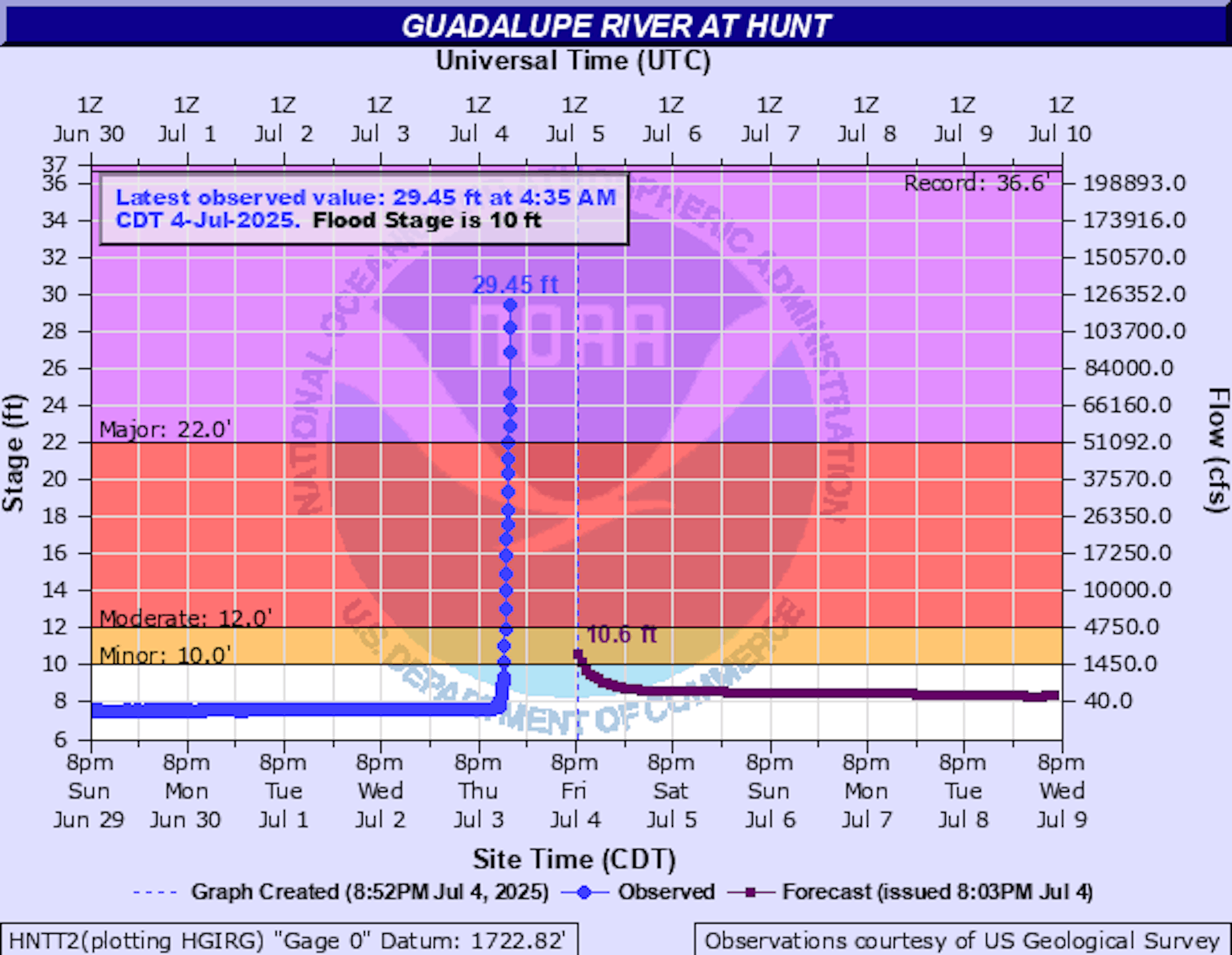
    A river gauge at Hunt, Texas, near Camp Mystic, showed how quickly the river flooded: Around 3 a.m. on July 4, the Guadalupe River was rising about 1 foot every 5 minutes at the gauge, National Weather Service data shows. By 4:30 a.m., it had risen more than 20 feet. As the water moved downstream, it reached Kerrville, where the river rose even faster.

    Flood expert Hatim Sharif, a hydrologist and civil engineer at the University of Texas at San Antonio, explains what makes this part of the country, known as Flash Flood Alley, so dangerous.

    What makes Hill Country so prone to flooding?

    Texas as a whole leads the nation in flood deaths, and by a wide margin. A colleague and I analyzed data from 1959 to 2019 and found 1,069 people had died in flooding in Texas over those six decades. The next highest total was in Louisiana, with 693.

    Many of those flood deaths have been in Hill County. It’s part of an area known as Flash Flood Alley, a crescent of land that curves from near Dallas down to San Antonio and then westward.

    The hills are steep, and the water moves quickly when it floods. This is a semi-arid area with soils that don’t soak up much water, so the water sheets off quickly and the shallow creeks can rise fast.

    When those creeks converge on a river, they can create a surge of water that wipes out homes and washes away cars and, unfortunately, anyone in its path.

    Hill Country has seen some devastating flash floods. In 1987, heavy rain in western Kerr County quickly flooded the Guadalupe River, triggering a flash flood similar to the one in 2025. Ten teenagers being evacuated from a camp died in the rushing water.

    San Antonio, at the eastern edge of Hill Country, was hit with a flash flood on June 12, 2025, that killed 13 people whose cars were swept away by high water from a fast-flooding creek near an interstate ramp in the early morning.

    Why does the region get such strong downpours?

    One reason Hill Country gets powerful downpours is the Balcones Escarpment.

    The escarpment is a line of cliffs and steep hills created by a geologic fault. When warm air from the Gulf rushes up the escarpment, it condenses and can dump a lot of moisture. That water flows down the hills quickly, from many different directions, filling streams and rivers below.

    As temperature rise, the warmer atmosphere can hold more moisture, increasing the downpour and flood risk.

    A tour of the Guadalupe River and its flood risk.

    The same effect can contribute to flash flooding in San Antonio, where the large amount of paved land and lack of updated drainage to control runoff adds to the risk.

    What can be done to improve flash flood safety?

    First, it’s important for people to understand why flash flooding happens and just how fast the water can rise and flow. In many arid areas, dry or shallow creeks can quickly fill up with fast-moving water and become deadly. So people should be aware of the risks and pay attention to the weather.

    Improving flood forecasting, with more detailed models of the physics and water velocity at different locations, can also help.

    Probabilistic forecasting, for example, can provide a range of rainfall scenarios, enabling authorities to prepare for worst-case scenarios. A scientific framework linking rainfall forecasts to the local impacts, such as streamflow, flood depth and water velocity, could also help decision-makers implement timely evacuations or road closures.

    Education is particularly essential for drivers. One to two feet of moving water can wash away a car. People may think their trucks and SUVs can go through anything, but fast-moving water can flip a truck and carry it away.

    Officials can also do more to barricade roads when the flood risk is high to prevent people from driving into harm’s way. We found that 58% of the flood deaths in Texas over the past six decades involved vehicles. The storm on June 12 in San Antonio was an example. It was early morning, and drivers had poor visibility. The cars were hit by fast-rising floodwater from an adjacent creek.

    This article, originally published July 5, 2025, has been updated with the death toll rising.

    Hatim Sharif does not work for, consult, own shares in or receive funding from any company or organization that would benefit from this article, and has disclosed no relevant affiliations beyond their academic appointment.

    ref. Why Texas Hill Country, where a devastating flood killed more than 135 people, is one of the deadliest places in the US for flash flooding – https://theconversation.com/why-texas-hill-country-where-a-devastating-flood-killed-more-than-135-people-is-one-of-the-deadliest-places-in-the-us-for-flash-flooding-260555

    MIL OSI

  • MIL-OSI USA: Peters, Slotkin Respond to Federal Disaster Declaration Following Catastrophic Northern Michigan Ice Storm

    US Senate News:

    Source: United States Senator for Michigan Gary Peters
    WASHINGTON, DC – U.S. Senators Gary Peters (D-MI) and Elissa Slotkin (D-MI) responded to the approval of Michigan’s request for a major disaster declaration following the catastrophic ice storm that impacted communities throughout Northern Michigan and the Eastern Upper Peninsula in late March. In May, Peters and Slotkin sent a letter to President Trump urging his swift approval of this declaration to support areas affected by the storm. With this declaration, critical assistance through the Federal Emergency Management Agency’s (FEMA) Public Assistance Program will be available to communities in Alcona, Alpena, Antrim, Charlevoix, Cheboygan, Crawford, Emmet, Montmorency, Oscoda, Otsego, Presque Isle, Kalkaska and Mackinac Counties, as well as the Little Traverse Bay Band of Odawa Indians.
    “I’m pleased that funding is coming to Northern Michigan to bolster the ongoing recovery efforts following the ice storm this March,” said Senator Peters. “The State of Michigan and local emergency managers continue to work hard because this job is not finished, and I’ll keep fighting to help our communities get the resources they need to bounce back stronger.”
    “This is welcome news and a big step for the many Michiganders who are still recovering from the once-in-a-generation ice storm in Northern Michigan and the UP in March,” said Senator Slotkin. “There is still more work ahead, but my office is here to help Michiganders navigate the federal disaster process to rebuild and recover.”
    The National Weather Service has ranked this as one of the most significant ice storms ever recorded in Northern Michigan. State and federal officials estimate the storms caused more than $137 million in immediate response costs, and inflicted severe damage to homes, businesses, and critical infrastructure, including leaving residents without power for weeks. The long-term impacts to local government, industries, and residents remain to be seen.
    FEMA’s Public Assistance Program provides assistance to eligible applicants, including local governments, to respond and recover from major disasters. In Michigan, the authorized funding can be used for debris removal and emergency protective measures such as eligible overtime work and permanent restoration of infrastructure. For additional information regarding the federal assistance, please contact the MSP Emergency Management and Homeland Security Division at 517-243-0149.
    Peters and Slotkin have fought to aid Northern Michigan’s impacted communities from the start. In the days following this devastating storm, the lawmakers wrote to Governor Whitmer expressing their willingness to support any federal support needed as part of the State of Michigan’s response. In June, Peters and Slotkin called on the Small Business Administration to approve the State of Michigan’s Rapid Administrative Disaster Declaration request for eligible counties, which was later approved by SBA Administrator Loeffler.

    MIL OSI USA News

  • MIL-Evening Report: World’s highest court issues groundbreaking ruling for climate action. Here’s what it means for Australia

    Source: The Conversation (Au and NZ) – By Wesley Morgan, Research Associate, Institute for Climate Risk and Response, UNSW Sydney

    JOHN THYS/AFP via Getty Images

    The world’s highest court says countries are legally obliged to prevent harms caused by climate change, in a ruling that repudiates Australia’s claims it is not legally responsible for emissions from our fossil fuel exports.

    The landmark ruling overnight by the International Court of Justice (ICJ) will reverberate in courts, parliaments and boardrooms the world over.

    In a closely watched case at The Hague, the judges were asked to clarify the legal obligations countries have to protect the Earth’s climate system for current and future generations. They were also asked to clarify the legal consequences for nations that fail to do this.

    At issue was the scope of legal obligations. During the court’s deliberations, Australia sided with other fossil fuel exporters and major emitters – including Saudi Arabia, the United States and China – to argue state obligations on climate change are restricted to those set out in climate-specific treaties such as the Paris Agreement.

    But the court disagreed. It found countries have additional obligations to protect the climate and take action to prevent climate harm inside and outside their boundaries. These obligations arise in human rights law, the law of the sea, and general principles of international law.

    This clear statement will have groundbreaking consequences. It means Australia must set a 2035 emissions reduction target in line with the best available science, as required under the Paris Agreement. But it must also go further, by regulating the fossil fuel industry to prevent further harm.

    Australia’s arguments rejected

    The ICJ is the primary legal organ of the United Nations. Its key role is to settle disputes between countries and clarify international law as it applies to nation states.

    While weighing up the obligations of countries to address the climate crisis, the court heard legal arguments from almost 100 countries, making it the largest case ever heard by the ICJ.

    The case threatened major implications for fossil-fuel producers such as Australia, which is heavily reliant on coal and gas exports.

    In his oral presentation to the ICJ, Australian Solicitor-General Stephen Donaghue told the court only the Paris Agreement should apply when it comes to mitigating climate change. Under the Paris rules, countries must set targets to cut domestic emissions, but they are not required to report emissions created when their fossil fuel exports are burned overseas.

    Donaghue and the Australian delegation also suggested responsibility for harms caused by climate change could not be pinned on individual states. Australia also argued protecting human rights does not extend to obligations to tackle climate change.

    The ICJ largely rejected these arguments.

    The ICJ judges largely rejected Australia’s arguments. Pictured: ICJ President Yuji Iwasawa (third from right) and members issuing their advisory opinion.
    JOHN THYS/AFP via Getty Images

    Fossil fuel era is over

    The court found Australia, and other fossil fuel producers, are obliged under international law to prevent fossil fuel companies in their territory from causing significant climate harm.

    This will essentially require a managed phase out of fossil fuel production. As the ICJ ruling says:

    Failure of a State to take appropriate action to protect the climate system from [greenhouse gas] emissions – including through fossil fuel production, fossil fuel consumption, the granting of fossil fuel exploration licences or the provision of fossil fuel subsidies – may constitute an internationally wrongful act which is attributable to that State.

    Australia is one of the world’s largest exporters of coal and gas. When burned overseas, emissions from Australia’s fossil fuel exports are more than double those of its entire domestic economy.

    Australia has approved hundreds of oil, gas and coal projects in recent decades. Dozens more are in the approvals pipeline. Final federal approval is still pending for Woodside’s massive Northwest Shelf gas project – which is set to add millions of tonnes of greenhouse gas emissions every year, for decades.

    The Australian government must heed the message from the Hague. The days of impunity for the fossil fuel industry are coming to an end.

    Woodside’s massive Northwest Shelf gas project is set to add millions of tonnes of greenhouse gas emissions every year.
    GREG WOOD/AFP via Getty Images

    A spark of hope from the Pacific

    Today’s ruling is remarkable for where it originated.

    In 2019, 27 law students at the University of the South Pacific in Vanuatu were given a challenge: find the most ambitious legal pathways towards climate justice.

    Each year, Vanuatu faces the prospect of cyclones, earthquakes, tsunamis, volcanoes, flooding rain and drought. Climate change compounds the risk to island communities – people who have done the least to contribute to the problem.

    The students decided to file a case with the world court. And so began a legal campaign that travelled from Vanuatu’s capital, Port Vila, through the halls of the United Nations in New York and to the world court in the Hague.

    In 2023 Vanuatu and other island nations succeeded in passing a UN General Assembly resolution. It asked the ICJ to give an advisory opinion on countries’ obligations to protect the climate system and legal consequences for states causing “significant harm” to Earth’s climate.

    This week’s ruling delivers poetic justice to Vanuatu and other vulnerable island states.

    The ruling delivers poetic justice to Vanuatu and other vulnerable island states. Pictured: representatives of Pacific states outside the International Court of Justice in December 2024.
    Michel Porro/Getty Images

    A new era for climate justice

    The court’s findings are likely to influence a wave of climate litigation worldwide. It could shape legal reasoning in Australia, too.

    Last week, a Federal Court judge found the Australian government has no legal duty of care to protect Torres Strait Islanders from climate change. If that case is appealed, a superior court may revisit the government’s obligations – and have regard to the ICJ ruling in doing so.

    The ICJ decision will also be relevant for the Queensland Land Court, which this week began hearing a challenge to stop a greenfield mine proposed by Whitehaven Coal – citing environmental and human rights impacts of the project’s emissions.

    Clarified international law obligations should also guide policymakers in the Australian parliament. With a huge majority in the House of Representatives and a climate-friendly Senate crossbench, the Albanese government has a mandate to implement policy in line with Australia’s international law obligations.

    Wesley Morgan is a fellow with the Climate Council of Australia

    Gillian Moon is a regular donor to the Australian Conservation Foundation, which is a party in the Whitehaven Coal case.

    ref. World’s highest court issues groundbreaking ruling for climate action. Here’s what it means for Australia – https://theconversation.com/worlds-highest-court-issues-groundbreaking-ruling-for-climate-action-heres-what-it-means-for-australia-261842

    MIL OSI AnalysisEveningReport.nz

  • MIL-Evening Report: ER Report: A Roundup of Significant Articles on EveningReport.nz for July 24, 2025

    ER Report: Here is a summary of significant articles published on EveningReport.nz on July 24, 2025.

    World’s highest court issues groundbreaking ruling for climate action. Here’s what it means for Australia
    Source: The Conversation (Au and NZ) – By Wesley Morgan, Research Associate, Institute for Climate Risk and Response, UNSW Sydney JOHN THYS/AFP via Getty Images The world’s highest court says countries are legally obliged to prevent harms caused by climate change, in a ruling that repudiates Australia’s claims it is not legally responsible for emissions

    Politics with Michelle Grattan: Chris Bowen on why it’s ‘a little frustrating’ bidding for COP 31
    Source: The Conversation (Au and NZ) – By Michelle Grattan, Professorial Fellow, University of Canberra Energy and climate issues are front and centre for both sides of politics. The government is struggling with pushback from some regional communities against the rollout of transmission lines and wind farms. At the same time, it will soon have

    Cycling’s governing body is introducing new rules to slow down elite riders. Not everyone’s happy
    Source: The Conversation (Au and NZ) – By Popi Sotiriadou, Associate Professor of Sport Management – Director Business Innovation, Griffith University MARCO BERTORELLO/AFP via Getty Images Most sports look to support their athletes to become “faster, higher, stronger” – in reference to the Olympic Games’ original motto – so it is perhaps surprising that cycling’s

    Swirling nebula of two dying stars revealed in spectacular detail in new Webb telescope image
    Source: The Conversation (Au and NZ) – By Benjamin Pope, Associate Professor, School of Mathematical and Physical Sciences, Macquarie University The day before my thesis examination, my friend and radio astronomer Joe Callingham showed me an image we’d been awaiting for five long years – an infrared photo of two dying stars we’d requested from

    UN’s highest court finds countries can be held legally responsible for emissions
    By Jamie Tahana in The Hague for RNZ Pacific The United Nations’ highest court has found that countries can be held legally responsible for their greenhouse gas emissions, in a ruling highly anticipated by Pacific countries long frustrated with the pace of global action to address climate change. In a landmark opinion delivered yesterday in

    Five arms, no heart and a global family: what DNA revealed about the weird deep-sea world of brittle stars
    Source: The Conversation (Au and NZ) – By Tim O’Hara, Senior Curator of Marine Invertebrates, Museums Victoria Research Institute A brittle star of the species _Gorgonocephalus eucnemis_. Lagunatic Photo / Getty Images You may have read that the deep sea is a very different environment from the land and shallow water. There is no light,

    Birds use hidden black and white feathers to make themselves more colourful
    Source: The Conversation (Au and NZ) – By Simon Griffith, Professor of Avian Behavioural Ecology, Macquarie University The green-headed tanager (_Tangara seledon_) has a hidden layer of plumage that is white underneath the orange feathers and black underneath the blue and green feathers. Daniel Field Birds are perhaps the most colourful group of animals, bringing

    Is sleeping a lot actually bad for your health? A sleep scientist explains
    Source: The Conversation (Au and NZ) – By Charlotte Gupta, Senior Postdoctoral Research Fellow, Appleton Institute, HealthWise Research Group, CQUniversity Australia Walstrom, Susanne/Getty We’re constantly being reminded by news articles and social media posts that we should be getting more sleep. You probably don’t need to hear it again – not sleeping enough is bad

    From grasslands to killing fields: why trees are bad news for one of Australia’s most stunning birds
    Source: The Conversation (Au and NZ) – By Gabriel Crowley, Adjunct Associate Professor in Geography, University of Adelaide JJ Harrison/Wikimedia, CC BY Picture this. A small, rainbow-coloured chick emerges from its nest for the first time. It stretches its wings and prepares to take flight. But before the fledgling’s life in the wild has begun,

    As seas rise and fish decline, this Fijian village is finding new ways to adapt
    Source: The Conversation (Au and NZ) – By Celia McMichael, Professor in Geography, The University of Melbourne Celia McMichael, CC BY-NC-ND In the village of Nagigi, Fiji, the ocean isn’t just a resource – it’s part of the community’s identity. But in recent years, villagers have seen the sea behave differently. Tides are pushing inland.

    After 70 years, twisted gothic thriller The Night of the Hunter remains as disturbing and beguiling as ever
    Source: The Conversation (Au and NZ) – By Ben McCann, Associate Professor of French Studies, University of Adelaide United Artists/Getty Images In 1955, director Charles Laughton crafted one of the darkest, strangest fairytales ever to come out of Hollywood. The Night of the Hunter remains visually exquisite and profoundly unsettling. Shortly before Ben Harper is

    Almost a third of NZ households face energy hardship – reform has to go beyond cheaper off-peak power
    Source: The Conversation (Au and NZ) – By Kimberley O’Sullivan, Senior Research Fellow, He Kainga Oranga – Housing and Health Research Programme, University of Otago Igor Suka/Getty Images The spotlight is again on New Zealand’s energy sector, with a group of industry bodies and independent retailers pushing for a market overhaul, saying the sector was

    Immigration courts hiding the names of ICE lawyers goes against centuries of precedent and legal ethics requiring transparency in courts
    Source: The Conversation (Au and NZ) – By Cassandra Burke Robertson, Professor of Law and Director of the Center for Professional Ethics, Case Western Reserve University Some immigration courts have allowed ICE attorneys to conceal their names during proceedings. Jacob Wackerhausen/iStock via Getty Images Something unusual is happening in U.S. immigration courts. Government lawyers are

    How the UK’s immigration system splits families apart – by design
    Source: The Conversation (Au and NZ) – By Nando Sigona, Professor of International Migration and Forced Displacement and Director of the Institute for Research into International Migration and Superdiversity, University of Birmingham arda savasciogullari/Shutterstock The letter that arrived for eleven-year-old Guilherme in June 2025 was addressed personally to him. The UK Home Office was informing

    4.48 Psychosis revival: the play’s window into a mind on the edge is as brutal as ever
    Source: The Conversation (Au and NZ) – By Leah Sidi, Associate Professor of Health Humanities, UCL Under bright lights, the audience looks at a bare stage on two planes. Below, a small stage is white and empty, occupied only by a table and two chairs. Above, a huge, slanted mirror reflects a bird’s-eye view of

    Togo’s ‘Nana-Benz’: how cheap Chinese imports of African fabrics has hurt the famous women traders
    Source: The Conversation (Au and NZ) – By Fidele B. Ebia, Postdoctoral fellow, Duke Africa Initiative, Duke University The manufacturing of African print textiles has shifted to China in the 21st century. While they are widely consumed in African countries – and symbolic of the continent – the rise of “made in China” has undermined

    2 ways cities can beat the heat: Which is best, urban trees or cool roofs?
    Source: The Conversation (Au and NZ) – By Ian Smith, Research Scientist in Earth & Environment, Boston University Trees like these in Boston can help keep neighborhoods cooler on hot days. Yassine Khalfalli/Unsplash, CC BY When summer turns up the heat, cities can start to feel like an oven, as buildings and pavement trap the

    Indonesian military set to complete Trans-Papua Highway under Prabowo’s rule
    By Julian Isaac The Indonesian Military (TNI) is committed to supporting the completion of the Trans-Papua Highway during President Prabowo Subianto’s term in office. While the military is not involved in construction, it plays a critical role in securing the project from threats posed by pro-independence Papuan resistance groups in “high-risk” regions. Spanning a total

    View from The Hill: Nationals’ mavericks ensure the Coalition is the issue in parliament’s first week
    Source: The Conversation (Au and NZ) – By Michelle Grattan, Professorial Fellow, University of Canberra For almost as long anyone can remember, the Nationals have caused the Coalition grief on climate and energy policy. Still, for Barnaby Joyce to bring on a fresh load of trouble – with a private member’s bill to scrap Australia’s

    Childcare centres will have funding stripped if they’re not ‘up to scratch’. Is this enough?
    Source: The Conversation (Au and NZ) – By Erin Harper, Lecturer, School of Education and Social Work, University of Sydney Maskot/Getty Images Childcare centres will lose their eligibility for fee subsidies if they don’t meet safety standards, according to a new bill introduced to parliament on Wednesday. As Education Minister Jason Clare told parliament: it

    MIL OSI AnalysisEveningReport.nz

  • MIL-Evening Report: ER Report: A Roundup of Significant Articles on EveningReport.nz for July 24, 2025

    ER Report: Here is a summary of significant articles published on EveningReport.nz on July 24, 2025.

    World’s highest court issues groundbreaking ruling for climate action. Here’s what it means for Australia
    Source: The Conversation (Au and NZ) – By Wesley Morgan, Research Associate, Institute for Climate Risk and Response, UNSW Sydney JOHN THYS/AFP via Getty Images The world’s highest court says countries are legally obliged to prevent harms caused by climate change, in a ruling that repudiates Australia’s claims it is not legally responsible for emissions

    Politics with Michelle Grattan: Chris Bowen on why it’s ‘a little frustrating’ bidding for COP 31
    Source: The Conversation (Au and NZ) – By Michelle Grattan, Professorial Fellow, University of Canberra Energy and climate issues are front and centre for both sides of politics. The government is struggling with pushback from some regional communities against the rollout of transmission lines and wind farms. At the same time, it will soon have

    Cycling’s governing body is introducing new rules to slow down elite riders. Not everyone’s happy
    Source: The Conversation (Au and NZ) – By Popi Sotiriadou, Associate Professor of Sport Management – Director Business Innovation, Griffith University MARCO BERTORELLO/AFP via Getty Images Most sports look to support their athletes to become “faster, higher, stronger” – in reference to the Olympic Games’ original motto – so it is perhaps surprising that cycling’s

    Swirling nebula of two dying stars revealed in spectacular detail in new Webb telescope image
    Source: The Conversation (Au and NZ) – By Benjamin Pope, Associate Professor, School of Mathematical and Physical Sciences, Macquarie University The day before my thesis examination, my friend and radio astronomer Joe Callingham showed me an image we’d been awaiting for five long years – an infrared photo of two dying stars we’d requested from

    UN’s highest court finds countries can be held legally responsible for emissions
    By Jamie Tahana in The Hague for RNZ Pacific The United Nations’ highest court has found that countries can be held legally responsible for their greenhouse gas emissions, in a ruling highly anticipated by Pacific countries long frustrated with the pace of global action to address climate change. In a landmark opinion delivered yesterday in

    Five arms, no heart and a global family: what DNA revealed about the weird deep-sea world of brittle stars
    Source: The Conversation (Au and NZ) – By Tim O’Hara, Senior Curator of Marine Invertebrates, Museums Victoria Research Institute A brittle star of the species _Gorgonocephalus eucnemis_. Lagunatic Photo / Getty Images You may have read that the deep sea is a very different environment from the land and shallow water. There is no light,

    Birds use hidden black and white feathers to make themselves more colourful
    Source: The Conversation (Au and NZ) – By Simon Griffith, Professor of Avian Behavioural Ecology, Macquarie University The green-headed tanager (_Tangara seledon_) has a hidden layer of plumage that is white underneath the orange feathers and black underneath the blue and green feathers. Daniel Field Birds are perhaps the most colourful group of animals, bringing

    Is sleeping a lot actually bad for your health? A sleep scientist explains
    Source: The Conversation (Au and NZ) – By Charlotte Gupta, Senior Postdoctoral Research Fellow, Appleton Institute, HealthWise Research Group, CQUniversity Australia Walstrom, Susanne/Getty We’re constantly being reminded by news articles and social media posts that we should be getting more sleep. You probably don’t need to hear it again – not sleeping enough is bad

    From grasslands to killing fields: why trees are bad news for one of Australia’s most stunning birds
    Source: The Conversation (Au and NZ) – By Gabriel Crowley, Adjunct Associate Professor in Geography, University of Adelaide JJ Harrison/Wikimedia, CC BY Picture this. A small, rainbow-coloured chick emerges from its nest for the first time. It stretches its wings and prepares to take flight. But before the fledgling’s life in the wild has begun,

    As seas rise and fish decline, this Fijian village is finding new ways to adapt
    Source: The Conversation (Au and NZ) – By Celia McMichael, Professor in Geography, The University of Melbourne Celia McMichael, CC BY-NC-ND In the village of Nagigi, Fiji, the ocean isn’t just a resource – it’s part of the community’s identity. But in recent years, villagers have seen the sea behave differently. Tides are pushing inland.

    After 70 years, twisted gothic thriller The Night of the Hunter remains as disturbing and beguiling as ever
    Source: The Conversation (Au and NZ) – By Ben McCann, Associate Professor of French Studies, University of Adelaide United Artists/Getty Images In 1955, director Charles Laughton crafted one of the darkest, strangest fairytales ever to come out of Hollywood. The Night of the Hunter remains visually exquisite and profoundly unsettling. Shortly before Ben Harper is

    Almost a third of NZ households face energy hardship – reform has to go beyond cheaper off-peak power
    Source: The Conversation (Au and NZ) – By Kimberley O’Sullivan, Senior Research Fellow, He Kainga Oranga – Housing and Health Research Programme, University of Otago Igor Suka/Getty Images The spotlight is again on New Zealand’s energy sector, with a group of industry bodies and independent retailers pushing for a market overhaul, saying the sector was

    Immigration courts hiding the names of ICE lawyers goes against centuries of precedent and legal ethics requiring transparency in courts
    Source: The Conversation (Au and NZ) – By Cassandra Burke Robertson, Professor of Law and Director of the Center for Professional Ethics, Case Western Reserve University Some immigration courts have allowed ICE attorneys to conceal their names during proceedings. Jacob Wackerhausen/iStock via Getty Images Something unusual is happening in U.S. immigration courts. Government lawyers are

    How the UK’s immigration system splits families apart – by design
    Source: The Conversation (Au and NZ) – By Nando Sigona, Professor of International Migration and Forced Displacement and Director of the Institute for Research into International Migration and Superdiversity, University of Birmingham arda savasciogullari/Shutterstock The letter that arrived for eleven-year-old Guilherme in June 2025 was addressed personally to him. The UK Home Office was informing

    4.48 Psychosis revival: the play’s window into a mind on the edge is as brutal as ever
    Source: The Conversation (Au and NZ) – By Leah Sidi, Associate Professor of Health Humanities, UCL Under bright lights, the audience looks at a bare stage on two planes. Below, a small stage is white and empty, occupied only by a table and two chairs. Above, a huge, slanted mirror reflects a bird’s-eye view of

    Togo’s ‘Nana-Benz’: how cheap Chinese imports of African fabrics has hurt the famous women traders
    Source: The Conversation (Au and NZ) – By Fidele B. Ebia, Postdoctoral fellow, Duke Africa Initiative, Duke University The manufacturing of African print textiles has shifted to China in the 21st century. While they are widely consumed in African countries – and symbolic of the continent – the rise of “made in China” has undermined

    2 ways cities can beat the heat: Which is best, urban trees or cool roofs?
    Source: The Conversation (Au and NZ) – By Ian Smith, Research Scientist in Earth & Environment, Boston University Trees like these in Boston can help keep neighborhoods cooler on hot days. Yassine Khalfalli/Unsplash, CC BY When summer turns up the heat, cities can start to feel like an oven, as buildings and pavement trap the

    Indonesian military set to complete Trans-Papua Highway under Prabowo’s rule
    By Julian Isaac The Indonesian Military (TNI) is committed to supporting the completion of the Trans-Papua Highway during President Prabowo Subianto’s term in office. While the military is not involved in construction, it plays a critical role in securing the project from threats posed by pro-independence Papuan resistance groups in “high-risk” regions. Spanning a total

    View from The Hill: Nationals’ mavericks ensure the Coalition is the issue in parliament’s first week
    Source: The Conversation (Au and NZ) – By Michelle Grattan, Professorial Fellow, University of Canberra For almost as long anyone can remember, the Nationals have caused the Coalition grief on climate and energy policy. Still, for Barnaby Joyce to bring on a fresh load of trouble – with a private member’s bill to scrap Australia’s

    Childcare centres will have funding stripped if they’re not ‘up to scratch’. Is this enough?
    Source: The Conversation (Au and NZ) – By Erin Harper, Lecturer, School of Education and Social Work, University of Sydney Maskot/Getty Images Childcare centres will lose their eligibility for fee subsidies if they don’t meet safety standards, according to a new bill introduced to parliament on Wednesday. As Education Minister Jason Clare told parliament: it

    MIL OSI AnalysisEveningReport.nz

  • MIL-OSI Asia-Pac: Taisugar Stands with Farmers, Rent Relief of One to Three Months Offered to Typhoon-Affected Tenants, Based on Damage Severity

    Source: Republic of China Taiwan

    On July 7, Typhoon Danas passed through southern Taiwan leaving a trail of devastation. To reduce the burden on farmers and help them get through these difficult times, Taisugar is offering to waive rent for one to three months depending on the severity of the damage and proof of typhoon-related losses.

    According to Taisugar, tenants in areas eligible for agricultural national disaster financial assistance and low-interest rates as announced by the Ministry of Agriculture should report their disaster-related losses to their local town hall/district office and submit proof to the Taisugar land management unit. Taisugar will then issue rent waivers based on the extent of crop damage. Those that suffered between 20% to 40% damage will have their rent waived for 1 month. Those with over 40% but less than 60% damage will have their rent waived for 2 months. Those with over 60% damage will have their rent waived for 3 months. Additional extensions may be negotiated in special circumstances. Rent paid in advance can be rolled over to the following year or used to extend their lease.

    Taisugar added that if the tenant wishes to terminate their lease due to the impact of the disaster, any rent or bond paid in advance can be refunded without interest once both parties have agreed on a termination date. Taisugar is willing to do everything possible to stand with farmers and help them get through these difficult times.

    TSC News Contact Person:
    Chang Mu-Jung
    Public Relations, Department of Secretariat, TSC
    Contact Number: 886-6-337-8819 / 886-920-636-951
    Email:a63449@taisugar.com.tw

    MIL OSI Asia Pacific News

  • MIL-Evening Report: Politics with Michelle Grattan: Chris Bowen on why it’s ‘a little frustrating’ bidding for COP 31

    Source: The Conversation (Au and NZ) – By Michelle Grattan, Professorial Fellow, University of Canberra

    Energy and climate issues are front and centre for both sides of politics. The government is struggling with pushback from some regional communities against the rollout of transmission lines and wind farms. At the same time, it will soon have to produce its 2035 target under the Paris climate agreement.

    Meanwhile, the opposition is fractured over whether to stick by its commitment to net zero emissions by 2050.

    We’re joined on this podcast by the Minister for Climate Change and Energy Chris Bowen.

    Bowen remains upbeat about the energy transition:

    I think it’s going well. We can always do more, and there’s always more effort needed, and the job is far from done. But when you consider what we’ve achieved over the first three years, I would say pleased but not yet satisfied. We are, by and large, on track for our 43% emissions reduction. Just in the last couple of days, [we saw] some excellent figures about the amount of new renewable electricity connected to the grid.

    So all this is a very significant turnaround from 2022, but I’m far from mission accomplished. There’s still a lot more to do. This is the biggest economic transition our country has undertaken, and you don’t sort of do three years’ work and put your feet up. This is a constant effort, and that’s an effort on which I’m entirely focused.

    Just now, Bowen is also focused on preliminary work for Treasurer Jim Chalmers’ Economic Reform Roundtable in August.

    Bowen announces he’ll be hosting two roundtables of his own, feeding into the broad August 19-21 meeting:

    I’ll be holding two roundtables, one on electricity and one on climate adaptation which is going to be an increasing focus of this government and future governments because tragically the world has left it too late to avoid the impacts of climate change. We can hopefully avoid the worst catastrophic impacts of more than 1.5 and two to three degrees.

    On Australia’s bid to host COP in 2026, Bowen says Australia has the votes against the other contender, Turkey, but the decision-making process is informal:

    So one of the things about the process to decide COPs I’ve learnt is it’s quite opaque and there’s no particular timeline and no particular rules to the ballot. I will say, I’ve said before, we’ve got very strong support. So it’s not a matter of going out and getting more votes.

    But there’s no agreed time or process for a ballot. It’s meant to work on a consensus, sort of an old world, sort of gentlemanly approach to say whoever loses will withdraw.

    Despite the delay, Bowen says Australia will be ready if the bid is successful:

    Having said that, the last COP, the one last year, in Azerbaijan, I accept Azerbaijan is a very different country to Australia, but they found out a year in advance as well. And logistically, physically, they put on a very good COP, that can be done. And I know the Premier of South Australia is a very, very enthusiastic supporter of hosting the COP.

    On the Coalition potentially dropping its commitment to net zero by 2050, Bowen calls the target “the basic bare minimum of action”:

    It’s what the IPCC has recommended as what is absolutely necessary to avoid […] the worst catastrophic impacts of [climate change]. To be debating net zero 2050 in Australia this year is like debating whether the sun should come up. It’s the most basic framework. It’s nowhere near enough.

    I think it’s got strong support, and it’s retaining that. I mean, the election result shows that. That we were told to get on with it. Keep going basically.

    I’ll just say this. At least Peter Dutton had net zero as a policy objective. I mean, Sussan may be indicating maybe she won’t. I used to say Peter Dutton would be the worst prime minister for climate than Tony Abbott, and I was correct at the time, but now it’s starting to look like Sussan Ley would be even worse.

    Michelle Grattan does not work for, consult, own shares in or receive funding from any company or organisation that would benefit from this article, and has disclosed no relevant affiliations beyond their academic appointment.

    ref. Politics with Michelle Grattan: Chris Bowen on why it’s ‘a little frustrating’ bidding for COP 31 – https://theconversation.com/politics-with-michelle-grattan-chris-bowen-on-why-its-a-little-frustrating-bidding-for-cop-31-261763

    MIL OSI AnalysisEveningReport.nz

  • MIL-OSI Australia: ARENA backs Calix with $44.9M to fire up green steel future

    Source: Ministers for the Department of Industry, Innovation and Science

    Overview

    • Category

      News

    • Date

      24 July 2025

    • Classification

      Renewables for industry

    The Australian Renewable Energy Agency (ARENA) has committed $44.9 million to Calix to build a novel demonstration plant using its Zero Emissions Steel Technology (ZESTY).

    Powered by renewable electricity and hydrogen, the plant will aim to produce up to 30,000 tonnes of low-carbon hydrogen direct reduced iron (HDRI) and hot briquetted iron (HBI) each year in a strong step toward cleaner steelmaking.

    ZESTY leverages Calix’s proprietary Flash Calciner technology which aims to reduce the cost of green iron production. The new funding builds on the successful outcomes of ARENA funded engineering studies for the demonstration plant. The funding also supports early-stage engineering studies for a much larger commercial scale ZESTY plant, helping build local capability in low emissions metals—a strategic priority for ARENA and a critical future industry for Australia.

    The project will also showcase a flexible green iron process that can ramp production up or down to match renewable energy supply—supporting a smarter, cleaner industrial future.

    ARENA CEO Darren Miller stressed that finding a low or zero emissions pathway for steelmaking is crucial, given its significant contribution to global emissions.

    “As the world’s largest producer and exporter of iron ore, Australia has a critical role in reducing emissions across the steel value chain,” he said.

    “ZESTY is a strong step toward building a low-emissions steel industry at home.”

    “What makes ZESTY so compelling is its potential to dramatically lower the amount of hydrogen required to convert iron ore into pure iron. ZESTY, in combination with use of renewable electricity from Australia’s world-class solar and wind resources, has the potential to create a new green iron industry targeting both domestic and export markets as the world transitions away from fossil fuels.”

    Calix CEO Phil Hodgson welcomed the funding, saying, “green iron can tackle one of the world’s hardest to abate emissions sources while adding value to Australia’s biggest export. ZESTY is designed to do this cost effectively – minimising hydrogen use, avoiding pelletisation, and operating flexibly on low-cost electricity.”

    Founded in 2005, Calix is an Australian innovator in sustainable high-temperature mineral processing, with applications across steel, cement, alumina, lithium and critical minerals.

    ARENA media contact:

    media@arena.gov.au

    Download this media release (PDF 151KB)

    MIL OSI News

  • MIL-Evening Report: UN’s highest court finds countries can be held legally responsible for emissions

    By Jamie Tahana in The Hague for RNZ Pacific

    The United Nations’ highest court has found that countries can be held legally responsible for their greenhouse gas emissions, in a ruling highly anticipated by Pacific countries long frustrated with the pace of global action to address climate change.

    In a landmark opinion delivered yesterday in The Hague, the president of the International Court of Justice, Yuji Iwasawa, said climate change was an “urgent and existential threat” that was “unequivocally” caused by human activity with consequences and effects that crossed borders.

    The court’s opinion was the culmination of six years of advocacy and diplomatic manoeuvring which started with a group of Pacific university students in 2019.

    They were frustrated at what they saw was a lack of action to address the climate crisis, and saw current mechanisms to address it as woefully inadequate.

    Their idea was backed by the government of Vanuatu, which convinced the UN General Assembly to seek the court’s advisory opinion on what countries’ obligations are under international law.

    The court’s 15 judges were asked to provide an opinion on two questions: What are countries obliged to do under existing international law to protect the climate and environment, and, second, what are the legal consequences for governments when their acts — or lack of action — have significantly harmed the climate and environment?

    The International Court of Justice in The Hague yesterday . . . landmark non-binding rulings on the climate crisis. Image: X/@CIJ_ICJ

    Overnight, reading a summary that took nearly two hours to deliver, Iwasawa said states had clear obligations under international law, and that countries — and, by extension, individuals and companies within those countries — were required to curb emissions.

    Iwasawa said the environment and human rights obligations set out in international law did indeed apply to climate change.

    ‘Precondition for human rights’
    “The protection of the environment is a precondition for the enjoyment of human rights,” he said, adding that sea-level rise, desertification, drought and natural disasters “may significantly impair certain human rights, including the right to life”.

    To reach its conclusion, judges waded through tens of thousands of pages of written submissions and heard two weeks of oral arguments in what the court said was the ICJ’s largest-ever case, with more than 100 countries and international organisations providing testimony.

    They also examined the entire corpus of international law — including human rights conventions, the law of the sea, the Paris climate agreement and many others — to determine whether countries have a human rights obligation to address climate change.

    The president of the International Court of Justice (ICJ), Yuji Iwasawa, delivering the landmark rulings on climate change. Image: X/@CIJ_ICJ

    Major powers and emitters, like the United States and China, had argued in their testimonies that existing UN agreements, such as the Paris climate accord, were sufficient to address climate change.

    But the court found that states’ obligations extended beyond climate treaties, instead to many other areas of international law, such as human rights law, environmental law, and laws around restricting cross-border harm.

    Significantly for many Pacific countries, the court also provided an opinion on what would happen if sea levels rose to such a level that some states were lost altogether.

    “Once a state is established, the disappearance of one of its constituent elements would not necessarily entail the loss of its statehood.”

    Significant legal weight
    The ICJ’s opinion is legally non-binding. But even so, advocates say it carries significant legal and political weight that cannot be ignored, potentially opening the floodgates for climate litigation and claims for compensation or reparations for climate-related loss and damage.

    Individuals and groups could bring lawsuits against their own countries for failing to comply with the court’s opinion, and states could also return to the International Court of Justice to hold each other to account.

    The opinion would also be a powerful precedent for legislators and judges to call on as they tackle questions related to the climate crisis, and give small countries greater weight in negotiations over future COP agreements and other climate mechanisms.

    Outside the court, several dozen climate activists, from both the Netherlands and abroad, had gathered on a square as cyclists and trams rumbled by on the summer afternoon. Among them was Siaosi Vaikune, a Tongan who was among those original students to hatch the idea for the challenge.

    “Everyone has been waiting for this moment,” he said. “It’s been six years of campaigning.

    “Frontline communities have demanded justice again and again,” Vaikune said. “And this is another step towards that justice.”

    Vanuatu’s Climate Change Minister Ralph Regenvanu (cenbtre) speaks to the media after the International Court of Justice (ICJ) rulings on climate change in The Hague yesterday. Image: X/CIJ_ICJ

    ‘It gives hope’
    Vanuatu’s Climate Minister Ralph Regenvanu said the ruling was better than he expected and he was emotional about the result.

    “The most pleasing aspect is [the ruling] was so strong in the current context where climate action and policy seems to be going backwards,” Regenvanu told RNZ Pacific.

    “It gives such hope to the youth, because they were the ones who pushed this.

    “I think it will regenerate an entire new generation of youth activists to push their governments for a better future for themselves.”

    Regenvanu said the result showed the power of multilateralism.

    “There was a point in time where everyone could compromise to agree to have this case heard here, and then here again, we see the court with the judges from all different countries of the world all unanimously agreeing on such a strong opinion, it gives you hope for multilateralism.”

    He said the Pacific now has more leverage in climate negotiations.

    “Communities on the ground, who are suffering from sea level rise, losing territory and so on, they know what they want, and we have to provide that,” Regenvanu said.

    “Now we know that we can rely on international cooperation because of the obligations that have been declared here to assist them.”

    The director of climate change at the Pacific Community (SPC), Coral Pasisi, also said the decision was a strong outcome for Pacific Island nations.

    “The acknowledgement that the science is very clear, there is a direct clause between greenhouse gas emissions, global warming and the harm that is causing, particularly the most vulnerable countries.”

    She said the health of the environment is closely linked to the health of people, which was acknowledged by the court.

    This article is republished under a community partnership agreement with RNZ.

    MIL OSI AnalysisEveningReport.nz

  • MIL-OSI New Zealand: Rites of fish passage

    Source: NZ Department of Conservation

    Corbies Creek, Canterbury, showing the exclusion barrier (left) and a DOC team removing weeds to improve longjaw habitat. Photo: Sjaan Bowie/DOC. 

    About this time last year, a group of DOC rangers and scientists set out from Twizel for a regular check of a population of threatened fish in nearby Corbies Creek. It was a beautiful day. Soon after getting their gear in the water, they realised something was very wrong. Where were all the fish? Only a year ago they’d found more than 100 in a 25m stretch, but there were hardly any there now.  

    Corbies Creek, along with just a few other small streams in Canterbury, is a refuge for native lowland longjaw galaxias. If we lost them from here, they’d be gone from everywhere. Sleek, pencil-thin and exquisitely camouflaged, their pale-yellow skin is dusted with brown and silver flecks. Adults rarely grow longer than 80 mm.  

    Lowland longjaw galaxias. Photo: P Ravenscroft/DOC.   

    Longjaws are one of New Zealand’s river-resident galaxiid species that live their entire lives in a single waterway. All river-resident galaxiids are vulnerable to being eaten or displaced by larger fish. Some, including longjaws, can’t share habitat with any bigger fish. To safeguard this population, an exclusion barrier has been built to stop predatory trout and kōaro from swimming up into their habitat. 

    So how had two brown trout – the cause of the drastic decline at Corbies Creek – got up there? Sjaan Bowie, DOC senior freshwater technical advisor, thinks the trout were carried across a paddock from a nearby waterway, in a particularly high flood event a few months earlier.  

    Rest assured the trout were quicky removed and the longjaws are bouncing back.  

    “We’re pleased to report that monitoring in March this year found numbers had risen from just 12 to more than 50 fish, and no more trout have been seen upstream of the barrier.”

    Limited tools available – innovations welcome 

    Sjaan says this near-miss extinction of longjaws in Corbies Creek shows that more management tools will be needed to protect our freshwater fish in the future.  

    “What we’re doing generally works fine for small streams under current climatic conditions. But with increasing temperatures, we’re seeing trout head further inland looking for cooler water. More severe weather is also causing bigger floods and longer droughts. This combination increases the risk of trout making it past barriers or accidentally getting into threatened fish habitat, as we saw in Corbies Creek.” 

    Flooding can overtop fish barriers and put native species at risk. Photo: Dean Nelson/DOC.

    She highlights the need for better technology – both for remote monitoring of populations and to protect larger areas.  

    “We’re looking at remote water level monitoring, so we’d get a warning ‘ping’ and could go and check if a barrier had been breached or there was an overland flow. There’s also a need to protect more and larger areas to prevent individual populations becoming genetically isolated. 

    “A fish exclusion barrier that works in larger rivers or low gradient streams without backing up the flow and creating a pool, would also make a big difference to the ongoing survival of these species. If anyone has bright ideas about how to build something like that, we’d really love to hear from you.” 

    Sjaan says the same issues are faced in fish conservation around the world, so any solutions we created here could be used internationally.  

    Regardless, future work to secure our river-resident galaxiids is likely to include building exclusion barriers in new streams and moving current barriers downstream. Other tools like captive breeding and translocations into protected areas are also likely to be necessary. 

    An exclusion barrier in Omarama Spring protects an important population of non-migratory galaxiids. Photo: Sjaan Bowie/DOC.

    Let them through – migratory fish need to move

    Managing the other group of New Zealand’s native fish couldn’t be more different. It’s vital for these species to be able to move up and down waterways and get to and from the sea to complete their lifecycles. In this group of migratory species are eels, bullies and the fish we collectively known as whitebait – the juveniles of īnanga, kōaro and banded, giant and shortjaw kōkopu.  

    The strongest swimmers of the group move the furthest inland. Kōaro stand out as best in class as they can climb near-vertical walls. Īnanga are the most challenged by inclines, jumps, rapids and fast flows, and tend to stay in flatter areas near the coast.   

    Human-built structures in waterways can present swimming challenges. Conservation work for migratory species therefore includes identifying, fixing or removing barriers like poorly designed or unmaintained culverts, fords, dams and weirs.  

    As part of her role, Sjaan advocates for better fish passage. She’s helped develop and update fish passage guidelines and resources, given dozens of seminars about best practice, offered advice and support to others, and coordinated the New Zealand Fish Passage Advisory Group.  

    “We can make a real difference for migratory fish by removing barriers. Yes, we can plant trees and improve habitat but if we can take out something that’s stopping migration, the benefit is immediate. It means the fish aren’t slowed down or stopped in their migration and allows them to get to natural habitat upstream to grow and mature.” 

    Researching ways to fix impassable culverts

    Sjaan Bowie setting up a net to capture and count fish that made it up a ramp and through the culvert. Photo: Nixie Boddy/DOC. 

    Culverts are a big issue. There are hundreds of thousands of them around the country and some hinder or block fish passage by creating overhangs or impassably fast flows.  

    Sjaan and her colleagues have been testing different retrofitted baffles and ramps to see how well they help fish move up and through culverts.  

    “We couldn’t find a lab that was big enough, so we chose some barriers in waterways on the South Island’s West Coast. It has high rainfall, lots of culverts and an abundance of fish.  

    “It looks like these fixes can be used to improve passage for some species under certain conditions, but not for all species. They may be best considered as a temporary solution. Final results will indicate when they improved passage, and allow us to offer better guidance on installation, monitoring and maintenance of these fixes.”  

    Brittany Earl, freshwater ranger (left) and Nixie Boddy measuring post-trial fish before releasing them back into Hodson Stream. Photo: Sjaan Bowie/DOC.

    Sjaan says if there’s a structure that’s restricting fish passage, the best option is always to remove it. “If that’s not possible we need to consider replacing or fixing it permanently.” 

    Spectacular success at Te Pouaruhe wetland, Wairarapa  

    Our work with the Wairarapa Moana Wetlands project restored fish passage to Te Pouaruhe wetland in early 2022 – using a large digger.  

    The area was drained for agriculture in the 1940s and separated from Lake Ōnoke by a stopbank and two culverts. One of the culverts had a flap gate that severely limited fish access to the wetland from the lake and the sea. The digger removed the culverts and made two breaks in the stopbank that now provide free passage up and downstream.  

    Before and after fish surveys in 2019 and 2023 found huge differences in the number and range of species present. Īnanga and common bullies were found at every sampling site in 2023 and in large numbers at most sites. At one site, the number of īnanga rose from 339 to 1563 after fish passage was restored.

    Challenges to fix ford in lower Waipoua River, Northland

    This ford across the Waipoua River was built to provide access for mana whenua (local residents) and commercial forestry vehicles.  

    It’s a significant barrier to fish passage because of a drop off downstream and culverts inside the ford that accelerate the flow. Installing four fish ramps has helped, but a permanent solution is still needed. 

    “Having a barrier 5 km from the sea restricts or prevents fish access to around 100 km of beautiful stream habitat in kauri forest”, says Sjaan. “Improving fish passage there would make a big difference for many species, including threatened shortjaw kōkopu.”  

    Fixing the ford is a priority for Te iwi o Te Roroa and DOC and options, including a fish bypass or replacement bridge, are being looked at.  

    This ford across Waipoua River hinders fish passage for several species despite the installation of floating fish ramps. Photo Sarah Wilcox/DOC

    Progress to celebrate and some lessons learned  

    Reflecting on progress in the last 10 years, Sjaan is pleased to have national guidelines, improved policy and new tools in place.  

    “The Fish Passage Assessment Tool is one way that anyone can record instream structures and assess the risk they pose to fish passage. The tool has contributed to a database of more than 150,000 structures nationwide that are being prioritised and ticked off.  

    “It’s been exciting to see councils such as Northland, Taranaki and West Coast, as well as other organisations, taking action to remove barriers and put in some good fixes to open up habitat for fish.” 

    Wairau Stream after work by New Plymouth District Council to remove a culvert that was hindering fish passage. Photo: New Plymouth District Council.

    Sjaan says instream structures always have at least a dual purpose – to transport water and allow fish to move – and both are important to consider.   

    “One stand-out lesson for me though is the benefit of oversizing and embedding culverts. They will be long-lasting, stand up to floods, and provide good fish passage.”  

    This article was first published in the New Zealand Water Review.  

    Read more about fish passage 

    Read more about our work to secure populations of migratory fish: Ngā Ika e Heke migratory fish workstream: Freshwater restoration

    MIL OSI New Zealand News

  • MIL-OSI USA: Statement on the Commission’s Status Report in the Climate-Related Disclosure Rules Litigation

    Source: Securities and Exchange Commission

    On April 24, 2025—three months ago—the U.S. Court of Appeals for the Eighth Circuit directed the Commission to provide a status update in the ongoing litigation concerning the Climate-Related Disclosure Rules, which the Commission adopted in March of 2024.[1]

    The Court “directed” the Commission to advise whether it “intends to review or reconsider the [R]ules at issue in this case.”[2] And, if the Commission has determined to take no action, the Court ordered the Commission to explain whether it “will adhere to the [R]ules if the petitions for review are denied and, if not, why it will not review or reconsider the [R]ules at this time.”[3]

    The Court’s directive was straightforward; our answer is not.

    The Commission’s Status Report, filed today, states plainly enough that it has no intention of revisiting the Rules at this time.[4] That, however, is where our responsiveness ends.[5] The Status Report goes on to argue that we cannot expound on what the Commission’s future plans might be in the event the rulemaking petitions are denied, because we would be “prejudging” those policy decisions.[6] And, the Status Report explains, any future rulemaking should benefit from a court ruling on our statutory authority.[7]

    We also weigh in on a number of questions that the Court did not ask of us – for example, we opine that there are “no obstacle[s]” to reaching the merits of the case and that a “live controversy” remains.[8]

    This purported response is wholly unresponsive.

    The Court asked us in no uncertain terms “will [the Commission] adhere to the [R]ules if the petitions for review are denied[?]” We did not—but should have—answered that question. The unspoken truth under this Commission is that the answer is “no.” Three of the four current Commissioners have been vocal critics of the Rules.[9] They have also withdrawn the Commission from the defense of the Rules in litigation.[10] The Commission simply does not want to say what we all know to be true by now—it has no intention of allowing the Climate-Related Disclosure Rules to go into effect.

    Once we acknowledge this answer, the rest of the Commission’s arguments fall away. There are no prejudgment issues, because there is nothing to prejudge. And, we do not need the Court to rule on our statutory authority for the Commission to engage in rulemaking. If there is future rulemaking in this space—whether to rescind the Rules or otherwise that rulemaking may present different legal issues. Whatever those issues may be, and whomever those aggrieved parties may be, they are not now before the Court. Federal courts are not in the business of giving advisory opinions to agencies.

    What is crystal clear, however, is that this Commission is seeking to avoid its legal obligations under the guise of conserving “Commission time and resources.” No matter what, this comes at the expense of judicial resources. As I wrote previously in connection with the Commission’s decision to stop defending these Rules,[11] the Administrative Procedure Act governs the process by which we make and repeal rules. It includes a prescriptive framework for promulgation and rescission. If this Commission wants to rescind, repeal or modify the Rules, which were promulgated by-the-book, then it must do the statutorily-required work. It cannot take the easy way out. It must engage in notice-and-comment rulemaking, with the benefit of economic analysis and a public, transparent process, even if inconvenient or if the Commission has other, more pressing priorities.[12] Indeed, other Commissioners have acknowledged that doing the work required to rescind the rule would be a difficult lift.[13] So, instead, we once again ask the Court to do the work for us. By asking the Court to carry water that we should shoulder ourselves, we do a grave disservice to our already taxed judicial system. This is not good governance.

    The Commission has effectively ignored the Court’s order and thrown the ball back at the Court. The Court should decline to play these games.


    [2] Status Update Order.

    [4] Status Report of the Securities and Exchange Commission in Response to the Court’s April 24, 2025 Order, State of Iowa v. Securities and Exchange Commission, 24-cv-1522 (8th Cir. July 23, 2025) (“Status Report”) at 2 (“The Commission does not intend to review or reconsider the Rules at this time.”).

    [5] These viewpoints do not reflect upon the efforts of the staff in our Office of the General Counsel.

    [6] Status Report at 2.

    [7] Id. at 2, 4, 5.

    [8] Id. at 2, 3.

    [10] See Status Report filed by SEC, State of Iowa v. Securities and Exchange Commission, 24-cv-1522 (8th Cir. Mar. 27, 2025); SEC Press Release No. 2025-58, SEC Votes to End Defense of Climate Disclosure Rules (Mar. 27, 2025) (According to then-Acting Chair Uyeda, “The goal of today’s Commission action and notification to the court is to cease the Commission’s involvement in the defense of the costly and unnecessarily intrusive climate change disclosure rules.”).

    [12] Commissioner Mark T. Uyeda, Remarks at the “SEC Speaks” Conference 2025 (May 19, 2025) (“For the Commission to rescind the climate-related disclosure rule—and address the countless factual findings discussed in that 885-page release—would place a significant strain on the Commission’s resources. This effort would be a difficult lift, and it would potentially take away staff resources needed to advance the regulatory regime with respect to crypto and capital formation.”).

    MIL OSI USA News

  • MIL-OSI New Zealand: Climate change: ICJ ruling is a landmark win for children – Save the Children

    Source: Save the Children

    The historic climate change ruling at the International Court of Justice (ICJ) today is a landmark win for child campaigners, acknowledging the adverse impacts of climate change on child rights, and offering children renewed hope, Save the Children said. 
    The Advisory Opinion delivered by the world’s highest court finds that states’ legal obligations to address climate change extend beyond existing climate agreements. It also found that “states must take their obligations under international human rights law into account when implementing their obligations under the climate change treaties and other relevant environmental treaties.” 
    While not legally binding, leading environmental lawyers say the ruling “could become a guiding star for climate policies at all levels of governance”, including how States are held accountable under multiple areas of international law. 
    The Advisory Opinion originated from an extensive campaign led by a group of law students from the Pacific Islands, with strong support from the Republic of Vanuatu [1]. 
    In December last year, Vepaiamele, 16, a child campaigner with Save the Children Vanuatu, travelled to The Hague with the Government of Vanuatu – the only child to attend as part of a government delegation – to speak about the impacts of climate change on the Pacific island nation and call for action. 
    Vepaiamele said today: “This Advisory Opinion is everything I hoped for and I am so happy with this outcome as I know it will pave the way for a safer future for youth like myself and future generations, too.”
    Speaking from The Hague last year , Vepaiamele said: 
    “As a young Ni-Vanuatu girl, I feel the effects of climate change every day of every year. I’ve experienced many cyclones. It can be kind of terrifying sometimes, especially the really strong ones. Every cyclone, our classrooms are destroyed, our homes are flattened to the ground, and hospitals and communication towers are ripped apart. And then there’s also the mental health impacts, and we don’t really talk about it that much, but it can really cause anxiety in children and young people.”
    Human-induced climate change is driving up global temperatures, with the past 10 years the warmest on record, according to the World Meteorological Organization. Children, particularly those affected by inequality and discrimination, bear the brunt of climate change impacts that are already forcing them from their homes, putting food out of reach, damaging schools and increasing risks like child marriage as they are forced out of education and into poverty. 
    Limiting warming temperatures through the rapid phase-out of the use and subsidy of fossil fuels is critical for children’s rights and lives, Save the Children said. 
    Earlier this year, research released by the child rights organisation with the Vrije Universiteit Brussel (VUB) found that the difference between global temperature rise of 1.5°C and 2.7°C could see 38 million more children from the 2020 birth cohort face unprecedented lifetime exposure to extreme heatwaves. [2] Save the Children also called for increased climate finance targeted at helping children and their families, child-centred and locally led adaptation and an increase in the participation of children in shaping climate action. 
    Save the Children New Zealand CEO Heather Campbell says, “The ICJ’s opinion strengthens the argument that climate inaction is a form of intergenerational injustice, disproportionately borne by those least responsible and least equipped to adapt.
    “At home in Aotearoa New Zealand, children and their families are experiencing the devastating impacts of extensive flooding and other climate-related emergencies, including Cyclone Gabrielle. Communities across the Nelson Tasman region are still reeling from floods that have destroyed homes and farmland, displaced families and closed schools. 
    “On a recent visit to Solomon Islands, children told us about the impact rising sea levels were having on their communities, including monthly flooding in homes and schools, saline infiltration into fresh water supplies, and crops being destroyed. In other parts of the Pacific, communities are having to constantly rebuild after multiple cyclones in the last few years alone. These are not future scenarios – they are current realities.
    “Save the Children welcomes the finding from the ICJ, and we also urge governments and development agencies to ensure that climate finance reaches those on the frontline of this crisis.
    “Currently, only 2.4% of climate finance from multilateral funding sources is child centred. Even without the Court’s opinion, we know that states must do far more to protect children from the worst impacts of this crisis, including by significantly increasing climate finance to uphold children’s rights and access to health, education and protection.”
    In light of the ICJ’s Advisory Opinion, Save the Children New Zealand is calling on the New Zealand Government to renew its commitment to provide climate finance to help communities recover from climate induced loss and damage as well as working to reduce the country’s carbon emissions.  
    As the world’s leading independent child rights organisation, Save the Children works in about 110 countries, tackling climate change across everything we do. Save the Children supports children and their communities across the Pacific and globally in preventing, preparing for, adapting to, and recovering from both sudden climate disasters and slow onset climate change. We have set up floating schools, rebuilt destroyed homes and provided cash grants to families hit by disasters. 
    We also work to influence governments and other key stakeholders in Aotearoa New Zealand and around the world on climate policies, including at the UNFCCC COP summits, giving children a platform for their voices to be heard. 
    Notes:
    • Multimedia can be found here including Vepaiamele with other young people on Tuesday 22 July, Vepaiamele at the Hague, and general vision of Vanuatu
    [1] The Advisory Opinion is in response to a Pacific-led resolution (A/RES/77/276) to the UN General Assembly adopted by consensus on 29 March 2023. This was the result of an extensive campaign by a group of law students from the University of the South Pacific ( Pacific Islands Students Fighting Climate Change ) with strong support from the Republic of Vanuatu. Save the Children has worked closely with the Pacific Islands Students Fighting Climate Change to ensure the voices of children and young people are incorporated into countries’ written and oral submissions to the Court. As part of her campaigning work, Vepaiamele and other activists met with embassies of high emitting countriesin Vanuatu ahead of the hearing to try and influence their submissions.
    [2] The report found that, for children born in 2020, if global temperature rise is limited to 1.5°C rather than reaching 2.7°C above pre-industrial levels:
    – About 38 million would be spared from facing unprecedented lifetime exposure to heatwaves; o About 8 million would avoid unprecedented lifetime exposure to crop failures; o About 5 million would be spared from unprecedented lifetime exposure to river floods; o About 5 million would avoid unprecedented lifetime exposure to tropical cyclones; o About 2 million would avoid unprecedented lifetime exposure to droughts; o About 1.5 million children would be spared unprecedented lifetime exposure to wildfires.  

    MIL OSI New Zealand News

  • MIL-OSI New Zealand: International Court of Justice climate ruling a powerful tool for holding countries to account – Oxfam

    Source: Oxfam Aotearoa

    The International Court of Justice has ruled that governments must phase out fossil fuels, rapidly reduce emissions, provide remedy to those facing climate damages, and provide climate finance to developing countries.
    Oxfam climate change policy lead Nafkote Dabi said:
    “Oxfam is proud to have supported young climate defenders from the Pacific and elsewhere who bravely took their fight for justice from a classroom in Vanuatu to the world’s highest court. They won the world a tremendous victory today.
    This ruling elevates national climate commitments everywhere by confirming that countries must reduce emissions enough to protect the universal rights to life, food, health and a clean environment. All countries, particularly rich ones, now have to cut their emissions faster and phase out fossil fuels. Rich countries have to increase their financing to Global South countries to help them reduce emissions and protect their people from past and future harm. This is not a wish-list – it is international law.
    We now have a powerful tool for holding countries to account for their obligations, especially in protecting the world’s most marginalised people and future generations of humanity. The ICJ rejected arguments by the likes of the US and UK that governments are bound only by climate treaties such as the Paris Agreement and did not have stronger obligations under international law. This ruling will inject new impetus into negotiations at the COP30 Summit in Brazil this November.”
    Oxfam Aotearoa climate justice lead Nick Henry said:
    “Today’s ruling is a stunning rebuke to the rich countries, including New Zealand, who are failing to stop harm to our climate. It is a victory for a people-powered campaign started by Pacific Island Students Fighting Climate Change, gaining support from Pacific leaders and allies around the world.
    The New Zealand government provided early support to the campaign and co-sponsored the UN resolution that referred the case to the ICJ. But in its submissions to the court, New Zealand argued that human rights law is not relevant to climate change and that governments don’t have climate obligations beyond the existing Paris Agreement.
    The world’s highest court has rejected the New Zealand government’s arguments and ruled that the international treaties on human rights and the environment create binding obligations to prevent harm to the climate.
    This means that New Zealand must do more to reduce emissions and increase funding for climate action in the Pacific.”
    Notes:
    Oxfam has been supporting the Pacific Islands Students Fighting Climate Change’s lawsuit since 2022, joining in advocacy for the UN General Assembly to refer the case to the Court. Oxfam provided a written statement to the ICJ in March 2024 on human rights obligations beyond borders and what this means for climate action. Oxfam also contributed to an expert legal opinion that was referenced in several State submissions, the Maastricht Principles on the Human Rights of Future Generations.

    MIL OSI New Zealand News

  • MIL-OSI New Zealand: Greenpeace – World court’s climate ruling a legal warning shot for Luxon

    Source: Greenpeace

    Greenpeace Aotearoa says the world’s highest court has just delivered a wake-up call for Prime Minister Christopher Luxon.
    In a historic climate ruling, the International Court of Justice (ICJ) has confirmed that governments have legal obligations to protect people – both now and in the future – from the worsening impacts of the climate crisis. That includes regulating big polluters like fossil fuel companies and intensive livestock operations.
    “This is a warning shot to Luxon that his Government’s war on nature and the climate comes with consequences,” says Greenpeace spokesperson Amanda Larsson.
    “The Court has made it clear: states must take action to prevent climate harm, no matter where it occurs. They must uphold people’s fundamental right to a clean, healthy and sustainable environment – for today’s communities and future generations.”
    The ICJ ruling goes beyond the Paris Agreement, reinforcing that governments have a duty to regulate climate pollution, cooperate internationally, and prevent environmental harm. It strengthens the legal grounds for climate-impacted communities to hold governments accountable.
    Since taking office, the Luxon Government has scrapped or weakened numerous key climate policies. It has:
    • Overturned the ban on offshore oil and gas exploration
    • Pledged to fast-track coal mining
    • Shelved agricultural emissions pricing
    • Exempted the country’s worst climate polluter – intensive dairying – from meaningful accountability
    “Luxon is elevating the profits of polluters above people’s fundamental human rights,” says Larsson. “This ruling puts him – and governments like his – on notice.”
    The dairy industry, led by Fonterra, is New Zealand’s largest climate polluter. Yet under pressure from lobby groups, the Government has rolled back environmental safeguards and is now considering weakening methane targets – despite clear advice from the Climate Change Commission that action on methane must be strengthened.
    Earlier this year, Luxon received a letter authored by dozens of international climate scientists accusing him of ignoring scientific evidence on methane and urging him to follow the Climate Commission’s advice to strengthen New Zealand’s methane target. The letter was featured on the front page of the Financial Times.
    “New Zealand is the world’s largest dairy exporter and a major player in the global livestock industry,” says Larsson.
    “How New Zealand addresses livestock emissions sets an important precedent for the rest of the world. If Luxon guts the methane target, New Zealand risks breaching the Paris Agreement and, by extension, its trade agreements with partners like the UK and EU.”
    The historic ICJ ruling is a result of action taken in 2019 by 27 law students from The University of the South Pacific. As the Pacific Islands Students Fighting Climate Change, they campaigned for the ICJ to issue an Advisory Opinion on the responsibilities of States in respect to climate change. The resolution, put forward by Vanuatu alongside a global alliance of States, passed the United Nations General Assembly unanimously in March 2023, co-sponsored by over 130 countries.
    “As this ruling shows, the courts are becoming an increasingly important venue for climate justice – because governments like ours are failing to protect people and the planet. And when that happens, people will step up to defend their future.”

    MIL OSI New Zealand News

  • MIL-OSI USA: Smoke and Wildfires Impacting Road Safety Across Oregon

    Source: US State of Oregon

    strong>SALEM, Ore. – As wildfires continue to impact parts of Oregon, Governor Tina Kotek has declared a State of Emergency, effective July 16, 2025, through December 31, 2025. Travelers are urged to use extra caution on the roads and know the conditions in the areas they are traveling to. Smoke can severely reduce visibility and create dangerous driving conditions. In some areas, wildfire activity has led to road closures or detours. The Oregon Department of Transportation (ODOT), Oregon Department of Emergency Management (OEM), and Oregon Department of Environmental Quality (DEQ) are working together to keep Oregonians safe—and they’re asking the public to do their part before hitting the road.

    “If you’re planning a road trip this summer, make sure your car is ready,” OEM spokesperson, Erin Zysett said. “Start your trip with a full tank of gas or electric charge, check your tires and air conditioner, and know your route. Conditions can change quickly during wildfire season.”

    OEM urges travelers to carry a well-stocked emergency car kit in case they become stranded or delayed. Your kit should include:

    • Jumper cables
    • Flares or a reflective triangle
    • Flashlight and extra batteries
    • First aid kit
    • Blanket
    • Map or printed directions
    • Cell phone and car charger
    • Backup power supply
    • Hand-crank Weather Radio
    • N95 mask (to help filter smoky air)
    • Plastic sheeting and duct tape (to shelter in place if needed)
    • Wet wipes, garbage bags, and toilet paper for sanitation
    • Whistle to signal for help
    • Water and non-perishable snacks
    • Cash or traveler’s checks
    • Portable shovel

    “Smoke affects visibility as well as air quality and can lead to sudden changes in driving conditions,” said Chris Varley, DEQ Spokesperson. “If visibility is poor or the air is hazardous, consider delaying your trip. Your safety comes first. If you must drive in smokey conditions, close all the windows and direct the car’s air system to recirculate to help reduce the amount of smoke entering the car.”

    Before You Go:

    MIL OSI USA News

  • MIL-Evening Report: As seas rise and fish decline, this Fijian village is finding new ways to adapt

    Source: The Conversation (Au and NZ) – By Celia McMichael, Professor in Geography, The University of Melbourne

    Celia McMichael, CC BY-NC-ND

    In the village of Nagigi, Fiji, the ocean isn’t just a resource – it’s part of the community’s identity. But in recent years, villagers have seen the sea behave differently. Tides are pushing inland. Once abundant, fish are now harder to find. Sandy beaches and coconut trees have been washed away.

    Like many coastal communities, including those across the Pacific Islands region, this village is now under real pressure from climate change and declining fish stocks. Methods of fishing are no longer guaranteed, while extreme weather and coastal erosion threaten homes and land. As one villager told us:

    we can’t find fish easily, not compared to previous times […] some fish species we used to see before are no longer around.

    When stories like this get publicity, they’re often framed as a story of loss. Pacific Islanders can be portrayed as passive victims of climate change.

    But Nagigi’s experience isn’t just about vulnerability. As our new research shows, it’s about the actions people are taking to cope with the changes already here. In response to falling fish numbers and to diversify livelihoods, women leaders launched a new aquaculture project, and they have replanted mangroves to slow the advance of the sea.

    Adaptation is uneven. Many people don’t want to or can’t leave their homes. But as climate change intensifies, change will be unavoidable. Nagigi’s experience points to the importance of communities working collectively to respond to threats.

    Unwelcome change is here

    The communities we focus on, Nagigi village (population 630) and Bia-I-Cake settlement (population 60), are located on Savusavu Bay in Vanua Levu, Fiji’s second largest island. Fishing and marine resources are central to their livelihoods and food security.

    In 2021 and 2023, we ran group discussions (known as talanoa) and interviews to find out about changes seen and adaptations made.

    Nagigi residents have noticed unwelcome changes in recent years. As one woman told us:

    sometimes the sea is coming further onto the land, so there’s a lot of sea intrusion into the plantations, flooding even on land where it never used to be

    Tides are pushing ashore in Nagigi, threatening infrastructure.
    Celia McMichael, CC BY-NC-ND

    In 2016, the devastating Tropical Cyclone Winston destroyed homes and forced some Nagigi residents to move inland to customary mataqali land owned by their clan.

    As one resident said:

    our relocation was smooth because […] we just moved to our own land, our mataqali land.

    But some residents didn’t have access to this land, while others weren’t willing to move away from the coast. One man told us:

    leave us here. I think if I don’t smell or hear the ocean for one day I would be devastated.

    Adaptation is happening

    One striking aspect of adaptation in Nagigi has been the leadership of women, particularly in the small Bia-I-Cake settlement.

    In recent years, the Bia-I-Cake Women’s Cooperative has launched a small-scale aquaculture project to farm tilapia and carp to tackle falling fish stocks in the ocean, tackle rising food insecurity and create new livelihoods.

    Women in the cooperative have built fish ponds, learned how to rear fish to a good size and began selling the fish, including by live streaming the sale. The project was supported by a small grant from the United Nations Development Programme and the Women’s Fund Fiji.

    Recently, the cooperative’s women have moved into mangrove replanting to slow coastal erosion and built a greenhouse to farm new crops.

    As one woman told us, these efforts show women “have the capacity to build a sustainable, secure and thriving community”.

    The community’s responses draw on traditional social structures and values, such as respect for Vanua – the Fijian and Pacific concept of how land, sea, people, customs and spiritual beliefs are interconnected – as well as stewardship of natural resources and collective decision-making through clans and elders, both women and men.

    Nagigi residents have moved to temporarily close some customary fishing grounds to give fish populations a chance to recover. The village is also considering declaring a locally-managed marine area (known as a tabu). This is a response to climate impacts as well as damage to reefs, pollution and overfishing.

    For generations, village residents have protected local ecosystems which in turn support the village. But what is new is how these practices are being strengthened and formalised to respond to new challenges.

    A women’s cooperative have built aquaculture ponds to raise and sell fish.
    Celia McMichael, CC BY-NC-ND

    Adaptation is uneven

    While adaptation is producing some successes, it is unevenly spread. Not everyone has access to customary land for relocation and not every household can afford to rebuild damaged homes.

    What Nagigi teaches us, though, is the importance of local adaptation. Villagers have demonstrated how a community can anticipate risks, respond to change and threats, recover from damage and take advantage of new opportunities.

    Small communities are not just passive sites of loss. They are collectives of strength, agency and ingenuity. As adaptation efforts scale up across the Pacific, it is important to recognise and support local initiatives such as those in Nagigi.

    Sharing effective adaptation methods can give ideas and hope to other communities under real pressure from climate change and other threats.

    Many communities are doing their best to adapt often undertaking community-led adaptation, even despite the limited access Pacific nations have to global climate finance.

    Nagigi’s example shows unwelcome climatic and environmental changes are already arriving. But it’s also about finding ways to live well amid uncertainty and escalating risk by using place, tradition and community.

    The authors acknowledge the support of the people of Nagigi and Bia-I-Cake, and especially the Bia-I-Cake Women’s Cooperative, for sharing their time and insights.

    Celia McMichael receives funding from the Australian Research Council (ARC).

    Merewalesi Yee does not work for, consult, own shares in or receive funding from any company or organisation that would benefit from this article, and has disclosed no relevant affiliations beyond their academic appointment.

    ref. As seas rise and fish decline, this Fijian village is finding new ways to adapt – https://theconversation.com/as-seas-rise-and-fish-decline-this-fijian-village-is-finding-new-ways-to-adapt-261573

    MIL OSI AnalysisEveningReport.nz

  • MIL-OSI United Nations: United Nations Board of Auditors Holds Seventy-Ninth Regular Session, 22-23 July at UN Headquarters, New York

    Source: United Nations General Assembly and Security Council

    The General Assembly established the United Nations Board of Auditors in 1946 as an important mechanism to promote accountability and transparency in the United Nations.  The Board audits the accounts of the United Nations Organization and its funds and programmes and reports its findings and recommendations to the General Assembly, through the Advisory Committee on Administrative and Budgetary Questions (ACABQ), and other governing bodies.  The Board has three members, who are jointly responsible for the audit.

    The Board held its seventy-ninth regular session in New York on 22 and 23 July.  The session was chaired by Pierre Moscovici, First President of the French Cour des comptes.  Together with Mr. Moscovici, Hou Kai, Auditor-General of the National Audit Office of China, and Vital do Rêgo Filho, President of the Brazilian Federal Court of Accounts, collectively discussed findings and audit opinions.

    During the session the Board met with the Secretary-General and the Deputy Secretary-General to exchange on cross-cutting issues.

    Through its work, the Board provides independent assurance to Member States and other stakeholders regarding proper use of the resources of the United Nations entities.  It reports on financial matters, as well as on regularity and performance issues.  It plays a significant role in assisting the United Nations to improve its operations and internal control systems.  The findings and recommendations of the Board have led to continuous systematic improvements in the functioning of the United Nations.

    This year the Board audited the financial statements and reviewed the operations of 18 organizations and submitted the reports to the General Assembly.  All the audited entities received unqualified opinions.  Key trends and cross-entity issues have been gathered in the Board’s Concise Summary report, which focused specifically on inter-agency cooperation as a way to improve cost effectiveness.  The Board further produced three reports for submission to other governing bodies.  More detailed information about the Board’s findings can be found in the individual reports published on the Board’s website (http://www.un.org/en/auditors/board/).

    ANNEX

    List of Board Reports

    Reports Submitted to General Assembly

    France

    1. United Nations Development Programme (UNDP)
    2. United Nations Capital Development Fund (UNCDF)
    3. United Nations High Commissioner for Refugees – (UNHCR)
    4. Concise summary of findings and conclusions

    China

    5. United Nations, Vol.1
    6. International Trade Centre (ITC)
    7. United Nations Office for Projects Services (UNOPS)
    8. United Nations Relief and Works Agency (UNRWA)
    9. United Nations Environment Programme (UNEP)
    10. United Nations Human Settlement Fund (UN-Habitat)

    Brazil

    11. United Nations University (UNU)
    12. United Nations Institute for Training and Research (UNITAR)
    13. United Nations Population Fund (UNFPA)
    14. United Nations Drug Control Programme (UNODC)
    15. United Nations Entity for Gender Equality and Empowerment of Women (UN-Women)
    16. International Residual Mechanism for Criminal Tribunals (IRMCT)
    17. United Nations Joint Staff Pension Fund
    18. United Nations Children’s Fund (UNICEF)

    Reports Submitted to Other Governing Bodies

    France

    19. United Nations Framework Convention on Climate Change
    20. United Nations Convention to Combat Desertification

    China

    21. UNRWA Staff Provident Fund

    MIL OSI United Nations News

  • MIL-OSI NGOs: Global: International Court of Justice’s landmark opinion bolsters fight for climate justice and accountability  

    Source: Amnesty International –

    Reacting to the International Court of Justice’s (ICJ) first Advisory Opinion clarifying the obligations of states in respect of climate change, Mandi Mudarikwa, Head of Strategic Litigation at Amnesty International, said: 

    “Today’s opinion is a landmark moment for climate justice and accountability. The ICJ made clear that the full enjoyment of human rights cannot be ensured without protection of the climate system and other parts of the environment. The world’s highest court stressed that states have a duty to act now, regulate the activities of private actors and cooperate to protect current and future generations and ecosystems from the worsening impacts of human induced climate change. This unprecedented opinion will bolster the hundreds of ongoing and upcoming climate litigation cases around the world, where people seek justice for the livelihoods that have been snatched away and the damage caused by major polluters.  

    Today’s opinion is a landmark moment for climate justice and accountability. The ICJ made clear that the full enjoyment of human rights cannot be ensured without protection of the climate system and other parts of the environment.

    Mandi Mudarikwa, Head of Strategic Litigation, Amnesty International

    Candy Ofime, Researcher and Legal Advisor in the Climate Justice Team at Amnesty International, said: 

    “In light of the polluters pay principle, the ICJ established that states’ failure to take action to protect the climate system— including through continued fossil fuel production, licencing or the provision of subsidies to fossil fuel companies—may constitute an internationally wrongful act. Despite big polluters’ suggestion to the contrary, the ICJ recognized that it is scientifically possible to determine each state’s contribution to the climate crisis, taking into account current and cumulative emissions. States, particularly historically high greenhouse gas emitters, must take responsibility and repair the climate harms they have caused and provide guarantees of non-repetition.”  

    Following in the footsteps of the Inter-American Court of Human Rights, the ICJ reaffirmed that climate change can lead to the forced displacement of people seeking safety, including across borders, emphasizing that in such circumstances, non-refoulement protections applies. 

    The ICJ recognized that climate change constitutes “an existential problem of planetary proportions that imperils all forms of life and the very health of our planet”. It stressed that a complete solution to this “life-daunting” and “self-inflicted” crisis does not only require contribution of all fields of knowledge but also “human will, at individual, social and political levels to change our current way of life to secure a future for ourselves and those who are yet to come.” Delivering a message to the climate justice movement worldwide, the ICJ expressed “hope that its conclusions would inform and guide social and political action to address the ongoing climate crisis.”  

    Amnesty International expresses the utmost gratitude to the Pacific Islands students whose innovative and inspiring global advocacy was critical in making today a reality.   

    MIL OSI NGO

  • MIL-OSI United Nations: World Court issues advisory opinion on climate change

    Source: United Nations 2

    The UN’s principal judicial body ruled that States have an obligation to protect the environment from greenhouse gas (GHG) emissions, and act with due diligence and cooperation to fulfill this obligation.  

    This includes the obligation under the Paris Agreement on climate change to limit global warming to 1.5°C above pre-industrial levels.  

    The Court further ruled that if States breach these obligations, they incur legal responsibility and may be required to cease the wrongful conduct, offer guarantees of non-repetition and make full reparation depending on the circumstances. 

    This decision comes a day after Secretary-General António Guterres delivered a special address on the shift to renewable energy. Mr. Guterres welcomed this decision in a video announcement.

    Reasoning of the Court

    The Court used Member States’ commitments to both environmental and human rights treaties to justify this decision.  

    Firstly, Member States are parties to a variety of environmental treaties – including ozone layer treaties, the Biodiversity Convention, the Kyoto Protocol, the Paris Agreement, and many more – which oblige them to protect the environment for people worldwide and in future generations.  

    But also, because “a clean, healthy and sustainable environment is a precondition for the enjoyment of many human rights,” since Member States are parties to numerous human rights treaties – including the UN’s Universal Declaration of Human Rights – they are required to guarantee the enjoyment of such rights by addressing climate change.  

    Case background

    In September 2021, the Pacific Island state of Vanuatu announced that it would seek an advisory opinion from the court on climate change. This initiative was inspired by the youth group Pacific Island Students Fighting Climate Change, which underscored the need to act to address climate change, particularly in small island states.

    After the country lobbied other UN Member States to support this initiative in the General Assembly, on 29 March 2023, it adopted a resolution requesting an advisory opinion from the ICJ on two questions: (1) What are the obligations of States under international law to ensure the protection of the environment, and (2) What are the legal consequences for states under these obligations when they cause harm to the environment?

    The UN Charter allows the General Assembly or the Security Council to request the ICJ to provide an advisory opinion. Even though advisory opinions are not binding, they carry significant legal and moral authority and help clarify and develop international law by defining States’ legal obligations.

    This is the largest case ever seen by the ICJ, as seen by the number of written statements (91) and states that participated in oral proceedings (97).

    The ‘world court’

    The ICJ, informally known as the “world court”, settles legal disputes between UN Member States and gives advisory opinions on legal questions that have been referred to it by UN organs and agencies.

    It is one of the six main organs of the UN – alongside the General Assembly, the Security Council, the Economic and Social Council (ECOSOC), the Trusteeship Council, and the Secretariat – and is the only one not based in New York. 

    MIL OSI United Nations News

  • MIL-OSI USA: REP LIEU INTRODUCES BIPARTISAN BILL TO STRENGTHEN CLEAN ENERGY INFRASTRUCTURE FOR US TERRITORIES

    Source: United States House of Representatives – Congressman Ted Lieu (33 District of California)

    WASHINGTON – Today, Congressman Ted W. Lieu (D-Los Angeles County) announced the reintroduction of the Renewable Energy for U.S. Territories Act, along with Congresswoman Stacey Plaskett (D-Virgin Islands), Congressman James Moylan (R-Guam), and Congressman Pablo Hernández (D-Puerto Rico). The bill creates an energy grant program for U.S. territories to strengthen and invest in renewable energy, energy efficiency, energy storage, smart grids and micro grids, and training for local residents. These grants would be awarded to non-profit organizations and the Department of Energy’s National Laboratories would be directed to offer technical assistance.

    “Extreme weather events are increasing in frequency and cost because of climate change,” said Congressman Lieu. “Climate change is here, and we need resilient infrastructure that can handle what is to come. Over the past decade, our U.S. territories have been devastated by some of the worst extreme weather events, exemplifying the consequences of critical infrastructure failure. I’m reintroducing this bipartisan bill with Congresswoman Plaskett, Congressman Moylan, and Congressman Hernández to strengthen our U.S. territories’ energy infrastructure and meet the urgency of the climate crisis.”

    “I am proud to co-lead this essential legislation with my colleagues,” said Congresswoman Plaskett. “Virgin Islanders experience the dangers of maintaining an aging energy infrastructure during hurricane season as threats mount and compound with each passing year. Years of underfunding have left our energy systems vulnerable, making the transition to resilient renewable energy not just an opportunity, but a necessity. The Renewable Energy for U.S. Territories Act would provide crucial resources to build hardened, clean energy infrastructure that can withstand increasingly severe storms. For island territories like ours, Puerto Rico and other U.S. territories and non-contiguous states, reliable renewable energy is not just about climate goals—it’s about economic survival and ensuring our communities have power when they need it most. Investing in this transition today protects our resources and resilience for future generations.”

    “Typhoon Mawar was a wake-up call for Guam. It exposed just how vulnerable our energy systems are, and how high the stakes can be when they fail,” said Congressman Moylan. “We need solutions that can withstand the next storm. That means building smarter, more resilient systems that keep the lights on when we need them most and investing in our workforce, so our people have the tools and training to operate and sustain them locally. I’m grateful to Congressman Lieu for his leadership, and proud to co-lead this bipartisan legislation that puts Guam and every U.S. territory on a path to stronger, cleaner, and more secure energy infrastructure.”

    “Puerto Rico has endured hurricanes, floods, and chronic blackouts that leave too many, especially in rural areas, in the dark,” said Congressman Hernández. “We need power infrastructure that is resilient, stable, and reliable for our homes, hospitals, schools, and businesses. This bill moves us beyond short-term fixes and toward lasting solutions that are clean and locally driven. I’m proud to co-lead this bipartisan effort to ensure that Puerto Rico has the infrastructure, training, and tools to build an energy system that truly serves our communities.”

    ###

    MIL OSI USA News

  • MIL-OSI Canada: Protecting the right to a healthy environment under the modernized Canadian Environmental Protection Act, 1999 and enhancing chemicals management

    Source: Government of Canada News

    Recent amendments of the Canadian Environmental Protection Act1999 (CEPA) required the Government of Canada to develop a framework for the right to a healthy environment under CEPA. They also required the Government to publish a plan to address chemical substances and to guide efforts to replace, reduce, or refine vertebrate animal testing. The Government delivered on these commitments by publishing the Implementation Framework for the Right to a Healthy Environment under CEPA; the Plan of Priorities; and the Strategy to Replace, Reduce, or Refine Vertebrate Animal Testing.

    The Right to a Healthy Environment under CEPA

    The Implementation Framework elaborates on the meaning of the Right to a Healthy Environment (the Right) under CEPA. It provides guidance for CEPA decision-makers on how to consider the Right in the administration of CEPA.

    As per the Framework, the Right to a Healthy Environment under CEPA includes substantive and procedural elements. The substantive elements build on the definition of a healthy environment and include the right of every individual in Canada to live in an environment that is protected from harmful substances, pollutants, and waste; and where actions under CEPA contribute to clean and healthy air and water, a sustainable climate, and healthy ecosystems and biodiversity. The procedural elements of the Right include access to information and participation in decision-making.

    The Framework elaborates on three new principles, namely environmental justice, intergenerational equity, and non-regression and describes how they will be considered in the administration of the Act to fulfil the duty to uphold these principles.

    Additionally, the framework elaborates on how respect for Indigenous rights informs CEPA decision-making and recognizes the role of Indigenous knowledge in informing decisions about protecting the environment and human health. In collaboration with Indigenous peoples, guidance on bridging, braiding, and weaving Indigenous knowledge with western science will be developed to support CEPA decision-makers.

    The Framework also describes five of the relevant factors—environmental, scientific, social, health, and economic—that can be considered in interpreting and applying the Right and in determining the reasonable limits to which it is subject.

    In the administration of CEPA, the Government of Canada will aim to fulfill its duty of protecting the right to a healthy environment, as it relates to the substantive elements, through consideration of the procedural elements, CEPA principles, and relevant factors described above, recognizing the Right is subject to reasonable limits.

    The Government of Canada engaged with the public, Indigenous peoples, non-governmental organizations, and industry stakeholders during consultations in the spring and fall of 2024 to help inform the development of the Implementation Framework.

    A new web portal offers more information on actions and decisions made under CEPA and gives the public an opportunity to provide input.

    A transition period for the implementation of the Framework is in place to continue to advance timely CEPA decisions and actions. This will prevent negative impacts on the environment and human health while the Right to a Healthy Environment is being fully integrated into the administration of the Act.

    Plan of Priorities

    The Plan of Priorities outlines upcoming priorities to address substances to protect the health of people in Canada and the environment. It includes a list of more than 30 substances and substance groups (comprising approximately 500 chemicals) prioritized for assessment and includes new or expanded activities to help assess, control, and manage risks posed by substances.

    In selecting and prioritizing these substances, the Plan took into account key considerations, including:

    • substances that are hazardous to human health and/or the environment, including carcinogens, mutagens, and reproductive toxicants, as well as endocrine disrupting substances
    • substances that are impacting populations or environments that may be at increased risk, due to either greater exposure or greater susceptibility
    • substances with the potential to contribute to cumulative risks
    • very hazardous substances that are capable of long-range transport
    • substances with known hazardous properties that are used in products available to consumers
    • potential substitutes for substances with known toxicity

    The input and feedback received during the public consultation on the Proposed Plan of Priorities in the fall of 2024 was used to help refine the current Plan.

    Moving forward, the Plan must be reviewed every eight years. The list of substances prioritized for assessment may also be amended from time to time, based on, for example, the emergence of new science, or through the new public request for assessment mechanism. Amendments to the Plan will be publicly communicated and consulted on.

    Through implementation of the Plan of Priorities and the administration of chemicals management, the Government commits to upholding the principle of environmental justice and protecting the right to a healthy environment provided for in CEPA. Stakeholders and the public will be invited to participate in public consultations as the Plan is implemented.

    Reducing reliance on vertebrate animal testing

    The modernized CEPA recognizes the need to replace, reduce, or refine the use of vertebrate animal testing when assessing the potential harms that substances may pose to human health and the environment.

    As part of the Plan of Priorities, Health Canada and Environment and Climate Change Canada have developed a strategy to guide efforts to replace, reduce, or refine vertebrate animal toxicity testing. This strategy builds on:

    • the major milestone announced by Health Canada in June 2023 regarding the end of cosmetic animal testing in Canada under the Food and Drugs Act
    • the work underway to amend the New Substances Notification Regulations (NSNR) under CEPA to integrate greater flexibility to include alternative methods to vertebrate animal toxicity testing

    This strategy considers input and feedback received during the public consultations on the related notice of intent, which closed in January 2024, and the draft strategy, which closed in November 2024.

    The strategy is intended to be flexible. Its implementation will reflect and keep pace with emerging science and technology, including ongoing engagement with people living in Canada, Indigenous partners, stakeholders, and collaborations with national and international partners.

    MIL OSI Canada News

  • MIL-OSI USA: Hinson Introduces the Save Our Bacon Act to Block California’s Radical Prop 12, Protect Interstate Commerce

    Source: United States House of Representatives – Congresswoman Ashley Hinson (IA-01)

    Bill ensures all Americans can continue to enjoy Iowa Ag Products & blocks blue-state bacon bans

    Washington, D.C. — Today, Congresswoman Ashley Hinson (IA-02) introduced the Save Our Bacon Act to protect access to interstate commerce for Iowa family farmers and lower grocery prices for consumers. California and Massachusetts have proposed arbitrary mandates on production practices for farmers in other states. The Save Our Bacon Act would alleviate this overregulation by prohibiting state and local governments from interfering with the production of livestock in other states. 

    California’s Proposition 12 and Massachusetts’ Question 3 pose a major threat to family farms and food security—both in Iowa and across the country. The Save Our Bacon Act reaffirms livestock producers’ right to sell their products across state lines, without interference from arbitrary mandates. This legislation will stop out-of-touch activists—who don’t know the first thing about farming—from dictating how Iowa farmers do their job.

    Since day one in Congress, I’ve fought to keep food affordable and protect local producers. Under the Trump Administration, rural America will continue to be at the forefront of policy conversations that impact producers’ ability to feed and fuel the world—and there will be no bacon ban on my watch.” – Congresswoman Ashley Hinson

    With Proposition 12, California has set out-of-touch, arbitrary requirements for how producers should operate their farming businesses. California activists now claim to know what’s best for the producers who have raised livestock from generation to generation. The Save Our Bacon Act will allow Iowa’s farmers to continue doing what they do best – feeding our country and the world.” – Iowa Governor Kim Reynolds

    California needs to keep its hands off our bacon. No other state should dictate how Iowans farm, let alone California’s bureaucrats. The Save Our Bacon Act stops California’s overreach, protects hog farmers, and lets states like Iowa regulate how their own farmers raise livestock. I want to thank Representative Hinson for her work on this important legislation, and I urge Congress to pass it and stand up for livestock producers across the nation.” – Iowa Attorney General Brenna Bird
     
    “I applaud Congresswoman Hinson for introducing legislation to address the overreach of California’s Prop 12 and restore robust interstate commerce. As the nation’s leading pork-producing state, Iowa plays a critical role in maintaining the safest, most abundant, and most affordable food supply in the world. Allowing states like California to dictate farming practices only creates a patchwork of requirements that drive up production costs and food prices for consumers. This important legislation, which previously earned bipartisan support in the House Agriculture Committee’s passage of last year’s Farm Bill, is essential to safeguarding Iowa’s agriculture and preventing any single state from setting a precedent that undermines the foundation of our food supply. This legislation would protect Iowa’s farmers from burdensome out-of-state regulations that threaten our rural economies and communities, and I urge the House and Senate to send this legislation to President Trump for his signature.” – Iowa Secretary of Agriculture Mike Naig
     
    We sincerely appreciate Representative Hinson for consistently engaging with family farmers and championing legislation that provides the certainty we need to pass along our farms to the next generation. Without legislation to shield America’s 60,000+ pork-producing family farms from heavy-handed, multi-state regulations, many producers otherwise would be faced with business-crushing decisions.” – National Pork Producers Council President Duane Stateler, a pork producer from McComb, Ohio
      
    We appreciate Rep. Hinson’s leadership in fighting to protect Iowa pig farmers, who work hard every day to care for their animals and produce safe, high-quality pork. The Supreme Court made it clear the best option is for Congress to address California’s Prop 12 to prevent a patchwork of conflicting state regulations. Since Prop 12 took effect, the law has negatively impacted both consumers and producers. We urge Congress to act this year and support Rep. Hinson’s efforts to stop this burdensome mandate.” – Aaron Juergens, a pig farmer from Carroll County who serves as president of the Iowa Pork Producers Association. 
     
    “Iowa Farm Bureau members are thankful for Rep. Hinson’s unwavering support for Iowa agriculture and being a champion for fair interstate commerce through the introduction of the Save Our Bacon Act. When states enact laws that restrict or ban the sale of any type of goods from other states, they hinder market access for both farmers and businesses. This creates a negative ripple effect, as these entities struggle with arbitrary business standards and increased costs. Farm families and consumers are grappling with record-high prices, and without congressional action to strengthen the Interstate Commerce Clause, consumers will face fewer choices and higher costs at the grocery store.” – Iowa Farm Bureau Federation

    Background: 

    • In 2018, California passed Proposition 12, which prohibits the sale of certain meat and poultry products unless they are produced in compliance with the state’s arbitrary animal housing requirements.
    • In May 2023, the US Supreme Court upheld Proposition 12 in a 5 – 4 decision, with the Court noting that Congress has the authority to determine how states may interfere with interstate commerce.
    • California makes up nearly 15% of the national market for pork, leading many Iowa livestock producers to choose between complying with another state’s mandate and losing access to a major market for their products. Similar state-level mandates – such as Massachusetts’ Question 3 – create further uncertainty for livestock producers and risk an unworkable patchwork of state regulations for American farmers.  
    • Research from economists has shown that mandates like Prop 12 come at a significant cost to both producers and consumers. Following the implementation of Prop 12, the cost per pound of pork loin in California increased by 41%. Estimates also show that pork producers face costs of up to $4,000 per sow to comply with California’s arbitrary mandate.
    • Rep. Hinson has been a tireless champion for Iowa pork producers against this overreach.   
      • In December 2023, Rep. Hinson testified before the House Agriculture Committee to share stories from farmers in Iowa about the negative impact that mandates like Prop 12 would have on their operation.
      • In a recent House Appropriations Committee hearing, Hinson asked USDA Secretary Brooke Rollins about the potential consequences of laws like Prop 12. Secretary Rollins called mandates like Prop 12 “unsustainable.”
    • On July 9, the Trump Administration’s Department of Justice filed a lawsuit against the State of California over state laws that have caused grocery prices to skyrocket, including Prop 12.

    This bill was introduced with Representatives Feenstra, Nunn, Miller-Meeks, Sam Graves, Rouzer, Murphy, Messmer, Adrian Smith, Flood, LaMalfa, Alford, Dusty Johnson, Bost, Newhouse, Mark Harris, Finstad, Wied, and Rose.

    The bill text can be found here. Click here to read exclusive reporting by Bloomberg News. 

    ###

    MIL OSI USA News

  • MIL-OSI Canada: 3rd Finance Ministers and Central Bank Governors Meeting

    Source: Government of Canada News

    Statement

    July 18, 2025

    We, the G20 Finance Ministers and Central Bank Governors (FMCBG), met on 17 and 18 July 2025, in Durban, South Africa. Under the G20 South African Presidency’s “Solidarity, Equality and Sustainability” theme, we committed to international policy cooperation to further promote global prosperity and address key shared challenges.

    Global Economy

    The global economy is facing heightened uncertainty and complex challenges, including ongoing wars and conflicts, geopolitical and trade tensions, disruptions to global supply chains, high debt levels, and frequent extreme weather events and natural disasters, which impact economic growth, financial and price stability. 

    In light of high public debt and fiscal pressures, we recognise the need to raise long-term growth potential by pursuing growth-oriented macroeconomic policies, while building fiscal buffers, ensuring fiscal sustainability, encouraging public and private investments and undertaking productivity-enhancing reforms. Structural reforms are essential for generating strong economic growth and creating more and better jobs. All excessive imbalances should be further analysed by the IMF and, if necessary and, without discrimination, addressed through country-specific reforms and multilateral coordination, in a way that contributes to an open global economy and without compromising sustainable global growth. We reaffirm our April 2021 exchange rate commitment.

    Central banks are strongly committed to ensuring price stability, consistent with their respective mandates, and will continue to adjust their policies in a data-dependent manner. Central bank independence is crucial to achieving this goal. 
     
    We emphasise the importance of strengthening multilateral cooperation to address existing and emerging risks to the global economy. We will continue to pursue efforts that advance prosperity and recognise the importance of the World Trade Organisation (WTO) to advance trade issues, and acknowledge the agreed upon rules in the WTO as an integral part of the global trading system. We recognise the WTO has challenges and needs meaningful, necessary, and comprehensive reform to improve all its functions, through innovative approaches, to be more relevant and responsive in light of today’s realities.

    We note the progress on the priorities of the Framework Working Group and look forward to the respective outcomes.  

    International Financial Architecture

    The Multilateral Development Banks (MDBs) are implementing the G20 MDB Roadmap and the recommendations from the Capital Adequacy Framework (CAF) Report. We acknowledge the progress of MDBs and the IFA Working Group in developing the Monitoring and Reporting Framework, and expect to receive the inaugural report in October. We further acknowledge CAF’s potential to help MDBs more efficiently utilise existing resources, share more risk with the private sector and utilise new instruments to increase lending capacity over the next decade. We also welcome the collaboration on blended finance among the International Finance Corporation and other MDBs. We look forward to the outcome of the International Bank for Reconstruction and Development’s 2025 Shareholding Review, in line with the Lima Shareholding principles.

    We support the 17th replenishment of the African Development Fund. We acknowledge the strategic importance of an enhanced G20 partnership with African economies, including through strengthening the G20 Compact with Africa, and welcome the Presidency’s side event on Mobilising G20 Investment for Sustainable Growth in Africa. We welcome the work initiated by the Presidency on the impediments to growth and development in Africa.

    We are committed to addressing debt vulnerabilities in low- and middle-income countries in an effective, comprehensive and systematic manner. To this end, we reaffirm our commitment to further strengthen the implementation of the G20 Common Framework (CF) in a predictable, timely, orderly, and coordinated manner. We endorse the G20 note on lessons learned from initial CF cases and the document outlining debt treatment steps. We welcome that the fact sheets on CF cases are now available on the G20 and Paris Club websites to enhance information sharing. We welcome the agreement on the Memorandum of Understanding on a debt treatment between Ethiopia and its Official Creditors Committee. We furthermore call for enhanced debt transparency from all stakeholders, including private creditors.

    We urge the international community to support vulnerable countries whose debt is sustainable but are facing liquidity challenges, and encourage the International Monetary Fund (IMF) and the World Bank to continue their work on feasible options to support these countries, which should be country-specific and voluntary.

    We acknowledge the G20 note on Special Drawing Rights (SDR) channelling. We note the achievement of exceeding USD 100 billion in voluntary channelling of SDRs or equivalent contributions for countries in need, and the transfer to the Poverty Reduction and Growth Trust and the Resilience and Sustainability Trust. We urge the swift delivery of pending pledges and encourage countries that are willing and legally able to explore channelling SDRs to MDBs while respecting the reserve asset status of the resulting SDR-denominated claims and ensuring their liquidity.

    We reaffirm our commitment to a strong, quota-based, and adequately resourced IMF at the centre of the Global Financial Safety Net. We have advanced the domestic approvals for our consent to the quota increase under the 16th General Review of Quotas, and we look forward to finalising this process with no further delay.  We acknowledge the importance of realignment in quota shares to better reflect members’ relative positions in the world economy while protecting the quota shares of the poorest members. We acknowledge, however, that building consensus among members on quota and governance reforms will require progress in stages.   We support the call for the IMF Executive Board to develop a set of principles guiding future discussions on IMF quotas and governance by the 2026 Spring meetings in line with the Diriyah Declaration.

    We underscore the need for enhancing the representation and voice of developing countries in decision-making in MDBs and other international economic and financial institutions. In that context, we welcome the creation of a 25th chair at the IMF Executive Board to enhance the voice and representation of Sub-Saharan Africa.

    We remain committed to promoting sustainable capital flows to EMDEs and fostering sound policy frameworks, notably central bank independence. We note the growing role of non-bank financial institutions (NBFIs) and ongoing work to understand the impact on capital flows.

    Sustainable Finance

    We note a commitment to strengthen the global sustainable finance architecture by helping to ensure robust, resilient and effective coordination among stakeholders to foster interoperability among MDBs, Vertical Climate and Environment Funds, and National Development Banks, in support of sustainability goals and national priorities, as appropriate. Scaling up co-financing and mobilising private sector resources by improving efficiency and promoting the use of innovative financial instruments is essential for developing countries’ risk-sharing in country-led climate investments.

    We acknowledge progress on tailoring key considerations that integrate adaptation and resilience into the voluntary transition plans of financial institutions and corporations. These efforts may support vulnerable sectors in moving towards sustainable and climate-resilient economies. We look forward to continued work related to more effective funding mechanisms for adaptation and promote flexible country-tailored solutions that address natural catastrophe insurance protection gaps by developing practical guidance and tools.

    We take note of the potential of high-integrity, voluntary, private-sector led carbon markets, including by promoting interoperability, accessibility, transparency and scalability. We note the efforts by the Climate Data Steering Committee to develop principles aimed towards building a Common Carbon Credit Data Model, as a voluntary tool.

    We note the progress made thus far on the multi-year G20 Sustainable Finance Roadmap which is flexible and voluntary in nature.

    Infrastructure

    Recognising that increasing quality infrastructure investment is critical to support faster and sustainable economic growth and development, we note the progress made in the development of a framework for effective planning and preparation practices, a report on scaling up blended finance de-risking measures, and a toolkit on advancing cross-border infrastructure projects. We also endorse the Practice Guide on Leveraging Project-Level Data and Digitising the Pipeline, and a Note on Improving the Accessibility and Availability of Key Market Data, which are voluntary and non-binding.

    Financial Sector Issues and Financial Inclusion

    We reaffirm our commitment to addressing vulnerabilities and promoting an open, resilient, and stable financial system, which supports economic growth, and is based on the consistent, full and timely implementation of all agreed upon reforms and international standards, including Basel III. We note the growing role of NBFIs in both EMDEs and AEs, and support the Financial Stability Board’s (FSB) work to address NBFI data availability and reporting, quality, use, and information sharing. We endorse the recently finalised FSB recommendations for addressing systemic risks from NBFI leverage and encourage implementation by jurisdictions. We welcome the appointment of the new FSB Chair, Andrew Bailey, Governor of the Bank of England.

    We reaffirm our commitment to the effective implementation of the G20 Roadmap for Enhancing Cross-border Payments (the Roadmap) as well as appropriate further actions as necessary to deliver on the Roadmap’s goals.  We welcome the initiatives undertaken by the FSB, the Bank for International Settlements’ (BIS) Committee on Payments and Market Infrastructures, the Financial Action Task Force (FATF), and other international organisations to advance progress in its implementation. We welcome the launch of the BIS Innovation Hub-G20 TechSprint 2025, which aims to promote innovative solutions that improve trust and integrity in open and scalable finance. We note the update on the FSB Roadmap for addressing climate-related financial risks and the upcoming FSB thematic peer review on the implementation of the high-level crypto assets and stablecoin recommendations.

    We reaffirm our commitment to support the FATF and FATF-Style Regional Bodies in overseeing the implementation of the FATF Standards to combat money laundering, terrorist financing and proliferation financing across the Global Network. In particular, we reiterate the importance of stepping up global efforts to combat the misuse of legal entities, to foster increased asset recovery, to enhance payments transparency, and to promote innovation in the virtual assets sector, while mitigating illicit finance involving virtual assets. We also support FATFs ongoing work on emerging technologies and associated risks including from DeFi arrangements, stablecoins, and peer-to-peer transactions.

    We reaffirm our commitment to financial inclusion and to promoting access to financial services for individuals and micro, small, and medium-sized enterprises (MSMEs). We welcome insights from the Presidency’s Priority Paper on “Moving from Access to Usage,” which offers innovative approaches to enhance the use of financial services across payments, savings, credit, insurance, and remittances. We support the ongoing implementation of the G20 Global Partnership for Financial Inclusion Action Plan for MSME Financing. We also welcome the deliverable to explore the role of new and innovative technologies in enhancing the quality of financial inclusion for individuals and MSMEs.

    International Taxation

    We will continue engaging constructively to address concerns regarding Pillar Two global minimum taxes, with the shared goal of finding a balanced and practical solution that is acceptable for all. Delivery of a solution will  need to include a commitment to ensure any substantial risks that may be identified with respect to the level playing field, including a discussion of the fair treatment of substance-based tax incentives, and risks of base erosion and profit shifting, are addressed and will facilitate further progress to stabilise the international tax system, including a constructive dialogue on the tax challenges arising from the digitalisation of the economy. These efforts will be advanced in close cooperation across the membership of the OECD/G20 Inclusive Framework (IF), preserving the tax sovereignty of all countries. We look forward to the OECD and Global Forum stock take report on tax transparency; the IF stock take report on BEPS; the OECD report on the exchange of real estate information on a voluntary basis to combat tax evasion and avoidance; the Platform for Collaboration on Tax (PCT) report on the progress in strengthening capacity-building frameworks to enhance technical assistance; and the IMF report on strengthening revenue administrations to improve domestic revenue mobilisation (DRM). We welcome the announcement of the PCT to hold the Tax and Development Conference, with a focus on DRM, in Tokyo next year.

    Recalling the G20 Rio de Janeiro Ministerial declaration on International Tax Cooperation, we welcome the IF’s decision to adopt a phased, evidence-based approach to explore global mobility and understand the interaction between tax policy, inequality and growth. We also welcome discussions to enhance the effectiveness and inclusivity of the IF. We note the ongoing negotiations to establish a United Nations Framework Convention on International Tax Cooperation and the participating G20 members reaffirm the objectives to reach broad consensus and build on existing achievements, processes and on the ongoing work of other international organisations, while seeking to avoid unnecessary duplication of efforts.

    Joint Finance Health Task Force

    The Joint Finance-Health Task Force (JFHTF) remains committed to strengthened finance and health co-ordination in relation to pandemic prevention, preparedness, and response (PPR). We emphasise the importance of efficient and effective health spending and domestic resource mobilisation, given the current reductions in donor assistance, as well as the need for better coordination and alignment of external and domestic funding flows. We note the preliminary insights of the updated versions of the Global Report on the Framework for Economic Vulnerabilities and Risks (FEVR) and of the Operational Playbook for response financing. We also note the Simulation exercises on pandemic response financing undertaken by finance and health officials and look forward to further exercises. We note the independent Joint Finance Health Task Force stocktake report, note the focused reconvening of the High-Level Independent Panel, and will continue to work with the Pandemic Fund and other global health funds that catalyse international and domestic investment actions to strengthen pandemic prevention, preparedness and responses.

    We note the outcome of the Fourth International Conference on Financing for Development, held from June 30 to July 3, 2025, in Seville, Spain, and the renewed commitment by participating countries to support developing countries in achieving their development objectives.

    We acknowledge the upcoming COP30 in Belém and note participating countries’ engagement within the COP30 Circle of Finance Ministers.

    We concluded our first cycle of G20 Finance Ministers and Central Bank Governors meetings on the vibrant continent of Africa, joining the people of South Africa in celebrating Nelson Mandela Day. Our discussions over the past two days centred on creating a better world, embodying the spirit of Mandela’s values. We look forward to our next meeting in October 2025 in Washington, D.C.

    MIL OSI Canada News

  • MIL-OSI NGOs: World’s highest court delivers historic protections for climate-impacted communities

    Source: Greenpeace Statement –

    The Hague, Netherlands – The world’s highest court has just delivered a landmark Advisory Opinion on the obligations of States in the face of the climate emergency.[1] The International Court of Justice (ICJ) decision delivers historic protections that strengthen the responsibilities of States under international law beyond the Paris Agreement, with several key additional obligations including the duty of all countries to prevent significant harm to the environment and the duty to cooperate.

    The Court’s decision obligates States to regulate businesses on the harm caused by their emissions regardless of where the harm takes place. Significantly, the Court found that the right to a clean, healthy and sustainable environment is fundamental for all other human rights, and that intergenerational equity should guide the interpretation of all climate obligations.

    Danilo Garrido, Legal Counsel at Greenpeace International, said:

    “This is the start of a new era of climate accountability at a global level. The ICJ advisory opinion marks a turning point for climate justice, as it has clarified, once and for all, the international climate obligations of States, and most importantly, the consequences for breaches of these obligations. This will open the door for new cases, and hopefully bring justice to those, who despite having contributed the least to climate change, are already suffering its most severe consequences. The message of the Court is clear: the production, consumption and granting of licenses and subsidies for fossil fuels could be breaches of International Law. Polluters must stop emitting and must pay for the harms they have caused.”

    The decision also clarifies that breaches of climate obligations give rise to full reparations: including stopping harmful actions, and giving financial compensation for any related losses and damages. These can include compensation for climate harm and even the need for an immediate cessation of GHG emissions above a science-based safety threshold. Most significantly, the Court made important findings that will ensure climate justice for future generations in the most climate-impacted communities, offering a historic level of protection.

    Flora Vano, Vanuatu Women-Led Community Leader, said:

    “Tonight I’ll sleep easier. For the first time, it feels like Justice is not just a dream but a direction. The ICJ has recognised what we have lived through – our suffering, our resilience and our right to our future. This is a victory not just for us but for every frontline community fighting to be heard. Now, the world must act.”

    Earlier this month, the Inter-American Court of Human Rights delivered another historic decision on the obligations of States in the face of the climate emergency.[2] The Court established that governments must take “urgent and effective actions” to safeguard the right to a healthy climate, and that companies have obligations with regard to climate change and its impacts on human rights. This decision unequivocally puts the rights of people and nature above the interests of polluters.

    In 2023, Greenpeace International’s iconic ship, the Rainbow Warrior, sailed through the Pacific and gathered testimonies from communities affected by climate change. These were submitted to the ICJ, along with testimonies from other communities on the frontlines of the climate crisis.[3] Subsequently, the Court held a two-week-long public hearing on the obligations of States with respect to climate change, featuring testimonies of impacts and resistance of frontline communities across the world, and with unprecedented participation from States and international organisations, following written comments submitted to the Court last year.[4][5]

    Today’s decision adds to the global momentum towards climate accountability and to the Polluters Pay Pact, a global alliance of over 200,000 people on the frontlines of climate disasters, concerned citizens, first responders like firefighters, humanitarian groups, political leaders, and more than 60 NGOs, including Greenpeace International. It demands that governments worldwide make oil, coal and gas corporations pay their fair share for the damages they cause.

    ENDS

    High resolution images for media use can be found in the Greenpeace Media Library

    Notes:

    [1] Obligations of States in respect of Climate Change Request for Advisory Opinion

    [2] The Inter-American Court of Human Rights, one of three regional human rights courts in the world, has the role to interpret and clarify the obligations of States. Its decisions inform national governments and courts. Read the full decision, Opinión Consultiva (in Spanish)

    [3] Greenpeace submits brief to the International Court of Justice on the Obligations of States Regarding Climate Change

    [4] Major milestone reached in historic climate judgement as States submit arguments to world’s highest court

    [5] In 2019, 27 law students from The University of the South Pacific united in forming Pacific Islands Students Fighting Climate Change, with a campaign for the International Court of Justice to issue an Advisory Opinion on the responsibilities of States in respect to climate change. The resolution, put forward by Vanuatu alongside a global alliance of States, passed the United Nations General Assembly unanimously in March 2023, co-sponsored by over 130 countries. 

    Contacts:

    Marie Bout, Strategic Comms Manager, Greenpeace International Climate & Energy Programme, +33 (0) 6 05 98 70 42, [email protected]

    Greenpeace International Press Desk, +31 (0) 20 718 2470 (available 24 hours), [email protected]

    MIL OSI NGO

  • MIL-OSI Submissions: Canadian wetlands are treasures that deserve protection

    Source: The Conversation – Canada – By Maria Strack, Professor, Department of Geography and Environmental Management, University of Waterloo

    The Grande Plée Bleue bog, near Québec City in June 2023. This peatland with pools is one of the largest wetlands in eastern Québec. (Maria Strack)

    Though Canada is often known as a land of lakes, it is also a country of wetlands. Stretching like a necklace of emeralds, sapphires and rubies across the Canadian landscape, wetlands cover 14 per cent of the Canadian land mass, accounting for almost twice as much area as lakes.

    Canada is home to a quarter of the world’s remaining wetlands, yet they remain like hidden treasures that most Canadians rarely pay a second thought.

    The importance of wetlands to a sustainable future has been recognized internationally. Signed in 1971 in the Iranian city of Ramsar, the Convention on Wetlands — often called the Ramsar Convention — supports international collaboration and national action for the conservation of wetlands.

    This week, delegations from contracting parties to the convention, including Canada, have come together in Victoria Falls, Zimbabwe, for the 15th Conference of the Parties.

    Despite decades of efforts, wetlands continue to be under threat around the world. Delegates will work this week to chart a path forward that further elevates wetlands in the global consciousness, highlighting the need to protect these ecosystems and meet international goals to safeguard biodiversity and slow climate warming.

    Canada currently has 37 Wetlands of International Importance under the Ramsar Convention, covering more than 13 million hectares. Yet many of Canada’s wetlands remain unprotected.

    Canada’s wetlands

    The term “wetland” usually conjures an image of a shallow pond bordered by cattails. In fact, Canadian wetlands come in a range of shapes and sizes, all of which provide valuable services. Those reedy marshes provide critically important habitat and water storage, particularly in the Prairies, southern Ontario and Québec.

    The vast majority of Canada’s wetlands are made up of swamps, fens and bogs, most of which also hold deep deposits of organic soils called peat. Bogs and fens can resemble vast mossy carpets. But they can also look a lot like forests, hiding their soggy soils beneath a canopy of trees.

    This wetland diversity contributes to their value. At the interface of terrestrial and aquatic ecosystems, wetlands are often biodiversity hotspots.

    They are home to weird and wonderful species, including carnivorous plants like sundews, pitcher plants and bladderworts. And if you’re hungry, peatlands are a great place for berry picking.

    Interwoven in our boreal landscape, wetlands also support iconic Canadian species like beavers, moose and woodland caribou and are key habitats for waterfowl and other migratory birds.

    Preserving wetlands is also a key flood mitigation strategy. Storm water can fill up pore spaces in mossy peat soils, or spread out across the flat expanse of swamps and marshes, reducing peak flows and helping to protect downstream infrastructure. As the water slows, water quality can also be improved. Sediments have time to settle, while plants and microbes can remove excess nutrients.

    Carbon storage

    In recent decades, wetlands have gained international attention for their role in carbon storage. Waterlogged sediment and soil lead to slow rates of decomposition. When plant litter falls in a wetland, it builds up over time, creating a bank of carbon that can be stored for millennia.

    Peatlands are particularly good at accumulating carbon, as they are home to plants that inherently decompose slowly. Because of this, peatlands store twice the carbon of the world’s forests. Keeping this carbon stored in wetland soils, and out of the atmosphere, is important to climate change mitigation.

    Yet, the buildup of carbon in wetlands is slow. Many of these ecosystems have been adding to this carbon bank since the last ice age; digging through metres of peat is like travelling back through time, with the deposits at the bottom often thousands of years old.

    This means that the carbon stored in wetlands is irrecoverable within human lifetimes. Once lost, it will be many generations before the full value of this treasure can be returned.

    The economic value of the water-filtering and carbon storage that Canadian wetlands provide has been estimated at $225 billion per year. It’s clear: healthy wetlands contribute to our society’s well-being.

    But just as important, they are an integral component of the Canadian landscape. Wetlands are interwoven with our forests, fields, lakes and now even our cities. They link us to the land and water. They are places of wonder and spiritual connection.

    Impact of climate change

    Despite their value, wetlands in Canada face many threats. In southern regions of Canada, most wetlands have already been lost to drainage for agriculture and urban development. Further north, up to 98 per cent of Canadian peatlands remain intact.

    However, climate change and resource development are already exacerbating wetland disturbance and loss. Warming temperatures have contributed to larger and more severe wildfire that also impact peatlands and lead to large carbon emissions.

    Thawing permafrost is further changing wetland landscapes and how they function. Warming also allows for northward expansion of agriculture with the potential for loss of even more wetland area to drainage.

    Natural resource extraction further contributes to wetland disturbance, often with unexpected consequences. Geologic exploration used to map oil and gas reserves has left a network of over one million kilometres of linear forest clearing across the boreal forest, much of which crosses peatlands.


    Read more:
    How climate change is impacting the Hudson Bay Lowlands — Canada’s largest wetland


    This has contributed to declines in woodland caribou populations and led to increases in methane emissions from these ecosystems.

    Mining often involves regional drainage or excavation of peatlands, resulting in the loss of their services. The recent push to fast-track production of critical minerals in Canada is putting vast areas of our wetlands at risk.

    Wetland restoration research is ongoing, with some promising results. However, given the long time-scale of wetland development, avoiding disturbances in the first place is the best way to safeguard wetlands.

    As stewards of a quarter of world’s wetland treasures, policymakers and everyday Canadians need to ensure wetlands are safeguarded and preserved for a prosperous future.

    Maria Strack receives funding from the Natural Sciences and Engineering Research Council of Canada, Environment and Climate Change Canada, the Canadian Sphagnum Peat Moss Association, Ducks Unlimited Canada, Imperial Oil Ltd., Alberta Pacific Forest Industries Inc., Cenovus Energy, Canadian Natural Resources Limited, ConocoPhillips Canada, Natural Resources Canada, and the Alberta Biodiversity Monitoring Institute.

    ref. Canadian wetlands are treasures that deserve protection – https://theconversation.com/canadian-wetlands-are-treasures-that-deserve-protection-261433

    MIL OSI

  • MIL-OSI Canada: Saskatchewan Sees Further Progress on Oil and Gas Emissions Reduction

    Source: Government of Canada regional news

    Released on July 23, 2025

    Greenhouse gas emissions (GHG) from Saskatchewan’s upstream oil and gas sector saw a fifth-straight year of reductions in 2024, according to the Ministry of Energy and Resources’ Oil and Gas Emissions Management Regulations (OGEMR) Annual Report. The report’s 2024 data shows provincial emissions from venting and flaring at upstream oil facilities fell by 71 per cent compared to 2015 levels, and by 13 per cent compared to 2023 levels.

    “Our made-in-Saskatchewan approach to lowering GHG emissions is working, and these numbers show it,” Energy and Resources Minister Colleen Young said. “Investment and innovation in the oil and gas sector has led to the significant reduction in the emissions we have seen since OGEMR was introduced in 2019. The Ministry of Energy and Resources will continue to take a regulatory approach that facilitates growth and ensures responsible resource development.” 

    The OGEMR annual report found that emissions from reported venting and flaring at upstream oil facilities have been reduced by 7.7 million tonnes of carbon dioxide equivalent (Mt CO2e) since 2015. That is equivalent to taking 1.7 million passenger vehicles off the road for one year. 

    Multiple activities contributed to the 2024 reductions, but there were two primary drivers: oil companies installing combustion equipment at wells and facilities to burn off gas that would otherwise have been vented; and companies using vented gas on site as fuel for a beneficial industry-related purpose.

    The OGEMR annual report monitors progress in implementing OGEMR with the intent to reduce GHG emissions from the upstream oil and gas sector by 40 to 45 per cent by 2025 compared to 2015 levels.

    The 2024 OGEMR Annual Report shows Saskatchewan has surpassed the 40 to 45 per cent goal and is on track to far exceed this target in 2025. This achievement underscores the province’s regulatory leadership and industry innovation in lowering GHG emissions.

    For more information about the Government of Saskatchewan’s Oil and Gas Emissions Management Regulations and to view a full copy of the report, please visit saskatchewan.ca.

    To view the Oil and Gas Emissions Management Regulations Annual Report, visit: https://publications.saskatchewan.ca/api/v1/products/126693/formats/148784/download.

    -30-

    For more information, contact:

    MIL OSI Canada News

  • MIL-OSI Canada: Turning waste into economic growth

    [. This growth has solidified Alberta as a leader across Canada and the world in producing manufactured goods and materials.

    To build on the province’s leadership, Alberta’s government is investing up to $49 million from the industry-funded Technology Innovation and Emissions Reduction (TIER) program to support 18 new projects. These projects will create close to 1,600 jobs and inject $233 million into Alberta’s economy.

    “Manufacturing is a pillar of our economy, employing tens of thousands of Albertans and solving real-world challenges. This funding will help manufacturers do more with the resources we already have, producing the goods Albertans rely on while strengthening the province’s global competitiveness, creating more jobs and protecting the environment.”

    Rebecca Schulz, Minister of Environment and Protected Areas

    The province’s investment through Emissions Reduction Alberta (ERA) will expand the development of waste management, carbon utilization, critical minerals, energy storage, geothermal, oil sands and more. It will also create Alberta’s first recycling system for agricultural plastics and a facility that turns wood waste from construction, demolition and renovation into valuable building materials.

    “By investing in advanced materials and circular economy solutions, we’re helping Alberta’s industries stay competitive, create jobs and reduce emissions. This funding supports technologies that make better use of our resources while cutting costs. It’s a win for both the economy and the environment.”

    Justin Riemer, chief executive office, Emissions Reduction Alberta

    The funding will help businesses such as Pro-Pipe Service and Sales in Nisku create new technology that aims to lower costs and expand the use of geothermal energy projects in Alberta and beyond. Carbonova Corporation in Calgary will also use the funding to develop its process to turn plant-based waste like woodchips and byproducts from oil refining into carbon nanofibers, which are 40 times stronger than steel, and used in products like batteries and sports equipment.

    “Support from the provincial government through Emissions Reduction Alberta is instrumental in launching our organics processing pilot facility in Alberta. By converting organic material into clean, high-value cellulosic fiber, we’re helping avoid methane emissions from landfills and creating low-carbon feedstocks that support decarbonization across multiple downstream industries.”

    Dane McSpedon, chief executive officer, Hughes Energy Group

    “ERA’s support in developing higher-performing recycled materials reflects the Government of Alberta’s confidence in homegrown innovation. NOVA Chemicals has a proud legacy of advancing technologies that reshape plastics for a better future, and we are pleased to receive this funding as we demonstrate how Alberta ingenuity can deliver sustainable solutions with global impact.”

    Rocky Vermani, senior vice-president of innovation, sustainability and strategy, NOVA Chemicals

    “Government of Alberta funding through ERA is the catalyst that makes industrial-scale wood recovery possible. It sends a clear signal to investors and municipalities that Alberta is ready to lead the shift toward a low-carbon, circular building economy.”

    Jay Sanderson, president, Backroads Reclamation

    “Support from the Government of Alberta through Emissions Reduction Alberta is a game-changer for our Nisku facility. This funding accelerates our timeline, creates local jobs and helps launch a new made-in-Alberta carbon-based battery materials industry utilizing abundant sustainable carbon waste. It’s a major step forward in building local clean-tech solutions with global impact.”

    Mitchell Miller, chief executive officer, Atlas Power Technologies Inc.

    Quick facts

    • The 18 projects will reduce about 3.4 million tonnes of emissions by 2030.
    • All projects involve field testing, piloting, demonstration or first-of-kind implementation of a new technology.
    • The TIER fund uses industry dollars to help Alberta facilities invest in innovative emissions-reduction technology to stay globally competitive, create jobs and save money.

    Related information

    • Emissions Reduction Alberta
    • Technology Innovation and Emissions Reduction System

    Multimedia

    • Watch the news conference

    MIL OSI Canada News

  • MIL-OSI Asia-Pac: Pest Control Steering Committee reviews progress of anti-mosquito work in combating chikungunya fever, and efforts in rodent control implemented by departments (with photo)

    Source: Hong Kong Government special administrative region

    Pest Control Steering Committee reviews progress of anti-mosquito work in combating chikungunya fever, and efforts in rodent control implemented by departments (with photo) 
    Mosquito control
     
         The representative of the Food and Environmental Hygiene Department (FEHD) reported to the PCSC the situation of mosquito proliferation this year thus far. The gravidtrap indices for Aedes albopictus from April to June 2025 (1.2 per cent in April, 8.6 per cent in May and 9.5 per cent in June) were lower than those in the same period in 2024 (4.2 per cent in April, 15.7 per cent in May and 14 per cent in June) and remained at a relatively low level. With the rainy season approaching, the FEHD has continued to intensify the mosquito prevention and control work with relevant government departments in areas under their purview, including eliminating mosquito breeding places, applying larvicides, conducting fogging operations to eradicate adult mosquitoes, and placing mosquito trapping devices at suitable locations. The FEHD will continue to conduct on-site inspections with relevant departments, and provide them with professional advice and technical support. The rainfall from April to June in 2025 was lower than the previous year, and with the effort of the Government and relevant stakeholders, the gravidtrap indices in some monitored areas reaching alert levels (zero in April, six in May and two in June) dropped compared with the same period in 2024 (one in April, 10 in May and four in June).
     
    In spite of that, the rainfall in June 2025 reached 237.3 millimeters, which was higher than in April (57.1 millimeters) and May (81.6 millimeters). As the hot and rainy weather approaches, combined with the increase in inbound and outbound passenger traffic during the upcoming summer holiday, the overall risk of mosquito borne diseases may rise significantly. The departments will closely monitor the situation of mosquito infestation as reflected by the surveillance indices and strengthen mosquito prevention and control measures based on the recommendations discussed at the meeting, including constantly updating the list of mosquito infestation hotspots to adjust and plan their work based on the actual situation, to ensure that mosquito prevention and control work is prompt and effective.
     
         It is worth noting that in addition to dengue fever, Aedes albopictus can also transmit chikungunya fever (CF). CF is a statutorily notifiable infectious disease in Hong Kong. Recently, a considerable number of CF infection cases have been reported in neighbouring regions and some overseas countries. As Hong Kong people frequently travel to and from different places, if a citizen is infected with CF abroad and is bitten by mosquitoes in Hong Kong during the infectious period, and subsequently the mosquitoes bite other people, local transmission may occur. In view of this, although there have been no CF cases in Hong Kong since 2020, the industry and the public must remain vigilant and intensify mosquito prevention and control efforts to avoid the risk of local cases during the summer.
     
         Owing to the communicable disease notification mechanism established by Guangdong, Hong Kong and Macao, the Centre for Health Protection (CHP) of the Department of Health (DH) has kept abreast of the latest situation of CF in Guangdong Province.  At the meeting, the CHP briefed the PCSC about the latest global situation and international response measures regarding CF, as reported by the World Health Organization. 
     
    The CHP has reminded the public to take precautionary and personal protection measures against mosquitoes, both locally and when travelling outside Hong Kong. The CHP’s Port Health Division has stepped up inspections at the boundary control points to ensure good environmental hygiene and effective implementation of anti-mosquito measures. The Division also conducts temperature screening for inbound travellers. Any travellers with fever will be assessed on health conditions and referred to hospitals for follow up when necessary. The CHP will also maintain close liaison with relevant stakeholders, such as airlines and the travel industry, to provide the latest disease information and health advice in a timely manner. The CHP has set up a dedicated webpage on CF (www.chp.gov.hk/en/features/109029.html 
         In addition, the CHP has issued a letter to all doctors and hospitals in Hong Kong to provide them with the latest epidemiological information and appeal them to watch out for CF-related symptoms among those who return to Hong Kong from outbound travel. If CF cases are detected, they should be immediately referred to hospitals for treatment and reported to the DH in accordance with the established mechanism, so that the DH can initiate epidemiological investigations, and implement prevention and control measures. The Hospital Authority (HA) has reminded healthcare professionals to be vigilant in early identification of patients for timely diagnosis and management of patients. Once a suspected case is detected, the HA will activate the surveillance and notification mechanism and report the case to the CHP immediately.
     
         Following Typhoon Wipha, the accumulation of stagnant water may have created mosquito breeding places, increasing the risk of mosquito infestation. Relevant departments and stakeholders will promptly launch a new round of actions to thoroughly eliminate mosquito breeding places, supplemented by fogging operations (i.e. ultra-low volume spraying) to eradicate adult mosquitoes. Subsequently, the departments will continue to take proactive anti-mosquito measures, including clearing potential breeding grounds at least once a week during the rainy season and timely co-ordination of fogging operations until the season ends, in a collective effort to safeguard public health.
     
    Rodent control
     
         Starting from 2024, the FEHD has fully adopted thermal imaging cameras with AI technology to conduct the Rodent Activity Survey (RAS) and establish a RAR in each district. The FEHD uses AI to analyse thermal images captured by cameras to detect and understand rodent pathways and activity ranges. This helps assess rodent infestation objectively and effectively to allocate resources precisely for targeted rodent control measures. The RAR in the second half of 2024 was 94 per cent (for every 100 images, 94 of them did not detect rodents), and the number of survey locations with RAR lower than 80 per cent has decreased by 10 as compared to the first half of 2024. From 2025, the FEHD’s RAS has been extended to public housing estates and parks managed by the Housing Authority and the Leisure and Cultural Services Department. Relevant departments will have more data to enhance precision in rodent control work and make the survey more representative.
     
         Making reference to the results of the RAS, the FEHD continues to strengthen rodent control and implement a series of targeted rodent prevention and control measures, including overnight anti-rodent operations and the application of new anti-rodent technologies and tools, which have gradually shown positive results. From January to June, 2025, the FEHD collected a total of approximately 57 200 live rodents, marking an increase of 92 per cent and 54 per cent as compared to the same periods in 2023 and 2024 respectively.
     
         In the meeting, the FEHD briefed participants on how to make effective use of the RAR data to address rodent blackspots, and properly allocate resources to step up rodent prevention and control work so as to achieve a precise and effective rodent control strategy, for reference by relevant departments.
     
         The effectiveness of prevention and control of rodents relies on the co-operation of stakeholders from various sectors. On December 31, 2024, the FEHD launched the first phase of the Anti-rodent Charter, targeting residential premises to raise residents’ awareness of environmental hygiene and foster good habits to create a rodent-free environment. Residential premises that sign the Charter will be provided with free anti-rodent technical support from the FEHD, including invitations to attend pest control seminars organised by the department. As of June 15, 2025, 640 residential premises have signed the Charter, covering over 580 000 households. Two premises, with over 40 households, that signed the Charter have participated in the Pilot Scheme on Joint Property Management. Other participants joining the Pilot Scheme will be gradually invited to sign the Charter when they are ready.
     
         The FEHD has actively provided technical support to residential premises that signed the Charter and organised 48 publicity and education activities over the past six months, including rodent control seminars, exhibitions and site visits, to encourage community participation in daily anti-rodent efforts. A total of approximately 2 150 people took part. Among these, two large-scale rodent control seminars held by the FEHD in March and June, 2025 were very well-received, attracting over 400 anti-rodent liaison ambassadors.
     
         All departments agreed to continue to strengthen rodent prevention and control measures in premises under their respective management, to strengthen internal monitoring and assessment of the outcome of rodent control work, and to actively encourage relevant sectors and stakeholders to co-operate with the Government’s work, eliminating rodents’ fundamental survival conditions of food, harbourage and passages from their respective areas.
     
         The second-stage environmental hygiene-related legislative amendments was passed by the Legislative Council on May 8, 2025 and will come into effect on August 17, to more effectively tackle rodent infestation and other environmental hygiene issues. The FEHD can now serve a “Notice of Elimination of Vermin” to persons responsible for management of the building (e.g. property management companies) when appropriate, for their follow-up action to eliminate vermin infestation in common parts of a building. Under the legislative amendments, the maximum penalty for non-compliance with “Notice of Elimination of Vermin” will be raised from a fine at level 2 ($5,000) and a daily fine of $100 to a fine at level 4 ($25,000) and a daily fine of $450, so as to enhance deterrent effect.
     
    The meeting was chaired by the Under Secretary for Environment and Ecology, Miss Diane Wong. Participants of the meeting came from three policy bureaux and 20 government departments and organisations.
    Issued at HKT 22:32

    NNNN

    MIL OSI Asia Pacific News

  • MIL-OSI Asia-Pac: Pest Control Steering Committee reviews progress of anti-mosquito work in combating chikungunya fever, and efforts in rodent control implemented by departments (with photo)

    Source: Hong Kong Government special administrative region

    Pest Control Steering Committee reviews progress of anti-mosquito work in combating chikungunya fever, and efforts in rodent control implemented by departments (with photo) 
    Mosquito control
     
         The representative of the Food and Environmental Hygiene Department (FEHD) reported to the PCSC the situation of mosquito proliferation this year thus far. The gravidtrap indices for Aedes albopictus from April to June 2025 (1.2 per cent in April, 8.6 per cent in May and 9.5 per cent in June) were lower than those in the same period in 2024 (4.2 per cent in April, 15.7 per cent in May and 14 per cent in June) and remained at a relatively low level. With the rainy season approaching, the FEHD has continued to intensify the mosquito prevention and control work with relevant government departments in areas under their purview, including eliminating mosquito breeding places, applying larvicides, conducting fogging operations to eradicate adult mosquitoes, and placing mosquito trapping devices at suitable locations. The FEHD will continue to conduct on-site inspections with relevant departments, and provide them with professional advice and technical support. The rainfall from April to June in 2025 was lower than the previous year, and with the effort of the Government and relevant stakeholders, the gravidtrap indices in some monitored areas reaching alert levels (zero in April, six in May and two in June) dropped compared with the same period in 2024 (one in April, 10 in May and four in June).
     
    In spite of that, the rainfall in June 2025 reached 237.3 millimeters, which was higher than in April (57.1 millimeters) and May (81.6 millimeters). As the hot and rainy weather approaches, combined with the increase in inbound and outbound passenger traffic during the upcoming summer holiday, the overall risk of mosquito borne diseases may rise significantly. The departments will closely monitor the situation of mosquito infestation as reflected by the surveillance indices and strengthen mosquito prevention and control measures based on the recommendations discussed at the meeting, including constantly updating the list of mosquito infestation hotspots to adjust and plan their work based on the actual situation, to ensure that mosquito prevention and control work is prompt and effective.
     
         It is worth noting that in addition to dengue fever, Aedes albopictus can also transmit chikungunya fever (CF). CF is a statutorily notifiable infectious disease in Hong Kong. Recently, a considerable number of CF infection cases have been reported in neighbouring regions and some overseas countries. As Hong Kong people frequently travel to and from different places, if a citizen is infected with CF abroad and is bitten by mosquitoes in Hong Kong during the infectious period, and subsequently the mosquitoes bite other people, local transmission may occur. In view of this, although there have been no CF cases in Hong Kong since 2020, the industry and the public must remain vigilant and intensify mosquito prevention and control efforts to avoid the risk of local cases during the summer.
     
         Owing to the communicable disease notification mechanism established by Guangdong, Hong Kong and Macao, the Centre for Health Protection (CHP) of the Department of Health (DH) has kept abreast of the latest situation of CF in Guangdong Province.  At the meeting, the CHP briefed the PCSC about the latest global situation and international response measures regarding CF, as reported by the World Health Organization. 
     
    The CHP has reminded the public to take precautionary and personal protection measures against mosquitoes, both locally and when travelling outside Hong Kong. The CHP’s Port Health Division has stepped up inspections at the boundary control points to ensure good environmental hygiene and effective implementation of anti-mosquito measures. The Division also conducts temperature screening for inbound travellers. Any travellers with fever will be assessed on health conditions and referred to hospitals for follow up when necessary. The CHP will also maintain close liaison with relevant stakeholders, such as airlines and the travel industry, to provide the latest disease information and health advice in a timely manner. The CHP has set up a dedicated webpage on CF (www.chp.gov.hk/en/features/109029.html 
         In addition, the CHP has issued a letter to all doctors and hospitals in Hong Kong to provide them with the latest epidemiological information and appeal them to watch out for CF-related symptoms among those who return to Hong Kong from outbound travel. If CF cases are detected, they should be immediately referred to hospitals for treatment and reported to the DH in accordance with the established mechanism, so that the DH can initiate epidemiological investigations, and implement prevention and control measures. The Hospital Authority (HA) has reminded healthcare professionals to be vigilant in early identification of patients for timely diagnosis and management of patients. Once a suspected case is detected, the HA will activate the surveillance and notification mechanism and report the case to the CHP immediately.
     
         Following Typhoon Wipha, the accumulation of stagnant water may have created mosquito breeding places, increasing the risk of mosquito infestation. Relevant departments and stakeholders will promptly launch a new round of actions to thoroughly eliminate mosquito breeding places, supplemented by fogging operations (i.e. ultra-low volume spraying) to eradicate adult mosquitoes. Subsequently, the departments will continue to take proactive anti-mosquito measures, including clearing potential breeding grounds at least once a week during the rainy season and timely co-ordination of fogging operations until the season ends, in a collective effort to safeguard public health.
     
    Rodent control
     
         Starting from 2024, the FEHD has fully adopted thermal imaging cameras with AI technology to conduct the Rodent Activity Survey (RAS) and establish a RAR in each district. The FEHD uses AI to analyse thermal images captured by cameras to detect and understand rodent pathways and activity ranges. This helps assess rodent infestation objectively and effectively to allocate resources precisely for targeted rodent control measures. The RAR in the second half of 2024 was 94 per cent (for every 100 images, 94 of them did not detect rodents), and the number of survey locations with RAR lower than 80 per cent has decreased by 10 as compared to the first half of 2024. From 2025, the FEHD’s RAS has been extended to public housing estates and parks managed by the Housing Authority and the Leisure and Cultural Services Department. Relevant departments will have more data to enhance precision in rodent control work and make the survey more representative.
     
         Making reference to the results of the RAS, the FEHD continues to strengthen rodent control and implement a series of targeted rodent prevention and control measures, including overnight anti-rodent operations and the application of new anti-rodent technologies and tools, which have gradually shown positive results. From January to June, 2025, the FEHD collected a total of approximately 57 200 live rodents, marking an increase of 92 per cent and 54 per cent as compared to the same periods in 2023 and 2024 respectively.
     
         In the meeting, the FEHD briefed participants on how to make effective use of the RAR data to address rodent blackspots, and properly allocate resources to step up rodent prevention and control work so as to achieve a precise and effective rodent control strategy, for reference by relevant departments.
     
         The effectiveness of prevention and control of rodents relies on the co-operation of stakeholders from various sectors. On December 31, 2024, the FEHD launched the first phase of the Anti-rodent Charter, targeting residential premises to raise residents’ awareness of environmental hygiene and foster good habits to create a rodent-free environment. Residential premises that sign the Charter will be provided with free anti-rodent technical support from the FEHD, including invitations to attend pest control seminars organised by the department. As of June 15, 2025, 640 residential premises have signed the Charter, covering over 580 000 households. Two premises, with over 40 households, that signed the Charter have participated in the Pilot Scheme on Joint Property Management. Other participants joining the Pilot Scheme will be gradually invited to sign the Charter when they are ready.
     
         The FEHD has actively provided technical support to residential premises that signed the Charter and organised 48 publicity and education activities over the past six months, including rodent control seminars, exhibitions and site visits, to encourage community participation in daily anti-rodent efforts. A total of approximately 2 150 people took part. Among these, two large-scale rodent control seminars held by the FEHD in March and June, 2025 were very well-received, attracting over 400 anti-rodent liaison ambassadors.
     
         All departments agreed to continue to strengthen rodent prevention and control measures in premises under their respective management, to strengthen internal monitoring and assessment of the outcome of rodent control work, and to actively encourage relevant sectors and stakeholders to co-operate with the Government’s work, eliminating rodents’ fundamental survival conditions of food, harbourage and passages from their respective areas.
     
         The second-stage environmental hygiene-related legislative amendments was passed by the Legislative Council on May 8, 2025 and will come into effect on August 17, to more effectively tackle rodent infestation and other environmental hygiene issues. The FEHD can now serve a “Notice of Elimination of Vermin” to persons responsible for management of the building (e.g. property management companies) when appropriate, for their follow-up action to eliminate vermin infestation in common parts of a building. Under the legislative amendments, the maximum penalty for non-compliance with “Notice of Elimination of Vermin” will be raised from a fine at level 2 ($5,000) and a daily fine of $100 to a fine at level 4 ($25,000) and a daily fine of $450, so as to enhance deterrent effect.
     
    The meeting was chaired by the Under Secretary for Environment and Ecology, Miss Diane Wong. Participants of the meeting came from three policy bureaux and 20 government departments and organisations.
    Issued at HKT 22:32

    NNNN

    MIL OSI Asia Pacific News