Category: Climate Change

  • Ministry of Environment Organises Dialogue on Montreal Protocol

    Source: Government of India

    Source: Government of India (2)

    Ahead of the 30th World Ozone Day, the Ministry of Environment, Forest and Climate Change today organized a dialogue on the theme Montreal Protocol: Advancing Climate Action.

    The Montreal Protocol is an international agreement that aims to protect the ozone layer by reducing and consumption of Ozone Depleting substances.

    Addressing the event in New Delhi, Environment Secretary Leena Nandan said that India has done exceptionally well under the Montreal Protocol and has met the commitments due to the collaborative efforts of all the stakeholders. 


    Talking about the Ozone Day to be observed on the 16th of this month, United Nations Development Programme India Resident Representative, Angela Lusigi lauded India for being on the forefront of the protocol and the goal of reducing Hydrofluorocarbons.

  • MIL-OSI Economics: Governors and Heads of Supervision reaffirm expectation to implement Basel III and discuss work on financial impact of extreme weather events

    Source: Bank for International Settlements

    • Group of Central Bank Governors and Heads of Supervision (GHOS) unanimously reaffirm their expectation to implement Basel III in full and consistently and as soon as possible.
    • The Basel Committee will publish a voluntary disclosure framework on climate-related financial risks for jurisdictions to consider.
    • GHOS agreed to prioritise further analysis on the financial risk implications of extreme weather events.

    The Group of Central Bank Governors and Heads of Supervision (GHOS), the oversight body of the Basel Committee on Banking Supervision, met on 12 May 2025.

    Basel III implementation

    The GHOS took stock of the implementation status of the outstanding Basel III reforms, which were finalised in 2017. Members have continued to make good progress with implementation. About 70% of member jurisdictions have now implemented, or will shortly implement, the standards.

    GHOS members unanimously reaffirmed their expectation of implementing all aspects of the Basel III framework in full, consistently and as soon as possible. The series of shocks to financial markets over the past few years have highlighted the importance of having a prudent global regulatory framework in place. The GHOS tasked the Committee with continuing to monitor and assess the full and consistent implementation of Basel III.

    The GHOS also took note of the Committee’s ongoing analytical and supervisory work to assess whether specific features of the Basel Framework performed as intended during the 2023 banking turmoil, such as liquidity risk and interest rate risk in the banking book.

    Climate-related financial risks

    GHOS members discussed the Committee’s proposed Pillar 3 disclosure framework for climate-related financial risks. The Basel Committee will publish a voluntary disclosure framework for jurisdictions to consider.

    The GHOS also discussed the Committee’s broader work on climate-related financial risks. The GHOS tasked the Committee with prioritising its work to analyse the impact of extreme weather events on financial risks.


    Note to editors: 

    The Basel Committee is the primary global standard setter for the prudential regulation of banks and provides a forum for cooperation on banking supervisory matters. Its mandate is to strengthen the regulation, supervision and practices of banks worldwide with the purpose of enhancing financial stability. The Committee reports to the Group of Central Bank Governors and Heads of Supervision and seeks its endorsement for major decisions. The Committee has no formal supranational authority, and its decisions have no legal force. Rather, the Committee relies on its members’ commitments to achieve its mandate. The Group of Central Bank Governors and Heads of Supervision is chaired by Tiff Macklem, Governor of the Bank of Canada. The Basel Committee is chaired by Erik Thedéen, Governor of Sveriges Riksbank. 

    More information about the Basel Committee is available here.

    MIL OSI Economics

  • MIL-OSI United Nations: 12 May 2025 News release People in Gaza starving, sick and dying as aid blockade continues

    Source: World Health Organisation

    The risk of famine in Gaza is increasing with the deliberate withholding of humanitarian aid, including food, in the ongoing blockade.

    The entire 2.1 million population of Gaza is facing prolonged food shortages, with nearly half a million people in a catastrophic situation of hunger, acute malnutrition, starvation, illness and death. This is one of the world’s worst hunger crises, unfolding in real time.

    The latest food security analysis was released today by the Integrated Food Security Phase Classification (IPC) partnership, of which WHO is a member.

    “We do not need to wait for a declaration of famine in Gaza to know that people are already starving, sick and dying, while food and medicines are minutes away across the border,” said WHO Director-General Dr Tedros Adhanom Ghebreyesus. “Today’s report shows that without immediate access to food and essential supplies, the situation will continue to deteriorate, causing more deaths and descent into famine.”

    Famine has not yet been declared, but people are starving now. Three quarters of Gaza’s population are at “Emergency” or “Catastrophic” food deprivation, the worst two levels of IPC’s five level scale of food insecurity and nutritional deprivation.

    Since the aid blockade began on 2 March 2025, 57 children have reportedly died from the effects of malnutrition, according to the Ministry of Health. This number is likely an underestimate and is likely to increase.  If the situation persists, nearly 71 000 children under the age of five are expected to be acutely malnourished over the next eleven months, according to the IPC report.

    People in Gaza are trapped in a dangerous cycle where malnutrition and disease fuel each other, turning everyday illness into a potential death sentence, particularly for children. Malnutrition weakens the bodies, making it harder to heal from injuries and fight off common communicable diseases like diarrhoea, pneumonia, and measles. In turn, these infections increase the body’s requirement for nutrition, while reducing nutrient intake and absorption, resulting in worsening malnutrition. With health care out of reach, vaccine coverage plummeting, access to clean water and sanitation severely limited, and increased child protection concerns, the risk of severe illness and death grows, especially for children suffering from severe acute malnutrition, who urgently need treatment to survive.

    Pregnant and breastfeeding mothers are also at high risk of malnutrition, with nearly 17 000 expected to require treatment for acute malnutrition over the next eleven months, if the dire situation does not change. Malnourished mothers struggle to produce enough nutritious milk, putting their babies at risk, while the delivery of counselling services for mothers is heavily compromised. For infants under six months, breastmilk is their best protection against hunger and disease – especially where clean water is scarce, as it is in Gaza.

    The long-term impact and damage from malnutrition can last a lifetime in the form of stunted growth, impaired cognitive development, and poor health. Without enough nutritious food, clean water, and access to health care, an entire generation will be permanently affected.

    The plan recently announced by Israeli authorities to deliver food and other essential items across Gaza via proposed distribution sites is grossly inadequate to meet the immediate needs of over two million people. WHO echoes the UN’s call for the global humanitarian principles of humanity, impartiality, independence and neutrality to be upheld and respected and for unimpeded humanitarian access to be granted to provide aid based on people’s needs, wherever they may be. A well-established and proven humanitarian coordination system, led by the UN and its partners, is already in place and must be allowed to function fully to ensure that aid is delivered in a principled, timely, and equitable manner.

    The aid blockade and shrinking humanitarian access continue to undermine WHO’s ability to support 16 outpatient and three inpatient malnutrition treatment centres with life-saving supplies, and to sustain the broader health system. The remaining supplies in WHO’s stocks inside Gaza are only enough to treat 500 children with acute malnutrition – a fraction of the urgent need – while essential medicines and supplies to treat diseases and trauma injuries are already running out and cannot be replenished due to the blockade.

    People are dying while WHO and partners’ life-saving medical supplies sit just outside Gaza – ready for deployment, with safeguards in place to ensure the aid reaches those who need it most in line with humanitarian principles. WHO calls for the protection of health care and for an immediate end to the aid blockade, which is starving people, obstructing their right to health, and robbing them of dignity and hope. WHO calls for the release of all hostages, and for a ceasefire, which leads to lasting peace. 

    MIL OSI United Nations News

  • MIL-OSI Global: How the weather got ‘stuck’ over the UK – and produced an unusually dry and warm spring

    Source: The Conversation – UK – By Simon H. Lee, Lecturer in Atmospheric Science, University of St Andrews

    Wildfires have ignited in forests and on moorland across the UK in recent months. LSP EM/Shutterstock

    A “blocking” weather system lingering high above the UK has produced one of the driest, warmest and brightest starts to spring on record.

    April 2025 was the sunniest since records began in 1910. This followed the third-sunniest March, and both months saw temperatures well above average nationwide. On May 1, the temperature reached 29.3°C in Kew Gardens in London – a new record for the date.

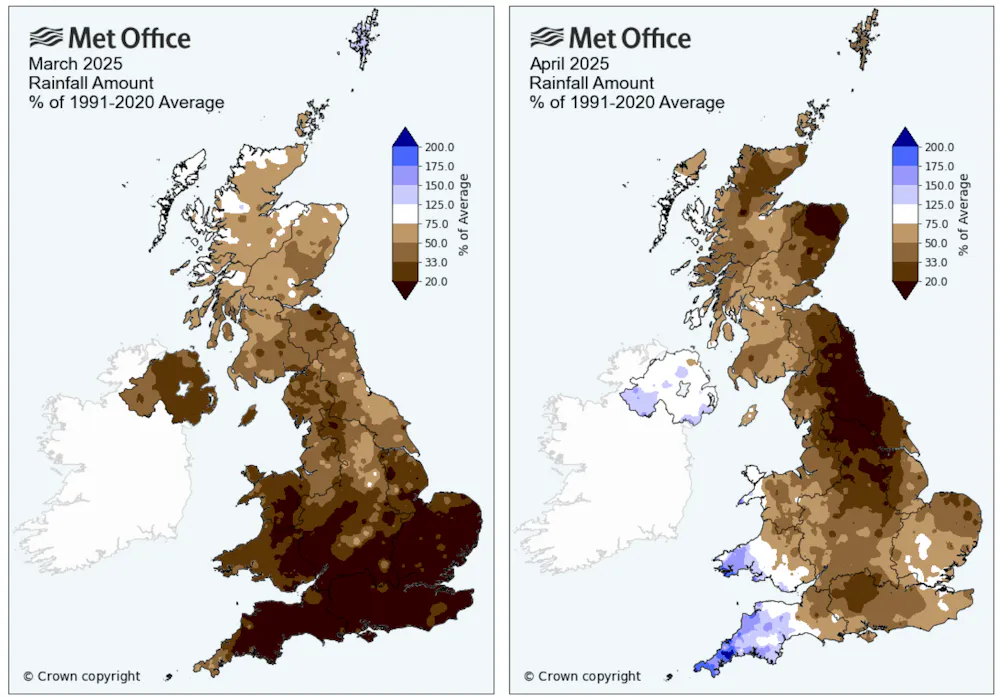
    Meteorologists are warning of the potential for a summer drought, as the UK has seen roughly half its usual amount of rainfall for March and April. While farmers fret about this year’s harvest, some water companies are urging customers to help reservoir levels recover by limiting water use.

    Meanwhile, wildfires have engulfed forest and moorland in areas of Scotland, Wales and England.

    Most of the UK has experienced a record-dry spring so far.
    Met Office

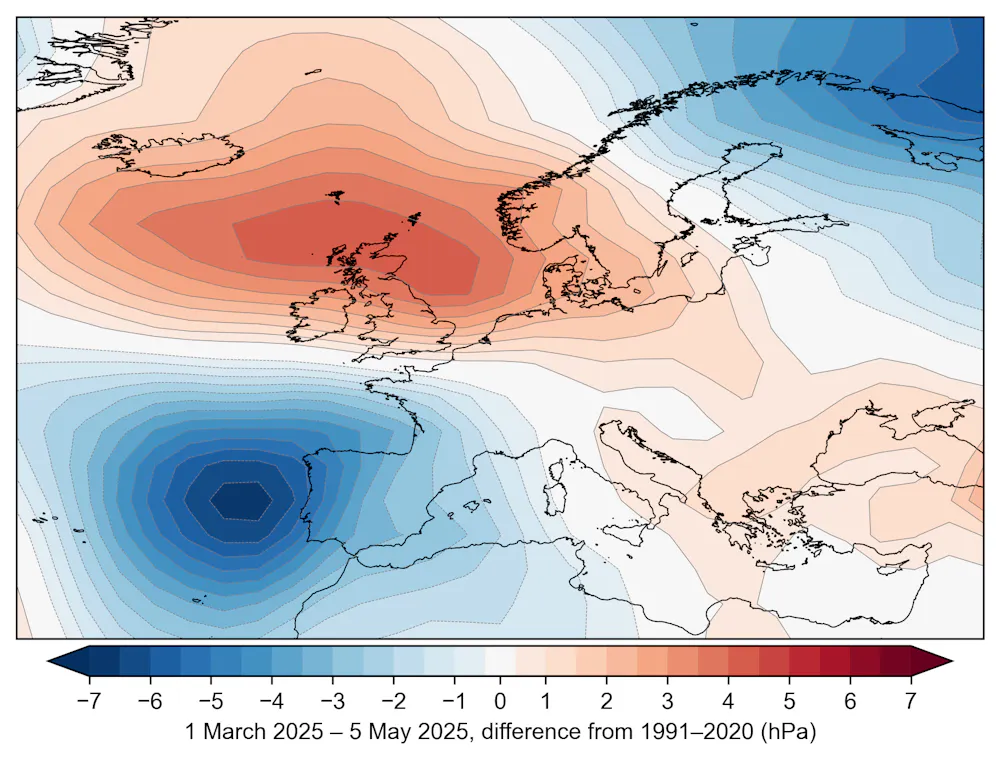
    For several weeks, a stubborn area of high pressure over the UK has diverted the usual flow of mild, moist air from the North Atlantic like a boulder in a river. This is known as a blocking weather system.

    Within it, air descends, warms and dries, which is why this weather pattern tends to be linked to heatwaves and drought. Blocking is usually persistent, making it seem like the weather is stuck.

    Here’s how climate change may have played a role in setting up this unusual spring.


    Get your news from actual experts, straight to your inbox. Sign up to our daily newsletter to receive all The Conversation UK’s latest coverage of news and research, from politics and business to the arts and sciences. Join The Conversation for free today.


    The human fingerprint

    The warming climate means that unusually warm weather is occurring more often and becoming more intense. At the same time, we can expect more periods of both severe drought and extreme rainfall. Sudden changes from drought to deluge, termed “weather whiplash”, are due to the intensification of the water cycle in a warmer atmosphere that can hold more water vapour.

    However, certain weather patterns are necessary to produce extreme weather. More blocking events in future could increase the chance of heatwaves or drought. But are blocking weather patterns becoming more common?

    It’s difficult to determine how weather patterns will change as a result of the rising concentration of greenhouse gases in the atmosphere, which is predominantly caused by the burning of fossil fuels.

    Part of the difficulty arises from the fact that weather patterns vary year to year. Several years in a row with more blocking events than usual could make it seem like blocking is increasing due to climate change, but it could simply be down to chance.

    As a result, it is difficult to detect the fingerprint of human activity from weather observations alone. For example, blocking weather patterns over Greenland during summer have happened more often in recent decades, which can enhance the melting of the ice sheet. But it isn’t clear that this trend is the result of human-induced climate change.

    Climate models do suggest future changes in the occurrence of blocking, however. These computer simulations, consisting of equations that describe the fundamental physics of the atmosphere, are the main tool scientists use to perform experiments that parse how the climate will behave in future.

    The blocking system is visible in the area of high pressure over Britain and Ireland.
    National Centers for Environmental Prediction/National Center for Atmospheric Research/NOAA Physical Sciences Laboratory, CC BY

    When scientists run climate model simulations with increased greenhouse gas concentrations the results consistently show a decrease in blocking events. But blocking generally happens more often in real life than model simulations, which reduces the confidence scientists have in future projections.

    Keeping track of the jet stream

    The movement of weather systems in Earth’s mid-latitudes – including over the UK – is linked to the jet stream, which is a fast-flowing river of air driven by the contrast in temperature between the poles and mid-latitudes.

    Some researchers have suggested that, because the Arctic is warming faster than the tropics, the jet stream may weaken and become more “wavy”, increasing the occurrence of blocking events, contrary to what most climate models show.

    Outside of the scientific community, this idea has become popular. However, the hypothesis remains controversial among scientists, and observational evidence has weakened in recent years.

    In fact, tens of kilometres above the Earth’s surface, near commercial aircraft cruising altitudes, the opposite trends are occurring: the temperature difference between the Arctic and mid-latitudes is increasing, acting to increase the strength of the jet stream.

    There are considerable challenges with understanding how climate change is affecting the large-scale atmospheric patterns which drive the weather we experience. These include large natural variability and imperfect climate models. Models mostly suggest a decline in blocking events with climate change, though this remains relatively uncertain compared with other aspects of the science.

    Overall, we can be confident that climate change is bringing warmer conditions in all seasons. Scientists also have strong evidence to suggest that drought conditions will become more common. These changes are already affecting food production, energy generation and water availability and these impacts will continue to worsen with climate change.


    Don’t have time to read about climate change as much as you’d like?

    Get a weekly roundup in your inbox instead. Every Wednesday, The Conversation’s environment editor writes Imagine, a short email that goes a little deeper into just one climate issue. Join the 45,000+ readers who’ve subscribed so far.


    Simon H. Lee has received funding from the Natural Environment Research Council and the National Science Foundation.

    Matthew Patterson receives funding from the Natural Environment Research Council in the UK via the the National Centre for Atmospheric Science.

    ref. How the weather got ‘stuck’ over the UK – and produced an unusually dry and warm spring – https://theconversation.com/how-the-weather-got-stuck-over-the-uk-and-produced-an-unusually-dry-and-warm-spring-255987

    MIL OSI – Global Reports

  • MIL-OSI Global: The Climate Fiction Prize 2025: the five shortlisted books reviewed by our experts

    Source: The Conversation – UK – By Louisa Egbunike, Associate Professor in African Literature, Durham University

    Five novels have been shortlisted for the 2025 Climate Fiction Prize. Our academics review the finalists ahead of the announcement of the winner on May 14.

    And So I Roar by Abi Daré

    Abi Daré’s poignant second novel, And So I Roar, charts the parallel stories of Tia, an environmental advocate, and Adunni, a Nigerian teenager first introduced in The Girl with the Louding Voice (2020).

    Now under Tia’s care in Lagos, Adunni has escaped child marriage and domestic abuse.

    When she returns to her village, Ikati, where she and other girls are blamed for the drought and face the threat of violence, the novel unravels long-held secrets. Daré masterfully explores how environmental crises intersect with gendered violence, showing how impoverished women disproportionately bear the burden of climate change.

    And So I Roar highlights intergenerational, inter-ethnic and cross-class solidarity, celebrating the courage of women and girls who defy society’s expectations. It is a powerful testament to resilience, as women and girls confront injustice and find the strength to lift their voices and, finally, roar.

    By Louisa Uchum Egbunike, associate professor in African literature

    The Morningside by Téa Obreht

    Obreht’s The Morningside is a quietly dazzling piece of climate fiction – more adjacent to our world than removed from it, and all the more unsettling for it.

    Set in Island City, a place marked by an unnamed tragedy, the novel centres on Sil, an 11-year-old girl who moves into the Morningside apartment complex with her mother.

    Both are climate refugees, though the novel wears this reality lightly – what matters more are the small acts of home-making, the search for belonging and the ghosts that travel with them. Magical realism is deftly handled here, interlaced with hints of folklore that feel entirely plausible within the book’s fragile ecology.

    The Morningside is deeply readable – generous, tender and brimming with quiet unease. It never tips into bleakness, but its warnings are clear enough. “The things you had, the things you saw,” Sil’s mother tells us, “will probably be gone by the time [your children are] born.”

    By Sam Illingworth, professor of creative pedagogies

    Briefly Very Beautiful by Roz Dineen

    Roz Dineen’s Briefly Very Beautiful immerses readers in a world that both is and is not a familiar fiction. Crisply written, in direct, unfussy prose, it is, at one level, a story of a woman, Cass, trying to protect her children as her relationship unravels.

    At the same time, a parallel social collapse triggered by climate change puts the ordinary in an extraordinary frame.

    Much of the effect of this novel comes from Cass’s utterly believable responses to what is taking place around her, her almost peripheral awareness of other people fleeing the city, her own craving for fresh air “like she’d craved things in pregnancy, with a scary gorging hunger”.

    Briefly Very Beautiful is a novel brave enough to recognise that there is no simple, heroic response to some situations. That sometimes, the determination to live an ordinary life is the truly heroic course of action.

    By Christopher Morash, professor of Irish writing

    Orbital by Samantha Harvey

    Samantha Harvey’s Orbital skilfully exposes the human cost of space flight, set against the urgency of the climate crisis. While a typhoon of life-threatening proportions gathers across south-east Asia, six cosmonauts hurtle around Earth on the International Space Station.

    Their everyday routine of tasteless food and laboratory work is in stark contrast to the awesome spectacle of the blue planet, oscillating between night and day, dark and light, where international borders are meaningless.

    While they teach laboratory mice to orient themselves in micro-gravity, they rigorously document their own bodily functions to satisfy some “grand abstract dream of interplanetary life” away from “the planet held hostage by humans, a gun to its vitals”. These are humans, Harvey tells us, “with a godly view that’s the blessing and also the curse”. Harvey has written a novel for the end of the world as we know it. The hope it offers is that we might learn to know it differently.

    By Debra Benita Shaw, reader in cultural theory

    The Ministry of Time by Kaliane Bradley

    The best novels defy easy categorisation, and The Ministry of Time covers many genres: climate fiction, sci-fi, speculative fiction, romance, action.

    It tells the story of a female civil servant who is a handler for one of five people plucked from history before their death. It was fun to imagine how today’s world would be perceived from various perspectives, including a zesty young lesbian woman from the 17th century, a shy young lieutenant from the first world war and a 19th-century naval officer.

    The story adopts the usual dystopian tropes of a world that has destroyed itself through greed, power-seeking and over-indulgence. In the final plea to the reader not to let this terrible future unfold, the assumption is that if we’re scared enough, we’ll all give up red meat, stop flying and campaign for climate policies.

    My research, and psychological studies of fear caution us that the response is just as likely to be voting for far-right leaders, marginalisation of innocent victims, and buying up all the toilet rolls. I loved this book, but to inspire greener behaviour, showing visions of what a sustainable society might look like if we did things right would be a welcome change.

    By Denise Baden, professor of sustainable business


    Looking for something good? Cut through the noise with a carefully curated selection of the latest releases, live events and exhibitions, straight to your inbox every fortnight, on Fridays. Sign up here.


    The authors do not work for, consult, own shares in or receive funding from any company or organisation that would benefit from this article, and have disclosed no relevant affiliations beyond their academic appointment.

    ref. The Climate Fiction Prize 2025: the five shortlisted books reviewed by our experts – https://theconversation.com/the-climate-fiction-prize-2025-the-five-shortlisted-books-reviewed-by-our-experts-253056

    MIL OSI – Global Reports

  • MIL-OSI United Kingdom: Plymouth recognised after incredible tree planting winter

    Source: City of Plymouth

    Plymouth has been recognised as a Tree City of the World on back of another exceptional planting season this winter.

    Since November 2024, thanks in part to a huge new partnership effort, there are over 35,000 new trees growing and establishing across the city.

    In the city, Council teams have helped to plant over 5,700 new trees of all shapes, species and sizes all over the city to further enhance the successful legacy of the Plymouth and South Devon Community Forest.

    Meanwhile, in addition to the trees planted in and around the city, Council and Community Forest teams assisted with the planting of a vast new 30,000-strong forest on MOD land near Ernesettle.

    Be it parks and open spaces, road verges, residential streets or in school grounds, Council teams have been busy delivering a positive impact for people and nature across the city.

    Extra specially, this year a massive 658 standard and fruit trees have been established. Standards are large trees that at the time of planting are already six to ten feet tall with this year’s number nearly double that of 2024.

    On top of the standards, a further 5,102 whips have been planted as hedgerows and high-density planting areas which will become the wildlife corridors, edible hedgerows, and wooded areas of the future.

    Over the course of the season teams have engaged with hundreds of people of all ages through various community events and groups including Plymouth Tree People, Headway, Societree, and the Hoe Gardening Group, as well as through partnerships with landowners like Plymouth Community Homes and the Learning Academy Trust.

    The successful season, plus ongoing work behind the scenes, has led to Plymouth being awarded the coveted status as an official Tree City of the World.

    Tree Cities of the World programme is an international effort to recognise cities and towns committed to ensuring that their urban forests and trees are properly maintained, sustainably managed, and celebrated.

    2024-2025 Planting Season in Numbers

    5,727 planted across the city

    658 standards and fruit trees

    5,102 whips planted as hedgerows and high density areas

    30,000 planted in partnership with the MOD on land near Ernesettle RNAD

    21 sites planted, 6 of which were not on PCC owned land

    11 sites delivered through successful Trees for Climate grant applications

    246 active community volunteers on planting days over 13 sites

    40+ species of tree planted, 30+ of which are native

    45+ varieties of fruit tree planted, creating five new community orchards

    The status is awarded when a city can demonstrated having; policies for tree management; an inventory to determine what trees it has; a budget to care for those trees; a group dedicated to the care of those trees; and an annual celebration of its trees.

    Plymouth was awarded the status after a joint bid between Plymouth and South Devon Community Forest, the Council and local charity Plymouth Tree People, in recognition of the innovative approach to bring our community forest to life.

    Councillor Tom Briars-Delve, Cabinet Member for the Environment and Climate Change, said: “Another year, another incredible amount of trees planted across our beautiful city. Just marvellous.

    “Then to be become a Tree Cities of World is a real honour for our city.

    “Since taking control in 2023, this administration has championed tree planting and the natural environment so this international recognition as a leading tree city, achieved thanks to positive collaborations with local community groups, shows just how far we’ve come.”

    Penny Tarrant, Chair of Plymouth Tree People, said: “We are delighted to have worked in partnership to achieve this accolade for Plymouth. It demonstrates the commitment to and the value in working together.

    “As a local charity, our core work is to Plant, Care and Learn. As partners we have played our part in planting many street trees across the city, caring for trees via our broad Tree Warden network and in teaching about and celebrating trees through the Plymouth Urban Tree Festival, between 11 and 18 May.”

    The prolific 2024-25 planting season means that that over 17,500 trees have been planted across more than 120 sites since 2021, when the Plymouth and South Devon Community Forest was first launched.

    The Defra funded Community Forest project boundary stretches from the South Devon coast, across Plymouth and right across to the rolling landscape of Dartmoor National Park.

    By April 2026 a further 300 hectares will be planted creating a mosaic of orchards, hedgerows, areas of natural regeneration, native broadleaf, and productive woodland.

    Unlike traditional forests, the community forest isn’t geographically restricted to one place. Instead, it encompasses a wide variety of planting styles from community accessible woodland, private woodland, highway verge planting, urban wooded areas , habitat corridors and hedgerows contributing the wider England’s Communty Forests.

    Find out more about Community Forest and how to get involved at https://psdcf.com

    To contribute to the consultation on the Community Forest Plan please visit https://plymouth-consult.objective.co.uk/kse/event/38334

    MIL OSI United Kingdom

  • MIL-OSI USA: Assessing the Global Climate in April 2025

    Source: US National Oceanographic Data Center

    April Highlights:

    • Temperatures were above normal across most land and ocean areas in April.
    • Preliminary data suggest that global average precipitation in April was record low.
    • Northern Hemisphere snow cover extent tied for lowest on record for the month.
    • Sea ice extent was below average around both poles.
    • Global tropical storm activity was near-normal with four named storms.
    Map of global selected significant climate anomalies and events in April 2025.

    Temperature

    Temperatures were above normal across much of the globe in April. Asia and the Arctic stood out in this regard, though western Antarctica was also warmer than normal, and most of the ocean surface was much above average. A few areas were below normal, such as northern Australia, southern South America and eastern Antarctica, as well as the Norwegian, Greenland and Barents Seas. 

    For the globe as a whole, April 2025 was 2.20°F (1.22°C) above the 20th-century baseline. This is 0.13°F (0.07°C) below the record-warm April of 2024, thus ranking second in the 1850–2025 period. According to NCEI’s Global Annual Temperature Outlook, there is only a 3% chance that 2025 will rank as the warmest year on record.

    Surface Temperature Departure from the 1991–2020 Average for April 2025 (°C). Red indicates warmer than average and blue indicates colder than average.

    Precipitation

    Large areas in central Asia and southern Africa received record-setting precipitation in April.  Parts of northern Australia also experienced abnormally high precipitation. Heavy rainfall during the month caused floods and landslides in Brazil and Congo as well as flooding in western Somalia. Despite these extreme events, the globe as a whole was much drier than the long-term average. In fact, preliminary data indicate that April 2025 might have been the driest April in the historical record, which spans from 1979 to present.

    Percent of Normal Precipitation from the 1961–1990 base period for April 2025. Brown indicates drier than average and green indicates wetter than average.

    Snow Cover

    The Northern Hemisphere snow cover extent in April was 820,000 square miles below average, tying with 2024 as the smallest April snow cover extent on record. Snow cover over North America and Greenland was below average (by 120,000 square miles), and Eurasia was also below average (by 710,000 square miles). A lack of snow cover was particularly obvious over the United States and central Eurasia.


    Sea Ice

    Global sea ice extent was 480,000 square miles below the 1991–2020 average, ranking in the lowest third of the historical record. Arctic sea ice extent was below average (by 160,000 square miles), with the Barents, Okhotsk, Bering and Labrador Seas having lower-than-normal ice extent. Antarctic extent was also below average (by 320,000 square miles), though extent was above normal in some areas (such as the Weddell and Amundsen Seas).

    Map of the Arctic (left) and Antarctic (right) sea ice extent in April 2025.

    Tropical Cyclones

    Four named storms occurred across the globe in April, which matches the long-term average. Most notable among these was Severe Tropical Cyclone Courtney in the southwestern Indian Ocean. Two other storms occurred in the Australian region, along with one in the southwest Pacific.


    For a more complete summary of climate conditions and events, see our April 2025 Global Climate Report or explore our Climate at a Glance Global Time Series.

    MIL OSI USA News

  • MIL-OSI Global: What causes inequality in African countries? New book traces a vicious cycle

    Source: The Conversation – Africa – By Murray Leibbrandt, UCT Chair in Poverty and Inequality Research; Director of ARUA’s African Centre of Excellence for Inequality Resaearch with the Southern Africa Labour and Development Research Unit., University of Cape Town

    Inequality is a problem that exists in various forms in sub-Saharan Africa.

    Inequality is created by, among other factors, where you are born and live. Alongside this, income, assets, and access to education and healthcare differ among and between populations. These inequalities reinforce each other. The result is persistent poverty, lack of social mobility across generations, increased exposure to climate change, and a lack of inclusive economic growth.

    Our recently published book Inequalities in Sub-Saharan Africa: Multidimensional Perspectives and Future Challenges presents an overview of the current situation. It identifies the key dimensions, challenges and causes of inequalities in the region. The book also proposes some solutions for equitable and sustainable development. These include progressive taxation and policies that address inequalities at their roots.

    The impact of inequality

    Migration: On a global scale, the greatest determinant of individual incomes – and thus of inequalities between individuals – is place of birth. More than half of income’s variability is explained by the country of residence and by the given circumstances at birth. These include being born in a rural environment.

    In sub-Saharan Africa, especially in low-income countries, internal migration remains the most prevalent migration pattern. Migration is often the chosen route for people seeking to escape poverty. The rural exodus that characterises many countries in sub-Saharan Africa illustrates this well. Young people in Africa, faced with high unemployment rates, often see migration as the only opportunity for social mobility.

    The dynamics of international migration are more complex. Given the high costs involved, international migration concerns only 2.5% of the population in sub-Saharan Africa. This is mostly intra-continental.

    Labour market: Access to the labour market remains the main
    determinant of inequalities in sub-Saharan Africa.

    Labour markets in the region are characterised by high proportions of informal employment. Formal sectors are relatively small (about 15% of total employment on the continent). Since the turn of the century, countries like Kenya have seen their share of informal employment increase significantly (from 73% in 2001 to 83% in 2017). At the same time formal wage employment has declined.

    This amplifies inequality because the informal sector is characterised by a lack of protection and high vulnerability. But not all informal activities are precarious. Some serve as springboards into formal jobs.

    In the formal sector, wage inequality in Africa is among the highest in the world.
    In South Africa, workers in high-skilled jobs earn nearly five times more than those in low-skilled jobs.

    Young people entering the labour market have much higher unemployment rates and little chance of regular employment.

    Gender inequality: Many gender inequalities persist, particularly access to the labour market. Unpaid care work makes women’s work invisible. In many African countries, women and girls spend more time on unpaid care which limits their economic opportunities.

    These inequalities are reinforced by inequalities in access to resources. About 38% of African women report owning land, compared to 51% of African men.

    Climate change: Africa is suffering the most severe impacts – droughts, floods and food insecurity – while contributing less than 5% of global carbon emissions.

    Arid conditions affect 43.5% of agricultural land in sub-Saharan Africa compared to an estimated global average of 29%. Similarly, climate change mitigation costs, such as finding alternatives to hydroelectric power, are higher for low-income countries.

    In sub-Saharan Africa, the richest 10% emit seven times more tonnes of carbon dioxide than the poorest 50%. Disadvantaged groups are more vulnerable to adverse climate effects as their housing and wealth are more likely to be damaged by storms and floods.

    Skewed economic growth benefits: Economic growth has led to notably lower reductions in poverty in African countries than elsewhere. Unequal distribution of growth and its capture by those at the top of the income distribution ladder are evidence of non-inclusive economic growth. The richest 1% of Africans received 27% of the total revenue from growth on the continent.

    What needs to be done

    It is vital to give priority to promoting social and economic inclusion in the development strategies of African countries. Importantly, multidimensional inequalities such as income and health persist because they reinforce each other. Tackling them therefore requires coordinated and coherent policies.

    Murray Leibbrandt receives funding from the National Research Foundation of South Africa, the Agence Française de Développement, UK Research and Innovation, the World Institute for Development Economics Research and the International Inequalities Institute of the London School of Economics. He is affiliated with the United Nations University’s World Institute for Development Economics Research and the Jackson School of Global Affairs at Yale University.

    Anda David, Rawane Yasser, and Vimal Ranchhod do not work for, consult, own shares in or receive funding from any company or organisation that would benefit from this article, and have disclosed no relevant affiliations beyond their academic appointment.

    ref. What causes inequality in African countries? New book traces a vicious cycle – https://theconversation.com/what-causes-inequality-in-african-countries-new-book-traces-a-vicious-cycle-253376

    MIL OSI – Global Reports

  • MIL-OSI Africa: What causes inequality in African countries? New book traces a vicious cycle

    Source: The Conversation – Africa – By Murray Leibbrandt, UCT Chair in Poverty and Inequality Research; Director of ARUA’s African Centre of Excellence for Inequality Resaearch with the Southern Africa Labour and Development Research Unit., University of Cape Town

    Inequality is a problem that exists in various forms in sub-Saharan Africa.

    Inequality is created by, among other factors, where you are born and live. Alongside this, income, assets, and access to education and healthcare differ among and between populations. These inequalities reinforce each other. The result is persistent poverty, lack of social mobility across generations, increased exposure to climate change, and a lack of inclusive economic growth.

    Our recently published book Inequalities in Sub-Saharan Africa: Multidimensional Perspectives and Future Challenges presents an overview of the current situation. It identifies the key dimensions, challenges and causes of inequalities in the region. The book also proposes some solutions for equitable and sustainable development. These include progressive taxation and policies that address inequalities at their roots.

    The impact of inequality

    Migration: On a global scale, the greatest determinant of individual incomes – and thus of inequalities between individuals – is place of birth. More than half of income’s variability is explained by the country of residence and by the given circumstances at birth. These include being born in a rural environment.

    In sub-Saharan Africa, especially in low-income countries, internal migration remains the most prevalent migration pattern. Migration is often the chosen route for people seeking to escape poverty. The rural exodus that characterises many countries in sub-Saharan Africa illustrates this well. Young people in Africa, faced with high unemployment rates, often see migration as the only opportunity for social mobility.

    The dynamics of international migration are more complex. Given the high costs involved, international migration concerns only 2.5% of the population in sub-Saharan Africa. This is mostly intra-continental.

    Labour market: Access to the labour market remains the main determinant of inequalities in sub-Saharan Africa.

    Labour markets in the region are characterised by high proportions of informal employment. Formal sectors are relatively small (about 15% of total employment on the continent). Since the turn of the century, countries like Kenya have seen their share of informal employment increase significantly (from 73% in 2001 to 83% in 2017). At the same time formal wage employment has declined.

    This amplifies inequality because the informal sector is characterised by a lack of protection and high vulnerability. But not all informal activities are precarious. Some serve as springboards into formal jobs.

    In the formal sector, wage inequality in Africa is among the highest in the world. In South Africa, workers in high-skilled jobs earn nearly five times more than those in low-skilled jobs.

    Young people entering the labour market have much higher unemployment rates and little chance of regular employment.

    Gender inequality: Many gender inequalities persist, particularly access to the labour market. Unpaid care work makes women’s work invisible. In many African countries, women and girls spend more time on unpaid care which limits their economic opportunities.

    These inequalities are reinforced by inequalities in access to resources. About 38% of African women report owning land, compared to 51% of African men.

    Climate change: Africa is suffering the most severe impacts – droughts, floods and food insecurity – while contributing less than 5% of global carbon emissions.

    Arid conditions affect 43.5% of agricultural land in sub-Saharan Africa compared to an estimated global average of 29%. Similarly, climate change mitigation costs, such as finding alternatives to hydroelectric power, are higher for low-income countries.

    In sub-Saharan Africa, the richest 10% emit seven times more tonnes of carbon dioxide than the poorest 50%. Disadvantaged groups are more vulnerable to adverse climate effects as their housing and wealth are more likely to be damaged by storms and floods.

    Skewed economic growth benefits: Economic growth has led to notably lower reductions in poverty in African countries than elsewhere. Unequal distribution of growth and its capture by those at the top of the income distribution ladder are evidence of non-inclusive economic growth. The richest 1% of Africans received 27% of the total revenue from growth on the continent.

    What needs to be done

    It is vital to give priority to promoting social and economic inclusion in the development strategies of African countries. Importantly, multidimensional inequalities such as income and health persist because they reinforce each other. Tackling them therefore requires coordinated and coherent policies.

    – What causes inequality in African countries? New book traces a vicious cycle
    – https://theconversation.com/what-causes-inequality-in-african-countries-new-book-traces-a-vicious-cycle-253376

    MIL OSI Africa

  • MIL-OSI: Federal Home Loan Bank of Atlanta Issues Impact and Affordable Housing Advisory Council Report

    Source: GlobeNewswire (MIL-OSI)

    ATLANTA, May 12, 2025 (GLOBE NEWSWIRE) — Federal Home Loan Bank of Atlanta (FHLBank Atlanta) released its Impact and Affordable Housing Advisory Council (AHAC) Report, describing the organization’s highest year of funding to date for affordable housing and community development. The report also outlines the widespread reach of FHLBank Atlanta’s lending products for member institutions and the community investment programs positively impacting its district in 2024.  

    “We are proud of our work to provide nearly 800 financial institutions with access to funding to support local lending for small businesses, mortgages, and community development projects,” said Kirk Malmberg, president and CEO of FHLBank Atlanta. “Additionally, each year we work with members to ensure we offer affordable housing grant programs that address current needs. For 2024, this resulted in the introduction of Workforce Housing Plus+, a new initiative to provide downpayment assistance to a broader population of borrowers challenged by the rising cost of homes and high interest rates.”

    In total, FHLBank Atlanta contributed a record $120 million in grants for affordable housing and community development in 2024. Additional highlights of the report include:

    • $55 million distributed through the Affordable Housing Program (AHP) General Fund, supporting 66 projects that will create or rehabilitate more than 4,200 affordable housing units
    • $40 million distributed through the AHP Homeownership Set-aside Program, providing homeownership grants to more than 3,000 households for downpayment, closing cost, and home rehabilitation assistance
    • $20 million distributed through the Workforce Housing Plus+ program, providing downpayment and closing cost assistance to more than 1,300 households
    • $5.9 million in total allocated to 21 organizations addressing heirs’ property issues to help more than 5,000 families protect their assets and build generational wealth
    • $1 billion in Community Investment Program advances to support housing and economic development
    • $250,000 donated to the American Red Cross for recovery efforts following Hurricane Helene
    • 48 forums attended to promote financial literacy and homeownership knowledge sharing across the FHLBank Atlanta district

    The report also highlights FHLBank Atlanta’s culture of giving back, including its ongoing Community Involvement program and volunteerism efforts.

    “FHLBank Atlanta continues to remain a reliable source of lending for members, allowing us to deliver on our purpose of earning trust, building relationships, and bettering lives,” said Tomeka Strickland, senior vice president and director of community investment services of FHLBank Atlanta. “The record amount of grant funding we distributed last year is a direct reflection of our collaboration with members and commitment to our communities, and we look forward to strengthening these partnerships in 2025 to continue investing in the neighborhoods our members serve.”

    About Federal Home Loan Bank of Atlanta
    FHLBank Atlanta offers competitively-priced financing, community development grants, and other banking services to help member financial institutions make affordable home mortgages and provide economic development credit to neighborhoods and communities. The Bank is a cooperative whose members are commercial banks, credit unions, savings institutions, community development financial institutions, and insurance companies located in Alabama, Florida, Georgia, Maryland, North Carolina, South Carolina, Virginia, and the District of Columbia. FHLBank Atlanta is one of 11 district banks in the Federal Home Loan Bank System (FHLBank System). Since 1990, the FHLBanks have awarded approximately $9.1 billion in Affordable Housing Program funds, assisting more than 1.2 million households. 
    For more information, visit our website at www.fhlbatl.com.

    Contact: Sheryl Touchton
    Federal Home Loan Bank of Atlanta
    stouchton@fhlbatl.com

    The MIL Network

  • MIL-OSI Global: Population explosions and declines are related to the stability of the economy and the environment

    Source: The Conversation – Canada – By Ken G. Drouillard, Professor, Great Lakes Institute for Environmental Research and Director of the School of the Environment, University of Windsor

    A country’s population is affected by, and in turn affects, environmental and economic issues. (Shutterstock)

    For 200 years, we’ve been warned of unchecked population growth and how it leads to environmental instability. On the other hand, today some countries face decreasing populations, alongside increasing proportions of elderly people, causing economic instability.

    These two facets of population crises — explosions and declines — are occurring in different parts of the world, and have a global impact on the environment and on economies. Discussions about achieving economic and environmental sustainability must consider population changes, technology and the environment, given these concepts are closely interwoven.

    Population explosions and declines are related to both environmental and economic instability; some countries make reactionary choices that trade off short-term domestic economic progress over the environment.

    The crisis of population explosions

    In 1798, English economist Thomas Malthus warned of a population explosion, inferring that population growth will outstrip agricultural production. Malthus’s ideas became re-popularized by American scientist Paul R. Ehrlich in his book published at the height of population growth in the 1960s. Both predicted that a population explosion would cause shortages in resources and escalating environmental damage.

    Like Malthus, Ehrlich was criticized for a crisis “that never happened” because human ingenuity, a byproduct of population, overcomes the worst fears of environmentalists. This counter-argument relies on technological advances making more efficient use of resources while lowering the environmental impacts.

    This is best exemplified by efficiency gains of agriculture that have continued to feed a growing world. Ehrlich’s predictions of cumulative environmental damage are best illustrated by the growing intensity of climate change and species loss as the global population continues to grow even though the current growth rate is slower than it was in the 1960s.

    A graph reflecting how population growth, species diversity and global temperature correlate over time.
    (K. Drouillard), CC BY

    Unified growth theory describes how economies change over the long term. It starts with a period of slow technological progress, low income growth and high population growth. Over time, these conditions give way to a modern growth phase, where technology improves quickly, income rises steadily and population growth slows as societies go through a demographic transition towards stable population sizes.

    Technological progress positively contributes to national economies over the long term. However, early adoption of green technology often relies on finance and government incentives that may imply short-term economic burdens. Yet when green technology is implemented and coupled to slowing population growth, it leads to decreasing national environmental footprints that pave a way towards joint environmental and economic sustainability.

    The crisis of population declines

    Declining populations cause inverted age pyramids with larger numbers of elderly people. These shifting demographics cause economic instability. They also constrain technological progress and social security.

    Population declines work against the gains described by unified growth theory. Presently, 63 countries have reached their peak population and 48 more are expected to peak within 30 years. Fears of population decline are also being forecast at the global scale.

    The global population is predicted to peak between the mid-2060s to 2100, stabilizing at 10.2 billion from its present 8.2 billion.

    In their book, Empty Planet, political scientist Darrell Bricker and political commentator John Ibbitson warn that zero population growth will happen even faster. They argue once a country decreases its fertility to below replacement (2.1 children per woman), the social reinforcements of increasing urbanization, costs of raising children and increased empowerment over family planning make it almost impossible to increase the birth rate.

    For highly affluent countries, the per capita GDP is decreasing as the proportion of elderly in the population increases. Although this pattern doesn’t hold when less affluent countries are added, the figure demonstrates tangible economic impacts for countries grappling with aging populations.

    A graph showing the percentage of elderly people in a country’s population, correlated with GDP and adjusted for inflation.
    (K. Drouillard), CC BY

    Simultaneous explosions and declines

    Affluent nations facing decline can react to economic instability in ways that counter global economic and environmental sustainability.

    In the past, affluent nations were the drivers of green technology. However, economic instability from population declines can cause reluctance to invest, adopt and share green technology crucial for mitigating environmental damage at the global scale.

    The issue is compounded by the fact that many countries overlook how their own decline in population growth contributes to economic instability. They instead focus on short-term solutions to their economic situation that may include unsustainable resource use.

    Left unaddressed, the real issue of population decline becomes unresolved, allowing social anxieties against immigration and global trade to grow. This can exacerbate the issue halting technology sharing, slowing economic growth and increasing economic inequality and environmental damage.

    The above is exemplified by policies now being implemented by the United States. Where immigration was previously used as a backstop against low fertility, growing cultural backlash to immigration pressures rooted in anxiety about economic uncertainties have generated new policies causing the deportation of millions of immigrants and closing borders. This will most likely accelerate a population decline in the U.S., as highlighted by a Congressional Budget Office report.

    At the same time, the U.S. is shifting its energy policy away from increased shares of renewable, green energy sources back to a focus on fossil fuels that will worsen climate damage.

    Climate damage costs are currently two per cent of global GDP, and may increase to between two to 21 per cent of some countries’ incomes by the end of the century. The growing applications of artificial intelligence (AI) and its high energy use will add to climate damage. AI may also contribute to the economic challenges related to population decline if it replaces, rather than supports, labour.

    Finally, tariff wars add new barriers against green technology sharing.

    Canada’s lowered immigration

    Canada, which already has a low fertility rate and is reacting to the U.S. trade war, has its own challenges. This year, immigration targets were decreased by 19 per cent. The lack of support for and subsequent removal of the carbon tax and possible extension of pipeline infrastructure could generate similar delays in the transition away from fossil fuels.


    Read more:
    Who really killed Canada’s carbon tax? Friends and foes alike


    In the most recent federal election, discussions about environmental policy were largely side-tracked by economic issues.

    Our research indicates that Canada and other affluent nations need to establish longer-term solutions to economic instabilities that mitigate environmental damage while promoting sustainable national and global economies.

    The United Nations Sustainable Development Goals offer pathways for economic, social and environmental sustainability. However, realizing these goals requires society to fully acknowledge the intertwined relationships between population growth, economy, environment and international technology-sharing in ways that transcend short-term national interests and reactionary policies.

    The past decade has seen strong momentum from social and natural sciences as well as international organizations, business and civil society. Unfortunately, the current climate of economic uncertainty is halting this progress — unless the public can force broader discussions about sustainable approaches back into the political sphere.

    Ken G. Drouillard receives funding from Natural Science and Engineering Research Council of Canada (NSERC), Canadian Water Agency, Environment and Climate Change Canada, St. Clair River Conservation Authority and North Shore of Lake Superior Remedial Action Plans.

    Claudio N. Verani receives/has received funding from the U.S. National Science Foundation (NSF), U.S. Department of Energy (DoE), Petroleum Research Fund (ACS-PRF), and the Natural Science and Engineering Research Council of Canada (NSERC).

    Marcelo Arbex has received funding from University of Windsor UW-SSHRC Explore.

    ref. Population explosions and declines are related to the stability of the economy and the environment – https://theconversation.com/population-explosions-and-declines-are-related-to-the-stability-of-the-economy-and-the-environment-253302

    MIL OSI – Global Reports

  • MIL-OSI Global: As US doubles down on fossil fuels, communities will have to adapt to the consequences − yet climate adaptation funding is on the chopping block

    Source: The Conversation – USA – By Bethany Bradley, Professor of Biogeography and Spatial Ecology, UMass Amherst

    Salt marshes protect shorelines, but they’re already struggling to survive sea-level rise. John Greim/LightRocket via Getty Images

    It’s no secret that warming temperatures, wildfires and flash floods are increasingly affecting lives across the United States. With the U.S. government now planning to ramp up fossil fuel use, the risks of these events are likely to become even more pronounced.

    That leaves a big question: Is the nation prepared to adapt to the consequences?

    For many years, federally funded scientists have been developing solutions to help reduce the harm climate change is causing in people’s lives and livelihoods. Yet, as with many other science programs, the White House is proposing to eliminate funding for climate adaptation science in the next federal budget, and reports suggest that the firing of federal climate adaptation scientists may be imminent.

    As researchers and directors of regional Climate Adaptation Science Centers, funded by the U.S. Geological Survey since 2011, we have seen firsthand the work these programs do to protect the nation’s natural resources and their successes in helping states and tribes build resilience to climate risks.

    Here are a few examples of the ways federally funded climate adaptation science conducted by university and federal researchers helps the nation weather the effects of climate change.

    Protecting communities against wildfire risk

    Wildfires have increasingly threatened communities and ecosystems across the U.S., exacerbated by worsening heat waves and drought.

    In the Southwest, researchers with the Climate Adaptation Science Centers are developing forecasting models to identify locations at greatest risk of wildfire at different times of year.

    Knowing where and when fire risks are highest allows communities to take steps to protect themselves, whether by carrying out controlled burns to remove dry vegetation, creating fire breaks to protect homes, managing invasive species that can leave forests more prone to devastating fires, or other measures.

    The solutions are created with forest and wildland managers to ensure projects are viable, effective and tailored to each area. The research is then integrated into best practices for managing wildfires. The researchers also help city planners find the most effective methods to reduce fire risks in wildlands near homes.

    Wildland firefighters and communities have limited resources. They need to know where the greatest risks exist to take preventive measures.
    Ethan Swope/Getty Images

    In Hawaii and the other Pacific islands, adaptation researchers have similarly worked to identify how drought, invasive species and land-use changes contribute to fire risk there. They use these results to create maps of high-risk fire zones to help communities take steps to reduce dry and dead undergrowth that could fuel fires and also plan for recovery after fires.

    Protecting shorelines and fisheries

    In the Northeast, salt marshes line large parts of the coast, providing natural buffers against storms by damping powerful ocean waves that would otherwise erode the shoreline. Their shallow, grassy waters also serve as important breeding grounds for valuable fish.

    However, these marshes are at risk of drowning as sea level rises faster than the sediment can build up.

    As greenhouse gases from burning fossil fuels and from other human activities accumulate in the atmosphere, they trap extra heat near Earth’s surface and in the oceans, raising temperatures. The rising temperatures melt glaciers and also cause thermal expansion of the oceans. Together, those processes are raising global sea level by about 1.3 inches per decade.

    Adaptation researchers with the Climate Adaptation Science Centers have been developing local flood projections for the regions’ unique oceanographic and geophysical conditions to help protect them. Those projections are essential to help natural resource managers and municipalities plan effectively for the future.

    Researchers are also collaborating with local and regional organizations on salt marsh restoration, including assessing how sediment builds up each marsh and creating procedures for restoring and monitoring the marshes.

    Saving salmon in Alaska and the Northwest

    In the Northwest and Alaska, salmon are struggling as temperatures rise in the streams they return to for spawning each year. Warm water can make them sluggish, putting them at greater risk from predators. When temperatures get too high, they can’t survive. Even in large rivers such as the Columbia, salmon are becoming heat stressed more often.

    Adaptation researchers in both regions have been evaluating the effectiveness of fish rescues – temporarily moving salmon into captivity as seasonal streams overheat or dry up due to drought.

    In Alaska, adaptation scientists have built broad partnerships with tribes, nonprofit organizations and government agencies to improve temperature measurements of remote streams, creating an early warning system for fisheries so managers can take steps to help salmon survive.

    Managing invasive species

    Rising temperatures can also expand the range of invasive species, which cost the U.S. economy billions of dollars each year in crop and forest losses and threaten native plants and animals.

    Researchers in the Northeast and Southeast Climate Adaptation Science Centers have been working to identify and prioritize the risks from invasive species that are expanding their ranges. That helps state managers eradicate these emerging threats before they become a problem. These regional invasive species networks have become the go-to source of climate-related scientific information for thousands of invasive species managers.

    The rise in the number of invasive species projected by 2050 is substantial in the Northeast and upper Midwest. Federally funded scientists develop these risk maps and work with local communities to head off invasive species damage.
    Regional Invasive Species and Climate Change Network

    The Northeast is a hot spot for invasive species, particularly for plants that can outcompete native wetland and grassland species and host pathogens that can harm native species.

    Without proactive assessments, invasive species management becomes more difficult. Once the damage has begun, managing invasive species becomes more expensive and less effective.

    Losing the nation’s ability to adapt wisely

    A key part of these projects is the strong working relationships built between scientists and the natural resource managers in state, community, tribal and government agencies who can put this knowledge into practice.

    With climate extremes likely to increase in the coming years, losing adaptation science will leave the United States even more vulnerable to future climate hazards.

    Bethany Bradley receives funding from the US Geological Survey as the University Director of the Northeast Climate Adaptation Science Center.

    Jia Hu has receives funding from the US Geological Survey as the University Director of the Southwest Climate Adaptation Science Center.

    Meade Krosby receives funding from the US Geological Survey as the University Director of the Northwest Climate Adaptation Science Center.

    ref. As US doubles down on fossil fuels, communities will have to adapt to the consequences − yet climate adaptation funding is on the chopping block – https://theconversation.com/as-us-doubles-down-on-fossil-fuels-communities-will-have-to-adapt-to-the-consequences-yet-climate-adaptation-funding-is-on-the-chopping-block-256307

    MIL OSI – Global Reports

  • MIL-OSI United Kingdom: England’s peatlands mapped for first time in major step towards their recovery

    Source: United Kingdom – Executive Government & Departments

    Press release

    England’s peatlands mapped for first time in major step towards their recovery

    England’s most in-depth peatland map shows the extent, depth and condition of our peatlands

    • Scientific first made possible due to satellite imagery, AI and in-depth data analysis showing the extent, depth and condition of our peatlands
    • Data reveals that around 80% of England’s peatlands are in dry and degraded states, but targeted mapping will now help aid their recovery
    • Restoring 55% of peatland would have a value of around £50 billion in reduced carbon emissions alongside benefits for water storage and purification

    Scientists have mapped England’s peatlands to a level of extraordinary detail never achieved before – revealing their worrying, degraded state and need for recovery.

     The England Peat Map launched today (Saturday 10th May) is the most complete map of England’s peatlands and peaty soils to date and one’s of the world’s most comprehensive peat maps in existence. Our peatlands are a critical natural resource providing essential public goods such as carbon sequestration , water purification and storage – helping protect communities from flooding.

    The map models the extent, depth, and important aspects of the condition of our peat, including vegetation, and even shows gullies and man-made and natural drainage channels and has been produced using cutting edge techniques.

    Researchers used AI, satellite data from the European Space Agency, individual data sets from field surveys and modelled to identify the likelihood of peaty soils, and marks a step change in our ability to make decisions about land use and target conservation activities where they’re most needed.

    The map, published alongside key research, shows:

    • Peaty soil covers roughly 8.5% of England’s surface
    • Around 80% of England’s peatlands are in dry and degraded states, making this an area in need of urgent action
    • Around three quarters of our peat is covered by plants and land use types associated with dryer conditions such as heather, while only 1% is covered by important peat forming plants such as sphagnum moss
    • The most extensive peatland habitat is to be found across the Pennines, North York Moors, parts of the Lake District, and in the uplands of the South West.

    The findings present a worrying picture of widely degraded peat from the blanket bog most associated with our northern uplands to the lowland deep peat found most commonly in the fens of the East England.

    Degraded peat also emits carbon, meaning that our peatlands are releasing carbon into the atmosphere and helping drive global heating. Understanding how much peat we have is the first step to calculating how much carbon it holds and how much it’s releasing – vital information as we work together to combat climate change.

    The open source map available today on gov.uk will empower land managers and key decision makers to better understand and restore the nation’s peatland– for example, blocking drainage channels to re-wet the land and support better informed decisions on how to effectively balance biodiversity and carbon storage with food security in some of England’s most fertile farmland.

    Restoring peatland will bring benefits for nature, communities, and the wider economy. Estimates suggest restoring 55% of peatland to near-natural condition will have a value of around £50 billion in reduced carbon emissions, while their value as a source of drinking water and recreation space is worth many hundreds of millions of pounds.

    Natural England’s Chief Scientist Dr Sallie Bailey said:

    Trying to map something that’s largely underground, changes in volume depending whether it’s rained recently, and tries to swallow you up every time you set foot in it comes with its challenges, which makes this map extraordinary in its accomplishment and something of a global first.

    Mapping peat to this level of detail will help us maximise the benefits of peat and massively advances our understanding the role our peatlands are playing in a changing climate.

    Natural England Chair Tony Juniper said:

    The benefits of healthy peatlands are well documented – they are our biggest natural carbon stores, essential to the water cycle, and refuge to some of our rarest plants and wildlife, such as the carnivorous sundew plant, marsh violet, and charismatic birds like golden plover and curlew.

    The England Peat Map will allow us to make far better and more informed decisions when it comes to managing peatlands – targeting restoration efforts to the most degraded peat and identifying the best opportunities for nature recovery.

    Nature Minister Mary Creagh said:

    Our peatlands are this country’s Amazon Rainforest and in desperate need of restoration and protection, as this mapping and research work starkly demonstrates.

    That is why we have announced up to £400m for nature restoration, including of our peatlands, and are consulting on new plans to extend the ban on burning deep peat. This government, as part of our Plan for Change,  are committed to expanding nature-rich habitats and turning the tide on nature’s decline after years of neglect.

    Notes to editors

    • The full peat map can be found here: England Peat Map
    • The accompanying report can be found here: England Peat Map – NERR149
    • The report and map have been funded through Defra’s Natural Capital and Ecosystem Assessment programme (NCEA) and Nature for Climate Fund.

    Updates to this page

    Published 12 May 2025

    MIL OSI United Kingdom

  • MIL-OSI: Enwave Announces Expansion of Energy from Waste District Heating Facility in Prince Edward Island, Avoiding Landfill for Nearly 90% of the Black Cart Residential Waste in Province

    Source: GlobeNewswire (MIL-OSI)

    TORONTO, May 12, 2025 (GLOBE NEWSWIRE) — Enwave Energy Corporation (Enwave) has announced today the commitment to build a new waste processing facility in Prince Edward Island, beginning this fall. The facility will be in operation by 2028 and will replace the existing end-of-life system. Enwave, in partnership with the Province of Prince Edward Island, has proudly undertaken this expansion to address the growing need to identify sustainable waste solutions in the province.

    The existing district energy plant converts municipal solid waste and biomass — scrap wood from forest harvesting operations — to energy and provides that energy to its customers through the interconnected district energy network. After nearly thirty years of operation, the plant is approaching end-of-life and will be replaced with the new, expanded facility. Since 2017, the Province of Prince Edward Island and Enwave have collaborated on this project with a united goal to reduce waste and Greenhouse Gas (GHG) emissions at a time when sustainable waste solutions are needed more than ever.

    This new, state-of-the-art facility is capable of processing 90% of the province’s total black cart residential waste, significantly reducing landfill waste. The expansion of this critical facility will significantly replace the use of fuel oil for heating while providing further reliability and redundancy to more than 145 connected buildings in Charlottetown, the province’s capital city, including the Queen Elizabeth Hospital, the University of Prince Edward Island, schools and residences. Enwave’s district energy system has a proven track record as a reliable and critical source of energy in the province, having maintained uninterrupted operations to critical customers during recent natural phenomena such as hurricanes Juan, Dorian and Fiona, as well as during the hurricane-strength blizzard, White Juan, in 2004.

    Rendering of Enwave’s new waste processing facility in Prince Edward Island, anticipated to be in operation by 2028 to replace the existing end-of-life system.

    Enwave brings more than thirty years of experience in advanced Waste-to-Energy systems to the project, a proven path to avoiding landfill waste and reducing GHG emissions. Through this expansion, the annual impact of avoiding landfill by using up to 49,000 tonnes of municipal solid waste for heating will amount to GHG savings of up to 908,000 tonnes of CO2e by 2052, equivalent to taking 278,000 cars off the road.

    Leveraging Waste-to-Energy technology provides a real solution and tangible option for communities around the country to reduce the need for additional landfills and help to meet carbon emission reduction targets. With global waste forecasted to increase 70% by 2050, this project is a testament to scalable and sustainable pathways that directly address concerns of rising waste.

    “We are very grateful for the support and confidence of the government of PEI and the people of this province, enabling us to make this long-term commitment as a critical energy partner,” says Carlyle Coutinho, CEO of Enwave Energy Corporation. “The eight-year journey to get to this point has seen many hurdles, however both Enwave and the province have remained committed to making this expansion a reality. This project is an example of how governments and private companies can work together to achieve long-term, sustainable solutions at scale through a shared purpose, creating a better world for today and generations to come.”

    “Waste to Energy technology is a great example of a sustainable, innovative solution to meeting PEI’s energy needs,” says PEI Environment, Energy and Climate Action Minister Gilles Arsenault. “This expansion helps us continue to minimize energy costs for important provincial buildings and reduce greenhouse gas emissions. As an added benefit, using this waste for energy helps us extend the life of our existing landfill.”

    Enwave’s expansion of the waste processing facility and operations will nearly double existing waste processing capacity while directly aligning with Charlottetown’s Vision for a Sustainable Energy Future by transitioning to renewable clean energy and incorporating sustainable innovation and technology.

    “The CIB is proud to be a part of this project given the important role it will play in modernizing the city’s district energy system, ensuring affordable and clean energy supply to more than 145 connected buildings in the Charlottetown core,” says Ehren Cory, CEO, Canada Infrastructure Bank.

    The new waste processing facility expansion is supported financially by the Canadian Infrastructure Bank through an aggregate facility of $600M supporting innovative energy projects across Enwave’s portfolio, including Lakeview Village in Mississauga, Ontario (Wastewater Heat Recovery technology), Etobicoke Civic Centre in Toronto (Geo-exchange technology), and this project in PEI (Waste-to-Energy technology).

    Enwave has worked closely alongside key partners that are critical to the success of the PEI expansion project, including Maple Reindeers Constructors Ltd., Marco Group, Ramboll Group A/S, Coles Associates Ltd., Stantec, Martin GmbH, ANDRITZ TEP, LAB SA and Kone Cranes Canada Inc.

    A ceremony announcing the official groundbreaking of the new waste processing facility will take place in the fall of 2025.

    About Enwave

    Enwave is one of the largest commercial owner and operators of community-based district energy systems in North America. They develop reliable, commercial and sustainable energy solutions at scale, tailored to the unique needs of municipalities, commercial developments, universities, hospitals, data centres and residential communities. Enwave provides thermal energy services to over 100 million square feet of mixed-use space across Canada using a variety of technologies including Deep Lake Water Cooling, thermal storage, geoexchange, biomass and energy-from-waste. Enwave was acquired by Ontario Teachers’ Pension Plan & IFM Investors in 2021. Since its founding over 20 years ago, Enwave has invested over $1 billion in Canadian infrastructure.

    https://www.enwave.com

    For more information, interview requests or high-res images please contact:

    Katie Good, GoodPR
    katie@goodpr.ca
    (416) 540-2195

    A photo accompanying this announcement is available at https://www.globenewswire.com/NewsRoom/AttachmentNg/09037f6e-0b81-4106-acf2-051e5ef0ebc3

    The MIL Network

  • MIL-OSI Video: Unlocking Europe’s Potential

    Source: World Economic Forum (video statements)

    Two recent landmark reports on the European Union’s economy paint an unforgiving picture of its vulnerabilities, suggesting the region faces the prospect of “slow agony”. At current productivity and demographic trends, Europe’s economic output is forecast to be the same in 2050 as it is today. With much of the power to correct course residing in national capitals, what will it take for leaders to rise to the challenge?

    This is the full audio from a session at the Forum’s Annual Meeting on 22 January, 2025. Watch it here: https://www.youtube.com/watch?v=VqghCwdxqHo

    Speakers: Nicolas Hieronimus, Chief Executive Officer, L’Oréal

    Roula Khalaf, Editor, Financial Times

    Robert Habeck, Vice-Chancellor and Federal Minister for Economic Affairs and Climate Action,

    Federal Ministry for Economic Affairs and Climate Action of Germany

    Belen Garijo, Chair of the Executive Board and Chief Executive Officer, Merck

    Christine Lagarde, President, European Central Bank

    Check out all our podcasts on wef.ch/podcasts (http://wef.ch/podcasts) : 

    YouTube: (https://www.youtube.com/@wef/podcasts) – https://www.youtube.com/@wef/podcasts

    Radio Davos (https://www.weforum.org/podcasts/radio-davos) – subscribe (https://pod.link/1504682164) : https://pod.link/1504682164

    Meet the Leader (https://www.weforum.org/podcasts/meet-the-leader) – subscribe (https://pod.link/1534915560) : https://pod.link/1534915560

    Agenda Dialogues (https://www.weforum.org/podcasts/agenda-dialogues) – subscribe (https://pod.link/1574956552) : https://pod.link/1574956552

    Join the World Economic Forum Podcast Club (https://www.facebook.com/groups/wefpodcastclub) : https://www.facebook.com/groups/wefpodcastclub

    https://www.youtube.com/watch?v=LCAQca-y5v8

    MIL OSI Video

  • COP30 Brazilian presidency calls for new global climate governance

    Source: Government of India (4)

    The Brazilian presidency of COP30, this year’s climate summit, called for new global climate governance mechanisms to help nations implement their commitments to curb global warming, according to a letter it released on Thursday.

    The summit, to be hosted in the Amazonian city of Belem in November, marks the 10th anniversary of the Paris Accord, when signatories agreed to limit warming to well below 2 degrees Celsius from pre-industrial levels.

    Though nations have so far committed to plans that would limit warming to around 2.6 degrees Celsius, many are struggling to get their proposals off the drawing board and to lower carbon emissions enough to stop the planet from heating to catastrophic levels.

    According to the letter by the COP30 presidency, “the international community should investigate how climate cooperation could become better equipped to accelerate” implementation.

    The proposal was first introduced by Brazilian President Luiz Inacio Lula da Silva last November, during the G20 summit in Rio de Janeiro. At the time, Lula proposed creating a “United Nations climate change council” to help countries implement commitments they made to address climate change as part of the 2015 Paris Agreement.

    “There’s no point in negotiating new commitments if we don’t have an effective mechanism to accelerate the implementation of the Paris Agreement,” Lula said. “We need stronger climate governance.”

    The proposal has now been adopted by Brazilian ambassador Andre Correa do Lago, who will preside over COP30. Correa do Lago argued that, after decades of debates, the Climate Convention, known as the UNFCCC, has completed necessary negotiations but lacks implementation capacity.

    “The UNFCCC and the Paris Agreement don’t have the strength or mandate to take this forward, so we’re proposing to reconsider how we can institutionally strengthen implementation,” Lago told journalists on Wednesday.

    The COP Presidency letter suggests that the United Nations General Assembly, not COP30 itself, should be the forum for this discussion.

    “Debates at the U.N. General Assembly could explore innovative governance approaches to endow international cooperation with capabilities for rapid sharing of data, knowledge and intelligence, as well as for leveraging networks, aggregating efforts and articulating resources, processes, mechanisms and actors within and outside the U.N.,” the letter states.

    Sources in the Brazilian government told Reuters that while the creation of a U.N. Climate Council features in Lula’s diplomatic discussions with world leaders, immediate results are not anticipated in the short term.

    “It’s still an initial convincing effort,” one source said.

    (Reuters)

  • MIL-OSI New Zealand: 5 ways Māngere Community Enviro Hub is helping the community grow

    Source: Secondary teachers question rationale for changes to relationship education guidelines

    In a once weed-ridden and forgotten corner of Māngere, something remarkable is flourishing. On the unused land of a former Kāinga Ora housing site, the Māngere Community Enviro Hub is now sprouting with fresh produce to feed the community.

    The hub, on the corner of Elmdon St and Watchfield Close, often echoes with the chatter of school kids gathered around the raised beds learning about growing kai, and on special occasions, the smoke from the hāngī pit signals a community gathering. At the Auckland Council-funded Māngere Community Enviro Hub, the community isn’t just watching things grow – they’re growing together.

    1. Growing kai for the community

    In just one year, the Kāinga Ora land leased to community development organisation I AM Māngere has gone from bare earth to a thriving community garden. The driving force of this transformation is software developer turned horticulturist Rata Taiwhanga, from the Etū Rākau Charitable Trust.

    In the māra kai (food garden), several garden beds are growing seasonal kai. The beds are designed in a tiered pyramid shape to create airflow. There’s also a section dedicated to Pacific and international produce such as taro, pawpaw and bananas.

    Even in cooler weather, the garden is thriving with rainbow silverbeet and winter greens. There’s a garden bed set aside for locals who can use the garden to grow vegetables for their whānau. Other produce is sold at markets for an affordable price.

    The pyramid design of the garden beds at Māngere Community Enviro Hub is designed to create airflow around the whenua (land).

    Auckland Council has supported the Māngere Community Enviro Hub through the Climate Grant, the Waste Minimisation and Innovation Fund and support through the Recovery Office. Installing a greenhouse is the next big project on the horizon which will allow the garden to extend the growing season on some crops – part of a bigger project around sustainability and climate resilience.

    “It is important for Auckland Council to support Etū Rākau and the Māngere Enviro Hub,” says Frances Hayton, Low Carbon Specialist for the Council.

    “Māngere is one of the three priority communities identified as needing support to be able to lead their own recovery following the 2023 Auckland Anniversary Weekend floods and adapt to the changing environment.

    “The Māngere Enviro Hub sits alongside other Council programmes that aim to build on the understanding within the Māngere community of a changing climate to future hazards such as floods, drought, cyclones and rising sea levels.”

    2. Composting waste and creating a circular economy

    Council funding has helped provide carbon cycle composting bins for the site. Each bin can process 750kg of food waste a week, and the compost produced is used to replenish the garden. The composting system is part of the Enviro Hub’s circular economy and the group charges local businesses, such as cafes, $30 a week to collect their food scraps. The green waste is then used to grow microgreens, which are sold back to the cafe.

    Local student Jackson has learnt how to compost Māngere Community Enviro Hub’s carbon cycle composting bins. The Council-funded bins have the capacity to compost 750kg of food scraps a week.

    Another local business supplies the Enviro Hub with mulch and brown vegetation for the garden. If the compost bins can generate excess compost, Rata hopes to sell bags at local markets.

    “The idea is to create a micro store that’s accessible for the local community as there’s no hardware store or plant store in Māngere,” says Rata. “By charging a small fee for things like plants, food or compost, it covers costs but it also shows there’s a value to what we’re creating.”

    3. Growing great minds

    The Enviro Hub works with several schools – including Māngere College, which helped build the foundations of the garden – and community groups, such as Ngāti Tamaoho, to run workshops and teach tamariki and rangitahi (children and teenagers) sustainable living skills like how to grow their own kai. From these practical skills and new-found knowledge of the environment comes personal growth, says Rata.

    “Some of these kids have a 501 gang background and what we’re trying to do here is to equip them for life,” says Rata. “I see a lot of rangatahi and they’re afraid of being Māori. They think they need to speak the reo (language) to understand the history and know their whakapapa to be Māori.

    “One thing I say to these kids is if you want to understand your culture, understand your first mother, Papatūānuku (Mother Earth). Once you learn how to look after the garden and the planet and all that, everything else will just come naturally.”

    4. Replenishing the whenua (land)

    In his workshops, Rata teaches his students how to rejuvenate the soil in the garden with compost and organic matter which brings microorganisms to the soil. He also talks to his students about carbon sequestration (the process of capturing and storing carbon dioxide from the atmosphere in the soil) and mycelium in the soil (the rootlike network of fungus) – the Enviro Hub even has a mushroom hut!

    “The way I explain the soil is like a waka,” Rata explains. “When some people first see a waka they think the ingenuity is in the sail, but it’s actually underneath the boat which creates air bubbles that make the boat go fast – it’s the same with soil and the garden.”

    Rata also leads the community on litter clean-up days and the restoration of Te Ararata Creek. This Matariki, the Enviro Hub plans to plant 500 native trees on the waterway.

    5. Feeding the community

    As well as feeding locals with fresh produce, Rata and the Enviro Hub team have worked together with the Tūpuna Maunga Authority to create community hāngī days. Earlier this year, the Māngere Community Enviro Hub and Te Pane o Mataoho / Te Ara Pueru / Māngere Mountain collaborated to feed the community with delicious hāngī.

    The hāngī pit at Māngere Community Enviro Hub is used for special events. The carbon left over from the feast is used to replenish the soil.

    The food was prepped by a kapa haka group from Māngere College and was cooked by Māori chef Kia Kanuta. The meat served was halal to cater to Māngere’s growing Muslim community.

    “For some that attended it was their first experience of hāngī and that part of Māori culture. It was important to us to make it inclusive for everyone,” says Rata. “As humans, food is our first language and it’s a common shared experience for every culture. The good thing about hāngī is it sweetens the soil and we can use the carbon back in the garden – it’s all cyclical.”

    MIL OSI New Zealand News

  • MIL-Evening Report: Liberal Party reclaims Goldstein – how Tim Wilson turned back the Teal tidal wave

    Source: The Conversation (Au and NZ) – By Phoebe Hayman, PhD Candidate and Casual Academic in Politics, La Trobe University

    Tim Wilson’s victory over independent MP Zoe Daniel to reclaim his Melbourne seat of Goldstein has grabbed post-election headlines.

    He is the only Liberal to achieve such a feat since six Teals stormed inner-city blue-ribbon seats at the 2022 election. Wilson’s return to parliament has triggered talk of a possible tilt for the Liberal Party leadership.

    How remarkable was his victory in Goldstein? Could his successful campaign be a template for other Liberals hoping to seize back territory from the Teals?

    Coalition fightback

    Other coalition candidates also triumphed over high-profile independents.

    The Liberal Party has retained Bradfield, with Gisele Kapterian edging out Teal candidate Nicolette Boele.

    Frontbencher Dan Tehan held off a strong challenge from Alex Dyson in Wannon. Likewise, backbencher Pat Conaghan, who was challenged by Caz Heise in Cowper.

    Meanwhile in Kooyong, Amelia Hamer fell just short of Teal MP Monique Ryan.

    Growing support

    Despite the setbacks in some seats, the community independents movement is stronger than ever in 2025.

    Curtin’s Kate Chaney was widely tipped to lose her seat, but she was returned with a small two-party preferred swing.

    Other crossbenchers are back in Clark, Indi, Mackellar, Mayo, Warringah and Wentworth.

    Independent Dai Le who is not aligned with the Teals, was returned in Fowler. So, too, Andrew Gee in Calare.

    Independents received strong support from a number of quarters.

    Climate 200 funded 35 candidates, up from 22 three years ago. The Regional Voices Fund supported 13 non-metropolitan independents. The volunteer armies knocking on doors were larger than ever before.

    Voters responded. On the latest count, Labor’s primary vote was less than 35%, while support for the Liberal Party declined to around 32%. Minor parties and independents picked up 33% of the vote, with the Teals doing particularly well, according to ABC election analyst Antony Green:

    All these Teals won from second place last time. This time they are winning from first place.

    Wilson’s success in Goldstein bucked these national trends. So how did he do it?

    Learning the lessons from 2022

    At the last electon, Wilson ran using the same messaging as the national campaign – national security and the economy.

    Wilson repeatedly referred to Daniel as a Climate 200 “fake independent” and reframed the local focus of independents as “parochial”. His campaign was negative and unsuccessful.

    Wilson’s 2025 campaign had a distinct shift in tone. It is clear that he learned many lessons from his Teal rival.

    This time around, he embraced social media with a focus on community and “listening”. Despite a reputation for being combative, his posts showed a positive, hyper-local campaign that did not mention his rival at all.

    When he tapped into national themes, he focused on low inflation, affordable homes and community safety.

    Tim Wilson campaign advertisement for the seat of Goldstein.

    Like the Teals, he also managed to muster an army of volunteers. These grassroots efforts began almost a year before the election, kicked off with forums to hear from the community. Door knocking and high visibility across the electorate made a difference.

    The Jewish vote

    Goldstein is home to a significant concentration of Jewish voters and securing their vote was vital.

    The Israel-Gaza conflict, and the firebombing attack on the orthodox Adass Israel synagogue in nearby Ripponlea, brought the issue of antisemitism to the fore in the lead up to the campaign.

    For Wilson, this was the only issue on which he went negative. Daniel’s campaign described his line of attack as “brutal, hostile and abusive”.

    But it paid off with Wilson recording swings of up to 7.56% across Caulfield and Elsternwick, where the Jewish population is largest. This enabled him to recover much of the ground lost in 2022.

    Teal campaign more negative

    Daniel’s task as an independent MP was to convince voters she delivered for her community. But this was difficult to showcase, given the crowded nature of the crossbench in the 47th parliament.

    Daniel still had a strong grassroots movement behind her. But her messages about Dutton, emphasising his hard man, “Trumpian” character, brought a more negative tone to her campaign.

    Daniel recorded large swings of up to 10% in suburbs such as Moorabbin and Bentleigh, which have a lower socio-economic base than the other parts of the electorate and have traditionally voted Labor.

    But the “Golden Mile” that stretches along the bay from Brighton to Black Rock swung heavily toward Wilson. In wealthier suburbs, such as Hampton, he secured swings of up to 10% in the two-party preferred count.

    With such narrow margins, these shifts were enough to change the outcome.

    Building momentum

    Wilson won in part by adopting the campaign strategies used by the Teals. We should expect to see more candidates – including from the major parties – using these tools in future elections.

    Despite Daniel’s defeat, support for community candidates grew in 2025. But to overcome institutional barriers and the vagaries of preferences, independents will need to continue to build on their momentum.

    In 2028, the new election donations laws will also be in effect, which will limit the war chests raised by community independents.

    Campaigning skills and strategy will prove more important than ever.

    Phoebe Hayman receives funding from the Department of Education via a Research Training Scholarship.

    Amy Nethery does not work for, consult, own shares in or receive funding from any company or organisation that would benefit from this article, and has disclosed no relevant affiliations beyond their academic appointment.

    ref. Liberal Party reclaims Goldstein – how Tim Wilson turned back the Teal tidal wave – https://theconversation.com/liberal-party-reclaims-goldstein-how-tim-wilson-turned-back-the-teal-tidal-wave-256201

    MIL OSI AnalysisEveningReport.nz

  • MIL-OSI USA: Bonamici, McBath, Moore, Wilson Introduce Bill to End Corporal Punishment in Schools

    Source: United States House of Representatives – Representative Suzanne Bonamici (1st District Oregon)

    WASHINGTON, DC [05/9/25] – Today Representatives Suzanne Bonamici (D-OR), Lucy McBath (D-GA), Gwen Moore (D-WI), and Frederica Wilson (D-FL) introduced legislation to protect students from corporal punishment in schools. 

    The Protecting Our Students in Schools Act would prohibit the practice of corporal punishment in any school that receives federal funding. It would also provide schools with the support necessary to create more nurturing and inclusive learning environments that employ restorative, evidence-based practices to improve school safety. Senator Chris Murphy (D-CT) is leading the companion in the Senate.

    “The disturbing use of corporal punishment in schools must stop,” said Congresswoman Suzanne Bonamici. “Students must feel safe and be safe in school. Fear of physical pain keeps students from reaching their full potential, inflicting damage that can last for decades. I’m grateful to partner with Reps. McBath, Moore, and Wilson to finally put a stop to the use of corporal punishment in schools that receive federal funding.”

    “When parents send their children to school, it’s with the belief that their student will learn in a safe, healthy environment,” said Congresswoman Lucy McBath. “The impacts that cruel, unnecessary punishments have on the next generation are heartbreaking and these practices still exist in Georgia today. I thank my colleagues in the House and Senate for their collaboration on this effort as we protect our children and set them up for strong, successful futures.”

    “Corporal punishment violates children’s fundamental rights to dignity, physical integrity, and protection from violence,” said Congresswoman Gwen Moore. “Every child deserves to be treated with respect and provided with a safe and nurturing learning environment. By eliminating this form of punishment, schools can create a safer, more supportive atmosphere that encourages learning, engagement, and positive relationships between students and educators.”

    “The hallways, classrooms and cafeterias of our schools should be safe, supportive environments for all students,” said Congresswoman Frederica Wilson. “Corporal punishment is a backward practice that has no place in our schools, harming our students, especially Black and Brown children. That’s why I’m proudly co-leading the Protecting Our Students in Schools Act of 2023, which implements positive reinforcement strategies, creating a better environment for our students. With this bill, we can eliminate the shameful stain of corporal punishment and promote evidence-based behavioral interventions for more positive outcomes for our students.” 

    “It’s absurd there are states that still allow educators to strike, paddle, and spank students as a means of discipline,” said Senator Chris Murphy. “This bill puts an end to that cruelty and would give schools the resources they need to create safe, supportive environments where every student can thrive.”

    Corporal punishment, the act of inflicting physical pain as a form of discipline, can result in serious injury with long-term negative consequences for students’ physical and mental health. Research overwhelmingly shows that corporal punishment in schools does not lead to improvements in student behavior; instead it is linked to poor academic performance, physical and emotional harm, and damage to students’ self-esteem and trust of educators. Corporal punishment is disproportionately applied to boys, students of color, and students with disabilities. 

    “Even amid the COVID-19 pandemic, when so many students were learning from home, nearly 20,000 students still endured corporal punishment in schools, of which 2,400 of those students have a disability,” said Dr. Jacqueline Rodriguez, CEO of the National Center for Learning Disabilities. “Corporal punishment has no place in education. On behalf of the National Center for Learning Disabilities and our partners in the disability rights community, I applaud Representative Bonamici, Senator Murphy, and the other co-sponsors for their leadership on this critical bill. Now it’s time for the rest of the members of Congress to step up and ensure all students have a safe, supportive, and high-quality public education.”

    “IDRA is pleased to support the Protecting our Students in Schools Act of 2025, an important piece of legislation that would end the harmful, outdated practice of hitting students in schools,” said Morgan Craven, National Director of Policy, Advocacy, and Community Engagement at the Intercultural Development Research Association (IDRA). “Schools should be places where all young people feel safe and supported to learn, but corporal punishment endangers students, compromises achievement, and weakens the relationships that are the foundation of strong school communities.”

    “Laws permitting educators to assault their own students should have long ago been abolished,” said Justin Driver, Robert R. Slaughter Professor of Law at Yale Law School. “Regrettably, though, the archaic and, indeed, barbaric practice of corporal punishment remains prevalent in our nation’s schools. That state-sanctioned violence prevents far too many of our youngest, most vulnerable Americans from having any real chance of fulfilling their enormous potential. I salute Congresswoman Bonamici for her steadfast leadership in seeking to eliminate the scourge of corporal punishment from our schools. And I fervently hope that this measure will soon become the law of the land.”

    A summary of the Protecting Our Students in Schools Act can be found here. The full bill text can be found here.

    The Protecting Our Students in Schools Act is endorsed by: National Education Association, American Federation of Teachers, National PTA, The Education Trust, Leadership Conference on Civil and Human Rights, American Psychological Association, Lives in the Balance, Intercultural Development Research Association (IDRA), GLSEN, NAESP, NASSP, National Parents’ Union, National Center for Learning Disabilities, National Association of Social Workers, Federal School Discipline and Climate Coalition, National Woman’s Law Center, Human Rights Campaign, NAACP, American School Counselor Association, American Civil Liberties Union, National Urban League, Advocating 4 Kids, Inc, All4Ed, American Atheists, American Humanist Association, American Youth Policy Forum, Autistic Self Advocacy Network, Bazelon Center for Mental Health Law, Center for Learner Equity, Center for Popular Democracy, Children’s Defense Fund, Committee for Children, Council for Exceptional Children, Council for Administrators of Special Education, Council of Parent Attorneys and Advocates, Dignity in Schools Campaign, Education Reform Now, EduColor, Disability Law Colorado, Elite Educational Consulting, Every Texan, Fannie Education Alliance, First Focus Campaign for Children, Girls, Inc., Gwinnett SToPP, Ibero American Action League, Inc., KIPP Foundation, Lawyers for Good Government, Mississippi Coalition to End Corporal Punishment, National Association of Councils on Developmental Disabilities, National Black Child Development Institute, National Disability Rights Network, National Down Syndrome Congress, New Leaders, Nollie Jenkins Family Center, Inc., Open Society Policy Center, Parent Education Organizing Council, Racial Justice NOW, STAND Up, Texas Appleseed, Texas Kids Can’t Wait, The Advocacy Institute, The Arc of the United States, The Daniel Initiative, TNTP, United Women in Faith, Uplift MN, Volunteer State Seal of Biliteracy, National Association of Counsel for Children, Alliance for Educational Justice, The NOTICE Coalition, End Mass Incarceration Georgia Network, Disability Rights Education and Defense Fund, Juvenile Law Center, and Represent Justice.

    Original cosponsors of the House version of Protecting Our Students in Schools Act include Representatives Chellie Pingree (D-ME), Don Beyer (D-VA), Danny Davis (D-IL), Mark Takano (D-CA), Darren Soto (D-FL), Jennifer McClellan (D-VA), Sheila Cherfilus-McCormick (D-FL), Mark DeSaulnier (D-CA), Jahana Hayes (D-CT), Bill Keating (D-MA), Joe Courtney (D-CT), Stephen Lynch (D-MA), Mary Gay Scanlon (D-PA), Mark Pocan (D-WI), and Bonnie Watson Coleman (D-NJ), Pramila Jayapal (D-WA), and Jill Tokuda (D-HI).

    ###

    MIL OSI USA News

  • Forests Are Our Lungs, Forests Regulate Climate, Buffer Disasters, and Support the Marginalised, Says VP

    Source: Government of India

    Source: Government of India (3)

    Climate Change Is a Global Menace and Cliff-Hanging Crisis, Warns VP
    We Are Trustees of Nature, Not Consumers, Urges VP
    Our Vedic Culture Preached Sustainability for Thousands of Years: VP
    No Institution Can Function in Silo Today, Says VP
    VP Interacts With Students Of The College of Forestry in Sirsi

    The Vice-President of India, Shri Jagdeep Dhankhar, today said,“Forests are extremely important. Forests are our lungs. If a country’s forests are in good shape, its people will enjoy good health—because forests are the lungs. Agriculture is our lifeline. But we need forests as they regulate climate, they buffer disasters, and they support livelihoods—especially for the poor and marginalized.”

    Interacting with faculty members and students of the College of Forestry, Sirsi, during a special programme on the “Role of Forestry in Nation Building”, today, Shri Dhnakhar emphasised that,“We must pledge to protect our forests and contribute in every way possible, because climate change is a global challenge—a global menace. The situation is alarmingly cliff hanging, and we have no other planet to live on apart from Mother Earth,” he warned.

    Highlighting India’s civilisational wisdom, the Vice-President said, “This land is a confluence of spirituality and sustainability. Sustainability is not just vital for the economy—it is vital for healthy living. Our Vedic culture has preached sustainability for thousands of years. And today, there is no alternative to sustainable development. We cannot engage in reckless exploitation of natural resources. We must restrict ourselves to what is minimally required. We all need to be aware of this.”

    Calling for deeper ecological consciousness, he remarked, “We must develop a sense of self-realisation—that Mother Earth, this environment, the forests, the ecosystems, the flora and fauna—we are their trustees, not consumers. We are duty-bound to pass this on to future generations.”

    “Environment is that aspect of life which touches every living being on Earth. When the environment is challenged, the challenge is not just to humanity—it affects everything that exists on this planet. Today, we face a critical test: to protect and preserve the environment, and to find ways to overcome the grave crisis that is unfolding,” he observed.

    Stressing the role of education in building a sustainable future, the Vice-President said, “Today, no institution can function as a standalone entity. There was a time when medical education, engineering education, management education, environmental education, and forest education all existed in silos. But now, everything has become interdisciplinary. And therefore, we must adopt an inclusive approach to learning.”

    Encouraging young minds, Shri Dhankhar said, “Be inquisitive—have yearning and desire for new knowledge. The academic pursuit you are engaged in holds immense possibilities—far beyond imagination. In our cultural heritage, wherever you look, you will find a treasure trove. The more you study, the more you will be able to serve creation. The very subject you are pursuing today holds the key to remedies and production. You can truly become an effective crucible of research, especially when it comes to forest produce.”

    Applauding the natural setting of the institution, the Vice-President noted, “Sirsi, nestled in the lap of the majestic Western Ghats—is one of the richest biodiversity regions not just in Bharat, but in the entire world. Such an environment transforms the very concept of a classroom. Here, the classroom doesn’t end at four walls; it extends beyond them. This is an open classroom, breathing and brimming with life. The College of Forestry is, fortunately and uniquely, surrounded by nature—in its most pristine form. The view here is truly extraordinary; the atmosphere fills one with joy and celebration.”

    Shri Thaawar Chand Gehlot, Governor of Karnataka, Shri Basavaraj S. Horatti, Speaker of Legislative Council, Govt. of Karnataka, Shri Mankal S. Vaidya, District-in-Charge Minister (Uttara Kannada), Shri Vishweshwar Hegde Kageri, Member of Parliament, Dr. P.L.Patil, Vice Chancellor of University of Agricultural Sciences, Dharwad and other dignitaries were also present on the occasion.

  • MIL-OSI Asia-Pac: SFST’s speech at HKQAA International Sustainability Forum – Hong Kong 2025 (English only)

    Source: Hong Kong Government special administrative region

         Following is the pre-recorded video speech by the Secretary for Financial Services and the Treasury, Mr Christopher Hui, at the HKQAA International Sustainability Forum – Hong Kong 2025 today (May 12):

    Chairman Ho (Chairman of the Hong Kong Quality Assurance Agency (HKQAA), Mr Ho Chi-shing), Chin-wan (Secretary for Environment and Ecology, Mr Tse Chin-wan), distinguished guests, ladies and gentlemen,
     
         Good morning. It is my great pleasure to address you at the HKQAA’s annual international sustainability forum, a platform gathering relevant stakeholders from both the public and private sectors to discuss important issues of sustainability. This year’s theme, “Seizing Green Finance Opportunities in the Low-Carbon Transition of the Belt and Road Initiative and the Greater Bay Area (GBA)”, is highly relevant and timely amid the global shift and increasing awareness towards sustainability, and the rising importance of green and sustainable finance in supporting green transition and achieving carbon neutrality for the world. Pursuing the vision of a community with a shared future for mankind, both our country and our city look beyond the current geopolitical environment and the instability it brings, and are committed to promoting a low-carbon economy, green finance, and supporting green development in the Belt and Road region.
     
    Hong Kong as a premier international financial centre
     
         Being a premier international financial centre, Hong Kong also plays a part in supporting green development and transition in the region by mobilising cross-border investments to address climate and sustainability challenges. The Government, along with financial regulators and stakeholders, has been making efforts in enhancing the ecosystem of the green and sustainable finance market through a multipronged approach, namely (i) providing diversified green investment products; (ii) aligning with international standards; and (iii) supporting market development.
     
    Providing diversified green investment products
     
         Our capital market provides a wide range of green and sustainable investment products. In 2024, the volume of green and sustainable bonds arranged in Hong Kong amounted to around US$43 billion, ranking first in the Asian market for seven consecutive years since 2018 and capturing around 45 per cent of the regional total. As of March this year, the number of ESG (environmental, social and governance) funds authorised by the Securities and Futures Commission (SFC) was around 220 with assets under management of around HK$1.1 trillion – an increase of 80 per cent over the past three years.
     
         The Government Sustainable Bond Programme, formerly known as the Green Bond Programme, continues to play a leading role in funding local green initiatives. Since 2019, we have issued an equivalent of over HK$220 billion in green bonds across multiple currencies and tenors, including institutional, retail and tokenised tranches. Last year, we expanded the programme to include sustainable projects, reinforcing our commitment to broader environmental and social goals while setting important benchmarks for the market.
     
         We are also building the market infrastructure needed to connect capital with carbon-related products in Hong Kong, the Mainland, Asia and beyond. In 2022, Hong Kong Exchanges and Clearing Limited (HKEX) launched the Core Climate, an international carbon marketplace. It facilitates transparent, efficient trading of high-quality carbon credits from certified projects across Asia, South America, and West Africa. Sectors such as forestry, wind, solar, and biomass are represented, offering opportunities for enterprises in the GBA and Belt and Road economies to support their own Net Zero transitions.
     
    Alignment with international standards
     
    Sustainability reporting
     
         As global awareness of sustainability grows, consistent and reliable information becomes essential for investors and businesses to manage risk and allocate capital effectively. We launched in December last year the Roadmap on Sustainability Disclosure in Hong Kong. This provides a clear path for large publicly accountable entities to adopt the International Financial Reporting Standards (IFRS) – Sustainability Disclosure Standards (ISSB Standards) by 2028. This move places Hong Kong among the first jurisdictions to align local reporting requirements with the global baseline, enhancing transparency and comparability in sustainable finance. The roadmap not only reflects our commitment to the global green transition but also offers clarity and guidance to market participants.
     
    Taxonomy
     
         A shared understanding of what constitutes “green” is vital. In May 2024, the Hong Kong Monetary Authority (HKMA) published the Hong Kong Taxonomy for Sustainable Finance. This important tool supports the market by offering a standardised classification of green activities, aligned with the Common Ground Taxonomy to ensure interoperability with taxonomies in Mainland China and the European Union. The initial phase of the taxonomy covers 12 activities across four key sectors: power generation, transportation, construction, and water and waste management. As a living framework, the taxonomy will continue to evolve. The HKMA has embarked on the next phase development to expand the scope of sectors and economic activities, including transition activities.
     
    Supporting market development
     
         To promote the green financing activity in Hong Kong, we launched the Green and Sustainable Finance Grant Scheme in 2021. The scheme offers subsidies to eligible bond issuers and loan borrowers to help cover issuance and external review costs. Extended to 2027, its scope now also includes transition bonds and loans. This expansion will help encourage industries across the GBA and Belt and Road economies to leverage Hong Kong’s platform to finance their low-carbon transitions and contribute to global sustainability goals.
     
         We are also investing in innovation. Green fintech is an important enabler of scalable sustainability solutions. We launched the Green and Sustainable Fintech Proof-of-Concept Funding Support Scheme in June last year to provide early-stage funding to support technology companies or research institutes conducting green fintech activities to collaborate with local enterprises, and to co-develop new projects in the market addressing industry pain points. So far, 60 projects have been approved, reflecting the vibrant potential of Hong Kong’s green fintech ecosystem.
     
    Hong Kong’s unique position to support countries of the Belt and Road Initiative
     
         Hong Kong continues to serve as a bridge between Mainland China and the wider Belt and Road region. We actively promote regional co-operation through strategic platforms and exchanges. In April this year, the HKEX and the SFC co-hosted the inaugural International Carbon Markets Summit. The event brought together more than 200 global participants, including regulators, carbon trading platforms, corporates, and investors. The Summit marked a step forward in building trusted, effective carbon market ecosystems that support the sustainable development goals of Belt and Road economies.
     
         We also continue to convene the annual Asian Financial Forum (AFF) to foster international dialogue. In January this year, the 18th AFF featured a new milestone: the launch of a dedicated chapter co-hosted with the Gulf Cooperation Council (GCC). This marked an important milestone in fostering collaboration in financial services such as investments in green energy between Hong Kong and GCC member states.
     
         Climate change presents one of the greatest risks to our global economy. The increasing frequency and severity of natural disasters require new financial tools to build resilience. Hong Kong is taking a leading role in this area by developing the insurance-linked securities (ILS) and catastrophe bonds market.
     
         Since the launch of our ILS framework in 2021, seven catastrophe bonds have been issued in Hong Kong, raising over US$800 million in coverage against risks such as typhoons and earthquakes. These instruments provide critical risk mitigation solutions for both corporates and governments. To further support this market, we extended our Pilot ILS Grant Scheme to 2028, providing subsidies to issuers of ILS and supporting the growth of Hong Kong-based service providers. These efforts reinforce Hong Kong’s position as a centre for innovative risk management in the face of climate change.
     
    HKQAA’s contributions
     
         I would also like to take this opportunity to thank the HKQAA for its contributions to the development of green finance in Hong Kong. The HKQAA has been participating in the development of international standards for sustainable finance and launched the Green and Sustainable Finance Certification Scheme (formerly called Green Finance Certification Scheme) in 2018.
     
         I am delighted to know that the HKQAA also supports the development of a roadmap for sustainability disclosure in our country by contributing to the Beijing Municipal Bureau of Finance and Economy’s pilot project for sustainability disclosure and talent development. At home, it has supported Hong Kong’s own disclosure roadmap by establishing industry-specific climate risk tools to help local businesses prepare for future reporting requirements.
     
         The HKQAA has also forged partnerships with the Belt and Road International Green Development Alliance, helping regional partners access global capital markets and implement green financing solutions. Its work exemplifies the kind of cross-sector, cross-border collaboration that is essential for sustainable growth.
     
    Closing
     
         Looking forward, I am confident that the opportunities in green finance – particularly in supporting the low-carbon transition of the Belt and Road region and the GBA – will continue to expand. Today’s forum offers valuable insights into the path toward sustainability, a journey that calls for steadfast commitment, continuous innovation, and deep cross-regional collaboration. As we move forward, the Government remains committed to working hand in hand with the industry and all stakeholders to build a greener, more resilient future for Hong Kong and the wider region. Thank you.

    MIL OSI Asia Pacific News

  • MIL-OSI USA: TOMORROW: Governor Newsom to make statewide funding announcement to address California’s mental health and homelessness crisis

    Source: US State of California Governor

    May 11, 2025

    SACRAMENTO — Governor Gavin Newsom will host a virtual press conference with California Department of Health and Human Services Secretary Kim Johnson, Director of the California Department of Health Care Services Michelle Baass, and mental health leaders to make an announcement regarding his administration’s continued transformation of behavioral health services supporting California’s seriously ill and homeless populations.

    WHEN: Monday, May 12 at approximately 1 p.m.

    LIVESTREAM: Governor’s Twitter page, Governor’s Facebook page, and the Governor’s YouTube page. This event will also be available to TV stations on the LiveU Matrix under “California Governor.”

    **NOTE: Credentialed media interested in asking a question during the virtual press conference must RSVP by clicking here no later than 11 a.m., May 12. A link to the event will be provided upon confirmation.

    Recent news

    News Sacramento, California – Governor Gavin Newsom today issued a proclamation declaring May 2025 as “Older Californians Month.”The text of the proclamation and a copy can be found below: PROCLAMATIONCalifornia is home to nearly nine million older residents who…

    News What you need to know: Ahead of peak wildfire season, California has launched “Ask CAL FIRE,” an AI-powered chatbot on CAL FIRE’s website offering wildfire resources and emergency information in 70 languages. SACRAMENTO — As California marks Wildfire Preparedness…

    News What you need to know: Governor Newsom has been appointed co-chair of the U.S. Climate Alliance – a bipartisan coalition of 24 governors working to achieve a net-zero carbon pollution future in America by advancing state-led, high-impact climate action….

    MIL OSI USA News

  • MIL-OSI New Zealand: Floodway infrastructure investment protects Edgecumbe

    Source: NZ Music Month takes to the streets

    A new floodway infrastructure upgrade that provides flood protection and resilience for Edgecumbe was opened today by Associate Regional Development Minister Mark Patterson.
    “The completion of this multi-stage project is an impressive milestone that has been undertaken over 12 years and is one of the largest flood resilience projects completed in New Zealand in recent times. It will bring much needed flood protection for communities and will enable economic development opportunities in the Eastern Bay of Plenty,” Mr Patterson says.
    “We only need to think back to the 2017 Edgecumbe floods to realise how critically important this project is to the region. The floods saw water pouring through this area after the Rangitāiki River burst its banks causing millions of dollars in damage, displacing many people, and disrupting the lives of many families for a considerable amount of time.”
    The Rangitāiki Floodway upgrade was a six-stage project designed to take pressure off the flood prone Rangitāiki River stopbanks by diverting some of its flow during significant weather events. The final stage included increasing the capacity of the floodway and the construction of an additional spillway to manage the water flows entering the floodway from the Rangitāiki River above Edgecumbe.
    Back in August 2024, this government committed $200m of the Regional Infrastructure Fund to flood resilience across New Zealand. 
    The $50m floodway has been co-funded, with $14m government funding, and the balance of the project funded by the Bay of Plenty Regional Council and local community.
    Upgrading the spillway and installing new floodgates allows the Bay of Plenty Regional Council to safely manage and control the release of flood waters,” says Mr Patterson.
    “Projects like the Rangitāiki Floodway upgrade represent core, resilient infrastructure, crucial to the economic, social, cultural, and environmental wellbeing of our country. They help to protect lives and reduce the toll these events can have on communities, businesses, and infrastructure,” says Mr Patterson.
    “This project has been a testament to the partnership between central and local government, Rangitāiki River communities, and local Iwi and industry to support community resilience and economic growth in the Eastern Bay. I look forward to seeing this newly protected land being utilised for future growth opportunities that benefit the local economy,” Mr Patterson says.

    MIL OSI New Zealand News

  • MIL-OSI USA: RELEASE: Harder Introduces Bipartisan Bill to Protect Valley Families from Catastrophic Flooding

    Source: United States House of Representatives – Congressman Josh Harder (CA-10)

    Delta region faces higher flood risk than pre-Katrina New Orleans 

    1,100 miles of levees need repairs along the Delta 

    STOCKTON – Today, Rep. Josh Harder (CA-09) and Rep. Clay Higgins (LA-03) introduced bipartisan legislation to protect Valley families from devastating flood risks by accelerating repairs to the Delta’s aging levee system. The Safeguarding Our Levees Act streamlines U.S. Army Corps of Engineers (USACE) emergency repair projects and eases the financial burden on local communities.

    Delta Flood Risk by the Numbers:

    • The Delta region faces a greater flood risk than New Orleans did before Hurricane Katrina, and in Stockton alone, over 90% of properties are at risk during a major flood event.
    • More than 1,100 miles of Delta levees need repairs, with an estimated cost of up to $3 billion.
    • Red tape and bureaucratic delays regularly slow projects by months—or even years.

    “Valley communities face serious flood threats every year, and our infrastructure simply isn’t keeping up,” said Rep. Harder. “Red tape has stalled desperately needed repairs, putting our families and homes at risk. This bipartisan bill cuts through the delays and gets levees fixed faster – because no family should have to watch floodwater pour into their living room while the government drags its feet.”

    What the Safeguarding Our Levees Act Does:

    • Accelerates Levee Repairs: Requires USACE to complete levee rehabilitation within 180 days of project approval.
    • Eases Local Burden: Establishes a 75% federal / 25% local cost-share structure to make repairs more affordable for local communities.

    The bill is endorsed by the San Joaquin Area Flood Control Agency (SJAFCA) and builds on Rep. Harder’s work to bring federal resources back to the Valley. That includes $2.75 million secured last year for flood control projects in Stockton and $1.3 million this year for new flood prevention equipment.

    ###

    MIL OSI USA News

  • MIL-Evening Report: Farmers fear dingoes are eating their livestock – but predator poo tells an unexpected story

    Source: The Conversation (Au and NZ) – By Rachel Mason, PhD candidate in Conservation Biology, Deakin University

    Kristian Bell/Shutterstock

    Killing carnivores to protect livestock, wildlife and people is an emotive and controversial issue that can cause community conflict. Difficult decisions about managing predators must be supported by strong scientific evidence.

    In Australia, predators such as dingoes and foxes are often shot or poisoned with baits to prevent them from killing sheep and cattle. Feral cats and foxes are also killed to protect native wildlife.

    But research elsewhere suggests public perceptions of how predators affect ecosystems and livestock are not always accurate.

    Our recent study sought to shed light on these controversies. We examined the scat, or poo, left behind by dingoes, foxes and cats. We focused on the mallee region of Victoria and South Australia where there are calls to resume dingo culling to stop them killing livestock.

    A contentious issue

    Our study took place in the Big Desert-Wyperfeld-Ngarkat reserve complex in the semi-arid mallee region of Victoria and South Australia. This continuous ecosystem comprises about 10,000 km² of protected native mallee bushland, and is entirely surrounded by crop and livestock farming areas.

    Fox-baiting is conducted along the boundaries of Victorian-managed reserve areas. Dingo baiting occurs in the South Australian-managed section of the park.

    Since March 2024, the small dingo population has been protected in Victorian-managed areas due to their critically low numbers in the region.

    Prior to the change, Victorian farmers and authorised trappers could control dingoes on private land and within public land up to 3km from farms. Farmers say they have lost livestock since dingoes were protected.

    What are predators eating in the mallee region?

    We collected and analysed 136 dingo, 200 fox and 25 cat scats to determine what each predator in the area was eating and how their diets differed.

    Livestock was not a major part of the diet of dingoes, foxes or cats. Some 7% of fox scats contained sheep or cattle remains. This was more than that of dingoes, at 2% of scats. No feral cat scats contained livestock remains.

    The dingo diet was dominated by kangaroos, wallabies and emus, which comprised more than 70% of their diet volume.

    Cats and foxes consumed more than 15 times the volume of small native mammals compared with dingoes, including threatened species such as fat-tailed dunnarts.

    Our data must be interpreted with caution. Scat analysis cannot differentiate between livestock killed by predators and those that are scavenged. It also can’t tell us about animals that a predator killed but did not eat.

    In 2022–23, when we collected the scats, rainfall in the area was high and prey was abundant. So, while we found livestock were not likely to be a substantial part of these predators’ diets at the time of our research, this can change depending on environmental conditions.

    For example, fire and extended drought may force predators to move further to find food and water. They may move from conservation areas to private land, where they could prey on livestock.

    A taste for certain prey

    A predator’s poo doesn’t tell the full story of how it affects prey populations.

    To understand this further, we used motion-sensing wildlife cameras to assess which prey were available in the ecosystem. We compared it to the frequency they occurred in predator’s diets. This allowed us to determine if dingoes, foxes or cats target specific prey.

    We found foxes and cats both consumed small mammals proportionally more than we expected, given the prey’s availability in the study area. Cats consumed birds at a higher rate than expected, and dingoes consumed echidnas more than expected.

    Further intensive monitoring work is needed to determine how these dietary preferences affect the populations of prey species.

    Embracing the evidence

    The findings build on a substantial previous research suggesting foxes and cats pose a significant threat to native mammals, birds, reptiles and other wildlife, including many threatened species. Our results suggest foxes may cause more harm to sheep than dingoes overall – a finding consistent with research elsewhere in Victoria.

    Dingoes were the only predator species that regularly preyed on kangaroos and wallabies. These species are abundant in the region. They can also compete with livestock for grazing pastures, consume crops and degrade native vegetation.

    Currently, dingoes are killed on, or fenced out of, large parts of Australia due to their perceived threat to livestock.

    Lethal control of invasive species remains important to protect native wildlife and agriculture. But such decisions should be based on evidence, to avoid unforeseen and undesirable results.

    For example, fox control can lead to increased feral cat numbers and harm to native prey. Fewer dingoes may mean more feral goats and kangaroos.

    Non-lethal and effective alternatives exist to indiscriminately killing predators to protect livestock, such as protection dogs and donkeys. These measures are being embraced by farmers and graziers globally, often with high and sustained success.

    In Australia, governments should better embrace and support evidence-based and effective approaches that allow farming, native carnivores and other wildlife to coexist.

    Rachel Mason conducted this research with grant funding from the Victorian Department of Energy, Environment and Climate Action. She is a current member of the Australian Mammal Society, the Australasian Wildlife Management Society, and the Ecological Society of Australia.

    Euan Ritchie receives funding from the Australian Research Council and the Department of Energy, Environment, and Climate Action. Euan is a Councillor within the Biodiversity Council, a member of the Ecological Society of Australia and the Australian Mammal Society, and President of the Australian Mammal Society.

    ref. Farmers fear dingoes are eating their livestock – but predator poo tells an unexpected story – https://theconversation.com/farmers-fear-dingoes-are-eating-their-livestock-but-predator-poo-tells-an-unexpected-story-254787

    MIL OSI AnalysisEveningReport.nz

  • MIL-OSI Global: Population explosions and declines are related to how stable the economy and environment are

    Source: The Conversation – Canada – By Ken G. Drouillard, Professor, Great Lakes Institute for Environmental Research and Director of the School of the Environment, University of Windsor

    A country’s population is affected by, and in turn affects, environmental and economic issues. (Shutterstock)

    For 200 years, we’ve been warned of unchecked population growth and how it leads to environmental instability. On the other hand, today some countries face decreasing populations, alongside increasing proportions of elderly people, causing economic instability.

    These two facets of population crises — explosions and declines — are occurring in different parts of the world, and have a global impact on the environment and on economies. Discussions about achieving economic and environmental sustainability must consider population changes, technology and the environment, given these concepts are closely interwoven.

    Population explosions and declines are related to both environmental and economic instability; some countries make reactionary choices that trade off short-term domestic economic progress over the environment.

    The crisis of population explosions

    In 1798, English economist Thomas Malthus warned of a population explosion, inferring that population growth will outstrip agricultural production. Malthus’s ideas became re-popularized by American scientist Paul R. Ehrlich in his book published at the height of population growth in the 1960s. Both predicted that a population explosion would cause shortages in resources and escalating environmental damage.

    Like Malthus, Ehrlich was criticized for a crisis “that never happened” because human ingenuity, a byproduct of population, overcomes the worst fears of environmentalists. This counter-argument relies on technological advances making more efficient use of resources while lowering the environmental impacts.

    This is best exemplified by efficiency gains of agriculture that have continued to feed a growing world. Ehrlich’s predictions of cumulative environmental damage are best illustrated by the growing intensity of climate change and species loss as the global population continues to grow even though the current growth rate is slower than it was in the 1960s.

    A graph reflecting how population growth, species diversity and global temperature correlate over time.
    (K. Drouillard), CC BY

    Unified growth theory describes how economies change over the long term. It starts with a period of slow technological progress, low income growth and high population growth. Over time, these conditions give way to a modern growth phase, where technology improves quickly, income rises steadily and population growth slows as societies go through a demographic transition towards stable population sizes.

    Technological progress positively contributes to national economies over the long term. However, early adoption of green technology often relies on finance and government incentives that may imply short-term economic burdens. Yet when green technology is implemented and coupled to slowing population growth, it leads to decreasing national environmental footprints that pave a way towards joint environmental and economic sustainability.

    The crisis of population declines

    Declining populations cause inverted age pyramids with larger numbers of elderly people. These shifting demographics cause economic instability. They also constrain technological progress and social security.

    Population declines work against the gains described by unified growth theory. Presently, 63 countries have reached their peak population and 48 more are expected to peak within 30 years. Fears of population decline are also being forecast at the global scale.

    The global population is predicted to peak between the mid-2060s to 2100, stabilizing at 10.2 billion from its present 8.2 billion.

    In their book, Empty Planet, political scientist Darrell Bricker and political commentator John Ibbitson warn that zero population growth will happen even faster. They argue once a country decreases its fertility to below replacement (2.1 children per woman), the social reinforcements of increasing urbanization, costs of raising children and increased empowerment over family planning make it almost impossible to increase the birth rate.

    For highly affluent countries, the per capita GDP is decreasing as the proportion of elderly in the population increases. Although this pattern doesn’t hold when less affluent countries are added, the figure demonstrates tangible economic impacts for countries grappling with aging populations.

    A graph showing the percentage of elderly people in a country’s population, correlated with GDP and adjusted for inflation.
    (K. Drouillard), CC BY

    Simultaneous explosions and declines

    Affluent nations facing decline can react to economic instability in ways that counter global economic and environmental sustainability.

    In the past, affluent nations were the drivers of green technology. However, economic instability from population declines can cause reluctance to invest, adopt and share green technology crucial for mitigating environmental damage at the global scale.

    The issue is compounded by the fact that many countries overlook how their own decline in population growth contributes to economic instability. They instead focus on short-term solutions to their economic situation that may include unsustainable resource use.

    Left unaddressed, the real issue of population decline becomes unresolved, allowing social anxieties against immigration and global trade to grow. This can exacerbate the issue halting technology sharing, slowing economic growth and increasing economic inequality and environmental damage.

    The above is exemplified by policies now being implemented by the United States. Where immigration was previously used as a backstop against low fertility, growing cultural backlash to immigration pressures rooted in anxiety about economic uncertainties have generated new policies causing the deportation of millions of immigrants and closing borders. This will most likely accelerate a population decline in the U.S., as highlighted by a Congressional Budget Office report.

    At the same time, the U.S. is shifting its energy policy away from increased shares of renewable, green energy sources back to a focus on fossil fuels that will worsen climate damage.

    Climate damage costs are currently two per cent of global GDP, and may increase to between two to 21 per cent of some countries’ incomes by the end of the century. The growing applications of artificial intelligence (AI) and its high energy use will add to climate damage. AI may also contribute to the economic challenges related to population decline if it replaces, rather than supports, labour.

    Finally, tariff wars add new barriers against green technology sharing.

    Canada’s lowered immigration

    Canada, which already has a low fertility rate and is reacting to the U.S. trade war, has its own challenges. This year, immigration targets were decreased by 19 per cent. The lack of support for and subsequent removal of the carbon tax and possible extension of pipeline infrastructure could generate similar delays in the transition away from fossil fuels.


    Read more:
    Who really killed Canada’s carbon tax? Friends and foes alike


    In the most recent federal election, discussions about environmental policy were largely side-tracked by economic issues.

    Our research indicates that Canada and other affluent nations need to establish longer-term solutions to economic instabilities that mitigate environmental damage while promoting sustainable national and global economies.

    The United Nations Sustainable Development Goals offer pathways for economic, social and environmental sustainability. However, realizing these goals requires society to fully acknowledge the intertwined relationships between population growth, economy, environment and international technology-sharing in ways that transcend short-term national interests and reactionary policies.

    The past decade has seen strong momentum from social and natural sciences as well as international organizations, business and civil society. Unfortunately, the current climate of economic uncertainty is halting this progress — unless the public can force broader discussions about sustainable approaches back into the political sphere.

    Ken G. Drouillard receives funding from Natural Science and Engineering Research Council of Canada (NSERC), Canadian Water Agency, Environment and Climate Change Canada, St. Clair River Conservation Authority and North Shore of Lake Superior Remedial Action Plans.

    Claudio N. Verani receives/has received funding from the U.S. National Science Foundation (NSF), U.S. Department of Energy (DoE), Petroleum Research Fund (ACS-PRF), and the Natural Science and Engineering Research Council of Canada (NSERC).

    Marcelo Arbex has received funding from University of Windsor UW-SSHRC Explore.

    ref. Population explosions and declines are related to how stable the economy and environment are – https://theconversation.com/population-explosions-and-declines-are-related-to-how-stable-the-economy-and-environment-are-253302

    MIL OSI – Global Reports

  • MIL-OSI NGOs: A vote for the next generation

    Source: Greenpeace Statement –

    This year, Mother’s Day comes a day before the 2025 national midterm elections. Before Filipinos vote for future legislators and local officials, Virginia Benosa-Llorin reflects on the intersection of motherhood, climate anxiety, and the hope of having a say in what the future holds.

    My son married a wonderful woman last year and they are now expecting their first child. Like many other young parents, they gathered family and friends to celebrate with them as they reveal the gender of their upcoming baby. 

    The excitement grew as the couple asked us to answer trivia questions and for each correct answer, my son or daughter-in-law’s picture appeared on something like a crossword puzzle displayed on the screen.  

    After all the questions were answered, the photos of my son formed a straight horizontal line, which means we are going to have a baby boy! 

    The crowd cheered, and congratulations echoed throughout the room. I had hoped for a girl, only for a selfish reason that I could doll her up. But of course, any gender will be most welcome. I am already super excited to have a baby in the family. This early, I have already mapped out the pampering he will get from me. 

    It was a joyous moment, a celebration. 

    But then, it dawned on me: My first grandchild will be born this year during a time when the heat index is already considered dangerous.

    Graph from 2019 Lancet Report showing extent to which current and future generations will experience a hotter and different world.

    In my day, class suspensions were only due to flooding, but now it is different. Hot temperature prompts class suspensions as a precautionary health measure.

    As I looked at my son and daughter-in-law’s proud and happy, hopeful smiles, I couldn’t help but think about their future and how they will raise Amari. His name is going to be Amari, which means Promised by God.

    I felt a lump in my chest—the kind that mothers feel when they are worried.

    And I have my reasons. According to a 2019 Lancet Report, a child born today will encounter a world that is more than four degrees warmer than the pre-industrial average, with climate change impacting human health from infancy and adolescence to adulthood and old age.

    A warmer planet will have serious consequences for people, especially those living in poor conditions—health-wise, economically, and educationally. It is frightening to think about these consequences.

    I recently attended a forum on climate change and health, organized by the Institute of Child Health and Development, University of the Philippines Manila. The presentation by Dr. Ronald Law caught my attention the most. Dr. Law clearly and interestingly discussed the intergenerational inequity of climate change, noting that children are considered a particularly disadvantaged population due to their physiological and developmental vulnerabilities, as well as their higher likelihood of experiencing severe effects of climate change in the future.

    Dr. Ronald Law, Head of the Climate Change Unit of the Department of Health with Greenpeace Campaigners Virginia Benosa-Llorin and Khevin Yu

    Dr. Law, head of the newly established Climate Change Unit at the Department of Health, encourages advocacy and awareness-raising on the intersectionality of climate change and health. He emphasized that the medical and public health communities need to recognize, acknowledge, and speak out about the health burdens of climate change and their disproportionate effects on children. 

    Sadly, despite the recognized impacts of climate change, many people—including those running for political office—fail to grasp the importance of addressing environmental issues. I’ve attended several electoral forums organized by civil society groups. Candidates for the midterm elections were invited to share their environmental platforms. 

    Not surprisingly, only a handful, if none, of the candidates that top the surveys attended. Is this a reflection of their commitment to environmental protection? What gives? You decide. 

    This brings me back to my grandson and to my final point. 

    Is there still hope? Of course! If we act together, our collective actions can rebuild our society. We can engage in impactful acts that drive meaningful change in the system. 

    And this change can start on May 12. When you cast your votes, please think about Amari, his generation, and the next ones.

    Virginia Benosa-Llorin is a senior climate campaigner at Greenpeace Southeast Asia – Philippines.


    You might want to check out Greenpeace Philippines’ petition called Courage for Climate, a drive in support of real policy and legal solutions in the pursuit of climate justice.

    Courage for Climate

    The climate crisis may seem hopeless, but now is the time for courage, not despair. Join Filipino communities taking bold action for our planet.

    Make an Act of Courage Today!

    MIL OSI NGO

  • MIL-OSI United Nations: Climate Impacts Tracker Asia

    Source: UNISDR Disaster Risk Reduction

    Mission

    Climate Impacts Tracker Asia commits to publishing in-depth analysis and reports that connect climate science to climate change, with the goals of:

    • Identifying the causes of climate change;
    • Reporting on climate change’s impact on a local and global scale, with a focus on communities and livelihoods;
    • Showcasing climate change mitigation, adaptation and solutions.

    Climate Impacts Tracker aims to engage audiences by seeking out and crafting compelling stories and ensuring that they reach people and empower them to make a positive difference. Its approach to its work will include:

    • Collaborate and support partner organisations;
    • Communicate narratives that support the science behind climate change and its impact;
    • Inspire our audiences to raise key questions and take action surrounding climate impacts.

    MIL OSI United Nations News

  • MIL-OSI United Nations: Belize advances toward inclusive, multi-hazard early warning systems

    Source: UNISDR Disaster Risk Reduction

    The first national consultation on the Early Warnings for All (EW4All) initiative marked a significant step in assessing Belize’s current state of early warning systems and identifying gaps that will inform an actionable national roadmap. This roadmap will guide the country towards a multi-hazard, accessible, and inclusive early warning systems—that goes beyond meteorological hazards to address a broader range of risks.

    Held from 5 to 7 May and convened by the Government of Belize, the United Nations Resident Coordinator’s Office, and partners including the United Nations Office for Disaster Risk Reduction (UNDRR), the World Meteorological Organization (WMO), the International Telecommunication Union (ITU), and the International Federation of Red Cross and Red Crescent Societies (IFRC), the consultation served to consolidate a national diagnosis of gaps and opportunities, and to outline the pillars and areas of improvement that will shape a coordinated national strategy.

    “Let this workshop be the catalyst for a renewed national commitment—where we strengthen our multi-hazard early warning systems, mobilize the financial and human resources we need, and align our efforts with ongoing initiatives. ‘Early Warnings for All’ is not just a UN vision—it must be Belize’s vision. Together, with knowledge, partnership, and will, we can build a more resilient and inclusive Belize for generations to come,” said Mr. Carlos Pol, Chief Executive Officer in the Ministry of Economic Development, speaking on behalf of the Prime Minister of Belize, Hon. John Briceño.

    This national process is supported by a set of complementary initiatives. Central among them is the development of the Country Work Programme (CWP), led by the National Emergency Management Organization (NEMO) with support from the Caribbean Disaster Emergency Management Agency (CDEMA), which sets disaster risk management priorities for the next four years. The Climate Risk Early Warning Systems (CREWS) project—implemented jointly by UNDRR and WMO—enhances the enabling environment for early warning systems. These efforts are further reinforced by Belize’s participation in the Making Cities Resilient 2030 (MCR2030) initiative.

    “We recognize the Government of Belize’s strong commitment to disaster risk reduction, clearly reflected in the development of its CWP and its focus on building inclusive and integrated early warning systems,” said Nahuel Arenas, Chief of UNDRR’s Regional Office for the Americas and the Caribbean. “At UNDRR, we reaffirm our support to work alongside local governments to strengthen resilience and protection for all,” he added.

    The consultation also served as a platform to launch the UN Joint SDG Fund Programme Belize Inclusive Resilience in Safe and SMART Spaces, implemented by UN Women and UNDRR, in partnership with the Ministry of Rural Transformation, Community Development, Labour and Local Government. The programme focuses on urban resilience, gender equality, and community safety, promoting safe and smart spaces and the development of inclusive local disaster resilience action plans for Belize City.

    The launch began with the official signing ceremony of Belize City’s entry into the MCR2030 initiative. During the event, His Worship Mayor Bernard Wagner formally handed over the signed Letter of Commitment to UNDRR’s Regional Chief of Office, signaling Belize City’s role as the newest member of the global MCR2030 network and reinforcing its commitment to building a safer, more resilient urban future.

    “Our participation in MCR2030 is more than symbolic. It is a declaration that Belize City is committed to a future where safety, preparedness, sustainability, and inclusive urban development are not optional, but essential,” said Mayor Bernard Wagner, Mayor of Belize City.

    “This effort is about ensuring that more people—especially in the most vulnerable communities—receive early warnings in time and know what to do,” said Hon. Henry Charles Usher, Minister of Public Service, Governance, and Disaster Risk Management.

    Beyond reports and diagnostics, the true impact of these initiatives will be measured by their capacity to save lives and protect livelihoods, especially in vulnerable communities and among historically excluded communities.

    “Belize’s commitment to linking national policies with concrete local action is an encouraging step toward the goals of the Sendai Framework. This progress reminds us that when we work in coordination and keep people at the center, resilience becomes both possible and real,” said Raúl Salazar, United Nations Resident Coordinator in Belize and El Salvador.

    Resilience is more than a policy; it is a daily practice that demands coordination, evidence, participation, and political will. In this journey, Belize and El Salvador stand as natural partners. What is learned in one context can—and should—strengthen action in the other. 

    MIL OSI United Nations News

  • MIL-OSI United Nations: Global Covenant of Mayor for Climate and Energy and UN Office for Disaster Risk Reduction engage Armenian municipalities in climate finance access

    Source: UNISDR Disaster Risk Reduction

    A dedicated webinar on “The Gap Fund: Supporting Armenian Municipalities Towards Climate Finance” was held on 8 May 2025, marking a significant milestone in the engagement of Armenian cities in climate resilience and disaster risk reduction. Organized by the Global Covenant of Mayors for Climate and Energy (GCoM) partnership with the City Climate Finance Gap Fund — a committed member of the MCR2030 Regional Coordinating Committee — the event brought together municipal representatives, urban planners, and DRR practitioners from across Armenia.

    In collaboration with UNDRR, COM EAST, and the National Platform for DRR in Armenia (ARNAP Foundation), the webinar introduced the Gap Fund’s objectives and application process, providing Armenian municipalities with practical guidance on accessing early-stage technical assistance for low-carbon, climate-resilient projects. The cities were equipped with a better understanding of how to apply for Gap Fund support, what types of assistance and expert guidance are available, and how these resources can help them move from climate ambition to actionable and fundable project pipelines.

    As part of the session, Branka Knežević, Deputy Secretary for Urban Planning and Sustainable Development from the City of Podgorica, Montenegro, shared the city’s experience with the Gap Fund, offering valuable lessons learned and insights into developing successful climate finance proposals. Her contribution helped demonstrate how peer learning can support practical progress at the local level.

    Andrew Bower, Programme Mangement Officer at UNDRR Regional Office for Europe and Central Asia, emphasized the importance of risk-sensitive urban development, reinforcing the MCR2030 vision to build resilient cities through targeted support and partnership. Following the webinar, GCoM and UNDRR will work closely in supporting Armenian cities with their applications to the Gap Fund. 

    With growing momentum for climate action at the local level, this session represents a vital step in preparing Armenian cities to pursue climate and resilience projects more effectively.

    MIL OSI United Nations News