NewzIntel.com

    • Checkout Page
    • Contact Us
    • Default Redirect Page
    • Frontpage
    • Home-2
    • Home-3
    • Lost Password
    • Member Login
    • Member LogOut
    • Member TOS Page
    • My Account
    • NewzIntel Alert Control-Panel
    • NewzIntel Latest Reports
    • Post Views Counter
    • Privacy Policy
    • Public Individual Page
    • Register
    • Subscription Plan
    • Thank You Page

Category: Commerce

  • MIL-OSI: HighPeak Energy, Inc. Announces 2024 Fourth Quarter and Yearend Earnings Release and Conference Call Dates

    Source: GlobeNewswire (MIL-OSI)

    FORT WORTH, Texas, Feb. 19, 2025 (GLOBE NEWSWIRE) — HighPeak Energy, Inc. (NASDAQ: HPK) (“HighPeak Energy”), today announced that it plans to release its 2024 fourth quarter and yearend financial and operating results after the close of trading on Monday, March 10, 2025.

    HighPeak Energy will host a conference call and webcast on Tuesday, March 11, 2025 at 10:00 a.m. Central Time for investors and analysts to discuss its 2024 fourth quarter and yearend financial results and operational highlights. Participants may register for the call here. Access to the live audio-only webcast and replay of the earnings release conference call may be found here. A live broadcast of the earnings conference call will also be available on HighPeak Energy’s website at www.highpeakenergy.com under the “Investors” section of the website.  

    About HighPeak Energy, Inc.

    HighPeak Energy is a publicly traded independent oil and natural gas company, headquartered in Fort Worth, Texas, focused on the acquisition, development, exploration and exploitation of oil and natural gas reserves in the Midland Basin in West Texas. For more information, please visit our website at www.highpeakenergy.com.

    Investor Contact:

    Ryan Hightower
    Vice President, Business Development
    817.850.9204
    rhightower@highpeakenergy.com

    Source: HighPeak Energy, Inc.

    The MIL Network –

    February 20, 2025
  • MIL-OSI Economics: Authority to host event for designated businesses

    Source: Isle of Man

    Published on: 19 February 2025

    The Isle of Man Financial Services Authority is hosting an event for designated businesses as part of its ongoing programme of engagement with the Island’s business sector.

    The session, which is scheduled to take place at the Manx Museum Lecture Theatre on Wednesday 30 April 2025, will cover a range of key topics including:

    • Supervisory approach for Designated Non-Financial Businesses and Professions (DNFBPs)
    • Anti-Money Laundering and Countering the Financing of Terrorism (AML/CFT) Code 2019 obligations and concessions
    • Preparations for the Isle of Man’s MONEYVAL evaluation
    • The submission of Annual Statistical Returns and data via the STRIX system

    A short presentation will be followed by an open question and answer panel discussion with senior officers from the Authority. There will also be an opportunity for attendees to discuss matters more informally before and after the main session.

    The event is open to all registered DNFBPs and tickets will be made available via the Eventbrite website later this month. As there is limited capacity at the venue, attendance is restricted to one space per entity. However, the presentation and Q&A will be recorded and shared with all stakeholders via the Authority’s website and social media channels.

    Doors open at 8:45am, with the presentation scheduled to start at 9:00am. The event will finish at 10:30am.

    Lucy Hendy, Senior Manager, AML/CFT Supervision, said: ‘The Authority is committed to working collaboratively with designated businesses to strengthen engagement and mutual understanding. We will provide further insight into our future plans and expectations during the event at the Museum, as well as taking the opportunity listen to the views of Island firms on relevant issues.’

    MIL OSI Economics –

    February 20, 2025
  • MIL-OSI Africa: African ministers hold strategic dialogue on visa-free movement to propel regional integration agenda for Africa’s Transformation

    Source: Africa Press Organisation – English (2) – Report:

    ADDIS ABABA, Ethiopia, February 19, 2025/APO Group/ —

    On the sidelines of the 38th African Union Summit, African leaders discussed obstacles to the continent’s economic integration, underscoring visa-free movement to reduce illegal migration and strengthen official travel channels. 

    The high-level dialogue, convened by the African Development Bank Group and the African Union Commission alongside the AU Summit, brought together trade ministers and business leaders who pointed to Rwanda’s experience as evidence that open borders enhance, rather than compromise, security. 

    African Development Bank Group Vice President for Regional Development, Integration and Business Delivery Nnenna Nwabufo expressed the Bank’s continued commitment to supporting the acceleration of visa-free movement across the continent.  

    “We do it for its promise to transform Africa and to create prosperity,” she noted. “In fact, the goals of our new Ten‑Year Strategy (2024–2033) are designed around seizing Africa’s opportunities for a prosperous, inclusive, resilient, and integrated continent.” 

    In his keynote address, Albert Muchanga, Commissioner for Economic Development, Trade, Tourism, Industry and Minerals at the African Union Commission, outlined four priority areas to open up the continent.  

    They include liberalizing the movement of categories of people critical for trade in goods and services, implementing the Strategic Framework on Key Actions to Achieve Inclusive Growth and Sustainable Development in Africa, advancing to the next stage of African economic integration, particularly the African Common market, as envisaged under the 1991 Abuja Treaty, and establishing the appropriate facilitation measures, whether soft or hard infrastructure, to facilitate free movement of persons. 

    Commissioner Muchanga stressed the need to make more progress on some continental projects, such as the trans-African highways (Cairo to Cape and Dakar to Mombasa), to facilitate free movement of persons. 

    Presenting the “State of play in visa-free movement in Africa,” which featured findings from the latest edition of the AfricaVisa Openness Index, AVOI, Principal Regional Integration Coordinator at the African Development Bank’s Regional Integration Coordination Office, Ometere Omoluabi-Davies, highlighted the progress made by some countries regarding opening up their borders for Africans. 

    The presentation reported that 39 African countries have improved their scores since 2016, indicating that visa openness across Africa is at its highest level since the inception of the index. Despite this inspiring trajectory, it was observed that there is still much room for progress to facilitate the unrestricted mobility of Africans within the continent. 

    Rwanda Minister of Trade and Industry Prudence Sebahizi shared his country’s experience and economic gains from implementing a visa-free regime.  

    “Rwanda does not agree with the usual excuse of security threats that accompany visa-free discussions because what is important is to invest in the systems, security, governance, monitoring,” he declared. 

    “In the end, people who travel for tourism and business will always use the official channels such as the borders and airports. This means the policy itself cannot contribute to security concerns but rather solve the issue of smuggling and illegal migration.” 

    The event featured roundtable discussions in which Africa’s policymakers and business leaders shared insights on implementing visa-free movement across the continent. With a resounding call to action, African Union’s Youth Envoy, Chido Mpemba, emphasized that the interconnectedness of young people through social media and the internet enables experience sharing and cross-border collaboration. She noted that this was critical for building the social and cultural integration needed to create a shared African identity. 

    The session concluded with a joint announcement of the 2025 Visa-Free Roadshow by Dr. Joy Kategekwa, Director of the Regional Integration Coordination Office of the African Development Bank Group, and Dr. Sabelo Mbokazi, Head of Employment, Labor and Migration Division of the African Union Commission. 

    This roadshow aims to sustain advocacy and mobilize action for visa openness and free movement within Africa’s broader regional integration agenda to deliver better results for all Africans. 

    MIL OSI Africa –

    February 19, 2025
  • MIL-OSI China: Beijing’s ‘two zones’ initiative gathers momentum in 2024

    Source: China State Council Information Office 3

    In 2024, Beijing achieved significant strides in building the Integrated National Demonstration Zone for Greater Service Sector Openness, and the China (Beijing) Pilot Free Trade Zone (FTZ) – together referred to as the “two zones.” According to the Beijing Municipal Commerce Bureau, the city added 7,187 new projects, and implemented 85.7% of the tasks outlined in the State Council-approved work plan. 

    By the end of 2024, the total number of projects under the “two zones” initiative reached 9,945, with the estimated investment totaling 1.02 trillion yuan (US$140.6 billion). 

    The city’s number of newly established foreign-invested companies rose by 16.4% year on year, outpacing the national growth rate by 6.5 percentage points. Eight globally renowned pharmaceutical companies such as Lilly and Pfizer established R&D and innovation centers in Beijing last year.

    The China (Beijing) FTZ attracted 39.9% of the city’s total utilized foreign investment in 2024, marking an increase of 20.6 percentage points from the previous year. 

    As part of its efforts to promote opening up, the FTZ established the nation’s first specialized area within the Tianzhu Comprehensive Bonded Zone for importing rare disease drugs unavailable in domestic markets. 

    Since April 11, 2024, more than 1,400 doses of medication for children with achondroplasia have been imported through the Tianzhu Comprehensive Bonded Zone to Beijing Children Hospital of Capital Medical University, said an official from the zone. 

    Tianzhu Comprehensive Bonded Zone ranked second in the country, according to assessment of the General Administration of Customs in 2023. 

    Additionally, Beijing explored pilot projects in sectors such as value-added telecommunications businesses and pharmaceuticals. The city also released the nation’s first negative list to facilitate the export of key industry data.

    This year, Beijing will draft the third version of its work plan for the service sector demonstration zone, aiming to promote a higher level of openness.

    MIL OSI China News –

    February 19, 2025
  • MIL-OSI New Zealand: Lifestyle – Exercise Industry Set for Significant Growth in 2025 Despite Economic Headwinds

    Source: Exercise NZ

    Despite ongoing economic pressures, a new consumer survey by ExerciseNZ reveals a promising outlook for New Zealand’s exercise industry. Conducted by Horizon Research for the past five years, the survey polled New Zealand adults nationwide and highlights a growing interest and uptake in physical activity and structured exercise, presenting significant opportunities for industry growth in 2025.

    The survey, conducted in late 2024, is set for release in February 2025.

    Richard Beddie, CEO of ExerciseNZ, notes that while economic challenges often impact discretionary spending, exercise remains a priority for many Kiwis. “People increasingly recognise the benefits of regular exercise—not just for physical health but also for mental wellbeing and resilience. Even in times of financial uncertainty, we see continued demand for exercise services, highlighting the industry’s resilience and growth potential,” says Beddie.

    Key Findings from the Consumer Report:

    Strong Intent to Start Exercise

    Over a quarter of a million (309,000) adults plan to begin structured exercise in 2025.
    10% of adults are considering joining a structured exercise provider in the next 12 months.

    Increased Use of Exercise Professionals

    28% of adults (1,075,000 people) pay for one-on-one exercise professionals—a 6% increase from 2023.
    15% (595,000 people) see an exercise professional weekly, up 4%.
    8% of non-users (309,000 adults) plan to start, indicating 30% growth potential.

    High Value Placed on Physical Activity

    98% of New Zealanders value physical activity.
    Top reasons: health benefits (76%), mental health (64%), and feeling good (61%).

    Shift in Exercise Preferences

    67% of adults exercise, up from 64% in 2023—defying the trend of declining physical activity.
    22% (866,000 people) use structured providers, with 12% in group classes and 14% training individually.
    Small gyms/studios and recreational facilities (both 11%) are growing, while large gyms saw a slight decline (14%).

    Despite economic challenges and cost-of-living pressures, the survey shows that New Zealanders are prioritising their health and well-being, with a strong intent to increase physical activity. The exercise industry is well-positioned to capitalise on this trend by offering flexible, affordable, and varied exercise options to meet consumer needs.

    Beddie adds, “The findings from this year’s survey are incredibly encouraging. Despite economic challenges, New Zealanders want to exercise more and see the value in professional guidance and structured programs. This presents a significant opportunity for the industry to grow and adapt to evolving consumer needs.”

    As the industry gears up for a dynamic year ahead, ExerciseNZ remains committed to supporting exercise professionals, facility operators, and the wider exercise community in navigating growth opportunities while maintaining high service standards and accessibility for all New Zealanders.

    MIL OSI New Zealand News –

    February 19, 2025
  • MIL-OSI New Zealand: Economy – OCR 3.75% – OCR reduced further as inflation abates – Reserve Bank of NZ

    Source: Reserve Bank of New Zealand

    19 February 2025 – Annual consumer price inflation remains near the midpoint of the Monetary Policy Committee’s 1 to 3 percent target band. Firms’ inflation expectations are at target and core inflation continues to fall towards the target midpoint. The economic outlook remains consistent with inflation remaining in the band over the medium term, giving the Committee confidence to continue lowering the OCR.

    Economic activity in New Zealand remains subdued. With spare productive capacity, domestic inflation pressures continue to ease. Price and wage setting behaviours are adapting to a low-inflation environment. The price of imports has fallen, also contributing to lower headline inflation.

    Economic growth is expected to recover during 2025. Lower interest rates will encourage spending, although elevated global economic uncertainty is expected to weigh on business investment decisions. Higher prices for some of our key commodities and a lower exchange rate will increase export revenues. Employment growth is expected to pick up in the second half of the year as the domestic economy recovers.

    Global economic growth is expected to remain subdued in the near term. Geopolitics, including uncertainty about trade barriers, is likely to weaken global growth. Global economic activity is also likely to remain fragile over the medium term given increasing geoeconomic fragmentation.

    Consumer price inflation in New Zealand is expected to be volatile in the near term, due to a lower exchange rate and higher petrol prices. The net effect of future changes in trade policy on inflation in New Zealand is currently unclear. Nevertheless, the Committee is well placed to maintain price stability over the medium term. Having consumer price inflation close to the middle of its target band puts the Committee in the best position to respond to future inflationary shocks.

    The Monetary Policy Committee today agreed to lower the Official Cash Rate by 50 basis points to 3.75 percent. If economic conditions continue to evolve as projected, the Committee has scope to lower the OCR further through 2025.

    Read the full statement and Record of meeting: https://govt.us20.list-manage.com/track/click?u=bd316aa7ee4f5679c56377819&id=06d3058d74&e=f3c68946f8

    MIL OSI New Zealand News –

    February 19, 2025
  • MIL-OSI Economics: Spam and phishing in 2024

    Source: Securelist – Kaspersky

    Headline: Spam and phishing in 2024

    The year in figures

    • 27% of all emails sent worldwide and 48.57% of all emails sent in the Russian web segment were spam
    • 18% of all spam emails were sent from Russia
    • Kaspersky Mail Anti-Virus blocked 125,521,794 malicious email attachments
    • Our Anti-Phishing system thwarted 893,216,170 attempts to follow phishing links
    • Chat Protection in Kaspersky mobile solutions prevented more than 60,000 redirects via phishing links from Telegram

    Phishing and scams in 2024

    Phishing for travelers

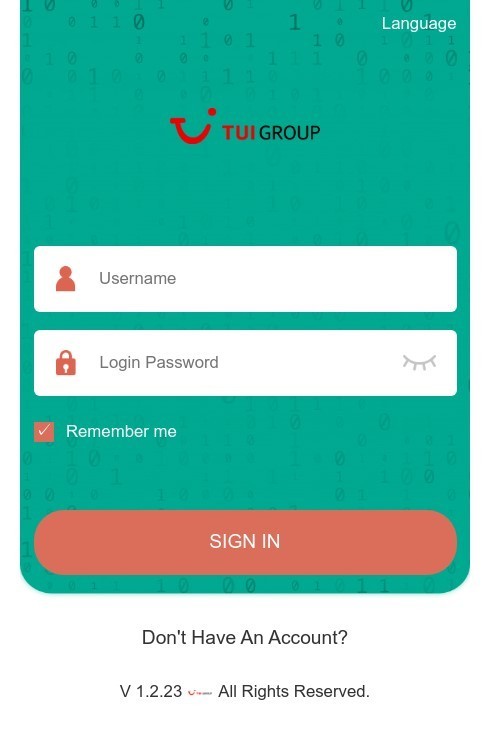
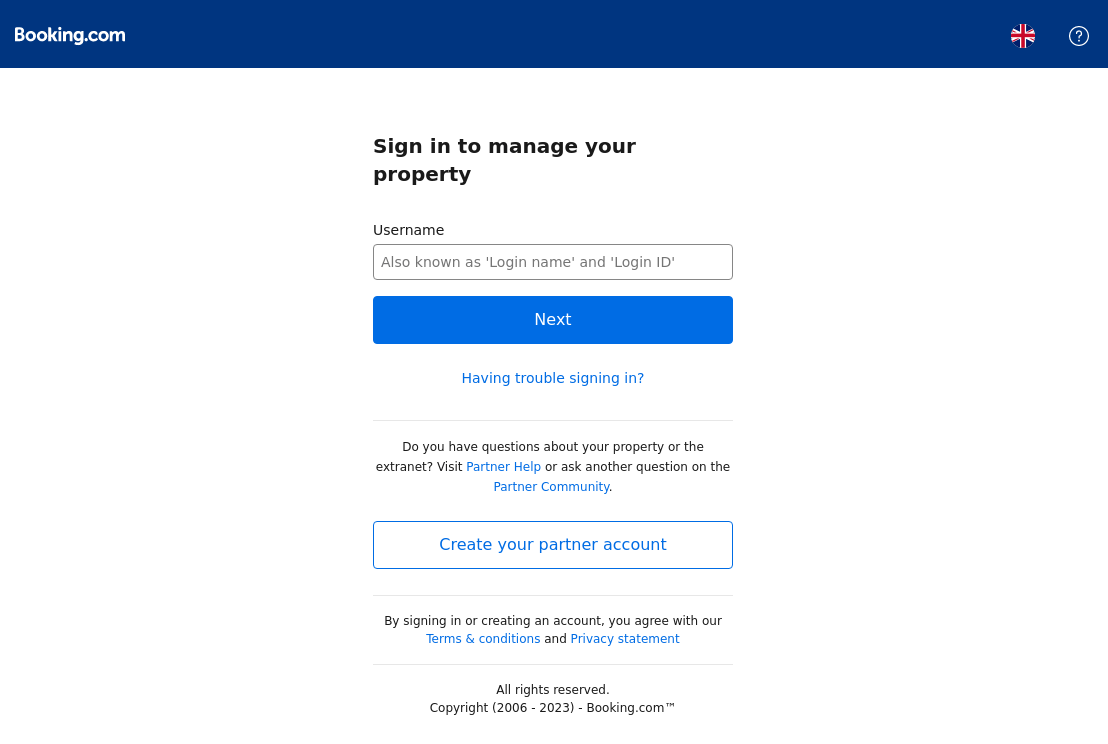
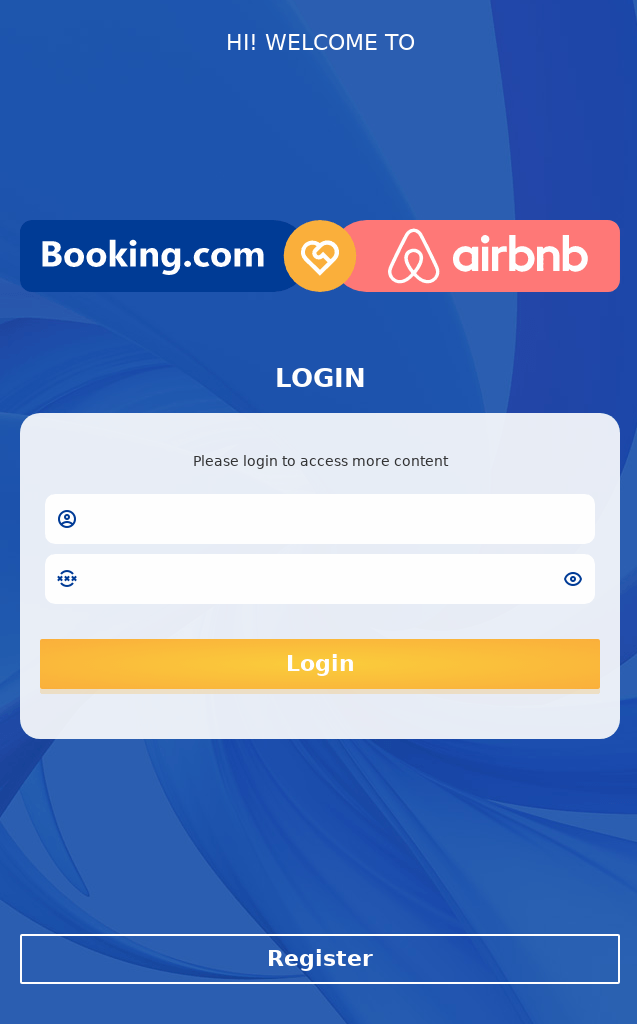
    In 2024, cybercriminals targeted travel enthusiasts using fake hotel and airline booking websites. In one simple scheme, a fraudulent site asked users to enter their login credentials to complete their booking — these credentials ended up in criminal hands. Sometimes, the fake login form appeared under multiple brand names at once (for example, both Booking and Airbnb).

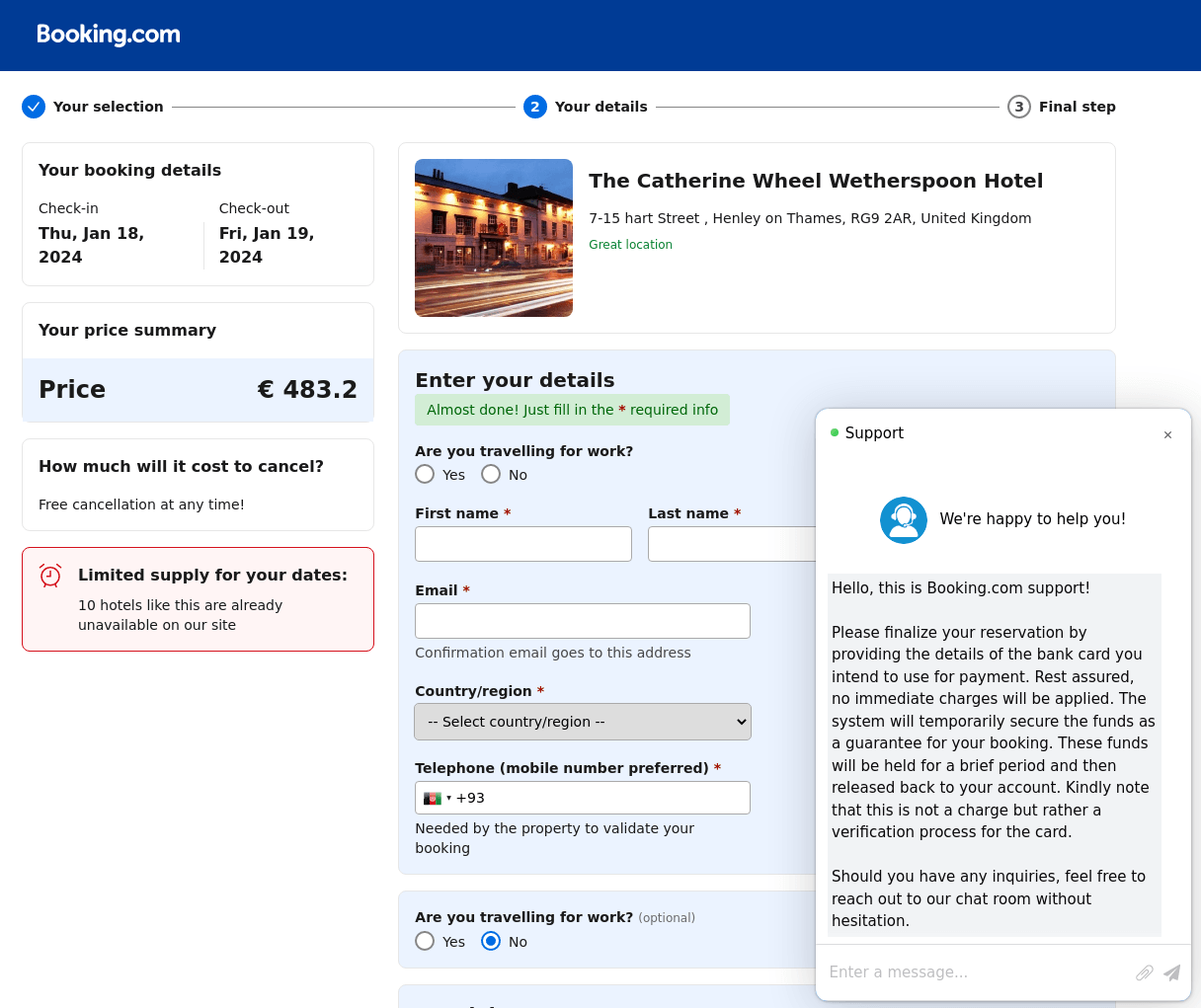
    Another scheme involved a more sophisticated fake site, where users could even select the purpose of their trip (business or leisure). To complete the booking, the scammers requested bank card details, claiming that a certain sum would be temporarily blocked on the account to verify the card’s authenticity. Legitimate booking services regularly request payment details, so the victim may not suspect anything in this case. To rush users into entering their data carelessly, on the phishing page, the scammers displayed warnings about dwindling accommodation availability and an imminent payment deadline for the booking. If the victim entered their data, the funds were not frozen but went straight into the criminals’ pockets.

    Cyberthreats in the travel sector affected not only tourists but also employees of travel agencies. By gaining access to a corporate account, criminals could conduct financial transactions on behalf of employees and gain access to large customer databases.

    Fake accommodation sites often sent messages to property owners, telling them to log in to “manage their property.” This scheme targeted people renting out their homes through online booking platforms.

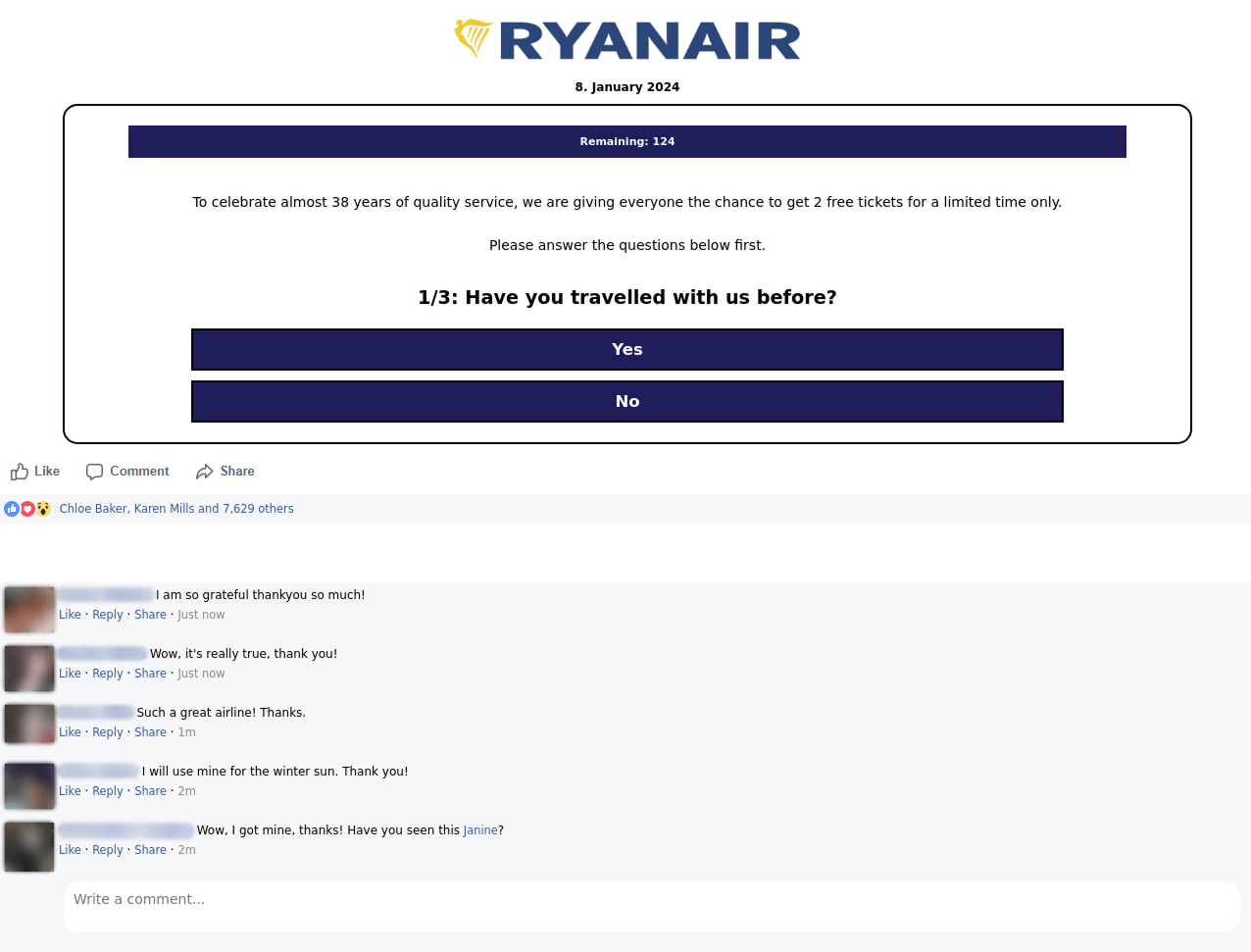
    Other scam pages featured surveys, offering respondents gifts or prize draws for participating. In this case, victims risked both their credentials and their money. Such fake giveaways are a classic scam tactic. They are often timed to coincide with a significant date for the travel industry or a specific company. For example, the screenshot below shows an offer to take part in a giveaway of airline tickets to celebrate Ryanair’s birthday.

    After completing the survey, users may be asked to share the offer with a certain number of contacts, and then pay a small fee to receive the expensive gift. Of course, these prizes are non-existent.

    Trapped in social networks

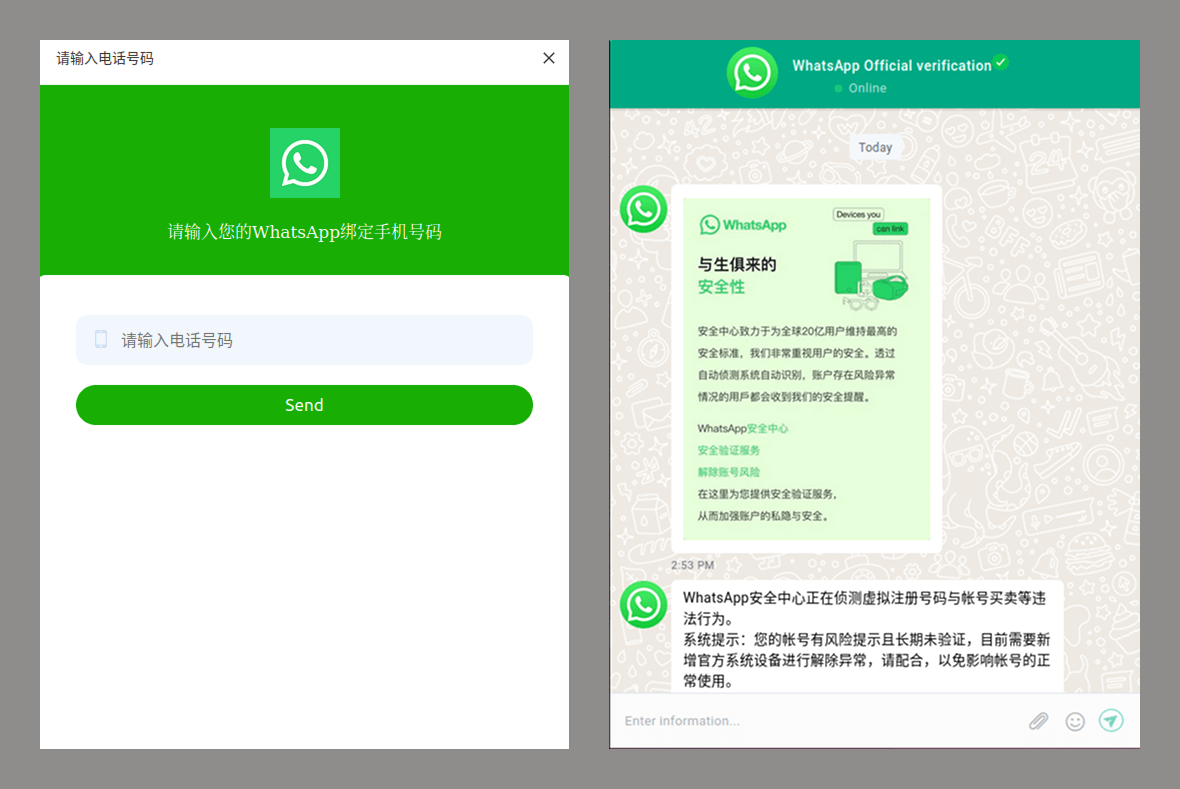
    To steal credentials for social media and messenger accounts, scammers used another classic technique: asking users to verify themselves. In one scheme, the victim was redirected to a website that completely replicated WhatsApp’s design. The user entered their phone number and login code, handing their credentials straight over to the cybercriminals.

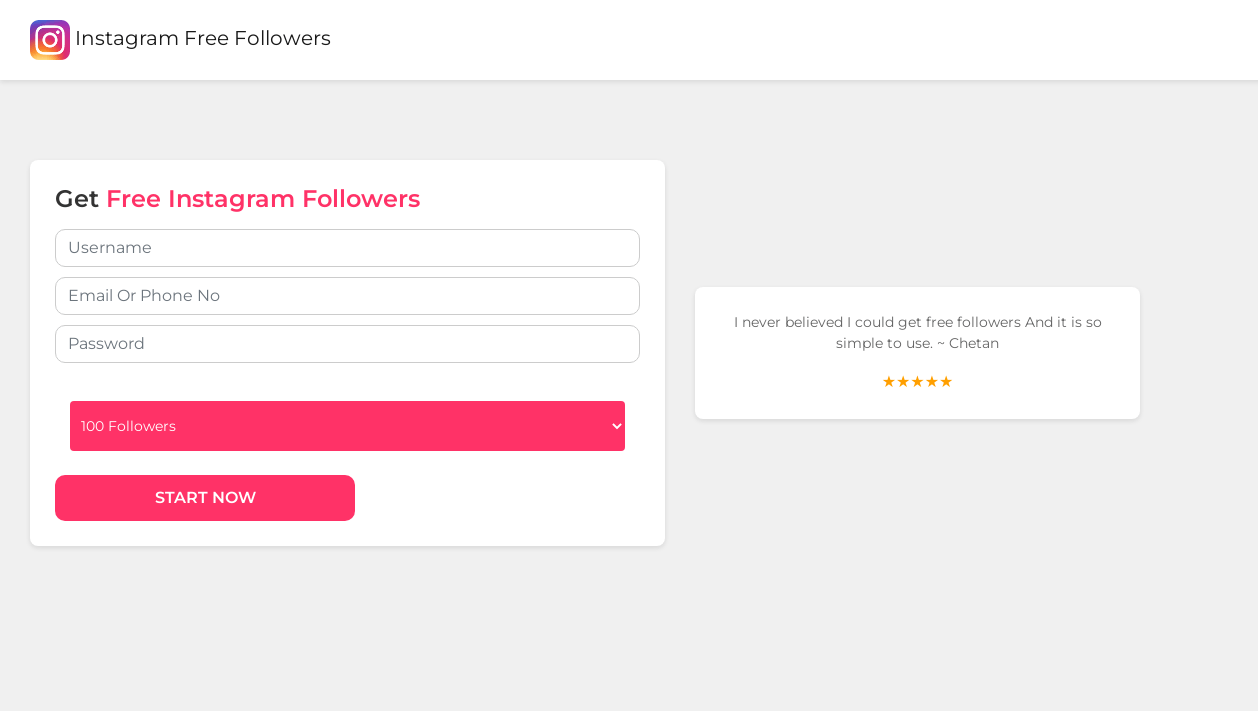
    Beyond verification scams, fraudsters also lured victims with attractive offers. For example, in the screenshot below, the victim is promised free Instagram followers.

    Some cybercriminals also used the promise of adult content to lure victims into entering their credentials in a fake authorization form.

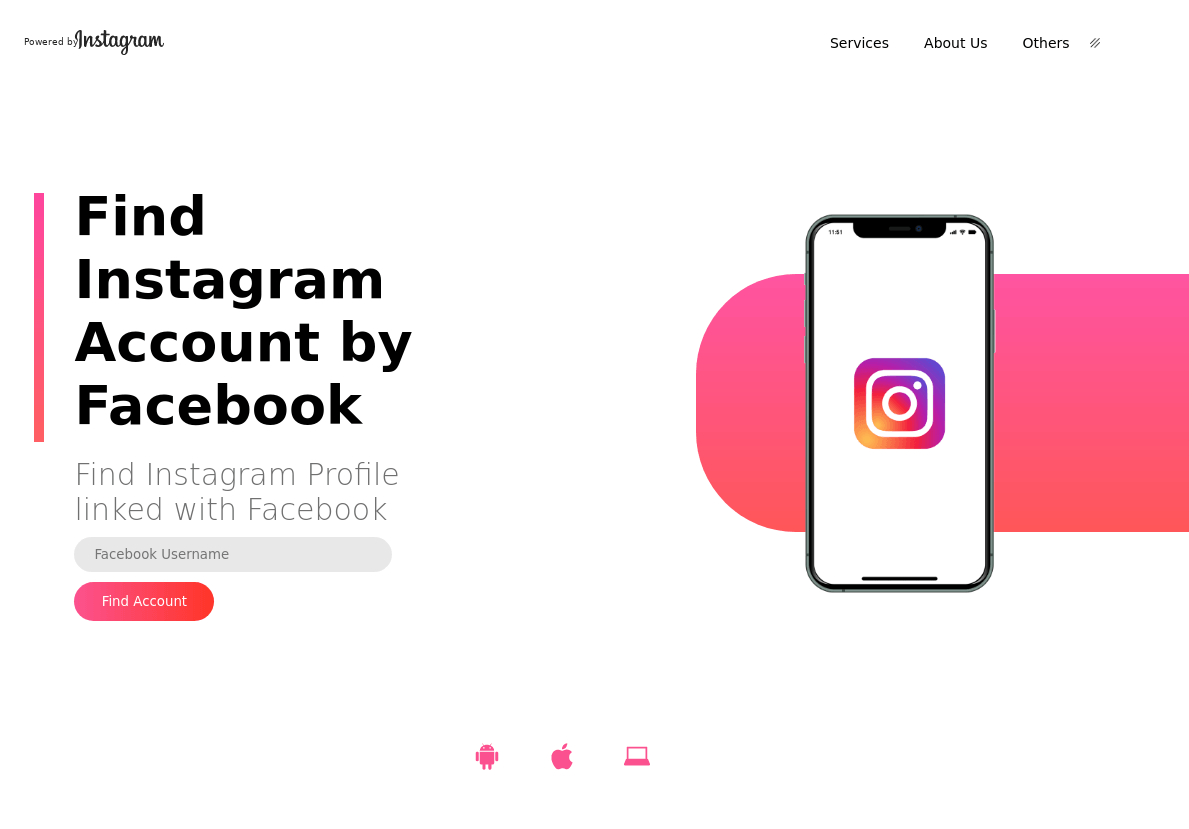
    Other scammers took advantage of Facebook and Instagram being owned by the same company. On a fraudulent page, they claimed to offer a service that allowed users to find Instagram profiles by entering their Facebook login and password.

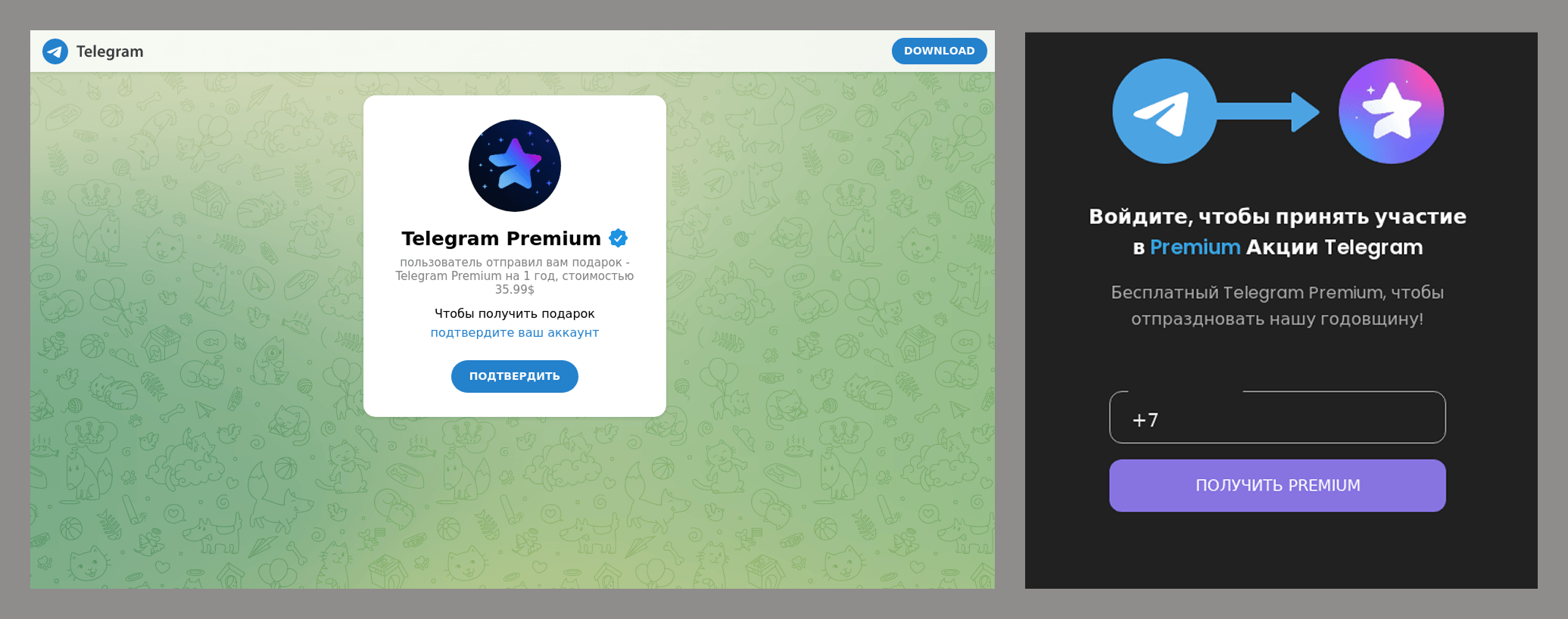
    Some scams offered users a surprise “gift” — a free Telegram Premium subscription. To enable the messenger’s premium features, the victim only had to enter their phone number and a one-time code on a fraudulent website.

    Some fake social media and messenger pages were designed not to steal login credentials but to install malware on victims’ devices. Taking advantage of the popularity of Facebook Lite for Android, scammers offered users a “more advanced official version”, claiming it had extra features missing in the original app. However, instead of an upgraded app, users downloaded malware onto their devices.

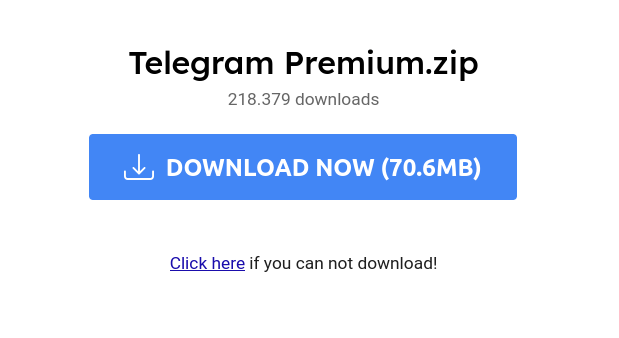
    Similarly, installing a supposedly free Telegram client with an activated Premium subscription often led to downloading malware.

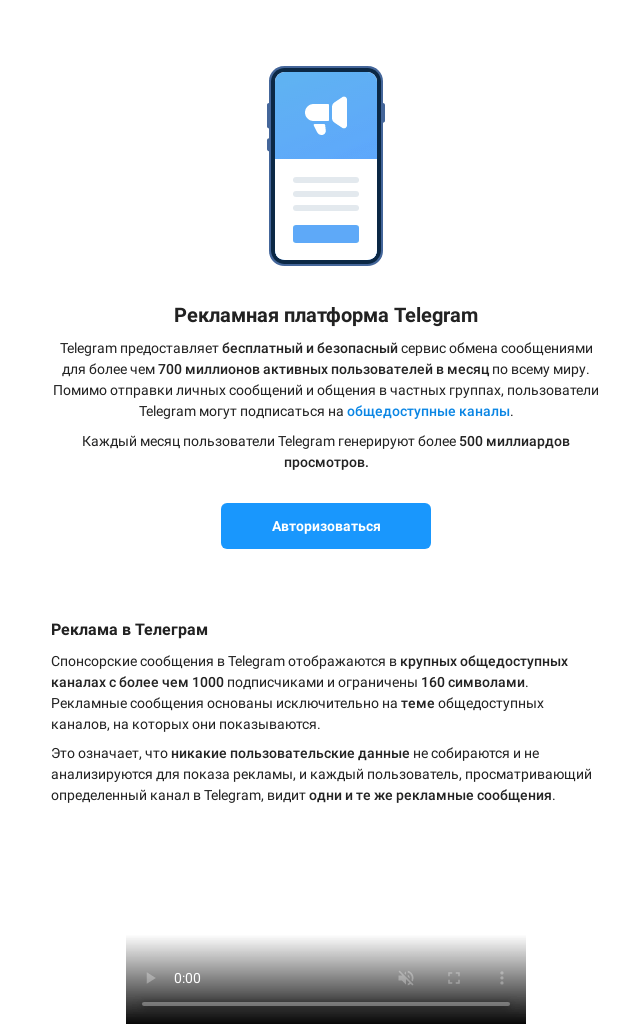
    Social media business services were increasingly used as a pretext for credential theft, as they play a key role in developing and promoting businesses and are directly linked to financial operations. Cybercriminals tricked Telegram channel owners into logging in to a phishing platform imitating the official Telegram Ads tool, thereby stealing their Telegram credentials. To make the scam more convincing, the attackers detailed how Telegram advertising works and promised millions of ad views per month.

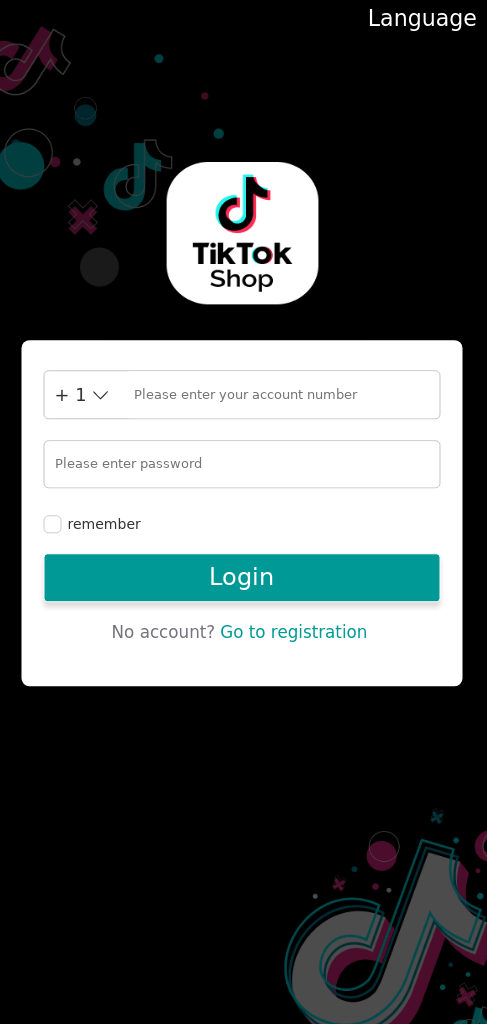
    TikTok users have also been targeted. TikTok Shop allows sellers to list curated products—items featured in videos—for potential buyers to find and purchase. Scammers created fake TikTok Shop pages to steal seller credentials, potentially leading to both reputational and financial damage.

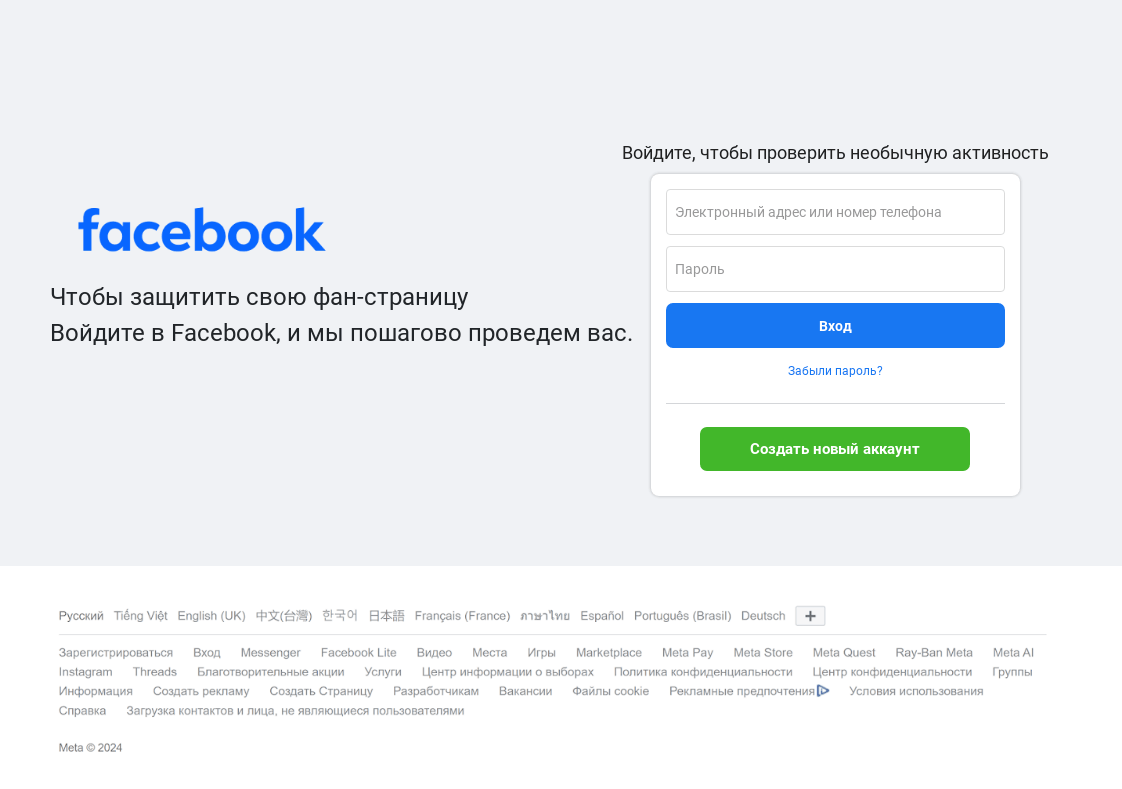
    In another case, fraudsters informed Facebook fan page owners of unusual activity in their accounts. Potential victims were prompted to check their profile by entering their login credentials into a phishing form.

    Cryptocurrency: don’t mistake scams for real deals

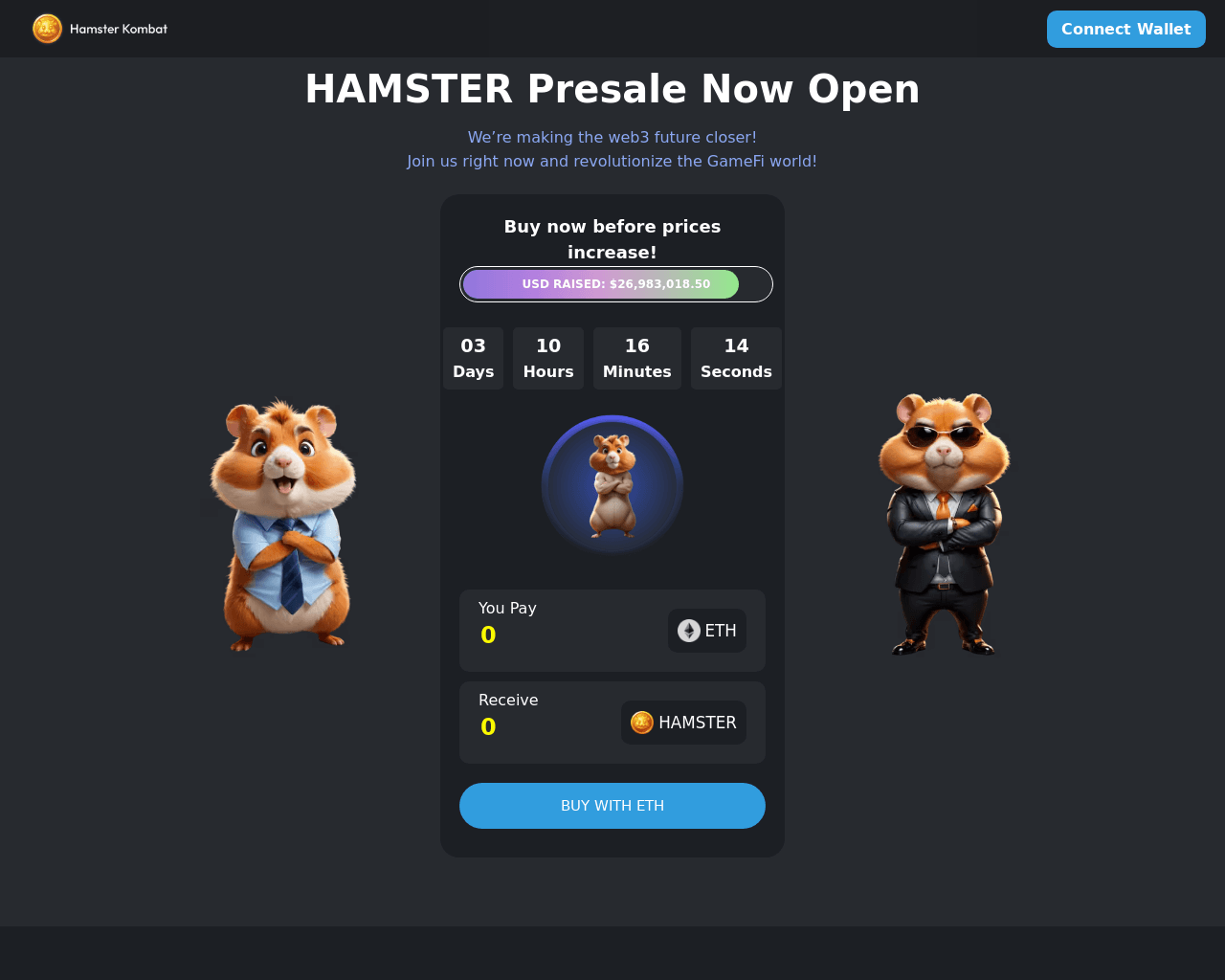
    One of last year’s most sensational stories was the cryptocurrency game Hamster Kombat. This clicker game, simulating the creation of a crypto exchange in a gamified format, quickly attracted a massive audience. Players eagerly awaited the moment when the in-game coins could be exchanged for real virtual currency. But while the official listing was delayed, the fraudulent schemes wasted no time.

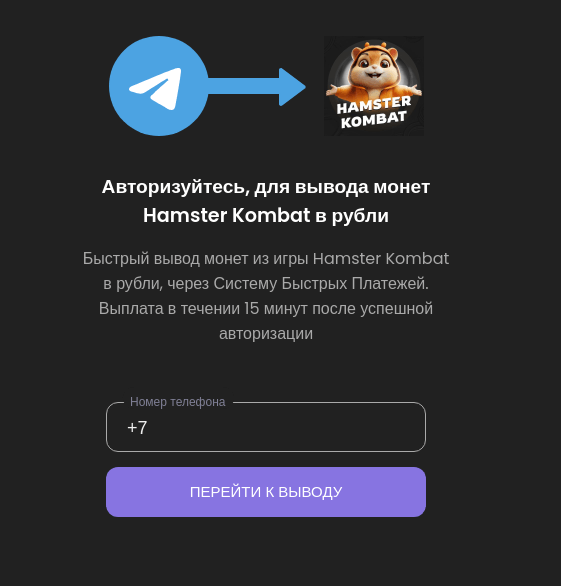
    Fraudsters claimed to offer cash-out services for in-game coins by converting them into rubles. To withdraw money, criminals claimed, users just had to log in through a fake Telegram page.

    The growing anticipation for the new cryptocurrency’s market launch was frequently exploited by cybercriminals to steal seed phrases from crypto wallets. Scammers announced an early token sale, requiring users to log in through a fake page to participate. Of course, there was no mention of such promotions on official resources.

    The popularity of Hamster Kombat was also abused in scam schemes. For example, users were offered access to a crypto wallet supposedly containing a significant sum in virtual coins. To claim it, the unsuspecting victims had to share information about the “opportunity” with a certain number of contacts in messaging apps. Having made their potential victim an accomplice in spreading false information, the scammers demanded a small commission for the withdrawal and disappeared with the stolen money.

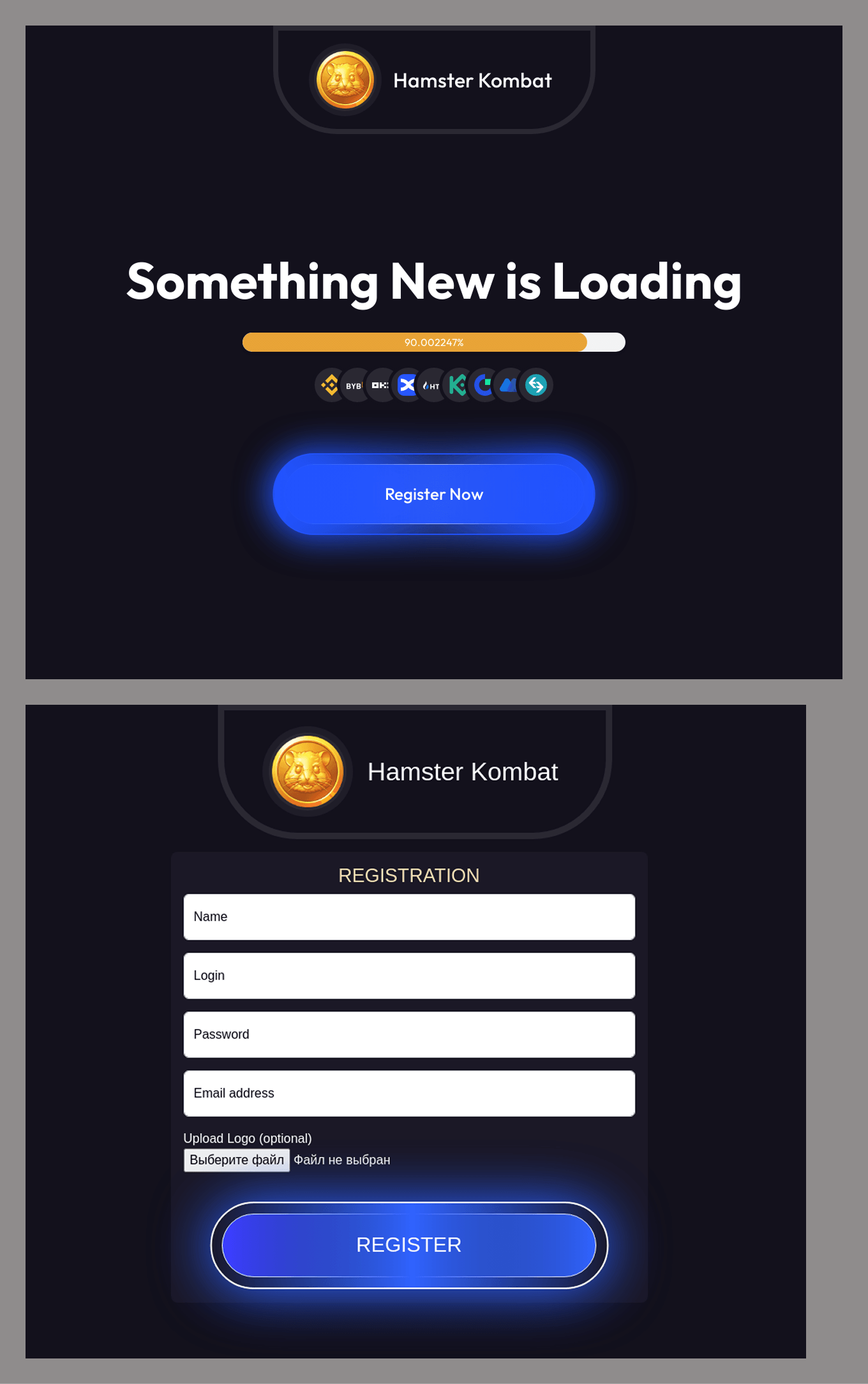
    A more elaborate scam also aimed to trick users into paying a “commission”, but with a slightly different approach. First, visitors to the page were asked to register to learn about some new activity related to Hamster Kombat.

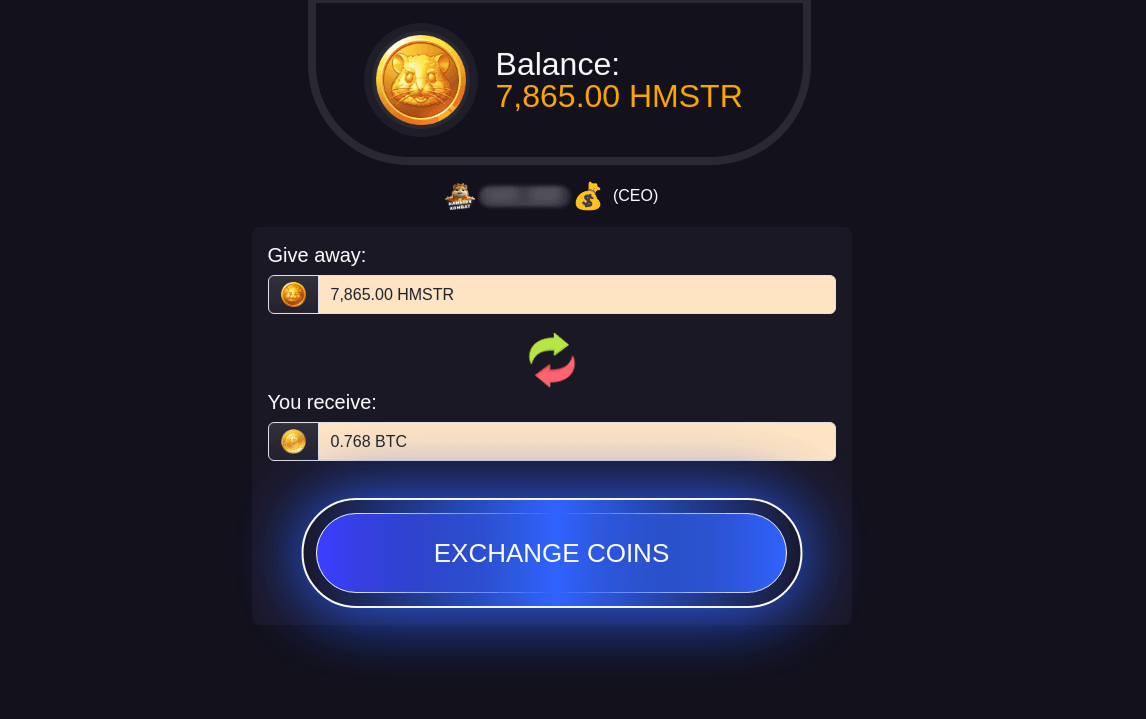
    Once registered, they were suddenly informed of having won a large amount of the HMSTR cryptocurrency supposedly as part of an experiment conducted on the platform. Exploiting uncertainty around the token’s listing, scammers urged victims to bypass the official trading launch and exchange their in-game currency for Bitcoin immediately.

    To make it more convincing, the page displayed an exchange rate at which the “prize” would be converted.

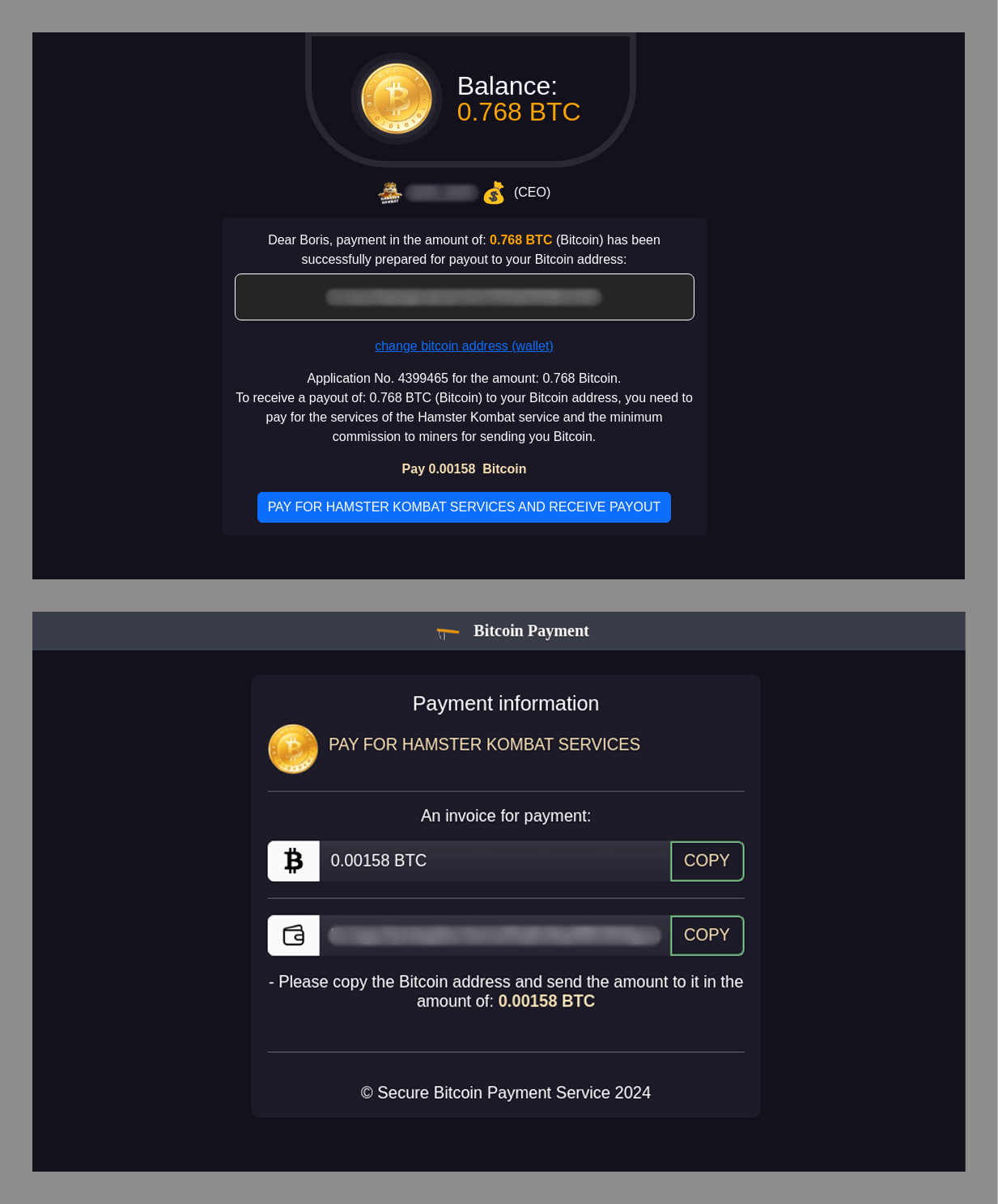
    However, after clicking the “Exchange coins” button, users were prompted to pay a commission for the service.

    Everyone who paid this fee lost their money and received no Bitcoin.

    Phishing attacks also targeted TON wallet users. In this case, scammers lured victims with promises of bonuses, requiring them to link their crypto wallets on fraudulent websites.

    TON cryptocurrency was also used as bait in scam schemes. In a classic scenario, users were promised a quick way to earn digital currency. Fraudsters advertised a cloud mining service that allegedly generated high profits without any effort. After registering, unsuspecting users could monitor their “earnings” but had to pay a commission in cryptocurrency to withdraw funds.

    Another “profitable” crypto scam resembled a Ponzi scheme: victims were required to recruit at least five new participants into the program—without receiving any money, of course. The scam site mimicked an online earning platform.

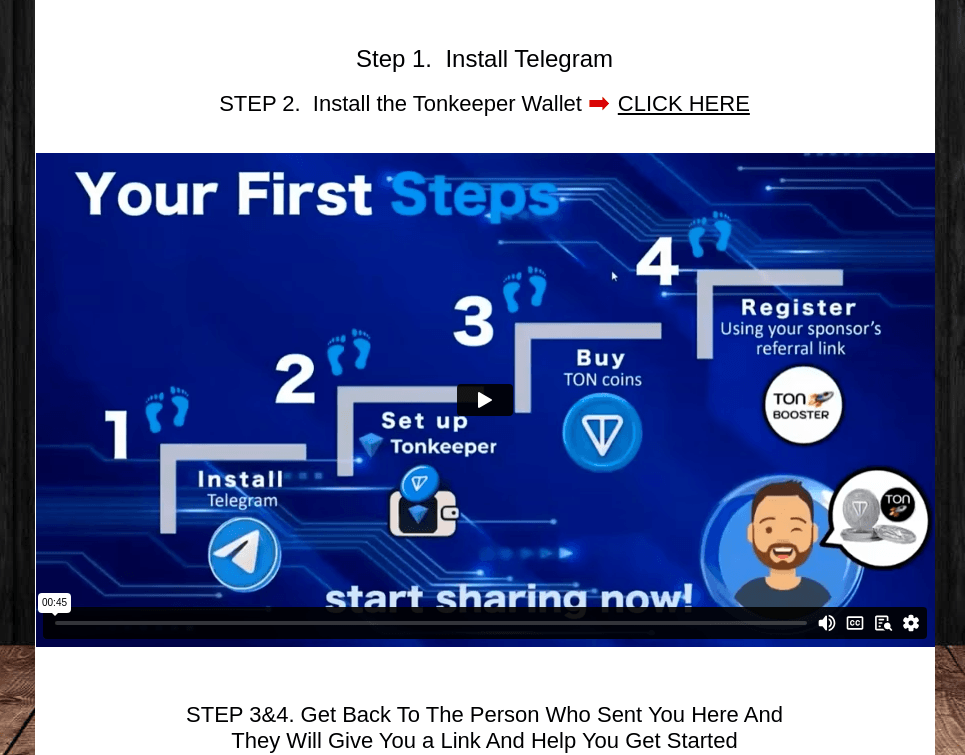
    Visitors were instructed to install Telegram and use an unofficial bot to activate a crypto wallet where profits would supposedly be deposited.

    According to the instructions, users then had to buy Toncoin and register in the program through a referral link from another participant. The scam worked by enticing people to make a small investment in the hopes of making big profits—the victims used their own funds to purchase the cryptocurrency for registration. But as with any pyramid scheme, only those at the top profited, while everyone else was left with nothing but empty dreams.

    All or nothing: multipurpose phishing

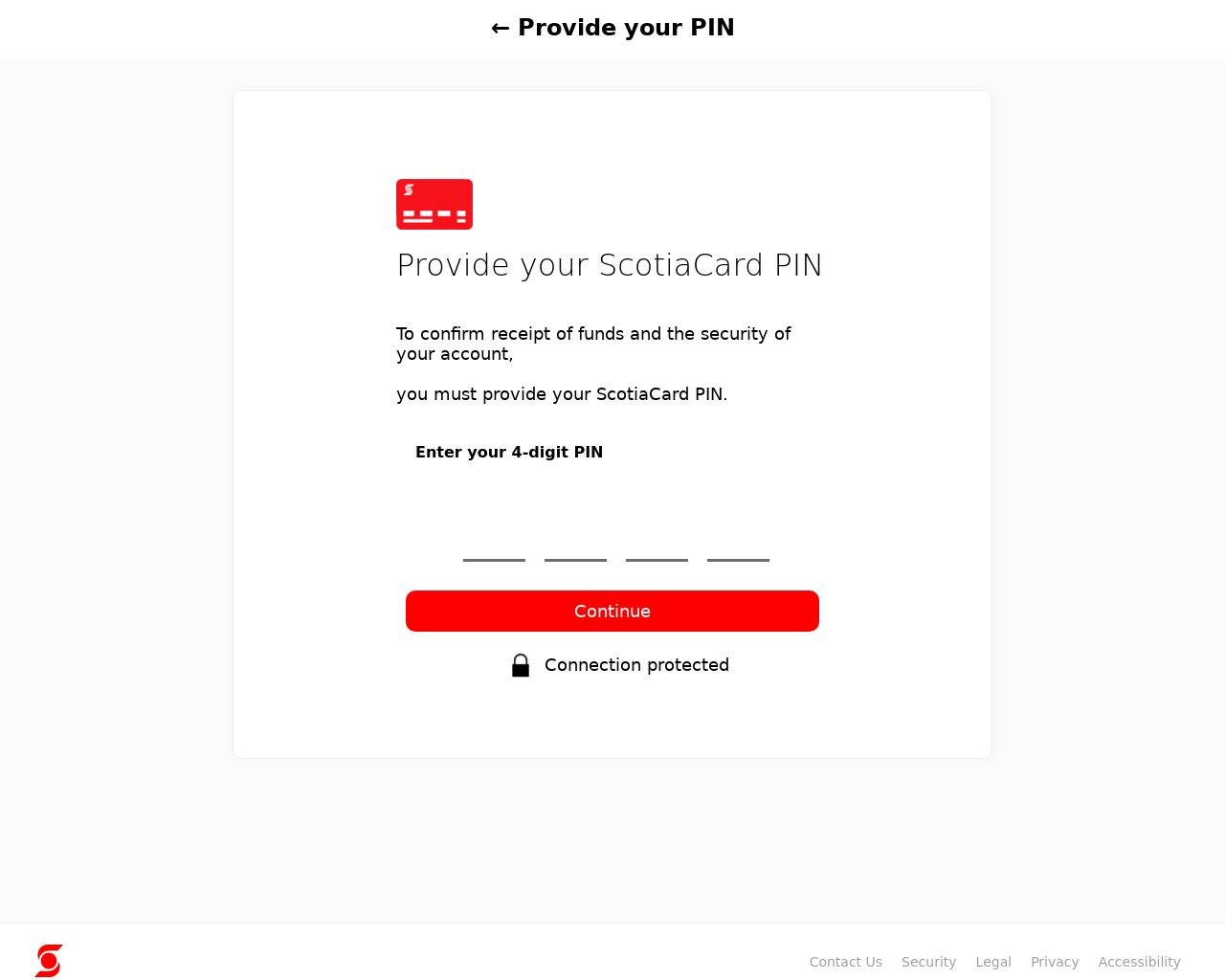
    Victims of phishing frequently included bank clients and users of government service portals. In such schemes, users first received a notification that they needed to update their account credentials. Cybercriminals used various communication channels to contact their victims: email, text messages, and chats in messaging apps. The victims were then led to fake sites where they were asked to provide their personal data. First, they entered their personal login credentials on the organization’s website.

    Next, they were prompted to provide their email account credentials. The scammers also attempted to collect identity document details and other data, including the bank card PIN code.

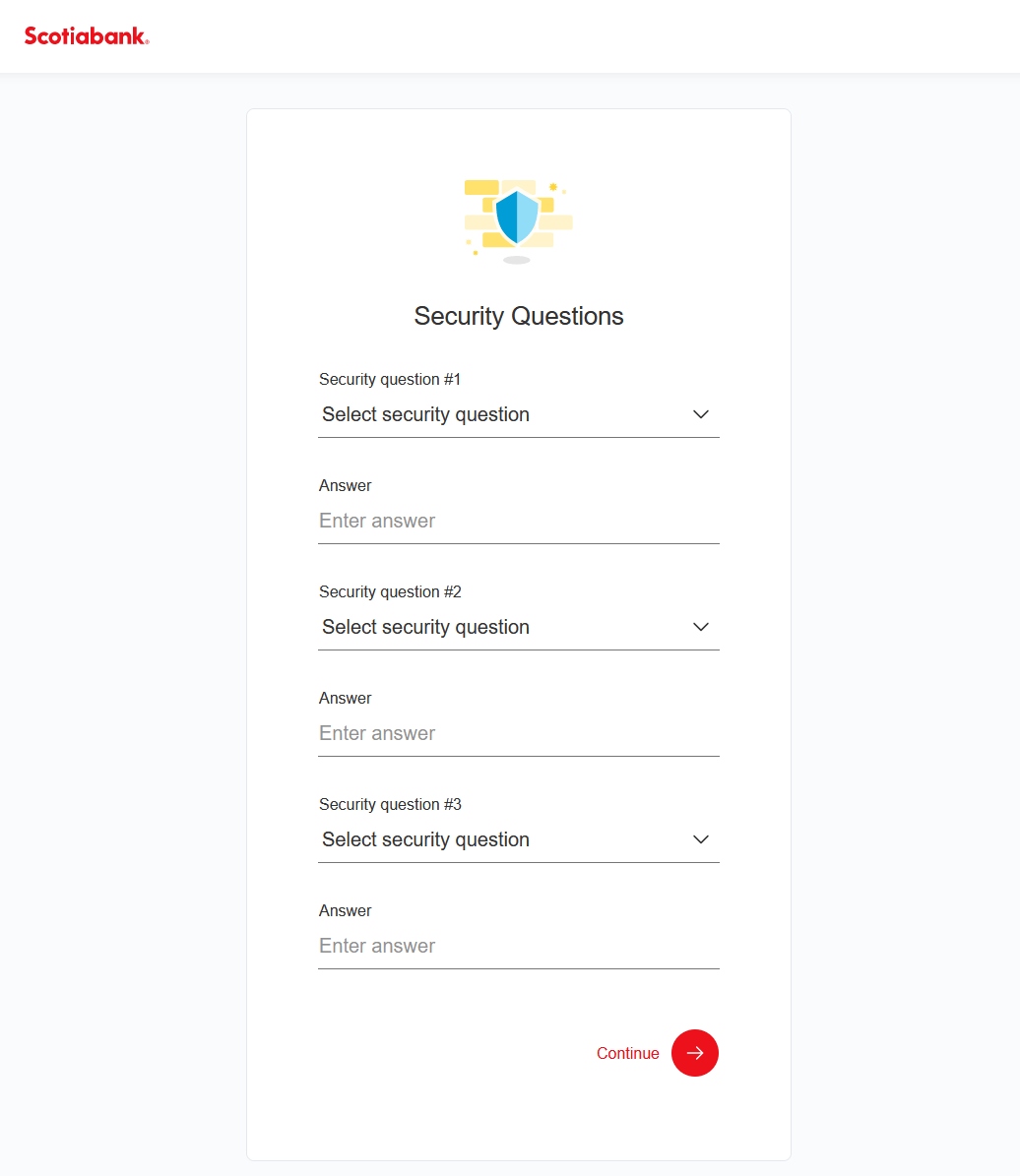
    Additionally, these phishing forms requested answers to security questions commonly used for additional verification in banking transactions.

    This way, the cybercriminals gained full access to the victim’s account. Even the PIN code could be useful for the scammers in gaining access to the account. Security questions served as an extra safeguard for fraudsters in case the bank’s security service detected suspicious activity.

    False idols

    Phishing schemes also exploited the images of real people. For example, users browsing YouTube could stumble upon ad videos of celebrities announcing giveaways for their fans. Clicking the link in such a video led users to a page containing a post supposedly from the celebrity’s social media account, explaining how to claim the prize. However, when attempting to collect the “winnings”, visitors were asked to pay a small commission—insignificant compared to the value of the “gift.” Needless to say, those who paid the fee lost their money. The prize never existed, and the video was nothing more than a deepfake.

    Spam in 2024

    Scams

    Token giveaway scam

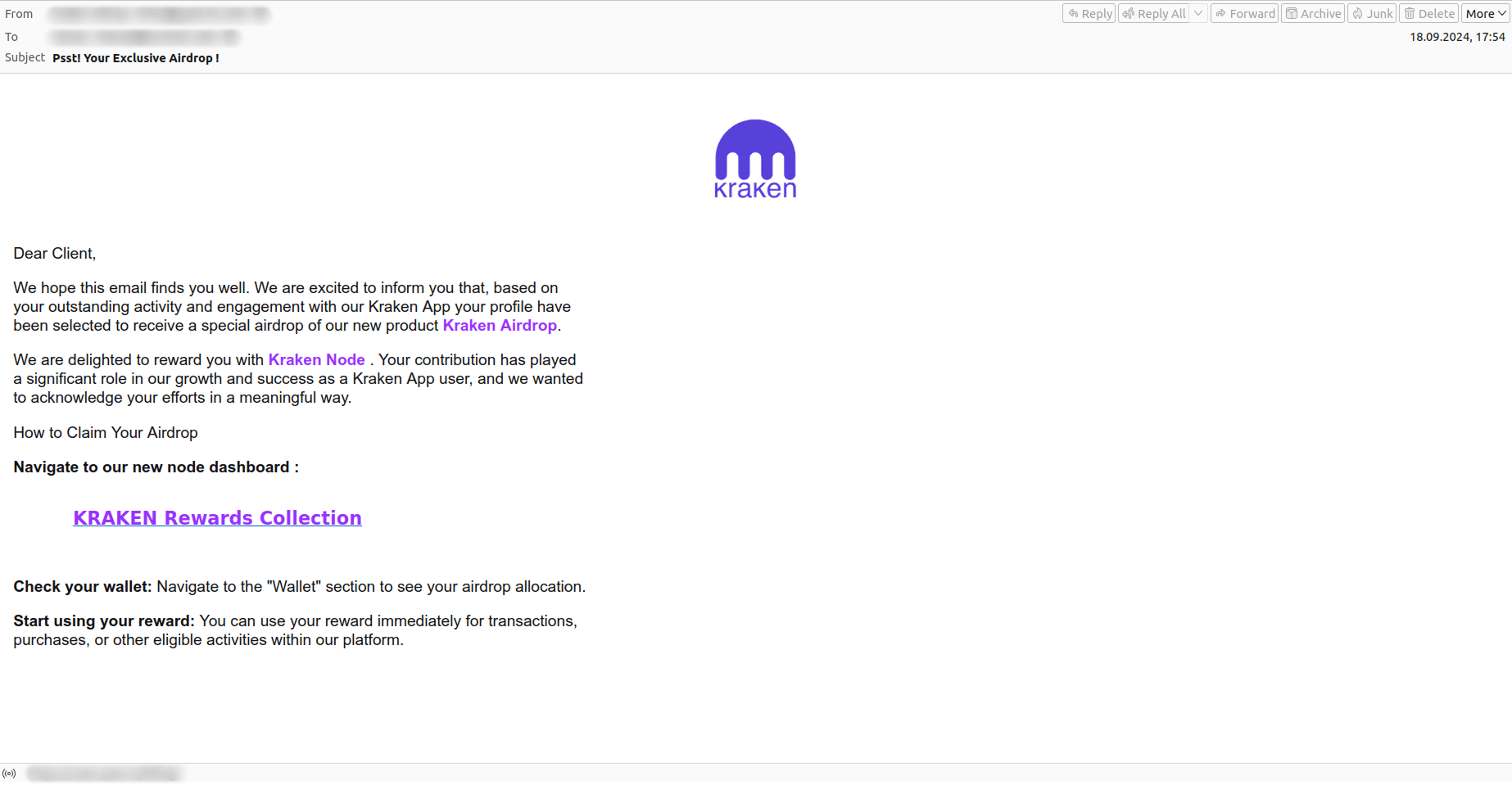
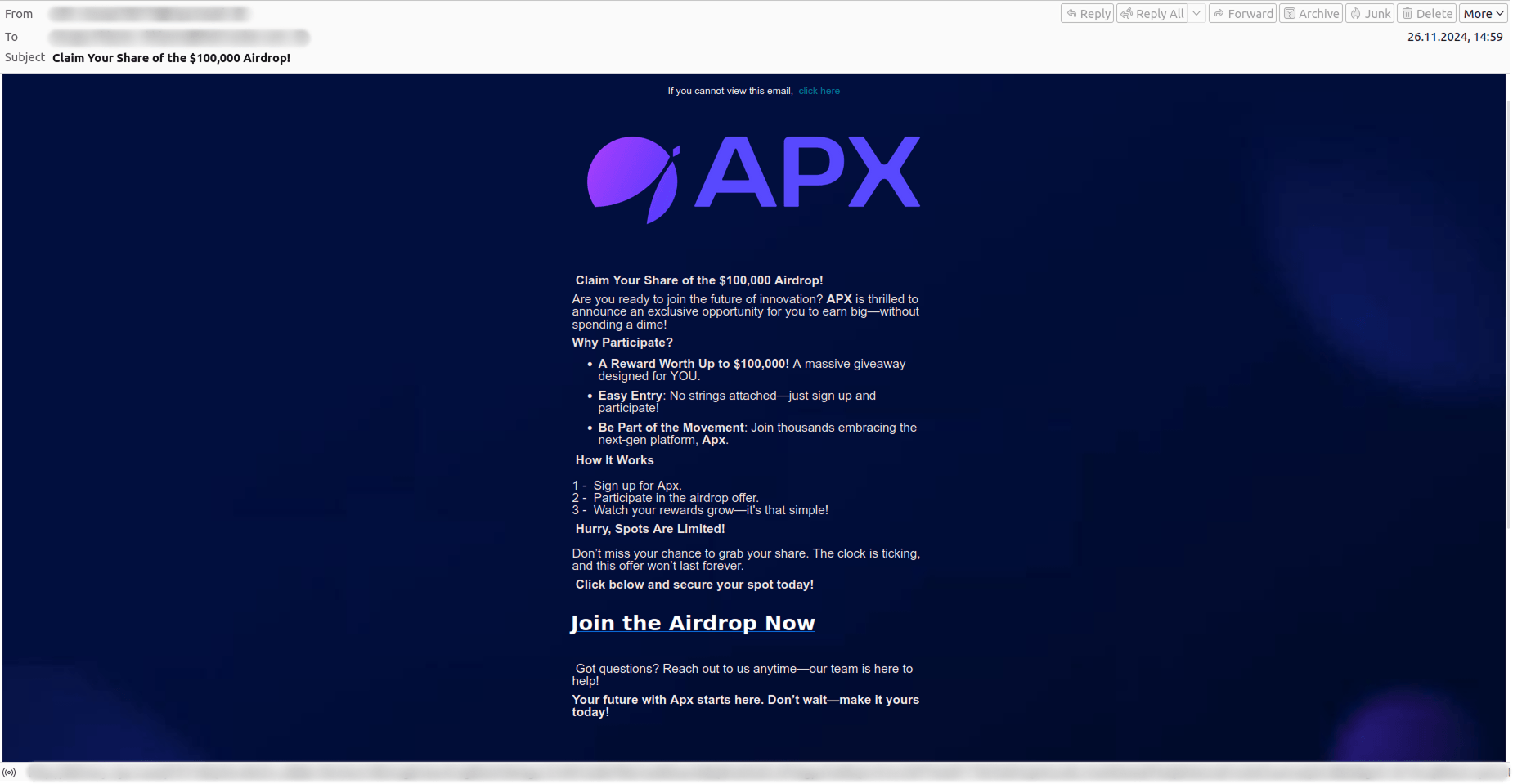
    Throughout the year, we frequently encountered emails announcing fake cryptocurrency airdrops, allegedly from teams of well-known crypto projects. The recipients, referred to as the platform’s “most valuable users,” were invited to participate in an “exclusive” event as a thank you for their loyalty and exceptional engagement.

    New users unfamiliar with cryptocurrency were lured in with a unique opportunity to take part in the token giveaway and win a large sum—all they had to do was register on the platform, which was, of course, fake.

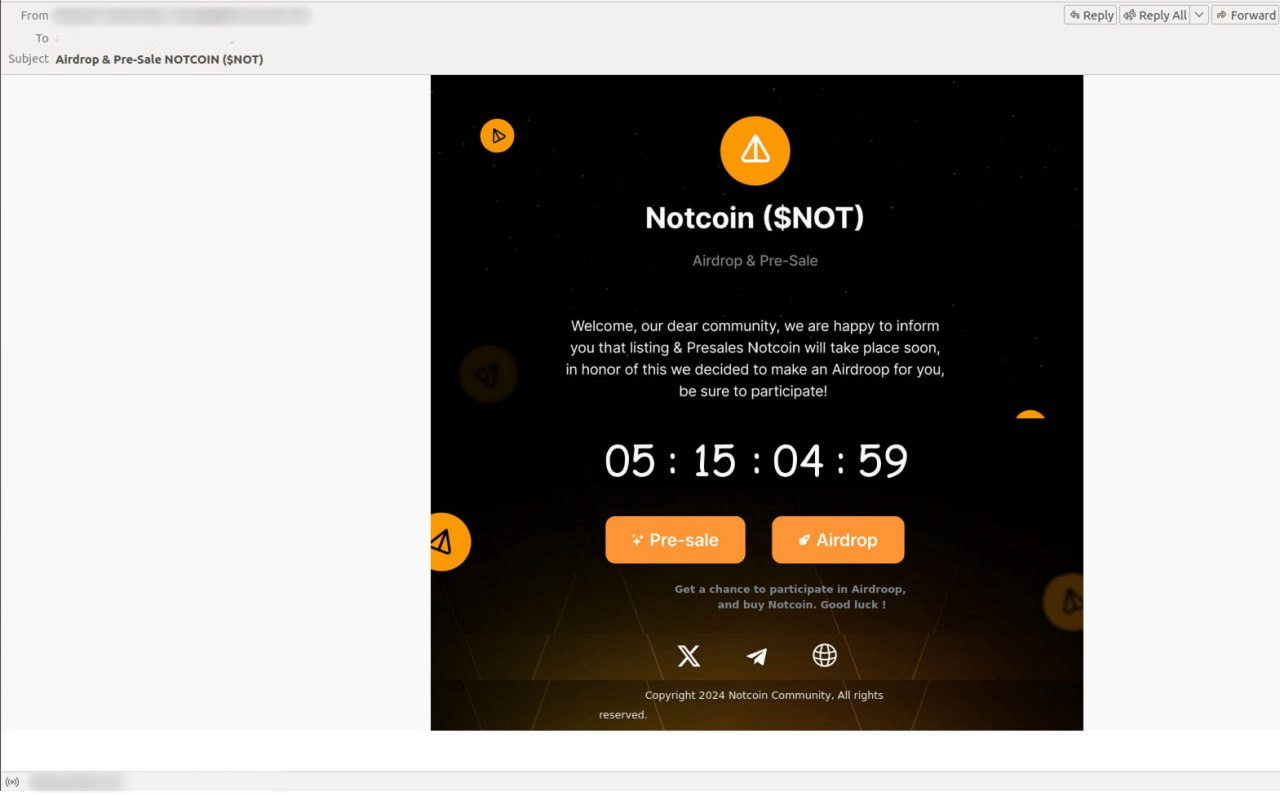
    Scammers in 2024 closely monitored cryptocurrency market news. For example, in the spring, ahead of Notcoin’s upcoming listing, scam messages appeared featuring countdown timers, urging potential victims to participate in an airdrop allegedly arranged just for them.

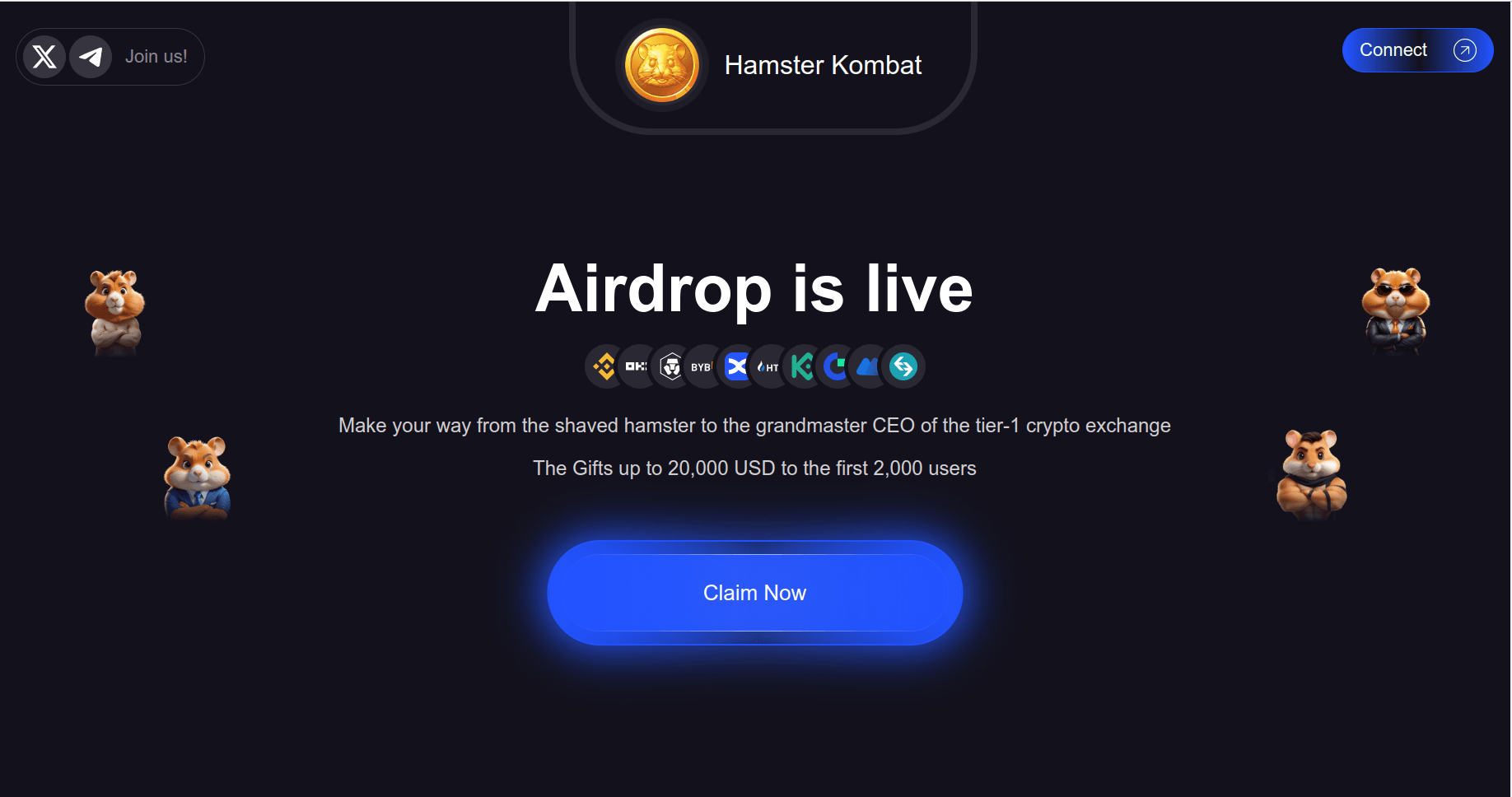
    Scam emails also targeted users of the cryptocurrency game Hamster Kombat, popular among Russian-speakers. Players eagerly awaited the HMSTR token listing, which was repeatedly postponed—a delay that scammers were quick to exploit. In the fall of 2024, they began sending emails pretending to be from the Hamster Kombat team, promising generous cash prizes if victims clicked a link to a fake game site.

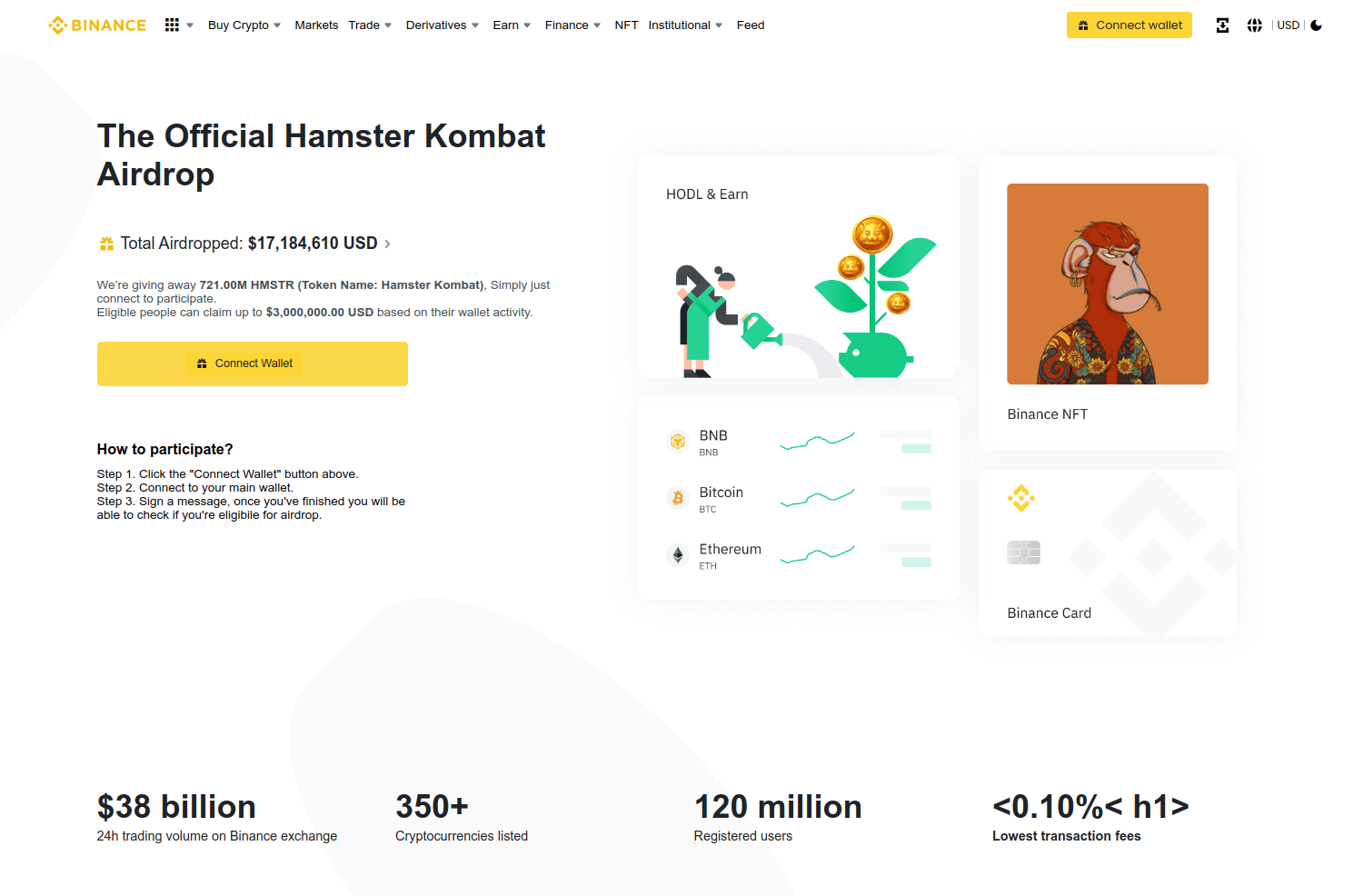
    Similar offers were distributed via a fraudulent website mimicking a major cryptocurrency exchange. In both cases, to claim the coveted tokens, victims had to link their cryptocurrency wallets.

    “Nigerian” scam

    In 2024, the Nigerian scam remained popular among spammers. Furthermore, fraudsters used both time-tested and trending themes to deceive victims. Cybercriminals employed various tricks and manipulations to engage with email recipients, with the ultimate goal of extracting money.

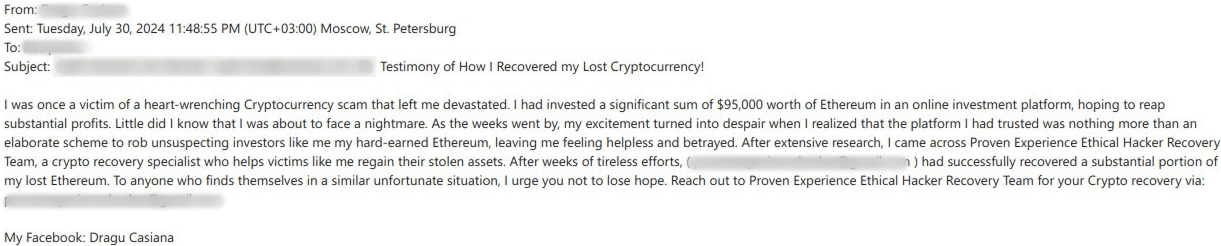
    Most often, users were lured into classic schemes: fraudsters posed as terminally ill wealthy individuals seeking a worthy heir, lottery winners eager to share their prize, or investors offering opportunities in a promising business. Sometimes, to evade suspicion, scammers “rescued” their victims from other fraudsters and offered to compensate them for any financial losses. For example, in the summer of 2024, we came across an interesting case where an alleged victim of crypto fraud suggested that fellow sufferers contact a group of noble hackers for help recovering lost cryptocurrency.

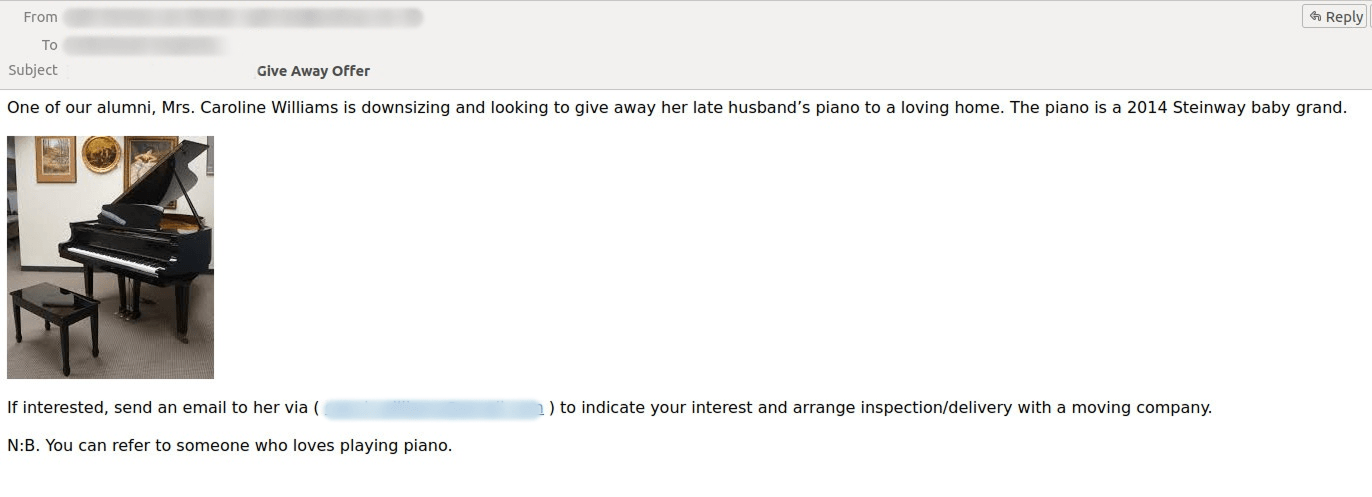
    Some scam offers were quite unexpected, as they didn’t promise vast riches, and, therefore, might not attract such a wide audience. In mid-to-late 2024, we saw scam emails claiming to be looking for new owners for pianos due to relocation or the previous owner’s passing.

    We also encountered even more creative scam narratives. For example, an email allegedly sent from a secret society of Illuminati promising to share their wealth, power and fame if the recipients agree to join their grand brotherhood.

    Other “Nigerian” scam emails capitalized on current news events. Thus, the most talked-about event of 2024, the US presidential election, significantly influenced the types of scams we saw. For example, one scam email claimed that the recipients were incredibly lucky to be eligible to receive millions of dollars from Donald Trump’s foundation.

    Scam in the Russian segment

    Last year, the Russian segment of the internet was not spared from mass scam mailings. We frequently encountered schemes mimicking investment projects of major banks, promising users easy earnings and bonuses. Fraudsters also sent out emails with promotional offers from home appliance and electronics stores. Customers were informed of huge discounts on sales that were supposedly about to end.

    The links in such emails led to fraudulent websites that looked identical to legitimate online stores but stood out with extremely low prices. After paying for their desired items, customers lost their money, as orders were never actually placed.

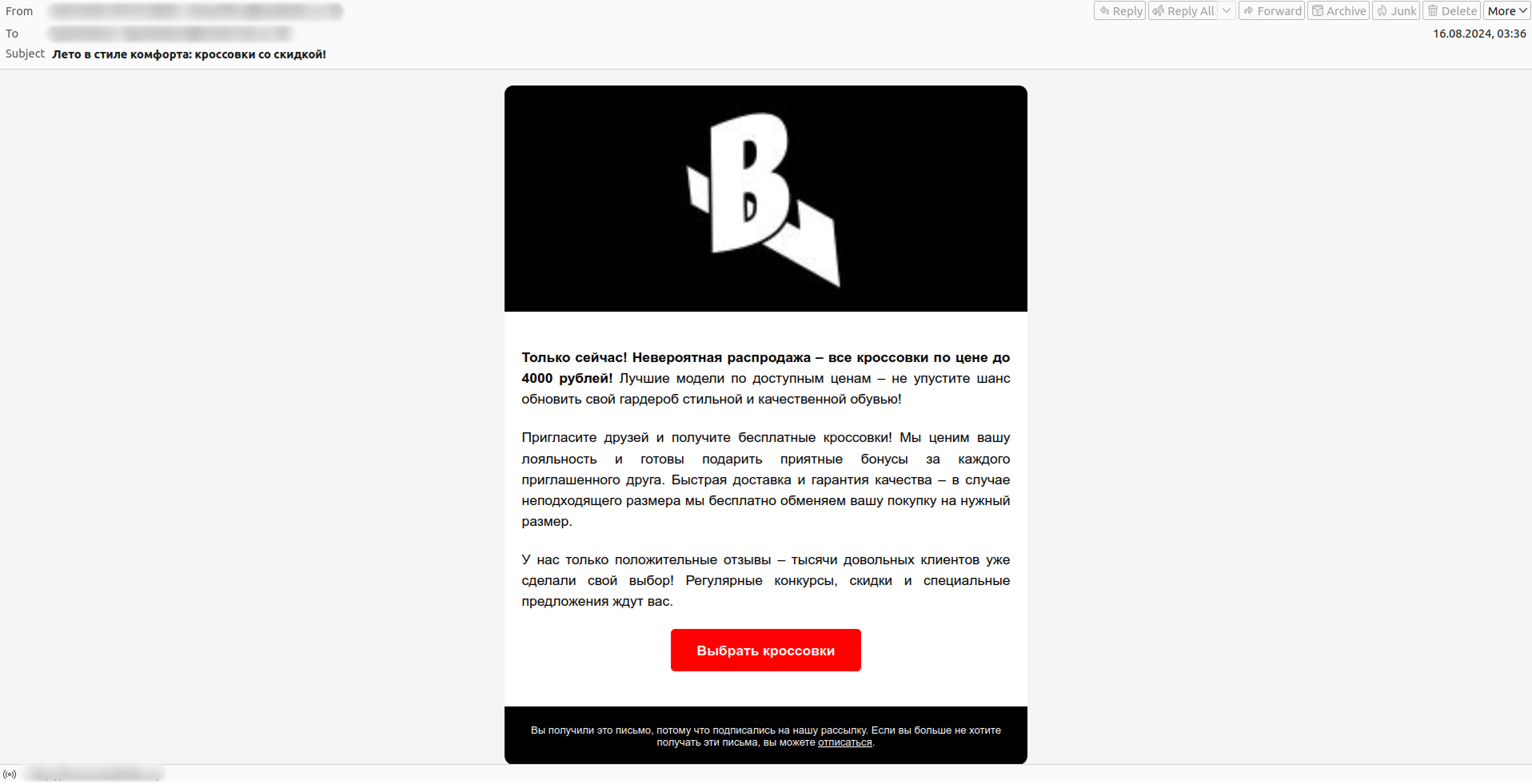
    Beyond electronics, scammers also offered other discounted products. In one such campaign, users received an email advertising a sneaker store selling popular models at affordable prices.

    Judging by the technical headers of the emails, both the sneaker store and electronics store promotions were sent by the same fraudsters.

    Additionally, we came across emails offering recipients to apply for debit or credit cards under favorable conditions. Unlike the electronics and shoe sale scams, these messages were legitimate referral programs from major banks, which enterprising spammers tried to monetize. Technically, such emails are not scams, as their links lead to real banking websites, and recipients do not face any risks. However, senders profit from registrations via the referral program. Nevertheless, we do not recommend clicking links from unknown senders, as seemingly harmless emails from a referral platform could be phishing or scam messages.

    Emails with malicious links and attachments

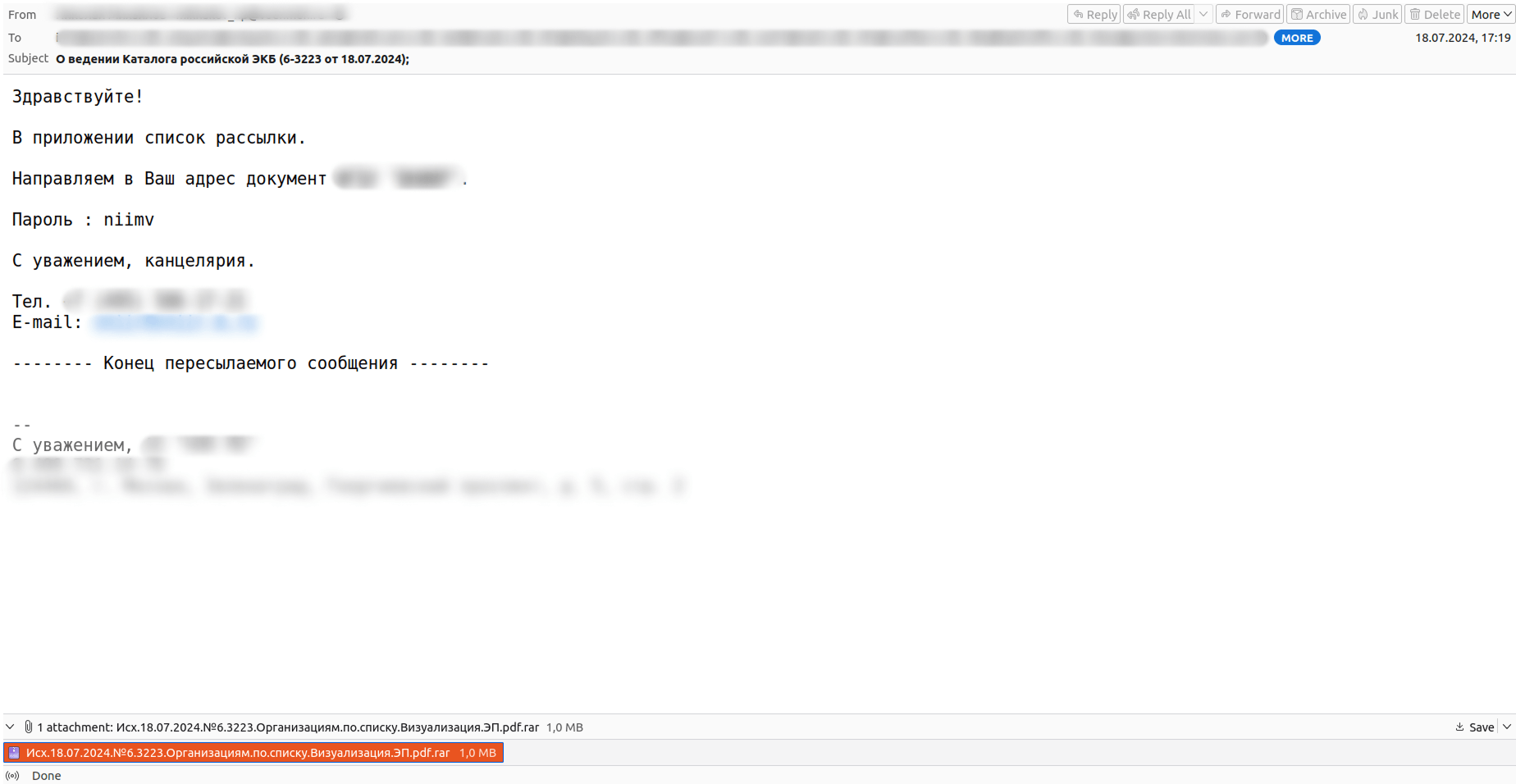
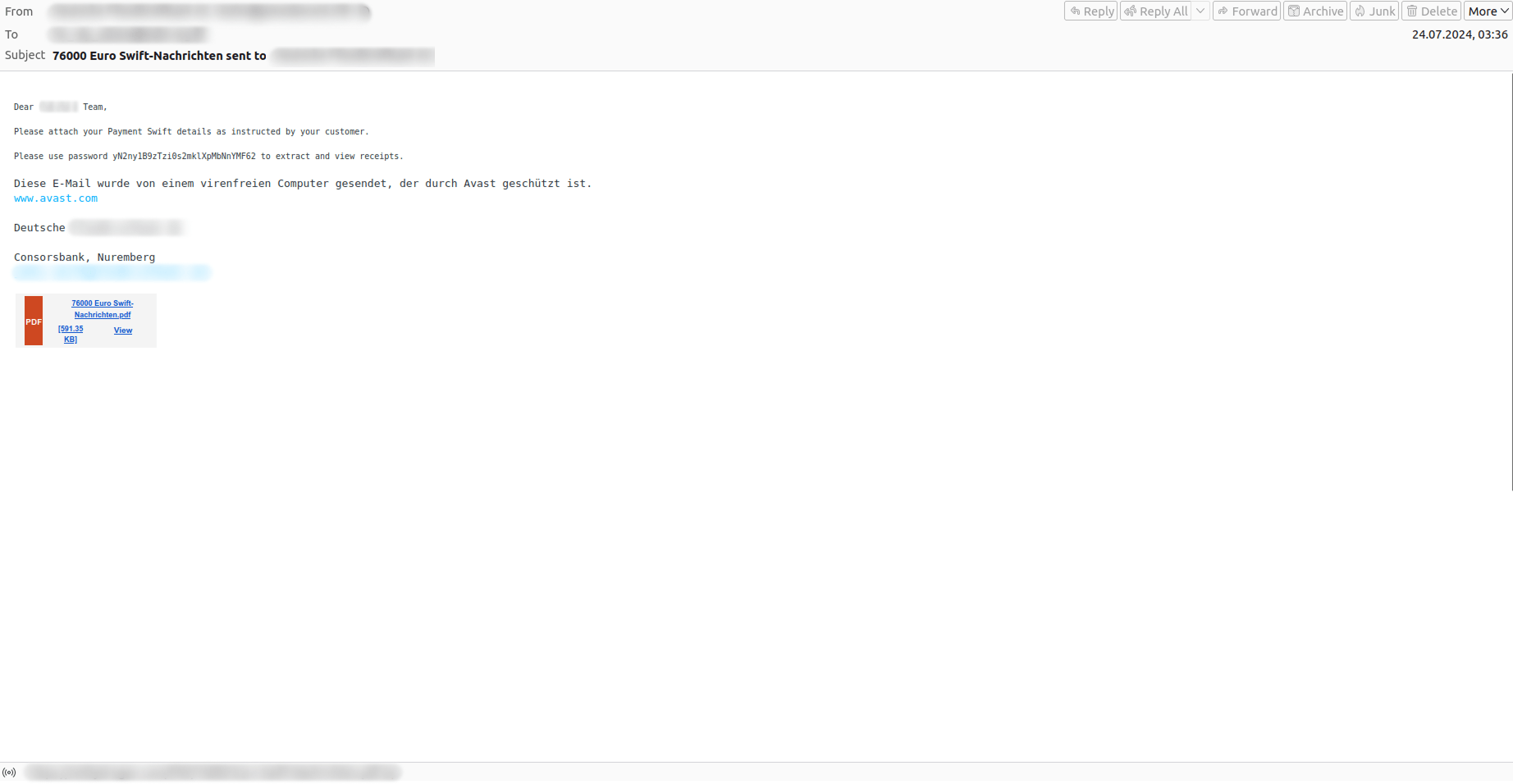
    Password-protected archives

    In 2024, there was an increase in emails distributing password-protected archives containing malicious content. Sometimes, these files were included not as attachments but via download links, which also required a password. Presumably, this was the attackers’ attempt to bypass email security filters. Typically, the archive password was mentioned in the email text, and sometimes in the attachment’s filename. Notably, fraudsters often disguised malicious archives or links as files with other extensions, such as PDF, XLS, or DOC.

    Since April 2024, we have been recording similar distributions of files with the double extension .PDF.RAR, targeting employees of Russian companies in the government, financial, manufacturing, and energy sectors.

    We assume that these messages were sent from compromised email accounts of the recipients’ business partners. Some emails contained real correspondence, to which attackers replied with an email containing the malware. All the emails we examined in this campaign were unique. The attackers likely crafted messages to closely mimic the style of the compromised business partner.

    Similar messages containing malicious files were also found in other languages. However, unlike campaigns targeting Russian-speaking users, these had more general themes—attachments were disguised as invoices, commercial offers, supply orders, tender schedules, court notices, and other documents.

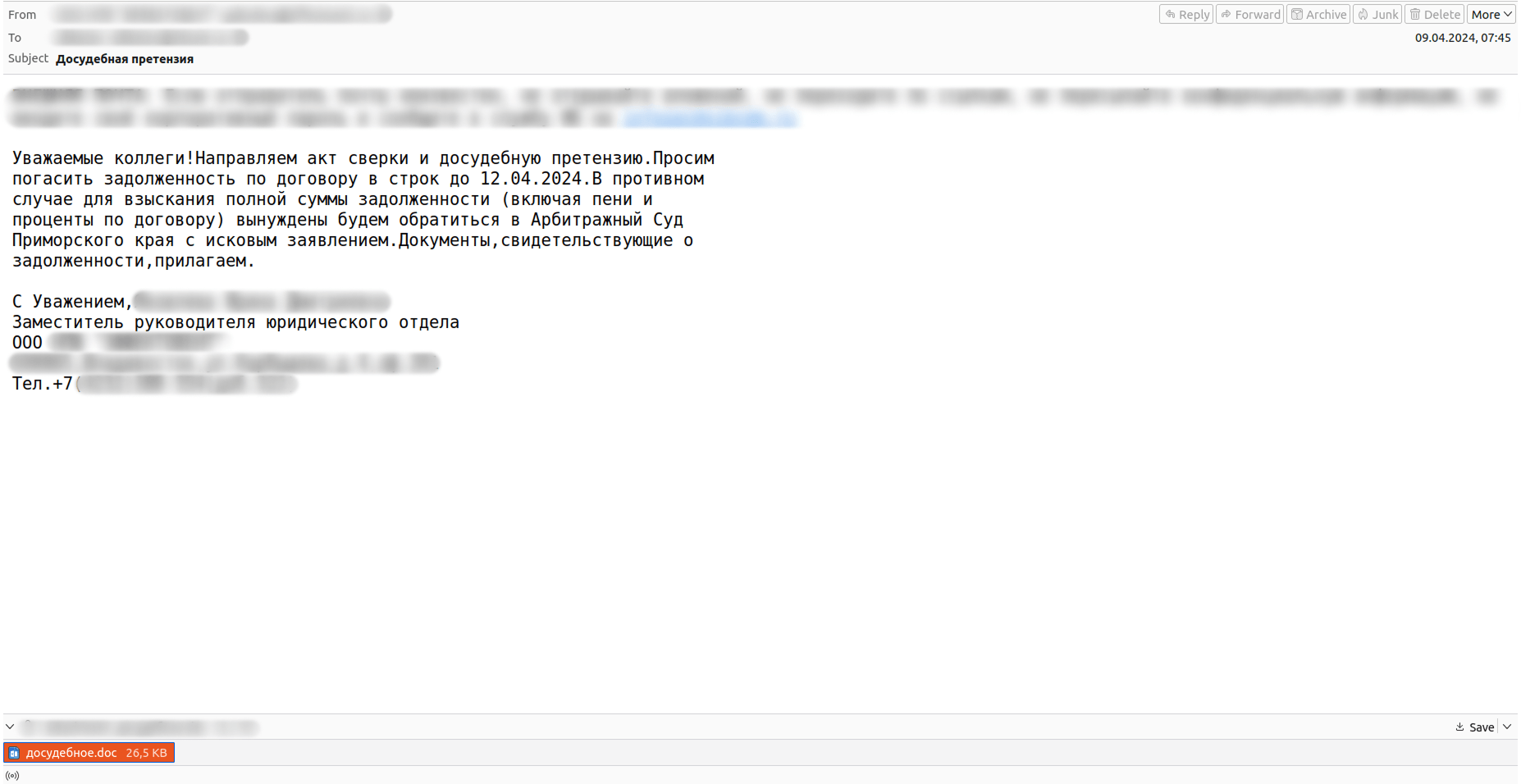
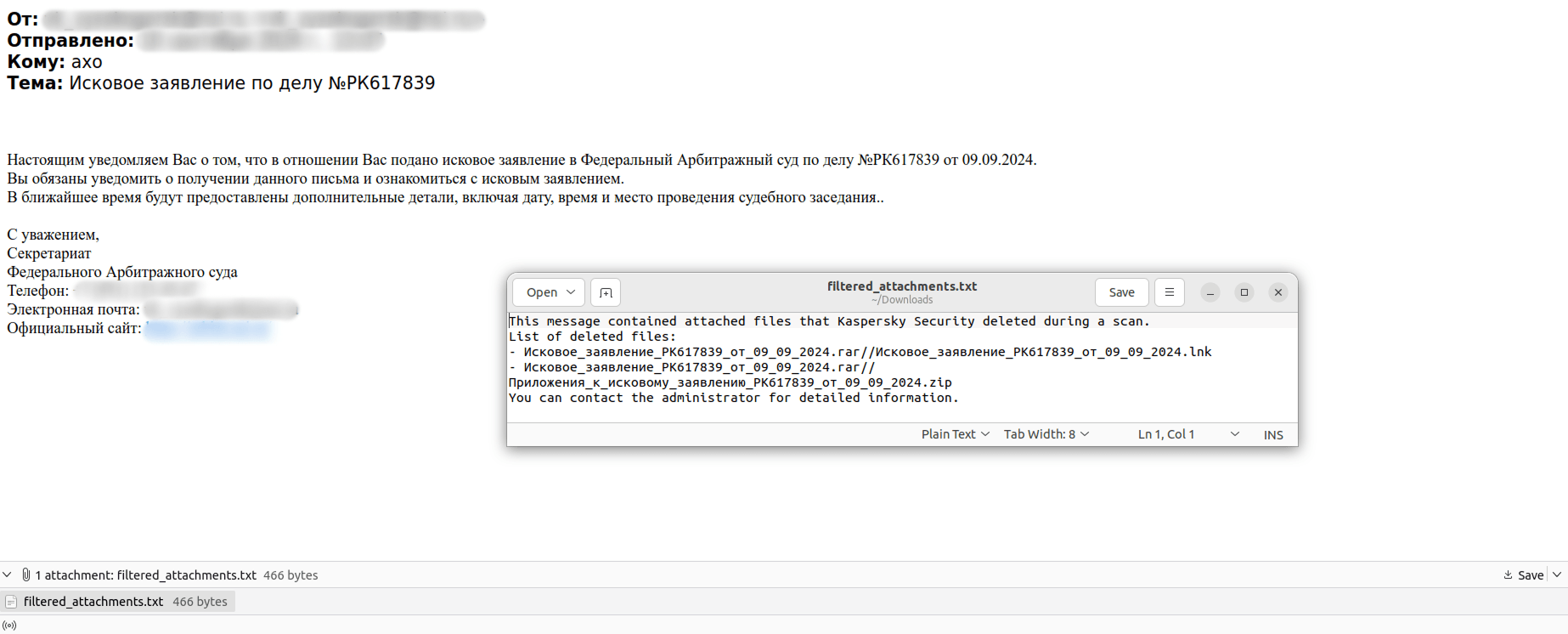
    Pre-trial claims and lawsuits

    Last year, attackers frequently threatened legal action to convince victims to click dangerous links or open malicious attachments. These messages primarily targeted Russian companies but were also observed in other languages. Typically, fraudsters posed as business partners, demanding debt repayment; otherwise, they “would be forced to take the matter to arbitration court.” In one such campaign, pre-trial claims in attachments were .DOC files containing VBA scripts. These scripts established connections with command servers and downloaded, saved, and executed malicious files on the victim’s device. Kaspersky’s products detect this payload with the verdict HEUR:Trojan-Downloader.MSOffice.Sload.gen.

    In some cases, cybercriminals gave no reason for their legal threats but instead attempted to shock victims with an already “filed” lawsuit to pressure them into opening the attachment. Of course, it contained malware.

    Emails with malicious SVG files

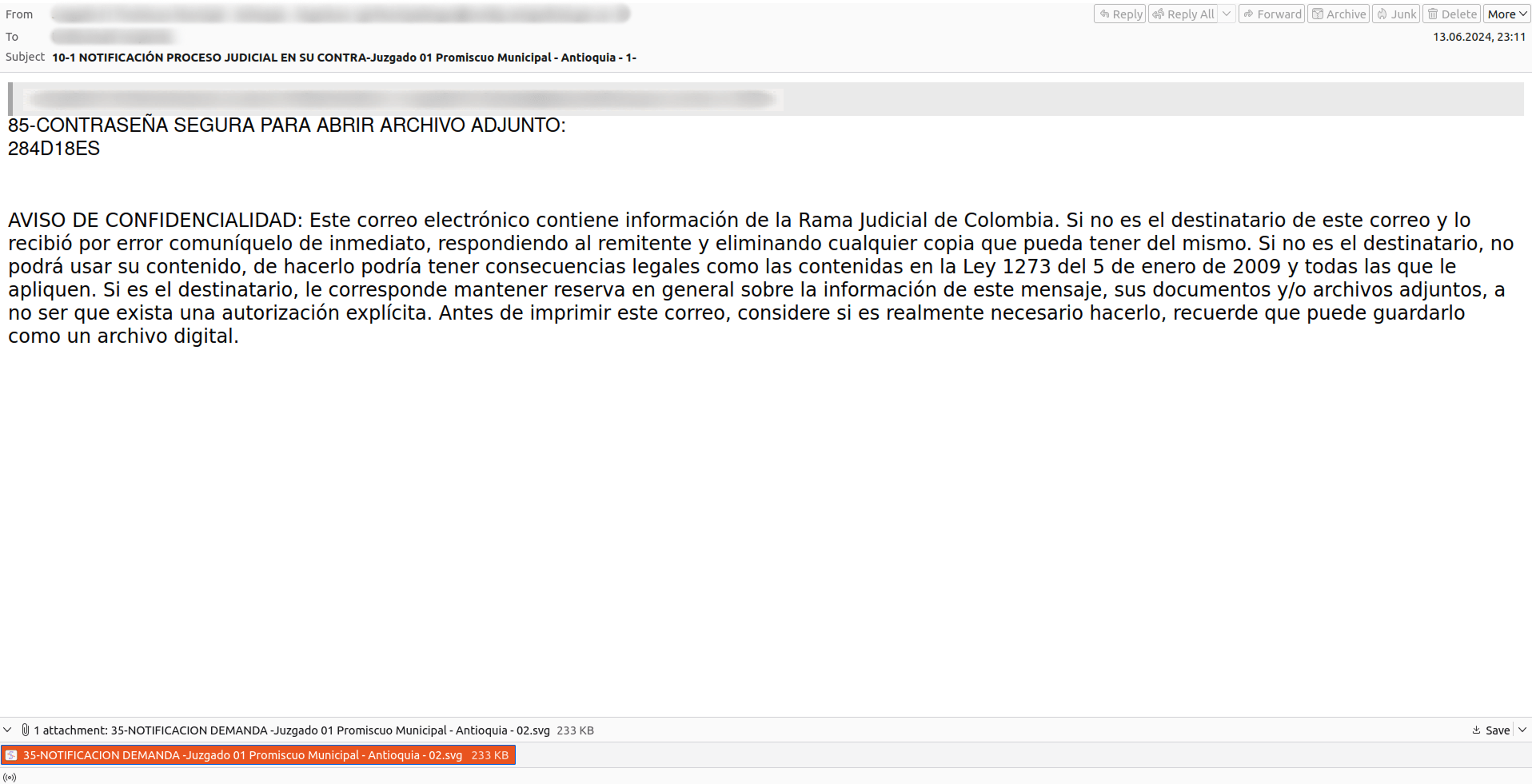
    According to our observations, the past year saw a rise in the distribution of malicious SVG files. Disguised as harmless images, these files contained scripts that downloaded and installed additional malware on the victim’s device. (Our solutions detect these scripts as Trojan.Script.Agent.sy and Trojan.Script.Agent.qe.) The emails we encountered were written in Spanish and posed as fake legal case notifications and court summons. The text included a password for opening the attached file.

    Threats to businesses

    Fake deals

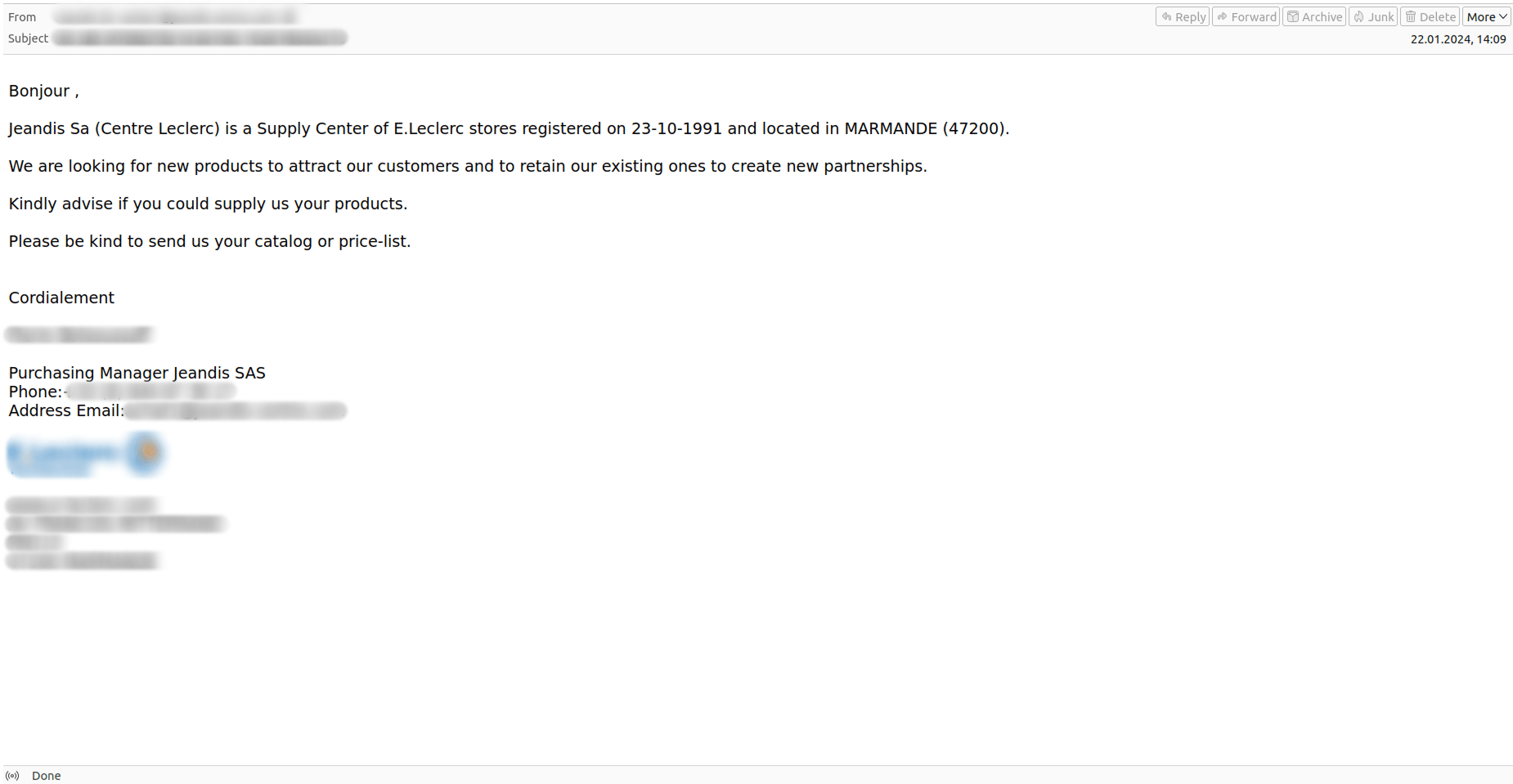
    A special category of emails that users complained about in 2024 was requests for quotation from suspicious senders. These emails were sent either from free email addresses or recently created domains. Attackers signed the emails with the names of large companies, included links to their websites, and sometimes even used official company logos. These emails followed a uniform template: the “buyers” briefly introduced themselves, expressed interest in the recipient’s products, and requested a catalog or price list. Interestingly, the fraudsters did not seem to care about the type of goods involved.

    If the recipient responded, events could unfold in two ways. In some cases, after receiving a reply to the initial seemingly legitimate request, the fraudsters sent malicious attachments or links in the next email.

    In another scenario, the “buyers” engaged in further correspondence with their “potential partner”—the victim—discussing details and insisting on their conditions, including post-payment and requiring the seller to cover customs duties. This meant that the supplier bore all the risks of delivery and could lose their goods without receiving any payment.

    Facebook

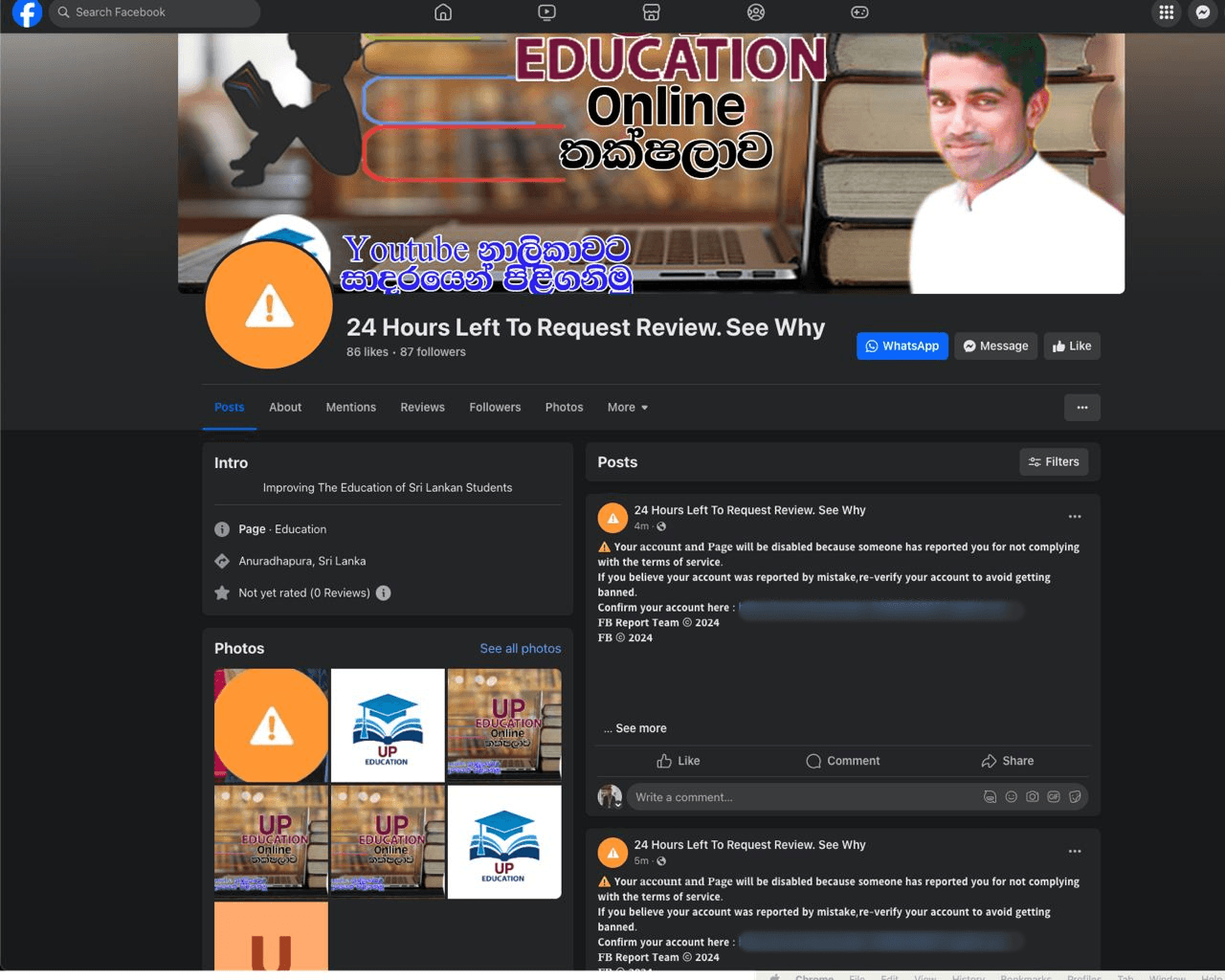
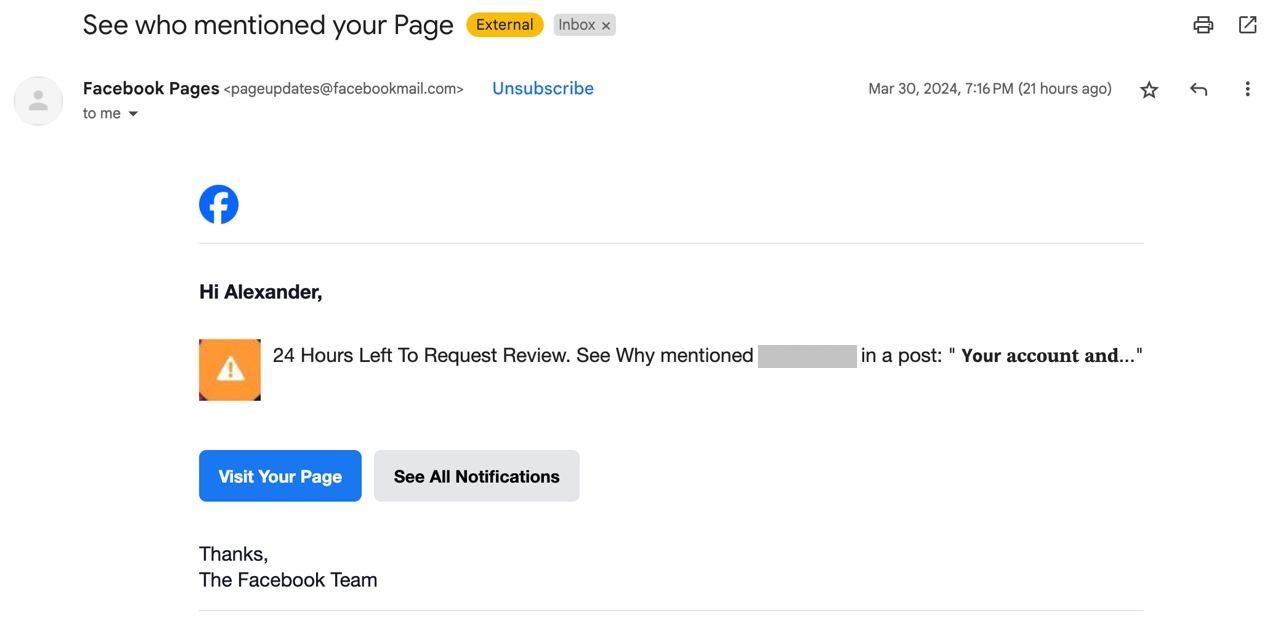
    In the spring of 2024, we discovered an interesting phishing email scheme that leveraged legitimate Facebook notifications. The service sent entirely legitimate emails to users mentioned in threatening posts. The attackers used compromised Facebook accounts, renamed to “24 Hours Left To Request Review. See Why,” and changed the profile picture to an icon featuring an orange exclamation mark.

    Then, the fraudsters created posts on these pages tagging the business accounts of potential victims. The tagged users received notifications from the alarmingly-named pages.

    These posts contained more details than the emails: victims were warned about an impending account ban due to a complaint from another user. To dispute the ban for violating service terms, the recipient of the “notification” was required to follow a phishing link from the post—leading to a fake site with Meta logos that requested Facebook login credentials.

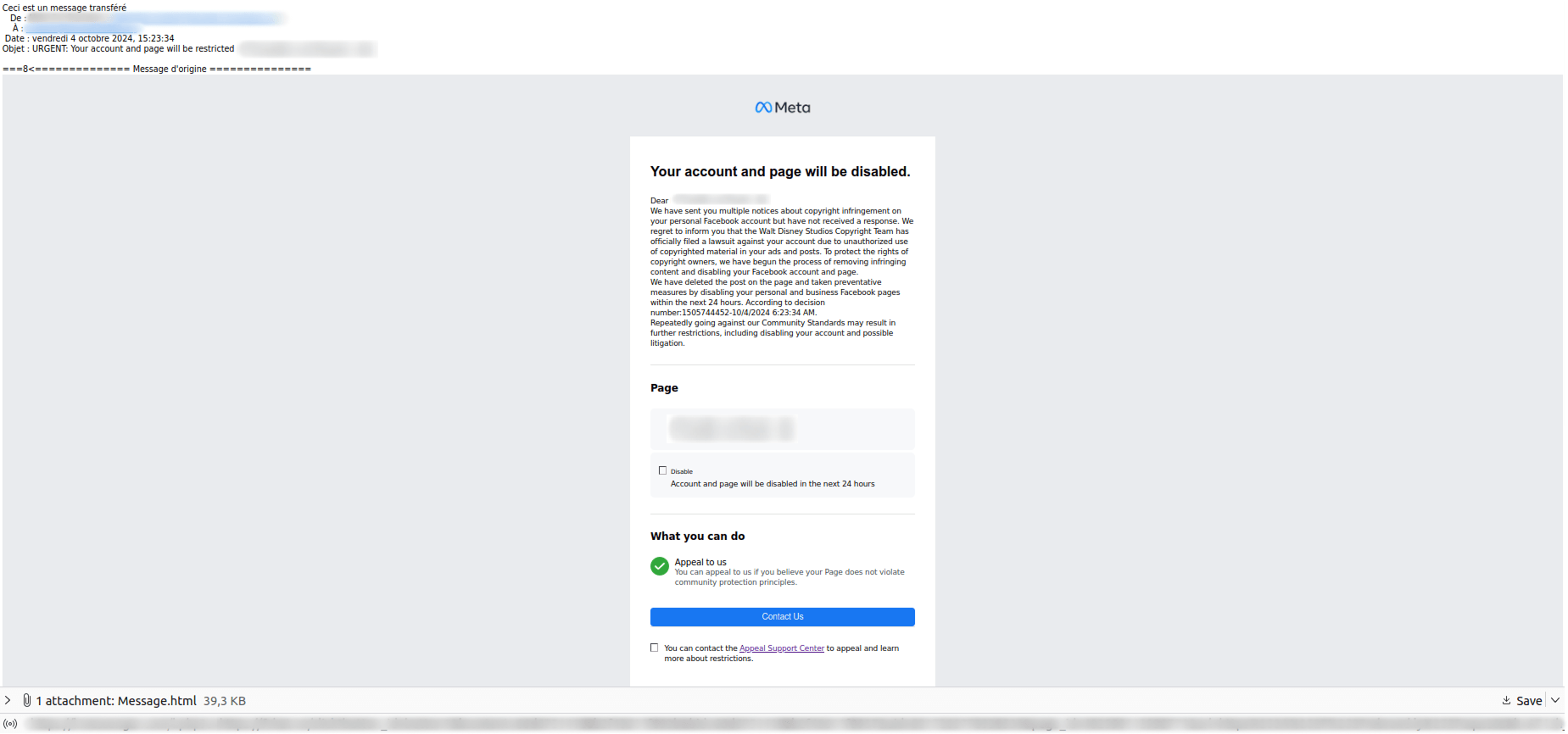
    We also found phishing emails containing legitimate Facebook links in October 2024, but this time without using the platform’s infrastructure. These emails contained notifications of lawsuits for copyright infringement and the removal of unlawful posts from the recipient’s profile. The target was warned that their personal and business pages would be blocked within 24 hours, pressuring them to take hasty and careless action.

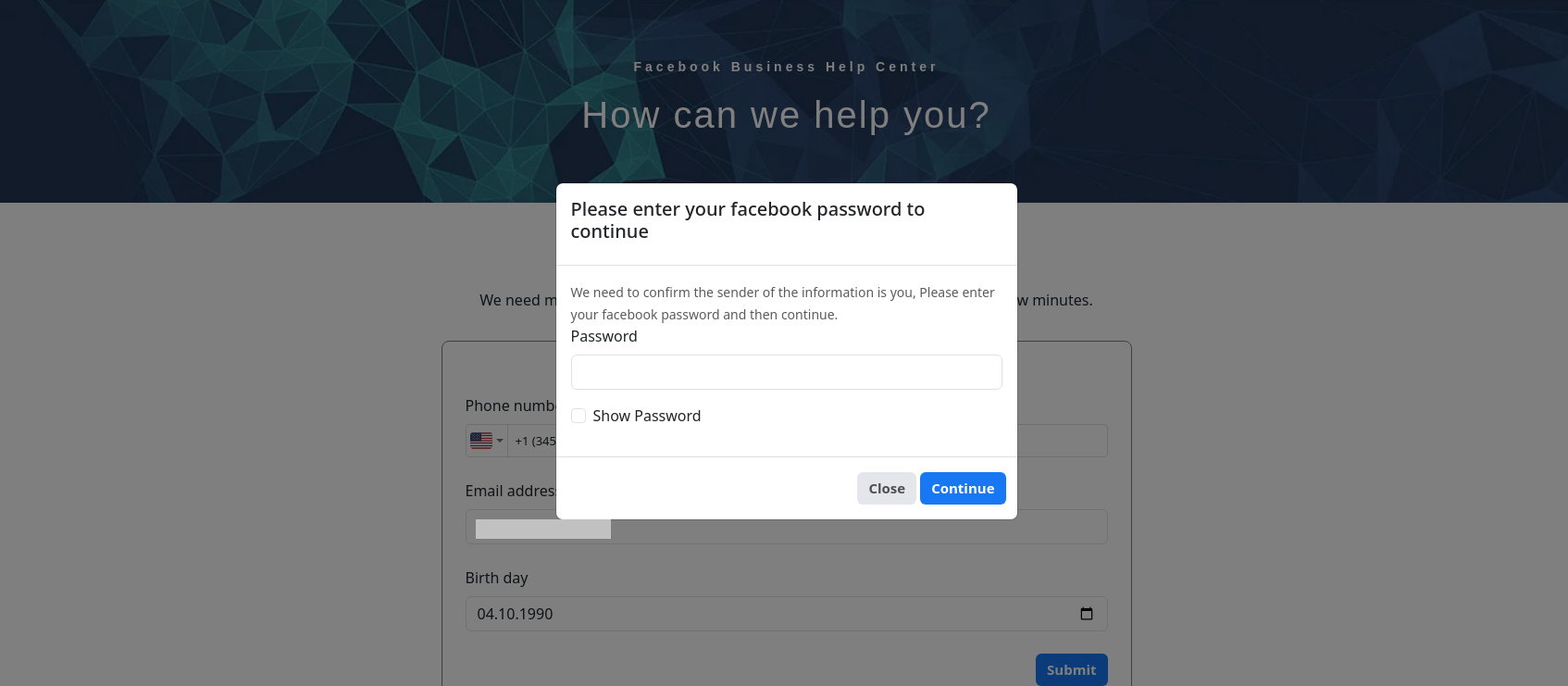
    However, they were immediately offered the chance to appeal by contacting the “Appeal Support Center.” The link in the email led to a phishing site disguised as Meta’s support service, where the victim was also asked to enter their profile password. To make the phishing link more convincing, a legitimate mechanism for redirecting users to external Facebook resources was used.

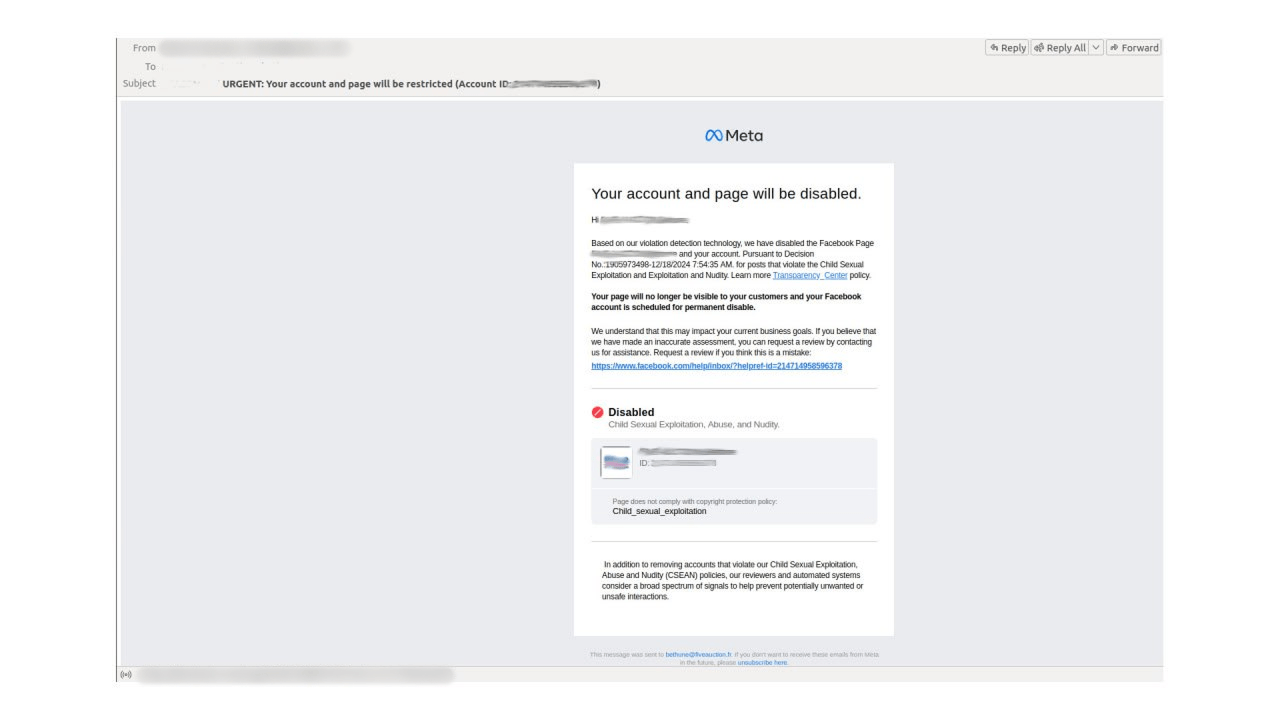
    At the end of 2024, we noticed an email campaign targeting companies promoting their business pages on Facebook. These emails mimicked official Meta for Business notifications and threatened to block the user’s account and business page for violating the platform’s rules and community policies.

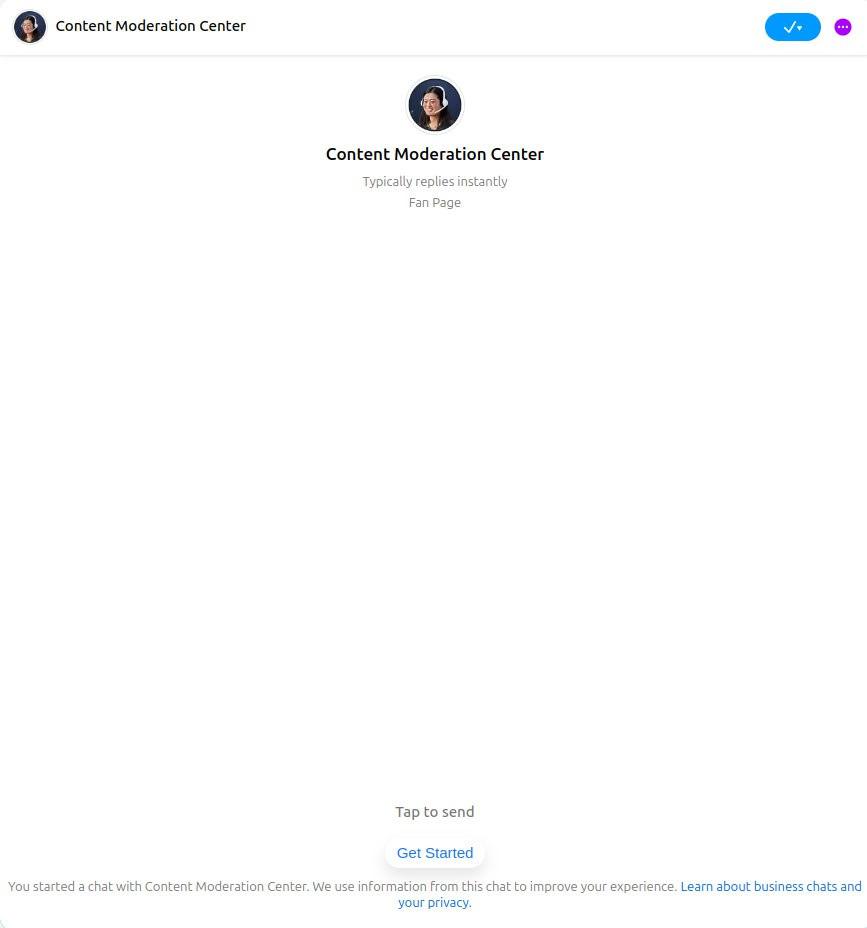
    To dispute these accusations, the fraudsters urged the profile owners to click a link to contact “Facebook support” in a legitimate messenger. However, in reality, the victim was communicating with the owner of a fan page called “Content Moderation Center,” imitating an official support service employee. The scam could have been identified by the “Fan Page” label in the chat, though it was easy to miss.

    News agenda

    In 2024, scammers continued to exploit news agenda in spam campaigns.

    During the UEFA Euro 2024 football championship in Germany, emails began to appear offering merchandise with UEFA EURO 2024 logos.

    After Pavel Durov’s arrest in Paris, we noticed English-language messages calling for donations to supposedly fund his legal defense.

    In the fall of last year, a scam campaign began circulating, offering not-yet-released MacBook Pro M4 devices at low prices or even for free. The links in these emails led to fake websites imitating major marketplaces.

    Before Black Friday, we recorded a surge in spam offering exclusive discounts. The links in these messages lured victims to sites disguised as marketplaces, electronics stores, and financial institutions.

    B2B spam campaigns

    Online promotion services

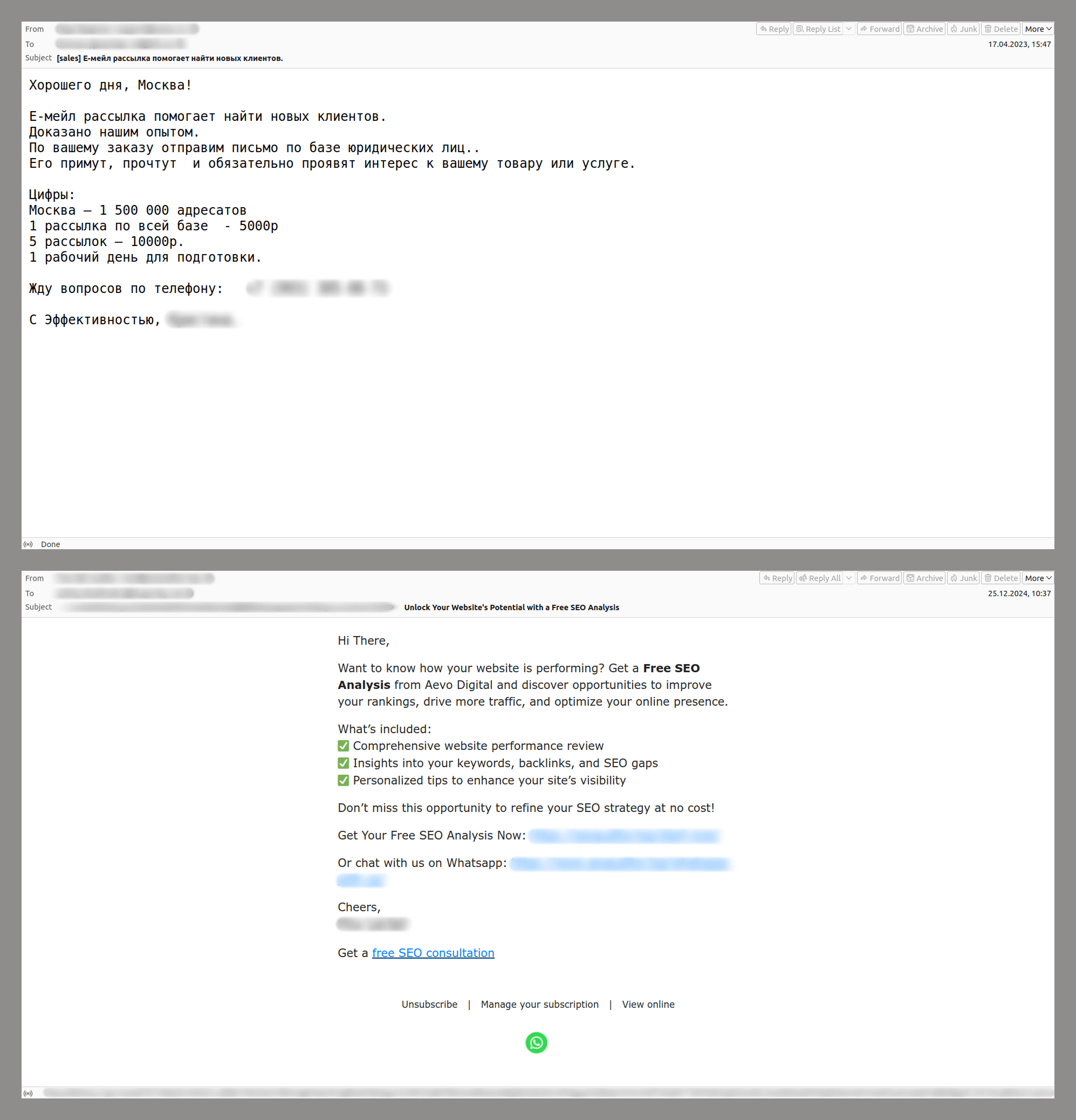
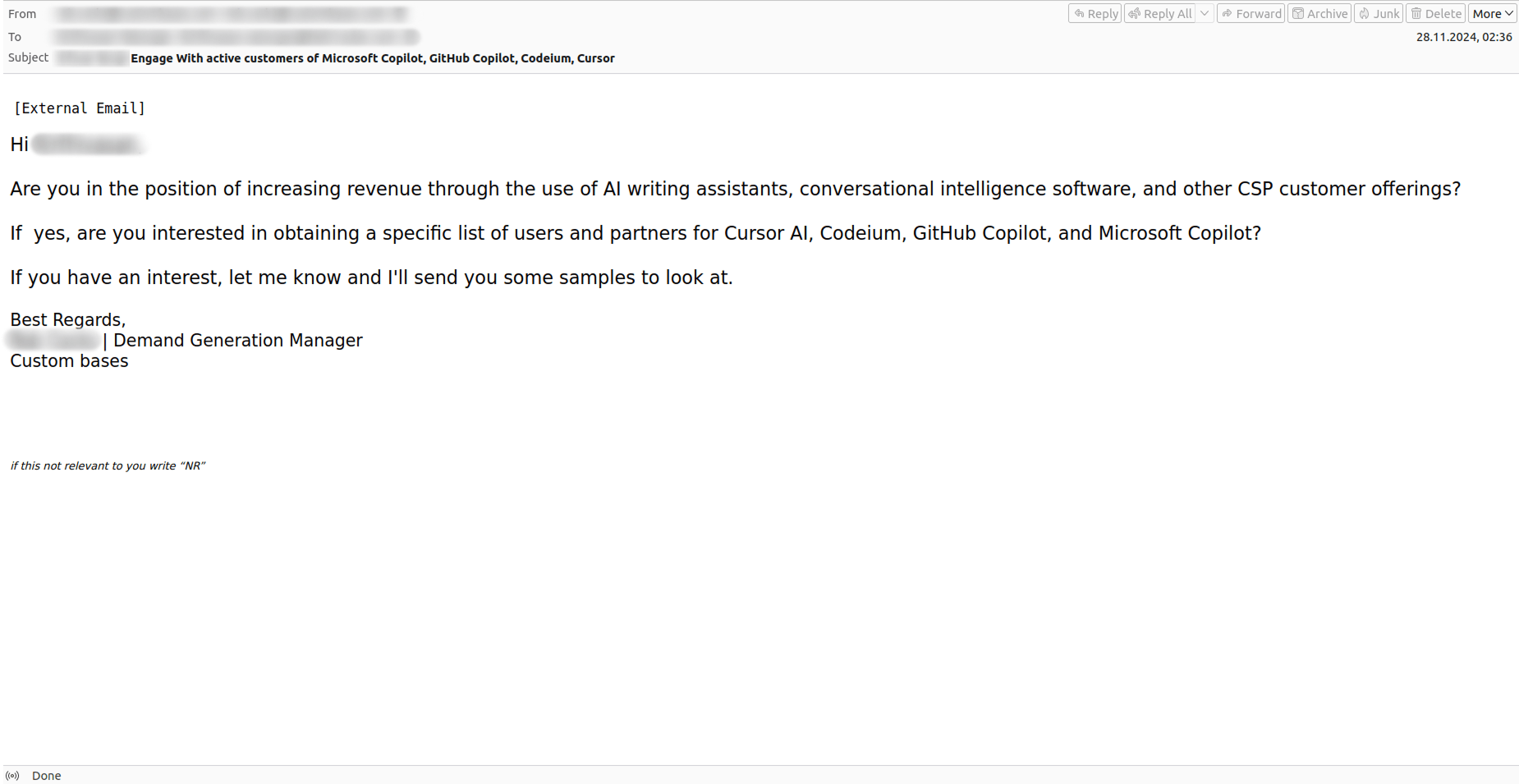
    One of the most common categories of spam email in 2024, complained of frequently by our corporate clients, was commercial offers for online promotion. Users were offered services such as creating or redesigning websites, setting up SEO tools, and purchasing databases with potential client contacts and other information. Other advertised services included guest post placement with backlinks to the client’s site, writing positive reviews, removing negative reviews, and creating personalized email campaigns. While these messages are not malicious or fraudulent, they are mass-distributed and unsolicited, causing inconvenience to users. The popularity of this type of spam is likely driven by the development of digital marketing tools and the search for new clients for small- and medium-sized businesses amid growing online competition.

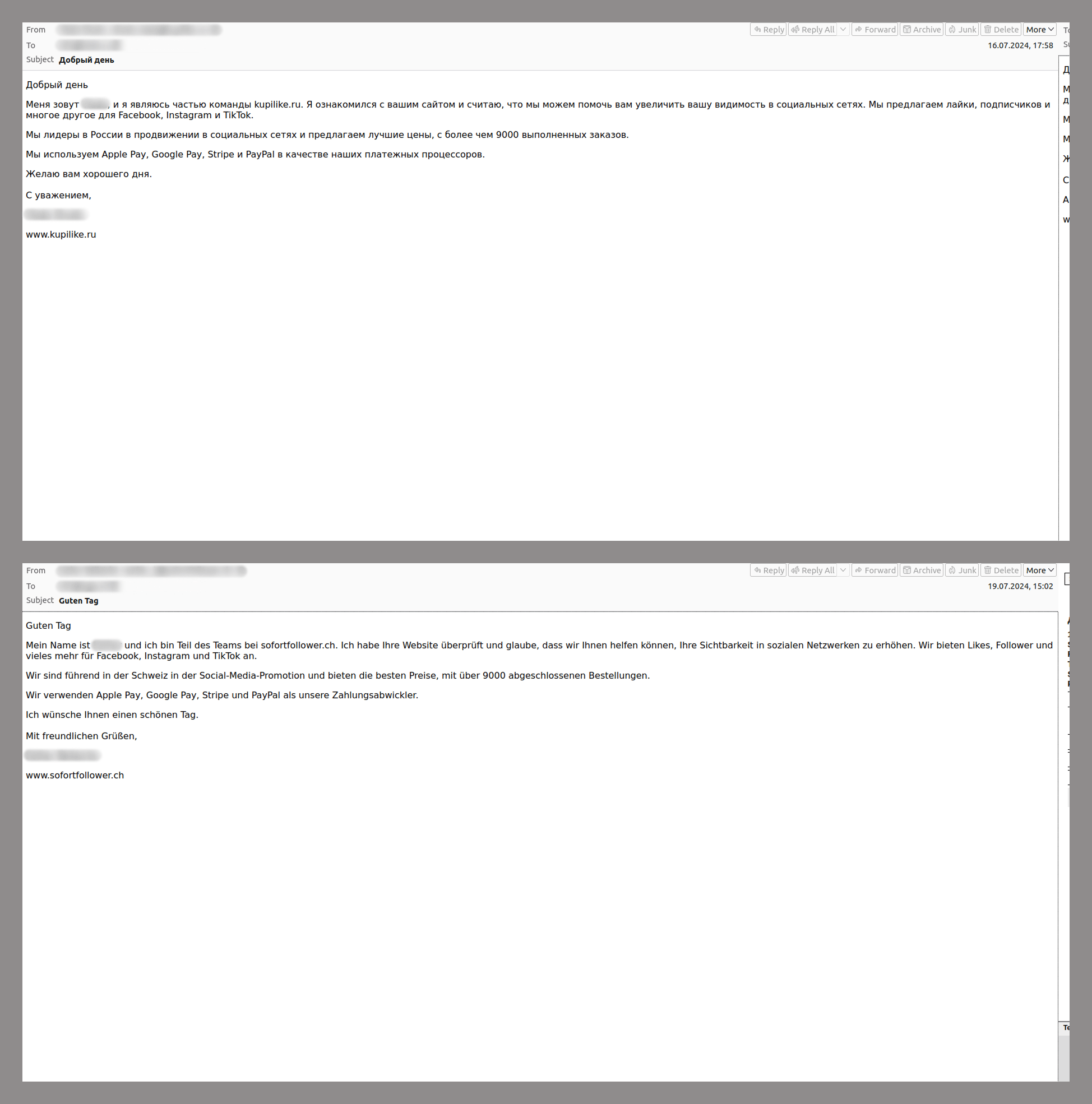
    Buying likes and followers on social media

    We also frequently encountered business offers for the online promotion of company accounts on social media. Spammers sell fake likes and followers. They often pose as employees of real social media marketing firms, claiming to be industry leaders. At the end of their emails, the spammers included a link to a marketing platform and payment options for their services. One such campaign, which we observed throughout the past year and is still active, stood out due to the variety of languages used in the emails and the diversity of domain names. With these tactics, the spammers aimed to reach a global audience.

    AI in B2B emails

    The growing popularity of neural networks has led companies to actively integrate AI into their business processes. We assume that clients of such organizations, in turn, are drawn to service offers that incorporate neural networks. As a natural consequence of this trend, AI-driven solutions began appearing in spam campaigns advertising online marketing services.

    Spammers emphasized using AI, particularly ChatGPT, to perform various business tasks. We identified the following themes in these emails:

    • Attracting website traffic
    • Creating advanced lead generation strategies
    • Developing unique approaches tailored to a brand’s identity
    • Producing and publishing content
    • Launching personalized multi-channel marketing campaigns
    • Creating custom videos for YouTube channels

    Other topics also appeared in spam emails, but they all shared the same goal—enhancing business processes and attracting potential clients.

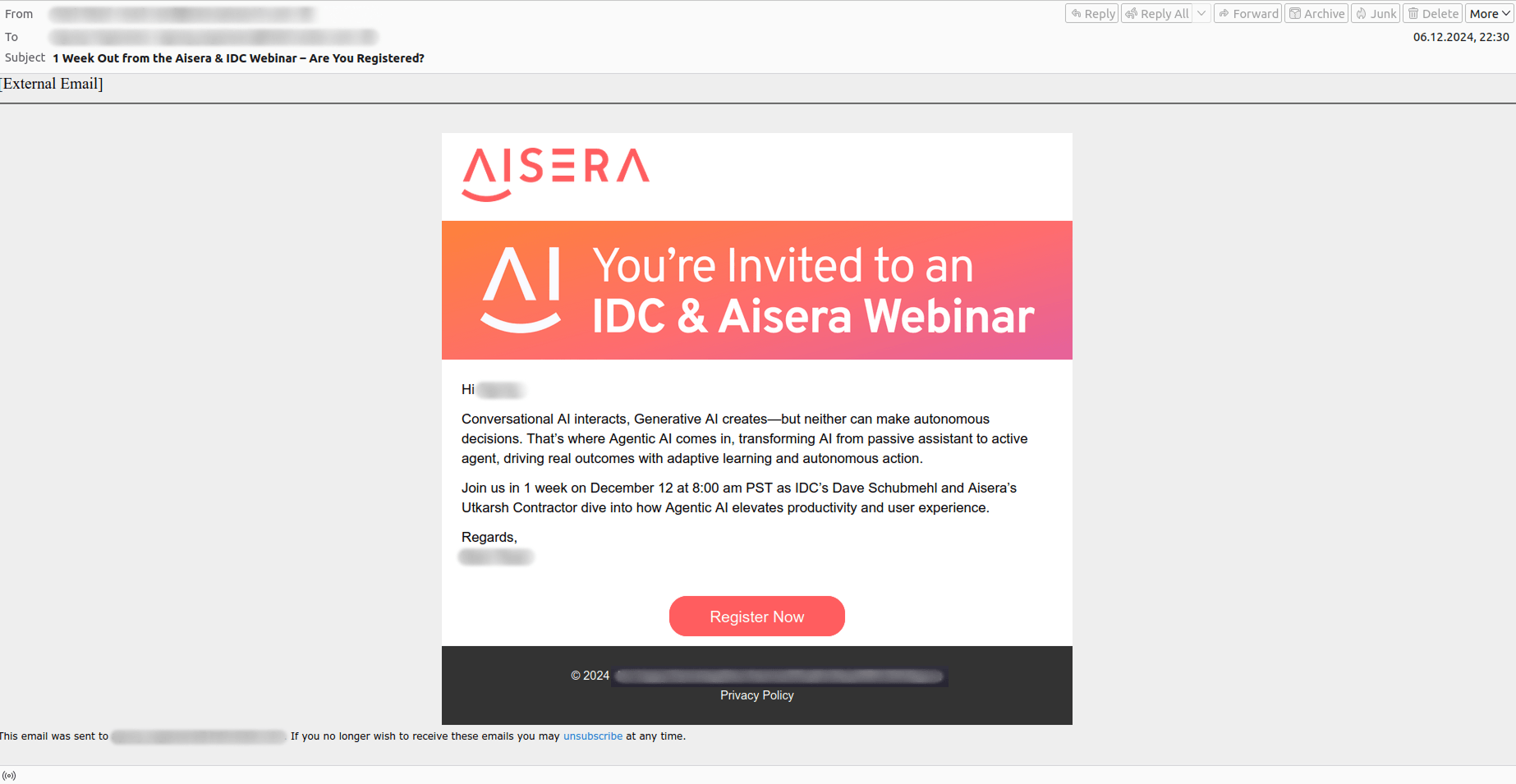
    Another particularly popular category of spam related to neural networks was advertising online events. Last year, we encountered numerous examples of emails promoting webinars about the promising capabilities and practical applications of AI in business operations.

    Targeted phishing in 2024

    In 2024, two main trends were observed in targeted phishing:

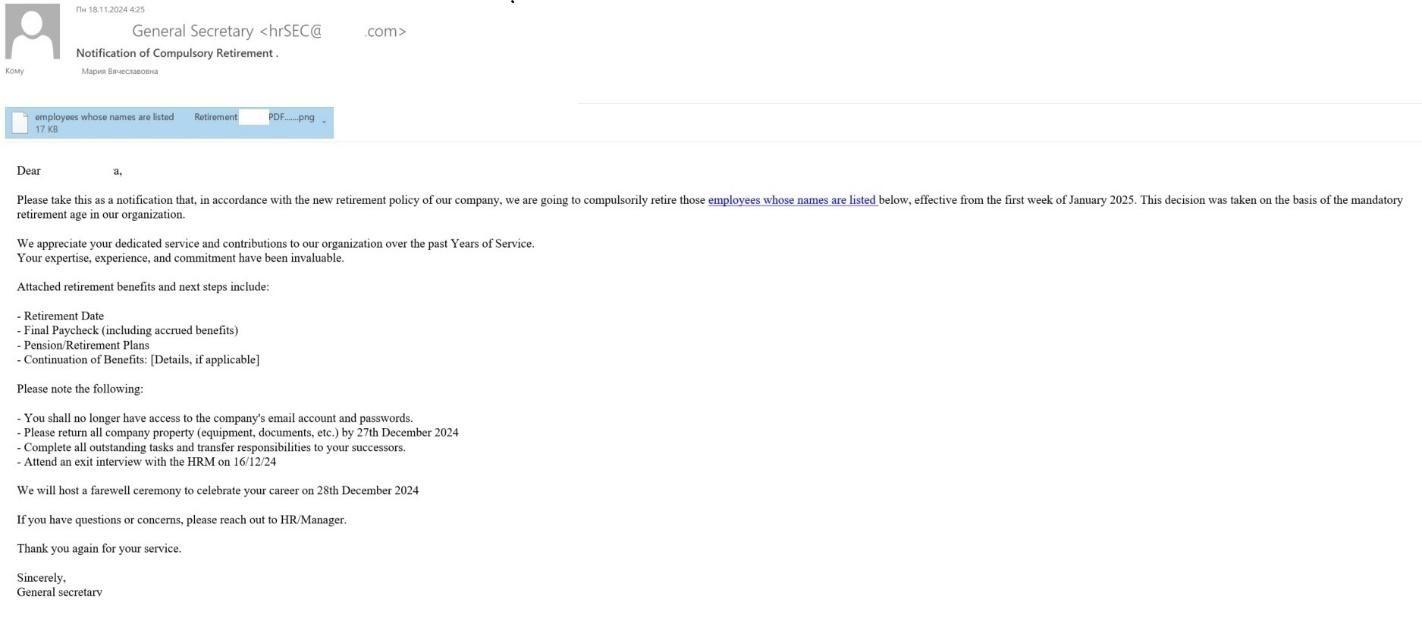
    1. Notifications on behalf of a company’s HR department. Employees were asked to fill out or sign a document, such as a vacation schedule, accessible via a link in an email. Sometimes, instead of routine requests, attackers resorted to more extravagant tactics—such as inviting employees to check if they were on a list of staff to be dismissed.

    Phishing email from HR

    In all these cases, the common factor was that clicking the link led the employee to a phishing login page instead of the actual corporate portal. Most often, attackers targeted Microsoft accounts, though some phishing forms mimicked internal corporate resources.

    Fake login form

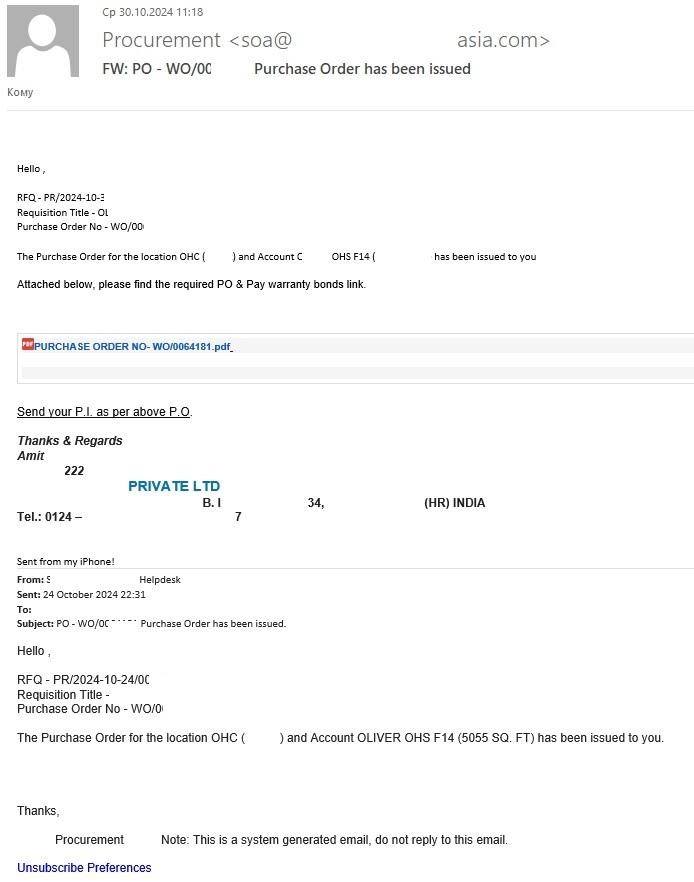
    1. Emails from a seller to a buyer, or vice versa. One common scheme involved a buyer or seller asking the victim to review an offer or respond to questions about product delivery and required specifications. These emails contained attached documents that actually concealed phishing links.

    Example of a phishing email from a seller

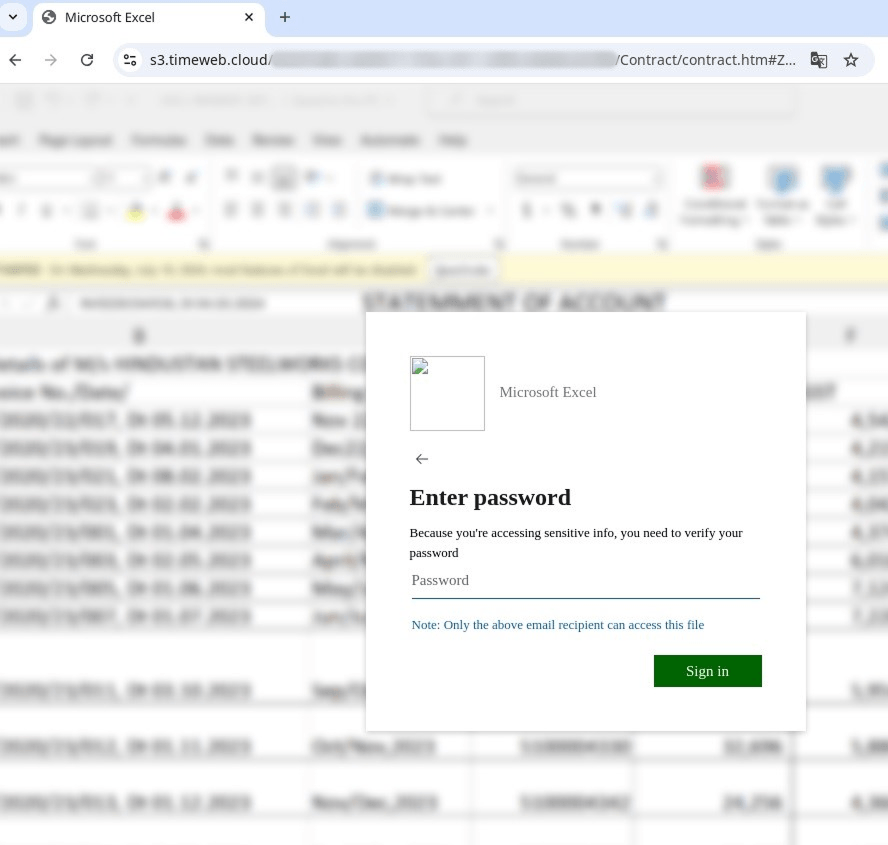
    When attempting to open the attachment, the user was redirected to a phishing page. As in the previous case, these fake forms harvested Microsoft credentials and corporate account logins.

    Fake password entry form

    Statistics: phishing

    The number of phishing attacks in 2024 increased compared to the previous year. Kaspersky solutions blocked 893,216,170 attempts to follow phishing links—26% more than in 2023.

    Number of Anti-Phishing triggerings, 2024 (download)

    Map of phishing attacks

    Users from Peru (19.06%) encountered phishing most often. Greece (18.21%) ranked second, followed by Vietnam (17.53%) and Madagascar (17.17%). They are closely followed by Ecuador (16.90%), Lesotho (16.87%) and Somalia (16.70%). The final places in the TOP 10 are occupied by Brunei (16.55%), Tunisia (16.51%) and Kenya (16.38%).

    Country/territory Share of attacked users*
    Peru 19.06
    Greece 18.21
    Vietnam 17.53
    Madagascar 17.17
    Ecuador 16.90
    Lesotho 16.87
    Somalia 16.70
    Brunei 16.55
    Tunisia 16.51
    Kenya 16.38

    * Share of users who encountered phishing out of the total number of Kaspersky users in the country/territory, 2024

    Top-level domains

    The most common domain zone hosting phishing sites remains the COM zone (29.78%)—its popularity has increased one and a half times compared to 2023. In second place is the XYZ domain (7.10%), which ranked fifth last year, followed by TOP (6.97%), which retained its position in the top ten. Next, with a slight margin from each other, are the ONLINE (4.25%) and SITE (3.87%) domain zones, where phishing sites were less actively hosted last year. The Russian RU domain (2.23%) and the global NET domain (2.02%) are in sixth and seventh place, respectively. Following them are CLICK (1.41%) and INFO (1.35%)—the year before, these zones were not frequently used. Closing the top ten is another national domain: UK, with a share of 1.33%.

    Most frequent top-level domains for phishing pages, 2024 (download)

    Organizations targeted by phishing attacks

    The rating of organizations targeted by phishers is based on the detections of the deterministic component in the Anti-Phishing system on user computers. The component detects all pages with phishing content that the user has tried to open by following a link in an email message or on the web, as long as links to these pages are present in the Kaspersky database.

    In 2024, the highest number of attempts to access phishing links blocked by Kaspersky solutions was associated with pages imitating various web services (15.75%), surpassing global internet portals (13.88%), which held the top position in 2023. The third and fourth positions in last year’s top ten also swapped places: banks moved ahead (12.86%), overtaking online stores at 11.52%. Attackers were also interested in social media (8.35%) and messengers (7.98%): attacks targeting them strengthened their positions in the ranking. For websites imitating delivery services, we observed a decline in phishing activity (6.55%), while the share of payment systems remained unchanged at 5.82%. Also included in the list of the most frequently targeted organizations were online games (5.31%) and blogs (3.75%).

    Distribution of organizations targeted by phishers, by category, 2024 (download)

    Statistics: spam

    Share of spam in email traffic

    In 2024, spam emails accounted for 47.27% of the total global email traffic, an increase of 1.27 p.p. compared to the previous year. The lowest spam levels were recorded in October and November, with average shares dropping to 45.33% and 45.20%, respectively. In December, we observed a seemingly slight upward trend in junk emails, resulting in the fourth quarter of the year being the calmest. Spam activity peaked in the summer, with the highest number of emails recorded in June (49.52%) and July (49.27%).

    Share of spam in global email traffic, 2024 (download)

    In the Russian internet segment, the average spam share exceeded the global figure, reaching 48.57%, which is 1.98 p.p. higher than in 2023. As in the rest of the world, spammers were least active at the end of the year: in the fourth quarter, 45.14% of emails were spam. However, unlike global trends, in Runet, we recorded four months during which the spam share exceeded half of all traffic: March (51.01%), June (51.53%), July (51.02%), and September (51.25%). These figures identified the third quarter as the most active, with a share of 50.46%. December was the calmest month, and interestingly, despite spam levels being generally high or the same in Russia, the number of spam emails in December was lower than the global figure: 44.56%.

    Share of spam in Runet email traffic, 2024 (download)

    Countries and territories where spam originated

    We continue to observe an increase in the share of spam sent from Russia—from 31.45% to 36.18%. The United States and mainland China, which held second and third place last year, swapped positions, with China’s share increasing by 6 p.p. (17.11%) and the US share decreasing by 3 p.p. (8.40%). Kazakhstan, which entered the top twenty for the first time last year, rose from eighth to fourth place (3.82%), pushing Japan (2.93%) down, and causing Germany, previously in fifth place, to drop one position with a share of 2.10%. India’s share slightly decreased, but the country moved up two positions from last year to seventh place. Conversely, the amount of spam sent from Hong Kong more than doubled (1.75%), allowing this territory to take eighth place in the top twenty. Next come Brazil (1.44%) and the Netherlands (1.25%), whose shares continued to decline.

    TOP 20 countries and territories where spam originated in 2024 (download)

    Malicious email attachments

    In 2024, Kaspersky solutions detected 125,521,794 attempts to open malicious email attachments, ten million fewer than the previous year. Interestingly, one of the peaks in email antivirus detections occurred in April—in contrast to 2023, when this month had the lowest malicious activity. In January and December, we observed a relative decrease in detections, while increases were noted in spring and autumn.

    Number of email antivirus detections, 2024 (download)

    The most common malicious email attachments were Agensla stealers (6.51%), which ranked second last year. Next were Badun Trojans (4.51%), which spread in archives disguised as electronic documents. The Makoob family moved from eighth to third place (3.96%), displacing the Noon spyware (3.62%), which collects browser passwords and keystrokes. The malicious Badur PDFs, the most common attachments in 2023, dropped to fifth place with a 3.48% share, followed by phishing HTML forms from the Hoax.HTML.Phish family (2.93%). Next in line were Strab spyware Trojans (2.85%), capable of tracking keystrokes, taking screenshots, and performing other typical spyware actions. Rounding out the top ten were SAgent VBS scripts (2.75%), which were not as actively used last year, the Taskun family (2.75%), which maintained its previous share, and PDF documents containing phishing links, Hoax.PDF.Phish (2.11%).

    TOP 10 malware families distributed as email attachments, 2024 (download)

    The list of the most widespread malware reflects trends similar to the distribution of families, with a few exceptions: the Hoax.HTML.Phish variant of malicious HTML forms dropped two positions (2.20%), and instead of a specific Strab Trojan sample, the top ten included the ISO image Trojan.Win32.ISO.gen, distributed via email (1.39%).

    TOP 10 malicious programs distributed as email attachments, 2024 (download)

    Countries and territories targeted by malicious mailings

    In 2024, users in Russia continued to face malicious email attachments more frequently than other countries, although the share of email antivirus detections in this country decreased compared to last year, to 11.37%. China ranked second (10.96%), re-entering the top twenty after several years. Next came Spain (8.32%), Mexico (5.73%), and Turkey (5.05%), which dropped one position each with a slight decline in malicious attachments. Switzerland (4.82%) took sixth place, appearing in the ranking for the first time. Following them were Vietnam (3.68%), whose share declined, and the UAE (3.24%), which strengthened its position in the ranking. Also among frequent targets of malicious spam were users from Malaysia (2.99%) and Italy (2.54%).

    TOP 20 countries and territories targeted by malicious mailings, 2024 (download)

    Conclusion

    Political and economic crises will continue to provide new pretexts for fraudulent schemes. In some cases presented in the 2024 report, we can observe the “greed” of cybercriminals: the use of two different company brands on the same page; a credible fake of a resource aimed not at stealing credentials but at stealing money; comprehensive questionnaires that can lead not only to loss of access to funds but also to identity theft. Such multi-layered threats may become a new trend in phishing and scam attacks.

    We continue to observe major news events being exploited in spam campaigns that promise easy earnings and discounted goods or services. The growing user interest in artificial intelligence tools is actively being leveraged by spammers to attract an audience, and this trend will undoubtedly continue.
    MIL OSI Economics –

    February 19, 2025
  • MIL-OSI United Kingdom: 01/2025: Publication of Business Rates Relief Information​

    Source: United Kingdom – Government Statements

    ​​Business rates information letters are issued by the Ministry of Housing, Communities and Local Government at regular intervals throughout the year.

    Applies to England

    Documents

    01/2025: Publication of Business Rates Relief Information​

    HTML

    Details

    This letter confirms the business rates multipliers for 2025 to 2026 and includes local authority guidance for the Retail, Hospitality and Leisure Scheme for 2025 to 2026 and Film Studio Relief guidance.

    Updates to this page

    Published 19 February 2025

    Sign up for emails or print this page

    MIL OSI United Kingdom –

    February 19, 2025
  • MIL-OSI Asia-Pac: TDC Chairman named

    Source: Hong Kong Information Services

    The Government today announced the appointment of Prof Frederick Ma to succeed Peter Lam as Chairman of the Trade Development Council from June 1, 2025, to May 31, 2027.

    Secretary for Commerce & Economic Development Algernon Yau said with extremely profound experience in public service as well as the commercial sector, Prof Ma is well suited for taking up the council chairmanship.

    Mr Yau expressed confidence that Prof Ma would lead the council to make every effort in assisting enterprises to embrace the challenges arising from the ever changing global trading landscape and actively tap new markets and business opportunities, with a view to further promoting Hong Kong’s development as an international trade centre.

    The commerce chief also thanked Mr Lam for his tremendous contributions during his tenure in promoting Hong Kong’s advantages and opportunities.

    He added that under Mr Lam’s chairmanship, the council has successfully promoted Hong Kong as a two way global investment and business hub and assisted Hong Kong companies in further exploring the business opportunities in the Mainland and overseas brought by the nation’s dual circulation strategy, with outstanding achievements particularly in promoting the city in the Guangdong-Hong Kong-Macao Greater Bay Area and emerging markets under the Belt & Road Initiative.

    MIL OSI Asia Pacific News –

    February 19, 2025
  • MIL-OSI USA: Schatz, Marshall Introduce Legislation To Improve Weather Forecasts, Help Communities Better Prepare For Extreme Weather

    US Senate News:

    Source: United States Senator for Hawaii Brian Schatz

    U.S. Senators Brian Schatz (D-Hawai‘i) and Roger Marshall (R-Kan.) today introduced a bill to strengthen the collection of weather and soil moisture data, improving the accuracy of extreme weather warnings and agriculture forecasts. The Improving Flood and Agricultural Forecasts Act of 2025 codifies and expands the National Oceanic and Atmospheric Administration’s (NOAA) Mesonet Program, an initiative that aims to fill gaps in local weather data that impact forecasting and disaster response, as well as supporting agriculture and other weather-dependent industries through improved data collection.

    “For Hawai‘i and other states vulnerable to floods, droughts, and severe weather, better data means better forecasts, better prepared communities, and faster emergency response times,” said Senator Schatz, a member of the Senate Commerce, Science, and Transportation Committee. “This same data also helps farmers and ranchers navigate droughts.”

    “The mesonet and soil moisture monitoring probes are crucial tools for Kansans. Weather affects everything on the farm, and a deeper understanding of what’s happening above and below the ground provides farmers more certainty when making crop decisions,” said Senator Marshall. “Better weather data collection for Kansas also helps us predict wildfires and tornadoes before they arrive, which has the potential to save lives in cases of extreme weather. I’m proud to introduce this important, bipartisan legislation.”

    Mesonets are weather observation data networks crucial for forecasting weather, flood, fire, and agricultural impacts. The legislation would provide grants to states, Tribes, private entities, and universities to expand local weather observation systems. By authorizing and enabling NOAA to purchase local weather data, assess its quality and cost-effectiveness, and integrate it into key forecasting systems, the bill aims to improve disaster preparedness and agricultural production nationwide. The legislation builds on Schatz’s efforts to increase funding for NOAA’s Mesonet Program, which has supported a key soil moisture sensing network in Hawai‘i.

    The text of the bill is available here.

    MIL OSI USA News –

    February 19, 2025
  • MIL-OSI: Wix Reports Fourth Quarter and Full Year 2024 Results

    Source: GlobeNewswire (MIL-OSI)

    Capping off a year of sustained growth acceleration and stronger than expected FCF generation – surpassing Rule of 40 in 2024 and on track to achieve Rule of 45 in 2025

    • Culminated a year of accelerated growth and innovation with Q4 bookings of $465 million, up 18% y/y, and Q4 revenue of $460 million, up 14% y/y
      • Steady growth acceleration in Self Creators coupled with continued strength in high-growth Partners, demonstrated by Partners revenue growth of 30% y/y in FY2024
      • Strong momentum across key product focus areas, including Studio, AI and commerce as well as solid business fundamentals and price increase benefit
    • Robust growth and a stable operating cost base drove FCF1 generation to nearly double in 2024 compared to previous year, resulting in continued profitability improvement with Q4 FCF margin of 29% and full year FCF1 margin of 28%
      • Achieved first year of positive GAAP operating income in Wix history
    • On track to achieve Rule of 45 in 2025 at high end of outlook through continued innovation-powered growth and further FCF margin expansion
    • Completed $200 million share repurchase plan in January, totaling $725 million in aggregate repurchases since August 2023

    NEW YORK — Wix.com Ltd. (Nasdaq: WIX), the leading SaaS website builder platform2, today reported financial results for the fourth quarter and full year 2024. In addition, the Company provided its initial outlook for the first quarter and full year 2025. Please visit the Wix Investor Relations website at https://investors.wix.com to view the Q4’24 Shareholder Update and other materials.

    “Wix sets a high standard for innovation and creativity, and we’re constantly exceeding expectations. This past year was one of exciting innovation as we introduced revolutionary AI solutions such as the new generation AI Website Builder. We also made meaningful enhancements to the Studio platform, including the AI visual sitemap and wireframe generator and Figma integration among new advanced design capabilities,” said Avishai Abrahami, Wix Co-founder and CEO. “2025 is poised to reimagine and expand the Self Creator experience with the launch of two transformative products planned for the spring and early fall. I strongly believe that these will deliver immense value to users and, in turn, accelerate Self Creator growth to double-digits in the years to come. We’re thrilled about these strategic enhancements, which are set to propel our business forward and establish a powerful foundation for the years ahead.”

    “We wrapped 2024 with accelerated growth and profitability, driven by successful execution of our product roadmap and pricing strategy as well as strong business fundamentals,” added Lior Shemesh, CFO at Wix. “With AI usage ramping from our growing suite of innovations and Studio continuing to win market share, we anticipate these to be even bigger growth engines in 2025 and beyond. Solid growth will be coupled with incremental efficiencies from new internal AI initiatives and a stable operating base, enabling us to continue to expand margins and set new profitability records. The high end of our outlook puts us at Rule of 45 in 2025 as we continue to prioritize balancing profitable growth through best-in-class innovation and steadfast execution.”

    Q4 2024 Financial Results

    • Total revenue in the fourth quarter of 2024 was $460.5 million, up 14% y/y
      • Creative Subscriptions revenue in the fourth quarter of 2024 was $329.7 million, up 11% y/y
      • Creative Subscriptions ARR increased to $1.343 billion as of the end of the quarter, up 13% y/y
    • Business Solutions revenue in the fourth quarter of 2024 was $130.7 million, up 21% y/y
      • Transaction revenue3 was $57.1 million, up 23% y/y
    • Partners revenue4 in the fourth quarter of 2024 was $168.1 million, up 29% y/y
    • Total bookings in the fourth quarter of 2024 were $464.6 million, up 18% y/y
      • Total bookings on a y/y constant currency basis were $466.2 million
      • Creative Subscriptions bookings in the fourth quarter of 2024 were $325.2 million, up 15% y/y
      • Business Solutions bookings in the fourth quarter of 2024 were $139.4 million, up 25% y/y
    • Total gross margin on a GAAP basis in the fourth quarter of 2024 was 69%
      • Creative Subscriptions gross margin on a GAAP basis was 84%
      • Business Solutions gross margin on a GAAP basis was 30%
    • Total non-GAAP gross margin in the fourth quarter of 2024 was 70%
      • Creative Subscriptions gross margin on a non-GAAP basis was 85%
      • Business Solutions gross margin on a non-GAAP basis was 32%
    • GAAP net income in the fourth quarter of 2024 was $48.0 million, or $0.86 per basic share or $0.80 per diluted share
    • Non-GAAP net income in the fourth quarter of 2024 was $117.1 million, or $2.10 per basic share or $1.93 per diluted share
    • Net cash provided by operating activities for the fourth quarter of 2024 was $133.7 million, while capital expenditures totaled $2.0 million, leading to free cash flow of $131.8 million

    FY 2024 Financial Results

    • Total revenue for the full year 2024 was $1.761 billion, up 13% y/y
      • Creative Subscriptions revenue for the full year 2024 was $1.265 billion, up 10% y/y
      • Business Solutions revenue for the full year 2024 was $495.7 million, up 21% y/y
        • Transaction revenue3 was $214.9 million, up 21% y/y
    • Partners revenue4 for the full year 2024 was $610.1 million, up 30% y/y
    • Total bookings for the full year 2024 were $1.830 billion, up 15% y/y
      • Creative Subscriptions bookings for the full year 2024 were $1.315 billion, up 12% y/y
      • Business Solutions bookings for the full year 2024 were $514.6 million, up 22% y/y
    • Total gross margin on a GAAP basis for the full year 2024 was 68%
      • Creative Subscriptions gross margin on a GAAP basis was 83%
      • Business Solutions gross margin on a GAAP basis was 29%
    • Total non-GAAP gross margin for the full year 2024 was 69%
      • Creative Subscriptions gross margin on a non-GAAP basis was 84%
      • Business Solutions gross margin on a non-GAAP basis was 30%
    • GAAP net income for the full year 2024 was $138.3 million, or $2.49 per basic share or $2.36 per diluted share
    • Non-GAAP net income for the full year 2024 was $383.3 million, or $6.90 per basic share or $6.39 per diluted share
    • Net cash provided by operating activities for the full year 2024 was $497.4 million, while capital expenditures totaled $19.3 million, leading to free cash flow of $478.1 million
    • Excluding the capex investment associated with our new headquarters office build out, free cash flow1 for the full year 2024 would have been $488.4 million, or 28% of revenue
    • Executed $466 million in repurchases of ordinary shares in 2024 as we remained committed to share count management and returning value to shareholders
    • Finished full year 2024 with 6.2 million total premium subscriptions as of December 31, 2024
    • Registered users as of December 31, 2024 were over 282 million
    • Total employee count as of December 31, 2024 was 5,283

    ____________________
    1 Free cash flow excluding expenses associated with the buildout of our new corporate headquarters.
    2 Based on number of active live sites as reported by competitors’ figures, independent third-party data and internal data as of Q3 2024.
    3 Transaction revenue is a portion of Business Solutions revenue, and we define transaction revenue as all revenue generated through transaction facilitation, primarily from Wix Payments, as well as Wix POS, shipping solutions and multi-channel commerce and gift card solutions.
    4 Partners revenue is defined as revenue generated through agencies and freelancers that build sites or applications for other users (“Agencies”) as well as revenue generated through B2B partnerships, such as LegalZoom or Vistaprint (“Resellers”). We identify Agencies using multiple criteria, including but not limited to, the number of sites built, participation in the Wix Partner Program and/or the Wix Marketplace or Wix products used (incl. Wix Studio). Partners revenue includes revenue from both the Creative Subscriptions and Business Solutions businesses.

    Financial Outlook

    We expect another year of robust bookings and revenue growth powered by existing key growth initiatives and ongoing product enhancements against a stable and positive demand environment:

    • With Studio continuing to outperform and AI usage and conversion benefits ramping, we anticipate these initiatives to be even bigger growth engines in 2025
       
    • We are continuously testing and rolling out product enhancements as well as new strategic initiatives, which are driving demonstrable added value to users. As a result, we expect incremental ARPS and conversion improvements.

      We expect top-line contribution from those enhancements and initiatives already rolled out and underway to layer in as we progress through the year, resulting in accelerated growth in 2H. This acceleration is anticipated for both revenue and bookings, even as bookings fully laps pricing tailwinds in mid-Q1’25.

    • While confident the new products in our pipeline, particularly the meaningful Self Creator offerings coming this year, will drive medium-term growth, we are incorporating almost no contribution from new products into our 2025 forecast.

    As a global company with ~40% of revenue derived in non-US dollar currencies, we began to experience adverse effects from outsized changes in FX rates beginning mid-Q4 and continuing YTD, particularly the US dollar to Euro and British pound exchange rates. Assuming late January spot rates, we anticipate strong FX headwinds to 2025 outlook.

    As such, we provide outlook for the year and the first quarter on both as-reported and constant currency bases.

      As-reported As-reported
    growth y/y
    FX impact Constant currency
    growth y/y
    Full year 2025        
    Bookings $2,025 – 2,060 million 11 – 13% ~$45 million 13 – 15%
    Revenue $1,970 – 2,000 million 12 – 14% ~$34 million 14 – 16%
    Free cash flow $590 – 610 million 30 – 31% margin ~$25 million 31 – 32% margin
    Q1’25        
    Revenue $469 – 473 million 12 – 13% ~$6 million 13 – 14%

    With a meaningful portion of our operating expenses denominated in non-US currencies, the strengthening US dollar is expected to drive a modest benefit to 2025 expenses. As a result, the net FX impact on free cash flow is expected to be smaller than the anticipated top-line headwinds.

    We believe our strong commitment to sustained top-line momentum and translating growth into additional operating leverage puts us on track to achieve Rule of 45 in 2025 at the high end of our outlook.

    Conference Call and Webcast Information

    Wix will host a conference call to discuss the results at 8:30 a.m. ET on Wednesday, February 19, 2025. A live and archived webcast of the conference call will be accessible from the “Investor Relations” section of the Company’s website at https://investors.wix.com/.

    About Wix.com Ltd.

    Wix is the leading SaaS website builder platform1 to create, manage and grow a digital presence. Founded  in 2006, Wix is a comprehensive platform providing users – self-creators, agencies, enterprises, and more – with industry-leading performance, security, AI capabilities and a reliable infrastructure. Offering a wide range of commerce and business solutions, advanced SEO and marketing tools, the platform enables users to take full ownership of their brand, their data and their relationships with their customers. With a focus on continuous innovation and delivery of new features and products, users can seamlessly build a powerful and high-end digital presence for themselves or their clients.

    For more about Wix, please visit our Press Room
    Media Relations Contact:  PR@wix.com 

    Non-GAAP Financial Measures and Key Operating Metrics

    To supplement its consolidated financial statements, which are prepared and presented in accordance with U.S. GAAP, Wix uses the following non-GAAP financial measures: bookings, cumulative cohort bookings, bookings on a constant currency basis, revenue on a constant currency basis, non-GAAP gross margin, non-GAAP operating income (loss), non-GAAP operating margin, non-GAAP net income (loss), non-GAAP net income (loss) per share, free cash flow, free cash flow on a constant currency basis, free cash flow, as adjusted, free cash flow margins, non-GAAP R&D expenses, non-GAAP S&M expenses, non-GAAP G&A expenses, non-GAAP operating expenses, non-GAAP cost of revenue expense, non-GAAP financial expense, non-GAAP tax expense (collectively the “Non-GAAP financial measures”). Measures presented on a constant currency or foreign exchange neutral basis have been adjusted to exclude the effect of y/y changes in foreign currency exchange rate fluctuations. Bookings is a non-GAAP financial measure calculated by adding the change in deferred revenues and the change in unbilled contractual obligations for a particular period to revenues for the same period. Bookings include cash receipts for premium subscriptions purchased by users as well as cash we collect from business solutions, as well as payments due to us under the terms of contractual agreements for which we may have not yet received payment. Cash receipts for premium subscriptions are deferred and recognized as revenues over the terms of the subscriptions. Cash receipts for payments and the majority of the additional products and services (other than Google Workspace) are recognized as revenues upon receipt. Committed payments are recognized as revenue as we fulfill our obligation under the terms of the contractual agreement. Bookings and Creative Subscriptions Bookings are also presented on a further non-GAAP basis by excluding, in each case, bookings associated with long term B2B partnership agreements. Non-GAAP gross margin represents gross profit calculated in accordance with GAAP as adjusted for the impact of share-based compensation expense, acquisition-related expenses and amortization, divided by revenue. Non-GAAP operating income (loss) represents operating income (loss) calculated in accordance with GAAP as adjusted for the impact of share-based compensation expense, amortization, acquisition-related expenses and sales tax expense accrual and other G&A expenses (income). Non-GAAP net income (loss) represents net loss calculated in accordance with GAAP as adjusted for the impact of share-based compensation expense, amortization, sales tax expense accrual and other G&A expenses (income), amortization of debt discount and debt issuance costs and acquisition-related expenses and non-operating foreign exchange expenses (income). Non-GAAP net income (loss) per share represents non-GAAP net income (loss) divided by the weighted average number of shares used in computing GAAP loss per share. Free cash flow represents net cash provided by (used in) operating activities less capital expenditures. Free cash flow, as adjusted, represents free cash flow further adjusted to exclude one-time cash restructuring charges and the capital expenditures and other expenses associated with the buildout of our new corporate headquarters. Free cash flow margins represent free cash flow divided by revenue. Non-GAAP cost of revenue represents cost of revenue calculated in accordance with GAAP as adjusted for the impact of share-based compensation expense, acquisition-related expenses and amortization. Non-GAAP R&D expenses represent R&D expenses calculated in accordance with GAAP as adjusted for the impact of share-based compensation expense, acquisition-related expenses and amortization. Non-GAAP S&M expenses represent S&M expenses calculated in accordance with GAAP as adjusted for the impact of share-based compensation expense, acquisition-related expenses and amortization. Non-GAAP G&A expenses represent G&A expenses calculated in accordance with GAAP as adjusted for the impact of share-based compensation expense, acquisition-related expenses and amortization. Non-GAAP operating expenses represent operating expenses calculated in accordance with GAAP as adjusted for the impact of share-based compensation expense, acquisition-related expenses and amortization. Non-GAAP financial expense represents financial expense calculated in accordance with GAAP as adjusted for unrealized gains of equity investments, amortization of debt discount and debt issuance costs and non-operating foreign exchange expenses. Non-GAAP tax expense represents tax expense calculated in accordance with GAAP as adjusted for provisions for income tax effects related to non-GAAP adjustments.
    The presentation of this financial information is not intended to be considered in isolation or as a substitute for, or superior to, the financial information prepared and presented in accordance with GAAP. The Company uses these non-GAAP financial measures for financial and operational decision making and as a means to evaluate period-to-period comparisons. The Company believes that these measures provide useful information about operating results, enhance the overall understanding of past financial performance and future prospects, and allow for greater transparency with respect to key metrics used by management in its financial and operational decision making.

    For more information on the non-GAAP financial measures, please see the reconciliation tables provided below. The accompanying tables have more details on the GAAP financial measures that are most directly comparable to non-GAAP financial measures and the related reconciliations between these financial measures. The Company is unable to provide reconciliations of free cash flow, free cash flow, as adjusted, bookings, cumulative cohort bookings, non-GAAP gross margin, and non-GAAP tax expense to their most directly comparable GAAP financial measures on a forward-looking basis without unreasonable effort because items that impact those GAAP financial measures are out of the Company’s control and/or cannot be reasonably predicted. Such information may have a significant, and potentially unpredictable, impact on our future financial results.

    Wix also uses Creative Subscriptions Annualized Recurring Revenue (ARR) as a key operating metric. Creative Subscriptions ARR is calculated as Creative Subscriptions Monthly Recurring Revenue (MRR) multiplied by 12. Creative Subscriptions MRR is calculated as the total of (i) the total monthly revenue of all Creative Subscriptions in effect on the last day of the period, other than domain registrations; (ii) the average revenue per month from domain registrations multiplied by all registered domains in effect on the last day of the period; and (iii) monthly revenue from other partnership agreements including enterprise partners.

    Forward-Looking Statements

    This document contains forward-looking statements, within the meaning of the safe harbor provisions of the Private Securities Litigation Reform Act of 1995 that involve risks and uncertainties. Such forward-looking statements may include projections regarding our future performance, including, but not limited to revenue, bookings and free cash flow, and may be identified by words like “anticipate,” “assume,” “believe,” “aim,” “forecast,” “indication,” “continue,” “could,” “estimate,” “expect,” “intend,” “may,” “plan,” “potential,” “predict,” “project,” “outlook,” “future,” “will,” “seek” and similar terms or phrases. The forward-looking statements contained in this document, including the quarterly and annual guidance, are based on management’s current expectations, which are subject to uncertainty, risks and changes in circumstances that are difficult to predict and many of which are outside of our control. Important factors that could cause our actual results to differ materially from those indicated in the forward-looking statements include, among others, our expectation that we will be able to attract and retain registered users and partners, and generate new premium subscriptions, in particular as we continuously adjust our marketing strategy and as the macro-economic environment continues to be turbulent; our expectation that we will be able to increase the average revenue we derive per premium subscription, including through our partners; our expectation that new products and developments, as well as third-party products we will offer in the future within our platform, will receive customer acceptance and satisfaction, including the growth in market adoption of our online commerce solutions and our Wix Studio product; our expectations regarding our ability to develop relevant and required products using artificial intelligence (“AI”), the regulatory environment impacting AI and AI-related activities, including privacy and intellectual property, and potential competitive impacts from AI tools; our assumption that historical user behavior can be extrapolated to predict future user behavior, in particular during turbulent macro-economic environments; our prediction of the future revenues and/or bookings generated by our user cohorts and our ability to maintain and increase such revenue growth, as well as our ability to generate and maintain elevated levels of free cash flow and profitability; our expectation to maintain and enhance our brand and reputation; our expectation that we will effectively execute our initiatives to improve our user support function through our Customer Care team, and continue attracting registered users and partners, and increase user retention, user engagement and sales; our ability to successfully localize our products, including by making our product, support and communication channels available in additional languages and to expand our payment infrastructure to transact in additional local currencies and accept additional payment methods; our expectation regarding the impact of fluctuations in foreign currency exchange rates, interest rates, potential illiquidity of banking systems, and other recessionary trends on our business; our expectations relating to the repurchase of our ordinary shares and/or Convertible Notes pursuant to our repurchase program; our expectation that we will effectively manage our infrastructure; our expectation to comply with AI, privacy, and data protection laws and regulations as well as contractual privacy and data protection obligations; our expectations regarding the outcome of any regulatory investigation or litigation, including class actions; our expectations regarding future changes in our cost of revenues and our operating expenses on an absolute basis and as a percentage of our revenues, as well as our ability to achieve and maintain profitability; our expectations regarding changes in the global, national, regional or local economic, business, competitive, market, and regulatory landscape, including as a result of Israel-Hamas war and/or the Israel-Hezbollah hostilities and/or the Ukraine-Russia war and any escalations thereof and potential for wider regional instability and conflict; our planned level of capital expenditures and our belief that our existing cash and cash from operations will be sufficient to fund our operations for at least the next 12 months and for the foreseeable future; our expectations with respect to the integration and performance of acquisitions; our ability to attract and retain qualified employees and key personnel; and our expectations about entering into new markets and attracting new customer demographics, including our ability to successfully attract new partners large enterprise-level users and to grow our activities, including through the adoption of our Wix Studio product, with these customer types as anticipated and other factors discussed under the heading “Risk Factors” in the Company’s annual report on Form 20-F for the year ended December 31, 2023 filed with the Securities and Exchange Commission on March 22, 2024. The preceding list is not intended to be an exhaustive list of all of our forward-looking statements. Any forward-looking statement made by us in this press release speaks only as of the date hereof. Factors or events that could cause our actual results to differ may emerge from time to time, and it is not possible for us to predict all of them. We undertake no obligation to publicly update any forward-looking statements, whether as a result of new information, future developments or otherwise.

    Wix.com Ltd.
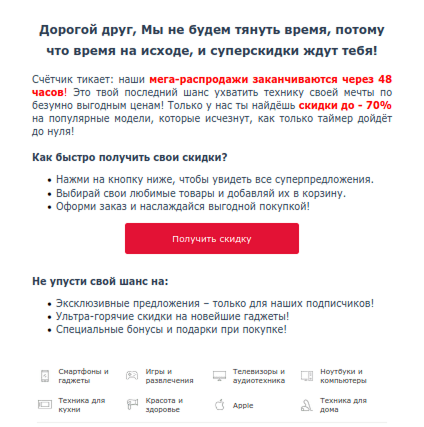
    CONSOLIDATED STATEMENTS OF OPERATIONS – GAAP
    (In thousands, except loss per share data)
                   
      Three Months Ended   Year Ended
      December 31,   December 31,
      2024   2023   2024   2023
      (unaudited)   (unaudited)
    Revenues              
    Creative Subscriptions $ 329,732   $ 296,154   $ 1,264,975   $ 1,152,007
    Business Solutions 130,723   107,617   495,675   409,658
      460,455   403,771   1,760,650   1,561,665
                   
    Cost of Revenues              
    Creative Subscriptions 52,671   52,794   213,422   215,515
    Business Solutions 90,965   73,319   351,213   297,013
      143,636   126,113   564,635   512,528
                   
    Gross Profit 316,819   277,658   1,196,015   1,049,137
                   
    Operating expenses:              
    Research and development 127,186   125,743   495,281   481,293
    Selling and marketing 106,629   103,642   425,457   399,577
    General and administrative 46,984   43,401   175,136   160,033
    Impairment, restructuring and other costs –   3,103   –   32,614
    Total operating expenses 280,799   275,889   1,095,874   1,073,517
    Operating income (loss) 36,020   1,769   100,141   (24,380)
    Financial income, net 16,355   6,461   51,820   62,474
    Other income (expenses), net (94)   44   (36)   (255)
    Income before taxes on income 52,281   8,274   151,925   37,839
    Income tax expenses 4,257   5,320   13,603   4,702
    Net income $ 48,024   $ 2,954   $ 138,322   $ 33,137
                   
    Basic net income per share $ 0.86   $ 0.05   $ 2.49   $ 0.58
    Basic weighted-average shares used to compute net income per share 55,786,201   57,317,815   55,579,368   56,829,962
                   
    Diluted net income per share $ 0.80   $ 0.05   $ 2.36   $ 0.57
    Diluted weighted-average shares used to compute net income per share 60,648,791   59,085,757   59,953,371   58,403,037
                   
    Wix.com Ltd.
    CONDENSED CONSOLIDATED BALANCE SHEETS
    (In thousands)
               
       
       December 31,    December 31,
       2024    2023
    Assets  (unaudited)    (audited)
    Current Assets:          
    Cash and cash equivalents $ 660,939   $ 609,622
    Short-term deposits   106,844     212,709
    Restricted deposits   773     2,125
    Marketable securities   338,593     140,563
    Trade receivables   46,166     57,394
    Prepaid expenses and other current assets   126,887     47,792
    Total current assets   1,280,202     1,070,205
               
    Long-Term Assets:          
    Prepaid expenses and other long-term assets   27,021     34,296
    Property and equipment, net   128,155     136,928
    Marketable securities   6,135     64,806
    Intangible assets, net   22,141     28,010
    Goodwill   49,329     49,329
    Operating lease right-of-use assets   399,861     420,562
    Total long-term assets   632,642     733,931
               
    Total assets $ 1,912,844   $ 1,804,136
               
    Liabilities and Shareholders’ Deficiency          
    Current Liabilities:          
    Trade payables $ 48,003   $ 38,305
    Employees and payroll accruals   142,007     56,581
    Deferred revenues   661,171     592,608
    Current portion of convertible notes, net   572,880     –
    Accrued expenses and other current liabilities   63,246     76,556
    Operating lease liabilities   27,907     24,981
    Total current liabilities   1,515,214     789,031
    Long Term Liabilities:          
    Long-term deferred revenues   89,271     83,384
    Long-term deferred tax liability   1,965     7,167
    Convertible notes, net   –     569,714
    Other long-term liabilities   16,021     7,699
    Long-term operating lease liabilities   369,159     401,626
    Total long-term liabilities   476,416     1,069,590
               
    Total liabilities   1,991,630     1,858,621
               
    Shareholders’  Deficiency          
    Ordinary shares   107     110
    Additional paid-in capital   1,840,574     1,539,952
    Treasury Stock   (1,025,167)     (558,875)
    Accumulated other comprehensive loss   7,242     4,192
    Accumulated deficit   (901,542)     (1,039,864)
    Total shareholders’ deficiency   (78,786)     (54,485)
               
    Total liabilities and shareholders’ deficiency $ 1,912,844   $ 1,804,136
               
    Wix.com Ltd.
    CONDENSED CONSOLIDATED STATEMENTS OF CASH FLOWS
    (In thousands)
                           
                           
      Three Months Ended   Year Ended
      December 31,   December 31,
      2024   2023   2024   2023
      (unaudited)   (unaudited)
    OPERATING ACTIVITIES:                      
    Net income $ 48,024   $         2,954   $ 138,322   $        33,137
    Adjustments to reconcile net loss to net cash provided by operating activities:                      
    Depreciation   6,278     6,725     25,246     20,492
    Amortization   1,460     1,488     5,869     5,954
    Share based compensation expenses   61,801     58,195     240,721     224,625
    Amortization of debt discount and debt issuance costs   793     789     3,166     4,194
    Changes in accrued interest and exchange rate on short term and long term deposits   (635)     (586)     852     (2,415)
    Non-cash impairment, restructuring and other costs   –     3,567     –     26,699
    Amortization of premium and discount and accrued interest on marketable securities, net   (7,838)     4,237     (13,381)     8,346
    Remeasurement loss (gain) on Marketable equity   –     (10,296)     (3,367)     (30,608)
    Changes in deferred income taxes, net   (7)     (2,035)     (5,196)     (8,784)
    Changes in operating lease right-of-use assets   4,351     7,174     24,246     27,231
    Changes in operating lease liabilities   (2,821)     16,701     (33,086)     (31,333)
    Loss on foreign exchange, net   2,471     –     3,906     –
    Decrease (increase) in trade receivables   4,058     (2,794)     11,228     (15,308)
    Decrease in prepaid expenses and other current and long-term assets   (63,684)     (10,845)     (76,963)     (20,105)
    Increase (decrease) in trade payables   17,329     15,120     12,893     (52,455)
    Increase (decrease) in employees and payroll accruals   66,407     (8,307)     85,426     (29,532)
    Increase in short term and long term deferred revenues   1,609     2,788     74,450     76,193
    Increase (decrease) in accrued expenses and other current liabilities   (5,860)     5,505     3,083     11,915
    Net cash provided by operating activities   133,736     90,380     497,415     248,246
    INVESTING ACTIVITIES:                      
    Proceeds from short-term deposits and restricted deposits   97,051     131,754     276,697     625,495
    Investment in short-term deposits and restricted deposits   (25,540)     (99,725)     (170,332)     (297,917)
    Investment in marketable securities   –     (2,607)     (267,209)     (6,732)
    Proceeds from marketable securities   15,000     33,690     125,176     250,960
    Purchase of property and equipment and lease prepayment   (1,562)     (9,582)     (17,813)     (63,021)
    Capitalization of internal use of software   (401)     (408)     (1,523)     (3,028)
    Investment in other assets   –     –     –     (111)
    Proceeds from investment in other assets $ –     –   $ 550     –
    Proceeds from sale of equity securities   –     19,203     22,148     68,671
    Purchases of investments in privately held companies   (1,000)     (76)     (3,160)     (7,603)
    Net cash provided by investing activities   83,548     72,249     (35,466)     566,714
    FINANCING ACTIVITIES:                      
    Proceeds from exercise of options and ESPP shares   6,692     898     59,576     39,660
    Purchase of treasury stock   –     (58,698)     (466,302)     (127,017)
    Repayment of convertible notes   –     –     –     (362,667)
    Net cash provided by (used in) financing activities   6,692     (57,800)     (406,726)     (450,024)
    Effect of exchange rates on cash, cash equivalent and restricted cash   (2,471)     –     (3,906)     –
    INCREASE (DECREASE) IN CASH AND CASH EQUIVALENTS   221,505     104,829     51,317     364,936
    CASH AND CASH EQUIVALENTS—Beginning of period   439,434     504,793     609,622     244,686
    CASH AND CASH EQUIVALENTS—End of period $ 660,939   $ 609,622   $ 660,939   $ 609,622
                           
    Wix.com Ltd.
    KEY PERFORMANCE METRICS
    (In thousands)
                           
      Three Months Ended   Year Ended
      December 31,   December 31,
      2024   2023   2024   2023
      (unaudited)   (unaudited)
    Creative Subscriptions   329,732     296,154     1,264,975     1,152,007
    Business Solutions   130,723     107,617     495,675     409,658
    Total Revenues $ 460,455   $ 403,771   $ 1,760,650   $ 1,561,665
                           
    Creative Subscriptions   325,203     283,501     1,315,445     1,174,776
    Business Solutions   139,389     111,503     514,607     422,727
    Total Bookings $ 464,592   $ 395,004   $ 1,830,052   $ 1,597,503
                           
    Free Cash Flow $ 131,773   $ 80,390   $ 478,079   $ 182,197
    Free Cash Flow excluding HQ build out and restructuring costs $ 131,773   $ 90,125   $ 488,404   $ 246,058
    Creative Subscriptions ARR $ 1,343,070   $ 1,192,814   $ 1,343,070   $ 1,192,814
                           
                           
    Wix.com Ltd.
    RECONCILIATION OF REVENUES TO BOOKINGS
    (In thousands)
                           
      Three Months Ended   Year Ended
      December 31,   December 31,
       2024    2023    2024    2023
      (unaudited)   (unaudited)
    Revenues $       460,455   $        403,771   $    1,760,650   $    1,561,665
    Change in deferred revenues   1,609     2,788     74,450     76,193
    Change in unbilled contractual obligations   2,528     (11,555)     (5,048)     (40,355)
    Bookings $     464,592   $        395,004   $    1,830,052   $     1,597,503
                           
    Y/Y growth   18%           15%      
                           
                           
      Three Months Ended   Year Ended
      December 31,   December 31,
       2024    2023    2024    2023
      (unaudited)   (unaudited)
    Creative Subscriptions Revenues $ 329,732   $ 296,154   $  1,264,975   $ 1,152,007
    Change in deferred revenues   (7,057)     (1,098)     55,518     63,124
    Change in unbilled contractual obligations   2,528     (11,555)     (5,048)     (40,355)
    Creative Subscriptions Bookings $  325,203   $  283,501   $ 1,315,445   $  1,174,776
                           
    Y/Y growth   15%           12%      
                           
      Three Months Ended   Year Ended
      December 31,   December 31,
       2024    2023    2024    2023
      (unaudited)   (unaudited)
    Business Solutions Revenues $ 130,723   $  107,617   $ 495,675   $ 409,658
    Change in deferred revenues   8,666     3,886     18,932     13,069
    Business Solutions Bookings $ 139,389   $ 111,503   $  514,607   $ 422,727
                           
    Y/Y growth   25%           22%      
                           
                           
    Wix.com Ltd.
    RECONCILIATION OF COHORT BOOKINGS
    (In millions)
                  Year Ended
                  December 31,
                   2024    2023
                  (unaudited)
    Q1 Cohort revenues             $ 45   $ 45
    Q1 Change in deferred revenues               16     15
    Q1 Cohort Bookings             $ 61   $ 60
                           
                           
    Wix.com Ltd.
    RECONCILIATION OF REVENUES AND BOOKINGS EXCLUDING FX IMPACT
    (In thousands)
          Three Months Ended
          December 31,
                   2024    2023
          (unaudited)
    Revenues             $       460,455   $  403,771
    FX  impact on Q4/24 using Y/Y rates               (110)     –
    Revenues excluding FX impact             $  460,345   $  403,771
                           
    Y/Y growth               14%      
                           
          Three Months Ended
          December 31,
                   2024    2023
          (unaudited)
    Bookings             $  464,592   $  395,004
    FX  impact on Q4/24 using Y/Y rates               1,600     –
    Bookings excluding FX impact             $  466,192   $  395,004
                           
    Y/Y growth               18%      
                           
                           
    Wix.com Ltd.
    TOTAL ADJUSTMENTS GAAP TO NON-GAAP
    (In thousands)
                           
                           
      Three Months Ended   Year Ended
      December 31,   December 31,
        2024     2023     2024     2023
    (1) Share based compensation expenses: (unaudited)   (unaudited)
    Cost of revenues $  3,466   $ 3,675   $ 14,146   $ 15,013
    Research and development   32,320     31,982     126,462     119,482
    Selling and marketing   9,625     11,232     38,755     41,277
    General and administrative   16,390     11,306     61,358     48,853
    Total share based compensation expenses   61,801     58,195     240,721     224,625
    (2) Amortization   1,834     1,488     6,243     5,954
    (3) Acquisition related expenses   –     9     6     472
    (4) Amortization of debt discount and debt issuance costs   793     789     3,166     4,194
    (5) Impairment, restructuring and other costs   –     3,103     –     32,614
    (6) Sales tax accrual and other G&A expenses   881     137     1,464     748
    (7) Unrealized loss (gain) on equity and other investments   –     (10,296)     (2,536)     (30,608)
    (8) Non-operating foreign exchange income   3,767     15,287     (4,703)     1,499
    (9) Provision for income tax effects related to non-GAAP adjustments   –     2,368     583     (4,337)
    Total adjustments of GAAP to Non GAAP $  69,076   $  71,080   $ 244,944   $  235,161


    Wix.com Ltd.
    RECONCILIATION OF GAAP TO NON-GAAP GROSS PROFIT
    (In thousands)
                           
                           
      Three Months Ended   Year Ended
      December 31,   December 31,
       2024    2023    2024    2023
      (unaudited)   (unaudited)
    Gross Profit $ 316,819   $ 277,658   $ 1,196,015   $ 1,049,137
    Share based compensation expenses   3,466     3,675     14,146     15,013
    Acquisition related expenses   –     5     –     229
    Amortization   667     667     2,669     2,669
    Non GAAP Gross Profit   320,952     282,005     1,212,830     1,067,048
                           
    Non GAAP Gross margin   70%     70%     69%     68%
                           
                           
      Three Months Ended   Year Ended
      December 31,   December 31,
       2024    2023    2024    2023
      (unaudited)   (unaudited)
    Gross Profit – Creative Subscriptions $ 277,061   $ 243,360   $ 1,051,553   $ 936,492
    Share based compensation expenses   2,482     2,695     10,232     11,081
    Non GAAP Gross Profit – Creative Subscriptions   279,543     246,055     1,061,785     947,573
                           
    Non GAAP Gross margin – Creative Subscriptions   85%     83%     84%     82%
                           
                           
      Three Months Ended   Year Ended
      December 31,   December 31,
       2024    2023    2024    2023
      (unaudited)   (unaudited)
    Gross Profit – Business Solutions $  39,758   $ 34,298   $ 144,462   $ 112,645
    Share based compensation expenses   984     980     3,914     3,932
    Acquisition related expenses   –     5     –     229
    Amortization   667     667     2,669     2,669
    Non GAAP Gross Profit – Business Solutions   41,409     35,950     151,045     119,475
                           
    Non GAAP Gross margin – Business Solutions   32%     33%     30%     29%
                           
                           
    Wix.com Ltd.
    RECONCILIATION OF OPERATING INCOME (LOSS) TO NON-GAAP OPERATING INCOME
    (In thousands)
                           
      Three Months Ended   Year Ended
      December 31,   December 31,
       2024    2023    2024     2023
      (unaudited)   (unaudited)
    Operating income (loss) $  36,020   $ 1,769   $ 100,141   $ (24,380)
    Adjustments:                      
    Share based compensation expenses   61,801     58,195     240,721     224,625
    Amortization   1,834     1,488     6,243     5,954
    Impairment, restructuring and other charges   –     3,103     –     32,614
    Sales tax accrual and other G&A expenses   881     137     1,464     748
    Acquisition related expenses   –     9     6     472
    Total adjustments $  64,516   $ 62,932   $ 248,434   $ 264,413
                           
    Non GAAP operating income $  100,536   $ 64,701   $  348,575   $  240,033
                           
    Non GAAP operating margin   22%     16%     20%     15%
                           
                           
    Wix.com Ltd.
    RECONCILIATION OF NET INCOME TO NON-GAAP NET INCOME AND NON-GAAP NET INCOME PER SHARE
    (In thousands, except  per share data)
                           
      Three Months Ended   Year Ended
      December 31,   December 31,
       2024    2023    2024    2023
      (unaudited)   (unaudited)
    Net income $ 48,024   $ 2,954   $ 138,322   $ 33,137
    Share based compensation expenses and other Non GAAP adjustments   69,076     71,080     244,944     235,161
    Non-GAAP net income$ $ 117,100   $  74,034   $ 383,266   $ 268,298
                           
    Basic Non GAAP net income per share $ 2.10   $ 1.29   $ 6.90   $ 4.72
    Weighted average shares used in computing basic Non GAAP net income per share   55,786,201     57,317,815     55,579,368     56,829,962
                           
    Diluted Non GAAP net income per share $ 1.93   $ 1.22   $ 6.39   $ 4.39
    Weighted average shares used in computing diluted Non GAAP net income per share   60,648,791     60,512,505     59,953,371     61,106,462
                           
                           
    Wix.com Ltd.
    RECONCILIATION OF NET CASH PROVIDED BY OPERATING ACTIVITIES TO FREE CASH FLOW
    (In thousands)
                           
      Three Months Ended   Year Ended
      December 31,   December 31,
       2024    2023    2024    2023
      (unaudited)   (unaudited)
    Net cash provided by operating activities $  133,736   $  90,380   $ 497,415   $ 248,246
    Capital expenditures, net   (1,963)     (9,990)     (19,336)     (66,049)
    Free Cash Flow $  131,773   $  80,390   $ 478,079   $  182,197
                           
    Restructuring and other costs   –     1,411     –     5,915
    Capex related to HQ build out   –     8,324     10,325     57,946
    Free Cash Flow excluding HQ build out and restructuring costs $  131,773   $  90,125   $  488,404   $ 246,058
                           

    Attachments

    The MIL Network –

    February 19, 2025
  • MIL-OSI Economics: S&P500 Index soars 25% YoY to $54.5 trillion in January 2025, reveals GlobalData

    Source: GlobalData

    S&P500 Index soars 25% YoY to $54.5 trillion in January 2025, reveals GlobalData

    Posted in Business Fundamentals

    The aggregate market capitalization of the Standard and Poor’s 500 (S&P 500) index companies grew 25% from $43.6 trillion in January 2024 to $54.5 trillion in January 2025. Information technology (IT) sector registered the most market gains over the period, followed by consumer discretionary* and communication services, according to GlobalData, a leading data and analytics company.

    Murthy Grandhi, Company Profiles Analyst at GlobalData, comments: “Over the period, the S&P 500 index posted a 25.3% growth in annual returns. Apple, Microsoft, NVIDIA, Alphabet, Amazon, Meta, Tesla, Broadcom, Berkshire Hathaway, and Walmart were the top 10 stocks that accounted for 37.5% of the S&P 500’s aggregate market capitalization.”

    In terms of market value percentage growth, communication services companies outpaced others, having seen 42.7% growth over the period, with the market cap reaching $5.8 trillion. The sector constituents that grew more than 50% during the period include Meta (74.2%), Netflix (71.1%), Live Nation Entertainment (64.3%), and Fox (51.2%).

    Based on the total market value relative to the number of companies in each sector, communication services led with a value of $308.6 billion, followed by IT ($204.9 billion), consumer discretionary ($134.8 billion), financials ($97.1 billion), health care ($91.3 billion), energy ($84.3 billion), consumer staples ($80.9 billion), industrials ($57.3 billion), utilities ($40.2 billion), materials ($36.6 billion), and real estate ($35.3 billion).

    In total, there are 16 new entrants, out of which Palantir Technologies, Vistra Corp, Smurfit WestRock, and Texas Pacific Land posted more than 100% growth. However, Super Micro Computer posted more than 40% loss in market value.

    Grandhi concludes: “The S&P 500 index in 2025 is expected to show modest growth, driven by strong economic fundamentals and steady corporate earnings. However, double-digit gains may be unlikely due to uncertainties surrounding policies like tariffs and immigration, which could impact market dynamics.”

    *Consumer discretionary is a term for classifying goods and services that are considered non-essential by consumers, but desirable if their available income is sufficient to purchase them.

    MIL OSI Economics –

    February 19, 2025
  • MIL-OSI USA: Cantwell Votes NO On Advancing Lutnick for Commerce Secretary; Slams His Enthusiasm for Inflationary Tariffs

    US Senate News:

    Source: United States Senator for Washington Maria Cantwell

    02.18.25

    Cantwell Votes NO On Advancing Lutnick for Commerce Secretary; Slams His Enthusiasm for Inflationary Tariffs

    In speech on Senate floor, Cantwell says Trump’s pick to lead the Dept. of Commerce will rubber-stamp tariffs, slow domestic chip manufacturing, and hang NOAA out to dry; Cantwell also stresses: “Now is not the time to cut FAA staffing”

    WASHINGTON, D.C. – Today, U.S. Senator Maria Cantwell (D-WA), a senior member of the Senate Finance Committee and ranking member of the Senate Committee on Commerce, Science, and Transportation, voted against confirming Howard Lutnick, President Donald Trump’s nominee to serve as Secretary of the Department of Commerce.

    In a speech delivered on the Senate floor, Sen. Cantwell urged her colleagues to follow suit.

    The next Secretary of Commerce will have to deal with a wide-ranging, growing list of issues, from trade and exports […], expanding broadband, weather forecasting, patent issues, export controls on A.I., and figuring out some of the most thorny issues related to how we move our country forward, generally, in commerce. So it’s fair to say that if the Commerce Secretary doesn’t get it right, the American people and our American economy pay the price. Unfortunately, I believe that Howard Lutnick, the President’s nominee, isn’t the right person for this job at this point in time,” Sen. Cantwell said.

    The Senate ultimately confirmed Lutnick 51-45.

    Earlier this month, Sen. Cantwell also voted against advancing Lutnick out of the Committee on Commerce, Science, and Transportation and to the full Senate for consideration. At the time, she expressed her concerns with Lutnick’s support for President Trump’s proposed tariffs. She also pointed to Lutnick’s failure to commit to fully allocating the funds approved by Congress under the Cantwell-led CHIPS & Science Act, as well as his waffling on whether he’d protect NOAA – including NOAA’s crucial missions and functions, and the workforce delivering those services to the American people. Sen. Cantwell had previously questioned Lutnick on these topics in a committee hearing the week prior – video of that hearing is HERE.

    Sen. Cantwell on FAA and Aviation Safety:

    “I would just say this: now is not the time to cut FAA staffing,” Sen. Cantwell said on the Senate floor today. “It is critically clear to me that we need these air traffic controllers, and so we have to make these investments. We should be working together, right now, on aviation. The most important thing? Let’s work together for the benefit of the flying public to come up with the best solutions that we can implement in aviation safety. Taking a broad brush and just cutting people out of the FAA — when oftentimes they’re the people that are helping you get that safety — is not what we should be doing right now.”

    During her tenure as chair of the Senate Committee on Commerce, Science, and Transportation, Sen. Cantwell sounded the alarm about the staffing shortage of air traffic controllers, need for more FAA safety inspectors, a series of aviation incidents and near-misses on and around runways, and the midair blowout of a door plug in January 2024. Last year, the Committee’s Aviation Subcommittee also highlighted FAA’s shortage of at least 800 airway transportation systems specialists – commonly known as technicians –  during a December 2024 hearing on “Air Traffic Control Systems, Personnel, and Safety”. Dave Spero, president of the Professional Aviation Safety Specialists (PASS), the union representing FAA technicians, testified about the importance of closing the shortage and boosting this segment of the FAA workforce in order to keep FAA’s air traffic control systems and equipment safely running.

    She led the passage of the FAA Reauthorization Act, signed into law in May 2024, which boosts controller staffing, ensuring a five-year commitment to maximum hiring and training to close the current staffing gap. The law requires upgraded safety technologies – giving controllers better visibility into runway traffic – to be installed at every large and medium airport nationwide. The law also includes stricter safety standards for aircraft operators and plane manufacturers, as well as provisions to put more FAA safety inspectors on factory floors.

    On Feb. 6, Sen. Cantwell sent a letter to Secretary of Transportation Sean Duffy calling on him to ensure that Elon Musk stays out of the Federal Aviation Administration (FAA), citing Musk’s clear conflicts of interest.

    Sen. Cantwell on Tariffs:

    “In my conversations with Mr. Lutnick and before his Commerce Committee hearing, he made it very clear that he intends to be very enthusiastic about the President’s plans for tariffs,” Sen. Cantwell said today. “My constituents want to see inflation come down, and they want us to lower costs, not increase them. Now that President Trump is teasing out even more tariffs in the coming days on autos, pharmaceuticals,  and semiconductors, it’s going to drive up costs for consumers […] We can’t afford inflation. We want prices to come down. Whether that’s on housing, or whether that’s on pharmaceuticals, or whether that’s on food prices, we know that tariffs can increase prices.”

    Earlier this month, Sen. Cantwell delivered a major speech on the Senate floor arguing that the president’s arbitrary tariffs would threaten domestic job creation and economic growth in an Information Age. She outlined a strategy focused on building coalitions, growing exports, and establishing principles to support innovation in the Information Age – video of that speech is HERE.

    In Washington state, two out of every five jobs are tied to trade and trade-related industries.  Combined, the state imported $1.21 billion worth of steel and aluminum last year – and the major industries and employers in Washington that rely on steel and aluminum include aerospace, shipbuilding, utilities, and electronics. When President Trump imposed steel tariffs in 2018, our trading partners immediately responded by imposing tariffs of their own on Washington products, especially agriculture, including cherries, apples, pears, and potatoes. Nationally, across all industries, the steel and aluminum tariffs resulted in a decrease in production worth about $3.4 billion per year, according to an ITC report.  More information on how President Trump’s proposed tariffs on goods from Mexico, Canada, and China would affect consumers and businesses in the State of Washington can be found HERE.

    Sen. Cantwell has remained a steadfast supporter of free trade to grow the economy in the State of Washington and nationwide. Sen. Cantwell was the leading voice in negotiations to end India’s 20% retaliatory tariff on American apples, which was imposed in response to tariffs on steel and aluminum and devastated Washington state’s apple exports. India had once been the second-largest export market for American apples, but after President Trump imposed tariffs on steel and aluminum in his first term, India imposed retaliatory tariffs in response and U.S. apple exports plummeted. The impact on Washington apple growers was severe: Apple exports from the state dropped from $120 million in 2017 to less than $1 million by 2023.  In September 2023, following several years of Sen. Cantwell’s advocacy, India ended its retaliatory tariffs on apples and pulse crops which was welcome news to the state’s more than 1,400 apple growers and the 68,000-plus workers they support.

    Sen. Cantwell on Semiconductor Manufacturing:

    “We learned during the chips crisis that even the cost of a used car went up $2,000. That’s because chips were at a shortage — car industries, trucking industries couldn’t even get enough chips to make and ship cars, and then the consequence was even used cars went up $2,000. So we don’t want to recreate that again,” Sen. Cantwell said today. “We want a Commerce Secretary who is going to fight for the CHIPS & Science investment that’s already been made in the electronic manufacturing process in the United States and keep the semiconductor industry right here. But unfortunately, Mr. Lutnick, before the Committee, would not commit to standing by the commitments of the term sheets the Department of Commerce has already signed.”

    Sen. Cantwell was the main architect and key negotiator of the CHIPS & Science Act. In her position as Commerce chair, she was instrumental in securing the science R&D funding authorizations in the 11th hour of negotiations. A key component of the legislation is the Regional Technology and Innovation Hubs (Tech Hubs) program that was authored by Sen. Cantwell to strengthen U.S. economic and national security with investments in regions across the country. Earlier this month, the American Aerospace Materials Manufacturing Center (AAMMC) in Spokane was awarded $48 million from the program to establish the first-of-its-kind testbed facility in the United States focused on developing advanced thermoplastic materials – new types of lightweight, heat-moldable, and recyclable materials that can replace metal in aircraft parts. The AAMMC will serve as the nation’s hub for creating and testing these innovative materials that are essential for more rapidly building fuel-efficient and environmentally friendly aircraft. 

    Sen. Cantwell on NOAA:

    “When asked for the record, ‘Should NOAA be dismantled, as called for in Project 2025?’, Mr. Lutnick would only say he’ll figure it out once he’s confirmed,” Sen. Cantwell said today. “We needed a bigger commitment to NOAA. NOAA already supplies a big, important aspect of what we deal with, with weather forecasting, tracking extreme weather, hurricanes, wildfires, managing our fisheries, operating ships that conduct important charting for national security. Mr. Lutnick gave very tepid support for NOAA.”

    Project 2025 calls for NOAA to be “dismantled and many of its functions eliminated,” calling it part of the “climate change alarm industry.” NOAA provides critical services to the Nation including weather forecasts, extreme storm tracking and monitoring, tools to enable communities to adapt to sea level rise and climate change, supporting fisheries management, and conserving marine mammals and other protected species.

    Sen. Cantwell is a champion of NOAA and helped secure $3.3 billion in NOAA investments in the Inflation Reduction Act to help communities prepare for and adapt to climate change, boost science needed to understand changing weather and climate patterns, and invest in advanced computer technologies that are critical for extreme weather prediction and emergency response. Her Fire Ready Nation Act, bipartisan legislation to strengthen NOAA’s ability to help forecast, prevent, and fight wildfires, passed the Commerce committee unanimously earlier this month and now heads to the full Senate for consideration.

    Video of Sen. Cantwell’s speech on the Senate floor today is available HERE, and transcript HERE.

    MIL OSI USA News –

    February 19, 2025
  • MIL-OSI USA: Capito Votes to Confirm Lutnick for Commerce Secretary

    US Senate News:

    Source: United States Senator for West Virginia Shelley Moore Capito

    WASHINGTON, D.C. – U.S. Senator Shelley Moore Capito (R-W.Va.), a member of the Senate Commerce, Science, and Transportation Committee, issued the following statement after voting to confirm Howard Lutnick to serve as the next Secretary of Commerce:

    “Improving broadband connectivity, ensuring fair trade for businesses, and making sure the Department of Commerce supports West Virginia’s effort to expand economic opportunities are all issues important to West Virginia, and areas I believe Secretary Lutnick will prioritize as our next Commerce Secretary. I am encouraged by Secretary Lutnick’s expertise and qualifications to serve in this role, and I look forward to a strong and productive working relationship with him,” Senator Capito said.

    Senator Capito previously met with Lutnick in December of 2024 to discuss his nomination and learn more about his vision to lead the department.

    MIL OSI USA News –

    February 19, 2025
  • MIL-OSI USA: Cortez Masto Opposes Howard Lutnick to Head the Department of Commerce

    US Senate News:

    Source: United States Senator for Nevada Cortez Masto

    Washington, D.C. – U.S.Senator Catherine Cortez Masto (D-Nev.) released the following statement after voting against confirming Howard Lutnick for Secretary of Commerce:

    “Howard Lutnick has repeatedly defended President Trump’s harmful tariff threats to our allies and the ongoing federal funding freeze that has caused great concern for Nevada communities and families, including the delay in the Department of Commerce’s final approval of our statewide broadband plan. His unquestioning loyalty to Donald Trump makes him unable to independently lead this department that is critical to the stability of the U.S. economy. It’s clear Mr. Lutnick will not help lower costs for Nevada families, and he will continue to facilitate President Trump’s chaos. I therefore oppose his nomination to lead the Department of Commerce.”

    MIL OSI USA News –

    February 19, 2025
  • MIL-Evening Report: Civics education is at an all-time low in Australia. Mapping our ‘civic journeys’ may help

    Source: The Conversation (Au and NZ) – By Brenton Prosser, Professor of Public Policy and Leadership, UNSW Sydney

    Although Australia has a strong and proud democracy, it nonetheless faces important challenges.

    Among these, youth democratic engagement and civics education have been matters of national concern for more than two decades.

    With the latest national curriculum testing showing the lowest levels of civics on record, and a parliamentary inquiry finding that civics education is not working in Australia, it is timely to ask why, after so much attention over so many years, so little has changed.

    One of the potential explanations for this is the difficulties researchers face collecting evidence on what works in civics education and engagement programs long-term. The importance of the availability of this evidence for political and policy leaders has been reinforced by calls for a more robust understanding of democratic literacy and civics engagement across the lifecourse.

    Importantly, new UK-based research, currently being applied in Australia by UNSW, seeks to address this vital data and decision making gap.


    Read more:
    Australian students just recorded the lowest civics scores since testing began. But young people do care about politics


    Identifying the gaps in democratic evidence

    In Australia, there is a well-documented decline in civics education and public trust. However, a common theme in the research is that it is easier to measure decline and disaffection than to identify what works.

    While many inspirational initiatives have been publicly and privately funded in Australia, they tend to be siloed, small and difficult to assess.

    In the UK, research has revealed that, historically, there had been no clear coordination or alignment of civic learning, engagement, and participation initiatives across national and local government. Moreover, it found there was little long-term commitment to civic initiatives, with many not outliving the relevant government or minister who initiated them.

    Prominent recent reports in Australia suggest a similar situation.

    Meanwhile, research indicates that fostering democratic participation and resilience is an ongoing process across people’s lives. But how to best gather and use data on this life process remains a challenge.

    It is a response to such research and policy challenges that is at the core of the “civic journey” concept.

    Effective civics education should go beyond just the school years.
    Shutterstock

    What are ‘civic journeys’?

    The notion of journeys in human experience is not new. Often, education, health and social sectors seek to map client journeys as part of effectiveness and equity analyses. In the civic context, the notion of journey is applied to democratic literacy, civic momentum, transformative action and lifelong engagement. In other words, it’s not just about civics education at school.

    The civic journey concept originated in the UK. At its core is an intention to establish “an integrated and high-quality, seamless tapestry of opportunities” to learn about and engage in the democratic process and civic life.

    The UK civic journeys initiative has informed research into youth as a fundamental stage in citizens’ life-long journeys. It noted that the opportunity to experience democracy (be citizens) was as important as the education to understand democracy (become citizens) in shaping democratic literacy and participation. But crucially, both were forged during key transitions within childhood and adolescence.

    Further, the UK study identified the importance of entry, exit and re-entry into political and civic learning and activity at different points of youth transitions to adulthood and throughout adult life. Put another way, it found that “hot spots” of high engagement, “cold spots” of disengagement and “black spot” openings to extremism all coalesced around major transition points in the life course.

    The civic journey approach also highlighted the importance of connecting volunteering and other forms of civic activism with formal approaches to civics education and youth democratic participation. This highlights the importance of linking youth civic socialisation programmes in schools, local communities, and online.

    When understood and mapped, these points can be prioritised for attention.

    A uniquely Australian approach to civic journeys

    The adaptation of civic journeys for research and policy provides an important opportunity. With its focus around collecting data on outcomes, it helps identify what works in the democratic experiences of citizens at different stages of their lives. When applied to the full life course, it supports the most effective allocation of public resources to interventions.

    The civic journey metaphor also helps guide future work in this space. Such an approach could support governments with their interest in better coordination, design and funding of long-term data to identify the best initiatives.

    There is also the potential to apply the civic journey concept in a multicultural context. Civic journeys can be used as a lens to examine the diverse journeys in and between different cultural groups to help preempt and mitigate disruption. This in turn helps build a collective democratic journey. Further, it could be used to identify the “black spots” and reduce exposure to alienation or extremism.

    In summary, the civic journeys approach has significant potential to better understand and shape the individual and collective experiences of Australians across the life course. It can also help build a national narrative underpinning ongoing work to further strengthen Australia’s civics education and democracy.

    The authors do not work for, consult, own shares in or receive funding from any company or organisation that would benefit from this article, and have disclosed no relevant affiliations beyond their academic appointment.

    – ref. Civics education is at an all-time low in Australia. Mapping our ‘civic journeys’ may help – https://theconversation.com/civics-education-is-at-an-all-time-low-in-australia-mapping-our-civic-journeys-may-help-250138

    MIL OSI Analysis – EveningReport.nz –

    February 19, 2025
  • MIL-OSI USA: Rosen, Cortez Masto Join Nevada Colleagues’ Effort to Preserve National Monuments

    US Senate News:

    Source: United States Senator Jacky Rosen (D-NV)
    WASHINGTON, DC – U.S. Senators Jacky Rosen (D-NV) and Catherine Cortez Masto (D-NV) joined Nevada’s Congressional Democratic Delegation in urging the Secretary of the Interior, Doug Burgum, to not roll back designations of national monuments in Nevada. The Nevada lawmakers raised concerns about a recent order by Secretary Burgum initiating a 15-day review of possible impediments, including national monuments, to accessing natural resources, including oil and gas. 
    “We urge the administration to refrain from attempts to unilaterally alter lands with existing national monument designations, as we’ve seen previously at Bears Ears and Grand Staircase-Escalante,” the Delegation said in the letter.
    “Decisions to protect these treasured lands were not made on a whim,” they continued. “They were the result of intense engagements with tribes, community leaders, and local businesses. While Congress reserves the authority to revoke or adjust national monuments, any future action by your department should be a result of the same level of outreach and public engagement.”
    The letter is supported by the following organizations: Conservation Lands Foundation; Friends of Avi Kwa Ame; Friends of Basin and Range National Monument; Friends of Gold Butte; Friends of Nevada Wilderness; Friends of Sloan Canyon; Native Voters Alliance Nevada; Nevada Conservation League; Nevada Outdoor Business Coalition; and Save Red Rock.
    In recent years, Basin & Range, Gold Butte, and Avi Kwa Ame have been designated as national monuments in Nevada and have been a boom to the state’s $8 billion outdoor recreation economy. The letter came in response to Secretarial Order 3418, specifically Section 4c which initiated a 15-day review of national monuments and mineral withdrawals.
    Senators Rosen and Cortez Masto are champions for Nevada’s great outdoor spaces and public lands. They passed critical legislation to permanently fund the Land and Water Conservation Fund (LWCF), which protects public lands in Nevada and across the U.S. They passed bipartisan, bicameral legislation to reauthorize the Lake Tahoe Restoration Act, and they delivered critical funding to protect Lake Tahoe in the Bipartisan Infrastructure Law. Last year, the Senators announced over $375 million for recreation and conservation projects across Nevada.

    MIL OSI USA News –

    February 19, 2025
  • MIL-OSI China: ‘Ne Zha 2’ box office success ignites merchandise craze

    Source: China State Council Information Office 3

    “30 million achieved!” reads an announcement by FunCrazy, a creative toy brand, in its official Xiaohongshu post on February 16. The post, featuring an image of a Ne Zha collectible figure, marks a record-breaking milestone in less than a month: the co-branded crowdfunding campaign for the official movie “Ne Zha 2” merchandise surpasses 30 million yuan.

    Toys featuring Nezha, the main character from “Ne Zha 2,” are pictured at the workshop of a toy manufacturer in Xiangtan, central China’s Hunan Province, Feb. 8, 2025. (Xinhua/Chen Sihan)

    As the global earnings of “Ne Zha 2”, including pre-sales, hit a historic 12.319 billion yuan (about 1.72 billion U.S. dollars), its influence extends beyond the cinema to the shelves of both collectors and fans, marking a new chapter in the booming market for movie-related merchandise.

    Another example of Ne Zha’s IP value is evident in the collectible blind box series co-produced by Pop Mart and creators of the movie. Sales of the blind box series surpassed 10 million yuan within just eight days of the launch, while the first batch of products quickly sold out.

    In response to huge market demand, the brand has initiated pre-sales for subsequent batches of the blind box series, with shipping dates pushed back to late June. Pop Mart’s physical stores nationwide have largely sold out of them as well.

    However, for some eager fans, waiting for the pre-sale is simply not an option. On Goofish, a second-hand trading platform, the price of some in-stock blind boxes has already increased by more than three times.

    “I bought the full series of eight blind boxes as a birthday gift for myself. They’re so cute, and they even recreated the scene where Ne Zha and Ao Bing join forces to fight the villain,” shared by a movie fan on her Xiaohongshu post.

    The iconic scene from the movie added extra popularity to the merchandise. Many fans recreated the moment when the two protagonists, Ne Zha and Ao Bing, hold hands to battle the thunder in collectible figures and shared them on social media, boosting its viral spread.

    The massive success of Ne Zha’s merchandise sales highlights the growing economic impact of IPs. Beyond box office earnings, purchasing merchandise offers fans a tangible connection to the characters and stories, amplifying the value of an IP in today’s entertainment industry.

    Consumer demand for spiritual and cultural values is rising, with a shift from functional attributes to emotional and spiritual significance. Consequently, diverse IP derivatives have become key catalysts for driving market enthusiasm, said Jiang Duo, associate professor of the Communication University of China.

    “Ne Zha 2” is not the first cultural product to benefit from the spillover effect of the IP economy. In 2023, the Chinese sci-fi blockbuster “The Wandering Earth II” raked in a whopping box office revenue. A movie-related crowdfunding project was launched for merchandise.

    The project garnered over 433,000 orders and raised more than 100 million yuan, far exceeding the original goal of 100,000 yuan.

    Movie IPs are transitioning from being solely driven by box office revenue to exploring multiple sources of value, injecting more vitality into the cultural market. More and more Chinese companies are focusing on IP development and the cultural and creative industry. Their products are becoming much more sophisticated, and the expansion of offline channels plays a crucial role in supporting the development of the IP economy, said Jiang.

    MIL OSI China News –

    February 19, 2025
  • MIL-OSI China: Foreign firms to ramp up investment

    Source: China State Council Information Office 3

    This photo taken with a mobile phone shows the skyline during the early morning in Beijing, capital of China, Oct. 19, 2024. [Photo/Xinhua]

    China’s sustained efforts to boost domestic demand and reinforce supply chain resilience, as well as drive businesses toward green and digital transformation, will pave the way for deeper global business collaboration in its market this year, said executives of multinational corporations on Monday.

    Despite the slowdown in global trade and investment growth in recent years, foreign companies remain steadfast in ramping up their investment in the Chinese market, they added.

    Lan Qingxin, a professor specializing in cross-border investment studies at the University of International Business and Economics in Beijing, said that as China embraces a new era of green and innovation-driven growth, global investors are increasingly focusing on digital solutions, supply chain optimization, high-end manufacturing, customized innovation and green businesses in the Chinese market.

    Noting the widespread adoption of the advanced large language model DeepSeek among domestic and overseas users, Chen Shihua, deputy secretary-general of the China Association of Automobile Manufacturers, said that China’s ability to attract foreign investment will be further enhanced this year.

    DeepSeek, a two-year-old startup based in Hangzhou, Zhejiang province, has created the open-source LLM of the same name at a cost much lower than its foreign peers.

    Even though geopolitical tensions are rising, global demand remains subdued and certain countries have tightened investment regulations, China saw the establishment of 59,080 new foreign-invested companies in 2024, marking a 9.9 percent year-on-year increase, data from the Ministry of Commerce shows.

    Cummins Inc, a United States-based engine manufacturer, plans to increase its market share this year in key application sectors within China, including power generation equipment for data centers and high-tech manufacturing.

    “Together with local partners, we will also accelerate the innovation pace on the internal combustion engine system, including high-efficiency diesel, natural gas and hydrogen internal combustion engines,” said Nathan Stoner, vice-president of Cummins.

    Eager to seize more market share in China, Thai beverage company TCP Group, will commence operations of a production base in the Guangxi Zhuang autonomous region later this year to supply its popular energy drink Red Bull.

    The production base, set up with a total investment of 1.3 billion yuan ($179.2 million), will strengthen the supply chain network, empower upstream and downstream partners, and create another important link connecting the markets between China and the Association of Southeast Asian Nations, said Saravoot Yoovidhya, CEO of TCP Group.

    “The rapid response capability and strong execution power of China’s supply chain enable us to quickly adapt to market changes and promptly adjust production and supply chain strategies to meet the diversified demands of markets worldwide,” he added.

    Yin Zheng, executive vice-president of Schneider Electric’s China and East Asia operations, said that as a major engine of global economic growth, China has a huge market, a strong industrial base and abundant innovation resources, while its cultivation of new quality productive forces provides an even stronger impetus for industrial transformation and upgrading.

    The French industrial conglomerate has continuously increased research and development investment in China and has established a series of world-class innovation institutes in China to support industrial upgrading and energy transformation.

    “We have been introducing innovative Chinese solutions and advanced products to the global market, expanding China’s impact and realizing the vision of ‘in China for the world’,” Yin said.

    According to a recent survey by the Japanese Chamber of Commerce and Industry in China, more than 58 percent of Japanese companies surveyed recognize China as a key market for their global operations, and they plan to maintain or expand their investment in the Chinese market this year.

    Several factors have influenced their investment decisions, including increasing demand and rising orders. The chamber said that Japanese businesses are also more confident about the Chinese market this year, driven by an improved business environment, a visa-free policy for Japanese citizens and government initiatives such as trade-in policies.

    MIL OSI China News –

    February 19, 2025
  • MIL-OSI USA: Duckworth Votes Against Confirming Howard Lutnick to Serve as Commerce Secretary

    US Senate News:

    Source: United States Senator for Illinois Tammy Duckworth

    February 18, 2025

    [WASHINGTON, D.C.] – Today, U.S. Senator Tammy Duckworth (D-IL)—a member of the Senate Committee on Commerce, Science and Transportation (CST)—released the following statement after voting against Howard Lutnick’s nomination to serve as Secretary of the U.S. Department of Commerce. The Senate confirmed Lutnick by a vote of 51-45.

    “I cannot vote for any nominee who won’t publicly pledge without hesitation that they’d refuse an unlawful order from President Trump—and Mr. Lutnick failed that simple test. As Donald Trump and Elon Musk continue their illegal spree to freeze federal funding and make deep cuts at critical agencies so they can pave the way for tax cuts for the ultra-wealthy, we need a Secretary of Commerce who is not afraid to stand up to this chaos, uphold the law and put our economy and middle-class Americans first. And yet, by confirming Mr. Lutnick today, Republicans are once again proving how easily they will appease Trump out of fear for their own political survival—and it will be American farmers, businesses and the middle class who will pay the price.”

    -30-


    MIL OSI USA News –

    February 19, 2025
  • MIL-OSI USA: Crapo Statement on Lutnick Confirmation

    US Senate News:

    Source: United States Senator for Idaho Mike Crapo

    Washington, D.C.–U.S. Senator Mike Crapo (R-Idaho) issued the following statement after the Senate confirmed, by a vote of 51-45, Howard Lutnick to be Secretary of the U.S. Department of Commerce:

    “Howard Lutnick as Secretary of the U.S. Department of Commerce will bring decades of economic expertise to the agency tasked with advising President Trump on various policies to stimulate growth and innovation and safeguard our nation’s economic security.  He led Cantor Fitzgerald out of its tragic losses from the September 11, 2001, terrorist attacks, rebuilding the company in the face of tremendous adversity.  Under Trump’s direction for Lutnick to help lead the Administration’s trade agenda, he will play a vital role in securing real, meaningful negotiations for improved market access globally for Idaho producers.”

    MIL OSI USA News –

    February 19, 2025
  • MIL-OSI: PIMCO Global Income Opportunities Fund Renews At-The-Market Equity Program

    Source: GlobeNewswire (MIL-OSI)

    Not for distribution to United States newswire services or for dissemination in the United States

    TORONTO, Feb. 18, 2025 (GLOBE NEWSWIRE) — PIMCO Global Income Opportunities Fund (TSX: PGI.UN) (the “Fund”) announced today that the Fund has renewed its at-the-market equity program (the “ATM Program”). The ATM Program allows the Fund to issue Class A units of the Fund (the “Units”) having an aggregate sale price of up to $80,000,000, to the public from time to time, at the discretion of PIMCO Canada Corp. (the “Manager”). Any Units issued under the ATM Program will be sold at the prevailing market price at the time of sale through the Toronto Stock Exchange (“TSX”) or any other marketplace in Canada on which the Units are listed, quoted or otherwise traded. This ATM Program replaces the prior at-the-market equity program of the Fund, which commenced on January 20, 2023 and expired on February 16, 2025.

    The volume and timing of distributions under the ATM Program, if any, will be determined at the Manager’s sole discretion. The ATM Program will be effective until March 14, 2027, unless terminated prior to such date by the Fund. The Fund intends to use the proceeds from the ATM Program in accordance with its investment objectives, investment strategies and investment restrictions.

    Sales of Units through the ATM Program will be made pursuant to the terms of an equity distribution agreement entered into by the Fund (the “Equity Distribution Agreement”), dated February 18, 2025, with National Bank Financial Inc. (the “Agent”).

    Sales of Units will be made by way of “at-the-market distributions” as defined in National Instrument 44-102 Shelf Distributions on the TSX or on any marketplace for the Units in Canada. Since Units will be distributed at prevailing market prices at the time of the sale, prices may vary among purchasers during the period of distribution. The ATM Program is being offered pursuant to a prospectus supplement dated February 18, 2025 (the “Prospectus Supplement”) to the Fund’s short form base shelf prospectus dated February 14, 2025 (the “Shelf Prospectus”).

    Copies of the Prospectus Supplement, the Shelf Prospectus and the Equity Distribution Agreement may be obtained from your registered financial advisor using the contact information for such advisor, or from representatives of the Agent, and are available on SEDAR+ at www.sedarplus.ca.

    The Manager retains Pacific Investment Management Company LLC (“PIMCO”), to provide investment management services to the Fund.

    About PIMCO

    PIMCO is a global leader in active fixed income with deep expertise across public and private markets. PIMCO invests their clients’ capital across a range of fixed income and credit opportunities, drawing upon PIMCO’s decades of experience navigating complex debt markets. PIMCO’s flexible capital base and deep relationships with issuers have helped PIMCO become one of the world’s largest providers of traditional and nontraditional solutions for companies that need financing and investors who seek strong risk-adjusted returns.

    This is not an offer to sell Units and not a solicitation of an offer to buy Units in any region where the offer or sale is not permitted. Before you invest, you should carefully read the Fund’s disclosure documents and consider carefully the risks you assume when you invest in the Units. There can be no assurance that the Fund will achieve its investment objectives or be able to structure its investment portfolio as anticipated. Copies of the Fund’s disclosure documents may be obtained from your financial advisor.

    Forward-Looking Statements

    Certain statements included in this news release constitute forward-looking statements, including, but not limited to, those identified by the expressions “expect”, “intend”, “will” and similar expressions to the extent they relate to the Fund. The forward-looking statements are not historical facts but reflect the Fund, the Manager and/or PIMCO’s current expectations regarding future results or events. These forward-looking statements are subject to a number of risks and uncertainties that could cause actual results or events to differ materially from current expectations, including, but not limited to, market factors. Although the Fund, the Manager and/or PIMCO believes that the assumptions inherent in the forward-looking statements are reasonable, forward-looking statements are not guarantees of future performance and, accordingly, readers are cautioned not to place undue reliance on such statements due to the inherent uncertainty therein. The Fund, the Manager and/or PIMCO undertakes no obligation to update publicly or otherwise revise any forward-looking statement or information whether as a result of new information, future events or other factors which affect this information, except as required by law.

    You will usually pay brokerage fees to your dealer if you purchase or sell Units on the TSX. If the Units are purchased or sold on the TSX, investors may pay more than the current net asset value when buying the Units and may receive less than the current net asset value when selling them. There are ongoing fees and expenses associated with owning the Units. An investment fund must prepare disclosure documents that contain key information about the fund. You can find more detailed information about the Fund in these documents.

    Investment funds are not guaranteed, their values change frequently and past performance may not be repeated.

    A short form base shelf prospectus and a prospectus supplement containing important detailed information about the securities being offered have been filed with securities commissions or similar authorities in each of the provinces and territories of Canada. Copies of the Equity Distribution Agreement, the short form base shelf prospectus and the prospectus supplement may be obtained from the Agent. Investors should read the short form base shelf prospectus and the prospectus supplement before making an investment decision.

    PIMCO as a general matter provides services to qualified institutions, financial intermediaries and institutional investors. Individual investors should contact their own financial professional to determine the most appropriate investment options for their financial situation. This material contains the current opinions of the Manager and such opinions are subject to change without notice. This material has been distributed for informational purposes only and should not be considered as investment advice or a recommendation of any particular security, strategy or investment product. Information contained herein has been obtained from sources believed to be reliable, but not guaranteed. No part of this material may be reproduced in any form, or referred to in any other publication, without express written permission. PIMCO is a trademark of Allianz Asset Management of America LLC in the United States and throughout the world. ©2025, PIMCO

    The products and services provided by PIMCO Canada Corp. may only be available in certain provinces or territories of Canada and only through dealers authorized for that purpose.
    PIMCO Canada has retained PIMCO LLC as sub-adviser. PIMCO Canada will remain responsible for any loss that arises out of the failure of its sub-adviser.

    PIMCO Canada Corp. 199 Bay Street, Suite 2050, Commerce Court Station, P.O. Box 363, Toronto, ON, M5L 1G2, 416-368-3350.

    Contact:
    Agnes Crane
    PIMCO – Media Relations
    Ph. 212-597-1054
    Email: Agnes.Crane@pimco.com

    The MIL Network –

    February 19, 2025
  • MIL-OSI USA: Reed Works to Nix “Carried Interest” Tax Loophole & Make Wall Street Pay Its Fair Share

    US Senate News:

    Source: United States Senator for Rhode Island Jack Reed

    WASHINGTON, DC –In an effort to restore fairness to the tax code, U.S. Senator Jack Reed (D-RI) is seeking to close the “carried interest” tax loophole, which lets private equity firms and Wall Street managers at investment partnerships pay a lower tax rate on their income than most American workers.

    Reed is teaming up with U.S. Senator Tammy Baldwin (D-WI) to introduce the Carried Interest Fairness Act (S. 445).  Their legislation would ensure that income earned by investment managers of private equity, venture capital, and hedge funds is taxed at the same rate paid by the vast majority of Americans.  The non-partisan Congressional Budget Office (CBO) estimates that ending the loophole could reduce the federal deficit by $13 billion through 2034.

    Under the current system, fund managers get paid up to two percent of assets as a regular fee, plus twenty percent of the fund’s profits.  The managers pay regular income tax on the two percent, but when it comes to their share of the profits, which is called “carried interest,” they usually pay only the lower long-term capital gains tax rate.  In a sense, they are converting income from labor into capital gains.  So even though the investors are putting up the fund’s capital and taking the risk, the fund managers are able to treat their part of the fund’s earnings as a capital gain, subject only to a top capital gains tax rate at 20 percent compared to the top federal income tax rate of 37 percent for the wealthiest Americans. 

    “Americans feel the system is fixed against them, and this big, fat loophole sure seems that way. This commonsense legislation would close a glaring loophole in the tax code and restore a key measure of fairness so that wealthy fund managers pay the same rate as regular working Americans.  It would end preferential treatment for Wall Street elites and prevent these wealthy executives from paying lower rates than their salaried employees.  Everyone has a right to earn their pay, but there shouldn’t be a special set of tax breaks just for the wealthy and well-connected.  Congress needs to close this loophole, simplify the tax code, and enact other sensible reforms that will strengthen our economy,” said Senator Reed, a senior member of the Senate Banking Committee.

    “Wall Street investors should not be paying less in taxes than Wisconsin firefighters, teachers, and small business owners. But right now, the wealthiest Americans are gaming our tax system to get out of paying their fair share, passing their tax burden onto working Wisconsinites,” said Senator Baldwin.

    Despite President Donald Trump previously pledging “we will eliminate the carried interest deduction and other special interest loopholes…”  during the 2016 election, his 2017 Tax Cuts and Jobs Act “failed to eliminate [the] key deduction used by wealthy investment firms that Trump had vowed to kill,” leading PolitiFact to rate this a “Promise Broken.”

    In 2017, Senate Republicans rejected an amendment to the Trump tax bill by Senator Baldwin to close the carried interest loophole.

    In 2022, Senator Reed and the majority of his Democratic colleagues pushed for a provision to eliminate the carried interest loophole as part of the Inflation Reduction Act.  But with a 50-50 split in the U.S. Senate, the measure was stripped out of the underlying bill after then-Senator Kyrsten Sinema (I-AZ) objected to its inclusion.

    In addition to Baldwin and Reed, the Carried Interest Fairness Act is cosponsored by U.S. Senators Chris Van Hollen (D-MD), Patty Murray (D-WA), Brian Schatz (D-HI), Ed Markey (D-MA), Amy Klobuchar (D-MN), Tim Kaine (D-VA), Jeff Merkley (D-OR), Peter Welch (D-VT), Elizabeth Warren (D-MA), Cory Booker (D-NJ), Bernie Sanders (I-VT), and Mazie Hirono (D-HI).

    Companion legislation has been introduced in the U.S. House of Representatives by Congresswoman Marie Gluesenkamp Perez (D-WA-03).

    The legislation is endorsed by Communications Workers of America, Americans for Tax Fairness, the American Federation of Teachers (AFT), Public Citizen, American Federation of State, County and Municipal Employees (AFSCME), Alliance for Retired Americans, Americans for Financial Reform, Take on Wall Street, Patriotic Millionaires, 20/20 Vision, Community Catalyst, Main Street Alliance, American Federation of Government Employees, Small Business Minority, Economic Policy Institute, and the National Women’s Law Center.

    MIL OSI USA News –

    February 19, 2025
  • MIL-OSI New Zealand: Finance – ASB lowers variable rates for personal, business and rural customers

    Source: ASB

    ASB is dropping variable interest rates across personal, business and rural lending by 0.50%, passing on today’s Official Cash Rate (OCR) cut in full.

    ASB’s Executive General Manager Personal Banking Adam Boyd says, “In the past six months, we’ve reduced our variable rates by nearly 2%, and we’re pleased to be passing on today’s OCR cut to all customers who hold a floating loan with us.  We dropped rates on a number of our fixed home loan terms last week and we have highly competitive rates on the six, 12- and 18-month terms which are currently the most popular amongst our customers.”

    The OCR decrease is also being reflected in some of ASB’s savings rates. Savings On Call will move to 1.15% while ASB’s youth account, Headstart and its bonus saver account Savings Plus will both shift to 3.15%.

    “An easing interest rate cycle can mean different things for home or business owners and savers. Our teams are here to support any customers who want to discuss their options.”


    Home Loan* 

    Current Rates 

    New Rates 

    Rate Change 

    Housing Variable 

    7.39% 

    6.89% 

    – 0.50% 

    Orbit Variable

    7.49% 

    6.99% 

    – 0.50% 

    Back My Build 

    4.94% 

    4.44% 

    – 0.50% 

    Note – Back My Build applications are no longer open to new customers. 

    *These changes are effective from Friday 21st February 2025 for new lending customers, and Friday 28th February 2025 for existing lending customers.


    Business Loan*

    Current Rates

    New Rates

    Rate Change

    Business and Rural Floating Base Rate

    5.69%


    5.19%


    – 0.50%

    Business Base Rate

    12.52%

    12.02%

    – 0.50%

    Rural Base Rate

    9.76%

    9.26%

    – 0.50%

    Corporate Indicator Rate

    6.93%

    6.43%

    – 0.50%

    Special Purpose Base Rate

    5.50%

    5.00%

    -0.50%

    * These changes are effective from Thursday 27th February 2025 for both new and existing customers.


    Savings 

    Band 

    Current Rates 

    New Rates 

    Rate Change 

    Savings On Call & ASB Cash Fund 

    All Balances 

    1.65% 

    1.15% 

    – 0.50% 

    Savings Plus 

    No Bonus 

    1.20% 

    0.70% 

    – 0.50% 

    Partial Bonus

    1.30%

    0.80%

    – 0.50%


    Full Bonus

    3.65%

    3.15%

    – 0.50%

    Headstart

    All Balances

    3.65%

    3.15%

    – 0.50% 

    *These changes are effective from Friday 28th February 2025 for new and existing customers


    ASB has practical information for customers on the current interest rate environment available on its website as well support to help customers take control of their financial wellbeing and achieve their goals at its Financial Wellbeing Hub: https://www.asb.co.nz/banking-with-asb/financial-wellbeing.html

    MIL OSI New Zealand News –

    February 19, 2025
  • MIL-OSI New Zealand: Growing economy good for jobs and opportunities

    Source: New Zealand Government

    The Reserve Bank’s positive outlook indicates the economy is growing and people can look forward to more jobs and opportunities, Finance Minister Nicola Willis says. 

    The Bank today reduced the Official Cash Rate by 50 basis points. 

    It said it expected further reductions this year and employment to pick up in the second half of the year. 

    “This is good news for New Zealanders. A growing economy means more money in people’s pockets, more jobs and more opportunities,” Nicola Willis says.

    “The Government knows many families and businesses are doing it tough, but evidence is mounting that they can look forward to better times.  

    “Today’s reduction in the Official Cash Rate is the fourth since August last year and confirms inflation is firmly back under control. 

    The rate has now fallen 1.75 points since August to 3.75 per cent. Further reductions will put more downward pressure on interest rates. 

    “That is good news for businesses as well as families. More money in people’s pockets means more money flowing through tills.

    “There are signs that that is already beginning to occur. 

    “Business and consumer confidence are both trending upwards and last week the BNZ and Business NZ reported that growth in manufacturing had risen to its highest level since September 2022.

    “After a period of decades-high inflation, high interest rates and cost-of-living pressures, the economy is heading in the right direction.” 

    MIL OSI New Zealand News –

    February 19, 2025
  • MIL-OSI Australia: Using gen AI tools for business? Be aware of the (many) limitations on your IP protections

    Source: Allens Insights

    With proceedings still on foot in several jurisdictions, there is currently significant uncertainty as to the legal position on IP infringement, which may also vary between jurisdictions. Unsurprisingly, this has caused users concern that they might inadvertently infringe a third party’s IP rights by using an AI tool—eg by publishing an AI output that reproduces a copyright work used in the tool’s underlying training data.

    To allay those concerns, most major AI providers have publicly announced that they will indemnify their customers against liability for third party IP infringement claims. Based on our review of the relevant T&Cs, however, it is clear that the devil is in the detail—there are many circumstances in which users of AI tools will not be protected if they are found to infringe a third party’s IP rights.

    Of the T&Cs for the AI tools that we reviewed, all of the paid tools included some form of IP indemnity. For providers that offer both free and paid versions of their AI tools, an indemnity is only offered to users of the paid version of the service. This means that, as a general proposition, users of the free versions of these tools remain exposed to the risk that their use of the AI tool may be found to infringe third party IP. Meta AI, which is only offered as a free tool, does not come with any indemnity as to AI outputs under its standard terms.

    For the providers that do offer an IP indemnity for their paid tools, it is generally subject to several limitations, including the following.

    • The indemnities are subject to varying exclusions that apply regarding particular uses of the AI tool, such as claims resulting from:
      • the combination of the provider’s product with other third party products;
      • the user’s applications, products or services into which the AI tool has been integrated;
      • fine-tuning, customisation or other modification of the tool or output;
      • input or training data provided by users;
      • disabling or not implementing tools and filters offered by the provider to mitigate risk;
      • non-compliance with the applicable terms of use or with applicable laws, regulations or industry standards;
      • generating or using an output in a manner that the user knows or ought to know is likely to infringe third party rights; or
      • using an output after receiving notice of an infringement claim by the rights holder, or after being notified by the provider to stop using the tool.
    • In the case of three of the AI tools, the indemnity notably excludes claims based on trade mark or related rights.
    • In the case of two of the AI tools, the indemnity will only apply if the user gives the provider notice of the relevant claim and permits the provider to control the defence of the claim, among other things.

    Businesses that use AI tools should be aware of these limitations—particularly those that intend to use AI outputs in external-facing materials, where the practical risk of an aggrieved third party identifying an infringement of their IP rights is higher.

    It is also important to consider how the risk of infringing third party IP rights might vary between different products and providers. For example, using an AI tool that is trained exclusively on the provider’s proprietary and licensed-in data, or the user’s own data, carries a lower risk of infringing third party IP rights than using an AI tool that is trained on general third party data scraped from the internet.

    MIL OSI News –

    February 19, 2025
  • MIL-OSI Australia: $5.6 million to help develop Aboriginal organisations and businesses across NSW

    Source: New South Wales Premiere

    Published: 19 February 2025

    Released by: Minister for Aboriginal Affairs and Treaty, Minister for Regional NSW


    The Minns Government is providing Aboriginal businesses and organisations with business investment, skills development and training opportunities that will help them attract new customers, expand their operations and plan and prepare for the future.

    A total of 42 Aboriginal businesses and organisations will receive a share of $5.6 million to invest in business mentoring and coaching, upskilling and training, the development of strategic business plans and governance frameworks and purchasing assets to expand operations.

    The Aboriginal business sector in regional NSW is growing and access to training, development, and investment is vital for the success of both Aboriginal organisations and communities.

    Dharra Jerky and Secret Harvest in Dubbo, Booma Food Group in Cessnock, Binjang Tea in Wellington, Deniliquin’s Barka Treats, and Native Botanical Brewery and Dream Builders on Country in the Central Coast are among the businesses who will boost production and pursue larger market opportunities through this funding.

    The NSW Government is dedicated to closing the gap by removing barriers that hinder access to business training, mentoring and capital investment for Aboriginal people in regional NSW.

    These growth opportunities have been made possible by $1.29 million from the NSW Government’s Regional Aboriginal Partnerships Program Round 2 and $4.33 million from the Regional Development Trust’s Aboriginal Economic Development Package.

    According to a 2022 NSW Treasury report there are some 737 NSW Indigenous businesses registered with the Aboriginal procurement organisation, Supply Nation, the most of any state or territory.

    Median annual revenue for these businesses is $303,000, with each employing a median full-time equivalent staff of 3.8.

    Minister for Regional New South Wales Tara Moriarty said:

    “Aboriginal businesses and organisations in regional NSW have a unique connection to land, culture and community, with traditional knowledge and cultural practices integrated into their businesses.

    “Not only do Aboriginal businesses and organisations contribute to the regional local economies, but they also contribute to environmental sustainability and cultural development in regional communities.

    “Getting the best training and resources into these regions is the first step in bridging skills gaps, supporting sustainable growth and creating jobs.”

    Minister for Aboriginal Affairs and Treaty David Harris said:

    “The Minns Government is strongly committed to supporting Aboriginal-owned businesses and organisations to continue to grow and develop.

    “By giving regional Aboriginal communities the tools they need we can help boost local economies now and into the future, promoting long term success.”

    CEO of the NSW Indigenous Chamber of Commerce Deb Barwick said:

    “Access to tailored mentoring, training and business development opportunities will allow Aboriginal businesses to strengthen their operations and expand their reach.

    “Supporting the growth of Aboriginal businesses in regional NSW drives economic development and creates lasting, meaningful opportunities for local communities.

    “This funding ensures Aboriginal businesses are equipped with the tools to build their capacity, improve governance and unlock their full potential.”

    Aboriginal business Dharra Jerky founder Hayden Williams said:

    “I started making jerky as a hobby about six years ago and I have been proud to watch it begin to bloom into something much bigger.

    “This support is giving me a great opportunity to upgrade my equipment so I can take my small business to the next level.”

    Proponent Project name Location
    Yurruungga Aboriginal Corporation Governance Enhancement Initiative
    for Yurruungga Aboriginal Corporation
    Bellingen Shire Council
    Gathangga Wakulda Aboriginal Corporation Growing Atanga Wakulda Port Macquarie-hastings Council
    Djiyagan Dhanbaan Incorporation Nyiirun Djiyagan Wakulda, Women’s Festival Port Macquarie-hastings Council
    Walhallow Local Aboriginal Land Council Walhallow Aboriginal Cultural Tourism Business Capacity Building Liverpool Plains Shire Council
    Barka Treats Dog Food Production Enhancement Edward River Council
    Bunyah Local Aboriginal Land Council Bunyah LALC Guulabaa Cafe Enterprise Equipment Port Macquarie-hastings Council
    Binjang Tea Binjang Tea Capacity Building: Fostering Cultural Heritage and Sustainable Business Growth Dubbo Regional Council
    Native Botanical Brewery Native Botanical Brewery’s “Pops Country” Initiative: Cultivating Indigenous Heritage from Bush to Brewery Central Coast Council
    BS Ellis and ML Ellis Business diversification and capacity uplift Eurobodalla Shire Council
    Strong Movement The Athlete Performance and Conditioning Enhancement Program Tamworth Regional Council
    LORE AUSTRALIA PTY LTD Develop a business plan to grow and expand LORE Australia Bellingen Shire Council
    Bugalwan Indigenous Corporation Ma Banyahr Central Coast Council
    Strong Spirit Services Ltd Strong Spirit Cultural Pathways Program Port Macquarie-hastings Council
    Aboriginal Advancement Alliance Trading As Acadiam Buzz Bus Activating Communities Road Trip – engaging, aligning and pathways to local jobs Cessnock City Council
    Mingaan Wiradjuri Aboriginal Corporation Mingaan Wiradjuri Aboriginal Corporation Website upgrade with booking platform Lithgow City Council
    Bangguri Gadhu Cultural Tours Bermagui Survival Day Bega Valley Shire Council
    Bara Barang Corporation Ltd Dream Builders On Country : Raspberry Fields Business Planning Central Coast Council
    Dharra Jerky Expanding Indigenous-Owned Dharra Jerky: Strengthening Manufacturing, Retail, and Wholesale Operations for Regional Growth Dubbo Regional Council
    Red Chief Local Aboriginal Land Council Red Chief Aboriginal Cultural Tourism Business Planning Initiative Gunnedah Shire Council
    Integr8y Integr8y – Building Capacity for Aboriginal Business Growth through Tender and Grant Writing Expertise: A Strategic Approach to Securing Contracts and Economic Empowerment Tamworth Regional Council
    Brennan Cultural Enterprise Pty Ltd T/A Waagayamba Consultants Igniting Growth: Empowering Aboriginal Businesses with Virtual Support and Mentoring Clarence Valley Council
    Mara-Mara Community Incorporated Renovations To Mara-Mara Community Incorporated Tamworth Regional Council
    JA Berry & DJ Carney t/as Cafe2823 Cafe2823 Courtyard & Function Area Narromine Shire Council
    Euraba Paper Aboriginal Corporation Euraba Paper Company upgrade project Moree Plains Shire Council
    Tranby Aboriginal Co-operative Limited Community Capacity Development Project: Building Governance and Enterprise Development opportunities Mid North Coast and North Western LALC regions
    Secret Harvest Pty Ltd Skin Care Manufacturing Dubbo Regional Council
    Twofold Aboriginal Corporation Twofold Solar Energy System – Off Grid Solar System to supply campground and other buildings on site Bega Valley Shire Council
    Unkya Local Aboriginal Land Council Gumbaynggirr Keeping Place – Completion & Activation Project Nambucca Valley Council
    Jaanymili Bawrrungga Aboriginal Corporation Gumbaynggirr Native Seedling Enterprise: Cultivating Growth and Sustainability Nambucca Valley Council
    Native Botanical Brewery Native Botanical Brewery Expansion Wambelong Creek Coffee “Bush to Brewery” initiative Central Coast Council
    Awabakal Local Aboriginal Land Council Winjirra Events Lake Macquarie City Council
    Booma Food Group Pty Ltd Booma Food Biz Growth Cessnock City Council
    Waminda South Coast Women’s Health & Wellbeing Aboriginal Corporation Sustaining our Blak Cede Enterprise Shoalhaven City Council
    More Cultural Rehabs Less Jails Yindyamarra Landcare Dubbo Regional Council
    Gari Yala Pty Ltd T/As Chocolate On Purpose Ngunggilanha Native Garden & Chocolate Nexus: Reclaiming Culture, Activating Wisdom, Empowering Community Wingecarribee Shire Council
    Grafton Ngerrie Local Aboriginal Land Council Grafton Ngerrie Nursery Enterprise: Cultivating Economic Growth and Cultural Prosperity Clarence Valley Council
    Home Of Recovery Home of Recovery Up Lift Dubbo Regional Council
    Gadhungal Marring Native nursery, mentorship program and managment tools Shoalhaven City Council
    Aralumbin Pty Ltd Project “Bush to You” brings bush foods to every plate, bridging the gap and collectively educating Australia. Tweed Shire Council
    Yurruga Indigenous Corporation Yurruga Sustainable Solar Project Uplift and Expansion Dubbo Regional Council
    Bega Local Aboriginal Land Council Building resilience and sustainability and focusing on circularity through a cultural lens Bega Valley Shire Council
    Wiradjuri Condobolin Corporation Limited Galari Horticulture – Green house Lachlan Shire Council

    MIL OSI News –

    February 19, 2025
  • MIL-OSI Australia: New strata laws ensure fairer rules for fees and charges

    Source: New South Wales Government 2

    Headline: New strata laws ensure fairer rules for fees and charges

    Published: 19 February 2025

    Released by: Minister for Better Regulation and Fair Trading


    Legislation improving the way strata communities operate passed the NSW Parliament last night.

    The reforms will help owners repair and maintain common property, support the uptake of sustainability and accessibility infrastructure, and give owners more options to pay levies when facing financial stress. 

    This legislation is the Minns Labor Government’s third tranche of strata law reforms and builds on changes which came into effect on 3 February 2025, requiring strata managers in NSW to provide significantly more The reforms will help owners repair and maintain common property, support the uptake of sustainability and accessibility infrastructure, and give owners more options to pay levies when facing financial stress.

    The laws will:

    • Protect owners corporations from unfair contract terms such as limits on a strata managing agent’s liability.
    • Encourage the uptake of sustainable infrastructure such as solar panels and electric vehicle charging by prohibiting bylaws that block the infrastructure due to external appearance.
    • Protect owners from bill shock by requiring developers to have initial levy estimates to be independently certified, including increased penalties for non-compliance.
    • Make it easier to terminate strata managing agents and building manager agreements if they carry on a business that is contrary to the law.
    • Prescribe training requirements for strata committee members to help them perform their roles.
    • Allow Fair Trading to enter into enforceable undertakings with owners corporations that do not meet their duties to maintain and repair common property.
    • Help owners in financial hardship by requiring owners corporations to offer a payment plan before taking debt recovery action and prohibiting blanket rules to refuse payment plans.
    • Make it easier to install accessibility infrastructure in common areas by lowering the voting threshold for approval from 75% to a majority vote.

    This legislation is the Minns Labor Government’s third tranche of strata law reforms and builds on   changes which came into effect on 3 February 2025, requiring strata managers in NSW to provide significantly more detailed information to owners’ corporations about their services and relationships, to increase transparency and accountability within the strata sector.

    Strata managers must now disclose any connections with suppliers and developers, provide detailed breakdowns of insurance quotes including commissions and broker fees, and report in real time if any new connections or interests arise.

    The NSW Government’s reforms will be enforced by a dedicated Strata and Property Services Taskforce within NSW Fair Trading, backed by an $8.4 million investment. 

    Consumer confidence in strata is vital to the government’s housing agenda, and the Taskforce will be focussed on high impact initiatives to support the 1.2 million people living in strata across NSW.

    The Taskforce will strengthen compliance and enforcement, dispute resolution, and regulatory reform within the strata sector, with a focus on raising professional standards and delivering better outcomes for consumers.

    For more information, visit the NSW Fair Trading website here: https://www.fairtrading.nsw.gov.au/housing-and-property/strata-and-community-living

    Quotes attributed to Minister for Better Regulation and Fair Trading Anoulack Chanthivong:

    “The family home is often the biggest financial investment most of us will make – when it is in a strata community the Minns Labor Government is making sure that there are protections in place to help owners make informed decisions on the future of the property.

    “Repairs to common property are the obligation of the owners’ corporation, and these reforms help to ensure the hard-earned money of individual owners invested in the property will prevent it from being run down, become a safety risk or cause greater damage through neglect.

    “These changes will make buying into strata more transparent and improve the building owners experience when they receive the keys from the developer.”

    Quotes attributed to Fair Trading Commissioner Natasha Mann:

    “The number of strata schemes in New South Wales has grown from around 70,000 at the end of 2015 to more than 87,000 – creating a greater need for targeted, proactive regulation to ensure practitioners and businesses in the property industry are properly trained and supervised.

    “The Strata and Property Services Taskforce is improving the NSW Government’s oversight of real estate and strata managing agents by bringing together new and existing specialist staff across Fair Trading to uplift its enforcement of NSW strata and property laws – restoring consumer confidence and lifting standards across the sector.” 

    MIL OSI News –

    February 19, 2025
  • MIL-OSI USA: SBA Offers Relief to Missouri Businesses, Nonprofits and Residents Affected by November Storms

    Source: United States Small Business Administration

    SACRAMENTO, Calif. – The U.S. Small Business Administration (SBA)announced that low‑interest federal disaster loans are available to Missouri businesses, nonprofits and residents affected by the severe storms, tornadoes, straight-line winds and flooding that occurred Nov. 3‑9, 2024. The SBA issued a disaster declaration in response to a request received from Gov. Mike Kehoe on Feb. 14, 2025.

    The disaster declaration covers Pulaski County.

    Businesses and nonprofits are eligible to apply for business physical disaster loans and may borrow up to $2 million to repair or replace disaster-damaged or destroyed real estate, machinery and equipment, inventory, and other business assets.

    Homeowners and renters are eligible to apply for home and personal property loans and may borrow up to $100,000 to replace or repair personal property, such as clothing, furniture, cars, and appliances. Homeowners may apply for up to $500,000 to replace or repair their primary residence.

    Applicants may also be eligible for a loan increase of up to 20% of their physical damages, as verified by the SBA, for mitigation purposes. Eligible mitigation improvements include strengthening structures to protect against high wind damage, upgrading to wind rated garage doors, and installing a safe room or storm shelter to help protect property and occupants from future damage.

    SBA’s Economic Injury Disaster Loan (EIDL) program is available to eligible small businesses, small agricultural cooperatives, nurseries, and private nonprofit (PNP) organizations that suffered financial losses directly related to the disaster. The SBA is unable to provide disaster loans to agricultural producers, farmers, or ranchers, except for aquaculture enterprises.

    EIDLs are available for working capital needs caused by the disaster and are available even if the small business or PNP did not suffer any physical damage. The loans may be used to pay fixed debts, payroll, accounts payable, and other bills that could have been paid had the disaster not occurred.

    The loan amount can be up to $2 million with interest rates as low as 4% for businesses, 3.625% for nonprofits and 2.563% for homeowners and renters, with terms up to 30 years. Interest does not begin to accrue, and payments are not due until 12 months from the date of the first loan disbursement. The SBA sets loan amounts and terms based on each applicant’s financial condition.

    SBA has established a virtual Disaster Loan Outreach Center (DLOC) where customer service representatives will be on hand to answer questions about SBA’s disaster loan program, explain the application process and help individuals complete their electronic loan application. Applicants may call or email as indicated below.

    Virtual Disaster Loan Outreach Center
    Monday – Friday
    8:00 a.m. – 4:30 p.m. PT
    FOCWAssistance@sba.gov
    (916) 735-1531

    The SBA encourages applicants to submit their loan applications promptly. Applications will be prioritized in the order they are received, and the SBA remains committed to processing them as efficiently as possible.

    To apply online, visit SBA.gov/disaster. Applicants may also call SBA’s Customer Service Center at (800) 659-2955 or email disastercustomerservice@sba.gov for more information on SBA disaster assistance. For people who are deaf, hard of hearing, or have a speech disability, please dial 7-1-1 to access telecommunications relay services.

    The deadline to return for physical damage applications is April 21, 2025. The deadline to return economic injury applications is Nov. 18, 2025.

    ###

    About the U.S. Small Business Administration

    The U.S. Small Business Administration helps power the American dream of business ownership. As the only go-to resource and voice for small businesses backed by the strength of the federal government, the SBA empowers entrepreneurs and small business owners with the resources and support they need to start, grow, expand their businesses, or recover from a declared disaster. It delivers services through an extensive network of SBA field offices and partnerships with public and private organizations. To learn more, visit www.sba.gov.

    MIL OSI USA News –

    February 19, 2025
  • MIL-OSI USA: McConnell Proud to Confirm Lutnick as Commerce Secretary

    US Senate News:

    Source: United States Senator for Kentucky Mitch McConnell

    Washington, D.C. – U.S. Senator Mitch McConnell (R-KY) issued the following statement today regarding the confirmation of Howard Lutnick as U.S. Secretary of Commerce:

    “The American people handed the Trump Administration a crystal-clear mandate to hit the brakes on President Biden’s reckless spending and runaway inflation. It’s time to provide working families some much-needed relief through commonsense, pro-growth policies that drive investment and get Americans back to work. I’m optimistic that Secretary Lutnick, with his decades of experience in the private sector, will be a valuable partner as Republicans work to reverse the last four years of economic heartache.”

    MIL OSI USA News –

    February 19, 2025
←Previous Page
1 … 381 382 383 384 385 … 531
Next Page→
NewzIntel.com

NewzIntel.com

MIL Open Source Intelligence

  • Blog
  • About
  • FAQs
  • Authors
  • Events
  • Shop
  • Patterns
  • Themes

Twenty Twenty-Five

Designed with WordPress