NewzIntel.com

    • Checkout Page
    • Contact Us
    • Default Redirect Page
    • Frontpage
    • Home-2
    • Home-3
    • Lost Password
    • Member Login
    • Member LogOut
    • Member TOS Page
    • My Account
    • NewzIntel Alert Control-Panel
    • NewzIntel Latest Reports
    • Post Views Counter
    • Privacy Policy
    • Public Individual Page
    • Register
    • Subscription Plan
    • Thank You Page

Category: coronavirus

  • MIL-OSI Asia-Pac: The Vice-President of India, Shri Jagdeep Dhankhar to be the Chief Guest on the 31st Foundation Day of the National Human Rights Commission, India

    Source: Government of India (2)

    The Vice-President of India, Shri Jagdeep Dhankhar to be the Chief Guest on the 31st Foundation Day of the National Human Rights Commission, India

    More than 23 lakh cases resolved and Rs. 254 crore recommended as relief to the victims of human rights violations during its 31 years journey

    The Foundation Day celebrations will be followed by a day-long national conference on the “Rights of Older Persons”

    Posted On: 16 OCT 2024 2:06PM by PIB Delhi

    The National Human Rights Commission (NHRC), India is organizing a function to celebrate its 31st Foundation Day at Vigyan Bhawan on the 18th of October 2024. On the occasion, the Chief Guest, Shri Jagdeep Dhankhar, the Vice-President of India will address several national and international dignitaries in the presence of NHRC, India Acting Chairperson, Smt Vijaya Bharathi Sayani and Secretary General, Shri Bharat Lal and other senior officers of the Commission. The Foundation Day celebrations are a reminder of the Commission’s commitment to protecting and promoting human rights.

    Following this, the Commission will also be organizing a day-long national conference on the ‘Rights of Older Persons’ under the theme- ‘Assessing the Structural Framework, Legal Safeguards, Security Rights, and Institutional Protection for India’s Elderly.’ The conference will address various concerns of older persons under three key technical sessions including ‘Addressing the Aging Population,’ ‘The Gendered Perspective of Aging,’ and ‘Evaluating the Healthcare Landscape-Impact on Healthy Living, Productivity, and Social Security.’ These sessions will be attended and addressed by various stakeholders including eminent experts and civil society representatives.

    The live YouTube and Webcast link of the Foundation Day and the National Conference may be accessed at: https://www.youtube.com/watch?v=vzxbGV2pGGU and https://webcast.gov.in/nhrc

    The NHRC, India, recognizes senior citizens as valuable assets to society. It is essential to honour their contributions to nation-building by promoting their overall welfare, respecting their rights, and encouraging meaningful engagement. The Commission has a core group on the Rights of older persons to discuss and suggest measures for their welfare. Recently, the Commission assessed the institutional responses and support available to them. It also issued an advisory to ensure the rights of elderly persons during Covid-19. Besides promoting awareness about the need to protect the rights of the elderly in the country, the NHRC has been emphasizing the proper implementation of policies and laws including the Maintenance and Welfare of Parents and Senior Citizens Act, 2007 (MWPSC Act, 2007).

    In addition to the rights of older persons, the Commission has been working to promote and protect the rights of all segments of society, particularly those who belong to the vulnerable sections. During the 31 years of its journey since inception on 12thOctober, 1993 to 30thSeptember, 2024, the Commission has handled 2305194 (23 lakh 5 thousand and 194) cases including 2,873 cases of suo motu cognizance and recommended the payment of monetary relief of more than Rs. 254 crore in 8,731 cases to the victims of human rights violations.

    During the last one year w.e.f. 1st October, 2023 to 30th September, 2024, the Commission disposed of 68,867 cases and recommended more than Rs. 17.88 crore as monetary relief in 404 cases to the victims of human rights violations. It also registered 112 cases taking suo motu cognizance during this period. Besides, 19 spot inquiries were conducted into the allegations of human rights violations.

    The NHRC, India has conducted numerous spot investigations, open hearings, and camp sittings since its inception. Reviews of innumerable bills and laws, conferences and research projects, 31 Advisories, as well as more than 100 publications, including monthly newsletters, thousands of media reports, and engagements in international forums bear testimony to the work of the Commission towards the promotion and protection of human rights.

    The 31 advisories issued by the Commission including the recent, among others are Child Sexual Abuse Material (CSAM), Rights of the Widows, people involved in begging, the Right to Food, Right to Health and mental Health, Rights of the Informal Workers, Upholding the Dignity of the Dead, Rights of Truck Drivers, Environmental Pollution and Degradation, Advisory for ensuring the welfare of Transgender Persons, Advisory to mitigate Deliberate Self Harm and suicide attempts by prisoners and Advisory to Prevent, Minimize and Mitigate Ocular Trauma.

    The NHRC, India has designated 14 Special Rapporteurs to assess human rights conditions across various regions of the country. They conduct visits to shelter homes, prisons, observation homes, and similar institutions, compiling reports for the Commission that detail their observations and suggestions for future action. Additionally, the Commission has also appointed 21 Special Monitors tasked with overseeing specific thematic human rights issues and reporting their findings to the Commission. Throughout the year, they have visited several places to suggest improvements in human rights situations.

    The Commission has also proactively engaged with the NGOs and Human Rights Defenders. It has constituted 12 core groups on various thematic issues related to human rights to hold discussions with the domain experts and the concerned senior government functionaries representing different ministries from time to time to finalize its recommendations for the government. Besides these core group meetings, the Commission also organizes open house discussions with different stakeholders on various issues of human rights. The Commission during the last one year, w.e.f. 1st October, 2024 to 30th September, 2024 has organized 13 core group meetings and 06 open house discussions on varied themes of human rights and two national consultations.

    The NHRC, India is actively caring for all 47 Government mental health hospitals across the country. It continues to collaborate with central and state governments, parastatal organizations, academic institutions, NGOs, and human rights defenders to protect and promote human rights for all. Since last year, the Commission started a new program of sensitizing All India Services officers, including IAS, IPS, and IFS officers. The goal is to equip officers with a deeper understanding of human rights, enabling them to share this knowledge within their respective organizations for imparting human rights training to the other personnel.

    The Commission has also collaborated with various institutions to conduct human rights awareness programmes. During the last one year w.e.f. 1st October, 2023 to 30th September, 2024, it organized 69 collaborative workshops and 08 moot court competitions with financial support of over Rs. 130 lakh to various institutions. Additionally, the Commission also organized on-site winter and summer internships and 06 online short-term internships which have benefitted hundreds of students from far-flung areas at zero costs on their travel expenses to help them evolve as human rights ambassadors. During this period, students and faculty from 45 institutions visited the Commission to learn about various aspects of human rights and the functioning of the NHRC. Besides, annual debate competitions for Central Para-military forces and State Police organizations on various aspects of human rights for sensitization of security personnel.

    The Commission has issued notices to various sports bodies to establish Cells to deal with cases of harassment of women in the workplace. It has been issuing regular directions to provide free housing to thousands of homeless persons as per the government scheme. Victims of communal riots and internal conflicts are compensated. The Commission constantly endeavours to rehabilitate persons displaced due to natural disasters, land acquisition, and other causes. In the cases of suicide by debt-ridden farmers, the Commission successfully intervened.

    Some of the other important interventions of the Commission include recommending amendments to 97 laws that discriminate against persons with Hansen’s disease. The Government has enhanced compensation for bonded labour based on NHRC advisory at the pre-trial stage.

    The Commission has also been playing an active role at international human rights forums including the Asia Pacific Forum of National Human Rights Institutions, Global Alliance of National Human Rights Institutions (GANHRI), and UN Human Rights Council, among others with the participation of the Chairperson, Members, and senior officers. Last month, it successfully hosted a two-day conference of the NHRIs of Asia Pacific.

    Twelve Thematic Core Groups involving various experts have helped the Commission to formulate mechanisms to evaluate the schemes initiated by the Govt. and make recommendations thereof. The Special Monitors and Special Rapporteurs who are the eyes and ears of the Commission are adding value to the mandate of the Commission.

    The Commission has taken several new initiatives to expand its outreach including linking its HRCNet Portal with all the State authorities and the majority of State Human Rights Commissions. Any person can file complaints directly through online mode in a fast and efficient manner and can track the real-time status of their complaint on the Commission’s portal. The online complaint filing system is also linked with over five lakh Common Service Centers and the National Government Services Portal.

    *****

    NSK/ VCK

    (Release ID: 2065282) Visitor Counter : 13

    MIL OSI Asia Pacific News –

    January 23, 2025
  • MIL-OSI New Zealand: Djibouti

    Source: New Zealand Ministry of Foreign Affairs and Trade – Safe Travel

    • Reviewed: 17 October 2024, 13:22 NZDT
    • Still current at: 17 October 2024

    Related news features

    If you are planning international travel at this time, please read our COVID-19 related travel advice here, alongside our destination specific travel advice below.

    Do not travel to the border area with Eritrea. A long-running border dispute has caused tensions between Djibouti and Eritrea. The security situation remains fragile and further conflict is a possibility (level 4 of 4).

    Do not travel within 10km of the border with Somalia (Somaliland) due to the threat of kidnapping (level 4 of 4).

    Exercise increased caution elsewhere in Djibouti due to the threat from terrorism (level 2 of 4).

    Djibouti

    Terrorism
    There is an ongoing threat from terrorism in Djibouti. The Somalia-based terrorist group Al-Shabaab has previously issued public threats against Djibouti. Past attacks have resulted in foreign fatalities and the possibility of future indiscriminate attacks, particularly in areas frequented by foreigners, cannot be discounted.

    New Zealanders in Djibouti are advised to keep themselves informed of potential risks to safety and security by monitoring the media and other local information sources. We recommend following any instructions issued by the local authorities and exercising vigilance in public places and in areas known to be frequented by expatriates and foreign travellers.

    Civil unrest
    Demonstrations occur from time to time in Djibouti, mostly linked to domestic political developments.  New Zealanders in Djibouti are advised to avoid all demonstrations, protests and large public gatherings as even those intended as peaceful have the potential to turn violent with little warning.

    Crime
    Petty crime such as bag snatching, pickpocketing and theft from vehicles occurs in Djibouti and is common in tourist areas. We advise New Zealanders to be alert to their surroundings, be security conscious at all times and take steps to safeguard and secure their personal belongings. 

    New Zealanders in Djibouti are advised to avoid wearing or displaying items that appear valuable, such as electronic devices and jewellery.

    New Zealanders should avoid walking and travelling at night, particularly to isolated areas, such as Dorale and Khor Ambado beaches and to avoid all public transportation, including taxis as these are considered unsafe. Hotel, airport shuttle services, or privately hired transport are a safer alternative.

    Kidnapping
    There is a threat of kidnapping throughout Djibouti, especially within 10kms of Djibouti’s border with Somalia (Somaliland). Kidnappers may be motivated by financial gain or terrorism. See our page on hostage taking and kidnapping for more advice.

    Piracy
    Piracy remains a significant problem in the coastal areas of Djibouti. Attacks against all forms of shipping are common in and around Djibouti’s waters and the Gulf of Aden. Mariners are strongly advised to take appropriate precautionary measures in these waters. For more information view the International Maritime Bureau’s piracy report.

    General travel advice
    There is a danger from unexploded landmines in Djibouti along the border with Eritrea, Somalia and Ethiopia. Mined areas may be unmarked. New Zealanders are advised not to stray from well-used roads and paths in rural areas.

    Djibouti is a mostly Muslim country and the Islamic holy month of Ramadan is one of Djibouti’s most important religious dates.  

    New Zealanders are advised to respect religious, social and cultural traditions in Djibouti to avoid offending local sensitivities. Modesty and discretion should be exercised in both dress and behaviour.

    Same-sex relationships are legal in Djibouti, but not widely accepted. See our advice for LGBTQI+ travellers here.

    Photography of any official infrastructure is prohibited, and could result in detention. If in doubt, don’t take a picture.

    Modern medical services in Djibouti are very limited, so we advise New Zealanders travelling or living in Djibouti to have a comprehensive travel insurance policy in place that includes provision for medical evacuation by air.

    As there is no New Zealand diplomatic presence in Djibouti, the ability of the government to provide consular assistance to New Zealand citizens is severely limited.

    New Zealanders in Djibouti are encouraged to register their details with the Ministry of Foreign Affairs and Trade.


    The New Zealand Embassy Addis Ababa, Ethiopia is accredited to Djibouti

    Street Address Bole Sub City, Woreda 03, House No 111, Behind Atlas Hotel/close to Shala Park, (Namibia Street), Addis Ababa, Ethiopia Postal Address New Zealand Embassy, Ministry of Foreign Affairs and Trade, Private Bag 18-901 Wellington Mail Centre 5045, Wellington Telephone +251-11-515-1269 Fax +251-11-552-6115 Email aue@mfat.govt.nz Web Site https://www.mfat.govt.nz/ethiopia Hours Open to the public: Monday – Friday, 9am-12pm by appointment Note In an emergency or if you require urgent assistance after hours, please call the New Zealand Ministry of Foreign Affairs and Trade’s 24/7 Consular Emergency line on +64 99 20 20 20.

    See our regional advice for Africa

    Top of page

    MIL OSI New Zealand News –

    January 23, 2025
  • MIL-Evening Report: Keith Rankin Chart Analysis – Death Rates of Older Working Males in Aotearoa New Zealand, from the late 1970s

    Analysis by Keith Rankin.

    Chart by Keith Rankin.

    This chart shows how death rates have fallen since the 1970s, emphasising the higher male death experience. The principal finding is that dramatically falling death rates have plateaued since around 2010, especially for men aged 50 to 64. Yet the starkest fact portrayed is the much higher death rates of males than females, in each of the age groups shown.

    While this chart shows the differences in death rates clearly, the arithmetic plots used have an inbuilt visual bias with respect to changes over time; they exaggerate the slowing down of the improvements in death rates and the narrowing of the gaps. The second chart uses a ‘logarithmic scale’, which corrects this bias. For this second chart it is the slopes that matter, not the gaps between the groups.

    Chart by Keith Rankin.

    The ‘plateau-effect’ still clearly shows. What it means is that it is no longer credible to say that “we are all living longer” (as many people urging us to save more for retirement say). Essentially, since about 2010, older working-age adults were dying at the same rates in the late 2010s as in the early 2010s. For the 2020s there is a small Covid19 effect. It seems unlikely that the declining age-group death rates of the millennial period will resume.

    The data used shows some other things that are not easy to chart. First, the large gap between male and female death rates is closing (but remains large). Second, males aged between 15 and 35 had disturbingly higher death rates in the late 1980s ‘Rogernomic period’ compared to the early-1980s ‘Muldoon period’. Though females aged 20-24 did have markedly rising death rates in the early 1980s. In recent years, the death rates of younger people has risen significantly, especially females; though female death rates remain significantly lower than male death rates for all age groups. The biggest improvements in death rates in the millennial period were made by younger people, and by males aged 50 to 74. Those improvements slowed or reversed after 2015.

    *******

    Keith Rankin (keith at rankin dot nz), trained as an economic historian, is a retired lecturer in Economics and Statistics. He lives in Auckland, New Zealand.

    MIL OSI Analysis – EveningReport.nz –

    January 23, 2025
  • MIL-OSI Global: Why America is buying up the Premier League – and what it means for the future of football

    Source: The Conversation – UK – By Kieran Maguire, Senior Teacher in Accountancy and member of Football Industries Group, University of Liverpool

    When the Premier League broke away from the rest of English football in 1992, its 22 clubs generated £205 million in its debut season, and the average player earned £2,050 a week. Thirty years later, despite having two fewer clubs, the league’s revenue had increased by 2,850% to £6.1 billion and the average player earned £93,000 a week.

    At the heart of this extraordinary growth is an American revolution. In the Premier League’s inaugural season, football was still in recovery from the horrors of the stadium disasters at Hillsborough and Heysel. Owners tended to be from the local area and with a business background. The only foreign owner was Sam Hamman at Wimbledon, a Lebanese millionaire who bought the club on a whim having reportedly been much more interested in tennis. The season ended with Manchester United (under Alex Ferguson) winning the English game’s top league for the first time in 26 years.

    Now, if the bid for Everton by the Friedkin Group (TFG) is ratified, 11 of the 20 Premier League clubs will be controlled or part-owned by American investors. The US – long seen as football’s final frontier when it comes to the men’s game – suddenly can’t get enough of English “soccer”.

    Four of the Premier League’s “big six” are American-owned – Manchester United, Liverpool, Arsenal and Chelsea – while a fifth, Manchester City, has a significant US minority shareholding. Aston Villa, Fulham, Bournemouth, Crystal Palace, West Ham and Ipswich Town also have varying degrees of American ownership.

    And it’s not even just the glamour clubs at the top of the tree. American investment has also been significant lower down the football pyramid, led by the high-profile acquisition of then non-league Wrexham by Hollywood actors Ryan Reynolds and Rob McElhenny, and Birmingham City’s purchase by US investors including seven-time Super Bowl winner Tom Brady. American investment in football has reached places as geographically diverse as Carlisle and Crawley in England, and Aberdeen and Edinburgh in Scotland.

    So why the American obsession with English football? And how real are concerns that these US owners could collude to “Americanise” the traditions of the Premier League – whether by reducing the risk of relegation, introducing some form of “draft pick” system, or moving matches and even clubs to other cities?

    The Premier League’s first US owner

    Manchester United was the first Premier League club to come under American ownership – after a row about a horse.

    In 2005, United was owned by a variety of investors including Irish businessmen and racehorse owners John Magnier and J.P. McManus. Their erstwhile friend Ferguson, the United manager, thought he co-owned the champion racehorse Rock of Gibraltar with them – a stallion worth millions in stud rights. They disagreed – and their bitter dispute was such that Magnier and McManus decided to sell their shares in the football club.

    The Miami-based Glazer family – already involved in sport as owners of NFL franchise the Tampa Bay Buccaneers – had already been buying up small tranches of shares in United, but the sudden availability of the Irish shares allowed Malcolm Glazer to acquire a controlling stake for £790 million (around £1.5 billion at today’s prices).

    The fact Glazer did not actually have sufficient funds to pay for these shares was a solvable problem. In the some-might-say commercially naive world of top-flight English football before the Premier League, Manchester United was a club without debt, paying its way without leveraging its position as one of the world’s most famous football clubs. Glazer saw the opportunity this presented and arranged a leveraged buy-out (LBO), whereby the football club borrowed more than £600 million secured on its own assets to, in effect, “buy itself” in 2005.

    Despite the need to meet the high interest costs to fund the LBO, United continued winning trophies under Ferguson – including three Premier League titles in a row in 2007, 2008 and 2009, as well as a Champions League victory in 2008. Amid this success, the club felt that ticket prices were too low and set about increasing them, with matchday revenue increasing from £66 million in 2004/05 to over £101 million by 2007/08.

    Commercial income was another area the Glazers were keen to increase. United set up offices in London and adopted a global approach to finding new official branding deals ranging from snacks to tractor and tyre suppliers – doubling revenues from this income source too.

    But in this new, more aggressive world of “sweating the asset”, the debts lingered – and most United fans remained deeply suspicious of their American owners. (Following their father’s death in 2014, the club was co-owned by his six children, with brothers Avram and Joel Glazer becoming co-chairmen.)

    Today, despite its partial listing on the New York Stock Exchange and the February 2024 sale of 27.7% of the club to British billionaire Sir Jim Ratcliffe for a reputed £1.25 billion, United still has borrowings of more than £546 million, having paid cumulative interest costs of £969 million since the takeover in 2005. But with the club now valued at US$6.55 billion (around £5bn), it represents a very smart investment for the Glazer family.

    Indeed, while the prices being paid for football clubs across Europe have reached record levels, they are still seen as cheap investments compared with US sports’ leading franchises. Forbes’s annual list of the world’s most valuable sports teams has American football (NFL), baseball (MLB) and basketball (NBA) teams occupying the top ten positions, with only three Premier League clubs – Manchester United, Liverpool and Manchester City – in the top 50.

    With NFL teams having an average franchise value of US$5.1 billion and NBA $3.9 billion, many English football clubs still look like a bargain from the other side of the pond.

    The risk of relegation

    The latest to join this US bandwagon, TFG – a Texas-based portfolio of companies run by American businessman and film producer Dan Friedkin – is reported to have offered £400m to buy Everton, despite the club’s poor financial state.

    “The Toffees” have been hit by loss of sponsorships as well as two sets of points deductions for breaching the Premier League’s financial rules, leading to revenue losses from lower league positions. While the new stadium being built at Liverpool’s Bramley-Moore dock has been yet another financial constraint, it will at least increase matchday income from the start of next season.

    Everton’s new stadium at Bramley-Moore dock will open in time for the start of the 2025-26 season.
    Phil Silverman / Shutterstock

    A wider reason for the relative bargain in valuations of European football clubs is the risk of relegation – something that is not part of the closed leagues of most US sports. While the threat of relegation (and promise of promotion) has always been an integral part of English and European football, the jeopardy this brings for supporters – and a club’s finances – does not exist in the NFL, NBA, Major League Soccer and similar competitions.

    The Premier League, with its three relegation spots at the end of each season, has featured 51 different clubs since it launched in 1992. Only six clubs – Arsenal, Spurs, Chelsea, Manchester United, Liverpool and Everton – have been ever present, with Arsenal now approaching 100 years of consecutive top-flight football.

    Other Premier League clubs have experienced the dramatic cost-benefit of relegation and promotion. Oldham Athletic, who were in the Premier League for its first two seasons, now languish in the fifth tier of the game, outside the English Football League (EFL). In contrast, Luton Town, who were in the fifth tier as recently as 2014, were promoted to the Premier League in 2023 – only to be relegated at the end of last season.

    While it is difficult to compare football clubs with basketball and American football teams, the financial difference between having an open league, with relegation, and a closed league becomes apparent when you look at women’s football on both sides of the Atlantic.

    Angel City, a women’s soccer team based in Los Angeles, only entered the National Women’s Soccer League (NWSL) in 2022 and is yet to win an NWSL trophy. But last month, the club was sold for US$250 million (£188m) to Disney’s CEO Bob Iger and TV journalist Willow Bay – the most expensive takeover in the history of women’s professional sport.

    In comparison, Chelsea – seven-time winners of the English Women’s Super League and one of the most successful sides in Europe – valued its women’s team at £150 million ($US196m) earlier this summer. While there are a number of factors to this price differential, the confidence that Angel City will always be a member of the big league of US soccer clubs – and share very equally in its revenue – will have made its new owners very confident in the long-term soundness of their deal.

    The story of Angel City FC, the most expensive team in women’s sport.

    A further attraction for American investors is the potential to enter two markets – one mature (men’s football) and one effectively a start-up (the women’s game) – in a single purchase. In the US, the top men’s and women’s clubs are completely separate. But in Europe, most top-flight women’s teams are affiliated to men’s clubs – with the exception of eight-time Women’s Champions League winners Olympique Lyonnais Feminin, which split from the French men’s club when Korean-American businesswoman Michele Kang bought a majority stake in the women’s team in February 2024).

    While interest in, and hence value of, the WSL is now growing fast, the women’s game in England is dwarfed by viewer ratings for the Premier League – the most watched sporting league in the world, viewed by an estimated 1.87 billion people every week across 189 countries.

    These figures dwarf even the NFL which, while currently still the most valuable of all sporting leagues in terms of its broadcasting deals, must be looking at the growth of the Premier League with some jealousy. This may explain why some US franchise owners, such as Stan Kroenke, the Glazer family, Fenway Sports Group and Billy Foley, have subsequently purchased Premier League football clubs.

    Ironically, for many spectators around the world, it is the intensity and competitiveness of most Premier League matches – brought on in part by the threat of relegation and prize of European qualification – that makes it so captivating. However, billionaire investors like guaranteed numbers and dislike risk – especially the degree of financial risk that exists in the Premier League and English Football League.

    European not-so-Super League

    In April 2021, 12 leading European clubs (six from England plus three each from Spain and Italy) announced the creation of the European Super League (ESL). This new mid-week competition was to be a high-revenue generating, closed competition with (eventually) 15 permanent teams and five annual additions qualifying from Europe. According to one of the driving forces behind the plan, Manchester United co-chairman Joel Glazer:

    By bringing together the world’s greatest clubs and players to play each other throughout the season, the Super League will open a new chapter for European football, ensuring world-class competition and facilities, and increased financial support for the wider football pyramid.

    The problem facing the Premier League’s “big six” clubs – and their ambitious owners – is there are currently only four slots available to play in the Champions League. So, their thinking went, why not take away the risk of not qualifying? However, the proposal was swiftly condemned by fans around Europe, together with football’s governing bodies and leagues – all of whom saw the ESL proposal as a threat to the quality and integrity of their domestic leagues. Following some large fan protests, including at Chelsea’s Stamford Bridge, Manchester City was the first club to withdraw – followed, within a couple of days, by the rest of the English clubs.

    Under the terms of the ESL proposals, founding member clubs would have been guaranteed participation in the competition forever. Guaranteed participation means guaranteed revenues. The current financial gap between the “big six” and the other members of the Premier League, which in 2022/23 averaged £396 million, would have widened rapidly.

    For example, these clubs would have been able to sell the broadcast rights for some of their ESL home fixtures direct to fans, instead of via a broadcaster. All of a sudden, that database of fans who have downloaded the official club app, or are on a mailing list, becomes far more valuable. These are the people most willing to watch their favourite team on a pay-per-view basis, further increasing revenues.

    At the same time, a planned ESL wage cap would have stopped players taking all these increased revenues in the form of higher wages, allowing these clubs to become more profitable and their ownership even more lucrative.

    American-owned Manchester United and Liverpool had previously tried to enhance the value of their investments during the COVID lockdowns era via ProjectBig Picture – proposals to reduce the size of the Premier League and scrap one of the two domestic cup competitions, thus freeing up time for the bigger clubs to arrange more lucrative tours and European matches against high-profile opposition.

    Most importantly, Project Big Picture would have resulted in changing the governance of the domestic game. Under its proposals, the “big six” clubs would have enjoyed enhanced voting rights, and therefore been able to significantly influence how the domestic game was governed.

    Any attempt to increase the concentration of power raises concerns of lower competitive balance, whereby fewer teams are in the running to win the title and fewer games are meaningful. This is a problem facing some other major European football leagues including France’s Ligue 1, where interest among broadcasters has dwindled amid the perceived dominance of Paris St-Germain.

    So while to date, American-led attempts to change the structure of the Premier League have been foiled, it’s unlikely such ideas have gone away for good. The near-universal fear of fans – even those who welcome an injection of extra cash from a new billionaire owner – is that the spectacle of the league will only be diminished if such plans ever succeed.

    And there is evidence from the women’s game that the US closed league format is coming under more pressure from football’s global forces. The NWSL recently announced it is removing the draft system that is designed (as with the NFL and NBA) to build in jeopardy and competitive balance when there is no risk of relegation.

    Top US women’s football clubs are losing some of their leading players to other leagues, in part because European clubs are not bound by the same artificial rules of employment. In a truly global professional sport such as football, international competition will always tend to destabilise closed leagues.

    Why do they keep buying these clubs?

    Does this mean that American and other wealthy owners of Premier League clubs seeking to reduce their risks are ultimately fighting a losing battle? And if so, given the potential risks involved in owning a football club – both financial and even personal – why do they keep buying them?

    The motivations are part-financial, part technological and, as has always been the case with sports ownership, part-vanity.

    The American economy has grown far faster than that of the EU or UK in recent years. Consequently, there are many beneficiaries of this growth who have surplus cash, and here football becomes an attractive proposition. In fact, football clubs are more resilient to recessions than other industries, holding their value better as they are effectively monopoly suppliers for their fans who have brand loyalty that exists in few other industries.

    From 1993 to 2018, a period during which the UK economy more than doubled, the total value of Premier League clubs grew 30 times larger. And many fans are tied to supporting one club, helping to make the biggest clubs more resilient to economic changes than other industries. While football, like many parts of the entertainment industry, was hit by lockdown during Covid, no clubs went out of business, despite the challenges of matches being played in empty stadiums.

    Added to this, the exchange rates for US dollars have been very favourable until recently, making US investments in the UK and Europe cheaper for American investors.


    This article is part of Conversation Insights.

    Our co-editors commission long-form journalism, working with academics from many different backgrounds who are engaged in projects aimed at tackling societal and scientific challenges.


    So, while Manchester United fans would argue that the Glazer family have not been good for the club, United has been good for the Glazers. And Fenway Sports Group (FSG), who bought Liverpool for £300 million in 2010, have recouped almost all of that money in smaller share sales while remaining majority owners of Liverpool.

    Despite this, the £2.5 billion price paid for Chelsea by the US Clearlake-Todd Boehly consortium in May 2022 took markets by surprise.

    The sale – which came after the UK government froze the assets of the club’s Russian oligarch owner, Roman Abramovich, following the invasion of Ukraine – went through less than a year after Newcastle United had been sold by Sports Direct founder Mike Ashley to the Saudi Arabian Public Investment Fund for £305 million – approximately twice that club’s annual revenues. Yet Clearlake-Boehly were willing to pay over five times Chelsea’s annual revenues to acquire the club, even though it was in a precarious financial position.

    Clearlake is a private equity group whose main aim is to make profits for their investors. But unlike most such investors, who tend to focus on cost-cutting, the Chelsea ownership came in with a high-spending strategy using new financial structuring ideas, such as offering longer player contracts to avoid falling foul of football’s profitability and sustainability rules (although this loophole has since been closed with Uefa, European football’s governing body, limiting contract lengths for financial regulation purposes to five years).

    Chelsea’s location in the one of the most expensive areas of London, combined with its on-field success under Abramovich, all added to the attraction, of course. But there are other reasons why Clearlake, along with billionaire businessman Boehly, were willing to stump up so much for the club.

    From Hollywood to the metaverse

    While some British football fans may have viewed the Ted Lasso TV show as an enjoyable if slightly twee fictional account of American involvement in English soccer, it has enhanced the attraction of the sport in the US. So too Welcome To Wrexham – the fly-on-the-wall series covering the (to date) two promotions of Wales’s oldest football club under the unlikely Hollywood stewardship of Reynolds and McElhenney.

    Welcome To Wrexham, season one trailer.

    The growth in US interest in English football is reflected in the record-breaking Premier League media rights deal in 2022, with NBC Sports reportedly paying $2.7 billion (£2.06bn) for its latest six-year deal.

    But as well as football offering one of increasingly few “live shared TV experiences” that carry lucrative advertising slots, there may also be more opportunity for more behind-the-scenes coverage of the Premier League – as has long been seen in US coverage of NBA games, for example, where players are interviewed in the locker room straight after games.

    According to Manchester United’s latest annual report, the club now has a “global community of 1.1 billion fans and followers”. Such numbers mean its owners, and many others, are bullish about the potential of the metaverse in terms of offering a matchday experience that could be similar to attending a match, without physically travelling to Manchester.

    Their neighbours Manchester City, part-owned by American private equity company Silverlake, broke new (virtual) ground by signing a metaverse deal with Sony in 2022. Virtual reality could give fans around the world the feeling of attending a live match, sitting next to their friends and singing along with the rest of the crowd (for a pay-per-view fee).

    Some investors are even confident that advancements in Abba-style avatar technology could one day allow fans to watch live 3D simulations of Premier League matches in stadiums all over the world. Having first-mover advantage by being in the elite club of owners who can make use of such technology could prove ever more rewarding.

    More immediately, there are some indications that competitive matches involving England’s top men’s football teams could soon take place in US or other venues. Boehly, Chelsea’s co-owner, has already suggested adopting some US sports staples such as an All-Star match to further boost revenues. Indeed, back in 2008, the Premier League tentatively discussed a “39th game” taking place overseas, but that idea was quickly shelved.

    The American owners of Birmingham City were keen to play this season’s EFL League One match against Wrexham in the US, but again this proposal did not get far. Liverpool’s chairman Tom Werner says he is determined to see matches take place overseas, and recent changes to world governing body Fifa’s rulebook could make it easier for this proposal to succeed.

    The potential benefits of hosting games overseas include higher matchday revenues, increased brand awareness, and enhanced broadcast rights. While there is likely to be significant opposition from local fans, at least American owners know they would not face the same hostility about rising matchday prices in the US as they have encountered in England.

    When the Argentinian legend Lionel Messi signed for new MLS franchise Inter Miami in 2023, season ticket prices nearly doubled on his account. And while there is vocal opposition to higher ticket prices in England, this is not borne out in terms of lower attendances for matches against high-calibre opposition – as evidenced by Aston Villa charging up to £97 for last week’s Champions League meeting with Bayern Munich.

    Villa’s director of operations, Chris Heck, defended the prices by saying that difficult decisions had to be made if the club was to be competitive.

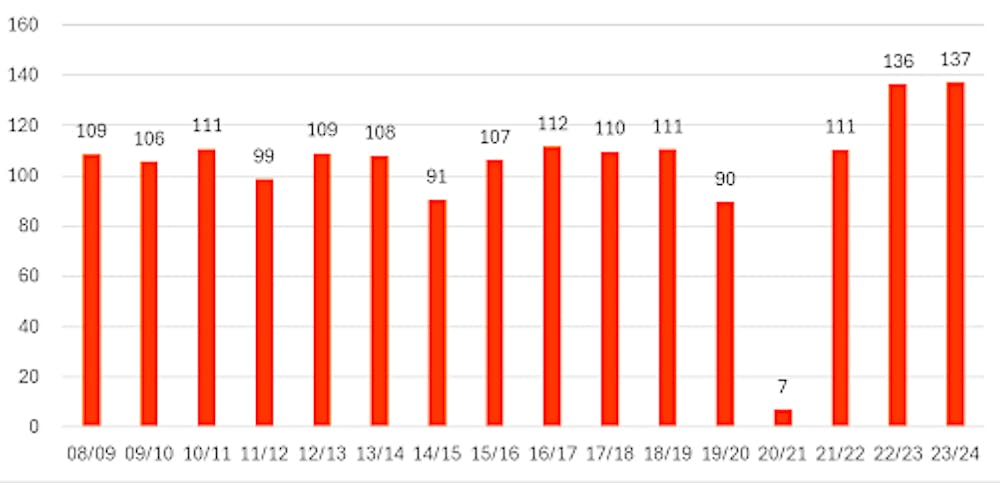
    Manchester United’s matchday revenue per EPL season (£m)


    Kieran Maguire/Christina Philippou, CC BY

    For much of the 2010s, with broadcast revenues increasing rapidly, many Premier League owners made little effort to stoke hostilities with their loyal fan bases by putting up ticket prices. Indeed, Manchester United generated little more from matchday income in the 2021-22 season, as football emerged from the pandemic, than the club had in 2010-11 (see chart above).

    However, this uneasy truce between fans and owners has ceased. The relative flatlining of broadcast revenues since 2017, along with cost control rules that are starting to affect clubs’ ability to spend money on player signings and wages, has changed club appetites for dampened ticket prices. This has resulted in noticeable rises in individual ticket and season ticket prices by some clubs.

    However, season ticket and other local “legacy” fans generate little money compared with the more lucrative overseas and tourist fans. They may only watch their favourite team live once a season, but when they visit, they are far more likely not only to pay higher matchday prices, but to spend more on merchandise, catering and other offerings from the club.

    Today’s breed of commercially aware, profit-seeking US Premier League owners – pioneered by the Glazer family, who saw that “sweating the asset” meant more than watching football players sprinting hard – understand there is a lot more value to come from English football teams. The clubs’ loyal local supporters may not like it, but English football’s American-led revolution is not done yet.


    For you: more from our Insights series:

    • Football’s referee crisis: we asked thousands of refs about the abuse and violence that’s driving them out of the game

    • Panic, horror and chaos: what went wrong at the Champions League final – and what needs to be done to make football safer

    • Football fans fighting food poverty: how a ‘lifesaving’ mobile pantry scheme spread across the country

    • How sport became the new religion – a 200-year story of society’s ‘great conversion’

    To hear about new Insights articles, join the hundreds of thousands of people who value The Conversation’s evidence-based news. Subscribe to our newsletter.

    Kieran Maguire has taught courses and presented on football finance for the Professional Footballers Association, League Managers Association, FIFA and national football associations in Europe.

    Christina Philippou is affiliated with the RAF FA, and Premier League education programs.

    – ref. Why America is buying up the Premier League – and what it means for the future of football – https://theconversation.com/why-america-is-buying-up-the-premier-league-and-what-it-means-for-the-future-of-football-240695

    MIL OSI – Global Reports –

    January 23, 2025
  • MIL-OSI Security: Defense News: CNO Press Briefing: Atlantic Council

    Source: United States Navy

    GENERAL JAMES L. JONES: Good morning, everybody. And welcome to today’s event with Chief of Naval Operations Admiral Lisa Franchetti—chief of naval operations of the world’s finest Navy, I might add—to discuss her 2024 Navigation Plan for America’s Warfighting [Navy].

    My name is Jim Jones, and I serve as executive chairman emeritus here at the Atlantic Council and as chairman of the Scowcroft Center. So, on behalf of the Scowcroft Center and the Atlantic Council, as well as its Forward Defense Program, I would like to welcome you to this exciting fourth installment of our 2024 Commander Series.

    As we all know, since its origin the United States has relied on her Navy to maintain global maritime dominance, ensuring freedom of navigation, the ability to project US power across the globe and played a critical role in the nation’s strategic deterrent capabilities. As we continue into this era of strategic competition with peer or near-peer adversaries, potential adversaries, namely China and Russia, and the threat landscape evolves, the Navy faces many challenges, and its capabilities are stretched across the world.

    The Navy, and I might add the Marine Corps—you’re not going to get away with a commandant introducing you without mentioning the Marine Corps—but the Navy and her Marines must be ready for the possibility of war in the near future. But beyond that, it will need to continue to enhance its long-term advantage to deter future aggression and ensure a major contribution to global stability. A critical component in the effectiveness of this strategy will be leveraging technological innovation to maintain a ready and modern force. The Navy will need to invest in newer platforms, newer weapon systems, and embrace robotic and autonomous systems as well.

    The key advantage that the United States holds over its adversaries is the strong alliance network the US maintains. The Navy must continue to strengthen these relationships, to enhance collective security, deter adversarial aggression by improving interoperability with joint and allied forces. With so many threats looming on the not-so-distant horizon, it is also imperative that the Navy has a forward-thinking strategic vision that leverages all the advantages the United States holds, and enables the readiness to respond in competition, crisis, and conflict if necessary.

    And so today, we’re extremely fortunate to be joined by the 33rd Chief of Naval Operations Admiral Lisa Franchetti, who will discuss her recently published Navigation Plan for America’s Warfighting Navy. This is her strategic guidance for the US fleet during her tenure. A native of Pittsford, New York, Admiral Franchetti is a graduate of the Medill School of Journalism and was commissioned through Northwestern University NROTC program in 1985. She earned her Surface Warfare qualification on the USS Shenandoah, went on to command at all levels, including Naval Reserve, Central Point, Oregon, USS Ross, Destroyer Squadron 21, US Naval Forces Korea, Carrier Strike Group 9 and 15, the US Sixth Fleet in Italy, and Striking and Support Forces NATO in Portugal.

    In addition to command, she has worked across the Navy and the joint force with emphasis on strategy, international engagement, and interagency collaboration, serving as the director Strategy, Plans, and Policy, J-5, and most recently as the vice chief of naval operations. As chief of naval operations, Admiral Franchetti is responsible for the command, use of resources, and operational efficiency of the naval operating forces and the Navy’s shore activities assigned by the secretary of the navy.

    Admiral Franchetti, we look forward to hearing from you today, and we’re very grateful for your presence here. After the admiral’s keynote remarks, she will be joined by Dan Lamothe for a moderated discussion. Dan has held a long career as a journalist and has written extensively about the armed forces for more than fifteen years. Since 2014, he has been covering the United States military and the Pentagon for The Washington Post. Dan, thank you very much for joining us today.

    I would also like to thank everyone attending this conversation with the admiral, whether in person or virtually. [Convenings] such [as] these are integral to the Atlantic Council’s [Scowcroft] Center for Strategy and Security, which works to develop sustainable, nonpartisan strategies to address the most important security challenges facing the United States and her allies and partners. Consistent with that mission, Forward Defense generates ideas and connects stakeholders in the defense ecosystem to promote an enduring military advantage for the United States, her allies, and partners. Its work identifies the defense strategies, capabilities, and resources of the United States needed to deter and, if necessary, prevail in any future conflict.

    I would like to extend a special thanks to Saab Corporation and Michael Anderson, who, unfortunately, couldn’t be here today but is usually in attendance. Saab and the Atlantic Council launched the Commander Series back in 2009. The vision was to establish a flagship speakers forum for senior military and defense leaders to discuss the most important security challenges, both now and in the future. Over the years, the program has become one of the Council’s main institutions. And we’re thankful to Saab for their continued support and collaborations. Before I turn it over to Admiral Franchetti for her keynote remarks, I’d like to remind everybody that this event is public and on the record. Thank you all for joining the Atlantic Council for what I know will be a captivating conversation.

    Admiral Franchetti, without any further ado, the floor is yours. Welcome.

    LISA FRANCHETTI: Well, thank you, General Jones, for your kind introduction and warm welcome. And I also want to thank the Atlantic Council for letting me be part of the Commander Series. It’s an incredible opportunity. And I’m very excited to have the opportunity to speak with all of you today.

    So, as General Jones just mentioned, I recently released my Navigation Plan for America’s Warfighting Navy, which is my overarching strategic guidance to the Navy to make our nation’s fleet more ready for potential conflict with the PRC by 2027, while also enhancing our Navy’s long-term warfighting advantage. But before I talk a little bit more about that, I want to talk about the why—the why behind the NAVPLAN, and what your navy is doing all around the world to protect our nation’s security and prosperity, to deter any would-be adversary, and to always be ready to fight and win decisively, if called to do so.

    As you all know, our Navy—our nation is and always has been a maritime nation. Seventy percent of our planet is made up of water. Eighty percent of the world’s population lives within two hundred kilometers of the coastline. Ninety percent of the global economy moves by sea. And 95 percent of international communications and about ten trillion dollars of financial transactions transit via undersea fiber optic cables every single day. In the United States alone, seaborn trade carries more tonnage in value than any other mode of transportation each year, generating about $5.4 trillion annually and supporting thirty-one million American jobs. And when our access to the sea is impacted, so too is our economy, our national security, and really our way of life.

    And I could think about a lot of different examples over the past years that demonstrate that intimate connection. Just think back to the impacts of COVID-19, the grounding of the Ever Given in the Suez Canal, and now Houthi attacks in the Red Sea, and even the port strikes on the east and west coast—gulf coast just a few weeks ago. It’s really clear that the seas are the lifeblood of our nation. And since the days of the Revolutionary War, as General Jones pointed out, our Navy and our Marine Corps team has protected and guaranteed our access to that sea. And on Sunday, we just celebrated our 249th birthday.

    I think the events of this year and the actions taken by your Navy-Marine Corps team in the Indo-Pacific, in the Mediterranean, in the Red Sea, and beyond really underscore the enduring importance of American naval power throughout our nation’s history. With an average of about 110 ships and seventy thousand sailors and Marines deployed on any given day, the Navy-Marine Corps team is operating forward, defending our homeland, and keeping open the sea lines of communication that fuel our economy. In the Indo-Pacific right now, the USS George Washington Carrier Strike Group and the America Amphibious Readiness Group, with the 31st MEU embarked, are working alongside allies and partners to sustain a free and open regional order and enhance our collective interoperability.

    In the Baltic, the Atlantic, the high north, and the Mediterranean, our navies continue to work alongside NATO and other partner navies to defend NATO and to support Ukraine as they defend their country and their democracy, to further deter Russian aggression, and to ensure that Russia’s continued unjustified and horrific invasion of the sovereign nation of Ukraine is a strategic failure. And in the eastern Mediterranean, the Red Sea, the western Indian Ocean, our naval forces—including aircraft carrier strike groups, amphibious readiness groups, submarines and multiple destroyers—working alongside allies and partners, are containing the Israel-Hamas conflict, deterring others, especially Iran and its proxies, from escalating hostilities into regional war, and continuing to support Israel’s defense.

    Over the last few weeks, more American destroyers—the Bulkeley, the Frank E. Petersen, Michael Murphy, and the Cole—have joined about a dozen other naval assets over the last year in knocking down Iranian and Houthi-launched ballistic missiles, cruise missiles, and drones in defense of the rules-based international order, in defense of innocent civilian mariners, and in defense of Israel. The ability of our forces to seamlessly operate in any theater speaks to the value our Navy has provided to our nation for the last 249 years.

    We operate in a unique domain. It’s a domain that knows no boundaries. It’s a domain that transcends lines that are drawn on a map, and one in which the Navy provides agile, flexible options and decision space to our nation’s leaders every single day. I could not be more proud of that Navy team. It’s the active and reserve sailors. It’s our civilians. And it’s our families. There’s no other Navy in the world that can operate at this scale. No other Navy in the world can train, deploy, and sustain such a lethal, globally deployed, combat credible force at the pace, the scale, and the tempo that we do.

    And while all that we have achieved these past 249 years has filled me with confidence, I know that we cannot take our foot off the gas, because there’s no doubt that our nation is at an inflection point in history. We are facing a changing and challenging security environment, a changing character of war, and real challenges in ship, submarine, aircraft, construction and maintenance, munitions production, recruiting, and infrastructure maintenance. All while acknowledging the industrial and budgetary constraints complicating our efforts to address these challenges.

    I’ve already talked a little bit about the security environment, but I want to expand on how that’s changed a little bit more. As we are seeing, the rules-based international order that we have upheld, protected, and defended for over three-quarters of a century is under threat, in every ocean. The People’s Republic of China is our pacing challenge and presents a complex, multi-domain and multi-axis threat. I am eyes wide open that the challenge posed by the PRC to our Navy goes well beyond just the size of the PLAN fleet.

    It includes gray zone and economic campaigns, expansion of dual-use infrastructure like airfields and ports, and dual-use forces like the Chinese maritime militia, and a growing nuclear arsenal. It’s backed by a massive defense industrial base, which is on a wartime footing and includes the world’s largest shipbuilding capacity. The growing capabilities, capacity, and reach of the PRC military, along with its increasingly aggressive behavior in the East and South China Seas, underscore what Chairman Xi has told his forces, that they should be ready for war by 2027.

    The PRC is not our only competitor. Russia continues to be an acute threat. Iran, a stabling actor in the Middle East. And we are seeing increasing alignment of these competitors, the PRC, Russia, Iran, North Korea, violent extremist organizations, and globally sponsored terrorist organizations like Hamas, Hezbollah, the Houthis, ISIS-K, and more. In addition to this dynamic security environment, we’re also facing a changing character of war, with advancements in battlefield innovation and cheaper, more accessible technology available to state and nonstate actors alike. We’re all learning a great deal from Russia’s invasion of Ukraine and the continued Houthi ballistic missile, cruise missile, and drone attacks in the Red Sea.

    To get after all these challenges, I would love to have the resources and the industrial base capacity to just expand the size of our force overnight. And I acknowledge the need for a larger, more lethal force. But it’s no secret to any of you that we are facing financial and industrial headwinds at getting, what I like to call, more players on the field. Our budget falls short of the 3 to 5 percent increase above inflation needed to support the Navy’s growth. And we’ve had continuing resolutions for fourteen of the past fifteen years, which stifle our momentum and slow any progress in delivering the warfighting capability and capacity needed to meet the needs of today and tomorrow.

    And while we’re investing significant resources to address our industrial base challenges, change will not happen overnight. We cannot manifest a bigger Navy—a bigger traditional Navy in just a few short years. So as I came into this position, I took all of this in—the changing security environment, the changing character of war, and our own challenges—and that is what provided the context that framed my Navigation Plan. It’s a plan that lays out where we need to go to make our Navy more ready for potential conflict anytime and anywhere. As the CNO who will be at the helm into 2027, I am compelled to do more, and do more faster, to ensure that our Navy is more ready. I can’t stand still as we work to secure long-term investments for our force.

    And so my Navigation Plan essentially parks these known challenges in a box. I’m still going to work on them, but they’re not the only thing I’m going to think about. And it helps me set a course to make strategic gains in the fastest time possible with the resources I can influence. It builds on America’s Warfighting Navy, a document that I released in January that lays out my priorities of warfighting, warfighters, and the foundation that supports them. And the NAVPLAN continues where my predecessor’s 2022 NAVPLAN left off. It lays out my plan to raise our fleet’s baseline level of readiness and put more players on the field—platforms that are ready with the requisite capabilities, weapons, and sustainment, and people that are ready with the right mindset, skills, tools, and training.

    And it does that really in two ways. First, by implementing what I call Project 33, seven key areas in which we need to accelerate, areas where I will invest my personal time and resources and put my thumb on the scale to urgently move the needle, with 2027 as our North Star. And second, by expanding the Navy’s contribution to the joint warfighting ecosystem. This is all about building enduring warfighting advantage by investing in key capabilities and creating the layered effects that the Navy can contribute across all domains, to those of the joint force and those of our allies and partners. This is fundamental to my vision of how we will deter and, if necessary, fight and win our future wars.

    So, going back to the first I’d like to briefly just touch on these seven equally important Project 33 targets, as they align to my priorities of warfighting, warfighters, and the foundation that supports them.

    Under warfighting, my first target is readying our platforms.

    The second target is operationalizing robotic and autonomous systems.

    My third target is fighting from the Maritime Operations Center. That’s our command and control nerve center and it will help synchronize how we deliver effects as a Navy and as a broader joint and combined force.

    Under the warfighters’ bucket, my fourth target is recruiting and retaining talented people.

    My fifth target is delivering the quality of service that our sailors and their families deserve.

    My sixth target is investing in warfighter competency, making our live virtual constructive training as reliable, realistic, and as relevant as possible.

    And finally in the foundation bucket, my seventh target is restoring the critical infrastructure that generates, sustains, and postures our force to fight, prioritizing the Pacific theater.

    Together, these seven targets—really, stretch goals—they represent my plan to make strategic gains in the fastest time possible with the resources I can influence. I know that moving out with purpose and urgency on these targets will deter the PRC and any other potential adversary, and make us even more ready to fight and win decisively should that deterrence fail.

    I’d like to end with just a few comments about the joint warfighting ecosystem I mentioned before because my Navigation Plan is critical to expanding our Navy’s contribution to it. I know that our Navy will never fight alone, so we are laser-focused on developing and integrating key Navy capabilities with those of our joint teammates and of our allies and partners, because it’s the aggregate effects that we deliver collectively that will matter.

    The joint warfighting ecosystem is all about pooling and creating those aggregate effects. It’s a system in which a capability enables and then is enabled by each of its participants. It’s on display in the Middle East right now, and I know it’s one that Admiral Paparo will leverage in the Indo-Pacific.

    Achieving these objectives in my Navigation Plan is an all-hands-on-deck effort where everyone has a role to play—industry, Congress, academia, our joint teammates, our allies and partners, and of course our sailors and our civilians. So I would like to thank all of you here for your interest in our Navy, and I would like to thank you for all that you have done to support our Navy team and will continue to do in the future to support America’s warfighting Navy.

    I have a clock in my office that tells me that there are 807 days left until 1 January 2027. There is no time to waste, and your Navy is ready to get after it. Thank you very much, and I look forward to discussion today. Thank you.

    Dan.

    DAN LAMOTHE: All right. Good morning, everyone.

    LISA FRANCHETTI: Good morning.

    DAN LAMOTHE: Thank you for your time today, ma’am.

    You just spent several minutes articulating your plan. I know you must have spent a lot of time planning that. This town often sees plans that run into headwinds, run into real-life events. Can you walk us through a bit what you think you can do to make this plan durable, make this happen, kind of clear-eyed, noting the headwinds, the budgetary constraints, and other things like that?

    LISA FRANCHETTI: Yeah. Well, thank you. And again, thanks for the chance to talk a little bit about the plan today.

    You know, I think this plan is a little bit different from some of the plans that we have had in the past, and I worked to make sure that it would be durable and it would stick. And I really spent about the last year working on this plan alongside all of our four-star commanders, our fleet commanders, our type commanders to really get after what are the things that we need to do and what we do we need to do to think, act, and operate differently to stay ahead of the challenges that we have with the resources that we can influence right now.

    And so when you look at the plan, it’s very focused—I would say it’s different in a few ways from previous plans.

    First, it’s focused on 2027. It’s focused on the PRC. So I’ve set my priorities, my sight. It’s narrowly focused on getting after those challenges.

    The other thing is that it really builds on Navigation Plan 2022, in which we had about eighteen different areas which we were really focused on and a lot of structure was put in place with single accountable individuals to drive progress in each one of those areas. I took a look, I took a fix, and I said, all right, here’s where we are based on NAVPLAN 2022, and here are seven areas where I think we can really put our foot on the gas and accelerate our progress in those to be real gamechangers in what we need to be able to do in the future.

    I think the last thing I would say what’s different about it is that it does have this single accountable individual responsible for each one of the targets that we’re trying to get after. And what we’ve found through our perform-to-plan and naval sustainment systems, processes have been put in place, if you have a stretch goal, a single accountable individual, and a cadence of accountability, that drives success.

    And the Navigation Plan will change my focus. It changes where I go, what I visit, what reports I get, what meetings I go to. And so my personal attention will be on these Project 33 goals as well as building the capabilities I talk about as the key capabilities for warfighting advantage that will get us where we need to be in the future.

    DAN LAMOTHE: OK. One of your stated goals is boosting surge readiness to 80 percent. I know talking to a lot of analysts in this town, they raise concerns whether real-life events, physics, other things would really challenge this. And I know you’ve raised previously the aircraft as a kind of parallel. Do you see 80 percent as aspirational, achievable, both? And I guess, how do you put your foot on the gas with that?

    LISA FRANCHETTI: Thanks. This is one of the most important—all seven are equally important, but you know, I’ve long said that we need to get more players on the field. There’s a lot of ways to do that. You know, one is to buy new ones. One is to get them in and out of maintenance on time, which is—that’s why I put this goal in here. One is to use what you have differently.

    I am focused on this, because the aviation example is really illustrative of what we know we can achieve. So in 2018, Secretary Mattis challenged our aviation community to get F/A-18 readiness up from 50 percent readiness/availability to 80 percent. And over the process of these—the last couple of years, and now six years on, we’ve been able to sustain 80 percent readiness in the F/A-18s because of the processes that we put in place, data-driven, daily drumbeats of accountability to make sure that we understood what the readiness was, what the barriers were to achieving that readiness, and moving forward.

    They’ve been able to scale that now through other type model series, and we’ve expanded it to the submarine force and also the surface force. So it’s a stretch goal, but I am committed and the team is committed to going after that stretch goal. So we are putting all those—we have, actually, all those processes in place now, and I’m really looking forward to that.

    I will just give another example, a metric in surface that might be useful. So, you know, on-time completion of maintenance availabilities is really important. So if you think back in 2022 we had about 27 percent completion on time, 2023 we moved it up into the 30 percents, and this year we’ll be up to 67 percent. So we put in a lot of procedures to be able to plan maintenance availabilities early in a surface, a submarine, and aviation, making sure we understand what parts we need, having available pool of parts, investing in those parts so they can be there on time; planning our stuff—maintenance availabilities at least six months ahead of time and locking them in to let industry know what’s coming and also get those parts on order. Those are some of the things we’re doing.

    So these are stretch goals, but I am confident that we’re going to work hard to get after them. And if we don’t make exactly 80 percent, we’re going to be farther along the road than we would be if I hadn’t set such an ambitious goal.

    DAN LAMOTHE: OK.

    LISA FRANCHETTI: And I will say all the communities are locked hands on these goals, so we are all committed to working together to get after them.

    DAN LAMOTHE: A lot of discussions about the future of the Navy tend to focus on ship numbers. I heard in your comments there you kind of addressed that head on. To what do you—what degree do you consider that construct limiting, and to what degree do you consider that construct necessary? You know, I—there’s a pragmatic aspect to this, but numbers are numbers, and I’m sure that’s something that you get an earful on a lot as well.

    LISA FRANCHETTI: Certainly. Well, I fully acknowledge that we need a larger, more lethal Navy. You know, we have multiple assessments that say that we need to have a larger Navy, and I really want to work closely, you know, with Congress, with industry to be able to deliver that Navy that we need. And that’s a really important thing.

    But the size of the Navy is not the only thing that matters. I think if you look at that future warfighting ecosystem, it’s really about the effects you can deliver with that Navy from a widely dispersed, disaggregated force integrated with all of the other forces of our joint force, whether it’s cyber, space, Air Force, Army, Marines. You can definitely envision a different type of warfighting environment where all of those effects are layered together, and that is really how we’re going to beat any adversary.

    So, to me, it’s both. We need to focus on getting the fleet that we need with the capabilities we need, but we also need to understand how we’re going to better integrate them with the joint force and alongside our allies and partners. And really, how do we build that interoperability from the ground up with allies and partners through both weapons systems but also exercises, and make sure that we can really plug and play, plug and fight any time that we need to be able to do that?

    DAN LAMOTHE: OK. Thank you.

    Let’s talk some current ops and maybe tie it back to the plan a bit. The Navy’s been extremely busy in the Red Sea and other parts of the Middle East over the last year. You know, I think a lot of us are tracking ship movements and things like that on a level that, you know, is not always common. What is the service learning as a result as seemingly almost daily sailors are knocking, you know, munitions out of the sky? And how long do you think the service can keep this up? It seems to me that there would be concern as this stretches on on magazine depth and also on just, you know, as you’re trying to pivot elsewhere this seemingly doesn’t go away.

    LISA FRANCHETTI: Well, first, I couldn’t be more proud of our Navy and Marine Corps team that’s out there. As I said earlier, you know, from day one we’ve been there to deter further escalation. And you know, I’m very proud of all of our ships—working alongside allies and partners, I would add—there in the Red Sea and in the—in the Indian Ocean to really uphold that rules-based international order.

    I think we’re learning a lot by being in the Red Sea. First, the value of allies and partners. And again, all of these exercises and training that we do all around the world, that’s enabled us to work together to get after this challenge.

    I would say a few other things. First, that our sailors are confident in their weapons system. And that’s really a testament to the development of these weapons systems over the last many years, but also to the training, the certification, all of the work we do to get our sailors, our ships, our aircraft, everything ready to go before they head into harm’s way. And our systems have performed as designed. So, again, it’s a real testament to the designers, the engineers, and now our people who are able to employ them effectively.

    I think the other thing that we’re learning is that we’ve been able to observe all of the different engagements, everything that the Houthis have used, all of their Iranian-supplied weapons systems, and we’ve been able to look at their tactics that they’re using. We’ve been able to use data and extract that information from our weapons systems, bring that back here to the US in a matter of hours. And getting that to our engineers; to our warfighting development centers where they develop tactics, techniques, and procedures; this has been really a gamechangers because then all the experts can work together, understand what’s going on. As tactics evolve, then we can introduce different tactics, adjustments to radars, whatever it is we need to do to be able to get after that.

    I’ll just give a small example. When I was out visiting one of our ships, I got to promote a fire controlman second class to first class. And he was a technician who worked with a gun weapons system, and he had an idea about how he could make the gun more effective against Houthi threats. And he wrote up his idea, he sent it back to the technical authorities, they validated it, and they put it out the rest of the fleet because it was a better way to use the gun and more effective. And so we got to put technology into the hands of a warfighter; we got him to think about how to think, act, and operate differently; and he was really a pioneer in innovating there on the battlefield.

    I always like to say in Ukraine they innovate on the battlefield every single day. They take what they have and they use it differently. We need to be able to do the same. So I think that’s another lesson that we’ve learned there.

    DAN LAMOTHE: OK.

    LISA FRANCHETTI: And to your last point about, you know, are we concerned about our sustainability to be there, of course, our job is to be there, and that is what we train our people to do. So I’m very proud to be able to do that mission. And we’re continuing to work, again, to invest in the munitions as I talk about the foundation—munitions, bases, infrastructure—all those things we need to generate and sustain the force, committed to getting after that.

    DAN LAMOTHE: All right.

    And I think we have just time for one more question. We’ve seen the Abraham Lincoln Strike Group extended. We’ve seen the Marine Expeditionary Unit extended along with the ARG. As we see this extend, you know, it occurs to me we don’t necessarily have a follow-on ARG new behind it. To what degree are you concerned about being able to sustain the tempo out there?

    LISA FRANCHETTI: Well, as you know, we train, deploy, and certify all of our forces to be able to meet the requirements that are set forth, you know, by the secretary. We’re a globally deployed force, and I think that’s one of the greatest things about the flexibility of our Navy. We can generate the forces, we can send them where they need to go, and allow the secretary to be able to move them between the different theaters to get after the missions that we have. So I’m confident in our ability to do that.

    I am very focused on readiness for all of our ships. You know, when you think about in the big picture what are my priorities, first, Columbia, our number-one acquisition priority. But after that, readiness, capability, and then capacity. I’m really focused on readiness and getting after all of these maintenance challenges that have caused some of the delays in the past, whether it’s in our amphibious force or in any one of our platforms. So, again, that’s how we’re going to get after this. And that’s why that’s a key part of our Navigation Plan.

    DAN LAMOTHE: OK. Thank you all for your time today. I’d ask you to remain seated so that the admiral can depart for another meeting.

    LISA FRANCHETTI: Thank you very much.

    DAN LAMOTHE: All right.

    LISA FRANCHETTI: Thank you.

    DAN LAMOTHE: Thank you.

    LISA FRANCHETTI: Oh, thanks. That was fun.

    DAN LAMOTHE: Thank you.

    MIL Security OSI –

    January 23, 2025
  • MIL-OSI New Zealand: Niger

    Source: New Zealand Ministry of Foreign Affairs and Trade – Safe Travel

    • Reviewed: 17 October 2024, 08:02 NZDT
    • Still current at: 17 October 2024

    Related news features

    If you are planning international travel at this time, please read our COVID-19 related travel advice here, alongside our destination specific travel advice below.

    Do not travel to Niger due to the threat of terrorism and kidnapping, the presence of armed militants and the unpredictable security situation (level 4 of 4).

    Niger

    Terrorism
    There is a high threat from terrorism in Niger. Terrorist groups are active across Niger, particularly, in the western, northwestern and southeastern parts of the country, Since 2013, there have been a number of retaliatory attacks against the Niger government for its participation in regional interventions in Mali and Nigeria to repel armed rebels.

    The Nigerian-based terrorist group Boko Haram has a strong presence in neighbouring areas of northern Nigeria and has conducted cross-border attacks in Niger, near the Nigerian border, particularly in the Diffa region. State of Emergencies and curfews may be in place in regions of concern. Comply with any instructions issued by local authorities.  

    Terrorist attacks could occur at any time and may be directed at locations known to be frequented by expatriates and foreign travellers, as well as security forces and premises associated with the Government of Niger. The security situation across the Sahel continues to deteriorate, and regions previously considered to be less at risk may now be subject to terrorism and related security threats.

    New Zealanders are advised to be security conscious at all times, particularly in public areas. We recommend monitoring media reports and local information sources for possible threats to your safety and security.

    Kidnapping
    There is a high threat of kidnapping against foreigners in Niger, including in the capital Niamey. The risk increases substantially outside Niamey, in the north of the country and in border areas. Terrorist groups active in Niger have been known to specifically target foreigners. In October 2020, a US citizen was kidnapped in the village of Massalata in southern Niger, about 10km from the border with Nigeria. In the past, foreigners have been kidnapped from their vehicles, homes and places of work.

    Violent Crime
    Crime levels in Niger are high, and foreigners are frequently targeted. Muggings are common in Niamey around the Gawaye Hotel, the National Museum, Kennedy Bridge and the Petit Marché, particularly at night. New Zealanders are advised not to walk alone or after dark in these areas. Other common types of crime include home invasions, carjackings assault and theft.

    Armed bandits operate throughout eastern and southern Niger, the border area with Nigeria south of Zinder, and large parts of northern Niger are off-limits to tourists.

    Petty crime such as pickpocketing and bag snatching occurs in Niamey and  throughout Niger. You should take steps to secure your personal belongings and avoid wearing or displaying valuables such as mobile devices and jewellery or leaving them visible in vehicles.

    Local Travel
    New Zealanders who decide to travel outside Niamey should ensure they put in place appropriate personal security protection measures, and take official warnings seriously. We recommend travelling in convoy of at least two vehicles, with a local guide and only during daylight hours. Attacks have occurred on the Agadez-Arlit, Agedez-Tahoua, and Tillabéry-Niamey roads and within the city of Zinder. You should prepare well in advance and ensure all vehicles are fully equipped with essential supplies, including a satellite phone. 

    We advise against the use of public transport in Niger. There have been incidents of armed robbery resulting in deaths on buses in Niger. Taxis are often under-maintained and dangerous and should be avoided. It is recommended that you hire a private car with a driver. Lock car doors and keep windows shut at all times.

    Local authorities are sensitive about foreigners travelling out of Tahoua to the east or north of Niger. If you travel in the Agadez region without obtaining prior authorisation, you risk arrest or deportation.

    Civil Unrest
    Niger frequently experiences protests and demonstrations, usually near government buildings and university campuses, some of which have turned violent in the past. Mobile phone and internet access may be disrupted during civil unrest.

    Since the military takeover in July 2023, there has been political instability in Niger. New Zealanders in Niger should remain vigilant and monitor the media for further information.

    New Zealanders are advised to follow any advice issued by the local authorities, including curfews, and avoid all demonstrations, protests and rallies as they have the potential to turn violent with little warning.

    Landmines
    There is a danger from unexploded landmines in some parts of Niger, including in Niamey and in the northern region of Agadez. We recommend you remain on well-used roads and paths.

    Scams
    Commercial and internet fraud is a common problem in many African countries. New Zealanders in Niger should be wary of any offers that seem too good to be true, as they may be a scam. For further information see our advice on Internet Fraud and International Scams.

    General Travel Advice
    As there is no New Zealand diplomatic presence in Niger, the ability of the government to provide consular assistance to New Zealand citizens is severely limited.

    We offer advice to New Zealanders about contingency planning that travellers to Niger should consider.

    New Zealanders are advised to respect religious and social traditions in Niger to avoid offending local sensitivities.

    Photography of public buildings and military facilities is prohibited, and could result in detention. If in doubt, don’t take a picture.

    Medical facilities are limited and of poor quality, including in the capital Niamey. New Zealanders travelling or living in Niger should have a comprehensive travel insurance policy in place that includes provision for medical evacuation by air.

    New Zealanders in Niger are strongly encouraged to register their details with the Ministry of Foreign Affairs and Trade.


    Travel tips

    See our regional advice for Africa

    Top of page

    MIL OSI New Zealand News –

    January 23, 2025
  • MIL-OSI New Zealand: Brunei Darussalam

    Source: New Zealand Ministry of Foreign Affairs and Trade – Safe Travel

    • Reviewed: 18 November 2022, 09:26 NZDT
    • Still current at: 17 October 2024

    Related news features

    If you are planning international travel at this time, please read our COVID-19 related travel advice here, alongside our destination specific travel advice below.

    Exercise increased caution in Brunei Darussalam (level 2 of 4).

    Brunei Darussalam

    Crime
    Petty crime such as theft and burglary can occur in Brunei Darussalam. We advise New Zealanders to be alert to their surroundings at all times and take steps to safeguard and secure their personal belongings.

    Civil unrest
    Civil unrest is extremely rare in Brunei Darussalam, but protests and demonstrations could have the potential to result in violence. We advise monitoring local media and following any instructions from local authorities.

    General travel advice
    New Zealanders in Brunei Darussalam are strongly advised to familiarise themselves with and observe local laws and customs, which can be very different to New Zealand. This includes in relation to alcohol and tobacco, and public expression of political views.

    Brunei Darussalam has a dual legal system with both civil law and syariah (sharia) law. Both laws include provisions for corporal and capital punishments. Penalties for possession, use or trafficking of illegal drugs are severe and can include the death penalty, physical punishment, and lengthy imprisonment.

    Further information about the Syariah Penal Code can be found on Brunei Darussalam’s Attorney General’s Chambers website. A non-exhaustive list of illegal activities under syariah law includes blasphemy, sodomy, and adultery. Syariah law applies to Muslims, non-Muslims, and foreigners.

    New Zealanders are advised to respect religious, social and cultural traditions in Brunei Darussalam to avoid offending local sensitivities (including around members of the Royal Family and during religious occasions). Modesty and discretion should be exercised in both dress and behaviour.

    New Zealanders travelling or living in Brunei Darussalam should have a comprehensive travel insurance policy in place that includes provision for medical evacuation by air.

    New Zealanders in Brunei Darussalam are encouraged to register their details with the Ministry of Foreign Affairs and Trade.


    The New Zealand High Commission Kuala Lumpur, Malaysia is accredited to Brunei Darussalam

    Street Address Level 21, Menara IMC, 8 Jalan Sultan Ismail, Kuala Lumpur 50250 Telephone +60 3 2078 2533 Fax +60 3 2078 0387 Email klinfo@mfat.govt.nz Web Site http://www.mfat.govt.nz/malaysia Hours Mon-Fri 0830am to 1230 hrs (reception); Mon-Thurs 0800-1630 hrs, Fri 0800-1600 hrs (telephone enquiries and pre-arranged appointments)

    See our regional advice for South East Asia

    Top of page

    MIL OSI New Zealand News –

    January 23, 2025
  • MIL-OSI New Zealand: Engaging rangatahi back into active recreation

    Source: Weekend Express/Rātā Foundation

    Rates of rangatahi youth participating in active recreation have fallen by 6% since Covid, according to research by Active NZ.
    Sport Tasman hopes to turn that statistic around with targeted approach programmes like Marlborough-based Ngahi Foha oe Moana Pasifika that link with the values and interests of young people and encourage them to go back into active recreation.
    South Island funder Rātā Foundation supports the programme through its rangatahi partnership with Sport Tasman.

    MIL OSI New Zealand News –

    January 23, 2025
  • MIL-Evening Report: Australian schools need to address racism. Here are 4 ways they can do this

    Source: The Conversation (Au and NZ) – By Aaron Teo, Lecturer in Curriculum and Pedagogy, University of Southern Queensland

    The Australian Human Rights Commission wants to see schools address racism, as part of a broader push to address the problem across Australian society.

    As it says in a recent report,

    People are not born with racist attitudes or beliefs […] Addressing racism in schools is crucial to ensure that victims do not leave education facing lifelong disadvantage, and perpetrators do not enter adulthood believing racist behaviours are acceptable […].

    But racism is hardly mentioned in the Australian Curriculum – for example, it is noted in passing in the health and physical education curriculum for years 5 to 8. However, there is no consistent approach across subject areas, or at the state level.

    This means teaching about racism is largely left up to individual schools and teachers.

    Yet research shows they can be reluctant to speak about these issues with students. This is for a range of reasons, such as worrying they will say the wrong thing.

    How should school systems, schools and teachers address racism? Here are four ways.

    1. Teach racial literacy

    We know children demonstrate stereotyping and prejudice from an early age and students from racial minorities are frequently targets of racism and discrimination at school.

    In Australia, racism debates can also involve dangerous and ill-informed opinions.

    So we need to start teaching children and young people about racial literacy skills from the first year of schooling. This means they grow up to have the knowledge and language to talk about and confront racism.

    Some of these skills include:

    • being able to identify how racism appears in everyday interactions, the media and society more broadly

    • debunking common myths about racism, such as it is a “thing of the past”. Or “everyone has equal access to the same opportunities and outcomes if they work hard enough”

    • understanding the impacts of racism, including on people’s opportunities, education and their health and wellbeing

    • understanding how our own backgrounds, privilege and bias can influence how we confront or don’t confront racism.

    Students also need to learn how racism can be structural, systemic and institutional. This means racism is not just about an individuals’ beliefs or actions. Laws, policies, the way organisations are run and cultural norms can all result in inequitable treatment, opportunities and outcomes.

    2. Teach students how to react

    We also need to teach children how to react when they witness racism with age-appropriate tools.

    For both primary and secondary students, the first question should always be, “Is it safe for me to act?”, followed by “Am I the best person to act in this situation?”. Depending on their answers, they could:

    • report the incident to an appropriate adult or person in authority

    • show solidarity with the victim by comforting them and letting them know what happened was not OK

    • interrupt, distract or redirect the perpetrator

    • seek help from friends, a passerby or teacher.

    3. Create safe classrooms and playgrounds

    Teachers need to ensure classrooms and schools are safe spaces to discuss racism.

    This can include:

    • acknowledging how our own experiences, biases and privileges shape our world views

    • clearly defining the purpose of a discussion and the ground rules

    • using inclusive language.

    In particular, schools have a unique duty of care for minority students, who need to know they can talk openly about these issues with their peers and teachers without fear or judgement.

    This includes addressing sensitive topics like how they might experience or witness racism, the effect it can have on their health and wellbeing and those around them, and the consequences of talking about or reporting racism.

    4. Develop teachers’ skills

    As part of creating safe classrooms, teachers need to be able to confidently discuss tricky topics in an age-appropriate way.

    Our work has shown some teachers deny racism or perpetuate racist stereotypes. Others may avoid the topic, worrying they will say or do the wrong thing.

    Our current (as yet unpublished) research on anti-racism training with classroom teachers suggests they can increase their confidence to talk and teach about racism if given appropriate, and sustained training.

    What needs to happen now?

    We need anti-racism education to be an official part of school curricula. To accompany this, we need genuine commitments and modelling from policymakers, school leaders, teachers, parents and carers to address racism in schools.

    We need to talk openly about racism in schools. That means explicitly naming it, calling it out, and not getting defensive when it is identified and action is required.

    Aaron Teo is Convenor for the Australian Association for Research in Education Social Justice Special Interest Group, Queensland Convenor for the Asian Australian Alliance, member of the Challenging Racism Project, and member of the Advisory Committee for the Australian Human Rights Commission’s study into racism in Australian universities

    Rachel Sharples has received funding from the Australian Research Council and the NSW Department of Education. She is a member of the Challenging Racism Project (CRP) and the Centre for Resilient and Inclusive Communities (CRIS).

    – ref. Australian schools need to address racism. Here are 4 ways they can do this – https://theconversation.com/australian-schools-need-to-address-racism-here-are-4-ways-they-can-do-this-239823

    MIL OSI Analysis – EveningReport.nz –

    January 23, 2025
  • MIL-OSI Asia-Pac: India to play a role in making telecom services and digital connectivity available to emerging economies: Shri Goyal

    Source: Government of India

    India to play a role in making telecom services and digital connectivity available to emerging economies: Shri Goyal

    Seamless broadband connectivity across the country has made India the trusted partner of the world: Shri Piyush Goyal

    Innovation defines India growth story, world recognises India as a leader in democratising technology for the world: Shri Goyal

    Posted On: 15 OCT 2024 5:28PM by PIB Delhi

    Union Minister of Commerce & Industry, Shri Piyush Goyal said that India is all set to become a provider of telecom services and Indian companies will become providers of high security and quality technological equipment to emerging economies.

    During his address at the inauguration of World Telecommunication Standardization Assembly and 8th edition of India Mobile Congress today in New Delhi, the Minister expressed confidence that India in the future will lead international telecom supply chains and urged companies to find solutions to help take telecom to countries still behind in network connectivity. India has a role to play in making technology available in the Global South and in leading the world in fulfilling the Sustainable Development Goal (SDG) to make digital connectivity affordable across the globe. He added that  seamless broadband connectivity across the country has earned India the moniker ‘Trusted Partner of the World’.

    Commerce and Industry Minister highlighted India’s stable network connectivity across rural and urban areas as an achievement of the flagship ‘Digital India’ campaign launched by the Prime Minister Shri Narendra Modi in 2015. He hailed the Prime Minister’s foresight of using technology as an enabler for good governance, for providing business opportunities and as an enabler to expand the country’s economic activities. Shri Goyal said that India today thinks as one nation and attributed Prime Minister Shri Narendra Modi of ushering a change in the mindset of the youth and aligning the thought process of the entire country towards the nation’s development.

    Shri Goyal continued that making the digital push back in 2015 helped in continuation of essential services leading to seamless business activities across the country during Covid pandemic. When countries work with India, they are assured of high quality, affordability and cost effective solutions and are assured of uninterrupted business activities allowing companies to look up to India for their global capability centres (GCCs), he said.

    He noted that in terms of technological developments in telecom services like innovation, availability of equipment, services and data India is far ahead of developed countries. Of India celebrating World Standards Day yesterday, Shri Goyal said that the government is working towards making India a provider of quality goods and services. Everything that India does will have an imprint of quality defining the India growth story, he said.

    Alluding to the theme of the event “The Future Is Now”, the Minister said that India is contributing to not only its future but of the world and its offering of digital technologies plays an integral part in bringing the world as one family. He further stated that the entire ecosystem of digitalisation involving machine learning, artificial intelligence and data analytics has its imprint in India. India is recognised for its innovation, talent and the large market it provides. Innovation defines the India growth story and the world recognises India as a leader in democratising technology for the deprived and the whole world, he said.

    While paying his respects to Dr. A.P.J. Abdul Kalam on his birth anniversary, the Union Minister stressed that his pioneering work in cutting edge technology has been appreciated worldwide and his engagement with the youth will always remain a source of inspiration for the country.

    Shri Goyal praised the Telecom Equipment and Services Export Promotion Council (TEPC) for instilling confidence in making India self-reliant in technological achievements. He emphasised that India today is a different story as it has been able to launch 5G parallelly with the rest of the world and underlined that the country will be the leader in launching and developing 6G. He said that through the National Broadband Mission, every corner of the country will benefit from 5G technology.

    ***

    AD/VN/AM

    (Release ID: 2065022) Visitor Counter : 69

    MIL OSI Asia Pacific News –

    January 23, 2025
  • MIL-OSI: Agba Completes Merger With Triller

    Source: GlobeNewswire (MIL-OSI)

    NEW YORK, NY / LOS ANGELES, CA, Oct. 15, 2024 (GLOBE NEWSWIRE) — AGBA Group Holding Limited (Nasdaq: AGBA) (“AGBA”) today announced the completion of its previously announced merger (the “Merger”) with Triller Corp. (“Triller”).

    In connection with the Merger, AGBA has changed its name to Triller Group Inc. (the “Company”). The combined company’s common stock and warrants are expected to begin trading under the tickers “ILLR” and “ILLRW,” respectively, on Nasdaq Capital Market on October 16, 2024.

    “This merger is terrific news for both the users and the content creators on our app.  Whether they are fans of BKFC, or they watch sports and entertainment events around the world on TrillerTV, or are using our brand and creator tools to find their audience, they now have in Triller an innovative, exciting partner.” said Bob Diamond, Chairman of the combined company and Founder and CEO of Atlas Merchant Capital LLC.

    Leadership

    The Company will make a statement on future leadership, strategy and objectives on Tuesday, October 22, 2024. 

    Domestication to Delaware

    Concurrent with the closing of the Merger, AGBA changed its jurisdiction of incorporation from the British Virgin Islands to the State of Delaware, and changed its corporate name to “Triller Group Inc.”

    Financial Terms

    Following the completion of the Merger, former AGBA shareholders and former Triller stockholders own 30% and 70% of the combined company’s outstanding common stock, respectively.

    The latest press release is available on the company’s website, please visit: http://www.agba.com/ir.

    About AGBA
    Established in 1993, AGBA Group Holding Limited is a leading, multi-channel business platform that incorporates cutting edge machine-learning and offers a broad set of financial services and healthcare products to consumers through a tech-led ecosystem, enabling clients to unlock the choices that best suit their needs. Trusted by over 400,000 individual and corporate customers, the Group is organized into four market-leading businesses: Platform Business, Distribution Business, Healthcare Business, and Fintech Business.

    For more information, please visit http://www.agba.com.

    About Triller Corp.
    Triller Corp. is a next generation, AI-powered, social media and live-streaming event platform for creators. Pairing music culture with sports, fashion, entertainment, and influencers through a 360-degree view of content and technology, Triller Corp. uses proprietary AI technology to push and track content virally to affiliated and non-affiliated sites and networks, enabling them to reach millions of additional users. Triller Corp. additionally owns Triller Sports, Bare-Knuckle Fighting Championship (BKFC); Amplify.ai, a leading machine-learning, AI platform; and TrillerTV, a premier global PPV, AVOD, and SVOD streaming service.

    For more information, visit http://www.triller.co.

    Safe Harbor Statement

    This press release contains forward-looking statements as defined by the Private Securities Litigation Reform Act of 1995. Forward-looking statements include statements concerning plans, objectives, goals, strategies, future events or performance, and underlying assumptions and other statements that are other than statements of historical facts. When the Company uses words such as “may,” “will,” “intend,” “should,” “believe,” “expect,” “anticipate,” “project,” “estimate” or similar expressions that do not relate solely to historical matters, it is making forward-looking statements. Forward-looking statements are not guarantees of future performance and involve risks and uncertainties that may cause the actual results to differ materially from the Company’s expectations discussed in the forward-looking statements. These statements are subject to uncertainties and risks including, but not limited to, the following: the Company’s goals and strategies; the Company’s future business development; product and service demand and acceptance; changes in technology; economic conditions; the outcome of any legal proceedings that may be instituted against us following the consummation of the business combination; expectations regarding our strategies and future financial performance, including its future business plans or objectives, prospective performance and opportunities and competitors, revenues, products, pricing, operating expenses, market trends, liquidity, cash flows and uses of cash, capital expenditures, and our ability to invest in growth initiatives and pursue acquisition opportunities; reputation and brand; the impact of competition and pricing; government regulations; fluctuations in general economic and business conditions in Hong Kong and the international markets the Company plans to serve and assumptions underlying or related to any of the foregoing and other risks contained in reports filed by the Company with the SEC, the length and severity of the recent coronavirus outbreak, including its impacts across our business and operations. For these reasons, among others, investors are cautioned not to place undue reliance upon any forward-looking statements in this press release. Additional factors are discussed in the Company’s filings with the SEC, which are available for review at http://www.sec.gov. The Company undertakes no obligation to publicly revise these forward–looking statements to reflect events or circumstances that arise after the date hereof.

    Investor & Media Relations:

    Bethany Lai
    ir@agba.com

    Anthony Silverman
    ads@apellaadvisors.com

    # # #

    The MIL Network –

    January 23, 2025
  • MIL-OSI Australia: How Do Households Form Inflation and Wage Expectations?

    Source: Reserve Bank of Australia

    Tags

    asset quality, balance sheet, banking, banknotes, bonds, business, business cycle, capital, cash rate, central clearing, China, climate change, commercial property, commodities, consumption, COVID-19, credit, cryptocurrency, currency, digital currency, debt, education, emerging markets, exchange rate, export, fees, finance, financial markets, financial stability, First Nations, fiscal policy, forecasting, funding, global economy, global financial crisis, history, households, housing, income and wealth, inflation, insolvency, insurance, interest rates, international, investment, labour market, lending standards, liquidity, machine learning, macroprudential policy, mining, modelling, monetary policy, money, open economy, payments, productivity, rba survey, regulation, resources sector, retail, risk and uncertainty, saving, securities, services sector, technology, terms of trade, trade, wages

    MIL OSI News –

    January 23, 2025
  • MIL-OSI USA: Boston Globe: Elizabeth Warren on why we need universal child care now

    US Senate News:

    Source: United States Senator for Massachusetts – Elizabeth Warren
    May 04, 2021
    In an essay adapted from her new book, the senator says the pandemic made it clear: The economy depends on child care and caregivers.
    In early April 2020, just as wave after wave of coronavirus cases were hitting the United States and hospitals in hot spots were worried about being overrun with sick and dying people, I set up a conference call with a big group of Massachusetts nurses. They were working long hours, there were no known COVID-19 treatments, and they were watching their patients die alone. I’d also heard terrible stories about the shortage of face masks and other protective gear. Let’s be clear: If nurses can’t do their jobs, then the whole health care system breaks down and all of America is at risk.
    I thanked the nurses and said I agreed with everyone in our country who had been calling them “heroes.” There were some polite responses, and then I asked the obvious question: What do you need so you can do your jobs? The first answer: child care. Another chimed in, saying, Yeah, we need child care. And then the dam broke, with the nurses talking over each other. The always-tricky and always-stressful task of arranging child care had become so much harder exactly at the moment when the need for these parents to be in the workforce was at its most desperate.
    Their employers saw the problem as well. And the same was true for other employers who were trying to keep their people on the front lines so that, say, grocery stores could stay open or bus lines would run. One in five of those who couldn’t work cited child care as the reason. Without adequate child care, an economy that was already under great strain faced the very real possibility of breaking down entirely.
    …
    Read full article here.
    By:  Senator Elizabeth WarrenSource: Boston Globe

    MIL OSI USA News –

    January 23, 2025
  • MIL-OSI New Zealand: Business – New Zealand’s leading pre-loved fashion marketplace expands across the ditch to Australia

    Source: Designer Wardrobe

    Auckland, New Zealand – 16 October 2024 – Following significant growth, New Zealand’s leading two-way marketplace for pre-loved fashion, Designer Wardrobe, has officially launched in Australia to offer fashion-loving Aussies a more sustainable, affordable, and smarter way to shop and sell pre-loved fashion.

    With a thriving community of over 325,000 members using the marketplace, Designer Wardrobe will help Australians earn money with fashion pieces from their wardrobes that they no longer reach for and might otherwise remain unworn. Australians will also be able to enjoy more than 160,000 pre-loved fashion pieces from both Australian and New Zealand sellers, opening up the pre-loved market on both sides of the Tasman.

    With this latest move, Designer Wardrobe aims to help extend the life of thousands, if not millions, of fashion pieces and accessories, keeping them in active circulation and reducing the number of items that might otherwise end up in landfill.

    Designer Wardrobe’s launch comes at the perfect time, with industry insights revealing:

    • 300,000 tonnes of clothing in Australia either ends up in landfill or being exported each year;
    • 73 per cent of Australians already purchase pre-loved clothing;
    • Two-thirds of Australians are considering side hustles to make ends meet.

    Additional insights from Designer Wardrobe highlights:

    • Total sales traded on the marketplace increased 14 per cent year-on-year compared to the same period in 2023 (*1 January – 30 September 2024 v 1 January – 30 September 2023;
    • Over the same period of time*, Designer Wardrobe has seen 208,688 pieces sold – helping to reduce what may otherwise end up in landfill, And, almost half a million (469,320) listings have been created on Designer Wardrobe. 
    • Designer Wardrobe’s user base has reached an impressive 325,000, doubling since pre-Covid times (2020), with approximately 1 in 10 women in New Zealand now using the marketplace.  Additionally, the number of clothing items sold on the platform has increased more than fivefold during the same period, underscoring Kiwis’ growing enthusiasm for pre-loved fashion.

    Aidan Bartlett, CEO of Designer Wardrobe, says: “After 10 successful years in New Zealand, the growth we’ve experienced has been monumental, and we’re thrilled to now bring our thriving marketplace and community of fashion lovers to Australia.”

    “Global trend data highlights that there has been a significant surge in sustainable shopping trends, with consumers increasingly opting for smarter and more affordable fashion alternatives in response to rising inflation and the cost-of-living crisis.”

    According to GlobalData’s report for ThredUp, global sales of pre-owned clothing rose by 18 per cent last year, reaching $197 billion, and are projected to grow to $350 billion by 2028; And, second-hand clothing is projected to account for 10 per cent of global fashion sales, underscoring the rising demand for more sustainable shopping options.

    Bartlett continues: “At a time when many are seeking additional income streams and looking to make smarter fashion choices by purchasing pre-loved, Aussies can feel confident buying and selling through a trusted marketplace with thousands of active members.

    “Australians will have access to thousands of listings across both Australia and New Zealand, and Kiwis can also enjoy pieces from popular Australian brands like Aje, Shona Joy, Caitlin Crisp, Alemais, Bec + Bridge, and Sir the Label.

    “The average shopper can save up to 60 per cent off the original RRP of their favourite luxury, designer, and high-street brands. Even better, they can feel great about their smart purchasing decisions by extending the life of items they may otherwise end up in landfill.”

    “Our platform has always been about more than just buying and selling clothes; it’s about empowering our community to find value in what they own and to contribute to a more circular economy. It’s a win-win for both the wallet and the environment,” Bartlett adds.

    Just like in New Zealand, Aussies can shop with confidence using the Designer Wardrobe app or website. Every order comes with Purchase Protection, ensuring a secure experience. Sellers can list items for free and ship them to buyers via tracked courier. Once the item is received, the earnings are deposited into the seller’s DW Wallet, where they can be withdrawn at any time or used toward their next purchase.

    For more information about New Zealand’s largest community of pre-loved fashion enthusiasts, please visit http://www.designerwardrobe.co.nz

    About Designer Wardrobe

    Since its founding in 2014, Designer Wardrobe has experienced unprecedented growth, becoming a major player in the pre-loved fashion industry and forming New Zealand’s largest community of pre-loved fashion enthusiasts. The company’s purpose-built New Zealand-made marketplace platform is the go-to for 325,000 users to shop and sell pre-loved clothing and now facilitates around $1.6 million in transactions every month.

    Designer Wardrobe champions its customers’ needs, regularly launching innovative products, including seller add-ons, AI and an integrated resale widget, to create a seamless shopping and selling experience while promoting sustainability in New Zealand’s bustling fashion industry.

    MIL OSI New Zealand News –

    January 23, 2025
  • MIL-OSI United Kingdom: Attorney General’s 2024 Bingham Lecture on the rule of law

    Source: United Kingdom – Executive Government & Departments

    On 14 October 2024, the Attorney General Lord Hermer KC delivered the 2024 Bingham Lecture titled ‘The Rule of Law in an Age of Populism’.

    Location:
    The Honourable Society of Gray’s Inn
    Delivered on:
    14 October 2024 (Original script, may differ from delivered version)

    Opening remarks

    Thank you Helena for that introduction.  It is a particular privilege to be introduced by a friend who I admire and respect so much and by someone who has spent a lifetime promoting the rule of law and protecting human rights.      

    Thank you also to the Bingham Centre for inviting me to speak to you this evening.

    For nearly fifteen years, the Bingham Centre has been an essential voice for the advancement of rule of law values at home and abroad. Its work to promote a better understanding of the rule of law and to help build the capacity to give it practical effect, has never been more vital than it is today.

    It is a record of which Tom Bingham, in whose name I am honoured to give this lecture, would surely have been proud. It is wonderful to see so many of his family here tonight, Lady Bingham, Dame Kate, Kit and Mary.

    Lord Bingham’s judicial and non-judicial writing, his stature as one of the great postwar judges, has been an inspiration for generations of lawyers, myself very much included.  I had the privilege of appearing in front of Lord Bingham as a junior in a series of interesting cases before the House of Lords in which I was led by a promising young silk called Keir Starmer. 

    But like many in this audience I also felt a personal tie to Tom Bingham.  I applied for silk in 2009 and Lord Bingham was one of my referees but sadly my father, who was a lawyer, died shortly before my appointment.  My sense of loss at not being able to share the news with my dad was softened by the fact that before he died I was able to show him a letter that Lord Bingham had written to me.  The letter was filled with the warmth and support that many who knew Tom Bingham will recognise. Thus I will always feel a very personal debt of gratitude to him for the joy and pride that his letter gave to my dad.   

    It was in his cogent and elegant account of the rule of law that Tom Bingham encapsulated in his eight principles.  Such was the authority and clarity of his analysis that the principles are now a necessary reference point for any discussion (or indeed speech) on the subject.

    As Sir Jeffrey Jowell put it when he spoke at the launch of this Centre back in December 2010:

    Tear open the Bingham package of requirements for the rule of law and, as each of his ingredients falls away, we progressively observe the stark outlines of tyranny- at worst; or authoritarianism – at best.

    That remark has a particular resonance today. And what better illustration of the enduring contribution of that book could there be than the sight, earlier this year, of its Ukrainian translation being launched in Kyiv, on the frontline of the ongoing struggle for democratic, rules-based values.

    Introduction: setting the scene, and the challenge

    As that scene attests, we are living through uncertain and challenging times, with threats to the rule of law on a number of fronts.

    This evening, I would like to talk about the necessary response to these challenges, through restoration of our reputation as a country that upholds the rule of law at every turn and by embedding resilience to rebuff the populist challenge. 

    Restoration and resilience.  I’m going to begin by setting out the nature of the challenge as well as proffering some thoughts on the relationship between the rule of law, democracy and human rights.  I will then turn to three themes that I consider lie at the heart of the restoration and resilience project firstly, the rebuilding our reputation as a leader in the field of international law and the international rules based order; secondly, the strengthening of Parliament’s role in upholding the rule of law and thirdly the promotion of a rule of law culture.

    Our starting point is not a happy one.  Conflict currently affects more countries than at any time since the Second World War. As too many people around the world are driven from their homes by wars and instability, there is a sense of an international system that is unable to act. That is unable to prevent wars of aggression and to address desperate humanitarian need.

    As the Prime Minister said at the General Assembly in New York, those “institutions of peace” that the UK and others worked so hard to establish after the horrors of the Second World War are struggling. Those rules that we have all worked so hard to maintain are being undermined. And faith in international law, and the international rule of law, is being chiselled away in communities who are told, time and again, that the system is failing to deliver for them.

    The challenges we face are increasingly global – whether the development of AI, the threat of climate change, growing inequality, or increased migration – and we need a functioning global order, underpinned by a strong commitment to the rule of law, to even begin to tackle them.

    At home, too, we cannot afford to be complacent about the extent to which values that once were taken for granted have been undermined. A near decade of crisis and political instability has, at times, stretched the fabric of our constitution to its limit.  I don’t wish to make a party political speech, indeed I am determined to make the promotion of the rule of law a project we can all sign up to irrespective of our political allegiance. 

    At a time when there is a desperate need for cooperation and solutions, we are increasingly confronted by the divisive and disruptive force of populism. This is not a new phenomenon. But in recent years we have grown accustomed to diagnosing its symptoms, on both right and left.

    We face leaders who see politics as an exercise in division; who appeal to the ‘will of the people’ (as exclusively interpreted by them) as the only truly legitimate source of constitutional authority.

    Their rhetoric conjures images of a conspiracy of ‘elites’; an enemy that is hard to define, but invariably including the people and independent institutions who exercise the kind of checks and balances on executive power that are the essence of liberal democracy and the rule of law. Judges. Lawyers. A free press. NGOs. Parliament. The academy. An impartial and objective civil service.  Populists work to diminish their legitimacy or, at worst, actively remove them from the scene altogether.

    Allied to this, we have also seen how populism, in its most pernicious forms, works to demonise other groups, usually minorities – to discredit the legal frameworks and institutions that guarantee their rights, and dismantle, often through calculated misinformation, the political consensus that underpins them.

    The argument

    Times of crisis and challenge are fertile ground for this kind of politics. And they can create a receptive audience for the populists’ argument that the rule of law is somehow in tension with democratic values.

    It is this dynamic that I want to address in tonight’s speech – I want to argue that this is precisely the time for us to reaffirm that the rule of law – both domestically and internationally – is the necessary precursor to those democratic values, providing the foundations for political and economic flourishing.

    And I want to be clear that by the rule of law, I do not just mean rule by law; a purely procedural and formal conception that populists and authoritarians can themselves so often use as a cloak of legitimacy.

    One of Lord Bingham’s great contributions was to promote a more substantive conception of the rule of law, including the idea that the law must afford adequate protection of fundamental human rights. I too believe that human rights – both at the level of principle, and in practice through how they are enforced – are an essential element of the rule of law and a stable democratic culture. As well as recognising and protecting the dignity of all, they guarantee the essential rights and freedoms which underpin our system.

    Far from being at odds with democracy, as some populists would have us believe, the rule of law is the bedrock on which it rests. What good is democracy – indeed, can democracy exist – without the right to free and fair elections or freedom of speech, guaranteed by the right of access to the courts and an independent judiciary? And I would go further. Democracy, in my view, is inextricably related to the rule of law, properly understood. For what good is the rule of law without democracy, which confers essential legitimacy on the rules that govern the relationship between citizen and state?

    Lord Bingham’s conception of the rule of law also recognises that international law is the ‘Rule of Law’ writ large, and that States must comply with their international obligations, just as they must comply with domestic law. This, too, is crucial. International law is not simply some kind of optional add-on, with which States can pick or choose whether to comply. It is central to ensuring our prosperity and security, and that of all global citizens.  As will develop later, our reputation as a country that can trusted to comply with its international law obligations, and has a robust adherence to the rule of law, is essential to our ability to grow the economy, as grow it we shall.

    And maintaining our international reputation also enhances our ability to work with our partners to get things done in this time of global challenge. Rather than isolating ourselves from our closest allies, it means we can strengthen cooperation on issues like migration; whether that’s the Anti-Smuggling Action Plan, which the Home Secretary secured with G7 partners in Italy earlier this month; or closer working with international law enforcement partners to target smuggling gangs.

    To shore up the rule of law against the forces of populism, we must also emphasise its importance as an idea that unites, rather than divides us. The work to rebuild a political consensus around these values will not be easy. It must be proactive, cross-party and internationalist. It must be sensitive to any legitimate reasons why people have lost faith in the rule of law and its institutions. It will require patient, long-term thinking, hard work and consistent commitment to build the necessary coalitions, and to produce and implement detailed policy proposals.

    So, to meet these challenges it is my view that we need to take immediate steps to restore the UK’s reputation as a rule of law leader whilst at the same time also seek to build and secure the rule of law’s long term resilience in the face of threats known and unknown, domestic and international.

    Restoration and resilience.  Restoration and resilience.  In this speech, I want to talk about three themes that will guide this Government in this project.  As I outlined earlier, my first theme, is rebuilding the UK’s international rule of law leadership before turning next to the role of Parliament and then finally embedding a rule of law culture.

    Theme 1: rebuilding the UK’s international rule of law leadership

    The UK’s international rule of law leadership.

    Historically, the UK has been a leader in developing and promoting international law and the institutions on which its effectiveness depends. British lawyers and politicians have been at the forefront of drafting and negotiating the most important treaties that underpin our international legal system and building the institutional machinery that breathes life into those paper agreements.

    The UK will again demonstrate that leadership – so essential in today’s highly-connected, but highly fragmented, world – and sadly so absent in recent years.

    That starts by clearly, and without question, honouring our obligations under international law.

    Since taking office, this Government has already taken steps to uphold those obligations and demonstrate our deep commitment to international law. We have reached agreement with Mauritius to settle the historic sovereignty claims over BIOT/Chagos Archipelago in a manner that successfully marries our international law obligations with vital national security requirements; we have applied our IHL obligations by compliance with our arms licensing criteria – applying law not politics; we have made plain our commitment to our cornerstone international institutions not least the ICJ and ICC.

    And we will continue to abide by and unequivocally support the European Convention on Human Rights, including by complying with requests from the Court for interim measures. Walking, or threatening to walk away, would be a total abdication of our international law responsibilities and send out precisely the wrong message at a time when the rule of law is under threat in so many places.

    But we will go further than simply meeting our obligations under the Convention specifically and international law generally – that we will do so should go without saying. My point is that the UK will once again be a champion for international courts and institutions, taking positive steps to promote their importance and to rebuild the respect for them that the populists have sought to destroy.  As the Prime Minister has said, having discovered the Convention in a law library in Leeds some 40 years ago, the rights it sets out speak about the dignity of every human being, and are a source of inspiration from which we can all draw strength and value.

    After the First World War, the UK championed the establishment of a Permanent Court of International Justice. British Judges sitting in that Court and many subsequent international courts and tribunals have delivered judgments that have brought clarity to all areas of international law.

    I am therefore delighted that the UK National Group has announced its intention to nominate Professor Dapo Akande – who will be well known to many in this room – as the UK’s candidate for election to the International Court of Justice in 2026. I cannot think of a better representative for the UK’s expertise in international law and I am delighted to personally endorse Dapo’s campaign.

    And it is through international courts that we hope to finally see justice for Ukraine. I have dedicated my professional life to fighting for justice and accountability, and nowhere was the need for that more apparent than in my recent visit to Ukraine. I was profoundly struck by the stories I heard at Bucha’s cathedral and in Irpin.

    Despite the unimaginable suffering that the people of Ukraine have endured, they remain clear-eyed about the importance of the international rule of law and accountability. I – and the whole Government – remain steadfast in our support for Ukraine, on the battlefield and in the courtroom. This includes support for work towards establishing a Special Tribunal on the Crime of Aggression against Ukraine.

    But these systems, and the promise offered by international law, only work when we work in partnership with our friends and partners around the world.

    In many parts of the world, especially in the Global South, the international rules-based order and human rights are often seen as imperialist constructs, selectively invoked by western governments when it suits their interests. It is incumbent upon us to first, listen, to those who feel unheard. And secondly, to demonstrate – not just with warm words, but with concrete actions – that international law can deliver real benefits to all. And those actions must be consistent, we must show that we will hold ourselves to the highest standards.

    We will advocate for reform of the Security Council, to ensure that those with seats at the top table truly represent the global community. That means permanent representation from Africa, from Brazil, India, Japan and Germany.  And our approach to international development will show that we have learnt the lessons of history that, to be sustainable, the rule of law cannot be imposed on developing countries by former colonial rulers, but must be grown organically from within by working closely with local communities and institutions.

    And we will be unwavering in our commitment to tackling climate change, where we know that many of the worst effects are felt by those who have made the smallest contributions to this existential threat.

    Theme 2: defending and strengthening Parliament’s role in upholding the rule of law.

    My second theme is closer to home. A crucial part of restoring the rule of law, and building resilience in the face of future threats, involves thinking about the respective roles of our own institutions in upholding these fundamental values.

    This must start by recognising that upholding the rule of law cannot just be left to the courts. All branches of our constitution must see the rule of law, in its fullest sense, as a guiding force for their own actions.

    Speaking as a relatively new member of two of these branches, I hope my colleagues in this room will not mind if I offer some initial reflections on the role of Parliament in this regard; both in terms of its own functions, and the Government’s relationship to it.

    Parliamentary sovereignty is one of the fundamental features of our constitution and the ultimate legal authority of Parliament to make or unmake any law is crystal clear.  However, viewing the rule of law through this distorting lens of ultimate decision-making authority alone risks mistaking it for a purely formal, and thin, conception of ‘rule by law’. 

    As lawyers know, Parliament’s authority in our constitution is legal authority, an authority that requires that Parliament maintains in its legislation the ideals of the rule of law, of government under law, one of the contributions to the modern world of which we in the UK are justly proud.  And as I (following Lord Bingham) have explained, those ideals are much thicker and more substantive that the thin gruel of a formal conception of ‘rule by law’.

    We have seen in recent years where that disregard for our constitutional rule of law heritage can lead.  It is crucial that all institutional actors understand their role in a government under law. When Government invites Parliament to breach international law, or oust the jurisdiction of the courts, it not only undermines the rule of law, but also the mutual respect that historically has been one of the great strengths of our constitution.  It risks pitting one institution against another in ways that damage our reputation both inside and outside our borders as a law-abiding nation. 

    We must also work to counter the false choice, offered by some, between parliamentary democracy and fundamental rights. For almost a quarter of a century, the Human Rights Act has shown how it is possible, with imagination, to provide a legal framework for the protection of fundamental rights which can co-exist with parliamentary sovereignty. Indeed, the Act specifically preserves Parliament’s ultimate decision-making authority through its regime of non-binding Declarations of Incompatibility, defences, and section 19(1)(b) statements.

    And the enforcement of the Act otherwise by the courts, far from being at odds with democracy, is its vindication. Because it was our democratically elected Parliament that legislated for the Human Rights Act, and provided the mechanisms by which individual rights should be given meaningful effect in domestic law. It is testament to the framers of the Act that no Parliament elected since 1998 has chosen to fundamentally alter that position.

    It is also right to reflect on how Parliament can itself actively protect and enhance rule of law values. It does this through its scrutiny of legislation, most notably through the expertise of my colleagues in both Houses, but also through its Select Committee system. And it is incumbent on any government to ensure that those Committees are able to do their jobs effectively. I welcome the contribution that committees such as the Lords Constitution Committee, the Delegated Powers Committee and the Joint Committee on Human Rights make to the debate on human rights and the rule of law, and I look forward to working constructively with them in this Parliament.

    But there are aspects of Government’s relationship with Parliament that require more careful examination. Most pressingly, there is in my view a real need to consider the balance between primary and secondary legislation, which in recent years has weighed too heavily in favour of delegated powers.

    The twin challenges of Brexit and the Covid pandemic had the effect of concentrating immense power in the hands of the executive, through the conferral and exercise of broad delegated powers, including so-called Henry VIII powers. Some of this can be explained by the exceptional character, and unique demands, of both events. However, it would be a mistake to view this as an aberration. As the Delegated Powers and Regulatory Reform Committee have noted, Brexit and Covid did not mark the beginning of the shift in the balance between Parliament and the executive, so much as an acceleration and intensification of an existing trend.

    As technical as these issues may sound, they raise real questions about how we are governed. I said earlier that I see democracy as inextricably related to the rule of law. In our system of Parliamentary democracy, consent to be governed is expressed through the delegation, every four or five years, of powers by the governed to Parliament. It is the importance of this model of consent that explains in very large measure why I have been so concerned, on entering Government, to improve the standards we adhere to when we make policy and law – and specifically to ensure that the processes we adopt support the rule of law.

    Secondary legislation has an indispensable role to play in a modern, regulated society. There is no suggestion that the Government should not take or exercise delegated powers. However, excessive reliance on delegated powers, Henry VIII clauses, or skeleton legislation, upsets the proper balance between Parliament and the executive. This not only strikes at the rule of law values I have already outlined, but also at the cardinal principles of accessibility and legal certainty.

    In my view, the new Government offers an opportunity for a reset in the way that Government thinks about these issues. This means, in particular, a much sharper focus on whether taking delegated powers is justified in a given case, and more careful consideration of appropriate safeguards.

    Theme 3: promoting a rule of law culture, which builds public trust in the law and its institutions

    Finally, in my third theme I want to talk about culture and how we promote a rule of law culture which builds public trust in the law and its institutions – a vital task if the rule of law is to be made resilient enough to withstand the threats I have described in this age of populism.

    We begin this task from a difficult place. Too often, the starting point for debate is that law is part of the problem. At best, an abstraction that is disconnected from the realities of people’s lives. At worst, it can be held up by populists as a force that is somehow illegitimate. All of us who care about this subject – and particularly those of us in Government – need to work hard to counter these attitudes, and to foster a better understanding of the rightful place of law in a liberal democratic society.

    For Government, this means leading by example.  I hope you take some comfort in the fact that the importance of the rule of law and the constitutional balance is embedded in my DNA and that of a Prime Minister who not only rose to the top ranks of the Bar but served his country as DPP.  Vitally, it is also a principle deeply cherished and jealously protected by the Lord Chancellor who has overarching constitutional authority as the guardian of the rule of law not least to protect the independence of the judiciary.  Anyone who knows the Lord Chancellor and her determination to champion the rule of law will know that there will be no repeat of failures to defend attacks on the judiciary under her watch.   

    Of course, we will be judged by what we do, not what we may have done in the past let alone what we say now – and we will demonstrate our commitment to the rule of law in real and practical ways.  By way of example only, in the coming weeks I will issue an amended guidance for assessing legal risk across government that will seek to raise the standards for calibrating legality that the thousands of brilliant lawyers working in every part of government activity apply to deliver for the people of this country – I want them to feel empowered to give their full and frank advice to me and others in government and to stand up for the rule of law.

    But the challenge to rebuild a broad consensus around rule of law values, cannot be left merely to politicians.  It is a project that can only succeed if it is taken up by all of us, politicians, judges, lawyers, civil society, citizens. 

    We need to recognise that the populists have stolen a march – it is nearly always easier to deride and denigrate than it is to promote complex but vital principles.  We cannot stand by idly as rule of law principles and the human rights idea are undermined, sometimes without challenge, on television screens, the pages of newspapers and most effectively and invidiously of all, on social media.

    The challenge is to get out and explain the importance of the principles that we hold so dear – we have a fantastic story to tell and tell it we must. 

    We need to explain that the rule of law is not the preserve of arid constitutional theory.  We need to explain how it provides the stable and predictable environment in which people can plan their lives, do business and get ahead; in which businesses can invest, the economy can grow; people can resolve disputes fairly and peacefully, and express and enjoy their basic rights and freedoms. We must illustrate how systems that do not hold to these values can be arbitrary and capricious. And backsliding from Rule of Law values, once it begins, can take an unpredictable course.

    The story that we must tell is how the rule of law matters for growth, jobs and people’s livelihoods – how it impacts upon the pound in their pocket and on the type of future their children deserve to enjoy. Governments that undermine, or take a ‘pick and mix’ approach to these values, disincentivise investment. Today, we have hosted the Investment Summit with a clear message that Britain is open for business. Britain has many commercial advantages, but one of our greatest is the trust that businesses can have in our courts, and the confidence they can have in a stable and transparent business environment, underpinned by a strong rule of law.

    Education has a crucial role to play. We must take these messages to our schools and wider communities. I commend the work of civil society groups and charities such as Young Citizens and the Citizenship Foundation, and the Bingham Centre itself, who work with schools to promote a better understanding of the law and its importance in society. I believe it is right to think about whether even more can be done to strengthen the role of citizenship education as a means of promoting a better understanding of our constitution and, particularly, the importance of the rule of law.

    But we must also talk about these issues in a way that resonates with the public and in language that everyone understands. Because most people would instinctively recognise rule of law principles as values that are part of the very fabric of our society. Fair play. Justice. Rules that apply equally to all; not one rule for them, and another for the rest of us. And where disputes do arise – whether with a business, an employer, or a neighbour – an independent courts system which provides the means for their just resolution.

    And in the public realm, law is the great leveller that holds the powerful to account, and ensures that individual rights are respected. Those rights – human rights – are our rights, and belong to us all.  

    So it is we must proudly own the story of the European Convention on Human Rights, not least because in so doing we expose the wanton superficiality of many of its critics. We must explain how the values of the Convention are not foreign to us. They are universal. Closely connected rights are found deeply embedded in the heart of our own legal tradition. Echoes of habeas corpus, Magna Carta, and the Bill of Rights, can all be located in Articles 5 and 6 ECHR.  This country banned torture long before our continental cousins, never mind the promulgation of Article 3.  It is no coincidence that it was British lawyers, most notably the Conservative David Maxwell Fyfe, who helped to frame the European Convention after the Second World War, drawing of course inspiration from the Universal Declaration of Human Rights but also centuries of our own legal values.  It is simply legally fatuous and historically ignorant of armchair critics of the Convention to declare that its supporters somehow seek to undermine our traditions or should be dismissed as naive snowflakes. 

    To the contrary, the Convention was drafted by men and women who had witnessed the very worst that humans can do to each other, their views were forged not in a Tufton Street seminar but in the trenches and the battle grounds, in the prisoner of war camps and the historic prosecutions of the Nazi war criminals at Nuremberg.  The drafting and adoption took place not in a time of overindulgence but when societies were rebuilding from rubble and indeed this country was still under rationing.  They were hard-nosed men and women from a generation who had seen conflict and vowed ‘never again’.    The structures they helped to create, the values that underpin them, have served us well as a bulwark against totalitarianism, and a foundation for European peace. And they remain the best hope of protecting us from the threats we face today.

    For too long, populists have been able to frame the debate on human rights too narrowly, by reference to issues which, important as they are, can often feel disconnected from the everyday. We have to work to change this, not only by busting myths, but by showing how human rights positively touch so many aspects of wider society. The right to be treated equally. The right to express ourselves. The freedom to live in the way we choose, without undue interference from the state. These are the values we cherish and have chosen, collectively, to protect.

    So too must we work to combat disinformation and misinformation about law and lawyers. The disgraceful scenes of violent disorder over the summer, including threats against immigration law firms and advice centres, showed only too vividly that what is said online can have dangerous consequences in the real world.

    But the response to the riots also showed something more hopeful. People took to the streets not only to clean up and repair the damage, but to stand together against the forces of reaction and division. It is that spirit of decency and fairness that we must harness in our cause.   

    When I went to Liverpool I visited the library that had been burnt down in the riots and met a group of children who had been cowering under beds and in cupboards as the mobs went by at night but who the next morning got up and came to volunteer to rebuild.  I talked with them about the books that we were donating to the library (including Helena’s latest) which all concern how law and justice work for everyone – and we discussed the meaning and significance of the inscription that my office had placed inside each cover, taking the words of Dr Martin Luther King – that although the arc of humanity is long, it bends towards justice.

    Conclusion

    Restoration and resilience. These are the watchwords that will guide our defence of the rule of law in the face of populism. It is by renewing our commitment to rule of law values, as a Government and as a nation, at home and abroad, and patiently rebuilding the political consensus underpinning that commitment, that we will ensure that the rule of law is safe for future generations; so we may continue to work together towards achieving the Bingham Centre’s vision of ‘a world in which every society is governed by the Rule of Law in the interests of good government, peace at home and in the world at large’.

    Updates to this page

    Published 15 October 2024

    MIL OSI United Kingdom –

    January 23, 2025
  • MIL-OSI United Kingdom: Eligible Leeds residents urged to protect themselves against viruses with free winter jabs

    Source: City of Leeds

    Leeds’s public health boss has issued a plea for all those eligible to take up the offer of a free flu vaccine this winter after worrying uptake levels last year.

    Leeds City Council’s director of public health has urged people to take the chance to protect themselves against both the flu and Covid 19, with both viruses spreading more easily in winter as people spend increasing amounts of time indoors together.  

    The winter vaccine programme focuses on those at greatest risk of getting seriously ill – including people with long-term health conditions, people aged over 65 and pregnant women – yet last year Leeds saw lower uptakes of the free annual jabs among some of these cohorts.

    While uptake in older people remained high (79.5 per cent of over 65s), less than four in 10 (39 per cent) of people deemed ‘at risk’ received the flu vaccine, with similarly low levels seen among pregnant women (38 per cent) and two- to three-year-olds (37 per cent).

    It comes as national figures from the UK Health Security Agency (UKHSA) show that over the past two winters at least 18,000 deaths across the UK were associated with flu, despite last winter being a relatively mild flu season.

    For the first time this year, pregnant women and older people aged 75 to 79 are also eligible for the RSV (respiratory syncytial virus) vaccination, with the maternal vaccine providing strong protection for newborns in their first few months, when they are most at risk of severe illness from RSV. Pregnant women should speak to their GP or maternity team for more information.

    Leeds City Council’s director of public health Victoria Eaton said: “After clean water, immunisation is the most effective public health intervention in the world for saving lives and promoting good health.

    “Over the winter period, even if you have had a vaccine or been ill with flu, Covid 19 or RSV before, it’s vital that you top up your protection as immunity fades over time and these viruses can change each year.

    “It is therefore extremely important that anyone eligible to receive their winter vaccinations takes up the potentially life-saving opportunity. The national mortality figures are a stark reminder of how deadly these viruses can be to those at risk.

    “Receiving the vaccinations means that if you do catch any of these viruses, you are likely to have milder symptoms and recover faster, cutting your risk of being hospitalised.

    “I’m urging all those eligible to join the millions of others across the UK in taking up their free vaccine offer to ensure they stay winter strong.”

    Councillor Fiona Venner, Leeds City Council’s executive member for equality, health and wellbeing, said: “We want to protect our city’s most vulnerable from these respiratory viruses which spread more easily in winter and usually reach their peak over the festive and new year period.

    “Nobody wants to miss out on festive celebrations with their families and friends and these vaccines provide the best possible protection.

    “Our city’s GPs and community pharmacies stand ready to provide these free jabs to all those eligible – please book your appointment today and arm yourself against the risk of severe illness.”

    Over 65s, those under 65 in clinical risk groups and pregnant women should contact their GP surgery or community pharmacy (for those aged 18 or over) to book their vaccinations.

    Parents of children who are aged two or three (on or before August 31, 2024) should contact their GP surgery to book their child’s flu vaccination.

    School-aged children (from reception to year 11) will mainly be offered their flu vaccines at school and for most this is a nasal spray, not an injection. A flu vaccine injection is available that does not contain gelatine. Parents who do not want their child to have the nasal spray vaccine should speak to the person vaccinating the child or ask for the injection on the school consent form.  

    For full details, to check eligibility and to book online, visit at http://www.nhs.uk/wintervaccinations.

    ENDS

    For media enquiries please contact:

    Leeds City Council communications and marketing,

    Email: communicationsteam@leeds.gov.uk

    Tel: 0113 378 6007

    MIL OSI United Kingdom –

    January 23, 2025
  • MIL-OSI Global: Scientists around the world report millions of new discoveries every year − but this explosive research growth wasn’t what experts predicted

    Source: The Conversation – USA – By David P. Baker, Professor of Sociology, Education and Demography, Penn State

    The number of research studies published globally has risen exponentially in the past decades. AP Photo/Frank Augstein, file

    Millions of scientific papers are published globally every year. These papers in science, technology, engineering, mathematics and medicine present discoveries that range from the mundane to the profound.

    Since 1900, the number of published scientific articles has doubled about every 10 to 15 years; since 1980, about 8% to 9% annually. This acceleration reflects the immense and ever-growing scope of research across countless topics, from the farthest reaches of the cosmos to the intricacies of life on Earth and human nature.

    Derek de Solla Price wrote an influential book about the growth rate of science.
    The de Solla Price family/Wikimedia Commons

    Yet, this extraordinary expansion was once thought to be unsustainable. In his influential 1963 book, “Little Science, Big Science… And Beyond,” the founder of scientometrics – or data informetrics related to scientific publications – Derek de Solla Price famously predicted limits to scientific growth.

    He warned that the world would soon deplete its resources and talent pool for research. He imagined this would lead to a decline in new discoveries and potential crises in medicine, technology and the economy. At the time, scholars widely accepted his prediction of an impending slowdown in scientific progress.

    Faulty predictions

    In fact, science has spectacularly defied Price’s dire forecast. Instead of stagnation, the world now experiences “global mega-science” – a vast, ever-growing network of scientific discovery. This explosion of scientific production made Price’s prediction of collapse perhaps the most stunningly incorrect forecast in the study of science.

    Unfortunately, Price died in 1983, too early to realize his mistake.

    So, what explains the world’s sustained and dramatically increasing capacity for scientific research?

    We are sociologists who study higher education and science. Our new book, “Global Mega-Science: Universities, Research Collaborations, and Knowledge Production,” published on the 60th anniversary of Price’s fateful prediction, offers explanations for this rapid and sustained scientific growth. It traces the history of scientific discovery globally.

    Factors such as economic growth, warfare, space races and geopolitical competition have undoubtedly spurred research capacity. But these factors alone cannot account for the immense scale of today’s scientific enterprise.

    The education revolution: Science’s secret engine

    In many ways, the world’s scientific capacity has been built upon the educational aspirations of young adults pursuing higher education.

    Funding from higher education supports a large part of the modern scientific enterprise.
    AP Photo/Paul Sancya

    Over the past 125 years, increasing demand for and access to higher education has sparked a global education revolution. Now, more than two-fifths of the world’s young people ages 19-23, although with huge regional differences, are enrolled in higher education. This revolution is the engine driving scientific research capacity.

    Today, more than 38,000 universities and other higher-education institutions worldwide play a crucial role in scientific discovery. The educational mission, both publicly and privately funded, subsidizes the research mission, with a big part of students’ tuition money going toward supporting faculty.

    These faculty scientists balance their teaching with conducting extensive research. University-based scientists contribute 80% to 90% of the discoveries published each year in millions of papers.

    External research funding is still essential for specialized equipment, supplies and additional support for research time. But the day-to-day research capacity of universities, especially academics working in teams, forms the foundation of global scientific progress.

    Even the most generous national science and commercial research and development budgets cannot fully sustain the basic infrastructure and staffing needed for ongoing scientific discovery.

    Likewise, government labs and independent research institutes, such as the U.S. National Institutes of Health or Germany’s Max Planck Institutes, could not replace the production capacity that universities provide.

    Collaboration benefits science and society

    The past few decades have also seen a surge in global scientific collaborations. These arrangements leverage diverse talent from around the world to enhance the quality of research.

    International collaborations have led to millions of co-authored papers. International research partnerships were relatively rare before 1980, accounting for just over 7,000 papers, or about 2% of the global output that year. But by 2010 that number had surged to 440,000 papers, meaning 22% of the world’s scientific publications resulted from international collaborations.

    This growth, building on the “collaboration dividend,” continues today and has been shown to produce the highest-impact research.

    Universities tend to share academic goals with other universities and have wide networks and a culture of openness, which makes these collaborations relatively easy.

    Today, universities also play a key role in international supercollaborations involving teams of hundreds or even thousands of scientists. In these huge collaborations, researchers can tackle major questions they wouldn’t be able to in smaller groups with fewer resources.

    Supercollaborations have facilitated breakthroughs in understanding the intricate physics of the universe and the synthesis of evolution and genetics that scientists in a single country could never achieve alone.

    The IceCube collaboration, a prime example of a global megacollaboration, has made big strides in understanding neutrinos, which are ghostly particles from space that pass through Earth.
    Martin Wolf, IceCube/NSF

    The role of global hubs

    Hubs made up of universities from around the world have made scientific research thoroughly global. The first of these global hubs, consisting of dozens of North American research universities, began in the 1970s. They expanded to Europe in the 1980s and most recently to Southeast Asia.

    These regional hubs and alliances of universities link scientists from hundreds of universities to pursue collaborative research projects.

    Scientists at these universities have often transcended geopolitical boundaries, with Iranian researchers publishing papers with Americans, Germans collaborating with Russians and Ukrainians, and Chinese scientists working with their Japanese and Korean counterparts.

    The COVID-19 pandemic clearly demonstrated the immense scale of international collaboration in global megascience. Within just six months of the start of the pandemic, the world’s scientists had already published 23,000 scientific studies on the virus. These studies contributed to the rapid development of effective vaccines.

    With universities’ expanding global networks, the collaborations can spread through key research hubs to every part of the world.

    Is global megascience sustainable?

    But despite the impressive growth of scientific output, this brand of highly collaborative and transnational megascience does face challenges.

    On the one hand, birthrates in many countries that produce a lot of science are declining. On the other, many youth around the world, particularly those in low-income countries, have less access to higher education, although there is some recent progress in the Global South.

    Sustaining these global collaborations and this high rate of scientific output will mean expanding access to higher education. That’s because the funds from higher education subsidize research costs, and higher education trains the next generation of scientists.

    De Solla Price couldn’t have predicted how integral universities would be in driving global science. For better or worse, the future of scientific production is linked to the future of these institutions.

    David Baker receives funding from the U.S. National Science Foundation, U.S. National Institutes of Health, Fulbright, FNR
    Luxembourg, and the Qatar Nation Research Fund.

    Justin J.W. Powell has received funding for research on higher education and science from Germany’s BMBF, DFG, and VolkswagenStiftung; Luxembourg’s FNR; and Qatar’s QNRF.

    – ref. Scientists around the world report millions of new discoveries every year − but this explosive research growth wasn’t what experts predicted – https://theconversation.com/scientists-around-the-world-report-millions-of-new-discoveries-every-year-but-this-explosive-research-growth-wasnt-what-experts-predicted-237274

    MIL OSI – Global Reports –

    January 23, 2025
  • MIL-OSI Global: How Mpox anti-vaxx conspiracies target and stigmatise LGBTQ+ people

    Source: The Conversation – UK – By Helen McCarthy, Doctoral Researcher in Criminology and Sociology, York St John University

    According to some conspiracy theorists posting on alternative, uncensored social media networks, Mpox is another “scamdemic”, created by a powerful elite to cull populations and generate profit for “big pharma”. According to these social media users, anyone who takes the Mpox vaccine inevitably faces heart attack and death.

    Other Mpox conspiracies target hate at LGBTQ+ people.

    Through my PhD research into anti-vaccination misinformation, I’ve collected thousands of social media posts, videos, images and links from anti-vaccination Telegram channels, Substack newsletters and Gab groups. Gab Social is a social networking site known for hosting right-wing political content. These platforms are unique in their permissive approach to moderation. Users can post virtually anything they want without restraint.

    According to 2023 research, platforms like Gab have become the home of many “alt-right” content creators who have been de-platformed from mainstream social media channels like Facebook and Instagram. Mpox misinformation is thriving in these online locations.

    Sexuality and stigma

    In the early days of the COVID pandemic, a study identified that misinformation on social media platforms like Facebook, X (formerly known as Twitter) and YouTube frequently blamed specific social groups for infection surges. Now, it’s MPox’s turn.

    One Substack creator, for example, considers gay and bisexual men engaging in “high-risk sexual behaviour” a threat to the heterosexual population. He argues abstinence is the only solution – but only for men who have sex with men.

    As well as accusing gay and bisexual men of having a “perverted lifestyle that goes against nature and God’s laws”, some anti-vaxx content creators stigmatise people with Mpox as a hidden enemy, who could be “teaching in schools and indoctrinating children”.

    One common anti-vaxx conspiracy theory is “vaccine shedding”. This is the idea that vaccinated people can harm the unvaccinated through any kind of contact. One online conspiracy states the Mpox vaccine is particularly prone to shedding. Gay and bisexual men, then, are portrayed as dangerous whether they’re vaccinated or not.

    Mpox is routinely characterised by conspiracy theorists as a virus for immoral people. As a result, some anti-vaxx perspectives are shockingly callous – one commenter claims they wouldn’t care at all if “the gays and communists” died from the Mpox vaccine.

    Misinformation surrounding Mpox and the vaccine is peppered with such homophobic narratives of infection and contamination – and it’s familiar territory. People suffering from HIV and Aids in the 1980s and 1990s were relentlessly stigmatised as a dangerous other.

    While online conspiracy theories present those with Mpox as a menace, in reality, there have only been a small number of mild Mpox cases identified in the UK since 2022. Though the majority of confirmed cases of Mpox in the UK have been in gay and bisexual men – and Mpox can be transmitted through close sexual contact – people can also become infected if they’re exposed to coughing and sneezing, or share clothing, bedding and towels with an infected person.

    Moderation and misinformation

    In August 2024, a new strain of Mpox was identified in the Democratic Republic of the Congo and some neighbouring countries. An estimated 10 million vaccines are needed to meet demand in affected African nations. In September 2024, the UK government ordered 150,000 doses of an Mpox vaccine to be distributed among gay and bisexual men and healthcare and humanitarian workers who may be exposed.

    Just as many of us might check a reliable, verified medical source to find out more about Mpox, so alternative social media users look to the sources they trust. This commonly includes doctors blowing the whistle on alleged vaccine injury, conspiracy theory “news” sites and prominent right wing figures like Tucker Carlson. People selling alternative remedies and products promising miraculous detox are never far away to profit from vaccine misinformation.

    Users share these sources across Gab groups, comment threads and Telegram channels, layering their own beliefs on top. This generates even more views and shares, which is one of the reasons why social media is such a good incubator for conspiracy theories and misinformation.

    Another reason is the lack of content moderation on alternative social media sites. Substack describes itself as “a place for independent writing”. Users are not supposed to share any content which incites violence, contains sex or nudity, or illegal activity. Telegram takes a similar approach. Gab also draws the line at illegal content, but mainly encourages users to hide content they don’t want to see or ignore it.

    The arguments for or against unrestrained free speech on the internet are complex. But sites like Gab reveal what an unmoderated internet can look like – hate of every variety can find a home here if that’s what the users choose to post. Mpox is just another topic to generate even more shareable content.

    Helen McCarthy does not work for, consult, own shares in or receive funding from any company or organisation that would benefit from this article, and has disclosed no relevant affiliations beyond their academic appointment.

    – ref. How Mpox anti-vaxx conspiracies target and stigmatise LGBTQ+ people – https://theconversation.com/how-mpox-anti-vaxx-conspiracies-target-and-stigmatise-lgbtq-people-239981

    MIL OSI – Global Reports –

    January 23, 2025
  • MIL-OSI Europe: Statement of the G7 Non-Proliferation Directors Group (09 May 2022)

    Source: Republic of France in English
    The Republic of France has issued the following statement:

    1. We, the G7 Non-Proliferation Directors Group, reiterate the G7´s profound condemnation of Russia’s premeditated, unprovoked, and unjustifiable war of choice against Ukraine, enabled by the Belarusian government. We condemn in the strongest terms the numerous atrocities committed by Russian armed forces in Ukraine. We reaffirm our solidarity with the Ukrainian people and our support to the sovereignty, independence, and territorial integrity of Ukraine. Russia’s ongoing war of aggression is a blatant violation of international law with severe consequences for international security, including global non-proliferation efforts. We condemn Russia’s disinformation campaign and we warn against any threat or use of chemical or biological weapons. We recall Russia’s obligations under international treaties of which it is a party, and which protect us all. Any use by Russia of such a weapon would be unacceptable and result in further consequences. We condemn Russia’s unjustified use of nuclear rhetoric and signalling. We urge Russia to behave responsibly and exercise restraint.

    2. Besides these deeply disturbing actions of unprecedented scale, our efforts to strengthen non-proliferation have been severely tested in past years. The increasing use of chemical weapons, rapidly evolving biological threats, destabilizing transfer and deployment of conventional weapons, and targeted appropriation of emerging technology all have a considerable impact as does the growing threat of nuclear proliferation and emerging threats to outer space security. Some states are now significantly increasing and diversifying their nuclear arsenals and investing in novel nuclear technologies and weapons systems. Against this highly challenging background, the G7 remains committed to working together, including with our partners, to defend and strengthen international law, norms and institutions and to build a more secure, more stable, and safer world.

    3. In view of the 10th Review Conference of the Non-Proliferation Treaty (NPT) in August 2022, we are united in our resolve to comprehensively strengthen the NPT, promote its universalisation, reinforce the importance of commitments made at past Review Conferences and advance implementation of the Treaty across all three of its mutually reinforcing pillars. We underline the authority and primacy of the NPT as the cornerstone of the nuclear non-proliferation regime and the foundation for the pursuit of nuclear disarmament and peaceful uses of nuclear technology. We resolutely support the Review Conference President-designate, Ambassador Gustavo Zlauvinen, and commit to working with all NPT States Parties in good faith in the lead up to and during the Review Conference towards achieving a positive outcome.

    4. The G7 reaffirms its commitment to the ultimate goal of a world without nuclear weapons with undiminished security for all, achieved through concrete, practical, and purposeful steps. The overall decline in global nuclear arsenals must be sustained and not reversed. We welcome diplomatic pathways that offer real possibilities for advancing the universal disarmament goals of the NPT, as promoted through key initiatives such as the International Partnership for Nuclear Disarmament Verification (IPNDV), the Non-Proliferation and Disarmament Initiative, the Stockholm Initiative on Nuclear Disarmament, and Creating an Environment for Nuclear Disarmament.

    5. We welcome efforts by the G7 Nuclear Weapon States to promote effective measures, such as strategic risk reduction, transparency and confidence building measures on their postures, doctrines, and capabilities, which are critical to making progress towards disarmament under the NPT. The G7 underlines that all Nuclear Weapon States have the responsibility to engage actively and in good faith in arms control dialogues. We welcome the Joint Statement of the Leaders of the Five Nuclear-Weapon States on Preventing Nuclear War and Avoiding Arms Races of 3 January 2022, including the important affirmation that a nuclear war cannot be won and must never be fought. However, we deplore Russia’s provocative statements about raising its nuclear alert levels, which undermines the credibility of Russia’s commitment to this Joint Statement.

    6. Recalling our statements of 15 March and 7 April 2022, we condemn Russia’s invasion of Ukraine, including forcefully seizing control of nuclear facilities and other actions that pose serious threats to the safety and security of these facilities and endanger the population of Ukraine, neighbouring states, and the international community. We support the IAEA Director General Rafael Grossi’s efforts to ensure the nuclear safety and security of, and the application of safeguards to, nuclear material and facilities in Ukraine as a matter of urgency, while respecting full Ukrainian sovereignty over its territory and infrastructure. We urge Russia’s leadership to immediately withdraw its military forces from Ukraine, cease all violent actions against nuclear and radiological facilities in Ukraine and restore full control to Ukrainian authorities over all facilities within its internationally recognized borders to ensure their safe and secure operations.

    7. The G7 is united in its resolve to promote the goals and objectives of the Comprehensive Nuclear-Test-Ban Treaty (CTBT). We underline the urgent need to bring this treaty into force pursuant to Article XIV of the CTBT, and we support Italy as co-coordinator of these efforts. A universal and effectively verifiable CTBT constitutes a fundamental instrument in the field of nuclear disarmament and non-proliferation. Pending the entry into force of the Treaty, we call on all states to declare new or maintain existing moratoriums on nuclear weapon test explosion or any other nuclear explosions. We also resolutely support the Comprehensive Nuclear-Test-Ban Treaty Organization Preparatory Commission and its important work to develop the Treaty’s verification regime.

    8. The G7 is equally committed to, and underlines the importance of, immediate commencement of negotiations – based on document CD/1299 and the mandate contained therein – with the key countries on a treaty banning the production of fissile material for use in nuclear weapons and other nuclear explosive devices. We remain convinced that the Conference on Disarmament is an appropriate venue to negotiate such an instrument and we call upon countries to make innovative contributions in all appropriate forums, including the 10th Review Conference of the States Parties to the NPT, to facilitate negotiations of such a treaty. Pending those actions, we call on all states that have not yet done so to declare and maintain voluntary moratoria on the production of fissile material for use in nuclear weapons.

    9. The G7 is committed to working towards effective measures for strategic and nuclear risk reduction that enhance mutual comprehension, increase predictability, promote confidence building and establish effective crisis management and prevention tools. We are equally engaging in the development of multilateral nuclear disarmament verification capabilities and we welcome the start of work of the Group of Governmental Experts on nuclear disarmament verification, the Franco-German exercise NuDiVe 2022 conducted in April 2022 and the continuing work of the IPNDV and the Quad Nuclear Verification Partnership by Norway, Sweden, the United Kingdom and the United States. All of this is essential groundwork for achieving the ultimate goal of a world free of nuclear weapons, underpinned by transparency, verification and irreversibility.

    10. The G7 welcomed the extension of the New START Treaty in early 2021 and has supported the U.S.-Russian Strategic Stability Dialogue, aimed at laying the foundation for future U.S.-Russia arms control arrangements. The G7 sees the need for arms control to address all nuclear weapons, including new destabilizing weapon systems and non-strategic nuclear weapons. The G7 also supports and encourages wider efforts towards an active arms control dialogue involving China. The G7 regrets that the U.S.-Russian Strategic Stability Dialogue has come to a halt due to Russia’s brutal and unprovoked war on Ukraine.

    11. The G7 also deplores Belarus’s recent referendum and amendment to its Constitution removing Article 18, which pledged to “make its territory a nuclear-free zone.” Belarus’ actions only further increase uncertainty amidst heightened tensions.

    12. Nuclear-weapons-free zones (NWFZ) make important contributions to nuclear disarmament and non-proliferation. We see the relevant protocols to existing NWFZ treaties as the vehicle for extending to the treaty parties a legally binding negative security assurance. We remain fully committed to the creation of a zone free of all weapons of mass destruction and their delivery systems in the Middle East. We firmly believe that this can only be achieved based on consensus arrangements freely arrived at by all states in the region. We acknowledge the efforts made during the first two sessions of the UN Conference on the Establishment of a Middle East Zone Free of Nuclear Weapons and Other Weapons of Mass Destruction held in 2019 and 2021. Going forward, we underscore the need for inclusive dialogue among the regional states.

    13. The G7 supports universalisation of key safeguards agreements including Comprehensive Safeguards Agreements, the Additional Protocol thereto, and, where applicable, the revised Small Quantities Protocol. A Comprehensive Safeguards Agreement together with an Additional Protocol represents the de facto safeguards standard under the NPT. We echo the IAEA Director General’s call on those states that have yet to bring into force a Comprehensive Safeguards Agreement or an Additional Protocol to do so as soon as possible and applaud his efforts to further strengthen the safeguards system. Recalling our strong support for the professional and impartial work of the IAEA, the G7 underscores the importance of streng-thening the effectiveness and optimizing the efficiency of the international safeguards system and ensuring it remains fit for its purpose in the 21st century.

    14. We reaffirm the IAEA’s central role in strengthening cooperation in nuclear security and the commitments in the Ministerial Declaration of the IAEA’s International Conference on Nuclear Security in 2020. We support the IAEA in facilitating the peaceful uses of nuclear technologies in a safe, secure, and sustainable manner. We support aiding the development of new regulatory frameworks for the deployment of next-generation technologies, including small modular reactors. We encourage all Member States, who are able to do so, to make financial and/or technical contributions to enable the IAEA to continue its work.

    15. The G7 commits to promoting full implementation by all states of the highest standards of nuclear safety, security, and safeguards. This is essential to facilitate the safe and the peaceful uses of nuclear science and technology consistent with the NPT, and thereby promote prosperity and address the UN Sustainable Development Goals.

    16. The G7 urges States engaged in nuclear activities to become parties to and fully implement the Convention on Nuclear Safety, the Joint Convention on the Safety of Spent Fuel Management and on the Safety of Radioactive Waste Management, the Convention on Early Notification of a Nuclear Accident, and the Convention on Assistance in the Case of a Nuclear Accident or Radiological Emergency.

    17. The G7 is resolved to increase political attention to the challenges of countering the threat of non-state actors acquiring nuclear and radioactive materials as weapons of terrorism and to accelerate national and international steps to manage the risks posed by such materials. We affirm our commitment to minimise Highly Enriched Uranium (HEU) stocks globally and encourage states with civil stocks of HEU to further reduce or eliminate them where economically and technically feasible.

    18. The G7 calls on all States that have not yet done so to become parties to and fully implement the International Convention for the Suppression of Acts of Nuclear Terrorism (ICSANT) and the Amended Convention on the Physical Protection of Nuclear Material (A/CPPNM). We welcome the positive outcome of the A/CPPNM Review Conference in March-April 2022. We remain steadfast in our support of the IAEA, the Nuclear Security Contact Group, and the Global Initiative to Combat Nuclear Terrorism.

    19. The G7 supports effective implementation of UN Security Council Resolution (UNSCR) 1540 (2004) and the work of the 1540 Committee and its Group of Experts. We encourage all states to fully implement the resolution and to offer assistance to interested states.

    20. The G7 actively supports global efforts to enhance education and professional development in the field of non-proliferation, arms control and disarmament and is strongly committed to the integration of gender equality in this field. We are mindful that learning about the realities of any use of nuclear weapons will help strengthen global efforts towards nuclear disarmament. To raise and sustain awareness, we encourage political leaders, the young generation and others to visit the cities of Hiroshima and Nagasaki.

    21. We renew our support for a restoration and full implementation of the Joint Comprehensive Plan of Action. A diplomatic solution remains the best way to restrict Iran’s nuclear programme. We commend the participants of the Vienna talks as well as the EU coordinator for their tireless efforts. We urge Iran to seize the offer currently on the table to bring negotiations to a successful conclusion and to refrain from further escalation of its nuclear activities.

    22. We urge Iran to uphold and fully implement all obligations under its NPT-required safeguards agreement with the IAEA. We further urge Iran to provide all required information to enable the IAEA to clarify and resolve outstanding safeguards issues without further delay. The G7 expresses strong support for the crucial verification and monitoring mandate of the IAEA, underscores the technical nature of the IAEA’s independent work, and commends the Director General’s continued professional and impartial efforts. Full and timely cooperation by Iran is essential for the IAEA to assure the international community that all nuclear material in Iran remains in peaceful uses and eventually reach the Broader Conclusion.

    23. We recall our serious concerns about Iran’s unabated activities related to ballistic missiles “designed to be capable of delivering nuclear weapons, including launches using such ballistic missile technology,” which Iran pursues in defiance of UNSCR 2231 (2015). Iran’s space programme is enabling it to test technology that is essential to the development of ballistic missiles, including future long-range delivery systems, as demonstrated again with Iran’s announcement on March 8 of a launch of a military satellite. We urge Iran to cease all these activities and fully abide by UNSCR 2231 (2015). We also remain extremely concerned about Iran’s destabilising activities in and around the Middle East, including transfers of missiles and missile technology, drones and conventional arms to state and non-state actors. Such proliferation is destabilising for the region and escalates already high tensions, as does the use of such weapons in the region, like the attack by the Islamic Revolutionary Guard Corps on Erbil on 13 March 2022. We urge Iran to stop all activities inconsistent with relevant UNSCRs and call on all parties to play a constructive role in fostering regional stability and peace.

    24. The G7 strongly condemns the continued testing of ballistic missiles by the Democratic People’s Republic of Korea (DPRK), including the recent Intercontinental Ballistic Missile (ICBM) launch conducted on 24 March 2022, which are blatant violations of the DPRK’s obligations under numerous UNSCRs. Since 2021, the DPRK has conducted an unprecedented series of missile tests, including launches of alleged hypersonic weapons using ballistic missiles and a submarine-launched ballistic missile test. These tests demonstrate the DPRK’s continued efforts to expand and further develop its ballistic missile capabilities. We deeply regret that the DPRK has abandoned its self-declared moratorium on ICBM launches. In addition, nuclear activities (such as restarting nuclear reactors and behaviour consistent with fissile material production) have been observed at several nuclear sites since 2020, suggesting an ongoing nuclear program development. All these reckless actions threaten regional and international peace and security, pose a dangerous and unpredictable risk to international civil aviation and maritime navigation in the region and demand a united response by the international community, including further measures to be taken by the UN Security Council.

    25. The G7 remains fully committed to the complete, verifiable, and irreversible dismantlement by the Democratic People’s Republic of Korea of all its nuclear weapons, other weapons of mass destruction and ballistic missiles of all ranges, as well as related programs and facilities, consistent with UNSCRs. We strongly urge the DPRK to fully comply with all obligations arising from the relevant UNSCRs, to abandon its weapons of mass destruction and ballistic missile programs in a complete, verifiable and irreversible manner and to return at an early date to, and fully comply with, the NPT and IAEA safeguards. We call on the DPRK to accept the repeated offers of dialogue put forward by all parties concerned, including the United States, the Republic of Korea, and Japan.

    26. The G7 is committed to working with all relevant partners towards the goal of peace on the Korean Peninsula and to upholding the rules-based international order. We call on all states to fully and effectively implement all restrictive measures relating to the DPRK imposed by the UN Security Council and to address the risk of proliferation of weapons of mass destruction, and related delivery systems, from the DPRK as an urgent priority, particularly through additional UN Security Council action. We note with concern the report by the Panel of Experts established pursuant to UNSCR 1874 (2009) that illicit ship-to-ship transfers continue to take place. We remain ready to assist in and strengthen capacities for effective sanctions implementation. We are clear that the dire humanitarian situation in the DPRK is primarily the result of the diversion of the DPRK’s resources into unlawful weapons of mass destruction and ballistic missile programs rather than into the welfare of its people. In the context of the Covid-19 pandemic, we commend the work of the 1718 Committee, which has swiftly approved all Covid-19 related sanctions exemption requests for humanitarian assistance for the DPRK.

    27. The G7 intends to bolster efforts to counter the weaponization of biological agents and toxins. Never has it been so urgent for all states to work together to achieve universal adherence to and full compliance with the Biological and Toxin Weapons Convention (BTWC). Good faith and engagement are essential to overcoming the longstanding stalemate of the Convention in order to meet evolving biological threats stemming from state and non-state actors and to address new developments in science and technology. We intend to work towards a successful Review Conference which would promote effective implementation, increase transparency, enhance compliance and confidence-building measures. Near-term concrete action should include the establishment of a new expert working group to examine concrete measures to strengthen the Convention.

    28. We pledge our continued support to the United Nations Secretary-General’s Mechanism to investigate alleged uses of chemical, biological or toxin weapons. We will firmly resist and condemn any attempts by any state or individual seeking to undermine its integrity, independence, and impartial character and mandate. As the only established international mechanism mandated to investigate alleged uses of biological weapons, we pledge to cooperate with partners to ensure that the mechanism is properly resourced, equipped, and operationalized to conduct effective investigations when needed.

    29. We salute the 20th anniversary of the G7-led, 31-member Global Partnership (GP) against the Spread of Weapons and Materials of Mass Destruction. With its unparalleled networks, expertise, partnerships, and collective funding, the GP has been instrumental in countering threats posed by chemical, biological, radiological, and nuclear weapons and materials. The GP’s contribution to global threat reduction has made the world a safer and more secure place. We are committed to coordinated action with the GP to provide leadership to ensure that the GP remains a key contributor to countering persistent and emerging threats.

    30. The G7, as expressed in the 29 March statement of the GP on Ukraine, finds Russia’s unsubstantiated claims concerning alleged biological weapons development in Ukraine outrageous. Such allegations about legitimate biological research for civilian purposes are especially cynical, as the world has suffered a pandemic for two years during which biological laboratories have been of crucial importance to humankind. These allegations are part of Russia’s disinformation campaign against Ukraine and have undermined the subject and purpose of the BTWC and the international rules-based order. Ukraine is a respected member of the GP and the BTWC and has our full support.

    31. We will dedicate further efforts to addressing biological threats in the GP framework. The COVID-19 pandemic has underscored the far-reaching impact of large-scale disease outbreaks and the importance of strengthening global capacity to prevent, detect and respond to all forms of biological threats, whether deliberate, accidental, or natural. Covid-19 has also accelerated the global life sciences and biotechnology revolution, including the research and development of new diagnostics, vaccines, and treatments for potentially high-consequence pathogens. Substantial improvements are needed in global biosafety, biosecurity, and oversight for dual use research, in order to prevent laboratory accidents and deliberate misuse. We commit to reinforcing existing national efforts, as well as to improving the level of biosafety and biosecurity practices globally. With this imperative, we intend to deepen our health-security cooperation with African partners and other key stakeholders to develop and implement the GP’s signature initiative aimed at mitigating biological threats in Africa. We recognize the significant contribution already made by the G7 and the EU to the GP signature initiative and encourage all GP members to actively contribute to this important initiative.

    32. We are determined to uphold the prohibition on the use of chemical weapons and support the full implementation of the Chemical Weapons Convention (CWC). As participating States of the International Partnership against Impunity for the Use of Chemical Weapons, we stand together to reaffirm that any use of chemical weapons by anyone, anywhere, under any circumstances is unacceptable and contravenes international standards and norms against such use. There can be no impunity for chemical weapon use.

    33. We will work towards a successful 2023 Review Conference to strengthen the Convention. We are unwavering in our support of the Organisation for the Prohibition of Chemical Weapons (OPCW) and its work to exclude completely the possibility of the use of chemical weapons and we applaud the OPCW’s professionalism and integrity. The G7 seeks to ensure that the OPCW is equipped to continue to fulfil its mandate, including through funding via the GP for important initiatives such as the new Centre for Chemistry and Technology.

    34. We welcome the decision of the OPCW Conference of the States Parties “Understanding Regarding the Aerosolised Use of Central Nervous System-Acting Chemicals for Law Enforcement Purposes” that affirms that the aerosolized use of CNS-acting chemicals is understood to be inconsistent with law enforcement purposes as a “purpose not prohibited” under the Convention. This forward-thinking decision by CWC States Parties sends a strong signal to countries that they cannot hide work on such chemicals for offensive purposes under the guise of legitimate purposes under the Convention.

    35. We condemn attempts to impede the OPCW’s vital work, including investigations, through baseless attacks and outrageous disinformation, notably Russia’s unsubstantiated claims and false allegations that Ukraine was preparing to use chemical weapons. Ukraine is in full compliance with its obligations under the CWC, in stark contrast to Russia’s continued refusal to investigate the well-documented use of a chemical weapon on its own territory, contrary to its obligations under the Convention.

    36. In that context, the G7 reaffirms the statement made by Ministers on 26 January 2021 condemning in the strongest possible terms the poisoning of Alexey Navalny with a military grade chemical nerve agent of the “Novichok” group, a substance developed by the Soviet Union, and retained by Russia. There is no plausible account other than the involvement and responsibility of Russian state actors, as Russia continues to evade all appeals to launch an investigation of the case. We recall the OPCW’s conclusion that a similar nerve agent was used in Salisbury in 2018, resulting in the death of a British citizen, for which three Russian suspects have been charged.

    37. We again urge the Russian authorities to investigate and credibly explain the use of a chemical weapon on its soil considering Russia’s obligations under the CWC. We recall the questions asked on 5 October 2021 by 45 States Parties, including all G7 members, to Russia under Article IX of the CWC, which were not adequately answered by the Russian Federation. We support the statement made by 56 States Parties at the November 2021 OPCW Conference of the States Parties, calling on Russia to account for the use of a chemical weapon on its territory. We welcome actions, such as sanctions, taken by G7 members in response to those individuals and entities deemed to be involved in the development and use of chemical weapons. We also condemn Russia’s attempts to shield Syria from accountability for the Syrian regime’s use of chemical weapons.

    38. Syria’s chemical weapon use in violation of the CWC continues to be a matter of grave concern. We welcome the decision of the OPCW Conference of the States Parties to suspend Syria’s rights and privileges under the CWC, until it completes the steps set out in the OPCW Executive Council Decision of 9 July 2020. We urge the Syrian authorities to cooperate fully and comply with their obligations. We deplore disinformation about chemical weapon use in Syria and we are committed to supporting the OPCW Technical Secretariat’s work in investigating chemical weapon use in Syria, identifying those responsible, and ensuring Syria’s declaration is full and accurate. Syria will be held to account for any failures to meet its obligations. We commit to ensuring the full implementation of UNSCR 2118 (2013) and the elimination of Syria’s chemical weapons programme once and for all.

    39. We remain gravely concerned by the accelerating proliferation of ballistic and other missile technologies, including at the hands of non-state actors, which is a threat to regional and global security. Recalling the G7 NPDG “Initiative on Countering Illicit and/or Destabilizing Missile Activities” launched by the French Presidency in 2019, we remain engaged in countering missile proliferation activities and strengthening missile governance.

    40. We reaffirm our commitment to the Missile Technology Control Regime (MTCR), and we call on all states to unilaterally adhere to the MTCR guidelines and reiterate the importance of the fundamental principles underpinning ballistic missile non-proliferation including in accordance with UNSCR 1540 (2004). We are committed to further increasing the effectiveness of the MTCR.

    41. We strongly support the Hague Code of Conduct against Ballistic Missile Proliferation (HCoC) and call for its universalisation. In the 20 years since its establishment, the HCoC has proven to be an important transparency and confidence building measure that encourages responsible behaviour and restraint in the development, testing and deployment of ballistic missiles capable of delivering weapons of mass destruction, and aims to curb and prevent proliferation of such ballistic missiles. We will work towards the goals of universalization and full implementation of the HCoC, notably on the occasion of its 20th anniversary.

    42. The G7 re-affirms the importance of coordinated action to counter illicit intangible technology transfer and protecting academia and business sectors from hostile state exploitation. While promoting an environment in which science, technology and research collaboration can flourish, we are resolved to address the challenges posed by the misuse and illicit diversion of technology critical for the development of weapons of mass destruction, their means of delivery and for advanced military technology programmes by state and non-state actors, as well as by dual-use research of concern, notably in the field of life sciences.

    43. The G7 members commit to enhancing export controls on materials, technology and research that could be used to develop weapons of mass destruction and their means of delivery. We plan to strengthen controls on materials (including dual-use components), technology and research that could support the development of advanced conventional weapons, ensuring that enhancements are proportionate and avoid negatively impacting on legitimate exports.

    44. The G7 is committed to acting to counter proliferation financing which, left unchecked, undermines the integrity of the global financial system and fuels threats to our common security. We therefore welcome the recent changes to the Financial Action Task Force standards regarding targeted financial sanctions on the DPRK and Iran, which, for the first time, expect all countries and regions to take concrete steps to understand the proliferation financing risks they face, and to oblige their financial sectors and designated non-financial business professions to do the same. Only by understanding the truly global reach of proliferation networks will we meet our responsibility to tackle this activity.

    45. We are determined to prevent illicit transfers and destabilizing accumulation of conventional weapons and ammunition, and to increase the safety and security of stockpiles, including by deploying our technical expertise, sharing best practices, e.g. in the framework of the UN Programme of Action on Small Arms and Light Weapons (SALW), and the International Ammunition Technical Guidelines, and by adhering to international law and norms on responsible transfer.

    46. The diversion of ammunition to unauthorized users, including criminals and terrorists, facilitates and fuels armed violence and armed conflict. Mindful of these implications for security and sustainable development, we strongly support the German-led initiative for a comprehensive framework to support safe, secure, and sustainable ammunition management at the national, sub-regional, regional, and global level and the Open-Ended Working Group (OEWG) mandated to carry out work in this regard. We encourage all states to engage constructively in the OEWG aiming at elaborating a set of political commitments as a new global framework that will address existing gaps in through-life ammunition management, including international cooperation and assistance.

    47. We advocate for the reinforcement of regimes that regulate the transfer and prevent the diversion of conventional weapons and ammunition in line with international law and norms, including the Arms Trade Treaty. We commit to adapting, where necessary, relevant regimes as new technologies are developed. In dialogue with other technology leaders, we seek to shape the global debate on responsible civilian and military use of new technologies, considering security and defence considerations and securing adherence to international law, in particular International Humanitarian Law and, where applicable, International Human Rights Law. Where necessary, new international principles for responsible use should be considered.

    48. As space activities evolve, the norms, rules and principles governing space activities should also evolve. State threats to the secure, safe, sustainable, and peaceful uses of outer space are of serious concern. Given that our societies are increasingly reliant on space systems for their security and prosperity, we are determined to reduce the risk of misperception and miscalculation and reduce space threats. We commit to engaging the international community to uphold and strengthen a rules-based international order for outer space.

    49. Establishing norms, rules and principles for responsible space behaviours is a pragmatic way forward to enhance security, mitigate threats against space systems and reduce the risks of misperception, miscalculation, and escalation. We strongly support the UK-led initiative at the UN General Assembly and the resulting UN Open Ended Working Group (OEWG) on “Reducing space threats through norms, rules and principles of responsible behaviours”. We encourage all states to positively engage in the OEWG that aims to build a common understanding of responsible space behaviours and consider first proposals for norms, rules, and principles in that regard.

    50. We call upon all nations to refrain from conducting dangerous and irresponsible destructive direct-ascent anti-satellite missile tests like those carried out by the Russian Federation on 15 November, 2021. We welcome the US commitment not to conduct destructive direct-ascent anti-satellite missile tests. We reiterate the need to cooperate with all States and space actors to strengthen safety, security, stability, and sustainability of outer space and help all countries benefit from the peaceful exploration and use of outer space.

    MIL OSI Europe News –

    January 23, 2025
  • MIL-OSI: AGBA TAKES FINAL STEP TOWARD COMPLETION OF TRILLER MERGER

    Source: GlobeNewswire (MIL-OSI)

    The previously announced reverse stock split to comply with Nasdaq’s rules in connection with the merger will take effect on October 15, 2024.

    NEW YORK, NY / LOS ANGELES, CA , Oct. 14, 2024 (GLOBE NEWSWIRE) —  AGBA Group Holding Limited (Nasdaq: AGBA) (“AGBA” or the “Company”) and Triller Corp. (“Triller”) today announced that Nasdaq approval for their merger was received on October 11, 2024. The merger is now expected to be completed on October 15, 2024.

    This merger represents the next step in AGBA and Triller’s collective strategic visions in the digital economy. The combination of AGBA and Triller will accelerate innovation, clear a path towards rapid growth and expand the combined company’s market presence globally, creating unparalleled value for all stakeholders of the company.

    The 1-for-4 reverse stock split is implemented in order to remain in compliance with Nasdaq’s rules in connection with the merger with Triller Corp. (“Triller”). The combined company’s shares will commence trading on a split-adjusted basis on October 16, 2024.

    About AGBA   

    Established in 1993, AGBA Group Holding Limited (Nasdaq: “AGBA”) is a leading, multi-channel business platform that incorporates cutting edge machine-learning and offers a broad set of financial services and healthcare products to consumers through a tech-led ecosystem, enabling clients to unlock the choices that best suit their needs. Trusted by over 400,000 individual and corporate customers, the Group is organized into four market-leading businesses: Platform Business, Distribution Business, Healthcare Business, and Fintech Business.

    For more information, please visit http://www.agba.com.

    About Triller Corp.     
    Triller Corp. is a next generation, AI-powered, social media and live-streaming event platform for creators. Pairing music culture with sports, fashion, entertainment, and influencers through a 360-degree view of content and technology, Triller Corp. uses proprietary AI technology to push and track content virally to affiliated and non-affiliated sites and networks, enabling them to reach millions of additional users. Triller Corp. additionally owns Triller Sports, Bare-Knuckle Fighting Championship (BKFC); Amplify.ai, a leading machine-learning, AI platform; and TrillerTV, a premier global PPV, AVOD, and SVOD streaming service.

    For more information, visit http://www.triller.co.

    Investor Relations:     
    Bethany Lai
    ir@agba.com

    Safe Harbor Statement
    This press release contains forward-looking statements as defined by the Private Securities Litigation Reform Act of 1995. Forward-looking statements include statements concerning plans, objectives, goals, strategies, future events or performance, and underlying assumptions and other statements that are other than statements of historical facts. When the Company uses words such as “may,” “will,” “intend,” “should,” “believe,” “expect,” “anticipate,” “project,” “estimate” or similar expressions that do not relate solely to historical matters, it is making forward-looking statements. Forward-looking statements are not guarantees of future performance and involve risks and uncertainties that may cause the actual results to differ materially from the Company’s expectations discussed in the forward-looking statements. These statements are subject to uncertainties and risks including, but not limited to, the following: the closing of the merger; the expected date of the merger; the market effective date of the Company’s actions; the Company’s goals and strategies; the Company’s future business development; product and service demand and acceptance; changes in technology; economic conditions; the outcome of any legal proceedings that may be instituted against us following the consummation of the business combination; expectations regarding its strategies and future financial performance, including its future business plans or objectives, prospective performance and opportunities and competitors, revenues, products, pricing, operating expenses, market trends, liquidity, cash flows and uses of cash, capital expenditures, and its ability to invest in growth initiatives and pursue acquisition opportunities; reputation and brand; the impact of competition and pricing; government regulations; fluctuations in general economic and business conditions in Hong Kong and the international markets the Company plans to serve and assumptions underlying or related to any of the foregoing and other risks contained in reports filed by the Company with the SEC, the length and severity of the recent coronavirus outbreak, including its impacts across its business and operations. For these reasons, among others, investors are cautioned not to place undue reliance upon any forward-looking statements in this press release. Additional factors are discussed in the Company’s filings with the SEC, which are available for review at http://www.sec.gov. The Company undertakes no obligation to publicly revise these forward–looking statements to reflect events or circumstances that arise after the date hereof.

    # # #

    The MIL Network –

    January 23, 2025
  • MIL-OSI Global: Five simple questions can help spot exaggerated research claims over sex differences in the brain

    Source: The Conversation – UK – By Gina Rippon, Professor Emeritus of Cognitive NeuroImaging, Aston University

    shutterstock FocalFinder/Shutterstock

    In the last ten years, some 20,000 or so academic papers have been published on the neuroscience of sex and gender. Perhaps you have read the media coverage of such papers, suggesting there’s finally proof that stereotypical abilities such as men being good at reading maps or women excelling at nurturing can be pinpointed in the brain.

    Given the sheer quantity of output in this area, how can you tell what is really groundbreaking research, and what is an overenthusiastic application of hype?

    Misleading spin is often blamed on university PR teams, non-specialist science writers in mainstream newspapers, or social media. But the source of deceptive impressions may sometimes be the research papers themselves.

    For example, researchers may hyper-focus on a limited set of findings. They may fail to report that many of the differences they were looking for didn’t make the statistical cut. Or they may be less than cautious in discussing the impact of their findings.

    Just as much as researchers need to be meticulous about the best methodology and the most powerful statistics, they need to manage the impressions they make when communicating their research. And, if they don’t, then the interested but non-expert reader may need help to spot this.

    Magic: spotting the spin

    My colleagues and I recently published a set of guidelines which offer just such assistance, identifying five sources of potential misrepresentation to look out for. The initials helpfully form the acronym “Magic”, which is short for magnitude, accuracy, generalisability, inflation and credibility.

    For magnitude, the question is: is the extent of any differences clearly and accurately described? Take this 2015 study on sex differences in the human brain. It reported on 34,716 different patterns of functional brain connectivity, and found statistical differences between females and males in 178 of them.

    Yet given that less than 0.5% of all possible differences they were measuring actually turned out to be statistically significant, they wouldn’t really be justified in reporting sex differences as prominent. In this study, they weren’t.

    The next question is to do with accuracy. Are techniques and variables clearly defined and carefully used in the interpretation of results? It should be really clear how the study was run, what measures were taken, and why.

    For example, a recent paper suggesting that the Covid lockdown effects had a more pronounced effect on adolescent girls’ brain structure than boys’ fell at this hurdle. The abstract referred to “longitudinal measures” and much of the narrative was couched in longitudinal “pre- and post-Covid” terms. Longitudinal studies –– which follow the same group of people over time –– are great as they can discover crucial changes in them.

    But if you peer closely at the paper, it emerges that the pre- and post-Covid lockdown comparisons appear to be between two different samples – admittedly selected from an ongoing longitudinal study. Nonetheless, it is not clear that like was compared with like.

    Don’t believe everything you hear about male and female capabilities.
    CrispyPork/Shutterstock

    The third question has to do with generalisability. Are authors cautious about how widely the results might be applied? Here we encounter the problem with many scientific studies being carried out on carefully selected and screened groups of participants – sometimes just their own students.

    Care should be taken to ensure this is clear to the reader, who shouldn’t be left with the impression that one or more sets of participants can be taken to be fully representative of (say) all females or all males. If all study participants are selected from the same single community, then referring to “hundreds of millions of people” in interpreting the relevance of the results is something of an overstatement.

    The fourth category, inflation, is to do with whether the authors avoid language that overstates the importance of their results. Terms such as “profound” and “fundamental” may be misplaced, for instance. Remember, James Watson and Francis Crick merely described their discovery of DNA’s double helix structure as of “considerable biological interest”.

    Finally, we should consider credibility: are authors careful to acknowledge how their findings do or do not fit with existing research? Authors should be up front about alternative explanations for their findings, or suggest other factors that might need to be investigated in further studies.

    Suppose, for example, they are looking at the allegedly robust sex differences in visuospatial skills, which include things like visual perception and spatial awareness. Have the authors acknowledged research suggesting that the amount of time people spend on practising this skill, such as when playing video games, has been shown to be more significant than biological sex in determining such differences?

    If gamers are more likely to be boys, that doesn’t necessarily mean their brains are wired for them – it could equally well be reflecting gendered pressures that make such games a popular, culturally comfortable pastime among boys.

    The focus of these guidelines is on sex/gender brain imaging studies, but they could well be applied to other areas of research.

    Post-lockdown surveys have suggested that the public has greater trust in what scientists are saying than they did before the pandemic. Scientists need to be careful that they retain that trust by ensuring that what they report is unambiguous and free from hype.

    Hopefully the Magic guidelines will help them and their editors achieve this; if they don’t, then eagle-eyed readers, Magic-ally armed, will be on their guard.

    Gina Rippon does not work for, consult, own shares in or receive funding from any company or organisation that would benefit from this article, and has disclosed no relevant affiliations beyond their academic appointment.

    – ref. Five simple questions can help spot exaggerated research claims over sex differences in the brain – https://theconversation.com/five-simple-questions-can-help-spot-exaggerated-research-claims-over-sex-differences-in-the-brain-240356

    MIL OSI – Global Reports –

    January 23, 2025
  • MIL-Evening Report: Lessons for the next pandemic: where did Australia go right and wrong in responding to COVID?

    Source: The Conversation (Au and NZ) – By Adrian Esterman, Professor of Biostatistics and Epidemiology, University of South Australia

    Igor Corovic/Shutterstock

    With COVID still classified as an ongoing pandemic, it’s difficult to contemplate the next one. But we need to be prepared. We’ve seen several pandemics in recent decades and it’s fair to expect we’ll see more.

    For the final part in a series of articles on the next pandemic, we’ve asked a range of experts what Australia got right and wrong it its response to COVID. Here they share their thoughts on the country’s COVID response – and what we can learn for the next pandemic.


    Quarantine

    The federal government mandated 14 days of quarantine for all international arrivals between March 2020 and November 2021. During that period, 452,550 people passed through the system.

    The states and Northern Territory were given just 48 hours to set up their quarantine systems. The states chose hotel quarantine, while the Northern Territory repurposed an old miner’s camp, Howard Springs, which had individual cabins with outdoor verandas. The ACT had very few international arrivals, while Tasmania only had hotel quarantine for domestic travellers.

    During the first 15 months of the program, at least 22 breaches occurred in five states (New South Wales, Victoria, Queensland, Western Australia and South Australia). An inquiry into Victoria’s hotel quarantine found the lack of warning and planning to set up the complex system resulted in breaches that caused Victoria’s second COVID wave of 2020, leading to almost 800 deaths. A breach at Sydney airport led to the introduction of the Delta variant into Australia.

    In the next pandemic, mistakes from COVID need to be avoided. They included failure to protect hotel residents and staff from airborne transmission through ventilation and mask usage. Protocols need to be consistent across the country, such as the type of security staff used, N95 masks for staff and testing frequency.

    These protocols need to be included in a national pandemic preparedness plan, which is frequently reviewed and tested through simulations. This did not occur with the pre-COVID preparedness plan.

    Dedicated quarantine centres like Howard Springs already exist in Victoria and Queensland. Ideally, they should be constructed in every jurisdiction.

    Michael Toole


    Treatments

    Scientists had to move quickly after COVID was discovered to find effective treatments.

    Many COVID treatments involved repurposing existing drugs designed for other viruses. For example, the HIV drug ritonavir is a key element of the antiviral Paxlovid, while remdesivir was originally developed to treat hepatitis C.

    At the outset of the pandemic, there was a lot of uncertainty about COVID treatment among Australian health professionals. To keep up with the rapidly developing science, the National Clinical Evidence Taskforce was established in March 2020. We were involved in its COVID response with more than 250 clinicians, consumers and researchers.

    Unusually for evidence-based guidelines, which are often updated only every five years or so, the taskforce’s guidelines were designed to be “living” – updated as new research became available. In April 2020 we released the first guidelines for care of people with COVID, and over the next three years these were updated more than 100 times.

    While health-care professionals always had access to up-to-date guidance on COVID treatments, this same information was not as accessible for the public. This may partly explain why many people turned to unproven treatments. The taskforce’s benefits could have been increased with funding to help the community understand COVID treatments.

    COVID drugs faced other obstacles too. For example, changes to the virus itself meant some treatments became less effective as new variants emerged. Meanwhile, provision of antiviral treatments has not been equitable across the country.

    COVID drugs have had important, though not game-changing, impacts. Ultimately, effective vaccines played a much greater role in shifting the course of the pandemic. But we might not be so fortunate next time.

    In any future pandemic it will be crucial to have a clear pathway for rapid, reliable methods to develop and evaluate new treatments, disseminate that research to clinicians, policymakers and the public, and ensure all Australians can access the treatments they need.

    Steven McGloughlin and Tari Turner, Monash University


    Vaccine rollout

    COVID vaccines were developed in record time, but rolling them out quickly and seamlessly proved to be a challenge. In Australia, there were several missteps along the way.

    First, there was poor preparation and execution. Detailed planning was not finalised until after the rollout had begun.

    Then the federal government had overly ambitious targets. For example, the goal of vaccinating four million people by the end of March 2021 fell drastically short, with less than one-fifth of that number actually vaccinated by that time.

    There were also supply issues, with the European Union blocking some deliveries to Australia.

    Unfortunately, the government was heavily reliant on the AstraZeneca vaccine, which was found, in rare cases, to lead to blood clots in younger people.

    Despite all this, Australia ultimately achieved high vaccination rates. By the end of December 2021, more than 94% of the population aged 16 and over had received at least one dose.

    This was a significant public health achievement and saved thousands of lives.

    But over the past couple of years, Australia’s initially strong vaccine uptake has been waning.

    The Australian Technical Advisory Group on Immunisation recommends booster doses for vulnerable groups annually or twice annually. However, only 30% of people aged 75 and over (for whom a booster is recommended every six months) have had a booster dose in the past six months.

    There are several lessons to be learned from the COVID vaccine rollout for any future pandemic, though it’s not entirely clear whether they are being heeded.

    For example, several manufacturers have developed updated COVID vaccines based on the JN.1 subvariant. But reports indicate the government will only be purchasing the Pfizer JN.1 booster. This doesn’t seem like the best approach to shore up vaccine supply.

    Adrian Esterman, University of South Australia


    Mode of transmission

    Nearly five years since SARS-CoV-2 (the virus that causes COVID) first emerged, we now know airborne transmission plays a far greater role than we originally thought.

    In contrast, the risk of SARS-CoV-2 being transmitted via surfaces is likely to be low, and perhaps effectively non-existent in many situations.

    Early in the pandemic, the role contaminated surfaces and inanimate objects played in COVID transmission was overestimated. The main reason we got this wrong, at least initially, was that in the absence of any direct experience with SARS-CoV-2, we extrapolated what we believed to be true for other respiratory viruses. This was understandable, but it proved to be inadequate for predicting how SARS-CoV-2 would behave.

    One of the main consequences of overestimating the role of surface transmission was that it resulted in a lot of unnecessary anxiety and the adoption of what can only be viewed in retrospect as over-the-top cleaning practices. Remember the teams of people who walked the streets wiping down traffic light poles? How about the concern over reusable coffee cups?

    Considerable resources that could have been better invested elsewhere were directed towards disinfecting surfaces. This also potentially distracted our focus from other preventive measures that were likely to have been more effective, such as wearing masks.

    We now understand COVID spreads predominantly through the air.
    Kate Trifo/Pexels

    The focus on surface transmission was amplified by a number of studies published early in the pandemic that documented the survival of SARS-CoV-2 for long periods on surfaces. However, these were conducted in the lab with little similarity to real-world conditions. In particular, the amounts of virus placed on surfaces were greater than what people would likely encounter outside the lab. This inflated viral survival times and therefore the perception of risk.

    The emphasis on surface transmission early in the pandemic ultimately proved to be a miscalculation. It highlights the challenges in understanding how a new virus spreads.

    Hassan Vally, Deakin University


    National unity

    Initially, Commonwealth, state and territory leaders were relatively united in their response to the COVID pandemic. The establishment of the National Cabinet in March 2020 indicated a commitment to consensus-based public health policy. Meanwhile, different jurisdictions came together to deliver a range of measures aimed at supporting businesses and workers affected by COVID restrictions.

    But as the pandemic continued, tensions gave way to deeper ideological fractures between jurisdictions and individuals. The issues of vaccine mandates, border closures and lockdowns all created fragmentation between governments, and among experts.

    The blame game began between and within jurisdictions. For example, the politicisation of quarantine regulations on cruise ships revealed disunity. School closures, on which the Commonwealth and state and territory governments took different positions, also generated controversy.

    These and other instances of polarisation undermined the intent of the newly established National Cabinet.

    The COVID pandemic showed us that disunity across the country threatens the collective work needed for an effective response in the face of emergencies.

    The COVID response inquiry, due to release its results soon, will hopefully help us work toward national uniform legislation that may benefit Australia in the event of any future pandemics.

    This doesn’t necessarily mean identical legislation across the country – this won’t always be appropriate. But a cohesive, long-term approach is crucial to ensure the best outcomes for the Australian federation in its entirety.

    Guzyal Hill and Kim M Caudwell, Charles Darwin University


    This article is part of a series on the next pandemic.

    Adrian Esterman receives funding from the NHMRC, MRFF and ARC.

    Michael Toole receives funding from the National Health and Medical Research Council.

    Steven McGloughlin works with the Australian Living Evidence Collaboration and is a consultant for the World Health Organisation Health Emergencies Program.

    Tari Turner receives funding from MRFF; NHMRC; the Victorian, WA and Commonwealth governments; and philanthropy.

    Guzyal Hill, Hassan Vally, and Kim M Caudwell do not work for, consult, own shares in or receive funding from any company or organisation that would benefit from this article, and have disclosed no relevant affiliations beyond their academic appointment.

    – ref. Lessons for the next pandemic: where did Australia go right and wrong in responding to COVID? – https://theconversation.com/lessons-for-the-next-pandemic-where-did-australia-go-right-and-wrong-in-responding-to-covid-239819

    MIL OSI Analysis – EveningReport.nz –

    January 23, 2025
  • MIL-Evening Report: The government spent twice what it needed to on economic support during COVID, modelling shows

    Source: The Conversation (Au and NZ) – By Chris Murphy, Visiting Fellow, Economics (modelling), Australian National University

    ChristieCooper/Shutterstock

    The independent inquiry into the government’s COVID response is due to report on October 25.

    As part of its investigation into the government’s economic responses, I briefed it on the findings of my economic modelling, using the sort of model I helped design for the Australian Treasury and consulting firms including Econtech and Independent Economics, specially customised for this study.

    I found that government responses such as JobKeeper and the Jobseeker Supplement were initially successful. They reduced the peak rate of unemployment by two percentage points, or by more if we count workers who are stood down as employed.

    But they lingered too long, ultimately providing $2 of compensation for every $1 of private income lost to COVID.

    Government support was essential

    Some parts of the economy were deeply affected by the COVID shutdowns which began in early 2020, others much less so.

    It is widely accepted that the best response to that (unusual) circumstance is to replace the income those workers and businesses lose. This means, for example, when movie theatres close, the government should replace the incomes of their workers.

    This has two benefits. The first is to allow movie theatre workers to maintain their normal spending, stopping the downturn spreading to unrestricted industries. The second is to ensure movie theatre workers don’t have to bear an unfair share of the cost of measures put in place to protect everyone’s health.

    Around one sixth of the Australian economy was severely restricted by government measures in the early months of COVID.

    This made measures such as JobKeeper, the Boosting Cash Flow for Employers program and the JobSeeker Supplement appropriate.

    Too much support for some, too little for others

    The government spent $144 billion on these three programs, and my modelling finds the total was about right to compensate for the early losses of income.
    But the pattern of compensation was wide of the mark, with a mix of overcompensation and undercompensation.

    JobKeeper was designed to guarantee workers a minimum income rather than compensate them for lost income. This meant typical full-time workers were undercompensated while typical part-time workers were overcompensated.

    For businesses, the compensation for lost profits depended on workers being active, which meant the firms that lost the most because they had suspended their entire operations got no compensation for losing their entire profits even though some of their expenses continued.

    Better programs were put in place in 2021 when the Delta wave of COVID struck. A COVID disaster payment more accurately compensated workers for lost hours, and programs such as NSW JobSaver more accurately targeted lost profits.

    Extra support for the entire economy wasn’t needed

    In principle, well-designed compensation for the parts of the economy that were actually shut down would have been enough to support the rest of the economy, but despite this, the government also announced broader supports aimed at the entire economy.

    Among them were bringing forward the so-called Stage 2 tax cuts and allowing businesses to immediately expense equipment.

    These general stimulus measures almost doubled the size of stimulus from $219 billion to $428 billion. Besides being large and unnecessary, most of the general stimulus was delivered late, after the worst of the pandemic was over.

    How it could have been done better

    I have modelled what could have happened if the government had only spent on the health measures that were clearly warranted and had limited its compensation to income actually lost at the time it was lost.

    This so-called shorter stimulus scenario also includes a more usual response to economic recovery by the Reserve Bank in which it began lifting interest rates one year earlier, in May 2021 instead of May 2022.

    In the shorter stimulus scenario, the Reserve Bank’s cash rate would by now be 2.85% instead of 4.35% because of lower inflation. Equally, in two or three years interest rates are similar in both scenarios once the economy has stabilised.


    Australia’s unemployment rate would be higher than it is now at about 5.1% instead of 4.2% as it glides towards a sustainable equilibrium rather than having been pushed below it.

    This glide path keeps inflation lower by avoiding a boom and bust and results in the same endpoint for unemployment.


    Inflation would have peaked much lower at about 5% instead of about 7%.

    About 1.4% percentage points of the reduction would have been due to better fiscal (spending and taxing) policy and about 0.7 points due to better management of interest rates.


    In addition, the government would have saved about $209 billion in avoidable spending and government debt.

    Nevertheless, even if the government had limited its response to the more targeted measures modelled in the shorter stimulus scenario, inflation would have reached 5% and interest rates and government debt would have still climbed, but by less.

    Hindsight can help

    The government’s responses to COVID were developed quickly at a time when no one knew what was going to happen, which makes some overcompensation understandable.

    But this doesn’t mean we shouldn’t examine what happened in order to work out how it could have been done better.

    Australia will be hit by future pandemics and pandemic-like crises, which means it’s important to learn from our mistakes. Next time the government should concentrate on replacing income where and when it is lost.

    Chris Murphy assisted the COVID-19 Response Inquiry.

    – ref. The government spent twice what it needed to on economic support during COVID, modelling shows – https://theconversation.com/the-government-spent-twice-what-it-needed-to-on-economic-support-during-covid-modelling-shows-240999

    MIL OSI Analysis – EveningReport.nz –

    January 23, 2025
  • MIL-OSI Global: Tito Mboweni: South African Minister and Reserve Bank governor who drove significant economic reforms

    Source: The Conversation – Africa – By Roy Havemann, Research Associate, Stellenbosch University

    Tito Mboweni, former South African Reserve Bank Governor, Minister of Finance, and Minister of Labour was arguably one of the country’s most consequential economic policymakers and drove several significant economic
    reforms.

    Mboweni passed away on 12 October 2024 after a short illness.

    Born on 16 March 1959, he received a Bachelor of Arts in Economic and Political Science from the National University of Lesotho in 1985. He had attended the University of the North between 1979 and 1980 but left South Africa to go into exile in his second year of studies. In 1987, he obtained a Master of Arts in Development Economics from the University of East Anglia in the UK.

    He began his career in government as Minister of Labour in President Nelson Mandela’s 1994 administration. As the first Minister of Labour in the new democratic South Africa, he took several steps to improve the relationship between business and labour.

    Among these were major legislative reforms, including the Basic Conditions of Employment Act, Labour Relations Act, Mines Health Safety Act and the NEDLAC Act, designed to improve cooperation between different “constituencies” – labour, business, and government.

    He was appointed as the Eighth Governor of the South African Reserve Bank in
    1999. In this role he introduced inflation targeting and presided over the first monetary policy committee meetings. This substantially modernised the Bank’s approach. For instance, Mboweni introduced a monetary policy statement outlining the reasons for the Bank’s decisions. These were televised, bringing new transparency to the conduct of monetary policy. Before this, the bank’s targeted monetary policy aggregates, and its communications, were made through printed documents.

    Monetary Policy Forums took monetary policy to many parts of the country, bringing a new openness and engagement between the Bank and ordinary South Africans.

    He held the position of Governor until 2009. But his legacy endures. The South African Reserve Bank is highly regarded across the world, with an inflation rate that is firmly within the target range and well-anchored inflation expectations.

    As finance minister

    Shortly after Cyril Ramaphosa was inaugurated as President of the Republic of South Africa in 2018, the then Finance Minister Nhlanhla Nene resigned. The President appointed Mboweni as Minister of Finance in October 2018.

    Mboweni made three consequential decisions in South Africa’s economic policy
    trajectory.

    The first was the decision, in 2019, to freeze government wages from 2020. He was alarmed by the rapid and unsustainable increase in government wages. Together with slowing economic growth, this led to a fiscal position that was deteriorating at an alarming pace. The wage freeze ultimately started the slow return to the fiscal rectitude that had been the hallmark of the period of government before Jacob Zuma became president in 2009.

    The second, also in 2019, was the publication of a paper on economic growth. It was known officially as “Economic transformation, inclusive growth, and competitiveness: Towards an Economic Strategy for South Africa”.

    Unofficially it was known as the “Tito Paper”.

    This set out a programme of much-needed economic reforms – including steps to lift the restrictions on private power generation. In the six years since the publication of the policy paper (and the subsequent reforms), a total of 6 GW of non-Eskom electricity has been added to the grid, saving South Africa six stages of load-shedding.

    Other recommendations of the paper are being followed, including those for rail, telecommunications and ports.

    The third was the introduction of a comprehensive response to the COVID-19 pandemic. This included a significant expansion of the grants system, with a Social Relief of Distress grant pegged at R350 per person per month. Research by the NIDS-CRAM initiative, led by Dr Nic Spaull of Stellenbosch University, has highlighted how the grant positively affected millions of people’s lives.

    Enduring legacy

    It is difficult to think of any other economic policymaker who has left such an enduring legacy.

    Stellenbosch University awarded him an honorary doctorate in 2010 and appointed him Professor Extraordinary of Economics from 2002 to 2005 . He was a frequent participant at Bureau for Economic Research conferences. There, his engaging speaking style made him a popular drawcard.

    His love of red wine and engaging conversation made him a popular visitor at the university. In 2010, he spent time at the Stellenbosch Institute for Advanced Studies as part of a research group working on the global financial crisis and its consequences for democracy.

    This is an edited version of a tribute published by the Bureau for Economic Research, Stellenbosch University.

    Roy Havemann is a senior economist at the Bureau for Economic Research where he leads the Impumelelo Economic Growth Lab. He was previously at the National Treasury where, amongst other things, he was Tito Mboweni’s speechwriter.

    – ref. Tito Mboweni: South African Minister and Reserve Bank governor who drove significant economic
    reforms – https://theconversation.com/tito-mboweni-south-african-minister-and-reserve-bank-governor-who-drove-significant-economic-reforms-241236

    MIL OSI – Global Reports –

    January 23, 2025
  • MIL-OSI Africa: Tito Mboweni: South African Minister and Reserve Bank governor who drove significant economic reforms

    Source: The Conversation – Africa – By Roy Havemann, Research Associate, Stellenbosch University

    Tito Mboweni, former South African Reserve Bank Governor, Minister of Finance, and Minister of Labour was arguably one of the country’s most consequential economic policymakers and drove several significant economic reforms.

    Mboweni passed away on 12 October 2024 after a short illness.

    Born on 16 March 1959, he received a Bachelor of Arts in Economic and Political Science from the National University of Lesotho in 1985. He had attended the University of the North between 1979 and 1980 but left South Africa to go into exile in his second year of studies. In 1987, he obtained a Master of Arts in Development Economics from the University of East Anglia in the UK.

    He began his career in government as Minister of Labour in President Nelson Mandela’s 1994 administration. As the first Minister of Labour in the new democratic South Africa, he took several steps to improve the relationship between business and labour.

    Among these were major legislative reforms, including the Basic Conditions of Employment Act, Labour Relations Act, Mines Health Safety Act and the NEDLAC Act, designed to improve cooperation between different “constituencies” – labour, business, and government.

    He was appointed as the Eighth Governor of the South African Reserve Bank in 1999. In this role he introduced inflation targeting and presided over the first monetary policy committee meetings. This substantially modernised the Bank’s approach. For instance, Mboweni introduced a monetary policy statement outlining the reasons for the Bank’s decisions. These were televised, bringing new transparency to the conduct of monetary policy. Before this, the bank’s targeted monetary policy aggregates, and its communications, were made through printed documents.

    Monetary Policy Forums took monetary policy to many parts of the country, bringing a new openness and engagement between the Bank and ordinary South Africans.

    He held the position of Governor until 2009. But his legacy endures. The South African Reserve Bank is highly regarded across the world, with an inflation rate that is firmly within the target range and well-anchored inflation expectations.

    As finance minister

    Shortly after Cyril Ramaphosa was inaugurated as President of the Republic of South Africa in 2018, the then Finance Minister Nhlanhla Nene resigned. The President appointed Mboweni as Minister of Finance in October 2018.

    Mboweni made three consequential decisions in South Africa’s economic policy trajectory.

    The first was the decision, in 2019, to freeze government wages from 2020. He was alarmed by the rapid and unsustainable increase in government wages. Together with slowing economic growth, this led to a fiscal position that was deteriorating at an alarming pace. The wage freeze ultimately started the slow return to the fiscal rectitude that had been the hallmark of the period of government before Jacob Zuma became president in 2009.

    The second, also in 2019, was the publication of a paper on economic growth. It was known officially as “Economic transformation, inclusive growth, and competitiveness: Towards an Economic Strategy for South Africa”.

    Unofficially it was known as the “Tito Paper”.

    This set out a programme of much-needed economic reforms – including steps to lift the restrictions on private power generation. In the six years since the publication of the policy paper (and the subsequent reforms), a total of 6 GW of non-Eskom electricity has been added to the grid, saving South Africa six stages of load-shedding.

    Other recommendations of the paper are being followed, including those for rail, telecommunications and ports.

    The third was the introduction of a comprehensive response to the COVID-19 pandemic. This included a significant expansion of the grants system, with a Social Relief of Distress grant pegged at R350 per person per month. Research by the NIDS-CRAM initiative, led by Dr Nic Spaull of Stellenbosch University, has highlighted how the grant positively affected millions of people’s lives.

    Enduring legacy

    It is difficult to think of any other economic policymaker who has left such an enduring legacy.

    Stellenbosch University awarded him an honorary doctorate in 2010 and appointed him Professor Extraordinary of Economics from 2002 to 2005 . He was a frequent participant at Bureau for Economic Research conferences. There, his engaging speaking style made him a popular drawcard.

    His love of red wine and engaging conversation made him a popular visitor at the university. In 2010, he spent time at the Stellenbosch Institute for Advanced Studies as part of a research group working on the global financial crisis and its consequences for democracy.

    This is an edited version of a tribute published by the Bureau for Economic Research, Stellenbosch University.

    – Tito Mboweni: South African Minister and Reserve Bank governor who drove significant economic
    reforms
    – https://theconversation.com/tito-mboweni-south-african-minister-and-reserve-bank-governor-who-drove-significant-economic-reforms-241236

    MIL OSI Africa –

    January 23, 2025
  • MIL-OSI: Himax Achieves Mass Production of In-Cell Touch TDDI Technology for Leading AI Laptop Brands

    Source: GlobeNewswire (MIL-OSI)

    TAINAN, Taiwan, Oct. 15, 2024 (GLOBE NEWSWIRE) — Himax Technologies, Inc. (Nasdaq: HIMX), an industry leader in fabless display driver ICs and other semiconductors, today announced the successful mass production of its cutting-edge In-Cell Touch TDDI (Touch and Display Driver Integration) solution, the HX83132, for high-end LCD AI laptops. The HX83132 has already been adopted by several leading panel makers across the board. By entering mass production during the third quarter of 2024, this marks a significant milestone for the first-of-its-kind, innovative product. As notebook brand customers increasingly prioritize product differentiation and value enhancement, the integration of touch functionality into displays of high-end laptops and AI PCs has emerged as a key trend. Himax HX83132 is featured in one marquee brand’s first AI laptops, which boasts a 15.3-inch, 2.8K high-resolution touch display with a 120Hz refresh rate, significantly enhancing both interactivity and visual experience for seamless, intuitive user operations.

    In-cell TDDI has become a mainstream technology for LCD displays, characterized by the seamless integration of touch functionality with display driver ICs. This integration not only simplifies the supply chain but also provides substantial cost benefits to panel manufacturers. Having pioneered the mass production of In-cell TDDI technology for mid-sized tablets and automotive displays in 2019, Himax has established itself as the industry leader by introducing an industry-first touch display solution supporting screen sizes of up to 45 inches for ultra-large automotive applications. The newly launched HX83132 series further expands the application of In-cell TDDI technology to laptops, boasting a unique design architecture that pairs seamlessly with timing controller (Tcon) chips supporting various eDP specifications which make it suitable for both mainstream and high-end LCD laptops. This TDDI and Tcon configuration effectively minimizes the need for supporting components, resulting in a more compact PCB size and narrower bezel design. The HX83132 series offers precise touch sensitivity, ensuring smooth human-machine interaction, significantly enhancing user experience and improving productivity.

    The industry-leading HX83132 In-cell TDDI solution offers the following key features:

    • Flexible support for diverse panel sizes and resolutions: The advanced chip architecture can interconnect up to 6 chips, accommodating a wide range of laptop display needs with support for screen sizes up to 16 inches and resolutions up to 4K
    • Optimized and streamlined module architecture design: The HX83132 solution outperforms competition by providing more display and touch channels at the same resolution while utilizing fewer ICs. Additionally, the integrated microprocessor and level shifter minimize the need for external components, resulting in a smaller PCB size and enhanced design efficiency
    • Leveraging existing architecture for rapid In-cell Touch upgrades: The HX83132 features a state-of-the-art, integrated proprietary display driver and touch controller architecture. From a display perspective, it utilizes a standard Tcon architecture, which enables pure display panels, without the need for a dedicated Tcon for the In-cell touch functionality. Meanwhile, the TDDI integrates an in-house proprietary distributed touch microprocessor architecture, specifically designed to handle the high computational demands of touch data processing, effectively reducing development time
    • Comprehensive support for various power-saving operation scenarios: The HX83132 is compatible with eDP 1.4 and eDP 1.5 Tcons, and supports multiple power-saving features, including Panel Self Refresh (PSR) and User-Based Refresh Rate (UBRR), optimizing energy efficiency across different usage scenarios

    About Himax Technologies, Inc.

    Himax Technologies, Inc. (NASDAQ: HIMX) is a leading global fabless semiconductor solution provider dedicated to display imaging processing technologies. The Company’s display driver ICs and timing controllers have been adopted at scale across multiple industries worldwide including TVs, PC monitors, laptops, mobile phones, tablets, automotive, ePaper devices, industrial displays, among others. As the global market share leader in automotive display technology, the Company offers innovative and comprehensive automotive IC solutions, including traditional driver ICs, advanced in-cell Touch and Display Driver Integration (TDDI), local dimming timing controllers (Local Dimming Tcon), Large Touch and Display Driver Integration (LTDI) and OLED display technologies. Himax is also a pioneer in tinyML visual-AI and optical technology related fields. The Company’s industry-leading WiseEyeTM Ultralow Power AI Sensing technology which incorporates Himax proprietary ultralow power AI processor, always-on CMOS image sensor, and CNN-based AI algorithm has been widely deployed in consumer electronics and AIoT related applications. Himax optics technologies, such as diffractive wafer level optics, LCoS microdisplays and 3D sensing solutions, are critical for facilitating emerging AR/VR/metaverse technologies. Additionally, Himax designs and provides touch controllers, OLED ICs, LED ICs, EPD ICs, power management ICs, and CMOS image sensors for diverse display application coverage. Founded in 2001 and headquartered in Tainan, Taiwan, Himax currently employs around 2,200 people from three Taiwan-based offices in Tainan, Hsinchu and Taipei and country offices in China, Korea, Japan, Germany, and the US. Himax has 2,683 patents granted and 390 patents pending approval worldwide as of September 30, 2024.

    http://www.himax.com.tw

    Forward Looking Statements

    Factors that could cause actual events or results to differ materially from those described in this conference call include, but are not limited to, the effect of the Covid-19 pandemic on the Company’s business; general business and economic conditions and the state of the semiconductor industry; market acceptance and competitiveness of the driver and non-driver products developed by the Company; demand for end-use applications products; reliance on a small group of principal customers; the uncertainty of continued success in technological innovations; our ability to develop and protect our intellectual property; pricing pressures including declines in average selling prices; changes in customer order patterns; changes in estimated full-year effective tax rate; shortage in supply of key components; changes in environmental laws and regulations; changes in export license regulated by Export Administration Regulations (EAR); exchange rate fluctuations; regulatory approvals for further investments in our subsidiaries; our ability to collect accounts receivable and manage inventory and other risks described from time to time in the Company’s SEC filings, including those risks identified in the section entitled “Risk Factors” in its Form 20-F for the year ended December 31, 2023 filed with the SEC, as may be amended.

    Company Contacts:

    Eric Li, Chief IR/PR Officer
    Himax Technologies, Inc.
    Tel: +886-6-505-0880
    Fax: +886-2-2314-0877
    Email: hx_ir@himax.com.tw
    http://www.himax.com.tw
      
    Karen Tiao, Investor Relations
    Himax Technologies, Inc.
    Tel: +886-2-2370-3999
    Fax: +886-2-2314-0877
    Email: hx_ir@himax.com.tw
    http://www.himax.com.tw

    Mark Schwalenberg, Director
    Investor Relations – US Representative
    MZ North America
    Tel: +1-312-261-6430
    Email: HIMX@mzgroup.us
    http://www.mzgroup.us

    The MIL Network –

    January 23, 2025
  • MIL-OSI Global: 2024 US presidential election: can we believe the polls?

    Source: The Conversation – France – By Jérôme Viala-Gaudefroy, Spécialiste de la politique américaine, Auteurs historiques The Conversation France

    Nationwide polls are often of limited relevance, considering the unique structure of the US electoral system. To gain a better understanding of the upcoming presidential election, we need to focus on surveys conducted in the pivotal battlegrounds – the so-called swing states. After the missteps in previous elections, it’s hard to place too much confidence in these polls, as many rely on unrepresentative samples.


    As we head toward the 2024 US presidential election, media large and small frequently fall into the trap of “horse race” journalism. Policy questions are rarely treated in depth, and the emphasis is often on the latest polls. One week they announce Kamala Harris as moving ahead, and the next, Donald Trump still has an edge. But how reliable are these polls?

    In the United States, rather than being elected by direct popular vote, the president is chosen indirectly through the Electoral College, an institution inscribed in the country’s constitution. Each state is assigned a number of electors based in part on its population, but also on its number of senators. As a result, smaller states get a larger voice than their population would indicate.

    One of the implications is that national election polls can be deceiving. In most states with established partisan majorities, the outcomes are predictable due to the winner-takes-all approach. This system awards all of a state’s electoral votes to the candidate who wins the popular vote in that state (with the exception of Maine and Nebraska, which use a proportional system). As a result, the most relevant polls are those conducted in “swing states”, where neither party holds a consistent advantage.

    According to recent analyses, around ten states are expected to be in play for 2024. Based on recent trends, there are seven swing states to watch: Nevada, Arizona, Wisconsin, Michigan, Pennsylvania, North Carolina, and Georgia. In the 2016 and 2020 elections, victory margins in these states were razor-thin, often less than 1%.

    With both Harris and Trump within striking distance of the 270 Electoral College votes needed to win the presidency, these swing states, with a combined 91 votes, will determine the outcome.

    Map published on 18 August 2024 by CNN. The number of electors for each state are show. The colors indicate the states that appear to be strongly (dark blue) or probably (light blue) leaning toward Kamala Harris, and strongly (red) or probably (pink) leaning toward Donald Trump. In yellow are the seven pivotal states where victory is likely to come down to a small number of votes. Click to zoom.

    The 2016 and 2020 polling failures: flukes or systemic issues?

    When the margins are so tight in these key states, accurately measuring voter intentions is an enormous challenge. In 2016, national polls correctly predicted Hillary Clinton’s popular-vote win – she had nearly 3 million more than Trump. However, they failed to foresee Trump’s Electorial College victories in critical states, which ultimately put him over the top.

    The American Association for Public Opinion Research (AAPOR) pointed out several reasons for these errors, including underrepresentation of Republican voters, over-representation of college-educated voters (who tend to lean Democratic), and an underestimation of undecided voters who eventually voted for Trump or third-party candidates.

    Despite efforts to fix these problems, other biases showed up in 2020. While graduate voters were not over-represented and undecideds were evenly split between Biden and Trump, the Covid-19 pandemic had made the pollsters’ task more complicated. AAPOR points out that the states with a higher proportion of Covid-19 cases were the ones with the highest polling errors. As a result, pollsters underestimated Trump’s vote share in key swing states and also overestimated Biden’s national lead, making the 2020 polls the least accurate in 40 years.

    Proportion of polling errors in presidential elections since 1936. Click to zoom.
    Pew Reseach Center

    Despite these errors, Biden still triumphed, winning 4 percent more of the popular vote and taking home 306 electoral votes to Trump’s 232. Biden’s victories in the swing states of Arizona, Georgia, Michigan, Nevada, Pennsylvania, and Wisconsin make all the difference.

    Polling errors and public distrust

    Errors of this magnitude naturally increase the public’s scepticism of polling, especially among Republicans, who are already wary of establishment institutions. Contrary to initial assumptions, Trump voters didn’t hesitate to express their preferences in 2016 and 2020. However, they were less likely to participate in polls due in part to their distrust of mainstream institutions. As a result, working-class white voters – and their opinions – were underrepresented in many polls.

    Pollsters also face technical challenges. Getting a respondent on the phone now requires calling hundreds of people, thanks to caller ID and call screening. Polls with smaller samples (fewer than 1,000 respondents) are less reliable. To deal with these hurdles, many pollsters are now using a mix of methods, including e-mail, online surveys, and robocalls.

    Though cheaper, online surveys often draw voluntary participants who are compensated, which leads to issues of accuracy and representation. This growing reliance on online polling has contributed to a doubling of polling companies from 2000 to 2022, according to Pew Research Center.

    Margin of error and identifying “likely” voters

    The margin of error is a critical component of polling that is often misunderstood by the public and media. It typically falls between 3 and 4 percentage points, but for smaller demographic groups (for example, young people, white men, or Hispanics), it can be even higher. Media headlines, however, frequently imply a candidate is leading, even when the difference is within the margin of error. University of California, Berkeley researchers suggest that to ensure 95% accuracy, the margin of error should be closer to 6%.

    However, the media sometimes amplify results, particularly in headlines, by implying that a candidate is ahead, even when the difference is within the margin of error. Moreover, researchers at the University of Berkeley have shown that to guarantee 95% accuracy, this margin should be increased to at least 6%. This means a candidate projected to receive 54% of the vote is likely, in reality, to secure anywhere between 48% and 60%, reflecting an actual margin of error of 12 percentage points.

    Another significant challenge for pollsters is identifying likely voters. Only around two-thirds of citizens eligible to vote actually go to the polls. In 2016, turnout on the Democratic side was overestimated, giving the false impression that Clinton was a lock for victory. This likely caused some of her supporters to stay home, while Trump’s base showed up in force when polls suggested he was behind. Accurately predicting who will turn out to vote is crucial to polling accuracy.

    Lessons from the 2022 midterms: A glimmer of hope for 2024?

    Polling showed notable improvements during the 2022 midterm elections, with the results being the most accurate since 1998. Importantly, there was no significant bias toward either party. However, midterm elections operate differently than presidential elections, and the dynamics for 2024 may be very different. That said, many polling institutions have adapted since 2016: as of 2022, 61% of polling firms had changed their methods, such as refining sampling techniques and improving question wording. More than a third have changed their methods after 2020.

    While these changes are positive, challenges remain, especially in predicting turnout and combating low response rates.

    What good are polls, then?

    At the end of the day, election polls offer snapshots – often imprecise – and can only provide general trends. Polling methods vary across firms, introducing biases that make it difficult to compare results.

    Survey aggregators offer averages that might be more reliable than individual polls, but they still come with a degree of uncertainty. This is true for FiveThirtyEight, the well-known website founded by statistics guru Nate Silver. After ABC took over in 2023, Silver left, taking his forecasting model with him to his new platform, Silver Bulletin, which continues to attract significant media attention.

    With the unpredictability of polls, political betting markets have become popular as polling alternatives. Platforms like Polymarket, which recently hired Silver, have multiplied rapidly. Some people, like Elon Musk, argue that markets provide better forecasts than traditional polls, though this claim is unproven. There are also concerns that these markets could be manipulated to sway public opinion.

    While opinion polls aren’t the best tools for predicting elections – as this could be one of the closest in recent history – their value lies in gauging public opinion on key issues. However, even in this role, polls can still be biased, often influenced by how questions are phrased.

    For example, in 2019 USA Today ran the headline “Poll: Half of Americans say Trump is victim of a ‘witch hunt’ as trust in Mueller erodes”. This was in reference to Special Counsel Robert Mueller’s investigation into Russian interference in the 2016 election. The question asked by the poll was:

    “President Trump has called the special counsel’s investigation a ‘witch hunt’ and said he has been investigated more than previous presidents for political reasons. Do you agree?”

    The problem with this wording is that it combined two different ideas: whether the investigation was a “witch hunt” and whether Trump had been unfairly targeted for political reasons. On top of that, the question lacked neutrality, presenting only his perspective.

    Naturally, Trump used the result to his advantage, even though other polls from sources such as The Washington Post, CBS News, and NPR-PBS told a different story.

    To use polling data wisely during this election, it’s crucial to recognize these limitations and pay attention to the fine print – details like the sample size, polling date, margin of error, and methodology. Additionally, consider the poll’s sponsors, who may only release results that align with their particular agenda.

    Ultimately, the best way to interpret polling data is with caution, focusing on general trends rather than any single poll. And always remember, election outcomes can be full of surprises.

    Jérôme Viala-Gaudefroy ne travaille pas, ne conseille pas, ne possède pas de parts, ne reçoit pas de fonds d’une organisation qui pourrait tirer profit de cet article, et n’a déclaré aucune autre affiliation que son organisme de recherche.

    – ref. 2024 US presidential election: can we believe the polls? – https://theconversation.com/2024-us-presidential-election-can-we-believe-the-polls-240834

    MIL OSI – Global Reports –

    January 23, 2025
  • MIL-OSI New Zealand: A year later, Kiwis already see ACT’s real change

    Source: ACT Party

    A year after the 2023 election, ACT is celebrating the long list of actions already taken to empower New Zealanders.

    “In Opposition, we spent six years listening to New Zealanders,” says ACT Leader David Seymour. “This resulted in a comprehensive election platform with a commitment not just to change the Government, but to deliver real change.

    “Thanks to New Zealanders’ support, on October 14 we were put in a position to deliver, and less than 11 months after signing the coalition agreement, we’ve made serious progress.

    “The breadth and intensity of our action in Government speaks for itself. Even our critics complain at how we’re punching above our weight for a small team. We call it value for your vote.

    “Below is a list of actions ACT has taken that reflect ideas we campaigned on, and on which Kiwis elected us to deliver. Together, these actions break down barriers for Kiwis working to succeed on their own terms. We’re addressing challenges in the economy, law and order, democracy, education, health and more.”

    THE ECONOMY:

    • Cut wasteful Government spending to get inflation under control.
    • Delivered tax cuts to ease the cost of living.
    • Restored the Reserve Bank’s focused on tackling inflation.
    • Restored the option of 90-day trials for all businesses.
    • Established the Ministry for Regulation to cut red tape to make doing business simpler.
    • Commenced two regulatory reviews for early childhood education and agricultural products.
    • Repealed the Auckland Fuel Tax.
    • Repealed the Ute Tax.
    • Repealed “Fair Pay” Agreements
    • Repealed Labour’s resource management regime.
    • Agreed on core design features for a replacement of the Resource Management Act centred on property rights.
    • Sped up timeframes for overseas investment applications.
    • Increased the use of sanctions for beneficiaries who can work but refuse to take steps to find a job.
    • Eased restrictions to accessing credit under the Credit Contracts and Consumer Finance Act.
    • Scrapped EECA’s “decarbonising industry” (GIDI) fund.
    • Scrapped Auckland Light Rail, the Lake Onslow hydro scheme, and funding for Let’s Get Wellington Moving.
    • Started phasing back in interest deductibility.
    • Suspended the requirement for new Significant Natural Areas.
    • Unveiled a new contracting gateway test to provide certainty to workers and businesses.
    • Began delivering regulatory relief for businesses dealing with anti-money laundering rules.
    • Launched consultation to improve the Holidays Act.
    • Launched a nationwide roadshow to inform improvements to health and safety law.
    • Launched a framework for Regional Deals between central and local government to deliver infrastructure.
    • Stopped blanket speed limit reductions and enabled faster speed limits on our safest roads.
    • Introduced legislation to reverse the oil and gas ban and promote the use of Crown minerals.
    • Introduced tenancy legislation to enable Pet Bonds, restore 90-day ‘no cause’ terminations, and restore tenants’ and landlords’ notice periods to 21 and 42 days.
    • Introduced legislation to improve access to building products available overseas.
    • Introduced a member’s bill to liberalise Easter Trading.

    LAW AND ORDER:

    • Increased funding for Corrections to lift prison capacity.
    • Abolished Labour’s prisoner reduction target.
    • Defunded Section 27 “cultural reports”.
    • Commenced a review of the Firearms Registry.
    • Strengthened consequences for Kāinga Ora tenants who engage in repeated antisocial behaviour.
    • Strengthened Firearms Prohibition Orders.
    • Made gang membership an aggravating factor at sentencing.
    • Introduced legislation to reinstate Three Strikes.
    • Introduced a member’s bill to make rehabilitation or education a condition of parole.
    • Introduced legislation to toughen sentences for attacks on workers and give weight to the victim’s circumstances at sentencing.
    • Introduced legislation to amend Part 6 of the Arms Act affecting clubs and ranges.

    STRENGTHENING DEMOCRACY:

    • Directed the public service to deliver services based on need, not race, and end “progressive procurement” quotas.
    • Abolished the Māori Health Authority.
    • Advanced the Treaty Principles Bill.
    • Restored local referendums on Māori Wards.
    • Scrapped Labour’s law to give 16-year-olds votes in local elections.
    • Broadened the terms of reference of the Covid-19 Royal Commission with a second phase.
    • Defunded the Christchurch Call.
    • Halted work on hate speech laws.
    • Introduced legislation to remove Section 7AA of the Oranga Tamariki Act.
    • Seen Otago University adopt a free speech policy in response to ACT’s coalition agreement.

    EDUCATION:

    • Restored charter schools, now with the option of state school conversion, with the first schools to open next year.
    • Streamlined early childhood education regulations.
    • Delivered an action plan to improve school attendance and started publishing attendance data weekly.
    • Improved the school lunch programme to feed more kids for less money.
    • Switched fees-free university from first year to third.

    HEALTH:

    • Delivered Pharmac its largest-ever budget, which has now funded life-saving medicines.
    • Repealed the Therapeutic Products Act.
    • Restored the sale of medicine containing pseudoephedrine.

    MIL OSI New Zealand News –

    January 23, 2025
  • MIL-OSI New Zealand: Government Cuts – Yet another Te Whatu Ora decision to further increase losses in aged residential care

    Source: Aged Care Association

    Like the rest of the country, the aged residential care (ARC) sector found out from media on 26 September that there would be no more free Covid-19 rapid antigen tests from 1 October.
    ACA Chief Executive Hon. Tracey Martin says, “This is yet another example of hasty, poorly thought-out cost-cutting that unfairly shifts both the costs and the risks – without consultation or compensation – squarely onto aged care providers and the people they care for.
    Aged care residents are among the most vulnerable to Covid-19, and protecting their safety means we must continue testing as we have been – on the presentation of symptoms, and cohort testing based on exposure risks. Testing is vital to establish whether antiviral agents should be used to reduce the symptoms and improve the outcomes for the people we care for.”
    Martin continued, “Not only is this the compassionate thing to do to protect our elders, but it is in fact the recommended practice for effective infection prevention and control.
    Our calculations estimate that discontinuing free Covid-19 RAT tests will transfer an additional cost of at least $4 million a year to the front line of aged residential care, potentially reaching upwards of $6 million annually. While some larger providers may be able to bulk source tests at $1.82 per test, smaller providers will have to pay the retail rate of approximately $4 per test.”
    We continue to urge Te Whatu Ora to work with us before making these arbitrary decisions in an effort to meet the government’s required cost cutting. We have no confidence that those who made this decision were even aware of the consequences for our elders and those that care for them.
    We call on Te Whatu Ora to reconsider the decision, and to continue to fully cover costs of Covid-19 tests in aged residential care. Additionally, we call for greater involvement of affected communities in future decision-making processes.

    MIL OSI New Zealand News –

    January 23, 2025
  • MIL-OSI Russia: Heading for your own business: how the MBM Business School helps aspiring entrepreneurs

    MILES AXLE Translation. Region: Russian Federation –

    Source: Moscow Government – Government of Moscow –

    Find an idea for a business, register your business, learn the basics of marketing and develop a strategy for promoting your personal brand – these and other important knowledge for entrepreneurs can be obtained in“MBM Business School”Any Muscovite who wants to open their own business and run it successfully can become a participant in free classes.

    In October, the MBM Business School celebrated its seventh anniversary. During this time, more than 16 thousand people have completed their studies there. Every second graduate opens your own business. Read about how experts help aspiring entrepreneurs to identify their target audience, study the market and modern trends, and work through legal and accounting issues in the mos.ru article.

    Come up with an idea and create your own brand

    Many people dream of switching from a paid job to their own business in order to freely manage their time, gain financial independence, set goals and achieve results. But starting a business and achieving success is not so easy: it requires not only courage and organizational skills, but also certain knowledge and skills. During the five-day free course at the MBM Business School, students will be helped to find an entrepreneurial idea, taught how to prepare effective presentations, “package” a product or service, analyze the market and promote a brand on social networks.

    “Every day, different speakers address the participants of the classes with specific topics. I talk about the importance of social networks for expanding the audience, attracting customers and increasing brand awareness. At the same time, it is better to limit yourself to two or three social networks at first, because you may not have enough time and energy for more. The next important point is to choose a social network that is used more often by the target audience. For example, Odnoklassniki is preferred by older people than users of the social network VKontakte. In addition, during the class, we have time to create a Telegram channel, come up with a name for it and invite the first subscribers,” says Alexandra Lynova, an expert in visual communication in digital and social media at the MBM Business School.

    To register for the school, you don’t necessarily have to have a ready-made entrepreneurial idea: anyone who wants to start their own business can join. For the convenience of participants, classes are held in person or online.

    “Everyone has entrepreneurial skills, and it’s never too late to change your life. For example, a man over 60 years old became a participant in the last cohort of the MBM Business School. He had worked in journalism all his life, and now he is thinking about his own publishing business. We also had a mother of many children who was inspired by the idea of creating a network of fitness clubs for women with small children. Experts help aspiring entrepreneurs in all matters,” continues Alexandra Lynova.

    Sobyanin: Entrepreneurs can receive educational support from the cityThe country’s first youth entrepreneurship hub has been created in Moscow — Sobyanin

    Set goals and find mentors

    The training at the MBM Business School is structured in such a way that students not only receive theoretical knowledge, but also complete practical tasks and adopt the experience of experts. Thus, the founder and director of the online educational center Diana Ipkeeva came to the MBM Business School a year ago with an already working project, but without a specific understanding of where to move next. Experts helped her refine the concept, formulate the mission and values.

    “I always wanted to work for myself, and after moving to Moscow, my husband and I started tutoring Russian and mathematics. As a result, there were so many students that we decided to open our own educational center and attract other teachers. But I didn’t know where to get them, how to train them and employ them. At the MBM Business School, I became convinced that people needed my idea, received tremendous support from teachers and other entrepreneurs, mastered accounting and legal aspects, and learned the rules of marketing,” says Diana Ipkeeva.

    After training, the entrepreneur added English to the list of subjects at her educational center, tripled the number of teachers, and the number of students increased several times.

    “On this course I found two mentors who still support me. New plans appeared, an understanding of where to grow further, we already have goals planned for two years in advance. I recommend the MBM Business School to anyone who wants to start their own business. These five days are enough to understand whether a person is ready to become an entrepreneur or if it is better for them to work for hire. For those who are not ready, this will help to avoid mistakes and disappointments, and if after the classes a person is strengthened in their desire, they will be informed enough to boldly follow this path,” the mos.ru interlocutor believes.

    From maternity leave to entrepreneurship

    Participants of the MBM Business School take various industry streams: courses for the self-employed, social business, education, restaurant business, beauty industry, marketplace business and women’s entrepreneurship. The latter is in demand among young mothers.

    “My target audience is aspiring female entrepreneurs who dream of being successful in their favorite business. And most of them are mothers who have two, three or even four children. It is important for me to show how a woman can achieve success at a comfortable pace and attract grateful clients, relying on her personal qualities,” says Oksana Sharaya, entrepreneur, coach and women’s trainer at the MBM Business School.

    One of her students, working as a marketer at a bank, decided to start her own jewelry business during the coronavirus pandemic. After completing the course, the aspiring entrepreneur created a business project, registered as self-employed, and today is the owner of a successful jewelry brand.

    “The main thing in training is the search for meaning. A female entrepreneur must understand what she can bring to this world and who will benefit from it. In classical business, it is absolutely unimportant for an entrepreneur and his target audience to have similar values, but for women’s self-realization it is important. In addition, women, as a rule, have good organizational skills and can be unobtrusive leaders, and they implement these qualities in business, inspiring and supporting their employees,” Oksana Sharaya is sure.

    Women entrepreneurs are invited to take part in the MBM mini-intensive

    Overcome the crisis and expand your business

    Participation in the MBM Business School helps aspiring entrepreneurs to work out an idea, form a concept for their brand, and strengthen their business and personal qualities. Offline stream participants prepare projects that they present at the end of the program — a business plan or strategy for developing their company. For example, fashion designer and head of a shoe fashion house Daria Detkina, studying at the business school in 2018 helped her get out of the crisis and find a new direction in her favorite business.

    “Working in one company, I grew from a designer to a creative director. At the same time, private orders began to come in, and I became more and more immersed in the world of entrepreneurship. And after 2014, I finally decided to go into my own business. Fortunately, I quickly found clients, and then a business partner. However, three years later, I realized that I needed to change somehow. Then I learned about the MBM Business School,” says Daria Detkina.

    After participating in the program, the fashion designer decided to create not only custom-made shoes, but also limited collections, and provide services to entrepreneurs who want to produce shoes under their own brand. Darya Detkina has a workshop, a production facility with 3D equipment, and a photo studio, and she recently rented another space, where she is currently renovating.

    “At business school, they told us how to analyze the target audience, create unique offers, explained accounting and legal subtleties. I save all these lectures and often review them. But the most valuable thing for me in my studies was networking. When you communicate with similarly charged, motivated people, it is very inspiring,” says the mos.ru interlocutor.

    The next stream of the MBM Business School will begin offline classes on October 14. You can register for participation by link.

    State Budgetary Institution “Small Business of Moscow” also holds free forums, seminars, trainings, conferences for entrepreneurs, which help to improve professional competencies and find like-minded people. You can get advice on opening and running your own business and learn more about measures to support entrepreneurs on the website “Small Business of Moscow”, in person at business service centers and by phone: 7 495 225-14-14.

    Support for entrepreneurs is provided within the framework of the national project “Small and medium entrepreneurship and support for individual entrepreneurial initiatives”. More information about this and other national projects implemented in Moscow can be found on a special page.

    Starting with coffee: entrepreneurs are invited to join the new MBM training projectInvent, produce and sell: what entrepreneurs are taught in the courses of the State Budgetary Institution “Small Business of Moscow”The number of small and medium entrepreneurs in the education sector has grown by 27 percent in three years

    Please note: This information is raw content directly from the source of the information. It is exactly what the source states and does not reflect the position of MIL-OSI or its clients.

    Please note; This information is raw content directly from the information source. It is accurate to what the source is stating and does not reflect the position of MIL-OSI or its clients.

    https://vvv.mos.ru/nevs/item/144990073/

    MIL OSI Russia News –

    January 23, 2025
←Previous Page
1 … 31 32 33 34 35 36
Next Page→
NewzIntel.com

NewzIntel.com

MIL Open Source Intelligence

  • Blog
  • About
  • FAQs
  • Authors
  • Events
  • Shop
  • Patterns
  • Themes

Twenty Twenty-Five

Designed with WordPress