Category: COVID-19 Vaccine

  • MIL-OSI USA: Murray Slams Republican Plan for Deep Cuts to Medicaid That Will Rip Away Health Care From Millions

    US Senate News:

    Source: United States Senator for Washington State Patty Murray

    Congressional Republicans poised to make devastating cuts to Medicaid, jeopardizing care for children, elderly, and rural communities

    In Washington state, approx. 1.8 million people are enrolled in Medicaid

    ***VIDEO HERE***

    Washington, D.C. — Today, U.S. Senator Patty Murray (D-WA), a senior member and former Chair of the Senate Health, Education, Labor and Pensions (HELP) Committee, joined SenatorsTammy Baldwin (D-WI), Peter Welch (D-VT), Catherine Cortez Masto (D-NV), Maggie Hassan (D-NH), and Raphael Warnock (D-GA) for a press conference to lay out the dire consequences of Congressional Republicans’ looming cuts to Medicaid to pay for tax breaks for billionaires. Last week, Republicans unveiled budget plans that set up deep cuts to Medicaid, threatening to shut down rural hospitals and rip away health care from tens of millions of Americans, including seniors and kids.

    Medicaid is the largest health insurance program in the country, providing health care coverage to more than 70 million Americans, and the consequences of any cuts to Medicaid would touch nearly every household in America. Medicaid covers 1 in 5 people living in the United States, including nearly half of all children, 31.5 million, and over 8 million seniors. Cuts to the program would mean ripping away health care from millions of families who count on it— including over 12 million rural Americans, as cuts would jeopardize rural hospitals and clinics’ ability to keep their doors open.

    “Republicans have made clear they will not hesitate to bleed health care programs dry, if it means that they can shower more tax cuts on billionaires and big corporations,” said Senator Murray. “The cold hard reality is that if Republicans are going to cut this deeply and painfully to extend tax cuts for billionaires—they will have to cut things like veterans’ health care, Medicare, and Medicaid. Every time Republicans have tried this—including in Trump’s first term—the American people have made extremely clear: don’t sabotage our health care, and don’t jack up our costs. So, Republicans may be charging down this same dangerous path once again—and once again, Democrats are not going to be silent, and nor will the American people.”

    Last month when Senate Republicans released their blueprint for a budget reconciliation bill, Senator Murray blasted it as “a precursor to Republicans giving massive tax cuts to billionaires while blowing up the deficit and grinding services Americans depend on—like Medicaid and SNAP—down to the bone.” At last week’s Budget Committee mark up of Republicans’ budget resolution, Murray—a senior member and former Chair of the Senate Budget Committee—laid out how their resolution is a roadmap to devastating cuts to programs from Medicaid to veterans benefits, and during the markup, Murray put forward six amendments to steer Republicans toward a bipartisan approach to spending, affirm Congress’ power of the purse, reverse massive arbitrary cuts to NIH, deliver transparency into the so-called Department of Government Efficiency (DOGE), and more. Republicans unanimously opposed every amendment Murray and other Democrats offered.

    Senator Murray’s full remarks from today’s press conference are below and video is HERE:

    “Well, from mass firing public health experts, to freezing funding for our community health centers, to slashing medical research, to ending support to enroll people in health coverage, to putting a vaccine skeptic in charge of the nation’s Health Care Department—Trump is already doing massive damage to health care in America. Massive.

    “But Senate Republicans are clearly determined not to be outdone—this week, they are gearing up for phase one of their plan to sell out the health care of working families in order to give tax breaks to billionaires.

    “It’s bad enough that they are ignoring the health care cliff coming this year—because remember, right now, we have millions of people, saving thousands of dollars a year on health care because of the tax credits that Democrats passed.

    “Have Republicans said a peep about extending that aid with their own signature bill? Of course not. They are perfectly content to let help for working families expire and let health care costs skyrocket.

    “But the second a multi-billionaire like Elon Musk is at risk of losing a cent in tax breaks, Republicans, apparently, will move heaven and earth. That’s bad enough—truly. But it gets worse.

    “Because the Republican plan isn’t just to let support families need expire—the plan is to cut off their health care. Republicans have made clear they will not hesitate to bleed health care programs dry, if it means that they can shower more tax cuts on billionaires and big corporations.

    “House Republicans have already spoken openly about their interest in cutting health care—they have left no doubt Medicaid is on the chopping block.

    “Meanwhile, the Senate budget resolution calls for cutting $1 trillion this year alone—and $9 trillion over ten years.

    “Where are those cuts going to come from? If billionaires are getting the benefit, we need to ask: who is paying the cost?

    “Every day Americans are going to pay—in shuttered community health centers. They are going to pay the cost in canceled clinical trials. They are going to pay with less access to birth control, and cancer screenings, and weaker public health departments.

    “And that is just the start—they are also going to pay when millions of families with the tightest budgets have health care ripped away from them.

    “The cold hard reality is that if Republicans are going to cut this deeply and painfully to extend tax cuts for billionaires—they will have to cut things like veteran’s health care, Medicare, and Medicaid.

    “Every time Republicans have tried this—including in Trump’s first term—the American people have made extremely clear: don’t sabotage our health care, and don’t jack up our costs.

    “So, Republicans may be charging down this same dangerous path once again—and once again, Democrats are not going to be silent and nor will the American people. We will stand up, we will fight tooth and nail to protect the health care that families rely on.”

    MIL OSI USA News

  • MIL-OSI Economics: Farewell Address to Staff – Masatsugu Asakawa

    Source: Asia Development Bank

    Speech by Masatsugu Asakawa, President, Asian Development Bank, 19 February 2025, ADB headquarters, Manila, Philippines

    My very dear colleagues, here we are, together again in this room, where I stood before you five years ago to say, “hello,” and “call me Masa.” What a journey it has been!

    I don’t think any of us could have predicted what was in store for us on that February day back in 2020. Within just a few weeks, we were in the grip of a pandemic that drove us into lockdown, causing tremendous hardship and drastically changing how we work.

    My friends, our journey as an ADB family is forever connected to the journey of this region. And I believe we have shaped that journey, for the better.

    We have done our part to help our developing member countries to get through the pandemic and on a path to recovery; to be ready to tackle emerging crises and urgent threats, including the climate crisis; and to maintain focus on long-term development.

    I was so pleased to see highlights of this good work in the video you showed and to hear perspectives from Bruce, Nelly, and Bruno. Thank you very much for your kind words.

    I am deeply humbled that you credit our achievements to my contributions as President. But even more important, these achievements tell a story about what all of us can do when a challenge comes our way, and we face it together.

    So let me take a few moments to share a few reflections on how you have shaped me during this journey.

    I. Meeting unprecedented development challenges with quick and decisive action

    First, we needed quick, decisive, and bold action, at every step: as the pandemic struck, as the climate crisis mounted, and as there were calls to evolve to deliver better and faster.

    I remember coming to my office upstairs almost every day during lockdown. I held videoconferences with ministers and heads of state to see what assistance they needed. I knew ADB needed to respond without delay. And we did, thanks to you.

    I truly believe that our assistance helped to prevent grave suffering for millions, and fiscal collapse across our region. Our response, including budget and vaccine support, were spectacular achievements.

    The same is true for our climate action. I remember the intense discussions we had before going to Glasgow in 2021 for COP26. These paved the way for our $100 billion climate finance ambition, Energy Transition Mechanism, IF-CAP, and a just transition commitment across our climate operations. This was a real turning point that positioned us as the Climate Bank for Asia and the Pacific.

    II. Reforming and innovating to adapt to changing circumstances

    And then, we forged ahead with reforms, to unlock an additional $100 billion in lending capacity through CAF; to take stock, and make key shifts, through the NOM and midterm review of Strategy 2030; and to elevate critical agendas including private sector development, domestic resource mobilization, food security, digitalization, and gender equality.

    You also made sure that the poorest and most vulnerable in our region were not left behind. The ADF replenishment, including the novel financing you prepared, is helping people in places like Afghanistan and Myanmar, and small island developing states.

    All of this was made possible by thinking outside the box. The unprecedented circumstances we faced over the past five years demanded that ADB change quickly and do things differently. You did not hesitate to meet the demands of the moment.

    The circumstances also required ADB to balance many needs. Our operations shifted appropriately during the pandemic, to support response and recovery. It took some time for our climate financing to ramp back up, but it did. I know we will also continue to expand our contributions in areas like education and RCI.

    III. The priority of wellbeing

    As you can see, my friends, there was a lot on my mind over the past five years. A lot of things kept me up at night. But if I may, I’d like to emphasize my most important concern. It was to ensure the safety and wellbeing of staff.

    I spoke to you often during the pandemic. I even sent you a musical greeting on my flute! I hope that it brought you some comfort to know that you were not alone.

    Another experience that I have not talked about as much is the evacuation of our local staff from Afghanistan when the government fell in 2021. It was such a dangerous and unpredictable situation, and we had very few options. But we had to find a way to get our staff to safety. After consulting with heads of state and coming up with a complex plan, we managed to get everyone out, just in time.

    That experience reminded me that staff wellbeing must remain ADB’s highest priority. And the reason is clear: ADB’s most valuable asset is its staff. Even more simply, we are family. And I am so touched by the way you treated me like family.

    Colleagues in our field offices, you were always so warm and welcoming when I visited the countries where you live and work. The memories of our beneficiaries, the historical sites, and the delicious local cuisine—and the selfies I took with you!—will stay with me forever.

    IV. In praise of staff

    Ever since I announced my intention to step down, I have been flooded with good wishes and praise for what ADB has done for the region during my Presidency. But I firmly believe that these successes are not coming from me. They are coming from you.

    You have been so innovative, so responsible, and so loyal to our mission. I always knew that whenever we faced a problem, I could consult staff, and you would come up with quick and relevant solutions. That is why, from Day 1, I felt nothing but optimism that we would achieve our mission. And I was never disappointed.

    Closing

    Your work over the last five years has put our region on the strongest possible foundation to build lasting prosperity, to stay resilient through crises and disasters, and to ensure that growth is inclusive and sustainable.

    Asia and the Pacific will indeed remain an engine for global growth for decades to come. And you helped make that possible. I am honored by the ways you stepped up to accomplish everything that I asked of you—and everything the region needed from us. I am in awe of what you have achieved. And my trust in you will never fade.

    I will step away now, but I know that the course we have navigated these past five years will take us to an even brighter future. I will be cheering for you every step of the way.

    And so, my dearest colleagues, my beloved friends and ADB family, thank you for a job well done. I wish you health, happiness, and good fortune on this unforgettable journey.

    Thank you.

    MIL OSI Economics

  • MIL-OSI Africa: Community engagement in the fight against cholera in Angola: Mr Celestino Mbambali – “The Lifesaver”

    Source: Africa Press Organisation – English (2) – Report:

    BRAZZAVILLE, Congo (Republic of the), February 19, 2025/APO Group/ —

    For more than twenty-five years of volunteering in his community, 55-year-old Celestino Mbambali has witnessed countless health emergencies, including cholera outbreaks. A qualified nurse by profession, he was always concerned about the lack of a health center in his neighborhood and, driven by his commitment to his neighbors, decided to take action. In the improvised space he built next to his house, he assists his neighbors on a daily basis, ensuring that they have access to first aid without having to travel long distances.

    In front of the modest sheet metal structure he built with his own hands, Celestino says: “Here, neighbors are family. Taking care of my community is a duty and a pleasure. From malaria cases to diarrheal diseases, I’m always available to help.”

    A resident of the Ngueto Maka neighborhood, in the municipality of Cabiri, Icolo e Bengo province, Celestino has become a health reference for his neighbors and is affectionately referred to as the “life saver” of his neighborhood. When he heard about the cholera outbreak on the radio, Celestino began a tireless door-to-door awareness campaign with his patients, warning them about the importance of drinking treated water, hand hygiene and safe food handling. With 512 cases and 19 deaths recorded by February 17 in his province, Celestino has become an essential partner in epidemiological surveillance, promptly reporting suspected cases to the health authorities.

    “So far, I’ve assisted 16 suspected cases of cholera, 10 of which have been confirmed. Thanks to the support of the health authorities, all the patients have had prompt access to treatment and have returned home alive.”

    The efforts of Celestino and other community volunteers have been essential at a critical time for Angola, which is facing a cholera outbreak in ten provinces, with a total of 4,235 cases and 150 deaths. “With his quick action and proximity to the community, we’ve managed to greatly reduce the risk of cholera deaths. Whenever he notifies us of a suspected case, we immediately send the ambulance to ensure the patient is brought for the necessary treatment. Collaboration with community volunteers has been essential in saving lives, especially in places that are further away from health facilities.’’ Says Dr. Santos, Municipal Health Director of Catete.

    The fight against cholera is not an individual one, and Celestino also has the support of community development agents (ADECOs) who reinforce social mobilization. With the support of The World Health Organization (WHO), as part of the response to the outbreak, door-to-door awareness-raising activities, educational sessions and the distribution of information materials on the prevention of the disease have been promoted throughout the country, reinforcing families’ awareness of safe hygiene and sanitation practices.

    The WHO has played a key role in responding to the cholera outbreak in Angola, collaborating closely with the Ministry of Health (MINSA), Ministry of Water and Energy and the Provincial Health Office to contain the spread of the disease. ‘‘With a community-based approach, WHO has facilitated the implementation of the National Cholera Response Plan, mobilizing human and material resources to the affected provinces and reinforcing epidemiological monitoring, which is essential for containing the outbreak.’’ says Dr Zabulon Yoti, WHO Representative in Angola.

    In addition, community mobilizers have been trained in effective communication strategies on hygiene, sanitation and early case detection. Thanks to this coordination, rapid responses have enabled suspected cases to be identified, referred to and treated quickly. 

    Celestino Mbambali’s story demonstrates the impact an individual can have on protecting their community, but it also highlights the importance of the coordinated response between local authorities, international organizations and civil society. With collective work, solidarity and awareness, it is possible to save lives and defeat cholera.

    “I’m relieved to know that we have life saver in our neighborhood. When I started having symptoms, I was quickly helped by Mr. Celestino and transferred to the hospital. After two difficult weeks, I was finally able to return home, healthy and grateful for everything they did for me.’’ Fernando Alberto, one of the patients who successfully recovered, says with emotion.

    In the context of this public health emergency, the Ministry of Health, with the support of the WHO, the United Nations Children’s Fund (UNICEF) and the World Bank, carried out a reactive vaccination campaign from 3 to 7 February 2025 to immunize around 930,000 people aged one year and above in the provinces most affected by cholera, namely Luanda, Bengo and Icolo e Bengo. The oral cholera vaccine is being used to compliment other preventive measures including improving access to safe water, addressing sanitation and hygiene gaps.

    MIL OSI Africa

  • MIL-OSI Video: Secretary-General Travel, Deputy Secretary-General & other topics – Daily Press Briefing

    Source: United Nations (Video News)

    Noon Briefing by Stéphane Dujarric, Spokesperson for the Secretary-General.

    – Secretary-General Travel
    – Deputy Secretary-General
    – Occupied Palestinian Territory
    – Democratic Republic of the Congo
    – Children in Eastern and Southern Africa
    – Sudan
    – Libya
    – Myanmar
    – Central America
    – Ukraine
    – Guest Tomorrow
    – Financial Contribution

    SECRETARY-GENERAL TRAVEL
    The Secretary-General traveled to Bridgetown, Barbados today where, this evening, he will speak at the opening ceremony of the 48th Regular Meeting of the Conference of the Heads of Government of the Caribbean Community, also known as CARICOM. 
    In his remarks, he is expected to highlight three key areas where, together, we must drive progress – peace and security, the climate crisis and sustainable development.
    Also today, the Secretary-General will hold a bilateral meeting with Prime Minister Mia Mottley of Barbados.
    Tomorrow, the Secretary-General will have a closed session with CARICOM Heads of Government, to exchange views on pressing issues in the region, such as Haiti. 
    He is expected back in New York later tomorrow.

    DEPUTY SECRETARY-GENERAL
    The Deputy Secretary-General, Amina Mohammed, arrived in Johannesburg, South Africa today to attend the G20 Foreign Ministers meeting on behalf of the Secretary-General. Ms. Mohammed will underline support for multilateral cooperation and the South African G20 Presidency and reinforce the case for dialogue and joint action to address common challenges, including trade, tax, debt, and financing climate action. On the margins of the meeting, she is expected to meet with senior government officials from G20 members and guest countries.
    From Johannesburg, Ms. Mohammed will proceed to Nairobi, Kenya, to hold meetings with a wide range of stakeholders and UN entities in preparation of the second UN Food System Summit Stocktaking and to meet with senior government officials.
    On 26 February, Ms. Mohammed will return to South Africa – this time to Cape Town to attend the G20 Finance Ministers and Central Bank Governors Meeting and open the Finance in Common Summit 2025 on behalf of the Secretary-General.
    The Deputy Secretary-General will return to New York on 27 February.

    OCCUPIED PALESTINIAN TERRITORY
    The World Health Organization and UNICEF say that the emergency polio outbreak response in the Gaza Strip is continuing, with a mass vaccination campaign scheduled to begin on Saturday and continue until 26 February. The novel oral polio vaccine type 2 will be administered to more than 591,000 children under 10 years of age to protect them from polio. The campaign aims to reach all children under 10 – including those previously missed – to close immunity gaps and end the outbreak.
    Meanwhile, partners supporting water, sanitation and hygiene services are working to increase the production and distribution of water for drinking and domestic purposes to improve living conditions in the Strip and minimize public health risks.
    There are now more than 1,780 operational water points across Gaza. Over 85 per cent of them are used to support water trucking activities by UN partners. 
    The Office for the Coordination of Humanitarian Affairs reports that UN partners are also training and deploying mobile teams and volunteers at aid distribution points to ensure that vulnerable groups – including people with disabilities – have safe and dignified access to humanitarian assistance. More than 100 such teams are operating at nearly 70 aid distribution points throughout Gaza.
    Turning to the West Bank, OCHA says that Israeli forces’ operations in northern areas continue, causing further destruction and displacement among Palestinian residents.
    Yesterday, in Tulkarm refugee camp, Israeli forces demolished at least five homes, with several others also slated for demolition.

    Full Highlights: https://www.un.org/sg/en/content/ossg/noon-briefing-highlight?date%5Bvalue%5D%5Bdate%5D=19+February+2025

    https://www.youtube.com/watch?v=A0iEq-V8ZyE

    MIL OSI Video

  • MIL-OSI Europe: President Calviño’s interview with the Süddeutsche Zeitung

    Source: European Investment Bank

    Interview by Matthias Kolb and Alexander Mühlauer (Süddeutschen Zeitung)

    Nadia Calviño is President of the European Investment Bank (EIB), the largest promotional bank in the world. On behalf of the EU Member States, it is tasked with ensuring stability through investments within and beyond the European Union. So it’s little wonder that the former Deputy Prime Minister of Spain would attend the 61st Munich Security Conference. Shortly before the event, Calviño visited Ukrainian President Volodymyr Zelenskyy in Kyiv, signing investment agreements totalling around  €1 billion. Before beginning her interview with the Süddeutsche Zeitung, the 56-year-old wanted to get one thing straight, right from the start: Europe must realise that we are at a turning point in history.

    Something seems to have ruptured between the United States and the European Union. Trump is talking with Putin about the future of Ukraine, without the EU at the table. The US Secretary of Defense says that America will no longer guarantee security in Europe. And US Vice President J.D. Vance says the greatest risk for Europe is not Russia or China, but the alleged internal threat to freedom of expression. How shocked are you by this?

    Calviño: I’m not shocked, or even surprised. I was certain we would see a fundamental change in transatlantic relations. We Europeans need to remember where our strengths lie, stand up for our interests and defend the rules-based world order from which we have benefited so richly over the past 80 years. And the Americans even more so.

    Isn’t the new US government threatening to destroy this world order?

    I am convinced that good transatlantic relations are strategically important for both sides. We must work to create a new foundation for them. In such turbulent times, it is more important than ever for Europe to stand for stability and reliability – not just within our own borders, but also for the rest of the world. That Europe should do even more to uphold a rules-based world order is something I hear often from our partners across the globe.

    But again, do the United States pose a risk to the global order?

    It is in their interest to preserve the things that have made America great. Institutions like the World Bank, the International Monetary Fund or the World Trade Organization, which we founded together. That’s one reason the US dollar is a global reserve currency. There are many win-win situations to be had from working together, and with Europe. But the most important thing is for us to accept that the world of tomorrow is very different from the world of yesterday.

    “We are at a turning point in history.”

    The European Investment Bank is the world’s largest promotional bank. As its president, what can you do to help Europe stand the test of time in this new world?

    We are at a crucial moment in history. And at a turning point in the geopolitical order. The future will depend on the decisions we make today, and every decision counts.

    What does that mean exactly?

    Since I joined the EIB as president in 2024, I have held talks with all 27 EU Member States and our European and international partners, but also with civil society and industry. For the first time, we have set out a clear Strategic Roadmap. 2024 was a record year for us, in which the EIB signed €89 billion in financing to strengthen Europe’s competitiveness and security. These funds will go, for example, to energy infrastructure and renewable projects, to new technologies like artificial intelligence or quantum computers, and to supporting the transport and automotive industries. In 2024, we invested a record amount in energy networks. We also doubled our support for security and defence – to €1 billion – and we expect to double it again in 2025.

    At the Munich Security Conference, we kept hearing the question of where Member States could get the many billions of euros they would need to invest in their armies, including under pressure from Trump. Are they all coming to you now?

    Ursula von der Leyen has already proposed relaxing the rules under the Stability Pact so that EU countries can finance their defence spending. Olaf Scholz has similar ideas. The EIB is not a defence ministry, but there is a lot we can do to help in this area. For example, if Member States want to renovate their roads and bridges to improve military mobility, we can fund that, just like we can fund protection of critical infrastructure like submarine cables, or investments in cybersecurity. We are doing this, and are exchanging with Europe’s finance and defence ministries and with industry.

    What is the EIB financing in Germany in this domain?

    We are currently looking into 14 specific projects across Europe. In 2021, for example, we granted the Munich-based drone startup Quantum Systems a loan of €10 million. Their products are now used by the Ukrainian military, and have both civilian and military applications, so they can be supported by the EIB. The Lithuanian government has just applied to us with a proposal that we are now evaluating. It seeks financial assistance to build the base for the new German army brigade in Rūdninkai, near the border with Belarus.

    Soon 5 000 German soldiers will be permanently stationed in Lithuania, as a deterrent to Russia. Cost projections by the German Defence Ministry for this brigade are over €10 billion. Lithuania would like to invest around €1 billion in the new base. How much money could come from the EIB?

    This is a very important and demanding project, and we’ve only just started looking into the details. Another good example is the EIB support for the expansion of the Danish port in Esbjerg. Going forward, it will be better able to accommodate NATO vessels and the transport of materials for offshore wind farms.

    You just came from a visit to Ukraine. How is the EIB supporting that country?

    The trip to Ukraine was my first one outside the EU as EIB President. We are probably Ukraine’s most important investment partner, and our role is one that our partners value greatly. During my visit, we signed agreements for investment totalling around €1 billion. They will allow major Ukrainian banks to grant more loans to medium-sized companies. And with the country’s government, we have signed packages to finance infrastructure for energy, transport, water and district heating, as well as the construction of bunkers in schools and nurseries. So we are actively investing in all of the important areas for the Ukrainian people to lead normal lives, as far as possible. And, of course, we aim to strengthen the country’s resilience.

    Are you also supporting Ukraine’s defence industry?

    We support the European security and defence industry, which also helps Ukraine. In 2024 we expanded the dual-use approach, so that we can now support a wide range of projects, such as border security, cybersecurity, satellites and drones, and mine clearance.

    The CEO of the Italian arms company Leonardo recently told our reporters that Europe has one main problem: Member States spend more and more money on defence, but don’t work together enough. Is he right?

    It is clear that a common European procurement system would make us stronger and more efficient, especially when it comes to our flagship projects. And yes, I think the European Investment Bank can contribute by acting as an independent appraiser for projects. In 2024, to bring in top expertise, we signed agreements with the NATO Innovation Fund and the European Defence Agency so that we can draw on their technical knowledge in this regard.

    Is there any dispute at the EIB due to differing positions on Ukraine, with member countries like Hungary or Slovakia that have pro-Moscow governments?

    No, not at all.

    “I would never presume to tell a Member State what to do.”

    So you are president of one of the only EU institutions that aren’t divided?

    I told you that I visited the 27 Member States, and listened very carefully to them. On that basis, we drew up our strategy, which was unanimously supported. We are therefore well aligned with the EU priorities and the expectations of the Member States. There is strong support for what we are doing. Including in Ukraine.

    When it comes to Europe’s future, one word always comes up: competitiveness. What does Europe need to do to avoid falling even further behind the US and China economically?

    The different reports, for example by Enrico Letta and Mario Draghi, are quite unanimous: We need market integration, streamlining and investment. So what we need to do is clear. And I think the new Commission is willing to go in that direction. On streamlining, for example, we have teamed up with the Commission to adapt environmental reporting standards so that we can pursue the Paris Agreement and our green transformation objectives in a way that promotes the competitiveness of European industry, as well as green finance and green investment.

    How optimistic are you that Europe will finally begin to react more quickly and actually make decisions? With the capital markets union, we’ve been waiting ten years for things to finally happen. And that’s just one example of many.

    As Spain’s Minister of Finance and its Deputy Prime Minister, I saw lots of things. The euro area crisis, the COVID-19 pandemic. And I have seen how Europe can succeed: Together, we developed the vaccines, and we dealt with the crisis. With the NextGenerationEU package, Spain has made some very far-reaching reforms and, thanks to mobilising investment, it is now the best-performing economy in Europe and a driver of growth and prosperity on the continent. We succeed when we unite, act decisively, truly focus and bring all our energy together.

    In contrast to Spain and other countries, Germany’s economy has been hit hard. Many experts see the debt brake as an obstacle to further growth. What does Germany have to do for things to start looking up again?

    I would never presume to tell a Member State what to do. I simply wish for a strong Germany with a stable, pro-Europe government – because we need a strong Germany at the centre of our union.

    MIL OSI Europe News

  • MIL-OSI Europe: Written question – New EU bulk order for 146 million doses of Moderna COVID-19 vaccine – E-000608/2025

    Source: European Parliament

    Question for written answer  E-000608/2025
    to the Commission
    Rule 144
    Gerald Hauser (PfE)

    Countless doses of mRNA COVID-19 vaccines have been discarded all over the world because they have expired or are not deemed suitable for new variants. The Commission has now placed a new order with Moderna for more than 146 million doses. It is unclear how much this order will cost and it is questionable whether it is really needed. What is more, the many side effects of the other mRNA vaccines have yet to be analysed. Many doses could be discarded yet again, which would cost taxpayers money without bringing any real benefits. It is rumoured that the Health Emergency Preparedness Response Authority (HERA) signed the contract on behalf of 17 participating countries.

    • 1.Which Member States have ordered Moderna vaccines and who signed the procurement contract?
    • 2.Why are vaccines being ordered once more – by way of an opaque procurement procedure – even though it is not certain that the doses will not end up discarded again and simply cost taxpayers more money?
    • 3.What studies have been carried out on the newly ordered vaccine to confirm that it is safe and effective?

    Submitted: 11.2.2025

    Last updated: 19 February 2025

    MIL OSI Europe News

  • MIL-OSI Canada: Influenza, COVID-19 Vaccine Appointments Available to Book; COVID Testing Requirements Change

    Source: Government of Canada regional news

    Nova Scotians can now book appointments for the COVID-19 and influenza vaccines. These safe, effective and free vaccines are recommended for everyone aged six months and older.

    “Getting vaccinated against respiratory illnesses like influenza and COVID-19 can help prevent serious illness and unnecessary hospital visits,” said Dr. Robert Strang, Nova Scotia’s Chief Medical Officer of Health. “It is particularly important for people at increased risk of severe disease to get vaccinated, including older adults, young infants and toddlers, and people with chronic health conditions. Anyone who is in regular contact with someone from any of these groups should also get vaccinated.”

    Nova Scotians can get the influenza and COVID-19 vaccines from participating family doctors, nurse practitioners, family practice nurses, pharmacies, public health offices and mobile units. People have several options for booking an appointment:

    This year, family booking is available, which allows someone to book up to six people for a single appointment.

    If people find their preferred time and location are not available, they are encouraged to check back in a few days, as appointments will be added regularly. People using the toll-free number in the next few days should also be aware that there may be a wait because of large call volumes.

    During this respiratory illness season, Nova Scotia has additional focus on older adults. An enhanced influenza vaccine, which is shown to provide better protection for older adults, is available to people aged 65 and older. And in November, respiratory syncytial virus (RSV) vaccines will be available to Nova Scotians aged 60 and older living in licensed long-term care facilities, as well as hospital inpatients that age who are awaiting placement in long-term care.

    This fall, COVID-19 testing guidance is changing to align with eligibility for COVID-19 medications, which benefit people at higher risk for severe disease or hospitalization. Both polymerase chain reaction (PCR) and rapid testing will be focused on those at higher risk, such as people who are 65 years of age and older or immunocompromised.

    People at higher risk can access rapid and PCR tests by booking an appointment online at https://covidbooking.nshealth.ca or by calling 1-833-797-7772. Full details of the testing eligibility criteria and availability can be found at: https://www.nshealth.ca/coronavirustesting

    Influenza and COVID-19 symptoms can include a sudden high fever, headache, general aches and pains, fatigue and weakness, a runny, stuffy nose, sneezing and sore throat.


    Quotes:

    “Now that COVID-19 is part of our everyday lives, we need to prioritize testing and treatment for those who need it most, as we do with all infectious diseases. The goal is to reduce the number of vulnerable patients seeking primary care, visiting emergency departments and needing hospitalization. People who need a test will be able to access them, but for most people, having COVID-19 should be treated like any other respiratory virus.”
    Dr. Shelly McNeil, Medical Director, Emerging and Re-Emerging Infections Network (ERIN), Nova Scotia Health


    Quick Facts:

    • the influenza and COVID-19 vaccines are updated annually to protect against the latest strains of influenza and COVID-19
    • children younger than nine years old who have never had an influenza vaccine should receive two doses four weeks apart
    • it is recommended to wait six months after having a COVID-19 infection or vaccine before receiving the updated vaccine, though people may get it after three months if they wish
    • Nova Scotians can access their vaccine records via the YourHealthNS app and online at https://vaxrecordns.nshealth.ca

    Additional Resources:

    More information on vaccines and bookings for both influenza and COVID-19 is available at: https://www.nshealth.ca/seasonal-vaccines

    More information on influenza: https://novascotia.ca/flu

    More information on COVID-19 and testing: https://www.nshealth.ca/coronavirusvaccine


    Other than cropping, CNS photos are not to be altered in any way

    MIL OSI Canada News

  • MIL-OSI Global: How satellites revolutionised climate change science

    Source: The Conversation – UK – By Will de Freitas, Environment + Energy Editor, UK edition

    aappp / shutterstock

    Until relatively recently, humans were limited by the horizon. Climate scientists of the early 20th century could gather data from the world around them and perhaps what they were able to see from a hot air balloon or plane. But the really big picture – the global snapshot – remained out of sight.


    This roundup of The Conversation’s climate coverage comes from our award-winning weekly climate action newsletter. Every Wednesday, The Conversation’s environment editor writes Imagine, a short email that goes a little deeper into just one climate issue. Join the 40,000+ readers who’ve subscribed.


    The first satellite of any kind was the USSR’s Sputnik 1, launched in 1957. But it wasn’t until the 1960s that satellites designed specifically to observe the Earth and its climate made it into orbit and gave us the first overview of weather patterns. By the 1970s Nasa’s Landsat satellites were able to monitor things like tree cover.

    Jonathan Bamber, a climate scientist at the University of Bristol, says this “revolutionised our ability to carry out a comprehensive and timely health check on the planetary systems we rely on for our survival”. Data that once required months or even years of fieldwork was suddenly available in the time it took a satellite to orbit the planet.

    These days, this data can be remarkably precise and detailed. Bamber says: “We can measure changes in sea level down to a single millimetre, changes in how much water is stored in underground rocks, the temperature of the land and ocean and the spread of atmospheric pollutants and greenhouse gases, all from space.”

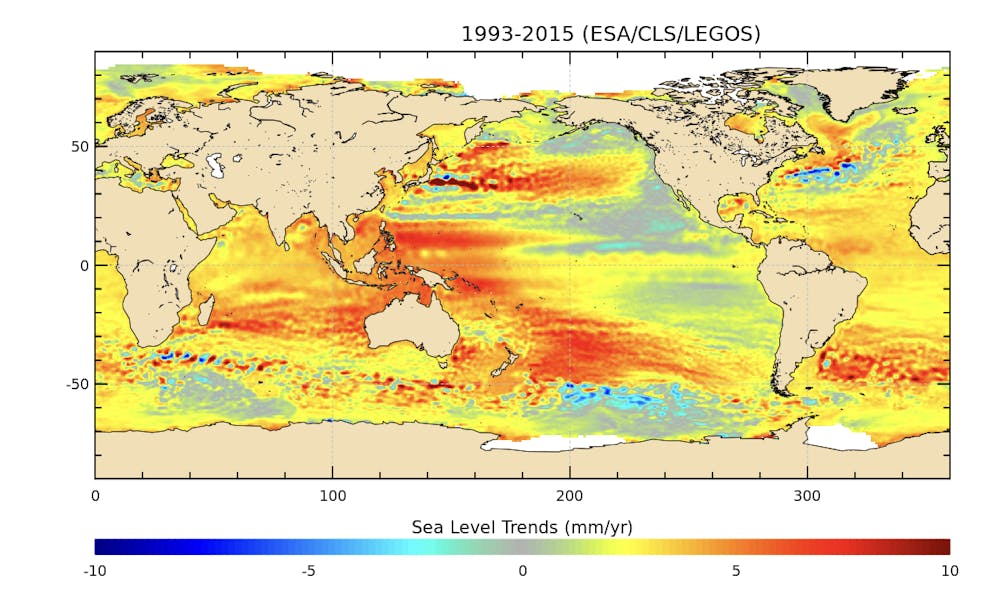
    Here’s a map of sea level rise, from Bamber’s article highlighting five satellite images that show how fast our planet is changing:

    The sea is rising quickly – but not evenly.
    ESA/CLS/LEGOS, CC BY-SA

    “This image,” writes Bamber, “shows mean sea level trends over 13 years in which the global average rise was about 3.2mm a year. But the rate was three or four times faster in some places, like the south western Pacific to the east of Indonesia and New Zealand, where there are numerous small islands and atolls that are already very vulnerable to sea level rise.”


    Read more:
    Five satellite images that show how fast our planet is changing


    In recent years, scientists have used AI to sift through and analyse satellite data. Bamber’s latest research, published in January this year, illustrates this nicely.

    A team of scientists, lead by Tian Li also of the University of Bristol, gathered millions of satellite images of glaciers in Svalbard, a remote and icy archipelago in the Arctic Ocean. In their write up, they note that human researchers once painstakingly looked through this sort of data.

    “This process”, they write, “is highly labour-intensive, inefficient and particularly unreproducible as different people can spot different things even in the same satellite image. Given the number of satellite images available nowadays, we may not have the human resources to map every region for every year.”

    Their solution was to use AI to “quickly identify glacier patterns across large areas”. The satellite-AI combo meant they could examine Svalbard’s retreating glaciers – surely among the least accessible places on the planet – in “unprecedented scale and scope”.

    They found that 91% of the many glaciers that flow into the sea around the archipelago have been “shrinking significantly”. They note that the same types of glacier can be found across the Arctic, and “what happens to glaciers in Svalbard is likely to be repeated elsewhere”.


    Read more:
    We built an AI model that analysed millions of images of retreating glaciers – what it found is alarming


    Many of those glaciers can be found in Greenland, home of the northern hemisphere’s largest ice sheet. In research published earlier this month, Tom Chudley of Durham University used satellite images to assess crevasses (cracks in the glaciers) in Greenland.

    A large glacier in west Greenland flows into the sea. That iceberg filled fjord is several miles wide.
    Copernicus Sentinel / lavizzara / shutterstock

    Chudley also combined satellite images with computerised analysis. His work made use of “ArcticDEM”, three dimensional maps of the polar regions based on high resolution satellite images.

    “By applying image-processing techniques to over 8,000 maps, we could estimate how much water, snow or air would be needed to “fill” each crevasse across the ice sheet. This enabled us to calculate their depth and volume, and examine how they evolved.“

    His conclusion was very blunt: the Greenland ice sheet is falling apart.


    Read more:
    The Greenland ice sheet is falling apart – new study


    Health watchdogs

    Many of you will be well aware that satellites are being used to monitor the health of the planet. What’s less well known is the role they can play in monitoring human health.

    Dhritiraj Sengupta, a satellite scientist at Plymouth Marine Laboratory, says satellites have become Earth’s new health and nature watchdog. His article details how satellites can map mosquito breeding sites to combat malaria, for instance, or can identify air pollution hotspots in cities.

    In his own research, he’s used satellite-derived chlorophyll data to assess the risk of cholera. Chlorophyll is the green pigment in plants that helps them use sunlight to make their food and grow.

    “Many bacteria like Vibrio cholerae which causes cholera, thrive in stagnant water,” Sengupta writes. “My team worked with the European Space Agency to show that its presence can be modelled using the concentration of chlorophyll found on the surface of bodies of water.”


    Read more:
    How satellites have become Earth’s new health and nature watchdogs


    So far, so good. Satellites have undeniably been useful for climate scientists. But in the longer-term, the satellites themselves may have an unforeseen effect on the climate.

    Last year, SpaceX announced it would “deorbit” 100 of its Starlink satellites to burn up in the atmosphere. Fionagh Thomson is a space expert, also at Durham University. She says that “atmospheric scientists are increasingly concerned that this sort of apparent fly-tipping by the space sector will cause further climate change down on Earth.”

    Particles from the satellites themselves won’t have a huge effect compared to the “440 tonnes of meteoroids that enter the atmosphere daily, along with volcanic ash and human-made pollution from industrial processes on Earth.”

    But one team “recently, and unexpectedly, found potential ozone-depleting metals from spacecraft in the stratosphere, the atmospheric layer where the ozone layer is formed.” The worry is that satellite debris may help form certain types of clouds that lead to ozone loss and may add to the greenhouse effect.

    She notes that this is all uncertain and needs more research. “But,” she writes, “we’ve also learnt that if we wait until indisputable evidence is available, it may be too late, as with the loss of ozone. It’s a constant dilemma.”

    Something for SpaceX scientists to look into, perhaps, once they’ve finished rescuing stranded astronauts from the International Space Station.


    Read more:
    Satellites are burning up in the upper atmosphere – and we still don’t know what impact this will have on the Earth’s climate


    ref. How satellites revolutionised climate change science – https://theconversation.com/how-satellites-revolutionised-climate-change-science-250312

    MIL OSI – Global Reports

  • MIL-OSI United Nations: UN to continue Gaza vaccination campaign against polio

    Source: United Nations 2

    Peace and Security

    The UN World Health Organization (WHO) announced on Wednesday that the mass polio vaccination campaign in Gaza which began successfully last year, will continue in the coming days.

    WHO said in a news release that more than 591,000 children under 10 years old will receive the vaccine to protect them from the highly infectious disease, beginning this weekend for an anticipated period of five days.

    The campaign follows the recent detection of poliovirus in wastewater samples in the shattered enclave which signal that the infection is still circulating in the enclave and putting children at risk.

    Individuals with low or no immunity provide the virus an opportunity to continue spreading and potentially cause disease,” WHO said.

    The UN health agency added that dreadful sanitary conditions in Gaza which include overcrowding in shelters and severely damaged water and sewer networks had created “ideal conditions for further spread of poliovirus”.

    The mass return of people to north and south Gaza during the ongoing ceasefire is also likely to increase the spread of polio, WHO warned.

    The campaign will be led by the Palestinian Ministry of Health with support from WHO, UN children’s agency UNICEF, the Palestine refugee relief agency (UNRWA) and other partners.

    The agency stressed that polio vaccines are safe and there is no maximum number of times a child should be vaccinated, with each dose providing extra protection. An additional round of shots is planned for April.

    More to come…

    MIL OSI United Nations News

  • MIL-OSI United Kingdom: expert reaction to study looking at aspartame artificial sweetener and insulin levels and blood vessel inflammation in mice

    Source: United Kingdom – Executive Government & Departments

    A study published in Cell Metabolism looks at the artificial sweetener aspartame, insulin levels and blood inflammation in mice. 

    Prof Naveed Sattar, Professor of Cardiometabolic Medicine/Honorary Consultant, University of Glasgow, said:

    “This seems like worrying findings but of course, before it can taken seriously, the findings have to be replicated in man.  There is no good evidence from trials that exogenous insulin increases cardiovascular risks in people with prior cardiovascular disease AND in people with type 1, by improving glucose levels, exogenous insulin lowers many risks.  Whether excess pancreatic insulin occurs with aspartame in amounts regularly consumed occurs and then accelerates vascular risks in man is also not proven.  For now, I remain happy to take sweeteners and related diet beverages instead of sugar filled drinks as the former limits excess calorie intake.”

    Prof James Leiper, Director of Research, British Heart Foundation, said:

    “This study has revealed much more about the known potential risks of artificial sweeteners.  In these mice, a diet that included an artificially high level of aspartame did exacerbate the size and number of fatty plaques in their arteries.  The effect of these plaques was not measured here, but they are known to greatly increase the risk of a heart attack or stroke.

    “While it is important to note that these findings have not yet been seen in humans, the results highlight the importance of further research to determine whether these additions to our food, and their effect on insulin levels, are contributing to an increased risk of cardiovascular events.

    “These sweeteners are now found in many foods and drinks, and people are probably consuming more than they realise.  But this research is not a green light to have more sugar instead.  We all need to reduce our intake of the processed foods and beverages that contain high levels of fat, sugars, sweeteners and salt.  This is the best way of ensuring a healthy diet and a lowered risk of heart and circulatory disease.”

    Prof Oliver Jones, Professor of Chemistry, RMIT University in Melbourne, said:

    “I have several concerns about this study.

    “The authors claim that the consumption of Aspartame by adults and children “often exceeds those levels recommended by the FDA” – this is extremely unlikely in my view.  The FDA-acceptable daily intake of Aspartame is 50 mg per kg of body weight per day.  I weigh 80 kg, so this means this means the FDA-based safe dose for me is 4000 mg (or 4 grams) of Aspartame per day, every day, for life.  Given a diet drink contains about 200 mg of Aspartame, I would have to drink the equivalent of 20 cans of diet soda a day to get this dose.  A child of 40 kg would have to drink 10 cans a day, every day.  Even then, the 50 mg/kg dose has a safety factor of 100 built-in.

    “The study design also has some issues.  The main one is that the authors used a particular type of lab mouse called an ApoE mouse, which is bred to be prone to heart disease.  They also fed it a high-fat, high-cholesterol diet, which itself increases the risk of heart disease.  They also don’t seem to have measured how much of the Aspartame water the mice drank, or the Aspartame level in the blood, so it is unknown what the mice actually received.

    “To my mind, the authors’ admission that feeding mice that are already genetically susceptible to heart disease with a high-fat, high-cholesterol diet that is known to cause heart disease “diminishes clinical relevance” is somewhat of an understatement.

    “Contrary to the paper’s claims, it is quite well-established that Aspartame doesn’t stimulate glucose or insulin levels in humans [1, 2].

    “Aspartame is essentially just two common amino acids (aspartic acid and phenylalanine) joined together.  In the gut, it is broken down to aspartic acid and phenylalanine.  There is no reason to think amino acids from Aspartame would be worse than those from any other source.

    “The authors would appear to think little work has been done on safety testing in Aspartame; this is just not true.  All food ingredients are rigorously tested and safety assessed before they are approved for use.  Aspartame is one of the most researched ingredients in the world.  It is just that a lot of the data is in safety assessments for regulatory approval, not the academic literature.

    “Finally, even if Aspartame did cause some increase in cardiovascular risk (which this study does not prove), then that risk would likely be very small compared to things like high fat/high sugar diets and lack of exercise, etc.

    “In short, I don’t think this study itself gives us more reason to worry about diet drinks or aspartame.”

    References

    1 Santos, N. C., de Araujo, L. M., De Luca Canto, G., Guerra, E. N. S., Coelho, M. S., Borin, M. de F. (2017). Metabolic effects of aspartame in adulthood: A systematic review and meta-analysis of randomized clinical trials. Critical Reviews in Food Science and Nutrition, 58(12), 2068-2081. https://doi.org/10.1080/10408398.2017.1304358

    2 Stern S.B., Bleicher S.J., Flores A., Gombos G., Recitas D., Shu J. Administration of aspartame in non-insulin-dependent diabetics. (1976) Journal of Toxicology and Environmental Health,. 2(2):429-39. https:// 10.1080/15287397609529444

    ‘Sweetener aspartame aggravates atherosclerosis through insulin-triggered inflammation’ by Weijie Wu et al. was published in Cell Metabolism at 16:00 UK time on Wednesday 19 February 2025. 

    DOI: 10.1016/j.cmet.2025.01.006

    Declared interests

    Prof Naveed Sattar: “Takes occasional diet drinks.

    Has consulted for several companies that make diabetes medicines but also contributed to several lifestyle trials.

    “For Novo Nordisk: have consulted for company in advisory boards but not on any of their weight loss drug trial committees; am on steering committee for ZEUS trial but this is not a weight loss trial product but anti-inflammatory.  Do not have any shares either for any product in health etc.

    “N.S. declares consulting fees and/or speaker honoraria from Abbott Laboratories, Afimmune, Amgen, AstraZeneca, Boehringer Ingelheim, Eli Lilly, Hanmi Pharmaceuticals, Janssen, Merck Sharp & Dohme, Novartis, Novo Nordisk, Pfizer, and Sanofi; and grant support paid to his university from AstraZeneca, Boehringer Ingelheim, Novartis, and Roche Diagnostics.”

    Prof James Leiper: “No conflicts of interest to declare.”

    Prof Oliver Jones: “I have no conflicts of interest to declare.”

    MIL OSI United Kingdom

  • MIL-OSI Global: How plants are able to remember stress without a brain

    Source: The Conversation – UK – By Jurriaan Ton, Professor of Plant Environmental Signalling, University of Sheffield

    Sergey Nivens/Shutterstock

    It may sound strange but plants can remember stress. Scientists are still learning about how plants do this without a brain. But with climate change threatening crops around the world, understanding plant stress memory could help food crops become more resilient.

    Since their colonisation of the land 500 million years ago, plants have evolved ways to defend themselves against pests and disease. One of their most fascinating abilities is to “remember” stressful encounters and use this memory to defend themselves.

    This phenomenon, called immune priming, is similar to how vaccines help humans build immunity but is based on different mechanisms.


    Many people think of plants as nice-looking greens. Essential for clean air, yes, but simple organisms. A step change in research is shaking up the way scientists think about plants: they are far more complex and more like us than you might imagine. This blossoming field of science is too delightful to do it justice in one or two stories.

    This story is part of a series, Plant Curious, exploring scientific studies that challenge the way you view plantlife.


    So how do they do it without a brain?

    Plants are genetically resistant to the vast majority of potentially harmful microbes. However, a small number of microbes have evolved the ability to suppress innate immunity, enabling them to infect organisms and cause disease.

    This is why vertebrates, including humans, have evolved a mobile immune system that relies on B and T memory cells. These memory cells are activated by exposure to a disease or vaccinations, which helps us become more resistant to recurrent infections.

    Plants don’t have specialised cells to acquire immune memory. Instead, they rely on so-called “epigenetic” changes within their cells to store information about past attacks and prime their innate immune system. Once primed, plants can resist pests and diseases better – even if they were genetically susceptible to begin with.

    Research over the past ten to 15 years has shown that repeated and prolonged exposure to pests or diseases can cause long-lasting epigenetic changes to plant DNA without altering the underlying sequence of the DNA. This enables plants to stay in a primed defence state.

    Immune priming has been reported in different plants species, ranging from short-lived annuals, such as thale cress Arabidopsis thaliana that lives several weeks, to long-living tree species, such as Norway spruce that can live up to 400 years.

    Immune priming comes at a cost for the plant though, such as reduced growth. So the primed memory is reversible and dwindles over longer periods without stress. However, depending on the strength of the stress stimulus, priming can be lifelong and even be transmitted to following generations. The stronger the stress, the longer plants remember.

    Plants constantly change the activity of their genes in order to develop and adapt to their environment. Genes can be switched off over prolonged periods of time by epigenetic changes. In plants, these changes most frequently happen at transposons (also known as “jumping genes”) – pieces of DNA that can move within the genome. Transposons are usually inactive because they can cause mutations. But stress changes the epigenetic activity in the plant cell that can partially “wake them up”.

    Plants can pass on stress memories down the generations.
    boommavel/Shutterstock

    This drives the establishment and maintenance of long-lasting memory in plants.

    In plants that haven’t yet experienced stress, defence genes are mostly inactive to prevent unnecessary and costly immune activity. Lasting epigenetic changes to transposons after recovery from disease can prime defence genes for a faster and stronger activation upon recurrent stress. Although scientists are still uncovering exactly how this works, it is clear that epigenetic changes at these jumping genes play an essential role in helping plants adapt to threats.

    Soil as a memory bank

    Plants don’t only rely on internal epigenetic memory to improve their resilience against pests and diseases. They can also use their environment to store stress memory. When under attack, plants release chemicals from their roots, attracting helpful microbes that can suppress diseases. If this soil conditioning is strong enough, it can leave a long-lasting “soil legacy” that can benefit plants of the next generation. Once the soil is conditioned, these helpful microbes stay near plant roots to help the plant fight off diseases.

    In some plant species, such as maize, scientists have identified the secondary metabolites driving this external stress memory. These are specialised metabolites that are not essential for the cell’s primary metabolism. They often play a role in defence or other forms of environmental signalling, such as attracting beneficial microbes or insects.

    Some of the genes controlling these root chemicals are regulated by stress-responsive epigenetic mechanisms. This indicates that the mechanisms driving internal and external plant memory are interconnected.

    Understanding how plants store and use stress memories could revolutionise crop protection. Harnessing plants’ natural ability to cope with pests and diseases might help us reduce reliance on chemical pesticides and create crops that are better at handling environmental stresses. As we face growing challenges from human-made climate change and rising food demands, this research could offer promising tools to develop more sustainable crop protection schemes.

    Jurriaan Ton receives funding from UKRI-BBSRC (BB/W015250/1)

    ref. How plants are able to remember stress without a brain – https://theconversation.com/how-plants-are-able-to-remember-stress-without-a-brain-246615

    MIL OSI – Global Reports

  • MIL-OSI Asia-Pac: India is no longer just a follower; it is now leading the way in multiple fields: Dr. Jitendra Singh

    Source: Government of India (2)

    Posted On: 19 FEB 2025 3:04PM by PIB Delhi

    • India’s Space Sector Soars: From Chandrayaan-3 to Bharatiya Antariksh Station, Nation Emerges as a Global Leader in Space Exploration
    • India Leads Global Healthcare Innovation with DNA-Based COVID-19 Vaccine and First Herpesvirus Vaccine for Cervical Cancer
    • India’s Bioeconomy Booms: From $10 Billion to $140 Billion, Poised to Reach $250 Billion with Thriving Biotech Startups
    • India Pioneers Space Biology: Advancing Research in Space Medicine and Sustainable Life Beyond Earth
    • India’s Nuclear Energy Vision: 100 GW by 2047 to Drive Sustainability and Global Climate Leadership
    • India Rises as a Global Research Powerhouse, Poised to Lead the World in Scientific Publications by 2030
    • India’s Space Economy Poised for 10X Growth, Strengthening Global Leadership in Science and Bio-Manufacturing

    Union Minister of State (Independent Charge) for Science and Technology; Earth Sciences and Minister of State for PMO, Department of Atomic Energy, Department of Space, Personnel, Public Grievances and Pensions, Dr. Jitendra Singh has asserted that India is no longer just a follower but is now setting global benchmarks, offering leadership and pioneering innovations across sectors. He highlighted the remarkable advancements India has made in recent years, in the fields of space, biotechnology, and nuclear energy etc positioning itself as a key player on the world stage.

    Dr. Jitendra Singh pointed out that India’s space sector has witnessed an unprecedented transformation, with a surge in ambitious missions and international collaborations. The Space Docking Experiment (SpaDeX) is a testament to India’s technological progress, paving the way for future space missions, including Gaganyaan, Chandrayaan-4, and the Bharatiya Antariksh Station, India’s upcoming international space station.

    India has also emerged as a preferred destination for satellite launches, earning global credibility. The nation has successfully launched 433 foreign satellites, of which 396 were deployed in the last decade alone, generating $157 million and €260 million in revenue from 2014-2023. The historic success of Chandrayaan-3, which made India the first country to land near the Moon’s south pole, has positioned ISRO at the forefront of lunar exploration. The world’s leading space agencies, including NASA, are now awaiting India’s findings from the Moon’s southern pole, a milestone that underscores the nation’s rising dominance in space research.

    The Minister also highlighted India’s pioneering role in biotechnology and bioeconomy. India became the first country to develop a DNA-based COVID-19 vaccine, demonstrating its leadership in vaccine research and development. Furthermore, India has introduced the first herpesvirus vaccine for cervical cancer, reinforcing its position as a leader in preventive healthcare.

    India’s bioeconomy has surged from $10 billion in 2014 to nearly $140 billion today, with projections to reach $250 billion in the coming years. The number of biotech startups has skyrocketed from just 50 in 2014 to nearly 9,000 today, making India a global hub for biotech innovation. In bio-manufacturing, India now ranks third in the Asia-Pacific region and 12th globally, with its influence expanding rapidly.

    India has also taken a bold step into space biology, laying the foundation for human survival beyond Earth. ISRO and the Department of Biotechnology have signed an MoU to advance space biotechnology research, focusing on growing plants in space to sustain long-term space missions. The study of space medicine and human physiology in extraterrestrial environments is becoming a critical area of research, and India is now setting global standards instead of just following them.

    India’s nuclear energy program, once met with scepticism, is now recognized for its peaceful and sustainable ambitions. The country has set an ambitious target of 100 gigawatts of nuclear energy by 2047, aiming to reduce carbon emissions by 50%, a commitment that is influencing global climate strategies. The world has now acknowledged India’s nuclear policy, which was envisioned by Homi Bhabha for peaceful purposes, as a model for responsible energy development.

    India’s scientific output is gaining global recognition, with the country now ranked fourth worldwide in scientific publications. Projections suggest that by 2030, India could surpass the United States to become the world’s top-ranked country in scientific research.

    India’s space economy is set to grow 5 to 10 times in the next decade, further solidifying its leadership. The nation’s rapid economic ascent is evident in its global rankings, including its 12th position in bio-manufacturing and fourth place in scientific research publications.

    Dr. Jitendra Singh concluded by emphasizing that India’s rise is no longer just about catching up but about setting the agenda for the world. “The clock has turned 360 degrees. Earlier, we learned from others; now, the world is looking up to us. The traffic is both ways,” he remarked.

    *****

    NKR/PSM

    (Release ID: 2104674) Visitor Counter : 20

    MIL OSI Asia Pacific News

  • MIL-OSI United Nations: 19 February 2025 Joint News Release Mass polio vaccination campaign to continue in the Gaza Strip

    Source: World Health Organisation

    The emergency polio outbreak response in the Gaza Strip is continuing, with a mass vaccination campaign scheduled from 22 to 26 February 2025. The novel oral polio vaccine type 2 (nOPV2) will be administered to over 591 000 children under 10 years of age to protect them from polio. This campaign follows the recent detection of poliovirus in wastewater samples in Gaza, signaling ongoing circulation in the environment, putting children at risk.  

    Pockets of individuals with low or no immunity provide the virus an opportunity to continue spreading and potentially cause disease. The current environment in Gaza, including overcrowding in shelters and severely damaged water, sanitation, and hygiene infrastructure, which facilitates fecal-oral transmission, create ideal conditions for further spread of poliovirus. Extensive population movement consequent to the current ceasefire is likely to exacerbate the spread of poliovirus infection. 

    Two previous vaccination rounds in the Gaza Strip were successfully conducted in September and October 2024, reaching over 95% of the target. As poliovirus is found to remain in the environment, additional vaccination efforts are needed to reach every child and strengthen population immunity. The presence of the virus still poses a risk to children with low or no immunity, in Gaza and throughout the region.   

    In 2024, health workers faced significant challenges accessing certain areas of central, north and south Gaza, which required special coordination to enter during the conflict. In inaccessible areas such as Jabalia, Beit Lahiya, and Beit Hanoun, where humanitarian pauses for the vaccination campaign were not assured, approximately 7 000 children missed vaccination during the second round. The recent ceasefire means health workers have considerably better access now.   

    No additional polio cases have been reported since a ten-month-old child was paralyzed in August 2024, but the new environmental samples from Deir al Balah and Khan Younis, collected in December 2024 and January 2025, confirm poliovirus transmission. The strain detected is genetically linked to the poliovirus detected in the Gaza Strip in July 2024. 

    The upcoming vaccination campaign aims to reach all children under 10 years of age, including those previously missed, to close immunity gaps and end the outbreak. The use of the oral polio vaccine will help end this outbreak by preventing the spread of the virus. An additional polio vaccination round is planned to be implemented in April.

    The campaign will be led by the Palestinian Ministry of Health and implemented with support from the World Health Organization (WHO), United Nations Children’s Fund (UNICEF), United Nations Relief and Works Agency for Palestine Refugees (UNRWA) and other partners. 

    Polio vaccines are safe and there is no maximum number of times a child should be vaccinated. Each dose gives additional protection which is needed during an active polio outbreak.   

    WHO, UNICEF, and partners welcome the recent ceasefire and urge for a lasting ceasefire that leads to long-term peace.  


    MIL OSI United Nations News

  • MIL-OSI Russia: NSU scientist talks about the current epidemic season

    Translartion. Region: Russians Fedetion –

    Source: Novosibirsk State University – Novosibirsk State University –

    According to official data from Rospotrebnadzor, there is a slight increase in the incidence of respiratory viral infections in the Novosibirsk Region. At present, the incidence of acute respiratory viral infections is caused mainly by viruses of non-influenza etiology, with rhinoviruses predominating, which are usually not characterized by an acute course and serious complications, whereas last year the current coronavirus and respiratory syncytial virus, which is most dangerous for children under one year of age and the elderly, prevailed. This virus causes diseases of the lower respiratory tract and can cause serious complications, including pneumonia.

    Doctor of Biological Sciences, Professor, Academician of the Russian Academy of Sciences, Head of the Laboratory of Bionanotechnology, Microbiology and Virology spoke about other features of the current epidemic season Faculty of Natural Sciences of NSU Sergey Netesov.

    — Compared to the same period last year, the incidence of influenza has surprisingly decreased significantly, at least until mid-February. If you look at the curves of influenza and acute respiratory viral infections in 2024 and 2025, it seems that the peak of influenza is several weeks late this year. The reasons for this are still unknown. There are different versions, including an abnormally warm winter. Another reason could be the increase in the number of people vaccinated against influenza in 2024 compared to 2023. The influenza vaccines used in the summer and fall of last year proved to be highly effective, as a result of which the incidence fell, but in the last two weeks it has been growing.

    In addition, in the current epidemiological season, the strains of influenza A viruses of the H3N2 subtype, which prevailed last season, have been replaced by strains of the H1N1 subtype. This is most likely due to the emergence of strong population immunity against viruses of the H3N2 subtype, which many people were vaccinated with and many had mild cases of last season. But the current epidemic season is not over yet (its maximum is usually recorded in February), so there is no need to relax until mid-March, and an increase in the incidence of influenza viruses has clearly emerged in the last two weeks, according to information from the website of the Research Institute of Influenza in St. Petersburg. Few people are currently sick with influenza B viruses, and they usually do not get seriously ill with them, and it does not cause serious complications in more or less healthy people. But older people should be careful for another month, wear masks in public places and avoid contact with young sick people and sick children.

    To protect yourself in the next 2025/26 ARVI season, everyone should get vaccinated against influenza in September-October 2025, because by that time new seasonal vaccines, updated according to the recommendations of the World Health Organization (WHO), will be available.

    Please note: This information is raw content directly from the source of the information. It is exactly what the source states and does not reflect the position of MIL-OSI or its clients.

    MIL OSI Russia News

  • MIL-OSI China: Respiratory infections fall; expert cautions on risks

    Source: China State Council Information Office 2

    The spread of acute respiratory infections, including influenza, has been trending downward in China, but the nation has not passed the seasonal epidemic and the start of a new school semester could amplify the infection risk, according to a health expert and official data.
    “The influenza virus remains the predominant pathogen in circulation and the nation is still in the middle of the flu epidemic season. Nonetheless, the intensity of the virus’ spread has subsided,” said Peng Zhibin, a researcher at the Chinese Center for Disease Control and Prevention, at a news conference held on Monday by the National Health Commission.
    For the week starting on Feb 3, the positivity rate of flu climbed slightly by 1.2 percentage points from the previous week to reach 24.9 percent, and the positivity rates of respiratory syncytial virus, adenovirus and human parainfluenza virus all declined, according to the China CDC.
    Data also points to a continuing decline in the positivity rates of respiratory syncytial virus, human parainfluenza virus and Mycoplasma pneumoniae infection, as well as a persistent low level of adenovirus, coronavirus and other respiratory pathogens.
    Despite a fall in new infections, the China CDC noted that nursery care institutions and schools could face a heightened risk of infection clusters with the onset of the new semester.
    Peng, the China CDC researcher, emphasized that the nation is still in the grip of a seasonal epidemic and suggested that people who have not received a flu vaccine do so in order to reduce the risk of catching infections and prevent severe symptoms.
    With rising temperatures and the start of the spring semester, Peng said that campuses will be coping with the increased risk of infectious diseases common in spring such as norovirus infections, measles, hand-foot-mouth disease, chickenpox and meningitis.
    “These diseases typically spread through respiratory droplets or close contact,” she said.
    The researcher also advised students and school staff to receive vaccines for preventable diseases promptly in order to strengthen herd immunity.
    Meanwhile, it is important to ensure proper ventilation and maintain a clean indoor environment, she said.
    “When dealing with vomit or excrement from students infected with norovirus infections, it is recommended to apply chlorine-based disinfectants on the surface for at least 30 minutes before cleaning them up,” Peng said.
    “Early detection and handling of infection clusters on campus is of paramount importance,” she added.

    MIL OSI China News

  • MIL-OSI Asia-Pac: Celebrating a Decade of Soil Health Cards

    Source: Government of India (2)

    Celebrating a Decade of Soil Health Cards

    Swasth Dharaa, Khet Haraa

    Posted On: 18 FEB 2025 5:51PM by PIB Delhi

    Introduction

    The Soil Health Card Scheme was introduced by Prime Minister Shri Narendra Modi on 19th February, 2015 at Suratgarh, Rajasthan. The scheme was launched to assist State Governments to issue soil health cards to all farmers in the country. Soil health card provides information to farmers on nutrient status of their soil along with recommendation on appropriate dosage of nutrients to be applied for improving soil health and its fertility.

    The Soil Health Card Portal (www.soilhealth.dac.gov.in) facilitates generation of Soil Health Cards for the benefit of farmers in uniform and standardized format across country in all major languages and 5 dialects.

    The Soil Health Card contains status of the soil with respect to 12 parameters, namely N,P,K, S (Macro-nutrients); Zn, Fe, Cu, Mn, Bo (Micro – nutrients) ; and pH (Acidity or Basicity), EC (Electrical Conductivity) and OC (Organic Carbon).

    Based on this, the card will also indicate fertilizer recommendations and soil amendment required for the farm. Soil Samples are taken generally two times in a year, after harvesting of Rabi and Kharif Crop respectively or when there is no standing crop in the field.

    The Guideline of Village Level Soil Testing Labs (VLSTLs) was issued in June 2023. VLSTLs can be set up by individual entrepreneurs i.e. rural youth and community based entrepreneurs, including Self Help Groups (SHGs), Schools, Agriculture Universities etc. The beneficiary/village level entrepreneur should be a youth whose age should not be below 18 years and should not be more than 27 years. Self Help Groups, Farmers Producers Organisation (FPO) can also be enrolled as VLSTL.

    As of February 2025, 665 Village-level Soil Testing Labs have been established in 17 States.

    School Soil Health Programme

    A pilot project on School Soil Health Programme has been undertaken by Department of Agriculture and Farmers Welfare in (DA&FW) collaboration with Department of School Education & Literacy (DSE&L), Indian Council of Agricultural Research (ICAR) and State Governments in 20 schools (10 Kendriya Vidyalaya & 10 Navodaya Vidyalaya) in rural areas. The aim is to make students aware about soil health for sustainable agriculture practices. 20 soil health labs were set up in these schools. Modules for students from class VI to XII and teachers were developed and disseminated. Under the programme, soil samples were collected by School Students and soil testing were also done by students and SHCs were generated Students also educated farmers about the recommendation of Soil health card for judicious use of fertilizer and crop recommendation.

    As of 2024, 1020 schools are implementing the School Soil Health Programme, with 1000 soil testing labs set up and 125,972 students enrolled.

    Soil Health Card scheme has been merged in Rashtriya Krishi Vikas Yojana (RKVY) scheme as one of its components under the name ‘Soil Health & Fertility’ from the year 2022-23.

    Technological Advancements

    SHC Mobile App

    To further ease the process of obtaining easy access to the Soil Health Card, the Government of India in 2023 made technological interventions in the New Soil Health Card Scheme. The Soil Health Card portal was revamped and integrated with a Geographic Information System (GIS) system so that all the test results are captured and seen on a map. To make the implementation/monitoring of the scheme smooth and to facilitate farmers an easy access to his soil health card, the mobile application has been made robust with the additional features such as:

    • Restrict the sample collection region for the Village Level Entrepreneur/Operator collecting the soil samples
    • Auto selection of the latitude and longitude of the location
    • Generation of a QR code to link with the sample and test results of all samples directly on the portal from the geo-mapped labs, without any manual intervention.

    This application provides the graphical information of all over the India and also shows multiple layers State Boundary, District Boundary, Taluka Boundary, Panchayat Boundary and Cadastral Boundary.

    The new system was rolled out in April 2023 and samples are now being collected through the mobile application. Soil Health Cards are now generated on this revamped portal.

    For digitizing the Soil Health Cards, Web based work flow application Soil Health Card portal has been designed and developed by National Informatics Centre (NIC).

    Conclusion

    The Soil Health Card Scheme has transformed agricultural practices in India over the past decade. Since 2015, it has empowered farmers with crucial information on soil nutrient status and optimal fertilizer use, promoting sustainable farming and improved crop productivity. Initiatives like the School Soil Health Programme have expanded soil health awareness among students and local communities. With a robust mobile app, the process of obtaining a Soil Health Card has enhanced accessibility, efficiency, and transparency. As the scheme evolves, it continues to play a vital role in fostering sustainable agricultural development and safeguarding India’s soil health for future generations.

    References:

    Kindlty find the pdf file 

    ****

    Santosh Kumar/ Ritu Kataria/ Kritika Rane

    (Release ID: 2104403) Visitor Counter : 89

    MIL OSI Asia Pacific News

  • MIL-OSI United Nations: Experts of the Committee on Economic, Social and Cultural Rights Congratulate Rwanda on Number of New Jobs Created, Ask Questions on Women’s Political Representation and Recognising the Cultures of Rwanda’s Different Ethnic Groups

    Source: United Nations – Geneva

    The Committee on Economic, Social and Cultural Rights today concluded its review of the fifth periodic report of Rwanda, with Committee Experts commending the State on the number of new jobs created, while raising questions about women’s political representation and how Rwanda recognised the cultures of its different ethnic groups. 

    Preeti Saran, Committee Expert and Country Taskforce Member, was impressed with some of the figures shared, including seven per cent gross domestic product growth and 1.3 million jobs created.  These were commendable and Rwanda should be congratulated.   

    Peters Sunday Omologbe Emuze, Committee Vice-Chair and Country Rapporteur for Rwanda, said Rwanda had made significant progress in gender equality, and especially women’s political representation.  What steps were being taken to increase women’s representation in local administration and the private sector? How was the gender pay gap addressed? What was being done to combat discrimination against women and stereotypes? 

    Ms. Saran said each ethnic group in Rwanda had a rich cultural heritage.  For the sake of national unity and reconciliation, if everyone was being referred to as Rwandan, how did the State propagate the cultural richness of the population?   Rwanda had been extremely welcoming to refugees from all over the world, who brought their own specific languages and cultures.  What measures had the State party taken to ensure equal cultural rights for ethnic groups that had come as aliens, refugees or asylum seekers? 

    The delegation said over the years, Rwanda had implemented measures to achieve gender equality, particularly in Parliament, where it was around 63 per cent in the Chamber of Deputies and around 53 per cent in the Senate.  Quotas were in place which mandated that a minimum of 30 per cent of leaders should be women.  When the issue of equality was dealt with properly, this had a cascading effect on other policies.  A few years ago, the State recognised that gender-based violent crimes were specific in nature and needed to be treated in a certain way. 

    The delegation said there was no significant cultural diversity within the country, as everyone shared the same language and culture.  Traditionally the ethnic groups had been defined based on occupation and turning them into an ethnicity was introduced by the colonialists.  It had been entrenched in identity cards for Tutsis, Hutus and Twas.  This negated the fact that people could have moved from one group to another.   There were no significant differences in culture between these groups.  Rwanda had received a number of people who faced difficulties in their own countries. Diversity days were organised at schools, encouraging refugees and asylum seekers to share their culture. 

    Emmanuel Ugirashebuja, Minister of Justice and Attorney General of Rwanda and head of the delegation, said in 2023, Rwanda further refined its governance framework by aligning the schedules of presidential and parliamentary elections, enhancing efficiency and reducing electoral costs.  During the period under consideration, Rwanda successfully completed its ambitious 2020 Vision and adopted the Vision 2050.  From 2018 to 2024, Rwanda implemented its first national strategy for transformation, which laid the foundation for sustainable development, and was succeeded by the second national strategy for transformation, which ran until 2029.   Through these strategies, Rwanda maintained steady economic growth, with gross domestic product expanding at an average of 7 per cent and per capita income rising from $729 to $1,040 in 2023/2024. 

    In concluding remarks, Mr. Emuze thanked the Rwandan delegation for attending the dialogue, noting the high calibre of the delegation.  The Committee wished the delegation a safe journey home. 

    In his concluding remarks Mr. Ugirashebuja expressed appreciation for the constructive dialogue with the Committee.  The State had learnt many valuable lessons and looked forward to receiving the Committee’s recommendations.  Mr. Ugirashebuja extended an open invitation to the Committee to visit Rwanda in the future. 

    The delegation of Rwanda was comprised of representatives from the Ministry of Justice; the National Institute of Statistics; the Rwanda Education Board; the Department of International Justice Judicial Cooperation; and the Permanent Mission of Rwanda to the United Nations Office at Geneva.

    The Committee’s seventy-seventh session is being held until 28 February 2025.  All documents relating to the Committee’s work, including reports submitted by States parties, can be found on the session’s webpage.  Webcasts of the meetings of the session can be found here, and meetings summaries can be found here.

    The Committee will next meet in public at 3 p.m. on Tuesday, 18 February to begin its consideration of the seventh periodic report of the Philippines (E/C.12/PHL/7).

    Report

    The Committee has before it the fifth periodic report of Rwanda (E/C.12/RWA/5).

    Presentation of Report

    EMMANUEL UGIRASHEBUJA, Minister of Justice and Attorney General of Rwanda and head of the delegation, said since the last review by the Committee over a decade ago, Rwanda had undergone significant changes in its policy, legal and institutional landscape.  In 2023, Rwanda further refined its governance framework by aligning the schedules of presidential and parliamentary elections, enhancing efficiency, and reducing electoral costs. 

    At the institutional level, Rwanda established the Rwanda Forensic Laboratory in 2016, upgrading it to the Rwanda Forensic Institute in 2023.  The Institute had enhanced forensic and advisory services, strengthening accountability in sectors critical to economic, social and cultural rights.  Its digital forensic and document services helped combat financial crimes like fraud and embezzlement.  In 2017, the Rwanda Investigation Bureau was established to enhance specialisation and professionalism in crime investigation. 

    In the judiciary, Rwanda made significant strides in strengthening its justice system.  In 2018, the Court of Appeal was established, further enhancing the country’s capacity to provide effective legal recourse.   In 2024, the establishment of an Appeal Tribunal to hear matters relating to refugee and asylum claims reinforced Rwanda’s commitment to upholding the rights of individuals in vulnerable situations.  Rwanda’s legal framework strongly supported the protection of economic, social and cultural rights, as enshrined in the Constitution.  Since the last report, Rwanda had enacted several laws that aligned with the provisions of the Covenant and contributed to the progressive realisation of economic, social and cultural rights.  These included the education law that guaranteed access to quality education at all levels, as well as health laws. 

    During the period under consideration, Rwanda successfully completed its ambitious 2020 Vision and adopted the Vision 2050.  From 2018 to 2024, Rwanda implemented its first national strategy for transformation, which laid the foundation for sustainable development, and was succeeded by the second national strategy for transformation, which ran until 2029.   Through these strategies, Rwanda maintained steady economic growth, with gross domestic product expanding at an average of 7 per cent and per capita income rising from $729 to $1,040 in 2023/2024.  

    Infrastructure development advanced with the construction of over 1,600 kilometres of national roads and 4,137 kilometres of feeder roads.   Job creation efforts led to over 1.3 million decent and productive jobs, while financial inclusion improved from 89 per cent in 2017 to 96 per cent by 2024.  Life expectancy also increased from 66.6 in 2017 to 69.9 years in 2024. 

    Rwanda also significantly strengthened its healthcare system under the strategy. Seven new hospitals were added to the existing 52, while 23 were rehabilitated or expanded.  Community-based health insurance coverage reached 93 per cent of the population. Healthcare modernisation included advanced imaging, laboratory equipment, local pharmaceutical manufacturing, and digital health systems.  

    In 2023, Rwanda, in partnership with Germany Biotechnology Company BioNTech, set-up an mRNA vaccine manufacturing facility, the first of its kind on the African continent, which would have the capacity to produce between 50 and 100 million doses of mRNA vaccines annually, and conduct trials on new therapeutics for malaria, tuberculosis, HIV, cancers and other diseases.  

    Through the Girinka programme (one cow per family programme), Rwanda distributed 333,146 cows to an equivalent number of households.  Rwanda valued the opportunity to engage in a constructive dialogue with the Committee.

    Questions by a Committee Expert

    PETERS SUNDAY OMOLOGBE EMUZE, Committee Vice-Chair and Country Rapporteur for Rwanda, asked how the 2015 constitutional amendments had affected Rwanda’s commitment to international human rights standards.  Did it enable the State party to override Covenant protections in favour of domestic law? What measures were being taken to ensure that the provisions of the Covenant were invoked by domestic courts? 

    What training programmes were in place for judges, law enforcement and government officials to ensure consistent application of the Covenant?  The important work of Rwanda’s national human rights institution was noted.  Was the selection process of its members carried out by a committee appointed by the President?  Did members require clearance from the Prime Minister’s office for official travel outside Rwanda?  Had the State party accepted the recommendations of the Global Alliance of National Human Rights Institutions to strengthen the institution in line with the Paris Principles?

    What measures had been taken to guarantee that human rights defenders could continue their work without undue restrictions on freedoms of expression, peaceful assembly and association?  What steps were taken to protect them from risks of unlawful killings, enforced disappearances, harassment and intimidation, including judicial harassment?  Could the State party clarify the concerns regarding non-governmental organization registration requirements?  Were there any obstacles for opposition groups to promote and advocate for the promotion of human rights, including economic, social and cultural rights? 

    When would the State party finalise a national action plan for business and human rights?  What steps were being taken to put in place a comprehensive legal and regulatory framework for human rights due diligence for businesses?  What measures were in place to ensure Rwanda met its nationally determined contributions under the Paris Agreement? 

    What measures were in place to combat corruption, particularly in public procurement and State-owned enterprises?  What challenges did anti-corruption institutions face in maintaining independence and effectiveness?  What measures were being taken to address them?  The Committee noted Rwanda’s legislative efforts to combat discrimination.  However, reports indicated persistent structural inequalities, particularly affecting Batwa people, women and girls, people living in deprived urban and rural areas, persons with disabilities, people living in poverty, and lesbian, gay, bisexual, transgender and intersex persons.  How did Rwanda plan to address these challenges? 

    How did Rwanda plan to address the absence of disaggregated data to assess the situation of the Batwa people?  What steps were being taken to combat poverty, high infant mortality, malnutrition, and lower educational outcomes among the Batwa? What kind of barriers did the Batwa continue to face to land titling and how did Rwanda plan to secure their rights to land ownership?  What measures were in place to prevent forced displacement of the Batwa people from their ancestral lands?  How was adequate compensation provided when Batwa lands were expropriated?  How did the State party ensure consultations with Batwa people in decisions likely to affect them?

    Rwanda had made significant progress in gender equality, and especially women’s political representation.  What steps were being taken to increase women’s representation in local administration and the private sector?  How was the gender pay gap addressed?  What was being done to combat discrimination against women and stereotypes?  How had the Rwanda Gender Monitoring Office and its Gender Management Information System contributed to tracking gender equality initiatives? 

    Responses by the Delegation

    The delegation said since the 2015 Constitutional amendments, no new organic laws had come into place.  There was consistent training on the use of human rights in courts.  However, the members of the bar tended not to apply international conventions in the courts. The reason for this was because the Constitution provided for a whole section of bill of rights, which was a replica of the Covenant.  However, lawyers were still trained on the use of human rights conventions.   

    Members of the human rights institution were manually selected via a presidential order.  This was a rigorous process, and many candidates were considered.  The appointment process was comparable to any other country with human rights mechanisms.  Whenever Commissioners wanted to travel, they informed the Minister’s office and a document was provided, called the travel clearance. Given that this caused significant confusion, the Government had decided to do away with the travel clearance.   

    Rwanda did all it could to strengthen the National Commission of Human Rights, and put in place any recommendations received. Rwanda was on track to reach its goals regarding carbon emissions.  The State was encouraging businesses to go green, which in turn would create “green jobs” which would contribute to more employment.  An example of this could be seen in the State employing young people to plant trees.  The Rwandan Government had heavily invested in areas key to social equality.  The community-based insurance now extended to certain diseases previously not covered, including cancer. 

    Rwanda aimed to achieve zero tolerance for corruption.  Key institutions like the Ombudsman’s office had played a key role towards achieving this goal.  Rwanda had improved its global ranking from 49th to 43rd place in 2024 in the Transparency Index Global Corruption Index.

    Rwandans and the Batwa spoke the same language and had the same culture.  The Batwa people could be found throughout the country and did not live in a designated area.  Rwanda aimed to ensure no one was left behind, regardless of their status.  Land registration helped to resolve dispute around land, and to ensure that land was adequately registered. 

    Over the years, Rwanda had implemented measures to achieve gender equality, particularly in Parliament, where it was around 63 per cent in the Chamber of Deputies and around 53 per cent in the Senate.  Quotas were in place which mandated that a minimum of 30 per cent of leaders should be women.  When the issue of equality was dealt with properly, this had a cascading effect on other policies.  A few years ago, the State recognised that gender-based violent crimes were specific in nature and needed to be treated in a certain way. 

    No discrimination against any group was tolerated in Rwanda.  Measures had been put in place to ensure that anyone who faced discrimination was able to access fast reparations.  There were many issues which were largely context-specific to Rwanda. 

    Questions by Committee Experts

    PREETI SARAN, Committee Expert and Taskforce Member, was impressed with some of the figures shared, including seven per cent gross domestic product growth and 1.3 million jobs created.  These were commendable and Rwanda should be congratulated.   What kind of resource constraints had the State faced in budgetary allocations for social spending?  What challenges had there been when dealing with external partners? 

    KARLA LEMUS DE VÁSQUE, Committee Expert and Taskforce Member, said marital violence affected 46 per cent of women who were married and 18 per cent of men, with many never seeking help for the violence they had suffered.  What measures had been put in place to combat the cultural norms which perpetuated marital violence?  How were victims of violence being supported so they could report the crime?

    A Committee Expert asked what steps were being taken by the Government to ensure safe access by humanitarian organizations to the population affected by the conflict in the Democratic Republic of the Congo?  How had the State ensured its policies and actions did not obstruct humanitarian aid? What was the coordination framework that the State had with armed groups operating in the Democratic Republic of the Congo, particularly the M23?  How might the State respond to the concerns regarding any potential support for these armed groups? 

    What measures had been put in place to prevent and punish any involvement by Rwandan stakeholders in conflict zones in the Democratic Republic of the Congo?  What measures had the State adopted to ensure that no armed group benefitted from support from the State?  What measures had been put in place to remedy any violations, including forced labour in mining areas under the control of armed groups, among others? 

    Another Expert asked about the role of civil society when drafting reports to treaty bodies?  Were all civil society organizations invited to participate in the drafting procedures?  What was the position of Rwanda on the Rome Statute?  Was there a possibility that the Government might consider acceding to it? Rwanda had extraterritorial obligations. The President had reiterated a lack of knowledge regarding the Rwandan military participating in the conflict of the Democratic Republic of the Congo.  How was oversight of the military activities ensured?  How did Rwanda ensure that armed groups operating in other countries received no support?

    A Committee Expert asked what the State was doing to combat the illicit trade of minerals?  What specific measures were taken to enhance specific imports and exports? 

    PETERS SUNDAY OMOLOGBE EMUZE, Vice-Chair and Taskforce Leader for Rwanda, said there had been allegations of Government members committing unlawful killings, enforced disappearances, and intimidation and reprisals, against those defending human rights.  What had the State party done to prevent this? Despite measures taken by the State party to improve rights for indigenous peoples, challenges remained. How did the State party intend to address challenges in this regard, including the lack of disaggregated data? How would Rwanda address challenges such as poverty, infant mortality, lower school attendance, and higher drop-out rates, among others? 

    Responses by the Delegation

    The delegation said Rwanda had challenges in terms of budget.  The State aimed to address this through development partners.  However, resources were not always permanent.  Although Rwanda worked with development partners, the State aimed to be financially stable in terms of its own financing. 

    Rwanda had developed mechanisms to capture data regarding gender-based violence.  Initially, people were scared to report cases due to stigmatisation.  Investigators had been trained to interview victims of gender-based violence.  When cases proceeded, it was ensured that they were not held in public, so as not to endanger the lives of the victims. 

    The Democratic Republic of the Congo had its own problems as did Rwanda, and the State could not bear the burden of others’ problems.  Anything happening beyond the territory of Rwanda should be dealt with by those States. 

    Civil society played an important role in the drafting of the report and in helping Rwanda achieve its human rights obligations. Rwanda had not yet joined the Rome Statute, but if the appropriate time came and if it was necessary, the State would willingly join the Statute.  At present, the State was not considering joining the Statue in the near future. 
    Rwanda was the first country in the Great Lakes region to commit to a due diligence mechanism.  This ensured Rwanda could not be used as a route for illicit mines. There were mechanisms in place to protect against enforced disappearances.  There was zero tolerance for anyone who threatened human rights defenders. 

    Questions by a Committee Expert

    PREETI SARAN, Committee Expert and Taskforce Member, asked what recent measures the State party had taken to address unemployment rates and to guarantee access to work?  What specific steps had been taken to address the problem of labour under-utilisation?  What major obstacles had Rwanda faced in addressing the employment challenge?  How was the integration of women into the labour force being promoted? 

    What specific steps had the State party taken for those facing discrimination to access the labour market.  What had Rwanda done to enforce laws dealing with discrimination at the workplace and to encourage employers to adopt anti-discrimination measures specifically related to sexual orientation at the workplace? How were systemic barriers for persons with disabilities being removed?  What measures had been taken to enable the transition of workers from the informal to the formal sector, particularly for women, the disadvantaged, and persons with disabilities?  What was the anticipated timeframe for establishing a minimum wage? 

    Many workers were reportedly exposed to frequent occupational accidents due to unsafe working conditions, leading to occupational injuries and fatalities.  Had the State party formulated an updated national policy on occupational health and safety?  How did the State party reinforce and implement the Labour Code on occupational health and safety?  Had the State party developed rights awareness programmes targeting domestic workers and employers? 

    What steps had been taken to establish a safe reporting system for domestic workers to report workplace violence?  What initiatives were in place to provide confidential and accessible health care for domestic workers?  What steps had the State party taken to remove any such legal barriers to the enjoyment of the right to form trade unions and the right to strike.

    The adoption of the updated national social protection policy (2020), which aimed to ensure that Rwandan citizens had a dignified standard of living, was commendable.  Were there any proposals to improve and expand the coverage process to ensure that it included the widest possible population, particularly the most marginalised and disadvantaged in the informal sector?  What steps had the State party taken to expand the community-based health insurance scheme to cover specialised health services, medicines, assistive devices, and commodities required by persons with disabilities? 

    Responses by the Delegation

    The delegation said employment was a concern in Rwanda.  Rwanda had a young population and the State needed to create an enabling environment for the youth to thrive.  It was hoped the law on startups would ensure easy financing of start-ups for the youth. A proportion of the laws provided for special consideration for women and people living with disabilities, to ensure these traditionally marginalised groups could access these resources. 

    Despite the efforts that the Government had put in place, there were still instances of gender-based discrimination.  There had been instances in the private sector where questions had been asked about women’s marital status to ascertain if they would be looking to seek maternity leave.  The State was looking at how to incentivise the private sector to ensure they did not discriminate based on gender.  No one in Rwanda was discriminated against based on their sexual orientation.  If discrimination was there, the State worked with civil society to address this.  It was important to have a synergy with civil society organizations to address persistent discriminatory issues.  There were quotas of 30 per cent for women, and the State monitored these closely to ensure gender equity was being achieved.   

    There were a lot of workers employed in the informal sector, and the State tried to formalise these areas.  Cooperatives were important in ensuring people came together, and worked like trade unions to highlight challenges faced by people in the informal sector.  There had been a growth in the number of cooperatives registered over recent years. The State had seen unfortunate incidents where people had been trapped in mines due to unsuitable mining.  The Rwanda mining board ensured that it monitored mining sites; however, people sometimes ventured into illegal mining at nighttime and ended up being trapped.  Work was being done with the local governments to ensure these unfortunate situations were avoided. 

    The minimum wage was a difficult debate.  The Government was on the right path regarding what an acceptable minimum wage was in Rwanda.  The process was long, but the Government aimed to develop a suitable minimum wage for the greater good of the country.  Laws guaranteed safety for domestic workers, including salaries and leave. Labour inspectors took steps to ensure the legal mechanisms were being utilised. 

    Questions by Committee Experts

    A Committee Expert said the issues of the Democratic Republic of the Congo were relevant.  What tools and mechanisms had the State created to ensure there was respect for economic, cultural and social rights?  How was it ensured that impunity was combatted abroad, particularly in the context of the armed conflict? 

    KARLA LEMUS DE VÁSQUE, Committee Expert and Taskforce Member, acknowledged that the State had extended fully-paid maternity leave for mothers in all sectors, but there were challenges to ensuring the legislation was enforced, particularly in the informal sector. What mechanisms were in place to ensure all working mothers could enjoy maternity leave?  Had the State considered implementing a specific measure to ensure women who gave birth to children with disabilities were given maternity leave commiserate with the situation of their child?  Were there incentives to encourage men to use paternity leave?

    What efforts were being carried out to punish employers who were in breach of child labour laws?  What results had the new national strategy on child labour yielded?  There were still high levels of poverty, especially for families.  What was the State doing in terms of the social schemes designed to eradicate extreme poverty?  What challenges did small-scale farmers meet when it came to increasing their yield and diversifying their crop?  What support programmes were in place for them?  Had the State considered expanding the food assistance programmes for vulnerable groups?

    A study of Rwanda’s development bank showed many people on low income still did not have access to affordable housing. What policies had been adopted to ensure the cost of housing was accessible?  What percentage of the national budget was set aside for the building and maintenance of social housing?  What initiatives had been launched to ensure that people who were vulnerable had access to affordable housing?  Had any laws been passed on rent control?  What measures could be implemented to ensure water rates were affordable? 

    Current adaptation measures were not enough to mitigate the impacts of climate change?  Had studies or surveys been carried out to assess the impact of climate change, and how had the State responded to findings?  What food resilience programmes could the State develop, including food storage programmes?  What measures had been implemented to ensure enough resources were set aside for the health sector, including for the most disadvantaged groups? What measures had been developed to extend the scope and coverage of mental health services?  What strategies had been developed to increase the number of qualified birth attendants in remote areas?  What measures had been implemented to strengthen investment in infrastructure?  How was equitable access to contraception guaranteed?   

    Responses by the Delegation

    The delegation said in January 2025, the Cabinet approved the resolution on the additional package of services for the community-based health insurance, including kidney transplants, cancer care, blood transfusions, knee and hips replacements, dialysis and prosthetics, among other procedures.  These were now all covered by the community-based health insurance. 

    The one cow per family programme provided a cow to families in the most vulnerable communities.  More than 14,500 families had been provided with furnished housing and 124 model villages had been established between 2017 and 2024, with all the essential amenities. 

    Rwanda did not have effective jurisdiction over any country and could not be held accountable for human rights violations beyond its borders.  The problems of the Democratic Republic of the Congo were internal.  Rwanda would welcome refugees from the Democratic Republic of the Congo if the problems persisted. 

    Since the COVID-19 pandemic, certain programmes had been implemented, including a voluntary saving scheme which was open to any citizen.  The International Labour Organization, in collaboration with Rwanda, had recruited a team to conduct a study on the barriers to social protection in the informal sector, and it would develop recommendations to address these. 

    Since 2023, paid maternity leave had increased from 12 to 14 weeks.  New changes in the law mandated that a pregnant woman or a breastfeeding mother should not be made to do any work that was too physically demanding or damaging to their overall health.  Those on maternity leave received their full salary.   Regular labour inspections were conducted, with more than 5,000 inspections carried out every year.  More than 1,500 of the enterprises where inspections took place were in the informal sector.   In the 2023-2024 fiscal year, 112 businesses were administratively sanctioned due to employment-related issues.  In the same period, 26 investigations had been conducted into cases of child labour, and 18 had been referred to the courts with five convicted. 

    The Government of Rwanda had implemented various social protection initiatives to eliminate extreme poverty.  In 2024, over 102,000 vulnerable individuals received monthly cash transfers and more than 80,000 households benefitted from flexible employment programmes.  As of May 2024, there had been an old age grant for impoverished individuals over the age of 65.  As of 2024, 315,327 households had been enrolled in the programme for sustainable graduation, where they received mentorship, financial support, and access to productive assets. 

    It was becoming more difficult for farmers to predict the weather, given the adverse impacts of climate change.  Pilot projects were launched to allow farmers to access buyers in value chains, by ensuring their quality standards were high. The Rwanda culture board helped to increase agriculture and animal resources, advising farmers on the best seeds for each area of the country to ensure the best harvest.  The Government heavily subsidised fertilizer for farmers to increase their output.  The Government subsidised up to 40 per cent of the cost of water, and access to clean water had increased substantially in the country. 

    Rwanda aimed to quadruple its workforce of healthcare service providers.  Below the age of 18, parental consent was required for any health intervention, including contraception and reproductive health services.  To enhance access to sexual reproductive health services, the age of consent should be reduced to 15 years.  To address this, a draft health service law was currently under consideration by the Parliament.  The level of teen pregnancy had decreased due to education and sensitisation, but it was also expected the draft health service law would result in a further decrease in teen pregnancy. 

    Questions by Committee Experts

    KARLA LEMUS DE VÁSQUE, Committee Expert and Taskforce Member, asked if there was any recent study on the deficit in housing which would help address current challenges?  Were there any laws on rent control? 

    How was the State addressing social and economic gaps which could address the prevalence of non-communicable diseases. Despite progress made in public health, communicable diseases, including malaria and HIV/AIDS, were a cause for concern. What measures had been adopted to strengthen health infrastructure in areas where access was limited?  What was being done to improve the prevention programmes? 

    A Committee Expert asked about the national health insurance; how did it function?  Did the State consider sharing revenues with areas where they obtained the resources from? 

    Another Expert said the country’s drug policy was focused on criminalisation and punitive measures.  Would the State consider decriminalising drug use and changing the approach to one that was health-based?   What measures had been taken to provide specialised training to law enforcement agents?  What was being done to mainstream mental health in primary health services? 

    A Committee Expert asked whether Rwanda had considered using human rights methodologies to design and better assess public policies? 

    An Expert asked about access to water in rural areas? What measures had the State taken to address climate change and its impact on the agricultural sector? 

    Responses by the Delegation

    The delegation said there had been a survey on housing deficits which had been presented in the Cabinet.  There were no laws on rent to reduce increases, but it was illegal to charge rent in foreign currencies, which helped to ensure rent was controlled.  Community health care workers were taught to deal with non-communicable diseases. There were also free community-based activities which took place to ascertain the levels of non-communicable diseases.  Community health workers had also helped sensitise people around diseases such as HIV and tuberculosis.   

    Around 90 per cent of land had been registered, and everyone, including women and vulnerable groups, had access to land.  After Rwanda developed its own gold refinery, businesses from other places came with gold to the refinery.  The Government agreed that drug consumption should not be criminalised, but the distribution of drugs should be criminalised.  More than 82 per cent of households had access to improved drinking water, and in Kigali this went up to 97 percent.  Numbers were lower in the western part of the country at around 75 per cent. 

    The Government was intensely investing in areas of water availability. 

    Questions by Committee Experts

    ASLAN ABASHIDZE, Committee Expert and Taskforce Member, said dropout rates in Rwanda had decreased to 5.5 per cent in primary schools and 7.5 per cent in secondary schools.  Could statistics be provided for the last five years, from 2019 to 2023, specifically on how many children were expected to enrol in primary school, and how many transitioned to lower secondary school, and then to upper secondary school?  According to the statistics provided, what percentage in the mentioned 40,000 students with disabilities who began their studies in schools and universities during the 2022/23 academic year represented the total number of children with disabilities who were expected to start schooling in that academic year? 

    What was the overall state of school infrastructure? Did schools meet the minimum requirements for lighting, drinking water, sanitation, and nutrition?  What steps was the Government taking in this regard? How were these initiatives funded? Why was disaggregated data on the Batwa group unavailable?   Could information on higher education enrolment and completion rates disaggregated by sex, rural and urban areas, and economic status be provided? 

    Was there a shortage of teachers in certain subjects? If there were challenges in this area, were there programmes to address them?  Could more details about the “We are all Rwandans” programmes be provided? How was the National Digital Inclusion Council funded?  Were private companies involved, and if so, on what terms?

    Responses by the Delegation

    The delegation said the number of teachers had increased by around 73 per cent, from around 68,000 in 2013 to around 100,000 in 2023/2024.  A teacher management system helped to determine if there were any gaps across the country.  The school dropout rate continued to decline at all levels.  There was a programme called school feeding which provided adequate and nutritious meals in schools.  The Government had started the journey of constructing schools, with a focus on accessibility by adding ramps, widening doorways, improving ventilation and lowering blackboards, to ensure they were accessible for students using wheelchairs.  Of the 4,986 schools in Rwanda, 3,392 now met accessibility standards, a significant improvement from just 765 schools in 2017.  Rwanda was committed to promoting inclusive education for children with disabilities.

    Questions by Committee Experts

    A Committee Expert asked for clarification around the official languages?  What was the language taught in primary schools?  How many universities were there in Rwanda?  Were there international students who studied in Rwanda? Did the Government provide scholarships for foreign students, particularly Africans?  Was the Swahili language widely spoken? 

    PREETI SARAN, Committee Expert and Taskforce Member, said each ethnic group in Rwanda had a rich cultural heritage.  For the sake of national unity and reconciliation, if everyone was being referred to as Rwandan, how did the State propagate the cultural richness of the population?  Rwanda had been extremely welcoming to refugees from all over the world, who brought their own specific languages and culture.  What measures had the State party taken to ensure equal cultural rights for ethnic groups who had come as aliens, refugees or asylum seekers? 

    An Expert asked if the State was collecting data with regards to young people aged between 15 to 24, who neither studied nor worked?  If this issue was not resolved, it could generate major issues. 

    PETERS SUNDAY OMOLOGBE EMUZE, Committee Vice-Chair and Country Rapporteur for Rwanda, asked what Rwandan troops were doing in the Democratic Republic of the Congo? 

    Responses by the Delegation

    The delegation said Kinyarwanda was recognised as the official language.  Rwanda had just one language.  There was no significant cultural diversity within the country, as everyone shared the same language and culture.  Traditionally, the ethnic groups had been defined based on occupation and turning them into an ethnicity was introduced by the colonialists.  It had been entrenched in identity cards for Tutsis, Hutus and Twas.  This negated the fact that people could have moved from one group to another.   There were no significant differences in culture between these groups.  French was an official language in Rwanda, due to colonisation by Belgium.  However, the majority of instruction was in English.   

    As of 2025, there were 19 universities in Rwanda, comprised of three public universities and 16 private institutions.  Schools such as the Carnegie Melon University from the United States taught courses, and specific scholarships were offered to Africans.  Scholarships were also offered to people fleeing their countries due to dangers, such as women from Afghanistan and people from Sudan.  Education could solve a lot of issues, including criminality and unemployed youth. 

    Rwanda was doing its best to attain the highest standard of economic, social and cultural rights, and would take any opportunities to learn from other countries in this regard. 

    Swahili was now an official language, recognised in the Constitution as a Lingua Franca.  It was widely spoken and taught in schools. 

    Rwanda had received a number of people who faced difficulties in their own countries.  Diversity days were organised at schools, encouraging refugees and asylum seekers to share their culture. 

    Closing Remarks

    PETERS SUNDAY OMOLOGBE EMUZE, Vice-Chair and Country Rapporteur for Rwanda, thanked the Rwandan delegation for attending the dialogue, noting the high calibre of the delegation.  The Committee wished the delegation a safe journey home. 

    EMMANUEL UGIRASHEBUJA, Minister of Justice and Attorney General of Rwanda and head of the delegation, expressed appreciation for the constructive dialogue with the Committee.  The State had learnt many valuable lessons and looked forward to receiving the Committee’s recommendations.  Rwanda’s achievements in access to health, education, and employment demonstrated the Government’s commitment to sustainable development. The country had a lot of challenges, including addressing inequalities, mitigating the effects of the global crisis, and ensuring policies translated into tangible improvements for the lives of the most vulnerable.  Rwanda was committed to resolving these challenges and to implementing the Committee’s recommendations.  Mr. Ugirashebuja extended an open invitation to the Committee to visit Rwanda in the future. 

    __________

    Produced by the United Nations Information Service in Geneva for use of the media; 
    not an official record. English and French versions of our releases are different as they are the product of two separate coverage teams that work independently.


    CESCR25.005E

    MIL OSI United Nations News

  • MIL-OSI USA: With Flu and Norovirus Levels High, Good Health Habits Recommended

    Source: US State of Rhode Island

    With rates of seasonal viruses, such as flu and norovirus, still elevated throughout Rhode Island, the Rhode Island Department of Health (RIDOH) is urging people to practice good health habits to help keep everyone healthy and safe.

    So far, more than 900 people in Rhode Island have been hospitalized with influenza this flu season, the most since the 2019-2020 flu season. (Individual cases of flu are not reportable to RIDOH.) Since December 1, 2024, Rhode Island has had 74 confirmed or suspected norovirus outbreaks. Rhode Island’s norovirus outbreaks have largely been associated with locations such as schools and congregate living settings.

    Flu and other respiratory viruses (such as COVID-19 and RSV, or respiratory syncytial virus) spread when an infected person coughs or sneezes, by direct contact with someone who is sick, or by touching a contaminated surface.

    Norovirus, often called the “stomach flu” or “stomach bug,” causes vomiting and diarrhea and spreads quickly. It can make people very sick for 1 to 2 days. Norovirus is found in the stool (poop) and vomit of an infected person. People can become infected with norovirus by eating food or drinking liquids that are contaminated with norovirus; by touching surfaces or objects that are contaminated with norovirus and then touching their mouth; or if an infected person prepares food. People can even get infected with norovirus after a sick person has vomited in a public space because tiny drops of vomit from a person with norovirus can spray through the air, landing on surfaces or entering another person’s mouth.

    “The flu is a very serious virus that can send someone to the hospital, and norovirus can be dangerous for some people too,” said Director of Health Jerry Larkin, MD. “Both viruses spread easily. However, by taking a few simple preventive steps, you can help keep yourself and those around you safe. These steps are especially important for people who are at higher risk due to underlying medical conditions or pregnancy, as well as younger children and older adults.”

    How to prevent flu and other respiratory viruses (such as COVID-19 and RSV):

    – Everyone 6 months or older should get a flu shot and an updated COVID-19 vaccine. It is not too late in the year to get vaccinated against either virus. Vaccination is particularly important for older adults and people with underlying health issues such as weakened immune systems, diabetes, obesity, asthma, cancer, and heart or lung disease. Many people are also eligible for RSV immunizations. Talk to your healthcare professional about RSV immunization.

    – Stay home and away from others until your symptoms are getting better for 24 hours and you are fever-free without fever-reducing medications for 24 hours. Children who are sick should not go to school or childcare.

    – Wash your hands often throughout the day. Use warm water and soap. If soap and water are not available, use alcohol-based hand gel.

    – Cover your mouth and nose with a tissue when you cough or sneeze. If you don’t have a tissue, cough or sneeze into your elbow, not your hands. Always wash your hands as soon as you can after you cough or sneeze.?

    How to prevent norovirus:

    – Wash your hands carefully with soap and water, especially after using the toilet, changing diapers, and before eating or preparing food. Hand sanitizer alone does not work well against norovirus.

    – Stay home if you are sick and keep children home from school and childcare if they are sick. Stay home when sick for 2 days (48 hours) after symptoms stop.

    – After an episode of illness, such as vomiting or diarrhea, immediately clean and disinfect contaminated surfaces by using a bleach-based household cleaner as directed on the product label or a solution made by adding 5�25 tablespoons of household bleach to 1 gallon of water.

    – Do not prepare food while infected. People who are infected with norovirus should not prepare food for others while they have symptoms and for 3 days after they recover from their illness.

    While levels of flu and norovirus are high, Rhode Island’s COVID-19 rate has been decreasing since early January. Rhode Island’s COVID-19 rate is considerably lower than it was at this time in 2024.

    MIL OSI USA News

  • MIL-OSI Global: Firing civil servants and dismantling government departments is how aspiring strongmen consolidate personal power – lessons from around the globe

    Source: The Conversation – USA – By Erica Frantz, Associate Professor of Political Science, Michigan State University

    A leader bent on expanding his own power would see the government’s bureaucracy as a key target. Andry Djumantara – iStock/Getty Images Plus

    With the recent confirmations of Tulsi Gabbard and Robert F. Kennedy Jr. – two of the most controversial of President Donald Trump’s high-level administration nominees – the president’s attempt to remake government as a home for political loyalists continues.

    Soon after coming to office for a second term, Trump aggressively sought to overhaul Washington and bring the federal government in line with his political agenda. He is spearheading an effort to purge the government’s ranks of people he perceived as his opponents and slash the size of long-standing bureaucratic agencies – in some instances dismantling them entirely.

    At the helm of much of this is businessman Elon Musk, who is not only the world’s richest man but also the largest donor of the 2024 election and the owner of multiple businesses that benefit from lucrative government contracts.

    Musk – and a small cohort of young engineers loyal to him but with little experience in government – descended on Washington, announced their control over multiple government agencies, fired career civil servants, and even strong-armed access to government payment systems at the Treasury Department, where the inspector general had just been sacked.

    This unprecedented sequence of events in the U.S. has left many observers in a daze, struggling to make sense of the dramatic reshaping of the bureaucracy under way.

    Yet, as researchers on authoritarian politics, it is no surprise to us that a leader bent on expanding his own power, such as Trump, would see the bureaucracy as a key target. Here’s why.

    Elon Musk, standing next to President Donald Trump, explains his theory concerning government bureaucracy.

    Dismantle democracy from within

    A well-functioning bureaucracy is an organization of highly qualified civil servants who follow established rules to prevent abuses of power. Bureaucracies, in this way, are an important part of democracy that constrain executive behavior.

    For this reason, aspiring strongmen are especially likely to go after them. Whether by shuffling the personnel of agencies, creating new ones, or limiting their capacity for oversight, a common tactic among power-hungry leaders is establishing control over the government’s bureaucracy. Following a failed coup attempt in 2016, for example, Turkish President Reccep Tayyip Erdoğan fired or detained as many as 100,000 government workers.

    In the short term, greater executive control over the bureaucracy gives these leaders a valuable tool for rewarding their elite supporters, especially as diminished government oversight increases opportunities for corruption and the dispersion of rewards to such insiders. Erdoğan, for example, by 2017 had worked to fill lower-level bureaucratic positions with loyalists of his party, the AKP, to ensure the party’s influence over corruption investigations.

    In the long term, this hollowing out and reshaping of the bureaucracy is part of a broader plan in which aspiring autocrats usurp control over all institutions that can constrain them, such as the legislature and the courts. As we document in our book, “The Origins of Elected Strongmen,” attacks on the bureaucracy constitute a significant step in a larger process in which elected leaders dismantle democracy from within.

    Take control of bureaucracy

    The seemingly bizarre series of events that have transpired in Washington since Trump came to power are highly consistent with other countries where democracy has been dismantled.

    Take Benin, for example. Its leader, Patrice Talon – one of the wealthiest people in Africacame to power in democratic elections in 2016.

    Soon after taking control, Talon created new agencies housed in the executive office and defunded existing ones, as a means of skirting bureaucratic constraints to his rule. The central affairs of the state were in the hands of an informal cabinet, initially led by Olivier Boko, a wealthy businessman considered to be Talon’s right-hand man despite not having any official position in government.

    Talon and his inner circle used this control over the state to enrich themselves, turning the country into what one journalist referred to as “a company in the hands of Talon and his very close clique.”

    Consolidating control over the bureaucracy was just one step in a larger process of turning Benin into an autocratic state. Talon eventually amassed greater power and influence over key state institutions, such as the judiciary, and intervened in the electoral process to ensure his continued rule. By 2021, Benin could no longer be considered a democracy.

    Purge civil service

    A similar dynamic occurred in Hungary. After governing relatively conventionally for one term, Prime Minister Viktor Orban was defeated in elections in 2002. He blamed that outcome on unfriendly media and never accepted the results as legitimate.

    Orban returned to office in 2010, bent on retribution.

    Orban ordered mass firings of civil servants and put allies of his party, Fidesz, in crucial roles. He also used the dismantling of bureaucratic constraints to pad the pockets of the elites whose support he needed to maintain power.

    As a Hungarian former politician wrote in 2016, “While the mafia state derails the bureaucratic administration, it organizes, monopolizes the channels of corruption and keeps them in order.”

    Likewise in Venezuela, President Hugo Chavez had his cronies draw up a blacklist of civil servants to be purged for signing a petition in support of a referendum to determine whether Chávez should be recalled from office in 2004; government employees who signed were subsequently fired from their jobs.

    More than a decade later, Nicolas Maduro, Venezuela’s current leader, would conduct his own purge of civil servants after they signed a petition to hold another recall referendum. After multiple rounds of government and military purges, Maduro was able to overturn an election he lost and jail his opponents, knowing full well the judges and generals would follow his orders.

    Benin’s leader, Patrice Talon, consolidated control over the bureaucracy as part of a larger process of turning the country into an autocratic state.
    Yanick Folly/AFP via Getty Images

    Foster culture of secrecy and suspicion

    Orban and Chavez, like Talon, were democratically elected but went on to undermine democracy.

    In environments where loyalty to the leader is prioritized over all else, and purges can happen at a moment’s notice, few people are willing to speak up about abuses of power or stand in the way of a power grab.

    Fostering a culture of secrecy and mutual suspicion among government officials is intentional and serves the leader’s interests.

    As a World Bank report highlighted in 1983, in President Mobutu Sese Seko’s Zaire, now Democratic Republic of Congo, the bureaucracy had been “privatized by the ruling clique,” creating a climate in which “fear and repression … prevented any serious threat from dissenting groups.”

    When leaders gain full power over the bureaucracy, they use it to reward and punish ordinary citizens as well. This was a tried-and-true tactic under the PRI’s rule in Mexico for much of the 20th century, where citizens who supported the PRI were more likely to receive government benefits.

    In short, when aspiring autocrats come to power, career bureaucrats are a common target, often replaced by unqualified loyalists who would never be hired for the position based on merit. Recent events in the U.S., as unprecedented as they may seem, are precisely what we would expect with the return of Trump, a would-be autocrat, to power.

    Andrea Kendall-Taylor is affiliated with the Center for New American Security.

    Joe Wright has received funding from the Charles Koch Foundation.

    Erica Frantz does not work for, consult, own shares in or receive funding from any company or organization that would benefit from this article, and has disclosed no relevant affiliations beyond their academic appointment.

    ref. Firing civil servants and dismantling government departments is how aspiring strongmen consolidate personal power – lessons from around the globe – https://theconversation.com/firing-civil-servants-and-dismantling-government-departments-is-how-aspiring-strongmen-consolidate-personal-power-lessons-from-around-the-globe-249089

    MIL OSI – Global Reports

  • MIL-OSI United Nations: Multilateralism: What is it, and why does it matter?

    Source: United Nations MIL OSI

    UN Affairs

    Multilateralism is a term frequently used at the United Nations, but it’s not a concept that is only relevant to the corridors and conference rooms where international diplomacy takes place.

    Beyond the UN, it affects people’s daily lives in many ways. It helps reduce conflicts, grow our economies, and allows us to travel safely around the world. It’s also crucial for tackling big global problems like climate change and unregulated artificial intelligence.

    What does “multilateral” actually mean?  

    Originally, “multilateral” was a geometry term meaning “many-sided.”

    Now, it describes international politics and diplomacy, where many countries with different views and goals work together.

    The United Nations system is the principal multilateral forum where countries come together to solve global problems. They hold conferences, summits, and meetings to address important issues.

    UN Photo/Loey Felipe

    The world comes together to debate issues at the UN General Assembly in New York.

    Cooperation, Compromise, and Coordination  

    In international affairs, countries work together (cooperation), make deals (compromise), and organize their efforts (coordination) to solve problems that one country alone couldn’t handle.

    These three “Cs” help build trust and settle disputes peacefully.

    Making the modern world possible  

    Imagine if every country developed its own system for phone calls, airlines, shipping or mail developed nationally – and did not coordinate with others. Global travel, communication, and trade would be a mess. Thanks to multilateralism, we have international systems that make these things possible.

    The fact that we have global standards for a range of our daily activities from health to postal systems to travel is down to multilateralism, and the creation of a series of multilateral organizations, many of which were established in the 19th Century, and have now become part of the UN System.

    Two multilateral organizations that pre-date the UN are:

    International Telecommunications Union (ITU): Started in 1865 to standardize telegraph networks. Now, it helps with governance for radio frequencies, satellites, and the internet.

    International Labour Organization (ILO): Founded in 1919 to promote workers’ rights, encourage decent employment opportunities, enhance social protection and strengthen dialogue on work-related issues.

    © Unsplash/Brunno Tozzo

    Multilateralism enables international coordination across sectors, including communication.

    Making multilateral policies  

    Since 1945, the UN has helped countries work together and create important agreements.

    The central policy-making arm of the Organization is the General Assembly, a unique forum for multilateral discussions of international issues.

    Each of the 193 Member States of the United Nations has an equal vote, no matter the size of their economy, population, or military might: Monaco’s vote carries the same weight as China’s.

    Achievements of the UN  

    Another feature of multilateralism is standard-setting. The General Assembly has this normative role and has created many international laws and treaties on disarmament, human rights, and environmental protection.

    One of its greatest accomplishments is the drafting and adoption of the groundbreaking Universal Declaration of Human Rights which paved the way for a comprehensive body of human rights law.  

    Drafted by representatives with different legal and cultural backgrounds from all regions of the world, it was proclaimed by the General Assembly in 1948.

    It set out, for the first time, fundamental human rights to be universally protected and has inspired the constitutions of many newly independent States and new democracies.

    UN Photo

    Young children read the Universal Declaration of Human Rights at a playground. (Archive)

    The Cold War  

    During the Cold War (late 1940s to early 1990s), the UN played a key role in peacekeeping and arms control.

    Despite the threat of nuclear war, a third world war was avoided partly because of the UN providing a platform for discussion and decision-making.

    The UN today  

    Some 80 years later, the United Nations is still the world’s primary multilateral organization, harmonizing and coordinating international action in fields ranging from peacekeeping to economic development to trade.

    Millions of lives have been saved thanks to the humanitarian assistance provided and coordinated by the United Nations, bringing food, health and shelter to conflict and disaster zones.

    The multilateral framework has expanded beyond countries to include representatives of civil society, youth and business, among others.

    © UNRWA

    UN staff support a polio vaccination campaign in Gaza.

    What’s next?

    Member States often struggle to cope effectively with today’s global threats and challenges, from devastating civil wars and cross-border conflicts to growing economic inequality between and within countries, and the existential threats of unregulated artificial intelligence and climate change.

    To make sure that the UN remains fit for purpose as the world’s pre-eminent forum for multilateralism in the decades to come, in 2020 Member States invited the Secretary-General, António Guterres, to develop a vision for stronger global governance, for present and future generations.

    Policy reforms in areas from peacekeeping to the international financial architecture, education and youth engagement in policymaking were encapsulated in Our Common Agenda, which covered recommendations for an upgraded UN which in turn fed into the landmark Pact for the Future, which was adopted by world leaders at the Summit for the Future meeting at the United Nations in New York in September 2024.

    Call to action by the UN chief

    In his first year as Secretary-General, António Guterres said having laws and conventions are not enough.

    He urged: “We need stronger commitment to a rules-based order, with the United Nations at its centre, with the different institutions and treaties that bring the Charter to life.”

    He called for networked multilateralism – with other international and regional organizations – and an inclusive multilateralism that would withstand the tests and threats of today and tomorrow.

    MIL OSI United Nations News

  • MIL-OSI Global: Trans people affirmed their gender without medical help in medieval Europe − history shows how identity transcends medicine and law

    Source: The Conversation – USA – By Sarah Barringer, Ph.D. Candidate in English, University of Iowa

    The Lady and the Unicorn: Sight. Unknown/Musée de Cluny, Paris via Didier Descouens/Wikimedia Commons

    Restrictions on medical care for transgender youth assume that without the ability to medically transition, trans people will vanish.

    As of 2024, 26 U.S. states have banned gender-affirming care for young people. Less than a month into office, President Donald Trump issued numerous executive orders targeting transgender people, including a mandate to use “sex” instead of “gender” on passports, visas and global entry cards, as well as a ban on gender-affirming care for young people. These actions foreground the upcoming Supreme Court case of U.S. vs. Skrmetti which promises to shape the future of gender-affirming health care in the U.S., including restrictions or bans.

    History, however, shows that withholding health care does not make transgender people go away. Scholarship of medieval literature and historical records reveals how transgender people transitioned even without a robust medical system – instead, they changed their clothes, name and social position.

    Surgery in medieval times

    Surgery was not a widespread practice in the medieval period. While it gained some traction in the 1300s, surgery was limited to southern France and northern Italy. Even there, surgery was dangerous and the risk of infection high.

    Cutting off fleshy bits is an old practice and, potential dangers aside, removing a penis or breasts wasn’t impossible. But amputating functioning limbs was nearly always a form of punishment. Medieval people, including surgeons and patients, likely would not have had positive views of surgery that involved removing working body parts.

    Illustration from a Latin translation of Albucasis’ Chirurgia, depicting surgical instruments.
    Wellcome Collection

    Surgeons in the 14th century were increasingly thinking about how to perform surgery on those with both male and female genitalia – people now called intersex. But they thought about this in terms of “correcting” genitalia to make it more apparently male or female – an attitude still present today. Historically, the procedure was probably performed on adults, but today it is usually performed on children. Both then and now, the surgery often disregards the patient’s wishes and is not medically necessary, at times leading to complications later. For patients deemed female, excess flesh could be cut away, and for patients deemed male, the vulva could be cauterized to close it.

    There is, however, at least one historical example of a transgender individual receiving surgery. In 1300, near Bern, Switzerland, an unnamed woman was legally separated from her husband because she was unable to have sex with him. Soon after, the woman headed to Bologna, which was the surgery capital of Europe at the time. There, a surgeon cut open the woman’s vulva, revealing a penis and testicles. The account ends, “Back home, he took a wife, did rural work, and had legitimate and sufficient intercourse with his wife.”

    The story presents the possibility of medical transition, possibly even a desire for it. But given the limits of surgical techniques and ideologies at the time, these forms of medical transition were unlikely to be common.

    Transitioning without medicine

    To transition without medicine, medieval transgender people relied on changes they could make themselves. They cut their hair, put on different clothes, changed their names, and found new places in society.

    In 1388, a young woman named Catherine in Rottweil, Germany, “put on men’s clothes, declared herself to be a man, and called herself John.” John went on to marry a woman and later developed breasts. This caused some initial consternation – the city council of Rottweil sent John and his wife to court. However, the court did not see breasts as inhibiting John’s masculinity and the couple went home without facing any charges.

    In 1395, a transgender woman named Eleanor Rykener appeared before a court in London, England, after she was caught working as a prostitute. The court clerk wrote “that a certain Anna … first taught [her] to practice this detestable vice in the manner of a woman. [She] further said that a certain Elizabeth Bronderer first dressed [her] in women’s clothing” and later she took on work as an embroideress and tapster, a sort of bartender. The account is Rykener’s own, but the court clerk editorialized it, notably adding the phrase “detestable vice” in reference to prostitution.

    Detail of lovers in bed, Aldobrandino of Siena, Le Régime du corps, northern France. 13th century.
    British Library Catalogue of Illuminated Manuscripts/Sloane MS 2435, f. 9v.

    Rykener’s account reveals that there were a number of people interested in helping her transition – people who helped her dress, taught her how to behave, provided her employment and supported her choice of a new name. Community was a more important part of her transition than transforming her body. Based on the record, she apparently did not make an effort to create breasts.

    Another account appeared in 1355 in Venice, Italy, concerning Rolandina Ronchaia. While John declared himself male, and Rykener was very active in her transition, Ronchaia’s transition was spurred on by the perceptions of others. She argued that she had always had a “feminine face, voice and gestures,” and was often mistaken for a woman. She also had breasts, “in women’s fashion.” One night, a man came to have sex with her, and Ronchaia, “wishing to connect like a woman, hid [her] own penis and took the man’s penis.” After that, she moved to Venice, where, although she continued to wear men’s clothes, she was still perceived as a woman.

    Ronchaia’s account is unique because it emphasizes her body and her desire to change it by hiding her penis. But this was still a matter of what she herself could do to express her gender, rather than a medical transition.

    A long transgender history

    The accounts of medieval transgender individuals are limited – not only in number but in length. A lot of things did not get written down, and people were not talking about transgender people the way we are now.

    Historical accounts of transgender individuals are almost always in court records, which reflect the concerns of the court more clearly than the concerns of its subjects. The court was especially worried about sexual activity between men, which both overemphasizes the importance of sex in medieval transgender people’s lives and often obscures that these accounts are even about transgender people. Eleanor Ryekener’s account frequently misgenders her and refers to her as “John.”

    But it’s clear that transgender people existed in the medieval period, even when medical care was unavailable to them.

    A court document from the interrogation of John Rykener.
    Internet Medieval Source Book/Wikimedia Commons

    It is also the case that many of these individuals – Rykener is a likely exception – were probably intersex, and their experience would be different from those who were not. Intersex people were legally recognized and allowed some leeway if they chose to transition as an adult. This is starkly apparent in an account from Lille, France, in 1458, where a transgender woman was accused of sodomy and burned at the stake. She claimed “to have both sexes,” but the account says this was not the case. While being demonstrably intersex may not have saved her, that she claimed she was is telling.

    Gender transition has a long history, going even further back than the medieval period. Then as now, the local community played a vital role in aiding an individual’s transition. Unlike the medieval period, most modern societies have far greater access to medical care. Despite current restrictions, transgender people have far more options for transition than they once did.

    Medieval modes of transitioning are not a solution to current denials of medical care. But medieval transgender lives do illuminate that transgender people will not vanish even when the legal and medical systems strive to erase them.

    Sarah Barringer does not work for, consult, own shares in or receive funding from any company or organization that would benefit from this article, and has disclosed no relevant affiliations beyond their academic appointment.

    ref. Trans people affirmed their gender without medical help in medieval Europe − history shows how identity transcends medicine and law – https://theconversation.com/trans-people-affirmed-their-gender-without-medical-help-in-medieval-europe-history-shows-how-identity-transcends-medicine-and-law-248559

    MIL OSI – Global Reports

  • MIL-OSI Global: Why community pharmacies are closing – and what to do if your neighborhood location shutters

    Source: The Conversation – USA – By Lucas A. Berenbrok, Associate Professor of Pharmacy and Therapeutics, University of Pittsburgh

    Neighborhood pharmacies are rapidly shuttering.

    Not long ago, Walgreens, one of the nation’s biggest pharmacy chains, announced plans to close 1,200 stores over the next three years. That’s part of a larger trend that has seen nearly 7,000 pharmacy locations close since 2019, with more expected in the coming years.

    Many community pharmacies are struggling to stay open due to an overburdened workforce, shrinking reimbursement rates for prescription drugs and limited opportunities to bill insurers for services beyond dispensing medications.

    As trained pharmacists who advocate for and take care of patients in community settings, we’ve witnessed this decline firsthand. The loss of local pharmacies threatens individual and community access to medications, pharmacist expertise and essential public health resources.

    The changing role of pharmacies

    Community pharmacies – which include independently owned, corporate-chain and other retail pharmacies in neighborhood settings – have changed a lot over the past decades. What once were simple medication pickup points have evolved into hubs for health and wellness. Beyond dispensing prescriptions, pharmacists today provide vaccinations, testing and treatment for infectious diseases, access to hormonal birth control and other clinical services they’re empowered to provide by federal and state laws.

    Given their importance, then, why have so many community pharmacies been closing?

    There are many reasons, but the most important is reduced reimbursement for prescription drugs. Most community pharmacies operate under a business model centered on dispensing medications that relies on insurer reimbursements and cash payments from patients. Minor revenue comes from front-end sales of over-the-counter products and other items.

    However, pharmacy benefit managers – companies that manage prescription drug benefits for insurers and employers – have aggressively cut reimbursement rates in an effort to lower drug costs in recent years. As a result, pharmacists often have to dispense prescription drugs at very low margins or even at a loss. In some cases, pharmacists are forced to transfer prescriptions to other pharmacies willing to absorb the financial hit. Other times, pharmacists choose not to stock these drugs at all.

    And it’s not just mom-and-pop operations feeling the pinch. Over the past four years, the three largest pharmacy chains have announced plans to close hundreds of stores nationwide. CVS kicked off the trend in 2021 by announcing plans to close 900 pharmacy locations. In late 2023, Rite Aid said that thousands of its stores would be at risk for closure due to bankruptcy. And late in 2024, Walgreens announced its plans to close 1,200 stores over the next three years.

    To make matters worse, pharmacists, like many other health care providers, have been facing burnout due to high stress and the lasting effects of the COVID-19 pandemic. At the same time, pharmacy school enrollment has declined, worsening the workforce shortage just as an impending shortfall of primary care physicians looms.

    Why pharmacy accessibility matters

    The increasing closure of community pharmacies has far-reaching consequences for millions of Americans. That’s because neighborhood pharmacies are one of the most accessible health care locations in the country, with an estimated 90% of Americans living within 5 miles of one.

    However, research shows that “pharmacy deserts” are more common in marginalized communities, where people need accessible health care the most. For example, people who live in pharmacy deserts are also more likely to have a disability that makes it hard or impossible to walk. Many of these areas are also classified as medically underserved areas or health professional shortage areas. As pharmacy closures accelerate, America’s health disparities could get even worse.

    So if your neighborhood pharmacy closes, what should you do?

    While convenience and location matter, you might want to consider other factors that can help you meet your health care needs. For example, some pharmacies have staff who speak your native language, independent pharmacy business owners may be active in your community, and many locations offer over-the-counter products like hormonal contraception, the overdose-reversal drug naloxone and hearing aids.

    You may also consider locations – especially corporate-owned pharmacies – that also offer urgent care or primary care services. In addition, most pharmacies offer vaccinations, and some offer test-and-treat services for infectious diseases, diabetes education and help with quitting smoking.

    What to ask if your pharmacy closes

    If your preferred pharmacy closes and you need to find another one, keep the following questions in mind:

    What will happen to your old prescriptions? When a pharmacy closes, another pharmacy may buy its prescriptions. Ask your pharmacist if your prescriptions will be automatically transferred to a nearby pharmacy, and when this will occur.

    What’s the staffing situation like at other pharmacies? This is an important factor in choosing a new pharmacy. What are the wait times? Can the team accommodate special situations like emergency refills or early refills before vacations? Does the pharmacist have a relationship with your primary care physician and your other prescribers?

    Which pharmacies accept your insurance? A simple call to your insurer can help you understand where your prescriptions are covered at the lowest cost. And if you take a medication that’s not covered by insurance, or if you’re uninsured, you should ask if the pharmacy can help you by offering member pricing or manufacturer coupons and discounts.

    What are your accessibility needs? Pharmacies often offer services to make your care more accessible and convenient. These may include medication packaging services, drive-thru windows and home delivery. And if you’re considering switching to a mail-order pharmacy, you should ask if it has a pharmacist to answer questions by phone or during telehealth visits.

    Remember that it’s best to have all your prescriptions filled at the same pharmacy chain or location so that your pharmacist can perform a safety check with your complete medication list. Drug interactions can be dangerous.

    Community pharmacies have been staples of neighborhoods for more than a century. Unfortunately, current trends in pharmacy closures pose real threats to public health. We hope lawmakers address the underlying systemic issues so more Americans don’t lose access to their medications, health services and pharmacists.

    Lucas A. Berenbrok is part owner of the consulting company, Embarx, LLC. He receives funding from the American Pharmacists Association.

    Michael Murphy consults to the American Pharmacists Association.

    Sophia Herbert has received funding from the Community Pharmacy Foundation.

    ref. Why community pharmacies are closing – and what to do if your neighborhood location shutters – https://theconversation.com/why-community-pharmacies-are-closing-and-what-to-do-if-your-neighborhood-location-shutters-217775

    MIL OSI – Global Reports

  • MIL-OSI Russia: Sergey Netesov: “You have to root for the positive”

    Translartion. Region: Russians Fedetion –

    Source: Novosibirsk State University – Novosibirsk State University –

    At the popular science marathon “Darwin Week”, a doctor of biological sciences, professor, academician of the Russian Academy of Sciences, head of the laboratory of bionanotechnology, microbiology and virology spoke with a report “Evolution of a set of respiratory infections” Faculty of Natural Sciences of NSU Sergey Netesov.

    Evolution of the virus

    In Russia, doctors register 28 to 33 million cases of acute respiratory infections every year, but these are official statistics. When seeing a patient, the doctor fills out a statistical form, which is sent for processing to the health authorities, where statistical data is collected. However, not everyone comes to see a therapist, especially if the disease is mild, preferring to endure it “on their feet” or use home remedies to fight the infection. Such patients are not included in these statistics. Therefore, experts assume that the actual number of cases exceeds the official data at least twice.

    Acute respiratory infections (ARI) are caused by viruses, bacteria, mycobacteria and mycoplasma. In addition, most likely not all pathogens of ARI in humans have been discovered yet.

    Previously, doctors officially diagnosed ARVI without specifying the pathogen and specifically – influenza viruses, and even then the diagnosis was made by the doctor, guided only by the symptoms observed in the patient, and the laboratory diagnostic methods that existed before the 2000s were lengthy, inaccurate and insensitive. More or less reliable test systems for diagnosing influenza viruses based on the polymerase chain reaction PCR method appeared only in the late 90s, and for diagnosing other pathogens – only in the last 5-10 years. The data from a study of the causes of ARVI using the example of one of the counties of the state of Michigan (USA), published in 2002, surprised epidemiologists: influenza was not in the leading positions – its share was only 9%, while ordinary coronaviruses – 14%, rhinovirus – 34%. Unknown infections then accounted for 23%. Later, metapneumoviruses were identified, and their share in the structure of pathogens was about 10% in the category that was previously designated as “unknown infections.” Common coronaviruses, as a rule, have “overtaken” the flu in the share of infected people in the last 20-30 years, but did not pose a serious danger in the form of fatalities – until SARS-CoV-2 appeared, which took millions of lives around the world. At the initial stage of the pandemic, it posed a very serious danger with a mortality rate of up to 6%, but over time, due to the evolution into much less pathogenic variants, it almost equaled the mortality rate of the common flu – 0.1 – 0.2%.

    — The high mortality rate from the new coronavirus infection was due to vascular thrombosis, which was classified as a circulatory disease at the initial stages of the pandemic, and a cytokine storm — an overly aggressive immune response of the body to a viral infection. It manifests itself in different ways, depending on the chronic diseases of the infected person — in the form of circulatory diseases, pneumonia, complications of type 1 and type 2 diabetes, and sometimes — digestive organs. In the first six months of the pandemic, there were no reliable diagnostics for SARS-CoV-2 markers. Partly due to this, some cases of death from the new coronavirus infection were attributed to serious chronic diseases that the deceased patients suffered from – diseases of the circulatory system, respiratory system, endocrine system, etc. In addition, unlike most respiratory diseases, people died from the new coronavirus not during the first two weeks of the disease, but within a month or two, so it was believed that the patient’s death was the result of complications rather than an acute viral disease, explained Sergei Netesov.

    Over the past few years, the deadly coronavirus has evolved towards changing its antigenic properties and reducing pathogenicity, and is no longer as dangerous in terms of mortality as before. Large-scale vaccination of the population, as well as the immunity formed in those who have recovered, have also had an effect, but in terms of morbidity, this virus still sometimes outpaces the combined influenza viruses A and B, and mortality from it has not been reduced to zero. Last fall, 20-30 people died from Covid every week in Russia. These were mainly elderly people with serious chronic diseases.

    Currently, another pathogen of ARVI, the respiratory syncytial virus, is no less dangerous in terms of severe progression and mortality. In certain periods of the 2023-2024 season, its share in the causes of the overall incidence of ARVI was 40%. Scientists and doctors have long found out that it is one of the main causes of severe pneumonia in children and the elderly. Since last year, trials of vaccines against this virus have begun in the European Union and the United States.

    In the winter of 2024, rhinovirus was the leading cause of acute respiratory viral infections in Russia. It has unpleasant symptoms because it causes inflammation of the nasal sinuses, but does not pose a danger to humans.

    — Only in rare cases is the cause of ARI or ARVI only one pathogen, more often two or three. It often happens that the same patient has one or two ARI pathogens — viral and one — bacterial. In this case, the picture of the disease becomes complex. Viral infections, as a rule, prepare the ground for infection with pathogenic bacteria, — said Sergey Netesov.

    Reliable protection

    To reduce the risk of severe respiratory viral infections, it is necessary to get vaccinated in a timely manner, and it is advisable for people at increased risk of severe acute respiratory infections to wear medical masks in public places. Sergei Netesov also spoke about the influenza vaccines used in Russia. According to him, it is necessary to choose, if possible, four-component drugs with a share of 15 micrograms of antigens of each subtype of the virus. At the same time, the probability of severe disease is reduced by about 20-30 times. And for unvaccinated people, increased risks of severe acute respiratory infections remain for people with impaired immune systems, diabetics and representatives of other risk groups.

    In favor of the effectiveness of masks, Sergei Netesov noted that the mask will not hold a single viral particle, because the size of its pores is too large for this. But viruses in the form of single particles do not fly through the air. They move on microdroplets of fluids in our bodies, released from the body when talking, singing, coughing or sneezing. But these drops have a larger diameter and do not pass through the pores of the mask. And even the most primitive mask holds about 75-80% of such particles, of course, if you cover both your mouth and nose with it. And for infection, the size of the pathogen dose that a person receives is very important. Reducing this dose often leads to zeroing out the infection or getting a very small dose – then the disease does not develop quickly, and the body copes with it much easier.

    The flu virus is constantly evolving, and this process is aimed at an important goal for it – to “break through” the previous immunity and infect as many carriers – susceptible people – as possible.

    In early 2024, several publications were published in the United States stating that cow milk yields in some regions of the country had begun to decline; later, veterinarians identified the H5N1 subtype of avian influenza in them. The influenza virus of this subtype was first isolated not only from birds, but also from some sick people in 1997 in Singapore, Hong Kong, and Vietnam. The virus also affected people, with a very high mortality rate. The reason was soon revealed: in most cases, it was a rare mutation characteristic of the inhabitants of these countries, in which one of the receptors in their lungs turned out to be similar to a similar receptor in birds. This feature is not typical for residents of other countries. And so in 2024, the virus spread not only among birds, but acquired new mutations and “switched” to cattle and more. Several dead cats that had previously drunk cow’s milk were found near the barns with sick cows. The cause of their death, like the illness of the cows on the farm, was the avian influenza virus. And although humans and animals do not have many common infections, this virus has become one of them. It turned out that at the end of 2023, the virus acquired mutations that allowed it to move from birds to cattle. From the beginning of 2024 to February 2025, 68 cases of infection of dairy and poultry workers were noted worldwide. It seems that this flu virus has not yet spread widely, but careful monitoring of its evolution is necessary.

    Race for survival

    Scientists believe that the more common this subtype of the virus becomes, the more likely it is to acquire a combination of mutations that will increase the risk of infection in humans. On the other hand, this subtype of flu has been circulating in various bird species and causing rare sporadic infections in humans for more than two decades, but so far there has been no pandemic. This is one of those cases where a pandemic could start next week or never.

    — Not only pathogens of viral diseases evolve, but also our immune system. It is a kind of race. Therefore, it is necessary to study not only pathogens, but also the parameters of our immunity. Increase the number and effectiveness of vaccines, increase the volume of vaccination. This really improves the quality of life of the population and increases its duration. At the same time, long-term monitoring studies are needed to study the occurrence of pathogens, their molecular genetic diversity and molecular evolution, including drug resistance. Russia has the necessary instrumental and material-reactive bases, including its own high-tech production of many (but not all) modern vaccines and diagnostics. But their wider implementation in practice is required. It is also necessary to develop new vaccines against a number of viral and bacterial pathogens. Unfortunately, so far the diagnostic algorithms in our compulsory insurance medicine have been worked out to a minimum — primarily due to underfunding. But it is possible to distinguish a bacterial infection from a viral one using a very simple test for the content of procalcitonin and some other markers in the blood, said Sergei Netesov.

    The scientist also noted that when fighting a viral disease, regardless of what virus caused it, the patient’s psychological state and the support of loved ones are also important. It is important to be sick in a good mood, then recovery will be faster.

    — You should always be positive when you are sick! A person with a bad emotional background is objectively sicker. You need to look to the future with confidence and optimism and tell your body: “Get well.” The human body is a very complex unified system, where all components influence each other. In this case, you need to establish positive feedback between the body and the brain, try to create a good mood for yourself and, of course, follow all the doctor’s recommendations, — said Sergey Netesov.

    Please note: This information is raw content directly from the source of the information. It is exactly what the source states and does not reflect the position of MIL-OSI or its clients.

    MIL OSI Russia News

  • MIL-OSI New Zealand: Privacy Commissioner – Two reports show privacy must be at the heart of trust in government

    Source: Office of the Privacy Commissioner

    Today’s release of two reports into the protection of personal information show agencies must be better at privacy, says Privacy Commissioner Michael Webster.
    The Inquiry into how government agencies protected personal information for the 2023 Census and COVID-19 vaccination programme (the PSC Inquiry) and the Independent investigation and assurance review of allegations of misuse of 2023 Census information (the Stats NZ report), show the protection of personal information needs to be treated as a priority.
    Several matters have now been referred to the Office of the Privacy Commissioner (these are detailed below).
    Privacy Commissioner Michael Webster said he is carefully reviewing the referrals raised in the two reports. That work will be done in the context the Privacy Act and the need to ensure individuals’ rights to privacy is protected and respected.
    “New Zealanders need to be confident that when they do activities, like filling in their Census form, or giving over information for medical services, that their information is collected, used, and shared as the law outlines it should be,” says Mr Webster.
    “The Privacy Act is very clear that agencies collecting personal information need to keep it safe and treat it with care. This responsibility extends to the use of third-party service providers.
    Agencies need to be confident that personal information is protected wherever and whatever organisation is handling it.”
    The Office of the Privacy Commissioner has recently issued guidance to help agencies working with third-party providers understand their responsibilities.
    Mr Webster said he was encouraged to see that work on a new information sharing standard is underway, supporting the information stewardship framework at the core of the Privacy Act.
    “Its important people can trust that their information is treated with care. In our 2024 Privacy Survey the percentage of people who said they are “more concerned” about privacy issues over the last few years has increased to 55%, a 14% increase from two years ago. New Zealanders were clear in their response to these concerns:
    • 80% want more control and choice over the collection and use of their personal information.
    • 63% said protecting their personal information is a major concern in their lives.
    • around two-thirds of New Zealanders are concerned about businesses or government
    organisations sharing their personal information without telling them.
    “Good privacy is an essential part of providing services and doing business in a digital economy. Today’s findings should be a reminder to government organisations that good privacy practices aren’t an optional extra but are fundamental to the work they do,” says the Commissioner.
    A number of questions have now been referred to the Privacy Commissioner by the PSC Inquiry:
    • Whether systems and controls were appropriate for personal data following its transmission by Te Whatu Ora, the Ministry of Health and Stats NZ to service providers
    • Whether there were appropriate means in place for these public agencies to be confident that their service providers were meeting their contractual privacy requirements
    • Whether personal information was collected or used by Manurewa Marae for unauthorised purposes
    • Whether separation of personal data from Census data was maintained at Manurewa Marae, and whether privacy statements were adequate to inform people about the use of their information.
    A further matter has been referred to the Privacy Commissioner by the Stats NZ report about the collection and management of personal information and confidential census data.
    While the review of the referrals takes place, the Office will not be making any further comment.

    MIL OSI New Zealand News

  • MIL-OSI Canada: Travellers on Air Canada Flight 66 that arrived in Vancouver on February 11, 2025, advised to monitor for measles symptoms

    Travellers on Air Canada Flight 66 that arrived in Vancouver on February 11, 2025, advised to monitor for measles symptoms
    jlutz

    Yukon Communicable Disease Control (YCDC) and the Chief Medical Officer of Health (CMOH) are advising Yukoners of a potential measles exposure linked to Air Canada Flight 66, which arrived in Vancouver on February 11, 2025, as announced by the British Columbia Centre for Disease Control (BCCDC).

    Measles is a highly contagious viral infection that can cause serious complications, particularly for infants, pregnant individuals and those with weakened immune systems. Yukoners who may have been on this flight or in contact with affected individuals are advised to monitor for symptoms and follow public health guidance. High risk groups should contact YCDC at 867-667-8323 for guidance.

    Those considered high-risk for severe illness include:

    • individuals who have never had measles disease;
    • those who have not had two doses of the measles vaccine;
    • infants under six months of age;
    • pregnant people; and
    • people with weakened immune system.

    Symptoms of measles

    Measles symptoms typically appear seven to 21 days after exposure and include:

    • fever of 38.3°C or higher;
    • cough, runny nose or red eyes; and
    • a red, blotchy rash appearing three to seven days after a fever starts.

    Individuals who develop symptoms should isolate immediately and call 811 or their health centre or YCDC before visiting any health care facility or provider.

    Prevention

    To reduce the risk of measles infection, the Government of Yukon encourages all Yukoners to:

    • stay up to date with their measles, mumps and rubella (MMR) vaccination; and
    • check their immunization records and ensure they have received two doses of the MMR or MMR-V vaccine.

    If unsure of your immunization status or you require a vaccine, contact YCDC or your health care provider.
     

    Related information:

    Information about measles

    Measles guidelines for health professionals

    MMR and MMRV vaccines for the Yukon immunization program

    British Columbia media alert on confirmed case of measles in Lower Mainland

    MIL OSI Canada News

  • MIL-OSI New Zealand: Two reports show privacy must be at the heart of trust in government

    Source: Privacy Commissioner

    Today’s release of two reports into the protection of personal information show agencies must be better at privacy, says Privacy Commissioner Michael Webster.

    The Inquiry into how government agencies protected personal information for the 2023 Census and COVID-19 vaccination programme (the PSC Inquiry) and the Independent investigation and assurance review of allegations of misuse of 2023 Census information (the Stats NZ report), show the protection of personal information needs to be treated as a priority.

    Several matters have now been referred to the Office of the Privacy Commissioner (these are detailed below).

    Privacy Commissioner Michael Webster said he is carefully reviewing the referrals raised in the two reports. That work will be done in the context the Privacy Act and the need to ensure individuals’ rights to privacy is protected and respected.

    “New Zealanders need to be confident that when they do activities, like filling in their Census form, or giving over information for medical services, that their information is collected, used, and shared as the law outlines it should be,” says Mr Webster.

    “The Privacy Act is very clear that agencies collecting personal information need to keep it safe and treat it with care. This responsibility extends to the use of third-party service providers. 

    Agencies need to be confident that personal information is protected wherever and whatever organisation is handling it.”

    The Office of the Privacy Commissioner has recently issued guidance to help agencies working with third-party providers understand their responsibilities.

    Mr Webster said he was encouraged to see that work on a new information sharing standard is underway, supporting the information stewardship framework at the core of the Privacy Act.

    “Its important people can trust that their information is treated with care. In our 2024 Privacy Survey the percentage of people who said they are “more concerned” about privacy issues over the last few years has increased to 55%, a 14% increase from two years ago. New Zealanders were clear in their response to these concerns:

    • 80% want more control and choice over the collection and use of their personal information.
    • 63% said protecting their personal information is a major concern in their lives.
    • around two-thirds of New Zealanders are concerned about businesses or government organisations sharing their personal information without telling them.

    “Good privacy is an essential part of providing services and doing business in a digital economy. Today’s findings should be a reminder to government organisations that good privacy practices aren’t an optional extra but are fundamental to the work they do,” says the Commissioner.

    A number of questions have now been referred to the Privacy Commissioner by the PSC Inquiry:

    • Whether systems and controls were appropriate for personal data following its transmission by Te Whatu Ora, the Ministry of Health and Stats NZ to service providers
    • Whether there were appropriate means in place for these public agencies to be confident that their service providers were meeting their contractual privacy requirements
    • Whether personal information was collected or used by Manurewa Marae for unauthorised purposes
    • Whether separation of personal data from Census data was maintained at Manurewa Marae, and whether privacy statements were adequate to inform people about the use of their information.

    A further matter has been referred to the Privacy Commissioner by the Stats NZ report about the collection and management of personal information and confidential census data.

    While the review of the referrals takes place, the Office will not be making any further comment.

    MIL OSI New Zealand News

  • MIL-OSI USA: February 17th, 2025 Heinrich to N.M. Legislature: “New Mexicans Are Counting on Us to Deliver”

    US Senate News:

    Source: United States Senator for New Mexico Martin Heinrich

    SANTA FE, N.M. – Today, U.S. Senator Martin Heinrich (D-N.M.) addressed a Joint Session of the New Mexico Legislature at the Roundhouse, New Mexico’s State Capitol in Santa Fe.

    “Serving you and representing this great state in the halls of our nation’s Capitol is a privilege that I will never take for granted,” said Heinrich. “The same goes for the mandate New Mexicans entrusted me with this last election: To deliver for the people and places of our great state. To fight for the freedoms, safety, opportunities, and dreams of our families, our communities, and our country. I will never shrink from that work.”

    PHOTO: U.S. Senator Martin Heinrich (D-N.M.) delivers remarks to the New Mexico Legislature, February 17, 2025.

    Heinrich started his remarks by calling for elected leaders to unify around delivering for New Mexicans: “I have always been struck by New Mexicans’ acute understanding of what it means to put individual differences aside in service to the greater good. In our most challenging times, New Mexicans show up for each other. From the darkest days of the Hermit’s Peak/Calf Canyon fire to last year’s flooding in Roswell, from North to South, and East to West, New Mexicans understand our shared commitment to one another.”

    Heinrich promised: “Let me be clear: My commitment, my only commitment, is to you, New Mexico. I will work — day and night — to defend the programs, funding, resources, and public lands our communities, local economies, and families rely on. Because, as elected leaders, we serve all of our constituents, from our neighbors and closest family friends to those in our community we’ve never met, or who disagree with us on nearly every issue. All of these New Mexicans are counting on us – all of us here in this room – to lead, to care, to keep our communities safe. Simply put, they are counting on us to deliver.”

    Heinrich commended the Legislature for its successful efforts to stand up permanent funds that generate revenues now and into the future — from the Early Childhood Trust Fund to the Land of Enchantment Legacy Fund — and praised legislators’ efforts in the current session to pass bills to reduce crime, expand behavioral health services, scale investments in work-based learning opportunities, career and technical education, and the Outdoor Equity Fund, establish a statewide water quality permitting program, and reform New Mexico’s Game and Fish Department and Game Commission.

    Heinrich concluded: “Working together, we can deliver the future our kids deserve. We can fight for their freedoms: the freedom to grow up to make their own health care decisions, the freedom to marry who they love, the freedom to be who they are, the freedom to be safe in their classrooms, and the freedom to pursue a fair shot at success. Let’s also keep working to protect our kids’ clean air, clean water, and public lands that will sustain their communities, economies, and sense of identity as New Mexicans. We can uphold this Democracy, commit to the Republic set out in our Constitution, and comply with our oaths of service to put ‘We the People’ first.”

    Below are Heinrich’s full remarks as prepared for delivery:

    Speaker Martinez, Senate President Pro Tempore Stewart, Lieutenant Governor Morales, members of the New Mexico Senate and House of Representatives.

    It is an absolute honor to be here with you this afternoon. 

    I am very pleased to be joined by my wife, Julie, several honored guests, and two of my colleagues and friends in the New Mexico Congressional Delegation, Senator Ben Ray Luján and Congresswoman Teresa Leger Fernández.

    I stand before you, today, at the start of my third term in the United States Senate.

    Serving you and representing this amazing state in the halls of our nation’s Capitol is a privilege that I will never take for granted.

    The same goes for the mandate New Mexicans entrusted me with this last election:

    To deliver for the people and the places of our incredible state.

    To fight for the freedoms, safety, opportunities, and dreams of our families, our communities, and our country.

    I will never shrink from that work.

    And make no mistake:

    Republican leadership in the White House and in the United States House and Senate will have very real impacts on our state and on individual New Mexicans.

    Some of you will agree with those, and others won’t agree with any of them.

    The same will probably be true of many of our constituents.

    Still, I have always been struck by New Mexicans’ acute understanding of what it means to put individual differences aside in service to the greater good.

    In our most challenging times, New Mexicans look out for each other.

    From the darkest days of the Hermit’s Peak/Calf Canyon Fire to last year’s flooding in Roswell.

    From North to South, and East to West, New Mexicans understand our shared commitment to one another.

    So let me be clear: My commitment, my only commitment, is to you, New Mexico.

    And I will lift up your voices in the most powerful halls of our Republic.

    Whether you are Mark from Albuquerque, a polio survivor who wrote to me about the life and death consequences of vaccines,

    Gary, a retired Air Force intelligence officer in Tularosa who wrote to me about the importance of defending our national security,

    Or Ashleigh from Truth or Consequences, a school social worker who called my office with deep concerns about how cuts at the Department of Education would impact her students.

    I will elevate New Mexicans’ voices and demand action, accountability, and the future our kids deserve.

    And I will work–day and night–to defend the programs, funding, resources, and public lands our communities, local economies, and families rely on.

    Because, as elected leaders, we serve all of our constituents.

    From our neighbors and closest family members to those in our community we’ve never met, or even who disagree with us on nearly every issue.

    All of these New Mexicans are counting on us here in this room – to lead, to give a damn, to keep our communities safe.

    Simply put, they are counting on us to deliver.

    And that requires grappling with difficult decisions.

    It requires solving real problems that impact real people.

    And it requires us to bridge the gap between what is, and what is possible.

    Always with New Mexicans front and center.

    You know, we live in an era of loyalty pledges.

    From the right and the left, frankly.

    From Presidents and from rank-and-file activists.

    From one elected leader to another, I want to implore you NOT to sign pledges, but to solve problems.

    Our only loyalty pledge should be to this incredible state and to this country, and the incredible people who call it home.

    Whether it’s to protect our nation from foreign terrorist threats or to just provide the support our kids need to learn to read —

    Whether it’s fixing roads that countless New Mexicans drive on every day or cutting crime in our communities –New Mexicans expect us to put them first, and we must.

    They should be able to count on us – at the federal, state, and local level – to ensure their roads, kids, food, water, and air are safe.

    And that includes ensuring that the agencies charged with doing this work are staffed, funded, and functional.

    Whether that’s at New Mexico’s Children, Youth and Families Department or the United States Environmental Protection Agency.

    Here, in the Land of Enchantment, we want our kids to be happy and healthy, with a fair shot at success, no matter what bathroom they use, how they dress, what color their hair is, or whether they have an IEP.

    We want New Mexico women to know that we trust them to make their own health care decisions, AND we will work to get them the quality health care they deserve in their own communities.

    We want New Mexico’s immigrant families to know we see them, we value them, and we will not turn our backs on them.

    And we want hardworking folks to know that “lowering costs,” “creating jobs,” and “growing the middle class” aren’t just campaign slogans.

    They require action.

    These are the pledges that we must work to deliver on.

    So let’s talk a little bit about what it means to put New Mexicans first:

    Your work to stand up permanent funds that generate revenues now and into the future—from the Early Childhood Trust Fund to the Land of Enchantment Legacy Fund—these put New Mexicans first.

    Your work to make our communities safer, increase access to mental health care, and tackle substance abuse puts New Mexicans first.

    When it comes to public safety, my own strategy has been straightforward: Solve crimes, support survivors, hold criminals accountable.

    But too many of our law enforcement agencies don’t have the basic tools they need to solve crimes.

    And when crimes go unsolved, those who commit them keep committing them.

    Since joining the Senate Appropriations Committee, I have worked to deliver federal resources to our partners in law enforcement.

    I’ve been able to appropriate funds for new ballistics testing machines in Las Cruces, Farmington, Gallup, and Roswell, so we can solve the first gun crime before a second one is committed.

    I’ve helped our local law enforcement purchase technology that detects gunshots and runs rapid DNA checks.

    This technology can mean solving a crime before it’s too late.

    In some cases, this may even be the difference between life and death for the victims of gun crimes.

    And I’ve helped local law enforcement purchase equipment to detect fentanyl and other illegal drugs, so they can hold drug traffickers accountable and get this poison out of our communities.

    But more is needed.

    If your car is stolen, the person who stole it should be found and held accountable.

    If your home is broken into, the person who did it should be found and held accountable.

    If your daughter is assaulted, the person who did it should be found and held accountable.

    It’s simple, but right now that’s not happening in far too many cases.

    We can all do better on this front.

    And I urge all of you to use your leadership to deliver strong public safety legislation that will make this happen.

    As many of you recognize, it does not have to be a choice between improving public safety and supporting our communities’ mental health care.

    We can walk and chew gum at the same time.

    I am speaking with a little bit of experience here.

    After the horrific mass shooting in Uvalde, I sat down with colleagues from both sides of the aisle, and we crafted what became the Bipartisan Safer Communities Act.

    That legislation tackled firearm safety, increased criminal penalties on firearm offenses like gun trafficking, AND it provided federal investments in community and school-based mental health services.

    Silver Consolidated Schools was the first school district in New Mexico to receive a $6 million School-Based Mental Health Services Grant under that law.

    These federal resources have helped the district hire psychologists, counselors, and other mental health professionals at all of their schools.

    These types of school-based mental health services are an essential piece of our overall behavioral health puzzle.

    If we could find this bipartisan pathway to improve public safety and mental health care at the federal level, I have every faith that you can do it here, too. 

    And, after last week’s votes on behavioral health in the Senate and the crime package in the House, you have created some much-needed momentum.

    Thank you.

    I applaud the Senate for your work to resource and restructure our state’s behavioral health system.

    We all know it’s a lot easier to tear down a system over a couple of years than it is to rebuild that system.

    And I applaud the House for negotiating and passing a crime package that takes on pressing issues in our communities from fentanyl to auto-theft, to gun crimes.

    Let’s keep this momentum going.

    There’s so much more that can and must be done at the state and federal levels to support the victims of crimes, and to support law enforcement as they work to hold accountable the perpetrators of crimes.

    Because, when it comes to making our communities safer, supporting victims and solving crime is a common ground we should all be able to support.

    And, in fact, it’s one our communities are depending on us to get right.

    We all want New Mexico to be the best possible place for our kids to grow up, to raise their families, and to build careers and families in their home communities.

    That means not only taking our crime epidemic seriously, but it also means investing in our kids, from cradle to career.

    The investments that this Legislature and New Mexico voters unlocked two years ago are helping our state lead the nation in making high-quality early childhood education and childcare accessible to all of our families.

    In the last few years, you have given our public school educators the pay raises they have long deserved.

    And we are scaling up a statewide network of full-service community schools.

    All of these investments are already beginning to deliver results.

    When you account for state and federal investments in our kids, from Medicaid to the state child tax credit, we don’t rank 50th in child poverty.

    We rank 17th.

    Better than the national average, not good enough, but we are far from finished.

    And I applaud you for looking to increase the child tax credit.

    This money will put resources right back into the pockets of New Mexico families who will invest it in their children.

    We should also be expanding apprenticeships and paid internships as early as high school.

    That’s how we will prepare the next generation of New Mexicans for career success.

    Here with me are Arnaldo Miramontes and Sandy Juarez, two young people who have found their career paths thanks to highly successful programs in our state.

    While in high school, Sandy had a paid internship at Christus Saint Vincent Hospital through Future Focused Education.

    She got hands-on experience in phlebotomy and now she’s preparing at Santa Fe Community College for a career in health care.

    Arnaldo is in his fifth and final year as an apprentice with the UA Local 412, and on his way to an incredible career with licenses in both plumbing and pipefitting.

    Both will be meeting demands in high needs industries right here in New Mexico.

    I encourage all of us to continue investing in career and technical education, paid internships and apprenticeships, and work-based learning opportunities for our young people.

    As I work to pass my Apprenticeship Pathways Act in the Senate, I hope that you will continue to identify targeted, sustained funding at the state level.

    We should look at everything from offering credit, to restructuring our school days to help students get more hands-on experiences in the workplace.

    This is critical to successfully building the workforce of the future.

    Finally, I hope you will continue to grow our state’s Outdoor Equity Fund and the opportunities it has unlocked for so many young New Mexicans.

    I am so proud that New Mexico is grounding more of our kids in the incredible lands that are their American birthright.

    Before I was ever an elected official, I was a guide and an educator. 

    And I saw time and again the remarkable difference it makes when children and teens spent time in the outdoors.

    I’ve invited as my guest today Ruben Apodaca a twelfth grader with the Honey Badger Conservation Crew at the Albuquerque Sign Language Academy.

    I visited their beekeeping and honey harvesting operation last year, which is receiving critical support from the Outdoor Equity Fund.

    Students who are deaf, hard of hearing, and with disabilities are managing their own beehives and bringing the honey products from those hives to market.

    This kind of hands-on experience is deeply valuable.

    I strongly encourage you to continue making transformational opportunities like this possible by scaling up the Outdoor Equity Fund.

    Finally, as we invest in the people of this great state, we must also invest in the lands, waters, and wildlife that are the fabric that we build our identities upon.

    Most of you have heard of the Supreme Court case that stripped federal protections from 90% of New Mexico’s surface waters.

    New Mexicans want our water and our watersheds protected.

    My guest Mark Allison from New Mexico Wild is one of the folks here advocating for two bills that would establish essential state-level protection of these waters that are now void of federal stewardship.

    I am also encouraged by the proposals that are moving forward to reform our state’s outdated and underfunded Department of Game and Fish and Game Commission.

    Brittany Fallon from Western Resource Advocates and Jesse Deubel from the New Mexico Wildlife Federation are here with me today.

    They are advocating for reforms that will ensure wildlife management decisions are based on biology rather than politics.

    These reforms account for the voices of farmers, ranchers, hunters, anglers, biologists, and wildlife conservationists.

    And they also include the sustainable funding needed to help our Game and Fish Department effectively do their work.

    There is nothing I enjoy more than packing into a spike camp during elk season.

    Our wild game has literally been the primary protein on my family’s dinner table for the last 20 years.

    So, I know full well the importance of the work needed to manage New Mexico’s wildlife.

    We need a 21st century wildlife conservation approach that leverages resources to manage all of our wild creatures—not just our game animals.

    We also need to make our Game Commission more representative and more accountable.

    And we need to make sure that we are leveraging the biology and resources to protect fish and wildlife so that they never become listed as threatened or endangered.

    While we address all of these needs for our communities, we must stay focused on our true North Star.

    That’s our kids.

    Working together, we can deliver the future our kids deserve.

    We can fight for their freedoms:

    The freedom to grow up to make their own health care decisions,

    The freedom to marry who they love,

    The freedom to be who they are,

    The freedom to feel safe in their classrooms,

    And the freedom to pursue a fair shot at success.

    Let’s also keep working to protect our kids’ clean air, clean water, and public lands that will sustain their communities, economies, and sense of identity as New Mexicans.

    We can uphold this Democracy, recommit to the Republic set out in our Constitution, and comply with our oaths of service to put “We the People” first.

    That doesn’t mean we will always agree on how to get that done.

    In fact, I’m pretty confident we will always find something to disagree on.

    Even if it’s just “red or green.”

    But if we always put “We the People” first,

    If we always pledge our loyalty to the people we serve, above all else:

    We will deliver the future our kids deserve.

    Thank you.

    MIL OSI USA News

  • MIL-OSI Europe: Written question – Why did the Pfizer/BionTech agreement waive serialisation? – P-000624/2025

    Source: European Parliament

    Priority question for written answer  P-000624/2025
    to the Commission
    Rule 144
    Christine Anderson (ESN)

    The unredacted Advance Purchase Agreement (APA) for the development, production, priority-purchasing options and supply of a successful COVID-19 vaccine for EU Member States has now been published online[1].

    I quote from Annex I (Vaccine Order Form), Article I(4), page 49: ‘Further, to the extent applicable, the Participating Member State acknowledges that the Vaccine shall not be serialized’.

    The term ‘serialise’ typically refers to the process of uniquely identifying each vaccine dose or package with a distinct identifier, such as a serial number, barcode or QR code.

    By waiving the serialisation of the vaccine, the APA, as negotiated by the Commission, has made it impossible to uniquely identify each dose and track it from production to delivery and eventual administration.

    • 1.What is the reason for this, other than to create obstacles to being able to hold Pfizer liable in the event of sub-standard vaccines?
    • 2.How is this compliant with the Falsified Medicines Directive[2], which mandates the serialisation of medicinal products?
    • 3.Did the Commission not see how not serialising the vaccine would create difficulties for tracking, tracing and monitoring vaccine distribution and administration, managing inventory levels, gathering and sharing information, ensuring accountability, and recalling the product, especially in the light of the fact that this was a largely untested product that was destined to be administered to hundreds of millions of EU citizens?

    Submitted: 11.2.2025

    • [1] https://archive.org/details/contract_03.
    • [2] Directive 2011/62/EU of the European Parliament and of the Council of 8 June 2011 amending Directive 2001/83/EC on the Community code relating to medicinal products for human use, as regards the prevention of the entry into the legal supply chain of falsified medicinal products, OJ L 174, 1.7.2011, p. 74, ELI: http://data.europa.eu/eli/dir/2011/62/oj.
    Last updated: 17 February 2025

    MIL OSI Europe News

  • MIL-OSI Africa: Protecting the Central African Republic’s remote communities from polio

    Source: Africa Press Organisation – English (2) – Report:

    BRAZZAVILLE, Congo (Republic of the), February 17, 2025/APO Group/ —

    In the ongoing efforts to eradicate polio, the Central African Republic has placed a special emphasis on reaching vulnerable and underserved populations. Populations in mining regions like Zoubala, a locality in the Bossombélé district about two hours from Bangui, the capital, face unique challenges and heightened risks of poliovirus transmission.

    In 2023, the detection of three circulating variant poliovirus type 2 (cVDPV2) cases in Bossembele, of which two were from Gaga, a mining site in the district highlighted the urgency of improving vaccination coverage in mining areas. This led to targeted vaccination activities, including in Zoubala, one of the district’s 34 mining sites.

    Overcoming challenges

    A vaccination campaign in Zoubala, from October 10th to 13th, aimed to bridge the immunity gap among children aged 0 to 59 months. Brice Ngombe, a consultant with World Health Organization (WHO) polio response programme, was part of the team deployed during the vaccination drive in which there were significant logistical and security challenges: 

    “Mining sites are frequently located in remote and security-compromised zones. Communities here often lack basic health services, including routine vaccination, which leads to higher numbers of zero-dose children—those who have never received any polio vaccine,” says Ngombe.

    The vaccination team navigated difficult terrain, poor road conditions and the risk of armed groups presence in the area. The lack of mobile network coverage also hindered real-time reporting and coordination.

    Beyond the immediate threat of poliovirus spread and confirmed cases, there was an urgent need to focus on mining sites like Zoubala due to several critical factors. These mines attract workers from diverse regions, including neighbouring countries where poliovirus variants have been detected. The influx of people from different areas heightens the risk of virus importation and transmission. Additionally, the Central African Republic has faced challenges in its epidemiological surveillance, limiting its ability to swiftly detect and respond to outbreaks. 

    The surveillance gaps, along with the recent detection of new circulating variant poliovirus type 2 cases, have driven the country to implement a comprehensive response plan to enhance vaccination and surveillance efforts.

    Despite the hurdles, the campaign achieved notable results across the country: Nearly half a million children were vaccinated, including 57 children identified in this critical mining area. Among them were 17 zero-dose children who had never received a polio vaccine before, demonstrating the critical need to reach these under-immunized groups.

    “Polio knows no borders, and neither should our vaccination efforts. In the Central African Republic, reaching mining sites and other high-risk areas is essential to ensure that every child is protected from this devastating disease. We are working tirelessly with partners to deliver vaccines to those who need them most, even in the most remote locations,” says Dr Ngoy Nsenga, WHO Representative in the Central African Republic.

    The campaign´s success was driven by strong community engagement, reaching over 350 families with vital information about the benefits of vaccination. By engaging early with community members and leaders, teams were able to build trust and raise awareness about the critical importance of vaccination. Parents learned how the poliovirus can lead to paralysis and even death within days, emphasizing the importance of getting vaccinated to protect their loved ones.

    Collaboration across sectors also played a significant role. Partnerships with NGOs like Cap Anamur, an humanitarian organisation with the goal of helping refugees and displaced people worldwide, as well as local authorities, were instrumental in reaching out to the population and facilitating the campaign’s smooth execution. 

    Additionally, teams adapted their approaches to fit the specific contexts of these mining communities, which helped them navigate logistical challenges and boost vaccine uptake.

    The Central African Republic has intensified efforts to interrupt cVDPV2 transmission, conducting two nationwide vaccination rounds in April and May 2024. With additional rounds planned for the fourth quarter, the country aims to sustain its progress in boosting immunity across vulnerable groups. 

    The preparation of the second round is ongoing and will target over 1 million children in the four regions.

    Additionally, the Central African Republic and Chad have significantly bolstered their coordination efforts to prevent cross-border spread of polio. Both countries have committed to joint planning, with coordination teams working closely to align vaccination strategies and share vital surveillance data. This collaborative approach and streamlined communication is bolstering readiness and rapid response to any emerging threats.

    MIL OSI Africa

  • MIL-OSI United Nations: 17 February 2025 Departmental update WHO launches new technical brief on encephalitis

    Source: World Health Organisation

    WHO has published a new technical brief on encephalitis , a serious, life-threatening neurological condition characterized by inflammation of the brain.

    Encephalitis affects people across all age groups, has high mortality and often leads to significant long-term complications (sequelae) including hearing loss, seizures, limb weakness, and difficulties with vision, speech, language, memory and communication. Globally in 2021, encephalitis was the fourth leading cause of neurological health loss (i.e. disability-adjusted life years, DALYs) in children aged under 5 years and the 13th across all age groups.

    Many different pathogens can cause encephalitis. Herpes simplex (HSV) is the most common cause of encephalitis globally. Autoimmune encephalitis, an inflammatory brain disorder driven by the immune system, is also increasingly recognized as a cause.

    Some pathogens are spread by mosquitoes and ticks (vector-transmitted). Others can be prevented by vaccines, including influenza, varicella-zoster virus (VZV), rabies, poliomyelitis and encephalitis linked to measles, mumps and rubella (MMR). Some pathogens, like Japanese encephalitis virus (JEV), are both transmitted by vectors and can be prevented through vaccination.

    Encephalitis is a growing global concern due to population density, intensive farming, climate change, vaccine hesitancy, and human-animal proximity, especially in under-resourced communities.

    The technical brief, which forms part of the implementation of the broader Intersectoral global action plan on epilepsy and other neurological disorders (IGAP), draws attention to the lack of access to essential care, especially in low-and middle-income countries. 

    Worldwide, people living with encephalitis and associated disabilities continue to have difficulties accessing treatment and rehabilitation, and many also experience discrimination and human rights violations, further underscoring the need for urgent action.

    The brief covers the diagnosis, treatment and care of encephalitis (i.e. care pathways; diagnosis; treatment; care, including social protection and welfare; rehabilitation; and an interdisciplinary workforce). It also addresses surveillance and prevention (i.e. vaccines and vector control), and research, advocacy and awareness.

    “Encephalitis is a growing public health challenge, and by prioritizing it within global and national health agendas and strengthening collaboration, we can reduce its impact and save lives,” said Dr Tarun Dua, Head of the Brain Health Unit, WHO. “These efforts will not only improve health outcomes and quality of life for those affected and their families but also result in stronger more resilient health systems.”

    This technical brief is based on evidence from a WHO-commissioned scoping review  and discussions held at a WHO-convened meeting, Why encephalitis matters? with people with lived experience and carers, academics, researchers and service providers.

    MIL OSI United Nations News