Category: DJF

  • MIL-OSI New Zealand: Data Specification for Work-based – Data System Refresh Programme

    Source: Tertiary Education Commission

    Last updated 21 May 2025
    Last updated 21 May 2025

    Print

    Share

    This page provides information about the data required for reporting Work-based delivery (Actuals) on DXP Ngā Kete.
    This page provides information about the data required for reporting Work-based delivery (Actuals) on DXP Ngā Kete.

    MIL OSI New Zealand News

  • MIL-OSI New Zealand: Changes to the vocational education and training (VET) system

    Source: Tertiary Education Commission

    Last updated 21 May 2025
    Last updated 21 May 2025

    Print

    Share

    In December 2023, the Government announced its intention to disestablish Te Pūkenga | New Zealand Institute of Skills and Technology and Workforce Development Councils (WDCs).
    In December 2023, the Government announced its intention to disestablish Te Pūkenga | New Zealand Institute of Skills and Technology and Workforce Development Councils (WDCs).

    The Government plans to establish Industry Skills Boards (ISBs) to manage standards-setting and associated functions and will re-establish institutes of technology and polytechnics (ITPs) as either stand-alone or federated entities.
    In December 2024, the Government agreed to introduce legislation that would:

    disestablish Te Pūkenga
    enable the establishment of ITPs as either stand-alone or federated entities
    establish ISBs to manage standards-setting and associated functions.

    Government decisions to be made in 2025 include:

    details on the legislation to enable the changes
    the future model for work-based learning
    funding frameworks to support the new entities and delivery models
    which ITPs will be stand-alone or federated entities
    the number and coverage of ISBs.

    More information
    New work-based learning model
    Consultation on Industry Skills Boards’ coverage (now closed)
    Help establish Industry Skills Boards
    Redesign of Vocational Education and Training System – Ministry of Education

    MIL OSI New Zealand News

  • MIL-OSI New Zealand: New work-based learning model

    Source: Tertiary Education Commission

    Last updated 21 May 2025
    Last updated 21 May 2025

    Print

    Share

    The Minister for Vocational Education has announced the government’s decision to introduce an industry-led independent work-based learning model.
    The Minister for Vocational Education has announced the government’s decision to introduce an industry-led independent work-based learning model.

    The two key components of the independent model are:

    Work-based learning is able to be offered by any provider that meets the government’s quality and funding requirements: institutes of technology and polytechnics (ITPs), private training establishments (PTEs) and wānanga. Providers will manage all aspects of an apprenticeship or traineeship, including the pastoral care for learners.
    Industry Skills Boards will be established on 1 January 2026 to ensure the qualifications needed by employers across the country are available to all providers. 

    Industry Skills Boards will be statutory standard-setting bodies, with majority industry governance. They will be responsible for developing qualifications, endorsing programmes and moderating assessments over key industry sectors. They will also have a workforce analysis function for their sectors, and provide investment advice to the Tertiary Education Commission (TEC).
    The industry-led independent model was consulted on earlier this year, but has a modified transition phase, designed to give industry a greater role in the future of the work-based learning system. 
    To enable the transition to this new model, Te Pūkenga’s work-based learning divisions, including their existing apprentices and trainees, will transfer to an Industry Skills Board for up to two years.  It is expected that during this period industry-led private training enterprises will be established to take over delivery from the work-based learning divisions, and ITPs and wānanga will also establish new work-based learning programmes.
    Employers, apprentices and trainees will be able to continue to work with and enrol the same people they currently work with. Although there will be changes to the reporting lines for the work-based learning divisions in Te Pūkenga, courses and qualifications will continue to be delivered, and every effort will be made to ensure that training is not disrupted.
    See more on Minister Simmonds’ work-based learning announcement.

    MIL OSI New Zealand News

  • MIL-OSI Asia-Pac: Housing Bureau awards two operation and management contracts of Light Public Housing projects (with photos)

    Source: Hong Kong Government special administrative region

    Housing Bureau awards two operation and management contracts of Light Public Housing projects  
    The third contract covers the operation and management of the LPH project at Tsing Fuk Lane, Tuen Mun (i.e. Tuen Mun Area 3A), providing about 1 900 units. The fourth contract covers the operation and management of the LPH project at Olympic Avenue, Kai Tak (Phase 1), providing about 3 000 units. Both projects are anticipated to be completed in the fourth quarter of this year. The operating organisations will need to work at full capacity to carry out the pre-management works effectively, so as to ensure the smooth handling of LPH applications and intake arrangements, and to provide various services and ancillary facilities for the residents and local communities immediately upon intake.
     
    The Secretary for Housing, Ms Winnie Ho, said, “Under the steer of the HB, the first LPH project at Yau Pok Road, Yuen Long, is progressing towards full intake, while the project at Choi Hing Road, Ngau Tau Kok, will commence intake in phases by the end of next month. With the appointment of the third and the fourth operating organisations for LPH today, this social project has further taken a significant step forward, and more citizens in need will benefit from the LPH.”
     
         “I look forward to working closely with various operating organisations in the coming years to ensure effective operation and management, thereby allowing the residents and nearby communities to benefit from the projects’ ancillary facilities and community services. We are also inviting tenders for two other operation and management contracts, covering the four school conversion projects and the Sheung On Street project in Chai Wan. I would like to appeal to other organisations that are interested in operating LPH projects to actively participate in the tenders and work together with the Government to improve the living environment of the grassroots and help them in their pursuit of happiness,” she added.
     
    In addition to providing accommodation, the LPH projects will also offer various services and facilities for the residents and the local community. Therefore, unlike general property management contracts, the requirements for LPH’s operation and management services, not only cover occupant management, property management, and daily maintenance, but also a range of social services, as well as the management and operation of ancillary facilities.
     
    To ensure service quality, the HB has, in the assessment process, carried out a technical assessment based on a series of criteria including the management capability and relevant experience of the tenderers, as well as the proposed modes of operation and management, social services to be provided, exit plan and the use of innovation and information technology. The tender price was then comprehensively evaluated to decide on the most suitable operating organisation.
     
    The Chief Executive announced the construction of about 30 000 LPH units by 2027-28. The HB and the Architectural Services Department have been working at full steam to take forward the related works. The LPH Phase 1 and Phase 2 applications, covering about 4 400 and 5 060 units respectively, have received an overwhelming response, with about 21 900 applications received by the end of May this year.
    Issued at HKT 18:30

    NNNN

    MIL OSI Asia Pacific News

  • MIL-OSI China: Chinese director Bi Gan wins Special Prize at Cannes

    Source: People’s Republic of China – State Council News

    Chinese director Bi Gan won the Special Prize on May 25 at the 78th Cannes Film Festival for his epic fiction feature “Resurrection.”

    Director Bi Gan (center) poses with cast members of “Resurrection” on the red carpet at the film’s premiere during the 78th Cannes Film Festival in Cannes, France, May 22, 2025. [Photo courtesy of Lima Media]

    Visionary auteur Bi’s “Resurrection” premiered on Thursday at Cannes to a 10-minute standing ovation and widespread critical acclaim. The art house sensation, starring Yi Yangqianxi, Shu Qi, Mark Chao and Li Gengxi, represents the sole Chinese-language contender in the main competition.

    In his acceptance speech, Bi expressed gratitude to the festival, jurors and all those who contributed to his film’s creation on behalf of the cast and crew. 

    The film has not yet set a release date, but it has sold widely following its world premiere, with companies from Italy, Germany, Spain, Greece, Switzerland, South Korea and others acquiring distribution rights.

    “Resurrection” unfolds through labyrinthine-like six sensory chapters of “visual,” “auditory,” “gustatory,” “olfactory,” “tactile” and “consciousness,” mirroring the Buddhist philosophy of the six senses. Set in a world where humanity has lost the ability to dream, one creature remains entranced by fading illusions — until a woman with the rare gift of perception appears, and she ventures into the monster’s dreams to uncover their hidden truth. The director uses this two-hour-and-forty-minute film to showcase his love for cinema, while framing a century-spanning fever dream through sensory and mental dimensions.

    On May 23, Bi Gan and the creative team took part in a Cannes press conference to discuss the film’s creative process. When addressing his signature long takes, Bi called them his “most familiar technique,” while Yi Yangqianxi revealed their pivotal sequence took 15 consecutive days of midnight-to-sunrise filming, completed with “ideal weather conditions.” Bi elaborated on the leads: “Yi’s character Fantasmer drifts frenziedly through time and space, while Shu Qi’s embodies absolute rationality — yet becomes mesmerized by his character.”

    Within the film’s setting, Yi portrays five distinct roles across the chapters — marking his first multi-character performance. He meticulously crafted their unique voices, postures and movements to embody the director’s vision, creating instantly recognizable traits for these multiple identities.

    Renowned Chinese sci-fi writer Chen Qiufan, who served as script consultant for “Resurrection,” described the film as “sci-fi poetry cinema” at a Cannes event on May 19 and revealed his frequent discussions with the director about consciousness.

    The film is Bi Gan’s first feature since the 2018 festival sensation “Long Day’s Journey into Night,” a groundbreaking 3D experiment. Festival organizers described his work as a showcase of his evolving creativity that maintains the sensory and poetic qualities defining his style. They also noted that at just 35 years old, he has established himself as a major force in shaping China’s new generation of art house cinema since his directorial debut “Kaili Blues” a decade ago.

    At the post-closing ceremony press conference on May 25, jury president Juliette Binoche revealed the jury unanimously created this special award for Bi because of the film’s singular creativity, stating, “‘Resurrection’ is like a UFO — an amazing invention.”

    Binoche also remarked on the film’s uniqueness. “Visually, it really moved me. I found it extraordinary. This film allows for dreams, subtexts that we feel and that are real. It’s full of poetry and allows us to feel something within ourselves,” she said.

    Bi added, explaining his inspiration: “There should be a film about the cinema that can comfort people in this world full of changes.”

    This year’s Cannes Film Festival featured 22 films competing for its top honor — the Palme d’Or. The competition section awards were announced at the festival’s closing ceremony. The Palme d’Or went to Iranian director Jafar Panahi’s “Un Simple Accident.” Joachim Trier’s “Sentimental Value” received the Grand Prix, while the Jury Prize was shared by Oliver Laxe’s “Sirat” and Mascha Schilinski’s “Sound of Falling.” The night’s big winner was Brazil’s “The Secret Agent,” earning best director for Kleber Mendonça Filho and best actor for Wagner Moura. Best actress went to Nadia Melliti for “The Little Sister,” and Belgium’s Dardenne brothers claimed best screenplay for “Young Mothers.”

    MIL OSI China News

  • MIL-OSI United Kingdom: Housing Bill: No restrictions for renters to keep pets

    Source: Scottish Greens

    Renters should not be restricted by landlords from keeping pets

    Scottish Green MSP Maggie Chapman lodged amendments to the forthcoming Housing (Scotland) Bill that would make it easier for people in privately rented properties to keep pets and service animals.

    Currently, if a renter wants to keep a pet, they must make a request to their landlord who then has 42 days to respond. New proposals by the Greens would reduce the response time to 14 days, making the process fairer for renters, and taking no response at all from landlords as permission.

    Further amendments would also see an exemption for assistance animals, with no permission needed to keep them.

    These changes to the Bill are backed by charity organisations such as Dogs Trust, Cats Protection and  Sight Scotland.

    Ms Chapman said: 

    “Pets are part of the family, and in some cases, are working to keep people safe every day.

    “Dogs, cats and other animals are important for many people’s physical and mental health, and they play an important role in decreasing loneliness. In a world where many feel isolated, having a pet for companionship in return for our care can make us feel valued and get us out of the house more often too.

    “Renters have every right to keep pets in the homes they pay for without having to ask permission from landlords. Too often, requests are ignored or delayed which leads to uncertainty and stress for people with pets, or people hoping to have one. That is why I want to amend the Bill so that faster responses are given, and permission granted automatically if no response is received.

    “Guide dogs and service animals that detect seizures and other health conditions play a crucial role in the health and wellbeing of many. They are vital companions which landlords should not be able to forbid from living in homes where they are needed.

    “Every step the Scottish Greens are taking in this Bill is to boost renters’ rights to live in the homes they pay for and fully utilise the space, without having landlords call all of the shots. I hope my colleagues from across the Parliament will join me and support these changes to improve renters rights and lives overall.”

    MIL OSI United Kingdom

  • MIL-OSI New Zealand: Resist Government’s attack on pay equity and women workers

    Source: Maritime Union of New Zealand

    The Maritime Union of New Zealand has condemned the Government’s attacks on hard-won pay equity legislation, describing these as a direct assault on the rights and economic well-being of women and all working New Zealanders.

    Maritime Union National Assistant Secretary Fiona Mansell says the Government’s proposed changes to the pay equity framework will wreck decades of progress, undermine fairness and equality in the workplace, and harm women in historically undervalued occupations.

    “The proposals completely undermine the principle that women deserve equal pay for work of equal value,” says Ms Mansell.

    “For years, unions have fought tirelessly to establish and strengthen pay equity laws. Weakening pay equity laws will entrench poverty and make it harder for working families to get by.”

    Ms Mansell says pay equity is a critical component of addressing the gender pay gap and ensuring economic justice.

    The Maritime Union of New Zealand stands in solidarity with women workers and is working with other unions across the country who have voiced strong opposition to the Government’s backward stance.

    “Given the serious implications for women’s rights, workers’ rights, and economic fairness, MUNZ believes Workplace Relations Minister Van Velden’s position has become untenable.”

    She says the Maritime Union was calling for Minister Van Velden’s immediate resignation.

    The Maritime Union of New Zealand will continue fighting alongside the wider union movement and women workers to protect and advance pay equity.

    MIL OSI New Zealand News

  • MIL-OSI New Zealand: Maritime Union will fight threatened job losses on Aratere ferry

    Source: Maritime Union of New Zealand

    The Maritime Union of New Zealand has strongly condemned KiwiRail’s proposal for drastic job cuts on its Cook Strait ferry operations.

    KiwiRail this week announced it would remove the rail-enabled Aratere ferry from service in August 2025.

    KiwiRail has advised today it is seeking to cut 70 jobs for MUNZ members in the deck and catering departments on the Aratere.

    Further job losses are anticipated for officers and engineers who are members of other unions.

    Maritime Union of New Zealand Wellington Branch Secretary Fiona Mansell says crew are angry at the announcement.

    The Maritime Union would resist any job losses and would only accept voluntary redundancies.

    She says the proposal is a massive letdown for crew who had worked hard and delivered on the ageing KiwiRail ferry fleet, and who were paying for the failures of management and politicians.

    “This decision rips the heart out of our maritime workforce, leaving dedicated workers and their families facing an uncertain future. It’s a betrayal of the people who keep our country connected.”

    She says such a major loss of jobs would have a devastating impact on New Zealand’s maritime resilience and would be a significant blow to our seafaring workforce.

    Ms Mansell says no thought has been given to what KiwiRail will do when it requires more crew for its new vessels in the future.

    “New Zealand deserves a resilient, capable maritime sector, not one that is dismantled at the whim of short term thinking and cost-cutting. Our jobs, our skills, and our national supply chain depend on it.”

    MIL OSI New Zealand News

  • MIL-OSI New Zealand: Pharmac proposing to fund two brands of oestradiol patches

    Source: PHARMAC

    Pharmac is seeking feedback on a proposal to fund two brands of oestradiol patches for New Zealanders to use – Estradot, and Estradiol TDP Mylan.

    If approved, Pharmac would fund both brands of oestradiol patches from 1 December 2025 and people could use either brand of patch, subject to availability. The public consultation opens on 27 March and closes on 22 April. 

    In November 2024, Pharmac decided to fund Estradiol TDP Mylan oestradiol patches as the main funded brand to manage supply issues. When Pharmac notified the decision, we received a significant amount of feedback about the importance of having multiple brands of oestradiol patches available.

    “We heard very clearly at the end of last year that a single brand of patch does not work well for everyone, and that we needed to have consulted more fully than we did. We are sorry for this and want to get it right this time.”

    Since then, Pharmac has been working with people who use oestradiol patches, menopause specialists, doctors, nurses, and pharmacists to reflect their feedback in a new proposal to fund both Estradot and TDP Mylan patches.

    “We want to thank everyone who has provided feedback on the need for more than one brand of oestradiol patch,” says Pharmac’s Manager of Pharmaceuticals, Adrienne Martin.

    “We encourage everyone who uses oestradiol patches or who works with people who do, and anyone else with an interest in this issue, to take part in our public consultation.”

    She noted, however, that there continue to be ongoing issues with the supply of Estradot.

    “Internationally and in New Zealand there has been a large increase in demand for oestradiol patches over the last few years and we expect this to keep increasing. These increases have meant that the factory that makes Estradot cannot make enough to keep up with increasing demand.

    “Through this proposal we have secured as much stock of Estradot as the supplier can provide but unfortunately the ongoing global supply issues mean there may be times when there’s not enough Estradot patches for everyone who wants to use them,” she says.

    “The supplier of Estradiol TDP Mylan has assured Pharmac that it can produce enough patches to meet the demand in New Zealand. This is why our proposal is to have two brands funded. Pharmac also funds other oestradiol treatments, like oestradiol gel, which can, for some people, be used as an alternative.” 

    Martin says all currently funded brands of oestradiol patches will continue to be funded as Pharmac works through this process.

    MIL OSI New Zealand News

  • MIL-OSI New Zealand: 21,000 would benefit from proposed changes to New Zealanders access to contraceptives

    Source: PHARMAC

    Pharmac is consulting on a proposal that would make it easier for thousands of New Zealanders to access contraceptives.

    Pharmac’s Clinical Lead – Medicines Management, Melissa Copland, says that the changes would improve access, and remove barriers for people who use IUDs.

    “The changes we are proposing would mean people would be able to get Mirena and Jaydess IUDs directly from their doctor or nurse, during their appointment.

    “Under the current system, people need to get a prescription, pick their IUD up from a pharmacy, and then bring it back to the clinic to get it placed.

    “We know that this extra step can lead to delays and barriers to accessing IUDs for some people.

    “Funding the Mirena and Jaydess IUDs on the Practitioners Supply Order (PSO) list will make it faster and easier for New Zealanders to access these IUDs and make access consistent with other long-acting contraceptives.”

    The Practitioners Supply Order (PSO) list allows health care practitioners to get funded medicines for use in their clinics. Pharmac is also proposing to increase the number of Jadelle contraceptive implants that clinics can order on PSO.

    “We have been told that some clinics place a large number of Jadelle implants each week. These clinics often have to make multiple orders, which can take a lot of time,” says Copland.

    “This is why we are proposing to increase the number of Jadelle that clinics can order on PSO, as it will reduce how many orders need to be made and save these clinics time.”

    The Government provided additional funding to Pharmac in June 2024 to fund new medicines and widen access to medicines that are already funded. The funding boost covers medicines for both cancer and non-cancer health conditions.

    The consultation closes on 4pm on Friday 25 April. If the decision is approved, we expect these changes will be made from 1 July 2025.

    MIL OSI New Zealand News

  • MIL-OSI New Zealand: Pharmac to fund medicines for blood cancers, inflammatory bowel disease, eczema and arthritis

    Source: PHARMAC

    More New Zealanders will have access to medicines for blood cancers, bowel diseases, eczema and arthritis, following Pharmac’s decision to widen access to four medicines for six health conditions from 1 May 2025.

    The medicines and health conditions are:

    • venetoclax (brand name Venclexta) in combination with azacitidine or cytarabine for a type of blood cancer called acute myeloid leukaemia
    • azacitidine (brand name Azacitidine Dr Reddy’s) for acute myeloid leukaemia
    • ibrutinib (brand name Imbruvica) for chronic lymphocytic leukaemia
    • upadacitinib (brand name Rinvoq) for atopic dermatitis (eczema), ulcerative colitis, Crohn disease, and rheumatoid arthritis.

    Pharmac currently funds venetoclax for a different type of blood cancer called chronic lymphocytic leukaemia, and funds upadacitinib for some people with rheumatoid arthritis. Azacitidine is currently funded for other types of blood cancer.

    “We’re making these treatments available for more people. We estimate that 1200 New Zealanders will benefit from widened access to these medicines in the first year of funding, with 5,070 people benefiting per year after five years” says Pharmac’s Chief Medical Officer, Dr David Hughes.

    “Widening access to these medicines will have a huge impact on the people who need them, but will also have benefits for the wider health system,” Hughes says.

    Widened access to upadacitinib will reduce the need for Health NZ infusion services, reducing infusion times by 4,000 hours in the first year of funding.

    Hughes says Pharmac have widened access to these medicines through a bundle agreement with the supplier, AbbVie.

    “Our team have negotiated a great deal with AbbVie. Alongside making venetoclax and upadacitinib available to more New Zealanders at a reduced net price, our teams have also negotiated price reductions for two already funded medicines – a medicine used to treat Hepatitis C, and a medicine to treat inflammatory conditions.

    “These savings enable us to maximise the use of our medicines budget to fund more treatments for New Zealanders,” says Hughes.  

    Pharmac has made several changes in response to feedback received from clinicians, patient support and advocacy groups and patients, including changing the access criteria so that people privately funding these medicines can transition to publicly funded treatment, provided the same eligibility criteria were met prior to starting treatment.

    “I want to thank everyone who took the time to provide us with feedback during our consultation. Your views are important to us and affect our decisions,” Hughes says.

    Pharmac can consider widening access to these medicines following the Government’s $604 million medicine budget increase in June 2024.

    Questions and answers

    MIL OSI New Zealand News

  • MIL-OSI New Zealand: Pharmac’s plans to improve access to asthma inhalers

    Source: PHARMAC

    Pharmac is seeking feedback on a proposal to make it easier for people with asthma to access a type of inhaler.

    “We’re proposing two changes, which would make it easier for 120,000 New Zealanders with asthma to access the inhalers they need,” says Pharmac’s Director Pharmaceuticals, Geraldine MacGibbon.

    Pharmac is proposing to apply three-monthly (all at once) dispensing to certain types of budesonide with eformoterol inhalers. Currently these inhalers are available on prescription, with people required to collect their treatment every month. 

    If approved, people would be able to receive three months of supply at a time.

    “People won’t have to return to their pharmacy multiple times collect repeats for their inhalers. It would save time for New Zealanders and mean that people could have more than one inhaler at a time and store them where they are mostly likely to need them,” MacGibbon says.

    Pharmac is also proposing a change which would provide further support for New Zealanders moving onto these inhalers.

    “We’re proposing to make these inhalers available in health care clinics on a Practitioners Supply Order (PSO). This would mean that people who are starting their treatment can learn how to use this inhaler during their health appointment.

    “This change is intended to make it easier for people to learn how to use their budesonide with eformoterol inhalers, which would lead to better management of their asthma,” MacGibbon says.  

    She says the changes being proposed align with the asthma treatment guidelines and would have a positive impact for hundreds of thousands of New Zealanders living with asthma.

    “These changes would give people with asthma more flexibility in accessing the inhalers they need, and ensure people learn how to use them correctly” MacGibbon says.  

    The Government provided additional funding to Pharmac in June 2024 to fund new medicines and widen access to medicines that are already funded

    Consultation opens today and closes at 4pm Friday 9 May 2025. Feedback can be emailed to consult@pharmac.govt.nz or submitted using our online form

    MIL OSI New Zealand News

  • MIL-OSI New Zealand: Agenda for May 2025 Pharmacology and Therapeutics Advisory Committee (PTAC) meeting

    Source: PHARMAC

    Information on what the Pharmacology and Therapeutics Advisory Committee (PTAC) will be considering at its meeting in May 2025.

    Applications

    Foslevodopa / foscarbidopa for advanced Parkinson disease

    The Committee will discuss an application for a new treatment for advanced Parkinson disease for people experiencing severe motor fluctuations despite optimal treatment with other medicines. Parkinson disease is one of the most common neurological (brain and nervous system) conditions. It affects movement and coordination.

    Foslevodopa / foscarbidopa (branded as Vyalev) is administered using a portable pump to provide a continuous subcutaneous infusion.

    Application for foslevodopa / foscarbidopa for Parkinson disease(external link)

    Etonogestrel (Implanon NXT) subdermal implant for contraception

    The Committee will discuss a new application for a contraceptive implant (Implanon NXT) used to prevent pregnancy. Implanon NXT is a type of long-acting reversible contraceptive (LARC) method. The implant is a single rod that slowly releases the hormone etonogestrel. It is inserted under the skin of the upper arm.

    Application for etonogestrel (Implanon Nxt) implant for contraception(external link)

    Vanzacaftor, tezacaftor, deutivacaftor for cystic fibrosis

    The Committee will discuss a new treatment for people with cystic fibrosis – vanzacaftor, tezacaftor, deutivacaftor (branded as Alyftrek). Cystic fibrosis is an inherited life-long genetic condition affecting the lungs, liver, digestive system, and other parts of the body.

    This application considers treatment in people with cystic fibrosis (aged 6 years and older) with F508del mutation(s) or another treatment responsive mutation in the cystic fibrosis transmembrane conductance regulator (CFTR) gene. This treatment is a once daily option.

    Application for vanzacaftor, tezacaftor, deutivacaftor for cystic fibrosis(external link)

    Secukinumab for a severe skin condition

    The Committee will discuss a new application for secukinumab (branded as Cosentyx) to treat people with moderate to severe hidradenitis suppurativa. Hidradenitis suppurativa is a long-term inflammatory skin condition that causes painful lumps under the skin, typically in areas like the armpits and groin.

    The Committee will consider the use of secukinumab as first-line biologic treatment and second-line biologic treatment.  

    Application for secukinumab for hidradenitis suppurativa(external link)

    Sacituzumab govitecan for breast cancer

    The Committee will discuss a new application for sacituzumab govitecan (branded as Trodelvy) for people with triple negative, locally advanced or metastatic breast cancer.  Triple-negative breast cancer is a type of breast cancer that does not have receptors for oestrogen, progesterone or HER2.

    The Committee will consider treatment in the third-line setting (after two or more prior treatments).

    Application for sacituzumab govitecan for triple negative, locally advanced or metastatic breast cancer(external link)

    Durvalumab for the treatment of lung cancer

    The Committee will discuss a new application for durvalumab (branded as Imfinzi) to treat people with extensive-stage small cell lung cancer (ES-SCLC). It is used in combination with etoposide and either carboplatin or cisplatin. ES-SCLC is when the cancer has spread widely within the lungs or to other parts of the body.

    Application for durvalumab for extensive-stage small cell lung cancer(external link)

    Advisory meeting agenda setting

    The scheduling and agenda setting process for advisory meetings considers multiple factors. We aim to balance the relative priorities of:

    • clinical advice needed across indications
    • the factors for consideration for each application (such as, unmet health need)
    • the time since applications were received
    • the internal and advisor resource available to support each meeting.

    More about PTAC

    MIL OSI New Zealand News

  • MIL-OSI New Zealand: Paddlers: arm yourselves with these essential safety tips

    Source: Maritime New Zealand

    Kayaking is a great way to enjoy the water and stay active, but safety should always come first.

    Tragically, over the past 10 years, 28 kayakers have lost their lives (half in sit-on-top kayaks and half in sit-in kayaks). That’s why we partnered with ACC and KASK (Kiwi Association of Sea Kayakers) to create a series of short videos with essential safety tips.

    “Kayaking is growing in popularity, and we want to make sure paddlers have the knowledge and skills to stay safe,” says Victoria Slade, Harm Prevention Lead – Recreational Craft from Maritime NZ. “These videos highlight three simple but vital actions that can make all the difference on the water.”

    The three videos focus on key safety messages:

    Preparation is key – safe kayaking starts before you even hit the water.
    Practice getting back on your craft – re-entering your kayak is a skill you need to be able to do if you fall out of your craft.
    Use a spray skirt – a spray skirt helps keep water out of your kayak.

    These simple actions can help you stay safe and enjoy your time on the water. For more kayak safety tips, visit: KASK and our paddle craft page. Special thanks to ACC and KASK for partnering with us on these videos.

    MIL OSI New Zealand News

  • MIL-OSI New Zealand: Maritime NZ welcomes new board members

    Source: Maritime New Zealand

    Maritime NZ is pleased to announce the appointment of Kevin Short and Vivienne Bull to its board, alongside the reappointments of Chair Dame Jo Brosnahan and board members Danny Tuato’o, and Parke Pittar. Lesley Haines also serves on the board.

    The appointments made by Associate Minister of Transport James Meager add maritime and operational experience and expertise to the team.

    Dame Jo Brosnahan, Chair of Maritime NZ said she was thrilled to welcome Kevin and Vivienne to the board. “Their extensive backgrounds in leadership, security, and community engagement will be invaluable as we continue to ensure the safety and security of New Zealand’s maritime sector.”

    Kevin Short joins the board with a distinguished career in the Defence Force. Serving as Chief of Defence from 2018 to 2024 and with close to 50 years in the military, he brings a wealth of leadership and response experience.

    Vivienne Bull brings more than ten years of executive experience at Napier Port leading efforts in health and safety, organisational culture, and community engagement. Her background in the public sector adds to the diverse expertise on Maritime NZ’s board.

    Dame Jo Brosnahan acknowledged the contributions of outgoing board members Roy Weaver, who also served as Deputy Chair, and Ross Wilson. “We are grateful for the dedication and leadership shown by Roy and Ross during their tenure. Their efforts have significantly shaped Maritime NZ during a crucial period of transition and growth.”

    Looking ahead, Dame Jo is optimistic about the future: “With the combined expertise of our new and returning board members, Maritime NZ is well-positioned to continue its strong governance and leadership. We look forward to the fresh perspectives and continued excellence that our board members bring to the organisation.”

    MIL OSI New Zealand News

  • MIL-OSI New Zealand: With severe wind forecast, now is not the time to be out on the water

    Source: Maritime New Zealand

    Maritime NZ wants to remind ‘she’ll be righters’ and thrill seekers to stay off the water while a significant weather event tracks its way over parts of the country.

    With Easter paired up with ANZAC Day, many people will be planning to head out onto the water.

    MetService says bands of heavy rain and strong winds are forecast for many parts of northern and central New Zealand – starting today in the north, then sweeping south during Thursday and Friday.

    Today, winds gusting more than 50 knots (90 km/h plus) have been recorded off the coasts of Auckland, Northland and the Coromandel.

    Maritime NZ’s Principal Advisor Recreational Craft, Matt Wood says it is just not worth it to head out in these conditions.

    “Some of the winds forecast for the top half of the North Island are the strongest since 2017.

    “It is best to stay at home during this period.

    “Going out on the water with the expected conditions puts you, and potentially rescuers at risk should you get into trouble,” Matt Wood says.

    Maritime NZ’s Rescue Coordination Centre alongside NZ Police are responsible for coordinating search and rescue action when this is required.

    RCCNZ’s General Manager, Justin Allan says they are staffed 24/7 and are always ready alongside their search and rescue system partners to coordinate a rescue. However, he strongly encourages anyone planning on going out to understand the weather conditions as well as the risks to avoid the need for search and rescue action in difficult marine conditions.

    “Rescue missions need to be safe for those undertaking them. Do not underestimate the conditions, keep yourself safe, and consider the impact on those who may need to come to your assistance should you get into trouble,” Justin Allan says.

    Over the last couple of years several rescues occurred after recreational vessels were impacted by severe weather events.

    “There were some close calls and some tragic incidents as well.

    “Last year 17 people lost their lives in recreational boating incidents. Most of these were avoidable and in several cases people were out on the water when conditions were unsafe. Boaties need to ensure conditions are suitable before they hit the water, and if in doubt, don’t go out,” Matt Wood says.

    While the upper North Island will be impacted over the next couple of days, potentially there will be some good spots for boating in the lower North Island and upper half of the South Island, towards the end of the weekend. Ayone planning on getting on the water should check the maritime forecast. MetService has boating forecasts Marine Weather Forecasts and Conditions – MetService New Zealand.

    For information on safer boating advice head to saferboating.org.nz. 

    MIL OSI New Zealand News

  • MIL-OSI New Zealand: Supporting Cook Islands with audit preparations

    Source: Maritime New Zealand

    Members of Maritime NZ’s Pacific Maritime Safety Programme (PMSP) were in the Cook Islands in April, supporting its maritime administration as it prepares for an audit by the International Maritime Organization (IMO).

    As an IMO member, the Cook Islands is obliged to participate in the IMO Member State Audit Scheme (IMSAS). This scheme provides member states with a comprehensive assessment of how effectively they administer and implement IMO conventions – for example, the International Convention for the Safety of Life at Sea and International Convention on Standards of Training, Certification and Watchkeeping for Seafarers.

    The preparation focusses on port, coastal and Flag State responsibilities.

    A collaborative approach by key partner agencies is paramount to ensuring those with delegated functions are meeting the standards required.

    The PMSP has been working with the Cook Islands Ministry of Transport to prepare for the audit – reviewing its documentation and where necessary, updating or creating new resources to meet IMO requirements.

    In addition to supporting Cook Islands Ministry of Transport in working through its maritime documentation, PMSP has also:

    • worked with Maritime NZ’s Investigations team to deliver a maritime casualty investigations course to 16 participants
    • supported the development of a revised Maritime Transport Strategy
    • conducted a “mock” internal audit to help identify where the gaps are in anticipation of the real thing in September.

    Cook Islands Ministry of Transport is working with agencies across and outside government to support their preparations.

    The PMSP is a New Zealand Ministry of Foreign Affairs and Trade programme, funded through the International Development Cooperation programme and delivered by Maritime NZ.

    MIL OSI New Zealand News

  • MIL-OSI Europe: Looking Back on King Willem-Alexander’s Visit to Expo 2025 Osaka

    Source: Government of the Netherlands

    On Wednesday, 21 May, and Thursday, 22 May, King Willem-Alexander of the Netherlands visited the World Expo in Osaka as part of his journey to Japan. Between 13 April and 13 October 2025, Expo 2025 Osaka, Kansai, Japan is expected to welcome no less than 28 million visitors. The Netherlands has its own pavilion at the Expo, which has already received many thousands of guests in its first month. The King’s visit marked the highlight of the Netherlands’ National Day at the Expo. He was accompanied by Minister Klever for Foreign Trade and Development and Minister Beljaarts of Economic Affairs, who are in Japan for an economic working visit and a trade mission focusing on high tech and digitalization.

    Enlarge image
    King Willem-Alexander and Minister Klever arrive at the Netherlands pavilion on 21 May

    National Day Celebrations

    National Day at the Expo is a special occasion hosted by each participating country. On 21 May, it was the Netherlands’ turn, and the King traveled to Osaka for the event. After signing the guestbook and attending an official ceremony—featuring the Dutch national anthem and flag-raising—King Willem-Alexander delivered a welcome address. In his speech, he emphasized the long-standing relationship between Japan and the Netherlands. In addition to Expo, 2025 also marks 425 years of Dutch–Japanese relations.

    Dance and Design on Display

    To mark National Day, the King attended a dance performance in the National Day Hall on the Expo grounds. Dutch ensemble Introdans collaborated with the Japanese group LAND FES for the occasion. Choreographers Adriaan Luteijn and Dai Matsuoka are pioneers in inclusive dance, creating performances where professional dancers share the stage with dancers with disabilities. The King also visited the temporary exhibition Arts & Crafts on Common Ground, where Dutch designers and Japanese artisans collaborated to create works that fuse contemporary and traditional techniques.

    Strengthening Economic Ties

    As part of the economic mission, a roundtable was held at the Netherlands Pavilion with CEOs from Dutch and Japanese companies. The meeting was attended by the King and co-hosted by the Kansai Economic Federation and the Confederation of Netherlands Industry and Employers (VNO-NCW). The goal: to encourage economic cooperation between the Netherlands and the Kansai region in western Japan—particularly in the fields of natural sciences, healthcare, and chemistry.

    Enlarge image
    Architect Thomas Rau, Ries Straver of Tellart design studio and Minister Beljaarts, among others, posing in front of the Netherlands pavilion

    Circular Pavilion

    The King concluded the day with a visit to the rest of the Netherlands Pavilion. A day earlier (20 May), AND BV, the design and construction consortium behind the pavilion, reached an agreement with the Japanese multinational Pasona Group to purchase and repurpose the pavilion after the Expo. This was always the intention: the Dutch pavilion is a model of circular construction—each part is registered and can be dismantled and reused elsewhere without loss. The day also included visits to the Japanese and Czech pavilions.

    Enlarge image
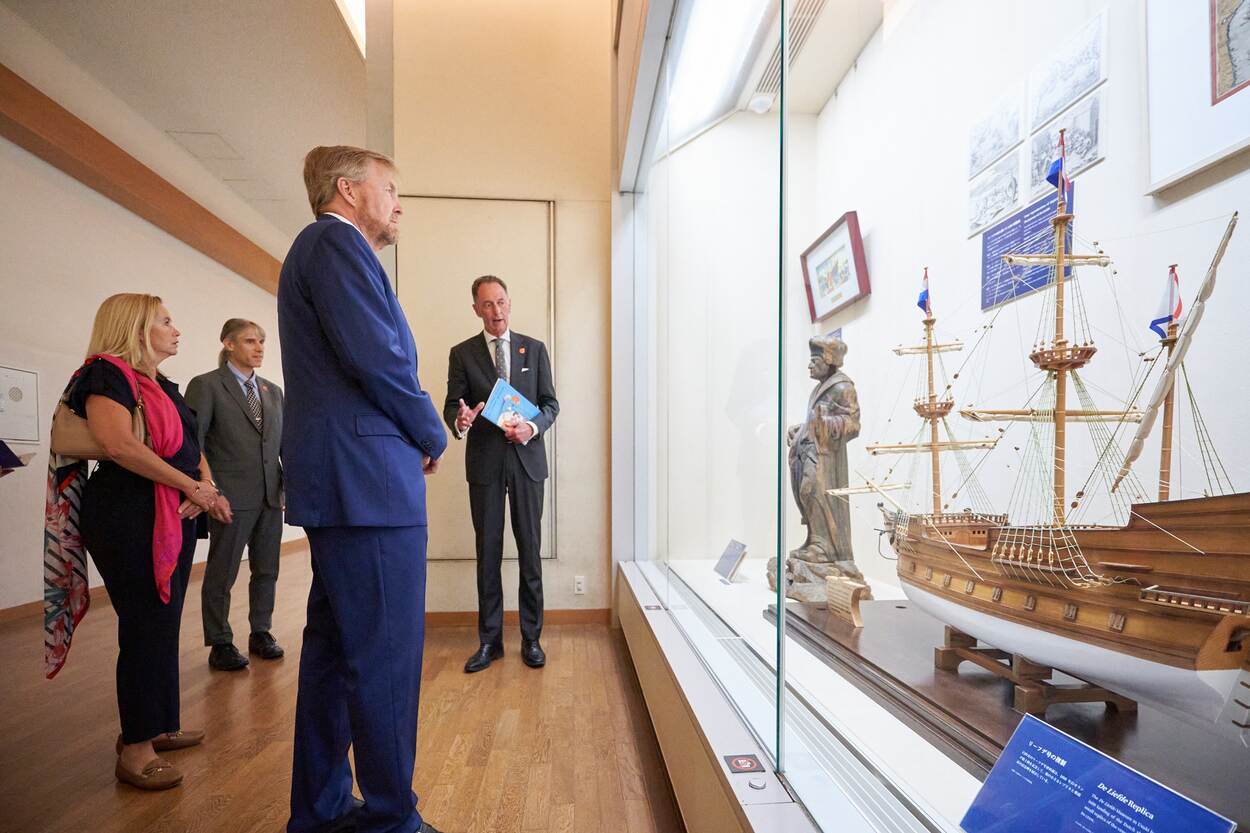
    At the exhibition on 425 years of Japanese-Dutch exchange in Osaka Castle, Consul-General Marc Kuipers tells the King about the earliest history between our two countries

    425 Years of Shared History

    Throughout May, Osaka Castle is spotlighting the long-standing relationship between Japan and the Netherlands. The exhibition A New Dawn on Common Ground: 425 Years of Exchange between Japan and the Netherlands features objects dating back to the year 1600. That year, the Dutch ship De Liefde arrived in Japan, carrying the first Dutchmen to make contact with the country. This meeting eventually led to an exclusive trading relationship that lasted more than 200 years. On the second day of his visit, the King visited this exhibition, which was organized by the Dutch Consulate in Osaka and features items from both Dutch and Japanese collections.

    Enlarge image
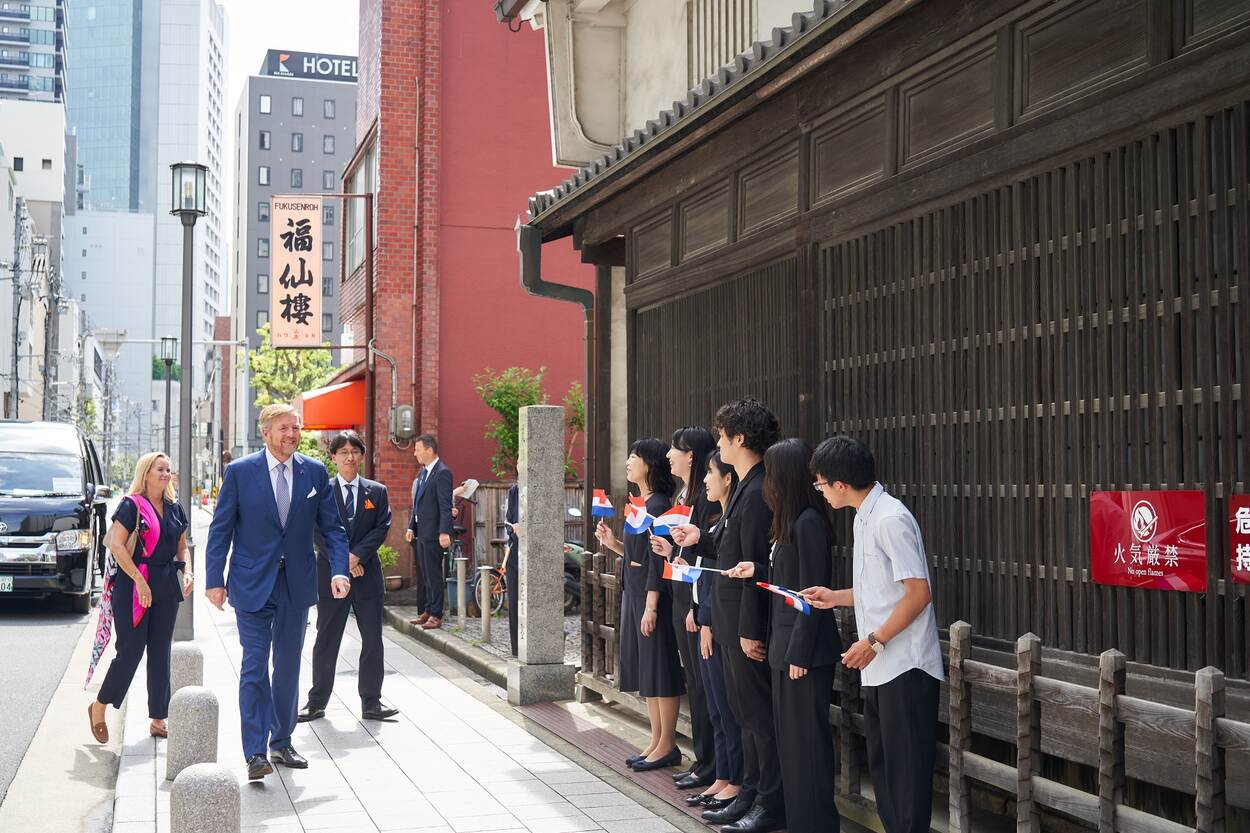
    At Tekijuku, the old Dutch school of Osaka, the King was welcomed by Osaka University students

    The Legacy of Rangaku

    Later that day, 22 May, the royal delegation visited Tekijuku, one of the most important Dutch-language schools in Japan. Until well into the 19th century, Japanese students studied Dutch there to access Western books. The presence of the Dutch in Japan offered a rare window to the rest of the world. Through Rangaku (Dutch Studies), the latest knowledge in fields such as medicine was introduced to Japan. Today, Tekijuku is part of Osaka University, where last year a new medical cooperation agreement was signed between Japan and the Netherlands. The King also visited Nakanoshima Qross, a new hub for research into the future of healthcare.

    Enlarge image
    At the Pasona pavilion, King Willem-Alexander and Minister Klever were introduced to the latest technology is regenerative medicine

    Innovation and Future Collaboration

    In the afternoon, King Willem-Alexander and Minister Klever joined the economic mission on high tech and digitalization, led by Minister Beljaarts. Around 70 Dutch companies were introduced to approximately 170 Japanese guests. Multiple partnership agreements were signed to promote cooperation in areas such as semiconductors, quantum computing, and 6G telecommunications. The day concluded with an Innovation Parade, where 19 Dutch and Japanese organizations presented their work to the King.

    MIL OSI Europe News

  • MIL-OSI Europe: Briefing – State of the Schengen area – 26-05-2025

    Source: European Parliament

    The development of the Schengen area is one of the major achievements of European integration. The removal of checks on persons at the Schengen states’ internal borders greatly facilitates the exercise of the EU freedoms of movement, which brings significant social and economic benefits. The Schengen area has come under increased stress in the past decade, owing to multiple challenges relating to increased migration into the EU, threats to internal security and the COVID 19 pandemic. In response to these challenges, many Schengen states decided to reintroduce checks at some or all of their internal borders. Despite the prescribed temporary nature of such measures, several Schengen states have prolonged these checks for years on end. The number of Schengen states with checks at internal borders reached its peak (18 states) during the first wave of the pandemic. In May 2025, 11 Schengen states had checks at internal borders owing to serious threats related to irregular migration and/or internal security. The Schengen area has expanded gradually in the past three decades and is now composed of 29 countries. In January 2025, Bulgaria and Romania were the latest two countries to fully join the Schengen area, 18 years after their accession to the EU. Cyprus is also legally bound to join the Schengen area, but the evaluation procedure for its full accession is still ongoing. This briefing presents key recent figures and developments in the Schengen area, focusing on the Schengen states’ measures to reintroduce checks at internal borders, and on the current situation regarding the completion of the Schengen area. This is an update of a briefing originally published in December 2023.

    MIL OSI Europe News

  • MIL-OSI Europe: Missions – 27-29 May: INTA Delegation to Washington, D.C. – 27-05-2025 – Committee on International Trade

    Source: European Parliament

    A delegation of eight Members of the Committee on International Trade (INTA) will travel to Washington, D.C. from 27 to 29 May 2025 to discuss political, trade and investment relations between the US and the EU.

    The delegation will be led by INTA Chair and standing rapporteur for EU-US trade relations, Bernd Lange.

    INTA Members are set to hold meetings with different departments of the US administration and with lawmakers. The meetings will also include US business organisations as well as major EU businesses active in the US. Members will also meet with US trade union representatives, consumer organisations, think tanks and academia.

    Members will hear from different interlocutors and stakeholders how the tariffs imposed by the US administration are being applied, how business is adapting to the tariffs and how can EU-US trade tensions be eased moving forward.

    MIL OSI Europe News

  • MIL-OSI Europe: Written question – Compensation for livestock farmers in Thessaly – Delays in payment – E-001985/2025

    Source: European Parliament

    Question for written answer  E-001985/2025
    to the Commission
    Rule 144
    Nikolaos Anadiotis (NI)

    Following the devastating floods of September 2023 in Thessaly, the European Commission approved significant financial support to Greece, aiming to relieve those affected and restore agricultural and livestock activity.

    Specifically, the following provision was made: a) EUR 43 million through the agricultural reserve for direct compensation to farmers and livestock farmers[1], b) EUR 101.5 million through the EU Solidarity Fund, with an advance payment of EUR 25.3 million approved in January 2024[2] and c) full coverage of damages to livestock and facilities, according to statements by the competent Minister of Rural Development.

    However, significant delays have been recorded in the payment of compensation to affected farmers. The 2nd equal instalment of just EUR 12.7 million was paid in March 2024[3], which raises reasonable questions about the efficient and timely use of European funds.

    In light of the above:

    • 1.Have the Greek authorities kept the Commission informed of progress and the reasons for the delays in the payment of compensation?
    • 2.Is the Commission monitoring the implementation of the relevant support measures and, if so, does it intend to request that the procedures be accelerated?
    • 3.In the event of continued delays on the part of the national authorities, does the Commission intend to provide further support or intervene?

    Submitted: 17.5.2025

    • [1] https://www.globaltradealert.org/state-act/83177/greece-european-commission-approves-compensation-package-for-farmers
    • [2] https://www.ekathimerini.com/economy/1247120/e101-5-mln-in-eu-aid-for-thessaly/
    • [3] https://www.archyde.com/thessaly-12-7-million-euros-were-paid-to-farmers-and-breeders-2024-03-25-215834/
    Last updated: 26 May 2025

    MIL OSI Europe News

  • MIL-OSI Europe: Written question – New Israeli bill seeking to impose 80 % tax on foreign donations to NGOs – E-001979/2025

    Source: European Parliament

    Question for written answer  E-001979/2025
    to the Commission
    Rule 144
    Chloé Ridel (S&D), Erik Marquardt (Verts/ALE), Barry Andrews (Renew), Estelle Ceulemans (S&D), Rima Hassan (The Left), Cecilia Strada (S&D), Alessandra Moretti (S&D), Mélissa Camara (Verts/ALE), Maria Walsh (PPE), Vladimir Prebilič (Verts/ALE), Marco Tarquinio (S&D), Mounir Satouri (Verts/ALE), Sandro Ruotolo (S&D), Leila Chaibi (The Left), João Oliveira (The Left), Francisco Assis (S&D), David Cormand (Verts/ALE), Nora Mebarek (S&D), Bruno Gonçalves (S&D), Thijs Reuten (S&D), Catarina Martins (The Left), Marit Maij (S&D), Annalisa Corrado (S&D), Pierre Jouvet (S&D), Matjaž Nemec (S&D), Nikos Papandreou (S&D), Tineke Strik (Verts/ALE), Pierfrancesco Maran (S&D), Irena Joveva (Renew), Javi López (S&D), Krzysztof Śmiszek (S&D), Alessandro Zan (S&D), Murielle Laurent (S&D), Damien Carême (The Left), Sandra Gómez López (S&D), Marta Temido (S&D), Leire Pajín (S&D), César Luena (S&D), Nela Riehl (Verts/ALE), Marc Botenga (The Left), Nicolás González Casares (S&D), Anna Strolenberg (Verts/ALE), Emma Rafowicz (S&D), Pasquale Tridico (The Left), Kai Tegethoff (Verts/ALE), Hilde Vautmans (Renew), Hana Jalloul Muro (S&D), Sérgio Gonçalves (S&D), Cynthia Ní Mhurchú (Renew)

    The Israeli Parliament has approved new legislation imposing an 80 % tax on foreign government funding to Israeli civil society organisations, while exempting government-supported organisations. This bill would effectively shut down many Israeli human rights groups and humanitarian NGOs carrying out crucial work, including in the occupied Palestinian territories (OPT), such as B’Tselem and Breaking the Silence.

    These NGOs have long been targeted by Israel’s right wing.  Almost all of them receive foreign funding, including from the EU and its Member States.

    This is unprecedented attack on Israeli civil society and democracy globally.

    • 1.How does the Commission intend to follow up on the recent announcement by the Vice-President of the Commission / High Representative of the Union for Foreign Affairs and Security Policy, Kaja Kallas, with regard to an increase in financial support for Israeli human rights groups targeted by the NGO bill?
    • 2.In view of the serious human rights violations committed by the Israeli Government, will the Commission move forward with considering the suspension of the EU-Israel Association Agreement?
    • 3.Does the Commission intend to take countermeasures against pressure groups defending the interests of the Israeli Government to the EU?

    Submitted: 16.5.2025

    MIL OSI Europe News

  • MIL-OSI Europe: Written question – Community funds for financing and strengthening the Transport Equivalent measure – E-001977/2025

    Source: European Parliament

    Question for written answer  E-001977/2025
    to the Commission
    Rule 144
    Emmanouil Kefalogiannis (PPE)

    Supporting island life – with particular emphasis on small islands – should be a priority. Using every means and financial tool, regional development should be promoted, local micro-economies stimulated, services and opportunities provided to the island world upgraded and inequalities between island and mainland Greece eliminated.

    A valuable measure to this end (especially nowadays, when the cost of living on the islands is very high) is the Transport Equivalent (TE). This measure, which has to date been financed exclusively from national resources, aims to contribute substantially to reducing the high transport costs borne by islanders. However, it has become clear that meeting needs exceeds national budgetary capabilities, with significant delays in the payment of aid. The Transport Equivalent measure remains outside the European framework for supporting island life, although it is fully aligned with European cohesion policies. In this context, manufacturing bodies have proposed its inclusion in European programmes, such as the Just Transition Programme 2021-2027, the Cohesion Fund and the European Regional Development Fund, etc.

    In view of this:

    • 1.What measures does the Commission intend to put in place to support island life?
    • 2.Which Community funds can finance the Transport Equivalent measure?

    Submitted: 16.5.2025

    Last updated: 26 May 2025

    MIL OSI Europe News

  • MIL-OSI Europe: Written question – Access to school canteens in Sicily and the use of ESF+ and NRRP funds – E-001981/2025

    Source: European Parliament

    Question for written answer  E-001981/2025
    to the Commission
    Rule 144
    Giuseppe Antoci (The Left)

    According to a recent survey of school canteens in Italy[1], rising canteen prices in Sicily (up 13 % and 8 % since last year in nurseries and primary schools respectively) have resulted in families on the island forking out an average of EUR 83 per child on school meals.

    In addition, it is extremely difficult to even access school meals in Sicily, where only 13.7 % of all schools have canteens, a figure which rises to 41.2 % and 43.1 % in central and northern Italy respectively.

    Although Italy’s National Recovery and Resilience Plan (NRRP) includes specific measures to remedy these kinds of inequalities, it has only allocated 37 % of its school canteen funding to southern Italy, Sicily and Sardinia.

    This state of affairs makes it extremely difficult for Sicilian children to access a healthy and adequate diet, which is one of the fundamental rights enshrined in the European Child Guarantee[2], which aims to ensure full access to essential services for children in vulnerable situations.

    In view of the above:

    • 1.Is the Commission aware of the situation concerning Sicily’s school canteens, and how does it assess the way in which the island’s NRRP allocation has been used?
    • 2.Which European Social Fund Plus (ESF+) instruments and resources could be used to guarantee that Sicilian pupils can regularly access school canteens?
    • 3.Will the Commission take further steps to reduce regional disparities and ensure that the European Child Guarantee is effectively implemented in Sicily?

    Submitted: 16.5.2025

    • [1] https://www.cittadinanzattiva.it/notizie/17124-viii-indagine-sulle-mense-scolastiche-circa-85-euro-il-costo-medio-mensile-servono-piu-risorse-contro-la-poverta-alimentare.html.
    • [2] https://commission.europa.eu/strategy-and-policy/policies/justice-and-fundamental-rights/rights-child/eu-strategy-rights-child-and-european-child-guarantee_en#european-child-guarantee.
    Last updated: 26 May 2025

    MIL OSI Europe News

  • MIL-OSI Europe: Written question – Infringement of Directive 1999/70/EC on insecure employment in schools – E-001987/2025

    Source: European Parliament

    Question for written answer  E-001987/2025
    to the Commission
    Rule 144
    Valentina Palmisano (The Left)

    Clause 5 of the Framework Agreement annexed to Directive 1999/70/EC imposes effective measures on Member States to prevent the misuse of successive fixed-term contracts, but Italy has not introduced effective, dissuasive and proportionate penalties to that end.

    Some 250 000 Italian teachers are precariously employed, despite the judgment of the Court of Justice of the European Union (CJEU) of 26 November 2014 that declared renewals of contracts of more than 36 months to cover schools’ permanent needs of to be unlawful.

    The Commission referred Italy to the CJEU (case INFR(2014)4231), noting its misuse of fixed-term contracts and discrimination in working conditions.

    Decree-Law No 131/2024 (‘the ‘Salva Infrazioni’ Decree’) does nothing more than increase compensation, without addressing the issue of recruitment or actually reducing precarious employment.

    What is more, Petition No 1264/2024, calling for the implementation of the EU directives on regulated contracts and professions, is currently open.

    In the light of the above:

    • 1.Will the Commission adopt binding guidelines to prevent further abuse of Italian school workers on insecure contracts?
    • 2.Is Decree-Law 131/2024 deemed to comply with Directive 1999/70/EC?
    • 3.Can the Commission confirm that Italy can use the twin-track system for recruitment for support positions but not for ordinary posts, and that this constraint is effectively imposed by the EU?

    Submitted: 18.5.2025

    Last updated: 26 May 2025

    MIL OSI Europe News

  • MIL-OSI Europe: Written question – Inquiry on DSA enforcement: TikTok’s algorithm and disinformation in Romania – P-001961/2025

    Source: European Parliament

    Priority question for written answer  P-001961/2025
    to the Commission
    Rule 144
    Dan Barna (Renew), Vlad Vasile-Voiculescu (Renew)

    A recent investigation by Global Witness has revealed concerning issues with TikTok’s algorithm ahead of the Romanian elections. The findings indicate that the platform disproportionately promoted far-right content to users, regardless of their initially balanced political interests. This raises questions about the spread of disinformation and the potential for algorithmic bias to impact democratic processes[1].

    The Digital Services Act (DSA) aims to create a safer and more transparent online environment, with specific obligations for very large online platforms (VLOPs) to mitigate systemic risks, including the dissemination of illegal content and disinformation, particularly during electoral periods. The DSA also emphasises the importance of algorithmic transparency and users’ rights to access diverse information.

    Given these circumstances, the provisions of the DSA and past investigations into TikTok, what specific measures are now being taken to further investigate and address the algorithmic amplification of potentially harmful or biased content on TikTok within the EU, especially in the context of the upcoming elections in Romania?

    Submitted: 15.5.2025

    • [1] https://globalwitness.org/en/campaigns/digital-threats/tiktok-algorithm-continues-to-push-multiple-times-more-far-right-content-to-users-ahead-of-romanian-election/.
    Last updated: 26 May 2025

    MIL OSI Europe News

  • MIL-OSI Europe: Written question – Urgent action required for the immediate closure of the Italian migrant detention centre in Trapani – E-001971/2025

    Source: European Parliament

    Question for written answer  E-001971/2025
    to the Commission
    Rule 144
    Leoluca Orlando (Verts/ALE), Ilaria Salis (The Left), Mélissa Camara (Verts/ALE), Cecilia Strada (S&D), Brando Benifei (S&D), Alessandro Zan (S&D), Marco Tarquinio (S&D), Saskia Bricmont (Verts/ALE), Anna Strolenberg (Verts/ALE), Reinier Van Lanschot (Verts/ALE), Cristina Guarda (Verts/ALE), Benedetta Scuderi (Verts/ALE), Ignazio Roberto Marino (Verts/ALE), Damien Carême (The Left), Pernando Barrena Arza (The Left), Rudi Kennes (The Left), Estelle Ceulemans (S&D), Sandro Ruotolo (S&D), Marie Toussaint (Verts/ALE), Rima Hassan (The Left), Mimmo Lucano (The Left)

    As highlighted by the European Committee for the Prevention of Torture and Inhuman or Degrading Treatment or Punishment (CPT) of the Council of Europe in April 2024[1], Italian migrant detention centres (CPRs) continue to perpetrate systematic human rights violations. The situation does not appear to have improved.

    During a surprise inspection at the Milo-Trapani CPR on 13 April 2025[2], Members of Parliament found detainees experiencing severe psychological and physical distress, with reports of physical violence and attempted suicides. The facility was in a dilapidated state, with no structured activities available, worsening detainees’ mental and physical condition. Access to medical care and legal support remains extremely limited.

    These conditions raise serious concerns about compliance with the Charter of Fundamental Rights of the European Union, particularly Article 1 (protection of human dignity) and Article 4 (prohibition of inhuman or degrading treatment).

    In light of these facts, the Commission is asked:

    • 1.What is its assessment of the human rights violations identified in Italian CPRs?
    • 2.Will it consider launching an infringement procedure against Italy for breaches of fundamental rights?
    • 3.How will it ensure compliance with detainees’ rights to health, legal assistance, family life and dignified living conditions?

    Submitted: 16.5.2025

    • [1] https://rm.coe.int/1680b2c7e7.
    • [2] https://palermo.repubblica.it/cronaca/2025/04/14/video/cpr_di_trapani_ilaria_salis_tortura_istituzionalizzata_va_chiuso_subito-424127661/.

    MIL OSI Europe News

  • MIL-OSI Europe: Answer to a written question – Mandatory identity verification (KYC) for social media accounts as part of the review of the Digital Services Act – follow-up to Petition 1428/2024 – P-001727/2025(ASW)

    Source: European Parliament

    The Commission acknowledges the importance of ensuring a safe, predictable and trusted online environment.

    Pursuant to Article 91(1), second subparagraph, of Regulation (EU) 2022/2065[1] (Digital Services Act, DSA) by 17 November 2025, the Commission must evaluate and report to the European Parliament, the Council and the European Economic and Social Committee on (a) the application of Article 33 of the DSA[2], including the scope of providers of intermediary services covered by the obligations applicable to very large online platforms (VLOPs) and very large online search engines (VLOSEs), and (b) the way that the DSA interacts with other legal acts, in particular those listed in Article 2(3) and (4) of the DSA.

    To this purpose, the Commission is preparing the report, prior to the launch for adoption and the formal transmission of the report to the European Parliament, the Council and the Economic and Social Committee.

    As the report due by 17 November 2025 is targeted to the specific scope established in Article 91(1) of the DSA, the potential requirement of mandatory identity verification for social media accounts is not in scope and will not be covered.

    This is without prejudice to other evaluation reports due by 17 November 2027 and five years thereafter pursuant to Article 91, paragraph 2 to 6, of the DSA.

    • [1]  OJ L  277, 27.10.2022, p. 1-102, ELI: http://data.europa.eu/eli/reg/2022/2065/oj.
    • [2] Article 33 sets out the threshold and process for the designation of very large online platforms (VLOPs) and very large online search engines (VLOSEs).
    Last updated: 26 May 2025

    MIL OSI Europe News

  • MIL-OSI Europe: Answer to a written question – Immediate impact of US funding cuts on civil society and LGBTI+ rights in the Western Balkans and Türkiye – E-001190/2025(ASW)

    Source: European Parliament

    The work of civil society organisations (CSOs), including those defending the lesbian, gay, bisexual, transgender, intersex, or queer (LGBTIQ) rights, provide an important contribution to partner countries’ reform efforts, including in view of their accession to the EU.

    Respect for human rights is an essential value upon which the EU is founded (Article 2 of the Treaty on EU). Also, judiciary and fundamental rights are at the heart of the EU accession negotiations[1].

    The Commission thus expects candidate countries to uphold these values, adopt and implement legislative reforms to that end. This notably includes ensuring that institutions promoting and protecting human rights and non-discrimination, such as equality bodies, are given the means to operate effectively.

    The Commission supports civil society and media freedom in the Western Balkans and Türkiye through the Instrument for Pre-accession, which for 2021-2027 earmarked circa EUR 470 million through dedicated programmes, namely the Civil Society Facility[2] and the Media Programme.

    CSOs in the region can also benefit from funding under the Thematic Programme on Human Rights and Democracy[3] under the Neighbourhood, Development and International Cooperation Instrument — Global Europe.

    These programmes provide essential support and contribute to countering the rhetoric in the region against human rights, democratic values, rule of law and free independent media.

    The Commission is actively monitoring the impact of the United States (U.S.) Agency for International Development’s withdrawal and broader international U.S. support, to identify critical needs in the region. The global scale of the challenge requires a collective response beyond the Commission.

    The Commission will continue to support the LGBTIQ community and human rights defenders, while reinforcing its political dialogue with enlargement partners .

    The Commission will renew its efforts to advance LGBTIQ equality, through the adoption of a new LGBTIQ Equality Strategy 2026-2030.

    • [1] Revised enlargement methodology.
    • [2] https://enlargement.ec.europa.eu/enlargement-policy/policy-highlights/civil-society_en.
    • [3] https://international-partnerships.ec.europa.eu/policies/peace-and-governance/human-rights_en.

    MIL OSI Europe News

  • MIL-OSI Europe: Written question – Purges of minorities in Syria – E-001811/2025

    Source: European Parliament

    Question for written answer  E-001811/2025/rev.1
    to the Commission
    Rule 144
    Emmanouil Fragkos (ECR)

    The terrorist organisation that has taken over Damascus – ruling most of Syria – is extremely dangerous. It is essential for the EU to take the first ‘writing on the wall’ into account and adjust its stance and not its values.

    In northwest Syria in early March, a mass purge of Alawites bearing the hallmarks of genocide was recorded. Hayat Tahrir al-Sham (HTS) terrorists targeted Alawite villagers, women and children. Recently, violent attacks against the Druze by regime terrorist and allied groups have intensified in southern Syria, following a fake audio video that ‘insulted the Prophet Muhammad’. Already, over 100 Druze have been murdered. Fortunately, Israel’s military presence has contributed to a less aggressive attitude towards the Druze.

    It is obvious that the Islamist, terrorist HTS has as its first goal the cleansing of non-Muslims. First the Alawites, who have social standing, then the Druze, who have a strategic position and alliance with Israel, and then HTS will turn against the Kurds, Shiites and Christians. The genocide of Christians in Türkiye is obviously the model for the like-minded HTS terrorists, so that Syria can be transformed into a Sunni caliphate.

    Can the Commission answer the following question: How many thousands of non-Muslims must be murdered for the EU to accept the true nature of those ruling Syria and intervene to overthrow them?

    Submitted: 6.5.2025

    Last updated: 26 May 2025

    MIL OSI Europe News