Category: DJF

  • MIL-OSI Analysis: Research replication can determine how well science is working – but how do scientists replicate studies?

    Source: The Conversation – USA – By Amanda Kay Montoya, Associate Professor of Psychology, University of California, Los Angeles

    Some research teams work on replicating prior studies to assess the value of a body of work. AzmanL/E+ via Getty Images

    Back in high school chemistry, I remember waiting with my bench partner for crystals to form on our stick in the cup of blue solution. Other groups around us jumped with joy when their crystals formed, but my group just waited. When the bell rang, everyone left but me. My teacher came over, picked up an unopened bag on the counter and told me, “Crystals can’t grow if the salt is not in the solution.”

    To me, this was how science worked: What you expect to happen is clear and concrete. And if it doesn’t happen, you’ve done something wrong.

    If only it were that simple.

    It took me many years to realize that science is not just some series of activities where you know what will happen at the end. Instead, science is about discovering and generating new knowledge.

    Now, I’m a psychologist studying how scientists do science. How do new methods and tools get adopted? How do changes happen in scientific fields, and what hinders changes in the way we do science?

    One practice that has fascinated me for many years is replication research, where a research group tries to redo a previous study. Like with the crystals, getting the same result from different teams doesn’t always happen, and when you’re on the team whose crystals don’t grow, you don’t know if the study didn’t work because the theory is wrong, or whether you forgot to put the salt in the solution.

    The replication crisis

    A May 2025 executive order by President Donald Trump emphasized the “reproducibility crisis” in science. While replicability and reproducibility may sound similar, they’re distinct.

    Reproducibility is the ability to use the same data and methods from a study and reproduce the result. In my editorial role at the journal Psychological Science, I conduct computational reproducibility checks where we take the reported data and check that all the results in the paper can be reproduced independently.

    But we’re not running the study over again, or collecting new data. While reproducibility is important, research that is incorrect, fallible and sometimes harmful can still be reproducible.

    By contrast, replication is when an independent team repeats the same process, including collecting new data, to see if they get the same results. When research replicates, the team can be more confident that the results are not a fluke or an error.
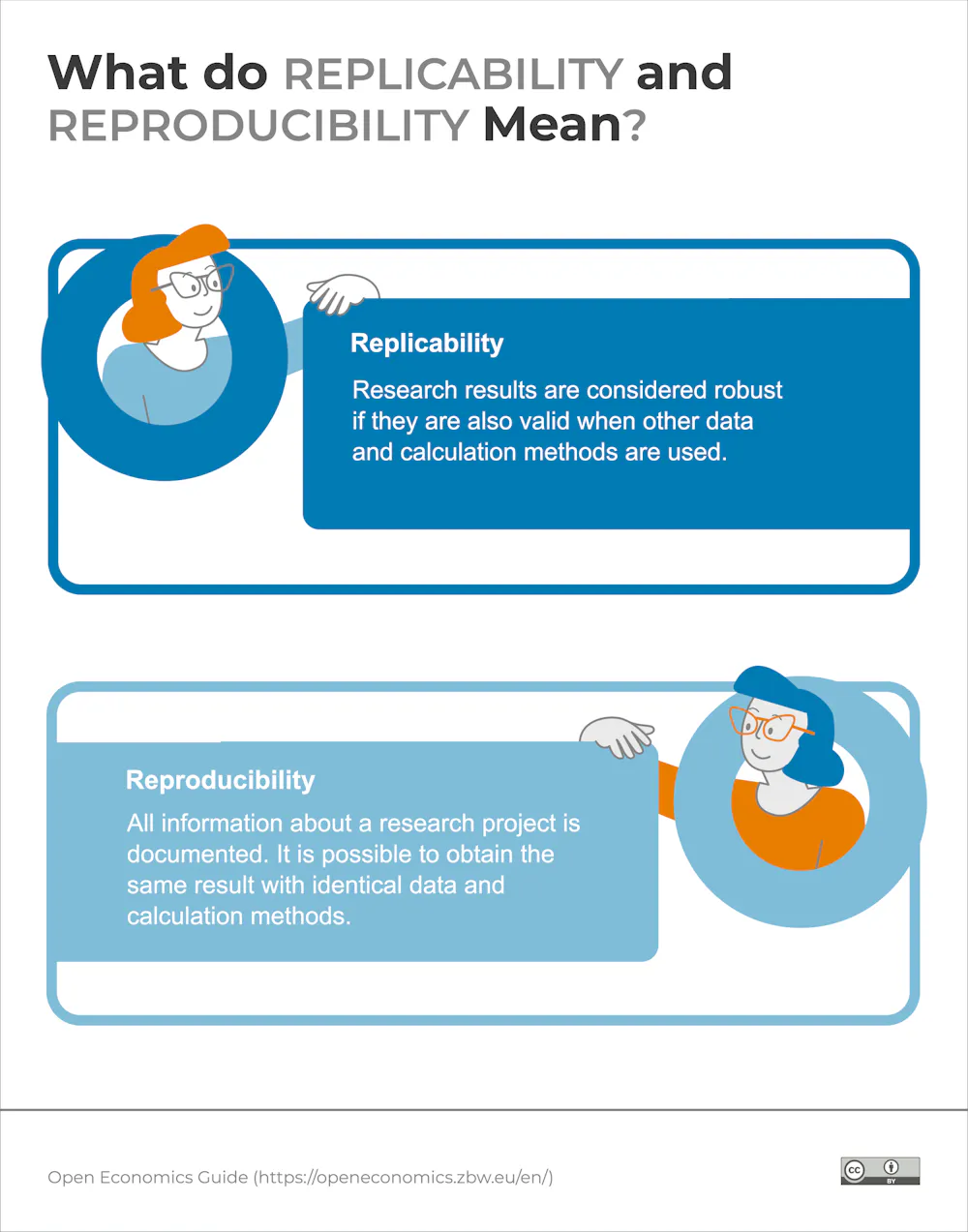
    Reproducibility and replicability are both important, but have key differences.
    Open Economics Guide, CC BY

    The “replication crisis,” a term coined in psychology in the early 2010s, has spread to many fields, including biology, economics, medicine and computer science. Failures to replicate high-profile studies concern many scientists in these fields.

    Why replicate?

    Replicability is a core scientific value: Researchers want to be able to find the same result again and again. Many important findings are not published until they are independently replicated.

    In research, chance findings can occur. Imagine if one person flipped a coin 10 times and got two heads, then told the world that “coins have a 20% chance of coming up heads.” Even though this is an unlikely outcome – about 4% – it’s possible.

    Replications can correct these chance outcomes, as well as scientific errors, to ensure science is self-correcting.

    For example, in the search for the Higgs boson, two research centers at CERN, the European Council for Nuclear Research, ATLAS and CMS, independently replicated the detection of a particle with a large unique mass, leading to the 2013 Nobel Prize in physics.

    The ATLAS experiment at the Large Hadron Collider at CERN is one of two that led to the discovery of the Higgs boson.
    CERN, CC BY

    The initial measurements from the two centers actually estimated the mass of the particle as slightly different. So while the two centers didn’t find identical results, the teams evaluated them and determined they were close enough. This variability is a natural part of the scientific process. Just because results are not identical does not mean they are not reliable.

    Research centers like CERN have replication built into their process, but this is not feasible for all research. For projects that are relatively low cost, the original team will often replicate their work prior to publication – but doing so does not guarantee that an independent team could get the same results.

    Because the results on vaccine efficacy were so clear, replication wasn’t necessary and would have slowed the process of getting the vaccine to people.
    XKCD, CC BY-NC

    When projects are costly, urgent or time-specific, independently replicating them prior to disseminating results is often not feasible. Remember when people across the country were waiting for a COVID-19 vaccine?

    The initial Pfizer-BioNTech COVID-19 vaccine took 13 months from the start of the trial to authorization from the Food and Drug Administration. The results of the initial study were so clear and convincing that a replication would have unnecessarily delayed getting the vaccine out to the public and slowing the spread of disease.

    Since not every study can be replicated prior to publication, it’s important to conduct replications after studies are published. Replications help scientists understand how well research processes are working, identify errors and self-correct. So what’s the process of conducting a replication?

    The replication process

    Researchers could independently replicate the work of other teams, like at CERN. And that does happen. But when there are only two studies – the original and the replication – it’s hard to know what to do when they disagree. For that reason, large multigroup teams often conduct replications where they are all replicating the same study.

    Alternatively, if the purpose is to estimate the replicability of a body of research – for example, cancer biology – each team might replicate a different study, and the focus is on the percentage of studies that replicate across many studies.

    These large-scale replication projects have arisen around the world and include ManyLabs, ManyBabies, Psychological Accelerator and others.

    Replicators start by learning as much as possible about how the original study was conducted. They can collect details about the study from reading the published paper, discussing the work with its original authors and consulting online materials.

    The replicators want to know how the participants were recruited, how the data was collected and using what tools, and how the data was analyzed.

    But sometimes, studies may leave out important details, like the questions participants were asked or the brand of equipment used. Replicators have to make these difficult decisions themselves, which can affect the outcome.

    Replicators also often explicitly change details of the study. For example, many replication studies are conducted with larger samples – more participants – than the original study, to ensure the results are reliable.

    Registration and publication

    Sadly, replication research is hard to publish: Only 3% of papers in psychology, less than 1% in education and 1.2% in marketing are replications.

    If the original study replicates, journals may reject the paper because there is no “new insight.” If it doesn’t replicate, journals may reject the paper because they assume the replicators made a mistake – remember the salt crystals.

    Because of these issues, replicators often use registration to strengthen their claims. A preregistration is a public document describing the plan for the study. It is time-stamped to before the study is conducted.

    This type of document improves transparency by making changes in the plan detectable to reviewers. Registered reports take this a step further, where the research plan is subject to peer review before conducting the study.

    If the journal approves the registration, they commit to publishing the results of the study regardless of the results. Registered reports are ideal for replication research because the reviewers don’t know the results when the journal commits to publishing the paper, and whether the study replicates or not won’t affect whether it gets published.

    About 58% of registered reports in psychology are replication studies.

    Replication research often uses the highest standards of research practice: large samples and registration. While not all replication research is required to use these practices, those that do contribute greatly to our confidence in scientific results.

    Replication research is a useful thermometer to understand if scientific processes are working as intended. Active discussion of the replicability crisis, in both scientific and political spaces, suggests to many researchers that there is room for growth. While no field would expect a replication rate of 100%, new processes among scientists aim to improve the rates from those in the past.

    Amanda Kay Montoya is an Associate Professor at the University of California, Los Angeles. She serves on the Board of Directors for the Center for Open Science. She receives funding from the US-National Science Foundation.

    ref. Research replication can determine how well science is working – but how do scientists replicate studies? – https://theconversation.com/research-replication-can-determine-how-well-science-is-working-but-how-do-scientists-replicate-studies-260771

    MIL OSI Analysis

  • MIL-OSI USA: Early Alert: Microbore Extension Set Issue from B. Braun Medical Inc.

    Source: US Department of Health and Human Services – 3

    This communication is part of the Communications Pilot to Enhance the Medical Device Recall Program. The FDA has become aware of a potentially high-risk issue. The FDA will keep the public informed and update this web page as significant new information becomes available. 
    Affected Product

    The FDA is aware that B. Braun Medical Inc. has issued a letter to affected customers recommending certain microbore extension sets be removed from where they are used or sold:

    Product Description
    Model Number
    UDI-DI
    Lot Numbers

    Microbore Extension Set
    V6215
    Case: 04046964189173Each: 04046964189166
    0061742452, 0061747379, 0061767411, 0061780914, 0061803499, 0061806173, 0061822333, 0061836578, 0061849109, 0061850836, 0061899902, 0061936368, 0061936119, 0061936369, 0061940584

    What to Do
    Identify and stop use of all affected product. Affected product should be quarantined and clearly labeled to prevent accidental use until it can be returned to B. Braun. Do not destroy affected product.

    On July 9, B. Braun Medical Inc. sent all affected customers a letter recommending the following actions:

    Review the Urgent Medical Device Recall Notification in its entirety and ensure that all users in your organization of the above-mentioned product, and any other concerned persons, are informed about this voluntary recall. If you are a distributor and have further distributed the product, please forward this notice to your consignees. The recall is to be extended to the hospital/healthcare facility level.
    Determine your current inventory of the affected items within inventory of your facility, cease use and quarantine product subject to recall. Do not destroy any affected product.
    Utilizing the “Urgent Medical Device Recall Acknowledgement Form”, record the total number of individual impacted units. If you have no inventory remaining, please enter zero (0) on the form.
    Return the completed “Urgent Medical Device Recall Acknowledgement Form” to the B. Braun Medical Inc. Postmarket Surveillance department. 
    Once we receive your Acknowledgement Form, a B. Braun Customer Support representative will contact you with instructions on how to return any impacted cases, including partial cases, in your possession and provide credit and/or replacement of the product based on your individual needs.

    Check this web page for updates. The FDA is currently reviewing information about this potentially high-risk device issue and will keep the public informed as significant new information becomes available.

    Reason for Alert
    The affected Microbore Extension Sets labels show incorrect information about the device’s filter. Specifically, the product label shows that the device contains an air eliminating filter. However, the filter used on this extension set does not feature an air vent, which is common to air eliminating filters, and is not indicated for the removal of air.
    If during use there is air within the line or filter itself, the air can occlude the filter. This could lead to a significant delay in therapy with significant impact on patient condition (e.g. with life sustaining drugs). It is possible for air to escape the filter and enter the patient where embolization could occur. This could lead to patient harm up to and including permanent organ damage or death.
    As of July 9, B. Braun Medical Inc. has not reported any serious injuries or deaths associated with this issue.
    Device Use
    B. Braun Extension Sets are single use, disposable, add-on devices used for direct injection, intermittent infusion, continuous infusion or aspiration of fluids, medications, blood and blood products.
    Contact Information
    Customers in the U.S. with adverse reactions, quality problems, or questions about this recall should contact B. Braun Medical Inc. at 1-833-425-1464.
    Unique Device Identifier (UDI)
    The unique device identifier (UDI) helps identify individual medical devices sold in the United States from distribution to use. The UDI allows for more accurate reporting, reviewing, and analyzing of adverse event reports so that devices can be identified more quickly, and as a result, problems potentially resolved more quickly.

    How do I report a problem?
    Health care professionals and consumers may report adverse reactions or quality problems they experienced using these devices to MedWatch: The FDA Safety Information and Adverse Event Reporting Program.

    Content current as of:
    07/17/2025

    MIL OSI USA News

  • MIL-OSI USA: New AI model could revolutionize U.S manufacturing

    Source: US Government research organizations

    NSF-supported researchers developed a new AI model that sees inside a factory, understands what’s happening and suggests ways to solve problems, making manufacturing smarter, safer and more competitive.

    Artificial intelligence has transformed fields like medicine and finance, but it hasn’t gained much traction in manufacturing. Factories present a different challenge for AI: They are structured, fast-paced environments that rely on precision and critical timing. Success requires more than powerful algorithms; it demands deep, real-time understanding of complex systems, equipment and workflow. A new AI model designed specifically for manufacturing, seeks to address this challenge and revolutionize how factories operate.

    With support from the U.S. National Science Foundation, a team led by California State University Northridge’s Autonomy Research Center for STEAHM has developed MaVila — short for Manufacturing, Vision and Language — an intelligent assistant that combines image analysis and natural language processing to help manufacturers detect problems, suggest improvements and communicate with machines in real time. Their goal is to create smarter, more adaptive manufacturing systems that can better support one of the most important sectors of the U.S. economy.

    MaVila takes a different approach. Instead of relying on outside data, like information on the internet, it is trained with manufacturing-specific knowledge from the start. It learns directly from visual and language-based data in factory settings. The tool can “see” and “talk” — analyzing images of parts, describing defects in plain language, suggesting fixes and even communicating with machines to carry out automatic adjustments.

    MaVila was trained using a specialized approach that required far less data than typical AI systems — an advantage in manufacturing, where data is often limited or expensive to collect. Therefore, the tool could be more accessible to small and medium-sized businesses that can’t afford expensive AI tools, or the expertise required to run them.

    Researchers trained MaVila using vast datasets of images paired with descriptive language. Then, they fine-tuned it in a lab setting by showing it pictures of 3D-printed parts with visible flaws, such as blobs, cracks or stringy filaments. In most cases, MaVila correctly identified the defects and suggested better printing settings.

    The team also connected MaVila to mobile devices and robotic simulations. This allowed the model to operate in real-time scenarios, such as identifying a machine from a photo and generating step-by-step commands to adjust performance or fix a flaw — something that traditionally requires expert programming.

    The development of MaVila was powered by the National Research Platform (NRP) Nautilus — a federally funded partnership of over 50 institutions led by experts at UC San Diego that has received continuous support from NSF. To meet the enormous processing demands of training MaVila, the researchers turned to NSF-funded high-performance computing (HPC) systems. These HPC resources allowed them to simulate realistic manufacturing conditions, test edge cases and validate the AI’s response and decision-making faster than traditional computing could allow.

    This project marks a leap forward in intelligent, adaptive manufacturing. It empowers human workers, increases productivity and strengthens the U.S. position in a fiercely competitive global market. And it reflects years of public investment in computing, collaboration and AI innovation.

    Technologies like MaVila are expected to boost domestic manufacturing, fuel economic resilience, and help prepare the workforce for future-ready industries. NSF’s support ensures that cutting-edge research translates into practical tools that benefit everyday people and keep America at the forefront of innovation.

    The achievement of the researchers reflects the results of years of public investment in computing infrastructure, cross-institutional partnerships and targeted AI research. Through initiatives like the NRP and widespread access to advanced computing resources, the NSF provides researchers with essential tools that accelerate innovation and translate lab research into real-world solutions.

    The project represents a significant step forward in autonomous, adaptive manufacturing. By enabling factories to detect issues and optimize operations, MaVila supports human workers by helping them make decisions more efficiently, driving global competitiveness in a constantly evolving world.

    [embedded content]

    Listen to NSF Discovery Files wherever you get your podcasts.

    MIL OSI USA News

  • MIL-OSI USA: Gov. Kemp: King’s Hawaiian to Invest $54 Million in Hall County Expansion

    Source: US State of Georgia

    ATLANTA – Governor Brian P. Kemp today announced that family-owned, Hawaii-inspired food company King’s Hawaiian® will invest approximately $54 million in expanding its Oakwood facility, creating more than 135 new jobs. 

    “For nearly 15 years, King’s Hawaiian has proven to be an incredible partner in creating quality jobs in northeast Georgia, and we look forward to even more years of great success for them in Hall County,” said Governor Brian Kemp. “Expansions like these are an important part of our economic development work, helping create further opportunities in growing communities.”

    King’s Hawaiian was founded in 1950 by the Taira family in Hilo, Hawaii. Since establishing a presence in Georgia in 2010, the company’s footprint has grown to support more than 800 jobs in the state.

    “This expansion represents a major milestone in our journey, and we’re thrilled to continue growing our ohana in Hall County,” said Mark Taira, CEO of King’s Hawaiian. “For 15 years, Georgia has been an essential part of our success. The support from Lanier Technical College, Georgia Quick Start, and the Greater Hall Chamber of Commerce has been instrumental in helping us train and develop talent to grow our business.”

    The expansion will add a new production line at the 150,000-square-foot King’s Hawaiian facility located in the Oakwood South Industrial Park. Start-up of the new line is expected in the second quarter of 2026, producing additional flavors of King’s Hawaiian Pretzel Bites. The company will be hiring for positions in management, maintenance, food safety, and quality control. Interested individuals can learn more and apply at kingshawaiian.com/careers.

    “King’s Hawaiian has become a cornerstone of our regional economy and a shining example of a company that invests in both business and community,” said Tim Evans, President and CEO of the Greater Hall Chamber of Commerce. “This sixth major expansion since 2010 is a testament to the company’s deep roots in Hall County. We are especially proud of their ongoing support for youth and community programs, including the University of North Georgia’s First Generation Scholars, Junior Achievement, and Youth Leadership Hall. We look forward to continuing this remarkable partnership.”

    Regional Project Manager Brandon Lounsbury represented the Georgia Department of Economic Development’s (GDEcD) Global Commerce team on this competitive project in partnership with the Greater Hall Chamber of Commerce and Georgia EMC. 

    “King’s Hawaiian has been a cornerstone employer in northeast Georgia and a valued partner of Georgia Quick Start for more than a decade,” said GDEcD Commissioner Pat Wilson. “By continuing to invest in people and innovation – and by working closely with the Technical College System of Georgia – King’s Hawaiian is helping build the skilled workforce that drives its success. Congratulations to Hall County on another exciting chapter in this thriving partnership.”

    About KING’S HAWAIIAN 
     
    Founded more than 70 years ago in Hilo, Hawaii, by Robert R. Taira, KING’S HAWAIIAN is a family-owned business that has been dedicated to providing Hawaii-inspired foods made with original recipes and Aloha Spirit for three generations. For more information, visit the company’s website at www.KingsHawaiian.com, or find KING’S HAWAIIAN on FacebookInstagram, and X (formerly Twitter). 

    MIL OSI USA News

  • MIL-OSI United Kingdom: Thurrock Borough Council: Letter to the Leader of the Council (17 July 2025)

    Source: United Kingdom – Government Statements

    Correspondence

    Thurrock Borough Council: Letter to the Leader of the Council (17 July 2025)

    Letter to the Leader of Thurrock Council, announcing an extension to the intervention at Thurrock Council through newly issued Directions.

    Applies to England

    Documents

    Details

    A letter from Jim McMahon OBE, Minister of State for Local Government and English Devolution, to the Leader of Thurrock Council announcing the decision by the Secretary of State to issue new Directions on the Authority under section 15 of the Local Government Act 1999 extending the intervention until 30 April 2028.

    Updates to this page

    Published 17 July 2025

    Sign up for emails or print this page

    MIL OSI United Kingdom

  • MIL-OSI United Kingdom: Thurrock Council: Representation (17 July 2025)

    Source: United Kingdom – Government Statements

    Correspondence

    Thurrock Council: Representation (17 July 2025)

    Representation from Thurrock Council concerning the proposed extension to the intervention package announced by the Minister for Local Government and English Devolution on 19 June 2025.

    Applies to England

    Documents

    Thurrock Council: Representation (17 July 2025)

    Request an accessible format.
    If you use assistive technology (such as a screen reader) and need a version of this document in a more accessible format, please email alternativeformats@communities.gov.uk. Please tell us what format you need. It will help us if you say what assistive technology you use.

    Details

    Written representation to the Ministry of Housing, Communities and Local Government from Thurrock Council, in response to the proposed intervention package that was announced on 19 June 2025.​

    Updates to this page

    Published 17 July 2025

    Sign up for emails or print this page

    MIL OSI United Kingdom

  • MIL-OSI United Kingdom: Thurrock Council: Commissioner appointment letters (17 July 2025)

    Source: United Kingdom – Government Statements

    Correspondence

    Thurrock Council: Commissioner appointment letters (17 July 2025)

    Copies of the letters about Commissioners’ appointments at Thurrock Council.

    Applies to England

    Documents

    Details

    Copies of letters from James Blythe, Deputy Director, Local Government Stewardship and Intervention at the Ministry of Housing, Communities and Local Government to:

    • Dr Dave Smith, confirming his appointment as Managing Director Commissioner at Thurrock Council

    • Gavin Jones CBE, confirming his appointment as Lead Commissioner at Thurrock Council
    • Denise Murray, confirming her appointment as Commissioner at Thurrock Council

    The letters confirm the Commissioners’ roles and responsibilities, established by the Directions issued under section 15(5) and (6) of the Local Government Act 1999.

    Updates to this page

    Published 17 July 2025

    Sign up for emails or print this page

    MIL OSI United Kingdom

  • MIL-OSI United Kingdom: PM speech at the Civil Society Summit: 17 July 2025

    Source: United Kingdom – Government Statements

    Speech

    PM speech at the Civil Society Summit: 17 July 2025

    The Prime Minister gave a speech at the Civil Society Summit.

    It’s fantastic to be with you all. As I look around, I see many friends and colleagues.

    Great to be here at the Science Museum, which, I have to say, feels like a fitting place to be because this is the home of innovation – celebrating the progress that has transformed so many people’s lives. And in a way, speaking to us, calling us, and inspiring us to do the same today.

    Now, as many of you in this room will remember, around 18 months ago, in opposition, in a church near Waterloo Station, I made a promise to people in this room.

    I said [political content redacted] we would work in partnership with you. To deliver on every one of our missions and change the country together. I meant that back then.

    And the moment I walked through the front door of Downing Street, our work began. And that door is now wide open to you.

    Today’s summit is the first of its kind ever. And that’s really important because this is about delivering on the priorities of working people – but it’s also about something even more fundamental than that.

    Because I often say – the changes we are making aren’t just about lines on a graph and statistics. They’re about people – and you will understand that better than anyone else.

    Take the Drive Partnership. Now, this is a fantastic initiative led by a coalition of civil society organisations. They’ve worked with the police to tackle the drivers of domestic abuse – a really serious issue, hard to deal with, and it is integral to the work we’re doing in government in our Safer Streets mission.

    So today, working together in the spirit of partnership, we’re announcing a £53 million investment to roll out the Drive Project nationally across England and Wales.

    Delivering together in partnership, taking forward the initiative that you’ve brought forward to us and recognising your power to reach into places government can’t. We’re combining the ability of the government to deliver nationally.

    Now, for me, that’s a blueprint for a brand-new way of working. And today, we take one step further with our Civil Society Covenant.

    And I’m really proud we’re launching that today because that’s really the hard yards of the eighteen months since I made the promise, because it recognises the national renewal, which requires everyone to play a vital role.

    Not the hierarchical, top-down approach of the state working on its own. Not the transactional approach of the markets left to their own devices. But a way forward in partnership – together – by giving civil society a home at the heart of government.

    We’re not going to shut charities out and then expect you to pick up the pieces [political content redacted].

    Nor am I interested in slogans that sound good but end up being gimmicks for governments to simply hide behind. I’m interested in solutions.

    So, we’re also working with businesses, social enterprises, and private investors.

    And with the Chancellor’s announcement just earlier this week – the largest social outcomes fund in the world to give struggling families a better start, backed by £500 million in government funding with plans to match this with up to £500 million more from local governments, social investors, and philanthropists. Transforming hundreds of thousands of lives – together. That is about genuine partnership, putting your fingerprints on everything we do.

    Take our 10-Year Plan for the NHS, which we announced earlier this month. It’s a really important initiative. We look back proudly on our NHS – it’s been around for 77 years. But we also need to make sure that in decades to come, our NHS was rebuilt and made fit for the future.

    And in that 10-Year Plan, we consulted experts, charities, and the public, so every person, no matter who they are or where they’re from, can get the treatment they deserve.

    Look at the incredible work of charities already, day in, day out, on the frontline, delivering real change where it’s needed most.

    So, I’m proud to announce an exciting new partnership between government and civil society today: Diagnosis Connect. Now, this will transform the way we work together.

    This is a new programme linking newly diagnosed patients directly to expert charities.

    Helping them navigate which charities they can get to, which support they want from each of them. Very hard to make that journey at the moment. That’s life-changing for people looking for information and support, often at a really difficult time.

    Now, that’s putting your expertise directly in people’s pockets with the NHS App.

    So that’s going to go on the NHS App, which is a central part of our plan, so people have it as their map to support from the charities they need when they’ve been diagnosed. What a comfort and security that will be for so many people.

    But I believe that good relationships need to be honest relationships.

    We won’t blindside you with public attacks like the last government did. We need to be honest about the issues people care about and expect us to tackle. Have the tough conversations on issues like migration, social cohesion, and our security as a country.

    These are issues where politicians have often chosen to stoke division instead of bringing people together to fix the problem.

    Now, we know the damage that does to our communities, so when it comes to issues like immigration, we are working differently. Strengthening our border security and tackling fraud, working with 72 local organisations as we transition people to a digital immigration status to make sure vulnerable communities aren’t shut out of that transition.

    And working with community groups to train young people in the skills we need to reduce our dependence on overseas recruitment. Together, we’ll build stronger communities, a fairer system, a better society for everyone.

    Most of all, this is about rebalancing power and responsibility. [political content redacted]. Let me tell you what I think people are tired of. I think they’re tired of establishment figures who don’t listen to them and don’t understand the challenges they face.

    Tired of being excluded from decisions about their own lives. Tired of being treated like their experiences don’t matter. They are the people this government is working for.

    Something I often talk about is the people I keep in my mind’s eye. Politics is about policies, it is about numbers and statistics, but most importantly, it’s about who you have in your mind’s eye when you make your decisions. It’s the people up and down the country who serve every day, who put in every day, often unseen, but are absolutely irreplaceable.

    So, this is an opportunity to say to each and every one of you, and through your organisations, thank you. Thank you for what you put in. To those of you who work tirelessly to make Britain a better place.

    And to say that we are keeping our promises. We said we would work differently – and we are. We promised we would listen to you – and we have.

    Those initiatives that we are announcing today – they came from you, not us. We put them into something that works in partnership.

    We said we would deliver change together – and we will, to build a society of service. Bound together by our common values and finding new pride in our country and our communities.

    Updates to this page

    Published 17 July 2025

    MIL OSI United Kingdom

  • MIL-OSI United Kingdom: Liverpool City Council: Letter to Council Leader (17 July 2025)

    Source: United Kingdom – Government Statements

    Correspondence

    Liverpool City Council: Letter to Council Leader (17 July 2025)

    Letter from the Minister of State for Local Government and English Devolution to the Leader of Liverpool City Council.

    Applies to England

    Documents

    Details

    A letter from the Minister of State for Local Government and English Devolution, Jim McMahon OBE MP, to the Leader of Liverpool City Council, confirming that he is content to end the level of departmental support provided to Liverpool City Council since June 2024.

    Updates to this page

    Published 17 July 2025

    Sign up for emails or print this page

    MIL OSI United Kingdom

  • MIL-OSI United Kingdom: Dudley Metropolitan Borough Council: Best Value Notice (July 2025)

    Source: United Kingdom – Government Statements

    Correspondence

    Dudley Metropolitan Borough Council: Best Value Notice (July 2025)

    Best Value Notice issued to Dudley Metropolitan Borough Council on 17 July 2025.

    Applies to England

    Documents

    Details

    On 17 July 2025, the Minister for Local Government and English Devolution, Jim McMahon OBE MP, announced in a written ministerial statement the issuing of a non-statutory best value notice to Dudley Metropolitan Borough Council.

    The best value notice is a formal notification that the department has concerns regarding the authority and requests that the authority engages with the department to provide assurance of improvement. The authority’s progress against the notice will be reviewed after 12 months.

    Updates to this page

    Published 17 July 2025

    Sign up for emails or print this page

    MIL OSI United Kingdom

  • MIL-OSI United Kingdom: London Borough of Croydon: Explanatory Memorandum (17 July 2025)

    Source: United Kingdom – Government Statements

    Correspondence

    London Borough of Croydon: Explanatory Memorandum (17 July 2025)

    Explanatory Memorandum to the Directions made under sections 15(5) and (6) of the Local Government Act 1999 in respect of the London Borough of Croydon.

    Applies to England

    Documents

    Details

    The Explanatory Memorandum to the Directions made under sections 15(5) and (6) of the Local Government Act 1999 on 17 July 2025 in respect of London Borough of Croydon. It summaries the circumstances in which the Secretary of State has made the Directions, her reasons for this exercise of her powers, and the implications of the Directions for this Authority.

    This replaces the previous Explanatory Memorandum as the Directions previously issued have been revoked.

    Updates to this page

    Published 17 July 2025

    Sign up for emails or print this page

    MIL OSI United Kingdom

  • MIL-OSI Russia: Polytechnicians received the national award “People change the country”

    Translation. Region: Russian Federal

    Source: Peter the Great St. Petersburg Polytechnic University –

    An important disclaimer is at the bottom of this article.

    Five polytechnicians became laureates of the first national award “People Change the Country”. The award ceremony took place in the Zaryadye Concert Hall in Moscow.

    The purpose of the award is to recognize and reward scientists, engineers, and entrepreneurs whose advanced developments improve people’s lives and strengthen the economy and technological sovereignty of the country.

    The award is organised by the Agency for Strategic Initiatives (ASI) together with the Roscongress Foundation with the support of VEB.RF, the Russian Ministry of Defence, the Defenders of the Fatherland Foundation and the autonomous non-profit organisation Russia – Land of Opportunities.

    This year, the award was received by more than a thousand laureates in seven nominations: “National Social Initiative”, “National Technological Initiative”, “National Entrepreneurial Initiative”, “National Personnel Initiative”, “National Ecological and Climate Initiative”, “Defenders of the Fatherland” and “Russia – the Land of Opportunities”.

    In the nomination “National Technological Initiative” the winners were five representatives of the Polytechnic University: the head of the world-class Scientific Center “Advanced Digital Technologies”, chief designer in the scientific and technological direction, acting director of the Advanced Engineering School of SPbPU “Digital Engineering” (AES CI) Alexey Borovkov; deputy director of the Engineering Center “Computer Engineering Center” of AES CI Nikolay Efimov-Soini; director of the Center for Continuing Professional Education of AES CI, senior lecturer of the Higher School of Advanced Digital Technologies Sergey Salkutsan; chief engineer of the project of the Scientific Laboratory “Strategic Development of Engineering Markets” Pavel Kozlovsky; leading specialist of the project support department Maria Rodionova.

    Alexey Borovkov received a high award for actively promoting approaches to creating globally competitive science-intensive products using advanced end-to-end digital technologies. One of the key areas of his activity is the development and implementation of the technology of “digital twins” – an innovative tool that allows you to create virtual copies of products, machines, structures, equipment, as well as model physical, mechanical and technological processes with the highest accuracy. Under the leadership of Alexey Ivanovich, the digital platform CML-Bench® was developed, tested and successfully implemented in production, which became a key tool for creating digital twins. It opened up new opportunities for optimizing design, increasing production efficiency and reducing costs in various industries.

    Other significant projects implemented under the leadership of Alexey Borovkov include: development of body frame elements and structural armor elements for domestic Limousine, Sedan, SUV, and Minibus vehicles based on a single modular platform commissioned by FSUE NAMI; creation of a smart digital twin and experimental prototype of a small-sized urban electric vehicle with a level 3-4 ADAS system (KAMA-1); optimization of the weight of the TV7-117ST-01 engine based on the digital twin technology for UEC-Klimov/JSC UEC; development of a digital twin of a marine gas turbine engine and gearbox as part of the unit commissioned by UEC-Saturn (Rostec State Corporation); creation of the architecture of a highly adequate multiphysical digital model and a digital twin of a vitrification furnace for high-level radioactive waste for PO Mayak (Rosatom State Corporation), etc.

    Nikolay Efimov-Soini, Deputy Director of the Engineering Center “Computer Engineering Center” of the Advanced Engineering School of SPbPU “Digital Engineering”, became a laureate thanks to the project “Development of high-tech products in the field of nuclear engineering based on digital twin technology”. Under the leadership of Nikolay Konstantinovich, a large-scale complex of scientific and technical developments in the field of nuclear engineering of strategic importance for the industry was implemented over three years. Among the key achievements is the creation of digital models of fuel assemblies (FA) for VVER and TVS-K reactors, as well as the proposal of innovative design solutions aimed at increasing the efficiency of fuel assemblies. The developed solutions allow for high-precision modeling of FA behavior throughout the entire fuel cycle, which helps optimize the performance characteristics and improve the safety of nuclear power plants.

    Director of the Center for Continuing Professional Education of the Advanced Engineering School “Digital Engineering” Sergey Salkutsan and Chief Engineer of the Scientific Laboratory “Strategic Development of Engineering Markets” project Pavel Kozlovsky were awarded for educational projects implemented within the framework of the NTI Center “New Production Technologies”, as well as for the development of a family of simulators. By the beginning of 2024, a group of experts from the Advanced Engineering School CI developed five computer simulators available on the Digital Platform CML-Bench®.EDU, which is gradually developing as a separate direction of the Digital Platform for the Development and Application of Digital Twins CML-Bench®. The digital simulator “Lean Manufacturing” is a flagship product that marked the beginning of the creation and scaling of a line of simulators for training students, implementing corporate programs of continuing professional education for employees of the university’s industrial partners, as well as holding professional competitions. It is an online platform for learning the skills, tools and basics of lean manufacturing using practical solutions on a simulator. The digital simulator “Lean Manufacturing” has repeatedly been awarded prizes and diplomas at prestigious competitions in Russia and abroad, and is highly appreciated at the state level.

    In February 2024, the New Industrial Challenge simulators for team competitions and Lean Manufacturing were successfully tested at the Archipelago-2024 project-educational intensive course in Sakhalin. In August of this year, the Polytechnicians will present their developments at Archipelago-2025 in Moscow.

    Leading specialist of the project support department of the Directorate of the Center of the National Technological Initiative “New Production Technologies” Maria Rodionova received an award for her work on the project “Smart Factory: New Standards for Industry 4.0”. The project developed standards in the field of smart production, laying the foundation for the digital transformation of industry. The standards define the key principles of building a smart factory, ensuring technological unification, reducing operating costs and creating an ecosystem for the Industrial Internet of Things (IIoT).

    Please note: This information is raw content obtained directly from the source of the information. It is an accurate report of what the source claims and does not necessarily reflect the position of MIL-OSI or its clients.

    .

    MIL OSI Russia News

  • MIL-OSI Russia: Exclusive: China is a stabilizing factor and a center of innovation in global supply chains – Schneider Electric VP

    Translation. Region: Russian Federal

    Source: People’s Republic of China in Russian – People’s Republic of China in Russian –

    An important disclaimer is at the bottom of this article.

    Source: People’s Republic of China – State Council News

    BERLIN, July 17 (Xinhua) — China’s dual role as a stabilizing force and a driver of innovation in global supply chains is becoming increasingly visible as companies around the world face growing uncertainty, rising operating costs and challenges from climate change, Schneider Electric executive vice president Yin Zheng told Xinhua in an exclusive interview ahead of the third China International Supply Chain Exposition (CISCE).

    Yin Zheng noted that China’s fully integrated industrial system gives it a unique position in the global supply chain. “The traditional efficiency-oriented model is no longer sufficient,” he said. “The industry now needs not only efficient supply chains, but also sustainable and green supply chains, and this is a view increasingly shared by different industries.”

    According to Yin Zheng, CISCE is a timely platform for global manufacturers to engage in international dialogue and deepen industrial cooperation amid ongoing global uncertainty.

    “That’s why we are participating,” he said. “CISCE is a window connecting China with the world and a new calling card for China’s high-level openness.”

    For multinational companies like Schneider Electric, CISCE is more than a platform to showcase innovation, he said. CISCE provides a valuable opportunity to find new partners and explore ways to transform and modernize industrial supply chains, he stressed.

    “China is the most important engine of global growth,” he said, adding that the rise of new productive forces in China, especially in digital and green development, opens up greater opportunities for technology companies.

    China’s industrial ecosystem is increasingly characterized by openness and cooperation, and more companies are joining in joint innovation and knowledge sharing, he said.

    Looking to the future, Yin Zheng noted that the global industrial landscape is undergoing profound changes, driven by the rapid development of artificial intelligence and the accelerated movement toward sustainable development. To fully leverage these trends, he called for closer cooperation between industry, academia and government.

    “Digitalization and green transformation are fundamentally changing the way global supply chains operate,” he said. “Schneider Electric will continue to leverage China’s momentum and collaborate with local partners to bring new technologies to all parts of the supply chain.” –0–

    Please note: This information is raw content obtained directly from the source of the information. It is an accurate report of what the source claims and does not necessarily reflect the position of MIL-OSI or its clients.

    .

    MIL OSI Russia News

  • MIL-OSI USA: ICE Prescott, multiagency case results in owners of northern Arizona businesses arrested for illegal employment practices

    Source: US Immigration and Customs Enforcement

    PRESCOTT, Ariz. — U.S. Immigration and Customs Enforcement and multiple state, local and federal law enforcement agencies executed federal search warrants July 15 at five Colt Grill restaurants and 12 residences in two states after a three-year labor exploitation investigation and a five-count federal indictment against four individuals in Arizona. Significant assistance was provided by the Yavapai County Sheriff’s Office with execution of the search warrants.

    “The success of this investigation is in large part due to the coordinated efforts of many law enforcement agencies working alongside HSI through the Homeland Security Task Forces,” said ICE Homeland Security Investigations Arizona acting Special Agent in Charge Ray Rede. “This multiyear case involving several federal charges is a testament of our commitment to combatting crime that has true impact to communities. I thank everyone involved — this case was true team effort.”

    A grand jury in Phoenix returned an indictment May 27, against Robert and Brenda Clouston, both 61, of northern Arizona, and Luis Pedro Rogel-Jaimes, 33, and Iris Romero-Molina, 29, both illegal aliens from Mexican residing in Cottonwood, Arizona, for conspiracy to transport illegal aliens, conspiracy to harbor illegal aliens, conspiracy to encourage and induce an alien to unlawfully enter the United States, and pattern and practice of knowingly employing unauthorized aliens.

    The indictment alleges that Robert and Brenda Clouston operated four Colt Grill restaurants in the northern Arizona cities of Cottonwood, Prescott, Prescott Valley, and Sedona, and one Colt Grill in Foley, Alabama. In September 2022, the Cloustons, along with Rogel-Jaimes and Romero-Molina, made a plan that Romero-Molina would create a cleaning company, R&R AZ Cleaning, that would operate as a staffing company for the Colt Grill restaurants. Rogel-Jaimes and Romero-Molina would then find undocumented workers to work at the restaurants, paying them through R&R AZ Cleaning with funds from Colt Grill. The undocumented workers were paid below minimum wage and were not compensated for overtime. The Cloustons, Rogel-Jaimes, and Romero-Molina benefited financially from the plan and did not pay proper employment taxes for the workers.

    All four indicted individuals were arrested July 15 without incident. While executing the warrants, law enforcement also arrested several undocumented illegal aliens for criminal or administrative immigration violations.

    “Cooperation is the cornerstone for law enforcement in Arizona and this case demonstrates the great outcome that comes from federal and local law enforcement working together,” said United States Attorney Timothy Courchaine. “The United States Attorney’s Office is grateful to HSI for their hard work on this investigation and extremely appreciative to the Yavapai County Sheriff’s Office for their support and willingness to keep their community safe from bad actors.”

    “On behalf of the citizens of Yavapai County, I want to thank our federal partners at the U.S. Attorney’s Office, Homeland Security Investigations, and all our local agencies for their collaboration with the men and women of Yavapai County Sheriff’s Office in dismantling this criminal enterprise,” said Yavapai County Sheriff David Rhodes. “Coordinated, multiagency enforcement actions like this one are essential to protecting our communities from the destabilizing impacts of organized crime. By working together, we will continue to leverage every available resource to safeguard the people of Yavapai County from those who seek to do harm.”

    A conviction for conspiracy to bring illegal aliens to the United States unlawfully, conspiracy to transport illegal aliens, conspiracy to harbor illegal aliens, and conspiracy to encourage and induce an alien to unlawfully enter the United States each carry a maximum penalty of 10 years in prison and up to a $250,000 fine. A conviction for pattern and practice of knowingly employing unauthorized aliens carries a maximum penalty of six months in prison and up to a $3,000 fine per unauthorized employee.

    An indictment is a method by which a person is charged with criminal activity and raises no inference of guilt. An individual is presumed innocent until proven guilty beyond a reasonable doubt in a court of law.

    This case is part of Operation Take Back America, a nationwide initiative that marshals the full resources of the Department of Justice to repel the invasion of illegal immigration, achieve the total elimination of cartels and transnational criminal organizations, and protect our communities from the perpetrators of violent crime. Operation Take Back America streamlines efforts and resources from the Department’s Organized Crime Drug Enforcement Task Forces and Project Safe Neighborhood.

    The United States Attorney’s Office, District of Arizona, Phoenix, is handling the prosecution.

    MIL OSI USA News

  • MIL-OSI USA: ICE Tucson, multiagency case results in Nigerian national pleading guilty to international fraud scheme targeting the elderly

    Source: US Immigration and Customs Enforcement

    TUCSON, Ariz. — A Nigerian national pleaded guilty recently to operating a transnational inheritance fraud scheme that defrauded elderly and vulnerable consumers across the United States. Multiple federal agencies including U.S. Immigration and Customs Enforcement, the United States Postal Inspection Service, the Consumer Protection Branch and members of the Homeland Security Taskforce are investigating the case.

    “Transnational fraud schemes thrive in the shadows, turning illicit gains into a facade of legitimacy, especially those involving seniors or other vulnerable people,” said ICE Homeland Security Investigations Arizona acting Special Agent in Charge Ray Rede. “HSI and our law enforcement partners commitment to investigate criminals who steal money sends a clear message: justice will prevail, and those who exploit others for personal gain will be held accountable. We thank all our partners who assisted in this investigation.”

    According to court documents, Ehis Lawrence Akhimie, 41, was a member of a group of fraudsters that sent personalized letters to elderly victims in the United States over the course of several years. The letters falsely claimed that the sender was a representative of a bank in Spain and that the recipient was entitled to receive a multimillion-dollar inheritance left for the recipient by a family member who had died overseas years before. Akhimie and his co-conspirators allegedly told a series of lies to victims, including that, before they could receive their purported inheritance, they were required to send money for delivery fees, taxes, and other payments to avoid questioning from government authorities. Akhimie and his co-conspirators allegedly collected money victims sent in response to the fraudulent letters through a complex web of U.S.-based former victims, whom the defendants convinced to receive money and forward to the defendants or persons associated with them. Victims who sent money never received any purported inheritance funds. In pleading guilty, Akhimie admitted to defrauding over $6 million from more than 400 victims, many of whom were elderly or otherwise vulnerable.

    “The Justice Department’s Consumer Protection Branch will continue to pursue, prosecute and bring to justice transnational criminals responsible for defrauding U.S. consumers, wherever they are located,” said Assistant Attorney General Brett A. Shumate, head of the Justice Department’s Civil Division. “This case is testament to the critical role of international collaboration in tackling transnational crime. I want to thank the members of the Postal Inspection Service and Homeland Security Investigations, as well as the National Crime Agency and Crown Prosecution Service of the United Kingdom for their outstanding contributions to this case.”

    “The U.S. Postal Inspection Service is committed to protecting American consumers from being defrauded by transnational criminal organizations,” said acting Postal Inspector in Charge Bladismir Rojo for the U.S. Postal Inspection Service Miami Division. “We have long partnered with the Department of Justice’s Consumer Protection Branch to deliver justice and we will continue to do so.”

    On June 17, Akhimie pleaded guilty to conspiracy to commit mail and wire fraud. Akhimie faces a maximum penalty of 20 years’ imprisonment.

    This is the second indicted case related to this international fraud scheme. Seven other co-conspirators from the United Kingdom, Spain, and Nigeria have previously been convicted and sentenced in connection with this scheme. On Nov. 1, 2023, the Honorable Kathleen M. Williams sentenced Ezennia Peter Neboh, who was extradited from Spain, to 128 months of imprisonment. On Oct. 20, 2023, Judge Williams sentenced another defendant who was also extradited from Spain, Kennedy Ikponmwosa, to 97 months of imprisonment. Three other defendants who were extradited from the United Kingdom also received prison sentences. Judge Williams sentenced Emmanuel Samuel, Jerry Chucks Ozor, and Iheanyichukwu Jonathan Abraham to prison sentences of 82 months, 87 months, and 90 months, respectively, for their roles in the scheme. Amos Prince Okey Ezemma was paroled into the United States from Nigeria and was sentenced in July 2024 to 90 months imprisonment for his role in the scheme. Lastly, on April 25, the Honorable Roy K. Altman sentenced Okezie Bonaventure Ogbata, who was extradited from Portugal, to 97 months of incarceration for his role in the scheme.  

    Senior Trial Attorney and Transnational Criminal Litigation Coordinator Phil Toomajian and Trial Attorney Josh Rothman of the Justice Department’s Consumer Protection Branch are prosecuting the case. The Justice Department’s Office of International Affairs, the U.S. Attorney’s Office for the Southern District of Florida, the Department of State’s Diplomatic Security Service, and authorities from the U.K., Spain, and Portugal all provided critical assistance.

    If you or someone you know aged 60 or older has been a victim of financial fraud, help is standing by at the National Elder Fraud Hotline: 1-833-FRAUD-11 (1-833-372-8311). This U.S. Department of Justice hotline, managed by the Office for Victims of Crime, is staffed by experienced professionals who provide personalized support to callers by assessing the needs of the victim and identifying relevant next steps. Case managers will identify appropriate reporting agencies, provide information to callers to assist them in reporting, connect callers directly with appropriate agencies, and provide resources and referrals, on a case-by-case basis. Reporting is the first step. Reporting can help authorities identify those who commit fraud and reporting certain financial losses due to fraud as soon as possible can increase the likelihood of recovering losses. The hotline is open Monday through Friday from 10 a.m. to 6 p.m. ET. English, Spanish and other languages are available.

    More information about the Department’s efforts to help American seniors is available at its Elder Justice Initiative web page. For more information about the Consumer Protection Branch and its enforcement efforts, visit Consumer Protection Branch. Elder fraud complaints may be filed with the FTC at ReportFraud.ftc.gov or at 877-FTC-HELP. The Department of Justice provides a variety of resources relating to elder fraud victimization through its Office for Victims of Crime.

    MIL OSI USA News

  • MIL-OSI Africa: African Development Bank approves financing to advance Rwanda’s universal energy access

    Source: APO – Report:

    The Board of Directors of the African Development Bank Group (www.AfDB.org) has approved €173.84 million for the Rwanda Energy Sector Result-Based Financing (RBF II) program to modernize the electricity network, expand access to clean energy, and strengthen institutional capacity.

    The Asian Infrastructure Investment Bank will provide an additional €86.92 million, bringing the total program cost to €260.76 million.

    The Board approval on July 14 marks the African Development Bank’s second result-based energy sector operation in Rwanda, following a $305 million program approved in September 2018. This indicates Rwanda’s preference for a performance-based financing approach in closing power infrastructure gaps.

    The RBF II program is anchored on Rwanda’s Energy Sector Strategic Plan (ESSP II 2024–2029) and aims to improve the quality of life of residents, drive economic growth, and reduce poverty through targeted investments in the energy sector.

    Specifically, the program is focused on delivering results in 3 areas: modernizing and extending the electricity network and systems; increasing access to on-grid and off-grid electricity and clean cooking technologies; and strengthening technical and institutional capacity.

    It will connect 200,000 households and 850 productive use customers to the national grid, add 50,000 new electricity connections through off-grid solutions, provide clean cooking devices to 100,000 households and 310 public institutions, and install street lighting on 200 km of roads in secondary cities across Rwanda.

    The RBF II program is a key deliverable under the Bank’s High-5 priority areas of “Light up and Power Africa” and “Improve the Quality of Life of the People of Africa.” Additionally, it will contribute to delivering on the Mission 300 Initiative of the African Development Bank and the World Bank to connect 300 million Africans to electricity by 2030.

    – on behalf of African Development Bank Group (AfDB).

    Contact:
    Communication and External Relations Department 
    media@afdb.org  

    About the African Development Bank Group:
    The African Development Bank Group (AfDB) is Africa’s premier development finance institution. It comprises three distinct entities: the African Development Bank (AfDB), the African Development Fund (ADF) and the Nigeria Trust Fund (NTF). On the ground in 34 African countries with an external office in Japan, the AfDB contributes to the economic development and the social progress of its 54 regional member states.

    For more information: www.AfDB.org

    Media files

    .

    MIL OSI Africa

  • MIL-OSI Africa: Committee on Electricity Warns Against Job Losses as a Result of Just Energy Transition Plan

    Source: APO – Report:

    .

    The Portfolio Committee on Electricity and Energy expressed its concern over potential job losses as a result of the Just Energy Transition (JET) plan when it received a briefing from Eskom on the revised plan, decoupled from the decommissioning of plants.

    The Eskom JET strategy has been decoupled from the decommissioning schedule to ensure independence from plant operations. Eskom’s plan promotes the optimal use of the existing coal fleet while rolling out clean energy capacity to ensure security of supply and energy sustainability.

    The committee engaged with the power utility on its R400 billion debt burden along with limited government support, as the fiscus cannot keep funding Eskom in the way it has in the past. Also, due to the inflated cost of electricity, the entity has declining energy sales, escalating municipal debt and less than cost-reflective tariffs.

    The committee demanded an explanation from Eskom on how it plans to secure the substantial assistance and sustained funding required for the entire JET, including the estimated R257 billion for a minimum emission standards compliance and the 14,000 km of grid expansion needed by 2034.

    Eskom said that it has a commitment to reduce emissions by 40% by 2030. Regarding minimisation of any disruption that might occur, Eskom said that the transition not only includes sustainability but also energy security and affordability.

    The power utility stated that in its communication, it has been indicating that coal is not an issue. But to manage the transition, the entity uses technology to make it safe to reduce emissions. The committee heard that Eskom will not shut down coal-powered stations for the sake of shutdown and disrupt the economy but, where it is possible, coal will be used as optimally and efficiently as possible within the ambit of the commitments made.

    Regarding the strategies that are being implemented to mitigate the risks of funding delays and the impact of the US withdrawal from the International Partners Group, Eskom said the dynamics and changes from the US have changed how the power entity traditionally views funding. However, Eskom believes that change comes with opportunity.

    Eskom told the committee that the entity also engaged with the World Bank to source funding from various international funders. The committee heard that funders are aware of their five-year project from the discussions already undertaken.

    Regarding job losses due to the closure of the coal power stations and the JET plan, Eskom told the committee that it wants to grow the economy on all fronts, while continuously using all the available resources to meet emission targets. The committee noted the difficulties arising from the decommissioning of power stations, which include job losses and economic and social impacts.

    The committee expressed its appreciation to Eskom for stabilising the grid and avoiding loadshedding for a sustained period. The committee told Eskom that nuclear energy is probably the safest and cleanest energy source available. Members of the committee advised Eskom about the possibility of considering the new technology of using nuclear waste stored at fire pits for generating electricity.

    – on behalf of Republic of South Africa: The Parliament.

    MIL OSI Africa

  • MIL-OSI Security: Longtime VA Contracting Officer Sentenced to Over Five Years in Prison for Defrauding the Agency of More Than $500,000

    Source: US FBI

    For Years, Defendant Directed Projects, Contracts to Shell Co. Set Up With His Paramour

    PHILADELPHIA – United States Attorney David Metcalf announced that Ahmed Hassan, 71, of Collegeville, Pennsylvania, was sentenced today by United States District Judge John F. Murphy to 64 months’ imprisonment and three years of supervised release for defrauding his employer, the Department of Veterans Affairs (“the VA”), of over $500,000. The defendant was also ordered to pay $565,058.70 in restitution, with $150,000 of that restitution due in 30 days, and a $2,200 special assessment.

    Hassan was charged by indictment in April 2021. After a one-week trial in October of 2024, a federal jury convicted the defendant of 22 counts of wire fraud for misusing his VA position to steal from the agency.

    As proven at trial, Hassan was a trusted supervisory engineer at the Veterans Affairs Medical Center (“VA Medical Center”) in Philadelphia. In that position, Hassan was responsible for all mechanical and large HVAC systems at the Medical Center and was further charged with overseeing and implementing contracts in his area of responsibility.

    From approximately 2013 through October 2017, Hassan schemed to defraud the VA by drafting and submitting for payment, false invoices of a shell company called HT Mechanical. But unbeknownst to Medical Center management, and in violation of Hassan’s duties to the VA, HT Mechanical was a fraudulent entity that Hassan had secretly set up with his then-paramour, Lynn Hanrahan[1] — a social worker with no knowledge of, or expertise in, HVAC or mechanical systems — in order to defraud the VA.

    For years, the defendant made up fake work, drafted false invoices on HT Mechanical letterhead, submitted them for payment to the VA under the VA purchase card program, and lied to the VA, claiming that the work had been done, when the so-called jobs did not exist, and no work was performed. After the VA made payment to HT Mechanical based on the defendant’s lies, his paramour returned the payments to the defendant, either by check or by giving the defendant envelopes of cash.

    “Fraud against the government hurts us all,” said U.S. Attorney Metcalf. “It heightens the cost of public services and threatens their availability to deserving citizens. In this case, out of sheer greed, Ahmed Hassan thoroughly betrayed the veterans the VA exists to serve and stole from American taxpayers. Today’s sentence shows that criminals who cheat the U.S. government will pay for it, in the end.”

    “This sentencing demonstrates that those involved in defrauding VA, particularly VA employees in positions of public trust, will be held accountable,” said Special Agent in Charge Christopher Algieri with the Department of Veterans Affairs Office of Inspector General’s Northeast Field Office. “The VA OIG will continue to work with our law enforcement partners to ensure the integrity of VA’s programs and services.”

    The case was investigated by Department of Veterans Affairs Office of Inspector General and the FBI, and is being prosecuted by Special Assistant United States Attorney Megan Curran and Assistant United States Attorney Mary E. Crawley.


    [1] Hanrahan was charged in a related scheme, pleaded guilty, and was sentenced on January 8, 2025.

    MIL Security OSI

  • MIL-OSI Security: Philadelphia Man Who Robbed Four Banks Sentenced to Seven Years in Prison

    Source: US FBI

    PHILADELPHIA – United States Attorney David Metcalf announced that Joseph Perkins, 31, of Philadelphia, Pennsylvania, was sentenced today to 84 months in prison and three years of supervised release by United States District Judge Karen S. Marston for robbing multiple city banks in a two-week span.

    Perkins was charged by indictment in October 2024 with four counts of bank robbery and pleaded guilty in March. As detailed in court filings and admitted to by the defendant, he would present threatening demand notes to bank personnel in order to obtain and abscond with money.

    The offenses committed by Perkins are as follows:

    • the August 26, 2024, robbery of the Citizens Bank branch located inside the ACME Market at 2497 Aramingo Avenue, Philadelphia
    • the August 29, 2024, robbery of the Citizens Bank branch located at 2101 Cottman Avenue, Philadelphia
    • the September 4, 2024, robbery of the TD Bank branch located at 6304 Roosevelt Boulevard, Philadelphia
    • the September 7, 2024, robbery of the TD Bank branch located at 2267 East Butler Street, Philadelphia

    Perkins received cash in the first three robberies but fled the fourth empty-handed.

    The case was investigated by the FBI Philadelphia Violent Crimes Task Force and the Philadelphia Police Department and is being prosecuted by Assistant United States Attorney Kwambina Coker.

    MIL Security OSI

  • MIL-OSI Security: Philadelphia Man Who Robbed Four Banks Sentenced to Seven Years in Prison

    Source: US FBI

    PHILADELPHIA – United States Attorney David Metcalf announced that Joseph Perkins, 31, of Philadelphia, Pennsylvania, was sentenced today to 84 months in prison and three years of supervised release by United States District Judge Karen S. Marston for robbing multiple city banks in a two-week span.

    Perkins was charged by indictment in October 2024 with four counts of bank robbery and pleaded guilty in March. As detailed in court filings and admitted to by the defendant, he would present threatening demand notes to bank personnel in order to obtain and abscond with money.

    The offenses committed by Perkins are as follows:

    • the August 26, 2024, robbery of the Citizens Bank branch located inside the ACME Market at 2497 Aramingo Avenue, Philadelphia
    • the August 29, 2024, robbery of the Citizens Bank branch located at 2101 Cottman Avenue, Philadelphia
    • the September 4, 2024, robbery of the TD Bank branch located at 6304 Roosevelt Boulevard, Philadelphia
    • the September 7, 2024, robbery of the TD Bank branch located at 2267 East Butler Street, Philadelphia

    Perkins received cash in the first three robberies but fled the fourth empty-handed.

    The case was investigated by the FBI Philadelphia Violent Crimes Task Force and the Philadelphia Police Department and is being prosecuted by Assistant United States Attorney Kwambina Coker.

    MIL Security OSI

  • MIL-OSI United Kingdom: Striking images highlight impact of public interruption to military training

    Source: United Kingdom – Government Statements

    News story

    Striking images highlight impact of public interruption to military training

    The new campaign turns the table on the issue of public interruptions to military training exercises

    Soldiers take over a hair salon in a new safety campaign. MOD Crown Copyright.

    Soldiers sprinting through a salon, abseiling into gyms and crawling through offices feature in a striking new campaign by the Ministry of Defence, turning the tables on the issue of public interruptions to military training exercises.  

    The new photo campaign features thought-provoking images of soldiers unexpectedly interrupting civilians at work, highlighting the disruption this would cause.  

    Aldershot was chosen for the campaign following continued disruptions to training exercises by members of the public straying onto the training area. These incursions force critical military training exercises to be paused or even cancelled, impacting how our personnel can be prepared for potential deployments. 

    While some areas of the MOD estate are accessible to the public at certain times, it is primarily an area for essential military training. It is vital that our Armed Forces can carry out training exercises uninterrupted, now more than ever after the government announced a move to ‘warfighting readiness’ in the recently published Strategic Defence Review.  

    The photo series is part of the MOD’s Respect the Range campaign to warn of the potential dangers of accessing military land when and where not permitted. 

    An office is interrupted by training soldiers in the campaign. MOD Crown Copyright.

    Lt Col Jens Gronn, Defence Training Estate Regional Commander for the South East, said: 

    Military training areas are workplaces for our Armed Forces where they develop the vital skills they need to keep our nation safe. As the UK moves towards enhanced warfighting readiness, it’s more important than ever that training exercises can proceed without disruption.  We welcome responsible public access but ask visitors to respect this critical training and steer clear of any military activity for everyone’s safety.

    Members of the public can access military land, but only when and where permitted to do so, and are asked to follow these guidelines:  

    • If you come across military training, stay at least 100m away and never touch military equipment or kit.  

    • Risks to the public include pyrotechnics and ammunition, fast-moving military vehicles with limited visibility, deep water with hidden dangers and legacy unexploded ordnance.  

    • Observe all signs and information and always conform to instructions from MOD personnel.  

    • Be aware that training can be happening at all times of the day and night; just because you can’t see it, doesn’t mean it’s not happening  

    • Keep dogs under close control, always in sight and pick up after them.  

    • Never touch any military debris and report it to the Ops room on 01429 483405 for safe removal.  

    • Do not light fires or use BBQs, and dispose of cigarettes and litter responsibly.  

    • If you encounter a wildfire don’t attempt to put it out yourself – call 999 and ask for the fire and rescue service. 

    For further information visit: https://www.gov.uk/guidance/safe-access  

    The campaign shows a gym class interrupted by training soldiers. MOD Crown Copyright.

    This year’s hot weather has increased the risk of wildfires on the MOD estate. These can also interrupt military training and pose a risk to Armed Forces personnel and the public. The MOD is working closely with Hampshire and Isle of Wight Fire and Rescue Service and asking the public to help support critical military training by acting responsibly to reduce the risk of wildfires on the MOD estate in the South East.  

    A spokesperson from Hampshire & Isle of Wight Fire and Rescue Service said:  

    It is important that we all work together to help prevent fires, keep our communities safe and to protect our countryside. To help prevent wildfires this summer we’d ask the public not to light fires or use BBQs, and to dispose of cigarettes and litter responsibly.

    If you encounter a wildfire don’t attempt to put it out yourself – call 999 and ask for the fire and rescue service.

    Updates to this page

    Published 17 July 2025

    MIL OSI United Kingdom

  • MIL-OSI Russia: Boom in passenger travel reported at Jimunai checkpoint on China-Kazakhstan border

    Translation. Region: Russian Federal

    Source: People’s Republic of China in Russian – People’s Republic of China in Russian –

    An important disclaimer is at the bottom of this article.

    Source: People’s Republic of China – State Council News

    URUMQI, July 17 (Xinhua) — The incoming and outgoing passenger flow through Jimunai Port in Jimunai County in northwest China’s Xinjiang Uygur Autonomous Region has exceeded 49,000 times this year as of July 15, according to local border control data.

    During the reporting period, 12 thousand vehicles passed through this checkpoint on the Chinese-Kazakh border, the data showed.

    According to Yang Chun, a manager at a local travel agency, the number of cross-border tour groups has increased significantly. He said his company, which offers various tour routes lasting from 1 to 30 days to Kazakhstan, organized tours for car tourists using 28 vehicles in May and June this year.

    The boom in cross-border travel is driven by the implementation of a mutual visa-free regime between China and Kazakhstan, which came into effect in November 2023.

    The visa-free policy makes cross-border travel more convenient, said Aytosh Makhmet, a tourist from Almaty, Kazakhstan, who plans to travel to Burchun County and Urumqi City in Xinjiang and other places during his stay in China.

    The county’s Department of Culture, Sports, Radio, Television and Tourism is working to develop new cross-border tourism products that integrate tourism resources from China and Kazakhstan, allowing domestic travelers to Xinjiang to also enter Kazakhstan through the Jimunai checkpoint, said Liu Shurong, an official with the department. -0-

    Please note: This information is raw content obtained directly from the source of the information. It is an accurate report of what the source claims and does not necessarily reflect the position of MIL-OSI or its clients.

    .

    MIL OSI Russia News

  • MIL-OSI Russia: China’s Vice Chairman Meets South African Vice President

    Translation. Region: Russian Federal

    Source: People’s Republic of China in Russian – People’s Republic of China in Russian –

    An important disclaimer is at the bottom of this article.

    Source: People’s Republic of China – State Council News

    BEIJING, July 17 (Xinhua) — Chinese Vice President Han Zheng met with South African Vice President Paul Mashatile in Beijing on Thursday.

    In September last year, China and South Africa announced the upgrading of their bilateral relations to a comprehensive strategic cooperative partnership for a new era. Han Zheng said this opened a new chapter in building a high-level community with a shared future between the two countries.

    He called on both sides to further implement the important consensus reached by the leaders of the two countries, continuously deepen political mutual trust, promote high-quality development of bilateral cooperation, and serve the cause of modernization in both countries.

    Paul Mashatile said South Africa attaches great importance to its relations with China and firmly adheres to the one-China policy.

    Noting that bilateral cooperation in trade, investment and other areas has made significant progress, he said the country is willing to implement the consensus reached to contribute to the development of relations between South Africa and China, as well as between Africa and China. -0-

    Please note: This information is raw content obtained directly from the source of the information. It is an accurate report of what the source claims and does not necessarily reflect the position of MIL-OSI or its clients.

    .

    MIL OSI Russia News

  • MIL-OSI Russia: Specialized forums dedicated to Central Asia added to Xinjiang International Mining Expo

    Translation. Region: Russian Federal

    Source: People’s Republic of China in Russian – People’s Republic of China in Russian –

    An important disclaimer is at the bottom of this article.

    Source: People’s Republic of China – State Council News

    BEIJING, July 17 (Xinhua) — The organizing committee of the Xinjiang International Mining and Machinery Expo said on Thursday that two specialized forums dedicated to Central Asia will be added to the event, which will be held from July 18 to 20, 2025.

    The first forum will be devoted to issues of cooperation between Central Asia and the Silk Road countries in the mining industry, while the second will discuss issues of development of the mining industry in the context of the construction of the China-Kyrgyzstan-Uzbekistan railway.

    According to Hu Yaoguang, Secretary General of the Organizing Committee of the Expo, 2025-2026 have been declared the “Years of High-Quality Development of China-Central Asia Cooperation.” Within the framework of this cooperation, six priority areas have been approved: unimpeded trade, industrial investment, infrastructure connectivity, “green” mining, agricultural modernization, and people-to-people exchanges. This creates political support for the successful implementation of the projects.

    According to him, the second China-Central Asia summit was recently held in Astana /Kazakhstan/, during which China and the five Central Asian countries reached a number of cooperation agreements, giving new impetus to interaction in the region. Against this background, the addition of two Central Asian forums to the Xinjiang Mining Expo is aimed at further deepening and specifying China’s multilateral cooperation with the Central Asian countries.

    The mining industry is one of the key sectors in the Central Asian economy and an important area of cooperation between China and the countries in the region. Since its establishment, the Xinjiang Mining Expo has always paid great attention to building a platform for mining exchanges between China and Central Asia.

    Xinjiang Uygur Autonomous Region /Northwest China/, as a key area of the Silk Road Economic Belt and with the geographical advantage of a common border with Central Asian countries, serves as a frontier for cooperation in the mining industry. The construction of the China-Kyrgyzstan-Uzbekistan railway, a landmark cooperation project between the three countries under the Belt and Road Initiative, will dramatically improve the region’s transport and logistics conditions, opening up new opportunities for cooperation in the mining sector. -0-

    Please note: This information is raw content obtained directly from the source of the information. It is an accurate report of what the source claims and does not necessarily reflect the position of MIL-OSI or its clients.

    .

    MIL OSI Russia News

  • MIL-OSI Russia: Over 2 million rare fish fry have been released into the Irtysh River in China this year

    Translation. Region: Russian Federal

    Source: People’s Republic of China in Russian – People’s Republic of China in Russian –

    An important disclaimer is at the bottom of this article.

    Source: People’s Republic of China – State Council News

    BEIJING, July 17 (Xinhua) — A total of 2.085 million fingerlings of five rare fish species, including common taimen, burbot and Siberian grayling, have been released into the Irtysh River basin in Altay Prefecture of northwest China’s Xinjiang Uygur Autonomous Region this year, according to the region’s department of agriculture and rural affairs.

    As the department added, approximately 1.2 million more fry of three species of commercial fish were released into Lake Urungu on the territory of the district this year.

    This is a key step in the efforts of local authorities to restore and protect aquatic biological resources, as well as improve the ecological environment of water bodies, the department said in a statement.

    The Altai District has six national-level zones for the conservation of aquatic product germplasm resources, where 360 million fish fry can be grown per year. Thanks to the ecological restoration system formed with the release of fish fry as one of the main methods, the fish population in the district increased by 10 percent year-on-year in 2025, the department noted.

    The water quality in the Irtysh River basin has remained at class I for the third year in a row, said department official Qu Hong.

    Let us recall that the Irtysh River flows through the territories of three countries: Kazakhstan, Russia and China. It originates from the southern slope of the Altai Mountains, flows into the Ob and carries its waters to the Arctic Ocean. -0-

    Please note: This information is raw content obtained directly from the source of the information. It is an accurate report of what the source claims and does not necessarily reflect the position of MIL-OSI or its clients.

    .

    MIL OSI Russia News

  • MIL-OSI United Nations: Gaza war: UN officials warn of unspeakable conditions as children bear the brunt

    Source: United Nations 2

    Tom Fletcher, the UN Emergency Relief Coordinator, said there was no “vocabulary” left to adequately describe conditions on the ground.

    Food is running out. Those seeking it risk being shot. People are dying trying to feed their families. Field hospitals receive dead bodies, and medical workers hear stories firsthand from the injured – day after day after day,” he said.

    Starvation rates among children reached their highest levels in June, with more than 5,800 girls and boys diagnosed as acutely malnourished.

    “Last week, amid this hunger crisis, children and women were killed in a strike while waiting for the food supplements to keep them alive.”

    UN Emergency Relief Coordinator Tom Fletcher briefs the Security Council

    A classroom full of children, lost every day

    UNICEF’s Executive Director Catherine Russell told ambassadors that an average of 28 children are killed in Gaza every day – “the equivalent of an entire classroom.”

    Over the past 21 months, more than 17,000 children have been killed and 33,000 injured across Gaza.

    Many of those children, she said, were struck “as they line up for lifesaving humanitarian aid – further proof that there is no safe place for civilians anywhere in Gaza.”

    Children are not political actors. They do not start conflicts, and they are powerless to stop them. But they suffer greatly, and they wonder why the world has failed them,” she added.

    “And make no mistake, we have failed them.”

    Critical infrastructure collapse

    Gaza’s health system “is shattered,” Mr. Fletcher reported – only 17 of 36 hospitals and 63 of 170 primary health centres are even partially functioning; shortages mean up to five babies share one incubator.

    Seventy per cent of essential medicines are out of stock, half of all medical equipment is damaged, pregnant women are giving birth without care, women and girls manage their periods without basic supplies.

    Meanwhile, water production capacity has plummeted leaving the entire enclave (95 per cent) facing water insecurity.

    With clean water increasingly difficult to access, children have little choice but to drink contaminated water,” Ms. Russell said, noting that this is increasing the risk of disease outbreaks.

    UNICEF Executive Director Catherine Russell briefs the Security Council

    Aid impeded, fuel at trickle levels

    Mr. Fletcher further described the scale of challenges to moving something as simple as a bag of flour into Gaza.

    He noted multiple layers of approvals that Israel requires, scanning, re‑loading, multiple handoffs, damaged roads, delays at holding points, insecurity and desperate civilians grabbing supplies off trucks.

    Last week – after almost 130 days – some fuel entered Gaza, as Israeli authorities agreed to allow two trucks in per day, five days a week. However, petrol – fuel for ambulances and other critical services – has not been permitted.

    Between 19 May and 14 July, just 1,633 aid trucks – about 62 per cent of loads submitted for clearance – entered Gaza, far below the average of 630 daily truckloads moved during the previous ceasefire, Mr. Fletcher said.

    Appeals to Israel, Hamas – and the Council

    Both officials pressed for immediate, safe, sustained, demilitarised humanitarian access through all available crossings, consistent fuel flows, protection of civilians at distribution points, and restoration of the UN‑led aid pipeline that briefly functioned during earlier pauses in fighting.

    They also reiterated the UN’s call for the immediate and unconditional release of all hostages held in Gaza and called on all parties – including Hamas and other armed groups – to respect international humanitarian law.

    Mr. Fletcher asked the Security Council to assess whether Israel, as the occupying power, is meeting its obligations to ensure food and medical supplies reach civilians.

    “We hold all parties to the standards of international law in this conflict. We don’t have to choose – and in fact, we must not choose – between demanding the end to the starvation of civilians in Gaza and demanding the unconditional release of all the hostages,” he said.

    “We must reject antisemitism – we must fight it with every fibre of our DNA. But we must also hold Israel to the same principles and laws as all other States.”

    MIL OSI United Nations News

  • MIL-OSI United Nations: We need to value women in sport, UN rights chief says

    Source: United Nations 2

    The playing field is still far from level,” Mr. Türk said.  

    In the past few years, topflight women’s sporting competitions have achieved increased global prominence with around a billion people watching the FIFA Women’s World Cup in 2023. This visibility and attention have prompted important conversations about stereotypes and power dynamics in women’s sports.

    He noted that certain groups face barriers and discrimination in the women’s sporting world — LGBTIQ+ women, women wearing headscarves, women with disabilities and women from marginalized ethnic and racial groups.  

    We need to build up a world of sport in which women and girls, in all their diversity, are equally valuable, visible and paid.”

    A ‘stark’ pay gap

    While professional male footballers earn, on average, $1.8 million annually at the top clubs, women athletes at top clubs have an average income of $24,000. And the average woman athlete, not at top clubs, earns even less than that, rounding out to approximately $10,900 per year.  

    “Without a stable income, women are forced to take other jobs, leaving them with less time and energy to focus on training and improving,” Mr. Türk said.  

    The wage gap is made even more unsustainable by a lack of sufficient protections in the workplace – minimal, if any, maternity leave – and few places to​​ turn to for redress when harassment occurs.  

    Women are also very underrepresented in leadership of professional clubs and federations. Of the 31 federations, women chaired only three.

    Despite such sobering statistics, some federations have begun to institute changes, enshrining maternity and adoption leave and establishing pay equity agreements.  

    Driving social change

    Mr. Türk called on Member States to institute comprehensive anti-discrimination systems which promote pay equality and ensure that violence and harassment in sports is brought to justice.  

    He also said that the media can and should be a “force for good” in portraying women’s success stories in sports and by ensuring that their coverage is accurate and ethical.  

    Sports can drive social change … and inspire and promote fairness, respect and equal opportunities for all. Today let’s champion a sporting world where women and girls can thrive.” 

    MIL OSI United Nations News

  • MIL-OSI China: China, ASEAN members hold talks on AI-powered women development in Guangxi

    Source: People’s Republic of China – State Council News

    Over 180 delegates from across China and ASEAN countries convened in Nanning, the capital of south China’s Guangxi Zhuang Autonomous Region, on Wednesday, to explore AI’s transformative potential to boost women’s development.

    Themed “Empowerment, Sharing, Innovation: Artificial Intelligence and Women’s Development,” the 2025 Exchange and Cooperation Forum on Women’s Development with ASEAN marks its 9th edition since its debut as the China-ASEAN Women’s Forum in 2006.

    “This convening reflects the growing urgency to place women at the center of technological transformation within ASEAN, China, and the broader global community,” said Sok Chan Chhorvy, secretary of state, Ministry of Women’s Affairs of Cambodia, during the event’s opening ceremony.

    Wang Weiping, Guangxi’s deputy Party chief, highlighted at the forum the region’s strategic role as a gateway to Southeast Asia, leveraging cultural and geographic ties to foster collaboration.

    Guangxi is building a cross-border AI ecosystem, integrating world-leading R&D from top-tier cities like Beijing, Shanghai and Guangzhou, with applications in the ASEAN region to create more opportunities for women in the digital era, said Wang.

    The opening ceremony also featured the signing of key agreements aimed at strengthening women’s empowerment.

    The two-day forum features roundtable discussions that focus on AI’s role in advancing women, alongside an exhibition showcasing women’s AI-driven entrepreneurial achievements.

    Many event participants lauded China’s leadership in AI, citing its innovations as a model for ASEAN nations, and called for stronger China-ASEAN collaboration to create an inclusive digital environment for women to thrive.

    “We seek stronger ties with women’s federations in China’s border regions, as well as with counterparts in Vietnam, Laos, and Cambodia,” said Do Thi Thu Thao, first vice president of the Vietnam Women’s Union, “to advance e-commerce, cross-border trade, healthcare, and cultural exchange, fostering mutual growth in the digital era.”

    MIL OSI China News

  • MIL-OSI China: China sees robust growth in geographical indication products

    Source: People’s Republic of China – State Council News

    China has cumulatively recognized 2,861 geographical indication (GI) products, the country’s top intellectual property official announced on Thursday.

    Shen Changyu, head of the China National Intellectual Property Administration, unveiled the data at a press conference, where he presented achievements in intellectual property (IP) during the 14th Five-Year Plan period (2021-2025) and addressing questions from the media.

    The annual output value of China’s GI products increased from 639.8 billion yuan (about 89.5 billion U.S. dollars) in 2020 to 969 billion yuan in 2024, Shen noted. A total of 7,424 GIs have been registered as collective or certification trademarks, and over 37,000 business entities have been authorized to use the GI special symbol.

    GI is a type of IP that signifies a product’s specific origin and the qualities or reputation linked to that location. It serves as a mark of quality, setting a product apart from its competitors. Notable GI examples include French Champagne and Chinese Kweichow Moutai.

    The CNIPA has implemented documents concerning the protection of GI products and the registration and administration of collective and certification trademarks, among others, according to Hu Wenhui, deputy head of the CNIPA. These measures strengthened source protection by improving GI examination standards and procedures.

    It has also guided the establishment of 123 national GI protection demonstration zones and advanced 44 GI protection projects, with the aim of fostering distinctive local industries, combating infringement and counterfeiting, and protecting the lawful rights of producers and operators.

    Furthermore, the CNIPA launched an action plan leveraging GIs for rural revitalization, so as to enhance the added value of GI products, promote integrated development with cultural tourism and other sectors, and increases farmers’ incomes.

    It has also promoted mutual recognition and protection of GIs with the European Union and Thailand, advanced China-France GI cooperation, and conducted exchanges with multiple Belt and Road partner countries.

    To date, 110 Chinese GI products have gained protection overseas, offering international consumers premium Chinese products like small grain coffee from Baoshan, southwest China’s Yunnan Province and wine from the eastern foot of Helan Mountain, Hu said.

    Next, the CNIPA will enhance GI protection and utilization systems focusing on rural revitalization, industrial development, and cultural heritage, Hu said.

    MIL OSI China News

  • MIL-OSI USA: NIST’s Alex Maranghides Receives Service to America Medal

    Source: US Government research organizations

    Alexander Maranghides examines the charred remains of a window frame after an experiment. Data from this series of tests was used to support NIST’s Hazard Mitigation Methodology.
     

    Credit: NIST

    Alexander Maranghides of the National Institute of Standards and Technology (NIST) was named a 2025 Samuel J. Heyman Service to America Medal honoree for his groundbreaking research on protecting people and buildings from wildfires. The award recognizes Maranghides for 25 years of work investigating devastating wildfires in the United States and creating actionable guidelines on how to save lives and property in future fires.

    The medal is awarded by the Partnership for Public Service, a nonprofit organization that recognizes federal employees for exemplary work in making America “better, safer, and stronger.” These prestigious awards are commonly known as “Sammies” and are widely considered to be the public service equivalent of the Oscars. Only around 30 honorees are selected each year out of two million federal employees.

    “For more than two decades, Alex has demonstrated an unmatched ability to identify the most important lessons from wildfires,” said Joannie Chin, director of NIST’s Engineering Laboratory. “He then uses a variety of tools to convey these lessons to state and local officials in ways that they can understand the problem and develop solutions tailored to protect their communities.”

    NIST fire protection engineer Alex Maranghides with his Service to America medal. 

    Credit: Courtesy of A. Maranghides

    Many important questions emerge after a wildfire destroys a community. Why did one house survive unscathed while its neighbors burned to the ground? Did emergency warnings reach people in time for them to evacuate? What caused the fire to spread? Answering each of these questions could save lives in the next wildfire, but finding those answers is a serious undertaking. Maranghides’ most recent investigation, the 2018 Camp Fire in California, involved interviewing hundreds of firefighters, creating detailed minute-to-minute maps of the disaster, and running full-scale laboratory experiments. The final report is more than 1,000 pages long.

    But Maranghides and his collaborators went further than simply describing what happened; they took the lessons they learned to people who need to hear them, condensing decades of research into practical advice. Community outreach was a critical component of the team’s two biggest projects: Hazard Mitigation Methodology (HMM) and Evacuation and Sheltering Considerations — Assessment, Planning, and Execution (ESCAPE). “Those two programs are the most important work I’ve done over my career,” explained Maranghides.

    HMM contains clear guidance and instructions for how to prevent a wildfire from spreading. It includes advice such as how to prevent embers from getting in your attic and how far a woodpile should be kept from other houses. ESCAPE is a practical guide for how to prepare for wildfire sheltering and evacuation. It describes how emergency planners can prepare lifesaving decisions ahead of time and take simple steps to prepare refuge areas as a last resort if evacuation becomes impossible.

    Both programs are beginning to be implemented in communities with a high risk of fire. As wildfires increase in frequency and severity, Maranghides’ research and outreach will save lives.

    This research is part of NIST’s longstanding effort to understand and prepare communities for natural hazards such as hurricanes, earthquakes and tornadoes. NIST researchers Marc Levitan and Long Phan received a Sammie award last year for helping to create the first building codes for tornadoes. As a leader in researching natural hazards, NIST helps ensure a more resilient nation.

    Samuel J. Heyman Service to America honorees are chosen by a selection committee composed of leaders from government, business, charitable organizations, academia, entertainment and media. For further information, visit the Service to America website.

    MIL OSI USA News