Source: United States House of Representatives – Julia Brownley (D-CA)
Washington, DC – Today, Congresswoman Julia Brownley (D-CA) issued the following statement following final passage of H.R. 1, Republicans’ sweeping tax reconciliation bill, which enacts the largest cuts to Medicaid and food assistance in American history.
“Today, Republicans in Congress turned their backs on the people they were elected to serve, ramming through a reckless budget package that will leave America hungrier, sicker, and poorer. This wasn’t about policy or the public good. It was about appeasing Donald Trump and checking a political box, no matter the human cost.
“Instead of course-correcting after the Senate returned an even more extreme version of the bill, House Republicans caved without remorse. They pushed through the largest cuts to Medicaid in our nation’s history, ripping away health care coverage from more than 17 million Americans, with millions more having to pay higher premiums, co-pays, and deductibles. They gutted food assistance with the largest cuts in American history, jeopardizing SNAP for 40 million people, including 16 million children, 8 million seniors, 4 million people with disabilities, and 1.2 million veterans. They increased the national debt by $3.4 trillion over ten years, all to deliver a massive unearned tax cut to billionaires.
“Now, after gutting the social safety net and mortgaging our children’s future, they’re heading home to celebrate the Fourth of July. Meanwhile, working families are left to suffer the consequences.
“By passing this egregious and outright awful bill, Republicans made one thing unmistakably clear: their loyalty lies with Donald Trump, not the American people. They have abandoned their duty to govern. They chose blind allegiance over responsibility, compassion, and common sense.
“Every single House Democrat voted no on this cruel and despicable bill because the American people deserve better. This bill may be headed to Donald Trump’s desk, but our fight is far from over. I will keep fighting tooth and nail to push back against the cruelty, extremism, and misplaced priorities of Donald Trump and Republicans in Congress, and to fight for a future where every family has a fair shot.”
Source: United States House of Representatives – Representative Salud Carbajal (CA-24)
U.S. Representative Salud Carbajal (D-CA-24) released the statement below following the final passage of the Republican reconciliation bill. Carbajal voted against the bill because it contains extreme and unprecedented cuts to essential programs like Medicaid and food assistance. The bill now heads to the President’s desk.
“Republicans in Congress passed Donald Trump’s disastrous budget bill that puts billionaires first and working families last,”said Rep. Carbajal.“This bill is a betrayal of the millions of children, seniors, and veterans who will lose their health care and food assistance. It’s a betrayal of the young people who will now shoulder the massive national debt burden this bill creates. It’s a betrayal of rural communities who will face unprecedented funding cuts to their hospitals and nursing homes. Donald Trump and congressional Republicans promised to lower the cost of living and make life easier, but this bill will do the exact opposite. Their agenda is shameful, and I’ll continue to fight back.”
In California’s 24th Congressional District, 119,000 residents benefit from food assistance through the Supplemental Nutrition Assistance Program (SNAP). Over 236,000 people rely on Medicaid (also known in California as Medi-Cal).
While Republican leaders claim their bill won’t cut Medicaid benefits, the nonpartisan Congressional Budget Office confirmed that the Republican budget would result in the largest Medicaid cuts in U.S. history (see fact sheet here). The Republican bill slashes $900 billion from Medicaid, a critical program that provides essential health care to nearly one in three Americans.
The Republican bill also makes unprecedented cuts to SNAP, which helps over 42 million Americans afford groceries.
Source: United States House of Representatives – Congresswoman Ayanna Pressley (MA-07)
Pressley Implored Colleagues to Reject Cruel Legislation and Helped Stall a Vote on the House Floor
Press Conference Video (YouTube)
WASHINGTON – Today, Congresswoman Ayanna Pressley (MA-07) issued the following statement on the final passage of Republicans’ Big, Ugly Bill that will rip healthcare and food assistance away from millions of people, including in Massachusetts, push reproductive healthcare further out of reach nationwide, and fuel Trump’s unlawful mass deportation agenda.
Yesterday, Rep. Pressley joined colleagues at a press conference imploring the House to reject this cruel, harmful legislation, and the Congresswoman also joined the Congressional Black Caucus and over 100 colleagues in stalling a vote on the House floor. Rep. Pressley also filed an amendment to the bill this week with Rep. Diana DeGette to protect and expand reproductive healthcare.
“Republicans have passed a bill that will be a death sentence—denying millions medical care, denying children food, and violently deporting immigrant families to destabilized countries,” saidCongresswoman Pressley. “This is unforgivable. I remain yours in service to every family who calls the Massachusetts 7th home, and I will never stop fighting for you.”
In Massachusetts, this bill is estimated to cause:
Over 320,000 people to lose health insurance
At least 103,000 to lose food assistance
63,334 students to lose their Pell grants
11,000 manufacturing and energy jobs to be cut
$1,400 in yearly premium increases for people covered by the ACA in the MA-07
$290 more per year in increased energy bills
Congresswoman Pressley has been an outspoken critic of this harmful legislation since its inception.
Rep. Pressley joined colleagues at a press conference imploring the House to reject the cruel and harmful legislation.
Rep. Pressley joined the Congressional Black Caucus and over 100 colleagues in stalling a vote on the Big, Ugly Bill.
Rep. Pressley and Rep. Diana DeGette, Co-Chairs of the Reproductive Freedom Caucus, filed an amendment to the bill to protect and expand reproductive healthcare.
Rep. Pressley issued a statement condemning the Senate’s passage of the Big, Ugly Bill and vowing to continue fighting it using every tool available.
Ahead of the third anniversary if the Dobbs decision, Rep. Pressley and her colleagues stood in solidarity with Planned Parenthood and condemned the proposed cuts to reproductive healthcare under Republicans’ Big, Ugly Bill.
Rep. Pressley and author Darrick Hamilton authored a Washington Post op-ed in which they discussed the regressive, ineffective “Trump Accounts” provision of Republicans’ reconciliation bill and urged Congress to instead embrace Baby Bonds to advance economic justice.
Rep. Pressley rallied with advocates from Caring Across Generations, Care Can’t Wait, and partner organizations to protest Trump’s and Republicans’ Big Ugly Bill that proposes disastrous cuts to Medicaid, SNAP, and other essential programs and would leave communities sicker, poorer, and more vulnerable.
Ahead of the House’s vote on the bill, Rep. Pressley delivered an impassioned speech on the House floor in which she made a direct appeal to her Republican colleagues to oppose this cruel and harmful bill.
Rep. Pressley delivered a floor speech in which she slammed the bill’s proposed Medicaid cuts, which would decimate reproductive healthcare in America and worsen maternal health outcomes.
Rep. Pressley co-hosted a press conference with Color of Change to oppose the Republicans’ cruel and harmful budget reconciliation package, which would gut critical programs like Medicaid and SNAP.
Rep. Pressley rallied with caregivers, advocates, and fellow lawmakers at a 24-hour vigil to protect Medicaid from Republicans’ cruel budget cuts that would devastate communities across this country.
In the House Oversight Committee’s markup of the Republican reconciliation bill, Rep. Pressley demanded Republicans answer to the families who would go hungry by way of this reconciliation bill – and she was met with silence.
In the House Financial Services Committee’s markup of the Republican reconciliation bill, Rep. Pressley condemned the bill’s proposed cuts to Medicaid and shared the story of Mary Marinelli, a 70-year-old hospice nurse from a Republican district in Michigan whose family depends on Medicaid to care for their autistic son.
In an impassioned speech on the House floor, Rep. Pressley slammed Republicans’ cruel and callous budget resolution that would slash Medicaid and other critical government services to pay for trillions of dollars in tax giveaways for Donald Trump’s billionaire donors.
Source: United States House of Representatives – Congressman Jim Baird (R-IN-04)
Congressman Baird Supports the One Big Beautiful Bill, Votes for Largest Tax Cut in American History
Washington, July 3, 2025
Today, Congressman Jim Baird (IN-04) released the following statement after voting in favor of H.R. 1, the One Big Beautiful Bill Act:
“After months of hard work and thoughtful deliberation, I was proud to vote for the One Big, Beautiful Bill and help send it to President Trump’s desk. This includes much-needed tax relief for the American people. This bill delivers the largest tax cut in American history for workers, families, and seniors by ending taxes on tips and overtime for millions of workers and slashing taxes on Social Security. It also makes a generational investment in Rural America by expanding crop insurance, strengthening biosecurity measures, and boosting investment in the farm safety net, and it prevents a Death Tax increase that would devastate thousands of family farms in Indiana’s Fourth Congressional District. On top of these monumental wins, the One Big Beautiful Bill invests in our border security to deliver the most secure border on record and delivers on President Trump’s successful foreign policy of peace through strength.
“There has been a lot of misleading information on this bill. This legislation strengthens federal programs for those who truly need them and enacts common-sense work requirements that a majority of Americans support. Additionally, the Congressional Budget Office (CBO) score assumes an incorrect baseline that simply does not reflect current policy. In reality, the One Big Beautiful Bill reduces the deficit, marking a long-overdue return to fiscal sanity in Washington.
“This bill ultimately fulfills many of the promises made to the American people. As we celebrate Independence Day and the birth of our nation, I am pleased to deliver these significant wins that ensure America truly remains the greatest country in history.”
Source: United States House of Representatives – Congressman Jimmy Gomez (CA-34)
Rep. Jimmy Gomez Denounces Passage of Trump’s Billionaire Bill
Washington, July 3, 2025
WASHINGTON, DC – Representative Jimmy Gomez (CA-34) released the following statement after House Republicans passed their tax bill:
“Through the dead of night, I stood side by side with House Democrats at the Capitol fighting Trump’s all-out assault on the American people. I am proud to have just voted NO on his disastrous Big Billionaire Bill, written to steal from working families, shower trillions on the billionaire establishment that owns the Republican Party, and drown our country in debt.
It guts Medicaid, ACA subsidies, and food assistance for millions of families, students, seniors, and workers just trying to get by. It raises costs, slashes services, and funds Trump’s deportation and immigrant detention machine. It buries a generation in poverty, all to give massive handouts to the ultra-wealthy, while ballooning the national debt to record highs. This isn’t policy, it’s economic sabotage.
That debt will drive up interest rates, hike borrowing costs on everything from mortgages to car loans to credit cards. It will choke off investment in jobs and growth, making life even more expensive for everyone except the ultra-wealthy.
This bill will deepen inequality and hollow out what is left of the American promise. But I didn’t fight through the night just to give up in the daylight. The stakes are too high. The damage to our neighbors is too real. And I remain laser-focused on turning outrage into action and this betrayal into accountability come Election Day.”
LOS ANGELES – A former electronics technician at the FBI’s Los Angeles Field Office and his sister were charged today with conspiring to defraud the United States to obtain at least $350,000 in low-bid electronics equipment contracts from the FBI.
Jeffrey Spencer, 51, of Canyon Country, and Christy Evereklian, 43, of Temecula, were charged via a single-count information filed today with conspiracy to defraud the United States. In plea agreements also filed today, Spencer and Evereklian both agreed to plead guilty to the felony offense, which carries a statutory maximum sentence of five years in federal prison.
Spencer and Evereklian are expected to enter their guilty pleas in the coming weeks in United States District Court in downtown Los Angeles.
According to their plea agreements, from August 2015 through August 2020, Spencer and Evereklian conspired to defraud the United States by impeding the solicitation of competitive bids for electronic equipment by deceitful and dishonest means. Spencer, who was an FBI procurement official and solicited bids for electronic equipment, conspired with Evereklian to submit purportedly independent and competitive bids from Evereklian’s several companies for FBI contracts.
In fact, Spencer and Evereklian already had decided which company would submit the lowest – and presumably winning – bid for a contract. Evereklian submitted bids from her own companies to the FBI using the names of her relatives to conceal her control over bidding companies, and she used a random number generator to create the fraudulent bids.
Evereklian further admitted in her plea agreement that during the conspiracy, her companies won at least $350,000 in contracts from the FBI.
The United States Department of Justice Office of Inspector General conducted the investigation in this matter as part of the Procurement Collusion Strike Force (PCSF).
Assistant United States Attorney Jason Pang of the General Crimes Section is prosecuting this case.
LOS ANGELES – An Orange County man has been charged via federal criminal complaint with submitting over an 11-month span nearly $270 million in fraudulent claims to Medi-Cal for expensive prescription drugs containing generic ingredients that were not medically necessary and, in many instances, not provided to the purported recipients, the Justice Department announced today.
Paul Richard Randall, 66, of Orange, is charged with health care fraud, a felony that carries a statutory maximum penalty of 10 years in federal prison.
Randall made his initial appearance in United States District Court in Los Angeles on Friday and was ordered jailed without bond. His arraignment is scheduled for July 17.
Today’s announcement was made as part of the Justice Department’s 2025 National Health Care Fraud Takedown, which resulted in criminal charges against 324 defendants, including 96 doctors, nurse practitioners, pharmacists, and other licensed medical professionals, in 50 federal districts and 12 State Attorneys General’s Offices across the United States, for their alleged participation in various health care fraud schemes involving over $14.6 billion in intended loss. The Takedown involved federal and state law enforcement agencies across the country and represents an unprecedented effort to combat health care fraud schemes that exploit patients and taxpayers.
Demonstrating the significant return on investment that results from health care fraud enforcement efforts, the government seized more than $245 million in cash, luxury vehicles, cryptocurrency, and other assets as part of the coordinated enforcement efforts. As part of the whole-of-government approach to combating health care fraud announced today, the Centers for Medicare and Medicaid Services (CMS) also announced that it successfully prevented more than $4 billion from being paid in response to false and fraudulent claims and that it suspended or revoked the billing privileges of 205 providers in the months leading up to the Takedown. Civil charges against 20 defendants for $14.2 million in alleged fraud, as well as civil settlements with 106 defendants totaling $34.3 million, were also announced as part of the Takedown.
“This record-setting Health Care Fraud Takedown delivers justice to criminal actors who prey upon our most vulnerable citizens and steal from hardworking American taxpayers,” said Attorney General Pamela Bondi. “Make no mistake – this administration will not tolerate criminals who line their pockets with taxpayer dollars while endangering the health and safety of our communities.”
“Public health programs are designed to help the sick and needy, not to help unscrupulous individuals pad their pockets,” said United States Attorney Bill Essayli. “Working with our federal and state law enforcement partners, we will continue to crack down on those who cheat taxpayers via health care fraud.”
According to an affidavit filed with the complaint, Randall, Kyrollos Mekail, 37, of Moreno Valley, and Patricia Anderson, 57, of West Hills, took advantage of Medi-Cal’s suspension of its requirement that health care providers obtain prior authorization before providing certain health care services or medications as a condition of reimbursement. The suspension of the prior authorization requirements was part of an ongoing transition of Medi-Cal’s prescription drug program to a new payment system.
Through a business called Monte Vista Pharmacy, Randall and his co-schemers exploited Medi-Cal’s prior authorization suspension by billing Medi-Cal tens of millions of dollars per month for dispensing high-reimbursement, non-contracted, generic drugs through Monte Vista Pharmacy. Some prescription medications purportedly were to treat pain and included Folite tablets, a vitamin available over the counter.
Normally, these high-cost reimbursement medications would have required prior authorization under Medi-Cal’s old payment system. Medication involved in this scheme was medically unnecessary, frequently was not dispensed to patients, and procured by kickbacks.
From May 2022 to April 2023, Monte Vista billed Medi-Cal more than $269 million and was paid more than $178 million for 19 expensive, non-contracted drugs containing low-cost, generic ingredients that were not medically necessary, not provided, or both.
Randall and others then laundered their illicit proceeds by transferring the proceeds of the Medi-Cal fraud scheme to a third party to pay kickbacks to Anderson, to promote the fraud scheme and to conceal and disguise the transfers from detection by law enforcement.
A criminal complaint contains allegations. All defendants are presumed innocent until proven guilty beyond a reasonable doubt in a court of law.
Relatedly, Anderson was charged in a two-count information charging her with health care fraud for her role in the scheme which was unsealed last week. Mekail pleaded guilty to criminal charges in August 2024 and awaits sentencing.
The United States Department of Health and Human Services Office of Inspector General (HHS-OIG), the FBI, and the California Department of Justice are investigating this matter.
Assistant United States Attorney Roger A. Hsieh of the Major Frauds Section and Assistant Chief Niall M. O’Donnell and Trial Attorney Siobhan M. Namazi of the U.S. Department of Justice, Criminal Division, Fraud Section are prosecuting this case. Assistant United States Attorney James E. Dochterman of the Asset Forfeiture and Recovery Section is handling asset forfeiture matters in this case.
Source: United States Senator for Virginia Tim Kaine
WASHINGTON, D.C.—Today, U.S. Senators Mark R. Warner and Tim Kaine, a member of the Senate Health, Education, Labor and Pensions (HELP) Committee, released the following statement after the Trump Administration missed a key deadline to distribute $6.2 billion in federal K-12 funding, including $108 million for Virginia schools, to support teacher training, after school programming, mental health resources, and more:
“Virginians know that high-quality public schools and the well-being of our children are critical to the Commonwealth’s future and economic success. The Trump Administration’s decision to withhold over $6 billion in funding that Congress appropriated for schools across the country, while pushing for a disastrous megabill that slashes programs Virginians rely on to fund tax breaks for the ultra-wealthy, tells you everything you need to know about their priorities. This move will devastate our students, especially those in our rural communities. We demand that the Administration immediately provide Virginia schools with the $108 million in funding we voted to secure, and urge all of Virginia’s leaders to do the same.”
The $108 million being withheld from Virginia represents over 12 percent of the Commonwealth’s total K-12 funding.
Source: United States Senator Alex Padilla (D-Calif.)
Padilla, Schiff, Colleagues Demand Accountability for President Trump’s Discriminatory Travel Ban
Lawmakers: “We write to express our strong opposition to President Trump’s recent decision to issue a sweeping travel ban that will deny entry to thousands of individuals from 19 different countries.”
WASHINGTON, D.C. — U.S. Senators Alex Padilla, Ranking Member of the Senate Judiciary Immigration Subcommittee, and Adam Schiff (both D-Calif.) joined 68 Democratic lawmakers in urging President Trump to rescind his discriminatory travel ban that will keep families apart and devastate the U.S. economy. The members demanded transparency into President Trump’s decision-making process and answers about how the travel ban will impact communities across the United States.
In a letter addressed to President Trump, Secretary of Homeland Security Kristi Noem, Secretary of State Marco Rubio, and Attorney General Pam Bondi, the lawmakers outlined the disastrous consequences that President Trump’s travel ban will have on families and the American economy. U.S. Senator Chris Coons (D-Del.) and Representative Judy Chu (D-Calif.-28) led the letter.
“The effects of President Trump’s discriminatory travel ban will be devastating. In the last year alone over 126,000 visas have been issued to nationals from just the twelve countries on the fully restricted list. These are individuals who are looking to come to the United States to reunite with family, support our economy, or otherwise enrich our country in innumerable ways,” wrote the lawmakers.
During his first term, President Trump enacted extreme travel bans that disrupted thousands of lives and weakened our nation’s economy and global standing. On his first day in office, President Joe Biden rescinded these bans, but President Trump enacted another sweeping, discriminatory travel ban last month.
President Trump is imposing full restrictions on entry into the United States from nationals of Afghanistan, Chad, Republic of Congo, Equatorial Guinea, Eritrea, Haiti, Iran, Libya, Myanmar, Somalia, Sudan, and Yemen, as well as partial restrictions on entry from nationals of Burundi, Cuba, Laos, Sierra Leone, Togo, Turkmenistan, and Venezuela — meaning individuals from these countries cannot come to the United States permanently or apply for certain visas. President Trump is also reportedly considering imposing travel restrictions on an additional 36 countries.
“President Trump’s actions once again disgrace the founding principles of our nation and enshrine cruelty into our immigration system,” continued the lawmakers. “Additionally, this travel ban will harm our economy by depriving the United States of workers in key fields experiencing labor shortages like medicine and agriculture and further devastating our domestic tourism industry which is already expected to decline by $12.5 billion in 2025.”
The members demanded accountability and answers from the Trump Administration, pushing the President to immediately rescind his cruel travel ban.
Senator Padilla helped introduce a pair of bills earlier this year aimed at combating the chaos caused by Trump’s Muslim Ban in his first term. To prevent some of the most egregious violations from Trump’s first travel ban, Padilla is leading the Access to Counsel Act, which would ensure that U.S. citizens, green card holders, and other individuals with legal status can consult with an attorney, relative, or other interested parties to seek assistance if they are detained by Customs and Border Protection (CBP) for more than an hour at ports of entry, including airports. Padilla is also cosponsoring Coons and Chu’s NO BAN Act, legislation to prevent any president from implementing a discriminatory travel ban by strengthening the Immigration and Nationality Act to prohibit discrimination based on religion. The bill would also require that any suspension of entry into the United States be narrowly tailored, backed by credible evidence, and subject to appropriate consultation with Congress.
Full text of the letter is available here and below:
Dear President Trump, Secretary Noem, Secretary Rubio, and Attorney General Bondi:
We write to express our strong opposition to President Trump’s recent decision to issue a sweeping travel ban that will deny entry to thousands of individuals from 19 different countries. This discriminatory ban will not improve our country’s national security, but it will needlessly rip families apart. We urge President Trump to rescind it immediately.
During President Trump’s first term, his administration implemented a range of travel restrictions on nationals from several countries, many of which were majority-Muslim countries. These travel bans faced continual legal challenges because of their blatantly discriminatory designs. President Biden terminated the latest version of President Trump’s travel ban when he took office in 2021, but the damage had already been done. The first Muslim Ban wreaked havoc on families, forcing over forty thousand people who had cleared one of the most exhaustive immigration vetting systems in the world to miss weddings, funerals, graduations, and births. What’s more, there is no evidence that this ban or any further iteration did anything to improve national security or prevent terrorism.
Despite the failure of the original Muslim and travel bans, President Trump has now issued an even broader travel ban. This new extreme travel ban will prevent nationals from twelve countries (Afghanistan, Chad, Republic of Congo, Equatorial Guinea, Eritrea, Haiti, Iran, Libya, Myanmar, Somalia, Sudan, and Yemen) from entering the United States, with seven other countries (Burundi, Cuba, Laos, Sierra Leone, Togo, Turkmenistan, and Venezuela) facing partial restrictions, meaning individuals from these countries cannot come to the U.S. permanently or apply for certain visas. The administration is reportedly considering imposing restrictions on an additional 36 countries.
The effects of this discriminatory travel ban will be devastating. In the last year alone over 126,000 visas have been issued to nationals from just the twelve countries on the fully restricted list. These are individuals who are looking to come to the United States to reunite with family, support our economy, or otherwise enrich our country in innumerable ways. President Trump’s actions once again disgrace the founding principles of our nation and enshrine cruelty into our immigration system.
Additionally, this travel ban will harm our economy by depriving the United States of workers in key fields experiencing labor shortages like medicine and agriculture and further devastating our domestic tourism industry which is already expected to decline by $12.5 billion in 2025.
Given these severe impacts, we condemn this proclamation and urge President Trump to rescind it immediately. We also seek transparency into President Trump’s decision-making process and, accordingly, request answers to the following questions by July 3rd, 2025:
1. President Trump’s proclamation banned travel from countries based on a report that “identified countries for which vetting and screening information is so deficient as to warrant a full suspension of admissions and countries that warrant a partial suspension of admission,” as well as considered “various factors, including each country’s screening and vetting capabilities, information sharing policies, and country-specific risk factors — including whether each country has a significant terrorist presence within its territory, its visa-overstay rate, and its cooperation with accepting back its removable nationals.”
a. Will your administration release this report in full to Congress and the public?
b. How are screening and vetting processes determined to be “deficient?”
c. What are the specific criteria by which your administration will continuously evaluate a country’s “conditions and vetting standards?” What are the parameters for a country to have a system that is considered sufficient?
2. What is the status of your administration’s deliberations to add more countries to the travel ban?
3. What is the estimate of the economic impacts on tourism, jobs, and foreign direct investment as a result of this travel ban?
4. What metrics will your administration use to evaluate the effectiveness of the travel ban in protecting national security?
5. Section 4(c) and (d) of the proclamation contemplates exceptions when in the national interest.
a. What procedures and guidelines will your administration use to determine who receives an exemption from your travel ban?
b. Will your administration make these procedures and guidelines public, and will your administration allow individuals to apply for exceptions?
6. President Trump’s proclamation identifies insufficient vetting as a reason to bar immigrant visas from certain suspended countries. However, his proclamation exempts immediate relatives of U.S. citizens who can show “clear and convincing evidence of identity and family relationship (e.g. DNA).”
a. Given that your administration accept DNA tests as a valid form of identification and evidence of familial relationship, why has your administration categorically suspended the entry of all other family-based immigrant visa applicants, including those who could also prove their identity in that manner?
7. For several countries (Burundi, Chad, the Republic of Congo, Togo, and Turkmenistan), President Trump’s proclamation lists no reason for a suspension of visas other than the visa overstay rates of individuals on B-1, B-2, B-1/B-2, F, M, and J visas, which are nonimmigrant visas. However, President Trump’s proclamation fully suspends all immigrant visas for those countries, including all family and employment-based visas.
a. How does your administration justify suspending all immigrant visas on the basis of an unrelated nonimmigrant visa overstay rate?
b. Did your administration conduct individualized analyses for all nonimmigrant visa types, or rely solely on the B-1, B-2, B-1/B-2, F, M, and J visa overstay rates?
We thank you for your attention to this important manner.
Sincerely,
WASHINGTON, D.C. – Today, U.S. Representative Val Hoyle (OR-04) voted against Congressional Republicans’ budget reconciliation bill (H.R.1).
Following the vote, Rep. Hoyle released the following statement:
“This bill is ruthless. It is the single largest wealth transfer in American history, ripping healthcare away from families, taking food away from hungry people, and handing billions to the wealthiest Americans. My Republican colleagues knew exactly what they were doing – and they did it anyway. This bill slams the door shut on working class families like mine in Oregon and across the country. I proudly voted no.”
Today’s vote was specifically on the Senate’s amended version of H.R. 1. Rep. Hoyle previously voted against the House’s version of H.R. 1.
Source: People’s Republic of China in Russian – People’s Republic of China in Russian –
Source: People’s Republic of China – State Council News
CHICAGO, July 3 (Xinhua) — Four people were killed and 14 others were wounded in a drive-by shooting that occurred outside a private album release party in downtown Chicago on Wednesday evening, local police said.
The attack occurred shortly before midnight as guests were leaving an event hosted by local rapper Mello Buckzz in the River North neighborhood. A black SUV pulled over and several shooters opened fire before fleeing the scene.
Of the 18 victims, two men and two women died. Several people remain in critical condition. The suspects have not yet been arrested, and police are investigating possible motives for the attack. –0–
Source: People’s Republic of China in Russian – People’s Republic of China in Russian –
Source: People’s Republic of China – State Council News
Yerevan, July 3 (Xinhua) — The Armenian authorities have announced their desire to apply for the country’s accession to the Shanghai Cooperation Organization (SCO), the press service of the Armenian Foreign Ministry said in a statement on Thursday.
“Sharing the fundamental principles of the Shanghai Cooperation Organization, namely territorial integrity, non-use of force and inviolability of borders, the Republic of Armenia expressed its desire to become a member of the SCO,” the statement said.
Armenia is currently a partner country of the SCO. –0–
Source: People’s Republic of China in Russian – People’s Republic of China in Russian –
Source: People’s Republic of China – State Council News
TBILISI, July 3 (Xinhua) — A delegation of the Military Police of the Ministry of Defense of the Republic of Azerbaijan led by Major General Elgun Aliyev paid an official visit to Georgia to discuss bilateral cooperation in the military sphere, the Georgian Defense Ministry said on Thursday.
The members of the delegation were received by the Chief of the Military Police Department of Georgia, Major General of Defense Shalva Shengelia. During the working meeting, the parties discussed issues of bilateral cooperation and further plans to deepen relations.
During the visit, representatives of the Azerbaijani military police inspected weapons and equipment, and observed live-fire exercises, including operations in buildings and activities to protect high-ranking officials.
The visit took place within the framework of a bilateral agreement on cooperation in the defense sector. –0–
Source: People’s Republic of China in Russian – People’s Republic of China in Russian –
Source: People’s Republic of China – State Council News
MINSK, July 3 (Xinhua) — Belarus is widely celebrating its main national holiday, Independence Day, on Thursday. On this day, which is a day off for Belarusians, residents of the country visit cultural and mass events with their families, and relax at a variety of entertainment venues organized in all regions.
On Thursday morning, Belarusian President Alexander Lukashenko took part in a ceremony dedicated to Independence Day. The event was attended by senior officials, labor collectives and public associations, veterans of the Great Patriotic War, and representatives of youth organizations.
In his speech, A. Lukashenko particularly emphasized that the liberation of the capital of Belarus on July 3, 1944, during Operation Bagration brought peace back to the wounded Belarusian land and became an important stage on the path to the Great Victory. He noted that this holiday, a symbol of freedom and independence, embodies the memory of the feat of the victorious people and the eternal gratitude of descendants.
“We are proud of our veterans and everyone who gave us the opportunity to live and work on our land. They have shown the world examples of unprecedented valor, fortitude and patriotism. We must at all costs preserve and pass on to future generations the faith in the victorious spirit of our ancestors, our own strength and the fact that together we will cope with any challenges,” the press service quotes the words of the President of Belarus. –0–
Source: The Conversation (Au and NZ) – By Dimitrios Salampasis, Associate Professor, Emerging Technologies and FinTech | FinTech Capability Lead, Swinburne University of Technology
Images of flashy sports cars. Lavish lifestyle shots. These are just some of the red flags consumers should watch out for when they turn to social media for financial advice.
Consumers should not believe everything they see on Instagram, TikTok or YouTube from the growing numbers of “finfluencers” – content creators who build their audience by giving out financial advice.
The regulator responsible for financial products and advice, the Australian Securities and Investments Commission (ASIC), has issued warning notices to 18 social media finfluencers. ASIC said it suspects they have broken the law by promoting high-risk financial products or providing unlicensed financial advice. ASIC did not name them.
So, why is regulated financial advice important and what are some of the common practices finfluencers use to attract followers and customers?
Financial advice rules explained
Australian Financial Services laws are designed to protect consumers and investors, while promoting the integrity of financial markets. It is both unethical and illegal to promote financial products without proper authorisation.
In Australia, it is an offence under the Corporations Act to provide financial advice without an Australian Financial Services licence. Penalties include up to five years’ imprisonment or fines of A$1 million or more.
ASIC issued a similar warning to online finfluencers in 2022. Since then, the number of social media posts by unauthorised finfluencers have substantially reduced.
Many finfluencers became licensed or authorised representatives of a licensee, along with being more diligent about what they were posting online. Natasha Etschmann, with 300,000 Instagram and TikTok followers at @TashInvests, became licensed immediately after the 2022 warning.
Some other finfluencers were arrested, issued fines or ordered to take down their websites.
High-risk products
However, some finfluencers who style themselves as “trading experts” continue to provide unauthorised financial advice, usually for a fee or commission. They promote high-risk, complex investment products that can cause consumers substantial harm.
These products include contracts-for-difference
and over-the-counter derivative products that do not trade on an exchange. ASIC says its current concerns lie with these content creators:
Their social media content is often accompanied by misleading or deceptive representations about the prospects of success from the products or trading strategies they promote, sharing images of lavish lifestyles, sports cars and other luxury goods.
While budgeting tips can be helpful, it’s important to be extra careful with online financial advice. Consumers should not believe everything they see on social media.
Conducting due diligence and checking finfluencers’ credentials on ASIC’s Professional Registers search tool is crucial. Choose expert and licensed finfluencers rather than accounts with large followings and exaggerated or misleading claims. Popularity does not always mean credibility.
There are certain red flags to watch out for. Some finfluencers use pseudonyms. They promote “exclusive” financial advice content and access to “invitation-only” online communities for a fee. In many cases, they lack credible experience or certified financial planning training to provide financial advice.
Your finfluencer vetting toolkit
When choosing to follow or acquire the services of a finfluencer, ask:
is this finfluencer licensed or authorised?
how realistic are the promised financial outcomes? Are they too good to be true?
does the finfluencer disclose their personal financial position or investments when discussing financial products or strategies?
are they transparent about? their track record of accuracy or accountability?
do they address publicly a case when their audience lost money from a strategy they recommended?
does the finfluencer tailor content to different investment risk profiles or financial maturity levels in their audiences?
Are you being sold a dream?
Social media finfluencer content can often come with misleading or deceptive representations (such as the sports cars and luxury goods that ASIC has warned about). Content may overstate the prospects of success and potential profits.
Some – usually unlicensed – finfluencers use social media content as “proof” of their financial expertise. One common practice is to try to lure consumers by creating a hyped world around their own personal lifestyle. Many finfluencers often extend invitations to consumers to join closed forums to “learn” their hidden secrets to success or copy their “famous” trading practices.
These finfluencers usually try to convince consumers they can achieve a similar lifestyle by following their advice.
Finfluencers are global
ASIC issued the warnings as part of a recent global week of action. ASIC and eight regulators from the United Kingdom, United Arab Emirates, Italy, Hong Kong and Canada took coordinated action to disrupt unlawful finfluencer activity.
The global campaign aims to raise awareness about unlawful finfluencer activity, protect consumers, and prevent them from investing after encountering misleading content.
Consumers need to distinguish between credible financial advice and self-serving or misleading content before trusting their money to anyone.
Spotted unlicensed influencer activity? Report this misconduct to ASIC.
Dimitrios Salampasis is a Fellow of the Financial Services Institute of Australasia (FINSIA), member of the Australian Institute of Company Directors (AICD) and member of the Singapore Institute of Directors (SID).
Source: The Conversation (Au and NZ) – By Dimitrios Salampasis, Associate Professor, Emerging Technologies and FinTech | FinTech Capability Lead, Swinburne University of Technology
Images of flashy sports cars. Lavish lifestyle shots. These are just some of the red flags consumers should watch out for when they turn to social media for financial advice.
Consumers should not believe everything they see on Instagram, TikTok or YouTube from the growing numbers of “finfluencers” – content creators who build their audience by giving out financial advice.
The regulator responsible for financial products and advice, the Australian Securities and Investments Commission (ASIC), has issued warning notices to 18 social media finfluencers. ASIC said it suspects they have broken the law by promoting high-risk financial products or providing unlicensed financial advice. ASIC did not name them.
So, why is regulated financial advice important and what are some of the common practices finfluencers use to attract followers and customers?
Financial advice rules explained
Australian Financial Services laws are designed to protect consumers and investors, while promoting the integrity of financial markets. It is both unethical and illegal to promote financial products without proper authorisation.
In Australia, it is an offence under the Corporations Act to provide financial advice without an Australian Financial Services licence. Penalties include up to five years’ imprisonment or fines of A$1 million or more.
ASIC issued a similar warning to online finfluencers in 2022. Since then, the number of social media posts by unauthorised finfluencers have substantially reduced.
Many finfluencers became licensed or authorised representatives of a licensee, along with being more diligent about what they were posting online. Natasha Etschmann, with 300,000 Instagram and TikTok followers at @TashInvests, became licensed immediately after the 2022 warning.
Some other finfluencers were arrested, issued fines or ordered to take down their websites.
High-risk products
However, some finfluencers who style themselves as “trading experts” continue to provide unauthorised financial advice, usually for a fee or commission. They promote high-risk, complex investment products that can cause consumers substantial harm.
These products include contracts-for-difference
and over-the-counter derivative products that do not trade on an exchange. ASIC says its current concerns lie with these content creators:
Their social media content is often accompanied by misleading or deceptive representations about the prospects of success from the products or trading strategies they promote, sharing images of lavish lifestyles, sports cars and other luxury goods.
While budgeting tips can be helpful, it’s important to be extra careful with online financial advice. Consumers should not believe everything they see on social media.
Conducting due diligence and checking finfluencers’ credentials on ASIC’s Professional Registers search tool is crucial. Choose expert and licensed finfluencers rather than accounts with large followings and exaggerated or misleading claims. Popularity does not always mean credibility.
There are certain red flags to watch out for. Some finfluencers use pseudonyms. They promote “exclusive” financial advice content and access to “invitation-only” online communities for a fee. In many cases, they lack credible experience or certified financial planning training to provide financial advice.
Your finfluencer vetting toolkit
When choosing to follow or acquire the services of a finfluencer, ask:
is this finfluencer licensed or authorised?
how realistic are the promised financial outcomes? Are they too good to be true?
does the finfluencer disclose their personal financial position or investments when discussing financial products or strategies?
are they transparent about? their track record of accuracy or accountability?
do they address publicly a case when their audience lost money from a strategy they recommended?
does the finfluencer tailor content to different investment risk profiles or financial maturity levels in their audiences?
Are you being sold a dream?
Social media finfluencer content can often come with misleading or deceptive representations (such as the sports cars and luxury goods that ASIC has warned about). Content may overstate the prospects of success and potential profits.
Some – usually unlicensed – finfluencers use social media content as “proof” of their financial expertise. One common practice is to try to lure consumers by creating a hyped world around their own personal lifestyle. Many finfluencers often extend invitations to consumers to join closed forums to “learn” their hidden secrets to success or copy their “famous” trading practices.
These finfluencers usually try to convince consumers they can achieve a similar lifestyle by following their advice.
Finfluencers are global
ASIC issued the warnings as part of a recent global week of action. ASIC and eight regulators from the United Kingdom, United Arab Emirates, Italy, Hong Kong and Canada took coordinated action to disrupt unlawful finfluencer activity.
The global campaign aims to raise awareness about unlawful finfluencer activity, protect consumers, and prevent them from investing after encountering misleading content.
Consumers need to distinguish between credible financial advice and self-serving or misleading content before trusting their money to anyone.
Spotted unlicensed influencer activity? Report this misconduct to ASIC.
Dimitrios Salampasis is a Fellow of the Financial Services Institute of Australasia (FINSIA), member of the Australian Institute of Company Directors (AICD) and member of the Singapore Institute of Directors (SID).
The greenhouse effect was discovered more than 150 years ago and the first scientific paper linking carbon dioxide levels in the atmosphere with climate change was published in 1896.
But it wasn’t until the 1950s that scientists could definitively detect the effect of human activities on the Earth’s atmosphere.
In 1956, United States scientist Charles Keeling chose Hawaii’s Mauna Loa volcano for the site of a new atmospheric measuring station. It was ideal, located in the middle of the Pacific Ocean and at high altitude away from the confounding influence of population centres.
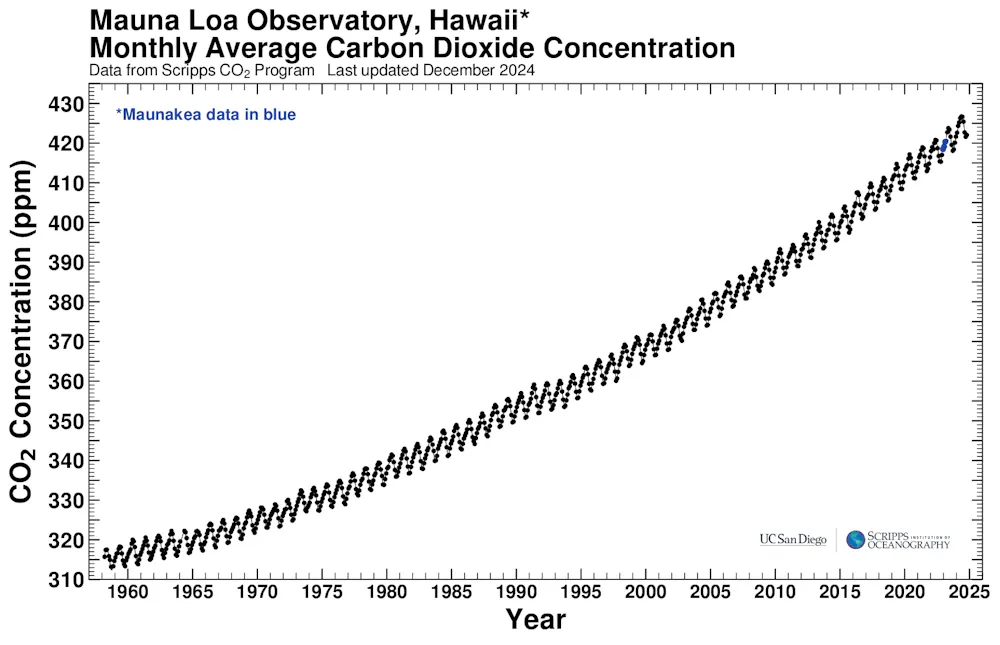
Data collected by Mauna Loa from 1958 onward let us clearly see the evidence of climate change for the first time. The station samples the air and measures global CO₂ levels. Charles Keeling and his successors used this data to produce the famous Keeling curve – a graph showing carbon dioxide levels increasing year after year.
But this precious record is in peril. US President Donald Trump has decided to defund the observatory recording the data, as well as the widespread US greenhouse gas monitoring network and other climate measuring sites.
We can’t solve the existential problem of climate change if we can’t track the changes. Losing Mauna Loa would be a huge loss to climate science. If it shuts, other observatories such as Australia’s Kennaook/Cape Grim will become even more vital.
The first year of measurements at Mauna Loa revealed something incredible. For the first time, the clear annual cycle in atmospheric CO₂ was visible. As plants grow in summer, they absorb CO₂ and draw it out of the atmosphere. As they die and decay in winter, the CO₂ returns to the atmosphere. It’s like Earth is breathing.
Most land on Earth is in the Northern Hemisphere, which means this cycle is largely influenced by the northern summer and winter.
The annual cycle of carbon dioxide is largely due to plant growth and decay in the northern hemisphere.
It only took a few years of measurements before an even more profound pattern emerged.
Year on year, CO₂ levels in the atmosphere were relentlessly rising. The natural in-out cycle continued, but against a steady increase.
Scientists would later figure out that the ocean and land together were absorbing almost half of the CO₂ produced by humans. But the rest was building up in the atmosphere.
Crucially, isotopic measurements meant scientists could be crystal clear about the origin of the extra carbon dioxide. It was coming from humans, largely through burning fossil fuels.
Mauna Loa has now been collecting data for more than 65 years. The resulting Keeling curve graph is the most iconic demonstration of how human activities are collectively affecting the planet.
When the last of the Baby Boomer generation were being born in the 1960s, CO₂ levels were around 320 parts per million. Now they’re over 420 ppm. That’s a level unseen for at least three million years. The rate of increase far exceeds any natural change in the past 50 million years.
The reason carbon dioxide is so important is that this molecule has special properties. Its ability to trap heat alongside other greenhouse gases means Earth isn’t a frozen rock. If there were no greenhouse gases, Earth would have an average temperature of -18°C, rather than the balmy 14°C under which human civilisation emerged.
The greenhouse effect is essential to life. But if there are too many gases, the planet becomes dangerously hot. That’s what’s happening now – a very sharp increase in gases exceptionally good at trapping heat even at low concentrations.
Greenhouse gases are the reason Earth isn’t an icebox. But the rate humans are emitting them is leading to very rapid changes. Reid Wiseman/NASA, CC BY-NC-ND
Keeping our eyes open
It’s not enough to know CO₂ is climbing. Monitoring is essential. That’s because as the planet warms, both the ocean and the land are expected to take up less and less of humanity’s emissions, letting still more carbon accumulate in the air.
Continuous, high-precision monitoring is the only way to spot if and when that happens.
This monitoring provides the vital means to verify whether new climate policies are genuinely influencing the atmospheric CO₂ curve rather than just being touted as effective. Monitoring will also be vital to capture the moment many have been working towards when government policies and new technologies finally slow and eventually stop the increase in CO₂.
The US administration’s plans to defund key climate monitoring systems and roll back green energy initiatives presents a global challenge.
Without these systems, it will be harder to forecast the weather and give seasonal updates. It will also be harder to forecast dangerous extreme weather events.
Scientists in the US and globally have sounded the alarm about what the closure would do to science. This is understandable. Stopping data climate collection is like breaking a thermometer because you don’t like knowing you’ve got a fever.
If the US follows through, other countries will need to carefully reconsider their commitments to gathering and sharing climate data.
Australia has a long record of direct atmospheric CO₂ measurement, which began in 1976 at the Kennaook/Cape Grim Baseline Air Pollution Station in north-west Tasmania. This and other climate observations will only become more valuable if Mauna Loa is lost.
It remains to be seen how Australia’s leaders respond to the US retreat from climate monitoring. Ideally, Australia would not only maintain but strategically expand its monitoring systems of atmosphere, land and oceans.
Alex Sen Gupta receives funding from the Australian Research Council.
Katrin Meissner receives funding from the Minderoo Foundation and has received funding from the Australian Research Council in the past.
Timothy Raupach receives funding from QBE Insurance, Guy Carpenter, and the Australian Research Council.
The greenhouse effect was discovered more than 150 years ago and the first scientific paper linking carbon dioxide levels in the atmosphere with climate change was published in 1896.
But it wasn’t until the 1950s that scientists could definitively detect the effect of human activities on the Earth’s atmosphere.
In 1956, United States scientist Charles Keeling chose Hawaii’s Mauna Loa volcano for the site of a new atmospheric measuring station. It was ideal, located in the middle of the Pacific Ocean and at high altitude away from the confounding influence of population centres.
Data collected by Mauna Loa from 1958 onward let us clearly see the evidence of climate change for the first time. The station samples the air and measures global CO₂ levels. Charles Keeling and his successors used this data to produce the famous Keeling curve – a graph showing carbon dioxide levels increasing year after year.
But this precious record is in peril. US President Donald Trump has decided to defund the observatory recording the data, as well as the widespread US greenhouse gas monitoring network and other climate measuring sites.
We can’t solve the existential problem of climate change if we can’t track the changes. Losing Mauna Loa would be a huge loss to climate science. If it shuts, other observatories such as Australia’s Kennaook/Cape Grim will become even more vital.
The first year of measurements at Mauna Loa revealed something incredible. For the first time, the clear annual cycle in atmospheric CO₂ was visible. As plants grow in summer, they absorb CO₂ and draw it out of the atmosphere. As they die and decay in winter, the CO₂ returns to the atmosphere. It’s like Earth is breathing.
Most land on Earth is in the Northern Hemisphere, which means this cycle is largely influenced by the northern summer and winter.
The annual cycle of carbon dioxide is largely due to plant growth and decay in the northern hemisphere.
It only took a few years of measurements before an even more profound pattern emerged.
Year on year, CO₂ levels in the atmosphere were relentlessly rising. The natural in-out cycle continued, but against a steady increase.
Scientists would later figure out that the ocean and land together were absorbing almost half of the CO₂ produced by humans. But the rest was building up in the atmosphere.
Crucially, isotopic measurements meant scientists could be crystal clear about the origin of the extra carbon dioxide. It was coming from humans, largely through burning fossil fuels.
Mauna Loa has now been collecting data for more than 65 years. The resulting Keeling curve graph is the most iconic demonstration of how human activities are collectively affecting the planet.
When the last of the Baby Boomer generation were being born in the 1960s, CO₂ levels were around 320 parts per million. Now they’re over 420 ppm. That’s a level unseen for at least three million years. The rate of increase far exceeds any natural change in the past 50 million years.
The reason carbon dioxide is so important is that this molecule has special properties. Its ability to trap heat alongside other greenhouse gases means Earth isn’t a frozen rock. If there were no greenhouse gases, Earth would have an average temperature of -18°C, rather than the balmy 14°C under which human civilisation emerged.
The greenhouse effect is essential to life. But if there are too many gases, the planet becomes dangerously hot. That’s what’s happening now – a very sharp increase in gases exceptionally good at trapping heat even at low concentrations.
Greenhouse gases are the reason Earth isn’t an icebox. But the rate humans are emitting them is leading to very rapid changes. Reid Wiseman/NASA, CC BY-NC-ND
Keeping our eyes open
It’s not enough to know CO₂ is climbing. Monitoring is essential. That’s because as the planet warms, both the ocean and the land are expected to take up less and less of humanity’s emissions, letting still more carbon accumulate in the air.
Continuous, high-precision monitoring is the only way to spot if and when that happens.
This monitoring provides the vital means to verify whether new climate policies are genuinely influencing the atmospheric CO₂ curve rather than just being touted as effective. Monitoring will also be vital to capture the moment many have been working towards when government policies and new technologies finally slow and eventually stop the increase in CO₂.
The US administration’s plans to defund key climate monitoring systems and roll back green energy initiatives presents a global challenge.
Without these systems, it will be harder to forecast the weather and give seasonal updates. It will also be harder to forecast dangerous extreme weather events.
Scientists in the US and globally have sounded the alarm about what the closure would do to science. This is understandable. Stopping data climate collection is like breaking a thermometer because you don’t like knowing you’ve got a fever.
If the US follows through, other countries will need to carefully reconsider their commitments to gathering and sharing climate data.
Australia has a long record of direct atmospheric CO₂ measurement, which began in 1976 at the Kennaook/Cape Grim Baseline Air Pollution Station in north-west Tasmania. This and other climate observations will only become more valuable if Mauna Loa is lost.
It remains to be seen how Australia’s leaders respond to the US retreat from climate monitoring. Ideally, Australia would not only maintain but strategically expand its monitoring systems of atmosphere, land and oceans.
Alex Sen Gupta receives funding from the Australian Research Council.
Katrin Meissner receives funding from the Minderoo Foundation and has received funding from the Australian Research Council in the past.
Timothy Raupach receives funding from QBE Insurance, Guy Carpenter, and the Australian Research Council.
The government has spent NZ$507.3 million on cancelled iReX ferry plans, the country’s fleet has an average age of 28 years, and the earliest New Zealanders can hope for promised replacements is 2029.
The Marlborough Chamber of Commerce warns unreliable ferries already shake tourist confidence. Several more years of duct-tape solutions won’t help.
The recent pattern of breakdowns and cancellations has become so routine that New Zealand risks normalising what should be viewed as a national crisis: a serious infrastructure failure.
It is also a textbook example of how short-term political cycles, coupled with chronic under-investment, create far more expensive problems than the ones they promise to solve.
Cost blowouts
While ministers claim to have spared taxpayers a $4 billion blowout on new ferries, Treasury papers show almost 80% of the cost escalation lay in seismic upgrades for wharves, not in the vessels themselves. Those land-side works will be required no matter what ferries the country eventually orders.
Justifying the original contract cancellation, Finance Minister Nicola Willis quipped that iReX was a Ferrari when a Toyota Corolla would do. But the cost of finding a suitable Corolla is adding up fast.
By retiring the Aratere this year – New Zealand’s only rail-capable ferry – the government is also severing the interisland rail link for almost five years.
KiwiRail will “road-bridge” rail freight, an expensive workaround that involves loading train cars onto trucks, putting those trucks on ferries, then reversing the process at the other end. This will increase truck traffic, produce more emissions and add more wear to already strained infrastructure.
The cancelled hybrid ferries would have also cut emissions by 40%. Instead, New Zealand is locking in higher emissions for another half decade or longer.
Unrealistic timelines
The ferry saga reflects New Zealand’s infrastructure problem in a nutshell. The country tends to underestimate costs, create unfeasible timelines, then shows dismay when projects blow up or limp home at double the price.
When New Zealand does build –Transmission Gully, for example – the final bill bears little resemblance to initial quotes. The 27 kilometre motorway north of Wellington was nearly 50% over budget and took eight years to build – two years longer than promised.
The systematic underestimation of costs reflects a flawed approach to infrastructure planning. Politicians need quick wins within three-year electoral cycles, while infrastructure projects take decades to deliver.
Projects are approved based on lowball estimates, with the outcome inherited by another administration. This has crossed party lines and created a system that rewards short-term thinking and punishes long-term planning.
Just consider the second crossing for Auckland Harbour. For 35 years, the government has commissioned study after study – from the 1988 tunnel plans to the 2010 business cases – each time backing away when the price tag appeared, or the government changed.
The iReX cancellation marks the first time the government has actually signed contracts and then walked away. As with the second Auckland Harbour crossing, each delay has only made the inevitable solution more expensive.
Other countries have, to a degree, addressed this problem. Infrastructure Australia, for example, provides independent cost assessments and long-term planning that transcends political cycles. New Zealand’s Infrastructure Commission, established in 2019, lacks similar teeth and independence.
Ultimately this isn’t really about ferries. It’s about how New Zealand consistently fails to deliver, on time and at cost, the infrastructure that keeps its economy moving.
Timothy Welch does not work for, consult, own shares in or receive funding from any company or organisation that would benefit from this article, and has disclosed no relevant affiliations beyond their academic appointment.
The government has spent NZ$507.3 million on cancelled iReX ferry plans, the country’s fleet has an average age of 28 years, and the earliest New Zealanders can hope for promised replacements is 2029.
The Marlborough Chamber of Commerce warns unreliable ferries already shake tourist confidence. Several more years of duct-tape solutions won’t help.
The recent pattern of breakdowns and cancellations has become so routine that New Zealand risks normalising what should be viewed as a national crisis: a serious infrastructure failure.
It is also a textbook example of how short-term political cycles, coupled with chronic under-investment, create far more expensive problems than the ones they promise to solve.
Cost blowouts
While ministers claim to have spared taxpayers a $4 billion blowout on new ferries, Treasury papers show almost 80% of the cost escalation lay in seismic upgrades for wharves, not in the vessels themselves. Those land-side works will be required no matter what ferries the country eventually orders.
Justifying the original contract cancellation, Finance Minister Nicola Willis quipped that iReX was a Ferrari when a Toyota Corolla would do. But the cost of finding a suitable Corolla is adding up fast.
By retiring the Aratere this year – New Zealand’s only rail-capable ferry – the government is also severing the interisland rail link for almost five years.
KiwiRail will “road-bridge” rail freight, an expensive workaround that involves loading train cars onto trucks, putting those trucks on ferries, then reversing the process at the other end. This will increase truck traffic, produce more emissions and add more wear to already strained infrastructure.
The cancelled hybrid ferries would have also cut emissions by 40%. Instead, New Zealand is locking in higher emissions for another half decade or longer.
Unrealistic timelines
The ferry saga reflects New Zealand’s infrastructure problem in a nutshell. The country tends to underestimate costs, create unfeasible timelines, then shows dismay when projects blow up or limp home at double the price.
When New Zealand does build –Transmission Gully, for example – the final bill bears little resemblance to initial quotes. The 27 kilometre motorway north of Wellington was nearly 50% over budget and took eight years to build – two years longer than promised.
The systematic underestimation of costs reflects a flawed approach to infrastructure planning. Politicians need quick wins within three-year electoral cycles, while infrastructure projects take decades to deliver.
Projects are approved based on lowball estimates, with the outcome inherited by another administration. This has crossed party lines and created a system that rewards short-term thinking and punishes long-term planning.
Just consider the second crossing for Auckland Harbour. For 35 years, the government has commissioned study after study – from the 1988 tunnel plans to the 2010 business cases – each time backing away when the price tag appeared, or the government changed.
The iReX cancellation marks the first time the government has actually signed contracts and then walked away. As with the second Auckland Harbour crossing, each delay has only made the inevitable solution more expensive.
Other countries have, to a degree, addressed this problem. Infrastructure Australia, for example, provides independent cost assessments and long-term planning that transcends political cycles. New Zealand’s Infrastructure Commission, established in 2019, lacks similar teeth and independence.
Ultimately this isn’t really about ferries. It’s about how New Zealand consistently fails to deliver, on time and at cost, the infrastructure that keeps its economy moving.
Timothy Welch does not work for, consult, own shares in or receive funding from any company or organisation that would benefit from this article, and has disclosed no relevant affiliations beyond their academic appointment.
Source: The Conversation (Au and NZ) – By Alan Pearce, Professor, Adjunct Research Fellow, School of Health Science, Swinburne University of Technology
Bringing this weighty issue to greater prominence are the former athletes who bravely share their long-term health struggles after careers in sport – cognitive impairments, mental health issues or concerns about neurodegenerative disease, specifically chronic traumatic encephalopathy (CTE).
Yet for all the progress made by many sports in recent years, it feels like we still have not fully grasped the understanding of CTE – or maybe we don’t want to.
Expert groups agree on the links between traumatic brain injury and increased risk of Alzheimer’s disease (and other dementias), and the growing evidence of links to MND and Parkinson’s.
These impacts may not be diagnosed brain injuries or concussions, but rather non-concussive impacts (smaller hits that do not produce signs or symptoms of concussion).
Contrary to anecdotal opinion, an athlete’s concussion history is not the crucial variable in risk and severity of CTE.
Emerging international evidence, including my own recently published studies, show the risk of developing CTE (and its severity) is linked to exposure: the age a person starts full contact sport and the length of a playing career.
The grey area of concussion, CTE and mental health
Currently, CTE cannot be diagnosed in living people.
However in understanding the progression of the disease in those who have passed away with CTE, families have described signs and symptoms including cognitive impairments such as:
Parkinsonism
memory loss
trouble with planning and organising tasks
impulsive behaviours
anger and irritability
emotional instability
substance misuse
suicidal thoughts/behaviour.
While these signs and symptoms can overlap with those we associate with mental health, this does not necessarily mean the affected person had “mental health concerns”.
The continued awareness in men’s mental health is a good thing broadly but it has sometimes misappropriated CTE as a mental health issue. For example, some fundraising games in the names of athletes who have died with CTE are being channelled to mental health charities and institutes, confusing the wider community.
Consequently two recent tragic stories, one from the family of deceased former AFL player Shane Tuck and the other from Amanda Green, the widow of the late NRL player and coach Paul Green, needed to be told.
Their stories contradicted widely held beliefs in the media and among fans that Tuck or Green were suffering with a psychiatric disease prior to their untimely deaths. In fact, they had CTE.
An uncomfortable conversation
So, why aren’t we talking about CTE more?
The answer is, unfortunately it is an inconvenient truth.
Considering CTE is entirely preventable if we remove exposure risk of repetitive hits to the head, the solution is to further modify many of our most popular sports to make head impacts much rarer.
There is sizeable opposition to this idea.
“Now is not the time to discuss such ‘political’ issues,” is the response I usually get from academics and colleagues involved in these sports, and even football loving friends, when I try to raise awareness.
This continued hesitation only slows the science of CTE further.
If an athlete’s family has been courageous in donating their brain to the Australian Sports Brain Bank and CTE has been found, the standard response from sports organisations is:
the (insert sport here) takes athlete health and wellbeing as its greatest priority […] the (insert sport here) has implemented strict concussion protocols and continues research into athletes’ brain health.
In fact, while most sports have tried to become safer through rule changes, progress more broadly has plateaued or even regressed in recent years.
Take one recent example in the NRL, when some in the rugby league community made light of the multiple concussions suffered by Victor Radley. After playing his 150th game, he posed smiling with a t-shirt detailing the number of concussions he had suffered during his career. His club, the Sydney Roosters, posted the photo on Instagram before it was later removed.
Even more worrying is a new controversial activity called “RunIt”, which involves two men running full speed at each other with the intention of knocking over (or more aptly knocking out) the opponent.
With the help of the Concussion Legacy Foundation, experts around the world, including myself, have produced a CTE prevention protocol. This does not mean banning any sports but rather modifying components that will reduce exposure risk.
Here are five ideas I believe would make a difference.
1. Reducing contact loads in training, particularly in pre-season training.
2.Modify contact sports for children until the age of 14. This potentially removes six to eight years of incidental and unnecessary hits to kids’ heads. They can still play and learn all the fundamental motor skills and enjoy the psychological benefits of sport before graduating to the full version of the game at 14.
3. Influential media commentators need to upskill themselves around CTE and to not be afraid to mention CTE rather than deferring to “concussion protocols”.
4. Medical and allied health practitioners do not regularly screen for concussion or contact sport playing history when assessing a patient who is struggling with movement disorders, chronic headaches/fatigue or cognitive/behavioural impairments. Repetitive head impact history should be screened just like alcohol and drug use history.
5. When an athlete suddenly and tragically dies, we need to include, along with emergency help lines, information for help and support for those unsure about CTE.
Unfortunately, if we don’t have the political will to acknowledge CTE and act, more families will be grieving tragic deaths of athletes. These families may not even be aware of CTE.
This does not make me anti-sport, but pro-athlete. Let’s all become pro-athlete for the sake of our sports and the people who play them.
Alan Pearce is currently unfunded. Alan is a non-executive director for the Concussion Legacy Foundation (unpaid position) and Adjunct research manager for the Australian Sports Brain Bank (unpaid position). He has previously received funding from Erasmus+ strategic partnerships program (2019-1-IE01-KA202-051555), Sports Health Check Charity (Australia), Australian Football League, Impact Technologies Inc., and Samsung Corporation, and is remunerated for expert advice to medico-legal practices.
Ancient wooden tools found at a site in Gantangqing in southwestern China are approximately 300,000 years old, new dating has shown. Discovered during excavations carried out in 2014–15 and 2018–19, the tools have now been dated by a team of archaeologists, geologists, chronologists (including me) and paleontologists.
The rare wooden tools were found alongside an assortment of animal and plant fossils and stone artifacts.
Taken together, the finds suggest the early humans at Gantangqing were surprisingly sophisticated woodworkers who lived in a rich tropical or subtropical environment where they subsisted by harvesting plants from a nearby lake.
The location of the Gantangqing site and excavation trenches. Liu et al. / Science
Why ancient wooden tools are so rare
Wood usually decomposes relatively rapidly due to microbial activity, oxidation, and weathering. Unlike stone or bone, it rarely survives more than a few centuries.
Wood can only survive for thousands of years or longer if it ends up buried in unusual conditions. Wood can last a long time in oxygen-free environments or extremely dry areas. Charred or fire-hardened wood is also more durable.
At Gantangqing, the wooden objects were excavated from low-oxygen clay-heavy layers of sediment formed on the ancient shoreline of Fuxian Lake.
Wooden implements are extremely rare from the Early Palaeolithic period (the first part of the “stone age” from around 3.3 million years ago until 300,000 years ago or so, in which our hominin ancestors first began to use tools). Indeed, wooden tools more than even 50,000 years old are virtually absent outside Africa and western Eurasia.
As a result, we may have a skewed understanding of Palaeolithic cultures. We may overemphasise the role of stone tools, for example, because they are what has survived.
What wooden tools were found at Gantangqing?
The new excavations at Gantangqing found 35 wooden specimens identified as artificially modified tools. These tools were primarily manufactured from pine wood, with a minority crafted from hardwoods.
Some of the tools had rounded ends, while others had chisel-like thin blades or ridged blades. Of the 35 tools, 32 show marks of intentional modification at their tips, working edges, or bases.
Two large digging implements were identified as heavy-duty digging sticks designed for two-handed use. These are unique forms of digging implements not documented elsewhere, suggesting localised functional adaptations. There were also four distinct hook-shaped tools — likely used for cutting roots — and a series of smaller tools for one-handed use.
Nineteen of the tools showed microscopic traces of scraping from shaping or use, while 17 exhibit deliberately polished surfaces. We also identified further evidence of intensive use, including soil residues stuck to tool tips, parallel grooves or streaks along working edges, and characteristic fracture wear patterns.
The tools from Gantangqing are more complete and show a wider range of functions than those found at contemporary sites such as Clacton in the UK and Florisbad in South Africa.
The team used several techniques to figure out the age of the wooden tools. There is no way to determine their age directly, but we can date the sediment in which they were found.
Using a technique called infrared stimulated luminescence, we analysed more than 10,000 individual grains of minerals from different layers. This showed the sediment was deposited roughly between 350,000 and 200,000 years ago.
Dating the different layers of sediment excavated at the site produced a detailed timeline. Liu et al. / Science
We also used different techniques to date a mammal tooth found in one of the layers to roughly 288,000 years old. This was consistent with the mineral results.
Next we used mathematical modelling to bring all the dating results together. Our model indicated that the layers containing stone tools and wooden implements date from 360–300,000 years ago to 290–250,000 years ago.
What was the environment like?
Our research indicates the ancient humans at Gantangqing inhabited a warm, humid, tropical or subtropical environment. Pollen extracted from the sediments reveals 40 plant families that confirm this climate.
Plant fossils further verify the presence of subtropical-to-tropical flora dominated by trees, lianas, shrubs and herbs. Wet-environment plants show the local surroundings were a lakeside or wetlands.
Animal fossils also fit this picture, including rhinoceros and other mammals, turtles and various birds. The ecosystem was likely a mosaic of grassland, thickets and forests. Evidence of diving ducks confirms the lake must have been at least 2–3 metres deep during human occupation.
The site contained evidence of plants such as storable pine nuts and hazelnuts, fruit trees such as kiwi, raspberry-like berries, grapes, edible herbs and fern fronds.
There were also aquatic plants that would have provided edible leaves, seeds, tubers and rhizomes. These were likely dug up from shallow mud near the shore, using wooden tools.
These findings suggest the Gantangqing hominins may have made expeditions to the lake shore, carrying purpose-made wooden digging sticks to harvest underground food sources. To do this, they would have had to anticipate seasonal plant distributions, know exactly what parts of different plants were edible, and produce specialised tools for different tasks.
Why the Gantangqing site is important
The wooden implements from Gantangqing represent the earliest known evidence for the use of digging sticks and for the exploitation of underground plant storage organs such as tubers within the Oriental biogeographic realm. Our discovery shows the use of sophisticated wood technology in a very different environmental context from what has been seen at sites of similar age in Europe and Africa.
The find significantly expands our understanding of early hominin woodworking capabilities.
The hominins who lived at Gantangqing appear to have lived a heavily plant-based subsistence lifestyle. This is in contrast to colder, more northern settings where tools of similar age have been found (such as Schöningen in Germany), where hunting large mammals was the key to survival.
The site also shows how important wood – and perhaps other organic materials – were to “stone age” hominins. These wooden artifacts show far more sophisticated manufacturing skill than the relative rudimentary stone tools found at sites of similar age across East and Southeast Asia.
The excavation, curation, and research of the Gantangqing site were supported by
National Cultural Heritage Administration (China), Yunnan Provincial Institute of
Cultural Relics and Archaeology, Yuxi Municipal Bureau of Culture and Tourism,
Chengjiang Municipal Bureau of Culture and Tourism, Australian Research Council
(ARC) Discovery Projects, Strategic Priority Research Program of the Chinese
Academy of Sciences, Hong Kong Research Grants Council (RGC), National Natural
Science Foundation of China (NSFC).
Noon Briefing by Stéphane Dujarric, Spokesperson for the Secretary-General.
Highlights:
Secretary-General/Trip Announcement
Deputy Secretary-General
Gaza
Occupied Palestinian Territory
Lebanon
Cyprus
Ukraine
Russia
Senior Personnel Appointment
Yemen
Global Risk Report
International Days
Financial Contribution
SECRETARY-GENERAL/TRIP ANNOUNCEMENT
The Secretary-General will be arriving in Rio de Janeiro, Brazil, to attend the 17th Summit of the BRICS countries.
The Secretary-General has been invited to speak at an outreach session on “Strengthening multilateralism, economic-financial affairs and artificial intelligence”, that will take place on Sunday, 6 July. On Monday, 7 July, he will address a second outreach session, on “Environment, COP30 and global health.”
During his visit, the Secretary-General will also be having meetings with various leaders who are attending the BRICS Summit and we will share those readouts with you.
DEPUTY SECRETARY-GENERAL
Our Deputy Secretary-General, Amina Mohammed, returned to Seville today for the closing of the Fourth International Conference on Financing for Development (FFD4).
At the closing with Prime Minister Pedro Sanchez of Spain, she underscored the consensus around the Seville Agreement as a demonstration of multilateralism in action — with actions to close the SDG financing gap, address the debt crisis, and reform the international financial architecture. She recognized the more than 100 initiatives launched on the Sevilla Platform for Action, including solidarity levies on private jets and first-class travel to generate new resources for sustainable development.
She said that the UN will be operationalizing a Seville Forum on Debt to help countries learn from one another and coordinate their approaches in debt management and restructuring; that forum will be supported by Spain.
She called for FFD4 to be remembered not only as a conference that responded to crisis, but as the moment the world chose cooperation over fragmentation, unity over division, and action over inertia.
Tomorrow, she will travel to Praia, Cabo Verde, to take part in celebrations marking the 50th anniversary of the country’s independence.
GAZA
The Secretary-General is appalled by the deepening humanitarian crisis in Gaza. Multiple attacks in recent days hitting sites hosting displaced people and people trying to access food have killed and injured scores of Palestinians. The Secretary-General strongly condemns the civilian loss of life.
In just one day this week, Israeli orders to relocate forced nearly 30,000 people to flee, yet again, with no safe place to go and clearly inadequate supplies of shelter, food, medicine or water.
International humanitarian law is unambiguous: civilians must be respected and protected, and the needs of the population must be met.
With no fuel having entered Gaza in more than 17 weeks, the Secretary-General is gravely concerned that the last lifelines for survival are being cut off. Without an urgent influx of fuel, incubators will shut down, ambulances will be unable to reach the injured and sick, and water cannot be purified. The delivery by the United Nations and partners of what little of our lifesaving humanitarian aid is left in Gaza will also grind to a halt.
He once again calls for full, safe and sustained humanitarian access so aid can reach people who have been deprived of the basics of life for far too long. The UN has a clear and proven plan, rooted in the humanitarian principles, to get vital assistance to civilians – safely and at scale, wherever they are.
The Secretary-General reiterates that all parties must uphold their obligations under international law. He renews his call for an immediate permanent ceasefire and for the immediate and unconditional release of all hostages held by Hamas and other groups.
Full Highlights:
https://www.un.org/sg/en/content/noon-briefing-highlight?date%5Bvalue%5D%5Bdate%5D=03%20July%202025
Source: United States Senator for Arkansas – John Boozman
Senate Page Sawyer Mann and Senator John Boozman in his office on Capitol Hill.
WASHINGTON—High school student Sawyer Mann spent part of his summer in the nation’s capital navigating the corridors of Congress. The rising senior from Sparkman served as a U.S. Senate Page alongside several dozen other high schoolers from across the country.
Mann and his peers reported to work one hour before the Senate convened on weekdays and helped prepare the U.S. Senate chamber for daily business, distributed documents to senators’ desks, assisted in the cloakrooms, supported chamber staff and – when the body was in session – sat near the dais waiting to aid members delivering remarks or casting votes.
“Serving as a Senate Page taught me that even the smallest roles can stand in the shadow of history and still help carry it forward,” Mann said.
Mann earned his appointment to the position from Senator John Boozman (R-AR), who has long promoted the program for Arkansas youth interested in civics and public service.
“Sawyer did an excellent job supporting the day-to-day activity of the Senate while observing legislative processes and procedures firsthand. I am confident that serving as a Page will inspire him to continue exploring his interest in public policy and enhance his leadership skills. Our entire state can be proud of how he represented us in this prestigious program,” Boozman said.
Mann is an active participant in Future Farmers of America and a member of the Camden Harmony Grove High School yearbook staff. He also served on the student council as sophomore and junior class representative, and as captain of the quiz bowl team.
While in Washington, D.C., he toured the National Archives and visited several Smithsonian museums in addition to attending a showing of Les Misérables at the Kennedy Center for the Performing Arts.
He is the son of Russ Mann and Lauren Franks.
The Senate Page program started in 1829 when Senator Daniel Webster appointed the first Senate Page. Today, the program is a unique, highly selective opportunity for high school juniors with a strong academic standing to learn firsthand about the institution often referred to as “the world’s greatest deliberative body.”
Source: United States House of Representatives – Congressman Ron Estes (R-Kansas)
Rep. Estes Delivers Remarks On House Floor In Support Of The One Big, Beautiful Bill
WASHINGTON – Today, U.S. Congressman Ron Estes (R-Kansas) delivered remarks on the House floor in support of H.R. 1 – the One Big Beautiful Bill Act. Read the full remarks below. Watch on YouTube and Rumble.
Remarks as delivered:
Mr. Speaker, I rise today on behalf of the Kansas families, workers, and small businesses who will benefit from the One Big Beautiful Bill.
By extending and improving the TCJA, working-class families in my district will pay $10,900 less in taxes and see increased wages of $7,200 on average. It contains my bipartisan legislation to make research and development expensing permanent – a jobs provision ensuring America continues to lead the world entirely on innovation. It eliminates fraud and waste in Obamacare, and it builds on President Trump’s successes at securing the border.
Despite the misleading spin from my colleagues on the left, this bill delivers on what Americans voted for in November – it’s time to pass the One Big Beautiful Bill.
July 3, 2025Washington, DC, United StatesStatement
WASHINGTON — On July 2, Rep. Pramila Jayapal (D-Wash.) called U.S. Immigration and Customs Enforcement a “terrorist force.”
Acting ICE Director Todd M. Lyons’ response to the congresswoman:
“An actual Antifa terrorist tried to blow up ICE’s Northwest Processing Center in Rep. Jayapal’s home state of Washington in 2019. At the time, she tried to blame the violent attack on rhetoric from the right, in defense of an actual terrorist who tried to murder detainees and employees alike!
Now, she labels ICE officers enforcing immigration law set by Congress ‘terrorists.’ This, at a time when officers are facing a nearly 700% increase in assaults, in part due to the type of rhetoric she spews. Never in a million years did I think I would witness a sitting member of Congress prioritize regard for violent criminals over the law enforcement officers protecting her community from actual public safety threats. The only apology needed is from the congresswoman to the people who voted for her.”
July 3, 2025Washington, DC, United StatesStatement
WASHINGTON — On July 2, Rep. Pramila Jayapal (D-Wash.) called U.S. Immigration and Customs Enforcement a “terrorist force.”
Acting ICE Director Todd M. Lyons’ response to the congresswoman:
“An actual Antifa terrorist tried to blow up ICE’s Northwest Processing Center in Rep. Jayapal’s home state of Washington in 2019. At the time, she tried to blame the violent attack on rhetoric from the right, in defense of an actual terrorist who tried to murder detainees and employees alike!
Now, she labels ICE officers enforcing immigration law set by Congress ‘terrorists.’ This, at a time when officers are facing a nearly 700% increase in assaults, in part due to the type of rhetoric she spews. Never in a million years did I think I would witness a sitting member of Congress prioritize regard for violent criminals over the law enforcement officers protecting her community from actual public safety threats. The only apology needed is from the congresswoman to the people who voted for her.”
Regulations developed to prevent discriminatory housing practices, racially segregated neighborhoods
OAKLAND — California Attorney General Rob Bonta today co-led a coalition of 21 attorneys general in sending a letter to the U.S. Department of Housing and Urban Development (HUD) opposing a proposed rule that would rollback critical fair housing regulations that prohibit discrimination in the marketing of affordable housing. The Affirmative Fair Housing Marketing (AFHM) regulations require owners of federally assisted housing to target advertising and outreach regarding their properties to communities that otherwise might not have learned about the opportunity to live there. The proposed rule would repeal these regulations, which are designed to ensure that federally assisted housing providers do not market available housing to only certain groups as had been done in the past to maintain racially segregated neighborhoods.
“The Trump Administration is working to roll back critical fair housing regulations that prohibit discrimination — protections put in place in the 70’s to combat the insidious persistence of segregated neighborhoods — protections that are essential today to ensure that housing opportunities for underserved communities remain accessible,” said Attorney General Bonta. “The national housing crisis is driven by a shortage of housing supply and unaffordability that disproportionately affects communities of color. Today I urge the Administration to look closely at the mandate they inherited in the Fair Housing Act and understand that letting a broader range of buyers know about affordable housing opportunities that are available to them is necessary to ensure that these opportunities remain accessible for all Americans.”
Historically, government at all levels throughout the United States, along with private developers and mortgage lending institutions, played an active role in creating segregated living patterns, which perpetuated inequalities in access to opportunity. The Fair Housing Act, through AFHM regulations, requires HUD and recipients of federal funds from HUD to administer their programs in a manner to affirmatively further fair housing by ensuring that the agency and its program participants take meaningful actions to overcome patterns of segregation, promote fair housing choice, eliminate disparities in opportunities, and foster inclusive communities. The Fair Housing Act prohibits discrimination based on race, color, national origin, religion, sex (including gender and sexual orientation), familial status, and disability.
AFHM requirements require that owners and developers of HUD-subsidized housing have marketing programs in place to reach groups that are protected from discrimination by the Fair Housing Act and are not as likely to apply for such housing. Housing providers must then select methods of outreach and advertising, that are designed to reach those communities. Too often, the populations that are the least likely to apply are those that are underrepresented in the area where the property is located, especially affordable properties in high opportunity areas — areas that offer residents enhanced access to economic mobility and improved living conditions. The AFHM regulations do not dictate which tenants an owner must select for a unit, and nothing prohibits landlords from advertising through other media that reach different populations as well.
In the letter, the attorneys general argue that the proposed repeal of these longstanding regulations is in direct contradiction with the mandate of the Fair Housing Act — to affirmatively further fair housing through ensuring non-discriminatory marketing practices — especially so given the lack of:
a replacement rule;
an explanation of how HUD will affirmatively ensure that covered program participants are not engaging in discriminatory and unlawful housing marketing practices in violation of federal law; and
legally sufficient or evidence-based justifications for this total reversal of over 50 years of federal housing policy and law.
The attorneys general hold a vested interest in ensuring equal access to housing and eradicating discrimination in communities nationwide. The national housing crisis is driven by a shortage of housing supply and skyrocketing unaffordability that disproportionately affects communities of color. The highest disparities are experienced by Black households — a byproduct of systemic racism and policies that targeted Black people and neighborhoods home to primarily Black people. Data on fair housing complaints confirm that proactive fair housing measures, including in advertising, are as vital as ever. In 2023, record high levels of fair housing complaints were submitted to HUD, the U.S. Department of Justice, and other fair housing organizations; the annual number of complaints has consistently risen.
In sending today’s letter Attorney General Bonta and the attorneys general from Maryland and New York lead the attorneys general of Arizona, Colorado, Connecticut, Hawaii, Illinois, Maine, Massachusetts, Michigan, Minnesota, Nevada, New Jersey, New Mexico, North Carolina, Oregon, Rhode Island, Vermont, Washington, and the District of Columbia.
Fighting between warring parties is creating a desperate situation for civilians in El Fasher, Sudan, and its surrounding areas.
MSF’s new report exposes systematic patterns of violence in the area, that includes looting, mass killings, sexual violence, abductions, and starvation.
MSF urges the warring parties to spare civilians and grant access for humanitarian organisations to provide critical aid to people in need.
Mass atrocities are underway in Sudan’s North Darfur region, Médecins Sans Frontières (MSF) warned in a report today, urging the warring parties of the conflict in Sudan to halt indiscriminate and ethnically targeted violence and facilitate an immediate large-scale humanitarian response. While daily fighting in El Fasher is already putting lives at risk, MSF is extremely concerned about the threats of a full-blown assault on the hundreds of thousands of people in the city.
As fighting has intensified in the area since May 2024, civilians have continued to be the main victims. The report, Besieged, Attacked, Starved, outlines a desperate situation for civilians in and around El Fasher that requires immediate attention and response.
“People are not only caught in indiscriminate heavy fighting between the Rapid Support Forces (RSF) and the Sudanese Armed Forces (SAF) and their respective allies – but also actively targeted by the RSF and its allies, notably on the basis of their ethnicity,” says Michel Olivier Lacharité, MSF head of emergencies.
Based on MSF data, direct observations and over 80 interviews conducted between May 2024 and May 2025 with patients and people who were displaced from El Fasher and nearby Zamzam camp, the report exposes systematic patterns of violence that includes looting, mass killings, sexual violence, abductions, starvation and attacks against markets, health facilities, and other civilian infrastructure.
“As patients and communities tell their stories to our teams and asked us to speak out, while their suffering is hardly on the international agenda, we felt compelled to document these patterns of relentless violence that have been crushing countless lives in general indifference and inaction over the past year,” says Mathilde Simon, MSF’s humanitarian affairs advisor.
Besieged, Attacked, Starved also details how the RSF and their allies conducted a large-scale ground offensive in April on Zamzam camp for displaced people, located outside of El Fasher, which caused an estimated 400,000 people to flee in less than three weeks in appalling conditions. A large portion of the camp’s population fled to El Fasher, where they remained trapped, out of reach of humanitarian aid and exposed to attacks and further mass violence. Tens of thousands more escaped to Tawila, about 60 kilometres away, and to camps across the Chadian border, where hundreds of survivors of violence received care from MSF teams.
“In light of the ethnically motivated mass atrocities committed on the Masalit in West Darfur back in June 2023, and of the massacres perpetrated in Zamzam camp in North Darfur, we fear such a scenario will be repeated in El Fasher. This onslaught of violence must stop,” says Simon.
Several witnesses report that RSF soldiers spoke of plans to ‘clean El Fasher’ of its non-Arab community. Since May 2024, the RSF and their allies have besieged El Fasher, Zamzam camp, and other surrounding localities, cutting communities off from food, water, and medical care. This has contributed to the spread of famine and debilitated the humanitarian response.
Repeated attacks on healthcare facilities forced MSF to end our medical activities in El Fasher in August 2024 and in Zamzam camp in February 2025. In May 2024 alone, health facilities supported by MSF in El Fasher endured at least seven incidents of shelling, bombing or shooting by all warring parties. Indiscriminate airstrikes conducted by the SAF had devastating consequences.
“The SAF bombed our neighbourhood by mistake, then came to apologise. SAF planes sometimes bombed civilian areas without any RSF [presence], I saw it in different places,” says one woman.
The harrowing level of violence on the roads out of El Fasher and Zamzam means that many people are trapped or take life-threatening risks when fleeing. Men and boys are at high risk of killing and abduction, while women and girls are subjected to widespread sexual violence. Most witnesses also report increased risks for Zaghawa communities.
“Nobody could get out [of El Fasher] if they said they were Zaghawa,” says a displaced woman.
Another man tells us that RSF and its allies were “asking people if they belonged to the Zaghawa, and if they did, they would kill them”.
“They would only let mothers with small children under the age of five through,” says a woman about her journey fleeing to eastern Chad. “Other children and adult men didn’t go through. Men over fifteen can hardly cross the border [into Chad]. They take them, they push them aside and then we only hear a noise, gunshots, indicating that they are dead, that they have been killed […] Fifty families came along with me. Not even one boy of 15 years old or above was among us.”
The catastrophic nutrition situation continued deteriorating as the siege tightened on Zamzam camp.
“[Three months ago] in Zamzam, we sometimes had three days a week without eating,” one man tells our teams.
“Children died from malnutrition. We were eating ambaz [residue of peanuts ground for oil], like everyone, although usually it’s used for animals,” says a displaced woman.
“Zamzam was completely blocked,” another displaced person tells us. “Water wells depend on fuel and there was no access to fuel, so all of them stopped working. Water was very limited and very expensive.”
MSF urges the warring parties to spare civilians and respect their obligations under international humanitarian law. The RSF and their allies must immediately stop ethnic violence perpetrated against non-Arab communities, lift the siege of El Fasher, and guarantee safe routes for civilians fleeing violence. Safe unrestricted access to El Fasher and its surroundings must be granted for humanitarian agencies to provide critically needed assistance.
International actors, including UN institutions and members states, and states who provide support to the warring parties must urgently mobilise and exert pressure to prevent further mass violence and allow emergency aid delivery. The recent unilateral announcements of a possible local ceasefire have not yet been translated into concrete change on the ground, and time is running out.