Category: Economics

  • MIL-OSI Economics: Exploits and vulnerabilities in Q4 2024

    Source: Securelist – Kaspersky

    Headline: Exploits and vulnerabilities in Q4 2024

    Q4 2024 saw fewer published exploits for Windows and Linux compared to the first three quarters. Although the number of registered vulnerabilities continued to rise, the total number of Proof of Concept (PoC) instances decreased compared to 2023. Among notable techniques in Q4, attackers leveraged undocumented RPC interfaces and targeted the Windows authentication mechanism.

    Statistics on registered vulnerabilities

    This section contains statistics on registered vulnerabilities. Data is sourced from the CVE portal: cve.org.

    Total number of registered vulnerabilities and number of critical ones, Q4 2023 vs. Q4 2024 (download)

    In Q4 2024, the trend of documenting software flaws that create vulnerabilities continued to gain momentum. The share of vulnerabilities labeled as critical was slightly higher than in Q4 2023. In general, more and more vulnerabilities are being assigned CVE identifiers through Bug Bounty programs and general software security research. Let’s also examine the number of public exploits.

    Number of vulnerabilities, the share of critical ones, and those for which exploits exist, 2019–2024 (download)

    As shown in the graph, the number of published exploits for vulnerabilities ended up at around 6%, which is 4 p.p. lower than in 2023. This decline may be due to vendors’ requirements not to disclose information about exploitation methods for discovered vulnerabilities and corresponding exploits—we believe researchers are increasingly encountering such requests. Thus, the main trends of 2024 were the growth in the number of registered vulnerabilities, the decrease in the number of PoCs, and the share of critical vulnerabilities remaining at 2023 levels.

    Let’s examine the most popular types of vulnerabilities exploited in real attacks in 2023 and 2024.

    Number of vulnerabilities by the most prevalent CWEs used in attacks on users in 2023 (download)

    Number of vulnerabilities by the most prevalent CWEs used in attacks on users in 2024 (download)

    As in 2023, the top three in the list are the following software issues:

    • CWE-78—Improper or insufficient neutralization of command-line inputs (OS Command Injection);
    • CWE-20—Improper input filtering and validation. This includes most vulnerabilities that allow attackers to take control of applications;
    • CWE-787—Memory corruption vulnerabilities (Out-of-bounds Write).

    These types of flaws have been known for a long time and remain actively exploited by attackers. The number of associated vulnerabilities has remained at the same level over the past two years.

    Next are software flaws that are less common but no less critical. In 2024, some of the most popular CWEs included the following:

    • CWE-416—Improper use of dynamic memory resources (Use After Free);
    • CWE-22—Improper handling of file system path formats (Path Traversal);
    • CWE-94—Improper control of code generation (Code Injection);
    • CWE-502—Deserialization of untrusted data;
    • CWE-843—Improper handling of data types (Type Confusion);
    • CWE-79—Improper neutralization of input during web page generation (Cross-site Scripting);
    • CWE-122—Heap-based Buffer Overflow.

    Compared to 2023, CWE-119—associated with performing operations outside buffer bounds—was the only one to drop out of the TOP 10. However, it was replaced by a similar type, CWE-122, associated with buffer overflow—so memory corruption vulnerabilities remained on the list. This confirms that the landscape of software flaws leading to exploitable vulnerabilities has remained unchanged over the past two years.

    Exploitation statistics

    This section contains statistics on the use of exploits in Q4 2024. The data is based on open sources and our telemetry.

    Windows and Linux vulnerability exploitation

    Among the exploits detected by Kaspersky solutions for Windows, the most popular throughout 2024, including Q4, were vulnerabilities in Microsoft Office applications:

    • CVE-2018-0802—Remote code execution vulnerability in the Equation Editor component;
    • CVE-2017-11882—Another remote code execution vulnerability also affecting the Equation Editor;
    • CVE-2017-0199—A vulnerability in Microsoft Office and WordPad that allows an attacker to take control of the system.

    Following these, the most common vulnerabilities in Q4 included those in WinRAR and various Windows subsystems:

    • CVE-2023-38831—A vulnerability in WinRAR related to improper handling of objects contained in an archive;
    • CVE-2024-38100—A vulnerability known as Leaked Wallpaper, which allows an attacker to obtain a NetNTLM hash used in user authentication protocols;
    • CVE-2024-21447—A vulnerability in improper link handling within the file system. It resides in the UserManager service and, if exploited, allows privilege escalation;
    • CVE-2024-28916—A vulnerability similar to CVE-2024-21447 in the Xbox Gaming Service.

    Each of the above vulnerabilities can be used to compromise the system and gain the highest possible privileges, so we recommend regularly updating the corresponding software.

    Dynamics of the number of Windows users encountering exploits, Q1 2023—Q4 2024. The number of users who encountered exploits in Q1 2023 is taken as 100% (download)

    Kaspersky products for the Linux operating system triggered on exploits for the following vulnerabilities:

    • CVE-2024-1086—Improper resource handling vulnerability in the nf_tables component of the kernel. Exploiting it allows privilege escalation in the system;
    • CVE-2024-0582—A memory leak vulnerability in the io_uring component, which can be used to escalate privileges on the vulnerable system;
    • CVE-2022-0847—A widespread vulnerability known as Dirty Pipe, allowing privilege escalation and control over running applications;
    • CVE-2022-34918—Improper handling of kernel objects related to the netfilter component. Exploiting the vulnerability allows privilege escalation in the system.

    Dynamics of the number of Linux users encountering exploits, Q1 2023—Q4 2024. The number of users who encountered exploits in Q1 2023 is taken as 100% (download)

    For the Linux operating system, it is critically important to keep kernel components up to date, as well as any software used.

    Most common published exploits

    The distribution of published exploits for vulnerabilities by platform, Q3 2024 (download)

    The distribution of published exploits for vulnerabilities by platform, Q4 2024 (download)

    In Q4 2024, operating systems remained the most popular category of software in terms of the number of publicly available working exploits. At the same time, the share of exploits targeting Microsoft Office tools decreased, and no exploits for SharePoint vulnerabilities were published.

    The distribution of published exploits for vulnerabilities by platform, 2024 (download)

    Data for 2024 shows that the overall trend of attacks on operating systems continues to grow, increasingly displacing other categories of software. Researchers and attackers are finding new operating system components that still contain potentially exploitable vulnerabilities.

    Vulnerability exploitation in APT attacks

    We analyzed which vulnerabilities were most commonly used in APT attacks in Q4 2024. The ranking below is based on our telemetry, research, and open sources.

    TOP 10 vulnerabilities exploited in APT attacks, Q4 2024 (download)

    The list of vulnerabilities commonly used in APT attacks shows changes in the software exploited by attackers. Microsoft Office applications, whose vulnerabilities were not used as much in 2023, have returned to the top ten most frequently exploited types of software. In addition, vulnerabilities for PAN-OS appeared on the list for the first time. Moreover, remote access systems and corporate data processing solutions once again appeared among the vulnerable applications. These statistics highlight the issue of delayed patch installation, which attackers quickly exploit. We strongly recommend promptly updating the software listed.

    Interesting vulnerabilities

    This section contains the most interesting vulnerabilities published in Q4 2024.

    CVE-2024-43572—Remote code execution vulnerability in Microsoft Management Console

    The Windows operating system has many useful features and mechanisms that allow users to customize it for their convenience. One such feature is the Microsoft Management Console (MMC)—an interface for running applications that contain strictly structured information. These applications are called “snap-ins.” The operating system provides a number of built-in tools for working with MMC, such as services.msc—an interface for managing services. This is an XML file that interacts with individual COM objects and allows you to set parameters for them in the management console.

    According to Microsoft documentation, .msc files can be used for system administration. Attackers exploited this functionality to run commands on user systems: inside the .msc file, they specified the URI urn:schemasmicrosoftcom:xslt and commands in JavaScript and VBScript. These files were distributed as email attachments.
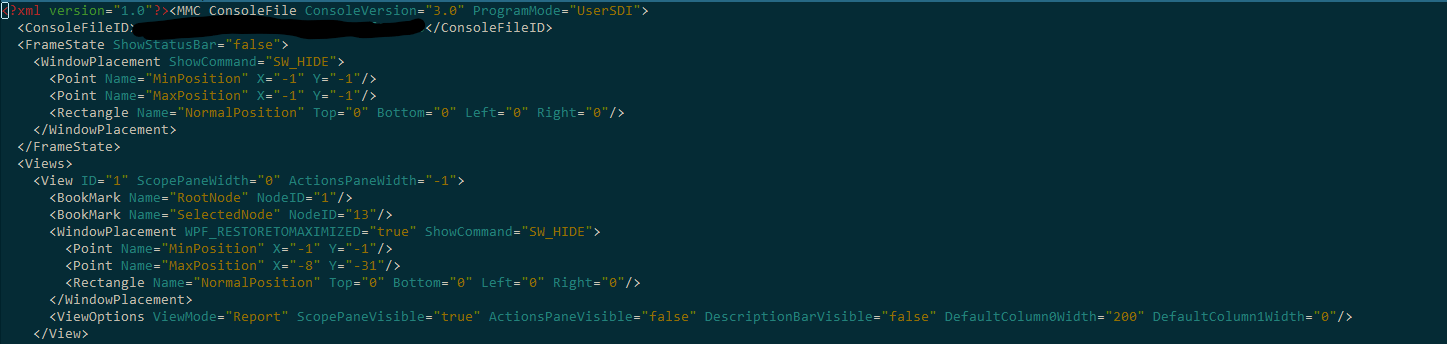
    Header of the main .msc file

    CVE-2024-43451—NetNTLM hash disclosure vulnerability

    This vulnerability is also related to the functionality of the Windows operating system, specifically to the NTLM authentication mechanism with the SSPI interface, which is automatically launched in all versions of the OS up to and including Windows 10. During the transmission of the NetNTLM hash, an attacker can intercept it or redirect it to another service, resulting in the compromise of the victim’s credentials. In common legitimate Windows scenarios, users frequently need to authenticate using the NTLM protocol, which may attract attackers. In 2024, we observed the active use of files of various formats with the .url extension in attacks: these files contained links to resources that triggered authentication using NTLM mechanisms.

    CVE-2024-49039—Elevation of privilege vulnerability in Windows Task Scheduler

    Our 2024 reports mainly included vulnerabilities that were used either solely for privilege escalation or for initial system access. However, CVE-2024-49039 stands out because it allows stealthy persistence within the system, privilege escalation, and command execution.

    This vulnerability exploits an undocumented RPC endpoint on the server side, which contains interfaces with a misconfigured security descriptor, enabling privilege escalation.

    In recent versions of Windows, when a scheduled task is registered, applications can run in AppContainer, which generally limits their privileges. To exploit the vulnerability, an attacker needs to create a scheduled task that, upon execution, calls the undocumented RPC endpoint. The Task Scheduler contains a vulnerable application launch algorithm, and as a result of the RPC call, the application will be relaunched without AppContainer with the privileges of a regular or system user.

    Conclusion and advice

    The total number of vulnerabilities registered in the Q4 2024 continues to grow compared to 2023, but the number of published exploits decreased. This may be due to the fact that software vendors have not yet released patches because of the traditional lull during the holiday period. Notably, attackers continue to invent new methods of privilege escalation, as seen in the Task Scheduler vulnerability.

    To stay safe, it is essential to respond promptly to the evolving threat landscape. Also, make sure that you:

    MIL OSI Economics

  • MIL-OSI Economics: Business Leaders Sound Alarm on Global Economic Uncertainty, Call for Unified APEC Action Brisbane, Australia | 26 February 2025 APEC Business Advisory Council

    Source: APEC – Asia Pacific Economic Cooperation

    Amidst rising global economic tensions, the APEC Business Advisory Council (ABAC) met in Brisbane this week to reaffirm its support for the value of trade and cooperation, and the original APEC commitment to free, fair, open and rules-based trade.

    Members expressed alarm at the escalating challenges posed by rising protectionism, regulatory complexity and other challenges including climate change, aging populations, declining growth rates for member economies and the business environment. Global uncertainty impacts trade flows, business planning and investment decision-making. Now more than ever, business and government must come together for the benefit of all.

    Economies must remain alert to emerging and disruptive technologies, including advancements in artificial intelligence and quantum computing, which offer both enormous promise and challenge to our economic development.

    “We must also redouble our efforts to put in place tangible enabling solutions like paperless trade, trade facilitation, resilient supply chains and other tangible items that ABAC 2025 aims for,” said ABAC Chair 2025 H.S. Cho.

    ABAC underscored the need for robust trade architecture, emphasising that a strengthened WTO and the APEC vision for a Free Trade Area of the Asia-Pacific (FTAAP) are vital counterweights to economic fragmentation. ABAC believes that this is the way to ensure fair, mutually beneficial trade as economies navigate the challenges of digital transformation and the climate crisis. 

    ABAC has adopted an ambitious theme for the year: “Bridge. Business. Beyond.” The 2025 work program emphasizes the role of business in connecting policymakers and stakeholders across the region, driving innovative growth, and shared prosperity.

    The ABAC work program is both visionary and practical.  For example, ABAC is looking at how to use digital tools like AI to promote small-business formalisation, create smart health systems, and tackle the carbon transition, including energy.  Economies must also urgently address gaps in infrastructure investment for energy security, energy transition, and digital transformation.

    ABAC wants to use the FTAAP process to drive quick progress on safer and more resilient supply chains, advance digital trade interoperability, and unlock green trade. ABAC remains committed to breaking down the barriers to women’s economic success, including by being able to tap into the venture capital they need and by closing the gender pay gap.

    ABAC will also develop recommendations to narrow the digital divide by using digital tools including AI, to support MSMEs to transition to the formal economy and access global markets.

    On meeting the challenges posed by aging populations, rising healthcare costs, and inequities in accessing medical services, ABAC will be developing recommendations for innovative, inclusive and smart health care systems. This will incorporate sustainable financing mechanisms, advanced health care models and the integration of digital health tools to enhance accessibility, efficiency and resilience of healthcare systems.

    To meet decarbonization goals amid rising electricity demand, ABAC will also develop recommendations to achieve a realistic and ambitious energy transition by utilizing advanced technologies to increase low carbon investments and expanding transition finance, supported by international cooperation and the development of low-carbon roadmaps.

    In a series of dynamic discussions with APEC Senior Officials, ABAC members sought to align priorities to produce actionable recommendations for leaders. “These discussions are the first of many interactions that we will have with policymakers and ministers this year.  We are keen to ensure that the business perspective is woven into key policy decisions,” the Chair added.

    The Chair expressed ABAC’s deep gratitude to the Australian government, particularly to the Department of Foreign Affairs and Trade, for their support in hosting this meeting.

    ABAC will reconvene in late April in Toronto, Canada, as it continues to develop its recommendations to achieve APEC’s goals, for presentation to APEC Leaders during their meeting in October in Korea.


    For further information please contact:

    Hyungkon Park (Mr), ABAC Executive Director 2025  at +82 2 6050 3686 and [email protected]

    Antonio Basilio (Mr), Director of the ABAC Secretariat at +63 917 849 3351 and [email protected]


    MIL OSI Economics

  • MIL-OSI Economics: Huawei’s OptiX OSN 9800 Series Retains “Leader” Position in GlobalData’s Core and Metro WDM Assessment Feb 26, 2025

    Source: Huawei

    Headline: Huawei’s OptiX OSN 9800 Series Retains “Leader” Position in GlobalData’s Core and Metro WDM Assessment
    Feb 26, 2025

    [Shenzhen, China, February 26, 2025] In its latest Core & Metro Packet-Optical Transport: Competitive Landscape Assessment, the world-renowned industry analysis firm GlobalData gave Huawei high marks for its flagship optical transmission product OptiX OSN 9800 series. Thanks to its leading technical architecture, ultra-large capacity, intelligent O&M capabilities, and the company’s mature global commercial practices, OptiX OSN 9800 once again ranked as a “Leader” with the highest score in the core and metro WDM fields. This further reinforces its leading position in optical communications.
    Huawei’s OptiX OSN 9800 Series Retained “Leader” Position in GlobalData’s Core and Metro WDM

    Huawei’s OptiX OSN 9800 series has made multiple technical breakthroughs and achieved comprehensive leadership in aspects ranging from transmission performance to network management.
    1. Ultra-high rate and ultra-large capacity
    Huawei’s OptiX OSN 9800 series supports a programmable rate of 400 Gbit/s to 1.2 Tbit/s per wavelength, as well as future evolution to a higher rate of 2 Tbit/s and beyond. The PBC non-linear compensation algorithm and new material technologies are used to extend the transmission distance by more than 20%. To date, Huawei’s 400G solution has been deployed on more than 200 networks in over 100 countries around the world, accelerating the commercial use of 400G+ networks.
    This series also supports a single-fiber capacity of 96 Tbit/s, and Super C+L band ultra-broadband spectrum to meet the capacity requirements for the next decade. In addition, it also provides Pbit/s-level optical switching capacity per subrack, facilitating data center interconnection.
    2. Energy saving and high efficiency
    OSN 9800 K36 is the industry’s first DC-oriented OTN platform. It uses the dual 3D orthogonal architecture and intelligent heat dissipation technology to double the switching capacity per slot and reduce the per-Gbit power consumption by 65%. In addition, the front-to-rear airflow design optimizes the energy efficiency of equipment rooms, enabling carriers to build green data centers.
    Compared with traditional solutions, Huawei’s OSN 9800 P32/P32C all-optical cross-connect products achieve 90% less device footprint and 60% less power consumption, achieving the best energy efficiency ratio in the industry.
    3. High availability and automatic O&M
    Huawei’s NCE-T transmission digital map solution provides automatic wavelength expansion planning, shortening the network expansion period from months to days. Moreover, the solution provides functions such as proactive assurance for availability risks and accurate fault diagnosis. With ASON, an E2E availability system covering prevention, recovery, and repair is established, improving the network availability to 99.999% and significantly reducing O&M costs.
    The OptiX OSN 9800 series has been widely implemented on global carrier networks in integrated transmission scenarios such as high-speed interconnection between data centers, home broadband, mobile bearing, and enterprise private lines. The flexible optical-electrical convergence architecture supports unified switching of OTN, SDH, packet, and OSU services, as well as integrating the all-optical cross-connect function, to provide carriers with ultra-broadband, elastic, and intelligent transmission solutions.
    According to the report, Huawei is ahead of competitors in terms of line ports, switching capacity, transmission capability, and network management. Emir Halilovic, Research Director of GlobalData, highlighted that Huawei’s OSN 9800 series products “define a new benchmark in terms of ultra-large capacity and intelligence features”.

    MIL OSI Economics

  • MIL-OSI Economics: Huawei’s OptiX OSN 9800 Series Retains “Leader” Position in GlobalData’s Core and Metro WDM Assessment

    Source: Huawei

    Headline: Huawei’s OptiX OSN 9800 Series Retains “Leader” Position in GlobalData’s Core and Metro WDM Assessment

    [Shenzhen, China, February 26, 2025] In its latest Core & Metro Packet-Optical Transport: Competitive Landscape Assessment, the world-renowned industry analysis firm GlobalData gave Huawei high marks for its flagship optical transmission product OptiX OSN 9800 series. Thanks to its leading technical architecture, ultra-large capacity, intelligent O&M capabilities, and the company’s mature global commercial practices, OptiX OSN 9800 once again ranked as a “Leader” with the highest score in the core and metro WDM fields. This further reinforces its leading position in optical communications.
    Huawei’s OptiX OSN 9800 Series Retained “Leader” Position in GlobalData’s Core and Metro WDM

    Huawei’s OptiX OSN 9800 series has made multiple technical breakthroughs and achieved comprehensive leadership in aspects ranging from transmission performance to network management.
    1. Ultra-high rate and ultra-large capacity
    Huawei’s OptiX OSN 9800 series supports a programmable rate of 400 Gbit/s to 1.2 Tbit/s per wavelength, as well as future evolution to a higher rate of 2 Tbit/s and beyond. The PBC non-linear compensation algorithm and new material technologies are used to extend the transmission distance by more than 20%. To date, Huawei’s 400G solution has been deployed on more than 200 networks in over 100 countries around the world, accelerating the commercial use of 400G+ networks.
    This series also supports a single-fiber capacity of 96 Tbit/s, and Super C+L band ultra-broadband spectrum to meet the capacity requirements for the next decade. In addition, it also provides Pbit/s-level optical switching capacity per subrack, facilitating data center interconnection.
    2. Energy saving and high efficiency
    OSN 9800 K36 is the industry’s first DC-oriented OTN platform. It uses the dual 3D orthogonal architecture and intelligent heat dissipation technology to double the switching capacity per slot and reduce the per-Gbit power consumption by 65%. In addition, the front-to-rear airflow design optimizes the energy efficiency of equipment rooms, enabling carriers to build green data centers.
    Compared with traditional solutions, Huawei’s OSN 9800 P32/P32C all-optical cross-connect products achieve 90% less device footprint and 60% less power consumption, achieving the best energy efficiency ratio in the industry.
    3. High availability and automatic O&M
    Huawei’s NCE-T transmission digital map solution provides automatic wavelength expansion planning, shortening the network expansion period from months to days. Moreover, the solution provides functions such as proactive assurance for availability risks and accurate fault diagnosis. With ASON, an E2E availability system covering prevention, recovery, and repair is established, improving the network availability to 99.999% and significantly reducing O&M costs.
    The OptiX OSN 9800 series has been widely implemented on global carrier networks in integrated transmission scenarios such as high-speed interconnection between data centers, home broadband, mobile bearing, and enterprise private lines. The flexible optical-electrical convergence architecture supports unified switching of OTN, SDH, packet, and OSU services, as well as integrating the all-optical cross-connect function, to provide carriers with ultra-broadband, elastic, and intelligent transmission solutions.
    According to the report, Huawei is ahead of competitors in terms of line ports, switching capacity, transmission capability, and network management. Emir Halilovic, Research Director of GlobalData, highlighted that Huawei’s OSN 9800 series products “define a new benchmark in terms of ultra-large capacity and intelligence features”.

    MIL OSI Economics

  • MIL-OSI Economics: Shaping a Brighter Future for Asia and the Pacific: ADB President Asakawa’s Legacy

    Source: Asia Development Bank

    Transcript

    In January 2020, President Masatsugu Asakawa took the helm of the Asian Development Bank with a vision for sustainable growth and regional cooperation. Little did he know that two months later, the world would face an unprecedented crisis—the COVID-19 pandemic. As the pandemic swept across countries, President Asakawa recognized the urgency and mobilized ADB’s resources to respond swiftly.

    Masatsugu Asakawa
    President
    Asian Development Bank
    2020-2025

    “In a crisis, every moment counts. I’m proud that ADB acted decisively when our members needed us most.”

    Under his leadership, ADB launched a $20 billion assistance package, including the COVID-19 Pandemic Response Option (CPRO) and a $9-billion Asia Pacific Access Facility (APVAX) to help countries procure and distribute drugs.

    Amidst the global health crisis, another pressing challenge demanded attention—climate change. At COP26 in Glasgow, President Asakawa reaffirmed ADB’s climate leadership.

    “We can’t afford to wait on climate action. That’s why we pledged at least $100 billion in climate financing by 2030 and pioneered innovative tools like the Energy Transition Mechanism and IF-CAP to drive real change.”

    Under his guidance, ADB became the region’s “climate bank,” promoting sustainable, inclusive growth while addressing environmental challenges. President Asakawa advocated action to help developing member countries become more resilient against climate change impacts, such as extreme heat and accelerated glacial melt.

    “Climate action has been a top priority for ADB, and for me personally. Throughout my presidency, ADB has intensified efforts to address the climate crisis— with initiatives focused on protecting vulnerable areas like the Hindu Kush-Himalaya region.”

    Alongside these initiatives, President Asakawa never lost sight of the people behind ADB’s success—its staff. In response to the COVID-19 pandemic, he introduced flexible work arrangements and prioritized safety measures.

    “Our people are the heart of ADB. Their safety and well-being come above all else. By fostering a supportive and inclusive environment, we empower our staff to deliver their best for the communities we serve.”

    In a critical moment, President Asakawa orchestrated the evacuation of 120 ADB staff and their families from Afghanistan. His actions not only safeguarded lives but reinforced a culture of care within the ADB community.

    Looking beyond immediate crises, President Asakawa also focused on building stronger foundations for the future. He championed domestic resource mobilization, helping countries strengthen their financial resilience.

    “True progress is when countries stand on their own feet. Our role is to help them build that foundation, strengthening their ability to create sustainable growth and resilience for future generations.”

    Through initiatives like the creation of the Asia Pacific Tax Hub,  ADB has helped strengthen tax systems, improve governance, and secure social safety nets for people across the region.

    Understanding that the region’s prosperity depends on cooperation, President Asakawa reinforced the importance of robust partnerships to rejuvenate trade and improve supply chains.

    “Asia and the Pacific has benefited immensely from globalization. With the looming threat of protectionism, our region must continue to champion connectivity and collaboration.”

    To support his ambitious goals, President Asakawa also spearheaded significant transformation within ADB. A review of the Capital Adequacy Framework unlocked an additional $100 billion in lending capacity over the next decade.

    Meanwhile, the new operating model introduced strategic shifts to expand private sector operations, intensify climate action, drive innovation, and locate staff closer to clients to strengthen support and responsiveness.

    These initiatives align with the MDB evolution agenda, ensuring ADB remains a key player in global development.

    “To meet tomorrow’s challenges, we must evolve today. Innovation isn’t just an option. It’s an imperative.”

    As his tenure comes to a close, President Asakawa leaves a strengthened, future-focused ADB.

    His vision encourages ADB to stay invested in the region’s success and responsive to emerging challenges. And he reminds us that building trusted, long-term partnerships is key to driving meaningful change.

    “ADB’s strength lies in being a trusted development partner- a reliable friend and partner of choice for Asia and the Pacific. This close relationship is our legacy. And it’s vital we preserve it.”

    President Asakawa has guided ADB through challenging times with transformative leadership that has left an indelible mark on the organization and region. As we look to the future, his legacy sets the foundation for a prosperous, resilient, inclusive, and sustainable Asia and the Pacific.

    “I want to extend my heartfelt gratitude to ADB’s staff, Board of Directors, member governments, and our many partners. Together, we have achieved milestones that will continue to shape a brighter future for Asia and the Pacific.”

    MIL OSI Economics

  • MIL-OSI Economics: Bridging Gaps for Noncommunicable Diseases and Mental Health: Leveraging Technology Innovations for Impact

    Source: Asia Development Bank

    The Manila knowledge-sharing event heard how innovative technologies could be used to better screen, diagnose, and manage NCDs and mental health conditions in various health settings. Sessions considered country case studies, regulations, and financing, and looked at ways digital health and improved early detection could help save lives and support sustainable and equitable regional growth.

    MIL OSI Economics

  • MIL-OSI Economics: Securing Health in Southeast Asia

    Source: Asia Development Bank

    Drawing on interviews with leading public health practitioners, the publication details the experiences of Cambodia, Indonesia, the Lao People’s Democratic Republic, the Philippines, Thailand, Timor-Leste, and Viet Nam. Its recommendations include making sustained investments in health, driving strong stakeholder partnerships, and building robust digital infrastructure to help countries both prepare for future pandemics and strengthen overall regional health security.

    MIL OSI Economics

  • MIL-OSI Economics: Lexus Brings Immersive “A-Un” Exhibit to Milan Design Week 2025

    Source: Toyota

    Headline: Lexus Brings Immersive “A-Un” Exhibit to Milan Design Week 2025

    Lexus will showcase A-Un, an interactive installation that connects intuitively with its experiencers, from April 8 to April 13, 2025, at Superstudio Piu (Daylight Hall) during Milan Design Week. The famed design week, a key event for global creatives, is the biggest of its kind and brings together furniture makers and fashions brands to showcase their latest wares. This year, alongside A-Un, Lexus will display the Discover Together, an exhibition of interactive works from three creators. Lexus has continuously challenged the status quo in the luxury automotive space, pushing boundaries in both products and services to create new experiences that respect every moment of a customer’s time. During Milan Design Week 2024, Lexus displayed its “Time” installation which took inspiration from the next-generation Lexus electric vehicle, LF-ZC. The showcase demonstrated Lexus’s vision of endless possibilities for future technologies and communicated how software will continue its evolution to better individuals’ experience through cars. Produced in collaboration with Lexus and Tokyo-based creative agency, SIX, and design studio, STUDEO, A-Un is inspired by the traditional Japanese concept of Aun no Kokyu (the synchrony of breathing) showing a new dimension of seamless communication between humans and mobility and captures the spirit of mutual understanding through perfectly synchronized interactions.

    MIL OSI Economics

  • MIL-OSI Economics: Inari Medical acquisition could provide Stryker with foothold in peripheral vascular market, says GlobalData

    Source: GlobalData

    Inari Medical acquisition could provide Stryker with foothold in peripheral vascular market, says GlobalData

    Posted in Medical Devices

    Stryker recently announced the completion of the acquisition of Inari Medical, a medical device company specializing in treatment for venous thromboembolism, for $4.9 billion. Acquiring Inari’s portfolio of venous thrombectomy devices could enable Stryker to gain a foothold in the rapidly growing peripheral vascular device market, says GlobalData, a leading data and analytics company.

    Inari Medical’s portfolio of devices includes the FlowTriever and ClotTriever systems, which are used to treat pulmonary embolism and deep vein thrombosis, respectively. Both systems utilize a minimally invasive procedure to find and remove these clots from the body. These devices compete with other major cardiovascular device manufacturers, including Boston Scientific, Terumo, and Penumbra.

    David Beauchamp, Medical Analyst at GlobalData, comments: “With the rising rates of peripheral artery diseases worldwide, including deep vein thrombosis and complications such as pulmonary embolism, this acquisition is likely to strengthen Stryker’s position in the overall cardiovascular device market.”

    According to the GlobalData Medical Intelligence Center, the worldwide thrombectomy device market was worth $2.96 billion in 2024 and is set to register a compound annual growth rate (CAGR) of 5.48% from 2024 to 2034. In the US alone, the thrombectomy market was valued at $1.18 billion and is projected to record a CAGR of 3.38% during the same period. The largest companies in the market include Boston Scientific, Teleflex, and Inari Medical. With the backing of Stryker, it is possible that Inari Medical will see greater success in the thrombectomy device market.

    Beauchamp concludes: “As the acquisition of Inari Medical has been finalized, Stryker is now poised to break into the lucrative peripheral vascular device market. Inari’s expertise in thrombectomy devices, combined with Stryker’s existing distribution and logistics network, could result in an improvement in both volume and procedure quality for those suffering from deep vein thrombosis and other clot-related cardiovascular diseases.”

    MIL OSI Economics

  • MIL-OSI Economics: Germany card payments market to surpass $850 billion in 2029, forecasts GlobalData

    Source: GlobalData

    Germany card payments market to surpass $850 billion in 2029, forecasts GlobalData

    Posted in Banking

    The Germany card payments market is forecast to register a compound annual growth rate (CAGR) of 5.9% between 2025 and 2029 to reach EUR788.1 billion ($852.1 billion) in 2029, supported by a constant consumer shift towards electronic payments, according to GlobalData, a leading data and analytics company.

    GlobalData’s report, “Germany Cards and Payments – Opportunities and Risks,” reveals that card payment value in Germany registered a growth of 11.2% in 2023, driven by the rise in consumer spending. The value grew further to register an estimated growth of 6.4% to reach EUR 574.6 billion ($621.3 billion) in 2024.

    Ravi Sharma, Lead Banking and Payments Analyst at GlobalData, comments: “Germany’s payment card market is experiencing rapid growth, with a decline in cash usage. It is expected to continue expanding in 2025, driven by factors such as a 100% adult banked population, the convenience of electronic payments, improving payment infrastructure, the increasing preference for contactless payments, and the growth in e-commerce payments.”

    Debit cards are the most popular card type in Germany, accounting for a significant share of total card payments. While debit cards were traditionally used for cash withdrawals, their usage for payments is gradually increasing. This growth can be attributed to the rising adoption and usage of contactless debit cards, which offer convenience and speed for low-value transactions.

    On the other hand, credit and charge cards have a lower adoption in Germany. This can be attributed to the debt-averse nature of German consumers. However, banks are encouraging the adoption and usage of credit cards by offering value-added benefits such as installment facilities, reward points, and discounts at partner retailers.

    Despite the growth in the payment card market, Germany still has a strong inclination towards cash usage. However, the EU-wide interchange fee regulation, the growth of contactless payments, the emergence of digital-only banks, and a robust e-commerce market have contributed to a gradual increase in payment card usage.

    Banks and payment companies are also focusing on expanding payment infrastructure to encourage businesses to go digital. As of July 2024, there were 3.1 million SMEs operating in the country—accounting for 99.4% of German firms. To serve them, POS providers offer low-cost mobile POS (mPOS) solutions. For example, Worldline subsidiary PAYONE offers Tap On Mobile, which enables merchants to convert Android-based mobile devices into POS terminals to accept payment via cards and mobile wallets.

    Sharma concludes: “Looking ahead, a continued growth in the total card payments is expected to expand in Germany by 9% in 2025. The key drivers of this growth include the ongoing efforts to promote electronic payments, the expansion of the e-commerce market, and the availability of value-added benefits for cardholders. However, ongoing geopolitical uncertainty and economic slowdown will remain challenges.”

    MIL OSI Economics

  • MIL-OSI Economics: Global automated home spending will surpass $200 billion in 2028, forecasts GlobalData

    Source: GlobalData

    Global automated home spending will surpass $200 billion in 2028, forecasts GlobalData

    Posted in Strategic Intelligence

    The automated home market is rapidly evolving, with consumers increasingly adopting devices that enhance security, energy efficiency, and convenience. Against this backdrop, the global spending on automated home devices is set to grow at a compound annual growth rate (CAGR) of 11% from $119.5 billion in 2023 to $200.8 billion in 2028, forecasts GlobalData, a leading data and analytics company.

    GlobalData’s latest Strategic Intelligence report, “Automated Home,” reveals that the top three automated home sub-categories by device revenue are smart appliances, smart speakers, and smart security. These three accounted for 34%, 28%, and 25% of the total market in 2023, respectively. Amazon, Google, and Xiaomi are the leading companies shaping the market

    The smart appliances sub-category will continue to hold the largest market share over the next five years as its growth outstrips both smart speakers and smart security.

    Shabnam Pervez, Strategic Intelligence Analyst at GlobalData, comments: “The smart home landscape is populated by a mix of established tech giants and innovative newcomers.”

    The foundation of Amazon’s automated home business is its Echo range of smart speakers. The company has built on that with acquisitions, including spending $1 billion on smart doorbell manufacturer Ring. Google, with its Nest ecosystem of automated home devices, is also a market leader. Alibaba and Xiaomi dominate the Chinese market.

    Pervez concludes: “The smart home market is dynamic and constantly evolving. As technology advances and consumer adoption accelerates, devices will continue becoming more intelligent, integrated, and accessible. The future of living is smart, and it is happening now.”

    MIL OSI Economics

  • MIL-OSI Economics: Cardiol’s CRD-38 holds potential to differentiate in HF space, says GlobalData

    Source: GlobalData

    Cardiol’s CRD-38 holds potential to differentiate in HF space, says GlobalData

    Posted in Pharma

    Cardiol Therapeutics recently announced positive data on the use of CRD-38 (cannabidiol) in the Journal of the American College of Cardiology, highlighting that it improved cardiac function and reduced cardiac hypertrophy, remodeling, inflammation, and cell death. The data indicates that CRD-38 potentially fills an unmet need in the heart failure (HF) space as it has an alternate mechanism of action to current marketed therapies, says GlobalData, a leading data and analytics company.

    CRD-38 acts as an agonist to cannabinoid receptors CB1 and CB2. The cannabidiol moiety of the drug shows anti-inflammatory activity and the organic nitrates exhibit a direct relaxant effect on vascular smooth muscles, which leads to dilation of coronary vessels, improves oxygen supply to the myocardium, and elicits therapeutic activity. The journal included results from multiple models of HF. In a mouse model of HF, subcutaneous administration of CRD-38 resulted in reduced cardiac fibrosis and hypertrophy, and improved ejection fraction and cardiac output.

    Kajal Jaddoo, Senior Pharma Analyst at GlobalData, comments: “Key opinion leaders (KOLs) interviewed by GlobalData have emphasized that physicians would be more open to subcutaneous therapies because they are not looking to add another pill to patients’ treatment regimens.”

    According to GlobalData’s Pharma Intelligence Center Drug Database, Cardiol has one other drug in active development, CardiolRx (cannabidiol 1) in Phase II for multiple indications.

    Jaddoo concludes: “The aging global population and the prolongation of the lives of cardiac patients by modern therapeutic innovations has led to increased prevalence of HF. Moreover, several diseases such as hypertension, obesity, and diabetes greatly increase the risk for HF. This illustrates how vital, and potentially lucrative, the HF arena is for drug discovery.”

    MIL OSI Economics

  • MIL-OSI Economics: Development Asia: 3 Lessons from Crowdsourcing Digital Solutions for Improving MSMEs’ Access to Finance

    Source: Asia Development Bank

    Here are three lessons that we have learned in crowdsourcing digital solutions to support MSMEs’ and WMSMEs’ access to financing:

    Employ a bottom-up and top-down, collaborative approach. Effective crowdsourcing requires a deep understanding of the problem. Therefore, various stakeholders, including government and non-governmental institutions, (W)MSMEs, financial institutions, and technology service providers, were consulted to learn more about the situation on the ground to better frame and flesh out the challenges. The collaborative approach used by ADB’s IT Department, gWFX, the Private Sector Financial Institutions Division of ADB’s Private Sector Operations Department, and the Finance Sector Office ensured that the challenges were relevant and actionable. In addition, collaboration generated lessons for broader engagement with various groups.

    Design problem statements tailored to match the unique needs of Developing Member Countries (DMCs). The intent behind these challenges is to obtain proposals that are no longer at the ideation stage. Instead, these should be actionable, relevant, and responsive to the specific context in the DMC covered by the challenge. Prioritizing local experience in the evaluation process also helped in shortlisting proposals that were socio-culturally and economically appropriate.

    Furthermore, we used local experience as one of the criteria for evaluating submissions to ensure that the shortlisted teams were familiar with the context. Taking these criteria into consideration enabled the team to filter out which of the submitted solutions would best fit the context and needs of the respective DMCs. This was also to ensure that any solution would not leave out the women’s market segment but would instead look at technology through a gender lens and provide tools to help women access the financing they need to thrive.

    Ensure the right solution is selected through validation. Beyond identifying and selecting a solution that addresses a specific challenge faced by financial institutions, it is equally crucial to validate the solution through a “test-and-learn” approach. By stress testing the solution during both the proof of concept and pilot stages, teams can assess its viability and scalability, ensuring that it meets the needs of the financial institutions and the entrepreneurs it aims to support.

    For example, in Pakistan, the AI-leveraged solution for financial statement analytics underwent testing to ensure that the solution met the financial institution’s objectives of scoring WMSMEs more effectively. The team gathered business and technical requirements of the institution, prioritized features and functionalities, and worked with the IT and Operations teams to create and implement an integration roadmap. Next, the solution will be deployed in a test environment to lend to a sample size of WMSMEs for validation.

    MIL OSI Economics

  • MIL-OSI Economics: APEC 2025: Korea Advances Regional Trade, AI, and Sustainability Agenda Gyeongju, Republic of Korea | 26 February 2025 Issued by the APEC Secretariat Korea kicks off its APEC 2025 host year in Gyeongju, a historic city home to numerous UNESCO World Heritage sites.

    Source: APEC – Asia Pacific Economic Cooperation

    Korea kicks off its APEC 2025 host year in Gyeongju, a historic city home to numerous UNESCO World Heritage sites. It brings together delegates from 21 economies to set the stage for a year of policy deliberations and cooperation on trade, digital transformation and sustainability.

    Against a backdrop of global economic uncertainty, this first set of meetings taking place from 24 February to 9 March, will serve as the launchpad for Korea’s forward-looking agenda — one that seeks to enhance regional connectivity, harness AI-driven growth, and accelerate the transition to a more resilient and prosperous Asia-Pacific.

    Under the overarching theme of “Building a Sustainable Tomorrow,” APEC 2025 will focus on three key priorities: Connect, Innovate, and Prosper. These pillars reflect APEC’s commitment to developing practical policies to support a resilient and interconnected future.

    “The Asia-Pacific is navigating complex challenges — supply chain disruptions, the impact of artificial intelligence on jobs and industries, and fundamental changes in the demographic landscape,” said Ambassador Yoon Seong-mee, Chair of the 2025 APEC Senior Officials’ Meeting.

    “Through APEC, we have a unique opportunity to strengthen trade and investment flows, promote resilience in supply chains, and foster innovation that is beneficial to everyone,” she added.

    Also read: Building a Sustainable Tomorrow: APEC Returns to Korea After 20 Years

    Once the capital of the ancient Silla Kingdom, Gyeongju has evolved into a dynamic modern city while preserving its rich cultural heritage — making it a fitting venue for these meetings. More than 100 events are set to take place covering issues such as investment, trade facilitation, anti-corruption efforts, energy cooperation, and digital economy policy. The city is anticipating participation from around 1,500 delegates from all around the Asia-Pacific.

    “APEC 2025 is about creating meaningful change,” said Eduardo Pedrosa, Executive Director of the APEC Secretariat. “The discussions and commitments we make this year will shape the region’s ability to tackle global uncertainties and ensure shared prosperity for all.”

    “Korea’s role as host is not just about convening meetings — it is about setting a vision for a resilient, interconnected, and innovative APEC region. We look forward to working with all member economies, businesses, and stakeholders to turn this vision into reality,” Pedrosa added.

    Notable sessions for the meetings in Gyeongju include an exhibitions on customs technologies and green customs initiatives; policy dialogues on AI governance, digital privacy, and cross-border data flows; workshops on carbon-free energy, hydrogen and fuel cell standardization, and clean energy transitions; as well as discussions on financial inclusion, structural reform, and the future of work.

    A press conference is scheduled for Sunday, 9 March, at 13:30 local time at the Gyeongju Hwabaek International Convention Center (HICO), featuring Ambassador Yoon Seong-mee and Eduardo Pedrosa. They will provide a readout on the outcomes of the meetings and outline key priorities and upcoming events for APEC 2025 in the months ahead. The time and venue are subject to change, with updates to be communicated via email and posted on APEC’s social media platforms.

    “We are at a critical juncture for the global economy and Korea is committed to making APEC 2025 a platform for real and measurable progress on economic resilience, digital transformation, and sustainability,” Ambassador Yoon concluded.

    For further details and media inquiries, please contact:  
    [email protected] 
    [email protected]

    MIL OSI Economics

  • MIL-OSI Economics: ADB Approves $200 Million Loan to Expand Urban Services in Kolkata, India

    Source: Asia Development Bank

    NEW DELHI, INDIA (26 February 2025) — The Asian Development Bank (ADB) has approved a $200 million loan to enhance the development of climate- and disaster-resilient sewerage and drainage infrastructure in Kolkata, aiming to improve the city’s livability.

    These interventions, which are part of the Kolkata Municipal Corporation Sustainability, Hygiene, and Resilience (Sector) Project, will improve living conditions and health outcomes, particularly for vulnerable groups including women and children, by reducing exposure to waterborne and vector-borne diseases, while also addressing flood risks.

    “The project builds on ADB’s 25-year partnership with the Kolkata Municipal Corporation (KMC), working to make Kolkata a more livable city through phased, integrated investments to improve urban services, operational efficiency, institutional effectiveness, and long-term sustainability,” said ADB Water and Urban Development Portfolio Management Unit Head Hikaru Shoji.  “As the next phase of our urban development efforts in Kolkata, this project builds on earlier initiatives to expand sewerage and drainage infrastructure, improve hygiene conditions, and strengthen KMC’s governance and revenue generation efforts.”

    Kolkata, one of India’s most populous and densely populated cities, faces significant challenges due to inadequate drainage and sewerage systems, causing urban floods and unhygienic environment. These issues are exacerbated by increased heavy rains due to climate change.

    To address these challenges, the project will construct 84 kilometers (km) of combined trunk and secondary sewerage and drainage pipelines, 176 km of combined lateral sewerage and drainage pipelines up to customer connections, and 50,000 household sewer connections. It will construct one sewage treatment plant and five pumping stations. The project will benefit over 277,000 residents.

    In addition, the project will support KMC in developing a comprehensive IT-based asset management system, enhance property tax revenue, expand the early flood warning system developed through an earlier ADB intervention, raise community awareness on water, sanitation, and hygiene and support women’s employment through skills training and internship program.

    ADB is a leading multilateral development bank supporting sustainable, inclusive, and resilient growth across Asia and the Pacific. Working with its members and partners to solve complex challenges together, ADB harnesses innovative financial tools and strategic partnerships to transform lives, build quality infrastructure, and safeguard our planet. Founded in 1966, ADB is owned by 69 members—49 from the region.

    MIL OSI Economics

  • MIL-OSI Economics: Development Asia: Strengthening E-Commerce Payment Systems Amid Insolvency Risks

    Source: Asia Development Bank

    The payment process of e-commerce transactions between buyers and sellers typically involves payment originators such as card companies, payment gateways (PGs), e-commerce platforms, and issuers of e-payment instruments, including mobile vouchers and e-coupons.[1] Payment gateways not only relay buyers’ payment information received from platforms to credit card companies but also act as a representative merchants for many subordinate vendors by serving as their payment agents. The payment gateway directly linked to the payment originator is referred to as the primary PG, and the platform company subordinated to the primary PG is called the secondary PG. Sales proceeds are settled to vendors through the payment originator, primary PG, and the secondary PG.

    When multiple payment gateways are involved in the payment process, those closer to the payment originator are assigned higher numbers (e.g., PG1, PG2, etc.). Mobile vouchers and e-coupons are considered prepaid e-payment instruments (prepaid e-money) since consumers purchase them in advance of ordering goods.[2] The sales of these prepaid instruments have steadily increased due to promotional discounts offered by issuers. Some companies, like Ticket Monster, may simultaneously operate as a payment gateway, issue their own prepaid e-money (e.g., TIMON Cash), and act as sales agents for third-party prepaid e-money (e.g., Happy Money). Consequently, the payment gateway representing the seller of a voucher may differ from the payment gateway representing the affiliate network of the same voucher.

    Figure 1: A Simple Diagram of E-Commerce Settlement Structure

    Note: 1) Credit card transactions are processed in the following sequence: ① placement of order ② approval of payment ③ receipt of order ④ delivery of goods ⑤ settlement of payment ⑥ card fee payment. 2) Prepaid e-money transactions are processed in this sequence: ⓐ purchase of e-money ⓑ placement of order ⓒ transmission of order and payment order ⓓ delivery of goods ⓔ settlement of payment. However, the order of ⓓ and ⓔ may vary depending on the transaction. 3) Each diagram represents the simplest structure of payment settlement, so the structure could be much more complex and extended in reality.

    MIL OSI Economics

  • MIL-OSI Economics: 【Global News】Panasonic to Showcase Innovative STEAM Program Developed with MIT Media Lab at SXSW EDU 2025

    Source: Panasonic

    Headline: 【Global News】Panasonic to Showcase Innovative STEAM Program Developed with MIT Media Lab at SXSW EDU 2025

    Austin, TX, U.S. – Feb. 25, 2025 – Panasonic Holdings Corporation (Panasonic HD) will be demonstrating its groundbreaking STEAM education service, “Scratch Home School,” developed in collaboration with the MIT Media Lab at SXSW EDU 2025, the world’s largest creative conference focused on education. Visit Booth #614 in the EXPO on site for a hands-on demonstration March 3–5 2025, where Panasonic will also be conducting a Show & Tell Session on March 4 starting at 1:30pm CST.
    Panasonic’s “Scratch Home School,” integrates IoT home appliances into a STEAM education curriculum, transforming everyday activities into creative learning experiences. Originally researched at MIT Media Lab in 2018, this program has been rigorously tested in Japan and is currently in a year-long pilot at St. Agnes School in Massachusetts since late 2024.

    Why STEAM Education Matters

    STEAM education is crucial for fostering creativity and deep learning in children. However, traditional materials often limit engagement. “Scratch Home School” breaks these barriers by using IoT devices like toasters and lighting to make learning interactive and fun, encouraging children to experiment and discover their passions.
    Employment in STEM occupations has grown 79% in the past three decades and is projected to grow an additional 11% from 2020 to 2030 [1]. This growth underscores the importance of preparing students with the skills and knowledge needed to thrive in these fields.

    Experience It at SXSW EDU 2025

    Join Panasonic at SXSW EDU 2025 to experience “Scratch Home School” in action! Attendees can interact with IoT toasters and lighting, powered by (MIT’s) Scratch-based visual programming, and see how these tools are supporting critical curriculums.
    Panasonic HD is committed to exploring new partnerships with educational institutions and companies in the U.S. through this exhibition. Together, Panasonic aims to overcome challenges in STEAM education and create an environment that nurtures children’s diverse talents and interests.

    MIL OSI Economics

  • MIL-OSI Economics: Media release: Boosting gas supply a priority for Australia’s economic and energy security – Australian Energy Producers

    Source: Australian Petroleum Production & Exploration Association

    Headline: Media release: Boosting gas supply a priority for Australia’s economic and energy security – Australian Energy Producers

    Australian Energy Producers today released its priorities to restore Australia’s competitiveness and ensure reliable and affordable gas for Australians ahead of the federal election. The industry’s plan for Australia’s economic and energy security comes as new polling in key Western Australian seats confirms strong support for the natural gas industry and its role in WA’s long-term energy mix.

    Australian Energy Producers Chief Executive Samantha McCulloch said the industry’s federal election platform outlines key actions for the next Australian Government to unlock the economic, energy security and emissions reduction potential of Australia’s abundant gas resources.

    “Natural gas will play an essential role in Australia’s energy mix to 2050 and beyond, but regulatory uncertainty, approval delays and policy interventions have delayed critical projects and damaged Australia’s reputation as a safe place to invest,” Ms McCulloch said.

    “Australia has abundant gas resources and yet we are facing forecast gas shortfalls on the east coast from 2027 and from 2030 in Western Australia.

    “Without new gas projects, Australian households and businesses face higher energy prices, uncertain energy supply, and increased risk of blackouts that will hit every part of the economy. Addressing these risks should be a national priority.”

    Australian Energy Producers is urging the major parties to commit to working with industry on the following priority actions:

    • Boost Australian gas supply to ease cost of living pressures
    • Restore Australia’s global competitiveness for investment
    • Deliver real emissions reductions with gas and carbon capture, utilisation and storage (CCUS)
    • Remain a reliable energy partner in our region

    “Australia and our region’s economic growth and energy security needs reliable and affordable gas supply, and this requires continued investment in new gas exploration and development,” Ms McCulloch said.

    “The Australian gas industry contributes $105 billion a year to the Australian economy and supports 215,000 jobs. Natural gas provides around 40 per cent of the energy used by Australia’s manufacturing sector, and in WA gas provides more than half the energy used in mining and minerals processing.

    “Polling confirms that Western Australians understand the importance of natural gas to the state’s economy. The next Australian Government should take note and prioritise actions to boost new gas supply, address approval delays, and ensure reliable and affordable energy for Australian households and businesses.”

    Read Australian Energy Producers’ policy platform for the 2025 Federal Election: https://energyproducers.au/2025election    

    Key findings from JWS Research polling in the electorates of Curtin, Tangney and Bullwinkel are summarised below.

    JWS Research polling results relating to the natural gas sector 

    JWS conducted online polling on 11-12 February on behalf of Australian Energy Producers, with around 830 respondents in each electorate. Key results of voters’ views on the role of natural gas in WA’s energy mix and its importance to the WA economy are summarised below. 

    Curtin

    • 73% support WA’s natural gas industry
    • 64% believe natural gas has a long-term role in WA’s energy mix
    • 78% believe the natural gas industry is important to WA’s economy
    • 69% oppose the Greens’ policy to ban all new gas projects
    • 65% oppose Labor forming a minority government with the Greens at the election
    • 69% believe a Labor-Greens minority government would have a negative impact on the WA economy
    • 47% are more likely to vote for a candidate that supports WA’s natural gas industry, while only 15% said they were more likely to vote against a candidate that supported the gas industry (36% said it would not influence their vote).

    Tangney

    • 72% support WA’s natural gas industry
    • 68% believe natural gas has a long-term role in WA’s energy mix, including 54% of Greens voters
    • 80% believe the natural gas industry is important to WA’s economy, including 61% of Greens voters
    • 60% oppose the Greens’ policy to ban all new gas projects, only 12% support it
    • 57% oppose Labor forming a minority government with the Greens at the election
    • 63% believe a Labor-Greens minority government would have a negative impact on the WA economy
    • 48% are more likely to vote for a candidate that supports WA’s natural gas industry, while only 6% said they were more likely to vote against a candidate that supported the gas industry (45% said it would not influence their vote).

    Bullwinkel

    • 77% support WA’s natural gas industry
    • 75% believe natural gas has a long-term role in WA’s energy mix, including 69% of Greens voters
    • 80% believe the natural gas industry is important to WA’s economy, including 85% of Greens voters
    • 74% oppose the Greens’ policy to ban all new gas projects
    • 70% oppose Labor forming a minority government with the Greens at the election
    • 71% believe a Labor-Greens minority government would have a negative impact on the WA economy
    • 46% are more likely to vote for a candidate that supports WA’s natural gas industry, while only 6% said they were more likely to vote against a candidate that supported the gas industry (45% said it would not influence their vote).

    Contact: 0434 631 511

    MIL OSI Economics

  • MIL-OSI Economics: Isabel Schnabel: No longer convenient? Safe asset abundance and r*

    Source: European Central Bank

    Keynote speech by Isabel Schnabel, Member of the Executive Board of the ECB, at the Bank of England’s 2025 BEAR Conference

    London, 25 February 2025

    Over the past few years, global bond investors have fundamentally reappraised the expected future course of monetary policy.

    Even as inflation has receded and policy restriction has been dialled back, current market prices suggest that maintaining price stability will require higher real interest rates in the future than before the pandemic.

    In my remarks today, I will argue that the shift in market expectations about the level of r* – the rate to which the economy is expected to converge in the long run once current shocks have run their course – is consistent with two sets of observations.

    The first is that the era during which risks to inflation have persistently been to the downside is likely to have come to an end.

    Growing geopolitical fragmentation, climate change and labour scarcity pose measurable upside risks to inflation over the medium to long term. This is especially true as the recent inflation surge may have permanently scarred consumers’ inflation expectations and may have lowered the bar for firms to pass through adverse cost-push shocks to consumer prices.

    The second observation is that we are transitioning from a global “savings glut” towards a global “bond glut”.

    Persistently large fiscal deficits and central bank balance sheet normalisation are gradually reducing the safety and liquidity premia that investors have long been willing to pay to hold scarce government bonds. The fall in the “convenience yield”, in turn, reverses a key factor that had contributed to the decline in real long-term interest rates, and hence r*, during the 2010s.

    The implications for monetary policy are threefold.

    First, a higher r* calls for careful monitoring of when monetary policy ceases to be restrictive. Second, central bank balance sheet policies may themselves affect the level of r* through the convenience yield, making them potentially less effective than previously thought. Third, because central bank reserves also offer convenience services to banks, it is optimal to provide reserves elastically on demand as quantitative tightening reduces excess liquidity.

    Upward shift in r* signals lasting change in the inflation regime

    Starting in 2021, long-term government bond yields rose measurably across advanced economies. Today, the ten-year yield of a German government bond is about two and a half percentage points higher than in late 2021 (Slide 2, left-hand side).

    What is remarkable about the rise in nominal bond yields in the euro area over this period is that it was not driven by a change in inflation compensation. Investors’ views about future inflation prospects are broadly the same today as they were three years ago (Slide 2, right-hand side).

    Rather, nominal interest rates rose because real interest rates increased. Euro area real long-term rates are now trading at a level that is substantially higher than the level prevailing during most of the post-2008 global financial crisis period (Slide 3, left-hand side).

    Part of the rise in real long-term interest rates is a mechanical response to the tightening of monetary policy.

    Long-term interest rates are an average of expected short-term interest rates over the lifetime of the bond, plus a term premium. So, when we raised our key policy rates in response to the surge in inflation, the average real rate expected to prevail over the next ten years increased.[1]

    What is more striking, however, is that investors also fundamentally revised the real short-term rate expected to prevail once inflation has sustainably returned to our target. This rate is typically taken as a proxy for the natural rate of interest, or r*.

    The real one-year rate expected in four years (1y4y), for example, is now at the highest level since the sovereign debt crisis (Slide 3, right-hand side). Even at very distant horizons, such as in nine years, the expected real short-term rate (1y9y) has increased measurably in recent years.

    To a significant extent, these developments reflect a genuine reappraisal of the real equilibrium interest rate that is consistent with our 2% inflation target. A rise in the term premium, which is the excess return investors demand for the uncertainty surrounding the future interest rate path, can explain less than half of the change in the real 1y4y rate.[2]

    These forward rates have also remained surprisingly stable since 2023, with a standard deviation of around just 15 basis points, despite the measurable decline in inflation, the protracted weakness in aggregate demand and the series of structural headwinds facing the euro area.

    We are seeing a similar upward shift in model-based estimates of r*. According to estimates by ECB economists, the natural rate of interest in the euro area has increased appreciably over the past two years, and even more so than what market-based real forward rates would suggest (Slide 4).[3]

    This result is robust across many models and even holds when accounting for the significant uncertainty surrounding these estimates. In other words, for drawing conclusions about the directional change of r* from the rise in market and model-based measures, the actual rate level is largely irrelevant.

    What matters is the direction of travel. And that is unambiguous: we are unlikely to return to the pre-pandemic macroeconomic environment in which central banks had to bring real rates into deeply negative territory to deliver on their price stability mandate. This suggests that the nature of the inflation process is likely to have changed lastingly.

    Real interest rates are only loosely tied to trend growth

    Why do markets expect such a trend reversal for real interest rates in the euro area?

    One answer is that some of the forces that weighed on inflation during the 2010s are now reversing.

    Globalisation is a case in point. The integration of China and other emerging market economies into the global production network and the broad-based decline in tariff and non-tariff barriers were important factors reducing price pressures in advanced economies over several decades.[4]

    Today, protectionist policies, the weaponisation of critical raw materials and geopolitical fragmentation are increasingly dismantling the foundations on which trade improved the welfare of consumers worldwide.

    These forces can be expected to have first-order effects on inflation.

    European gas prices, for example, are up by 65% compared with a year ago despite the significant decline over recent days. Oil prices, too, have increased since September of last year, in part reflecting the marked depreciation of the euro.

    While commodity prices are inherently volatile, and may reverse quickly, other deglobalisation factors, such as reshoring and the lengthening of supply chains, are likely to increase price pressures more lastingly.

    And yet, the persistent rise in real forward rates poses a conundrum in the euro area.

    The reason is that increases in long-term real interest rates are typically thought of as being associated with improvements on the supply side of the economy, such as productivity growth, the labour force and the capital stock.

    At present, however, these factors do not point towards an increase in r* in the euro area.

    Potential growth has generally been revised lower, not higher, as many of the factors currently holding back consumption and especially investment are likely to be structural in nature, such as a rapidly ageing population and deteriorating competitiveness.

    The weak link between the structural factors driving potential growth and r* is, however, not exceptional from a historical perspective.

    Indeed, over time there has been little evidence of a stable relationship between real interest rates and drivers of potential growth, such as demographics and productivity.[5] They have had the expected relationship in some subsamples but not in others.[6]

    Similarly, in the most popular framework for estimating r*, the seminal model by Laubach and Williams, potential growth has played an increasingly subordinated role in explaining why the natural rate of interest has remained at a depressed level in the United States following the global financial crisis (Slide 5, left-hand side).[7]

    Rather, the persistence in the decline in r* is explained to a large extent by a residual factor, which lacks economic interpretation.

    Moreover, if growth was the main driver of r*, then one would expect all real rates in the economy to adjust in a similar way. But while real rates on safe assets have declined since the early 1990s, the return on private capital has remained relatively constant.[8]

    Decline in the convenience yield is pushing r* up

    A growing body of research attempts to reconcile these puzzles. Many studies attribute a significant role to the money-like convenience services that safe and liquid assets, such as government bonds, provide to market participants.

    The yield that investors are willing to forgo in equilibrium for these services is what economists call the “convenience yield”.[9]

    This yield, in turn, critically depends on the net supply of safe assets: When these are scarce, investors are willing to pay a premium to hold them, depressing the real equilibrium rate of interest. And when they are abundant, the premium falls, putting upward pressure on r*.

    New research by economists at the Board of Governors of the Federal Reserve System shows how incorporating the convenience yield into the Laubach and Williams framework significantly improves the explanatory power of the model.[10]

    In fact, the convenience yield can explain most of the residual factor and is estimated to have caused a large part of the secular decline in the real natural rate in the United States (Slide 5, right-hand side).

    Liquidity requirements that regulators imposed on banks in the wake of the global financial crisis, the Federal Reserve’s balance sheet policies and the integration of many large emerging market economies into the global economy have led to an unprecedented increase in the demand for safe and liquid assets, driving up their convenience yield.[11]

    These findings are in line with earlier research showing that the convenience yield has played an equally important role in depressing the real equilibrium rate in many other advanced economies, including the euro area, during the 2010s.[12]

    This process is now reversing. According to the work by the Federal Reserve economists, r* has recently increased visibly, contrary to what the model without a convenience yield would suggest.

    Asset swap spreads are a good indicator of the convenience yield. Both interest rate swaps and government bonds are essentially risk-free assets, so they should in principle yield the same return.

    For a long time, this has been the case: before the start of quantitative easing (QE) in the euro area in 2015, the spread between a ten-year German Bund and a swap of equivalent maturity was close to zero on average (Slide 6, left-hand side).

    Over time, however, with the start of QE and the parallel fiscal consolidation by governments reducing the net supply of government bonds in the market, the premium that investors were willing to pay to secure their convenience services rose measurably. At the peak, ten-year Bunds were trading nearly 80 basis points below swap rates.

    But since about mid-2022 the asset swap spread has persistently narrowed. In October of last year it turned positive for the first time in ten years, and it now stands close to the pre-QE average again.

    Other measures of the convenience yield paint a similar picture. The spread between ten-year bonds issued by the Kreditanstalt für Wiederaufbau (KfW) and German Bunds has narrowed from about
    -80 basis points in October 2022 to just -30 basis points today (Slide 6, right-hand side).[13]

    Furthermore, in the repo market, we have observed a steady and measurable rise in overnight rates and a convergence across collateral classes (Slide 7, left-hand side).[14]

    Over the past few years, transactions secured by German government collateral, in particular, were trading at a significant premium over others. This premium has declined considerably, reflecting a reduction in collateral scarcity.

    Finally, in the United States, the spread between AAA corporate bonds and US Treasuries has declined from almost 100 basis points in 2022 to 40 basis points today (Slide 7, right-hand side). It currently stands close to its historical low.

    Global savings glut has turned into a global bond glut

    All this suggests that, today, market participants value the liquidity and safety services of government bonds less than they did in the past, as the net supply of government bonds has increased and continues to increase at a notable pace.

    In Germany and the United States, for example, the sovereign bond free float as a share of the outstanding volume has increased by more than ten percentage points over the past three years (Slide 8, left-hand side). It is projected to steadily increase further in the coming years.

    So, the global savings glut appears to have turned into a global bond glut, which reduces the marginal benefit of holding government bonds.

    There are several factors contributing to the rise in the bond free float.[15]

    First, and most importantly, net borrowing by governments remains substantial. The public deficit is estimated to have been around 5% of GDP across advanced economies last year, and it is expected to decline only marginally in the coming years (Slide 8, right-hand side).

    Second, rising geopolitical fragmentation is likely to be contributing to a drop in demand for government bonds in some parts of the world.

    In the United States, for example, there has been a marked decline in the share of foreign official holdings of US Treasury securities since the global financial crisis (Slide 9, left-hand side). It is now at its lowest level in more than 20 years.[16] The US Administration’s attempt to reduce the current account deficit is bound to further depress foreign holdings of US Treasuries.

    Third, central banks are in the process of normalising their balance sheets (Slide 9, right-hand side). Unlike when central banks announced large-scale asset purchases, the effects of quantitative tightening (QT) on yields are likely to materialise only over time, as many central banks take a gradual approach when reducing the size of their balance sheets.

    Higher r* calls for cautious approach to rate easing

    These developments have three important implications for monetary policy.

    One is that central banks are dialling back policy restriction in an environment in which structural factors are putting upward pressure on the real equilibrium rate. Recent analysis by the International Monetary Fund (IMF), for example, suggests that a fall in the convenience yield to pre-2000 average levels could raise natural rates by about 70 basis points.[17]

    While a significant part of these effects may have already materialised, other factors could push real rates up further over the medium term. The IMF projects that, in the coming years, overall global investment – public and private – will reach the highest share of GDP since the 1980s, also reflecting borrowing needs associated with the digital and green transitions as well as defence spending.

    Recent global initiatives aimed at boosting the development and use of artificial intelligence underscore these projections. Overall, these forces may well be larger than those that continue to weigh on the real equilibrium rate, such as an ageing population.

    Central banks, therefore, need to proceed cautiously. We do not fully understand how the pervasive changes to our economies are affecting the steady state, or what the path to the new steady state will look like.

    In this environment, the most appropriate way to conduct monetary policy is to look at the incoming data to assess how fast, and to what extent, changes to our key policy rates are being transmitted to the economy.

    For the euro area, this assessment suggests that, over the past year, the degree of policy restraint has declined appreciably – to a point where we can no longer say with confidence that our policy is restrictive.

    According to the most recent bank lending survey, for example, 90% of banks say that the general level of interest rates has no impact on the demand for corporate loans, with 8% saying that it contributes to boosting credit demand (Slide 10, left-hand side). This is a marked shift from a year ago when a third of all banks reported that interest rates were weighing on credit demand.

    For mortgages, the evidence is even more striking. Today almost half of the banks report that the level of interest rates supports loan demand, while a year ago more than 40% said the opposite. As a result, a net 42% of banks report an increase in the demand for mortgages, close to the historical high.

    Survey evidence is gradually showing up in actual lending data. Credit to firms expanded by 1.5% in December, the highest rate in a year and a half, and credit to households for house purchases grew by 1.1% (Slide 10, right-hand side).

    Strong bank balance sheets are contributing to the recovery and, given the lags in policy transmission, further easing is still in the pipeline.

    Lending conditions are also relatively favourable from the perspective of borrowers. The spread between the composite cost of borrowing for households and sovereign bond yields is well below the level seen over most of the 2010s and is now close to the historical average (Slide 11).[18]

    And while some maturing loans from the period of very low interest rates will still need to be refinanced at higher rates, over time this debt has declined in real terms and interest payments as a fraction of net income are buffered by rising nominal wages.

    Overall, therefore, it is becoming increasingly unlikely that current financing conditions are materially holding back consumption and investment. The fact that growth remains subdued cannot and should not be taken as evidence that policy is restrictive.

    As the ECB’s most recent corporate telephone survey suggests, the continued weakness in manufacturing is increasingly viewed by firms as structural, reflecting a combination of high energy and labour costs, an overly inhibitive and uncertain regulatory environment and increased import competition, especially from China.[19]

    Such structural headwinds reduce the economy’s sensitivity to changes in monetary policy.

    QE’s impact on r* is reducing its effectiveness

    The second implication from the impact of the convenience yield on r* is related to the use of balance sheet policies.

    If QE raises the convenience yield by reducing the net supply of government bonds, it may ultimately lower the real equilibrium interest rate. Importantly, this channel – the convenience yield channel – is distinct from the term premium channel.[20]

    So, doing QE could be like chasing a moving target.

    It reduces long-run rates by compressing the term premium.[21] But by making investors willing to pay a higher safety premium when the supply of safe assets shrinks, it may also reduce the interest rate level below which monetary policy stimulates growth and inflation.

    This can also be seen by looking at how QE changes the balance of savings and investments. Fiscal deficits absorb private savings and thereby increase r*. By doing QE, central banks absorb fiscal deficits and thereby lower r*.

    In other words, central bank balance sheet policies may be less effective than previously thought.[22] This could be an additional factor explaining why large-scale asset purchases did not succeed in bringing inflation back to 2% before the pandemic.

    Of course, the same logic holds true when central banks reduce their balance sheets.

    If QE contributed to depressing r*, QT will raise it. Any rise in real rates may then be less consequential for growth and inflation. It would then be misguided to compensate for higher long-term interest rates resulting from QT with lower short-term rates.

    This is indeed what recent research suggests: QT announcements tend to cause a significant decline in the convenience yield of safe assets.[23]

    There is one caveat, however.

    QE and QT are implemented by issuing and absorbing central bank reserves, which themselves are safe assets – in fact, reserves are the economy’s ultimate safe asset because they are free of liquidity and interest rate risk.[24]

    Banks therefore highly value the convenience services of central bank reserves. So, when evaluating the effects of central bank balance sheet policies on r*, it is necessary to consider both the asset and liability side.

    Research by economists from the Bank of England does exactly that.[25] They show that the effects of QT on the real equilibrium rate depend on the relative strength of two factors.

    One is the effect on the bond convenience yield, which causes r* to rise as the supply of government bonds increases.

    The other is the effect on the convenience yield of reserves. That effect is highly non-linear: when reserves are scarce, banks are willing to pay a high mark-up on wholesale interest rates, as was evident in the United States in 2019 when repo rates surged strongly.

    So, if QT leads to a scarcity of reserves, it may cause the overall convenience yield to rise, and hence equilibrium rates to fall.

    Convenience of reserves and the ECB’s operational framework

    At the ECB, we took this factor into account when we reviewed our operational framework last year.[26] This is the third implication for monetary policy.

    The new framework allows banks to demand as many reserves as they find optimal at a spread that is 15 basis points above the rate which the ECB pays to banks when they deposit their excess reserves with us. So, the opportunity cost of holding reserves is comparatively small, given the convenience services reserves provide to banks.

    In addition, our framework allows banks themselves to generate an increase in safe assets – by pledging non-high quality liquid assets (non-HQLA) in our lending operations. In doing so, banks on average generate € 0.92 of net HQLA for every euro that they borrow from the Eurosystem.[27]

    Our framework therefore recognises that years of crises, more stringent regulatory requirements and the advance of new technologies – some of which increase the risk of “digital” bank runs – imply that banks may wish to hold larger liquidity buffers than they historically have done.

    Supplying central bank reserves elastically will ensure that reserves will not become scarce as balance sheet normalisation proceeds. And if banks access our standard refinancing operations when they are in need of liquidity, they will also not have to adjust their lending activities in response to the decline in reserves, as is sometimes feared.[28]

    For now, the recourse to our lending operations has been limited, as there is still ample excess liquidity. But as we transition over the coming years to a world in which reserves are less abundant, banks will increasingly start borrowing reserves via our operations.

    Three ideas could be explored to make this transition as smooth as possible.

    First, regular testing requirements in the counterparty framework could help ensure operational readiness while also allowing counterparties to become more comfortable with participating in our operations. A lack of operational readiness was one of the factors contributing to the March 2023 turmoil in the United States.[29]

    Second, and related, obtaining central bank funding requires thorough collateral management, especially if the collateral framework is as broad as the Eurosystem’s. For non-HQLA collateral, in particular, the pricing and due diligence process can be operationally complex and time-consuming.

    For this reason, central banks sometimes require counterparties to pre-position collateral to ensure that funding can be readily obtained.[30] In the euro area, some banks already pre-position collateral voluntarily, in particular non-marketable collateral which cannot be used in private repo markets (Slide 12, left-hand side).

    Banks could be further encouraged to mobilise with the central bank the collateral that is eligible but currently stays idle on their balance sheets. This would increase operational readiness, mitigate financial stability risks and reduce precautionary reserve demand as banks would have higher certainty that they can access central bank liquidity at short notice.

    In the Eurosystem, given its broad collateral framework, such an approach may be more effective in helping banks adapt their liquidity management to the characteristics of a demand-driven operational framework compared with a blanket requirement to pre-position collateral.

    Finally, in some jurisdictions central bank operations are fully integrated into the platforms commonly used by banks to operate in private repo markets.

    This offers banks a number of advantages, including seamless access to transactions with the market and with the central bank, and – depending on the design of clearing arrangements and accounting rules – it could potentially allow banks to net out their positions, thereby freeing up valuable balance sheet space.

    Offering banks the possibility to access Eurosystem refinancing operations through a centrally cleared infrastructure could contribute to making our operations more economical in an environment in which dealer balance sheets are increasingly constrained (Slide 12, right-hand side).[31]

    The design of such arrangements should preserve equal treatment across our diverse range of counterparties, regardless of their size, jurisdiction and business model, maintain the possibility to mobilise a broad range of collateral and be compatible with our risk control framework.

    Further reflection is needed on these considerations, including a comprehensive assessment of the benefits and costs.

    Conclusion

    Let me conclude.

    The shocks experienced since the pandemic led to an abrupt end of the secular downward trend in real interest rates. Whether this will be merely an interlude, or the beginning of a new era, is inherently difficult to predict.

    But looking at the ongoing transformational shifts in the balance of global savings and investments, as well as at the fundamental challenges facing our societies today, higher real interest rates seem to be the most likely scenario for the future.

    This has implications for our monetary policy. Central banks will need to adjust to the new environment, both to secure price stability over the medium term and to implement monetary policy efficiently.

    Thank you.

    MIL OSI Economics

  • MIL-OSI Economics: Free, unlimited access to Think Deeper and Voice announced

    Source: Microsoft

    Headline: Free, unlimited access to Think Deeper and Voice announced

    We launched Copilot two years ago, focused on helping people access knowledge, get answers, reflect, brainstorm and create. As we continue to build your ultimate AI companion, today we’re excited to start rolling out even more powerful capabilities to all Copilot users with free, unlimited access to Voice and Think Deeper (powered by Open AI’s

    We launched Copilot two years ago, focused on helping people access knowledge, get answers, reflect, brainstorm and create. As we continue to build your ultimate AI companion, today we’re excited to start rolling out even more powerful capabilities to all Copilot users with free, unlimited access to Voice and Think Deeper (powered by Open AI’s o1 model). Now you can have an extended conversation with Copilot using Voice and take advantage of Think Deeper’s advanced reasoning models to tackle more complex questions or tasks, anytime. Try it today.

    We are seeing a lot of excitement for Voice and Think Deeper and we know many of you have been hitting limits. This should help. And if you haven’t tried some of these experiences yet, there has never been a better time.

    Use Voice to practice a few simple phrases in a new language to help you navigate when visiting a new country or meeting new people, tell Copilot about a job you’re applying for and your work experience and ask it to mock interview you, or get some hands-free cooking advice as you follow a new recipe step by step.

    Think Deeper is helpful for tackling more complex topics like making a big purchase, assessing the future value of a home renovation or planning a career move. Here are some prompt ideas to get you started:

    • Compare the best electric cars. I usually prioritize design and comfort, and I want to feel like my purchase is ‘future-proof’. Make a novel scoring system to help me with my assessment.
    • I have $15K to use on a home renovation. I’m deciding between a kitchen island, updated bathroom, or replacing the roof. What would increase the value of my home more over the next 3 years?
    • I live in a neighborhood that has power outage every time there is high wind. Should I buy a generator? What are the pros and cons, things I should consider, and impact to my budget, and convenience.

    We are working hard to scale unlimited access to advanced features to as many people as possible, as quickly as possible, starting today with Voice and Think Deeper. It’s worth noting you may experience delays or interruptions during periods of high demand or if we detect security concerns, misuse or other violations of the Copilot Terms.

    Copilot Pro users will retain preferred access to our latest models during peak usage, early access to experimental AI features (more on that coming soon), and additional use of Copilot in select Microsoft 365 apps like Word, Excel and PowerPoint.

    Thank you to everyone using Copilot and sharing feedback! Your input on what works and what needs improvement helps us make Copilot better and do more for everyone. We love hearing from you, so keep the feedback coming.

    MIL OSI Economics

  • MIL-OSI Economics: Fannie Mae Announces 2024 STAR Program Results

    Source: Fannie Mae

    WASHINGTON, DC – Fannie Mae (FNMA/OTCQB) today announced its 2024 Servicer Total Achievement and Rewards (STAR ) Program results, recognizing 29 mortgage servicers for competency, capability, and overall performance. For more than a decade, Fannie Mae’s STAR Program has awarded high-performing mortgage servicers for their loan volume and portfolio composition, and for demonstrating leading practices to improve the housing industry.

    “We’re proud of this year’s top-performing STAR Program servicers who are critical partners in our mission to provide stability to borrowers based on strong servicing standards,” said Cyndi Danko, Senior Vice President and Single-Family Chief Credit Officer, Fannie Mae. “Our servicers continue to show their commitment to operational excellence while reducing credit loss – a crucial component to the overall safety and soundness of Fannie Mae’s business and the residential mortgage market.”

    Since 2011, Fannie Mae’s STAR Program has enabled broad and lasting improvements across the mortgage servicing industry by promoting servicing knowledge and excellence. The program has seen sustained servicer improvement in both metric performance and operational assessment results year over year.

    For the 2024 program year, mortgage servicers were evaluated for STAR Performer recognition in three categories: General Servicing, Solution Delivery, and Timeline Management based on the results of the Servicer Capability Framework and STAR Performance Scorecard.

    The 2024 STAR Program recipients are:              

    General Servicing

    • Associated Bank
    • Cenlar Federal Savings Bank
    • Colonial Savings
    • Fifth Third Bank, N.A.
    • Gateway First Bancorp, Inc
    • Guild Mortgage Company
    • PHH Mortgage Corporation
    • JPMorgan Chase Bank
    • M&T Bank
    • Truist Bank
    • The PNC Financial Services Group, Inc.
    • Provident Funding Associates, L.P.
    • University Bank
    • Wells Fargo & Company

    Solution Delivery

    • Flagstar Bank, National Association
    • Rocket Mortgage, LLC

    Timeline Management

    General Servicing and Solution Delivery

    • Arvest Bank
    • Bank of America, N.A.
    • BOK Financial Corporation
    • Dovenmuehle Mortgage, Inc.
    • Freedom Mortgage Corp.
    • Planet Home Lending, LLC
    • Regions Bank
    • Servbank
    • ServiceMac
    • The Huntington National Bank

    General Servicing and Timeline Management

    • NewRez, LLC

    General Servicing, Solution Delivery, and Timeline Management

    • Mr. Cooper

    MIL OSI Economics

  • MIL-OSI Economics: Podcast with Craig Duncan, head of Xbox Game Studios

    Source: Microsoft

    Headline: Podcast with Craig Duncan, head of Xbox Game Studios

    SPEAKER 1: Games in this podcast range from E to M.

    TINA AMINI: Hello, and welcome to the official Xbox Podcast. I’m here with a very special guest today, I get the great pleasure of introducing you all to Craig Duncan, our new Head of Xbox Game Studios. Welcome to Xbox Studio, not to be confused with your Xbox Game Studios.

    CRAIG DUNCAN: So I’m in charge of this as well? This is new, like this is — that’s, I didn’t realize that.

    TINA AMINI: We don’t make games here–

    CRAIG DUNCAN: Good to see you, Tina.

    TINA AMINI: Good to see you too. Yeah, so we don’t make games here, we do make games marketing here, as well as this lovely podcast. So yes, thank you so much for joining the podcast. I do want to start with kind of giving the community a little bit of context about your very storied history and career in games. You’ve been in games for two decades, so you’ve seen a lot, you’ve seen the ups and down of the industry, the literal ups and downs.

    CRAIG DUNCAN: Yeah.

    TINA AMINI: You’ve also been lauded where you were Studio Head at Rare for many years. You’ve been lauded for your work there. The studio culture, obviously you shipped Rare Replay, you’ve been in charge of Sea of Thieves for its millions, aka seven years it’s been ongoing now. And you actually have been working with Ninja Theory and Compulsion before this new role. So you’ve been around the block, as they say.

    CRAIG DUNCAN: Yeah, it’s been a fun couple of decades, and I love what I do, like that’s why I do what I do. And very lucky to see a bunch of the transition on the games industry, joined back in 2002, I worked for a European publisher called Codemasters that was kind of my learn how to make games, made a bunch of different kind of games; action games, sports games, then a little bit of (inaudible) midway games, a little bit of (inaudible) digital, and then joined Rare to lead them. And I’ve seen Xbox evolve and change over, I guess 14 years I’ve been with Xbox now. And really, the part of the job I love more than anything is working with studios. I think everyone’s role is important, and I think my job as a leader is to help create the right environment for our teams to be successful, create a culture where they can support each other, help each other. Making games is really hard, it’s not any easier now than it was 20 years ago. In fact, it’s harder than ever, competition is higher, player expectations are higher. So, I think my job is about creating the culture and supporting our leaders, supporting our teams to do the very best work they can, because I think if I do that, then hopefully that shows in the games we make and what goes to our players.

    TINA AMINI: Yeah, absolutely. Honestly a favorite part of my job too, just getting to know all of our talent at our studios. Like incredible talent, so an incredible job that you have in front of you. But well-suited to the role, obviously, since you’ve had a lot of that pedigree, which is —

    CRAIG DUNCAN: Yeah.

    TINA AMINI: — exciting and I’m happy for the studios and how we’re moving forward. So, I’d love to talk about that as well, like we’ve got a big and exciting year ahead of us. We kicked off the year with Developer Direct. I want to talk about the games that were in Developer Direct, because we’ve got a chance to talk about the release dates so we know what’s coming, when it’s coming. But we also just released Avowed, Obsidian’s latest game. So I’ve been spending the weekend playing that myself. How about you?

    CRAIG DUNCAN: Yeah, I mean, again, the lucky part of this job, spend time with all the teams, spent a bunch of time with the Obsidian team. And then really, like I feel like I’ve been playing Avowed for like three or four months, because we’ve — yeah, we obviously look at what we’re building. But just seeing the reaction of players, seeing the reviews, seeing just people share the same love for the (inaudible), they’ve got so much passion, Carrie, Feargus, all of the team, so much passion into the game. And yeah, it’s a wonderful game, it’s got wonderful story. If you haven’t checked it out, go check it out. But just seeing all the reviews and it’s a real personal moment for a team when you put a game out there.

    TINA AMINI: Absolutely.

    CRAIG DUNCAN: And just seeing the reactions and just some of the hype around the game, and people really enjoying it, I think’s been great to see.

    TINA AMINI: Yeah, I’m unfortunately only five hours in, so immediately when we wrap up I’m going home and I’m playing some more.

    CRAIG DUNCAN: Okay, yeah.

    TINA AMINI: This has been officially sanctioned. But even five hours in there’s so much depth and richness.

    CRAIG DUNCAN: Yeah.

    TINA AMINI: And we’ve had the pleasure of having Carrie Patel, Game Director, out on the podcast before. She’s been on Extended with me, so I’ve gotten to talk to her quite a bit. I love Carrie, shout out to Carrie.

    CRAIG DUNCAN: Yeah, absolutely. And just Obsidians play the game your way, and just like Avowed, sure it’s a game you can play through the story and through the side quests, but there’s actually quite a lot of the way you load out with your character, that you can really play the game in very, very different ways and I love that. >> Yeah. It’s both the game play, but then it’s also the exploration which is really cool. I was just at DICE and a lot of my journalist friends were telling me, oh, my God, the verticality! And it’s like yes, we’ve been basically talking about the verticality in the podcast with Carrie and there is so much to do and there is that sense of, I see that thing in the distance and I want to go engage with that thing. And there’s something in that environment for you to do. Yeah, yeah.

    TINA AMINI: And it’s like my kind of game, and been seeing a lot of good reviews out there.

    CRAIG DUNCAN: Yeah, and just like the story and the setting and like I’m super happy for Obsidian and —

    TINA AMINI: World-class storytellers, I’m loving Kai so far. He’s like scratching my like New Yorker sarcasm itch. So it’s personality-wise, we’re a good fit.

    CRAIG DUNCAN: Good, I love that.

    TINA AMINI: Well, we also had a bunch of other games showcased in Developer Direct this year. First off, I just have to say, I absolutely love working on that show. It’s both because we get to like really embed with the studios, like at their studio, so all of the audience gets to see what is the studio environment and like what is the culture, how are people working together. And it’s just such a beautiful storytelling format, I think, if I’m —

    CRAIG DUNCAN: Yeah, I love the format and I think just, and I think you said it well earlier, just putting our talent, like we have so many — so much talent across our studios and just the more you put them — I always feel a little bit of a shill when I come and do this thing. It’s like, you don’t really want to hear from me talking about our games, you want to hear from our team members, and Developer Direct is just a really great setting for them to talk about the games and the passion and yeah, like South of Midnight was on there, which obviously a team I’ve worked super closely with. And hearing them tell the story and the inspiration, it’s a great format.

    TINA AMINI: Yeah, I love the Compulsion team, this is actually their third ever game, which is pretty incredible.

    CRAIG DUNCAN: Yep.

    TINA AMINI: They have a very unique style, if you’ve, if the community our there has played their previous two games as well. People were really celebrating the storytelling, the performances, and there’s so much heart in that game and I love to see people enjoying that when I’ve seen the reviews.

    CRAIG DUNCAN: Yeah, it’s a, and again, very, very lucky I’ve been playing it a lot. The creatures, the storytelling, the southern gothic, like there’s no game I can think of that’s been in a setting that they’ve realized and it’s beautiful, the art’s beautiful. The, like I said, storytelling, the creatures, the audio, the music —

    TINA AMINI: The music too, yes. Especially the music, you always, in every game the music is definitely matching the tone, like the ambience. Are you in a boss fight, or are you just in an environmental kind of more peaceful setting. But the way that the music’s like literally speaking to the bosses.

    CRAIG DUNCAN: It’s the storytelling.

    TINA AMINI: It’s their theme song. Exactly.

    CRAIG DUNCAN: It’s incredible.

    TINA AMINI: I thought it was so clever. Yeah. So I was really happy to have that in our show, that one’s coming out April 8, we announced in Developer Direct. Fun fact actually, before we talk about the other games, is Art Director, Whitney Clayton, who opened the (inaudible) for South of Midnight, she actually designed their whole studios too. The studio space itself. And it is gorgeous.

    CRAIG DUNCAN: It’s a wonderful place, yeah.

    TINA AMINI: — I wanted to steal her over and help design our of offices and he said, absolutely not. So that’s not happening.

    CRAIG DUNCAN: See, I went for a different thing, I’m like hey, I can just be based in here. Because —

    TINA AMINI: Yes.

    CRAIG DUNCAN: — it just feels so creative and it’s back to back, you want to be surrounded by the things that inspire you.

    TINA AMINI: Yes and you feel the creativity when you’re there.

    CRAIG DUNCAN: Yeah, absolutely.

    TINA AMINI: I very much love their space and that’s the beauty of Developer Direct, you get to see some of that in the environmental storytelling that we do in the show. But we also had a very exciting reveal with Ninja Gaiden 4. So that’s been in the works for some time. What is our backstory with that franchise?

    CRAIG DUNCAN: Yeah, and I love the story behind that. So, not only Team Ninja, but along with Platinum Games and I know there was a lot of, what are Platinum Games working on, really prestigious developer. Ninja Gaiden, I mean it’s a franchise started on arcade and then home computers. And I guess, I think the original Nintendo there was a Ninja Gaiden version, if my memory serves me correctly. But it’s also a franchise that’s been synonymous with Xbox over the years in multiple generations. So, just to bring a super up-to-date, highly polished, just seeing just the pace of combat, the excitement, the boss — like it’s got so much. And I think fans are going to be blown away by the game. They’re going to enjoy it. I actually love the shadow drop of Ninja Gaiden 2 as well.

    TINA AMINI: Yes, a little bonus surprise, yes.

    CRAIG DUNCAN: And just the fact that we get to have those kind of surprises in the shows and people can go play it immediately on Game Pass is really great, and look forward to Ninja Gaiden 4 later this year.

    TINA AMINI: Exactly, it’s such a good way to just kind of set it back up and scratch that nostalgia itch, and then remind the community about like the great prowess and —

    CRAIG DUNCAN: It’s been a while since the last one —

    TINA AMINI: Yes, exactly. Yeah.

    CRAIG DUNCAN: Yeah, just putting it back on people’s radars and what was great about the franchise, but the publishing team really excited about it. Everything we’re seeing, like we think the game’s shaping up really well. So.

    TINA AMINI: Yes, we have so much love for Ninja Gaiden internally. The producer on my team that took on that particular segment and flew to Japan and worked with the studio, used to back in the day work for IGN, 10 years ago was begging for the return of Ninja Gaiden, so very special for a lot of us internally at Xbox, to be kind of bringing this out into the world with those teams and get the community as excited as we are —

    CRAIG DUNCAN: Yeah, it’s a great franchise.

    TINA AMINI: — really special. Yes, absolutely. Well, we also had third-party friends show up —

    CRAIG DUNCAN: You did?

    TINA AMINI: — with a new studio, Sandfall Interactive, this is their first game that they’re ever shipping together as a team, and it’s Expedition 33. It looks gorgeous.

    CRAIG DUNCAN: I’m excited to play this one. Like, and again, this is the bit where it’s not part of my job, but it was the, it was the game in the show that I’m like hey, I really like it. JRPG, plus unique setting, plus new IP. Yeah, I’m really excited to play. I think I’ve seen as much as anyone else has seen, but —

    TINA AMINI: The only one you can say that with.

    CRAIG DUNCAN: Absolutely, but what I love about Developer Direct again, is it showcasing a new studio, a new IP, and I love that we can do that on the biggest stage and show that to the world. So.

    TINA AMINI: Yeah, and that team is really wonderful. I got to spend time with them working on their segment together. Their love for JRPGs is just so apparent. They were so embedded in their segment it was like such a pleasure to work with them and help them tell their story.

    CRAIG DUNCAN: Incredible.

    TINA AMINI: Yes, absolutely, they really have their own like unique positioning on it, and like really making it their own. It’s very fun to learn from the behind the scenes, like just how much they’re putting into this game, and we announced it’s coming out April 24, so —

    CRAIG DUNCAN: Yes, very soon.

    TINA AMINI: — another, yeah, another one to make for a busy year. And there was one other game in Developer Direct, of course, our big closer, our summer blockbuster if you will, for DOOM: The Dark Ages, announced for May 15. So very exciting to have that one close out the show.

    CRAIG DUNCAN: Yeah, and again, super excited for the game, the team, and just it’s an amazing franchise, very storied franchise, DOOM. And again, I don’t want to speak for them, but like I think it’s going to be an amazing version of DOOM, very different, but yeah. Just —

    TINA AMINI: It feels that way to me too.

    CRAIG DUNCAN: Super cool.

    TINA AMINI: Speaking of it being a storied franchise, they did such a good job, both Hugo and Marty just kind of drawing back on like the previous DOOMs, the role that you played, and then what that is compared to Dark Ages.

    CRAIG DUNCAN: Yeah.

    TINA AMINI: And that kind of like big mecca, like gob smacking chaos that you’re going to be finding yourself in. So, definitely that big summer blockbuster vibe for May 15 release date. We did also prevails announce that DOOM was going to be coming to other platforms. And since then we’ve had a bunch of other news about other games of ours coming to other platforms. Speaking of Bethesda, also Indiana Jones and the Great Circle.

    CRAIG DUNCAN: Yep, of course.

    TINA AMINI: And brief sidebar for Indiana Jones, that won, took home three awards from DICE actually.

    CRAIG DUNCAN: Yeah, huge, congratulations.

    TINA AMINI: Yeah, I had the pleasure of congratulating Todd in person, like the team was really excited. It was so great to see MachineGames on stage, taking home three awards. So they won Adventure Game of the Year, Outstanding Achievement in Character, which of course went to Trip Baker for Indie himself, and Achievement in Story. All super well-deserved.

    CRAIG DUNCAN: Well-deserved.

    TINA AMINI: I loved playing that game. I think I devoured it in two days, doing nothing else with my life, but I think it was well-spent hours I would say.

    CRAIG DUNCAN: Yeah, me too, and again kind of got to play it pre-launch, but what they built was incredible and well-deserving of all the awards.

    TINA AMINI: Yeah, absolutely. Very happy for that team.

    CRAIG DUNCAN: Yeah, me too.

    TINA AMINI: But on that note, some of the games that are going to be coming to other platforms, they’re some of our like long-standing kind of flagship series if you will. So I’m just curious what you think the Xbox community should take away from the fact that we’ve made that decision to bring more games to more platforms.

    CRAIG DUNCAN: Yeah, I think it’s good for gamers, I think it’s good for our studios. Our studios make amazing games, and we want to give those games the chance to reach the broadest audience possible. So, even if I think back to when I had my Studio Head of Sea of Thieves hat on, having to see if these reach their multiple platforms, being able to remove barriers so those players could play together. And then we announced Forza Horizon 5, which one of the biggest games on Xbox. I’m very biased, of course, because I know the team super well, but arguably I think probably one of the best racing games ever, ever, ever, ever made.

    TINA AMINI: I think a lot of people agree with you.

    CRAIG DUNCAN: I just think it’s good for gamers, it’s good to have our games reach more places.

    TINA AMINI: It’s some of that quality of life element for gamers, but also happy for our developers that get a chance to share their art with more people.

    CRAIG DUNCAN: Everyone that makes a game wants it to reach as many players as possible. So.

    TINA AMINI: Exactly.

    CRAIG DUNCAN: I love that we can give that opportunity.

    TINA AMINI: Absolutely. Well, there’s one other highly anticipated game —

    CRAIG DUNCAN: Yes!

    TINA AMINI: — that people would be very excited about, that we haven’t talked about yet, and that’s Fable.

    CRAIG DUNCAN: Yes.

    TINA AMINI: So where are we at with Fable?

    CRAIG DUNCAN: So, I just want to start with really excited, really excited about progress, really excited where Playground are. We previously announced the date for Fable as 2025, we are actually going to give Fable more time and it’s going to ship in 2026 now. While I know that’s not maybe the news people want to hear, what I want to assure people of is that it’s definitely worth the wait. And I just, I have unequivocal confidence in the Playground team. If you think about their history and legacy for Forza Horizon, the last two games critically acclaimed (inaudible) —

    TINA AMINI: Award-winning.

    CRAIG DUNCAN: Award-winning, beautiful, played great. And just what they’re bringing to Fable as a franchise, just think of the visuals of what you expect of Playground Games, plus amazing game play, British humor, Playground’s version of Albion, so inspired by what’s gone before with the franchise, but their take. And quite frankly, the most beautifully realized version of Albion you’ve ever seen. So really excited about the plans and really excited about the future and I want the community to understand that we do these things for the best of the games, and the teams, and ultimately that results in the best games, or the best game for the community.

    TINA AMINI: And I think from your visit you actually managed to bring over some footage for us to see some of those beautiful visuals as well.

    CRAIG DUNCAN: Yeah. So, I think we’re going to show some of the, some of the footage, this isn’t a trailer or anything. We thought as we were going to talk about the game, it was important to show some of the things.

    TINA AMINI: Yeah, we get to see some of these scenes, like kind of both just walking through environments where, and there will be some combat, some city walking scenes, just really seeing how the beautiful variety in environments that are in the game.

    CRAIG DUNCAN: Yeah, and I’ve played some aspects of it that are in the city based, and again, I’m trying to be very careful that I don’t spoil anything. Ralph and the team won’t forgive me if I spoil something. But I played some of the city elements, I played some of the quests, I played some of the combat, I played a boss battle, I’ve used magic. Like it felt amazing, and I had a great time, and again, I remember the originals and the scene, I’ve played that in game play. I’m not going to spoil the backstory of what’s going on, but as you can see, genuinely beautiful. Plays great.

    TINA AMINI: Just seeing like the cinematics and then cutting to the actual like fight over here, it’s gorgeous. It can barely tell the difference, which is such a seamless transition.

    CRAIG DUNCAN: Yeah. It’s very real, everything you’re seeing here is very playable. I’ve seen a bunch more than that, I’m very excited. So take my word for it. But hopefully what the team can see here is enough to build excitement.

    TINA AMINI: I love the little details, it’s great to see how much emphasis is being put into all of that.

    CRAIG DUNCAN: Yeah, and there’s no bigger fans of Fable as a franchise as the Playground team that are making it. So I think it’s a really fun balance between what are the game tenets that are true to Fable, and what’s some modern day reimagining of what is Playground Games’ version of Fable.

    TINA AMINI: Yeah, absolutely. The modern retelling of Fable. Very excited myself, I’ve been a massive Fable player since day one. So, I’m excited for 2026.

    CRAIG DUNCAN: Yeah.

    TINA AMINI: Alright, well that’s all the news that we have for this particular episode and for what’s coming up for the rest of the year. But before we send you back off to go hang out with other studios and see all of their games and tell me about all the things that you’re seeing there, I would just love to know like what are you playing, what are you looking forward to the rest of the year, maybe something non-Xbox Studios.

    CRAIG DUNCAN: Yeah, it’s kind of tricky, because this job is full on, like as you would imagine. And so I spend a lot of time, so obviously I’m over in Redmond this week. I’ve got a Steam Deck that’s full of XGS games, so I spend a lot of our time playing our own games. We’ve got a bunch of stuff we haven’t announced, so obviously I spend a bunch of time with that. I think as we’ve talked about earlier, I think Expedition 33 I think is something I’m looking forward to playing. Was cool to see the Switch 2 announcement, so like always curious and excited about what Nintendo do, so I think that will be cool. But yeah, just like we have lots going on.

    TINA AMINI: We do.

    CRAIG DUNCAN: So I try and spend as much time as I can playing our own games. Yeah, so.

    TINA AMINI: We’ll call it research.

    CRAIG DUNCAN: Yeah, yeah.

    TINA AMINI: It’s fun research.

    CRAIG DUNCAN: It is fun research.

    TINA AMINI: That’s me playing Avowed later.

    CRAIG DUNCAN: It’s the best part of the job.

    TINA AMINI: Continue my journey, yes, exactly. Well, thank you so much for coming by, I hope we have you again here at Xbox Studio, not to be confused with Xbox Game Studios.

    CRAIG DUNCAN: That is confusing.

    TINA AMINI: — many locations, we are but one location, here in Redmond as well. And yeah, we’re looking forward to seeing more the rest of the year, and I hope everyone else at home watching is similarly excited. And we’ll see you at the next show.

    MIL OSI Economics

  • MIL-OSI Economics: Everything revealed at latest ID@Xbox Showcase

    Source: Microsoft

    Headline: Everything revealed at latest ID@Xbox Showcase

    From action-roguelikes, to card games, to cozy adventures, to game genres that don’t even have a name yet, this Showcase revealed how wild and wonderful the indie space can be – it’s a celebration of what’s next for gaming.

    Read on for every single bit of news you might have missed.

    33 Immortals – Launching March 18

    [embedded content]

    We first saw 33 Immortals during 2023’s Xbox Game Showcase, and this long-awaited co-op action roguelike will arrive on March 18. Pitting up to 33 players against hordes of monsters and gigantic bosses, 33 Immortals captures the joy of MMO raids in a more ‘pick up and play’ context. The release date trailer showed us some of its dark cartoon looks, frenetic gameplay, and huge party sizes.

    Balatro – Out Today on Game Pass!

    [embedded content]

    This award-winning roguelike poker sensation gets a surprise Game Pass release today, but that was far from the only announcement we got. Balatro is also headed to Windows PC, and we got the fourth Friends of Jimbo collaboration update, bringing themed cards based on (deep breath) Fallout, Assassin’s Creed, Civilization VII, Rust, Slay the Princess, Bugsnax, Dead By Daylight, and YouTube channel Critical Role.

    Blue Prince – Launching With Game Pass on April 10

    [embedded content]

    A truly unique experience, Blue Prince combines exploration, puzzles, mapmaking, and card game systems to create a game we’ve truly never seen before. Solve the mysteries of Mount Holly manor by literally piecing its rooms together, and solving mysteries hidden throughout the house you build as a result. Discover its secrets when the game launches on April 10, coming to Xbox Series X|S, Windows PC, and launching day one with Game Pass.

    Buckshot Roulette – Coming to Xbox and Game Pass

    [embedded content]

    This haunting experience makes “gambling with your life” a very literal concept, and has already captivated and horrified PC players. Transforming the (already unpleasant) game of Russian Roulette by introducing a shotgun and some dastardly extra rules, this is a true tabletop strategy game with a grim twist. In today’s show, we learned that Buckshot Roulette is on its way to Xbox and Game Pass – prepare yourself.

    Descenders Next – Launching April 9

    [embedded content]

    This sequel to the downhill biking Game Pass sensation, Descenders Next broadens its scope to include multiple ways to go really, really fast down a mountain. Promising to be the ultimate extreme sports game, tackle multiple biomes on snowboards and mountainboards when it arrives on April 9 with Game Pass.

    Echo Weaver – Coming to Xbox and Game Pass

    [embedded content]

    This beautifully rendered “Metroidbrainia” draws from classic adventure platformers and the likes of Outer Wilds to create a time looping world where knowledge is your greatest weapon. The trailer offered clues as to how, across multiple loops, you’ll piece together the story and shape of a collapsed utopia and escape the temporal prison you’re trapped within. Echo Weaver is coming to Xbox, with Game Pass.

    Herdling – Coming to Xbox and Windows PC

    [embedded content]

    Developer Okomotive created two of the most exciting, mechanic-packed adventures of recent years in the form of Far: Lone Sails and Far: Changing Tides, so you can count us very excited for their first fully 3D outing, Herdling. In a new trailer, we saw much more of how you’ll guide a herd of curious cattle across a ruined world (and the dangers you’ll face along the way) – and learned that it’ll be coming to Xbox Series X|S and Windows PC when it launches this summer.

    Hotel Barcelona – Launching 2025

    [embedded content]

    This long awaited collaboration between legendary designers Suda51 and Swery is almost upon us. This 2.5D action-platformer pits you against the horror-inspired denizens of the titular hotel, and the new trailer dives deeper into the Slasher Phantom, a brutal game mechanic that summons echoes of the player’s past runs to aid them in battle. We also saw some of the game’s arsenal of deadly weapons and abilities, each designed to turn the tide of battle in the most gruesome ways possible.

    Jump Ship – Coming to Xbox Game Preview

    Developed by Hazelight (It Takes Two) and Mojang (Minecraft) alumni, this 1-4 player FPS puts you in charge of a spaceship and asks you to take on on-foot combat sections, seamlessly transitioning between the two. The new trailer gives us a taste of how you’ll have to work together to survive, not to mention its tongue-in-cheek approach to bombastic action – plus we learned that it’ll be available in early access through  Xbox Game Preview this summer.

    Lies of P: Overture – New Story Trailer

    [embedded content]

    We got a closer look at the newly announced DLC for acclaimed Soulslike, Lies of P. The Overture expansion will see Geppetto’s Puppet encounter a mysterious artifact that transports him back in time to the world of Krat in its final days of grandeur. The trailer gives us a melancholy look at Lea, the Legendary Stalker, on her relentless path of vengeance.

    The Lonesome Guild – World Premiere

    [embedded content]

    We got a world-first look at the new game from Don’t Nod (Life Is Strange, Jusant), a whimsical action-RPG full of heart, battles, and bonds that change everything. Embark on a heroic adventure as Ghost, a spirit who wakes to find they hold no memories. Build your dream team, switch seamlessly between them to solve puzzles and fight your way through the collapsing world of Etere. The Lonesome Guild arrives for Xbox Series X|S this fall.

    Moonlighter 2: The Endless Vault – Coming to Game Pass

    [embedded content]

    The sequel to the beloved action-RPG that answers the question, “where do RPG merchants get their stock”, Moonlighter 2 takes on a brand new full-3D, isometric look – offering new challenges and rewards as a result. The new trailer shows both your new hometown and shop, and the adventures in store as you adventure to keep your stock flowing. Moonlighter 2: The Endless Vault is coming to Xbox Series X|S, Windows PC and Game Pass in 2025.

    Outbound – Coming to Xbox in 2026

    This gorgeous open-world exploration game sets you off with an empty camper van and sees you turn it into the home of your dreams – alone or together with your friends. Build and explore at your own pace. Scavenge materials, craft, and build in and on top of your vehicle with modular parts. Advance in technology and efficiently use energy to power your home, while adjusting your playstyle to adapt to new landscapes and changing environmental conditions. Outbound is coming to Xbox Series X|S in 2026.

    Ratatan – Coming to Xbox

    [embedded content]

    A new game from the creators of the beloved Patapon, Ratatan is a rhythm strategy roguelike that sees you taking increasingly huge groups of minions through a world in which you need to literally conduct your attacks – hit the rhythm and you’ll stay alive. Mix in up to four-player co-op, and you can have over 100 characters onscreen in a single fight. Ratatan comes to Xbox this year.

    Revenge of the Savage Planet – Coming to Game Pass on May 8

    [embedded content]

    We got a new look at this co-op exploration adventure by way of an in-universe commercial for the Kindred Catalog – Revenge of the Savage Planet features dozens of fresh and funny upgrades such as the goo cannon, which allows players to create slippery, sticky or flammable surfaces in the world! Or a whip to keep creatures from eating your face! Or a grapple to swing from point to point! Or a lasso to capture creatures and send them back to your Habitat for research. So many tools, so many options, so many ways to play. We don’t have long to wait to try all of this out – Revenge of the Savage Planet arrives for Xbox on May 8, and will be available day one with Game Pass.

    Rockbeasts – World Premiere

    [embedded content]

    We got another world-first look at Rockbeasts, a “rock and roll band manager” game in which you playthe manager of a legendary ‘90s band (who just happen to be animals). Lead a band of misfits on a roller-coaster ride to stardom in the age of MTV, rock anthems, and bad haircuts. Rockbeasts is a story-driven, role-playing management game that puts you in the shoes of a manager of an up-and-coming rock band. Your job – take them to the top. It arrives for Xbox Series X|S this year.

    Tanuki: Pon’s Summer – Coming to Game Pass

    [embedded content]

    We got another look at this adorable courier life sim after its debut at Tokyo Game Show. The new trailer showed us how we’ll be performing stunt-filled delivery missions alongside relaxing in its bucolic town – from baseball, to sumo practice, to drumming. Tanuki: Pon’s Summer arrives in late 2025, and it’s coming to Game Pass.

    Tempopo – Coming to Game Pass on April 17

    [embedded content]

    The newest title from the award-winning team behind Unpacking, Tempopo is a puzzle adventure bursting with music. Playing as Hana, you enter a fantasy world in which you need to conduct the titular Tempopo creatures to solve puzzles scattered across the world’s sky islands – before heading back home and cultivating her garden. The new trailer showed off new gameplay, and revealed that the game will come to Xbox Series X|S and Xbox One on April 17, and will launch into Game Pass day one.

    Tron: Catalyst – Launching June 17

    [embedded content]

    From Disney, publisher BigFan, and the development team at Bithell Games, the new trailer for Tron: Catalyst gave us a closer look at our game’s protagonist, Exo, who is fighting for her survival in the arena. An explosive event has gifted Exo the ability to perceive the glitch tearing apart her home, the Arq Grid, and given her the unique ability to loop time itself. This thrilling isometric action our game offers combat, conversation, and Light Cycle exploration in the city of Vertical Slice. Tron: Catalyst comes to Xbox Series X|S on June 17.

    Ultimate Sheep Racoon – Coming to Game Pass

    This chaotic side-scrolling, bike riding party game got a new trailer announcing that it’ll come to Game Pass upon release – and then we saw the IGN team playing the game’s 8-player mode. They showed off a variety of different blocks that can hinder your movement or launch you ahead of the competition, two different levels with varying difficulty, and showed how the different power-ups can really make a difference in the race.

    Wax Heads – Launching Summer 2026

    [embedded content]

    We got a new look at this slice-of-life narrative game set around running a struggling record store. Showing off its gorgeous hand-drawn looks, the trailer shows more of how you’ll chat to quirky customers with unique tastes, explore a handcrafted record collection, fall in love with bands (and their drama!), or just slack off with your colleagues  – whatever gets everyone’s groove back! Wax Heads will come to Xbox Series X|S in summer 2026.

    Woodo – Coming to Xbox

    [embedded content]

    This cozy, story-driven game showed off more of its beautiful art style and pieced-together 3D puzzles. The trailer revealed how you’ll build the story by literally building the world, pulling 3D objects from your menus to fill a scene, revealing more of the tale of main characters Foxy and Ben as you go. Woodo is on its way to Xbox Series X|S.

    MIL OSI Economics

  • MIL-OSI Economics: CNB cuts red tape: 36 rules and reporting duties to be scrapped by year-end

    Source: Czech National Bank

    An analysis conducted by the Czech National Bank (CNB) in the area of financial market regulation has revealed that Czech legislation in some cases unnecessarily goes beyond the EU minimum requirements. Based on this analysis, the CNB will abolish 36 rules set out in decrees and reporting duties by the end of 2025. In addition, the CNB will propose to the Ministry of Finance the elimination of various legal obligations applying to financial market participants.

    The CNB is to cut red tape. This decision is based on the results of an analysis of gold plating in financial market regulation conducted by specialised units of the CNB at the Bank Board’s request. Gold plating refers to cases where Czech legislation imposes additional obligations and restrictions on market participants in areas governed by EU law going beyond the EU minimum requirements.

    “The Bank Board is delivering results for our country. When we started in mid-2022, inflation was at 17.5%. Now it’s back on target. We’re also leading by example – we’re cutting costs. We’ve laid off five per cent of our staff, including managers reporting directly to the Bank Board (B1 executives). We also said we would cut red tape. We’ve approved a package of 36 financial market regulatory measures that we will abolish this year. These include various reporting duties, official information documents and requirements in decrees that the CNB had previously imposed in excess of European regulations. This will reduce bureaucracy and simplify doing business in the financial market,” said Czech National Bank Governor Aleš Michl.

    In its analysis, the CNB compared the EU requirements with various domestic laws, decrees and official information documents. In many cases, it found that domestic legislation goes beyond the requirements of EU law. However, these deviations are often justified by the specificities of the domestic market. Therefore, provisions where the benefits of reducing the regulatory burden outweigh the risks have been proposed for repeal.

    Within its powers, the CNB will repeal 36 now redundant rules and reporting duties by 31 December 2025. The aim is to simplify and streamline the financial market regulatory framework. For example, the often-criticised affidavit of legal capacity will no longer be required, some unnecessary reporting duties will be abolished, and market participants will benefit from the scrapping of other superfluous rules.

    As substantive obligations are established by law and changes to laws fall outside the CNB’s remit, the CNB will also propose amendments to several laws to the Ministry of Finance with the aim of further easing the burden on financial market participants.

    Jakub Holas
    Director, CNB Communications Division


    The 36 rules and reporting duties that the CNB will abolish by the end of 2025

    The CNB will cut red tape in the financial sector and will abolish 36 redundant rules and reporting duties by 31 December 2025. An analysis has revealed that domestic regulation often goes beyond EU requirements without this always being necessary. As a result, the CNB will abolish rules where doing so will generate greater benefits than risks. The aim is to make the regulatory environment simpler and more transparent and to eliminate burdensome administrative duties falling within the CNB’s remit.

    The CNB will abolish the following rules and statements:

    1. Demonstration of legal capacity by affidavit. It is sufficient to provide the financial institution’s internal assessment of the suitability of the person assessed, along with information from basic registers in the case of Czech citizens. Abolishing this requirement will reduce the administrative burden.

    2. More detailed requirements for credit risk management by credit institutions, especially details on the transaction execution system, the credit risk measurement and monitoring system and credit risk management limits. The CNB regularly subjects credit institutions to the supervisory review and evaluation process (SREP), in which it evaluates their credit risk management. Abolishing these requirements will thus not affect the quality of supervision of credit institutions. On the contrary, it will reduce the administrative burden on credit institutions.

    3. More detailed requirements for market risk management by credit institutions, especially details on the market risk measurement and monitoring system, market risk management limits and market risk stress testing. The CNB evaluates market risk management by credit institutions in the SREP. Abolishing these requirements will thus not affect the quality of supervision of credit institutions. On the contrary, it will reduce the administrative burden on credit institutions.

    4. More detailed requirements for liquidity risk management by credit institutions, especially details on the liquidity risk measurement and monitoring system, liquidity risk management in major currencies and limits, financial resource management and market access, liquidity risk management scenarios and liquidity crisis contingency plans. The CNB evaluates liquidity risk management by credit institutions in the SREP. Abolishing these requirements will thus not affect the quality of supervision of credit institutions. On the contrary, it will reduce the administrative burden on credit institutions.

    5. More detailed requirements for operational risk management by credit institutions, especially details on the operational risk management system, operational risk identification, assessment, monitoring and reporting, operational risk mitigation, contingency planning, information systems and technologies, and security principles. The CNB evaluates operational risk management by credit institutions in the SREP. Abolishing these requirements will thus not affect the quality of supervision of credit institutions. On the contrary, it will reduce the administrative burden on credit institutions.

    6. More detailed requirements for risk management outsourcing by credit institutions, especially details on the outsourcing risk management system, outsourcing implementation and selected outsourcing cases. The CNB evaluates outsourcing risk management by credit institutions in the SREP. Abolishing these requirements will thus not affect the quality of supervision of credit institutions. On the contrary, it will reduce the administrative burden on credit institutions.

    7. More detailed requirements for internal audits at credit institutions, especially details on the internal audit charter, the organisational integration of internal audit and the analysis of audit risks and planning. The CNB evaluates credit institutions’ governance systems – including internal audit as one of credit institutions’ control functions – in the SREP. Abolishing these requirements will thus not affect the quality of supervision of credit institutions. On the contrary, it will reduce the administrative burden on credit institutions.

    8. More detailed requirements for information disclosure by credit institutions, specifically details on information about the credit institution, its shareholder structure, the structure of the group to which it belongs, and its activities and financial situation. The CNB has sufficient information to perform supervision. Abolishing these requirements will reduce the administrative burden on credit institutions.

    9. More detailed requirements for asset assessment by credit institutions, specifically quarterly assessments of the sufficiency of provisions and reserves for loans provided and other selected assets and off-balance sheet items and adjustments of their amount, and details on collateral for provisioning purposes. The CNB evaluates the sufficiency of credit institutions’ capital to cover expected losses on their assets in the SREP. Abolishing these requirements will thus not affect the quality of supervision of credit institutions. On the contrary, it will reduce the administrative burden on credit institutions.

    10. More detailed requirements for reports on audits of credit institutions’ governance systems, especially details on their content, structure and format. If necessary, the CNB as an administrative authority may request the provision of information needed to perform supervision. Abolishing these requirements will reduce the administrative burden on credit institutions.

    11. More detailed requirements for information disclosure by insurance and reinsurance companies, specifically details about the insurance company or reinsurance company, its shareholder structure, the structure of the group to which it belongs, and its activities. The CNB has sufficient information to perform supervision. Abolishing these requirements will reduce the administrative burden on insurance and reinsurance companies.

    12. More detailed requirements for reports on audits of insurance and reinsurance companies’ governance systems, especially details on their content, structure and format. If necessary, the CNB as an administrative authority may request the provision of information needed to perform supervision. Abolishing these requirements will reduce the administrative burden on insurance and reinsurance companies.

    13. The requirement for the administrator of a public real estate fund to report to the CNB information about the professional experience and education of members of the expert committee. The CNB does not approve members of expert committees and considers it sufficient if information about them is provided in the annual report. Alternatively, the CNB may request this information in the course of supervision.

    14. The requirement for the manager of a standard fund to ensure that its management body is informed without undue delay about each breach of limits that would jeopardise compliance with the manager’s accepted level of risks and the standard fund’s risk profile. The duty to provide an effective solution to breaches of limits and to remedy such breaches will not be affected by the change. However, the specific configuration and internal escalation will be left to the manager’s discretion.

    15. The requirement for the statute of a public real estate fund to contain information about the professional experience and education of members of the expert committee, information about the dates of commencement of their terms of office and an identification of the member designated as the depositary. The staffing of the expert committee is an internal process that does not need to be specified in detail in the statute.

    16. The reporting duty for banks and foreign bank branches based on the “Report of a bank/foreign bank branch on loan and deposit concentration” supervisory statement, in the form of the cancellation of the section concerning reporting on loans. Abolishing this duty will reduce the administrative burden.

    17. The reporting duty for banks and foreign bank branches based on the “Annual profit distribution statement of a bank/foreign bank branch” supervisory statement. Abolishing this duty will reduce the administrative burden.

    18. Reporting duty for Pan-European Personal Pension Product providers based on the “Report for Czech National Bank supervision” supervisory statement. Abolishing this duty will reduce the administrative burden.

    19. Reporting duty for the Pan-European Personal Pension Product distributors based on the “Information on the activities of a Pan-European Personal Pension Product distributor” supervisory statement. Abolishing this duty will reduce the administrative burden.

    20. Reporting duty for investment fund managers based on the “Structure of assets of a managed fund” supervisory statement, as this aggregate information can mostly be calculated from more detailed information contained in other statements. Abolishing this duty will reduce the administrative burden.

    21. Reporting duty for European long-term investment funds based on the “ELTIF10” supervisory statement. Abolishing this duty will reduce the administrative burden.

    22. Reporting duty for domestic insurance companies based on the “Eligible basic own funds to cover the notional Minimum Capital Requirement” supervisory statement. Abolishing this duty will reduce the administrative burden.

    23. Official Information of 19 August 2016 regarding the pursuit of business in the financial market – cloud computing. This Official Information is not necessary under the current regulation.

    24. Official Information of 27 May 2011 regarding the pursuit of business in the financial market – operational risk in the area of information systems. This Official Information is not necessary under the current regulation.

    25. Official Information of 29 December 2010 regarding the prudential rules for banks, credit unions and investment firms. The Measurement of Operational Risk, the Calculation of the Operational Risk Capital Requirement. This Official Information is not necessary under the current regulation.

    26. Official information of 3 August 2021 regarding overall discretions pursuant to the CRR. This Official Information is not necessary under the current regulation.

    27. Official Information of 8 July 2021 on the performance of the activities of banks, credit unions, branches of banks from a non-Member State and some other entities – disclosure of information. This Official Information is not necessary under the current regulation.

    28. Official Information of 27 December 2011 regarding the evaluation of an auditor of a bank, credit union, insurance company and reinsurance company by the Czech National Bank. This Official Information is not necessary under the current regulation.

    29. Official Information of 10 June 2015 regarding the Czech National Bank’s approach to the assessment of the annual report, annual accounts and the auditor’s report on the governance system of credit unions in connection with the amendment of Act No. 333/2014 Coll. on Credit Unions as from 1 July 2015. This Official Information is not necessary under the current regulation.

    30. Official Information of 15 April 2008 regarding mandatory liability insurance for damage caused during game hunting. This Official Information is not necessary under the current regulation.

    31. Official Information of 30 September 2009 publishing the list of foreign supervisory authorities and foreign administrative authorities with which the CNB has signed a memorandum of understanding on financial market supervision. This Official Information is not necessary under the current regulation.

    32. Official information of 4 December 2009 regarding certain rules of conduct towards private pension scheme participants and persons interested in entering into a private pension policy. This Official Information is not necessary under the current regulation.

    33. Official Information of 10 December 2010 regarding the pursuit of business in the financial market: Qualitative requirements relating to the conduct of business – fundamental information. This Official Information is not necessary under the current regulation.

    34. Official information of 17 January 2014 regarding the conditions of admissibility of inducements in the distribution of certain products on the financial market. This Official Information is not necessary under the current regulation.

    35. Official Information of 19 September 2014 on quality management and control in the distribution network of an insurance intermediary. This Official Information is not necessary under the current regulation.

    36. Official Information of the Czech National Bank of 5 June 2015 regarding the procedure of credit unions in connection with a change in conditions relating to deposits in credit unions as from 1 July 2015. This Official Information is not necessary under the current regulation.

    MIL OSI Economics

  • MIL-OSI Economics: Last Chance to Experience Mobile AI at Samsung Galaxy Studio in Menlyn

    Source: Samsung

    The countdown is on – only a few days remain to visit Samsung’s Galaxy Studio in Menlyn before it concludes on 2 March 2025. This is your final chance to immerse yourself in the cutting-edge world of mobile AI, featuring the recently launched Galaxy S25 Series.
     
    Have you been waiting for the perfect opportunity to explore Samsung’s latest tech? The best time is now! Galaxy Studio is more than just a showcase – it’s an interactive journey where you can engage with the most intuitive mobile AI device on the market. With live demonstrations, exclusive tours, and the chance to meet some of South Africa’s hottest names, there’s something for everyone. Plus, you can accumulate stamps throughout the tour for a shot at exciting giveaways.
     
    Experience first-hand how the Galaxy S25 Series, powered by One UI 7, can enhance your everyday life by anticipating your needs and providing personalised insights – making your day smoother, faster, and more intuitive. Whether you’re curious about upgrading your device, or just want to see the future of mobile AI in action, this is an experience you won’t want to miss.


    But hurry – the studio will be closing soon, and once it’s gone, it’s gone. Don’t miss your final opportunity to be part of this unforgettable experience. Visit before Sunday, March 2, and see for yourself how Samsung is changing the way we live, work, and connect.
     
    While admission is free, the experience will be priceless – see you there!
     
    For more information and updates, follow Samsung South Africa on social media – @SamsungmobileSA (X, Instagram), Samsung South Africa (Facebook).

    @joblack8 Hey guys! The brand-new @SamsungMobileSA #GalaxyS25 Series is an absolute game changer if you are a tech junky like me! I saw it for myself at the Menlyn #GalaxyStudio recently! It is packed with next-level #GalaxyAI to take your creativity, productivity, and opportunities to the next level. Do you want to experience it firsthand and have your own smart AI companion? Then make sure you visit the #GalaxyS25Studio and get a glimpse of the future. I’m telling you, you don’t want to miss this! The #GalaxyS25 Series is available NOW. #joblack @Samsung South Africa ♬ original sound – Jo Black

    MIL OSI Economics

  • MIL-OSI Economics: Solomon Islands: 2024 Article IV Consultation-Press Release; Staff Report; and Statement by the Executive Director for Solomon Islands

    Source: International Monetary Fund

    Summary

    Solomon Islands has weathered the shocks of civil unrest, pandemic, and commodity price hikes, and achieved the milestones of hosting the Pacific Games in late 2023 and conducting peaceful general elections in April 2024. These achievements have raised the country’s profile and strengthened national unity, but with costs—public debt has nearly tripled since before the pandemic, and the government’s cash reserves have been significantly depleted. While staff expects continued modest growth in 2024 and 2025, medium-term growth prospects appear moderate and fiscal and current account deficits are expected to persist. Now is the time for the authorities to advance reforms to tackle the perennial challenge of stagnant per-capita income growth, while ensuring fiscal sustainability and resilience.

    MIL OSI Economics

  • MIL-OSI Economics: IMF Executive Board Concludes 2024 Article IV Consultation with Solomon Islands

    Source: International Monetary Fund

    February 25, 2025

    Washington, DC: On February 19, 2025, the Executive Board of the International Monetary Fund (IMF) concluded the Article IV consultation[1] with Solomon Islands.

    Solomon Islands has weathered important shocks including civil unrest and the pandemic, successfully hosted the Pacific Games, and conducted peaceful general elections. These achievements have raised the country’s profile and strengthened national unity, but with costs—public debt has nearly tripled since before the pandemic, and the government’s cash reserves have been significantly depleted.

    Modest growth is expected at 2.8 percent in 2025, slightly above the 2.4 percent growth estimated for 2024, while inflation, estimated to have returned to 3.4 percent at end-2024, is envisaged to reach 3.9 percent at end-2025. The fiscal deficit is expected to widen slightly from 3.1 percent of GDP in 2024 to 3.3 percent of GDP in 2025, underpinned by continued spending pressures and externally financed infrastructure projects. The current account deficit is estimated to have narrowed to 4.2 percent of GDP in 2024, but projected to widen to 7.7 percent of GDP in 2025 as economic activity gains momentum. Foreign exchange reserves remain adequate, covering 9 months of imports.

    Risks to the outlook are tilted to the downside. They include under execution of the budget, extreme climate events, political instability, and commodity price volatility. Declining logging activity and the undiversified economic base, compounded by weak governance, constrain growth potential. Both the current account and fiscal deficits are expected to persist over the medium term.

    Executive Board Assessment[2]

    Executive Directors agreed with the thrust of the staff appraisal. They concurred that while the Solomon Islands’ economy has weathered multiple shocks well and recently benefited from successfully hosting the Pacific Games and peaceful general elections, public debt is increasing, medium-term growth prospects appear moderate, and per capita income growth remains stagnant. Against this backdrop, Directors emphasized the importance of rebuilding cash buffers and ensuring fiscal sustainability, while boosting growth prospects through economic diversification and governance reforms.

    Directors stressed the need to improve the effectiveness of fiscal policy by addressing weaknesses in fiscal data and public financial management, including by ending the practice of unfunded spending. They also called for tightening the 2025 Budget to start a gradual recovery of cash balances. Directors underscored the importance of creating fiscal space to accelerate investment in development priorities. To this end, they recommended advancing domestic revenue mobilization, such as introducing a value added tax. Enhancing the quality, transparency, and accountability of public expenditure, including by undertaking the Public Expenditure and Financial Accountability assessment, would also be important. Directors saw merit in introducing a simple, ex-ante guideline for annual budget formulation as an interim step toward a fiscal rule.

    Directors agreed that the current monetary policy stance and exchange rate regime are appropriate. They stressed the importance of preserving the central bank’s autonomy, including by limiting purchases of government bonds and implementing the remaining Safeguards Assessment recommendations. Directors also underscored the need to keep the exchange rate fully aligned with the value of the updated currency basket and to enhance transparency and communication with market participants. While the financial sector remains stable, Directors encouraged further reforms to strengthen regulatory and supervisory frameworks and boost financial intermediation and inclusion. They stressed the need to strengthen the AML/CFT framework, including due to the planned introduction of the Citizenship by Investment program.

    Directors encouraged the acceleration of structural reforms to support economic diversification and private sector development, with capacity development support from the IMF and other development partners. They agreed that addressing governance weaknesses remains a priority, including by improving the capacity and independence of the anti-corruption institution.

    Table 1. Solomon Islands: Selected Economic Indicators, 2019–2029

    Per capita GDP (2023): US$2200


    Population (2023): 768,690


    Quota: SDR 20.8 million


    2019

    2020

    2021

    2022

    2023

    2024

    2025

    2026

    2027

    2028

    2029


    Est.

    Proj.

    GROWTH AND PRICES

    (In percent change, unless otherwise indicated)

    Real GDP

    1.7

    -3.4

    2.6

    2.4

    2.7

    2.5

    2.8

    2.9

    2.9

    3.0

    3.0

    CPI (period average)

    2.2

    2.9

    0.2

    5.4

    5.1

    3.7

    3.8

    3.7

    3.4

    3.3

    3.3

    CPI (end of period)

    2.6

    -2.6

    4.6

    8.7

    4.3

    3.4

    3.9

    3.5

    3.3

    3.3

    3.3

    GDP deflator

    1.2

    -1.3

    -5.5

    2.0

    3.9

    1.3

    1.3

    1.3

    1.4

    1.4

    1.4

    Nominal GDP (in SI$ millions)

    13,234

    12,617

    12,228

    12,775

    13,911

    14,685

    15,492

    16,370

    17,311

    18,235

    19,217

    Nominal GDP (in US$ millions)

    1,619

    1,536

    1,523

    1,566

    1,661

    1,753

    1,850

    1,954

    2,067

    2,177

    2,294

    CENTRAL GOVERNMENT OPERATIONS

    (In percent of GDP)

    Total revenue and grants

    34.1

    37.9

    35.9

    38.3

    36.3

    32.7

    32.5

    32.6

    32.7

    32.8

    32.8

    Revenue

    25.8

    24.6

    24.8

    23.1

    22.9

    23.2

    23.0

    23.1

    23.2

    23.3

    23.3

    Grants

    8.2

    13.4

    11.1

    15.2

    13.4

    9.5

    9.5

    9.5

    9.5

    9.5

    9.5

    Total expenditure

    35.6

    40.4

    37.8

    40.8

    40.1

    35.8

    35.7

    35.8

    35.8

    35.8

    35.9

    Expense

    29.0

    31.9

    28.3

    31.4

    29.8

    27.9

    27.2

    27.3

    27.4

    27.4

    27.5

    Net acquisition of nonfinancial assets

    6.6

    8.5

    9.5

    9.3

    10.3

    7.9

    8.5

    8.5

    8.4

    8.4

    8.4

    Net lending (+) / Net borrowing (-)

    -1.5

    -2.4

    -1.9

    -2.5

    -3.8

    -3.1

    -3.3

    -3.2

    -3.1

    -3.1

    -3.1

    External

    0.0

    -1.4

    -1.1

    -0.1

    -2.9

    -2.3

    -1.8

    -1.9

    -1.9

    -1.8

    -1.8

    Domestic

    -1.5

    -1.0

    -0.7

    -2.4

    -0.9

    -0.8

    -1.5

    -1.3

    -1.2

    -1.2

    -1.3

    Central government debt 1/

    7.8

    12.8

    15.9

    15.5

    20.3

    22.3

    24.4

    26.2

    27.9

    29.5

    31.0

    Public domestic debt

    1.7

    2.8

    6.1

    5.9

    8.6

    8.9

    9.8

    10.6

    11.1

    11.7

    12.4

    Public external debt

    6.1

    10.0

    9.8

    9.6

    11.7

    13.4

    14.5

    15.6

    16.7

    17.7

    18.6

    MACROFINANCIAL

    (In percent change)

    Credit to private sector

    6.2

    0.3

    -0.4

    0.8

    4.7

    3.0

    3.0

    3.0

    3.0

    3.0

    3.0

    Broad money

    -3.1

    6.6

    1.9

    5.3

    6.1

    6.8

    5.5

    5.7

    5.8

    5.3

    5.4

    Reserve money

    -7.1

    23.0

    10.6

    4.0

    9.9

    6.0

    5.5

    5.7

    5.8

    5.3

    5.4

    BALANCE OF PAYMENTS

    (In percent of GDP, unless otherwise indicated)

    Current account balance

    -9.5

    -1.6

    -5.1

    -13.7

    -10.4

    -4.2

    -7.7

    -7.5

    -7.4

    -7.5

    -7.4

    Trade balance (goods and services)

    -10.0

    -8.5

    -13.4

    -22.3

    -19.8

    -11.6

    -15.3

    -15.3

    -15.6

    -16.1

    -16.5

    Exports

    36.4

    28.5

    26.9

    25.8

    32.6

    34.6

    33.2

    32.8

    32.1

    31.4

    30.7

    Imports

    46.4

    37.0

    40.4

    48.1

    52.3

    46.2

    48.6

    48.1

    47.7

    47.5

    47.2

    Gross Remittances

    1.1

    1.5

    2.1

    3.3

    3.7

    3.5

    3.6

    3.8

    3.9

    4.1

    4.3

    Capital and Financial Account

    7.3

    3.0

    6.7

    13.2

    13.6

    4.0

    6.9

    7.3

    7.5

    7.5

    7.5

    Foreign direct investment (+ = decrease)

    -1.8

    -0.4

    -1.5

    -2.6

    -4.3

    -0.9

    -2.3

    -2.6

    -2.7

    -2.8

    -2.9

    Overall balance (+ = increase)

    -2.1

    4.8

    2.5

    -2.0

    3.3

    -0.2

    -0.8

    -0.2

    0.1

    0.0

    0.1

    Gross official reserves (in US$ millions, end of period) 2/

    574.1

    660.6

    694.5

    655.2

    682.0

    679.1

    664.3

    661.0

    662.8

    663.2

    664.6

    (in months of next year’s imports of GNFS)

    12.1

    12.9

    11.1

    9.0

    10.1

    9.1

    8.5

    8.0

    7.7

    7.4

    7.0


    EXCHANGE RATE (SI$/US$, end of period)

    8.2

    8.0

    8.1

    8.3

    8.5

    Real effective exchange rate (end of period, 2010 = 100)

    127.5

    129.9

    124.8

    132.3

    136.0

    Sources: Data provided by the authorities; and IMF staff estimates and projections.

    1/ Includes disbursements under the Rapid Credit Facility (RCF).

    2/ Includes SDR allocations made by the IMF to Solomon Islands in 2009 and in 2021.

    [1] Under Article IV of the IMF’s Articles of Agreement, the IMF holds bilateral discussions with members, usually every year. A staff team visits the country, collects economic and financial information, and discusses with officials the country’s economic developments and policies. On return to headquarters, the staff prepares a report, which forms the basis for discussion by the Executive Board.

    [2] At the conclusion of the discussion, the Managing Director, as Chairman of the Board, summarizes the views of Executive Directors, and this summary is transmitted to the country’s authorities. An explanation of any qualifiers used in summings up can be found here: http://www.IMF.org/external/np/sec/misc/qualifiers.htm.

    IMF Communications Department
    MEDIA RELATIONS

    PRESS OFFICER: Pemba Sherpa

    Phone: +1 202 623-7100Email: MEDIA@IMF.org

    MIL OSI Economics

  • MIL-OSI Economics: Samsung Showcases Comprehensive Range of Home Appliances With Experience-Enhancing Screens at KBIS 2025

    Source: Samsung

     
    Samsung Electronics today announced it is showcasing its comprehensive lineup of innovative home appliances — including the new Induction Range from Dacor — at the Kitchen & Bath Industry Show (KBIS) 2025 in Las Vegas. Following on from its “AI for All” vision laid out at CES 2025 in January, Samsung is continuing to build out a suite of user-focused, AI-enhanced solutions providing truly personalized services for living spaces — all based on the foundation of constantly improving solutions like Samsung Knox, Bixby and SmartThings.
     
    The exhibition showcases Bespoke AI appliances — namely the Bespoke 4-Door Flex Refrigerator with AI Family Hub +, the Bespoke AI Laundry Combo and the Bespoke Slide-in Induction Range — which are great additions to any smart home ecosystem. The LCD screens on these appliances act as a hub, allowing easy and intuitive access and control across various intelligent, connected devices. Visitors can experience how implementation of AI can deliver a personalized experience and make daily routines better and more enjoyable.
     
    Additionally, the exhibition provides information on AI Energy Mode in SmartThings Energy1 and Samsung Care, both of which support Samsung’s commitment to making users’ daily lives more convenient.
     
    Samsung’s KBIS booth also has a dedicated space with built-in appliances from Dacor, including the 2025 Dacor Induction Range. Designed for a premium kitchen, Dacor’s 30” Column Refrigerator – Panel Ready; 30” Column Freezer – Panel Ready; 30” Combination Wall Oven with Steam; and 24” Built-in Wine Dispenser form a seamless wall to bring a clean and luxurious look to the home interior. A separate wine zone also showcases the 24” Wine Column – Panel Ready that continues into an impressive Dacor Wine Wall where visitors can take photos.
     
    “We are looking forward to introducing our Samsung Bespoke and Dacor appliances, all of which harness powerful hyperconnectivity and AI technology to anticipate personal needs and simplify daily tasks,” said Taehwan Hwang, EVP and Head of the Sales and Marketing Team of Digital Appliances (DA) Business at Samsung Electronics. “And as the premier stage for home innovation, KBIS is the perfect place for us to showcase how these smart, beautifully designed appliances work together to create seamless and personalized experiences for every household.”
     
     
    Introducing the 2025 Dacor Induction Range: A Powerful Enhancement to Any Kitchen

     
    The 2025 Dacor Induction Range empowers users to quickly and flexibly cook a variety of dishes. The powerful heat of a 4.3 kW Induction Cooktop enables fast and intensive cooking that seals in delicious flavors, making it ideal for sautéing, searing or quickly boiling. The cooktop’s Anti Scratch Glass makes surface cleaning and maintenance super easy, and the matte black finish adds a premium look to the kitchen.
     
    There’s also a 7” Sync Burner that allows users to adjust two separate burners with one control so they can be kept at the same temperature and act as one large cooking zone for large cookware. Since this model is ENERGY STAR® certified, all the power that comes with it doesn’t come at the cost of efficiency, either.
     
    Additionally, Dacor’s Dual Four-part Pure Convection system cooks multiple dishes quickly and thoroughly with no flavor transfer, reducing cooking time by distributing heat evenly across the entire oven. The four key components are as follows:
     
    a 1300 W heating element to provide heat
    a convection fan to circulate air
    an oven-specific baffle to evenly channel air
    a triple-mesh filter to prevent flavor crossover
     
    Users will also benefit from the luxurious Art Hairline Finish, which features long, horizontal brush strokes on the stainless-steel exterior to contribute to a sophisticated matte appearance that blends harmoniously with kitchen interiors.
     
     
    In-Booth Events
    Visitors to Samsung’s booth at KBIS will be able to use a buzzworthy photo booth that allows them to take a photo of a miniaturized version of themselves sitting on the shelf of the larger-than-life refrigerator — and then instantly share it on social media.
     
     
    1 AI Energy Mode must be turned on in the SmartThings App, available on Android and iOS devices. A Wi-Fi connection and a Samsung account are required.

    MIL OSI Economics

  • MIL-OSI Economics: Samsung Announces the 9100 PRO Series SSDs, with Breakthrough PCIe® 5.0 Performance

    Source: Samsung

    The 9100 PRO and 9100 PRO with Heatsink will offer up to 8TB of capacity1, providing even more storage than ever before to make every task seamless – from 8K video editing and AI projects to gaming and data analysis

    Samsung Electronics America, a world leader in advanced memory technology, today announced the 9100 PRO series solid state drives (SSDs), the newest addition to its consumer SSD lineup. Featuring blazing fast speeds and even more storage capacities, the 9100 PRO and 9100 PRO with Heatsink SSDs are designed to deliver next-gen performance – offering the ultimate storage solution for your digital life.
    “From AI-driven creators shaping the future to gamers pushing the limits, we saw a clear need for innovation to support users who need more forward-thinking memory technology as they push the bounds of what’s possible in their work,” said Jim Kiczek, Vice President of Memory Product Marketing at Samsung Electronics America. “The 9100 PRO SSD establishes a new era of performance to help them achieve exactly that. With more storage, even better speeds, improved power efficiency and seamless reliability, the lineup empowers users to continue innovating without storage limitations.”

    Enhanced Performance and Power Efficiency to Turbocharge Every Task
    The 9100 PRO SSD boasts lightning-fast PCIe® 5.0, enabling the drive to achieve up to 14,800/13,400 MB/s2 sequential read/write speeds – moving data twice as fast as the previous generation. Plus, with random read/write speeds of up to 2,200K/2,600K IOPS, you can tackle massive files or access your favorite games and apps faster than ever before.  
    The 9100 PRO series also uses less power than before, thanks to an advanced 5nm controller. The 9100 PRO with Heatsink also offers an additional layer of thermal control, with less energy consumption for a cooler, longer-lasting drive. In fact, the 9100 PRO delivers up to 49% enhanced power efficiency compared to its predecessor, and packs performance into a low profile as slim as .35”.3

    More Storage and Enhanced Compatibility for Speed, Wherever you Need
    As the first Samsung NVMe SSD with up to 8TB of capacity, the 9100 PRO will let you access more storage than ever for all creative endeavors.
    Whether you’re handling professional photo and video editing, generating AI content, or gaming – the 9100 PRO SSD series delivers a new benchmark for reliable storage across compatible laptops, desktop PCs, and PlayStation® 5.
    Plus, Samsung Magician Software4 helps ensure your drive performs like new. It offers data protection, and provides timely notifications for firmware updates, so you always stay up to speed.

    Pricing & Availability
    The 9100 PRO SSD will be available starting this March in the 1TB (MSRP: $199.99), 2TB (MSRP: $299.99) and 4TB (MSRP: $549.99) capacities. Similarly, the 9100 PRO with Heatsink will be available in capacities including 1TB (MSRP: $219.99), 2TB (MSRP: $319.99) and 4TB (MSRP: $569.99). The 8TB models will be available in the second half of 2025.
    For more information, please visit www.samsung.com/us/.
    Samsung 9100 PRO Specifications

    Samsung 9100 PRO / 9100 PRO with Heatsink
    InterfacePCIe® 5.0 x4, NVMe 2.0
    Form FactorM.2 (2280) / M.2 (2280 with Heatsink)
    HardwareNANDSamsung V NAND TLC (V8)
    ControllerIn-House Controller
    Cache Memory1GB LPDDR4X2GB LPDDR4X4GB LPDDR4X8GB LPDDR4X
    PerformanceSeq. Read/Write (MB/s)14,700 / 13,30014,700 / 13,40014,800 / 13,40014,800 / 13,400
    Ran. Read/Write (IOPS, QD32)1,850K / 2,600K1,850K / 2,600K2,200K / 2,600K2,200K / 2,600K
    PowerActive (Read/Write)7.6W / 7.2W8.1W / 7.9W9.0W / 8.2WTBD
    Device Sleep (L1.2)4.0mW / 3.3mW4.8mW / 4.0mW6.5mW / 5.7mWTBD
    Intelligent TurboWrite 2.0114GB226GB442GBTBD
    Data EncryptionClass 0 (AES 256), TCG/Opal v2.0, MS eDrive (IEEE1667)
    Total Bytes Written (TBW)6001,2002,4004,800
    WarrantyFive (5) Year Limited Warranty 5

    MIL OSI Economics

  • MIL-OSI Economics: Secretary-General of ASEAN gives interview to Vietnam Television

    Source: ASEAN

    Secretary-General of ASEAN, Dr. Kao Kim Hourn, today gave an interview to Vietnam Television (VTV) on the sidelines of the 2nd ASEAN Future Forum in Hanoi, Viet Nam. During the interview, he lauded the success of the ASEAN Future Forum in facilitating multi-stakeholder dialogue and practical policy recommendations. He also shared his thoughts on the progress of ASEAN community-building efforts as well as on regional issues.

    The post Secretary-General of ASEAN gives interview to Vietnam Television appeared first on ASEAN Main Portal.

    MIL OSI Economics