Category: Economics

  • MIL-OSI Economics: New IADC Safety Alert: “Crate lid dislodged overboard”

    Source: International Association of Drilling Contractors – IADC

    Headline: New IADC Safety Alert: “Crate lid dislodged overboard”

    IADC recently issued a new Safety Alert. Please click the linked items below to view the entire Safety Alert:  

    IADC distributes Safety Alerts as they are received. All Safety Alerts are archived on IADC’s website.

    Please help support this program by providing case studies or other information that can be used in future Safety Alerts by emailing alerts@iadc.org.

    MIL OSI Economics

  • MIL-OSI Economics: Now Available: ISP Summary of Occupational Incidents for 4th Quarter 2024

    Source: International Association of Drilling Contractors – IADC

    Headline: Now Available: ISP Summary of Occupational Incidents for 4th Quarter 2024

    IADC’s Incident Statistics Program (ISP) recently released the Q4 2024 Summary Report of occupational incidents for drilling contractors operating worldwide. The information for this report is gathered from participants in the ISP. Safety data is compiled separately for both onshore and offshore operations within 9 geographic regions. Through Q4 2024, ISP participants recorded a total of 418,375,348 hours worked, along with the following information:

    • Total Recordable Incidents = 956
    • Total Lost Time Incidents = 271
    • Total Fatalities = 8

    More About the Incident Statistics Program

    IADC’s Incident Statistics Program was initially created to track safety and accident information across the drilling industry. To achieve this goal, it has a three-prong mandate:

    • To record data reflecting accident experience, which can be compared to other industries
    • To identify causes and trends of drilling industry injuries
    • To provide a means of recognizing rig crews for outstanding safety performance

    This data is collected and published in ISP Quarterly Summary Reports, which include a year-to-date summary. ISP data is also published on an annual basis and is available on our website.

    Since 1962, participation in the ISP has been voluntary and open to all drilling contractors. However, a company must participate in the ISP and be a Member of IADC in order to qualify for rig/unit recognition.

    The IADC Incident Statistics Program provides for the recognition of drilling rigs that achieve a one-year period without a lost time incident or illness. The ISP also provides for recognition of drilling rigs that achieve the accomplishment of operation for a one-year period without a recordable incident or illness, with IADC ISP plaques available to order on an annual basis.

    MIL OSI Economics

  • MIL-OSI Economics: Join the IADC YP Committee at Topgolf this Month!

    Source: International Association of Drilling Contractors – IADC

    Headline: Join the IADC YP Committee at Topgolf this Month!

    Join the IADC Young Professionals Committee at Topgolf – Katy on 13 February from 4:00 – 7:00pm for networking, golf, and good times! Whether you’re a seasoned golfer or a first-timer, this event is perfect for making connections and having fun.

    2025 YP Committee Events:

    13 March: Luncheon with Leaders
    Topic: Steering Success without Field Experience

    22 March: Houston Chapter Clay Shoot
    Be on the lookout for information on how to join a YP Committee team.

    17 April: Professional Development Webinar (Virtual)

    22 May: Networking Happy Hour

    23 October: Young Professionals Summit
    This one-day event is specifically designed to empower the next generation of leaders as they share their experiences navigating our evolving industry, growing brands, and leveraging unique strengths to forge a path in oil and gas. The summit provides a great opportunity for YPs to connect and network with fellow young professionals, helping to build a strong community as the future of our industry.

    MIL OSI Economics

  • MIL-OSI Economics: IADC Lexicon Featured Term for February 2025

    Source: International Association of Drilling Contractors – IADC

    Headline: IADC Lexicon Featured Term for February 2025

    The IADC Lexicon is an oil and gas dictionary of upstream-related terms, which, unlike conventional glossaries, are official definitions drawn from legislation, regulation and regulatory guidance, standards (global, national and regional), IADC guidelines, and Well Control Institute. Terms often have multiple definitions from different sources.

    This month’s featured term is:

    Yarn Creep

    The characteristics of the yarn that undergo a time related non-recoverable increase in length when subjected to sustained load.

    Source: API RP 2SM Design, Manufacture, Installation, and Maintenance of Synthetic Fiber Ropes for Offshore Mooring, Second Edition, July 2014. Global Standards

    Source: API RP 2SM, Design, Manufacture, Installation, and Maintenance of Synthetic Fiber Ropes for Offshore Mooring, First Edition, July 2014. Global Standards

    MIL OSI Economics

  • MIL-OSI Economics: IADC Welcomes 2 New Regional Reps for Latin America

    Source: International Association of Drilling Contractors – IADC

    Headline: IADC Welcomes 2 New Regional Reps for Latin America

    IADC recently welcomed two new Regional Representatives for the IADC Latin America (LATAM) Regional Chapter: Soraya Carvalho and Ricardo Carvalho of Soraya & Carvalho Consulting. 

    Soraya and Ricardo each bring over 17 years of industry experience and have been actively involved with the IADC LATAM Chapter since its beginning. Their extensive backgrounds include leadership roles at NOV, Transocean, and IADC, where they gained deep expertise in business development, sales, project management, contract negotiations, strategic planning, and overall business operations. In addition to running their own consulting firm, Soraya and Ricardo are key members of Sophia Oilfield Supply Services — Ricardo serves as the Director of Operations – LATAM, while Soraya is the VP of Sales – LATAM. 

    IADC is very pleased to welcome Soraya and Ricardo as the new IADC LATAM Chapter Regional Representatives. Their dynamic leadership will be key to strengthening our community and enhancing Member value throughout the region.

    MIL OSI Economics

  • MIL-OSI Economics: Jason’s Story: Just one simple conversation can have a lifelong impact

    Source: International Association of Drilling Contractors – IADC

    Headline: Jason’s Story: Just one simple conversation can have a lifelong impact

    The following is part of IADC’s 85th anniversary campaign, “Many Stories, One Voice,” which aims to showcase the real human stories behind the drilling industry. 


    Jason McFarland

    When I think about the importance of mentorship in our industry, one person is top of mind: Ken Fischer. Our professional relationship spanned decades, and he fundamentally shaped who I am today.

    Over Thanksgiving in 2008, Ken and I traveled to the UAE on IADC business, then to Oman for the IADC Well Control Middle East Conference. I was IADC’s VP of Membership at the time; I’d been working with Ken since 1996, a year after I started with our Association in what’s known today as the IADC Bookstore.

    We were staying at the Grand Hyatt Muscat Oman, and the hotel was hosting a Thanksgiving dinner for its American guests. Ken and I got our plates and sat out on the patio, and that’s when a seemingly ordinary moment changed the trajectory of my career and my life.

    After our meal, Ken pulled out a scrap piece of paper that had the cab driver’s phone number from the night before. He started drawing out a leadership assessment grid, listing key attributes like vision, leadership, management, and technical competency. Then, he began evaluating several individuals—including me—and grading them on each of these attributes.

    The exercise Ken drew out and the conversation that followed were straightforward, because that was Ken’s way, but they changed my life. There were two things that made this moment transformative for me.

    Most importantly, this was the first time anyone had pulled me aside and told me that they thought I had potential. He believed in me at a time when I didn’t yet believe in myself. He showed me that I have something to offer, even though it took me a while to fully believe what we discussed that day.

    Secondly, he provided a clear, honest roadmap for my personal and professional growth. We talked about my weaknesses and the areas I could improve in, which motivated me to take action.

    At the time of our conversation, serving as IADC’s president was simply nowhere on my radar. But I kept that piece of paper with me, a constant reminder of Ken’s wisdom and encouragement. Years later, in 2015, I was honored to be given an opportunity to serve as IADC’s President—a journey, I believe, that truly began with that simple but powerful conversation in Oman.

    A few years ago, I visited Ken at his ranch during his battle with cancer. I pulled out the same worn piece of paper from Oman. He was astonished I still had it, and I told him what a pivotal moment that had been for me. I’m so grateful I had the opportunity to express to Ken how much he meant to me and what an impact he’d had on my personal and professional life before he passed away.

    Mentors like Ken don’t just guide careers—they change lives. They see potential in young professionals and nurture it with care, wisdom, and genuine belief. In our industry, these connections can be a truly invaluable resource.

    To everyone reading this: If you have a mentor who’s inspired you, tell them. Let them know how much you appreciate them and the impact they’ve had on you. And if you’re in a position to mentor others, don’t underestimate the profound impact you can have on someone with a simple, encouraging conversation.

    MIL OSI Economics

  • MIL-OSI Economics: From the Chairman: Advancing advocacy necessitates a more nuanced energy dialogue

    Source: International Association of Drilling Contractors – IADC

    Headline: From the Chairman: Advancing advocacy necessitates a more nuanced energy dialogue

    In a new editorial from the Jan/Feb issue of Drilling Contractor, IADC Chairman Kevin Neveu reflects on the Association’s 85th anniversary, offering a powerful perspective on the critical role of the drilling industry in today’s complex energy landscape.

    Neveu emphasizes the need for more sophisticated advocacy, challenging oversimplified narratives about energy. He argues that the current dialogue often unfairly characterizes hydrocarbons and CO2 as “bad” while branding renewable energy as “good,” ignoring the intricate realities of global energy infrastructure.

    According to Neveu, 

    “This black-and-white, either-or approach ignores the complexity of highly engineered energy infrastructure and the intricate relationship between different energy sources in powering our world. Even more troubling is that it undermines our ability to address real challenges.”

    A bright spot in Neveu’s message is the growth of IADC’s Student Chapter program, which has expanded from three to 21 chapters since 2019, including 12 in the US and 9 outside the US. He finds hope in the enthusiasm of young industry professionals who are eager to be part of innovative solutions.

    The 2025 Chairman calls for active engagement across the industry, encouraging Members to participate through committee work, conference involvement, mentorship, and advocacy. As IADC celebrates its milestone 85th year, Neveu’s vision is clear: to advance the energy dialogue step by step, building a foundation for more nuanced discussions and collaborative future solutions.

    MIL OSI Economics

  • MIL-OSI Economics: Samsung and Cielo Partner to Redefine Retail Advertising with AI-Powered Digital Signage Technology

    Source: Samsung

    Samsung has partnered with Cielo, a leader in AI-powered franchise solutions, to transform retail advertising and franchise operations. This collaboration combines Samsung’s VXT display technology and Cielo’s AI-driven platform, introducing game-changing tools for digital marketing and operational efficiency.
    As part of this strategic alliance, Cielo is introducing SmartSigns , a Digital Signage as a Service (DaaS) solution that leverages Samsung’s VXT technology to deliver ‘the right message to the right audience at the right time.’ By integrating CieloVision’s KYAI (Know Your Audience Intelligence) for real-time analytics and AI-driven advertising, businesses gain powerful insights into consumer engagement.
    “We’re thrilled to bring our SmartSigns vision to life with Samsung,” said Imre Szenttornyay, CEO of Cielo. “By combining Samsung’s leading-edge VXT platform with Cielo’s proprietary AI and analytics, we’re delivering a fully integrated solution that helps businesses meet modern consumer demands. Our mission is to make AI-driven insights accessible to every franchise operator, fueling growth and innovation across retail sectors.”

    At the heart of this partnership is Cielo SmartSigns Pro, starting at $199/month per display, which includes an AI camera, VXT Pro license, AI task, marketing credit and CieloEssentials remote support. This plug-and-play solution simplifies deployment, management and support for digital signage ecosystems, requiring no upfront expenses.
    The CieloVision platform, featuring KYAI , will use computer vision and AI to analyze consumer sentiment, dwell time and behavior patterns, enabling hyper-targeted advertising campaigns with measurable ROI. These tools are also designed to mitigate risks and ensure compliance in franchise operations.

    MIL OSI Economics

  • MIL-OSI Economics: coincapitals.net and easyinvestingpro.com: BaFin warns against websites

    Source: Bundesanstalt für Finanzdienstleistungsaufsicht – In English

    The operators of the websites appear under the names CoinCapitals and EasyInvestingPro, without using a legal form. They do not provide any information about their place of business.

    Recently, a large number of websites with almost identical content have already come to light, and BaFin has also issued warnings about these. In the vast majority of, cases the presentation on the websites begins with the following sentence: “Step into the trading arena with confidence & [name of website]”. However, this introductory sentence has been changed in some cases, as on the website easyinvestingpro.com, to: “Step into the world of trading with [name of website]” or “Step confidently into the world of trading with [name of website]”. However, the rest of the content on the websites has remained essentially the same.

    Anyone offering financial or investment services or crypto-asset services in Germany requires a license from BaFin. However, some companies offer such services without the required license. Information on whether a particular company is authorized by BaFin can be found in the company database.

    The information provided by BaFin is based on Section 37 (4) of the German Banking Act (KWG) and Section 10 (7) of the German Crypto Markets Supervision Act (KMAG).

    Please be aware:

    BaFin, the German Federal Criminal Police Office (BundeskriminalamtBKA) and the German state criminal police offices (Landeskriminalämter) recommend that consumers seeking to invest money online should exercise the utmost caution and do the necessary research beforehand in order to identify fraud attempts at an early stage.

    MIL OSI Economics

  • MIL-OSI Economics: Global Trade Verein: BaFin warns against website gtv-holdings.com

    Source: Bundesanstalt für Finanzdienstleistungsaufsicht – In English

    The German Federal Financial Supervisory Authority (BaFin) warns against offers on the website gtv-holdings.com. According to its findings, the Global Trade Verein, Zurich, Switzerland, offers financial and investment services there without a license.

    Der Betreiber tritt auf seiner Website unter der Bezeichnung Global Trade Verein auf, ohne Nennung einer Rechtsform. Unter diesem Namen lässt sich kein Eintrag im Schweizer Handelsregister finden.

    The operator appears on its website under the name Global Trade Verein, without mentioning a legal form. No entry can be found under this name in the Swiss commercial register.

    Anyone offering financial or investment services or crypto-asset services in Germany requires a license from BaFin. However, some companies offer such services without the required license. Information on whether a particular company is authorized by BaFin can be found in the company database.

    The information provided by BaFin is based on Section 37 (4) of the German Banking Act (KWG) and Section 10 (7) of the German Crypto Markets Supervision Act (KMAG).

    Please be aware:

    BaFin, the German Federal Criminal Police Office (BundeskriminalamtBKA) and the German state criminal police offices (Landeskriminalämter) recommend that consumers seeking to invest money online should exercise the utmost caution and do the necessary research beforehand in order to identify fraud attempts at an early stage.

    MIL OSI Economics

  • MIL-OSI Economics: Resolution planning: a competitive advantage for Europe

    Source: Bundesanstalt für Finanzdienstleistungsaufsicht – In English

    SRM Vision 2028, our strategy that we are currently implementing, is designed to further strengthen our resolution framework and to make our work more inclusive, transparent, focused and ultimately efficient for the SRB, the national resolution authorities and the banks.

    Streamlining practices or reporting requirements should not be confused with deregulation. Resolution needs to remain a credible option for ensuring financial stability. Resolution is credible if banks have the right capabilities in place. An adequate buffer of loss-absorbing liabilities and robust management information systems capable of producing, at short notice, the information and data required for a bail-in or a valuation are, for instance, key ingredients to a successful resolution. Without capabilities such as these ones, resolution loses its teeth, jeopardising financial stability.

    A strong crisis management framework is a crucial pillar of a resilient and competitive banking sector. It ensures that, like any other business, a bank can fail without destabilising the wider economy or burdening taxpayers with debt. This requires correctly aligned incentives for shareholders and bondholders, and effective mechanisms for managing the fallout when failures occur. This is the core purpose of resolution: to prevent bail-outs and to safeguard financial stability. This is particularly vital given the limited fiscal capacity of some EU Member States.

    The proposed reform of the European crisis management and deposit insurance framework (CMDI) would be a step toward more financial stability. Unfortunately, CMDI has been facing important headwinds while some of its features would enrich the current toolkit, benefitting both depositors, taxpayers and financial stability at large – at a negligible cost for the industry.

    Banks benefit too from a good crisis management toolkit and preparedness. Financial stability is the bedrock of a healthy and competitive economy. The recent strong performance of European banks, while partly attributable to a favourable macroeconomic environment, also reflects the resilience built into the system by the Banking Union over the past decade.

    This resilience, fostered by resolution planning, protects depositors, taxpayers and – ultimately – the banks’ own long-term interests, especially during times of crisis. A complete crisis management toolkit provides a key competitive advantage for Europe and the Banking Union. Resolution planning allows banks to grow, innovate and even fail without jeopardising past economic gains.

    Looking ahead, the SRB’s work will double down on its efforts to further strengthening the Banking Union’s resilience. It is important that policymakers are aware that providing us with the necessary tools to deal with the next crisis will be essential for achieving their own long-term growth objectives.

    MIL OSI Economics

  • MIL-OSI Economics: IADC Committees – Play an Active Role in Advancing the Drilling Industry!

    Source: International Association of Drilling Contractors – IADC

    Headline: IADC Committees – Play an Active Role in Advancing the Drilling Industry!

    With the start of the new year, many people find themselves reviewing the past year and actively thinking about what they want the this year to look like. If your professional goals for this year include expanding your network, growing your skillset, taking opportunities to learn something new, or volunteering your time towards something you care about, you might consider joining an IADC Committee.

    Much of what is accomplished at IADC is done so through the input, action, and collaborative efforts of our Members. Joining an IADC Committee is a great way to advance the drilling industry while also advancing your personal and professional growth. With 18 active committees and a plethora of subcommittees, there are a variety of options for you to choose from.

    IADC Committees undertake initiatives that influence safe, efficient, and environmentally sound drilling operations worldwide. While all of our committees are open to welcoming new members to join on an ongoing basis, the following committees are actively seeking new members.

    Technical Publications Committee 

    The mission statement of the IADC Technical Publications Committee is to “Create a comprehensive, practical, and readily understandable series of peer-reviewed publications on well construction and integrity in the energy industry to educate and guide personnel at all levels.”

    If you’re interested in joining the Technical Publications Committee or would like more information, please reach out to IADC staff liaison Bill Krull at bill.krull@iadc.org.

    Young Professionals Committee

    IADC’s Young Professionals Committee is seeking new members to participate in the Young Professionals Summit Planning Committee.

    The 2nd annual IADC Young Professionals Summit will take place on 23 October 2025. This one-day event is specifically designed to empower the next generation of leaders as they share their experiences navigating our evolving industry, growing brands, and leveraging unique strengths to forge a path in oil and gas. The summit provides a great opportunity for YPs to connect and network with fellow young professionals, helping to build a strong community as the future of our industry.

    If you’re interested in joining the Young Professionals Summit Planning Committee or would like more information, please reach out to IADC staff liaison Angie Gunden at angie.gunden@iadc.org.

    Contracts Committee

    The mission of IADC’s Contracts Committee is “To promote clarity and efficiency in commercial documentation within the global drilling community and foster a wider understanding of contracts and risk management.” The Contracts Committee welcomes members of all backgrounds, such as Operations, Sales, Marketing, etc. It is not necessary to be an attorney to join. The Committee’s first meeting of 2025 will be held later in the first quarter, with the date to be determined at this time.

    If you’re interested in joining the Contracts Committee or would like more information, please reach out to IADC staff liaison Mike DuBose at mike.dubose@iadc.org.

    Supply Chain Committee

    The Supply Chain Committee is experiencing a strategic refresh under new leadership, with a plan to expand membership and reinvigorate its impact and engagement.

    The purpose of the IADC Supply Chain Committee is to facilitate the exchange of ideas, knowledge sharing, and interaction amongst drilling contractors, suppliers, and other IADC groups with the aim of implementing best practices for the betterment of the drilling industry.

    If you’re interested in joining the Supply Chain Committee or would like more information, please reach out to IADC staff liaison Thad Dunham at thad.dunham@iadc.org.

    MIL OSI Economics

  • MIL-OSI Economics: Join Us on 13 Feb for Drilling Contractor’s Next Live Virtual Panel Discussion

    Source: International Association of Drilling Contractors – IADC

    Headline: Join Us on 13 Feb for Drilling Contractor’s Next Live Virtual Panel Discussion

    On 13 February at 9:00 a.m. CT (GMT-6), Drilling Contractor will host a live Virtual Panel Discussion (VPD), sponsored by NOV. This live VPD is titled “Breaking Barriers: Drilling Contractors Engage on Interoperability.”

    The premise of interoperable rig-based systems appeals to many wellsite stakeholders for different reasons and value cases. However, the interoperable infrastructure must be in place before leveraging any technologies using it. Please join us as drilling contractors share some pain points for a D-WIS focused panel discussion and help us navigate our journey toward drilling and wells interoperable systems.

    Comments and questions to the group can be submitted either in advance at this link, or during the meeting. The meeting is supported by the Drilling and Wells Interoperability Standards (D-WIS) Group. It will be recorded and made available online for future reference.

    Please join us on 13 February to explore these topics!

    Speakers: 

    TODD FOX

    Director – Product Management, H&P

    ANIL GODUMAGADDA

    Vice President, Digital Solutions, Patterson-UTI

    RAFAEL GUEDES

    Product Director, Nabors

    TRAVIS MCGUIRE

    Operations Performance Manager, Transocean

    ROBERT VAN KUILENBURG

    Offshore Performance Improvement Manager, Noble

    JOHN MACPHERSON

    Associate Fellow, Drilling Service, Baker Hughes (D-WIS technical SME)

    AVINASH RAMJIT

    Global Adoption & Excellence Advisor, ConocoPhillips (moderator)

    Agenda:

    9:00 – 9:10 – Welcome and D-WIS overview
    9:10 – 9:15 – Introduce drilling contractor panelists
    9:15 – 9:45 – “Pain point” presentations from each panelist
    9:45 – 10:15 – Moderated panel discussion joined by D-WIS technical SME
    10:15 – 10:30 – Interactive audience Q&A

    MIL OSI Economics

  • MIL-OSI Economics: IMF Executive Board Concludes 2024 Article IV Consultation with Chile

    Source: International Monetary Fund

    February 5, 2025

    Washington, DC: The Executive Board of the International Monetary Fund (IMF) concluded the Article IV consultation[1] with Chile on February 3, 2025 and endorsed the staff appraisal without a meeting on a lapse-of-time basis.[2]

    The economy’s imbalances have been largely resolved. Real GDP is expected to expand by 2.2 percent in 2024, close to its potential pace, driven by the strong mining and service exports, and 2-2.5 percent in 2025, related to an expected recovery in domestic demand. However, the recovery has been uneven across industries, with the construction sector lagging and the unemployment rate remaining high. Inflation is set to return to the 3-percent target in early 2026, after the impact of the significant increase in electricity tariffs between June 2024 and early 2025 subsides. The current account deficit has continued to narrow and is projected to reach around 2½ percent of GDP in 2024 and 2025.

    External risks and uncertainty remain elevated. The commodity price volatility linked to the economic outlook of Chile’s main trading partners and the pace of the global green transition is a key external risk. Moreover, the uncertainty surrounding monetary and fiscal policies in advanced economies could lead to tight financial conditions for longer periods of time and higher financial volatility. Domestically, concerns about crime, migration, and inequality persist; and political polarization is hindering the structural reform progress.

    Policies have supported macroeconomic stability. The Central Bank of Chile lowered the monetary policy rate by 325 basis points since January 2024 to 5 percent in December 2024. The headline fiscal deficit is projected to reach 2.7 percent of GDP in 2024 due to a notable revenue underperformance and despite significant spending restraint compared to the budget. The 2025 budget envisions a notable deficit reduction within a medium-term fiscal plan toward a broadly balanced fiscal position by 2027. By setting the neutral level of the countercyclical capital buffer at 1 percent of risk-weighted assets with a gradual and state-contingent implementation path from the current level of 0.5 percent, the Central Bank of Chile has provided banks with planning certainty for strengthening financial resilience.

    Executive Board Assessment

    The economy is broadly balanced but external risks are elevated. Chile’s macroeconomic position is sound due to its very strong fundamentals, policies, and policy frameworks. Real GDP is growing around its potential and inflation is expected to reach the 3-percent target in early 2026. The current account deficit has continued to narrow, and the 2024 external position is assessed as moderately weaker than implied by medium-term fundamentals. Public debt is still relatively low and sustainable with high probability. However, the external environment is unstable and uncertain, which calls for policies that further strengthen economic buffers to provide additional policy space for future shocks.

    Lifting Chile’s growth potential is a must to raise living standards and tackle social and fiscal pressures. Taking a consultative approach, the government is advancing several growth initiatives, including: (i) expediting investment permit applications and environmental evaluations to encourage investment, (ii) fostering the development of emerging industries, particularly those related to renewable energy to maximize the benefits from the global green transition, and (iii) facilitating R&D. Swift and consistent implementation of these initiatives is crucial, especially in rationalizing the regulatory burden and improving essential infrastructure. Additionally, better integrating women into the labor market could partially offset the unfavorable demographic trends. The proposed new development bank requires a targeted mandate, sound risk management practices, and robust corporate governance.

    The goal of a broadly balanced fiscal position by 2027 remains appropriate but has become more challenging. The authorities’ commitment to fiscal restraint by adjusting spending plans in 2024 and 2025 is welcome. To achieve a balanced fiscal position over the next three years, a gap of at least 1 percent of GDP needs to be filled. This could be achieved largely from the important tax compliance law if its implementation yields the planned additional revenue and is not used for new spending initiatives. It is therefore crucial to carefully monitor developments in tax compliance and remain flexible to adjust current spending in case revenue mobilization falls short of plans, while aiming to preserve public investment outlays in support of medium-term growth. Ensuring that any structural spending increases align with higher structural revenues is vital for fiscal sustainability, while unifying fragmented social programs could enhance access and effectiveness for the most vulnerable.

    Continuous enhancements to Chile’s already very strong fiscal framework would foster fiscal policy formulation and transparency. For instance, providing more details on debt-creating flows outside the fiscal deficit (“below-the-line” items) would strengthen the monitoring of fiscal pressures. Updating fiscal forecasting methods, in line with the government’s plans, could improve revenue projections in the context of economic and policy shifts. Adopting a medium-term strategy to rebuild the size of the Economic and Social Stabilization Fund (ESSF) would help provide resources to respond to future shocks. Finally, simplifying the presentation of the fiscal targets and budget execution in the Public Finance Report could deepen the understanding of the fiscal balance rule framework.

    A pension reform is essential to ensure adequate pensions and address the fiscal costs of population aging. Raising contribution rates and the number of contribution periods is vital for sustainably self-financing old-age pensions. The minimum guaranteed pension (PGU) has strengthened the system’s solidarity, increased replacement ratios, and reduced old-age poverty, but it also incurs high fiscal costs. With the ratio of pensioners to the working-age population set to nearly double in two decades, it is crucial to manage public spending pressures while maintaining a solid safety net. Targeting the PGU to the most vulnerable elderly, linking the retirement age to life expectancy, and implementing the proposed unemployment insurance for pension contributions could further strengthen the system.

    A cautious data dependent approach to the pace of monetary policy easing is warranted. The BCCh’s monetary policy adjustments have been in line with its inflation-targeting framework. The real monetary policy rate is close to its estimated neutral range. With near-term inflation risks tilted to the upside, future cuts to the policy rate should remain contingent on evidence that inflation is heading decisively back to its target.

    Rebuilding international reserve buffers is important for enhancing resilience. While the flexible exchange rate plays a critical role as a shock absorber, the Central Bank of Chile’s access to international liquidity can provide an additional shield against potential external shocks. This underscores the importance of incorporating a comprehensive international liquidity framework into the central bank’s longer-term financial stability strategy. The strategy and operational design should continue to follow high transparency standards, be persistent and robust to changes in external risks, and minimize distortions in the foreign exchange market.

    The financial system remains resilient despite rising vulnerabilities related to the real estate sector and lower financial market depth. The real estate sector is expected to recover modestly as long-term interest rates gradually decline, and there are several mitigants to credit risk associated with lending to this sector. Nevertheless, supervisors need to carefully monitor banks and insurers’ portfolio quality and buffers, including by closing commercial real estate data gaps and enhancing stress test models. Rebuilding the depth of local financial markets by increasing pension contributions, which would increase the pool of investable savings, is important to help reduce market volatility and sensitivity to shocks.

    Financial sector policies need to continue reinforcing resilience. The recent adoption of a positive neutral level of the counter-cyclical capital buffer with a gradual and state-contingent implementation provides banks with planning certainty. The ongoing implementation of Basel III capital and liquidity requirements needs to be completed. Prompt implementation of the Financial Market Resilience Law would enhance the BCCh’s ability to respond to financial distress situations. Other priorities continue to include adopting an industry-funded deposit insurance and a bank resolution framework, providing budget independence to the CMF, further enhancing bank corporate governance, and implementing the Consolidated Debt Registry.

    Table 1. Chile: Selected Economic Indicators, 2023-27

    GDP (2023), in trillions of pesos

    282

    Quota

    GDP (2023), in billions of U.S. dollars

    336


    in millions of SDRs

    1,744

    Per capita (2023), U.S. dollars

    16,815


    in % of total


    0.37

    Population (2023), in millions

    19.96


    Main products and exports

    Copper


    Key export markets

    China, U.S., Euro area


    Proj.

    2023

    2024

    2025

    2026

    2027


    Output

    (Annual percentage change, unless otherwise specified)

    Real GDP

    0.2

    2.2

    2.2

    2.3

    2.3

      Total domestic demand

    -4.2

    1.0

    2.4

    2.3

    2.3

    Consumption

    -3.9

    1.6

    1.9

    2.2

    2.1

    Fixed capital formation

    -1.1

    -1.0

    4.3

    3.4

    3.7

         Exports of goods and services

    -0.3

    5.5

    4.3

    4.7

    3.9

         Imports of goods and services

    -12.0

    1.2

    4.4

    4.3

    3.2

    Output gap (in percent)

    0.0

    -0.1

    -0.1

    0.0

    0.0

    Employment

    Unemployment rate (in percent, annual average)

    8.7

    8.5

    8.2

    8.0

    7.8

    Prices

    GDP deflator

    6.6

    6.0

    4.1

    2.9

    2.7

    Change of CPI (end of period)

    3.9

    4.5

    3.5

    3.0

    3.0

    Change of CPI (period average)

    7.6

    3.9

    4.2

    3.1

    3.0

    Public Sector Finances

    (In percent of GDP, unless otherwise specified)

    Central government revenue

    22.9

    22.1

    23.0

    23.8

    23.9

    Central government expenditure

    25.3

    24.8

    24.8

    24.7

    24.3

    Central government fiscal balance

    -2.4

    -2.7

    -1.8

    -0.8

    -0.4

    Central government structural fiscal balance 1/

    -3.4

    -3.1

    -2.1

    -1.2

    -0.5

    Central government gross debt

    39.4

    42.7

    43.7

    44.1

    43.5

    Public sector gross debt 2/

    70.2

    73.5

    74.5

    74.9

    74.4

    Balance of Payments

    Current account balance (% of GDP) 3/

    -3.5

    -2.3

    -2.5

    -2.5

    -2.7

    Foreign direct investment net flows (% of GDP) 3/

    -4.6

    -4.0

    -2.6

    -2.9

    -2.9

    Gross external debt (% of GDP) 4/

    71.1

    77.5

    76.5

    76.6

    75.7

    Sources: Central Bank of Chile, Ministry of Finance, Haver Analytics, and IMF staff calculations and projections.

    1/ The structural fiscal balance includes adjustments for output, copper prices, and lithium revenues based on IMF calculations. The lithium adjustment starts in 2022.

    2/ Includes liabilities of the central government, the Central Bank of Chile and public enterprises. Excludes Recognition Bonds.

    3/ Calculated as a share of US$ GDP.

    4/ Data from Dipres for the government and from BCCh for all other sectors. Calculated as a share of US$ GDP.

    [1] Under Article IV of the IMF’s Articles of Agreement, the IMF holds bilateral discussions with members, usually every year. A staff team visits the country, collects economic and financial information, and discusses with officials the country’s economic developments and policies. On return to headquarters, the staff prepares a report, which forms the basis for discussion by the Executive Board.

    [2] The Executive Board takes decisions under its lapse-of-time procedure when the Board agrees that a proposal can be considered without convening formal discussions.

    IMF Communications Department
    MEDIA RELATIONS

    PRESS OFFICER: Jose Luis De Haro

    Phone: +1 202 623-7100Email: MEDIA@IMF.org

    MIL OSI Economics

  • MIL-OSI Economics: IADC OK-TX Panhandle Chapter Hosting Operator’s Panel on 27 Feb

    Source: International Association of Drilling Contractors – IADC

    Headline: IADC OK-TX Panhandle Chapter Hosting Operator’s Panel on 27 Feb

    On 27 February, the IADC Oklahoma-Texas Panhandle Chapter is hosting its 2025 Operator’s Panel at the Petroleum Club in Oklahoma City. The event will include cocktails and hors d’oeuvres starting at 4:30pm, followed by a panel discussion at 6pm. Members are encouraged to register early, as space is limited. 

    MIL OSI Economics

  • MIL-OSI Economics: IADC MIT Student Chapter Hosts International Workshop on Emerging Technologies

    Source: International Association of Drilling Contractors – IADC

    Headline: IADC MIT Student Chapter Hosts International Workshop on Emerging Technologies

    The IADC Maharashtra Institute of Technology (MIT) Student Chapter in Pune, India recently organized the International Workshop on Emerging Technologies 2025. Running from the end of January through the beginning of February, this workshop series provided excellent opportunities for students to explore how emerging technologies are transforming the oil & gas industry and shaping the future. Other universities were able to join the event virtually.

    The event included the following sessions, which were held from 3-5pm: 

    • 20-24 January: Mr. Atul Kunte – Drilling and Well Control Simulation (IWCF)
    • 25-26 January: Mr. Pranshu Shrivastava – CMG Simulation
    • 28 January: Mr. Sambhaji Devkar – Petrophysics
    • 29 January: Mr. Madhav Tilgulkar – Rig Selection & Inspection
    • 31 January: Miss Bhargavi Joshirao – Well Construction & Cementing
    • 5 February: Mr. Bhushan Gambhir – Challenges in Artificial Lifts

    Well done to the IADC MIT Student Chapter for organizing this insightful series of info sessions for students! 

    MIL OSI Economics

  • MIL-OSI Economics: IADC Attends 11th Session of IMO Ship Design & Construction Subcommittee

    Source: International Association of Drilling Contractors – IADC

    Headline: IADC Attends 11th Session of IMO Ship Design & Construction Subcommittee

    At this 11th session of the Ship Design & Construction Subcommittee meeting, IADC was particularly interested to participate in, and continue its observation of, the following agenda items:

    Further development of the Industrial Personnel (IP) Code and Associated Guidance

    • IADC participated in the Drafting Group convened by the Subcommittee Chair during this session to finalize draft amendments to Part IV of the IP Code and consider alignment of provisions between the IP Code and the Special-Purpose Ship (SPS) Code. This effort resulted in the Drafting Group establishing recommendations to the Subcommittee to orient onboard person weight/mass criteria for stability calculations with those utilized in the SPS Code. The subcommittee also tasked this Drafting Group with consideration of additional operational guidelines to be entered into the IP Code. Further action was put on hold until additional user experience can be gained through application of the Code by authorities and other stakeholder groups.

    Experience building phase for the Reduction of Underwater Radiated Noise (URN)

    • IADC participated in the Subcommittee’s plenary discussion to progress work on URN. As a result, the Subcommittee established a Correspondence Group to assess results of commissioned URN studies conducted so far. This assessment will assist with formulating additional steps to monitor the maritime industry’s “experience building phase” (EBP) so more detailed objectives can be identified to inform further development of provisions in the areas of technical application.

    Development of guidelines for emergency towing arrangements for ships other than tankers

    • IADC observed discussion of reassessment of tow-force calculations to ensure alignment with amended emergency towing requirements for ships other than tankers to come into force on certain new vessels in 2028. IADC anticipates that class societies (organizations that establish and maintain technical provisions for ships) will develop necessary additions to class rules to account for emergency towing amendments before the 2028 implementation date.

    IADC’s History with IMO

    Since 1975, IADC has retained its observer delegate status at IMO. One of two upstream oil and gas associations having such access, IADC is prominently recognized and frequently referenced by the global maritime community for its specialization and proficiency in Mobile Offshore Drilling Units (MODUs) concerns. IMO member countries regularly consult with IADC on safety and environmental matters unique to MODUs.

    MIL OSI Economics

  • MIL-OSI Economics: Luis de Guindos: Interview with Hospodárske Noviny

    Source: European Central Bank

    Interview with Luis de Guindos, Vice-President of the ECB, conducted by Mário Blaščák

    5 February 2025

    The ECB lowered its interest rates by 25 basis points last week. How low can rates go given the current inflation and growth outlook?

    We have been very clear that we are not following any predetermined path and will decide meeting by meeting, based on the incoming economic data. This is because the level of uncertainty is huge. Now that we see inflation approaching our 2% target, we have been reducing the restriction of our monetary policy. How much lower rates will go depends on the data confirming that inflation is converging towards our target in a sustainable manner. We are confident that this will happen this year, but there are still a number of uncertainties, particularly surrounding the geopolitical situation, that we need to take into account. So, even if our current trajectory under the current circumstances is clear, nobody knows the level at which interest rates will end up.

    At the press conference, ECB President Christine Lagarde described the current level of interest rates as being in restrictive territory. Národná banka Slovenska Governor Peter Kažimír recently suggested that rates would decline to a neutral level close to 2%. Do you agree?

    I usually agree with my friend Peter Kažimír on a lot of things [laughs]. The neutral rate is an interesting concept from an academic standpoint. However, using it as a reference for monetary policy decisions is not the right approach, in my view. The range of the neutral rate, based on different models, can be very ample. Our bank lending surveys provide a much better indicator of the restrictiveness of our monetary policy, by showing how banks are easing or tightening financing conditions. For policy decisions we need to consider all relevant incoming data and a vast range of indicators to form our assessment of the inflation outlook, underlying inflation and the strength of monetary policy transmission. So while the neutral rate makes for an interesting academic concept, it is not very useful from a policymaking standpoint.

    Why don’t academic concepts hold up? Are we living through unusual times?

    Academic research is crucial for the conceptual framework of the things we do. But the high level of uncertainty we are now dealing with potentially calls for a more pragmatic approach, placing less weight on unobservable variables or model-based estimates with shortcomings and results expressed in wide ranges.

    Services inflation is double the target level and wage growth is near 5%. How confident are you that the projected moderation in inflation will actually materialise?

    As we can clearly see at the moment, not all the components of inflation evolve in parallel. You are right that while goods inflation stands at 0.5%, services inflation is at 4%. It is important that services inflation starts to decelerate. We believe this will happen because services are very wage-sensitive, and we expect wage growth to start to decelerate. We also see our corporate surveys confirming our belief that wage dynamics will start to slow down, so we expect this to help bring down services inflation.

    How is inflation expected to evolve over the next few months?

    On average, we may see an increase in headline inflation over the next couple of months because of base effects, mostly due to energy prices. Nevertheless, we are convinced that headline inflation will start to decelerate later on in the spring and converge towards our 2% target on a sustainable basis.

    Is there any time lag between the projected moderation in wage growth and services inflation?

    There is always a certain delay in that respect. But looking only at wage growth data is like looking into a rear-view mirror. Looking ahead, we pay attention to expectations about inflation, which are firmly anchored. At the same time, there is the crucial “catch-up” process, which is almost complete. While the purchasing power of workers’ wages in the euro area fell during the period of high inflation, it has now recovered. These two elements lead us to believe that wage increases will start to decelerate.

    Eurostat released data on GDP growth in the euro area, which has been stagnating. Forward-looking indicators point to an economic slowdown, affecting wages and, in turn, consumer demand. Is that the reason why you are expecting weak growth in household consumption?

    You raised a very important issue. In order to understand what will happen to the economy, consumer behaviour is key. Right now, we don’t see consumption picking up even though the moderation in inflation has restored households’ purchasing power. It is likely that this is related to consumer confidence. The impact of past shocks like the pandemic, the post-pandemic period and the energy shock, as well as the current geopolitical situation and the general level of uncertainty worldwide, is moderating consumption. But we believe that confidence will be restored over time, as real wages recover.

    A recovery in consumption will be key for a rebound of euro area economic growth. The lack of consumer confidence is one of the reasons why this has not been the case yet.

    What would happen if the war in Ukraine were to end tomorrow? Would it change everything we think about the economy and the course of monetary policy?

    From a human standpoint, a peace agreement would obviously be very positive. And generally speaking, an end to the war would also benefit the economy. But this would depend on how the war is resolved and whether the terms of the settlement are good for Ukraine and for the rest of Europe.

    In its pursuit of price stability, the ECB targets inflation, but what role did weak economic growth play in your decision to lower interest rates?

    Even though we target inflation, our decision-making of course involves a broader perspective. We consider a wide range of indicators, such as consumer demand, investment, energy prices and exchange rate developments, as well as actual and potential economic growth. We calibrate all of these components on an ongoing basis to produce the most accurate projection of inflation over time in order to support our decisions.

    Slovakia is an automotive power. However, the car sector has been struggling in the wake of the green transition. After your dinner with European Commission President Ursula von der Leyen last week, how do you see the green transition evolving?

    This question would be better put to the European Commission. Ms von der Leyen explained the main features of the Competitiveness Compass, with simplification and flexibility being major drivers. This means looking at decarbonisation targets also through the lens of the competitiveness of European industries.

    Slovakia is one of Europe’s fiscal sinners, but it has implemented consolidation measures, including income tax and VAT hikes and the introduction of a transaction tax. Do you think it will be enough if small euro area countries take action while large countries do not?

    Every country needs to do their part to comply with the new fiscal framework. The new rules need to be implemented fully, faithfully and by all countries, because the credibility of fiscal policy is crucial. This does not apply to Europe alone, but to other countries in the world too. Markets are monitoring each country’s fiscal position very closely, and any doubts about the sustainability of public finances are quickly reflected in increased government bond yields, as we have seen in the United States and the United Kingdom. An increase in government bond yields is detrimental to growth and financial stability. That is why we must maintain the credibility of the new fiscal framework, as this a prerequsite for keeping long-term yields at a low level, which is vital for the economic recovery. The new fiscal rules are flexible to allow sustainable deficit cuts and they will not jeopardise efforts to invest in areas such as climate change or defence.

    Global debt is on track to hit 100% of world GDP this year. Is this alarming? And who is the biggest debt sinner?

    I won’t name any countries, because the figures are already out there. In general, the policy response to the pandemic played a big part in increasing sovereign debt, as there was a combination of very loose fiscal and monetary policy. But this was an exceptional situation – extraordinary times require extraordinary measures.

    That being said, many countries have seen their fiscal positions deteriorate. Public debt ratios are now high, and a number of countries have increased their structural deficits. This is why it is so important to implement the new fiscal governance framework in its entirety. This means not only reducing the fiscal deficit and the public debt-to-GDP ratio, but also implementing structural reforms.

    Do you view the consolidation measures adopted by the Slovak Government as positive?

    It is not for us to assess the fiscal measures of individual countries. Looking at Slovakia’s fiscal profile, we see that its debt is below the euro area average, at around 60% of GDP. The budget deficit is higher, which means that Slovakia is subject to an excessive deficit procedure. In general, it’s important to reduce the deficit in a way that ensures the sustainability of public finances. This can be done through a combination of cutting expenditure and increasing tax revenue. But how to do that, and by how much, is for each country to decide.

    12 years ago, Italy’s fiscal sustainability triggered a crisis. Today, France is under the spotlight of the markets and its government bond yields are on the rise. Does this pose a threat to the stability of the euro area?

    We have seen an increase in yields in several countries. In the case of France, this may have been somewhat stronger, mainly because of the political situation. But the plans submitted to the European Commission are fully compliant with the new fiscal framework. So what I hope for France, and for other euro area countries, is political stability, and for them to be able to implement the plans approved by the European Commission.

    Mortgages are very important for people in Slovakia, as Slovaks prefer to live in their own homes. But interest rates went from levels below 1% all the way up to 5.3% in November 2023. In view of the monetary policy easing cycle, is the ECB a messenger of good news for Slovaks?

    We are trying to do our job. When inflation was high, we increased interest rates, and now that it is falling, we are reducing them. On average, inflation peaked at above 10% in October 2022 and it now stands at 2.5%, which is why we have cut interest rates by 125 basis points since June last year. This has an impact on financing conditions and on mortgage rates, but the structure of the mortgage market is also important in determining how quickly our monetary policy is transmitted. In countries where most of the mortgage market is at variable rates, interest rate cuts are rapidly reflected in household mortgage payments. In countries where there are more fixed-rate mortgages, this process is slower. But the transmission of monetary policy easing will eventually be reflected in mortgages across the board, and people will feel that they are less costly than before we started to reduce rates.

    So monetary policy is a bit of a bittersweet symphony? Bitter in bad times and sweet in good times?

    Yes, bitter when inflation is high and we need to tighten financing conditions, and sweet when it is low. Now that inflation is declining, and if it continues to do so, we will adjust our monetary policy accordingly. If inflation had not declined, we would not have cut rates.

    How big a threat are Donald Trump’s economic policies to the ECB’s inflation target?

    With regard to tariffs, our analyses suggest that the main impact will be on growth. If the world embarks on the path towards a trade war, this will have an extremely negative impact on the growth prospects of the global economy. Increases in tariffs and quotas are a negative supply shock, especially if accompanied by retaliation. This vicious circle should be avoided. Estimating the impact on inflation is more difficult owing to the dampening effect of tariffs on demand and growth, as well as the fact that selective tariffs can lead to trade being redirected and diverted.

    Are you concerned about stagflation, i.e. a stagnation in growth accompanied by rising prices, which the ECB’s monetary policy cannot reach? Could it lead to a reversal of the monetary policy stance?

    If inflation moves according to our projections, the path of our monetary policy is clear. Although there are always some external factors affecting the economy, and potentially shocks, our baseline scenario sees inflation on track to converge towards our target this year, with a slight recovery in economic growth. We expect euro area GDP growth to reach 1.1% this year, following 0.7% last year.

    To support the economic recovery, we will need a growth-oriented fiscal policy that also guarantees the fiscal sustainability of public finances, as well as structural reforms. This is where the European Commission’s Competitiveness Compass will play a key role. To achieve real unity, we need to simplify processes and integrate markets in Europe. That means the Single Market, the capital markets union and the banking union. These will be key elements in improving the growth prospects and growth potential of the euro area.

    MIL OSI Economics

  • MIL-OSI Economics: Belgium: Staff Concluding Statement of the 2025 Article IV Mission

    Source: International Monetary Fund

    February 5, 2025

    A Concluding Statement describes the preliminary findings of IMF staff at the end of an official staff visit (or ‘mission’), in most cases to a member country. Missions are undertaken as part of regular (usually annual) consultations under Article IV of the IMF’s Articles of Agreement, in the context of a request to use IMF resources (borrow from the IMF), as part of discussions of staff monitored programs, or as part of other staff monitoring of economic developments.

    The authorities have consented to the publication of this statement. The views expressed in this statement are those of the IMF staff and do not necessarily represent the views of the IMF’s Executive Board. Based on the preliminary findings of this mission, staff will prepare a report that, subject to management approval, will be presented to the IMF Executive Board for discussion and decision.

    An IMF team led by Jean-François Dauphin visited Brussels to conduct the 2025 Article IV consultation with Belgium. The mission’s discussions (January 22-February 3) took place before the formation of the new government and the present statement, which summarizes the mission’s findings and recommendations, does not reflect the new government’s policy intentions.

    The IMF team thanks the Belgium authorities andother counterpartsfor the constructive dialogue and productive collaboration. It congratulates the new government on its nomination and looks forward to future engagement.

    ******

    The Belgian economy has been resilient to a series of shocks, but growth has slowed, and disinflation has faced headwinds. The labor market has been strong but shows signs of cooling. Labor-cost competitiveness has declined with wage growth outpacing sluggish productivity growth. Absent policy change, pressures from an aging population will weigh on Belgium’s social model and further increase the fiscal deficit and public debt, heightening vulnerability to changes in market sentiment. The outlook is subject to high uncertainty, amid risks that could push growth down and inflation up, including deepening geoeconomic and trade fragmentation, and adverse energy price developments.

    • Sustained fiscal consolidation is needed to support disinflation, rebuild buffers, lower market vulnerabilities, and address spending pressures from aging and the green transition. All federal and federated entities need to contribute to the adjustment. Rationalizing current spending while preserving (or increasing) public investment in infrastructure, healthcare, and education and enhancing its efficiency is a priority.
    • To preserve macrofinancial stability, current capital buffer requirements and prudential limits on mortgage loans should be maintained. Recent progress in strengthening systemic risk assessment, supervision, the macroprudential framework, and crisis management and resolution preparedness is welcome and should be sustained.
    • Reforms are needed to enhance growth potential through higher labor force participation, increased productivity, and a more efficient resource allocation. Priorities include increasing the income gap between work and nonwork through tax and social benefits reforms, reforming the wage-setting mechanism, and upgrading labor skills. Together with efforts with EU partners to deepen the single market, further product market reforms to reduce barriers to entry, foster greater competition, and improve the insolvency regime will improve firm dynamics and the diffusion of innovation. Sustaining the green transition requires strong commitment and enhanced coordination among the federal and regional governments.

    Economic outlook and risks

    Growth is expected to be stable in 2025 and inflation to slowly return to target. Output is expected to grow by 1.1 percent in 2025 and slightly increase by 2027 supported by monetary policy easing and a higher contribution from net exports. Inflation is projected to gradually decline as wage growth moderates and the projected drop in international energy prices passes through to retail prices. The external current account is expected to return to small surpluses over the medium term as energy prices ease and external demand increases. Under unchanged policies, pressures from the aging population would further increase the fiscal deficit to about 7 percent and public debt about 125 percent of GDP in 2030, heightening vulnerabilities.

    The baseline outlook is subject to sizeable risks, tilted down for growth and up for inflation. Growth could be weaker if the expected recovery in external demand falters amid escalating geoeconomic tensions and trade fragmentation. Inflation could be higher than projected due to adverse energy price developments, or if persistently-high core inflation affects expectations. Fiscal sustainability concerns could arise and lead to a sharp increase in borrowing costs—especially if global risk aversion increases—, necessitating abrupt fiscal consolidation with negative consequences for growth and potentially financial stability.

    Rebuilding Fiscal Buffers Despite Pressures

    Significant fiscal consolidation is needed to address large structural deficits and rising public debt that were exacerbated by the pandemic and energy crisis. In the short term, consolidation will help further reduce inflation, notwithstanding still-high wage growth and looser monetary policy. This would also help address significant upside risks to inflation. Critically, a sustained reduction in fiscal deficits is needed to reduce vulnerability to changes in market sentiment, rebuild space to address potential future shocks, address long-term spending pressures, and ultimately, preserve the core of Belgium’s social model, which places a high premium on solidarity and equity.

    Consolidation under the new EU economic governance framework (EGF) would significantly improve fiscal sustainability. Given the magnitude of the needed adjustment, the medium-term fiscal structural plan (MTFSP) under the EGF would benefit from a seven-year rather than a four-year adjustment path, accompanied by credible and front-loaded growth-enhancing reforms. Under such an adjustment, an annual reduction in the structural primary balance of about 0.5 percentage points of GDP until 2031 will be necessary to reach an overall deficit below 3 percent of GDP by 2031 and maintain it until 2041, per the EGF.

    Fiscal adjustment should center on rationalizing current spending, while making room for public investment. Rationalizing social benefits and the public wage bill is crucial for achieving budgetary savings. Public investment should be preserved, or ideally, increased to mitigate the growth impact of fiscal consolidation, support green transition, and bolster the economy’s productive capacity.

    Improving the efficiency of public investment is critical amid competing demands for resources. This includes laying out clear infrastructure investment strategies, strengthening project appraisal, selection, and governance, and improving coordination within and among the federal and federated entities. In healthcare, increasing the focus on preventive care and reforming the organization and role of hospitals would help absorb part of the projected increase in spending due to aging and better prepare the system to the evolving need of an older population. Education reforms can help achieve the same education outcomes at lower costs or improve outcomes without increasing spending.

    Pension reforms are essential to address cost pressures from aging. The focus should be on raising the effective retirement age in line with healthy-life expectancy and facilitating longer employment through life-long learning and upskilling. Additionally, reviewing eligibility criteria for specific pension regimes (e.g., disability pensions) and limiting increases in pension benefits by reviewing automatic indexation are necessary steps. A review of special provisions (e.g., arduous jobs) could inform reforms to balance fairness and costs.

    Tax reforms should aim to shift part of the tax burden from labor to capital, without revenue loss, and to reduce tax exemptions. Belgium has the highest labor-tax wedge in the OECD. Reducing labor taxation will help increase the employment rate. All revenue from capital (e.g., interests, dividends, and capital gains) should be taxed in the same way to ensure neutrality in investment decisions, ideally by incorporating these revenues into the overall taxable income subject to personal income tax. Reducing preferential regimes and treatments in the tax system, a significant source of foregone revenue, also needs to be part of the reform package. Tax reforms should be coordinated among the federal and federated entities for their revenue and distributional impacts.

    The new EGF provides an opportunity to strengthen Belgian’s fiscal framework through a revitalized fiscal council and greater accountability among federated entities. The implementation of the 2013 federal-regional coordination agreement has proved challenging, given the complexities of Belgium’s fiscal federalism. The new EGF provides a renewed opportunity to introduce binding rules for burden sharing the fiscal adjustment, with clear accountability for the federal and all federated entities. A strengthened fiscal council (e.g., with enhanced staffing and direct reporting to parliaments) would help ensure that the federal and each federated entity’s fiscal behavior is consistent with Belgium’s European commitments.

    Preserving Macrofinancial Stability

    Overall systemic risks in the financial sector remain moderate but are evolving due to changing macroeconomic and market conditions. While the economy is slowing and real estate markets cooling, interest rates are now decreasing. Household indebtedness has stabilized, and corporate indebtedness has declined due to substantial investments being largely cash financed. Corporate bankruptcies have been increasing but remain aligned with pre-pandemic trends. Risks from residential real estate have moderated, but commercial real estate market activity has dropped sharply, and vacancies have risen, reflecting low demand for office space. Overall, exposures to real estate remain broadly stable.

    With the level of financial stability risks expected to remain unchanged, capital buffers and prudential limits on residential mortgages should be maintained . Since last year, macroprudential policies have tightened, with capital buffers significantly raised. The NBB also appropriately encouraged banks to lengthen new mortgage maturities to ease the debt servicing burden of households and pre-empt borrower distress. Progress has been made in implementing the 2023 Financial Stability Assessment Program (FSAP) recommendations and this effort should be accelerated now that a new government is in place and the required legislative changes can be pushed forward.

    Strengthening Labor Markets

    Labor market fragmentation and rigidity in Belgium are impeding growth potential. The coexistence of local or sectoral pockets of high vacancies and pockets of high unemployment highlights inefficiencies in labor allocation that hinder potential growth. Employment gaps for low-skilled workers, older workers, women, and individuals with an immigration background or disabilities remain high. Fostering a more inclusive labor market will enhance overall economic performance and mitigate fiscal pressures.

    Enhancing labor market incentives is essential. Labor market, tax, and social benefit reforms should consistently aim to increase the income gap between work and nonwork and reduce the cost of hiring and dismissal. Reducing the duration of unemployment benefits and linking social benefits to income levels would incentivize re-entry into the labor force. Policy efforts should also focus on facilitating re-integration of workers from long-term sick leave.

    Reforming the wage-setting mechanism will help increase labor market efficiency, improve competitiveness, and reduce fiscal costs. Automatic wage and social benefit indexation protected household purchasing power during the inflation shock. However, it also increased structural fiscal deficits and led to labor-cost increases exceeding those of major trading partners when accounting for productivity differential, weighing on competitiveness. Consideration should be given to abolishing the automatic indexation and the 1996 wage law which, together, define a floor and a ceiling for wage growth, that do not allow for an optimal allocation of labor and increased employment. At a minimum, the labor market would already benefit from reforms including adjusting the basis for indexation to exclude volatile prices, broadening the group of comparator countries in the wage law, using productivity-adjusted wage growth as the basis for comparison, and allowing firms to partially index wages considering specific local and sectoral labor market conditions.

    Reforms in education and life-long training are necessary to upskill the labor force, enhance employment rates, and promote growth. While educational outcomes in Belgium are comparable to peers, they are achieved at a higher cost. Addressing teacher shortages, reducing grade repetition rates, and achieving greater equality of educational outcomes irrespective of backgrounds will require a comprehensive reform of the educational system. Actions should seek to align education with the needs of Belgian companies, better leverage teachers’ time, and strengthen support provided to students who face difficulties. These reforms would help increase employment, productivity, and the creation and diffusion of innovation.

    Boosting Productivity

    Boosting productivity will require further product market reforms to improve firm dynamics and the diffusion of innovation. Despite significant investment in innovation, Belgium’s long-term productivity slowdown is worse than peers, suggesting room to improve the transmission of innovation to productivity gains. Lagging productivity is linked to insufficient firm dynamics—the entry, growth, and exit of firms—, with Belgium experiencing some of the lowest firm entry and exit rates in the EU. To enhance productivity and dynamics, further product market reforms are necessary to reduce regulatory and administrative barriers and improve the insolvency regime.

    Deepening the European single market and advancing the capital market union would benefit firms in Belgium. Removing remaining barriers to trade within the EU and harmonizing regulations and bankruptcy frameworks would enhance Belgian firms’ access to a much larger customer base, improve competition and firm dynamics, and provide buffers against risks from geo-fragmentation. Moreover, developing venture capital within an EU-wide push toward capital market union would help widen Belgian firms’ options to finance growth.

    Sustaining the Green Transition

    Despite progress, much effort remains needed to achieve climate objectives. The expansion of the EU emissions trading system should be complemented by timely implementation of carbon taxation and phasing out fossil fuel subsidies, while ensuring support for vulnerable population. The consolidation of federal and regional climate efforts into a coherent and cohesive national strategy is essential. Improved coordination and accountability among the federal and regional governments will facilitate the design, execution, and evaluation of climate policies. Adequate investments in the green transition are necessary to ensure Belgium meets its climate goals and contributes to the European Green Deal.

    IMF Communications Department
    MEDIA RELATIONS

    PRESS OFFICER: Camila Perez

    Phone: +1 202 623-7100Email: MEDIA@IMF.org

    MIL OSI Economics

  • MIL-OSI Economics: Investors, Trump and the Illuminati: What the “Nigerian prince” scams became in 2024

    Source: Securelist – Kaspersky

    Headline: Investors, Trump and the Illuminati: What the “Nigerian prince” scams became in 2024

    “Nigerian” spam is a collective term for messages designed to entice victims with alluring offers and draw them into an email exchange with scammers, who will try to defraud them of their money. The original “Nigerian” spam emails were sent in the name of influential and wealthy individuals from Nigeria, hence the name of the scam.

    The themes of these phishing emails evolved over time, with cybercriminals leveraging contemporary events and popular trends to pique the interest of their targets. However, the distinctive characteristics of the messages that placed them in the “Nigerian” scam category remained unchanged:

    • The user is encouraged to reply to an email. It is usually enough for the attackers to receive a reply in any format, but sometimes they ask the victim to provide additional information, such as contact details or an address.
    • Typically, scammers mention a large amount of money that they claim the recipient is entitled to, either due to sheer luck or because of their special status. However, some emails use other types of bait: investment opportunities, generous gifts, invitations to an exclusive community, and so on.
    • The body of most “Nigerian” scam emails includes the email address – often registered with a free email service – of the alleged benefactor or an agent, which may be different from the sender’s address. Sometimes the return address is given in the Reply-To field rather than the message itself, and the address also differs from the one in the From field. Alternatively, the message body might contain a phone number in place of an email address.
    • The messages are often poorly written, with a large number of mistakes and typos. The text may well be the product of low-quality machine translation or generated by a large language model poorly trained on that language.

    Types of “Nigerian” email messages

    Email from wealthy benefactors

    A fairly common tactic that has superseded the original “Nigerian” scam involves messages purportedly from wealthy individuals suffering from a terminal illness and facing imminent death. They claim to have no heirs, and therefore wish to bequeath their vast fortune to the recipient, whom they deem worthy.

    The narrative may change slightly from one email to the next. For example, a “wealthy benefactor” might ask the recipient to act as a go-between for a monetary transfer to a third party in exchange for a reward, as described in the email above, or simply offer a valuable gift. The message can claim to be written by either a dying millionaire or, as in the example below, a legal representative of the deceased.

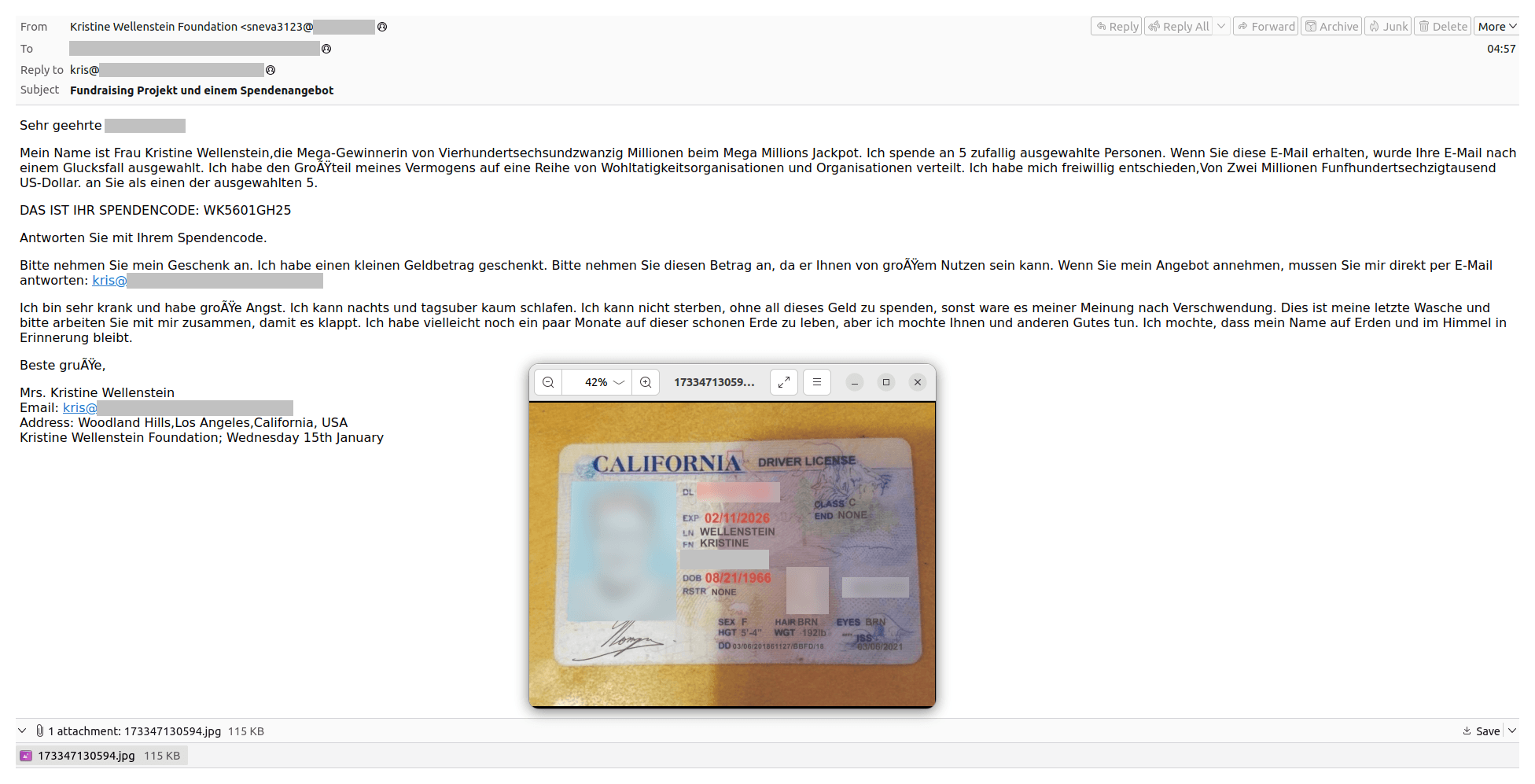
    Alternatively, the “millionaires” may be in good health and supposedly donating their money purely out of the goodness of their hearts. To enhance credibility, attackers can embed links to publicly available data about the individual they’re posing as.

    Compensation scams

    Beyond the “millionaire giveaway” scam, fraudsters frequently use the lure of compensations from governments, banks and other trusted entities. By doing so, they exploit the victim’s vulnerability rather than their greed. Scammers sometimes take their victims on an emotional rollercoaster ride. They start by frightening people with bad news, then calm them down by saying the problem has been fixed, and finally surprise them with a generous offer of compensation.

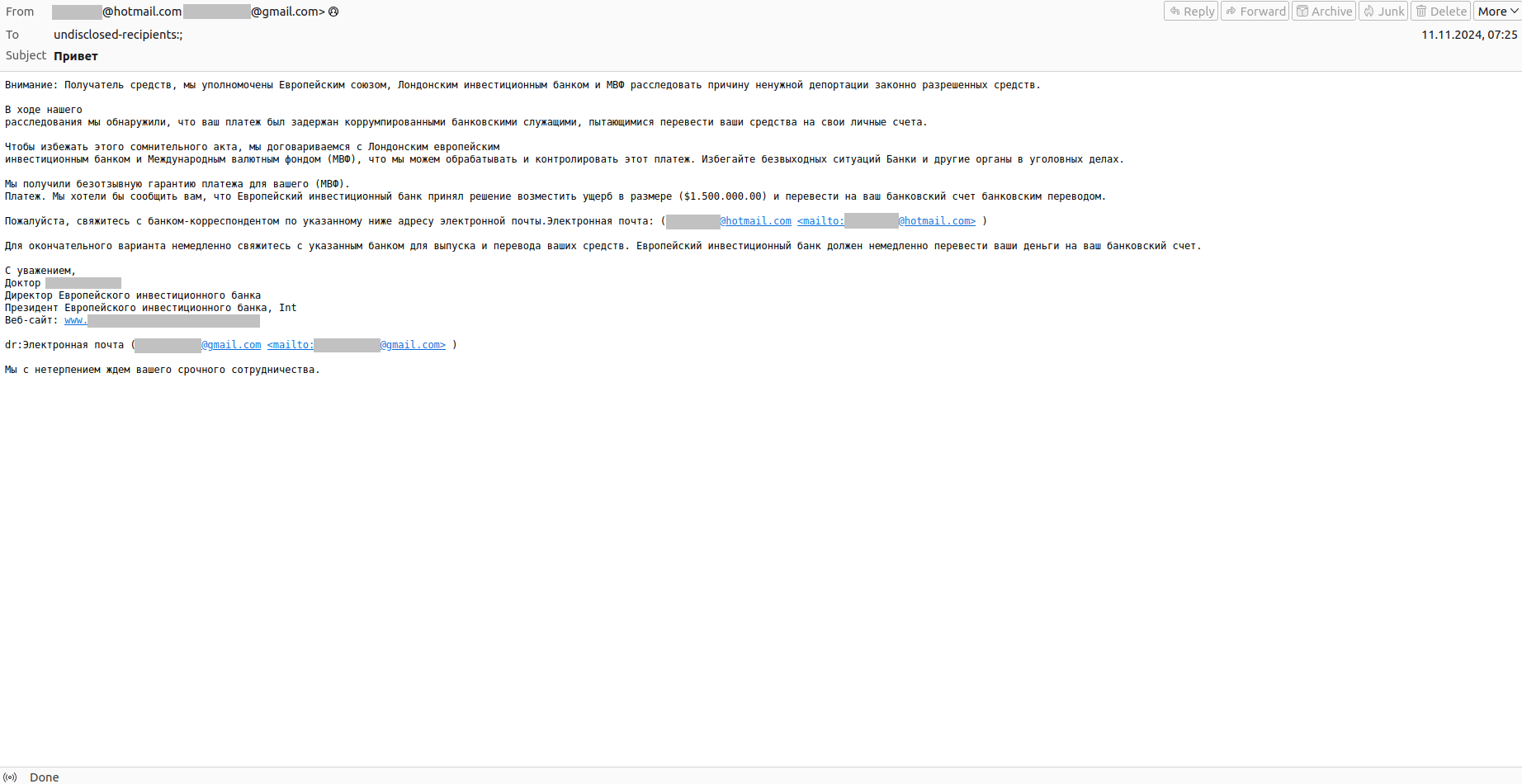
    For example, in the email screenshot below, the attackers, posing as high-ranking officials at a major bank, claim that “corrupt employees” were attempting to steal the recipient’s money. The bank claims to have taken action and is offering an exorbitant amount as damage compensation. To get it, the recipient is urged to contact a correspondent bank as soon as possible at an email address, which is, unsurprisingly, registered with a free email service.

    Scammers have another trick up their sleeve when it comes to compensations: they pretend to be from the police or some international organization and promise to give victims of “Nigerian” scams or other rip-offs their money back. In the example below, scammers, posing as the Financial Stability Council and the United Bank for Africa (UBA), promise the victim a payout from a so-called “fraud victims compensation fund”.

    Sometimes scammers pretend to be “victims of fraud” themselves. The screenshot below shows a common example: scammers masquerade as victims of cryptocurrency fraud, offering help from “noble hackers” who they claim helped them recover their losses.

    Lottery scams

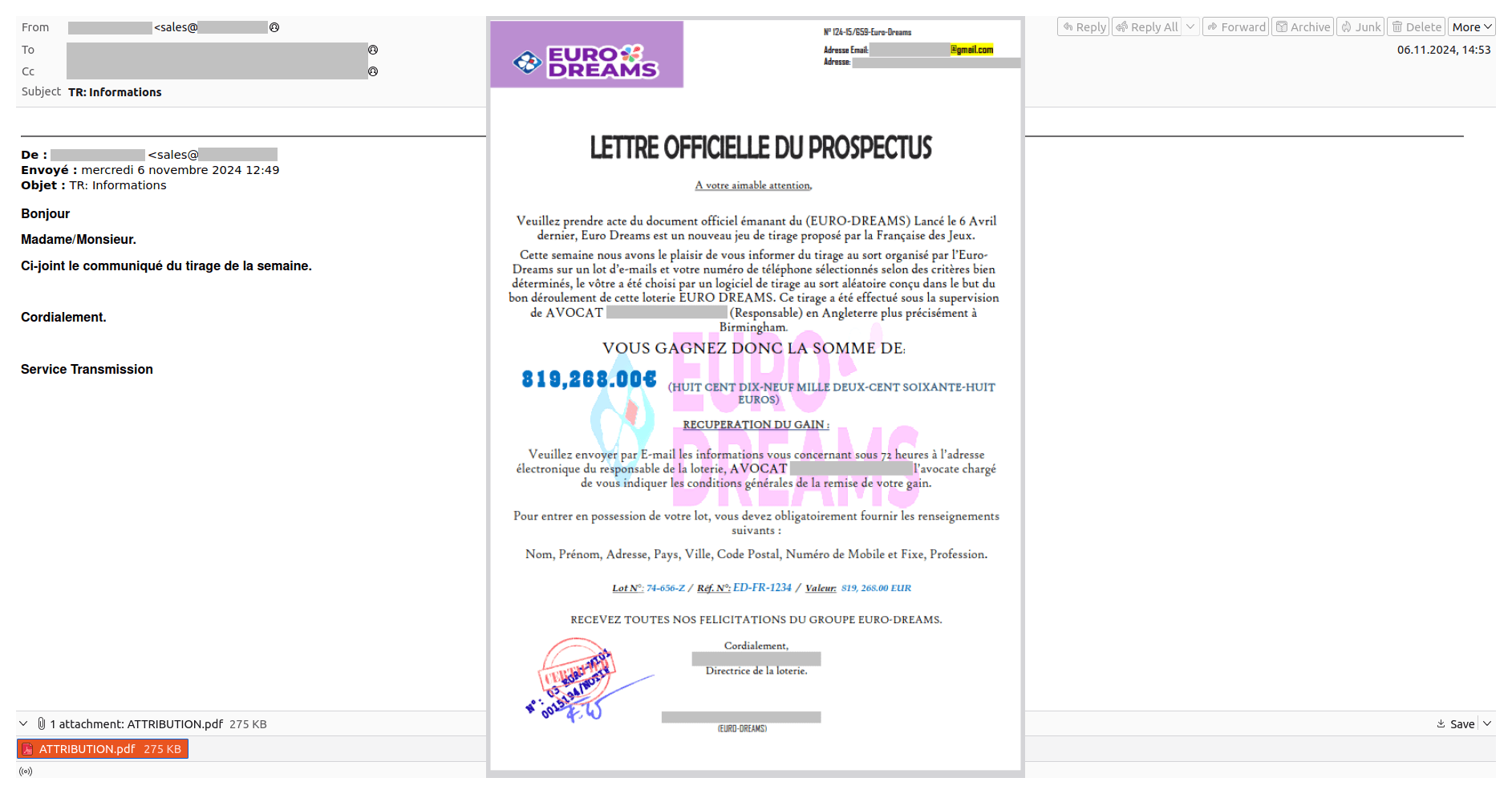
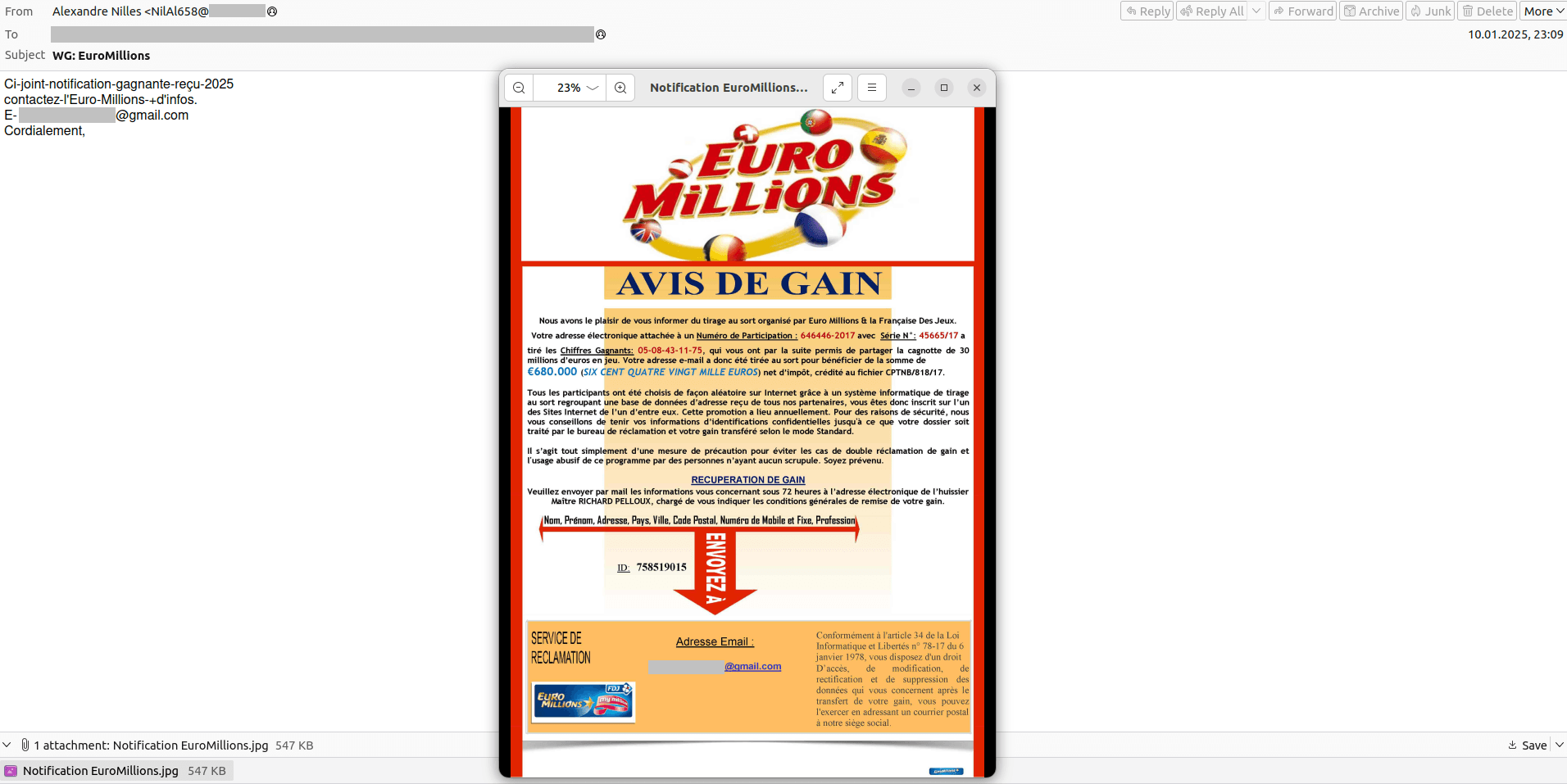
    Lottery win notification scams share many similarities with “Nigerian” scams. Fraudsters promise recipients large sums of money and provide their contact details for further communication. It’s likely that the victim has never heard of the lottery they’ve supposedly won.

    In some cases, scammers employ unusual tactics. For example, in a message claiming to be from a European lottery director, the email body is all but empty. All the “win” details and next steps are in a PDF attachment. The file includes a free email address, which is typical of “Nigerian” scams, and asks you to send fairly detailed personal information, such as your full name, address, and both your mobile and landline phone numbers. They even ask for your job position.

    In other similar emails, we noticed image attachments that included all the details about the supposed “win” and contact information.

    Another lottery scam tactic combines two types of bait: a lottery win (fraudsters pretend to be someone else who has won and is now offering you money) and offering a donation from a wealthy elderly person.

    In some cases, to make their scams more convincing, scammers attach photos of documents to their emails that supposedly confirm the sender’s identity or their winnings.

    Online dating scams

    Some “Nigerian” scams are so sophisticated that they can be hard to spot right away. These include offers of friendship that often develop into romantic conversations, which can be almost indistinguishable from real-life interactions. We’ve seen examples of really long email exchanges where a whole drama played out. A man and a woman met online and hit it off, chatting for hours about everything under the sun. Now, one of them is finally ready to meet the other in person. However, they can’t afford the ticket or visa, and they’re pleading with their partner for financial help so they can meet.

    In a different scenario, the scammer pretends to send an expensive gift to their partner. Eventually, they claim they can’t afford the postage and ask the victim to cover the costs. If the victim agrees, they’ll be hit with a series of additional fees, and the package will never materialize.

    “Nigerian” spam for businesses

    While “Nigerian” scams are often targeted at individual users, similar spam can also be found in the B2B sector. Cybercriminals claim to be seeking businesses to invest in, and the recipient’s company may be their target. To arrange a “partnership”, they ask the recipient to reply to the email.

    Current “Nigerian” spam themes

    Some of the spam samples above reference recent or current real-world events, such as the COVID-19 pandemic or Saudi Arabia’s possible BRICS membership. This is typical of “Nigerian” scams. There are countless ways scammers exploit various global or local, significant or ordinary, positive or negative events, news, incidents, and activities to pursue their selfish goals.

    The most talked-about event of 2024, the US presidential election, significantly influenced the types of scams we saw. Emails that took advantage of this topic were sent to users around the globe. For instance, in the following message, the scammers claimed that the recipient, who uses a German email address, was lucky enough to win millions of dollars from the Donald J. Trump Foundation.

    Creativity unbound

    While most spam fits into well-known categories, scammers can come up with some very surprising offers. We’ve seen quite a few messages from people claiming they’re giving away a piano because they’re moving or because the previous owner has passed away, as is often the case.

    Sometimes you find some really unusual specimens. For example, in the screenshot below, there’s an email allegedly sent from a secret society of Illuminati who claim to be ready to share their wealth and power, as well as make the lucky recipient famous if they agree to become part of their grand brotherhood.

    Conclusion

    “Nigerian” spam has existed for a long time and is characterized by its diversity. Fraudsters can pose as both real and fictitious individuals: bank employees, lawyers, businesspeople, magnates, bankers, ambassadors, company executives, law enforcement officers, presidents or even members of secret societies. They use a variety of stories to hook the user: compensations and reimbursements, donations and charity, winnings, inheritances, investments, and much more. Messages can be anything from short and captivating to long and persuasive, filled with numerous convincing claims designed to lull the victim into a false sense of security. The main danger of such emails lies in the fact that at first glance, there is nothing harmful in them: no links to phishing sites and no suspicious attachments. Scammers exclusively rely on social engineering and are willing to correspond with the victim for an extended period, increasing the credibility of their fabricated story.

    To avoid falling victim to such scams, it’s important to understand the dangers of tempting offers and to be critical of emails allegedly sent from influential individuals. If possible, it’s best to avoid responding to messages from unverified senders altogether. If for some reason you can’t avoid corresponding with a stranger, before responding to even an innocent message about finding a new owner for a piano, it’s worth double-checking the information in it, paying attention to inconsistencies, grammatical errors, etc. If the reply-to address is different from the sender’s address, or if you see a different address in the email body, this may be a sign of fraud.

    MIL OSI Economics

  • MIL-OSI Economics: Webcast: Statement of the Monetary Policy Committee and publication of Monetary Bulletin 5 February 2025

    Source: Central Bank of Iceland

    A statement of the Monetary Policy Committee was published on the Central Bank of Iceland website Wednesday 5 February 2025 at 08:30 hrs. The Bank’s Monetary Bulletin was published at 08:35 hrs. At 9:30 hrs. a press conference on the statement and the contents of the Monetary Bulletin will be held.

    MIL OSI Economics

  • MIL-OSI Economics: Bring Home the Sonic Soundscape, Experience Exceptional Audio on Samsung TVs & Soundbars with Dolby Atmos

    Source: Samsung

     
    GURUGRAM, India – 05, February 2025: Samsung, India’s largest consumer electronics brand, today unveiled an innovative, original series titled ‘Foley – Sound Meets Story’ taking audiences to a cinematic journey through the art and science of immersive audio. This video series has been produced in collaboration with Dolby, and marks a significant step for Samsung in redefining its presence in the premium audio hardware segment. The collaboration combines the rich auditory expertise of Dolby with Samsung’s cutting-edge technology in TVs & Soundbars.
     
    ‘Foley – Sound Meets Story’ is a series with five episodes, and each episode is inspired by one of the five elements – fire, water, wind, jungle, and food. With insights from professional Foley artists, each episode showcases the artistry behind crafting soundscapes that embody the essence of these elements in Dolby Atmos®. The series delves into the role of Dolby Atmos in delivering an audio experience with sounds that can be heard and felt all around, before finally highlighting the Samsung hardware that brings these sounds to life with exceptional clarity and depth for consumers. Consumers will experience these immersive Dolby Atmos soundscapes firsthand at over 5,000 Samsung stores across India, supported by well-trained Samsung retail staff.  This multi-faceted approach brings the series to life both on and offline, emphasizing Dolby and Samsung’s commitment to providing a truly elevated audio experience.
     
    “At Samsung, innovation lies at the heart of everything we do. Our collaboration with Dolby on this exclusive series reflects our commitment to deliver immersive and professional-grade audio experiences to our consumers. By blending Dolby’s expertise in sound with Samsung TVs & Soundbars, we aim to redefine how Indian audiences perceive and interact with sound technology, creating unforgettable sensory experiences in their homes.”  said Viplesh Dang, Senior Director, Visual Display Business, Samsung India.
     
    Sameer Seth, Director Marketing – India, Dolby Laboratories said, “Dolby Atmos is at the forefront of transforming entertainment with its immersive, theatre-quality sound. ‘Foley – Sound Meets Story’ shot at Annapurna Studios, is a sincere effort that brings out the story of the Foley artist on what goes in creating these sound effects brought to life in Dolby Atmos. We are excited to work with Samsung to deliver several lifelike soundscapes for consumers to experience through their Dolby Atmos enabled Samsung TV and soundbar.
     
    Each episode of ‘Foley – Sound Meets Story’ highlights the crucial role of Dolby Atmos in designing an immersive soundscape, ultimately showcasing the hardware that brings these audio experiences to life for consumers.‘Foley – Sound Meets Story’ series is designed to leave a lasting impression on consumers and enhancing Samsung brand in the competitive audio market.

    MIL OSI Economics

  • MIL-OSI Economics: IMF Staff Concludes Visit to Lithuania

    Source: International Monetary Fund

    Washington, DC – February 5, 2025: An International Monetary Fund (IMF) mission, led by Ms. Kazuko Shirono, visited Vilnius during January 27–31, 2025, to meet with the Lithuanian authorities and other stakeholders to discuss recent economic developments, the outlook, and policy priorities. At the end of the visit, the mission issued the following statement:

    MIL OSI Economics

  • MIL-OSI Economics: Take my money: OCR crypto stealers in Google Play and App Store

    Source: Securelist – Kaspersky

    Headline: Take my money: OCR crypto stealers in Google Play and App Store

    In March 2023, researchers at ESET discovered malware implants embedded into various messaging app mods. Some of these scanned users’ image galleries in search of crypto wallet access recovery phrases. The search employed an OCR model which selected images on the victim’s device to exfiltrate and send to the C2 server. The campaign, which targeted Android and Windows users, saw the malware spread through unofficial sources. In late 2024, we discovered a new malware campaign we dubbed “SparkCat”, whose operators used similar tactics while attacking Android and iOS users through both official and unofficial app stores. Our conclusions in a nutshell:

    • We found Android and iOS apps, some available in Google Play and the App Store, which were embedded with a malicious SDK/framework for stealing recovery phrases for crypto wallets. The infected apps in Google Play had been downloaded more than 242,000 times. This was the first time a stealer had been found in Apple’s App Store.
    • The Android malware module would decrypt and launch an OCR plug-in built with Google’s ML Kit library, and use that to recognize text it found in images inside the gallery. Images that matched keywords received from the C2 were sent to the server. The iOS-specific malicious module had a similar design and also relied on Google’s ML Kit library for OCR.
    • The malware, which we dubbed “SparkCat”, used an unidentified protocol implemented in Rust, a language untypical of mobile apps, to communicate with the C2.
    • Judging by timestamps in malware files and creation dates of configuration files in GitLab repositories, SparkCat has been active since March 2024.

    A malware SDK in Google Play apps

    The first app to arouse our suspicion was a food delivery app in the UAE and Indonesia, named “ComeCome” (APK name: com.bintiger.mall.android), which was available in Google Play at the time of the research, with more than 10,000 downloads.

    The onCreate method in the Application subclass, which is one of the app’s entry points, was overridden in version 2.0.0 (f99252b23f42b9b054b7233930532fcd). This method initializes an SDK component named “Spark”. It was originally obfuscated, so we statically deobfuscated it before analyzing.

    Suspicious SDK being called

    Spark is written in Java. When initialized, it downloads a JSON configuration file from a GitLab URL embedded in the malware body. The JSON is decoded with base64 and then decrypted with AES-128 in CBC mode.

    The config from GitLab being decrypted

    If the SDK fails to retrieve a configuration, the default settings are used.

    We managed to download the following config from GitLab:

    The “http” and “rust” fields contain SDK-specific C2 addresses, and the tfm flag is used to select a C2. With tfm equal to 1, “rust” will be used as the C2, and “http” if tfm has any other value.

    Spark uses POST requests to communicate with the “http” server. It encrypts data with AES-256 in CBC mode before sending and decrypts server responses with AES-128 in CBC mode. In both cases, the keys are hard-coded constants.

    The process of sending data to “rust” consists of three stages:

    • Data is encrypted with AES-256 in CBC mode using the same key as in the case of the “http” server.
    • The malware generates a JSON, where is the data upload path and is the encrypted data from the previous stage.

    • The JSON is sent to the server with the help of the native libmodsvmp.so library via the unidentified protocol over TCP sockets. Written in Rust, the library disguises itself as a popular Android obfuscator.

    Static analysis of the library wasn’t easy, as Rust uses a non-standard calling convention and the file had no function names in it. We managed to reconstruct the interaction pattern after running a dynamic analysis with Frida. Before sending data to the server, the library generates a 32-byte key for the AES-GCM-SIV cipher. With this key, it encrypts the data, pre-compressed with ZSTD. The algorithm’s nonce value is not generated and set to “unique nonce” (sic) in the code.

    Extending the AES key using the hard-coded nonce value

    The AES key is encrypted with RSA and is then also sent to the server. The public key for this RSA encryption is passed when calling a native method from the malicious SDK, in PEM format. The message is padded with 224 random bytes prior to AES key encryption. Upon receiving the request, the attackers’ server decrypts the AES key with a private RSA key, decodes the data it received, and then compresses the response with ZSTD and encrypts it with the AES-GCM-SIV algorithm. After being decrypted in the native library, the server response is passed to the SDK where it undergoes base64 decoding and decryption according to the same principle used for communication with the “http” server. See below for an example of communication between the malware module and the “rust” server.

    An example of communication with the “rust” server

    Once a configuration has been downloaded, Spark decrypts a payload from assets and executes it in a separate thread. It uses XOR with a 16-byte key for a cipher.

    A payload being decrypted

    The payload (c84784a5a0ee6fedc2abe1545f933655) is a wrapper for the TextRecognizer interface in Google’s ML Kit library. It loads different OCR models depending on the system language to recognize Latin, Korean, Chinese or Japanese characters in images. The SDK then uploads device information to /api/e/d/u on the C2 server. The server responds with an object that controls further malware activities. The object is a JSON file, its structure shown below. The uploadSwitch flag allows the malware to keep running (value 1).

    The SDK then registers an application activity lifecycle callback. Whenever the user initiates a chat with the support team, implemented with the legitimate third-party Easemob HelpDesk SDK, the handler requests access to the device’s image gallery. If the pw flag in the aforementioned object is equal to 1, the module will keep requesting access if denied. The reasoning behind the SDK’s request seems sound at first: users may attach images when contacting support.

    The reason given when requesting read access to the gallery

    If access is granted, the SDK runs its main functionality. This starts with sending a request to /api/e/config/rekognition on the C2 and getting parameters for processing OCR results in a response.

    These parameters are used by processor classes that filter images by OCR-recognized words. The malware also requests a list of keywords at /api/e/config/keyword for KeywordsProcessor, which uses these to select images to upload to the C2 server.

    Searching for keywords among OCR image processing results

    Besides KeywordsProcessor, the malware contains two further processors: DictProcessor and WordNumProcessor. The former filters images using localized dictionaries stored decrypted inside rapp.binary in the assets, and the latter filters words by length. The letterMin and letterMax parameters for each process define the permitted range of word length. For DictProcessor, wordlistMatchMin sets a minimum threshold for dictionary word matches in an image. For WordNumProcessor, wordMin and wordMax define the acceptable range for the total number of recognized words. The rs field in the response to the request for registering an infected device controls which processor will be used.

    Images that match the search criteria are downloaded from the device in three steps. First, a request containing the image’s MD5 hash is sent to /api/e/img/uploadedCheck on the C2. Next, the image is uploaded to either Amazon’s cloud storage or to file@/api/res/send on the “rust” server. After that, a link to the image is uploaded to /api/e/img/rekognition on the C2. So, the SDK, designed for analytics as suggested by the package name com.spark.stat, is actually malware that selectively steals gallery content.

    Uploading an image link

    We asked ourselves what kind of images the attackers were looking for. To find out, we requested from the C2 servers a list of keywords for OCR-based search. In each case, we received words in Chinese, Japanese, Korean, English, Czech, French, Italian, Polish and Portuguese. The terms all indicated that the attackers were financially motivated, specifically targeting recovery phrases also known as “mnemonics” that can be used to regain access to cryptocurrency wallets.

    Unfortunately, ComeCome was not the only app we found embedded with malicious content. We discovered a number of additional, unrelated apps covering a variety of subjects. Combined, these apps had been installed over 242,000 times at the time of writing this, and some of them remained accessible on Google Play. A full inventory can be found under the Indicators of Compromise section. We alerted Google to the presence of infected apps in its store.

    Popular apps containing the malicious payload

    Furthermore, our telemetry showed that malicious apps were also being spread through unofficial channels.

    SDK features could vary slightly from app to app. Whereas the malware in ComeCome only requested permissions when the user opened the support chat, in some other cases, launching the core functionality acted as the trigger.

    One small detail…

    As we analyzed the trojanized Android apps, we noticed how the SDK set deviceType to “android” in device information it was sending to the C2, which suggested that a similar Trojan existed for other platforms.

    Collecting information about an infected Android device

    A subsequent investigation uncovered malicious apps in App Store infected with a framework that contained the same Trojan. For instance, ComeCome for iOS was infected in the same way as its Android version. This is the first known case of an app infected with OCR spyware being found in Apple’s official app marketplace.

    The ComeCome page in the App Store

    Negative user feedback about ComeCome

    Malicious frameworks in App Store apps

    We detected a series of apps embedded with a malicious framework in the App Store. We cannot confirm with certainty whether the infection was a result of a supply chain attack or deliberate action by the developers. Some of the apps, such as food delivery services, appeared to be legitimate, whereas others apparently had been built to lure victims. For example, we saw several similar AI-featured “messaging apps” by the same developer:

    Messaging apps in the App Store designed to lure victims

    Besides the malicious framework itself, some of the infected apps contained a modify_gzip.rb script in the root folder. It was apparently used by the developers to embed the framework in the app:

    The contents of modify_gzip.rb

    The framework itself is written in Objective-C and obfuscated with HikariLLVM. In the apps we detected, it had one of three names:

    1. GZIP;
    2. googleappsdk;
    3. stat.

    As with the Android-specific version, the iOS malware utilized the ML Kit interface, which provided access to a Google OCR model trained to recognize text and a Rust library that implemented a custom C2 communication protocol. However, in this case, it was embedded directly into the malicious executable. Unlike the Android version, the iOS framework retained debugging symbols, which allowed us to identify several unique details:

    • The lines reveal the paths on the framework creators’ device where the project was stored, including the user names:
      • /Users/qiongwu/: the project author’s home directory
      • /Users/quiwengjing/: the Rust library creator’s home directory
    • The C2-rust communication module was named im_net_sys. Besides the client, it contains code that the attackers’ server presumably uses to communicate with victims.
    • The project’s original name is GZIP.

    Project details from code lines in the malicious framework

    The framework contains several malicious classes. The following are of particular interest:

    • MMMaker: downloads a configuration and gathers information about the device.
    • ApiMgr: sends device data.
    • PhotoMgr: searches for photos containing keywords on the device and uploads them to the server.
    • MMCore: stores information about the C2 session.
    • MMLocationMgr: collects the current location of the device. It sent no data during our testing, so the exact purpose of this class remained unclear.

    Certain classes, such as MMMaker, could be missing or bear a different name in earlier versions of the framework, but this didn’t change the malware’s core functionality.

    Obfuscation significantly complicates the static analysis of samples, as strings are encrypted and the program’s control flow is obscured. To quickly decrypt the strings of interest, we opted for dynamic analysis. We ran the application under Frida and captured a dump of the _data section where these strings were stored. What caught our attention was the fact that the app bundleID was among the decrypted data:

    com.lc.btdj: the ComeCome bundleID as used in the +[MMCore config] selector

    As it turned out, the framework also stored other app bundle identifiers used in the +[MMCore config] selector. Our takeaways are as follows:

    1. The Trojan can behave differently depending on the app it is running in.
    2. There are more potentially infected apps than we originally thought.

    For the full list of bundle IDs we collected from decrypted strings in various framework samples, see the IoC section. Some of the apps associated with these IDs had been removed from the App Store at the time of the investigation, whereas others were still there and contained malicious code. Some of the IDs on the list referred to apps that did not contain the malicious framework at the time of this investigation.

    As with the Android-specific version, the Trojan implements three modes of filtering OCR output: keywords, word length, and localized dictionaries stored in encrypted form right inside the framework, in a “wordlists” folder. Unfortunately, we were unable to ascertain that the malware indeed made use of the last method. None of the samples we analyzed contained links to the dictionaries or accessed them while running.

    Sending selected photos containing keywords is a key step in the malicious framework’s operation. Similar to the Android app, the Trojan requests permission to access the gallery only when launching the View Controller responsible for displaying the support chat. At the initialization stage, the Trojan, depending on the application it is running in, replaces the viewDidLoad or viewWillAppear method in the relevant controller with its own wrapper that calls the method +[PhotoMgr startTask:]. The latter then checks if the application has access to the gallery and requests it if needed. Next, if access is granted, PhotoMgr searches for photos that match sending criteria among those that are available and have not been processed before.

    The code snippet of the malicious wrapper around the viewDidLoad method that determines which application the Trojan is running in

    Although it took several attempts, we managed to make the app upload a picture to Amazon’s cloud and then send information about it to the attackers’ server. The app was using HTTPS to communicate with the server, not the custom “rust” protocol:

    The communication with the C2 and upload to AWS

    The data being sent looks as follows:

    The oldest version of the malicious framework we were investigating was built on March 15, 2024. While it doesn’t differ significantly from newer versions, this one contains more unencrypted strings, including API endpoints and a single, hardcoded C2 address. Server responses are received in plaintext.

    URLs hard-coded into the oldest version of the malicious framework

    File creation date in the app

    Campaign features

    While analyzing the Android apps, we found that the word processor code contained comments in Chinese. Error descriptions returned by the C2 server in response to malformed requests were also in Chinese. These, along with the name of the framework developer’s home directory which we obtained while analyzing the iOS-specific version suggest that the creator of the malicious module speaks fluent Chinese. That being said, we have insufficient data to attribute the campaign to a known cybercrime gang.

    Our investigation revealed that the attackers were targeting crypto wallet recovery phrases, which were sufficient for gaining full control over a victim’s crypto wallet to steal the funds. It must be noted that the malware is flexible enough to steal not just these phrases but also other sensitive data from the gallery, such as messages or passwords that might have been captured in screenshots. Multiple OCR results processing modes mitigate the effects of model errors that could affect the recognition of access recovery phrase images if only keyword processing were used.

    Our analysis of the malicious Rust code inside the iOS frameworks revealed client code for communicating with the “rust” server and server-side encryption components. This suggests that the attackers’ servers likely also use Rust for protocol handling.

    Server-side private RSA key import

    We believe that this campaign is targeting, at a minimum, Android and iOS users in Europe and Asia, as indicated by the following:

    • The keywords used were in various languages native to those who live in European and Asian countries.
    • The dictionaries inside assets were localized in the same way as the keywords.
    • Some of the apps apparently operate in several countries. Some food delivery apps support signing up with a phone number from the UAE, Kazakhstan, China, Indonesia, Zimbabwe and other countries.

    We suspect that mobile users in other regions besides Europe and Asia may have been targeted by this malicious campaign as well.

    One of the first malicious modules that we started our investigation with was named “Spark”. The bundle ID of the malicious framework itself, “bigCat.GZIPApp”, caught our attention when we analyzed the iOS-specific Trojan. Hence the name, “SparkCat”. The following are some of the characteristics of this malware:

    • Cross-platform compatibility;
    • The use of the Rust programming language, which is rarely found in mobile apps;
    • Official app marketplaces as a propagation vector;
    • Stealth, with C2 domains often mimicking legitimate services and malicious frameworks disguised as system packages;
    • Obfuscation, which hinders analysis and detection.

    Conclusion

    Unfortunately, despite rigorous screening by the official marketplaces and general awareness of OCR-based crypto wallet theft scams, the infected apps still found their way into Google Play and the App Store. What makes this Trojan particularly dangerous is that there’s no indication of a malicious implant hidden within the app. The permissions that it requests may look like they are needed for its core functionality or appear harmless at first glance. The malware also runs quite stealthily. This case once again shatters the myth that iOS is somehow impervious to threats posed by malicious apps targeting Android. Here are some tips that can help you avoid becoming a victim of this malware:

    • If you have one of the infected apps installed on your device, remove it and avoid reinstalling until a fix is released.
    • Avoid storing screenshots with sensitive information, such as crypto wallets recovery phrases, in the gallery. You can store passwords, confidential documents and other sensitive information in special apps.
    • Use a robust security product on all your devices.

    Our security products return the following verdicts when detecting malware associated with this campaign:

    • HEUR:Trojan.IphoneOS.SparkCat.*
    • HEUR:Trojan.AndroidOS.SparkCat.*

    Indicators of compromise

    Infected Android apps
    0ff6a5a204c60ae5e2c919ac39898d4f
    21bf5e05e53c0904b577b9d00588e0e7
    a4a6d233c677deb862d284e1453eeafb
    66b819e02776cb0b0f668d8f4f9a71fd
    f28f4fd4a72f7aab8430f8bc91e8acba
    51cb671292eeea2cb2a9cc35f2913aa3
    00ed27c35b2c53d853fafe71e63339ed
    7ac98ca66ed2f131049a41f4447702cd
    6a49749e64eb735be32544eab5a6452d
    10c9dcabf0a7ed8b8404cd6b56012ae4
    24db4778e905f12f011d13c7fb6cebde
    4ee16c54b6c4299a5dfbc8cf91913ea3
    a8cd933b1cb4a6cae3f486303b8ab20a
    ee714946a8af117338b08550febcd0a9
    0b4ae281936676451407959ec1745d93
    f99252b23f42b9b054b7233930532fcd
    21bf5e05e53c0904b577b9d00588e0e7
    eea5800f12dd841b73e92d15e48b2b71

    iOS framework MD5s:
    35fce37ae2b84a69ceb7bbd51163ca8a
    cd6b80de848893722fa11133cbacd052
    6a9c0474cc5e0b8a9b1e3baed5a26893
    bbcbf5f3119648466c1300c3c51a1c77
    fe175909ac6f3c1cce3bc8161808d8b7
    31ebf99e55617a6ca5ab8e77dfd75456
    02646d3192e3826dd3a71be43d8d2a9e
    1e14de6de709e4bf0e954100f8b4796b
    54ac7ae8ace37904dcd61f74a7ff0d42
    caf92da1d0ff6f8251991d38a840fb4a

    Trojan configuration in GitLab
    hxxps://gitlab[.]com/group6815923/ai/-/raw/main/rel.json
    hxxps://gitlab[.]com/group6815923/kz/-/raw/main/rel.json

    C2
    api.firebaseo[.]com
    api.aliyung[.]com
    api.aliyung[.]org
    uploads.99ai[.]world
    socket.99ai[.]world
    api.googleapps[.]top

    Photo storage
    hxxps://dmbucket102.s3.ap-northeast-1.amazonaws[.]com

    Names of Infected Android APKs from Google Play
    com.crownplay.vanity.address
    com.atvnewsonline.app
    com.bintiger.mall.android
    com.websea.exchange
    org.safew.messenger
    org.safew.messenger.store
    com.tonghui.paybank
    com.bs.feifubao
    com.sapp.chatai
    com.sapp.starcoin

    BundleIDs encrypted inside the iOS frameworks
    im.pop.app.iOS.Messenger
    com.hkatv.ios
    com.atvnewsonline.app
    io.zorixchange
    com.yykc.vpnjsq
    com.llyy.au
    com.star.har91vnlive
    com.jhgj.jinhulalaab
    com.qingwa.qingwa888lalaaa
    com.blockchain.uttool
    com.wukongwaimai.client
    com.unicornsoft.unicornhttpsforios
    staffs.mil.CoinPark
    com.lc.btdj
    com.baijia.waimai
    com.ctc.jirepaidui
    com.ai.gbet
    app.nicegram
    com.blockchain.ogiut
    com.blockchain.98ut
    com.dream.towncn
    com.mjb.Hardwood.Test
    com.galaxy666888.ios
    njiujiu.vpntest
    com.qqt.jykj
    com.ai.sport
    com.feidu.pay
    app.ikun277.test
    com.usdtone.usdtoneApp2
    com.cgapp2.wallet0
    com.bbydqb
    com.yz.Byteswap.native
    jiujiu.vpntest
    com.wetink.chat
    com.websea.exchange
    com.customize.authenticator
    im.token.app
    com.mjb.WorldMiner.new
    com.kh-super.ios.superapp
    com.thedgptai.event
    com.yz.Eternal.new
    xyz.starohm.chat
    com.crownplay.luckyaddress1
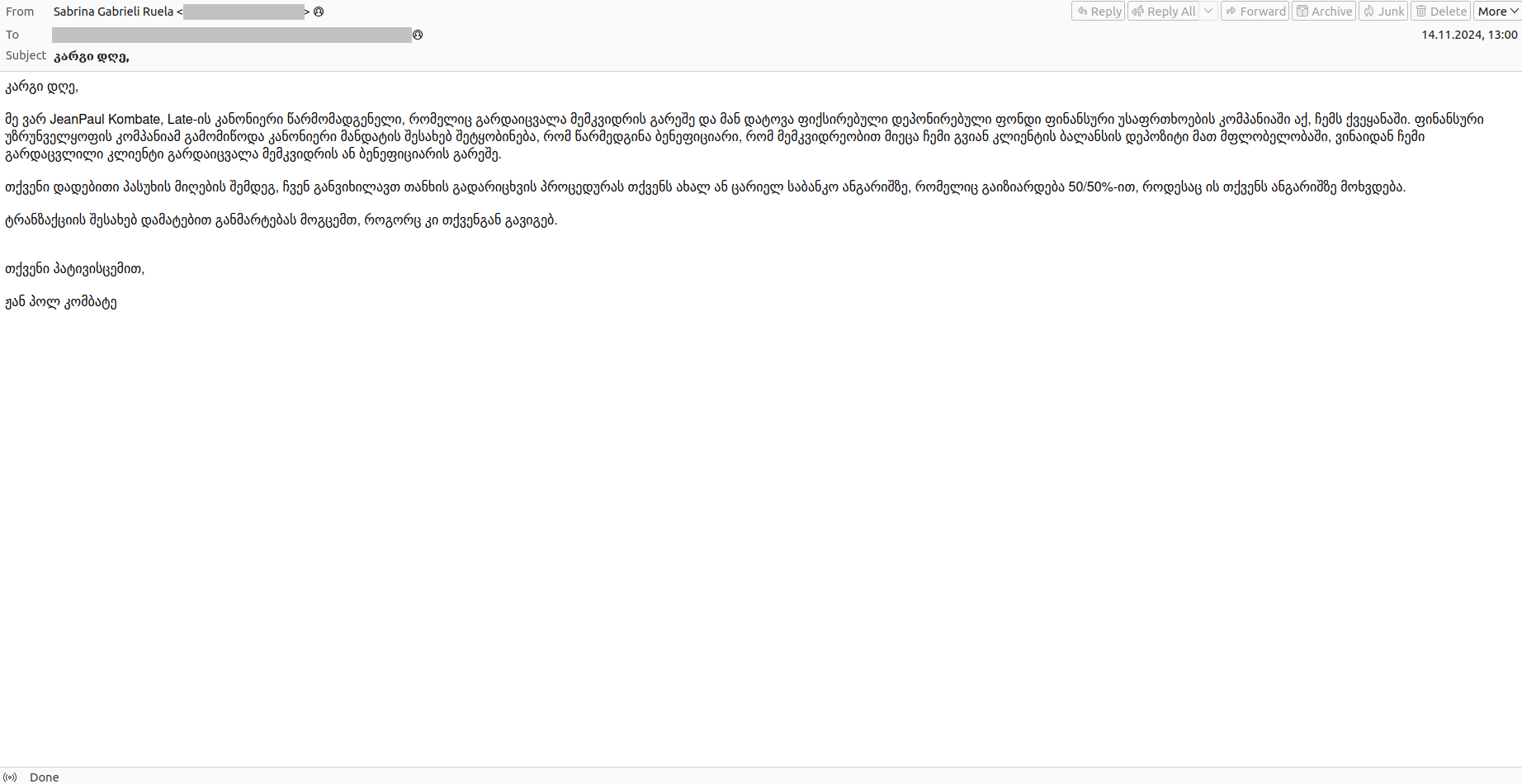
    MIL OSI Economics

  • MIL-OSI Economics: Alternative payments account for over half of total e-commerce payments in Australia, reveals GlobalData

    Source: GlobalData

    Alternative payments account for over half of total e-commerce payments in Australia, reveals GlobalData

    Posted in Banking

    Alternative payment methods such as mobile and digital wallets and buy now pay later (BNPL) solutions have reshaped Australia’s e-commerce landscape, overtaking traditional cash and card payments. With a 53% market share in 2024, these digital solutions are driving seamless transactions, fuelling online sales, and reinforcing the sector’s robust growth trajectory, reveals GlobalData, a leading data and analytics company.

    GlobalData’s E-Commerce Analytics reveals that Australian e-commerce market is expected to register a compound annual growth rate (CAGR) of 6.5% from AUD77.2 billion ($51.3 billion) in 2024 to AUD105.8 billion ($70.3 billion) in 2029, as consumers increasingly shift from offline to online purchases.

    Shivani Gupta, Senior Banking and Payments Analyst at GlobalData, comments: “E-commerce sales in Australia have experienced consistent growth in recent years. This growth can be attributed to the availability of secure online payment tools, an increasing number of online shoppers, and the rise of online merchants and payment options. Furthermore, the popularity of online shopping events like Black Friday, Cyber Monday, and Afterpay Day has further fuelled the expansion of e-commerce.”

    According to Australia Post, 7.6 million households in Australia made online purchases during November to December 2024, representing a growth rate of 2.4% compared to same period last year. Additionally, the availability of secure payment solutions, such as Mastercard Identity Check, and appealing BNPL options like Afterpay have encouraged consumers to shop online.

    GlobalData’s 2024 Financial Services Consumer Survey* reveals that alternative payment solutions dominate e-commerce market in Australia with a combined market share of 53% in 2024.

    Gupta explains: “This is a trend that is prevalent in many Asian markets. PayPal is the most preferred payment option, followed by other brands such as Apple Pay. The rising popularity of BNPL solutions is also contributing to the overall ecommerce payments with the most prominent BNPL brands being Afterpay, Zip, and Klarna.”

    Payment cards are the second most preferred payment method, with debit, credit and charge, and prepaid cards collectively accounting for 38.7% share in 2024. This can be attributed to the value-added benefits offered on payment cards, including interest free instalment payments, reward programs, cashback, and discounts.

    Cash accounted for a share of just 3.1% of e-commerce payments, reflecting the strong use of electronic payment methods in the country.

    Gupta concludes: “The uptrend in e-commerce sales is likely to continue over the next few years supported by evolving consumer preferences, improving payment infrastructure, and proliferation of alternative payment solutions. Subsequently, Australia’s e-commerce sales are anticipated to register a growth rate of 8% to reach AUD83.4 billion ($55.4 billion) in 2025.”

    *GlobalData’s 2024 Financial Services Consumer Survey was carried out in Q2 2024. Approximately 67,292 respondents aged 18+ were surveyed across 41 countries.

    MIL OSI Economics

  • MIL-OSI Economics: Contactless vital monitoring to transform digital healthcare, says GlobalData

    Source: GlobalData

    Contactless vital monitoring to transform digital healthcare, says GlobalData

    Posted in Medical Devices

    PanopticAI has revolutionized patient monitoring by developing the world’s first FDA-cleared app for contactless pulse rate measurement. Using remote photoplethysmography (rPPG) algorithms and smartphone cameras, this innovation eliminates the need for costly medical equipment, making healthcare more accessible and scalable, says GlobalData, a leading data and analytics company.

    With just a 30-second scan, the app provides accurate vital sign readings, transforming everyday smartphones into a medical-grade tool. This development marks a major milestone in the shift toward AI-driven, consumer-focused digital health solutions that empower patients and expand global healthcare access.

    Elia Garcia, Medical Analyst at GlobalData, comments: “Beyond its technological innovation, PanopticAI’s FDA recent clearance highlights the importance of Software as a Medical Device (SaMD) within healthcare systems. The app was validated through rigorous testing across diverse patient demographics and environmental conditions, ensuring it works reliably in real-world scenarios. Its adoption by hospitals, insurers, and pharmacies—such as Gleneagles Hospital and Bupa—illustrates the growing demand for accessible, preventive care solutions.”

    PanopticAI exemplifies how digital health can bridge gaps in traditional healthcare by simplifying monitoring and reducing costs, especially in underserved populations or regions with limited healthcare resources.

    Garcia concludes: “PanopticAI’s breakthrough aligns with key trends, including the increasing consumerization of healthcare, the proliferation of AI-powered solutions, and the shift toward preventive care. Leveraging everyday devices such as smartphones reduces dependency on expensive wearables, breaking barriers to adoption.”

    MIL OSI Economics

  • MIL-OSI Economics: Secretary-General of ASEAN attends Interface between High-Level Task Force on the ASEAN Community’s Post 2025 Vision with various pillars of ASEAN Community

    Source: ASEAN

    Secretary-General of ASEAN, Dr. Kao Kim Hourn, today attended the interface with the Chair of the High-Level Task Force on ASEAN Economic Integration (HLTF-EI), Co-Chairs of the Ad-Hoc Working Group to Develop the ASCC Post-2025 Strategic Plan (ASCC AHWG), Chair of ASEAN Connectivity Coordinating Committee (ACCC) as well as the Chair of the Senior Officials’ Meeting Responsible for Information and Media (SOMRI), during the 21st High-Level Task Force on the ASEAN Community’s Post 2025 Vision (HLTF-AVC), co-chaired by Malaysia and the Philippines, in Manila, the Philippines.

    The post Secretary-General of ASEAN attends Interface between High-Level Task Force on the ASEAN Community’s Post 2025 Vision with various pillars of ASEAN Community appeared first on ASEAN Main Portal.

    MIL OSI Economics

  • MIL-OSI Economics: Toyota to Form Comprehensive Partnership on Carbon Neutrality with Shanghai and Establish a Company to Develop and Produce BEVs and Batteries

    Source: Toyota

    Headline: Toyota to Form Comprehensive Partnership on Carbon Neutrality with Shanghai and Establish a Company to Develop and Produce BEVs and Batteries

    Toyota Motor Corporation (Toyota) announced today that it will sign a comprehensive partnership agreement with the Shanghai municipal government in China regarding carbon neutrality. In addition, Toyota has decided to establish a new wholly-owned company in Jinshan District in southwest Shanghai to develop and produce BEVs and batteries.

    MIL OSI Economics

  • MIL-OSI Economics: Result of the Daily Variable Rate Repo (VRR) auction held on February 05, 2025

    Source: Reserve Bank of India

    Tenor 1-day
    Notified Amount (in ₹ crore) 25,000
    Total amount of bids received (in ₹ crore) 21,180
    Amount allotted (in ₹ crore) 21,180
    Cut off Rate (%) 6.51
    Weighted Average Rate (%) 6.52
    Partial Allotment Percentage of bids received at cut off rate (%) NA

    Ajit Prasad          
    Deputy General Manager
    (Communications)    

    Press Release: 2024-2025/2077

    MIL OSI Economics

  • MIL-OSI Economics: Asian Impact 88: Climate Change Perceptions in Asia

    Source: Asia Development Bank

    The Asian Development Bank (ADB) is committed to achieving a prosperous, inclusive, resilient, and sustainable Asia and the Pacific, while sustaining its efforts to eradicate extreme poverty. It assists its members and partners by providing loans, technical assistance, grants, and equity investments to promote social and economic development.

    Headquarters

    6 ADB Avenue, Mandaluyong City 1550, Metro Manila, Philippines

    MIL OSI Economics