Category: Economics

  • MIL-OSI Economics: Interactions between monetary policy, regulation and financial markets | Video message at the Conference on Markets and Intermediaries

    Source: Bundesbank

    Check against delivery.

    1 Introduction

    Ladies and gentlemen,

    Good morning and welcome to the Conference on Markets and Intermediaries, an event jointly organised by the Bundesbank and the Humboldt-Universität zu Berlin.

    In my opening speech, I will take you on a helicopter tour of the programme and share some thoughts on the topics that will be covered over the next two days. The programme certainly does cover a wide range of topics. It addresses current challenges facing financial markets, financial intermediaries, and central banks.

    Since the Great Financial Crisis, central banks worldwide have expanded their balance sheets, injected additional liquidity into the financial system, and broadened their collateral frameworks. In addition, financial regulation has been adapted to make the financial system more stable.

    While these measures served useful purposes, they also had side effects, not least in money and capital markets. Policymakers and regulators are therefore well-advised to evaluate the effects of their measures.

    2 Non-bank financial institutions

    The first session is dedicated to non-bank financial institutions, or NBFIs.

    This sector includes, amongst others, insurers, investment funds, and money market and hedge funds. It is strongly interconnected, both with other sectors and across countries. Its share of the global financial system, as measured by total financial assets, is almost one-half.

    Clearly, it could be a source of systemic risks. But the risks presented by NBFIs often lie out of view. This makes them more difficult to monitor and assess. All the more important, then, to close data gaps and strengthen the resilience of the sector.

    One particular source of vulnerability are fire sales of open-ended funds. These are the subject of a paper that Rüdiger Weber is presenting this morning.[1]

    Open-ended funds are especially prone to fire sales because, during episodes of market stress, they often face significant pressure from investors who want to liquidate their holdings quickly. Fund managers may then be forced to offload fund assets at short notice. And if those assets are less liquid, they may have to sell them at lower prices. This may amplify price declines and liquidity shortages.

    Effective liquidity management and regulation are very important here. A recently published Bundesbank paper shows that price-based liquidity management tools help keep the financial fragility of open-ended mutual funds in check.[2]

    In times of stress, investors also try to protect their capital by shifting it into safer assets. However, this flight to safety can intensify the downward pressure on the prices of riskier assets as demand for the latter declines.

    The Financial Stability Board is doing important work in this field. But it is currently focused on microprudential regulation. I think the FSB’s work on this front needs to be complemented by the development of macroprudential regulation for the NBFI sector.

    In any case, we should not jeopardise what we have achieved in the banking regulation space by allowing stability risks to build up elsewhere in the financial system.

    3 Central bank digital currencies

    The second session is on central bank digital currencies (CBDC).

    CBDC is an issue that is keeping almost all central banks very busy at the moment. The Eurosystem is hard at work preparing for the potential introduction of a digital euro.

    As the world turns increasingly digital, the digital euro would provide a secure and efficient digital payment option that complements cash. It aims to strengthen Europe’s strategic autonomy by building on European infrastructures, and to promote innovation in the private sector.

    However, introducing a CBDC could also have unintended side effects. If bank customers were allowed to hold it in large amounts, periods of banking distress could trigger large, sudden shifts out of deposits into CBDC. This could lead to financial instability.

    And if CBDC were too attractive a substitute for deposits, commercial banks’ access to retail deposits could erode over time. Which could lead to structural disintermediation and call into question our proven two-tier banking system. It is therefore of the essence to design CBDC in a way that prevents these risks from materialising.

    The challenge is to optimise the usability of CBDC as a means of payment while at the same time limiting its effects on the market for bank deposits. Two decisive factors in this regard are remuneration and holding limits. Let me say a few words on each of these.

    Remuneration means the rate of interest on people’s holdings of CBDC. If that rate of interest were positive, holding CBDC would be more attractive. But at the same time, that would lead to outflows out of bank deposits.

    Based on a welfare-maximising model setting, Pascal Paul will argue later this afternoon that central banks should allow for a positive interest rate.[3] This stands in contrast to the intention of the Governing Council not to remunerate digital euro holdings.[4]

    Why are we not in favour of remuneration?

    Because our aim is to make the digital euro a digital complement to cash, and there is no remuneration for holding cash. We neither want to compete with commercial banks for deposits, nor do we want to employ the digital euro as a monetary policy instrument.

    The second, perhaps even more important, factor is holding limits. We intend to limit digital euro holdings to a certain amount, because we want to ensure the digital euro does not lead to large sudden shifts or disintermediation.

    The limits currently under discussion range from €500 to €3,000.[5] A recent Bundesbank paper finds that an optimal holding limit would be in a range between €1,500 and €2,500.[6] On the Governing Council, we have not yet taken a decision on the exact amount. What is more, EU legislators might be involved here.

    But as regards the practical usability of the digital euro, the exact limit does not play a major role anyway. This is because a reverse waterfall system, as it is called, would allow users to link their digital euro wallet to their bank account. They can then convert their bank deposits into digital euro automatically and instantly if their holdings are insufficient to make a payment.

    4 Banking and deposit flows

    Allowing users to convert an unlimited amount of deposits into CBDC would expose commercial banks to substantial run risk. In any case, zero or lower interest rates will not discourage them from doing that in times of crisis. However, digital bank runs can happen even without CBDC.

    The failure of Silicon Valley Bank and other regional banks in March 2023 showed how quickly customers can withdraw their deposits these days. At Silicon Valley Bank alone, customers pulled out USD 42 billion within the space of a single day, which equated to around one-quarter of total deposits. And another USD 100 billion would have been withdrawn a day later.[7] The depositors on the run were apparently account holders with uninsured deposits.

    Banking and deposit flows are the subject of Session 3. Dominic Cucic will present a paper showing that bank customers do indeed redistribute their deposits when deposit insurance limits change.[8] Credible and reliable deposit insurance helps to prevent bank runs and preserve financial stability.

    In the euro area, we currently have deposit insurance at the national level. Adding a European layer in the form of a hybrid model would help prevent situations where large shocks overwhelm national deposit insurance systems and lead to cross-border contagion.

    As a European layer should be risk-based, large exposures of banks to individual sovereigns are an issue. Currently, many banks hold a disproportionately large number of bonds issued by their domestic governments. If this were to continue, a common deposit insurance arrangement could lead to a redistribution of sovereign solvency risks.

    In my view, the new EU legislative session provides a good opportunity to move forward on both issues: with a reduction in banks’ exposures to individual sovereigns, and a common European deposit insurance system.

    5 Central bank interventions and market behaviour

    Session 4 of this conference focuses on the impact of central bank interventions on market behaviour. Both papers in this session underline that such central bank measures need to be carefully designed.[9]

    Central banks have taken a wide range of non-standard monetary policy measures to ensure sufficient monetary stimulus at the effective lower bound. But in the medium to long term, such policies may lead to inefficiencies. These could arise in financial markets themselves or in the allocation of resources affected by the boost to lending.

    This makes it all the more important to evaluate the instruments used and the lessons learned. It is therefore very fitting that we are currently carrying out a strategy review in the Eurosystem. Amongst other things, this will provide an opportunity to critically review the quantitative easing policies we have seen in the past.

    The extensive bond purchases contributed to price stability in an era of low inflation, but they were also associated with numerous side effects in financial markets. Without prejudging the outcome of the review, I think their use should be limited to exceptional circumstances.

    6 Conclusion

    Ladies and gentlemen,

    The conference concludes with a panel discussion on the ECB’s new operational framework. As I have already expressed my views on this on a different occasion,[10] I will end my speech by expressing my gratitude.

    Thanks to the organisers from the Bundesbank and Humboldt University for setting up this conference. Thanks to the presenters, discussants and panellists for sharing their insights. Thanks to all participants for their contributions. And special thanks to Annette Vissing-Jørgensen from the Federal Reserve Board, who will give a keynote on “Balance sheet policy above the effective lower bound”.[11]

    Now I wish you all an exciting conference with valuable insights.

    Thank you very much.

    Footnotes:

    1. Rzeźnik, A. and R. Weber (2022), Money in the Right Hands, mimeo.
    2. Dunne, P. et al. (2024), Financial fragility in open-ended mutual funds: the role of liquidity management tools, Bundesbank Discussion Paper, No 36/2024.
    3. Paul, P., M. Ulate and J. C. Wu (2024), A Macroeconomic Model of Central Bank Digital Currency, mimeo.
    4. European Central Bank (2023), A stocktake on the digital euro. Summary report on the investigation phase and outlook on the next phase, 18 October.
    5. Balz, B. (2024), Only balances of €500 allowed? What the digital euro is intended to deliver – and what not, Interview with Focus online, 5 June.
    6. Bidder, R., T. Jackson and M. Rottner (2024), CBDC and banks: Disintermediating fast and slow, Deutsche Bundesbank Discussion Paper, No 15/2024.
    7. Congressional Hearing Transcript, Recent Bank Failures and the Regulatory Response, Committee on Banking, Housing, and Urban Affairs, 28 March 2023.
    8. Cucic, D. et al. (2024), Distortive Effects of Deposit Insurance: Administrative Evidence from Deposit and Loan Accounts, mimeo.
    9. Eufinger, C. and Z. Ye (2024), Breaking Bagehot’s Rules: Loan Contracting with Advantageous Central Bank Funding, mimeo; Meisenzahl, R. R. and K. M. Pence, De-Limiting Arbitrage: Evidence from the Term Asset-Backed Securities Loan Facility, mimeo.
    10. Nagel, J. (2024), Reflections on the Eurosystem’s new operational framework, Speech at the Konstanz Seminar on Monetary Theory and Monetary Policy, 16 May.
    11. Vissing-Jørgensen, A. (2023), Balance Sheet Policy Above the ELB, ECB Forum on Central Banking, Sintra.

    MIL OSI Economics

  • MIL-OSI Economics: Luis de Guindos: Expectations surveys, central banks and the economy

    Source: European Central Bank

    Welcome address by Luis de Guindos, Vice-President of the ECB, at the 5th joint ECB, Bank of Canada and Federal Reserve Bank of New York Conference on expectations surveys, central banks and the economy

    Frankfurt am Main, 1 October 2024

    It is my pleasure to welcome you to this fifth joint conference on expectations surveys organised by the European Central Bank, the Bank of Canada and the Federal Reserve Bank of New York.

    In my remarks today, I will delve into the fascinating world of expectations surveys and their relevance to central banks. I will review how useful expectations surveys have proven to be for central banks over the period since 2019, the year we held our first conference in this series. In addition, I will touch on the challenges facing central banks in using surveys. The fact that central banks generally operate under great uncertainty has come to the fore over the past five years. Today, too, we are facing huge uncertainty – not least in view of the many prevailing economic, financial and geopolitical risks. Yet, it is precisely in this unpredictable and highly complex landscape that surveys have come into their own.

    The return of survey expectations

    Over the past decade, central banks and other policymaking institutions have invested significantly in expectations surveys and have drawn increasingly on survey data for their policy analysis and research. These surveys cover consumers, firms, financial market participants and other experts, including professional forecasters. At the ECB, we can fortunately look to a wide array of such surveys covering diverse topics such as consumer expectations, household finance and consumption, access to finance of enterprises, the payment attitudes of consumers and bank lending. Since 2013, the ECB has also conducted a survey of wholesale market participants on credit terms and conditions, and it recently developed a new survey of monetary analysts to collect expert expectations about key monetary policy parameters and concepts. Finally, the ECB’s Survey of Professional Forecasters was launched back in 1999 at the start of Economic and Monetary Union. Its structured collection of data has supported a rich research programme investigating economic forecasts and expert expectations.[1]

    All ECB surveys can provide insights into how different economic agents form and update their expectations. They can reveal the potential biases in these expectations and the extent to which expectations feed into economic decisions. Surveys were indeed quite central to the economic debate in the 1950s and the 1960s but their role became more marginal when rational expectations were incorporated into economic modelling in the 1970s. Over the past ten years, however, economists have seen survey expectations clearly returning to the mainstream.[2] One could describe the recent growth in survey-based research as a “counter-revolution” following the earlier “revolution” centred on rational expectations. Today, while models based on rational expectations still form a useful reference point in our analysis and research, they are no longer thought to provide a solid basis for understanding business cycles, for gauging the risks of financial crises or for designing effective economic policies. The central insight gained from this new line of survey-based research is that many economic agents may systematically form expectations by using partial sets of information or by following subjective narratives about how the economy functions – for example by applying simple rules of thumb.[3] It is important to understand such subjective expectations, because these beliefs often underlie the economic choices and financial decisions that drive the economy.[4]

    Surveys have repeatedly proven their usefulness over the past five years. During the COVID-19 pandemic, they were especially useful in helping to track financial conditions for firms and households, as well as in estimating the labour market response to the pandemic shock. Online surveys were of great benefit during the pandemic as in-person survey interviews were hampered by lockdown restrictions. For example, the ECB’s Consumer Expectations Survey – an online survey which was fortuitously launched in early 2020 – helped us understand the severity of the pandemic-induced collapse in consumption and gauge the overall effectiveness of the major policy interventions by governments and other authorities at the time.[5]

    Insights from surveys during the recent period of high inflation

    More recently, the data collected in surveys strongly supported the analysis of the recent inflationary episode in the euro area.[6] During the early phase of the inflation surge in 2022, survey data helped to inform the central discussion on the likely persistence of the shock. For example, the observed increase in consumers’ medium-term expectations may have interacted with an increase in firms’ pricing power to make the original supply shocks more persistent than they would otherwise have been.[7]

    Forces that would gradually help bring inflation back down to our target were also visible in more recent survey data. For example, we could see how the rise in inflation and inflation expectations was acting as a major constraint on demand and consumer spending owing to its impact on real incomes. In August 2023 respondents to the ECB’s Consumer Expectations Survey were asked what actions they were planning to take in light of their expectations about future inflation. The results clearly showed that a much higher share of consumers planned to reduce their spending in response to the expectations of higher prices.[8] In addition, consumers indicated that they would start to shop around more and buy cheaper varieties of goods and services than they normally would. In a context where the ECB was taking decisive monetary policy action aimed at restoring price stability, these behavioural responses to higher inflation expectations also contributed to the gradual unwinding of the inflationary pressures across the euro area economy.

    Insights for financial stability analysis

    In addition to monetary policy, expectations surveys are now increasingly being used for other central bank tasks as well. This includes financial stability analysis. Here, surveys can help identify potential sources of financial risk not only in financial markets and the banking system, but also in the household and non-financial corporate sectors.[9] Even when there is no discernible financial stress at the aggregate level, the disaggregated or individual-level data typically provided by surveys can help us to identify emerging risks across particular sectors or socio-demographic groups.

    In financial stability analysis, the topic of financial literacy is receiving increased attention. In the first keynote lecture of the conference, Professor Annamaria Lusardi from Stanford University will talk about why financial literacy is relevant for central banks. One consideration for financial stability analysis is that less financially literate households may be less prepared to cope with adverse economic and financial shocks. Yet, these households tend to be the most exposed to such shocks and more heavily affected when they occur. Policies seeking to boost financial literacy may help borrowers to source loans that are cheaper to service, thus promoting more efficient and more sustainable debt management. These issues may be particularly relevant for real estate markets and housing, which will be the focus of the second keynote lecture of the conference, given by Professor Tarun Ramadorai from Imperial College London. Professor Ramadorai will discuss the importance of non-rational beliefs in the housing market and how household surveys can help inform policies that can address these frictions.

    Sustaining the quality and representativeness of surveys

    Our experiences with survey data also highlight the challenges that policymakers face when using these data. Survey data can be volatile and there is evidence of overreaction in both household and firm surveys of expectations. For this reason, surveys may provide a noisy signal for policymaking in practice, which complicates how these data should feed into the policy reaction function. In this respect, I hope the research presented at today’s conference can also help policymakers distinguish the signal from the noise that is always embedded in expectations data. These considerations underline the importance of the quality of the survey design, including the sampling and data collection methods. It is crucial that questions are designed to avoid the framing of responses and that the complexity of the questionnaires is managed appropriately to avoid survey fatigue, which may negatively affect data quality. As central banks are making increasing use of survey data, they need to continuously and carefully monitor these data to ensure responses remain representative of the underlying population’s beliefs and behaviour.

    Conclusion

    Let me conclude. Today, expectations surveys are an important part of the toolkit available to central banks for their policy analysis. These surveys reveal insights about the economy that would otherwise remain hidden from view. As a result, they can contribute to more robust policy decisions and better policy assessments.

    I would like to finish by thanking the presenters and participants in advance for their contributions and the conference organisers for putting together such an impressive programme. I wish you all a productive and successful two days of lively debate and discussion. I am confident that the insights that will emerge from sharing our experiences of different surveys across many countries and institutions will ultimately enhance the way in which we use expectations surveys to help guide policy decisions.

    MIL OSI Economics

  • MIL-OSI Economics: Galaxy S24 Series Expands With S24 FE: A Premium Experience That Makes Full Galaxy AI Capabilities Attainable for More Users

    Source: Samsung

    Samsung Electronics today unveiled the Galaxy S24 FE, the latest addition to the Galaxy AI ecosystem, delivering premium mobile experiences to more users.
    Powered by the AI-based ProVisual Engine and Galaxy AI’s Photo Assist features, Galaxy S24 FE showcases an enhanced camera setup that empowers users to be more creative. It’s the perfect device for gaming on the go with a 6.7-inch Dynamic AMOLED 2X display, a long-lasting 4,700mAh battery,1 and a powerful Exynos 2400 series chipset. The Galaxy S24 FE offers premium Galaxy AI2 tools and ecosystem connectivity to enhance communication, productivity, and creativity — all housed in an iconic design and protected by robust Samsung Knox security.

    “We want everyone to enjoy all the benefits of our latest mobile innovations,” said SeaYoung Lee, Corporate EVP and Head of the Smartphone Research and Development team at Samsung Electronics. “Galaxy AI opens so many new experiences for users, helping them communicate, and be more creative and productive. Galaxy S24 FE makes the powerful performance and premium Galaxy AI capabilities of the S24 series available to even more people.”
    Unlock Creativity With AI-enhanced Camera and Editing
    Galaxy S24 FE makes it easy for anyone to shoot stunning photos and videos. Its premium camera setup features a 50MP wide lens and 8MP telephoto lens with 3x optical zoom — both supported by optical image stabilization (OIS) — plus a 12MP ultra-wide lens and a 10MP selfie camera.

    The camera system’s capabilities are further elevated by Samsung’s dynamic ProVisual Engine, an AI-driven camera engine that takes photo quality to incredible heights. Making its debut in the FE series, the ProVisual Engine features innovative technology that leverages advanced AI algorithms to deliver breathtaking detail and remarkably subtle textures:
    Nightography with AI image signal processing (ISP) to improve low light performance, enabling beautiful night portraits
    The wide camera’s 50MP Adaptive Pixel Sensor helps enable optical-quality performance at 2x and 3x zoom. AI zoom also provides enhanced image quality for distances between digital zoom lengths
    Object-Aware Engine to recognize scenes and optimize colors in Super High Dynamic Range (HDR), ensuring vibrant and lifelike photos and videos

    When it is time to edit, Photo Assist features help users turn their ideas into reality. Since its introduction on Galaxy S24 series devices, Galaxy AI has become invaluable for editing images and expressing creativity:
    Generative Edit3 reassembles the world through object moving and removal capabilities, allowing more creative freedom
    Portrait Studio4 reimagines selfies as cartoons, comics, watercolor paintings, or sketches to add flair to online profiles
    Edit Suggestions quickly remove pesky flaws, such as reflections, with the press of a button
    Instant Slow-mo5 immortalizes every second of life’s important moments in a snap
    Game On With Powerful Performance

    The powerful Exynos 2400 series chipset enables an uncompromised gaming experience compatible with cutting-edge features such as Ray Tracing. When every bit of speed and efficiency counts, the Galaxy S24 FE utilizes several key features to stay ahead of the competition:
    A 1x larger vapor chamber6 improves cooling to maintain peak performance for longer durations.
    A higher-capacity 4,700mAh battery7 allows for long, worry-free gaming sessions.
    A 7-inch Dynamic AMOLED 2X display — the largest display ever used in the FE series — with a up to 120Hz adaptive refresh rate, provides a smooth and stunning viewing experience.
    Vision Booster optimizes color and contrast for clear and comfortable gaming even in sunlight.
    Seamless Galaxy AI Experiences
    The Galaxy S24 FE incorporates the same advanced AI experience as the Galaxy S24 series. Designed to enhance work, simplify communication, and increase connectivity, Galaxy AI on the S24 FE offers tools that unlock new possibilities.

    Circle to Search with Google8 satisfies curiosity with unprecedented ease by offering instant search results with just a long press of the home button and circle
    Interpreter9 instantly translates in-person conversations, lectures, or any other type of presentation, even when offline
    Live Translate10 breaks down communication barriers on phone calls, and is now being extended to a selection of popular third-party apps
    Composer from Samsung keyboard generates suggested text based on simple keywords for email and supported social media apps
    Note Assist11 streamlines the note-taking process and automates formatting and translation. In Samsung Notes you can directly get transcription, translation, and summarization of voice recordings. Text in PDF files can also be translated and overlaid through PDF overlay translation

    Connecting and Securing the Samsung Galaxy Ecosystem
    Every Galaxy AI-enhanced experience becomes even more useful when the Galaxy S24 FE is connected to Samsung’s expansive mobile ecosystem. It seamlessly transfers files, quickly sets up extended displays, and effortlessly executes complex creative ideas through intuitive inputs. In this hyper-connected Samsung Galaxy ecosystem, Galaxy S24 FE enables experiences that increase productivity, creativity, and efficiency.
    Building on the innovative legacy of the S series, the Galaxy S24 FE is fortified with strong security. Samsung Knox, Galaxy’s multi-layer security platform that safeguards critical information and protects against vulnerabilities with end-to-end secure hardware, real-time threat detection, and collaborative protection.
    As a continuation of the S24 series tradition of sustainable design, the Galaxy S24 FE  has been made to do more with less when it comes to the planet’s resources . It features a wide variety of recycled materials, including recycled plastics, aluminum, glass, and rare earth elements in both internal and external components.12 It also features seven generations of OS upgrades and seven years of security updates,13 and comes in a packaging box made from 100% recycled paper material.14
    Enhanced Experiences With Watch FE LTE
    In June, Samsung advanced the legacy of FE devices by offering key health and wellness tools to even more users with Galaxy Watch FE. That continues with the upcoming release of Galaxy Watch FE LTE, which allows users to take advantage of their Galaxy Watch from anywhere, by taking calls, tracking their wellness progress, and so much more — all without needing a connection to a phone.

    Availability & Offers
    The Galaxy S24 FE and Galaxy Watch FE LTE are both available for pre-order on Samsung.com beginning today.
    Pricing for Galaxy S24 FE starts at $649.99 and comes in four colors: Blue, Graphite, Gray, and Mint,15 available on Samsung.com and major carriers and retailers nationwide beginning October 3.
    Pricing for Galaxy Watch FE LTE starts at $249.99, with availability at Samsung.com and major carriers and retailers beginning October 3.
    Those who pre-order Galaxy Watch FE LTE will receive a free light-weight fabric watch band.

    Samsung Galaxy S24 FE Specifications

    Display  6.7-inch FHD+
    Dynamic AMOLED 2X
    120Hz Adaptive refresh rate (60/120Hz)
    Vision Booster
    *Measured diagonally, Galaxy S24 FE’s screen is 6.7-inch in the full rectangle and 6.5-inch accounting for the rounded corners; actual viewable area is less due to the rounded corners and camera hole.
    Dimensions & Weight77.3 X 162.0 X 8.0mm, 213g
    *Device weight may vary by market.
    Camera12MP Ultra-Wide Camera
    • F2.2, FOV 123˚ 
    50MP Wide Camera
    • OIS F1.8, FOV 84˚ 
    8MP Telephoto Camera
    • 3x Optical Zoom, OIS F2.4, FOV 32˚ 
    10MP Front Camera 
    • F2.4, FOV 80˚ 
    ProcessorExynos 2400e (4nm)
    Memory + Storage8 + 128 GB
    8 + 256 GB
    8 + 512 GB
    *Storage options and availability may vary by carrier, country or region. Actual storage availability may vary depending on pre-installed software.
    Battery4,700 mAh
    * Typical value tested under third-party laboratory condition. Typical value is the estimated average value considering the deviation in battery capacity among the battery samples tested under IEC 61960 standard. Rated (minimum) capacity is 4,565mAh. Actual battery life may vary depending on network environment, usage patterns and other factors.
    Charging*Wired charging*: Up to 50% charge in around 30 mins with 25W Adapter** and 3A USB-C cable***
    Fast Wireless Charging****
    Wireless PowerShare*****
    *Wired charging compatible with QC2.0 and PD.
    **25W Power Adapter sold separately. Use only Samsung-approved chargers and cables.
    *** Results from internal Samsung lab tests, conducted with 25W Travel Adapter connected to newly pre-released version of Galaxy S23 Ultra while device had 0% of power remaining, with all services, features and screen turned off. Actual charging speed may vary depending on the actual usage, charging conditions and other factors.
    ****Wireless charging compatible with WPC.
    *****Limited to Samsung or other brand smartphones with Qi wireless charging, such as Galaxy Z Fold 6, Z Flip6, S24 Ultra, S24+, S24, Z Fold5, Z Flip5, S23 Ultra, S23+, S23, S23 FE, Z Fold4, Z Flip4,, S22 Ultra, S22+, S22, Z Fold3, Z Flip3, S21 Ultra, S21+, S21, S21 FE, Z Fold2, Note20 Ultra, Note20, S20+, S20, S20 FE, Z Flip 5G, Z Flip, Note10+, Note10, S10 5G, S10+, S10, S10e, S10 Lite, Fold, S9, S9+, S8, S8+, S8 Active, S7, S7 edge, S7 Active, S6, S6 edge, S6 Active, S6 edge+, Note9, Note8, Note FE and Note5. Only available with certain Samsung Galaxy wearables such as Galaxy Buds3, Buds3 Pro, Buds FE, Buds2 Pro, Buds2, Buds Pro, Buds Live, Galaxy Watch Ultra, Watch6, Watch5, Watch 5 Pro, Watch4, Watch4 Classic, Watch3, Watch Active2, Watch Active, Gear Sport, Gear S3, Galaxy Watch and Galaxy Buds. If battery power is lower than 30% Wireless PowerShare may not function. May not work with certain accessories, covers, other brand devices or some Samsung wearables. During PowerShare, it may affect call reception or data services, depending on your network environment.
    OSAndroid 14
    One UI 6.1
    Network and Connectivity 5G*, LTE**, Wi-Fi 6E,*** Wi-Fi Direct Bluetooth® v 5.3
    *Requires optimal 5G network connection, available in select markets. Check with carrier for availability and details. Download and streaming speeds may vary based on content provider, server connection and other factors.
    **Availability of LTE model varies by market and carrier. Actual speed may vary depending on market, carrier, and user environment.
    ***Wi-Fi 6E network availability may vary by market, network provider and user environment. Requires optimal connection.Will require a Wi-Fi 6E router.
    SecurityAuto Blocker, Samsung Knox, Samsung Knox Vault, Samsung Knox Matrix, Passkey
    Water ResistanceIP68
    * IP68 Rating: Conducted under lab test conditions. Water resistant in up to 1.5 meters of fresh water for up to 30 minutes and protected from dust, dirt, and sand. Rinse residue/dry after wet. Not advised for beach or pool use. Water and dust resistance of device is not permanent and may diminish over time.
    1 Charger not included. Use only Samsung-approved chargers and cables. Do not use worn or damaged chargers or cables. An incompatible charger or cable can cause damage to your device and/or serious injuries.
    2 Galaxy AI features by Samsung will be provided for free until the end of 2025 on supported Samsung Galaxy devices.
    3 Generative Edit requires a network connection and Samsung Account login. Editing with Generative Edit results in a resized photo up to 12MP. A visible watermark is overlaid on the image output upon saving in order to indicate that the image is generated by AI. The accuracy and reliability of the generated output is not guaranteed.
    4 Portrait Studio requires a network connection and Samsung Account login. Supports JPG, HEIC (HEIF), BMP and PNG files. The background must not be transparent. Editing with Generative Portrait results in a resized photo up to 12MP. A visible watermark is overlaid on the image output upon saving in order to indicate that the image is generated by AI. The accuracy and reliability of the generated output is not guaranteed.
    5 Instant Slow-Mo available only with videos saved in the Samsung Gallery app, recorded at up to 4K@60fps (not available with HDR10+ videos)
    6 Compared Galaxy S24 FE to Galaxy S23 FE.
    7 Compared Galaxy S24 FE to Galaxy S23 FE (4,500mAh).
    8 Requires internet connection; results may vary by uniqueness, clarity and framing of circled image and related factors.
    9 Requires Samsung account login and language preset (English and Spanish pre-installed; other languages require free download) Results may vary.
    10 Requires compatible Galaxy device. Samsung account login and language preset (English and Spanish pre-installed; other languages require free download). Results may vary.
    11 For text in Samsung Notes only (200 – 4,000 characters); requires Samsung account login and internet connection.
    12 It features a wide variety of recycled materials, including recycled plastics, aluminum, glass, and rare earth elements in both internal and external components.
    13 Availability and timing of Android OS upgrades and security updates may vary by device model and market.
    14 100% recycled paper is used in the following packaging components: the Product Packaging Unit Box, Cover Protector, Manual Box, Manual Pad, and DLC Band.
    15 Availability of colors may vary by market and carriers.

    MIL OSI Economics

  • MIL-OSI Economics: Galaxy Tab S10 Series is Samsung’s AI-Ready Tablet

    Source: Samsung

    Samsung Electronics Co., Ltd. today unveiled the Galaxy Tab S10 Ultra and Galaxy Tab S10+, Samsung’s first tablets purpose-built for AI. Premium hardware includes 14.6-inch1 and 12.4-inch2 Dynamic AMOLED 2X displays — the ideal canvas for the intuitive S Pen bundled with both models. Performance upgrades for the Galaxy Tab S10 Ultra3 include an 18% increase in CPU, 28% increase in GPU, and 14% increase in NPU compared to the Galaxy Tab S9 Ultra.
    This improved processing power enables faster and more responsive AI features, which are now easily accessible with written prompts using the new Galaxy AI Key on the compatible Book Cover Keyboards, helping users customize their AI assistant.4 Cutting-edge software includes features such as Note Assist5 and Drawing Assist6 optimized for the tablet form factor. The Galaxy Tab S10 series also acts as a home AI device, with a 3D Map View that provides a visual overview of the home and connected devices to streamline device management across the SmartThings ecosystem.7 Robust Samsung Knox security provides data privacy and control, keeping users’ information safe.
    “The Galaxy Tab S10 series is packed with AI enhancements right out of the box, joining our portfolio of innovative Galaxy AI enabled devices,”8 said MC Lee, VP, Head of Galaxy Ecosystems Business Team, Mobile eXperience Business at Samsung Electronics. “We’re proud to add to our seamless ecosystem of connected devices, bringing versatile experiences that only an AI tablet can offer through the Galaxy Tab S10 series’ blend of power and portability.”

    Peak Performance on the Go
    Built on Samsung’s legacy of providing powerful experiences, Galaxy Tab S10 Ultra and Galaxy Tab S10+ harness significant leaps in AI processing power to deliver a supercharged, lag-free experience. Galaxy Tab S10 Ultra includes a more than 18% increase in CPU, 28% increase in GPU, and 14% increase in NPU compared to Galaxy Tab S9 Ultra. Coupled with long-lasting battery life and Super-Fast Charging,9 the Galaxy Tab S10 series allows the device to be used for long periods of time  without needing a charge.
    Elegant Build Quality, Mesmerizing Display

    Galaxy Tab S10 Ultra’s 14.6-inch display and Galaxy Tab S10+’s 12.4-inch display both feature cutting-edge Dynamic AMOLED 2X technology and offer a vibrant yet natural viewing experience, even outdoors. Every detail remains clear from any angle and in any environment with advanced anti-reflective technology, minimizing distracting glare and reducing reflection rate. The series’ quad speaker setup is further enhanced with AI-powered Dialogue Boost, which amplifies voices over unwanted noise to create ultra-clear audio. And for use on the go, the Galaxy Tab S10 series offers uncompromised durability with an IP68 rating10 further protected by enhanced Armor Aluminium — built to use anytime, anywhere.
    Work Smarter, Achieve True Creativity
    The Galaxy Tab S10 series offers an efficient experience — enhancing productivity — and serves as the ideal canvas to let out your creative side.

    With Note Assist and the intuitive S Pen, notetaking is a breeze on the tablet’s large display. Schoolwork, note-taking, and personal journaling become more efficient with automated transcriptions and summaries provided by AI. With PDF Overlay Translation, the Galaxy Tab S10 series can also seamlessly translate PDFs via an on-screen overlay. Handwriting Help cleans up untidy handwritten notes, too.
    Galaxy AI’s Sketch to Image11 makes the Galaxy Tab S10 Ultra perfect for turning imagination into reality, acting as the ideal creative assistant for overcoming mental roadblocks.
    With Circle to Search12 with Google on the Galaxy Tab S10 series you can learn about almost anything without switching apps. Instantly translate anything you see on your tablet with Google, including any image, video, or text in two taps — allowing you to quickly get the info you need, then get right back to what you were doing. Circle to Search can even recognize and outline steps for solving physics and math problems.
    The Galaxy S Pen’s Air Command with AI provides instant access to Galaxy AI Assistant features without toggling between menus. AI Assistant apps can also be easily launched by the Galaxy AI Key on the Book Cover Keyboards with written prompts, making it easier for users to access Galaxy AI. Users can even choose between Samsung’s Bixby and Google’s Gemini for a customized AI experience.13
    Intelligent Home Device

    The Galaxy Tab S10 series doubles as a Galaxy home AI device, simplifying device management. With large screen optimized features such as 3D Map View, it’s easy to see and take control of SmartThings enabled devices via the SmartThings widget. That means switching off the TV and lowering the lights from the table when it’s dinner time, turning up the air conditioning without getting off the couch, or getting notified when someone leaves the refrigerator door open — all on one powerful device. Users can also enable SmartThings Energy and AI Energy Mode to easily monitor their devices’ energy consumption. Galaxy AI doesn’t just enhance life on the go, it also takes the stress out of home life.
    Expanded Third-Party App Ecosystem

    The Galaxy Tab S10 series expands Galaxy’s unique connected experience and third-party app ecosystem, offering new and enhanced apps. The Tab S10 series provides access to leading third-party apps including Goodnotes,14 LumaFusion,15 Noteshelf3,16 Clip Studio Paint,17 PicsArt, and Sketchbook. Users can easily control speeds and add dramatic visual effects when editing videos on LumaFusion, or share their creative edits and re-created content with friends via PicsArt. With the Galaxy Tab S10 series’ extensive third-party app ecosystem, there’s something for everyone.
    Secure Experiences, Powered by Samsung Knox
    Samsung is committed to providing users with choice and control over their devices and their data. With Advanced Intelligence settings, users can choose to disable online data processing to ensure their data remains on-device. Samsung Knox’s real-time threat detection and collaborative protection keeps users safe, so they can live life to the fullest.
    Availability & Offers
    The Galaxy Tab S10 Ultra and Galaxy Tab S10+ are available for preorder starting today, with general availability beginning October 3 at Samsung.com and national retailers.
    Galaxy Tab S10+ will also be available in a 5G model at major carriers such as AT&T, T-Mobile, and Verizon.
    For those who pre-order Galaxy Tab S10 Ultra or Galaxy Tab S10+ at Samsung.com or Best Buy, Samsung is offering enhanced trade-in value up to $800 off either device.
    Galaxy Tab S10 Ultra starts at $1,199.99, with 256GB, 512GB, and 1TB storage options.
    Galaxy Tab S10+ starts at $999.99, with 256GB and 512GB storage options.
    Both devices are available in Moonstone Gray and Platinum Silver.
    For more information about the Galaxy Tab S10 series, please visit: https://www.samsung.com/us/tablets/galaxy-tab-s10/

    MIL OSI Economics

  • MIL-OSI Economics: How a women-led tech startup is using AI to motivate Brazilians to take better care of themselves  

    Source: Microsoft

    Headline: How a women-led tech startup is using AI to motivate Brazilians to take better care of themselves  

    Like many countries experiencing rapid urbanization, Brazil is grappling with high rates of heart disease and metabolic conditions, such as diabetes and non-alcoholic fatty liver disease, also known as steatohepatitis. The prevalence of non-alcoholic fatty liver disease (NAFLD) in Brazil is estimated to be around 35.3 percent, the highest in Latin America, compared to 25 percent worldwide, according to the Global Burden of Disease database. While costly to treat and potentially deadly, many chronic conditions, including NAFLD, can be prevented – or even reversed – with proper diet and exercise, according to the Journal of Hepatology. That’s one reason why more companies like Rigo’s have signed up for RadarFit. In a few short years RadarFit has enrolled over 60 corporate customers – and is on track to have 80 commercial clients by the end of this year.

    Powered by the Microsoft Cloud, RadarFit runs on Microsoft’s Azure OpenAI Service and uses Microsoft Copilot Studio to automate marketing, and analyze data and user feedback.

    The impact of RadarFit on the health of employees has “been a big surprise to us,” says Samuel Lopes Fontes, who overseas finance and HR at Cooabriel, Rigo’s employer. Under persistent but friendly prompting from the RadarFit app, says Lopes Fontes, “people who claimed they didn’t have time to go to the gym started exercising and waking up earlier so they can take care of themselves.” In another turnaround, colleagues are asking the company to stock more fresh fruit and vegetables in the employee kitchen.  

    Two years ago, 27 of Cooabriel’s 470 employees signed up for RadarFit. Now as word has spread, 59 are taking part, and in the first six months of this year, health complaints have fallen by half, says Lopes Fontes.

    Prompted by RadarFit’s AI-generated app, Lopes Fontes, who, like Rigo, also developed fatty liver disease (although his was caught much earlier) improved his diet, started running more and says his doctor has since declared his disease in remission.

    Of course, there are thousands of apps and websites dishing out health and wellness advice, and many more millions of people who aspire to live healthier lifestyles but fail to follow through.

    That’s where gamification comes into play. “The root cause of the difficulty of achieving a healthy life is the lack of immediate results,” says Filizzola. Even if a person puts in 60 minutes of exercise or eats a healthy meal, “they don’t instantly get the health and body they want,” she says. “This lack of immediate reward is what triggers the lack of motivation.”

    “For companies, we solve the problem of high costs from employee health problems and having to invest a lot in health benefits,” says Jade Utsch Filizzola, Chief Executive Officer of Brazil’s RadarFit. Photo by Avener Prado.

    So RadarFit uses generative AI, combined with a points system, to incentivize healthier choices. Anonymized user data captured from the uploaded images of meals and other activities is used to generate “tags” – or labels – that generate personalized recommendations based on each healthy habit registered by users. An avatar that “learns” from user input recommends meals and physical activity tailored to individual health goals. Points awarded for healthy choices can be exchanged for donations to social or environmental causes or redeemed for products like appliances and electronics.

    Different point categories recognize that some tasks are more difficult than others. For example, a 15-minute workout earns 3 points, while a 60-minute or longer workout can be worth 9 points. A healthy meal can earn 31 points, highlighting the importance of healthy eating, while tasks like drinking a glass of water, an important but easier task, earns 5 points.

    The RadarFit app also allows users to track their progress compared to colleagues, the kind of friendly competition that research has shown can act as a further spur to action (and is familiar to anyone who has practiced more after comparing their scores to other learners on popular language apps). Users can also opt out of company competitions.

    RadarFit Chief Technology Officer Tatiany Duarte, who designed her first video game at age 15, says combining generative AI with gamification turns what could be a dreaded task into something fun and engaging. It “makes it much more playful,” she says. 

    MIL OSI Economics

  • MIL-OSI Economics: Manufacturing That Returns to Nature—In Pursuit of “Nature Positive”

    Source: Panasonic

    Headline: Manufacturing That Returns to Nature—In Pursuit of “Nature Positive”

    The Panasonic Group is promoting a long-term environmental vision, Panasonic GREEN IMPACT (PGI). Complementing initiatives for carbon neutrality and circular economy, Panasonic Holdings Corporation (PHD) is also investing in the nature positive* economy, promoting research and development with green transformation (GX) as a pillar of its growth strategy. In August 2024, Dr. Naoki Adachi, CEO of Response Ability, Inc. and Executive Director of the Japan Business Initiative for Biodiversity (JBIB), sat down with Tatsuo Ogawa, PHD Executive Officer and Group CTO, for a dialogue on the importance of corporate initiatives for nature positive, what the Panasonic Group should be aiming for, and examples of nature positive initiatives within the Group. 
    * Nature Positive: halting and reversing biodiversity loss

    Why corporate commitments to nature positive matter

    The session began with Dr. Adachi explaining why biodiversity is critical to human economic activity:
    The global target agreed to at the 15th Conference of the Parties to the Convention on Biological Diversity (COP 15) in December 2022 is referred to as “nature positive.” With 2020 as the base year, the goal is to stop biodiversity loss and put it on a recovery track by 2030 and to fully restore our ecosystems by 2050.
    Climate change, resource cycles, and biodiversity are all “nature” issues. Ecosystem services—regulating, supplying, cultural, and infrastructure functions—have yielded a variety of benefits to humans but are breaking down under the burden of human economic activity. Biodiversity is “natural capital.” We must acknowledge that our lives and business activities depend on biodiversity—and that if we negatively impact biodiversity, then that natural capital will disappear and human economic activity will no longer be possible.

    Dr. Naoki Adachi

    The Economics of Biodiversity: The Dasgupta Review, a report commissioned by the UK Treasury and published in 2021, states that “the economy is only one part of the environment (biosphere).” Along with this awareness is the importance of utilizing nature to solve problems in the future—and to do that, we need to increase the amount of nature.
    Companies must hone their technical ability to harness the power and functions of nature and strengthen their managerial skills so they can launch businesses that increase nature.

    What nature positive action is required from Panasonic Group?

    Ogawa asked Dr. Adachi about the direction the Group should take in its nature positive efforts, and shared his own thoughts on the realization of nature positive from a corporate perspective.

    Conversation between CTO Tatsuo Ogawa and Dr. Naoki Adachi

    Ogawa: The Panasonic Group’s nature positive initiative is just getting started. What direction should we be taking?
    Dr. Adachi: It’s wonderful that you are broadly disclosing the Group’s impact on nature in the Sustainability Data Book and other publications. I think you can find some clues by reviewing your impact not only within the Group but also across your supply and value chains.
    Ogawa: As a company, our perspective tends to be limited to things that have a direct impact on our business today. Based on our firm understanding of “the concept that biodiversity underlies all economic activity,” we will thoroughly promote our circular economy initiative. By expanding our perspective to the entirety of nature and the planet, we believe that we will be able to create new relationships with partner companies.
    Dr. Adachi: In the coming age of nature positivity, a new market will emerge. I think it would be a good idea to take another look at nature, to make good use of nature to solve problems, and to be conscious of the upfront investment that will be required.

    Specific initiatives for becoming nature positive

    The Panasonic Group has multiple initiatives under way to develop and commercialize technologies and realize a nature positive economy, driven by the passion of employees who want to make a positive impact on the environment.
    Let’s take a closer look at three initiatives:

    Bio CO2 Transformation technology “Novitek”

    Bio CO2 Transformation technology uses atmospheric CO2 as the main source to produce a component that stimulates plant growth by harnessing photosynthetic microorganisms. Expected to be commercialized as “Novitek” by the end of FY2025, it can promote decarbonization while stimulating plant growth and increasing crop yields.

    [Related Article] Panasonic in Numbers: Bio CO₂ Transformation Technology

    Left: Biomolecules are diluted by a factor of 500 and then applied to the leaves of crops Right: A single application of Novitek to the spinach on the left increased yield by 40 percent compared to untreated spinach on the right.

    Seiji Kojima, Green Innovation Center, PHD Technology Division

    Novitek developer Seiji Kojima of the PHD Technology Division had this to say:
    Kojima: We sought a dual vision of reducing environmental burden and creating economic value. When working with nature, the idea is to chain and amplify value in multiple stages, leveraging the power of nature at each stage.Bio CO2 Transformation starts with atmospheric CO2. Even when crops are being sprayed, the system seeks to improve productivity by making use of atmospheric CO2. Depicting this kind of value chain and amplification structure for initiatives that focus on the environment and nature is important. 

    2-step plan to reduce environmental burden and create economic value (value chain/amplification)

    Restoring regional flora—Kusatsu Factory “Forest of Coexistence”

    The Forest of Coexistence covers 13,000 m2 at Panasonic Corporation (Panasonic)’s Kusatsu Factory of in Kusatsu City, Shiga Prefecture and is positioned as an important green space under Panasonic’s Ecological Network Concept, which seeks to contribute to local biodiversity while preserving the landscape.

    The overview of the Panasonic Kusatsu Factory and the Forest of Coexistence

    Takahiro Nakano, from the General Affairs Department of Panasonic’s Living Appliances and Solutions Company, manages the Forest of Coexistence and explains its significance:
    Nakano: When founder Konosuke Matsushita visited the Kusatsu Factory in 1970, he said, “Kusatsu (Factory) is made with an emotional atmosphere by fully utilizing (or taking advantage of ) nature. In fact, that’s how I want it to be.” Since then, the Kusatsu Factory has been developed as a “park factory” surrounded by greenery and flowers and cherished by local residents, the “most advanced factory in the Orient” that enriches people’s lives.The company introduced the Ecological Network Concept to create a green space in a corner of the site and secure a habitat for wildlife while connecting it with the surrounding green space and waterfront. Known as the “Forest of Coexistence,” development began in October 2011.

    The significance and role of the Forest of Coexistence

    Nakano: The site includes waterfront, grassland, and woodland and serves as a model for “satoyama” (rural spaces in which humans and nature coexist). A team of experts monitors the restoration status of the satoyama environment. Employees manage green areas, monitor for invasive species, and raise seedlings and plant trees. The number of plant and animal species has recovered from approximately 580 species in 2011 to approximately 840 in 2016. 

    Plants and animals living in the Forest of Coexistence

    Takahiro Nakano, General Affairs Department, Living Appliances and Solutions Company, Panasonic Corporation

    Nakano: In October 2023, the Ministry of the Environment certified the area as an “OECM (Other Effective area based Conservation Measure) site” and the site was registered in an international database as one of Japan’s OECMs in August 2024.

    Open Innovation “Nawashiro” Initiative

    Since April 2023, PHD has been launching our system for nurturing technologies in their seed stage, called “Nawashiro.” Inspired by the Japanese practice of growing rice seedlings, which requires careful attention and effort, “Nawashiro” reflects our commitment to nurturing technologies without cutting corners. It leverages collaboration with academia, providing resources and mentorship to help emerging technologies develop until they are ready for the market, embodying our dedication to fostering innovation. Koichi Matsumura of PHD’s Technology Planning Office, explains: 
    Matsumura: This initiative is known as “Nawashiro” because it nurtures the seeds of technology. Our goal is to create themes that actively utilize industry-academia collaboration.

    Koichi Matsumura, Open Innovation Promotion Department, Technology Planning Office, PHD

    Matsumura: Our approach is to study the subject area and then “go into the field for hands-on work.” We analyze data and facts using the knowledge we’ve gained, and then compile the results, hypotheses, and facts we think will be of interest to professors at Kyoto University and other universities with whom we collaborate. Today we are exploring and analyzing the following activities:
    Collaboration with Kyoto University: Understanding the Mechanism of Natural CyclesBased on hill-to-ocean linkage studies, we seek to establish sensing, modeling, and actuation methods for material circulation in forests/soil. We collect and analyze data from sensors that have been installed at various sites.

    Left: Academics from collaborating universities inspect the Forest of CoexistenceRight: Sound data collection experiment at Kyoto University’s Kamigamo test site. Sound data is analyzed using Panasonic sound analysis technology.

    Matsumura: We want to create opportunities to accelerate research by sharing the findings and data obtained here with researchers, including those outside of “Nawashiro.”

    At the conclusion of their dialog, Dr. Adachi and Ogawa offered some closing comments. 
    Dr. Adachi: As part of our efforts to realize nature positivity, we would like you to promote recycling-based manufacturing from the design stage.
    Ogawa: In July 2024, the PHD Corporate Technology Sector formulated a “Technology Future Vision” that includes themes that cannot be separated from nature—including energy, water, and food. Nature is the source of everything. Using this as our starting point, we will consider new ways of doing business, of creating new communities, of producing food and new energy, and new ways of recycling resources—all aligned to the theme of “nature.” We will also consider combining nature and AI. By doing so, a new future will open up for the Panasonic Group.

    Related Articles

    MIL OSI Economics

  • MIL-OSI Economics: Media Release: Exploration exit a blow to Victoria’s energy security as gas supply dwindles – Australian Energy Producers

    Source: Australian Petroleum Production & Exploration Association

    Headline: Media Release: Exploration exit a blow to Victoria’s energy security as gas supply dwindles – Australian Energy Producers

    A global exploration company’s decision to cease its search for new gas supply in Victoria’s Otway Basin is a major blow to the state’s energy security and will compound looming gas shortfalls in eastern Australia. 

    Australian Energy Producers Chief Executive Samantha McCulloch said the announcement from seismic surveyor TGS highlighted the increasingly difficult regulatory and investment environment in Australia, particularly in Victoria where new gas supply is most needed.  

    “Victoria is facing gas supply shortfalls from 2027 and already came close to running out of gas during peak periods this winter,” Ms McCulloch said.

    “With Victorian gas production declining rapidly, immediate action is needed to find and develop the new gas supplies so crucial to eastern Australian homes and businesses.  

    “Instead, we are seeing increased regulation, long delays to project approvals, and the continued demonisation of gas by the Victorian Government, including the recent decision to force all households to replace gas appliances with electric ones.

    This is scaring off investment and delaying urgently needed new gas supply which will only increase the risk of blackouts, disruptions and higher energy bills.” 

    “Decision-makers must recognise that capital is global and mobile, and Australia is fast losing out to other countries that are actively supporting investment.”  

    Ms McCulloch said the Federal Government’s granting of two production licenses today to Beach Energy  offshore of Victoria was a welcome step to boost domestic energy security, but more supply will be needed. 

    The Australian Competition and Consumer Commission’s latest quarterly gas inquiry report, released today, shows eastern Australia faces peak period gas shortfalls from next year, and structural shortfalls from 2027.

    “The ACCC recognises the efforts of industry to ensure that additional gas is available during periods of peak demand,” Ms McCulloch said.

    “But without further exploration and development, future gas shortfalls are almost inevitable.”  

    Ms McCulloch said activists targeting TGS’ planned seismic surveys were at odds with the science and misrepresented a proven technology.

    “Seismic surveys are a safe and essential technology used in Australia and around the world for more than 60 years. It is the same technology used by the offshore wind industry, and the independent national regulator NOPSEMA has found seismic surveys to be safe for the marine environment,” she said. 

    “The Greens and activists want to stop all new gas developments, with no regard for the devastating impact on Australia’s economy and energy security.

    “A recent independent report by EnergyQuest found the Greens’ policy to ban new gas investment would trigger ‘major economic disruption’ on both coasts of Australia, leading to a high risk of blackouts, manufacturers closing and inevitably higher energy prices in a decade.” 

    MIL OSI Economics

  • MIL-OSI Economics: Results of Underwriting Auctions Conducted on September 27, 2024

    Source: Reserve Bank of India

    In the underwriting auctions conducted on September 27, 2024, for Additional Competitive Underwriting (ACU) of the undernoted Government securities, the Reserve Bank of India has set the cut-off rates for underwriting commission payable to Primary Dealers as given below:

    (₹ crore)
    Nomenclature of the Security Notified Amount Minimum Underwriting Commitment (MUC) Amount Additional Competitive Underwriting Amount Accepted Total Amount underwritten ACU Commission Cut-off rate
    (paise per ₹100)
    7.04% GS 2029 12,000 6,006 5,994 12,000 0.03
    7.23% GS 2039 12,000 6,006 5,994 12,000 0.04
    7.09% GS 2054 10,000 5,019 4,981 10,000 0.09
    Auction for the sale of securities will be held on September 27, 2024.

    Ajit Prasad          
    Deputy General Manager
    (Communications)    

    Press Release: 2024-2025/1169

    MIL OSI Economics

  • MIL-OSI Economics: Secretary-General of ASEAN delivers opening remarks at the Asian Network Signature Conference: “Rethinking Harmony in Asia”

    Source: ASEAN

    Secretary-General of ASEAN Dr. Kao Kim Hourn delivered pre-recorded opening remarks during the session ‘‘Rethinking Globalization in a Divided World” at the Asian Network Signature Conference: “Rethinking Harmony in Asia,” which was held in Phnom Penh, Cambodia, on 27 September 2024. In his remarks, Dr. Kao highlighted the role of the ASEAN Outlook on the Indo-Pacific (AOIP), especially through its principle of inclusiveness in aligning the interests of countries across the region. He also highlighted ASEAN’s continuous efforts to utilise diplomacy to address the complexities of various regional issues.  He further shared some key lessons from past global crises to strengthen future global responses and collaboration, and also stressed the need to keep pace with the tools used to deal with current and future challenges amidst a rapidly-changing world.

    The post Secretary-General of ASEAN delivers opening remarks at the Asian Network Signature Conference: “Rethinking Harmony in Asia” appeared first on ASEAN Main Portal.

    MIL OSI Economics

  • MIL-OSI Economics: Huawei and AIS Win Customer Experience Award at FutureNet Asia 2024 Sep 27, 2024

    Source: Huawei

    Headline: Huawei and AIS Win Customer Experience Award at FutureNet Asia 2024
    Sep 27, 2024

    [Singapore, September 27, 2024] At FutureNet Asia, held in Singapore on September 17-18, Huawei and AIS won the Customer Experience Award, given to companies that demonstrate the most innovative application of AI & automation to enhance customer experience.

    A leading Thai telecom operator, AIS is among the first in the world and to implement an Autonomous Networks (AN) L4. In recent years, Huawei and AIS have carried out strategic cooperation on AN and have achieved fruitful results. This award represents a recognition of their AN efforts and results, particularly with regards to IP Network Digital Map and Customer Experience (CX) Spatial-Temporal Digital Twins.
    IP Network Digital Map
    IP Network Digital Map is a very powerful capability of Huawei iMaster NCE-IP Solution. It can provide a near-real-time network visualization, where anomalies such as link outages or high latency scenarios are promptly highlighted. As result, the onerous fault identification and location process have been streamlined, reducing the time frame to 30mins, without requiring any manual intervention.
    CX Spatial-Temporal Digital Twins
    Huawei SmartCare can provide the capability of CX Spatial-Temporal Digital Twins. It delivers event management capability, which can be used to predict customers’ potential problems based on geo-temporal digital twin network to monitor service SLAs, and geo-temporal customer experience data model to reflect the customer experience. This successfully reduces customer complaints by proactively informing the customer, increasing first-call resolution, improving auto-optimization tickets, reducing average customer complaint handling time from weeks to days, and reducing repeated complaints.

    MIL OSI Economics

  • MIL-OSI Economics: Huawei and AIS Win Customer Experience Award at FutureNet Asia 2024

    Source: Huawei

    Headline: Huawei and AIS Win Customer Experience Award at FutureNet Asia 2024

    [Singapore, September 27, 2024] At FutureNet Asia, held in Singapore on September 17-18, Huawei and AIS won the Customer Experience Award, given to companies that demonstrate the most innovative application of AI & automation to enhance customer experience.

    A leading Thai telecom operator, AIS is among the first in the world and to implement an Autonomous Networks (AN) L4. In recent years, Huawei and AIS have carried out strategic cooperation on AN and have achieved fruitful results. This award represents a recognition of their AN efforts and results, particularly with regards to IP Network Digital Map and Customer Experience (CX) Spatial-Temporal Digital Twins.
    IP Network Digital Map
    IP Network Digital Map is a very powerful capability of Huawei iMaster NCE-IP Solution. It can provide a near-real-time network visualization, where anomalies such as link outages or high latency scenarios are promptly highlighted. As result, the onerous fault identification and location process have been streamlined, reducing the time frame to 30mins, without requiring any manual intervention.
    CX Spatial-Temporal Digital Twins
    Huawei SmartCare can provide the capability of CX Spatial-Temporal Digital Twins. It delivers event management capability, which can be used to predict customers’ potential problems based on geo-temporal digital twin network to monitor service SLAs, and geo-temporal customer experience data model to reflect the customer experience. This successfully reduces customer complaints by proactively informing the customer, increasing first-call resolution, improving auto-optimization tickets, reducing average customer complaint handling time from weeks to days, and reducing repeated complaints.

    MIL OSI Economics

  • MIL-OSI Economics: Money Market Operations as on September 26, 2024

    Source: Reserve Bank of India


    (Amount in ₹ crore, Rate in Per cent)

      Volume
    (One Leg)
    Weighted
    Average Rate
    Range
    A. Overnight Segment (I+II+III+IV) 579,199.63 6.48 5.00-6.80
         I. Call Money 12,503.25 6.54 5.10-6.70
         II. Triparty Repo 398,599.90 6.43 6.20-6.80
         III. Market Repo 166,728.48 6.58 5.00-6.80
         IV. Repo in Corporate Bond 1,368.00 6.66 6.65-6.75
    B. Term Segment      
         I. Notice Money** 99.00 6.05 6.00-6.40
         II. Term Money@@ 348.50 6.80-7.50
         III. Triparty Repo 4,234.60 6.56 6.35-6.65
         IV. Market Repo 618.95 6.70 6.69-6.78
         V. Repo in Corporate Bond 0.00
      Auction Date Tenor (Days) Maturity Date Amount Current Rate /
    Cut off Rate
    C. Liquidity Adjustment Facility (LAF), Marginal Standing Facility (MSF) & Standing Deposit Facility (SDF)
    I. Today’s Operations
    1. Fixed Rate          
    2. Variable Rate&          
      (I) Main Operation          
         (a) Repo          
         (b) Reverse Repo          
      (II) Fine Tuning Operations          
         (a) Repo          
         (b) Reverse Repo          
    3. MSF# Thu, 26/09/2024 1 Fri, 27/09/2024 1,370.00 6.75
    4. SDFΔ# Thu, 26/09/2024 1 Fri, 27/09/2024 83,095.00 6.25
    5. Net liquidity injected from today’s operations [injection (+)/absorption (-)]*       -81,725.00  
    II. Outstanding Operations
    1. Fixed Rate          
    2. Variable Rate&          
      (I) Main Operation          
         (a) Repo Fri, 20/09/2024 14 Fri, 04/10/2024 25,002.00 6.52
         (b) Reverse Repo          
      (II) Fine Tuning Operations          
         (a) Repo          
         (b) Reverse Repo          
    3. MSF#          
    4. SDFΔ#          
    5. On Tap Targeted Long Term Repo Operations Mon, 04/10/2021 1095 Thu, 03/10/2024 350.00 4.00
    Mon, 15/11/2021 1095 Thu, 14/11/2024 250.00 4.00
    Mon, 27/12/2021 1095 Thu, 26/12/2024 2,275.00 4.00
    6. Special Long-Term Repo Operations (SLTRO) for Small Finance Banks (SFBs)£ Mon, 15/11/2021 1095 Thu, 14/11/2024 105.00 4.00
    Mon, 22/11/2021 1095 Thu, 21/11/2024 100.00 4.00
    Mon, 29/11/2021 1095 Thu, 28/11/2024 305.00 4.00
    Mon, 13/12/2021 1095 Thu, 12/12/2024 150.00 4.00
    Mon, 20/12/2021 1095 Thu, 19/12/2024 100.00 4.00
    Mon, 27/12/2021 1095 Thu, 26/12/2024 255.00 4.00
    D. Standing Liquidity Facility (SLF) Availed from RBI$       8,495.66  
    E. Net liquidity injected from outstanding operations [injection (+)/absorption (-)]*     37,387.66  
    F. Net liquidity injected (outstanding including today’s operations) [injection (+)/absorption (-)]*     -44,337.34  
    G. Cash Reserves Position of Scheduled Commercial Banks
         (i) Cash balances with RBI as on September 26, 2024 1,013,463.75  
         (ii) Average daily cash reserve requirement for the fortnight ending October 04, 2024 1,005,433.00  
    H. Government of India Surplus Cash Balance Reckoned for Auction as on¥ September 26, 2024 0.00  
    I. Net durable liquidity [surplus (+)/deficit (-)] as on September 06, 2024 427,689.00  
    @ Based on Reserve Bank of India (RBI) / Clearing Corporation of India Limited (CCIL).
    – Not Applicable / No Transaction.
    ** Relates to uncollateralized transactions of 2 to 14 days tenor.
    @@ Relates to uncollateralized transactions of 15 days to one year tenor.
    $ Includes refinance facilities extended by RBI.
    & As per the Press Release No. 2019-2020/1900 dated February 06, 2020.
    Δ As per the Press Release No. 2022-2023/41 dated April 08, 2022.
    * Net liquidity is calculated as Repo+MSF+SLF-Reverse Repo-SDF.
    As per the Press Release No. 2020-2021/520 dated October 21, 2020, Press Release No. 2020-2021/763 dated December 11, 2020, Press Release No. 2020-2021/1057 dated February 05, 2021 and Press Release No. 2021-2022/695 dated August 13, 2021.
    ¥ As per the Press Release No. 2014-2015/1971 dated March 19, 2015.
    £ As per the Press Release No. 2021-2022/181 dated May 07, 2021 and Press Release No. 2021-2022/1023 dated October 11, 2021.
    # As per the Press Release No. 2023-2024/1548 dated December 27, 2023.
    Ajit Prasad            
    Deputy General Manager
    (Communications)    
    Press Release: 2024-2025/1168

    MIL OSI Economics

  • MIL-OSI Economics: ADB Approves $2 Million Grant to Support Viet Nam’s Typhoon Yagi Disaster Response

    Source: Asia Development Bank

    HA NOI, VIET NAM (27 September 2024) — The Asian Development Bank (ADB) has approved a $2 million grant to assist the Government of Viet Nam in providing emergency and humanitarian services to residents affected by the super Typhoon Yagi in the northern region of the country.

    “We highly commend the extraordinary efforts of the Government and people of Viet Nam in responding to the damage caused by Typhoon Yagi,” said ADB Country Director for Viet Nam Shantanu Chakraborty. “ADB’s grant will support wider government efforts to deliver immediate humanitarian relief. ADB is also committed to working with the government on post-disaster recovery in the affected provinces to build back better and improve resilience, which is critical in the face of accelerating natural hazards.”

    The grant is funded by the Asia Pacific Disaster Response Fund, which aims to provide support to ADB’s developing member countries affected by major disasters triggered by natural hazards.

    Typhoon Yagi, the strongest typhoon to hit Viet Nam in decades, made landfall on the northern coast of the country on 7 September. As of 24 September, 337 people have been killed or reported missing and another 1,935 people injured, according to the Viet Nam Disaster and Dyke Management Authority.

    The typhoon and subsequent flooding and landslides caused widespread damage in 26 provinces, with an estimated 37 million people living in the affected areas. Initial economic loss across northern part of Viet Nam is estimated at around $2.6 billion.

    ADB has been working with other development partners to support the government’s response to the disaster, including assessing assistance needs in the affected northern provinces. ADB’s emergency assistance aims to help ensure that people living in disaster areas have access to basic medical and social services and resources to rebuild their lives and livelihoods and will continue to work closely with the government and other development partners to deliver humanitarian assistance in line with United Nations Resident Coordinator Disaster Response Plan.

    ADB is committed to achieving a prosperous, inclusive, resilient, and sustainable Asia and the Pacific, while sustaining its efforts to eradicate extreme poverty. Established in 1966, it is owned by 68 members—49 from the region.

    MIL OSI Economics

  • MIL-OSI Economics: Build4Skills: Practice Guide for Procurement Practitioners

    Source: Asia Development Bank

    Designed to complement the Build4Skills Handbook, it details how to select which projects could potentially incorporate trainee programs and provides templates for projects in the energy, transport, water, urban, and social sectors. Explaining how to calculate traineeship cost estimates to be included in the bill of quantities and manage related disbursements for projects, the guide shows how to monitor trainee programs and collect feedback to ensure infrastructure projects maximize their skills development potential.

    MIL OSI Economics

  • MIL-OSI Economics: China to Host 10th AIIB Annual Meeting in 2025

    Source: Asia Infrastructure Investment Bank

    The Board of Governors of the Asian Infrastructure Investment Bank (AIIB) announced that the Bank’s 10th Annual Meeting will be held in Beijing in June 2025.

    A ceremony took place in Samarkand, Uzbekistan to mark the end of the 2024 AIIB Annual Meeting and the handover to the host country of the 2025 AIIB Annual Meeting.

    Lan Foan, AIIB Governor for China, Chair of the AIIB Board of Governors for 2025 and host of the 2025 AIIB Annual Meeting, received the gavel in a ceremonial transfer from Laziz Kudratov, AIIB Governor for Uzbekistan and Chair of the AIIB Board of Governors for 2024 and host of the 2024 AIIB Annual Meeting.

    “We are grateful for the continued support from both the Governments of China and Uzbekistan,” said Jin Liqun, AIIB President and Chair of the Board of Directors. “The AIIB Annual Meetings are an important opportunity to seek invaluable insights and guidance from our shareholders on our Bank’s strategic direction and initiatives. Active engagement with our shareholders has been essential for promoting transparency and cooperation, which underpins AIIB’s growth and impact.”

    “Since its establishment, with the joint support of all Members and the joint efforts of the Management and staff led by President Jin Liqun, AIIB has achieved remarkable results in its business operations and has been fully recognized by the international community,” said Minister Lan Foan. “AIIB has become a new and important member of the multilateral development bank family and has made positive contributions to promoting global economic governance reform and achieving common global development. 2025 marks the 10th anniversary of AIIB, and we look forward to reflecting on the Bank’s achievements over the past decade and collaborating to shape the development blueprint of the Bank for the next 10 years.”

    The dignitaries also expressed their appreciation to the people and government of Uzbekistan for hosting the 2024 AIIB Annual Meeting.

    About AIIB

    The Asian Infrastructure Investment Bank (AIIB) is a multilateral development bank whose mission is Financing Infrastructure for Tomorrow in Asia and beyond—infrastructure with sustainability at its core. We began operations in Beijing in 2016 and have since grown to 110 approved Members worldwide. We are capitalized at USD100 billion and AAA-rated by the major international credit rating agencies. Collaborating with partners, AIIB meets clients’ needs by unlocking new capital and investing in infrastructure that is green, technology-enabled and promotes regional connectivity.

    MIL OSI Economics

  • MIL-OSI Economics: RBI imposes monetary penalty on The Bihar Awami Co-operative Bank Limited, Patna

    Source: Reserve Bank of India

    The Reserve Bank of India (RBI) has, by an order dated September 20, 2024, imposed a monetary penalty of ₹1.50 lakh (Rupees One Lakh Fifty thousand only) on The Bihar Awami Co-operative Bank Ltd., Patna (the bank) for contravention of the provisions of section 26A read with section 56 of the Banking Regulation Act, 1949 (BR Act) and for non-compliance with certain directions issued by RBI on ‘Know Your Customer (KYC)’. This penalty has been imposed in exercise of powers vested in RBI, conferred under the provisions of section 47A(1)(c) read with sections 46(4)(i) and 56 of BR Act.

    The statutory inspection of the bank was conducted by RBI with reference to its financial position as on March 31, 2023. Based on supervisory findings of contravention of statutory provisions and non-compliance with RBI directions and related correspondence in that regard, a notice was issued to the bank advising it to show cause as to why penalty should not be imposed on it for its failure to comply with the said directions.

    After considering the bank’s reply to the notice and oral submissions made by it during the personal hearing, RBI found, inter alia, that the following charges against the Bank were sustained, warranting imposition of monetary penalty.

    The bank had:

    1. failed to transfer eligible amounts to the Depositor Education and Awareness Fund within the prescribed period; and

    2. failed to review risk categorisation of its customers as per the prescribed periodicity.

    This action is based on deficiencies in regulatory compliance and is not intended to pronounce upon the validity of any transaction or agreement entered into by the bank with its customers. Further, imposition of this monetary penalty is without prejudice to any other action that may be initiated by RBI against the bank.

    (Puneet Pancholy)  
    Chief General Manager

    Press Release: 2024-2025/1163

    MIL OSI Economics

  • MIL-OSI Economics: Samsung Expands Energy-Saving Innovations to Help Customers Get Ahead of Peak Energy Season

    Source: Samsung


    LONDON, UK – SEPTEMBER 26, 2024 – Today, Samsung Electronics UK announced innovations that provide users with smarter and more efficient ways to control their energy. The company unveiled new technology and partnerships to optimise energy usage throughout the home.
     
    Ahead of Winter, Samsung UK revealed a host of advancements powered by SmartThings Energy: eco-tech provider Hive’s thermostats will be integrated into SmartThings from the middle of October, so customers will benefit from an extension of the British Gas PeakSave program, and Tesla technology will also be compatible with the SmartThings App.

    Increased SmartThings Connectivity with Hive Integration
    To further simplify how users manage their energy usage at home, SmartThings Energy is integrating Hive’s thermostats, so that households can control their home’s temperature directly through the SmartThings app.
     
    The integration of Hive thermostats allows consumers to check their home’s current temperature and set new temperature targets as well as setting at home temperatures when customers are on the move. Installing a Hive Thermostat can save customers up to £172 per year on their heating bill[1]


    Maximising Energy Savings through Leading Partnerships
    In partnership with British Gas, Samsung UK is also helping households better manage their energy use and make savings when it comes to their energy bills. The expansion of the collaboration between Samsung and British Gas allows SmartThings Energy users to automate appliances, and other connected products, as part of British Gas PeakSave.
     
    The PeakSave program rewards customers for reducing their electricity usage during peak hours, to times when there is more renewable energy readily available. SmartThings Energy users can automate appliances’ operating modes during these times, allowing them to easily take advantage of periods when electricity is half-price due to there being lots of renewable energy available, and rewards users for shifting their electricity to when there is less demand. So far, British Gas has paid over £13 million to 650,000 customers taking part in the scheme.
     
    Boosted Home Energy Experience with Tesla Energy API for UK users
    Energy-saving starts within the home, but it doesn’t need to stop there. Earlier this year at CES Samsung announced its collaboration with Tesla for SmartThings Energy and now UK users can benefit from this increased connectivity, allowing users to easily access information relating to users’ energy production, storage and usage via SmartThings Energy.
     
    Made possible through Tesla’s open APIs, the expansion of SmartThings Energy allows users to connect with their Tesla Powerwall, and Solar Inverter for a more streamlined smart home experience.
     
    In addition to making it easier to manage energy consumption, this integration allows for better preparations for power disruptions and outages. SmartThings syncs up with the Tesla app’s Powerwall ‘Storm Watch’ function – meaning in the case of extreme weather events users can be alerted through SmartThings on their connected Samsung TV’s and mobile.
     
    Deborah Honig, Chief Customer Officer, Samsung UK and Ireland, comments: “We know that controlling energy consumption is a top priority for our customers, and as we head into winter this becomes an even bigger priority.
     
    “We are continually evolving our SmartThings energy management features and extending our partnerships with British Gas and Tesla, to make it even easier and more intuitive for customers to manage their home energy usage.
     
    “By providing new automated tech solutions that help our customers save time, money and energy, we are seeing even more people do that ‘little bit extra’ every day to take of their home and the planet.”
     
    Dan Rosenfield, Managing Director of Hive, added: “We are delighted to be extending our partnership with Samsung to energise a greener, fairer future for our customers. As we head into Winter, we are making it easier for our customers to save money on their energy bills and cut carbon through integrating our market-leading propositions into the SmartThings app.”
     
    SmartThings is the only place where Tesla Powerwalls, British Gas PeakSave, Samsung Smart Home appliances, and Smart Meters can be managed in one place to optimise the use of energy across the home. These new partnerships and innovations are part of Samsung’s drive to enhance the multi-device experience of SmartThings users.
     
    [1] Saving of £172.17 based on a Ofgem typical annual gas consumption of 11,500 kWh at the October 2024 UK average unit price of 6.238 pence per kWh including VAT. Emissions saved per year: 508 kg CO2 (0.184kg per kWh). Actual savings will vary depending on individual circumstances./span>
     

    MIL OSI Economics

  • MIL-OSI Economics: Status of Digital Financial Literacy in Lakshadweep Islands: Bottlenecks and Way Forward

    Source: Reserve Bank of India

    Today the Reserve Bank of India placed on its website a research study titled “Status of Digital Financial Literacy in Lakshadweep Islands: Bottlenecks and Way Forward” under the Project Research Study1. The study is based on the primary data collected from all the ten inhabited islands in Lakshadweep – Agatti, Amini, Andrott, Bitra, Chetlat, Kadmat, Kalpeni, Kavaratti, Kiltan and Minicoy – to analyse the present status of digital financial literacy and digital financial inclusion. While households were the primary unit of enumeration of the survey, SHG members, bank employees, school authorities, students and business-persons in the islands were also interviewed.

    The major findings of the study are the following:

    • All individual respondents in the surveyed islands reported access to bank deposit accounts. Not just access but the usage of deposit accounts was higher with about 90 per cent of the respondents reporting an operation of their accounts for the purposes of savings.

    • Though there was no gender gap in the access to bank deposit accounts, there was a considerable difference between men and women with regard to banking habits in general, usage of deposit accounts in particular. While about 91 per cent of the men operated their accounts by themselves, the corresponding figure among women was 71 per cent.

    • Not just basic literacy but also digital literacy, assessed in terms of possession as well as competency to use mobile phones and computers, was found to be high among the survey respondents.

    • Automated Teller Machines (ATMs) were the most popularly used means of digital banking in the islands. About 90 per cent of the respondents in the islands had ATM cards, while 80 per cent reported an actual usage of these cards. Internet banking was not widely prevalent in the islands and only about 38 per cent of the respondents used mobile banking.

    • Despite a high degree of financial inclusion and digital literacy, a major barrier towards digital financial inclusion in the islands was the poor Internet connectivity; respondents reported apprehensions about digital transaction failures, which often discouraged them from using Internet and mobile banking.

    • Only about 30 per cent of the survey respondents were familiar with digital hygiene habits assessed in terms of usage of public Internet connections, which can be risky; closing of digital payment apps after transactions; and usage of secure passwords.

    In sum, despite being secluded geographically and with limited economic activity primarily surrounding fisheries and tourism, the financial sector in the Lakshadweep islands is well-entrenched primarily on account of banks. Banks have played an important role in the financial inclusion of the islands. Going forward, strengthening of Internet and mobile network connectivity can be a key to expanding digital financial inclusion in the islands.

    (Puneet Pancholy)  
    Chief General Manager

    Press Release: 2024-2025/1162


    MIL OSI Economics

  • MIL-OSI Economics: Monetary developments in the euro area: August 2024

    Source: European Central Bank

    26 September 2024

    Components of the broad monetary aggregate M3

    The annual growth rate of the broad monetary aggregate M3 increased to 2.9% in August 2024 from 2.3% in July, averaging 2.5% in the three months up to August. The components of M3 showed the following developments. The annual growth rate of the narrower aggregate M1, which comprises currency in circulation and overnight deposits, was -2.1% in August, compared with -3.1% in July. The annual growth rate of short-term deposits other than overnight deposits (M2-M1) decreased to 10.6% in August from 11.4% in July. The annual growth rate of marketable instruments (M3-M2) increased to 22.0% in August from 21.4% in July.

    Chart 1

    Monetary aggregates

    (annual growth rates)

    Data for monetary aggregates

    Looking at the components’ contributions to the annual growth rate of M3, the narrower aggregate M1 contributed -1.4 percentage points (up from -2.1 percentage points in July), short-term deposits other than overnight deposits (M2-M1) contributed 3.0 percentage points (down from 3.2 percentage points) and marketable instruments (M3-M2) contributed 1.3 percentage points (up from 1.2 percentage points).

    Among the holding sectors of deposits in M3, the annual growth rate of deposits placed by households increased to 2.3% in August from 2.1% in July, while the annual growth rate of deposits placed by non-financial corporations stood at 1.8% in August, compared with 1.7% in July. Finally, the annual growth rate of deposits placed by investment funds other than money market funds increased to 11.7% in August from 6.3% in July.

    Counterparts of the broad monetary aggregate M3

    The annual growth rate of M3 in August 2024, as a reflection of changes in the items on the monetary financial institution (MFI) consolidated balance sheet other than M3 (counterparts of M3), can be broken down as follows: net external assets contributed 4.0 percentage points (up from 3.8 percentage points in July), claims on the private sector contributed 1.2 percentage points (up from 0.9 percentage points), claims on general government contributed -0.4 percentage points (as in the previous month), longer-term liabilities contributed -1.8 percentage points (up from -1.9 percentage points), and the remaining counterparts of M3 contributed 0.0 percentage points (up from -0.1 percentage points).

    Chart 2

    Contribution of the M3 counterparts to the annual growth rate of M3

    (percentage points)

    Data for contribution of the M3 counterparts to the annual growth rate of M3

    Claims on euro area residents

    The annual growth rate of total claims on euro area residents increased to 0.6% in August 2024 from 0.3% in the previous month. The annual growth rate of claims on general government stood at -1.1% in August, unchanged from the previous month, while the annual growth rate of claims on the private sector increased to 1.2% in August from 0.9% in July.

    The annual growth rate of adjusted loans to the private sector (i.e. adjusted for loan transfers and notional cash pooling) increased to 1.6% in August from 1.3% in July. Among the borrowing sectors, the annual growth rate of adjusted loans to households stood at 0.6% in August, compared with 0.5% in July, while the annual growth rate of adjusted loans to non-financial corporations increased to 0.8% in August from 0.6% in July.

    Chart 3

    Adjusted loans to the private sector

    (annual growth rates)

    Data for adjusted loans to the private sector

    Notes:

    • Data in this press release are adjusted for seasonal and end-of-month calendar effects, unless stated otherwise.
    • “Private sector” refers to euro area non-MFIs excluding general government.
    • Hyperlinks lead to data that may change with subsequent releases as a result of revisions. Figures shown in annex tables are a snapshot of the data as at the time of the current release.

    MIL OSI Economics

  • MIL-OSI Economics: Huawei AI Storage Ranked No. 1 for Performance in 2024 MLPERF™ AI Benchmarks

    Source: Huawei

    Headline: Huawei AI Storage Ranked No. 1 for Performance in 2024 MLPERF AI Benchmarks

    [Shenzhen, China, September 26, 2024] MLCommons, the world-leading authority on AI benchmarks, have scored Huawei’s new OceanStor A800 AI Storage top worldwide in its prestigious annual performance test.

    MLPERF benchmark suites provide a standardized testing platform to measure the performance of AI hardware, software, and services. The benchmark suites were jointly developed by Turing Award winner David Patterson, Google, Stanford University, Harvard University, and other top enterprises and academic institutions. MLPERF benchmarks are viewed as the world’s most authoritative and influential AI performance benchmarks.
    This year’s MLPERF Storage performance tests evaluated 13 mainstream vendors. A distributed training test program simulated GPU compute processes and reproduced a model in which AI servers maximized access to the storage system. Such simulations measure the maximum number of GPUs supported by an AI storage system, which represents overall storage performance.
    The MLPERF Storage benchmark for 3D U-Net workload aligns with industry trends for multi-modal models and demands the highest storage bandwidth. It provides a more comprehensive and accurate assessment of storage performance in large-scale AI clusters. The 3D U-Net workload entails the highest storage bandwidth per FLOPS, and requires data be read directly from storage nodes, not cached on hosts in advance. This reflects the actual storage performance and large AI model experiences.
    Huawei OceanStor A800 ranked No. 1 in this AI storage performance test, successfully meeting the data throughput requirements of 255 GPUs using just a single storage system. The solution’s GPU utilization was above 90%, while its single controller enclosure achieved a bandwidth of 679 GB/s—ten times greater than that of conventional storage systems.
    In addition, OceanStor A800 provides 100 TB/s–level bandwidth through scale-out expansion, reducing the read/write time of checkpoint data from ten minutes to just seconds. The time required for resumable training is under 15 minutes. This minimizes GPU wait times, improves end-to-end computing power utilization by over 30%, and comprehensively enhances the training efficiency of large AI models.
    This was Huawei Data Storage’s first-ever participation in the MLPERF Storage v1.0 benchmark testing.
    Huawei’s Data Storage team has said it is committed to innovation and that the new OceanStor A series AI storage has been specifically designed for hybrid workloads in AI scenarios. It uses an industry-leading architecture that provides brand-new hardware, excellent performance, EB-level scalability, and long-term memory capabilities for inference. Their aim has been to comprehensively accelerate the training and inference processes of large AI models.
    Looking ahead, Huawei’s Data storage team plans to further advance in the realm of large AI models, continually pushing the boundaries of performance and keeping pace with the evolving data landscape to shape the future of data.

    MIL OSI Economics

  • MIL-OSI Economics: Huawei AI Storage Ranked No. 1 for Performance in 2024 MLPERF™ AI Benchmarks Sep 26, 2024

    Source: Huawei

    Headline: Huawei AI Storage Ranked No. 1 for Performance in 2024 MLPERF AI Benchmarks
    Sep 26, 2024

    [Shenzhen, China, September 26, 2024] MLCommons, the world-leading authority on AI benchmarks, have scored Huawei’s new OceanStor A800 AI Storage top worldwide in its prestigious annual performance test.

    MLPERF benchmark suites provide a standardized testing platform to measure the performance of AI hardware, software, and services. The benchmark suites were jointly developed by Turing Award winner David Patterson, Google, Stanford University, Harvard University, and other top enterprises and academic institutions. MLPERF benchmarks are viewed as the world’s most authoritative and influential AI performance benchmarks.
    This year’s MLPERF Storage performance tests evaluated 13 mainstream vendors. A distributed training test program simulated GPU compute processes and reproduced a model in which AI servers maximized access to the storage system. Such simulations measure the maximum number of GPUs supported by an AI storage system, which represents overall storage performance.
    The MLPERF Storage benchmark for 3D U-Net workload aligns with industry trends for multi-modal models and demands the highest storage bandwidth. It provides a more comprehensive and accurate assessment of storage performance in large-scale AI clusters. The 3D U-Net workload entails the highest storage bandwidth per FLOPS, and requires data be read directly from storage nodes, not cached on hosts in advance. This reflects the actual storage performance and large AI model experiences.
    Huawei OceanStor A800 ranked No. 1 in this AI storage performance test, successfully meeting the data throughput requirements of 255 GPUs using just a single storage system. The solution’s GPU utilization was above 90%, while its single controller enclosure achieved a bandwidth of 679 GB/s—ten times greater than that of conventional storage systems.
    In addition, OceanStor A800 provides 100 TB/s–level bandwidth through scale-out expansion, reducing the read/write time of checkpoint data from ten minutes to just seconds. The time required for resumable training is under 15 minutes. This minimizes GPU wait times, improves end-to-end computing power utilization by over 30%, and comprehensively enhances the training efficiency of large AI models.
    This was Huawei Data Storage’s first-ever participation in the MLPERF Storage v1.0 benchmark testing.
    Huawei’s Data Storage team has said it is committed to innovation and that the new OceanStor A series AI storage has been specifically designed for hybrid workloads in AI scenarios. It uses an industry-leading architecture that provides brand-new hardware, excellent performance, EB-level scalability, and long-term memory capabilities for inference. Their aim has been to comprehensively accelerate the training and inference processes of large AI models.
    Looking ahead, Huawei’s Data storage team plans to further advance in the realm of large AI models, continually pushing the boundaries of performance and keeping pace with the evolving data landscape to shape the future of data.

    MIL OSI Economics

  • MIL-OSI Economics: GlobalData Reconfirms Huawei Single Voice Core as Sole Leader in Competitive Landscape Assessment Sep 26, 2024

    Source: Huawei

    Headline: GlobalData Reconfirms Huawei Single Voice Core as Sole Leader in Competitive Landscape Assessment
    Sep 26, 2024

    [Shenzhen, China, September 26, 2024] GlobalData, a renowned consulting firm, has released its latest IMS and Voice Core: Competitive Landscape Assessment report. It recognizes Huawei’s Single Voice Core (SVC) as the sole leader in the market, achieving a perfect score in all dimensions — a first in the report’s history. This achievement highlights the exceptional competitiveness and market performance of the SVC solution. Huawei was also Sole Leader in the previous GlobalData report.
    Huawei SVC reconfirmed as sole leader

    The 2024 version of the report notes that as 5G deployments accelerate and voice services transition from 2G/3G to VoLTE/VoNR, operators are confronting the complexities of managing multi-platform and multi-generation voice networks. This growing complexity demands a convergent voice network that can seamlessly support 2G, 3G, 4G, and 5G services. The report acknowledges Huawei SVC’s leadership in this respect, commending its outstanding contributions to developing simplified, stable, and high-quality voice and video networks. Notably, the report notes Huawei’s pioneering efforts in developing and commercializing New Calling technology. The report ranks Huawei SVC as a leader in all five categories: solution architecture, platform and performance, feature and application support, interoperability, and deployment experience.

    When it comes to solution architecture, Huawei SVC stands out as the only convergent voice solution in the industry. It offers comprehensive support for a wide range of services including 2G/3G/4G/5G voice, VoBB, VoIP, and VoWiFi. This unique capability enables operators to simplify their network architecture, reduce operational costs, and enhance overall efficiency.
    In the category of platform and performance, Huawei SVC is built on the company’s innovative dual-engine container architecture. It guarantees operators’ network investments are protected and enables a seamless evolution of voice networks to 5G/5G-A. Additionally, SVC’s high-reliability redundancy architecture provides operators with a robust defense against the threat of network disconnection.
    In terms of feature and application support, Huawei takes a leadership role in launching the New Calling solution, with flagship services such as visualized voice calling and real-time translation now in large-scale commercial use. This has enabled operators to drive revenue growth and capitalize on the opportunities presented by this innovative technology. New Calling has gained widespread verification in Europe, the Middle East, Southeast Asia, and Latin America, and is rapidly expanding its global presence.
    In terms of interoperability, Huawei SVC offers a comprehensive solution that goes beyond standard 3GPP VoLTE roaming. Its innovative Single Voice Roaming (SVR) solution enables quick and seamless VoLTE roaming with no changes to existing 2G/3G roaming settlement mechanisms. This simplifies VoLTE roaming deployment and accelerates the transition away from 2G/3G networks.
    In the area of deployment experience, Huawei SVC has been commercially deployed on over 420 networks worldwide, serving a massive 1.7 billion VoLTE users and 200 million 2G/3G users. Additionally, New Calling has gained significant traction in China, attracting more than 10 million users.
    As 5G-Advanced and AI continue to mature, operators can leverage their natural advantages to create a new generation of voice services. By harnessing the benefits of app-free, terminal-agnostic, and real-time experiences, operators can transform users’ dial pads into intelligent service entries, unlocking new development opportunities and driving growth. Huawei will continue to drive innovation, and help operators to build robust fundamental networks, make the most of business opportunities with 5G-A, and achieve sustained business success.

    MIL OSI Economics

  • MIL-OSI Economics: GlobalData Reconfirms Huawei Single Voice Core as Sole Leader in Competitive Landscape Assessment

    Source: Huawei

    Headline: GlobalData Reconfirms Huawei Single Voice Core as Sole Leader in Competitive Landscape Assessment

    [Shenzhen, China, September 26, 2024] GlobalData, a renowned consulting firm, has released its latest IMS and Voice Core: Competitive Landscape Assessment report. It recognizes Huawei’s Single Voice Core (SVC) as the sole leader in the market, achieving a perfect score in all dimensions — a first in the report’s history. This achievement highlights the exceptional competitiveness and market performance of the SVC solution. Huawei was also Sole Leader in the previous GlobalData report.
    Huawei SVC reconfirmed as sole leader

    The 2024 version of the report notes that as 5G deployments accelerate and voice services transition from 2G/3G to VoLTE/VoNR, operators are confronting the complexities of managing multi-platform and multi-generation voice networks. This growing complexity demands a convergent voice network that can seamlessly support 2G, 3G, 4G, and 5G services. The report acknowledges Huawei SVC’s leadership in this respect, commending its outstanding contributions to developing simplified, stable, and high-quality voice and video networks. Notably, the report notes Huawei’s pioneering efforts in developing and commercializing New Calling technology. The report ranks Huawei SVC as a leader in all five categories: solution architecture, platform and performance, feature and application support, interoperability, and deployment experience.

    When it comes to solution architecture, Huawei SVC stands out as the only convergent voice solution in the industry. It offers comprehensive support for a wide range of services including 2G/3G/4G/5G voice, VoBB, VoIP, and VoWiFi. This unique capability enables operators to simplify their network architecture, reduce operational costs, and enhance overall efficiency.
    In the category of platform and performance, Huawei SVC is built on the company’s innovative dual-engine container architecture. It guarantees operators’ network investments are protected and enables a seamless evolution of voice networks to 5G/5G-A. Additionally, SVC’s high-reliability redundancy architecture provides operators with a robust defense against the threat of network disconnection.
    In terms of feature and application support, Huawei takes a leadership role in launching the New Calling solution, with flagship services such as visualized voice calling and real-time translation now in large-scale commercial use. This has enabled operators to drive revenue growth and capitalize on the opportunities presented by this innovative technology. New Calling has gained widespread verification in Europe, the Middle East, Southeast Asia, and Latin America, and is rapidly expanding its global presence.
    In terms of interoperability, Huawei SVC offers a comprehensive solution that goes beyond standard 3GPP VoLTE roaming. Its innovative Single Voice Roaming (SVR) solution enables quick and seamless VoLTE roaming with no changes to existing 2G/3G roaming settlement mechanisms. This simplifies VoLTE roaming deployment and accelerates the transition away from 2G/3G networks.
    In the area of deployment experience, Huawei SVC has been commercially deployed on over 420 networks worldwide, serving a massive 1.7 billion VoLTE users and 200 million 2G/3G users. Additionally, New Calling has gained significant traction in China, attracting more than 10 million users.
    As 5G-Advanced and AI continue to mature, operators can leverage their natural advantages to create a new generation of voice services. By harnessing the benefits of app-free, terminal-agnostic, and real-time experiences, operators can transform users’ dial pads into intelligent service entries, unlocking new development opportunities and driving growth. Huawei will continue to drive innovation, and help operators to build robust fundamental networks, make the most of business opportunities with 5G-A, and achieve sustained business success.

    MIL OSI Economics

  • MIL-OSI Economics: Underwater Ship Husbandry Seminar preview

    Source: International Marine Contractors Association – IMCA

    Headline: Underwater Ship Husbandry Seminar preview

    Published on 26 September 2024

    On Thursday 10 October, delegates will gather in Singapore to explore how we can improve the safety of Underwater Ship Husbandry operations.

    Delegates will hear from IMCA and ACDI chief executives, the Ministry of Manpower in Singapore, clients such as Total Energies. IMCA Members will be represented with a presentation from Subsea7.

    Attendees will be reminded of the real-life consequences and impacts of diving injuries with a young diver sharing his story from the stage and the valuable lessons which should be shared with the industry.

    Commenting on the Seminar, Bill Chilton, Diving Manager, IMCA said: “I’m looking forward to our event which will bring the industry together to explore ways we can improve safety and respond to the rising number of Underwater Ship Husbandry incidents. It is currently the most dangerous area of commercial diving, and we hope that our engaging and informative event will both spread awareness and help us find potential solutions together.”

    We’re also pleased to share the Smart Dives is supporting the Seminar as a platinum sponsor.

    Commenting on their involvement, Ali Qaiser, CEO of Smart Dives said: “We are happy to be part of this important Seminar and once again work with IMCA, continuing our commitment to advancing safety and performance in Underwater Ship Husbandry.”

    “As equipment manufacturers, we focus on delivering tools that support both diver safety and operational efficiency. We look forward to meaningful discussions in Singapore.”

    Owing to unprecedented demand, we have expanded capacity for the Seminar. Make sure you don’t miss out and register your free place today. Find out more on our event entry page.

    IMCA Contact

    Bill Chilton
    Diving Manager
    Contact

    MIL OSI Economics

  • MIL-OSI Economics: Development Asia: Promoting Gender-Inclusive Growth Through Regional Integration

    Source: Asia Development Bank

    The Impact of Economic Opportunities for Women

    Expanding economic opportunities for women trigger widespread benefits. In South Asia, equal employment opportunities for men and women could enhance incomes by 25% and increase intraregional trade of $44 billion. Despite progress in education and health outcomes, low women’s economic participation remains a major issue . In 2021, women’s labor force participation was 22%  in South Asia and 32%  in Sri Lanka, while other regions, except the Middle East and North Africa (18%), surpassed 50%. Also, a 27%  gender wage gap indicates that women in Sri Lanka earn about 20% less than men. Achieving gender parity in South Asia will take 149 years, compared to 67 years in Europe and 95 years in North America.

    Challenges and Opportunities in Regional Integration

    Unlike South Asia, regions like East Asia, Europe, and North America harness the benefits of regional integration by developing strong relationships with their neighbors. Intraregional trade make up 50% of total trade in East Asia and 22% in Sub-Saharan Africa but only 5% in South Asia. In South Asia, intraregional trade accounts for just  1% of regional GDP,  compared to 2.6% in Sub-Saharan Africa and 11% in East Asia and the Pacific.

    South Asia’s regional integration is restricted by high tariffs, non-tariff measures, lack of trust and political will, weak policy implementation, and inadequate infrastructure. Deeper regional integration offers benefits like cheaper goods for consumers, better access to inputs, and expanded market access for producers and exporters.

    Reforming Regional Integration for Gender-Inclusive Growth

    To promote gender-inclusive growth, it is essential to improve the lagging dimensions of regional integration. This process is complex and varies by country due to its multidimensional nature. The six key dimensions are trade and investment, movement of capital, regional value chains, infrastructure and connectivity, people’s mobility, and legal and institutional basis for international policy cooperation.

    Balanced progress across these dimensions leads to stronger regional integration and higher women’s economic participation. The EU, with the most evenly distributed dimensions, is the most integrated regions, with more than 50% women’s participation in the workforce.

    Figure 1: Heterogeneity in the Contribution of Multiple Dimensions of Regional Integration

    NOTE: Regions with the most evenly distributed dimensions have the highest women labor force participation, e.g., the European Union.

    SOURCE: C.Y. Park and R. Claveria. 2018. Does Regional Integration Matter for Inclusive Growth? Evidence from the Multidimensional Regional Integration Index. ADB Economics Working Paper Series. No. 559. Asian Development Bank.

    In contrast, South Asia’s uneven dimensional distribution makes it one of the least integrated and lowest women’s economic participating regions. South Asia prioritizes infrastructure, and connectivity and movement of people, and less on money and finance. Similarly, Sri Lanka has focused heavily on infrastructure, with 60% of public investment directed toward it in recent decades.

    Table 1: Identifying Specific Dimensions of Regional Integration Toward Gender-Inclusive Growth

    Country Year 2020 Highest Share Lowest Share
    Bhutan 0.524 Movement of people Institutional and social integration
    Nepal 0.518 Trade and investment Institutional and social integration
    India 0.487 Institutional and social integration Trade and investment
    Sri Lanka 0.474 Infrastructure and connectivity

    Institutional and social integration

    Money and finance

    Bangladesh 0.415 Money and finance Regional value chains
    Pakistan 0.381 Infrastructure and connectivity

    Trade and investment

    Movement of people

    Afghanistan 0.345 Infrastructure and connectivity Institutional and social integration

    NOTE: The Multidimensional Regional Integration Index (MDRII) provides a cumulative score across six dimensions: 1) Trade and Investment, 2) Money and Finance, 3) Regional Value Chain, 4) Movement of People, 5) Infrastructure and Connectivity, and 6) Institutional and Social Integration. A higher score indicates better integration. Dimensions with scores below 0.4 require significant reforms to ensure that regional integration promotes gender-inclusive sustainable growth.

    Author’s calculations basis:  C.Y. Park and R. Claveria. 2018. Does Regional Integration Matter for Inclusive Growth? Evidence from the Multidimensional Regional Integration Index. ADB Economics Working Paper Series. No. 559. Asian Development Bank.

    Strengthening institutional and social integration, alongside improvements in money and finance, could reduce gender inequality by nearly 50% in South Asia. Enhanced mobility and institutional and social integration benefit women in industry and services but not in agriculture. In developing countries, women often work in low-skilled, labor-intensive, low-skilled, and low-paid sectors—referred to as the “feminization of labor.” Regional integration can reverse this trend by increasing employment in manufacturing and services, resulting in higher wages and demand for women labor. 

    In contrast, trade and integration negatively impact women in agriculture due to limited skills and mobility. Regional integration alters the production structures, where sectors with export potential grow, and import-dependent sectors shrink. Women in shrinking sectors may face job losses, and gender segregation can limit their benefits in growing sectors. Opening specific sectors and providing opportunities for upskilling and reskilling women can mitigate these negative effects. 

    MIL OSI Economics

  • MIL-OSI Economics: Post-turmoil bank failure management: the European challenges

    Source: Bank for International Settlements

    1. Introduction

    Let me first thank the organisers for their kind invitation to participate in this event on financial crisis management.  

    Today I plan to share with you some reflections on bank crisis management inspired by recent experience on bank failures in different jurisdictions.

    As you all know, one of the most significant policy reforms that emerged from the Great Financial Crisis (GFC) was the creation of a new bank resolution framework. Under the slogan “avoid the perception of too-big-to-fail banks”, the Financial Stability Board established new standards aimed at reducing the impact of systemic bank failures.

    The FSB’s Key Attributes of Effective Resolution Regimes for Financial Institutions contain the main elements of the new framework. The Key Attributes aim to facilitate orderly resolution of systemic entities without exposing public funds to losses. A key component of the new resolution regime is the bail-in tool that would allow resolution authorities to write down liabilities or to convert them into equity in order to absorb losses and, in some cases, recapitalise a firm in resolution.

    During the 2023 bank turmoil, crisis management frameworks in both the United States and Switzerland were directly tested. In the US, the failure of two regional banks, Silicon Valley Bank and Signature Bank, required the use of a systemic exception as authorities felt that the preservation of financial stability justified waiving the restrictions on the support that the Federal Deposit Insurance Corporation (FDIC) is allowed to provide, in order to protect all the deposits of those banks. Moreover, a special liquidity facility was established by the Federal Reserve to ease potential system-wide funding pressures.

    In Switzerland, the crisis of Credit Suisse, a global systemically important bank (G-SIB), was not managed under the new resolution framework but rather through a series of ad hoc measures taken to facilitate the absorption of Credit Suisse by UBS without the formal declaration of Credit Suisse as a failing institution. Moreover, although the measures adopted outside resolution included a substantial bail-in of some creditors, they also entailed the provision of public guarantees to support the liquidity and solvency of the resulting institution.

    Arguably, the actions taken by authorities met the primary objective of preserving financial stability. At the same time, those actions did not follow the usual procedures and, contrary to the objectives of the post-crisis reforms, required different forms of external support.

    While not directly affected by last year’s turmoil, the application of the new resolution framework in the European Union had previously shown relevant flows. In particular, the crisis of two significant Venetian banks in 2017 had to be resolved with a large amount of government intervention. That triggered a still ongoing discussion on how to improve the current crisis management framework. In particular, there is now relatively broad consensus that, at present, there is no effective mechanism to deal with crises of mid-sized banks without public support.

    My remarks will discuss some of the issues that the recent turmoil and other recent bank failure episodes in Europe have raised in relation to the current policy framework for bank crisis management.1

    2. Some issues stemming from the recent turmoil

    Resolution planning

    The speed with which apparently solvent banks became failing banks, particularly in the US, points to the need to strengthen resolution planning (FDIC (2023a)). This should first be achieved by enlarging the scope of application of meaningful resolution planning obligations to all banks that can be systemic in failure – something that is not yet the case in some jurisdictions, notably the US.

    In addition, resolution plans for international banks should address practical issues relating to the operationalisation of resolution actions – particularly bail-in – in a cross-border context. Given that debt securities earmarked to be bailed-in in resolution are typically issued in international financial centres, it is important that resolution decisions – such as a conversion of debt securities into equity – be effective in all relevant jurisdictions.

    Moreover, resolution plans should contemplate different options and not focus on just a single resolution strategy (FSB (2023a,b)). As the case of Credit Suisse shows, the preparatory work conducted around the development of the entity’s resolution plan proved very useful for managing the failure of the bank, even if the plan was not ultimately implemented. Yet the process would have been smoothed if, in addition to contemplating a massive bail-in, the plan had included provisions for a possible full or partial sale of business (SoB).

    Loss absorbency

    One of the main ingredients of the new resolution framework – and of the new resolution planning and resolvability requirements – that emerged from the crisis is the availability of sufficient resources within systemic banks’ balance sheets to absorb losses and, if needed, recapitalise the institution after resolution is triggered. In particular, the FSB has issued standards for total loss-absorbing capacity (TLAC) that all G-SIBs should comply with.

    In jurisdictions where the new resolution framework is being applied beyond G-SIBs (like the EU), there is a version of the TLAC standard, the minimum requirements for eligible liabilities (MREL), that is also binding for less systemic institutions. In other jurisdictions, such as the US, no TLAC-type requirement is applied for non-G-SIBs. Therefore, most US banks – including those failing in the recent turmoil – had no specific obligation to hold liabilities that could absorb losses in resolution beyond the capital requirements established in prudential regulation.

    However, a recent proposal by the FDIC (Gruenberg (2023) and FDIC (2023b)) would require banks with more than $100 billion in assets to satisfy minimum long-term debt requirements. The counterpart of those debt instruments on the asset side could be transferred to the acquirer, but the debt instruments themselves would be left in the residual entity to be liquidated. This would make those debt instruments act as gone-concern capital supporting the transfer transaction (Restoy (2023)).

    MREL obligations in the EU are, on average, substantially larger than the long-term debt requirements now considered in the US2. However, while the proposed US requirements can only be met with debt, MREL targets in the EU can be met with a variety of eligible liabilities that include equity, debt and even some non-covered deposits. In reality, many small and mid-sized institutions in the EU cover a large part of their MREL requirements with equity instruments.3 This is probably due to the fact that it is difficult for those banks to tap regulated debt markets, given their lack of experience and their specific business model.

    From a conceptual point of view, there is merit in, at least, limiting the eligibility of equity to satisfy gone-concern capital requirements. Experience shows that, unlike long-term debt, equity instruments tend to disappear quite quickly as a bank approaches the point of non-viability and during the resolution process itself as hidden losses emerge in the balance sheets.4  Therefore, equity, being the most powerful loss-absorbing instrument in going-concern, might simply not be available in gone-concern.

    Public support

    Finally, a word on public support. The foundational principles of the new resolution framework developed after the GFC included the objective to minimise the cost of bank failure management actions for taxpayers. However, experience – including the recent bank turmoil – shows that there are instances in which some form of external support is required to preserve financial stability and the continuity of the systemically critical functions of failing banks.

    Regular support for resolution actions is often provided by the deposit insurance fund (DIF). That support is normally capped by a least-cost restriction that prohibits the DIF from committing funds exceeding the expected cost (net of recoveries) of paying out covered deposits if the bank were liquidated (Costa et al (2022)). Additional support aimed at protecting public interest could be provided directly by the national Treasury or by dedicated funds contributed by the industry. In the US, extraordinary support for failing large systemic institutions can be provided by an orderly liquidation fund as provided for in Title II of the Dodd-Frank Act. Moreover, under the FDI Act, the least-cost restriction for FDIC support can be waived if a systemic risk exception is applied. In both cases, extraordinary external support can only be authorised through a special procedure requiring the endorsement of the regulatory agencies and the Treasury after consulting the US president.

    A completely different model is in place in the European Union, where external support can be provided by the Single Resolution Fund (SRF), built up with contributions from the industry. However, the conditions for access and the available amounts are highly restrictive.5 Moreover, beyond the SRF, the possibility of the state directly supporting resolution is almost non-existent. Since national insolvency regimes are less restrictive and allow for the provision of public liquidation aid, the failure of some European banks that could have systemic implications was in fact managed through national insolvency procedures, thereby effectively reducing the scope of application of the common resolution framework.

    Recent developments show that the minimisation of public support should remain a key objective. However, there should be no ambition to establish a resolution framework that can eliminate any possible need to use external funds to support the orderly resolution of any systemic bank.

    A specific situation in which some sort of public support would normally be required is the provision of liquidity in resolution. Once a bank has been resolved, there is no guarantee that it will immediately recover the trust of its clients and other fund providers. Therefore, there is a need to put in place an effective funding-in-resolution facility, backed by some sort of public indemnity that would allow a bank in resolution to obtain funding from the central bank even when it does not hold all the required collateral.

    3. The European challenges

    The failures of the two Venetian banks in 2017 clearly showed the internal contradictions of the European bank failure management regime. Importantly, it also illustrated the EU’s lack of an effective regime to resolve mid-sized banks, ie those deemed too large to be subject to regular piecemeal liquidation procedures but too small and unsophisticated to issue large amounts of bail-in-able liabilities (Restoy (2016)).

    Against that framework, a key flaw of the current resolution regime is the absence of effective conditions to operationalise SoB resolution strategies, which are arguably the most appropriate for mid-sized banks (Restoy et al (2020)). The tight constraints on the provision of external support to facilitate these transactions make them unfeasible in most cases. Arguably, the assets acting as counterparts of MREL could help compensate acquirers. However, strict MREL obligations can be a challenge for many mid-sized banks, which would tend to meet them with equity that – unlike debt instruments – might not be available when the bank is declared non-viable.

    Those deficiencies in the common resolution framework are particularly relevant in a context in which there is no last-recourse source of funds that could be mobilised if resolution actions are unable to meet their objectives and, in particular, preserve financial stability.

    In any case, the main weakness of the current European bank failure regime within the banking union is the absence of a common deposit insurance regime. Since the banking union’s main objective is the denationalisation of bank risk, it can scarcely be contested that the absence of a common deposit guarantee scheme renders the union not only incomplete but potentially also unable to meet its stated objectives.

    The CMDI proposal

    The legislative proposal by the European Commission (EC (2021)) for a reform of the current crisis management and deposit insurance (CMDI) regime constitutes a valuable attempt to correct some of the main flaws and inconsistencies of the current framework.

    The CMDI contains three important proposals:

    First, while the dual route for bank failure management (resolution or insolvency) is kept, the definition of “public interest” criteria to determine the application of one regime or another is clarified. In the proposal, the public interest criteria would include the expected disruption of financial stability “at the national and regional level”.

    Second, the external funding of SoB transactions is significantly strengthened by alleviating the existing financial cap for DIF support and the minimum bail-in restrictions for access to the SRF. The formulation of the least-cost constraint on DIF support for SoB transactions remains unaltered. However, in line with the US regime and the proposals made by several observers,6 the current super-preference for DIF claims in insolvency is replaced by a general depositor preference rule. Moreover, any contribution made by the DIF (together with any bail-in of eligible liabilities) would count to meet the 8% minimum bail-in required for SRF access.

    Third, while the (now more ample) available external support could not be directly considered for the purposes of MREL determination, the CMDI now formally allows the SRB to adjust MREL for banks with a preferred resolution strategy of SoB based on a set of pre-established criteria such as size, business model, risk profile or marketability.

    Naturally the CMDI could not remedy all imperfections of the current European bank failure regime, as there is not yet political support for more ambitious reforms. For instance, a key deficiency that will remain is the lack of an effective mechanism for providing liquidity in resolution. At present, there is no guarantee in the banking union that banks in resolution could satisfy the conditions required to obtain funding from the ECB/Eurosystem. That would most likely require a sort of public indemnity such as that available in other jurisdictions, including Switzerland, thanks to the emergency legislation that was passed in March 2023. While the SRF could be used to provide liquidity to banks in resolution, its current resources are worth only €80 billion. It is now foreseen that the European Stability Mechanism (ESM) could provide a backstop to the SRF as soon as the ESM Treaty is properly amended. Yet, even with the (still pending) approval of the backstop, the new maximum lending capacity (of around €140 billion) would remain quite restrictive for managing systemic bank failures in the banking union.

    More importantly, the CMDI could not make any progress on the completion of the banking union. The enlargement of the scope of the common banking union resolution regime – as opposed to the national insolvency regime – strengthens the European framework. Yet enhancing the role of national deposit insurance funds in bank resolution makes the lack of a European fund particularly problematic.

    In any event, the proposal certainly provides for a substantial technical improvement of the current framework. Resolution would arguably become the default option for all bank failures with any sort of systemic impact. At the same time, by improving the available funding for SoB transactions, the CMDI effectively expands the SRB’s ability to deal with the failures of mid-sized banks, thereby helping to address the most significant flaw of the current framework.

    Importantly, the BU resolution regime would continue to exclude the government stabilisation tool as a last-resort option. Under those conditions, the legislative framework’s ability to preserve the stability of the financial system upon the failure of a mid-sized bank would depend exclusively on the effectiveness of the existing resolution tools. In particular, the available external support from the national DIF and the SRF would need to be sufficient – together with MREL – to facilitate an SoB transaction under which deposits and other sensitive liabilities could be assumed by a suitable acquirer.

    The ongoing negotiations 

    In that context, it is somewhat worrying that in the current negotiations around the Commission’s CMDI initiative in the European Parliament, and particularly the Council, some opposition has emerged against the key aspects of the proposal aimed at enlarging the available funds to support SoB transactions. In particular, the position that the super-preference of DIF claims in insolvency should be kept seems to be gaining support, although the interpretation of the least-cost constraint could be made more flexible. Also, a number of additional conditions and obstacles would be introduced to allow DIF support to count towards the satisfaction of the 8% minimum bail-in condition for the SRF to provide support to facilitate SoB transactions.

    Those amendments to the original CMDI could put at risk the objectives of the original Commission proposal. First, as discussed before, the super-preference of DIF claims in insolvency does severely undermine the DIF’s ability to support resolution by considerably tightening the least-cost constraint, as understood today. Introducing more leeway to interpret the costs for the national DIF of paying out deposits in liquidation, by considering indirect effects on the industry, would blur the line between the roles to be played by the SRF and the national DIF, introduce uncertainty about the effective available support and provoke inconsistencies across countries.

    Moreover, introducing additional constraints and operational obstacles to reduce the minimum bail-in required to obtain support from the SRF would most likely further constrain the available funding for SoB transactions. At the very least, the timely verification that all those conditions are met could be operationally challenging given the speed with which resolution actions need to be adopted.

    In sum, there is a risk that, under some of the proposed amendments in the CMDI, the SRB could find itself unable – due to the lack of sufficient funding instruments – to deal with the failure of mid-sized banks even if they pass the now more flexible public interest test. Ultimately, that might require the SRB to transfer the responsibility to national authorities in order for them to apply national insolvency procedures including liquidation aid to be provided by the domestic sovereign. That would not only contradict the spirit of the European bank failure regime and the objectives of the new resolution framework at the global level but also challenge the very purpose of the banking union.

    4. Conclusions

    Let me conclude.

    I have covered in this presentation several possible reforms of bank failure management regimes. In general, adjustments to the current setup should aim to satisfy two basic objectives. The first is to improve the resolution framework and resolution tools to make them more effective and therefore reduce the need for government support to be provided to failing banks in order to preserve financial stability. The second is to embed sufficient flexibility and pragmatism in the arrangements as regards the use of different tools and the availability of external funds.

    In particular, there are strong reasons to extend resolution planning obligations to all banks whose failure could have adverse effects on the financial system. Crucially, resolution plans should include well defined requirements for a minimum amount of loss-absorbing liabilities in resolution. Those requirements should be calibrated to directly support the feasibility of the envisaged resolution strategy and ideally be composed primarily of debt -instruments rather than equity as the latter might well largely disappear before resolution is triggered.

    In addition, as there is no way to foresee all the possible conditions that might occur in a resolution weekend and affect the feasibility of resolution measures, planned resolution strategies should be more an array of options for deploying different tools than a rigid playbook. Importantly, experience shows that it is wise to put in place well defined procedures for the delivery of extraordinary external support in extreme circumstances. 

    Finally, the EU now has a great opportunity to address the deficiencies identified in the current bank crisis management framework, particularly with regard to the failure of mid-sized bans. The European Commission’s CMDI legislative proposal is a highly valuable and internally consistent initiative. The rest of the European authorities would do well if, despite the difficult negotiations that reflect a disparity of national interest, they manage to achieve a political compromise that would preserve the proposal’s main features and objectives.

    Many thanks.

    References

    Acharya, A, E Carletti, F Restoy and X Vives (2024): “Banking turmoil and regulatory reform”, IESE Banking Initiative and CEPR, June.

    Costa, N, B Van Roosebeke, R Vrbaski and R Walters (2022): “Counting the cost of payout: constraints for deposit insurers in funding bank failure management, FSI Insights on policy implementation, no 45, July.

    European Commission (EC) (2021): Targeted consultation on the review of the crisis management and deposit insurance framework, January.

    Federal Deposit Insurance Corporation (FDIC) (2023a): Options for deposit insurance reform, May.

    — (2023b): Fact sheet on proposed rule to require large banks to maintain long-term debt to improve financial stability and resolution, August.

    Financial Stability Board (FSB) (2023a): 2023 bank failures: preliminary lessons learnt for resolution, October.

    (2023b): 2023 Resolution Report: Applying lessons learnt, December.

    Garicano, L (2020): “Two proposals to resurrect the Banking Union: the Safe Portfolio Approach and SRB+”, paper prepared for ECB conference on “Fiscal policy and EMU governance”, Frankfurt, 19 December.

    Gelpern, A and N Véron (2020): “Europe’s banking union should learn the right lessons from the US”, Bruegel Blog, 29 October.

    Gruenberg (2023): “Statement by Martin J. Gruenberg, Chairman, FDIC, on the notice of proposed rulemaking on long-term debt, August.

    Restoy, F (2016): “The challenges of the European resolution framework”, closing address of the conference “Corporate governance and credit institutions’ crises”, organised by the Mercantile Law Department, UCM (Complutense University of Madrid), Madrid, 3 November.

    (2019): “How to improve crisis management in the banking union: a European FDIC?”, speech at the CIRSF Annual International Conference 2019 on “Financial supervision and financial stability 10 years after the crisis: achievements and next steps”, Lisbon, 4 July.

    (2023): “MREL for sale-of-business resolution strategies, FSI Briefs, no 20, September.

    Restoy, F, R Vrbaski and R Walters (2020): “Bank failure management in the European banking union: what’s wrong and how to fix it”, FSI Occasional Paper, no 15, July.

    Single Resolution Board (SRB) (2023):
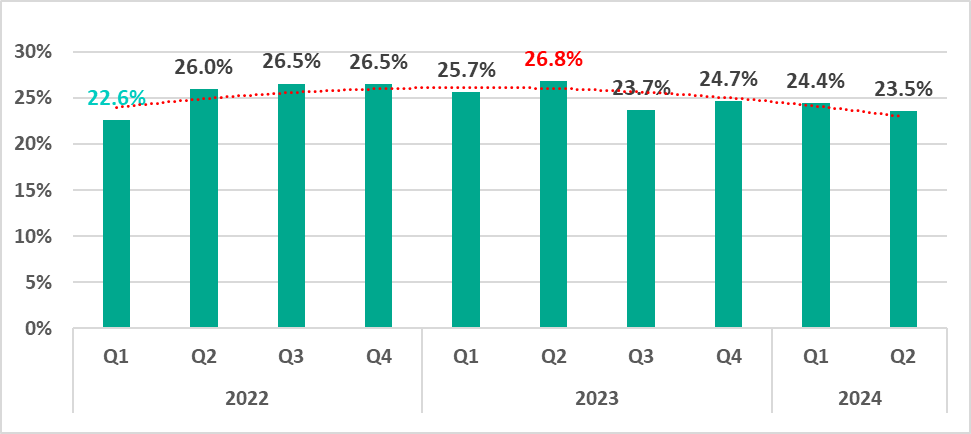
    MIL OSI Economics

  • MIL-OSI Economics: Threat landscape for industrial automation systems, Q2 2024

    Source: Securelist – Kaspersky

    Headline: Threat landscape for industrial automation systems, Q2 2024

    Statistics across all threats

    In the second quarter of 2024, the percentage of ICS computers on which malicious objects were blocked decreased by 0.9 pp from the previous quarter to 23.5%.

    The percentage has decreased by 3.3 pp compared to the second quarter of 2023, when the indicator reached its highest level since records began in 2022.

    Percentage of ICS computers on which malicious objects were blocked, by quarter, 2022-2024

    Regions ranking

    In most regions, the percentage of ICS computers that blocked malicious objects decreased compared to the first quarter of 2024. The indicator increased only in East Asia (by 1.0 pp), Western Europe (by 0.8 pp), Australia and New Zealand (by 0.7 pp) and the USA and Canada (by 0.2 pp).

    Regions ranked by percentage of ICS computers where malicious objects were blocked, Q2 2024

    Industries ranking

    The building automation sector continues to lead the surveyed industries in terms of the percentage of ICS computers on which malicious objects were blocked. In general, this indicator continues to decrease across all industries for the second quarter in a row.

    Percentage of ICS computers on which the activity of malicious objects of various categories was prevented

    Diversity of detected malware

    In the second quarter of 2024, Kaspersky’s protection solutions blocked malware from 11,349 different malware families of various categories on industrial automation systems.

    Percentage of ICS computers on which the activity of malicious objects of various categories was prevented

    Compared to the previous quarter, the most noticeable proportional increase in the second quarter of 2024 was in the percentage of ICS computers on which ransomware was blocked – a 1.2-fold increase.

    Malicious object categories in numbers

    Malicious objects used for initial infection

    This category includes dangerous web resources, malicious scripts and malicious documents.

    • Denylisted internet resources – 6.63% (-0.21 pp compared to the first quarter of 2024);
    • Malicious scripts and phishing pages (JS and HTML) – 5.69% (-0.15 pp);
    • Malicious documents (MSOffice+PDF) – 1.96% (+0.24 pp).

    Next-stage malware

    Malicious objects used to initially infect computers deliver next-stage malware – spyware, ransomware, and miners – to victims’ computers. As a rule, the higher the percentage of ICS computers on which the initial infection malware is blocked, the higher the percentage for next-stage malware.

    • Spyware (spy Trojans, backdoors and keyloggers) – 4.08% (+0.18 pp);
    • Ransomware – 0.18% (+0.03 pp);
    • Miners (in the form of executable files for Windows) – 0.89% (-0.03 pp).

    Self-propagating malware

    These are worms and viruses. Worms and virus-infected files were originally used for initial infection, but as botnet functionality evolved, they took on next-stage characteristics.

    To spread across ICS networks, viruses and worms rely on removable media, network folders, infected files including backups, and network attacks on outdated software.

    • Worms – 1.48% (-0.03 pp);
    • Viruses – 1.54% (-0.02 pp).

    AutoCAD malware

    This category of malware is typically a low-level threat, coming last in the malware category rankings in terms of the percentage of ICS computers on which it was blocked.

    • AutoCAD malware – 0.42% (+0.01 pp).

    Main threat sources

    The internet, email clients and removable storage devices remain the primary sources of threats to computers in an organization’s technology infrastructure. (Note that the sources of blocked threats cannot be reliably identified in all cases.)

    Percentage of ICS computers on which malicious objects from various sources were blocked

    The full global report is available on the Kaspersky ICS CERT website.

    MIL OSI Economics

  • MIL-OSI Economics: Underwriting Auction for sale of Government Securities for ₹34,000 crore on September 27, 2024

    Source: Reserve Bank of India

    Government of India has announced the sale (re-issue) of Government Securities, as detailed below, through auctions to be held on September 27, 2024.

    As per the extant scheme of underwriting notified on November 14, 2007, the amounts of Minimum Underwriting Commitment (MUC) and the minimum bidding commitment under Additional Competitive Underwriting (ACU) for the underwriting auction, applicable to each Primary Dealer (PD), are as under:

    (₹ crore)
    Security Notified Amount Minimum Underwriting Commitment (MUC) amount per PD Minimum bidding commitment per PD under ACU auction
    7.04% GS 2029 12,000 286 286
    7.23% GS 2039 12,000 286 286
    7.09% GS 2054 10,000 239 239

    The underwriting auction will be conducted through multiple price-based method on September 27, 2024 (Friday). PDs may submit their bids for ACU auction electronically through Core Banking Solution (E-Kuber) System between 09:00 A.M. and 09:30 A.M. on the day of underwriting auction.

    The underwriting commission will be credited to the current account of the respective PDs with RBI on the day of issue of securities.

    Ajit Prasad           
    Deputy General Manager
    (Communications)    

    Press Release: 2024-2025/1161

    MIL OSI Economics

  • MIL-OSI Economics: Interest rate drop on private customers’ deposit accounts

    Source: Danmarks Nationalbank

    Banking and mortgage credit

    Statistics period: August 2024

    In June, the majority of Danish banks announced interest rate changes on select deposit accounts. This happened in continuation of Danmarks Nationalbank’s interest rate cut on the 7th of June. The effect can now be seen in the interest rate on private customers’ record-breaking deposits. In August they experienced the largest interest rate drop in a single month since January 2021, when the deposit rate became negative for the first time. The interest rate thus fell by 0.10 percentage points to an average annual interest rate of 1.49 percent in August. This is still marginally higher than the level at the turn of the year. If you compare it with the banks’ lending rates to private individuals, they have fallen on average by 0.34 percentage points since the turn of the year to currently 5.59 percent. After Danmarks Nationalbank cut interest rates again with effect from the 13th of September, several banks have announced further interest rate reductions on private customers’ deposit accounts. These will take effect in the coming months.


    Biggest monthly interest rate drop on deposits since January 2021

    Note:

    The figure shows the average interest rate p.a. on Danish private customers’ (employees, pensioners, etc.) interest-bearing deposits in Danish kroner in banks. In the figure, the observations for February 2020 and 2024 are corrected for the effect of leap years, which data for the interest statistics published in the Statbank do not take into account. Find chart data in the Statbank here.

    MIL OSI Economics

  • MIL-OSI Economics: AIIB’s Global Membership Grows to 110

    Source: Asia Infrastructure Investment Bank

    The Asian Infrastructure Investment Bank (AIIB) has grown to 110 approved Members after its Board of Governors voted in support of the application of the Republic of Nauru during the Bank’s 2024 Annual Meeting.

    “The addition of Nauru as a regional Member strengthens the AIIB community and supports our collective mission to finance Infrastructure for Tomorrow,” said Jin Liqun, AIIB President and Chair of the Board of Directors. “AIIB is committed to our Members’ sustainable development and together we will work on priority projects within our clearly defined thematic priorities to drive long-term sustainable growth.”

    About AIIB

    The Asian Infrastructure Investment Bank (AIIB) is a multilateral development bank whose mission is Financing Infrastructure for Tomorrow in Asia and beyond—infrastructure with sustainability at its core. We began operations in Beijing in 2016 and have since grown to 110 approved Members worldwide. We are capitalized at USD100 billion and AAA-rated by the major international credit rating agencies. Collaborating with partners, AIIB meets clients’ needs by unlocking new capital and investing in infrastructure that is green, technology-enabled and promotes regional connectivity.

    MIL OSI Economics