Category: Economics

  • MIL-OSI Economics: Secretary-General of ASEAN participates in Breakout Session on promoting economic growth at OECD Council at Ministerial Level (MCM)

    Source: ASEAN

    Secretary-General of ASEAN, Dr. Kao Kim Hourn, participated in Breakout Session 3.2 at the OECD Council at Ministerial Level (MCM), in Paris, France, on 3 June 2025. The meeting discussed efforts at promoting inclusive economic growth to advance sustainable development objectives.

    The post Secretary-General of ASEAN participates in Breakout Session on promoting economic growth at OECD Council at Ministerial Level (MCM) appeared first on ASEAN Main Portal.

    MIL OSI Economics

  • MIL-OSI Economics: Andrew Bailey: State of trade

    Source: Bank for International Settlements

    It is a great pleasure to be in Dublin, and I want to start by thanking the Irish Association of Investment Managers for inviting me again to speak. I say again because I also have to begin with an apology, for standing you up last year at short notice when the General Election was called in the UK. And so, my other thanks is to my fellow Governor Gabriel, for stepping in last year when I withdrew at short notice.

    Not much has happened in the last year. To keep it topical, I am going to use my time to talk about trade, both in goods and in financial services. This is not only topical but highly relevant, because Ireland and the UK are both open economies, with long-established trade connections, and likewise strong connections in financial services.

    Trade matters. It matters at both the economy-wide or macro level, and at the level of individual firms, the micro level. And, almost needless to say, the two are closely linked.

    I am going to start by laying out key elements of the big picture, before moving on to talk about financial services. My starting point is two key elements of the macro dimension of trade. In many past times in talking about trade it would have been easy to pass over them, as points that are not contested. I think they need repeating today.

    The first point is that trade supports output in the economy – and it is good for economic welfare. As I will come on to, there are important qualifications to this point, but they don’t invalidate it. From Adam Smith onwards, it has broadly been accepted that trade supports specialisation and efficiency of production and it enables knowledge transfer, and these features support productivity and economic growth.

    The second point is that we should not expect trade between countries to be in balance all of the time. The whole world should be in balance – because it is a closed system as we have not found and started trading with extra-terrestrial life yet. But as individual countries, we are not closed, as Ireland and the UK demonstrate. Unfortunately, the world’s exports and imports don’t usually equal each other, but that’s down to our counting not ET.

    However, since trade balances between countries don’t balance – and they should not be expected to do so, – what determines the balances and patterns of trade? At the whole economy, or macro, level the answer is that trade is determined by the balance between a country’s saving and investment – macroeconomic fundamentals. And, these are shaped by factors such as business conditions and cycles, productivity growth, savings behaviour, interest rates, fiscal policy choices and exchange rates. In other words, trade is an outcome of the big driving forces of economies, and if we want to affect trade patterns on a lasting basis, that’s where we should look.

    Well, up to a point, yes. I am conscious that what I have just said is a rather a textbook espousal of the case for free trade. No apologies, I do believe in free trade. But, I’m also aware that things are not that simple – the story doesn’t end there. Trade patterns are also shaped by national policies, particularly industrial policies, and by the rules–based world trading system that seeks to set the guardrails for such policies.

    Now, the argument, as I interpret it, of the US Administration is that those rules have been stretched beyond breaking point, and actions have to be taken to put this right.

    As I read it, there are two parts to this argument.

    The first is that the rules of the world trade system – based around the World Trade Organisation – have broken down, and are in need of reform. IMF staff have pointed to more use of industrial policies around the world in recent years, and argued that these should only be used for very limited domestic objectives such as local market failures, but that has not been the case of late, and that this practice will and has exacerbated trade tensions. More concretely, between 2009 and 2022 China implemented around 5,400 so-called subsidy policies, which were concentrated in priority sectors, i.e., ones that matter. This was equal to about two-thirds of all the subsidy measures adopted by G20 advanced economies combined.

    The macro story on trade is influenced by what goes on at the micro level, and we can’t see these two as distinct. There has been an increase in the use of industrial policies – one country has been active on this front, but it’s not alone.

    The second point is around how the rules of engagement of the world trade system have come under pressure from new developments which have affected all of us. Let me briefly set out two which are closely linked. First, before the outbreak of Covid world trade had grown rapidly, more rapidly than world output, and in doing so the supply chains for final products had become much more complicated, but also efficient in the sense that they had exploited the benefits of trade.

    This meant that a lot more of world trade comprised so-called intermediate goods – inputs to the final product, but not the product itself. This exploited one of the longest standing principles of free trade – so-called comparative advantage. In other words, produce stuff where it is most efficient relatively speaking to do so, accepting that the relative point means that no country should specialise in everything. Over time, the trade system has become more and more refined – we have heard the phrase “just in time delivery”. This was highly efficient, until it wasn’t.

    Covid dealt a blow to the efficiency of the trade system. Even though initial pandemic-related supply chain disruption was resolved quite rapidly, as we recovered from Covid these trading patterns and systems did not return to normal as quickly and fully as we expected.

    Why was that? There were no doubt a number of reasons, but a large one is the growth of national security concerns as a threat to the efficiency of trade. In reality, sadly, Russia’s illegal war in Ukraine provided real evidence of the disruption that can happen, and is one factor behind a growing threat from national security to our assumptions on frictionless trade. To be clear, national security concerns are not a good reason to retreat indiscriminately from global trade. The best way to ensure resilience to geopolitical risk is not by reshoring production, but by diversifying supply chains among reliable partners who abide by international law.

    Viewed from the perspective of a central bank responsible for monetary policy, the inevitable conclusion is that we cannot assume that the supply sides of our economies behave as efficiently as they did before Covid. And this was a substantial cause of the very difficult upsurge in inflation.

    I am going to conclude on broader trade with a number of points, and then say something on financial services. Four points strike me as very important on trade.

    First, while I am an unshaken believer in free trade, I do accept that the system has come under too much strain, we have to work hard now to rebuild it, and it is incorrect to dismiss those who argue for restrictions on trade as just wrong-headed. We need to understand what lies behind these arguments. That said, I want to get back to an open trading system.

    Second, to solve the issues we face, we need to look at the macro level – the big economic drivers that I mentioned earlier, and call out where and why we think there are unsustainable trade imbalances. We need to strengthen the IMF’s surveillance in order to improve the process for calling out unsustainable trade imbalances. But we must also look at the micro-level – the rules based world trade system – and work out what we need to do to solve this problem and make it more effective again.

    Third, if it is believed that tariff action is needed to create the shock and awe to get these issues on to the table and dealt with, then something has gone wrong with the multilateral system, and we need to deal with that.

    Fourth, creating a sustainable world trading system matters to all of us. It matters to countries like Ireland and the UK, which are highly open economies, and have been throughout their development. And it matters to central bankers and economic policymakers because our jobs are much harder if we face more inflexible and uncertain supply side conditions in our economies, as we appear to do today.

    Almost all of the attention in recent months in the area of trade has been on goods trade – tangible stuff. Tariffs are a tool whose use is largely confined to the world of goods trade. But, there are two other important features of the trade world. First, alongside trade in goods sits trade in services-intangibles. For the UK, the latest numbers indicate that the total volume of trade was made up of 54% goods and 46% services. For Ireland the numbers are 28% goods and 72% services.

    Financial services are an important part of trade in services and particularly so for Ireland and the UK.

    The second important feature of the trade world is that alongside tariffs sit non-tariff barriers. These are all sorts of obstacles to trade, some put in place deliberately, some are features with their origin in other objectives than affecting the flow of trade, and others which are just there who knows why. Non-tariff barriers to trade are by no means limited to trade in services, but they are the dominant form of restriction in that world.

    This brings me to Brexit. I have to start with an important disclaimer. As a public servant, I take no position on Brexit per se – it was a decision of the British people, and has been put into effect. That said, our evolving trading and regulatory relationship with the EU requires many judgements on the most effective way to do so – what delivers the most effective outcome.

    I want to make two important points in this context. The first relates more to trade in goods, the second to financial services. Let me start with goods. I said earlier that trade enhances and supports economic activity.

    It follows that if the level of trade is lowered by some action, it will have an effect to reduce productivity growth and thus overall growth. Just as tariffs, by increasing the cost, can reduce the scale of trade, the same goes for the type of non-tariff barrier that Brexit has created. Now to reiterate, this does not mean that Brexit is wrong, because there can be other reasons for it, but it does suggest, I think powerfully, that we should do all we can to minimise negative effects on trade.

    The evidence on Brexit suggests that in the UK the changing trade relationship has weighed on the level of potential supply.

    I conclude from this that, just as the Windsor Agreement on trade involving the UK and Ireland was a welcome step forward, so too are the initiatives of the current UK Government to rebuild trade between the UK and EU, and of course there is a very particular important aspect here for the UK and Ireland.

    Let me turn to financial services. There is often an impression given that the flow of trade in financial services is predominantly from the UK to the EU. In other words, the UK is an exporter of financial services. This creates the notion of a one-way street, and that leads to the image of a dependency, and from there the notion of the dependency in some sense being unhealthy starts to come in.

    My strong view is that – contrary to this one way idea – the relationship goes both ways, and that is a good thing. And, this is very well illustrated by the relationship between Ireland and the UK in the area of financial services.

    Let me draw out the two-way street point some more, using the example of the 2022 shock to Liability Driven Investment funds connected to UK pension funds, so-called LDI funds. The LDI episode occurred when UK financial assets saw a significant repricing, with a particular impact on long-dated gilts. The Financial Policy Committee at the Bank of England judged that UK financial stability was at risk due to dysfunction in the gilt market and recommended that the Bank take action. This action took the form of intervening via temporary purchases of long-dated gilts.

    Many of the funds involved were domiciled in other jurisdictions, including here in Ireland and Luxembourg. To be very clear, domicile was not a part of the problem. But, it had to help to enable the solution, and it did. A co-ordinated response between the UK, Ireland and Luxembourg was essential, and I am very grateful to the Central Bank of Ireland and the authorities in Luxembourg for helping us to respond effectively.

    There have been important lessons from the LDI episode, which are increasingly relevant in the context of the increased market volatility we have seen in recent weeks following the US announcement on trade tariffs last month. Together, working with other UK regulators, the Central Bank of Ireland and the authorities in Luxembourg, we have taken action to build resilience in LDI funds. And I hope this close cooperation can continue as we seek to navigate another two way street by building more resilience into money market funds in the EU and the UK, as we strengthen our domestic rules.

    The benefits of open financial markets as well as the dependencies also tend to go both ways.

    The UK and EU are both seeking to strengthen our domestic capital markets. The EU’s Savings and Investment Union agenda and the UK government’s reforms to pensions are both seeking to direct savings towards productive investment. These are important measures, not least given the pressing need for financing some of the common structural challenges we face in the UK and EU – for example, defence and security, demographics, and the technological and climate transitions.

    But strengthening domestic capital markets is only part of the story. The scale of investment needed requires access to global capital, supported by open financial markets. The alternative is fragmentation, which we have unfortunately seen in the global economy in recent years, which reduces the size of markets, and makes them inherently less stable. Fragmentation also increases the cost of capital, undermining growth and investment. Financial market openness, built on a foundation of robust global standards and trust, is a much better alternative.

    To repeat, open financial markets are a good thing. As with goods trade, open financial markets support economic growth as well as increasing investment and reducing the cost of capital. So the benefits of open financial markets, as well as the dependencies, tend to go both ways, so a two-way street; and working together effectively is the best way.

    As such, there is merit in seeking to increase the openness of our financial markets by reducing non-tariff barriers.

    The Bank of England and the Central Bank of Ireland enjoy a very strong relationship, which is built on trust and respect, fostered by close cooperation and coordination and a steadfast commitment to shared values and working together in international bodies to promote global standards. And, my strong view is that this type of work benefits the industries that we oversee. The message that I get consistently, and rightly, is that firms want robust but fair and consistent regulatory standards which will support both stability and competition, and set the level playing field on which they operate.

    Thank you.

    I would like to Sarah Breeden, Lee Foulger, Mike Hatchett, Himali Hettihewa, Karen Jude, Jake Levy, Zertasha Malik, Jeremy Martin, Harsh Mehta, James Talbot, Lanze Gardiner Vandvik, Sam Woods for their help in the preparation of these remarks.

    MIL OSI Economics

  • MIL-OSI Economics: RBI imposes monetary penalty on India Home Loan Ltd., Mumbai, Maharashtra

    Source: Reserve Bank of India

    The Reserve Bank of India (RBI) has, by an order dated May 27, 2025, imposed a monetary penalty of ₹32,000 (Rupees Thirty Two Thousand only) on India Home Loan Ltd., Mumbai, Maharashtra (the company) for non-compliance with certain directions issued by RBI on ‘Know Your Customer (KYC)’. This penalty has been imposed in exercise of powers conferred on RBI under the provisions of Section 52A of the National Housing Bank Act, 1987.

    The statutory inspection of the company was conducted by the National Housing Bank with reference to its financial position as on March 31, 2023. Based on supervisory findings of non-compliance with RBI directions and related correspondence in that regard, a notice was issued to the company advising it to show cause as to why penalty should not be imposed on it for its failure to comply with the said directions. After considering the company’s reply to the notice and oral submissions made during the personal hearing, RBI found, inter alia, that the following charges against the company were sustained, warranting imposition of monetary penalty:

    The company had failed to:

    1. carry out periodic review of risk categorisation of accounts with such periodicity being at least once in six months; and

    2. conduct periodic updation of KYC of its customers.

    This action is based on the deficiencies in regulatory compliance and is not intended to pronounce upon the validity of any transaction or agreement entered into by the company with its customers. Further, imposition of monetary penalty is without prejudice to any other action that may be initiated by RBI against the company.

    (Puneet Pancholy)  
    Chief General Manager

    Press Release: 2025-2026/469

    MIL OSI Economics

  • MIL-OSI Economics: RBI imposes monetary penalty on The Citizen Co-operative Bank Ltd., Noida

    Source: Reserve Bank of India

    The Reserve Bank of India (RBI) has, by an order dated May 30, 2025, imposed a monetary penalty of ₹6.00 lakh (Rupees Six Lakh only) on The Citizen Co-operative Bank Ltd., Noida (the bank) for contravention of the provisions of Section 12B read with Section 56 of the Banking Regulation Act, 1949 (BR Act) and non-compliance with certain directions issued by RBI on ‘Know Your Customer (KYC)’. This penalty has been imposed in exercise of powers conferred on RBI under the provisions of Section 47A(1)(c) read with Sections 46(4)(i) and 56 of BR Act.

    The statutory inspection of the bank was conducted by RBI with reference to its financial position as on March 31, 2024. Based on supervisory findings of contravention of statutory provisions/non-compliance with RBI directions and related correspondence in that regard, a notice was issued to the bank advising it to show cause as to why penalty should not be imposed on it for its failure to comply with the said provisions and directions. After considering the bank’s reply to the notice and oral submissions made during the personal hearing, RBI found, inter alia, that the following charges against the bank were sustained, warranting imposition of monetary penalty:

    The bank had:

    1. failed to ensure that prior permission of RBI was obtained by a person before issuing/allotting shares to him along with his relatives, beyond permissible limit; and

    2. failed to put in use a robust software, throwing alerts for identifying suspicious transactions.

    This action is based on deficiencies in regulatory compliance and is not intended to pronounce upon the validity of any transaction or agreement entered into by the bank with its customers. Further, imposition of this monetary penalty is without prejudice to any other action that may be initiated by RBI against the bank.

    (Puneet Pancholy)  
    Chief General Manager

    Press Release: 2025-2026/466

    MIL OSI Economics

  • MIL-OSI Economics: RBI imposes monetary penalty on The Jammu and Kashmir State Co-operative Bank Ltd., Srinagar

    Source: Reserve Bank of India

    The Reserve Bank of India (RBI) has, by an order dated May 30, 2025, imposed a monetary penalty of ₹2 lakh (Rupees Two Lakh only) on The Jammu and Kashmir State Co-operative Bank Ltd., Srinagar (the bank) for non-compliance with certain directions issued by RBI on ‘Know Your Customer (KYC)’. This penalty has been imposed in exercise of powers conferred on RBI under the provisions of Section 47A(1)(c) read with Sections 46(4)(i) and 56 of the Banking Regulation Act, 1949 (BR Act).

    The statutory inspection of the bank was conducted by the National Bank for Agriculture and Rural Development (NABARD) with reference to its financial position as on March 31, 2023 and March 31, 2024. Based on supervisory findings of non-compliance with RBI directions and related correspondence in that regard, a notice was issued to the bank advising it to show cause as to why penalty should not be imposed on it for its failure to comply with the said directions. After considering the bank’s reply to the notice and oral submissions made during the personal hearing, RBI found, inter alia, that the following charge against the bank was sustained, warranting imposition of monetary penalty:

    The bank had failed to obtain Officially Valid Documents (OVD) of its customers while establishing the account-based relationship.

    This action is based on deficiencies in regulatory compliance and is not intended to pronounce upon the validity of any transaction or agreement entered into by the bank with its customers. Further, imposition of this monetary penalty is without prejudice to any other action that may be initiated by RBI against the bank.

    (Puneet Pancholy)  
    Chief General Manager

    Press Release: 2025-2026/467

    MIL OSI Economics

  • MIL-OSI Economics: RBI imposes monetary penalty on The Bathinda Central Co-operative Bank Ltd., Bathinda, Punjab

    Source: Reserve Bank of India

    The Reserve Bank of India (RBI) has imposed, by an order dated May 30, 2025, a monetary penalty of ₹3 lakh (Rupees Three Lakh only) on The Bathinda Central Co-operative Bank Ltd., Bathinda, Punjab (the bank) for contravention of provisions of Section 26A read with Section 56 of the Banking Regulation Act, 1949 (BR Act). This penalty has been imposed in exercise of powers conferred on RBI under the provisions of Section 47A(1)(c) read with Sections 46(4)(i) and 56 of the BR Act.

    The statutory inspection of the bank was conducted by the National Bank for Agriculture and Rural Development (NABARD) with reference to its financial position as on March 31, 2023 and March 31, 2024. Based on supervisory findings of non-compliance with statutory provisions and related correspondence in that regard, a notice was issued to the bank advising it to show cause as to why penalty should not be imposed on it for its failure to comply with the said provisions. After considering the bank’s reply to the notice and oral submissions made by it during the personal hearing, RBI found, inter alia, that the following charge against the bank was sustained, warranting imposition of monetary penalty:

    The bank had failed to transfer eligible unclaimed amounts to the Depositor Education and Awareness Fund within the prescribed time.

    This action is based on deficiencies in statutory compliance and is not intended to pronounce upon the validity of any transaction or agreement entered into by the bank with its customers. Further, imposition of this monetary penalty is without prejudice to any other action that may be initiated by RBI against the bank.

    (Puneet Pancholy)  
    Chief General Manager

    Press Release: 2025-2026/463

    MIL OSI Economics

  • MIL-OSI Economics: Abdul Rasheed Ghaffour: The significance of Malaysian government bond market – resilience against global backdrop

    Source: Bank for International Settlements

    The significance of Malaysian government bond market – resilience against global backdrop

    It has been a challenging first half of the year, as global markets weather multiple episodes of volatility. Risks of higher inflation and slower growth remain major concerns amid trade policy uncertainty. Despite slower global growth and policy easing in some economies, bond yields have not declined in tandem, as investors demand higher term premia to compensate for the heightened risk environment. 

    Being a small and open market economy, Malaysia is not shielded from this global development. But I am glad to say that the country has been managing this volatility from a position of strength. Domestically, Malaysia’s bond market reached RM2.2 trillion in market size this year. Government bonds which make up nearly 60% of the market continues to grow at a stable pace, reaching about RM1.3 trillion of outstanding issuance as of May 2025. Malaysian government bond yields have been largely stable throughout the year, anchored by resilient domestic demand as well as higher foreign inflows. Domestic demand for government bonds remains robust, driven by both institutional investors and banking institutions.

    This is reflected in the primary bond market, where government bond issuances consistently record robust demand. The secondary market is also seeing healthy two-way flows, with higher daily trading volume, amid effective intermediation by market participants and market-making by Principal Dealers. Positive foreign inflows reflect foreign investors’ confidence in the local market which is seen as a stable investment destination in the region. Year-to-date, non-resident holding of our government bonds has increased to around 22% in May 2025 with a significant portion comprising stable and long-term foreign investors.

    I would like to attribute this positive development to years of effort by the MOF, BNM and financial market participants, to broaden and deepen the domestic ringgit securities market. Over the years, BNM has undertaken proactive efforts to improve bond market liquidity. This includes to promote an interbank securities-driven repo market and to facilitate bond switching operations for the Government. In addition, the dynamic hedging programme, which debuted in 2016, serves to encourage foreign investor participation in the domestic bond market, by providing market access for institutional investors who wish to actively manage FX exposures of their ringgit assets. We have come a long way in this. It is worth recalling that one of the lessons of the Asian Financial Crisis was the lack of or an underdeveloped government bond market that had exacerbated the crisis. The absence of the domestic risk-free investment avenue led to portfolio investors exiting the domestic currency when volatility and uncertainty were high. Today, I am glad to say that we are no longer in such a position.

    Lesson to be learnt from recent global experience

    While market development is a crucial element, ultimately, investor confidence and market stability rest upon healthy sovereign credit ratings. Recently, global bond markets have had to weather considerable turbulence as investors grappled with growing fiscal challenges and sovereign ratings downgrade in advanced economies. This situation underscores the importance of responsible governance and prudent fiscal management. It is paramount that we find a balance between providing support and demonstrating fiscal discipline in striving for sustainable economic growth. As such, policymakers must learn from these experiences and prioritise sustainable public finances and pursue structural reforms to safeguard trust and credibility.

    For instance, it is important to maintain sound fiscal policy by optimising public spending and generating healthy revenue streams to keep fiscal deficits at a sustainable level. In this regard, the Malaysian Government is committed to fiscal consolidation efforts as reflected in various measures such as tax and subsidy reforms. The enactment of the Fiscal Responsibility Act is also crucial to strengthening governance and institutions in the long term.

    In ASEAN, Malaysia alongside our regional peers are working closely to support prudent sovereign debt management by fostering regional cooperation, sustainable infrastructure financing, and resilient financial markets. For example, efforts are being made to facilitate regional economic and debt market integration under the ASEAN Economic Community (AEC) framework. Under the ASEAN Bond Market Initiative, ASEAN member states strive to promote the development of local currency bond markets, channelling regional savings into long-term investments in the region. Meanwhile, the ASEAN+3 Macroeconomic Research Office (AMRO) also plays a crucial role in monitoring ASEAN members’ debt risks and providing policy recommendations. As the ASEAN Chairman this year, Malaysia looks forward to further advancing ASEAN’s aspirations to deepen regional financial integration and advancing a more connected, sustainable, and inclusive ASEAN financial ecosystem.

    Opportunities and challenges

    Ladies and gentlemen,

    The road ahead is marked with challenges, particularly for a small open economy like Malaysia. Exogenous factors such as rising global interest rates may influence the Government’s borrowing costs. This may make debt refinancing relatively costly and could lead to higher debt servicing costs that could impact fiscal sustainability.

    It is therefore crucial to maintain a liquid and resilient sovereign bond market, not only to safeguard investor confidence and facilitate efficient public financing, but to also ensure financial stability, which is a core objective shared by both debt managers and central banks alike.

    On this note, I would like to highlight the rising role played by alternative instruments such as sukuk in developing a market with both diverse instruments, and a diverse investor base. There is a huge growth opportunity to tap the large and previously underserved base of investors who abide by Islamic finance principles. Malaysia boasts an active sukuk market with 50% of new government bonds being issued in the Islamic structure. As of May 2025, the outstanding government sukuk papers stood at around RM600 billion or 48% of total government bonds. As such, we are happy to work together with interested parties to share our expertise and knowledge and promote further development in this growing sector. 

    In closing, let me take the opportunity to thank our esteemed moderators, panellists and participants for sharing their insights and expertise over these past two days. I trust that they have led to productive discussions and contributed towards a more efficient and sustainable sovereign debt management practices. I’m sure all of us have useful insights and key takeaways to bring back to our respective countries and organisations.

    Congratulations to the organising committee comprising the IMF, the Ministry of Finance, and BNM for organising this successful event. To Miguel and the team at the IMF, on behalf of the organisers, allow me to express our deepest gratitude. We look forward to working again with the IMF to organise forums and exchanges like this one.

    Thank you.

    MIL OSI Economics

  • MIL-OSI Economics: Olli Rehn: Macroeconomic policy in times of global political upheaval

    Source: Bank for International Settlements

    Ladies and Gentlemen, Colleagues and Friends,

    Welcome to the sunny, spring-time Helsinki. On behalf of the Bank of Finland and the Centre for Economic Policy Research, it is my great pleasure to open this year’s research conference on monetary economics – which again has an excellent and a most fascinating programme!

    Let me begin with a mission statement – and a confession. Our slogan at the Bank of Finland is: “Securing stability – in science we trust.” That is, we lean on evidence- and theory-based economic analysis and policy-relevant research to support our stability mission.

    However, I must make a confession. In this turbulent world, it is comforting to return to a familiar setting and reflect on policy challenges alongside leading economists. Although only eight months have passed since our last gathering, it feels like the global landscape has shifted dramatically.

    And the confession is this, in front of you as researchers, scholars, scientists, leading economists; in these times of pervasive uncertainty, we need plenty of judgment and scenario analysis to supplement our economic and econometric research and regression equations, thus making monetary policy, by necessity, is as much an art as a science. Such is life in these strange times – but finally, at least, it dis make me understand why the Governor at Bank of Finland is, ex officio, also the chair of the arts committee of the Bank!

    Talking about geopolitics and its effects, just look at the ECB’s evolving language. Uncertainty went from “increased” to “high,” then “pervasive,” and now, per President Lagarde, “exceptional.” This isn’t linguistic inflation. It reflects how genuinely hard forecasting has become, with markets pricing in risk at levels not seen in years.

    Risks abound: from trade wars to faltering global alliances. For central bankers and researchers alike, this is no time for complacency. Instead of dissecting every new risk, today I want to focus on three key areas:

    • Lessons from the recent inflation surge;
    • Open questions around fiscal policy, particularly defence spending;
    • And finally, the role of productivity and innovation.

    Low inflation – past and future

    Let’s nevertheless recall there are some good news. The European economy is recovering. Unemployment is at 6.1%, the lowest since the euro’s creation. Inflation has been hovering just above 2% since late 2023, allowing the ECB to cut rates seven times.

    The energy shock that hit Europe in spring 2022 has played out very differently than in the 1970s, with the economic cost being much lower this time. Thanks to increased labour supply and lower working hours, wage-price spirals were avoided. Today’s labour market is more flexible, less unionised, and better educated.

    Importantly, inflation expectations were much better anchored before the recent inflation surge. This underlies the importance of central bank independence and a strong commitment to the inflation target. The ECB has focused firmly on maintaining these, and will continue to do so.

    Before Covid, the main challenge was that inflation remained stubbornly below the target. Most risks to the inflation outlook were deflationary, including population ageing and the related increase in savings, and the low investment demand. And before the ECB’s 2021 review and move to a symmetric 2% target over the medium term, which has worked well, the inflation target was perceived as a ceiling, creating a downward bias.

    From around 2021, inflationary pressures reappeared. First this was due to the pandemic-broken supply chains and stimulus-fuelled demand, then due to the energy shocks arising from Russia’s invasion of Ukraine.

    We learned how demand and supply shocks can be deeply intertwined. But we still face many unknowns in that regard. Current geopolitical tensions may expose us to new surprises that we have little historical experience of. Preferably, the spectre of a prolonged trade war with the US will dissipate sooner rather than later, as an economic conflict between long-standing friends and allies is the last thing we need in a world challenged by dictatorial impulses and by a neocolonial mentality.

    Furthermore, what if China shifts exports away from the US to Europe, slashing prices to compete? That could bring deflationary forces and industrial strain to the EU. Would it benefit consumers or hurt our economy overall? The policy response would not be straightforward.

    Let’s hope we don’t have to answer these questions through crisis. Whatever the challenge, the ECB will remain focused on price stability and its symmetric 2% inflation target over the medium term.

    Defence spending – new pressures

    Since the pandemic, fiscal spending pressures have risen. Now, security concerns are adding fuel. Russia’s aggression and doubts about US defence commitments are prompting big spending shifts across Europe. Germany is paving the way and has eased its constitutional debt limits.

    We can assume that with normal execution lags the most substantial fiscal impact will start to be felt from next year 2026 and 2027 onwards. This implies that the fiscal impact on the growth and inflation outlook will take effect in the medium term, as an ordinary citizen perceives is, although this timespan of fiscal impulse will mostly be beyond the projection horizon of medium term as understood in monetary policy. Our assessment indicate a moderately significant impact on growth and limited impact on inflation in the relevant timespan.

    Waking up and substantially increasing defence spending is welcome. Security is the bedrock of economic stability. Peace and security within European borders are fundamental to the European project and its economy.  Defence should be seen as a European public good. Further support for Ukraine should also be seen in the same light.

    But what does this mean for inflation? Historical comparisons to war-time money printing don’t apply here. Independent central banks like the ECB remain focused on keeping inflation expectations anchored.

    Still, we need to understand what type of shock defence spending represents. Is it demand or supply driven? Likely both, depending on how and where the money is spent.

    We also face the question of how to pay for it. EU-level spending would offer more stability and efficiency. That might mean higher membership fees, new revenue sources, or even treaty changes. Defence bonds – as safe assets – are one option, but only if backed by solid future income.

    Meanwhile, demands on public budgets are rising across the board: infrastructure, climate policy, aging populations.

    What guidance do we have so far from economics research?

    There is a large body of literature on fiscal multipliers, which incidentally often uses defence spending as a natural experiment or exogenous shock. These multipliers are frequently estimated to be below one, because public spending or investment usually crowds out private one.

    However, evidence suggests that multipliers tend to be larger in times of recession and economic slack. Moreover, some of the best evidence on the magnitude of fiscal multipliers is based on US data, where the multiplier may be smaller. This is simply because the US defence industry is very large compared to its European counterpart and is thus more likely to face diminishing marginal returns.

    All these issues mean that for European defence spending to be successful and sustainable, we must make every euro count. The additional defence spending should focus on investment in building up industrial network capacity and R&D, rather than simply procurement of defence equipment, which may be largely imported.

    Then there is also the aspect of defence efficiency. For this, we need sound planning and coordination at the European level, as well as a common market for defence, as stressed in last year’s Letta Report. Recent experience has shown that training in the use of unfamiliar weapons and problems with shortages of spare parts can become critical bottlenecks. Therefore, further harmonisation of technical standards and types of arms and equipment across European defence forces is key.

    With a history of independent and diminished national defence industries, the EU has some considerable catching up to do. We need to increase both national and EU-level defence spending, e.g. as Bruegel has suggested, by establishing a European Defence Mechanism formed by a coalition of the capable and willing. Such a fund would bypass the limitations to raising EU-level income, be resilient to any intra-EU obstruction and could also accommodate countries from outside the European Union, like the United Kingdom and Norway.

    In short: defence spending won’t necessarily be inflationary. But to be effective, it must be efficient. We need smart investments – in industrial capacity, innovation, and R&D – not just procurement. And we must avoid fragmented efforts. A European Defence Mechanism, built by a coalition of the capable and willing, could also help to pursue these goals.

    Innovation – defence and civilian

    Let’s now turn to innovation. Defence spending often yields big returns beyond the battlefield. Its effectiveness should be assessed from a long-term perspective, not only via short-run multipliers. Historically, it has given rise to technological breakthroughs that have not only found direct civilian applications but created whole new non-defence industries.

    Walkie-talkies were created during the Second World War at Motorola for infantry and artillery communication. Radar gave us microwave ovens. Military satellites gave us GPS and digital imaging. Jet engines, nuclear energy, the internet – all have military origins. Dual-use in action.

    Yes, these are cherry-picked examples. But they highlight that basic research often needs public support. The private sector tends to shy away from “unknown unknowns.”

    Modern defence is about technology, not just steel and troops. And there’s often more pressure to innovate efficiently. Look at Ukraine – it has rapidly developed drone tech, despite scarce resources.

    We know that Europe needs a productivity boost. For years, we depended on cheap energy from Russia, cheap goods from China and the security shield from the U.S. abroad. That stability was a mirage, if not a hallucination.

    To maintain our living standards and sovereignty, we must double down on innovation by investing on human capital and creating a conducive environment for research and researchers. Whether it’s AI, clean tech, green transition or digitalisation, we can’t afford to lag behind. Innovation is not optional; it’s vital for Europe’s future – a necessary condition for sustaining Europe’s quality of life and democratic values.

    Why not use the EU Horizon programme to create a scholarship and visa programme for returning and moving scientists to attract talent to Europe, where critical thinking and academic freedom in universities are encouraged and safeguarded?

    Dear friends,

    Let me conclude. Europe finds itself in a puzzling paradox, which would be funny if it were not purely pathetic. As Polish PM Donald Tusk put it starkly recently by quipping as follows: “500 million Europeans are asking 300 million Americans to protect them from 140 million Russians.”

    We need to put an end to that paradox. Europe must take responsibility for its own external security, in today’s harsh geopolitical world.

    This isn’t just about military strength. It’s about cohesion, economic resilience and long-term growth. We need to spark Europe’s industrial renewal, reinforce technological leadership, and enhance productivity.

    As history shows, Europe tends to move forward in times of crisis. In every crisis there is an opportunity – this time round we must use it particularly wisely to make Europe more resilient and capable of thriving again.

    Thank you.

    MIL OSI Economics

  • MIL-OSI Economics: Anita Angelovska Bezhoska: Building stronger partnerships for economic growth

    Source: Bank for International Settlements

    Ladies and gentlemen,

    It is a pleasure to join you today at this important event organized by the Macedonian American Alumni Association. On this occasion, allow me to share some insights on the topic of regional economic collaboration and its potential to unlock new opportunities for sustainable growth in the Western Balkans region.

    Let me begin my address with a dose of realism. Despite 3 decades of transition, economic convergence in the Western Balkans remains low  income is less than half of the EU income, and the progress has been particularly slow since the GFC. In our case, the income level stands at 41% of the EU average. This remains one of the most pressing challenges across the region. In addition, let me add a dose of honesty. This slow progress cannot be attributed solely to recent external shocks. Indeed, the crises of the past few years, such as the global pandemic, energy disruptions, and inflationary pressures, have all undoubtedly taken their toll. These shocks, however, did not create our vulnerabilities, they only exposed them and amplified structural weaknesses that have already existed. Data clearly show that the slowdown in convergence was already in motion well before the recent crises, reflecting cyclical downturns as well as deeper structural challenges. Over the past two decades, the region’s potential growth has nearly halved, from about 5% during 2000-2008 to just 2.5% between 2009 and 2024. Macedonian potential growth fell even more sharply, from 3.1% to 2.3%. It is a fact that the potential growth of the EU economy has declined as well, but less than ours (2.9% to 1.8%), pointing that future convergence may be even more challenging.

    What explains the decline in potential and actual growth across the Western Balkans?

    The analysis shows that it is broad-based, stemming from weaker contributions from all three key drivers of long-term growth: productivity, labor, and capital. First, productivity has stalled, with productivity levels remaining at approximately half the EU average. This is due to the fact that innovation, technological diffusion, and digital transformation have not kept pace with global shifts. For example, the Global Innovation Index (2024) ranks North Macedonia at the 58th position out of about 130 countries, with the lowest ranking in the R&D segment, where we have invested 10 times less than advanced economies. Second, labor input is weakening too. One in five people born in the WB region is now living abroad, and one in three considers leaving the country (OECD Survey). And finally, the stock of capital remains low at only about 30% of the EU stock, reflecting insufficient investments both in terms of size and quality.

    These are not just economic figures. They highlight the persistent gap between the economic achievements so far and the still untapped potential within our economies.

    And this is precisely where the power of regional partnership can be harnessed, creating a clear path to accelerate growth. Indeed, empirical research shows that multilateral free trade agreements and regional cooperation can contribute to growth directly, through trade and FDI flows1, and indirectly, through increased productivity2. For example, some studies3 find that CEFTA led to increased trade among members by at least 74%. In addition, evidence4 shows that its implementation has not only deepened trade ties but also contributed to the economic growth of its members.

    So, where does the WB region stand today in terms of trade and financial integration?

    Well, regarding trade, data shows that despite the progress, regional integration remains low. As of 2024, total intra-regional trade stood at about 11% of the total WB trade, and continued to follow the downward trend that began after the pandemic crisis. In the Macedonian case, trade with WB peers makes up only 14% of our total exports and 9% of imports. These are modest shares indicating significant room for expansion by making trade easier, faster, and cheaper.

    When it comes to FDIs, intra-regional FDI flows also remain limited, with a significant portion of investment coming from outside the region, mainly from the EU. In the Macedonian case, investment originating from WB countries accounts for only around 3% of the total FDI inflows over the last decade, which is among the lowest shares in the region. In this context, boosting intra-regional FDI could help diversify investment sources, promote knowledge and technology transfer, and deepen economic linkages in the region. And a more integrated regional market, through the economy of scale, can be a more attractive destination for investments outside the region.

    Looking forward, what can be done to further strengthen regional integration and growth prospects?

    It appears that there are a couple of priorities. First, intensify reforms to address common structural issues such as low productivity, capital investments, but also tight labor markets. Recent findings from the Balkan Barometer (2024) indicate that 70% of WB businesses call for public policies specifically designed to keep talent within the region. Then, continue aligning regional regulations and standards, and eliminating administrative obstacles to address market fragmentation and increase regional competition. As an example, trucks spend 28 million hours waiting at borders every year – a burden that costs 1% of the region’s GDP. Of course, this has to be done in a way that means aligning with European standards and practices. As the 2024 OECD’s competitiveness data show, since 2018 the policy environments across the WB countries have steadily converged toward EU standards, but the pace of convergence varies across different dimensions and countries. No country has so far reached EU standards in any of the 15 policy dimensions assessed.

    One important area, which is within the remit of the central banks, is improving the efficiency of cross-border payments, which can act as engines of growth by facilitating trade, commerce, and tourism. In this regard, a significant milestone was reached earlier this year when our country officially joined the Single Euro Payments Area (SEPA).

    No doubt, all these reform efforts are costly, but the EU’s Growth Plan for the Western Balkans introduces a 6 billion EUR facility in grants and concessional loans, aimed at supporting them. In fact, a Common Regional Market initiative is one of the key pillars of the Growth Plan and is expected to be a catalyst for the deeper integration of 18 million people. Some estimates show that this initiative, through increased harmonization, could add 10% to the GDP of the economies in the region5.

    Still, to effectively use the provided funding and implement reforms, the quality of institutions is of key importance. According to the World Bank institutional quality indicators, our country ranks slightly above the average for the WB region, but if we compare the entire region with developed countries, a significant gap is evident. Empirical research has shown that in lower-income countries, strengthening institutions has a significant positive contribution to higher economic growth.

    To conclude, the path to sustainable and inclusive growth in the Western Balkans does not lie in isolation, but in collaboration. As the well-known Japanese poet Satoro wisely said, “Individually, we are one drop. Together, we are an ocean.”

    Thank you.

    MIL OSI Economics

  • MIL-OSI Economics: Erik Thedéen: On risk, uncertainty and geoeconomic fragmentation

    Source: Bank for International Settlements

    The last five years have been unusually turbulent. We have lived through the worst pandemic in a hundred years, Russia has invaded Ukraine, and the United States has started trade conflicts with several of its most important trading partners, including China and the EU. We have also had a period of very high inflation that has now fortunately fallen back to normal levels; see Figure 1.

    In recent months, uncertainty in the global economy has increased strongly, not least due to the United States’ new trade policy. In our latest Monetary Policy Update, published last week, we assessed that international developments – particularly the elevated uncertainty – are dampening the economic prospects in Sweden. In turn, this suggests that inflation, in the long term, may become lower than in our most recently published forecast from March. But we also pointed out that there are several risk factors, such as those linked to companies’ global value chains, and that inflation thus could well become unexpectedly high.

    This illustrates, almost too clearly, that the economic outlook and inflation prospects are always uncertain and there are several reasons for this. One of them is that our models cannot capture all the complex relationships that characterise real economies. There could also be uncertainty over political decisions or how developments abroad affect the Swedish economy. However, regardless of the reason, we cannot exactly know what inflation will be in two years or how changes in the policy rate will affect inflation. The pandemic also reminded us that sometimes unpredictable events happen that can have major economic consequences.

    MIL OSI Economics

  • MIL-OSI Economics: Deputy Secretary-General of ASEAN for ASEAN Socio-Cultural Community meets with the Director General of the South Asia Co-operative Environment Programme (SACEP)

    Source: ASEAN

    H.E. San Lwin, Deputy Secretary-General of ASEAN for ASEAN Socio-Cultural Community received a courtesy visit from Mr. Norbu Wanchuk, Director General of the South Asia Co-operative Environment Programme (SACEP). The meeting explored opportunities for inter-regional cooperation between South Asia and Southeast Asia on shared environmental challenges, including marine plastic pollution, climate change, air pollution, and transboundary haze pollution.
     

    MIL OSI Economics

  • MIL-OSI Economics: Host-based logs, container-based threats: How to tell where an attack began

    Source: Securelist – Kaspersky

    Headline: Host-based logs, container-based threats: How to tell where an attack began

    The risks associated with containerized environments

    Although containers provide an isolated runtime environment for applications, this isolation is often overestimated. While containers encapsulate dependencies and ensure consistency, the fact that they share the host system’s kernel introduces security risks.

    Based on our experience providing Compromise Assessment, SOC Consulting, and Incident Response services to our customers, we have repeatedly seen issues related to a lack of container visibility. Many organizations focus on monitoring containerized environments for operational health rather than security threats. Some lack the expertise to properly configure logging, while others rely on technology stacks that don’t support effective visibility of running containers.

    Environments that suffer from such visibility issues are often challenging for threat hunters and incident responders because it can be difficult to clearly distinguish between processes running inside a container and those executed on the host itself. This ambiguity makes it difficult to determine the true origin of an attack and whether it started in a compromised container or directly on the host.

    The aim of this blog post is to explain how to restore the execution chain inside a running container using only host-based execution logs, helping threat hunters and incident responders determine the root cause of a compromise.

    How containers are created and operate

    To effectively investigate security incidents and hunt for threats in containerized environments, it’s essential to understand how containers are created and how they operate. Unlike virtual machines, which run as separate operating systems, containers are isolated user-space environments that share the host OS kernel. They rely on namespaces, control groups (cgroups), union filesystems, Linux capabilities, and other Linux features for resource management and isolation.

    Because of this architecture, every process inside a container technically runs on the host, but within a separate namespace. Threat hunters and incident responders typically rely on host-based execution logs to gain a retrospective view of executed processes and command-line arguments. This allows them to analyze networks that lack dedicated containerization environment monitoring solutions. However, some logging configurations may lack critical attributes such as namespaces, cgroups, or specific syscalls. In such cases, rather than relying solely on missing log attributes, we can bridge this visibility gap by understanding the process execution chain of a running container from a host perspective.

    Overview of the container creation workflow

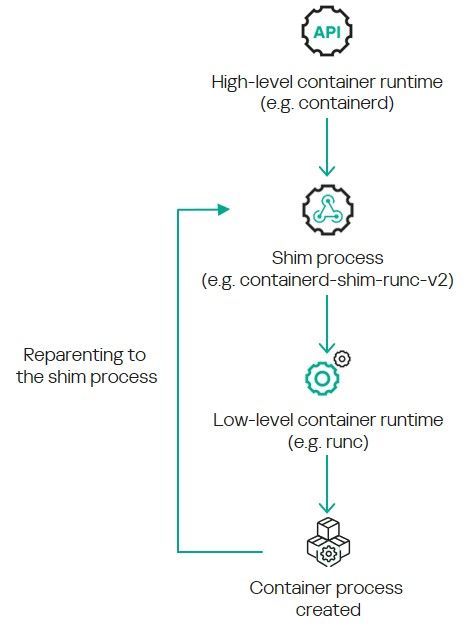
    End users interact with command-line utilities, such as Docker CLI, kubectl and others, to create and manage their containers. On the backend, these utilities communicate with an engine that facilitates communication with a high-level container runtime, most commonly containerd or CRI-O. These high-level container runtimes leverage low-level container runtimes like runc (the most common) to do the heavy lifting of interacting with the Linux OS kernel. This interaction allocates cgroups, namespaces, and other Linux capabilities for creating and killing containers based on a bundle provided by the high-level runtime. The high-level runtime is, in its turn, based on user-provided arguments. The bundle is a self-contained directory that defines the configuration of a container according to the Open Container Initiative (OCI) Runtime Specification. It mainly consists of:

    1. A rootfs directory that serves as the root filesystem for the container. It is created by extracting and combining the layers from a container image, typically using a union filesystem like OverlayFS.
    2. A config.json file describing an OCI runtime configuration that specifies the necessary process, mounts, and other configurations necessary for creating the container.

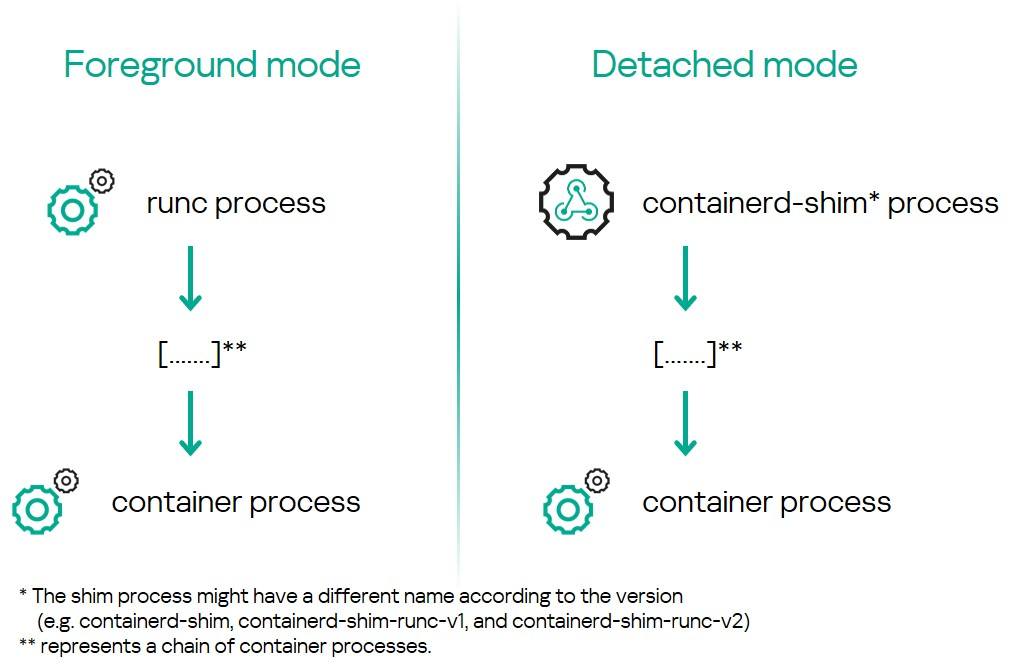
    It’s important to note which mode runc has been executed in, since it supports two modes: foreground mode and detached mode. The resulting process tree may vary depending on the chosen mode. In foreground mode, a long-running runc process remains in the foreground as a parent process for the container process, primarily to handle the stdio so the end user can interact with the running container.

    Process tree of a container created in foreground mode using runc

    In detached mode, however, there will be no long-running runc process. After creating the container, runc exits, leaving the caller process to take care of the stdio. In most cases, this is containerd or CRI-O. As we can see in the screenshot below, when we execute a detached container using runc, the runc process will create it and immediately exit. Hence, the parent process of the container is the host’s PID 1 (systemd process).

    Process tree of a container created in detached mode using runc

    However, if we create a detached container using Docker CLI, for example, we’ll notice that the parent of the container process is a shim process, not PID 1!

    Process tree of a container created in detached mode using Docker CLI

    In modern architectures, communication between high- and low-level container runtimes is proxied through a shim process. This allows containers to run independently of the high-level container runtime, ensuring the sustainability of the running container even if the high-level container runtime crashes or restarts. The shim process also manages the stdio of the container process so users can later attach to running containers via commands like docker exec -it , for example. The shim process can also redirect stdout and stderr to log files that users can later inspect either directly from the filesystem or via commands like kubectl logs -c .

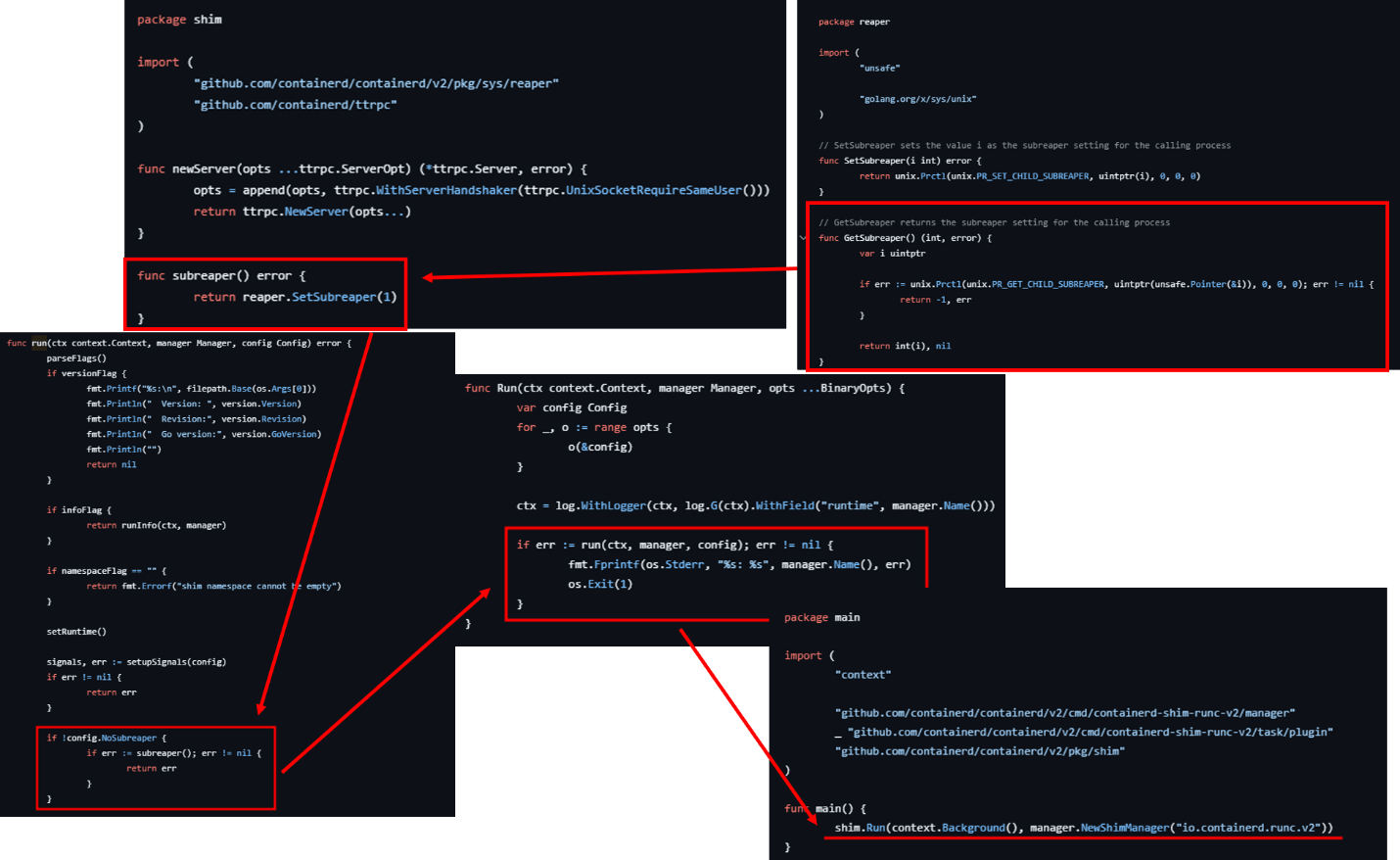
    When a detached container is created using Docker CLI, the high-level container runtime, for example, containerd, executes a shim process that calls runc as a low-level container runtime for the sole purpose of creating the container in detached mode. After that, runc immediately exits. To avoid orphan processes or reparenting to the PID 1, as in the case when we executed runc ourselves, the shim process explicitly sets itself as a subreaper to adopt the container processes after runc exits. A Linux subreaper process is a designated parent that takes care of orphaned child processes in its chain (instead of init), allowing it to manage and clean up its entire process tree.

    Detached containers will be reparented to the shim process after creation

    This is implemented in the latest V2 shim and is the default in the modern containerd implementations.

    The shim process sets itself as a subreaper process during creation

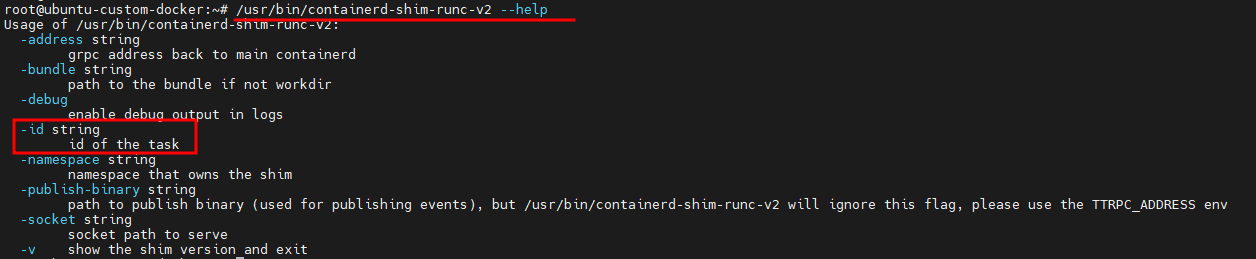
    When we check the help message of the containerd-shim-runc-v2 process, for example, we notice that it accepts the container ID as a command-line argument, and calls it the id of the task.

    Help message of the shim process

    We can confirm this by checking the command-line arguments of the running containerd-shim-runc-v2 processes and comparing them with the running containers.

    The shim process accepts the ID of the relevant container as a command-line argument

    So far, we’ve successfully identified container processes from the host’s perspective. In modern architectures, one of the following processes will typically be seen as a predecessor process for the containerized processes:

    • A shim process, in the case of detached mode; or
    • A runc process, in the case of foreground (interactive) mode.

    We can also use the command-line arguments of the shim process to determine which container the process belongs to.

    Process tree of the containers from the host perspective

    Although tracking the child processes of the shim process can sometimes lead to easy wins, it is often not as easy as it sounds, especially when there are a lot of subprocesses between the shim process and the malicious process. In this case, we can take a bottom-to-top approach, pivoting from the malicious process, tracking its parents all the way up to the shim process to confirm that it was executed inside a running container. It then becomes a matter of choosing the process whose behavior we may need to check for malicious or suspicious activities.

    Since containers typically run with minimal dependencies, attackers often rely on shell access to either execute commands directly, or install missing dependencies for their malware. This makes container shells a critical focus for detection. But how exactly do these shells behave? Let’s take a closer look at one of the key shell processes in containerized environments.

    How do BusyBox and Alpine execute commands?

    In this post, we focus on the behavior of BusyBox-based containers. We also included Alpine-based containers as an example of an image base that relies on BusyBox to implement many core Linux utilities, helping to keep the image lightweight. For the sake of demonstration, Alpine images that depend on other utilities are outside the scope of this post.

    BusyBox provides minimalist replacements for many commonly used UNIX utilities, combining them into one small executable. This allows for the creation of lightweight containers with significantly reduced image sizes. But how does the BusyBox executable actually work?

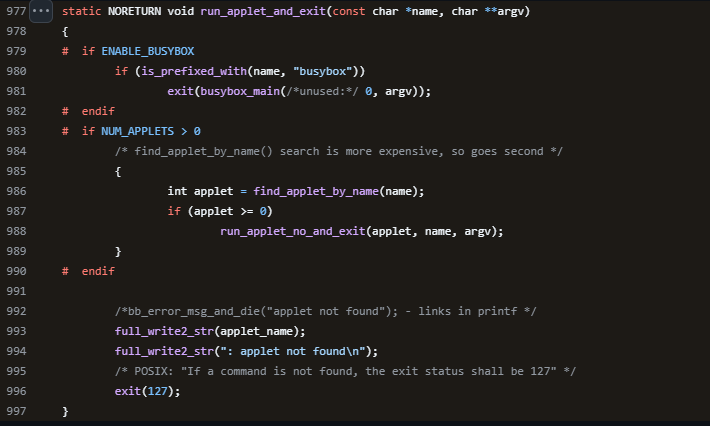
    BusyBox has its own implementation of system utilities, known as applets. Each applet is written in C and stored in the busybox/coreutils/ directory as part of the source code. For example, the UNIX cat utility has a custom implementation named cat.c. At runtime, BusyBox creates an applet table that maps applet names to their corresponding functions. This table is used to determine which applet to execute based on the command-line argument provided. This mechanism is defined in the appletlib.c file.

    Snippet of the appletlib.c file

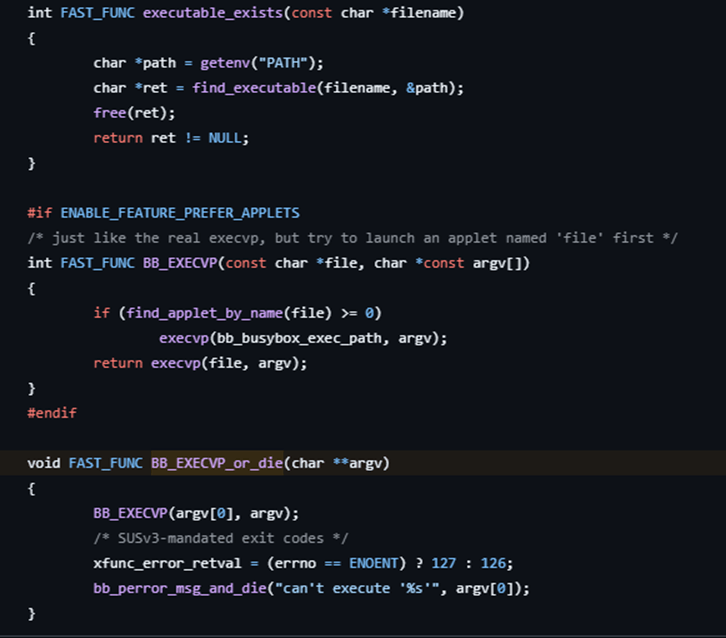
    When an executed command calls an installed utility that is not a default applet, BusyBox relies on the PATH environment variable to determine the utility’s location. Once the path is identified, BusyBox spawns the utility as a child process of the BusyBox process itself. This dynamic execution mechanism is critical to understanding how command execution works within a BusyBox-based container.

    Applet/program execution logic

    Now that we have a clear understanding of how the BusyBox binary operates, let’s explore how it functions when running inside a container. What happens, for example, when you execute the sh command inside such containers?

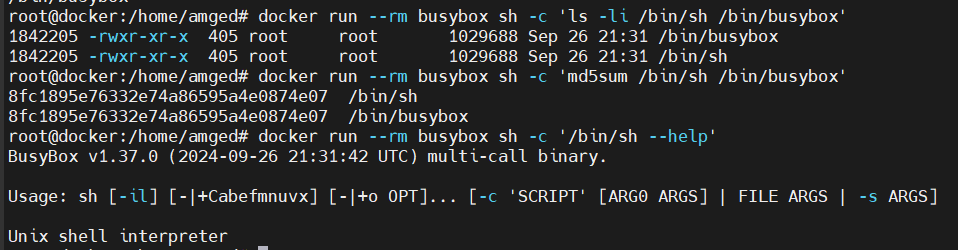
    In both BusyBox and Alpine containers, executing the sh command to access the shell doesn’t actually invoke a standalone binary called sh. Instead, the BusyBox binary itself is executed. In BusyBox containers we can verify that /bin/sh is replaced by BusyBox by comparing the inodes of /bin/sh and /bin/busybox using ls -li and confirm that both have the same inode number. We can also print their MD5 hash to see that they are the same, and by executing /bin/sh --help, we’ll see that the banner of BusyBox is the one that’s printed.

    /bin/sh is replaced by the /bin/busybox on the BusyBox based containers

    On the other hand, in the Alpine containers, /bin/sh is a symbolic link to /bin/busybox. This means that when you run the sh command, it actually executes the BusyBox executable referred to by the symbolic link. This can be confirmed by executing readlink -f /bin/sh and observing the output.

    /bin/sh is a symbolic link to /bin/busybox in the Alpine-based containers

    Hence, inside BusyBox- or Alpine-based containers, all shell commands are either executed directly by the BusyBox process or are launched as child processes under the BusyBox process. These processes run within isolated namespaces on the host operating system, providing the necessary containerization while still utilizing the shared kernel of the host.

    From a threat hunting perspective, having a non-standard shell process for the host OS, like BusyBox in this case, should prompt further investigation. Why would a BusyBox shell process be running on a Debian or a RedHat OS? Combining this conclusion with the previous one allows us to confirm that the shell was executed inside a container when runc or shim is observed as the predecessor process to the BusyBox process. This knowledge can be applied not only to the BusyBox process but also to any other process executed inside a running container. This knowledge is crucial for effectively determining the origin of suspicious behavior while hunting for threats using the host execution logs.

    Some security tools, such as Kaspersky Container Security, are designed to monitor container activity and detect suspicious behavior. Others, such as Auditd, provide enriched logging at the kernel level based on preconfigured rules that capture system calls, file access, and user activity. However, these rules are often not optimized for containerized environments, further complicating the distinction between host and container activity.

    Investigation value

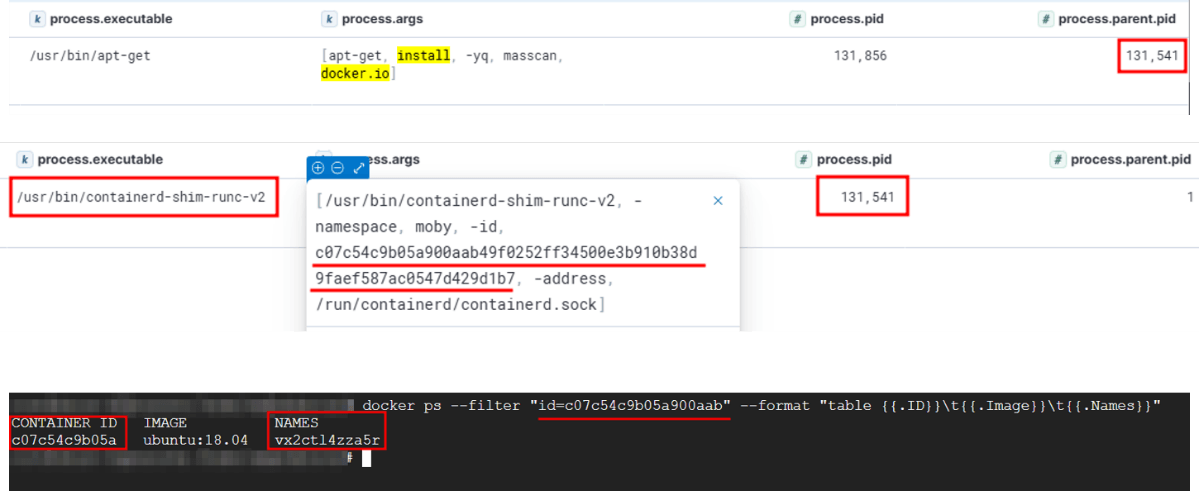
    While investigating execution logs, threat hunters and incident responders might overlook some activities on Linux machines, thinking they are part of normal operations. However, the same activities performed inside a running container should raise suspicion. For example, installing utilities such as Docker CLI may be normal on the host, but not inside a container. Recently, in a Compromise Assessment project, we discovered a crypto mining campaign in which the threat actor installed Docker CLI inside a running container in order to easily communicate with dockerd APIs.

    Confirming that the docker.io installation occurred inside a running container

    In this example, we detected the installation of Docker CLI inside a container by tracing the process chain. We then determined the origin of the executed command and confirmed the container in which the command was executed by checking the command-line argument of the shim process.

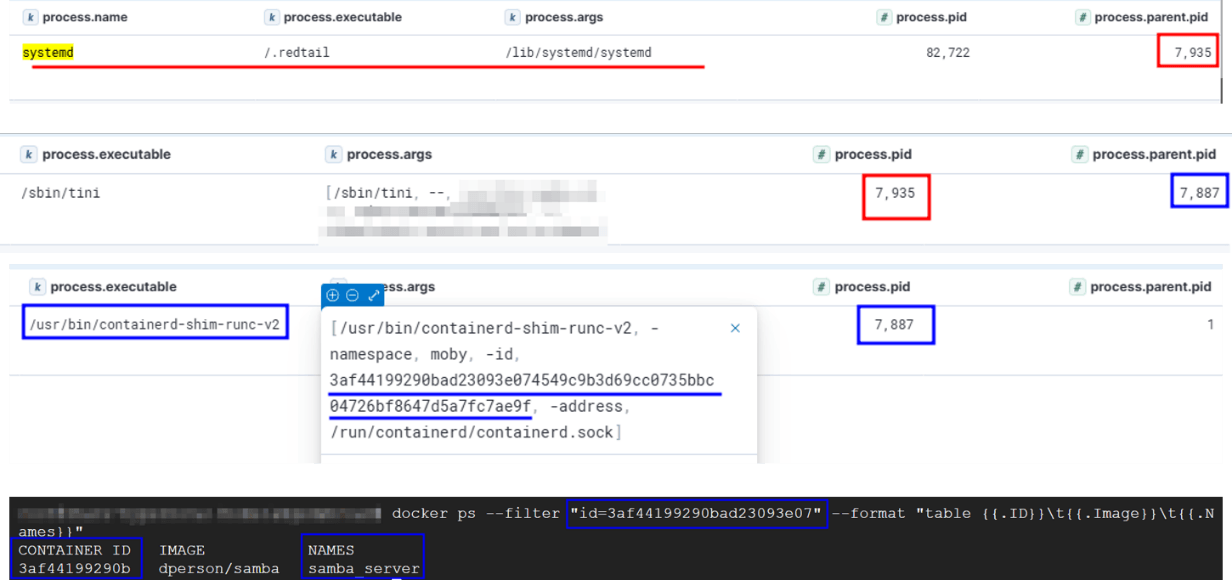
    During another investigation, we detected an interesting event where the process name was systemd while the process executable path was /.redtail. To identify the origin of this process, we followed the same procedure of tracking the parent processes.

    Determining the container in which the suspicious event occurred

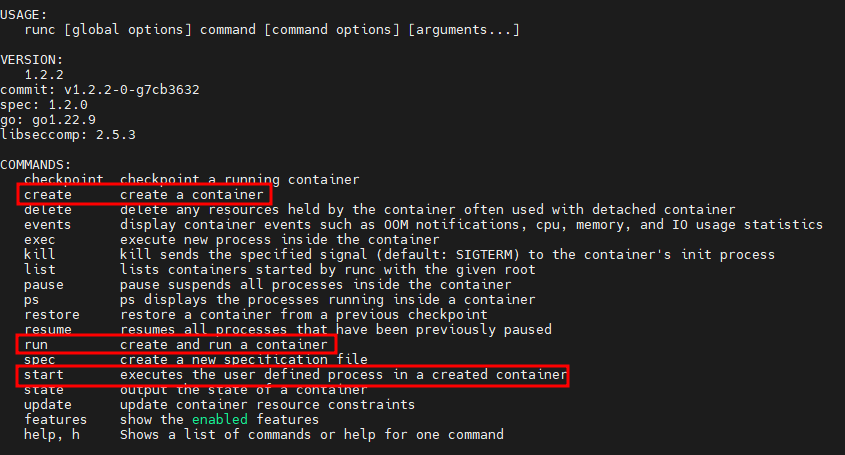
    Another interesting fact we can leverage is that a Docker container is always created by a runc process as the low-level container runtime. The runc help message reveals the command-line arguments used to create, run or start a container.

    runc help messate

    Monitoring these events helps threat hunters and incident responders identify the ID of the subject container and detect any abnormal entrypoints. A container’s entrypoint is its main process and it will be the process spawned by runc. The screenshot below shows an example of the creation of a malicious container detected by hunting for entrypoints with suspicious command-line arguments. In this case, the command line contains a malicious base64-encoded command.

    Hunting for suspicious container entrypoints

    Conclusion

    Containerized environments are now part of most organizations’ networks because of the deployment and dependency encapsulation feasibility they provide. However, they are usually overlooked by security teams and decision makers because of a common misunderstanding about container isolation. This results in undesirable situations when these containers are compromised, and the security team is not fully equipped with the knowledge or tools to help during response activities, or even to monitor or detect in the first place.

    The approach discussed in this post is one of the procedures that we typically follow in our Compromise Assessment and Incident Response services when we need to hunt for threats in historical host execution logs with container visibility issues. However, in order to detect container-based threats in time, it is crucial to protect your systems with a solid containerization monitoring solution, such as Kaspersky Container Security.

    MIL OSI Economics

  • MIL-OSI Economics: Mary-Elizabeth McMunn: Outcomes and opportunities – responding to challenge and change

    Source: Bank for International Settlements

    Good morning.  Thank you to Irish Funds for the invitation to address their Annual Global Funds Conference today.

    The theme of this year’s conference – ‘Towards 2030: Acceleration, Transformation & Innovation’ – is a fitting one. 

    Given the volatility of global events over the last few weeks, it is more important than ever that we continue to look to future.  Both to understand and be able to take advantage of potential opportunities – particularly with regard to transformation and innovation – but also to be prepared for whatever the future may hold.  

    But before I look to the future, I will spend a few moments looking back – and taking stock of recent and potentially seismic global developments. 

    Shifting geo-political plates

    The last few months and indeed weeks have seen a sudden shift in geo-economic fragmentation both in terms of an accelerated pace and scale. 

    While a return to more protectionist policies had been forecast for some time – and specific events such as COVID-19 and the Russian invasion of Ukraine provided concrete examples of trade fragmentation and heightened geopolitical tensions – the recent and potentially significant fracturing of trading relations has come about quite suddenly.

    MIL OSI Economics

  • MIL-OSI Economics: Edward S Robinson: Welcome remarks – 12th Asian Monetary Policy Forum

    Source: Bank for International Settlements

    Good morning.
    Deputy Prime Minister Heng Swee Keat, 
    Managing Director Chia Der Jiun,
    Distinguished speakers, central bank colleagues,
    Honoured Guests.

    Introduction

    Thank you for taking the time to be here for the 12th Asian Monetary Policy Forum. We are greatly honoured that DPM Heng Swee Keat has been able to join us. He provided the impetus to the inception of ABFER/AMPF a decade ago and has continued with strong counsel and encouragement.  DPM as a policymaker internalises the economic way of thinking. He applies careful and thoughtful analytical reasoning based on the evidence to a range of policy issues, including enhancing the economy’s macro-competitiveness. He has made significant contributions to the strengthening of Singapore’s international trade relationships and holds a deep conviction in the benefits of comparative advantage and broader economic complementarities across countries. DPM has played a pivotal role in ingraining the principles and practices that define Singapore’s robust, forward-looking approach to economic policy making. 

    The Global Economic Context

    In 2024, the global economy was showing clear signs of recovery. Inflation was easing, growth was holding steady at potential, and central banks were beginning to cut policy rates. Yet today, prospects have darkened against conditions of underlying unpredictability.

    The Economics of Protectionism

    Economists readily acknowledge the firm case against protectionism. Import taxes destroy trade benefits by disrupting efficient resource allocation and reducing consumer surplus, as domestic households face higher prices and fewer choices. Both the targeted and tariff-imposing economies suffer. 

    MIL OSI Economics

  • MIL-OSI Economics: Asian Development Blog: Why Central Banks in Asia Should Consider Cutting Interest Rates

    Source: Asia Development Bank

    Amid global trade uncertainty and moderating inflation, several Asian economies face growing pressure to reduce interest rates. Falling inflation, high real interest rates, weakening growth, and a softening US dollar suggest conditions may be right for monetary easing in parts of the region.

    MIL OSI Economics

  • MIL-OSI Economics: Mary-Elizabeth McMunn: Central banks and innovation – delivering our mandate in a digitalising world

    Source: Bank for International Settlements

    Many thanks for the invitation to speak to you today.1

    Speaking about innovation to a room full of innovators is no easy task, but I do think it is important to share the perspectives of a Central Bank and Regulator on innovation in the financial sector, in particular given the increasingly important role technology is playing in financial services.

    And as I have said before, while naturally associated with the private sector, I believe the public sector also has a crucial role to play in innovation – not just by enabling it but also in ensuring its safe adoption.

    Given this important role, as well as our strategic commitment to anticipating and responding proactively to changes in the economy and financial system,2 the Central Bank has put an increasing focus on innovation in the financial sector in recent years.

    As evidenced by your agenda today there is a huge breadth of innovation taking place in financial services.

    And while there is so much we are focused on that I could cover in my remarks, from Ireland’s growing and international Payments sector, to the increasing importance of operational and cyber resilience to the rapid evolution of Artificial Intelligence and its use in the financial sector, I would like to discuss two important aspects today.

    Firstly I would like set out how the Central Bank of Ireland thinks about and approaches innovation in financial services; and secondly I would like to focus in more detail on our role in one of the big potential technological shifts underway in the sector – namely digital assets, including tokenisation.

    Central Banks and Innovation

    Central Banks and Regulators are sometimes cast as anti-risk and indeed anti-innovation. But this couldn’t be further from the truth.

    While obviously our jobs are to ensure risks in the financial sector are being well managed – so that the system is stable, firms are safe and sound, consumers and investors’ interest are protected and the integrity of the system is upheld – we do not do this by eliminating all risk. One of the core functions of the financial system is to manage and take risk – and so if Regulators do not accept risk and make risk-based decisions ourselves, then the system doesn’t work.

    Similarly while it is our responsibility to ensure the risks from new entities, products or ways of serving customers are being well managed, we do not do this by unduly stifling innovation.

    Rather the Central Bank of Ireland supports innovation in the financial sector, as we recognise the benefits it can bring. But, to state the obvious, to deliver these benefits such innovation must be done well, which includes properly managing the risks that could arise to consumers and the system.

    In this regard contrary to being anti-innovation, in line with peer Central Banks we have been adapting our approach to better support and anticipate it.

    And as with all of our work, our approach to innovation is guided by our mission and mandate, serving the public interest by maintaining monetary and financial stability while ensuring that the financial system operates in the best interests of consumers and the wider economy.

    In terms of Regulation and Supervision specifically, there are many ways by which we seek to ensure innovation in the financial sector is operating in the best interests of the whole.

    This includes:

    Regulation – which not only enables innovation, but through appropriate guardrails helps establish trust, essential for innovation to be widely adopted, particularly in the area of financial services. PSD2, MICAR and DORA are all positive examples of this – enabling and enhancing digital finance and safe financial innovation in Europe.

    Authorisation – which plays a pivotal role in ensuring entities, products and individuals meet the high standard to be trusted with the public’s money. While authorisation is just the start of the supervisory relationship it is also about setting firms up for success, which is both in the firms’ own interest as well as in their customers’.3

    Supervision in turn provides a mechanism for maintaining trust through the cycle, by ensuring innovative firms are well run, products are appropriately designed, and neither introduce undue risks for their consumers or the system.

    This includes supervisory engagement ensuring regulated entities are being sufficiently innovative in adapting their business models and managing their operational resilience, where technology can be both part of the problem and part of the solution.

    In addition to these I would also add that the Central Bank also plays role in encouraging and fostering good innovation in the financial sector, in line with our public policy objectives.

    This includes our catalyst role for payments, and the convening power of a Central Bank, where we seek to drive and influence positive change at a system level to improve market efficiency, integration and security.

    And finally it includes our broader engagement with the innovative ecosystem, something we have been deepening and enhancing in recent years and which I would like to touch on now briefly.

    Engaging with innovation – Hub and Sandbox

    You will all be aware of the work of our Innovation Hub, which was established in 2018 and has gone from strength to strength. The Hub is open to all innovators in financial services, no matter the size or whether they are new entrants or established entities. And it has proven a valuable form of engagement both for us and the sector.

    For us, alongside other engagement and initiatives, it has helped us deepen our understanding of innovation in the financial sector, amidst a period of rapid digitalisation. And for the sector, you have reported the benefit of early engagement in terms of better understanding of our regulatory expectations and, for new entrants, what being a regulated entity entails.

    Last year, following public consultation, we began implementing proposals to evolve our approach by:

    1. Enhancing our Innovation Hub to deliver deeper, clearer and more informed engagement with the innovation ecosystem; and
    2. Establishing an Innovation Sandbox Programme.

    In terms of the first point, we have found the changes made are leading to deeper more productive engagements, making better use of our collective resources. In addition to the 8% year on year increase in Innovation Hub Engagements last year, this represents a substantial uplift in terms of the quantity and quality of our engagements with the ecosystem.   

    On the second proposal, as you will be aware our Innovation Sandbox Programme aims to inform the early stage development of selected innovative initiatives that promote better outcomes for consumers and the financial system.

    Our first programme launched late last year; and consistent with our aim of fostering innovation to support outcomes consistent with our public policy objectives, the theme was Combatting Financial Crime.4

    While the programme is still ongoing, both from our perspective and from feedback received from the 7 participants, the first programme has been a very positive experience. The final module will take place in June, alongside a showcase of the participants’ innovative solutions at an event in the Central Bank.

    In line with our wider commitment to continuous improvement, we will adopt an iterative approach to our Innovation Sandbox Programme, learning and improving from each one. We are also committed to sharing our key learnings, and will publish a report on outcomes and findings from our first programme later this year.

    Central Bank approach to Crypto

    I would like to turn now to digital assets, a wide-ranging and growing topic.

    Given its breadth, I will just touch on two specific areas: firstly crypto-assets, and in particular our approach to this sector and the implementation of MiCAR, before turning to the potential next wave of innovation, in terms of the tokenisation of the financial system.

    Firstly, we are often asked about the Central Bank’s approach to crypto-assets.

    I will begin by saying that as with all innovation in financial services we seek to ensure it is done well, and is delivering benefits to consumers and the system while appropriately managing any risks.

    It should go without saying that there are inherent risks in crypto-assets, and some forms of crypto-assets have higher risks than others.

    It is for this reason that we have issued warnings to consumers concerning crypto, and have expressed scepticism about business models which are driven by the heavy marketing, offering and distributing of unbacked crypto-assets to retail customers for speculative purposes.

    MiCAR will not provide the same levels of protection that exists for traditional financial investment products, nor of course will it enable all the significant risks linked to crypto-assets to be mitigated.  However, it is a welcome step forward.

    Nevertheless, it is important for consumers to be aware, that MiCAR will not cover all crypto-assets, with some of the most well-known crypto-assets, such as Bitcoin and Ether, not within scope of the regulation given they have no identifiable issuer.

    But while it is true speculative and highly volatile forms of crypto-assets remain a concern for the Central Bank, in particular from a consumer protection point of view, it is equally true that we recognise the important innovations distributed ledger and crypto technology could potentially lead to for financial services – and indeed we have recognised this for some time.

    It is important to note, however, as with all aspects of financial services this potential will only be realised if the technology and the providers can be trusted, to be resilient, to provide benefits to consumers and to help uphold, rather than jeopardise, the integrity of the financial system.

    It is these outcomes that inform our regulatory approach to crypto-assets. And indeed are informing our approach to the implementation of MiCAR, both in our engagement with regulatory peers, as well as our authorisation of applicant firms under the new framework.

    In that regard we have put in place a well-resourced and expert team to deal with the CASP authorisation process – ensuring it is both efficient as well as sufficiently robust.

    The team have been engaging extensively with the sector and applicants, and we have held a number of industry events dedicated to MiCAR.5 This is part of our ongoing commitment to transparency, clarity and openness, in particular in our authorisation processes but also in our engagement with innovation.

    But while we are committed to a timely and quality authorisation process, the role and approach of applicant firms is also key in this regard.  Our assessments of MiCAR authorisation applications will be guided through many perspectives including the use case and utility, suitability, and the risks associated with a crypto product or service. 

    The importance of good culture and conduct risk management in delivering on new obligations under MiCAR cannot be overstated. The stronger their risk management, the better position firms are in to understand, calculate and mitigate risks, in turn strengthening their business model, and their relationship with their customers. 

    Regardless of the services, the target customer base, or whether the business is retail focused or aimed at institutional clients, safeguarding of client assets and governance are critical considerations for the Central Bank – given the fundamental role they play in protecting people’s money.

    And as I said earlier, authorisation is only the beginning of the supervisory relationship and so firms should demonstrate at the Gate that they will be well-run once they are through it.

    Tokenisation – private and public roles 

    Finally I would like to turn more broadly to the topic of tokenisation, which as we all know is the digital representation of traditional assets on a programmable platform6 and the potentially transformative potential of distributed ledger technology.

    I say potentially transformative, as some visions of a tokenised financial system, such as the  ‘finternet’ or ‘financial internet’put forward by the BIS, would truly be so, promising huge efficiency and disintermediation gains, reducing costs and complexity and empowering businesses and consumers.

    While this is on the further end of the tokenisation spectrum, there are a number of areas of the financial system where the potential benefits of tokenisation are being explored.

    This includes tokenisation of real assets, as well as financial assets such as money, securities, collateral, bank deposits, and funds. The potential benefits in terms of peer to peer transactions, smart contracts, and settlement and clearing are clear, leading to lower costs and indeed less risks. For time is money and time is risk as they say.8

    While there is a large amount of work ongoing by both the private and public sector, I wanted to touch on what I see as the Central Bank’s role in this regard.

    Firstly from a regulatory point of view, there is an onus on us to ensure there are no unintended regulatory impediments to tokenisation of traditional assets; as well as to engage in dialogue with the sector to see if enabling regulation is required.

    Secondly in line with our desire to foster innovation that delivers good outcomes for consumers, we can seek to drive and influence change at a system level. There is also a need for central banks to deepen our knowledge and engagement with this innovation, as well as to enhance our thinking and capabilities, given the far reaching changes implied should this wave of innovation materialise.

    These are all things we and peer Central Banks are doing, and indeed will further focus on in future – and something the BIS and other Central Banks have been leading on, with Project Agora, which is testing a multi-currency wholesale cross border payments using DLT, and Project Guardian, which seeks to enhance liquidity and efficiency of financial markets through asset tokenisation, both important examples.

    Given Central Banks’ fundamental role in the monetary system, it is important that public innovation keeps pace with private innovation, particularly in payments and settlements systems.

    In order to maintain the crucial role of public money in a tokenised world, future proofing our monetary system, facilitating innovation and increasing the resilience of the payments system, the Eurosystem is stepping up its efforts to support and foster innovation in market infrastructures. For example, in February the ECB announced its decision to expand its initiative to settle transactions recorded on DLT in central bank money.9

    In addition, the work the Eurosystem is doing around the Digital Euro is key, both in terms of a retail Digital Euro as the representation of public money in a digital world, but also importantly in terms of wholesale central bank digital currency, as a tokenised central bank asset to operate in a tokenised system.10

    Conclusion

    Before I conclude I would like to touch briefly on the rapidly changing external environment we are all operating in.

    In a future focused speech, it would be remiss of me not to mention the potential great structural changes underway in terms of geo-political developments and geo-economic fragmentation.

    The challenges facing our economy are clear; but amongst these challenges are opportunities.

    Innovation is often borne out of times of challenge, turning risks into opportunities.

    But also as we deal with short run risks, it is too easy to take our eyes off these longer term opportunities.

    I am sure this room full of innovators will heed the call to focus on continuing to deliver innovation in the interest of consumers and the wider economy. We as a Central Bank will also continue to anticipate, engage with and respond to innovation in the system.

    But I would also call on firms and investors to not lose sight of the need to continue to innovate and invest in technology. While economic cycles come and go, the digital transition rolls on, and we cannot be left behind.

    Thank you.


    MIL OSI Economics

  • MIL-OSI Economics: Klaas Knot: Banking on buffers – why we need resilience in times of uncertainty

    Source: Bank for International Settlements

    A very good morning to you all. Welcome to De Nederlandsche Bank. We are very happy to host this event here in our newly renovated building. I strongly support these kinds of exchanges of views between banks, academia and the public sector, and the IBF plays an important role in facilitating them.

    This Round Table bears an interesting, and perhaps somewhat surprising, title: ‘Tougher Times for Banks: Torn between Resilience, Competition and Stability’. Personally, I regard resilience, competition and stability all as good things, so I was wondering what you find so disturbing about this. But perhaps I should read the title as diplomatic language for ‘Torn between competitors, difficult regulators, and a world that has gone insane.’ You understand, being Dutch, I have a certain reputation to maintain.

    But still, even if my interpretation is right, I should speak a word of caution here. Or in fact, reassurance. Because sometimes we tend to see trade-offs where in reality there aren’t any.

    Let’s take regulation for example. Banking regulation often seems to resemble the swinging motion of a pendulum. After a financial crisis, lessons are learned and financial regulation is tightened. We saw this very prominently after the great financial crisis of 2008. And then after some years, the memories of the crisis fade in the rearview mirror, and calls go up for relaxing financial regulation. And this is what we currently see.

    That seems to assume that there is a trade-off between banking regulation and all the good things of economic life: profitability, dynamism, economic growth. And I know that many in the banking sector view regulation as a constraint, something that limits profitability and imposes undue costs.

    But, and that should not come as a surprise to you, I would argue against that. In fact, it’s just the other way around. Banking regulation is not an obstacle to growth, it is an enabler of sustainable, long-term growth. Banks with strong capital positions and sound liquidity management are better positioned to extend and rollover credit, invest in new technologies and finance large-scale projects. They are better able to maintain lending during an economic downturn. And stronger banks can secure more favourable funding conditions, attract long-term customers and build partnerships that increase shareholder value.

    That’s not just theory. We have seen it in practice. During the Covid pandemic the banking sector was able to function as a shock absorber, rather than a shock amplifier. Thanks to stronger buffers, banks were able to absorb losses and continue extending credit when the economy took a hit as a result of the lockdowns. That was in large part thanks the comprehensive reform of banking regulation after the great financial crisis. Suppose we hadn’t done this. We would probably have had a banking crisis on top of a global health crisis.

    Even after the pandemic, we had a number of shocks that triggered financial market turmoil. Such as the Russian invasion of Ukraine, the ensuing energy crisis, double digit inflation, and recently, a trade war. During all of these episodes, although surely there was instability at the fringes, the core of the financial system, including the banking system, held up relatively well. I am convinced that this is the result of the hard work we did on strengthening the system in previous years.

    Now, have lawmakers and regulators done a perfect job? No, of course not. That would have been highly remarkable. Over the past 15 years, a great deal of regulation has been introduced from various angles. At the global, EU and national level. Micro versus macro. New risks are identified while older ones seldomly disappear. Regulation always creates new imperfections, and there is indeed some overlap, for example in resolution versus recovery. And at times there is a lack of proportionality for smaller institutions. That is certainly something we can look into.

    But for those arguing for simplification beyond this, please keep in mind that simple rules are less risk-sensitive and thus lead to stricter requirements. You want simpler rules? Sure, but those rules are then calibrated at a more prudent level. That is the logic behind the standardised approach. That is also the logic behind the leverage ratio.

    Most importantly, we should be careful not to confuse simplification with deregulation. Deregulation means effectively lowering buffers by relaxing the rules. That would increase both vulnerability in the banking system and the likelihood of financial crises. That would be a big mistake.

    We should be wary of undoing the hard work that has gone into strengthening the financial system over the past decade and a half. Especially now, in this time of unusually high uncertainty, both on the economic and political front.

    So we need to maintain the overall level of resilience. And in fact, in some areas, our work to make the banking sector more resilient is not yet complete. For one thing, the final Basel III standards, that are meant to repair key weaknesses in banking regulation, still need to be implemented in many jurisdictions. In the meantime, the banking turmoil of two years ago was a reminder that bank failures are not a thing of the past.

    Also, the non-bank financial sector has greatly expanded. Recent episodes of market turmoil have confirmed weaknesses in this sector when it comes to leverage and liquidity. So now we need to bring the NBFI sector to an equal level of resilience as the banking sector. At the Financial Stability Board, we have pushed hard for this, and we will continue to do so.

    The title of this Round Table also mentions competition. John D. Rockefeller once said: ‘Competition is a sin.’ I might have felt the same way if I had been in his position. But from today’s perspective, I would say: unfair competition is a sin. And as regulators, if there is one thing we can do to promote fair competition, it is to provide a level playing field. Banking rules work best when they work everywhere. If regulation is implemented unevenly across jurisdictions, a patchwork of regulations will arise that opens the door to regulatory arbitrage. Banks may be tempted to shift operations to regions with looser standards. An uneven playing field undermines confidence in the global banking system, disrupts competition, and ultimately increases systemic risk.

    Since the financial system is a global system, we need global rules. And for this we need global cooperation. It is obvious that this is where the big challenge lies today. If we want to meet today’s challenges to financial stability, we have to continue to work together as nations. And we need to stay committed to the institutions we have built to underpin that cooperation, such as the Basel Committee and the FSB.

    Let me wrap up. There is no trade-off between financial stability and economic growth. Rather, financial stability is a necessary precondition for sustainable economic growth. And for that, we need a resilient banking sector, supported by strong buffers. This is a message I will be repeating over and over again in my final weeks as the president of DNB. By the end of June you will all be completely fed up with me. That’s ok. As long as you remember the message. Because, somehow, we tend to forget.

    MIL OSI Economics

  • MIL-OSI Economics: Global uncertainty affects the financial sector

    Source: Danmarks Nationalbank

    3 June 2025

    The ongoing trade conflict has worsened the global growth outlook, while the risk of new shocks to the financial markets has become a more persistent threat due to the high level of global uncertainty regarding trade policy. As a small, open economy, Denmark will be affected by the trade conflict, and the financial sector may experience a particular impact on bank lending to export-sensitive industries.

    “Uncertainty is detrimental to financial markets and the economy, and if the trade conflict escalates, it will undoubtedly weaken the global economy. A decline in Danish exports will affect Danish companies and may lead to losses on bank lending,” says Peter E. Storgaard, Head of Financial Stability at Danmarks Nationalbank.

    Credit institution’s profits remained high in 2024, in part due to low loan impairment charges. The banks’ core earnings make up the first line of defence against potential losses. Danmarks Nationalbank’s biannual stress test of the financial sector shows that Danish institutions can withstand a severe recession scenario.

    “In times of high uncertainty, financial stability may come under strain. The Danish financial sector is well equipped to handle challenges related to the effects of the trade conflict on the Danish economy, which our latest stress test emphasises. In the current risk environment, a robust liquidity position and capitalisation of banks is crucial,” says Storgaard and continues:

    Every six months, Danmarks Nationalbank publishes its Financial stability analysis, which assesses and makes recommendations regarding financial stability in Denmark.

    The most recent analysis was published today at www.nationalbanken.dk.

    Journalists may direct any queries Peter Levring, Communications and Press Officer, by telephone on +45 2620 1809 or by email at pnbl@nationalbanken.dk.

    MIL OSI Economics

  • MIL-OSI Economics: Unit-linked pension savings have caught up to average-rate pensions savings

    Source: Danmarks Nationalbank

    Higher net contributions for unit-linked products

    Unit-linked products have become more widespread in recent years. New pension schemes are predominantly unit-linked schemes, and there have also been significant shifts from average-rate to unit-linked products. This has meant that for unit-linked products, there are overall greater contributions from the working population than payments to pensioners, while the opposite is true for average-rate products. The total net contributions since 2015 have been kr. 910 billion higher for unit-linked products than for average-rate products. This trend continued in the 1st quarter of 2025, where there were net contributions of kr. 16 billion to unit-linked products, while there were net payments of kr. 9 billion from average-rate products.

    Market developments also leave their mark on pension savings

    In addition to net contributions, the pension savings for unit-linked products have increased by kr. 736 billion since 2015, which primarily reflects the return on the pension companies’ investments in the financial markets. In the same period, the pension assets for average-rate products rose by only kr. 310 billion, when net contributions are excluded. Unlike unit-linked products where stocks make up a larger portion of the investments, bonds are more prominent for average-rate products.

    MIL OSI Economics

  • MIL-OSI Economics: Harvia and Toyota Co-Develop Concept Model for Hydrogen Sauna Utilizing Hydrogen Combustion Technology

    Source: Toyota

    Headline: Harvia and Toyota Co-Develop Concept Model for Hydrogen Sauna Utilizing Hydrogen Combustion Technology

    Harvia Plc (CEO: Matias Jarnefelt; hereafter “Harvia”) and Toyota Motor Corporation (Operating Officer, President: Koji Sato; hereafter “Toyota”) teamed up to produce a concept model for what is believed to be the world’s first hydrogen-powered sauna (as of this writing, according to the investigations of Harvia and Toyota). The collaboration represents a step toward a more sustainable future for saunas by combining Harvia’s sauna expertise with Toyota’s hydrogen combustion technology.

    MIL OSI Economics

  • MIL-OSI Economics: Result of the Daily Variable Rate Repo (VRR) auction held on June 03, 2025

    Source: Reserve Bank of India

    Tenor 1-day
    Notified Amount (in ₹ crore) 25,000
    Total amount of bids received (in ₹ crore) 5,019
    Amount allotted (in ₹ crore) 5,019
    Cut off Rate (%) 6.01
    Weighted Average Rate (%) 6.01
    Partial Allotment Percentage of bids received at cut off rate (%) NA

    Ajit Prasad          
    Deputy General Manager
    (Communications)    

    Press Release: 2025-2026/461

    MIL OSI Economics

  • MIL-OSI Economics: Nicaragua 101st WTO member to formally accept Agreement on Fisheries Subsidies

    Source: WTO

    Headline: Nicaragua 101st WTO member to formally accept Agreement on Fisheries Subsidies

    DG Okonjo-Iweala said: “WTO members’ adoption of this landmark Agreement in 2022 set us on a more sustainable path toward restoring the abundance and vitality of our oceans. The next step is the Agreement’s entry into force. With Nicaragua’s formal acceptance of the Agreement on Fisheries Subsidies, we are closer than ever to getting there. We now need just 10 more acceptances to cross the finish line!
    This 101st acceptance opens the door for the WTO Fish Fund to open a call later this week for developing and least developed WTO members to submit proposals and funding requests for the technical assistance and capacity building they may need to implement the Agreement”, she added.
    Ambassador Bohorquez Palacios said: “Our acceptance of the Agreement on Fisheries Subsidies reaffirms Nicaragua’s support for the rules-based multilateral trading system and our commitment to international efforts to promote the sustainable use of marine resources. As a country bordered by two oceans, Nicaragua recognizes the importance of the blue economy and has always been committed to marine life. We look forward to continuing to work with all WTO members to ensure entry into force of this historic Agreement and its effective implementation.”
    Formal acceptances from two-thirds of WTO members are required for the Agreement to enter into force – representing 111 members. The list of the 101 current instruments deposited with the WTO is available here.
    At the WTO’s 12th Ministerial Conference (MC12) held in Geneva in June 2022, ministers adopted by consensus the Agreement on Fisheries Subsidies, setting new, binding, multilateral rules to curb harmful fisheries subsidies. The Agreement prohibits subsidies for illegal, unreported and unregulated fishing, for fishing overfished stocks, and for fishing on the unregulated high seas. Ministers also recognized the needs of developing economies and least-developed countries by establishing a fund to provide technical assistance and capacity-building to help governments which have formally accepted the Agreement implement the new obligations.
    WTO members also agreed at MC12 to continue negotiating on remaining fisheries subsidies issues. The objective is to find consensus on additional provisions to further strengthen the disciplines on fisheries subsidies.
    Information for members on how to accept the Protocol of Amendment is available here.

    Share

    MIL OSI Economics

  • MIL-OSI Economics: Cyshield uses Thales technology to launch Egypt’s first connectivity service for eSIM devices

    Source: Thales Group

    Headline: Cyshield uses Thales technology to launch Egypt’s first connectivity service for eSIM devices

    Cyshield, a leading digital solutions company, selected Thales a world leader in secure advanced technologies to launch Egypt’s first-ever eSIM (embedded SIM) connectivity services for consumer and IoT devices. Based in Cairo, Cyshield is supporting Egypt’s four mobile network operators in connecting eSIM devices in the country, optimising the user experience and enabling flexible subscription services for eSIM-enabled smartphones, smartwatches and other IoT devices.

    Thales provides Cyshield with its leading eSIM Management platform, to enable fast and secure over-the-air downloads of mobile subscriptions to devices, leveraging proven expertise and capabilities to address sovereignty challenges. In addition, it ensures compliance with the latest consumer and M2M/IoT specifications1 for eSIM solutions, guaranteeing profiles and communication are interoperable and secure.

    This new milestone in the development and digitalisation of mobile connectivity allows millions of Egyptians to enjoy the growing range of eSIM-enabled devices. Moreover, because Cyshield supports all the country’s mobile operators, it can take full advantage of the eSIM’s ability to host several mobile subscriptions. For the consumer market, end users can switch between operators and select their preferred subscription package with a single click on their phone. For the M2M/IoT market, Cyshield is becoming the national connectivity hub for smart metering in Egypt and other markets, while also preparing to meet evolving industry standards2 and requirements (GSMA SGP.32 standards).

    Within less than five months of its launch, by December 5th, 2024, Cyshield had already completed over 400,000 end-user subscription downloads. Building on this success, the service will be extended to industrial IoT (Internet of Things) applications throughout 2025 and is already fully certified by Egypt’s National Telecom Regulatory Authority (NTRA). ​

    “Khaled Taher, Products Director at Cyshield, praised Thales for delivering a secure, GSMA-certified solution that meets both current and future operational needs, while maximizing eSIM technology to enhance user experience and create new commercial opportunities for mobile operators. Likewise, Waleed Ragab, Products Director at Cyshield, highlighted Thales’ expertise and guidance in successfully securing GSMA SAS-SM certification on the first attempt, ensuring swift regulatory compliance and enabling Cyshield to provide a reliable, innovative eSIM connectivity service with exceptional flexibility and convenience for customers.”

    Egypt’s first eSIM service is a truly collaborative and sovereign project, bringing together not just Cyshield and Thales, but also the GSMA, NTRA, and all the country’s mobile network operators” said Sherif Barakat, Country Director for Egypt, Thales. “This marks another major leap forward for the eSIM ecosystem, which is expanding at pace in north Africa and across the globe.”

    1Respectively: GSMA SGP.22 and GSMA SGP.02.

    MIL OSI Economics

  • MIL-OSI Economics: Introducing Bing Video Creator: Create videos with your words for free

    Source: Microsoft

    Headline: Introducing Bing Video Creator: Create videos with your words for free

    Questions deserve answers, ideas beg for realization, and curiosity seeks satisfaction. Two years ago, we brought this belief forward with Bing Image Creator, helping users everywhere create whatever they can imagine through words—for free. Last month, we continued the next evolution of search with Copilot Search in Bing, blending the best of traditional and generative search to meet you where you are at in your discovery journey.

    Today we’re taking the next leap with Bing Video Creator, allowing you to turn your ideas into videos, for free. Powered by Sora, Bing Video Creator transforms your text prompts into short videos. Just describe what you want to see and watch your vision come to life. 

    [embedded content]
    Bing, as your AI-powered search and answer engine, not only helps you find what you need, but gives you the freedom to create exactly what you’re looking for. 

    Bing Video Creator is free and is rolling out starting today on the Bing Mobile App and coming soon to desktop and within Copilot Search. To get started, download the Bing Mobile app.

    Bringing creation to your fingertips

    Bing Video Creator represents our efforts to democratize the power of AI video generation. We believe creativity should be effortless and accessible to help you satisfy your answer-seeking process.

    Whether you’re letting your imagination run wild, bringing a story to life, or looking for that perfect video to communicate what you’re thinking, Bing Video Creator puts the power of video creation at your fingertips. We’re excited to empower anyone to turn their words into wonder through an AI-generated video.

    How to use Bing Video Creator

    Getting started with Bing Video Creator is easy. Open Video Creator within the Bing Mobile app by clicking on the menu in the bottom right corner and selecting “Video Creator.” You can also type directly into the Bing mobile app search bar “Create a video of…” for quick access to video creation. Once Bing Video Creator becomes available on desktop, you can visit Bing.com/create.

    Open the Bing app and click on the menu in the bottom right corner, then select “Video Creator.”

    Then, simply type in a description of the video you want to create in the prompt box. The best prompts provide additional context, description, and detail. Click “Create” and let AI generate your video. Feel free to continue dreaming up new videos – you’ll receive a notification when your video is ready to view. 

    Check out this fun prompt below: “In a busy Italian pizza restaurant, a small otter works as a chef and wears a chef’s hat and an apron. He kneads the dough with his paws and is surrounded by other pizza ingredients.”

    Videos are 5 seconds long and can be created in 9:16 format with 16:9 format coming soon. You can also queue up to three video generations at a time. If all three slots are in use, you’ll need to wait for one to finish before starting another.

    Once your video is done generating, you’ll receive a convenient notification informing you your video is ready. You can choose to download the video, share it via email or via your favorite social media platforms, or copy and a share a direct link to the video.

    Your creations are stored for up to 90 days, giving you plenty of time to download, share, or refine your prompts. 

    Video creation is free to all users, with the ability to choose between Fast and Standard generation speeds. Start with 10 Fast creations to let your imagination come to life in seconds. After that, keep the creative juices flowing uninterrupted by redeeming 100 Microsoft Rewards points for each Fast creation or continue with Standard creation speeds.*

    Bing Video Creator is rolling out starting today Worldwide (Excluding China and Russia).

    Use cases and inspiration

    Bing Video Creator is for anyone with a story to tell. Here are some ways you can use it:

    1. Special moments: Need a quick, compelling visual to commemorate a special moment? Generate a short video that brings it to life!

    2. Communication: Turn your idea into something easy to understand, a joke into a lasting memory, or add a customized experience to your everyday conversations. Or stand out in the scroll by sharing your creation to social media.

    3. Discover: Brainstorming is now easier than ever with the ability to test creative directions, explore different styles, bring to life objects, build mood boards, and more. It’s a great way to let your curiosity roam free and discover what you can imagine.

    Tips and tricks

    Whether you’re just starting out or looking to refine your AI-generated videos, these tips will help you unlock the full potential of Bing Video Creator.

    1. Be Descriptive with Your Prompts 
    The more vivid and specific your prompt, the better the results. Instead of “a person walking,” try “a young woman in a red coat walking through a snowy forest at sunrise.” The more detail, the better. Including camera angles and lighting also helps the model deliver what you are looking for.

    2. Use Action-Oriented and Scene-setting Language 
    Verbs like “dancing,” “exploring,” or “transforming” help the AI understand motion and intent, resulting in more dynamic visuals. Adjectives like “cinematic,” “sunny,” or “dreamy,” help craft the overall feeling of the video.

    3. Experiment with Tone and Style 
    Want something cinematic? Add “in the style of a movie trailer.” Looking for something playful? Try “animated like a cartoon.” Prompt modifiers can dramatically shift the aesthetic

    Responsible AI

    At Microsoft, our teams are guided by our Responsible AI principles and the Responsible AI Standard to help them develop and deploy AI systems responsibly. To curb the potential misuse of Video Creator, we have utilized OpenAI’s existing Sora safeguards and incorporated additional protections to deliver an experience that encourages responsible use of Video Creator. For example, we have put controls in place that aim to limit the generation of harmful or unsafe videos. When our system detects that a potentially harmful video could be generated by a prompt, it blocks the prompt and warns the user. For each video created using Bing Video Creator we have implemented content credentials and provenance based on the C2PA standard to help users identify AI generated videos. 

    Try Bing Video Creator today

    We’re excited to see what you create with Bing Video Creator. We’re continuing to refine and evolve the experience as we bring video generation to more users. Try Bing Video Creator today: https://aka.ms/TryBingVideoCreator

    The Bing team

    *Up to 10 Fast creations per user. Thereafter, creations will be processed at the Standard speed. To continue using Fast creations, users may redeem 100 Microsoft Rewards points for each video. Learn more about earning Rewards points here.

    MIL OSI Economics

  • MIL-OSI Economics: Researcher and Analyst now generally available in Microsoft 365 Copilot

    Source: Microsoft

    Headline: Researcher and Analyst now generally available in Microsoft 365 Copilot

    We’re excited to announce the general availability of Researcher and Analyst, two first-of-their-kind reasoning agents designed specifically for work.

    Today, we’re excited to announce the general availability of Researcher and Analyst, two first-of-their-kind reasoning agents designed specifically for work. Since these agents debuted in April through the Frontier program, early users are increasingly turning to them to complete complex, analytical work in minutes—saving time and resources.1 Now, these powerful agents are available to everyone with a Microsoft 365 Copilot license.

    Researcher helps you tackle multi-step research at work—delivering insights with greater quality and accuracy than previously possible. It combines OpenAI’s deep research model with Microsoft 365 Copilot’s advanced orchestration and deep search capabilities. Early adopters have used Researcher to quickly assess the impact of tariffs on business lines, prepare for vendor negotiations, and gather client insights ahead of sales calls.

    Analyst thinks like a skilled data scientist, so you can go from raw data to insights in minutes. Built on OpenAI’s o3-mini reasoning model and optimized to do advanced data analysis at work, Analyst uses chain-of-thought reasoning to progress through problems iteratively, taking as many steps as necessary to refine its reasoning and provide a high-quality answer that mirrors human analytical thinking. It can run Python to tackle your most complex data queries—and you can view the code it’s running in real time and check its work. Early adopters have used Analyst to assess how discounts affect customer behavior, identify top customers who aren’t fully using products they’ve purchased, and visualize product sentiment and usage trends to inform go-to-market decisions.

    How to get started with Researcher and Analyst

    With built-in access, flexible usage, and growing language support, reasoning agents are now easy to find and use in the Microsoft 365 Copilot app. Researcher and Analyst are pre-pinned in the app, and any user with a Microsoft 365 Copilot license can run up to 25 combined queries per month. Researcher supports 37 languages, while Analyst is available in eight—with more coming soon.

    Whether you’re an end user or an admin, getting started is simple. Copilot administrators can manage Researcher and Analyst by following these instructions. And users can get started and see value fast by using the sample prompts in each agent—no need to start from scratch.

    Of course, you can also tailor your own prompts to fit specific needs. For example, here’s one that Steve Clayton, Vice President for Communications Strategy at Microsoft, gave to Researcher: Help me build a list of 200 important, impactful, or notable Microsoft product releases chronologically. Please provide this as a table. The headings should be 1) product name 2) year released 3) categorysuch as game, operating system, developer language or tool, hardware. Please be sure to only use authoritative sources for this research and triple check the answers, especially the dates. The timeline is 1975 to 2025.

    Based on Researcher’s response, Steve and his team created this periodic table for our new company magazine, Signal:

    Try Researcher and Analyst today in Microsoft 365 Copilot Chat

    This announcement furthers our ambition to empower every employee with a Copilot and transform every business process with agents. With Researcher and Analyst, expertise is right at your fingertips. If you have a Microsoft 365 Copilot license, try them today in Copilot Chat.

    Try Copilot Chat today

    1The Frontier program gives customers with a Microsoft 365 Copilot license early access to new Copilot innovations while they’re still in development.

    MIL OSI Economics

  • MIL-OSI Economics: ACP Announces Former House Republican Conference General Counsel Tara Hupman as Vice President of External Affairs

    Source: American Clean Power Association (ACP)

    Headline: ACP Announces Former House Republican Conference General Counsel Tara Hupman as Vice President of External Affairs

    WASHINGTON D.C., June 2, 2025 —  The American Clean Power Association (ACP) today announced that Tara Hupman will join ACP as Vice President of External Affairs, effective June 3. A talented congressional and public policy strategist, Hupman has strong expertise and experience across key congressional committees. She brings more than a decade of senior-level experience on Capitol Hill, and will strengthen ACP’s advocacy and political engagement at a critical time for the clean energy industry.
    “Tara is a highly respected leader with deep relationships across Congressional leadership and the committees that shape America’s energy future,” said Frank Macchiarola, ACP Chief Advocacy Officer. “Her skill and experience will be instrumental in advancing our advocacy priorities. Our industry is the fastest growing part of the energy sector and to meet growing electricity demand, we need policies in place to accelerate the deployment of additional clean power. Tara will play a critical role in helping to make this happen. I’m pleased to welcome Tara to the ACP team.”
    In her new role, Hupman will help lead ACP’s government affairs strategy, including federal outreach, PAC operations, and mobilization efforts. She will also work closely with ACP’s state affairs team to ensure alignment between state and federal advocacy priorities.
    Hupman most recently served as General Counsel to the House Republican Conference under Chairwoman Lisa McClain. She also previously served as Chief Counsel for the House Energy and Commerce Committee and the House Natural Resources Committee. Additionally, she held counsel roles on the House Transportation and Infrastructure Committee and the Senate Small Business Committee, and served as a professional staff member on the Senate Committee on Homeland Security & Governmental Affairs.

    MIL OSI Economics

  • MIL-OSI Economics: The Pula depreciated by 2 percent against the South African rand

    Source: Bank of Botswana

    Over the one-month period to May 2025, the Pula depreciated by 2 percent against the South African rand, while it appreciated by 1.8 percent against the SDR. It appreciated by 2.8 percent against the Japanese yen, 2.2 percent against the euro, 1.8 percent against the US dollar, 1.2 percent against the British pound and 0.8 percent against the Chinese renminbi.

    Meanwhile, over the twelve months period to May 2025, the nominal Pula exchange rate depreciated by 2.8 percent against the South African rand and 0.3 percent against the IMF Special Drawing Rights (SDR). With respect to the SDR constituent currencies, the Pula depreciated by 6.2 percent against the Japanese yen, 3.4 percent against the British pound and 2.4 percent against the euro, while it appreciated by 2.3 percent against the US dollar and 1.4 percent against the Chinese renminbi.

    MIL OSI Economics

  • MIL-OSI Economics: Samsung Solve for Tomorrow 2025: Learn all about Application, Eligibility, Program Structure & More with these FAQs

    Source: Samsung

    The fourth edition of Samsung’s flagship CSR program, Solve For Tomorrow (SFT) 2025, a nationwide education and innovation competition for GenZ, is inviting ambitious innovators to solve real-world issues.
     
    If you too want to apply, then check out these quick FAQs that will help you with your program application.

    What is Samsung Solve for Tomorrow?
    Samsung Solve for Tomorrow is a global CSR initiative present in more than 65 countries. In India, this innovation competition empowers young minds to develop solutions for real-world challenges. Samsung Solve for Tomorrow 2025 is now accepting applications from participants who are keen to solve for challenges in any of the four themes:

    AI for safer, smarter & inclusive Bharat
    Future of health, hygiene & wellbeing in India

    Social Change through Sport & Tech: For Education & Better
    Environmental Sustainability via Technology

     
    Who can participate in the competition?
     
    The competition is open to Indian residents only between 14-22 years of age as on the last day of the competition.
    Individuals or teams of up to three people can apply with an original concept in terms of science and technology or a wholly new product with a social consequence. Without any innovation, new business models may not make it to consideration.
    The team/individual should not have previously obtained funds/awards for the identical proposal from any agency or through other competitions for more than INR five lakhs.
     
    Is there any participation fee?
     
    No, the competition is completely free to enter.
     
    Can I apply for more than one theme?
     
    No, each individual or team is allowed to apply for only one theme. Submitting applications for multiple themes may result in disqualification. Please ensure you carefully select the theme that best aligns with your ides before applying.
     
    What are the key stages of the competition?
     
    The competition consists of multiple stages, and each stage is an elimination stage:

    Application & Idea Submission – Submit your ideas in one of the four themes. Experts from Foundation of Innovation & Technology Transfer (FITT) – IIT Delhi, will review all the applications and 100 teams will be selected to qualify for the next stage. These 100 teams represent 25 teams from each of the theme.
    Top 100 teams – Selected teams receive training from Foundation of Innovation & Technology Transfer (FITT) – IIT Delhi experts and need to submit their video pitches. A panel of experts from Foundation of Innovation & Technology Transfer (FITT) – IIT Delhi, will evaluate the video pitches and 40 shortlisted teams will qualify to the next stage. These 40 teams represent 10 teams from each of the theme.
    Innovation Bootcamp & National Pitch Event for Top 40 teams (semi-finalists) – The Top 40 teams will be invited to an Innovation Bootcamp and will visit Samsung offices in BLR & NCR followed by hands-on training & access to prototyping labs at IIT Delhi. All the Top 40 teams will pitch to a jury panel consisting of experts from Samsung at the National Pitch Event at IIT Delhi. Only 20 teams will be selected to qualify for the last stage. These 20 teams represent 5 teams from each of the theme.
    Grand Finale for Top 20 teams (Finalists) – The Top 20 teams will get 1 on 1 mentoring from Industry experts, IIT Delhi and Samsung to help them prepare for the Grand Finale. At the Grand Finale, the Top 20 teams will get access to prototyping labs at IIT Delhi. The teams will pitch their ideas & prototypes one last time to a grand jury over a period of two days in Delhi NCR. The 4 Winning teams, each representing one theme, will be announced at the end of the Grand Finale in the Awards Ceremony.

     
    Can one participant participate in two different teams?
    No. Please note that any such applications with same participants in each team may lead to disqualification.
     
    Can a school or college apply on the behalf of students?
    No, students must apply individually or as a team with their own registered accounts. In case of minors, parental consent is mandatory to participate in Samsung Solve for Tomorrow 2025.
     
    Can overseas students participate in the competition?
    This competition is open to Indian nationals only.
     
    How do I choose the right theme for my idea?

    AI for safer, smarter & inclusive Bharat – AI-driven solutions improving safety, accessibility and inclusion in India.
    Future of health, hygiene & wellbeing in India – Ideas focused on improving healthcare, nutrition and mental well-being.
    Social Change through Sport & Tech: For Education & Better Futures – to improve education & the way of making a living through Sports and Tech.

    Environmental Sustainability via Technology – Sustainable management approaches to minimize waste and pollution while maximizing reuse, recycling and material regeneration.

     
    Does my idea have to be a working prototype?
     
    No, you can submit a concept or an early-stage idea. All the shortlisted teams will be guided to develop prototypes.
     
    What are the different stages the project can be at?
     

    Idea/Concept – The initial stage where participants identify a problem and propose innovative solutions under the four themes.
    Early Development – The phase where the idea is researched, refined, and a basic plan or model is created.
    Advanced Stage – The solution takes shape with detailed designs, feasibility studies and initial testing.
    Prototype Ready – A functional prototype is developed, demonstrating the solution’s practicality and effectiveness.

     
    Will my idea be made public?
    If your proposal gets selected for further consideration, the issue description and other components will be published on our website, utilized as publicity materials by media partners, and presented at various phases of the program, including the final pitch event. Technical details will be confidential while IP filing is in progress.
     
    How are ideas evaluated, and by whom?
    In the first round, applications will be screened basis their relevance to a social problem, technical feasibility, market potential, and team competence by subject matter experts from the “Foundation of Innovation & Technology Transfer (FITT) – IIT Delhi.” Your idea will fall under examination using the following criteria:

    Innovation and creativity: Uniqueness and originality of the idea
    Impact and Feasibility: Potential to solve real-world challenges.
    Scalability: Ability to expand and benefit a larger audience.
    Technical and Execution capability: Clarity in implementation and development.

    Jury comprising of industry veterans from Samsung and Foundation of Innovation & Technology Transfer (FITT) – IIT Delhi, will screen your ideas in the second, third and fourth rounds.
     
    How will I know if I am successful?
    Samsung will communicate the results to participants through the following channels:

    Official Website: Shortlisted individuals/teams will be announced on the Samsung’s Solve for Tomorrow website for each stage.
    Email Notification: Successful participants will receive direct communications regarding the selection and next steps to the team leads email id.
    Social Media Announcement: Key Competition milestones and winners will be highlighted on the Samsung’s official social media channels.

    Participants are advised to regularly check their emails and the official website for updates.
     
    If I am shortlisted, are there specific dates I need to be available?
    As a part of the competition, shortlisted participants will receive online training covering design thinking, advanced digital masterclasses, and business skills to help them refine their ideas.
    If you progress to Stage 2, you will be required to attend online training sessions on design thinking methodology, digital technologies and mentorship, starting in July 2025.
    For those advancing to Stage 3(Top 40 teams), attendance will be mandatory for Samsung site visits and a residential bootcamp at IIT Delhi in September 2025.
    Finalists (Top 20 teams) moving to Grand Finale will need to be available for additional training sessions on innovation, entrepreneurship, prototyping, intellectual property rights (IPR), and other relevant topics, beginning September 2025.
    Additionally, all finalists must be available to attend the awards ceremony in October 2025.
    Samsung and Foundation of Innovation & Technology Transfer (FITT) – IIT Delhi will provide the exact dates at a later stage.
     
    What activities will be there during the Innovation Bootcamp and National Pitch event?
    The 11-day bootcamp and national pitch event will provide the Top 40 teams with an opportunity to explore Samsung offices and receive specialized training.

    Day 0: Top 40 teams arrive at Bangalore.
    Day 1: Top 40 teams visit Samsung Research Institute Bangalore
    Day 2: Top 40 teams visit Samsung Research Institute Delhi and Noida
    Day 3: Top 40 teams visit Samsung Soutwest Asia Office, Gurugram
    Day 4 to Day 6: Top 40 teams will undergo three days of on-site training at IIT Delhi focused on refining the ideas and identifying effective problem-solving approaches.
    Day 7: Rest day
    Day 8 and Day 9: Top 40 teams get two days of lab access to further develop and enhance their prototypes.
    Day 10 and Day 11: Top 40 teams pitch their ideas to the Jury members from Samsung and Foundation of Innovation & Technology Transfer (FITT) – IIT Delhi.
    Day 12: Participants return to their respective home locations.

     
    Who will bear the travel and accommodation cost for the boot camp?
    Samsung will take care of your accommodation and travel requirements (Selected teams will receive all the details and guidelines). For participants below 18, Samsung will provide accommodation & travel for a parent/guardian.
     
    What to expect at Grand Finale?
     
    Prototyping Day at IIT Delhi (1 day):
     

    Finalists will have a dedicated day to refine and enhance their prototypes before the finale at IIT-Delhi.
    Access to the prototyping labs will be provided to all the Top 20 teams.

    Grand Finale in Delhi-NCR (2 days):

    Final presentations and pitches to a panel of industry leaders and experts.
    Evaluation based on innovation, feasibility, and impact.
    Networking opportunities with Samsung and Foundation of Innovation & Technology Transfer (FITT) – IIT Delhi, investors and other dignitaries.
    Investor Meet-up on day 1 of Grand finale.
    Announcement of winners and award ceremony on day 2 of the Grand Finale.

    Will Samsung or Foundation of Innovation & Technology Transfer (FITT) – IIT Delhi own my idea?
    No, you will be the sole owner of the concept and the intellectual property. The role of Samsung and Foundation of Innovation & Technology Transfer (FITT) – IIT Delhi will be to assist you only in developing it.
    Will the competition provide incubation support for the selected teams?
    Yes, the 4 winning teams will be provided incubation at IIT Delhi and funding of INR 1 Crore to further develop and scale their ideas. This includes mentorship from industry experts, guidance on business strategies, and access to resources that can assist in turning innovative concepts into viable solutions.
    Participants will receive mentorship from experienced professionals in fields such as technology, business strategy, design thinking and entrepreneurship. The support will help refine their solutions and prepare them for real-world implementation.
    Are there any grants or financial awards for winners?
    Yes, the competition offers financial support at different stages to help teams enhance their projects:
    Funding for Shortlisted Teams:

    Top 40 Teams: Each team will receive INR 20,000 to further develop their project.
    Top 20 Teams: Each team will receive INR 100,000 enhance their prototype and project.

    Grant Prize for Winners:
     

    Winning 4 teams: A total grant of INR 1 Crore will be awarded across the winners.
    The winning teams will also receive incubation support at FITT, IIT Delhi to refine their project and make it market-ready.

     
    Special awards:
    In addition to the main grants, four special awards will be given:
     

    Social Media Champion Award – INR 50,000
    Awarded to one team from the Top 20 for the highest number of posts and engagement across social media platforms (e.g. Facebook, LinekdIn, and Instagram)
    Goodwill Award / Audience Choice ward – INR 100,000 each

    Two teams from the top 20 will receive INR 100,000 each, based on maximum audience votes during the Grand Finale.

    Young Innovators Award / Women in Innovation Award – INR 100,000 each

    The jury for their outstanding innovation and contribution will select two teams from the Top 20. Each team will receive INR 100,000.
     
    Where can I read the competition Terms & Conditions?
    You can read the full terms and conditions and privacy notice for Solve for Tomorrow 2025 here.
     
    My question is not answered here
    Contact us at solvefortomorrow@samsung.com if you have any further queries or require assistance.


    MIL OSI Economics

  • MIL-OSI Economics: Upgrade or Own Your First Galaxy – Now More Affordable Than Ever

    Source: Samsung

    Samsung is making it easier than ever to fall in love with Galaxy. Starting 1 June 2025, the popular Galaxy A Series entry-level smartphones – including the Galaxy A05, A05s, A06, and A16 – will be available at new, more affordable prices, putting your first or next Galaxy within even closer reach.
     
    With standout features like a crystal-clear 50MP main camera, long-lasting 5000mAh battery, and immersive large displays, these smartphones deliver incredible value without compromising on quality or breaking the bank, making them perfect for those stepping into the Galaxy ecosystem for the first time, or those simply looking to upgrade to the latest device packed with new technology and features.
     
    New Recommended Retail Pricing:
    • Galaxy A05: was R1,999 – now R1,899*
    • Galaxy A06: was R2,499 – now R2,299*
    • Galaxy A05s: was R2,999 – now R2,899*
    • Galaxy A16: was R3,999 – now R3,499*


    Whether you’re capturing life’s everyday moments, streaming your favourite content, or staying connected with your crew, the Galaxy A Series makes it easy to enjoy the best of Samsung innovation – now at prices that are easy to love.
     
    There’s no denying that your love for the Galaxy A Series will surely hit different when it’s this affordable.
     
    Step into the world of Galaxy. Visit your nearest Samsung store, retailer or shop online (www.samsung.com/za l or on the Samsung Shop App) to discover more.
     
    [*] Terms and Conditions Apply. Recommended retail price only. Prices may vary per retailer.

    MIL OSI Economics

  • MIL-OSI Economics: Joachim Nagel: European monetary policy in times of high uncertainty

    Source: Bank for International Settlements

    Check against delivery 

    1 Certain uncertainty

    Ladies and gentlemen, 

    Thank you very much for your invitation and kind welcome. I am delighted to be with you here in Mannheim today.

    With this series of events, the ZEW has been providing a forum for political, economic and academic exchange for more than three decades now. You have set out your expectations very clearly: Pressing economic policy issues and recent developments are the focus. 

    At present, pressing issues and developments are indeed coming thick and fast. Take, for example, the numerous pivots in trade policy by the US Administration. Sometimes the issues are already outdated before you have even had a chance to address them. In any case, one thing is clear: we have a lot to discuss today. 

    Ladies and gentlemen,

    When the ZEW proposed a topic to me just over two months ago, I had no doubt in my mind: there was no chance that the chosen topic would already be outdated. And why not? As Alan Greenspan, former Chairman of the US Federal Reserve, once said: “Uncertainty is not just an important feature of the monetary policy landscape; it is the defining characteristic of that landscape.”

    Greenspan said this in 2003. The term “the Great Moderation” had just been coined to describe a period of exceptional macroeconomic stability.[2] Uncertainty seemed to be relatively low at that time. Nevertheless, Greenspan stressed the factor of uncertainty. And he is not alone in this. I would imagine that none of you have ever heard a central banker say that uncertainty is currently negligible. 

    MIL OSI Economics