Category: Economics

  • MIL-OSI Economics: Fannie Mae Launches AI Fraud Detection Technology Partnership with Palantir

    Source: Fannie Mae

    Fannie Mae (FNMA/OTCQB) announced the launch today of its AI-powered Crime Detection Unit in partnership with leading AI software company Palantir. The new partnership will expand Fannie Mae’s fraud detection capabilities with leading AI-enabled financial crimes data science and investigations technology. This foundation will power Fannie Mae’s Crime Detection Unit, a new platform that the company believes will help detect and prevent mortgage fraud with speed and precision never before seen in the U.S. housing market. Fannie Mae’s Crime Detection Unit’s capabilities will save the U.S. housing market millions in future fraud losses.

    Palantir designs and deploys artificial intelligence and machine learning technology used by government agencies and commercial clients. The company’s technology provides expansive monitoring for anomalous transactions, activities, and behaviors to help companies detect suspicious activity and trigger investigative action.

    “No one is above the law. In partnership with Palantir, Fannie Mae’s Crime Detection Unit will increase safety and soundness by rooting out bad actors in our housing system. This cutting-edge AI technology will help us find criminals who try to defraud our system,” said Fannie Mae Chairman William J. Pulte.

    “By integrating this leading AI technology, we will look across millions of datasets to detect patterns that were previously undetectable,” said Priscilla Almodovar, Fannie Mae’s president and chief executive officer. “This new partnership will combat mortgage fraud, helping to safeguard the U.S. mortgage market for lenders, homebuyers, and taxpayers.”

    Fannie Mae has more than $4.3 trillion in assets and plays a foundational role in the U.S. housing market. The company is the largest holder of residential mortgage debt outstanding in the country, owning or guaranteeing an estimated one in four single-family mortgages and 20 percent of multifamily mortgages in the U.S.

    “This partnership with Fannie Mae will set off a revolution in how we combat mortgage fraud in this country. We are bringing the fight directly to anyone who attempts to defraud our mortgage system and exploit hardworking Americans,” said Alex Karp, co-founder and chief executive officer of Palantir Technologies.

    This release includes forward-looking statements, including statements about Fannie Mae’s and Palantir’s plans and expectations with respect to the Crime Detection Unit and the impact of the Crime Detection Unit on Fannie Mae’s business and financial results, and on the U.S. housing market. Actual results and events may turn out to be very different from these statements. Factors that may lead to different results and events are discussed in “Forward-Looking Statements” and elsewhere in the company’s quarterly report on Form 10-Q for the quarter ended March 31, 2025, and in “Risk Factors,” “Forward-Looking Statements” and elsewhere in the company’s Form 10-K for the year ended December 31, 2024. The company’s forward-looking statements speak only as of the date they are made, and the company undertakes no obligation to update any forward-looking statement

    MIL OSI Economics

  • MIL-OSI Economics: Malawi 100th WTO member to formally accept Agreement on Fisheries Subsidies

    Source: WTO

    Headline: Malawi 100th WTO member to formally accept Agreement on Fisheries Subsidies

    DG Okonjo-Iweala said: “The depletion of marine fish stocks globally requires our urgent collective action. I thank Malawi for joining this crucial collective effort. With Malawi’s instrument of acceptance, we have reached a milestone for putting into motion a multilateral deal that will support more sustainable use of our oceans and fisheries for current and future generations. With this 100th instrument, we now need just 11 more to add the Agreement to the WTO rulebook!”
    Ambassador Bwanali-Mussa said: “Malawi is committed to the multilateral trading system. Although we are not a coastal country, we fully support WTO members’ collective efforts to protect the environment, conserve global fish stocks and combat illegal, unreported and unregulated fishing. These efforts are integral to the protection of the livelihoods of vulnerable populations who rely on aquatic ecosystems for food security, employment, health and socio-economic resilience.”
    For the Agreement to enter into force, formal acceptances from two-thirds of WTO members are required – representing 111 members. The list of the 100 WTO members which have deposited their instruments of acceptance with the WTO is available here.
    At the WTO’s 12th Ministerial Conference (MC12) held in Geneva in June 2022, ministers adopted by consensus the Agreement on Fisheries Subsidies, setting new, binding, multilateral rules to curb harmful fisheries subsidies. The Agreement prohibits subsidies for illegal, unreported and unregulated fishing, for fishing overfished stocks, and for fishing on the unregulated high seas. Ministers also recognized the needs of developing economies and least-developed countries by establishing a fund to provide technical assistance and capacity-building to help governments which have formally accepted the Agreement implement the new obligations.
    WTO members also agreed at MC12 to continue negotiating on remaining fisheries subsidies issues. The objective is to find consensus on additional provisions to further strengthen the disciplines on fisheries subsidies.
    Information for members on how to accept the Protocol of Amendment is available here.

    Share

    MIL OSI Economics

  • MIL-OSI Economics: Copilot for Gaming (Beta) begins rolling out for early testing on mobile devices

    Source: Microsoft

    Headline: Copilot for Gaming (Beta) begins rolling out for early testing on mobile devices

    If you’re not sure where to begin, here are a few suggestions to get you started – and remember, you can type your prompts in chat or speak directly with Copilot using voice:

    • Ask questions about a specific game or the game you’re currently playing, such as when you get stuck or need tips .
      • “Hey Copilot, can you remind me what materials I need to craft a sword in Minecraft?
      • [While playing South of Midnight] “I’m stuck on Rougarou right now. Can you give me some tips on how to beat this boss?”
      • “What’s my gamerscore and can you give me some tips to raise it?
    • Ask for game recommendations. If you’re new to Xbox, tell Copilot about your favorite game or entertainment genres and let it recommend new games to play. If you’re a seasoned player, ask for recommendations on what game to play next based on your gaming history.
      • “Hey Copilot, what should I play tonight?”
      • “I love horror movies. Any suggestions for what game I should play?”
      • “I’m looking for a new RPG. Can you recommend something that came out on Xbox recently?
    • Ask about your play history or account, such as Xbox Achievements or subscriptions.
      • “Hey Copilot, what’s the rarest achievement you can get in Avowed?”
      • “What was the last achievement I got in Starfield?”
      • “When does my Game Pass subscription renew?”

    When you ask Copilot a question, it sources your player activity on Xbox alongside public sources of information from the Bing search engine for its response. We’re working hard to bring deeper personalization, richer game assistance such as proactive coaching, and many more features to Copilot for Gaming (Beta) at a later date.

    How to Try Copilot for Gaming (Beta)

    This early preview of Copilot for Gaming in the beta version of the Xbox app for mobile is available in English for players aged 18 and older in the U.S., Australia, New Zealand, Japan, Singapore, and other regions. You can view the full list of regions where early testing is available here. We plan to release Copilot for Gaming (Beta) in additional regions at a later date.

    As we explore new ideas and continue to experiment,we’ll be bringing new features like Copilot for Gaming to the community early and often.Your feedback will be critical in helping us shape these experiences and ensuring that they’re truly aligned with player needs and preferences.

    Players who already have the beta version of the Xbox app for mobile downloaded on their iOS or Android device can begin providing feedback on Copilot for Gaming (Beta) directly by selecting “Give Feedback” under “More Options” in the top left corner of the app, or by simply marking any incorrect responses from Copilot with a “thumbs up” or “thumbs down” in the chat.

    Android users can download the beta version of the Xbox app for mobile in the Google Play Store. If you have an iOS device and don’t already have the beta version of the Xbox app for mobile downloaded, don’t worry – early testing for Copilot for Gaming (Beta) will also be coming soon to Game Bar on Windows PC, and we also have plans to make it available more widely in the Xbox app for mobile in the future. Stay tuned for more updates!

    MIL OSI Economics

  • MIL-OSI Economics: Laos’ large hydropower capacity to reach 16GW in 2035, forecasts GlobalData

    Source: GlobalData

    Laos’ large hydropower capacity to reach 16GW in 2035, forecasts GlobalData

    Posted in Power

    Laos’ Ministry of Energy and Mines (MEM) has set a goal to reach hydropower capacity of 12GW by 2025 and 20GW by 2030, with the objective of facilitating regional exports. The nation is poised to export renewable electricity to Thailand, Cambodia, and Vietnam, and to a lesser extent, to Myanmar and Malaysia. Against this backdrop, large hydropower capacity in the country is expected to reach 16GW in 2035, registering a compound annual growth rate (CAGR) of 4.8% during 2024-35, according to GlobalData, a leading data and analytics company.

    GlobalData’s latest report, “Laos Power Market Outlook to 2035, Update 2025 – Market Trends, Regulations, and Competitive Landscape,” reveals that annual large hydropower generation in Laos is expected to increase at a CAGR of 4.6% between 2024-35 to reach 63.5TWh. Although at the current pace, the country is expected to fall short of its 2030 target, proper policy enforcement and time-bound targets will enable it to bridge this gap.

    In 2011, the country released Renewable Energy Development Strategy, setting a target to achieve 30% of energy consumption to be sourced from renewables by 2025. The government has primarily focused on hydropower along with biomass energy.

    Attaurrahman Ojindaram Saibasan, Senior Power Analyst at GlobalData, comments: “Laos has established itself as a net exporter of electricity, earning the moniker “Battery of Southeast Asia.” The nation produces an excess of electricity beyond its domestic needs, facilitating the export of this surplus to neighboring countries, with Thailand, Vietnam, China, and Cambodia being the primary beneficiaries. The country engages in the exportation of electricity through long-term Power Purchase Agreements (PPAs) with these adjacent nations. Laos is planning to export 9GW of electricity to Thailand by 2025 and 5GW to Vietnam by 2030.”

    Thailand stands as the foremost recipient of Laotian electricity, utilizing both 500kV and 230kV transmission lines for this purpose. Vietnam ranks next, receiving electricity via 220kV and 500kV transmission lines.

    Saibasan concludes: “Laos relies significantly on export revenue, which renders its economy susceptible to fluctuations in external markets. To manage the increasing cross-border electricity flows, there is a pressing need for infrastructure enhancements. Moreover, as prices are frequently determined by purchasers such as Thailand and Vietnam, Laos finds its bargaining power constrained. The country should look to invest in energy storage systems and upgrading its grid to overcome these challenges.”

    MIL OSI Economics

  • MIL-OSI Economics: Secretary-General of ASEAN welcomes President of the French Republic to the ASEAN Headquarters/ASEAN Secretariat

    Source: ASEAN – Association of SouthEast Asian Nations

    Secretary-General of ASEAN, H.E. Dr. Kao Kim Hourn, today welcomed President of the French Republic, H.E. Emmanuel Macron, to the ASEAN Headquarters/ASEAN Secretariat. This historic visit underscored France’s steadfast commitment to deepening the ASEAN-France Development Partnership, as both sides celebrate the fifth anniversary of their relations this year. This visit is part of the President’s regional tour, which includes Indonesia, Singapore and Viet Nam.

    The post Secretary-General of ASEAN welcomes President of the French Republic to the ASEAN Headquarters/ASEAN Secretariat appeared first on ASEAN Main Portal.

    MIL OSI Economics

  • MIL-OSI Economics: Logic Pro amplifies beat making on Mac and iPad with advanced new capabilities

    Source: Apple

    Headline: Logic Pro amplifies beat making on Mac and iPad with advanced new capabilities

    May 28, 2025

    UPDATE

    Logic Pro amplifies beat making on Mac and iPad with advanced new capabilities

    An enhanced Stem Splitter and new features like Flashback Capture elevate hip-hop and electronic music production to a new level

    Apple today introduced new Logic Pro updates for Mac and iPad, supercharging beat making and producing. The innovative Stem Splitter feature now offers even greater audio fidelity, and can separate guitar and piano into stems. With Flashback Capture, users can retrieve and restore inspiring performances they may have forgotten to record. And with energetic new sound packs like Dancefloor Rush, beat makers have fresh loops and kits to fuel their next track.

    Stem Splitter Delivers Enhanced Audio Fidelity and New Stems

    The updated Stem Splitter extracts greater detail from old recordings and demos, and now offers added support for guitar and piano stems.1 Producers can easily select common stem variations, such as acapella, instrumental, or instrumental with vocals using presets. Additionally, a new submix feature makes it easy for users to export just the parts of audio they want — for example, removing vocals to create an instrumental track, or pulling out the drums and bass for a custom remix.

    Recall Every Moment with Flashback Capture

    Flashback Capture allows artists to recover unforgettable performances, even if they forgot to hit record.2 Users can quickly restore MIDI and audio performances using a key command or a custom control bar button. By enabling Cycle mode, musicians can improvise multiple takes, and Flashback Capture will automatically organize each pass into a take folder.

    New Sound Packs to Amplify Music Production

    Logic Pro adds new sound packs to amplify music production. Dancefloor Rush — the latest sound pack for Mac and iPad — features a world of expertly crafted drum-and-bass sounds with over 400 dynamic loops, punchy drum kits, and a custom Live Loops grid. Today’s update also introduces two new sound packs to Logic Pro for Mac: Magnetic Imperfections and Tosin Abasi. Magnetic Imperfections brings an original texture that captures the raw, unpolished essence of analog tape, while the Tosin Abasi sound pack showcases progressive metal guitar with boutique amps, unique effects, distinctive picking techniques, and the artist’s signature riffs.

    Learn MIDI Comes to iPad for Seamless Logic Pro Integration

    Learn MIDI is now available on iPad, allowing users to get hands-on control by easily assigning their favorite knobs, faders, and buttons on MIDI devices to control plug-ins, instruments, and other automatable parameters within Logic Pro.3 With Learn MIDI’s intuitive interface and real-time visual feedback, users can quickly create custom assignments, view available controls, and stay in their creative flow.

    Additional features to enhance creativity on Mac:

    • Notepad now features integrated support for Writing Tools, powered by Apple Intelligence, giving users more flexibility and control when they’d like to make their writing more expressive, get help with a rewrite, or even collaborate on song lyrics and more right inline.4
    • Users can manage large projects with the new search and select feature, which makes it easy to find and choose tracks by their name or track number.

    Pricing and Availability

    • Logic Pro for Mac 11.2 is available May 28 as a free update for existing users and for $199.99 (U.S.) for new users on the Mac App Store. It is also available as part of the Pro Apps Bundle for Education, which includes Final Cut Pro, MainStage, Motion, and Compressor for $199.99 (U.S.). Logic Pro for Mac requires macOS Sequoia 15.4 or later. For more information, visit apple.com/logic-pro.
    • Logic Pro for iPad 2.2 is available May 28 as a free update for existing users, and available on the App Store for $4.99 (U.S.) per month or $49 (U.S.) per year, with a one-month free trial for new users. Logic Pro for iPad requires iPadOS 18.4 or later. For more information, visit apple.com/logic-pro-for-ipad.
    1. Stem Splitter requires iPad or Mac with M1 chip or later.
    2. Audio support for Flashback Capture requires Logic Pro to be in active play mode.
    3. Connecting third‑party external microphones, musical instruments, or MIDI controllers with Logic Pro for iPad requires devices compatible with iOS and iPadOS.
    4. Apple Intelligence is available in beta on iPad mini (A17 Pro), and all iPad and Mac models with M1 and later, with Siri and device language set to Chinese (Simplified), English (Australia, Canada, India, Ireland, New Zealand, Singapore, South Africa, UK, or U.S.), French, German, Italian, Japanese, Korean, Portuguese (Brazil), or Spanish, as part of an iPadOS 18 and macOS Sequoia software update, with more languages coming over the course of the year, including Vietnamese. Some features may not be available in all regions or languages. For more details, visit apple.com/apple-intelligence.

    Press Contacts

    Zachary Kizer

    Apple

    z_kizer@apple.com

    Emily Ewing

    Apple

    e_ewing@apple.com

    Apple Media Helpline

    media.help@apple.com

    MIL OSI Economics

  • MIL-OSI Economics: Governor Ulrik Nødgaard: The cyberthreat has changed

    Source: Danmarks Nationalbank

    The financial sector plays a central role in society, and advanced cyberattacks against a financial company or a payment system can potentially threaten financial stability. Companies in the financial sector have therefore worked targeted over the years to increase cyberresilience, both individually and at the sector level.

    The geopolitical tensions continuously affect the cyberthreat, which is not only limited to digital attacks. Recently, there has been an increased focus on attacks using hybrid means. This can include, for example, influence campaigns, harassment, sabotage or destructive cyberattacks. There have been several incidents of undersea cable breaches, highlighting that the threat is real and serious.

    ”Strengthening cyberresilience is not only about making IT systems difficult to penetrate. It is also important to have a broad perspective on our dependencies and vulnerabilities, when it comes to, for example, telecommunication cables or central service providers,” said Ulrik Nødgaard and continued:

    ”Furthermore, a key focus area for strengthening cyberresilience is the financial sector’s work on contingency planning that aim to enhance individual companies’ ability to continue business even in extreme but plausible scenarios, such as a large-scale destructive cyberattack.”

    Contingency planning is also a focus area in Danmarks Nationalbank’s work. This applies both in the oversight of central payment systems and solutions, and in the work with joint initiatives across the financial sector to secure the most critical activities for society. One example is the work to establish a society-wide contingency plan for card payments in Denmark, which aims to secure access to a basic consumption for at least one week.

    In conclusion, Ulrik Nødgaard emphasized that a lot of good work is already being done, and the financial sector is moving in the right direction. At the same time, he mentioned that there is more work ahead.

    MIL OSI Economics

  • MIL-OSI Economics: Development Asia: Closing Learning Gaps Through Scalable and Innovative Solutions

    Source: Asia Development Bank

    Focused, scalable interventions can bridge learning gaps, as demonstrated by Pratham’s Read India initiative.

    Prioritizing interactive, student-centered teaching methods has proven successful. Finland’s holistic model emphasizes collaboration and creativity, while Kenya’s “Tusome” project has trained teachers in participatory learning strategies, significantly improving literacy rates. When students are actively engaged in their learning, they become more motivated and perform better.

    Adaptive assessments and real-time quiz platforms like Class Saathi are helping teachers identify learning gaps instantly and tailor instruction accordingly. These methods not only reduce the burden of manual grading but also create a continuous feedback loop that supports individual learning progress.

    Countries like Singapore are shifting toward holistic evaluations that nurture emotional intelligence and creativity alongside academic achievement. Similarly, Japan is adopting personalized learning frameworks to ensure that no child is left behind. Schools embracing inclusive innovation—whether through policy, pedagogy, or technology—are seeing measurable improvements in participation and learning outcomes.

    Low-tech and offline solutions can also be leveraged. Some tools are specifically designed to function without internet or electricity, ensuring equitable access to personalized learning even in the most remote schools. Pilot programs have shown that when solutions are tailored to local contexts, even minimal infrastructure can support meaningful educational improvements. Countries like Rwanda are prioritizing early learning to establish strong foundations in literacy and numeracy.

    Collaborative efforts between governments and organizations are bridging infrastructure gaps, equipping schools with essential resources and tools.

    When designed with simplicity and scalability in mind, educational technology can enhance learning in diverse and underserved environments.

    MIL OSI Economics

  • MIL-OSI Economics: Zanubis in motion: Tracing the active evolution of the Android banking malware

    Source: Securelist – Kaspersky

    Headline: Zanubis in motion: Tracing the active evolution of the Android banking malware

    Introduction

    Zanubis is a banking Trojan for Android that emerged in mid-2022. Since its inception, it has targeted banks and financial entities in Peru, before expanding its objectives to virtual cards and crypto wallets.

    The main infection vector of Zanubis is impersonating legitimate Peruvian Android applications and then misleading the user into enabling the accessibility permissions. Once these permissions are granted, the malware gains extensive capabilities that allow its operators to steal the user’s banking data and credentials, as well as perform remote actions and control the device without the user’s knowledge.

    This Android malware is undergoing continuous development, and we have seen new samples extending their data exfiltration and remote-control functionality as well as new obfuscation methods and deceptive tactics. The threat actors behind Zanubis continue to refine its code – adding features, switching between encryption algorithms, shifting targets, and tweaking social engineering techniques to accelerate infection rates. These updates are often aligned with recurring campaigns, suggesting a deliberate effort to keep the malware relevant and effective.

    To understand how the Trojan reached its current stage, we need to look back at its origins and the early signs of what was to come. Join us in this blogpost as we take a closer look at the malware’s evolution over time.

    2022: From zero to threat

    Zanubis was first observed in the wild around August 2022, initially targeting financial institutions and cryptocurrency exchange users in Peru. At the time of its discovery, the malware was distributed through apps disguised as a PDF reader, using the logo of a well-known application to appear legitimate and lure victims into installing it.

    In its early stages, Zanubis used to employ a much simpler and more limited approach compared to the functionality we would explore later. The malware retrieved its configuration and the package names of all the targeted applications by reaching a hardcoded pastebin site and parsing its data in XML/HTML format.

    Upon startup, the malware would collect key information from the infected device. This included the contact list, the list of installed applications, and various device identifiers, such as the manufacturer, model, and fingerprint. The Trojan also performed specific checks to identify whether the device was a Motorola, Samsung, or Huawei, suggesting tailored behavior or targeting based on brand.

    Additionally, the malware attempted to collect and bypass battery optimization settings, likely to ensure it could continue running in the background without interruption. All of the gathered information was then formatted and transmitted to a remote server using the WebSocket protocol. For that, Zanubis used a hardcoded initial URL to establish communication and exfiltrate the collected data and also received a small set of commands from the C2 server.

    The malware operated as an overlay-based banking Trojan that abused Android’s accessibility service. By leveraging accessibility permissions, the malware was able to run silently in the background, monitoring which applications were currently active on the device. When it detected that a targeted application was opened, it immediately displayed a pre-generated overlay designed to mimic the legitimate interface. This overlay captured the user’s credentials as they were entered, effectively stealing sensitive information without raising suspicion.

    Zanubis targeted 40 banking and financial applications in Peru. The malware maintained a predefined list of package names corresponding to these institutions, and used this list to trigger overlay attacks. This targeting strategy reflected a focused campaign aimed at compromising users of financial services through credential theft.

    At that point, the malware appeared to be under active development – code obfuscation had not yet been implemented, making the samples fully readable upon decompilation. Additionally, several debugging functions were still present in the versions captured in the wild.

    2023: Multi-feature upgrade

    In April 2023, we identified a new campaign featuring a revamped version of Zanubis. This time, the malicious package masqueraded as the official Android application of SUNAT (Superintendencia Nacional de Aduanas y de Administración Tributaria), Peru’s national tax and customs authority. It copied both the name and icon of the legitimate app, making it appear authentic to unsuspecting users.

    Shift to obfuscation

    Unlike earlier versions, this variant introduced significant changes in terms of stealth. The code was fully obfuscated, making manual analysis and detection more difficult. After decompilation, it became clear that in order to sophisticate the malware analysis, the threat actors used Obfuscapk, a widely used obfuscation framework for Android APKs. Obfuscapk combines multiple techniques, including a range of obfuscators and so-called “confusers”. These techniques vary in complexity: from basic measures like renaming classes, adding junk code, and replacing method signatures, to more advanced strategies such as code RC4 encryption and control-flow obfuscation. The goal was to hinder reverse engineering and slow down both static and dynamic analysis, giving the operators more time to execute their campaigns undetected.

    Junk code (on the left) and renaming (on the right) obfuscation methods applied to the malicious implant

    Once installed and executed, the malware began setting up its internal components, including various classes, functions, and the SharedPreferences object, which are essential for the Trojan’s operation. The latter typically stores sensitive configuration data such as C2 server URLs, encryption keys, API endpoints, and communication ports.

    Deceptive tricks

    Throughout all versions of Zanubis, a key step in its execution flow has been to ensure it has accessibility service permissions, which are crucial for its overlay attacks and background monitoring. To obtain these, the malware checks if it is running for the first time and whether the necessary permissions have been granted. If not, it employs a deceptive tactic to manipulate the user into enabling them, a feature that varies between versions.

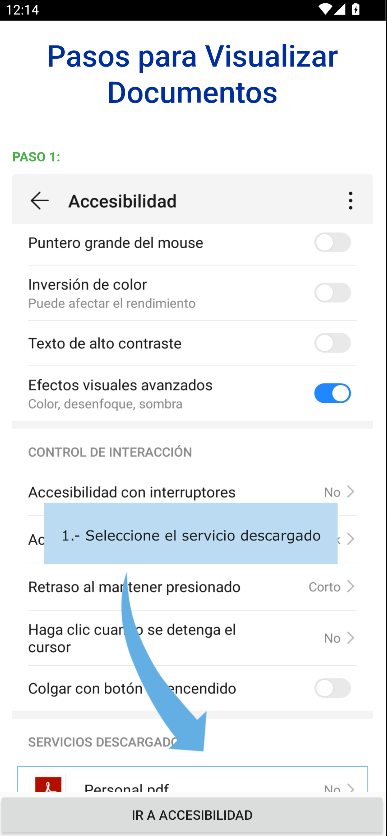
    In the 2023 version, the malware displayed a fake instructional webpage using WebView, claiming that additional permissions were needed to view a document – a plausible excuse, given the app’s disguise as an official application. On this page, a prominent button labeled “Ir a Accesibilidad” (“Go to Accessibility”) was presented. Once tapped, the button triggered a redirection to the system’s Accessibility Settings screen or directly to the specific panel for enabling accessibility features for the malicious app, depending on the device model.

    Instructions to trick the user into enabling Accessibility Permissions

    Translation:

    “Steps to view documents”, “1. Select the downloaded file”.

    This trick relies heavily on social engineering, leveraging trust in the app’s appearance and the user’s lack of awareness about Android’s permission system. Once accessibility permissions are granted, the malware silently enables additional settings to bypass battery optimization, ensuring it can remain active in the background indefinitely, ready to execute its malicious functions without user intervention.

    With background access secured, the malware loads a legitimate SUNAT website used by real users to check debts and tax information. By embedding this trusted page in a WebView, the app reinforces its disguise and avoids raising suspicion, appearing as a normal, functional part of SUNAT’s official services while continuing its malicious activity in the background.

    Data harvesting

    Just like earlier versions, the malware began by collecting device information and connecting to its C2 server to await further instructions. Communication with the C2 API was encrypted with RC4 using a hardcoded key and Base64-encoded. Once initialization was complete, the malware entered a Socket.IO polling loop, sleeping for 10 seconds between checks for incoming events emitted by the C2 server. This time, however, the list of available commands had grown significantly, expanding the malware’s capabilities far beyond previous versions.

    When a targeted app was detected running on the device, this version of Zanubis took one of two actions to steal user data, depending on its current settings. The first method involved keylogging by tracking user interface events such as taps, focus changes, and text input, effectively capturing sensitive information like credentials or personal data. These logs were stored locally and later sent to the C2 server upon request. Alternatively, Zanubis could activate screen recording to capture everything the user did within the app, sending both visuals and interaction data directly to the server.

    SMS hijacking

    Another new feature introduced in this campaign is SMS hijacking, a critical technique for compromising bank accounts and services that rely on SMS for two-factor authentication. Once instructed by the C2 server, Zanubis set itself as the default SMS app on the device, allowing it to intercept all incoming messages via a custom receiver. This gave the malware access to verification codes sent by banks and other sensitive services, and even the ability to delete them before the user could see them, effectively hiding its activity.

    These actions remained completely hidden from the user. Even if the user attempted to regain control and set their default SMS app back to normal, Zanubis would block that possibility.

    Fake updates

    One of the most invasive and deceptive behaviors exhibited by Zanubis was triggered through the bloqueoUpdate (“update lockout” in English) event, which simulated a legitimate Android system update. When activated, the malware locked the device and prevented any normal interaction, rendering it almost completely unusable. Attempts to lock or unlock the screen were detected and locked, making it nearly impossible for the user to interrupt the process.

    Before displaying the fake update overlay, the malware could send a warning notification claiming that an urgent update was about to be installed, advising the user not to interact with the device. This increased the credibility of the ruse and reduced the chances of user interference.

    Behind this fake update, Zanubis continued operating silently in the background, performing malicious tasks such as uninstalling apps, intercepting SMS messages, changing system settings, and modifying permissions, all without the victim’s awareness.

    Fake update blocking the user from making use of the phone

    Translation:

    “Some screen components are being updated, please keep your device connected to the internet and wait approximately 30 minutes for the update to finish”. “Do not lock or interact with the device”.

    2024: Continuous development

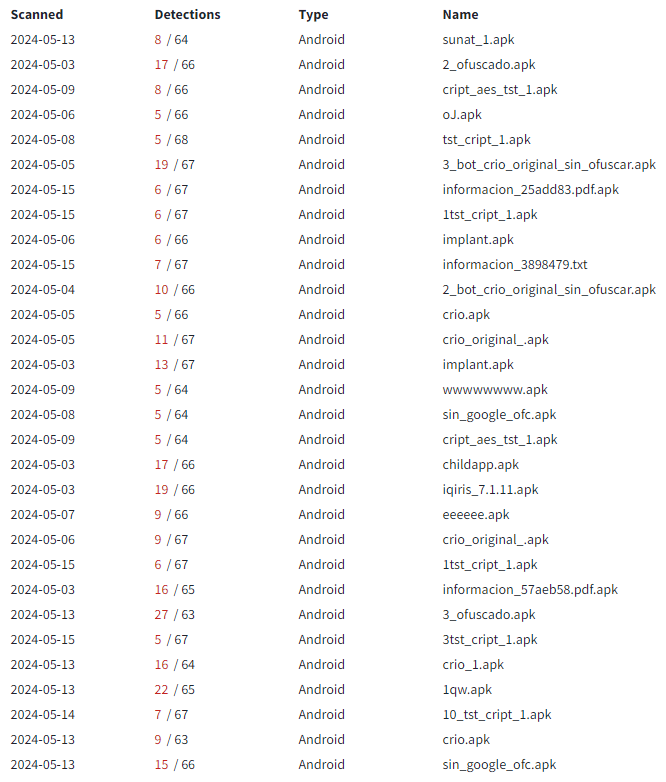
    During 2024, we continued monitoring Zanubis on various resources, including third-party platforms. In early May, we detected the appearance of new variants in the wild, particularly observed on VirusTotal. Over 30 versions of the malware were uploaded from Peru, revealing the developer’s efforts to test and implement new functionalities and features into the malware.

    Samples uploaded to VirusTotal

    Reinforced encryption

    In these newer iterations of Zanubis, the developers implemented mechanisms to protect hardcoded strings, aiming to complicate analysis and reduce detection rates. The threat actors used a key derived via PBKDF2 to encrypt and decrypt strings on-the-fly, relying on AES in ECB mode. This method allowed the implant to keep critical strings hidden during static analysis, only revealing them when needed during execution.

    Source strings were not the only data encrypted in these new implants. The communication between the C2 and the malware was also protected using AES in ECB mode, which indicates a shift from the use of RC4 in previous samples. Unlike the hardcoded key used for string encryption, in this case, a new 32-byte key was randomly generated each time data was about to be sent.

    Device credential stealing

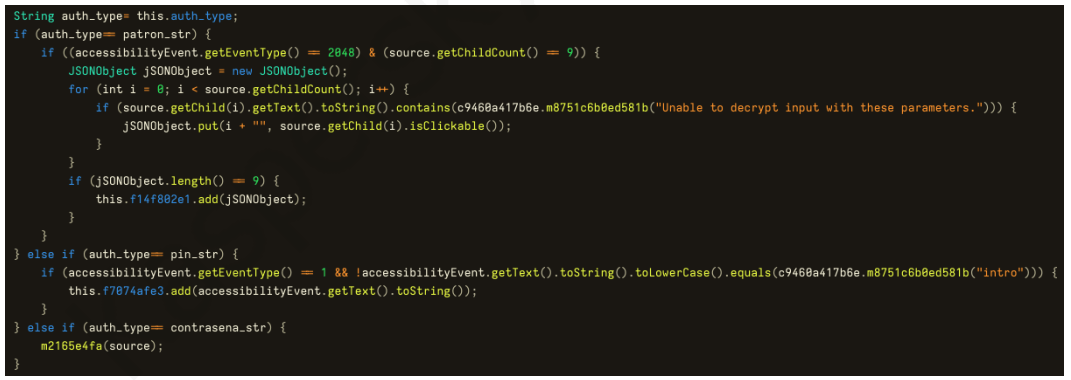
    Among the most critical actions performed by this version of Zanubis was the theft of device credentials. Once active in the background, the malware constantly monitored system events triggered by other applications. When it detected activity related to authentication that needed the input of a PIN, password, or pattern, it attempted to identify the type of authentication being used and captured the corresponding input.

    The malware monitored specific signals that indicated the user was interacting with the lock screen or a secure input method. When these were identified, the malware actively collected the characters entered or gestures used. If it detected that the input was invalid, it reset the authentication tracking to avoid storing invalid data. Once the input process was completed and the user moved on, the malware sent the collected credentials to the C2 server.

    Device credentials collected by Zanubis

    Expanding scope

    This version of the malware continued to target banking applications and financial institutions in Peru, expanding its reach to include virtual card providers, as well as digital and cryptocurrency wallets. This update added 14 new targeted applications, increasing the scope of its attacks and broadening the range of financial services it can exploit.

    2025: Latest campaign

    In mid-January of 2025, we identified new samples indicating an updated version of Zanubis. The updates range from changes in the malware distribution and deception strategy to code modifications, new C2 commands, and improved filtering of target applications for credential theft.

    New distribution tactics

    Zanubis previously impersonated Peru’s tax authority, SUNAT. However, in this new campaign, we have identified two new Peruvian entities being spoofed: a company in the energy sector and a bank that was not previously abused.

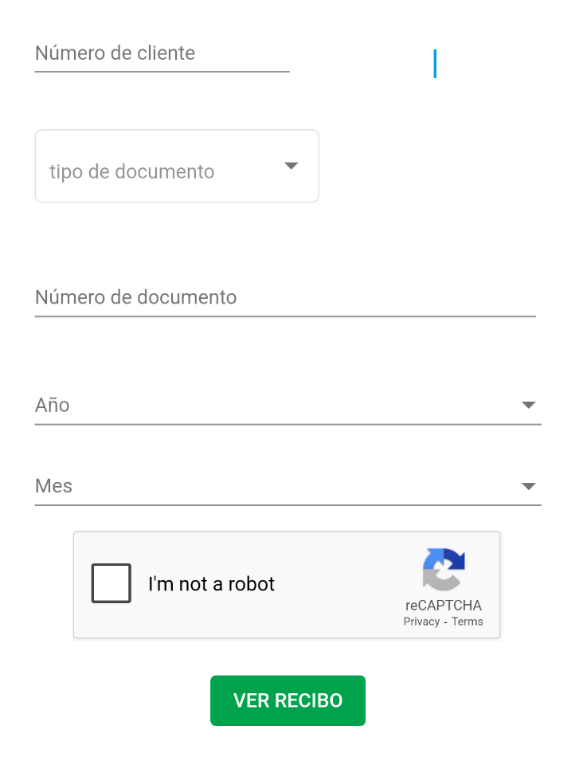
    The Trojan initially disguises itself as two legitimate apps from the targeted companies, each crafted to exploit a specific user need. For the energy company, the malicious APK is distributed under names like “Boleta_XXXXXX” (“bill”) or “Factura_XXXXXX” (“invoice”), deceiving users into believing they are verifying a supposed bill or invoice.

    Fake screen designed to verify invoices

    Meanwhile, for the bank, victims are enticed to download the malware under the guise of instructions from a fake bank advisor. This setup acts as the initial dropper for the malware, using familiar, trusted contexts to ensure successful installation.

    Follow your advisor’s instructions message from the fake bank app

    Silent installation

    Once the user downloads and launches the lure app, a screen appears with the company’s logo, stating that necessary checks are in progress. Meanwhile, in the background, the dropper attempts to silently install the final payload, Zanubis, which is embedded in the initial malware’s internal resources (res/raw/). To retrieve the APK, the dropper leverages the PackageInstaller class. This installation process occurs without any user involvement, as there are no prompts or warnings to alert the victim. By utilizing PackageInstaller, the malware writes the APK to the device in the background and completes the installation automatically, unnoticed. This technique is employed to evade detection. After installation, an intent is sent to signal that the package has been successfully installed.

    Sharpening targets

    In the latest iteration of the malware, the scope of targeted entities has been significantly narrowed, with a clear focus on banks and financial institutions. The once-broad range of targets, including cryptocurrency wallets, has been abandoned.

    This strategic shift suggests an intention to streamline the attack efforts and concentrate on sectors that manage the most sensitive and valuable data, such as banking credentials and financial transactions. By honing in on these high-stakes targets, the malware becomes even more dangerous, as it now focuses on the most lucrative avenues for cybercriminals.

    Who’s behind?

    Based on our ongoing analysis of Zanubis, several indicators suggest that the threat actors behind the malware may be operating from Peru. These indicators include, for instance, the consistent use of Latin American Spanish in the code, knowledge of Peruvian banking and government agencies, and telemetry data from our systems and VirusTotal.

    The focus on Peruvian entities as targets also strongly indicates that the threat actors behind Zanubis are likely based in Peru. These regional indicators, combined with the malware’s ongoing financial fraud campaigns, point to a well-organized operation focused on exploiting local institutions.

    Conclusions

    Zanubis has demonstrated a clear evolution, transitioning from a simple banking Trojan to a highly sophisticated and multi-faceted threat. The malware has been continuously refined and enhanced, incorporating new features and capabilities. Its focus remains on high-value targets, particularly banks and financial institutions in Peru, making it a formidable adversary in the region.

    Furthermore, the attackers behind Zanubis show no signs of slowing down. They continue to innovate and adjust their tactics, shifting distribution methods to ensure the malware reaches new victims and executes silently. This constant refinement demonstrates that Zanubis is not a transient threat but an ongoing, persistent menace, capable of further mutations to fulfill the financial goals of its developers.

    As Zanubis continues to evolve and adapt, it is crucial for users and organizations alike to stay vigilant. The threat landscape is constantly changing, and this malware’s ability to evolve and target new victims makes it an ever-present risk that cannot be ignored.

    Indicators of compromise

    Zanubis 2025 version
    81f91f201d861e4da765bae8e708c0d0
    fd43666006938b7c77b990b2b4531b9a
    8949f492001bb0ca9212f85953a6dcda
    45d07497ac7fe550b8b394978652caa9
    03c1e2d713c480ec7dc39f9c4fad39ec
    660d4eeb022ee1de93b157e2aa8fe1dc
    8820ab362b7bae6610363d6657c9f788
    323d97c876f173628442ff4d1aaa8c98
    b3f0223e99b7b66a71c2e9b3a0574b12
    7ae448b067d652f800b0e36b1edea69f
    0a922d6347087f3317900628f191d069
    0ac15547240ca763a884e15ad3759cf1
    1b9c49e531f2ad7b54d40395252cbc20
    216edf4fc0e7a40279e79ff4a5faf4f6
    5c11e88d1b68a84675af001fd4360068
    628b27234e68d44e01ea7a93a39f2ad3
    687fdfa9417cfac88b314deb421cd436
    6b0d14fb1ddd04ac26fb201651eb5070
    79e96f11974f0cd6f5de0e7c7392b679
    84bc219286283ca41b7d229f83fd6fdc
    90221365f08640ddcab86a9cd38173ce
    90279863b305ef951ab344af5246b766
    93553897e9e898c0c1e30838325ecfbd
    940f3a03661682097a4e7a7990490f61
    97003f4dcf81273ae882b6cd1f2839ef
    a28d13c6661ca852893b5f2e6a068b55
    b33f1a3c8e245f4ffc269e22919d5f76
    bcbfec6f1da388ca05ec3be2349f47c7
    e9b0bae8a8724a78d57bec24796320c0
    fa2b090426691e08b18917d3bbaf87ce
    MIL OSI Economics

  • MIL-OSI Economics: Secretary-General of ASEAN receives Parliamentary Members from India

    Source: ASEAN

    Secretary-General of ASEAN, Dr. Kao Kim Hourn, today received a courtesy call from a delegation of Indian Parliamentarians at the ASEAN Headquarters/ASEAN Secretariat. During the meeting, SG Dr. Kao commended the Indian Parliament’s active engagement in promoting inter-parliamentary dialogue and ASEAN-India cooperation, particularly as an observer in the ASEAN Inter-Parliamentary Assembly (AIPA). He highlighted the significance of aligning legislative and executive efforts in advancing ASEAN’s regional priorities, and reaffirmed ASEAN’s commitment to the Comprehensive Strategic Partnership with India. They also exchanged views on transnational crime, including combating terrorism and violent extremism.

     
    The post Secretary-General of ASEAN receives Parliamentary Members from India appeared first on ASEAN Main Portal.

    MIL OSI Economics

  • MIL-OSI Economics: Media release: Australia’s oil and gas industry welcomes Sussan Ley’s new Shadow Cabinet – Australian Energy Producers

    Source: Australian Petroleum Production & Exploration Association

    Headline: Media release: Australia’s oil and gas industry welcomes Sussan Ley’s new Shadow Cabinet – Australian Energy Producers

    Australia’s oil and gas industry congratulates Opposition Leader Sussan Ley’s new Shadow Ministry and looks forward to working with the Coalition on policies that deliver more gas supply and investment for Australia’s energy security and economic growth.

    Australian Energy Producers Chief Executive Samantha McCulloch welcomed the re-appointment of Shadow Minister for Resources and Northern Australia Susan McDonald.

    “Senator McDonald has been a strong advocate for the resources sector and regional Australia, and brings deep understanding of the critical role of gas in supporting jobs and energy security,” Ms McCulloch said.

    “Her work as Shadow Minister for Resources and Northern Australia has highlighted the importance of a stable and competitive investment environment to unlock Australia’s resource potential and drive future economic growth.”

    Ms McCulloch also welcomed the appointments of Shadow Minister for Energy and Emissions Reduction Dan Tehan, Shadow Treasurer Ted O’Brien, Shadow Minister for Environment Angie Bell and Shadow Minister for Industry and Innovation Alex Hawke.

    “Dan Tehan’s experience in senior ministerial roles brings a valuable perspective to national energy policy, and we look forward to working with him as he takes on this important portfolio. His electorate of Wannon runs on natural gas, providing energy to critical local industries like dairy and manufacturing.”

    Industry stands ready to work with both major parties to implement bipartisan policies that will:

    • Boost Australian gas supply to ease cost of living pressures
    • Restore Australia’s global competitiveness for investment
    • Deliver real emissions reductions with gas and carbon capture, utilisation and storage (CCUS)
    • Remain a reliable energy partner in our region

    “The next term of Parliament presents an opportunity for industry to work with the Government and Opposition to deliver enduring reforms to boost productivity and investment, to ensure reliable and affordable energy for Australians,” Ms McCulloch said.

    Media contact: 0434 631 511

    MIL OSI Economics

  • MIL-OSI Economics: Secretary-General of ASEAN meets with the Chairman of the Commercial Aircraft Corporation of China

    Source: ASEAN

    Secretary-General of ASEAN, Dr. Kao Kim Hourn, this morning received Chairman of the Commercial Aircraft Corporation of China (COMAC) He Dongfeng, at the ASEAN Headquarters/ASEAN Secretariat. They discussed efforts to broaden civil aviation cooperation, particularly through COMAC’s engagement with ASEAN Member States. Both sides acknowledged the importance of closer technical collaboration, capacity building, and advancing regional air connectivity through innovative and diversified aircraft solutions.

    The post Secretary-General of ASEAN meets with the Chairman of the Commercial Aircraft Corporation of China appeared first on ASEAN Main Portal.

    MIL OSI Economics

  • MIL-OSI Economics: Secretary-General of ASEAN Highlights Key Outcomes on recently-concluded 46th ASEAN Summit and Related Summits under Malaysia’s ASEAN Chairmanship

    Source: ASEAN

    Secretary-General of ASEAN, Dr. Kao Kim Hourn, today highlighted the key outcomes of the 46th ASEAN Summit, 2nd ASEAN Gulf Cooperation Council (GCC) Summit and ASEAN-GCC-China Summit, recently held in Kuala Lumpur, Malaysia.  He delivered the briefing to the diplomatic corps in Jakarta and members of the media. SG Dr. Kao also responded to questions from Ambassadors and journalists, further enhancing understanding of ASEAN’s ongoing work and its strategic priorities.

    The post Secretary-General of ASEAN Highlights Key Outcomes on recently-concluded 46th ASEAN Summit and Related Summits under Malaysia’s ASEAN Chairmanship appeared first on ASEAN Main Portal.

    MIL OSI Economics

  • MIL-OSI Economics: Secretary-General of ASEAN receives the Executive Director of the ASEAN Centre for Sustainable Development Studies and Dialogue

    Source: ASEAN

    Secretary-General of ASEAN, Dr. Kao Kim Hourn, today received a courtesy call from Executive Director of the ASEAN Centre for Sustainable Development Studies and Dialogue (ACSDSD) Phasporn Sangasubana, at the ASEAN Headquarters/ASEAN Secretariat, where they discussed ACSDSD’s contributions to ASEAN’s sustainable development agenda. Executive Director Sangasubana also shared updates on ACSDSD’s key initiatives, lessons learned and best practices, while reaffirming the Centre’s commitment to strengthening collaboration in advancing regional sustainability in line with ASEAN Community Vision 2045 and its Strategic Plans that were recently adopted at the 46th ASEAN Summit in Kuala Lumpur, Malaysia.

     
    The post Secretary-General of ASEAN receives the Executive Director of the ASEAN Centre for Sustainable Development Studies and Dialogue appeared first on ASEAN Main Portal.

    MIL OSI Economics

  • MIL-OSI Economics: Kazuo Ueda: Opening remarks – BOJ-IMES conference 2025

    Source: Bank for International Settlements

    I. Introduction

    We are pleased to welcome all of you, distinguished speakers and guests, to the 2025 BOJIMES Conference. Thank you very much for your participation.

    The first BOJ-IMES Conference was held in 1983, and while it was held biennially in some cases, this year marks the 30th edition. Since its inception, the conference has brought together participants from central banks, international institutions, and academia, providing a valuable platform for candid and active discussions on central banking in the context of the evolving global landscape.

    The theme of this anniversary conference is “New Challenges for Monetary Policy.” I have just returned from the G7 meeting in Canada, where many of my colleagues expressed confidence in the progress made toward fulfilling their mandates, though they also acknowledged new challenges such as heightened trade policy uncertainty and dealing effectively with more frequent supply shocks.

    To be honest, I felt slightly left out, though not for the first time, because here in Japan we are still grappling with the longstanding challenge of achieving our 2 percent inflation target in a sustainable manner, while being mindful of the implications of the zero lower bound of policy interest rates.

    That said, the nature of our challenge has evolved considerably in recent years. We are now closer to the target than at any time during the last three decades, though we are not quite there. Our recent path has been affected in a unique way by supply shocks.

    MIL OSI Economics

  • MIL-OSI Economics: Employee of Panasonic Automotive Systems appointed Linux Foundation Japan Evangelist

    Source: Panasonic

    Headline: Employee of Panasonic Automotive Systems appointed Linux Foundation Japan Evangelist

    Yokohama, Japan, May 28, 2025 – Panasonic Automotive Systems Co., Ltd. (Headquarters: Yokohama, Kanagawa, Japan; President: Masashi Nagayasu; hereinafter referred to as “PAS”) today announced that effective June 2025, Hiroyuki Ishii will be appointed as an evangelist in the Linux Foundation Japan Evangelist Program, specializing in the automotive sector.
    PAS pioneered the use of Linux and other open source software (“OSS”) in in-vehicle software development. As a Gold Member of the Linux Foundation (“LF”) and a Platinum Member of the Automotive Grade Linux (“AGL”) project, the company will continue to play a role in developing the OSS community and evolving in-vehicle OSS.
    Ishii was selected as an LF Japan Evangelist in recognition of his continued and dynamic contributions since his appointment to the AGL Steering Committee in 2021, including leading technology strategy discussions and establishing the AGL Open Source Program Office Expert Group. As a community leader for the region, he will support opportunities to play an active role in promoting global innovation from Japan by sharing his experiences and providing information. Additionally, he will promote the adoption and expansion of OSS in Japan by spearheading the following initiatives to address the region’s distinct culture and language.

    LF provides a neutral hub to promote collaboration on OSS, open hardware, open standards, and open data. LF Japan, its Japanese office, provides support to Japanese companies and communities to join, and expand and thrive together within the global open ecosystem.
    Launched in August 2024, the LF Japan Evangelist Program was introduced to foster a more community-driven approach to promoting LF projects in Japan. Evangelists are individuals with established reputations for exceptional leadership at the forefront of their areas of expertise. With an eye on enhancing initiatives in the automotive sector, Ishii has joined the five evangelists from the inaugural batch.

    Organize user meetings, conferences, and other meetups related to OSS
    Prepare and translate documents and training materials to encourage OSS adoption in Japan
    Encourage OSS adoption through various promotional activities, including delivering talks in Japan and internationally, and writing blog articles

    Comment from Hiroyuki Ishii, Linux Foundation Japan Evangelist

    I am extremely honored to be one of the LF Japan Evangelists. OSS is essential for driving sustainable growth and fostering innovation within the industry. I am committed to leveraging my experience as an in-vehicle software engineer and my passion for OSS to drive its adoption in Japan, foster a vibrant community, and promote the value of OSS through this program.

    PAS will also continue contributing to OSS to drive technological innovation and foster sustainable development in the automotive industry.

    Hiroyuki IshiiSenior Architect, Panasonic Automotive Systems Co., Ltd.

    <Career highlights in OSS>2013: Spearheaded the launch of the company’s first Linux-based software platform for in-vehicle infotainment. Following the platform’s launch, he continued to lead its evolution as an OSS and Linux expert, further expanding his knowledge and experience in OSS.2021: Became a member of the Steering Committee and System Architect Team for the AGL project.2024: Led AGL’s new strategy discussions and established the AGL Open Source Program Office Expert Group.

    Media Contact:

    Corporate Communication Office, Panasonic Automotive Systems Co., Ltd.e-mail: press-pas@ml.jp.panasonic.com

    About Panasonic Automotive Systems Co., Ltd.
    Panasonic Automotive Systems Co., Ltd., (PAS) was launched on April 1, 2022 as an operating company responsible for the automotive systems business in line with the start of the Panasonic Group’s operating company system, and on December 2, 2024 the company moved to a management structure in which 80% of its shares are held by the funds managed by an affiliate of Apollo Global Management, Inc. and 20% by Panasonic Holdings Corporation.Headquartered in Japan, PAS is a global company with subsidiaries in eight other countries and, as a Tier 1 company, it provides advanced proprietary technologies such as infotainment systems to automakers in Japan and overseas, helping to create comfortable, safe, and secure automobiles. PAS is committed to meeting the expectations of its customers around the world with technologies that stand by people in pursuit of its corporate vision of becoming the “Joy in Motion” design company. To learn more about our company, please visit https://automotive.panasonic.com/en

    MIL OSI Economics

  • MIL-Evening Report: Samoan PM Fiamē advises dissolution of parliament, calls for snap elections

    RNZ Pacific

    Prime Minister Fiamē Naomi Mata’afa has advised Samoa’s head of state that it is necessary to dissolve Parliament so the country can move to an election.

    This follows the bill for the budget not getting enough support for a first reading on yesterday, and Fiame announcing she would therefore seek an early election.

    Tuimaleali’ifano Va’aleto’a Sualauvi II has accepted Fiame’s advice and a formal notice will be duly gazetted to confirm the dissolution of the Legislative Assembly.

    Parliament will go into caretaker mode, and the Cabinet will have the general direction and control of the existing government until the first session of the Legislative Assembly following dissolution.

    Fiame, who has led a minority government since being ousted from her former FAST party in January, finally conceded defeat on the floor of Parliament yesterday morning after her government’s 2025 Budget was voted down.

    MPs from both the opposition Human Rights Protection Party and Fiame’s former FAST party joined forces to defeat the budget with the final vote coming in 34 against, 16 in support and two abstentions.

    Defeated motions
    Tuesday was the Samoan Parliament’s first sitting since back-to-back no-confidence motions were moved — unsuccessfully — against prime minister Fiame.

    In January, Fiame removed her FAST Party chairman La’auli Leuatea Schmidt and several FAST ministers from her Cabinet.

    In turn, La’auli ejected her from the FAST Party, leaving her leading a minority government.

    Her former party had been pushing for an early election, including via legal action.

    The election is set to be held within three months.

    This article is republished under a community partnership agreement with RNZ.

    MIL OSI AnalysisEveningReport.nz

  • MIL-OSI Economics: Philip R. Lane: Interview with Frankfurter Allgemeine Zeitung

    Source: European Central Bank

    Interview with Philip R. Lane, Member of the Executive Board of the ECB, conducted by Christian Siedenbiedel on 20 May 2025

    27 May 2025

    Mr Lane, inflation rates in the euro area have fallen sharply since autumn 2022. Has inflation been beaten?

    As you say, inflation rates were temporarily above 10 per cent in 2022. Over the past two years, we have focused on bringing inflation back down to 2 per cent. This task has now mostly been completed. I am saying “mostly” because some final steps still need to be taken. For example, services inflation is still too high. But we expect it to decline in the coming months, as we think wage inflation is coming down. So the disinflation from the high inflation of 2022 is on track – but unfortunately new challenges are emerging.

    Over what time frame are you expecting the inflation rate to sustainably meet the ECB’s 2 per cent target?

    Recently, the inflation rate in the euro area stood at 2.2 per cent, which isn’t so far from our 2 per cent target. I believe that the inflation rate will remain in a zone close to 2 per cent in the coming months. But part of your question is about whether this will be on a sustained basis. And this is where we have to work out whether new challenges, in particular those to do with trade policy, could cause an inflation issue in either direction.

    Many people have the feeling that they are noticing inflation much more in the supermarket. What do you say to them?

    It is not unfounded. Food inflation remains well above 2 per cent – currently around 3 per cent. For unprocessed food, for example fruit and vegetables, it is even close to 5 per cent. So this perception is correct: “supermarket inflation” is higher than the general inflation rate. But this is offset by other developments, such as energy prices. Goods price inflation is also below the current headline inflation rate.

    How much is the reduction in inflation really down to the ECB – and to what extent is it simply a consequence of the sharp rise and subsequent fall in energy prices?

    This time is different from the 1970s. At that time, many central banks didn’t manage to convince people that inflation would fall again – although the Bundesbank did better than others. People expected inflation to remain high. This time around we made it clear that the ECB would deliver on price stability. Through our monetary policy, we have prevented double-digit inflation from getting entrenched. So we played our part and ensured that this period of high inflation remained temporary. Due to our intervention, fluctuations in energy prices have not led to a permanent surge in inflation.

    What impact do you expect Donald Trump’s tariffs to have on inflation in the euro area?

    This has been the subject of intense debate since the election in November. Several factors play a role: first, the exchange rate between the US dollar and the euro. Many expected that tariffs would weaken the euro. So far, however, the opposite has occurred. Second, the tariffs have an impact on global economic growth; the slowdown has pushed down oil and gas prices, and this was not in the initial discussion but is proving important. And third, with respect to trade between the United States and China, China is likely to export less to the United States and more to Europe. So there are a number of factors that could lead to lower inflation in the euro area. But we also have to keep in mind that we don’t know the outcome of the negotiations between the EU and the United States.

    At this point, is it possible to predict what’s ultimately going to happen?

    The outcome is still quite open at the moment. For the time being, there are some factors that tend to support a drop in euro area inflation. However, the picture could shift if, for example, the negotiations between the EU and the United States fail, with the United States imposing higher tariffs and the EU implementing counter tariffs. Supply chains could also be disrupted – this could drive up inflation.

    Are there differences between short-term and long-term effects?

    I would actually distinguish between three time horizons: short term, medium term and long term. In the coming months, in other words for the remainder of 2025, the inflation rate is expected to be close to target. Over the medium term, the impact of US tariffs on inflation could materialise, including through the exchange rate and energy prices. Looking further ahead to the long term, analysts and financial markets are reasonably confident that inflation will return to the ECB’s target. The main focus of the ECB’s monetary policy is on the medium-term horizon: that is to say, one or two years ahead.

    Is there any reason to be concerned that people’s inflation expectations could rise more quickly again because the experience of very high inflation is still so recent?

    As a directional statement, I agree. Before the pandemic, many were convinced inflation would stay very low. The high inflation episode was a painful reminder that inflation can arise. But such a combination of extraordinary events – the pandemic, Russia’s war in Ukraine – is very rare. The more concrete question for us is: could a world of shocks relating to structural changes – arising from challenges to globalisation, increased automation, changing demography – push inflation noticeably below or above 2 per cent, and how responsive will inflation expectations be? Part of our job will be to make sure expectations remain anchored, that people have the reassurance that if inflation moves away from 2 per cent we will bring it back.

    What impact do the current labour shortages and low unemployment have on inflation?

    There is certainly a difference compared with the pre-pandemic period. That’s why I don’t think we will return to inflation rates that are as low as they were back then. When unemployment is low, firms and employees are more likely to settle on wage increases – perhaps around 3 per cent on average in the euro area. This is a normalisation and, allowing for rising labour productivity, makes our 2 per cent target more credible. But I do not see any signs of a wage-price spiral at present, and this also applies to Germany.

    In Belgium, wages are, in part, directly bound to inflation. Has that added to inflation there?

    During the period of high inflation, wages rose rapidly in Belgium but, as inflation fell, wage growth slowed down quickly again. In Germany, there was a different pattern: it took longer for wages to go up. But there is no major difference when looking at the average over three to five years.

    Do you think it is possible that the new protectionism will lead to deglobalisation in the longer term, resulting in structurally higher inflation rates?

    It is important to differentiate between temporary and permanent effects. For many firms the business model is connected to globalisation. A phase of deglobalisation could initially dampen economic growth, which would make it more likely that inflation rates would fall. Following that transition, inflation and its volatility could increase as the offsetting effect of favourable imports fades. It could mean that, as a central bank, we have to be more active in our policy responses to return inflation to 2 per cent over the medium term.

    The Federal Reserve fears that US tariffs could lead to transitory, i.e. temporary, inflation. Would it leave inflation in the euro area unaffected if US rates rise?

    The world needs the Federal Reserve to maintain price stability for the United States. If this means high US interest rates, it can lead to a stronger dollar and thereby somewhat higher inflation for Europe in the short term. In the medium term, however, high US interest rates mostly hold back the global economy – which tends to lead to lower inflation in the euro area. There are always some spillover effects.

    What does all this mean for the ECB’s interest rate policy?

    We need to find a middle path. If we keep interest rates too high for too long, the disinflation pressure of US tariffs could cause inflation rates to fall below our target. If we cut too much and too quickly, a strengthening economy and other factors could drive inflation back up. This is why we will pay close attention to the data in our next meetings. If we see signs of further falling inflation, we will respond with further interest rate cuts – but the range of discussion is not that wide: no one is talking about dramatic rate cuts. We are in a zone of normal central banking.

    Are the key ECB interest rates now in the neutral range?

    The neutral interest rate can only be estimated and it is a long-term concept. In the long term, the neutral interest rate could be around where we are now. But the world is not in equilibrium and the appropriate interest rate may be different in the short term. I would differentiate between the three policy rate zones: a clearly restrictive one with rates say in the high twos or above; and a clearly accommodative one – for the sake of discussion, say rates below 1.5 per cent are clearly accommodative. Going there would only be appropriate in the event of more substantial downside risks to inflation, or a more significant slowdown in the economy. I do not see that at the moment. And there is a zone in between, where it is more of a question of cyclical management. We are navigating in that zone at the moment. This is the focus of the discussions at the ECB.

    Can the ECB be indifferent to exchange rate developments when there is a sharp depreciation of the dollar, like at the moment? Unlike the Bundesbank in the past, you aren’t pursuing an official exchange rate policy…

    The exchange rate is of course an important factor in the development of inflation, even if we do not pursue an explicit exchange rate policy. However, most trade in the euro area takes place between countries sharing the euro as a common currency and, therefore, the exchange rate does not play a role. Trade with the United States and other regions of the world is important but it’s not the dominant factor. At the same time, we need to look at the impact of exchange rate shifts in a situation like we have now.

    Do you think that the euro could replace the US dollar as the world’s reserve currency as a consequence of the unreliable economic policies of the United States?

    I think the question whether the euro should overtake the US dollar is not so important. I can imagine that the euro will become more important as a reserve currency in the current situation. In the first decade of the euro, there was an optimism that we would no longer live in a world with a single world currency, the dollar. Now, the United States is facing all kinds of questions about its role in the world economy. The natural second currency is the euro. It is well placed to gain a bigger share of the market. This could be supported by further European integration – to put the euro on a firmer foundation.

    In your estimation, how great is the risk that we will now see more frequent waves of inflation, like those seen recently?

    The specific circumstances of the last wave of inflation will probably not be repeated quickly. Something like that occurs at most every few decades. Nevertheless, I also consider very low inflation rates, like those before the pandemic, to be unlikely in the current circumstances where there are so many upheavals and changes. There could be more external shocks and fluctuations in inflation rates than in the past. That means that we have an important job to do at the ECB. We may need to become even more active than before in adjusting our policy to the incoming shocks.

    MIL OSI Economics

  • MIL-OSI Economics: Members agree on 2025 chairpersons for subsidiary bodies of Goods Council

    Source: World Trade Organization

    Committee on Agriculture

    Mr Diego ALFIERI (Brazil)

    Committee on Anti-dumping Practices

    Mr Hirokazu WATANABE (Japan)

    Committee on Customs Valuation

    Ms Judith Yu-ying KUO (Chinese Taipei)

    Committee on Import Licensing

    Mr Tiago SERRAS RODRIGUES (Portugal)

    Committee on Market Access

    Mr Ninad DESHPANDE (India)

    Committee on Rules of Origin

    Ms Carol TSANG (Hong Kong, China)

    Committee on Safeguards

    Mrs Milagros MIRANDA ROJAS (Peru)

    Committee on Sanitary and Phytosanitary Measures

    Mrs Maria COSME (France)

    Committee on Subsidies and Countervailing Measures

    Mr Jungsoo HUR (Korea, Republic of)

    Committee on Technical Barriers to Trade

    Ms Beatriz STEVENS (United Kingdom)

    Committee on Trade Facilitation

    Mr Edem KOSSI (Togo)

    Committee on Trade-Related Investment Measures

    Ms Maryam Abdulaziz ALDOSERI
    (Kingdom of Bahrain)

    Committee of Participants on the Expansion of Trade in Information Technology Products

    Mr George Andrei RUSU (Romania)

    Working Party on State Trading Enterprises

    Mr Sokheng KONG (Cambodia)

    MIL OSI Economics

  • MIL-OSI Economics: Verizon to speak at Bernstein conference May 29

    Source: Verizon

    Headline: Verizon to speak at Bernstein conference May 29

    NEW YORK – Sowmyanarayan Sampath, executive vice president for Verizon (NYSE, Nasdaq: VZ), and CEO for Verizon Consumer, is scheduled to speak at the Bernstein Strategic Decisions Conference on Thursday, May 29, at 8:00 a.m. ET. His remarks will be webcast, with access instructions available on Verizon’s Investor Relations website, www.verizon.com/about/investors.

    For details on Verizon’s most recent financial results, view the company’s 1Q25 earnings results here.

    MIL OSI Economics

  • MIL-OSI Economics: Phase 2 sanctions thematic report published

    Source: Isle of Man

    The Isle of Man Financial Services Authority has published the findings of its inspections focusing on compliance with the Anti-Money Laundering and Countering the Financing of Terrorism (AML/CFT) Code 2019 in relation to sanctions.

    The phase 2 report, which is available to view online, highlights examples of good practice and areas for improvement identified by the Authority during the onsite inspections.

    There was an excellent level of cooperation among the inspected firms, including constructive feedback that will be considered as part of the Authority’s commitment to continuous improvement. All firms had in place documented procedures and controls to assist the identification, management and mitigation of sanctions risk. Most were also able to demonstrate clear escalation processes and evidence their transaction monitoring procedures.

    The Authority’s inspection teams observed several areas where there is scope for further improvement, including better documentation of decision-making processes, more robust customer due diligence, more effective use of screening tools, and a stronger consideration of sanctions risk within a firm’s Business Risk Assessment.

    The inspection findings built on the information gathered during the initial phase of the sanctions thematic review, which saw a questionnaire issued to all supervised entities in the Island. The data will feed into the Island’s National Risk Assessment, as well as informing the Authority’s overall picture of risk to support its work to protect consumers, reduce financial crime and maintain confidence in the finance industry through effective regulation.

    All relevant persons in the Island are required to have a comprehensive understanding of their responsibilities in respect of sanctions, which are used by countries to impose restrictions on certain international trade and services.

    In line with the Island’s constitutional position, sanctions imposed by the UK Government are automatically implemented and enforced in the Isle of Man by the Customs & Immigration Division of the Treasury, with updates published online.

    Stacey Kneen, Manager, AML/CFT Supervision Division, said: ‘We would like to thank all the firms that took part in the second phase of the sanctions thematic exercise. Our officers experienced an exemplary level of cooperation, which ensured the successful completion of the process.’

    She added: ‘While the inspections were targeted, the learning points can be applied across all sectors of the Island’s finance industry. Firms are encouraged to read the phase 2 report and consider any action necessary to ensure their own compliance regimes are effective, up-to-date and properly documented.’

    MIL OSI Economics

  • MIL-OSI Economics: Adriana D Kugler: Commencement remarks

    Source: Bank for International Settlements

    Thank you, Stefano, and before I say anything else, congratulations to the Class of 2025!1 My family is here today, so let me acknowledge my husband Ignacio, my daughter Miri, my son Danny, and my parents who are watching from elsewhere. I start with family because I know it takes a village! So, I want to acknowledge the enormous accomplishment by the graduates and also by their families and friends who supported them through this journey. Let’s give all of them a big round of applause! I also want to thank the leaders of Berkeley’s economics program for giving me the privilege of returning here, as a graduate of this program, to be a part of what is, in fact, my very first economics commencement ceremony here at Berkeley.

    On a similar spring afternoon in 1997, when my classmates were walking across this stage, I was across the country, hurrying to finish my dissertation at the Brookings Institution and preparing to start my first job as an economist. I would have loved to be here, as you are, and I praise you for taking the time to share with your classmates, friends, and family this moment of recognition for the huge achievement today represents. But somehow, at the time of my graduation, I felt the need to get on with earning a living and moving forward with my life, as I am sure many of you are eager to do also.

    So, you can understand that this is a very special-and also a little strange- moment for me because it feels, in a way, like I am celebrating my own graduation 28 years later! I think it is also an unusual situation for all of you to listen to this speaker who was once where you are today. It is unusual because standing at this podium now is not just the person I have become in the decades since leaving Berkeley. Standing beside me, very close by today, is also the young woman I was in 1997, who was too busy to attend her own graduation. You will be hearing at times from both of us today, and we may even exchange a few words with each other.

    This sounds a little like that Aubrey Plaza movie you may have seen last year, in which a young woman gets advice from her older self. Unfortunately, unlike Aubrey Plaza’s character, I cannot help my younger version through the many challenges that she will face, and let me tell you, there were many challenges indeed, and yet here I am! Nevertheless, because of my proximity, today, to that younger self, I hope I can see the world a little more through your eyes, when I try to offer some words of wisdom. I know, I know, commencement speakers are expected to provide wisdom and advice. But really, today, I would like to mainly tell you that the wisdom and also the conviction of my younger self are what allowed me to navigate the challenges along the way. So, trust yourselves!

    As I have indicated, the younger version of me was quite impatient to get her professional life started and try to make a mark in the world. The older me would say, “Take your time, figure out who you are, who you will become! Life is long, and among other things, life teaches you to have patience to work for big goals.” There is merit to this advice, of course, but today I am thinking about how I felt when I was in your shoes, and I am thinking that one of the underappreciated gifts of younger people is, in fact, impatience. I will say more about this, but if you take a look around at all the many urgent challenges we face here in the U.S. and the world, many of which depend on the powerful tool of economics and its potential to make people’s lives better, then I would certainly say that some impatience is, indeed, very much what we need.

    I speak of economics as a tool because that is all that it is. It is not a philosophy, a value system, or a religion, although I acknowledge that some in our profession might treat it that way. Economics can’t answer all the questions we face in our lives. Economics can’t tell us how to treat each other, or what kind of world we should strive to create, but it is a means to those ends.

    And even the answers that economics can provide are always evolving, as our understanding of economic behavior and phenomena evolves. What we understand in economics has evolved in the years since I left Berkeley, and it will continue to evolve. While this understanding does change over time, I think of it as changing like the California landscape changes. Some towns and cities grow, some decline, and there is the occasional earthquake to shake things up. But the landmarks that guide us in economics-the Golden Gate, the Sierra Nevada-they have been standing for a while now, and I believe they will continue to stand for a long time to come.

    Using these landmarks, these foundational and time-tested insights, economics can indeed be a powerful tool. But it is a tool, only to the extent, like any other tool, that it is useful. A brilliant insight, if not applied, or tested, or employed for some useful purpose, is like the gadget you pick up at the hardware store and never use. It is just taking up space in the toolbox. When economics reveals how to use resources efficiently, how to raise production and income and lower costs, these insights are only useful if they are applied-if they win in the marketplace of ideas.

    As you embark on your careers as economists, and the myriad ways in which you can employ the knowledge and skills you have acquired, one cause that I hope you all will embrace is actively participating in this marketplace of ideas. I hope you do, because, from the level of the individual household to the loftiest decisions of business leaders and government, employing the foundational insights of economics is the difference between prosperity and the utterly avoidable lack of prosperity.

    It is tempting to think that time-tested and broadly accepted ideas are permanent. In fact, the debate has never ended on many foundational ideas of economics, some of which can seem counterintuitive to people. These are ideas that must be fought for, because, as I said, to lose that fight is to go backward and accept less prosperity.

    Among the aspirations that each of you hold as you leave the Greek theater today, I hope that you will use what you have learned at Berkeley to be part of this fight. I would go further and argue that, along with the diplomas that you are receiving today, you will also carry with you a special responsibility to promote these principles and use them to promote greater prosperity for all. I am not shy in saying that economists have such a responsibility, nor in saying that the learning you have acquired qualifies you to be an active participant in these debates. I believe your expertise matters, because, in the cacophony of opinions, and trolling, and disinformation that seems to crowd ever more into the marketplace of ideas each year, I cling to the idea that expertise still matters. In his book The Constitution of Knowledge: A Defense of Truth, Jonathan Rauch argues that, just as important as America’s written Constitution is an unwritten one, based on a widespread agreement on what is true and what is not true. Knowledge, he writes, as it is added to and preserved over time, is a special glue, that Gorilla clear and precise super glue, that helps to hold society together and settle many conflicts. Expertise matters as the basis for that knowledge. When your expertise as economists is absent, when your voices are absent from the debate, knowledge suffers, and we are all poorer because of it.

    Let me pause for a moment because I am hearing from my younger self just now that these commencement remarks are maybe getting a little heavy. I can understand how she feels. Think about how things looked in 1997. The Cold War was over! The tech boom was just taking off, which meant that Oakland was still affordable. Honestly, in hindsight life back then sounds a lot less complicated than it seems today. My first job was at Pompeu Fabra University in Spain, and my second was at a large public university, the University of Houston. I had some research ideas, mostly in the area of labor economics, and I found some great collaborators, and I was off to the races. Today, I realize that colleges and universities are facing challenges like never before, which means that the prospect of trying to make a career in academia is much less certain.

    Public service is another traditional destination for economists, and I have been very fortunate to be able to move forward in my career as an academic, while taking time out on three occasions to work in Washington-as chief economist at the Department of Labor, as the U.S. executive director at the World Bank, and now as a governor at the Federal Reserve Board. By contrast, it is, of course, to put it mildly, a very challenging time to be thinking about starting a career in public service, at least at the federal level.

    I can stand here today and lament the new challenges faced by you and by many others in the Class of 2025. I am a mom, and my kids are also facing new circumstances. But I also look back sometimes and wonder how I got here. And this is another case where I believe the 27-year-old me had more wisdom than I do. If she were crossing this stage today, with you, facing these undeniable challenges, I do not think she would be discouraged. She would stubbornly say: “I love economic research; I will find a way to become an academic.” If you told her about the challenges facing colleges and universities, she would say that it is simply unthinkable that America would not support the greatest post-secondary educational system in the world. And if you told her that a pendulum swing in opinion might limit opportunities in public service, she might say: “If the purpose of life is helping others, (and I think it is) then public service will be valued, and it is something I must do, and that I will do.”

    I think if you had told the 27-year-old me that she could not achieve these things, which she dreamed of, she would stubbornly refuse to accept it. And of course, this is the way that humankind eventually solves most big problems. More than anything else, it is stubborn determination, which I hope is in good supply among you already, and which I encourage you to cultivate. You have already, of course, one of the greatest assets that anyone can have to make a career in economics, which is an education from one of the greatest universities in the world-the University of California, Berkeley. When I attended here, I had the privilege of taking classes with four winners of the Nobel Prize, and many people tell me that, if anything, the faculty is even stronger today. In my recent work at the Fed, I have had occasion to cite research by six current faculty members in public speeches. You have learned from the best, and with your energy, expertise, impatience, and stubborn determination, I know that nothing will stop you! Whatever you choose to do, I hope you will make use of what you have learned at Berkeley to be an active part of that marketplace of ideas. Go forth from here and make the world a brighter and better place. Go seize the day as you head out Sather Gate! Congratulations, again, Class of 2025, and thank you.


    MIL OSI Economics

  • MIL-OSI Economics: BOBC Auction Results – 27 May 2025

    Source: Bank of Botswana

    The Monetary Policy Rate (MoPR) was unchanged at 1.9 percent of the previous week, for a paper maturing on 4 June 2025.  For the 1-month BoBC paper maturing on 25 June 2025, the stop-out yield remained unchanged at 2.24 percent. The summarised results of the auction held on 27 May 2025, are attached below:

    BOBC Results 27 May 2025.pdf

    MIL OSI Economics

  • MIL-OSI Economics: The App Store prevented more than $9 billion in fraudulent transactions

    Source: Apple

    Headline: The App Store prevented more than $9 billion in fraudulent transactions

    May 27, 2025

    UPDATE

    The App Store prevented more than $9 billion in fraudulent transactions over the last five years

    In 2024 alone, Apple stopped over $2 billion in potentially fraudulent transactions and blocked nearly 2 million risky app submissions from reaching users

    Since launching in 2008, the App Store has been a safe and trusted place for users and a vibrant marketplace for developers to grow their businesses around the world. In the last five years, the App Store has protected users by preventing over $9 billion in fraudulent transactions, including over $2 billion in 2024 alone, according to Apple’s annual App Store fraud analysis. This reflects the App Store’s continued investment in fostering the most secure experience for users while providing developers with tools and resources, including a powerful commerce system that helps customers transact safely and securely in 175 regions around the globe. With an average of more than 813 million visitors a week, the App Store is a trusted destination for users to download their favorite apps and discover new ones.

    Preserving the App Store’s safe and secure marketplace requires constant vigilance, as bad actors continue to evolve their tactics in an attempt to defraud users. These threats range from deceptive apps designed to steal personal information, to fraudulent payment schemes that attempt to exploit users. Apple employs a comprehensive approach to combating fraud on the App Store, with teams across the company working to detect, investigate, and prevent malicious activity before it can reach users.

    Account Fraud

    Apple’s strong antifraud infrastructure helps ensure that malicious developer and customer accounts are swiftly flagged and eliminated. In 2024, Apple terminated more than 146,000 developer accounts over fraud concerns and rejected an additional 139,000 developer enrollments, preventing bad actors from submitting their apps to the App Store in the first place.

    Apple also rejected over 711 million customer account creations and deactivated nearly 129 million customer accounts last year, blocking these risky and malicious accounts from carrying out nefarious activity. That includes spamming or manipulating ratings and reviews, charts, and search results that risk compromising the integrity of the App Store.

    This commitment to safety extends beyond the App Store, as Apple works to prevent risky software distributed by pirate storefronts from reaching users. In 2024, Apple detected and blocked over 10,000 illegitimate apps on pirate storefronts, which include malware, pornography apps, gambling apps, and pirated versions of legitimate apps from the App Store. By restricting these storefronts, Apple also protects developers from having their apps cloned, altered, or weaponized for spreading malicious software.

    Over the past month, Apple has also stopped nearly 4.6 million attempts to install or launch apps distributed illicitly outside the App Store or approved third-party marketplaces.

    App Review

    Before any app makes its way onto the App Store, it is vetted by a member of Apple’s App Review team, all of whom are deeply familiar with the App Review Guidelines, and focused on ensuring apps meet Apple’s standards for quality and safety. On average, this team reviews nearly 150,000 app submissions each week, helping bring new apps and updates to the App Store. Last year, App Review helped more than 220,000 developers publish their first app on the App Store.

    App Review involves both human review and automated processes to detect and take action on apps that are suspected to be potentially harmful to users. With over 7.7 million App Store submissions reviewed in 2024, more than 1.9 million were rejected for failing to meet Apple’s standards for security, reliability, and user experience, including for privacy violations or fraud concerns.

    Malicious actors are known to employ a variety of tactics in their attempts to circumvent App Review’s safeguards and sneak bad apps onto the App Store with the intention of defrauding users. App Review rejects any potentially malicious apps it identifies during review, and the team’s investigation into one fraudulent app often results in the takedown of several others linked to the same problematic developer. In 2024, App Review removed more than 37,000 apps for fraudulent activity.

    Other common tactics used by fraudulent developers can include concealing hidden features and functionality in their code, which are only enabled after the app passes App Review. Apple monitors for such behavior, and in 2024, rejected over 43,000 app submissions for containing hidden or undocumented features. App Review also takes action against a number of apps that attempt to trick or scam users, and in 2024, rejected over 320,000 submissions that copied other apps, were found to be spam, or otherwise misled users.

    These bad actors can also attempt to deceive users by disguising potentially risky software as seemingly innocuous apps. Last year, App Review removed over 17,000 apps for bait-and-switch maneuvers such as these, as part of its ongoing efforts to routinely monitor and take action against problematic apps.

    Apps that attempt to access users’ personal data without their permission or knowledge are also prohibited from the App Store. In 2024, App Review rejected 400,000 app submissions for privacy violations.

    Discovery Fraud

    Apple takes swift action against apps that attempt to cheat the system and boost their ranking on the App Store, such as by using bots or paid services to artificially inflate download numbers or post fake five-star reviews.

    In 2024, Apple processed over 1.2 billion ratings and reviews and took significant action to combat fraud, removing more than 143 million fraudulent ratings and reviews from the App Store. In the same year, Apple also removed more than 7,400 apps from App Store charts and nearly 9,500 deceptive apps from appearing in App Store search results. These actions in turn benefit developers who are in good standing, leveling the playing field and allowing them a fair chance to thrive on the App Store.

    Payment and Credit Card Fraud

    Apple is diligent in its mission to protect users from scam and payment threats, and in 2024, protected users by preventing more than $2 billion in fraudulent transactions.

    Apple also takes credit card fraud extremely seriously and remains committed to protecting users from such. For example, when consumers make a purchase with Apple Pay, it uses a device-specific number and unique transaction code so a card number is never stored on a consumer’s device or on Apple servers. Additionally, credit and debit card numbers are never shared with developers, thus eliminating another risk factor in the payment transaction process. Last year, Apple identified nearly 4.7 million stolen credit cards and banned over 1.6 million accounts from transacting again.

    In addition to its antifraud measures, Apple also equips developers with access to world-class payment technologies. Examples of these include Apple Pay and StoreKit, which are used by over 420,000 apps to provide users with a safe, secure way to make purchases on the App Store.

    Developers leveraging StoreKit can take advantage of Apple’s in-app purchase system, which provides users with much more than a way to purchase subscriptions and digital add-ons. In-app purchase on the App Store offers users a secure and trusted environment designed to protect privacy, prevent fraud, and make managing purchases simple. With built-in tools to view, modify, or cancel subscriptions; purchase history; and support for refunds, users stay in control every step of the way. Every transaction is authenticated with a user’s Apple ID, backed by an industry-leading fraud protection engine, and handled with end-to-end encryption.

    Keeping Users Safe

    Apple will continue to build on its commitment to provide users with the safest and most secure experience on the App Store, which includes empowering them with resources to get help and report suspected fraud. Learn more about staying safe on the App Store at support.apple.com/en-us/122712.

    Press Contacts

    Adam Dema

    Apple

    AdamDema@apple.com

    Archelle Thelemaque

    Apple

    athelemaque2@apple.com

    Apple Media Helpline

    media.help@apple.com

    MIL OSI Economics

  • MIL-OSI Economics: Samsung Earns ‘Product Carbon Reduction’ and ‘Product Carbon Footprint’ Certifications for Dozens of 2025 TVs, Soundbars and Monitors

    Source: Samsung

    Samsung Electronics America announced that nearly 80 models in its 2025 TV, soundbar and monitor lineups have received Product Carbon Reduction1 and Product Carbon Footprint2 certifications from TÜV Rheinland, a globally recognized certification organization based in Germany. This marks the fifth consecutive year that the Samsung Neo QLED 8K and Samsung Neo QLED 4K TV lineups have earned the certifications, demonstrating the company’s continued efforts toward carbon reduction.
    “Samsung Electronics is committed to driving technological innovation for a sustainable future,” said Taeyong Son, Executive Vice President of Visual Display Business at Samsung Electronics. “As the world’s leading TV manufacturer, we will continue to be at the forefront of establishing a more energy-efficient ecosystem that benefits consumers.”
    Following last year’s certification of 60 models across the Neo QLED, OLED and Lifestyle TV categories, Samsung has grown its number of certified products in 2025 to include QLED TVs. In addition, the company is also working towards obtaining certification for its Color E-Paper commercial displays later this year.

    The certifications from TÜV Rheinland are awarded following a rigorous evaluation of a product’s entire lifecycle — including manufacturing, transportation, usage and disposal — based on internationally recognized sustainability standards. By assessing and verifying carbon emissions at each stage, these certifications highlight Samsung efforts to reduce environmental impact across its product lineup.
    In particular, the Product Carbon Reduction certification is granted to products that have already received a Product Carbon Footprint certification and further demonstrate a measurable reduction in carbon emissions compared to their predecessors.

    Samsung leadership in energy-efficient display technology dates back to 2021, when Samsung Neo QLED 4K became the first 4K and higher-resolution TV to earn the Reducing CO2 certification. Since then, Samsung has continually expanded its portfolio of environmentally certified products, including QLED, Crystal UHD, Lifestyle TVs, OLED TVs and a wide range of monitors and digital signage products.
    Plus, Samsung makes it easy to responsibly recycle your old TV, while helping you save on your new one. When you purchase a qualifying 2025 Samsung TV, you can choose to trade in your current model and we’ll not only recycle it, but give you a $50 rebate toward your purchase.3
    For more information, please visit www.samsung.com.

    MIL OSI Economics

  • MIL-OSI Economics: Ida Wolden Bache: Norges Bank’s management of the Government Pension Fund Global

    Source: Bank for International Settlements

    Thank you for the opportunity to talk about Norges Bank’s management of the Government Pension Fund Global (GPFG).

    The investment objective of the GPFG is to achieve the highest possible return at an acceptable level of risk. In 2024, returns were high but lower than the return on the benchmark index against which our performance is measured. The Executive Board emphasises the importance of assessing the performance of the GPFG over long periods and is satisfied that the return over time has been higher than the return on the benchmark index.

    We are in a period of global transition. The framework for global trade and cooperation is in play, and the security policy landscape is changing. This has resulted in substantial volatility in the return on the GPFG’s investments so far in 2025.

    I have three key messages today:

    First, the experience from previous periods of turbulence, as well as the strengthening of Norges Bank’s work on geopolitical risk in recent years, makes the management of the GPFG better equipped to face the current uncertainty.

    Second, the GPFG has a financial objective. Active ownership is about managing risk and creating economic value over time.

    Third, the energy transition provides investment opportunities. We continue to build a portfolio of renewable energy infrastructure assets and have increased the number of such investments over the past year.

    Let me begin with the ability to face new uncertainty.

    The Ministry of Finance determines the investment strategy and the benchmark index, and significant strategic decisions are endorsed by the Storting (Norwegian parliament). The equity allocation is 70 percent, and risk is reduced by broad diversification, across regions, sectors and individual companies. The return of the GPFG tracks the benchmark index closely.

    Equity investments have been important for the GPFG’s performance. At the end of 2024, the cumulative return on the GPFG amounted to over NOK 11 000 billion since inception, of which equity investments accounted for almost NOK 10 000 billion. In order to achieve this return, we have had to withstand several periods of substantial falls in value.

    The repricing of technology stocks after 2000, the financial crisis and the outbreak of the pandemic come to mind. Crises do not repeat themselves. Each crisis is unique and difficult to foresee. Nevertheless, being able to follow the GPFG’s investment strategy through periods of turbulence is a strength.

    The Executive Board is responsible for ensuring that Norges Bank Investment Management (NBIM) has the systems, resources and expertise needed to monitor, assess and manage the risk resulting from geopolitical conditions.

    In recent years, NBIM’s management of this risk has been strengthened. The scenario analysis and stress testing are part of this. NBIM has built up more expertise and improved internal coordination. The Bank also participates in meetings of the Contact Forum established by the Ministry of Finance for the exchange of information on international matters. All of this enhances contingency preparedness, but contingency planning entails continuous work.

    Let me now turn to active ownership. As owner, we have expectations towards the boards of directors of the GPFG’s investee companies. The expectations are described in expectation documents that cover different environmental, social and governance issues. The expectations are principles-based and are publicly available.

    Active ownership is about risk management and creating long-term economic value. Climate risk is one example of this. In our opinion, companies that address risks associated with climate change will perform better over time. As a long-term owner of almost all listed companies, it is in the GPFG’s own-interest to have an orderly energy transition.

    The energy transition also creates investment opportunities. The mandate provides for investing some of the GPFG in unlisted renewable energy infrastructure. These are active investment decisions that are subject to the same requirements for risk and return as the GPFG’s other investments.

    In 2024 and so far in 2025, the Bank has made more investments in unlisted renewable energy infrastructure than previously. The new investments include solar and onshore wind projects in Portugal and Spain and offshore wind projects in the UK, Denmark and Germany. The Bank has also invested in a fund that includes early-stage renewable projects. This fund will invest in different types of technology and across various regions.

    The Executive Board has established a framework for unlisted investments that emphasises that also this part of the GPFG’s management must be cost-efficient and responsible.  High transparency and reporting standards are required.

    Let me conclude. Norges Bank’s management of the GPFG is based on a clear mandate and a framework that has proven robust over time. If we consider that adjustments to the mandate are needed, we are conscious of our responsibility as adviser to the Ministry of Finance.

    We welcome the Ministry’s appointment of an external expert group that will review the GPFG’s investment strategy. Such reviews further develop the management of the GPFG, and we will of course make ourselves available to the group if they so wish.

    With that, I will pass you to Nicolai Tangen.

    MIL OSI Economics

  • MIL-OSI Economics: Power in Unity: How Worker Representatives Are Driving Change at Samsung’s Chennai Factory

    Source: Samsung

    (from L-R) Vadivelan, Senthil Kumar, Prakash, Sathish A, Chitra K, Ravichandran, and Suresh P
     
    At Samsung’s Chennai factory, leadership isn’t confined to titles or offices—it lives on the shop floor. It’s reflected in everyday actions by members of the Samsung Employee Welfare Federation (SEWF), who are quietly powering meaningful change through dialogue, support, and teamwork.
     
    Sathish A, Suresh P, Chitra K, Prakash, Vadivelan, Senthil Kumar, Ravichandran, and S Karmegam form the core of SEWF. Their behind-the-scenes efforts have been instrumental in bridging communication between workers and management, especially during periods of operational change.
     
    Through consistent engagement and honest feedback, these representatives played a key role in driving recent wage increases—an outcome that reflects not just performance, but a shared commitment to fairness and collaboration.
     
    “Being on the committee changed my perspective,” shared Senthil Kumar. “It’s not just about raising concerns—it’s about solving problems together. That mindset has strengthened our whole team.”
     
    On the floor, they defuse tensions, amplify quieter voices, and ensure no one is left unheard. Their steady presence builds trust, boosts morale, and helps create a workplace where people feel valued.
     
    “We may not make speeches, but we show up for each other,” said Vadivelan. “When things improve for everyone, it feels like a collective win.”
     
    For Chitra K, the youngest member, it’s about helping others grow. “When someone who’s always been silent finally shares an idea—you know they feel safe. That’s when change starts.”
     
    SEWF is more than a committee—it’s a catalyst for a positive, people-first culture. Its members are trained to listen, mediate, and ensure communication flows across the factory floor.
     
    “Sometimes, people just need to know they’re not alone,” said Ravichandran. “I try to be that person.”
     
    As Samsung continues to foster a culture of care and collaboration, the work of these quiet leaders reminds us that true leadership doesn’t always stand in the spotlight. More often, it stands right beside you—listening, guiding, and lifting others forward.

    MIL OSI Economics

  • MIL-OSI Economics: H

    Source: ASEAN

    The ASEAN Secretariat is honoured to welcome H.E. Emmanuel Macron, President of the French Republic, on the occasion of his visit to the ASEAN Headquarters/ ASEAN Secretariat, on 28 May 2025.
     
    This visit marks a significant milestone in the growing partnership between ASEAN and France. In 2020, France was officially conferred the status of Development Partner of ASEAN, underscoring its commitment to deepening cooperation with the region.
    The post H.E. Emmanuel Macron, President of French Republic to visit ASEAN Headquarters/ASEAN Secretariat appeared first on ASEAN Main Portal.

    MIL OSI Economics

  • MIL-OSI Economics: Secretary-General of ASEAN Attends the 16th IMT-GT Summit

    Source: ASEAN

    Secretary-General of ASEAN, Dr. Kao Kim Hourn, this afternoon participated in the 16th Indonesia-Malaysia-Thailand Growth Triangle (IMT-GT) Summit, highlighting the sub-regional framework’s key role in enhancing connectivity, promoting trade, and driving sustainable growth in the region. Secretary-General Dr. Kao also underscored the importance of IMT-GT’s contribution to the realisation of the ASEAN Community Vision 2045.

    The post Secretary-General of ASEAN Attends the 16th IMT-GT Summit appeared first on ASEAN Main Portal.

    MIL OSI Economics

  • MIL-OSI Economics: Give ‘Try Galaxy’ a Go to Experience the Future of Mobile Innovation

    Source: Samsung

    The Samsung Galaxy universe boasts cutting-edge, AI-driven technology across its phones, wearables, and seamlessly connected ecosystem. Whether you’re a current Galaxy user eyeing the new One UI 7 and S25 features, or a non-Galaxy owner curious about the hype, including how products like Buds or the new Galaxy Ring fit in, there’s an easy way to explore. Samsung’s “Try Galaxy” app offers a free, simulated experience of their latest smartphone interface and a peek at their ecosystem devices, no new hardware required.
     
    What You Can Do with Try Galaxy
    
    A post shared by Jacques Snyman (@Jacqie)
     
    Explore the All-New Galaxy S25 Series – Get hands-on with the sleek and powerful Galaxy S25 Ultra, S25+, and S25. Get a peek on how they look (virtually), explore the refined design, and get a taste of the Galaxy AI power and camera upgrades these devices offer.
     
    Test the Galaxy Ring – Intrigued by the Galaxy Ring? Try Galaxy lets you virtually explore this new piece of wearable tech and even helps you determine your ring size – so you’re one step closer to wearable wellness tech that fits your lifestyle.
     
    Virtually Try on Galaxy Watches – Thinking of upgrading your wrist game? Use the app’s try-on feature to see how the latest Galaxy Watch models would look on you – available styles, sizes, and customisations included.
     
    Fold Experience – See the Future, Unfolded – Curious about Samsung’s foldable phones? Get a feel for the Fold Experience, virtually flipping open a Galaxy Z Fold and navigating multitasking features that redefine how you use a phone.


    View this post on Instagram


    A post shared by Tyron Tech (@tyron_tech)
     
    Dive Into One UI 7 – Smarter, Smoother, More Personal
    Morning Brief – Start your day smarter. The Morning Brief gives you a personalised rundown of the day -calendar events, weather updates, to-do lists – all on your lock screen or home screen in an easy-to-read card format.
     
    Seamless Actions Across Apps – Enjoy uninterrupted multitasking with smooth transitions between apps as you move through your day with fluidity. Drag and drop, or switch between apps, reply to messages while watching videos, or take notes while browsing – all without slowing down. Imagine watching a recipe tutorial while jotting ingredients in Samsung Notes, with split-screen multitasking keeping both apps open and usable at once – smooth and lag-free.
     
    Audio Eraser – Tired of background noise ruining your videos? With Audio Eraser, you can remove ambient distractions and keep the focus on your voice or subject – perfect for content creators or casual users alike.
     
    Portrait Filters – Take your selfies up a notch with Portrait Filters that subtly enhance lighting, blur backgrounds, and add mood – all in real time.
     
    Try It. Love It. No Strings Attached.
    What makes Try Galaxy truly amazing is that you can explore all of these without ever switching phones. It’s a no-risk, no-commitment way to test drive the Galaxy experience, including the latest devices and One UI 7 features, right from your current device.No pressure. Just an easy, immersive way to see if the future of mobile innovation fits you.


    View this post on Instagram

    A post shared by Gouwha Latief (@whamp_playz)
     
    Ready for your aha moment? Download Try Galaxy today and virtually step into the Galaxy world.

    MIL OSI Economics