Category: Economics

  • MIL-OSI Economics: Xbox celebrates Global Accessibility Awareness Day

    Source: Microsoft

    Headline: Xbox celebrates Global Accessibility Awareness Day

    The gates of Hell are open to all. Diablo IV designers and engineers have worked alongside accessibility experts to perfect its advanced screen reader technology and develop new tools for navigation assistance. This includes the addition of the compass and audio enhancements to ensure as many players as possible can slay the forces of Hell and defend Sanctuary. The video above provides an in-depth look at how these features were concepted, built, tested, and refined, and also showcases how accessibility fits into the overall development workflow for Diablo IV.

    Diablo IV, featuring cross-play and cross-progression, is available on PC via Battle.net and Game Pass, Xbox Series X|S, Xbox One, PlayStation 5, and PlayStation 4, plus up to four player co-op, including two-player couch co-op on consoles.

    Bringing Accessibility to the Forefront via the Games Industry, Hardware and Events

    Xbox Helps Launch the Accessible Games Initiative

    [embedded content]

    In March, Xbox joined partners across the gaming industry to unveil the Accessible Games Initiative. Helmed by the Entertainment Software Association (ESA), this initiative strives to provide players with clear information about the accessibility features in games through a set of “tags” shared across the industry that are surfaced on storefronts and game product description pages. These tags have specific criteria to help ensure that users who rely on them have consistently delightful experiences.

    We have also begun transitioning our current Xbox Accessibility Feature tags to the Accessible Games Initiative tags. As part of this process, players may notice some discrepancies in the tag names that appear in various Xbox experiences during this time and these potential discrepancies will be resolved once transition engineering work is completed by July 2025. Any Xbox Game Accessibility Feature tags that do not have equivalent Accessible Games Initiative tags will remain on our platform. This combination of tags will make it even easier for players with disabilities to find their next great game and understand the accessibility features available to play. 

    Xbox Adaptive Joystick Now Available for Purchase

    As part of the Microsoft Ability Summit in March, we announced that the Xbox Adaptive Joystick is now available for purchase exclusively through the Microsoft Store. Built in collaboration with the Gaming and Disability community, the Xbox Adaptive Joystick is a singular, wired controller primarily designed to meet the needs of players with limited mobility. Its versatility helps players seamlessly incorporate it into their existing gaming setups.

    To learn more about the Xbox Adaptive Joystick’s features and customization options, visit Xbox Support.

    King Player Accessibility Days (PAD)

    King is proud to announce the return of Player Accessibility Days (PAD) in 2025, which will be bigger, bolder, and more inclusive than ever.

    This initiative, which kicked off last year, started as a way to raise awareness across King of the challenges that players with accessibility needs face when playing our games. With educational talks from industry leaders and first-hand stories from the players themselves, PAD aims to ensure that inclusive game design is at the heart of everything we do.

    This year, we’re collaborating with Xbox Research to empower teams across King to create more inclusive games, products, and player experiences. From enhanced audio features that cater to players with auditory disabilities to visual adjustments that improve gameplay for those with visual challenges, we’re putting accessibility into motion across several aspects of our games. By integrating these features and fostering a culture of inclusivity, we’re ensuring that every player, regardless of ability, can enjoy the magic of mobile gaming.

    Building on last year’s momentum, PAD 2025 marks a significant step forward in our commitment to accessibility, with the goal of transforming it from a checklist into a company-wide mindset.


    Join teams across Xbox as we continue to champion accessibility on Global Accessibility Awareness Day, and beyond.

    MIL OSI Economics

  • MIL-OSI Economics: AI in action: Jenny Lay-Flurrie on Global Accessibility Awareness Day

    Source: Microsoft

    Headline: AI in action: Jenny Lay-Flurrie on Global Accessibility Awareness Day

    Today we celebrate Global Accessibility Awareness Day (GAAD) and work across the industry to make technology easier for everyone. At Microsoft, our journey with accessibility started in the 90’s, and is a cornerstone to our mission. We are committed to engraining accessibility into our culture, to build for all, and innovate to empower people around the world.  

    AI has been a game changer for accessibility. It is accelerating the accessibility journey in exciting ways. Making it easier to do everyday tasks and tackling some of the toughest problems of our times. Launching some new technologies and partnerships today. Let’s dig in! 

    Data unlocks new opportunities for AI  

    High-quality and representative data can lead to more reliable outcomes from trustworthy AI systems. We are proud to support two projects using disability data to drive change: 

    Disability Demographics around the world: We’ve been working with the World Bank Group as they launch the new Disability Data Hubthe first open data initiative to provide disability-disaggregated development data across 63 global economies. This addresses the need for a single, comprehensive global dashboard to close data gaps that have historically excluded disabled individuals from development agendas. “Robust disability disaggregated data,” says Charlotte McClain-Nhlapo, Global Disability Advisor and Lead Social Specialist at The World Bank, “is an essential component for inclusive development. Across the globe, governments, the private sector, organizations of persons with disabilities and development partners, need the data to design policies, provide services, and allocate resources.” Check out the hub for more information. 

    Accelerating ALS Research Worldwide: ALS currently has no known cure. We are proud to support Answer ALS and ALS Therapy Development Institute (ALS TDI) in their ongoing work to find a cure and therapies for ALS. When the Neuromine data portal launched on Azure, Clare Durrett, Managing Director at Answer ALS, “envisioned researchers worldwide diving into its rich data to uncover ALS’s hidden patterns, from genetic triggers to progression markers,” and now this tool has supported 400+ independent research projects around the world. As these organizations combine their data this summer, the total number of data points available to researchers on Neuromine will grow to more than 300 trillion, and Dr. Fernando Vieira, CEO and Chief Scientific Officer at ALS TDI, expects it “to be a force-multiplier, enabling researchers to leverage these complementary datasets to rapidly generate and validate hypotheses and, ultimately, uncover paths toward more effective treatments for people with ALS.”  

    Representation matters 

    We recognize the critical responsibility to ensure authentic disability representation in AI systems. One of the most pressing challenges is that generated content, such as images, can misrepresent or stereotype disability, leading to harmful inaccuracies or even the exclusion of certain identities. These gaps in representation data can reinforce bias and erode trust.  

    Launching today, Bing Image Creator will generate more accurate depictions of disabilities such as Autism and Down Syndrome, and will be expanding to other areas in the coming months. We collaborated with individuals with lived experience, trusted external partners, and AI researchers to better understand how disability is portrayed—both accurately and not—within AI models. Try it yourself in Bing Image Creator or to learn more about our approach, check out Trustworthy AI and disability. 

    MIL OSI Economics

  • MIL-OSI Economics: Governor Ulrik Nødgaard: The banks may risk losses on loans to export companies

    Source: Danmarks Nationalbank

    Both company and bank earnings increased through 2024, and there has not been a significant increase in the share of non-performing loans. However, export-sensitive industries, such as manufacturing, transportation and agriculture, will be affected by the global uncertainty associated with the ongoing trade conflict. This is especially true for manufacturing companies, where a significant part of exports goes to the United States, the Governor pointed out in his speech.

    ”With continued high core earnings and good cushioning in the form of capitalisation, the banks have a good starting point for dealing with the economic consequences of the trade conflict”, said Ulrik Nødgaard.

    The banks have significant exposures to the export-sensitive industries. Of the three industries mentioned above, it is especially the manufacturing enterprises that have substantial loans from the large banks, while the agricultural enterprises dominate with the medium-sized banks, see the chart below. However, the direct credit risk on bank lending is limited by the fact that a large part of Danish exports of goods to the US are produced in the US. At the same time, Danish agricultural companies export to a greater extent to the European market and are thus less dependent on the American market.

    Ulrik Nødgaard also emphasised that a major shock to Danish exports and a general global slow-down could have an impact on the Danish economy as a whole and give rise to losses on credit institutions’ lending.

    MIL OSI Economics

  • MIL-OSI Economics: Changes in the Financial Markets and Resolution and Financial Stability Departments

    Source: Czech National Bank

    At its meeting on 15 May 2025, the Bank Board of the Czech National Bank (CNB) approved changes in the bank’s organisational structure with effect from 1 June 2025.

    The Resolution Division will be transferred from the Financial Markets and Resolution Department to the Financial Stability Department. This change is aimed at leveraging synergies in fulfilling one of the CNB’s primary objectives, namely maintaining the long-term stability of the financial system. In connection with this change, the departments concerned will be renamed the Financial Markets Department and the Financial Stability and Resolution Department on 1 June.

    At the same time, the Bank Board decided to appoint Petr Frydrych new Executive Director of the Financial Markets Department with effect from 1 June. Ondřej Strádal will become the Department’s Deputy Executive Director. He will remain in charge of the Reserves Management Division. Daniel Krejčí will head up the Interventions Division.

    Petr Frydrych graduated from the Faculty of Mathematics and Physics at Charles University in Prague. He joined the CNB’s Reserves Management Division in 1995, where he held the post of portfolio manager. He was appointed Director of the Reserves Management Division in 2001 and Director of the Interventions Division in 2005, and now serves as Deputy Executive Director of the Financial Markets and Resolution Department. He has long focused on monetary policy implementation in his work.

    Ondřej Strádal graduated from the Institute of Economic Studies of the Faculty of Social Sciences at Charles University and qualified as a Chartered Financial Analyst in 2003. He began his career at the CNB as a money market broker and then worked as a portfolio manager responsible for international reserves management. After that, he worked at the London branch of Goldman Sachs. Between 2016 and 2019, at the decision of the Bank Board, he held the post of Advisor to the Executive Director at the International Monetary Fund in Washington. In 2008–2016 and since 2019, he has served as Director of the CNB’s Reserves Management Division, where he manages a team of portfolio managers.

    Daniel Krejčí graduated from the Faculty of Finance and Accounting at the Prague University of Economics and Business and from the Institute of Economic Studies of the Faculty of Social Sciences at Charles University. In 1995–2007, he worked at ČSOB in various positions, ultimately as director of interest rate and commodity derivatives trading for clients. He joined the CNB in 2007, where he held the post of Deputy Executive Director of the Risk Management and Transactions Support Department responsible for the Risk Management Division until 2019. Since 2019, he has worked as a chief dealer and Deputy Director of the Reserves Management Division at the CNB.

    Jakub Holas
    Director, Communications Division

    MIL OSI Economics

  • MIL-OSI Economics: Samsung and SoundHound AI Showcase Next-Gen Voice AI Solutions at 2025 National Restaurant Association Show

    Source: Samsung

    Samsung Electronics America and SoundHound AI, Inc. (Nasdaq: SOUN), a global leader in voice artificial intelligence, today announced their participation in the 2025 National Restaurant Association (NRA) Show, which will take place from May 17-20 in Chicago. Attendees can visit Booth #6466 to experience their innovative integrated technologies for quick-service restaurants.
    SoundHound provides an end-to-end, omnichannel voice AI platform that powers fast, seamless ordering and support across front-of-house, back-of-house and off-premise channels, including drive-thru, phone, kiosk, in-vehicle systems and any other connected devices.
    At the NRA Show booth, Samsung and SoundHound will showcase their Dynamic Drive-Thru solution, featuring a live demo from Burger King UK. This solution combines 55-inch Samsung OH Series Outdoor Signage with SoundHound’s voice AI platform to provide an interactive, user-friendly ordering experience. Attendees can also explore how Galaxy Tab S10+ tablets support Smart Answering, a fully automated phone assistant that handles inbound calls using business-specific data, and Employee Assist, an AI coach that provides instant answers to restaurant staff on the job.

    Throughout the booth, 55-inch models of Samsung’s QBC Series 4K UHD Displays will showcase demonstrations of the latest SoundHound innovations in dynamic, true-to-life color. The content will feature solutions such as Voice Insights, which unlocks actionable data from customer conversations, and Smart Lane, a next-gen drive-thru solution designed to accelerate service and reduce wait times.
    “Exceptional customer experiences are built on simplicity, efficiency and consistency — and that’s exactly what voice AI and digital displays deliver,” said Sara Grofcsik, Head of Sales, Display Division, Samsung Electronics America. “At this year’s National Restaurant Association Show, attendees can see how Samsung and SoundHound are transforming everyday moments like self-service ordering into seamless, memorable experiences. Together, we’re not just meeting expectations; we’re helping define the future of restaurant service.”

    At the center of the booth is SoundHound’s groundbreaking in-car voice commerce platform – the first of its kind to allow drivers and passengers to order takeout directly from their car’s infotainment system. Visitors can experience a live demo, placing real-time orders from SoundHound’s restaurant partners, paying hands-free and navigating to the nearest pickup location, all using their voice.
    “The National Restaurant Association Show is a key moment for us to demonstrate how voice AI is reshaping restaurant operations,” said Ben Bellentini, SVP of Restaurant Sales at SoundHound AI. “From the drive-thru to behind the counter, and even behind the wheel, our solutions increase speed, sales, and employee and consumer satisfaction.”
    For more information about the NRA Show booth, please visit https://www.soundhound.com/nra-2025/. If you’re interested in learning more about Samsung’s restaurant display solutions, visit https://www.samsung.com/us/business/solutions/industries/quick-service-restaurant/displays/.

    MIL OSI Economics

  • MIL-OSI Economics: Threat landscape for industrial automation systems in Q1 2025

    Source: Securelist – Kaspersky

    Headline: Threat landscape for industrial automation systems in Q1 2025

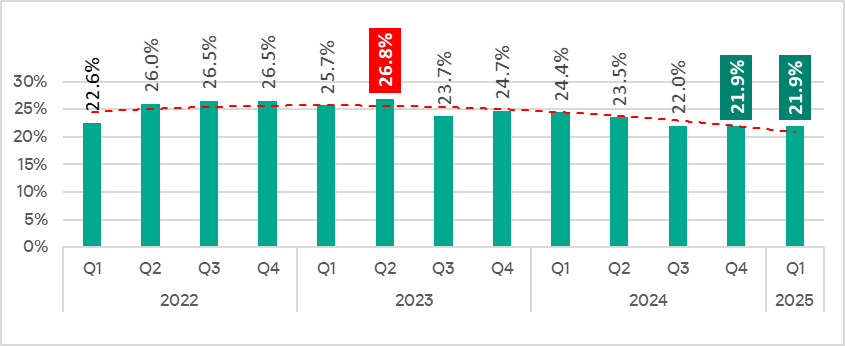
    Relative stability from quarter to quarter. The percentage of ICS computers on which malicious objects were blocked remained unchanged from Q4 2024 at 21.9%. Over the last three quarters, the value has ranged from 22.0% to 21.9%.

    The quarterly figures are decreasing from year to year. Since Q2 2023, the percentage of ICS computers on which malicious objects were blocked has been lower than the indicator of the same quarter of the previous year. Compared to Q1 2024, the figure decreased by 2.5 pp.

    Percentage of ICS computers on which malicious objects were blocked, Q1 2022–Q1 2025

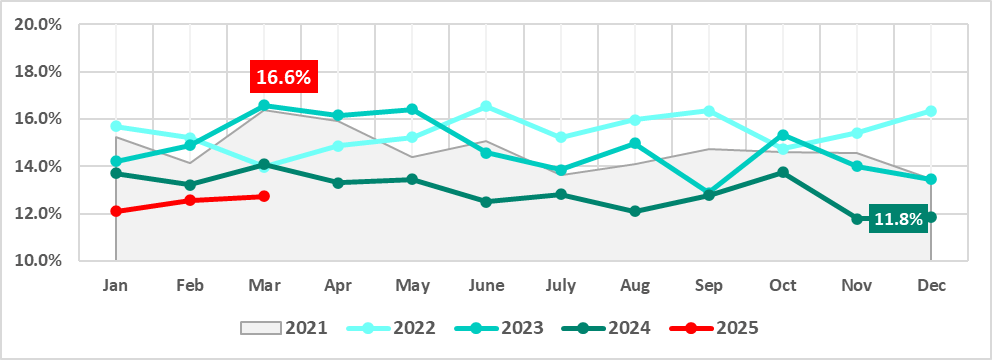
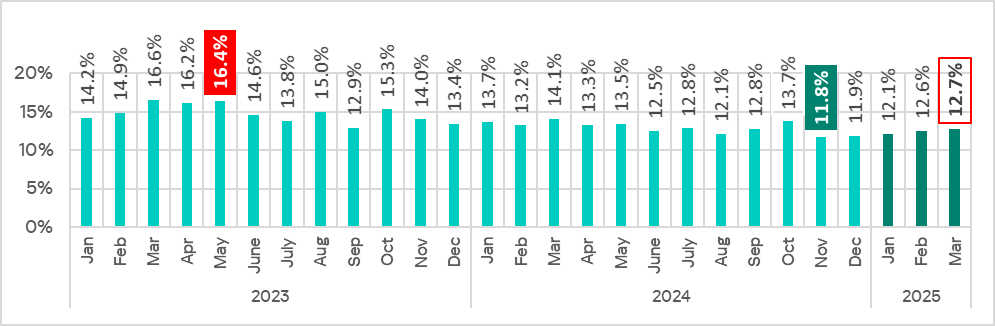
    In January–March 2025, the figures were the lowest compared to the same months of the previous four years.

    Percentage of ICS computers on which malicious objects were blocked, Jan 2021–Mar 2025

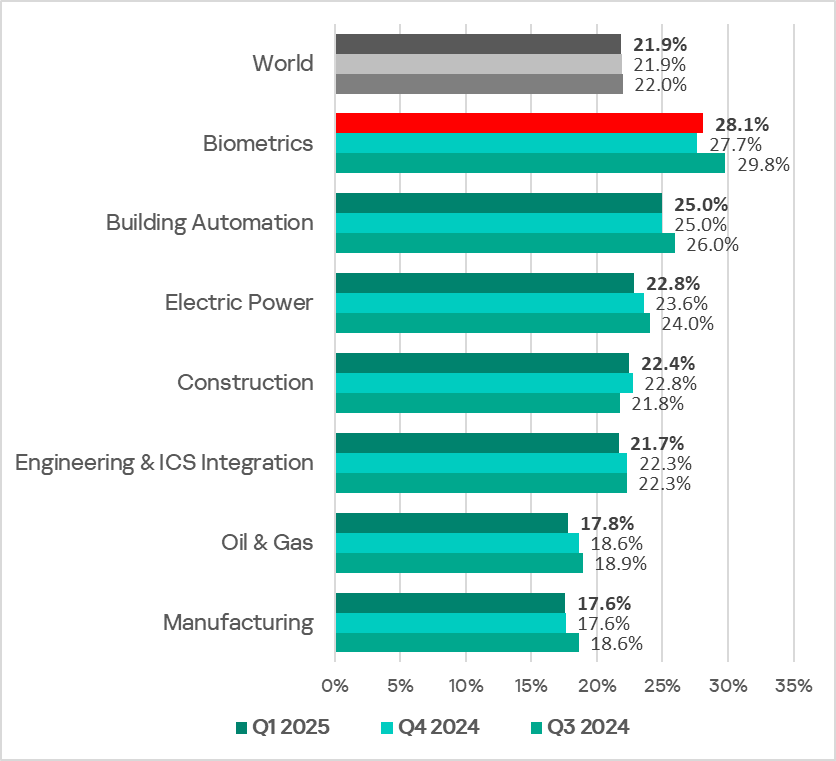
    The biometrics sector continues to lead the selected industries / OT infrastructure types. This is the only OT infrastructure type where the percentage of ICS computers on which malicious objects were blocked increased during the quarter.

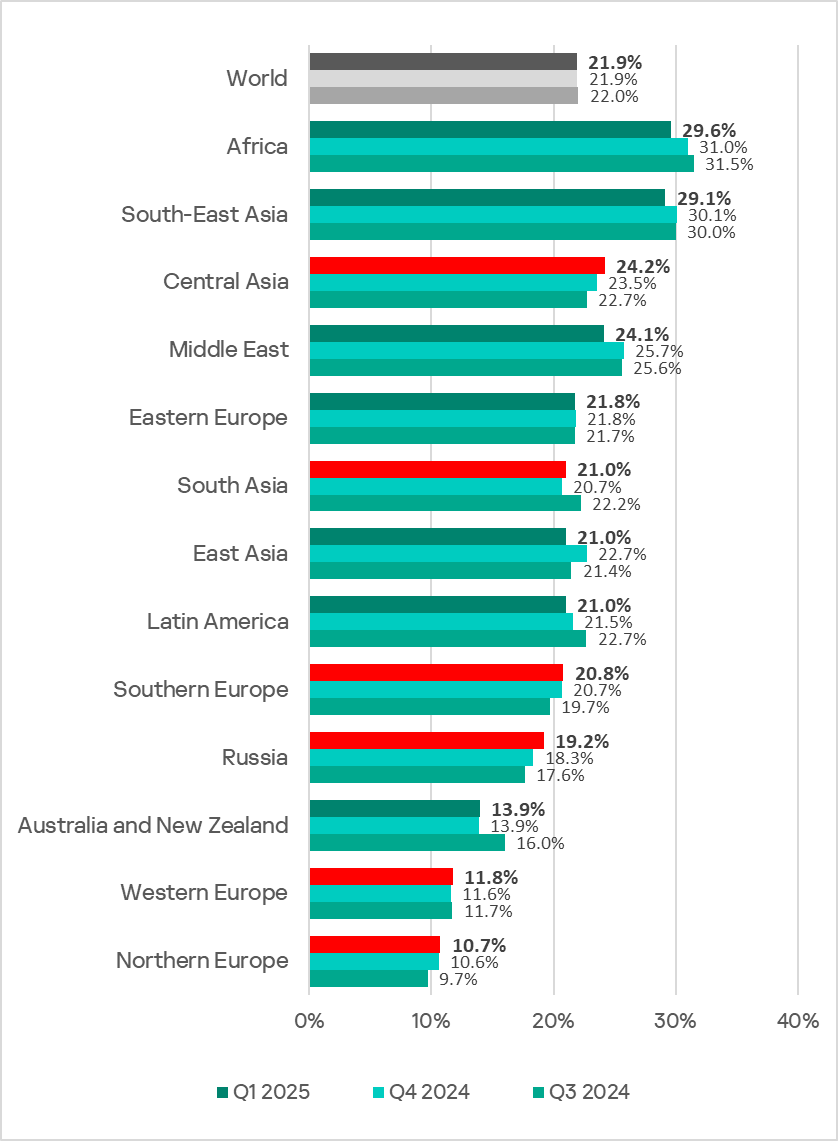
    Threat levels in different regions still vary. In Q1 2025, the percentage of affected ICS computers ranged from 10.7% in Northern Europe to 29.6% in Africa. In eight out of 13 regions, the figures ranged from 19.0% to 25.0%.

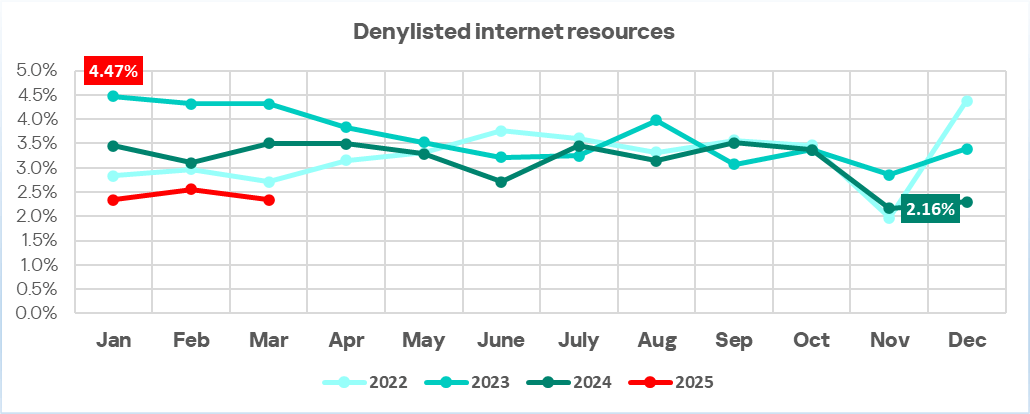
    The percentage of ICS computers on which denylisted internet resources were blocked continues to decrease. It reached its lowest level since the beginning of 2022. In the first three months of 2025, the corresponding figures were lower than those in January–March of the previous three years.

    Percentage of ICS computers on which denylisted internet resources were blocked, Jan 2022–Mar 2025

    Changes in the percentage of ICS computers on which initial-infection malware was blocked lead to changes in the percentage of next-stage malware. In Q1 2025, the percentage of ICS computers on which various types of malware spread via the internet and email were blocked increased for the first time since the beginning of 2023.

    The internet is the primary source of threats to ICS computers. The main categories of threats from the internet are denylisted internet resources, malicious scripts and phishing pages.

    The main categories of threats spreading via email are malicious documents, spyware, malicious scripts and phishing pages.

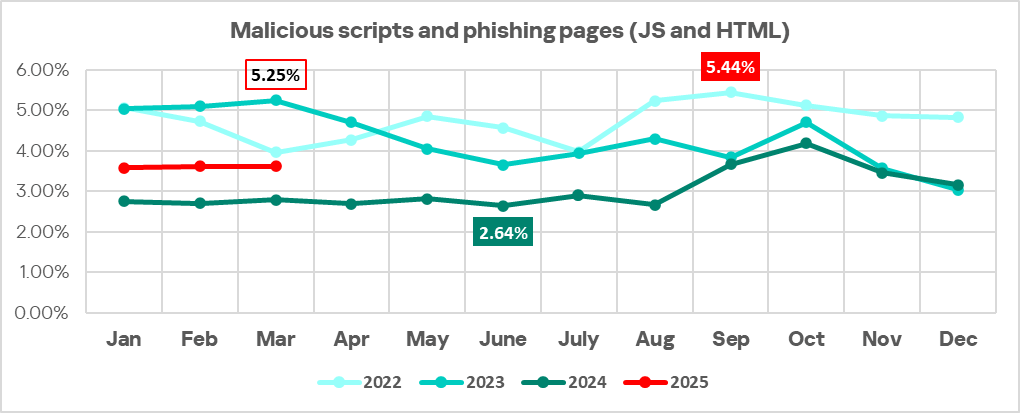
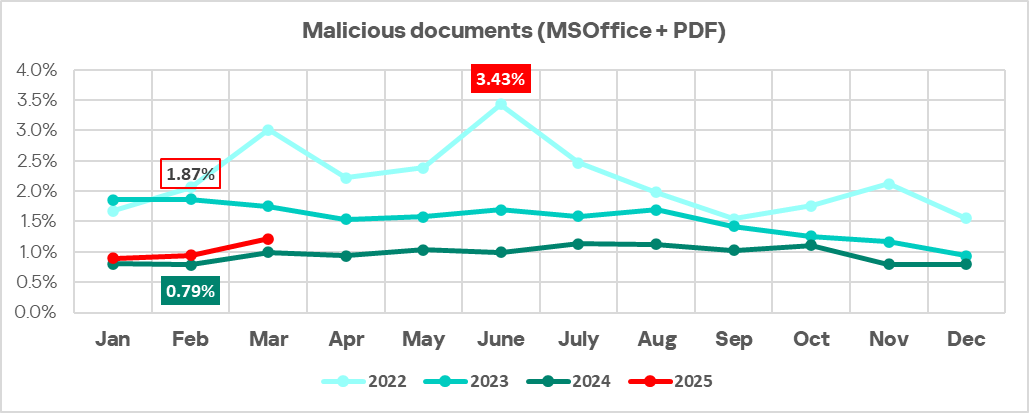
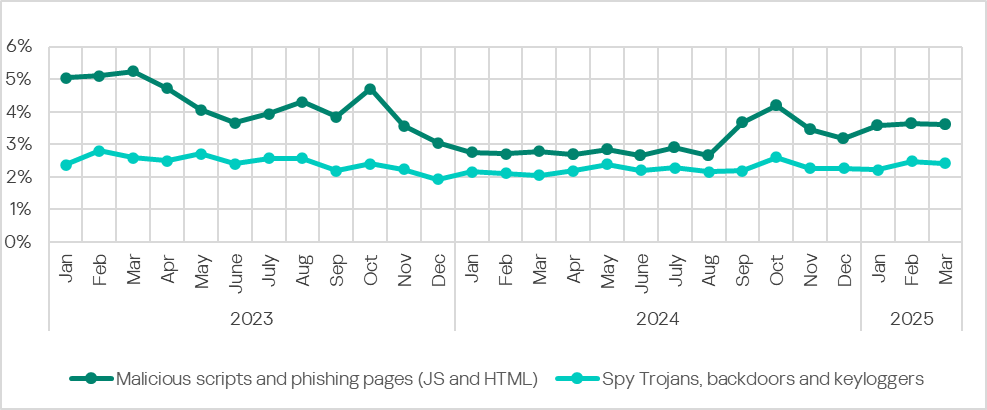
    The percentage of ICS computers on which malicious scripts and phishing pages, and malicious documents were blocked increased in Q1 2025. In January–March, the monthly values in these two categories of threats were higher than in the same months of 2024.

    Percentage of ICS computers on which malicious objects were blocked, Jan 2022–Mar 2025

    The leading category of malware used for initial infection of ICS computers (see below) is malicious scripts and phishing pages.

    Most malicious scripts and phishing pages act as droppers or loaders of next-stage malware (spyware, crypto miners and ransomware). The strong correlation between the values for malicious scripts and phishing pages, and spyware is clearly visible in the graph below.

    Percentage of ICS computers on which malicious objects were blocked, Jan 2023–Mar 2025

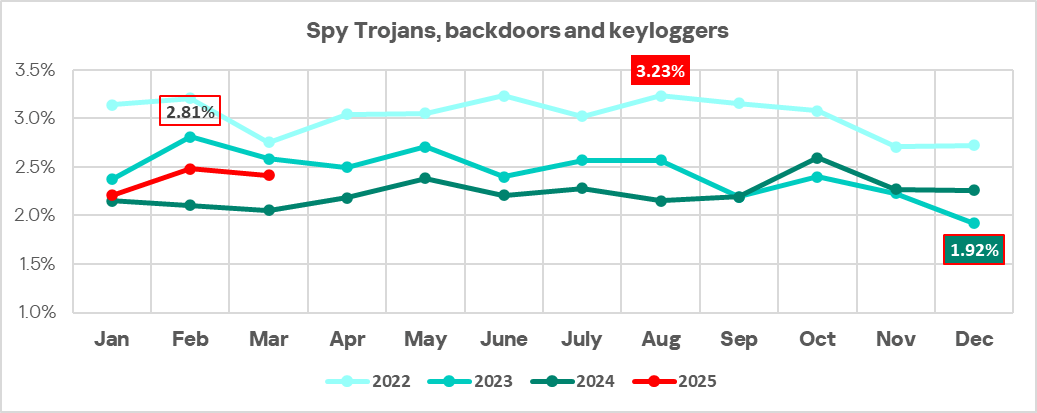
    Similar to malicious scripts and phishing pages, the percentage of ICS computers on which spyware was blocked was higher in the first three months of 2025 than in the same months of 2024.

    Percentage of ICS computers on which spyware was blocked, Jan 2022–Mar 2025

    The percentage of ICS computers on which miners (web miners and miners in the form of executable files for Windows) were blocked in Q1 2025 also increased.

    Statistics across all threats

    In Q1 2025, the percentage of ICS computers on which malicious objects were blocked remained at the same level as in the previous quarter: 21.9%.

    Percentage of ICS computers on which malicious objects were blocked, Q1 2022–Q1 2025

    Compared to Q1 2024, the percentage of ICS computers on which malicious objects were blocked decreased by 2.5 pp. However, it increased from January to March of 2025 when it reached its highest value in the quarter.

    Percentage of ICS computers on which malicious objects were blocked, Jan 2023–Mar 2025

    Regionally, the percentage of ICS computers on which malicious objects were blocked ranged from 10.7% in Northern Europe to 29.6% in Africa.

    Regions ranked by percentage of ICS computers on which malicious objects were blocked, Q1 2025

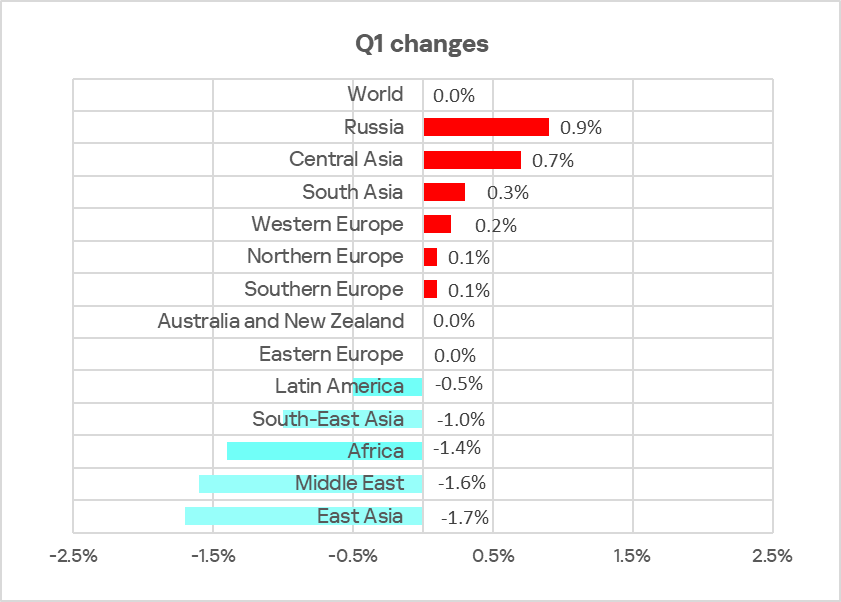
    In six of the 13 regions surveyed in this report, the figures increased from the previous quarter, with the largest change occurring in Russia.

    Changes in percentage of ICS computers on which malicious objects were blocked,
    Q1 2025

    Selected industries

    The biometrics sector led the ranking of the industries and OT infrastructures surveyed in this report in terms of the percentage of ICS computers on which malicious objects were blocked.

    Ranking of industries and OT infrastructures by percentage of ICS computers on which malicious objects were blocked, Q1 2025

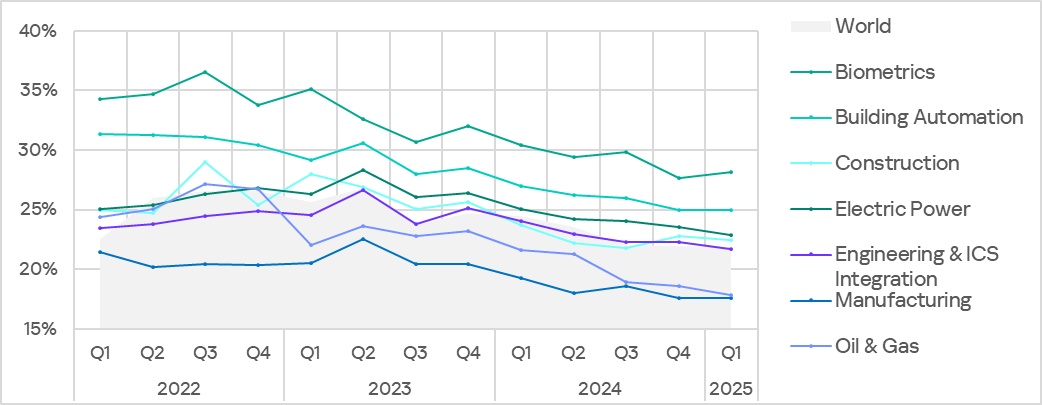
    The biometrics sector was also the only OT infrastructure type where the percentage of ICS computers on which malicious objects were blocked increased slightly. Despite this, the long-term trend is clearly downward.

    Percentage of ICS computers on which malicious objects were blocked in selected industries

    Diversity of detected malicious objects

    In Q1 2025, Kaspersky security solutions blocked malware from 11,679 different malware families in various categories on industrial automation systems.

    Percentage of ICS computers on which the activity of malicious objects from various categories was blocked

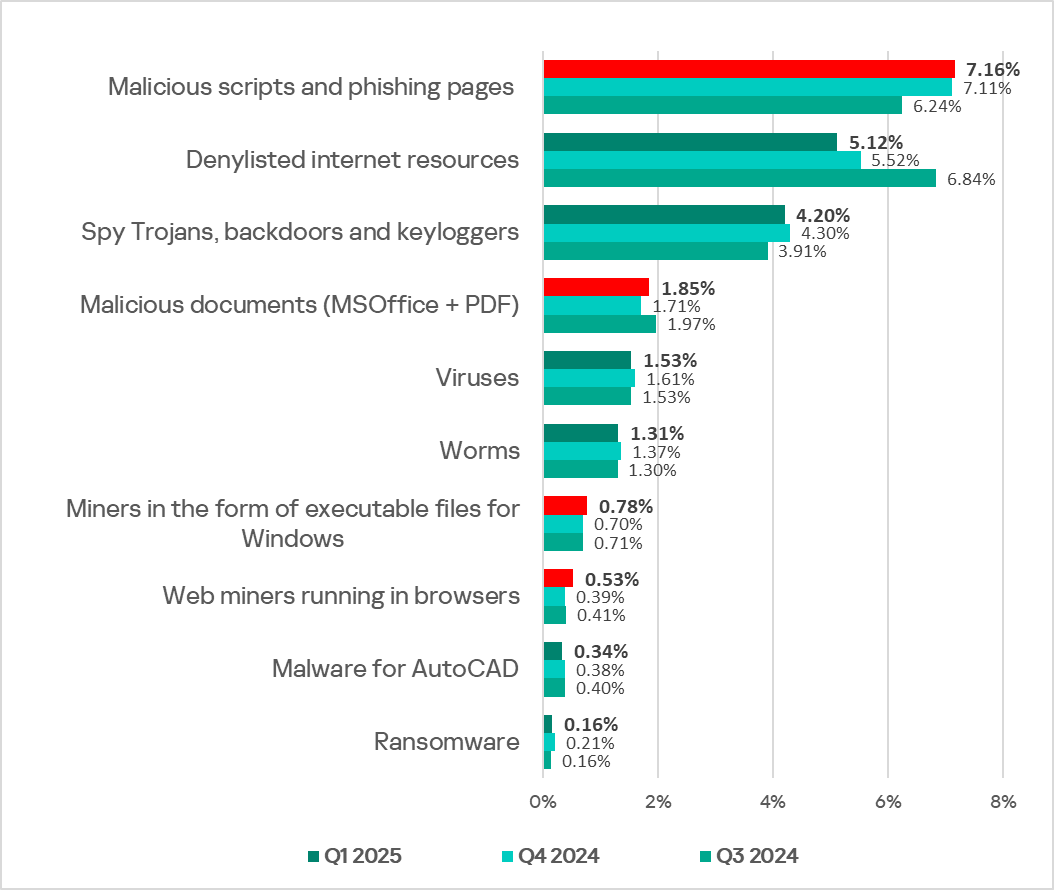
    The largest proportional increase in Q1 2025 was in the percentage of ICS computers on which web miners (1.4 times more than in the previous quarter) and malicious documents (1.1 times more) were blocked.

    Main threat sources

    Depending on the threat detection and blocking scenario, it is not always possible to reliably identify the source. The circumstantial evidence for a specific source can be the blocked threat’s type (category).

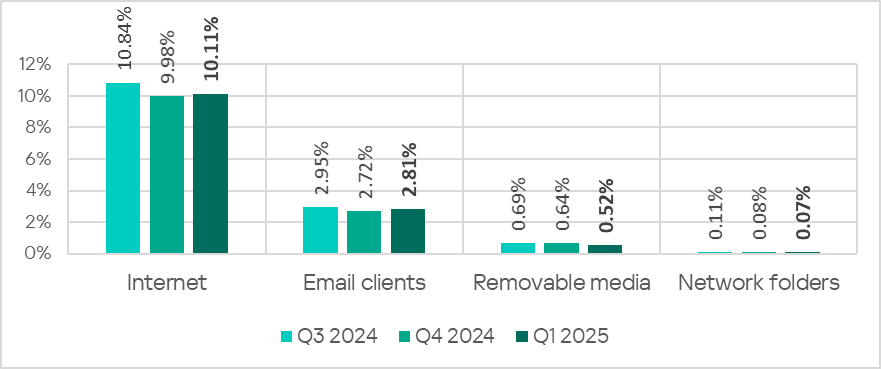
    The internet (visiting malicious or compromised internet resources; malicious content distributed via messengers; cloud data storage and processing services and CDNs), email clients (phishing emails), and removable storage devices remain the primary sources of threats to computers in an organization’s OT infrastructure.

    In Q1 2025, the percentage of ICS computers on which threats from the internet and email clients were blocked increased for the first time since the end of 2023.

    Percentage of ICS computers on which malicious objects from various sources were blocked

    The rates for all threat sources varied across the monitored regions.

    • The percentage of ICS computers on which threats from the internet were blocked ranged from 5.2% in Northern Europe to 12.8% in Africa.
    • The percentage of ICS computers on which threats from email clients were blocked ranged from 0.88% in Russia to 6.8% in Southern Europe.
    • The percentage of ICS computers on which threats from removable media were blocked ranged from 0.06% in Australia and New Zealand to 2.4% in Africa.

    Threat categories

    Typical attacks blocked within an OT network are a multi-stage process, where each subsequent step by the attackers is aimed at increasing privileges and gaining access to other systems by exploiting security flaws in industrial enterprises, including OT infrastructures.

    It is worth noting that during the attack, intruders often repeat the same steps (TTP), especially when they use malicious scripts and established communication channels with the management and control infrastructure (C2) to move laterally within the network and advance the attack.

    Malicious objects used for initial infection

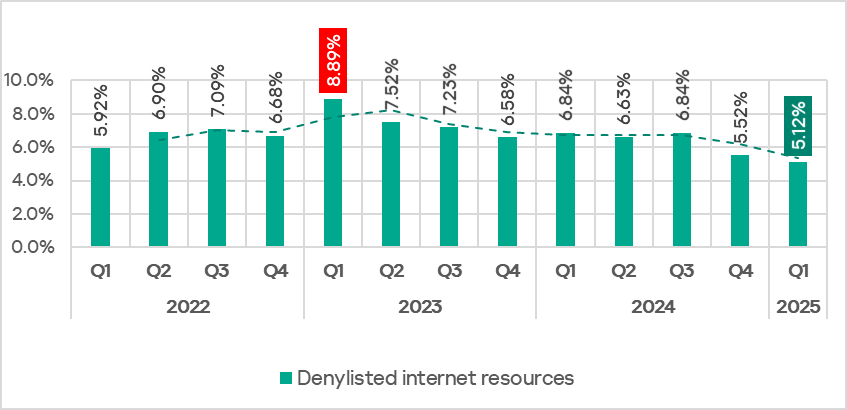
    In Q1 2025, the percentage of ICS computers on which denylisted internet resources were blocked decreased to its lowest value since the beginning of 2022.

    Percentage of ICS computers on which denylisted internet resources were blocked, Q1 2022–Q1 2025

    The decline in the percentage of denylisted internet resources since November 2024 was likely influenced not only by proactive threat mitigation at various levels, but also by techniques used by attackers to circumvent the blocking mechanisms based on the resource’s reputation, thus redistributing the protection burden to other detection technologies.

    A detected malicious web resource may not always be added to a denylist because attackers are increasingly using legitimate internet resources and services such as content delivery network (CDN) platforms, messengers, and cloud storage. These services allow malicious code to be distributed through unique links to unique content, making it difficult to use reputation-based blocking tactics. We strongly recommend that industrial organizations implement policy-based blocking of such services, at least for OT networks where the need for such services is extremely rare for objective reasons.

    The percentage of ICS computers on which malicious documents as well as malicious scripts and phishing pages were blocked increased slightly, to 1.85% (by 0.14 pp) and 7.16% (by 0.05 pp) respectively.

    Next-stage malware

    Malicious objects used to initially infect computers deliver next-stage malware – spyware, ransomware, and miners – to victims’ computers. As a rule, the higher the percentage of ICS computers on which the initial infection malware is blocked, the higher the percentage for next-stage malware.

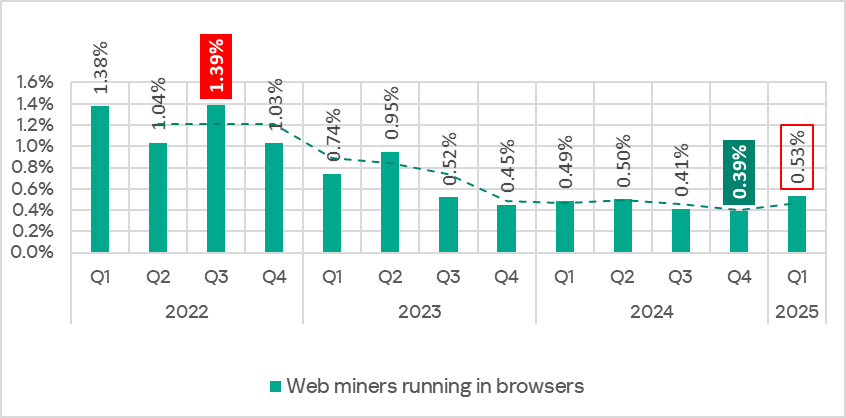
    In Q1 2025, the percentage of ICS computers on which spyware and ransomware were blocked decreased, reaching 4.20% (by losing 0.1 pp) and 0.16% (by losing 0.05 pp) respectively. Conversely, the indicator for miners increased. The percentage of ICS computers on which miners in the form of executable files for Windows and web miners were blocked increased to 0.78% (by 0.08 pp) and 0.53% (by 0.14 pp), respectively. The latter indicator reached its highest value since Q3 2023.

    Percentage of ICS computers on which web miners were blocked, Q1 2022–Q1 2025

    Self-propagating malware

    Self-propagating malware (worms and viruses) is a category unto itself. Worms and virus-infected files were originally used for initial infection, but as botnet functionality evolved, they took on next-stage characteristics.

    To spread across ICS networks, viruses and worms rely on removable media, network folders, infected files including backups, and network attacks on outdated software, such as Radmin2.

    In Q1 2025, the percentage of ICS computers on which worms and viruses were blocked decreased to 1.31% (by losing 0.06 pp) and 1.53% (by losing 0.08 pp), respectively.

    AutoCAD malware

    AutoCAD malware is typically a low-level threat, coming last in the malware category rankings in terms of the percentage of ICS computers on which it was blocked.

    In Q1 2025, the percentage of ICS computers on which AutoCAD malware was blocked continued to decrease (by losing 0.04 pp) and reached 0.034%.

    You can find more information on industrial threats in the full version of the report.

    MIL OSI Economics

  • MIL-OSI Economics: China to drive global ethylene capacity additions through 2030, says GlobalData

    Source: GlobalData

    China to drive global ethylene capacity additions through 2030, says GlobalData

    Posted in Oil & Gas

    China is set to drive the global ethylene capacity additions, occupying a share of more than 36% by 2030, as both demand and supply of ethylene are expected to grow in the country, according to GlobalData, a leading data and analytics company.

    GlobalData’s latest report “Ethylene Market Analysis and Forecast by Products, Capacity Additions, Top Countries and Active and Upcoming Projects to 2030,” reveals that the total ethylene capacity of under-construction and pre-construction projects in China is expected to be around 33.30 million tonnes per annum (mtpa) by 2030.

    Nivedita Roy, Oil and Gas Analyst at GlobalData, comments: “The high-capacity addition of ethylene in China can be attributed to several factors, including the significant investments in petrochemical infrastructure and robust economic growth. The country’s expanding middle class and industrial development are major demand drivers of ethylene-based products that range from consumer goods to construction materials.”

    To meet the growing demand for ethylene, China is planning to expand its production capacity. As a result, the ethylene supply in the country is projected to rise from 36.66 mtpa in 2024 to 51.80 mtpa in 2030.

    In China, the major ethylene capacity addition is expected from the “Shandong Yulong Petrochemical Longkou Ethylene Plant 3”, boasting a capacity of 5.20 mtpa. Located in Longkou city, the plant is expected to become operational by 2030. Shandong Yulong Petrochemical Ltd is the operator of this project with 100% equity stake.

    The “SABIC Fujian Petrochemical Zhangzhou Ethylene Plant” and “Huajin Aramco Petrochemical Panjin Ethylene Plant” represent other significant capacity additions in the country with 1.80 mtpa, and 1.65 mtpa, respectively. Both projects are anticipated to commence operations in 2026.

    MIL OSI Economics

  • MIL-OSI Economics: Gene therapies drive growth of genomics market, says GlobalData

    Source: GlobalData

    The integration of genomics into the pharmaceutical industry has allowed researchers to better understand the genetic factors underlying diseases, leading to the development of more targeted and effective therapies. Many of these therapies are designed to treat rare diseases that affect small patient populations. Generating $2.6 billion in sales in 2024, gene therapies are the key drivers of the growth of the genomics market, says GlobalData, a leading data and analytics company.

    GlobalData’s latest report, “Transformational Power of Genomics in Pharma,” reveals that the market for genomic therapies is demonstrating significant growth, with sales projected to increase from $20.1 billion in 2024 to $89.8 billion in 2030, at a compound annual growth rate (CAGR) of 28.3%. There are various types of genomic therapies, such as gene therapies, oncolytic viruses, oligonucleotides, messenger RNA (mRNA) vaccines, and recombinant vector vaccines.

    GlobalData estimates gene therapies to grow to $30.9 billion by 2030, representing the highest CAGR of 50.8% during 2024-30 in comparison to other key molecule types. This substantial growth in sales is forecast to be driven by Sarepta Therapeutics’ Elevidys (delandistrogene moxeparvovec) for the treatment of Duchenne muscular dystrophy (DMD), with sales forecast to reach $2.75 billion in 2030. Other key drivers include Novartis’ Zolgensma (onasemnogene abeparvovec) for the treatment of spinal muscular atrophy (SMA), with a sales forecast of $2.1 billion in 2030.

    Gaffar Aga, Strategic Intelligence Analyst at GlobalData, comments: “This growth is driven by factors such as the implementation of artificial intelligence (AI) and machine learning (ML) to efficiently analyze expanding genomic datasets, allowing researchers to accelerate processes such as drug discovery and development within the genomics landscape.”

    Furthermore, the oligonucleotide market is exhibiting growth in all sectors. The antisense RNAi oligonucleotide market is forecast to grow from $2.5 billion in 2024 to $18.7 billion in 2030, at a CAGR of 39.9%. The antisense oligonucleotide market is also exhibiting growth, with the market forecast to grow from $3.1 billion in 2024 to $14.3 billion in 2030 at a CAGR of 28.8%.

    Additionally, the mRNA vaccine market is forecast to exhibit steady growth, with sales increasing from $11 billion in 2024 to $17.9 billion in 2030 at a CAGR of 8.4%.

    Finally, the recombinant vector vaccine market is expected to generate the lowest number of sales, reaching $1.34 billion by 2030 at a CAGR of 31.4%.

    George El-Helou, Strategic Intelligence Analyst at GlobalData, concludes: “The field of genomics has the potential to revolutionize a wide range of diseases, offering alternative pathways of therapeutic options with high unmet medical needs. However, several market barriers remain, including the high costs associated with drug discovery, manufacturing, and logistical procedures within the industry.”

    MIL OSI Economics

  • MIL-OSI Economics: Record-breaking FDA biosimilar approvals to create opportunities for drug developers and manufacturers, says GlobalData

    Source: GlobalData

    Record-breaking FDA biosimilar approvals to create opportunities for drug developers and manufacturers, says GlobalData

    Posted in Pharma

    FDA biosimilar approvals reached a record 19 in 2024, with projections indicating that 2025 could surpass this milestone trend. This presents a golden opportunity for Contract Manufacturing Organizations (CMOs) specializing in biologics, as more blockbuster drugs approach patent expiration and regulatory barriers to entry diminish, says GlobalData, a leading data and analytics company.

    Kathryn Kinch, Pharma Product Manager at GlobalData, comments: “Increased approvals of biosimilars are likely to lower biologic prices, enhancing consumer demand and competition among drug companies, which will benefit CMOs through higher biosimilar volumes.”

    GlobalData’s Bio/Pharmaceutical Outsourcing Report notes that momentum for biosimilars is set to accelerate. Patents for 14 biologics expired in 2024, including major products like UCB SA’s Cimzia and Johnson & Johnson’s Simponi. Even more biologics – 18 – will lose patent protection in 2025, paving the way for a new wave of biosimilar entrants, including Amgen’s Prolia and Roche’s Perjeta.

    In addition to the increase in biosimilar approvals, the report showcases growing importance of strong relationships in clinical supply chains, major pharmaceutical companies’ intentions to establish manufacturing facilities in the US, highlighted by Novartis‘ announcement of a $23 billion investment, and the initial 100 days of US President Trump’s administration and the potential effects on pharmaceutical investments and tariff concerns in the US.

    In the report, GlobalData Pharma Analyst Katarina Zahedi also shares highlights from the Clinical Trial Supply (CTS) New England conference, such as “the importance of understanding the scope of the trial, geographic location, the demand for and the type of drug, and timeframe for trial start-up – as these are all factors that will influence cost. For example, a biologic is more costly to develop than drugs of other molecule types, as it requires longer development timelines and specialized requirements for trials and manufacturing due to their complexity.”

    The Bio/Pharmaceutical Outsourcing Report is a monthly analysis of news and trends affecting pharmaceutical contract manufacturing organizations. The report lists the latest contract manufacturing agreements, opportunities and threats for CDMOs, M&A and financing of CDMOs, and emerging regulatory news.

    MIL OSI Economics

  • MIL-OSI Economics: RBI imposes monetary penalty on The Karnataka Central Co-operative Bank Ltd, Dharwad, Karnataka

    Source: Reserve Bank of India

    The Reserve Bank of India (RBI) has, by an order dated May 09, 2025, imposed a monetary penalty of ₹2.00 lakh (Rupees Two Lakh only) on The Karnataka Central Co-operative Bank Ltd, Dharwad, Karnataka (the bank) for contravention of provisions of Section 20 read with Section 56 of the Banking Regulation Act, 1949 (BR Act). This penalty has been imposed in exercise of powers conferred on RBI under the provisions of Section 47A(1)(c) read with Sections 46(4)(i) and 56 of the BR Act.

    The statutory inspection of the bank was conducted by National Bank for Agriculture and Rural Development (NABARD) with reference to its financial position as on March 31, 2024. Based on supervisory findings of contravention of statutory provisions and related correspondence in that regard, a notice was issued to the bank advising it to show cause as to why penalty should not be imposed on it for its failure to comply with the said provisions. After considering the bank’s reply to the notice and oral submissions made during the personal hearing, RBI found, inter alia, that the following charge against the bank was sustained, warranting imposition of monetary penalty:

    The bank had sanctioned director related loans.

    This action is based on deficiencies in statutory compliance and is not intended to pronounce upon the validity of any transaction or agreement entered into by the bank with its customers. Further, imposition of this monetary penalty is without prejudice to any other action that may be initiated by RBI against the bank.

    (Puneet Pancholy)  
    Chief General Manager

    Press Release: 2025-2026/336

    MIL OSI Economics

  • MIL-OSI Economics: RBI imposes monetary penalty on Mangalore Co-operative Town Bank Ltd., Mangalore, Karnataka

    Source: Reserve Bank of India

    The Reserve Bank of India (RBI) has, by an order dated May 09, 2025, imposed a monetary penalty of ₹1.00 lakh (Rupees One Lakh only) on Mangalore Co-operative Town Bank Ltd., Mangalore, Karnataka (the bank) for non-compliance with certain directions issued by RBI on ‘Loans and advances to directors, their relatives, and firms /concerns in which they are interested’. This penalty has been imposed in exercise of powers conferred on RBI under the provisions of Section 47A(1)(c) read with Sections 46(4)(i) and 56 of the Banking Regulation Act, 1949.

    The statutory inspection of the bank was conducted by RBI with reference to its financial position as on March 31, 2024. Based on supervisory findings of non-compliance with RBI directions and related correspondence in that regard, a notice was issued to the bank advising it to show cause as to why penalty should not be imposed on it for its failure to comply with the said directions. After considering the bank’s reply to the notice and oral submissions made during the personal hearing, RBI found, inter alia, that the following charge against the bank was sustained, warranting imposition of monetary penalty:

    The bank had sanctioned director related loans.

    This action is based on deficiencies in regulatory compliance and is not intended to pronounce upon the validity of any transaction or agreement entered into by the bank with its customers. Further, imposition of this monetary penalty is without prejudice to any other action that may be initiated by RBI against the bank.

    (Puneet Pancholy)  
    Chief General Manager

    Press Release: 2025-2026/335

    MIL OSI Economics

  • MIL-OSI Economics: RBI imposes monetary penalty on The Shimoga District Co-operative Central Bank Ltd., Karnataka

    Source: Reserve Bank of India

    The Reserve Bank of India (RBI) has, by an order dated May 09, 2025, imposed a monetary penalty of ₹1.00 lakh (Rupees One Lakh only) on The Shimoga District Co-operative Central Bank Ltd., Karnataka (the bank) for contravention of provisions of Section 20 read with Section 56 of the Banking Regulation Act, 1949 (BR Act). This penalty has been imposed in exercise of powers conferred on RBI under the provisions of Section 47A(1)(c) read with Sections 46(4)(i) and 56 of the BR Act.

    The statutory inspection of the bank was conducted by National Bank for Agriculture and Rural Development (NABARD) with reference to its financial position as on March 31, 2024. Based on supervisory findings of contravention of statutory provisions and related correspondence in that regard, a notice was issued to the bank advising it to show cause as to why penalty should not be imposed on it for its failure to comply with the said provisions. After considering the bank’s reply to the notice and oral submissions made during the personal hearing, RBI found, inter alia, that the following charge against the bank was sustained, warranting imposition of monetary penalty:

    The bank had sanctioned director related loans.

    This action is based on deficiencies in statutory compliance and is not intended to pronounce upon the validity of any transaction or agreement entered into by the bank with its customers. Further, imposition of this monetary penalty is without prejudice to any other action that may be initiated by RBI against the bank.

    (Puneet Pancholy)  
    Chief General Manager

    Press Release: 2025-2026/334

    MIL OSI Economics

  • MIL-OSI Economics: RBI imposes monetary penalty on Swarna Bharathi Sahakara Bank Niyamitha, Bangalore, Karnataka

    Source: Reserve Bank of India

    The Reserve Bank of India (RBI) has, by an order dated May 09, 2025, imposed a monetary penalty of ₹50,000/- (Rupees Fifty Thousand only) on Swarna Bharathi Sahakara Bank Niyamitha, Bangalore, Karnataka (the bank) for contravention of provisions of Section 31 read with Section 56 of the Banking Regulation Act, 1949 (BR Act). This penalty has been imposed in exercise of powers conferred on RBI under the provisions of Section 47A(1)(c) read with Sections 46(4)(i) and 56 of the BR Act.

    Based on supervisory findings of contravention of statutory provisions and related correspondence in that regard, a notice was issued to the bank advising it to show cause as to why penalty should not be imposed on it for its failure to comply with the said statutory provisions. After considering the bank’s reply to the notice and oral submissions made during the personal hearing, RBI found, inter alia, that the following charge against the bank was sustained, warranting imposition of monetary penalty:

    The bank had failed to submit its accounts and balance-sheet for the FY 2023-24 together with the auditor’s report to RBI, within stipulated timeline.

    This action is based on deficiencies in statutory compliance and is not intended to pronounce upon the validity of any transaction or agreement entered into by the bank with its customers. Further, imposition of this monetary penalty is without prejudice to any other action that may be initiated by RBI against the bank.

    (Puneet Pancholy)  
    Chief General Manager

    Press Release: 2025-2026/333

    MIL OSI Economics

  • MIL-OSI Economics: CarPlay Ultra, the next generation of CarPlay, begins rolling out today

    Source: Apple

    Headline: CarPlay Ultra, the next generation of CarPlay, begins rolling out today

    May 15, 2025

    UPDATE

    CarPlay Ultra, the next generation of CarPlay, begins rolling out today

    CarPlay Ultra brings the best of iPhone and the best of the car together for a deeply integrated experience, beginning with Aston Martin vehicles

    Starting today, CarPlay Ultra, the next generation of CarPlay, is available with new Aston Martin vehicle orders in the U.S. and Canada, and will be available for existing models that feature the brand’s next-generation infotainment system through a software update in the coming weeks. CarPlay Ultra builds on the capabilities of CarPlay and provides the ultimate in-car experience by deeply integrating with the vehicle to deliver the best of iPhone and the best of the car. It provides information for all of the driver’s screens, including real-time content and gauges in the instrument cluster, while reflecting the automaker’s look and feel and offering drivers a customizable experience. Many other automakers around the world are working to bring CarPlay Ultra to drivers, including newly committed brands Hyundai, Kia, and Genesis.

    “iPhone users love CarPlay, and it has transformed how people connect with their vehicles. With CarPlay Ultra, together with automakers, we are reimagining the in-car experience, making it even more unified and consistent,” said Bob Borchers, Apple’s vice president of Worldwide Product Marketing. “This next generation of CarPlay gives drivers a smarter, safer way to use their iPhone in the car, while deeply integrating with the car’s systems and showcasing the unique look and feel of each automaker. We are excited to kick off the rollout of CarPlay Ultra with Aston Martin — and this is just the beginning, with more automakers on the way.”

    Deeper Integration Than Ever Before

    CarPlay Ultra provides content for all the driver’s screens, including the instrument cluster, with dynamic and beautiful options for the speedometer, tachometer, fuel gauge, temperature gauge, and more, bringing a consistent look and feel to the entire driving experience. Drivers can choose to show information from their iPhone, like maps and media, along with information that comes from the car, such as advanced driver assistance systems and tire pressure, right in the instrument cluster.

    Drivers can also use onscreen controls, physical buttons, or Siri to manage both standard vehicle functions like the car’s radio and climate, as well as advanced, vehicle-specific features and controls like audio system configurations or performance settings, right from CarPlay, giving them a more fluid and seamless experience. CarPlay Ultra also introduces widgets powered by iPhone that perfectly fit the car’s screen or gauge cluster to provide information at a glance.

    A Design Unique to Each Automaker

    CarPlay Ultra allows automakers to express their distinct design philosophy with the look and feel their customers expect. Custom themes are crafted in close collaboration between Apple and the automaker’s design team, resulting in experiences that feel tailor-made for each vehicle. Drivers can also personalize the colors and wallpapers of themes to match their individual tastes.

    “Aston Martin is delighted to have collaborated with Apple and to be first to launch CarPlay Ultra. As a brand, our focus on world-leading performance goes beyond the traditional attributes associated with powertrains, dynamic performance, and craftsmanship. The integration of CarPlay Ultra is a clear example of the dedication to collaborate with the best companies in the world to bring unique experiences and in-vehicle capabilities to our customers. Building on our in-house state-of-the-art infotainment system, CarPlay Ultra will provide additional functionality and personalization opportunities, which place Aston Martin at the forefront of infotainment in the sector.”

    CarPlay Ultra joins CarPlay, which is beloved by drivers around the world and has fundamentally changed the way people interact with their vehicles, providing a safer, smarter way to use iPhone in the car. And just like with CarPlay, rigorous privacy measures built into iPhone apply to CarPlay Ultra.

    Availability

    • Beginning in the U.S. and Canada, CarPlay Ultra will be available for Aston Martin’s core model lineup, and will expand to include vehicles globally in the next 12 months.
    • The experience is available in new Aston Martin vehicle orders in the U.S. and Canada starting today, and will be available for existing Aston Martin vehicles in the U.S. and Canada featuring the brand’s next-generation infotainment system in the coming weeks through a software update available at local dealers.
    • CarPlay Ultra works with iPhone 12 or later running iOS 18.5 or later.
    • For more information on availability across Aston Martin’s vehicle lineup and information on updating at Aston Martin dealerships, visit media.astonmartin.com.

    Press Contacts

    Shane Bauer

    Apple

    shanebauer@apple.com

    Tania Olkhovaya

    Apple

    tolkhovaya@apple.com

    Apple Media Helpline

    media.help@apple.com

    MIL OSI Economics

  • MIL-OSI Economics: Deputy Secretary-General of ASEAN for ASEAN Socio-Cultural Community meets with Ambassador of Cuba to ASEAN

    Source: ASEAN

    H.E. San Lwin, Deputy Secretary-General of ASEAN for ASEAN Socio-Cultural Community received H.E. Ambassador Dagmar González Grau, today for a courtesy visit. Their discussions explored potential cooperation within the socio-cultural sphere, encompassing health, labour, education, disaster management, and the environment.
     

    MIL OSI Economics

  • MIL-OSI Economics: Deputy Secretary-General of ASEAN for Community and Corporate Affairs meets with Australia’s Ambassador for Cyber Affairs and Critical Technology

    Source: ASEAN

    Deputy Secretary-General of ASEAN for Community and Corporate Affairs, H.E. Nararya Sanggramawijaya Soeprapto, received H.E. Brendan Dowling, Australia’s Ambassador for Cyber Affairs and Critical Technology, at the ASEAN Headquarters/ASEAN Secretariat today. They exchanged views on ways to advance cooperation between ASEAN and Australia on cyber and artificial intelligence (AI) policies, including combatting cybercrime, strengthening regional cyber assistance, and use of AI, as well as potential collaboration to support efforts in building institutional capacity on cybersecurity.
     

    MIL OSI Economics

  • MIL-OSI Economics: 615th Meeting of Central Board of the Reserve Bank of India

    Source: Reserve Bank of India

    The 615th meeting of the Central Board of Directors of Reserve Bank of India was held today in Mumbai under the Chairmanship of Shri Sanjay Malhotra, Governor. As part of the agenda, inter alia, the Board reviewed the Economic Capital Framework (ECF) of the Reserve Bank of India.

    Deputy Governors Shri M. Rajeshwar Rao, Shri T. Rabi Sankar, Shri Swaminathan J., Dr. Poonam Gupta and other Directors of the Central Board – Shri Ajay Seth, Secretary, Department of Economic Affairs, Shri Nagaraju Maddirala, Secretary, Department of Financial Services, Shri Satish K. Marathe, Shri S. Gurumurthy, Smt. Revathy Iyer, Prof. Sachin Chaturvedi, Shri Venu Srinivasan, Shri Pankaj Ramanbhai Patel and Dr. Ravindra H. Dholakia – attended the meeting.

    (Puneet Pancholy)  
    Chief General Manager

    Press Release: 2025-2026/329

    MIL OSI Economics

  • MIL-OSI Economics: Samsung ‘Galaxy empowered’ launches Immersive Programme for Bhutan’s Teaching Community

    Source: Samsung

    The ‘Galaxy empowered’ Community from Bhutan
     
    Samsung, India’s largest consumer electronics brand, is welcoming passionate educators from remote corners of Bhutan into its growing community, ‘Galaxy empowered’, a one-of-a-kind community-led programme designed to transform education by empowering teachers, principals, and administrators in the education sector.
     
    ‘Galaxy empowered’, which aims to prepare teachers for the classrooms of tomorrow through recurring on-ground and online learning events, was launched in India in December 2024. Now, through immersive workshops and collaborative learning, Bhutanese teachers are also part of the movement that is redefining classrooms with technology and innovation.
     
    Samsung organised a ‘Galaxy empowered’ immersion programme for these educators, many of whom serve in remote and underserved communities in Bhutan, at its Executive Business Centre (EBC) in Gurugram. During the immersion programme, teachers gained hands-on experience with the Galaxy ecosystem, including Galaxy smartphones, Galaxy Books, Tablets, flipboards, and displays.
     
    In addition, they were introduced to Samsung’s latest innovations in education, including Galaxy devices and Galaxy AI applications tailored for modern, inclusive teaching. This was facilitated in partnership with the Teacher and Educational Leadership Division (TELD), Department of School Education, Ministry of Education and Skills Development, Bhutan.
     
    “I had never used an interactive whiteboard before. Seeing it in action gave me so many ideas for making lessons more engaging for my students,” said Khandu, teacher at Wangdue Primary School.
     
    Innovation spreading smiles across
     
    The Immersion Programme at Samsung Regional Headquarter witnessed the participation of educators from various schools across Bhutan, including Khandothang Primary School (Samtse), Pelrithang Higher Secondary School (Gelephu, Sarpang), Lobesa Lower Secondary School (Punakha Dzongkhag), Yoechen Central School (Pema Gatshel), Phuentsholing Primary School (Phuentsholing Thromde), and Chhukha Dzongkhag, among others.
     
    “The technology we saw today showed how classrooms can become more exciting and student-friendly. I am thinking about how we can try small changes in our own schools,” said Ghana Shyam Dhungana, Academic Head at Pelrithang Higher Secondary School (Gelephu, Sarpang).
     
    As a global leader in technology, Samsung is dedicated to transforming the future of education by developing future-ready classrooms that empower teachers to integrate the latest technology and modern teaching methodologies. Through initiatives such as ‘Galaxy empowered’, Samsung not only supports educators but also helps schools emerge as leaders in educational innovation.
     
    Taking a glance into the future
     
    “At Samsung, we understand that empowering a teacher is about inspiring a transformation that turns classrooms into vibrant spaces of curiosity, creativity, and connection. Through ‘Galaxy empowered’, we aim to ignite a spark that shapes the minds of future generations. We are proud to see this programme expand its reach beyond India, evolving into a global platform for learning and collaboration,” said a Samsung India spokesperson.
     
    The ‘Galaxy empowered’ programme is offered free of charge to both teachers and schools, ensuring that valuable resources for educational advancement are accessible without financial constraints. It offers no-cost online training, self-paced courses on the Galaxy empowered site, and physical boot camps.
     
    “This visit reminded me that technology is not only for big cities. With the right support, even remote schools can benefit from these innovations,” said Pema Dorji, Officiating Principal at Jigmeling Primary School (Tang, Bumthang).
     
    In India, under the umbrella of ‘Galaxy empowered’, over 4,800 teachers from more than 250 schools have been awarded certificates since December 2024. The programme aims to empower 20,000 teachers across 600 schools of India by 2025.
     

    MIL OSI Economics

  • MIL-OSI Economics: Open Market Operation (OMO) – Purchase of Government of India Securities held on May 15, 2025: Cut-Offs

    Source: Reserve Bank of India

    Security 7.10% GS 2029 7.26% GS 2032 7.50% GS 2034 6.67% GS 2035 7.41% GS 2036
    Total amount notified Aggregate amount of ₹25,000 crore
    (no security-wise notified amount)
    Total amount (face value) accepted by RBI (₹ in crore) 4,965 1,205 5,571 8,361 4,898
    Cut off yield (%) 6.0304 6.2556 6.3414 6.3644 6.4269
    Cut off price (₹) 103.68 105.78 107.99 102.32 107.94
    Detailed results will be issued shortly.

    Ajit Prasad          
    Deputy General Manager
    (Communications)    

    Press Release: 2025-2026/328

    MIL OSI Economics

  • MIL-OSI Economics: OEUK news Record increase in offshore wind capacity critical to Clean Power 2030 goal, says OEUK report 15 May 2025

    Source: Offshore Energy UK

    Headline: OEUK news

    Record increase in offshore wind capacity critical to Clean Power 2030 goal, says OEUK report

    15 May 2025

    In its 2025 Offshore Wind Insight, Offshore Energies UK (OEUK) warns that without action to address price inflation, capital cost and UK supply chain competitiveness, the UK will fail to meet the government’s Clean Power 2030 (CP30) target of between 43 and 51 GW of installed offshore wind capacity.

    The UK has the capacity to become a major exporter of wind energy, but if it is to meet CP2030 objectives the September wind allocation round (AR7) will have to be the biggest ever with more than 8GW of new licences awarded.

    As the halt to Hornsea 4 wind farm last week shows, cost inflation, finance costs and market outlook make investment in offshore wind all the more challenging, putting additional pressure on CP30 delivery.

    North Sea oil and gas have provided the primary source of energy for more than 50 years and the UK will continue to need homegrown oil and gas as part of an integrated energy mix for years to come alongside the build out of renewables. As the focus on decarbonising the economy gains momentum, electricity is expected to dominate the future low carbon energy mix. Much of this will be generated by offshore wind installations fixed to the seabed as well as floating offshore wind (FOW) structures but unless the pace of change quickens, the UK stands to achieve only 35GW by 2030, short of the CP30 target.

    In 2024, the National Energy System Operator (NESO) published the Clean Power 2030 (CP30) report, setting out recommendations to the UK government on the design of a clean power grid by 2030. With a goal to accelerate progress to net zero by eliminating emissions that currently come from electricity generation, CP30 also aims to ensure that heating, transport and industry sectors are powered by electricity.

    The plan sees a huge build out of renewables including 43-50 Gigawatts (GW) of offshore wind, 27-29 GW of onshore wind, and 45-47 GW of solar power. Noting all renewables play important roles in delivering a clean power grid, whereby Britain will generate enough clean power to meet 95% of total annual electricity demand by 2030, NESO highlighted the critical role of offshore wind.

    OEUK’s Wind & Renewables Manager, Thibaut Cheret says:

    “Meeting the government’s 2030 target of 43 and 51 GW of installed offshore wind capacity means securing £15bn of private investment in offshore wind each and every year between now and 2030. The government’s next Contract for Difference auction in Allocation Round 7 (AR7), which incentivises new low carbon electricity generating projects, will need to secure historic levels of renewable energy procurement. AR7 needs to clear a record 8.4GW of offshore wind capacity to maintain the course toward CP30.”

    “With the flexibility to supply oil and gas installations or the national grid, Floating Offshore Wind (FOW) will become a critical tool for delivering CP30 and beyond. Offshore wind leasing rounds released by Innovation and Targeted Oil and Gas (INTOG) under the auspices of Crown Estate Scotland are helping decarbonise offshore oil and gas production whilst accelerating deployment of the first floating offshore wind project at commercial scale.

    “As Floating Offshore Wind projects will have access to windier areas in deeper waters around the UK, it is set to become the growth engine beyond 2030 with investment in FOW likely to overtake fixed-bottom wind in 2033. More than 50 years oil and gas experience means that our UK supply chain is well equipped to capture a sizeable stake of the floating wind market, but a significant portion of the spend required is beyond the reach of many UK companies, which highlights the need for strategic investment in innovation, skills and infrastructure. Getting this right means the UK can become a market leader in wind power generation and play a major part in delivering a homegrown energy transition.”

    Wind power remains a key component of the UK’s energy system, its share for UK’s electricity amounting to 29.5% in 2024. Of that, offshore wind contributed 17.2% of total electricity generation. Its ability to outperform onshore wind generation relative to installed capacity is down to newer, larger turbines installed off the coast of Britain, where wind speeds are often stronger for longer and efficiency is likely to be higher. This makes offshore wind one of the most attractive of the renewable energy technologies.

    Key report recommendations:

    • Development plans should be front-loaded to meet CP 2030 – The UK is not on track to meet CP 2030 target so Allocation Round 7 (AR7) needs to be the most ambitious auction round yet. It will need to secure 8.4 GW of new offshore wind capacity if the UK is to stay on course for CP30.
    • Timely delivery of transmission infrastructure will be essential– Rebuilding the National Grid electricity transmission grid will be a massive task. A grid investment programme of £58bn will be required to support 50 GW offshore wind by 2030.
    • Investment in UK energy should be to the long-term benefit of the UK economy– £65bn will be invested in UK offshore wind over the next five years – this has the potential to transform the growth outlook for the UK. The forthcoming UK industrial strategy should make developing a competitive homegrown energy supply chain equipped to make the most of these opportunities one of its key objectives.
    • Energy security is as important as a predominantly renewables-based power system-There should be a focus on homegrown energy, making the most of UK resources. There will be a continued role for gas-fired power generation to balance the grid. This should see the progressive deployment of gas with CCS and in due course hydrogen-fuelled power generation. Interconnectivity will help. A North Sea integrated grid can save £37bn/yr and cut wholesale prices by a fifth and would avoid system duplication.

    Share this article

    MIL OSI Economics

  • MIL-OSI Economics: Thales inaugurates GenF, a first step towards nuclear fusion energy

    Source: Thales Group

    Headline: Thales inaugurates GenF, a first step towards nuclear fusion energy

    • Thales, a global leader in high-power lasers, will inaugurate GenF on Thursday 15 May 2025 in Le Barp (Bordeaux). GenF aims to take a major step toward in developing a new energy source that is safe, abundant, competitive and low-carbon, through inertial confinement nuclear fusion.
    • GenF is working in collaboration with the CEA, CNRS, École polytechnique and the Nouvelle-Aquitaine Region to design a first inertial confinement fusion reactor.
    • Thales is contributing its expertise in high-power lasers, developed at its Élancourt site, which enabled the company to build the world’s most powerful laser system, currently in operation in Romania.

    Energy production through nuclear fusion is now identified as one of the solutions to address two crucial challenges: the need to reduce global carbon emissions and the ever-increasing energy demand across various sectors of the economy, such as transport, construction, agriculture and the digital industry. According to the IEA (International Energy Agency), electricity consumption by data centres is expected to more than double by 2030, particularly due to the rise of AI.

    Nuclear fusion is therefore regarded as a tremendous opportunity to create a new energy source that is safe (it carries no risk of runaway reactions), abundant (its resources are widely available in nature), competitive and low-carbon (it emits no greenhouse gases). Furthermore, nuclear fusion generates one million times less radioactive waste than fission, and this waste can be eliminated more quickly.

    To achieve nuclear fusion, extensive research is being carried out on two methods: magnetic confinement and inertial confinement. The inertial confinement method requires the use of high-energy lasers to compress matter and reach the thermonuclear conditions required for fusion. Significant scientific progress is still needed for this method of energy production to be deployed.

    To ensure that France remains one of the pioneering countries in this field, the government, via BPI France, launched a call for projects on “innovative nuclear reactors” in June 2023, under the France 2030 initiative. Drawing on its expertise in high-power lasers, Thales submitted the TARANIS project, in partnership with the CEA, the CNRS and École polytechnique, to demonstrate the feasibility of designing a first inertial confinement nuclear fusion reactor. The project was selected in February 2024, giving it access to a €18,5 million budget for its initial development phase. To bring together the essential complementary expertise, Thales created the company GenF, officially launched in January 2025, and signed a first contract worth several million euros for the development of its fusion laser.

    GenF will progress through three development phases:

    1. By 2027, GenF plans a first phase of modelling and simulation, calibrated through experiments on existing facilities such as LMJ;
    2. From 2027 to 2035, a second phase will focus on the maturation of fusion technologies such as multiple laser synchronisation, the production of cryogenic targets and the development of new materials for the reactor wall;
    3. From 2035, a third phase could lead to the scaling-up of the reactor, with the construction of a first prototype.

    GenF currently brings together around ten scientists, engineers and industrial experts and involves about forty people from all the institutions combined. The company will inaugurate its premises in Le Barp (Bordeaux) on Thursday 15 May 2025, with support from the Nouvelle-Aquitaine Regional Council—region that already brings together many areas of expertise in nuclear fusion, including the Centre Lasers Intenses et Applications (CELIA – CNRS/University of Bordeaux/CEA) and the Centre d’Études Scientifiques et Techniques d’Aquitaine (CESTA – CEA).

    Thales has 40 years of experience in high-power lasers. From design and development to installation, team training and operational support, Thales masters the entire high-power laser expertise chain, which includes laser sources from 10 TW to 10 petawatts, beam transport lines, target focusing optics and quality control systems. Thales has also been active in nuclear fusion for over 25 years, particularly as a lead contractor for subassemblies as part of the Laser Mégajoule programme, a research initiative on inertial confinement fusion developed by the CEA. In addition, at its Vélizy and Thonon sites, Thales develops high-power electronic tubes for magnetic confinement fusion reactors, including for the international ITER demonstrator.

    MIL OSI Economics

  • MIL-OSI Economics: Thales boosts Air Traffic Management System for Serbia and Montenegro Air Traffic Services SMATSA

    Source: Thales Group

    Headline: Thales boosts Air Traffic Management System for Serbia and Montenegro Air Traffic Services SMATSA

    • Serbia and Montenegro Air Traffic Services SMATSA will use Thales’s modular Air Traffic Management (ATM) solution, TopSky – ATC One complemented by TopSky – Sequencer powered by AI, to enhance its operational capabilities, optimize air traffic flow management, increase runway capacities, and reduce delays.
    • This future-proof, scalable solution positions SMATSA at the forefront of air traffic management, ensuring safety, efficiency, and sustainability.
    • SMATSA also joins the upgraded TopSky – ATC user group, to help shape the future of ATM systems.
    SMATSA and Thales representatives at Airspace World, Lisbon, © Marker Production

    Thales’s TopSky – ATC One offering, complemented by TopSky – Sequencer, will modernize SMATSA’s air navigation infrastructure. It introduces advanced software and features designed to optimize air traffic flow management, maximize runway capacities, and minimize delays. These improvements will not only support SMATSA’s operational goals, but will also enhance safety, productivity, and decision-making capabilities across the air traffic network.

    One of the main reasons that SMATSA selected the TopSky – ATC One offering is its modular, open-architecture design, which ensures that the platform will remain adaptable, scalable, and future-proof. This enables SMATSA to continuously evolve its ATM system, in line with emerging technologies, regulatory requirements, and the ever-growing demands of air traffic management.

    SMATSA’s move to the upgraded TopSky – ATC One offering also means joining the group of Air Navigation Service Providers (ANSPs) using Thales’s TopSky – ATC One. This structure fosters collaboration, shared decision-making and ownership. By adopting this collaborative and unified solution, SMATSA can leverage a single baseline product that evolves according to a shared roadmap of future upgrades. This ensures alignment with industry regulations and the collective needs of the air navigation community.

    Alongside the technological upgrade, SMATSA is also committed to workforce development. The upgrade will provide extensive market-relevant training and strategic workforce management initiatives, focusing on attracting young talent and improving gender diversity in the aviation sector. As part of its broader inclusivity efforts, SMATSA aims to increase the representation of women in the aviation industry, positioning itself as an employer of choice.

    We are proud to partner with Thales for this significant upgrade of our air traffic management system,” said Raša Ristivojević, SMATSA CEO.The TopSky – ATC One system will modernize our operations, allowing us to better manage air traffic and enhance our service quality. This is an important step forward in ensuring SMATSA continues to meet the growing demands of regional traffic, while also investing in our workforce and promoting inclusivity in the sector.

    We are excited to see SMATSA adopt our TopSky – ATC One offering, a solution that will keep them at the forefront of air navigation services,” said Youzec Kurp, Vice President of Airspace Mobility Solutions at Thales. “This upgrade demonstrates SMATSA’s commitment to technological innovation, operational excellence, and its vision for a sustainable, future-ready air traffic management system.”

    MIL OSI Economics

  • MIL-OSI Economics: Piero Cipollone: Harnessing the digital future of payments: Europe’s path to sovereignty and innovation

    Source: European Central Bank

    Speech by Piero Cipollone, Member of the Executive Board of the ECB, at the France Payments Forum event “Digital euro and the future of payments in Europe”

    Paris, 15 May 2025

    Thank you for inviting me to discuss the future of payments and the digital euro.

    Most people associate the adoption of the euro with the launch of euro banknotes and coins. While the euro was introduced for accounting purposes in 1999, we tend to feel it only became our money three years later once we started paying in euro cash around Europe. Euro banknotes and coins made the currency the tangible symbol of a united Europe.

    A strong currency also comes in tandem with strong payment systems. We offer payment infrastructures that form the plumbing of the financial system. Though less visible than banknotes and coins, these infrastructures are key to our monetary and financial integration.

    Retail and wholesale payments are hence an integral part of our tasks at the central bank. We issue cash, supply reserves – the ultimate liquid asset – to banks and operate payment systems, thereby supporting our economy by enabling euro area transactions that are secure, risk-free and European. This is what preserves our economic stability and our monetary sovereignty.

    Building on this reliable base, private sector firms can then offer their own solutions, without their customers having to worry about the money they use. One euro is one euro, because private money can be converted to cash at all times and because financial transactions can be settled in central bank money – the only risk-free asset there is.

    So today, I want to focus on how we can make our currency future-proof and enhance the integration, competitiveness and resilience of European payments in the digital era.

    As people increasingly prefer to pay digitally and online commerce expands, the role of cash as a universal payment solution is declining. We thus risk being left without a European solution that allows us to pay throughout the euro area in all situations. To restore the central role of cash, we need to complement physical cash with its digital equivalent, a digital euro. Making central bank money available in digital form might seem like a small and obvious step, but it is in fact an essential one for overcoming the entrenched and longstanding fragmentation of our payment market. The digital euro will achieve this directly by modernising the supply of public money and indirectly through its infrastructure and acceptance network, which private payment service providers can leverage to expand and innovate on a European scale. Ultimately, a digital euro will enhance the competitiveness of European providers and their ability to offer all types of digital payments to European consumers.

    The situation is different for wholesale financial transactions as we already offer settlement in digital central bank money and do not face the same dependencies. However, market participants increasingly expect that tokenisation and distributed ledger technology (DLT) will transform financial transactions by enabling assets to be issued or represented as digital tokens. We are currently expanding our initiative to settle DLT-based transactions in central bank money. By making central bank money available, we avoid the risk of other settlement assets being used, such as US dollar stablecoins, which would reintroduce credit risk, fragmentation and a dependency on non-European solutions.

    We are progressing on the retail and wholesale fronts in parallel. In both cases, Europe needs its own, sovereign money for the digital era, so that it can harness the benefits of integration, innovation and independence. In the words of the late French economist Michel Aglietta, money is not just a technical device, it is an essential institution.[1]

    A digital euro for everyday payments

    Let me first discuss the rationale for the digital euro and the benefits it will bring.

    Currently, cash is the sole sovereign payment method across the euro area. It offers Europeans a convenient, secure and universally accepted way to pay and store value, ensuring financial inclusion. Cash also upholds the resilience of our payment systems and economies, acting as a reliable fallback during crises such as cyberattacks or power outages. This is why we remain strongly committed to cash.[2]

    However, digital payments have gained popularity, with online shopping accounting for more than a third of our retail transactions. This means that acceptance of and access to cash are no longer sufficient to cover a growing share of payment situations. In value terms, cash payments made up only 24% of day-to-day payments in the euro area last year.[3]

    Lacking a genuine European payment solution that works across the euro area, we are left critically dependent on foreign payment providers.[4] Currently, nearly two-thirds of euro area card-based transactions are processed by non-European companies while 13 euro area countries depend entirely on international card schemes or mobile solutions for in-store payments.[5] And even where national card schemes are available, they require co-badging with international card schemes to facilitate cross-border payments within the euro area or online shopping. Moreover, mobile apps and e-payment solutions are dominated by foreign solutions like PayPal, Apple Pay or Alipay. And they partner with international card schemes to further reinforce their position and expand their reach: PayPal has just announced that it will start enabling contactless payments in Germany, using Mastercard technology.[6] Looking ahead, our dependency could soon extend to foreign stablecoins, 99% of which are dollar-denominated in terms of total value.[7]

    As a result, European payments face three significant challenges.

    First, we need to ensure our strategic autonomy and monetary sovereignty. Our overreliance on foreign payment providers makes us dependent on the kindness of strangers at a time of heightened geopolitical tensions. I trust that this risk is well understood in the country of De Gaulle. There is no true sovereignty without sovereign money.[8] As my dear colleague Banque de France governor François Villeroy de Galhau has remarked, this is as true in the 21st century as it was in the past.[9]

    Second, we should simply ask ourselves why there is no Europe-based international card scheme. I would say it’s because we suffer from a lack of competitiveness and innovation. European payment service providers focus on their home country and struggle to compete on a European level, let alone on a global one, limiting their ability to drive large-scale innovation. The cost of investing in a European-wide acceptance network has often discouraged European payment service providers from offering a European card payment solution.

    These failures come at a high price: the dominance of non-European providers stifles competition, leading to higher costs for merchants and consumers. And when transactions are conducted through international card schemes, European banks lose fees. When transactions are made on apps such as Apple Pay or PayPal, they lose fees and data. And if the use of US dollar stablecoins becomes more widespread, the banks could lose, fees, data and deposits.

    Third, user experience is still poor for Europeans, who juggle multiple payment solutions to meet various needs. Despite the euro’s 25-year legacy, we still lack a digital payment solution that can be used across all euro area countries.

    By introducing the digital euro, we aim to tackle these challenges head-on.

    Importantly, the digital euro would make payments more convenient. It would provide a digital payment method that complements cash, extending its benefits into the digital realm. For instance, it would have legal tender status, meaning that it would be accepted wherever one can pay digitally. And it would also be available offline, offering users similar privacy to paying with cash and allowing them to pay even in the absence of a network connection. A digital euro would give European consumers a simple and safe digital payment option, free for basic use, that covers all their payment needs everywhere in the euro area.

    In fact, one simple reason for introducing the digital euro is that people want it. Even at this early stage, surveys show that close to half of respondents would be likely to use the digital euro – a number that has significantly increased over time.[10] This trend is confirmed by several surveys[11] conducted by national central banks which suggest that many Europeans are open to the idea of using a digital euro.

    Launching the digital euro would also ensure that the euro area retains control over its financial future. By offering a secure and universally accepted digital payment option which would be suitable for all use cases – and, crucially, under European governance – it would reduce our dependence on foreign providers. This would protect European merchants from excessive charges, strengthening their bargaining power with those providers and offering an attractive alternative.[12] At the same time, European banks would be able to retain their customer relationship and be remunerated for their role in distributing the digital euro. And the digital euro would limit the likelihood of foreign currency stablecoins becoming widely used for retail payments within the euro area.

    Moreover, the digital euro would be based on a core public-private partnership that would leverage synergies, enabling private initiatives to scale up across the euro area. For instance, domestic card payment solutions could co-badge with the digital euro to cover transactions currently beyond their reach. At the same time, banks’ wallets and internet banking solutions could integrate the digital euro as an alternative way to pay that is accepted throughout the euro area and supports both contactless and QR-based payments.[13] The open digital euro standards – which can be finalised as soon as the regulation on the digital euro is adopted and can start being used even before the digital euro is issued – would facilitate cost-effective standardisation, allowing private providers to launch new products and functionalities on a European scale. This would unlock innovation and create new business opportunities. In fact, research shows that stock prices of European payment firms increase in response to positive announcements on the digital euro, whereas those of US payment firms decrease.[14]

    Last October we issued a call for expressions of interest in innovation partnerships for the digital euro. Some 70 merchants, fintech companies, start-ups, banks and other payment service providers – including four from France[15] – have now joined us in exploring the potential of the digital euro to drive innovation.[16] Our innovation platform simulates the envisaged digital euro ecosystem, in which the ECB provides the technical support and infrastructure for European intermediaries to develop digital payment features and services at European level. One of the areas we are exploring is broadening the set of possible conditional payments, such as making payments dependent on successful delivery of goods or services.

    In July we will release a report on these innovation partnerships. It will include the technical information shared with the participants, enabling the entire market to replicate these activities, thereby further supporting innovation by the private sector. Additionally, based on the positive feedback from the pioneers, we will extend the exercise until the end of June, which will allow us to test new functionalities of conditional payments, incorporating fresh ideas and suggestions from our private sector counterparts.

    The digital euro’s success in reclaiming our autonomy in the retail payment space and boosting innovation capacity hinges on collaboration. In recent years we have engaged extensively with market stakeholders, gathering input from consumers, merchants, banks and payment service providers. We have also started working with market participants on the digital euro rulebook – a single set of rules, standards and procedures for digital euro payments.[17]

    This inclusive approach helps us to address everyone’s needs and perspectives, crafting a robust payment solution and platform that will benefit all Europeans, support private sector innovation and preserve the future of our money – the euro.

    The role of central bank money in shaping a European market for digital assets

    Let me now turn to wholesale transactions, a domain where technology holds tremendous potential for transformation.

    Currently, we facilitate transactions between financial institutions through our TARGET Services: T2 processes over 90% of large payments, while T2S handles securities transactions.

    These services have significantly enhanced the efficiency and integration of post-trade platforms in Europe. And we plan to continue improving them: in 2023 we extended T2 operating times to 22.5 hours on weekdays and we are about to launch a consultation paper investigating stakeholder needs and their interest in a further extension of operating hours. In a month’s time we will also launch the European Collateral Management System, which will provide a single, harmonised framework for handling collateral in the 20 euro area countries.[18] And in October 2027 we will move to T+1, shortening the settlement cycle from two days to one. Meanwhile, emerging technologies such as DLT and tokenisation have the potential to bring about a step change in wholesale markets.

    These technologies are no incremental improvement: they represent a fundamentally new way of operating by allowing assets to be issued or represented in digital token form. This innovation would enable market participants to manage trading, settlement and custody on a single platform, available 24/7, 365 days a year. It would also synchronise trading and settlement. And it would enable new business models, as tokenised money can be used to automate conditional transactions. DLT and tokenisation could also reduce the cost and barriers to access capital markets, in particular for small and medium-sized enterprises.

    In fact, the emergence of these new technologies is an opportunity to establish an integrated European capital market for digital assets from the outset – a digital capital markets union – which would contribute to better channelling our savings into productive uses and boosting Europe’s innovation potential.[19] It could help European capital markets to become a hub for DLT-based financial services.

    European banks are active in this space, with over 60% exploring or using DLT and 22% already implementing DLT applications. On the securities front, there is a growing number of high-profile issuances on DLT.

    The availability of central bank money for settling transactions using these new technologies is crucial for two reasons. First, without central bank money, other settlement assets like stablecoins or tokenised deposits may be used, reintroducing credit risks and fragmentation into the financial system. Second, the market views the ability to settle in central bank money as a key factor in adopting new technologies.

    Last year the Eurosystem conducted exploratory work with DLT for settling wholesale transactions in central bank money, using three different solutions to ensure interoperability between our infrastructures and market DLT platforms.[20] The results were highly promising, with 60 industry participants settling real transactions in central bank money or conducting experiments with mock transactions. A wide range of securities and payments use cases were covered, including the first issuance of an EU sovereign bond using DLT. A total of €1.6 billion was settled over a six-month period, exceeding values settled in comparable initiatives in other parts of the world.

    As the next step, we have already announced plans to provide a solution to settle DLT-based transactions in central bank money in the short term.[21] Looking further ahead, the Eurosystem will explore a more integrated, long-term solution. A critical risk is indeed that DLT application fragmentation and a lack of interoperability could hinder the development of liquid DLT-based markets in Europe, imposing high costs on investors and issuers connecting to multiple platforms. So we need to create a more harmonised and integrated ecosystem.

    One way to achieve this would be to move towards a shared ledger: a programmable platform bringing together token versions of central bank money, commercial bank money and other assets, on which market players can provide their services. Another option could be the coordinated development of an ecosystem of fully interoperable technical solutions, which might better serve specific use cases and enable the coexistence of both legacy and new solutions.

    This approach will help us enhance the efficiency of European financial markets through innovation, aligning with the Eurosystem’s goal of achieving a more harmonised and integrated European financial system.

    However, we cannot do this alone. As we enter this new exploration phase, collaboration with public and market stakeholders will be crucial.

    Conclusion

    Let me conclude.

    The journey toward a digital euro and the integration of new technologies in wholesale transactions represents a pivotal moment for Europe. By embracing these innovations, we can strengthen our monetary sovereignty, enhance our competitiveness and pave the way for a more integrated and resilient financial system.

    The digital euro will ensure that Europeans have access to a secure, reliable and universally accepted digital payment solution that complements cash while reducing our reliance on foreign providers. Meanwhile, leveraging central bank money in DLT-based transactions will foster a dynamic and unified digital asset market, driving innovation and unlocking new business opportunities across the continent.

    In this transformative era, collaboration is key. We must bring together all stakeholders – public and private, national and European – to craft solutions that reflect the diverse needs and perspectives of all Europeans. Together, we can harness these technological advancements to build a financial ecosystem that is not only more efficient and innovative but also more inclusive and secure.

    We have inherited a united Europe and a currency embodying this unity. Our legacy should be European sovereignty and a euro that is fit for the future. This is our collective responsibility, in the public and private sector alike.

    Thank you for your attention.
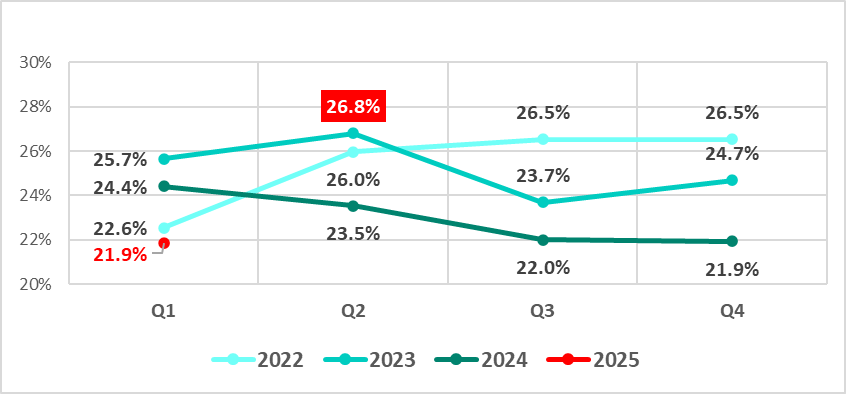
    MIL OSI Economics

  • MIL-OSI Economics: Thales powers one million digital payment experiences with Vipps mobile wallet in Norway

    Source: Thales Group

    Headline: Thales powers one million digital payment experiences with Vipps mobile wallet in Norway

    • Thales fully supports the success of Vipps, Norway’s leading mobile wallet, which has enabled over one million users for mobile contactless payments since December 2024.
    • Vipps wallet users are the first to benefit from a third-party mobile contactless payment solution on iOS, enabled by Thales D1 technology that securely digitizes payment cards on smartphone.
    • This milestone highlights Thales’ continued leadership in digital payments and its commitment to support fast, large-scale innovation in partnership with financial players.

    With the launch of NFC payments for iPhone and Android devices, Vipps became the first third-party wallet on iOS to offer this feature—an industry first. Behind this innovation, Thales provided the technology foundation, its D1 platform, that made this achievement possible, ensuring a smooth, secure, and scalable experience for Norwegian consumers.

    A breakthrough in everyday payments

    In just 24 hours after the launch, more than 200,000 digital cards were activated—clear proof of the demand for simple and secure digital payments. Behind the scenes, Thales D1 technology enabled users to get a digital payment card – just in few seconds – on Vipps’ wallet, and proceed with contactless payment at shops, getting on top real time transaction notification on their iPhones. Since the launch, Vipps users enjoy a fast and convenient alternative to traditional mobile wallets for everyday purchases.

    Currently supporting Norway’s domestic BankAxept cards, Vipps will expand to include international schemes such as Visa and Mastercard in the coming months, broadening its reach and usability across borders.

    Thales D1 platform boosting innovation ​

    Built for innovation, the D1 platform supported Vipps by adding contactless payment to their wallet. This showcases the platform’s ability to consistently add new innovative use cases, while providing a scalable and secure solution that grows with customer needs.

    The D1 platform is cloud-based and works in real time, making it easy to integrate with existing systems. It helps Thales customers respond to today’s expectations for secure, flexible, and instant payment services — such as modern card issuing, tokenization, or transaction control — while also preparing for the future of payments.

    Trusted collaboration driving success

    “Everything we do at Vipps is about simplifying life for people and businesses. Hitting one million users for contactless payments shows that this is something people really want. Now, we are looking forward to when our users can add Visa and Mastercard to Vipps, enabling them to tap their phones and pay with Vipps across the world. Our collaboration with Thales has been key to making all this happen.” Rune Garborg, CEO of Vipps MobilePay.

    “Driven by strong collaboration between our teams, we successfully met ambitious launch timelines and proved the strength of our operations — delivering a reliable, high-performance service that handled both the surge in demand at launch and the steady, high-volume usage that continues today.he D1 platform is also a key enabler of innovative digital payment services, helping financial players expand and thrive in an increasingly competitive payments landscape.” François Chaffard, Vice President Digital Payment Services at Thales.

    With this milestone, Thales reaffirms its role as a trusted partner in the future of digital payments, helping financial institutions offer flexible, future-ready solutions that meet consumers’ evolving expectations.

    MIL OSI Economics

  • MIL-OSI Economics: Samsung Marks Global Accessibility Awareness Day with a Unique Sound Experience At St Paul’s Cathedral

    Source: Samsung

     
    LONDON, U.K. – May 15, 2025: Samsung Electronics celebrated Global Accessibility Awareness Day this year with a week of accessibility events and workshops in the U.K. The company’s third edition of Accessibility Festival Week was brought to a close with a groundbreaking event at St Paul’s Cathedral in London, aimed at bringing customers, partners and employees together, through a unique sound experience.
     
    In collaboration with hearing-aid provider, GN, and Ampetronic, Samsung showcased Auracast technology to attendees wearing Galaxy Buds3 Pro or GN hearing aids, which allows a single device to broadcast to multiple receivers, to embark on a unique journey of shared listening.
     
    Attendees experienced the famous London Cathedral through a guided tour and choir performances. Audio of this experience was broadcasted using Auracast microphones and transmitters directly into participants’ Galaxy Buds3 Pro or GN hearing aids, eliminating background noise to enhance clarity.


    Auracast & LE Audio
    Introduced in 2022 by the Bluetooth Special Interest Group (SIG), Low Energy (LE) Audio is an updated standard for Bluetooth technology. It enables more power-efficient and higher-quality wireless transmission of audio from a broadcasting device such as a smartphone, to a receiver such as earbuds.
     
    Auracast is a feature of LE Audio that allows broadcasting from an audio source to multiple audio receivers, including earbuds and hearing aids, turning phones or TV’s into a radio station. It revolutionises audio experiences by enabling multiple devices to connect to a single audio source, fostering an inclusive listening environment. It also enhances audio clarity by reducing background noise, making it ideal for echo-prone venues like cathedrals and museums. Additionally, Auracast offers personalised sound settings, ensuring that users can tailor audio to their preferences and hearing needs, whether enjoying an audio tour or watching TV at home.
     
    Samsung has led efforts to ensure LE Audio compatibility for mobile devices and hearing aids. Since 2022, the company has been pushing for the expansion of LE Audio, introducing 360 Audio Recording and later adopting Auracast through the Buds2 Pro software update.
     
    Samsung’s commitment to hearing accessibility
    Among other areas, Samsung’s mission to redefine hearing accessibility has led to an unprecedented collaboration between mobile technology and hearing-aid innovation. With Auracast, Samsung bridges the gap between consumer audio and hearing devices, crafting a seamless, intelligent, and connected listening experience.
     
    Beyond Personal Audio: Now, both Galaxy Buds and hearing-aid users can tune into the same audio simultaneously, without limitations.
    Beyond Phones: When moving from your smartphone to TV, or from public to private spaces, sound stays with you—with no need to manually pair your device to each new transmitter. Anyone nearby can tune in freely to a shared audio stream, just like joining a public Wi-Fi.
    Beyond Boundaries: Whether at a stadium, airport or cafe, personalised audio is accessible in any setting.
     

    Accessibility Festival Week
    Ahead of bringing this vision to life at St Paul’s Cathedral, Samsung hosted its third annual Accessibility Festival Week (AFW) in London. The festival aims to reinforce the company’s commitment to accessibility and foster collaboration across departments and regions. Participants joined a host of activities,  including ‘Inspiration Tours’ exploring inclusive design practices at Samsung KX and Google’s Discovery Centre. Staff were invited to attend a number of accessibility workshops, and this was followed by a keynote session led by Simon Sung, President and CEO of Samsung Electronics Europe, and Jinsoo Kim, Head of the Samsung Accessibility Committee, who shared the company’s accessibility strategy and vision for inclusive innovation.
     
    A recent study by Samsung UK and OnePoll revealed that over two-thirds (68%) of UK adults with disabilities feel excluded from products and services due to accessibility issues, highlighting a significant gap in mainstream brands’ efforts to cater to diverse needs. 80% of respondents believe brands are missing out by neglecting inclusive design, while 72% have abandoned purchases due to inaccessible design.
     
    Speaking on this week’s activity of events, Charlotte Grant, Head of People Experience, Samsung UK, said: “At Samsung, we are proud of our ongoing commitment to increasing the accessibility of experiences through our innovation and we were delighted to partner with GN and Ampetronic to showcase Auracast at St Paul’s Cathedral. It was fantastic to take people through a innovative experience with inclusive technology  and a great way to end our Accessibility Festival Week in the UK. We are committed to directly involving our customers and employees in our decision-making by taking on their feedback to improve our products and services, and help support our mission to inspire a culture of inclusive design across our organisation, into our products and beyond.”
     
    To read more about Samsung’s commitment to accessibility, please visit: Accessibility | Samsung UK
     
    About GN 
     
    GN brings people closer through our leading intelligent hearing, audio, video, and gaming solutions. Inspired by people and driven by innovation, we deliver technologies that enhance the senses of hearing and sight. We help people with hearing loss overcome real-life challenges, improve communication and collaboration for businesses, and provide great experiences for audio and gaming enthusiasts.
     
    GN was founded more than 150 years ago with a vision to connect the world. Today, inspired by our strong heritage, GN touches more lives than ever with our unique expertise and the broadest portfolio of products and services in our history – bringing people closer to what is important to them.
    We market our solutions with the brands Jabra, ReSound, SteelSeries, Beltone, Interton, BlueParrott, Danavox, and FalCom in 100 countries. Founded in 1869, GN Group employs more than 7,000 people and is listed on Nasdaq Copenhagen (GN.CO).
     
    Visit GN.com and connect with us on LinkedIn, Facebook and  X.

    MIL OSI Economics

  • MIL-OSI Economics: Ministers Meet to Tackle Global Uncertainty and Rebuild Multilateral Trade System Jeju, Republic of Korea | 15 May 2025 Issued by the APEC Ministers Responsible for Trade Meeting Amid rising global trade and economic uncertainty, trade ministers are convening today for the 2025 APEC Ministers Responsible for Trade Meeting.

    Source: APEC – Asia Pacific Economic Cooperation

    Amid rising global trade and economic uncertainty, ministers responsible for trade from APEC’s 21 economies  convene today for the 2025 APEC Ministers Responsible for Trade (MRT) Meeting.

    Hosted by Korea on the UNESCO World Natural Heritage-listed Jeju Island, the meeting opened with a powerful call for cooperation and renewal of trust in the multilateral trading system.

    Chairing the meeting, Korea’s Minister for Trade Inkyo Cheong welcomed his counterparts and reflected on the island’s significance to APEC’s history and to the global trade community.

    “I would like to extend my sincere gratitude to everyone who has made the journey all the way to Jeju Island for this year’s APEC MRT meeting,” Minister Cheong said. “As one of the founding members of APEC in 1989, Korea began by hosting a multilateral meeting in 1991 in Seoul and hosted the MRT meeting in this very island in 2005.”

    “Two decades since then, I am honored to serve as the Chair of this gathering,” Minister Cheong added. “However, I also feel a sense of weight on my shoulders.”

    Minister Cheong acknowledged that APEC economies are facing overlapping challenges that are putting challenges on the global trade landscape.

    “As cross-border trade and interconnected supply chains continue to expand, growing uncertainties are placing a strain on the global economy and trade landscape,” he said. “Given this challenging global trade environment, the role of APEC is more crucial than ever. This is the reason why the world is paying keen attention to this year’s MRT meeting.”

    He emphasized that the discussions in Jeju would center on restoring multilateralism and positioning APEC economies for the future under the 2025 host economy’s theme of “Building a Sustainable Tomorrow – Connect, Innovate, Prosper”. Ministers will explore topics including artificial intelligence innovation for trade facilitation, the future of the World Trade Organization and the multilateral trading system, as well as ways to promote prosperity through sustainable trade.

    Highlighting the first session on artificial intelligence, he noted, “For the midst of the rapid transition toward the digital economy, AI is being adopted across a wide range of sectors.”

    He also introduced the second session on connectivity through the multilateral trading system. “Discussions on the multilateral trading system including the WTO have long been a focus of the MRT meeting,” he said. “WTO Director-General, Dr Ngozi Okonjo-Iweala, will open this session by introducing the topic for discussion. Given the varying opinions on the role and the direction of the WTO, I look forward to hearing insight and diverse views.”

    Closing the agenda, ministers will address prosperity through sustainable trade. “Given the many challenges facing the multilateral trading system, the very existence and the role of APEC has become increasingly evident. Indeed, I believe the outcomes of our discussions will resonate over the world,” said Cheong.

    He ended on a hopeful note, invoking Jeju’s spirit of resilience and collaboration. “Jeju Island has long embodied the values of community in its way of life. Under this spirit, I hope today’s MRT meeting will raise a solid foundation for dialogue and collaboration to overcome the political and economic challenges as well as uncertainties that we encounter.”

    “Building on the progress of today’s meeting, I look forward to producing meaningful outcomes at the APEC Economic Leaders’ Week,” Minister Cheong concluded.


    For further information or media inquiries, please contact:
    [email protected]

    MIL OSI Economics

  • MIL-OSI Economics: Women Entrepreneurs in Rural Mongolia Turn to Traditional Knowledge for Survival

    Source: Asia Development Bank

    Women in rural Mongolia face constant challenges due to the country’s harsh environment. They must navigate extreme weather to protect their herds and sustain agriculture livelihood to support their families. As temperatures fluctuate and winters grow harsher, the challenge to adapt has become a fight to survive.

    MIL OSI Economics

  • MIL-OSI Economics: Auracast Transforms Cathedral Acoustics With Unmatched Audio Clarity

    Source: Samsung

    Samsung Electronics is bringing people together through sound. The company will showcase the capabilities of Auracast technology by partnering with hearing-aid provider GN on a groundbreaking event at St. Paul’s Cathedral in London on May 16 to mark Global Accessibility Awareness Day (GAAD). Attendees wearing Galaxy Buds3 Pro or GN hearing aids will utilize Auracast, which allows a single audio source to broadcast to multiple receivers simultaneously and embark on a unique journey of shared listening.
    What’s Happening
    Attendees will experience the famous London cathedral through a guided tour and choral performances. Auracast microphones and transmitters will broadcast audio directly into participants’ Galaxy Buds3 Pro or GN hearing aids, decreasing background noise to enhance clarity. A select group was given the opportunity to discover the potential of Auracast – at a pilot event on May 1.
    “The Auracast experience with the tour guide was amazing,” said one participant. “Ordinarily I wouldn’t be able to join in with the tour because I would be unable to hear properly, but today it was completely different. This technology allowed me to hear everything so clearly so I didn’t miss a word.”

    Auracast and LE Audio
    What is LE Audio?1 Introduced in 2022 by the Bluetooth Special Interest Group, Low Energy (LE) Audio is an updated standard for Bluetooth technology. It enables more power-efficient and higher-quality wireless transmission of audio from a broadcasting device to a receiver such as from a smartphone to earbuds.
    Samsung has led efforts to increase LE Audio compatibility for mobile devices and hearing aids. Since 2022, the company has been pushing for the expansion of LE Audio, introducing 360 Audio Recording2 and adopting Auracast through the Buds2 Pro software update.
    What is Auracast? Auracast3 is a feature of LE Audio that allows broadcasting from a compatible audio source4 to multiple supported audio receivers5,6, including earbuds and hearing aids. Think of it as turning your phone into a radio station.

    Benefits of Auracast
    Shared Audio Experiences: As Auracast enables simultaneous audio streaming to multiple devices, listeners can enjoy a unified and enriched experience whether using ear buds or a compatible hearing aid. This represents a significant leap from traditional Bluetooth technology, which allows only one device to pair with an audio source.
    Seamless Audio Handoff: When moving from your smartphone to TV, or from public to private spaces, sound stays with you —as you don’t have to manually pair your device to each new audio source.
    Audio Clarity Anywhere: Auracast reduces background noise as audio is directly broadcast into your ears, providing a clearer sound experience. This is particularly beneficial in venues with loud echoes such as cathedrals and museums.
    Personalized Sound: Whether in a museum, a stadium, an airport or at home, Auracast allows you to tailor audio settings to your preferences. This customization ensures that users with varying hearing abilities can enjoy optimal clarity.
    Experience the benefits of Auracast with Galaxy Buds3 Pro
    The Big Picture
    Commitment to Accessibility: Samsung’s mission to redefine hearing accessibility has led to an unprecedented collaboration between mobile technology and hearing-aid innovation. With Auracast, Samsung bridges the gap between consumer audio and compatible hearing devices, crafting a seamless, intelligent and connected listening experience.
    1 Available on devices with Bluetooth 5.2 and above that support Auracast.
    2 360 Audio Recording is available on Galaxy Buds paired with a Galaxy smartphone running One UI 5.0 or above with LE Audio support, including the Galaxy S25 series, Z Fold6 and Z Flip6 and upcoming Galaxy smartphones. Requires installation of the latest software versions of the Galaxy smartphone and Galaxy Buds devices. To activate the feature, go to the Samsung Camera app > select Video mode and then tap Camera settings > tap Advanced video options > turn on 360 Audio Recording.
    3 The quality of the Auracast audio stream may vary depending on the application, network connection and other factors.
    4 Auracast Transmitter supported devices : Samsung Galaxy smartphones, tablets with Samsung One UI version 6.1 or later, and select TV models. Supported Galaxy smartphone and tablet models include: S25, S25+, S25 Ultra, S24, S24+, S24 Ultra, S24 FE, S23 (except FE edition), S23+, S23 Ultra, Galaxy Z Flip6, Galaxy Z Fold6, Galaxy Z Flip5, Galaxy Z Fold5, A56, Tab S10+, Tab S10 Ultra, Tab S9+, Tab S9, Tab S9 Ultra. Supported TV models include: 2025 Neo QLED 8K QN990F, QN950F, QN900F, 2024 NeoQLED 8K QND800, QND850, QND900, 2024 MICRO LED models, 2023 Neo QLED 8K QNC 800, QNC900 and 2023 MICRO LED models.
    5 Auracast Assistant supported devices : Samsung Galaxy smartphones, tablets with Samsung One UI version 6.1 or later
    Supported Galaxy smartphone and tablet models include: S25, S25+, S25 Ultra, S24, S24+, S24 Ultra, S24 FE, S23, S23+, S23 Ultra, S23FE, Z Fold6, Z Flip6, Z Fold5, Z Flip5, Z Fold4, Z Flip4, A56, A55, A54, A36, XCover7 Pro,
    Tab S10+, Tab S10 Ultra, Tab Active5 Pro, TabS10 FE, Tab S10 FE+, Tab S9, Tab S9+, Tab S9 Ultra, Tab S9 FE
    6 Auracast Receiver supported devices : Galaxy Buds3, Buds3 Pro, Buds2 Pro

    MIL OSI Economics

  • MIL-OSI Economics: Designing for Everyone: How Samsung Embeds Accessibility at the Heart of Innovation

    Source: Samsung

     
    At Samsung, innovation begins with empathy. On Global Accessibility Awareness Day, we pause to reflect on a simple yet powerful idea: technology should be for everyone. Inclusive technology that helps individuals with disabilities achieve their goals.
     
    Whether it is a refrigerator that anticipates your needs, a smartwatch that recognises your voice, or a television that listens and responds, our goal remains unchanged.  We are creating meaningful experiences for everyone, regardless of ability.
     
    We prioritize accessibility in our products by addressing vision, hearing, mobility, and cognitive needs, ensuring that everyone has an equitable experience.
     
    Accessibility is a Design Principle
    At Samsung, accessibility is a design principle. It is a lens through which we approach innovation. From the nascent stages of product development, Samsung designers and engineers work hand-in-hand with users with diverse abilities.
     
    This philosophy guides everything—from tactile buttons on remote controls to AI voice assistance in our home appliances.
     
    Led by its “AI for All” vision, Samsung continues to develop smart home appliances that are intuitive and convenient for diverse home environments. These accessibility features are designed to make appliances easier to use for individuals with disabilities and older adults, reflecting the company’s commitment to inclusive design.
     
    Intelligence That Understands and Adapts
    The Bespoke AI Double Door Refrigerator, for instance, uses advanced AI to learn routines and preferences, reducing effort and enhancing usability for everyone, including those with mobility or cognitive challenges. It’s about designing appliances that not only respond but anticipate. Samsung appliances enhance everyday living by offering accessibility, adaptability, and aesthetic design, all at once.
     
    From Refrigerators to Vacuum Cleaners, for specific products, find all features here:
     
    https://www.samsung.com/in/sustainability/accessibility/home-appliances/
     
    The Galaxy Ecosystem
    Inclusive by Design, the Galaxy wearable ecosystem, accessibility and AI go hand-in-hand. From gesture controls to real-time voice feedback and customizable touch interactions, these devices empower users to navigate their world more independently—no matter their ability. The launch of Galaxy Ring marks a massive leap in Samsung’s commitment to democratize cutting-edge technology for everyone, helping users turn data into meaningful insights and create a whole new world of expanded, intelligent health experiences. Galaxy Ring is not just another wearable, it’s a revolutionary health-tech device that blends innovation with accessibility.
     
    Find a detailed overview of all the features here:
     
    https://www.samsung.com/in/sustainability/accessibility/mobile/
     
    Visual Innovation for All
    Samsung Neo QLED TVs offer innovations like AI-powered captioning, audio description, and screen reader functions, helping users with hearing or vision impairments experience entertainment on their own terms.
     
    You can access all the accessibility features related to Vision, Hearing and Mobility here:
     
    https://www.samsung.com/in/sustainability/accessibility/tv-audio/
     
    Technology is powerful when it includes everyone. As we observe Global Accessibility Awareness Day, we remain committed to breaking down barriers and building bridges—with every product, every update, and every idea. At Samsung, “AI for All” is not a tagline. It’s our promise.

    MIL OSI Economics

  • MIL-OSI Economics: Underwriting Auction for sale of Government Securities for ₹25,000 crore on May 16, 2025

    Source: Reserve Bank of India

    Government of India has announced the sale (re-issue) of Government Securities, as detailed below, through auctions to be held on May 16, 2025 (Friday).

    As per the extant scheme of underwriting commitment notified on November 14, 2007, the amounts of Minimum Underwriting Commitment (MUC) and the minimum bidding commitment under Additional Competitive Underwriting (ACU) auction, applicable to each Primary Dealer (PD), are as under:

    (₹ crore)
    Security Notified Amount MUC amount per PD Minimum bidding commitment per PD under ACU auction
    6.79% GS 2031 11,000 262 262
    7.09% GS 2074 14,000 334 334

    The underwriting auction will be conducted through multiple price-based method on May 16, 2025 (Friday). PDs may submit their bids for ACU auction electronically through Core Banking Solution (E-Kuber) System between 09:00 A.M. and 09:30 A.M. on the day of underwriting auction.

    The underwriting commission will be credited to the current account of the respective PDs with RBI on the day of issue of securities.

    Ajit Prasad          
    Deputy General Manager
    (Communications)    

    Press Release: 2025-2026/327

    MIL OSI Economics