Denver, CO, June 23, 2025 (GLOBE NEWSWIRE) — Usbit trading center, a global digital asset trading platform, has officially launched its new logo and visual identity to coincide with the anniversary of its founding. The announcement marks a pivotal moment in the company’s growth trajectory, reinforcing its brand values of security, innovation, and global accessibility at a time of accelerated adoption of digital assets worldwide.
The new logo retains elements of the original brand mark but introduces a sharper, more modern design that symbolizes clarity, stability, and forward momentum. Accompanying the updated logo is a refined visual system, including a revised color palette, typographic standards, and iconography aimed at enhancing brand recognition across markets and platforms.
The rebranding effort comes as usbit trading center continues to expand its presence across north america, europe, and asia. The updated identity supports this internationalization strategy by offering a unified, scalable brand architecture that can adapt to various digital and physical touchpoints—from trading interfaces and mobile applications to investor education materials and institutional portals.
“the launch of our new identity is more than just a visual change,” said a usbit trading center spokesperson. “it is a reaffirmation of what usbit trading center stands for: secure infrastructure, transparent operations, and accessible digital finance for all. This milestone aligns with our evolution as a mature and compliant platform that meets the demands of both retail and institutional investors.”
Since its founding, usbit trading center has prioritized the integration of cutting-edge technologies, user education, and regulatory alignment. Over the past year, the platform introduced reserve mode accounts, expanded support for defi asset access, and accelerated its engagement with us and international regulators.
The company’s design team collaborated with international branding consultants to ensure the new visual identity communicates stability and trust—key themes for investors seeking reliability in a volatile market. The logo design draws on geometric precision and clean symmetry, reflecting the platform’s technical rigor and operational clarity.
In parallel with the logo update, usbit trading center has also refreshed its user interface to align with the new design language, offering a cleaner, more intuitive trading experience. Enhanced ui elements include improved accessibility features, dark/light mode support, and responsive design optimized for mobile-first engagement.
As part of the anniversary celebration, usbit trading center will roll out a series of community engagement events and digital campaigns under the theme “trust the evolution,” aimed at highlighting the company’s journey and future vision. Educational resources, partner interviews, and historical retrospectives will be released throughout the quarter.
Usbit trading center’s rebranding underscores its positioning as a reliable, compliant, and globally oriented exchange. With renewed visual clarity and strategic consistency, the platform is poised to enter its next phase of development as digital assets move deeper into the global financial mainstream.
Disclaimer: The information provided in this press release is not a solicitation for investment, nor is it intended as investment advice, financial advice, or trading advice. It is strongly recommended you practice due diligence, including consultation with a professional financial advisor, before investing in or trading cryptocurrency and securities.
Invest Africa (www.InvestAfrica.com) is pleased to announce Africa Finance Corporation (AFC) as Headline Partner for the 11th edition of The Africa Debate, taking place on Wednesday, 2 July 2025 at the Guildhall, in the heart of the City of London.
This year’s theme — “Harnessing Natural Capital for Growth” — seeks to interrogate how Africa can transform the scale and structure of investment around its most enduring assets: from its critical minerals and fertile land to its human ingenuity and demographic dynamism.
Now firmly established as the UK’s premier forum for Africa-focused investment dialogue, The Africa Debate will convene over 700 senior decision-makers from across government, finance, and industry for a full day of high-level exchanges. Through keynote addresses, ministerial dialogues, and curated sector debates, the programme will explore how to turn extractive advantage into structural transformation — mobilising green industrialisation, digital infrastructure, intra-African trade, and new financial instruments to drive inclusive, climate-smart growth.
This year’s speaker line-up reflects the extraordinary breadth of voices shaping Africa’s next chapter, from heads of state to the stewards of global capital. Highlights include: H.E. William Ruto, President of the Republic of Kenya; H.E. Hailemariam Desalegn Boshe, Former Prime Minister of Ethiopia; Board Chair, TradeMark Africa; H.E. Wamkele Mene, Secretary-General, African Continental Free Trade Area Secretariat; Benedict Oramah, President, Afreximbank; Samaila Zubairu, President & CEO, Africa Finance Corporation; Abebe Aemro Selassie, Director, African Department, International Monetary Fund; Solomon Quaynor, Vice President for Private Sector, Infrastructure & Industrialisation, African Development Bank; Strive Masiyiwa, Founder & Chair, Econet Wireless; Duncan Wanblad, CEO, Anglo American; Wale Tinubu, CEO, Oando Plc; Monique Gieskes, CEO, PHC; Marie-Chantal Kaninda, President, Glencore DRC; and more. The full programme is now available to view here (http://apo-opa.co/4ljJqbx), with detailed sessions on value chain transformation, blended finance, regional infrastructure, and Africa’s positioning in a multipolar global economy.
Samaila Zubairu, President and CEO of Africa Finance Corporation, commented: “Natural capital is only as valuable as the systems that refine, protect, and elevate it. At AFC, we believe that infrastructure is the bridge between Africa’s resource richness and the continent’s ability to rapidly industrialise and take its rightful place on the global stage. Our partnership with Invest Africa and The Africa Debate underscores the need for thoughtful, long-term capital — deployed strategically — to unlock the continent’s full economic potential. We are proud to support a platform that challenges assumptions and catalyses bold, bankable solutions.”
Chantelé Carrington, CEO of Invest Africa, added: “Africa’s path to prosperity must be built not on extraction, but on transformation. This year’s theme compels us to ask harder questions about how we steward the continent’s assets — human, natural, and institutional — in a world shaped by climate change, technological disruption, and shifting geopolitical priorities. With AFC’s visionary leadership, we are honoured to convene a dialogue that is ambitious in scope, rigorous in thought, and focused on meaningful outcomes.”
Confirmed Sponsors of The Africa Debate Include: Africa Finance Corporation (Headline Partner), Absa Group, Afreximbank, FirstBank UK Limited, Invest KZN, Standard Chartered, Standard Bank Group, Plantations et Huileries du Congo, Lagos Free Zone (Tolaram), Octopus Energy, ServiceNow, Stellar Developments, Spiro, Safaricom, Premier Invest, Remittances Hub, S-RM, DLA Piper, and London Stock Exchange Group.
To register as a delegate for The Africa Debate, please visit: https://apo-opa.co/4efWGM0. Places are limited and advance registration is essential.
Distributed by APO Group on behalf of Invest Africa.
For more information or media enquiries, please contact: Pippa van Breda Marketing & Communications Manager Invest Africa T: +44 2037 305 035 E: pippa.vanbreda@investafrica.com
About The Africa Debate: The Africa Debate is London’s premier investment forum dedicated to shaping the future of African trade, investment, and economic transformation. Now in its 11th year, the event serves as a critical platform for global businesses, investors, policymakers, and thought leaders to engage in high-level discussions on Africa’s evolving role in the global economy.
About Invest Africa: Invest Africa is a leading pan-African business platform that promotes trade and investment across the continent. With a 60-year heritage and a network of over 400 global members, Invest Africa provides trusted intelligence, strategic connections, and high-level convenings to support business success across African markets.
About Africa Finance Corporation: Africa Finance Corporation is Africa’s leading multilateral finance institution, focused on bridging the continent’s infrastructure gap through innovative, commercially viable, and sustainable investments.
Source: United Kingdom – Executive Government Non-Ministerial Departments 2
News story
CNC praised for meeting 2024 – 2025 objectives
All officers and staff across the Constabulary have been praised for meeting the key strategic objectives upon which the force is measured.
The Annual Business Plan 2024/2025.
The CNC’s Annual Business Plan outlines objectives for the CNC to achieve each year. Under three strategic goals, the plan detailed 43 separate focus areas for delivery over the last financial year. At this time, 93 percent of these have been met completely, with those remaining on track from delivery shortly.
The achievements included, amongst other things:
Expanded our operations to cover four new non-nuclear sites, successfully transitioning officers in from the Ministry of Defence Police to join our ranks
Over 4,600 Project Servator deployments were completed as well as continued partnership working with Home Office forces in the areas around our sites
Continued to support national armed policing capacity, providing mutual aid to other police forces at various high-profile events, including the Paris Olympics and the Conservative Party annual conference
Successfully delivered the Vessel Protection Pilot on behalf of the Home Office, with CNC officers deployed to cross-channel ferries
Delivered improvements to the facilities at Firearms Training Unit South (Bisley), maintaining our world-class training capabilities
Fully implementing a new apprenticeship scheme, with 159 recruits starting the programme within the year, of which 85 have completed their initial training and 53 are still undertaking initial training
Professional Development Units (PDUs) established and embedded at all sites to support the continuous development of skills and standards
Demonstrated our flexibility by working with stakeholders on both new-build nuclear projects and managing the cessation of services at other sites
Made huge progress in our Cultural Action Plan, the launch of the new Code of Ethics, and a wide range of initiatives led by our four affinity networks to progress our Equality, Diversity and Inclusion priorities
Civil Nuclear Police Authority Chair, Susan Johnson, OBE, congratulated the CNC on meeting its objectives, stating:
“Last year saw a huge effort across all parts of the organisation, by officers and staff.
“Being able to maintain the core mission on sites, whilst also undertaking additional initiatives on behalf of other partners, including the Home Office, is commendable.
“The CNC’s performance last year belies the size of the organisation and demonstrates what a vital national asset the CNC has become since its inception twenty years ago.
“I am certain the organisation will also excel in meeting the ambitious objectives which have been outlined in its business plan for this year too.”
Chief Constable Simon Chesterman also thanked all members of the organisation:
“Whether it’s delivering proactive, visible policing, or the work of police staff in our enabling services, it is through teamwork and dedication to our role that sees another year of strong operational performance and innovation.
“In addition to strengthening our operational capabilities and taking on new sites, we have also seen some real progress with our organisational culture too.
“We set out a challenging programme of work for the past year and I am immensely proud of what we have achieved, and grateful to everyone for their contribution.”
Indosuez Wealth Management plans to acquire the“Wealth Management” clients of the BNP Paribas Group in Monaco
Indosuez Wealth Management, the wealth management subsidiary of the Crédit Agricole Group, announces that its entity in Monaco, CFM Indosuez, has signed an agreement to acquire the Wealth Management clients of the BNP Paribas Group subsidiary in Monaco.
This acquisition would enable Indosuez Wealth Management to assert its leading position on the Monegasque market in which it has been present since 1922.
The BNP Paribas Group’s Wealth Management clients in Monaco will benefit from continuity in the support they receive. They will benefit from the local presence of experts with recognised know-how. They will have access to one of the most comprehensive services on the market, resulting in particular from the universal nature of CFM Indosuez’s offer in the Principality and its position as a leading bank. They will also be able to continue to benefit from an international network, multiple financing capabilities, expertise in corporate finance, fund servicing and management, as well as the solidity of Crédit Agricole, the 9th largest bank in the world. This transaction is complemented by a strategic business partnership with the BNP Paribas Group to provide long-term support to its clients with Wealth Management needs in Monaco.
For Jacques Prost, Chief Executive Officer of Indosuez Wealth Management: “This acquisition would strengthen our position in Monaco with ultra-high net worth clients (UHNW). Indosuez is pursuing its growth strategy in a sector undergoing consolidation and is a major player in wealth management in Europe.”
Mathieu Ferragut, CEO of CFM Indosuez Wealth Management and Deputy CEO of Indosuez Wealth Management, adds: “We are delighted to welcome the Wealth Management clients of BNP Paribas Group’s Monaco subsidiary. This strengthens our position as Monaco’s leading bank and number one employer. We will work together to make this acquisition a success for both clients and employees.”
Françoise Puzenat, Head of Monaco at BNP Paribas says: “We are delighted with the agreement reached with CFM Indosuez, a recognised player in the market and with all the assets needed to ensure the best possible continuity of service for our clients and the employees who join them. The sale of the Wealth Management business in Monaco is part of our strategic decision to refocus our local activities on a single platform. BNP Paribas will continue to develop its domestic commercial banking business line in Monaco, which includes corporate banking, private banking and retail banking.”
The finalisation of the transaction remains subject to the prior approval of the relevant supervisory authorities, and is expected to be completed during the first half of 2026.
The impact on Crédit Agricole S.A.’s CET1 ratio would be limited.
****
Indosuez Wealth Management contacts
Indosuez Group: Jenny Sensiau I jenny.sensiau@ca-indosuez.com I +33 7 86 22 15 24
Indosuez Wealth Management is the global wealth management brand of the Crédit Agricole Group, the world’s 9th largest bank by balance sheet (The Banker 2024). For over 150 years, Indosuez Wealth Management has been helping major private clients, families, entrepreneurs and professional investors to manage their private and professional assets. The bank offers a customised approach enabling each of its clients to preserve and develop their wealth in line with their aspirations. Its teams offer a continuum of services and offers that include advisory, financing, investment solutions, fund servicing, and technology and banking solutions. Indosuez Wealth Management employs more than 4,500 people in 16 territories around the world: in Europe (Belgium, France, Germany, Italy, Luxembourg, Netherlands, Portugal, Monaco, Spain and Switzerland), Asia-Pacific (Hong Kong SAR, New Caledonia and Singapore), the Middle East (Dubai, Abu Dhabi) and Canada (representative office). With €215 billion in client assets at the end of December 2024, Indosuez Wealth Management is one of Europe’s leading wealth management companies. Find out more at ca-indosuez.com
About CFM Indosuez Wealth Management
The Indosuez Wealth Management network is embodied in Monaco through CFM Indosuez Wealth Management, the leading bank in the Principality. Its roots go back to 1922, the year it was founded by a number of prominent Monegasque families, some of whom are still shareholders, alongside the majority shareholder (70%), the Crédit Agricole Group. With the largest trading room in Monaco and 5 branches in the region, its teams, comprised of nearly 400 highly specialised employees, combine their knowledge of the Principality’s international environment with the vast expertise and opportunities of the international network of Indosuez Wealth Management and the Crédit Agricole Group. In addition to Wealth Management, its leading activity, CFM Indosuez Wealth Management serves all clients, whether private, institutional, corporate or professional. CFM Indosuez is also the leading bank in Corporate Finance in Monaco. In 2024, CFM Indosuez was named best bank in the Principality by international magazine Global Finance for the eighth consecutive year. Find us at cfm-indosuez.mc
About BNP Paribas in Monaco
BNP Paribas Wealth Management is a leading global private bank and the largest private bank in the Eurozone with €469 billion in assets under management as of March 2025. Present in 3 regions (Europe, Asia and the Middle East), it employs more than 6,700 professionals who support individuals, entrepreneurs and large families in protecting, growing and passing on their assets. The bank aims to build a sustainable future by combining its expertise and reach with its clients’ influence and desire to make an impact. Find us on https://wealthmanagement.bnpparibas/fr.htm
Coface strengthens its strategic focus on data and innovation, and continues to invest in its Information Services growth
Paris, 23 June 2025 – 17.45
Coface announces the creation of a dedicated technological hub focused on data, connectivity, and product innovation led by Thibault Surer, Group Strategy and Development Director. Thibault Surer will continue to oversee Strategy, Economic research, Marketing, and Mergers & Acquisitions.
Coface also announces the appointment of Joerg Diewald as Information Services and Partnerships Director to support and accelerate the business development of these two strategic activities.
These changes will be effective from July 1st, 2025.
These appointments strengthen Coface’s governance and are perfectly in line with the Group’s strategic focus, notably around data and innovation.
Xavier Durand,Coface’s Chief Executive Officer, commented: “Over the last 12 months, we have made significant progress in Information Services and data. This strengthening of governance is an important step of our continued efforts and will allow us to face up the complexity and scale of the transformation required. These appointments are perfectly in line with the objectives of our strategic plan Power The Core, which aims to reach data and technology excellence and generate a grow profitably Information Services.”
Thibault Surer, Group Strategy and Development Director will lead a dedicated technological hub focused on data, connectivity, and product innovation while continuing to oversee Strategy, Economic research, Marketing, and Mergers & Acquisitions.
As our investments in data and innovation grow, it is becoming clear that the complexity and scale of the transformations required in these domains deserve greater attention and a strengthened governance. This is the objective behind the creation of the technology hub.
Joerg Diewald, appointed as the new Global Head of Information Services and partnerships will focus on the business development of these two strategic activities.
Before joining Coface, he served as Chief Commercial Officer and Board Member at Solarisbank AG in Berlin, a Fintech company operating in the digital banking industry. Joerg brings more than 30 years of international experience in banking, commercial finance, and risk management.
Based in Mainz, Germany, Joerg Diewald directly reports to Xavier Durand, Chief Executive Officer of Coface.
H1-2025 results: 31 July 2025 (after market close) 9M-2025 results: 3 November 2025 (after market close)
FINANCIAL INFORMATION This press release, as well as COFACE SA’s integral regulatory information, can be found on the Group’s website: http://www.coface.com/Investors
For regulated information on Alternative Performance Measures (APM), please refer to our Interim Financial Report for H1-2024 and our 2024 Universal Registration Document (see part 3.7 “Key financial performance indicators”).
Regulated documents posted by COFACE SA have been secured and authenticated with the blockchain technology by Wiztrust. You can check the authenticity on the websitewww.wiztrust.com.
COFACE: FOR TRADE As a global leading player in trade credit risk management for more than 75 years, Coface helps companies grow and navigate in an uncertain and volatile environment. Whatever their size, location or sector, Coface provides 100,000 clients across some 200 markets with a full range of solutions: Trade Credit Insurance, Business Information, Debt Collection, Single Risk insurance, Surety Bonds, Factoring. Every day, Coface leverages its unique expertise and cutting-edge technology to make trade happen, in both domestic and export markets. In 2024, Coface employed ~5,236 people and registered a turnover of €1.84 billion.
COFACE SA is quoted in Compartment A of Euronext Paris Code ISIN: FR0010667147 / Ticker: COFA
DISCLAIMER – Certain declarations featured in this press release may contain forecasts that notably relate to future events, trends, projects or targets. By nature, these forecasts include identified or unidentified risks and uncertainties, and may be affected by many factors likely to give rise to a significant discrepancy between the real results and those stated in these declarations. Please refer to chapter 5 “Main risk factors and their management within the Group” of the Coface Group’s 2024 Universal Registration Document filed with AMF on 5 April 2024 under the number D.25-0227 in order to obtain a description of certain major factors, risks and uncertainties likely to influence the Coface Group’s businesses. The Coface Group disclaims any intention or obligation to publish an update of these forecasts, or provide new information on future events or any other circumstance.
Coface strengthens its strategic focus on data and innovation, and continues to invest in its Information Services growth
Paris, 23 June 2025 – 17.45
Coface announces the creation of a dedicated technological hub focused on data, connectivity, and product innovation led by Thibault Surer, Group Strategy and Development Director. Thibault Surer will continue to oversee Strategy, Economic research, Marketing, and Mergers & Acquisitions.
Coface also announces the appointment of Joerg Diewald as Information Services and Partnerships Director to support and accelerate the business development of these two strategic activities.
These changes will be effective from July 1st, 2025.
These appointments strengthen Coface’s governance and are perfectly in line with the Group’s strategic focus, notably around data and innovation.
Xavier Durand,Coface’s Chief Executive Officer, commented: “Over the last 12 months, we have made significant progress in Information Services and data. This strengthening of governance is an important step of our continued efforts and will allow us to face up the complexity and scale of the transformation required. These appointments are perfectly in line with the objectives of our strategic plan Power The Core, which aims to reach data and technology excellence and generate a grow profitably Information Services.”
Thibault Surer, Group Strategy and Development Director will lead a dedicated technological hub focused on data, connectivity, and product innovation while continuing to oversee Strategy, Economic research, Marketing, and Mergers & Acquisitions.
As our investments in data and innovation grow, it is becoming clear that the complexity and scale of the transformations required in these domains deserve greater attention and a strengthened governance. This is the objective behind the creation of the technology hub.
Joerg Diewald, appointed as the new Global Head of Information Services and partnerships will focus on the business development of these two strategic activities.
Before joining Coface, he served as Chief Commercial Officer and Board Member at Solarisbank AG in Berlin, a Fintech company operating in the digital banking industry. Joerg brings more than 30 years of international experience in banking, commercial finance, and risk management.
Based in Mainz, Germany, Joerg Diewald directly reports to Xavier Durand, Chief Executive Officer of Coface.
H1-2025 results: 31 July 2025 (after market close) 9M-2025 results: 3 November 2025 (after market close)
FINANCIAL INFORMATION This press release, as well as COFACE SA’s integral regulatory information, can be found on the Group’s website: http://www.coface.com/Investors
For regulated information on Alternative Performance Measures (APM), please refer to our Interim Financial Report for H1-2024 and our 2024 Universal Registration Document (see part 3.7 “Key financial performance indicators”).
Regulated documents posted by COFACE SA have been secured and authenticated with the blockchain technology by Wiztrust. You can check the authenticity on the websitewww.wiztrust.com.
COFACE: FOR TRADE As a global leading player in trade credit risk management for more than 75 years, Coface helps companies grow and navigate in an uncertain and volatile environment. Whatever their size, location or sector, Coface provides 100,000 clients across some 200 markets with a full range of solutions: Trade Credit Insurance, Business Information, Debt Collection, Single Risk insurance, Surety Bonds, Factoring. Every day, Coface leverages its unique expertise and cutting-edge technology to make trade happen, in both domestic and export markets. In 2024, Coface employed ~5,236 people and registered a turnover of €1.84 billion.
COFACE SA is quoted in Compartment A of Euronext Paris Code ISIN: FR0010667147 / Ticker: COFA
DISCLAIMER – Certain declarations featured in this press release may contain forecasts that notably relate to future events, trends, projects or targets. By nature, these forecasts include identified or unidentified risks and uncertainties, and may be affected by many factors likely to give rise to a significant discrepancy between the real results and those stated in these declarations. Please refer to chapter 5 “Main risk factors and their management within the Group” of the Coface Group’s 2024 Universal Registration Document filed with AMF on 5 April 2024 under the number D.25-0227 in order to obtain a description of certain major factors, risks and uncertainties likely to influence the Coface Group’s businesses. The Coface Group disclaims any intention or obligation to publish an update of these forecasts, or provide new information on future events or any other circumstance.
Source: United States Small Business Administration
SACRAMENTO, Calif. – The U.S. Small Business Administration (SBA) is reminding private nonprofit (PNP) organizations in Missouri of the July 22, deadline to apply for low interest federal disaster loans to offset physical damage caused by severe winter storms, straight-line winds, tornadoes and flooding occurring March 30–April 8.
The disaster declaration covers the Missouri counties of Bollinger, Butler, Cape Girardeau, Carter, Cooper, Douglas, Dunklin, Howell, Iron, Madison, Maries, Mississippi, New Madrid, Oregon, Ozark, Pemiscot, Reynolds, Ripley, Scott, Shannon, Stoddard, Texas, Vernon, Wayne and Webster.
Under this declaration, PNPs providing services of a governmental nature are eligible to apply for business physical disaster loans. Eligible PNPs may borrow up to $2 million to repair or replace disaster-damaged or destroyed real estate, machinery and equipment, inventory, and other business assets.
Applicants may be eligible for a loan amount increase of up to 20% of their physical damages, as verified by the SBA, for mitigation purposes. Eligible mitigation improvements might include insulating pipes, walls and attics, weather stripping doors and windows, and installing storm windows to help protect property and occupants from future damage caused by any disaster.
“One distinct advantage of SBA’s disaster loan program is the opportunity to fund upgrades reducing the risk of future storm damage,” said Chris Stallings, associate administrator of the Office of Disaster Recovery and Resilience at the SBA. “I encourage businesses and homeowners to work with contractors and mitigation professionals to improve their storm readiness while taking advantage of SBA’s mitigation loans.”
PNPs are also eligible to apply for Economic Injury Disaster Loans (EIDLs) to help meet working capital needs. The loans may be used to pay fixed debts, payroll, accounts payable, and other bills not paid due to the disaster. EIDL assistance is available regardless of whether the PNP suffered any physical property damage.
Interest rates can be as low as 3.62% with terms up to 30 years. Interest does not accrue, and payments are not due, until 12 months from the date of the first loan disbursement. The SBA sets loan amounts and terms based on each applicant’s financial condition.
The SBA encourages applicants to submit their loan applications promptly. Applications will be prioritized in the order they are received, and the SBA remains committed to processing them as efficiently as possible.
To apply online, visit sba.gov/disaster. Applicants may also call SBA’s Customer Service Center at (800) 659-2955 or email disastercustomerservice@sba.gov for more information on SBA disaster assistance. For people who are deaf, hard of hearing, or have a speech disability, please dial 7-1-1 to access telecommunications relay services.
The deadline to return physical damage applications is July 22, 2025. The deadline to return economic injury applications is Feb. 23, 2026.
###
About the U.S. Small Business Administration
The U.S. Small Business Administration helps power the American dream of business ownership. As the only go-to resource and voice for small businesses backed by the strength of the federal government, the SBA empowers entrepreneurs and small business owners with the resources and support they need to start, grow, expand their businesses, or recover from a declared disaster. It delivers services through an extensive network of SBA field offices and partnerships with public and private organizations. To learn more, visit www.sba.gov.
DULLES, Va., June 23, 2025 (GLOBE NEWSWIRE) — The National Rural Utilities Cooperative Finance Corporation (CFC) has completed its analysis of the 2024 Key Ratio Trend Analysis (KRTA), an annual report of financial trends among electric distribution cooperatives nationwide.
Now in its 50th year, the KRTA continues to provide valuable insights into the financial health of the cooperative network. The latest results reaffirm that, amid elevated interest rates and persistent inflation, electric cooperatives maintained stable financial performance and steady consumer growth. Most notably, the 2024 results highlighted continued strong investment in utility plant—reinforcing the sector’s long-term commitment to infrastructure and service reliability.
“Amid a complex economic environment in 2024, rural electric cooperatives remained focused and adaptable,” CFC Senior Vice President and Chief Corporate Affairs Officer Brad Captain said. “Their performance this year reflects the continued strength of the cooperative business model.”
Consumer growth held steady in 2024, with nearly 89% of cooperatives reporting increases. Utah, Idaho and Florida were among those states with the highest growth rates. This steady expansion was accompanied by continued investment in utility plant, extending the momentum of sustained infrastructure growth seen in recent years.
“Cooperatives are making smart, long-term investments to support future growth,” CFC Senior Vice President of Strategic Services Amy Luongo said. “Their focus remains on building stronger systems and serving their communities well.”
Electricity sales, which had moderated in 2023, rebounded in 2024—reflecting renewed growth in system usage across much of the network.
Financial ratios in 2024 continued to reflect the underlying strength of the cooperative network. The median equity-to-asset ratio remained solid at 45%, while long-term debt accounted for just under 43% of total assets—illustrating a well-balanced capital structure. Coverage ratios were also healthy, with the median times interest earned ratio at 2.60 and modified debt service coverage at 1.86, signaling strong earnings relative to debt obligations.
“These indicators underscore the ability of cooperatives to manage capital needs while maintaining financial flexibility and long-term stability,” Luongo said.
Final KRTA results are based on data submitted by 815 electric distribution cooperatives for the year ending Dec. 31, 2024. CFC calculates 145 financial and operational ratios for each cooperative and provides a report showing the cooperative’s ratios compared with U.S., state and other key consumer group median values. Median reporting minimizes the effect of outliers and offers a more representative picture of overall performance.
About CFC Created and owned by America’s electric cooperative network, the National Rural Utilities Cooperative Finance Corporation (CFC)—a nonprofit finance cooperative with approximately $38 billion in assets—provides unparalleled industry expertise, flexibility and responsiveness to serve the needs of our member-owners. CFC is an equal opportunity provider. Visit us online at www.nrucfc.coop.
About KRTA CFC has published KRTA—an annual report that tracks the median value of 145 financial and operational ratios for participating electric distribution cooperatives over the previous five years—since 1975. Based on data reported by electric distribution cooperatives, KRTA provides electric cooperative CEOs and directors/trustees with a complete picture of their system’s financial performance. In 2023, CFC introduced KRTA Pro, a new online platform that offers a 20-plus year view of KRTA ratios, enabling deeper trend analysis and enhanced access to historical benchmarking.
Contact: Brad Captain Corporate Relations Group 800-424-2954
DULLES, Va., June 23, 2025 (GLOBE NEWSWIRE) — The National Rural Utilities Cooperative Finance Corporation (CFC) has completed its analysis of the 2024 Key Ratio Trend Analysis (KRTA), an annual report of financial trends among electric distribution cooperatives nationwide.
Now in its 50th year, the KRTA continues to provide valuable insights into the financial health of the cooperative network. The latest results reaffirm that, amid elevated interest rates and persistent inflation, electric cooperatives maintained stable financial performance and steady consumer growth. Most notably, the 2024 results highlighted continued strong investment in utility plant—reinforcing the sector’s long-term commitment to infrastructure and service reliability.
“Amid a complex economic environment in 2024, rural electric cooperatives remained focused and adaptable,” CFC Senior Vice President and Chief Corporate Affairs Officer Brad Captain said. “Their performance this year reflects the continued strength of the cooperative business model.”
Consumer growth held steady in 2024, with nearly 89% of cooperatives reporting increases. Utah, Idaho and Florida were among those states with the highest growth rates. This steady expansion was accompanied by continued investment in utility plant, extending the momentum of sustained infrastructure growth seen in recent years.
“Cooperatives are making smart, long-term investments to support future growth,” CFC Senior Vice President of Strategic Services Amy Luongo said. “Their focus remains on building stronger systems and serving their communities well.”
Electricity sales, which had moderated in 2023, rebounded in 2024—reflecting renewed growth in system usage across much of the network.
Financial ratios in 2024 continued to reflect the underlying strength of the cooperative network. The median equity-to-asset ratio remained solid at 45%, while long-term debt accounted for just under 43% of total assets—illustrating a well-balanced capital structure. Coverage ratios were also healthy, with the median times interest earned ratio at 2.60 and modified debt service coverage at 1.86, signaling strong earnings relative to debt obligations.
“These indicators underscore the ability of cooperatives to manage capital needs while maintaining financial flexibility and long-term stability,” Luongo said.
Final KRTA results are based on data submitted by 815 electric distribution cooperatives for the year ending Dec. 31, 2024. CFC calculates 145 financial and operational ratios for each cooperative and provides a report showing the cooperative’s ratios compared with U.S., state and other key consumer group median values. Median reporting minimizes the effect of outliers and offers a more representative picture of overall performance.
About CFC Created and owned by America’s electric cooperative network, the National Rural Utilities Cooperative Finance Corporation (CFC)—a nonprofit finance cooperative with approximately $38 billion in assets—provides unparalleled industry expertise, flexibility and responsiveness to serve the needs of our member-owners. CFC is an equal opportunity provider. Visit us online at www.nrucfc.coop.
About KRTA CFC has published KRTA—an annual report that tracks the median value of 145 financial and operational ratios for participating electric distribution cooperatives over the previous five years—since 1975. Based on data reported by electric distribution cooperatives, KRTA provides electric cooperative CEOs and directors/trustees with a complete picture of their system’s financial performance. In 2023, CFC introduced KRTA Pro, a new online platform that offers a 20-plus year view of KRTA ratios, enabling deeper trend analysis and enhanced access to historical benchmarking.
Contact: Brad Captain Corporate Relations Group 800-424-2954
MIDDLETOWN, N.Y., June 23, 2025 (GLOBE NEWSWIRE) — Orange Bank & Trust Company (the “Bank”), the banking subsidiary of Orange County Bancorp, Inc. (the “Company” – Nasdaq: OBT), is pleased to announce the promotion of Elizabeth “Liz” Jones, Chief Operating Officer, to Executive Vice President.
Jones joined Orange Bank & Trust in 2016 as 1st Vice President, Director of Branch and Deposit Operations and was promoted to Director of Operations in 2021. In 2022, she was promoted to Senior Vice President, Chief Operating Officer, following the completion of several significant operational projects, including the oversight of the Bank’s core conversion. With Jones’ commanding work ethic, formidable leadership skills, and a proven ability to strategically address challenges of the highest caliber, Jones stands as a cornerstone of the Bank’s management team.
“Liz’s well-earned promotion reflects the pivotal role she plays in advancing operational efficiency across the Bank, while also overseeing our Compliance, Bank Secrecy Act, and Facilities Management functions,” said Michael Gilfeather, President and CEO of Orange Bank & Trust Company. “Since joining us more than nine years ago, she has consistently demonstrated exceptional leadership and operational expertise. Her ability to align our unique structure and product offerings with client needs has been instrumental in supporting the Bank’s sustained loan and deposit growth.”
Jones also serves as Chief of Staff to Gilfeather, helping to drive the Bank’s strategic agenda forward alongside her executive peers. With her strong project management skills, she has been able to effectively deliver on major project milestones and objectives to key stakeholders.
“I’m incredibly honored to take on the role of Executive Vice President,” said Jones. “It’s been a privilege to grow with Orange Bank & Trust and to work alongside such a dedicated and talented team. I look forward to continuing to drive innovation, operational excellence, and strategic growth as we serve our clients and communities with integrity and purpose.”
Prior to joining Orange Bank & Trust, Jones worked at Sterling National Bank and its predecessor, Hudson Valley Bank, as Vice President of Sales and Service Administration and Director of Operations, Commercial Banking Group.
About Orange Bank & Trust Company Orange Bank & Trust Company is the Hudson Valley’s premier financial institution focusing on commercial lending, business banking, payment processing and wealth management services. For more than 133 years, Orange Bank & Trust Company has been an economic engine of the community, with more than $2.5 billion in assets and playing a vital role in increasing opportunities for local businesses, creating jobs for generations of residents, spurring region-defining developments, and maximizing investments to neighborhood-serving non-profits. The Bank is regularly recognized as one of New York’s top places to work.
MIDDLETOWN, N.Y., June 23, 2025 (GLOBE NEWSWIRE) — Orange Bank & Trust Company (the “Bank”), the banking subsidiary of Orange County Bancorp, Inc. (the “Company” – Nasdaq: OBT), is pleased to announce the promotion of Elizabeth “Liz” Jones, Chief Operating Officer, to Executive Vice President.
Jones joined Orange Bank & Trust in 2016 as 1st Vice President, Director of Branch and Deposit Operations and was promoted to Director of Operations in 2021. In 2022, she was promoted to Senior Vice President, Chief Operating Officer, following the completion of several significant operational projects, including the oversight of the Bank’s core conversion. With Jones’ commanding work ethic, formidable leadership skills, and a proven ability to strategically address challenges of the highest caliber, Jones stands as a cornerstone of the Bank’s management team.
“Liz’s well-earned promotion reflects the pivotal role she plays in advancing operational efficiency across the Bank, while also overseeing our Compliance, Bank Secrecy Act, and Facilities Management functions,” said Michael Gilfeather, President and CEO of Orange Bank & Trust Company. “Since joining us more than nine years ago, she has consistently demonstrated exceptional leadership and operational expertise. Her ability to align our unique structure and product offerings with client needs has been instrumental in supporting the Bank’s sustained loan and deposit growth.”
Jones also serves as Chief of Staff to Gilfeather, helping to drive the Bank’s strategic agenda forward alongside her executive peers. With her strong project management skills, she has been able to effectively deliver on major project milestones and objectives to key stakeholders.
“I’m incredibly honored to take on the role of Executive Vice President,” said Jones. “It’s been a privilege to grow with Orange Bank & Trust and to work alongside such a dedicated and talented team. I look forward to continuing to drive innovation, operational excellence, and strategic growth as we serve our clients and communities with integrity and purpose.”
Prior to joining Orange Bank & Trust, Jones worked at Sterling National Bank and its predecessor, Hudson Valley Bank, as Vice President of Sales and Service Administration and Director of Operations, Commercial Banking Group.
About Orange Bank & Trust Company Orange Bank & Trust Company is the Hudson Valley’s premier financial institution focusing on commercial lending, business banking, payment processing and wealth management services. For more than 133 years, Orange Bank & Trust Company has been an economic engine of the community, with more than $2.5 billion in assets and playing a vital role in increasing opportunities for local businesses, creating jobs for generations of residents, spurring region-defining developments, and maximizing investments to neighborhood-serving non-profits. The Bank is regularly recognized as one of New York’s top places to work.
Source: United States Senator for Idaho Mike Crapo
Washington, D.C.—In addition to making the 2017 Trump tax rates permanent, Republicans are working to deliver additional tax relief for American families, communities and small businesses.
Investments in workers and small businesses:
No tax on tips for millions of tipped workers.
No tax on overtime for millions of America’s hourly workers.
No tax on auto loan interest for new cars made in the U.S.
Repeals the Democrats’ onerous IRS reporting requirements on gig workers.
Increases the 1099-MISC threshold, reducing the paperwork burden for small businesses and workers.
Investments in families, seniors and children:
Strengthens employer-provided childcare credit and boosts childcare assistance.
Creates school choice tax credits to expand education freedom and opportunity for students.
Provides a $6,000 bonus exemption to millions of low- and middle-income seniors, slashing their tax burden.
Enhances 529 savings accounts to make education more affordable for families.
Establishes savings accounts for newborns, building financial security for the next generation.
Click HERE for a bill overview.
Click HERE to view text of the Finance reconciliation bill.
Click HERE for a section-by-section.
Source: United States Senator for Idaho Mike Crapo
Washington, D.C.—Republicans’ legislation permanently extends critical pro-growth provisions and introduces new incentives for domestic investment, providing certainty for American job creators to spur domestic economic activity and invest in workers.
Restores and makes permanent critical business provisions:
Full expensing for domestic R&D to encourage domestic innovation.
Full expensing for new capital investments, like machinery and equipment, to boost domestic production.
Restores interest deductibility to a globally competitive standard to help finance critical domestic investments.
Boosts Made-in-America manufacturing:
Full expensing for new factories and factory improvements to accelerate domestic manufacturing.
Enhances Opportunity Zone incentives:
Permanently renews and enhances the Opportunity Zone program, driving $100+ billion of investment to rural and distressed communities.
Click HERE for a bill overview.
Click HERE to view text of the Finance reconciliation bill.
Source: United States Senator for Idaho Mike Crapo
Washington, D.C.–Senate Finance Committee Chairman Mike Crapo (R-Idaho) today released the Joint Committee on Taxation’s (JCT) revenue estimate of the Finance Committee’s tax title, which shows that under a current policy baseline, the legislation has a net revenue impact of $442 billion.
“Washington has a spending problem, not a tax problem. Extending the Trump tax cuts prevents a $4 trillion tax increase—this is not a change in current tax policy or tax revenue. This score more accurately reflects reality by measuring the effects of tax policy changes relative to the status quo.
“Republicans are poised to make the 2017 Trump tax cuts permanent, promoting more stability in the tax code and avoiding tax cliffs. That certainty and stability is what families and businesses need to make long-term investments that drive growth, accelerate productivity and increase prosperity across all segments of the economy.
“Not only does this bill make the Trump tax cuts permanent, but it provides additional tax relief to middle-class American families, communities and small businesses. Despite Democrats’ false rhetoric, Senate Republicans’ bill provides:
More than $82 billion in inflation tax relief targeted at income brackets below the $200,000 threshold.
A $165 billion benefit for the over-90 percent of low and middle-income taxpayers claiming the standard deduction.
A $91 billion benefit to low and middle-income seniors.
An additional $124 billion investment in children of low- and middle-income families, on top of the doubled child tax credit being made permanent.
Additional relief for workers, including no tax on tips and no tax on overtime.
“The bill pays for these changes by eliminating hundreds of billions of dollars in Biden Green New Deal spending. And, the Council of Economic Advisers estimates that making the Trump tax cuts permanent—combined with other Trump Administration pro-growth policies—will increase federal revenues by more than $4 trillion, more than offsetting deficit estimates.
“Extending good tax policy, delivering targeted relief and reining in wasteful spending is the best way to restore economic prosperity and opportunity for all Americans.”
Click HERE for the JCT table.
Click HERE for a bill overview.
Click HERE to view text of the Finance reconciliation bill.
United States Attorney Lesley A. Woods announced that Jesse T. Hill, 35, of Hickman, Nebraska, entered a plea of guilty to an Information alleging that he committed conspiracy to commit bank fraud in front of United States Magistrate Judge Jacqueline M. DeLuca. Judge DeLuca scheduled Hill’s sentencing for September 11, 2025, at 3 p.m. before United States District Court Judge Susan M. Bazis. Hill faces a maximum possible penalty of 30 years’ imprisonment, a fine of up to $ 1 million, and a mandatory special assessment of $100. Hill additionally has agreed to pay restitution and forfeit his interest, if any, in a property in Puerto Rico, a PC-12/47E Pilatus Aircraft, and funds in a Charles Schwab account.
Individual 1 operated a real estate business in Nebraska. Individual 1 died on November 2, 2022.
Hill was an investment advisor operating in Nebraska. In 2013, Hill organized JT Equity Trading, LLC which operated as a hedge fund until 2018. Hill then organized First SOJO Capital Group, LLC (“First SOJO”) in 2019. First SOJO was a Registered Investment Advisor in Nebraska that managed two pooled investment vehicles: Outlier Fund I, LP and Outlier Fund II, LP. First SOJO used the services of Piedmont Fund Services from late 2021 until April 2022, when Piedmont Fund Services terminated their relationship with Hill due to significant investment losses. At no point in time did Piedmont Fund Services provide services to Individual 1 or any of Individual 1’s controlled entities.
Beginning in November 2020, Hill and Individual 1 began attempting to obtain loans from financial institutions throughout Nebraska and western Iowa. The loans were sought in the name of Individual 1 and/or Individual 1’s entities. It was represented that these loans were to be used for real estate investments and the alleged collateral for the loans was an investment account of Individual 1 and/or Individual 1’s entity that was managed by Hill. Hill and Individual 1 would grant a surety with the financial institution, typically in the form of a control agreement, a commercial security agreement, or an assignment of account. Hill would falsely claim that Individual 1 and/or Individual 1’s entities were clients of his through his own investment entities JT Equity or First SOJO. Hill would prepare and present fraudulent invoices from JT Equity or Piedmont Fund Services to the financial institutions. Hill would falsely represent values of alleged funds that Individual 1 and/or an entity of Individual 1 had in an account that Hill managed. Hill would falsely represent that no other financial institution had a security interest in these fictitious accounts. Throughout the process of obtaining or attempting to obtain the loans, Hill and Individual 1 would engage with each financial institution to facilitate the loan process to include meeting with the financial institution in person, communicating by telephone, communicating by text message, or communicating by email. Hill knew that the representations being made to the financial institutions in order to obtain loans by Individual 1 and/or Individual 1’s entity were false and were being done with the intent to defraud.
As a result of this scheme, Hill and Individual 1 attempted to obtain at least $45,650,000.00 in loans from at least 19 different financial institutions.
The majority of the funds that were fraudulently obtained went into a failed investment scheme. A portion of the proceeds from fraudulent loans obtained later in the scheme were used to pay off or pay down fraudulent loans obtained earlier in the scheme. Proceeds were deposited in a Charles Schwab account, were used to purchase a property in Puerto Rico, and were used to purchase an ownership interest in a PC-12/47E Pilatus Aircraft.
This case was investigated by the Federal Bureau of Investigation, the Federal Deposit Insurance Corporation – Office of the Inspector General, Federal Housing Finance Agency – Office of the Inspector General, and the Board of Governors of the Federal Reserve System – Office of the Inspector General with assistance from the Nebraska State Patrol, Lincoln Police Department, and the Lancaster County Sheriff’s Office.
What does it mean to live a good life? Psychologists and social scientists have been focusing on a new idea called flourishing – a sense of well-being that goes beyond just happiness or success. It’s about your whole life being good, including how you interact with other people and your community. So then, how do Africans fare when it comes to flourishing?
Victor Counted is a psychological scientist whose research across 40 African countries offers a data-rich rethinking of flourishing on the continent. His findings challenge the dominant narrative that Africa is “lagging behind” in development by showing a more nuanced picture of what it means to live a good life. We asked him more.
What is flourishing?
Flourishing is more than economic growth or individual happiness. It’s a multidimensional state of being that reflects how people feel about their lives and how well their lives are actually going. So it also measures people’s values within their community.
The idea of well-being often carries a Eurocentric emphasis on the individual – personal satisfaction, autonomy, achievement. Flourishing accounts for how whole a person is in relation to their environment.
It includes the social, spiritual and ecological contexts in which one lives. So, it’s not just about how one feels, but how one lives – fully, meaningfully and in a satisfying relationship with the world around us.
What’s the Global Flourishing Study?
The Global Flourishing Study tries to measure global patterns of human flourishing. It’s an ongoing five-year longitudinal study in over 200,000 participants across 22 countries.
I was one of the team of global scholars brought together to examine the trends on what it means to live well across cultures and life circumstances.
The study identifies six key dimensions of flourishing:
Happiness and life satisfaction
Mental and physical health
Meaning and purpose
Character and virtue
Close social relationships
Financial and material stability
Participants rate how they’re doing in each of these areas on a scale from 0 to 10. Further questions capture experiences related to trust, loneliness, hope, resilience, and other related well-being variables.
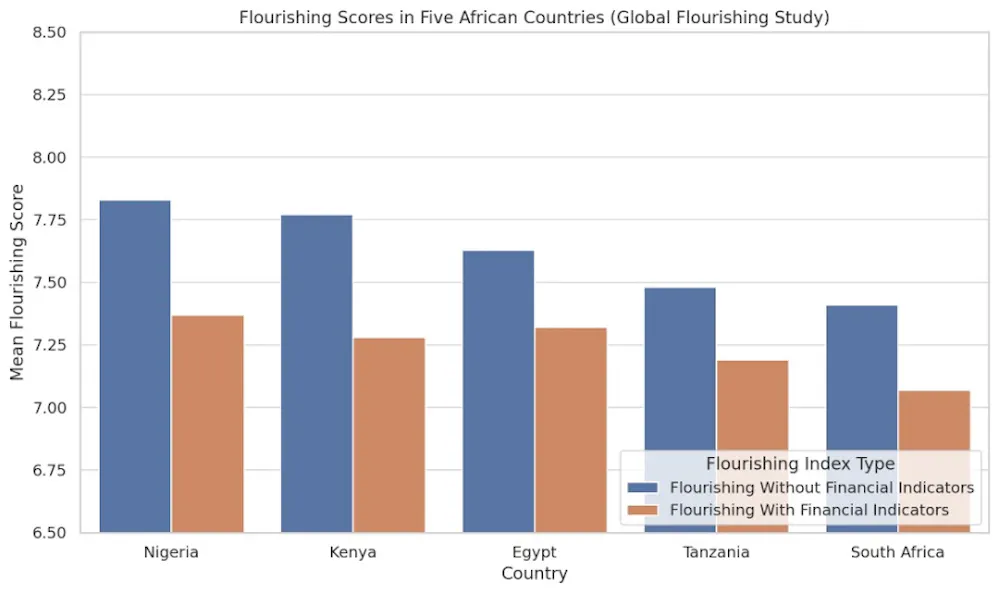
Of the 22 nations, five were African: Nigeria, Kenya, South Africa, Tanzania and Egypt.
While these countries didn’t top the global rankings (Indonesia and Mexico did), Nigeria, Kenya and Egypt all reported relatively high flourishing scores, especially when well-being was considered apart from financial status.
Nigeria, for example, ranked 5th globally in flourishing scores that excluded financial indicators – ahead of many wealthier nations. Nigerians indicated strengths in social relationships, character and virtues (like forgiveness or helping others). But potential areas of growth included financial well-being, housing, ethnic discrimination and education.
Overall, this suggests that while material resources matter, they’re not the only thing that determines well-being. Kenya ranked 7th, Egypt 10th, Tanzania 11th and South Africa 13th. Each showed unique strengths in areas like meaning, social connection or mental health.
You did a separate study on flourishing in Africa. What did you find?
In a 2024 study we analysed data from the Gallup World Poll (2020–2022) to explore 38 indicators of well-being across 40 African countries.
This study offered a more detailed and culture-sensitive picture of how Africans experience and prioritise flourishing. The dimensions explored were derived from both local and universal sources, allowing for regionally relevant insights.
We found that African populations often score high in meaning, character and social relationships – despite economic hardship. This offers an important corrective to western assumptions about well-being.
Some of our key findings were:
● There is significant diversity between and within African countries. Mauritius consistently ranked highest in life evaluations (overall satisfaction with their lives), while countries like Sierra Leone and Zimbabwe scored lowest.
● East African countries such as Rwanda and Ethiopia showed strong performance in social well-being indicators (like feeling respected or learning new things daily) even when economic indicators were low.
● Countries in West Africa, such as Senegal and Ghana, scored high in emotional well-being, with many people reporting positive daily emotions like enjoyment and laughter.
● Southern African nations, despite challenges like income inequality, displayed resilience through strong community ties and cultural practices rooted in the philosophy of ubuntu.
The results reinforced that flourishing in Africa cannot only be reduced to gross domestic product (GDP) per capita (a measure of the average economic output per person in a country) – nor to western norms of success.
What can African countries focus on to flourish?
In my view, the path to greater flourishing lies in embracing local knowledge and investing in culturally relevant development priorities. Instead of following western pathways – centred on individual advancement – Africa can model alternative flourishing pathways that reflect what matters most to African people.
1. Prioritise local knowledge systems
African ideas about a connected society – like ubuntu (southern Africa), ujamaa (east Africa), teranga or wazobia (west Africa), and al-musawat wal tarahum (north Africa) teach people to care for each other and live in peace. These values help people live meaningful lives and can inform leadership and legislation.
2. Redefine development metrics
Western development models focus on individual achievement, economic output and material consumption. GDP per capita fails to capture the everyday realities and aspirations of African communities. We should also measure things like how happy people are, how hopeful they feel about the future, how strong and resilient their communities are, and how clean, safe and dignifying their living environments are.
This is not a new idea – for years development scholars have called for a shift away from narrow economic indicators toward a focus on human dignity, agency, and the real opportunities people have to pursue the lives they value. What’s new is the growing availability of data and the momentum to take these alternative metrics seriously in shaping national policies and priorities.
3. Invest in education for character development
Quality education is essential to unlocking the continent’s potential to flourish. But Africa needs more than just academic skills and workforce readiness – it needs a strategy for intentional development of values and habits that shape how a person thinks, feels, and acts with integrity.
Part of the problem lies in how the humanities – fields like history, literature, philosophy, and religious studies – are often undervalued or underfunded in education systems. But it is precisely these disciplines that nurture moral imagination, critical reflection, and civic responsibility. We need educational models that form not just workers, but whole persons – people who can think ethically, act responsibly, and lead with character in their communities.
What does Africa offer the world in terms of flourishing?
Africa is not waiting to be saved. Across the continent, people are building communities of care, cultivating joy amid hardship, and passing on values of unity, faith, and compassion. This is what development looks like when rooted in human dignity.
Africa flourishing goals offer an alternative vision for development – one that starts with what Africa already has, not what it lacks. These are locally emic aspirations for well-being. They are shaped by Africa’s indigenous knowledge systems, cultural values, and religious/spiritual traditions. Pursuing these goals means prioritising wholeness over wealth, community over consumption, and resilience over rescue.
The continent has so much to offer the world: wisdom, strong community values, and ways of staying resilient and living fully even in hard times. But many of these local insights are missing in the global science of well-being.
Victor Counted consults for Africa Flourishing Initiative
Source: The Conversation – Africa – By Victor Counted, Associate Professor of Psychology, Regent University
What does it mean to live a good life? Psychologists and social scientists have been focusing on a new idea called flourishing – a sense of well-being that goes beyond just happiness or success. It’s about your whole life being good, including how you interact with other people and your community. So then, how do Africans fare when it comes to flourishing?
Victor Counted is a psychological scientist whose research across 40 African countries offers a data-rich rethinking of flourishing on the continent. His findings challenge the dominant narrative that Africa is “lagging behind” in development by showing a more nuanced picture of what it means to live a good life. We asked him more.
What is flourishing?
Flourishing is more than economic growth or individual happiness. It’s a multidimensional state of being that reflects how people feel about their lives and how well their lives are actually going. So it also measures people’s values within their community.
The idea of well-being often carries a Eurocentric emphasis on the individual – personal satisfaction, autonomy, achievement. Flourishing accounts for how whole a person is in relation to their environment.
It includes the social, spiritual and ecological contexts in which one lives. So, it’s not just about how one feels, but how one lives – fully, meaningfully and in a satisfying relationship with the world around us.
What’s the Global Flourishing Study?
The Global Flourishing Study tries to measure global patterns of human flourishing. It’s an ongoing five-year longitudinal study in over 200,000 participants across 22 countries.
I was one of the team of global scholars brought together to examine the trends on what it means to live well across cultures and life circumstances.
The study identifies six key dimensions of flourishing:
Happiness and life satisfaction
Mental and physical health
Meaning and purpose
Character and virtue
Close social relationships
Financial and material stability
Participants rate how they’re doing in each of these areas on a scale from 0 to 10. Further questions capture experiences related to trust, loneliness, hope, resilience, and other related well-being variables.
Of the 22 nations, five were African: Nigeria, Kenya, South Africa, Tanzania and Egypt.
While these countries didn’t top the global rankings (Indonesia and Mexico did), Nigeria, Kenya and Egypt all reported relatively high flourishing scores, especially when well-being was considered apart from financial status.
Courtesy Victor Counted
Nigeria, for example, ranked 5th globally in flourishing scores that excluded financial indicators – ahead of many wealthier nations. Nigerians indicated strengths in social relationships, character and virtues (like forgiveness or helping others). But potential areas of growth included financial well-being, housing, ethnic discrimination and education.
Overall, this suggests that while material resources matter, they’re not the only thing that determines well-being. Kenya ranked 7th, Egypt 10th, Tanzania 11th and South Africa 13th. Each showed unique strengths in areas like meaning, social connection or mental health.
You did a separate study on flourishing in Africa. What did you find?
In a 2024 study we analysed data from the Gallup World Poll (2020–2022) to explore 38 indicators of well-being across 40 African countries.
This study offered a more detailed and culture-sensitive picture of how Africans experience and prioritise flourishing. The dimensions explored were derived from both local and universal sources, allowing for regionally relevant insights.
We found that African populations often score high in meaning, character and social relationships – despite economic hardship. This offers an important corrective to western assumptions about well-being.
Some of our key findings were:
● There is significant diversity between and within African countries. Mauritius consistently ranked highest in life evaluations (overall satisfaction with their lives), while countries like Sierra Leone and Zimbabwe scored lowest.
● East African countries such as Rwanda and Ethiopia showed strong performance in social well-being indicators (like feeling respected or learning new things daily) even when economic indicators were low.
● Countries in West Africa, such as Senegal and Ghana, scored high in emotional well-being, with many people reporting positive daily emotions like enjoyment and laughter.
● Southern African nations, despite challenges like income inequality, displayed resilience through strong community ties and cultural practices rooted in the philosophy of ubuntu.
The results reinforced that flourishing in Africa cannot only be reduced to gross domestic product (GDP) per capita (a measure of the average economic output per person in a country) – nor to western norms of success.
What can African countries focus on to flourish?
In my view, the path to greater flourishing lies in embracing local knowledge and investing in culturally relevant development priorities. Instead of following western pathways – centred on individual advancement – Africa can model alternative flourishing pathways that reflect what matters most to African people.
1. Prioritise local knowledge systems
African ideas about a connected society – like ubuntu (southern Africa), ujamaa (east Africa), teranga or wazobia (west Africa), and al-musawat wal tarahum (north Africa) teach people to care for each other and live in peace. These values help people live meaningful lives and can inform leadership and legislation.
2. Redefine development metrics
Western development models focus on individual achievement, economic output and material consumption. GDP per capita fails to capture the everyday realities and aspirations of African communities. We should also measure things like how happy people are, how hopeful they feel about the future, how strong and resilient their communities are, and how clean, safe and dignifying their living environments are.
This is not a new idea – for years development scholars have called for a shift away from narrow economic indicators toward a focus on human dignity, agency, and the real opportunities people have to pursue the lives they value. What’s new is the growing availability of data and the momentum to take these alternative metrics seriously in shaping national policies and priorities.
3. Invest in education for character development
Quality education is essential to unlocking the continent’s potential to flourish. But Africa needs more than just academic skills and workforce readiness – it needs a strategy for intentional development of values and habits that shape how a person thinks, feels, and acts with integrity.
Part of the problem lies in how the humanities – fields like history, literature, philosophy, and religious studies – are often undervalued or underfunded in education systems. But it is precisely these disciplines that nurture moral imagination, critical reflection, and civic responsibility. We need educational models that form not just workers, but whole persons – people who can think ethically, act responsibly, and lead with character in their communities.
What does Africa offer the world in terms of flourishing?
Africa is not waiting to be saved. Across the continent, people are building communities of care, cultivating joy amid hardship, and passing on values of unity, faith, and compassion. This is what development looks like when rooted in human dignity.
Africa flourishing goals offer an alternative vision for development – one that starts with what Africa already has, not what it lacks. These are locally emic aspirations for well-being. They are shaped by Africa’s indigenous knowledge systems, cultural values, and religious/spiritual traditions. Pursuing these goals means prioritising wholeness over wealth, community over consumption, and resilience over rescue.
The continent has so much to offer the world: wisdom, strong community values, and ways of staying resilient and living fully even in hard times. But many of these local insights are missing in the global science of well-being.
– Which African countries are flourishing? Scientists have a new way of measuring well-being – https://theconversation.com/which-african-countries-are-flourishing-scientists-have-a-new-way-of-measuring-well-being-257458
Source: United Kingdom – Executive Government & Departments
Speech
The UK unequivocally condemns the Taliban’s edict denying women their right to education: UK statement at the UN Security Council
Statement by Ambassador James Kariuki, UK Deputy Permanent Representative to the UN, at the UN Security Council meeting on Afghanistan.
President, since our last Council briefing on Afghanistan, another school year has begun with secondary schools and higher education remaining closed to women and girls.
It is now over three years since the Taliban’s edict denying them their right to education.
The United Kingdom continues to unequivocally condemn this ban and urges its immediate reversal.
Education is not the only sector from which half of Afghanistan’s population is barred.
We remain deeply concerned by the Taliban’s shortsighted ban on women’s medical education and by the challenges Afghan women and girls face in accessing life-saving healthcare, including sexual and reproductive health services.
As we heard from Ms Bahous, nearly 8 in 10 young Afghan women are excluded from education, employment and training opportunities.
It is unacceptable that the Taliban’s restrictive edicts deny Afghan women and girls their rights and fundamental freedoms.
The United Kingdom supports calls for greater accountability efforts, including the referral of Afghanistan to the International Court of Justice for violations of CEDAW, the Convention on the Elimination of All Forms of Discrimination against Women.
The Taliban must also recognise the negative impact of their draconian policies on Afghanistan’s economic growth and long-term prosperity.
As Director Bahous has highlighted, the Taliban’s ban on secondary education for girls is estimated to cost $1.5 billion by 2030
During the last financial year, the UK distributed over $230 million in assistance to the Afghan people.
Last week, in partnership with the Food and Agriculture Organisation, we announced a new food security initiative, responding to climate-related challenges through the delivery of drought-resistant seeds and more nutritious crops, improved irrigation and training in sustainable farming practices.
Half a million Afghans are set to benefit from this UK-funded programme.
The UK has also continued to engage constructively with the UN-led process, including the comprehensive approach.
But reliance on humanitarian assistance is not sustainable in the long term, and the UK’s continued engagement in a process in which the Taliban are not fully committed or willing to take meaningful steps towards meeting their international obligations is not guaranteed.
We therefore urge the Taliban to reverse course and demonstrate their readiness to work towards an Afghanistan at peace with itself, its neighbours and the international community.
Leader of the Council Bev Craig welcomes the new strategy that has the potential to create jobs, while attracting new business and supporting growth.
Cllr Craig said:
“Manchester is the fastest-growing UK city and will be at the forefront of creating thousands of new jobs and growing the country’s economy. Finally, we have a Government with a long term national Industrial Strategy focused on attracting investment, making it easier for businesses to grow, protecting jobs and -crucially – backing our plans locally. Having just returned from a Greater Manchester International Trade Mission, we know the difference this makes.
“Manchester already has globally recognised strengths in many of the key priority sectors identified – such as life sciences, professional, legal and business services, creative industries and digital, tech and AI – this will supercharge them even more.
“It’s great to see the Government announce an Industrial Strategy Council to oversee delivery and even better news that Manchester has been chosen as its headquarters. In a changing world, the world’s first industrial city is well-placed to help shape the dynamic industries of the future.”
A federal jury convicted Stephanie Hockridge, a founder of the lender service provider Blueacorn, on Friday in connection with a scheme to fraudulently obtain tens of millions of dollars in COVID-19 relief money guaranteed by the U. S. Small Business Administration (SBA) through the Paycheck Protection Program (PPP).
According to court documents and evidence presented at trial, Hockridge, also known as Stephanie Reis, 42, of Rio Grande, Puerto Rico, and previously of Arizona, conspired with others to submit false and fraudulent PPP loan applications, including by fabricating documents that falsified income and payroll in order to receive loan funds for which they were not eligible.
“This defendant exploited a national emergency to personally profit from a taxpayer-funded program intended to support vulnerable individuals and small businesses,” said Matthew R. Galeotti, Head of the Justice Department’s Criminal Division. “This conviction demonstrates the Department’s commitment to holding individuals accountable for defrauding the government and wasting taxpayer money.”
“During a time of crisis in our country, this defendant abused the generosity of the American people by stealing money dedicated to the survival of small businesses to fraudulently enrich herself,” said Acting U. S. Attorney Nancy E. Larson for the Northern District of Texas. “We are proud of the diligent work of our law enforcement partners to hold her accountable and bring her to justice. Make no mistake, our efforts to bring such fraudsters to justice are ongoing.”
“Hockridge’s conviction demonstrates the FBI’s continued commitment to protecting taxpayer-funded programs from fraud and abuse,” said Assistant Director Jose A. Perez of the FBI Criminal Investigative Division. “This program was designed to provide critical funds to those struggling during a national crisis, not line the pockets of people seeking to exploit government assistance. The FBI remains committed to pursuing anyone who abuses the public trust for personal gain.”
“Ms. Hockridge defrauded the federal government of millions of dollars in pandemic relief funds for her own personal gain and has been brought to justice,” said Special Agent in Charge Jon Ellwanger of the Office of Inspector General for the Board of Governors of the Federal Reserve System and Consumer Financial Protection Bureau (CFPB) Western Region. “We are proud to have worked with our federal law enforcement partners to hold Ms. Hockridge accountable.”
“Exploiting the Small Business Administration’s pandemic relief programs for personal gain is an egregious theft of taxpayer funds,” said Deputy Inspector General Sheldon Shoemaker of the SBA Office of Inspector General. “SBA OIG will aggressively root out fraud to protect the integrity of SBA’s programs, which are intended to provide vital assistance to the nation’s small businesses. I want to thank the U. S. Attorney’s Office and our law enforcement partners for their dedication and commitment to seeing justice served.”
“This verdict is a victory for justice, accountability, and the American public,” said Special Agent in Charge Christopher J. Altemus Jr. of the IRS Criminal Investigation (IRS-CI) Dallas Field Office. “In a time of crisis, the Paycheck Protection Program was created as a lifeline to keep small businesses afloat and families fed. Ms. Hockridge saw it as an opportunity to enrich herself. Driven by greed, she used her business to steal millions of dollars intended for those in need. The women and men of IRS-CI will continue to protect what’s right and stand firmly with the honest business owners who play by the rules.”
As proven at trial, Hockridge co-founded Blueacorn in April 2020, purportedly to assist small businesses and individuals in obtaining PPP loans. To get larger loans for certain PPP applicants, Hockridge and her co-conspirators fabricated documents, including payroll records, tax documentation, and bank statements. Hockridge and her co-conspirators charged borrowers kickbacks based on a percentage of the funds received.
As part of the scheme, Hockridge and others offered a personalized service to their clients called “VIPPP” to help potential borrowers complete PPP loan applications. Hockridge recruited co-conspirators to work as VIPPP referral agents and coach borrowers on how to submit false PPP loan applications. To get more kickbacks from borrowers and a higher percentage of lender fees from the SBA, Hockridge and her co-conspirators submitted PPP loan applications that they knew contained materially false information. In total, Hockridge and her coconspirators processed tens of millions of dollars in fraudulent PPP loans. Hockridge was convicted of conspiracy to commit wire fraud and acquitted of four counts of wire fraud. She is scheduled to be sentenced on Oct. 10 and faces up to 20 years in prison.
The FBI, IRS-CI, the Special Inspector General for Pandemic Recovery, Federal Reserve Board-CFPB Office of Inspector General, and SBA OIG investigated the case.
Acting Assistant Chief Philip Trout of the Criminal Division’s Fraud Section, Trial Attorneys Elizabeth Carr and Ryan McLaren of the Criminal Division’s Money Laundering and Asset Recovery Section, and Assistant U. S. Attorney Matthew Weybrecht for the Northern District of Texas are prosecuting the case.
The Fraud Section leads the Criminal Division’s prosecution of fraud schemes that exploit the PPP. Since the enactment of the CARES Act, the Fraud Section has prosecuted over 200 defendants in more than 130 criminal cases and has seized over $78 million in cash proceeds derived from fraudulently obtained PPP funds, as well as numerous real estate properties and luxury items purchased with such proceeds. More information can be found at www. justice. gov/criminal/criminal-fraud/cares-act-fraud
MLARS’s Bank Integrity Unit investigates and prosecutes banks and other financial institutions, including their officers, managers, and employees, whose actions threaten the integrity of the individual institution or the wider financial system.
Anyone with information about allegations of attempted fraud involving COVID-19 can report it by calling the Justice Department’s National Center for Disaster Fraud (NCDF) Hotline via the NCDF Web Complaint Form at www. justice. gov/disaster-fraud/ncdf-disaster-complaint-form.
A federal jury convicted Stephanie Hockridge, a founder of the lender service provider Blueacorn, on Friday in connection with a scheme to fraudulently obtain tens of millions of dollars in COVID-19 relief money guaranteed by the U. S. Small Business Administration (SBA) through the Paycheck Protection Program (PPP).
According to court documents and evidence presented at trial, Hockridge, also known as Stephanie Reis, 42, of Rio Grande, Puerto Rico, and previously of Arizona, conspired with others to submit false and fraudulent PPP loan applications, including by fabricating documents that falsified income and payroll in order to receive loan funds for which they were not eligible.
“This defendant exploited a national emergency to personally profit from a taxpayer-funded program intended to support vulnerable individuals and small businesses,” said Matthew R. Galeotti, Head of the Justice Department’s Criminal Division. “This conviction demonstrates the Department’s commitment to holding individuals accountable for defrauding the government and wasting taxpayer money.”
“During a time of crisis in our country, this defendant abused the generosity of the American people by stealing money dedicated to the survival of small businesses to fraudulently enrich herself,” said Acting U. S. Attorney Nancy E. Larson for the Northern District of Texas. “We are proud of the diligent work of our law enforcement partners to hold her accountable and bring her to justice. Make no mistake, our efforts to bring such fraudsters to justice are ongoing.”
“Hockridge’s conviction demonstrates the FBI’s continued commitment to protecting taxpayer-funded programs from fraud and abuse,” said Assistant Director Jose A. Perez of the FBI Criminal Investigative Division. “This program was designed to provide critical funds to those struggling during a national crisis, not line the pockets of people seeking to exploit government assistance. The FBI remains committed to pursuing anyone who abuses the public trust for personal gain.”
“Ms. Hockridge defrauded the federal government of millions of dollars in pandemic relief funds for her own personal gain and has been brought to justice,” said Special Agent in Charge Jon Ellwanger of the Office of Inspector General for the Board of Governors of the Federal Reserve System and Consumer Financial Protection Bureau (CFPB) Western Region. “We are proud to have worked with our federal law enforcement partners to hold Ms. Hockridge accountable.”
“Exploiting the Small Business Administration’s pandemic relief programs for personal gain is an egregious theft of taxpayer funds,” said Deputy Inspector General Sheldon Shoemaker of the SBA Office of Inspector General. “SBA OIG will aggressively root out fraud to protect the integrity of SBA’s programs, which are intended to provide vital assistance to the nation’s small businesses. I want to thank the U. S. Attorney’s Office and our law enforcement partners for their dedication and commitment to seeing justice served.”
“This verdict is a victory for justice, accountability, and the American public,” said Special Agent in Charge Christopher J. Altemus Jr. of the IRS Criminal Investigation (IRS-CI) Dallas Field Office. “In a time of crisis, the Paycheck Protection Program was created as a lifeline to keep small businesses afloat and families fed. Ms. Hockridge saw it as an opportunity to enrich herself. Driven by greed, she used her business to steal millions of dollars intended for those in need. The women and men of IRS-CI will continue to protect what’s right and stand firmly with the honest business owners who play by the rules.”
As proven at trial, Hockridge co-founded Blueacorn in April 2020, purportedly to assist small businesses and individuals in obtaining PPP loans. To get larger loans for certain PPP applicants, Hockridge and her co-conspirators fabricated documents, including payroll records, tax documentation, and bank statements. Hockridge and her co-conspirators charged borrowers kickbacks based on a percentage of the funds received.
As part of the scheme, Hockridge and others offered a personalized service to their clients called “VIPPP” to help potential borrowers complete PPP loan applications. Hockridge recruited co-conspirators to work as VIPPP referral agents and coach borrowers on how to submit false PPP loan applications. To get more kickbacks from borrowers and a higher percentage of lender fees from the SBA, Hockridge and her co-conspirators submitted PPP loan applications that they knew contained materially false information. In total, Hockridge and her coconspirators processed tens of millions of dollars in fraudulent PPP loans. Hockridge was convicted of conspiracy to commit wire fraud and acquitted of four counts of wire fraud. She is scheduled to be sentenced on Oct. 10 and faces up to 20 years in prison.
The FBI, IRS-CI, the Special Inspector General for Pandemic Recovery, Federal Reserve Board-CFPB Office of Inspector General, and SBA OIG investigated the case.
Acting Assistant Chief Philip Trout of the Criminal Division’s Fraud Section, Trial Attorneys Elizabeth Carr and Ryan McLaren of the Criminal Division’s Money Laundering and Asset Recovery Section, and Assistant U. S. Attorney Matthew Weybrecht for the Northern District of Texas are prosecuting the case.
The Fraud Section leads the Criminal Division’s prosecution of fraud schemes that exploit the PPP. Since the enactment of the CARES Act, the Fraud Section has prosecuted over 200 defendants in more than 130 criminal cases and has seized over $78 million in cash proceeds derived from fraudulently obtained PPP funds, as well as numerous real estate properties and luxury items purchased with such proceeds. More information can be found at www. justice. gov/criminal/criminal-fraud/cares-act-fraud
MLARS’s Bank Integrity Unit investigates and prosecutes banks and other financial institutions, including their officers, managers, and employees, whose actions threaten the integrity of the individual institution or the wider financial system.
Anyone with information about allegations of attempted fraud involving COVID-19 can report it by calling the Justice Department’s National Center for Disaster Fraud (NCDF) Hotline via the NCDF Web Complaint Form at www. justice. gov/disaster-fraud/ncdf-disaster-complaint-form.
What you need to know: Thanks to California’s Film and Television Tax Credit Program, 48 projects — including 43 independent features — will be made in California, projected to generate $664 million in economic activity and employ over 6,500 cast and crew across the Golden State.
SACRAMENTO – Governor Newsom today continued his work in protecting film production jobs in Los Angeles and across the state with a new round of 48 projects approved for the California Film Commission’s Film and Television Tax Credit Program. Governor Newsom recently proposedto double down on this vital program, by expanding the tax credit from $330 million to $750 million to help boost this iconic industry and production in California.
“California didn’t earn its role as the heart of the entertainment world by accident — it was built over generations by skilled workers and creative talent pushing boundaries. Today’s awards help ensure this legacy continues, keeping cameras rolling here at home, supporting thousands of crew members behind the scenes and boosting local economies that depend on a strong film and television industry.”
Governor Gavin Newsom
Why this matters
This diverse slate of feature films — ranging from major studio productions to independent film — is expected to generate $664 million in total spending throughout the state, including $485 in qualified expenditures and more than $302 million in wages for California workers.
These projects, which include 43 independent films, are collectively expected to hire 6,515 cast and crew members, as well 32,000 background performers (measured in days worked), across 1,346 total California filming days.
More than half of the films will be shot in the Los Angeles area, helping to sustain the birthplace of this iconic industry and supporting the community as it recovers from recent wildfires. Enabling the industry’s reach throughout the state, 22 of the selected projects will conduct significant filming outside the Los Angeles area, contributing 329 out-of-zone filming days and substantial economic benefits in Ventura County (Make A Wish, The Teller, Things We Cannot Touch), San Francisco and the Bay Area (High Priestess of Souls, Our Kind of Cruelty), El Dorado and Placer Counties (Gold Mountain), San Bernardino and Riverside Counties (Superbloom, The Heidi Fleiss Story), Bakersfield in Kern County (Counting by 7s) and coastal communities such as Half Moon Bay and Costa Mesa (Sponsor, Doll).
Today’s slate of awards marks the ninth allocation in this fiscal year and reinforces California’s continued leadership as a global production hub, even as other states and countries pursue projects with their own incentive offerings.
“This industry is core to California’s creative economy and keeping production here at home is more important than ever,” said Colleen Bell, Director of the California Film Commission. “This round of tax credits shows our commitment to supporting both indie and studio productions while spreading the economic benefits of filming across the state.”
Highlights from this round of awards
Five major studio features, including Sony Pictures’ “One of Them Days Sequel” — the latest film produced by Issa Rae — which alone is projected to spend more than $39 million in qualified expenditures.
Six independently produced features with budgets over $10 million, such as “Gold Mountain,” “The Teller,” and “They Follow,” all of which plan to film primarily outside of the Los Angeles area.
37 independent projects with budgets of $10 million or less, contributing to the state’s goal of expanding access to underrepresented filmmakers and promoting more inclusive storytelling.
“Los Angeles was an essential backdrop to ‘One of Them Days’ and we are thrilled that Dreux and Alyssa will embark on another authentic escapade through the city’s streets in the sequel through the support of California’s Film and Television Tax Credit,” said Nicole Brown, President of TriStar Pictures.
Read more about today’s announcement, including a full list of productions that are part of the Film and Television Tax Credit Program here.
California is a creative economy powerhouse
Last fall, Governor Newsom proposed expanding California’s Film & Television Tax Credit Program to $750 million annually, a massive increase from the current $330 million annual allocation, which would position California as one of the top states for capped film incentive programs.
As one of the strategic sectors outlined in the recently launched California Jobs First Economic Blueprint, the creative economy has deep roots in California’s history and continues to be an engine for innovation, cultural expression, and economic growth.
In 2023, California was home to 220,000 creative economy jobs, one in every four creative economy jobs in the U.S.
The average salary paid to creative workers in 2023 was $160,000, more than 50% higher than the California average.
And while the Los Angeles region leads the way in jobs generated by the creative economy, three other regions — Redwoods, the Bay Area, and the Southern Border — also identified film, TV, and the arts as a regional strategic sector.
About the Film and TV Tax Credit Program
The Film and Television Tax Credit Program provides tax credits based on qualified expenditures for eligible productions produced in California.
Since its launch in 2009 through May 2025, the program has approved 799 projects that have generated nearly $27 billion in economic activity, resulting in less runaway production, new career pathways for below-the-line workers and increased economic opportunity in rural, suburban and urban communities alike. The program further incentivizes projects that film outside the Los Angeles area or relocate to California from out-of-state. The program also requires projects to invest in building career exposure and training opportunities for underrepresented communities.
Looking ahead, the next television application window is slated for July 7-9, 2025. Film applications will be accepted August 25-27, 2025. Application dates and deadlines are posted on the California Film Commission website.
Recent news
Jun 20, 2025
News SACRAMENTO – Governor Gavin Newsom today announced the following appointments:Soon-Sik Lee, of Bellevue, Washington, has been appointed Chief of Planning and Engineering at the California High Speed Rail Authority. Lee has been a Vice President – Senior Program…
Jun 19, 2025
News What you need to know: The Ninth Circuit rejected Trump’s sweeping claim that he can federalize the National Guard for any reason and avoid judicial scrutiny, even as it stayed an emergency district court order. This is a critical check on presidential overreach…
Jun 19, 2025
News Sacramento, California – Governor Gavin Newsom today issued a proclamation declaring “Juneteenth National Freedom Day: A Day of Observance” in the State of California.The text of the proclamation and a copy can be found below: PROCLAMATIONJuly 4 is not the only…
What you need to know: Thanks to California’s Film and Television Tax Credit Program, 48 projects — including 43 independent features — will be made in California, projected to generate $664 million in economic activity and employ over 6,500 cast and crew across the Golden State.
SACRAMENTO – Governor Newsom today continued his work in protecting film production jobs in Los Angeles and across the state with a new round of 48 projects approved for the California Film Commission’s Film and Television Tax Credit Program. Governor Newsom recently proposedto double down on this vital program, by expanding the tax credit from $330 million to $750 million to help boost this iconic industry and production in California.
“California didn’t earn its role as the heart of the entertainment world by accident — it was built over generations by skilled workers and creative talent pushing boundaries. Today’s awards help ensure this legacy continues, keeping cameras rolling here at home, supporting thousands of crew members behind the scenes and boosting local economies that depend on a strong film and television industry.”
Governor Gavin Newsom
Why this matters
This diverse slate of feature films — ranging from major studio productions to independent film — is expected to generate $664 million in total spending throughout the state, including $485 in qualified expenditures and more than $302 million in wages for California workers.
These projects, which include 43 independent films, are collectively expected to hire 6,515 cast and crew members, as well 32,000 background performers (measured in days worked), across 1,346 total California filming days.
More than half of the films will be shot in the Los Angeles area, helping to sustain the birthplace of this iconic industry and supporting the community as it recovers from recent wildfires. Enabling the industry’s reach throughout the state, 22 of the selected projects will conduct significant filming outside the Los Angeles area, contributing 329 out-of-zone filming days and substantial economic benefits in Ventura County (Make A Wish, The Teller, Things We Cannot Touch), San Francisco and the Bay Area (High Priestess of Souls, Our Kind of Cruelty), El Dorado and Placer Counties (Gold Mountain), San Bernardino and Riverside Counties (Superbloom, The Heidi Fleiss Story), Bakersfield in Kern County (Counting by 7s) and coastal communities such as Half Moon Bay and Costa Mesa (Sponsor, Doll).
Today’s slate of awards marks the ninth allocation in this fiscal year and reinforces California’s continued leadership as a global production hub, even as other states and countries pursue projects with their own incentive offerings.
“This industry is core to California’s creative economy and keeping production here at home is more important than ever,” said Colleen Bell, Director of the California Film Commission. “This round of tax credits shows our commitment to supporting both indie and studio productions while spreading the economic benefits of filming across the state.”
Highlights from this round of awards
Five major studio features, including Sony Pictures’ “One of Them Days Sequel” — the latest film produced by Issa Rae — which alone is projected to spend more than $39 million in qualified expenditures.
Six independently produced features with budgets over $10 million, such as “Gold Mountain,” “The Teller,” and “They Follow,” all of which plan to film primarily outside of the Los Angeles area.
37 independent projects with budgets of $10 million or less, contributing to the state’s goal of expanding access to underrepresented filmmakers and promoting more inclusive storytelling.
“Los Angeles was an essential backdrop to ‘One of Them Days’ and we are thrilled that Dreux and Alyssa will embark on another authentic escapade through the city’s streets in the sequel through the support of California’s Film and Television Tax Credit,” said Nicole Brown, President of TriStar Pictures.
Read more about today’s announcement, including a full list of productions that are part of the Film and Television Tax Credit Program here.
California is a creative economy powerhouse
Last fall, Governor Newsom proposed expanding California’s Film & Television Tax Credit Program to $750 million annually, a massive increase from the current $330 million annual allocation, which would position California as one of the top states for capped film incentive programs.
As one of the strategic sectors outlined in the recently launched California Jobs First Economic Blueprint, the creative economy has deep roots in California’s history and continues to be an engine for innovation, cultural expression, and economic growth.
In 2023, California was home to 220,000 creative economy jobs, one in every four creative economy jobs in the U.S.
The average salary paid to creative workers in 2023 was $160,000, more than 50% higher than the California average.
And while the Los Angeles region leads the way in jobs generated by the creative economy, three other regions — Redwoods, the Bay Area, and the Southern Border — also identified film, TV, and the arts as a regional strategic sector.
About the Film and TV Tax Credit Program
The Film and Television Tax Credit Program provides tax credits based on qualified expenditures for eligible productions produced in California.
Since its launch in 2009 through May 2025, the program has approved 799 projects that have generated nearly $27 billion in economic activity, resulting in less runaway production, new career pathways for below-the-line workers and increased economic opportunity in rural, suburban and urban communities alike. The program further incentivizes projects that film outside the Los Angeles area or relocate to California from out-of-state. The program also requires projects to invest in building career exposure and training opportunities for underrepresented communities.
Looking ahead, the next television application window is slated for July 7-9, 2025. Film applications will be accepted August 25-27, 2025. Application dates and deadlines are posted on the California Film Commission website.
Recent news
Jun 20, 2025
News SACRAMENTO – Governor Gavin Newsom today announced the following appointments:Soon-Sik Lee, of Bellevue, Washington, has been appointed Chief of Planning and Engineering at the California High Speed Rail Authority. Lee has been a Vice President – Senior Program…
Jun 19, 2025
News What you need to know: The Ninth Circuit rejected Trump’s sweeping claim that he can federalize the National Guard for any reason and avoid judicial scrutiny, even as it stayed an emergency district court order. This is a critical check on presidential overreach…
Jun 19, 2025
News Sacramento, California – Governor Gavin Newsom today issued a proclamation declaring “Juneteenth National Freedom Day: A Day of Observance” in the State of California.The text of the proclamation and a copy can be found below: PROCLAMATIONJuly 4 is not the only…
What you need to know: Thanks to California’s Film and Television Tax Credit Program, 48 projects — including 43 independent features — will be made in California, projected to generate $664 million in economic activity and employ over 6,500 cast and crew across the Golden State.
SACRAMENTO – Governor Newsom today continued his work in protecting film production jobs in Los Angeles and across the state with a new round of 48 projects approved for the California Film Commission’s Film and Television Tax Credit Program. Governor Newsom recently proposedto double down on this vital program, by expanding the tax credit from $330 million to $750 million to help boost this iconic industry and production in California.
“California didn’t earn its role as the heart of the entertainment world by accident — it was built over generations by skilled workers and creative talent pushing boundaries. Today’s awards help ensure this legacy continues, keeping cameras rolling here at home, supporting thousands of crew members behind the scenes and boosting local economies that depend on a strong film and television industry.”
Governor Gavin Newsom
Why this matters
This diverse slate of feature films — ranging from major studio productions to independent film — is expected to generate $664 million in total spending throughout the state, including $485 in qualified expenditures and more than $302 million in wages for California workers.
These projects, which include 43 independent films, are collectively expected to hire 6,515 cast and crew members, as well 32,000 background performers (measured in days worked), across 1,346 total California filming days.
More than half of the films will be shot in the Los Angeles area, helping to sustain the birthplace of this iconic industry and supporting the community as it recovers from recent wildfires. Enabling the industry’s reach throughout the state, 22 of the selected projects will conduct significant filming outside the Los Angeles area, contributing 329 out-of-zone filming days and substantial economic benefits in Ventura County (Make A Wish, The Teller, Things We Cannot Touch), San Francisco and the Bay Area (High Priestess of Souls, Our Kind of Cruelty), El Dorado and Placer Counties (Gold Mountain), San Bernardino and Riverside Counties (Superbloom, The Heidi Fleiss Story), Bakersfield in Kern County (Counting by 7s) and coastal communities such as Half Moon Bay and Costa Mesa (Sponsor, Doll).
Today’s slate of awards marks the ninth allocation in this fiscal year and reinforces California’s continued leadership as a global production hub, even as other states and countries pursue projects with their own incentive offerings.
“This industry is core to California’s creative economy and keeping production here at home is more important than ever,” said Colleen Bell, Director of the California Film Commission. “This round of tax credits shows our commitment to supporting both indie and studio productions while spreading the economic benefits of filming across the state.”
Highlights from this round of awards
Five major studio features, including Sony Pictures’ “One of Them Days Sequel” — the latest film produced by Issa Rae — which alone is projected to spend more than $39 million in qualified expenditures.
Six independently produced features with budgets over $10 million, such as “Gold Mountain,” “The Teller,” and “They Follow,” all of which plan to film primarily outside of the Los Angeles area.
37 independent projects with budgets of $10 million or less, contributing to the state’s goal of expanding access to underrepresented filmmakers and promoting more inclusive storytelling.
“Los Angeles was an essential backdrop to ‘One of Them Days’ and we are thrilled that Dreux and Alyssa will embark on another authentic escapade through the city’s streets in the sequel through the support of California’s Film and Television Tax Credit,” said Nicole Brown, President of TriStar Pictures.
Read more about today’s announcement, including a full list of productions that are part of the Film and Television Tax Credit Program here.
California is a creative economy powerhouse
Last fall, Governor Newsom proposed expanding California’s Film & Television Tax Credit Program to $750 million annually, a massive increase from the current $330 million annual allocation, which would position California as one of the top states for capped film incentive programs.
As one of the strategic sectors outlined in the recently launched California Jobs First Economic Blueprint, the creative economy has deep roots in California’s history and continues to be an engine for innovation, cultural expression, and economic growth.
In 2023, California was home to 220,000 creative economy jobs, one in every four creative economy jobs in the U.S.
The average salary paid to creative workers in 2023 was $160,000, more than 50% higher than the California average.
And while the Los Angeles region leads the way in jobs generated by the creative economy, three other regions — Redwoods, the Bay Area, and the Southern Border — also identified film, TV, and the arts as a regional strategic sector.
About the Film and TV Tax Credit Program
The Film and Television Tax Credit Program provides tax credits based on qualified expenditures for eligible productions produced in California.
Since its launch in 2009 through May 2025, the program has approved 799 projects that have generated nearly $27 billion in economic activity, resulting in less runaway production, new career pathways for below-the-line workers and increased economic opportunity in rural, suburban and urban communities alike. The program further incentivizes projects that film outside the Los Angeles area or relocate to California from out-of-state. The program also requires projects to invest in building career exposure and training opportunities for underrepresented communities.
Looking ahead, the next television application window is slated for July 7-9, 2025. Film applications will be accepted August 25-27, 2025. Application dates and deadlines are posted on the California Film Commission website.
Recent news
Jun 20, 2025
News SACRAMENTO – Governor Gavin Newsom today announced the following appointments:Soon-Sik Lee, of Bellevue, Washington, has been appointed Chief of Planning and Engineering at the California High Speed Rail Authority. Lee has been a Vice President – Senior Program…
Jun 19, 2025
News What you need to know: The Ninth Circuit rejected Trump’s sweeping claim that he can federalize the National Guard for any reason and avoid judicial scrutiny, even as it stayed an emergency district court order. This is a critical check on presidential overreach…
Jun 19, 2025
News Sacramento, California – Governor Gavin Newsom today issued a proclamation declaring “Juneteenth National Freedom Day: A Day of Observance” in the State of California.The text of the proclamation and a copy can be found below: PROCLAMATIONJuly 4 is not the only…
What you need to know: Thanks to California’s Film and Television Tax Credit Program, 48 projects — including 43 independent features — will be made in California, projected to generate $664 million in economic activity and employ over 6,500 cast and crew across the Golden State.
SACRAMENTO – Governor Newsom today continued his work in protecting film production jobs in Los Angeles and across the state with a new round of 48 projects approved for the California Film Commission’s Film and Television Tax Credit Program. Governor Newsom recently proposedto double down on this vital program, by expanding the tax credit from $330 million to $750 million to help boost this iconic industry and production in California.
“California didn’t earn its role as the heart of the entertainment world by accident — it was built over generations by skilled workers and creative talent pushing boundaries. Today’s awards help ensure this legacy continues, keeping cameras rolling here at home, supporting thousands of crew members behind the scenes and boosting local economies that depend on a strong film and television industry.”
Governor Gavin Newsom
Why this matters
This diverse slate of feature films — ranging from major studio productions to independent film — is expected to generate $664 million in total spending throughout the state, including $485 in qualified expenditures and more than $302 million in wages for California workers.
These projects, which include 43 independent films, are collectively expected to hire 6,515 cast and crew members, as well 32,000 background performers (measured in days worked), across 1,346 total California filming days.
More than half of the films will be shot in the Los Angeles area, helping to sustain the birthplace of this iconic industry and supporting the community as it recovers from recent wildfires. Enabling the industry’s reach throughout the state, 22 of the selected projects will conduct significant filming outside the Los Angeles area, contributing 329 out-of-zone filming days and substantial economic benefits in Ventura County (Make A Wish, The Teller, Things We Cannot Touch), San Francisco and the Bay Area (High Priestess of Souls, Our Kind of Cruelty), El Dorado and Placer Counties (Gold Mountain), San Bernardino and Riverside Counties (Superbloom, The Heidi Fleiss Story), Bakersfield in Kern County (Counting by 7s) and coastal communities such as Half Moon Bay and Costa Mesa (Sponsor, Doll).
Today’s slate of awards marks the ninth allocation in this fiscal year and reinforces California’s continued leadership as a global production hub, even as other states and countries pursue projects with their own incentive offerings.
“This industry is core to California’s creative economy and keeping production here at home is more important than ever,” said Colleen Bell, Director of the California Film Commission. “This round of tax credits shows our commitment to supporting both indie and studio productions while spreading the economic benefits of filming across the state.”
Highlights from this round of awards
Five major studio features, including Sony Pictures’ “One of Them Days Sequel” — the latest film produced by Issa Rae — which alone is projected to spend more than $39 million in qualified expenditures.
Six independently produced features with budgets over $10 million, such as “Gold Mountain,” “The Teller,” and “They Follow,” all of which plan to film primarily outside of the Los Angeles area.
37 independent projects with budgets of $10 million or less, contributing to the state’s goal of expanding access to underrepresented filmmakers and promoting more inclusive storytelling.
“Los Angeles was an essential backdrop to ‘One of Them Days’ and we are thrilled that Dreux and Alyssa will embark on another authentic escapade through the city’s streets in the sequel through the support of California’s Film and Television Tax Credit,” said Nicole Brown, President of TriStar Pictures.
Read more about today’s announcement, including a full list of productions that are part of the Film and Television Tax Credit Program here.
California is a creative economy powerhouse
Last fall, Governor Newsom proposed expanding California’s Film & Television Tax Credit Program to $750 million annually, a massive increase from the current $330 million annual allocation, which would position California as one of the top states for capped film incentive programs.
As one of the strategic sectors outlined in the recently launched California Jobs First Economic Blueprint, the creative economy has deep roots in California’s history and continues to be an engine for innovation, cultural expression, and economic growth.
In 2023, California was home to 220,000 creative economy jobs, one in every four creative economy jobs in the U.S.
The average salary paid to creative workers in 2023 was $160,000, more than 50% higher than the California average.
And while the Los Angeles region leads the way in jobs generated by the creative economy, three other regions — Redwoods, the Bay Area, and the Southern Border — also identified film, TV, and the arts as a regional strategic sector.
About the Film and TV Tax Credit Program
The Film and Television Tax Credit Program provides tax credits based on qualified expenditures for eligible productions produced in California.
Since its launch in 2009 through May 2025, the program has approved 799 projects that have generated nearly $27 billion in economic activity, resulting in less runaway production, new career pathways for below-the-line workers and increased economic opportunity in rural, suburban and urban communities alike. The program further incentivizes projects that film outside the Los Angeles area or relocate to California from out-of-state. The program also requires projects to invest in building career exposure and training opportunities for underrepresented communities.
Looking ahead, the next television application window is slated for July 7-9, 2025. Film applications will be accepted August 25-27, 2025. Application dates and deadlines are posted on the California Film Commission website.
Recent news
Jun 20, 2025
News SACRAMENTO – Governor Gavin Newsom today announced the following appointments:Soon-Sik Lee, of Bellevue, Washington, has been appointed Chief of Planning and Engineering at the California High Speed Rail Authority. Lee has been a Vice President – Senior Program…
Jun 19, 2025
News What you need to know: The Ninth Circuit rejected Trump’s sweeping claim that he can federalize the National Guard for any reason and avoid judicial scrutiny, even as it stayed an emergency district court order. This is a critical check on presidential overreach…
Jun 19, 2025
News Sacramento, California – Governor Gavin Newsom today issued a proclamation declaring “Juneteenth National Freedom Day: A Day of Observance” in the State of California.The text of the proclamation and a copy can be found below: PROCLAMATIONJuly 4 is not the only…
London, UK, June 23, 2025 (GLOBE NEWSWIRE) — ALL4 Mining, a leading global cloud mining platform headquartered in London, has officially announced the expansion of its advanced live cryptocurrency mining strategies for 2025, empowering crypto investors and institutional clients to achieve sustainable passive income with real-time, secure, and eco-friendly mining solutions.
“At ALL4 Mining, our mission is to make smart, efficient crypto mining accessible to everyone, from individual investors to large institutions,” said a spokesperson for ALL4 Mining. “By combining cutting-edge technology, clean energy, and robust security, we provide a transparent and profitable mining experience that keeps pace with the fast-evolving crypto market.”
How to Get Started with ALL4 Mining
ALL4 Mining’s user-friendly platform makes it easy to participate in crypto mining in just a few simple steps:
1️⃣ Register:Sign up on the official website and receive a$15 welcome bonusto start mining immediately. 2️⃣ Select a Plan: Choose a mining contract that matches your budget and goals. 3️⃣ Start Mining: Let ALL4 Mining’s secure, advanced data centers work for you 24/7. 4️⃣ Earn Daily Income: Enjoy steady daily income in top cryptocurrencies like BTC, ETH, DOGE, XRP, SOL, and more.
Users can also download the official ALL4 Mining mobile app — available for Apple and Android — to track mining activities, manage contracts, and receive real-time updates anytime, anywhere.
Key Features and Benefits
✅ Global Green Mining Network: Over 200 mining farms powered by renewable, low-carbon energy sources, supporting sustainable crypto production. ✅ High Efficiency & Stability: State-of-the-art data centers ensure consistent daily returns with no hidden fees. ✅ Robust Security: Multi-layer protection with SSL encryption, 2FA, McAfee® and Cloudflare® safeguards, plus 24/7 monitoring. ✅ 24/7 Support: Round-the-clock customer service to promptly address any user inquiries or technical issues.
As blockchain technology continues to advance, ALL4 Mining is committed to setting a new standard for transparent, flexible, and profitable cloud mining, providing both short-term and long-term options to match diverse financial goals.
To learn more and join the growing ALL4 Mining community, visit https://all4mining.com today.
About ALL4 Mining ALL4 Mining is a UK-based global leader in cryptocurrency cloud mining, offering secure, sustainable, and easy-to-use mining services for individual and institutional clients worldwide. With a focus on clean energy, advanced technology, and strict compliance, ALL4 Mining makes earning daily crypto income simple and reliable.
For media inquiries, please contact: ALL4 Mining info@all4mining.com Flat 75 Cheyne Court, London, United Kingdom, SW3 5TT https://all4mining.com
VICTORIA, Seychelles, June 23, 2025 (GLOBE NEWSWIRE) — Aster, the next-generation decentralized perpetual exchange (perp DEX) backed by YZi Labs, proudly unveils its latest upgrade on Aster Pro: Hidden Orders. Hidden orders empower traders with powerful stealth execution when trading perpetuals.
With this launch, Aster – ranked second globally by perp DEX trading volume – becomes the first perp DEX to introduce fully integrated hidden orders, once again pushing the frontier of DeFi innovation.
On Aster, traders who select hidden orders place limit orders without revealing any size, price, or presence on the public Aster Pro order book. Trades are placed directly into the main matching engine and only become visible after execution.
“In high-speed, high-stakes perp trading, being seen is often a disadvantage,” shared Leonard, CEO of Aster. “Hidden orders empower traders with full anonymity without compromising liquidity, privacy and fairness.”
In cryptocurrency trading, the ability to place large trades without spooking the market is a privilege that separates professionals from amateurs. Institutions and sophisticated traders often rely on advanced order execution strategies like dark pools and hidden orders to hide their intentions and reduce slippage.
Recent debates among industry leaders have also spotlighted a key tension in current DEX infrastructure: while transparency enables trust, it also exposes large traders to predatory tactics due to real-time order visibility. This underscores a rising demand for privacy-preserving solutions in the perpetual DEX space, ones that can shield traders from front-running and exploitation while still upholding market integrity.
High-volume traders on centralized exchanges already rely on tools like dark pools or iceberg orders to mask intent. However, each has its drawbacks. Dark pools keep trades completely invisible and with no impact to main markets because trades execute via a separate order book. That said, because of the separate infrastructure, dark pools fragment liquidity and can be less liquid than the main order book. Iceberg orders are anonymous and access deep market liquidity, but will partially reveal intent as a portion of the total order is exposed on the public order book at any one time.
Hidden orders solve these challenges:
Full Privacy: Orders remain invisible until filled, defending price points without signaling intent.
Stealth Execution: Slippage is reduced and front-running is avoided in volatile markets.
Integrated Liquidity: Hidden orders operate directly inside the main matching engine, preserving centralized liquidity and tight spreads.
Superior Speed: Often faster to execute than iceberg orders, with no visible trail.
Built for anonymity, visible advantage
The launch of Hidden Orders on Aster Pro marks a major milestone for the industry: Aster is now the first perpetual DEX to natively support hidden orders—a feature previously exclusive to centralized platforms or fragmented DeFi workarounds.
This upgrade is more than a product release. It’s a clear statement of intent: Aster leads by building—pioneering tools that empower traders with greater control, precision, and privacy in onchain markets.
With Hidden Orders, traders can now:
Defend key price levels without tipping off competitors
Enter or exit large positions without front-running risks
Execute with full anonymity while still benefiting from Aster’s deep, unified liquidity
In a market where visibility often works against you, Aster gives traders the power to operate on their own terms.
Redefining the standard for onchain perpetual trading
This launch reinforces Aster’s position as an industry leader—not just in volume, but in innovation, execution quality, and trader-first design. From the successful introduction of email login for frictionless onboarding, to the debut of Aster Chain Beta, a privacy-preserving ZK Layer 1 built for high-performance perp trading, Aster is consistently raising the bar for what’s possible in DeFi.
And while others focus on replicating centralized tools, Aster focuses on protecting its users—by prioritizing:
Privacy, with ZK-powered infrastructure
Fairness, with MEV-resistant execution
Control, with pro-grade tools like Hidden Orders and integrated liquidity
Aster redefines onchain trading, making it fast, fair, private, and powerful. Experience Hidden Orders now on Aster Pro.
About Aster
Aster is a next-generation decentralized perpetual exchange built for everyone. It offers MEV-free, one-click trading with up to 1001x leverage in Simple Mode (BNB Chain, Arbitrum), and pro-grade tools including Hidden Orders in Pro Mode (BNB Chain, Ethereum, Solana, Arbitrum). Aster Chain is a high-performance blockchain engineered to deliver private and non-custodial onchain orderbook trading. Backed by YZi Labs, Aster is building the future of DeFi: fast, flexible, and community-first.
Disclaimer: This content is provided by Aster. The statements, views, and opinions expressed in this content are solely those of the content provider and do not necessarily reflect the views of this media platform or its publisher. We do not endorse, verify, or guarantee the accuracy, completeness, or reliability of any information presented. We do not guarantee any claims, statements, or promises made in this article. This content is for informational purposes only and should not be considered financial, investment, or trading advice.Investing in crypto and mining-related opportunities involves significant risks, including the potential loss of capital. It is possible to lose all your capital. These products may not be suitable for everyone, and you should ensure that you understand the risks involved. Seek independent advice if necessary. Speculate only with funds that you can afford to lose. Readers are strongly encouraged to conduct their own research and consult with a qualified financial advisor before making any investment decisions. However, due to the inherently speculative nature of the blockchain sector—including cryptocurrency, NFTs, and mining—complete accuracy cannot always be guaranteed.Neither the media platform nor the publisher shall be held responsible for any fraudulent activities, misrepresentations, or financial losses arising from the content of this press release. In the event of any legal claims or charges against this article, we accept no liability or responsibility. Globenewswire does not endorse any content on this page.
Legal Disclaimer: This media platform provides the content of this article on an “as-is” basis, without any warranties or representations of any kind, express or implied. We assume no responsibility for any inaccuracies, errors, or omissions. We do not assume any responsibility or liability for the accuracy, content, images, videos, licenses, completeness, legality, or reliability of the information presented herein. Any concerns, complaints, or copyright issues related to this article should be directed to the content provider mentioned above.
Photos accompanying this announcement are available at:
Carshalton, UK, June 23, 2025 (GLOBE NEWSWIRE) — PBKMiner’s bold move has attracted the attention of cryptocurrency enthusiasts around the world with the launch of a revolutionary XRP mining model that could mark a turning point for the digital asset. As XRP continues to consolidate, analysts believe a breakout could be imminent.
XRP has been trading in a relatively tight range in recent months, sparking debate among traders over its next move. As market momentum builds and investor interest picks up, PBKMiner’s newly launched mining contracts are breathing new life into the XRP ecosystem.
Breaking the Rules: Cloud Mining Contracts Designed for XRP
Unlike traditional mining based on proof of work (PoW), XRP uses a consensus protocol, which makes traditional mining infeasible. PBKMiner solves this challenge by introducing a simulated cloud mining model that allows users to receive XRP rewards through mining contracts.
PBKMiner is a remote digital asset mining platform that allows users to rent computing power from PBKMiner’s high-performance, environmentally friendly mining facilities. The platform supports multiple cryptocurrencies, including XRP, DOGE, BTC, LTC, and SOL, thereby eliminating technical and financial barriers and making passive income more accessible than ever before.
“This is not just an ordinary cryptocurrency project,” said PBKMiner’s CTO. “We are creating a community-driven growth opportunity in the XRP ecosystem, allowing users to mine through a smart yield mechanism that is consistent with the XRP architecture while providing real and transparent value to users.”
Main features of PBKMiner XRP cloud mining contract
– No hardware required: accessible to all users, no mining equipment or technical setup required
– Daily payouts: earn mining rewards daily based on your contract participation
– Safe custody: assets are protected by PBKMiner’s industry-grade security standards
– Flexible contract terms: choose short-term, mid-term or long-term options to match your investment strategy
Flexible mining plans suitable for all types of investors
PBKMiner provides more than 10 contract options, allowing users to freely choose the one that suits them best. For example:
$10 Mining Contract – 1 Day Term – Earn $0.60 per day
$100 Mining Contract – 2 Day Term – Earn $3.50 per day
$1,000 Mining Contract – 10 Day Term – Earn $13.50 per day;
$5,000 Mining Contract – 30 Day Term – Earn $77.50 per day.
These innovative programs allow long-term XRP holders to remain invested during market consolidation or corrections while earning steady returns.
Click here to explore more XRP mining contracts.
Data from June showed a surge in participation in XRP mining contracts, with tens of thousands of wallets registered during the pilot phase (new users receive a $10 welcome bonus upon signing up). Many in the cryptocurrency community saw this as a positive sign, especially as XRP prices have proven resilient amid overall market volatility.
How is PBKMiner’s XRP mining contract different?
100% remote access: No hardware, no technical skills required – just log in and activate your plan.
Capital protection: The contract guarantees a full return of principal at maturity.
AI-driven profitability: Smart optimization ensures returns even during price stagnation.
Sign up for an account: Get a $10 bonus plus a $0.60 daily login bonus
Choose a mining contract: Use your bonus to activate a plan or choose your preferred option
Start mining: Sit back and earn – rewards are automatically credited daily
A smarter way to wait: Income during XRP consolidation periods
Founded in 2019, PBKMiner has been at the forefront of cloud-based cryptocurrency mining, democratizing access to passive income through a secure, AI-driven, and environmentally friendly infrastructure. The platform helps users mine mainstream cryptocurrencies such as XRP, BTC, SOL, and DOGE without expensive equipment or deep technical knowledge.
Don’t wait for the next rally to start earning money – activate your XRP mining contract now at https://pbkminer.com/
Disclaimer: The information provided in this press release does not constitute an investment solicitation, nor does it constitute investment advice, financial advice, or trading recommendations. Cryptocurrency mining and staking involve risks and the possibility of losing funds. It is strongly recommended that you perform due diligence before investing or trading in cryptocurrencies and securities, including consulting a professional financial advisor.
VACAVILLE, Calif., June 23, 2025 (GLOBE NEWSWIRE) — Travis Credit Union is proud to announce its inclusion in the Forbes list of America’s Best-In-State Credit Unions 2025. This recognition underscores the institution’s unwavering commitment to remarkable member service, financial education, and community engagement. Notably, Travis Credit Union ranked among the top three credit unions in the highly competitive state of California, underscoring its exceptional performance.
This marks the fourth time Travis Credit Union has received this recognition, having also been honored in 2020, 2021, and 2022.
The Forbes ranking, compiled in collaboration with Statista Inc., is based on an extensive survey of approximately 26,000 U.S. customers who evaluated banks and credit unions on key factors such as trust, customer service, digital services, financial advice, and overall satisfaction. For 2025, only 213 banks and 228 credit unions nationwide earned this distinction.
“Being recognized as one of the Best-In-State Credit Unions is a testament to the dedication and hard work of our team,” said Kevin Miller, president and chief executive officer at Travis Credit Union. “We are honored to serve our members and remain steadfast in our mission to promote financial wellness and community empowerment.”
Founded in 1951 and headquartered in Vacaville, California, Travis Credit Union has consistently been recognized for its innovative financial solutions, member-centric approach, and active involvement in local communities. The institution offers a wide range of services, including personal and business banking, loans, and financial education resources.
For more information about Travis Credit Union and its services, please visit traviscu.org.
About Travis Credit Union Travis Credit Union, based in Vacaville, Calif., has been recognized at the federal, state and local levels for its longstanding financial education and financial advocacy efforts. In 2024, TCU was named as a Best Regional Credit Union by Newsweek. It was also selected as a Best-In-State Credit Union by Forbes and has also earned the U.S. Air Force Distinguished Credit Union of the Year award. Founded in 1951 on Travis Air Force Base, TCU today serves 12 Northern California counties. It is the twelfth largest credit union in California, with 250,000 members and $5 billion in assets. Learn more about our mission at traviscu.org.
VACAVILLE, Calif., June 23, 2025 (GLOBE NEWSWIRE) — Travis Credit Union is proud to announce its inclusion in the Forbes list of America’s Best-In-State Credit Unions 2025. This recognition underscores the institution’s unwavering commitment to remarkable member service, financial education, and community engagement. Notably, Travis Credit Union ranked among the top three credit unions in the highly competitive state of California, underscoring its exceptional performance.
This marks the fourth time Travis Credit Union has received this recognition, having also been honored in 2020, 2021, and 2022.
The Forbes ranking, compiled in collaboration with Statista Inc., is based on an extensive survey of approximately 26,000 U.S. customers who evaluated banks and credit unions on key factors such as trust, customer service, digital services, financial advice, and overall satisfaction. For 2025, only 213 banks and 228 credit unions nationwide earned this distinction.
“Being recognized as one of the Best-In-State Credit Unions is a testament to the dedication and hard work of our team,” said Kevin Miller, president and chief executive officer at Travis Credit Union. “We are honored to serve our members and remain steadfast in our mission to promote financial wellness and community empowerment.”
Founded in 1951 and headquartered in Vacaville, California, Travis Credit Union has consistently been recognized for its innovative financial solutions, member-centric approach, and active involvement in local communities. The institution offers a wide range of services, including personal and business banking, loans, and financial education resources.
For more information about Travis Credit Union and its services, please visit traviscu.org.
About Travis Credit Union Travis Credit Union, based in Vacaville, Calif., has been recognized at the federal, state and local levels for its longstanding financial education and financial advocacy efforts. In 2024, TCU was named as a Best Regional Credit Union by Newsweek. It was also selected as a Best-In-State Credit Union by Forbes and has also earned the U.S. Air Force Distinguished Credit Union of the Year award. Founded in 1951 on Travis Air Force Base, TCU today serves 12 Northern California counties. It is the twelfth largest credit union in California, with 250,000 members and $5 billion in assets. Learn more about our mission at traviscu.org.