Category: Economy

  • MIL-OSI: Nokia Corporation Interim Report for Q1 2025

    Source: GlobeNewswire (MIL-OSI)

    Nokia Corporation

    Interim report
    24 April 2025 at 08:00 EEST

    Nokia Corporation Interim Report for Q1 2025

    Network Infrastructure delivers strong net sales growth to start 2025

    • Infinera acquisition completed during Q1, increasing Nokia’s scale in Optical Networks and with hyperscalers. Integration underway with many portfolio decisions already taken. Positive momentum with customers, with Q1 seeing strong order intake for Infinera driven by growth in hyperscalers.
    • Q1 net sales declined 3% y-o-y on a constant currency and portfolio basis (-1% reported) due to a challenging prior year comparison in Nokia Technologies. Network Infrastructure grew 11% on a constant currency and portfolio basis while Cloud and Network Services grew 8%. Mobile Networks grew 2%.
    • Comparable gross margin in Q1 decreased 820bps y-o-y to 42.3% (reported decreased 820bps to 41.5%), half of which is related to lower net sales in Nokia Technologies. It was also impacted by a contract settlement charge with net impact of EUR 120 million in Mobile Networks.
    • Q1 comparable operating margin decreased 990bps y-o-y to 3.6% (reported up 1 020bps to -1.1%), mainly due to lower gross margin and increased operating expenses resulting from targeted investments for long-term growth.
    • Q1 comparable diluted EPS for the period of EUR 0.03; reported diluted EPS for the period of EUR -0.01.
    • Q1 free cash flow of EUR 0.7 billion, net cash balance of EUR 3.0 billion.
    • Full year 2025 outlook unchanged with comparable operating profit of between EUR 1.9 billion and 2.4 billion and free cash flow conversion from comparable operating profit of between 50% and 80%.

    This is a summary of the Nokia Corporation Interim Report for Q1 2025 published today. Nokia only publishes a summary of its financial reports in stock exchange releases. The summary focuses on Nokia Group’s financial information as well as on Nokia’s outlook. The detailed, segment-level discussion will be available in the complete financial report hosted at www.nokia.com/financials. A video interview summarizing the key points of our Q1 results will also be published on the website. Investors should not solely rely on summaries of Nokia’s financial reports and should also review the complete reports with tables.

    JUSTIN HOTARD, PRESIDENT AND CEO, ON Q1 2025 RESULTS

    In the following quote, net sales growth rates are on a constant currency and portfolio basis.
    Since joining Nokia as President and CEO three weeks ago, I’ve had great engagements with some of our customers, partners and employees. I see great potential for Nokia, and my early focus is on capital allocation to ensure we both drive efficiency and invest sufficiently in the right growth segments for long-term value creation. I am impressed with our core technology base across our portfolio including in RAN and core as well as in IP, Optical and Fiber technologies. In speaking with customers, it is clear we play a critical role as a trusted partner operating their mobile and fixed networks and have the potential to expand our presence in hyperscale, enterprise and defense markets. Spending the time with our employees I’ve been excited by their innovative spirit, energy and drive to unlock Nokia’s full potential.

    Our first quarter financial performance saw a net sales decline of 3%. However, excluding the catch-up element of licensing deals signed in the prior year, sales grew 7%. Our operating margin declined year-on-year due to the challenging prior year comparison in Nokia Technologies and a one-time charge in Mobile Networks, while profitability improved in both Network Infrastructure and Cloud and Network Services.

    Network Infrastructure net sales grew 11% with all units contributing to growth and its backlog increased. The highlight of the first quarter was the completion of the Infinera acquisition. Our expanded Optical Networks business had a strong first quarter with 15% net sales growth along with several important design wins, particularly with hyperscalers. We have initiated the integration of Infinera and made many important roadmap decisions which we communicated to customers in early April. We are on track to deliver our synergy targets and I believe this acquisition has significant value creation potential for Nokia.

    In Mobile Networks we continue to see positive signs of stabilization with further wins in addition to those we discussed last quarter. Today we have announced an important contract extension with T-Mobile US. Regarding our financial performance, net sales grew 2% but profitability was impacted by an unexpected one-time contract settlement with a net impact of EUR 120 million. The settlement related to a project for a single customer that started shipping in 2019 and the settlement fully resolves the situation.

    Cloud and Network Services delivered net sales growth of 8% and we continue to see strong demand in the market for our 5G Core offers with additional footprint won at AT&T, Boost Mobile, Ooredoo Qatar and Telefónica. Nokia Technologies continued its execution with further deals signed in the quarter that increased the contracted annual net sales run-rate to approximately EUR 1.4 billion.

    Looking forward, we are not immune to the rapidly evolving global trade landscape however based on early customer feedback, I believe our markets should prove to be relatively resilient. In 2025, we continue to expect strong net sales growth in Network Infrastructure, growth in Cloud and Network Services and largely stable net sales for Mobile Networks. In Nokia Technologies we expect approximately EUR 1.1 billion of operating profit.

    Regarding the tariff situation, there could be some short-term disruption. We will continue to utilize the flexibility of our global manufacturing network to minimize impact of the evolving tariff landscape. Based on what we see today, we currently expect a EUR 20 to 30 million impact to our comparable operating profit in the second quarter from the current tariffs. Given the lack of visibility, we have not taken an assumption related to tariffs in the second half of 2025.

    In terms of our outlook for the financial year 2025, we will continue to focus on investing in future growth opportunities and we now have an unexpected charge impacting Mobile Networks. Considering these factors, while achieving the top-end of the range will now be more challenging, our comparable operating profit guidance remains between EUR 1.9 and 2.4 billion. Our free cash flow guidance remains between 50% and 80% of comparable operating profit.

    In the coming months I will continue to listen and learn from customers, employees, shareholders and other stakeholders. I will provide an update with our Q2 results and I look forward to presenting our complete value creation vision for Nokia at our capital markets day which we now expect to hold in November.

    Justin Hotard
    President and CEO

    FINANCIAL RESULTS

    EUR million (except for EPS in EUR) Q1’25 Q1’24 YoY change
    Reported results      
    Net sales 4 390 4 444 (1)%
    Gross margin % 41.5% 49.7% (820)bps
    Research and development expenses (1 145) (1 125) 2%
    Selling, general and administrative expenses (728) (693) 5%
    Operating (loss)/profit (48) 405 (112)%
    Operating margin % (1.1)% 9.1% (1 020)bps
    (Loss)/profit from continuing operations (60) 451  
    Profit/(loss) from discontinued operations (13)  
    (Loss)/profit for the period (60) 438  
    EPS for the period, diluted (0.01) 0.08  
    Net cash and interest-bearing financial investments 2 988 5 137 (42)%
    Comparable results      
    Net sales 4 390 4 444 (1)%
    Constant currency and portfolio YoY change(1)             (3%)
    Gross margin % 42.3% 50.5% (820)bps
    Research and development expenses (1 115) (1 076) 4%
    Selling, general and administrative expenses (587) (584) 1%
    Operating profit 156 600 (74)%
    Operating margin % 3.6% 13.5% (990)bps
    Profit for the period 153 512 (70)%
    EPS for the period, diluted 0.03 0.09 (67)%
    Business group results Network
    Infrastructure
    Mobile
    Networks
    Cloud and Network Services Nokia
    Technologies
    Group Common and Other
    EUR million Q1’25 Q1’24 Q1’25 Q1’24 Q1’25 Q1’24 Q1’25 Q1’24 Q1’25 Q1’24
    Net sales 1 722 1 439 1 729 1 682 567 546 369 757 4 23
    YoY change 20%   3%   4%   (51)%   (83)%  
    Constant currency and portfolio YoY change(1) 11%   2%   8%   (52)%   (83)%  
    Gross margin % 40.6% 40.8% 30.9% 40.9% 45.9% 39.4% 100.0% 100.0%    
    Operating profit/(loss) 135 85 (152) (32) 14 (37) 259 658 (99) (75)
    Operating margin % 7.8% 5.9% (8.8)% (1.9)% 2.5% (6.8)% 70.2% 86.9%    

    (1) This metric provides additional information on the growth of the business and adjusts for both currency impacts and portfolio changes. The full definition is provided in the Alternative performance measures section in Nokia Corporation Interim Report for Q1 2025.

    SHAREHOLDER DISTRIBUTION

    Dividend

    The Board of Directors proposes that the Annual General Meeting 2025 to be held on 29 April 2025 authorizes the Board to resolve on the distribution of an aggregate maximum of EUR 0.14 per share to be paid in respect of the financial year 2024. The authorization would be used to distribute dividend and/or assets from the reserve for invested unrestricted equity in four installments during the authorization period unless the Board decides otherwise for a justified reason. Subject to approval by the Annual General Meeting, the Board is expected to resolve on the amount and timing of each distribution so that the preliminary record and payment dates will be as set out in the Board’s proposal to the Annual General Meeting. Accordingly, the first expected record date would be 5 May 2025 and the expected payment date would be 12 May 2025. The actual dividend payment date outside Finland will be determined by the practices of the intermediary banks transferring the dividend payments.

    Share buyback program

    On 27 June 2024, Nokia announced its intention to acquire Infinera in a transaction that valued Infinera at US$1.7 billion equity value with up to 30% of the consideration to be paid in Nokia American depositary shares, depending on the elections of Infinera shareholders. To offset the dilution from the transaction to Nokia shareholders, on 22 November 2024 Nokia announced a share buyback program targeting to repurchase 150 million shares. This share buyback program was completed on 2 April 2025. Under this program, Nokia repurchased 150 million of its own shares at an average price per share of approximately EUR 4.69. The repurchases reduced the company’s unrestricted equity by approximately EUR 703 million and the repurchased shares were cancelled on 23 April 2025.

    OUTLOOK

    The outlook provided below reflects the acquisition of Infinera.

      Full Year 2025
    Comparable operating profit(1) EUR 1.9 billion to EUR 2.4 billion
    Free cash flow(1) 50% to 80% conversion from comparable operating profit

    1Please refer to Alternative performance measures section in Nokia Corporation Interim Report for Q1 2025 for a full explanation of how these terms are defined.

    The outlook and all of the underlying outlook assumptions described below are forward-looking statements subject to a number of risks and uncertainties as described or referred to in the Risk Factors section later in this report.

    Along with Nokia’s official outlook targets provided above, Nokia provides the below additional assumptions that support the group level financial outlook.

      Full year 2025 Comment
    Group Common and Other operating expenses approximately EUR 400 million  
    Comparable financial income and expenses Positive EUR 50 to 150 million  
    Comparable income tax rate ~25%  
    Cash outflows related to income taxes EUR 500 million (update) Mainly reflecting evolving regional mix and the inclusion of Infinera
    Capital Expenditures EUR 650 million (update) Reflecting the inclusion of Infinera
    Recurring gross cost savings EUR 400 million Related to ongoing cost savings program and not including Infinera-related synergies
    Restructuring and associated charges related to cost savings programs EUR 250 million Related to ongoing cost savings program and not including Infinera-related synergies
    Restructuring and associated cash outflows EUR 400 million Related to ongoing cost savings program and not including Infinera-related synergies

    ADDITIONAL TOPICS

    Completion of Infinera acquisition

    On 28 February 2025, Nokia announced the completion of the acquisition of Infinera Corporation, pursuant to the definitive agreement announced on 27 June 2024. Infinera, the San Jose based global supplier of innovative open optical networking solutions and advanced optical semiconductors, has become part of the Nokia group effective as of the closing with Nokia holding 100% of its equity and voting rights. The total purchase consideration was EUR 2.5 billion, consisting of cash proceeds, Nokia shares in the form of American Depositary Shares, the fair value of the portion of Infinera’s performance and restricted shares attributable to pre-combination services that were replaced with Nokia’s share-based payment awards and the fair value of Infinera’s convertible senior notes in line with relevant bond indentures. For more information regarding the acquisition, refer to Note 3. Acquisitions in Nokia Corporation Interim Report for Q1 2025.

    “Constant currency and portfolio net sales growth” alternative performance metric

    In Q1 2025, Nokia has introduced a new alternative performance metric (APM), “constant currency and portfolio net sales growth”. Constant currency and portfolio net sales growth is presented on a constant currency basis and also assumes certain specific acquisitions had already been owned during both periods and as if disposals had already occurred in both comparison periods. This has been added to mainly consider the acquisition of Infinera and is an evolution of the constant currency APM that had been previously used.

    RISK FACTORS

    Nokia and its businesses are exposed to a number of risks and uncertainties which include but are not limited to:

    • Competitive intensity, which is expected to continue at a high level as some competitors seek to take share;
    • Changes in customer network investments related to their ability to monetize the network;
    • Our ability to ensure competitiveness of our product roadmaps and costs through additional R&D investments;
    • Our ability to procure certain standard components and the costs thereof, such as semiconductors;
    • Disturbance in the global supply chain;
    • Impact of inflation, increased global macro-uncertainty, major currency fluctuations, changes in tariffs and higher interest rates;
    • Potential economic impact and disruption of global pandemics;
    • War or other geopolitical conflicts, disruptions and potential costs thereof;
    • Other macroeconomic, industry and competitive developments;
    • Timing and value of new, renewed and existing patent licensing agreements with licensees;
    • Results in brand and technology licensing; costs to protect and enforce our intellectual property rights; on-going litigation with respect to licensing and regulatory landscape for patent licensing;
    • The outcomes of on-going and potential disputes and litigation;
    • Our ability to execute, complete, successfully integrate and realize the expected benefits from transactions;
    • Timing of completions and acceptances of certain projects;
    • Our product and regional mix;
    • Uncertainty in forecasting income tax expenses and cash outflows, over the long-term, as they are also subject to possible changes due to business mix, the timing of patent licensing cash flow and changes in tax legislation, including potential tax reforms in various countries and OECD initiatives;
    • Our ability to utilize our Finnish deferred tax assets and their recognition on our balance sheet;
    • Our ability to meet our sustainability and other ESG targets, including our targets relating to greenhouse gas emissions;

    as well the risk factors specified under Forward-looking statements of this release, and our 2024 annual report on Form 20-F published on 13 March 2025 under Operating and financial review and prospects-Risk factors.

    FORWARD-LOOKING STATEMENTS

    Certain statements herein that are not historical facts are forward-looking statements. These forward-looking statements reflect Nokia’s current expectations and views of future developments and include statements regarding: A) expectations, plans, benefits or outlook related to our strategies, projects, programs, product launches, growth management, licenses, sustainability and other ESG targets, operational key performance indicators and decisions on market exits; B) expectations, plans or benefits related to future performance of our businesses (including the expected impact, timing and duration of potential global pandemics, geopolitical conflicts and the general or regional macroeconomic conditions on our businesses, our supply chain, the timing of market changes or turning points in demand and our customers’ businesses) and any future dividends and other distributions of profit; C) expectations and targets regarding financial performance and results of operations, including market share, prices, net sales, income, margins, cash flows, cost savings, the timing of receivables, operating expenses, provisions, impairments, tariffs, taxes, currency exchange rates, hedging, investment funds, inflation, product cost reductions, competitiveness, value creation, revenue generation in any specific region, and licensing income and payments; D) ability to execute, expectations, plans or benefits related to transactions, investments and changes in organizational structure and operating model; E) impact on revenue with respect to litigation/renewal discussions; and F) any statements preceded by or including “anticipate”, “continue”, “believe”, “envisage”, “expect”, “aim”, “will”, “target”, “may”, “would”, “could“, “see”, “plan”, “ensure” or similar expressions. These forward-looking statements are subject to a number of risks and uncertainties, many of which are beyond our control, which could cause our actual results to differ materially from such statements. These statements are based on management’s best assumptions and beliefs in light of the information currently available to them. These forward-looking statements are only predictions based upon our current expectations and views of future events and developments and are subject to risks and uncertainties that are difficult to predict because they relate to events and depend on circumstances that will occur in the future. Factors, including risks and uncertainties that could cause these differences, include those risks and uncertainties identified in the Risk Factors above.

    ANALYST WEBCAST

    • Nokia’s webcast will begin on 24 April 2025 at 11.30 a.m. Finnish time (EEST). The webcast will last approximately 60 minutes.
    • The webcast will be a presentation followed by a Q&A session. Presentation slides will be available for download at www.nokia.com/financials.
    • A link to the webcast will be available at www.nokia.com/financials.
    • Media representatives can listen in via the link, or alternatively call +1-412-317-5619.

    FINANCIAL CALENDAR

    • Nokia’s Annual General Meeting 2025 is planned to be held on 29 April 2025.
    • Nokia plans to publish its second quarter and half year 2025 results on 24 July 2025.
    • Nokia plans to publish its third quarter and January-September 2025 results on 23 October 2025.

    About Nokia

    At Nokia, we create technology that helps the world act together.

    As a B2B technology innovation leader, we are pioneering networks that sense, think and act by leveraging our work across mobile, fixed and cloud networks. In addition, we create value with intellectual property and long-term research, led by the award-winning Nokia Bell Labs, which is celebrating 100 years of innovation.

    With truly open architectures that seamlessly integrate into any ecosystem, our high-performance networks create new opportunities for monetization and scale. Service providers, enterprises and partners worldwide trust Nokia to deliver secure, reliable and sustainable networks today – and work with us to create the digital services and applications of the future.

    Inquiries:

    Nokia
    Communications
    Phone: +358 10 448 4900
    Email: press.services@nokia.com
    Maria Vaismaa, Global Head of External Communications

    Nokia

    Investor Relations
    Phone: +358 931 580 507
    Email: investor.relations@nokia.com

    Attachment

    The MIL Network

  • MIL-OSI Economics: Operation SyncHole: Lazarus APT goes back to the well

    Source: Securelist – Kaspersky

    Headline: Operation SyncHole: Lazarus APT goes back to the well

    We have been tracking the latest attack campaign by the Lazarus group since last November, as it targeted organizations in South Korea with a sophisticated combination of a watering hole strategy and vulnerability exploitation within South Korean software. The campaign, dubbed “Operation SyncHole”, has impacted at least six organizations in South Korea’s software, IT, financial, semiconductor manufacturing, and telecommunications industries, and we are confident that many more companies have actually been compromised. We immediately took action by communicating meaningful information to the Korea Internet & Security Agency (KrCERT/CC) for rapid action upon detection, and we have now confirmed that the software exploited in this campaign has all been updated to patched versions.

    Timeline of the operation

    Our findings in a nutshell:

    • At least six South Korean organizations were compromised by a watering hole attack combined with exploitation of vulnerabilities by the Lazarus group.
    • A one-day vulnerability in Innorix Agent was also used for lateral movement.
    • Variants of Lazarus’ malicious tools, such as ThreatNeedle, Agamemnon downloader, wAgent, SIGNBT, and COPPERHEDGE, were discovered with new features.

    Background

    The initial infection was discovered in November of last year when we detected a variant of the ThreatNeedle backdoor, one of the Lazarus group’s flagship malicious tools, used against a South Korean software company. We found that the malware was running in the memory of a legitimate SyncHost.exe process, and was created as a subprocess of Cross EX, legitimate software developed in South Korea. This potentially was the starting point for the compromise of further five organizations in South Korea. Additionally, according to a recent security advisory posted on the KrCERT website, there appear to be recently patched vulnerabilities in Cross EX, which were addressed during the timeframe of our research.

    In the South Korean internet environment, the online banking and government websites require the installation of particular security software to support functions such as anti-keylogging and certificate-based digital signatures. However, due to the nature of these software packages, they constantly run in the background to interact with the browser. The Lazarus group shows a strong grasp of these specifics and is using a South Korea-targeted strategy that combines vulnerabilities in such software with watering hole attacks. The South Korean National Cyber Security Center published its own security advisory in 2023 against such incidents, and also published additional joint security advisories in cooperation with the UK government.

    Cross EX is designed to enable the use of such security software in various browser environments, and is executed with user-level privileges except immediately after installation. Although the exact method by which Cross EX was exploited to deliver malware remains unclear, we believe that the attackers escalated their privileges during the exploitation process as we confirmed the process was executed with high integrity level in most cases. The facts below led us to conclude that a vulnerability in the Cross EX software was most likely leveraged in this operation.

    • The most recent version of Cross EX at the time of the incidents was installed on the infected PCs.
    • Execution chains originating from the Cross EX process that we observed across the targeted organizations were all identical.
    • The incidents that saw the Synchost process abused to inject malware were concentrated within a short period of time: between November 2024 and February 2025.

    In the earliest attack of this operation, the Lazarus group also exploited another South Korean software product, Innorix Agent, leveraging a vulnerability to facilitate lateral movement, enabling the installation of additional malware on a targeted host of their choice. They even developed malware to exploit this, avoiding repetitive tasks and streamlining processes. The exploited software, Innorix Agent (version 9.2.18.450 and earlier), was previously abused by the Andariel group, while the malware we obtained targeted the more recent version 9.2.18.496.

    While analyzing the malware’s behavior, we discovered an additional arbitrary file download zero-day vulnerability in Innorix Agent, which we managed to detect before any threat actors used it in their attacks. We reported the issues to the Korea Internet & Security Agency (KrCERT) and the vendor. The software has since been updated with patched versions.

    Installing malware through vulnerabilities in software exclusively developed in South Korea is a key part of the Lazarus group’s strategy to target South Korean entities, and we previously disclosed a similar case in 2023, as did ESET and KrCERT.

    Initial vector

    The infection began when the user of a targeted system accessed several South Korean online media sites. Shortly after visiting one particular site, the machine was compromised by the ThreatNeedle malware, suggesting that the site played a key role in the initial delivery of the backdoor. During the analysis, it was discovered that the infected system was communicating with a suspicious IP address. Further examination revealed that this IP hosted two domains (T1583.001), both of which appeared to be hastily created car rental websites using publicly available HTML templates.

    Appearance of www.smartmanagerex[.]com

    The first domain, www.smartmanagerex[.]com, seemed to be masquerading as software provided by the same vendor that distributes Cross EX. Based on these findings, we reconstructed the following attack scenario.

    Attack flow during initial compromise

    Given that online media sites are typically visited quite frequently by a wealth of users, the Lazarus group filters visitors with a server-side script and redirects desired targets to an attacker-controlled website (T1608.004). We assess with medium confidence that the redirected site may have executed a malicious script (T1189), targeting a potential flaw in Cross EX (T1190) installed on the target PC, and launching malware. The script then ultimately executed the legitimate SyncHost.exe and injected a shellcode that loaded a variant of ThreatNeedle into that process. This chain, which ends with the malware being injected into SyncHost.exe, was common to all of the affected organizations we identified, meaning that the Lazarus group has conducted extensive operations against South Korea over the past few months with the same vulnerability and the same exploit.

    Execution flow

    We have divided this operation into two phases based on the malware used. The first phase focused primarily on the execution chain involving ThreatNeedle and wAgent. It was then followed by the second phase which involved the use of SIGNBT and COPPERHEDGE.

    We derived a total of four different malware execution chains based on these phases from at least six affected organizations. In the first infection case, we found a variant of the ThreatNeedle malware, but in subsequent attacks, the SIGNBT malware took its place, thus launching the second phase. We believe this is due to the quick and aggressive action we took with the first victim. In subsequent attacks, the Lazarus group introduced three updated infection chains including SIGNBT, and we observed a wider range of targets and more frequent attacks. This suggests that the group may have realized that their carefully prepared attacks had been exposed, and extensively leveraged the vulnerability from then on.

    Chains of infection across the operation

    First-phase malware

    In the first infection chain, many updated versions of the malware previously used by the Lazarus group were used.

    Variant of ThreatNeedle

    The ThreatNeedle sample used in this campaign was also referred to as “ThreatNeedleTea” in a research paper published by ESET; we believe this is an updated version of the early ThreatNeedle. However, the ThreatNeedle seen in this attack had been modified with additional features.

    This version of ThreatNeedle is divided into a Loader and Core samples. The Core version retrieves five configuration files from C_27098.NLS to C_27102.NLS, and contains a total of 37 commands. The Loader version, meanwhile, references only two configuration files and implements only four commands.

    The Core component receives a specific command from the C2, resulting in an additional loader file being created for the purpose of persistence. This file can be disguised as the ServiceDLL value of a legitimate service in the netsvcs group (T1543.003), the IKEEXT service (T1574.001), or registered as a Security Service Provider (SSP) (T1547.005). It ultimately loads the ThreatNeedle Loader component.

    Behavior flow to load ThreatNeedle Loader by target service

    The updated ThreatNeedle generates a random key pair based on the Curve25519 algorithm (T1573.002), sends the public key to the C2 server, and then receives the attacker’s public key. Finally, the generated private key and the attacker’s public key are scalar-operated to create a shared key, which is then used as the key for the ChaCha20 algorithm to encrypt the data (T1573.001). The data is sent and received in JSON format.

    LPEClient

    LPEClient is a tool known for victim profiling and payload delivery (T1105) that has previously been observed in attacks on defense contractors and the cryptocurrency industry. We disclosed that this tool had been loaded by SIGNBT when we first documented SIGNBT malware. However, we did not observe LPEClient being loaded by SIGNBT in this campaign. It was only loaded by the variant of ThreatNeedle.

    Variant of wAgent

    In addition to the variant of ThreatNeedle, a variant of the wAgent malware was also discovered in the first affected organization. wAgent is a malicious tool that we documented in 2020, and a similar version was mentioned in Operation GoldGoblin by KrCERT. The origin of its creation is still shrouded in mystery, but we discovered that the wAgent loader was disguised as liblzma.dll and executed via the command line rundll32.exe c:Programdataintelutil.dat, afunix 1W2UUEZNOB99Z (T1218.011). The export function retrieves the given filename 1W2UUEZNOB99Z in C:ProgramData, which also serves as the decryption key. After converting this filename into wide bytes, it uses the highest 16 bytes of the resulting value as the key for the AES-128-CBC algorithm and decrypts (T1140) the contents of the file located in C:ProgramData (T1027.013). The upper four bytes of the decrypted data subsequently represent the size of the payload (T1027.009), which we identified as an updated version of the wAgent malware.

    The variant of wAgent has the ability to receive data in both form-data and JSON formats, depending on the C2 server it succeeds in reaching. Notably, it includes the __Hostnextauthtoken key within the Cookie field in the request header during the communication (T1071.001), carrying the sequence of communication appended by random digits. In this version, the new observed change is that an open-source GNU Multiple-Precision (GMP) library is employed to carry out RSA encryption computations, which is a previously unseen library in malware used by the Lazarus group. According to the wAgent configuration file, it is identified as the x64_2.1 version. This version manages payloads using a C++ STL map, with emphasis on receiving additional payloads from the C2 and loading them directly into memory, along with creating a shared object. With this object, the main module is able to exchange command parameters and execution results with the delivered plugins.

    Operational structure of the wAgent variant

    Variant of the Agamemnon downloader

    The Agamemnon downloader is also responsible for downloading and executing additional payloads received from the C2 server. Although we did not obtain the configuration file of Agamemnon, it receives commands from the C2 and executes the payload by parsing the commands and parameters based on ;; characters, which serve as command and parameter delimiters. The value of the mode in response passed with a 2 command determines how to execute the additional payload, which is delivered along with a 3 command. There are two methods of execution: the first one is to load the payload reflectively (T1620), which is commonly used in malware, whereas the second one is to utilize the open-source Tartarus-TpAllocInject technique, which we have not previously seen in malware from the Lazarus group.

    Structure of the commands where additional data is passed

    The open-source loader is built on top of another open-source loader named Tartarus’ Gate. Tartarus’ Gate is based on Halo’s Gate, which is in turn based on Hell’s Gate. All of these techniques are designed to bypass security products such as antivirus and EDR solutions, but they load the payload in different ways.

    Innorix Agent exploit for lateral movement

    Unlike the previously mentioned tools, the Innorix abuser is used for lateral movement. It is downloaded by the Agamemnon downloader (T1105) and exploits a specific version of a file transfer software tool developed in South Korea, Innorix Agent, to fetch additional malware on internal hosts (T1570). Innorix Agent is another software product that is mandatory for some financial and administrative tasks in the South Korean internet environment, meaning that it is likely to be installed on many PCs of both corporations and individuals in South Korea, and any user with a vulnerable version is potentially a target. The malware embeds a license key allegedly bound to version 9.2.18.496, which allows it to perform lateral movement by generating malicious traffic disguised as legitimate traffic against targeted network PCs.

    The Innorix abuser is given parameters from the Agamemnon downloader: the target IP, URL to download a file, and file size. It then delivers a request to that target IP to check if Innorix Agent is installed and running. If a successful response is returned, the malware assumes that the software is running properly on the targeted host and transmits traffic that allows the target to download the additional files from the given URL due to a lack of traffic validation.

    Steps to deploy additional malware via the Innorix abuser

    The actor created a legitimate AppVShNotify.exe and a malicious USERENV.dll file in the same path via the Innorix abuser, and then executed the former using a legitimate feature of the software. The USERENV.dll was sideloaded (T1574.002) as a result, which ultimately led to the execution of ThreatNeedle and LPEClient on the targeted hosts, thus launching the infection chain on previously unaffected machines.

    We reported this vulnerability to KrCERT due to the potentially dangerous impact of the Innorix abuser, but were informed that the vulnerability has been exploited and reported in the past. We have confirmed that this malware does not work effectively in environments with Innorix Agent versions other than 9.2.18.496.

    In addition, while digging into the malware’s behavior, we identified another additional arbitrary file download vulnerability that applies to versions up to 9.2.18.538. It is tracked as KVE-2025-0014 and we have not yet found any evidence of its use in the wild. KVE is a vulnerability identification number issued exclusively by KrCERT. We successfully contacted Innorix to share our findings containing the vulnerabilities via KrCERT, and they managed to release a patched version in March with both vulnerabilities fixed.

    Second phase malware

    The second phase of the operation also introduces newer versions of malicious tools previously seen in Lazarus attacks.

    SIGNBT

    The SIGNBT we documented in 2023 was version 1.0, but in this attack, version 0.0.1 was used at the forefront. In addition, we identified a more recent version, SIGNBT 1.2. Unlike versions 1.0 and 0.0.1, the 1.2 version had minimal remote control capabilities and was focused on executing additional payloads. The malware developers named this version “Hijacking”.

    In the second phase of this operation, SIGNBT 0.0.1 was the initial implant executed in memory in SyncHost.exe to fetch additional malware. In this version, the C2 server was hardcoded without reference to any configuration files. During this investigation, we found a credential dumping tool that was fetched by SIGNBT 0.0.1, identical to what we have seen in previous attacks.

    As for version 1.2, it fetches the path to the configuration file from its resources and retrieves the file to obtain C2 server addresses. We were able to extract two configuration file paths from each identified SIGNBT 1.2 sample, which are shown below. Another change in SIGNBT 1.2 is that the number of prefixes starting with SIGN are reduced to only three: SIGNBTLG, SIGNBTRC, and SIGNBTSR. The malware receives an RSA public key from the C2 and encrypts a randomly generated AES key using the public key. All traffic is encrypted with the generated AES key.

    • Configuration file path 1: C:ProgramDataSamsungSamsungSettingssettings.dat
    • Configuration file path 2: C:ProgramDataMicrosoftDRMServerdrm.ver

    COPPERHEDGE

    COPPERHEDGE is a malicious tool that was named by US-CERT in 2020. It is a Manuscrypt variant and was primarily used in the DeathNote cluster attacks. Unlike the other malware used in this operation, COPPERHEDGE has not changed dramatically, with only several commands being slightly changed compared to the older versions. This version, however, retrieves configuration information such as the C2 server address from the ADS %appdata%MicrosoftInternet Explorerbrndlog.txt:loginfo (T1564.004). The malware then sends HTTP traffic to C2 with three or four parameters for each request, where the parameter name is chosen randomly out of three names in any order.

    • First HTTP parameter name: bih, aqs, org
    • Second HTTP parameter name: wib, rlz, uid
    • Third HTTP parameter name: tib, hash, lang
    • Fourth HTTP parameter name: ei, ie, oq

    The actor primarily used the COPPERHEDGE malware to conduct internal reconnaissance in this operation. There are a total of 30 commands from 0x2003 to 0x2032, and 11 response codes from 0x2040 to 0x2050 inside the COPPERHEDGE backdoor.

    The evolution of Lazarus malware

    In recent years, the malware used by the Lazarus group has been rapidly evolving to include lightweighting and modularization. This applies not only to newly added tools, but also to malware that has been used in the past. We have observed such changes for a few years, and we believe there are more on the way.

    Use of asymmetric encryption Load plugins Divided into core and loader version
    MISTPEN O
    CookiePlus O (RSA) O
    ThreatNeedle O (Curve25519) O O
    wAgent (downloader) O (RSA) O
    Agamemnon downloader
    SIGNBT O (RSA) O O
    COPPERHEDGE O (RSA) O

    Discoveries

    During our investigation into this campaign, we gained extensive insight into the Lazarus group’s post-exploitation strategy. After installing the COPPERHEDGE malware, the actor executed numerous Windows commands to gather basic system information (T1082, T1083, T1057, T1049, T1016, T1087.001), create a malicious service (T1569.002, T1007) and attempt to find valuable hosts to perform lateral movement (T1087.002, T1135).

    While analyzing the commands executed by the actor, we were able to identify the actor’s mistake when using the taskkill command: the /im parameter when using taskkill means imagename, which should specify the image name of the process, not the process id. This shows that the actor is still performing internal reconnaissance by manually entering commands.

    Infrastructure

    Throughout this operation, most of the C2 servers were legitimate but compromised websites in South Korea (T1584.001), further indicating that this operation was highly focused on South Korea. In the first phase, other media sites were utilized as C2 servers to avoid detection of media-initiated watering hole attacks. However, as the infection chain turned to the second phase, legitimate sites in various other industries were additionally exploited.

    Unlike other cases, LPEClient’s C2 server was hosted by the same hosting company as www.smartmanagerex[.]com, which was deliberately created for initial compromise. Given that LPEClient is heavily relied upon by the Lazarus group for delivering additional payloads, it is likely that the attackers deliberately rented and configured the server (T1583.003), assigning a domain under their control to maintain full operational flexibility. In addition to this, we also found that two domains that were exploited as C2 servers for SIGNBT 0.0.1 resolved to the same hosting company’s IP range.

    We confirmed that the domain thekportal[.]com belonged to a South Korean ISP until 2020 and was the legitimate domain of an insurance company that was acquired by another company. Since then, the domain had been parked and its status was changed in February 2025, indicating that the Lazarus group re-registered the domain to leverage it in this operation.

    Attribution

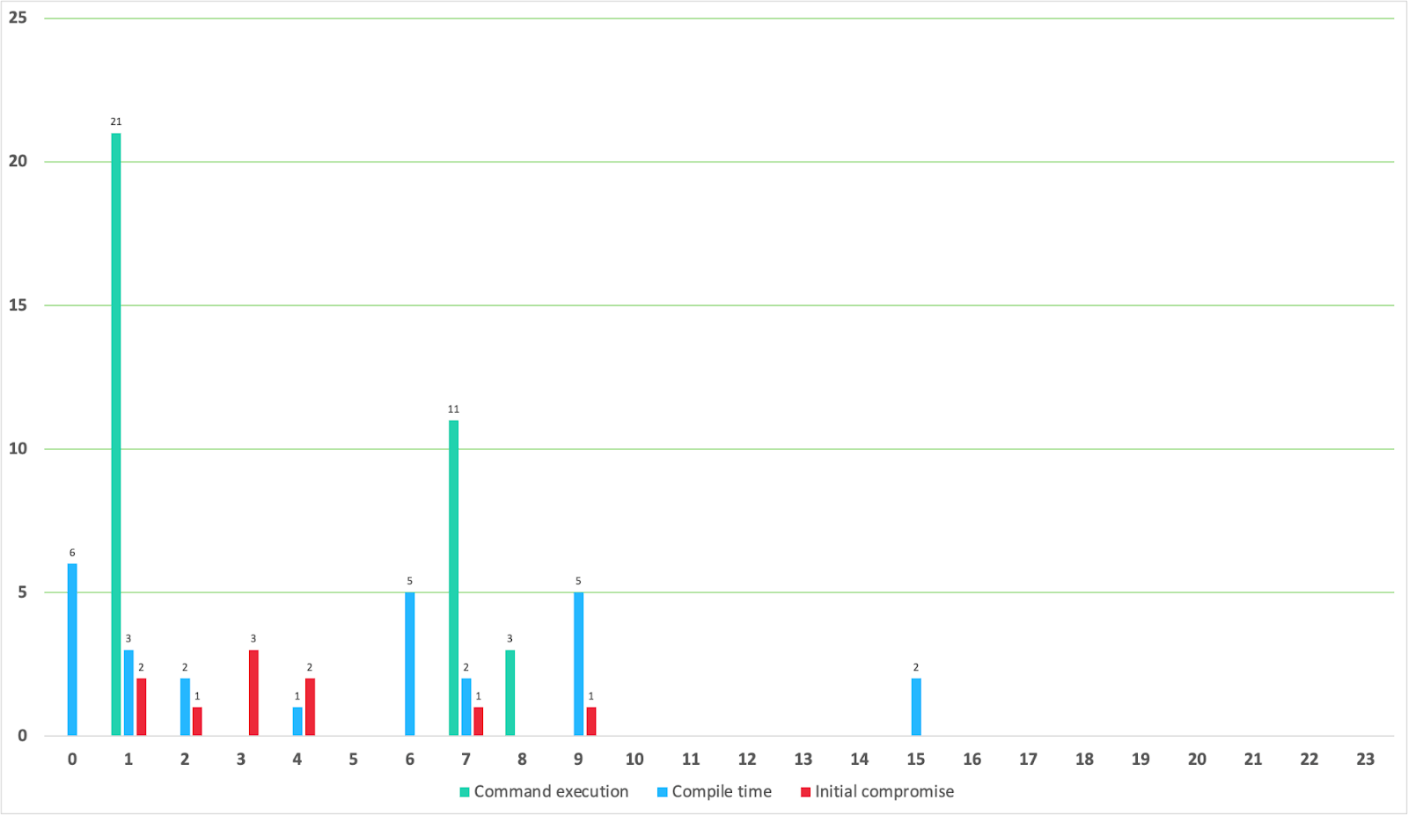
    Throughout this campaign, several malware samples were used that we managed to attribute to the Lazarus group through our ongoing and dedicated research conducted for a long time. Our attribution is supported by the historical use of the malware strains, as well as their TTPs, all of which have been well documented by numerous security solutions vendors and governments. Furthermore, we have analyzed the execution time of the Windows commands delivered by the COPPERHEDGE malware, the build timestamps of all malicious samples we described above, and the time of initial compromise per host, demonstrating that the timeframes were mostly concentrated between GMT 00:00 and 09:00. Based on our knowledge of normal working hours in various time zones, we can infer that the actor is located in the GMT+09 time zone.

    Timeline of malicious activity

    Victims

    We identified at least six software, IT, financial, semiconductor manufacturing and telecommunication organizations in South Korea that fell victim to “Operation SyncHole”. However, we are confident that there are many more affected organizations across a broader range of industries, given the popularity of the software exploited by Lazarus in this campaign.

    Conclusion

    This is not the first time that the Lazarus group exploited supply chains with a full understanding of the software ecosystem in South Korea. We have already described similar attacks in our analysis reports on the Bookcode cluster in 2020, the DeathNote cluster in 2022, and the SIGNBT malware in 2023. All of these cases targeted software developed by South Korean vendors that required installation for online banking and government services. Both of the software products exploited in this case are in line with past cases, meaning that the Lazarus group is endlessly adopting an effective strategy based on cascading supply chain attacks.

    The Lazarus group’s specialized attacks targeting supply chains in South Korea are expected to continue in the future. Our research over the past few years provided evidence that many software development vendors in Korea have already been attacked, and if the source code of a product has been compromised, other zero-day vulnerabilities may continue to be discovered. The attackers are also making efforts to minimize detection by developing new malware or enhancing existing malware. In particular, they introduce enhancements to the communication with the C2, command structure, and the way they send and receive data.

    We have proven that accurate detection and quick response can effectively deter their tactics, and in the meantime, we were able to remediate vulnerabilities and mitigate attacks to minimize damage. We will continue to monitor the activity of this group and remain agile in responding to their changes. We also recommend using reliable security solutions to stay alert and mitigate potential risks. Our product line for businesses helps identify and prevent attacks of any complexity at an early stage.

    Kaspersky products detect the exploits and malware used in this attack with the following verdicts: Trojan.Win64.Lazarus.*, Trojan.Win32.Lazarus.*, MEM:Trojan.Win32.Cometer.gen, MEM:Trojan.Win32.SEPEH.gen, Trojan.Win32.Manuscrypt.*, Trojan.Win64.Manuscrypt.*, Trojan.Win32.Zenpak.*.

    Indicators of Compromise

    More IoCs are available to customers of the Kaspersky Intelligence Reporting Service. Contact: intelreports@kaspersky.com.

    Variant of the ThreatNeedle loader
    f1bcb4c5aa35220757d09fc5feea193b C:System32PCAuditex.dll

    Variant of the wAgent loader
    dc0e17879d66ea9409cdf679bfea388c C:ProgramDataintelutil.dat

    COPPERHEDGE dropper
    2d47ef0089010d9b699cd1bbbc66f10a %AppData%hnc_net.tmp

    C2 servers
    www[.]smartmanagerex[.]com
    hxxps://thek-portal[.]com/eng/career/index.asp
    hxxps://builsf[.]com/inc/left.php
    hxxps://www[.]rsdf[.]kr/wp-content/uploads/2024/01/index.php
    hxxp://www[.]shcpump[.]com/admin/form/skin/formBasic/style.php
    hxxps://htns[.]com/eng/skin/member/basic/skin.php
    hxxps://kadsm[.]org/skin/board/basic/write_comment_skin.php
    hxxp://bluekostec[.]com/eng/community/write.asp
    hxxp://dream.bluit.gethompy[.]com/mobile/skin/board/gallery/index.skin.php

    MIL OSI Economics

  • MIL-OSI Banking: Operation SyncHole: Lazarus APT goes back to the well

    Source: Securelist – Kaspersky

    Headline: Operation SyncHole: Lazarus APT goes back to the well

    We have been tracking the latest attack campaign by the Lazarus group since last November, as it targeted organizations in South Korea with a sophisticated combination of a watering hole strategy and vulnerability exploitation within South Korean software. The campaign, dubbed “Operation SyncHole”, has impacted at least six organizations in South Korea’s software, IT, financial, semiconductor manufacturing, and telecommunications industries, and we are confident that many more companies have actually been compromised. We immediately took action by communicating meaningful information to the Korea Internet & Security Agency (KrCERT/CC) for rapid action upon detection, and we have now confirmed that the software exploited in this campaign has all been updated to patched versions.

    Timeline of the operation

    Our findings in a nutshell:

    • At least six South Korean organizations were compromised by a watering hole attack combined with exploitation of vulnerabilities by the Lazarus group.
    • A one-day vulnerability in Innorix Agent was also used for lateral movement.
    • Variants of Lazarus’ malicious tools, such as ThreatNeedle, Agamemnon downloader, wAgent, SIGNBT, and COPPERHEDGE, were discovered with new features.

    Background

    The initial infection was discovered in November of last year when we detected a variant of the ThreatNeedle backdoor, one of the Lazarus group’s flagship malicious tools, used against a South Korean software company. We found that the malware was running in the memory of a legitimate SyncHost.exe process, and was created as a subprocess of Cross EX, legitimate software developed in South Korea. This potentially was the starting point for the compromise of further five organizations in South Korea. Additionally, according to a recent security advisory posted on the KrCERT website, there appear to be recently patched vulnerabilities in Cross EX, which were addressed during the timeframe of our research.

    In the South Korean internet environment, the online banking and government websites require the installation of particular security software to support functions such as anti-keylogging and certificate-based digital signatures. However, due to the nature of these software packages, they constantly run in the background to interact with the browser. The Lazarus group shows a strong grasp of these specifics and is using a South Korea-targeted strategy that combines vulnerabilities in such software with watering hole attacks. The South Korean National Cyber Security Center published its own security advisory in 2023 against such incidents, and also published additional joint security advisories in cooperation with the UK government.

    Cross EX is designed to enable the use of such security software in various browser environments, and is executed with user-level privileges except immediately after installation. Although the exact method by which Cross EX was exploited to deliver malware remains unclear, we believe that the attackers escalated their privileges during the exploitation process as we confirmed the process was executed with high integrity level in most cases. The facts below led us to conclude that a vulnerability in the Cross EX software was most likely leveraged in this operation.

    • The most recent version of Cross EX at the time of the incidents was installed on the infected PCs.
    • Execution chains originating from the Cross EX process that we observed across the targeted organizations were all identical.
    • The incidents that saw the Synchost process abused to inject malware were concentrated within a short period of time: between November 2024 and February 2025.

    In the earliest attack of this operation, the Lazarus group also exploited another South Korean software product, Innorix Agent, leveraging a vulnerability to facilitate lateral movement, enabling the installation of additional malware on a targeted host of their choice. They even developed malware to exploit this, avoiding repetitive tasks and streamlining processes. The exploited software, Innorix Agent (version 9.2.18.450 and earlier), was previously abused by the Andariel group, while the malware we obtained targeted the more recent version 9.2.18.496.

    While analyzing the malware’s behavior, we discovered an additional arbitrary file download zero-day vulnerability in Innorix Agent, which we managed to detect before any threat actors used it in their attacks. We reported the issues to the Korea Internet & Security Agency (KrCERT) and the vendor. The software has since been updated with patched versions.

    Installing malware through vulnerabilities in software exclusively developed in South Korea is a key part of the Lazarus group’s strategy to target South Korean entities, and we previously disclosed a similar case in 2023, as did ESET and KrCERT.

    Initial vector

    The infection began when the user of a targeted system accessed several South Korean online media sites. Shortly after visiting one particular site, the machine was compromised by the ThreatNeedle malware, suggesting that the site played a key role in the initial delivery of the backdoor. During the analysis, it was discovered that the infected system was communicating with a suspicious IP address. Further examination revealed that this IP hosted two domains (T1583.001), both of which appeared to be hastily created car rental websites using publicly available HTML templates.

    Appearance of www.smartmanagerex[.]com

    The first domain, www.smartmanagerex[.]com, seemed to be masquerading as software provided by the same vendor that distributes Cross EX. Based on these findings, we reconstructed the following attack scenario.

    Attack flow during initial compromise

    Given that online media sites are typically visited quite frequently by a wealth of users, the Lazarus group filters visitors with a server-side script and redirects desired targets to an attacker-controlled website (T1608.004). We assess with medium confidence that the redirected site may have executed a malicious script (T1189), targeting a potential flaw in Cross EX (T1190) installed on the target PC, and launching malware. The script then ultimately executed the legitimate SyncHost.exe and injected a shellcode that loaded a variant of ThreatNeedle into that process. This chain, which ends with the malware being injected into SyncHost.exe, was common to all of the affected organizations we identified, meaning that the Lazarus group has conducted extensive operations against South Korea over the past few months with the same vulnerability and the same exploit.

    Execution flow

    We have divided this operation into two phases based on the malware used. The first phase focused primarily on the execution chain involving ThreatNeedle and wAgent. It was then followed by the second phase which involved the use of SIGNBT and COPPERHEDGE.

    We derived a total of four different malware execution chains based on these phases from at least six affected organizations. In the first infection case, we found a variant of the ThreatNeedle malware, but in subsequent attacks, the SIGNBT malware took its place, thus launching the second phase. We believe this is due to the quick and aggressive action we took with the first victim. In subsequent attacks, the Lazarus group introduced three updated infection chains including SIGNBT, and we observed a wider range of targets and more frequent attacks. This suggests that the group may have realized that their carefully prepared attacks had been exposed, and extensively leveraged the vulnerability from then on.

    Chains of infection across the operation

    First-phase malware

    In the first infection chain, many updated versions of the malware previously used by the Lazarus group were used.

    Variant of ThreatNeedle

    The ThreatNeedle sample used in this campaign was also referred to as “ThreatNeedleTea” in a research paper published by ESET; we believe this is an updated version of the early ThreatNeedle. However, the ThreatNeedle seen in this attack had been modified with additional features.

    This version of ThreatNeedle is divided into a Loader and Core samples. The Core version retrieves five configuration files from C_27098.NLS to C_27102.NLS, and contains a total of 37 commands. The Loader version, meanwhile, references only two configuration files and implements only four commands.

    The Core component receives a specific command from the C2, resulting in an additional loader file being created for the purpose of persistence. This file can be disguised as the ServiceDLL value of a legitimate service in the netsvcs group (T1543.003), the IKEEXT service (T1574.001), or registered as a Security Service Provider (SSP) (T1547.005). It ultimately loads the ThreatNeedle Loader component.

    Behavior flow to load ThreatNeedle Loader by target service

    The updated ThreatNeedle generates a random key pair based on the Curve25519 algorithm (T1573.002), sends the public key to the C2 server, and then receives the attacker’s public key. Finally, the generated private key and the attacker’s public key are scalar-operated to create a shared key, which is then used as the key for the ChaCha20 algorithm to encrypt the data (T1573.001). The data is sent and received in JSON format.

    LPEClient

    LPEClient is a tool known for victim profiling and payload delivery (T1105) that has previously been observed in attacks on defense contractors and the cryptocurrency industry. We disclosed that this tool had been loaded by SIGNBT when we first documented SIGNBT malware. However, we did not observe LPEClient being loaded by SIGNBT in this campaign. It was only loaded by the variant of ThreatNeedle.

    Variant of wAgent

    In addition to the variant of ThreatNeedle, a variant of the wAgent malware was also discovered in the first affected organization. wAgent is a malicious tool that we documented in 2020, and a similar version was mentioned in Operation GoldGoblin by KrCERT. The origin of its creation is still shrouded in mystery, but we discovered that the wAgent loader was disguised as liblzma.dll and executed via the command line rundll32.exe c:Programdataintelutil.dat, afunix 1W2UUEZNOB99Z (T1218.011). The export function retrieves the given filename 1W2UUEZNOB99Z in C:ProgramData, which also serves as the decryption key. After converting this filename into wide bytes, it uses the highest 16 bytes of the resulting value as the key for the AES-128-CBC algorithm and decrypts (T1140) the contents of the file located in C:ProgramData (T1027.013). The upper four bytes of the decrypted data subsequently represent the size of the payload (T1027.009), which we identified as an updated version of the wAgent malware.

    The variant of wAgent has the ability to receive data in both form-data and JSON formats, depending on the C2 server it succeeds in reaching. Notably, it includes the __Hostnextauthtoken key within the Cookie field in the request header during the communication (T1071.001), carrying the sequence of communication appended by random digits. In this version, the new observed change is that an open-source GNU Multiple-Precision (GMP) library is employed to carry out RSA encryption computations, which is a previously unseen library in malware used by the Lazarus group. According to the wAgent configuration file, it is identified as the x64_2.1 version. This version manages payloads using a C++ STL map, with emphasis on receiving additional payloads from the C2 and loading them directly into memory, along with creating a shared object. With this object, the main module is able to exchange command parameters and execution results with the delivered plugins.

    Operational structure of the wAgent variant

    Variant of the Agamemnon downloader

    The Agamemnon downloader is also responsible for downloading and executing additional payloads received from the C2 server. Although we did not obtain the configuration file of Agamemnon, it receives commands from the C2 and executes the payload by parsing the commands and parameters based on ;; characters, which serve as command and parameter delimiters. The value of the mode in response passed with a 2 command determines how to execute the additional payload, which is delivered along with a 3 command. There are two methods of execution: the first one is to load the payload reflectively (T1620), which is commonly used in malware, whereas the second one is to utilize the open-source Tartarus-TpAllocInject technique, which we have not previously seen in malware from the Lazarus group.

    Structure of the commands where additional data is passed

    The open-source loader is built on top of another open-source loader named Tartarus’ Gate. Tartarus’ Gate is based on Halo’s Gate, which is in turn based on Hell’s Gate. All of these techniques are designed to bypass security products such as antivirus and EDR solutions, but they load the payload in different ways.

    Innorix Agent exploit for lateral movement

    Unlike the previously mentioned tools, the Innorix abuser is used for lateral movement. It is downloaded by the Agamemnon downloader (T1105) and exploits a specific version of a file transfer software tool developed in South Korea, Innorix Agent, to fetch additional malware on internal hosts (T1570). Innorix Agent is another software product that is mandatory for some financial and administrative tasks in the South Korean internet environment, meaning that it is likely to be installed on many PCs of both corporations and individuals in South Korea, and any user with a vulnerable version is potentially a target. The malware embeds a license key allegedly bound to version 9.2.18.496, which allows it to perform lateral movement by generating malicious traffic disguised as legitimate traffic against targeted network PCs.

    The Innorix abuser is given parameters from the Agamemnon downloader: the target IP, URL to download a file, and file size. It then delivers a request to that target IP to check if Innorix Agent is installed and running. If a successful response is returned, the malware assumes that the software is running properly on the targeted host and transmits traffic that allows the target to download the additional files from the given URL due to a lack of traffic validation.

    Steps to deploy additional malware via the Innorix abuser

    The actor created a legitimate AppVShNotify.exe and a malicious USERENV.dll file in the same path via the Innorix abuser, and then executed the former using a legitimate feature of the software. The USERENV.dll was sideloaded (T1574.002) as a result, which ultimately led to the execution of ThreatNeedle and LPEClient on the targeted hosts, thus launching the infection chain on previously unaffected machines.

    We reported this vulnerability to KrCERT due to the potentially dangerous impact of the Innorix abuser, but were informed that the vulnerability has been exploited and reported in the past. We have confirmed that this malware does not work effectively in environments with Innorix Agent versions other than 9.2.18.496.

    In addition, while digging into the malware’s behavior, we identified another additional arbitrary file download vulnerability that applies to versions up to 9.2.18.538. It is tracked as KVE-2025-0014 and we have not yet found any evidence of its use in the wild. KVE is a vulnerability identification number issued exclusively by KrCERT. We successfully contacted Innorix to share our findings containing the vulnerabilities via KrCERT, and they managed to release a patched version in March with both vulnerabilities fixed.

    Second phase malware

    The second phase of the operation also introduces newer versions of malicious tools previously seen in Lazarus attacks.

    SIGNBT

    The SIGNBT we documented in 2023 was version 1.0, but in this attack, version 0.0.1 was used at the forefront. In addition, we identified a more recent version, SIGNBT 1.2. Unlike versions 1.0 and 0.0.1, the 1.2 version had minimal remote control capabilities and was focused on executing additional payloads. The malware developers named this version “Hijacking”.

    In the second phase of this operation, SIGNBT 0.0.1 was the initial implant executed in memory in SyncHost.exe to fetch additional malware. In this version, the C2 server was hardcoded without reference to any configuration files. During this investigation, we found a credential dumping tool that was fetched by SIGNBT 0.0.1, identical to what we have seen in previous attacks.

    As for version 1.2, it fetches the path to the configuration file from its resources and retrieves the file to obtain C2 server addresses. We were able to extract two configuration file paths from each identified SIGNBT 1.2 sample, which are shown below. Another change in SIGNBT 1.2 is that the number of prefixes starting with SIGN are reduced to only three: SIGNBTLG, SIGNBTRC, and SIGNBTSR. The malware receives an RSA public key from the C2 and encrypts a randomly generated AES key using the public key. All traffic is encrypted with the generated AES key.

    • Configuration file path 1: C:ProgramDataSamsungSamsungSettingssettings.dat
    • Configuration file path 2: C:ProgramDataMicrosoftDRMServerdrm.ver

    COPPERHEDGE

    COPPERHEDGE is a malicious tool that was named by US-CERT in 2020. It is a Manuscrypt variant and was primarily used in the DeathNote cluster attacks. Unlike the other malware used in this operation, COPPERHEDGE has not changed dramatically, with only several commands being slightly changed compared to the older versions. This version, however, retrieves configuration information such as the C2 server address from the ADS %appdata%MicrosoftInternet Explorerbrndlog.txt:loginfo (T1564.004). The malware then sends HTTP traffic to C2 with three or four parameters for each request, where the parameter name is chosen randomly out of three names in any order.

    • First HTTP parameter name: bih, aqs, org
    • Second HTTP parameter name: wib, rlz, uid
    • Third HTTP parameter name: tib, hash, lang
    • Fourth HTTP parameter name: ei, ie, oq

    The actor primarily used the COPPERHEDGE malware to conduct internal reconnaissance in this operation. There are a total of 30 commands from 0x2003 to 0x2032, and 11 response codes from 0x2040 to 0x2050 inside the COPPERHEDGE backdoor.

    The evolution of Lazarus malware

    In recent years, the malware used by the Lazarus group has been rapidly evolving to include lightweighting and modularization. This applies not only to newly added tools, but also to malware that has been used in the past. We have observed such changes for a few years, and we believe there are more on the way.

    Use of asymmetric encryption Load plugins Divided into core and loader version
    MISTPEN O
    CookiePlus O (RSA) O
    ThreatNeedle O (Curve25519) O O
    wAgent (downloader) O (RSA) O
    Agamemnon downloader
    SIGNBT O (RSA) O O
    COPPERHEDGE O (RSA) O

    Discoveries

    During our investigation into this campaign, we gained extensive insight into the Lazarus group’s post-exploitation strategy. After installing the COPPERHEDGE malware, the actor executed numerous Windows commands to gather basic system information (T1082, T1083, T1057, T1049, T1016, T1087.001), create a malicious service (T1569.002, T1007) and attempt to find valuable hosts to perform lateral movement (T1087.002, T1135).

    While analyzing the commands executed by the actor, we were able to identify the actor’s mistake when using the taskkill command: the /im parameter when using taskkill means imagename, which should specify the image name of the process, not the process id. This shows that the actor is still performing internal reconnaissance by manually entering commands.

    Infrastructure

    Throughout this operation, most of the C2 servers were legitimate but compromised websites in South Korea (T1584.001), further indicating that this operation was highly focused on South Korea. In the first phase, other media sites were utilized as C2 servers to avoid detection of media-initiated watering hole attacks. However, as the infection chain turned to the second phase, legitimate sites in various other industries were additionally exploited.

    Unlike other cases, LPEClient’s C2 server was hosted by the same hosting company as www.smartmanagerex[.]com, which was deliberately created for initial compromise. Given that LPEClient is heavily relied upon by the Lazarus group for delivering additional payloads, it is likely that the attackers deliberately rented and configured the server (T1583.003), assigning a domain under their control to maintain full operational flexibility. In addition to this, we also found that two domains that were exploited as C2 servers for SIGNBT 0.0.1 resolved to the same hosting company’s IP range.

    We confirmed that the domain thekportal[.]com belonged to a South Korean ISP until 2020 and was the legitimate domain of an insurance company that was acquired by another company. Since then, the domain had been parked and its status was changed in February 2025, indicating that the Lazarus group re-registered the domain to leverage it in this operation.

    Attribution

    Throughout this campaign, several malware samples were used that we managed to attribute to the Lazarus group through our ongoing and dedicated research conducted for a long time. Our attribution is supported by the historical use of the malware strains, as well as their TTPs, all of which have been well documented by numerous security solutions vendors and governments. Furthermore, we have analyzed the execution time of the Windows commands delivered by the COPPERHEDGE malware, the build timestamps of all malicious samples we described above, and the time of initial compromise per host, demonstrating that the timeframes were mostly concentrated between GMT 00:00 and 09:00. Based on our knowledge of normal working hours in various time zones, we can infer that the actor is located in the GMT+09 time zone.

    Timeline of malicious activity

    Victims

    We identified at least six software, IT, financial, semiconductor manufacturing and telecommunication organizations in South Korea that fell victim to “Operation SyncHole”. However, we are confident that there are many more affected organizations across a broader range of industries, given the popularity of the software exploited by Lazarus in this campaign.

    Conclusion

    This is not the first time that the Lazarus group exploited supply chains with a full understanding of the software ecosystem in South Korea. We have already described similar attacks in our analysis reports on the Bookcode cluster in 2020, the DeathNote cluster in 2022, and the SIGNBT malware in 2023. All of these cases targeted software developed by South Korean vendors that required installation for online banking and government services. Both of the software products exploited in this case are in line with past cases, meaning that the Lazarus group is endlessly adopting an effective strategy based on cascading supply chain attacks.

    The Lazarus group’s specialized attacks targeting supply chains in South Korea are expected to continue in the future. Our research over the past few years provided evidence that many software development vendors in Korea have already been attacked, and if the source code of a product has been compromised, other zero-day vulnerabilities may continue to be discovered. The attackers are also making efforts to minimize detection by developing new malware or enhancing existing malware. In particular, they introduce enhancements to the communication with the C2, command structure, and the way they send and receive data.

    We have proven that accurate detection and quick response can effectively deter their tactics, and in the meantime, we were able to remediate vulnerabilities and mitigate attacks to minimize damage. We will continue to monitor the activity of this group and remain agile in responding to their changes. We also recommend using reliable security solutions to stay alert and mitigate potential risks. Our product line for businesses helps identify and prevent attacks of any complexity at an early stage.

    Kaspersky products detect the exploits and malware used in this attack with the following verdicts: Trojan.Win64.Lazarus.*, Trojan.Win32.Lazarus.*, MEM:Trojan.Win32.Cometer.gen, MEM:Trojan.Win32.SEPEH.gen, Trojan.Win32.Manuscrypt.*, Trojan.Win64.Manuscrypt.*, Trojan.Win32.Zenpak.*.

    Indicators of Compromise

    More IoCs are available to customers of the Kaspersky Intelligence Reporting Service. Contact: intelreports@kaspersky.com.

    Variant of the ThreatNeedle loader
    f1bcb4c5aa35220757d09fc5feea193b C:System32PCAuditex.dll

    Variant of the wAgent loader
    dc0e17879d66ea9409cdf679bfea388c C:ProgramDataintelutil.dat

    COPPERHEDGE dropper
    2d47ef0089010d9b699cd1bbbc66f10a %AppData%hnc_net.tmp

    C2 servers
    www[.]smartmanagerex[.]com
    hxxps://thek-portal[.]com/eng/career/index.asp
    hxxps://builsf[.]com/inc/left.php
    hxxps://www[.]rsdf[.]kr/wp-content/uploads/2024/01/index.php
    hxxp://www[.]shcpump[.]com/admin/form/skin/formBasic/style.php
    hxxps://htns[.]com/eng/skin/member/basic/skin.php
    hxxps://kadsm[.]org/skin/board/basic/write_comment_skin.php
    hxxp://bluekostec[.]com/eng/community/write.asp
    hxxp://dream.bluit.gethompy[.]com/mobile/skin/board/gallery/index.skin.php

    MIL OSI Global Banks

  • MIL-OSI: STMicroelectronics Reports 2025 First Quarter Financial Results

    Source: GlobeNewswire (MIL-OSI)

    PR No: C3332C 

    STMicroelectronics Reports 2025 First Quarter Financial Results

    • Q1 net revenues $2.52 billion; gross margin 33.4%; operating income $3 million; net income $56 million
    • Business outlook at mid-point: Q2 net revenues of $2.71 billion and gross margin of 33.4%
    • Company-wide program to reshape manufacturing footprint and resize global cost base on track; annual cost savings target in the high triple-digit million-dollar range exiting 2027 confirmed.

    Geneva, April 24, 2025 – STMicroelectronics N.V. (“ST”) (NYSE: STM), a global semiconductor leader serving customers across the spectrum of electronics applications, reported U.S. GAAP financial results for the first quarter ended March 29, 2025. This press release also contains non-U.S. GAAP measures (see Appendix for additional information).

    ST reported first quarter net revenues of $2.52 billion, gross margin of 33.4%, operating income of $3 million and net income of $56 million or $0.06 diluted earnings per share.

    Jean-Marc Chery, ST President & CEO, commented:

    • “Q1 net revenues came in line with the midpoint of our business outlook range, driven by higher revenues in Personal Electronics offset by lower-than-expected revenues in Automotive and Industrial. Gross margin was slightly below the mid-point of our business outlook range mainly due to product mix.”
    • “On a year-over-year basis, Q1 net revenues decreased 27.3%, operating margin decreased to 0.1% from 15.9% and net income decreased 89.1% to $56 million.”
    • “In the first quarter, our book-to-bill ratio improved with both Automotive and Industrial above parity.”
    • “Our second quarter business outlook, at the mid-point, is for net revenues of $2.71 billion, decreasing year-over-year by 16.2% and increasing sequentially by 7.7%; gross margin is expected to be about 33.4%, impacted by about 420 basis points of unused capacity charges.”
    • “We plan to maintain our Net Capex (non-U.S. GAAP1) plan for 2025 between $2.0 billion and $2.3 billion mainly to execute the reshaping of our manufacturing footprint.”
    • “While we see Q1 2025 as the bottom, in the current uncertain environment we are focusing on what we can control: keep on innovating to continuously improve and accelerate the competitiveness of our product and technology portfolio, focus on advanced manufacturing and tightly manage our costs. In this respect our company-wide program to reshape ST manufacturing footprint and resize our global cost base is on track and we confirm the annual cost savings target in the high triple-digit million-dollar range exiting 2027.”

    Quarterly Financial Summary

    U.S. GAAP
    (US$ m, except per share data)
    Q1 2025 Q4 2024 Q1 2024 Q/Q Y/Y
    Net Revenues $2,517 $3,321 $3,465 -24.2% -27.3%
    Gross Profit $841 $1,253 $1,444 -32.9% -41.7%
    Gross Margin 33.4% 37.7% 41.7% -430 bps -830 bps
    Operating Income $3 $369 $551 -99.2% -99.5%
    Operating Margin 0.1% 11.1% 15.9% -1,100 bps -1,580 bps
    Net Income $56 $341 $513 -83.6% -89.1%
    Diluted Earnings Per Share $0.06 $0.37 $0.54 -83.8% -88.9%

    First Quarter 2025 Summary Review
    ST made some adjustments to its segment reporting effective starting January 1, 2025. Prior year comparative periods have been adjusted accordingly. See Appendix for more detail.

    Net Revenues by Reportable Segment2 (US$ m) Q1 2025 Q4 2024 Q1 2024 Q/Q Y/Y
    Analog products, MEMS and Sensors (AM&S) segment 1,069 1,348 1,406 -20.7% -23.9%
    Power and discrete products (P&D) segment 397 602 631 -34.1% -37.1%
    Subtotal: Analog, Power & Discrete, MEMS and Sensors (APMS) Product Group 1,466 1,950 2,037 -24.8% -28.0%
    Embedded Processing (EMP) segment 742 1,002 1,047 -26.0% -29.1%
    RF & Optical Communications (RF&OC) segment 306 366 378 -16.5% -19.2%
    Subtotal: Microcontrollers, Digital ICs and RF products (MDRF) Product Group 1,048 1,368 1,425 -23.4% -26.5%
    Others 3 3 3
    Total Net Revenues $2,517 $3,321 $3,465 -24.2% -27.3%

    Net revenues totaled $2.52 billion, representing a year-over-year decrease of 27.3%. Year-over-year net sales to OEMs and Distribution decreased 25.7% and 31.2%, respectively. On a sequential basis, net revenues decreased 24.2%, 20 basis points better than the mid-point of ST’s guidance.

    Gross profit totaled $841 million, representing a year-over-year decrease of 41.7%. Gross margin of 33.4%, 40 basis points below the mid-point of ST’s guidance, decreased 830 basis points year-over-year, mainly due to product mix and, to a lesser extent, higher unused capacity charges and lower sales price.

    Operating income decreased 99.5% to $3 million, compared to $551 million in the year-ago quarter. ST’s operating margin decreased 1,580 basis points on a year-over-year basis to 0.1% of net revenues, compared to 15.9% in the first quarter of 2024. Excluding Impairment, restructuring charges and other related phase-out costs3, operating income stood at $11 million in the first quarter.

    By reportable segment, compared with the year-ago quarter:

    In Analog, Power & Discrete, MEMS and Sensors (APMS) Product Group:

    Analog products, MEMS and Sensors (AM&S) segment:

    • Revenue decreased 23.9% mainly due to a decrease in Analog.   
    • Operating profit decreased by 66.7% to $82 million. Operating margin was 7.7% compared to 17.5%.

    Power and Discrete products (P&D) segment:

    • Revenue decreased 37.1%.
    • Operating profit decreased from a positive $77 million to a negative $28 million. Operating margin was -6.9% compared to 12.1%.

    In Microcontrollers, Digital ICs and RF products (MDRF) Product Group:

    Embedded Processing (EMP) segment:

    • Revenue decreased 29.1% mainly due to a decrease in GPAM.
    • Operating profit decreased by 71.5% to $66 million. Operating margin was 8.9% compared to 22.2%.

    RF & Optical Communications (RF&OC) segment:

    • Revenue decreased 19.2%.
    • Operating profit decreased by 59.0% to $43 million. Operating margin was 13.9% compared to 27.4%.

    Net income and diluted Earnings Per Share decreased to $56 million and $0.06 respectively compared to $513 million and $0.54 respectively in the year-ago quarter. Excluding Impairment, restructuring charges and other related phase-out costs net of the relevant tax impact, Net income and diluted Earnings Per Share2 stood at $63 million and $0.07 respectively in the first quarter of 2025.

    Cash Flow and Balance Sheet Highlights

            Trailing 12 Months
    (US$ m) Q1 2025 Q4 2024 Q1 2024 Q1 2025 Q1 2024 TTM Change
    Net cash from operating activities 574 681 859 2,680 5,531 – 51.5%
    Free cash flow (non-U.S. GAAP1) 30 128 (134) 453 1,434 – 68.4%

    Net cash from operating activities was $574 million in the first quarter compared to $859 million in the year-ago quarter.

    Net Capex (non-U.S. GAAP), was $530 million in the first quarter compared to $967 million in the year-ago quarter.

    Free cash flow (non-U.S. GAAP) was positive at $30 million in the first quarter, compared to negative $134 million in the year-ago quarter.

    Inventory at the end of the first quarter was $3.01 billion, compared to $2.79 billion in the previous quarter and $2.69 billion in the year-ago quarter. Days sales of inventory at quarter-end was 167 days, compared to 122 days for both the previous quarter and the year-ago quarter.

    In the first quarter, ST paid cash dividends to its stockholders totaling $72 million and executed a $92 million share buy-back, as part of its current share repurchase program.

    ST’s net financial position (non-U.S. GAAP4) remained strong at $3.08 billion as of March 29, 2025, compared to $3.23 billion as of December 31, 2024 and reflected total liquidity of $5.96 billion and total financial debt of $2.88 billion. Adjusted net financial position (non-U.S. GAAP1), taking into consideration the effect on total liquidity of advances from capital grants for which capital expenditures have not been incurred yet, stood at $2.71 billion as of March 29, 2025.

    Corporate developments

    On April 10, 2025, ST detailed its company-wide program to reshape manufacturing footprint and resize global cost base and confirmed the annual cost savings target in the high triple-digit million-dollar range exiting 2027. Specifically, ST disclosed further elements of its program to reshape its global manufacturing footprint.

    Business Outlook

    ST’s guidance, at the mid-point, for the 2025 second quarter is:

    • Net revenues are expected to be $2.71 billion, an increase of 7.7% sequentially, plus or minus 350 basis points.
    • Gross margin of 33.4%, plus or minus 200 basis points.
    • This outlook is based on an assumed effective currency exchange rate of approximately $1.08 = €1.00 for the 2025 second quarter and includes the impact of existing hedging contracts.
    • The second quarter will close on June 28, 2025.

    This business outlook does not include any impact for potential further changes to global trade tariffs compared to the current situation.

    Conference Call and Webcast Information

    ST will conduct a conference call with analysts, investors and reporters to discuss its first quarter 2025 financial results and current business outlook today at 9:30 a.m. Central European Time (CET) / 3:30 a.m. U.S. Eastern Time (ET). A live webcast (listen-only mode) of the conference call will be accessible at ST’s website, https://investors.st.com, and will be available for replay until May 9, 2025.

    Use of Supplemental Non-U.S. GAAP Financial Information

    This press release contains supplemental non-U.S. GAAP financial information.

    Readers are cautioned that these measures are unaudited and not prepared in accordance with U.S. GAAP and should not be considered as a substitute for U.S. GAAP financial measures. In addition, such non-U.S. GAAP financial measures may not be comparable to similarly titled information from other companies. To compensate for these limitations, the supplemental non-U.S. GAAP financial information should not be read in isolation, but only in conjunction with ST’s consolidated financial statements prepared in accordance with U.S. GAAP.

    See the Appendix of this press release for a reconciliation of ST’s non-U.S. GAAP financial measures to their corresponding U.S. GAAP financial measures.

    Forward-looking Information

    Some of the statements contained in this release that are not historical facts are statements of future expectations and other forward-looking statements (within the meaning of Section 27A of the Securities Act of 1933 or Section 21E of the Securities Exchange Act of 1934, each as amended) that are based on management’s current views and assumptions, and are conditioned upon and also involve known and unknown risks and uncertainties that could cause actual results, performance or events to differ materially from those anticipated by such statements due to, among other factors: 

    • changes in global trade policies, including the adoption and expansion of tariffs and trade barriers, that could affect the macro-economic environment and adversely impact the demand for our products;
    • uncertain macro-economic and industry trends (such as inflation and fluctuations in supply chains), which may impact production capacity and end-market demand for our products;
    • customer demand that differs from projections which may require us to undertake transformation measures that may not be successful in realizing the expected benefits in full or at all;
    • the ability to design, manufacture and sell innovative products in a rapidly changing technological environment;
    • changes in economic, social, public health, labor, political, or infrastructure conditions in the locations where we, our customers, or our suppliers operate, including as a result of macro-economic or regional events, geopolitical and military conflicts, social unrest, labor actions, or terrorist activities;
    • unanticipated events or circumstances, which may impact our ability to execute our plans and/or meet the objectives of our R&D and manufacturing programs, which benefit from public funding;
    • financial difficulties with any of our major distributors or significant curtailment of purchases by key customers;
    • the loading, product mix, and manufacturing performance of our production facilities and/or our required volume to fulfill capacity reserved with suppliers or third-party manufacturing providers;
    • availability and costs of equipment, raw materials, utilities, third-party manufacturing services and technology, or other supplies required by our operations (including increasing costs resulting from inflation);
    • the functionalities and performance of our IT systems, which are subject to cybersecurity threats and which support our critical operational activities including manufacturing, finance and sales, and any breaches of our IT systems or those of our customers, suppliers, partners and providers of third-party licensed technology;
    • theft, loss, or misuse of personal data about our employees, customers, or other third parties, and breaches of data privacy legislation;
    • the impact of IP claims by our competitors or other third parties, and our ability to obtain required licenses on reasonable terms and conditions;
    • changes in our overall tax position as a result of changes in tax rules, new or revised legislation, the outcome of tax audits or changes in international tax treaties which may impact our results of operations as well as our ability to accurately estimate tax credits, benefits, deductions and provisions and to realize deferred tax assets;
    • variations in the foreign exchange markets and, more particularly, the U.S. dollar exchange rate as compared to the Euro and the other major currencies we use for our operations;
    • the outcome of ongoing litigation as well as the impact of any new litigation to which we may become a defendant;
    • product liability or warranty claims, claims based on epidemic or delivery failure, or other claims relating to our products, or recalls by our customers for products containing our parts;
    • natural events such as severe weather, earthquakes, tsunamis, volcano eruptions or other acts of nature, the effects of climate change, health risks and epidemics or pandemics in locations where we, our customers or our suppliers operate;
    • increased regulation and initiatives in our industry, including those concerning climate change and sustainability matters and our goal to become carbon neutral in all direct and indirect emissions (scopes 1 and 2), product transportation, business travel, and employee commuting emissions (our scope 3 focus), and to achieve our 100% renewable electricity sourcing goal by the end of 2027;
    • epidemics or pandemics, which may negatively impact the global economy in a significant manner for an extended period of time, and could also materially adversely affect our business and operating results;
    • industry changes resulting from vertical and horizontal consolidation among our suppliers, competitors, and customers;
    • the ability to successfully ramp up new programs that could be impacted by factors beyond our control, including the availability of critical third-party components and performance of subcontractors in line with our expectations; and
    • individual customer use of certain products, which may differ from the anticipated uses of such products and result in differences in performance, including energy consumption, may lead to a failure to achieve our disclosed emission-reduction goals, adverse legal action or additional research costs.

    Such forward-looking statements are subject to various risks and uncertainties, which may cause actual results and performance of our business to differ materially and adversely from the forward-looking statements. Certain forward-looking statements can be identified by the use of forward-looking terminology, such as “believes”, “expects”, “may”, “are expected to”, “should”, “would be”, “seeks” or “anticipates” or similar expressions or the negative thereof or other variations thereof or comparable terminology, or by discussions of strategy, plans or intentions.

    Some of these risk factors are set forth and are discussed in more detail in “Item 3. Key Information — Risk Factors” included in our Annual Report on Form 20-F for the year ended December 31, 2024 as filed with the Securities and Exchange Commission (“SEC”) on February 27, 2025. Should one or more of these risks or uncertainties materialize, or should underlying assumptions prove incorrect, actual results may vary materially from those described in this press release as anticipated, believed or expected. We do not intend, and do not assume any obligation, to update any industry information or forward-looking statements set forth in this release to reflect subsequent events or circumstances.

    Unfavorable changes in the above or other factors listed under “Item 3. Key Information — Risk Factors” from time to time in our Securities and Exchange Commission (“SEC”) filings, could have a material adverse effect on our business and/or financial condition.

    About STMicroelectronics

    At ST, we are 50,000 creators and makers of semiconductor technologies mastering the semiconductor supply chain with state-of-the-art manufacturing facilities. An integrated device manufacturer, we work with more than 200,000 customers and thousands of partners to design and build products, solutions, and ecosystems that address their challenges and opportunities, and the need to support a more sustainable world. Our technologies enable smarter mobility, more efficient power and energy management, and the wide-scale deployment of cloud-connected autonomous things. We are on track to be carbon neutral in all direct and indirect emissions (scopes 1 and 2), product transportation, business travel, and employee commuting emissions (our scope 3 focus), and to achieve our 100% renewable electricity sourcing goal by the end of 2027. Further information can be found at www.st.com.

    For further information, please contact:

    INVESTOR RELATIONS:
    Jérôme Ramel
    EVP Corporate Development & Integrated External Communication
    Tel: +41 22 929 59 20
    jerome.ramel@st.com

    MEDIA RELATIONS:
    Alexis Breton
    Group VP Corporate External Communications
    Tel: + 33 6 59 16 79 08
    alexis.breton@st.com

    STMicroelectronics N.V.      
    CONSOLIDATED STATEMENTS OF INCOME      
    (in millions of U.S. dollars, except per share data ($))      
           
      Three months ended  
      March 29, March 30,  
      2025 2024  
      (Unaudited) (Unaudited)  
           
    Net sales 2,513 3,444  
    Other revenues 4 21  
    NET REVENUES 2,517 3,465  
    Cost of sales (1,676) (2,021)  
    GROSS PROFIT 841 1,444  
    Selling, general and administrative expenses (390) (425)  
    Research and development expenses (489) (528)  
    Other income and expenses, net 49 60  
    Impairment, restructuring charges and other related phase-out costs (8)  
    Total operating expenses (838) (893)  
    OPERATING INCOME 3 551  
    Interest income, net 48 59  
    Other components of pension benefit costs (4) (4)  
    Gain (loss) on financial instruments, net 25  
    INCOME BEFORE INCOME TAXES AND NONCONTROLLING INTEREST 72 606  
    Income tax expense (13) (92)  
    NET INCOME 59 514  
    Net income attributable to noncontrolling interest (3) (1)  
    NET INCOME ATTRIBUTABLE TO PARENT COMPANY STOCKHOLDERS 56 513  
           
    EARNINGS PER SHARE (BASIC) ATTRIBUTABLE TO PARENT COMPANY STOCKHOLDERS 0.06 0.57  
    EARNINGS PER SHARE (DILUTED) ATTRIBUTABLE TO PARENT COMPANY STOCKHOLDERS 0.06 0.54  
           
    NUMBER OF WEIGHTED AVERAGE SHARES USED IN CALCULATING DILUTED EPS 933.6 942.3  
           
           
    STMicroelectronics N.V.      
    CONSOLIDATED BALANCE SHEETS      
    As at March 29, December 31, March 30,
    In millions of U.S. dollars 2025 2024 2024
      (Unaudited) (Audited) (Unaudited)
    ASSETS      
    Current assets:      
    Cash and cash equivalents 1,781 2,282 3,133
    Short-term deposits 1,650 1,450 1,226
    Marketable securities 2,528 2,452 1,880
    Trade accounts receivable, net 1,385 1,749 1,787
    Inventories 3,014 2,794 2,685
    Other current assets 1,050 1,007 1,183
    Total current assets 11,408 11,734 11,894
    Goodwill 299 290 298
    Other intangible assets, net 338 346 366
    Property, plant and equipment, net 11,178 10,877 10,866
    Non-current deferred tax assets 490 464 585
    Long-term investments 96 71 22
    Other non-current assets 1,114 961 942
      13,515 13,009 13,079
    Total assets 24,923 24,743 24,973
           
    LIABILITIES AND EQUITY      
    Current liabilities:      
    Short-term debt 988 990 238
    Trade accounts payable 1,373 1,323 1,642
    Other payables and accrued liabilities 1,290 1,306 1,547
    Dividends payable to stockholders 16 88 6
    Accrued income tax 72 66 133
    Total current liabilities 3,739 3,773 3,566
    Long-term debt 1,889 1,963 2,875
    Post-employment benefit obligations 392 377 372
    Long-term deferred tax liabilities 48 47 49
    Other long-term liabilities 896 904 912
      3,225 3,291 4,208
    Total liabilities 6,964 7,064 7,774
    Commitment and contingencies      
    Equity      
    Parent company stockholders’ equity      
    Common stock (preferred stock: 540,000,000 shares authorized, not issued; common stock: Euro 1.04 par value, 1,200,000,000 shares authorized, 911,281,920 shares issued, 894,410,472 shares outstanding as of March 29, 2025) 1,157 1,157 1,157
    Additional Paid-in Capital 3,142 3,088 2,931
    Retained earnings 13,514 13,459 12,982
    Accumulated other comprehensive income 495 236 468
    Treasury stock (582) (491) (463)
    Total parent company stockholders’ equity 17,726 17,449 17,075
    Noncontrolling interest 233 230 124
    Total equity 17,959 17,679 17,199
    Total liabilities and equity 24,923 24,743 24,973


    STMicroelectronics N.V.      
           
    SELECTED CASH FLOW DATA      
           
    Cash Flow Data (in US$ millions) Q1 2025 Q4 2024 Q1 2024
           
    Net Cash from operating activities 574 681 859
    Net Cash used in investing activities (796) (1,259) (1,254)
    Net Cash from (used in) financing activities (282) (209) 308
    Net Cash decrease (501) (795) (89)
           
    Selected Cash Flow Data (in US$ millions) Q1 2025 Q4 2024 Q1 2024
           
    Depreciation & amortization 428 451 430
    Net payment for Capital expenditures (538) (501) (994)
    Dividends paid to stockholders (72) (88) (48)
    Change in inventories, net (172) (2) (12)
           

    Appendix
    ST
    Changes to reportable segments

    Following ST’s reorganization announced in January 2024 into two Product Groups and four reportable segments, we have made further progress in analyzing our global product portfolio, resulting in the following adjustments to our segments, effective starting January 1, 2025, without modifying subtotals at Product Group level: 

    • In Analog, Power & Discrete, MEMS and Sensors (APMS) Product Group:
      • The transfer of VIPower products from Power and Discrete products (“P&D”) reportable segment to Analog products, MEMS and Sensors (“AM&S”) reportable segment.    
    • In Microcontrollers, Digital ICs and RF products (MDRF) Product Group:
      • the newly created ‘Embedded Processing’ (“EMP”) reportable segment includes the former ‘MCU’ segment (excluding the RF ASICs mentioned below) as well as Custom Processing products (Automotive ADAS products).
      • the newly created ‘RF & Optical Communications’ (“RF&OC”) reportable segment includes the former ‘D&RF’ segment (excluding Automotive ADAS products) as well as some RF ASICs which were previously part of the former ‘MCU’ segment.

    We believe these adjustments are critical for implementing synergies and optimizing resources, which are necessary to fully deliver the benefits expected from our new organization.

    Our four reportable segments – within each Product Group – are now as follows: 

    • In Analog, Power & Discrete, MEMS and Sensors (APMS) Product Group:
      • Analog products, MEMS and Sensors (“AM&S”) reportable segment, comprised of ST analog products (now including VIPower products), MEMS sensors and actuators, and optical sensing solutions.
      • Power and Discrete products (“P&D”) reportable segment, comprised of discrete and power transistor products (now excluding VIPower products).

    In this Press Release, “Analog” refers to analog products, “MEMS” to MEMS sensors and actuators and “Imaging” to optical sensing solutions.

    • In Microcontrollers, Digital ICs and RF products (MDRF) Product Group:
      • Embedded Processing (“EMP”) reportable segment, comprised of general-purpose and automotive microcontrollers, connected security products and Custom Processing Products (Automotive ADAS)
      • RF & Optical Communications (“RF&OC”) reportable segment, comprised of Space, Ranging & Connectivity products, Digital Audio & Signaling Solutions and Optical & RF COT.

    In this Press release, “GPAM” refers to General purpose & automotive microcontrollers, “Connected Security” to connected security products, “Custom Processing” to automotive ADAS products.

    Prior year comparative periods have been adjusted accordingly.

    (Appendix – continued)
    ST Supplemental Financial Information

      Q1 2025 Q4 2024 Q3 2024 Q2 2024 Q1 2024
    Net Revenues By Market Channel (%)          
    Total OEM 71% 73% 76% 73% 70%
    Distribution 29% 27% 24% 27% 30%
               
    €/$ Effective Rate 1.06 1.09 1.08 1.08 1.09
               
    Reportable Segment Data (US$ m)          
    Analog products, MEMS and Sensors (AM&S) segment          
    – Net Revenues 1,069 1,348 1,340 1,336 1,406
    – Operating Income 82 220 216 193 246
    Power and Discrete products (P&D) segment          
    – Net Revenues 397 602 652 576 631
    – Operating Income (28) 45 80 61 77
    Subtotal: Analog, Power & Discrete, MEMS and Sensors (APMS) Product Group          
    – Net Revenues 1,466 1,950 1,992 1,912 2,037
    – Operating Income 54 265 296 254 323
    Embedded Processing (EMP) segment          
    – Net Revenues 742 1,002 898 906 1,047
    – Operating Income 66 181 146 126 232
    RF & Optical Communications (RF&OC) segment          
    – Net Revenues 306 366 357 410 378
    – Operating Income 43 95 84 96 103
    Subtotal: Microcontrollers, Digital ICs and RF products (MDRF) Product Group          
    – Net Revenues 1,048 1,368 1,255 1,316 1,425
    – Operating Income 109 276 230 222 335
    Others (a)          
    – Net Revenues 3 3 4 4 3
    – Operating Income (Loss) (160) (172) (145) (101) (107)
    Total          
    – Net Revenues 2,517 3,321 3,251 3,232 3,465
    – Operating Income 3 369 381 375 551

    (a)   Net revenues of Others include revenues from sales assembly services and other revenues. Operating income (loss) of Others include items such as unused capacity charges, including incidents leading to power outage, impairment and restructuring charges, management reorganization costs, start-up and phase out costs, and other unallocated income (expenses) such as: strategic or special research and development programs, certain corporate-level operating expenses, patent claims and litigations, and other costs that are not allocated to reportable segments, as well as operating earnings of other products. Others includes:

    (US$ m) Q1 2025 Q4 2024 Q3 2024 Q2 2024 Q1 2024
    Unused capacity charges 123 118 104 84 63

    (Appendix – continued)
    ST Supplemental Non-U.S. GAAP Financial Information
    U.S. GAAP – Non-U.S. GAAP Reconciliation

    The supplemental non-U.S. GAAP information presented in this press release is unaudited and subject to inherent limitations. Such non-U.S. GAAP information is not based on any comprehensive set of accounting rules or principles and should not be considered as a substitute for U.S. GAAP measurements. Also, our supplemental non-U.S. GAAP financial information may not be comparable to similarly titled non-U.S. GAAP measures used by other companies. Further, specific limitations for individual non-U.S. GAAP measures, and the reasons for presenting non-U.S. GAAP financial information, are set forth in the paragraphs below. To compensate for these limitations, the supplemental non-U.S. GAAP financial information should not be read in isolation, but only in conjunction with our consolidated financial statements prepared in accordance with U.S. GAAP.

    ST believes that these non-U.S. GAAP financial measures provide useful information for investors and management because they offer, when read in conjunction with ST’s U.S. GAAP financials, (i) the ability to make more meaningful period-to-period comparisons of ST’s on-going operating results, (ii) the ability to better identify trends in ST’s business and perform related trend analysis, and (iii) to facilitate a comparison of ST’s results of operations against investor and analyst financial models and valuations, which may exclude these items.

    Non-U.S. GAAP Net Earnings and Non-U.S. GAAP Earnings Per Share (non-U.S. GAAP measures)

    Operating income before impairment and restructuring charges and one-time items is used by management to help enhance an understanding of ongoing operations and to communicate the impact of the excluded items, such as impairment, restructuring charges and other related phase-out costs. Adjusted net earnings and earnings per share (EPS) are used by management to help enhance an understanding of ongoing operations and to communicate the impact of the excluded items like impairment, restructuring charges and other related phase-out costs attributable to ST and other one-time items, net of the relevant tax impact.

    Q1 2025
    (US$ m, except per share data)
    Gross Profit Operating Income Net Earnings Corresponding Diluted EPS
    U.S. GAAP 841 3 56 0.06
    Impairment, restructuring charges and other related phase-out costs 8 8 0.01
    Estimated income tax effect (1)
    Non-U.S. GAAP 841 11 63 0.07

    (Appendix – continued)

    Net Financial Position and Adjusted Net Financial Position (non-U.S. GAAP measures)

    Net Financial Position, a non-U.S. GAAP measure, represents the difference between our total liquidity and our total financial debt. Our total liquidity includes cash and cash equivalents, restricted cash, if any, short-term deposits, and marketable securities, and our total financial debt includes short-term debt and long-term debt, as reported in our Consolidated Balance Sheets. ST also presents adjusted net financial position as a non-U.S. GAAP measure, to take into consideration the effect on total liquidity of advances received on capital grants for which capital expenditures have not been incurred yet.

    ST believes its Net Financial Position and Adjusted Net Financial Position provide useful information for investors and management because they give evidence of our global position either in terms of net indebtedness or net cash by measuring our capital resources based on cash and cash equivalents, restricted cash, if any, short-term deposits and marketable securities and the total level of our financial debt. Our definitions of Net Financial Position and Adjusted Net Financial Position may differ from definitions used by other companies, and therefore, comparability may be limited.

    (US$ m) Mar 29
    2025
    Dec 31
    2024
    Sep 28
    2024
    June 29
    2024
    Mar 30
    2024
    Cash and cash equivalents 1,781 2,282 3,077 3,092 3,133
    Short term deposits 1,650 1,450 977 975 1,226
    Marketable securities 2,528 2,452 2,242 2,218 1,880
    Total liquidity 5,959 6,184 6,296 6,285 6,239
    Short-term debt (988) (990) (1,003) (236) (238)
    Long-term debt (a) (1,889) (1,963) (2,112) (2,850) (2,875)
    Total financial debt (2,877) (2,953) (3,115) (3,086) (3,113)
    Net Financial Position (non-U.S. GAAP) 3,082 3,231 3,181 3,199 3,126
    Advances received on capital grants (377) (385) (366) (402) (351)
    Adjusted Net Financial Position (non-U.S. GAAP) 2,705 2,846 2,815 2,797 2,775

    (a)  Long-term debt contains standard conditions but does not impose minimum financial ratios. Committed credit facilities for $618 million equivalent, are currently undrawn.

    (Appendix – continued)

    Net Capex and Free Cash Flow (non-U.S. GAAP measures)

    ST presents Net Capex as a non-U.S. GAAP measure, which is reported as part of our Free Cash Flow (non-U.S. GAAP measure), to take into consideration the effect of advances from capital grants received on prior periods allocated to property, plant and equipment in the reporting period.

    Net Capex, a non-U.S. GAAP measure, is defined as (i) Payment for purchase of tangible assets, as reported plus (ii) Proceeds from sale of tangible assets, as reported plus (iii) Proceeds from capital grants and other contributions, as reported plus (iv) Advances from capital grants allocated to property, plant and equipment in the reporting period.

    ST believes Net Capex provides useful information for investors and management because annual capital expenditures budget includes the effect of capital grants. Our definition of Net Capex may differ from definitions used by other companies.

    (US$ m) Q1
    2025
    Q4
    2024
    Q3
    2024
    Q2
    2024
    Q1
    2024
    Payment for purchase of tangible assets, as reported (587) (584) (669) (690) (1,145)
    Proceeds from sale of tangible assets, as reported 2 2 1 2
    Proceeds from capital grants and other contributions, as reported 47 83 66 143 149
    Advances from capital grants allocated to property, plant and equipment 8 31 36 18 27
    Net Capex (non-U.S. GAAP) (530) (470) (565) (528) (967)

    Free Cash Flow, which is a non-U.S. GAAP measure, is defined as (i) net cash from operating activities plus (ii) Net Capex plus (iii) payment for purchase (and proceeds from sale) of intangible and financial assets and (iv) net cash paid for business acquisitions, if any.

    ST believes Free Cash Flow provides useful information for investors and management because it measures our capacity to generate cash from our operating and investing activities to sustain our operations.

    Free Cash Flow reconciles with the total cash flow and the net cash increase (decrease) by including the payment for purchases of (and proceeds from matured) marketable securities and net investment in (and proceeds from) short-term deposits, the net cash from (used in) financing activities and the effect of changes in exchange rates, and by excluding the advances from capital grants received on prior periods allocated to property, plant and equipment in the reporting period. Our definition of Free Cash Flow may differ from definitions used by other companies.

    (US$ m) Q1
    2025
    Q4
    2024
    Q3
    2024
    Q2
    2024
    Q1
    2024
    Net cash from operating activities 574 681 723 702 859
    Net Capex (530) (470) (565) (528) (967)
    Payment for purchase of intangible assets, net of proceeds from sale (14) (32) (20) (15) (26)
    Payment for purchase of financial assets, net of proceeds from sale (51) (2)
    Free Cash Flow (non-U.S. GAAP) 30 128 136 159 (134)

    (Appendix – continued)
    Financial Calendar

    The financial calendar for 2025 is as follows:

    March 16, 2025 – April 24,2025: Quiet period
     

    April 24,2025:


    Q1 2025 Financial Results


    June 16, 2025 – July 24,2025:


    Quiet period


    July 24,2025:


    Q2 2025 Financial Results


    September 16, 2025 – October 23,2025:


    Quiet period


    October 23,2025:


    Q3 2025 Financial Results

    These dates are preliminary and are subject to final confirmation.


    1Non-U.S. GAAP. See Appendix for reconciliation to U.S. GAAP and information explaining why the Company believes these measures are important.
    2See Appendix for the definition of reportable segments.
    3Non-U.S. GAAP. See Appendix for reconciliation to U.S. GAAP and information explaining why the Company believes these measures are important.
    4Non-U.S. GAAP. See Appendix for reconciliation to U.S. GAAP and information explaining why the Company believes these measures are important.

    Attachment

    The MIL Network

  • MIL-OSI: Bigbank’s Unaudited Financial Results for Q1 2025

    Source: GlobeNewswire (MIL-OSI)

    Bigbank’s total gross loan portfolio grew to a record 2.3 billion euros by the end of the first quarter, up 102 million euros (+5%) quarter on quarter and 550 million euros (+32%) year on year. The business loan portfolio grew by 44 million euros (+6%) to 808 million euros, the home loan portfolio by 51 million euros (+8%) to 664 million euros and the consumer loan portfolio by 12 million euros (+1%) to 840 million euros compared to the previous quarter.

    Bigbank’s deposit portfolio grew in the first quarter mainly through savings deposits. In countries with smaller deposit portfolios, Bigbank offered attractive savings deposit rates in the first quarter – the highest rate was 3.25%, which was offered throughout the quarter in Estonia. While interest rates were lower in the Netherlands and Germany, which have the largest savings deposit portfolios, customers in those countries also showed strong interest in Bigbank’s savings deposits, despite fierce competition and decreasing interest rates.

    Compared to the previous quarter, the Group’s savings deposit portfolio grew by 124 million euros (+12%) to 1.14 billion euros and term deposit portfolio increased by 33 million euros (+2%) to 1.4 billion euros. Current accounts launched for existing customers in Estonia in December last year amounted to 3 million euros at the end of the first quarter. The Group’s total deposit portfolio grew by 159 million euros (+7%) quarter on quarter and by 400 million euros (+19%) year on year to 2.55 billion euros.

    In the first quarter of 2025, Bigbank earned a net profit of 9.8 million euros. Compared to the first quarter of 2024, net profit increased by 3.4 million euros, driven by an improvement in the payment performance of the consumer loan portfolio through a decrease of 1.1 million euros in the net allowance for expected credit losses and a decrease of 2.4 million euros in provisions.

    Compared to the first quarter of 2024, interest income grew by 3.3 million euros (+8%) to 46.2 million euros. Due to the growth in the deposit portfolio and the increase in the volume of bonds issued, interest expense grew also by 3.3 million euros (+19%) to 20.6 million euros. Compared to the same period last year, Bigbank’s net interest income remained stable at 25.6 million euros.

    A positive development in the first quarter was the improvement in the payment performance of the Baltic consumer loan portfolios. As a result, the Group’s net allowance for expected credit losses decreased by 1.1 million euros year on year to 4.6 million euros. In addition, while provisions of 2.4 million euros had to be recognised in the first quarter of 2024, no such costs were incurred in the first quarter of 2025. The credit quality of home loans continued to be very good, and the business loan portfolio was fairly stable.

    Compared to the end of 2024, the portfolio of loans more than 90 days past due grew by 4.7 million euros to 58.8 million euros and accounted for 2.5% of the total loan portfolio (+0.1 pp from the end of 2024). The share of stage 3 (non-performing) loans grew by 10.1 million euros in the first quarter and accounted for 5.1% of the total loan portfolio at the end of the quarter (+0.2 pp from the end of 2024). A relatively high level of the stage 3 portfolio is mainly related to a few bigger loans which are well secured and therefore do not increase expected credit losses. As the share of stage 3 loans surpassed the 5% threshold, Bigbank activated an action plan to bring the level below 5%. This movement was not unexpected as the Group has significantly reduced the sale of non-performing loans in recent quarters. Slower growth in loans more than 90 days past due and their overall lower level reflect that, in addition to loans with long-term payment delays, a significant share of stage 3 loans is made up of loans without long-term payment delays.

    The investment property portfolio increased to 72.6 million euros by the end of the first quarter (+9% compared to the end of 2024). The Group did not recognise any gains or losses from changes in the fair value of investment property during the period.

    Bigbank issued Additional Tier 1 (AT1) bonds in the amount of 3 million euros in the first quarter, increasing its common equity Tier 1 capital by the same amount. A total of 300 bonds with a nominal value of 10,000 euros each were issued to 38 investors. The initial issue size of 3 million euros was fully subscribed. In addition, Bigbank increased the volume of AT1 bonds issued in November 2024 by 1 million euros in the first quarter.

    Income statement, in thousands of euros Q1 2025 Q1 2024 3M 2025 3M 2024
    Net interest income 25,574 25,557 25,574 25,557
    Net fee and commission income 2,523 2,164 2,523 2,164
    Net income (loss) on financial assets 1,950 1,071 1,950 1,071
    Net other operating income -895 -849 -895 -849
    Total net operating income 29,152 27,943 29,152 27,943
    Salaries and associated charges -7,477 -6,412 -7,477 -6,412
    Administrative expenses -2,752 -3,669 -2,752 -3,669
    Depreciation, amortisation and impairment -2,137 -2,052 -2,137 -2,052
    Other gains (losses) 14 -2,419 14 -2,419
    Total expenses -12,352 -14,552 -12,352 -14,552
    Profit before loss allowances 16,800 13,391 16,800 13,391
    Net allowance for expected credit losses -4,635 -5,720 -4,635 -5,720
    Profit before income tax 12,165 7,671 12,165 7,671
    Income tax expense -2,301 -1,275 -2,301 -1,275
    Profit for the period from continuing operations 9,864 6,396 9,864 6,396
    Profit from discontinued operations 0 21 0 21
    Profit for the period 9,864 6,417 9,864 6,417
    Statement of financial position, in thousands of euros 31 March 2025 31 Dec 2024 31 March 2024
    Cash and cash equivalents 487,160 448,661 652,065
    Debt securities at FVOCI 49,431 22,334 13,586
    Loans to customers 2,297,987 2,196,482 1,747,606
    Other assets 109,603 110,939 89,823
    Total assets 2,944,181 2,778,416 2,503,080
    Customer deposits and loans received 2,560,513 2,401,689 2,161,463
    Subordinated notes 95,943 91,668 76,476
    Other liabilities 16,885 15,290 21,688
    Total liabilities 2,673,341 2,508,647 2,259,627
    Equity 270,840 269,769 243,453
    Total liabilities and equity 2,944,181 2,778,416 2,503,080

    Compared to the unaudited financial results published for Q1 2024, the net interest income and the net allowance for expected credit losses for the Q1 2024 have been adjusted, both reduced by 0.8 million euros. The adjustment is related to an identified error, where interest income from impaired financial assets had been accrued on the gross exposure of the financial assets, rather than on net basis. This correction does not impact the net profit for Q1 2024.

    Comment from Martin Länts, Chairman of the Management Board of Bigbank AS:

    In the first quarter of 2025, Bigbank continued its strong growth across all core areas. Our loan portfolio reached a record 2.3 billion euros, with increases in business, home, and consumer loan segments. Particularly encouraging is the significant growth of the home loan portfolio, reflecting not only a more active real estate market but also the trust customers place in Bigbank.

    Our deposit portfolio also continued to grow, driven primarily by our savings deposit product. We are pleased to see that more and more people are choosing our savings deposit – a product that combines some of the best interest rates on the market with flexible access to savings. During the quarter, the volume of the savings deposit portfolio increased by 123 million euros, reaching a group record of 1.14 billion euros.

    The current account service launched for Estonian customers in December last year has been well received. By the end of the quarter, over 3,500 customers had opened a current account. Bigbank offers a 2% interest rate on current account balances. Product development in the field of daily banking will continue at full speed in the coming quarters, with the aim of launching new functionalities in Estonia and gradually expanding the service to Latvia and Lithuania.

    Net profit for the first quarter of the year amounted to 9.8 million euros, an increase of 3.4 million euros compared to the same period last year. This growth was supported, among other factors, by a significant improvement in the payment behaviour of the consumer loan portfolio, which led to a decrease in the net cost of expected credit loss.

    In March, we successfully completed a 3-million-euro AT1 bond issue, which was fully subscribed. In addition, we increased the volume of bonds issued in November 2024 by 1 million euros. Both transactions were aimed at meeting regulatory capital requirements and support the continuation of the bank’s strategic growth, focusing on the expansion of the home and business loan portfolios.

    We thank all our investors and partners for their trust. Our goal remains to provide strong, responsible, and long-term value-creating banking.

    Bigbank AS (www.bigbank.eu), with over 30 years of operating history, is a commercial bank owned by Estonian capital. As of 31 March 2025, the bank’s total assets amounted to 2.9 billion euros, with equity of 271 million euros. Operating in nine countries, the bank serves more than 169,000 active customers and employs over 550 people. The credit rating agency Moody’s has assigned Bigbank a long-term bank deposit rating of Ba1, along with a baseline credit assessment (BCA) and an adjusted BCA of Ba2.

    Argo Kiltsmann
    Member of the Management Board
    Telephone: +372 5393 0833
    Email: argo.kiltsmann@bigbank.ee
    www.bigbank.ee

    Attachment

    The MIL Network

  • MIL-Evening Report: The phrase ‘fuzzy wuzzy angels’ is far from affectionate – it reflects 500 years of racism

    Source: The Conversation (Au and NZ) – By Erika K. Smith, Associate Lecturer, School of Social Sciences, Western Sydney University

    This article contains mention of racist terms in historical context.

    Every Anzac Day, Australians are presented with narratives that re-inscribe particular versions of our national story.

    One such narrative persistently claims “fuzzy wuzzy angel” was used as an “affectionate” name for local stretcher-bearers of sick and wounded Australian soldiers during the New Guinea campaign of 1942 to 1945.

    Papua New Guineans called Australian soldiers masta (master), taubada (big man), and bos (boss). Australian soldiers called Papua New Guinean people by racist phrases including boong, nigger, kanaka, coon, boi, boy and wog.

    Our new research shows that, far from being “affectionate”, the phrase fuzzy wuzzy angel is best understood in this context – and in the context of 500 years of anti-Black racism.

    These other offensive terms used by soldiers are largely gone from the public domain, yet fuzzy wuzzy angel persists. We decided to explore this apparently acceptable form of contemporary racism.

    Power relations across the centuries

    In 1526 the Portuguese explorer Jorge de Menezes named islands in the west of what is now West Papua Ilhas dos Papuas.

    “Papuas” was a borrowed word by the Portuguese of Malay/Indonesian origin, meaning “frizzled” or “curly-haired”. The islands were therefore known as the “islands of the frizzy-haired people”.

    In 1545, the Spanish explorer Yñigo Ortiz de Retez named the east mainland Nueva Guinea (New Guinea). As historian J.H.F. Sollewijn Gelpke describes it, Ortiz de Retez saw a physical resemblance to the “frizzy haired inhabitants […] of the Guinea Coast in West Africa”.

    The first usage we found of the phrase fuzzy wuzzy angels relating to the New Guinea campaign was in an article in the Sydney’s The Daily Mirror in 1942. A war correspondent reported troops along the Track were reciting a “catchy verse with a swing in it”.

    The “catchy verse” appears to borrow directly from the 1892 poem Fuzzy Wuzzy, by English writer Rudyard Kipling. Kipling borrowed the phrase from how British soldiers referred to the Beja warriors of north-east Africa during the Mahdist (Anglo–Sudan) War of 1881–99.

    Shortly after the poem was published in The Daily Mirror, the image of the “fuzzy wuzzy angel” was immortalised in a photograph. George Silk’s image shows Raphael Oimbari (Hanau village, Oro Province) walking with injured Australian soldier Private George “Dick” Whittington (2/10th Battalion) on Christmas Day, 1942.

    While Whittington was identified as the injured soldier, it wasn’t until the 1970s that Oimbari was identified and named as the Papua New Guinean guide.

    The cultural journey of Kipling’s poem in Africa to Australian infantry on the Kokoda follows the same route as Spanish and Portuguese sailors from African Guinea to Papua New Guinea.

    This focus on frizzy or fuzzy hair homogenised Blackness under the colonial gaze.

    Continuing racial relations

    Far from being just stretcher bearers, local people during the Kokoda Campaign were often forced to support the Australian war effort in roles including cooks, cleaners, labourers, construction workers, farm hands and carriers of ammunition.

    These roles have also disappeared from our national narrative, along with the more racist forms of address.

    In place of historically accurate accounts is a distilled national narrative: iconic stretcher bearers “affectionately” known as fuzzy wuzzy angels.

    New Guinea native carriers meet Australian officers at a rest spot on the Kokoda Trail, August 1942.
    Australian War Memorial

    There was little interest in the Australian war story in Papua New Guinea and the Kokoda Track between the end of the war and the early 1990s. Then, in 1992, Prime Minister Paul Keating kissed the foot of the Kokoda Memorial.

    Attention by subsequent prime ministers and an increased number of books and films propelled the Kokoda Track into mainstream Australian consciousness.

    Prime Minister John Howard made the “affectionate” usage claim in a speech to Papua New Guinea Prime Minister Bill Skate in 1998.

    Papua New Guinean scholar Regis Tove Stella wrote in 2007 that fuzzy wuzzy angel is “belittling and consistent with the discourse of paternalism that largely characterised colonial administrative policy”.

    Yet we continue to see Indigenous perspectives erased in favour of the “affectionate” account.

    When Malcolm Turnbull laid a 75th anniversary wreath in April 2017, the Australian Associated Press included this explanatory paragraph:

    Local Papua New Guinean men, dubbed affectionately the ‘Fuzzy Wuzzy Angels’, assisted and escorted wounded and injured Australian soldiers along the trail.

    In 2024, “affectionate” was reinscribed by Peter Dutton in an address to parliament to honour Papua New Guinea Prime Minister James Marape.

    500 years of a racist phrase

    Australia’s northernmost island, Saibai Island of Zenadh Kes/Torres Strait Islands, is less than 4 kilometres from Papua New Guinea – yet most Australians know little about our closest neighbours.

    This year marks the 50th anniversary of Papua New Guinea’s independence from Australia, mobilised by the Whitlam government, some 25 years behind the post-war decolonisation movement.

    Yet official decolonisation has not stopped Australians from insisting that it is affectionate – and, by implication, not racist – to use colonial naming practices that date back some 500 years.

    This article draws on research conducted during Erika K. Smith’s doctoral candidature which was financially supported by an Australian Postgraduate Award and a Western Sydney University Postgraduate Research Scholarship.

    Ingrid Matthews does not work for, consult, own shares in or receive funding from any company or organisation that would benefit from this article, and has disclosed no relevant affiliations beyond their academic appointment.

    ref. The phrase ‘fuzzy wuzzy angels’ is far from affectionate – it reflects 500 years of racism – https://theconversation.com/the-phrase-fuzzy-wuzzy-angels-is-far-from-affectionate-it-reflects-500-years-of-racism-253953

    MIL OSI AnalysisEveningReport.nz

  • MIL-Evening Report: This may be as good as it gets: NZ and Australia face a complicated puzzle when it comes to supermarket prices

    Source: The Conversation (Au and NZ) – By Richard Meade, Adjunct Associate Professor, Centre for Applied Energy Economics and Policy Research, Griffith University

    Daria Nipot/Shutterstock

    With ongoing cost of living pressures, the Australian and New Zealand supermarket sectors are attracting renewed political attention on both sides of the Tasman.

    Allegations of price gouging have become a political issue in the Australian federal election. At the same time, the New Zealand government has announced that “all options” are on the table to address a lack of competition in the sector – including possible breakup of the existing players.

    But it is not clear breaking up the supermarkets or other government interventions will improve the sector for shoppers and suppliers.

    In 2022, I co-authored a government-commissioned analysis looking at whether New Zealand’s two main supermarket groups should be forced to sell some of their stores to create a third competing chain.

    We found it was possible under some scenarios that breakup could benefit consumers. But key uncertainties and implementation risks meant consumers could lose overall.

    A lot hinges on whether breakup causes supermarkets’ input costs to rise or product variety to fall. Even in more positive scenarios at least some consumers could be left worse off.

    Watchdog concerns

    Competition authorities – the Australian Competition and Consumer Commission (ACCC) and New Zealand’s Commerce Commission – have conducted supermarket sector studies. They each expressed concern at significant barriers to entry and expansion in the sector and supermarkets’ resulting high levels of profitability.

    This year, the ACCC concluded margins earned by Australia’s main supermarkets are among the highest of supermarket businesses in comparable countries. Similarly, in 2022 the Commerce Commission found New Zealand’s supermarkets were earning excess profits of around NZ$430m a year.

    While high profits might mean that market power is being abused, it could also mean managers are doing a good job. Or have had a great run of luck. Alternative explanations for high profits would need to be ruled out before putting fingers on regulatory triggers.

    New Zealand’s Finance Minister Nicola Willis says everything is on the table when it comes to addressing the concentration of the supermarket sector.
    Hagen Hopkins/Getty Images

    Barriers to entry

    The starting point is to acknowledge that high profits and prices go hand in hand with barriers to entry and challenges in achieving economies of scale.

    In other words, some sectors are less competitive than others simply because a lack of demand or high costs make it unprofitable for additional competitors to either enter or remain in the market.

    Countries like Australia and New Zealand, with low population densities and large service areas, face high costs of nationwide supply. They also face significant shipping distances from other countries. This limits the ability of overseas entrants using their existing buying and supply infrastructures.

    That said, some barriers to entry might be artificial or caused by existing firms stifling new competitors.

    Existing supermarkets in both countries have gained controlling stakes in the land needed to set up new supermarkets – something regulatory settings can prevent.

    Another challenge for new chains is the process of getting planning and land use consents – something policymakers can address.

    This points to key elements of a test for whether supermarkets are charging too much. One is a recognition that there can be natural reasons for limited competition, and unless technologies or consumer preferences change that will remain the case.

    Another is a focus on the things that can be changed – whether at the firm or policy level – in a way that benefits consumers and suppliers. Finally, policymakers need to consider whether the benefits of implementing them outweigh the costs.

    Testing the market

    Building on work developed by Nobel economist Oliver Williamson, a “three-limb test” was used in the 2017 government-commissioned assessment of fuel pricing in New Zealand that I co-authored. The same could be used to assess the supermarket sector.

    That three-limb test asks

    • are there features of the existing industry structure and conduct giving cause for concern
    • can those causes for concern be remedied
    • would the benefits of remedying those concerns outweigh the costs of doing so?

    If the answer to all three limbs is yes, that suggests suppliers are charging too much (or delivering too little) since there are practical ways to improve on the status quo.

    A virtue of such a test is that is can be applied in any sector where there are high firm concentration, barriers to entry and high profit margins.

    Importantly, the test looks beyond just what firms are (or are not) doing and asks whether policy and regulatory settings are ripe for improvements too.

    The test is also pragmatic – it shouldn’t trigger changes unless they are clearly expected to do more good than harm. This is important if interventions are risky, costly or irreversible, especially in sectors that are important to all of us.

    Politicians on both sides of the Tasman are floating the possibility of supermarket breakup, among other possible interventions. The three-limb test helps to identify whether any proposed interventions are a good idea and whether supermarket prices are higher than they need to be.

    Richard Meade co-authored a 2022 study funded by the Ministry of Business, Innovation and Employment examining the costs and benefits of breaking up New Zealand’s major supermarkets. The views expressed in this article are his own, and do not purport to represent those of any other party or organisation.

    ref. This may be as good as it gets: NZ and Australia face a complicated puzzle when it comes to supermarket prices – https://theconversation.com/this-may-be-as-good-as-it-gets-nz-and-australia-face-a-complicated-puzzle-when-it-comes-to-supermarket-prices-254987

    MIL OSI AnalysisEveningReport.nz

  • MIL-OSI: Nexif Ratch Energy Signs Amended Power Purchase Agreements for Its Ben Tre Wind Power Project, Accelerating Path to Financial Close

    Source: GlobeNewswire (MIL-OSI)

    BEN TRE, Vietnam, April 24, 2025 (GLOBE NEWSWIRE) — Nexif Ratch Energy has reached a key milestone in the development of its 80MW Ben Tre Wind Power Plant project, having successfully signed Amendment and Supplement Agreements to the original Power Purchase Agreements (PPAs) with Vietnam Electricity (EVN) on 18 April 2025.

    With the expiration of the Feed-in Tariff (FiT) regime in October 2021, the Vietnamese government actively worked to establish a new pricing mechanism that reflects lower renewable energy investment costs while continuing to attract long-term private investment.

    In this context, Nexif Ratch Energy has worked diligently and collaboratively with all relevant authorities to agree on a revised tariff, positioning the project as one of the first transitional wind energy projects in Vietnam to sign a Power Purchase Agreement (PPA). The successful negotiations with EVN mark a breakthrough, reflecting strong cooperation among key stakeholders, including EVN and its subsidiary, Electricity Power Trading Company (EPTC).

    This achievement comes at a pivotal moment in Vietnam’s renewable energy landscape, as the country continues to strengthen its regulatory framework and accelerate the transition to cleaner energy sources. The government has taken significant steps toward this goal through the enactment of new laws, decrees, and guidelines related to the power sector, and through the revision of Power Development Plan 8 (PDP8), which proposes ambitious new renewable energy targets — an additional 16.1GW of onshore and nearshore wind, and 27.9GW of utility-scale solar capacity by 2030. These efforts are intended to drive growth in the renewable energy sector while keeping Vietnam competitive in attracting investment in green infrastructure.

    Mr. Surender Singh, Chairman of the board of directors of Nexif Ratch Energy, commented, “We commend the Vietnamese government for its proactive efforts in driving the country’s energy transition. Structural changes in the energy sector require a strong and coordinated approach between government, regulators, and, importantly, investors. As we have seen with the Nexif Energy Ben Tre Wind Power Plant project, success relies on strong, ongoing partnerships to overcome challenges and unlock new opportunities for the country’s sustainable future.”

    Mr. Cyril Dissescou, CEO of Nexif Ratch Energy, added “I’m proud of our team for their persistence and focus in achieving this milestone. I also want to thank EPTC for their close collaboration. This success reflects the strength of our partnerships and our shared commitment to Vietnam’s clean energy future.”

    With the amended PPAs now signed and key procedural steps completed, the project is advancing towards financial close, with construction scheduled to begin in the second half of 2025. This progress underscores Nexif Ratch Energy’s commitment to delivering sustainable and reliable energy to Vietnam’s national grid, supporting the country’s energy transition, and contributing to the development of a greener future.

    About Nexif Ratch Energy

    Nexif Ratch Energy is a leading renewable energy company focused on the development, acquisition, construction, and operation of clean-energy projects across the Asia Pacific region. Headquartered in Singapore with regional offices in Vietnam, the Philippines and Thailand, the company’s portfolio includes 378 MW of operating, under-construction, and shovel-ready hydro, solar, and wind energy assets. Additionally, Nexif Ratch Energy has a development pipeline totaling 3.2 GW across wind, solar, and energy storage projects.

    Nexif Ratch Energy is jointly owned by Nexif Energy (Singapore) with a 51% stake and RATCH Group (Thailand) with a 49% stake.

    For Media Inquiries:

    Chariya Poopisit
    Nexif Ratch Energy
    communications@nexifratch.com

    A photo accompanying this announcement is available at https://www.globenewswire.com/NewsRoom/AttachmentNg/fe6c5e6a-9551-4686-b931-7e9d74be2cd4

    The MIL Network

  • MIL-OSI Russia: How teenagers learn to think creatively in the “Cascade digital” workshops at VDNKh

    Translation. Region: Russian Federal

    Source: Moscow Government – Government of Moscow –

    Turning a drawing into music, creating an installation for a capital museum, and creating an illustrated textbook are the projects teenagers work on in their workshops “Cascade digital” at VDNKh. This is a creative space where you can bring your boldest and most original ideas to life and express yourself in different ways. Children aged 13 to 18 discover their inner world, learn to think outside the box, and see many possible solutions for each task. These skills will come in handy in any profession, and even in life.

    mos.ru correspondents visited the workshops and learned how the classes are conducted, what an artistic gesture is, and how sleep inspires creativity.

    Embodiment of ideas

    Teenage workshops “Cascade digital” are located in pavilion no. 49 at VDNKh. Previously, this building, built in 1954, was called “Sheep Breeding-2” and was part of a complex of buildings related to livestock farming. And in 2022, the workshops received it for permanent use from the Moscow Government with the support of Museum of Moscow.

    “Our workshops appeared in 2018. Before that, my colleague Sasha Kheifets and I worked in museums and often thought: why do many modern teenagers get bored walking around exhibitions? We studied the results of sociological research and realized: at this age, a person is looking for himself, wants to create something of his own, it is difficult for him to passively observe. In addition, the process of growing up is underway, which is not easy for everyone. It is important to be heard, to find like-minded people. This is how the idea came about to create a space for contemporary art, where you can open up, embody any thoughts in creativity, communicate with peers. This initiative was supported by several cultural institutions at once – the Museum of Moscow, the Triumph Gallery, the creative industries center Fabrika. And in 2023, with the support of the Museum of Moscow, we moved to pavilion No. 49 at VDNKh, which became a permanent coworking space for teenagers,” says Lidiya Lobanova, head of the Cascade Digital teenage workshops.

    The pavilion is white as a canvas, except for the burgundy frames around the windows, and this is symbolic: draw whatever you want. And indeed, inside it is decorated according to the project of the guys who study in the workshops “Cascade digital”: multi-colored walls, steps, ceilings, hammocks. In the language of modern art, this is one big installation.

    “Before moving to VDNKh, we opened a two-week program, which was led by architect Natalia Zaychenko. Participants were asked to come up with a space in which they would feel comfortable and good,” explains Lidiya Lobanova.

    Artbook and melodic emotions

    The workshop trains about 100 children for free in 11 areas. Registration is available at website. In October, there is an open day, or fair as it is called here, and everyone can choose their profile, within the framework of which they will attend two-hour classes once a week. The authors of the project believe that during the year it is better for teenagers to focus on one thing: this way creative thinking develops more effectively. Among the most popular workshops are “The Place Where I Am” (understanding space, home), “Modern Theater”, “Documentary Writing Laboratory” (the basics of journalism).

    We find ourselves in a workshop called “Museum and City.” Along the wall of the classroom are sheets of paper with lecture notes and students’ ideas. To the uninitiated, they may seem too unusual. For example: “I feel now that somewhere, in the sedge thickets or among the Himalayan cliffs, there is an amazing ability to address people directly.” This is how teenagers express their thoughts.

    “The Museum and the City workshop is about how to fit modern exhibitions into the urban environment, expressing the attitude to the capital in them. In the future, my graduates will be able to implement their own museum projects. But before moving on to this stage, you need to learn to record any thoughts, not to deny them, even if at first glance they are strange. Therefore, we write everything down and hang it on the wall. At the end of May – beginning of June, we will present an exhibition of finished projects in our space, it will be a performance or installation,” explains the curator of the Museum and the City workshop Nikita Spiridonov.

    The guys gather, each with a cup of tea and cookies: it is important for a creative person to experience pleasure – visual and gustatory. The curator reminds them of the material covered over the year. Performance and installation have much in common, but the first type of contemporary art is dynamic and interactive (for example, the artist invites viewers to draw something on prepared sheets), while the second is static. Moreover, it is not at all necessary to create from scratch – even a ready-made object can become a masterpiece.

    In the next room, a workshop of artistic gestures is starting, led by Irina Litvinova and Dunya Frankstein. “We are professional artists and could teach teenagers academic painting. But we have a different goal – to show that absolutely everything can be turned into an artistic gesture,” says Irina Litvinova.

    Thus, a graduate of the artistic gesture workshop Taisiya Sedova created an art book – a textbook about how the world works, made in the style of naive art. She sewed the pages and backing herself, wrote the texts by hand and illustrated them.

    “Right now, high school students are busy, preparing to pass the Unified State Exam, enter universities, and additionally attend pre-professional classes. And Taisiya decided to unload them by depicting the world through the eyes of a child. She emphasized that everything around us can be not only complex, but also simple. By developing such projects, children gain self-confidence, independence, develop their imagination, and learn to refract the familiar into the meaningful,” says Dunya Frankstein.

    The programs of the “Cascade digital” workshops are designed for a year, but some guys come back again, already in a different direction, and some stay here to work, like, for example, Ivan Sdvizhnikov, curator of the “Oscillations Laboratory” workshop. The young man works with his students on sound design and visual-sound installations and performances. He himself, while studying, developed several projects.

    “In my classes, the kids also learn to translate pictures into sounds. First, they draw in a computer program, then the machine transforms the pixels into notes, and an abstract melody is obtained. Last year, my students created a project: they offered those who wanted to take a test on their emotional state on a tablet, and the speakers played each emotion,” says Ivan Sdvizhnikov.

    Horses and Dreams

    At the end of the academic year, participants in each workshop prepare a final project, which becomes an exhibit at the exhibition in Pavilion No. 49. However, not only graduates of the “Digital Cascade” can present their works: there is a program to support residents – beginning representatives of creative professions. To join it, you need to submit an application on the workshops’ website and send a presentation.

    Thus, from March 27 to April 13, 2025, the exhibition “Dream in Hand” was held, dedicated to the role of the unconscious in creativity. Artist Ksenia Nagornaya brought here the installation “Fall” – this is a booth like those where they take instant photos, on its wall are black and white pictures of a person in fetters, sitting on a chair, and inside on the screen, strokes, candles, threads flicker to disturbing music. And Margo Churaeva prepared a series of drawings called “My Zoo” – they depict horses, made in different styles.

    “These works are about self-knowledge through creativity. Teenagers are inspired by studying the paintings of their older friends or their peers, they also want to create something similar and, probably, get away from some prejudices, fears, doubts, and believe that everything will work out,” explains exhibition curator Asya Maksimova.

    Not all graduates of the “Cascade digital” workshops see art as their calling. Many go into the field of information technology, economics, investment management and other areas. “It is important that in our creative space they find friends with similar interests, see their own potential, understand that they can do a lot and know how to do it, learn to defend their position. This will come in handy in life,” Lidiya Lobanova sums up.

    The Most Beautiful Metro and a House with an Ear. Monumental Stories from the Museum of MoscowThe winner of the All-Russian competition “Contours of Culture” will create a painting for the sports space of VDNKhParticipants of the Art in the Metro project depicted stations of the Big Circle Line

    Get the latest news quicklyofficial telegram channelthe city of Moscow.

    Please note: This information is raw content directly from the source of the information. It is exactly what the source states and does not reflect the position of MIL-OSI or its clients.

    Please Note; This Information is Raw Content Directly from the Information Source. It is access to What the Source Is Stating and Does Not Reflect

    https: //vv.mos.ru/nevs/ite/153090073/

    MIL OSI Russia News

  • MIL-OSI New Zealand: NZ’s partnership with United Kingdom reinforced

    Source: New Zealand Government

    Prime Minister Christopher Luxon has completed a successful three-day visit to the United Kingdom, where he met with His Majesty King Charles III and Prime Minister Sir Keir Starmer.

    “The UK is one of New Zealand’s most trusted partners, and I had a hugely productive day with Prime Minister Starmer,” Mr Luxon says. 

    The two leaders released a Joint Statement in which they pledged to do more to ensure the partnership remains robust in a rapidly changing world.

    “Prime Minister Starmer and I underlined our commitment to the international rules-based system. We also talked about boosting bilateral trade and investment, especially while the global economy is under such extreme pressure.”

    “Export growth will be critical to improving our economic prospects in the coming years so our businesses can create more jobs and lift incomes for Kiwis. 

    “Our free trade agreement provides New Zealand business with certainty of access to the high-value UK market where we have enjoyed export growth of more than 20 per cent in the last year.”

    Mr Luxon also hosted an investment roundtable with British business leaders to promote New Zealand as open for business.

    “Building on the success of our international investment summit earlier in the year, I continued to make the case for New Zealand as a place to invest, so we can get infrastructure built and grow our businesses to put more money in Kiwis’ pockets.

    “During my visit to London I also witnessed a number of commercial deals between UK and New Zealand companies, worth more than $120 million.”  

    The Prime Ministers agreed to refresh the Joint Statement on Defence Cooperation to ensure the partnership can respond to today’s global challenges. 

    Mr Luxon also announced New Zealand will extend the deployment of NZDF personnel to the UK and Europe to train Ukrainian soldiers until December 2026. 

    Mr Luxon visited some of those soldiers, met with representatives of the UK Government, the Leader of the Opposition and New Zealand and UK businesses. 

    MIL OSI New Zealand News

  • MIL-OSI: Euronet Worldwide Reports First Quarter 2025 Financial Results – Highlighted by 18% Operating Income Growth

    Source: GlobeNewswire (MIL-OSI)

    • Record first quarter results – revenue, operating income and adjusted EBITDA
    • Operating margin expansion of 80 basis points
    • Continued expansion of its leading cross-border payments network

    LEAWOOD, Kan., April 23, 2025 (GLOBE NEWSWIRE) — Euronet Worldwide, Inc. (“Euronet” or the “Company”) (NASDAQ: EEFT), a leading global financial technology solutions and payments provider, reports first quarter 2025 financial results.

    Euronet reports the following consolidated results for the first quarter 2025 compared with the same period of 2024:

    • Revenues of $915.5 million, a 7% increase from $857.0 million (9% increase on a constant currency1 basis).
    • Operating income of $75.2 million, an 18% increase from $64.0 million (22% increase on a constant currency basis).
    • Adjusted operating income2 of $75.2 million, an 18% increase from $63.6 million (23% increase on a constant currency basis).
    • Adjusted EBITDA3 of $118.7 million, a 9% increase from $108.8 million (12% increase on a constant currency basis).
    • Net income attributable to Euronet of $38.4 million, or $0.85 diluted earnings per share, compared with $26.2 million, or $0.55 diluted earnings per share.
    • Adjusted earnings per share4 of $1.13 ($1.33 excluding a one-time operating tax charge of $0.20 per share) compared to $1.28 ($1.13 excluding a one-time operating tax benefit of $0.15 per share).

    See the reconciliation of non-GAAP items in the attached financial schedules.  

    “I am pleased that we achieved double-digit constant currency growth in adjusted operating income and adjusted EBITDA, highlighted by an 18% increase in adjusted operating income over the prior year. All segments contributed to the strong earnings.  Moreover, the contribution of double-digit earnings growth reflects the strength of our strategic focus on our global payment network which concentrates on high value, digital payments complemented by cross-border transactions.  On an apples-to-apples basis our adjusted EPS of $1.33 increased 18% from $1.13 in the first quarter of 2024,” stated Michael J. Brown, Euronet’s Chairman and Chief Executive Officer. 

    “I would offer that we do not see any direct impacts on our business as a result of the recent United States’ tariff actions.  With a good start to the year together with our diversified global business, we are reaffirming our expectation to produce 12% to 16% earnings growth for the year,” continued Mr. Brown.

    Segment and Other Results

    The EFT Processing Segment reports the following results for the first quarter 2025 compared with the same period or date in 2024:

    • Revenues of $232.5 million, a 7% increase from $217.2 million (10% increase on a constant currency basis).
    • Operating income of $23.3 million, an 8% increase from $21.5 million (13% increase on a constant currency basis).
    • Adjusted Operating income of $23.3 million, a 10% increase from $21.1 million (15% increase on a constant currency basis).
    • Adjusted EBITDA of $47.6 million, a 6% increase from $44.7 million (10% increase on a constant currency basis).
    • Transactions of 3,463 million, a 38% increase from 2,502 million.
    • Total of 55,512 installed ATMs as of March 31, 2025, a 5% increase from 53,029. We operated 51,875 active ATMs as of March 31, 2025, a 5% increase from 49,290 as of March 31, 2024.

    Constant currency revenue, operating income, and adjusted EBITDA growth in the first quarter 2025 was driven by market expansion, growth across most existing markets and the addition of access fees and interchange fees in certain markets. 

    Moreover, the EFT Processing Segment launched operations in two additional countries — Dominican Republic and Peru.

    Transaction growth outpaced revenue growth due to continued growth in high-volume low-value transactions in India. 

    The epay Segment reports the following results for the first quarter 2025 compared with the same period or date in 2024:

    • Revenues of $267.4 million, a 4% increase from $257.1 million (8% increase on a constant currency basis).
    • Operating income of $26.8 million, a 1% increase from $26.6 million (5% increase on a constant currency basis).
    • Adjusted EBITDA of $28.4 million, consistent with prior year (5% increase on a constant currency basis).
    • Transactions of 1,134 million, a 19% increase from 953 million.
    • POS terminals of approximately 735,000 as of March 31, 2025, consistent with prior year.
    • Retailer locations of approximately 358,000 as of March 31, 2025, a 4% from 345,000.

    Constant currency revenue growth was driven by continued payments, digital media and mobile growth. Operating income and adjusted EBITDA growth did not keep pace with revenue growth due to the payment of $4.5 million to resolve a non-recurring, multi-year operating tax matter during the quarter. Excluding this item, adjusted operating income would have grown 22% over the first quarter 2024 – reflecting the benefit of revenue growth and effective expense management.

    epay’s transactions benefited as well from the continuation of strong growth in high-volume low-value transactions in India. 

    The Money Transfer Segment reports the following results for the first quarter 2025 compared with the same period or date in 2024:

    • Revenues of $417.7 million, a 9% increase from $384.6 million (10% increase on a constant currency basis).
    • Operating income of $45.1 million, a 21% increase from $37.2 million (23% increase on a constant currency basis).
    • Adjusted EBITDA of $51.3 million, a 15% increase from $44.5 million (17% increase on a constant currency basis).
    • Total transactions of 44.6 million, a 10% increase from 40.6 million.
    • Network locations of approximately 624,000 as of March 31, 2025, a 7% increase from approximately 583,000.

    Constant currency revenue growth was primarily driven by double-digit growth in cross-border transactions, partially offset by a decrease in intra-US transactions. Direct-to-consumer digital transactions grew by 31%, reflecting strong consumer demand for digital products. Operating income and Adjusted EBITDA growth outpaced revenue growth due to gross margin expansion, leverage of scale and effective expense management.

    Additionally, the Money Transfer segment continued to expand its industry leading global payments network to now reach 4.0 billion bank accounts, 3.2 billion wallet accounts and 624,000 payment locations.

    Corporate and Other reports $20.0 million of expense for the first quarter 2025 compared with $21.3 million for the first quarter 2024. The decrease in corporate expenses is largely from the decrease in long-term share-based compensation.

    Balance Sheet and Financial Position
    Unrestricted cash and cash equivalents on hand was $1,393.6 million as of March 31, 2025, compared to $1,278.8 million as of December 31, 2024. Total indebtedness was $2,202.5 million as of March 31, 2025, compared to $1,949.8 million as of December 31, 2024. Availability under the Company’s revolving credit facilities was approximately $623.1 million as of March 31, 2025. The change in net debt is the result of share repurchases, the repurchase of the convertible notes, and working capital fluctuations, partially offset by cash generated from operations.

    The Company repurchased 0.6 million shares for $59.6 million during the First quarter, which will improve earnings per share by 1% for future periods.

    During the quarter, Euronet repurchased $492 million of convertible notes.

    Non-GAAP Measures
    In addition to the results presented in accordance with U.S. GAAP, the Company presents non-GAAP financial measures, such as constant currency financial measures, operating income, adjusted EBITDA, and adjusted earnings per share. These measures should be used in addition to, and not a substitute for, revenues, operating income, net income and earnings per share computed in accordance with U.S. GAAP. We believe that these non-GAAP measures provide useful information to investors regarding the Company’s performance and overall results of operations. These non-GAAP measures are also an integral part of the Company’s internal reporting and performance assessment for executives and senior management. The non-GAAP measures used by the Company may not be comparable to similarly titled non-GAAP measures used by other companies. The attached schedules provide a full reconciliation of these non-GAAP financial measures to their most directly comparable U.S. GAAP financial measure.

    The Company does not provide a reconciliation of its forward-looking non-GAAP measures to GAAP due to the inherent difficulty in forecasting and quantifying certain amounts that are necessary for GAAP and the related GAAP and non-GAAP reconciliation, including adjustments that would be necessary for foreign currency exchange rate fluctuations and other charges reflected in the Company’s reconciliation of historic numbers, the amount of which, based on historical experience, could be significant.  

    (1) Constant currency financial measures are computed as if foreign currency exchange rates did not change from the prior period. This information is provided to illustrate the impact of changes in foreign currency exchange rates on the Company’s results when compared to the prior period.

    (2) Adjusted operating income is defined as operating income excluding non-cash purchase accounting adjustments.  Adjusted operating income represents a performance measure and is not intended to represent a liquidity measure. 

    (3) Adjusted EBITDA is defined as net income excluding, to the extent incurred in the period, interest expense, income tax expense, depreciation, amortization, share-based compensation and other non-cash purchase accounting adjustment, non-operating or non-recurring items that are considered expenses or income under U.S. GAAP. Adjusted EBITDA represents a performance measure and is not intended to represent a liquidity measure.

    (4) Adjusted earnings per share is defined as diluted U.S. GAAP earnings per share excluding, to the extent incurred in the period, the tax-effected impacts of: a) foreign currency exchange gains or losses, b) share-based compensation, c) acquired intangible asset amortization, d) non-cash income tax expense, e) non-cash purchase accounting adjustment f) non-cash investment gain g) other non-operating or non-recurring items and h) dilutive shares relate to the Company’s convertible bonds. Adjusted earnings per share represents a performance measure and is not intended to represent a liquidity measure. 

    Conference Call and Slide Presentation
    Euronet Worldwide will host an analyst conference call on April 24, 2025, at 9:00 a.m. Eastern Time to discuss these results. The call may also include discussion of Company developments on the Company’s operations, forward-looking information, and other material information about business and financial matters. To listen to the call via telephone please register at Euronet Worldwide First Quarter 2025 Earnings Call. The conference call will also be available via webcast at http://ir.euronetworldwide.com. Participants should register at least five minutes prior to the scheduled start time of the event. A slideshow will be included in the webcast. A webcast replay will be available beginning approximately one hour after the event at  http://ir.euronetworldwide.com and will remain available for one year.

    About Euronet Worldwide, Inc.
    Starting in Central Europe in 1994 and growing to a global real-time digital and cash payments network with millions of touchpoints today, Euronet now moves money in all the ways consumers and businesses depend upon. This includes money transfers, credit/debit card processing, ATMs, POS services, branded payments, foreign currency exchange and more. With products and services in more than 200 countries and territories provided through its own brand and branded business segments, Euronet and its financial technologies and networks make participation in the global economy easier, faster and more secure for everyone. 

    A leading global financial technology solutions and payments provider, Euronet has developed an extensive global payments network that includes 55,512 installed ATMs, approximately 1,214,000 EFT POS terminals and a growing portfolio of outsourced debit and credit card services which are under management in 69 countries; card software solutions; a prepaid processing network of approximately 735,000 POS terminals at approximately 358,000 retailer locations in 64 countries; and a global money transfer network of approximately 624,000 locations serving – countries and territories. Euronet serves clients from its corporate headquarters in Leawood, Kansas, USA, and 67 worldwide offices. For more information, please visit the Company’s website at www.euronetworldwide.com.

    Statements contained in this news release that concern Euronet’s or its management’s intentions, expectations, or predictions of future performance, are forward-looking statements. Euronet’s actual results may vary materially from those anticipated in such forward-looking statements as a result of a number of factors, including: conditions in world financial markets and general economic conditions, including impacts from pandemics; inflation; the war in the Ukraine and the related economic sanctions and tariffs; military conflicts in the Middle East; our ability to successfully integrate any acquired operations; economic conditions in specific countries and regions; technological developments affecting the market for our products and services; our ability to successfully introduce new products and services; foreign currency exchange rate fluctuations; the effects of any breach of our computer systems or those of our customers or vendors, including our financial processing networks or those of other third parties; interruptions in any of our systems or those of our vendors or other third parties; our ability to renew existing contracts at profitable rates; changes in fees payable for transactions performed for cards bearing international logos or over switching networks such as card transactions on ATMs; our ability to comply with increasingly stringent regulatory requirements, including anti-money laundering, anti-terrorism, anti-bribery, consumer and data protection and privacy; changes in laws and regulations affecting our business, including tax and immigration laws and any laws regulating payments, including dynamic currency conversion transactions; changes in our relationships with, or in fees charged by, our business partners; competition; the outcome of claims and other loss contingencies affecting Euronet; the cost of borrowing (including fluctuations in interest rates), availability of credit and terms of and compliance with debt covenants; and renewal of sources of funding as they expire and the availability of replacement funding. These risks and other risks are described in the Company’s filings with the Securities and Exchange Commission, including our Annual Report on Form 10-K, Quarterly Reports on Form 10-Q and Current Reports on Form 8-K. Copies of these filings may be obtained via the SEC’s Edgar website or by contacting the Company. Any forward-looking statements made in this release speak only as of the date of this release. Except as may be required by law, Euronet does not intend to update these forward-looking statements and undertakes no duty to any person to provide any such update under any circumstances. The Company regularly posts important information to the investor relations section of its website.  

     
     EURONET WORLDWIDE, INC.
     Condensed Consolidated Balance Sheets
     (in millions)
           
      As of    
      March 31,   As of
      2025   December 31,
      (unaudited)   2024
    ASSETS      
    Current assets:      
    Cash and cash equivalents $ 1,393.6   $ 1,278.8
    ATM cash 700.3   643.8
    Restricted cash 10.8   9.2
    Settlement assets 1,418.6   1,522.7
    Trade accounts receivable, net 330.5   284.9
    Prepaid expenses and other current assets 319.9   297.1
    Total current assets 4,173.7   4,036.5
           
    Property and equipment, net 337.4   329.7
    Right of use lease asset, net 146.1   132.1
    Goodwill and acquired intangible assets, net 1,070.9   1,048.1
    Other assets, net 325.4   288.1
    Total assets $ 6,053.5   $ 5,834.5
           
    LIABILITIES AND EQUITY      
    Current liabilities:      
    Settlement obligations $ 1,418.6   $ 1,522.7
    Accounts payable and other current liabilities 843.6   841.0
    Current portion of operating lease liabilities 50.8   48.3
    Short-term debt obligations 295.4   814.0
    Total current liabilities 2,608.4   3,226.0
           
    Debt obligations, net of current portion 1,906.0   1,134.4
    Operating lease liabilities, net of current portion 97.8   87.4
    Capital lease obligations, net of current portion 1.1   1.4
    Deferred income taxes 57.3   71.8
    Other long-term liabilities 81.2   84.3
    Total liabilities 4,751.8   4,605.3
    Equity 1,301.7   1,229.2
    Total liabilities and equity $ 6,053.5   $ 5,834.5
     EURONET WORLDWIDE, INC.
     Consolidated Statements of Operations
     (unaudited – in millions, except share and per share data)
           
       Three Months Ended
      March 31,
      2025   2024
           
    Revenues $ 915.5     $ 857.0  
           
    Operating expenses:      
    Direct operating costs 561.0     533.7  
    Salaries and benefits 164.1     154.7  
    Selling, general and administrative 83.0     71.9  
    Depreciation and amortization 32.2     32.7  
    Total operating expenses 840.3     793.0  
    Operating income 75.2     64.0  
           
    Other income (expense):      
    Interest income 5.3     5.7  
    Interest expense (19.4 )   (14.9 )
    Foreign currency exchange (loss) (18.1 )   (12.5 )
    Other income (expense) 2.5     (0.1 )
    Total other income (expense), net (29.7 )   (21.8 )
    Income before income taxes 45.5     42.2  
           
    Income tax expense (7.1 )   (16.0 )
           
    Net income 38.4     26.2  
    Net loss attributable to non-controlling interests      
    Net income attributable to Euronet Worldwide, Inc. $ 38.4     $ 26.2  
    Add: Interest expense from assumed conversion of convertible notes, net of tax   1.0       0.9  
    Net income for diluted earnings per share calculation $ 39.4     $ 27.1  
    Earnings per share attributable to Euronet      
    Worldwide, Inc. stockholders – diluted $ 0.85     $ 0.55  
           
    Diluted weighted average shares outstanding 46,239,523     48,962,583  
           
     EURONET WORLDWIDE, INC.
    Reconciliation of Net Income to Operating Income (Expense) to Adjusted Operating Income (Expense) and Adjusted EBITDA
     (unaudited – in millions)
                       
      Three months ended March 31, 2025
                       
      EFT Processing   epay   Money Transfer   Corporate Services   Consolidated
                       
    Net income                 $ 38.4  
                       
    Add: Income tax expense                 7.1  
    Add: Total other expense, net                  29.7  
                       
    Operating income (expense)  $ 23.3     $ 26.8     $ 45.1     $ (20.0 )   $ 75.2  
    Add: Depreciation and amortization 24.3     1.6     6.1     0.2     32.2  
    Add: Share-based compensation          0.1     11.2     11.3  
    Earnings before interest, taxes, depreciation, amortization and share-based compensation (Adjusted EBITDA) $ 47.6     $ 28.4     $ 51.3     $ (8.6 )   $ 118.7  
                       
      Three months ended March 31, 2024
                       
      EFT Processing   epay   Money Transfer   Corporate Services   Consolidated
                       
    Net income                 $ 26.2  
                       
    Add: Income tax expense                  16.0  
    Add: Total other expense, net                 21.8  
                       
    Operating income (expense) $ 21.5     $ 26.6     $ 37.2     $ (21.3 )   $ 64.0  
    Less: Non-cash purchase accounting adjustment (0.4 )               (0.4 )
    Adjusted operating income (1) 21.1     26.6     37.2     (21.3 )   63.6  
    Add: Depreciation and amortization 23.6     1.7     7.3     0.1     32.7  
    Add: Share-based compensation             12.5     12.5  
    Earnings before interest, taxes, depreciation, amortization and share-based compensation, non-cash purchase accounting adjustment (Adjusted EBITDA) $ 44.7     $ 28.3     $ 44.5     $ (8.7 )   $ 108.8  

    (1) Adjusted operating income and Adjusted EBITDA are non-GAAP measures that should be considered in addition to, and not a substitute for, net income computed in accordance with U.S. GAAP.

     
     EURONET WORLDWIDE, INC.
     Reconciliation of Adjusted Earnings per Share
     (unaudited – in millions, except share and per share data)
           
       Three Months Ended
      March 31,
      2025   2024
           
    Net income attributable to Euronet Worldwide, Inc. $ 38.4     $ 26.2  
           
     Foreign currency exchange loss 18.1     12.5  
     Intangible asset amortization(1) 4.5     5.5  
     Non-cash purchase accounting adjustment(2)     (0.4 )
     Share-based compensation(3) 11.3     12.5  
     Income tax effect of above adjustments(4)     0.6  
     Non-cash investment gain(5) (3.0 )    
     Non-cash GAAP tax expense (benefit)(6) (19.3 )   2.5  
           
     Adjusted earnings(7) $ 50.0     $ 59.4  
           
     Adjusted earnings per share – diluted(7) $ 1.13     $ 1.28  
           
    Diluted weighted average shares outstanding (GAAP)   46,239,523     48,962,583  
    Effect of adjusted EPS dilution of convertible notes   (2,347,536 )     (2,781,818 )
    Effect of unrecognized share-based compensation on diluted shares outstanding    371,757     355,219  
    Adjusted diluted weighted average shares outstanding   44,263,744     46,535,984  

    (1) Intangible asset amortization of $4.5 million and $5.5 million are included in depreciation and amortization expense of $32.2 million and $32.7 million for both the three months ended March 31, 2025 and March 31, 2024, in the consolidated statements of operations.

    (2) Non-cash purchase accounting expense adjustment of $0.4 million is included in operating income for the three months ended March 31, 2024, in the consolidated statement of operations.

    (3) Share-based compensation of $11.3 million and $12.5 million are included in salaries and benefits expense of $164.1 million and $154.7 million for the three months ended March 31, 2025 and March 31, 2024, respectively, in the consolidated statements of operations.

    (4) Adjustment is the aggregate U.S. GAAP income tax effect on the preceding adjustments determined by applying the applicable statutory U.S. federal, state and/or foreign income tax rates. 

    (5) Non-cash investment gain of $3.0 million is included in other income in the consolidated statement of operations.

    (6) Adjustment is the non-cash GAAP tax impact recognized on certain items such as the utilization of certain material net deferred tax assets and amortization of indefinite-lived intangible assets.

    (7) Adjusted earnings and adjusted earnings per share are non-GAAP measures that should be considered in addition to, and not as a substitute for, net income and earnings per share computed in accordance with U.S. GAAP. 

    The MIL Network

  • MIL-Evening Report: Why AUKUS remains the right strategy for the future defence of Australia

    Source: The Conversation (Au and NZ) – By Jennifer Parker, Adjunct Fellow, Naval Studies at UNSW Canberra, and Expert Associate, National Security College, Australian National University

    Australian strategic thinking has long struggled to move beyond a narrow view of defence that focuses solely on protecting our shores. However, in today’s world, our economy could be crippled without an enemy boot stepping foot on Australian soil.

    Australia’s acquisition of nuclear-powered submarines through AUKUS marks a shift in this mindset.

    It is not a strategy in itself, but a structural pivot: a recognition that our vital interests lie far beyond the coastline, and that defending them requires Australia to project its maritime power.

    Protecting our vital sea lanes

    Over a century ago, US naval officer Alfred Thayer Mahan observed that “wars are won by the economic strangulation of the enemy from the sea”.

    While not universally true, this maxim is directly relevant to an island nation like Australia – 99% of our international trade moves by sea.

    But not just any trade – our critical supplies of fuel, fertiliser and ammunition all come by sea. Australia’s economy and defences would be crippled if these things were stopped at sea.

    These vulnerabilities are compounded by our growing dependence on undersea cables for communications.

    Strategic concepts that rely on making Australia’s territory a hard target, such as the “strategic defensive”, fail to grapple with this reality, perpetuating a flawed understanding of how to defend Australia.

    Viewing Australia’s interests solely through the lens of avoiding or defeating a territorial attack overlooks the reality that an adversary could cripple the nation far more easily through the maritime, space or cyber domains.

    The ability to project power in the seas and oceans far from Australia’s shores is critical to protecting these seaborne supply lines and sustaining the national economy. This is where AUKUS comes in – the endurance and range of nuclear-powered submarines are a key element.

    Developing a future maritime strategy

    Australia’s future nuclear-powered submarines would make adversary naval task groups vulnerable if they threatened our maritime trade routes.

    Much more is needed, however, to deliver a coherent maritime strategy. This includes:

    • expanding our surface combatant fleet

    • addressing the vulnerability of Australia’s limited number of resupply, mine warfare and hydrographic vessels

    • and resolving longstanding issues around our strategic fleet (commercial ships that could be requisitioned in a time of crisis).

    We must also expand our flagged merchant shipping fleet by reforming the Australian International Shipping Register. And we must strengthen our domestic maritime security through the establishment of a national coastguard.

    But AUKUS, as the centrepiece of our future undersea capability, is a good start.

    AUKUS’ critics

    AUKUS has attracted plenty of criticism — particularly following the new Trump administration’s moves away from the US’ traditional allies in Europe.

    Yet, despite claims the three-phase AUKUS submarine plan is failing, it remains remarkably on track.

    Like any complex defence acquisition, it carries risks. These risks include the continued political will to keep the deal on track, as well as the workforce, delivery schedule and cost pressures that come with building the submarines.

    But the relevant question is not whether risks exist — if that were the test, most defence programs wouldn’t proceed. The question is whether the risks around AUKUS are being effectively mitigated.

    And as the three phases of the AUKUS deal progress, these risks will continue to evolve. Australia must remain focussed on addressing them.

    Political will is firm

    The political risk has been most salient recently, given the Trump administration’s actions on Europe, Ukraine, foreign aid and tariffs. But while these disruptions are significant, they were largely foreshadowed.

    By contrast, the political signals coming out of Washington around AUKUS have been overwhelmingly positive. This is because AUKUS is in the US’ strategic interests as much as it is in Australia’s interests.

    Importantly, the political commitment to AUKUS in Canberra, Washington and London has already been demonstrated.

    The “optimal pathway” to guide the agreement into the 2030s was signed within 18 months of AUKUS’ launch in September 2021. And the AUKUS treaty that enables the US and UK to transfer nuclear submarine technology and equipment to Australia has since been signed and entered into force among all three partners.

    In Australia, bipartisan support has held for over three years, with no sign of weakening.

    Australia’s importance to the US

    Many critics have also focused on the risks posed by the US submarine industrial base and its ability to build nuclear-powered submarines quickly enough.

    The US would need to increase its production rate to two Virginia-class submarines per year by 2028 – and subsequently to 2.33 submarines per year – in order to reach the target US fleet of 66 submarines by 2054.

    But this does not preclude the sale of three Virginia-class submarines to Australia in the early 2030s. Australia is not just a recipient of submarines from the US — it will help enable the US’ undersea operations in the region.

    Our role as a rotational hub for US submarines and the longstanding support we can offer the US fleet through facilities such as the Harold E. Holt submarine communications station makes our contribution far more valuable than the notional loss of three submarines on paper.

    Could this change in the future? Like all international arrangements, of course it could. But there is no indication at present that it will.

    The defence of Australia is not simply about protecting our continent from attack — it is about safeguarding vital national interests. For an island nation, that means securing maritime trade routes and undersea infrastructure.

    Even for those concerned about the extremely unlikely prospect of invasion, a robust maritime strategy also enables threats to be defeated well before they reach our shores.

    Through its emphasis on maritime power projection, AUKUS reflects a fundamental shift in how we think about defending Australia in the decades ahead.


    This is the final part of a series on the future of defence in Australia. Read the other stories here.

    Jennifer Parker is a 20-year veteran of the Royal Australian Navy.

    ref. Why AUKUS remains the right strategy for the future defence of Australia – https://theconversation.com/why-aukus-remains-the-right-strategy-for-the-future-defence-of-australia-254985

    MIL OSI AnalysisEveningReport.nz

  • MIL-OSI Australia: Deputy Commissioner Louise Clarke discusses Bendel decision

    Source: New places to play in Gungahlin

    Private Wealth Client Experience Deputy Commissioner, Louise Clarke, shares her thoughts on some common questions we are hearing from private companies and their advisers, regarding the Commissioner of Taxation v Bendel [2025] FCAFC 15External Link (Bendel) case decision and court process. Louise strongly encourages taxpayers to review our published Interim Decision Impact Statement, and to seek advice about their individual circumstances.

    Can you explain the current situation regarding the Bendel decision?

    For more than 15 years, the ATO has had a published view about the tax consequences of unpaid present entitlements (UPEs) owing to corporate beneficiaries.

    The Bendel case is the first time that the ATO’s longstanding view has been considered by the Courts. In February, the Full Federal Court reached a decision that is contrary to the ATO’s published position. 

    We’ve sought special leave to appeal this decision to the High Court because the decision is of wide interest and will impact many private company taxpayers.

    Our published Interim Decision Impact Statement explains that we don’t intend to revise our current views relating to private company entitlements to trust income, as detailed in Taxation Determination TD 2022/11: Income tax: Division 7A: when will an unpaid present entitlement or amount held on sub-trust become the provision of ‘financial accommodation’?, until the appeal process is exhausted

    How long will the process take?

    I won’t second guess the workings of the High Court. However, we can anticipate that they’ll decide whether to grant the Commissioner special leave to appeal in the next few months. If the High Court decides to hear our appeal, the whole process could take a little while, allowing for a hearing to be scheduled and the High Court time to consider its decision. If the High Court chooses not to hear our appeal, we will, as a priority and almost immediately, publish practical guidance for taxpayers by updating our Decision Impact Statement. Of course, over a period of weeks and months, we will also review and update relevant ATO guidance products.

    Will the Commissioner grant a deferral to the lodgment of tax returns of affected private companies until the special leave application outcome is known?

    It is not usual practice to grant lodgment deferrals as a matter progresses through the Courts.

    Similarly, in this case, we are not going to grant a blanket extension of time for affected companies to lodge their tax returns pending the High Court’s decision about the ATO’s special leave application, or any subsequent appeal.

    We appreciate that some private company taxpayers will need to decide how to treat unpaid present entitlements (UPEs) when preparing their 2024 tax return. To assist with the decision-making process, our published Interim Decision Impact Statement explains that taxpayers need to be mindful that pending the outcome of our special leave application to the High Court, we are maintaining our view in TD 2022/11. We also observe that the basis on which private company beneficiaries deal with UPEs may have consequences under other integrity provisions in the tax law, including section 100A and subdivision EA.

    The application of section 100A and subdivision EA does not depend on the outcome of the Bendel High court process. So, in this regard, we consider that there’s a clear pathway for taxpayers who don’t wish to risk potential exposure to other integrity provisions, regardless of the outcome of the current High Court proceedings.

    Where a deemed dividend has arisen due to a group arranging their affairs in reliance on the views expressed by the Full Federal Court, will the Commissioner exercise the discretion in section 109RB to disregard any deemed dividends if he is ultimately successful in the High Court?

    We won’t be granting a blanket exercise of the discretion.

    Section 109RB allows the Commissioner to consider exercising his discretion to disregard the operation of Division 7A or to allow a deemed dividend to be franked where a deemed dividend arose if there has been an honest mistake or inadvertent omission. In this regard, each case turns on its own individual facts and circumstances and must be considered on a case-by-case basis and the Commissioner can only exercise the discretion in an individual case when a deemed dividend has actually arisen.

    Should taxpayers convert UPEs to loans and place them on complying loan terms, pending the ultimate outcome of the Bendel case?

    Taxpayers will need to consider their circumstances and make their own decision pending the finalisation of the appeal process.

    The Commissioner’s updated Interim Decision Impact Statement highlights the consequences that might arise if UPEs aren’t on Division 7A complying loan terms. This is regardless of the outcome of the Commissioner’s special leave application and any possible appeal.

    Where a UPE isn’t converted into a complying Division 7A loan, taxpayers face the prospect that other integrity provisions may apply to their arrangement (depending on the particular facts), for example Subdivision EA and section 100A.

    Placing a UPE on Division 7A complying loan terms requires all the elements of section 109N to be satisfied, including that there’s a written loan agreement between the parties. That is, relevant UPEs must be converted to loans to comply with section 109N.

    What’s your advice to a taxpayer who has previously followed ATO guidance and is now considering their Division 7A loan or PS LA 2010/4 arrangement?

    If a taxpayer has been following the ATO guidance and if they continue to do so, then they will have certainty regardless of the outcome of the High Court proceedings. That is, they will not be facing the prospects of a deemed dividend or potential application of other integrity provisions.

    Of course, it is up to individual taxpayers to decide their approach post the Full Court’s decision. However, any decision needs to be made with knowledge of the relevant risks and their individual circumstances. I strongly encourage impacted taxpayers to seek advice appropriate to their particular circumstances.

    Keep up to date

    We have tailored communication channels for medium, large and multinational businesses, to keep you up to date with updates and changes you need to know.

    Read more articles in our online Business bulletins newsroom.

    Subscribe to our free:

    • fortnightly Business bulletins email newsletterExternal Link
    • email notifications about new and updated information on our website – you can choose to receive updates relevant to your situation. Choose the ‘Business and organisations’ category to ensure your subscription includes notifications for more Business bulletins newsroom articles like this one.

    MIL OSI News

  • MIL-OSI Economics: Money Market Operations as on April 23, 2025

    Source: Reserve Bank of India


    (Amount in ₹ crore, Rate in Per cent)

      Volume
    (One Leg)
    Weighted
    Average Rate
    Range
    A. Overnight Segment (I+II+III+IV) 6,17,832.68 5.87 4.51-6.75
         I. Call Money 16,433.95 5.91 5.00-6.05
         II. Triparty Repo 4,23,148.05 5.83 5.62-6.50
         III. Market Repo 1,76,708.68 5.97 4.51-6.75
         IV. Repo in Corporate Bond 1,542.00 6.20 6.19-6.25
    B. Term Segment      
         I. Notice Money** 163.20 5.70 5.50-5.90
         II. Term Money@@ 1,204.00 5.75-6.20
         III. Triparty Repo 3,160.00 5.90 5.80-6.15
         IV. Market Repo 75.00 5.00 5.00-5.00
         V. Repo in Corporate Bond 0.00
      Auction Date Tenor (Days) Maturity Date Amount Current Rate /
    Cut off Rate
    C. Liquidity Adjustment Facility (LAF), Marginal Standing Facility (MSF) & Standing Deposit Facility (SDF)
    I. Today’s Operations
    1. Fixed Rate          
    2. Variable Rate&          
      (I) Main Operation          
         (a) Repo          
         (b) Reverse Repo          
      (II) Fine Tuning Operations          
         (a) Repo Wed, 23/04/2025 1 Thu, 24/04/2025 18,872.00 6.01
         (b) Reverse Repo          
      (III) Long Term Operations^          
         (a) Repo          
         (b) Reverse Repo          
    3. MSF# Wed, 23/04/2025 1 Thu, 24/04/2025 304.00 6.25
    4. SDFΔ# Wed, 23/04/2025 1 Thu, 24/04/2025 1,33,629.00 5.75
    5. Net liquidity injected from today’s operations [injection (+)/absorption (-)]*       -1,14,453.00  
    II. Outstanding Operations
    1. Fixed Rate          
    2. Variable Rate&          
      (I) Main Operation          
         (a) Repo          
         (b) Reverse Repo          
      (II) Fine Tuning Operations          
         (a) Repo          
         (b) Reverse Repo          
      (III) Long Term Operations^          
         (a) Repo Thu, 17/04/2025 43 Fri, 30/05/2025 25,731.00 6.01
         (b) Reverse Repo          
    3. MSF#          
    4. SDFΔ#          
    D. Standing Liquidity Facility (SLF) Availed from RBI$       10,031.22  
    E. Net liquidity injected from outstanding operations [injection (+)/absorption (-)]*     35,762.22  
    F. Net liquidity injected (outstanding including today’s operations) [injection (+)/absorption (-)]*     -78,690.78  
    G. Cash Reserves Position of Scheduled Commercial Banks
         (i) Cash balances with RBI as on April 23, 2025 9,61,528.98  
         (ii) Average daily cash reserve requirement for the fortnight ending May 02, 2025 9,51,938.00  
    H. Government of India Surplus Cash Balance Reckoned for Auction as on¥ April 23, 2025 18,872.00  
    I. Net durable liquidity [surplus (+)/deficit (-)] as on April 04, 2025 2,36,088.00  
    @ Based on Reserve Bank of India (RBI) / Clearing Corporation of India Limited (CCIL).
    – Not Applicable / No Transaction.
    ** Relates to uncollateralized transactions of 2 to 14 days tenor.
    @@ Relates to uncollateralized transactions of 15 days to one year tenor.
    $ Includes refinance facilities extended by RBI.
    & As per the Press Release No. 2019-2020/1900 dated February 06, 2020.
    Δ As per the Press Release No. 2022-2023/41 dated April 08, 2022.
    * Net liquidity is calculated as Repo+MSF+SLF-Reverse Repo-SDF.
    ¥ As per the Press Release No. 2014-2015/1971 dated March 19, 2015.
    # As per the Press Release No. 2023-2024/1548 dated December 27, 2023.
    ^ As per the Press Release No. 2025-2026/91 dated April 11, 2025.
    Ajit Prasad          
    Deputy General Manager
    (Communications)    
    Press Release: 2025-2026/169

    MIL OSI Economics

  • MIL-Evening Report: Markets are choppy. What should you do with your super if you are near retirement?

    Source: The Conversation (Au and NZ) – By Natalie Peng, Lecturer in Accounting, The University of Queensland

    Shutterstock

    For Australians approaching retirement, recent market volatility may feel like more than just a bump in the road.

    Unlike younger investors, who have time on their side, retirees don’t have the luxury of waiting out downturns. A sharp dip just before, or as you begin drawing down your superannuation, can leave lasting damage.

    It’s not just about watching your super balance dip.

    The real danger comes if you need to start withdrawing funds during a slump. Doing so can lock in losses and make it harder for your remaining savings to recover. The timing of poor market returns is known in finance circles as “sequencing risk”. And it can shorten the life of your retirement savings.

    What’s going on in markets?

    So far in 2025, global shares as measured by the MSCI World Index have fallen 4.6%. Concerns over stubborn inflation and trade tensions that will hurt growth are keeping investors on edge.

    If your superannuation is in a “balanced” option, with diversified investments in stocks, bonds, private markets and cash, your balance will have fallen by less than this amount.

    Zoom out and the story looks better. Over the past year, total returns for the MSCI index remain strong, up 6.5%.

    It’s a reminder that downturns are often followed by rebounds. We saw this during the COVID crash in 2020, when markets plummeted, only to recover more than 50% over the following year.

    Still, for those nearing retirement, the timing of these dips matters more than the averages. Uncertainty makes planning all the more crucial.

    Is your super still in high gear?

    Many Australians don’t know exactly how their super is invested. Most people are in default “balanced” or “lifecycle” options, which automatically shift from high-growth assets like shares to safer investments like bonds and cash as retirement approaches.

    A lifecycle option in super will automatically adjust your investments as you age.
    Darren Baker/Shutterstock

    This design helps cushion your balance from big market hits as you near retirement. But if you’ve chosen a high-growth option or haven’t reviewed your investment settings in years, you could still be heavily exposed to volatility.

    In that case, now’s the time to consider your options:

    • delay retirement by a year or two to give your portfolio time to recover

    • move to part-time work instead of retiring fully, reducing how much super you need to draw down

    • review your budget. You can’t control the markets, but you can control your spending plans.

    Don’t panic – reacting emotionally can cost you

    When markets fall, it’s natural to feel the urge to switch your portfolio mix from stocks into cash. But this can turn temporary losses into permanent ones.

    Instead, consider more measured steps. Transition-to-retirement strategies let you draw a partial income while keeping most of your super invested.

    Annuities – which offer guaranteed income for life or a fixed term – are another option. Newer products also address longevity risk, which is the risk of outliving your savings.

    What does a 5% drop really mean?

    Let’s say you’re 65 and have a super balance of A$200,000 (for men, that’s roughly the median; for women, it’s lower due to factors like lower lifetime earnings and career breaks).

    Long-term returns may be lower than in recent years.
    Shutterstock

    A 5% fall translates to a $10,000 loss. That might not seem huge, but if you were planning to draw down 5% of your balance annually – about $10,000 a year – that loss could effectively wipe out an entire year’s retirement income.

    It doesn’t stop there. If left invested, that $10,000 could have continued to grow. Over a 20-year retirement, and assuming a 5% annual return, that $10,000 could have grown to over $26,000.

    For retirees with smaller super balances or higher withdrawal rates, the impact of a market dip can be even more significant.

    Many experts now expect long-term returns to be more modest than in recent decades. Ageing populations, climate change and shifting global dynamics are likely to weigh on growth.

    This makes it even more important to avoid switching entirely into cash, which can erode your savings through inflation over what could be a 20- or 30-year retirement.

    A smarter path to retirement

    The best approach is to gradually shift your investments in the years leading up to retirement – not all at once in response to a market dip. Lifecycle options do this automatically, but if you’re managing your super yourself, it’s worth getting advice.

    Your super fund’s website likely offers tools and calculators to help. ASIC’s MoneySmart retirement planner is another great resource. And don’t underestimate the value of calling your fund to ask:

    • How is my super invested?

    • Does this match my age and risk tolerance?

    • What are my options if I want to make changes?

    The bottom line

    Retiring in a volatile market isn’t easy, but panic isn’t a plan. By understanding your investment mix, taking advantage of flexible retirement strategies, and seeking advice when needed, you can navigate uncertainty more confidently.

    Planning for retirement isn’t about avoiding all risk – it’s about managing it. With the right tools and mindset, you can stay on course, even when markets wobble.


    Read more:
    How much do you need to retire? It’s probably a lot less than you think


    Natalie Peng does not work for, consult, own shares in or receive funding from any company or organisation that would benefit from this article, and has disclosed no relevant affiliations beyond their academic appointment.

    ref. Markets are choppy. What should you do with your super if you are near retirement? – https://theconversation.com/markets-are-choppy-what-should-you-do-with-your-super-if-you-are-near-retirement-255017

    MIL OSI AnalysisEveningReport.nz

  • MIL-OSI: FLUENCE ENERGY SHAREHOLDER ALERT: CLAIMSFILER REMINDS INVESTORS WITH LOSSES IN EXCESS OF $100,000 of Lead Plaintiff Deadline in Class Action Lawsuits Against Fluence Energy, Inc. – FLNC

    Source: GlobeNewswire (MIL-OSI)

    NEW ORLEANS, April 23, 2025 (GLOBE NEWSWIRE) — ClaimsFiler, a FREE shareholder information service, reminds investors that they have until May 12, 2025 to file lead plaintiff applications in securities class action lawsuits against Fluence Energy, Inc. (NasdaqGS: FLNC), if they purchased the Company’s shares between October 28, 2021 and February 10, 2025, inclusive (the “Class Period”). These actions are pending in the United States District Court for the Eastern District of Virginia.

    Get Help

    Fluence investors should visit us at https://claimsfiler.com/cases/nasdaq-flnc/ or call toll-free (844) 367-9658. Lawyers at Kahn Swick & Foti, LLC are available to discuss your legal options.

    About the Lawsuit

    Fluence and certain of its executives are charged with failing to disclose material information during the Class Period, violating federal securities laws.

    On February 10, 2025, the Company announced its financial results for 1Q 2025, disclosing a net loss of $57 million, or $0.32 per share, compared to a loss of $25.6 million, or $0.14 per share, for the same period in the prior year, revenues down 49% year-over-year to $186.8 million, and decreased revenue guidance for fiscal year 2025, to a range of $3.1 billion to $3.7 billion, from its prior outlook of $3.6 billion to $4.4 billion, due to “customer-driven delays in signing certain contracts that, coupled with competitive pressures, result in the need to lower our fiscal year 2025 outlook.”

    On this news, the price of Fluence’s shares fell $6.07 per share, or 46.44%, to close at $7.00 per share on February 11, 2025.

    The first-filed case is Abramov v. Fluence Energy, Inc., et al., No. 25-cv-00444. A subsequent case, Kramer v. Fluence Energy, Inc., et al., No. 25-cv-00634, expanded the class period.

    About ClaimsFiler

    ClaimsFiler has a single mission: to serve as the information source to help retail investors recover their share of billions of dollars from securities class action settlements. At ClaimsFiler.com, investors can: (1) register for free to gain access to information and settlement websites for various securities class action cases so they can timely submit their own claims; (2) upload their portfolio transactional data to be notified about relevant securities cases in which they may have a financial interest; and (3) submit inquiries to the Kahn Swick & Foti, LLC law firm for free case evaluations.

    To learn more about ClaimsFiler, visit www.claimsfiler.com.

    The MIL Network

  • MIL-OSI: APPLOVIN SHAREHOLDER ALERT: CLAIMSFILER REMINDS INVESTORS WITH LOSSES IN EXCESS OF $100,000 of Lead Plaintiff Deadline in Class Action Lawsuits Against AppLovin Corporation – APP

    Source: GlobeNewswire (MIL-OSI)

    NEW ORLEANS, April 23, 2025 (GLOBE NEWSWIRE) — ClaimsFiler, a FREE shareholder information service, reminds investors that they have until May 5, 2025 to file lead plaintiff applications in securities class action lawsuits against AppLovin Corporation (NasdaqGS: APP), if they purchased the Company’s securities between May 10, 2023 and March 26, 2025, inclusive (the “Class Period”). These actions are pending in the United States District Court for the Northern District of California.

    Get Help

    AppLovin investors should visit us at https://claimsfiler.com/cases/nasdaq-app/ or call toll-free (844) 367-9658. Lawyers at Kahn Swick & Foti, LLC are available to discuss your legal options.

    About the Lawsuit

    AppLovin and certain of its executives are charged with failing to disclose material information during the Class Period, violating federal securities laws.

    On February 26, 2025, analyst research reports highlighted that the Company was engaging in “Ad Fraud” and other dubious practices including reverse engineering and exploiting advertising data from Meta Platforms, and utilizing manipulative practices to artificially inflate their own ad click-through and app download rates, such as by having ads click on themselves or utilizing design gimmicks to trigger forced shadow downloads, erroneously inflating installation numbers and, in turn, its profit figures. On this news, the price of AppLovin’s shares fell from $377.06 per share on February 25, 2025 to $331.00 per share on February 26, 2025.

    Then, on March 26, 2025, Muddy Waters Research reported that the Company systematically used proprietary third-party data in ways that violated the terms of service of Facebook, Google, Snap, Reddit, as well as other platforms, potentially leading to backlash and service blocking and threatening the sustainability of the Company’s revenue growth. On this news, the price of AppLovin’s shares plummeted 20.1 percent, dropping from $327.62 to $261.70 per share on March 27, 2025.

    The first-filed case is Quiero v. AppLovin Corporation, et al., No. 25-cv-02294. A subsequent case, Wayne County Employees’ Retirement System v. AppLovin Corporation, et al., No. 25-cv-3438, expanded the class period.

    About ClaimsFiler

    ClaimsFiler has a single mission: to serve as the information source to help retail investors recover their share of billions of dollars from securities class action settlements. At ClaimsFiler.com, investors can: (1) register for free to gain access to information and settlement websites for various securities class action cases so they can timely submit their own claims; (2) upload their portfolio transactional data to be notified about relevant securities cases in which they may have a financial interest; and (3) submit inquiries to the Kahn Swick & Foti, LLC law firm for free case evaluations.

    To learn more about ClaimsFiler, visit www.claimsfiler.com.

    The MIL Network

  • MIL-OSI: NET POWER SHAREHOLDER ALERT: CLAIMSFILER REMINDS INVESTORS WITH LOSSES IN EXCESS OF $100,000 of Lead Plaintiff Deadline in Class Action Lawsuit Against NET Power Inc. – NPWR

    Source: GlobeNewswire (MIL-OSI)

    NEW ORLEANS, April 23, 2025 (GLOBE NEWSWIRE) — ClaimsFiler, a FREE shareholder information service, reminds investors that they have until June 17, 2025 to file lead plaintiff applications in a securities class action lawsuit against NET Power Inc. (“Net Power” or the “Company”) (NYSE: NPWR), if they purchased the Company’s securities between June 9, 2023 and March 7, 2025, inclusive (the “Class Period”). This action is pending in the United States District Court for the Middle District of North Carolina.

    Get Help

    NET Power investors should visit us at https://claimsfiler.com/cases/nyse-npwr/ or call toll-free (844) 367-9658. Lawyers at Kahn Swick & Foti, LLC are available to discuss your legal options.

    About the Lawsuit

    NET Power and certain of its executives are charged with failing to disclose material information during the Class Period, violating federal securities laws.

    On March 10, 2025, pre-market, the Company announced its financial results for the fourth quarter and full fiscal year 2024, disclosing, among other things, that it “now estimates Project Permian’s total installed cost to be between $1.7 billion and $2.0 billion,” significantly higher than its last estimate of $1.1 billion, and that Project Permian would be significantly delayed, expected to come online no earlier than 2029, compared to its prior timeline of between the second half of 2027 and first half of 2028.

    On this news, the price of NET Power’s shares fell $2.18 per share, or 31.46%, to close at $4.75 per share on March 10, 2025.

    The case is Luciani v. Net Power Inc., et al., No. 25-cv-00296.

    About ClaimsFiler

    ClaimsFiler has a single mission: to serve as the information source to help retail investors recover their share of billions of dollars from securities class action settlements. At ClaimsFiler.com, investors can: (1) register for free to gain access to information and settlement websites for various securities class action cases so they can timely submit their own claims; (2) upload their portfolio transactional data to be notified about relevant securities cases in which they may have a financial interest; and (3) submit inquiries to the Kahn Swick & Foti, LLC law firm for free case evaluations.

    To learn more about ClaimsFiler, visit www.claimsfiler.com.

    The MIL Network

  • MIL-OSI Asia-Pac: President Lai delivers remarks at International Holocaust Remembrance Day event

    Source: Republic of China Taiwan

    Details
    2025-04-23
    President Lai pays respects to Pope Francis  
    On the morning of April 23, President Lai Ching-te visited the Taipei Archdiocesan Curia to pay respects in a memorial ceremony for His Holiness Pope Francis. As officiant of the ceremony, President Lai burned incense and presented flowers, fruits, and wine to pay his respects to Pope Francis. At the direction of the master of ceremonies, the president then bowed three times in front of Pope Francis’s memorial portrait, conveying his grief and deep respect for the late pope. After hearing of Pope Francis’s passing on April 21, President Lai promptly requested the Ministry of Foreign Affairs to express sincere condolences from the people and government of Taiwan to the Vatican. The president also instructed Minister of Foreign Affairs Lin Chia-lung (林佳龍) to convey condolences to the Holy See’s Apostolic Nunciature in Taiwan.  

    Details
    2025-04-23
    President Lai meets US CNAS NextGen fellows
    On the morning of April 23, President Lai Ching-te met with fellows from the Shawn Brimley Next Generation National Security Leaders Program (NextGen) run by the Center for a New American Security (CNAS). In remarks, President Lai thanked the government of the United States for continuing its arms sales to Taiwan over the years, supporting Taiwan’s efforts to enhance its national defense capabilities and jointly maintaining peace and stability in the Indo-Pacific region. The president pointed out that we will promote our “Taiwan plus one” policy, that is, new arrangements for Taiwan plus the US, and form a “Taiwan investment in the US team” to expand investment and bring about even closer Taiwan-US trade cooperation, allowing us to reduce the trade deficit and generate development that benefits both sides. A translation of President Lai’s remarks follows: Ms. Michèle Flournoy, chair of the CNAS Board of Directors, is a good friend of Taiwan, and she has made major contributions to Taiwan-US relations through her long-time efforts on various aspects of our cooperation. I am happy to welcome Chair Flournoy, who is once again leading a NextGen Fellowship delegation to Taiwan. CNAS is a prominent think tank focusing on US national security and defense policy based in Washington, DC. Its NextGen Fellowship has fostered talented individuals in the fields of national security and foreign affairs. This year’s delegation is significantly larger than those of the past, demonstrating the increased importance that the next generation of US leaders attach to Taiwan. On behalf of the people of Taiwan, I extend my sincerest welcome to you all. The Taiwan Strait, an issue of importance for our guests, has become a global issue. There is a high degree of international consensus that peace and stability across the Taiwan Strait are indispensable elements in global security and prosperity. Facing military threats from China, Taiwan proposed the Four Pillars of Peace action plan. First, we are actively implementing military reforms, enhancing whole-of-society defense resilience, and working to increase our defense budget to more than 3 percent of GDP. Second, we are strengthening our economic resilience. As Taiwan’s economy must keep advancing, we can no longer put all our eggs in one basket. We are taking action to remain firmly rooted in Taiwan while expanding our global presence and marketing worldwide. In these efforts, we are already seeing results. Third, we are standing side-by-side with other democratic countries to demonstrate the strength of deterrence and achieve our goal of peace through strength. And fourth, Taiwan is willing, under the principles of parity and dignity, to conduct exchanges and cooperate with China towards achieving peace and stability in the Taiwan Strait. This April 10 marked the 46th anniversary of the enactment of the Taiwan Relations Act. We thank the US government for continuing its arms sales to Taiwan over the years, supporting Taiwan’s efforts to enhance its national defense capabilities and jointly maintaining peace and stability in the Indo-Pacific region. We look forward to Taiwan and the US continuing to strengthen collaboration on the development of both our defense industries as well as the building of non-red supply chains. This will yield even more results and further deepen our economic and trade partnership. The US is now the main destination for outbound investment from Taiwan. Moving forward, we will promote our “Taiwan plus one” policy, that is, new arrangements for Taiwan plus the US. And our government will form a “Taiwan investment in the US team” to expand investment. We hope this will bring Taiwan-US economic and trade cooperation even closer and, through mutually beneficial assistance, allow us to generate development that benefits both our sides while reducing our trade deficit. In closing, thank you once again for visiting Taiwan. We hope your trip is fruitful and leaves you with a deep impression of Taiwan. We also hope that going forward you continue supporting Taiwan and advancing even greater development for Taiwan-US ties.  Chair Flournoy then delivered remarks, first thanking President Lai for making time to receive their delegation. Referring to President Lai’s earlier remarks, she said that it is quite an impressive group, as past members of this program have gone on to become members of the US Congress, leading government experts, and leaders in the think-tank world and in the private sector. She remarked that investing in this group is a wonderful privilege for her and that they appreciate President Lai’s agreeing to take the time to engage in exchange with them. Chair Flournoy emphasized that they are visiting Taiwan at a critical moment, when there is so much change and volatility in the geostrategic environment, a lot of uncertainty, and a lot of unpredictability. She stated that given our shared values, our shared passion for democracy and human rights, and our shared interests in peace and stability in the Indo-Pacific region, this is an important time for dialogue, collaboration, and looking for additional opportunities where we can work together towards regional peace and stability.

    Details
    2025-04-18
    President Lai meets US delegation from Senate Foreign Relations Subcommittee on East Asia and the Pacific
    On the afternoon of April 18, President Lai Ching-te met with a delegation led by Senator Pete Ricketts, chairman of the United States Senate Foreign Relations Subcommittee on East Asia, the Pacific, and International Cybersecurity Policy. In remarks, President Lai said we hope to promote our Taiwan plus one policy, that is, new industrial arrangements for Taiwan plus the US, to leverage the strengths of both sides and reinforce our links in such areas as the economy, trade, and technological innovation. The president said that by deepening cooperation, Taiwan and the US will be better positioned to work together on building non-red supply chains. He said a more secure and sustainable economic and trade partnership will allow us to address the challenges posed by geopolitics, climate change, and the restructuring of global supply chains. A translation of President Lai’s remarks follows: I warmly welcome you all to Taiwan. I want to take this opportunity to especially thank Chairman Pete Ricketts and Ranking Member Chris Coons for their high regard and support for Taiwan. Chairman Ricketts has elected to visit Taiwan on his first overseas trip since taking up his new position in January. Ranking Member Coons made a dedicated trip to Taiwan in 2021 to announce a donation of COVID-19 vaccines on behalf of the US government. He also visited last May, soon after my inauguration, continuing to deepen Taiwan-US exchanges. Thanks to support from Chairman Ricketts and Ranking Member Coons, the US Congress has continued to introduce many concrete initiatives and resources to assist Taiwan through the National Defense Authorization Act and Consolidated Appropriations Act, bringing the Taiwan-US partnership even closer. For this, I want to again express my gratitude. There has long been bipartisan support in the US Congress for maintaining security in the Taiwan Strait. Faced with China’s persistent political and military intimidation, Taiwan will endeavor to reform national defense and enhance whole-of-society defense resilience. We will also make special budget allocations to ensure that our defense budget exceeds 3 percent of GDP, up from the current 2.5 percent, so as to enhance Taiwan’s self-defense capabilities. We look forward to Taiwan and the US continuing to work together to maintain peace and stability in the region. We will also promote our Taiwan plus one policy, that is, new industrial arrangements for Taiwan plus the US. We hope to leverage the strengths of both sides and reinforce our links in such areas as the economy, trade, and technological innovation, jointly promoting prosperity and development. We believe that by deepening cooperation through the Taiwan plus one policy, Taiwan and the US will be better positioned to work together on building non-red supply chains. A more secure and sustainable economic and trade partnership will allow us to address the challenges posed by geopolitics, climate change, and the restructuring of global supply chains. In closing, I wish Chairman Ricketts and Ranking Member Coons a smooth and successful visit. Chairman Ricketts then delivered remarks, first thanking President Lai for his hospitality. He said that he and his delegation have had a wonderful time meeting with government officials, industry representatives, and the team at the American Institute in Taiwan. Highlighting that Taiwan has long been a friend and partner of the US, he said their bipartisan delegation to Taiwan emphasizes long-time bipartisan support in the US Congress for Taiwan, and though administrations change, that bipartisan support remains. Chairman Ricketts stated that the US is committed to peace and stability in the Indo-Pacific and that they want to see peace across the Taiwan Strait. He also stated that the US opposes any unilateral change in the status of Taiwan and that they expect any differences between Taiwan and China to be resolved peacefully without coercion or the threat of force. To that end, he said, the US will continue to assist Taiwan in its self-defense and will also step up by bolstering its own defense capabilities, noting that there is broad consensus on this in the US Congress. Chairman Ricketts stated that they want to see Taiwan participate in international organizations and memberships where appropriate, and encourage Taiwan to reach out to current and past diplomatic allies to strengthen those bilateral relationships. He pointed out that the long economic relationship between the US and Taiwan is important for our as well as the entire world’s security and prosperity. He also noted that there are many opportunities for us to continue to grow the economic relationship that will help create more prosperity for our respective peoples and ensure that we are more secure in the world. Chairman Ricketts emphasized that they made this trip early on in the new US administration to work with Taiwan to develop three points: security, diplomatic relations, and the economy. He stated that in the face of rising aggression from communist China, the US will provide commensurate help to Taiwan in self-defense and that they will continue to provide the services and tools needed. In closing, Chairman Ricketts once again thanked President Lai for the hospitality and said he looks forward to dialogue on how we can continue these relationships. Ranking Member Coons then delivered remarks. Mentioning that their delegation also visited the Philippines on this trip, he said that there and in Taiwan, they have been focused on peace, stability, and security, and the ways for deepening and strengthening economic and security relations. He noted that 46 years ago, the US Senate passed the Taiwan Relations Act, adding that it was strongly bipartisan when enacted and that support for it is still strongly bipartisan today. Its core commitment, he said, is that the US will be engaged and will be a partner in ensuring that any dispute or challenge across the strait will be resolved peacefully, and that Taiwan will have the resources it needs for its self-defense. Ranking Member Coons said that between people, friendships are deepest and most enduring when they are based not just on interests but on values, and that the same is true between the US and Taiwan. Free press, free enterprise, free societies, democracy – these core shared values, he said, anchor our friendship and partnership, making them deeper. He remarked that they are grateful for the significant investment in the US being made by companies from Taiwan, but what anchors our partnership, in addition to these important investments and investments being made by Taiwan in its own security, are the values that mobilize our free-enterprise spirit and our commitment to free societies. In Europe in recent years, Ranking Member Coons said, an aggressive nation has tried to change boundaries and change history by force. He said that the US and dozens of countries committed to freedom have come to the aid of Ukraine to defend it, help it stabilize, and secure its future. So too in this region of the world, he added, the US and a bipartisan group in the US Senate are committed to stable, secure, peaceful relations and to deterring any unilateral effort to change the status quo by force. In closing, he said he is grateful for a chance to return to Taiwan after the pandemic and that he looks forward to our conversation, our partnership, and the important work we have in front of us. The delegation was accompanied to the Presidential Office by American Institute in Taiwan Taipei Office Director Raymond Greene.

    Details
    2025-04-17
    President Lai meets New Zealand delegation from All-Party Parliamentary Group on Taiwan  
    On the morning of April 17, President Lai Ching-te met with a delegation from New Zealand’s All-Party Parliamentary Group on Taiwan. In remarks, President Lai thanked the government of New Zealand for reiterating the importance of peace and stability across the Taiwan Strait on multiple occasions since last year. He also stated that this year, the Taiwan-New Zealand economic cooperation agreement (ANZTEC) is being implemented in its complete form. The president expressed hope that deeper collaboration in such fields as smart agriculture, food manufacturing, biomedicine, the digital economy, and clean energy, as well as exchanges among our indigenous peoples, will allow our economies and industries to continue evolving as they adapt to the challenges arising from global changes. A translation of President Lai’s remarks follows: I extend a warm welcome to all of our guests. New Zealand’s All-Party Parliamentary Group on Taiwan was established in 2023, marking a significant milestone in the deepening of Taiwan-New Zealand relations. I would like to thank Members of Parliament Stuart Smith and Tangi Utikere for leading this delegation, and thank all our guests for demonstrating support for Taiwan through action. We currently face a rapidly changing international landscape. Authoritarian regimes continue to converge and expand. Democracies must actively cooperate and jointly safeguard peace, stability, and the prosperous development of the Indo-Pacific region. Since last year, the government of New Zealand has on multiple occasions reiterated the importance of peace and stability across the Taiwan Strait. On behalf of the people of Taiwan, I would like to express our sincere gratitude for these statements and demonstrations of support. This year, ANZTEC is being implemented in its complete form. We look forward to exploring even more diverse markets with New Zealand. Deeper collaboration in such fields as smart agriculture, food manufacturing, biomedicine, the digital economy, and clean energy, as well as exchanges among indigenous peoples, will allow our economies and industries to continue evolving as they adapt to the challenges arising from global changes. Taiwan and New Zealand share the universal values of democracy, freedom, and respect for human rights, and parliamentary diplomacy is a tradition practiced by democracies around the world. Looking ahead, our parliamentary exchanges and mutual visits are bound to become more frequent. This will enable us to explore even more opportunities for cooperation and further deepen and solidify the democratic partnership between Taiwan and New Zealand. Thank you once again for making the long journey to visit us. I wish you a fruitful and successful trip. I also hope that everyone can take time to see more of Taiwan, try our local cuisine, and learn more about our culture. I hope our guests will fall in love with Taiwan. MP Smith then delivered remarks, saying that it is a great pleasure and an honor to be received by President Lai. The MP, noting that President Lai already covered many of the points he planned to make, went on to say that New Zealand and Taiwan share many values. He indicated that both are trading nations that rely on easy access for imports and exports, and that is why freedom of navigation is so important. That is why New Zealand had a naval vessel sail through the Taiwan Strait, he said, to underline the importance of freedom of navigation and our mutual security. MP Smith said that they look forward to building stronger relationships and enhancing the trade between our two nations. He added that New Zealand has much to offer in the field of geothermal energy to assist Taiwan, and mentioned that New Zealand is third largest in terms of the number of rocket launchers for satellites, which could assist Taiwan with communications in the future. New Zealand has other products as well, he said, but looks for assistance from Taiwan’s technology and technological sector. Lastly, MP Smith stated that he looks forward to a long and prosperous relationship between Taiwan and New Zealand. MP Utikere then delivered remarks, indicating that like Taiwan, New Zealand is a nation that is surrounded by ocean, which means that they rely on strong partnerships with communities of interest all around the globe. He said that the all-party parliamentary friendship group that was established and that they are a part of goes a long way in ensuring that a secure relationship between our two parliaments can continue to prosper. The MP also thanked Taiwan’s Representative to New Zealand Joanne Ou (歐江安) and her team for their work, which has ensured the success of the delegation’s visit. He said that the delegation experienced meetings with ministers in Taiwan’s government, members of the legislature, and those from the non-government organization sector as well. He also said that they enjoyed the opportunity to visit Wulai, and that the strength of the connections between the indigenous peoples of Taiwan and the indigenous peoples of Aotearoa New Zealand is something that certainly landed with members of the delegation. MP Utikere noted that he will take up President Lai’s offer on experiencing more of Taiwan, and will spend a few extra days in Tainan, which he understands has a very special place in the president’s heart, adding that he looks forward to his time and experiences there. The MP concluded his remarks by saying that this will be a relationship that continues to go from strength to strength. After their remarks, the New Zealand delegation sang the Māori song “Tutira Mai Nga Iwi” to extend best wishes to Taiwan. Also in attendance at the meeting were New Zealand Members of Parliament Jamie Arbuckle, Greg Fleming, Hamish Campbell, Cameron Luxton, and Helen White.  

    Details
    2025-04-15
    President Lai meets delegation led by Tuvalu Deputy Prime Minister Panapasi Nelesone 
    On the afternoon of April 15, President Lai Ching-te met with a delegation led by Tuvalu Deputy Prime Minister and Minister of Finance and Economic Development Panapasi Nelesone and his wife. In remarks, President Lai thanked Tuvalu for its staunch and long-term backing of Taiwan’s international participation. The president said he looks forward to our nations deepening bilateral ties in such areas as agriculture, medicine, education, and information and communications technology and working together toward greater peace, prosperity, and development in the Pacific region. A translation of President Lai’s remarks follows: I extend a very warm welcome to Deputy Prime Minister Nelesone and Madame Corinna Ituaso Laafai as they lead this delegation to Taiwan. Our distinguished guests are the first delegation from Tuvalu that I have received at the Presidential Office this year. During my visit to Tuvalu last year, I met and exchanged views with Deputy Prime Minister Nelesone and the ministers present. I am delighted to meet you again today and thank you once again for the hospitality you accorded my delegation. The culture of Tuvalu and the warmth of its people are not easily forgotten. Tuvalu’s support for Taiwan has also touched us deeply. I want to take this opportunity to thank Tuvalu for staunchly backing Taiwan’s international participation over the past several decades. Our two countries have supported each other like family and have together made contributions in the international arena. Last Tuesday, I received the credentials of Ambassador Lily Tangisia Faavae and expressed my hope for Taiwan and Tuvalu continuing to deepen bilateral relations. This visit by Deputy Prime Minister Nelesone is an important step in that regard. Our two countries will be signing a labor cooperation agreement and an agreement concerning the recognition of training and certification of seafarers. This will expand bilateral cooperation at multiple levels and bring our relations even closer. Taiwan and Tuvalu are maritime nations and share the values of democracy and freedom. Our two countries have stood shoulder to shoulder to protect marine resources and address the challenges posed by climate change and authoritarianism, and we aspire to work toward greater peace, prosperity, and development in the Pacific region. Our nations have produced fruitful results in such areas as agriculture, medicine, education, and information and communications technology. I anticipate that, with the support of Deputy Prime Minister Nelesone and our distinguished guests, we can continue to employ a more diverse range of strategies to begin a new chapter in our diplomatic partnership. Together, we can make even greater and more concrete contributions to regional development. Deputy Prime Minister Nelesone then delivered remarks, first thanking President Lai for his kind words of welcome and the warm hospitality extended to his delegation. On behalf of the government and people of Tuvalu, he conveyed their gratitude to the president and the people of Taiwan for the generous support, as well as for the enduring friendship we share. He said that Taiwan’s steadfast commitment to our bilateral relationship has been instrumental in advancing our shared values of democracy, resilience, and sustainable development. From vital development assistance to cooperation in health, education, and climate change resilience, he added, Taiwan’s contributions have made a significant impact on the lives of the people of Tuvalu.  For Taiwan’s recent generous donation of shoes for Tuvaluan primary school students, Deputy Prime Minister Nelesone expressed thanks to President Lai. He commented that these gifts, which underscore a deep commitment to the welfare of their youth, transcend mere material support; they are symbols of care, friendship, and hope for the future generations. Noting that our bilateral relationship is built on mutual respect, shared values, and a common vision for sustainable development in the Pacific, he expressed confidence that this partnership will continue to flourish and will serve as a beacon of cooperation and solidarity within our region.  The delegation also included Tuvalu Minister of Foreign Affairs, Labour, and Trade Paulson Panapa; Minister of Public Works, Infrastructure Development and Water Ampelosa Tehulu, and was accompanied to the Presidential Office by Tuvalu Ambassador Faavae.

    Details
    2025-04-06
    President Lai delivers remarks on US tariff policy response
    On April 6, President Lai Ching-te delivered recorded remarks regarding the impact of the 32 percent tariff that the United States government recently imposed on imports from Taiwan in the name of reciprocity. In his remarks, President Lai explained that the government will adopt five response strategies, including making every effort to improve reciprocal tariff rates through negotiations, adopting a support plan for affected domestic industries, adopting medium- and long-term economic development plans, forming new “Taiwan plus the US” arrangements, and launching industry listening tours. The president emphasized that as we face this latest challenge, the government and civil society will work hand in hand, and expressed hope that all parties, both ruling and opposition, will support the measures that the Executive Yuan will take to open up a broader path for Taiwan’s economy. A translation of President Lai’s remarks follows: My fellow citizens, good evening. The US government recently announced higher tariffs on countries around the world in the name of reciprocity, including imposing a 32 percent tariff on imports from Taiwan. This is bound to have a major impact on our nation. Various countries have already responded, and some have even adopted retaliatory measures. Tremendous changes in the global economy are expected. Taiwan is an export-led economy, and in facing future challenges there will inevitably be difficulties, so we must proceed carefully to turn danger into safety. During this time, I want to express gratitude to all sectors of society for providing valuable opinions, which the government regards highly, and will use as a reference to make policy decisions.  However, if we calmly and carefully analyze Taiwan’s trade with the US, we find that last year Taiwan’s exports to the US were valued at US$111.4 billion, accounting for 23.4 percent of total export value, with the other 75-plus percent of products sold worldwide to countries other than the US. Of products sold to the US, competitive ICT products and electronic components accounted for 65.4 percent. This shows that Taiwan’s economy does still have considerable resilience. As long as our response strategies are appropriate, and the public and private sectors join forces, we can reduce impacts. Please do not panic. To address the reciprocal tariffs by the US, Taiwan has no plans to adopt retaliatory tariffs. There will be no change in corporate investment commitments to the US, as long as they are consistent with national interests. But we must ensure the US clearly understands Taiwan’s contributions to US economic development. More importantly, we must actively seek to understand changes in the global economic situation, strengthen Taiwan-US industry cooperation, elevate the status of Taiwan industries in global supply chains, and with safeguarding the continued development of Taiwan’s economy as our goal, adopt the following five strategies to respond. Strategy one: Make every effort to improve reciprocal tariff rates through negotiations using the following five methods:  1. Taiwan has already formed a negotiation team led by Vice Premier Cheng Li-chiun (鄭麗君). The team includes members from the National Security Council, the Office of Trade Negotiations, and relevant Executive Yuan ministries and agencies, as well as academia and industry. Like the US-Mexico-Canada free trade agreement, negotiations on tariffs can start from Taiwan-US bilateral zero-tariff treatment. 2. To expand purchases from the US and thereby reduce the trade deficit, the Executive Yuan has already completed an inventory regarding large-scale procurement plans for agricultural, industrial, petroleum, and natural gas products, and the Ministry of National Defense has also proposed a military procurement list. All procurement plans will be actively pursued. 3. Expand investments in the US. Taiwan’s cumulative investment in the US already exceeds US$100 billion, creating approximately 400,000 jobs. In the future, in addition to increased investment in the US by Taiwan Semiconductor Manufacturing Company, other industries such as electronics, ICT, petrochemicals, and natural gas can all increase their US investments, deepening Taiwan-US industry cooperation. Taiwan’s government has helped form a “Taiwan investment in the US” team, and hopes that the US will reciprocate by forming a “US investment in Taiwan” team to bring about closer Taiwan-US trade cooperation, jointly creating a future economic golden age.  4. We must eliminate non-tariff barriers to trade. Non-tariff barriers are an indicator by which the US assesses whether a trading partner is trading fairly with the US. Therefore, we will proactively resolve longstanding non-tariff barriers so that negotiations can proceed more smoothly. 5. We must resolve two issues that have been matters of longstanding concern to the US. One regards high-tech export controls, and the other regards illegal transshipment of dumped goods, otherwise referred to as “origin washing.” Strategy two: We must adopt a plan for supporting our industries. For industries that will be affected by the tariffs, and especially traditional industries as well as micro-, small-, and medium-sized enterprises, we will provide timely and needed support and assistance. Premier Cho Jung-tai (卓榮泰) and his administrative team recently announced a package of 20 specific measures designed to address nine areas. Moving forward, the support we provide to different industries will depend on how they are affected by the tariffs, will take into account the particular features of each industry, and will help each industry innovate, upgrade, and transform. Strategy three: We must adopt medium- and long-term economic development plans. At this point in time, our government must simultaneously adopt new strategies for economic and industrial development. This is also the fundamental path to solutions for future economic challenges. The government will proactively cooperate with friends and allies, develop a diverse range of markets, and achieve closer integration of entities in the upper, middle, and lower reaches of industrial supply chains. This course of action will make Taiwan’s industrial ecosystem more complete, and will help Taiwanese industries upgrade and transform. We must also make good use of the competitive advantages we possess in such areas as semiconductor manufacturing, integrated chip design, ICT, and smart manufacturing to build Taiwan into an AI island, and promote relevant applications for food, clothing, housing, and transportation, as well as military, security and surveillance, next-generation communications, and the medical and health and wellness industries as we advance toward a smarter, more sustainable, and more prosperous new Taiwan. Strategy four: “Taiwan plus one,” i.e., new “Taiwan plus the US” arrangements: While staying firmly rooted in Taiwan, our enterprises are expanding their global presence and marketing worldwide. This has been our national economic development strategy, and the most important aspect is maintaining a solid base here in Taiwan. We absolutely must maintain a solid footing, and cannot allow the present strife to cause us to waver. Therefore, our government will incentivize investments, carry out deregulation, and continue to improve Taiwan’s investment climate by actively resolving problems involving access to water, electricity, land, human resources, and professional talent. This will enable corporations to stay in Taiwan and continue investing here. In addition, we must also help the overseas manufacturing facilities of offshore Taiwanese businesses to make necessary adjustments to support our “Taiwan plus one” policy, in that our national economic development strategy will be adjusted as follows: to stay firmly rooted in Taiwan while expanding our global presence, strengthening US ties, and marketing worldwide. We intend to make use of the new state of supply chains to strengthen cooperation between Taiwanese and US industries, and gain further access to US markets. Strategy five: Launch industry listening tours: All industrial firms, regardless of sector or size, will be affected to some degree once the US reciprocal tariffs go into effect. The administrative teams led by myself and Premier Cho will hear out industry concerns so that we can quickly resolve problems and make sure policies meet actual needs. My fellow citizens, over the past half-century and more, Taiwan has been through two energy crises, the Asian financial crisis, the global financial crisis, and pandemics. We have been able to not only withstand one test after another, but even turn crises into opportunities. The Taiwanese economy has emerged from these crises stronger and more resilient than ever. As we face this latest challenge, the government and civil society will work hand in hand, and I hope that all parties in the legislature, both ruling and opposition, will support the measures that the Executive Yuan will take to open up a broader path for Taiwan’s economy. Let us join together and give it our all. Thank you.

    MIL OSI Asia Pacific News

  • MIL-Evening Report: ER Report: A Roundup of Significant Articles on EveningReport.nz for April 24, 2025

    ER Report: Here is a summary of significant articles published on EveningReport.nz on April 24, 2025.

    The ocean can look deceptively calm – until it isn’t. Here’s what ‘hazardous surf’ really means
    Source: The Conversation (Au and NZ) – By Samuel Cornell, PhD Candidate, Beach Safety Research Group, School of Population Health, UNSW Sydney Over the Easter weekend, seven people drowned along the Australian coast. Most were swept off rock platforms – extremely dangerous locations that are increasingly prevalent in Australia’s coastal fatality data. The weather was

    The major parties have announced their plans to address domestic and family violence. How do they stack up?
    Source: The Conversation (Au and NZ) – By Kate Fitz-Gibbon, Professor (Practice), Faculty of Business and Economics, Monash University In the past week, at least seven women have been killed in Australia, allegedly by men. These deaths have occurred in different contexts – across state borders, communities and relationships. But are united by one truth:

    The biggest losers: how Australians became the world’s most enthusiastic gamblers
    Source: The Conversation (Au and NZ) – By Wayne Peake, Adjunct research fellow, School of Humanities and Communication Arts, Western Sydney University The story goes that the late billionaire Australian media magnate Kerry Packer once visited a Las Vegas casino, where a Texan was bragging about his ranch and how many millions it was worth.

    A golden era for personalized medicine is approaching, but are we ready?
    Source: The Conversation (Au and NZ) – By Nazia Pathan, PhD, Postdoctoral Researcher, Population Health Research Institute, McMaster University Biobanks have become some of the most transformative tools in medical research, enabling scientists to study the relationships between genes, health and disease on an unprecedented scale (Piqsels/Siyya) If there’s a disease that seems to run

    The billions spent on NZ’s accommodation supplement is failing to make rent affordable – so what will?
    Source: The Conversation (Au and NZ) – By Edward Yiu, Associate Professor, School of Business, University of Auckland, Waipapa Taumata Rau Pixelbliss/Shutterstock New Zealand’s unaffordable housing market has left many low and middle-income families reliant on the accommodation supplement to cover rent and mortgage payments. But our new research has found the scheme, which costs

    Fossil teeth show extinct giant kangaroos spent their lives close to home – and perished when the climate changed
    Source: The Conversation (Au and NZ) – By Christopher Laurikainen Gaete, PhD Candidate, University of Wollongong Chris Laurikainen Gaete Large kangaroos today roam long distances across the outback, often surviving droughts by moving in mobs to find new food when pickings are slim. But not all kangaroos have been this way. In new research published

    The billions spent on NZ’s accomodation supplement is failing to make rent affordable – so what will?
    Source: The Conversation (Au and NZ) – By Edward Yiu, Associate Professor, School of Business, University of Auckland, Waipapa Taumata Rau Pixelbliss/Shutterstock New Zealand’s unaffordable housing market has left many low and middle-income families reliant on the accommodation supplement to cover rent and mortgage payments. But our new research has found the scheme, which costs

    The gambling industry has women in its sights. Why aren’t policymakers paying attention?
    Source: The Conversation (Au and NZ) – By Simone McCarthy, Postdoctoral Research Fellow – Commercial Determinants of Health, Deakin University Wpadington/Shutterstock Whatever the code, whatever the season, Australian sports fans are bombarded with gambling ads. Drawing on Australians’ passion, loyalty and pride for sport, the devastating health and social consequences of gambling – including financial

    When ‘equal’ does not mean ‘the same’: Liberals still do not understand their women problem
    Source: The Conversation (Au and NZ) – By Carol Johnson, Emerita Professor, Department of Politics and International Relations, University of Adelaide “Women’s” issues are once again playing a significant role in the election debate as Labor and the Liberals trade barbs over which parties’ policies will benefit women most. In the latest salvo, the opposition

    Tremors, seizures and paralysis: this brain disorder is more common than multiple sclerosis – but often goes undiagnosed
    Source: The Conversation (Au and NZ) – By Benjamin Scrivener, PhD Candidate, Faculty of Medical and Health Sciences, University of Auckland, Waipapa Taumata Rau Kateryna Kon/Shutterstock Imagine suddenly losing the ability to move a limb, walk or speak. You would probably recognise this as a medical emergency and get to hospital. Now imagine the doctors

    The origin story of the Anzac biscuit is largely myth – but that shouldn’t obscure the history of women during the war
    Source: The Conversation (Au and NZ) – By Garritt C. Van Dyk, Senior Lecturer in History, University of Waikato Australian Comforts Fund buffet in Longueval, France, 1916. Australian War Memorial The Anzac biscuit is a cultural icon, infused with mythical value, representing the connection between women on the home front and soldiers serving overseas during

    Politics with Michelle Grattan: historian Frank Bongiorno on dramatic shifts in how elections are fought and won
    Source: The Conversation (Au and NZ) – By Michelle Grattan, Professorial Fellow, University of Canberra This election has been lacklustre, without the touch of excitement of some past campaigns. Through the decades, campaigning has changed dramatically, adopting new techniques and technologies. This time, we’ve seen politicians try to jump onto viral podcasts. To discuss old

    Albanese government announces $1.2 billion plan to purchase critical minerals
    Source: The Conversation (Au and NZ) – By Michelle Grattan, Professorial Fellow, University of Canberra A re-elected Albanese government will take the unprecedented step of buying or obtaining options over key critical minerals to protect Australia’s national interest and boost its economic resilience. The move follows US President Donald Trump’s ordering a review into American

    Why special measures to boost Fiji women’s political representation remain a distant goal
    RNZ Pacific Despite calls from women’s groups urging the government to implement policies to address the underrepresentation of women in politics, the introduction of temporary special measures (TSM) to increase women’s political representation in Fiji remains a distant goal. This week, leader of the Social Democratic Liberal Party (Sodelpa), Cabinet Minister Aseri Radrodro, and opposition

    Albanese government announces $1.2 billion in plan to purchase critical minerals
    Source: The Conversation (Au and NZ) – By Michelle Grattan, Professorial Fellow, University of Canberra A re-elected Albanese government will take the unprecedented step of buying or obtaining options over key critical minerals to protect Australia’s national interest and boost its economic resilience. The move follows US President Donald Trump’s ordering a review into American

    Flooding incidents in Ghana’s capital are on the rise. Researchers chase the cause
    Source: The Conversation (Au and NZ) – By Stephen Appiah Takyi, Senior Lecturer, Department of Planning, Kwame Nkrumah University of Science and Technology (KNUST) Urban flooding is a major problem in the global south. In west and central Africa, more than 4 million people were affected by flooding in 2024. In Ghana, cities suffer damage

    Australia needs bold ideas on defence. The Coalition’s increased spending plan falls disappointingly short
    Source: The Conversation (Au and NZ) – By Peter Layton, Visiting Fellow, Strategic Studies, Griffith University Just as voting has begun in this year’s federal election, the Coalition has released its long-awaited defence policy platform. The main focus, as expected, is a boost in defence spending to 3% of Australia’s GDP within the next decade.

    Sniping koalas from helicopters: here’s what’s wrong with Victoria’s unprecedented cull
    Source: The Conversation (Au and NZ) – By Liz Hicks, Lecturer in Law, The University of Melbourne Roberto La Rosa/Shutterstock Snipers in helicopters have shot more than 700 koalas in the Budj Bim National Park in western Victoria in recent weeks. It’s believed to be the first time koalas have been culled in this way.

    Rather than short-term fixes, communities need flexible plans to prepare for a range of likely climate impacts
    Source: The Conversation (Au and NZ) – By Tom Logan, Senior Lecturer Above the Bar of Civil Systems Engineering, University of Canterbury Dave Rowland/Getty Images As New Zealanders clean up after ex-Cyclone Tam which left thousands without power and communities once again facing flooding, it’s tempting to seek immediate solutions. However, after the cleanup and

    Why do Labor and the Coalition have so many similar policies? It’s simple mathematics
    Source: The Conversation (Au and NZ) – By Gabriele Gratton, Professor of Politics and Economics and ARC Future Fellow, UNSW Sydney Pundits and political scientists like to repeat that we live in an age of political polarisation. But if you sat through the second debate between Prime Minister Anthony Albanese and Opposition leader Peter Dutton

    MIL OSI AnalysisEveningReport.nz

  • MIL-OSI New Zealand: Release: Govt’s flagship cost of living policy a failure

    Source: New Zealand Labour Party

    After promising $250 a fortnight to many families, the Government has been forced to admit just a couple hundred families are receiving it.

    In a response to a written parliamentary question on their flagship FamilyBoost policy, the Revenue Minister has admitted that so far just “249 households have received the full $975 for both Q3 2024, Q4 2024, and Q1 2025.”

    “This means only up to 249 families are receiving the full $250 tax cut that Christopher Luxon and Nicola Willis promised during the election campaign,” Labour finance and economy spokesperson Barbara Edmonds said.

    “That tax cut was made up of income tax cuts, plus the FamilyBoost childcare rebate. While many people have found their tax cut was less than promised and is quickly being eaten up by rising costs, now we discover that people aren’t getting as much as promised in childcare either. 

    “Nicola Willis promised 100,000 families would get FamilyBoost, but barely half that are actually getting childcare support, and as at 9 April just 249 families have received the full amount over the three quarters since the policy was introduced.

    “We’ve been asking the Government to make the policy easier for families to access, because it currently requires families to keep invoices and make claims retrospectively which can be a bureaucratic nightmare for busy parents. We’ve also been asking them to consider an end of year wash-up, so people get what they’re entitled to over the year rather than different amounts each quarter.

    “But so far they’ve refused to budge. Costs are piling up on families under this Government and people are not getting what they were promised.

    “Nicola Willis needs to stop blaming officials for her own failure to make good on her election campaign promises. People voted for her based on this, she should take responsibility for it,” Barbara Edmonds said.


    Stay in the loop by signing up to our mailing list and following us on FacebookInstagram, and X.

    MIL OSI New Zealand News

  • MIL-OSI USA: Senator Scott Praises President Trump’s Commitment to Opportunity and Innovation at HBCUs

    US Senate News:

    Source: United States Senator for South Carolina Tim Scott
    “A historic step forward for innovation, opportunity, and educational excellence.”
    WASHINGTON — Today, U.S. Senator Tim Scott (R-S.C.) praised President Donald J. Trump’s newly signed executive order promoting excellence and innovation at Historically Black Colleges and Universities (HBCUs). The executive order aims to strengthen HBCUs and elevate these institutions as beacons of educational excellence and economic opportunity. 
    “HBCUs across the country continue to be first-class institutions,” said Senator Scott. “During President Trump’s first term we raised federal funding for HBCUs and made it permanent, and with this executive order President Trump is building on that work and continuing to deliver for the American people.”
    The executive order builds on the actions taken during President Trump’s first term to prioritize meaningful support for HBCUs—securing historic funding levels, reducing bureaucratic barriers, and strengthening partnerships between federal agencies and these institutions. 
    Background:
    Senator Scott has consistently been a leading advocate for policies that strengthen and support HBCUs, understanding the vital role these institutions play in empowering students and uplifting communities nationwide. This commitment is reflected in one of his most impactful initiatives, the HBCU PARTNERS Act, which he introduced to strengthen partnerships between federal agencies and HBCUs.  
    Additionally, Senator Scott played a key role in the passage of the FUTURE Act, which permanently secured $255 million in annual funding for HBCUs and other Minority-Serving Institutions. This crucial investment ensures long-term financial stability for these schools, allowing them to invest in academic programs, infrastructure, and student support services. 
    Senator Scott has helped usher in a new era of growth and opportunity for HBCUs, ensuring that these institutions not only survive but thrive. President Trump and Senator Scott have set a powerful foundation for HBCUs to continue shaping the leaders of tomorrow and making transformative, lasting contributions to society.

    MIL OSI USA News

  • MIL-OSI USA: Ernst Glad SBA Revises Disastrous Biden-Era Underwriting Standards Within 7(a) Program

    US Senate News:

    Source: United States Senator Joni Ernst (R-IA)

    Published: April 23, 2025

    WASHINGTON – U.S. Senate Committee on Small Business and Entrepreneurship Chair Joni Ernst (R-Iowa) released the following statement in response to the Small Business Administration’s (SBA) changes to the 7(a) program’s standard operating procedure.
    Ernst discussed undoing the damage of the Biden administration and fixing the financial integrity of the 7(a) loan program with Administrator Kelly Loeffler during her confirmation hearing.
    “It is reassuring to see Administrator Loeffler continue to undo the damage done by the reckless Biden-era changes to the 7(a) loan program,” said Ernst. “Eroding underwriting standards led to a wave of defaults that could have forced taxpayers to foot the bill. I am encouraged that the SBA is following my recommendations to restore responsible fiscal management to its flagship lending program and looking after tax dollars.”
    Background:
    During a hearing earlier this year, Ernst detailed how the Biden administration’s loosening of rules and reckless expansion of the program increased the risk for American taxpayers. She went on to describe how the Trump SBA could fix the 7(a) program.
    In a letter to President Trump on his first day in office, Ernst highlighted Biden’s mismanagement of the program that threatened to force taxpayers to foot the bill.
    Ernst repeatedly raised concerns that the Biden administration’s rapid expansion of the 7(a) lending program was leaving taxpayers on the hook for risky lending practices by non-bank lenders.

    MIL OSI USA News

  • MIL-OSI United Nations: 24 April 2025 News release Increases in vaccine-preventable disease outbreaks threaten years of progress, warn WHO, UNICEF, Gavi

    Source: World Health Organisation

    Immunization efforts are under growing threat as misinformation, population growth, humanitarian crises and funding cuts jeopardize progress and leave millions of children, adolescents and adults at risk, warn WHO, UNICEF, and Gavi during World Immunization Week, 24–30 April.

    Outbreaks of vaccine-preventable diseases such as measles, meningitis and yellow fever are rising globally, and diseases like diphtheria, that have long been held at bay or virtually disappeared in many countries, are at risk of re-emerging. In response, the agencies are calling for urgent and sustained political attention and investment to strengthen immunization programmes and protect significant progress achieved in reducing child mortality over the past 50 years.

    “Vaccines have saved more than 150 million lives over the past five decades,” said WHO Director-General, Dr Tedros Adhanom Ghebreyesus. “Funding cuts to global health have put these hard-won gains in jeopardy. Outbreaks of vaccine-preventable diseases are increasing around the world, putting lives at risk and exposing countries to increased costs in treating diseases and responding to outbreaks. Countries with limited resources must invest in the highest-impact interventions – and that includes vaccines.”

    Rising outbreaks and strained health systems

    Measles is making an especially dangerous comeback. The number of cases has been increasing year on year since 2021, tracking the reductions in immunization coverage that occurred during and since the COVID-19 pandemic in many communities. Measles cases reached an estimated 10.3 million in 2023, a 20% increase compared to 2022.

    The agencies warn that this upward trend likely continued into 2024 and 2025, as outbreaks have intensified around the world. In the past 12 months, 138 countries have reported measles cases, with 61 experiencing large or disruptive outbreaks – the highest number observed in any 12-month period since 2019.

    Meningitis cases in Africa also rose sharply in 2024, and the upward trend has continued into 2025. In the first three months of this year alone, more than 5500 suspected cases and nearly 300 deaths were reported in 22 countries. This follows approximately 26 000 cases and almost 1400 deaths across 24 countries last year.

    Yellow fever cases in the African region are also climbing, with 124 confirmed cases reported in 12 countries in 2024. This comes after dramatic declines in the disease over the past decade, thanks to global vaccine stockpiles and use of yellow fever vaccine in routine immunization programmes. In the WHO Region of the Americas, yellow fever outbreaks have been confirmed since the beginning of this year, with a total of 131 cases in 4 countries.

    These outbreaks come amidst global funding cuts. A recent WHO rapid stock take with 108 country offices of WHO – mostly in low- and lower-middle-income countries – shows that nearly half of those countries are facing moderate to severe disruptions to vaccination campaigns, routine immunization and access to supplies due to reduced donor funding. Disease surveillance, including for vaccine-preventable diseases, is also impacted in more than half of the countries surveyed.

    At the same time, the number of children missing routine vaccinations has been increasing in recent years, even as countries make efforts to catch up children missed during the pandemic. In 2023, an estimated 14.5 million children missed all of their routine vaccine doses – up from 13.9 million in 2022 and 12.9 million in 2019. Over half of these children live in countries facing conflict, fragility, or instability, where access to basic health services is often disrupted.

    “The global funding crisis is severely limiting our ability to vaccinate over 15 million vulnerable children in fragile and conflict-affected countries against measles,” said UNICEF Executive Director Catherine Russell. “Immunization services, disease surveillance, and the outbreak response in nearly 50 countries are already being disrupted – with setbacks at a similar level to what we saw during COVID-19. We cannot afford to lose ground in the fight against preventable diseases.”

    Continued investment in the ‘Big Catch-Up initiative’, launched in 2023 to reach children who missed vaccines during the COVID-19 pandemic, and other routine immunization programmes will be critical.

    How immunization addresses these challenges

    Joint efforts by WHO, UNICEF, Gavi and partners have helped countries expand access to vaccines and strengthen immunization systems through primary health care, even in the face of mounting challenges. Every year, vaccines save nearly 4.2 million lives against 14 diseases – with nearly half of these lives saved in the African Region.

    Vaccination campaigns have led to the elimination of meningitis A in Africa’s meningitis belt, while a new vaccine that protects against five strains of meningitis holds promise for broader protection, with efforts underway to expand its use for outbreak response and prevention.

    Progress has also been made in reducing yellow fever cases and deaths through increasing routine immunization coverage and emergency vaccine stockpiles, but recent outbreaks in Africa and in the Region of the Americas highlight the risks in areas with no reported cases in the past, low routine vaccination coverage and gaps in preventive campaigns.

    In addition, the past two years have seen substantial progress in other areas of immunization. In the African Region, which has the highest cervical cancer burden in the world, HPV vaccine coverage nearly doubled between 2020 and 2023 from 21% to 40%, reflecting a concerted global effort towards eliminating cervical cancer. The progress in immunization also includes increases in global coverage of pneumococcal conjugate vaccines, particularly in the South-East Asia Region, alongside introductions in Chad and Somalia, countries with high disease burden.

    Another milestone is the sub-national introduction of malaria vaccines in nearly 20 African countries, laying the foundation to save half a million additional lives by 2035 as more countries adopt the vaccines and scale-up accelerates as part of the tools to fight malaria.

    Call to action

    UNICEF, WHO, and Gavi urgently call for parents, the public, and politicians to strengthen support for immunization. The agencies emphasize the need for sustained investment in vaccines and immunization programmes and urge countries to honour their commitments to the Immunization Agenda 2030 (IA2030).

    As part of integrated primary health-care systems, vaccination can protect against diseases and connect families to other essential care, such as antenatal care, nutrition or malaria screening. Immunization is a ‘best buy’ in health with a return on investment of $54 for every dollar invested and provides a foundation for future prosperity and health security.

    “Increasing outbreaks of highly infectious diseases are a concern for the whole world. The good news is we can fight back, and Gavi’s next strategic period has a clear plan to bolster our defences by expanding investments in global vaccine stockpiles and rolling out targeted preventive vaccination in countries most impacted by meningitis, yellow fever and measles,” said Dr Sania Nishtar, CEO of Gavi, the Vaccine Alliance. “These vital activities, however, will be at risk if Gavi is not fully funded for the next five years and we call on our donors to support our mission in the interests of keeping everyone, everywhere, safer from preventable diseases.”

    Gavi’s upcoming high-level pledging summit taking place on 25 June 2025 seeks to raise at least US$ 9 billion from our donors to fund our ambitious strategy to protect 500 million children, saving at least 8 million lives from 2026–2030.

    #####

    Notes to editor:

    Download multimedia content here: https://weshare.unicef.org/Package/2AM4086M4S1G

    About WHO
    Dedicated to the health and well-being of all people and guided by science, the World Health Organization leads and champions global efforts to give everyone, everywhere, an equal chance at a safe and healthy life. We are the UN agency for health. We connect nations, partners and people on the front lines in 150+ locations – leading the world’s response to health emergencies, preventing disease, addressing the root causes of health issues and expanding access to medicines and health care. Our mission is to promote health, keep the world safe and serve the vulnerable. www.who.int

    About UNICEF
    UNICEF works in some of the world’s toughest places, to reach the world’s most disadvantaged children. Across more than 190 countries and territories, we work for every child, everywhere, to build a better world for everyone. For more information about UNICEF and its work, visit: www.unicef.org.

    About Gavi, the Vaccine Alliance
    Gavi, the Vaccine Alliance is a public-private partnership that helps vaccinate more than half the world’s children against some of the world’s deadliest diseases. Since its inception in 2000, Gavi has helped to immunize a whole generation – over 1.1 billion children – and prevented more than 18.8 million future deaths, helping to halve child mortality in 78 lower income countries. Gavi also plays a key role in improving global health security by supporting health systems as well as funding global stockpiles for Ebola, cholera, meningococcal and yellow fever vaccines. After two decades of progress, Gavi is now focused on protecting the next generation, above all the zero-dose children who have not received even a single vaccine shot. The Vaccine Alliance employs innovative finance and the latest technology – from drones to biometrics – to save lives, prevent outbreaks before they can spread and help countries on the road to self-sufficiency. Learn more at www.gavi.org.

    MIL OSI United Nations News

  • MIL-Evening Report: The major parties have announced their plans to address domestic and family violence. How do they stack up?

    Source: The Conversation (Au and NZ) – By Kate Fitz-Gibbon, Professor (Practice), Faculty of Business and Economics, Monash University

    In the past week, at least seven women have been killed in Australia, allegedly by men. These deaths have occurred in different contexts – across state borders, communities and relationships. But are united by one truth: they are part of the ongoing national crisis of men’s violence against women and children.

    While in the first four weeks of the election campaign there was silence from the major parties on this issue, now – with one week to go – both have released their commitments.

    The Coalition announced its plan last night, following Labor’s promises earlier in the week.

    Neither represent a commitment to ending gender-based violence. They both propose a patchwork of largely reactive initiatives. These will fail to deliver holistic reform to prevent violence and to intervene early enough to meaningfully reduce it.

    What has Labor pledged?

    Labor’s “commitment to women” announcement focuses on addressing financial abuse, a “fast growing and insidious form” of abuse. Key strategies proposed include:

    • preventing perpetrators from using tax and corporate systems to accrue debts as a form of coercive control

    • making perpetrators liable for debts incurred by the victim-survivor because of coercive control

    • and exploring options to stop perpetrators accessing the superannuation of victim-survivors after death.

    Labor has also pledged $8.6 million for perpetrator responses, including early interventions for young people.

    What about the Coalition?

    The Coalition’s approach is much more scatter gun, providing a list of disconnected strategies. It outlines 14 commitments.

    The announcement promises to improve support by expanding the Safe Places Emergency Accommodation Program and the Leaving Violence Program (which provides one-off funding to help cover the cost of leaving an abusive relationship).

    The Coalition will also increase crisis helpline support to ensure victim-survivors “have their calls answered and get the immediate assistance they require”.

    This is much needed. Frontline services are consistently under-resourced and have been calling for at least $1 billion annually to meet demand.

    The question of funding

    The Coalition’s $90 million pledge, with no clear timeframe or detail on how it will be distributed, represents less than 10% of what frontline services say is needed every year.

    Labor’s earlier announcement does not detail the funding commitment that will be allocated to their suite of proposed initiatives, other than to say $8.6 million will be provided for perpetrator interventions.

    Neither party has committed to multiyear funding models for domestic, family and sexual violence frontline services. This is essential for workforce retention and to ensure consistent delivery of trauma-informed care.

    We cannot criminalise our way out

    Law and order responses dominate the Coalition’s announcement. These include implementation of a national domestic violence register and the development of uniform national knife laws.

    Legal accountability is important and we need to improve information sharing across state and territory borders. But we cannot police or prosecute our way out of a problem rooted in structural inequality and social attitudes. It also fails to recognise that for many victim-survivors, the criminal legal system can be re-traumatising and does not meet their justice needs.

    The Coalition also commits to introducing new offences for online coercive behaviour and spyware use. This would be a significant legal shift by introducing family and domestic violence offences and bail laws for certain abusive behaviours at the federal level.

    It’s unclear how this would translate into state and territory criminal laws, or whether it is even necessary. All states and territories currently have laws prohibiting stalking and monitoring behaviours. Some states are in the early stages of developing or implementing coercive control offences.

    The Coalition has also reiterated its 2023 promise to hold a Royal Commission into sexual abuse in Indigenous communities.

    Indigenous scholars and organisations have previously rejected this proposal, particularly in light of the failure of the Northern Territory Intervention which required the suspension of the Racial Discrimination Act to implement.

    Evidence shows First Nations-led solutions should be prioritised over punitive approaches.

    What’s missing?

    The proposals from the two parties miss several critical areas.

    There’s no mention of sexual violence. While it would be optimistic to hope this is yet to come, it’s disappointing to see it has fallen off the agenda.

    The proposals don’t say anything about housing or recovery support beyond emergency accommodation. A lack of access to safe, long-term housing is one of the most significant barriers for victim-survivors escaping and recovering from violence. In the middle of a broader housing crisis, this is an essential component of any strategy.

    Children remain largely invisible. While the Coalition’s announcement commits to improving child protection, it offers nothing on delivering age-appropriate crisis responses, and to support the recovery needs of children and young people as victim-survivors in their own right.


    Read more:
    Australia had a national reckoning over domestic violence, but where’s the focus this election?


    Much has been written in recent weeks about the need to effectively engage men and boys, but they’re also barely mentioned by either party.

    Finally, there is no discussion of the need for greater monitoring and evaluation efforts. We cannot fix what we do not measure.

    Both parties’ announcements promise to build on the National Plan to End Violence Against Women and Children, which aspires to eliminate gender-based violence in one generation.

    Nearly three years into the delivery of that plan, the persistent prevalence of this violence shows we must do more. We need visible, bipartisan leadership that treats this issue with the same gravity we afford to other national emergencies.


    The National Sexual Assault, Family and Domestic Violence Counselling Line – 1800 RESPECT (1800 737 732) – is available 24 hours a day, seven days a week for any Australian who has experienced, or is at risk of, family and domestic violence and/or sexual assault. The Men’s Referral Service (call 1300 766 491) offers advice and counselling to men looking to change their behaviour.

    Kate has received funding for research on violence against women and children from a range of federal and state government and non-government sources. Currently, Kate receives funding from Australia’s National Research Organisation for Women’s Safety (ANROWS), the South Australian government, Safe Steps, Australian Childhood Foundation, and 54 Reasons. This piece is written by Kate Fitz-Gibbon in her role at Monash University and Sequre Consulting, and is wholly independent of Kate Fitz-Gibbon’s role as chair of Respect Victoria and membership on the Victorian Children’s Council.

    Hayley has received funding for research on violence against women and children and criminal justice-related issues from a range of federal and state government and non-government sources. Currently, Hayley receives funding from ANROWS, and the ACT Justice Reform Branch.

    ref. The major parties have announced their plans to address domestic and family violence. How do they stack up? – https://theconversation.com/the-major-parties-have-announced-their-plans-to-address-domestic-and-family-violence-how-do-they-stack-up-255127

    MIL OSI AnalysisEveningReport.nz

  • MIL-OSI Russia: Transcript of April 2025 Fiscal Monitor Press Briefing

    Source: IMF – News in Russian

    April 23, 2025

    Speakers:

    Vitor Gaspar, Director, Fiscal Affairs Department
    Era Dabla‑Norris, Deputy Director, Fiscal Affairs Department
    Davide Furceri, Division Chief, Fiscal Affairs Department

    Moderator: Tatiana Mossot, Moderator, Senior Communications Officer

    The Moderator: Good morning, good afternoon, and good evening for our viewers around the world. I am Tatiana Mossot with the IMF Communications Department, and I will be your host for today’s press briefing on the Spring Meetings 2025 Fiscal Monitor named “Fiscal Policy Under Uncertainty.” I am pleased to introduce the Director of the IMF Fiscal Affairs Department, Vitor Gaspar. He is joined by Era Dabla‑Norris, Deputy Director of the Fiscal Affairs Department, and Davide Furceri, Division Chief of the Fiscal Affairs Department. Good morning, Vitor, Era, and Davide.

    Before taking your questions, let me start our briefing by turning to Vitor for his opening remarks. Vitor, the floor is yours.

    Mr. Vitor Gaspar: Good morning. Many thanks for your kind introduction. Thank you all for your interest in the Fiscal Monitor, covering fiscal policies around the world. Since the last Fiscal Monitor in October 2024, global economic prospects have significantly deteriorated and risks to the economic outlook are elevated and tilted to the downside. Uncertainty is very high, and confidence has been weakening. Financial markets have partially corrected, and financing conditions have tightened.

    Global public debt is very high and rising. According to the WEO reference projection in 2025, it will rise above 95 percent of GDP. It is higher and growing faster than pre‑pandemic. It will be approaching 100 percent of GDP by the end of the decade, surpassing the pandemic peak, but global numbers hide a wide diversity across countries. In the figure, every bubble represents a country. The larger the bubble, the larger the country’s GDP. The figure shows debt levels on the vertical axis and debt growth on the horizontal axis compared to pre‑pandemic. The higher the bubble in the figure, the more debt has increased compared to 2019.

    119 countries are above the horizontal axis. For these countries, public debt is higher than pre‑pandemic. The further to the right in the figure, the faster debt grows compared to pre‑pandemic trends. Bubbles as you can see are all over the chart. That illustrates a wide diversity across countries. Therefore, fiscal policies must vary in line with country‑specific factors and circumstances, but in the face of turbulent and threatening times ahead, resilience is needed everywhere. Countries should redouble efforts to keep their own fiscal house in order.

    Let us zoom in on the top, the right top quadrant. Countries in the quadrant have public debt higher and rising faster. This group includes 59 countries. That is about one third of the 175 countries in the chart. But their economies represent 80 percent of world GDP. Their economic weight makes them the main drivers of global trends. You can see many large bubbles in this quadrant. No surprise. Most large economies, including the largest, are there.

    Now, let us focus on the remaining two thirds of countries in the world. There are 116 countries in the group that represent about 20 percent of world GDP. In the chart that you are looking at, the blue line represents all countries except for the 59 that I have mentioned before. The two lines in the chart representing the world and representing the remaining 116 countries evolve similarly up to the year of the pandemic. After 2020, as you can see, the trends diverge. The two lines actually cross in 2023. For these 116 countries, aggregate public debt is now well below pandemic levels, but going forward, it is very flat, indicating a stabilization of public debt at high levels. But the distinctive feature of the current conjuncture is uncertainty. One must go beyond referenced projections.

    In the words of the Managing Director, trade policy uncertainty is off the charts. Upside risk to public debt projections dominates the outlook. The October 2024 Fiscal Monitor introduced a novel tool to quantify the distribution of debt risks around the referenced projection. We call it public debt at risk. According to this tool, global public debt three years ahead would come at 117 percent of GDP in a severe adverse scenario.

    Recent developments with sharpening, increasing, and persistent uncertainty, tightening financing conditions push public debt at risk even higher. In a fast-changing and perilous world, Ministers of Finance must act urgently and decisively. They face stark tradeoffs and painful choices. Policymakers should invest their political capital in building confidence and trust. That starts with keeping their own houses in order. That is especially important in a situation that tested the resilience of individual economies, not to mention the entire system. Putting the house in order involves three policy priorities.

    First, fiscal policy should be part of overall stability‑oriented macroeconomic policies. Second, fiscal policy should in most countries aim at reducing public debt and rebuilding buffers to create space to respond to spending pressures and other economic shocks through a credible medium‑term framework. Third, fiscal policy should, together with other threshold policies, aim at improving potential growth, thereby easing policy tradeoffs. In these times of high uncertainty, fiscal policy must be an anchor for confidence and stability that can contribute to a competitive economy, delivering growth and prosperity for all.

    Ministers of Finance must build trust, tax fairly, spend wisely and take the long view. My colleagues and I are ready to answer any questions that you may have.

    The Moderator: Thank you, Vitor. We will now open the floor to your questions, but before we do that, a couple of ground rules, please. If you want to ask a question, please raise your hand first, wait until I call you and a colleague will give you the microphone. When you ask your questions, please identify yourself and the network you are working for. And for colleagues online, please ask your questions on Webex, and we will come to you.

    QUESTION: According to the report, tariffs and trade tensions have increased uncertainty and risks to economic growth. How can affected countries manage the negative impact on public confidence and growth, especially considering the high level of public debt and financial challenges they are already facing?

    Mr. Vitor Gaspar: Thank you very much for your question. That allows me to summarize again the top‑level message from the Fiscal Monitor. Global public debt, as you said, is high, rising, and we always emphasize it is also risky. It rose above $100 trillion in 2024, and that was a headline six months ago. In the IMF referenced projections, that will continue rising, approaching 100 percent of GDP by the end of the decade.

    But what we emphasize most at this point in time is the unusually elevated degree of uncertainty. To repeat the quote from the Managing Director, “Trade policy uncertainty is literally off the charts.” There is, therefore, a sense of urgency in policymaking. According to our public‑debt‑at‑risk tool, our estimates for three years ahead point to debt at risk at 117 percent of GDP for the world, which is a level that has not been seen in many decades.

    But even that extreme adverse scenario may be under‑estimating tail risks because trade and geoeconomic uncertainty has escalated, financing conditions tightened, financial market volatility is visible from headlines, and spending pressures have intensified further. So, in those conditions, the point about countries keeping their own houses in order is crucial, and that is instrumental to deliver resilience and sustained growth from a long‑term perspective.

    The Moderator: Thank you, Vitor. As you may have seen, there are two chapters, the second one is on emerging markets. And I think Era and Davide; we have some questions for you too.

    QUESTION: Given the current global economic slow‑down, what are the specific challenges and impacts faced by emerging and developing countries and what policy measures can be implemented to mitigate these effects?

    Ms. Era Dabla‑Norris: Let me start with what we see as some of the key sources of uncertainty that emerging market and developing economies are facing. Vitor had laid out some of the broader issues but let me highlight three. So, in addition to the fact that we see growth prospects being marked down across the board, and we see that emerging markets and developing economies could be impacted through trade, financial and commodity channels, let me highlight three specific risks. The first is escalating uncertainty about tariffs and associated policies. In the Fiscal Monitor, we find that geoeconomic uncertainty, in particular, an escalation of geoeconomic uncertainty actually can push up debt over the medium term by about 4.5 percentage points. For emerging market economies in particular, it could be as high as 6 percent of GDP.

    Why is this the case? Because essentially, with higher geoeconomic uncertainty, that can dampen growth prospects, it lowers revenues because consumption production tends to fall. It also leads to higher spending, so as a result, fiscal positions deteriorate and debt increases. That is one important source of risks.

    A second source of risks is more volatile financial conditions. In the U.S., for instance, or other systemically important economies can spillover into emerging market and developing economies. And it can do so by raising sovereign borrowing costs. So, our analysis in the Fiscal Monitor shows that at 100 basis point increase in U.S. nominal Treasury yields translates into 100 basis point increase in emerging market economies’ borrowing costs. And this lasts for several months.

    A third source of risk is that we have seen that debt levels are high in many emerging markets and developing economies, so interest expenses are commensurately very high, and they are eating up a larger share of the budget. So, our analysis shows that 1 percentage point of GDP increase in interest expenses results in crowding out of other essential items within the budget, such as social spending and infrastructure investment. So, as Vitor pointed out, in this environment, it is very, very important for countries to put their own fiscal house in order.

    What does that mean? Country specifics will vary, but what it really means is that countries need to think about putting in place a gradual fiscal adjustment within a credible medium‑term fiscal framework. For EMDEs, where tax revenues are low, they can mobilize additional revenues by expanding the tax base. They can eliminate energy subsidies and other types of subsidies that can be distortionary. They can find ways to reprioritize spending. And most importantly, they can think about the policies that are needed to boost growth because that really can help ease these fiscal tradeoffs.

    QUESTION: My question is about energy subsidies and perhaps pension reforms, which are not related to emerging markets but pretty much the same problem. It is when the margin exists in many countries when you want to have some fiscal space. But in those many countries you have already social tensions that are quite high, so what are the possibilities for countries to make those reforms that are highly unpopular most of the time if they want to have this margin created?

    Ms. Dabla‑Norris: Let me talk about energy subsidies and my colleague Davide can speak a little bit about pension reforms. As you correctly pointed out, countries need to reduce debt. They need to create fiscal space. And energy subsidies and pension reforms can be important reforms that countries can undertake to generate fiscal savings. So, when we look at energy subsidy reforms in particular, energy, they account for about 1.5 percent of GDP on average in emerging markets and developing economies. And reforming them can have tremendous benefits for the economy. So let me enumerate some of them.

    First, it increases energy efficiency in the economy. Secondly, it generates fiscal savings that can then be used to increase other types of social spending and needed priority infrastructure investments. And finally, many of these subsidies tend to be highly regressive, so they do not necessarily benefit the poorest segment or the most vulnerable segments of society.

    In our Fiscal Monitor Chapter 2, what we did is we developed a novel real‑time measure of public sentiment. This is the sentiment of households, civil society organizations, and other stakeholders to gauge how governments can leverage strategies in order to make these kinds of reforms acceptable. There are a number of things that we found that are specific to energy subsidy reforms that I would like to talk about.

    The first is that we found that reforms that are—or changes that take place gradually have greater success of being implemented. To give you an example, Colombia very recently had an energy subsidy reform. They implemented it over a two‑year period, that was preannounced, so that people had time to adjust.

    A second strategy that we found successful—to be successful in shaping the acceptability of these reforms is that there was timely implementation of accompanying measures. And countries that put in place accompanying measures to really protect and support the most vulnerable, countries that put in place measures up‑front and invested in social programs and social infrastructure that was very visible to the public had a greater chance of succeeding.

    We also found that policies that were well‑communicated, that built consensus, that explained the tradeoffs to people had a much higher success of being accepted by the general public. For example, Morocco made it very clear that there was going to be a comprehensive communication strategy at the very beginning, at the very outset, and the message that was conveyed was that subsidies were a poor instrument for providing social support. A host of these strategies can be used by countries to implement these politically challenging reforms.

    Mr. Davide Furceri: The chapter also deals with pension reforms. We know that in many countries, spending on pensions is quite high. Just to give you a couple of numbers, in the case of advanced economies, it is 8 percent of GDP; in emerging market, about four. This spending is projected to increase due to increasing life expectancy and retirement. Reforming the pension system is important to generate fiscal savings but also to sustain labor‑force participation, as well as employment.

    Some of the key messages that we find in the chapter on reforms touch upon some of the issues that Era mentioned, gradual and timly of the reform. But for pension, what we find is that strategic communication and stakeholder engagement has been especially important. Indeed, there are cases of countries that have succeeded in implementing significant reform, for example, presenting an increasing retirement age as part of the reform that was trying to sustain adequate benefit levels. Or in some cases they were creating bipartisan commissions where they were engaging with stakeholders to hear their concerns and think about implementing the reform in the best way.

    An important issue when we think about pension reform is strengthening financial literacy and making sure that various stakeholders will talk about the potential benefits and cost of various pension schemes. Thank you.

    The Moderator: Very last one before we move to the U.S. and the other countries and regional and then we will move to other topics.

    QUESTION: I still want to focus on Chapter 2 because we are talking about developing economies and public sentiment. Era, when you were talking, you talked about subsidies being discretionary, not making the budgets, you know, complete and all of that, but we also know for many developing countries and even frontier economies, they are under pressure to cut back energy subsidies to ease debt burdens, yet these same subsidies often help keep the lights on for millions of families, low‑income families and businesses. You talked about growth earlier on. So, without these low‑income businesses, how would you also get growth? How does the IMF suggest governments manage this delicate balance and enable these countries to rationalize subsidies while safeguarding energy subsidies and cushioning the most vulnerable without leaving them behind because we are torn between having to think that subsidies are really 100 percent bad, so I really wanted to comment on that.

    Then on Nigeria, energy subsidy reforms that were seen have sparked protests and public frustrations, reflecting a top balance between fiscal responsibility and social equity. How do you think that Nigeria can navigate this difficult path and what specific measures can the IMF suggest ensuring that these reforms are fair, inclusive and accepted by the public. Thank you.

    Ms. Era Dabla‑Norris: Let me talk in more detail about subsidies. Thank you for your question. These are challenging reforms to undertake. Why? Because they impact people’s, small firms’ pocketbooks immediately. An increase in energy prices as the government is moving towards cost recovery, pricing impacts pocketbooks immediately. This is a very tangible impact. Whereas the benefits that I spoke of, which are energy efficiency, the ability to reallocate fiscal savings take time to materialize. They are much more diffuse. Everyone benefits from those, but the pocket impact is felt immediately. This is why it is important as we note in our chapter, this is why it is important to have—for governments to think about a comprehensive strategy on how to implement these reforms. When you look at public sentiment across different sort of steps of these reforms, what we find that is really important is that countries that put in place compensatory mechanisms — whether this is cash transfers or more targeted transfers — really for those people who need it most have an easier time in carrying out these types of reforms. So in environments where the public does not trust the government, where there is weak accountability, doing these things up‑front in a very visible way, increasing support for social programs makes it very tangible to the public that the government is going to be doing this, and it is going to be accountable, if you will, for the fiscal savings that will be generated.

    QUESTION: Good morning. As risks for the fiscal outlook have intensified and debt levels may rise even further, as stated in the Fiscal Monitor, how worried are you about any sort of global debt crisis or regional crises that can appear, considering slower growth and new spending pressures on countries?

    Mr. Vitor Gaspar: As you heard yesterday, recession and crisis more than an individual nature are not in our reference projections, although, of course, part of the role of the Fiscal Monitor is precisely to systemically look at risks and vulnerabilities, and our public‑debt‑at‑risk tool is one of the instruments to do exactly that.

    Now, one point which I believe is very important is that precisely because risks and uncertainty are so elevated right now, there is a sense of urgency in policy action. Why? Because there is still time to adopt policies that improve resilience, and there is still time to think through what are the most relevant vulnerability scenarios that apply to individual countries, to regions, or even to broader systems. And it is very important to do that result systemically so that one is ready if and when a crisis comes. Our experience during the pandemic showed that countries that had easy access to financial markets and ample fiscal space did substantially better than others at managing the shocks associated with the pandemic.

    The Moderator: Thank you. We will get back to this part of the room.

    QUESTION: My question is that you just mentioned the public debt remains very elevated and also this would cause fiscal space to continue to narrow down in many countries, including some major economies. So, what consequence will this bring to the world global economy if this kind of situation continues to develop?

    Mr. Vitor Gaspar: So I think that the answer that I gave to the question just now applies, given these elevated risks and uncertainties, it is crucial that countries focus on keeping their own house in order since situations around the world are so diverse, as Era emphasized, that will imply different policies in different countries. But the crucial thing is that in a situation that is as fast changing as the one we are facing now and where risks and uncertainties are so elevated, there is an urgency in acting to improve fiscal space, build buffers, and, therefore, be in a position to ensure resilience and sustain growth.

    The Moderator: Thank you. We will get back to this part of the room. The gentleman with the red shirt, please.

    QUESTION: Thank you very much. Allow me to back‑pedal to the EMDEs. The Fiscal Monitor speaks about the need to widen the tax base. A number of frontier market economies have been rolling out significant economic present stacks and minimum top‑up tax in line with the Pillar 1 and Pillar 2. But now this puts them in the cross‑hairs with the Trump administration, and many are now wondering whether they should be rolling back. So which pathway does the Fund see sustainable, considering many are looking at preferential access to the American market?

    Mr. Davide Furceri: Regarding the tax, I think it is important to make three important points. The first is that in the current situation where many emerging market and developing countries are characterized by three factors, one, foreign aid is declining; second, we have seen that increasing financial volatility can increase interest rates in these countries. This is in a situation where interest rates over revenue for many countries is about 10 percent of GDP. Third, [volatile] financial conditions also implies that less flows will go to these countries. The point that we make in the Fiscal Monitor is that revenue and revenue mobilization can be a stable source for financing significant spending for social benefit or public investment. How we should strengthen revenue mobilization, typically there are three sorts of arrows that you can go. One is expanding the tax base. Second, eliminate tax exemptions. Third, which is also important, and that the IMF does a lot of work in terms of capacity development is strengthening tax administrations. When we think about the tax strategy, we have to consider all of these three elements, and for many emerging markets and developing countries, there are significant potential tax gains that can be achieved.

    The Moderator: Yes, please.

    Mr. Vitor Gaspar: Just one word of addition. Davide correctly pointed out these three very important elements, broadening the tax base, dealing with tax expenditures and strengthening revenue administration. Yesterday I participated in a high‑level panel precisely on the mobilization of resources, and these three elements were repeated by the Ministers of Pakistan, Paraguay and Rwanda, and they found this frame relevant in their own experience of trying to improve the capacity of their countries to mobilize revenues.

    The Moderator: We have two questions online. I think this one will be for you, Era, about Spain. Yesterday they revised upwards the growth of Spain and have already highlighted the good performance of the Spanish economy. What should this country do with these good growth results regarding its fiscal policies in the short and medium term? And we will have another one for South Africa online.

    Ms. Era Dabla‑Norris: Thank you for the question. Given Spain’s relatively strong fiscal position as well as economic position, there is scope now to front‑load some of the adjustment that they were thinking about because public debt levels in Spain still remain very high, although they have come down from the pandemic peaks. They still remain very high. This would be really important to put debt firmly down on a downward trajectory.

    Accumulative adjustment of about 3 percent of GDP over the next three years, say 2025 to 2029, similar to the one that was envisaged in terms of magnitude by the authorities but more frontloaded, would help achieve the goal. Now, as Vitor has pointed out, we are encouraging countries to bring debt down for a number of reasons. This is important because you want to reduce debt risks. This is important because countries should either expand or replenish the buffers that were diminished in the wake of the pandemic and also because of ongoing uncertainties. Finally, because countries will need—countries like Spain will need to spend on other areas, population aging, climate, defense and such.

    The Moderator: Just before we go to South Africa, any other European question? One time, two time, no European question in the room. OK.

    QUESTION: Thank you. The question on South Africa but also on the broader region: On South Africa, the IMF is quite significantly more pessimistic on the fiscal trajectory than our own government, which sees debt stabilizing, whereas the IMF sees it rising close to 90 percent of GDP at the end of the decade. Why are you so much more pessimistic of the authorities’ promised consolidation? But also on the region, sub‑Saharan Africa more broadly, how do you see the impact of what is happening globally on the region’s ability to borrow and particularly to borrow in international markets, and given a lot of the countries in the region are in debt distress or close to debt distress, what impact will that have on the economies of the sub‑Saharan Africa? Thank you.

    The Moderator: Thank you very much.

    Ms. Era Dabla‑Norris: Thank you very much. Briefly on South Africa, the general government deficit in South Africa was about 6 percent of GDP in 2024. We project the fiscal deficit in 2025, although this is subject to considerable—all projections are subject to considerable uncertainties at this juncture to be around 6.6 percent of GDP. This is mainly driven by higher spending. Some of the differences stem from the fact that our projections are based on much more conservative assumptions regarding the buoyancy of the tax system, as well as the extent of primary spending compression that can be undertaken. So that really accounts for differences in projections between the two countries and also the path of debt going forward. Let me turn it over to Davide.

    Mr. Davide Furceri: Yes, more broadly and on financing costs for sub‑Saharan African regions, let me point out two factors. The first is that, of course, we have seen interest rates rising. So, this increasing interest rate in many countries, including South Africa, is basically driven by two factors. You have sort of an interest rate in main advanced economies that has been on a rising trend. On the positive side, in many countries, especially those with better fiscal positions, you actually have seen spreads, so the difference between the domestic interest rate and the foreign interest rate declines. However, and this is something that we point out in the Fiscal Monitor, that increased risk, increase of risk of uncertainty, financial market volatility, can turn things around. In other words, we see that increasing financial market volatility globally can lead to an increase in spreads.

    The second point is that one part we have seen for many low‑income countries since the pandemic is they are relying much more on domestic issuance of debt rather than on the foreign market. This is on one hand sort of offset some of the challenges like to the global environment but also increase some sort of domestic vulnerability, because sometimes the interest rates rise. There are things that are important to think about this strategy. But definitely, as we mentioned, interest rate is a source of rising in terms of revenue is a source of concern. Let me make the point again that we made, I think strengthening fiscal buffers, revenue mobilization are important elements to reduce — to have this trend to decline.

    The Moderator: Thank you. I believe we received some questions for Latin America and, yes, there are some reporters in the room. Yes, please, the lady in the third row here.

    QUESTION: Thank you. You already talked about emerging markets, but focusing on Latin America, I want to know which one—you already have talked about it too, but which one is the biggest fiscal risk and what should economies in Latin America should be thinking about doing in terms of growing and accepting new investment, for example, to confront the situation abroad? Thank you.

    Ms. Era Dabla‑Norris: Thank you for your question. Many of the risks that other emerging market economies face, countries in Latin America obviously also face, we have already talked at length about that. But I am going to talk about a few things that are specific to many of the countries in Latin America. So, there is two challenges that limit fiscal flexibility in Latin America. The first is that there are spending rigidities. What I mean by that is there is a lot of amounts of spending that is mandatory, on pensions, on wages, on transfers. This leaves very little room for fiscal flexibility.

    At the same time, like many other emerging markets and developing economies, spending pressures are on the rise. There are growing demands for social services, for infrastructure, for adopting to climate change, and all of these are putting pressures on the budget. Now, when you look at what has happened since the pandemic, countries have made ambitious plans to consolidate their budget. There have been ambitious announcements of fiscal consolidation plans, but at the same time expenditure increases have outpaced revenue gains. So, for many countries in the region, we see debt levels continuing to rise. And the challenge here is that we are in a world with greater uncertainty than we were even six months ago. So, it is really important for countries in the region to implement at a minimum the announced fiscal consolidation plan and to do this within credible medium‑term frameworks. Many countries in Latin America and the Caribbean region have fiscal rules. So to implement these rules, to spend efficiently, to think about the types of fiscal reforms that are needed, whether it is revenue mobilization in countries where revenue‑to‑GDP ratios are low, whether it is spending prioritization or reprioritization, to create the room that is needed for priority investments and social spending and infrastructure and such.

    The Moderator: Thank you. One last question.

    QUESTION: I am from Thailand. I want to ask about the overall trend of the public debt, especially for the ASEAN 5. It would be great if you could mention specifically on Thailand.

    The Moderator: I think we had the Nigeria question to answer too, and we will close there. Thank you.

    Mr. Davide Furceri: Let me start with Nigeria. So, Nigeria managed to do a very difficult reform that was important to deliver fiscal savings. The authorities also scaled up transfers, technical transfers. What we think there is, what is important to act on two pillars. One is to generate additional fiscal savings. We mentioned revenue mobilization. To really scale up spending on social protection, spending on investment, in a way as was mentioned, many countries, they need to spend, and there I want to go back to Vitor’s first remarks. We encourage countries to spend very wisely. Strengthening prioritization in terms of spending, strengthening the efficiency of spending is important. Final important message we would like to give for Nigeria but also for other countries is that fiscal institutions are very important. Having a medium‑term fiscal framework, Public Financial Management are key important because on the one hand they try to help the fiscal anchor, so they set apart for the fiscal adjustment, but also reduce the fiscal uncertainty per se. So as Vitor mentioned, we want the fiscal to be a source of stability and not a source of uncertainty, and that is where fiscal institutions have an important role to play.

    The Moderator: Thank you. Very quickly, Era.

    Ms. Era Dabla‑Norris: On ASEAN, there is a huge variation in fiscal positions across the region. On average, the ASEAN region debt‑to‑GDP ratios are lower than they are in other emerging market and developing economies. That said, in Thailand, relative to the other countries in ASEAN, debt levels are slightly more elevated, over 60 percent of GDP. Our advice has been that fiscal policy should be prudent and parsimonious, given all the reasons we have discussed over the course of this morning. So, measures that are needed to smooth adjustment in light of higher tariffs should be thought of in a wise way, temporary, targeted measures in the context of tariff uncertainty, and ongoing consolidation plans implemented to bring debt down in a sustainable manner.

    The Moderator: Thank you very much

    IMF Communications Department
    MEDIA RELATIONS

    PRESS OFFICER: Tatiana Mossot

    Phone: +1 202 623-7100Email: MEDIA@IMF.org

    https://www.imf.org/en/News/Articles/2025/04/24/tr-042325-fm-press-briefing

    MIL OSI

    MIL OSI Russia News

  • MIL-OSI Russia: IMF Staff Reaches Staff Level Agreement with Armenia on the Fifth Review of the Stand-By Arrangement

    Source: IMF – News in Russian

    April 23, 2025

    End-of-Mission press releases include statements of IMF staff teams that convey preliminary findings after a visit to a country. The views expressed in this statement are those of the IMF staff and do not necessarily represent the views of the IMF’s Executive Board. Based on the preliminary findings of this mission, staff will prepare a report that, subject to management approval, will be presented to the IMF’s Executive Board for discussion and decision.

    • IMF staff and the Armenian authorities have reached a staff-level agreement on the fifth review under the 3-year Stand-By Arrangement (SBA), which the Armenian authorities treat as precautionary. The SBA aims to support the government’s policy and reform agenda to maintain macroeconomic stability and foster sustainable and inclusive growth.
    • Economic activity remains strong. GDP growth reached 5.9 percent in 2024 and is expected to decelerate to 4.5 percent in 2025 as external growth drivers continue to taper off amid higher global uncertainty.
    • Policy priorities include enhancing economic resilience, further mobilizing tax revenues and prioritizing spending to maintain a moderate debt level, strengthening institutional frameworks, and continuing structural reforms to boost labor productivity, enhance trade diversification, and improve the overall business environment.

    Washington, DC: An International Monetary Fund (IMF) team led by Iva Petrova visited Yerevan from March 31 to April 10, 2025, to conduct discussions for the fifth review under the Stand-By Arrangement (SBA) with Armenia. At the conclusion of the discussions, Ms. Petrova issued the following statement:

    “I am pleased to announce that the IMF team and the Armenian authorities have reached a staff-level agreement on policies for the completion of the fifth review under the three-year SBA, which supports Armenia’s economic reform program. The agreement is subject to approval by the IMF’s Executive Board, scheduled to consider this review in June. This approval would enable access of about US$ 25.0 million (SDR 18.4 million), bringing total access to about US$ 149.9 million (SDR 110.4 million) since the SBA’s inception.

    “Armenia’s economic activity remains robust, with real GDP growth of 5.9 percent in 2024, driven by robust consumption and investment. Employment growth has been steady, and inflation remains subdued, gradually picking up to 3.3 percent year-on-year in March 2025 in line with expectations. The current account deficit widened somewhat to 3.9 percent of GDP in 2024 as inflows from trade, tourism, and remittances continue to decelerate. The 2024 fiscal deficit was limited at 3.7 percent of GDP, keeping central government debt moderate at 48.3 percent of GDP. The banking system has high profitability and strong capital and liquidity buffers.

    “Real GDP growth is expected to remain generally strong but return to its potential of 4.5 percent in 2025 as trade and services normalize. Inflation is expected to remain around the Central Bank of Armenia’s (CBA) target by end-2025. Risks to this outlook stem from the unprecedented uncertainty related to the ongoing global trade tensions and potential slowdown in the growth of trading partners. Regional geopolitical shifts, which could lead to a reversal of recent capital inflows and FX volatility, also weigh on the outlook.

    The authorities’ upcoming medium-term expenditure framework aims to preserve macro-fiscal stability while supporting Armenia’s development needs. In this context, the 2025 budget deficit target of 5.5 percent of GDP remains appropriate, accommodating priority spending needs, including national security, refugee integration, and infrastructure development. However, with rising spending pressures, creating fiscal space while ensuring a gradual fiscal consolidation, would require careful expenditure prioritization, implementation of recently introduced tax policies and further revenue administration efforts. Reforms to strengthen medium-term fiscal planning, enhance public financial management—including through robust fiscal risk management, transparency, and governance—and bolster the public investment management framework remain critical to support fiscal sustainability.

    “Amid subdued inflationary pressures and anchored inflation expectations, the current monetary policy stance is appropriate. In view of the significant uncertainty, the Central Bank of Armenia (CBA) should continue to monitor closely economic developments and inflation expectations and stand ready to adjust policy rates if inflation expectations drift away from target. The flexible exchange rate remains a key shock absorber, and the authorities’ commitment to maintaining healthy international reserve buffers is welcome. The CBA continues to monitor vigilantly financial sector risks and to upgrade its supervisory toolkit and capacity.

    “Structural reform efforts should continue to strengthen economic resilience and foster inclusive growth. The authorities’ plans to boost labor force participation among vulnerable populations, encourage diversification in the country’s export basket and markets, and improve corporate transparency and access to finance are welcome. Achieving these objectives requires timely and effective implementation of the employment and export strategies, prioritizing governance reforms, and upgrading the insolvency framework to support quality investments.

    “The IMF team thanks the Armenian authorities, private sector, development partners, and the diplomatic community for fruitful discussions and cooperation.”

    IMF Communications Department
    MEDIA RELATIONS

    PRESS OFFICER: Wafa Amr

    Phone: +1 202 623-7100Email: MEDIA@IMF.org

    https://www.imf.org/en/News/Articles/2025/04/24/pr25121-armenia-imf-staff-reaches-staff-level-agreement-fifth-review-stand-by-arrangement

    MIL OSI

    MIL OSI Russia News

  • MIL-OSI Economics: Transcript of April 2025 Fiscal Monitor Press Briefing

    Source: International Monetary Fund

    April 23, 2025

    Speakers:

    Vitor Gaspar, Director, Fiscal Affairs Department
    Era Dabla‑Norris, Deputy Director, Fiscal Affairs Department
    Davide Furceri, Division Chief, Fiscal Affairs Department

    Moderator: Tatiana Mossot, Moderator, Senior Communications Officer

    The Moderator: Good morning, good afternoon, and good evening for our viewers around the world. I am Tatiana Mossot with the IMF Communications Department, and I will be your host for today’s press briefing on the Spring Meetings 2025 Fiscal Monitor named “Fiscal Policy Under Uncertainty.” I am pleased to introduce the Director of the IMF Fiscal Affairs Department, Vitor Gaspar. He is joined by Era Dabla‑Norris, Deputy Director of the Fiscal Affairs Department, and Davide Furceri, Division Chief of the Fiscal Affairs Department. Good morning, Vitor, Era, and Davide.

    Before taking your questions, let me start our briefing by turning to Vitor for his opening remarks. Vitor, the floor is yours.

    Mr. Vitor Gaspar: Good morning. Many thanks for your kind introduction. Thank you all for your interest in the Fiscal Monitor, covering fiscal policies around the world. Since the last Fiscal Monitor in October 2024, global economic prospects have significantly deteriorated and risks to the economic outlook are elevated and tilted to the downside. Uncertainty is very high, and confidence has been weakening. Financial markets have partially corrected, and financing conditions have tightened.

    Global public debt is very high and rising. According to the WEO reference projection in 2025, it will rise above 95 percent of GDP. It is higher and growing faster than pre‑pandemic. It will be approaching 100 percent of GDP by the end of the decade, surpassing the pandemic peak, but global numbers hide a wide diversity across countries. In the figure, every bubble represents a country. The larger the bubble, the larger the country’s GDP. The figure shows debt levels on the vertical axis and debt growth on the horizontal axis compared to pre‑pandemic. The higher the bubble in the figure, the more debt has increased compared to 2019.

    119 countries are above the horizontal axis. For these countries, public debt is higher than pre‑pandemic. The further to the right in the figure, the faster debt grows compared to pre‑pandemic trends. Bubbles as you can see are all over the chart. That illustrates a wide diversity across countries. Therefore, fiscal policies must vary in line with country‑specific factors and circumstances, but in the face of turbulent and threatening times ahead, resilience is needed everywhere. Countries should redouble efforts to keep their own fiscal house in order.

    Let us zoom in on the top, the right top quadrant. Countries in the quadrant have public debt higher and rising faster. This group includes 59 countries. That is about one third of the 175 countries in the chart. But their economies represent 80 percent of world GDP. Their economic weight makes them the main drivers of global trends. You can see many large bubbles in this quadrant. No surprise. Most large economies, including the largest, are there.

    Now, let us focus on the remaining two thirds of countries in the world. There are 116 countries in the group that represent about 20 percent of world GDP. In the chart that you are looking at, the blue line represents all countries except for the 59 that I have mentioned before. The two lines in the chart representing the world and representing the remaining 116 countries evolve similarly up to the year of the pandemic. After 2020, as you can see, the trends diverge. The two lines actually cross in 2023. For these 116 countries, aggregate public debt is now well below pandemic levels, but going forward, it is very flat, indicating a stabilization of public debt at high levels. But the distinctive feature of the current conjuncture is uncertainty. One must go beyond referenced projections.

    In the words of the Managing Director, trade policy uncertainty is off the charts. Upside risk to public debt projections dominates the outlook. The October 2024 Fiscal Monitor introduced a novel tool to quantify the distribution of debt risks around the referenced projection. We call it public debt at risk. According to this tool, global public debt three years ahead would come at 117 percent of GDP in a severe adverse scenario.

    Recent developments with sharpening, increasing, and persistent uncertainty, tightening financing conditions push public debt at risk even higher. In a fast-changing and perilous world, Ministers of Finance must act urgently and decisively. They face stark tradeoffs and painful choices. Policymakers should invest their political capital in building confidence and trust. That starts with keeping their own houses in order. That is especially important in a situation that tested the resilience of individual economies, not to mention the entire system. Putting the house in order involves three policy priorities.

    First, fiscal policy should be part of overall stability‑oriented macroeconomic policies. Second, fiscal policy should in most countries aim at reducing public debt and rebuilding buffers to create space to respond to spending pressures and other economic shocks through a credible medium‑term framework. Third, fiscal policy should, together with other threshold policies, aim at improving potential growth, thereby easing policy tradeoffs. In these times of high uncertainty, fiscal policy must be an anchor for confidence and stability that can contribute to a competitive economy, delivering growth and prosperity for all.

    Ministers of Finance must build trust, tax fairly, spend wisely and take the long view. My colleagues and I are ready to answer any questions that you may have.

    The Moderator: Thank you, Vitor. We will now open the floor to your questions, but before we do that, a couple of ground rules, please. If you want to ask a question, please raise your hand first, wait until I call you and a colleague will give you the microphone. When you ask your questions, please identify yourself and the network you are working for. And for colleagues online, please ask your questions on Webex, and we will come to you.

    QUESTION: According to the report, tariffs and trade tensions have increased uncertainty and risks to economic growth. How can affected countries manage the negative impact on public confidence and growth, especially considering the high level of public debt and financial challenges they are already facing?

    Mr. Vitor Gaspar: Thank you very much for your question. That allows me to summarize again the top‑level message from the Fiscal Monitor. Global public debt, as you said, is high, rising, and we always emphasize it is also risky. It rose above $100 trillion in 2024, and that was a headline six months ago. In the IMF referenced projections, that will continue rising, approaching 100 percent of GDP by the end of the decade.

    But what we emphasize most at this point in time is the unusually elevated degree of uncertainty. To repeat the quote from the Managing Director, “Trade policy uncertainty is literally off the charts.” There is, therefore, a sense of urgency in policymaking. According to our public‑debt‑at‑risk tool, our estimates for three years ahead point to debt at risk at 117 percent of GDP for the world, which is a level that has not been seen in many decades.

    But even that extreme adverse scenario may be under‑estimating tail risks because trade and geoeconomic uncertainty has escalated, financing conditions tightened, financial market volatility is visible from headlines, and spending pressures have intensified further. So, in those conditions, the point about countries keeping their own houses in order is crucial, and that is instrumental to deliver resilience and sustained growth from a long‑term perspective.

    The Moderator: Thank you, Vitor. As you may have seen, there are two chapters, the second one is on emerging markets. And I think Era and Davide; we have some questions for you too.

    QUESTION: Given the current global economic slow‑down, what are the specific challenges and impacts faced by emerging and developing countries and what policy measures can be implemented to mitigate these effects?

    Ms. Era Dabla‑Norris: Let me start with what we see as some of the key sources of uncertainty that emerging market and developing economies are facing. Vitor had laid out some of the broader issues but let me highlight three. So, in addition to the fact that we see growth prospects being marked down across the board, and we see that emerging markets and developing economies could be impacted through trade, financial and commodity channels, let me highlight three specific risks. The first is escalating uncertainty about tariffs and associated policies. In the Fiscal Monitor, we find that geoeconomic uncertainty, in particular, an escalation of geoeconomic uncertainty actually can push up debt over the medium term by about 4.5 percentage points. For emerging market economies in particular, it could be as high as 6 percent of GDP.

    Why is this the case? Because essentially, with higher geoeconomic uncertainty, that can dampen growth prospects, it lowers revenues because consumption production tends to fall. It also leads to higher spending, so as a result, fiscal positions deteriorate and debt increases. That is one important source of risks.

    A second source of risks is more volatile financial conditions. In the U.S., for instance, or other systemically important economies can spillover into emerging market and developing economies. And it can do so by raising sovereign borrowing costs. So, our analysis in the Fiscal Monitor shows that at 100 basis point increase in U.S. nominal Treasury yields translates into 100 basis point increase in emerging market economies’ borrowing costs. And this lasts for several months.

    A third source of risk is that we have seen that debt levels are high in many emerging markets and developing economies, so interest expenses are commensurately very high, and they are eating up a larger share of the budget. So, our analysis shows that 1 percentage point of GDP increase in interest expenses results in crowding out of other essential items within the budget, such as social spending and infrastructure investment. So, as Vitor pointed out, in this environment, it is very, very important for countries to put their own fiscal house in order.

    What does that mean? Country specifics will vary, but what it really means is that countries need to think about putting in place a gradual fiscal adjustment within a credible medium‑term fiscal framework. For EMDEs, where tax revenues are low, they can mobilize additional revenues by expanding the tax base. They can eliminate energy subsidies and other types of subsidies that can be distortionary. They can find ways to reprioritize spending. And most importantly, they can think about the policies that are needed to boost growth because that really can help ease these fiscal tradeoffs.

    QUESTION: My question is about energy subsidies and perhaps pension reforms, which are not related to emerging markets but pretty much the same problem. It is when the margin exists in many countries when you want to have some fiscal space. But in those many countries you have already social tensions that are quite high, so what are the possibilities for countries to make those reforms that are highly unpopular most of the time if they want to have this margin created?

    Ms. Dabla‑Norris: Let me talk about energy subsidies and my colleague Davide can speak a little bit about pension reforms. As you correctly pointed out, countries need to reduce debt. They need to create fiscal space. And energy subsidies and pension reforms can be important reforms that countries can undertake to generate fiscal savings. So, when we look at energy subsidy reforms in particular, energy, they account for about 1.5 percent of GDP on average in emerging markets and developing economies. And reforming them can have tremendous benefits for the economy. So let me enumerate some of them.

    First, it increases energy efficiency in the economy. Secondly, it generates fiscal savings that can then be used to increase other types of social spending and needed priority infrastructure investments. And finally, many of these subsidies tend to be highly regressive, so they do not necessarily benefit the poorest segment or the most vulnerable segments of society.

    In our Fiscal Monitor Chapter 2, what we did is we developed a novel real‑time measure of public sentiment. This is the sentiment of households, civil society organizations, and other stakeholders to gauge how governments can leverage strategies in order to make these kinds of reforms acceptable. There are a number of things that we found that are specific to energy subsidy reforms that I would like to talk about.

    The first is that we found that reforms that are—or changes that take place gradually have greater success of being implemented. To give you an example, Colombia very recently had an energy subsidy reform. They implemented it over a two‑year period, that was preannounced, so that people had time to adjust.

    A second strategy that we found successful—to be successful in shaping the acceptability of these reforms is that there was timely implementation of accompanying measures. And countries that put in place accompanying measures to really protect and support the most vulnerable, countries that put in place measures up‑front and invested in social programs and social infrastructure that was very visible to the public had a greater chance of succeeding.

    We also found that policies that were well‑communicated, that built consensus, that explained the tradeoffs to people had a much higher success of being accepted by the general public. For example, Morocco made it very clear that there was going to be a comprehensive communication strategy at the very beginning, at the very outset, and the message that was conveyed was that subsidies were a poor instrument for providing social support. A host of these strategies can be used by countries to implement these politically challenging reforms.

    Mr. Davide Furceri: The chapter also deals with pension reforms. We know that in many countries, spending on pensions is quite high. Just to give you a couple of numbers, in the case of advanced economies, it is 8 percent of GDP; in emerging market, about four. This spending is projected to increase due to increasing life expectancy and retirement. Reforming the pension system is important to generate fiscal savings but also to sustain labor‑force participation, as well as employment.

    Some of the key messages that we find in the chapter on reforms touch upon some of the issues that Era mentioned, gradual and timly of the reform. But for pension, what we find is that strategic communication and stakeholder engagement has been especially important. Indeed, there are cases of countries that have succeeded in implementing significant reform, for example, presenting an increasing retirement age as part of the reform that was trying to sustain adequate benefit levels. Or in some cases they were creating bipartisan commissions where they were engaging with stakeholders to hear their concerns and think about implementing the reform in the best way.

    An important issue when we think about pension reform is strengthening financial literacy and making sure that various stakeholders will talk about the potential benefits and cost of various pension schemes. Thank you.

    The Moderator: Very last one before we move to the U.S. and the other countries and regional and then we will move to other topics.

    QUESTION: I still want to focus on Chapter 2 because we are talking about developing economies and public sentiment. Era, when you were talking, you talked about subsidies being discretionary, not making the budgets, you know, complete and all of that, but we also know for many developing countries and even frontier economies, they are under pressure to cut back energy subsidies to ease debt burdens, yet these same subsidies often help keep the lights on for millions of families, low‑income families and businesses. You talked about growth earlier on. So, without these low‑income businesses, how would you also get growth? How does the IMF suggest governments manage this delicate balance and enable these countries to rationalize subsidies while safeguarding energy subsidies and cushioning the most vulnerable without leaving them behind because we are torn between having to think that subsidies are really 100 percent bad, so I really wanted to comment on that.

    Then on Nigeria, energy subsidy reforms that were seen have sparked protests and public frustrations, reflecting a top balance between fiscal responsibility and social equity. How do you think that Nigeria can navigate this difficult path and what specific measures can the IMF suggest ensuring that these reforms are fair, inclusive and accepted by the public. Thank you.

    Ms. Era Dabla‑Norris: Let me talk in more detail about subsidies. Thank you for your question. These are challenging reforms to undertake. Why? Because they impact people’s, small firms’ pocketbooks immediately. An increase in energy prices as the government is moving towards cost recovery, pricing impacts pocketbooks immediately. This is a very tangible impact. Whereas the benefits that I spoke of, which are energy efficiency, the ability to reallocate fiscal savings take time to materialize. They are much more diffuse. Everyone benefits from those, but the pocket impact is felt immediately. This is why it is important as we note in our chapter, this is why it is important to have—for governments to think about a comprehensive strategy on how to implement these reforms. When you look at public sentiment across different sort of steps of these reforms, what we find that is really important is that countries that put in place compensatory mechanisms — whether this is cash transfers or more targeted transfers — really for those people who need it most have an easier time in carrying out these types of reforms. So in environments where the public does not trust the government, where there is weak accountability, doing these things up‑front in a very visible way, increasing support for social programs makes it very tangible to the public that the government is going to be doing this, and it is going to be accountable, if you will, for the fiscal savings that will be generated.

    QUESTION: Good morning. As risks for the fiscal outlook have intensified and debt levels may rise even further, as stated in the Fiscal Monitor, how worried are you about any sort of global debt crisis or regional crises that can appear, considering slower growth and new spending pressures on countries?

    Mr. Vitor Gaspar: As you heard yesterday, recession and crisis more than an individual nature are not in our reference projections, although, of course, part of the role of the Fiscal Monitor is precisely to systemically look at risks and vulnerabilities, and our public‑debt‑at‑risk tool is one of the instruments to do exactly that.

    Now, one point which I believe is very important is that precisely because risks and uncertainty are so elevated right now, there is a sense of urgency in policy action. Why? Because there is still time to adopt policies that improve resilience, and there is still time to think through what are the most relevant vulnerability scenarios that apply to individual countries, to regions, or even to broader systems. And it is very important to do that result systemically so that one is ready if and when a crisis comes. Our experience during the pandemic showed that countries that had easy access to financial markets and ample fiscal space did substantially better than others at managing the shocks associated with the pandemic.

    The Moderator: Thank you. We will get back to this part of the room.

    QUESTION: My question is that you just mentioned the public debt remains very elevated and also this would cause fiscal space to continue to narrow down in many countries, including some major economies. So, what consequence will this bring to the world global economy if this kind of situation continues to develop?

    Mr. Vitor Gaspar: So I think that the answer that I gave to the question just now applies, given these elevated risks and uncertainties, it is crucial that countries focus on keeping their own house in order since situations around the world are so diverse, as Era emphasized, that will imply different policies in different countries. But the crucial thing is that in a situation that is as fast changing as the one we are facing now and where risks and uncertainties are so elevated, there is an urgency in acting to improve fiscal space, build buffers, and, therefore, be in a position to ensure resilience and sustain growth.

    The Moderator: Thank you. We will get back to this part of the room. The gentleman with the red shirt, please.

    QUESTION: Thank you very much. Allow me to back‑pedal to the EMDEs. The Fiscal Monitor speaks about the need to widen the tax base. A number of frontier market economies have been rolling out significant economic present stacks and minimum top‑up tax in line with the Pillar 1 and Pillar 2. But now this puts them in the cross‑hairs with the Trump administration, and many are now wondering whether they should be rolling back. So which pathway does the Fund see sustainable, considering many are looking at preferential access to the American market?

    Mr. Davide Furceri: Regarding the tax, I think it is important to make three important points. The first is that in the current situation where many emerging market and developing countries are characterized by three factors, one, foreign aid is declining; second, we have seen that increasing financial volatility can increase interest rates in these countries. This is in a situation where interest rates over revenue for many countries is about 10 percent of GDP. Third, [volatile] financial conditions also implies that less flows will go to these countries. The point that we make in the Fiscal Monitor is that revenue and revenue mobilization can be a stable source for financing significant spending for social benefit or public investment. How we should strengthen revenue mobilization, typically there are three sorts of arrows that you can go. One is expanding the tax base. Second, eliminate tax exemptions. Third, which is also important, and that the IMF does a lot of work in terms of capacity development is strengthening tax administrations. When we think about the tax strategy, we have to consider all of these three elements, and for many emerging markets and developing countries, there are significant potential tax gains that can be achieved.

    The Moderator: Yes, please.

    Mr. Vitor Gaspar: Just one word of addition. Davide correctly pointed out these three very important elements, broadening the tax base, dealing with tax expenditures and strengthening revenue administration. Yesterday I participated in a high‑level panel precisely on the mobilization of resources, and these three elements were repeated by the Ministers of Pakistan, Paraguay and Rwanda, and they found this frame relevant in their own experience of trying to improve the capacity of their countries to mobilize revenues.

    The Moderator: We have two questions online. I think this one will be for you, Era, about Spain. Yesterday they revised upwards the growth of Spain and have already highlighted the good performance of the Spanish economy. What should this country do with these good growth results regarding its fiscal policies in the short and medium term? And we will have another one for South Africa online.

    Ms. Era Dabla‑Norris: Thank you for the question. Given Spain’s relatively strong fiscal position as well as economic position, there is scope now to front‑load some of the adjustment that they were thinking about because public debt levels in Spain still remain very high, although they have come down from the pandemic peaks. They still remain very high. This would be really important to put debt firmly down on a downward trajectory.

    Accumulative adjustment of about 3 percent of GDP over the next three years, say 2025 to 2029, similar to the one that was envisaged in terms of magnitude by the authorities but more frontloaded, would help achieve the goal. Now, as Vitor has pointed out, we are encouraging countries to bring debt down for a number of reasons. This is important because you want to reduce debt risks. This is important because countries should either expand or replenish the buffers that were diminished in the wake of the pandemic and also because of ongoing uncertainties. Finally, because countries will need—countries like Spain will need to spend on other areas, population aging, climate, defense and such.

    The Moderator: Just before we go to South Africa, any other European question? One time, two time, no European question in the room. OK.

    QUESTION: Thank you. The question on South Africa but also on the broader region: On South Africa, the IMF is quite significantly more pessimistic on the fiscal trajectory than our own government, which sees debt stabilizing, whereas the IMF sees it rising close to 90 percent of GDP at the end of the decade. Why are you so much more pessimistic of the authorities’ promised consolidation? But also on the region, sub‑Saharan Africa more broadly, how do you see the impact of what is happening globally on the region’s ability to borrow and particularly to borrow in international markets, and given a lot of the countries in the region are in debt distress or close to debt distress, what impact will that have on the economies of the sub‑Saharan Africa? Thank you.

    The Moderator: Thank you very much.

    Ms. Era Dabla‑Norris: Thank you very much. Briefly on South Africa, the general government deficit in South Africa was about 6 percent of GDP in 2024. We project the fiscal deficit in 2025, although this is subject to considerable—all projections are subject to considerable uncertainties at this juncture to be around 6.6 percent of GDP. This is mainly driven by higher spending. Some of the differences stem from the fact that our projections are based on much more conservative assumptions regarding the buoyancy of the tax system, as well as the extent of primary spending compression that can be undertaken. So that really accounts for differences in projections between the two countries and also the path of debt going forward. Let me turn it over to Davide.

    Mr. Davide Furceri: Yes, more broadly and on financing costs for sub‑Saharan African regions, let me point out two factors. The first is that, of course, we have seen interest rates rising. So, this increasing interest rate in many countries, including South Africa, is basically driven by two factors. You have sort of an interest rate in main advanced economies that has been on a rising trend. On the positive side, in many countries, especially those with better fiscal positions, you actually have seen spreads, so the difference between the domestic interest rate and the foreign interest rate declines. However, and this is something that we point out in the Fiscal Monitor, that increased risk, increase of risk of uncertainty, financial market volatility, can turn things around. In other words, we see that increasing financial market volatility globally can lead to an increase in spreads.

    The second point is that one part we have seen for many low‑income countries since the pandemic is they are relying much more on domestic issuance of debt rather than on the foreign market. This is on one hand sort of offset some of the challenges like to the global environment but also increase some sort of domestic vulnerability, because sometimes the interest rates rise. There are things that are important to think about this strategy. But definitely, as we mentioned, interest rate is a source of rising in terms of revenue is a source of concern. Let me make the point again that we made, I think strengthening fiscal buffers, revenue mobilization are important elements to reduce — to have this trend to decline.

    The Moderator: Thank you. I believe we received some questions for Latin America and, yes, there are some reporters in the room. Yes, please, the lady in the third row here.

    QUESTION: Thank you. You already talked about emerging markets, but focusing on Latin America, I want to know which one—you already have talked about it too, but which one is the biggest fiscal risk and what should economies in Latin America should be thinking about doing in terms of growing and accepting new investment, for example, to confront the situation abroad? Thank you.

    Ms. Era Dabla‑Norris: Thank you for your question. Many of the risks that other emerging market economies face, countries in Latin America obviously also face, we have already talked at length about that. But I am going to talk about a few things that are specific to many of the countries in Latin America. So, there is two challenges that limit fiscal flexibility in Latin America. The first is that there are spending rigidities. What I mean by that is there is a lot of amounts of spending that is mandatory, on pensions, on wages, on transfers. This leaves very little room for fiscal flexibility.

    At the same time, like many other emerging markets and developing economies, spending pressures are on the rise. There are growing demands for social services, for infrastructure, for adopting to climate change, and all of these are putting pressures on the budget. Now, when you look at what has happened since the pandemic, countries have made ambitious plans to consolidate their budget. There have been ambitious announcements of fiscal consolidation plans, but at the same time expenditure increases have outpaced revenue gains. So, for many countries in the region, we see debt levels continuing to rise. And the challenge here is that we are in a world with greater uncertainty than we were even six months ago. So, it is really important for countries in the region to implement at a minimum the announced fiscal consolidation plan and to do this within credible medium‑term frameworks. Many countries in Latin America and the Caribbean region have fiscal rules. So to implement these rules, to spend efficiently, to think about the types of fiscal reforms that are needed, whether it is revenue mobilization in countries where revenue‑to‑GDP ratios are low, whether it is spending prioritization or reprioritization, to create the room that is needed for priority investments and social spending and infrastructure and such.

    The Moderator: Thank you. One last question.

    QUESTION: I am from Thailand. I want to ask about the overall trend of the public debt, especially for the ASEAN 5. It would be great if you could mention specifically on Thailand.

    The Moderator: I think we had the Nigeria question to answer too, and we will close there. Thank you.

    Mr. Davide Furceri: Let me start with Nigeria. So, Nigeria managed to do a very difficult reform that was important to deliver fiscal savings. The authorities also scaled up transfers, technical transfers. What we think there is, what is important to act on two pillars. One is to generate additional fiscal savings. We mentioned revenue mobilization. To really scale up spending on social protection, spending on investment, in a way as was mentioned, many countries, they need to spend, and there I want to go back to Vitor’s first remarks. We encourage countries to spend very wisely. Strengthening prioritization in terms of spending, strengthening the efficiency of spending is important. Final important message we would like to give for Nigeria but also for other countries is that fiscal institutions are very important. Having a medium‑term fiscal framework, Public Financial Management are key important because on the one hand they try to help the fiscal anchor, so they set apart for the fiscal adjustment, but also reduce the fiscal uncertainty per se. So as Vitor mentioned, we want the fiscal to be a source of stability and not a source of uncertainty, and that is where fiscal institutions have an important role to play.

    The Moderator: Thank you. Very quickly, Era.

    Ms. Era Dabla‑Norris: On ASEAN, there is a huge variation in fiscal positions across the region. On average, the ASEAN region debt‑to‑GDP ratios are lower than they are in other emerging market and developing economies. That said, in Thailand, relative to the other countries in ASEAN, debt levels are slightly more elevated, over 60 percent of GDP. Our advice has been that fiscal policy should be prudent and parsimonious, given all the reasons we have discussed over the course of this morning. So, measures that are needed to smooth adjustment in light of higher tariffs should be thought of in a wise way, temporary, targeted measures in the context of tariff uncertainty, and ongoing consolidation plans implemented to bring debt down in a sustainable manner.

    The Moderator: Thank you very much

    IMF Communications Department
    MEDIA RELATIONS

    PRESS OFFICER: Tatiana Mossot

    Phone: +1 202 623-7100Email: MEDIA@IMF.org

    MIL OSI Economics

  • MIL-OSI China: Chinese premier meets Azerbaijani president

    Source: People’s Republic of China – State Council News

    Chinese Premier Li Qiang meets with Azerbaijani President Ilham Aliyev, who is on a state visit to China, at the Great Hall of the People in Beijing, capital of China, April 23, 2025. [Photo/Xinhua]

    BEIJING, April 23 — Chinese Premier Li Qiang met with Azerbaijani President Ilham Aliyev, who is on a state visit to China, in Beijing on Wednesday.

    Li said that since the establishment of diplomatic relations 33 years ago, China and Azerbaijan have always respected each other and treated each other as equals, fostering deep friendship and trust. Pragmatic cooperation has continually deepened, bringing tangible benefits to the two peoples.

    Li noted that earlier today, the presidents of the two countries announced the establishment of a comprehensive strategic partnership between the two countries, thereby opening a new chapter in bilateral relations.

    China is willing to work with Azerbaijan to further promote traditional friendship, enhance strategic mutual trust, firmly support each other in safeguarding core interests, and advance bilateral cooperation to a larger scale, wider fields and higher levels, he added.

    Li noted that China is willing to enhance the alignment of the Belt and Road Initiative with Azerbaijan’s development strategies, and jointly advance the construction of the Trans-Caspian International Transport Corridor and establish a safe and stable China-Europe Trans-Caspian Express.

    He also expressed China’s willingness to deepen cooperation with Azerbaijan in emerging fields such as green energy, digital technology, and the digital economy, promote sustained optimization and development of trade, and create more new mutually beneficial opportunities.

    The two sides should further strengthen people-to-people exchanges, explore cooperation potentials in areas such as culture, tourism, and education, and promote mutual understanding among their peoples, Li added.

    Noting that unilateralism and protectionism are on the rise, exacerbating the risks of a global economic recession, Li said China is willing to continue strengthening communication and coordination with Azerbaijan within multilateral mechanisms such as the United Nations, effectively implementing the three major global initiatives, and jointly advocating for an equal and orderly multipolar world and a universally beneficial and inclusive economic globalization.

    Aliyev stressed that Azerbaijan firmly adheres to the one-China principle and resolutely opposes and condemns “Taiwan independence,” expressing a willingness to continue providing mutual support with China on issues concerning each other’s core interests and major concerns.

    Azerbaijan looks forward to working with China to enhance high-level exchanges, continuously expand bilateral trade and investment, develop mutually beneficial cooperation in areas such as transportation and logistics, connectivity, energy, agriculture and tourism, and further facilitate personnel exchanges, so as to continuously enrich the connotation of the comprehensive strategic partnership between the two countries, Aliyev said.

    Azerbaijan highly appreciates China’s significant role in international affairs, supports the three major global initiatives, and is willing to strengthen communication and cooperation with China within multilateral frameworks to maintain regional peace and stability, uphold the international system centered on the United Nations, and promote international fairness and justice, Aliyev added.

    Chinese Premier Li Qiang meets with Azerbaijani President Ilham Aliyev, who is on a state visit to China, at the Great Hall of the People in Beijing, capital of China, April 23, 2025. [Photo/Xinhua]

    MIL OSI China News

  • MIL-OSI China: Chinese premier meets Kenyan president

    Source: People’s Republic of China – State Council News

    Chinese Premier Li Qiang meets with Kenyan President William Ruto, who is on a state visit to China, at the Great Hall of the People in Beijing, capital of China, April 23, 2025. [Photo/Xinhua]

    BEIJING, April 23 — Chinese Premier Li Qiang met with Kenyan President William Ruto, who is on a state visit to China, in Beijing on Wednesday.

    Li noted that in recent years, under the strategic guidance of the two heads of state, China-Kenya relations have continued to improve, with fruitful cooperation outcomes across various fields significantly enhancing the well-being of the two peoples. He added that the two heads of state will hold talks to further plan the deepening of China-Kenya relations and cooperation.

    China is willing to work with Kenya to continually enrich the comprehensive strategic cooperative partnership, expand mutually beneficial cooperation in all areas, and strive toward modernization together, Li said.

    Noting that the two countries have strong economic complementarity and broad cooperation prospects, Li said China is willing to work with Kenya to continue advancing the high-quality joint construction of the Belt and Road, steadily advance major projects such as infrastructure, deepen cooperation in areas such as finance, digital economy, green energy, agricultural science and technology, and blue economy, jointly cultivate and expand new drivers of development, and promote more practical achievements.

    China is also willing to import more high-quality products from Kenya, promoting an optimized and balanced trade relationship, Li said, adding that the two sides should further facilitate personnel exchanges and enhance cooperation in cultural, tourism, and media sectors.

    In the current international landscape of intertwined challenges, China and Africa, as significant forces in the Global South, should unite more closely to confront difficulties and promote development and prosperity together, Li said, adding that China is willing to work with Kenya and other African countries to fully accelerate the implementation of the outcomes of the Beijing Summit of the Forum on China-Africa Cooperation, especially the ten partnership actions for modernization, and practice true multilateralism.

    Ruto said Kenya firmly abides by the one-China principle, recognizes Taiwan as an inalienable part of China’s territory, and acknowledges that the government of the People’s Republic of China is the sole legal government representing the whole of China.

    The Kenyan side looks forward to aligning development strategies with China under the Belt and Road Initiative, tapping into cooperation potential, and promoting practical collaboration in trade, investment, transportation infrastructure, and social welfare, Ruto said.

    Kenya highly appreciates China’s important role in international affairs and is willing to enhance communication and coordination with China on multilateral platforms such as the United Nations, to better promote unity and cooperation among the Global South and to pave a bright future for China-Africa cooperation, he added.

    Chinese Premier Li Qiang meets with Kenyan President William Ruto, who is on a state visit to China, at the Great Hall of the People in Beijing, capital of China, April 23, 2025. [Photo/Xinhua]

    MIL OSI China News