Category: Education

  • MIL-OSI Analysis: What if universal rental assistance were implemented to deal with the housing crisis?

    Source: The Conversation – USA – By Alex Schwartz, Professor of Urban Policy, The New School

    Thousands of American families that can’t find affordable apartments are stuck living in extended-stay motels. Michael S. Williamson/The Washington Post via Getty Images

    If there’s one thing that U.S. politicians and activists from across the political spectrum can agree on, it’s that rents are far too high.

    Many experts believe that this crisis is fueled by a shortage of housing, caused principally by restrictive regulations.

    Rents and home prices would fall, the argument goes, if rules such as minimum lot- and house-size requirements and prohibitions against apartment complexes were relaxed. This, in turn, would make it easier to build more housing.

    As experts on housing policy, we’re concerned about housing affordability. But our research shows little connection between a shortfall of housing and rental affordability problems. Even a massive infusion of new housing would not shrink housing costs enough to solve the crisis, as rents would likely remain out of reach for many households.

    However, there are already subsidies in place that ensure that some renters in the U.S. pay no more than 30% of their income on housing costs. The most effective solution, in our view, is to make these subsidies much more widely available.

    A financial sinkhole

    Just how expensive are rents in the U.S.?

    According to the U.S. Department of Housing and Urban Development, a household that spends more than 30% of its income on housing is deemed to be cost-burdened. If it spends more than 50%, it’s considered severely burdened. In 2023, 54% of all renters spent more than 30% of their pretax income on housing. That’s up from 43% of renters in 1999. And 28% of all renters spent more than half their income on housing in 2023.

    Renters with low incomes are especially unlikely to afford their housing: 81% of renters making less than $30,000 spent more than 30% of their income on housing, and 60% spent more than 50%.

    Estimates of the nation’s housing shortage vary widely, reaching up to 20 million units, depending on analytic approach and the time period covered. Yet our research, which compares growth in the housing stock from 2000 to the present, finds no evidence of an overall shortage of housing units. Rather, we see a gap between the number of low-income households and the number of affordable housing units available to them; more affluent renters face no such shortage. This is true in the nation as a whole and in nearly all large and small metropolitan areas.

    Would lower rents help? Certainly. But they wouldn’t fix everything.

    We ran a simulation to test an admittedly unlikely scenario: What if rents dropped 25% across the board? We found it would reduce the number of cost-burdened renters – but not by as much as you might think.

    Even with the reduction, nearly one-third of all renters would still spend more than 30% of their income on housing. Moreover, reducing rents would help affluent renters much more than those with lower incomes – the households that face the most severe affordability challenges.

    The proportion of cost-burdened renters earning more than $75,000 would fall from 16% to 4%, while the share of similarly burdened renters earning less than $15,000 would drop from 89% to just 80%. Even with a rent rollback of 25%, the majority of renters earning less than $30,000 would remain cost-burdened.

    Vouchers offer more breathing room

    Meanwhile, there’s a proven way of making housing more affordable: rental subsidies.

    In 2024, the U.S. provided what are known as “deep” housing subsidies to about 5 million households, meaning that rent payments are capped at 30% of their income.

    These subsidies take three forms: Housing Choice Vouchers that enable people to rent homes in the private market; public housing; and project-based rental assistance, in which the federal government subsidizes the rents for all or some of the units in properties under private and nonprofit ownership.

    The number of households participating in these three programs has increased by less than 2% since 2014, and they constitute only 25% of all eligible households. Households earning less than 50% of their area’s median family income are eligible for rental assistance. But unlike Social Security, Medicare or food stamps, rental assistance is not an entitlement available to all who qualify. The number of recipients is limited by the amount of funding appropriated each year by Congress, and this funding has never been sufficient to meet the need.

    By expanding rental assistance to all eligible low-income households, the government could make huge headway in solving the rental affordability crisis. The most obvious option would be to expand the existing Housing Choice Voucher program, also known as Section 8.

    The program helps pay the rent up to a specified “payment standard” determined by each local public housing authority, which can set this standard at between 80% and 120% of the HUD-designated fair market rent. To be eligible for the program, units must also satisfy HUD’s physical quality standards.

    Unfortunately, about 43% of voucher recipients are unable to use it. They are either unable to find an apartment that rents for less than the payment standard, meets the physical quality standard, or has a landlord willing to accept vouchers.

    Renters are more likely to find housing using vouchers in cities and states where it’s illegal for landlords to discriminate against voucher holders. Programs that provide housing counseling and landlord outreach and support have also improved outcomes for voucher recipients.

    However, it might be more effective to forgo the voucher program altogether and simply give eligible households cash to cover their housing costs. The Philadelphia Housing Authority is currently testing out this approach.

    The idea is that landlords would be less likely to reject applicants receiving government support if the bureaucratic hurdles were eliminated. The downside of this approach is that it would not prevent landlords from renting out deficient units that the voucher program would normally reject.

    Homeowners get subsidies – why not renters?

    Expanding rental assistance to all eligible low-income households would be costly.

    The Urban Institute, a nonpartisan think tank, estimates it would cost about $118 billion a year.

    However, Congress has spent similar sums on housing subsidies before. But they involve tax breaks for homeowners, not low-income renters. Congress forgoes billions of dollars annually in tax revenue it would otherwise collect were it not for tax deductions, credits, exclusions and exemptions. These are known as tax expenditures. A tax not collected is equivalent to a subsidy payment.

    Only about 25% of eligiblge households receive rental assistance from the federal government.
    Luis Sinco/Los Angeles Times via Getty Images

    For example, from 1998 through 2017 – prior to the tax changes enacted by the first Trump administration in 2017 – the federal government annually sacrificed $187 billion on average, after inflation, in revenue due to mortgage interest deductions, deductions for state and local taxes, and for the exemption of proceeds from the sale of one’s home from capital gains taxes. In fiscal year 2025, these tax expenditures totaled $95.4 billion.

    Moreover, tax expenditures on behalf of homeowners flow mostly to higher-income households. In 2024, for example, over 70% of all mortgage-interest tax deductions went to homeowners earning at least $200,000.

    Broadening the availability of rental subsidies would have other benefits. It would save federal, state and local governments billions of dollars in homeless services. Moreover, automatic provision of rental subsidies would reduce the need for additional subsidies to finance new affordable housing. Universal rental assistance, by guaranteeing sufficient rental income, would allow builders to more easily obtain loans to cover development costs.

    Of course, sharply raising federal expenditures for low-income rental assistance flies in the face of the Trump administration’s priorities. Its budget proposal for the next fiscal year calls for a 44% cut of more than $27 billion in rental assistance and public housing.

    On the other hand, if the government supported rental assistance in amounts commensurate with the tax benefits given to homeowners, it would go a long way toward resolving the rental housing affordability crisis.

    This article is part of a series centered on envisioning ways to deal with the housing crisis.

    Alex Schwartz has received funding from the Catherine and John D. MacArthur Foundation. Since 2019 he has served on New York City’s Rent Guidelines Board. He has a relative who works for The Conversation.

    Kirk McClure received funding from the U.S. Department of Housing and Urban Development and receives funding from the National Science Foundation.

    ref. What if universal rental assistance were implemented to deal with the housing crisis? – https://theconversation.com/what-if-universal-rental-assistance-were-implemented-to-deal-with-the-housing-crisis-257213


    MIL OSI Analysis

  • MIL-OSI Analysis: Yelp’s addition of a ‘Black-owned’ tag led to a slight drop in business ratings in Detroit

    Source: The Conversation – USA – By Matthew Bui, Assistant Professor of Information and Digital Studies, University of Michigan

    Yelp’s Black-owned tag was designed to help business owners like Don Studvent attract more customers. His restaurant closed in 2018 after nine years in business. AP Photo/Carlos Osorio

    When the online review platform Yelp added a “Black-owned” tag in 2020, it boosted the visibility of Black-owned restaurants in Detroit. It also caused their ratings to drop, according to our recent study.

    Both local and nonlocal reviewers who showed awareness of a restaurant’s Black ownership rated restaurants 3.03 stars on average. Those who did not acknowledge Black ownership gave a rating of 3.78 stars on average. The tag seems to have caused the average rating to drop by attracting more reviewers who were aware of Black ownership.

    Why it matters

    Technology companies often introduce new features and tools to influence user behavior and make their platforms more usable.

    Although Yelp intended to support Black communities with the Black-owned tag, the design intervention was harmful to Black restaurant owners in Detroit because Yelp failed to consider platform and community-based factors that significantly shape user interactions.

    Yelp’s user base is predominantly white, educated and affluent. Making Detroit’s Black-owned restaurants more visible to Yelp users may have amplified cross-cultural interactions and frictions. For example, non-Black users sometimes mentioned “slower” and “rude” service as justifications for lower ratings. Close readings of these reviews hinted at intercultural and communicative clashes.

    And even businesses that don’t select the tag are identified within searches as Black-owned, based on user reviews and relevant links. Yelp doesn’t provide a way for the business to opt out of these search results.

    How we did our work

    To examine the local impacts of Yelp’s Black-owned tag, we collected over 250,000 Yelp reviews of Black- and non-Black-owned restaurants in Detroit and Los Angeles.

    We identified Black-owned restaurants through community-sourced lists for Detroit and Los Angeles and then generated a random sample for the non-Black-owned restaurants.

    We then identified reviews that explicitly noted “Black ownership” for closer analysis.

    Detroit’s Black-owned businesses saw a greater loss in business compared with “ownership-unreported” restaurants during the COVID-19 pandemic. This means they also potentially had more to gain from the new tag.

    We found the awareness of Black ownership on Yelp significantly increased following Yelp’s addition of the Black-owned tag in June 2020. A year after the tag was added, reviews in Detroit mentioned Black ownership 4.3% more often than a year before it was rolled out.

    Detroit Black-owned restaurants also saw a small temporary spike in their number of reviews, largely around the time Yelp added the Black-owned tag. At the same time, the restaurants’ average star ratings dropped from 3.91 to 3.88. In contrast, non-Black-owned restaurants’ ratings stayed relatively steady at 3.90.

    This metric is an aggregate of all Detroit restaurants’ Yelp reviews over their entire existence, so a .03-star rating change is small but significant.

    Even minor changes to star ratings affect the number of diners restaurants attract, their earning potential and the likelihood they will sell out of food.

    Adding obstacles in digital platforms serves to reproduce and amplify inequalities these businesses already face, rather than alleviate them. For example, Black-owned businesses have a harder time getting loans and are relatively underrepresented in Michigan as a whole.

    These findings may seem surprising given that Detroit is a majority Black city. However, Black users on Yelp are a minority. Keeping in mind the skewed user base of Yelp, we hypothesize the lower reviews for businesses featuring a Black-owned tag reflect existing racial and digital divides in the city.

    Generally, our study provides additional evidence that digital interventions are not “one-size-fits-all,” nor is digital visibility inherently positive for all businesses.

    The Research Brief is a short take on interesting academic work.

    This research was supported by a research grant from the Ewing Marion Kauffman Foundation.

    Matthew Bui does not work for, consult, own shares in or receive funding from any company or organization that would benefit from this article, and has disclosed no relevant affiliations beyond their academic appointment.

    Cameron Moy does not work for, consult, own shares in or receive funding from any company or organization that would benefit from this article, and has disclosed no relevant affiliations beyond their academic appointment.

    ref. Yelp’s addition of a ‘Black-owned’ tag led to a slight drop in business ratings in Detroit – https://theconversation.com/yelps-addition-of-a-black-owned-tag-led-to-a-slight-drop-in-business-ratings-in-detroit-256306

    MIL OSI Analysis

  • MIL-OSI Analysis: Yelp’s addition of a ‘Black-owned’ tag led to a slight drop in business ratings in Detroit

    Source: The Conversation – USA – By Matthew Bui, Assistant Professor of Information and Digital Studies, University of Michigan

    Yelp’s Black-owned tag was designed to help business owners like Don Studvent attract more customers. His restaurant closed in 2018 after nine years in business. AP Photo/Carlos Osorio

    When the online review platform Yelp added a “Black-owned” tag in 2020, it boosted the visibility of Black-owned restaurants in Detroit. It also caused their ratings to drop, according to our recent study.

    Both local and nonlocal reviewers who showed awareness of a restaurant’s Black ownership rated restaurants 3.03 stars on average. Those who did not acknowledge Black ownership gave a rating of 3.78 stars on average. The tag seems to have caused the average rating to drop by attracting more reviewers who were aware of Black ownership.

    Why it matters

    Technology companies often introduce new features and tools to influence user behavior and make their platforms more usable.

    Although Yelp intended to support Black communities with the Black-owned tag, the design intervention was harmful to Black restaurant owners in Detroit because Yelp failed to consider platform and community-based factors that significantly shape user interactions.

    Yelp’s user base is predominantly white, educated and affluent. Making Detroit’s Black-owned restaurants more visible to Yelp users may have amplified cross-cultural interactions and frictions. For example, non-Black users sometimes mentioned “slower” and “rude” service as justifications for lower ratings. Close readings of these reviews hinted at intercultural and communicative clashes.

    And even businesses that don’t select the tag are identified within searches as Black-owned, based on user reviews and relevant links. Yelp doesn’t provide a way for the business to opt out of these search results.

    How we did our work

    To examine the local impacts of Yelp’s Black-owned tag, we collected over 250,000 Yelp reviews of Black- and non-Black-owned restaurants in Detroit and Los Angeles.

    We identified Black-owned restaurants through community-sourced lists for Detroit and Los Angeles and then generated a random sample for the non-Black-owned restaurants.

    We then identified reviews that explicitly noted “Black ownership” for closer analysis.

    Detroit’s Black-owned businesses saw a greater loss in business compared with “ownership-unreported” restaurants during the COVID-19 pandemic. This means they also potentially had more to gain from the new tag.

    We found the awareness of Black ownership on Yelp significantly increased following Yelp’s addition of the Black-owned tag in June 2020. A year after the tag was added, reviews in Detroit mentioned Black ownership 4.3% more often than a year before it was rolled out.

    Detroit Black-owned restaurants also saw a small temporary spike in their number of reviews, largely around the time Yelp added the Black-owned tag. At the same time, the restaurants’ average star ratings dropped from 3.91 to 3.88. In contrast, non-Black-owned restaurants’ ratings stayed relatively steady at 3.90.

    This metric is an aggregate of all Detroit restaurants’ Yelp reviews over their entire existence, so a .03-star rating change is small but significant.

    Even minor changes to star ratings affect the number of diners restaurants attract, their earning potential and the likelihood they will sell out of food.

    Adding obstacles in digital platforms serves to reproduce and amplify inequalities these businesses already face, rather than alleviate them. For example, Black-owned businesses have a harder time getting loans and are relatively underrepresented in Michigan as a whole.

    These findings may seem surprising given that Detroit is a majority Black city. However, Black users on Yelp are a minority. Keeping in mind the skewed user base of Yelp, we hypothesize the lower reviews for businesses featuring a Black-owned tag reflect existing racial and digital divides in the city.

    Generally, our study provides additional evidence that digital interventions are not “one-size-fits-all,” nor is digital visibility inherently positive for all businesses.

    The Research Brief is a short take on interesting academic work.

    This research was supported by a research grant from the Ewing Marion Kauffman Foundation.

    Matthew Bui does not work for, consult, own shares in or receive funding from any company or organization that would benefit from this article, and has disclosed no relevant affiliations beyond their academic appointment.

    Cameron Moy does not work for, consult, own shares in or receive funding from any company or organization that would benefit from this article, and has disclosed no relevant affiliations beyond their academic appointment.

    ref. Yelp’s addition of a ‘Black-owned’ tag led to a slight drop in business ratings in Detroit – https://theconversation.com/yelps-addition-of-a-black-owned-tag-led-to-a-slight-drop-in-business-ratings-in-detroit-256306

    MIL OSI Analysis

  • MIL-OSI Analysis: Self-censorship and the ‘spiral of silence’: Why Americans are less likely to publicly voice their opinions on political issues

    Source: The Conversation – USA – By James L. Gibson, Sidney W. Souers Professor of Government, Washington University in St. Louis

    Polarization has led many people to feel they’re being silenced. AP Photo/Andrew Harnik

    For decades, Americans’ trust in one another has been on the decline, according to the most recent General Social Survey.

    A major factor in that downshift has been the concurrent rise in the polarization between the two major political parties. Supporters of Republicans and Democrats are far more likely than in the past to view the opposite side with distrust.

    That political polarization is so stark that many Americans are now unlikely to have friendly social interactions, live nearby or congregate with people from opposing camps, according to one recent study.

    Social scientists often refer to this sort of animosity as “affective polarization,” meaning that people not only hold conflicting views on many or most political issues but also disdain fellow citizens who hold different opinions. Over the past few decades, such affective polarization in the U.S. has become commonplace.

    Polarization undermines democracy by making the essential processes of democratic deliberation – discussion, negotiation, compromise and bargaining over public policies – difficult, if not impossible. Because polarization extends so broadly and deeply, some people have become unwilling to express their views until they’ve confirmed they’re speaking with someone who’s like-minded.

    I’m a political scientist, and I found that Americans were far less likely to publicly voice their opinions than even during the height of the McCarthy-era Red Scare.

    A supporter of Donald Trump tries to push past demonstrators in Philadelphia on June 30, 2023.
    AP Photo/Nathan Howard

    The muting of the American voice

    According to a 2022 book written by political scientists Taylor Carlson and Jaime E. Settle, fears about speaking out are grounded in concerns about social sanctions for expressing unwelcome views.

    And this withholding of views extends across a broad range of social circumstances. In 2022, for instance, I conducted a survey of a representative sample of about 1,500 residents of the U.S. I found that while 45% of the respondents were worried about expressing their views to members of their immediate family, this percentage ballooned to 62% when it came to speaking out publicly in one’s community. Nearly half of those surveyed said they felt less free to speak their minds than they used to.

    About three to four times more Americans said they did not feel free to express themselves, compared with the number of those who said so during the McCarthy era.

    Censorship in the US and globally

    Since that survey, attacks on free speech have increased markedly, especially under the Trump administration.

    Issues such as the Israeli war in Gaza, activist campaigns against “wokeism,” and the ever-increasing attempts to penalize people for expressing certain ideas have made it more difficult for people to speak out.

    The breadth of self-censorship in the U.S. in recent times is not unprecedented or unique to the U.S. Indeed, research in Germany, Sweden and elsewhere have reported similar increases in self-censorship in the past several years.

    How the ‘spiral of a silence’ explains self-censorship

    In the 1970s, Elisabeth Noelle-Neumann, a distinguished German political scientist, coined the term the “spiral of silence” to describe how self-censorship arises and what its consequences can be. Informed by research she conducted on the 1965 West German federal election, Noelle-Neumann observed that an individual’s willingness to publicly give their opinion was tied to their perceptions of public opinion on an issue.

    The so-called spiral happens when someone expresses a view on a controversial issue and then encounters vigorous criticism from an aggressive minority – perhaps even sharp attacks.

    People rally at the University of California, Berkeley, to protest the Trump administration on March 19, 2025.
    AP Photo/Godofredo A. Vásquez

    A listener can impose costs on the speaker for expressing the view in a number of ways, including criticism, direct personal attacks and even attempts to “cancel” the speaker through ending friendships or refusing to attend social events such as Thanksgiving or holiday dinners.

    This kind of sanction isn’t limited to just social interactions but also when someone is threatened by far bigger institutions, from corporations to the government. The speaker learns from this encounter and decides to keep their mouth shut in the future because the costs of expressing the view are simply too high.

    This self-censorship has knock-on effects, as views become less commonly expressed and people are less likely to encounter support from those who hold similar views. People come to believe that they are in the minority, even if they are, in fact, in the majority. This belief then also contributes to the unwillingness to express one’s views.

    The opinions of the aggressive minority then become dominant. True public opinion and expressed public opinion diverge. Most importantly, the free-ranging debate so necessary to democratic politics is stifled.

    Not all issues are like this, of course – only issues for which a committed and determined minority exists that can impose costs on a particular viewpoint are subject to this spiral.

    The consequences for democratic deliberation

    The tendency toward self-censorship means listeners are deprived of hearing the withheld views. The marketplace of ideas becomes skewed; the choices of buyers in that marketplace are circumscribed. The robust debate so necessary to deliberations in a democracy is squelched as the views of a minority come to be seen as the only “acceptable” political views.

    No better example of this can be found than in the absence of debate in the contemporary U.S. about the treatment of the Palestinians by the Israelis, whatever outcome such vigorous discussion might produce. Fearful of consequences, many people are withholding their views on Israel – whether Israel has committed war crimes, for instance, or whether Israeli members of government should be sanctioned – because they fear being branded as antisemitic.

    Many Americans are also biting their tongues when it comes to DEI, affirmative action and even whether political tolerance is essential for democracy.

    But the dominant views are also penalized by this spiral. By not having to face their competitors, they lose the opportunity to check their beliefs and, if confirmed, bolster and strengthen their arguments. Good ideas lose the chance to become better, while bad ideas – such as something as extreme as Holocaust denial – are given space to flourish.

    The spiral of silence therefore becomes inimical to pluralistic debate, discussion and, ultimately, to democracy itself.

    James L. Gibson does not work for, consult, own shares in or receive funding from any company or organization that would benefit from this article, and has disclosed no relevant affiliations beyond their academic appointment.

    ref. Self-censorship and the ‘spiral of silence’: Why Americans are less likely to publicly voice their opinions on political issues – https://theconversation.com/self-censorship-and-the-spiral-of-silence-why-americans-are-less-likely-to-publicly-voice-their-opinions-on-political-issues-251979

    MIL OSI Analysis

  • MIL-OSI Analysis: Self-censorship and the ‘spiral of silence’: Why Americans are less likely to publicly voice their opinions on political issues

    Source: The Conversation – USA – By James L. Gibson, Sidney W. Souers Professor of Government, Washington University in St. Louis

    Polarization has led many people to feel they’re being silenced. AP Photo/Andrew Harnik

    For decades, Americans’ trust in one another has been on the decline, according to the most recent General Social Survey.

    A major factor in that downshift has been the concurrent rise in the polarization between the two major political parties. Supporters of Republicans and Democrats are far more likely than in the past to view the opposite side with distrust.

    That political polarization is so stark that many Americans are now unlikely to have friendly social interactions, live nearby or congregate with people from opposing camps, according to one recent study.

    Social scientists often refer to this sort of animosity as “affective polarization,” meaning that people not only hold conflicting views on many or most political issues but also disdain fellow citizens who hold different opinions. Over the past few decades, such affective polarization in the U.S. has become commonplace.

    Polarization undermines democracy by making the essential processes of democratic deliberation – discussion, negotiation, compromise and bargaining over public policies – difficult, if not impossible. Because polarization extends so broadly and deeply, some people have become unwilling to express their views until they’ve confirmed they’re speaking with someone who’s like-minded.

    I’m a political scientist, and I found that Americans were far less likely to publicly voice their opinions than even during the height of the McCarthy-era Red Scare.

    A supporter of Donald Trump tries to push past demonstrators in Philadelphia on June 30, 2023.
    AP Photo/Nathan Howard

    The muting of the American voice

    According to a 2022 book written by political scientists Taylor Carlson and Jaime E. Settle, fears about speaking out are grounded in concerns about social sanctions for expressing unwelcome views.

    And this withholding of views extends across a broad range of social circumstances. In 2022, for instance, I conducted a survey of a representative sample of about 1,500 residents of the U.S. I found that while 45% of the respondents were worried about expressing their views to members of their immediate family, this percentage ballooned to 62% when it came to speaking out publicly in one’s community. Nearly half of those surveyed said they felt less free to speak their minds than they used to.

    About three to four times more Americans said they did not feel free to express themselves, compared with the number of those who said so during the McCarthy era.

    Censorship in the US and globally

    Since that survey, attacks on free speech have increased markedly, especially under the Trump administration.

    Issues such as the Israeli war in Gaza, activist campaigns against “wokeism,” and the ever-increasing attempts to penalize people for expressing certain ideas have made it more difficult for people to speak out.

    The breadth of self-censorship in the U.S. in recent times is not unprecedented or unique to the U.S. Indeed, research in Germany, Sweden and elsewhere have reported similar increases in self-censorship in the past several years.

    How the ‘spiral of a silence’ explains self-censorship

    In the 1970s, Elisabeth Noelle-Neumann, a distinguished German political scientist, coined the term the “spiral of silence” to describe how self-censorship arises and what its consequences can be. Informed by research she conducted on the 1965 West German federal election, Noelle-Neumann observed that an individual’s willingness to publicly give their opinion was tied to their perceptions of public opinion on an issue.

    The so-called spiral happens when someone expresses a view on a controversial issue and then encounters vigorous criticism from an aggressive minority – perhaps even sharp attacks.

    People rally at the University of California, Berkeley, to protest the Trump administration on March 19, 2025.
    AP Photo/Godofredo A. Vásquez

    A listener can impose costs on the speaker for expressing the view in a number of ways, including criticism, direct personal attacks and even attempts to “cancel” the speaker through ending friendships or refusing to attend social events such as Thanksgiving or holiday dinners.

    This kind of sanction isn’t limited to just social interactions but also when someone is threatened by far bigger institutions, from corporations to the government. The speaker learns from this encounter and decides to keep their mouth shut in the future because the costs of expressing the view are simply too high.

    This self-censorship has knock-on effects, as views become less commonly expressed and people are less likely to encounter support from those who hold similar views. People come to believe that they are in the minority, even if they are, in fact, in the majority. This belief then also contributes to the unwillingness to express one’s views.

    The opinions of the aggressive minority then become dominant. True public opinion and expressed public opinion diverge. Most importantly, the free-ranging debate so necessary to democratic politics is stifled.

    Not all issues are like this, of course – only issues for which a committed and determined minority exists that can impose costs on a particular viewpoint are subject to this spiral.

    The consequences for democratic deliberation

    The tendency toward self-censorship means listeners are deprived of hearing the withheld views. The marketplace of ideas becomes skewed; the choices of buyers in that marketplace are circumscribed. The robust debate so necessary to deliberations in a democracy is squelched as the views of a minority come to be seen as the only “acceptable” political views.

    No better example of this can be found than in the absence of debate in the contemporary U.S. about the treatment of the Palestinians by the Israelis, whatever outcome such vigorous discussion might produce. Fearful of consequences, many people are withholding their views on Israel – whether Israel has committed war crimes, for instance, or whether Israeli members of government should be sanctioned – because they fear being branded as antisemitic.

    Many Americans are also biting their tongues when it comes to DEI, affirmative action and even whether political tolerance is essential for democracy.

    But the dominant views are also penalized by this spiral. By not having to face their competitors, they lose the opportunity to check their beliefs and, if confirmed, bolster and strengthen their arguments. Good ideas lose the chance to become better, while bad ideas – such as something as extreme as Holocaust denial – are given space to flourish.

    The spiral of silence therefore becomes inimical to pluralistic debate, discussion and, ultimately, to democracy itself.

    James L. Gibson does not work for, consult, own shares in or receive funding from any company or organization that would benefit from this article, and has disclosed no relevant affiliations beyond their academic appointment.

    ref. Self-censorship and the ‘spiral of silence’: Why Americans are less likely to publicly voice their opinions on political issues – https://theconversation.com/self-censorship-and-the-spiral-of-silence-why-americans-are-less-likely-to-publicly-voice-their-opinions-on-political-issues-251979

    MIL OSI Analysis

  • MIL-OSI Analysis: I’m a physician who has looked at hundreds of studies of vaccine safety, and here’s some of what RFK Jr. gets wrong

    Source: The Conversation – USA – By Jake Scott, Clinical Associate Professor of Infectious Diseases, Stanford University

    Public health experts worry that factually inaccurate statements by Robert F. Kennedy Jr. threaten the public’s confidence in vaccines. Andrew HarnikGetty Images

    In the four months since he began serving as secretary of the Department of Health and Human Services, Robert F. Kennedy Jr. has made many public statements about vaccines that have cast doubt on their safety and on the objectivity of long-standing processes established to evaluate them.

    Many of these statements are factually incorrect. For example, in a newscast aired on June 12, 2025, Kennedy told Fox News viewers that 97% of federal vaccine advisers are on the take. In the same interview, he also claimed that children receive 92 mandatory shots. He has also widely claimed that only COVID-19 vaccines, not other vaccines in use by both children and adults, were ever tested against placebos and that “nobody has any idea” how safe routine immunizations are.

    As an infectious disease physician who curates an open database of hundreds of controlled vaccine trials involving over 6 million participants, I am intimately familiar with the decades of research on vaccine safety. I believe it is important to correct the record – especially because these statements come from the official who now oversees the agencies charged with protecting Americans’ health.

    Do children really receive 92 mandatory shots?

    In 1986, the childhood vaccine schedule contained about 11 doses protecting against seven diseases. Today, it includes roughly 50 injections covering 16 diseases. State school entry laws typically require 30 to 32 shots across 10 to 12 diseases. No state mandates COVID-19 vaccination. Where Kennedy’s “92 mandatory shots” figure comes from is unclear, but the actual number is significantly lower.

    From a safety standpoint, the more important question is whether today’s schedule with additional vaccines might be too taxing for children’s immune systems. It isn’t, because as vaccine technology improved over the past several decades, the number of antigens in each vaccine dose is much lower than before.

    Antigens are the molecules in vaccines that trigger a response from the immune system, training it to identify the specific pathogen. Some vaccines contain a minute amount of aluminum salt that serves as an adjuvant – a helper ingredient that improves the quality and staying power of the immune response, so each dose can protect with less antigen.

    Those 11 doses in 1986 delivered more than 3,000 antigens and 1.5 milligrams of aluminum over 18 years. Today’s complete schedule delivers roughly 165 antigens – which is a 95% reduction – and 5-6 milligrams of aluminum in the same time frame. A single smallpox inoculation in 1900 exposed a child to more antigens than today’s complete series.

    Jonas Salk, the inventor of the polio vaccine, administers a dose to a boy in 1954.
    Underwood Archives via Getty Images

    Since 1986, the United States has introduced vaccines against Haemophilus influenzae type b, hepatitis A and B, chickenpox, pneumococcal disease, rotavirus and human papillomavirus. Each addition represents a life-saving advance.

    The incidence of Haemophilus influenzae type b, a bacterial infection that can cause pneumonia, meningitis and other severe diseases, has dropped by 99% in infants. Pediatric hepatitis infections are down more than 90%, and chickenpox hospitalizations are down about 90%. The Centers for Disease Control and Prevention estimates that vaccinating children born from 1994 to 2023 will avert 508 million illnesses and 1,129,000 premature deaths.

    Placebo testing for vaccines

    Kennedy has asserted that only COVID-19 vaccines have undergone rigorous safety trials in which they were tested against placebos. This is categorically wrong.

    Of the 378 controlled trials in our database, 195 compared volunteers’ response to a vaccine with their response to a placebo. Of those, 159 gave volunteers only a salt water solution or another inert substance. Another 36 gave them just the adjuvant without any viral or bacterial material, as a way to see whether there were side effects from the antigen itself or the injection. Every routine childhood vaccine antigen appears in at least one such study.

    The 1954 Salk polio trial, one of the largest clinical trials in medical history, enrolled more than 600,000 children and tested the vaccine by comparing it with a salt water control. Similar trials, which used a substance that has no biological effect as a control, were used to test Haemophilus influenzae type b, pneumococcal, rotavirus, influenza and HPV vaccines.

    Once an effective vaccine exists, ethics boards require new versions be compared against that licensed standard because withholding proven protection from children would be unethical.

    How unknown is the safety of widely used vaccines?

    Kennedy has insisted on multiple occasions that “nobody has any idea” about vaccine safety profiles. Of the 378 trials in our database, the vast majority published detailed safety outcomes.

    Beyond trials, the U.S. operates the Vaccine Adverse Event Reporting System, the Vaccine Safety Datalink and the PRISM network to monitor hundreds of millions of doses for rare problems. The Vaccine Adverse Event Reporting System works like an open mailbox where anyone – patients, parents, clinicians – can report a post-shot problem; the Vaccine Safety Datalink analyzes anonymized electronic health records from large health care systems to spot patterns; and PRISM scans billions of insurance claims in near-real time to confirm or rule out rare safety signals.

    These systems led health officials to pull the first rotavirus vaccine in 1999 after it was linked to bowel obstruction, and to restrict the Johnson & Johnson COVID-19 vaccine in 2021 after rare clotting events. Few drug classes undergo such continuous surveillance and are subject to such swift corrective action when genuine risks emerge.

    The conflicts of interest claim

    On June 9, Kennedy took the unprecedented step of dissolving vetted members of the Advisory Committee on Immunization Practices, the expert body that advises the CDC on national vaccine policy. He has claimed repeatedly that the vast majority of serving members of the committee – 97% – had extensive conflicts of interest because of their entanglements with the pharmaceutical industry. Kennedy bases that number on a 2009 federal audit of conflict-of-interest paperwork, but that report looked at 17 CDC advisory committees, not specifically this vaccine committee. And it found no pervasive wrongdoing – 97% of disclosure forms only contained routine paperwork mistakes, such as information in the wrong box or a missing initial, and not hidden financial ties.

    Reuters examined data from Open Payments, a government website that discloses health care providers’ relationships with industry, for all 17 voting members of the committee who were dismissed. Six received no more than US$80 from drugmakers over seven years, and four had no payments at all.

    The remaining seven members accepted between $4,000 and $55,000 over seven years, mostly for modest consulting or travel. In other words, just 41% of the committee received anything more than pocket change from drugmakers. Committee members must divest vaccine company stock and recuse themselves from votes involving conflicts.

    A term without a meaning

    Kennedy has warned that vaccines cause “immune deregulation,” a term that has no basis in immunology. Vaccines train the immune system, and the diseases they prevent are the real threats to immune function.

    Measles can wipe immune memory, leaving children vulnerable to other infections for years. COVID-19 can trigger multisystem inflammatory syndrome in children. Chronic hepatitis B can cause immune-mediated organ damage. Preventing these conditions protects people from immune system damage.

    Today’s vaccine panel doesn’t just prevent infections; it deters doctor visits and thereby reduces unnecessary prescriptions for “just-in-case” antibiotics. It’s one of the rare places in medicine where physicians like me now do more good with less biological burden than we did 40 years ago.

    The evidence is clear and publicly available: Vaccines have dramatically reduced childhood illness, disability and death on a historic scale.

    Jake Scott does not work for, consult, own shares in or receive funding from any company or organization that would benefit from this article, and has disclosed no relevant affiliations beyond their academic appointment.

    ref. I’m a physician who has looked at hundreds of studies of vaccine safety, and here’s some of what RFK Jr. gets wrong – https://theconversation.com/im-a-physician-who-has-looked-at-hundreds-of-studies-of-vaccine-safety-and-heres-some-of-what-rfk-jr-gets-wrong-259659

    MIL OSI Analysis

  • MIL-OSI Analysis: I’m a physician who has looked at hundreds of studies of vaccine safety, and here’s some of what RFK Jr. gets wrong

    Source: The Conversation – USA – By Jake Scott, Clinical Associate Professor of Infectious Diseases, Stanford University

    Public health experts worry that factually inaccurate statements by Robert F. Kennedy Jr. threaten the public’s confidence in vaccines. Andrew HarnikGetty Images

    In the four months since he began serving as secretary of the Department of Health and Human Services, Robert F. Kennedy Jr. has made many public statements about vaccines that have cast doubt on their safety and on the objectivity of long-standing processes established to evaluate them.

    Many of these statements are factually incorrect. For example, in a newscast aired on June 12, 2025, Kennedy told Fox News viewers that 97% of federal vaccine advisers are on the take. In the same interview, he also claimed that children receive 92 mandatory shots. He has also widely claimed that only COVID-19 vaccines, not other vaccines in use by both children and adults, were ever tested against placebos and that “nobody has any idea” how safe routine immunizations are.

    As an infectious disease physician who curates an open database of hundreds of controlled vaccine trials involving over 6 million participants, I am intimately familiar with the decades of research on vaccine safety. I believe it is important to correct the record – especially because these statements come from the official who now oversees the agencies charged with protecting Americans’ health.

    Do children really receive 92 mandatory shots?

    In 1986, the childhood vaccine schedule contained about 11 doses protecting against seven diseases. Today, it includes roughly 50 injections covering 16 diseases. State school entry laws typically require 30 to 32 shots across 10 to 12 diseases. No state mandates COVID-19 vaccination. Where Kennedy’s “92 mandatory shots” figure comes from is unclear, but the actual number is significantly lower.

    From a safety standpoint, the more important question is whether today’s schedule with additional vaccines might be too taxing for children’s immune systems. It isn’t, because as vaccine technology improved over the past several decades, the number of antigens in each vaccine dose is much lower than before.

    Antigens are the molecules in vaccines that trigger a response from the immune system, training it to identify the specific pathogen. Some vaccines contain a minute amount of aluminum salt that serves as an adjuvant – a helper ingredient that improves the quality and staying power of the immune response, so each dose can protect with less antigen.

    Those 11 doses in 1986 delivered more than 3,000 antigens and 1.5 milligrams of aluminum over 18 years. Today’s complete schedule delivers roughly 165 antigens – which is a 95% reduction – and 5-6 milligrams of aluminum in the same time frame. A single smallpox inoculation in 1900 exposed a child to more antigens than today’s complete series.

    Jonas Salk, the inventor of the polio vaccine, administers a dose to a boy in 1954.
    Underwood Archives via Getty Images

    Since 1986, the United States has introduced vaccines against Haemophilus influenzae type b, hepatitis A and B, chickenpox, pneumococcal disease, rotavirus and human papillomavirus. Each addition represents a life-saving advance.

    The incidence of Haemophilus influenzae type b, a bacterial infection that can cause pneumonia, meningitis and other severe diseases, has dropped by 99% in infants. Pediatric hepatitis infections are down more than 90%, and chickenpox hospitalizations are down about 90%. The Centers for Disease Control and Prevention estimates that vaccinating children born from 1994 to 2023 will avert 508 million illnesses and 1,129,000 premature deaths.

    Placebo testing for vaccines

    Kennedy has asserted that only COVID-19 vaccines have undergone rigorous safety trials in which they were tested against placebos. This is categorically wrong.

    Of the 378 controlled trials in our database, 195 compared volunteers’ response to a vaccine with their response to a placebo. Of those, 159 gave volunteers only a salt water solution or another inert substance. Another 36 gave them just the adjuvant without any viral or bacterial material, as a way to see whether there were side effects from the antigen itself or the injection. Every routine childhood vaccine antigen appears in at least one such study.

    The 1954 Salk polio trial, one of the largest clinical trials in medical history, enrolled more than 600,000 children and tested the vaccine by comparing it with a salt water control. Similar trials, which used a substance that has no biological effect as a control, were used to test Haemophilus influenzae type b, pneumococcal, rotavirus, influenza and HPV vaccines.

    Once an effective vaccine exists, ethics boards require new versions be compared against that licensed standard because withholding proven protection from children would be unethical.

    How unknown is the safety of widely used vaccines?

    Kennedy has insisted on multiple occasions that “nobody has any idea” about vaccine safety profiles. Of the 378 trials in our database, the vast majority published detailed safety outcomes.

    Beyond trials, the U.S. operates the Vaccine Adverse Event Reporting System, the Vaccine Safety Datalink and the PRISM network to monitor hundreds of millions of doses for rare problems. The Vaccine Adverse Event Reporting System works like an open mailbox where anyone – patients, parents, clinicians – can report a post-shot problem; the Vaccine Safety Datalink analyzes anonymized electronic health records from large health care systems to spot patterns; and PRISM scans billions of insurance claims in near-real time to confirm or rule out rare safety signals.

    These systems led health officials to pull the first rotavirus vaccine in 1999 after it was linked to bowel obstruction, and to restrict the Johnson & Johnson COVID-19 vaccine in 2021 after rare clotting events. Few drug classes undergo such continuous surveillance and are subject to such swift corrective action when genuine risks emerge.

    The conflicts of interest claim

    On June 9, Kennedy took the unprecedented step of dissolving vetted members of the Advisory Committee on Immunization Practices, the expert body that advises the CDC on national vaccine policy. He has claimed repeatedly that the vast majority of serving members of the committee – 97% – had extensive conflicts of interest because of their entanglements with the pharmaceutical industry. Kennedy bases that number on a 2009 federal audit of conflict-of-interest paperwork, but that report looked at 17 CDC advisory committees, not specifically this vaccine committee. And it found no pervasive wrongdoing – 97% of disclosure forms only contained routine paperwork mistakes, such as information in the wrong box or a missing initial, and not hidden financial ties.

    Reuters examined data from Open Payments, a government website that discloses health care providers’ relationships with industry, for all 17 voting members of the committee who were dismissed. Six received no more than US$80 from drugmakers over seven years, and four had no payments at all.

    The remaining seven members accepted between $4,000 and $55,000 over seven years, mostly for modest consulting or travel. In other words, just 41% of the committee received anything more than pocket change from drugmakers. Committee members must divest vaccine company stock and recuse themselves from votes involving conflicts.

    A term without a meaning

    Kennedy has warned that vaccines cause “immune deregulation,” a term that has no basis in immunology. Vaccines train the immune system, and the diseases they prevent are the real threats to immune function.

    Measles can wipe immune memory, leaving children vulnerable to other infections for years. COVID-19 can trigger multisystem inflammatory syndrome in children. Chronic hepatitis B can cause immune-mediated organ damage. Preventing these conditions protects people from immune system damage.

    Today’s vaccine panel doesn’t just prevent infections; it deters doctor visits and thereby reduces unnecessary prescriptions for “just-in-case” antibiotics. It’s one of the rare places in medicine where physicians like me now do more good with less biological burden than we did 40 years ago.

    The evidence is clear and publicly available: Vaccines have dramatically reduced childhood illness, disability and death on a historic scale.

    Jake Scott does not work for, consult, own shares in or receive funding from any company or organization that would benefit from this article, and has disclosed no relevant affiliations beyond their academic appointment.

    ref. I’m a physician who has looked at hundreds of studies of vaccine safety, and here’s some of what RFK Jr. gets wrong – https://theconversation.com/im-a-physician-who-has-looked-at-hundreds-of-studies-of-vaccine-safety-and-heres-some-of-what-rfk-jr-gets-wrong-259659

    MIL OSI Analysis

  • MIL-OSI Analysis: Israel-Iran war recalls the 2003 US invasion of Iraq – a war my undergraduate students see as a relic of the past

    Source: The Conversation – USA – By Andrea Stanton, Associate Professor of Islamic Studies & Faculty Affiliate, Center for Middle East Studies, University of Denver

    American troops topple a statue of Saddam Hussein on April 9, 2003, in Baghdad. Gilles Bassignac/Gamma-Rapho via Getty Images

    After 12 days of trading deadly airstrikes, Israel and Iran confirmed on June 24, 2025, that a ceasefire is in effect, one day after President Donald Trump proclaimed the countries reached a deal to end fighting. Experts are wondering how long the ceasefire, which does not contain any specific conditions, will hold.

    Meanwhile, Republicans and Democrats alike have debated whether the Trump administration’s decision to bomb Iran’s three nuclear facilities on June 22 constituted an unofficial declaration of war – since Trump has not asked Congress to formally declare war against Iran.

    The United States’ involvement in the fighting between Iran and Israel, which Israel started on June 12, has also sparked concerned comparisons with the eight-year war the U.S. waged in Iraq, another Middle Eastern country.

    The U.S. invaded Iraq more than 20 years ago in March 2003, claiming it had to disarm the Iraqi government of weapons of mass destruction and end the dictatorial rule of President Saddam Hussein. U.S. soldiers captured Saddam in December 2003, but the war dragged on through 2011.

    A 15-month search by U.S. and United Nations inspectors revealed in 2004 that Iraq had no weapons of mass destruction to seize.

    The Trump administration, bolstered by the Israeli government, has claimed that Iran’s development of nuclear weapons represents an imminent, dangerous threat to Western countries and the rest of the world. Iran says that its nuclear development program is for civilian use. While the International Atomic Energy Agency, an independent organization that is part of the United Nations, monitors Iran and other countries’ nuclear development work, Iran has not complied with recent IAEA requests for information about its nuclear program.

    Trump has also called for regime change in Iran, writing on his Truth Social media platform on June 22 that he wants to “Make Iran Great Again”, though he has since walked back that plan. The case of U.S. involvement in Iraq might offer some lessons in this current moment.

    The start and cost of the Iraq War

    The conflict between Western powers and Iraq dragged on until 2011. More than 4,600 American soldiers died in combat – and thousands more died by suicide after they returned home.

    More than 288,000 Iraqis, including fighters and civilians, have died from war-related violence since the invasion.

    The war cost the U.S. over $2 trillion.

    And Iraq is still dealing with widespread political violence between rival religious-political groups and an unstable government.

    Most of these problems stem directly or indirectly from the war. The 2003 U.S. invasion of Iraq and the war that followed are defining events in the histories of both countries – and the region. Yet, for many young people in the United States, drawing a connection between the war and its present-day impact is becoming more difficult. For them, the war is an artifact of the past.

    I am a Middle East historian and an Islamic studies scholar who teaches two undergraduate courses that cover the 2003 invasion and the Iraq War. My courses attract students who hope to work in politics, law, government and nonprofit groups, and whose personal backgrounds include a range of religious traditions, immigration histories and racial identities.

    The stories of the invasion and subsequent war resonate with them in the same way that stories of other past events do – they’re eager to learn from them, but don’t see them as directly connected to their lives.

    Former President George W. Bush formally declared war on Iraq in a televised address on March 19, 2003.
    Brooks Kraft LLC/Corbis via Getty Images

    A generational shift

    Since I started teaching courses related to the Iraq War in 2010, my students have shifted from millennials to Generation Z. The latter were born between the mid-1990s and early 2010s. There has also been a change in how these students understand major early 21st-century events, including the U.S. invasion of Iraq.

    I teach this event by showing things like former President George W. Bush’s March 19, 2003, televised announcement of the invasion.

    I also teach it through the flow of my lived experience. That includes remembering the Feb. 15, 2003, anti-war protests that took place in over 600 cities around the world as an effort to prevent what appeared to be an inevitable war. And I show students aspects of material culture, like the “Iraqi most wanted” deck of playing cards, distributed to deployed U.S. military personnel in Iraq, who used the cards for games and to help them identify key figures in the Iraq government.

    The millennial students I taught around 2010 recalled the U.S. invasion of Iraq from their early teen years – a confusing but foundational moment in their personal timelines.

    But for the Gen-Z students I teach today, the invasion sits firmly in the past, as a part of history.

    Why this matters

    Since the mid-2010s, I have not been able to expect students to enroll in my course with personal prior knowledge about the invasion and war that followed. In 2013, my students would tell me that their childhoods had been defined by a United States at war – even if those wars happened far from U.S. soil.

    Millennial students considered the trifecta of 9/11, the war in Afghanistan and the war in Iraq to be defining events in their lives. The U.S. and its allies launched airstrikes against al-Qaida and Taliban targets in Afghanistan on Oct. 7, 2001, less than a month after the Sept. 11 terrorist attacks. This followed the Taliban refusing to hand over Osama bin Laden, the architect of 9/11.

    By 2021, my students considered Bush’s actions with the same level of abstract curiosity that they had brought to the class’s earlier examination of the 1957 Eisenhower Doctrine, which said that a country could request help from U.S. military forces if it was being threatened by another country, and was used to justify U.S. military involvement in Lebanon in 1958.

    On an educational level, this means that I now provide much more background information on the first the Gulf War, the 2000 presidential elections, the Bush presidency, the immediate U.S. responses to 9/11 and the Afghanistan invasion than I had to do before. All of these events help students better understand why the U.S. invaded Iraq and why Americans felt so strongly about the military action – whether they were for or against the invasion.

    The Iraq invasion lost popularity among Americans within two years. In March 2003, 71% of Americans said that the U.S. made the right decision to use military force in Iraq.

    That percentage dropped to 47% in 2005, following the revelation that there were no weapons of mass destruction. Yet those supporters continued to strongly endorse the invasion in later polls.

    In 2018, just over half of Americans believed that the U.S. failed to achieve its goals, however those goals might have been defined in Iraq.

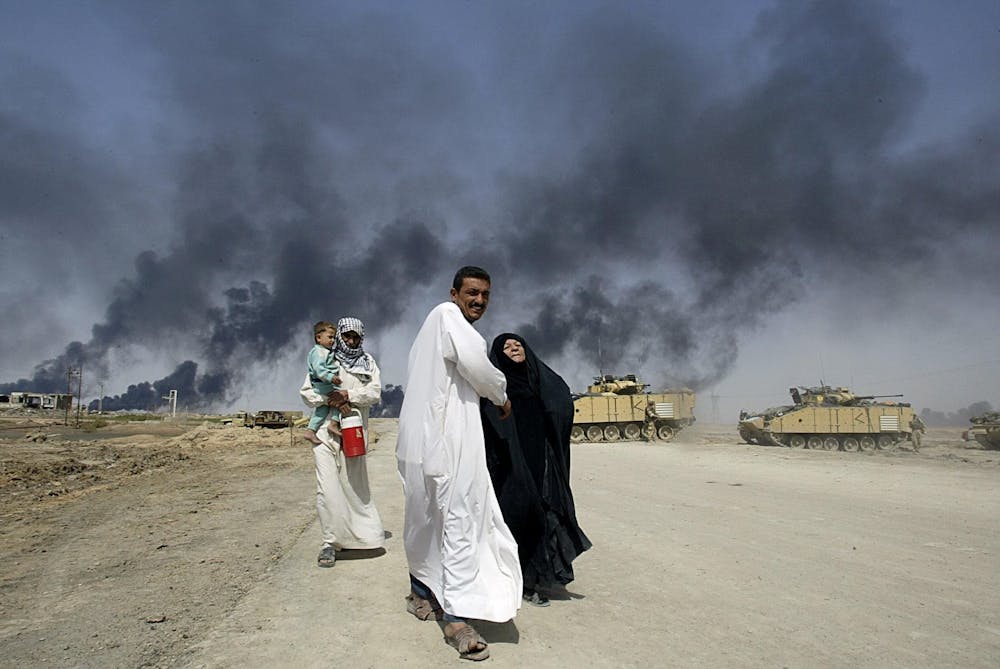
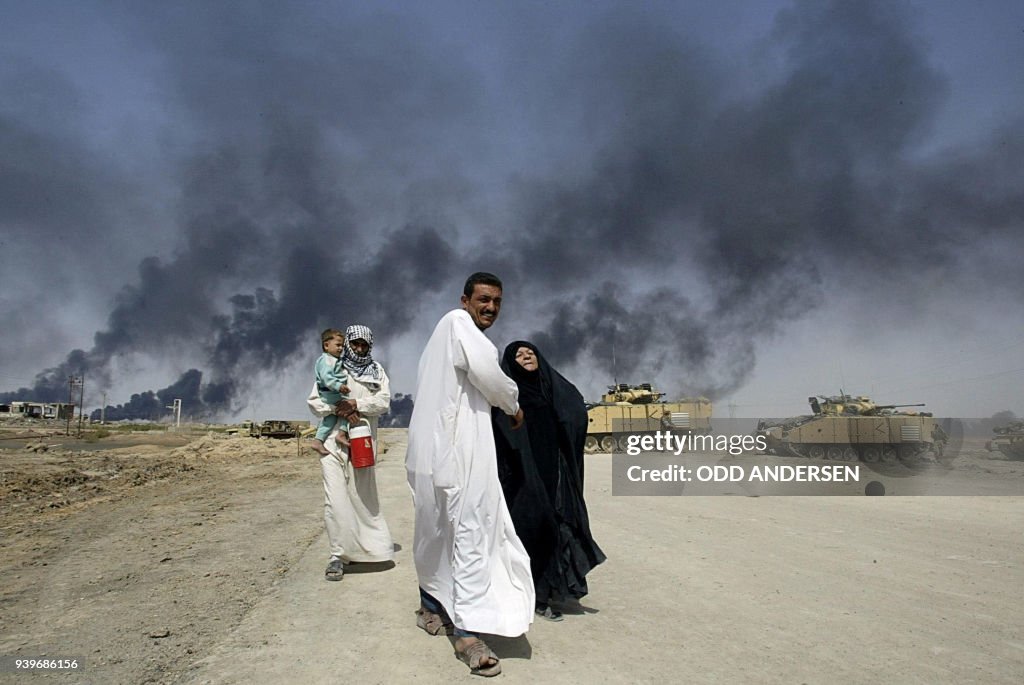
    An Iraqi family flees past British tanks from the city of Basra in March 2003.
    Odd Andersen/AFP via Getty Images

    A new set of priorities

    Older Americans age 65 and up are more likely than young people to prioritize foreign policy issues, including maintaining a U.S. military advantage.

    Younger Americans – age 18 to 39 – say the top issues that require urgency are providing support to refugees and limiting U.S. military commitments abroad, according to a 2021 Pew research survey.

    Generation Z members are also less likely than older Americans to think that the U.S. should act by itself in defending or protecting democracy around the world, according to a 2019 poll by the think tank Center for American Progress.

    They also agree with the statement that the United States’ “wars in the Middle East and Afghanistan were a waste of time, lives, and taxpayer money and they did nothing to make us safer at home.” They prefer that the U.S. use economic and diplomatic means, rather than military intervention, to advance American interests around the world.

    Israel’s conflict with Iran may not flare again and give way to more airstrikes and violence. If the countries resume fighting, however, their conflict threatens to draw in Lebanon, Qatar and other countries in the Middle East, as well as likely the U.S. – and to drag on for a long time.

    This is an update from a story originally published on March 15, 2023.

    Andrea Stanton does not work for, consult, own shares in or receive funding from any company or organization that would benefit from this article, and has disclosed no relevant affiliations beyond their academic appointment.

    ref. Israel-Iran war recalls the 2003 US invasion of Iraq – a war my undergraduate students see as a relic of the past – https://theconversation.com/israel-iran-war-recalls-the-2003-us-invasion-of-iraq-a-war-my-undergraduate-students-see-as-a-relic-of-the-past-259652

    MIL OSI Analysis

  • MIL-OSI Analysis: Using TikTok could be making you more politically polarized, new study finds

    Source: The Conversation – USA – By Zicheng Cheng, Assistant Professor of Mass Communications, University of Arizona

    Are you in an echo chamber on TikTok? LeoPatrizi/E+ via Getty Images

    People on TikTok tend to follow accounts that align with their own political beliefs, meaning the platform is creating political echo chambers among its users. These findings, from a study my collaborators, Yanlin Li and Homero Gil de Zúñiga, and I published in the academic journal New Media & Society, show that people mostly hear from voices they already agree with.

    We analyzed the structure of different political networks on TikTok and found that right-leaning communities are more isolated from other political groups and from mainstream news outlets. Looking at their internal structures, the right-leaning communities are more tightly connected than their left-leaning counterparts. In other words, conservative TikTok users tend to stick together. They rarely follow accounts with opposing views or mainstream media accounts. Liberal users, on the other hand, are more likely to follow a mix of accounts, including those they might disagree with.

    Our study is based on a massive dataset of over 16 million TikTok videos from more than 160,000 public accounts between 2019 and 2023. We saw a spike of political TikTok videos during the 2020 U.S. presidential election. More importantly, people aren’t just passively watching political content; they’re actively creating political content themselves.

    Some people are more outspoken about politics than others. We found that users with stronger political leanings and those who get more likes and comments on their videos are more motivated to keep posting. This shows the power of partisanship, but also the power of TikTok’s social rewards system. Engagement signals – likes, shares, comments – are like a fuel, encouraging users to create even more.

    Why it matters

    People are turning to TikTok not just for a good laugh. A recent Pew Research Center survey shows that almost 40% of U.S. adults under 30 regularly get news on TikTok. The question becomes what kind of news are they watching, and what does that mean for how they engage with politics.

    The content on TikTok often comes from creators and influencers or digital-native media sources. The quality of this news content remains uncertain. Without access to balanced, fact-based information, people may struggle to make informed political decisions.

    TikTok is not unique; social media generally fosters polarization.

    Amid the debates over banning TikTok, our study highlights how TikTok can be a double-edged sword in political communication. It’s encouraging to see people participate in politics through TikTok when that’s their medium of choice. However, if a user’s network is closed and homogeneous and their expression serves as in-group validation, it may further solidify the political echo chamber.

    When people are exposed to one-sided messages, it can increase hostility toward outgroups. In the long run, relying on TikTok as a source for political information might deepen people’s political views and contribute to greater polarization.

    What other research is being done

    Echo chambers have been widely studied on platforms like Twitter and Facebook, but similar research on TikTok is in its infancy. TikTok is drawing scrutiny, particularly its role in news production, political messaging and social movements.

    TikTok has its unique format, algorithmic curation and entertainment-driven design. I believe that its function as a tool for political communication calls for closer examination.

    What’s next

    In 2024, the Biden/Harris and Trump campaigns joined TikTok to reach young voters. My research team is now analyzing how these political communication dynamics may have shifted during the 2024 election. Future research could use experiments to explore whether these campaign videos significantly influence voters’ perceptions and behaviors.

    The Research Brief is a short take on interesting academic work.

    Zicheng Cheng does not work for, consult, own shares in or receive funding from any company or organization that would benefit from this article, and has disclosed no relevant affiliations beyond their academic appointment.

    ref. Using TikTok could be making you more politically polarized, new study finds – https://theconversation.com/using-tiktok-could-be-making-you-more-politically-polarized-new-study-finds-258791

    MIL OSI Analysis

  • MIL-OSI Analysis: Japanese prime minister’s abrupt no-show at NATO summit reveals a strained alliance with the US

    Source: The Conversation – Global Perspectives – By Craig Mark, Adjunct Lecturer, Faculty of Economics, Hosei University

    Japanese Prime Minister Shigeru Ishiba has sent a clear signal to the Trump administration: the Japan–US relationship is in a dire state.

    After saying just days ago he would be attending this week’s NATO summit at The Hague, Ishiba abruptly pulled out at the last minute.

    He joins two other leaders from the Indo-Pacific region, Australian Prime Minister Anthony Albanese and South Korean President Lee Jae-myung, in skipping the summit.

    The Japanese media reported Ishiba cancelled the trip because a bilateral meeting with US President Donald Trump was unlikely, as was a meeting of the Indo-Pacific Four (IP4) NATO partners (Australia, New Zealand, South Korea and Japan).

    Japan will still be represented by Foreign Minister Takeshi Iwaya, showing its desire to strengthen its security relationship with NATO.

    However, Ishiba’s no-show reveals how Japan views its relationship with the Trump administration, following the severe tariffs Washington imposed on Japan and Trump’s mixed messages on the countries’ decades-long military alliance.

    Tariffs and diplomatic disagreements

    Trump’s tariff policy is at the core of the divide between the US and Japan.

    Ishiba attempted to get relations with the Trump administration off to a good start. He was the second world leader to visit Trump at the White House, after Israeli Prime Minister Benjamin Netanyahu.

    However, Trump’s “Liberation Day” tariffs imposed a punitive rate of 25% on Japanese cars and 24% on all other Japanese imports. They are already having an adverse impact on Japan’s economy: exports of automobiles to the US dropped in May by 25% compared to a year ago.

    Six rounds of negotiations have made little progress, as Ishiba’s government insists on full tariff exemptions.

    Japan has been under pressure from the Trump administration to increase its defence spending, as well. According to the Financial Times, Tokyo cancelled a summit between US and Japanese defence and foreign ministers over the demand. (A Japanese official denied the report.)

    Japan also did not offer its full support to the US bombings of Iran’s nuclear facilities earlier this week. The foreign minister instead said Japan “understands” the US’s determination to prevent Iran from acquiring nuclear weapons.

    Japan has traditionally had fairly good relations with Iran, often acting as an indirect bridge with the West. Former Prime Minister Shinzo Abe even made a visit there in 2019.

    Japan also remains heavily dependent on oil from the Middle East. It would have been adversely affected if the Strait of Hormuz had been blocked, as Iran was threatening to do.

    Unlike the response from the UK and Australia, which both supported the strikes, the Ishiba government prioritised its commitment to upholding international law and the rules-based global order. In doing so, Japan seeks to deny China, Russia and North Korea any leeway to similarly erode global norms on the use of force and territorial aggression.

    Strategic dilemma of the Japan–US military alliance

    In addition, Japan is facing the same dilemma as other American allies – how to manage relations with the “America first” Trump administration, which has made the US an unreliable ally.

    Earlier this year, Trump criticised the decades-old security alliance between the US and Japan, calling it “one-sided”.

    “If we’re ever attacked, they don’t have to do a thing to protect us,” he said of Japan.

    Lower-level security cooperation is ongoing between the two allies and their regional partners. The US, Japanese and Philippine Coast Guards conducted drills in Japanese waters this week. The US military may also assist with upgrading Japan’s counterstrike missile capabilities.

    But Japan is still likely to continue expanding its security ties with partners beyond the US, such as NATO, the European Union, India, the Philippines, Vietnam and other ASEAN members, while maintaining its fragile rapprochement with South Korea.

    Australia is now arguably Japan’s most reliable security partner. Canberra is considering buying Japan’s Mogami-class frigates for the Royal Australian Navy. And if the AUKUS agreement with the US and UK collapses, Japanese submarines could be a replacement.

    Ishiba under domestic political pressure

    There are also intensifying domestic political pressures on Ishiba to hold firm against Trump, who is deeply unpopular among the Japanese public.

    After replacing former prime minister Fumio Kishida as leader of the Liberal Democratic Party (LDP) last September, the party lost its majority in the lower house of parliament in snap elections. This made it dependent on minor parties for legislative support.

    Ishiba’s minority government has struggled ever since with poor opinion polling. There has been widespread discontent with inflation, the high cost of living and stagnant wages, the legacy of LDP political scandals, and ever-worsening geopolitical uncertainty.

    On Sunday, the party suffered its worst-ever result in elections for the Tokyo Metropolitan Assembly, winning its lowest number of seats.

    The party could face a similar drubbing in the election for half of the upper house of the Diet (Japan’s parliament) on July 20. Ishiba has pledged to maintain the LDP’s majority in the house with its junior coalition partner Komeito. But if the government falls into minority status in both houses, Ishiba will face heavy pressure to step down.

    Craig Mark does not work for, consult, own shares in or receive funding from any company or organisation that would benefit from this article, and has disclosed no relevant affiliations beyond their academic appointment.

    ref. Japanese prime minister’s abrupt no-show at NATO summit reveals a strained alliance with the US – https://theconversation.com/japanese-prime-ministers-abrupt-no-show-at-nato-summit-reveals-a-strained-alliance-with-the-us-259694

    MIL OSI Analysis

  • MIL-OSI Analysis: Oil shocks in the 1970s drove rapid changes in transport. It could happen again if Middle East tensions continue

    Source: The Conversation – Global Perspectives – By Hussein Dia, Professor of Future Urban Mobility, Swinburne University of Technology

    The Image Bank/Getty

    As the world watches the US–Iran situation with concern, the ripple effect from these events are reaching global oil supply chains – and exposing their fragility.

    If Iran closes the Strait of Hormuz as it is considering, it would restrict the global oil trade and trigger energy chaos.

    Petrol in some Australian cities could hit A$2.50 a litre according to some economists. As global instability worsens, other experts warn price spikes are increasingly likely.

    What would happen next? There is a precedent: the oil shocks of the 1970s, when oil prices quadrupled. The shock drove rapid change, from more efficient cars to sudden interest in alternative energy sources. This time, motorists would likely switch to electric vehicles.

    If this crisis continues or if another one flares up, it could mark a turning point in Australia’s long dependence on foreign oil.

    What would an oil shock mean?

    Australia currently imports 80% of its liquid fuels, the highest level on record. If the flow of oil stopped, we would have about 50 days worth in storage before we ran out.

    Our cars, buses, trucks and planes run overwhelmingly on petrol and diesel. Almost three-quarters (74%) of these liquid fuels are used in transport, with road transport accounting for more than half (54%) of all liquid fuels. Australia is highly exposed to global supply shocks.

    The best available option to reduce dependence on oil imports is to electrify transport.

    How does Australia compare on EVs?

    EV uptake in Australia continues to lag behind global leaders. In 2024, EVs accounted for 9.65% of new car sales in Australia, up from 8.45% in 2023.

    In the first quarter of 2025, EVs were 6.3% of new car sales, a decline from 7.4% in the final quarter of 2024.

    Norway remains the global leader, with battery-electric passenger cars making up 88.9% of sales in 2024. The United Kingdom also saw significant growth – EVs hit almost 20% of new car registrations in 2024.

    In China, EVs made up 40.9% of new car sales in 2024. The 12.87 million cars sold represent three-quarters of total EV sales worldwide.

    One reason for Australia’s sluggishness is a lack of reliable public chargers. While charging infrastructure is expanding, large parts of regional Australia still lack reliable access to EV charging.

    Until recently, Australia’s fuel efficiency standards were among the weakest in the OECD. Earlier this year, the government’s new standards came into force. These are expected to boost EV uptake.

    Could global tensions trigger faster action?

    If history is any guide, oil shocks lead to long-term change.

    The 1970s oil shocks triggered waves of energy reform.

    When global oil prices quadrupled in 1973–74, many nations were forced to reconsider where they got their energy. A few years later, the 1979 Iranian Revolution caused another major supply disruption, sending oil prices soaring and pushing much of the world into recession.

    Huge increases in oil prices drove people to look for alternatives during the 1970s oil shocks.
    Everett Collection/Shutterstock

    These shocks drove the formation of the International Energy Agency in 1974, spurred alternative energy investment and led to advances in fuel-efficiency standards.

    Much more recently, Russia’s invasion of Ukraine pushed the European Union to face up to its reliance on Russian gas and find alternatives by importing gas from different countries and accelerating the clean energy shift.

    Clearly, energy shocks can be catalysts for long-term structural change in how we produce and consume energy.

    The new crisis could do the same, but only if policy catches up.

    If fuel prices shot up and stayed there, consumer behaviour would begin to shift. People would drive less and seek alternate forms of transport. Over time, more would look for better ways to get around.

    But without stronger support such as incentives, infrastructure and fuel security planning, shifting consumer preferences could be too slow to matter.

    A clean-energy future is more secure

    Cutting oil dependency through electrification isn’t just good for the climate. It’s also a hedge against future price shocks and supply disruptions.

    Transport is now Australia’s third-largest source of greenhouse gas emissions. Now that emissions are falling in the electricity sector, transport will be the highest emitting sector emissions source as soon as 2030.

    Building a cleaner transport system also means building a more resilient one. Charging EVs on locally produced renewable power cuts our exposure to global oil markets. So do biofuels, better public transport and smarter urban planning.

    Improving domestic energy resilience isn’t just about climate targets. It’s about economic stability and national security. Clean local energy sources reduce vulnerability to events beyond our control.

    What can we learn from China?

    China offers a compelling case study. The nation of 1.4 billion faces real oil security challenges. In response, Beijing has spent the past decade building a domestic clean energy ecosystem to reduce oil dependency and cut emissions.

    This is now bearing fruit. Last year, China’s oil imports had the first sustained fall in nearly two decades. Crude oil imports fell 1.5%, while oil refinery activity also fell due to lower demand.

    China’s rapid uptake of EVs has clear energy security benefits.
    pim pic/Shutterstock

    China’s green energy transition was driven by coordinated policy, industrial investment and public support for clean transport.

    China’s rapid shift to EVs and clean energy shows how long-term planning and targeted investment can pay off on climate and energy security.

    What we do next matters

    The rolling crises of 2025 present Australian policymakers a rare alignment of interests. What’s good for the climate, for consumers and for national security may now be the same thing.

    Real change will require more than sustained high petrol prices. It demands political will, targeted investment and a long-term vision for clean, resilient transport.

    Doing nothing has a real cost – not just in what we pay at the service station, but in how vulnerable we remain to events a long way away.

    Hussein Dia receives funding from the Australian Research Council, the iMOVE Australia Cooperative Research Centre, Transport for New South Wales, Queensland Department of Transport and Main Roads, Victorian Department of Transport and Planning, and Department of Infrastructure, Transport, Regional Development, Communications and the Arts.

    ref. Oil shocks in the 1970s drove rapid changes in transport. It could happen again if Middle East tensions continue – https://theconversation.com/oil-shocks-in-the-1970s-drove-rapid-changes-in-transport-it-could-happen-again-if-middle-east-tensions-continue-259670

    MIL OSI Analysis

  • MIL-OSI Asia-Pac: Winnie Ho tours housing project

    Source: Hong Kong Information Services

    Secretary for Housing Winnie Ho attended the Asia-Pacific Network for Housing Research (APNHR) 2025 Conference at Tsinghua University and visited the Qingtangwan public rental housing project in Beijing today.

    The APNHR is an international organisation focusing on housing issues in the Asia-Pacific region. The conference was held at Tsinghua University this year with the theme “Towards Resilience and Inclusivity: Adapting to Multifaceted Challenges in the Asia-Pacific Region”.

    The conference convened experts and scholars in the fields of architecture, urban planning, sociology, environmental studies, and others from the Asia-Pacific region to have in-depth exchanges on the housing development and challenges in the region, and to jointly explore ways to promote innovative housing construction and development directions.

    At the conference’s roundtable session this morning, Ms Ho shared the opportunities and challenges in housing development faced by the Hong Kong Special Administrative Region Government Housing Bureau (HB) and the Hong Kong Housing Authority (HKHA).

    She said that the current-term Hong Kong SAR Government has actively addressed Hong Kong’s housing problems since taking office, overcoming livelihood issues and addressing people’s concerns by identifying sites and enhancing the quantity, speed, efficiency and quality of public housing construction.

    The HB is working full steam ahead on implementing groundbreaking innovative policy initiatives, such as Light Public Housing (LPH) and Basic Housing Units, to tackle the long-standing, big and difficult issue that has plagued Hong Kong for many years and to provide the grassroots with options to improve their living environment and quality of life.

    Ms Ho highlighted that the HB and the HKHA have been making use of various innovative construction technologies, such as Modular Integrated Construction, construction robots and smart project management platforms, to enhance construction efficiency and build LPH expeditiously, so as to improve the living conditions of those who are inadequately housed as soon as possible.

    She also introduced at the conference the “well-being design” guide launched by the HB and the HKHA last year, which serves as a reference for the future design of new public housing and the improvement works of existing public rental housing estates.

    Apart from housing construction, the HKHA has also continued to enhance the management efficiency and service quality of its nearly 200 public rental housing estates by actively promoting smart estate management and introducing new technologies to optimise estate management and building maintenance services, to provide a better living environment for its residents.

    In the afternoon, Ms Ho visited the Qingtangwan public rental housing project in Beijing. This project is a green residential area that adopted the use of prefabricated components and environmental monitoring platforms. It also implements smart community management through community apps.

    Afterwards, Ms Ho met Deputy Director-General of the Bureau of International Cooperation of the State-owned Assets Supervision & Administration Commission of the State Council Xie Hui to exchange views on housing design and planning.

    She also shared the adoption of advanced construction technologies from the Mainland in Hong Kong and the outcomes.

    Yesterday, Ms Ho visited the Better House Living Tech Lab and was briefed on the practice of combining housing design concepts of quality homes and technologies on the Mainland.

    The housing chief will continue her Beijing visit tomorrow before returning to Hong Kong.

    MIL OSI Asia Pacific News

  • MIL-OSI United Kingdom: Urgent warning to pet owners as toxic chemicals found in fake flea treatments

    Source: United Kingdom – Executive Government & Departments

    Press release

    Urgent warning to pet owners as toxic chemicals found in fake flea treatments

    Pet owners urged to be wary of dangerous fake treatments discovered on e-commerce sites.

    Main developments are:

    • urgent government warning issued after toxic insecticide discovered in counterfeit flea treatments – one cat required emergency surgery after severe poisoning

    • fake pet medicines lack essential ingredients while containing dangerous chemicals that trigger vomiting, seizures and potential death

    • warning signs include poor packaging, spelling mistakes, unusual smells and suspiciously low prices

    • new figures show three quarters of consumers wrongly believe fake goods are of similar quality to genuine products

    • pet owners should only buy from trusted sources and immediately report suspicious products

    The Intellectual Property Office (IPO) and Veterinary Medicine Directorate (VMD) are urging pet owners to take caution when purchasing common medicines, including common flea treatments and wormers. 
     
    The alert comes after toxic pesticide traces were found in a fake flea treatment that caused a pet cat to become seriously ill, prompting the owner to have the product tested. Laboratory tests confirmed the presence of Pirimiphos-methyl, a dangerous insecticide toxic to cats. 
     
    Officials are urging pet owners to recognise signs of counterfeit products, avoid using suspicious items, and know how to report concerns.  

    Counterfeit animal medicines deliberately copy the appearance, packaging and branding of genuine veterinary products to deceive pet owners. Like all counterfeits, they are illegal to sell in the UK.   

    These fakes typically lack proper active ingredients, making them ineffective. Worse still, they may also contain harmful substances, causing severe reactions including vomiting, muscle tremors, breathing difficulties, seizures and potentially death.

    Pet owners seeking bargains, or a quick purchase online may unknowingly purchase these dangerous counterfeits.  
     
    The VMD and IPO are urging owners to check for warning signs including poor packaging, spelling errors, missing information, and unusual smells. 

    Last year alone, the VMD issued 122 seizure notices for the selling of unauthorised animal medicines and supplements, preventing around 18,000 illegal items from reaching consumers. 

    After purchasing what appeared to be genuine FRONTLINE ® flea treatment online for his cat, Smokey, Alan Wall from Preston was devastated when Smokey became very unwell. The condition was so severe that Smokey required emergency intestinal surgery to survive. This was followed by a week-long stay at the veterinary surgery and significant bills to support his recovery.

    Alan Wall said:

    Smokey is more than just a pet, he’s a member of our family. When he became ill after using what we believed was a genuine flea treatment, we were terrified. Watching him suffer, not knowing whether he would pull through, was heartbreaking. It’s taken a huge emotional toll on all of us. Without the support of our vets and the extensive surgery they performed we know Smokey wouldn’t be with us today. We want to warn other pet owners about these fake products so that no one else has to endure what we’ve been through.

    Images of Smokey the cat – receiving treatment, and when healthier

    A Veterinary Medicines Directorate Veterinary Surgeon and Efficacy Assessor, Dr Heilin-Anne Leonard-Pugh, explains:

    Pirimiphos-methyl is toxic to cats. Exposure to this insecticide can prevent the cat’s body from breaking down a substance called acetylcholine, leading to an overstimulation of the cat’s nervous system. This can cause symptoms such as vomiting, uncoordinated gait, muscle tremors, weakness, paralysis, increased sensitivity to touch, difficulty breathing, restlessness, urinary incontinence, low heart rate and seizures. In some cases, even death can sadly occur. If you suspect your pet has been exposed to a counterfeit medicine, seek veterinary advice immediately.  

    Sue Horseman from Bristol also purchased what appeared to be FRONTLINE® flea treatment online for her cat, but quickly became suspicious that the product wasn’t genuine.  
     
    Sue explained that the product was difficult to open and had a distinct smell of white spirit and paraffin, whereas the genuine flea treatment has no smell.  When she reported this to Trading Standards, experts confirmed that the treatment was a counterfeit. 

    While the online platform has removed the seller, they had already managed to sell 211 batches of suspected counterfeit pet medicines and supplements, including fake FRONTLINE Flea and Tick Treatment and PRO PLAN FortiFlora Probiotic Sachets for dogs and cats. 
     
    New counterfeit goods research (Wave 4) shows that counterfeit goods of all types are frequently purchased via global e-commerce websites. The figures also show that in 2024, nearly-one-in-five (17%) consumers unknowingly purchased goods later found to be fake, with 60% of purchasers also saying that ‘ease of purchasing’ influenced their decision.  Saving money is a strong motivator for buying fakes, with around three quarters (72%) of purchasers saying price was an important factor in their decision. Worryingly, around three-quarters (72%) wrongly believed the products would be of a similar quality to the genuine item.

    The IPO’s Deputy Director of Enforcement Helen Barnham, said:

    We are a nation of animal lovers, and criminals dealing in counterfeits are targeting pet owners with complete disregard for the animal’s wellbeing.  This can have some distressing consequences, as they may contain toxic chemicals that are harmful to our pets. We are urging pet owners to be vigilant when purchasing any type of animal treatment, and beware of any offers that ‘look too good to be true’.   

    Counterfeiting is anything but a victimless crime and this latest discovery confirms this. If you suspect that any goods offered for sale may be counterfeit, you should always report this to your local Trading Standards or Crimestoppers Online.

    Caroline Allen, RSPCA Chief Veterinary Officer said: 

    We are very concerned about counterfeit vet treatments on sale which can be highly toxic to pets and we would always urge pet owners to seek professional veterinary advice if they have any health concerns.  

    We appreciate financial pressures can lead to some owners to look for cheaper treatments online but they could be unwittingly putting their beloved pets in serious danger by inadvertently buying these counterfeit goods and would urge them to take on board this government advice.

    Nina Downing, Vet Nurse from PDSA, a vet charity and a leading authority on pet health in the UK, said:

    Counterfeit veterinary medicines can pose a serious threat to our pets ‘ health and wellbeing. While legitimate medications play a vital role in keeping our pets healthy, counterfeit products can cause severe harm or even be fatal. These fake medicines may contain incorrect ingredients or dangerous substances that can make pets extremely ill – leading to symptoms like twitching, swelling, breathing difficulties, vomiting, diarrhoea, collapse, coma and even death.

    We always recommend that you only give your pet medication which has been prescribed by your vet. When fulfilling a prescription online, source them from reputable companies that are on the Register of online retailers, brought to you by the Veterinary Medicines Directorate. If you suspect your pet is reacting badly to any medication, contact your vet immediately.

    When examining the counterfeit FRONTLINE® flea treatment, experts from the University of Bath also identified telling packaging flaws. Most notably, the label used ‘GATTI’ (Italian for cats) instead of the English ‘CAT’, alongside multiple spelling errors – common indicators of counterfeit products.

    Image: Packaging featuring spelling mistakes and mixed languages

    Pet owners should check the packaging and always be cautious of third-party sellers when shopping on e-commerce sites for any type of pet medication. 

    The IPO and VMD are offering advice for consumers to help spot fake animal medicines, and what to do if they believe they may have purchased them or seen them offered for sale.

    How to identify fake animal medicines online:

    1. Warning signs of fake medicines. Look out for: 

    • poor quality or damaged packaging
    • spelling or grammar errors
    • missing leaflets or expiry dates
    • instructions not provided in English
    • suspicious smell, colour or texture
    • poor quality tablets, capsules, vials or pipettes – homemade appearance

    Be wary of any retailer selling prescription only products without asking for your prescription. This is illegal. 

    All online sellers of prescription only animal medicines must be registered with the VMD. If in any doubt, you can check retailers on the VMD’s Register of Online Retailers.

    2. Always shop safely online. Be cautious of:

    • heavily discounted goods and flash sales. Question the price if much cheaper than elsewhere. Whether buying online or in person, always think about the price
    • a seller asking for sensitive information or requesting payment by bank transfer
    • fake websites and social media profiles. These can contain original brand names – confirm the website is authentic and check seller details and reviews before purchasing
    • any deal or offer that looks ‘too good to be true’ 

    What you can do

    If you have you been personally affected by a poisoning case, you should report through the Veterinary Poisons Information Service (VPIS) questionnaire

    If you see these goods being offered for sale, whether on a website, social media post or on the high street, contact your local Trading Standards or Crimestoppers online or by calling 0800 555 111. 

    If you encounter suspicious veterinary medicines or retailers, please also report them to the VMD Enforcement Team. (You can do so anonymously if preferred): 

    Additional information

    1. All veterinary medicines sold in the UK must be authorised. If the brand looks unfamiliar, ensure its authorised before purchasing. To know if the medicine is UK- approved, you should look for English labelling and a valid Marketing Authorisation number (e.g. Vm 12345/4001). You can check if the medicine you are buying is authorised in the UK by searching the VMD’s Product Information Database.

      Using ant unauthorised medicine poses a serious risk to the welfare of your pet. These medicines have not been assessed by the Veterinary Medicines Directorate and their safety, quality and efficacy cannot be guaranteed.  

    2. Online retailers of low-risk, general sale veterinary medicines that can be sold by anyone without a prescription (known as AVM-GSL medications) don’t need to register. When buying these medicines always shop from a trusted source. 

    3. The Intellectual Property Office (IPO) is the UK government body responsible for responsible for intellectual property (IP) rights including patents, designs, trade marks and copyright. IPO is an executive agency, sponsored by the Department for Science, Innovation and Technology.  

    4. The Veterinary Medicines Directorate (VMD) is an executive agency of the Department for Environment, Food and Rural Affairs (DEFRA) and the UK Competent Authority for veterinary medicines regulation. The VMD protects public health, animal health, and the environment and promotes animal welfare by assuring the safety, quality, and efficacy of veterinary medicines.  

    5. The IPO regularly conducts research to understand consumer behaviour in relation to the purchasing of and attitudes toward counterfeit goods. The most recent Counterfeit Goods Research report (published Tuesday 17 May 2025) show the main motivations for those who purchase counterfeits: 

    • similar/ the same quality – 72.3%
    • wanting to reduce spending/outgoings - 72%
    • the real product was out of your budget/ price range - 70.9%
    • the fake product was cheaper  – 72%
    • hearing from family or friends that the ‘fake’ products were good - 64.8%
    • similar/the same design – 64.6%
    • being able to purchase ‘fake’ or counterfeit products easily – 60.5%

    Updates to this page

    Published 26 June 2025

    MIL OSI United Kingdom

  • MIL-OSI USA: UConn Health Recognized for Responsible Antibiotic Use

    Source: US State of Connecticut

    A commitment to responsible use of antibiotics earns UConn Health’s John Dempsey Hospital the designation of “Antimicrobial Stewardship Center of Excellence” from the Infectious Diseases Society of America.

    Certificate from the Infectious Diseases Society of America

    With this designation, the IDSA recognizes institutions that have established stewardship programs, led by infectious diseases physicians and pharmacists, to advance science in antimicrobial resistance, and that have surpassed high standards aligned with evidence-based national guidelines.

    “Evolving antimicrobial resistance patterns and the introduction of new therapeutics have made antibiotic prescribing more challenging than ever,” says Kevin Chamberlin, UConn Health’s chief pharmacy officer. “This Center of Excellence designation is a testament to the sound antimicrobial stewardship we practice that protects our limited options for our most vulnerable patients.”

    John Dempsey Hospital is one of four hospitals in Connecticut designated as an Antimicrobial Stewardship Center of Excellence, and among fewer than 200 hospitals in the world that have earned the distinction since the ISDA started this program in 2017.

    Core criteria include implementation of stewardship protocols by integrating best practices to slow the emergency of resistance, optimize the treatment of infections, reduce adverse events associated with antibiotic use, and address other challenging areas of antimicrobial stewardship.

    “This shows that we are using multidisciplinary collaboration to ensure that we’re using antibiotics in the most quality way and optimizing those antibiotics across care, both on the inpatient and outpatient side,” says Gillian Kuszewski ’03 (PHARM), ’05 Pharm.D., university director of UConn Health’s pharmacy residency programs.

    Kuszewski co-leads UConn Health’s antibiotic stewardship program with Dr. David Banach ’06 MD, MPH, infectious diseases physician and UConn Health’s hospital epidemiologist, and Jeffrey Aeschlimann ’93 (PHARM), a UConn School of Pharmacy faculty member and clinician in UConn Health’s pharmacy practice.

    From left: Dr. David Banach, Gillian Kuszewski, and Jeffrey Aeschlimann lead UConn Health’s antibiotic stewardship program. (Photo by Chris DeFrancesco, UConn Health)

    “Antibiotic stewardship is a global health priority,” Banach says. “The goal of using the right antibiotic for the right patient at the right time for the right duration is really becoming recognized as a key public health measure, both for reducing resistance and also reducing antibiotic-associated side effects and adverse events like C. diff.”

    C. diff, or Clostridioides difficile infection, is one of the most common health care-associated infections. It is highly contagious and difficult to treat.

    “One of the important things the stewardship program does is minimize unnecessary use of broad-spectrum antibiotics, which has been shown to also decrease C. diff rates in hospitals and health care settings,” Aeschlimann says.

    While this is the first time UConn Health has applied for this ISDA designation, antimicrobial stewardship has been a priority going back more than a decade, predating regulatory requirements. Aeschlimann and Dr. Kevin Dieckhaus, who today is chief of UConn Health’s Division of Infectious Diseases, started the antibiotic stewardship committee in 2013. Since then, it has grown to include representation from throughout the institution, including microbiology lab professionals, nurses, pharmacists, physicians, informatics specialists, infection preventionists, and students, residents and fellows.

    “We’ve always been doing these things along the way, and we felt now was the right time to sit down and formally submit an application,” Kuszewski says. “We’ve always done extremely well with our program when regulatory bodies like the Joint Commission come to visit. From a regulatory perspective, we’ve consistently received really good feedback from them on our antimicrobial stewardship activities.”

    She says the committee has established protocols, policies, and workflows to guide and support front-line providers in making the best choices.

    “We’ve supported, for example, processes to make sure that even after the patient leaves the emergency department, they’re on the right antibiotic based on follow-up information that we get from cultures,” Kuszewski says.

    “We have the collaborations between those who prescribe antibiotics and those who have expertise to offer and help support optimal prescribing,” Banach says.

    And the committee’s guidance has made its way into the electronic health record system to provide an additional resource for prescribers.

    “We try to develop either order sets or clinical pathways or popups, whatever we think might work best, to guide clinicians to pick the right antibiotic choice,” Aeschlimann says.

    Another strategy is to prioritize documentation of allergies to help inform prescribing decisions.

    “They can choose an antibiotic with the least risk of a negative outcome,” Kuszewski says. “Penicillin allergy documentation often leads to unnecessary use of certain antibiotics that come with greater risks. Perhaps a penicillin might cause some temporary stomach upset for a patient and is not really a true allergy. Clarifying this documentation in a patient’s medical record can help providers determine which antibiotic carries the least risk in treating an infection.”

    Kuszewski notes that UConn Health leadership has been supportive of the antimicrobial stewardship efforts since the beginning.

    “Not only are we following standards, but we’re also seeing better outcomes,” she says. “We also have results that show that we’re using less broad-spectrum antibiotics than what we’re expected to use, and our C. diff rates are down. The outcomes are actually tangible. It’s not just what we say we’re doing, but we’re seeing good results.”

    MIL OSI USA News

  • MIL-OSI USA: Making Electronic Devices Faster, More Powerful, and Better at Staying Cool

    Source: US State of Connecticut

    When electronic devices overheat, they can slow down, malfunction, or stop working altogether. This heat is mainly caused by energy lost as electrons move through a material—similar to friction in a moving machine.

    Most devices today use silicon (Si) as their semiconductor material. However, engineers are increasingly turning to alternatives like gallium nitride (GaN) for longer lifetime use and higher performance. This includes products such as LEDs, compact laptop chargers, and 5G phone networks. For even more extreme applications—such as high-voltage systems or harsh environments—researchers are exploring ultrawide bandgap (UWBG) materials like gallium oxide (Ga2O3), aluminum gallium nitride (AlGaN), and even diamond.

    Pictured in center, Georges Pavlidis, assistant professor of mechanical engineering, and School of Mechanical, Aerospace, and Manufacturing Engineering Ph.D. candidates Francis Vásquez, at left, and Dominic Myren, are co-authors of a “Perspectives” paper published in Applied Physics Letters. Together, they’re exploring thermal management strategies in ultra side bandgap semiconductor devices. (Sarah Richmond/UConn Photo)

    The key difference between these materials lies in their electronic bandgap—the energy needed to get electrons to flow through the material. Wider bandgaps allow companies to reduce the size of their electronics and make them more electrically efficient.

    “UWBG materials can resist up to 8,000 volts and can operate at temperatures over 200 °C (392°F), making them promising for the next generation of electronics in the energy, health, and communication sectors,” explains Georges Pavlidis, assistant professor of mechanical engineering.

    While these materials offer promising advantages, they also come with challenges. They’re currently expensive, difficult to manufacture, and their thermal behavior is hard to measure precisely. As electronics become more powerful and in smaller dimensions, the heating in the device becomes more localized and can generate a heat flux greater than the sun, Pavlidis explains.

    “Chip manufacturers need new methods to measure temperature in smaller dimensions,” he says.

    Pavlidis, along with UConn’s School of Mechanical, Aerospace, and Manufacturing Engineering Ph.D. candidates Dominic Myren and Francis Vásquez, collaborated with colleagues from the U.S. Naval Research Laboratory over the past year to tackle the challenge of measuring the heat output. Their work resulted in a “Perspectives” paper published in Applied Physics Letters.

    “A ‘Perspectives’ paper is intended to be an outline of what’s coming soon, get people excited about what’s coming, and encourage other researchers to start looking into similar topics,” says Myren, a National Defense Science and Engineering Graduate Fellow who has seven years of industrial R&D experience in fuel systems, internal combustion, and engine controls and holds patents related to electromagnetic actuators and engine controls.The push right now is for the development of thermal management strategies in wide and ultra-wide bandgap semiconductor devices. We have a lot of open questions, and we’re working hard on them over in Dr. Pavlidis’ lab, but the cross pollination of ideas is how academic circles thrive.”

    Titled “Emerging Thermal Metrology for Ultrawide Bandgap Semiconductor Devices,” the co-authors discuss the pros and cons of using UWBG material for semiconductors, and outline several innovative techniques for measuring temperature at the microscale. These methods could help engineers design faster, more powerful electronic devices—without the risk of overheating.

    After the paper ran online in late May, the co-authors received an unexpected note from the editors at Applied Physics Letters. “[We] felt that your article is noteworthy, and have chosen it to be promoted as an Editor’s Pick. It will be posted on the journal homepage, and a badge will be displayed next to the title.”

    “It is no small feat for a publication to be chosen as an Editor’s Pick in the highly regarded Applied Physics Letters that publishes more than 2,000 articles a year,” says JC Zhao, dean of the UConn College of Engineering. “I congratulate Professor Pavlidis and his group on this recognition and I am very proud of their accomplishment.”

    Members of the Pavlidis Lab prepare to measure the heat produced by a GaN-on-diamond transistor. This advanced semiconductor technology combines gallium nitride (GaN) with a diamond substrate to improve thermal management in electronic devices. “We shine light through the microscope and it reflects off the sample and travels up to the camera. That’s how we measure temperature,” Pavlidis explains. (Sarah Richmond/UConn Photo)

    Vásquez’s particular research interests are thermal management for high-power and radio-frequency (RF) power electronics. In Pavlidis’s lab, he enjoys the combination of research and meaningful application where the group solves real challenges in electronics and photonics that directly impact energy efficiency, reliability, and performance.

    “What makes the experience truly special is the lab culture,” Vásquez says. “Professor Pavlidis is incredibly supportive and patient, especially when we hit difficult knowledge to explain, and he always encourages us to stay curious. His approach pushes us to explore new ideas, test them rigorously, and think about how our work can translate into real-world innovations. It’s that mix of intellectual freedom and high standards to make an impact that keeps me excited every day in the lab.”

    In the paper, the researchers explore several options to measure temperature in UWBG devices. They suggest using optical methods like Raman spectroscopy and thermoreflectance, which use light to measure temperature dependent properties. Electrical methods use electric signals to detect temperature, and scanning probe methods, like scanning thermal microscopy, touch the surface to feel the heat.

    The researchers also describe exciting new ideas, like combining thermal images created from different colors of light to see heat in nitride-based devices, or measuring how light is absorbed in material defects to calculate the temperature in gallium oxide electronics. They’re even working on a new kind of microscope that can see very tiny heat patterns using deep ultraviolet light.

    “These proposed methods provide a solution to measuring the peak temperature in future electronics which is the primary indicator of when the device will fail. Providing the industry with accurate metrology will lower the barrier to commercialization and enable engineers to develop new thermal management strategies,” Pavlidis says.

    The group’s research is supported by Microelectronics Commons, a program specifically created to commercialize UWBG devices for power electronics. The Commons program established the Northeast Microelectronics Coalition Hub, a network of more than 200 organizations, academic institutions, commercial and defense companies, and federally funded centers concentrated in eight northeast states. The idea for the paper stemmed from a project Pavlidis worked on last summer as an Office of Naval Research Fellow.

    Moving forward, Pavlidis—who was promoted to a Senior Member of Institute of Electrical and Electronics Engineers (IEEE) this month—aims to work with semiconductor partners in developing affordable strategies to reduce the temperature in power electronics. By pushing the resolution limits of temperature measurements, the lab plans to extend their methods to improve other technologies such as quantum computing and photonic circuits. They’ve already worked with colleagues at the University of Maryland to design photonic hardware for next-generation data storage. (View the study in this May 2025 Nature Conversations paper.)

    “We hope our work has laid the foundation for the thermal design of the next generation of UWBG devices,” Pavlidis says.

    MIL OSI USA News

  • MIL-OSI: Half of Enterprise Windows Endpoints Have Not Yet Migrated to Windows 11, According to ControlUp Study

    Source: GlobeNewswire (MIL-OSI)

    SAN FRANCISCO, June 26, 2025 (GLOBE NEWSWIRE) — ControlUp, a global leader in Digital Employee Experience (DEX) management tools, today announced new findings from its Windows 11 Readiness report, revealing that 50% of enterprise Windows endpoints have yet to complete their migration to Windows 11. This marks a significant improvement from last year’s data, when over 82% of enterprise devices were not running Windows 11. With just under four months remaining until Microsoft officially ends support for Windows 10 on October 14, 2025, the data highlights both encouraging progress and critical gaps in enterprise readiness across industries, geographies, and organization sizes.

    “While the 50% completion mark is a major milestone, it’s not time to relax,” said Marcel Calef, Americas Field CTO, ControlUp. “With Windows 10 end of support just months away, organizations need to act now to avoid being caught off guard. Our data shows that the rate of migration is uneven, and many enterprises still face significant hardware and planning challenges.”

    Industry Disparities Highlight Readiness Gaps

    ControlUp’s analysis of over one million enterprise endpoints shows that Education and Technology sectors are leading the migration, with 77% and 73% of their devices already running Windows 11, respectively. In contrast, Healthcare (41%) and Finance (45%) are falling behind. A deeper look reveals that 19% of Healthcare endpoints need to be replaced entirely before they can support Windows 11, compared to just 3% in Finance.

    Americas Trail Behind Europe and Other Regions

    By region, the Americas are furthest behind, with only 43% of enterprise endpoints upgraded to Windows 11, even though 87% of those devices are Windows 11 ready. Europe leads all regions at 70% completion, followed by other global regions at 66%. These regional differences could impact multinational organizations’ ability to maintain consistency and security across their environments.

    Larger Enterprises Facing the Greatest Hurdles

    ControlUp’s data also reveals that very large organizations (with over 10K Windows devices) are the least prepared for the end of Windows 10 support, with just 42% of migrations completed. These organizations often have complex IT environments and a higher volume of legacy hardware, making early assessments and planning essential.

    “ControlUp’s Windows 11 readiness assessment tool helps IT teams instantly evaluate endpoint compatibility, identify upgrade opportunities, and flag devices needing replacement, all from a single dashboard,” Calef added.

    The Windows 11 Readiness report, available through ControlUp’s Windows 11 Readiness Assessment tool, is built into the ControlUp for Desktops solution—designed to improve the digital employee experience across physical and cloud-based endpoint devices.

    ControlUp’s findings are based on a sample set of more than one million enterprise Windows endpoint devices under management as of June 2025. Additional insights can be found here.

    About ControlUp

    ControlUp is a leader in DEX, unifying Digital Employee Experience and IT operations in one powerful platform built for modern workplace management. By combining real-time monitoring, intelligent insights, and proactive remediation, ControlUp accelerates the shift toward Autonomous Endpoint Management (AEM)—empowering IT teams to resolve issues before they affect employees, simplify operations, and manage complexity without the clutter of multiple tools. Nearly 2,000 organizations, including more than one-third of the Fortune 100, trust ControlUp to keep their technology running smoothly. With ControlUp, IT works smarter, employees stay productive, and the workplace runs itself. To learn more, visit www.controlup.com.

    Press Contacts:
    ControlUp PR
    media@controlup.com

    A photo accompanying this announcement is available at https://www.globenewswire.com/NewsRoom/AttachmentNg/dc9c1eae-0f16-4e4a-8c00-52d156fb5d1c.

    The MIL Network

  • MIL-OSI Russia: GUU and GGNTU discussed the development prospects of the RosGeoTech PISh

    Translation. Region: Russian Federal

    Source: State University of Management – Official website of the State –

    A meeting with colleagues from the M.D. Millionshchikov State Petroleum Technical University on the development of the RosGeoTech PIS took place at the State University of Management.

    The meeting was attended by: Head of the PIS Andrey Luzhetsky, Vice-Rector of the State University of Management Maria Karelina, Vice-Rector for Research at GGNTU Magomed Saidumov, Head of the Department for Coordination of Scientific Research at the State University of Management Maxim Pletnev and Deputy Director of the Center for Management of Engineering Projects Dmitry Nikitin.

    The participants discussed the opening of the joint laboratory of digital innovations in industry “ABRIS” at the State University of Management, which is scheduled for August 2025. The laboratory will carry out work on the project “Autonomous unmanned and robotic innovative systems for monitoring oil and gas facilities and geophysical surveys” of the Advanced Engineering School.

    The parties also reviewed the progress of the implementation of scientific and educational projects within the framework of the development program of the RosGeoTech Scientific and Educational School.

    Thus, in 2025, GUU and GGNTU will participate in the implementation of two scientific projects – GeoMap and ABRIS – and four educational projects on additional professional education, including a network of additional professional education in reverse engineering.

    Please note: This information is raw content directly from the source of the information. It is exactly what the source states and does not reflect the position of MIL-OSI or its clients.

    MIL OSI Russia News

  • MIL-OSI United Kingdom: Ofsted to strengthen inspections through new team structures

    Source: United Kingdom – Executive Government & Departments

    Press release

    Ofsted to strengthen inspections through new team structures

    Following feedback from last year’s Big Listen and the recent consultation on inspection reform, Ofsted has today announced a new structure for inspection teams in schools and further education, focused on improving consistency.

    The new team structure will make the best use of the complementary skills and expertise of Ofsted’s employed His Majesty’s Inspectors (HMI) and its contracted Ofsted inspectors (OIs) – who are often serving practitioners in schools and colleges.  

    The changes mean that following the introduction of the renewed education inspection framework in November 2025:  

    • all schools and further education inspections will be led by current His Majesty’s Inspectors, or OIs with recent HMI experience, drawing on their more in-depth inspection expertise and training  

    • Ofsted will make the best use of OI’s current sector knowledge and experience by deploying them as team inspectors, placing greater emphasis on matching their expertise to specific types of provision to complement the inspection expertise brought by His Majesty’s Inspectors

    This change recognises the value Ofsted places on the unique strengths and expertise of His Majesty’s Inspectors and OIs. By more deliberately and strategically combining the different expertise of His Majesty’s Inspectors and OIs on inspection teams, Ofsted will be able to deliver its renewed approach to education inspection with more insightful, context-aware inspections that will better serve children, learners and education providers.  

    During the Big Listen, Ofsted heard that inspectors do not always have the necessary expertise or experience in the specific types of provision they inspect (for example, primary or special schools, or apprenticeship providers), which makes it harder for them to understand the context the provider is working in. Therefore, from November, most school and further education and skills inspections will have at least one inspector on the team with previous experience of working in a similar type of provision.   

    These changes build on the many improvements Ofsted has already made to make sure inspections are consistent; for example, Fridays are now used to gather teams of His Majesty’s Inspectors for reflection and training, and senior staff hold regular meetings to review inspection outcomes and provide oversight of the most complex cases. 

    Ofsted’s Chief Inspector, Sir Martyn Oliver, said:  

    We want to make sure our inspections are as consistent as possible, from Cornwall to Northumberland. We have already put stronger quality assurance measures in place, and utilising the expertise of our workforce as effectively as we can is another significant step forward.  

    All inspection teams will have the right blend of inspection expertise and current sector insight. This will help us better understand the context of the schools and colleges we inspect, to provide a fair and accurate report for parents.

    Steve Rollett, Deputy Chief Executive Officer of the Confederation of School Trusts (CST), said:

    It is welcome that Ofsted are taking the issue of consistency seriously. Having the most experienced inspectors lead inspections should support consistency, which would be a positive step.

    We know Ofsted has also committed to making improvements to its proposed toolkits and methodology, and we hope these changes will provide further reassurance on consistency.

    Notes to editors

    • Because of its unique contexts and requirements, our early years inspection model works differently. In early years, inspections are typically conducted by individual inspectors rather than teams.

    Press office

    8.30am to 6pm Monday to Friday 0300 013 0415

    Updates to this page

    Published 26 June 2025

    MIL OSI United Kingdom

  • MIL-OSI Russia: Vocabulary that came out of the office: what has the rise in popularity of psychology led to

    Translation. Region: Russian Federal

    Source: State University Higher School of Economics – State University Higher School of Economics –

    © Higher School of Economics

    The Higher School of Economics hosted a round table entitled “Psychotherapeutic Lexicon in the Public Space,” which brought together psychologists, linguists, sociologists, and cultural scientists. They discussed the role of psychotherapy and psychotherapeutic terms in the life of a modern person, as well as the influence of AI on this area.

    There is a disturbing tendency in society to turn psychological vocabulary into an instrument of aggression, noted the head of the department, opening the round table “Psychotherapeutic vocabulary in the public space”. Scientific and educational laboratory of linguistic conflictology and modern communication practices, Research Professor Schools of Philological Sciences Faculty of Humanities HSE Maxim Krongauz.

    Words intended to help in therapy, such as “devaluation,” “abuse,” “bullying,” “victim blaming,” “gaslighting,” and “toxic,” are increasingly used to scapegoat, creating an atmosphere of “invitation to execution.”

    “This aggressiveness of words, which seem to come from such a noble area, where, perhaps, in a figurative sense, they treat people, is suspicious. Why do they treat with such aggressive words?” Krongauz asked. Referring to psychotherapist Daniil Ostrovsky, he pointed out the danger of transferring therapeutic principles to public ethics.

    Fyodor Konorov, a teacher and supervisor at the Moscow Gestalt Institute, noted the explosive growth of the therapeutic field, which has led to the fact that “anyone can now call themselves a psychologist,” creating risks of incorrect use of terminology. He also drew attention to the fact that vocabulary “coming out of psychologists’ offices” is not new, but now, along with it, words that are pseudo-diagnoses (“bipolar,” “anxiety”) are actively used. He concluded that this deprives a person of the opportunity to deal with their feelings differently.

    Research Fellow Department of Psychology Faculty of Social Sciences HSE Irina Bulanova presented the results of a study on how young people use psychotherapeutic vocabulary. She identified four main functions.

    The first is overcoming experiences. Young people use terms to make it easier to understand their inner world and communicate with others.

    The second is the normative function, when vocabulary defines social norms related to psychological health, but can lead to the marginalization of those who do not meet these norms.

    The third is the function of social identity: young people identify themselves as representatives of a certain group, distinct from the older generation.

    The fourth is the instrumental function. Here, vocabulary is used to regulate social interactions, especially in situations of emotional tension.

    “Naming itself, to a certain extent, helps to facilitate… And the most important thing is that they develop a language with which they can communicate with each other about the contents of their inner world, and it seems that this has an even greater coping effect,” noted Irina Bulanova.

    She believes that such vocabulary may contain social norms related to psychological health. Despite the benefits in overcoming difficulties and normalizing experiences, excessive use of vocabulary may lead to the formation of rigid social norms and potential conflicts between generations.

    “It seems to me that this is a subject for a separate study, but, in truth, it is very interesting not only the content, but also the structure of these norms, how strict they are, and how much we thereby contribute to some marginalization of those who do not fit into this norm,” she concluded.

    Associate Professor Department of Analysis of Social Institutions Oksana Mikhailova, a professor at the Faculty of Social Sciences at the National Research University Higher School of Economics, spoke about the “therapeutic turn” in culture, when psychology is becoming increasingly popular and influential. She noted that the media plays a dual role, both in disseminating knowledge about psychology and in simplifying and distorting it.

    “Media managers and media culture producers realized that if they take into account some rules transmitted by psychology, they will be able to attract more attention from the audience. And so, in fact, they began to involve them in content production,” Oksana Mikhailova explained.

    She also noted that individualization associated with therapeutic culture can lead to ignoring social problems: “We don’t notice some problems that actually have social prerequisites when we use this therapeutic language. That is, we begin to think that everything depends only on us.”

    The sociologist identified such negative aspects of this process as individualization of problems, excessive interest in oneself, pathologizing of the normal, increased anxiety, cognitivism, self-discipline (in the context of social order) and increased inequality. At the same time, she also noted positive trends: drawing attention to problems, democratization of gender roles, use of terms in social movements.

    Oksana Moroz, a cultural scientist and associate professor at the British Higher School of Art and Design and Tyumen State University, analyzed how the concept of boundaries is discussed in various online contexts — from quality press to brand media and social networks. She pointed out that the appropriation of therapeutic vocabulary occurs not only at the level of individual words, but also at the level of the therapeutic plot. At the same time, there is a tendency toward universalization, in which the construction of boundaries occurs based on one signal of discomfort.

    She also emphasized that the use of psychological vocabulary can be a way to form an emotional community, but often becomes a tool for commodification and obtaining social capital. This tendency, the expert believes, leads to difficulties in defining the boundaries of what is permitted, erasing the line between constructive criticism and bullying. “The best way to protect your own boundaries is to say that I know how to protect my own boundaries. And if you ask me questions about how I do it wrong, you will, of course, violate them,” the expert noted.

    Researcher at the Research and Educational Laboratory of Linguistic Conflictology and Modern Communicative Practices of the Faculty of Humanities at the National Research University Higher School of Economics Elizaveta Gromenko presented a linguistic analysis of psychotherapeutic vocabulary in the Russian language of the 21st century. She noted that in recent years there has been an increase in the use of words such as “abuse”, “trauma”, “mindfulness”, and that these words are acquiring new meanings, especially borrowings.

    “All these words have long been present in the Russian language, but in the 21st century they acquire a new meaning under the influence of psychological practice, when a person turns to categorizing some of his internal processes,” Gromenko explained.

    She also noted that “trauma” and “mindfulness” have become key concepts in psychotherapeutic vocabulary and that the entire beginning of the 21st century is taking place under their auspices. Many words that appeared in the early 2000s have begun to actively adapt since 2015 and generate derivatives, such as “abuser,” “gaslighter,” and “toxic.”

    Irina Fufaeva, a research fellow at the Research and Educational Laboratory of Linguistic Conflictology and Modern Communication Practices, shared her experience of interacting with AI as a psychotherapist, noting a change in the trend in patients’ self-designations. While game designations (“bipolar,” “borderline”) were popular before, now there is a refusal to build identity through illness. She noted that AI in support mode (without censure and moralization) is met with acceptance and gives coaching advice. She emphasized that interaction with artificial intelligence as a psychotherapist can create the illusion of support for employees, but the lack of empathy and contextuality can lead to undesirable consequences.

    Leading researcher at the Research and Educational Laboratory of Linguistic Conflictology and Modern Communicative Practices Valery Shulginov conducted an experiment to test how language models understand the concept of abuse. He found that models often tend to agree with users, which can lead to false positive diagnostics. To improve efficiency, it is necessary to use non-standard role-playing situations, but the training of AI can create traps for users.

    The participants of the seminar agreed that further development of methods of teaching and educating the population in the field of correct use of psychological terminology is necessary. It is advisable to create interdisciplinary teams of scientists who will be able to thoroughly study and systematize existing trends. A proposal was also made to organize regular seminars and forums aimed at further studying the features of the transformation of Russian speech under the influence of psychological concepts and methods.

    Please note: This information is raw content directly from the source of the information. It is exactly what the source states and does not reflect the position of MIL-OSI or its clients.

    MIL OSI Russia News

  • MIL-OSI Russia: The State University of Management proposes to form an industry of historical technologies in Russia

    Translation. Region: Russian Federal

    Source: State University of Management – Official website of the State –

    On June 25, 2025, a delegation from the State University of Management took part in a scientific and methodological seminar of the Commission of the General Council of the United Russia party on education and science with the participation of experts from the Russian Historical Society, the Ministry of Education and Science of Russia, the Talent and Success Educational Foundation and the Kurchatov Institute National Research Center.

    The seminar took place at the Sirius Educational Center as part of the Pedagogy of Times of Trials project. The project aims to conduct research and create educational programs to study, comprehend, and pass on to young people the pedagogical experience gained by Soviet and Russian educators during military, socio-political, and humanitarian crises.

    The seminar was attended by the Vice-Rector of the State University of Management Maria Karelina, the leading researcher of the Research Institute of Public Policy and Management of Industrial Economy Irina Goncharova and the Director of the Center for Assessment and Development of Management Competencies Anton Velichko.

    During the seminars, university representatives and industry experts share their own experiences and practices of conducting scientific and historical work with students and young scientists through the prism of historical memory.

    Leading researcher at the Research Institute of Public Policy and Management of Industrial Economy Irina Goncharova presented a report entitled “Pedagogy of Memory: a Multi-Level System of Management Education at the State University of Management at the scientific and methodological seminar.” Today, the university is implementing specific projects in key areas of activity – education, science, practice – which involve students at all stages of training: from Pre-University students to postgraduates. The complex of these activities forms a systematic approach to the work on preserving and transmitting historical memory to younger generations and, moreover, becomes a tool for training leaders. The State University of Management sets itself the goal of not only educating and preserving patriotism, but also scaling up existing practices by creating an industry of historical technologies.

    The delegation of the State University of Management was given a tour of the campus of the Sirius Educational Center, the Sirius University of Science and Technology, and the Laboratory Complex. Deputy Director for Educational Activities of the Sirius University Oleg Fedorov spoke about the scientific centers operating within the university structure, where research is conducted in the fields of genetics, information technology, ecology, medicine, and cognitive research. The meeting participants discussed promising areas of joint work on the research track.

    Please note: This information is raw content directly from the source of the information. It is exactly what the source states and does not reflect the position of MIL-OSI or its clients.

    MIL OSI Russia News

  • MIL-OSI USA: LaMalfa, California GOP Delegation Call on Newsom to Halt New Gas Price Hikes

    Source: United States House of Representatives – Congressman Doug LaMalfa 1st District of California

    Washington, D.C.—Congressman Doug LaMalfa (R-Richvale) joined the entire California Republican congressional delegation in sending a letter to Governor Gavin Newsom urging him to immediately suspend a scheduled increase to the state’s gasoline excise tax and pause the implementation of new California Air Resources Board (CARB) regulations projected to significantly raise fuel costs for California drivers.

    Starting July 1, 2025, California is set to raise its gas tax to 61.2 cents per gallon. On the same day, new CARB regulations under the Low Carbon Fuel Standard (LCFS) are set to take effect—regulations estimated by University of Pennsylvania economists to drive fuel prices up by as much as 65 cents per gallon. Combined, these changes will further strain California’s already fragile fuel supply and add more costs for families and businesses across the state.

    “At a time when Californians are already paying $1.44 more per gallon than the national average, the last thing they need is another gas tax hike and a costly new mandate from unelected CARB officials,” said Rep. LaMalfa. “The Phillips 66 refinery is set to close this fall, and Valero’s Benicia facility will follow next spring. Together, those shutdowns will cut California’s refining capacity by over 20 percent. Resulting in less fuel available on the market, higher prices, and more pain for everyone. Instead of addressing this looming supply crisis, the Governor is adding 1.6 cents to the gas tax and letting CARB push through a regulation that is estimated to raise prices by up to 65 cents per gallon. These policies are not just tone-deaf, they’re dangerous to California’s economy. The Governor continues to ignore this reality. Refusing to change course will only make things worse.”

    These price increases come as California faces a looming supply crisis due to the scheduled closures of two major in-state refineries. According to a May 2025 report from the University of Southern California’s Marshall School of Business, the combined shutdown of the Phillips 66 refinery in Los Angeles and the Valero refinery in Benicia could result in a 21% drop in California’s refining capacity. This shortfall is expected to create a gasoline supply deficit of up to 13.1 million gallons per day and push prices as high as $8.43 per gallon by the end of 2026, especially when combined with the effects of new state mandates like the LCFS, Cap-and-Trade expansion, and excise tax increases.

    The USC study also warns that these disruptions will ripple across the economy, impacting air travel, food delivery, agriculture, manufacturing, and healthcare, while placing further pressure on household budgets and reducing state tax revenues at a time when California faces a projected $73 billion budget deficit.

    The California Republican congressional delegation has consistently urged the Governor to suspend the gas tax, address in-state supply constraints, and reject policies that deepen the cost-of-living crisis, but to date continue to be ignored.

    The full text of the letter is available here.

    Congressman Doug LaMalfa is Chairman of the Congressional Western Caucus and a lifelong farmer representing California’s First Congressional District, including Butte, Colusa, Glenn, Lassen, Modoc, Shasta, Siskiyou, Sutter, Tehama and Yuba Counties.

    ###

    MIL OSI USA News

  • MIL-Evening Report: Grattan on Friday: Jim Chalmers juggles expectations and ambition in pursuing tax reform

    Source: The Conversation (Au and NZ) – By Michelle Grattan, Professorial Fellow, University of Canberra

    Next week will be the 40th anniversary of the Hawke government’s tax summit. Dominated by then treasurer Paul Keating’s unsuccessful bid to win support for a consumption tax, it was the public centrepiece of an extraordinary political and policy story.

    That story was about the possibilities for, but constraints on, bold reform; how a determined treasurer can muster a formidable department to push for change, and the way the ambitions of a minister can clash with the pragmatism of a prime minister.

    Ken Henry, later secretary of the treasury, was then part of what they dubbed the “treasury tax reform bunker”. He kept a timesheet, averaging 100 hours work a week for a three-month period. Officials brought sleeping bags and their small children (Henry’s were aged three and five) into the office.

    Before the summit, the government produced a comprehensive draft white paper. Keating battled to keep the conflicting interests “in the cart” for his blueprint. But the four-day summit, attended by business, unions, premiers and community groups, was inevitably divided by stakeholders’ self-interests. In particular, the unions couldn’t wear Keating’s consumption tax, and Bob Hawke kyboshed it unceremoniously. Keating, who had to settle for a more limited but still very significant set of reforms, was furious with Hawke, and it left a fracture in their relationship.

    Jim Chalmers was aged seven in 1985. But he’s a student of Keating (he did his PhD on his prime ministership) and you can be sure he’s boned up on what went right and wrong in that tax reform exercise. Now he is preparing for the government’s August 19-21 “roundtable” and his own bid at major tax reform.

    The roundtable, as first announced, focused on “productivity”, and that will be central. But Chalmers has taken to calling it an “economic reform” roundtable – its brief also includes budget sustainability and resilience – and he is effectively putting tax reform close to its heart, or at least letting others do so. After all, a fit-for-purpose tax system is one key to improving productivity.

    The roundtable (for which invitations to business and the union movement are now going out, with more to follow) is nothing like on the scale, in size (the 1985 summit had about 160 attendees, the roundtable will have about 25) or preparation, of the elaborate 1985 conference.

    And crucially, while that summit was the culmination of a process, Chalmers is using the roundtable to kick off a process.

    Chalmers is lowering expectations in regard to specific outcomes from the summit on tax. While those might be obtainable on some productivity issues, on tax he is likely to look for broad support for a direction of reform. For instance, is there a general appetite for reshaping the tax system towards lower personal and company tax, offset by higher taxes on certain investments and savings? `

    Most tax experts argue Australia’s system is too skewed towards taxing income rather than spending. This leads to calls to increase or broaden the GST, financing cuts to personal income tax.

    Chalmers has been a long-term opponent of changing the GST, but he says he is not ruling the GST out for discussion at the roundtable. (That’s a contrast to when Prime Minister Kevin Rudd, commissioning Henry to lead a major tax review, excluded the GST from its terms of reference.)

    Almost certainly, however, it would not be possible to get “consensus” from business and unions for GST changes. Not least of the constraints is that compensating the losers in such a change is very expensive and there is not the money to do so these days.

    That immediately limits the extent of reform.

    Henry tells The Conversation’s podcast that if he were designing a tax reform package “I’d be looking at opportunities to broaden the GST and maybe to increase the rate as well”.

    But “I do think it is possible to achieve major tax reform […] without necessarily increasing the [GST] rate or extending the base”.

    Henry’s (non-GST) wish list includes getting rid of the remaining state transaction taxes, such as stamp duty on property conveyancing.

    Notably, he argues for extracting more revenue from taxing natural resources and land, and also from taxing pollution from various sources. “We’re going to need to tax those things more heavily if we’re going to relieve the tax burden on young workers through lower personal income tax and introducing tax indexation.”

    Henry is particularly focused on the unfair burden at present put on these younger taxpayers. He has come around to the idea of income tax indexation as one means of assisting them.

    A system more geared to younger workers raises immediate questions about the present generous treatment of superannuants. Chalmers is already caught in that hornets’ nest with his proposed changes for those with balances more than $3 million.

    To what extent will the roundtable tax debate revive the issues of negative gearing and the capital gains tax discount? The government hosed down before the election the prospect of any changes to negative gearing this term. Chalmers, however, had work done on this last term and he would likely favour reining it in. But would this be a bridge too far for the prime minister?

    Indeed, where will Anthony Albanese’s limits be when it comes to reform? Would he only support changes that had strong consensus? And how far would he feel constrained in going beyond what he considers he has a mandate for?

    If Chalmers stays serious about the tax push, it is going to take many months of intense work. It can’t be rushed, but nor can it be delayed. If it ran for much over a year it would likely find the government’s political capital had been eroded. The size of its capital store can appear deceptive because so much of it is thanks to Peter Dutton and Donald Trump.

    In 2022, the Liberals boycotted Labor’s jobs and skills summit (although Nationals leader David Littlepround attended). This time, shadow treasurer Ted O’Brien has accepted Chalmers’ invitation and will participate in the roundtable.

    It will be a tricky gig for O’Brien, new to this shadow portfolio. He has to avoid being too negative, but nor can he endorse things the opposition might later reject. The Coalition will not have a tax policy against which to judge what’s said.

    The occasion will be a chance for O’Brien to make contacts and get more insight into stakeholders’ views on the key economic debates, much wider than just tax.

    Importantly, however, O’Brien will need to remember judgements will be being made about him by other participants in the room. Business in particular will be seeking to get a fix on whether opposition leader Sussan Ley’s declarations about wanting to be constructive where possible are fair dinkum.

    Michelle Grattan does not work for, consult, own shares in or receive funding from any company or organisation that would benefit from this article, and has disclosed no relevant affiliations beyond their academic appointment.

    ref. Grattan on Friday: Jim Chalmers juggles expectations and ambition in pursuing tax reform – https://theconversation.com/grattan-on-friday-jim-chalmers-juggles-expectations-and-ambition-in-pursuing-tax-reform-258971

    MIL OSI AnalysisEveningReport.nz

  • MIL-Evening Report: Grattan on Friday: Jim Chalmers juggles expectations and ambition in pursuing tax reform

    Source: The Conversation (Au and NZ) – By Michelle Grattan, Professorial Fellow, University of Canberra

    Next week will be the 40th anniversary of the Hawke government’s tax summit. Dominated by then treasurer Paul Keating’s unsuccessful bid to win support for a consumption tax, it was the public centrepiece of an extraordinary political and policy story.

    That story was about the possibilities for, but constraints on, bold reform; how a determined treasurer can muster a formidable department to push for change, and the way the ambitions of a minister can clash with the pragmatism of a prime minister.

    Ken Henry, later secretary of the treasury, was then part of what they dubbed the “treasury tax reform bunker”. He kept a timesheet, averaging 100 hours work a week for a three-month period. Officials brought sleeping bags and their small children (Henry’s were aged three and five) into the office.

    Before the summit, the government produced a comprehensive draft white paper. Keating battled to keep the conflicting interests “in the cart” for his blueprint. But the four-day summit, attended by business, unions, premiers and community groups, was inevitably divided by stakeholders’ self-interests. In particular, the unions couldn’t wear Keating’s consumption tax, and Bob Hawke kyboshed it unceremoniously. Keating, who had to settle for a more limited but still very significant set of reforms, was furious with Hawke, and it left a fracture in their relationship.

    Jim Chalmers was aged seven in 1985. But he’s a student of Keating (he did his PhD on his prime ministership) and you can be sure he’s boned up on what went right and wrong in that tax reform exercise. Now he is preparing for the government’s August 19-21 “roundtable” and his own bid at major tax reform.

    The roundtable, as first announced, focused on “productivity”, and that will be central. But Chalmers has taken to calling it an “economic reform” roundtable – its brief also includes budget sustainability and resilience – and he is effectively putting tax reform close to its heart, or at least letting others do so. After all, a fit-for-purpose tax system is one key to improving productivity.

    The roundtable (for which invitations to business and the union movement are now going out, with more to follow) is nothing like on the scale, in size (the 1985 summit had about 160 attendees, the roundtable will have about 25) or preparation, of the elaborate 1985 conference.

    And crucially, while that summit was the culmination of a process, Chalmers is using the roundtable to kick off a process.

    Chalmers is lowering expectations in regard to specific outcomes from the summit on tax. While those might be obtainable on some productivity issues, on tax he is likely to look for broad support for a direction of reform. For instance, is there a general appetite for reshaping the tax system towards lower personal and company tax, offset by higher taxes on certain investments and savings? `

    Most tax experts argue Australia’s system is too skewed towards taxing income rather than spending. This leads to calls to increase or broaden the GST, financing cuts to personal income tax.

    Chalmers has been a long-term opponent of changing the GST, but he says he is not ruling the GST out for discussion at the roundtable. (That’s a contrast to when Prime Minister Kevin Rudd, commissioning Henry to lead a major tax review, excluded the GST from its terms of reference.)

    Almost certainly, however, it would not be possible to get “consensus” from business and unions for GST changes. Not least of the constraints is that compensating the losers in such a change is very expensive and there is not the money to do so these days.

    That immediately limits the extent of reform.

    Henry tells The Conversation’s podcast that if he were designing a tax reform package “I’d be looking at opportunities to broaden the GST and maybe to increase the rate as well”.

    But “I do think it is possible to achieve major tax reform […] without necessarily increasing the [GST] rate or extending the base”.

    Henry’s (non-GST) wish list includes getting rid of the remaining state transaction taxes, such as stamp duty on property conveyancing.

    Notably, he argues for extracting more revenue from taxing natural resources and land, and also from taxing pollution from various sources. “We’re going to need to tax those things more heavily if we’re going to relieve the tax burden on young workers through lower personal income tax and introducing tax indexation.”

    Henry is particularly focused on the unfair burden at present put on these younger taxpayers. He has come around to the idea of income tax indexation as one means of assisting them.

    A system more geared to younger workers raises immediate questions about the present generous treatment of superannuants. Chalmers is already caught in that hornets’ nest with his proposed changes for those with balances more than $3 million.

    To what extent will the roundtable tax debate revive the issues of negative gearing and the capital gains tax discount? The government hosed down before the election the prospect of any changes to negative gearing this term. Chalmers, however, had work done on this last term and he would likely favour reining it in. But would this be a bridge too far for the prime minister?

    Indeed, where will Anthony Albanese’s limits be when it comes to reform? Would he only support changes that had strong consensus? And how far would he feel constrained in going beyond what he considers he has a mandate for?

    If Chalmers stays serious about the tax push, it is going to take many months of intense work. It can’t be rushed, but nor can it be delayed. If it ran for much over a year it would likely find the government’s political capital had been eroded. The size of its capital store can appear deceptive because so much of it is thanks to Peter Dutton and Donald Trump.

    In 2022, the Liberals boycotted Labor’s jobs and skills summit (although Nationals leader David Littlepround attended). This time, shadow treasurer Ted O’Brien has accepted Chalmers’ invitation and will participate in the roundtable.

    It will be a tricky gig for O’Brien, new to this shadow portfolio. He has to avoid being too negative, but nor can he endorse things the opposition might later reject. The Coalition will not have a tax policy against which to judge what’s said.

    The occasion will be a chance for O’Brien to make contacts and get more insight into stakeholders’ views on the key economic debates, much wider than just tax.

    Importantly, however, O’Brien will need to remember judgements will be being made about him by other participants in the room. Business in particular will be seeking to get a fix on whether opposition leader Sussan Ley’s declarations about wanting to be constructive where possible are fair dinkum.

    Michelle Grattan does not work for, consult, own shares in or receive funding from any company or organisation that would benefit from this article, and has disclosed no relevant affiliations beyond their academic appointment.

    ref. Grattan on Friday: Jim Chalmers juggles expectations and ambition in pursuing tax reform – https://theconversation.com/grattan-on-friday-jim-chalmers-juggles-expectations-and-ambition-in-pursuing-tax-reform-258971

    MIL OSI AnalysisEveningReport.nz

  • MIL-OSI Analysis: How Nato summit shows Europe and US no longer have a common enemy

    Source: The Conversation – UK – By Andrew Corbett, Senior Lecturer in Defence Studies, King’s College London

    Mark Rutte had an unenviable task at the Hague summit this week. The Nato secretary-general had to work with diverging American and European views of current security threats. After Rutte made extraordinary efforts at highly deferential, overt flattery of Donald Trump to secure crucial outcomes for the alliance, he seems to have succeeded for now.

    But what this meeting and the run-up has made increasingly clear is that the US and Europe no longer perceive themselves as having a single common enemy. Nato was established in 1949 as a defensive alliance against the acknowledged threat from the USSR. This defined the alliance through the cold war until the dissolution of the Soviet Union in 1991. Since Russia invaded Ukraine and annexed Crimea in 2014, Nato has focused on Moscow as the major threat to international peace. But the increasingly bellicose China is demanding more attention from the US.

    There are some symbolic moves that signal how things are changing. Every Nato summit declaration since the Russian invasion of Ukraine in 2022 has used the same form of words: “We adhere to international law and to the purposes and principles of the Charter of the United Nations and are committed to upholding the rules-based international order.”

    The declaration published during the Hague summit on June 25 conspicuously does not mention either. Indeed, in a departure from recent declarations, the five paragraphs of the Hague summit declaration are brutally short and focused entirely on portraying the alliance solely in terms of military capability and economic investment to sustain that. No mention of international law and order this time.

    This appears to be a carefully orchestrated output of a deliberately shortened summit designed to contain Trump’s unpredictable interventions. This also seems symptomatic of a widening division between the American strategic trajectory and the security interests perceived by Canada and the European members of Nato.

    That this declaration was so short, and so focused on such a narrow range of issues suggests there were unusually entrenched differences that could not be surmounted.

    Since the onslaught of the full Russian invasion of Ukraine in February 2022, the Nato allies have been united in their criticism of Russia and support for Ukraine; until now.

    Since January, the Trump administration has not authorised any military aid to Ukraine and significantly reduced material support to Ukraine and criticism of Russia. Trump has sought to end the war rapidly on terms effectively capitulating to Russian aggression; his proposal suggests recognising Russia’s control over Crimea and de facto control over some other occupied territories (Luhansk, parts of Zaporizhzhia, Donetsk, and Kherson) He has also suggested Ukraine would not join Nato but might receive security guarantees and the right to join the EU.

    Meanwhile, European allies have sought to fund and support Ukraine’s defensive efforts, increasing aid and military support, and continuing to ramp up sanctions.

    Another sign of the differing priorities of Europe and Canada v the US, was the decision by Pete Hegseth, US secretary of defense, to step back from leadership of the Ukraine defence contact group, an ad-hoc coalition of states across the world providing military support to Ukraine. Hegseth also symbolically failed to attend the group’s pre-summit meeting in June.

    Trump has long been adamant that Nato members should meet their 2014 commitment to spend 2% of their GDP on defence, and Rutte recognised that. In 2018, Trump suggested that this should be increased to 4 or 5% but this was dismissed as unreasonable. Now, in a decision which indicates increasing concern about both Russia as a threat and US support, Nato members (except for Spain) have agreed to increase spending to 5% of GDP on defence over the next 10 years.

    Donald Trump gives a press conference after the Nato summit.

    Nato’s article 3 requires states to maintain and develop their capacity to resist attack. However, since 2022, it has become increasingly apparent that many Nato members are unprepared for any major military engagement. At the same time, they are increasingly feeling that Russia is more of a threat on their doorsteps. There has been recognition, particularly among the Baltic states, Germany, France and the UK that they need to increase their military spending and preparedness.

    For the US to focus more on China, US forces will shift a greater percentage of the US Navy to the Pacific. It will also assign its most capable new ships and aircraft to the region and increase general presence operations, training and developmental exercises, and engagement and cooperation with allied and other navies in the western Pacific. To do this US forces will need to reduce commitments in Europe, and European allies must replace those capabilities in order to sustain deterrence against Russia.

    The bedrock of the Nato treaty, article 5, is commonly paraphrased as “an attack on one is an attack on all”. On his way to the Hague summit, Trump seemed unsure about the US commitment to Nato. Asked to clarify this at the summit, he stated: “I stand with it [Article 5]. That’s why I’m here. If I didn’t stand with it, I wouldn’t be here.”

    Lord Ismay, the first secretary-general of Nato, famously (if apocryphally) suggested that the purpose of the alliance was to keep the Russians out, the Americans in and the Germans down. Germany is now an integral part of Nato, and the Americans are in, if distracted. But there are cracks, and Rutte will have his hands full managing Trump’s declining interest in protecting Europe if he is to keep the Russians at bay.

    Andrew Corbett does not work for, consult, own shares in or receive funding from any company or organisation that would benefit from this article, and has disclosed no relevant affiliations beyond their academic appointment.

    ref. How Nato summit shows Europe and US no longer have a common enemy – https://theconversation.com/how-nato-summit-shows-europe-and-us-no-longer-have-a-common-enemy-259842

    MIL OSI Analysis

  • MIL-OSI Analysis: How Nato summit shows Europe and US no longer have a common enemy

    Source: The Conversation – UK – By Andrew Corbett, Senior Lecturer in Defence Studies, King’s College London

    Mark Rutte had an unenviable task at the Hague summit this week. The Nato secretary-general had to work with diverging American and European views of current security threats. After Rutte made extraordinary efforts at highly deferential, overt flattery of Donald Trump to secure crucial outcomes for the alliance, he seems to have succeeded for now.

    But what this meeting and the run-up has made increasingly clear is that the US and Europe no longer perceive themselves as having a single common enemy. Nato was established in 1949 as a defensive alliance against the acknowledged threat from the USSR. This defined the alliance through the cold war until the dissolution of the Soviet Union in 1991. Since Russia invaded Ukraine and annexed Crimea in 2014, Nato has focused on Moscow as the major threat to international peace. But the increasingly bellicose China is demanding more attention from the US.

    There are some symbolic moves that signal how things are changing. Every Nato summit declaration since the Russian invasion of Ukraine in 2022 has used the same form of words: “We adhere to international law and to the purposes and principles of the Charter of the United Nations and are committed to upholding the rules-based international order.”

    The declaration published during the Hague summit on June 25 conspicuously does not mention either. Indeed, in a departure from recent declarations, the five paragraphs of the Hague summit declaration are brutally short and focused entirely on portraying the alliance solely in terms of military capability and economic investment to sustain that. No mention of international law and order this time.

    This appears to be a carefully orchestrated output of a deliberately shortened summit designed to contain Trump’s unpredictable interventions. This also seems symptomatic of a widening division between the American strategic trajectory and the security interests perceived by Canada and the European members of Nato.

    That this declaration was so short, and so focused on such a narrow range of issues suggests there were unusually entrenched differences that could not be surmounted.

    Since the onslaught of the full Russian invasion of Ukraine in February 2022, the Nato allies have been united in their criticism of Russia and support for Ukraine; until now.

    Since January, the Trump administration has not authorised any military aid to Ukraine and significantly reduced material support to Ukraine and criticism of Russia. Trump has sought to end the war rapidly on terms effectively capitulating to Russian aggression; his proposal suggests recognising Russia’s control over Crimea and de facto control over some other occupied territories (Luhansk, parts of Zaporizhzhia, Donetsk, and Kherson) He has also suggested Ukraine would not join Nato but might receive security guarantees and the right to join the EU.

    Meanwhile, European allies have sought to fund and support Ukraine’s defensive efforts, increasing aid and military support, and continuing to ramp up sanctions.

    Another sign of the differing priorities of Europe and Canada v the US, was the decision by Pete Hegseth, US secretary of defense, to step back from leadership of the Ukraine defence contact group, an ad-hoc coalition of states across the world providing military support to Ukraine. Hegseth also symbolically failed to attend the group’s pre-summit meeting in June.

    Trump has long been adamant that Nato members should meet their 2014 commitment to spend 2% of their GDP on defence, and Rutte recognised that. In 2018, Trump suggested that this should be increased to 4 or 5% but this was dismissed as unreasonable. Now, in a decision which indicates increasing concern about both Russia as a threat and US support, Nato members (except for Spain) have agreed to increase spending to 5% of GDP on defence over the next 10 years.

    Donald Trump gives a press conference after the Nato summit.

    Nato’s article 3 requires states to maintain and develop their capacity to resist attack. However, since 2022, it has become increasingly apparent that many Nato members are unprepared for any major military engagement. At the same time, they are increasingly feeling that Russia is more of a threat on their doorsteps. There has been recognition, particularly among the Baltic states, Germany, France and the UK that they need to increase their military spending and preparedness.

    For the US to focus more on China, US forces will shift a greater percentage of the US Navy to the Pacific. It will also assign its most capable new ships and aircraft to the region and increase general presence operations, training and developmental exercises, and engagement and cooperation with allied and other navies in the western Pacific. To do this US forces will need to reduce commitments in Europe, and European allies must replace those capabilities in order to sustain deterrence against Russia.

    The bedrock of the Nato treaty, article 5, is commonly paraphrased as “an attack on one is an attack on all”. On his way to the Hague summit, Trump seemed unsure about the US commitment to Nato. Asked to clarify this at the summit, he stated: “I stand with it [Article 5]. That’s why I’m here. If I didn’t stand with it, I wouldn’t be here.”

    Lord Ismay, the first secretary-general of Nato, famously (if apocryphally) suggested that the purpose of the alliance was to keep the Russians out, the Americans in and the Germans down. Germany is now an integral part of Nato, and the Americans are in, if distracted. But there are cracks, and Rutte will have his hands full managing Trump’s declining interest in protecting Europe if he is to keep the Russians at bay.

    Andrew Corbett does not work for, consult, own shares in or receive funding from any company or organisation that would benefit from this article, and has disclosed no relevant affiliations beyond their academic appointment.

    ref. How Nato summit shows Europe and US no longer have a common enemy – https://theconversation.com/how-nato-summit-shows-europe-and-us-no-longer-have-a-common-enemy-259842

    MIL OSI Analysis

  • MIL-OSI United Kingdom: Give your view on the future of local government in Norwich

    Source: City of Norwich

    Norwich City Council is inviting residents to take part in a series of local engagement events this summer, as councils seek views on the future of local government in Norfolk.

    The Government is reducing the number of councils and bring services together to be provided by new ‘unitary councils’ (also known as unitary authorities), instead of by existing borough, city, district and county councils. 

    All Norfolk councils have been asked to send in their proposals for what the future of service delivery could look like. If areas can’t agree a proposal for the future, the Government has said it will pass a law to proceed with its own proposal. 

    Engagement events in Norwich

    The Norwich events, running from 1 to 19 July in all wards of the city, are part of a collaborative effort between six local authorities to explore how local services can be delivered more effectively, efficiently, and closer to the communities they serve.

    Residents are encouraged to attend their local ward event to learn more, ask questions, and share their views. Each event will be hosted by council representatives and will offer an opportunity to discuss what matters most to local people—from housing and transport to community services and the environment.

    Event details:

    Events will take place in locations across Norwich.

    Tuesday 1 July – Crome Ward
    Witard Road shops, Heartsease, NR7 9XD
    2 to 5pm

    Wednesday 2 July – Town Close Ward
    Outside Bread and Roses Café, Vauxhall Street, NR2 2AA
    10am to midday

    Thursday 3 July – University Ward
    Enfield Road playground, NR5 8LE
    2:30 to 4:30pm

    Friday 4 July – Mancroft Ward

    Outside the Forum, Millennium Plain, NR2 1TF
    11:30am to 4pm

    Monday 7 July – Lakenham Ward
    Jubilee Park, Long John Hill, NR1 2EX
    3 to 6pm

    Tuesday 8 July – Nelson Ward
    Heigham Park, The Avenues, NR2 3JF
    1:30 to 4:30pm

    Wednesday 9 July – Bowthorpe Ward
    Outside Roys of Bowthorpe, Wendene, NR5 9HA
    11am to 1:30pm

    Thursday 10 July – Thorpe Hamlet Ward
    St. Matthew’s Church, Telegraph Lane West, NR1 4JA
    3:30 to 6pm

    Monday 14 July – Wensum Ward
    West End Street Gardens, NR2 4NA
    3pm to 5:30pm

    Tuesday 15 July – Sewell Ward
    Sewell Park, St. Clement’s Hill, NR3 4BX
    3 to 6pm

    Wednesday 16 July – Eaton Ward
    Waitrose, Church Lane, NR4 6NU
    2 to 4pm

    Thursday 17 July – Catton Grove Ward
    Catton Grove Community Centre, Jewson Road, NR3 3RQ
    11am to 2pm

    Saturday 19 July – Mile Cross Ward
    The Phoenix Centre, Mile Cross Road, NR3 2LD
    11:am to 4pm

    Have your say:

    Residents can also read more about the proposals and take part in the consultation online at: https://futurenorfolk.com

    MIL OSI United Kingdom

  • MIL-OSI Russia: Exclusive: Commitment to the spirit of mutual respect, trust, benefit and support is the driving force behind the development of cooperation between China and Central Asia – expert from Uzbekistan

    Translation. Region: Russian Federal

    Source: People’s Republic of China in Russian – People’s Republic of China in Russian –

    Source: People’s Republic of China – State Council News

    Tashkent, June 26 (Xinhua) — The driving force behind the sustainable development of cooperation between China and Central Asian countries is the two sides’ commitment to the spirit of “mutual respect, trust, benefit and support,” Professor Nodira Murodova, head of department at Navoi State University, said in an exclusive interview with Xinhua.

    According to her, for Uzbekistan these principles are not just diplomatic slogans, but a real basis for a long-term and stable partnership with China, as well as for the entire region. She emphasized that it is on this foundation that strong and trusting interaction between the two countries is built.

    Mutual respect, according to N. Murodova, is the basis of deepening Uzbek-Chinese relations. China, as the expert noted, consistently demonstrates respect for the sovereignty, social structure and development strategy of Uzbekistan. “Such a sincere attitude on equal terms allows us to more confidently and independently build external relations, forming a truly equal partnership,” she said.

    Particular importance is also attached to mutual trust, which the expert called a guarantee of the strength of cooperation. “Thanks to regular high-level contacts, intergovernmental dialogues and projects implemented in practice, strong political trust has been formed between our countries,” N. Murodova noted. She also added that in such strategic areas as regional security and infrastructure development, Uzbekistan and China maintain close coordination and dialogue.

    As for the principle of mutual benefit, the professor emphasized that it is reflected in concrete results. “In key areas such as infrastructure, energy, agriculture and the digital economy, Chinese companies have brought advanced technologies and management experience to Uzbekistan, creating many jobs,” the expert said. China’s participation in the construction of roads, railways and energy facilities, according to her, helps strengthen production chains and accelerates the country’s modernization process.

    N. Murodova also particularly noted the importance of mutual support, which is especially evident at critical moments. “Whether it is the difficult period of the COVID-19 pandemic or today’s efforts on environmental transformation and development of education, Uzbekistan and China always act together. Such support at key moments is a manifestation of the true spirit of a community with a common destiny,” she said.

    In conclusion, the professor expressed confidence that, based on the principles of “mutual respect, trust, benefit and support,” cooperation between China and Central Asian countries, including Uzbekistan, will continue to deepen and expand, serving the interests of the peoples and strengthening peace, development and cooperation in the broader regional and international context. –0–

    MIL OSI Russia News

  • MIL-OSI United Kingdom: It’s smooth-sailing thanks to Kyle’s handy Tall Ships guide Hundreds of Aberdeen sail trainees embarking on the adventure of a lifetime as part in the Tall Ships Races 2025 don’t know it but they are successfully navigating the event thanks to a helping hand from University student Kyle Buchan.

    Source: University of Aberdeen

    Over the course of seven weeks, Kyle put himself in the shoes of a trainee in order to understand the diverse range of information they might need.

    Hundreds of Aberdeen sail trainees embarking on the adventure of a lifetime as part in the Tall Ships Races 2025 don’t know it but they are successfully navigating the event thanks to a helping hand from University student Kyle Buchan.
    The third year Business Management and Geography student was tasked with collating the official Sail Trainee Handbook when he took on the job of Tall Ships Project Intern with Aberdeen City Council earlier this year.
    Over the course of seven weeks, Kyle put himself in the shoes of a trainee in order to understand the diverse range of information they might need.
    “It has been a great project to work on,” said the 20-year-old. “The opportunity to be a sail trainee was open to people of all backgrounds aged between 15 and 25 living in the AB postcode.
    “That meant across the 230-strong group of trainees there was a really wide range of experience, confidence and, for some, the need to also provide information and reassurance for parents too.”
    The resulting 3,500-word handbook being issued to the trainees contains a list of frequently asked questions, travel arrangements for those arriving from France or taking part in the Norwegian leg, information on the ships they will be sailing on, the itinerary for the days at sea, what to expect when they dock in each port, events in each host city – and much, much more.

    This is such a big event for the city and I wanted to play a part in it. I’m really proud to have been involved in producing the handbook and hope the trainees find it as useful as we designed it to be.” Kyle Buchan, third year Business Management and Geography student

    “We wanted to make sure we’d answered all the questions people might have so they could focus on enjoying the experience,” said Kyle.
    “That meant not just working with people across the Council, I had to liaise with teams in Kristiansand and Dunkirk to find out what would be happening when the Ships arrived in their ports, the arrangements in place for the trainees and activities they can take part in while there.
    “This is such a big event for the city and I wanted to play a part in it. I’m really proud to have been involved in producing the handbook and hope the trainees find it as useful as we designed it to be.”
    Since completing his internship Kyle also volunteered his time at several of the supporting events taking place in the run up to the Tall Ships arrival.
    “There’s a real buzz around the city and I’m looking forward to seeing the ships arrive and enjoying all the activities at the quayside knowing I’ve played a small part in making it happen.”

    MIL OSI United Kingdom

  • MIL-OSI United Kingdom: Leia swaps scrubs for sails to support Tall Ships Locum Emergency Medicine consultant Dr Leia Kane will be part of a crack team of medics on stand-by to deal with any mishaps involving the 400,000 plus visitors attending this summer’s Tall Ships Races Aberdeen.

    Source: University of Aberdeen

    On top of her day job with NHS Grampian and undertaking a PhD at the University looking at stress and recovery in doctors, Leia (right) works with Enhanced Care Services, a leading provider of event medical services at events across the UK

    Locum Emergency Medicine consultant Dr Leia Kane will be part of a crack team of medics on stand-by to deal with any mishaps involving the 400,000 plus visitors attending this summer’s Tall Ships Races Aberdeen.
    On top of her day job with NHS Grampian and undertaking a PhD at the University looking at stress and recovery in doctors, Leia works with Enhanced Care Services, a leading provider of event medical services which provides medical and first aid staff at a wide range of events across the UK.
    She will be part of the team manning a quayside field hospital during the Tall Ships, offering on-site medical assistance for everything from cuts and blisters through to resuscitation and critical care.
    “We’ve provided support at all sorts of events, from Wimbledon to the Hackney Half Marathon,” explained Leia. “The team includes senior doctors, emergency medicine nurses, paramedics and many other health care professionals from all over the country – people who offer the skills they have in their day jobs to help at big public events.
    “We only work together like this for maybe half a dozen days across the year but everyone is a specialist in what they do and, once we’re on an event site together, the professional bonds kick in and we’re absolutely ready for anything.”

    We only work together like this for maybe half a dozen days across the year but everyone is a specialist in what they do and, once we’re on an event site together, the professional bonds kick in and we’re absolutely ready for anything.” Locum emergency medicine consultant Dr Leia Kane

    With more than 400,000 visitors expected to attend the events across its duration, organisers are expecting an additional requirement for medical care across the local population and are prepped to deal with all eventualities.
    “Different events come with different requirements but we are equipped to deal with almost anything,” added Leia. “The Half Marathon saw us dealing with a lot of people who were struggling with the warm weather, they were over-heating and collapsing.
    “Ironman Wales in comparison was totally different, with lots of people in the water or experiencing bike crashes. From a professional perspective, it’s an opportunity to test out different skills while remaining on alert to deal with the unexpected.
    “Should we need to, we also have dedicated pathways to get people to the right place within the NHS Grampian system without delay.”
    While technically on duty, Leia and her teammates still hope to be able to enjoy being part of the once in a generation event for the city: “The Tall Ships is an incredible event and I can’t wait to be part of it. The buzz of all these people coming to Aberdeen just to have a really good time is fantastic. There’ll be so much going on and we’ll be there for the full four days so I’m looking forward to soaking up the atmosphere.”

    MIL OSI United Kingdom

  • MIL-OSI United Kingdom: Rodney navigates the unknown by charting Tall Ships carbon footprint A student intern is making waves in the maritime sustainability sector by helping calculate the carbon footprint of the Tall Ships Races Aberdeen.

    Source: University of Aberdeen

    It is believed that the project might mark the first ever carbon footprint report for a Tall Ships event, and the output by the team could even set the benchmark for future events.

    A student intern is making waves in the maritime sustainability sector by helping calculate the carbon footprint of the Tall Ships Races Aberdeen.
    MSc Sustainability Transitions student Rodney Ekow Keelson is part of a team tasked with figuring out the impact of the Tall Ships Races when the event sails into Aberdeen in July.
    Working with the Tall Ships team, the 23-year-old is currently assessing different methods of gathering data to determine which will deliver the greatest depth of results.
    “The challenge lies in determining the most effective way to gather a large volume of data during the event setup, throughout the four days of the Tall Ships event, and during the post-event breakdown.
    “We need to take a range of factors into account, including energy consumption, ship emissions, and the impact of quayside concerts. The most complex and potentially most significant area is understanding how people will travel to the event. We will also need to carefully assess which data we can feasibly collect within the limited time available.
    “Visitors will be making their way to Aberdeen from neighbouring towns, cities and further afield in cars, buses, trains, planes – and ships.
    “A lot of work will go into evaluating the best channels for us to get the information we need.”

    I’ve never been involved in anything like the Tall Ships or an event of this scale but carbon accounting is a really interesting field and this is great experience.” MSc Sustainability Transitions student Rodney Ekow Keelson

    Rodney is currently on the MSc Sustainability Transitions programme, designed to train the future generation of innovators and thinkers who have the passion and ambition to deliver on the UN Sustainable Development Goals and become true sustainability leaders which the world needs.
    It is believed that the project might mark the first ever carbon footprint report for a Tall Ships event, and the output by the team could even set the benchmark for future events.
    “Aberdeen has lots of pioneering green projects and the city’s port wants to become the UK’s first net zero port by 2040. This project really demonstrates the city’s commitment to sustainability and I’m excited to be part of it,” added Rodney, who studied Economics as an undergraduate.
    “I’ve never been involved in anything like the Tall Ships or an event of this scale but carbon accounting is a really interesting field and this is great experience.”
    Dr Piotr Niewiadomski, Senior Lecturer in Human Geography and MSc Sustainability Transitions Programme Director, said: “I’m truly delighted that one of our MSc Sustainability Transitions students has a chance to work with the Tall Ships team and make an important contribution to such a challenging task. Not only does it reflect Rodney’s individual ambitions and capabilities, but it also demonstrates the value of our MSc degree which trains future sustainability experts who will be in a position to lead the sustainability and net zero agenda in many different sectors.”
    The project will run until September 2025.

    MIL OSI United Kingdom