Source: Northern Territory Police and Fire Services
As part of ACT Government’s ‘One Government, One Voice’ program, we are transitioning this website across to our . You can access everything you need through this website while it’s happening.
Released 22/06/2025 – Joint media release
The ACT Government is investing more than $15 million through the 2025-26 Budget to support Canberra’s growing visitor economy, strengthen the city’s national profile, and deliver high-quality events that benefit the whole community.
The Budget includes funding to grow tourism, attract more events and business visitors, and continue the revitalisation of one of the capital’s most recognisable landmarks – Telstra Tower.
Backing tourism, events and destination marketing, the Government is supporting Canberra’s tourism industry with:
Continued operational support for the Canberra Convention Bureau
An Aviation Stimulus Fund to improve flight access to the capital
Continuing the Major Events Fund
Support for core activities of Brand Canberra, the National Capital Educational Tourism Project, and in-market tourism representation
Additional funding to deliver and enhance major events including Enlighten, Floriade and New Year’s Eve, and the return of Windows to the World in 2025.
Chief Minister Andrew Barr said the investments would help grow Canberra’s tourism, hospitality and events sectors.
“This Budget supports a growing visitor economy, with targeted funding to further expand aviation access, bring new events to Canberra, and showcase our strengths,” the Chief Minister said.
“We’re backing local tourism operators and our major festivals, while also strengthening our international engagement and trade connections to create new economic opportunities for the ACT.”
The Government will also support the revitalisation of Telstra Tower in partnership with Telstra. The Government is working towards finalisation of an operational agreement with Telstra.
“We want Telstra Tower to once again be part of a great Canberra tourism experience,” the Chief Minister said.
“By working with Telstra to deliver a commercially viable and modern fit-out, we can secure the future of this iconic landmark and boost tourism activity.”
The Budget also includes funding to continue the ACT’s international engagement activities, including trade missions, business export support and international partnerships, with a focus on business, education and tourism opportunities.
Treasurer Chris Steel said the investments were part of a broader plan to grow Canberra’s economy and support local jobs.
“This Budget provides targeted investments in tourism, events, business and trade that will deliver economic returns to the Territory,” Mr Steel said.
“Whether it’s new events, more flights, or major destination projects like Telstra Tower, we’re making sure Canberra is well-placed to grow as a visitor and business hub.”
Quote attributable to Brendon Riley, Telstra InfraCo CEO
“Telstra is proud to be partnering with the ACT Government to revitalise this iconic site. We’ve already taken important steps by preparing the Tower for redevelopment, and we look forward to supporting the ACT’s vision through detailed design collaboration and a staged re-opening. This project represents a strong commitment from both parties to create something enduring for the Canberra community and its visitors.”
US President Donald Trump’s strike on Iran’s nuclear weapons program, which he foreshadowed on and off for the past few days, has revealed a surprisingly broad middle ground in US politics, even as it has provoked controversy in the international community.
Almost immediately after news of the US military action broke, John Fetterman, a Democrat from Pennsylvania, blasted out a statement of support, calling the attack the “correct move”.
Steny Hoyer of Maryland, who spent decades in House Democratic Leadership roles, said the strike “was essential to preventing Iran from developing a nuclear weapon”.
Governor of Pennsylvania Josh Shapiro, a likely presidential candidate in 2028, gave a thoughtful evaluation of the attack, calling Iran’s nuclear weapons program “dangerous”.
Other Democrats were more muted. Leading Senators, including Leader Chuck Schumer, complained about the lack of congressional authorisation and the administration’s failure to consult Congress before the strike, but didn’t specifically oppose the US action.
In the US system, only Congress can declare war, but the president has broad power as commander-in-chief to respond to threats. Most defenders of presidential authority acknowledge his authority to act militarily – particularly when the US’s role is highly limited, such as in the Iran strike. Should US involvement deepen, the calls for a congressional role in authorising the war will become louder and more legitimate.
Some on the far left, including Bernie Sanders and Alexandria Ocasio-Cortez, openly opposed the strike and even called for Trump’s impeachment. Ocasio-Cortez said:
The President’s disastrous decision to bomb Iran without authorization is a grave violation of the Constitution and Congressional War Powers. He has impulsively risked launching a war that may ensnare us for generations. It is absolutely and clearly grounds for impeachment.
On the Republican side, there has also not been unanimous support for the strike.
Even within the president’s coalition, some isolationists have been opposed to any US strike on Iran. They rightly pointed out that Trump campaigned on ending wars, not starting them.
Media personalities Tucker Carlson and Steve Bannon openly urged the president not to strike Iran. Carlson’s interview on the issue with hawkish Republican Ted Cruz gathered huge attention on social media.
Tulsi Gabbard, Trump’s Director of National Intelligence and a member of his cabinet, went so far as to make a video about the horrors of nuclear conflict.
Trump’s reaction to Gabbard’s video was furious. He even suggested he might eliminate her office, which is charged with coordinating America’s many intelligence agencies.
Trump also called Carlson, whose millions-strong following on X is a key component of Trump’s political base, “kooky” for opposing a strike on Iran. Trump later walked that back, saying Carlson had called to apologise, and that Carlson “is a nice guy”.
In Congress, one notable Trump ally opposed the Iran attack. Marjorie Taylor Greene, the controversial congresswoman from Georgia, said:
Every time America is on the verge of greatness, we get involved in another foreign war […] This is not our fight. Peace is the answer.
Trump’s decision has wide cross-party support
It is certainly fair to look closely at Trump’s base and explore divisions and disagreements. However, it is highly likely that Trump’s dominant personality means he will keep the vast majority of his base together.
More revealing about US politics is the support across the aisle for his Iran policy.
Trump’s brash manner and divisive rhetoric make it difficult for Democrats to support him in any circumstance, but the US people’s disdain for Iran appears to be much stronger.
In 1979, Iranian revolutionaries took 52 US diplomats hostage. The image of those captive hostages blindfolded and at the mercy of Iranian radicals is burned into older Americans’ brains.
It has been the standard practice of US presidents to brief the bipartisan leadership of Congress on key national security initiatives, such as a strikes on adversaries. While not a hard-and-fast rule, the practice can produce more bipartisan support for a president’s actions that he might otherwise have. It’s not unreasonable to think senior congressional Democrats might be more openly supportive of the Iran strike if they had been consulted in this manner.
However, Trump and his administration did not do this, for a reason. There is little value in open bipartisanship in America today. Even though both parties are very close on Iran policy, neither wants that to be seen in public as cooperating across the aisle. Each party would much rather make the case to its base that it represents their interests and is not willing to compromise with the other party. Support from Democrats does not strengthen Trump, as his base is highly suspicious of the opposition party.
The reverse is true for elected Democrats, including those in leadership. They will be more vulnerable from progressives in next year’s primary contests if they are seen as insufficiently resisting Trump. There is no Trump-like figure in their party to protect them from this base.
In US politics today, nothing is more dangerous than agreeing with the other party. There is a premium value on publicly opposing your political adversaries, no matter what the issue. It makes for a foreign policy that appears more fractured than it actually is.
Lester Munson receives funding from the U.S. Studies Centre at the University of Sydney. He is affiliated with the Republican Party.
Source: Saint Petersburg State University – Saint Petersburg State University –
The cooperation includes a wide range of joint activities: from organizing internships and professional training for students within the framework of an educational project RT Schoolbefore university students participate in international programs.
“St. Petersburg University always strives to find advanced solutions in a variety of areas. We are ready to build an effective modern system of interaction between education and media, and contribute to the development of the Russian media industry. Particular attention in this work will be paid to the training of highly qualified specialists who will become the future of the Russian media sphere. I am confident that together we will create a powerful platform for the exchange of experience, knowledge and innovative solutions,” said St. Petersburg University Rector Nikolay Kropachev.
At St. Petersburg University, journalism students gain unique practical skills at the St. Petersburg University Media Center, where they can take part in preparing news stories about the life of the University, realize their creative potential at the art and radio editorial offices, and create their own original projects.
“For RT, developing the young generation of specialists is a priority task. We are convinced that the future depends on the professionalism and fresh ideas of those who are just starting their journey today. Therefore, cooperation with such an authoritative educational institution as St. Petersburg State University is of great importance to us. The signing of this agreement is a significant step in the development of our educational project “RT School”. This partnership will provide students of St. Petersburg State University with a unique opportunity to acquire practical skills and learn from world-famous professionals working for RT, and will also become fertile ground for cultivating new talents in the media,” said Vera Kharina, General Director of ANO TV-Novosti.
Guided by the desire for comprehensive development of partnerships, the University and the organization have agreed to mutually study the experience and improve the qualifications of the company’s specialists at the University. It is also planned to jointly develop and implement priority areas of activity of the parties, create common information resources, publications, audio and video materials dedicated to various areas of activity of St. Petersburg State University.
The RT international television network includes news channels in English, Arabic, Spanish, German, Serbian and French, and the RTD documentary channel in Russian and English. The network also includes online portals in eight languages and the global multimedia agency Ruptly, which offers exclusive content to television channels around the world. RT is present in Chinese on popular Chinese social networks, as well as on social networks in Hindi. RT is available 24 hours a day to over 900 million viewers in more than 100 countries.
The parties also agreed on cooperation in the field of information coverage of the University’s international projects, language teaching, including rare African languages such as Xhosa, the implementation of educational programs in the field of artificial intelligence, work on the creation of an explanatory dictionary of the state language of the Russian Federation, support for SVO participants and their children, including the organization of training in additional educational programs, the activities of the University’s representative offices abroad, the development of the SPbU online school and the promotion of advanced scientific developments in current areas of research.
Please note: This information is raw content directly from the source of the information. It is exactly what the source states and does not reflect the position of MIL-OSI or its clients.
Exposure to high levels of the body’s primary stress hormone – cortisol – in preterm fetuses can disrupt normal heart development, potentially increasing the risk of cardiovascular disease in later life.
That’s the finding from a new study led by the University of South Australia (UniSA), showing that elevated cortisol levels in preterm lambs significantly alters molecules that control proper heart development.
The findings, published in Experimental Physiology, offer vital insights into how early life stress may influence heart health in later life and could help inform how corticosteroids are used in pregnancy.
Lead author Professor Janna Morrison, Head of the Early Origins of Adult Health Research Group at UniSA, says preterm birth is a leading cause of neonatal mortality and is associated with an increased risk of cardiovascular disease in adulthood.
“Our research sought to understand how cortisol – whether naturally elevated or via synthetic versions of cortisol to promote lung development – affects the developing cardiovascular system in preterm fetuses,” Prof Morrison says.
“We know that cortisol rises naturally in late pregnancy and plays a critical role in maturing fetal organs in preparation for birth, but we did not know how crucial molecules involved in heart development were impacted by cortisol in the preterm period.
“When cortisol levels rise too early – either due to maternal stress or medical intervention – it may accelerate heart development in ways that aren’t entirely beneficial, increasing the risk of cardiovascular disease many years later.”
Pregnancy complications such as gestational diabetes, preeclampsia, obesity and placental insufficiency can lead to a premature increase in cortisol concentrations earlier in gestation that impacts the developing fetus.
To mimic the cortisol levels that are normal in late gestation, researchers administered cortisol to preterm sheep fetuses over seven days and then studied the impact on signalling molecules in the heart.
The results showed significant changes in the heart’s molecular structure.
“We found that elevated levels of cortisol during early heart development disrupt key cardiac pathways by suppressing glucocorticoid receptors and altering molecular signals involved in growth, energy metabolism, and cardio-protection,” says co-author UniSA researcher Dr Reza Amanollahi.
“These disruptions may leave the premature heart more susceptible to cardiovascular instability. Given the close similarities between sheep and human heart development, our findings raise important concerns that prenatal stress could also compromise heart health in preterm human infants.”
Co-lead on the project, Dr Mitchell Lock, says that while antenatal corticosteroids remain critical for improving survival, our research highlights the importance of closely monitoring their use in pregnancy.
“We hope these findings will also help refine the clinical care of preterm babies to support better long-term outcomes.”
A video discussing the findings is available here.
Notes for editors
Cardiovascular disease is the number one cause of death worldwide and several risk factors such as age, pre-existing conditions and lifestyle contribute to its disease burden. This study explores the causes from a different angle: the influence of stress hormones when the heart is developing in the fetus.
Police are following positive lines of enquiry into an assault at a Sikh Temple in Takanini on Sunday evening.
Two people were treated for minor injuries following the incident which occurred at around 5pm at the Takanini School Road site.
“An offender entered the temple and approached a man known to him, who was at the rear of the temple,” Detective Senior Sergeant Simon Taylor of Counties Manukau CIB says.
“He has begun to assault the man, before bystanders have intervened to stop the offending.”
During this intervention, a second victim has suffered minor injuries.
Security removed the man and he was seen getting into a vehicle before Police arrived on scene.
Detective Senior Sergeant Taylor says Police have since spoken with the driver of the vehicle, after it was stopped in the Manurewa area later in the evening.
Police are following positive lines of enquiry in relation to the offender.
Detective Senior Sergeant Taylor says the incident is not being treated as a hate-motivated crime.
“We acknowledge that this incident was confronting for those who were present at the temple at the time,” Detective Senior Sergeant Taylor says.
“However, we have established that this incident occurred as a result of a dispute between two parties known to each other.
“Both victims have since received treatment at a local medical centre and fortunately no one was seriously injured as a result.”
Police are carrying out reassurance patrols around the temple as a result of the incident.
Anyone with information that can assist enquiries can update Police online now or call 105, using the reference number 250622/3501.
PSNA is delighted to announce the visit to Aotearoa New Zealand by Palestinian journalist and author Yousef Aljamal. Yousef will address public meetings across the country as well as talking with faith communities, trade union representatives and media organisations.
Yousef will be here from 16 to 30 June and will have public events inWhangarei, Waitangi, Ngāmotu/New Plymouth, Whanganui, Tauranga-Moana, Thames, Ōtautahi/Christchurch, WellingtonandAuckland.
“This is an opportunity for New Zealanders to hear directly from a key Palestinian journalist and author at a time when Palestinian voices are almost totally absent from our mainstream media” says PSNA Co-national Chair Maher Nazzal.
“For 18 months our media has been flooded with Israeli narratives, Israeli explanations, Israeli justifications and Israeli spokespeople. Israeli propaganda points are relentlessly covered while Palestinians – as the victims of 77 years of brutal oppression, ethnic cleansing and apartheid polices – have been rendered all but invisible”. If they are shown, it is a incoherent victims of overwhelming suffering. They rarely have the opportunity for their humanity to shine.
“New Zealanders need to hear from Yousef Aljamal and our mainstream media has a responsibility to report his visit and what he has to say”
“Palestinians face the most horrendous conditions imaginable with the genocidal attacks on Gaza; the blockade on food, water, fuel and medical supplies to 2 million people; the pogroms against Palestinian towns and villages in the Occupied West Bank; complicit silence from Western governments, New Zealand included, and western media indifference”
Yousef’s biographical details:
Yousef is a Palestinian journalist and author. He holds an MA degree from the Department of International and Strategic Studies at the University of Malaya in Malaysia.
He was awarded his PhD from the Middle East Institute at Sakarya University in Turkey.
In addition to his research interests in diaspora, security, and indigenous studies, Yousef Aljamal has been involved on a number of book projects including translations of books on Palestinian prisoners, among themDreaming of Freedom: Palestinian ChildPrisoners Speak(2016), and a collection of stories about the shared struggle of Palestinian and Irish Hunger Strikers.
Most recently he editedIf I Must Die:Poetry and Prose by the recently assassinated Refaat Alareer.
Yousef Aljamal has published a number of journal articles on topics that include Palestinians in the diaspora, travel restrictions imposed on Palestinians, and struggles for liberation.
He is also the Gaza Coordinator of the American Fri
The Government is enabling more tāmariki access to full immersion learning in safe, warm and dry classrooms.
A $28 million investment will deliver 20 new classrooms across four Māori Medium and Kaupapa Māori Education kura and the commencement of a permanent site for a kura north of Auckland – Te Kura Kaupapa Māori o Ngāringaomatariki. The announcement was made at Takaparawhau, Bastion Point, during Matariki Hautapu celebrations with Ngāti Whātua Ōrākei.
“This Matariki, I am proud to be celebrating the Māori New Year with investing in the future of our tāmariki so they have the spaces and support they need to flourish,” Education Minister Erica Stanford says.
The new classrooms will be built at the following kura:
8 classrooms at Te Kura Kaupapa Māori o Te Ara Whanui in Lower Hutt
6 classrooms at Te Wharekura o Arowhenua in Invercargill
4 classrooms at Te Kura Kaupapa Māori o Hokianga in Kaikohe
2 classrooms at Te Wharekura o Kirikiriroa in Hamilton
The investment includes the first stage of a long-awaited new school for Te Kura Kaupapa Māori o Ngāringaomatariki in Kaiwaka. Once complete, it will have 19 classrooms and be designed to support future Wharekura expansion.
Construction on these projects is expected to begin within the next 12 months, using modular building methods to accelerate delivery and ensure cost-efficiency.
“Safe, warm and dry learning environments are essential for effective teaching and learning. By using modular construction, we can deliver classrooms more quickly and make our investment go further.”
This Government committed $50 million through Budget 2025 to deliver up to 50 classrooms for Māori Medium and Kaupapa Māori Education for approximately 1,100 ākonga. This is part of a wider programme of investment in Māori Medium and Kaupapa Māori Education.
This includes:
$10 million to launch a new Virtual Learning Network (VLN) for STEM education (Science, Engineering, Technology and Mathematics).
$4.5 million to develop comprehensive new te reo matatini and STEM curriculum resources and teacher supports.
$2.1 million to develop a new Māori Studies subject for Years 11–13.
$14 million into training and support for up to 51,000 teachers/kaiako.
$4.8 million to appoint seven new curriculum advisors for Māori Medium and Kaupapa Māori Education.
$4.1 million to support the sustainability and data capability of the Kōhanga Reo Network.
$3.5 million to support WAI 3310 Waitangi Tribunal Education Services and Outcomes Kaupapa Inquiry.
“We remain committed to properly resourcing our bilingual education system and lifting achievement for Māori students. That includes ensuring our tāmariki have warm, safe and dry classrooms to thrive in,” Ms Stanford says.
One of the most sought-after items of 2025 isn’t a designer handbag or the latest tech gadget. It’s a plush elf with a snaggle-toothed grin.
Labubu (拉布布) is a global sensation. From David Beckham and Rihanna to Dua Lipa and Blackpink’s Lisa, celebrities – and even members of the Thai royal family – have been spotted showcasing their Labubu collections.
Created in 2015 by Hong Kong artist Kasing Lung for his picture-book series The Monsters, Labubu gained mass popularity when toy company Pop Mart began releasing it as blind-box collectables in 2019. The toys are often sold in these blind-boxes, where people don’t know what make they’ve bought until after opening the box.
The niche designer toy has since spiralled into a multi billion-dollar obsession. Plushies sell out within minutes, fans queue for hours, and rare editions like the human-sized mint-green-coloured Labubu have fetched over A$230,000 at auction.
Labubu isn’t just a toy. It’s a glimpse of how China’s long-awaited soft power is beginning to take shape in unexpected ways.
None of these efforts have matched the spontaneous global appeal of this small plush creature. Unlike Japan’s government-funded “Cool Japan” initiative launched in 2010, or South Korea’s highly coordinated export of creative industries, Labubu succeeded without central planning. It went viral organically: fanned by fandoms, fuelled by TikTok and amplified by celebrity endorsements.
Now, China is starting to look “cool” to the outside world.
Pop Mart’s blind-box sales model taps into the same reward mechanisms as online gaming. More than buying a toy, it’s about the thrill of unboxing the rarest edition, the social status of ownership, and the resale value of a seemingly childish product. This cultural product is emotionally charged and economically strategic.
Labubu uses ‘blind boxes’ – where buyers don’t know what model they’ll get – to emotionally hook collectors. Tatiana Diuvbanova/Shutterstock
For China, Labubu represents an unintentional yet potent form of soft power: a quirky figure that makes the country feel playful, creative and emotionally accessible.
In an era when global perceptions of China are often shaped by geopolitics, surveillance, and authoritarianism, Labubu seems to offer something different – something disarming.
How Japan and Korea use cultural exports
Japan, long celebrated for its exports of anime, fashion, and food culture, launched its “Cool Japan” strategy in 2010 to formalise and promote its creative industries abroad.
The initiative helped amplify global interest in sectors such as anime and cuisine but it often struggled with bureaucratic inefficiency, market misjudgements and unclear performance metrics.
Many of the country’s cultural successes – from Pokémon and Studio Ghibli to ramen and izakaya – were largely driven by market forces and fan communities, rather than by the government.
South Korea provides a more recent, effective model. The Korean Wave, or hallyu, has been heavily supported by state investment and infrastructure.
From the film Parasite to global icons such as K-Pop band BTS, South Korea’s cultural output has earned international acclaim and helped rebrand the nation on the world stage.
Importantly, it was a case of soft power being harnessed intentionally and strategically, with entertainment at the forefront of foreign policy.
Labubu represents a third model: accidental soft power born from a commercial ecosystem in China increasingly focused on intellectual property (IP), lifestyle branding and consumer-driven trends.
The emotional politics of toys
Beyond its political implications, the Labubu craze reflects wider shifts in global consumer culture. Today’s toy market is no longer just for children.
The adult “kidult” sector, driven by nostalgia, comfort-seeking, and collectability, is rising.
The frenzy over Labubu is part of this trend, where millennials and Gen Z buyers invest in emotionally charged objects as expressions of identity, status and belonging.
The popularity of labubu has seen long lines at PopMart shops around the world, like this one in South Jakarta. petanicupu/Shutterstock
At the same time, Labubu represents a growing intersection between play and finance. The resale markettreats plushies like speculative assets. Their scarcity creates value; their emotional resonance creates demand.
It’s capitalism with a fuzzy face.
Not everything is cuddly. In cities like London or Seoul, Pop Mart was forced to suspend sales after scuffles broke out among fans competing to buy the toys. And a surge in global counterfeits has raised growing concerns over IP protection and consumer trust.
The rise of China’s soft power
Labubu may look like a mischievous little elf, but it carries serious cultural weight.
It reflects a China that is no longer just a producer of goods, but a producer of desire.
It’s tempting to see Labubu as a fad like fidget spinners, Beanie Babies, or Tamagotchis. But it signals something deeper: a shift in how Chinese cultural products can evoke emotion, status and aspiration on a global scale.
This tiny plush toy took nearly a decade to become a global sensation. China’s hopes of fully realising its soft power potential may take even longer. But if Labubu is any indication, the way forward may depend less on state-led campaigns and more on organic, bottom-up cultural momentum.
Ming Gao receives funding from the Swedish Research Council. This research was produced with support from the Swedish Research Council grant “Moved Apart” (nr. 2022-01864). Ming Gao is a member of Lund University Profile Area: Human Rights.
One of the most sought-after items of 2025 isn’t a designer handbag or the latest tech gadget. It’s a plush elf with a snaggle-toothed grin.
Labubu (拉布布) is a global sensation. From David Beckham and Rihanna to Dua Lipa and Blackpink’s Lisa, celebrities – and even members of the Thai royal family – have been spotted showcasing their Labubu collections.
Created in 2015 by Hong Kong artist Kasing Lung for his picture-book series The Monsters, Labubu gained mass popularity when toy company Pop Mart began releasing it as blind-box collectables in 2019. The toys are often sold in these blind-boxes, where people don’t know what make they’ve bought until after opening the box.
The niche designer toy has since spiralled into a multi billion-dollar obsession. Plushies sell out within minutes, fans queue for hours, and rare editions like the human-sized mint-green-coloured Labubu have fetched over A$230,000 at auction.
Labubu isn’t just a toy. It’s a glimpse of how China’s long-awaited soft power is beginning to take shape in unexpected ways.
None of these efforts have matched the spontaneous global appeal of this small plush creature. Unlike Japan’s government-funded “Cool Japan” initiative launched in 2010, or South Korea’s highly coordinated export of creative industries, Labubu succeeded without central planning. It went viral organically: fanned by fandoms, fuelled by TikTok and amplified by celebrity endorsements.
Now, China is starting to look “cool” to the outside world.
Pop Mart’s blind-box sales model taps into the same reward mechanisms as online gaming. More than buying a toy, it’s about the thrill of unboxing the rarest edition, the social status of ownership, and the resale value of a seemingly childish product. This cultural product is emotionally charged and economically strategic.
Labubu uses ‘blind boxes’ – where buyers don’t know what model they’ll get – to emotionally hook collectors. Tatiana Diuvbanova/Shutterstock
For China, Labubu represents an unintentional yet potent form of soft power: a quirky figure that makes the country feel playful, creative and emotionally accessible.
In an era when global perceptions of China are often shaped by geopolitics, surveillance, and authoritarianism, Labubu seems to offer something different – something disarming.
How Japan and Korea use cultural exports
Japan, long celebrated for its exports of anime, fashion, and food culture, launched its “Cool Japan” strategy in 2010 to formalise and promote its creative industries abroad.
The initiative helped amplify global interest in sectors such as anime and cuisine but it often struggled with bureaucratic inefficiency, market misjudgements and unclear performance metrics.
Many of the country’s cultural successes – from Pokémon and Studio Ghibli to ramen and izakaya – were largely driven by market forces and fan communities, rather than by the government.
South Korea provides a more recent, effective model. The Korean Wave, or hallyu, has been heavily supported by state investment and infrastructure.
From the film Parasite to global icons such as K-Pop band BTS, South Korea’s cultural output has earned international acclaim and helped rebrand the nation on the world stage.
Importantly, it was a case of soft power being harnessed intentionally and strategically, with entertainment at the forefront of foreign policy.
Labubu represents a third model: accidental soft power born from a commercial ecosystem in China increasingly focused on intellectual property (IP), lifestyle branding and consumer-driven trends.
The emotional politics of toys
Beyond its political implications, the Labubu craze reflects wider shifts in global consumer culture. Today’s toy market is no longer just for children.
The adult “kidult” sector, driven by nostalgia, comfort-seeking, and collectability, is rising.
The frenzy over Labubu is part of this trend, where millennials and Gen Z buyers invest in emotionally charged objects as expressions of identity, status and belonging.
The popularity of labubu has seen long lines at PopMart shops around the world, like this one in South Jakarta. petanicupu/Shutterstock
At the same time, Labubu represents a growing intersection between play and finance. The resale markettreats plushies like speculative assets. Their scarcity creates value; their emotional resonance creates demand.
It’s capitalism with a fuzzy face.
Not everything is cuddly. In cities like London or Seoul, Pop Mart was forced to suspend sales after scuffles broke out among fans competing to buy the toys. And a surge in global counterfeits has raised growing concerns over IP protection and consumer trust.
The rise of China’s soft power
Labubu may look like a mischievous little elf, but it carries serious cultural weight.
It reflects a China that is no longer just a producer of goods, but a producer of desire.
It’s tempting to see Labubu as a fad like fidget spinners, Beanie Babies, or Tamagotchis. But it signals something deeper: a shift in how Chinese cultural products can evoke emotion, status and aspiration on a global scale.
This tiny plush toy took nearly a decade to become a global sensation. China’s hopes of fully realising its soft power potential may take even longer. But if Labubu is any indication, the way forward may depend less on state-led campaigns and more on organic, bottom-up cultural momentum.
Ming Gao receives funding from the Swedish Research Council. This research was produced with support from the Swedish Research Council grant “Moved Apart” (nr. 2022-01864). Ming Gao is a member of Lund University Profile Area: Human Rights.
Source: The Conversation (Au and NZ) – By Milton Speer, Visiting Fellow, School of Mathematical and Physical Sciences, University of Technology Sydney
Unexpected severe turbulence injured crew and passengers on a Qantas Boeing 737 during descent at Brisbane on May 4 2024. The subsequent Australian Transport Safety Bureau investigation suggested the severity of the turbulence caught the captain by surprise.
This is not an isolated event. Thunderstorms featuring severe wind gusts such as violent updrafts and downbursts are hazardous to aircraft. Downbursts in particular have been known to cause many serious accidents.
Our new research suggests global warming is increasing the frequency and intensity of wind gusts from thunderstorm “downbursts”, with serious consequences for air travel.
We used machine learning techniques to identify the climate drivers causing more thunderstorm downbursts. Increased heat and moisture over eastern Australia turned out to be the key ingredients.
The findings suggest air safety authorities and airlines in eastern Australia must be more vigilant during takeoff and landing in a warming world.
The weather radar system on a 737 jet plane can detect a microburst just before it causes heavy turbulence. Qantas, annotated by the ATSB
Warm, moist air spells trouble for planes
Global warming increases the amount of water vapour in the lower atmosphere. That’s because 1°C of warming allows the atmosphere to hold 7% more water vapour.
The extra moisture typically comes from adjacent warmer seas. It evaporates from the surface of the ocean and feeds clouds.
Increased heat and water vapour fuels stronger thunderstorms. So climate change is expected to increase thunderstorm activity over eastern Australia
For aircraft, the main problem with thunderstorms is the risk of hazardous, rapid changes in wind strength and direction at low levels.
Small yet powerful
Small downbursts, several kilometres wide, are especially dangerous. These “microbursts” can cause abrupt changes in wind gust speed and direction, creating turbulence that suddenly moves the plane in all directions, both horizontally and vertically.
On descent or ascent, aircraft encountering microbursts can experience sudden, unexpected losses or gains in altitude. This has caused numerous aircraft accidentsin the past. Microbursts will become increasingly problematic in a warming climate.
Delta Flight 191 is the most famous aviation accident caused by a microburst | Smithsonian Channel Aviation Nation
Microburst analysis and prediction
Microbursts are very difficult to predict, because they are so small. So we used machine learning to identify the environmental factors most conducive to the formation of microbursts and associated severe wind gusts.
We accessed observational data from the Bureau of Meteorology’s extensive archives. Then we applied eight different machine learning techniques to find the one that worked best.
Machine learning is a field of study in artificial intelligence using algorithms and statistical models to enable computers to learn from data without explicit programming. It enables systems to identify patterns, make predictions and improve performance over time as they take in more information.
We found atmospheric conditions in eastern Australia are increasingly favouring the development of stronger, more frequent thunderstorm microbursts.
Regional airports in Australia and around the world often use small aircraft. Small planes with 4–50 passenger seats are more vulnerable to the strong, even extreme, wind gusts spawned by thunderstorm microbursts.
Widespread consequences
Our extensive regional case study identified the weather patterns that create severe thunderstorms in eastern Australia during the warmer months.
High cloud water content creates a [downward force] [https://repository.library.noaa.gov/view/noaa/11215] in the cloud. This force induces a descending air current. When the heavier air reaches the ground, wind gusts spray out in multiple directions.
A small yet powerful downburst can deflect a plane from it’s intended path of descent, pushing it down towards the ground. Mehmood, K., et al (2023) Fluids., CC BY
These wind gusts endanger aircraft during takeoff and landing, because rapid wind shifts from tail winds to head winds can cause the aircraft to dangerously gain or lose altitude.
Our analysis highlights the elevated aviation risks of increased atmospheric turbulence from thunderstorm microbursts across eastern Australia.
Smaller aircraft at inland regional airports in southeastern Australia are especially vulnerable. But these sudden microburst-generated wind gusts will require monitoring by major east coast airports, such as Sydney and Brisbane.
Beware of heightened microburst activity
Flying has long been recognised as a very safe mode of travel, with an accident rate of just 1.13 per million flights.
However, passenger numbers worldwide have increased dramatically, implying even a small risk increase could affect a large number of travellers.
Previous research into climate-related risks to air travel has tended to focus on high-altitude cruising dangers, such as clear air turbulence and jet stream instability. In contrast, there has been less emphasis on dangers during low-level ascent and descent.
Our research is among the first to detail the heightened climate risk to airlines from thunderstorm microbursts, especially during takeoff and landing. Airlines and air safety authorities should anticipate more strong microbursts. More frequent wind gust turbulence from microbursts is to be expected over eastern Australia, in our ongoing warming climate.
The authors do not work for, consult, own shares in or receive funding from any company or organisation that would benefit from this article, and have disclosed no relevant affiliations beyond their academic appointment.
Source: The Conversation (Au and NZ) – By Milton Speer, Visiting Fellow, School of Mathematical and Physical Sciences, University of Technology Sydney
Unexpected severe turbulence injured crew and passengers on a Qantas Boeing 737 during descent at Brisbane on May 4 2024. The subsequent Australian Transport Safety Bureau investigation suggested the severity of the turbulence caught the captain by surprise.
This is not an isolated event. Thunderstorms featuring severe wind gusts such as violent updrafts and downbursts are hazardous to aircraft. Downbursts in particular have been known to cause many serious accidents.
Our new research suggests global warming is increasing the frequency and intensity of wind gusts from thunderstorm “downbursts”, with serious consequences for air travel.
We used machine learning techniques to identify the climate drivers causing more thunderstorm downbursts. Increased heat and moisture over eastern Australia turned out to be the key ingredients.
The findings suggest air safety authorities and airlines in eastern Australia must be more vigilant during takeoff and landing in a warming world.
The weather radar system on a 737 jet plane can detect a microburst just before it causes heavy turbulence. Qantas, annotated by the ATSB
Warm, moist air spells trouble for planes
Global warming increases the amount of water vapour in the lower atmosphere. That’s because 1°C of warming allows the atmosphere to hold 7% more water vapour.
The extra moisture typically comes from adjacent warmer seas. It evaporates from the surface of the ocean and feeds clouds.
Increased heat and water vapour fuels stronger thunderstorms. So climate change is expected to increase thunderstorm activity over eastern Australia
For aircraft, the main problem with thunderstorms is the risk of hazardous, rapid changes in wind strength and direction at low levels.
Small yet powerful
Small downbursts, several kilometres wide, are especially dangerous. These “microbursts” can cause abrupt changes in wind gust speed and direction, creating turbulence that suddenly moves the plane in all directions, both horizontally and vertically.
On descent or ascent, aircraft encountering microbursts can experience sudden, unexpected losses or gains in altitude. This has caused numerous aircraft accidentsin the past. Microbursts will become increasingly problematic in a warming climate.
Delta Flight 191 is the most famous aviation accident caused by a microburst | Smithsonian Channel Aviation Nation
Microburst analysis and prediction
Microbursts are very difficult to predict, because they are so small. So we used machine learning to identify the environmental factors most conducive to the formation of microbursts and associated severe wind gusts.
We accessed observational data from the Bureau of Meteorology’s extensive archives. Then we applied eight different machine learning techniques to find the one that worked best.
Machine learning is a field of study in artificial intelligence using algorithms and statistical models to enable computers to learn from data without explicit programming. It enables systems to identify patterns, make predictions and improve performance over time as they take in more information.
We found atmospheric conditions in eastern Australia are increasingly favouring the development of stronger, more frequent thunderstorm microbursts.
Regional airports in Australia and around the world often use small aircraft. Small planes with 4–50 passenger seats are more vulnerable to the strong, even extreme, wind gusts spawned by thunderstorm microbursts.
Widespread consequences
Our extensive regional case study identified the weather patterns that create severe thunderstorms in eastern Australia during the warmer months.
High cloud water content creates a [downward force] [https://repository.library.noaa.gov/view/noaa/11215] in the cloud. This force induces a descending air current. When the heavier air reaches the ground, wind gusts spray out in multiple directions.
A small yet powerful downburst can deflect a plane from it’s intended path of descent, pushing it down towards the ground. Mehmood, K., et al (2023) Fluids., CC BY
These wind gusts endanger aircraft during takeoff and landing, because rapid wind shifts from tail winds to head winds can cause the aircraft to dangerously gain or lose altitude.
Our analysis highlights the elevated aviation risks of increased atmospheric turbulence from thunderstorm microbursts across eastern Australia.
Smaller aircraft at inland regional airports in southeastern Australia are especially vulnerable. But these sudden microburst-generated wind gusts will require monitoring by major east coast airports, such as Sydney and Brisbane.
Beware of heightened microburst activity
Flying has long been recognised as a very safe mode of travel, with an accident rate of just 1.13 per million flights.
However, passenger numbers worldwide have increased dramatically, implying even a small risk increase could affect a large number of travellers.
Previous research into climate-related risks to air travel has tended to focus on high-altitude cruising dangers, such as clear air turbulence and jet stream instability. In contrast, there has been less emphasis on dangers during low-level ascent and descent.
Our research is among the first to detail the heightened climate risk to airlines from thunderstorm microbursts, especially during takeoff and landing. Airlines and air safety authorities should anticipate more strong microbursts. More frequent wind gust turbulence from microbursts is to be expected over eastern Australia, in our ongoing warming climate.
The authors do not work for, consult, own shares in or receive funding from any company or organisation that would benefit from this article, and have disclosed no relevant affiliations beyond their academic appointment.
How Australian pregnant women are tested for gestational diabetes is set to change, with new national guidelines released today.
Changes are expected to lead to fewer diagnoses in women at lower risk, reducing the burden of extra monitoring and intervention. Meanwhile the changes focus care and support towards women and babies who will benefit most.
These latest recommendations form the first update in screening for gestational diabetes in more than a decade, and potentially affect more than 280,000 pregnant women a year across Australia.
What is gestational diabetes? Why do we test for it?
Gestational diabetes (also known as gestational diabetes mellitus) is one of the most common medical complications of pregnancy. It affects nearly one in five pregnancies in Australia.
It is defined by abnormally high levels of glucose (sugar) in the blood that are first picked up during pregnancy.
Most of the time gestational diabetes goes away after the birth. But women with gestational diabetes are at least seven times more likely to develop type 2 diabetes later in life.
In Australia, routine screening for gestational diabetes is recommended for all pregnant women. This will continue.
That’s because treatment reduces the risk of poorer pregnancy outcomes. This includes
babies being born very large – a condition called macrosomia – which can lead to difficult births, and a caesarean. Treatment also reduces the risk of pre-eclampsia, when women have high blood pressure and protein in their urine, and other serious pregnancy complications.
Screening for gestational diabetes is also an opportunity to identify women who may benefit from diabetes prevention programs and ways to support their long-term health, including support with nutrition and physical activity.
Why is testing changing?
Most women benefit from detection and treatment. However, for some women, a diagnosis can have negative impacts. This often relates to how care is delivered.
Women have described feeling shame and stigma after the diagnosis. Others report challenges accessing the care and support they need during pregnancy. This may include access to specialist doctors, allied health professionals and clinics. Some women have restricted their diet in an unhealthy way, without appropriate supervision by a health professional. Some have had to change their preferred maternity care provider or location of birth because their pregnancy is now considered higher risk.
So we must diagnose the condition in women when the benefits outweigh the potential costs.
Diagnosing gestational diabetes is based on having blood glucose levels above a certain threshold.
However, there is no clear level above which the risk of complications starts to increase. And determining the best thresholds to identify who does, and who does not, have gestational diabetes has been subject to much research and debate.
Globally, screening approaches and diagnostic criteria vary substantially. There are differences in who is recommended to be screened, when in pregnancy screening should occur, which tests should be used, and what the diagnostic glucose levels should be.
So, what changes?
The new recommendations are the result of reviewing up-to-date evidence with input from a wide range of professional and consumer groups.
Screening will continue
All pregnant women who don’t already have a diagnosis of pre-pregnancy diabetes, or gestational diabetes, will still be recommended screening at between 24 and 28 weeks’ gestation. They’ll still have an oral glucose tolerance test, a measure of how the body processes sugar. The test involves fasting overnight, and having a blood test in the morning before drinking a sugary drink. Then there are two more blood tests over two hours. However, fewer women will have this test twice in their pregnancy.
Changes mean more targeted care
The following changes mean health services should be able to reorient resources to ensure women have access to the care they need to support healthier pregnancies, including early support for women who need it most:
women with risk factors of existing, undiagnosed diabetes (such as a higher body-mass index or BMI, or a previous large baby) will be screened in the first trimester, with a single, non-fasting blood test (known as HbA1c)
fewer women will have an oral glucose tolerance test early in the pregnancy, ideally between ten and 14 weeks gestation. This early testing will be reserved for women with specific risk factors, such as gestational diabetes in a previous pregnancy, or a high level on the HbA1c test
women will only be diagnosed if their blood glucose level is above new, higher cut-off points for the oral glucose tolerance test, for tests conducted early or later in the pregnancy.
Which tests do I need?
These changes will be implemented over coming months. So women are encouraged to speak to their maternity care provider about how the changes apply to them.
Alexis Shub is a board director of the Australasian Diabetes in Pregnancy Society. She has received research funding from ADIPS.
Matthew Hare has received research funding from the NHMRC, MRFF, Diabetes Australia, Australian Diabetes Society, Royal Australasian College of Physicians, Viertel Charitable Foundation and Australian government Department of Health. He has received honoraria for consultancies, steering committees and invited talks from Novo Nordisk, Eli Lilly, Boehringer Ingelheim and AstraZeneca. He is president and board chair of the Australasian Diabetes in Pregnancy Society, and a member of the Australian Diabetes Society and Endocrine Society of Australia.
Susan de Jersey has received research funding from the NHMRC, MRFF, Royal Brisbane and Women’s Hospital Foundation, Diabetes Australia, Metro North Health. She is a member of Dietitians Australia, Australian Diabetes Educators Association, and is vice chair and board director of the Australasian Diabetes in Pregnancy Society.
How Australian pregnant women are tested for gestational diabetes is set to change, with new national guidelines released today.
Changes are expected to lead to fewer diagnoses in women at lower risk, reducing the burden of extra monitoring and intervention. Meanwhile the changes focus care and support towards women and babies who will benefit most.
These latest recommendations form the first update in screening for gestational diabetes in more than a decade, and potentially affect more than 280,000 pregnant women a year across Australia.
What is gestational diabetes? Why do we test for it?
Gestational diabetes (also known as gestational diabetes mellitus) is one of the most common medical complications of pregnancy. It affects nearly one in five pregnancies in Australia.
It is defined by abnormally high levels of glucose (sugar) in the blood that are first picked up during pregnancy.
Most of the time gestational diabetes goes away after the birth. But women with gestational diabetes are at least seven times more likely to develop type 2 diabetes later in life.
In Australia, routine screening for gestational diabetes is recommended for all pregnant women. This will continue.
That’s because treatment reduces the risk of poorer pregnancy outcomes. This includes
babies being born very large – a condition called macrosomia – which can lead to difficult births, and a caesarean. Treatment also reduces the risk of pre-eclampsia, when women have high blood pressure and protein in their urine, and other serious pregnancy complications.
Screening for gestational diabetes is also an opportunity to identify women who may benefit from diabetes prevention programs and ways to support their long-term health, including support with nutrition and physical activity.
Why is testing changing?
Most women benefit from detection and treatment. However, for some women, a diagnosis can have negative impacts. This often relates to how care is delivered.
Women have described feeling shame and stigma after the diagnosis. Others report challenges accessing the care and support they need during pregnancy. This may include access to specialist doctors, allied health professionals and clinics. Some women have restricted their diet in an unhealthy way, without appropriate supervision by a health professional. Some have had to change their preferred maternity care provider or location of birth because their pregnancy is now considered higher risk.
So we must diagnose the condition in women when the benefits outweigh the potential costs.
Diagnosing gestational diabetes is based on having blood glucose levels above a certain threshold.
However, there is no clear level above which the risk of complications starts to increase. And determining the best thresholds to identify who does, and who does not, have gestational diabetes has been subject to much research and debate.
Globally, screening approaches and diagnostic criteria vary substantially. There are differences in who is recommended to be screened, when in pregnancy screening should occur, which tests should be used, and what the diagnostic glucose levels should be.
So, what changes?
The new recommendations are the result of reviewing up-to-date evidence with input from a wide range of professional and consumer groups.
Screening will continue
All pregnant women who don’t already have a diagnosis of pre-pregnancy diabetes, or gestational diabetes, will still be recommended screening at between 24 and 28 weeks’ gestation. They’ll still have an oral glucose tolerance test, a measure of how the body processes sugar. The test involves fasting overnight, and having a blood test in the morning before drinking a sugary drink. Then there are two more blood tests over two hours. However, fewer women will have this test twice in their pregnancy.
Changes mean more targeted care
The following changes mean health services should be able to reorient resources to ensure women have access to the care they need to support healthier pregnancies, including early support for women who need it most:
women with risk factors of existing, undiagnosed diabetes (such as a higher body-mass index or BMI, or a previous large baby) will be screened in the first trimester, with a single, non-fasting blood test (known as HbA1c)
fewer women will have an oral glucose tolerance test early in the pregnancy, ideally between ten and 14 weeks gestation. This early testing will be reserved for women with specific risk factors, such as gestational diabetes in a previous pregnancy, or a high level on the HbA1c test
women will only be diagnosed if their blood glucose level is above new, higher cut-off points for the oral glucose tolerance test, for tests conducted early or later in the pregnancy.
Which tests do I need?
These changes will be implemented over coming months. So women are encouraged to speak to their maternity care provider about how the changes apply to them.
Alexis Shub is a board director of the Australasian Diabetes in Pregnancy Society. She has received research funding from ADIPS.
Matthew Hare has received research funding from the NHMRC, MRFF, Diabetes Australia, Australian Diabetes Society, Royal Australasian College of Physicians, Viertel Charitable Foundation and Australian government Department of Health. He has received honoraria for consultancies, steering committees and invited talks from Novo Nordisk, Eli Lilly, Boehringer Ingelheim and AstraZeneca. He is president and board chair of the Australasian Diabetes in Pregnancy Society, and a member of the Australian Diabetes Society and Endocrine Society of Australia.
Susan de Jersey has received research funding from the NHMRC, MRFF, Royal Brisbane and Women’s Hospital Foundation, Diabetes Australia, Metro North Health. She is a member of Dietitians Australia, Australian Diabetes Educators Association, and is vice chair and board director of the Australasian Diabetes in Pregnancy Society.
Source: The Conversation (Au and NZ) – By Nick William Smith, Associate Investigator in Nutritional Science, Te Kunenga ki Pūrehuroa – Massey University
The latest update to the New Zealand food composition database, a comprehensive collection of nutrient data collated jointly by Plant & Food Research and the Ministry of Health, brings more than just numbers: it adds insights into culturally important foods and their role in diets.
For the first time, certain traditional foods such as rēwena (Māori bread) and ingredients such as natto, paneer, jackfruit and lentils are included. Alongside these are modern supermarket staples, including lactose-free yoghurts and dairy-free cheeses.
As New Zealand’s population continues to diversify and people’s food choices evolve, the database is keeping pace, ensuring everyone’s plate is represented. The latest update introduces 191 new or updated food records, each with a detailed list of all nutrients, from a wide range of culturally relevant, plant-based and speciality diet foods. These include:
traditional Māori foods such as rēwena
ethnic staples, including natto, paneer, black beans
high-protein yoghurts, dairy-free cheeses and lactose-free options, reflecting market trends.
New Zealanders’ changing food habits
New Zealand’s population is becoming more ethnically diverse. The 2023 census shows nearly a third of New Zealand residents were born overseas and the population of people with Asian ethnicity is the fastest growing in the country. Our supermarkets and food services reflect these changes in their offering.
At the same time, demand is growing for plant-based options, allergen-friendly foods and products tailored to different dietary needs. The database update captures these shifts, offering data on foods that might previously have been overlooked or underestimated.
For example, including rēwena means nutrition professionals working with Māori communities or individuals can offer tailored advice using culturally relevant foods. Including natto or paneer gives dietitians more information to support New Zealanders of Asian or Indian heritage.
Rēwena includes potato and is higher in protein and dietary fibre than most white breads. Shutterstock/EQRoy
The newly added foods weren’t chosen at random. They reflect real changes in the way New Zealanders eat, informed by surveys that reflect the quantities of foods consumed and also how important they are for delivering essential nutrients. The additions also capture new products available in supermarkets or significant changes in recipes.
Foods are collected from around the country to represent our geographically spread population. They are then sent for independent lab analysis to quantify their content of macro (proteins, carbohydrates, fats) and micronutrients (minerals and vitamins).
Including new foods ensures the database stays relevant for a modern, multicultural population and provides accurate nutrition information for consumers, healthcare providers, food businesses and researchers. This facilitates future national surveys to more accurately capture the diversity of New Zealand diets and their implications for population nutrition.
Where these new foods sit in a healthy diet
With the addition of 74 new food components, including detailed profiles of fatty acids and a new method for measuring dietary fibre, the database doesn’t just tell us what is in our food, but also how these foods contribute to nutrition.
Many of the newly included foods are rich in protein, dietary fibre or plant-based nutrients. This is true for rēwena, which includes potato and is higher in protein and dietary fibre than most white breads. Black beans and lentils are affordable sources of protein and iron, while jackfruit offers a low-fat, meat-like texture for vegetarian meals.
The database is reviewed and updated every two years to reflect what people are actually eating. With 2,857 foods and 434 nutrient components now in the system, it offers an unparalleled window into New Zealand’s food supply and provides information to support national nutrition surveys and dietary intake studies.
The data also supports educational resources, such as those produced by organisations that encourage New Zealanders to eat fruits and vegetables.
The food composition database is New Zealand’s most comprehensive source of high-quality nutrient data. It is used by researchers, the food industry, public health agencies and regulators to develop and reformulate products, create accurate nutrition labels, model dietary trends and monitor how changing food habits affect nutrition.
Nick William Smith works for Plant & Food Research.
Carolyn Elizabeth Lister does not work for, consult, own shares in or receive funding from any company or organisation that would benefit from this article, and has disclosed no relevant affiliations beyond their academic appointment.
Source: The Conversation (Au and NZ) – By Nick William Smith, Associate Investigator in Nutritional Science, Te Kunenga ki Pūrehuroa – Massey University
The latest update to the New Zealand food composition database, a comprehensive collection of nutrient data collated jointly by Plant & Food Research and the Ministry of Health, brings more than just numbers: it adds insights into culturally important foods and their role in diets.
For the first time, certain traditional foods such as rēwena (Māori bread) and ingredients such as natto, paneer, jackfruit and lentils are included. Alongside these are modern supermarket staples, including lactose-free yoghurts and dairy-free cheeses.
As New Zealand’s population continues to diversify and people’s food choices evolve, the database is keeping pace, ensuring everyone’s plate is represented. The latest update introduces 191 new or updated food records, each with a detailed list of all nutrients, from a wide range of culturally relevant, plant-based and speciality diet foods. These include:
traditional Māori foods such as rēwena
ethnic staples, including natto, paneer, black beans
high-protein yoghurts, dairy-free cheeses and lactose-free options, reflecting market trends.
New Zealanders’ changing food habits
New Zealand’s population is becoming more ethnically diverse. The 2023 census shows nearly a third of New Zealand residents were born overseas and the population of people with Asian ethnicity is the fastest growing in the country. Our supermarkets and food services reflect these changes in their offering.
At the same time, demand is growing for plant-based options, allergen-friendly foods and products tailored to different dietary needs. The database update captures these shifts, offering data on foods that might previously have been overlooked or underestimated.
For example, including rēwena means nutrition professionals working with Māori communities or individuals can offer tailored advice using culturally relevant foods. Including natto or paneer gives dietitians more information to support New Zealanders of Asian or Indian heritage.
Rēwena includes potato and is higher in protein and dietary fibre than most white breads. Shutterstock/EQRoy
The newly added foods weren’t chosen at random. They reflect real changes in the way New Zealanders eat, informed by surveys that reflect the quantities of foods consumed and also how important they are for delivering essential nutrients. The additions also capture new products available in supermarkets or significant changes in recipes.
Foods are collected from around the country to represent our geographically spread population. They are then sent for independent lab analysis to quantify their content of macro (proteins, carbohydrates, fats) and micronutrients (minerals and vitamins).
Including new foods ensures the database stays relevant for a modern, multicultural population and provides accurate nutrition information for consumers, healthcare providers, food businesses and researchers. This facilitates future national surveys to more accurately capture the diversity of New Zealand diets and their implications for population nutrition.
Where these new foods sit in a healthy diet
With the addition of 74 new food components, including detailed profiles of fatty acids and a new method for measuring dietary fibre, the database doesn’t just tell us what is in our food, but also how these foods contribute to nutrition.
Many of the newly included foods are rich in protein, dietary fibre or plant-based nutrients. This is true for rēwena, which includes potato and is higher in protein and dietary fibre than most white breads. Black beans and lentils are affordable sources of protein and iron, while jackfruit offers a low-fat, meat-like texture for vegetarian meals.
The database is reviewed and updated every two years to reflect what people are actually eating. With 2,857 foods and 434 nutrient components now in the system, it offers an unparalleled window into New Zealand’s food supply and provides information to support national nutrition surveys and dietary intake studies.
The data also supports educational resources, such as those produced by organisations that encourage New Zealanders to eat fruits and vegetables.
The food composition database is New Zealand’s most comprehensive source of high-quality nutrient data. It is used by researchers, the food industry, public health agencies and regulators to develop and reformulate products, create accurate nutrition labels, model dietary trends and monitor how changing food habits affect nutrition.
Nick William Smith works for Plant & Food Research.
Carolyn Elizabeth Lister does not work for, consult, own shares in or receive funding from any company or organisation that would benefit from this article, and has disclosed no relevant affiliations beyond their academic appointment.
Source: The Conversation (Au and NZ) – By Christian Jakob, Director, ARC Centre of Excellence for the Weather of the 21st Century, Monash University
Caleb Weiner / Unsplash
At any given time, about two-thirds of Earth’s surface is covered by clouds. Overall, they make the planet much cooler than it would be without them.
But as Earth gets warmer, mostly due to the rise in greenhouse gases in the atmosphere from humans burning fossil fuels, clouds are changing too. And that might already be causing more warming – adding to the greenhouse heat boost, and changing clouds even more.
Over the past few years, the world’s average temperature has increased more than climate scientists were expecting. In our latest research, led by NASA Goddard Institute for Space Studies, we show that changes in clouds have made a significant contribution to turning up the thermostat.
Clouds and climate
Clouds help to keep Earth cool by reflecting sunlight back out to space before it can reach the ground. But not all clouds are equal.
Shiny, white clouds reflect away more sunlight – especially when they are closer to the equator, in the parts of Earth that receive the most sun. Grey, broken clouds reflect less sunlight, as do clouds closer to the poles where less light falls.
Research published last year showed that Earth has been absorbing more sunlight than the greenhouse effect alone can explain. Clouds were involved, but it wasn’t clear exactly how.
Bright cloud zones are shrinking
Our new study shows what is happening. The areas covered by highly reflective clouds are shrinking. At the same time, the areas containing broken, less reflective clouds are growing.
The net effect is that additional energy from sunlight is reaching Earth’s surface. Here it is absorbed, leading to extra heating.
We also looked at the effect of changes in the properties of the highly reflective clouds, caused by things such as changes in the amount of aerosol pollution in the atmosphere. However, we found these effects are much smaller than the effect of the change in area.
The global picture
In the big picture, Earth’s wind patterns are driven by hot air rising near the equator and the rotation of the planet. This creates huge, looping currents of atmospheric circulation around the globe.
Local weather systems – the kind that determine the location and type of clouds – depend on these major, large-scale wind systems. The major circulation patterns in the atmosphere are changing as a result of global warming.
We found much of the cloud action is taking place at the edges of these major wind systems.
Highly reflective clouds are on the decline in a region near the equator called the intertropical convergence zone, and also two other bands called the storm tracks, which lie between 30 and 40 degrees of latitude.
At the same time the subtropical trade-wind regions, home to ever-present but less reflective broken clouds, are expanding.
A feedback loop
In short, the global warming induced by increased greenhouse gases changes the major wind systems on Earth. This in turn reduces the area of highly reflective clouds, leading to additional warming.
Warming changes wind patterns, which changes cloud patterns, which results in more warming. This is what we call a “positive feedback” in the climate system: warming leads to more warming.
We still have a lot to learn about the details of this feedback loop. Our research will use ongoing satellite-based observations of clouds and how much energy Earth receives and radiates back out to space.
Christian Jakob receives funding from the Australian Research Council.
Source: The Conversation (Au and NZ) – By Christian Jakob, Director, ARC Centre of Excellence for the Weather of the 21st Century, Monash University
Caleb Weiner / Unsplash
At any given time, about two-thirds of Earth’s surface is covered by clouds. Overall, they make the planet much cooler than it would be without them.
But as Earth gets warmer, mostly due to the rise in greenhouse gases in the atmosphere from humans burning fossil fuels, clouds are changing too. And that might already be causing more warming – adding to the greenhouse heat boost, and changing clouds even more.
Over the past few years, the world’s average temperature has increased more than climate scientists were expecting. In our latest research, led by NASA Goddard Institute for Space Studies, we show that changes in clouds have made a significant contribution to turning up the thermostat.
Clouds and climate
Clouds help to keep Earth cool by reflecting sunlight back out to space before it can reach the ground. But not all clouds are equal.
Shiny, white clouds reflect away more sunlight – especially when they are closer to the equator, in the parts of Earth that receive the most sun. Grey, broken clouds reflect less sunlight, as do clouds closer to the poles where less light falls.
Research published last year showed that Earth has been absorbing more sunlight than the greenhouse effect alone can explain. Clouds were involved, but it wasn’t clear exactly how.
Bright cloud zones are shrinking
Our new study shows what is happening. The areas covered by highly reflective clouds are shrinking. At the same time, the areas containing broken, less reflective clouds are growing.
The net effect is that additional energy from sunlight is reaching Earth’s surface. Here it is absorbed, leading to extra heating.
We also looked at the effect of changes in the properties of the highly reflective clouds, caused by things such as changes in the amount of aerosol pollution in the atmosphere. However, we found these effects are much smaller than the effect of the change in area.
The global picture
In the big picture, Earth’s wind patterns are driven by hot air rising near the equator and the rotation of the planet. This creates huge, looping currents of atmospheric circulation around the globe.
Local weather systems – the kind that determine the location and type of clouds – depend on these major, large-scale wind systems. The major circulation patterns in the atmosphere are changing as a result of global warming.
We found much of the cloud action is taking place at the edges of these major wind systems.
Highly reflective clouds are on the decline in a region near the equator called the intertropical convergence zone, and also two other bands called the storm tracks, which lie between 30 and 40 degrees of latitude.
At the same time the subtropical trade-wind regions, home to ever-present but less reflective broken clouds, are expanding.
A feedback loop
In short, the global warming induced by increased greenhouse gases changes the major wind systems on Earth. This in turn reduces the area of highly reflective clouds, leading to additional warming.
Warming changes wind patterns, which changes cloud patterns, which results in more warming. This is what we call a “positive feedback” in the climate system: warming leads to more warming.
We still have a lot to learn about the details of this feedback loop. Our research will use ongoing satellite-based observations of clouds and how much energy Earth receives and radiates back out to space.
Christian Jakob receives funding from the Australian Research Council.
Source: US National Oceanic and Atmospheric Administration
Search by city or zip code. Press enter or select the go button to submit request Local forecast by”City, St” or “ZIP”
SPC on Facebook
@NWSSPC
NCEP Quarterly Newsletter
Home (Classic)SPC Products All SPC Forecasts Current Watches Meso. Discussions Conv. Outlooks Tstm. Outlooks Fire Wx Outlooks RSS Feeds E-Mail AlertsWeather Information Storm Reports Storm Reports Dev. NWS Hazards Map National RADAR Product Archive NOAA Weather RadioResearch Non-op. Products Forecast Tools Svr. Tstm. Events SPC Publications SPC-NSSL HWTEducation & Outreach About the SPC SPC FAQ About Tornadoes About Derechos Video Lecture Series WCM Page Enh. Fujita Page Our History Public ToursMisc. StaffContact Us SPC Feedback
Watch 451 Status Reports
Watch 451 Status Message has not been issued yet.
Top/Watch Issuance Text for Watch 451/All Current Watches/Forecast Products/Home
Weather Topics:Watches, Mesoscale Discussions, Outlooks, Fire Weather, All Products, Contact Us
NOAA / National Weather ServiceNational Centers for Environmental PredictionStorm Prediction Center120 David L. Boren Blvd.Norman, OK 73072 U.S.A.spc.feedback@noaa.govPage last modified: June 22, 2025 DisclaimerInformation QualityHelpGlossary Privacy PolicyFreedom of Information Act (FOIA)About UsCareer Opportunities
Extreme heat can become lethal quickly. A young man cools off at Washington, D.C.’s Yards Park during a heat wave in 2021.Olivier Douliery/AFP via Getty Images
For many people, summer is their favorite season, a time for cookouts, beach trips and other outdoor activities. However, summer also brings the risk of dangerously high temperatures and humidity.
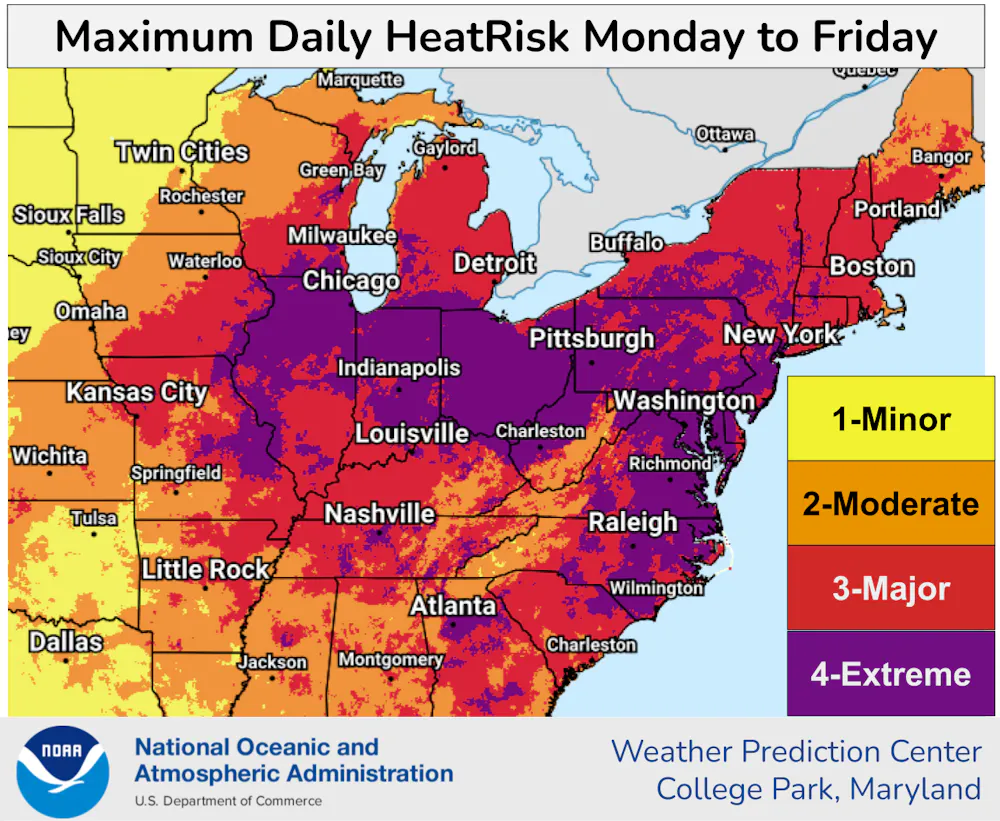
The Weather Prediction Center’s heat forecast shows the maximum temperatures states can expect to see at some point during the week of June 23-27, 2025. NOAA Weather Prediction Center
Even in places where heat is recognized as a dangerous health threat, people can be caught off guard as the thermometer creeps higher, on average, each year. In some cases, dangerous heat can arise quickly. In 2021, a young family died of heat stroke on a California trail after setting out for a hike when temperatures were still in the 70s Fahrenheit (low to mid 20s Celsius).
I study health risks in a warming climate as a professor of public health, and I’ve seen heat become a growing concern. Here are some of the key warning signs to watch for when temperatures rise – and ways to keep cool when the heat and humidity get too high.
Mild forms of heat-related illness include heat cramps and heat rash, both of which can be caused by extensive sweating during hot conditions. Cooling the body and drinking cool fluids can help.
When heat-related illnesses progress into heat exhaustion, the situation is more serious. Heat exhaustion includes symptoms such as dizziness, nausea, excessive sweating, feeling weak, thirst and getting a headache.
Construction workers are often out in the heat for long periods of time, including during this heat wave in Los Angeles in July 2024. Etienne Laurent/AFP via Getty Images
Heat exhaustion is a signal that the body is losing its ability to maintain a stable core temperature. Immediate action such as moving to a cool, ideally air-conditioned space, drinking liquids, loosening clothes and applying wet cloths are some of the recommended steps that can help keep heat exhaustion from progressing to the most dangerous form of heat-related illness, heat stroke.
Signs of heat exhaustion and heat stroke, from the National Weather Service and Centers for Disease Control and Prevention. NOAA/CDC
Typically, someone suffering heat stroke has exhausted their reserves of sweat and salt to stay cool, so sweating eventually stops during heat stroke. Their cognitive ability fails, and they cannot remove themselves from danger. Heat stroke can cause seizures or put someone into a coma as their core temperature rises. If the condition is not treated immediately, and the core temperature continues to rise, heat stroke becomes fatal.
Because heat exhaustion can lead to heat stroke, addressing heat-related illnesses before they progress is vital.
How to tell when the heat is too high
Heat risk isn’t just about temperature – humidity also increases the risk of heat-related illnesses because it affects how well sweating will cool the human body when it gets hot.
Instead of just looking at temperature when planning outdoor activities, check the heat index, which accounts for heat illness risk associated with temperature and relative humidity.
It doesn’t take very high temperatures or very high humidity for the heat index to enter dangerous territory.
A heat index chart shows how heat and humidity combine for dangerous conditions. NOAA
However, the heat index is still a conservative measure of the impact of heat on humans, particularly for outdoor workers and athletes at summer practices. This is because temperature measurements used in weather forecasting are taken in the shade and are not exposed to direct sunlight. If someone is outside and exposed to the direct sun, the actual heat index can be as much as 15 F higher than the heat index chart indicates.
A more sophisticated measurement of heat effects on human health is what’s known as the wet-bulb globe temperature, which takes into account other variables, such as wind speed and cloud cover. Neither takes into account a person’s physical exertion, which also raises their body temperature, whether working at a construction site or playing soccer.
Tips for staying safe in a heat wave
How can you stay cool when heat waves set in? The answer depends in part on where you are, but the main points are the same:
Avoid strenuous outdoor activities in high temperatures if possible. If you start to feel symptoms of heat-related illnesses, drink fluids that will hydrate you. Find shade, rest, and use cool, damp cloths to lower your body temperature. If you see signs of heat stroke in someone else, call for medical help.
Be careful with fans. Fans can be useful if the temperature isn’t too high because they wick sweat away from the body and induce evaporative cooling. But at very high temperatures, they can accelerate heat buildup in the body and lead to dangerous conditions. If indoor temperatures reaches 95 degrees or higher, using fans can actually be dangerous and raise the risk of heat-related illnesses.
Find a cooling center, library or community center where you can get inside and rest in an air-conditioned space in the hottest hours. In places such as Phoenix, where high temperatures are a regular hazard, cooling centers are typically opened in summer. Northern cities are also opening cooling centers as heat waves occur there more frequently than they did in the past. Urban areas with a lot of pavement and buildings – known as heat islands – can have temperatures well above the city’s average.
Hydrate, hydrate, hydrate! Drink plenty of fluids, and don’t forget about the importance of electrolytes. Heat-related dehydration can occur when people sweat excessively, losing water and necessary salts from the body. Some sports drinks or rehydration fluids restore electrolytes and hydration levels.
Older adults and people with disabilities often face higher risks from heat waves, particularly if they can’t easily move to a cooler environment. Communities and neighbors can help protect vulnerable populations by providing cooling centers and bottled water and making regular wellness checks during high heat.
Summer can be a season of fun. Just remember the risks, keep an eye on your friends and neighbors when temperatures rise, and plan ahead so you can beat the heat.
This article, originally published June 19, 2025, has been updated with new heat advisories and forecasts.
Brian Bossak is not currently receiving relevant external funding for heat-related illness research. In 2017-2019, he served as a consultant on a heat-related research award from the Southeastern Coastal Center for Agricultural Health and
Safety at the University of Florida.
In the early hours of June 22, 2025, local time, the United States attacked three nuclear facilities in Iran with “bunker buster” bombs and Tomahawk missiles.
The Conversation U.S. turned to Javed Ali, an expert on Middle East affairs at the University of Michigan and a former senior official at the National Security Council during the first Trump administration, to talk through why Trump chose now to act and what the potential repercussions could be.
What do we know about the nature and timing of US involvement?
President Trump has been forcefully hinting for days days that such a strike could happen, while at the same time opening up a window of negotiation by suggesting as late as June 20 that he would make a decision “within the next two weeks.” We know Trump can be very unpredictable, but he must have assessed that the current conditions presented an opportunity for U.S. action.
Trump met with the National Security Council twice in the days leading up to the strike. Typically at such meetings the president is presented with a menu of military options, which usually boil down to three: a narrow option, a middle ground and a “if you really want to go big” strike.
The one he picked, I would argue, is somewhere between the narrow option and the middle ground one.
The “go big” options would have been an attack on nuclear sites and Iranian leadership – be that senior members of Iran’s Revolutionary Guard, or possibly the Supreme Leader Ayatollah Ali Khamenei. The more narrow approach would have been just one facility, likely to have been Fordo – a deeply fortified uranium enrichment site buried within a mountain.
What did occur was a strike there, but also at two other sites – Isfahan and Natanz.
U.S. military chiefs confirmed that that 12 GBU-57s – the so-called 30,000-pound bunker busters – were dropped by B-2 bombers on Fordo, and two on Isfahan.
That suggests to me that the military goal of the operation was to destroy Iran’s ability to produce and or store highly enriched uranium in a one-time strike rather than drag the U.S. into a more prolonged conflict.
Has the strike achieved Trump’s objectives?
It will take some time to properly assess the extent to which Iran’s ability to produce or store highly enriched uranium has been damaged.
Certainly we know that the bombs hit their targets, and they have been damaged – but to what extent is not immediately clear. General Dan Caine, chairman of the Joint Chiefs of Staff, said that all three target sites had suffered “extremely severe damage and destruction” – possibly rolling back from Trump’s “fully obliterated” assessment. Perhaps most tellingly, Iran has not commented yet on the extent of the damage.
But to Trump, the objective was not just military but political, too. Trump has long said “no” to a nuclear Iran while at the same time has expressed that he has no desire to drag the U.S. into another war.
And this strike may allow Trump to achieve those seemingly contradictory goals. If U.S. initial assessments are correct, Iran’s nuclear program will have been severely compromised. But the strikes won’t necessarily pull U.S. into the conflict fully – unless Iran retaliates in such a way that necessitates further U.S. action.
And that is what Iran’s supreme leader and his military generals will need to work out: Should Iran retaliate and, if so, is it prepared to deal with a heavier U.S. military response – especially when there is no end in sight to its current conflict with Israel.
An operational timeline of a strike on Iran is displayed during a news conference with U.S. Chairman of the Joint Chiefs of Staff Gen. Dan Caine and U.S. Defense Secretary Pete Hegseth on June 22, 2025. Andrew Harnik/Getty Images
What options does Iran have to retaliate against US?
Iran has in the past tried to respond proportionately to any attack. But here is the problem for Iran’s leaders: There is no feasible proportionate response to the United States. Iran has no capability to hit nuclear plants in the U.S. – either conventionally or through unconventional warfare.
But there are tens of thousands of U.S. troops in the region, stationed in Iraq, Syria, the United Arab Emirates, Oman, Qatar and Jordan. All are in range of Iran’s ballistic, drones or cruise missiles.
But that military inventory has been depleted – both by using ballistic missiles in waves of attacks against Israel and by Israel hitting missile launch and storage sites in Iran.
Similarly, Tehran’s capacity to respond through one of its proxy or aligned groups in the region has been degraded. Hezbollah in Lebanon and Gaza’s Hamas – both of whom have ties to Iran – are in survival mode following damaging attacks from Israel over the past 18 months.
The Houthis in Yemen are in many ways the “last man standing” in Iran’s so-called “Axis of Resistance.” But the Houthis have limited capability and know that if they do attack U.S. assets, they will likely get hit hard. During Operation Rough Rider from March to May this year, the Trump administration launched over 1,000 strikes against the Houthis.
Meanwhile Shia militias in Iraq and Syria that could be encouraged to attack U.S. bases haven’t been active in months.
Of course, Iran could look outside the region. In the past the country has been involved in assassinations, kidnappings and terror attacks abroad that were organized through its Quds Force or via operatives of MOIS, its intelligence service.
But for Iran’s leaders, it is increasingly looking like a lose-lose proposition. If they don’t respond in a meaningful way, they look weak and more vulnerable. But if they do hit U.S. targets in any meaningful way, they will invite a stronger U.S. involvement in the conflict, as Trump has warned.
On that occasion, Iran promised a strong retaliation. Its retaliatory attack against the U.S. Ain al-Asad air base in Iraq involved 27 ballistic missiles and caused the physical destruction of some of the facilities on base as well as traumatic brain injury-type symptoms to dozens of troops and personnel, but no deaths. Nevertheless, after this both the U.S. and Iran then backed off from deepening the conflict.
The circumstances now are very different. Iran is already at war with Israel. Moreover, the U.S. went after Iran’s crown jewels – its nuclear program – and it was on Iranian territory. Nonetheless, Khameini knows that if he retaliates, he risks provoking a larger response.
Trump suggested ‘further attacks’ could occur. What could that entail?
The U.S. has suggested that it has the intelligence and ability to hit senior leadership in Iran. And any “go big option” would have likely involved strikes on key personnel. Similarly there could be plans to hit the Iranian economy by attacking oil and gas targets.
A satellite image of the Fordo nuclear facility in Iran prior to the U.S. strike on June 22, 2025. Maxar/Getty
But such actions risk either damaging the global economy or drawing the U.S. deeper into the conflict – it would evolve from a “one and done” strike to a cycle of attacks and responses. And that could widen political cracks between hawks in the administration and parts of Trump’s MAGA faithful who are against the U.S. being involved in overseas wars.
Is there any opportunity of a return to diplomacy?
Trump has not closed his “two weeks” window for talks – theoretically it is still open.
But will Iran come to table? Leaders there had already said they were not willing to entertain any deal while under attack from Israel. Araghchi, Iran’s foreign minister, said after the U.S. strikes that the time for diplomacy had now passed.
In any event, you have to ask, what can Iran come to the table with? Do they have much of a nuclear program anymore? And if not, what would they try to negotiate? It would seem, using one of Trump’s phrases, they “don’t have the cards” to make much of a deal.
Javed Ali does not work for, consult, own shares in or receive funding from any company or organization that would benefit from this article, and has disclosed no relevant affiliations beyond their academic appointment.
Source: The Conversation – Canada – By James Horncastle, Assistant Professor and Edward and Emily McWhinney Professor in International Relations, Simon Fraser University
Segment on Trump’s threats against Iran’s leader. (BBC News)
The American military can certainly make an impact in any air campaign against Iran. The problem from a military standpoint, however, is that the U.S., based on its forces’ deployment, will almost certainly seek to keep its involvement limited to its air force to avoid another Iraq-like quagmire.
While doing so could almost certainly disrupt Iran’s nuclear program, it will likely fall short of Israel’s goal of regime change.
In fact, it could reinforce the Iranian government and draw the U.S. into a costly ground war.
The initial stated reason for Israel’s bombing campaign — Iran’s nuclear capabilities — appears specious at best.
Israeli Prime Minister Benjamin Netanyahu has argued several times in the past, without evidence, that Iran is close to achieving a nuclear weapon. U.S. intelligence, however, have assessed that Iran is three years away from deploying a nuclear weapon.
Regardless of the veracity of the claims, Israel initiated the offensive and requires American support.
Israel’s need for U.S. assistance rests on two circumstances:
While Israel succeeded in eliminating key figures from the Iranian military in its initial strikes, Iran’s response appears to have exceeded Israel’s expectations with their Arrow missile interceptors nearing depletion.
Israel’s air strikes can only achieve so much in disrupting Iran’s nuclear ambitions. Most analysts note that Israel’s bombings are only likely to delay the Iranian nuclear program by a few months. This is due to the fact that Israeli missiles are incapable of penetrating the Fordow Fuel Enrichment Plant, which estimates place close to 300 feet underground.
Nonetheless, the efficacy of air power has been vastly overrated in the popular media and various air forces of the world. Air power is great at disrupting an opponent, but has significant limitations in influencing the outcome of a war.
Specifically, air power is likely to prove an inadequate tool for one of the supposed Israeli and American objectives in the war: regime change. For air power to be effective at bringing about regime change, it needs to demoralize the Iranian people to the point that they’re willing to oppose their own government.
Early air enthusiasts believed that a population’s demoralization would be an inevitable consequence of aerial bombardment. Italian general Giulio Douhet, a prominent air power theorist, argued that air power was so mighty that it could destroy cities and demoralize an opponent into surrendering.
Douhet was correct on the first point. He was wrong on the second.
Recent history provides evidence. While considerableink has been spilled to demonstrate the efficacy of air power during the Second World War, close examination of the facts demonstrate that it had a minimal impact. In fact, Allied bombing of German cities in several instances created the opposite effect.
More recent bombing campaigns replicated this failure. The U.S. bombing of North Vietnam during the Vietnam War did not significantly damage North Vietnamese morale or war effort. NATO’s bombing of Serbia in 1999, likewise, rallied support for the unpopular Slobodan Milosevic due to its perceived injustice — and continues to evoke strong emotions to this day.
Iran’s political regime may be unpopular with many Iranians, but Israeli and American bombing may shore up support for the Iranian government.
Nationalism is a potent force, particularly when people are under attack. The attacks on Iran will rally segments of the population to the government that would otherwise oppose it.
Few positive options
The limitations of air power to fuel significant political change in Iran should have given Trump pause about intervening in the conflict.
Some American support, such as providing weapons, is a given due to the close relationship between the U.S. and Israel. But any realization of American and Israeli aspirations of a non-nuclear Iran and a new government will likely require ground forces.
Recent American experiences in Afghanistan and Iraq show such a ground forces operation won’t lead to the swift victory that Trump desires, but could potentially stretch on for decades.
James Horncastle does not work for, consult, own shares in or receive funding from any company or organisation that would benefit from this article, and has disclosed no relevant affiliations beyond their academic appointment.
This political support stands in sharp contrast to the many businesses that have reduced or ended their support for the 2SLGBTQIA+ community this Pride season.
Multinational corporations like Google, as well as Canadian-owned companies like Molson Coors, have divested from supporting festivals, while Target has scaled back its Pride merchandise due to threats against employees and large-scale conservative backlash.
The impact is already being felt. Pride Toronto is currently facing a $900,000 funding gap. Executive director Kojo Modeste recently told CBC News this corporate divestment appears to be linked to the larger backlash against diversity, equity and inclusion efforts.
Fear of punitive measures
In January, United States President Donald Trump issued an executive order to dismantle DEI initiatives in federal agencies and target private companies that support DEI measures. In the executive order, Trump’s administration called DEI measures and mandates “immoral discrimination programs.”
Major private corporations, including IBM, quickly bent to the pressure of Trump’s anti-DEI orders by gutting their programs and shifting corporate donorship away from “woke” initiatives.
The pressure to comply with anti-DEI measures hasn’t ended with corporations. More recently, Trump has set his sights on the U.S. post-secondary system, freezing US$2.2 million in federal grants and US$60 million in contracts after Harvard University refused to comply with the administration’s demands related to its DEI programs.
Following in the footsteps of the U.S., Alberta’s United Conservative Party membership passed a resolution to eliminate DEI programs and training in the public service. The party has also indicated it will remove government funding from post-secondary institutions that continue to do DEI work.
Declining public support
In addition to the rollback of DEI programs, the ongoing corporate reductions in Pride support are taking place amid increasing anti-2SLGBTQIA+ sentiment.
A 2024 poll reported that, in Canada, support for 2SLGBTQIA+ visibility — like representation on screens and in sports — is lower than it was in 2021. Compared to previous years, Canadians also expressed less support for transgender rights, and this level of support was lower than the 26 other countries surveyed.
Public attitudes don’t change in a vacuum. They are deeply influenced by hate movements, political rhetoric and the spread of misinformation and disinformation weaponized by politicians and leaders to dehumanize the 2SLGBTQIA+ community, particularly transgender people.
This dehumanization incites fear, violence and support for anti-2SLGBTQIA+ hate. It has coincided with companies silently withdrawing their support for the 2SLGBTQIA+ community.
Where we live, in Alberta, the provincial government has passed the most draconian anti-trans laws Canada has ever seen. As we (Corinne L. Mason and Leah Hamilton) have previously written, Premier Danielle Smith’s government has unveiled a suite of policies targeting transgender, intersex and gender diverse children and youth in Alberta, and the 2SLGBTQIA+ community more broadly.
In this environment of reduced public and political support, it’s not surprising to see companies backing away from the 2SLGBTQIA+ community.
Getting back to Pride’s roots
The fact that companies have quickly backed away from their support of the 2SLGBTQIA+ community — by halting production of Pride merchandise or reducing sponsorship in Pride festivals — illustrates the conditionality of their support.
Rather than beg big business to come back to the table, some members of the community are using this moment to reflect on how corporate “Love is Love” campaigns haven’t actually led to increased quality of life or justice for our communities.
Pride Month is rooted in protest and resistance against police violence and systemic oppression. It was led by Black trans women and can be traced back to the Stonewall Riots. Today, Pride still isn’t simply a party and parade.
Authentic ‘rainbow dollars’
In this sociopolitical climate of legislated DEI rollbacks and declining public support for the 2SLGBTQIA+ community, organizations that want to support the 2SLGBTQIA+ community should back up their messaging with meaningful actions and structural support.
Some organizations have shown a commitment to structural support for the 2SLGBTQIA+ community from its beginning, including the Northern Super League, the top-division professional women’s soccer league in Canada. The league openly and consistently amplifies and supports its 2SLGBTQIA+ players, coaches, staff and fans. Founded by Diana Matheson, an openly queer woman, the league is founded on inclusion as a core value.
When it comes to creating Pride merchandise, Social Made Local is a queer-owned Canadian apparel company in Saskatoon that focuses on gender-inclusive sizing, sustainability and community. They donate a portion of their sales to Canadian non-profits like Rainbow Railroad.
Companies that want to show their support can spend their rainbow dollars in good faith through actions that meaningfully support the 2SLGBTQIA+ community. This could include creating programs that support queer entrepreneurs, donating to legal funds that are fighting discriminatory legislation, and partnering with 2SLGBTQIA+ organizations to amplify their work.
Leah Hamilton receives funding from the Social Sciences and Humanities Research Council of Canada.
Corinne L. Mason receives funding from Social Sciences and Humanities Research Council.
Gini (Virginia) Weber does not work for, consult, own shares in or receive funding from any company or organisation that would benefit from this article, and has disclosed no relevant affiliations beyond their academic appointment.
Source: The Conversation – Canada – By Shannon D. M. Moore, Assistant professor of social studies education, Department of Curriculum Teaching and Learning, Faculty of Education, University of Manitoba
The sexual assault trial of five former World Juniors hockey players has spotlighted issues around sexual assault and consent.
We argue for harnessing popular media to advance sexuality education. Children and youth learn about a great deal about gender, relationships, sexuality and consent from popular media.
Although there is strong theoretical rationale for using popular media to confront sexual assault, many teachers identify and experience barriers to putting this into practice in their classrooms.
Talking about sex in society and in schools is often taboo. Discussions of healthy relationships and consent are often highly controlled, minimized or relegated to a sexual education curriculum that is not universally taught. This is due to parental opt-outs/ins in many provinces.
Not surprisingly, neglecting comprehensive sexuality education has many adverse consequences. Students learn that eliminating sexual violence is not a societal priority. Those who have experienced assault and other forms of violence learn that they are not important, as their stories are often silenced, ignored or distrusted.
As a result, rape culture and gender-based violence remains unchallenged in schools, while it is normalized, legitimized and endorsed in popular media.
What youth watch, play, listen to or create on social media has a significant role in teaching dominant understandings that normalize sexual violence, misogyny and the patriarchy.
As teacher educators and educational researchers, the teachers we have worked with across grades and subject areas recognize how popular media is always and already present in classrooms, and many embrace the opportunities it affords for necessary conversations that are relevant to students.
Challenges with using popular media
The teacher participants in our study revealed that classroom culture wars have had a chilling impact on their practice, making them feel more wary about tackling particular topics.
We found that despite research-informed rationale for using popular media to ground sexuality education, teachers encounter several barriers and complications in doing so.
Teachers’ discomfort was exacerbated when school leaders did not support their efforts to advance these lessons, even though they were anchored to the provincial curriculum. Teacher participants also spoke of a lack of professional development or preparation to talk about healthy relationships and consent in teacher education contexts.
1. Start with media constructions of gender: As popular media contributes to societal expectations of gender, students should begin by interrogating how masculinities and femininities are constructed and mobilized in popular media.
This can include examining how male, female and non-binary characters are constructed and presented to audiences, their position within the broader storyline and their level of dialogue and how varied intersections of identity impact these depictions.
2. Begin with unfamiliar content: Students can initially become defensive when they are asked to critically engage with media content that deeply connect with their identity and give them a sense of joy.
While the goal is to move to the interrogation of students’ own media diets, it can positively generate student participation when educators begin analytical and critical discussions about media with unfamiliar, or at least not cherished, material (like popular songs, video or social media).
3. Offer a feminist lens: As teacher educators, we recognize that there is no single method or approach that tends to every aspect of sexual assault and other forms of gender-based violence. Yet, we also know that educators seek resources to engage more meaningfully with students.
Cards to foster conversation
We constructed a deck of educational playing cards that educators can use to foster conversations about media portrayals of gender, healthy relationships and consent (or lack thereof).
These cards employ a feminist lens, based on Sarah Ahmed’s Living a Feminist Life. We advocate for teachers to have time in professional learning spaces to try out the cards with other educators before they facilitate complex conversations related to gender-based violence with students.
If as a society we want to see fewer instances of gender-based violence, teachers need provincial curriculum documents that align with the research on comprehensive sex education. They also need school leaders who will support their work and model consent in the broader school culture, and more professional development and preparation in teacher education.
Shannon D. M. Moore receives funding from the Social Sciences and Humanities Research Council
Jennifer Watt receives funding from the Social Sciences and Humanities Research Council .
Source: The Conversation – Canada – By Mohammadamin Ahmadfard, Postdoctoral Fellow, Mechanical & Industrial Engineering, Toronto Metropolitan University
Artificial intelligence (AI) is quietly transforming how cities generate, store and distribute energy, acting as the invisible conductor that orchestrates cleaner, smarter and more resilient cities.
By integrating renewables — from solar panels and wind turbines to geothermal grids, hydrogen plants, electric vehicles and batteries — AI can enable cities to manage diverse energy sources as a single, intelligent system.
One striking example is the Oya Hybrid Power Station in South Africa. Here, AI-driven controls seamlessly co-ordinate solar, wind and battery storage to deliver reliable power to up to 320,000 households. Using AI makes this kind of integration not only possible, but dramatically more efficient.
Recent research shows AI can also optimize how batteries, solar and the grid interact in buildings. A 2023 study found that deep learning and real-time data helped a boarding school in Turin, Italy increase low-cost energy purchases and cut its electricity bill by more than half.
Cleaner, smarter energy grids
AI models are increasingly able to predict weather with greater precision. These predictions allow electric grid operators to plan hours ahead, storing excess energy in batteries or adjusting supply to meet demand before a storm or heatwave hits.
Using AI to respond strategically to weather is a game-changer. In Cambridge, England, a system called Aardvark uses satellite and sensor data to generate rapid, accurate forecasts of sun and wind patterns.
Unlike traditional supercomputer-driven weather models, Aardvark’s AI can deliver precise local forecasts in minutes on an ordinary computer. This makes advanced weather prediction more accessible and affordable for cities, utilities and even smaller organizations — potentially transforming how communities everywhere plan for and respond to changing weather.
AI models are increasingly able to predict weather with greater precision, allowing electric grid operators to plan ahead, storing excess energy in batteries or adjusting supply to meet demand before a storm or heat wave hits. (Shutterstock)
AI for smarter district heating and cooling
In Munich, Germany, AI is improving geothermal district heating by using underground sensors to monitor temperature and moisture levels in the ground.
The collected data feeds into a digital simulation model that helps optimize network operations. In more advanced versions, during winter cold snaps, such systems can suggest lowering flow to underused spaces like half-empty offices and boosting heat where demand is higher, such as in crowded apartments.
This intelligent, self-optimizing approach extends the life of equipment and delivers more warmth with the same energy input.
This is a breakthrough with enormous potential for cities in cold climates with established geothermal networks, such as Winnipeg in Canada and Iceland’s Reykjavik.
Although these cities have not yet adopted AI-driven monitoring systems, they could benefit from AI’s real-time improvements in efficiency, comfort and energy savings during harsh winters — a principle that holds true wherever geothermal district heating and cooling exists.
Inside the home, AI-managed smart climate systems can factor in how many people are in each room, which appliances are in use, how much natural sunlight each space receives. (Shutterstock)
Smart buildings
Inside the home, AI-managed smart climate systems can factor in how many people are in each room, which appliances are in use, how much natural sunlight each space receives and how much electricity or heat a home’s solar panels generate throughout the day.
Based on this, AI determines how to heat or cool rooms efficiently, and can transfer energy from one space to another, balancing comfort with minimal energy use.
Coastal cities and those in wind-heavy regions are using AI in other creative ways. In Orkney, Scotland, excess wind and tidal energy are converted into green hydrogen. Instead of letting that surplus power go to waste, an AI system called HyAI controls when to generate hydrogen based on wind forecasts, electricity prices and how full the hydrogen storage tanks are.
When winds are strong at night and electricity is cheap, the AI can divert surplus power to produce hydrogen and store it for later use. On calmer days, that stored hydrogen can power fuel cells or buses.
Energy storage
AI is transforming energy storage into a smart, revenue-generating force. In Finland, a startup called Capalo AI has developed Zeus VPP, an AI-powered virtual power plant that aggregates distributed batteries from homes, businesses and other sites.
Zeus VPP uses advanced forecasting and AI algorithms to decide when batteries should charge or discharge, factoring in energy prices, local consumption and weather forecasts. This enables battery owners to earn revenue by participating in electricity markets, while also supporting grid stability and making better use of renewable energy.
AI-powered dynamic line rating adjusts how much electricity a line can carry in real time, boosting capacity by 15 to 30 per cent when conditions allow. This helps utilities maximize the use of existing infrastructure instead of relying on costly upgrades.
At the local level, AI analyzes smart metre data to predict which transformers are overheating due to rising EV and heat pump use.
By forecasting these stress points, utilities can proactively upgrade equipment before failures happen — a shift from reactive to predictive maintenance that makes the grid stronger and cities more resilient.
AI-powered public transit and mobility
Transportation innovation is becoming part of the energy solution, with AI at the centre of this transformation. In New York City, energy company Con Edison has installed major battery storage systems to help manage peak electricity demand and reduce reliance on polluting peaker plants, which supply energy only during high-demand periods.
More broadly, Con Edison is deploying advanced AI-powered analytics software across its electric grid — optimizing voltage, enhancing reliability and enabling predictive maintenance. Together, these efforts show how combining energy storage and AI-driven analytics can make even the world’s busiest cities more resilient and efficient.
AI is also powering “vehicle-to-grid” innovations in California, where an AI-driven platform manages electric school buses that can supply stored energy back to the grid during periods of high demand.
By carefully managing when buses charge and discharge, these systems help keep the grid reliable and ensure vehicles are ready for their daily routes. As this technology expands, parked electric vehicles could serve as valuable backup resources for the electricity system.
Transportation innovation is becoming part of the energy solution. (Shutterstock)
AI for clean energy initiatives
AI is rapidly transforming cities by revolutionizing how energy is used and managed. Google, for example, has slashed cooling energy at its data centres by up to 40 per cent using AI that fine-tunes fans, pumps and windows more efficiently than any human operator.
Organizations like the Electric Power Research Institute (EPRI), in collaboration with NVIDIA, Microsoft and others, have launched the Open Power AI Consortium, which is creating open-source AI tools for utilities worldwide.
These tools will enable even the most resource-constrained cities to deploy advanced AI capabilities, without having to start from scratch, helping to level the playing field and accelerate the global energy transition.
The result is not just cleaner air and lower energy bills, but a path to fewer blackouts and more resilient homes.
Mohammadamin Ahmadfard receives funding from the Natural Sciences and Engineering Research Council of Canada (NSERC) and Mitacs Inc. for his postdoctoral research at Toronto Metropolitan University.
Source: The Conversation – Canada – By Sara Bannerman, Professor and Canada Research Chair in Communication Policy and Governance, McMaster University
In Canada, federal political parties are not governed by basic standards of federal privacy law. If passed, Bill C-4, also known as the Making Life More Affordable for Canadians Act, would also make provincial and territorial privacy laws inapplicable to federal political parties, with no adequate federal law in place.
Federal legislation in the form of the Privacy Act and the Personal Information Protection and Electronic Documents Act sets out privacy standards for government and business, based on the fair information principles that provide for the collection, use and disclosure of Canadians’ personal information.
At the moment, these laws don’t apply to political parties. Some provinces — especially British Columbia — have implemented laws that do. In May 2024, the B.C. Supreme Court upheld the provincial Information Commissioner’s ruling that B.C.’s privacy legislation applies to federal political parties. That decision is currently under appeal.
Bill C-4 would undermine those B.C. rights. It would make inapplicable to federal parties the standard privacy rights that apply in other business and government contexts— such as the right to consent to the collection, use and disclosure of personal information — and to access and correct personal information held by organizations.
Why should we be concerned about Bill C-4’s erasure of these privacy protections for Canadians? There are four reasons:
Until now, Canadian parties and governments have been content to use American platforms, data companies and datified campaign tactics. Bill C-4 would leave federal parties free to do more of the same. This is the opposite of what’s needed.
The politics that resulted in Trump being elected twice to the Oval Office was spurred in part by the datafied campaigning of Cambridge Analytica in 2016 and Elon Musk in 2024. These politics are driven by micro-targeted and arguably manipulative political campaigns.
Do Canadians want Canada to go in the same direction?
Are political parties spying and experimenting on Canadians via personal data collection? (Unsplash/Arthur Mazi), FAL
2. Threats to Canada’s future
Bill C-4 would undermine one of the mechanisms that makes Canada a society: collective political decisions.
Datified campaigning and the collection of personal information by political parties change the nature of democracy. Rather than appealing to political values or visions of what voters may want in the future or as a society — critically important at this historical and troubling moment in history — datified campaigning operates by experimenting on unwitting individual citizens who are alone on their phones and computers. It operates by testing their isolated opinions and unvarnished behaviours.
For example, a political campaign might do what’s known as A/B testing of ads, which explores whether ad A or ad B is more successful by issuing two different versions of an ad to determine which one gets more clicks, shares, petition signatures, donations or other measurable behaviour. With this knowledge, a campaign or party can manipulate the ads through multiple versions to get the desired behaviour and result. They also learn about ad audiences for future targeting.
In other words, political parties engaging in this tactic aren’t engaging with Canadians — they’re experimenting on them to see what type of messages, or even what colour schemes or visuals, appeal most. This can be used to shape the campaign or just the determine the style of follow-up messaging to particular users.
University researchers, to name just one example, are bound by strict ethical protocols and approvals, including the principle that participants should consent to the collection of personal information, and to participation in experiments and studies. Political parties have no such standards, despite the high stakes — the very future of democracy and society.
Most citizens think of elections as being about deliberation and collectively deciding what kind of society they want to live in and what kind of future they want to have together as they decide how to cast their ballots.
But with datified campaigning, citizens may not be aware of the political significance of their online actions. Their data trail might cause them to be included, or excluded, from a party’s future campaigning and door-knocking, for example. The process isn’t deliberative, thoughtful or collective.
3. Secret personal data collection
Political parties collect highly personal data about Canadians without their knowledge or consent. Most Canadians are not aware of the extent of the collection by political parties and the range of data they collect, which can include political views, ethnicity, income, religion or online activities, social media IDs, observations of door-knockers and more.
Some governments can and do use data to punish individuals politically and criminally, sometimes without the protection of the rule of law.
Breaches and misuses of data, cybersecurity experts say, are no longer a question of “if,” but “when.”
Worse, what would happen if the wall between political parties and politicians or government broke down and the personal information collected by parties became available to governments? What if the data were used for political purposes, such as for vetting people for political appointments or government benefits? What if it were used against civil servants?
What if it were to be used at the border, or passed to other governments? What if it were passed to and used by authoritarian governments to harass and punish citizens?
What if it was passed to tech companies and further to data brokers?
OpenMedia recently revealed that Canadians’ data is being passed to the many different data companies political parties use. That data is not necessarily housed in Canada or by Canadian companies.
If provincial law is undermined, there are few protections against any of these problems.
Strengthening democracy
Bill C-4 would erase the possibility of provincial and territorial privacy laws being applied to federal political parties, with virtually nothing remaining. Privacy protection promotes confidence and engagement with democratic processes — particularly online. Erasing privacy protections threatens this confidence and engagement.
The current approach of federal political parties in terms of datified campaigning and privacy law is entirely wrong for this political moment, dangerous to Canadians and dangerous to democracy. Reforms should instead ensure federal political parties must adhere to the same standards as businesses and all levels of government.
Data privacy is important everywhere, but particularly so for political parties, campaigns and democratic engagement. It is important at all times — particularly now.
Sara Bannerman receives funding from the Canada Research Chairs program, the Social Sciences and Humanities Research Council, and McMaster University. She has previously received funding from the Office of the Privacy Commissioner’s Contributions Program and the Digital Ecosystem Research Challenge.
The Kgodumodumo Dinosaur Interpretation Centre is a living gateway into South Africa’s deep past and dynamic future, Tourism Minister Patricia de Lille said on Sunday.
“This Centre tells the story of a world 200 million years ago, yet it is also a story of the Basotho people, whose ancient wisdom and oral traditions gave rise to the mythical Kgodumodumo, now brought to life in scientific exhibition,” de Lille said.
She was speaking at the launch of the centre at the Golden Gate Highlands National Park in the Free State.
WATCH | Kgodumodumo Dinosaur Interpretive Centre Launch
[embedded content]
The Minister said the centre also tells the story of the land claimant settlement agreement which includes a beneficiation package that largely consists of eco-tourism opportunities such as a camping site, horse riding, mountain biking, a 4×4 trail and hiking trails.
“I want to acknowledge that the Kgodumodumo Dinosaur Interpretation Centre has been made possible through close collaboration and partnership between the Department of Tourism, Evolutionary Studies Institute of the University of the Witwatersrand, South African National Parks [SANParks], National Treasury, the Department of Forestry, Fisheries and Environment [DFFE], the Free State Province and most importantly, the surrounding communities.”
The Minister was also grateful for the donor funding from the European Union of R120 million.
“I want to thank all partners for their invaluable contributions, both past and future. A special mention to the University of the Witwatersrand, which has a long tradition of palaeontological research.
“Subsequent work at this site revealed more nests at different levels, indicating that this was a seasonal nesting place for dinosaurs. We have created something both monumental and meaningful.”
De Lille said the centre is not just a museum.
“Government is diversifying tourism attractions to grow tourism. The Interpretation Centre will act as a catalyst for broader tourism development in the Free State’s rural economy,” she said adding that the centre will boost domestic tourism in one of the least visited provinces in the country.
“The province of the Free State is not a place to travel through but a place to travel to. We have trained 15 tour guides from the local community.”
The Department of Tourism launched the centre in partnership with the DFFE.
The two departments recently signed a Memorandum of Understanding (MoU) to develop the Kgodumodumo Dinosaur Interpretation Centre to boost tourism in the Free State.
The centre will offer visitors an innovative, creative and quality demonstration of scientific knowledge (paleontological, archaeological and geological) with a broader appreciation of cultural heritage through interactive exhibitions.
The centre is managed by the SANParks, and it is envisaged that the facility will increase the bed occupancy and more activities for visitors to the park.
The development of the project includes the Interpretation Centre (paleontological offices and work space), the reception area, lecture halls, the display area-exhibition and display installation, the coffee/curio shop, the activity node – office, activity areas (children), parking – paved parking area, look-out point and bulk services, upgrade electrical supply – transformer and cable, sewer – connect to existing system water – connection. – SAnews.gov.za
Source: People’s Republic of China in Russian – People’s Republic of China in Russian –
Source: People’s Republic of China – State Council News
XI’AN, June 22 (Xinhua) — “How is business going in Kazakhstan? Are there any difficulties in establishing contacts?” Begench Sakhedov, a Turkmen national, asked his business partner Wang Yi from Shaanxi Province, who was in Almaty at the time, via video link from Xi’an, northwest China’s Shaanxi Province. “Everything is going well. There are no problems in communication, even though I do not speak English or Russian, because many Kazakhs speak Chinese,” Wang Yi replied.
As transnational partners, Wang Yi and B. Sahedov jointly run a company in Xi’an that provides cultural exchange services. As trade, economic and cultural exchanges between China and Central Asian countries expand, their company, registered in September 2023, has seen good growth.
“After the successful holding of the first China-Central Asia Summit, we clearly felt that students from the five Central Asian countries have increased their desire to study in China because coming to China means more opportunities and no difficulties with employment,” the company’s business director, Turkmen Yagshi Aizhanov, told Xinhua. “In 2024, we helped more than 800 people come to study in China, most of them from the five Central Asian countries.”
As mutual visa-free travel agreements between China and Central Asian countries come into effect, travel has also become more convenient. “We are currently cooperating with more than 100 universities in China,” B. Sakhedov noted.
Xi’an, where a large number of universities and scientific and educational resources are concentrated, has become one of the popular cities for students from Central Asia who come to study in China. In recent years, many young people from Central Asia, such as B. Sakhedov, who came to China to receive higher education, choose Xi’an after graduating to start their entrepreneurial journey here.
The Qinchuanyuan Science and Technology Big Market in Xi’an New Area, Shaanxi Province, hosted an exchange of views on entrepreneurship among foreign youth. Amina Gusarova from Kyrgyzstan told Xinhua that she registered a consulting company in Xi’an late last year. “We have already signed our first order. A Chinese enterprise that needs to expand its business is going to Kyrgyzstan for a study tour, and we provide them with comprehensive services, from consulting to translation.”
“We have been implementing a pilot project on entrepreneurship among foreign specialists since May 2023. To date, 18 expat startup projects have already been attracted, most of the entrepreneurs are from five Central Asian countries,” said Han Ping, deputy head of the Department of Scientific and Technological Innovation and New Economy of Xi’an New Area in Shaanxi Province. “They have a very strong desire to work and live in China, and at the same time, they often invite business partners from Central Asia to Xi’an to seek cooperation opportunities.”
Doniyor Matmusayev from Uzbekistan is one such entrepreneur. After graduating from Northwestern Polytechnical University in 2023, he registered a trading company in Xi’an that supplies Chinese goods to Central Asian countries and Russia. “We sell Chinese construction equipment to Uzbekistan, and some Chinese brands of equipment are doing very well there; we mainly sell auto parts to Kazakhstan, but Chinese electric cars are also very popular there; and we mainly supply electronics to Russia, such as switches, servers, etc.,” he said.
Over the past two years, D. Matmusaev has worked in the provinces of Guangdong (South China), Jiangsu (East China), Zhejiang (East China), Shandong (East China) and other places. “The opening of a direct flight from Xi’an to Uzbekistan has significantly reduced the logistics shoulder. Now our electronics are delivered by air in three hours and cleared through customs on the same day,” said D. Matmusaev. “We transport large-sized equipment by road or by international freight railway routes from China to Europe. Road transportation takes 15 days, and the convenience of China-Europe express trains is not even worth mentioning.”
According to statistics from the Shaanxi Provincial Commerce Department, the province’s foreign trade turnover with the five Central Asian countries has been growing every year. In 2024, it reached 8.575 billion yuan (about 1.18 billion US dollars), which is 48.1 percent more than the previous year. Thanks to such development dynamics, Chinese ice cream has now appeared in the product range. To make the partners more confident, in early April, D. Matmusaev accompanied a client from Uzbekistan on a trip to a Chinese ice cream factory.
“Ice cream is a new project. We started working on it in March. These are types and flavors specially adapted for Uzbekistan from the supplier. From the beginning of April to the present, we have already sent 7 trucks of products, and they are very popular,” said D. Matmusayev.
Today, the total volume of trade of his company with the countries of Central Asia and Russia has exceeded 2 million US dollars. “My dream is to do global business. We are ready to expand the sphere of trade and plan to start cooperation with the regions of the Middle East, Europe and America, because Chinese products are popular in an increasing number of countries, and this is an excellent business opportunity,” shared D. Matmusaev. -0-
Source: Hong Kong Government special administrative region
Police Recruitment Experience and Assessment Day The theme of this year’s READ was “One Force”, aiming to demonstrate to aspiring candidates the unity and solidarity of the Police Force in safeguarding Hong Kong. Through various experiential activities, participants were given opportunities to gain a better knowledge of the selection process, foundation training programmes at the Police College, and the diversified police duties. Participants were able to submit applications and undergo part of the initial screening on the spot. Top performing applicants in the group interview for Recruit Police Constables were invited to attend their final interview on the same day.
Additionally, the HKPF announced the introduction of the “Probationary Inspector DSE 4+ Express”, effective from July 1. Those who have obtained Level 4 or above in Chinese Language and English Language subjects in the Hong Kong Diploma of Secondary Education Examination, or equivalent, and have passed the Aptitude Test of the Common Recruitment Examination will be deemed to have passed the Probationary Inspector Written Examination, and gain direct access to the Extended Interview. The measure will expedite the selection process so that candidates meeting the above requirements can join the Police Force as soon as possible, enhancing the Force’s capacity to attract high-calibre candidates in the job market.
A number of new sessions have been added to READ, including the “Escape Room”, an interactive mystery-solving game, together with the “Crime Scene Investigation Mobile Laboratory” of the Identification Bureau, which enabled participants to experience criminal investigation and evidence collection in a simulated crime scene; the “Barrack and Living Quarters Tour”, which introduced visitors to the accommodation arrangements and welfare benefits for married junior police officers and trainees; and the “Unit Display”, which allowed Police officers to interact with the public through games to demonstrate the strength and skills of elite units.
For the first time, the Technical Services Division, the Communication Branch, the Police Band, Traffic Wardens and Police Communications Officers, set up booths to demonstrate to the public the diverse roles of the Force. Other recruitment activities included selection workshops for Probationary Inspectors and Recruit Police Constables, interactive exhibitions of various Police units, sharing sessions on training experience, and workshops on physical fitness tests.
The READ recorded an attendance of 2 397. A total of 505 on-spot applications were received, of which 158 for Probationary Inspector posts, 273 for RPC posts, and 36 for Police Constable (Auxiliary) posts, and 38 for the Cadet Programme. Applicants included students of local and overseas tertiary institutes and working people.
The Force accepts job applications year-round. Persons who are interested in applying for Probationary Inspector, Recruit Police Constable or Police Constable (Auxiliary) can complete the application form at the “HKPF Recruit” mobile application Issued at HKT 18:59
When US B-2 bombers hit Iran’s nuclear facilities at Fordow, Natanz and Isfahan, Donald Trump declared the strikes a success and urged the Islamic Republic to make peace or face even more devastating strikes. The US president proclaimed the might of the US military, operating in full coordination with Israel, before taking to truth social.
Trump and the Israeli prime minister, Benjamin Netanyahu, will hope that the strikes will end Iran’s nuclear programme once and for all. It may, it may not. More certain is that the operation will sound the death knell for the post-second world war global order.
After the horrors of the that war and the cold war that followed, a global order emerged seemingly predicated on a set of largely liberal rules and norms that sought to prevent a retreat into global conflict. Predicated on non-intervention, diplomacy and a respect for the rule of law, this global order was idealistic and – ultimately – aspirational.
But in recent years, this vision of global politics has come crashing down. Now America joining Israel in its attacks on Iran will rightly provoke serious questions about the future of global order and what comes next.
Get your news from actual experts, straight to your inbox.Sign up to our daily newsletter to receive all The Conversation UK’s latest coverage of news and research, from politics and business to the arts and sciences.
Trump’s decision to use US air power to land heavy blows against Iran’s nuclear programme is the latest event on a continuum which arguably reaches back to the Hamas terror attack of October 7.
Israel’s destruction of Gaza, its decapitation of Hamas and disabling of Hezbollah’s military capacity and its strikes against the Houthi rebels have consolidated Israel’s position of strength in the region, to generally positive acclaim from global audiences. Yet the spectre of Iran continued to loom large, even as its proxies were defeated
Iran has long been framed as an nefarious puppet master controlling a complex web of “proxy actors” across the Middle East each accused of doing the bidding of Tehran. The reality is rather different. While the Islamic Republic undeniably wields influence over such groups, it is not the perfidious mastermind that some would suggest, nor is it the source of all ills in the region.
Instead, Iran is in a perilous position. The Islamic Republic faces serious social and economic pressures, with the “women life freedom movement” galvanising popular opposition, while unrest across Iran’s peripheral provinces which are home to ethnic and religious minorities continues to ferment.
In recent years, diplomacy has shown it can work, ameliorating longstanding and deep-seated animosities. This was bearing fruits as seen in the gradual rapprochement between Iran and Saudi Arabia from 2023, which had been preceded by the signing of the Abraham accords in 2020.
Seen by many as a key achievement of Trump’s first presidency, this was a series of agreements between Israel and Bahrain, the United Arab Emirates, Morocco and Sudan in which the Arab countries recognised Israel and all sides signed a declaration of principles focused on mutual understanding, respect for human dignity, and cooperation.
While many in Israel and the US hoped that Saudi Arabia would officially recognise Israel, the events of October 7 and the destruction of Gaza that followed ended those hopes. Now the possibility of all-out conflict between Iran and Israel and the US risks blowing a major regional conflict with global implications.
Serious questions must be asked as to the longer-term strategy here. While Israeli officials have articulated a need for strikes on Iran’s nuclear facilities to prevent the Islamic Republic from getting a nuclear weapons capability, Iran is a signatory of the nuclear non-proliferation treaty (although it has threatened recently to quit) and key officials have regularly declared that nuclear weapons have no place in Iran’s strategic portfolio.
Israel is not a signatory to the treaty. In fact, it is thought to possess between 75 and 400 nuclear warheads. It’s hard to tell, as the country has maintained a steadfast policy of nuclear opacity, never actually admitting the extent of its nuclear capability.
New impunity?
Is this the start of a new order of impunity across the region, backed by western powers? And if so, what does this mean for the war in Ukraine and the potential for an aggressive Russia engaging in further dangerous adventurism? What does it mean for the possibility of China taking advantage in this breakdown to perhaps fulfil its generations-old ambition to unite with Taiwan, by force, if necessary? Are we seeing the shift to a world in which Donald Trump’s threats to annex Greenland – even perhaps Canada – must be taken seriously?
The contours of global politics are changing before our eyes. Gone are the norms that have served as the bedrock of the so-called liberal international order. The risk is that while this period has itself featured tragedy and suffering on an almost unimaginable scale, tearing up the rule book will be far worse.
Simon Mabon receives funding from Carnegie Corporation of New York and the Henry Luce Foundation. He is a Senior Research Fellow with the Foreign Policy Centre.
Source: Northern Territory Police and Fire Services
The ACT Government will support the revitalisation of Telstra Tower.
In brief:
The 2025–26 ACT Budget is investing in Canberra’s tourism, hospitality and events sectors.
This will help city is grow as a destination for both tourism and business.
This story outlines the targeted investment included in the Budget.
The 2025–26 ACT Budget will support Canberra’s tourism, hospitality and events sectors.
Targeted investment will help attract more visitors and events to Canberra. It will:
support Canberra’s growing visitor economy
strengthen the city’s national profile
deliver high-quality events that benefit the whole community.
This will help ensure the city is well-placed to grow as a visitor and business hub.
Telstra Tower – an iconic landmark
The ACT Government is committed to returning Telstra Tower as part of the Canberra tourism experience.
The tower is one of Canberra’s most recognisable landmarks. The Government is partnering with Telstra to support its revitalisation. This will include a modern, commercially viable fit-out.
The Government is working towards finalising an operational agreement with Telstra.
Supporting Canberra’s tourism industry
The Government is supporting the Territory’s tourism industry with:
continued operational support for the Canberra Convention Bureau
an Aviation Stimulus Fund to improve flight access to the capital
continuing the Major Events Fund
support for core activities of Brand Canberra, the National Capital Educational Tourism Project, and in-market tourism representation
support for major events. These include Enlighten, Floriade, New Year’s Eve, and Windows to the World, returning in 2025.
Support for international engagement
The Budget also includes support to continue the ACT’s international engagement activities. These include:
trade missions
business export support
international partnerships, with a focus on business, education and tourism opportunities.
The investment is part of the ACT Government’s broader plan to grow Canberra’s economy and support local jobs.
Read more like this:
Get ACT news and events delivered straight to your inbox, sign up to our email newsletter: