Category: Education

  • MIL-OSI: rPlus Energies Secures Over $500 Million in Tax Equity Financing with RBC Community Investments for 800 MW Green River Energy Center

    Source: GlobeNewswire (MIL-OSI)

    SALT LAKE CITY, June 05, 2025 (GLOBE NEWSWIRE) — rPlus Energies announced today the successful close of a tax equity financing commitment exceeding $500 million with RBC Community Investments and a syndicate of investors to support Green River Energy Center, a landmark solar-plus-storage project in Emery County, Utah. The financing will utilize the federal Investment Tax Credit (ITC).

    Green River Energy Center includes 400 megawatts AC (MWAC) of solar PV and 400 MWAC/1,600 megawatt-hours (MWh) of battery storage and has a long-term power purchase agreement in place with PacifiCorp.

    The project is among the largest solar-plus-storage projects currently under construction in the United States and is expected to generate more than $55 million in direct economic benefits for Emery County over the next 20 years. It has created hundreds of construction jobs.

    “Green River Energy Center is an investment in the long-term resilience of a region that has powered the American West for generations,” said Luigi Resta, President and CEO of rPlus Energies. “This project honors Emery County’s legacy as an energy-producing region while helping to secure its future. By utilizing federal tools, such as the investment tax credit, we ensure that rural communities continue to lead our country’s energy production and dominance.”

    “We are proud to partner with rPlus and provide tax equity financing for this landmark clean energy project. The economic and energy benefits that the Green River Energy Center will bring to the region were key factors in the transaction for RBC and our co-investors, including locally based FJ Management,” said Jonathan Cheng, Managing Director and Head of RBC’s renewable energy tax equity investments and syndications.

    This milestone follows the successful close of over $1 billion in construction debt financing for the project announced last year, marking continued momentum.

    As further commitment to local impact, several project stakeholders have collectively contributed $375,000 to fund two scholarship programs, the Local First Scholarship and the Energy First Scholarship, in partnership with Utah State University Eastern. These scholarships, which rPlus Energies establishes with each project that enters construction, are strategically designed to support workforce development by retaining local talent, reducing the out-migration of skilled workers, and preparing the next generation for high-demand roles in the evolving energy economy.

    Norton Rose Fulbright, CCA, and Dorsey & Whitney advised rPlus Energies, and Sidley Austin and Snell & Wilmer advised RBC on behalf of the tax equity syndicate.

    The project is expected to be complete in 2026.

    About rPlus Energies
    rPlus Energies is a team of committed energy industry professionals working together to develop, own and operate large-scale renewable energy generation and electric storage projects in the United States. The company specializes in bringing projects to market through partnership with the private sector, municipalities, utilities, and industry-leading technology, service and finance providers. Its portfolio consists of a strategic mix of solar, battery, wind, and pumped storage hydro facilities. To date, rPlus Energies has raised over $650,000 to support local scholarships in the project communities. rPlus Energies is headquartered in Salt Lake City, Utah and is backed by Sandbrook Capital and Gardner Group.

    About RBC Community Investments

    www.rbccm.com/communityinvestments

    RBC Community Investments is a leading syndicator of Renewable Energy Tax Credits, Low Income Housing Tax Credits, Workforce Housing Investments, Historic Tax Credits, and State Tax Credits. By creating well-structured investments, our team of experienced professionals deliver equity solutions that help drive the successful development of affordable multifamily communities and renewable energy projects nationwide. As of May 2025, our team of over 137 professionals has raised over $20.4 billion in equity with 98 institutional investors.

    rPlus Energies Media Contact
    Brad Carl
    Silverline
    brad@teamsilverline.com

    A photo accompanying this announcement is available at https://www.globenewswire.com/NewsRoom/AttachmentNg/86512011-0136-4093-97dc-97362875d75d.

    The MIL Network

  • MIL-OSI Global: Cuts to school lunch and food bank funding mean less fresh produce for children and families

    Source: The Conversation – USA – By Marlene B. Schwartz, Professor of Human Development and Family Sciences, University of Connecticut

    For many American children, school lunches are their most nutritious meal of the day. SDI Productions/iStock via Getty Images Plus

    The U.S. government recently cut more than US$1 billion in funding to two long-running programs that helped schools and food banks feed children and families in need. The U.S. Department of Agriculture says the reductions are a “return to long-term, fiscally responsible initiatives.” But advocacy groups say the cuts will hurt millions of Americans.

    The reductions came just days before the release of the Trump administration’s Make America Healthy Again report, an analysis of the factors causing chronic disease in children. One of those factors, the report says, is poor diet.

    Dr. Marlene Schwartz, a professor of human development and family sciences and director of the Rudd Center for Food Policy & Health at the University of Connecticut, discusses why cutting the Local Food for Schools and the Local Food Purchase Assistance programs means less fresh food will be available to children and families – and could hurt local farmers and ranchers too.

    Dr. Marlene Schwartz discusses why these programs were cut.

    The Conversation has collaborated with SciLine to bring you highlights from the discussion, edited here for brevity and clarity.

    Could you explain the two programs that were cut?

    Marlene Schwartz: Most schools were eligible for Local Food for Schools, a $660 million program, which has now been cut. The funds for Local Food for Schools were on top of the reimbursement that schools get for meals and would have allowed them to buy more local, fresh food.

    The Local Food Purchase Assistance program was designed primarily for food banks. Again, the idea was to provide federal money, about $500 million, so food banks could buy from local farmers and support local agriculture. But that too was cut.

    How will these cuts affect families and schoolchildren?

    Schwartz: Many children eat two of their meals, five days a week, at school. During the 2022-2023 school year, about 28 million kids ate lunch at school. More than 14 million had breakfast there.

    Having fresh, local produce in the school cafeteria provides the opportunity to introduce children to more fruits and vegetables and teach them about the food grown in their own communities. Think about how powerful a lesson about nutrition and local agriculture can be when you not only hear and read about it but can taste it too.

    How will these cuts affect farmers and ranchers?

    Schwartz: When the funding was there, the farmers and ranchers knew they had guaranteed buyers for their products. So the loss of these funds, especially so quickly, will have a very negative effect on them. Suddenly, the buyers they counted on don’t have the money to buy from them.

    Food banks provide fresh foods as well as canned.
    RyanJLane/E+ via Getty Images

    How does nutritious food in schools impact kids?

    Schwartz: Both the National School Lunch Program and the School Breakfast Program are required to comply with the dietary guidelines for Americans, so they’ve always had nutrition standards. These guidelines are updated every five years to reflect the most recent science and public health needs.

    The regulations on school meal nutrition were strengthened significantly with the 2010 Healthy, Hunger-Free Kids Act. We’ve done a number of studies showing that because of these changes, healthier meals are available at schools, and children eat better. The U.S. Department of Agriculture also did a large national study that reported much the same.

    Another study looked at the nutritional quality of the food at school, from home and at restaurants. It found that school food was the healthiest of all. Many people were surprised by this, but when you think about it, schools are the only setting required to follow federal and state nutrition regulations – restaurants and grocery stores don’t have to do that.

    But getting kids to eat nutritious food can be a challenge.

    Schwartz: We’ve known for decades that American children are not eating enough fruits and vegetables. We know they’re eating too much added sugar, saturated fat and sodium.

    This is due in part to the millions of dollars food companies spend to entice children to eat more sugary cereals, sweetened beverages and fast food.

    I think the best nutrition education happens on your plate. By maximizing the quality of food served in schools, policymakers can influence the diets of millions of children every single day.

    How nutritious are the foods at food banks?

    Schwartz: Food banks often measure their success in terms of the pounds of food they distribute into a community. But families relying on the charitable food system often have a higher risk of diet-related illness – like high blood pressure or Type 2 diabetes – and many want healthier foods.

    In response, food banks, which nationwide serve about 50 million Americans, have made a concerted effort to improve the nutritional quality of their food. There’s now a system to help food banks consistently track the nutritional quality of what they provide.

    Watch the full interview to hear more.

    SciLine is a free service based at the American Association for the Advancement of Science, a nonprofit that helps journalists include scientific evidence and experts in their news stories.

    Marlene B. Schwartz receives funding from the USDA, National Institutes of Health, Centers for Disease Control, Robert Wood Johnson Foundation, Partnership for a Healthier America, and the CT State Department of Education.

    ref. Cuts to school lunch and food bank funding mean less fresh produce for children and families – https://theconversation.com/cuts-to-school-lunch-and-food-bank-funding-mean-less-fresh-produce-for-children-and-families-256772

    MIL OSI – Global Reports

  • MIL-OSI Global: Game theory explains why reasonable parents make vaccine choices that fuel outbreaks

    Source: The Conversation – USA – By Y. Tony Yang, Endowed Professor of Health Policy and Associate Dean, George Washington University

    Vaccination is an example of how people make decisions in an interconnected system. MichelleLWilson via iStock/Getty Images Plus

    When outbreaks of vaccine-preventable diseases such as measles occur despite highly effective vaccines being available, it’s easy to conclude that parents who don’t vaccinate their children are misguided, selfish or have fallen prey to misinformation.

    As professors with expertise in vaccine policy and health economics, we argue that the decision not to vaccinate isn’t simply about misinformation or hesitancy. In our view, it involves game theory, a mathematical framework that helps explain how reasonable people can make choices that collectively lead to outcomes that endanger them.

    Game theory reveals that vaccine hesitancy is not a moral failure, but simply the predictable outcome of a system in which individual and collective incentives aren’t properly aligned.

    Game theory meets vaccines

    Game theory examines how people make decisions when their outcomes depend on what others choose. In his research on the topic, Nobel Prize-winning mathematician John Nash, portrayed in the movie “A Beautiful Mind, showed that in many situations, individually rational choices don’t automatically create the best outcome for everyone.

    Vaccination decisions perfectly illustrate this principle. When a parent decides whether to vaccinate their child against measles, for instance, they weigh the small risk of vaccine side effects against the risks posed by the disease. But here’s the crucial insight: The risk of disease depends on what other parents decide. If nearly everyone vaccinates, herd immunity – essentially, vaccinating enough people – will stop the disease’s spread. But once herd immunity is achieved, individual parents may decide that not vaccinating is the less risky option for their kid.

    In other words, because of a fundamental tension between individual choice and collective welfare, relying solely on individual choice may not achieve public health goals.

    A 1963 poster featuring Wellbee, the CDC’s national symbol of public health, encouraged people to get the polio vaccine.
    CDC via Wikimedia Commons

    This makes vaccine decisions fundamentally different from most other health decisions. When you decide whether to take medication for high blood pressure, your outcome depends only on your choice. But with vaccines, everyone is connected.

    This interconnectedness has played out dramatically in Texas, where the largest U.S. measles outbreak in a decade originated. As vaccination rates dropped in certain communities, the disease – once declared eliminated in the U.S. – returned. One county’s vaccination rate fell from 96% to 81% over just five years. Considering that about 95% of people in a community must be vaccinated to achieve herd immunity, the decline created perfect conditions for the current outbreak.

    This isn’t coincidence; it’s game theory playing out in real time. When vaccination rates are high, not vaccinating seems rational for each individual family, but when enough families make this choice, collective protection collapses.

    The free rider problem

    This dynamic creates what economists call a free rider problem. When vaccination rates are high, an individual might benefit from herd immunity without accepting even the minimal vaccine risks. Game theory predicts something surprising: Even with a hypothetically perfect vaccine – faultless efficacy, zero side effects – voluntary vaccination programs will never achieve 100% coverage. Once coverage is high enough, some rational individuals will always choose to be free riders, benefiting from the herd immunity provided by others.

    And when rates drop – as they have, dramatically, over the past five years – disease models predict exactly what we’re seeing: the return of outbreaks.

    Game theory reveals another pattern: For highly contagious diseases, vaccination rates tend to decline rapidly following safety concerns, while recovery occurs much more slowly. This, too, is a mathematical property of the system because decline and recovery have different incentive structures. When safety concerns arise, many parents get worried at the same time and stop vaccinating, causing vaccination rates to drop quickly.

    But recovery is slower because it requires both rebuilding trust and overcoming the free rider problem – each parent waits for others to vaccinate first. Small changes in perception can cause large shifts in behavior. Media coverage, social networks and health messaging all influence these perceptions, potentially moving communities toward or away from these critical thresholds.

    Mathematics also predicts how people’s decisions about vaccination can cluster. As parents observe others’ choices, local norms develop – so the more parents skip the vaccine in a community, the more others are likely to follow suit.

    Game theorists refer to the resulting pockets of low vaccine uptake as susceptibility clusters. These clusters allow diseases to persist even when overall vaccination rates appear adequate. A 95% statewide or national average could mean uniform vaccine coverage, which would prevent outbreaks. Alternatively, it could mean some areas with near-100% coverage and others with dangerously low rates that enable local outbreaks.

    Not a moral failure

    All this means that the dramatic fall in vaccination rates was predicted by game theory – and therefore more a reflection of system vulnerability than of a moral failure of individuals.
    What’s more, blaming parents for making selfish choices can also backfire by making them more defensive and less likely to reconsider their views.

    Much more helpful would be approaches that acknowledge the tensions between individual and collective interests and that work with, rather than against, the mental calculations informing how people make decisions in interconnected systems.

    People make decisions by balancing individual and collective interests – a calculation that’s crucial for how infectious diseases spread.

    Research shows that communities experiencing outbreaks respond differently to messaging that frames vaccination as a community problem versus messaging that implies moral failure. In a 2021 study of a community with falling vaccination rates, approaches that acknowledged parents’ genuine concerns while emphasizing the need for community protection made parents 24% more likely to consider vaccinating, while approaches that emphasized personal responsibility or implied selfishness actually decreased their willingness to consider it.

    This confirms what game theory predicts: When people feel their decision-making is under moral attack, they often become more entrenched in their positions rather than more open to change.

    Better communication strategies

    Understanding how people weigh vaccine risks and benefits points to better approaches to communication. For example, clearly conveying risks can help: The 1-in-500 death rate from measles far outweighs the extraordinarily rare serious vaccine side effects. That may sound obvious, but it’s often missing from public discussion. Also, different communities need different approaches – high-vaccination areas need help staying on track, while low-vaccination areas need trust rebuilt.

    Consistency matters tremendously. Research shows that when health experts give conflicting information or change their message, people become more suspicious and decide to hold off on vaccines. And dramatic scare tactics about disease can backfire by pushing people toward extreme positions.

    Making vaccination decisions visible within communities – through community discussions and school-level reporting, where possible – can help establish positive social norms. When parents understand that vaccination protects vulnerable community members, like infants too young for vaccines or people with medical conditions, it helps bridge the gap between individual and collective interests.

    Health care providers remain the most trusted source of vaccine information. When providers understand game theory dynamics, they can address parents’ concerns more effectively, recognizing that for most people, hesitancy comes from weighing risks rather than opposing vaccines outright.

    The authors do not work for, consult, own shares in or receive funding from any company or organization that would benefit from this article, and have disclosed no relevant affiliations beyond their academic appointment.

    ref. Game theory explains why reasonable parents make vaccine choices that fuel outbreaks – https://theconversation.com/game-theory-explains-why-reasonable-parents-make-vaccine-choices-that-fuel-outbreaks-256975

    MIL OSI – Global Reports

  • MIL-OSI Global: Detroit voters have an opportunity to pick a mayor who will ease zoning, improve transit and protect long-term residents

    Source: The Conversation – USA – By Brian J. Connolly, Assistant Professor of Business Law, University of Michigan

    Five of Detroit’s mayoral candidates discuss their ideas for the future of the city. Detroit PBS

    Five of the nine candidates in Detroit’s mayoral contest debated on May 29, 2025, during the annual Mackinac Policy Conference.

    When asked about outgoing Mayor Mike Duggan’s 11-year tenure, many of the candidates praised him for skillfully steering Detroit through bankruptcy and attracting new business investment.

    But the candidates also saw an opportunity to do more.

    “Without a doubt, we have to ensure that more investment comes back into our neighborhoods and that we’re activating our commercial corridors,” the race’s front-runner, Detroit City Council President Mary Sheffield, said.

    Helping Detroit residents improve their neighborhoods will be an important task for the city’s next mayor. I do not live in Detroit, but my family lived there for generations before my grandparents joined the white flight from the city in the 1970s. And my research on housing, infrastructure and land use law offers some ideas for how the next mayor could encourage investment while at the same time improving social equity.

    Duggan’s legacy

    By most accounts, the Motor City under Duggan has been an urban revitalization success story.

    Once the nation’s murder capital, its crime rate has fallen dramatically.

    And after experiencing the largest-ever municipal bankruptcy, the city boasts an investment-grade credit rating. For the past two years, the city has gained population after decades of losses. But many of the city’s neighborhoods, from Brightmoor to Jefferson-Chalmers, have not experienced the same economic surge as its booming downtown.

    Detroit’s Brightmoor neighborhood has an artsy vibe – and a high crime rate.
    Patrick Gorski/NurPhoto via Getty Images

    In the city center, offices are being converted to apartments, Michigan’s second-tallest building is rising along with other new developments, and the city has hosted major national events such as the NFL draft. Yet some of Detroit’s outlying areas still suffer from disinvestment and abandonment, poor infrastructure, underperforming schools and crime.

    Many Detroiters are concerned the city’s boom might displace longtime residents if it causes housing prices to increase dramatically or removes affordable homes from the market.

    Detroit’s voters will narrow the field to two candidates on Aug. 5. To help voters evaluate the candidates’ positions between now and then, here are some research-backed ideas for improving life in the city.

    Make it easy to build

    Detroit’s next mayor can make it easier to build new homes and businesses in the city’s neighborhoods.

    Repopulating neighborhoods reduces visual blight, brings life to vacant areas and improves the city’s fiscal health by bringing in new tax revenue. Population growth also supports neighborhood businesses that create jobs and serve the community. And it will mitigate the city’s recent, steep growth in housing prices by adding new supply to the market.

    Easing zoning and building rules is a good place to start. U.S. cities such as Minneapolis and Portland have recently reformed zoning laws to simplify housing construction. They’ve also modified single-family zoning citywide to allow multiplexes and accessory dwelling units. Those interventions have resulted in a small increase in new housing. Even more construction has taken place in cities such as Denver that have allowed higher-density development along major corridors – projects that can be more easily scaled and financed due to their larger size and attractiveness to investors.

    To date, Detroit has not adopted any of these reforms.

    Another way to spur building is to offer developers a predictable approval process. Even if cities maintain building height restrictions, setbacks and design requirements – things Detroit has maintained – predictable procedures reduce development costs and assure investors that projects can be completed on time. For example, cities can shorten the time it takes to review a project. They can also avoid city council or planning commission public hearings with subjective review criteria, which Detroit currently allows under its zoning laws.

    Detroit’s initial efforts to update its zoning in 2018 stalled. Yet the city has an opportunity to become the nation’s easiest place to build, and doing so will ensure that it remains affordable while attracting investment.

    Improve transit service

    Detroit’s next mayor can aid its neighborhoods by improving transit service.

    Without a regional transit system, southeast Michigan remains heavily car-dependent. Yet a 2017 study showed less than half of low-income Detroiters own cars. And of those who don’t own a car, 43% missed work, an appointment or something else due to a lack of transportation. Although this study is several years old, these statistics likely haven’t changed much due to rising costs of housing and car ownership.

    Today, nearly one-third of Detroiters live in poverty – meaning, for a family of four, they earn less than US$32,000 per year – yet the national average annual cost of car ownership exceeds $12,000. Giving lower-income Detroiters a low-cost, reliable means to get to work would benefit the city’s neighborhoods, residents and businesses.

    Expanding transit service has other benefits, too. Transit reduces traffic, encourages the healthy habit of walking to and from stops and improves air quality. Transit investments also increase land values around stations and brings new businesses to these neighborhoods. In addition to serving the needs of working Detroiters, more frequent and reliable bus service would increase neighborhood property values, according to research.

    Make property taxes fairer

    Since the city’s emergence from bankruptcy 11 years ago, housing wealth in Detroit has grown by $4.6 billion.

    Although a rise in land values signals investor confidence in the city and benefits its homeowners, high prices limit Detroiters’ ability to afford housing, the wealth is not shared with everyone, and there is heightened risk of displacing low-income residents.

    And, as candidates frequently mentioned during the debate, after more than 40 years of tax increases to make up for sliding property values, the city has one of the highest effective property tax rates in Michigan, over 2.8%, making housing even less affordable. Nevertheless, Detroit routinely abates taxes for major commercial developments such as Hudson’s Detroit and several downtown hotels, which some residents view as unfair.

    Detroit’s next mayor has an opportunity to reduce the property tax burden for residents and businesses, improve the system’s fairness, and use increasing land prices and new development for public benefit.

    Duggan proposed a land-value tax to replace the city’s property tax in 2023. Unlike property taxes, land-value taxes place a levy on the value of land, not structures on the land. These taxes create an incentive for owners to develop their properties for productive use rather than speculate on underutilized land.

    In a city like Detroit, with thousands of vacant properties, a land-value tax would encourage development by limiting the benefits of long-term land speculation. For lower-income homeowners and renters, the city could avoid displacement through exemptions and other mechanisms.

    Duggan’s proposal failed in the Michigan Legislature, which needs to approve changes to the property tax. But Detroit’s next mayor could revive this push.

    The next mayor could also press the Legislature for other tools, such as the authority to levy development impact fees to build parks and schools or provide social services in neighborhoods affected by new development.

    Michigan law allows the formation of special assessment districts, business improvement zones and other special taxing entities to provide public infrastructure. Expanding these tools may allow Detroit to leverage rising property values to provide public benefits such as streets or parks.

    Importantly, the city can gain better public services and infrastructure while encouraging development. Tools such as the city’s community benefits ordinance, which requires developers of large projects to negotiate with neighbors for services and amenities, look good on paper but can delay projects or mistake individuals’ interests for community needs. Similarly, affordable housing mandates often lead to counterproductive results such as discouraging new development or raising costs on market-rate housing.

    Brian J. Connolly does not work for, consult, own shares in or receive funding from any company or organization that would benefit from this article, and has disclosed no relevant affiliations beyond their academic appointment.

    ref. Detroit voters have an opportunity to pick a mayor who will ease zoning, improve transit and protect long-term residents – https://theconversation.com/detroit-voters-have-an-opportunity-to-pick-a-mayor-who-will-ease-zoning-improve-transit-and-protect-long-term-residents-254540

    MIL OSI – Global Reports

  • MIL-OSI Russia: Fourth year together with GUU: the new season of “University Shifts” has started

    Translation. Region: Russian Federal

    Source: State University of Management – Official website of the State –

    On June 5, Vladimir Stroyev, Rector of the State University of Management, took part in a press conference dedicated to the IV season of the educational and tourist project “University Shifts” to be held from June to September 2025.

    Deputy Minister of Science and Higher Education of the Russian Federation Olga Petrova spoke about further plans for the development of the project:

    “Next year, we are planning a closer integration of shifts with national projects and an expansion of participation opportunities for children from Russian territories, because they also want to join universities.”

    The Deputy Minister also stressed the importance of involving university students as camp counselors, as this contributes to a deeper understanding of what has happened and is happening in new territories.

    Rector of the State University of Management Vladimir Stroev noted the changes that have occurred over the years in the mood of the shift participants:

    “We are proud that our university has been participating in the project from the very beginning. Thanks to Olga Petrova, who comes to visit every shift, the “Movement of the First” and the “Knowledge” society, with whom we have been closely cooperating for a long time and implementing joint thematic projects. It all started out difficult. In 2022, the guys came with different moods, we had to work a lot with them psychologically. Last year, the participants already had a different atmosphere, the complexity of interaction of the first years was gone. These are already our citizens who are interested in the history of their country.”

    Vladimir Stroyev also recalled that in 2025, the State University of Management will hold three shifts: cultural and educational, educational, where students will learn about the university’s educational programs, and entrepreneurial.

    The press conference was also attended by Deputy Director of the Department for Integration of the National Education System and International Cooperation of the Ministry of Education of Russia Pavel Belokon, Deputy Chairperson of the Board of the All-Russian Public-State Movement of Children and Youth “Movement of the First” Sonya Pogosyan, Deputy General Director of the Russian Society “Knowledge” Irina Karikh and Vice-Rector for Work with Students of the Peoples’ Friendship University of Russia named after Patrice Lumumba Mikhail Katsarsky.

    Let us recall that “University Shifts” is a project that helps schoolchildren and students see the structure of universities from the inside and get acquainted with the educational program and opportunities of higher education institutions. In 2025, about 90 universities from all over the country are waiting for the guys.

    Please note: This information is raw content directly from the source of the information. It is exactly what the source states and does not reflect the position of MIL-OSI or its clients.

    MIL OSI Russia News

  • MIL-OSI Global: In pardoning reality TV stars Todd and Julie Chrisley, Trump taps into a sense of persecution felt by his conservative Christian base

    Source: The Conversation – USA – By Diane Winston, Professor and Knight Center Chair in Media & Religion, USC Annenberg School for Communication and Journalism

    Savannah Chrisley, left, spearheaded a campaign to pardon her mother, Julie, and father, Todd, right. Noel Vasquez/Getty Images

    President Donald Trump has never met Todd Chrisley, the reality TV star that he pardoned on May 27, 2025, along with Chrisley’s wife, Julie.

    But the pair have much in common.

    Both are admired by their fans for their brash personas and salty ripostes. Both enjoy lavish lifestyles: Trump is known for his real estate deals and rococo White House redecoration, and Chrisley for his entrepreneurial skill and acquisitions of sprawling properties.

    Quick-tempered tycoons, they live large and keep score – especially when people cross them.

    And maybe most importantly, both have run into legal trouble with Georgia prosecutors. In 2019, The U.S. Attorney’s Office for the Northern District of Georgia indicted the Chrisleys for fraud and tax evasion, and the Fulton County district attorney filed charges against Trump in 2023.

    In 2022, Todd and Julie Chrisley were tried in Fulton County, found guilty and sentenced to 12- and seven-year sentences, respectively. A year later, a Fulton County grand jury indicted Trump as part of an alleged conspiracy to overturn the 2020 presidential election results in Georgia, a case that’s currently in limbo.

    After the Chrisleys went to prison, their daughter Savannah began campaigning for their release. Her efforts to win over prominent conservatives – including her outspoken support for Trump – led to a prime-time appearance at the 2024 Republican National Convention.

    “My family has been persecuted by rogue prosecutors due to our public profile and conservative beliefs,” she told the delegates and a television audience of 15 million viewers.

    Turning an insult into an accolade, she claimed prosecutors had called them the “Trumps of the South.”

    Her framing of her parents’ imprisonment aligns with Trump’s broader campaign narrative of victimization, redemption and retribution, which critics say he has continued to promote and carry out during his second term.

    Preaching perfection

    Like Trump, who starred on “The Apprentice” for 11 years, the Chrisleys had their own reality television show.

    Chrisley Knows Best” aired on USA Network from 2014 to 2023. I’m familiar with the Chrisleys because I wrote about Todd in a 2018 book I co-edited on religion and reality television. The show was particularly popular among viewers in their 30s, who were fascinated by the Chrisleys’ extravagant lifestyle and Todd’s over-the-top personality.

    The self-proclaimed “patriarch of perfection,” Todd flew twice a month to Los Angeles from Atlanta, and later Nashville, to have his hair cut and highlighted. He spoke freely about using Botox and invited viewers into his room-size closet where his clothes were organized by color. No matter the time of day, Todd was camera-ready: buffed, manicured and dressed in designer clothes.

    The family enjoyed all the trappings of success: fancy cars, a palatial home and expensive vacations. Yet, in almost every episode, Todd made clear that his life, and theirs by extension, centered on family, religion and responsibility. In fact, many episodes revolved around Todd’s efforts to promote these values through his parenting lessons.

    On the one hand, Todd tried to teach responsibility and the value of hard work to his five children. On the other hand, he bribed and cajoled them into doing what he wanted. Todd seemed to have it both ways: His strictness and traditional values appealed to Christian viewers, but his sass and cussing won over secular audiences.

    But sometimes his words rang hollow. Todd talked a lot about work, but viewers rarely saw him at a job. He frequently quoted the Bible, but audiences seldom saw him in church. He extolled family, but a few years into the series, his two older children, Lindsie and Kyle, disappeared from the show.

    In 2023, the series disappeared, too. By then, the Chrisleys were in prison.

    Trump knows best

    On the day of his inauguration, when Trump pardoned or commuted the sentences of the roughly 1,500 people involved in the Jan. 6, 2021, insurrection, he vowed to “take appropriate action to correct past misconduct by the Federal Government related to the weaponization of law enforcement.”

    According to the president, the imprisonment of Todd and Julie Chrisley and his pardoning of them is just that.

    “Your parents are going to be free and clean and I hope that we can do it by tomorrow,” Trump told Savannah Chrisley in a recorded phone conversation. “They’ve been given a pretty harsh treatment based on what I’m hearing.”

    Trump’s pardons, which have freed a number of conservatives convicted of fraud, may stem from his belief that he and many others have been falsely accused and persecuted by the elite, liberal establishment.

    But the pardons also strike home for his right-wing religious supporters, many of whom think that Democrats will do anything to quash their faith, including using the justice system to specifically target Christians.

    “We live in a nation founded on freedom, liberty and justice for all. Justice is supposed to be blind. But today, we have a two-faced justice system,” Savannah Chrisley said during her RNC speech. “Look at what they are doing to countless Christians and conservatives that the government has labeled them extremists or even worse.”

    While those claims have been disputed, eradicating anti-Christian bias, at home and abroad, has nevertheless become a centerpiece of Trump’s policies during his second term.

    The lawyers who prosecuted the Chrisleys had a different perspective. They called Todd and Julie “career swindlers who have made a living by jumping from one fraud scheme to another, lying to banks, stiffing vendors and evading taxes at every corner,” and whose reputations were “based on the lie that their wealth came from dedication and hard work.”

    The couple were ultimately found guilty of defrauding Atlanta-area banks of US$36 million by using falsified papers to apply for mortgages, obtaining false loans to repay older loans, and not repaying those loans. They also were convicted of hiding their true income from the IRS and owing $500,000 in back taxes.

    At his sentencing, Todd said that he intended to pay it all back. At a press conference after his pardon, he said he was convicted for something he did not do.

    Todd Chrisley holds a press conference on May 31, 2025, after his release from prison.

    In the days since their release, the Chrisleys announced they were filming a new reality show, which will air on Lifetime. The series will focus on the couple’s legal struggles, imprisonment, pardon and reunification.

    Thanks to the constitutional protections of the presidency, Trump’s reelection has shielded him from ongoing federal criminal prosecution. And now, thanks to the stroke of Trump’s pen, the “Trumps of the South” are back in business, too.

    Diane Winston does not work for, consult, own shares in or receive funding from any company or organization that would benefit from this article, and has disclosed no relevant affiliations beyond their academic appointment.

    ref. In pardoning reality TV stars Todd and Julie Chrisley, Trump taps into a sense of persecution felt by his conservative Christian base – https://theconversation.com/in-pardoning-reality-tv-stars-todd-and-julie-chrisley-trump-taps-into-a-sense-of-persecution-felt-by-his-conservative-christian-base-257932

    MIL OSI – Global Reports

  • MIL-OSI Global: Storm damage costs are often a mystery – that’s a problem for understanding extreme weather risk

    Source: The Conversation – USA – By John Nielsen-Gammon, Regents Professor of Atmospheric Sciences, Texas A&M University

    Hail can be destructive, yet the cost of the damage often isn’t publicly tracked. NOAA/NSSL

    On Jan. 5, 2025, at about 2:35 in the afternoon, the first severe hailstorm of the season dropped quarter-size hail in Chatham, Mississippi. According to the federal storm events database, there were no injuries, but it caused $10,000 in property damage.

    How do we know the storm caused $10,000 in damage? We don’t.

    That estimate is probably a best guess from someone whose primary job is weather forecasting. Yet these guesses, and thousands like them, form the foundation for publicly available tallies of the costs of severe weather.

    If the damage estimates from hailstorms are consistently lower in one county than the next, potential property buyers might think it’s because there’s less risk of hailstorms. Instead, it might just be because different people are making the estimates.

    Hail damage in Dallas in June 2012.
    Rondo Estrello/Flickr, CC BY-SA

    We are atmospheric scientists at Texas A&M University who lead the Office of the Texas State Climatologist. Through our involvement in state-level planning for weather-related disasters, we have seen county-scale patterns of storm damage over the past 20 years that just didn’t make sense. So, we decided to dig deeper.

    We looked at storm event reports for a mix of seven urban and rural counties in southeast Texas, with populations ranging from 50,000 to 5 million. We included all reported types of extreme weather. We also talked with people from the two National Weather Service offices that cover the area.

    Storm damage investigations vary widely

    Typically, two specific types of extreme weather receive special attention.

    After a tornado, the National Weather Service conducts an on-site damage survey, examining its track and destruction. That survey forms the basis for the official estimate of a tornado’s strength on the enhanced Fujita scale. Weather Service staff are able to make decent damage cost estimates from knowledge of home values in the area.

    They also investigate flash flood damage in detail, and loss information is available from the National Flood Insurance Program, the main source of flood insurance for U.S. homes.

    Tornadoes in May 2025 destroyed homes in communities in several states, including London, Ky.
    AP Photo/Timothy D. Easley

    Most other losses from extreme weather are privately insured, if they’re insured at all.

    Insured loss information is collected by reinsurance companies – the companies that insure the insurance companies – and gets tabulated for major events. Insurance companies use their own detailed information to try to make better decisions on rates than their competitors do, so event-based loss data by county from insurance companies isn’t readily available.

    Losing billion-dollar disaster data

    There’s one big window into how disaster damage has changed over the years in the U.S.

    The National Oceanic and Atmospheric Administration, or NOAA, compiled information for major disasters, including insured losses by state. Bulk data won’t tell communities or counties about their specific risk, but it enabled NOAA to calculate overall damage estimates, which it released as its billion-dollar disasters list.

    From that program, we know that the number and cost of billion-dollar disasters in the United States has increased dramatically in recent years. News articles and even scientific papers often point to climate change as the primary culprit, but a much larger driver has been the increasing number and value of buildings and other types of infrastructure, particularly along hurricane-prone coasts.

    Critics in the past year called for more transparency and vetting of the procedures used to estimate billion-dollar disasters. But that’s not going to happen, because NOAA in May 2025 stopped making billion-dollar disaster estimates and retired its user interface.

    Previous estimates can still be retrieved from NOAA’s online data archive, but by shutting down that program, the window into current and future disaster losses and insurance claims is now closed.

    Emergency managers at the county level also make local damage estimates, but the resources they have available vary widely. They may estimate damages only when the total might be large enough to trigger a disaster declaration that makes relief funds available from the federal government.

    Patching together very rough estimates

    Without insurance data or county estimates, the local offices of the National Weather Service are on their own to estimate losses.

    There is no standard operating procedure that every office must follow. One office might choose to simply not provide damage estimates for any hailstorms because the staff doesn’t see how it could come up with accurate values. Others may make estimates, but with varying methods.

    The result is a patchwork of damage estimates. Accurate values are more likely for rare events that cause extensive damage. Loss estimates from more frequent events that don’t reach a high damage threshold are generally far less reliable.

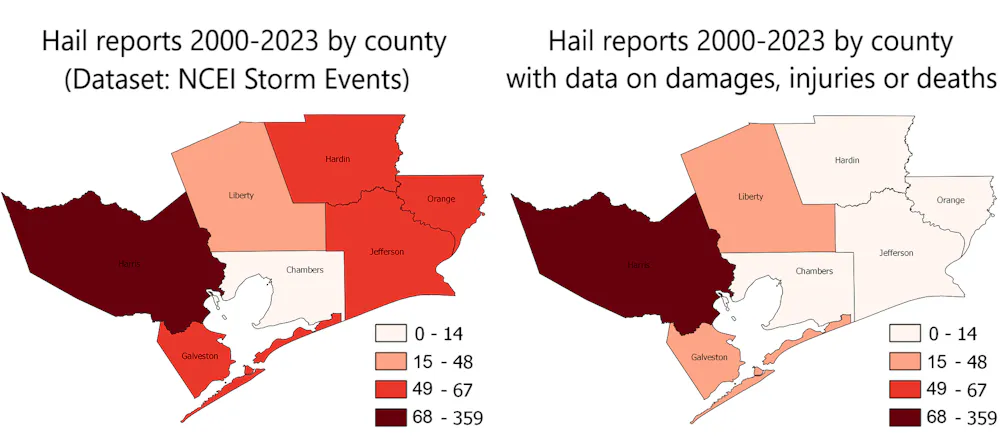
    The number of severe hail reports in southeast Texas listed in the National Centers for Environmental Information’s storm events database is strongly correlated with population. The county with the most reports and greatest detail in those reports is home to Houston. Hailstorms in the three easternmost counties are rarely associated with damage estimates.
    John Nielsen-Gammon and B.J. Baule

    Do you want to look at local damage trends? Forget about it. For most extreme weather events, estimation methods vary over time and are not documented.

    Do you want to direct funding to help communities improve resilience to natural disasters where the need is greatest? Forget about it. The places experiencing the largest per capita damages depend not just on actual damages but on the different practices of local National Weather Service offices.

    Are you moving to a location that might be vulnerable to extreme weather? Companies are starting to provide localized risk estimates through real estate websites, but the algorithms tend to be proprietary, and there’s no independent validation.

    4 steps to improve disaster data

    We believe a few fixes could make NOAA’s storm events database and the corresponding values in the larger SHELDUS database, managed by Arizona State University, more reliable. Both databases include county-level disasters and loss estimates for some of those disasters.

    First, the National Weather Service could develop standard procedures for local offices for estimating disaster damages.

    Second, additional state support could encourage local emergency managers to make concrete damage estimates from individual events and share them with the National Weather Service. The local emergency manager generally knows the extent of damage much better than a forecaster sitting in an office a few counties away.

    Third, state or federal governments and insurance companies can agree to make public the aggregate loss information at the county level or other scale that doesn’t jeopardize the privacy of their policyholders. If all companies provide this data, there is no competitive disadvantage for doing so.

    Fourth, NOAA could create a small “tiger team” of damage specialists to make well-informed, consistent damage estimates of larger events and train local offices on how to handle the smaller stuff.

    With these processes in place, the U.S. wouldn’t need a billion-dollar disasters program anymore. We’d have reliable information on all the disasters.

    John Nielsen-Gammon receives funding from the National Oceanic and Atmospheric Administration and the State of Texas.

    William Baule receives funding from NOAA, the State of Texas, & the Austin Community Foundation.

    ref. Storm damage costs are often a mystery – that’s a problem for understanding extreme weather risk – https://theconversation.com/storm-damage-costs-are-often-a-mystery-thats-a-problem-for-understanding-extreme-weather-risk-257105

    MIL OSI – Global Reports

  • MIL-OSI Global: Reproducibility may be the key idea students need to balance trust in evidence with healthy skepticism

    Source: The Conversation – USA – By Sarah R. Supp, Associate Professor of Data Analytics, Denison University

    Reproducing results can increase trust in scientific studies. Huntstock via Getty Images

    Many people have been there.

    The dinner party is going well until someone decides to introduce a controversial topic. In today’s world, that could be anything from vaccines to government budget cuts to immigration policy. Conversation starts to get heated. Finally, someone announces with great authority that a scientific study supports their position. This causes the discussion to come to an abrupt halt because the dinner guests disagree on their belief in scientific evidence. Some may believe science always speaks the truth, some may think science can never be trusted, and others may disagree on which studies with contradicting claims are “right.”

    How can the dinner party – or society – move beyond this kind of impasse? In today’s world of misinformation and disinformation, healthy skepticism is essential. At the same time, much scientific work is rigorous and trustworthy. How do you reach a healthy balance between trust and skepticism? How can researchers increase the transparency of their work to make it possible to evaluate how much confidence the public should have in any particular study?

    As teachers and scholars, we see these problems in our own classrooms and in our students – and they are mirrored in society.

    The concept of reproducibility may offer important answers to these questions.

    Reproducibility is what it sounds like: reproducing results. In some ways, reproducibility is like a well-written recipe, such as a recipe for an award-winning cake at the county fair. To help others reproduce their cake, the proud prizewinner must clearly document the ingredients used and then describe each step of the process by which the ingredients were transformed into a cake. If others can follow the directions and come up with a cake of the same quality, then the recipe is reproducible.

    Think of the English scholar who claims that Shakespeare did not author a play that has historically been attributed to him. A critical reader will want to know exactly how they arrived at that conclusion. What is the evidence? How was it chosen and interpreted? By parsing the analysis step by step, reproducibility allows a critical reader to gauge the strength of any kind of argument.

    We are a group of researchers and professors from a wide range of disciplines who came together to discuss how we use reproducibility in our teaching and research.

    Based on our expertise and the students we encounter, we collectively see a need for higher-education students to learn about reproducibility in their classes, across all majors. It has the potential to benefit students and, ultimately, to enhance the quality of public discourse.

    The foundation of credibility

    Reproducibility has always been a foundation of good science because it allows researchers to scrutinize each other’s studies for rigor and credibility and expand upon prior work to make new discoveries. Researchers are increasingly paying attention to reproducibility in the natural sciences, such as physics and medicine, and in the social sciences, such as economics and environmental studies. Even researchers in the humanities, such as history and philosophy, are concerned with reproducibility in studies involving analysis of texts and evidence, especially with digital and computational methods. Increased interest in transparency and accessibility has followed the rising importance of computer algorithms and numerical analysis in research. This work should be reproducible, but it often remains opaque.

    Broadly, research is reproducible if it answers the question: “How do you know?” − such that another researcher could theoretically repeat the study and produce consistent results.

    Reproducible research is explicit about the materials and methods that were used in a study to make discoveries and come to conclusions. Materials include everything from scientific instruments such as a tensiometer measuring soil moisture to surveys asking people about their daily diet. They also include digital data such as spreadsheets, digitized historic texts, satellite images and more. Methods include how researchers make observations and analyze data.

    To reproduce a social science study, for example, we would ask: What is the central question or hypothesis? Who was in the study? How many individuals were included? What were they asked? After data was collected, how was it cleaned and prepared for analysis? How exactly was the analysis run?

    Proper documentation of all these steps, plus making available the original data from the study, allows other scientists to redo the research, evaluate the decisions made during the process of gathering and analyzing information, and assess the credibility of the findings.

    This short video, made by the National Academies, explains the key concepts in reproducing scientific findings and notes ways the process can be improved.

    Over the past 20 years, the need for reproducibility has become increasingly important. Scientists have discovered that some published studies are too poorly documented for others to repeat, lack verified data sources, are questionably designed, or even fraudulent.

    Putting reproducibility to work: An example

    A highly contentious, retracted study from 1998 linked the measles, mumps and rubella (MMR) vaccine and autism. Scientists and journalists used their understanding of reproducibility to discover the flaws in the study.

    The central question of the study was not about vaccines but aimed to explore a possible relationship between colitis − an inflammation of the large intestine − and developmental disorders. The authors explicitly wrote, “We did not prove an association between measles, mumps, and rubella vaccine and the syndrome described.”

    The study observed just 12 patients who were referred to the authors’ gastroenterology clinic and had histories of recent behavioral disorders, including autism. This sample of children is simply too small and selective to be able to make definitive conclusions.

    In this study, the researchers translated children’s medical charts into summary tables for comparison. When a journalist attempted to reproduce the published data tables from the children’s medical histories, they found pervasive inconsistencies.

    Reproducibility allows for corrections in research. The article was published in a respected journal, but it lacked transparency with regard to patient recruitment, data analysis and conflicts of interest. Whereas traditional peer review involves critical evaluation of a manuscript, reproducibility also opens the door to evaluating the underlying data and methods. When independent researchers attempted to reproduce this study, they found deep flaws. The article was retracted by the journal and by most of its authors. Independent research teams conducted more robust studies, finding no relationship between vaccines and autism.

    Each research discipline has its own set of best practices for achieving reproducibility. Disciplines in which researchers use computational or statistical analysis require sharing the data and software code for reproducing studies. In other disciplines, researchers interpret nonnumerical qualities of data sources such as interviews, historical texts, social media content and more. These disciplines are working to develop standards for sharing their data and research designs for reproducibility. Across disciplines, the core principles are the same: transparency of the evidence and arguments by which researchers arrived at their conclusions.

    Reproducibility in the classroom

    Colleges and universities are uniquely situated to promote reproducibility in research and public conversations. Critical thinking, effective communication and intellectual integrity, staples of higher-education mission statements, are all served by reproducibility.

    Teaching faculty at colleges and universities have started taking some important steps toward incorporating reproducibility into a wide range of undergraduate and graduate courses. These include assignments to replicate existing studies, training in reproducible methods to conduct and document original research, preregistration of hypotheses and analysis plans, and tools to facilitate open collaboration among peers. A number of initiatives to develop and disseminate resources for teaching reproducibility have been launched.

    Despite some progress, reproducibility still needs a central place in higher education. It can be integrated into any course in which students weigh evidence, read published literature to make claims, or learn to conduct their own research. This change is urgently needed to train the next generation of researchers, but that is not the only reason.

    Reproducibility is fundamental to constructing and communicating claims based on evidence. Through a reproducibility lens, students evaluate claims in published studies as contingent on the transparency and soundness of the evidence and analysis on which the claims are based. When faculty teach reproducibility as a core expectation from the beginning of a curriculum, they encourage students to internalize its principles in how they conduct their own research and engage with the research published by others.

    Institutions of higher education already prioritize cultivating engaged, literate and critical citizens capable of solving the world’s most challenging contemporary problems. Teaching reproducibility equips students, and members of the public, with the skills they need to critically analyze claims in published research, in the media and even at dinner parties.

    Also contributing to this article are participants in the 2024 Reproducibility and Replicability in the Liberal Arts workshop, funded by the Alliance to Advance Liberal Arts Colleges (AALAC) [in alphabetical order]: Ben Gebre-Medhin (Department of Sociology and Anthropology, Mount Holyoke College), Xavier Haro-Carrión (Department of Geography, Macalester College), Emmanuel Kaparakis (Quantitative Analysis Center, Wesleyan University), Scott LaCombe (Statistical and Data Sciences, Smith College), Matthew Lavin (Data Analytics Program, Denison University), Joseph J. Merry (Sociology Department, Furman University), Laurie Tupper (Department of Mathematics and Statistics, Mount Holyoke College).

    Sarah Supp receives funding from the National Science Foundation, awards #1915913, #2120609, and #2227298.

    Joseph Holler receives funding from the National Science Foundation, award #2049837.

    Peter Kedron receives funding from the National Science Foundation, award #2049837 and from Esri.

    Richard Ball has received funding from the Alfred P. Sloan Foundation and the United Kingdom Reproducibility Network.

    Anne M. Nurse and Nicholas J. Horton do not work for, consult, own shares in or receive funding from any company or organization that would benefit from this article, and have disclosed no relevant affiliations beyond their academic appointment.

    ref. Reproducibility may be the key idea students need to balance trust in evidence with healthy skepticism – https://theconversation.com/reproducibility-may-be-the-key-idea-students-need-to-balance-trust-in-evidence-with-healthy-skepticism-251771

    MIL OSI – Global Reports

  • MIL-OSI Global: How your electric bill may be paying for big data centers’ energy use

    Source: The Conversation – USA – By Ari Peskoe, Lecturer on Law, Harvard University

    Your power bill may be hiding something. photoschmidt/iStock/Getty Images Plus

    In the race to develop artificial intelligence, large technology companies such as Google and Meta are trying to secure massive amounts of electricity to power new data centers. Electric utilities see the prospect of earning large profits by providing electricity to these power-hungry facilities and are competing for their business by offering discounts not available to average consumers.

    In our paper Extracting Profits from the Public, we explain how utilities are forcing regular ratepayers to pay for the discounts enjoyed by some of the nation’s largest companies and identify ways policymakers can limit the costs to the public.

    Shifting costs

    In much of the U.S., utilities are monopolists. Within their service territories, they are the only companies allowed to deliver electricity to consumers. To fund their operations, utilities split the costs of maintaining and expanding their systems among all ratepayers – homeowners, businesses, warehouses, factories and anyone else who uses electricity.

    Historically, a utility expanded its system to meet growing demand for electricity from new factories, businesses and homes. To pay for its expansion − new power plants, new transmission lines and other equipment − the utility would propose to raise electricity rates by different amounts for various types of consumers.

    Public utility commissions are state agencies charged with ensuring that the public gets a fair deal. These commissions monitor how much money the utility spends to provide electric service and how its costs are shared among various types of ratepayers, including residential, commercial and industrial consumers. Ultimately, the public utility commission is supposed to approve any rate increases based on its assessment of what’s fair to consumers.

    Splitting the utility’s costs among all consumers made perfect sense when population growth and economic development across the economy stimulated the need for new infrastructure. But today, in many utility service territories, most of the projected growth in electricity demand is due to new data centers.

    Here’s the problem for consumers: To meet data center demand, utilities are building new power plants and power lines that are needed only because of data center growth. If state regulators allow utilities to follow the standard approach of splitting the costs of new infrastructure among all consumers, the public will end up paying to supply data centers with all that power.

    An artist’s rendering of a proposed Meta data center in Richland Parish, La.
    Meta via Facebook

    A big price tag

    One particularly acute example is in Louisiana. A Meta data center under development in the northeastern corner of the state is projected to use, by our calculations, twice as much energy as the city of New Orleans.

    Entergy, the regional monopoly utility, is proposing to build more than US$3 billion worth of new gas-fired power plants and delivery infrastructure to meet the data center’s energy demand. Rather than billing Meta directly for these costs, Entergy is proposing to include the costs in rates paid by all customers.

    Entergy claims its contract with Meta will cover some portion of the $3 billion price tag and that will mitigate any increases in consumers’ bills. But Entergy has asked state regulators to keep key terms of the contract secret, and only a redacted version of its application is available online.

    The public has no idea how much it might pay if the commission approves the contract. And if the Meta data center ends up using much less power than the company anticipates, the public does not know whether it would be on the hook to pay higher electricity rates for longer periods to guarantee Entergy a profit.

    The electronics in data centers consume large amounts of electricity.
    RJ Sangosti/MediaNews Group/The Denver Post via Getty Images

    Secret agreements

    Our research, reviewing nearly 50 public utility commission proceedings about data centers’ power needs across 10 states, uncovered dozens of secretive contracts between utilities and data centers. Unlike Louisiana, most states require utilities to submit to the public utility commission their one-off deals with data centers, but they allow utilities to conceal the pricing terms from the public.

    In normal rate-review cases, numerous parties advocate for their interests in a public proceeding, including members of the public, industry groups and the utility itself. But as our paper finds, utility commission reviews of data center contracts are based on confidential utility filings that are inaccessible to the general public. Few, if any, outsiders participate, and as a result the commission often hears only the utility’s version of the deal.

    Because the pricing terms are secret, it is impossible to know whether the deal that a utility is offering to a data center is too low to cover the utility’s costs of providing power to the data center, which would mean that the public is subsidizing the deal. History shows, however, that utilities have a long history of exploiting their monopolies to shift costs to the public, including through secret contracts.

    Electric utilities also charge customers for the costs of building and maintaining transmission networks.
    Jay L. Clendenin/Getty Images

    Other public costs

    Our paper also explores other ways that the public pays for data center energy costs. For instance, many high-voltage interstate transmission projects, which connect large power plants to local delivery systems, are developed through regional planning processes run by numerous utilities. These alliances have complex rules for splitting the costs of new transmission lines and equipment among their utility members.

    Once a utility is charged its share, it spreads the costs of new transmission projects among its local ratepayers. Because some regions are building new transmission capacity to accommodate data centers, our analysis finds that the public has been forced to pay billions of dollars for data center growth.

    Data center energy costs can also be shifted when data centers connect directly to existing power plants. Under what are called “co-location” deals, the power plant stops selling energy to the wider public and just sells to the data center. With less supply in the overall market, prices go up and the public faces higher bills as a result.

    Many state legislatures are noticing these problems and working to figure out how to address them. Several recent bills would set new terms and conditions for future data center deals that could help protect the public from data center energy costs.

    Ari Peskoe is the Director of the Electricity Law Initiative at the Harvard Law School Environmental and Energy Law Program (EELP). EELP receives funding from philanthropic foundations that support the clean energy transition.

    Eliza Martin does not work for, consult, own shares in or receive funding from any company or organization that would benefit from this article, and has disclosed no relevant affiliations beyond their academic appointment.

    ref. How your electric bill may be paying for big data centers’ energy use – https://theconversation.com/how-your-electric-bill-may-be-paying-for-big-data-centers-energy-use-257794

    MIL OSI – Global Reports

  • MIL-OSI Global: 100 years ago, the Supreme Court made a landmark ruling on parents’ rights in education – today, another case raises new questions

    Source: The Conversation – USA – By Charles J. Russo, Joseph Panzer Chair in Education and Research Professor of Law, University of Dayton

    A selection of books that are part of the Supreme Court case Mahmoud v. Taylor are pictured on April, 15, 2025, in Washington. AP Photo/Pablo Martinez Monsivais

    A century ago, the Supreme Court handed down one of its most important cases about education. On June 1, 1925, the court struck down an Oregon statute requiring all students to attend public school – a law critics argued was meant to limit faith-based schools, at a time when anti-Catholic bias was still common in parts of the United States.

    The majority opinion in Pierce v. Society of Sisters of the Holy Name of Jesus and Mary included a now-famous dictum about parents’ rights to shape their children’s upbringing. According to the court, “the child is not the mere creature of the state; those who nurture him and direct his destiny have the right, coupled with the high duty, to recognize and prepare him for additional obligations.”

    Soon, the Supreme Court is expected to release another decision around parental beliefs and education: Mahmoud v. Taylor. The plaintiffs are parents who want to excuse their children from public school lessons involving storybooks with LGBTQ+ characters – lessons they assert contradict their religious beliefs.

    As someone who teaches education law, I believe this is perhaps the court’s most significant case on parental rights since Pierce. Mahmoud raises questions not only about religious freedom, but also about educators’ ability to determine curricula, and public education in a pluralistic society.

    Picture-book debate

    Controversy arose during the 2022-23 school year in Montgomery County, Maryland’s largest school district, when officials approved various storybooks with LGBTQ+-inclusive themes to be incorporated into the English language-arts curriculum for preschool and elementary students.

    Some parents challenged the materials, including “Pride Puppy!”, a picture book the board later removed from use. Originally approved for preschool and pre-K, the story portrays a family whose puppy gets lost at a LGBTQ+ Pride parade, devoting a page to each letter of the alphabet. At the end of the book, a long “search and find” list of words for children to go back and look for in the pictures of the parade includes “[drag] queen” and “king,” “leather” and “lip ring.”

    Other materials for older children included stories about same-sex marriage, a transgender child and nonbinary bathroom signs.

    Parents who objected to the use of these materials on religious grounds sought to excuse their children from lessons using them. The parents basically argued that requiring their children to participate compelled or coerced them to go against their families’ religious beliefs.

    A group of parents protest in Rockville, Md., on June 27, 2023, in an effort to opt out of books that feature LGBTQ+ characters in Montgomery County schools.
    Sarah L. Voisin/The Washington Post via Getty Images

    Initially, officials agreed to allow opt-outs for elementary schoolers whose parents objected to the materials. However, a day later they changed their minds. Since then, school officials cited concerns about absenteeism, the feasibility of accommodating opt-out requests, and a desire to avoid stigmatizing LGBTQ+ students or families as reasons for their policy.

    A group of Muslim, Orthodox Christian and Catholic families challenged the board’s refusal to excuse their children from lessons using the disputed materials.

    The federal trial court, however, rejected the parents’ claim that having no opt-outs violated their right to due process.

    Parents appealed, and the 4th Circuit affirmed in favor of the school board 2-1. The court added that officials had not violated the parents’ First Amendment rights to freely exercise their faith. “There’s no evidence at present that the Board’s decision not to permit opt-outs compels the Parents or their children to change their religious beliefs or conduct, either at school or elsewhere,” the panel concluded.

    The dissenting judge stridently countered. Officials violated the parents’ free exercise rights by forcing them “to make a choice,” he wrote, between “either adher[ing] to their faith, or receiv[ing] a free public education for their children.” He also noted that the board’s opt-out policy was not neutral toward religion, because under Maryland regulations, children may be excused from sex-ed lessons.

    In January 2025, the Supreme Court agreed to hear the parents’ appeal, addressing whether the schools are burdening parents’ free-exercise rights.

    Court record

    In their brief to the Supreme Court and oral arguments, the parents cited Wisconsin v. Yoder, a Supreme Court ruling from 1972. The court found that Amish parents did not have to send their children to school after the eighth grade, which the families argued would violate their religious beliefs. Amish communities descend from Anabaptist Christians who fled persecution in Europe and emphasize living simply, eschewing many modern technologies.

    In Yoder, the justices agreed with the parents that their children received all the education they needed in their home communities. Under the First Amendment, parents have the right “to guide the religious future and education of their children,” the majority wrote, a matter “established beyond debate.”

    During oral arguments for Mahmoud in April 2025, some justices briefly discussed another precedent: the Supreme Court’s 1943 judgment in West Virginia State Board of Education v. Barnette, resolved at the height of U.S. involvement in World War II. Here, three parents who were Jehovah’s Witnesses refused to have their children participate in public schools’ flag salute and Pledge of Allegiance because they viewed it as a form of idolatry contrary to their religious beliefs. Others objected
    to the salute as “being too much like Hitler’s.”

    The court reasoned that educators could not compel students to participate, because forcing children – or anyone – to engage in activities inconsistent with their beliefs is contrary to their First Amendment rights to the free exercise of religion and freedom of speech.

    Viewed together, these cases highlight how the court has granted parents significant leeway to exempt their children from educational activities inconsistent with their religious beliefs.

    Questions at court

    During oral arguments, a majority of justices appeared to support the parents’ request to excuse children from lessons involving the books about LGBTQ+ characters.

    The board’s attorney argued that students did not have to agree with the books’ messages, simply to participate in the lesson. Being exposed to an idea “does not burden free exercise,” he said.

    Protesters in support of LGBTQ+ rights and against book bans outside the U.S. Supreme Court building on April 22, 2025, the day the court heard arguments in Mahmoud v. Taylor.
    Anna Moneymaker/Getty Images

    Chief Justice John Roberts, however, queried whether it is realistic for 5-year-olds to understand that distinction. He asked, “Do you want to say you don’t have to follow the teacher’s instructions, you don’t have to agree with the teacher? I mean, that may be a more dangerous message than some of the other things.”

    Other conservative justices also appeared skeptical of the idea that the lessons were merely exposing young children to ideas, but not instilling moral lessons. The storybooks do not simply explain that some people believe something and others do not, Justice Amy Coney Barrett suggested; they inform students that “this is the right view of the world.” Similarly, Justice Neil Gorsuch remarked that telling students that “some people think X, and X is wrong and hurtful and negative” is “more than exposure.”

    “What is the big deal about allowing them to opt out of this?” Justice Samuel Alito asked.

    Conversely, Justice Elena Kagan acknowledged that parents’ concerns were “serious,” but wondered how to draw limits on opt-out policies. Did the parents’ argument suggest that anytime “a religious person confronts anything in a classroom that conflicts with her religious beliefs or her parents’ that – that the parent can then demand an opt-out?”

    Justice Sonia Sotomayor pressed the plaintiffs’ attorney on whether “the mere exposure to things that you object to” really counts as coercion. And Justice Ketanji Brown Jackson questioned why, even if opt-outs are not allowed, public schools teaching “something that the parent disagrees with” is coercive, given that homeschooling and private schools are legal.

    Mahmoud raises challenging questions about curricular content, parental control and free exercise of religion – questions the court will hopefully resolve. A ruling is expected in June or early July 2025.

    Charles J. Russo does not work for, consult, own shares in or receive funding from any company or organization that would benefit from this article, and has disclosed no relevant affiliations beyond their academic appointment.

    ref. 100 years ago, the Supreme Court made a landmark ruling on parents’ rights in education – today, another case raises new questions – https://theconversation.com/100-years-ago-the-supreme-court-made-a-landmark-ruling-on-parents-rights-in-education-today-another-case-raises-new-questions-257876

    MIL OSI – Global Reports

  • MIL-OSI Russia: Rosneft’s green investment volume in 2024 reached 74 billion rubles

    Translation. Region: Russian Federal

    Source: Rosneft – Rosneft – An important disclaimer is at the bottom of this article.

    June 5 is World Environment Day, its goal is to draw attention to measures to protect ecosystems. In Russia, this date coincides with Ecologist Day.

    Rosneft implements large-scale events and projects aimed at preserving a favorable environment. In 2024, the Company’s “green” investments amounted to 74 billion rubles and exceeded the previous year’s level by 16%. In total, over the past three years, this figure amounted to almost 200 billion rubles.

    The key components of the Company’s long-term environmental agenda are reflected in the strategy “Rosneft-2030: Reliable Energy and Global Energy Transition”. The priorities of the Company and its subsidiaries include the implementation of programs for land reclamation, including “historical heritage”, increasing the reliability of pipelines, preserving water resources and biological diversity in the regions of presence.

    Thus, Samotlorneftegaz completed the implementation of a large-scale program for the reclamation of “historical heritage” lands in 2024 – the total area of restored lands exceeded 2.2 thousand hectares. The company carried out about 85% of all reclamation work using its own eco-service. During the project, new technologies were developed and unique experience was gained, which is in demand by other enterprises.

    Rosneft pays great attention to reforestation activities, thereby contributing to the sustainable development of ecosystems, the preservation of biodiversity, and the fight against climate change. The Company, together with the Government of the Krasnoyarsk Territory, is implementing a comprehensive forest climate project aimed at unlocking the climate-regulating potential of the region’s forests and promoting sustainable development. In 2024, the Company and its subsidiaries in the regions of presence planted almost 11 million seedlings and trees of various species.

    Rosneft is actively implementing the principles of a closed-loop economy (circular economy). Improving the efficiency of waste management processes is one of the priority goals of the Company’s strategy until 2030. The Company’s production enterprises are successfully implementing waste-free technologies that make it possible to obtain artificial soil from drill cuttings – an environmentally friendly building material.

    In addition, the enterprises of the Samara group of the Company handed over almost 300 tons of spent catalyst for recycling. More than 8 thousand tons of non-ferrous and ferrous metal were sent for recycling by the Achinsk Oil Refinery, Saratov Oil Refinery, Syzran Oil Refinery, Kuibyshevsky Oil Refinery, Novokuibyshevsky Oil Refinery, RN-Vankor and Bashneft enterprises.

    The Kuibyshev Oil Refinery, Novokuibyshevsk Oil Refinery, RN-Vankor and Bashneft enterprises also sent about 4.5 thousand tons of waste oils and emulsions, etc. for recycling.

    Biodiversity conservation is another significant area of Rosneft’s environmental activities. The company has been holding annual events to replenish Russia’s aquatic bioresources for over 10 years. In 2024, Rosneft enterprises released over 21.7 million young fish into the country’s water bodies.

    Volunteers of the Company, its subsidiaries and design institutes also actively participate in various environmental initiatives, promote the development of a culture of rational and responsible consumption of natural resources. Employees with children take part in events for greening and improvement of urban areas and natural recreational zones, cleaning of coastlines as part of federal environmental campaigns such as “Green Spring”, “Garden of Memory”, “Water of Russia”, “Clean Shores” and others.

    For over 15 years, Samotlorneftegaz volunteers have been holding clean-up days to clean the shoreline of Lake Kymyl-Emtor as part of the All-Russian campaign “Water of Russia”.

    Samara oil workers help the employees of the Botanical Garden of Samara University to clear the territory of dead wood and leaves, to purchase rare plant species and plant seedlings, and also to restore and improve springs in the region. In 2024, volunteers of the Samara region collected more than 30 cubic meters of garbage from the coastal areas of the Volga and Sok rivers. Volunteers of the Novokuibyshevsk Petrochemical Company collected 930 kg of household waste during an environmental run.

    In 2024, RN-Nyaganneftegaz oil workers collected about 3 tons of household waste from the coastline of the Nyagan-Yugan River.

    Earlier, on the eve of Victory Day, employees of Rosneft enterprises organized the cleaning of parks, memorial complexes and monuments dedicated to the feat of the Soviet people during the Great Patriotic War.

    The Company’s enterprises make a significant contribution to the conservation of natural resources – they organize campaigns to collect used batteries, plastic and waste paper for their further recycling. In 2024, Rosneft employees handed over over 1,100 kg of used batteries, uninterruptible power supplies and disposable batteries for recycling, transferred over 7 tons of plastic for recycling and collected about 180 tons of waste paper.

    Rosneft volunteers also actively promote environmental education of young people and conduct environmental quests, master classes, quizzes and eco-lessons for schoolchildren. For example, Orenburgneft implemented the Eco-School project in 2024 and, together with students from the region’s schools, collected more than 10 tons of waste paper, more than 70 kg of batteries and more than 17 kg of plastic caps.

    For 14 years now, the company has been holding annual environmental safety competitions, which help to raise the level of environmental culture and serve as an incentive for subsidiaries to build up their competencies and improve their work in this area.

    The successful environmental activities of Rosneft subsidiaries have received high public praise. In 2024, the Company’s plants – Syzran Oil Refinery, Novokuibyshevsky Oil Refinery, Kuibyshevsky Oil Refinery – received the highest awards of the All-Russian competition “Leader of Environmental Activities in Russia”.

    Department of Information and Advertising of PJSC NK Rosneft June 5, 2025

    Please note: This information is raw content directly from the source of the information. It is exactly what the source states and does not reflect the position of MIL-OSI or its clients.

    MIL OSI Russia News

  • MIL-OSI USA: Join us on 6/26 for a Foreign and Comparative Law Webinar: “Two Sides of the Same Coin: The Evolution of Surrogacy Law in France and Colombia”

    Source: US Global Legal Monitor

    The following is a guest post by Louis Gilbert and Stephania Alvarez, foreign law specialists at the Law Library of Congress. Louis has previously published the following post: “Wait, It Is Not About Wigs?” – The Story of Faso Dan Fani Court Robes in Burkina Faso, and “Join Us on 11/21 for a Foreign and Comparative Law Webinar titled “Review of Law Library of Congress Research Reports Published in 2024.” Stephania has previously published the following blog posts: FALQs: Guyana-Venezuela Territorial Dispute, and Law Library Publishes New Report, “Peru: Civic Space Legal Framework.”

    Please join us on June 26, 2025, at 2:00 p.m. EDT, for another entry into our Foreign and Comparative Law Webinar series with our “Two Sides of the Same Coin: The Evolution of Surrogacy Law in France and Colombia” webinar. Surrogacy and the adoption of children born through this practice have been the focus of significant legislative and jurisprudential developments around the world. The evolution of surrogacy in France and Colombia has different legal implications in each country.

    Register here. 

    In Colombia, surrogacy is neither explicitly regulated nor prohibited. Nevertheless, the Constitutional Court has addressed this topic in various rulings, in which it has established rules and requirements for surrogacy agreements and emphasized the need to protect the child’s fundamental rights.

    On the other hand, surrogacy is forbidden in France, and the recognition of children born abroad is currently at the center of legal discussions. Recent developments in French jurisprudence have enabled numerous French citizens to resort to surrogacy agreements abroad. The questions of filiation and adoption are no longer framed solely around the legality or prohibition of certain practices but are increasingly approached from the perspective of the child’s fundamental rights.

    Although France and Colombia adopt opposing approaches to surrogacy, their legal systems complement each other in safeguarding the best interests of the child. In Colombia, the severance of the legal bond between the surrogate and the baby allows for clear filiation between the intended parents and the child, which France now fully recognizes when it has been validly established abroad. Therefore, the absence of a specific legal framework prohibiting surrogacy in Colombia, in addition to the lower costs and greater accessibility compared to other countries, has made this country an increasingly common destination for surrogacy procedures.


    Stephania Alvarez is a foreign law specialist at the Law Library of Congress. She conducts research and writes reports on a wide range of topics relating primarily to the laws of Central and South American jurisdictions. Stephania has a Bachelor of Laws from Icesi University in Colombia. She completed a dual degree program at Sciences Po in Paris, France, and Georgetown University Law Center, earning a master’s in environmental policy and a Master of Laws in environmental and energy law, respectively.

    Louis Gilbert is a foreign law specialist at the Law Library of Congress. He conducts research and writes reports on topics relating to the laws of French-speaking jurisdictions. He holds a bachelor’s degree in law from the University of Essex, England, a master’s in comparative law from the Université Paris X, France, and a J.D. from American University.


    To learn about other upcoming classes on domestic and foreign law topics, visit the Legal Research Institute. Please request ADA accommodations at least five business days in advance by contacting (202) 707-6362 or [email protected].

    Subscribe to In Custodia Legis – it’s free! – to receive interesting posts drawn from the Law Library of Congress’s vast collections and our staff’s expertise in U.S., foreign, and international law.

    MIL OSI USA News

  • MIL-OSI Banking: Vietnam Space Committee, OSB Group and Thales Partner to Promote Education and Innovation in Space Technologies

    Source: Thales Group

    Headline: Vietnam Space Committee, OSB Group and Thales Partner to Promote Education and Innovation in Space Technologies

    Vietnam has been building a national framework to advance Space activities over the past decade. Its national strategy for space technology development until 2030 aims to drive the sector forward in socio-economic development, technological innovation and environmental monitoring. Thales and Thales Alenia Space align with these ambitions, with the objective of this partnership to raise awareness and promote education on the immense potential of Space sciences and technologies.

    Through the scope of this MoU, VSC Office, OSB, Thales and Thales Alenia Space will work on jointly developing and deploying training programmes in background and advanced topics in space telecommunications, satellite navigation, and space exploration. From joint research and early outreach in initiatives like STEM (Science, Technology, Engineering, Mathematics) to youth and academic institutions, Thales, Thales Alenia Space and their partners are working to build local technology expertise and capabilities in the coming generations.

    Thales Alenia Space will bring its global expertise in space systems and technologies, together with Thales that will draw on its 30-year history in Vietnam for the aerospace, defence and cybersecurity and digital sectors. These capabilities complement those from the VSC Office who is the primary advisor for the Vietnamese government in its national space development strategies and policies, and with OSB, a leading local, high-tech telecom satellite network agency,

    “Many governments are looking to satellites and communications technologies as the cornerstone in bringing connectivity, promoting economic development and safeguarding a country’s national security and sovereignty. Vietnam has keen ambitions for its Space sector, including the future VINASAT 3, which will bring state-of-the-art connectivity to millions. I am very optimistic on this partnership, signed in the framework of the Strategic Comprehensive Agreement between France and Vietnam, which builds on the 30-year legacy we have in Vietnam.” said Nicolas Bouverot, Vice-President for Asia at Thales.

    “Thales Alenia Space is proud to develop this partnership with the Vietnam Space Committee Office and OSB Group. This collaboration will leverage on Thales Alenia Space’s longstanding capabilities in satellites systems while supporting the development of local talent to nurture innovative space technologies.” said Olivier Guilbert, Vice-President Export Sales at Thales Alenia Space.

    About Thales

    Thales (Euronext Paris: HO) is a global leader in advanced technologies for the Defence, Aerospace, and Cyber & Digital sectors. Its portfolio of innovative products and services addresses several major challenges: sovereignty, security, sustainability and inclusion.

    The Group invests more than €4 billion per year in Research & Development in key areas, particularly for critical environments, such as Artificial Intelligence, cybersecurity, quantum and cloud technologies. Thales has more than 83,000 employees in 68 countries. In 2024, the Group generated sales of €20.6 billion.

    Press contact

    Thales, Communications, Asia

    Serene Koh – serene.koh@asia.thalesgroup.com

    PLEASE VISIT Thales Group

    MIL OSI Global Banks

  • MIL-OSI USA: How to Partner With Industry (by Really Trying)

    Source: US State of Connecticut

    Private industry relies on universities like UConn to conduct important research that benefits the sponsoring company as well as academic experts. But forging those partnerships can be difficult, especially for individuals and startups looking to make an impact.

    On May 8, UConn Tech Park played host to “How to Partner with Industry,” a seminar and panel discussion designed to give University researchers and entrepreneurs insight on making those valuable connections.

    “You don’t need to have an entrepreneurial mind to do a partnership with industry,” said Emmanouil Anagnostou, the Tech Park’s executive director as well as the Institute of the Environment and Energy. “Don’t think that you have to go way outside of your comfort zone to create industry programs.”

    The event reflected UConn’s partnerships with some of Connecticut’s largest and most influential companies, many of which sponsor centers and institutes within the Tech Park. The seminar offered advice on how to form partnerships with large companies as well as working with small and medium-sized businesses for mutual benefit.

    More than 70 people attended the seminar, including 50 members of UConn’s faculty. The attendees were advised to seek advocates to help propel them into commercial enterprise, drawing from alumni networks, the UConn Foundation, and the expert staff at Technology Commercialization Services, the wing of UConn’s research enterprise dedicated to tech transfer.

    The Tech Park offered a panel of successful researchers experienced with successful partnerships with industry. They included Anagnostou; Dennis D’Amico, an associate professor of animal science; Douglas Casa, a Board of Trustees Distinguished Professor of Kinesiology and CEO of the Korey Stringer Institute; and Mingyu Qiao, an assistant professor of innovation and entrepreneurship in the Department of Nutritional Sciences.

    All the panelists have conducted extensive independent or collaborative research. They advised on effective partnerships, including the ability to work with a company to mutually develop ideas.

    Anagnostou advised that the goal is not always solely individual success.

    “You can still be within the boundaries of your work and your lab,” Anagnostou said. “Simply change the mode of operation: Instead of looking at the merit of your ideas, look at the merit of your solution.”

    D’Amico exemplifies the point. A renowned food scientist specializing in dairy products, he is not seeking to establish his own business but rather works with artisans throughout the region to help them maximize their own output and quality.

    “You don’t need a tech park for small batch cheesemaking,” D’Amico said. “Most of my work is in applied research. Cheesemakers would have needs and questions, so I started building relationships with them to help provide answers.”

    Qiao, meanwhile, had already disclosed three of his own inventions before joining the UConn faculty. He advised that maintaining control of intellectual property is crucial, which includes understanding what ideas and concepts lend themselves to business ventures.

    “Good inventions that can be commercialized do not need to be original or very complicated,” Qiao said. “It can be something simple you can start, as long as you can get some protection, and then you can continue to build on that.”

    While the Korey Stringer Institute has many high-profile clients, including the NFL, Casa said that small and medium-sized businesses are more likely to reach out into academic circles to assist with research. Those companies don’t have the capital to invest in their own facilities and staff, so partnering with university researchers is a more practical approach.

    “You have to get out of academic circles into areas where industry is hanging out, then pull them into academic area,” Casa said.

    MIL OSI USA News

  • MIL-OSI United Kingdom: Council agrees further work to tackle climate change

    Source: City of Portsmouth

    Ambitious next steps towards a carbon neutral Portsmouth have been agreed by the city council.

    A programme of work to tackle climate change will build on achievements over the last 12 months, which include:

    • Delivering Warm Homes funding to help make Portsmouth homes more energy efficient, reducing fossil fuel usage
    • Launching a landmark solar power project at Lakeside North Harbour, one of the UK’s biggest solar car park and battery storage installations
    • Starting work on ‘Seachange’, the biggest project in Portsmouth International Port’s history to provide green electricity to power ships while at berth
    • Securing funding to plant 2,500 new trees as part of a wider Greening Strategy to double the city’s tree canopy coverage over 25 years, and developing an Urban Forest Masterplan
    • Partnering with Southern Water to invest in reducing surface water runoff which contributes to outfall releases, including a £220,000 grant for sustainable drainage at New Horizon’s School
    • Working in partnership with Hampshire County Council and First Bus to launch a fleet of 62 brand new, zero emission buses, replacing a diesel fleet as part of the strategy for greener travel and improved air quality

    A report for the Climate Change and Greening the City meeting outlined the council’s focus on continuing to reduce carbon usage across all departments. The council will work with partners to protect and enhance Portsmouth’s natural environment, while building resilience to the impacts of climate change – such as heatwaves and rainfall – with a focus on supporting the most vulnerable.

    A programme of climate and natural environment actions was presented and agreed. It includes:

    • Improving how the council monitors carbon emissions, including emissions from its suppliers.
    • Developing Local Area Energy Plans
    • Continuing to work with the Department for Energy Security and Net Zero on funded schemes to upgrade domestic properties across all tenures to improve energy efficiency and reduce carbon emissions.
    • Developing a resilient treescape by working with stakeholders and communities so old and new trees are resilient to climate change impacts and provide cooling across the city
    • Continued working to reduce surface water flooding
    • Exploring how we deliver a green and healthy streets programme
    • Developing a biodiversity strategy and action plan as part of the council’s Strengthened Biodiversity Duty
    • Development of an air quality strategy

    Cllr Kimberley Barrett, Cabinet Member for Climate Change and Greening the City, said:

    “Climate change is here and its impact is affecting us all. That’s why we declared a climate emergency in 2019, and made a pledge for the city and the council to become carbon neutral.

    “We all want Portsmouth to be a green and healthy city, where people and businesses thrive alongside nature. But we can only achieve this if businesses and our communities work together.

    “The good news is that so much has been achieved already, but we need to keep being ambitious as this programme of work is, to protect and enhance our special city.”

    Cllr Barrett approved the transformation programme, which will form the basis of the council’s activity to tackle climate change and improve the natural environment for 2025/26.

    MIL OSI United Kingdom

  • MIL-OSI United Kingdom: 7 Hills set to strike a chord again in Armagh City

    Source: Northern Ireland City of Armagh

    This summer, the 7 Hills Blues Fest returns to Armagh City, promising an immersive and vibrant experience for blues enthusiasts, families, and culture seekers alike. Running from Friday 1 to Sunday 3 August, the festival features over 40 free gigs across 15 venues, showcasing the best in local, national, and international blues and roots music.

    A key highlight of the festival is its growing reputation as a platform for discovering and celebrating fresh talent. This year’s line-up includes exciting artists such as 2024 Buskfest winners Banshee, who will make their 7 Hills debut, and the returning 17-year-old guitar sensation Zac Mac.

    Banshee, who won Buskfest in 2024, said, “Being part of 7 Hills is a great chance for us to share our music with more people. The festival is special because it supports new artists like us while also bringing in well-known musicians. Winning last year’s Buskfest meant a lot and this is another exciting step for our band and a way to meet others who love this kind of music. We’re really happy to be part of a festival that brings everyone together to enjoy live music and help artists grow.”

    Since its inception, 7 Hills has celebrated the rich musical heritage deeply rooted in Armagh and beyond. This year’s line-up boasts some of the biggest names in the blues scene, including vocalist Clara Rose, the legendary Rob Strong, fan favourites Crow Black Chicken, the Pat McManus Band, and acclaimed acts such as Ben Reel and the Ronnie Greer Trio.

    Led Hedley makes a welcome return to the Festival, along with Chris Taplin Band, Rubber Plants and Cork’s Two Time Polka. Other local artists performing include Villiers and the Villains, Courtnay Giffin, 4 Shuck Men and Freedom 35s.

    Often hailed as Ireland’s Godfather of Soul, Rob Strong, said, “Playing here is always a highlight of the summer for me – it’s a place where the spirit of blues music truly comes alive. The city’s intimate venues create a unique connection between artists and audiences, making every performance feel personal. 7 Hills not only honours the rich traditions of blues but also pushes the music forward, keeping it fresh and exciting.”

    The weekend is one the major annual events organised by Armagh City, Banbridge and Craigavon Borough Council, and attracts hundreds of visitors, local and from further afield. The festival will kick off with lunchtime performances on the bandstand, followed throughout the weekend by MD Rafferty Music School Live Lounge, free street acts, face painting and balloon modelling.  As another new addition to the lively weekend, on Saturday, there will be an artisan market located at the Shambles in the city centre. There will be a wide range of artisan stalls in place, with a wide range of tasty treats, eats and much more which will create a full programme of activities for all ages.

    MIL OSI United Kingdom

  • Trump suspends entry of international students studying at Harvard

    Source: Government of India

    Source: Government of India (4)

    U.S. President Donald Trump on Wednesday suspended for an initial six months the entry into the United States of foreign nationals seeking to study or participate in exchange programs at Harvard University, amid an escalating dispute with the Ivy League school.

    Trump’s proclamation cited national security concerns as a justification for barring international students from entering the United States to pursue studies at the Cambridge, Massachusetts-based university.

    Harvard in a statement called Trump’s proclamation “yet another illegal retaliatory step taken by the Administration in violation of Harvard’s First Amendment rights.”

    “Harvard will continue to protect its international students,” it added.

    The suspension can be extended beyond six months. Trump’s proclamation also directs the U.S. State Department to consider revoking academic or exchange visas of any current Harvard students who meet his proclamation’s criteria.

    The directive on Wednesday came a week after a federal judge in Boston announced she would issue a broad injunction blocking the administration from revoking Harvard’s ability to enroll international students, who make up about a quarter of its student body.

    The administration has launched a multifront attack on the nation’s oldest and wealthiest university, freezing billions of dollars in grants and other funding and proposing to end its tax-exempt status, prompting a series of legal challenges.

    Harvard argues the administration is retaliating against it for refusing to accede to its demands to control the school’s governance, curriculum and the ideology of its faculty and students.

    Harvard sued after Homeland Security Secretary Kristi Noem on May 22 announced her department was immediately revoking Harvard’s Student and Exchange Visitor Program certification, which allows it to enroll foreign students.

    Her action was almost immediately temporarily blocked by U.S. District Judge Allison Burroughs. On the eve of a hearing before her last week, the department changed course and said it would instead challenge Harvard’s certification through a lengthier administrative process.

    Nonetheless, Burroughs said she planned to issue a longer-term preliminary injunction at Harvard’s urging, saying one was necessary to give some protection to Harvard’s international students.

    In an internal cable seen by Reuters that was issued a day after that court hearing, the State Department ordered all its consular missions overseas to begin additional vetting of visa applicants looking to travel to Harvard for any purpose.

    Wednesday’s two-page directive said Harvard had “demonstrated a history of concerning foreign ties and radicalism,” and had “extensive entanglements with foreign adversaries,” including China.

    The FBI had “long warned that foreign adversaries take advantage of easy access to American higher education to steal information, exploit research and development and spread false information,” the proclamation said.

    It said Harvard had seen a “drastic rise in crime in recent years while failing to discipline at least some categories of conduct violations on campus,” and had failed to provide sufficient information to the Homeland Security Department about foreign students’ “known illegal or dangerous activities.”

    (Reuters)

  • MIL-Evening Report: Grattan on Friday: Albanese will need some nuance in facing a female opposition leader

    Source: The Conversation (Au and NZ) – By Michelle Grattan, Professorial Fellow, University of Canberra

    Anthony Albanese loves a trophy, especially a human one. He prides himself on his various “captain’s pick” candidates – good campaigners he has steered into seats.

    Way back in the Gillard days, he was key in persuading discontented Liberal Peter Slipper to defect. Slipper became an independent and Labor’s speaker.

    The exercise helped the government’s numbers, but the bold play didn’t end well for Labor or for Slipper. The government was tarnished, and Slipper, relentlessly pursued by the Coalition and mired in controversy, eventually had to quit the speakership. The affair did produce Julia Gillard’s famous misogyny speech, however.

    Now Albanese has another gee-whiz prize – Western Australian Senator Dorinda Cox, who has defected from the Greens. Cox, after being defeated in a bid for Greens deputy leader, approached Labor and the PM drove her course to being accepted into the party.

    The manoeuvre makes a marginal but insignificant difference to Senate numbers – Labor will still need the Greens to pass legislation opposed by the Coalition.

    Taking in Cox is a risk, and some in Labor are looking at it askance.

    The prime minister’s embrace of Cox contradicts Labor’s argument when its Western Australian senator Fatima Payman defected to become an independent. It said then hers was a Labor seat and she should therefore resign. But this wouldn’t be the first time expediency trumped consistency in politics.

    Cox, who is Indigenous and was spokeswoman for First Nations and resources in the last parliament, has been a fierce critic of the extending the North West Shelf gas project, which the government has just announced. Albanese says he is confident she “understands that being a member of the Labor Party means that she will support positions that are made by the Labor Party”.

    She has also faced allegations of treating staff badly. Labor discounts the claims against her, saying they are overblown and a product of Greens factionalism and toxicity. Certainly, she was given a tough time by the hard-left faction represented by deputy leader Mehreen Faruqi. Labor would be wise to ensure Cox feels supported in her new party home.

    Albanese perhaps calculates that the worst that can happen is there’s a blow up and she defects to the crossbench. Labor could shrug and say, she was never really one of us.

    Snatching a senator from the Greens is particularly satisfying to Albanese because he hates the party so much. Last term, lower house Greens MP Max Chandler-Mather (defeated at the election) really got under his skin. More generally, the Greens held up important legislation, most notably on housing.

    In the new Senate, Labor will need only the Greens to pass legislation opposed by the Coalition. How new Greens leader Larissa Waters – who replaced Adam Bandt after he lost his seat – handles the party’s relationship with the government will be crucial for the more contentious parts of Labor’s legislative program.

    The usually low-key Waters will be under a lot of pressure. The Greens had a bad election, losing three lower house seats. Now they have lost a senator at the start of Waters’ watch.

    Waters conceded on the Serious Danger podcast in late May that Labor had successfully run the narrative of the Greens as blockers. “So I do think we’re going to need to be quite deft in how we handle balance of power in this term, […] People want us to be constructive. They don’t just want us to roll over and tick off on any old shit. They want meaningful reforms.”

    Waters will want to pick her fights carefully, and also find ways of pursuing the Greens’ agenda where the party co-operates. The first deal is likely to be on the government’s legislation to increase the tax on those with large superannuation balances, which contains the controversial provision to tax unrealised capital gains.

    Opposition Leader Sussan Ley and her team will confront some of the same problems as the Greens – when to oppose and when to seek to negotiate with the government.

    For his part, Albanese will have a novel challenge with Ley – what stance to adopt against the first female opposition leader, especially but not only in parliamentary clashes.

    After facing two alpha male opposition leaders, Scott Morrison and Peter Dutton, a new approach will obviously be necessary. As one Labor man succinctly puts it, “Labor can’t monster a woman”. There can be no repeat of Albanese, a frontbencher a decade ago in the Shorten opposition, interjecting to urge a female colleague engaged in a stoush with Ley to “smash her”.

    For Ley, trying to deal with the Liberals’ multiple difficulties in attracting women voters and candidates must be high on her agenda. Former Liberal federal president Alan Stockdale, one of the three-person group currently running the NSW division of the party, showed himself part of the problem when this week he told the NSW Liberal Women’s Council, “The women in this party are so assertive now that we may need some special rules for men to get them pre-selected”.

    Stockdale said later he was being “light-hearted”. Tone deaf might be a better term. Ley jumped on him. “There is nothing wrong with being an assertive woman. In fact I encourage assertive women to join the Liberal Party.”

    The jury is out on whether Ley will be able to make any sort of fist of her near-impossible job. But in the short time she’s been leader, she has shown she is willing to be assertive.

    She emerged from the brief split in the Coalition looking much steadier than Nationals leader David Littleproud, even though she had to persuade her party room to accept the minor party’s policy demands.

    In her frontbench reshuffle, she was willing to wear the inevitable criticism that came with dropping a couple of senior women who had under-performed.

    As deputy leader, Ley adjusted her style a while before the election, toning down the aggression and sometimes wild attacks, that had characterised her performance earlier in the term. A Liberal source said she found her “line and length”. As leader, she will have others, notably deputy Ted O’Brien, to do the head-kicking, giving her room to attempt to develop a positive political persona.

    Labor leaned into attacking Dutton – never afraid to name him. With Ley, Albanese might adopt the Bob Carr approach of avoiding using his opponent’s name. At least until he finds his line and length in dealing with her.

    Michelle Grattan does not work for, consult, own shares in or receive funding from any company or organisation that would benefit from this article, and has disclosed no relevant affiliations beyond their academic appointment.

    ref. Grattan on Friday: Albanese will need some nuance in facing a female opposition leader – https://theconversation.com/grattan-on-friday-albanese-will-need-some-nuance-in-facing-a-female-opposition-leader-257338

    MIL OSI AnalysisEveningReport.nz

  • MIL-Evening Report: Tasmania could go to an election just 16 months after its last one. What’s going on?

    Source: The Conversation (Au and NZ) – By Robert Hortle, Deputy Director, Tasmanian Policy Exchange, University of Tasmania

    Tasmania’s Liberal government and its premier, Jeremy Rockliff, have come under huge pressure since the state budget was handed down last week.

    It’s culminated in the Tasmanian House of Assembly voting to pass a motion of no confidence in the premier – but only after the speaker, Labor’s Michelle O’Byrne, cast a tie-breaking vote in favour.

    Rockliff has since confirmed he’ll recall parliament to sit early next week and debate some emergency bills, then ask the governor for permission to call an early election.

    It’s been a wild few days in Tasmanian politics, with huge amounts of conjecture and confusion. Here’s how it all unfolded.

    What is a no confidence motion?

    First, we need a short lesson in our system of government, called the Westminster system. The Tasmanian situation right now all started with a motion of no confidence in the premier, Rockliff.

    This type of parliamentary motion is used to declare the parliament no longer has confidence in the target of the motion.

    No confidence motions can be directed at a specific minister or a government as a whole.

    If a no confidence motion in a minister is passed, they usually resign from their ministry and sometimes from parliament as well.

    If a no confidence motion in a government is passed, the leader of the government usually recommends one of two options to the governor. They can ask the governor to dissolve parliament and call an election, or they can advise the governor to ask someone else (usually the leader of the opposition) to have a go at forming government.

    What is happening in Tasmania?

    Strap in, it’s complex.

    On May 29, the Liberal government presented the state budget. The outlook is grim, with the state forecast to be over $10 billion in debt by 2029.

    To address this, the government proposed big cuts to the public service in the coming years.

    On June 2, the leader of the opposition, Labor’s Dean Winter, tabled a motion of no confidence in the premier at the end of his budget reply speech.

    “Tabling” a motion means putting it on the agenda for discussion at some point in future. To be debated, it has to be “moved”.

    Winter stated he wouldn’t move the motion until he had enough support to guarantee it would pass. The motion focused on three things:

    • alleged poor financial management

    • the ongoing Spirit of Tasmania ferry fiasco

    • and the government’s plan to potentially privatise some state-owned businesses.

    Support was fast in coming. By Monday evening, three of the six cross-benchers had said they would vote for the motion, meaning Labor only needed the five Greens MPs to jump onboard.

    At a party meeting early on Wednesday morning, the Greens decided they would do just that.

    So, instead of debating the budget, Wednesday and Thursday were spent debating the no confidence motion.

    There was a lot of confusion in Tasmanian political circles at this point. There is very little formal procedure that describes how no confidence motions work in Tasmania’s parliament.

    Instead, what happens is defined by convention, which means there are lots of grey areas. There have only been a few successful no confidence motions in Tasmania’s history (the most recent ones were in 1989 and 1982).

    So how did it play out?

    This time around, there were a few complications.

    The motion referred to the premier, not the government. There was speculation, therefore, that if the motion passed, the Liberal Party could replace Rockliff as leader, and Labor would then pass the budget.

    However, during parliamentary debate, several Liberal MPs argued they saw the motion as indicating lack of confidence in the whole government – not just the premier. Under this view, Rockliff would have to go to the governor, Barbara Baker, and ask her to call an election, or advise her to ask Winter to try to rally the numbers to govern.

    Although the convention is that the governor follows the premier’s advice, there is precedent for them making their own decision.

    Just to spice things up further, Baker is currently on leave. The decision would need to be made by the lieutenant-governor, Chief Justice Chris Shanahan, who is new to his role – and the state.

    An election quickly shaped up as the most likely outcome. On Thursday morning, Rockliff announced that if the motion passed, he would ask the governor to dissolve parliament and call an election.

    Shortly after that, Winter ruled out governing in coalition – or doing a deal – with the Greens. This made it very unlikely any alternative government would have the numbers to pass legislation through the lower house, leaving the lieutenant-governor with few options.

    Late on Thursday, parliament voted on the motion. With the numbers tied at 17-17, the speaker cast her vote with the “ayes” alongside the other nine Labor MPs, all five Greens MPs, independents Craig Garland and Kristie Johnston, and the Jacqui Lambie Network’s last remaining MP, Andrew Jenner.

    Following an emotionally charged speech, Rockliff met with the lieutenant-governor. Speaking to the media afterwards, he said he’ll recall parliament on Tuesday with the aim of passing an emergency supply bill to ensure public servants continue to be paid despite the delay in the budget process.

    Rockliff said he would then ask Baker – who returns from leave next week – for permission to call an election. It will be interesting to see if she takes his advice or not.

    What happens now?

    All this means Tasmania could head back to the polls in mid-July, just 16 months after the last state election.

    The Liberals will seek to pin the blame for the snap election on Labor and the crossbench, and hope that a grumpy electorate punishes them for this.

    They will also try to convince Tasmanians they are the only party that can get the controversial stadium in Hobart is built, thereby delivering the state its long-desired AFL team.

    Labor will campaign on the three things it cited in the no confidence motion, while arguing it will also guarantee that Tasmania gets an AFL team.

    They’ll also be hoping to ride the wave of the recent strong result for federal Labor at the national election. However, on past evidence, they can’t bank on this.

    Labor’s challenge will be differentiating themselves from the current government, because their positions are pretty closely aligned on key issues, including the stadium, salmon farming, and the proposed development assistance panels.

    The Greens will set out their stall as the only party firmly against the current stadium proposal and in favour of removing salmon farming in Tasmanian waters.

    For the independents, an early election is bad news. Campaigns are expensive, and without extensive party resources to draw on, some independents may be forced to decide whether they can afford to run again so soon.

    All of this does not point to a more stable parliament. The vote share of the two major parties has been steadily decreasing in Tasmania. A new election is not likely to reverse this trend.

    In the meantime, Tasmanians are left to wonder when their political leaders will get serious about tackling the state’s complex health, housing, education, sustainability, and productivity challenges.

    Robert Hortle does not work for, consult, own shares in or receive funding from any company or organisation that would benefit from this article, and has disclosed no relevant affiliations beyond their academic appointment.

    ref. Tasmania could go to an election just 16 months after its last one. What’s going on? – https://theconversation.com/tasmania-could-go-to-an-election-just-16-months-after-its-last-one-whats-going-on-258180

    MIL OSI AnalysisEveningReport.nz

  • MIL-OSI: MEXC IgniteX Partners with Superteam to Launch Revolutionary “IgniteX Solana Talent Lab” at Solana Summit APAC

    Source: GlobeNewswire (MIL-OSI)

    VICTORIA, Seychelles, June 05, 2025 (GLOBE NEWSWIRE) — MEXC IgniteX, the $30 million global CSR initiative and innovation arm of MEXC Ventures, successfully announced its groundbreaking strategic partnership with Superteam, the premier talent collective driving growth across the Solana ecosystem. The collaboration was officially unveiled at the Solana Summit APAC (June 5-7, 2025) in Vietnam, where IgniteX introduced the “IgniteX Solana Talent Lab” – a comprehensive initiative designed to accelerate blockchain education and foster the next generation of Solana developers across APAC markets.

    Transforming Blockchain Education Through Strategic Partnership

    The IgniteX Solana Talent Lab represents a first-of-its-kind collaboration that combines MEXC IgniteX’s industry expertise and resources with Superteam’s extensive network of talented developers, creators, and operators across the Solana ecosystem. This multi-faceted program addresses the critical need for structured blockchain education while creating tangible pathways for students to enter and thrive in the Web3 industry.

    “We’re thrilled to partner with Superteam to create meaningful opportunities for the next generation of blockchain innovators,” said Tracy Jin, COO of MEXC. “This collaboration goes beyond traditional educational support – we’re building a comprehensive ecosystem that nurtures talent from learning to professional deployment in the Solana space.”

    Program Framework

    The IgniteX Solana Talent Lab is designed as an initiative that accelerates blockchain education while supporting builders, developers, and students across APAC markets to make meaningful contributions to the Solana ecosystem. The program provides real pathways into the ecosystem for builders around the world through a combination of educational resources, mentorship opportunities, project support, and career development initiatives. By connecting talented individuals with industry experts, funding opportunities, and practical experience, the IgniteX Solana Talent Lab creates a structured pathway from learning to professional deployment within the rapidly growing Solana ecosystem, fostering the next generation of blockchain innovators and contributors.

    Summit Launch Features

    The launch at Solana Summit APAC will focus on the following features:
    IgniteX Solana Scholars Launch Announcement:
    An announcement through speech on stage featuring executives from MEXC IgniteX, Superteam leadership, and Solana ecosystem representatives, highlighting the program’s vision and commitment to blockchain education advancement.

    Strategic Networking Summit:
    Networking opportunities connecting MEXC representatives, Solana team members, Student Ambassadors, and broader ecosystem participants to facilitate relationship building and explore future collaboration opportunities.

    Future Expansion and Impact

    The IgniteX Solana Talent Lab is designed for scalable growth, with plans to expand across multiple regions and educational institutions throughout 2025 and beyond. The collaboration aims to graduate hundreds of skilled blockchain developers annually while contributing to the overall growth and decentralization of the Solana ecosystem.


    About MEXC Ventures
    MEXC Ventures is a comprehensive fund dedicated to driving innovation in the cryptocurrency sector through investments in L1/L2 ecosystems, strategic investments, M&A, and incubation. Upholding the principle of “Empowering Growth Through Synergy,” MEXC Ventures is committed to supporting innovative ideas and active builders.

    MEXC Ventures is an investor and supporter of TON and Aptos, and looks forward to staying at the forefront of TON and Aptos innovations while actively engaging with builders to drive ecosystem growth.

    About Superteam
    Superteam is a cooperative of creatives, operators, and investors helping the most promising projects in the Solana ecosystem launch and grow. Focused on the “Ascending World” — India, Southeast Asia, Eastern Europe, and Africa — Superteam serves as a core engine of grassroots growth in Web3, connecting talented individuals with opportunities to contribute to innovative Solana projects while building sustainable careers in the decentralized economy.

    Source

    Contact:
    Lucia Hu
    lucia.hu@mexc.com

    Disclaimer: This is a paid post and is provided by MEXC. The statements, views, and opinions expressed in this content are solely those of the content provider and do not necessarily reflect the views of this media platform or its publisher. We do not endorse, verify, or guarantee the accuracy, completeness, or reliability of any information presented. We do not guarantee any claims, statements, or promises made in this article. This content is for informational purposes only and should not be considered financial, investment, or trading advice.Investing in crypto and mining-related opportunities involves significant risks, including the potential loss of capital. It is possible to lose all your capital. These products may not be suitable for everyone, and you should ensure that you understand the risks involved. Seek independent advice if necessary. Speculate only with funds that you can afford to lose. Readers are strongly encouraged to conduct their own research and consult with a qualified financial advisor before making any investment decisions. However, due to the inherently speculative nature of the blockchain sector—including cryptocurrency, NFTs, and mining—complete accuracy cannot always be guaranteed.Neither the media platform nor the publisher shall be held responsible for any fraudulent activities, misrepresentations, or financial losses arising from the content of this press release. In the event of any legal claims or charges against this article, we accept no liability or responsibility. Globenewswire does not endorse any content on this page.

    Legal Disclaimer: This media platform provides the content of this article on an “as-is” basis, without any warranties or representations of any kind, express or implied. We assume no responsibility for any inaccuracies, errors, or omissions. We do not assume any responsibility or liability for the accuracy, content, images, videos, licenses, completeness, legality, or reliability of the information presented herein. Any concerns, complaints, or copyright issues related to this article should be directed to the content provider mentioned above.

    A photo accompanying this announcement is available at https://www.globenewswire.com/NewsRoom/AttachmentNg/b17fc00c-f54f-4b12-ba01-1c0e076c920b

    The MIL Network

  • MIL-OSI United Kingdom: Storybook will bring a smile to young readers’ faces

    Source: City of Wolverhampton

    Pupils from local schools worked with the City of Wolverhampton Council’s Public Health team and The Royal Wolverhampton NHS Trust to create The Tooth Family, which tells the story of The Tooth Family on a fun filled adventure to the dentist.

    Toothy feels a little nervous about his check up, but with encouragement from his family and the friendly dentist, Dr Floss, he soon learns there is nothing to fear. Along the way, Toothy discovers the secrets to keeping his teeth strong and healthy by brushing twice daily and eating the right foods.

    The book seeks to not only highlight the importance of regular brushing, but also help children feel confident about visiting their dentist for regular check ups.

    Copies of The Tooth Family will be distributed as part of Early Years packs given out by health visitors, and copies will also be available from local libraries and dentists.

    Councillor Obaida Ahmed, the City of Wolverhampton Council’s Cabinet Member for Health, Wellbeing and Community, said: “Encouraging good oral health in our children is vital as tooth decay starts early in life – and those that have high levels of disease in their first teeth have an increased risk of disease in their permanent teeth.

    “Fortunately, most decay and oral diseases can be prevented or managed by healthy behaviours such as enjoying a healthy balanced diet and cleaning teeth and gums effectively, and so making sure children have access to effective and age appropriate dental products is essential.

    “That’s where The Tooth Family come in – they will help teach children and families develop good habits in a fun and engaging way.”

    Councillor Jacqui Coogan, Cabinet Member for Children, Young People and Education, added: “With colourful illustrations and a heart warming story, The Tooth Family will help children feel more confident about dental visits while teaching them the importance of good oral hygiene.

    “Its creation highlights the power of partnership working to achieve the best possible outcomes for children’s oral health, and I would like to say a big thank you to pupils and staff from Eastfield Primary, Bilston Primary, Wodensfield Primary and Pennfields schools and The Royal Wolverhampton NHS Trust who have helped us develop the book.”

    The launch of the book coincides with National Smile Month, which is now underway. Several initiatives are taking place across the city, with dental packs being distributed via health visitors for toddlers and school nurses for reception age pupils, as well as across Early Years settings for all 3 to 4 year olds. These have received positive feedback from parents, with one saying some children do not even have a toothbrush at home.

    Meanwhile, families can pick up free toothbrushes and toothpaste from locations around the city, including Graiseley Strengthening Families Hub, Pool Street, Blakenhall, WV Active Bilston-Bert Williams, WV Active Central and WV Active Aldersley, and from Central, Wednesfield and Warstones libraries. Simply call in during normal opening hours.

    National Smile Month, organised by the Oral Health Foundation, runs until 12 June, 2025 and is the UK’s biggest oral health campaign. For more information, please visit National Smile Month.

    MIL OSI United Kingdom

  • MIL-OSI Asia-Pac: Sham Shui Po youth hostel approved

    Source: Hong Kong Information Services

    The Home & Youth Affairs Bureau today approved a youth hostel project in Sham Shui Po that will provide up to 676 hostel places.

    Named TN Residence, it is the sixth project under the Subsidy Scheme for Using Hotels & Guesthouses as Youth Hostels.

    Located on 280 Tung Chau Street, the project will be launched by the Tung Wah Group of Hospitals (TWGHs) and the Hong Kong Ferry (Holdings) Company.

    The TWGHs has introduced the concept of a “youth vertical community” for the project to enable youth tenants to establish a social network with mutual assistance and trust.

    Another feature of the project is the V-Mile programme, which encourages youth tenants to actively participate in value-added activities and community services recognised by the TWGHs or organise activities on their own, in order to promote self-enrichment, networking and contributing to society.

    The bureau said TN Residence is in close proximity to railway stations, and situated within the cultural and creative industry hub with many specialty shops and restaurants nearby.

    It added that it will set up a physical platform for Youth Link members to interact with each other, in the Nam Cheong District Community Centre and Tung Chau Street Temporary Market close by, creating synergy with the youth hostel project.

    MIL OSI Asia Pacific News

  • MIL-OSI Asia-Pac: President Lai welcomes President Bernardo Arévalo of Republic of Guatemala with military honors  

    Source: Republic of China Taiwan

    Details
    2025-06-03
    President Lai confers decoration on President Hilda C. Heine of Republic of the Marshall Islands, hosts state banquet  
    At noon on June 3, President Lai Ching-te, accompanied by Vice President Bi-khim Hsiao, conferred a decoration upon President Hilda C. Heine of the Republic of the Marshall Islands, and hosted a state banquet for President Heine and her husband at the Presidential Office. In remarks, President Lai thanked President Heine for her commitment to deepening the diplomatic partnership between our nations and speaking up for Taiwan in the international arena. He also expressed hope for Taiwan and the Marshall Islands to work together to address various challenges through an even greater diversity of exchanges, and that together, we can contribute even more to peace, stability, and development throughout the Pacific region. At the decoration ceremony, President Lai personally conferred the Order of Brilliant Jade with Grand Cordon on President Heine before delivering remarks, a translation of which follows:  The Marshall Islands was the first Pacific ally that I visited after taking office as president. When I arrived there, I was immediately drawn to its beautiful scenery. And I received a very warm welcome from the local people. This gesture showed the profound friendship between our two nations. I was truly touched. I also remember trying your nation’s special Bob Whisky for the first time. The flavor was as unique and impressive as the landscape of the Marshall Islands.  In addition to welcoming our distinguished guests today, we also presented President Heine with the Order of Brilliant Jade with Grand Cordon. On behalf of the people of Taiwan, I want to thank President Heine for her commitment to deepening the diplomatic partnership between our nations, and for staunchly speaking up for Taiwan in the international arena. Both I and the people of Taiwan are profoundly grateful to President Heine for her friendship and support. Over the past few years, cooperation between Taiwan and the Marshall Islands has grown ever closer. And this visit by our distinguished guests will allow our two countries to further expand areas of bilateral exchange. I have always believed that only through mutual assistance and trust can two countries build a longstanding and steadfast partnership. I once again convey my sincere aspiration that Taiwan and the Marshall Islands work together to address various challenges through an even greater diversity of exchanges. Together, we can contribute even more to peace, stability, and development throughout the Pacific region. In closing, I want to thank President Heine and First Gentleman Thomas Kijiner, Jr. for leading this delegation to Taiwan, which deepens the foundations of our bilateral relationship. May our two nations enjoy a long and enduring friendship. President Heine then delivered remarks, stating that she felt especially privileged to receive the Order of Brilliant Jade with Grand Cordon of the Republic of China (Taiwan), and humbly accepted the honor with the utmost gratitude, humility, and deep responsibility. This is a deep responsibility, she said, because she understands that since its inception in 1933, this order has been bestowed upon a select few. She then thanked President Lai for this great honor. President Heine stated that the banquet was not just a celebration of our bilateral friendship, but a true reflection of the generosity of the Taiwan spirit and a testament to the enduring ties between our nations, founded on shared values and aspirations, including a respect for the rule of law, the preservation of human dignity, and a deep commitment to democracy. President Heine stated that the Taiwan-Marshall Islands partnership continues to evolve through practical cooperation and mutual support. In recent years, she said, our countries have worked hand in hand across a range of vital sectors, including the recent opening of the Majuro Hospital AI and Telehealth Center and the ongoing and successful Taiwan Health Center, various technical training and scholarship programs, and various climate change adaptation projects in renewable energy, coastal resilience, and sustainable agriculture.   President Heine emphasized that the Marshall Islands continues to be a proud and vocal supporter of Taiwan’s meaningful participation in the United Nations system and other international organizations. Taiwan’s exclusion from these platforms, she said, is not only unjust, but is bad for the world, and the global community needs Taiwan’s voice and expertise.  President Heine also expressed sincere appreciation to all of the Taiwanese friends who have contributed their efforts to deepening bilateral relations, including government officials, healthcare workers, teachers, engineers, and volunteers. The people of the Marshall Islands, she said, deeply appreciate and value everyone’s efforts and service. President Heine said that as we celebrate our partnership, let us look to the future with hope and determination, continue to work together, learn from one another, and support one another to champion a world where all nations can chart their own course based on peace and international law. Also attending the state banquet were Marshall Islands Council of Iroij Chairman Lanny Kabua, Minister of Foreign Affairs and Trade Kalani R. Kaneko, Minister of Finance David Paul, Nitijela Standing Committee on Foreign Affairs and Trade Chairperson Joe Bejang, and Charge d’Affaires a.i. Anjanette Davis-Anjel of the Embassy of the Republic of the Marshall Islands.  

    Details
    2025-06-03
    President Lai and President Hilda C. Heine of Marshall Islands hold bilateral talks and witness signing of agreements
    On the morning of June 3, President Lai Ching-te, accompanied by Vice President Bi-khim Hsiao, held bilateral talks with President Hilda C. Heine of the Republic of the Marshall Islands at the Presidential Office following a welcome ceremony with military honors for her and her husband. The leaders also jointly witnessed the signing of a letter of intent for sports exchanges and a memorandum of understanding regarding the Presidents’ Scholarship Fund. President Lai then presided over a launch ceremony for a loan program to purchase aircraft. In remarks, President Lai thanked the government and the Nitijela (parliament) of the Marshall Islands for their longstanding support for Taiwan’s international participation and for voicing staunch support for Taiwan at numerous international venues. President Lai said that Taiwan looks forward to continuing to deepen its diplomatic partnership with the Marshall Islands and build an even closer cooperative relationship across a range of fields, engaging in mutual assistance for mutual benefits and helping each other achieve joint and prosperous development to yield even greater well-being for our peoples. A translation of President Lai’s remarks follows: I once again warmly welcome President Heine, First Gentleman Thomas Kijiner, Jr., and our guests to Taiwan. During my visit to the Marshall Islands last year, I said that Taiwan and the Marshall Islands are truly a family. When Vice President Hsiao and I took office last year, President Heine led a delegation to Taiwan. It is now one year since our inauguration, and I am delighted to see President Heine once again, just as if I were seeing family arrive from afar. Through my visit to the Marshall Islands, I gained a profound sense of the friendship between the peoples of our two nations, well-demonstrated by bilateral exchanges in such areas as healthcare, agriculture, and education. And it is thanks to President Heine’s longstanding support for Taiwan that our countries have been able to further advance collaboration on even more issues, including women’s empowerment and climate change. In recent years, the geopolitical and economic landscape has changed rapidly. We look forward to Taiwan and the Marshall Islands continuing to deepen our partnership and build an even closer cooperative relationship. In just a few moments, President Heine and I will witness the signing of several documents, including a memorandum of understanding and a letter of intent, to expand bilateral cooperation in such fields as sports, education, and transportation. Taiwan will take concrete action to work with the Marshall Islands and advance mutual prosperity and development, writing a new chapter in our diplomatic partnership. I would also like to take this opportunity to express gratitude to the government and Nitijela of the Marshall Islands. In recent years, the Nitijela has passed annual resolutions backing Taiwan’s international participation, and President Heine and Marshallese cabinet members have been some of the strongest advocates for Taiwan’s international participation, voicing staunch support for Taiwan at numerous international venues. Building on the pillars of democracy, peace, and prosperity, Taiwan will continue to work with the Marshall Islands and other like-minded countries to deepen our partnerships, engage in mutual assistance for mutual benefits, and help one another achieve joint and prosperous development. I have every confidence that the combined efforts of our two nations will yield even greater well-being for our peoples and see us make even more contributions to the world. President Heine then delivered remarks, and began by conveying warm greetings of iokwe from the people and government of the Republic of the Marshall Islands to the people and government of the Republic of China (Taiwan). She said she was deeply honored to be in Taiwan for an official visit, and extended appreciation to President Lai and his government for their gracious invitation and warm welcome. President Heine stated that this year marks 27 years of diplomatic ties between our two nations, and that they are proud of this enduring friendship. This special and enduring relationship, she said, is grounded in our shared Austronesian heritage, and strengthened by mutual respect for each other’s democratic systems and our steadfast commitment to the core values of freedom, justice, and the rule of law. President Heine stated that Taiwan’s continued support has been invaluable to the people and national development of the Marshall Islands, particularly in the areas of health, education, agriculture, and climate change. She also expressed deep appreciation to Taiwan for providing Marshallese students with opportunities to study in Taiwan, and for the care extended to Marshallese who travel here for medical treatment. President Heine also announced that she would be presenting a copy of a resolution by the people and government of the Republic of the Marshall Islands reiterating their appreciation for the support provided by the people and government of the Republic of China (Taiwan), and calling on the United Nations to take immediate action to resolve the inappropriate exclusion of Taiwan’s 23 million people from the UN system. She added that she looked forward to the bilateral discussions later that day, and to continuing the important work that both countries carry out together. After the bilateral talks, President Lai and President Heine witnessed the signing of a letter of intent regarding sports exchanges and a memorandum of understanding regarding the Presidents’ Scholarship Fund by Minister of Foreign Affairs Lin Chia-lung (林佳龍) and Marshallese Minister of Foreign Affairs and Trade Kalani R. Kaneko. President Lai then presided over a launch ceremony for a loan program to purchase aircraft, marking the formal beginning of Taiwan-Marshall Islands air transport cooperation. The visiting delegation also included Council of Iroij Chairman Lanny Kabua, Minister of Finance David Paul, and Nitijela Standing Committee on Foreign Affairs and Trade Chair Joe Bejang. They were accompanied to the Presidential Office by Charge d’Affaires a.i. Anjanette Davis-Anjel of the Embassy of the Republic of the Marshall Islands.

    Details
    2025-06-03
    President Lai welcomes President Hilda C. Heine of Republic of the Marshall Islands with military honors  
    President Lai Ching-te welcomed President Hilda C. Heine of the Republic of the Marshall Islands and her husband on the morning of June 3 with full military honors. In remarks, President Lai thanked President Heine and the people and government of the Marshall Islands for demonstrating such high regard for our nations’ diplomatic ties. The president said that over our 27 years of diplomatic relations, our cooperation in healthcare, agriculture, fisheries, education and training, and climate change has yielded many positive results. And moving ahead, he said, Taiwan will continue to deepen collaboration across all domains for mutual prosperity and growth. The welcome ceremony began at 10:30 a.m. in the plaza fronting the Presidential Office. President Lai and President Heine each delivered remarks after a 21-gun salute, the playing of the two countries’ national anthems, and a review of the military honor guard. A translation of President Lai’s remarks follows: On behalf of the people and government of the Republic of China (Taiwan), it is a great pleasure to welcome President Heine, First Gentleman Thomas Kijiner, Jr., and their delegation with full military honors as they make this state visit to Taiwan. When I traveled to the Marshall Islands on a state visit last December, I was received with great warmth and courtesy. I once again thank President Heine and the people and government of the Marshall Islands for demonstrating such high regard for our nations’ diplomatic ties. Taiwan and the Marshall Islands share Austronesian cultural traditions, and we are like-minded friends. Throughout our 27 years of diplomatic relations, we have always engaged with each other in a spirit of reciprocal trust and mutual assistance. Our cooperation in healthcare, agriculture, fisheries, education and training, and climate change has yielded many positive results. This is President Heine’s first state visit to Taiwan since taking office for a second time. We look forward to engaging our esteemed guests in in-depth discussions on issues of common concern. And moving ahead, Taiwan will continue to deepen collaboration with the Marshall Islands across all domains for mutual prosperity and growth. In closing, I thank President Heine, First Gentleman Kijiner, and their entire delegation for visiting Taiwan. I wish you all a pleasant and successful trip.  A transcript of President Heine’s remarks follows: Your Excellency President Lai Ching-te, Vice President [Bi-khim] Hsiao, honorable members of the cabinet, ambassadors, distinguished guests, ladies and gentlemen: It is my pleasure to extend warm greetings of iokwe on behalf of the people and the government of the Republic of the Marshall Islands. I wish to also convey my appreciation to Your Excellency President Lai, for the hospitality and very warm welcome – kommol tata. This visit marks my seventh official state visit to this beautiful country. It’s a testament to my strong commitment to further deepening ties between the Republic of the Marshall Islands and the Republic of China (Taiwan). During this visit, I look forward to engaging in meaningful discussions with Your Excellency President Lai to further strengthen the bilateral relationship between our two nations and our peoples.  For over a quarter-century, Taiwan has been a strong ally and friend to the Marshall Islands. Our partnership has thrived across many sectors, including education, healthcare, infrastructure, and economic development. Through Taiwan’s generous support and collaboration, we have made significant progress in improving the lives of our people, empowering our communities, and fostering sustainable growth. The Marshall Islands deeply values our partnership with Taiwan and appreciates Taiwan’s support over the years. Despite our small size and limited voice on the global stage, the Marshall Islands deeply cherishes our friendship with Taiwan, and to that end, I wish to reaffirm my government’s commitment to Taiwan’s meaningful participation in the United Nations system. Taiwan has consistently demonstrated its commitment to the principles of democracy, human rights, and the rule of law. In light of current constraints in global affairs, it is now more urgent than ever that the international community of nations recognize the fundamental rights of the 23 million Taiwanese people and recognize Taiwan’s aspiration to engage fully in global affairs. It is with this in mind that I wish to reiterate to Your Excellency President Lai, the Taiwanese people, and the world that under my government, Marshall Islands will continue to acknowledge Taiwan’s contribution on the global stage and urge like-minded countries to advocate for Taiwan’s meaningful engagement in the international arena. In closing, may I once again extend our sincere appreciation to Your Excellency President Lai, the people and government of the Republic of China (Taiwan), for your warm welcome.  Also in attendance at the welcome ceremony were Charge d’Affaires a.i. Anjanette Davis-Anjel of the Embassy of the Republic of the Marshall Islands, Dean of the Diplomatic Corps and Saint Vincent and the Grenadines Ambassador Andrea Clare Bowman, and members of the foreign diplomatic corps in Taiwan.  

    Details
    2025-05-29
    President Lai attends 2025 Europe Day Dinner
    On the evening of May 29, President Lai Ching-te attended the 2025 Europe Day Dinner. In remarks, President Lai stated that Taiwan looks forward to further establishing institutionalized mechanisms with Europe for our trade and investment ties and hopes to take an innovative and diverse approach to sign an economic partnership agreement with the European Union, to provide a more transparent, stable, and predictable business environment for our enterprises. The president said that Taiwan will actively work alongside other democracies, including those in Europe, to jointly build resilient, promising non-red supply chains, and noted that Taiwan and Europe have endless potential for collaboration, whether it is in safeguarding freedom and democracy or advancing our economic and trade relationship. He expressed hope to further strengthen our partnership and work together toward global peace, stability, and prosperity. A transcript of President Lai’s remarks follows: Chairman [Henry] Chang (張瀚書), thank you for the invitation, and congratulations on your second term. I’m confident that under your leadership, the ECCT [European Chamber of Commerce Taiwan] will build even more bridges for cooperation between Taiwan and Europe. I would also like to thank EETO [European Economic and Trade Office] Head [Lutz] Güllner and all the European country representatives stationed in Taiwan. Your hard work over the years has helped deepen Taiwan-Europe relations and brought about such fruitful cooperation. Thank you. This year we celebrate the 75th anniversary of the Schuman Declaration. In 1950, then-French Foreign Minister Robert Schuman proposed to create a European federation dedicated to preserving peace. The declaration symbolized a new flowering in the post-war era of democracy, unity, and cooperation. As we face the geopolitical challenges and drastic economic changes of today’s world, the Schuman Declaration still speaks to us profoundly. This year is also the 80th anniversary of the end of World War II in Europe. Moving forward, Taiwan will continue to advance cooperation with our democratic partners, and will join hands with Europe to build a partnership of even greater resilience and mutual trust. Europe is Taiwan’s third largest trading partner. It is also Taiwan’s largest source of foreign direct investment. Last year, bilateral trade between Taiwan and Europe totaled US$84.7 billion. This demonstrates our vibrant economic and trade ties and reflects the high levels of confidence our businesses have in each other’s markets and systems. We look forward to Taiwan and Europe further establishing institutionalized mechanisms for our trade and investment ties. And we hope to take an innovative and diverse approach to sign an economic partnership agreement with the EU, to provide a more transparent, stable, and predictable business environment for our enterprises. Today’s Taiwan has an internationally recognized democracy and a semiconductor industry vital to global security and prosperity. This enables us to play a key role in restructuring global democratic supply chains and the economic order. In particular, we see supply chains dominated by a new authoritarian bloc expanding their influence through non-market mechanisms, price subsidies, and monopolies on resources, as they seek global control of critical technologies and manufacturing capabilities. Their actions not only distort principles of market fairness, but also threaten the international community’s basic expectations for democracy, the rule of law, and corporate responsibility. In response, Taiwan will actively work alongside other democracies, including those in Europe, to jointly build resilient, promising non-red supply chains. We will also introduce an initiative on semiconductor supply chain partnerships for global democracies. This is more than a proposal for economic cooperation; it is an alliance of shared values and advanced technology. Security in the Taiwan Strait and regional peace and stability have always been issues of mutual interest for Taiwan and Europe. So here today, on behalf of all the people of Taiwan, I would like to thank the EU and European nations for continuing to take concrete actions in public support of peace and stability across the strait. Such actions are vital to regional security and prosperity. Taiwan will continue to bolster itself to achieve real peace through strength, and will work with democratic partners to safeguard freedom and democracy, thereby showing our determination for regional peace. At this critical time, Taiwan and Europe have endless potential for collaboration, whether it’s in safeguarding freedom and democracy or advancing our economic and trade relationship. I look forward to our joining hands at this strategic juncture to further strengthen our partnership and work together toward global peace, stability, and prosperity. Also in attendance at the event was British Office Taipei Representative Ruth Bradley-Jones.

    Details
    2025-05-28
    President Lai meets US delegation led by Senator Tammy Duckworth
    On the afternoon of May 28, President Lai Ching-te met with a delegation led by United States Senator Tammy Duckworth. In remarks, President Lai thanked the US Congress and government for their longstanding and bipartisan support for Taiwan. The president stated that Taiwan will continue to strengthen cooperation with the US and jointly safeguard regional peace and stability. He pointed out that the Taiwan government has already proposed a roadmap for deepening Taiwan-US trade ties and will encourage mutual investment between Taiwanese and US businesses. He then expressed hope of deepening Taiwan-US ties and creating more niches for both sides. A translation of President Lai’s remarks follows: I warmly welcome this delegation led by Senator Duckworth, a dear friend of Taiwan. Senator Duckworth previously visited in May last year to convey congratulations after the inauguration of myself and Vice President Bi-khim Hsiao. Your bipartisan delegation was the first group from the US Senate that I met with as president. Today, you are visiting just after the first anniversary of my taking office, demonstrating the staunch support of the US and our deep friendship. On behalf of the people of Taiwan, I extend my sincere appreciation and greetings. And I invite you to come back and visit next year, the year after that, and every year. Taiwan and the US share the values of democracy and the rule of law and believe in free and open markets. Both sides embrace a common goal of peace, stability, and prosperity in the Indo-Pacific region. I thank the US Congress and government for their longstanding, bipartisan, and steadfast support for Taiwan. In 2021, to help Taiwan overcome the challenges of the COVID-19 pandemic, Senator Duckworth made a special trip here to announce that the US government would be donating vaccines to Taiwan. In recent years, Senator Duckworth has also promoted the TAIWAN Security Act, STAND with Taiwan Act, and Taiwan and America Space Assistance Act in the US Congress, all of which have further deepened Taiwan-US cooperation and steadily advanced our ties. For this, I express my deepest appreciation. I want to emphasize that the people of Taiwan have an unyielding determination to protect their homeland and free and democratic way of life. Over the past year, the government and private sector have been working together to enhance Taiwan’s whole-of-society defense resilience. The government is committed to reforming national defense, and it has proposed prioritizing special budget allocations to ensure that our defense budget exceeds three percent of GDP. This will continue to bolster Taiwan’s self-defense capabilities. Moving forward, Taiwan will continue to strengthen cooperation with the US. In addition to jointly safeguarding regional peace and stability, we also aspire to deepen bilateral trade and economic ties. At the SelectUSA Investment Summit in Washington, DC, earlier this month, Taiwan’s delegation was once again the biggest delegation attending the event – proof positive of our close economic and trade cooperation. We have already proposed a roadmap for deepening Taiwan-US trade ties. We will narrow the trade imbalance through the procurement of energy and agricultural and other industrial products from the US. We will encourage mutual investment between Taiwanese and US businesses to stimulate industrial development on both sides, especially in such industries as national defense and shipbuilding. We therefore look forward to Congress passing the US-Taiwan Expedited Double-Tax Relief Act as soon as possible, as this would deepen Taiwan-US trade ties and create more niches for business. In closing, I once again thank Senator Duckworth for making the trip to Taiwan. Let us continue to work together to elevate Taiwan-US ties. I wish you a pleasant and successful visit. Senator Duckworth then delivered remarks, saying that she is happy to be back in Taiwan and that she wanted to make sure to come back just after President Lai’s one-year anniversary of taking office to show the dedication and the outstanding friendship that we have. She noted that because no matter who is in the White House, no matter which political party is in power in Washington, DC, she has always believed that if America wants to remain a leader on the global stage, it has to show up for friends like Taiwan.  Senator Duckworth mentioned that in the years that she has been coming to Taiwan since pre-COVID times, she has seen a remarkable increase in participation in its defense and the support of the Taiwanese people for defending the homeland. She then thanked Taiwan for making the commitment to its self-defense, and also for being a partner with other nations around the world.  The STAND with Taiwan Act, the senator noted, is so named because the US wants to stand side by side with Taiwan. Pointing out that Taiwan is an important leader in the Indo-Pacific and on the global stage, she reiterated that there is support on both sides of the aisle in Washington for Taiwanese democracy, and added that the people of Taiwan are showing that they are willing to shore up their own readiness. Senator Duckworth said that whether it is delivering vaccines to Taiwan or making sure that the US National Guard works with Taiwan’s reserve forces or even with its civilian emergency response teams, these are all important components to the ongoing partnership between our nations.  Senator Duckworth indicated that there are many great opportunities moving forward beyond our military cooperation with one another. Whether it is in chip manufacturing, agricultural investments, shipbuilding, or in the healthcare field, those investments in both nations will facilitate stability and development in both our nations. She said that is why she wants to continue the Taiwan-US relationship, underlining that they are in it for the long haul. The delegation was accompanied to the Presidential Office by American Institute in Taiwan Taipei Office Director Raymond Greene.

    Details
    2025-05-20
    President Lai interviewed by Nippon Television and Yomiuri TV
    In a recent interview on Nippon Television’s news zero program, President Lai Ching-te responded to questions from host Mr. Sakurai Sho and Yomiuri TV Shanghai Bureau Chief Watanabe Masayo on topics including reflections on his first year in office, cross-strait relations, China’s military threats, Taiwan-United States relations, and Taiwan-Japan relations. The interview was broadcast on the evening of May 19. During the interview, President Lai stated that China intends to change the world’s rules-based international order, and that if Taiwan were invaded, global supply chains would be disrupted. Therefore, he said, Taiwan will strengthen its national defense, prevent war by preparing for war, and achieve the goal of peace. The president also noted that Taiwan’s purpose for developing drones is based on national security and industrial needs, and that Taiwan hopes to collaborate with Japan. He then reiterated that China’s threats are an international problem, and expressed hope to work together with the US, Japan, and others in the global democratic community to prevent China from starting a war. Following is the text of the questions and the president’s responses: Q: How do you feel as you are about to round out your first year in office? President Lai: When I was young, I was determined to practice medicine and save lives. When I left medicine to go into politics, I was determined to transform Taiwan. And when I was sworn in as president on May 20 last year, I was determined to strengthen the nation. Time flies, and it has already been a year. Although the process has been very challenging, I am deeply honored to be a part of it. I am also profoundly grateful to our citizens for allowing me the opportunity to give back to our country. The future will certainly be full of more challenges, but I will do everything I can to unite the people and continue strengthening the nation. That is how I am feeling now. Q: We are now coming up on the 80th anniversary of the end of World War II, and over this period, we have often heard that conflict between Taiwan and the mainland is imminent. Do you personally believe that a cross-strait conflict could happen? President Lai: The international community is very much aware that China intends to replace the US and change the world’s rules-based international order, and annexing Taiwan is just the first step. So, as China’s military power grows stronger, some members of the international community are naturally on edge about whether a cross-strait conflict will break out. The international community must certainly do everything in its power to avoid a conflict in the Taiwan Strait; there is too great a cost. Besides causing direct disasters to both Taiwan and China, the impact on the global economy would be even greater, with estimated losses of US$10 trillion from war alone – that is roughly 10 percent of the global GDP. Additionally, 20 percent of global shipping passes through the Taiwan Strait and surrounding waters, so if a conflict breaks out in the strait, other countries including Japan and Korea would suffer a grave impact. For Japan and Korea, a quarter of external transit passes through the Taiwan Strait and surrounding waters, and a third of the various energy resources and minerals shipped back from other countries pass through said areas. If Taiwan were invaded, global supply chains would be disrupted, and therefore conflict in the Taiwan Strait must be avoided. Such a conflict is indeed avoidable. I am very thankful to Prime Minister of Japan Ishiba Shigeru and former Prime Ministers Abe Shinzo, Suga Yoshihide, and Kishida Fumio, as well as US President Donald Trump and former President Joe Biden, and the other G7 leaders, for continuing to emphasize at international venues that peace and stability across the Taiwan Strait are essential components for global security and prosperity. When everyone in the global democratic community works together, stacking up enough strength to make China’s objectives unattainable or to make the cost of invading Taiwan too high for it to bear, a conflict in the strait can naturally be avoided. Q: As you said, President Lai, maintaining peace and stability across the Taiwan Strait is also very important for other countries. How can war be avoided? What sort of countermeasures is Taiwan prepared to take to prevent war? President Lai: As Mr. Sakurai mentioned earlier, we are coming up on the 80th anniversary of the end of WWII. There are many lessons we can take from that war. First is that peace is priceless, and war has no winners. From the tragedies of WWII, there are lessons that humanity should learn. We must pursue peace, and not start wars blindly, as that would be a major disaster for humanity. In other words, we must be determined to safeguard peace. The second lesson is that we cannot be complacent toward authoritarian powers. If you give them an inch, they will take a mile. They will keep growing, and eventually, not only will peace be unattainable, but war will be inevitable. The third lesson is why WWII ended: It ended because different groups joined together in solidarity. Taiwan, Japan, and the Indo-Pacific region are all directly subjected to China’s threats, so we hope to be able to join together in cooperation. This is why we proposed the Four Pillars of Peace action plan. First, we will strengthen our national defense. Second, we will strengthen economic resilience. Third is standing shoulder to shoulder with the democratic community to demonstrate the strength of deterrence. Fourth is that as long as China treats Taiwan with parity and dignity, Taiwan is willing to conduct exchanges and cooperate with China, and seek peace and mutual prosperity. These four pillars can help us avoid war and achieve peace. That is to say, Taiwan hopes to achieve peace through strength, prevent war by preparing for war, keeping war from happening and pursuing the goal of peace. Q: Regarding drones, everyone knows that recently, Taiwan has been actively researching, developing, and introducing drones. Why do you need to actively research, develop, and introduce new drones at this time? President Lai: This is for two purposes. The first is to meet national security needs. The second is to meet industrial development needs. Because Taiwan, Japan, and the Philippines are all part of the first island chain, and we are all democratic nations, we cannot be like an authoritarian country like China, which has an unlimited national defense budget. In this kind of situation, island nations such as Taiwan, Japan, and the Philippines should leverage their own technologies to develop national defense methods that are asymmetric and utilize unmanned vehicles. In particular, from the Russo-Ukrainian War, we see that Ukraine has successfully utilized unmanned vehicles to protect itself and prevent Russia from unlimited invasion. In other words, the Russo-Ukrainian War has already proven the importance of drones. Therefore, the first purpose of developing drones is based on national security needs. Second, the world has already entered the era of smart technology. Whether generative, agentic, or physical, AI will continue to develop. In the future, cars and ships will also evolve into unmanned vehicles and unmanned boats, and there will be unmanned factories. Drones will even be able to assist with postal deliveries, or services like Uber, Uber Eats, and foodpanda, or agricultural irrigation and pesticide spraying. Therefore, in the future era of comprehensive smart technology, developing unmanned vehicles is a necessity. Taiwan, based on industrial needs, is actively planning the development of drones and unmanned vehicles. I would like to take this opportunity to express Taiwan’s hope to collaborate with Japan in the unmanned vehicle industry. Just as we do in the semiconductor industry, where Japan has raw materials, equipment, and technology, and Taiwan has wafer manufacturing, our two countries can cooperate. Japan is a technological power, and Taiwan also has significant technological strengths. If Taiwan and Japan work together, we will not only be able to safeguard peace and stability in the Taiwan Strait and security in the Indo-Pacific region, but it will also be very helpful for the industrial development of both countries. Q: The drones you just described probably include examples from the Russo-Ukrainian War. Taiwan and China are separated by the Taiwan Strait. Do our drones need to have cross-sea flight capabilities? President Lai: Taiwan does not intend to counterattack the mainland, and does not intend to invade any country. Taiwan’s drones are meant to protect our own nation and territory. Q: Former President Biden previously stated that US forces would assist Taiwan’s defense in the event of an attack. President Trump, however, has yet to clearly state that the US would help defend Taiwan. Do you think that in such an event, the US would help defend Taiwan? Or is Taiwan now trying to persuade the US? President Lai: Former President Biden and President Trump have answered questions from reporters. Although their responses were different, strong cooperation with Taiwan under the Biden administration has continued under the Trump administration; there has been no change. During President Trump’s first term, cooperation with Taiwan was broader and deeper compared to former President Barack Obama’s terms. After former President Biden took office, cooperation with Taiwan increased compared to President Trump’s first term. Now, during President Trump’s second term, cooperation with Taiwan is even greater than under former President Biden. Taiwan-US cooperation continues to grow stronger, and has not changed just because President Trump and former President Biden gave different responses to reporters. Furthermore, the Trump administration publicly stated that in the future, the US will shift its strategic focus from Europe to the Indo-Pacific. The US secretary of defense even publicly stated that the primary mission of the US is to prevent China from invading Taiwan, maintain stability in the Indo-Pacific, and thus maintain world peace. There is a saying in Taiwan that goes, “Help comes most to those who help themselves.” Before asking friends and allies for assistance in facing threats from China, Taiwan must first be determined and prepared to defend itself. This is Taiwan’s principle, and we are working in this direction, making all the necessary preparations to safeguard the nation. Q: I would like to ask you a question about Taiwan-Japan relations. After the Great East Japan Earthquake in 2011, you made an appeal to give Japan a great deal of assistance and care. In particular, you visited Sendai to offer condolences. Later, you also expressed condolences and concern after the earthquakes in Aomori and Kumamoto. What are your expectations for future Taiwan-Japan exchanges and development? President Lai: I come from Tainan, and my constituency is in Tainan. Tainan has very deep ties with Japan, and of course, Taiwan also has deep ties with Japan. However, among Taiwan’s 22 counties and cities, Tainan has the deepest relationship with Japan. I sincerely hope that both of you and your teams will have an opportunity to visit Tainan. I will introduce Tainan’s scenery, including architecture from the era of Japanese rule, Tainan’s cuisine, and unique aspects of Tainan society, and you can also see lifestyles and culture from the Showa era.  The Wushantou Reservoir in Tainan was completed by engineer Mr. Hatta Yoichi from Kanazawa, Japan and the team he led to Tainan after he graduated from then-Tokyo Imperial University. It has nearly a century of history and is still in use today. This reservoir, along with the 16,000-km-long Chianan Canal, transformed the 150,000-hectare Chianan Plain into Taiwan’s premier rice-growing area. It was that foundation in agriculture that enabled Taiwan to develop industry and the technology sector of today. The reservoir continues to supply water to Tainan Science Park. It is used by residents of Tainan, the agricultural sector, and industry, and even the technology sector in Xinshi Industrial Park, as well as Taiwan Semiconductor Manufacturing Company. Because of this, the people of Tainan are deeply grateful for Mr. Hatta and very friendly toward the people of Japan. A major earthquake, the largest in 50 years, struck Tainan on February 6, 2016, resulting in significant casualties. As mayor of Tainan at the time, I was extremely grateful to then-Prime Minister Abe, who sent five Japanese officials to the disaster site in Tainan the day after the earthquake. They were very thoughtful and asked what kind of assistance we needed from the Japanese government. They offered to provide help based on what we needed. I was deeply moved, as former Prime Minister Abe showed such care, going beyond the formality of just sending supplies that we may or may not have actually needed. Instead, the officials asked what we needed and then provided assistance based on those needs, which really moved me. Similarly, when the Great East Japan Earthquake of 2011 or the later Kumamoto earthquakes struck, the people of Tainan, under my leadership, naturally and dutifully expressed their support. Even earlier, when central Taiwan was hit by a major earthquake in 1999, Japan was the first country to deploy a rescue team to the disaster area. On February 6, 2018, after a major earthquake in Hualien, former Prime Minister Abe appeared in a video holding up a message of encouragement he had written in calligraphy saying “Remain strong, Taiwan.” All of Taiwan was deeply moved. Over the years, Taiwan and Japan have supported each other when earthquakes struck, and have forged bonds that are family-like, not just neighborly. This is truly valuable. In the future, I hope Taiwan and Japan can be like brothers, and that the peoples of Taiwan and Japan can treat one another like family. If Taiwan has a problem, then Japan has a problem; if Japan has a problem, then Taiwan has a problem. By caring for and helping each other, we can face various challenges and difficulties, and pursue a brighter future. Q: President Lai, you just used the phrase “If Taiwan has a problem, then Japan has a problem.” In the event that China attempts to invade Taiwan by force, what kind of response measures would you hope the US military and Japan’s Self-Defense Forces take? President Lai: As I just mentioned, annexing Taiwan is only China’s first step. Its ultimate objective is to change the rules-based international order. That being the case, China’s threats are an international problem. So, I would very much hope to work together with the US, Japan, and others in the global democratic community to prevent China from starting a war – prevention, after all, is more important than cure.

    MIL OSI Asia Pacific News

  • MIL-Evening Report: Virgin Australia is coming back to the share market. Here’s what this new chapter could mean

    Source: The Conversation (Au and NZ) – By Rico Merkert, Professor in Transport and Supply Chain Management and Deputy Director, Institute of Transport and Logistics Studies (ITLS), University of Sydney Business School, University of Sydney

    Petr Podrouzek/Shutterstock

    It is finally happening. After five years of being a private company, Virgin Australia will relist on the Australian Securities Exchange (ASX) on June 24. The company is expected to raise A$685 million through the initial public offering (IPO).

    So, who will benefit from Virgin Australia’s return to the share market? Having paid $3.5 billion for the bankrupt carrier back in 2020, private equity firm Bain Capital will be the most immediate winner.

    Earlier this year, Bain had sold 25% of the company to Qatar Airways. Now, with the IPO, Bain will reduce its stake from about 70% down to 40%.

    With Virgin’s anticipated market capitalisation close to $2.3 billion and enterprise value of reportedly up to $3.6 billion, it is now evident that Bain Capital has – with Jayne Hrdlicka at the helm of the airline – not only managed to turn the company around, but to also profit nicely from doing so.

    Without Bain’s rescue at the beginning of the pandemic (which was catastrophic for airlines globally), the situation may have become quite detrimental for travellers. It also avoided having the Australian taxpayer foot the bill for a bailout.

    Whether the airline’s customers end up better off will depend on what Virgin Australia ends up doing with the $685 million it raises, on top of the substantial profits it has recently been able to generate.

    Stronger competition for Qantas?

    Looking at the strategies of both Virgin Australia and its biggest competitor, Qantas, in recent years, it seems both have learned to love playing the duopoly game.

    Based on our own calculations, Virgin controls roughly 33% of Australia’s domestic seat capacity and the Qantas group (which includes Jetstar) much of the rest on the country’s core flight network.

    In the 2010s, the two airlines were out-competing themselves in adding capacity to the market, which drove down yields (or revenue per passenger) and nearly killed Virgin Australia 1.0.

    Now, Qantas and Virgin have new chief executives who understand both airlines can be very profitable if they show some (capacity) discipline in how many seats they create and sell.

    Better services

    For that reason, it’s likely not much will change in terms of competition, at least in the domestic market. But this is only true as far as capacity is concerned.

    It seems reasonable to assume Virgin’s raised capital will only support future growth if it is profitable. The majority of the funds will likely go towards fleet renewal and improvement of the airline’s product.

    For consumers, this wouldn’t necessarily mean lower airfares in the domestic market. But it would mean newer aircraft and enhanced services, which is a positive for both flyers and the environment.

    International departures

    Virgin Australia will become a more formidable competitor to Qantas, thanks to its newly formed relationship with international partner Qatar Airways and the additional cash from relisting.

    It will be interesting to observe what Qatar will do next and whether a new player – perhaps Singapore Airlines – will enter the scene and take a stake in the airline once Virgin Australia is trading publicly again.

    It would not be the first time an international airline has taken a stake in Virgin Australia, and could create some interesting dynamics.

    Another beneficiary is Virgin Australia’s management team, who’ve been somewhat shackled by the priority of getting the IPO off the ground. The IPO will free up management to deploy resources towards more longer-term priorities.

    Many will see a significant payday – it’s estimated staff are sitting on shares that could soon collectively be worth $180 million.

    Why now?

    Bain Capital has timed this IPO carefully. Virgin Australia has (in tandem with Qantas) produced a stellar financial performance in the last financial year. It may deliver an even better one in the current reporting period.

    To maximise returns, it is likely Bain did not want to waste the opportunity to capitalise on the moment. Global markets are still full of volatility and geopolitical uncertainty. What may diminish is the financial performance of the core business Bain Capital is trying to sell.

    At $2.90 a share, Virgin Australia will have a price-to-earnings ratio (used to assess how relatively expensive a share price is) of seven times its expected earnings this financial year. This is lower than Qantas’ ratio of ten times expected earnings this financial year.

    Profits are likely to remain high this year, with continuing strong demand, high yields and low jet fuel prices. The brokers and underwriting investment banks will use this to sell the story.

    IPOs can sometimes deliver those already holding shares in a company significant day-one windfall profits. In this case, however, Bain’s expertise in the venture capital market means it is unlikely to leave any money on the table.

    One may also argue while Virgin appears to be priced at a discount compared to Qantas, there may be legitimate reasons for the price differential, such as Qantas’ very profitable loyalty business.

    Given uncertainties around demand and geopolitical tensions, there is no guarantee the share price of Qantas will remain at record highs for too long, which means the opportunity to present Virgin shares as a bargain may be short-lived.

    In the long term, it is widely agreed airlines are by definition volatile investments and not necessarily something the average investor should have in their portfolio.

    Moving forward

    Symbolically, the decision for Virgin to use a new stock ticker – VGN instead of the old VAH – may avoid bringing back bad memories.

    Five years can be a lifetime in aviation, but maybe not to bond holders who got just 10 cents in the dollar and shareholders (including the large airline partners who held equity stakes) who got nothing when the airline collapsed in 2020.

    From a strategy perspective, it will be important for management to avoid history repeating itself with international airlines buying into Virgin and securing board seats.

    This can be one way of influencing the strategy of the carrier’s domestic arm to funnel more passengers to their own international flights.

    It is positive, for both Virgin Australia and the Australian aviation industry, that Bain Capital appears set to pull this off and that the revitalised airline is now truly Virgin Australia 2.0.

    Rico Merkert and his team of PhD students receive funding from the Australian Research Council through a discovery project and various research industry project, including with Thales and Air New Zealand. He has previously worked on research with and for international airlines, including Qantas and Virgin Australia.

    ref. Virgin Australia is coming back to the share market. Here’s what this new chapter could mean – https://theconversation.com/virgin-australia-is-coming-back-to-the-share-market-heres-what-this-new-chapter-could-mean-258179

    MIL OSI AnalysisEveningReport.nz

  • MIL-OSI Global: Why the global tax system needs fixing – podcast

    Source: The Conversation – UK – By Mend Mariwany, Producer, The Conversation Weekly Podcast, The Conversation

    Cagkan Sayin/Shutterstock

    For decades, multinational corporations have used sophisticated strategies to shift profits away from where they do business. As a result, countries around the world lose an estimated US$500 billion annually in unpaid taxes, with developing nations hit particularly hard.

    In the first of two episodes for The Conversation Weekly podcast called The 15% solution, we explore how companies have exploited loopholes in the global tax system. The episode features insights from Annette Alstadsæter, director of the Centre for Tax Research at the Norwegian University of Life Sciences, and Tarcisio Diniz Magalhaes, a professor of tax law at the University of Antwerp in Belgium.

    The problem goes beyond clever accounting. Our international tax rules were built for an industrial age where companies were physically present where they operated. But today’s tech giants can generate billions in revenue from users around the world, without having a single employee or office there, leaving those nations unable to tax those profits at all.

    In 2021, after years of international negotiations, the Organisation for Economic Co-operation and Development unveiled a global tax deal designed to address tax avoidance through a minimum corporate tax rate of 15%. But will this new framework actually work? And what happens when major economies refuse to participate?

    Across two episodes, The 15% solution explores why a new global tax regime is needed, whether it can fix a broken system, and what’s at stake if it fails. Part two will be published on June 6.


    This episode of The Conversation Weekly was written and produced by Mend Mariwany. Gemma Ware is the executive producer. Mixing and sound design by Eloise Stevens and theme music by Neeta Sarl.

    Newsclips in this episode from NBC News, France24, BBC News, DW News and TRT World.

    Listen to The Conversation Weekly via any of the apps listed above, download it directly via our RSS feed or find out how else to listen here. A transcript of this episode is available on Apple Podcasts.

    Tarcísio Diniz Magalhães has received funding from the University of Antwerp Research Fund, Flanders Research Foundation, Social Sciences and Humanities Research Council in Canada and the Ford Foundation. He is a member of the Antwerp Tax Academy and DigiTax Centre of Excellence and is lead professor on International Taxation, Working Group on Tax Reform, ACMinas – Commercial and Business Association of Minas Gerais. Annette Alstadsæter is the Director of Skatteforsk – Centre for Tax Research which collaborates with the EU Tax Observatory on the Atlas of the Offshore World.

    ref. Why the global tax system needs fixing – podcast – https://theconversation.com/why-the-global-tax-system-needs-fixing-podcast-257672

    MIL OSI – Global Reports

  • MIL-OSI China: Jackie Chan, Ralph Macchio return to ‘Karate Kid’ franchise

    Source: People’s Republic of China – State Council News

    “Karate Kid: Legends,” starring Jackie Chan, one of China’s most renowned kung fu stars, will open in Chinese theaters on June 7, aiming to revive one of Hollywood’s most beloved martial arts franchises.

    A still from “Karate Kid: Legends.” [Photo courtesy of Sony Pictures Entertainment]

    Directed by Jonathan Entwistle, “Karate Kid: Legends” follows Ben Wang as Li Fong, a kung fu prodigy who moves to New York City with his mother. There, he finds comfort in a new friendship with a classmate and her father. That is until he attracts the unwanted attention of a formidable local karate champion. To defend himself, Li trains under kung fu master Mr. Han and the legendary Daniel LaRusso, merging their distinct styles to prepare for the ultimate martial arts showdown.

    At the premiere in New York on May 27, 71-year-old Jackie Chan told reporters he still performs his own stunts, though with less intensity than in his earlier days. Chan emphasized the audiences’ demand for authenticity and reflected on his career-long mission to prove himself as an actor rather than just a fighter. 

    The sixth installment in “The Karate Kid” franchise reunites Ralph Macchio and Jackie Chan, reprising their iconic roles – Daniel LaRusso from the original trilogy (1984-1989) and Mr. Han from the 2010 remake. Together, they mentor Li Fong, combining traditional karate with Chinese kung fu in the new adventure. 

    “Bringing these two legends together is beyond a producer’s dream,” producer Karen Rosenfelt said of uniting Chan and Macchio. “What’s fresh and unique about this movie is that both Mr. Han and Daniel LaRusso are training a Chinese, Mandarin-speaking boy. It is a story about family and recovering what’s important. It works as a standalone if you have never seen a ‘Karate Kid’ film, and it’s also a love letter to those who were there for ‘The Karate Kid’ in 1984.”

    Macchio noted, “I’ve been careful over the years with protecting this franchise, protecting this character. The evolution of these characters, the themes in the original movie, they still stand the test of time and win over each generation.”

    The film explores how Chinese kung fu and Japanese karate interact through technical fusion and a dynamic exchange of philosophies. Chan said his return to the “Karate Kid” series is driven by his hope to use cinema to promote Chinese culture globally.

    He noted that karate actually evolved from Chinese kung fu, emphasizing that despite their different names, martial arts are deeply connected. By combining kung fu and karate, he said the film not only celebrates cultural heritages but also spreads a message of unity and compassion – something the world urgently needs.

    Chan observes that more young people are discovering kung fu in new ways. He continues to experiment with blending different styles – from boxing to Wing Chun to acrobatics – to keep the art form dynamic. “I often tell my disciples and fellow martial artists in China that our kung fu must evolve, ” he said.

    With its explosive fight choreography and heartfelt homage to Karate Kid icon Mr. Miyagi, the new film delivers a fresh yet nostalgic experience. It captivates both new audiences and longtime fans, with strong earnings. As of June 2, the film earned $47.67 million globally since it hit theaters on May 30, all before the official release in China on June 7.

    A still from “Karate Kid: Legends.” [Photo courtesy of Sony Pictures Entertainment]

    After an extensive global search, Ben Wang was cast as the new Karate Kid. Wang first discovered the franchise through the 2010 film, a story that mirrored his own move from Beijing to New York. This personal connection drew him to the role and he did most of his own stunts, demonstrating his potential as a rising star.

    “It gets me emotional,” Wang said. “This idea of going somewhere completely new and having to start over and finding people who help you along the way. And that’s what these movies are really about. Behind kung fu and karate and all that cool stuff, it’s about finding your way, learning to fit in, and finding good teachers.”

    The film’s fresh narrative approach allows the cast and crew to balance innovative storytelling with respect for the franchise’s 40-year legacy. “What we’ve made is definitely a movie with heart, humor and action,” Entwistle said. “It’s about fighting for your family, or learning what to fight for, and I think that’s the most important message. But it’s wrapped up in a real martial arts film, a real action-adventure film, with lots of heart and lots of big scenes of people learning what it means to grow up.”

    MIL OSI China News

  • MIL-OSI Russia: Special Report: Education Cooperation Boosts China-Russia Friendship

    Translation. Region: Russian Federal

    Source: People’s Republic of China in Russian – People’s Republic of China in Russian –

    Source: People’s Republic of China – State Council News

    Moscow, June 5 (Xinhua) — “The meaning of studying in Russia for me is not only to gain knowledge but also to get to know another culture,” Chinese student Shen Daiyu told Xinhua.

    In recent years, China-Russia cooperation in the field of education has continually achieved new results. According to the Chinese side, in 2023, the total number of Chinese students studying in Russia exceeded 58 thousand, and Russian students in China – 16 thousand. In addition, 14 specialized associations have been created, covering more than 600 universities in the two countries.

    Shen Daiyu studied Russian as an undergraduate. After completing her undergraduate degree, she entered the master’s program at several universities, and chose to study at the Higher School of Translation and Interpreting at Lomonosov Moscow State University.

    “I believe that the best way to learn a language is to immerse yourself in the culture it represents. In Moscow, I can not only communicate with locals, but also visit the Bolshoi Theater and the Tchaikovsky Concert Hall to enjoy Russia’s artistic masterpieces. In addition, I see street musicians everywhere, which makes me feel the passion Russians have for life,” the Chinese woman shared.

    Russian students also have the opportunity to learn about Chinese culture at universities in China, including Nick Gu, a graduate student at Tsinghua University in Beijing.

    “China’s rapid development has opened up unprecedented opportunities and career prospects for foreigners who speak Chinese,” says Nick Gu, who has been studying Chinese for nearly 20 years. His excellent command of the language has led him to become a host at student events on numerous occasions. As a political science major, he notes, “I especially enjoy the weekly seminars where my classmates and I discuss Sino-Russian relations and exchange opinions.”

    At the same time, the scope and depth of educational cooperation between China and Russia continues to expand. For example, language teaching: as of early April this year, more than 140 universities and over 220 schools in Russia offer Chinese language courses. In addition, there are 19 Confucius Institutes, five Confucius Classrooms, and many other institutions of additional education in the country that teach Chinese.

    In February of this year, Moscow School No. 548 “Tsaritsyno” hosted a concert dedicated to the Spring Festival /Chunjie, Chinese New Year according to the lunar calendar/ and the 20th anniversary of the School of Chinese Language and Culture of China at School No. 548. “The successes of our students and graduates are our joy. This is what we work for, what we strive to instill in our children a love for Chinese culture and the Chinese language,” said Deputy Principal of School No. 548, Head of the School of Chinese Language and Culture of China at School No. 548 Lyubov Konyushenko in an interview with Xinhua.

    Last year, School No. 548 graduate Sofia Don entered the Institute of Media and Communications at Shanghai Jiaotong University. “I chose to study at a Chinese university, on the one hand, out of interest in Chinese culture, and on the other, because of my desire for the country’s high-quality educational resources,” she says. “Wherever I live and work in the future, I want to contribute to the development of ties between Russia and China.”

    At the level of inter-university cooperation, China and Russia have also achieved significant results. The China-Russia Mathematics Center, established in 2020 on the initiative of Peking University and Moscow State University, actively develops international research teams, promotes the construction of international cooperation bases, carries out joint training of specialists and organizes academic exchanges, strengthening the results of scientific and educational cooperation between China and Russia.

    MSU-BPI University in Shenzhen /Guangdong Province, South China/ is the first Chinese-Russian joint university, a flagship project of humanitarian and educational cooperation between the two countries. In 2024, the number of students studying at this university reached a record 3,500 people. Among the bachelor’s degree graduates of 2024, the proportion of those who found a job or continued their education reached 95%, and the proportion of those who entered master’s programs was 73%.

    From primary education to higher education, from language teaching to scientific cooperation, the educational cooperation between China and Russia continues to deepen and expand. The youth of the two countries will continue to march forward shoulder to shoulder, continuing to write new chapters in the history of China-Russia cultural exchanges and friendship that has been passed down from generation to generation. –0–

    MIL OSI Russia News

  • MIL-OSI Asia-Pac: Gold Winner of the Edison Awards-Dual-Phase Hydrogel by the Industrial Technology Research Institute (ITRI)

    Source: Republic of China Taiwan

    The Dual-Phase Hydrogel is an injectable biomaterial that gels at body temperature, preventing post-operative adhesions and enabling accelerated cell growth to facilitate faster recovery. Its unique gel formation extends the therapeutic effects of wound-healing factors for up to 30 days, significantly outperforming traditional hydrogels that are quickly broken down by the body.

    The temperature-sensitive feature allows the Dual-Phase Hydrogel to work as a drug delivery system for accelerating wound healing. The biomaterial turns into a colloid within a minute of injection, and its high viscosity makes it suitable to treat wounds longer, preventing post-surgical adhesions and severe pain. The product biodegrades into water or urine over time.

    Dual-Phase Hydrogel, when in a liquid state, can be easily administered by injection, minimizing the risk and complications incurred by surgical interventions. It can be applied to hard-to-reach injury sites such as joints and spine. When in its gelatinous state, the Dual-Phase Hydrogel maintains long-term therapeutic effects since it can occupy the wounded area longer than traditional hydrogels. Depending on the disease, its degradation rate is adjustable, with effects lasting up to 30 days. Currently, no spinal anti-adhesion products have received US FDA approval; however, the Dual-Phase Hydrogel, with an FDA Master File for Devices (MAF), now offers an effective and safe treatment for patients after spinal surgery.

    The Dual-Phase Hydrogel provides a revolutionary solution for healing, significantly relieving the pain of patients suffering from diseases such as lumbar laminectomy, knee osteoarthritis, and bone fracture. Its longer residence at the injury site (up to a month) can enhance wound care and avoid repeated injections. It also eliminates the need for open surgery and its risks. With further development of this product, significant medical costs can be saved for both patients and hospitals. Meanwhile, individuals’ wellness is greatly improved by this minimally invasive innovation. In collaboration with the University of Georgia, ITRI has successfully introduced Dual-Phase Hydrogel to the US market to treat bone fractures in dogs and cats.

    MIL OSI Asia Pacific News

  • MIL-OSI United Kingdom: Groundbreaking discovery of ‘new’ pain target brings hope for those with chronic pain In a groundbreaking discovery, chronic pain has been shown to be physiologically different from acute pain and now scientists have the roadmap for how to target it.

    Source: University of Aberdeen

    In a groundbreaking discovery, chronic pain has been shown to be physiologically different from acute pain and now scientists have the roadmap for how to target it.
    Researchers from the University of Aberdeen, Academia Sinica in Taiwan and a group of international experts say the discovery brings hope for sufferers of chronic pain and fibromyalgia.
    The team identified that in the nervous system chronic pain is processed differently from the pain that comes from an injury or over exertion.
    Crucially, they found a new and distinct separate physiological pathway for this chronic type of pain, which means it can now be a target for future therapies.
    Dr Guy Bewick, Senior Lecturer in Neurosciences at the University of Aberdeen, explains: “We all know there are different types of pain. There is the sharp stinging pain of pricking your finger with a needle, and there is also the chronic pain of muscle soreness after unaccustomed exercise. Nevertheless, most of us in the West, including scientists, regard both simply as ‘pain’. Currently, Western medicine is very often ineffective for chronic pain.
    “However, Eastern cultures have differentiated for many centuries, calling the latter ‘sng’ in Taiwanese, or ‘suan tong’ (sour pain) in Mandarin. The stinging pain from sharp objects and surgery can usually be treated effectively with common painkillers, but chronic pain often cannot. 
    “New treatments require an identifiably different drug target. This study has found that target. Specifically, we discovered the mechanism of this pain we call ‘sng’.”
    The discovery of the new pain pathway is described by the team as ‘a paradigm-shifting discovery that has fundamentally changed our understanding of human sensory systems and challenged the central dogma of pain biology that has been established in the past 50 years.’
    Dr Guy Bewick, and his team identified crucial evidence which laid the foundations for the discovery in Taiwan.
    Dr Bewick’s team discovered that a molecule called glutamate is released in muscles to activate a highly unusual receptor. This sparked a collaboration with Professor Chen’s team in Taiwan who found that too much glutamate release activated pain nerves nearby making them permanently active and not switch off as they normally would. Crucially, they then discovered that blocking the newly discovered, highly unusual, glutamate receptor entirely stopped the chronic pain being triggered.
    Dr Bewick said that: “This discovery means scientists can now start to develop new treatments specifically targeting this new pain pathway which does not respond to standard painkillers.
    “This has the potential to help the many people whose pain is currently inadequately treated.”
    The wider research was led by Professor Chih-Cheng Chen from Academia Sinica, supported by National Science and Technology Council’s Brain Technology Project and an Investigator Award of Academia Sinica.
    They were able to differentiate between the two types of pain by genetically silencing neuronal pathways in a mouse model and then testing the theory in practice in a patient with a spinal cord injury that blocked ‘standard’ pain but spared the newly discovered pathway, in the Taipei Medical University Hospital in Taiwan.
    Professor Chen explains: “Fundamentally, we found that sng persists even in people who have lost other pain sensation, for example, a patient with spinal cord damage did not notice when he had broken a toe but could still perceive ‘sng’ and position in the same leg.
    “Clearly, therefore, sng is a separate pathway.
    “The identification of a different mechanism for this type of chronic pain is an essential first step to start to develop new treatments specifically targeting this pathway, which does not respond to standard painkillers, to help the many people whose pain is currently inadequately treated.
    “This finding could lead to new pain relief treatments for such conditions as fibromyalgia, exercise-induced muscle pain (DOMS), rheumatoid arthritis, and chronic pain after spinal surgery.
    “It is a truly ground-breaking discovery in pain research.”
    Dr Robert Banks, a Visiting Researcher in Biosciences and the Biophysical Sciences Institute of Durham University, who contributed to this work and who collaborated with Dr Bewick on the fundamental discoveries that led to it, added: “It is very pleasing that a potentially important contribution to human health has developed from our original basic scientific observations.”

    Scientists can now start to develop new treatments specifically targeting this pathway, which does not respond to standard painkillers, to help the many people whose pain is currently inadequately treated.” Dr Guy Bewick

    Professor Chen added: “With this finding we now have a neurobiological basis of the difference between sng and pain, which annotates a new era of pain medicine.
    “Further research into the development of sng-killers and sng management is ushering in a new wave of revolution in the biomedical industry and medical field, as well as bringing hope for millions of patients suffering from intractable sng-type pain.”
    Professor Sonia Aitken CEO of Pain Association Scotland added: “Pain Association Scotland welcome this continued research within the field of chronic pain. Such advancing knowledge is essential to fostering innovation, informing thoughtful decision-making, but more importantly, helping to improve the quality of life for those living with chronic pain.”
    Marlene Lowe
    Marlene Lowe, 35, lives in Aberdeen with her partner, Mark, and their two-year-old springer spaniels, Spock and Cheese.
    Marlene describes her experience of living with the chronic pain condition fibromyalgia: “I was first diagnosed with Chronic Fatigue Syndrome (CFS) in my early twenties, after pushing myself through two degrees and several years of debilitating illness. I was sick every couple of weeks with no clear explanation, and for a long time it felt like maybe it was all in my head. When I finally received a diagnosis, I cried—not because there was a solution, but because I finally had validation. It wasn’t just in my imagination.
    “That’s the hardest part of living with an invisible illness—or one that makes you invisible by shutting you away from the world. You begin to question everything. It’s hard to think clearly, to trust your instincts, and you constantly feel like your life no longer belongs to you. I once read someone describe CFS as “the illness that takes your life away, but doesn’t have the decency to kill you.” In the early years, that’s exactly how it felt.
    “About a decade later, I started experiencing a new kind of pain—something I couldn’t explain away with my CFS, which I’d mostly managed to get under control. Just as I felt I was reclaiming parts of my life, the cycle of doctor’s appointments, symptom tracking, and self-doubt began again. Over and over, I was told it was my weight or my CFS, and no one seemed willing to acknowledge the severity of the pain I was in.
    “It was actually my family and friends who first suggested I look into fibromyalgia, and that was the first time I felt a glimmer of hope. At 34, I saw a new GP and arrived with a full list of symptoms and everything I’d been doing to try and help myself. He listened. He believed me. He confirmed it wasn’t just in my head and told me I was already doing everything right. He was so confident in his diagnosis that rheumatology signed it off without even needing an additional assessment. That’s when I learned how far a detailed symptom log and a little self-assurance can go when speaking to doctors.
    “This journey can be incredibly lonely. Chronic pain is hard to explain to someone who hasn’t lived it — how you can keep going despite everything hurting, or how the choice to stop feels like giving up entirely. There are days when functioning is an act of defiance, a refusal to surrender to the exhaustion or pain.
    “Some medical professionals have been brilliant—really taking the time to listen and treat me like a person, not a puzzle. Others, unfortunately, have been quick to make assumptions. Too often, there’s a rush to explain symptoms away rather than look at the full picture. But when someone takes just a few extra minutes to genuinely engage, it makes all the difference.
    “I’ve been lucky. My mother, who also lives with autoimmune conditions, has been my anchor. She helped me find the words when I couldn’t express how I was feeling. Friends who’ve gone through similar experiences have shared what worked for them, and I’ve tried just about everything, from nutritional changes to alternative therapies, in an effort to manage symptoms and reclaim some sense of control. My partner has been unwavering in his support, gently encouraging me to pace myself and always looking for ways to make daily life more manageable. He’s held me up, quite literally, since the fibromyalgia diagnosis.”
    Marlene has experience of trying various medications to ease her symptoms: “Pain medication is a complicated area. Most of the time, it doesn’t feel like it makes a significant difference, and ideally, I’d love to live a life free from meds altogether. But that’s not always possible. This path has been one of constant trial and error—trying everything from conventional treatments to alternative approaches, focusing on nutrition, sleep, and gradually improving my fitness where I can.
    “A lot of the progress I’ve made has come through self-discovery and community—not through the medical system. And that feels like a missed opportunity, because not everyone has access to the kind of support I’ve been fortunate to have. I honestly don’t know where I’d be without the people in my life who believed me, helped me advocate for myself, and reminded me that I’m not alone.
    “I am delighted to see that there is more work being done to try to understand and treat chronic pain conditions and it gives me hope for a pain-free future.”
    Dr Rachael Dobson, a GP from Bentley Medical Practice at Redcar Primary Care Hospital who increasingly sees patients living with chronic pain supports the research saying: “Managing chronic pain as a GP is both professionally and emotionally challenging. Every patient’s experience is unique, and finding the right balance of treatment is difficult and time consuming.
    “Many patients come to appointments exhausted, frustrated, and often disheartened by the lack of immediate relief, and frequently despite my best efforts, it is often impossible to completely eliminate their pain. 
    “One of the hardest aspects is managing expectations. Chronic pain is rarely something that can be ‘fixed,’ and helping patients navigate that reality while offering hope takes patience and empathy. It’s a journey of trial and adjustment, and sometimes, just acknowledging the weight of their experience makes all the difference.  
    “This step towards a new type of painkiller has the potential to transform the lives of the many, many patients living with chronic pain every day.” 
    The full paper is published in Science Advances.

    Related Content

    MIL OSI United Kingdom

  • MIL-OSI Russia: The rector of the State University of Management spoke at a visiting meeting of the State Council of the Russian Federation commission on “Personnel”

    Translation. Region: Russian Federal

    Source: State University of Management – Official website of the State –

    On June 4, 2025, the rector of the State University of Management Vladimir Stroyev took part in a meeting of the commission of the State Council of the Russian Federation on the direction of “Personnel” via videoconference.

    The main topic of the meeting was the discussion of mechanisms for student employment, taking into account the needs of the economy of technologically developed regions.

    The participants were addressed with a welcoming speech by the chairman of the commission, the governor of the Kaluga region, a graduate of the State University of Management Vladislav Shapsha and the chairperson of the Committee of the Federation Council of the Federal Assembly of the Russian Federation on Science, Education and Culture Liliya Gumerova. The discussion was moderated by the expert of the Federal Competence Center in the Sphere of Employment of the Federal State Budgetary Institution “All-Russian Research Institute of Labor” of the Ministry of Labor of Russia Andrey Zhdanov.

    The meeting was attended by the heads of pilot territories, State Duma deputies, senators, as well as representatives of Rostrud and federal agencies.

    Particular attention at the meeting was paid to synchronizing educational programs with labor market demands – this issue was previously discussed at interdepartmental meetings with the participation of relevant ministries.

    The discussion also touched on routing within the framework of the national project “Personnel”, targeted training and targeted admission in the system of secondary and higher vocational education, routing foreign students to domestic enterprises and the adaptation of talented youth in Russia.

    Following the meeting, steps will be identified that will improve the system of career guidance and employment for young people.

    Let us recall that Vladimir Stroyev is a member of the State Council of the Russian Federation Commission on Personnel and regularly takes part in meetings. What was discussed at the meetings in January and February 2025, read in our articles.

    Please note: This information is raw content directly from the source of the information. It is exactly what the source states and does not reflect the position of MIL-OSI or its clients.

    MIL OSI Russia News