Category: Education

  • MIL-OSI Africa: Call for rebranding of TVET colleges to unlock full potential

    Source: South Africa News Agency

    Higher Education and Training Deputy Minister, Dr Mimmy Gondwe, has called for the rebranding of Technical and Vocational Education and Training (TVET) colleges, to help them realise their full potential.

    Gondwe made the call during an Education World Forum (EWF), held recently in London, United Kingdom (UK).

    The Deputy Minister led the South African delegation from the Department of Higher Education and Training (DHET) at the EWF, which was held under the theme: “From stability to growth; building stronger, better, bolder education together.”

    The Education World Forum is the world’s largest annual gathering of education and skills ministers. The event provides excellent networking and peer learning opportunities for ministers from around the world to discuss the most pressing issues in the education space.

    This year’s Education World Forum explored a wide spectrum of critical issues surrounding the development of inclusive, responsive, and resilient education systems that drive equitable and sustainable socio-economic growth.

    It also facilitated reflection on innovative solutions to tackle today’s pressing global challenges, with a focus on leveraging technology, public-private partnerships, and international collaboration.

    The Deputy Minister participated in key discussions and engagements regarding themes, including girls’ education, fostering public-private partnerships to drive innovation in education, and promoting vocational education and skills development, as pathways to youth employment and economic growth.

    During a parallel session on vocational education and skills development, which included insights from Mauritius and Macedonia countries, Gondwe stressed a need for rebranding of TVET and community colleges, in order to make vocational education the first choice for students.

    “In South Africa, TVETs and community colleges are often the second or third choice for students, and I think this is due to the fact that universities obtain a lion’s share of our budget. Many students still wish to enrol at universities instead of technical colleges and our community colleges.

    “Therefore, I think we need to ensure that TVETs provide future skills that will contribute to economic growth and job creation, such as robotics, AI [Artificial Intelligence], and coding,” the Deputy Minister said.

    Strengthening public-private partnerships

    In another key parallel session on public-private partnerships in education, which included contributions from Paraguay, Botswana, and Hungary education ministers, Gondwe advocated for the strengthening of public-private partnerships within the higher education sector to enhance the absorption of students in the economy.

    She said her office has been working towards trying to leverage public-private partnerships, to ensure that students from the higher education sector can be absorbed into the economy as employees or create their own opportunities.

    “I believe it is important to strengthen public-private partnerships in order to tackle the high rate of youth unemployment in our country, which aligns with the priorities of the Government of National Unity (GNU), which include job creation and reducing poverty levels,” the Deputy Minister said.

    Insights from UK vocational colleges

    While in the UK, Gondwe visited Richmond upon Thames College – a public academic and vocational training college in London, to gain first-hand insights into how vocational training colleges operate in the UK.

    The college, which has over 2000 students, offers a variety of courses, including Forensic Science, Carpentry, Aviation, Computing and Information Technology Installation, and Medical Sciences.

    The college also boasts more than 1 500 engagements and partnerships with employers and its various courses designed by employers.

    The visit to the college provided valuable lessons and insights on how close collaboration between vocational training colleges and industries, can ensure that young people are equipped with skills that are in demand and needed by the economy. – SAnews.gov.za

    MIL OSI Africa

  • MIL-OSI Africa: Not just talk: how dialogue can help address complex problems

    Source: The Conversation – Africa – By Ralph Hamann, Professor, University of Cape Town

    Societies around the world are confronted with complex problems that defy resolution by any single actor, even well-resourced governments or corporations. Problems like food security, climate change, or biodiversity loss involve a lot of elements and dynamics. A variety of stakeholders need to be involved in creating effective responses to such problems.

    The difficulty is not only in creating coordinated responses. There is often also a need to develop a shared understanding of what the problem and its underlying causes actually are.

    To foster a shared understanding and coordinated, innovative action, it can help to convene key players in multi-stakeholder dialogue processes.

    A first step is to identify and enrol the actors that are either influential in – or directly affected by – the focal problem. These people are then invited to engage in dialogue with each other in a carefully designed, structured process.

    Processes can take a variety of forms. But a common feature is that participants have enough time and support to look at the problem from different angles, to interact in ways that break down stereotypes, and to think afresh about new ways of acting.

    Fifteen years ago, we were involved in establishing a platform for multi-stakeholder dialogue with a focus on the problem of hunger and food insecurity. It is called the Southern Africa Food Lab. Recently, we analysed the numerous dialogue processes hosted by this initiative over the years to better understand when and how they can make a positive difference.

    We found that even though some dialogue processes don’t seem to be obviously successful, they can play an important role in enabling subsequent dialogues to have far-reaching impacts. And for dialogue to have an impact, it needs to involve a “deeper” kind of participant interaction, beyond formal roles, polite facades, and adversarial debate.

    What does success look like, and when is it achieved?

    Participants and funders are unlikely to remain committed to a dialogue process if they feel it is little more than a series of “talk-shops”. We wanted to achieve tangible changes in government policies and corporate strategies, or collaborative actions that combine resources from different organisations.

    Because we had hosted numerous dialogue initiatives over the 15-year lifespan of the Food Lab, in our analysis we were able to compare different processes in terms of their impacts.

    We found that some of the dialogue processes – especially the early ones – had relatively limited impacts. Though the participants said they’d gained new insights and formed new relationships, there were few changes in organisational policies or practices.

    For example, early on in the initiative, we hosted a dialogue on supporting smallholder farmers. Participants emphasised that they learnt important lessons during this process. During field trips in different parts of the country, they came to appreciate the diverse difficulties encountered by smallholder farmers. And government officials appreciated academics’ analysis of the different kinds of smallholder farmers and corresponding support needs. But these insights and experiences did not yet result in changes in organisational behaviours or strategies.

    Other initiatives were more obviously successful in creating new and influential responses to the hunger problem. For example, we convened a second dialogue focused on smallholder farmers 18 months after the first one. It included some of the same participants as the first process, as well as others. This process resulted in more far-reaching changes.

    For instance, retail companies agreed to revise their supplier standards so that smallholder farmers’ diverse needs and challenges were better accounted for. Government officials used the dialogue to redesign their agricultural extension services. A farmer training programme was established with links to a more context-sensitive and supportive certification system.

    In our analysis, we considered many different explanations for why some dialogue processes were more successful than others. We discovered a pattern: our early dialogue processes were less likely to have impact than subsequent, follow-up dialogues.

    The early dialogues played a crucial role, however, in preparing the ground for the subsequent dialogues to be more effective. They helped participants develop the insights and relationships that enabled the deeper engagement necessary to create real changes.

    What kind of dialogue is needed?

    To create meaningful change, a dialogue needs to move from what we call “shallow” to “deep” dialogue. Shallow dialogue is the more common kind. It is what happens when different people are invited to a workshop and their interactions are shaped by their established views of themselves, the problem at hand, and other actors. Often they hide behind polite facades or blame each other.

    Deep dialogue, in contrast, has a distinct flavour and temperament. Participants gain a more multi-faceted understanding of each other. Thabo is not just a government official but also passionate about nature-based farming. John is not just a corporate manager but also volunteers for animal rights.

    Participants’ focus shifts from defending their personal views or organisational interests to a more expansive, genuine interest in learning from each other, and to exploring new ways to understand the focal problem and possible responses.

    How can this kind of dialogue be achieved?

    First, the potential for multi-stakeholder dialogue needs to be carefully assessed and motivated. Participants and funders need to agree that the problem is complex and in need of fresh responses. This rationale needs to be continuously reviewed and communicated to maintain commitment and engagement.

    Second, it is important to get the “right people” to participate in the process. This includes actors with influence, such as government officials or leaders. But it also includes people who are most directly affected by the focal problem, not least because they have unique knowledge about it.

    Third, convening and facilitating dialogue requires a range of commitments, resources and skills. For a start, as university-based researchers we had some degree of convening power. Participants perceived us to have at least some degree of neutrality. We needed to maintain this perception as much as possible, for example by being careful about what funding to accept. This was important given the controversies in the food security field.

    We also had to make sure we had the necessary facilitation competencies. Especially in the early years, we benefited from facilitators who had a lot of experience in this kind of thing. A facilitator needs to be able to make participants feel comfortable but, when necessary, challenge them to move beyond their “comfort zone”.

    Finally, it is helpful to recognise the cyclical and longer-term nature of dialogue – earlier processes create the “groundwork” for subsequent ones. This means that, as conveners, we needed to find ways of keeping the initiative alive in the periods in between dialogue processes, even if there was no funding available. In our case, it helped that we were university researchers who did not rely on consulting fees. More generally, conveners and funders should budget for “bridging” resources to enable the longer-term unfolding of dialogue’s true impact.

    Rebecca Freeth is a co-author of this article. She is a senior consultant with Reos Partners (Africa office).

    – Not just talk: how dialogue can help address complex problems
    – https://theconversation.com/not-just-talk-how-dialogue-can-help-address-complex-problems-256825

    MIL OSI Africa

  • MIL-OSI Africa: Sugary drinks, processed foods, alcohol and tobacco are big killers: why the G20 should add its weight to health taxes

    Source: The Conversation – Africa – By Karen Hofman, Professor and Programme Director, SA MRC Centre for Health Economics and Decision Science – PRICELESS SA (Priority Cost Effective Lessons in Systems Strengthening South Africa), University of the Witwatersrand

    By 2030, non-communicable diseases will account for 75% of all deaths annually. Eight percent of these will be in the global south. Most of these diseases are what we call silent killers: type 2 diabetes, high blood pressure and heart disease, as well as certain types of cancer at increasingly younger ages.

    The consumption of sugary drinks and processed foods high in sugar, salt and saturated fats is fuelling these pandemics. And increasingly advertising is being seen as the means by which the consumption of unhealthy products is promoted. This translates into the growth of non-communicable diseases in populations across the globe. This rising threat is driven largely by the way in which markets and industries are organised, which, in turn, shapes social norms towards consumption of tobacco, alcohol, food and sugary beverages.

    This process is what’s known as commercial determinants of health.

    Products that top the list in terms of their risk to health are tobacco, sugary beverages, ultra processed food and alcohol.

    These products are heavily advertised. For example, in South Africa from 2013 to 2019, sugary beverage manufacturers spent US$191 million (R3.7 billion) to advertise their products. Many of the TV advertisements for sugary drinks were placed during child and family viewing time, between 3pm and 7pm.

    Over the past decade a number of countries have introduced policies in a bid to limit the use and intake of harmful food and beverages. These have ranged from taxes on certain products, such as sugar, alcohol and tobacco, to bans on advertising. Many have proved effective. But there are still big gaps in policies to control these harmful products.

    As academics who have researched this field for three decades we believe that the G20 can play a significant role in plugging these gaps. The countries under the G20 umbrella, which represent two thirds of the world’s population, have reason to act: all are experiencing a mounting burden of obesity-related illness such as diabetes, high blood pressure and cancer at ever-younger ages.

    One of South Africa’s G20 presidency health priorities is “stemming the tide of non-communicable diseases”. In our view this is an invitation for the G20 to pledge to combat the drivers of non-communicable diseases.

    The G20 can acknowledge that these diseases are part of a pathological system in which commercial actors are causing ill health. And G20 leaders can acknowledge that progress enacting health taxes has stagnated in most countries.

    By galvanising attention in this way, the G20 can give impetus to a high level United Nations meeting in 2025 at which a new vision for the control and prevention of non-communicable diseases is due to be set. Health taxes and bans on marketing are focus areas.

    What stands in the way of progress

    Efforts by various countries to curb consumption of these harmful products have shown one thing clearly: there’s no silver bullet.

    Nevertheless, evidence shows that consumers are responsive to price. This points to the fact that taxes are a key tool for decreasing demand, especially for young consumers.


    Read more: Sugary drinks are a killer: a 20% tax would save lives and rands in South Africa


    There is also mounting evidence that health taxes are progressive for health at a population level – in other words they lead to better health outcomes. Research also shows that they scarcely affect overall employment, if at all.

    But advances on alcohol and tobacco taxes are slow. And there has been little progress on taxes on sugary beverages.

    These taxes remain far too low because health promotion taxes face tough resistance from industry. When any health promotion taxes are proposed, industries deny harms, promote doubt, divert attention, spread disinformation, create front organisations, and varnish their reputations through corporate social responsibility initiatives.

    When taxes do proceed through the legislative or regulatory process, industries influence proposals to make them less effective. They also offer to replace legislation with voluntary commitments. Evidence shows that voluntary commitments do not work.

    What would be gained

    In 2024, a report by a panel of experts showed that US$3.7 trillion in additional revenue could be generated over five years if all countries increased prices of tobacco, alcohol and sugary beverages by 50%.

    This money is sorely needed to boost healthcare. Non-communicable diseases disproportionately affect the most poor and vulnerable and healthcare systems are increasingly unable to cope. Screening, diagnosis, medications and treatment are very expensive for both ministries of finance and at the household level, where health needs can result in catastrophic expenditure.

    And taxes that generate a 50% increase in real prices of tobacco, alcohol and sugary beverages would save 50 million lives globally over 50 years.

    Where to begin

    We believe the G20 platform is a sound one on which to champion efforts to curb the consumption of harmful products. This is because half of the countries in the group have one or two policies for food such as taxes on sweetened beverages. Their experiences can therefore inform debates about how to protect the public from the fatal effects of diet-influenced diseases.

    But building a solid foundation won’t be easy. What’s needed is for the G20 to put its weight behind these key points:

    • Promoting good health before people get sick should be an imperative because the cost of inaction in financial and human terms is just too high.

    • Promoting the case for raising tobacco taxes, because tobacco continues to cause the most death and illness. But taxation has stalled. Approximately 90% of smokers live in countries where cigarettes were equally or more affordable in 2022 than they were five years earlier.

    • A renewed focus on alcohol taxes, which have shown little improvement in the last decade. Alcohol excise taxes are not being used effectively.

    • Fresh impetus behind increasing the level of taxes as a percentage of the cost of sugar sweetened beverages. Evidence suggests that to be effective, taxes on sugar sweetened beverages should increase product prices by at least 20%.

    • Champion nutrition regulation when navigating the trade and nutrition policy environment. Trade policies can be inconsistent with health policies.

    • Lastly, push for stronger global monitoring frameworks to track corporate accountability in health. This should include clear conflict of interest policies, information management, and exposing when corporations try to shape their own evidence-base or discredit research that would be supportive of public health policies.

    – Sugary drinks, processed foods, alcohol and tobacco are big killers: why the G20 should add its weight to health taxes
    – https://theconversation.com/sugary-drinks-processed-foods-alcohol-and-tobacco-are-big-killers-why-the-g20-should-add-its-weight-to-health-taxes-256024

    MIL OSI Africa

  • MIL-OSI: Apollo Capital Calls Out MediPharm Chairman Chris Taves (Managing Director, BMO Capital Markets) for Failure to Properly Communicate to Shareholders Details of David Pidduck’s Past as CEO and VP of Marketing for OxyContin® Manufacturer Purdue Pharma

    Source: GlobeNewswire (MIL-OSI)

    Opioid-Pusher Pidduck, Chairman Chris Taves and the Current MediPharm Board Have Presided Over $1 Billion in Shareholder Value Destruction while funneling $5,587,059 of the Shareholders’ Money Directly into Pidduck’s Pocket

    Apollo Capital’s Six Director Nominees Are Committed to Restoring Transparency and Value to MediPharm’s Shareholders

    URGES SHAREHOLDERS TO DISREGARD MEDIPHARM LABS’ GREEN PROXY CARD AND VOTE THE GOLD PROXY CARD “FOR” APOLLO CAPITAL’S SIX DIRECTOR NOMINEES

    TORONTO, May 27, 2025 (GLOBE NEWSWIRE) — Apollo Technology Capital Corporation (“Apollo Capital”), which together with its affiliates and associates collectively is one of the largest shareholders of MediPharm Labs Corp. (TSX: LABS) (OTCQB: MEDIF) (FSE: MLZ) (“MediPharm”, “MediPharm Labs”, or the “Company”), owning approximately 3% of the Company’s common stock, today issued a statement regarding CEO David Pidduck’s background as former CEO & President of Purdue Pharma Canada (“Purdue Pharma”).

    Fellow shareholders deserve to know the truth regarding CEO David Pidduck. As stewards of a publicly traded company, MediPharm’s Board of Directors (the “Board”) have a responsibility to uphold transparency, accountability, and good governance. The current Board, which has overseen $1 billion of shareholder value destruction, and which has presided over an eye-watering 99% share price decline, is focused on downplaying Mr. Pidduck’s past, rather than its responsibilities to shareholders. Indeed, there was absolutely no reference to Pidduck’s role at Purdue Pharma, or of Purdue Pharma’s culpability in creating the opioid epidemic, in the Company’s press release announcing Mr. Pidduck’s appointment as CEO.

    Let’s look at the facts:

    From 2014 until December 2021, David Pidduck served as VP of Marketing, and then CEO & President of Purdue Pharma.

    As reported in the Globe and Mail, “More than 34,000 Canadians have died from opioids between January 2016, and September 2022, according to federal government data.”1

    In 2017, Purdue Canada agreed to pay $20 million to settle a class-action lawsuit involving allegations about how its pain pills were over-marketed, with the suit claiming that Purdue Pharma had engaged in deceitful marketing practices. In an interview with the CBC, Dr. David Juurlink, a drug safety researcher at the University of Toronto posited that, “the fair question that might be asked is did Purdue engage in questionable or even illegal activities in the marketing of OxyContin® in Canada.”2

    In 2020, Purdue Pharma’s U.S. entity pleaded guilty to three criminal charges over the handling of its painkiller OxyContin®, including conspiring to defraud officials and paying illegal kickbacks to doctors in a bid to keep prescriptions flowing.3

    In 2022, it was announced that Purdue Pharma agreed to pay a $150 million settlement in a proposed class action launched in 2018 on behalf of all provincial, territorial and federal governments, alleging that opioid manufacturers and distributors engaged in deceptive marketing practices that amplified addiction, destroying countless lives and killing of thousands of people. This remains the largest settlement of a governmental health claim in Canadian history.4

    Apollo Capital asks its fellow Shareholders – do you feel like Medipharm Chairman Chris Taves fulfilled his fiduciary duty, and even his moral duty to you, to make you aware of Opioid- Pusher Pidduck’s past with Purdue Pharma when he hired him as the CEO to steward your investments?

    Apollo Capital asks its fellow Shareholders – do you feel like Medipharm Chairman Chris Taves properly represented Pidduck’s past to you when he asked you on multiple occasions to vote on Opioid-Pusher Pidduck’s outrageous and off-market compensation package?

    Apollo asks its fellow Shareholders – do you feel like the details of Pidduck’s very recent past were MATERIAL facts that Medipharm Chairman Chris Taves should have made crystal clear to you so that you could have made a more informed decision before voting for nearly SIX MILLION DOLLARS of YOUR money to end up in Opioid-Pusher Pidduck’s pocket?

    While Shareholders have suffered immense losses with no path to stop the bleeding, Mr. Pidduck has benefited from the Board’s largesse with an excessive and off-market compensation package that has funneled $5,587,059 of Shareholders’ money directly to Pidduck, despite MediPharm’s share price plummeting nearly to zero.

    Shareholders should demand accountability from the Board at the 2025 Annual and Special Meeting of Shareholders on June 16, 2025. Apollo Capital has nominated six highly qualified individuals; namely, Regan McGee, Scott Walters, David Lontini, Demetrios Mallios, John Fowler and Alan D. Lewis (the “Apollo Nominees”) to replace the incumbents and hold the Board accountable for destroying one billion dollars of shareholder value, enriching themselves at your expense, and enabling a CEO whose actions have driven operational and strategic failure and arguably much, much worse.

    ___________

    The opioid crisis continues to be devastating for people across the country in terms of lives lost, families torn apart and the impact on our health care frontline staff.

    Victims who before February 28, 2017 were prescribed in Canada and ingested OxyContin® tablets and/or OxyNEO® tablets, can visit https://oxycontinclassactionsettlement.com/ for more information.

    __________

    MediPharm Labs Shareholders can visit www.CureMediPharm.com, to sign up for important campaign updates.

    To access Apollo Capital’s Circular and related proxy materials, including a proxy or voting instruction form, visit SEDAR+ at www.sedarplus.ca.

    Contacts

    For Shareholders:
    Carson Proxy
    North American Toll-Free Phone: 1-800-530-5189
    Local or Text Message: 416-751-2066 (collect calls accepted)
    E: info@carsonproxy.com

    For Media:
    CureMediPharm@gasthalter.com

    Legal Disclosures

    Information in Support of Public Broadcast Exemption under Canadian Law

    In connection with the Annual Meeting, Apollo Capital has filed an amended and restated dissident information circular (the “Circular”) in compliance with applicable corporate and securities laws. Apollo Capital has provided in, or incorporated by reference into, this press release the disclosure required under section 9.2(4) of NI 51-102 – Continuous Disclosure Obligations (“NI 51-102”) and the corresponding exemption under the Business Corporations Act (Ontario), and has filed the Circular, available under MediPharm’s profile on SEDAR+ at www.sedarplus.ca. The Circular contains disclosure prescribed by applicable corporate law and disclosure required under section 9.2(6) of NI 51-102 in respect of Apollo Capital’s director nominees, in accordance with corporate and securities laws applicable to public broadcast solicitations. The Circular is hereby incorporated by reference into this press release and is available under MediPharm’s profile on SEDAR+ at www.sedarplus.ca. The registered office of the Company is 151 John Street, Barrie, Ontario, Canada L4N 2L1.

    SHAREHOLDERS OF MEDIPHARM ARE URGED TO READ THE CIRCULAR CAREFULLY BECAUSE IT CONTAINS IMPORTANT INFORMATION. Investors and shareholders are able to obtain free copies of the Circular and any amendments or supplements thereto and further proxy circulars at no charge under MediPharm’s profile on SEDAR+ at www.sedarplus.ca. In addition, shareholders are also able to obtain free copies of the Circular and other relevant documents by contacting Apollo Capital’s proxy solicitor, Carson Proxy Advisors Ltd. (“Carson Proxy”) at 1-800-530-5189, local (collect outside North America): 416-751-2066 or by email at info@carsonproxy.com.

    Proxies may be revoked in accordance with subsection 110(4) of the Business Corporations Act (Ontario) by a registered shareholder of Company shares: (a) by completing and signing a valid proxy bearing a later date and returning it in accordance with the instructions contained in the accompanying form of proxy; (b) by depositing an instrument in writing executed by the shareholder or by the shareholder’s attorney authorized in writing; (c) by transmitting by telephonic or electronic means a revocation that is signed by electronic signature in accordance with applicable law, as the case may be: (i) at the registered office of the Company at any time up to and including the last business day preceding the day the Annual Meeting or any adjournment or postponement of the Annual Meeting is to be held, or (ii) with the chair of the Annual Meeting on the day of the Annual Meeting or any adjournment or postponement of the Annual Meeting; or (d) in any other manner permitted by law. In addition, proxies may be revoked by a non-registered holder of Company shares at any time by written notice to the intermediary in accordance with the instructions given to the non-registered holder by its intermediary. It should be noted that revocation of proxies or voting instructions by a non-registered holder can take several days or even longer to complete and, accordingly, any such revocation should be completed well in advance of the deadline prescribed in the form of proxy or voting instruction form to ensure it is given effect in respect of the Annual Meeting.

    The costs incurred in the preparation and mailing of any circular or proxy solicitation by Apollo Capital and any other participants named herein will be borne directly and indirectly by Apollo Capital. However, to the extent permitted under applicable law, Apollo Capital intends to seek reimbursement from the Company of all expenses incurred in connection with the solicitation of proxies for the election of its director nominees at the Annual Meeting.

    This press release and any solicitation made by Apollo Capital is, or will be, as applicable, made by such parties, and not by or on behalf of the management of the Company. Proxies may be solicited by proxy circular, mail, telephone, email or other electronic means, as well as by newspaper or other media advertising and in person by managers, directors, officers and employees of Apollo Capital who will not be specifically remunerated therefor. In addition, Apollo Capital may solicit proxies by way of public broadcast, including press release, speech or publication and any other manner permitted under applicable Canadian laws, and may engage the services of one or more agents and authorize other persons to assist it in soliciting proxies on their behalf.

    Apollo Capital has entered into an agreement with Carson Proxy Advisors (“Carson Proxy”) for solicitation and advisory services in connection with the solicitation of proxies for the Meeting, for which Carson Proxy will receive a fee not to exceed $250,000, together with reimbursement for reasonable and out-of-pocket expenses. Apollo Capital has also engaged Gasthalter & Co. LP (“G&Co”) to act as communications consultant to provide Apollo Capital with certain communications, public relations and related services, for which G&Co will receive a minimum fee of US$75,000 in addition to a performance fee of US$250,000 in the event that Apollo Capital’s nominees make up a majority of the Board following the Annual Meeting, plus excess fees, related costs and expenses.

    No member of Apollo Capital nor any of their associates or affiliates has or has had any material interest, direct or indirect, in any transaction since the beginning of the Company’s last completed financial year or in any proposed transaction that has materially affected or will or would materially affect the Company or any of the Company’s affiliates. No member of Apollo Capital nor any of their associates or affiliates has any material interest, direct or indirect, by way of beneficial ownership of securities or otherwise, in any matter to be acted upon at the Annual Meeting, other than setting the number of directors, the election of directors, the appointment of auditors and the approval of the ordinary resolution approving, among other things, the Company’s amended and restated equity incentive plan dated May 8, 2025 and the unallocated awards available thereunder.

    Cautionary Statement Regarding Forward-Looking Statements

    This press release contains forward‐looking statements. All statements contained in this filing that are not clearly historical in nature or that necessarily depend on future events are forward‐looking, and the words “anticipate,” “believe,” “expect,” “estimate,” “plan,” and similar expressions are generally intended to identify forward‐looking statements. These statements are based on current expectations of Apollo Capital and currently available information. They are not guarantees of future performance, involve certain risks and uncertainties that are difficult to predict, and are based upon assumptions as to future events that may not prove to be accurate. All forward-looking statements contained herein are made only as of the date hereof and Apollo Capital disclaims any intention or obligation to update or revise any such forward-looking statements to reflect events or circumstances that subsequently occur, or of which Apollo Capital hereafter becomes aware, except as required by applicable law.

    Hashtags: #ShareholderActivism #CorporateGovernance #InvestorProtection #Investor Alert #Investor Fraud #FinancialRegulation #CorporateCrime #FinancialCrime #HomelandSecurity #DHS #OpioidCrisis #OpioidEpidemic #OpioidLitigation #OpioidVictims #BMO #DEA #ONDCP

    __________________________________________________
    1 Source: The Globe and Mail, “McKinsey pitched Purdue Pharma Canada on plan to boost opioid sales in 2014, memo reveals”, 6/19/2023, https://www.theglobeandmail.com/politics/article-mckinsey-opioid-lawsuit-purdue-pharma/.
    2 Source: CBC, “OxyContin maker agrees to $20M settlement in Canadian class-action case”, 5/1/2017, https://www.cbc.ca/news/health/oxycontin-class-action-1.4093781
    3 Source: U.S. Department of Justice, “Opioid Manufacturer Purdue Pharma Pleads Guilty to Fraud and Kickback Conspiracies”, 11/24/2020, https://www.justice.gov/archives/opa/pr/opioid-manufacturer-purdue-pharma-pleads-guilty-fraud-and-kickback-conspiracies
    4 Source: Ontario Minitstry of the Attorney General, Opioid Damages Settlement Secured with Purdue Pharma (Canada), 6/29/2022, https://news.ontario.ca/en/bulletin/1002169/opioid-damages-settlement-secured-with-purdue-pharma-canada

    The MIL Network

  • MIL-OSI Economics: Adriana D Kugler: Commencement remarks

    Source: Bank for International Settlements

    Thank you, Stefano, and before I say anything else, congratulations to the Class of 2025!1 My family is here today, so let me acknowledge my husband Ignacio, my daughter Miri, my son Danny, and my parents who are watching from elsewhere. I start with family because I know it takes a village! So, I want to acknowledge the enormous accomplishment by the graduates and also by their families and friends who supported them through this journey. Let’s give all of them a big round of applause! I also want to thank the leaders of Berkeley’s economics program for giving me the privilege of returning here, as a graduate of this program, to be a part of what is, in fact, my very first economics commencement ceremony here at Berkeley.

    On a similar spring afternoon in 1997, when my classmates were walking across this stage, I was across the country, hurrying to finish my dissertation at the Brookings Institution and preparing to start my first job as an economist. I would have loved to be here, as you are, and I praise you for taking the time to share with your classmates, friends, and family this moment of recognition for the huge achievement today represents. But somehow, at the time of my graduation, I felt the need to get on with earning a living and moving forward with my life, as I am sure many of you are eager to do also.

    So, you can understand that this is a very special-and also a little strange- moment for me because it feels, in a way, like I am celebrating my own graduation 28 years later! I think it is also an unusual situation for all of you to listen to this speaker who was once where you are today. It is unusual because standing at this podium now is not just the person I have become in the decades since leaving Berkeley. Standing beside me, very close by today, is also the young woman I was in 1997, who was too busy to attend her own graduation. You will be hearing at times from both of us today, and we may even exchange a few words with each other.

    This sounds a little like that Aubrey Plaza movie you may have seen last year, in which a young woman gets advice from her older self. Unfortunately, unlike Aubrey Plaza’s character, I cannot help my younger version through the many challenges that she will face, and let me tell you, there were many challenges indeed, and yet here I am! Nevertheless, because of my proximity, today, to that younger self, I hope I can see the world a little more through your eyes, when I try to offer some words of wisdom. I know, I know, commencement speakers are expected to provide wisdom and advice. But really, today, I would like to mainly tell you that the wisdom and also the conviction of my younger self are what allowed me to navigate the challenges along the way. So, trust yourselves!

    As I have indicated, the younger version of me was quite impatient to get her professional life started and try to make a mark in the world. The older me would say, “Take your time, figure out who you are, who you will become! Life is long, and among other things, life teaches you to have patience to work for big goals.” There is merit to this advice, of course, but today I am thinking about how I felt when I was in your shoes, and I am thinking that one of the underappreciated gifts of younger people is, in fact, impatience. I will say more about this, but if you take a look around at all the many urgent challenges we face here in the U.S. and the world, many of which depend on the powerful tool of economics and its potential to make people’s lives better, then I would certainly say that some impatience is, indeed, very much what we need.

    I speak of economics as a tool because that is all that it is. It is not a philosophy, a value system, or a religion, although I acknowledge that some in our profession might treat it that way. Economics can’t answer all the questions we face in our lives. Economics can’t tell us how to treat each other, or what kind of world we should strive to create, but it is a means to those ends.

    And even the answers that economics can provide are always evolving, as our understanding of economic behavior and phenomena evolves. What we understand in economics has evolved in the years since I left Berkeley, and it will continue to evolve. While this understanding does change over time, I think of it as changing like the California landscape changes. Some towns and cities grow, some decline, and there is the occasional earthquake to shake things up. But the landmarks that guide us in economics-the Golden Gate, the Sierra Nevada-they have been standing for a while now, and I believe they will continue to stand for a long time to come.

    Using these landmarks, these foundational and time-tested insights, economics can indeed be a powerful tool. But it is a tool, only to the extent, like any other tool, that it is useful. A brilliant insight, if not applied, or tested, or employed for some useful purpose, is like the gadget you pick up at the hardware store and never use. It is just taking up space in the toolbox. When economics reveals how to use resources efficiently, how to raise production and income and lower costs, these insights are only useful if they are applied-if they win in the marketplace of ideas.

    As you embark on your careers as economists, and the myriad ways in which you can employ the knowledge and skills you have acquired, one cause that I hope you all will embrace is actively participating in this marketplace of ideas. I hope you do, because, from the level of the individual household to the loftiest decisions of business leaders and government, employing the foundational insights of economics is the difference between prosperity and the utterly avoidable lack of prosperity.

    It is tempting to think that time-tested and broadly accepted ideas are permanent. In fact, the debate has never ended on many foundational ideas of economics, some of which can seem counterintuitive to people. These are ideas that must be fought for, because, as I said, to lose that fight is to go backward and accept less prosperity.

    Among the aspirations that each of you hold as you leave the Greek theater today, I hope that you will use what you have learned at Berkeley to be part of this fight. I would go further and argue that, along with the diplomas that you are receiving today, you will also carry with you a special responsibility to promote these principles and use them to promote greater prosperity for all. I am not shy in saying that economists have such a responsibility, nor in saying that the learning you have acquired qualifies you to be an active participant in these debates. I believe your expertise matters, because, in the cacophony of opinions, and trolling, and disinformation that seems to crowd ever more into the marketplace of ideas each year, I cling to the idea that expertise still matters. In his book The Constitution of Knowledge: A Defense of Truth, Jonathan Rauch argues that, just as important as America’s written Constitution is an unwritten one, based on a widespread agreement on what is true and what is not true. Knowledge, he writes, as it is added to and preserved over time, is a special glue, that Gorilla clear and precise super glue, that helps to hold society together and settle many conflicts. Expertise matters as the basis for that knowledge. When your expertise as economists is absent, when your voices are absent from the debate, knowledge suffers, and we are all poorer because of it.

    Let me pause for a moment because I am hearing from my younger self just now that these commencement remarks are maybe getting a little heavy. I can understand how she feels. Think about how things looked in 1997. The Cold War was over! The tech boom was just taking off, which meant that Oakland was still affordable. Honestly, in hindsight life back then sounds a lot less complicated than it seems today. My first job was at Pompeu Fabra University in Spain, and my second was at a large public university, the University of Houston. I had some research ideas, mostly in the area of labor economics, and I found some great collaborators, and I was off to the races. Today, I realize that colleges and universities are facing challenges like never before, which means that the prospect of trying to make a career in academia is much less certain.

    Public service is another traditional destination for economists, and I have been very fortunate to be able to move forward in my career as an academic, while taking time out on three occasions to work in Washington-as chief economist at the Department of Labor, as the U.S. executive director at the World Bank, and now as a governor at the Federal Reserve Board. By contrast, it is, of course, to put it mildly, a very challenging time to be thinking about starting a career in public service, at least at the federal level.

    I can stand here today and lament the new challenges faced by you and by many others in the Class of 2025. I am a mom, and my kids are also facing new circumstances. But I also look back sometimes and wonder how I got here. And this is another case where I believe the 27-year-old me had more wisdom than I do. If she were crossing this stage today, with you, facing these undeniable challenges, I do not think she would be discouraged. She would stubbornly say: “I love economic research; I will find a way to become an academic.” If you told her about the challenges facing colleges and universities, she would say that it is simply unthinkable that America would not support the greatest post-secondary educational system in the world. And if you told her that a pendulum swing in opinion might limit opportunities in public service, she might say: “If the purpose of life is helping others, (and I think it is) then public service will be valued, and it is something I must do, and that I will do.”

    I think if you had told the 27-year-old me that she could not achieve these things, which she dreamed of, she would stubbornly refuse to accept it. And of course, this is the way that humankind eventually solves most big problems. More than anything else, it is stubborn determination, which I hope is in good supply among you already, and which I encourage you to cultivate. You have already, of course, one of the greatest assets that anyone can have to make a career in economics, which is an education from one of the greatest universities in the world-the University of California, Berkeley. When I attended here, I had the privilege of taking classes with four winners of the Nobel Prize, and many people tell me that, if anything, the faculty is even stronger today. In my recent work at the Fed, I have had occasion to cite research by six current faculty members in public speeches. You have learned from the best, and with your energy, expertise, impatience, and stubborn determination, I know that nothing will stop you! Whatever you choose to do, I hope you will make use of what you have learned at Berkeley to be an active part of that marketplace of ideas. Go forth from here and make the world a brighter and better place. Go seize the day as you head out Sather Gate! Congratulations, again, Class of 2025, and thank you.


    MIL OSI Economics

  • MIL-OSI Global: Not just talk: how dialogue can help address complex problems

    Source: The Conversation – Africa – By Ralph Hamann, Professor, University of Cape Town

    Societies around the world are confronted with complex problems that defy resolution by any single actor, even well-resourced governments or corporations. Problems like food security, climate change, or biodiversity loss involve a lot of elements and dynamics. A variety of stakeholders need to be involved in creating effective responses to such problems.

    The difficulty is not only in creating coordinated responses. There is often also a need to develop a shared understanding of what the problem and its underlying causes actually are.

    To foster a shared understanding and coordinated, innovative action, it can help to convene key players in multi-stakeholder dialogue processes.

    A first step is to identify and enrol the actors that are either influential in – or directly affected by – the focal problem. These people are then invited to engage in dialogue with each other in a carefully designed, structured process.

    Processes can take a variety of forms. But a common feature is that participants have enough time and support to look at the problem from different angles, to interact in ways that break down stereotypes, and to think afresh about new ways of acting.

    Fifteen years ago, we were involved in establishing a platform for multi-stakeholder dialogue with a focus on the problem of hunger and food insecurity. It is called the Southern Africa Food Lab. Recently, we analysed the numerous dialogue processes hosted by this initiative over the years to better understand when and how they can make a positive difference.

    We found that even though some dialogue processes don’t seem to be obviously successful, they can play an important role in enabling subsequent dialogues to have far-reaching impacts. And for dialogue to have an impact, it needs to involve a “deeper” kind of participant interaction, beyond formal roles, polite facades, and adversarial debate.

    What does success look like, and when is it achieved?

    Participants and funders are unlikely to remain committed to a dialogue process if they feel it is little more than a series of “talk-shops”. We wanted to achieve tangible changes in government policies and corporate strategies, or collaborative actions that combine resources from different organisations.

    Because we had hosted numerous dialogue initiatives over the 15-year lifespan of the Food Lab, in our analysis we were able to compare different processes in terms of their impacts.

    We found that some of the dialogue processes – especially the early ones – had relatively limited impacts. Though the participants said they’d gained new insights and formed new relationships, there were few changes in organisational policies or practices.

    For example, early on in the initiative, we hosted a dialogue on supporting smallholder farmers. Participants emphasised that they learnt important lessons during this process. During field trips in different parts of the country, they came to appreciate the diverse difficulties encountered by smallholder farmers. And government officials appreciated academics’ analysis of the different kinds of smallholder farmers and corresponding support needs. But these insights and experiences did not yet result in changes in organisational behaviours or strategies.

    Other initiatives were more obviously successful in creating new and influential responses to the hunger problem. For example, we convened a second dialogue focused on smallholder farmers 18 months after the first one. It included some of the same participants as the first process, as well as others. This process resulted in more far-reaching changes.

    For instance, retail companies agreed to revise their supplier standards so that smallholder farmers’ diverse needs and challenges were better accounted for. Government officials used the dialogue to redesign their agricultural extension services. A farmer training programme was established with links to a more context-sensitive and supportive certification system.

    In our analysis, we considered many different explanations for why some dialogue processes were more successful than others. We discovered a pattern: our early dialogue processes were less likely to have impact than subsequent, follow-up dialogues.

    The early dialogues played a crucial role, however, in preparing the ground for the subsequent dialogues to be more effective. They helped participants develop the insights and relationships that enabled the deeper engagement necessary to create real changes.

    What kind of dialogue is needed?

    To create meaningful change, a dialogue needs to move from what we call “shallow” to “deep” dialogue. Shallow dialogue is the more common kind. It is what happens when different people are invited to a workshop and their interactions are shaped by their established views of themselves, the problem at hand, and other actors. Often they hide behind polite facades or blame each other.

    Deep dialogue, in contrast, has a distinct flavour and temperament. Participants gain a more multi-faceted understanding of each other. Thabo is not just a government official but also passionate about nature-based farming. John is not just a corporate manager but also volunteers for animal rights.

    Participants’ focus shifts from defending their personal views or organisational interests to a more expansive, genuine interest in learning from each other, and to exploring new ways to understand the focal problem and possible responses.

    How can this kind of dialogue be achieved?

    First, the potential for multi-stakeholder dialogue needs to be carefully assessed and motivated. Participants and funders need to agree that the problem is complex and in need of fresh responses. This rationale needs to be continuously reviewed and communicated to maintain commitment and engagement.

    Second, it is important to get the “right people” to participate in the process. This includes actors with influence, such as government officials or leaders. But it also includes people who are most directly affected by the focal problem, not least because they have unique knowledge about it.

    Third, convening and facilitating dialogue requires a range of commitments, resources and skills. For a start, as university-based researchers we had some degree of convening power. Participants perceived us to have at least some degree of neutrality. We needed to maintain this perception as much as possible, for example by being careful about what funding to accept. This was important given the controversies in the food security field.

    We also had to make sure we had the necessary facilitation competencies. Especially in the early years, we benefited from facilitators who had a lot of experience in this kind of thing. A facilitator needs to be able to make participants feel comfortable but, when necessary, challenge them to move beyond their “comfort zone”.

    Finally, it is helpful to recognise the cyclical and longer-term nature of dialogue – earlier processes create the “groundwork” for subsequent ones. This means that, as conveners, we needed to find ways of keeping the initiative alive in the periods in between dialogue processes, even if there was no funding available. In our case, it helped that we were university researchers who did not rely on consulting fees. More generally, conveners and funders should budget for “bridging” resources to enable the longer-term unfolding of dialogue’s true impact.

    Rebecca Freeth is a co-author of this article. She is a senior consultant with Reos Partners (Africa office).

    Ralph Hamann’s work with the Southern Africa Food Lab has benefited from funding from the African Climate and Development Institute, the University of Cape Town, and the National Research Foundation. The Food Lab’s funders are listed on its website.

    Scott Drimie co-directs the Southern Africa Food Lab.

    Warren Nilsson is affiliated with the University of Vermont and the Institute for Collective Wellbeing.

    ref. Not just talk: how dialogue can help address complex problems – https://theconversation.com/not-just-talk-how-dialogue-can-help-address-complex-problems-256825

    MIL OSI – Global Reports

  • MIL-OSI Global: Sugary drinks, processed foods, alcohol and tobacco are big killers: why the G20 should add its weight to health taxes

    Source: The Conversation – Africa – By Karen Hofman, Professor and Programme Director, SA MRC Centre for Health Economics and Decision Science – PRICELESS SA (Priority Cost Effective Lessons in Systems Strengthening South Africa), University of the Witwatersrand

    By 2030, non-communicable diseases will account for 75% of all deaths annually. Eight percent of these will be in the global south. Most of these diseases are what we call silent killers: type 2 diabetes, high blood pressure and heart disease, as well as certain types of cancer at increasingly younger ages.

    The consumption of sugary drinks and processed foods high in sugar, salt and saturated fats is fuelling these pandemics. And increasingly advertising is being seen as the means by which the consumption of unhealthy products is promoted. This translates into the growth of non-communicable diseases in populations across the globe. This rising threat is driven largely by the way in which markets and industries are organised, which, in turn, shapes social norms towards consumption of tobacco, alcohol, food and sugary beverages.

    This process is what’s known as commercial determinants of health.

    Products that top the list in terms of their risk to health are tobacco, sugary beverages, ultra processed food and alcohol.

    These products are heavily advertised. For example, in South Africa from 2013 to 2019, sugary beverage manufacturers spent US$191 million (R3.7 billion) to advertise their products. Many of the TV advertisements for sugary drinks were placed during child and family viewing time, between 3pm and 7pm.

    Over the past decade a number of countries have introduced policies in a bid to limit the use and intake of harmful food and beverages. These have ranged from taxes on certain products, such as sugar, alcohol and tobacco, to bans on advertising. Many have proved effective. But there are still big gaps in policies to control these harmful products.

    As academics who have researched this field for three decades we believe that the G20 can play a significant role in plugging these gaps. The countries under the G20 umbrella, which represent two thirds of the world’s population, have reason to act: all are experiencing a mounting burden of obesity-related illness such as diabetes, high blood pressure and cancer at ever-younger ages.

    One of South Africa’s G20 presidency health priorities is “stemming the tide of non-communicable diseases”. In our view this is an invitation for the G20 to pledge to combat the drivers of non-communicable diseases.

    The G20 can acknowledge that these diseases are part of a pathological system in which commercial actors are causing ill health. And G20 leaders can acknowledge that progress enacting health taxes has stagnated in most countries.

    By galvanising attention in this way, the G20 can give impetus to a high level United Nations meeting in 2025 at which a new vision for the control and prevention of non-communicable diseases is due to be set. Health taxes and bans on marketing are focus areas.

    What stands in the way of progress

    Efforts by various countries to curb consumption of these harmful products have shown one thing clearly: there’s no silver bullet.

    Nevertheless, evidence shows that consumers are responsive to price. This points to the fact that taxes are a key tool for decreasing demand, especially for young consumers.


    Read more:
    Sugary drinks are a killer: a 20% tax would save lives and rands in South Africa


    There is also mounting evidence that health taxes are progressive for health at a population level – in other words they lead to better health outcomes. Research also shows that they scarcely affect overall employment, if at all.

    But advances on alcohol and tobacco taxes are slow. And there has been little progress on taxes on sugary beverages.

    These taxes remain far too low because health promotion taxes face tough resistance from industry. When any health promotion taxes are proposed, industries deny harms, promote doubt, divert attention, spread disinformation, create front organisations, and varnish their reputations through corporate social responsibility initiatives.

    When taxes do proceed through the legislative or regulatory process, industries influence proposals to make them less effective. They also offer to replace legislation with voluntary commitments. Evidence shows that voluntary commitments do not work.

    What would be gained

    In 2024, a report by a panel of experts showed that US$3.7 trillion in additional revenue could be generated over five years if all countries increased prices of tobacco, alcohol and sugary beverages by 50%.

    This money is sorely needed to boost healthcare. Non-communicable diseases disproportionately affect the most poor and vulnerable and healthcare systems are increasingly unable to cope. Screening, diagnosis, medications and treatment are very expensive for both ministries of finance and at the household level, where health needs can result in catastrophic expenditure.

    And taxes that generate a 50% increase in real prices of tobacco, alcohol and sugary beverages would save 50 million lives globally over 50 years.

    Where to begin

    We believe the G20 platform is a sound one on which to champion efforts to curb the consumption of harmful products. This is because half of the countries in the group have one or two policies for food such as taxes on sweetened beverages. Their experiences can therefore inform debates about how to protect the public from the fatal effects of diet-influenced diseases.

    But building a solid foundation won’t be easy. What’s needed is for the G20 to put its weight behind these key points:

    • Promoting good health before people get sick should be an imperative because the cost of inaction in financial and human terms is just too high.

    • Promoting the case for raising tobacco taxes, because tobacco continues to cause the most death and illness. But taxation has stalled. Approximately 90% of smokers live in countries where cigarettes were equally or more affordable in 2022 than they were five years earlier.

    • A renewed focus on alcohol taxes, which have shown little improvement in the last decade. Alcohol excise taxes are not being used effectively.

    • Fresh impetus behind increasing the level of taxes as a percentage of the cost of sugar sweetened beverages. Evidence suggests that to be effective, taxes on sugar sweetened beverages should increase product prices by at least 20%.

    • Champion nutrition regulation when navigating the trade and nutrition policy environment. Trade policies can be inconsistent with health policies.

    • Lastly, push for stronger global monitoring frameworks to track corporate accountability in health. This should include clear conflict of interest policies, information management, and exposing when corporations try to shape their own evidence-base or discredit research that would be supportive of public health policies.

    Susan Goldstein receives funding from the SAMRC, the NIHR and UNICEF. She is a Board Member of the Southern African Alcohol Policy Alliance: South Africa,

    Karen Hofman does not work for, consult, own shares in or receive funding from any company or organisation that would benefit from this article, and has disclosed no relevant affiliations beyond their academic appointment.

    ref. Sugary drinks, processed foods, alcohol and tobacco are big killers: why the G20 should add its weight to health taxes – https://theconversation.com/sugary-drinks-processed-foods-alcohol-and-tobacco-are-big-killers-why-the-g20-should-add-its-weight-to-health-taxes-256024

    MIL OSI – Global Reports

  • MIL-OSI USA: President Pro Tempore John F. Kennedy Announces Creation of Senate Study Committee on Combating Chronic Absenteeism in Schools

    Source: US State of Georgia

    ATLANTA (May 27, 2025)— Senate President Pro Tempore John F. Kennedy (R–Macon) announced the creation of a Senate Study Committee on Combating Chronic Absenteeism in Schools to further examine the underlying causes of absenteeism in Georgia schools and explore effective solutions.

    Senator Kennedy, who authored and carried Senate Bill 123 (SB 123) during the 2025 legislative session, will serve as the Chair of the study committee and will lead its work during the 2025 interim.

    “I’m grateful to Lieutenant Governor Jones for his steadfast commitment to education and his leadership in making chronic absenteeism a statewide priority,” said Sen. Kennedy. “Thanks to his support, this new study committee will help us dig deeper into the root causes of absenteeism and ensure we’re doing everything we can to keep Georgia students connected to their classroom and on track to succeed.”

    SB 123, signed into law on April 28, 2025, will take effect on July 1, 2025. SB 123 will require School Climate Committees in each school district to develop a comprehensive framework to improve student attendance. Additionally, it will create local attendance review teams to assess individual student attendance cases. The School Climate Committees must report their progress to the Georgia General Assembly and Georgia Department of Education, ensuring accountability and continued focus on this critical issue.

    Additional details regarding committee membership and meeting dates will be announced in the coming weeks.

    For more information about Senate Bill 123, click here.

    # # # #

    Sen. John F. Kennedy serves as the President Pro Tempore of the Georgia State Senate. He represents the 18th Senate District, which includes Crawford, Monroe, Peach and Upson counties, as well as portions of Bibb and Houston counties. He may be reached at (404) 656-6578 or by email at John.Kennedy@senate.ga.gov.

    For all media inquiries, please reach out to SenatePressInquiries@senate.ga.gov.

    MIL OSI USA News

  • MIL-OSI: Relm Insurance Appoints Rob Thomas as Chief Information Security Officer

    Source: GlobeNewswire (MIL-OSI)

    Hamilton, Bermuda, May 27, 2025 (GLOBE NEWSWIRE) —  Relm Insurance (Relm), the leading specialty insurance carrier supporting emerging and innovative industries, is pleased to announce the appointment of Robert Thomas as Chief Information Security Officer (CISO).

    Robert brings over 20 years of leadership experience in cybersecurity and technology across the Banking, Insurance, and FinTech sectors. In his role at Relm, he will be responsible for shaping and executing the company’s information security strategy, strengthening its cyber resilience, and ensuring regulatory compliance as Relm continues to scale globally.

    Throughout his career, Robert has spearheaded digital transformation initiatives, transitioned organizations from outsourced to internal IT service models, and implemented DevOps and automation programs to drive operational efficiency. He has developed robust cybersecurity frameworks aligned with global standards, enabling innovation while protecting critical digital assets in complex, highly regulated environments.

    “Robert’s blend of technical expertise, strategic vision, and leadership acumen makes him a tremendous asset to the team,” said Relm CEO and Founder, Joseph Ziolkowski. “His appointment reflects our continued investment in building a secure, scalable foundation to support the unique needs of our clients in fast-evolving industries.”

    Robert emphasized his enthusiasm about joining Relm, stating: “Relm’s bold approach to innovation and its commitment to client success are what drew me to this opportunity. I’m excited to lead the charge in strengthening cybersecurity posture and embedding security as a core enabler of growth and resilience across the business.”

    Robert holds a Master of Science (MSc) in Information Technology from the University of Liverpool. His leadership philosophy centers on collaboration, transparency, and mentorship, empowering cross-functional teams to deliver secure and scalable solutions.

    About Relm Insurance 

    Relm Insurance Ltd. (Relm) is a Bermuda-domiciled specialty insurance carrier supporting emerging industries that spur innovation and next-generation technologies. Launched in 2019 to address the scarcity of insurance capacity available to these high-growth markets, Relm plays an active role in bolstering the resilience of these innovative industries.  

    Relm’s unrivaled industry expertise and solutions-driven track record makes it a highly sought-after risk partner for businesses and institutions operating at the forefront of various industries including Web3, digital assets, AI, biotech, and the space economy. Relm has earned a Financial Stability Rating of A, Exceptional, from Demotech.  

    Media contact:
    Yasmin Oronos
    Luna PR
    yasmin.oronos@lunapr.io

    The MIL Network

  • MIL-OSI: Motivosity Launches Lifestyle Spending Accounts to Help Companies Offer Flexible, Hassle-Free Employee Perks

    Source: GlobeNewswire (MIL-OSI)

    LEHI, Utah, May 27, 2025 (GLOBE NEWSWIRE) — Motivosity, the leading people-first employee recognition and rewards platform built for today’s workforce, is proud to announce the launch of its new Lifestyle Spending Accounts (LSAs) program. With this release, HR leaders can now offer personalized, competitive employee perks without the burden of spreadsheets, reimbursements, or disconnected systems—right inside the employee recognition and rewards platform their teams already know and love.

    Designed to meet the growing demand for flexible benefits, Motivosity’s LSA solution enables companies to easily fund and manage perks like wellness stipends, learning budgets, WFH allowances, and commuter benefits—all while maintaining control, visibility, and automation.

    “Most companies want to offer meaningful perks, but they get stuck in the admin,” said Scott Johnson, CEO of Motivosity. “Motivosity lifestyle spending accounts are the most flexible way to offer tailored rewards and incentives to employees. Because employees engage heavily with our platform, the impact of doing LSA’s within Motivosity is unmatched. This gives HR leaders comfort and confidence of knowing programs they put together will have maximum value.”

    Motivosity’s LSAs are fully integrated with the company’s ThanksMatters Visa® card, allowing employees to spend their benefits in the Motivosity store, through custom reward catalogs, or out in the world in pre-defined categories set by their company. Administrators can launch multiple LSA programs in minutes, configure detailed spending rules, and automate top-ups—all while tracking usage and ROI from a single dashboard.

    “Our goal was to make LSAs just as engaging as the rest of our platform,” Johnson added. “When perks are easy to use and visibly celebrated, they don’t just make employees happy—they reinforce your culture.”

    Key benefits of Motivosity’s new LSA offering include:

    • Fully controllable spending: Employers define categories and limits, ensuring every dollar is used as intended.
    • Pre-funded accounts: Eliminate unfunded liabilities with proactive wallet funding.
    • Automated workflows: No more manual receipt reviews or ad hoc reimbursements.
    • Centralized platform: Run LSAs alongside recognition, rewards, and people programs to boost participation and connection.

    Motivosity’s approach to employee experience has already earned the trust of leading brands like Toyota, Bosch, Western Governors University, and KPMG. With the addition of LSAs, the platform now supports even more ways for companies to build culture, increase retention, and simplify HR operations—all without adding another tool to the tech stack.

    To learn more or request a custom demo, visit www.motivosity.com.

    About Motivosity
    Motivosity is the people-first Recognition and Rewards solution built for today’s workforce. By combining peer-to-peer recognition, meaningful rewards, and community-building tools, Motivosity helps organizations create connected cultures where employees feel valued, motivated, and inspired to do their best work.

    Contact Details:

    Name: Erik Yorgason
    Title: Director of Creative & Brand
    Email: erik.yorgason@motivosity.com

    The MIL Network

  • MIL-OSI Global: Queer country: LGBTQ+ musicians are outside the spotlight as Grand Ole Opry turns 100

    Source: The Conversation – USA – By Tanya Olson, Associate Teaching Professor, University of Maryland, Baltimore County

    The iconic circle in the Grand Ole Opry stage. Who gets to stand in it? Timothy Wildey/Flickr, CC BY-NC

    On March 15, 1974, the Grand Ole Opry country music radio show closed its run at the Ryman Auditorium in Nashville, Tennessee, with Johnny and June Carter Cash leading the song “Will the Circle Be Unbroken.” After that final show, a six-foot circle of wood was cut from the Ryman stage and moved to the new Grand Ole Opry House.

    The next night, Roy Acuff opened the first show at the new venue. A video of Acuff singing in the 1940s played before the screen lifted to reveal Acuff himself, singing live in the same spot. The message was clear: Though the stage had changed, the story continued. The circle had not been broken.

    The Opry began on WSM on Nov. 28, 1925, and is celebrating its centennial with a series of concerts and tributes under the name Opry 100. On March 19, 2025, Reba McEntire stepped onto the iconic circle on the Grand Ole Opry stage and kicked off NBC’s Opry 100 celebration with a verse of “Sweet Dreams.”

    The final song of the night was “Will the Circle Be Unbroken,” performed by country legends like Bill Anderson and Jeannie Seely alongside newcomers like Lainey Wilson and Post Malone. It was a moment meant to celebrate 100 years of country music tradition and connection with a stage full of voices harmonizing across generations. A circle, unbroken.

    But that night in March, one group of country performers was missing. Not a single openly gay, lesbian or bisexual artist appeared onstage during the anniversary celebration. In a moment designed to honor the full sweep of the genre’s past and future, a long line of country musicians was left standing outside the spotlight once again.

    Wilma Burgess’ sexuality was common knowledge in music industry circles in the 1960s and ‘70s.

    A slowly opening circle

    Country music has never been without queer voices, but it regularly refuses to acknowledge them.

    From 1962 to 1982, Wilma Burgess had 15 songs on Billboard’s Hot Country chart and two Grammy Award nominations. She recorded with legendary producer Owen Bradley and had Top 10 hits like “Misty Blue.” Despite this success, Burgess never played the Opry. Though Burgess was never publicly out, her sexuality was common knowledge in recording circles. In the 1980s, she left music and opened The Hitching Post, Nashville’s first lesbian bar. Like so many queer country artists, Burgess had to build her legacy outside the circle.

    In the 1980s and 90s, k.d. lang and Sid Spencer expanded the presence of queer artists in country music. Lang won two Grammys and performed at the Opry, but she was labeled “cowpunk” and left the genre before coming out in 1992. Spencer released albums and toured widely within the gay rodeo circuit, but he was never recognized by mainstream country before his 1996 death from AIDS-related complications.

    The 2000s offered small openings. Mary Gauthier became the first openly queer artist to perform on the Opry stage in 2005. Chely Wright had a No. 1 country single before coming out in 2010, but didn’t return to the Opry until 2019. Ty Herndon charted 17 singles before coming out in 2014. He wouldn’t appear at the Opry again until 2023.

    These artists established themselves first and came out later, at great professional cost. The Opry hosts 5–6 shows a week, featuring 6–8 artists each night. In that context, a nine-year absence isn’t just a scheduling gap. In addition, the Grand Ole Opry currently has 76 members, a special designation indicating a level of success in country music. None of them identify as LGBTQ+.

    Today, there are signs of change. Lily Rose, who has been openly queer since the beginning of her career, receives radio play, has songs on the charts and tours widely. But she remains the exception, not the rule. Other openly LGBTQ+ artists like Paisley Fields, Mya Byrne and Amythyst Kiah are recording, performing and building loyal audiences, but they are still rarely featured on country radio or invited onto the Opry stage. The circle may be widening, but for many queer artists, it’s still just out of reach.

    The importance of the circle

    In country music, visibility isn’t just symbolic. If you’re not on the radio, you don’t chart. If you don’t chart, you don’t tour. Without that platform, you can’t build a legacy.

    Country radio and the Opry stage serve as gatekeepers of who counts. In 2015, a radio consultant infamously compared women artists to “tomatoes in the salad,” stating a few were fine, but they shouldn’t dominate. That same logic has long applied to queer artists; they can be tolerated at the edges but are rarely treated as essential.

    Genre labeling becomes another barrier. Brandi Carlile and Brandy Clark both openly identify as lesbians and have been embraced by country audiences and critics alike, but they are routinely categorized as Americana artists. That rebranding often functions as a fence that keeps artists close enough to celebrate, but far enough to exclude.

    Gina Venier is one of today’s many openly gay country artists.

    Reimagining the circle

    The Opry’s centennial celebrations are scheduled to continue through the end of 2025 with a concert at London’s Royal Albert Hall and a final anniversary show in Nashville on Nov. 28. Perhaps openly queer artists will take the stage at those events. If they do, it won’t just be symbolic; it will be a long overdue acknowledgment of artists who have always been here, even if they weren’t always seen.

    Country music’s strength lies in how it braids together American traditions: gospel and blues, Black and white, rural and urban, old and new. It’s not a genre built on purity, but one that relies on the mix. That mix is what makes country music American – and what makes it endure.

    If the circle on the Opry stage is meant to stand for country music itself, then I hope it will be like the music: honest and able to grow. If “Will the Circle Be Unbroken” is more of a promise than just a closing number, the future of country music depends on who’s allowed in the circle to sing it next.

    Tanya Olson does not work for, consult, own shares in or receive funding from any company or organization that would benefit from this article, and has disclosed no relevant affiliations beyond their academic appointment.

    ref. Queer country: LGBTQ+ musicians are outside the spotlight as Grand Ole Opry turns 100 – https://theconversation.com/queer-country-lgbtq-musicians-are-outside-the-spotlight-as-grand-ole-opry-turns-100-251892

    MIL OSI – Global Reports

  • MIL-OSI Global: Could a bold anti-poverty experiment from the 1960s inspire a new era in housing justice?

    Source: The Conversation – USA – By Deyanira Nevárez Martínez, Assistant Professor of Urban and Regional Planning, Michigan State University

    Model Cities staff in front of a Baltimore field office in 1971. Robert Breck Chapman Collection, Langsdale Library Special Collections, University of Baltimore, CC BY-NC-ND

    In cities across the U.S., the housing crisis has reached a breaking point. Rents are skyrocketing, homelessness is rising and working-class neighborhoods are threatened by displacement.

    These challenges might feel unprecedented. But they echo a moment more than half a century ago.

    In the 1950s and 1960s, housing and urban inequality were at the center of national politics. American cities were grappling with rapid urban decline, segregated and substandard housing, and the fallout of highway construction and urban renewal projects that displaced hundreds of thousands of disproportionately low-income and Black residents.

    The federal government decided to try to do something about it.

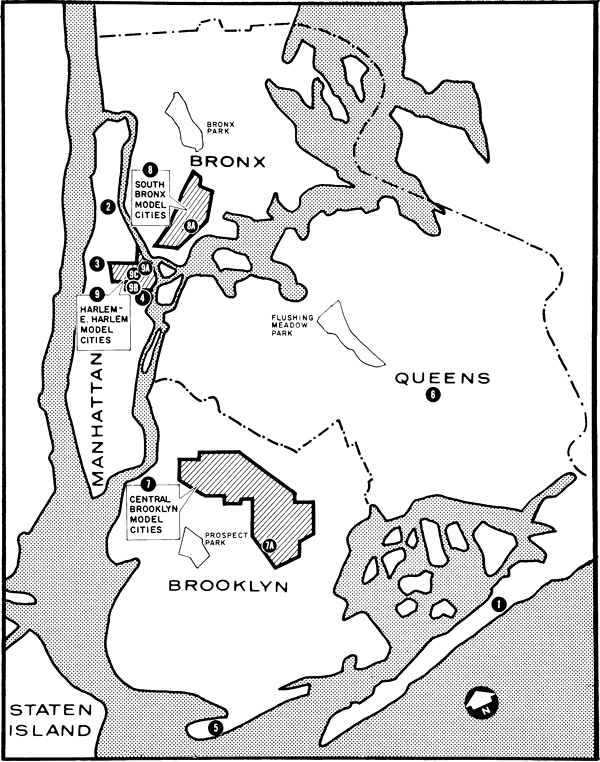
    President Lyndon B. Johnson launched one of the most ambitious experiments in urban policy: the Model Cities Program.

    As a scholar of housing justice and urban planning, I’ve studied how this short-lived initiative aimed to move beyond patchwork fixes to poverty and instead tackle its structural causes by empowering communities to shape their own futures.

    Building a great society

    The Model Cities Program emerged in 1966 as part of Johnson’s Great Society agenda, a sweeping effort to eliminate poverty, reduce racial injustice and expand social welfare programs in the United States.

    Earlier urban renewal programs had been roundly criticized for displacing communities of color. Much of this displacement occurred through federally funded highway and slum clearance projects that demolished entire neighborhoods and often left residents without decent options for new housing.

    So the Johnson administration sought a more holistic approach. The Demonstration Cities and Metropolitan Development Act established a federal framework for cities to coordinate housing, education, employment, health care and social services at the neighborhood level.

    New York City neighborhoods designated for revitalization with funding from the Model Cities Program.
    The City of New York, Community Development Program: A Progress Report, December 1968.

    To qualify for the program, cities had to apply for planning grants by submitting a detailed proposal that included an analysis of neighborhood conditions, long-term goals and strategies for addressing problems.

    Federal funds went directly to city governments, which then distributed them to local agencies and community organizations through contracts. These funds were relatively flexible but had to be tied to locally tailored plans. For example, Kansas City, Missouri, used Model Cities funding to support a loan program that expanded access to capital for local small businesses, helping them secure financing that might otherwise have been out of reach.

    Unlike previous programs, Model Cities emphasized what Johnson described as “comprehensive” and “concentrated” efforts. It wasn’t just about rebuilding streets or erecting public housing. It was about creating new ways for government to work in partnership with the people most affected by poverty and racism.

    A revolutionary approach to poverty

    What made Model Cities unique wasn’t just its scale but its philosophy. At the heart of the program was an insistence on “widespread citizen participation,” which required cities that received funding to include residents in the planning and oversight of local programs.

    The program also drew inspiration from civil rights leaders. One of its early architects, Whitney M. Young Jr., had called for a “Domestic Marshall Plan” – a reference to the federal government’s efforts to rebuild Europe after World War II – to redress centuries of racial inequality.

    Civil rights activist Whitney M. Young Jr. helped shape the vision of the Model Cities Program.
    Bettmann/Getty Images

    Young’s vision helped shape the Model Cities framework, which proposed targeted systemic investments in housing, health, education, employment and civic leadership in minority communities. In Atlanta, for example, the Model Cities Program helped fund neighborhood health clinics and job training programs. But the program also funded leadership councils that for the first time gave local low-income residents a direct voice in how city funds were spent.

    In other words, neighborhood residents weren’t just beneficiaries. They were planners, advisers and, in some cases, staffers.

    This commitment to community participation gave rise to a new kind of public servant – what sociologists Martin and Carolyn Needleman famously called “guerrillas in the bureaucracy.”

    A Model Cities staffer discusses the program to a group of students gathered at Denver’s Metropolitan Youth Education Center in 1970.
    Bill Wunsch/The Denver Post via Getty Images

    These were radical planners – often young, idealistic and deeply embedded in the neighborhoods they served. Many were recruited and hired through new Model Cities funding that allowed local governments to expand their staff with community workers aligned with the program’s goals.

    Working from within city agencies, these new planners used their positions to challenge top-down decision-making and push for community-driven planning.

    Their work was revolutionary not because they dismantled institutions but because they reimagined how institutions could function, prioritizing the voices of residents long excluded from power.

    Strengthening community ties

    In cities across the country, planners fought to redirect public resources toward locally defined priorities.

    A mobile dentist office in Baltimore.
    Robert Breck Chapman Collection, Langsdale Library Special Collections, University of Baltimore, CC BY-NC-ND

    In some cities, such as Tucson, the program funded education initiatives such as bilingual cultural programming and college scholarships for local students. In Baltimore, it funded mobile health services and youth sports programs.

    In New York City, the program supported new kinds of housing projects called vest-pocket developments, which got their name from their smaller scale: midsize buildings or complexes built on vacant lots or underutilized land. New housing such as the Betances Houses in the South Bronx were designed to add density without major redevelopment taking place – a direct response to midcentury urban renewal projects, which had destroyed and displaced entire neighborhoods populated by the city’s poorest residents. Meanwhile, cities such as Seattle used the funds to renovate older apartment buildings instead of tearing them down, which helped preserve the character of local neighborhoods.

    The goal was to create affordable housing while keeping communities intact.

    An Atlanta neighborhood identified as a candidate for street paving and home rehabilitation as part of the Model Cities Program.
    Georgia State University Special Collections

    What went wrong?

    Despite its ambitious vision, Model Cities faced resistance almost from the start. The program was underfunded and politically fragile. While some officials had hoped for US$2 billion in annual funding, the actual allocation was closer to $500 million to $600 million, spread across more than 60 cities.

    Then the political winds shifted. Though designed during the optimism of the mid-1960s, the program started being implemented under President Richard Nixon in 1969. His administration pivoted away from “people programs” and toward capital investment and physical development. Requirements for resident participation were weakened, and local officials often maintained control over the process, effectively marginalizing the everyday citizens the program was meant to empower.

    In cities such as San Francisco and Chicago, residents clashed with bureaucrats over control, transparency and decision-making. In some places, participation was reduced to token advisory roles. In others, internal conflict and political pressure made sustained community governance nearly impossible.

    Critics, including Black community workers and civil rights activists, warned that the program risked becoming a new form of “neocolonialism,” one that used the language of empowerment while concentrating control in the hands of white elected officials and federal administrators.

    A legacy worth revisiting

    Although the program was phased out by 1974, its legacy lived on.

    In cities across the country, Model Cities trained a generation of Black and brown civic leaders in what community development leaders and policy advocates John A. Sasso and Priscilla Foley called “a little noticed revolution.” In their book of the same name, they describe how those involved in the program went on to serve in local government, start nonprofits and advocate for community development.

    It also left an imprint on later policies. Efforts such as participatory budgeting, community land trusts and neighborhood planning initiatives owe a debt to Model Cities’ insistence that residents should help shape the future of their communities. And even as some criticized the program for failing to meet its lofty goals, others saw its value in creating space for democratic experimentation.

    A housing meeting takes place at a local Model Cities field office in Baltimore in 1972.
    Robert Breck Chapman Collection, Langsdale Library Special Collections, University of Baltimore, CC BY-NC-ND

    Today’s housing crisis demands structural solutions to structural problems. The affordable housing crisis is deeply connected to other intersecting crises, such as climate change, environmental injustice and health disparities, creating compounding risks for the most vulnerable communities. Addressing these issues through a fragmented social safety net – whether through housing vouchers or narrowly targeted benefit programs – has proven ineffective.

    Today, as policymakers once again debate how to respond to deepening inequality and a lack of affordable housing, the lost promise of Model Cities offers vital lessons.

    Model Cities was far from perfect. But it offered a vision of how democratic, local planning could promote health, security and community.

    Deyanira Nevárez Martínez is a trustee of the Lansing School District Board of Education and is currently a candidate for the Lansing City Council Ward 2.

    ref. Could a bold anti-poverty experiment from the 1960s inspire a new era in housing justice? – https://theconversation.com/could-a-bold-anti-poverty-experiment-from-the-1960s-inspire-a-new-era-in-housing-justice-253706

    MIL OSI – Global Reports

  • MIL-OSI Global: Air traffic controller shortages in Newark and other airports partly reflect long, intense training − but university-based training programs are becoming part of the solution

    Source: The Conversation – USA – By Melanie Dickman, Lecturer in Aviation Studies, The Ohio State University

    Air traffic controllers observe a plane taking off from San Francisco International Airport in 2017. AP Photo/Jeff Chiu

    Air traffic controllers have been in the news a lot lately.

    A spate of airplane crashes and near misses have highlighted the ongoing shortage of air traffic workers, leading more Americans to question the safety of air travel.

    The shortage, as well as aging computer systems, have also led to massive flight disruptions at airports across the country, particularly at Newark Liberty International Airport. The staffing shortage is also likely at the center of an investigation of a deadly crash between a commercial plane and an Army helicopter over Washington, D.C., in January 2025.

    One reason for the air traffic controller shortage relates to the demands of the job: The training to become a controller is extremely intense, and the Federal Aviation Administration wants only highly qualified personnel to fill those seats, which has made it difficult for what has been the sole training center in the U.S., located in Oklahoma City, to churn out enough qualified graduates each year.

    As scholars who study and teach tomorrow’s aviation professionals, we are working to be part of the solution. Our program at Ohio State University is applying to join over two dozen other schools in an effort to train air traffic controllers and help alleviate the shortage.

    Air traffic controller school

    Air traffic control training today – overseen by the Federal Aviation Administration – remains as intense as it’s ever been.

    In fact, about 30% of students fail to make it from their first day of training at the FAA Academy in Oklahoma City to the status of a certified professional air traffic controller. The academy currently trains the majority of the air traffic controllers in the U.S.

    Before someone is accepted into the training program, they must meet several qualifications. That includes being a U.S. citizen under the age of 31 and speaking English clearly enough to be understood over the radio. The low recruitment age is because controllers currently have a mandatory retirement age of 56 – with some exceptions – and the FAA wants them to work for at least 25 years in the job.

    They must also pass a medical exam and security investigation. And they must pass the air traffic controller specialists skills assessment battery, which measures an applicant’s spatial awareness and decision-making abilities.

    Candidates, additionally, must have three years of general work experience, or a combination of postsecondary education and work experience totaling at least three years.

    This alone is no easy feat. Fewer than 10% of applicants meet those initial requirements and are accepted into training.

    An air traffic controller monitors a runway in the tower at John F. Kennedy International Airport in New York.
    AP Photo/Seth Wenig

    Intense training

    Once applicants meet the initial qualifications, they begin a strenuous training process.

    This begins with several weeks of classroom instruction and several months of simulator training. There are several types of simulators, and a student is assigned to a simulator based on the type of facility for which they will be hired – which depends on a trainee’s preference and where controllers are needed.

    There are two main types of air traffic facilities: control towers and radar. Anyone who has flown on a plane has likely seen a control tower near the runways, with 360 degrees of tall glass windows to monitor the skies nearby. Controllers there mainly look outside to direct aircraft but also use radar to monitor the airspace and assist aircraft in taking off and landing safely.

    Radar facilities, on the other hand, monitor aircraft solely through the use of information depicted on a screen. This includes aircraft flying just outside the vicinity of a major airport or when they’re at higher altitudes and crisscrossing the skies above the U.S. The controllers ensure they don’t fly too close to one another as they follow their flight paths between airports.

    If the candidates make it through the first stage, which takes about six months and extensive testing to meet standards, they will be sent to their respective facilities.

    Once there, they again go to the classroom, learning the details of the airspace they will be working in. There are more assessments and chances to “wash out” and have to leave the program.

    Finally, the candidates are paired with an experienced controller who conducts on-the-job training to control real aircraft. This process may take an additional year or more. It depends on the complexity of the airspace and the amount of aircraft traffic at the site.

    Two control towers watch over Newark Liberty International Airport, where a shortage of air traffic controllers has led to blackouts and other problems lately.
    AP Photo/Seth Wenig

    Increasing the employment pipeline

    But no matter how good the training is, if there aren’t enough graduates, that’s a problem for managing the increasingly crowded skies.

    The FAA is currently facing a deficit of about 3,000 controllers and has unveiled a plan in May 2025 to increase hiring and boost retention. In addition, Congress is mulling spending billions of dollars to update the FAA’s aging systems and hire more air traffic controllers.

    Other plans include paying retention bonuses and allowing more controllers to work beyond the age of 56. That retirement age was put in place in the 1970s on the assumption that cognition for most people begins to decline around then, although research shows that age alone is not necessarily a predictor of cognitive abilities.

    But we believe that aviation programs and universities can play an important role fixing the shortage by providing FAA Academy-level training.

    Currently, 32 universities including the Florida Institute of Technology and Arizona State University partner with the FAA in its collegiate training initiative to provide basic air traffic control training, which gives graduates automatic entry into the FAA Academy and allows them to skip five weeks of coursework.

    The institution where we work, Ohio State University, is currently working on becoming the 33rd this summer and plans to offer an undergraduate major in aviation with specialization in air traffic control.

    This helps, but an enhanced version of this program, announced in October 2024, allows graduates of a select few of those universities to skip the FAA Academy altogether and go straight to a control tower or radar facility once they’ve passed all the extensive tests. These schools must match or exceed the level of rigor in their training with the FAA Academy itself.

    At the end of the program, students are required to pass an evaluation by an FAA-approved evaluator to ensure that the student graduating from the program meets the same standards as all FAA Academy graduates and is prepared to go to their assigned facility for further training. So far, five schools, such as the University of North Dakota, have joined this program and are currently training air traffic controllers. We intend to join this group in the near future.

    Allowing colleges and universities to start the training process while students are still in school should accelerate the pace at which new controllers enter the workforce, alleviate the shortage and make the skies over the U.S. as safe as they can be.

    Melanie Dickman is a member at large of the Air Traffic Controllers Association

    Brian Strzempkowski does not work for, consult, own shares in or receive funding from any company or organization that would benefit from this article, and has disclosed no relevant affiliations beyond their academic appointment.

    ref. Air traffic controller shortages in Newark and other airports partly reflect long, intense training − but university-based training programs are becoming part of the solution – https://theconversation.com/air-traffic-controller-shortages-in-newark-and-other-airports-partly-reflect-long-intense-training-but-university-based-training-programs-are-becoming-part-of-the-solution-249715

    MIL OSI – Global Reports

  • MIL-OSI Global: Managing forests and other ecosystems under rising threats requires thinking across wide-ranging scenarios

    Source: The Conversation – USA – By Kyra Clark-Wolf, Research Scientist in Ecological Transformation, University of Colorado Boulder

    Thinking through scenarios allows land managers to prepare for many potential outcomes. Benjamin Slyngstad via USGS

    In Sequoia and Kings Canyon National Parks in California, trees that have persisted through rain and shine for thousands of years are now facing multiple threats triggered by a changing climate.

    Scientists and park managers once thought giant sequoia forests nearly impervious to stressors like wildfire, drought and pests. Yet, even very large trees are proving vulnerable, particularly when those stressors are amplified by rising temperatures and increasing weather extremes.

    The rapid pace of climate change – combined with threats like the spread of invasive species and diseases – can affect ecosystems in ways that defy expectations based on past experiences. As a result, Western forests are transitioning to grasslands or shrublands after unprecedented wildfires. Woody plants are expanding into coastal wetlands. Coral reefs are being lost entirely.

    Nate Stephenson, from the U.S. Geological Survey, talks about the fire damage at Redwood Mountain Grove in the Kings Canyon National Park, Calif., in 2021.
    AP Photo/Gary Kazanjian

    To protect these places, which are valued for their natural beauty and the benefits they provide for recreation, clean water and wildlife, forest and land managers increasingly must anticipate risks they have never seen before. And they must prepare for what those risks will mean for stewardship as ecosystems rapidly transform.

    As ecologists and a climate scientist, we’re helping them figure out how to do that.

    Managing changing ecosystems

    Traditional management approaches focus on maintaining or restoring how ecosystems looked and functioned historically.

    However, that doesn’t always work when ecosystems are subjected to new and rapidly shifting conditions.

    Ecosystems have many moving parts – plants, animals, fungi and microbes; and the soil, air and water in which they live – that interact with one another in complex ways.

    When the climate changes, it’s like shifting the ground on which everything rests. The results can undermine the integrity of the system, leading to ecological changes that are hard to predict.

    To plan for an uncertain future, natural resource managers need to consider many different ways changes in climate and ecosystems could affect their landscapes. Essentially, what scenarios are possible?

    Preparing for multiple possibilities

    At Sequoia and Kings Canyon, park managers were aware that climate change posed some big risks to the iconic trees under their care. More than a decade ago, they undertook a major effort to explore different scenarios that could play out in the future.

    It’s a good thing they did, because some of the more extreme possibilities they imagined happened sooner than expected.

    In 2014, drought in California caused the giant sequoias’ foliage to die back, something never documented before. In 2017, sequoia trees began dying from insect damage. And, in 2020 and 2021, fires burned through sequoia groves, killing thousands of ancient trees.

    While these extreme events came as a surprise to many people, thinking through the possibilities ahead of time meant the park managers had already begun to take steps that proved beneficial. One example was prioritizing prescribed burns to remove undergrowth that could fuel hotter, more destructive fires.

    Insulating wraps protected the giant sequoia General Sherman from a fire in 2021.
    Patrick T. Fallon/AFP via Getty Images

    The key to effective planning is a thoughtful consideration of a suite of strategies that are likely to succeed in the face of many different changes in climates and ecosystems. That involves thinking through wide-ranging potential outcomes to see how different strategies might fare under each scenario – including preparing for catastrophic possibilities, even those considered unlikely.

    For example, prescribed burning may reduce risks from both catastrophic wildfire and drought by reducing the density of plant growth, whereas suppressing all fires could increase those risks in the long run.

    Strategies undertaken today have consequences for decades to come. Managers need to have confidence that they are making good investments when they put limited resources toward actions like forest thinning, invasive species control, buying seeds or replanting trees. Scenarios can help inform those investment choices.

    Constructing credible scenarios of ecological change to inform this type of planning requires considering the most important unknowns. Scenarios look not only at how the climate could change, but also how complex ecosystems could react and what surprises might lay beyond the horizon.

    Scientists at the North Central Climate Adaptation Science Center are collaborating with managers in the Nebraska Sandhills to develop scenarios of future ecological change under different climate conditions, disturbance events like fires and extreme droughts, and land uses like grazing.
    Photos: T. Walz, M. Lavin, C. Helzer, O. Richmond, NPS (top to bottom)., CC BY

    Key ingredients for crafting ecological scenarios

    To provide some guidance to people tasked with managing these landscapes, we brought together a group of experts in ecology, climate science, and natural resource management from across universities and government agencies.

    We identified three key ingredients for constructing credible ecological scenarios:

    1. Embracing ecological uncertainty: Instead of banking on one “most likely” outcome for ecosystems in a changing climate, managers can better prepare by mapping out multiple possibilities. In Nebraska’s Sandhills, we are exploring how this mostly intact native prairie could transform, with outcomes as divergent as woodlands and open dunes.

    2. Thinking in trajectories: It’s helpful to consider not just the outcomes, but also the potential pathways for getting there. Will ecological changes unfold gradually or all at once? By envisioning different pathways through which ecosystems might respond to climate change and other stressors, natural resource managers can identify critical moments where specific actions, such as removing tree seedlings encroaching into grasslands, can steer ecosystems toward a more desirable future.

    3. Preparing for surprises: Planning for rare disasters or sudden species collapses helps managers respond nimbly when the unexpected strikes, such as a severe drought leading to widespread erosion. Being prepared for abrupt changes and having contingency plans can mean the difference between quickly helping an ecosystem recover and losing it entirely.

    Over the past decade, access to climate model projections through easy-to-use websites has revolutionized resource managers’ ability to explore different scenarios of how the local climate might change.

    What managers are missing today is similar access to ecological model projections and tools that can help them anticipate possible changes in ecosystems. To bridge this gap, we believe the scientific community should prioritize developing ecological projections and decision-support tools that can empower managers to plan for ecological uncertainty with greater confidence and foresight.

    Ecological scenarios don’t eliminate uncertainty, but they can help to navigate it more effectively by identifying strategic actions to manage forests and other ecosystems.

    Kyra Clark-Wolf receives funding from USGS, NSF, and National Park Service. She is affiliated with the Cooperative Institute for Research in Environmental Sciences at the University of Colorado Boulder and the North Central Climate Adaptation Science Center.

    Brian W. Miller receives funding from the U.S. Geological Survey North Central Climate Adaptation Science Center. Any use of trade, firm, or product names is for descriptive purposes only and does not imply endorsement by the U.S. Government.

    Imtiaz Rangwala receives funding from USGS, USDA, NOAA, US Forest Service and National Park Service. He is affiliated with the Cooperative Institute for Research in Environmental Sciences at the University of Colorado Boulder, North Central Climate Adaptation Science Center, Western Water Assessment and Boundless In Motion.

    ref. Managing forests and other ecosystems under rising threats requires thinking across wide-ranging scenarios – https://theconversation.com/managing-forests-and-other-ecosystems-under-rising-threats-requires-thinking-across-wide-ranging-scenarios-253842

    MIL OSI – Global Reports

  • MIL-OSI Global: Christianity has long revered saints who would be called ‘transgender’ today

    Source: The Conversation – USA – By Sarah Barringer, Ph.D. Candidate in English, University of Iowa

    Several Republican-led states have restricted transgender rights: Iowa has signed a law removing civil rights protection for transgender people; Wyoming has prohibited state agencies from requiring the use of preferred pronouns; and Alabama recently passed a law that only two sexes would be recognized. Hundreds of bills have been introduced in other state legislatures to curtail trans rights.

    Earlier in the year, several White House executive orders pushed to deny trans identity. One of them, “Eradicating Anti-Christian Bias,” claimed that gender-affirming policies of the Biden administration were “anti-Christian.” It accused the Biden Equal Employment Opportunity Commission of forcing “Christians to affirm radical transgender ideology against their faith.”

    To be clear, not all Christians are anti-trans. And in my research of medieval history and literature, I found evidence of a long history in Christianity of what today could be called “transgender” saints. While such a term did not exist in medieval times, the idea of men living as women, or women living as men, was unquestionably present in the medieval period. Many scholars have suggested that using the modern term transgender creates valuable connections to understand the historical parallels.

    There are at least 34 documented stories of transgender saints’ lives from the early centuries of Christianity. Originally appearing in Latin or Greek, several stories of transgender saints made their way into vernacular languages.

    Transgender saints

    Of the 34 original saints, at least three gained widespread popularity in medieval Europe: St. Eugenia, St. Euphrosyne and St. Marinos. All three were born as women but cut their hair and put on men’s clothes to live as men and join monasteries.

    Eugenia, raised pagan, joined a monastery to learn more about Christianity and later became abbot. Euphrosyne joined a monastery to escape an unwanted suitor and spent the rest of his life there. Marinos, born Marina, decided to renounce womanhood and live with his father at the monastery as a man.

    These were well-read stories. Eugenia’s story appeared in two of the most popular manuscripts of their day – Ælfric’s “Lives of Saints” and “The Golden Legend.” Ælfric was an English abbot who translated Latin saints’ lives into Old English in the 10th century, making them widely available to a lay audience. “The Golden Legend” was written in Latin and compiled in the 13th century; it is part of more than a thousand manuscripts.

    Euphrosyne also appears in Ælfric’s saints’ lives, as well as in other texts in Latin, Middle English, and Old French. Marinos’ story is available in over a dozen manuscripts in at least 10 languages. For those who couldn’t read, Ælfric’s saints’ lives and other manuscripts were read aloud in churches during service on the saint’s day.

    Euphrosyne of Alexandria.
    Anonymous via Wikimedia Commons

    A small church in Paris built in the 10th century was dedicated to Marinos, and relics of his body were supposedly kept in Qannoubine monastery in Lebanon.

    This is all to say, a lot of people were talking about these saints.

    Holy transness

    In the medieval period, saints’ lives were less important as history and more important as morality tales. As a morality tale, the audience was not intended to replicate a saint’s life, but learn to emulate Christian values. Transitioning between male and female becomes a metaphor for transitioning from pagan to Christian, affluence to poverty, worldliness to spirituality. The Catholic Church opposed cross-dressing in laws, liturgical meetings and other writings. However, Christianity honored the holiness of these transgender saints.

    In a 2021 collection of essays about transgender and queer saints in the medieval period, scholars Alicia Spencer-Hall and Blake Gutt argue that medieval Christianity saw transness as holy.

    “Transness is not merely compatible with holiness; transness itself is holy,” they write. Transgender saints had to reject convention in order to live their own authentic lives, just as early Christians had to reject convention in order to live as Christians.

    Literature scholar Rhonda McDaniel explains that in 10th-century England, adopting the Christian values of shunning wealth, militarism and sex made it easier for people to go beyond strict ideas about male and female gender. Instead of defining gender by separate male and female values, all individuals could be defined by the same Christian values.

    Historically and even in contemporary times, gender is associated with specific values and roles, such as assuming that homemaking is for women, or that men are stronger. But adopting these Christian values allowed individuals to transcend such distinctions, especially when they entered monasteries and nunneries.

    According to McDaniel, even cisgender saints like St. Agnes, St. Sebastian and St. George exemplified these values, exhibiting how anyone in the audience could push against gender stereotypes without changing their bodies.

    Agnes’ love of God allowed her to give up the role of wife. When offered love and wealth by men, she rejected them in favor of Christianity. Sebastian and George were powerful Roman men who were expected, as men, to engage in violent militarism. However, both rejected their violent Roman masculinity in favor of Christian pacifism.

    A life worth emulating

    Although most saints’ lives were written primarily as morality tales, the story of Joseph of Schönau was told as both very real and worthy of emulation by the audience. His story is told as a historical account of a life that would be attainable for ordinary Christians.

    In the late 12th century, Joseph, born female, joined a Cistercian monastery in Schönau, Germany. During his deathbed confession, Joseph told his life story, including his pilgrimage to Jerusalem as a child and his difficult journey back to Europe after the death of his father. When he finally returned to his birthplace of Cologne, he entered a monastery as a man in gratitude to God for returning him home safely.

    Despite arguing that Joseph’s life was worth emulating, the first author of Joseph’s story, Engelhard of Langheim, had a complicated relationship with Joseph’s gender. He claimed Joseph was a woman, but regularly used masculine pronouns to describe him.

    Marinos the monk.
    Richard de Montbaston via Wikimedia Commons

    Even though Eugenia, Euphrosyne and Marinos’ stories are told as morality tales, their authors had similarly complicated relationships with their gender. In the case of Eugenia, in one manuscript, the author refers to her with entirely female pronouns, but in another, the scribe slips into male pronouns.

    Marinos and Euphrosyne were also frequently referred to as male. The fact that the authors referred to these characters as male suggests that their transition to masculinity was not only a metaphor, but in some ways just as real as Joseph’s.

    Based on these stories, I argue that Christianity has a transgender history to pull from and many opportunities to embrace transness as an essential part of its values.

    Sarah Barringer does not work for, consult, own shares in or receive funding from any company or organization that would benefit from this article, and has disclosed no relevant affiliations beyond their academic appointment.

    ref. Christianity has long revered saints who would be called ‘transgender’ today – https://theconversation.com/christianity-has-long-revered-saints-who-would-be-called-transgender-today-254769

    MIL OSI – Global Reports

  • MIL-OSI Global: Pope Leo XIV is the first member of the Order of St. Augustine to be elected pope – but who are the Augustinians?

    Source: The Conversation – USA – By Joanne M. Pierce, Professor Emerita of Religious Studies, College of the Holy Cross

    Pope Leo XIV leaves the Augustinian General House in Rome after a visit on May 13, 2025. AP Photo/Domenico Stinellis

    When Pope Leo XIV was elected pope, the assembled crowd reacted with joy but also with surprise: He was the first pope from the United States, and North America more broadly. Moreover, he was the first member of the Order of St. Augustine to be elected to the papacy.

    Out of all 267 popes, only 51 have been members of religious orders. Pope Francis was elected in 2013 as the first member of the Jesuit order, the Society of Jesus; he was also the first member of any religious order to be chosen in over 150 years.

    As a specialist in medieval Christianity, I am familiar with the origins of many Catholic religious orders, and I was intrigued by the choice of a member of the Order of St. Augustine to follow a Jesuit as pope.

    So, who are the Augustinians?

    Early monks and concern for community

    In antiquity, some Christians chose to lead a more perfect religious life by leaving ordinary society and living together in groups, in the wilderness. They would be led by an older, more experienced person – an abbot. As monks, they followed a set of regulations and guidelines called a “monastic rule.”

    The earliest of these rules, composed about the year 400, is attributed to an influential theologian, later a bishop in North Africa, called St. Augustine of Hippo. The Rule of St. Augustine is a short text that offered monks a firm structure for their daily lives of work and prayer, as well as guidelines on how these rules could be implemented by the abbot in different situations. The rule is both firm and flexible.

    The first chapter stresses the importance of “common life”: It instructs monks to love God and one’s neighbor by living “together in oneness of mind and heart, mutually honoring God in yourselves, whose temples you have become.”

    This is the overriding principle that shapes all later instructions in Augustinian rule.

    For example, Chapter III deals with how the monks should behave when out in public. They should not go alone, but in a group, and not engage in scandalous behavior – specifically, staring at women.

    If one monk starts staring at a woman, one of the other monks with him should “admonish” him. If he does it again, his companion should tell the abbot first, before any other witnesses are notified, so that the monk can try to change his behavior on his own first, so as not to cause disruption in the community.

    Because of this clarity and flexibility, its concern for both the community and the individual members, many early religious communities in the early Middle Ages adopted the Rule of St. Augustine; formal papal approval was not required at this time.

    Mendicant friars in medieval Europe

    By the end of the 12th century, Western Europe had become much more urbanized.

    In response, a new form of religious life emerged: the mendicant friars. Unlike monks who withdrew from ordinary life, mendicants stressed a life of poverty, spent in travel from town to town to preach and help the poor. They would beg for alms along the way to provide for their own needs.

    The first mendicant orders, like the Franciscans and Dominicans, received papal approval in the early 13th century. Others were organized later.

    A few decades later, several hermits living in the Italian region of Tuscany decided to join together to form a new mendicant order. They chose to follow the Rule of St. Augustine under one superior general; Pope Innocent IV approved the new order as the Order of Hermits of St. Augustine in 1244. Later, in 1254, Pope Alexander IV included other groups of hermits in the order, known as the Grand Union.

    The new order grew and eventually expanded across Western Europe, becoming involved in preaching and other kinds of pastoral work in several countries.

    Early missionaries to modern times

    As European countries began to explore the New World, missionary priests took their place on ships sent from Catholic countries, like Spain and Portugal.

    Augustinians were among these early missionaries, quickly establishing themselves in Latin America, several countries in Africa and parts of Southeast Asia and Oceania, arriving in the Philippines in the 16th century.

    There, they not only ministered to the European crews and colonists, but they also evangelized – preached the Christian gospel – to the native inhabitants of the country.

    Augustinian missionaries started the process of setting up Catholic parishes and, eventually, new dioceses. In time, they founded and taught in seminaries to train native-born men who wanted to join their order.

    It wasn’t until the end of the 18th century that Augustinian friars arrived in the United States. Despite many struggles and setbacks in the 19th century, they established Villanova University in Pennsylvania and other ministries in New York and Massachusetts. Except for two 17th-century missionaries, Augustinian friars didn’t arrive in Canada until the 20th century, when they were sent from the German province of the order to escape financial pressure from the economic depression of the 1920s and political pressure from the Nazis.

    Pope Francis meets with members of the Order of Augustinian Recollects at the Vatican on Oct. 20, 2016.
    L’Osservatore Romano/Pool Photo via AP

    Today, there are some 2,800 Augustinian friars in almost 50 countries worldwide. They serve as pastors, teachers and bishops, and have founded schools, colleges and universities on almost every continent. They are also active in promoting social justice in many places – for example, in North America and Australasia, comprising Australia and parts of South Asia.

    Based on his years as a missionary and as provincial of the entire order worldwide, Leo XIV draws on the rich interpersonal tradition of the Order of St. Augustine. I believe his pontificate will be one marked by his experiential awareness of Catholicism as a genuinely global religion, and his deep concern for the suffering of the marginalized and those crushed by political and economic injustice.

    Joanne M. Pierce does not work for, consult, own shares in or receive funding from any company or organization that would benefit from this article, and has disclosed no relevant affiliations beyond their academic appointment.

    ref. Pope Leo XIV is the first member of the Order of St. Augustine to be elected pope – but who are the Augustinians? – https://theconversation.com/pope-leo-xiv-is-the-first-member-of-the-order-of-st-augustine-to-be-elected-pope-but-who-are-the-augustinians-257175

    MIL OSI – Global Reports

  • MIL-OSI Global: Europeans are concerned that the US will withdraw support from NATO. They are right to worry − Americans should, too

    Source: The Conversation – USA – By John Deni, Research Professor of Joint, Interagency, Intergovernmental, and Multinational Security Studies, US Army War College

    American soldiers join 3,000 troops from other NATO member countries in a four-week exercise in Hohenfels, Germany, in March 2025. Sean Gallup/Getty Images

    The United States has long played a leadership role in NATO, the most successful military alliance in history.

    The U.S. and 11 other countries in North America and Europe founded NATO in 1949, following World War II. NATO has since grown its membership to include 32 countries in Europe and North America.

    But now, European leaders and politicians fear the United States has become a less reliable ally, posing major challenges for Europe and, by implication, NATO.

    This concern is not unfounded.

    President Donald Trump has repeatedly spoken of a desire to seize Greenland, which is an autonomous territory of Denmark, a NATO member. He has declared that Canada, another NATO member, should become “the 51st state.” Trump has also sided with Russia at the United Nations and said that the European Union, the political and economic group uniting 27 European countries, was designed to “screw” the U.S.

    Still, Trump – as well as other senior U.S. government officials – has said that the U.S. remains committed to staying in and supporting NATO.

    For decades, both liberal and conservative American politicians have recognized that the U.S. strengthens its own military and economic interests by being a leader in NATO – and by keeping thousands of U.S. troops based in Europe to underwrite its commitment.

    President Donald Trump speaks at a NATO Summit in July 2018 during his first term.
    Sean Gallup/Getty Images

    Understanding NATO

    The U.S., Canada and 10 Western European countries formed NATO nearly 80 years ago as a way to help maintain peace and stability in Europe following World War II. NATO helped European and North American countries bind together and defend themselves against the threat once posed by the Soviet Union, a former communist empire that fell in 1991.

    NATO employs about 2,000 people at its headquarters in Brussels. It does not have its own military troops and relies on its 32 member countries to volunteer their own military forces to conduct operations and other tasks under NATO’s leadership.

    NATO does have its own military command structure, led by an American military officer, and including military officers from other countries. This team plans and executes all NATO military operations.

    In peacetime, military forces working with NATO conduct training exercises across Eastern Europe and other places to help reassure allies about the strength of the military coalition – and to deter potential aggressors, like Russia.

    NATO has a relatively small annual budget of around US$3.6 billion. The U.S. and Germany are the largest contributors to this budget, each responsible for funding 16% of NATO’s costs each year.

    Separate from NATO’s annual budget, in 2014, NATO members agreed that each participating country should spend the equivalent of 2% of its gross domestic product on their own national defense. Twenty two of NATO’s 31 members with military forces were expected that 2% threshold as of April 2025.

    Although NATO is chiefly a military alliance, it has roots in the mutual economic interests of both the U.S. and Europe.

    Europe is the United States’ most important economic partner. Roughly one-quarter of all U.S. trade is with Europe – more than the U.S. has with Canada, China or Mexico.

    Over 2.3 million American jobs are directly tied to producing exports that reach European countries that are part of NATO.

    NATO helps safeguard this mutual economic relationship between the U.S. and Europe. If Russia or another country tries to intimidate, dominate or even invade a European country, this could hurt the American economy. In this way, NATO can be seen as the insurance policy that underwrites the strength and vitality of the American economy.

    The heart of that insurance policy is Article 5, a mutual defense pledge that member countries agree to when they join NATO.

    Article 5 says that an armed attack against one NATO member is considered an attack against the entire alliance. If one NATO member is attacked, all other NATO members must help defend the country in question. NATO members have only invoked Article 5 once, following the Sept. 11, 2001, attacks in the U.S., when the alliance deployed aircraft to monitor U.S. skies.

    A wavering commitment to Article 5

    Trump has questioned whether he would enforce Article 5 and help defend a NATO country if it is not paying the required 2% of its gross domestic product.

    NBC News also reported in April 2025 that the U.S. is likely going to cut 10,000 or more of the nearly 85,000 American troops stationed in Europe. The U.S. might also relinquish its top military leadership position within NATO, according to NBC.

    Many political analysts expect the U.S. to shift its national security focus away from Europe and toward threats posed by China – specifically, the threat of China invading or attacking Taiwan.

    At the same time, the Trump administration appears eager to reset relations with Russia. This is despite the Russian military’s atrocities committed against Ukrainian military forces and civilians in the war Russia began in 2022, and Russia’s intensifying hybrid war against Europeans in the form of covert spy attacks across Europe. This hybrid warfare allegedly includes Russia conducting cyberattacks and sabotage operations across Europe. It also involves Russia allegedly trying to plant incendiary devices on planes headed to North America, among other things.

    President Joe Biden speaks during a NATO summit in Washington in July 2024.
    Roberto Schmidt/AFP via Getty Images

    A shifting role in Europe

    The available evidence indicates that the U.S. is backing away from its role in Europe. At best – from a European security perspective – the U.S. could still defend European allies with the potential threat of its nuclear weapon arsennal. The U.S. has significantly more nuclear weapons than any Western European country, but it is not clear that this is enough to deter Russia without the clear presence of large numbers of American troops in Europe, especially given that Moscow continues to perceive the U.S. as NATO’s most important and most powerful member.

    For this reason, significantly downsizing the number of U.S. troops in Europe, giving up key American military leadership positions in NATO, or backing away from the alliance in other ways appears exceptionally perilous. Such actions could increase Russian aggression across Europe, ultimately threatening not just European security bu America’s as well.

    Maintaining America’s leadership position in NATO and sustaining its troop levels in Europe helps reinforce the U.S. commitment to defending its most important allies. This is the best way to protect vital U.S. economic interests in Europe today and ensure Washington will have friends to call on in the future.

    John Deni does not work for, consult, own shares in or receive funding from any company or organization that would benefit from this article, and has disclosed no relevant affiliations beyond their academic appointment.

    ref. Europeans are concerned that the US will withdraw support from NATO. They are right to worry − Americans should, too – https://theconversation.com/europeans-are-concerned-that-the-us-will-withdraw-support-from-nato-they-are-right-to-worry-americans-should-too-253907

    MIL OSI – Global Reports

  • MIL-OSI Global: Why some towns lose local news − and others don’t

    Source: The Conversation – USA – By Abby Youran Qin, Ph.D. candidate at School of Journalism & Mass Communication, University of Wisconsin-Madison

    Five elements determine which towns lose their papers and which ones beat the odds. Hans Henning Wenk/Getty Images

    Why did your hometown newspaper vanish while the next town over kept theirs?

    This isn’t bad luck − it’s a systemic pattern. Since 2005, the United States has lost over one-third of its local newspapers, creating “news deserts” where corruption is more likely to spread and communities may become politically polarized.

    My research, published in Journalism & Mass Communication Quarterly, analyzes the factors behind the decline of local newspapers between 2004 and 2018. It identifies five key drivers − ranging from racial disparity to market forces − that determine which towns lose their papers and which ones beat the odds.

    1. Newspapers follow the money, not community needs

    You might expect news media to gravitate toward areas where their work is needed most − communities experiencing population growth or facing systemic challenges. But in reality, newspapers, like any business, tend to thrive where the financial resources are greatest.

    My analyses suggest that local newspapers survive where affluent subscribers and deep-pocketed advertisers cluster. That means wealthy white suburbs keep their watchdogs, while low-income and diverse communities lose theirs.

    When police brutality spikes, when welfare offices deny claims, when local officials divert funds − these are the moments when communities need their journalists the most.

    Bertram de Souza works on a story for The Vindicator newspaper in Youngstown, Ohio, on Aug. 7, 2019. The 150-year-old paper shut down later that month because of financial struggles.
    Tony Dejak, AP Photos

    Poor and racially diverse communities often face the harshest policing and interact more with street-level bureaucrats than wealthier citizens. That makes them more vulnerable to government corruption and misconduct. Yet, these same communities are the first to lose their newspapers, because there are no luxury real estate agencies buying ads, and few residents can afford the monthly subscriptions.

    Without journalistic scrutiny, scholars find that mismanagement flourishes, corruption costs balloon, and the communities most vulnerable to abuse receive the least accountability. This is how news deserts exacerbate inequality.

    2. Newspapers don’t adequately serve diverse communities

    Picture this: A newsroom sends its reporters, most of whom are white, to a Black neighborhood − but only after reports of gunshots or building fires. Residents, still in shock, don’t want to talk. So journalists call the same three community leaders they always quote, run the tragic story and disappear until the next crisis. This approach, often referred to as “parachute journalism,” results in shallow coverage that paints the community in a negative light while overlooking its complexities.

    Year after year, the pattern repeats. The only time residents see their neighborhood in the paper is when something terrible happens. No feature story of the family-owned restaurant celebrating its 20-year anniversary, no reporter at the town hall when the new police chief gets grilled about stop-and-frisk − just the constant drumbeat of crime and crisis.

    Is it any wonder racially diverse communities stop trusting and paying for that paper? Not when many working-class families of color can barely afford to add a newspaper subscription to their bills.

    Diverse neighborhoods get hit twice. First, their local papers inadequately represent them. Then, when people understandably turn away, subscriptions drop, advertisers pull back and the outlets shut down, leaving whole communities without a voice.

    Only in recent years have more media outlets begun to make a concerted effort to engage with and reflect the communities they serve. However, such efforts are often led by newer media organizations with fresh ideologies, while many long-standing media outlets remain stuck in traditional reporting practices, as illustrated in Jacob Nelson’s “Imagined Audiences.” Although my analyses of local newspaper decline from 2004 to 2018 paints a frustrating picture, the emerging trend of community-oriented journalism holds promise for positive changes in diverse communities.

    3. Population growth doesn’t always save newspapers

    It’s easy to assume that more people = more readers = healthier news organizations. But my research tells a different story: Counties with larger population growth actually saw greater declines in local newspapers.

    The catch lies in who is moving in: Population growth saves papers only when it comes with wealth. Affluent newcomers bring subscriptions and advertisers’ attention. But growth driven by high birth rates, typically seen in less developed areas with more racial and ethnic minorities, doesn’t translate to revenue. In short, growth alone isn’t enough − it’s the type of growth, and the economic power behind it, that matters.

    This highlights the fragility of market-dependent journalism. The news gap experienced by fast-growing communities may persist where local journalism depends primarily on traditional advertising and subscription revenues rather than diversified revenue sources such as grants and philanthropic donations. The latter, which often focus on community needs rather than profit potential, are more likely to help sustain journalism in areas with significant population growth.

    Local news sources help residents hold their elected officials accountable.
    Jim Mone/AP Photos

    4. Neighbors’ newspapers can save yours

    You’d think that competition between newspapers would be a cutthroat affair. But in an era of decline, my analyses reveal a counterintuitive truth: Your town’s paper actually has better odds when nearby communities keep theirs.

    Rather than competing, neighboring papers often become allies, sharing breaking news, splitting investigative costs and attracting advertisers who want regional reach. While this collaboration can sometimes cause papers to lose their local identity, having some local journalism is still better than none. It ensures some level of accountability, even if the news isn’t as focused on each town’s unique needs.

    Resilient local journalism clusters together. When one paper invests in original reporting, its neighbors often benefit too. When regional businesses support multiple outlets, the entire news ecosystem becomes more sustainable.

    5. Left or right? Local papers die either way

    In this highly polarized era, it turns out that there’s no significant link between a county’s partisan makeup and its ability to keep newspapers.

    Urban hubs such as Chicago keep robust media thanks to dense populations and corporate advertisers, not because they vote for Democrats. Meanwhile, newspapers in conservative rural areas can survive by cultivating loyal readerships within their communities.

    In contrast, communities with lower income and a diverse population lose outlets no matter whether they are red, blue or purple.

    Partisan battles might dominate national headlines, but local journalism’s survival hinges on practical factors such as money and market size. Saving local news isn’t a left vs. right debate − it’s a community issue that requires nonpartisan solutions.

    Abby Youran Qin does not work for, consult, own shares in or receive funding from any company or organization that would benefit from this article, and has disclosed no relevant affiliations beyond their academic appointment.

    ref. Why some towns lose local news − and others don’t – https://theconversation.com/why-some-towns-lose-local-news-and-others-dont-252155

    MIL OSI – Global Reports

  • MIL-OSI Global: Mountain chickadee chatter: Scientists are decoding the songbird’s complex calls

    Source: The Conversation – USA – By Sofia Marie Haley, Ph.D. Student in Cognitive Ecology, University of Nevada, Reno

    Mountain chickadees are unusual in having more complex calls than songs. Vladimir Pravosudov

    I approach a flock of mountain chickadees feasting on pine nuts. A cacophony of sounds, coming from the many different bird species that rely on the Sierra Nevada’s diverse pine cone crop, fill the crisp mountain air.

    The strong “chick-a-dee” call sticks out among the bird vocalizations. The chickadees are communicating to each other about food sources – and my approach.

    Mountain chickadees are a member of the family Paridae, which is known for its complex vocal communication systems and cognitive abilities. Along with my advisers, behavioral ecologists Vladimir Pravosudov and Carrie Branch, I’m studying mountain chickadees at our study site in Sagehen Experimental Forest, outside of Truckee, California, for my doctoral research. I am focusing on how these birds convey a variety of information with their calls.

    The chilly autumn air on top of the mountain reminds me that it will soon be winter. It is time for the mountain chickadees to leave the socially monogamous partnerships they had while raising their chicks to form larger flocks. Forming social groups is not always simple; young chickadees are joining new flocks, and social dynamics need to be established before the winter storms arrive.

    I can hear them working this out vocally. There’s an unusual variety of complex calls, with melodic “gargle calls” at the forefront, coming from individuals announcing their dominance over other flock members.

    Examining and decoding bird calls is becoming an increasingly popular field of study, as scientists like me are discovering that many birds – including mountain chickadees – follow systematic rules to share important information, stringing together syllables like words in a sentence.

    Sofia Haley describes how she records chickadee vocalizations in the forest.

    Songs vs. calls

    For social animals, communication is a crucial part of everyday life. Communication can come in the form of visual, chemical, tactile, electrical or vocal signals.

    Birds are highly vocal, often relying on vocal communication to effectively interact with their environments and flock members. Temperate songbirds, including cardinals, bluebirds, wrens and blackbirds, have two main categories of vocalizations: songs and calls.

    Songs are vocalizations that are used primarily in the spring, during breeding season. Males in temperate regions sing to attract females and defend territories.

    Calls are basically any vocalization that is not a song. This category includes a limitless variety of vocalizations that communicate all sorts of essential information.

    Most songbird species have complex songs and fairly simple calls. This is why vocalizations sound most melodic during the spring, when birds are attracting mates and breeding.

    Members of the Pravosudov lab catch and release resident chickadees to attach identifying bands that allow the researchers to track individual birds.
    Sofia Haley

    However, chickadees are unusual in that they sing very simple songs relative to the complexity of their calls. Research suggests this is largely due to their social structure and complex environments. Living in flocks for the majority of the year means they need an elaborate communication system year-round. This is in contrast to many other songbird species that are more solitary during the nonbreeding season.

    Scientists know quite a lot about birdsong: It is highly organized and composed of multiple units that are strung together into “phrases,” like how musical notes are strung together in a song.

    Some species manipulate their song to sound more impressive, by incorporating new elements or performing impressive acoustic feats through note modification – imagine a trill or an impressive high note.

    Some songbirds must learn their songs from their parents and other adult males during a sensitive period in the first several months of their lives. It’s similar to how human children must learn how to speak from adults during a similar early sensitive period.

    In contrast, we know relatively little about the structure and organization of complex calls. Scientists have often regarded calls as unexciting and simple compared with birdsong. However, calls are arguably the most important type of vocalization, at least for highly social bird species.

    Translating mountain chickadee calls

    A focal microphone allows researchers to record the call of one bird at a time.
    Sofia Haley

    I spend my days out at our field site in the beautiful Sierra Nevada, following and recording chickadees as they communicate with each other. I have taken numerous focal recordings, where I stand in the forest with a directional microphone, identifying vocalizations and behaviors in real time.

    I also have hundreds of hours of recordings taken by automated recording devices called AudioMoths. These allow me to record vocalizations in the absence of people.

    The extensive vocal repertoire of mountain chickadees has yet to be fully documented. There are five basic categories of call types:

    • Contact calls: communicate identity, sort of like a name, and location.
    • “Chick-a-dee” calls: coordinate flock movement and communicate a variety of complex information about the environment, from food availability to predator presence and type.
    • Alarm calls: alert others of the presence of a predator.
    • Begging calls: used by chicks or females to elicit feeding behavior from males.
    • Gargle calls: advertise dominance over other individuals in a flock, primarily used by males.

    “Chick-a-dee” calls contain several elements resembling the basic elements of human grammar. Essentially, the various sounds a chickadee utters mean different things, similar to words in human languages. And the way that a chickadee combines these sounds changes the meaning. Word order matters, just like grammar matters in human language. If a chickadee were to phrase its calls in the wrong note order, the call would no longer convey the same meaning, even if composed of the same elements.

    The “chick-a-dee” call of the mountain chickadee contains six elements, known as notes or syllables, that can be combined in hundreds of unique combinations to say many different things. These elements are labeled A, A/B, B, C, D and Dh.

    Although scientists don’t fully know the meaning of each note in different contexts, it is generally believed that A notes typically contain identifying information about how important the topic seems to the caller, while A/B and B notes tend to further inform the listener of the topic of conversation. C notes contain information about the subject of the call, often a food source, and D notes convey information about the excitement and urgency of the message, including level of threat of a spotted predator or size of a food source. The D notes basically function like exclamation points at the end of a sentence, while the other notes convey more specific information.

    Mountain chickadees can use their “chick-a-dee” calls to convey hundreds of different phrases that are relevant to navigating their habitats and social environments. As a hypothetical example, a mountain chickadee call might have the following syntax: A-A-A/B-B-D-D, which could roughly translate to something like, “Listen to me carefully (A-A): there is a predator (A/B) close by (B) and a medium threat level (DD).”

    If the note order switched to D-A-B-D-A/B-A, the sentence would look more like: “Noteworthy listen close by noteworthy predator listen to me.” Although all the same elements are there, this sentence is now much more difficult to comprehend. Notes that are out of order can confuse chickadees, preventing them from grasping the correct meaning of the call.

    This “translation” is an example based on what we have learned from playback experiments, but the exact meaning will depend on the specific population and surrounding environment.

    Analyzing the ‘chick-a-dee’ calls

    Back in the lab, I parse through the endless hours of recordings using a deep-learning algorithm that I have modified to identify the specific calls of our chickadee population.

    A spectrogram visualizes a chickadee call, with frequency on the vertical axis and time on the horizontal axis.
    Sofia Haley

    I then use Raven Pro software, developed by the Cornell Lab of Ornithology, to visually inspect and analyze these calls on a spectrogram: a visual representation of sound, with frequency on the vertical axis, and time on the horizontal axis. This visualization allows me to study the structure of calls in great detail.

    Studying spectrograms can get me only so far. The next step is to experimentally test different “chick-a-dee” calls out in the wild. Using audio editing software, I manipulate the syntax of calls to either follow grammatical rules or violate them. Then, I broadcast these manipulated recordings out in the forest and observe how our chickadees react to grammatically incorrect calls, which would sound like gibberish to them.

    Audio editing software allows researchers to mix up the order of a chickadee’s call in order to see how birds react to the garbled message.
    Sofia Haley

    My hope is that this combination of experimental testing of calls and careful visual analysis will provide a step toward understanding the subtle complexities of chickadee communication. I’m trying to home in on the meaning of different syllables and syntax, the grammatical rules.

    Back in the forest with my directional microphone, watching the chickadees flit about, I hear different versions of the “chick-a-dee” calls. Some feature more D notes, which would indicate a higher level of excitement. Others feature more A, B or C notes, communicating more specific, identifying information. I am also surrounded by melodic gargle calls, harsh scolding calls and barely audible soft calls.

    Next time you find yourself out in the forest, stop and listen to the chickadees as they talk to each other. Maybe you’ll be able to hear the variation in their calls and know that they are talking about different things − and that grammar matters.

    Sofia Marie Haley does not work for, consult, own shares in or receive funding from any company or organization that would benefit from this article, and has disclosed no relevant affiliations beyond their academic appointment.

    ref. Mountain chickadee chatter: Scientists are decoding the songbird’s complex calls – https://theconversation.com/mountain-chickadee-chatter-scientists-are-decoding-the-songbirds-complex-calls-247091

    MIL OSI – Global Reports

  • MIL-OSI Security: Defense News: TRIDENT Training Center Opens – NCDOC Hosts Ribbon Cutting Ceremony

    Source: United States Navy

    Chesapeake, Va. – Navy Cyber Defense Operations Command (NCDOC) held a ribbon cutting ceremony on May 9, supported by Naval Information Forces (NAVIFOR) and Naval Network Warfare Command (NNWC) leaders to officially open TRIDENT – Technical Readiness in Defensive Cyber Operations {DCO} Education and Network Training – Center for NCDOC and NNWC personnel.

    MIL Security OSI

  • MIL-OSI Russia: Achievements of future lawyers: speech at the St. Petersburg International Legal Forum and gratitude from a State Duma deputy

    Translation. Region: Russian Federal

    Source: State University of Management – Official website of the State –

    Students of the Institute of Public Administration and Law of the State University of Management have developed legislative initiatives that have received high praise from industry experts.

    Thus, a 4th-year student majoring in Jurisprudence, Karina Meshcheryakova, presented the draft law “Law: Lessons of the Past for the World of the Future” at the XII St. Petersburg International Legal Forum as part of the Youth International Legal Forum “Justice of the Future”.

    Earlier, the girl, as part of the State University of Education “AzBukiVedi” team, became the winner of the Eighth Federal Scientific and Educational Competition among young lawyers “Leaders of Law”.

    The award ceremony for the winners of the All-Russian competition for the best legislative initiative to improve judicial and extra-judicial forms of dispute resolution, organized by the Association of Lawyers of Russia, took place in Moscow.

    Fourth-year students of ISUIP majoring in Jurisprudence, Karina Meshcheryakova and Daria Shaporova, took second place in the competition and were awarded Letters of Gratitude from the Association of Lawyers of Russia and State Duma Deputy Biysultan Khamzaev.

    We congratulate our students and wish them new victories.

    Please note: This information is raw content directly from the source of the information. It is exactly what the source states and does not reflect the position of MIL-OSI or its clients.

    MIL OSI Russia News

  • MIL-OSI Global: Why Alberta’s push for independence pales in comparison to Scotland’s in 2014

    Source: The Conversation – Canada – By Piers Eaton, PhD Candidate in Political Science, L’Université d’Ottawa/University of Ottawa

    One day after the Liberal Party secured their fourth consecutive federal election victory, Alberta Premier Danielle Smith tabled legislation to change the signature threshold needed to put citizen-proposed constitutional questions on the ballot. She lowered it from the current 600,000 signatures to 177,000.

    Since the pro-independence Alberta Prosperity Project already claims to have 240,000 pledges in support of an Albertan sovereignty referendum, the change clears a path to a separation referendum.

    In 2014, Scottish voters went to the polls on a similar question to the one proposed by the Alberta Prosperity Project, but asking voters whether they wanted to regain their independence from Britain. Although the Scottish “Yes” campaign was defeated, it garnered 45 per cent of the vote, far exceeding what most thought was possible at the start of the campaign.

    The 2014 Scottish referendum injected a huge amount of enthusiasm into the Scottish separatist parties, with the largest, the Scottish National Party (SNP) — which led the fight for the Yes side — soaring from 20,000 members in 2013 to more than 100,000 months after the referendum.

    While the Yes campaign did not achieve its goals and the Scottish historical context is very different from Alberta’s, there are still important lessons about how people can be won over to the cause of independence. Albertan separatists don’t seem to be heading down the same path.

    Timeline

    Smith has suggested that if the necessary signatures were collected, that she would aim to hold a referendum in 2026. But the Alberta Prosperity Project’s Jeffrey Rath suggested the group would push Smith to allow a referendum before the end of 2025, giving the referendum a maximum of seven months of official campaigning.

    The broad ground rules of the Scottish referendum were established in the Edinburgh Agreement in October 2012. On March 2013, the SNP-led Scottish government announced the date of the independence referendum — Sept. 18, 2014. The long campaign period allowed a wide variety of grassroots campaign groups to organize in favour of independence.

    While Alberta separatism is less likely to be buoyed by artist collectives and Green Party activists like Scottish independence was, a longer independence campaign would allow a variety of members of Albertan society to make the case for independence.

    Dennis Modry, a co-leader of the Alberta Prosperity Project, recently told CBC News that the initial signature threshold of 600,000 was not all bad, as it would “get (us) closer to the referendum plurality as well.” That remark suggested Modry sees value having more time to campaign before a referendum is held.

    In this regard, he and Rath seem to be sounding different notes.

    Leadership

    Hints that the Alberta Prosperity Project is already divided raises broader questions of leadership. In 2014, the Scottish Yes side had a clear and undisputed leader — First Minister Alex Salmond, head of the SNP.

    The late Salmond led the SNP to back-to-back electoral victories in Scotland, including the only outright majority ever won in the history of the Scottish parliament in 2011.

    Salmond was able to speak in favour of independence in debates and to answer, with democratic legitimacy, specific questions about what the initial policy of an independent Scotland would be.

    The SNP government published a report, Scotland’s Future, that systematically sought to assuage skeptics. Its “frequently asked questions” (FAQ) section answered 650 potential questions about independence. The Alberta Prosperity Project, on the other hand, only answers 74 questions in its FAQ.

    Whereas Salmon’s rise to the leadership of the Scottish independence movement was done in full public view and according to party rules, the Alberta Prosperity Project’s leadership structure is far murkier.

    The organization claims there “is no prima facie leader of the APP, but there (is) a management team which is featured on the website https://albertaprosperityproject.com/about-us/.” Follow that link, however, and no names or management structures are listed.

    Clarity and democracy

    While independence always involves some unknowns, clear leadership can provide answers about where a newly independent nation might find stability. The Yes Scotland campaign promised independence within Europe, meaning Scotland would retain access to the European Union’s common market.

    By contrast, the Alberta Prosperity Project isn’t clear on the fundamental question of whether a sovereign Alberta should remain independent or attempt to join the United States as its 51st state.

    Despite the claim on its website that “the objective of the Alberta Prosperity Project is for Alberta to become a sovereign nation, not the 51st state of the USA,” the organization backed Rath’s recent trip to Washington, D.C. to gauge support for Albertan integration into the U.S.

    Rath has also said that becoming a U.S. territory is “probably the best way to go.”

    Rath in an interview with Rachel Parker, an Alberta-based independent journalist. (Rachel Parker’s YouTube channel)

    The 2014 referendum in Scotland was called a “festival of democracy”, and even anti-independence forces agreed the referendum had been good for democracy.

    It took time and leadership to put forward a positive case for independence, one that voters could decide upon with confidence.

    Alberta could learn from Scotland and strengthen its democracy by holding a referendum based on legitimate leadership, reasonable timelines, diverse voices and clear aims. Or it could lurch into a rushed campaign, with divided leaders of dubious legitimacy, arguing for unclear outcomes — and end up, no matter which side wins, weakening its democracy in the process.

    Piers Eaton does not work for, consult, own shares in or receive funding from any company or organisation that would benefit from this article, and has disclosed no relevant affiliations beyond their academic appointment.

    ref. Why Alberta’s push for independence pales in comparison to Scotland’s in 2014 – https://theconversation.com/why-albertas-push-for-independence-pales-in-comparison-to-scotlands-in-2014-256838

    MIL OSI – Global Reports

  • MIL-OSI Global: For opioid addiction, treatment underdosing can lead to fentanyl overdosing – a physician explains

    Source: The Conversation – USA – By Lucinda Grande, Clinical Associate Professor of Family Medicine, University of Washington

    Buprenorphine is most effective when doctors and patients find the right dose together. AP Photo/Ted S. Warren

    Imagine a patient named Rosa tells you she wakes up night after night in a drenching sweat after having very realistic dreams of smoking fentanyl.

    The dreams seem crazy to her. Three months ago, newly pregnant, Rosa began visualizing being a good parent. She realized it was finally time to give up her self-destructive use of street fentanyl. With tremendous effort, she started treatment with buprenorphine for her opioid use disorder.

    As hoped, she was intensely relieved to be free from the distressing withdrawal symptoms – restless legs, anxiety, bone pain, nausea and chills – and from the guilt, shame and hardship of living with addiction. But even so, Rosa found herself musing throughout the day about the rewarding rush of fentanyl, which seemed ever more appealing. And she couldn’t escape those dreams at night.

    Rosa asks you, her doctor, for a higher dose of buprenorphine. You consider her request carefully. Your clinic follows the Food and Drug Administration prescribing guideline that has changed very little in over 20 years. It recommends her current prescription – 16 milligrams – as the “target” dose. You are aware of the prevailing view among medical providers that most patients don’t need a dose higher than that. Many believe that patients or others would use the extra pills to get high.

    But after many visits, you feel that you know Rosa well. You believe in her sincerity. She is a responsible 25-year-old with a full-time job who never misses appointments. She now has stable housing with her parents after years of couch surfing. You reluctantly agree and raise her daily dose by one additional 8-milligram pill, totaling 24 milligrams.

    At her next visit, Rosa tells you that the higher dose solved her daytime fentanyl craving, but the nightmares have continued. She would like to try an even higher dose.

    How should you respond? The FDA guideline clearly states there is no evidence to support any benefit above her new dose. You begin to doubt Rosa’s sincerity and your own judgment.

    Harms of low doses

    This hypothetical scenario has played out countless times in the U.S. since 2002, when buprenorphine was first approved as a treatment for opioid use disorder. As a family physician specializing in addiction medicine, I have frequently encountered patients who still experience withdrawal symptoms at the “target dose” and even at the suggested maximum dose of 24 milligrams.

    People like Rosa, plagued by uncontrolled fentanyl craving – either awake or in dreams – are at high risk of leaving treatment and returning to addiction. Yet from 2019 to 2020, only 2% of buprenorphine prescriptions were written for over 24 milligrams.

    Withdrawal symptoms and cravings make staying in recovery difficult.
    iStock/Getty Images Plus

    I was able to help some of those people in my work as co-founder and medical director of a low-barrier clinic, which is a clinic that makes it easier for people to get started with buprenorphine. I asked our clinicians to offer a higher dose when they believed the current one wasn’t meeting the patient’s needs.

    The dose choice may be a life-or-death decision. Increasing it by one more pill – to 32 milligrams – often makes the difference between a patient staying in or leaving treatment. The risk of leaving treatment is particularly significant for the patients we typically see at low-barrier clinics, many of whom face severe life challenges. While patients do sometimes give away or sell extra pills, research consistently shows that illegally obtained pills are most commonly used for self-treatment – to control withdrawal and help quit opioids when treatment is unavailable.

    Medicaid in my state of Washington began paying for prescriptions up to 32 milligrams in 2019. But clinicians may still encounter constraints from other health insurers and at pharmacies. Some states, such as Tennessee, Kentucky and Ohio, have dose restrictions cemented in law.

    Finding the right dose

    The challenge of finding the right treatment dose became more acute for clinicians and patients as fentanyl swept across the country starting in 2013. Fentanyl now dominates the unregulated opioid supply. Fifty times stronger than heroin, fentanyl overwhelms the ability of low doses of buprenorphine to counter its effects.

    Buprenorphine – also known by the brand name Suboxone, which contains a mix of buprenorphine and naloxone – is an opioid medication with the quirk of both activating the brain’s opioid receptors and partially blocking them. It provides just enough opioid effects to prevent withdrawal symptoms and craving while also blocking the reward of euphoria. It relieves pain like other opioids but doesn’t cause breathing to stop. It can dramatically reduce the risk of overdose death by as much as 70%.

    In medicine, there is a general concern that too high a dose may have toxic effects. However, as many clinicians and researchers have observed, using too low a dose of some treatments can also lead to harm, including death from patients going back to fentanyl.

    After observing so many patients responding well to higher doses, my colleagues and I looked in the medical literature for more information. We discovered over a dozen reports as far back as 1999 providing evidence that buprenorphine’s benefits steadily increase up to at least 32 milligrams.

    At higher doses, patients stay on treatment longer, use illicit opioids less often, have fewer complications such as hepatitis C, have fewer emergency room visits and hospitalizations, and suffer less from chronic pain. Brain scans show that buprenorphine at 32 milligrams occupies more opioid receptors – over 90% of receptors in some brain regions – compared with lower doses. One study even showed that a high enough dose of buprenorphine can directly prevent fentanyl overdose.

    As illicit opioids become more potent, addiction becomes more deadly – and more urgent to treat.

    Patients with some health conditions may especially benefit from higher doses. During pregnancy, as in Rosa’s case, withdrawal symptoms can grow more intense because of metabolism changes that reduce the blood concentration of most medications. A higher dose may be needed to maintain the level of effects they had before pregnancy. Additionally, I found that the patients in my clinic with chronic pain, post-traumatic stress disorder or longtime opioid use were most likely to find relief at a dose above 24 milligrams.

    The American Society of Addiction Medicine recommends
    four goals of treatment: suppressing opioid withdrawal, blocking the effects of illicit opioids, stopping opioid cravings and reducing the use of illicit opioids, and promoting recovery-oriented activities.

    Similarly, patients seek a comfortable and effective dose – that is, one that avoids withdrawal symptoms and craving, and allows them to avoid illicit drug use and the associated worry and stress. Many patients also yearn to feel trusted, accepted and understood by their clinician. Achieving that goal requires shared decision-making.

    A clinician can never be sure a patient is meeting all the goals of treatment. But a patient who reports positive life changes – such as stable housing and improved relationships – and reports low or no craving while awake or dreaming will likely be satisfied with the current dose. For a patient who does not make progress with a dose increase to 32 milligrams, the clinician might consider a different treatment plan, such as a 30-day buprenorphine injection, which can provide an even higher dose, or transition to methadone, the other highly effective FDA-approved medication for opioid use disorder.

    The FDA guideline change

    In August 2022, a team of addiction physicians attempted to move the FDA to change dosing guidelines for buprenorphine. They submitted a petition asking for a modernized guideline that based dosing on how a patient responds to buprenorphine – including symptom relief and reduced illicit drug use – rather than a fixed “target” dose. They asked to remove language that incorrectly denied evidence that patients benefited from doses above 24 milligrams.

    The FDA listened. In December 2023, it convened a public meeting with leading addiction clinicians, researchers and policymakers to review the evidence on buprenorphine dosing. The group came to an overwhelming consensus that there was extensive research showing benefit at doses above 24 milligrams. Moreover, they doubted whether the guideline’s dosing conclusions, made before fentanyl infiltrated the drug supply, applied today.

    Treatment is most effective when patients feel their needs are understood.
    Spencer Platt/Getty Images

    Then, the FDA responded. In December 2024, it announced a new buprenorphine recommendation that would not mention a target dose and would not deny the existence of evidence of benefits above 24 milligrams. Only time will tell whether and when the FDA’s new guideline will meaningfully alter prescribing patterns, insurance and pharmacy restrictions, and state laws.

    To maintain the national trend toward lower overdose deaths, the best possible use of each effective treatment is critical. Yet the Trump administration’s proposed cuts to Medicaid – which covers nearly half of all buprenorphine prescriptions – put access seriously at risk. Most people with untreated addiction would be blocked from accessing treatment altogether, let alone at an effective dose or with the behavioral health, social work and recovery support services needed for the best outcomes. Research shows that a sharp reduction in buprenorphine prescriptions occurred following 2023 Medicaid coverage restrictions.

    Opioid use disorder is treatable. Buprenorphine works well and saves lives when given at the right dose. An inadequate dose can directly harm patients who are simply trying to survive and improve their lives.

    Lucinda Grande is a physician and partner at Pioneer Family Practice in Lacey, Washington.

    ref. For opioid addiction, treatment underdosing can lead to fentanyl overdosing – a physician explains – https://theconversation.com/for-opioid-addiction-treatment-underdosing-can-lead-to-fentanyl-overdosing-a-physician-explains-250588

    MIL OSI – Global Reports

  • MIL-OSI: NANO Nuclear Energy Announces Pricing of $105 Million Private Placement of Common Stock

    Source: GlobeNewswire (MIL-OSI)

    The offering includes primary participation from fundamental institutional investors, including a leading long-only mutual fund and a preeminent global investment manager

    Company total cash position expected to be over $200 million following closing

    New York, N.Y., May 27, 2025 (GLOBE NEWSWIRE) — NANO Nuclear Energy Inc. (NASDAQ: NNE) (“NANO Nuclear” or “the Company”), a leading advanced nuclear energy and technology company, today announced that it has entered into a definitive securities purchase agreement with institutional investors for the purchase and sale of 3,888,889 shares of common stock in a private placement at a purchase price of $27.00 per share, for total gross proceeds of $105 million.

    Participants in the private placement include several fundamental institutional investors, including a leading long-only mutual fund and a preeminent global investment manager.

    The closing of the offering is expected to occur on or about May 28, 2025, subject to the satisfaction of customary closing conditions.

    With the anticipated net proceeds from the private placement, NANO Nuclear would have over $200 million in cash on hand, which it expects to use to more readily advance its cutting-edge micro nuclear reactors and auxiliary nuclear energy-related businesses, as well as to seek complimentary acquisitions and drive growth towards initial revenue generation.

    Titan Partners Group, a division of American Capital Partners, is acting as the sole placement agent for the offering.

    The securities issued in the private placement described above have not been registered under the Securities Act of 1933, as amended, and may not be offered or sold in the United States absent registration or an applicable exemption from registration requirements. NANO Nuclear has agreed to file a resale registration statement with the SEC for purposes of registering the resale of the shares of common stock issued in connection with the private placement.

    This press release shall not constitute an offer to sell or the solicitation of an offer to buy nor shall there be any sale of these securities in any state or jurisdiction in which such offer, solicitation, or sale would be unlawful prior to registration or qualification under the securities laws of any such state or jurisdiction.

    For more corporate information please visit: https://NanoNuclearEnergy.com/

    About NANO Nuclear Energy, Inc.

    NANO Nuclear Energy Inc. (NASDAQ: NNE) is an advanced technology-driven nuclear energy company seeking to become a commercially focused, diversified, and vertically integrated company across five business lines: (i) cutting edge portable and other microreactor technologies, (ii) nuclear fuel fabrication, (iii) nuclear fuel transportation, (iv) nuclear applications for space and (v) nuclear industry consulting services. NANO Nuclear believes it is the first portable nuclear microreactor company to be listed publicly in the U.S.

    Led by a world-class nuclear engineering team, NANO Nuclear’s reactor products in development include patented KRONOS MMR™ Energy System, a stationary high-temperature gas-cooled reactor that is in construction permit pre-application engagement U.S. Nuclear Regulatory Commission (NRC) in collaboration with University of Illinois Urbana-Champaign (U. of I.), “ZEUS”, a solid core battery reactor, and “ODIN”, a low-pressure coolant reactor, and the space focused, portable LOKI MMR, each representing advanced developments in clean energy solutions that are portable, on-demand capable, advanced nuclear microreactors.

    Advanced Fuel Transportation Inc. (AFT), a NANO Nuclear subsidiary, is led by former executives from the largest transportation company in the world aiming to build a North American transportation company that will provide commercial quantities of HALEU fuel to small modular reactors, microreactor companies, national laboratories, military, and DOE programs. Through NANO Nuclear, AFT is the exclusive licensee of a patented high-capacity HALEU fuel transportation basket developed by three major U.S. national nuclear laboratories and funded by the Department of Energy. Assuming development and commercialization, AFT is expected to form part of the only vertically integrated nuclear fuel business of its kind in North America.

    HALEU Energy Fuel Inc. (HEF), a NANO Nuclear subsidiary, is focusing on the future development of a domestic source for a High-Assay, Low-Enriched Uranium (HALEU) fuel fabrication pipeline for NANO Nuclear’s own microreactors as well as the broader advanced nuclear reactor industry.

    NANO Nuclear Space Inc. (NNS), a NANO Nuclear subsidiary, is exploring the potential commercial applications of NANO Nuclear’s developing micronuclear reactor technology in space. NNS is focusing on applications such as the LOKI MMR system and other power systems for extraterrestrial projects and human sustaining environments, and potentially propulsion technology for long haul space missions. NNS’ initial focus will be on cis-lunar applications, referring to uses in the space region extending from Earth to the area surrounding the Moon’s surface.

    For more corporate information please visit: https://NanoNuclearEnergy.com/

    For further information, please contact:

    Email: IR@NANONuclearEnergy.com
    Business Tel: (212) 634-9206

    PLEASE FOLLOW OUR SOCIAL MEDIA PAGES HERE:

    NANO Nuclear Energy LINKEDIN
    NANO Nuclear Energy YOUTUBE
    NANO Nuclear Energy TWITTER

    Cautionary Note Regarding Forward Looking Statements

    This news release and statements of NANO Nuclear’s management in connection with this news release or related events contain or may contain “forward-looking statements” within the meaning of Section 21E of the Securities Exchange Act of 1934, as amended, and the Private Securities Litigation Reform Act of 1995. In this context, forward-looking statements mean statements (including statements related to the closing, and the anticipated benefits to the Company, of the private placement described herein) related to future events, which may impact our expected future business and financial performance, and often contain words such as “expects”, “anticipates”, “intends”, “plans”, “believes”, “potential”, “will”, “should”, “could”, “would” or “may” and other words of similar meaning. These forward-looking statements are based on information available to us as of the date of this news release and represent management’s current views and assumptions. Forward-looking statements are not guarantees of future performance, events or results and involve significant known and unknown risks, uncertainties and other factors, which may be beyond our control. For NANO Nuclear, particular risks and uncertainties that could cause our actual future results to differ materially from those expressed in our forward-looking statements include but are not limited to the following: (i) risks related to our U.S. Department of Energy (“DOE”) or related state or non-U.S. nuclear fuel licensing submissions, (ii) risks related the development of new or advanced technology and the acquisition of complimentary technology or businesses, including difficulties with design and testing, cost overruns, regulatory delays, integration issues and the development of competitive technology, (iii) our ability to obtain contracts and funding to be able to continue operations, (iv) risks related to uncertainty regarding our ability to technologically develop, gain registered intellectual property protection for, and commercially deploy a competitive advanced nuclear reactor or other technology in the timelines we anticipate, if ever, (v) risks related to the impact of U.S. and non-U.S. government regulation, policies and licensing requirements, including by the DOE and the U.S. Nuclear Regulatory Commission, including those associated with the recently enacted ADVANCE Act, and (vi) similar risks and uncertainties associated with the operating an early stage business a highly regulated and rapidly evolving industry. Readers are cautioned not to place undue reliance on these forward-looking statements, which apply only as of the date of this news release. These factors may not constitute all factors that could cause actual results to differ from those discussed in any forward-looking statement, and NANO Nuclear therefore encourages investors to review other factors that may affect future results in its filings with the SEC, which are available for review at www.sec.gov and at https://ir.nanonuclearenergy.com/financial-information/sec-filings. Accordingly, forward-looking statements should not be relied upon as a predictor of actual results. We do not undertake to update our forward-looking statements to reflect events or circumstances that may arise after the date of this news release, except as required by law.

    The MIL Network

  • MIL-OSI USA: EIA counts U.S. electricity generation in different ways

    Source: US Energy Information Administration

    Filter by article type:

    In-brief analysis

    May 27, 2025

    Data source: U.S. Energy Information Administration, Hourly Electric Grid Monitor


    At EIA, we publish U.S. electricity net generation from two different perspectives:

    Read More ›

    In-brief analysis

    May 22, 2025

    Data source: U.S. Energy Information Administration, Gasoline and Diesel Fuel Update, and the U.S. Bureau of Labor Statistics
    Note: Real prices are adjusted to May 2025 dollars.

    The retail price for regular-grade gasoline in the United States on May 19, the Monday before Memorial Day weekend, averaged $3.17 per gallon (gal), 11% (or 41 cents/gal) lower than the price a year ago. After adjusting for inflation (real terms), average U.S. retail gasoline prices going into Memorial Day weekend are 14% lower than last year, largely because crude oil prices have fallen.

    Read More ›

    In-brief analysis

    May 21, 2025

    Data source: United Nations Statistics Division, UN Comtrade
    Note: Excludes trade within regions.

    China has a major role at each stage of the global battery supply chain and dominates interregional trade of minerals. China imported almost 12 million short tons of raw and processed battery minerals, accounting for 44% of interregional trade, and exported almost 11 million short tons of battery materials, packs, and components, or 58% of interregional trade in 2023, according to regional UN Comtrade data.

    Read More ›

    In-depth analysis

    May 20, 2025


    Colorado State University’s hurricane forecast estimates the 2025 hurricane season will exceed the 1991–2020 average, with an estimate of 17 named storms, compared with a historical average of 14 storms. Meteorologists expect 13–18 named storms, including 3–6 storms with direct impacts on the United States, during this year’s Atlantic hurricane season, according to reports from AccuWeather in April.

    Read More ›

    In-brief analysis

    May 19, 2025


    We expect U.S. hydropower generation will increase by 7.5% in 2025 but will remain 2.4% below the 10-year average in our May Short-Term Energy Outlook (STEO). Hydropower generation in 2024 fell to 241 billion kilowatthours (BkWh), the lowest since at least 2010; in 2025, we expect generation will be 259.1 BkWh. This amount of generation would represent 6% of the electricity generation in the country.

    Read More ›

    In-brief analysis

    May 15, 2025

    Data source: U.S. Energy Information Administration, Short-Term Energy Outlook (STEO), May 2025, and Oxford Economics
    Note: Excludes 2020 and 2021 as outlier years because of the COVID-19 pandemic.

    We forecast consumption growth of crude oil and other liquid fuels will slow over the next two years, driven by a slowdown in economic growth, particularly in Asia, in our May Short-Term Energy Outlook (STEO).

    Read More ›

    In-depth analysis

    May 14, 2025


    Retail electricity prices have increased faster than the rate of inflation since 2022, and we expect them to continue increasing through 2026, based on forecasts in our Short-Term Energy Outlook. Parts of the country with relatively high electricity prices may experience greater price increases than those with relatively low electricity prices.

    Read More ›

    In-brief analysis

    May 13, 2025


    In our latest Short-Term Energy Outlook, we forecast U.S. annual electricity consumption will increase in 2025 and 2026, surpassing the all-time high reached in 2024. This growth contrasts with the trend of relatively flat electricity demand between the mid-2000s and early 2020s. Much of the recent and forecasted growth in electricity consumption is coming from the commercial sector, which includes data centers, and the industrial sector, which includes manufacturing establishments.

    Read More ›

    In-brief analysis

    May 12, 2025


    The average electric monthly bill for U.S. residential customers was $144 in 2024, but average costs for customers in some states were much higher or lower. Customers in states such as Hawaii and Connecticut, where retail electricity prices are relatively high, paid more than $200 per month for electricity, or more than twice as much as customers in states such as New Mexico and Utah.

    Read More ›

    In-brief analysis

    May 7, 2025

    Data source: FracFocus
    Note: To calculate the number of wells completed per location, we grouped wells within a 50-foot radius into single locations. We then identified wells completed by their completion start and end dates, counting concurrent completions when their completion periods overlapped.

    We estimate that the average number of wells completed simultaneously at the same location in the Lower 48 states has more than doubled, increasing from 1.5 wells in December 2014 to more than 3.0 wells in June 2024. By completing multiple wells at once rather than sequentially, operators can accelerate their production timeline and reduce their cost per well. The increasing number of simultaneous completions reflects significant technological advances in hydraulic fracturing operations, particularly in equipment capabilities and operational strategies.

    Read More ›

    In-brief analysis

    May 6, 2025

    Data source: U.S. Energy Information Administration, Petroleum Supply Monthly; company announcements and trade press
    Note: Other Biofuels includes sustainable aviation fuel (SAF), renewable heating oil, renewable naphtha, renewable propane, renewable gasoline, and other emerging biofuels that are in various stages of development and commercialization. SAF production capacity is an estimate based on company announcements and trade press and only includes hydroprocessed esters and fatty acids (HEFA) SAF. We do not publish SAF production capacity data.

    Sustainable aviation fuel (SAF) production is growing in the United States as new capacity comes online. U.S. production of Other Biofuels, the category we use to capture SAF in our Petroleum Supply Monthly, approximately doubled from December 2024 to February 2025.

    Read More ›

    In-brief analysis

    May 5, 2025

    Data source: AAA

    Retail prices for regular grade gasoline in California are consistently higher than in any other state in the continental United States, often exceeding the national average by more than a dollar per gallon. Several factors contribute to this high price, including state taxes and fees, environmental requirements, special fuel requirements, and isolated petroleum markets.

    Read More ›

    In-brief analysis

    May 1, 2025

    Data source: CME Group, Bloomberg L.P.
    Note: Refinery margin is calculated as the 3-2-1 crack spread on the U.S. Atlantic Coast, which represents two barrels of gasoline and one barrel of distillate fuel oil minus three barrels of Brent crude oil. 1Q25=first quarter of 2025


    During the first quarter of 2025 (1Q25), crude oil prices generally decreased while U.S. refinery margins initially increased before decreasing in the final month of the quarter. In this quarterly update, we review petroleum markets price developments in 1Q25, covering crude oil prices, refinery margins, biofuel compliance credit prices, and natural gas plant liquids prices.

    Read More ›

    In-brief analysis

    Apr 30, 2025

    Data source: Evaluate Energy
    Note: Production expenses include costs of goods sold, operating expenses, and production taxes from company income statements. Interest expenses are in 2024 dollars and deflated using the Consumer Price Index.


    Higher oil prices, increased drilling efficiency, and structurally lower debt needs have contributed to lower interest expenses for some publicly traded U.S. oil companies over the past decade, despite the level of interest rates across the economy being relatively high.

    Read More ›

    In-brief analysis

    Apr 29, 2025


    U.S. imports of petroleum products decreased by 210,000 barrels per day (b/d) in 2024 to average 1.8 million b/d. Imports of all major transportation fuels, such as motor gasoline, diesel, and jet fuel, as well as other products, such as unfinished oils, decreased.

    Read More ›

    MIL OSI USA News

  • MIL-Evening Report: Could a bold anti-poverty experiment from the 1960s inspire a new era in housing justice?

    Source: The Conversation (Au and NZ) – By Deyanira Nevárez Martínez, Assistant Professor of Urban and Regional Planning, Michigan State University

    Model Cities staff in front of a Baltimore field office in 1971. Robert Breck Chapman Collection, Langsdale Library Special Collections, University of Baltimore, CC BY-NC-ND

    In cities across the U.S., the housing crisis has reached a breaking point. Rents are skyrocketing, homelessness is rising and working-class neighborhoods are threatened by displacement.

    These challenges might feel unprecedented. But they echo a moment more than half a century ago.

    In the 1950s and 1960s, housing and urban inequality were at the center of national politics. American cities were grappling with rapid urban decline, segregated and substandard housing, and the fallout of highway construction and urban renewal projects that displaced hundreds of thousands of disproportionately low-income and Black residents.

    The federal government decided to try to do something about it.

    President Lyndon B. Johnson launched one of the most ambitious experiments in urban policy: the Model Cities Program.

    As a scholar of housing justice and urban planning, I’ve studied how this short-lived initiative aimed to move beyond patchwork fixes to poverty and instead tackle its structural causes by empowering communities to shape their own futures.

    Building a great society

    The Model Cities Program emerged in 1966 as part of Johnson’s Great Society agenda, a sweeping effort to eliminate poverty, reduce racial injustice and expand social welfare programs in the United States.

    Earlier urban renewal programs had been roundly criticized for displacing communities of color. Much of this displacement occurred through federally funded highway and slum clearance projects that demolished entire neighborhoods and often left residents without decent options for new housing.

    So the Johnson administration sought a more holistic approach. The Demonstration Cities and Metropolitan Development Act established a federal framework for cities to coordinate housing, education, employment, health care and social services at the neighborhood level.

    New York City neighborhoods designated for revitalization with funding from the Model Cities Program.
    The City of New York, Community Development Program: A Progress Report, December 1968.

    To qualify for the program, cities had to apply for planning grants by submitting a detailed proposal that included an analysis of neighborhood conditions, long-term goals and strategies for addressing problems.

    Federal funds went directly to city governments, which then distributed them to local agencies and community organizations through contracts. These funds were relatively flexible but had to be tied to locally tailored plans. For example, Kansas City, Missouri, used Model Cities funding to support a loan program that expanded access to capital for local small businesses, helping them secure financing that might otherwise have been out of reach.

    Unlike previous programs, Model Cities emphasized what Johnson described as “comprehensive” and “concentrated” efforts. It wasn’t just about rebuilding streets or erecting public housing. It was about creating new ways for government to work in partnership with the people most affected by poverty and racism.

    A revolutionary approach to poverty

    What made Model Cities unique wasn’t just its scale but its philosophy. At the heart of the program was an insistence on “widespread citizen participation,” which required cities that received funding to include residents in the planning and oversight of local programs.

    The program also drew inspiration from civil rights leaders. One of its early architects, Whitney M. Young Jr., had called for a “Domestic Marshall Plan” – a reference to the federal government’s efforts to rebuild Europe after World War II – to redress centuries of racial inequality.

    Civil rights activist Whitney M. Young Jr. helped shape the vision of the Model Cities Program.
    Bettmann/Getty Images

    Young’s vision helped shape the Model Cities framework, which proposed targeted systemic investments in housing, health, education, employment and civic leadership in minority communities. In Atlanta, for example, the Model Cities Program helped fund neighborhood health clinics and job training programs. But the program also funded leadership councils that for the first time gave local low-income residents a direct voice in how city funds were spent.

    In other words, neighborhood residents weren’t just beneficiaries. They were planners, advisers and, in some cases, staffers.

    This commitment to community participation gave rise to a new kind of public servant – what sociologists Martin and Carolyn Needleman famously called “guerrillas in the bureaucracy.”

    A Model Cities staffer discusses the program to a group of students gathered at Denver’s Metropolitan Youth Education Center in 1970.
    Bill Wunsch/The Denver Post via Getty Images

    These were radical planners – often young, idealistic and deeply embedded in the neighborhoods they served. Many were recruited and hired through new Model Cities funding that allowed local governments to expand their staff with community workers aligned with the program’s goals.

    Working from within city agencies, these new planners used their positions to challenge top-down decision-making and push for community-driven planning.

    Their work was revolutionary not because they dismantled institutions but because they reimagined how institutions could function, prioritizing the voices of residents long excluded from power.

    Strengthening community ties

    In cities across the country, planners fought to redirect public resources toward locally defined priorities.

    A mobile dentist office in Baltimore.
    Robert Breck Chapman Collection, Langsdale Library Special Collections, University of Baltimore, CC BY-NC-ND

    In some cities, such as Tucson, the program funded education initiatives such as bilingual cultural programming and college scholarships for local students. In Baltimore, it funded mobile health services and youth sports programs.

    In New York City, the program supported new kinds of housing projects called vest-pocket developments, which got their name from their smaller scale: midsize buildings or complexes built on vacant lots or underutilized land. New housing such as the Betances Houses in the South Bronx were designed to add density without major redevelopment taking place – a direct response to midcentury urban renewal projects, which had destroyed and displaced entire neighborhoods populated by the city’s poorest residents. Meanwhile, cities such as Seattle used the funds to renovate older apartment buildings instead of tearing them down, which helped preserve the character of local neighborhoods.

    The goal was to create affordable housing while keeping communities intact.

    An Atlanta neighborhood identified as a candidate for street paving and home rehabilitation as part of the Model Cities Program.
    Georgia State University Special Collections

    What went wrong?

    Despite its ambitious vision, Model Cities faced resistance almost from the start. The program was underfunded and politically fragile. While some officials had hoped for US$2 billion in annual funding, the actual allocation was closer to $500 million to $600 million, spread across more than 60 cities.

    Then the political winds shifted. Though designed during the optimism of the mid-1960s, the program started being implemented under President Richard Nixon in 1969. His administration pivoted away from “people programs” and toward capital investment and physical development. Requirements for resident participation were weakened, and local officials often maintained control over the process, effectively marginalizing the everyday citizens the program was meant to empower.

    In cities such as San Francisco and Chicago, residents clashed with bureaucrats over control, transparency and decision-making. In some places, participation was reduced to token advisory roles. In others, internal conflict and political pressure made sustained community governance nearly impossible.

    Critics, including Black community workers and civil rights activists, warned that the program risked becoming a new form of “neocolonialism,” one that used the language of empowerment while concentrating control in the hands of white elected officials and federal administrators.

    A legacy worth revisiting

    Although the program was phased out by 1974, its legacy lived on.

    In cities across the country, Model Cities trained a generation of Black and brown civic leaders in what community development leaders and policy advocates John A. Sasso and Priscilla Foley called “a little noticed revolution.” In their book of the same name, they describe how those involved in the program went on to serve in local government, start nonprofits and advocate for community development.

    It also left an imprint on later policies. Efforts such as participatory budgeting, community land trusts and neighborhood planning initiatives owe a debt to Model Cities’ insistence that residents should help shape the future of their communities. And even as some criticized the program for failing to meet its lofty goals, others saw its value in creating space for democratic experimentation.

    A housing meeting takes place at a local Model Cities field office in Baltimore in 1972.
    Robert Breck Chapman Collection, Langsdale Library Special Collections, University of Baltimore, CC BY-NC-ND

    Today’s housing crisis demands structural solutions to structural problems. The affordable housing crisis is deeply connected to other intersecting crises, such as climate change, environmental injustice and health disparities, creating compounding risks for the most vulnerable communities. Addressing these issues through a fragmented social safety net – whether through housing vouchers or narrowly targeted benefit programs – has proven ineffective.

    Today, as policymakers once again debate how to respond to deepening inequality and a lack of affordable housing, the lost promise of Model Cities offers vital lessons.

    Model Cities was far from perfect. But it offered a vision of how democratic, local planning could promote health, security and community.

    Deyanira Nevárez Martínez is a trustee of the Lansing School District Board of Education and is currently a candidate for the Lansing City Council Ward 2.

    ref. Could a bold anti-poverty experiment from the 1960s inspire a new era in housing justice? – https://theconversation.com/could-a-bold-anti-poverty-experiment-from-the-1960s-inspire-a-new-era-in-housing-justice-253706

    MIL OSI AnalysisEveningReport.nz

  • MIL-OSI USA: UConn Has Record-Breaking Cohort for Gilman Scholars

    Source: US State of Connecticut

    A record-breaking 31 UConn students have been awarded a Gilman Scholarship in the latest cohort of the prestigious academic award. The award is congressionally funded through the Bureau of Education and Cultural Affairs at the State Department.

    The funding supports expanding student participation in study abroad programs and encourages travel to diverse locations around the globe, along with intensive language study and internship experiences.

    The 31 UConn students, who will study in 14 different countries, will receive a total of nearly $94,000 in scholarship funds through the Gilman program. A total of 40 UConn students have earned Gilman awards in the last two cohorts, this one and October 2024, for a total of more than $121,500 in scholarship funding.

    Students applying for Gilman Scholarships work with advisors in UConn’s Office of National Scholarships & Fellowships (ONSF) and Experiential Global Learning (EGL). Rachel Gleicher, an advisor in EGL, and Michael Cunningham, assistant director of ONSF and UConn’s Fulbright program advisor, are UConn’s two Gilman certifying advisors.

    “We are very excited that the Gilman program has selected so many UConn students this cycle,” says Cunningham. “It’s a testament to the quality of our students and to the hard work that they put into their applications.”

    Upon their return from studying abroad, each Gilman Scholar is required to complete a service project in their campus or home community with the goal of sharing the value of participation in study abroad and promoting the scholarship to prospective students. Applications are reviewed with consideration for the proposed follow-up service project.

    “We are so proud of these students for staying determined and focused on their study abroad goals,” says Gleicher. “Amid uncertain times, with federal funding freezes and broader uncertainty, they remained committed to their aspirations. Now more than ever, it is crucial to ensure students are aware of the funding opportunities available to them.”

    Eligibility for the Gilman Scholarship requires undergraduate students to be Pell Grant-eligible United States citizens who plan to study abroad for academic credit through a program approved by their home institution. Supporting students with high financial need provides access to students who are historically underrepresented in study abroad, including first-generation college students, STEM majors, ethnic and racial minority students, students with disabilities, LGBTQ+ students, and others who experience barriers to participation.

    Students from underrepresented areas of the U.S. are also considered during the application process and this year there are recipients from all 50 states.

    The following UConn students were selected as Gilman Scholars in this cycle, and they are listed with the location of where they will study as part of the program:

    Carina Adams-Szabo ’27 (CLAS), a psychology and political science major from Greenwich, who will be studying neuroscience this summer in Salamanca, Spain.

    Ashley Barragan ’27 (NUR), a nursing major who will be studying at the University of Dublin Summer Applied Research for Nursing Practice in Dublin, Ireland.

    Rhys Brauer ’27 (CLAS), a psychological sciences major, who will be studying neuroscience this summer in Salamanca.

    Brooke Catellier ’26 (CAHNR), an allied health major, who will be studying the Mediterranean diet and Tuscan cuisine in Florence, Italy, this summer.

    Kylene Chino ’26 (CLAS), a human rights and political science major, who will be studying in the fall at the Pusan National University in Shanghai, China.

    Jaiyliah Cochran ’25 (CLAS), a microbiology major, who will be studying field ecology this summer in Limpopo Province, South Africa.

    Mia Dansby ’26 (BUS), a management major, who will be studying this summer at ISI in Florence.

    Andrea D’Oleo ’27 (NUR), a nursing major from East Hartford, who will be studying in the Dublin Summer Applied Research Program for Nursing Practice in Ireland.

    Danyelix Echevarria Figueroa ’28 (ACES), a pre-teaching major from New Britain, who will study next spring at the University of Grenda in Grenda, Spain.

    Dahiana Fernandez-Ramirez ’26 (CLAS), a psychological sciences major, who will be studying this fall at ISI Florence.

    Adiriana Garcia Vazquez ’25 (CLAS), a cognitive science major from Bridgeport, who will be studying this fall at the Interdisciplinary Ethnography Field School in Mauritius.

    Hannah Ginste ’26 (CLAS), a communications major, who will be doing a summer internship in London.

    Jessica Glowacki ’25 (CLAS), a biological sciences major who will be studying field ecology this summer in Limpopo Province, South Africa.

    Emma Hazard ’27 (CAHNR), a diagnostic genetic sciences major, who will be studying the Mediterranean diet and Tuscan cuisine in Florence this summer.

    Danecia Henry ’28 (BUS), a management major from New Haven, will be studying in the summer at Camino de Santiago in Spain.

    Ty’Laisha Huff ’27 (NUR), a nursing major from Hartford, will be studying at the Dublin Summer Applied Research Program for Nursing Practice in Ireland.

    Layan Jahaf ’28 (CLAS), a political science and Arabic and Islam civics major, who will be studying this fall in London.

    Dee Jerome ’26 (CAHNR), an allied health sciences major from Bridgeport, who will be studying this summer in Accra, Ghana.

    Evelyn Pazan ’27 (CLAS), a finance and German major, who will be studying during the 2025-26 academic year at the University of Mannheim in Germany.

    Danielle Phillips ’27 (CLAS), an individualized major in industrial and labor relations from Bridgeport, who will be studying this summer at the Intercultural Leadership Program in Strasbourg, France.

    Jocelyn Ramirez ’26 (BUS), a management major from New Haven, who will be studying this summer at ISI.

    Jamie Ross ’27 (CLAS), a physiology and neurobiology major, who will be studying next winter in Barcelona, Spain.

    Ellie Sanders ’27 (CAHNR), a nutritional sciences major from West Cornwall, who will be studying the Mediterranean diet and Tuscan cuisine in Florence this summer.

    Fabio Silveira ’26 (CLAS), a pathobiology major, who will be studying neuroscience this summer in Salamanca, Spain.

    Amber Szymanski ’26 (CLAS), a political science and human rights major, who will be studying this fall at the Pusan National University in Busan, South Korea.

    Angel Uchupailla ’26 (CAHNR), an allied health major from Stamford, who will be studying this winter in Rome.

    Lyric Vargas ’27 (CLAS), a political science and psychological science major, who will be studying this fall at the University of Lisbon in Portugal.

    Erica Wong ’26 (CLAS), a political science and urban and community studies major, who will be studying this fall at Fudan University in Shanghai, China.

    Morgan Xu ’26 (ENG), a materials science and engineering major from Chesire, who will be studying this fall at the National University of Singapore.

    Ada Yeung ’27 (CLAS), an individualized major, who will be studying next spring at Fudan University.

    Maggie Zheng ’27 (BUS), an accounting major, who will be studying next spring at Fudan University.

    MIL OSI USA News

  • MIL-OSI USA: Rudd Center Celebrates 10th Anniversary at UConn

    Source: US State of Connecticut

    In the fall of 2014, researchers, advocates, and community members gathered in the garden at an East Hartford elementary school for an exciting announcement from President Susan Herbst: The Rudd Center was moving to UConn.  

    Founded in 2005 by Kelly Brownell, the Rudd Center enjoyed 10 successful years at Yale University before officially joining UConn’s Institute for Collaboration on Health, Intervention, and Policy (InCHIP) in 2015. Now, as it celebrates its 10th anniversary at UConn, members of the Rudd Center team are reflecting on the past decade and looking forward to what comes next for the Center. 

    Marlene Schwartz, director of the Rudd Center, speaks at an event announcing the move of the Rudd Center to UConn. (Peter Morenus/UConn Photo)

    “UConn’s commitment to multidisciplinary research has made it the perfect home for the Rudd Center,” says Marlene Schwartz, director of the Rudd Center and a professor in the Department of Human Development and Family Sciences. “Connecting with research partners across the University has been a crucial part of our work for the past 10 years, and we look forward to continuing to foster these collaborations.” 

    At the heart of the Rudd Center’s mission is the belief that everyone deserves the opportunity to eat healthfully. While the Center’s areas of research have evolved over the years, its work centers around five core domains:  

    • Charitable food system research led by Caitlin Caspi from the Department of Allied Health Sciences, Maria Gombi-Vaca, and Schwartz
    • Economics of food assistance programs and fiscal policy research led by Tatiana Andreyeva from the Department of Agricultural and Resource Economics
    • Food marketing research led by Fran Fleming-Milici
    • Healthy school environments (including school meals) research led by Schwartz
    • Weight bias research led by Rebecca Puhl from the Department of Human Development and Family Sciences

    “To help further our mission, we focus on translating research into action,” says Puhl, deputy director of the Rudd Center. “This ranges from testifying about legislation at the state and federal levels, sharing our research findings with the media, and creating evidence-based resources to help diverse audiences.” 

    Among the popular tools developed by the Rudd Center are an online assessment to help school districts around the country assess their wellness policies and practices, a training course to help clinicians reduce weight stigma in health care, a cultural food guide to help the charitable food system meet the needs of their neighbors, an image gallery to help content creators find respectful imagery of people in larger bodies, and a calculator to help policymakers assess the potential impact of sugary drink taxes.  

    “As we look back on the past 10 years, I’m so grateful that the Rudd Center has been given the opportunity to grow and thrive at UConn,” says Schwartz. “The many researchers, staff, students, and affiliates who have been a part of our journey are what makes the Rudd Center so special.” 

    For more information about the Rudd Center’s work, visit its website, subscribe to its monthly newsletter, and connect with the Center on LinkedIn and Bluesky.  

    MIL OSI USA News

  • MIL-OSI: LIS Technologies Inc. Appoints Leading Regulatory Expert Julie Olivier as its Regulatory Affairs and Licensing Director

    Source: GlobeNewswire (MIL-OSI)

    Oak Ridge, Tennessee, May 27, 2025 (GLOBE NEWSWIRE) — LIS Technologies Inc. (“LIST” or “the Company”), a proprietary developer of advanced laser technology and the only USA-origin and patented laser uranium enrichment company, today announced that it has appointed Julie Olivier as its Regulatory Affairs and Licensing Director.

    Julie Olivier brings more than twenty‑five years of experience across the commercial energy sector, with primary focus on the nuclear fuel cycle and ash management at coal sites. Her expertise covers environmental protection, facility siting, decommissioning, waste management, risk assessment, security, material control and accountability, quality assurance, performance improvement, emergency preparedness, and chemical safety.

    “This is a really exciting time for the nuclear industry and the US government’s commitment to build back nuclear, including a robust domestic fuel supply chain, suggests that it is only the beginning,” said Julie Olivier, Director of Regulatory Affairs and Licensing of LIS Technologies Inc. “I am delighted to join LIST at this pivotal moment for the Company amidst the nation’s nuclear renaissance. The future of this technology is bright, and I am very excited to help steer it through the licensing process and toward commercialization.”

    Figure 1 – LIS Technologies Inc. Appoints Julie Olivier as its Director of Regulatory Affairs and Licensing.

    Ms. Olivier began her career as a Safety Analyst at the DOE’s West Valley Demonstration Project before spending nine years at the Nuclear Regulatory Commission in Fuel Cycle Safety and Safeguards, New Nuclear Licensing, and the Chairman’s Office. She later became the Regulatory Affairs Manager for Global Laser Enrichment, then Nuclear Fleet Licensing Manager at Duke Energy, where she was promoted to Director within the Coal Combustion Products team. Most recently, she consulted on advanced‑nuclear facility siting and licensing for the Tennessee Valley Authority.

    As Regulatory Affairs Manager, Ms. Olivier secured the NRC’s first license for a uranium laser‑enrichment technology. She holds a Six Sigma Lean Green Belt, a B.S. in Chemistry from the University of New Orleans, and an M.S. in Environmental Engineering from Virginia Tech.

    “We are very pleased to welcome Julie to this critical role in the future of LIST,” said Christo Liebenberg, CEO and Co-Founder of LIS Technologies Inc. “Her depth of experience will be essential as we strengthen our engagement with government, regulatory stakeholders and to help move our CRISLA technology to the next stage of development, while also preparing for commercial deployment. I look forward to working with her as we advance our leadership in U.S. domestic uranium enrichment.”

    About LIS Technologies Inc.

    LIS Technologies Inc. (LIST) is a USA based, proprietary developer of a patented advanced laser technology, making use of infrared lasers to selectively excite the molecules of desired isotopes to separate them from other isotopes. The Laser Isotope Separation Technology (L.I.S.T) has a huge range of applications, including being the only USA-origin (and patented) laser uranium enrichment company, and several major advantages over traditional methods such as gas diffusion, centrifuges, and prior art laser enrichment. The LIST proprietary laser-based process is more energy-efficient and has the potential to be deployed with highly competitive capital and operational costs. L.I.S.T is optimized for LEU (Low Enriched Uranium) for existing civilian nuclear power plants, High-Assay LEU (HALEU) for the next generation of Small Modular Reactors (SMR) and Microreactors, the production of radioisotopes isotopes for medical and scientific research, and the production of stable isotopes with applications in quantum computing manufacturing for semiconductor technologies. The Company employs a world class nuclear technical team working alongside leading nuclear entrepreneurs and industry professionals, possessing strong relationships with government and private nuclear industries.

    In Dec 2024, LIS Technologies Inc. was selected as one of six domestic companies to participate in the Low-Enriched Uranium (LEU) Enrichment Acquisition Program. This initiative allocates up to $3.4 billion overall, with contracts lasting for up to 10 years. Each awardee is slated to receive a minimum contract of $2 million.

    For more information please visit: LaserIsTech.com

    For further information, please contact:
    Email: info@laseristech.com
    Telephone: 800-388-5492
    Follow us on X Platform
    Follow us on LinkedIn

    Forward Looking Statements

    This news release contains “forward-looking statements” within the meaning of Section 21E of the Securities Exchange Act of 1934, as amended, and the Private Securities Litigation Reform Act of 1995. In this context, forward-looking statements mean statements related to future events, which may impact our expected future business and financial performance, and often contain words such as “expects”, “anticipates”, “intends”, “plans”, “believes”, “will”, “should”, “could”, “would” or “may” and other words of similar meaning. These forward-looking statements are based on information available to us as of the date of this news release and represent management’s current views and assumptions. Forward-looking statements are not guarantees of future performance, events or results and involve known and unknown risks, uncertainties and other factors, which may be beyond our control. For LIS Technologies Inc., particular risks and uncertainties that could cause our actual future results to differ materially from those expressed in our forward-looking statements include but are not limited to the following which are, and will be, exacerbated by any worsening of global business and economic environment: (i) risks related to the development of new or advanced technology, including difficulties with design and testing, cost overruns, development of competitive technology, loss of key individuals and uncertainty of success of patent filing, (ii) our ability to obtain contracts and funding to be able to continue operations and (iii) risks related to uncertainty regarding our ability to commercially deploy a competitive laser enrichment technology, (iv) risks related to the impact of government regulation and policies including by the DOE and the U.S. Nuclear Regulatory Commission; and other risks and uncertainties discussed in this and our other filings with the SEC. Only after successful completion of our Phase 2 Pilot Plant demonstration will LIS Technologies be able to make realistic economic predictions for a Commercial Facility. Readers are cautioned not to place undue reliance on these forward-looking statements, which apply only as of the date of this news release. These factors may not constitute all factors that could cause actual results to differ from those discussed in any forward-looking statement. Accordingly, forward-looking statements should not be relied upon as a predictor of actual results. We do not undertake to update our forward-looking statements to reflect events or circumstances that may arise after the date of this news release, except as required by law.

    Attachment

    The MIL Network

  • MIL-OSI: authID Announces its 2025 Board of Directors Nominees Ahead of Annual Meeting

    Source: GlobeNewswire (MIL-OSI)

    Highly Qualified New Board Nominees Will Strengthen authID’s mission to Drive Growth and Value Creation for Shareholders

    2025 Annual Meeting to be Held on June 26, 2025

    DENVER, May 27, 2025 (GLOBE NEWSWIRE) — authID® (Nasdaq: AUID)(“authID” or the “Company”), a leading provider of biometric identity verification and authentication solutions, is nominating four highly qualified executives to the Board of Directors (the “Board”), in addition to the nomination of existing directors, included within the 2025 Proxy Statement filed on May 16, 2025. The 2025 Annual Meeting will be held virtually on June 26, 2025, at 10.00 a.m. EDT. 

    The following new Board nominees will be up for election at the Company’s 2025 Annual Meeting:

    Further information about each nominee is included at the end of this release.

    “authID is fortunate to nominate these talented business leaders to our Board,” said Rhon Daguro, authID’s Chief Executive Officer. “Their willingness to serve demonstrates their belief in our mission to deliver market-leading biometric identity authentication solutions in an increasingly AI-driven world. We look forward to benefitting from their leadership as we continue to focus on driving growth and creating value for shareholders.”

    “With AI evolving rapidly and cybersecurity more critical than ever, biometrics will play a foundational role in shaping our digital future,” said Krish Venkataraman, former President of Dataiku, Co-President/Board member of KnowBe4 (prior ticker: KNBE), and CFO of Socure. “authID has taken a truly differentiated approach to biometrics—one that is well-suited for rapid adoption by large enterprises. I’m deeply impressed by what this talented team of identity and fraud prevention experts has achieved in such a short time, and I’m excited to support their continued growth by joining the Board.”

    “I’ve been fortunate to partner with forward-looking tech companies over the years, and I believe that authID can surpass my expectations for innovation and vision,” said Ram Menghani, Past President of NEC Enterprise Communication Technologies. “They can not only compete but transcend other players in bringing biometric assurance to public and private sector organizations and be a truly great global partner for companies like mine who need the confidence of knowing who is behind each and every device. I look forward to helping authID grow and flourish in its next stage of development by joining the Board.”

    “Like the leadership team at authID, I have worked for decades in cybersecurity, so we share the same vision for safeguarding the enterprise, while protecting user privacy,” said Nick Shevelyov, Founder of vCSO.ai. “I am excited to join the Board as I feel they are the right organization at the right time to provide the best of biometric identity security to a market that absolutely requires security and compliance as the cloud continues to expand not only enterprise opportunities but also enterprise risks.”

    “I have placed my confidence in authID’s technology for many years and now we see that authID is expanding its global presence,” said Stephen J. Garchik, President of SJM Partners. “authID’s biometric identity platform is helping an increasing number of organizations securely manage identities across borders and verticals, while maintaining compliance with international laws. I am delighted for the opportunity to join the Board and help the Company in the next phase of its journey.”

    At the meeting, proposals will be submitted to elect directors, ratify the appointment of auditors and ratify an increase in the shares allocated to the 2024 Equity Incentive Plan.

    In addition to recommending the new Board nominees, authID is proposing the election of six of the current directors. Thomas Szoke, Founder and Chief Technology Officer (CTO), will step down as a director at the meeting, in order to focus on his role as CTO to continue enhancing the Company’s technology.

    “On behalf of the Board, I want to thank Tom for his significant contributions to authID as a board director,” added Daguro. “Fortunately, authID will continue to benefit from Tom’s visionary direction and strategic contributions in his continuing critical role as authID’s CTO.”

    Annual Meeting

    The Company has filed its Proxy Statement with the SEC, which explains all the proposals and provides other information about the Company, and is mailing the Notice of Meeting, the Proxy Statement and additional materials related to the Annual Meeting to stockholders. Stockholders who hold their shares through brokerage accounts will receive the materials via their brokers, either through the mail, or electronically depending on their communication preferences.

    The meeting will be held via a webcast. To join the webcast, investors must register in advance here: authID 2025 Annual Meeting Registration. Participants are advised to pre-register with a validated email address. Registrants will receive a confirmation email and calendar notice to add the meeting to your calendar. During the call, attendees will be invited to ask questions through the Q&A option in the Meeting webcast portal.

    Stockholders will be able to view the materials electronically at the Company’s Investor Relations site at 2024 Annual Reports or at www.investorvote.com/AUID.

    Stockholders will also be able to vote electronically, in accordance with the instructions provided in the materials each will receive. Stockholders are encouraged to vote by proxy ahead of the meeting, whether or not they plan to attend the meeting, to ensure their votes are counted.

    Director Nominee Biographies

    Stephen J. Garchik

    Mr. Garchik has been associated with authID for approximately 10 years as a major investor and supporter and now holder of 10% of the outstanding common stock. Since 1997, Mr. Garchik has been President of SJM Partners, a real estate development, design and construction, leasing and management company. SJM Partners owns over 40 retail, commercial and residential properties. Mr. Garchik has over 40 years of management and business experience and serves on the board of several non-profit institutions. He holds a Bachelor of Science and M.B.A. degree from the Wharton School at the University of Pennsylvania. Mr. Garchik’s extensive experience provides authID’s Board with a valuable perspective regarding business management, operations and strategy, in addition to a broad range of business connections.

    Ram Menghani

    Mr. Menghani has been Past President of NEC Enterprise Communications from 2020 to 2025 and is executive advisor to NEC, having joined NEC Corporation of America in 2001, serving in various roles in product management and development. He has over 30 years of global leadership experience in unified communications, product innovation, and digital transformation. Mr. Menghani’s track record includes forging partnerships with major tech players like Microsoft and Oracle, modernizing legacy systems into cloud-based models, and guiding startups to successful exits. Mr. Menghani has deep expertise in product strategy, global markets, and digital innovation and brings his global high tech business partnerships and scaling expertise to the Board.

    Nicholas “Nick” Shevelyov

    Mr. Shevelyov is a cybersecurity executive with 30 years of experience who served as Chief Security and Privacy Officer and later as Chief Information Officer at Silicon Valley Bank from 2007 to 2021. He led key initiatives in cybersecurity strategy, cloud transformation, and modern software delivery there. Mr. Shevelyov was an early design partner to industry leaders like Palo Alto Networks, Zscaler, and FireEye. In 2021, he published “Cyber War…and Peace” and founded and serves as CEO of vCSO.ai, a cybersecurity advisory firm supporting organizations such as Group 42, the Audubon Society, and multiple cybersecurity product companies. He also serves on the Bay Area CSO Council and Cofense boards. Mr. Shevelyov has a bachelor’s degree in Economics from San Francisco State University and an MBA from University of San Francisco School of Management. Mr. Shevelyov’s CSO experience and expertise will provide authID with invaluable insight and experience in relation to its core activities as well as connections in the cybersecurity industry.

    Shrikrishna “Krish” Venkataraman

    Mr. Venkataraman is a seasoned technology and Wall Street executive with a strong track record of leading IPOs, strategic sales, and large-scale corporate transformations. He represents a new generation of multi-disciplinary executives, having served in roles including President, CFO, COO, CAO, and public/private board member. Beyond traditional finance responsibilities — treasury, controllership, M&A, and investor relations — he has led sales, HR, IT, legal, and operations teams with a strong focus on IT and cybersecurity governance. Mr. Venkataraman served as President of Daitaku a leading AI firm, from 2023 to April 2025. Prior to that from 2022 to 2023 he was the Chief Financial Officer of Socure Inc. Mr. Venkataraman served as Co-President and Chief Financial Officer of KnowBe4 Inc. (Formerly Nasdaq: KNBE) a global security platform offering human risk management, from 2018 to 2022 and for a subsequent year as a Board member. Earlier in his career, he held leadership roles at Dealogic Lehman Brothers, NYSE Euronext, American Express, and Deloitte Consulting. Krish holds a B.S. from Carnegie Mellon University and an MBA from Cornell University’s Johnson Graduate School of Management. He brings his high-tech finance expertise to help authID with strategic deals, strategic capital, and generally in matters of corporate finance. 

    About authID Inc.

    authID (Nasdaq: AUID) ensures enterprises “Know Who’s Behind the Device™” for every customer or employee login and transaction through its easy-to-integrate, patented biometric identity platform. authID powers biometric identity proofing in 700ms, biometric authentication in 25ms, and account recovery with a fast, accurate, user-friendly experience. With our ground-breaking PrivacyKey™ solution, authID provides a 1-to-1-billion false match rate, while storing no biometric data. authID stops fraud at onboarding, blocks deepfakes, prevents account takeover, and eliminates password risks and costs, through the fastest, most frictionless, and most accurate user identity experience demanded by today’s digital ecosystem.

    For further information please visit authid.ai

    Investor Relations Contacts
    authID Investor Relations
    investor-relations@authID.ai

    Media Contacts
    Walter Fowler
    1-631-334-3864
    wfowler@nexttechcomms.com

    The MIL Network