Category: Education

  • MIL-OSI: Unlimited Expands ETF Lineup with New Global Macro Hedge Fund Strategy

    Source: GlobeNewswire (MIL-OSI)

    NEW YORK, April 15, 2025 (GLOBE NEWSWIRE) — Bob Elliott, CEO and CIO of Unlimited, today announced the launch of the Unlimited HFGM Global Macro ETF (NYSE: HFGM), a new actively managed exchange-traded fund offering exposure to global macro hedge fund style strategies. The Fund capitalizes on Mr. Elliott’s extensive experience as a systematic global macro portfolio manager by dynamically allocating capital long and short across a wide range of global markets opportunities in search of mispricing. The fund utilizes liquid exchange-listed futures contracts, and a basket of ETFs based upon systematic signals. The positions are adjusted based on evolving market conditions with the goal of adding diversification benefits to investors’ portfolios.

    HFGM seeks to capitalize on global market mispricing opportunities spanning currency, fixed income, equity, credit and exchange rate markets. Global macro managers have a long track record of generating consistent alpha with low correlation to the broader equity and fixed income markets. HFGM deploys Unlimited’s proprietary, data-driven technology to interpret the current positioning of global macro managers and replicate those positions in its own portfolio.

    The launch of HFGM expands on Unlimited’s mission to provide investors with access to hedge fund-style returns without the high fees and tax inefficiencies that can erode performance over time. Unlimited’s ETF offering includes the Unlimited HFND Multi-Strategy Return Tracker ETF (NYSE: HFND), which has a two-year track record of offering investors exposure to a broad set of hedge fund style strategies.

    “Financial advisors and institutional investors facing turbulent markets are looking for ways to diversify their portfolios, but many find the high fees, lack of liquidity and adverse tax treatment associated with traditional alts offerings untenable,” said Mr. Elliott. “Our Global Macro ETF was designed to offer a volatility target aligned with equity markets as an investor-friendly way to add the diversification features of alts to a balanced portfolio.”

    Hedge fund strategies overall have historically generated strong uncorrelated returns for investors, but high fees combined with inefficient tax structures have significantly eroded that performance.

    HFGM offers a transparent, liquid, and cost-effective alternative to traditional hedge fund allocations, carrying a lower expense ratio than the standard “2 and 20” hedge fund fee model.

    HFGM is the first of several new actively managed ETFs the firm plans to launch over the coming months. The suite includes two additional strategies that have been approved by the Securities and Exchange Commission with launch plans in the works for later this year, Unlimited HFMF Managed Futures ETF and Unlimited HFEQ Equity Long/Short ETF.

    Unlimited’s ETFs are managed by Mr. Elliott, former investment committee member at Bridgewater Associates and Bruce McNevin, co-founder and Chief Data Scientist at Unlimited. Mr. McNevin brings extensive experience in quantitative modeling and data science, having held positions at hedge funds Clinton Group and Midway Group, as well as Bank of America and BlackRock.

    For more information on HFGM or HFND, please visit https://www.unlimitedetfs.com

    Media Contacts:

    Sarah Lazarus Zach Kouwe
    Dukas Linden Public Relations Dukas Linden Public Relations
    +1 617-335-7823 +1 551-655-4032
    sarah@dlpr.com zkouwe@dlpr.com
       

    Before investing you should carefully consider the Fund’s investment objectives, risks, charges and expenses. This and other information is in the prospectus. A prospectus may be obtained by visiting www.unlimitedetfs.com. Please read the prospectus carefully before you invest.

    Important Risks

    Underlying ETFs Risks. The Fund will incur higher and duplicative expenses because it invests in Underlying ETFs. There is also the risk that the Fund may suffer losses due to the investment practices of the Underlying ETFs. The Fund will be subject to substantially the same risks as those associated with the direct ownership of securities held by the Underlying .ETFs.

    Management Risk. The Fund is actively managed and may not meet its investment objective based on the Sub-Adviser’s success or failure to implement investment strategies for the Fund.

    Machine Learning, Model and Data Risk. The Fund relies heavily on proprietary “machine learning” selection processes. In addition, the composition of the Fund’s portfolio is heavily dependent on proprietary quantitative models as well as information and data supplied by third parties (“Models and Data”).

    Volatility Risk. The Fund seeks to achieve a higher level of volatility than its target hedge fund industry sector, which may result in substantial price fluctuations over short periods. As a result, the value of the Fund’s investments may rise or fall significantly, and investors should be prepared for increased levels of volatility compared to traditional equity funds.

    Commodity Risk. Underlying ETFs that invest in the commodities markets may be subject to greater volatility than investments in traditional securities.

    Derivatives Risk. The Fund’s or an Underlying ETF’s derivative investments have risks, including the imperfect correlation between the value of such instruments and the underlying assets or index; the loss of principal, including the potential loss of amounts greater than the initial amount invested in the derivative instrument; the possible default of the other party to the transaction; and illiquidity of the derivative investments.

    Emerging Markets Risk. The Fund may invest in Underlying ETFs that invest in securities issued by companies domiciled or headquartered in emerging market nations. Investments in securities traded in developing or emerging markets, or that provide exposure to such securities or markets, can involve additional risks relating to political, economic, currency, or regulatory conditions not associated with investments in U.S. securities and investments in more developed international markets.

    Fixed Income Securities Risk. The Fund may invest in Underlying ETFs that invest in fixed income securities. The prices of fixed income securities may be affected by changes in interest rates, the creditworthiness and financial strength of the issuer and other factors. An increase in prevailing interest rates typically causes the value of existing fixed income securities to fall and often has a greater impact on longer-duration and/or higher quality fixed income securities.

    Foreign Securities Risk. Foreign securities held by Underlying ETFs in which the Fund invests involve certain risks not involved in domestic investments and may experience more rapid and extreme changes in value than investments in securities of U.S. companies.

    Futures Contracts Risk. The Fund or Underlying ETFs may invest in futures contracts. Risks of futures contracts include: (i) an imperfect correlation between the value of the futures contract and the underlying asset; (ii) possible lack of a liquid secondary market; (iii) the inability to close a futures contract when desired; (iv) losses caused by unanticipated market movements, which may be unlimited; (v) an obligation for the Fund or an Underlying ETF, as applicable, to make daily cash payments to maintain its required margin, particularly at times when the Fund or Underlying ETF may have insufficient cash; and (vi) unfavorable execution prices from rapid selling.

    New Fund Risk. The Fund is a recently organized management investment company with no operating history. As a result, prospective investors do not have a track record or history on which to base their investment decisions.

    Short Selling Risk. The Fund may make short sales of securities of Underlying ETFs, which involves selling a security it does not own in anticipation that the price of the security will decline. Short sales may involve substantial risk and leverage. Short sales expose the Fund to the risk that it will be required to buy (“cover”) the security sold short when the security has appreciated in value or is unavailable, thus resulting in a loss to the Fund. Short sales also involve the risk that losses may exceed the amount invested and may be unlimited.

    Swap Agreement Risk. The Fund or an Underlying ETF may invest in swap agreements. Swap agreements could result in losses if the underlying asset or reference does not perform as anticipated. Swaps can have the potential for unlimited losses. They are also subject to counterparty risk. If the counterparty fails to meet its obligations, the Fund (or the Underlying Fund) may lose money.

    Definitions:

    20 and 2 strategy: Describes the standard fee structure charged by advisers of private funds, which generally includes a 2% asset-based management fee, in addition to a 20% performance fee charged on the profits on investments.

    Distributed by Foreside Fund Services, LLC.

    The MIL Network

  • MIL-OSI China: Over 90 citizens honored for contributions to China’s national security

    Source: China State Council Information Office 2

    More than 90 individuals across China have been recognized for their significant contributions to national security, the Ministry of State Security announced Tuesday, the 10th National Security Education Day.
    The awards mark the seventh consecutive year since 2019 that state security authorities have honored citizens who played key roles in protecting national interests, particularly through reporting suspicious activities.
    Among those commended is a fisherman surnamed Lu from a coastal region, who received a major contribution award after retrieving a foreign espionage device from the sea. An office worker surnamed Liu, from Liaoning Province, northeast China, was recognized for reporting individuals covertly photographing military facilities.
    In Zhejiang Province, a scholar surnamed Shi was honored for identifying a foreign organization’s illegal efforts to collect sensitive Chinese data.
    The honorees come from diverse backgrounds and professions, including soldiers, doctors, engineers, civil servants and farmers. They range in age from a 16-year-old high school student to a 70-year-old retired teacher.
    The ministry praised the recipients for their vigilance and dedication, saying citizens from all walks of life had made “extraordinary contributions from ordinary posts” by standing up to activities that threaten national security.
    National Security Education Day is observed annually on April 15 to raise public awareness of national security issues and encourage greater civic involvement in safeguarding the country.

    MIL OSI China News

  • MIL-OSI United Kingdom: Philip Grant to take over the reins at Writtle College

    Source: Anglia Ruskin University

    Philip Grant, who will become the Principal of Writtle College on 1 May

    Philip Grant, an established education leader with a background in land-based, general further education and secondary education, will become the new Principal of Writtle College on 1 May.

    Writtle College provides education provision for learners aged 16-18, plus courses for adult learners, and is part of Anglia Ruskin University (ARU).

    As a product of a land-based education, Philip is returning to his roots having trained at Bishop Burton College in the 1990s before graduating from Stirling and Lancaster Universities. During his 30-year career in the sector, he has held senior positions in land-based colleges, general further education colleges and within secondary academy trusts across the UK.

    Philip is passionate about the environment, sustainability and self-sufficiency, having previously farmed his own smallholding within a hill farming community in Scotland.

    Philip sits on several education boards and has facilitated significant changes to education in deprived areas across the UK, resulting in strong student outcomes. He works closely with local communities and has forged valuable and sustainable collaborations with industry employers. 

    In 2011, he led the successful merger and relaunch of a land-based college with the University of Cumbria, and his most recent role has been leading curriculum growth and enhancement in a large Merseyside college group.

    Originally from a non-equestrian background, Philip is a qualified British Horse Society Riding Instructor, has competed under International Federation for Equestrian Sports rules in both two and three-day events, played polo in the Middle East, and is an experienced British Eventing organiser.

    One of Philip’s home-bred horses, Henry (also known as WH Bentley), achieved a gold medal at the World Equestrian Games in 2007.

    Writtle College is part of ARU Writtle which is one of the UK’s leading centres for equine education and performance and offers undergraduate and postgraduate courses in the subject. It houses around 70 horses on campus and has a number of indoor and outdoor riding arenas, livery facilities for students’ horses, and an Equine Academy for talented riders.

    “I am thrilled to be joining Writtle College as Principal, and am very much looking forward to becoming part of the team.

    “I know from personal experience the power land-based education has in transforming lives. It has been a career-long ambition of mine to lead a prestigious land-based college such as Writtle where every student, no matter their background or experiences, can thrive and achieve their full potential.”

    Philip Grant

    “I am very pleased to welcome Philip Grant as the new Principal of Writtle College.

    “Philip has an excellent track record in land-based education and working closely with employers to deliver better outcomes for students. He is an ideal person to take Writtle College forward.”

    Professor Roderick Watkins, Vice Chancellor of Anglia Ruskin University (ARU)

    MIL OSI United Kingdom

  • MIL-OSI USA: Governor Hochul Talks Budget & Other Issues on ‘Inside City Hall’

    Source: US State of New York

    arlier today, Governor Kathy Hochul was a guest on “Inside City Hall” with Errol Louis to discuss the State budget and other issues facing New York.

    AUDIO: The Governor’s remarks are available in audio form here.

    A rush transcript of the Governor’s remarks is available below:

    Errol Louis, NY1: Governor Hochul, thank you for joining me tonight. We have an open door policy, so we’re always glad to see you.

    Governor Hochul: Thank you.

    Errol Louis, NY1: But, when we spoke last time, it was after the Budget was passed. Are you taking a victory lap in advance? Is this positive thinking?

    Governor Hochul: No, well, I spoke to you when I first introduced the Budget in January, so I decided I’d give you a progress report.

    Errol Louis, NY1: Okay.

    Governor Hochul: And, you know, there’s no reason we can’t wrap it up in the near term, but people know what I’m holding out for — just like I had to do this with bail and significant housing reforms so you could build more housing because we have an affordability crisis — so, everyone knows what I’m standing for. And I’m not wavering on my belief that we need to make some significant reforms before we can say this Budget process is over.

    I’ll keep up the fight and I don’t think a lot of people are worried about the time clock — maybe some reporters are, but most people aren’t even aware there’s a late Budget because we’re continuing to fund government; it’s not like Washington when the government literally shuts down. So, all services are being provided and I have to use the leverage I have to say there’s policies that are important that I don’t believe will get done by the Legislature because this is who I’m fighting for, the people of this State, and they know it.

    Errol Louis, NY1: You know, I want to get into the substance of why this delay and why you’re standing fast on this — but, I wanted to play something for you. George Pataki, the former governor, Republican. The last time there was a Republican governor, it was George Pataki. Um, and he actually praised you for holding up the Budget. I wanted to play a little bit of what he said on ABC yesterday and get your reaction.

    […]

    Errol Louis, NY1: Okay, what do you make of that?

    Governor Hochul: That’s quite a compliment. I mean, I always am willing to stand up and take the heat to do what’s right, and I have done so many events with victims of crimes whose cases were thrown out of court on technicalities that had nothing to do with anything that would’ve been exculpatory for a defendant, anything that would’ve been important in that case — stuff that doesn’t matter: duplicate body cams or a piece of paper that you already have a record of and the cases are being thrown out; especially, 94 percent of domestic violence cases are being thrown out of court and those victims walk out, and they know their abuser can lie and wait and attack them again, or harm their families; 100 have been killed in the last year.

    We have records for it, two years ago — 100 New Yorkers died at the hands of someone who had been an intimate partner. I’m trying to stop that. I don’t want people cycling back out in the streets because of technicalities. But I support the original concept behind the changes in 2019 because I don’t want people languishing in court — I am sorry, in jail waiting to go to trial. There should be a timeframe on that. That’s not fair to the defendants. They’re not even guilty of a crime when they’re sitting in jail. And also, just the way it was skewed that prosecutors had the upper hand because they could wait till the last minute to give information to the defense.

    That was all wrong and I’d say that; I’m not changing that. I’m simply saying that it swung the other way, so we’re having judges believe under the law, they must dismiss these cases on technicalities. Serious dismissals? Yes. Someone hides important information? Yes, there has to be consequences, but it should be proportional to what the material is that you left behind.

    Errol Louis, NY1: Well, yeah. In fact, let me explain for my viewers. In criminal cases under the current law, and these were changed in 2019, everybody has to see all of the evidence — the defense and the prosecution — all of the evidence has to be presented. If, for some reason, important evidence is not presented in time, within a certain period of time, generally about 60 days or so, the judge is legally supposed to dismiss the case, and certainly, if there was no due diligence — if the prosecution, for example, didn’t even really try and go out and get all of the information that was relevant, then the case gets dismissed.

    And so, the thinking now is that that has gone too far, that there are cases where, say there were five cops at a crime scene and you forgot to get the records from the fifth cop — which would’ve duplicated the other four cops — should the case be dismissed? And, so, the judges are, in some cases, making that decision.

    What specific change would stop that from happening? Because, again, this is always a judgment call.

    Governor Hochul: Right, of course it is. But you said if it’s “important evidence.” We’re not talking about “important evidence.” I’m talking about something, as you gave that example, a recording on someone’s — a body cam of someone who came two hours after the crime and they didn’t think to get that because it’s not relevant.

    So the question right now is, is it relevant or is it related? Okay. Is it just related to the — yeah, that’s related to the case. Sure, that guy showed up later, he has a record, but is it really relevant to the guilt or innocence of that individual — and that’s what’s hanging a lot of this up. But also, the judges should be able to look at the severity of what has been neglected to be turned over and deal with it proportionally.

    If it’s really bad that they should have known and they should have turned it over, and it seems like there’s something sinister, they’re trying to hide it from the defense, I would definitely want those dismissed, right? You have the power to do that. But if it turns out that they worked all the way up until — you know, there’s a short timeframe to turn this over, they did everything they could; they exercised the due diligence, they tried to find everything and some record was missing that was not important to the disposition of the case. That one, they should say, you don’t dismiss, you let it go forward, and there should be a proportional response to what was the weight of that evidence, the proportional —

    Errol Louis, NY1: You know what I think may be happening, Governor? I saw something called — it’s an organization called scrutinize.org, and they went through hundreds and hundreds of unreported decisions; these are not ones you’re going to find online, but they went through a lot of judicial decisions — 300 of them, they said, when there were dismissals of this kind — and what you find over and over again is not malicious behavior by prosecutors, but kind of lazy behavior, you know? What I’ve heard from a number of sources is that sometimes the sticking point is not even with the prosecutor, but with the NYPD because they’re supposed to turn over disciplinary records of any cop that’s involved in the case and the NYPD can be somewhat reluctant and somewhat slow — maybe their systems are not up to speed.

    What do you want to do to fix that problem?

    Governor Hochul: I want to say this: New York’s discovery laws are by far the most progressive in the nation in terms of being, I would say, skewed toward more positive outcomes for the defense. The prosecutors, since 2019, now have to go through 21 categories of materials that must be turned over. No other state has that. What I’m trying to do is make sure that the judge will actually look at what was missing, how much weight that should have against the importance of the case. Is it important? Is it relevant? Is it just related?

    Let them make that decision. Let a judge be involved in that. Look at those factors from the 21 categories — I’m not saying get rid of those — but even if every one of the reforms I want changed is enacted, we will still, by far, have the most progressive discovery laws in the nation.

    We’re not rolling things back, and people who are mischaracterizing my motivation here — I’m just looking out for the public safety of everyday New Yorkers who are saying, “I want to be safe in my streets.” And this is not the only dynamic. People know that I fought hard to get the bail laws changed so we don’t have people cycling in and out of the system who committed crimes, who never should have been let out — they should have been held on bail. We know those stories, and now I just want to stop this insanity of a huge spike in dismissals in New York City and in the rest of the State resulting from these changes. Something has gone wrong where people who otherwise would’ve been held and gone to trial to determine guilt or innocence are now walking the streets without us ever knowing, and they’ll be back again if they’ve done it before.

    Errrol Louis, NY1: Okay. I mean, one last point. When I spoke with an advocate for domestic violence rights not long ago, one thing she pointed out was that there’s not always, in these cases, a clear line between victim and perpetrator as far as the law is concerned, meaning if there are cross complaints of domestic violence, it’s not clear who you’re protecting when a case is dismissed or kept in the court.

    Governor Hochul: Of course there’s always exceptions, and what I said, I never want to do it — I think the Legislature does a lot — we legislate to the exception and forget the vast number of people who are victims, who are turned on by someone they thought would love and take care of them. A lot of women, my mother was in a home where there was domestic violence and she grew up to be a champion and advocate. She changed laws in Albany when I was in high school. I watched my mom fight for them. We opened a home for victims of domestic violence, my family did, because I saw how this devastates people and it’s so hard for them to recover.

    My mom used to take women into court and sit with them, and if a case came up when they weren’t able to keep the defendant held and get an order of protection, and the woman had to go home and know that person is out there still stalking her and her children — I mean, this is what I’m fighting for and I just want more people to understand why I am doing this, why this is so important. But it’s not just domestic violence, it’s all crimes. People need to be held accountable for what they did, and you should not have a case where the police have arrested someone, brought forth evidence, making the case with the prosecutor.

    And, by the way, the prosecutor is an officer of the court; they’re not supposed to be pro-defendant, pro-victim — they have to be objective, right? And they’re not going to do something or they should not do something because there are consequences if they do something wrong in the first place. They can be disbarred, they can be brought up on disciplinary charges —

    Errol Louis, NY1: Sure.

    Governor Hochul: They can go through —

    Errol Louis, NY1: They can also be voted out of office.

    Governor Hochul: There’s a lot of things that can happen. I know there’s a mistrust of the system, I understand that —

    Errol Louis, NY1: This sounds personal for you and it doesn’t sound like the kind of thing that’s going to get bargained away the way so many things get sort of traded up in Albany.

    Governor Hochul: I held firm on bail as well. Anything that has to do with the safety of New Yorkers who are feeling this sense that we don’t care about them, we’re not looking out for them; they’re afraid to walk the streets, take our subways, have their kids walk home from school. I’m a mom, it is personal to me; the safety of every New Yorker is always going to be personal to me.

    Errol Louis, NY1: Let me ask you about some of the other things that are happening. In the wake of last week’s fatal helicopter crash in the Hudson River, Senator Schumer yesterday said he’d like to end helicopter tourism in New York City. The Mayor doesn’t sound like he’s inclined to go in that direction. I was wondering what your view of that is.

    Governor Hochul: Yeah. I have not had a chance to process. I mean, that is a horrible tragedy. When you see those children’s faces, and they’re so happy and excited to be in New York, and to know that they’re forever gone — it just makes your heart sink. I will look at the answers. I know there’s some bills introduced in the Legislature, and again, there’ll be many debates about this, but I think we need to, right now, process the sadness of that tragedy and the loss of life.

    Errol Louis, NY1: Do you take the State helicopter a lot? How do you feel about it? Is it a safe form of travel?

    Governor Hochul: I feel it is, but also I have the most experienced pilots probably in the nation. These people are battle-tested and they’re constantly, constantly inspecting helicopters for their safety and taking this one out of commission because it’s time for repairs. So, I do feel very secure.

    Errol Louis, NY1: Upstate, over the weekend, a family of six perished in the crash of a small airplane. Do you have any updates on that? Do we know if there was a safety —

    Governor Hochul: No. I have to say this. I want to know what’s going on. In this new administration in Washington where there have been cuts, where there has been this sense that we really don’t need government to be there to protect us or work for us anymore, this whole rethinking of the federal government’s responsibility — one of their responsibilities is to keep our skies safe, and that has not been happening. You look at what happened in Washington, my son could hear it from his house, the crash in the Potomac.

    What’s happened in New York? There’s been so many airplane crashes and near misses, so air traffic controllers run by the FAA, we should be looking to Washington asking questions of them. “What is going on here under your watch, Mr. Secretary of Transportation,” who’s more concerned about safety in the subways then he has safety in the skies — and that’s his job to make sure our skies are safe.

    I’m continuing to focus on safety with the Mayor in the subways. And guess what? They’re dramatically improved since they had been before the pandemic. Our numbers are still — no crime is acceptable. We’re going to keep working. We’re not done, but dramatically better. So I wish he’d focus on his job as well.

    Errol Louis, NY1: I was going to say, those concerns that you’re raising about the administration, when’s the last time you spoke to President Trump?

    Governor Hochul: The day he did the tariffs, I got a phone call from him. Was that two weeks ago now, the first wave of crisis? Unforced destruction of our economy? I cannot exaggerate the impact. I have Wall Street —

    Errol Louis, NY1: What did he do? He called to tell you to duck? Or “Wall Street might be a little busy today?”

    Governor Hochul: No, Wall Street. I have Main Street, I have farms, I have everything. But no, he actually actually talked to me about Amtrak, because we talked about this, I talked about Penn Station when I was in his office, right. We had a long meeting and I was talking about getting federal support for infrastructure projects. And I said, “We can work together. I’m trying to find some areas we can work together.”

    And I said, “I’ve got to fight. I’m going to fight you on everything else. You know that I don’t mind standing up and taking on the fights. But an area we can get some collaboration,” because I’ll need federal dollars, something like Penn Station, which I was letting him know that Amtrak was a barrier to why it’s taking so long. And maybe we can work together to do something about that. So he just called to let me talk about that. It was a very quick call. He goes, “I’m working on Amtrak.”

    Errol Louis, NY1: There is this reputation that the President has that either you’re with him and you’re kissing his ring or you’re a sworn enemy and he’ll try and destroy you. You seem to be steering a middle course.

    Governor Hochul: We’ll see how long it lasts. My job is to protect New York at all costs, and if that means standing up to someone who I think has been very destructive, who has now hurt our economy; and whether it’s the North Country where the commerce with Canada is now destroyed, visitors are way down in Buffalo — those local economies count on them shopping in stores, going to our sporting events and even just that snapshot of what’s happened to our State, and driving costs up.

    Errol, you heard me talk about this when I was here talking about my affordability agenda. I have a plan to put $5,000 back in the pockets of families with little kids: the child tax credit, the middle class tax cut, the inflation rebate. You name it, we’re finding a way to put it in your pocket. And at the same time, these tariffs are going to suck that money right out of your other pocket — anywhere from $3,000 to $6,000 more.

    It’s unconscionable, what he is doing. The President promised on Inauguration Day that prices would go down, and guess what? They’ve gone way up. And heaven help anybody who’s going to use real eggs on Easter. I have an Easter egg roll at the Governor’s Residence, inviting kids from the neighborhood over, but we can’t use, I have to use —

    Errol Louis, NY1: Yeah, don’t use real eggs.

    Governor Hochul: I can’t, I can’t afford them.

    Errol Louis, NY1: Lumps of tofu or something. What’s your reaction to the administration threatening to pull federal funding from Columbia University? That appears to be expanding, and now it includes the other New York Ivy, which is Cornell, which is partly a State school, as a matter of fact.

    Governor Hochul: It’s despicable. It is absolutely despicable. Threatening our educational institutions because they don’t teach the way you want them to — now, people who criticize the antisemitism on our campuses are not wrong. It is rampant in ways that are shocking to me, especially after October 7 and I stand with the Jewish community.

    I went to Cornell after the threats and right afterward I came back from my father’s funeral who passed away when I was in Israel after the attacks, and I went right to Cornell and sat with the kids in the Center for Jewish Life. And they were terrified because it was someone who was posting social media content that you should kill all the Jewish students.

    Errol Louis, NY1: Sure.

    Governor Hochul: And how are these kids supposed to learn and just socialize and have a normal college life when they’re being threatened like that? So we have to continue focusing on that right to speech, right to protest, yes. I was a protester. You were probably a protester on campus. We all did that. But it wasn’t against other students. I protested apartheid in South Africa. My parents protested the Vietnam War. But it was never hurtful to other students.

    Errol Louis, NY1: Right.

    Governor Hochul: And that’s what we’re seeing too much of. But that being said, to take away and threaten schools’ funding, which is used for research in vaccinations and cures for cancer — these institutions are also laboratories of ideas and especially in the health care space. So it’s a real crisis for New York to have that money gone from our institutions. And the problem is the State can’t make it up.

    We have $93 billion that we get from the federal government in our Budget. I can’t make up the loss of money if that goes, or with private institutions —

    Errol Louis, NY1: $93 billion with a “B”?

    Governor Hochul: Out of a $252 billion Budget, $93 billion covers — it’s Medicaid, it’s education money, it is child care money, it is nutrition money. We rely on the federal government. It’s why we pay federal taxes.

    Errol Louis, NY1: Well your proposed Budget increases spending by about $10 billion. Under the circumstances, the kind of turbulence that you’re talking about coming out of Washington, are you going to go to the rainy day fund or maybe make some adjustments?

    Governor Hochul: So much of it is mandated. Medicaid is one of the biggest drivers. Medicaid and education, the biggest, by far the largest part of our Budget. And Medicaid costs go up, I can’t stop that increase. I think it was an 11 percent or 14 percent increase this year without adding anything. That’s just how it happened.

    So, I’ve got to continue providing services. But I have been very financially smart about these budgets. When I first became Governor, we had 4 percent in reserves. We now have about 15 percent for that rainy day, which —

    Errol Louis, NY1: That was your target, yes.

    Governor Hochul: Could be a recession, we’re at $21 billion, but I can’t use it to backfill recurring expenses. What does that mean? I can do one time shot of something. I can do something to help put money in peoples’ pockets, which I’m going to do with our inflation rebate, but I can’t say that I’m going to invest more in a program that I need to have that money year after year, after year, after year. That’s called recurring expenses. We cannot do that. It’s going to be one shot only.

    Errol Louis, NY1: Before I let you go, there was something that just happened today. We just heard from the attorney for a Palestinian student, believe at Columbia, a 10 year green card holder was taken into custody by DHS today. Does DHS coordinate with the State? Do you hear about any of this in advance?

    Governor Hochul: No. No. And I have said this to Tom Homan, I said, “Our laws say we will work with you, State Police will work with you if you have a warrant, someone has committed crimes here, crimes in their own country, they’re on a terrorism watch list. We’ll cooperate with you in those circumstances easily.” We did that under Joe Biden. We did this, we’ve always done this.

    But what you’re trying to do is take — when you split up families like they did up in Sackets Harbor, if you’re familiar with this case, Tom Homan’s hometown, they had masks and people walking in with guns. The ICE agents at 6:00 a.m. roused this family of a couple teenage boys, their mom and a third grader, and took them for 11 days to a detention center in Texas and I said, “They’ve got to come back. You’ve got to bring them back. They didn’t do anything wrong.”

    I talked to the farmer and everybody else. This community was an uproar. And this is probably a pretty red area of our State, right? And politics didn’t matter. You just separated a family. And when they do that, I called and said they’ve got to come back. I talked to Homan a couple times. They did come back. But my God, if we hadn’t put on so much pressure. And the school, my God, the principal of that school fought so hard to get this family back united again.

    This is America for God’s sakes. Why should we have to worry about kids getting scooped off a campus or out of their beds in Sackets Harbor? I’m the Governor, I will fight for my State, but this has gone too far.

    Errol Louis, NY1: Okay. We’re going to leave it there for now. I’m going to guess that because it’s Holy Week and it’s Passover and Easter’s coming up that we may not see a Budget this week. Is that a safe bet?

    Governor Hochul: I would say April gets tough because we had Eid, we had Passover, we have Easter, so this would be a tough week to get it done. But I have been driving this with a sense of urgency even a month before the Budget process started, meeting with the leaders saying, “We can get this done. There’s a path. There’s a path we can get on down.”

    So I’m going to be pushing hard to get this done, but when we head into April, I’ll be able to get a lot more of the things that I think are important for New Yorkers, that they’re grateful I get in and the Legislature has the rest of Session to press their priorities.

    They have something that I don’t have, they introduce bills and pass them. So this is the time that I have an opportunity to talk about what I think, and I know what New Yorkers are looking for from us, and that’s public safety and affordability.

    Errol Louis, NY1: Okay. We’ll leave it there for now. Thanks so much for coming by. Great talking with you.

    Governor Hochul: Good to see you, thank you.

    MIL OSI USA News

  • MIL-OSI Global: Animal abuse often signals human abuse — should therapists be allowed to report it?

    Source: The Conversation – Canada – By Laleh Dadgardoust, Course Instructor at Glendon Campus at York University, Research Assistant, PAWSitive Connections Lab, University of Saskatchewan

    Imagine being a therapist and sitting across from a client who casually admits to kicking their dog. They kick until the dog stops barking.

    As a therapist, you are bound by a sacred code of confidentiality, a cornerstone of your profession. But the session ends, and the client walks out. And sitting alone now, you can’t help but think about the suffering dog.

    What if the reported abuse is a warning sign of worse to come? You want to report the abuse, but the law ties your hands.

    This is the tightrope therapists walk. They are caught between protecting privacy and preventing harm, with laws that do not fully address the complexities of the situation.

    The sacred shield of confidentiality

    The principle of confidentiality has deep roots that date back to the Hippocratic Oath: “What I may see or hear in the course of treatment, I will keep secret.” This oath reflects the imperative role confidentiality has played in medical and clinical practices.

    In modern times, health information laws such as HIPAA in the United States and PHIPA in Canada reinforce this principle. It requires therapists to protect client information unless there is a clear risk of harm to the client or others, particularly vulnerable groups like children.

    These protections foster openness, allowing clients to share their most personal thoughts without fear of judgment or exposure.

    However, there is a critical gap in the law: animal cruelty is not covered by the current confidentiality limitations.

    Unlike child abuse, which requires mandatory reporting, animal abuse leaves therapists unable to report without client consent. This creates a difficult dilemma, where therapists are torn between their duty to maintain client confidentiality and their ethical responsibility to stop ongoing cruelty towards animals.

    The emotional toll on therapists

    This legal gap places a toll that can lead to emotional struggles known as moral injury.

    Moral injury occurs when individuals witness actions against their deepest values or feel powerless to prevent harm. In clinical settings, this often emerges when policies prevent clinicians from acting ethically — whether protecting the vulnerable, or stopping cruelty they’re aware of.

    For some therapists, hearing disclosure of animal abuse and not being able to make a report can cause profound stress. Research has linked moral injury to negative mental health outcomes, such as intense feelings of guilt and shame, symptoms of depression and job dissatisfaction and retention issues.

    Animal abuse is connected to human violence

    Historically, animal cruelty has been treated as separate from other types of violence. However, animal abuse is often not an isolated behaviour.

    In fact, advocates have described animal abuse as “the tip of the iceberg.” And researchers have shown that animal abuse and violence towards people are often interconnected.

    How animals are treated within a family offers valuable insight into family dynamics and signals broader issues.

    One study commissioned by the Massachusetts Society for the Prevention of Cruelty of Animals in 1997 found that 70 per cent of people charged with animal cruelty had a history of other violent behaviours, including homicide.

    Other studies show how animal abuse is linked to interpersonal violence including bullying, delinquency, intimate partner violence, family violence and adult violent crimes.

    Also, a history of animal cruelty during childhood is found to be linked to antisocial personality disorder and perpetration of interpersonal violence in adulthood.

    Rethinking confidentiality in an evolving world

    Confidentiality is paramount because it improves therapy outcomes and serves the public.

    As the practice of therapy continues to grow and evolve, principles like confidentiality deserve renewed attention. While protecting client privacy remains essential, changing social contexts call for a deeper look at how this principle is applied in practice.

    Given the strong link between animal abuse and other forms of violence, it’s difficult to justify not reporting animal abuse. Failing to report animal abuse could result in missed opportunities to prevent further harm to society.

    Therapists are obliged to protect their clients’ confidentiality, but what if their role also evolved to include reporting animal abuse, a recognized early indicator of escalating violence?

    Addressing the complex nature of violence requires education and collaboration. The National Link Coalition, an education and advocacy non-profit based in the U.S., for instance, trains professionals globally to recognize the link between animal cruelty, domestic violence, child abuse and elder abuse, advocating for prevention.

    A more holistic view of violence prevention requires changes to how animal abuse is viewed and reported, ensuring that therapy is aligned with its core mission: promoting well-being.

    And a change would also spare therapists the moral injury of being torn between law and ethics. So making this change would benefit the animals, the therapists and the safety of all.

    The authors do not work for, consult, own shares in or receive funding from any company or organisation that would benefit from this article, and have disclosed no relevant affiliations beyond their academic appointment.

    ref. Animal abuse often signals human abuse — should therapists be allowed to report it? – https://theconversation.com/animal-abuse-often-signals-human-abuse-should-therapists-be-allowed-to-report-it-253400

    MIL OSI – Global Reports

  • MIL-OSI Global: On stage but out of the spotlight − the quiet struggle of being an opening act

    Source: The Conversation – USA – By Jeff Apruzzese, Professor of Music Industry, Drexel University

    Getting heard has never been easier. Being recognized and staying relevant is the real challenge. PeopleImages/E+ via Getty Images

    I grew up playing in a lot of different bands, and my bandmates and I always held onto the belief that if we could just open for a more established act, it would pave the way to more success.

    When I started playing in the indie pop band Passion Pit – a group known for its shimmering synths, energetic live shows and breakout hits like Sleepyhead and Take a Walk – we began gaining traction and soon had the chance to open for the British band Muse, in what would be our first arena shows.

    Until then, we’d been headlining 3,000-capacity venues. Our label, management and booking team made it clear that this next step – playing in front of massive audiences – would catapult us to megastardom.

    Reality was different. After playing our own packed shows where fans cheered and called for encores, we suddenly found ourselves in 15,000-capacity arenas, where it seemed like everyone was ignoring us: chatting among themselves, still getting to their seats or waiting in line for food and drinks.

    It was a wake-up call. The transition from being a headliner at a smaller music venue to opener for a major act didn’t feel like a step forward. It felt like starting over.

    Years later, as an academic studying the music industry, I found myself returning to this question: Does opening for a major act help an artist’s career?

    There’s an assumption that it’s a golden ticket. But I’d seen plenty of openers, some incredibly talented, disappear from the spotlight soon after a tour ended. If touring is supposed to be a stepping stone to long-term success, why do so many promising acts fade into obscurity?

    These questions became the basis for my most recent study. I wanted to see whether these high-profile opportunities deliver any benefits for a singer or band, or if they were more like a sugar high, providing little more than a brief boost in exposure.

    It’s harder to stick out from the crowd

    Popular music is a US$28.6-billion global industry, and music consumption, according to a 2025 report from the International Federation of the Phonographic Industry, is at an all-time high. People around the world now spend an average of 20.7 hours per week listening to music on radio, streaming platforms, vinyl, CDs and social media.

    The ease of listening to and recording music presents both an opportunity and a challenge for aspiring artists.

    On one hand, streaming platforms such as Spotify and Apple Music have removed traditional gatekeepers, making it easier than ever to release music and reach a global audience. But these platforms have also saturated listeners with content, and discovery is dictated more by algorithms rather than by word-of-mouth buzz, local touring circuits or traditional artist development.

    Social media, especially TikTok, can launch an unknown act into viral stardom within days. However, the attention span of digital audiences is fleeting. Most people consume music passively – often through playlists they didn’t curate and might not even remember.

    In other words, getting heard has never been easier. Being recognized and staying relevant? That’s the real challenge.

    For artists trying to break through, it’s no longer a question of choosing between touring or posting content. It’s about doing both, constantly, at a high level.

    Josh Ross performs as the opener for country superstar Jelly Roll in Edmonton on March 13, 2025.
    Ron Palmer/SOPA Images/LightRocket via Getty Images

    Fleeting benefits

    But while headlining tours are often seen as a marker of success, many emerging acts first step onto national stages as openers – raising the question, does opening for a major artist actually lead to meaningful career growth?

    In my study, I analyzed the touring and streaming data of 57 opening acts on major U.S. tours in 2022 and 2023. For this project, “major” referred to nationally promoted, ticketed tours at venues with capacities of 2,000 or more, such as Harry Styles’ “Love On Tour,” Paramore’s spring arena run and Mitski’s “Laurel Hell Tour.” These tours drew large, dedicated fanbases – offering opening artists significant exposure.

    Using platforms such as Pollstar, Songkick and Chartmetric, I tracked each artist’s listenership across Spotify four weeks before the tour, during the tour and four weeks after the tour. I also conducted surveys with 500 fans to better understand how people were discovering and engaging with openers.

    The results were revealing. Most opening acts saw a streaming bump during the tour – usually between 18% and 20%, with some surging up to 200%.

    But that momentum rarely held. Within weeks, streams often dropped by 6% to 10%, or returned to their pre-tour levels entirely. While a few artists managed to hold onto new listeners, most saw the gains quickly fade. And even when audiences enjoyed an opener’s set, their interest withered: They may have checked out a song or two after the show, but few became regular listeners.

    These findings challenge the long-standing narrative that opening for a major artist is a surefire path to career growth. Exposure helps, but it’s not enough on its own. Without a clear post-tour strategy, that attention quickly fades.

    Rapper Rapsody performs as an opener for Lauryn Hill on Oct. 19, 2023, in New York City.
    Astrida Valigorsky/Getty Images

    Algorithms can’t generate loyalty

    I’m not trying to discourage aspiring bands from going on tour. Far from it. Touring remains a crucial part of building a fan base.

    In a landscape defined by passive consumption, there’s still something powerful about the shared experience of live music. A performance can create an emotional connection that a stream simply can’t.

    Today, discovery often starts with a playlist. Someone hears a song and maybe adds it to their rotation. But they rarely click to learn more about the artist. Listeners follow the playlist, not the person behind the music. Many acts land on major playlists and go on to generate tens of thousands of streams. Others will even go viral on social media. And they still can’t sell more than 25 tickets to a local show.

    Live performances offer something different. A great set can turn a casual listener into a true fan. I’ve heard countless people say a particular show changed the way they experienced that artist’s music, that it left a lasting impression and forged a bond with the singer or group.

    That kind of loyalty doesn’t come from an algorithm. It comes from being in the room. And with more than 100,000 tracks uploaded to streaming services each day, artists need to use every tool they can to stand out.

    Cutting through the noise

    In an era when streaming revenue is notoriously slim, touring has become one of the few reliable sources of income for working artists. The top artists in 2017 earned 80% of their income from touring, 15% from recorded music and 5% from publishing fees.

    Even though touring is far from a guarantee – especially if you’re not the headliner, as my research shows – it’s still one of the few ways left to cut through the noise. In the survey I ran for my study, 68% of concertgoers said they discovered at least one new artist through an opener, and 39% said the opener influenced their ticket purchase.

    And there are success stories – instances where opening slots have helped launch lasting careers.

    Billie Eilish opened for Florence + The Machine early on in her career, using that visibility to build a massive following. Taylor Swift, in particular, has a reputation for picking future stars: Justin Bieber, Ed Sheeran, Shawn Mendes, Sabrina Carpenter and Chappell Roan all opened for her before becoming major names.

    Billie Eilish’s tour with Florence + the Machine in 2018 helped catapult the young singer to stardom.
    Jeff Hahne/Getty Images

    These examples are outliers, of course. For most openers, visibility comes quickly but fades just as fast.

    Today’s artists need more than one big moment. There needs to be some sort of plan, whether it’s releasing new content, crafting a strong identity or figuring out ways for new fans to stay engaged after the show ends.

    Because at the end of the day, it’s not about being seen once. It’s all about being remembered.

    Jeff Apruzzese does not work for, consult, own shares in or receive funding from any company or organization that would benefit from this article, and has disclosed no relevant affiliations beyond their academic appointment.

    ref. On stage but out of the spotlight − the quiet struggle of being an opening act – https://theconversation.com/on-stage-but-out-of-the-spotlight-the-quiet-struggle-of-being-an-opening-act-252350

    MIL OSI – Global Reports

  • MIL-OSI Global: Beggar thy neighbor, harm thyself: Tariffs like Trump’s come with pitfalls, history shows

    Source: The Conversation – USA – By Bedassa Tadesse, Professor of Economics, University of Minnesota Duluth

    Feeling tariff whiplash? You’re not alone. On April 2, 2025, President Donald Trump announced sweeping new tariffs – a 10% levy on nearly all U.S. imports, along with targeted duties aimed at punishing countries he accuses of exploiting American markets. Just a week later, on April 9, his administration abruptly paused much of the plan for 90 days, leaving markets and allies scrambling for clarity.

    The proposed tariffs were pitched as a way to revive U.S. manufacturing, reclaim jobs and counter what Trump considers unfair trade practices. But they immediately rattled the financial markets and raised alarms among economists and America’s global partners. Critics across the political spectrum revived a familiar warning: “beggar-thy-neighbor.”

    History shows that such policies rarely succeed. In today’s interconnected world, they’re more likely to provoke swift, precise and painful retaliation.

    What is the ‘beggar-thy-neighbor’ strategy?

    The phrase comes from economic history and refers to protectionist measures – tariffs, import restrictions or currency manipulation – designed to boost one country’s economy at the expense of its trading partners. Think of it like cleaning your yard by dumping the trash into your neighbor’s property: It looks tidy on your side until they respond.

    This approach starkly contrasts with the principles laid out by Adam Smith. In “The Wealth of Nations,” he argued that trade is not a zero-sum game. Specialization and open markets, he observed, create mutual benefit – a rising tide that lifts all boats. Trump’s tariffs disregard this logic.

    And history backs Smith. In the 1930s, the U.S. adopted a similar strategy to the one Trump is experimenting with through the Smoot-Hawley Tariff Act, raising duties to protect domestic jobs. The result was a wave of global retaliation that choked international trade and worsened the Great Depression.

    A case in point: Lesotho

    As an example, consider the 50% tariff the United States imposed on imports from Lesotho, a small landlocked African nation. The measure took effect at midnight on April 3 but was reportedly subject to the 90-day pause starting midday April 4.

    The tariff rate was calculated by taking the U.S. trade deficit with Lesotho – US$234.5 million in 2024 – dividing that by the total value of Lesotho’s exports to the U.S., or $237.3 million, and dividing that by two.

    The 50% tariff would have a negligible effect on the U.S. economy – after all, out of the $3.3 trillion the U.S. imported in 2024, only a tiny fraction came from Lesotho. But for Lesotho, a nation that relies heavily on garment exports and preferential U.S. market access, the consequences would be severe. Using the same tariff logic across all partners, big or small, overlooks basic economic realities: differences in scale, trade capacity and vulnerability. It epitomizes beggar-thy-neighbor thinking: offloading domestic frustrations onto weaker economies for short-term political optics.

    Lesotho is just one example. Even countries that import more from the U.S. than they export, such as Australia and the U.K., haven’t been spared. This “scoreboard” mentality – treating trade deficits as losses and surpluses as wins – risks reducing the complexity of global commerce to a tit-for-tat game.

    The return of a familiar — and risky — playbook

    Such thinking has consequences. During Trump’s first term, China retaliated against U.S. tariffs by slashing imports of American soybeans and pork. As a result, those exports plummeted from $14 billion in 2017 to just $3 billion in 2018, hitting politically sensitive states like Iowa hard. The European Union responded to U.S. steel and aluminum tariffs by threatening to target bourbon from Kentucky and motorcycles from Wisconsin – iconic products from the home states of former GOP leaders Mitch McConnell and Paul Ryan. Canada and the European Union have shown a willingness to use similar tactics this time around.

    This isn’t new. In 2002, President George W. Bush imposed tariffs of up to 30% on imported steel, prompting the European Union to threaten retaliatory tariffs targeting products such as Florida citrus and Carolina textiles made in key swing states. Facing domestic political pressure and a World Trade Organization ruling against the measure, Bush reversed course within 21 months.

    A decade earlier, the Clinton administration endured a long-running trade dispute with the EU known as the “banana wars,” in which European regulators structured import rules that disadvantaged U.S.-backed Latin American banana exporters in favor of former European colonies.

    During the Obama years, the U.S. increased visa fees that disproportionately impacted India’s technology services sector. India responded by delaying approvals for American drugmakers and large retail investments.

    Not all forms of trade retaliation grab headlines. Many are subtle, slow and bureaucratic – but no less damaging. Customs officials can delay paperwork or may impose arbitrary inspection or labeling requirements. Approval for U.S. pharmaceuticals, tech products or chemicals can be stalled for vague procedural reasons. Public procurement rules can be quietly rewritten to exclude U.S. companies.

    While these tactics rarely draw public attention, their cumulative cost is real: missed delivery deadlines, lost contracts and rising operational costs. Over time, American businesses may shift operations abroad – not because of labor costs or regulation at home, but to escape the slow drip of bureaucratic punishment they experience elsewhere.

    Tariffs in a connected economy

    Supporters of tariffs often argue that they protect domestic industries and create jobs. In theory, they might. But in practice, recent history shows they are more likely to invite retaliation, raise prices and disrupt supply chains.

    Modern manufacturing is deeply interconnected. A product may involve assembling components from a dozen countries, moving back and forth across borders. Tariffs hurt foreign suppliers and American manufacturers, workers and consumers.

    More strategically damaging, they erode U.S. influence. Allies grow weary of unpredictable trade moves, and rivals, including China and Russia, step in to forge deeper partnerships. Countries may reduce their exposure to the U.S. dollar, sell off Treasury bonds, or align with regional blocs like the BRICS group – led by Brazil, Russia, India, China and South Africa – not out of ideology, but necessity.

    In short, the U.S. weakens its own strategic hand. The long-term cost isn’t just economic – it’s geopolitical.

    Rather than resorting to beggar-thy-neighbor tactics, the U.S. could secure its future by investing in what truly drives long-term strength: smart workforce development, breakthrough innovation and savvy partnerships with allies. This approach would tackle trade imbalances through skillful diplomacy instead of brute force, while building resilience at home by equipping American workers and companies to thrive – not by scapegoating others.

    History makes a clear case: Ditching the obsession with bilateral trade deficits and focusing instead on value creation pays off. The U.S. can source components from around the world and elevate them through unmatched design, innovation and manufacturing excellence. That’s the heartbeat of real economic might.

    Bedassa Tadesse does not work for, consult, own shares in or receive funding from any company or organization that would benefit from this article, and has disclosed no relevant affiliations beyond their academic appointment.

    ref. Beggar thy neighbor, harm thyself: Tariffs like Trump’s come with pitfalls, history shows – https://theconversation.com/beggar-thy-neighbor-harm-thyself-tariffs-like-trumps-come-with-pitfalls-history-shows-254141

    MIL OSI – Global Reports

  • MIL-OSI Global: Educators find creative work-arounds to new laws that restrict what they can teach

    Source: The Conversation – USA – By Riley Drake, Assistant Professor, University of Wisconsin-Stout

    Some educators are chafing under new laws that limit what and how they can teach. VectorMine/iStock via Getty Images Plus

    An onslaught of executive orders from President Donald Trump aim to restrict how and what educators can teach America’s children.

    Since taking office in January 2025, Trump has attempted to bar teachers from discussing racism and sexism in K-12 schools and order all schools that receive federal funding to recognize only two gender identities – male and female – potentially barring teachers from acknowledging the existence of nonbinary, gender queer and transgender people, including among their students.

    Educators say the orders are having a chilling effect in classrooms, with some teachers censoring themselves by minimizing dialogue about race, gender and other topics. Other educators, however, are finding ways to resist what they see as federal intrusion into the classroom.

    In March 2025, Sarah Inama, a sixth grade history teacher in Meridian, Idaho, refused to remove a classroom poster reading “Everyone is Welcome” when school district officials claimed the message was too controversial.

    “There are only two opinions on this sign. Everyone is welcome here or not everyone is welcome here,” Inama said in a March 2025 interview with Today.com.

    I am a scholar and former elementary school counselor. My research explores how educators act alongside young people and community organizers to challenge laws, policies and ways of controlling society that they see as harmful in schools.

    In my studies, I’ve encountered some educators who have found clever ways to support their students and have difficult conversations without violating executive orders or the law.

    Modeling transformative justice

    The Trump administration’s restrictive federal orders for schools are new, but some U.S. states have been limiting what educators can tell their students for several years. And educators in those places have found quiet, creative ways to push back.

    In 2022 I led a study of how educators in one Midwestern state were teaching social emotional learning – that is, the attitudes, skills and knowledge to develop healthy relationships and manage their emotions.

    The state – research ethics prohibit me from precisely identifying it – had recently passed legislation that prevented teachers from openly discussing the harms of racism, slavery, colonialism and gender violence in the U.S. Critics felt the law not only erased Black and Indigenous history but also banned truth-telling and accountability.

    One second grade teacher I observed in my study felt it was essential that her students learn to tell the truth, even in uncomfortable situations, and take accountability for their actions. She partnered with local community organizers to practice transformative justice in her classroom.

    Transformative justice seeks to address the root causes of people’s harmful behavior rather than merely punishing it. When communities can get to the core of the conditions that caused the harm, this theory holds, they can better address it.

    Rather than craft a lesson plan that might run up against the state’s restrictive new laws, the teacher in my study demonstrated the values of truth-telling and accountability in her approach to everyday conflicts.

    For example, one day after afternoon recess, two students refused to come back inside. The teacher waited patiently, and when eventually they returned to the classroom, she asked them what had been bothering them. The students said they were mad their classmates hadn’t allowed them to play a specific character in a game at recess.

    The teacher invited the rest of the class to discuss the incident. They acknowledged that those students had been excluded. Together, the class brainstormed ways to better include everyone next time. The upset students calmed down and listened actively, then began chiming in with their own ideas about solving the problem constructively.

    When schoolyard games go wrong, teachers can model different ways to resolve conflict.
    Peter Cade/Stone via Getty Images

    Finally, the teacher asked the class to reflect on how she had handled the situation.

    “What would have happened if I had called the principal on the students who wouldn’t come inside?” she asked.

    “They would have gotten in trouble!” the students said.

    “Yes, and would that have solved anything?” the teacher responded.

    “No, it would have made things worse,” one student remarked.

    In her actions and words, this teacher taught her students that punishment isn’t the only or best way to deal with conflict. And she showed them that when people tell the truth and take responsibility for their actions, they have an opportunity to build connections and repair relationships.

    In doing so, my research finds this teacher challenged her state’s policy of silencing certain conversations. Other educators in this study found other ways to challenge the law, including one who invited community organizers into her classroom to support immigrant students in learning about their rights.

    Solidarity with LGBTQ students

    I led another study in 2023 and 2024 following legislation in Iowa and other states banning books and restricting classroom discussion about gender identity and sexual orientation. In it, I documented how one middle school counselor supported student activists who’d been retaliated against after leading a school walkout protesting the state’s anti-LGBTQ bill.

    The student activists had been taunted by their peers during the walkout. Some had Pride flags torn from their hands and stomped on. Money the students had been collecting to donate to an LGBTQ organization was stolen.

    “I wish we didn’t have to be quiet to be safe,” one of the students told the counselor when debriefing after the incident.

    The counselor arranged a meeting with the school principal to share how their peers had hurt them and how disconnected it made them feel from their school. When administrators did only minimal follow-up afterward, the counselor partnered with a community arts organization outside school to create LGBTQ-affirming spaces for students to make art together.

    In my assessment, her actions demonstrated that people can come together to care for one another and showed that LGBTQ young people matter. First as an educator and then as a community member, she delivered a meaningful message to the students through showing rather than telling.

    Sometimes art can deliver a message as clearly as words.
    VeeStudio89/E+ via Getty Images

    Resistance in the classroom

    These are just a few examples of the many creative ways I’ve documented that educators from Iowa, Michigan, Indiana and Florida and other states are trying to offset the impacts of recent restrictions on what teachers can say and what topics curricula can address.

    Educators in the U.S. have long found ways to resist laws they feel are unjust.

    In the 1940s, a Black teacher named Madeline Morgan fought alongside hundreds of other Black women teachers and parents for Chicago Public Schools to include Black history in its curriculum. The curriculum she created later became a model for districts across the U.S. to teach Black history.

    Septima Clark is another Black educator who fought racism through teaching. After she was fired from her teaching position in South Carolina due to her connections with the NAACP, she dedicated her life to teaching, organizing and training civil rights activists in defiance of laws that attempted to keep her out of the classroom.

    Collaborating with others, today’s educators are finding creative ways to ensure that their classrooms demonstrate justice, in actions if not in words.

    Riley Drake does not work for, consult, own shares in or receive funding from any company or organization that would benefit from this article, and has disclosed no relevant affiliations beyond their academic appointment.

    ref. Educators find creative work-arounds to new laws that restrict what they can teach – https://theconversation.com/educators-find-creative-work-arounds-to-new-laws-that-restrict-what-they-can-teach-254033

    MIL OSI – Global Reports

  • MIL-OSI Global: Volcanic ash is a silent killer, more so than lava: What Alaska needs to know with Mount Spurr likely to erupt

    Source: The Conversation – USA – By David Kitchen, Associate Professor of Geology, University of Richmond

    One of two main craters on Alaska’s Mount Spurr, shown in 1991. Earthquake activity suggests the volcano is close to erupting again in 2025. R.G. McGimsey/Alaska Volcano Observatory/U.S. Geological Survey, CC BY

    Volcanoes inspire awe with spectacular eruptions and incandescent rivers of lava, but often their deadliest hazard is what quietly falls from the sky.

    When a large volcano erupts, as Mount Spurr appears close to doing about 80 miles from Anchorage, Alaska, it can release enormous volumes of ash. Fine ash can infiltrate the lungs of people and animals who breathe it in, poison crops and disrupt aquatic life. Thick deposits of ash can collapse roofs, cripple utilities and disrupt transport networks.

    Ash may lack the visual impact of flowing lava, but as a geologist who studies disasters, I’m aware that ash travels farther, lasts longer and leaves deep scars.

    Ash buried cars and buildings after the 1984 eruption of Rabaul in Papua New Guinea.
    Volcano Hazards Program, U.S. Geological Survey

    Volcanic ash: What it is, and why it matters

    Volcanic ash forms when viscous magma – molten rock from deep beneath Earth’s surface – erupts, exploding into shards of rock, mineral and glass carried in a near-supersonic stream of hot gas.

    Towering clouds of ash rise several miles into the atmosphere, where the ash is captured by high-altitude winds that can carry it hundreds or even thousands of miles.

    As the volcanic ash settles back to Earth, it accumulates in layers that typically decrease in thickness with distance from the eruption source. Near the vent, the ash may be several feet deep, but communities farther away may see only a dusting.

    When Mount Spurr erupted in 1992, a dark column of ash and gas shot into the atmosphere from the volcano’s Crater Peak vent. Wind patterns determine where the ash will fall.
    U.S. Geological Survey

    Breathing danger: Health risks from ash

    Breathing volcanic ash can irritate the throat and lungs, trigger asthma attacks and aggravate chronic respiratory conditions such as COPD.

    The finest particles pose the greatest risk because they can penetrate deep into the lungs and cause death by asphyxiation in the worst cases. Mild, short-term symptoms often resolve with rest. However, the long-term consequences of ash exposure can include silicosis, a lung disease and a possible cause of cancer.

    The danger increases in dry regions where fallen ash can be kicked up into the air again by wind or human activity.

    Risks to pets and livestock

    Humans aren’t the only ones at risk. Animals experience similar respiratory symptoms to humans.

    Domestic pets can develop respiratory distress, eye inflammation and paw irritation from exposure to ash.

    Ash covers sheep in Argentina after the 2011 Puyehue volcanic eruption in Chile.
    Federico Grosso/U.S. Geological Survey

    Livestock face greater dangers. If grazing animals eat volcanic ash, it can damage their teeth, block their intestines and poison them.

    During the 2010 Eyjafjallajökull eruption in Iceland, farmers were advised to shelter sheep and cattle because the ash contained fluoride concentrations above the recognized safety threshold of 400 parts per million. Animals that remained exposed became sick and some died.

    Harm to crops, soil and water

    Soil and crops can also be damaged. Volcanic ash alters the acidity of soil and introduces harmful elements such as arsenic and sulfur into the environment.

    While the ash can add nutrients such as potassium and phosphorus that enhance fertility, the immediate impact is mostly harmful.

    Ash can smother crops, block sunlight and clog the tiny stomata, or pores, in leaves that allow plants to exchange gases with the atmosphere. It can also introduce toxins that render food unmarketable. Vegetables, fruit trees and vines are particularly vulnerable, but even sturdy cereals and grasses can die if ash remains on leaves or poisons emerging shoots.

    Following the 1991 Mount Pinatubo eruption, vast tracts of farmland in central Luzon in the Philippines were rendered unproductive for years due to acidic ash and buried topsoil. If multiple ashfalls occur in a growing season, crop failure becomes a near certainty. It was the cause of a historic famine that followed the eruption of Mount Tambora in 1815.

    Ash from a 1953 eruption of Mount Spurr included very fine grains, like powder. The ash cloud reached about 70,000 feet high and left Anchorage under a blanket of ash up to a quarter-inch deep, according to a U.S. Geological Survey report at the time.
    James St. John via Wikimedia Commons, CC BY
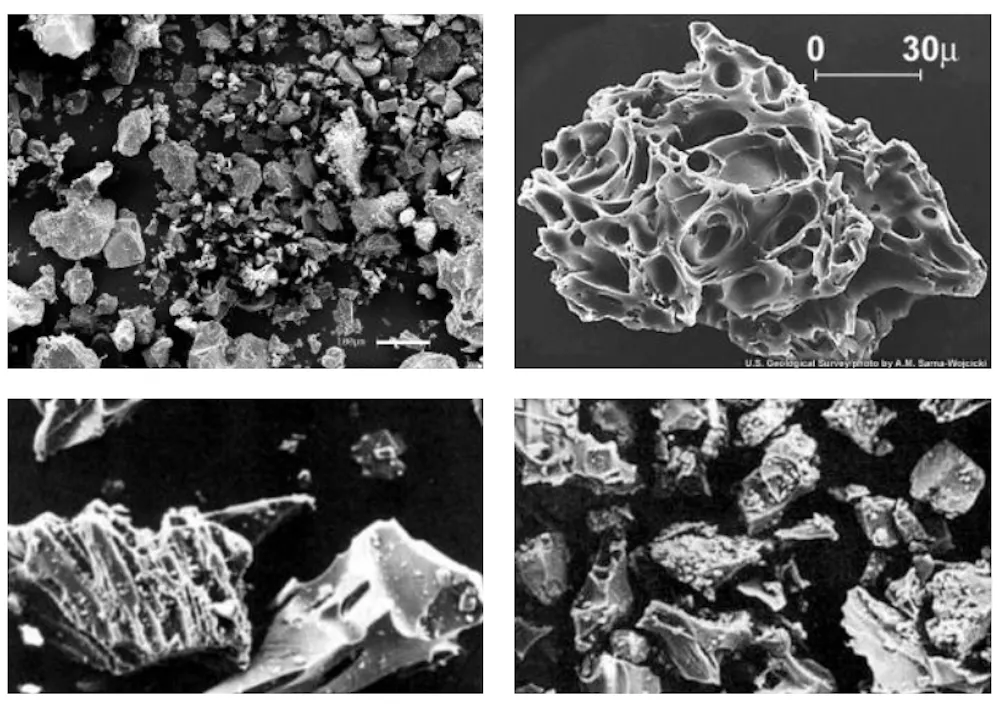
    Electron microscope images of ash show how sharp the shards are. The top left image of shards from Mount Etna in 2002 is 1 mm across. Top right is an ash particle from Mount St. Helens magnified 200 times. The shards in the lower images are less than 0.064 mm.
    Volcano Hazards Program, U.S. Geological Survey

    Ash can also contaminate surface water by introducing toxins and increasing the water’s acidity. The toxins can leach into groundwater, contaminating wells. Fine ash particles can also settle in waterways and smother aquatic plants and animals. During the 2008 Chaitén eruption in Chile, ash contamination led to widespread fish deaths in the Río Blanco.

    Ash can ground airplanes, gum up infrastructure

    Ash clouds are extremely dangerous to aircraft. The glassy ash particles melt when sucked into jet turbines, clog fuel systems and can stall engines in midair.

    In 1982, British Airways Flight 9 lost power in all four engines after flying through an ash cloud. A similar incident occurred in 1989 to KLM Flight 867 over Alaska. In 2010, Iceland’s Eyjafjallajökull eruption grounded more than 100,000 flights across Europe, disrupting travel for over 10 million passengers and costing the global economy billions of dollars.

    Volcanic ash can also wreak havoc on infrastructure by clogging water supplies, short-circuiting electrical systems and collapsing roofs under its weight. It can disrupt transportation, communication, rescue and power networks, as the 1991 eruption of Mount Pinatubo in the Philippines dramatically demonstrated.

    What to do during ashfall

    During an ashfall event, the most effective strategy to stay safe is to stay indoors as much as possible and avoid inhaling ash particles.

    Anyone who must go outside should wear a properly fitted N95 or P2 mask. Cloth masks provide little protection against fine ash. Rainwater tanks, troughs and open wells should be covered and monitored for contamination. Livestock should be moved to clean pastures or given uncontaminated fodder.

    The challenges Alaska is facing if Mount Spurr erupts.

    To reduce structural damage, ash should be cleared from roofs and gutters promptly, especially before rainfall.

    Older adults, children and people who are sick are at greatest risk, particularly those living in poorly ventilated homes. Rural communities that are dependent on agriculture and livestock are disproportionately affected by ashfall, as are low-income people who lack access to clean water, protective masks or safe shelter.

    Communities can stay informed about ash risks through official alerts, including those from the Volcanic Ash Advisory Centers, which monitor ash dispersion and issue timely warnings. The International Volcanic Health Hazard Network also offers guidelines on personal protection, emergency planning and ash cleanup.

    The long tail of ash

    Volcanic ash may fall quietly, but its effects are widespread, persistent and potentially deadly. It poses a chronic threat to health, agriculture, infrastructure and aquatic systems.

    Recognizing the risk is a crucial first step to protecting lives. Effective planning and public awareness can further help reduce the damage.

    David Kitchen does not work for, consult, own shares in or receive funding from any company or organization that would benefit from this article, and has disclosed no relevant affiliations beyond their academic appointment.

    ref. Volcanic ash is a silent killer, more so than lava: What Alaska needs to know with Mount Spurr likely to erupt – https://theconversation.com/volcanic-ash-is-a-silent-killer-more-so-than-lava-what-alaska-needs-to-know-with-mount-spurr-likely-to-erupt-254461

    MIL OSI – Global Reports

  • MIL-OSI Global: 25 years of Everglades restoration has improved drinking water for millions in Florida, but a new risk is rising

    Source: The Conversation – USA – By John Kominoski, Professor of Biological Sciences, Florida International University

    The Everglades has often been referred to as a vast river of grass. National Park Service/B.Call via Flickr

    Do you know where your drinking water comes from?

    In South Florida, drinking water comes from the Everglades, a vast landscape of wetlands that has long filtered the water relied on by millions of people.

    But as the Everglades has shrunk over the past century, the region’s water supply and water quality have become increasingly threatened, including by harmful algal blooms fueled by agriculture runoff. Now, the water supply faces another rising challenge: saltwater intrusion.

    Waterways cut through the Everglades.
    South Florida Water Management District/Flickr, CC BY-ND

    Protecting South Florida’s water hinges on restoring the Everglades. That’s why, 25 years ago, the federal government and universities launched the world’s largest ecosystem restoration effort ever attempted.

    I’m involved in this work as an ecosystem ecologist. The risks I see suggest continuing to restore the Everglades is more crucial today than ever.

    What happened to the Everglades?

    The Florida Everglades is a broad mosaic of fresh water, sawgrass marshes, cypress domes and tree islands, mangrove forests and seagrass meadows all connected by water.

    But it is half its original size. In the early 1900s, the U.S. Army Corps of Engineers began installing canals and levees to control flooding in the Everglades, which allowed people to build farms and communities along its edges. The Tamiami Trail became the first road across the Everglades in 1928. It connected Tampa to Miami, but the road and canals cut off or diverted some of the natural water flow in South Florida.

    Maps show how the Everglades changed over time. Source: USGS.

    Since then, Florida’s economy, agriculture and population have exploded – and with them has come a nutrient pollution problem in the Everglades.

    The major crop, sugarcane, is grown in a region south of Lake Okeechobee covering 1,100 square miles that’s known as the Everglades Agricultural Area. Nearly 80 tons of phosphorus fertilizer from federally subsidized farm fields runs off into the Everglades wetlands each year. And that has become a water quality concern. Drinking water with elevated nitrogen is linked to human health problems, and elevated phosphorus and associated algal blooms can cause microbes to accumulate toxins such as mercury.

    Healthy wetlands can filter out those nutrients and other pollutants, cleaning the water.

    Some of the ways the Everglades filters water contaminated with phosphorus.
    South Florida Water Management District

    Rain falling in the Everglades percolates through the porous limestone and recharges the Biscayne Aquifer, which supplies drinking water for 1 in 3 Floridians.

    But wetlands need time and space to function properly, and the damage from farm pollution has harmed that natural filtering system.

    By the 1990s, Everglades wetlands and the wildlife they support hit a critical stress level from elevated concentrations of phosphorus, a nutrient in fertilizer that washes off farm fields and fuels the growth of toxic algal blooms and invasive species that can choke out native plant populations.

    The changes led to seagrass die-offs and widespread invasion of sawgrass marshes by cattail and harmful algal blooms. Degraded wetlands can themselves become pollution sources that can contaminate surface water and groundwater quality by decreasing oxygen in the water, which can harm aquatic life, and releasing chemicals and nutrients as they decay.

    A vast restoration campaign

    Congress approved the Comprehensive Everglades Restoration Plan in 2000 to support reducing phosphorus concentrations by recreating large wetlands areas to remove excess nutrients and reestablishing more of the natural water depth to bolster native populations.

    That restoration effort is making progress in reconnecting wetlands to natural water flows by rehydrating large areas that were cut off. Phosphorus levels are lower in many wetlands that now remain hydrated longer, and in these wetlands fresh water is recharging the aquifer, helping sustain the drinking water supply.

    However, delays in critically important components of that work have left some wetlands in degraded conditions for longer than expected, especially in regions near and downstream of the Everglades Agricultural Area, where phosphorus concentrations remain stubbornly high.

    An algal bloom spreads in Florida’s Lake Okeechobee, at the heart of the Everglades.
    Nicholas Aumen/USGS

    South Florida continues to experience harmful algal blooms from phosphorus reaching rivers and the coast, resulting in fish kills and the deaths of manatees. Red tide can shut down fishing and keep beach-going tourists away, harming local economies. This pollution is estimated to have cost Florida’s economy US$2.7 billion in 2018.

    The unexpected risk: Saltwater

    An unforeseen threat has also started to creep into the Everglades: saltwater.

    As sea level rises, saltwater reaches further inland, both in rivers and underground through the porous limestone beneath South Florida. Saltwater intrusion also occurs when wells draw down aquifers to provide water for drinking or irrigation. That saltwater is causing parts of the Everglades marshes, often referred to as a river of grass, to collapse into open water.

    Saltwater intrusion into South Miami and how Everglades restoration can help. Source: Emily Northrop and Rachael Johnson, University of Miami.
    The red line shows how far saltwater had intruded into aquifers beneath Fort Lauderdale as of 2019.
    South Florida Water Management District

    The loss of these freshwater marshes reduces the capacity of the Everglades to remove phosphorus from the water. And that means more nutrients flowing downstream, contaminating aquifers and causing harmful algal blooms to form in coastal waters.

    Scientists have learned that marsh plants need freshwater pulses during the wet season, from April to November, to avoid saltwater intrusion.

    For example, saltwater intruded about one mile inland between 2009 and 2019 in parts of the Fort Lauderdale area. More fresh water is needed to push the saltwater back out to sea.

    However, the restoration effort was never intended to combat saltwater intrusion.

    Reasons for optimism

    Despite the continuing challenges, I am optimistic because of how scientists, policymakers and communities are working together to protect the Everglades and drinking water.

    I lead part of that restoration work through the Florida Coastal Everglades Long Term Ecological Research program. The effort started at Florida International University on May 1, 2000, the same year the Everglades restoration plan was authorized by Congress.

    Our research was used to set the levels of nutrients allowable to still protect the region’s water supplies, and we have been working for 25 years to reduce saltwater intrusion and phosphorus pollution to ensure drinking water for South Florida remains both fresh and clean. We continually use our research to inform water managers and policymakers of the best practices to reduce saltwater intrusion and pollution.

    A roseate spoonbill hunts for dinner in Everglades National Park.
    National Park Service, R. Cammauf, via Flickr

    As saltwater intrusion continues to threaten South Florida’s freshwater aquifer, Everglades restoration and protection will be increasingly important.

    Everyone in the region can help.

    By rehabilitating degraded wetlands, allowing for more fresh water to flow throughout the Everglades ecosystems, reducing the use of fresh water on lawns and crops, and reusing municipal water for outdoor needs, South Florida can keep its drinking water safe for generations of future residents and visitors. This is something that everyone can contribute to.

    Mangroves along Turner River in the Everglades.
    Chauncey Davis/Flickr, CC BY

    Marjory Stoneman Douglas, Miami’s renowned conservationist who helped establish the Everglades National Park, often said, “The Everglades is a test. If we pass it, we may get to keep the planet.”

    John Kominoski works for Florida International University. He receives funding from federal agencies, such as the National Park Service and the National Science Foundation.

    ref. 25 years of Everglades restoration has improved drinking water for millions in Florida, but a new risk is rising – https://theconversation.com/25-years-of-everglades-restoration-has-improved-drinking-water-for-millions-in-florida-but-a-new-risk-is-rising-253167

    MIL OSI – Global Reports

  • MIL-OSI Global: Preventive care may no longer be free in 2026 because of HIV stigma − unless the Trump administration successfully defends the ACA

    Source: The Conversation – USA – By Kristefer Stojanovski, Assistant Professor of Social, Behavioral and Population Sciences, Tulane University

    Americans may lose free coverage for cancer and blood pressure screenings, HIV prevention medication and other essential services. Halfpoint Images/Moment via Getty Images

    Many Americans were relieved when the Supreme Court left the Affordable Care Act in place following the law’s third major legal challenge in June 2021. This decision permitted widely supported policies to continue, such as ensuring health coverage regardless of preexisting conditions, allowing coverage for dependents up to age 26 on their parents’ plan, and removing annual and lifetime benefit limits.

    But millions are still at risk of losing access to lifesaving medicine and preventive services, following the Supreme Court’s decision to hear another case – Robert F. Kennedy, Jr. v. Braidwood – that has been working its way through lower courts for several years.

    Interestingly, the Trump administration has chosen to build upon the same argument the Biden administration used to defend the law.

    HIV stigma and preventive care

    The case the Supreme Court is scheduled to hear in April 2025 was filed by Braidwood Management, a Christian for-profit corporation owned by Steven Hotze, a Texas physician and Republican activist who has previously filed multiple lawsuits against the Affordable Care Act.

    Braidwood and its co-plaintiffs, a group of conservative Christian employers, objected to providing their 70 employees free access to preexposure prophylaxis, or PrEP, a medicine that prevents HIV infection. Hotze claimed that PrEP “facilitates and encourages homosexual behavior, intravenous drug use and sexual activity outside of marriage between one man and one woman,” without citing scientific evidence to support this. He and his plaintiffs argue that religious beliefs prevent them from providing PrEP under their insurance plans.

    The AIDS epidemic has been claiming lives for decades.

    Since the HIV/AIDS epidemic began in the 1980s, the disease has been politicized and stigmatized. Because it had predominantly affected men who had sex with men, AIDS was initially called gay-related immune deficiency, making people reluctant to be associated with the disease. It was only after a teenage boy from Indiana named Ryan White contracted HIV from a blood transfusion to treat his hemophilia, along with public statements from high-profile celebrities such as Arthur Ashe and Magic Johnson about their HIV status, that social attitudes began to shift with more education about AIDS.

    Yet, the same stigma is still at play in the Braidwood case and other recent policy decisions. In 2023, for example, Tennessee officials declined US$9 million in federal funding for HIV prevention. Those federal funds focused on groups most affected by HIV, including men who have sex with men, heterosexual Black women and people who inject drugs.

    Tennessee has since transitioned to using state dollars for HIV prevention, with a focus on first responders, pregnant women and sex trafficking survivors, groups that aren’t major at-risk populations. Researchers have found that this pivot will be a less efficient use of funds, costing $1 million per life-year saved versus $68,600 when focusing on the most at-risk populations.

    Preventive care and the Affordable Care Act

    The ongoing stigma and politicization of HIV/AIDS may not only hamper the national goal of ending the HIV epidemic but also lead to less or no preventive care for many people.

    Section 2713 of the Affordable Care Act requires insurers to offer full coverage of preventive services endorsed by one of three federal groups: the U.S. Preventive Services Task Force, the Advisory Committee on Immunization Practices or the Health Resources and Services Administration. For example, the CARES Act, which allocated emergency funding in response to the COVID-19 pandemic, used this provision to ensure COVID-19 vaccines would be free for many Americans.

    For a preventive service to be covered by this provision, it requires an A or B rating from the Preventive Services Task Force, an independent body of experts trained in research methods, statistics and medicine that evaluates the rigor and quality of available scientific evidence, with support from the Agency for Healthcare Research and Quality. Vaccinations require a recommendation from the Advisory Committee on Immunization Practices of the Centers for Disease Control and Prevention, while women’s health services require approval from the Health Resources and Services Administration.

    PrEP received an A rating in June 2019, given its near 100% effectiveness. This paved the way for it to be covered at no cost for millions of people.

    PrEP is a key tool to helping the U.S. reach its goal of substantially reducing new HIV infections by 2030.
    AP Photo/Pablo Martinez Monsivais

    Over 150 million Americans with private health insurance are able to benefit from free preventive care through the Affordable Care Act, with around 60% using at least one free preventive service each year.

    The consequences of losing these benefits would likely be an increase in the number of people getting and dying from preventable diseases. Raising the cost barrier for PrEP, for example, would disproportionately harm younger patients, people of color and those with lower incomes. It will also increase the cost of HIV prevention.

    As public health researchers who study sexual health and health insurance, we believe that prevention and health equity in the U.S. stand to take a big step backward, depending on the outcome of the Braidwood case.

    Future of preventive care lies with Supreme Court

    The most recent ruling in Braidwood – made by a lower court in 2023 – focuses on the appointments clause of the U.S. Constitution, which specifies that certain governmental positions require presidential appointment and Senate confirmation, while other positions have a lower bar.

    District Judge Reed O’Connor ruled that because the Preventive Services Task Force is an independent volunteer panel and not made up of officers of the U.S. government, it does not have appropriate authority to make decisions about what preventive care should be free, unlike the Advisory Committee on Immunization Practices or Health Resources and Services Administration. O’Connor also ruled that being forced to cover PrEP violated the religious freedom of the plaintiffs.

    O’Connor invalidated all of the task force’s recommendations since the Affordable Care Act was passed in March 2010, returning the power to insurers and employers to decide which, if any, preventive care would remain free to their patients. A few of the recommendations affected by his ruling besides PrEP include blood pressure, diabetes, lung and skin cancer screenings, along with medications to lower cholesterol and reduce breast cancer risk.

    The Trump administration filed a brief continuing the argument from the Biden administration that because the Preventive Services Task Force is overseen by the secretary of Health and Human Services, there is appropriate oversight of the task force and its decision-making by a Senate-confirmed officer. Oral arguments in the case are scheduled for April 21, 2025.

    The Affordable Care Act has faced many legal challenges over the years.
    AP Photo/Alex Brandon

    Insurance contracts are typically defined by calendar year, so if the Supreme Court rules against the government, people would likely see changes starting in 2026. Importantly, these services will likely still need to be covered by health insurance plans as essential health benefits through a separate provision of the ACA − they just won’t be free anymore.

    There were concerns that the Supreme Court could take the ruling even further, endangering the free coverage of contraception and other preventive care that wasn’t covered by the lower court ruling. The Trump administration’s support for the case may make this less likely by leaning into the authority of Robert F. Kennedy Jr. as secretary to support or override recommendations made by the Preventive Services Task Force and the other bodies.

    However, this could also mean the secretary of HHS can more directly control the task force’s recommendations, potentially determining whether PrEP, contraception and other services are available at no cost to patients. Building more political authority into the process − as well as partisan differences in support for LGBTQ+ health − belies the original intent of having nonpartisan medical experts make decisions about preventive care coverage. Legal experts we have spoken to caution that this approach may be more about preserving powers for the executive branch rather than actually protecting preventive care.

    All of this is happening in the context of massive layoffs at HHS. The Agency for Healthcare Research and Quality, which supports the Preventive Services Task Force, was not spared from the recent cuts. It is unclear how all of this will affect the task force’s ability to continue its work, separate from the outcome of Braidwood.

    One way or another, the end to this yearslong case is nearing, with important implications for America’s ability to reach its goals in fighting cancer, diabetes and the HIV epidemic.

    Portions of this article originally appeared in previous articles published on Sept. 7, 2021, Dec. 1, 2021, Sept. 13, 2022, and April 7, 2023.

    Paul Shafer receives research funding from the National Institutes of Health, Agency for Healthcare Research and Quality, and Department of Veterans Affairs. The views expressed in this article are those of the authors and do not necessarily reflect the position or policy of these agencies or the United States government.

    Kristefer Stojanovski does not work for, consult, own shares in or receive funding from any company or organization that would benefit from this article, and has disclosed no relevant affiliations beyond their academic appointment.

    ref. Preventive care may no longer be free in 2026 because of HIV stigma − unless the Trump administration successfully defends the ACA – https://theconversation.com/preventive-care-may-no-longer-be-free-in-2026-because-of-hiv-stigma-unless-the-trump-administration-successfully-defends-the-aca-250011

    MIL OSI – Global Reports

  • MIL-OSI Global: How bird flu differs from seasonal flu − an infectious disease researcher explains

    Source: The Conversation – USA – By Hanna D. Paton, PhD Candidate in Immunology, University of Iowa

    There is currently no bird flu vaccine for people. Digicomphoto/ Science Photo Library via Getty Images

    The flu sickens millions of people in the U.S. every year, and the past year has been particularly tough. Although infections are trending downward, the Centers for Disease Control and Prevention has called the winter of 2024-2025 a “high severity” season with the highest hospitalization rate in 15 years.

    Since early 2024, a different kind of flu called bird flu, formally known as avian influenza, has been spreading in birds as well as in cattle. The current bird flu outbreak has infected 70 Americans and caused two deaths as of April 8, 2025. Public health and infectious disease experts say the risk to people is currently low, but they have expressed concern that this strain of the bird flu virus may mutate to spread between people.

    As a doctoral candidate in immunology, I study how pathogens that make us sick interact with our immune system. The viruses that cause seasonal flu and bird flu are distinct but still closely related. Understanding their similarities and differences can help people protect themselves and their loved ones.

    What is influenza?

    The flu has long been a threat to public health. The first recorded influenza pandemic occurred in 1518, but references to illnesses possibly caused by influenza stretch back as as early as 412 B.C., to a treatise called Of the Epidemics by the Greek physician Hippocrates.

    Today, the World Health Organization estimates that the flu infects 1 billion people every year. Of these, 3 million to 5 million infections cause severe illness, and hundreds of thousands are fatal.

    Influenza is part of a large family of viruses called orthomyxoviruses. This family contains several subtypes of influenza, referred to as A, B, C and D, which differ in their genetic makeup and in the types of infections they cause. Influenza A and B pose the largest threat to humans and can cause severe disease. Influenza C causes mild disease, and influenza D is not known to infect people. Since the turn of the 20th century, influenza A has caused four pandemics. Influenza B has never caused a pandemic.

    A notice from Oct. 18, 1918, during the Spanish flu pandemic, about protecting yourself from infection.
    Illustrated Current News/National Library of Medicine, CC BY

    An influenza A strain called H1N1 caused the famous 1918 Spanish flu pandemic, which killed about 50 million people worldwide. A related H1N1 virus was responsible for the most recent influenza A pandemic in 2009, commonly referred to as the swine flu pandemic. In that case, scientists believe multiple different types of influenza A virus mixed their genetic information to produce a new and especially virulent strain of the virus that infected more than 60 million people in the U.S. from April 12, 2009, to April 10, 2010, and caused huge losses to the agriculture and travel industries.

    Both swine and avian influenza are strains of influenza A. Just as swine flu strains tend to infect pigs, avian flu strains tend to infect birds. But the potential for influenza A viruses that typically infect animals to cause pandemics in humans like the swine flu pandemic is why experts are concerned about the current avian influenza outbreak.

    Seasonal flu versus bird flu

    Different strains of influenza A and influenza B emerge each year from about October to May as seasonal flu. The CDC collects and analyzes data from public health and clinical labs to determine which strains are circulating through the population and in what proportions. For example, recent data shows that H1N1 and H3N2, both influenza A viruses, were responsible for the vast majority of cases this season. Standard tests for influenza generally determine whether illness is caused by an A or B strain, but not which strain specifically.

    Officials at the Food and Drug Administration use this information to make strain recommendations for the following season’s influenza vaccine. Although the meeting at which FDA advisers were to decide the makeup of the 2026 flu vaccine was unexpectedly canceled in late February, the FDA still released its strain recommendations to manufacturers.

    The recommendations do not include H5N1, the influenza A strain that causes avian flu. The number of strains that can be added into seasonal influenza vaccines is limited. Because cases of people infected with H5N1 are minimal, population-level vaccination is not currently necessary. As such, seasonal flu vaccines are not designed to protect against avian influenza. No commercially available human vaccines currently exist for avian influenza viruses.

    How do people get bird flu?

    Although H5N1 mainly infects birds, it occasionally infects people, too. Human cases, first reported in 1997 in Hong Kong, have primarily occurred in poultry farm workers or others who have interacted closely with infected birds.

    Initially identified in China in 1996, the first major outbreak of H5 family avian flu occurred in North America in 2014-2015. This 2014 outbreak was caused by the H5N8 strain, a close relative of H5N1. The first H5N1 outbreak in North America began in 2021 when infected birds carried the virus across the ocean. It then ripped through poultry farms across the continent.

    The H5N1 strain of influenza A generally infects birds but has infected people, too.
    NIAID and CDC/flickr, CC BY

    In March 2024, epidemiologists identified H5N1 infections in cows on dairy farms. This is the first time that bird flu was reported to infect cows. Then, on April 1, 2024, health officials in Texas reported the first case of a person catching bird flu from infected cattle. This was the first time transmission of bird flu between mammals was documented.

    As of March 21, 2025, there have been 988 human cases of H5N1 worldwide since 1997, about half of which resulted in death. The current outbreak in the U.S. accounts for 70 of those infections and one death. Importantly, there have been no reports of H5N1 spreading directly from one person to another.

    Since avian flu is an influenza A strain, it would show up as positive on a standard rapid flu test. However, there is no evidence so far that avian flu is significantly contributing to current influenza cases. Specific testing is required to confirm that a person has avian flu. This testing is not done unless there is reason to believe the person was exposed to sick birds or other sources of infection.

    How might avian flu become more dangerous?

    As viruses replicate within the cells of their host, their genetic information can get copied incorrectly. Some of these genetic mutations cause no immediate differences, while others alter some key viral characteristics.

    Influenza viruses mutate in a special way called reassortment, which occurs when multiple strains infect the same cell and trade pieces of their genome with one another, potentially creating new, unique strains. This process prolongs the time the virus can inhabit a host before an infection is cleared. Even a slight change in a strain of influenza can result in the immune system’s inability to recognize the virus. As a result, this process forces our immune systems to build new defenses instead of using immunity from previous infections.

    Reassortment can also change how harmful strains are to their host and can even enable a strain to infect a different species of host. For example, strains that typically infect pigs or birds may acquire the ability to infect people. Influenza A can infect many different types of animals, including cattle, birds, pigs and horses. This means there are many strains that can intermingle to create novel strains that people’s immune systems have not encountered before – and are therefore not primed to fight.

    It is possible for this type of transformation to also occur in H5N1. The CDC monitors which strains of flu are circulating in order prepare for that possibility. Additionally, the U.S. Department of Agriculture has a surveillance system for monitoring potential threats for spillover from birds and other animals, although this capacity may be at risk due to staff cuts in the department.

    These systems are critical to ensure that public health officials have the most up-to-date information on the threat that H5N1 poses to public health and can take action as early as possible when a threat is evident.

    Hanna D. Paton does not work for, consult, own shares in or receive funding from any company or organization that would benefit from this article, and has disclosed no relevant affiliations beyond their academic appointment.

    ref. How bird flu differs from seasonal flu − an infectious disease researcher explains – https://theconversation.com/how-bird-flu-differs-from-seasonal-flu-an-infectious-disease-researcher-explains-248407

    MIL OSI – Global Reports

  • MIL-OSI Global: A need for chaos powers some Americans’ support for Elon Musk taking a chainsaw to the US government

    Source: The Conversation – USA – By Dannagal G. Young, Professor of Communication and Political Science, University of Delaware

    There’s a sizable group of Americans who agree with the phrase ‘I think society should be burned to the ground.’ Anton Petrus-Moment/Getty Images

    A video of a Las Vegas Tesla dealership that had been set on fire by anti-Elon Musk protesters was posted on March 18, 2025, by an account on X called EndWokeness.

    The next day Musk replied to the post, “Some people just want to watch the world burn,” an iconic line from the 2008 Batman film “The Dark Knight.” Alfred, the Wayne family’s faithful butler, says the line to Bruce Wayne – Batman – to describe the motivations behind the Joker’s chaotic acts of violence.

    Musk – and Alfred – was right. Some people do, in fact, say they think that society should be burned to the ground. It’s part of a psychological measure political psychologists created called “need for chaos.”

    New data from the Center for Political Communication at the University of Delaware suggests that those people – the ones who want society to burn – are the ones with more, not less, trust in Musk. They also report more trust in the Department of Government Efficiency, the government entity Musk advises, which the Trump administration claims it created to cut government waste and fraud.

    Yet, critics point out that Musk and DOGE’s seemingly indiscriminate approach to spending cuts risks damaging the infrastructure necessary for American innovation.

    This desire to watch the world burn doesn’t come out of nowhere.

    Fear of losing status

    Somewhat like the Joker, whose perpetual sense of victimhood – “You wanna know how I got these scars?” – drove his need for chaos and destruction, people can develop a need for chaos in response to a sense that they are losing.

    When political psychologists introduced this concept of “need for chaos” in 2021, they described it not as a psychological trait, but as a character adaptation that occurs when some people experience a cultural and political situation that makes them feel like they are losing status and power. For some people, this feeling triggers a desire to “burn it all down” – “it” being society, institutions, the world – maybe to rebuild it all anew, or maybe just to see it all destroyed.

    Only a small percentage of the U.S. population – less than 15% – tends to score high in need for chaos. But even so, understanding this minority is important to gaining insight into this political moment.

    For example, people who score high in need for chaos exhibit greater support for political violence and a willingness to knowingly share hostile and false information online. And in our data, those higher in need for chaos report holding more trust in Musk, DOGE and Trump than people who score lower in the need for chaos measure.

    Who wants to burn it down

    We are political psychologists who study the link between psychological traits and political beliefs. Last month, the University of Delaware’s Center for Political Communication ran a national survey that we designed to understand where the public stands on various political issues and how those beliefs relate to psychological traits, including need for chaos.

    In our national study of 1,600 Americans conducted between Feb. 27-March 5, 2025, by YouGov, we asked respondents how much they agreed or disagreed with the following statements:

    • “I fantasize about a natural disaster wiping out most of humanity such that a small group of people can start all over”

    • “I think society should be burned to the ground”

    • “We cannot fix the problems in our social institutions; we need to tear them down and start over”

    • “I need chaos around me – it is too boring if nothing is going on”

    Similar to prior work by author Kevin Arceneaux and his colleagues, our data shows that a very small number – fewer than 20% of the sample – agrees strongly or agrees somewhat with each item.

    However, looking at need for chaos among groups of varying ages, education levels and media habits, we find the highest need for chaos scores among people under age 40, those with less education, and those who pay the least attention to politics.

    Burning it down through government policy

    Our new data also shows that while people highest in need for chaos report having more trust in Musk, DOGE, and President Trump, these chaos-seeking folks report having less trust in “people in general,” journalists or the federal government. These findings hold even when statistically accounting for other factors, among them party, race, gender, education and ideology.

    Musk’s penchant for wielding chainsaws as a symbol of DOGE’s work provides some insight into why chaos seekers may like what they see in Musk.

    It’s not clear exactly what Musk’s aim is with his work at DOGE, as he eliminates the jobs of hundreds of thousands of government workers.

    What is clear, however, is that by many accounts, the mass firings and the gutting of agencies, like the U.S. Agency for International Development and the Institute for Peace, are sowing chaos. And a significant portion of Americans want just that.

    Dannagal G. Young receives funding from the Center for Political Communication Research Fund at the University of Delaware

    Kevin Arceneaux does not work for, consult, own shares in or receive funding from any company or organization that would benefit from this article, and has disclosed no relevant affiliations beyond their academic appointment.

    ref. A need for chaos powers some Americans’ support for Elon Musk taking a chainsaw to the US government – https://theconversation.com/a-need-for-chaos-powers-some-americans-support-for-elon-musk-taking-a-chainsaw-to-the-us-government-253420

    MIL OSI – Global Reports

  • MIL-OSI Russia: Sobyanin told how social coordinators help hospital patients

    Translartion. Region: Russians Fedetion –

    Source: Moscow Government – Government of Moscow –

    Contact relatives, help restore documents and accompany them when they are discharged: over 3.5 years, social coordinators and psychologists have helped 150 thousand city residents. Sergei Sobyanin reported this in on your telegram channel.

    “Right now, all hospitals in the city are working

    social coordinators. Since the project was launched, they have resolved 350,000 non-medical issues. Almost a third concerns psychological support. Specialists help cope with anxiety, tune in to treatment, restore strength and motivation. Social coordinators do the most important work: they surround patients with care, help maintain emotional balance and confidence, which are so necessary on the path to recovery,” the Mayor of Moscow wrote.

    Source: Sergei Sobyanin’s Telegram channel @Mos_Sobyanin 

    Since 2022, all adult and children’s city clinics have been providing the necessary social assistance. You don’t need to write any applications for this – just contact one of the 120 social coordinators and 40 psychologists working in Moscow hospitals.

    The specialist will clarify the patient’s needs, study their life circumstances, develop an individual assistance route and offer solutions in the event of a crisis. It is social coordinators who now contact relatives if the patient cannot call themselves, and deal with more complex cases, such as assistance in restoring lost documents.

    The most important task of the coordinators is to take care of the solution of the patient’s social problems that arise after discharge from the hospital in advance. At the same time, if a person is urgently taken to the hospital, but does not need hospitalization, social support will be provided to him if necessary.

    Thanks to social coordinators, the non-core workload of doctors and mid-level medical personnel is significantly reduced. They can devote more time and attention to their main functions – treating patients.

    Moscow’s advanced experience is also being used in other Russian cities, such as Lipetsk and Khabarovsk. Tyumen Oblast plans to join the project in the near future.

    Psychological help

    Almost a third of non-medical services provided to patients in Moscow hospitals are psychological consultations (more than 100 thousand in 3.5 years). Specialists help patients cope with emotions and experiences, prepare for treatment and mobilize additional resources for recovery.

    For those who have encountered an oncological disease, the staff of the Moscow Oncopsychologist Service, formed in 2023, conduct consultations and organize support groups. In such cases, it is important to carry out treatment as quickly as possible. However, fears, uncertainty and doubts often prevent making the right decision. It is difficult for a patient to share his inner experiences with loved ones because he protects their feelings – and then oncopsychologists come to the rescue. Today, 17 specialized specialists work in Moscow outpatient oncology care centers.

    Psychologists support patients and their loved ones at all stages of treatment. You can seek an in-person consultation without an appointment. In addition, a remote format is available – a special platform for online consultations via video link “Psychology for Life”. Since the start of the project, oncopsychologists have conducted over 18 thousand offline and online consultations.

    For cancer patients and their loved ones, there is a support group called “Equal to Equal”, where, during a confidential conversation, you can discuss your fears and worries not only with an oncopsychologist, but also with people who have already gone through a similar path and overcome the disease. At the end of 2024, the group also launched an online format. During the project’s implementation, 330 groups were organized, which were joined by more than 1.2 thousand people.

    At the end of February 2025, the EMIAS.INFO mobile application introduced the ability to leave a request for psychological assistance by phone. Oncopsychologists contact the patient, provide support and, if necessary, refer them to an in-person or remote appointment or enroll them in a support group. Over 420 requests were received in March.

    “Sometimes after discharge, a person may need special care. For Muscovites who independently care for their loved ones, there is a free project called “School of Relative Care”. The school’s specialists not only teach professional skills, but also provide further support at home,” Sergei Sobyanin said in

    on your telegram channel.

    Source: Sergei Sobyanin’s Telegram channel @Mos_Sobyanin 

    Accompanying patients over 65 years of age

    In November last year, a new service was launched in Moscow — support for patients over 65 years old when they are discharged from hospital. Social coordinators help them collect their personal belongings, contact relatives or a social worker if necessary, and call a taxi.

    If a person is alone and has no one to take care of him, specialists help arrange social services at home. Already in the hospital, coordinators hand over needy patients to Moscow social workers, who from that moment on begin to care for their health and well-being. This seamless approach makes the process of discharging patients over 65 from the hospital as comfortable and safe as possible. More than 37 thousand senior Muscovites have already used the new service.

    How do social coordinators work?

    An 88-year-old Muscovite was admitted to the I.V. Davydovsky City Clinical Hospital No. 23 after losing consciousness in a grocery store. She was taken by ambulance and was very nervous when she arrived at the hospital. In a conversation with the social coordinator, the elderly woman shared that she lives alone and has no relatives, so she is worried about how she will be discharged and how she will carry heavy bags of groceries.

    With the patient’s consent, while she was undergoing treatment in the hospital, specialists helped with the arrangement of social services at home. After recovery, the woman was not only accompanied when she was discharged, but also informed the social worker in advance when she needed to be met and taken home. Thanks to the social coordinators, the elderly Muscovite has an assistant who now takes care of her and helps with her everyday life.

    Peace of mind for patients is not only the absence of stress, but also good emotions during inpatient treatment. Social coordinators provide care to patients every day. For example, during her stay at the Moscow Multidisciplinary Clinical Center “Kommunarka”, one of the patients turned 95 years old. Her condition did not allow her to receive visitors, so the specialists decided to improvise – they organized a video call with relatives. The birthday girl was congratulated by her entire family, the woman did not hide her joy, and her health improved significantly as a result.

    Please note: This information is raw content directly from the source of the information. It is exactly what the source states and does not reflect the position of MIL-OSI or its clients.

    Please Note; This Information is Raw Content Directly from the Information Source. It is access to What the Source Is Stating and Does Not Reflect

    HTTPS: //vv.mos.ru/mayor/tkhemes/12621050/

    MIL OSI Russia News

  • MIL-OSI Asia-Pac: Nat’l security education promoted

    Source: Hong Kong Information Services

    The Security Bureau (SB) and its disciplined services and auxiliary services held a flag-raising ceremony, a national security knowledge challenge and other activities to mark the 10th National Security Education Day today.

    The SB and its disciplined services jointly held a flag-raising ceremony at the Police College this morning.

    Officiating at the ceremony, Chief Secretary Chan Kwok-ki said that the flag-raising ceremony instils passion and loyalty towards the country and the people as well as deepens the understanding of the responsibility and mission to safeguard national security.

    He noted that the Hong Kong Special Administrative Region Government will continue to leverage the strengths of the National Security Law and the Safeguarding National Security Ordinance to build a strong line of defence to maintain security and stability in the Hong Kong SAR, and to provide solid institutional safeguards to promote good governance.

    Mr Chan then officiated at the Safeguarding National Security Cup awards presentation ceremony to commend the contestants of the SB, disciplined services and auxiliary services for holding sports competitions, which showcased their vitality and unity to inject impetus to the promotion of safeguarding national security.

    In the afternoon, the Department of Justice, the SB, the Education Bureau and the Hong Kong Shine Tak Foundation jointly organised the finals and award presentation ceremony of the Territory-wide Inter-school National Security Knowledge Challenge 2024/25.

    The events were held at a shopping mall for the first time to allow more students, teachers, parents and members of the public to participate. This year, an English section was also set up for the first time for non-Chinese speaking secondary school students.

    The challenge attracted more than 126,000 students from 610 primary and secondary schools, an increase of over 20% in the number of participants compared to last year.

    Chief Executive John Lee said in a video speech that June 30 marks the fifth anniversary of the promulgation and implementation of the National Security Law in the Hong Kong SAR.

    He stated that the Government will hold a series of activities to deepen public understanding of the pivotal role the legal framework plays in safeguarding national security as Hong Kong’s anchor of stability over the coming months.

    Mr Lee emphasised that safeguarding national security is a constitutional duty of the Hong Kong SAR and a shared obligation of every Hong Kong citizen. He encouraged students to become guardians of national security by integrating the knowledge they gained about national security through the competitions into their daily lives and sharing it with their family and friends.

    Also officiating at the ceremony, Secretary for Justice Paul Lam supplemented that he was delighted at the enthusiastic response to the competitions and encouraged young people to continue embracing safeguarding national security as their personal responsibility and to integrate into the country’s development.

    The highlights of the finals and the award presentation ceremony will be broadcast at 10.30 tonight and April 20 on HOY Infotainment.

    Secretary for Security Tang Ping-keung and Secretary for Education Choi Yuk-lin meanwhile, jointly officiated at the launch ceremony of the new national security comic book Andy & Security Bear.

    Produced by SB members, the comic series was published online as part of the National Security Law virtual exhibition from July last year and was well received for its charming characters and engaging storylines.

    The SB brought the online stories to print and has distributed the first batch to over 2,000 schools and public libraries in Hong Kong by the end of March.

    At the ceremony, Mr Tang and Ms Choi presented the comic books to the principal representatives of secondary schools, primary schools and kindergartens.

    To mark National Security Education Day, the disciplined services and auxiliary forces under the SB will hold open days on various weekends and public holidays this month.

    MIL OSI Asia Pacific News

  • MIL-OSI Europe: AMERICA/PARAGUAY – Appointment of vicar apostolic of Pilcomayo

    Source: Agenzia Fides – MIL OSI

    Tuesday, 15 April 2025

    Vatican City (Agenzia Fides) – The Holy Father has appointed the Reverend Fr. Miguel Fritz, O.M.I., until now apostolic administrator of Pilcomayo, Paraguay, as vicar apostolic of the same apostolic vicariate.The Reverend Fr. Miguel Fritz, O.M.I., was born on 10 May 1955 in Hannover, Germany. He obtained a diploma in theology from the Gutenberg University of Mainz and a licentiate in anthropology from the Universidad Politécnica Salesiana of Quito.He gave his perpetual vows in 1980 and was ordained a priest on 28 May 1981.He has held the following offices: deputy parish priest in Gelsenkirchen, Germany (1981-1984), deputy parish priest in Colonia Independencia, diocese of Villarrica del Espíritu Santo (1985-1987), service in the O.M.I. House of Formation in Lambaré, Asunción (1987-1988), deputy parish priest of Santa María, in the apostolic vicariate of Pilcomayo (1988-1994), vicar general of Pilcomayo and parish priest of Santa María (1995-2006), superior of the O.M.I. in the province of Paraguay (2007-2010), member of the O.M.I. General Council at the General House in Rome (2010-2016), and vicar general of Pilcomayo and parish priest of San Leonardo (2016-2022).Since 2022, he has served as apostolic administrator sede vacante et ad nutum Sanctae Sedis of the apostolic vicariate of Pilcomayo. (EG) (Agenzia Fides, 15/4/2025)
    Share:

    MIL OSI Europe News

  • MIL-OSI Russia: KRSU and Polytech: development through partnership

    Translartion. Region: Russians Fedetion –

    Source: Peter the Great St Petersburg Polytechnic University – Peter the Great St Petersburg Polytechnic University –

    An extended meeting dedicated to the development of the Kyrgyz-Russian Slavic University was held at the Polytechnic University, with the participation of representatives of the Administration of the President of the Russian Federation and the Ministry of Education and Science of Russia.

    The event was attended by the rector of SPbPU Andrey Rudskoy, the referent of the Office of the President of the Russian Federation Vadim Smirnov, the acting rector of KRSU Sergey Volkov, representatives of the Ministry of Science and Higher Education of Russia – the acting director of the Department of State Policy in Higher Education Elena Tumakova and the head of the department of the Department of International Cooperation Alexey Poyda, as well as the heads of key departments and institutes of the Polytechnic University involved in the implementation of projects to transform KRSU.

    Before the meeting, the participants summed up the results of the internship at SPbPU for the heads of KRSU educational programs. Kyrgyz colleagues presented projects for updating curricula in five areas.

    The meeting became a platform for summing up the interim results of cooperation and discussing plans for 2025. Since January of this year, SPbPU has been acting as the coordinator of development programs for all four Slavic universities. Particular attention is paid to KRSU, where the Polytechnic University helps to modernize engineering education, scientific activities and personnel potential. Over the course of a year of joint work, curricula have been revised, network programs and programs for improving the qualifications of teachers have been launched.

    The development of Russian-national (Slavic) universities is one of the priority projects of our country in the promotion of Russian education and culture. At present, we give special priority to working with the Kyrgyz-Russian Slavic University, since we, as one of the leading technical universities in Russia, are faced with the task of assisting KRSU in building all the basic processes related to the development of engineering areas. This is education, science, human capital, – emphasized the rector of SPbPU Andrey Rudskoy.

    Vice-Rector for International Activities Dmitry Arsenyev recalled that the active development of the project with KRSU began a year ago with the international forum in Bishkek, when SPbPU first began comprehensive expert work on the KRSU development program.

    Over the many years of work at the Polytechnic University, I cannot recall a larger-scale international project involving more than 200 key employees and specialists of the university, representing all leading institutes and basic divisions, noted Dmitry Arsenyev.

    Responsible SPbPU employees in the areas presented the main results of the past year – qualitative and quantitative results in key areas (educational activities, development of scientific potential, youth policy, distance technologies in education, interlibrary cooperation) and priority areas (construction, electronics and telecommunications, energy, ICT, lean manufacturing). The participants proposed specific plans for 2025 and identified the main problem areas.

    The ideas that we discussed just a year ago have proven to be correct, and this is encouraging. I would like to express my gratitude to the Polytechnic team. You have taken on the task as a team, each working in their own area. We believe that there will be results, commented Vadim Smirnov, aide to the Presidential Administration of the Russian Federation.

    The participants discussed the progress and development prospects of KRSU with the support of SPbPU, noted significant steps in joint work: modernization of educational programs, launch of network projects and strengthening of academic mobility. Vadim Smirnov emphasized the importance of a systematic approach to motivating KRSU employees and proposed integrating their participation in programs with the Polytechnic University into the incentive system.

    Participation in joint projects should become one of the key criteria for incentive payments. This will help strengthen engagement and demonstrate the value of interaction, said Vadim Smirnov.

    Acting Director of the Department of State Policy in Higher Education Elena Tumakova drew attention to the need for a comprehensive approach to motivating the teaching staff of KRSU, supporting the proposal to specifically encourage employees who are actively involved in projects with SPbPU.

    The participants discussed the low level of digital competencies of KRSU teachers, the lack of funding for scientific research and the difficulties with adapting Russian educational standards to the conditions of Kyrgyzstan. To solve them, proposals were made to strengthen internships, develop distance formats and more actively attract young specialists.

    Polytechnicians and KRSU management noted the task of renewing personnel as one of the main problems. Working with human potential, finding talents at KRSU is one of the primary tasks for the coming year. Acting Rector of KRSU Sergey Volkov emphasized that the key issue remains the transformation of KRSU into a leading national university. Enormous resources are being concentrated for this, including plans to build a modern campus in Bishkek, which will become a center for engineering, humanitarian and medical education.

    However, the best campus is nothing without highly qualified, motivated, talented staff and teachers. In the near future, KRSU will hold a competitive selection procedure. We expect to take a fresh look at our staff, taking into account the strategic long-term development goals of the university, – said Sergey Volkov.

    Andrey Rudskoy supported the initiative to strengthen work with human capital, instructed the Vice-Rector for Educational Activities Lyudmila Pankova and the Head of the Directorate for Human Resources Maria Pakhomova to actively engage in this issue and provide expert support to KRSU in the upcoming competitive selection procedure.

    Speaking about the organization of scientific activities, Vadim Smirnov suggested focusing on several priority scientific and applied projects. For example, on comprehensive cooperation with the Alliance Altyn enterprise, which was discussed during recent visit. The second reference point could be a project to conduct interdisciplinary research based on the High-Mountain Observatory of Atmospheric Physics of KRSU. The combination of fundamental and applied tasks will allow achieving practical results and at the same time paving the way for future projects and scientific development.

    “Even small but significant successes will become the basis for future growth. Appreciate the Polytechnic University’s resources; consultations with such high-level experts are invaluable,” emphasized Vadim Smirnov. “Let’s focus on practical projects and measurable results. We need to accumulate success stories, even if they can be counted on the fingers of one hand, but they will become the basis for growth. We need to work together, not instead of. The task of becoming a leading university is difficult, but achievable. We see from the example of the Polytechnic University and other Russian universities what fantastic leaps can be made in a few years if strategic goals, a management system, and personnel work are correctly built. Responsibility, measurable goals, and a link to the strategy of the Kyrgyz Republic are what will bring KRSU forward. Fewer formalities, more specifics. If students go on internships, let them come back with projects. If we implement programs, we calculate the percentage of extra-budgetary funds. These are steps to ensure that the university begins not just to function, but to develop.”

    Special thanks to colleagues for their support in developing curricula and solving complex issues, such as program accreditation or working with personnel. Special thanks for the digital library: this is a breakthrough for us. Yes, there are challenges: scholarship provision, personnel policy, alignment of standards. But we are working on this: we hold weekly meetings, prepare for the forum, build a new campus on 30 hectares near Bishkek, where there will be three key clusters – engineering, humanitarian and medical. And these are not just buildings, but an opportunity for a scientific breakthrough, – noted Sergey Volkov.

    Vadim Smirnov highlighted the most important components of joint work for the coming year: It is necessary to combine the fundamental documents into a single end-to-end concept – the strategy and development program of KRSU, the roadmap (work plan) for the coming years. It is necessary to synchronize current work plans with the long-term goals of KRSU, add specific tasks and performance indicators. All these documents should complement each other, define the main goals and ensure their implementation through the corresponding recorded resources and activities.

    Participants expressed confidence that the unification of the resources of SPbPU and KRSU, as well as the focus on practice-oriented tasks, will accelerate the development of the university.

    There is an urgent need to link the roadmap, strategy and development program, providing them with resources. Financial support for network programs, motivation of teachers through incentives rather than punishment, and work on the university brand are key elements of progress. A brand is not just a name, it is a tool that helps attract applicants and create competitive advantages, especially in the conditions of tough competition. The solutions must be non-trivial, but they will raise the level, make education high-quality, and the university significant, – Elena Tumakova supported her colleagues.

    The participants agreed to finalize the roadmap taking into account the strategic goals of KRSU and to hold regular working meetings. Andrey Rudskoy expressed confidence that joint efforts will allow bringing the Kyrgyz-Russian Slavic University to a new level, strengthening the position of Russian education in Central Asia: The effectiveness of cooperation with Kyrgyzstan should not be based on directive methods, but on demonstrating specific successes – in education, science, interaction with society and industry. Our task is to create an environment where Kyrgyz students and scientists see the prospects for the development of their country through synergy with Russian practices. KRSU can become a model platform where strategies are tested that can be scaled to other Slavic universities. However, the key condition is the balance between tactical steps and a long-term vision, where personnel, science and education work for the benefit of both countries, strengthening not only professional but also humanitarian ties.

    Please note: This information is raw content directly from the source of the information. It is exactly what the source states and does not reflect the position of MIL-OSI or its clients.

    MIL OSI Russia News

  • MIL-OSI: Duck Creek Technologies Appoints General Daniel Hokanson, USA, Ret. to Board of Directors

    Source: GlobeNewswire (MIL-OSI)

    BOSTON, April 15, 2025 (GLOBE NEWSWIRE) — Duck Creek Technologies, the global intelligent solutions provider defining the future of property and casualty (P&C) and general insurance, has announced the appointment of General Daniel Hokanson, USA, Ret. to the company’s board of directors. He brings deep expertise and experience in leading organizations through the development and implementation of detailed strategic policy to Duck Creek’s board.

    Hokanson is a retired 4-Star General who served as a member of the Joint Chiefs of Staff and the 29th Chief of the National Guard Bureau. In this role, he was a military advisor to the President, Secretary of Defense, and National Security Council. He also served as the Department of Defense’s channel of communications to the Governors and State Adjutants General.

    “Dan is an accomplished and decorated leader, and we are excited to have him join the Duck Creek Board of Directors,” said Michael Jackowski, Chief Executive Officer, Duck Creek Technologies. “As we continue to expand globally and help insurance companies tackle tough challenges resulting from climate change and increasingly complex regulatory environments, his unique skill set will be instrumental in guiding Duck Creek.”

    As Chief of the National Guard Bureau, Hokanson oversaw the Guard’s historic response to the COVID-19 pandemic, civil disturbances, and numerous natural disasters, while simultaneously meeting every global military operations requirement. He also led the National Guard and Department of Defense’s State Partnership Program, which includes over 100 member countries, regularly conducting senior government and military leader engagements worldwide.

    A graduate of the United States Military Academy at West Point with a degree in aerospace engineering, Hokanson also earned master’s degrees in international security and civil-military relations from the Naval Postgraduate School in Monterey, California, and national security and strategic studies from the Naval War College in Newport, Rhode Island. He also completed the Department of Defense year-long National Security Fellowship at Harvard University.

    “I am honored to join Duck Creek Technologies’ board of directors. The company’s dedication to innovation and excellence in the insurance industry strongly aligns with my values and experience,” said Hokanson. “I look forward to supporting Duck Creek’s mission to shape the future of property and casualty insurance while helping the industry navigate its evolving challenges.”

    Hokanson’s role was sourced through the external board program operated by Vista Equity Partners, a global technology investor that specializes in enterprise software and a majority investor in Duck Creek. Launched in 2017, the board program leverages Vista’s ecosystem and additional resources to identify, train, and appoint qualified board candidates for its portfolio companies. The program works to create a pipeline of highly talented board candidates through programs and partnerships that will drive results for the corporate world at large.

    About Duck Creek Technologies   
    Duck Creek Technologies is the global intelligent solutions provider defining the future of the property and casualty (P&C) and general insurance industry. We are the platform upon which modern insurance systems are built, enabling the industry to capitalize on the power of the cloud to run agile, intelligent, and evergreen operations. Authenticity, purpose, and transparency are core to Duck Creek, and we believe insurance should be there for individuals and businesses when, where, and how they need it most. Our market-leading solutions are available on a standalone basis or as a full suite, and all are available via Duck Creek OnDemand. Visit www.duckcreek.com to learn more. Follow Duck Creek on our social channels for the latest information – LinkedIn and X.

    Media Contacts:   
    Marianne Dempsey/Tara Stred   
    duckcreek@threeringsinc.com

    The MIL Network

  • MIL-OSI: EarthOptics Releases 2025 Predictive Ag Report, Helping Farmers Quantify Yield Risks and Optimize Planning

    Source: GlobeNewswire (MIL-OSI)

    MINNEAPOLIS, April 15, 2025 (GLOBE NEWSWIRE) — Farmers across the Midwest have a powerful, updated tool to help with crop planning this season. The third annual Predictive Ag Report, released today by EarthOptics, a leader in soil analysis and crop planning technologies.

    Free to download at EarthOptics.com, the 2025 Predictive Ag Report compiles thousands of data points from physical, chemical, and biological soil analyses to forecast key disease threats, nutrient deficiencies, and biofertility challenges expected in the upcoming corn, soybean, and cotton growing season.

    “Think of the Predictive Ag Report as a modern-day farmer’s almanac, but backed by hard data,” said Cam Norgate, co-founder and chief product officer at EarthOptics. “By using our proprietary database of in-season trials and analytics, we help farmers better understand the yield impact of disease pressure and nutrient interactions. Now they can take early action when deciding what seed varieties and traits to plant, how to protect that seed and its yield potential, and what to feed that plant in the soil for the greatest return on investment.”

    New for 2025

    • Expanded Yield Comparison Charts show how specific pathogens and nutrient levels are correlated with yield loss across thousands of acres.
    • Core Fertility Metrics include data on potassium and boron, highlighting a 50-plus bushel per acre yield difference in cornfields with boron deficiency.
    • Nutrient Insights highlight how underperforming soybean nitrogen fixation and potassium deficiency can cause significant soybean yield drag.
    • Biofertility & Phosphorus Solubilization: Many farmers have fields with phosphorus locked up and unavailable for their crops to use. New data reveals how microbes are breaking it free.
    • Pathogen Focus: Detailed analysis of fusarium, tar spot, rootworm, northern corn leaf blight (NCLB), and emerging threats like brown stem rot in soybeans.

    Key Findings from This Year’s Report

    One of the most surprising findings is the continued prevalence and impact of fusarium (Fusarium verticillioides), a soilborne disease many growers thought was under control. “Our trials show fields with high fusarium risk are losing up to 50 bushels per acre,” said Norgate. “This is especially true in eastern Iowa and southern Nebraska, where heavy corn-on-corn rotations are typical.”

    According to the report, corn rootworm pressure is expected to be heaviest in eastern Iowa, northeastern Illinois, southeastern Michigan, and Minnesota, affecting 52% of the sampled fields. Pressure is higher in southwest Minnesota and lower through Indiana than last year.

    Northern corn leaf blight (Exserohilum turcicum) has been found in 61% of the fields sampled and can devastate corn yields by up to 20 bushels per acre. The report notes the highest risk levels will be in central and west central Minnesota, along with southwest Michigan. With aggressive management, agronomists say farmers may be able to boost yields by 15 to 32 bushels per acre.

    Soybean cyst nematode pressure risk for 2025 appears similar to last year, with elevated pressure in central Illinois and Kansas.

    Case Studies Add Perspective

    The 2025 report includes case studies from farmers and agronomists who’ve seen significant results through targeted management:

    • Tom Stanton – Leigh, Neb. on reducing disease pressure with proactive in-furrow crop protection.
    • Jake Lamplot – Pender, Neb. on managing white mold in soybeans.

    “We not only report on risks,” said Norgate. “We show farmers what targeted management looks like in the field and how those practices can translate to bushels gained for the farmer.”

    Download the Report

    The 2025 Predictive Ag Report is available at no cost at EarthOptics.com. Farmers, agronomists and ag retailers can access regional risk profiles, nutrient and pathogen maps, and additional information to start planning smarter for the upcoming growing season.

    The MIL Network

  • MIL-OSI: CURRENC Group Inc. Appoints Wan Lung Eng as Chief Financial Officer

    Source: GlobeNewswire (MIL-OSI)

    SINGAPORE, April 15, 2025 (GLOBE NEWSWIRE) — CURRENC Group Inc. (Nasdaq: CURR) (“CURRENC” or the “Company”), a fintech pioneer empowering financial institutions worldwide with artificial intelligence (AI) solutions, today announced that Mr. Wan Lung Eng will join the Company as Chief Financial Officer, effective April 16, 2025.

    Mr. Eng’s diverse career spans over 20 years as a finance and accounting executive, investment banker, and private equity professional. He has served as CFO at VitalCheck Wellness, Teclison, and Spectral MD, and as SVP and CFO at Immersive Artistry. Earlier in his career, Mr. Eng was an investment banker and private equity professional with RBC Capital Markets, Macquarie Group, Deutsche Bank Securities, Wachovia Securities (now Wells Fargo Securities) and CIAS International (Temasek Holdings-owned private investment firm). Mr. Eng executed public and private financings and M&A transactions in the U.S., Europe and Asia of over US$50 billion in aggregate value. With expertise across corporate finance, mergers and acquisitions, capital markets, principal investments, and corporate development, Mr. Eng is exceptionally well-suited to drive CURRENC’s financial strategy and growth initiatives. He holds an MBA from Duke University’s Fuqua School of Business in the U.S. and a Bachelor of Accountancy from Nanyang Technological University in Singapore.

    “We are excited to welcome Wan Lung Eng to our executive team,” said Alex Kong, Founder and Executive Chairman of CURRENC. “His proven track record and deep expertise will be pivotal in accelerating our growth and advancing our AI initiatives in building global AI ecosystem for financial institutions. We’re confident Wan Lung’s leadership will enhance our financial discipline and help propel CURRENC to new heights in the global fintech landscape.”

    Ronnie Hui, Chief Executive Officer of CURRENC, added, “Wan Lung’s appointment reflects our commitment to excellence and innovation. His broad industry experience will be invaluable as we continue to consolidate our position as a leader in digital remittance and AI-powered financial solutions. We look forward to the fresh insights he will bring to our ongoing transformation.”

    About CURRENC Group Inc.
    CURRENC Group Inc. (Nasdaq: CURR) is a fintech pioneer dedicated to transforming global financial services through artificial intelligence (AI). The Company empowers financial institutions worldwide with comprehensive AI solutions, including SEAMLESS AI Call Centre and other AI-powered Agents designed to reduce costs, increase efficiency and boost customer satisfaction for banks, insurance, telecommunications companies, government agencies and other financial institutions. The Company’s digital remittance platform also enables e-wallets, remittance companies, and corporations to provide real-time, 24/7 global payment services, advancing financial access across underserved communities.

    Safe Harbor Statement
    This press release contains forward-looking statements. These statements are made under the “safe harbor” provisions of the U.S. Private Securities Litigation Reform Act of 1995. Statements that are not historical facts, including statements about the Company’s beliefs and expectations, are forward-looking statements. Forward-looking statements involve inherent risks and uncertainties, and a number of factors could cause actual results to differ materially from those contained in any forward-looking statement. In some cases, forward-looking statements can be identified by words or phrases such as “may,” “will,” “expect,” “anticipate,” “target,” “aim,” “estimate,” “intend,” “plan,” “believe,” “potential,” “continue,” “is/are likely to” or other similar expressions. Further information regarding these and other risks, uncertainties, or factors is included in the Company’s filings with the SEC. All information provided in this press release is as of the date of this press release, and the Company does not undertake any duty to update such information, except as required under applicable law.

    Investor & Media Contact
    CURRENC Group Investor Relations
    Email: investors@currencgroup.com

    The MIL Network

  • MIL-OSI Economics: Bank of America’s multifaceted advertising strategy emphasizes financial empowerment, digital convenience, and business support, reveals GlobalData

    Source: GlobalData

    Bank of America’s multifaceted advertising strategy emphasizes financial empowerment, digital convenience, and business support, reveals GlobalData

    Posted in Business Fundamentals

    Bank of America’s YouTube ad campaigns from the last six months (October 2024 to March 2025), strategically allocated resources to enhance financial literacy, digital banking experiences, and entrepreneurial growth. By leveraging educational platforms, streamlined mobile applications, and bespoke business solutions, Bank of America’s approach reflects an intent to function as a significant contributor to financial empowerment across a diverse customer base, according to Global Ads Platform of GlobalData, a leading data and analytics company.

    Sagar Kishor, Ads Analyst at GlobalData, comments: “Bank of America’s advertising demonstrates a deliberate effort to balance transactional efficiency with knowledge dissemination, showcasing efficient digital services (mobile transfers, online banking) alongside educational initiatives like “Better Money Habits.” The campaigns feature direct, functional demonstrations of these digital tools with platforms designed to increase financial literacy. This dual approach, using both practical instruction and educational content, aims for the bank to be seen as a source of immediate solutions and sustained financial growth.”

    GlobalData’s Global Ads Platform reveals the key focus areas of Bank of America’s advertisements below:

    Convenient Mobile Banking: Bank of America’s mobile banking emphasizes convenience and ease of use through its app, offering features like quick money transfers between accounts and integrated services like Zelle for peer-to-peer payments. These features target existing customers, tech-savvy individuals, and busy professionals, highlighting the app’s user-friendliness, efficiency, and seamless integration for managing finances on the go and facilitating quick, free transactions with contacts.

    Centralized Business Finance: Bank of America’s Connected Apps offer a centralized online dashboard for businesses to manage finances, track key metrics, and integrate third-party services. Targeting small business owners and financial decision-makers, the ads highlight efficiency, growth enablement, and enhanced financial control through this streamlined platform.

    Rewards and Personalized Service: The Preferred Rewards program is showcased as a tiered benefits system for existing customers, offering enhanced rewards, relationship bonuses, and personalized service. The advertisements highlight the program’s ability to maximize financial potential and reward customer loyalty, designed for current clients, affluent individuals, and those pursuing financial advancement.

    Financial Education and Empowerment: Bank of America’s Better Money Habits platform is promoted as a free resource, empowering individuals to take control of their finances through knowledge and personalized guidance on budgeting, saving, investing, and managing debt. The ads highlight empowerment, support, and opportunity, aimed at those seeking to improve their economic independence.

    Community Support and Inclusion: The ‘Business Owner Spotlight’ campaign showcases Bank of America’s backing of diverse communities, particularly Hispanic entrepreneurs. This initiative illustrates the bank’s dedication to inclusivity and community development, highlighting the bank’s provision of support for underrepresented business owners.

    MIL OSI Economics

  • MIL-OSI Global: Boat Race row is just the latest example of a century of academic dispute over teacher education

    Source: The Conversation – UK – By Oliver Mumford, PhD Candidate in History of Education, Liverpool Hope University

    When the men’s and women’s boats took to the water for the 2025 Oxford-Cambridge Boat Race, a few students who would have hoped to be part of the crews were missing.

    Matt Heywood, Molly Foxell and Kate Crowley, all of Cambridge, did not take part after a complaint from Oxford University Boat Club over their eligibility was upheld by an independent panel. All three students are studying at Cambridge for PGCEs, a teacher training qualification. Oxford University Boat Club had argued that a PGCE “is a diploma … not a degree”.

    The decision seems to reflect a specific ideal of the university as a place of scholarly focus unencumbered by more practical vocational qualifications. It’s also far from a new attitude towards teacher education as an academic discipline.

    My ongoing PhD research into the history of teacher training shows that for a century, teacher education has maintained a complex and often conflicting relationship with the ivory and red brick towers of higher education.

    This has been reinforced by over a century of numerous gender- and class-based prejudices. Teaching has historically been, and continues to be, a female-dominant profession.

    Significantly, training colleges and university education departments were one of the few places where women could partake in intellectual and professional development, an opportunity which linked them to transnational, and colonial networks.

    Formalising teacher training

    From the 1840s, Christian residential colleges of varying denominations had come to dominate the training of teachers. These primarily provided courses of around two years for mostly female non-graduates.

    From the 1890s, English universities began their own involvement with professional teacher education. The university training departments offered a one-year postgraduate certificate course following three years of degree study – today the PGCE.

    In the complex mix of training colleges and university education departments, formalised teacher training occupied an uneasy position. It was not considered a “pure” subject like history or mathematics. It was also distinct from the traditionally male “applied” subjects, like medicine, engineering and law.

    In 1925, the Burnham report on teacher training considered the desirable balance between the intellectual and professional development of teachers. The majority opinion of the report considered teacher training as primarily vocational. It cautioned against undergraduate degrees for most trainee teachers.

    But it did lead to the establishment of a system whereby students were certified as teachers by a board of examiners drawn from universities and training colleges. This was the beginning of a set teaching qualification and brought teacher training into a closer relationship with universities.

    In 1944, another report contemplated the relationship between universities and teacher training. The members of the report committee held a range of views. Sir Arnold McNair, chancellor of the University of Liverpool, who chaired the report, feared vocational qualifications such as teaching could erode the purpose of universities. He was concerned that universities would become institutions of training, not education.

    But others thought differently. The report claimed that bringing together these two teacher training institutions – the colleges and universities – would improve the standard of teaching and the profession. Following the McNair report, institutes of education were established in the main universities of England and Wales alongside area training organisations. In this closer relationship, universities often assumed the senior positions.

    Teacher education in universities

    By the 1960s, a still closer relationship was forming between universities and teacher training, from both academic and administrative perspectives. University staff played greater roles teaching in teacher training colleges, for instance. An undergraduate teaching degree programme, the BEd, was introduced.

    Teaching became increasingly professionalised. From the 1970s, teacher training was transformed into an all-graduate profession, and later systematically dismantled. Many of the teacher training colleges faced closure, amalgamation or incorporation to polytechnics and universities. But dissenting opinions around the level of education – as opposed to vocational training – teachers should receive remained.

    Teaching became a graduate profession.
    Yuganov Konstantin/Shutterstock

    The preface to Cambridge academic Sheila Lawlor’s 1990 pamphlet, titled Teachers mistaught, bemoaned the rise of education as a subject and its presence in, rather than an adjunct to, higher education. In the pamphlet, Lawlor called for graduates to learn to be teachers “on the job”.

    The debate on the position of teacher training has remained remarkably consistent – unlike other subjects with vocational elements.

    Business schools feature courses taught and directed by companies. Business courses include vocational industry placements and are designed with employment in mind. But they do not so readily have their academic status or place in a university called into question. As this year’s Boat Race shows, the question over the value of vocational and academic education in teacher training is still very much alive.

    Oliver Mumford receives funding from Liverpool Hope University (Vice-Chancellor’s Scholarship). He is the 2025 Ruth Watts Fellow with the History of Education Society UK.

    ref. Boat Race row is just the latest example of a century of academic dispute over teacher education – https://theconversation.com/boat-race-row-is-just-the-latest-example-of-a-century-of-academic-dispute-over-teacher-education-254250

    MIL OSI – Global Reports

  • MIL-OSI Global: Trump has shown he will backtrack on tariffs. What does that say about how to wage a trade war?

    Source: The Conversation – UK – By Antonio Navas, Senior Lecturer in Economics, University of Sheffield

    Countries can target products that they can produce themselves or source from other partners. darksoul72/Shutterstock

    Amid Donald Trump’s escalating tariff war with China, the world has been left in no doubt. Consistent with his campaign messaging, and going against the overwhelming majority of economists’ advice, it’s clear that the US president still loves tariffs. He is ready to use them as a bargaining tool – and also to change them on a whim.

    Countries responded to the tariffs announced on “liberation day” in different ways – before Trump backtracked and announced a 90-day pause. But China – which was not granted the pause – refused to back down. It hit back with extra tariffs of its own on US imports, affecting mainly agricultural goods.

    Before Trump announced the delay, the EU had also shown it was prepared to hit back (before climbing down itself in response to the pause). Meanwhile Canada had initially retaliated angrily with tariffs and consumer boycotts.

    This contrasts with the muted response of the UK government, despite the tariff on steel clearly affecting its economy. “Cool heads” are one thing. But knowing what we do now about how easily Trump changes his mind on this matter, is the UK following the right course of action?

    Economists have long studied the impact of trade wars and find no good news for the countries involved. Studies suggest that trade wars end up in high tariffs that are damaging to consumers in both of the nations involved.

    Recent studies of the 2018 US-China trade war, initiated by Trump, document that US citizens have suffered significantly since that time. The tariff was mostly passed on to US consumers, resulting in higher prices and less choice for shoppers. These offset any gains in government revenue and competitive advantage for domestic producers.

    Other evidence suggests that there was a significant decline in Chinese economic activity in sectors for which the US tariffs were introduced, such as solar panels and washing machines.

    So there’s clearly a lot to lose for both sides. Imposing tariffs on foreign goods may damage a nation’s own consumers. If that country is thinking of counterattacking with retaliatory tariffs, then it must consider what its ultimate goals are. It must also think of the price it is prepared to pay.

    Consider the next move

    Among the potential goals, two stand out. First, to convince the country initiating the trade war to drop its tariffs. And second, to avoid tariffs from other countries in future.

    An effective tariff retaliation should target selected goods. This minimises the negative impacts in the domestic economy and maximises the harm to the foreign economy. It can be achieved by targeting goods that have easy substitutes in the domestic economy – an example might be scotch whisky as a substitute for bourbon in the UK.

    And they should target products that are supported by powerful lobbies in the rival country. That could be, for example, sugar or soybeans in the US. When their sectors are hit, these lobby groups can flex their muscles to press governments for change or demand subsidies to cover their losses.

    But there can also be complicating factors – governments should be aware of global value chains and interlinked production between countries when targeting goods.

    Studies published after the first Trump administration found that in response to Trump’s 2018 tariffs, countries retaliated by targeting goods that could easily be substituted in their economies and which would hurt Trump’s voter base.

    This appears to mirror what the EU outlined in its now-paused retaliation plans, by slapping tariffs on key exports from states that voted for Trump in 2024. These products included soybeans, tobacco and steel. The bloc has also been considering new taxes against big US tech firms.

    This retaliatory strategy should increase pressure on the country that initiated the trade war to drop their initial tariffs. In theory, at least.

    The first US-China trade war, which resulted in five waves of tariffs and subsequent retaliations, concluded with a trade deal in January 2020. Under the deal, the US cut some of the tariffs and China committed to increase US imports by US$200 billion (£151 billion) over the next two years.

    It is difficult to say whether retaliatory tariffs played a role in the de-escalation of US-China tensions. But US businesses and consumers could indeed have felt the pain from tariffs on Chinese goods. This may have influenced the US’s willingness to negotiate.

    In a parallel trade war over US steel and aluminium in 2018, the EU imposed retaliatory tariffs on iconic US goods such as jeans and Harley-Davidson motorbikes. This led to the renegotiation of some of the tariffs in 2021. The tariffs were eventually paused under president Joe Biden’s administration.

    Trade wars harm both sides and negotiations should be the first tool to use when disputes arise. Given how unpredictable Trump is on this matter, the UK’s response of not rushing into retaliation seems like a sensible approach. But at the same time, it should keep the threat of tariffs on the table for any future negotiations. With Trump, all countries should remember to expect the unexpected.

    Antonio Navas does not work for, consult, own shares in or receive funding from any company or organisation that would benefit from this article, and has disclosed no relevant affiliations beyond their academic appointment.

    ref. Trump has shown he will backtrack on tariffs. What does that say about how to wage a trade war? – https://theconversation.com/trump-has-shown-he-will-backtrack-on-tariffs-what-does-that-say-about-how-to-wage-a-trade-war-254265

    MIL OSI – Global Reports

  • MIL-OSI Video: The 2024 College Football National Champions, the Ohio State University Buckeyes, Visit White House

    Source: United States of America – The White House (video statements)

    The Ohio State University Buckeyes “showed the world that the road to greatness is paved by hard work, sweat, and often a great deal of adversity. It’s a proud day for all of us, but it’s a proud day for the Scarlet and Gray.” –President Donald J. Trump

    https://www.youtube.com/watch?v=LjrdhZ3H4AU

    MIL OSI Video

  • MIL-OSI Video: Deputy Minister Nonceba Mhlauli hosts a successful Career Expo at Kaalfontein High School.

    Source: Republic of South Africa (video statements-2)

    Deputy Minister Nonceba Mhlauli hosts a successful Career Expo at Kaalfontein High School.

    https://www.youtube.com/watch?v=EkILFfaUHqs

    MIL OSI Video

  • MIL-OSI China: Xi says China-Vietnam relations rooted in, sustained by and empowered by the people

    Source: People’s Republic of China – State Council News

    Xi says China-Vietnam relations rooted in, sustained by and empowered by the people

    HANOI, April 15 — Chinese President Xi Jinping said on Tuesday that China-Vietnam relations are rooted in the people, sustained by the people and empowered by the people.

    Xi, also general secretary of the Communist Party of China (CPC) Central Committee, made the remarks during his meeting with representatives of the Chinese and Vietnamese People’s Friendship Meeting in Hanoi, capital of Vietnam, alongside General Secretary of the Communist Party of Vietnam Central Committee To Lam and Vietnamese President Luong Cuong.

    Xi said that over the years, the peoples of China and Vietnam have stood together through thick and thin, sharing weal and woe, and have jointly written a glorious chapter in the history of China-Vietnam friendship.

    He emphasized that China-Vietnam friendship has taken root and sprouted through mutual support between the two peoples, and has blossomed and borne fruit through their solidarity and coordination.

    Committed to the overarching goals characterized by “six mores,” namely, stronger political mutual trust, more substantive security cooperation, deeper practical cooperation, more solid popular foundation, closer coordination and collaboration on multilateral affairs, and better management and resolution of differences, the two countries firmly support each other in pursuing the socialist path suited to their respective national conditions and continue to make new progress in the development of socialist cause, he noted.

    Both sides actively implement the Global Development Initiative, the Global Security Initiative and the Global Civilization Initiative, firmly uphold international fairness and justice, and consistently stand on the right side of history and on the progressive side of the times, thereby contributing more positive energy to Asia and the world, said Xi.

    People are the creators of history, Xi said, adding the endorsement and support of the two peoples provide a solid foundation for building a China-Vietnam community with a shared future, Xi said.

    Noting that young people are the future and hope of the cause, Xi said that in the next three years, China will invite Vietnamese youth to China for “Red Study Tours.”

    For his part, To Lam said that the holding of Chinese and Vietnamese People’s Friendship Meeting is of great significance, as it coincides with Xi’s historic visit to Vietnam, the 75th anniversary of diplomatic ties between the two countries, and the China-Vietnam Year of People-to-People Exchanges.

    Noting that friendly cooperation has always been the mainstream of China-Vietnam relations, To Lam said the Vietnamese side will always remember that the CPC, the Chinese government and the Chinese people have provided selfless assistance to Vietnam’s national independence, reunification and development process.

    The young people are the hope for carrying forward and developing the traditional friendship between the two countries, he said, adding that the Chinese and Vietnamese young people should shoulder the historical mission, ensuring that the traditional friendship nurtured and cultivated by generations of leaders from both countries will be passed down from one generation to the next.

    Before the event, Xi, accompanied by To Lam and Luong Cuong, watched a photo exhibition marking the 75th anniversary of the diplomatic ties between China and Vietnam.

    After the event, the three leaders jointly launched the “Red Study Tours” project.

    Xi, To Lam and Vietnamese Prime Minister Pham Minh Chinh, jointly witnessed the launching ceremony of the China-Vietnam railway cooperation mechanism.

    MIL OSI China News

  • MIL-OSI USA: Go Baby Go Provides Modified Cars for Children with Disabilities

    Source: US State of Connecticut

    On Friday, April 4, three children with disabilities received cars custom modified for them by UConn engineering and doctor of physical therapy (DPT) students through the Go Baby Go program.

    Go Baby Go modifies commercially available battery-powered cars for children, typically one to five years old, with mobility-related disabilities. These modifications allow the children to control the vehicle independently.

    With the cars, these children can better interact with their peers, engage in family activities, and get around more independently.

    Students work with children to modify battery-powered cars.
    UConn Engineering and Doctor of Physical Therapy (DPT) students in the Department of Kinesiology in the College of Agriculture, Health and Natural Resources modified commercially available battery-powered cars to customize them for children with mobility-related disabilities through the Go Baby Go program in the Peter J. Werth Residence Tower (WTRH). Apr. 4, 2025. (Claire Tremont/UConn Photo)
    Students work with children to modify battery-powered cars.
    UConn Engineering and Doctor of Physical Therapy (DPT) students in the Department of Kinesiology in the College of Agriculture, Health and Natural Resources modified commercially available battery-powered cars to customize them for children with mobility-related disabilities through the Go Baby Go program in the Peter J. Werth Residence Tower (WTRH). Apr. 4, 2025. (Claire Tremont/UConn Photo)
    Students work with children to modify battery-powered cars.
    UConn Engineering and Doctor of Physical Therapy (DPT) students in the Department of Kinesiology in the College of Agriculture, Health and Natural Resources modified commercially available battery-powered cars to customize them for children with mobility-related disabilities through the Go Baby Go program in the Peter J. Werth Residence Tower (WTRH). Apr. 4, 2025. (Claire Tremont/UConn Photo)
    Students work with children to modify battery-powered cars.
    UConn Engineering and Doctor of Physical Therapy (DPT) students in the Department of Kinesiology in the College of Agriculture, Health and Natural Resources modified commercially available battery-powered cars to customize them for children with mobility-related disabilities through the Go Baby Go program in the Peter J. Werth Residence Tower (WTRH). Apr. 4, 2025. (Claire Tremont/UConn Photo)
    Students work with children to modify battery-powered cars.
    UConn Engineering and Doctor of Physical Therapy (DPT) students in the Department of Kinesiology in the College of Agriculture, Health and Natural Resources modified commercially available battery-powered cars to customize them for children with mobility-related disabilities through the Go Baby Go program in the Peter J. Werth Residence Tower (WTRH). Apr. 4, 2025. (Claire Tremont/UConn Photo)
    Students work with children to modify battery-powered cars.
    UConn Engineering and Doctor of Physical Therapy (DPT) students in the Department of Kinesiology in the College of Agriculture, Health and Natural Resources modified commercially available battery-powered cars to customize them for children with mobility-related disabilities through the Go Baby Go program in the Peter J. Werth Residence Tower (WTRH). Apr. 4, 2025. (Claire Tremont/UConn Photo)

    “Sociability and mobility are the biggest components of the Go Baby Go car,” says Kelly Conte, associated faculty in the Department of Kinesiology in the College of Agriculture, Health and Natural Resources (CAHNR). “You’re allowing them to move and interact with people.”

    Mubin Kamran’s son received a car last summer.

    “Everyone was so great, so respectful,” Kamran says. “It was the best event. Every parent was happy, every kid was happy.”

    Kamran’s son, who is now three, uses his car at the park and playground with his family.

    “He loves to ride on it,” Kamran says. “He sits like a boss in the car.”

    Based on the needs of the individual child, the team from UConn’s College of Engineering installs an electrical switch that the child can operate with their hand or head to make the car go. There are ropes attached to the car so caregivers can help steer.

    Students in the Engineering House Learning Community spend the year working on Go Baby Go. This year, 40 engineering students were involved. Alex Clonan ‘22 (ENG, CLAS) a Ph.D. candidate at UConn, is the project lead.

    The students are broken into three teams: an electrical team, a build team, and a design team.

    The build team assembles the car out of the box and makes any necessary physical modifications, like adding a roll cage. The electrical team works out the switch mechanism. The design team works on the exterior, personalizing it for each child based on their interests.

    “The biggest value for the students is obviously the engineering aspects that are related to this,” Nick Delaney, director of experiential education in the College of Engineering, says. “But more than anything, being able to help a family. It’s their skills and what they’ve learned being delivered directly to a child.”

    During the events Go Baby Go holds throughout the year, DPT students make on-site adjustments to ensure the child can sit comfortably and safely in the car. DPT students participate in the event through PT CARES (Community Access to Rehabilitation and Education Services), a free community engagement program run by DPT students and their faculty advisors.

    Kelsey Zator ‘26 (CAHNR) is a DPT student who has participated in Go Baby Go twice so far.

    “It’s just seeing them be happy, being able to do something for themselves for once and not have to be handled by somebody else,” Zator says.

    Ahead of the event, the two student groups meet to tell each other about the modifications they have made or will make on the day of the event.

    “I think that interdisciplinary work for a project like this, it adds perspective and particularly for our students, who are sophomores, to get the opportunity to work with doctoral students is really helpful too,” Delaney says.

    CAHNR and Engineering have been collaborating on Go Baby Go for the last year. In that time, there have been more than a dozen events with three or four children at each. Prior to the partnership, DPT students and faculty ran the program annually since 2017.

    “Dr. Sudha Srinivasan and Dr. Bubela, professors in our program, worked through DPT’s Advanced Pediatrics course,” says Maryclaire Capetta, interim director of physical therapy. “Prior to the Engineering students getting involved, they performed the vehicle modifications themselves.”

    Go Baby Go was initially conceived by Cole Galloway, a professor of physical therapy at the University of Delaware, in the early 2000s. Since then, the program has spread throughout the country. Central Connecticut State University (CCSU) has been running their own version since 2015.

    Conte collaborates in leading this project with Michele Dischino a CCSU engineering professor; Misty Olsen, an occupational therapist at Quinnipiac University; and Jennifer Rodriguez-MacClintic, a pediatric physical therapist at Connecticut Children’s Medical Center.

    “The four of us together have taken on this project of getting cars to as many children as we can,” Conte says.

    To get involved with the event, interested families can fill out this application form.

    This work relates to CAHNR’s Strategic Vision area focused on Enhancing Health and Promoting Diversity, Equity, Inclusion and Justice.

    Follow UConn CAHNR and UConn Engineering on social media

    MIL OSI USA News

  • MIL-OSI USA: Groundbreaking Work Reaffirms UConn’s Excellence in Laser Research

    Source: US State of Connecticut

    From studying the mysterious fabric of our universe to advancing quantum computing to enabling communication over vast distances, ultrafast laser technologies drive advancements across many fields and applications. New research is taking lasers – and UConn – further.

    UConn Department of Physics researchers – including lead author and Ph.D. student Kevin Watson, research faculty Tobias Saule, Professor Carlos Trallero, Professor and member of the National Academy of Science Nora Berrah, Professor and Department Head George Gibson, and their co-authors – have broken new ground by achieving higher peak power and average power in optical pulses than ever before with a novel class of lasers. Their findings are published in Optica.

    Trallero says this research studies how lasers with high peak power and high average power interact with molecular gas. The high peak and average powers mean each laser pulse, though quick, is very intense.

    “As a laser propagates, it interacts non-linearly with the molecules, and in doing so, it creates new frequency components,” he says.

    Trallero explains these newly created components allow researchers to alter other qualities of the laser pulse, such as making the pulses shorter in duration.

    “Before this paper was published, the established knowledge was that for very intense lasers, the repetition of the laser pulses could not be too high, because what happens is they would heat up the molecules too much, and in doing so, the laser would stop targeting the molecules in such a way that would allow it to add more frequencies,” says Trallero.

    The world record for using nitrogen molecular gas to broaden these pulses was around 20 watts of average power. However, with this research, Trallero and his collaborators were able to break new ground and increase the pulses by more than a factor of ten to 250 watts.

    “We prove that not only can we increase this, but that we are not limited by how many pulses in time we have, but that the limitation is really the structure of the molecule,” says Trallero. “As long as the pulses have a certain pulse duration, we can propagate these very intense pulses through any gas. The limitation is not the power of the laser but the relationship between the short pulses and the structure of the molecules we are propagating through, in particular, the role of the rotational and vibrational structure. This is kind of a big deal.”

    This research could help advance the use of high-power lasers in applications ranging from defense to long-range communication, and the authors believe it will inform future directed energy research.

    “All of these lasers carry what we call directed energy. For example, if you want to direct energy for communication, say from here to Mars, you have to go through Earth’s atmosphere, then Mars’s atmosphere,” says Trallero. “That’s a lot of molecular gases, and you don’t want those lasers to change too much. Knowing how these powerful lasers can propagate is relevant knowledge for a lot of things.”

    This project has been in the making for many years, and the purchase of the state-of-the-art laser was made possible with money from a grant from the CLAS Research Equipment Funding Program and a collaboration between UConn, Few-cycle,  Amphos, and the TRUMPF Group. Though progress was initially stalled by the pandemic and the challenges of working across three countries, the collaboration has been making great strides since. In January, Trallero and collaborators met with the TRUMPF Americas group, to demonstrate this new research and explore a formal joint research agreement with UConn. This collaboration links UConn researchers and students with TRUMPF, which is one of the largest lasers companies in the world.

    “I think it shows that we can do great things with these world-class lasers, and here at UConn, we have people who are extremely well recognized in this field, which helps put UConn on the map for sure,” says Trallero.

    The partnership solidifies UConn’s position as a world-class laser research institution and helps ensure UConn students are well-connected to industry opportunities both before and after they graduate. Trallero points out that there are many other UConn researchers who are prominent in the optics field, including Berrah and Dean of the College of Engineering Ji-Cheng ‘JC’ Zhao.

    As a pioneer in the field, Trallero and his research group are busy putting the technology to the test for both applied and fundamental research. One project funded by the Department of Energy is at the most fundamental level, where the researchers are attempting to capture three-dimensional movies of electron motion in molecules in real-time.

    Trallero’s group is also utilizing a technique called attosecond interferometry in which very short laser pulses can interfere with one another. This interference allows for very precise measurements between molecules in each wave taken at the attosecond time scale.

    “The laser pulses are extremely short,” says Trallero. “I like to use the comparison used for the 2023 Nobel Prize in physics. If you think about a second, and you think about the entire life of the universe, of roughly 13 and a half billion years, there have been as many seconds in the entire history of the universe as there are attoseconds in one second. In my lab we have not just one attosecond pulse, we have two. We can interfere them, and that interference gives us access to the zeptosecond time scale which is 10 to the minus 21 seconds. With this new laser, we are hopeful that we can break the 10 to the minus 24 seconds, or yactoseconds.”

    Trallero says it can be hard to wrap one’s mind around these incredibly tiny timeframes. However, this fundamental knowledge, coupled with strong ties to industry giants, has massive potential to push the boundaries of innovation.

    Gibson is very enthusiastic about this research and says,

    “When I first came to UConn in 1993, I designed and built the first high-repetition rate femtosecond laser in Connecticut, as they were not yet commercially available. It is very gratifying to see how UConn has continued to lead in this field with the arrival of Professor Berrah and then Professor. Trallero. They have each broken new ground in ultrafast physics and technology, making UConn an internationally recognized center for ultrafast science.”

    This work was made possible with funding from the Air Force Office of Scientific Research (FA9550-21-1-0387); Office of Naval Research (N00014-18-1-2872, N00014-19-1-2339); Basic Energy Sciences (DE-SC0024508), US Department of Energy, Office of Science, Chemical Sciences, Geosciences, & Biosciences Division, the Directed Energy Professional Society, and the College of Liberal Arts and Sciences of the University of Connecticut.

    MIL OSI USA News

  • MIL-OSI USA: UConn Junior Noonan Named Goldwater Scholar

    Source: US State of Connecticut

    University of Connecticut junior Caitlin Noonan ’26 (ENG), a chemical engineering major, has been named a Goldwater Scholar. The Goldwater Scholarship is considered the nation’s premier scholarship for undergraduates studying math, natural sciences, and engineering.

    The Goldwater Scholarship was established by Congress to honor the late U.S. Sen. Barry M. Goldwater, with the purpose of identifying students of outstanding ability and promise and encouraging them to pursue advanced study and research careers. Scholars receive one- or two-year awards that cover the cost of tuition, fees, books, and room and board up to a maximum of $7,500 per year. Noonan is among just 441 students selected nationally for the award this year from a pool of more than 5,000 applicants.

    “I learned a lot about myself during the application process because it allowed me to reflect on my career goals and aspirations,” says Noonan, who grew up on Long Island but now resides in Storrs. “It was fun to learn how to tell my story in a way that was polished and coherent. It made me feel proud.”

    Caitlin Noonan ’26 (ENG) works at her work station in UConn’s Center for Clean Energy Engineering in the Mansfield Depot campus on Wednesday, April 9, 2025. (Sydney Herdle/UConn Photo)

    Following graduation, Noonan hopes to pursue a doctoral degree in chemical engineering, specializing in environmental pollutant adsorption to reduce climate change. She would like to eventually be a tenured faculty member at an R1 research institution.

    She began her research work as a high school student and has always been focused on environmental issues. Noonan has a passion for carbon dioxide removal and turning food waste into activated carbon absorbents to remove carbon dioxide from the air.

    “Growing up on Long Island, we were surrounded by a lot of water and I always had to use a water filter because I was worried about chemicals,” says Noonan.

    Noonan finished first at the 2023 American Institute of Chemical Engineers Annual Student Conference for her research poster presentation in both the overall Environmental Division and Environmental Division One.

    Noonan took part in a National Science Foundation (NSF) Research Experiences for Undergraduates Program in the summer of 2023. She studied the desulfurization of liquid hydrocarbon fuels using food waste-derived activated carbon.

    “What truly distinguishes Caitlin is her remarkable intellectual autonomy,” says Julia Valla, an associate professor of chemical and biomolecular engineering who serves as Noonan’s advisor. “Unlike most undergraduate researchers who require significant guidance, Caitlin consistently challenges me with new ideas and approaches to our work on CO2 capture using renewable carbons. She has transformed from a promising REU (research experience undergraduate) student to a driving force in our research.

    “Her Goldwater Award recognition is well-deserved, and I have no doubt that her passion for pushing boundaries will make her an exceptional professor and mentor in the future. In my experience, the students who challenge their advisors rather than simply following directions are the ones who ultimately reshape their fields. I look forward to witnessing her continued success in the years to come.”

    Valla is also Noonan’s principal investigator for the NSF program at the UConn Center for Clean Energy Engineering (C2E2), while associate research professor Stoyan Bliznakov is the co-principal investigator.

    This summer, she will perform research as a Summer Undergraduate Research Fund (SURF) awardee through UConn’s Office of Undergraduate Research. Her project will be “Converting the University of Connecticut’s Food Waste into Activated Carbon for Carbon Capture, Sequestration, and Usage.”

    Noonan is currently an undergraduate teaching assistant in Chemical Engineering Thermodynamics I this semester and will do the same for Thermodynamics II in the fall of 2025.

    She is a chemical and biomolecular engineering ambassador at UConn as she represents the department during UConn Bound Days to encourage admitted chemical engineering prospective students to attend UConn.

    The Office of National Scholarships & Fellowships (ONSF) is a resource for students interested in learning more about the Goldwater Scholarship and other prestigious scholarships and fellowships that support study in all fields. ONSF is part of Enrichment Programs and is open to all graduate and undergraduate students at the University, including students at the regional campuses. For more information about the Goldwater Scholarship and other prestigious, nationally-competitive awards, visit ONSF at www.onsf.uconn.edu

    MIL OSI USA News

  • MIL-OSI USA: Learning Community Students Celebrate Public Health Week with Child Health Researchers

    Source: US State of Connecticut

    UConn researchers met with undergraduate students in the UConn Public Health House Learning Community on April 8 in a celebration of public health week and as part of a long-running collaboration between the community and the UConn Collaboratory on School and Child Health (CSCH).

    Over 75 first- and second-year students gathered in Werth Tower to hear from the researchers, all of whom are CSCH affiliates who work on issues relating to school and child health.

    The researchers included:

    • Sandra Chafouleas, Board of Trustees Distinguished Professor and Neag Endowed Professor, Department of Educational Psychology and co-director of CSCH
    • Kevin Ferreira van Leer, assistant professor, Human Development and Family Sciences
    • Jessica Koslouski, assistant research professor, Educational Psychology
    • Maria LaRusso, assistant professor, Human Development and Family Sciences
    • Christina Ross, assistant professor, School of Nursing
    • Sudha Srinivasan, assistant professor, Kinesiology

    Jaci VanHeest, associate professor in Educational Psychology, faculty director of the Public Health Learning Community, and CSCH steering committee member, moderated the event.

    CSCH researchers led small group discussions about their career path and current projects at the April 8 event with the Public Health House. (Helene Marcy/UConn CSCH)

    After giving brief introductions about their background, the six researchers — from four UConn schools and colleges — each led a small group discussion about their career path and their current projects. Students rotated to a different researcher halfway through the event.

    Areas of research represented at the event included children’s social-emotional learning and well-being; child and parent well-being in immigrant families; trauma-informed approaches in schools; the use of puppets to teach kids coping strategies; the development of fun assistive technologies that can help children with developmental disabilities; and the development of an app to help Black adolescent females learn about sexual health.

    “The range of faculty showcased the variety of fields that work to promote child health as well as many overlapping areas of focus and inquiry,” Koslouski said.

    “Learning about their fields of study and current projects gave me a new perspective on how broad the field is,” said Hannah Tuxbury, a second-year physiology and neurobiology major. “I was able to see how passionate these professionals were about the work that they do, which made me excited to explore the opportunities that are out there.”

    The small group discussions gave students a chance to also ask questions of the researchers in an informal setting. Students asked specific questions about particular research projects, fields as a whole, what classes the researchers recommended, and the impact of the research.

    “I enjoyed getting to know the students, learning about their experience in the learning community, and discussing research with them,” Ross said.

    “I was really struck by the critical questions students asked about how research can influence policy that support children’s well-being,” Ferreira van Leer said. “Multiple students asked nitty gritty questions about how the research process can center policy-relevant questions and use findings to inform policy.”

    Both researchers and students also appreciated the more casual format.

    “Learning about [the researchers’] fields of study and current projects gave me a new perspective on how broad the field is. … which made me excited to explore the opportunities that are out there.” &#8212 Hannah Tuxbury, student

    “It is a wonderful initiative for students to have the opportunity to connect with researchers on campus in a safe, non-intimidating environment,” Srinivasan said.

    “I thought that it was a great way to get people talking to professors about research in a conversational way,” agreed Avery Hawthorne, a second-year physiology and neurobiology major.

    And students weren’t the only ones learning at the event.

    “I learned a lot about what other faculty across campus are working on and getting to know them was a pleasure,” Ross said. “I hope other faculty get to engage in this activity in the future.”

    Over the past seven years, UConn Public Health House and CSCH have collaborated on many events, including panel discussions, participating in the recording of CSCH Live Talks, research panels, UConn Gives, and the building of puppets through the Feel Your Best Self project.

    Assistant professor Christina Ross leads a discussion with Public Health House students on April 8. (Helene Marcy/UConn CSCH)

    “Our collaboration with the Public Health House Learning Community has been the highlight of my spring semester for many years,” Chafouleas said. “Although our activities have varied by year, each opportunity has presented terrific opportunities to amplify collective interests in child, family, and school health.”

    “The partnership between PHLC and CSCH has been a cornerstone of our scholarly activities over the past seven years,” VanHeest said. “Our students have been challenged to explore themselves and the broad scope of health issues through these interactions. We are excited about furthering this partnership.”

    Part of the Collaboratory’s mission is to educate and mentor students in the science of school and child health. This is the third meet-the-researcher event put together by the two teams; the style and content of the event has been a consistent hit with involved students and faculty.

    It was an amazing experience,” said first-year student Amelia Espinal, a speech, language and hearing sciences major. “I learned so much about things that will truly help me with my future career. The presenters were incredibly friendly and eager to help, always ready to answer any questions my friends and I had.”

    “The opportunity to interact with young, curious, and enthusiastic minds was invigorating,” Srinivasan said. “It was wonderful to be able to share my journey with the students, hear their questions, and offer my perspective.”

    “I really enjoyed the roundtable conversations,” Ferreira van Leer said. “I left the conversation hopeful about the role students can play in research and excited to see the large interest in getting involved in the research process.”

    MIL OSI USA News