NewzIntel.com

    • Checkout Page
    • Contact Us
    • Default Redirect Page
    • Frontpage
    • Home-2
    • Home-3
    • Lost Password
    • Member Login
    • Member LogOut
    • Member TOS Page
    • My Account
    • NewzIntel Alert Control-Panel
    • NewzIntel Latest Reports
    • Post Views Counter
    • Privacy Policy
    • Public Individual Page
    • Register
    • Subscription Plan
    • Thank You Page

Category: Education

  • MIL-Evening Report: The EU will spend billions more on defence. It’s a powerful statement – but won’t do much for Ukraine

    Source: The Conversation (Au and NZ) – By Jessica Genauer, Senior Lecturer in International Relations, Flinders University

    On March 3, US President Donald Trump paused all US military aid to Ukraine. This move was apparently triggered by a heated exchange a few days earlier between Trump, Vice President JD Vance and Ukrainian President Volodymyr Zelensky in the Oval Office.

    In response, European Union leaders have now committed to rearm Europe by mobilising €800 billion (about A$1.4 trillion) in defence spending.

    26 of the EU leaders (excluding Hungary) signed an agreement that peace for Ukraine must be accompanied by “robust and credible” security guarantees.

    They agreed there can be no negotiations on Ukraine without Ukraine’s participation. It was also agreed the EU will continue to provide regular military and non-military support to Ukraine.

    This jump in defence spending is unprecedented for the EU, with 2024 spending hitting a previous record high of €326 billion (A$558 billion).

    At the same time, the United Kingdom has committed to the biggest increase in defence spending since the Cold War.

    The EU’s united front will create strong defences and deter a direct attack on EU nations.

    However, for Ukraine, it will not lead to a military victory in its war with Russia. While Europe has stepped up funding, this is not sufficient for Ukraine to defeat Russian forces currently occupying about 20% of the country.

    For Ukraine, the withdrawal of US support will severely strain their ability to keep fighting. Ukraine will likely need to find a way to freeze the conflict this year. This may mean a temporary truce that does not formally cede Ukrainian territory to Russia.

    A Trumpian worldview

    The vastly different approaches of the US under Trump and the EU point to a deeper ideological divide.

    While the Trump administration has acted more quickly and assertively in foreign affairs than many expected, its approach is not surprising.

    Since Trump won the US presidential election in November last year, Europe and Ukraine have known that a shift in US policy would be on the cards.

    Trump’s approach to Ukraine is not only about economic concerns and withdrawing US military aid. It is about a deeper, more significant clash of worldviews.

    Trump (and, it appears, his core support base) hold a “great power politics” approach to world affairs.

    This approach assumes we live in a competitive world where countries are motivated to maximise gains and dominate. Outcomes can be achieved through punishments or rewards.

    Countries with greater military or economic strength “count” more. They are expected to impose their will on weaker countries. This viewpoint underpinned much of the colonial activity of the 19th and 20th centuries.

    This worldview expects conflict – and it expects stronger countries to “win”.

    Consistent with Trump’s outlook, Russia is a regional power that has the “right” to control smaller countries in its neighbourhood.

    Trump’s approach to Ukraine is not an anomaly. Nor is it a temporary and spontaneous measure to grab the global spotlight.

    Trump’s worldview leads to the logical and consistent conclusion that Russia will seek to control countries within its sphere of influence.

    Russia’s full-scale invasion of Ukraine represented an attempt to impose its will on a militarily weaker country that it considered to be in its rightful domain of control.

    The EU alternative

    Contrary to this view, the EU is founded on the premise that countries can work together for mutual gains through collaboration and consensus. This approach underpins the operation of what are called the Bretton Woods Institutions created in the aftermath of World War II.

    This worldview expects collaboration rather than conflict. Mutually beneficial and cooperative solutions are found through dialogue and negotiation.

    According to this perspective, Russia’s invasion of Ukraine is about a conflict between the values of a liberal democracy and those of an oppressive authoritarian regime.

    Zelensky has himself consistently framed the conflict as being about a clash of values: freedom and democracy versus authoritarianism and control.

    A mix of both?

    Since Trump’s second inauguration, European leaders have presented a united front, motivated by facing a world where US military backing cannot be guaranteed.

    However, there is internal division within European countries. Recent years has seen a sharp rise in anti-EU sentiment within EU member states. The UK’s exit from the EU is an example of this phenomenon.

    EU leaders previously followed a path of cooperation with Russia, with limited success. Following Russia’s annexation of Crimea in 2014, France and Germany helped mediate the Minsk Agreements. These agreements, signed in 2014 and 2015, were designed to prevent further incursions by Russian-backed groups into Ukrainian sovereign territory.

    This did not prevent Russia’s full-scale invasion of Ukraine in 2022.

    In an emerging new world order, leadership might require going beyond the seeming contradiction of a focus on military strength or cooperation. Leaders may need to integrate both.

    Jessica Genauer does not work for, consult, own shares in or receive funding from any company or organisation that would benefit from this article, and has disclosed no relevant affiliations beyond their academic appointment.

    – ref. The EU will spend billions more on defence. It’s a powerful statement – but won’t do much for Ukraine – https://theconversation.com/the-eu-will-spend-billions-more-on-defence-its-a-powerful-statement-but-wont-do-much-for-ukraine-251710

    MIL OSI Analysis – EveningReport.nz –

    March 7, 2025
  • MIL-OSI New Zealand: Caring Families Aotearoa Excellence in Foster Care Awards 2025

    Source: New Zealand Governor General

    Kia ora koutou. Ngā mihi māhana ki a koutou. Nau mai haere mai, ra ki te Whare Kawana o Te Whanganui-a-Tara.

    I’d like to begin by specifically acknowledging: The Honourable Karen Chhour, Minister for Children, and for the Prevention of Family Violence and Sexual Violence; Linda Surtees, Chief Executive of Caring Families Aotearoa; Tatum McKay, Interim Chief Executive of Grandparents Raising Grandchildren; and Matt Reid, Chief Executive of Barnardos.

    And to all our very distinguished guests, including of course this afternoon’s award recipients – tēnā koutou katoa.

    It is my great pleasure to welcome you all to Government House Wellington, for this year’s Excellence in Foster Care Awards. These awards hold a very special place in my heart – having spent so much of my life and career advocating for the wellbeing of tamariki and whānau – and I am honoured to host you here this afternoon.

    During my time as Children’s Commissioner, I saw first-hand the profound and heartbreaking consequences for children who did not grow up in safe and nurturing environments; children who so often suffered neglect and abuse at the hands of those who should have been caring for them most. And I saw how devastating that impact could be on the rest of their lives, and on the lives of future generations.

    New Zealand is home to the world’s foremost longitudinal study, The Dunedin Study, which has conclusively proven these very things: that children exposed to adverse psychosocial experiences are more likely to suffer enduring emotional and physiological problems over the course of their lives. And we know the inverse to be true: that children are more likely to lead long, happy, healthy lives, when they are part of a loving and nurturing family and home.

    The United Nations Convention on the Rights of the Child, ratified in 1989, contained what was, at the time, a profound idea: that children are not simply objects who belong to their parents, and for whom decisions are made – but that childhood is a special, protected time: a time in which children should be allowed to grow, learn, and play with freedom and dignity.

    I wish to thank all of this afternoon’s recipients for doing just that: for protecting that most sacred time of childhood, and for allowing children this precious and fleeting moment in their lives to simply delight in the world, and, over time, to come to understand and begin to shape their place within it.

    I know that many of you receiving awards today might feel you are not worthy of any kind of recognition. I wish to insist on the opposite: I can think of few more deserving of acknowledgement and thanks for the work you do, and the deepest care you show to these most vulnerable members of our society.

    The awards you will receive this afternoon are given in acknowledgment of your extraordinary manaakitanga, as well as your willingness and indeed your desire to go beyond what could reasonably be expected of you as foster parents.

    It was the American puppeteer and animator Jim Henson who said that children ‘don’t remember what you try to teach them; they remember what you are.’ In being such models of selflessness, commitment, and love, you are instilling those very virtues in the children you’ve taken into your homes and care.

    Speaking as a mother and a grandmother, I wholly believe that children should be limited by nothing other than the strength of their imaginations, and the reach of their dreams. I am sure that those children who have experienced the care of each of you here today will have the best possible opportunity to become whoever and whatever they wish to be in this world.

    As Governor-General, on behalf of all New Zealanders, I extend my very sincerest thanks to you all – for filling the lives of these young New Zealanders with such hope, goodness, and love – and I congratulate you once again on your awards, which could not be more truly deserved.

    Kia ora huihui tātou katoa.

    MIL OSI New Zealand News –

    March 7, 2025
  • MIL-OSI USA: Gov. Pillen Appoints Kleine as County Court Judge in the Fourth Judicial District

    Source: US State of Nebraska

    . Pillen Appoints Kleine as County Court Judge in the Fourth Judicial District

    LINCOLN, NE – Today, Governor Jim Pillen announced his appointment of Philip K. Kleine of Elkhorn as the county court judge in the Fourth Judicial District. That district consists of Douglas County.

    Kleine is currently an assistant city prosecutor in Omaha. From 2011 to 2021, he was the lead deputy county attorney for Sarpy County. Kleine has also held roles in the Lancaster County Attorney’s office, Douglas County Attorney’s office and in the Nebraska Attorney General’s office. 

    Kleine has been a volunteer with Legal Aid, as well as a volunteer judge for Creighton University in the National Trial Competition. He has taught at Bellevue University and is a presenter at the Sarpy/Douglas County Law Enforcement Academy. 

    This judicial vacancy is due to the retirement of Judge Jeffrey L. Marcuzzo.

    MIL OSI USA News –

    March 7, 2025
  • MIL-Evening Report: ‘Don’t be that idiot’: surfing in a cyclone could cost you $16,000 or your life

    Source: The Conversation (Au and NZ) – By Amy Peden, NHMRC Research Fellow, School of Population Health & co-founder UNSW Beach Safety Research Group, UNSW Sydney

    Social media is awash with images of surfers chasing waves as Cyclone Alfred whips up seas off Australia’s east coast.

    Queensland Premier David Crisafulli has branded beachgoers as “idiots”. On Friday morning, he said those going to the beach as the cyclone approaches put themselves and emergency services at risk, adding:

    I plead to the people who might think that now is a great time to go out on the surf – it’s not. It’s not just for you I’m concerned, but for the innocent person who has to go in after you.

    Sightseers have been caught in storm surges, and rescuers have been forced into the surf to help others. Up and down the coast, beaches are closed.

    In Queensland, surfers have been warned they may face fines up to $16,000 for reckless behaviour.

    Despite all this, surfers and others continue to enter the water. It’s important to ask why – and what will it take to get them to stop?

    Only a surfer knows the feeling

    I research injury prevention with a focus on drowning and safety in the water. As cofounder of the UNSW Beach Safety Research Group, I have also led research into surfing.

    Surfers frequently chase waves in big surf. Research by my colleagues and I shows under normal conditions, surfers have a lower risk of dying during this activity than people taking part in other water-related activities such as swimming, wading, snorkelling and scuba diving.

    Although drowning is the leading cause of death while surfing, other severe injuries are relatively rare.

    Of course, injuries can occur. These include cervical spine fractures and other spinal cord injuries, head injuries and lacerations. These can be due to collision with a surfboard, a fin, or the ocean floor.

    Yet most surfers usually manage to avoid serious injury. Throw some mega waves into the mix, however, and things can turn deadly, fast.

    Research shows the risk of injury is almost 2.5 times higher when surfing in waves that were over head height or bigger, relative to other waves.

    Despite this, the lure of experiencing record-breaking waves can be hard to ignore.

    Research shows surfers are motivated by what’s known as “sensation seeking”. In other words, they are more likely to seek out intense experiences than those who participate in other, less extreme sports.

    The desire to “master nature” – or go into battle with a big wave and come out on top – has been documented in analyses of surfing motivation.

    For big wave surfers, the reward – and the risk – can can be even greater. The physical and mental preparation needed to take on such extremes are immense. Tragically, deaths do occur even when attempts are made to improve safety.

    This desire to take risks in the water contributes to the over-representation of males in drowning statistics.

    Such risk-taking behaviour often plays out on social media in aquatic locations and during extreme weather events.

    Other hazards, above and below the surface

    Beyond the waves, other hazards can cause increased risk of ill health and injury in stormy seas. Debris can increase the risk of blunt-force trauma, while fecal and other bacteria in stormwater can cause illness.

    Sea foam should not be considered harmless either, having been implicated in rescues and tragic cases of drowning in the past.

    In the long term, coastal erosion due to storm surges and powerful surf can create permanent changes, impacting infrastructure and changing the location and strength of rip currents – the number-one coastal drowning hazard.


    Read more:
    Can you spot a rip current? Test your knowledge with our interactive quiz


    Don’t be that idiot

    Having a cyclone this far south is a rare event, so it’s only natural for people to want to take a look. But sometimes there’s no safe viewing distance, and the safest place to be is at home.

    Unsafe behaviours in and around the surf are rife on social media. Mainstream media outlets often model unsafe behaviours too, with reporters delivering their “piece to camera” about the importance of staying away from the beach while themselves standing on the shore.

    Conditions are unpredictable. These include powerful waves and storm surges that can knock you off your feet and sweep you out to sea.

    Remember, emergency services are stretched right now. If you get into trouble in the surf, there may be no one to rescue you. Or untrained bystanders may come to your aid and get into trouble themselves.

    With numerous flood warnings in place and roads closed, as well as the risks present on the coast, it’s best to stay away from beaches, rock platforms and coastal areas for now. Hit the waves again when conditions have calmed down.


    Read more:
    Just 15 centimetres of water can float a car – but we are failing to educate drivers about the dangers of floodwaters


    Amy Peden receives funding from the Australian National Health and Medical Research Council, Surf Life Saving Australia and the NSW National Parks and Wildlife Service. She maintains an honorary (unpaid) affiliation with Royal Life Saving Society – Australia.

    – ref. ‘Don’t be that idiot’: surfing in a cyclone could cost you $16,000 or your life – https://theconversation.com/dont-be-that-idiot-surfing-in-a-cyclone-could-cost-you-16-000-or-your-life-251706

    MIL OSI Analysis – EveningReport.nz –

    March 7, 2025
  • MIL-Evening Report: How cyclones rip apart houses – and how to boost the chance your home stays standing

    Source: The Conversation (Au and NZ) – By David Henderson, Chief Engineer, Cyclone Testing Station, James Cook University

    People in southeast Queensland and northern NSW have spent days racing to prepare their homes ahead of Tropical Cyclone Alfred, now expected to make landfall over several hours on Saturday.

    It’s not possible to completely cyclone-proof a house. But there’s a lot you can do – in the short and long term – to boost the resilience of your home and reduce damage caused by future cyclones.

    How winds affects pressure on and in the house

    Strong winds generate pressure pushing and pulling on the outside and inside of a house.

    When wind gusts hit a building, the wind is pushing on what we call the windward wall and going up and over the roof, creating a suction effect. The wind is trying very hard to peel the roof off your house, and in a cyclone is hammering the building for many hours.

    How external winds exert pressure on a house.
    © The State of Queensland (Queensland Reconstruction Authority) 2019, CC BY

    If a windward window or door blows in or gets broken by debris, wind instantaneously enters the space. This almost doubles the load that the roof now has to resist.

    In southeast Queensland and northern NSW, housing is not typically designed to resist that extra upward load on the roof if a door or window blows in.

    Cyclone resilience is about maintaining the function of a building during severe weather, so even if there is some damage, it still can be used after the storm has passed. So it’s vital the roof stays on.

    In practice, that means thinking about what’s known as the “tie down chain” – how all pieces of the house are held together to carry the wind loads from the roof to the ground.

    A weak link in this tie down chain can lead to winds lifting entire roofs from homes. All the connections involved in keeping a roof on the house are exceptionally important.

    Weather resistance in building codes is generally designed for rain that falls straight down and flows off the roof.

    But in a cyclone, rain can come horizontally. It can get pushed under the the roof, into gutters and under sliding doors. And it’s not just a little bit – buckets and buckets of water can inundate a house.

    Wind pressure can also mean water is blown into the house through gaps you may not even know existed. Wind-driven rain ingress can happen at wind speeds that don’t cause structural damage.

    It comes in under doors and through windows, including holes in window sills. It can lead to buildings being unusable and a large number of insurance claims.

    Dispelling major myths

    You might have seen people taping a big “X” on their windows and glass doors. Unfortunately, this doesn’t really do much to improve window strength.

    Some people put the tape on and then, during the cyclone, sit there watching their glass flex, falsely believing tape magically makes the window stronger. This is incredibly dangerous. If that glass shatters, the bystander would be hit by shards of glass travelling at high speed.

    It is much better to tape a garbage bag or a sheet of plastic along the bottom of the window sill and tape it up about 300mm each side. It can then catch the water that seeps in the window and allows it to flow back out when the wind pressure drops.

    Sometimes people open a window to reduce pressure inside the house that happens if a door or window breaks. It’s true this might reduce some pressure, but it depends which side of the house is currently being hit by wind. And given wind direction can change during a cyclone, emergency services recommend it’s better just to stay sheltered in the smallest room; they don’t want you standing in front of a window during a cyclone.

    Close all internal doors so if any windows do blow in, the high pressure is restricted to just that room (not spread throughout the house).

    Designing beyond the bare minimum

    Building codes require buildings to build to a “wind classification” according to the “wind zone” of that area.

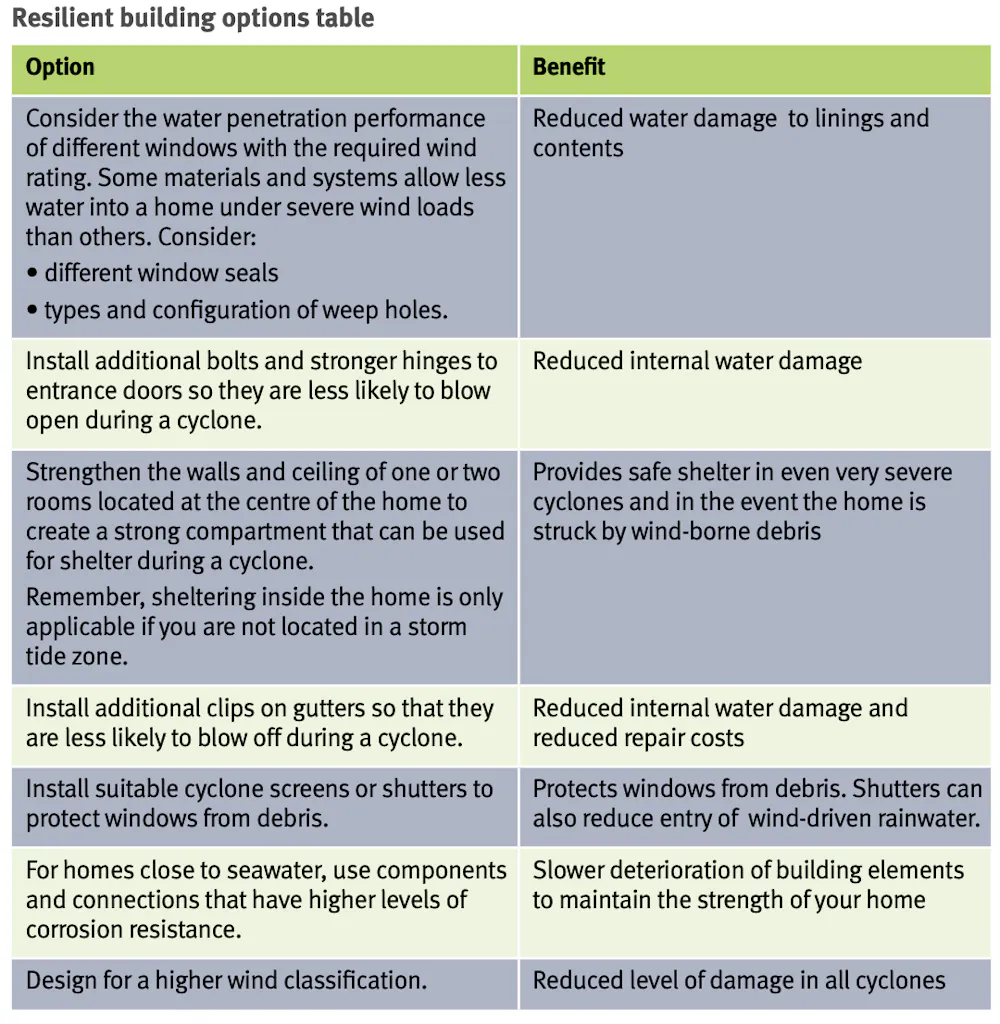
    Buildings are often built only to the minimum standard of the Building Code. However, if we want a house to function after an extreme tropical cyclone, we should consider building beyond the minimum standard using resilience features that will keep your roof on in a cyclone and minimise the entry of rainwater.

    Cyclone resilience also includes incorporating resilient building materials in your home – such as linoleum or vinyl floors instead of carpet, and ceilings from fibre-cement sheeting instead of plasterboard.

    Resilient building options you could consider.
    © The State of Queensland (Queensland Reconstruction Authority), CC BY

    Eternal vigilance

    It’s also important all elements holding your house together are well maintained through the life of the building.

    That means ensuring regular inspections by a trained professional to identify any potential weaknesses such as rot, rust or UV damage.

    These inspections are not something you and a mate can do yourselves. It requires a building professionals to get into the roof and look for weak spots.

    Think beyond your house. What about the carport? A pergola? That shed or patio you added? Are the solar panels installed correctly with the right fixings and brackets to resist the wind forces?

    If all these things are not fixed down and maintained well, strong winds can pick them up and throw them at your house or your neighbours.

    Just as you get your car serviced, you should get your house checked every five to seven years. Our homes have many important parts and a failure in one can lead to disastrous and expensive problems.

    David Henderson serves on committees for Standards Australia. He is a member of Engineers Australia and has done consulting work with the Resilient Building Council.

    Geoffrey Boughton serves on committees for Standards Australia. He is a member of Engineers Australia and has done consulting work with the Resilient Building Council.

    – ref. How cyclones rip apart houses – and how to boost the chance your home stays standing – https://theconversation.com/how-cyclones-rip-apart-houses-and-how-to-boost-the-chance-your-home-stays-standing-251709

    MIL OSI Analysis – EveningReport.nz –

    March 7, 2025
  • MIL-Evening Report: Cyclone Alfred is already retraumatising people who’ve lived through other disasters. I’m one of them

    Source: The Conversation (Au and NZ) – By Erin Smith, Associate Professor and Discipline Lead (Paramedicine), La Trobe University

    In 2011, as Cyclone Yasi approached the Queensland coast, I sat in my home in the tropical far north of the state and worried what the future would hold. Would my family be OK? Would our home be destroyed? Would my workplace be damaged and my job uncertain? Would my community be devastated?

    Now, as we wait for Cyclone Alfred to make landfall, I am watching on from my new home in Melbourne. I am safe. But last night, I couldn’t sleep. I’m having intrusive thoughts, remembering what it was like when Cyclone Yasi barrelled into us. I feel agitated, distracted and anxious. The news coverage of the impending cyclone makes my heart race, so I have turned off the television.

    As someone who has researched the impact of disasters for more than 20 years, I recognise what I am feeling now is similar to how I felt all those years ago. Again, I am experiencing the normal range of stress reactions common after living through a disaster, even though I am not directly impacted by this one.

    This is known as retraumatisation, where we re-live stress reactions experienced as a result of a traumatic event when faced with a new, similar incident.

    As a researcher in emergency responses to a broad range of disasters, I understand why I am feeling like this.

    However, many people may not realise the stress they are experiencing right now is related to an earlier disaster or traumatic event in their life. That earlier disaster could be another cyclone, or a different event, such as a flood or bushfire.

    Some signs and symptoms of retraumatisation might be:

    • intrusive thoughts (for example, I keep remembering my fear of the predicted tidal surge of water rushing up at me in the darkness as Cyclone Yasi made landfall)

    • nightmares and having trouble sleeping

    • hypervigilance (for example, feeling “on edge” all day)

    • sensitivity to triggers (for example, the sound of intense wind and windows creaking can trigger intense feelings because they remind me of the night we lived through Cyclone Yasi passing over the top of us)

    • feeling isolated

    • thinking about, planning or attempting suicide

    • panic atacks

    • using/abusing substances, such as alcohol and other drugs

    • increase in unhealthy behaviours (for example, being more prone to aggression or violence).

    For many of us, Cyclone Alfred is awakening memories and feelings, and the re-emergence of those stress reactions can be confronting. It can feel like re-opening a wound that hasn’t quite healed.

    Disaster upon disaster take their toll

    We are now beginning to understand the effects of being exposed to multiple disasters – bushfires, cyclones, floods, and let’s not forget the COVID pandemic – that erode our resilience.

    This type of multiple exposure influences our feelings of safety, security and even our hope for the future, all increasing the risk of poorer mental health.

    For people with post-traumatic stress disorder (PTSD), retraumatisation may cause people to relive their past traumas in intense detail. It can feel like past traumatic events are happening all over again.

    What to do now, and in the future

    However, there are steps we can take to help build our resilience in the face of multiple disasters.

    For now

    Right now, it is useful to understand how we respond to trauma. We may notice a range of physical responses (for example, my heart has been racing), psychological reactions (for example, I am feeling more anxious than usual) and social impacts (for example, I cancelled dinner plans last night as I did not want to leave the house).

    It is also important to stay connected to our usual social supports, as they can act as a great buffer to stress reactions.

    So, even though I stayed home last night, I was on a group chat discussing the Real Housewives of Sydney with friends, which helped reduce both the physical and psychological stress reactions I was experiencing.

    Staying connected to friends, family, neighbours and other supports will help.
    Caftor/Shutterstock

    For later

    In the longer term, it is useful to develop and implement a self-care plan that includes activities to support our emotional, physical and spiritual health.

    Self-care means taking the time to do things that help your wellbeing and improve your physical health and mental health. This can help you manage the stress reactions that may emerge as part of retraumatisation. Even small acts of self-care in your daily life can have a big impact.

    Today, I made the time to go for a short walk in the park and listened to some of my favourite music. It helped in the moment, but it also helps me in the longer term when I routinely include these small acts of self-care in my daily life.

    We also need to consider the first responders and volunteers who will be preparing for Cyclone Alfred, and communities devastated by similar disasters in the past (for example, the 2022 floods in Lismore, New South Wales). With their exposure to cumulative trauma, these groups will need ongoing, focused support.

    Most importantly, we need to understand that the way we are feeling is normal. Be patient with yourself and look for small opportunities to take control of your reactions.

    I am keeping the television turned off (except when the Real Housewives is on).

    Some resources

    The website blueknot, from the National Centre of Excellence for Complex Trauma, gives more information about how we respond to trauma. The Black Dog Institute guides you through developing a self-care plan.

    If you are a first responder, you can access free treatment and support through a range of providers, including: Phoenix Australia, Fortem Australia and the Black Dog Institute.


    If this article has raised issues for you, or if you’re concerned about someone you know, call Lifeline on 13 11 14.

    Erin Smith does not work for, consult, own shares in or receive funding from any company or organisation that would benefit from this article, and has disclosed no relevant affiliations beyond their academic appointment.

    – ref. Cyclone Alfred is already retraumatising people who’ve lived through other disasters. I’m one of them – https://theconversation.com/cyclone-alfred-is-already-retraumatising-people-whove-lived-through-other-disasters-im-one-of-them-251701

    MIL OSI Analysis – EveningReport.nz –

    March 7, 2025
  • MIL-OSI USA: Murkowski Questions FDA Nominee

    US Senate News:

    Source: United States Senator for Alaska Lisa Murkowski
    03.06.25
    Washington, DC – U.S. Senator Lisa Murkowski (R-Alaska) today questioned the President’s nominee to be Commissioner of the Food and Drug Administration (FDA), Martin Makary, during his appearance before the Health, Education, Labor, and Pensions (HELP) Committee. Murkowski raised the FDA’s handling of the Vaccine Advisory Committee, the handling of clinical trials for rare diseases, and funding for state and local governments to conduct food safety inspections.
    Full Transcript:
    Senator Murkowski: Doctor, welcome, it was a good conversation that we had, and I appreciated that. I thank you for the encourage to read that provision in your book, it was great airplane reading for me.
    Dr. Makary: Thank you, Senator.
    Senator Murkowski: I also want to thank you for the assurance you gave to Senator Collins regarding the Vaccine Advisory Committee, and ensuring there would be meetings going forward. I think for several of us who had I thought good substantive conversations with Secretary Kennedy, we had received assurances about things like the vaccination committee. So, we’re making sure again that important input goes forward is important to many of us, so I appreciate that.
    I wanted to talk to you this morning about an issue we discussed in my office, and that is with regards to ALS. The FDA’s accelerated approval pathway has really been important, and I think very promising for treatments for ALS and some other rare diseases. You have advocated for using common sense alongside science in regulatory decisions. So, very briefly, how do we define common sense here as it applies to the regulatory decisions of the FDA. How do we make sure that ALS patients who are looking at a very, very limited time frame, they can’t wait for the traditional approval process, there are some emerging measures using digital technologies, is this in your realm of common sense? Give me a little bit of insight here on how you would like to proceed on these approval pathways.
    Dr. Makary. Thank you, Senator. I very much enjoyed our time together, and talking through a bunch of these issues. We have to customize the regulatory process to the condition that we’re trying to be able to offer hope, so, if a condition affects 19 people in the world as a partial triplication chromosome 15 disorder does, or a disease that affects 52 kids in the world, we cannot require two randomized control trials. We have to customize the regulatory process to what we’re trying to do if our goal is to try to provide safe and effective therapies. So, I do believe firmly in that approach, and I do think we can use some commons sense to ask some big questions we’ve never asked before at the FDA. Why does it take 10 years for a drug to get approved? Why does a college student who suffers from chronic abdominal pain for years, and we have no idea what’s going on, and they go to Italy for a summer and they are suddenly cured of their abdominal pain? Why does a peanut allergy medication that’s been safe with data for decades get approved in Europe before the United States when nearly 10% of our population has a food allergy? So, I do think there’s a lot of areas where we can ask, does a drug need to be prescription, when it could be over-the-counter, why are requiring continuous glucose monitors to have a Doctor’s prescription when it’s good for people to use these monitors and learn about what they’re eating. We don’t just want to limit continuous glucose monitoring to people with diabetes, we want to prevent diabetes when 30% of our nation’s children has diabetes or pre-diabetes or some form of early insulin resistance. Why are we holding these tools to help people, empower them about their health, until after they’re sick, same with continuous blood pressure monitoring.
    Senator Murkowski: Well, as you point out, why do we wait. We want to make sure that there is a level of safety, that’s the job there through the FDA. But, again, being able to accelerate these in ways that are meaningful, and to your point, that actually fit with the population that you’re speaking to. So know that I’m going to be pushing you on this, as well as many other advocates out there.
    Dr. Makary: Thank you.
    Senator Murkowski: I want to quickly ask you about food safety inspections. State and local governments conduct about 60% of food processing facility inspections, 90% of produce safety inspections, 100% of retail food inspections. What has happened is we have seen in the Biden Administration, FDA planning to cut funding for state and local food safety programs. This impacts us in the state of Alaska when it comes to our seafood industry, and in other areas. So, I’m looking for a commitment from you that under the Trump Administration, the FDA is going to maintain funding for these contracts with state and local governments. They’ve proven that it’s more cost effective, more efficient, and it also is what Congress has asked for. So I’d like to know that you’re going to be supportive in that regard to state and local governments.
    Dr. Makary: I’m happy to look at that with you, Senator.
    Senator Murkowski: Very good. Thank you, Mr. Chairman. 

    MIL OSI USA News –

    March 7, 2025
  • MIL-OSI USA: What They Are Saying: Over One Million Law Enforcement Officers Call for Immediate, Clean Senate Passage of HALT Fentanyl Act

    US Senate News:

    Source: United States Senator for Iowa Chuck Grassley

    WASHINGTON – Major law enforcement organizations representing over 1,000,000 officers nationwide, are calling on the Senate to pass the Halt All Lethal Trafficking of (HALT) Fentanyl Act immediately and without amendments. Senate Judiciary Committee Chairman Chuck Grassley (R-Iowa) is leading the push to permanently classify illicit fentanyl-related substances as Schedule I, alongside Senate Health, Education, Labor and Pensions Committee Chairman Bill Cassidy, M.D. (R-La.) and Sen. Martin Heinrich (D-N.M.).

    The White House today reaffirmed the administration’s support for the legislation in its current form. The bill will likely receive a final Senate vote next week.

    Law enforcement organizations backing the HALT Fentanyl Act’s swift and clean passage include the National Fraternal Order of Police, the National Association of Police Organizations, the Major Counties Chiefs Association, the Association of State Criminal Investigative Agencies, the Federal Law Enforcement Officers Association, the Major County Sheriffs of America, the National Alliance of State Drug Enforcement Agencies, the National District Attorneys Association, the National HIDTA Directors Association, the National Narcotic Officers’ Associations’ Coalition, the National Sheriffs’ Association and the NYPD Sergeants Benevolent Association.

    The above organizations represent law enforcement agencies across all 50 states, including the major metropolitan areas of New York City, Miami, Orlando, Atlanta, Chicago, Los Angeles and Houston.

    Here’s what they’re saying:

    The National Association of Police Organizations: 
    “Time is of the essence. The DEA’s temporary authority to schedule all fentanyl-related substances as Schedule I drugs under the Controlled Substances Act ends on March 31… We supported the technical changes that had to be made when the Judiciary Committee approved the manager’s amendment last week, but otherwise urged the Committee to advance this critical legislation without further modification, which it did… We are now urging the Senate to swiftly pass S. 331 without amendment”

    The National Fraternal Order of Police:
    “[The Halt Fentanyl Act], which permanently places fentanyl-related substances as a class into Schedule I of the Controlled Substances Act, would save lives and make our communities safer. We thank Leader Thune for putting the bill on the floor and strongly urge the Senate to pass it without amendment.”

    The Federal Law Enforcement Officers Association:
    “FLEOA thanks @LeaderJohnThune for advancing S. 331/HALT Fentanyl Act. We urge all Senators to quickly pass this measure as-is, without further amendment, and give @DEAHQ permanent scheduling authority for fentanyl-related substances.”

    The Major County Sheriffs of America: 
    “The opioid crisis is devastating our nation. The Senate must pass the HALT Fentanyl Act without delay or changes to give law enforcement the tools to combat this deadly epidemic. We can’t afford further delay – let’s act now for public safety.”

    The NYPD Sergeants Benevolent Association: 
    “Last month, the Sergeants Benevolent Association joined its partner law enforcement organizations in calling on the Judiciary Committee to advance this critical legislation without delay or modification. We now respectfully request that all senators support passage of S. 331 as approved by the Judiciary Committee and without further amendment.”

    A coalition of 11 national, state and local law enforcement organizations: 
    “The opioid epidemic continues to claim the lives of hundreds of Americans every day. As this crisis escalates, every delay in addressing it only increases the toll on our communities. For the sake of public safety, it is imperative that the Senate pass the HALT Fentanyl Act as it stands, without changes, and move it forward to law.”

    -30-

    MIL OSI USA News –

    March 7, 2025
  • MIL-OSI USA: Padilla, Klobuchar Lead Charge Urging USDA to Reinstate Hispanic-Serving Institution Fellowship Program

    US Senate News:

    Source: United States Senator Alex Padilla (D-Calif.)

    Padilla, Klobuchar Lead Charge Urging USDA to Reinstate Hispanic-Serving Institution Fellowship Program

    Senators to USDA: “The Department’s decision to suspend EKDLG Fellowship Program threatens the U.S. agricultural workforce pipeline and the opportunities this program provides educators and students nationwide”

    WASHINGTON, D.C. — Today, U.S. Senators Alex Padilla (D-Calif.), chair of the Senate Hispanic-Serving Institutions (HSI) Caucus, and Amy Klobuchar (D-Minn.), Ranking Member of the Senate Committee on Agriculture, Nutrition, and Forestry, led 11 Democratic Senators in calling on the U.S. Department of Agriculture (USDA) to immediately reinstate its HSI E. Kika De La Garza (EKDLG) Fellowship Program. The program, suspended by the Trump Administration, supports the nation’s agricultural workforce while uplifting professionals and students of all backgrounds at HSIs, including non-Latino students.

    USDA established the nonpartisan EKDLG Fellowship Program in 1998, designing the program to strengthen educational partnerships between faculty, staff, and administrators from HSIs and USDA. These partnerships support professional development, workforce development, and exposure opportunities for HSIs nationwide, offering critical insight and understanding of the federal government.

    “USDA’s partnership with HSIs and Hispanic Serving Agricultural Colleges and Universities (HSACUs) plays a vital role in establishing a collaborative relationship and creating a nationwide network of educators working with USDA to help grow the next generation of the American agricultural workforce,” wrote the Senators.

    “The Department’s decision to suspend EKDLG Fellowship Program threatens the U.S. agricultural workforce pipeline and the opportunities this program provides educators and students nationwide,” continued the Senators. “We urge you to immediately reinstate the E. Kika De La Garza Fellowship Program, similar to Department’s reinstatement of the 1890 National Scholars Program, and to collaborate with Congress to ensure its long-term stability.”

    Programs like the USDA EKDLG Fellowship Program are built to help students reach their full potential and reinforce America’s agricultural workforce pipeline. The 2024 EKDLG Program included eight fellowships in Texas, six in Arizona, five in California, four in New York, two in Illinois, one in New Mexico, one in Colorado, one in New Jersey, one in Florida, one in Connecticut, and one in Washington.

    Hispanic-Serving Institutions are not-for-profit institutions of higher learning with 25 percent or higher total undergraduate Hispanic or Latino full-time students. There are 600 HSIs in the United States that enroll over 5.2 million Hispanic students, two-thirds of all Hispanic undergraduates, and 32.2 percent of total Pell Grant recipients — empowering and improving communities. California is home to 172 HSIs and 45 Emerging HSIs.

    In addition to Senators Padilla and Klobuchar, the letter is also signed by Minority Leader Chuck Schumer (D-N.Y.) and Senators Michael Bennet (D-Colo.), Cory Booker (D-N.J.), Dick Durbin (D-Ill.), Ruben Gallego (D-Ariz.), Kirsten Gillibrand (D-N.Y.), Martin Heinrich (D-N.M.), Ben Ray Luján (D-N.M.), Bernie Sanders (I-Vt.), Adam Schiff (D-Calif.), and Ron Wyden (D-Ore.).

    The letter is endorsed by the Hispanic Association of Colleges and Universities (HACU) and UnidosUS.

    As chair of the Senate HSI Caucus, Senator Padilla has been a strong advocate for expanding educational opportunities for Latino students. Last year, Padilla passed a bipartisan resolution to designate National Hispanic-Serving Institutions Week. In 2023, Padilla introduced the bicameral, bipartisan Hispanic Educational Resources and Empowerment (HERE) Act, which aims to provide Hispanic and Latino students with the necessary tools and resources to lessen the higher education achievement gap.

    Previously, Padilla and Senator John Cornyn (R-Texas) passed a bipartisan resolution expressing support to close the gap in STEM jobs among Latino students and young professionals entering the workforce. Padilla also unveiled a bipartisan resolution in 2022 recognizing the 30th anniversary of the Hispanic National Internship Program (HNIP), a seminal program of the Hispanic Association of Colleges and Universities known for promoting Latino excellence and creating greater career development opportunities for Latino and Hispanic students across the country.

    Full text of the letter is available here and below:

    Dear Secretary Rollins,

    We write to express our significant concerns about the suspension of the USDA Hispanic-Serving (HSI) E. Kika De La Garza (EKDLG) Fellowship Program and to ask that you immediately reinstate it.

    The EKDLG Fellowship Program was established in 1998 by the U.S. Department of Agriculture (USDA), and the program has had consistent support from every presidential administration since its establishment. The program strengthens educational partnerships between faculty, staff, and administrators from HSIs and USDA.

    The EKDLG Fellowship Program is non-partisan and supports increasing the professional development, workforce development, and exposure opportunities for faculty, staff, and students nationwide. USDA’s partnership with HSIs and Hispanic Serving Agricultural Colleges and Universities (HSACUs) plays a vital role in establishing a collaborative relationship and creating a nationwide network of educators working with USDA to help grow the next generation of the American agricultural workforce. These fellowships are open to faculty, staff, and administrators of all backgrounds that are employed at HSIs or Hispanic-Serving School Districts and students of all backgrounds are eligible to participate.

    HSIs are economic engines and shape our nation’s agricultural workforce. In 2022, HSIs enrolled 5.2 million students, including 66% of all Hispanic undergraduate students and over 31% of all college students in non-profit postsecondary institutions in the country. Programs like the EKDLG Fellowship Program equip educators with the tools to help students reach their full potential and support the nation’s agricultural workforce pipeline. For example, the list of 2024 EKDLG participants shows the program’s nationwide impact:

    1. University of Houston, Sugar Land, Texas

    2. New Mexico State University, Las Cruces, New Mexico

    3. The University of Arizona, Tucson, Arizona

    4. Arizona Western College, Yuma, Arizona

    5. Coastal Bend College, Beeville, Texas

    6. Adams State University, Alamosa, Colorado

    7. California State University, Chico, Chico, California

    8. Montclair State University, Montclair, New Jersey

    9. Texas A&M University, Kingsville, Texas

    10. Mesa Community College, Mesa, Arizona

    11. Hartnell College, Salinas, California

    12. Texas Tech University, Lubbock, Texas

    13. City Colleges of Chicago, Harold Washington College, Chicago, Illinois

    14. Texas A&M University, College Station, Texas

    15. Maricopa Community Colleges, Tempe, Arizona

    16. University of Connecticut, Storrs, Connecticut

    17. Waubonsee Community College, Sugar Grove, Illinois

    18. Northern Arizona University, Yuma, Arizona

    19. University of California, Santa Barbara, California

    20. Cuesta College, San Luis Obispo, California

    21. University of Texas, San Antonio, Texas

    22. CUNY New York City College of Technology, Brooklyn, New York

    23. CUNY Hunter College, New York, New York

    24. Florida International University, Miami, Florida

    25. California State University, Fresno, California

    26. Arizona State University, Mesa, Arizona

    27. Texas Tech University, Lubbock, Texas

    28. The University of Texas, Rio Grande Valley, Edinburg, Texas

    29. Mt. Adams School District #209, White Swan, Washington

    30. The Urban Assembly New York Harbor School, New York, New York

    31. John Bowne High School, Flushing, New York

    The Department’s decision to suspend EKDLG Fellowship Program threatens the U.S. agricultural workforce pipeline and the opportunities this program provides educators and students nationwide.

    We urge you to immediately reinstate the E. Kika De La Garza Fellowship Program, similar to Department’s reinstatement of the 1890 National Scholars Program, and to collaborate with Congress to ensure its long-term stability.

    Sincerely,

    MIL OSI USA News –

    March 7, 2025
  • MIL-OSI China: Colleges open AI classes to meet market demand

    Source: China State Council Information Office 2

    Chinese universities are accelerating efforts to integrate education with artificial intelligence, with more AI colleges opening to cultivate interdisciplinary talent and more general AI courses and textbooks introduced.
    Tsinghua University, one of China’s top schools, recently announced it will increase its undergraduate admissions by about 150 students this year and establish a new undergraduate college for general AI education. The students will enroll in the new program, which aims to integrate AI across multiple disciplines.
    The initiative pools academic resources from various fields, seeking to develop students with a solid foundation in AI, high proficiency in AI technologies and strong innovative capabilities, the university said. The move is part of Tsinghua’s efforts to advance AI-related professional training and support China’s push for high-level scientific and technological self-reliance and self-strengthening, according to Xinhua News Agency.
    As AI rapidly evolves, reshaping education and driving socioeconomic development, the need for individuals with comprehensive AI knowledge and skills is becoming increasingly urgent.
    Wang Xuenan, deputy director at the Digital Education Research Institute of the China National Academy of Educational Sciences, told China Central Television the number of students majoring in AI was estimated at more than 40,000 last year, yet “the number still falls far short of the needs of the industry.”
    Market consultancy McKinsey& Company estimates that China will need 6 million professionals with proficient AI knowledge by 2030.
    In November 2023, a talent training initiative on collaborative research in general AI was jointly launched by the Beijing Institute for General Artificial Intelligence, Peking University, Shanghai Jiao Tong University and 13 other leading universities. Zhu Songchun, director of the Beijing institute and dean of the School of Intelligent Science and Technology at Peking University, told Guangming Daily that the plan will leverage the resources of these universities to create a training system that seamlessly connects undergraduate and doctoral education.
    In September last year, Nankai University and Tianjin University introduced a general AI course through a massive open online course, or MOOC, targeting more than 100,000 undergraduates in Tianjin. The course covers AI’s basic principles and history while exploring cutting-edge generative AI models and their applications in healthcare, intelligent manufacturing and autonomous driving, according to Xu Zhen, director of the department of higher education at the Tianjin Municipal Education Commission.
    Zhejiang University announced in March that it will lead an upgrade of the “AI plus X” micro program in collaboration with Fudan University, Nanjing University, Shanghai Jiao Tong University and the University of Science and Technology of China. The country’s first micro program integrating AI with other disciplines, it aims to bridge technology with fields such as humanities, social sciences, agriculture, medicine and engineering.

    MIL OSI China News –

    March 7, 2025
  • MIL-OSI China: New fashion using ancient craftsmanship hits runways

    Source: China State Council Information Office 3

    Jacquard fabrics with traditional Chinese cultural elements and ancient Li brocade crafts caught the eye of global designers at the recently concluded Premiere Vision Paris show.

    Joining hands with Shanghai Skytex Fashion Technology Co Ltd, a design innovation team from the College of Textiles at Donghua University, brought new vitality to the ancient craft through a series of jacquard fabrics and handbags at the notable biannual show on Feb. 12.

    Boasting a history of over 3,000 years, the brocade is a traditional craft of the Li ethnic group in Hainan province, and is listed as a national intangible cultural heritage.

    The jacquard Li brocade fabrics displayed at the show were described as artworks with Chinese charm. Their exquisite patterns were inspired by the ethnic group’s traditional gourd totem, precisely layered snake scale textures to mark the Year of the Snake, and vibrant colors representing rainforests and good fortune.

    Showcasing a balanced blend of traditional Chinese culture and modern aesthetics and techniques, the fabrics captivated attendees and explored new possibilities for this ancient craft.

    “These are not only fabrics but also the contemporary cultural expression of millennial Li brocade. Integrating with traditional Chinese culture and modern textile technology, we hope to bring this ancient intangible cultural heritage to the global stage,” says Xue Wenliang, leader of the team and a professor at the College of Textiles at Donghua University in Shanghai.

    The collaboration between the team and Skytex dates back to July 2022. Last summer, tracking the path of Huang Daopo, a textile pioneer in the Yuan Dynasty (1271-1368) born in today’s Shanghai, the team journeyed to Hainan province. Immersing themselves in Li ethnic communities, they learned the culture and techniques behind the traditional craft.

    Xue says that compared with other renowned ancient Chinese brocades that use silk as the main material, such as the Yunjin and Songjin brocades from Jiangsu province, Li brocade is less known and is made of cotton, which China farmed on a large scale until the late Tang Dynasty (618-907). However, the jacquard fabrics at the Paris show were created with the high-end market in mind.

    “Compared with other fabric processing techniques, such as printed fabrics, jacquard fabrics take more time and work. In particular, the making of Li brocade involves handmaking in its processing, such as spinning, dyeing, weaving, and embroidering, making the fabric a luxurious and artistic product,” says Xue.

    He adds that integrating handmade craftsmanship, traditional culture and modern technology is a big challenge in passing on such intangible cultural heritage, calling on more students, companies and organizations to take part in the process.

    Chai Fangjun, chairman of Skytex, values the collaboration with the team, saying: “The living heritage of Li brocade must speak to the world. With 3D jacquard techniques, we are showcasing new Chinese fashion that has evolved using ancient craftsmanship, in Paris.

    “This series not only pays tribute to Li culture but also demonstrates our forward-looking and inclusive attitude to global cultural exchanges and fashion innovation.”

    MIL OSI China News –

    March 7, 2025
  • MIL-OSI USA: King: Congress’s Inability to Pass Spending Bills Harms National Security

    US Senate News:

    Source: United States Senator for Maine Angus King
    WASHINGTON, D.C. — In a hearing before the Senate Armed Services Committee (SASC), U.S. Senator Angus King questioned three witnesses about the adverse impact of the Republican-led House and Senate not passing annual federal spending bills on military capability and production. During the hearing, Senator King spoke with David Berteau, the President and Chief Executive Office of the Professional Services Council; Dr. Christine Michienzi, the former Senior Technology Advisor to the Under Secretary of Defense for Acquisition and Sustainment; and Dr. John McGinn, the Executive Director of the Greg and Camille Baroni Center for Government Contracting at George Mason University’s Costello College of Business.
    The exchange comes as Congress has struggled to negotiate a federal spending law that would pass with bipartisan support and be approved by the White House. Now, with less than 10 days to avert a government shutdown, Congressional appropriators are pursuing a continuing resolution that would temporarily fund the government at the previous year’s levels — therefore not adding new policies or investments that the military needs.
    “Could we all agree that continuing resolutions absolutely are not part of the solution to this problem,” asked Senator King.
    “Franklin Roosevelt did not face a single continuing resolution in the entire buildup to World War II and the entire execution thereof,” replied Berteau.
    “I concur,” said Dr. McGinn.
    “I concur,” echoed Dr. Michienzi.
    “All of you agree with that. That is one of the difficulties we are in now. It creates all kinds of downstream in the industrial base and preparation. Thank you for that. Let the record show, continuing resolutions are not the way to do business, particularly in the defense area,” said Senator King. “All of you have mentioned something very interesting which is allies are part of the solution. It concerns me that we are embarked on a course that is not encouraging to our allies, and in some cases poking our allies in the eye. Talk to me about the importance of allies in dealing with the production necessary for significant conflict whether it is Japan, U.K., Canada, or other countries.”
    “Our allies are a key part of our industrial base. We have a number of agreements and collaborative programs. The largest fighter program in the world, the F-35, we have a dozen partner countries I believe,” responded Dr. McGinn. 
    “We cannot do this by ourselves, correct,” asked Senator King. “All of you are nodding, could you say yes? They don’t show up in the transcript.” 
    “Yes,” Berteau, Dr. Michienzi and Dr. McGinn agreed unanimously.
    A member of the Senate Armed Services Committee and the Senate Select Committee on Intelligence, Senator King is recognized as an authoritative voice on national security and foreign policy issues who has also been named a “fiscal hero” by government watchdogs for responsible spending. Senator King has previously urged the Department of Defense (DoD) to take advantage of private sector technologies or risk losing access to innovative defense technologies and encouraged the (DoD) to reevaluate its acquisition process of defense technologies.

    MIL OSI USA News –

    March 7, 2025
  • MIL-Evening Report: Diversity helps: a new study shows more women on boards can improve how businesses are managed

    Source: The Conversation (Au and NZ) – By Ramona Zharfpeykan, Lecturer, Department of Accounting and Finance, University of Auckland, Waipapa Taumata Rau

    Jacob Lund/Shutterstock

    Despite large multinational companies such as Goldman Sachs, Paramount, Google and others removing their diversity, equity and inclusion policies, the evidence is clear: having a diverse team can help businesses make better, more empathetic decisions.

    At the top level, a growing body of research shows having more women on corporate boards leads to better decision-making, stronger governance and improved environmental, social and governance (ESG) performance.

    Yet, progress remains slow – even in New Zealand. Though we rank highly on the Human Development Index, the country lags behind in leadership gender equality.

    Women make up 50.8% of the population and hold 40.8% of parliamentary leadership roles. But they hold only 28.5% of board seats and 26.4% of executive roles in the New Zealand’s Stock Exchange (NZX) top 50 companies (the NZX50).

    And while businesses are encouraged to disclose gender diversity policies by the NZX, there are no mandatory quotas, leaving progress uneven.

    However, change is happening. Our new research looked at the the percentage of female directors in NZX-listed firms between 2016 and 2022.

    What we found is positive. Using information from financial infrastructure and data provider LSEG’s database on global financial markets, we identified a rise in the number of female directors on corporate boards. We also saw a corresponding improvement in the firms’ ESG performance.

    Despite making up 50.4% of the population, women hold only 28.5% of board seats and 26.4% of executive roles in NZX50 companies.
    T. Schneider/Shutterstock

    Boosting performance

    Between 2016 and 2022, the proportion of female directors in NZX-listed firms increased from 26% to 36%. These same businesses saw an average 33% improvement in their ESG performance.

    Notably, governance – one of the key ESG pillars – improved significantly, with a 31% increase on average. Governance specifically refers to the effectiveness of the firm’s management systems, board structure and capacity to protect shareholder interests.

    While it’s not possible to say outright that having more women on the board directly influenced governance outcomes, we saw a positive relationship between the two. This suggests having more women in leadership strengthens corporate oversight and ethical decision making.

    Gender diversity does not have the same level of importance in all contexts. While social and environmental performance also improved, this study found no significant link between a more gender-diverse board and these higher scores in social and environmental performance.

    Our findings are supported by overseas research suggesting board diversity does not strongly influence sustainability outcomes when it comes to issues and groups already covered by legislation.

    Therefore, New Zealand’s proactive stance on issues such as the environment, poverty and human rights, as well as encouraging private companies to improve sustainability and transparency, may explain why board diversity had no notable impact on social and environmental performance in this study.

    What women bring to the business

    Our findings align with studies completed overseas.

    In the US, one study found women business leaders tended to prioritise transparency, fairness and stakeholder interests. This made them strong advocates for sustainable and inclusive business practices.

    It’s clear that addressing the gender gap in corporate New Zealand isn’t just about fairness. It’s about economic success. Businesses that embrace diversity perform better, attract top talent and enhance their reputations.

    The solution isn’t simply about enforcing quotas, but ensuring more qualified women are placed in leadership roles. Companies need to move beyond a “compliance mindset” and recognise true diversity strengthens governance, reduces risk and drives long-term success.

    As the world celebrates International Women’s Day on March 8, businesses need to realise that increasing female representation at the top isn’t just the right thing to do – it’s the smart thing to do.

    Ramona Zharfpeykan does not work for, consult, own shares in or receive funding from any company or organisation that would benefit from this article, and has disclosed no relevant affiliations beyond their academic appointment.

    – ref. Diversity helps: a new study shows more women on boards can improve how businesses are managed – https://theconversation.com/diversity-helps-a-new-study-shows-more-women-on-boards-can-improve-how-businesses-are-managed-251473

    MIL OSI Analysis – EveningReport.nz –

    March 7, 2025
  • MIL-Evening Report: ‘Icarus of the deep’: how a dying anglerfish became a social media sensation

    Source: The Conversation (Au and NZ) – By Prema Arasu, Postdoctoral Research Fellow, Minderoo-UWA Deep-Sea Research Centre, The University of Western Australia

    David Jara Boguñá / Instagram

    In February, researchers from conservation organisation Condrik Tenerife were about two kilometres off the coast of Tenerife Island, looking for sharks, when they caught sight of something much stranger.

    Photographer David Jara Boguñá filmed a humpback anglerfish (Melanocetus johnsonii, a species of black seadevil) swimming near the surface in sunlit waters. These fish have never before been seen alive in daylight, as they normally dwell in the “twilight zone” at depths from 200m to 600m.

    The video has provoked an enormously empathetic response on social media, with some seeing the fish as a feminist icon or an Icarus-like figure who swam too close to the Sun. The reaction shows our views of the deep sea – long ignored or seen as a realm of monsters – may at last be changing.

    The strange lives of anglerfish

    Anglerfish are much smaller than you probably think they are. The specimen Boguñá filmed was a female, which typically grow up to 15cm long.

    The creatures are named for their bioluminescent lure (or esca). This modified dorsal fin ray can produce a glow used to fish (or angle) for prey in the dim depths of the sea. The bioluminescence is produced by symbiotic bacteria that live inside the bulbous head of the esca.

    Male anglerfish lack the iconic lure and are much smaller, usually reaching a length of only 3cm.

    A male anglerfish spends the first part of his life searching for a female to whom he will then attach himself. He will eventually fuse his circulatory system with hers, depending on her entirely for nutrients, and live out his life as a parasite or “living testicle”.

    It is unknown why this fish was swimming vertically near the surface. Researchers have speculated that the behaviour may have been related to changes in water temperature, or that the fish was simply at the end of her life.

    Watchers observed the fish for several hours, until it died. Its body was preserved and taken to the Museum of Nature and Archaeology in Santa Cruz de Tenerife, where it will be further studied.

    Sympathy for the seadevil

    The video quickly went viral, inspiring countless reaction videos, artworks, memes, a Pixar-style animation and a poem titled Icarus is the Anglerfish.

    One Reddit user commented:

    I like to think she is a respected old grandmother who has dreamed her entire life of seeing the sunlight and the world above the water. She knows her time is nigh so she bade farewell to her friends and family and swam up towards the light and whatever it might hold for her as her life as an anglerfish comes to a close.

    One person described the fish as her “feminist Roman Empire”, in the sense of an inspirational obsession that filled the same role for her that the Roman Empire supposedly does for many men.

    Boguñá and Condrik Tenerife have since commented on the public reaction. (The original post is in Spanish, but Instagram’s automated English translation is below.)

    He’s become a global icon, that’s clear. But far from the romanticisation and attempt to humanise that has been given to its tragic story, I think that what this event has been for is to awaken the curiosity of the sea to PEOPLE, especially the younger ones, and perhaps, it also serves that messages about marine ecosystem conservation can reach so many more people.

    From horrors to heroes

    The outpouring of empathy for the anglerfish is unexpected. With their glowing lures and fang-filled mouths, the creatures have long been archetypal horrors of the abyss.

    As I have written elsewhere, the anglerfish’s extreme sexual dimorphism and parasitism, along with its unsettling anatomy, have made it the “iconic ambassador of the deep sea”. Anglerfish or angler-inspired aliens have appeared as antagonists in films such as Star Wars Episode I: The Phantom Menace (1999), Finding Nemo (2003), The SpongeBob SquarePants Movie (2004) and Luca (2021).

    Star Wars film The Phantom Menace features a large anglerfish-inspired sea monster.
    Disney

    The reception of “Icarus” (as some call her) in popular culture indicates a perhaps surprising capacity for empathy toward animals that aren’t conventionally cute or beautiful. It stands in stark contrast to the fate of the deep-sea blobfish Psychrolutes marcidus, which in 2013 was voted the world’s ugliest animal.

    Perhaps the name is a clue: people have seen in the fish a creature striving to reach the light, who died as a result of her quest.

    But does our projection of human emotions and desires onto non-human animals risk misunderstanding scientific reality? Almost certainly – but, as US environmental humanities researcher Stacy Alaimo has argued, it may also have benefits:

    Deep-sea creatures are often pictured as aliens from another planet, and I think that gets people interested in them because we’re all interested in novelty and weirdness and the surreal […] I think that can be positive, but the idea of the alien can also cut us off from any responsibility.

    The deep sea and its inhabitants face growing threats from seabed mining, plastic pollution, and the effects of human-induced climate change. They need all the empathy they can get.

    Prema Arasu does not work for, consult, own shares in or receive funding from any company or organisation that would benefit from this article, and has disclosed no relevant affiliations beyond their academic appointment.

    – ref. ‘Icarus of the deep’: how a dying anglerfish became a social media sensation – https://theconversation.com/icarus-of-the-deep-how-a-dying-anglerfish-became-a-social-media-sensation-251603

    MIL OSI Analysis – EveningReport.nz –

    March 7, 2025
  • MIL-OSI USA: Booker, Scott Reintroduce Bill to Strengthen Protections, Restore Intent of Federal Religious Freedom Law

    US Senate News:

    Source: United States Senator for New Jersey Cory Booker
    WASHINGTON, D.C. – Today, U.S. Senator Cory Booker reintroduced the Do No Harm Act, which will restore the original intent of the Religious Freedom Restoration Act (RFRA), and prohibit individuals and businesses from using religion to deny others’ civil rights. Companion  legislation was reintroduced in the House by Committee on Education and Workforce Ranking Member Robert C. “Bobby” Scott (D-VA-03), Committee on the Judiciary Ranking Member Jamie Raskin (D-MD-08), Subcommittee on the Constitution and Limited Government Ranking Member Mary Gay Scanlon (D-PA-05), and Congressman Steve Cohen (D-TN-09).
    The legislation comes amid a sharp rise in the misapplication of RFRA to justify discrimination in a wide range of scenarios.
    The Trump Administration is poised to supercharge the misapplication of RFRA through executive actions. For example, on February 7, 2025, President Trump issued Executive Order 14205 titled “Establishment of the White House Faith Office” directing the White House Faith Office to support federal agencies in providing training and education on the availability of religious exemptions.
    The Do No Harm Act limits the use of RFRA in cases involving discrimination, child labor and abuse, wages and collective bargaining, access to health care, public accommodations, and social services provided through government contracts.
    “Freedom of religion is one of our country’s founding principles, but freely exercising one’s faith does not create the right to deny another person of their civil liberties,” said Senator Booker. “The Religious Freedom Restoration Act of 1993 (RFRA) was never meant to create a loophole for discrimination. The Do No Harm Act is critical legislation that will restore the careful balance of the First Amendment and RFRA’s original intent by ensuring that religious beliefs cannot be used to deny people of their right to live free from discrimination.
    “When Congress passed the Religious Freedom Restoration Act in 1993, it was intended to protect religious exercise—not to erode civil rights under the guise of religious freedom.  Regrettably, we have seen RFRA repeatedly used to attack civil rights protections, deny access to health care, and allow discrimination in federal contracts and programs,” said Ranking Member Scott. “The Do No Harm Act simply provides that RFRA cannot be used to limit access to health care, deny services supported by taxpayer dollars, or undermine the Civil Rights Act or other anti-discrimination protections.  Congress must take this critical step to ensure no one can weaponize religious freedom to erode our fundamental civil and legal rights.”
    “Our constitutional right to worship freely is not a right to violate the civil rights of other people,” said Ranking Member Raskin.  “That’s why I’m proud to join my colleagues in introducing the Do No Harm Act, a bill which will make sure that we respect the universal free exercise of religion but that no one can turn it into a weapon against other people’s equality and freedom.”
    “The free exercise of religious beliefs is one of our country’s founding principles,” said Congresswoman Scanlon.  “But religious freedom laws are increasingly being weaponized to justify discrimination and undermine civil rights protections.  I’m proud to introduce the Do No Harm Act to restore the chronically misused Religious Freedom Restoration Act to its original intent – which is to provide protections for religious exercise while ensuring that RFRA is not used to erode civil rights under the guise of religious freedom.”
    “Civil rights grow.  We can enforce and protect one person’s rights without sacrificing another’s.  And in so doing, we can apply our laws to expand the rights of all. We don’t need to pit one group against another,” said Congressman Cohen. “The Do No Harm Act advances the original intent of the Religious Freedom Restoration Act and corrects the courts’ misguided interpretations that have allowed the religious rights of some to be used to undermine the civil rights of others.  I’m pleased to join Congressman Scott in this effort.”
    For a list of the endorsing organizations of the Do No Harm Act, click here.
    To read the full text of the bill, click here.

    MIL OSI USA News –

    March 7, 2025
  • MIL-OSI USA: VIDEO: Senator Peters Calls for Passage of the PRO Act to Protect American Workers’ Right to Organize

    US Senate News:

    Source: United States Senator for Michigan Gary Peters
    Published: 03.06.2025
    Peters Again Cosponsored and Helped Reintroduce the Bill to Support Workers in Michigan and Across the Country

    WASHINGTON, DC – U.S. Senator Gary Peters (MI) called for passage of the Protecting the Right to Organize (PRO) Act, comprehensive legislation to protect workers’ right to stand together and bargain for higher wages, better benefits, and safer workplaces. The PRO Act, which Peters again cosponsored and helped reintroduce this Congress, would restore fairness to the economy by strengthening the federal laws that protect workers’ right to join a union freely and fairly.
    “Labor unions created the American middle class,” said Senator Peters. “The PRO Act will make it easier for folks to organize, to become a member of a union, and be able to stand up for the rights that they deserve. I come from a union household. My parents were both members of the union. I am who I am because of the love and support that they gave me, and the fact that they were part of a union allowed them to provide for my future. That’s why we’ve got to pass the PRO Act.”

    To watch the video, click here.
    The PRO Act, which Peters previously spoke in favor of on the Senate floor, would protect every American’s right to organize in their workplace and collectively bargain. The bill specifically includes measures that would:
    Hold employers accountable for violating workers’ rights by authorizing meaningful penalties, facilitating initial collective bargaining agreements, and closing loopholes that allow employers to misclassify their employees as supervisors and independent contractors.
    Empower workers to exercise their right to organize by strengthening support for workers who suffer retaliation for exercising their rights, protecting workers’ right to support secondary boycotts, ensuring workers can collect “fair share” fees, and authorizing a private right of action for violation of workers’ rights.
    Secure free, fair, and safe union elections by preventing employers from interfering in union elections, prohibiting captive audience meetings, and requiring employers to be transparent with their workers.
    Peters grew up in a union household, where his mother was a Service Employees International Union (SEIU) steward, and his father was a member of the National Education Association (NEA). During his annual motorcycle tour across Michigan last year, Peters met with local union members and retirees at IBEW Local 131 in Kalamazoo to underscore the need to protect workers’ right to collectively bargain. Peters also joined UAW members on the picket line in Michigan as they negotiated for better wages, benefits, and job security. Then, following the UAW’s historic contracts in 2024, Peters led his colleagues in sending a letter to 13 non-unionized automakers urging them not to illegally block UAW unionization efforts at their manufacturing plants. Peters invited UAW Region 1 Director LaShawn English to be his guest for the 2024 State of the Union Address last year.

    MIL OSI USA News –

    March 7, 2025
  • MIL-OSI China: China’s 2025 growth target balances necessity, feasibility: experts

    Source: People’s Republic of China – State Council News

    BEIJING, March 6 — China’s economic growth target of around 5 percent for this year takes into account domestic and international conditions and balances both necessity and feasibility, according to experts.

    It is necessary to maintain a certain level of economic growth to ensure stable employment, mitigate risks and improve people’s livelihoods, Huang Lianghao, an official with the Research Office of the State Council, said in the latest episode of the China Economic Roundtable, an all-media talk show hosted by Xinhua News Agency.

    Since China introduced a comprehensive package of incremental policies last year, the economy has experienced a significant rebound, and this positive trend has been further consolidated and expanded since the beginning of this year, said Huang.

    Over the years, the country has accumulated many positive factors and favorable conditions for growth, he said, adding that new technological breakthroughs are emerging at a faster pace, new industries and growth drivers are accelerating, and domestic demand is expanding rapidly, all of which lay a solid foundation for future development.

    Premier Li Qiang on Wednesday announced the annual economic growth target when delivering the government work report to the annual session of the National People’s Congress for deliberation.

    According to the report, China will adopt a more proactive fiscal policy and a moderately loose monetary policy, which Huang said will provide strong policy support for economic growth.

    The moderately loose monetary policy will help lower corporate financing costs and enhance liquidity, said Jin Li, a national political advisor and vice president of Southern University of Science and Technology.

    Emerging industries and consumer sectors, including artificial intelligence, low-altitude economy and digital economy, are expected to receive stronger support, injecting new vitality into China’s high-quality economic development, said Jin.

    MIL OSI China News –

    March 7, 2025
  • MIL-Evening Report: A late start, then a big boom: why it took until 1975 for Australians to finally watch TV in colour

    Source: The Conversation (Au and NZ) – By Stephen Gaunson, Associate Professor in Cinema Studies, RMIT University

    Youtube/Austvarchive

    Some 50 years ago, on March 1 1975, Australian television stations officially moved to colour.

    Networks celebrated the day, known as “C-Day”, with unique slogans such as “come to colour” (ABC TV), “Seven colours your world” (Seven Network), “living colour” (Nine Network) and “first in colour” (0-10 Network, which later became Network Ten). The ABC, Seven and Nine networks also updated their logos to incorporate colour.

    For most viewers, however, nothing looked much different. The majority owned a black and white TV, while a coloured broadcast required a colour TV set.

    Advertisers were initially reluctant to accept the change, which required them to re-shoot black and white commercials with colour stock at a significantly higher cost.

    Many reasoned viewers were still watching the ads in black and white. And initially this assumption was correct. But by nine months later, 17% of Australian homes had a colour receiver. This rose to 31% by July 1976.

    By 1978, 64% of Melbourne and 70% of Sydney households owned colour TV sets, making Australia one of the world’s fastest adopters of colour TV.

    According to the Federation of Australian Commercial Television Stations (FACTS) annual report for 1975–76, colour TV increased overall viewership by 5%, with people watching for longer periods.

    The 1976 Montreal Olympics also led to an increase in TV sales, with the colour broadcast shared between the ABC, Seven and Nine.

    Highlights from the Montreal 1976 Olympic Games marathon event.

    A late start

    With the United States introducing colour TV from 1954, it’s peculiar that Australia took so long to make the transition – especially since conversations about this had been underway since the 1960s.

    In 1965, a report outlining the process and economic considerations of transitioning to colour was tabled in parliament.

    Feedback from the US highlighted problems around broader acceptance in the marketplace. Colour TV sets were expensive and most programs were still being shot in black and white, despite the availability of colour.

    Networks were the most hesitant (even though they’d go on to become one of the most major benefactors). In 1969, it was estimated transitioning to colour would cost the ABC A$46 million (the equivalent of $265,709,944 today) over six years.

    The federal government, led by then prime minister Robert Menzies, decided to take a cautious approach to the transition – allowing manufacturers, broadcasters and the public time to prepare.

    The first colour “test” broadcast took place on June 15 1967, with live coverage of a Pakenham country horse racing event in Victoria (although few people would have had coloured TV sets at this point).

    Other TV shows also tested broadcasting in colour between 1972 and 1974, with limited colour telecasts aired from mid-1974. It wasn’t until March 1975 that colour TV was being transmitted permanently.

    ‘Aunty Jack Introduces Colour’ was a one-off television special of The Aunty Jack Show, broadcast on the ABC on February 28 1975.

    The cinema industry panics

    Australia’s involvement in the Vietnam War created further urgency to televise in colour. With the war ending in April 1975, Australians watched the last moments in colour.

    Other significant events broadcast in colour that year included the December federal election, in which Malcolm Fraser defeated Gough Whitlam after the latter was dramatically dismissed as prime minister on November 11.

    With the public’s growing interest in colour TV, local manufacturers began lobbying for higher tariffs on imports to encourage domestic colour TV production.

    In the mid 1970s, a new colour set in Australia cost between $1,000 and $1,300, while the average full-time annual income was around $8,000. Still in the throes of a financial recession, customers began seeking out illegally-imported colour TV sets – which were appearing at car boot markets across the country.

    British childrens show The Wombles came to Australian screens shortly after colour TV was introduced.

    The government also created an advertising campaign warning the public of scammers who would offer to convert black-and-white TVs to colour. These door-to-door “salesmen” claimed to have a special screen which, when placed over a TV, would magically turn it colourful.

    By 1972, the estimated cost of upgrading broadcasting technology to colour had reached $116 million. The cinema industry, in a panic, even questioned whether colour TV could damage a viewer’s eyesight.

    The industry had previously suffered huge losses in cinema attendance with the introduction of black-and-white TV from 1956. Cinemas had a monopoly on colour and were petrified over what the introduction of colour to television could do to their attendances.

    Such fears were founded. In 1974 Australia had 68 million admissions to the cinema. By 1976, there were just 28.9 million admissions. Never again would yearly cinema admissions reach above 40 million.

    But despite the complaints – from the cinema industry, advertisers, broadcasters and manufacturers – audiences were ready for colour. And any network that dared to program in black and white would subject itself to a barrage of annoyed viewers.

    Colour TV was here to stay.

    Stephen Gaunson does not work for, consult, own shares in or receive funding from any company or organisation that would benefit from this article, and has disclosed no relevant affiliations beyond their academic appointment.

    – ref. A late start, then a big boom: why it took until 1975 for Australians to finally watch TV in colour – https://theconversation.com/a-late-start-then-a-big-boom-why-it-took-until-1975-for-australians-to-finally-watch-tv-in-colour-251363

    MIL OSI Analysis – EveningReport.nz –

    March 7, 2025
  • MIL-Evening Report: More than two-thirds of organisations have a formal work-from-home policy. Here’s how the benefits stack up

    Source: The Conversation (Au and NZ) – By Christina Boedker, Professor, Business School, University of Newcastle

    Floral Deco/Shutterstock

    The opposition wants to call time on letting public servants work from home. In a speech to the Menzies Research Institute this week, shadow public service minister Jane Hume said, if elected, a Coalition government would require public servants in the office five days a week:

    While work from home arrangements can work, in the case of the [Australian Public Service], it has become a right that is creating inefficiency.

    Hume said Labor had given public servants a “blank cheque” to work from home, creating an “unsustainable” system that was no longer working.

    She stressed that exceptions “can and will be made”, but only “where they work for everyone rather than be enforced on teams by an individual”.

    Few workplace issues have drawn such heated debate as whether people should be allowed to work from home. The Coalition’s latest election promise, with parallels to a similar move by Donald Trump in the United States, has brought these questions back into the spotlight.

    What impact do work from home arrangements have, not only on performance and productivity but also employee wellbeing? Is it really wise to reverse course?

    Our research has examined these questions in detail – and we’ve found a changing picture.


    Read more:
    Dutton hints he’ll sack 36,000 public servants. Voters deserve to know what services will be affected


    Our research

    We have examined the impacts of working from home on staff performance and productivity in Australian workplaces as part of the Australian Workplace Index, surveying 2,932 Australian employees across 2022 and 2024.

    This is a research collaboration project between Australian National University and University of Newcastle.

    The Coalition argues public servants should return to the office.
    Ground Picture/Shutterstock

    An Australian Workplace Index 2022 working paper (which has not been peer-reviewed) actually suggested working from home was linked with a number of negative impacts.

    In 2022, we saw that compared to those who didn’t, employees who worked from home three to four days a week experienced lower wellbeing, higher depression and anxiety, and higher loneliness.

    They also experienced more administrative hassles, higher pressure to meet targets and increased levels of conflict with supervisors and colleagues.

    We found working from home was also associated with a reduction in staff productivity, job-target performance and an increase in staff turnover intentions.

    A changing picture

    We have recently completed analysis for a similar study based on data from 2024, to be published in an upcoming working paper. And it paints a very different picture.

    We found the negative impacts of working from home, originally found in 2022, had reversed in 2024.

    In the most recent 2024 Australian Workplace Index employment data, we see no significant difference in productivity between employees who work from home and those in the office.

    In fact, the latest data suggest numerous benefits.

    For example, staff who worked from home one or more days a week had 9.9% more autonomy in how they carried out their work. Those with higher job autonomy were up to 16.8% more productive in their work when compared to those with low job autonomy.

    We found staff who work from home also save on average 100 minutes in commuting time each day.

    But on top of this, staff who worked from home one or more days a week were 10.6% less burnt out from work compared to those who never did, and had reported lower intention to quit their jobs.

    A reduced need to commute is a major benefit of work-from-home arrangements.
    Adam Calaitzis/Shutterstock

    Better support for employees

    This positive trend likely reflects investment by employers in improving support for staff who work from home.

    In 2024, we found a majority of organisations (69%) now had a work-from-home policy in place.

    There was also an increase in the physical, technological and psychological infrastructure support available to staff who work from home. For example:

    • Physical: 82% of staff have a dedicated workspace, 93% have their own desk, and 93% have air conditioning.
    • Technological: 85% of staff have access to IT support, 94% have access to collaborative technology and 95% have internet access.
    • Psychological: 80% of staff have access to psychological support from their supervisor and 72% have access to counselling services.

    Importantly, employees still value the opportunity highly. Our 2024 data show 38% of Australian employees chose to work from home for 50% or more of their work hours.

    32% of Australian employees would prefer to exclusively work from home, 41% prefer a hybrid option, while 27% prefer to work exclusively from the office.

    Christina Boedker has received research grant funding from the University of Newcastle’s RSP Stimulus Funding Scheme and from The Australian National University for this research project.

    Kieron Meagher received research grant funding from the University of Newcastle’s RSP Stimulus Funding Scheme and from The Australian National University for this research project.

    Aeson Luiz Dela Cruz does not work for, consult, own shares in or receive funding from any company or organisation that would benefit from this article, and has disclosed no relevant affiliations beyond their academic appointment.

    – ref. More than two-thirds of organisations have a formal work-from-home policy. Here’s how the benefits stack up – https://theconversation.com/more-than-two-thirds-of-organisations-have-a-formal-work-from-home-policy-heres-how-the-benefits-stack-up-251598

    MIL OSI Analysis – EveningReport.nz –

    March 7, 2025
  • MIL-OSI USA: Murphy: Billionaires Don’t Need Public Schools, But Millions Of Americans Do

    US Senate News:

    Source: United States Senator for Connecticut – Chris Murphy

    March 06, 2025

    [embedded content]
    WASHINGTON—U.S. Senator Chris Murphy (D-Conn.) on Thursday joined Senate Democrats for a media availability following reports that President Trump will soon sign an executive order abolishing the U.S. Department of Education. Murphy slammed the plan as a dangerous move that would hurt families across the country and prioritize profits for the billionaire and corporate class over ensuring every kid in America has access to a quality education.
    Murphy blasted the out-of-touch billionaires in the Trump Administration who are dismantling programs ordinary Americans rely on: “The billionaires that are in charge of our government right now send their kids to the most elite private schools, and if every public school disappears in this country, they will still be able to get their kids an education. And it’s consistent with the entire way they are approaching the first six months of this administration. Billionaires don’t need Medicaid. So, to them, it doesn’t matter if Medicaid disappears, and rural hospitals close and addiction treatment centers shutter their doors– because the billionaires will still get their healthcare. They talk about Social Security being a Ponzi scheme. They’re shutting down Social Security offices around the country because they don’t need Social Security. They’re billionaires–they’re never going to need a Social Security check – like millions of American seniors do – in order to put food on the table.”
    Murphy tore into Trump and his corporate backers for prioritizing their tax cut over meeting the basic needs of working-class Americans: “All that matters is hoarding as much money – stealing as much money – from middle class and poor families in this country, so that they can pass that money along to the billionaires, the millionaires, and the corporations. Everything that they are doing is about making sure that they shrink the parts of government that help regular people, so that they can pass along more benefits and more help to their billionaire friends.”
    Murphy condemned the administration for trying to sell off America’s public schools to the highest bidder at the expense of millions of families: “The voucher program that they are talking about, that they will be more easily able to implement if the Department of Education is gone, is really about just making it easier for the billionaire and corporate class to be able to buy up our schools, so that they can make money off of it like they make money off of the Medicare program, like they make money off of so many other aspects of our government. So if the Department of Education closes, it’s going to hurt millions of families in this country– it is just going to enable the theft of resources from regular families to pad the pockets of the billionaires – but is also likely to result in you waking up one day and finding out that your local elementary school that your kids go to is owned by a private equity firm on the other side of the country and is being run for profit instead of being run for the education of your kids.”
    A full transcript of his remarks can be found below:
    MURPHY: “Thanks, Chuck, for gathering us here today. So, nobody wants this. Nobody in America wants the destruction of public education. The plan to eliminate the Department of Education is wildly unpopular in this country except for a handful of people on the fringy right. So the question is, why are they doing it? 
    “I think Bernie’s point is really important. Billionaires do not need public schools. Billionaires don’t understand the magic that happens in public schools. The billionaires that are in charge of our government right now send their kids to the most elite private schools, and if every public school disappears in this country, they will still be able to get their kids an education. 
    “And it’s consistent with the entire way they are approaching the first six months of this administration. Billionaires don’t need Medicaid. So to them, it doesn’t matter if Medicaid disappears and rural hospitals close and addiction treatment centers shutter their doors– because the billionaires will still get their healthcare. 
    “They talk about Social Security being a Ponzi scheme. They’re shutting down Social Security offices around the country because they don’t need Social Security. They’re billionaires–they’re never going to need a Social Security check – like millions of American seniors do – in order to put food on the table. So the billionaire mindset is just different than ordinary, average Americans. And that’s why, to them, public education doesn’t matter.
    “But to Senator Schumer’s point, here’s the other reason why: all that matters right now is the billionaire and corporate tax cut. All that matters is hoarding as much money – stealing as much money – from middle class and poor families in this country, so that they can pass that money along to the billionaires, the millionaires, and the corporations. Everything that they are doing is about making sure that they shrink the parts of government that help regular people, so that they can pass along more benefits and more help to their billionaire friends.
    “But then here’s the last piece of the story of why. The billionaire class, the corporate class, the private equity class– they are sick to death that they don’t have their hands inside the Department of Education treasury; that they can’t get their hands on our schools like they’ve gotten their hands into our healthcare system and every other aspect of our economy. 
    “What they want to do is to sell off our public schools to the highest bidder. The voucher program that they are talking about, that they will be more easily able to implement if the Department of Education is gone, is really about just making it easier for the billionaire and corporate class to be able to buy up our schools, so that they can make money off of it like they make money off of the Medicare program, like they make money off of so many other aspects of our government. 
    “So if the Department of Education closes, it’s going to hurt millions of families in this country– it is just going to enable the theft of resources from regular families to pad the pockets of the billionaires – but is also likely to result in you waking up one day and finding out that your local elementary school that your kids go to is owned by a private equity firm on the other side of the country and is being run for profit instead of being run for the education of your kids.
    “So this is deeply unpopular, nobody wants the Department of Education eliminated, and it’s really important for us to explain to the American people why it’s happening.”

    MIL OSI USA News –

    March 7, 2025
  • MIL-OSI New Zealand: Release: Chris Hipkins’ State of the Nation address

    Source: New Zealand Labour Party

    I want to start by acknowledging Simon Bridges and all the members of the Auckland Chamber – thank you for hosting us here today.

    Mayor Wayne Brown, union and business leaders, my deputy Carmel Sepuloni and all my Labour colleagues – thank you for taking the time to be here.

    Today, I want to talk to you about the challenges and opportunities ahead and set out the priorities for a new Labour Government.

    After 18 months of chaos and broken promises, we need a stable government that is relentlessly focused on making New Zealand better.

    For everyone. 

    One that is driven forward by clear, focused objectives; that works with people and business, instead of talking them down.

    A government that will put the politics of division aside and brings people together to do what’s right.

    A government that goes to work every single day and fights for you.

    That’s the government I will lead – and today I will tell you what it will be focused on.

    ***

    Politics at its best changes lives. It’s why I got into it in the first place.

    It lifts people up.

    It unites hope and action to build the future we all want that works for all of us.

    It doesn’t ignore the challenges we face, or blame someone else, and then at the last possible moment come up with half-baked solutions.

    It focuses on real solutions; solutions that work, not empty slogans.

    It reflects people’s hopes, not the mess and division currently resident in the Beehive.

    If we’re going to make progress on the things we care about, the things that really affect people’s lives, then we need to be the antidote to that division.

    Last year I was one of the tens of thousands of people who came together in a single voice to protect the promises woven into the fabric of Aotearoa New Zealand.

    Toitū Te Tiriti Hikoi showed beyond doubt the pride we have in who we are.

    That solving the challenges we face depends on us being able to listen to each other, see ourselves in each other, and find common ground.

    Regardless of where we come from, what we look like, or what’s in our bank account, we all have the same worries; the same hopes for ourselves and our children, the same commitment to making this the best possible country it can be.

    That common ground must be the foundation of our journey ahead. 

    ***

    One of the best parts of my job is travelling around the country meeting people from all walks of life.

    It is a real privilege to be welcomed into their lives and to have the time to understand their hopes and concerns about the future.

    Usually there are two stories they tell. 

    The first is a story of ambition.

    The ambition they have for themselves, their kids, and their communities. 

    Whether it’s hearing about the successful local businesses serving their community despite a Prime Minister talking their efforts down.

    Or the innovation and ingenuity happening all over the country.

    The ideas and entrepreneurship that are creating new opportunities to make life better for all of us. 

    I see the teachers working tirelessly to give our kids the education they deserve.

    The nurses going above and beyond to look after our loved ones.  

    The volunteers and community organisations restoring local native wildlife, and those making sure their neighbours don’t go hungry.

    But I also hear people’s genuine and legitimate concern for what the future holds.

    Far too many people are worried that their kids or their grandkids will be among the record numbers of people leaving New Zealand.

    They’re concerned that once this Government has finished selling off our schools and hospitals to the highest bidder, there will be nothing left to pass on.

    I hear about the people sitting around the kitchen table looking through the bills trying to make it all add up, wondering how they are going to plan for the future.

    This is what the cost of living does. It makes it harder for us to focus on what’s ahead. It intrudes on the little things we love.

    Taking the kids out for the day; a weekend trip to catch up with loved ones; picking up a Friday night treat in the supermarket, only to put it back on the shelf.

    ***

    No matter how trivial and small politics seems sometimes, I know that the stakes for families and communities up and down New Zealand couldn’t be bigger.

    Our schools and hospitals are run down and in desperate need of investment.

    Our homes are unaffordable. The cost of everything – from keeping the house warm to the weekly groceries – is too high.

    People’s chance of success is more closely tied to what they inherit than what they earn through their own hard work.

    It would be easy for me to stand here and blame everything on National. But the reality is that some of the problems we face go back decades.

    For too long, we’ve looked for quick fixes and easy answers, rather than dealing with the underlying problems.

    This government is a case in point. Their choices have made our problems deeper, longer lasting and more painful.

    Eighteen months has been more than enough time for Christopher Luxon to make clear to people why this government is in power and what it wants to do.

    So, what does New Zealand have to show for it?

    A country more divided than ever.

    A recession. A recession made worse by the choice to cut jobs and prioritise tax cuts for landlords.

    Cancelled ferries.

    Too many kids going hungry at school.

    I’m not going to do the whole list. I haven’t got time. But doesn’t it make clear where this government’s priorities are?

    Ask yourself this: do I feel better off today than I did 18 months ago?

    This government is turning New Zealand into a game only a few can afford to play. And the long-term costs will far outweigh the short-term benefits.

    And what does that say about the so-called “tough choices” Christopher Luxon has made over the last year and half.

    What about the choice to prioritise tax cuts for landlords ahead of supporting the thousands of people all over New Zealand who spend all day on their feet, struggling to earn enough to pay the bills.

    Brave, committed, hardworking people teaching our kids, caring for our loved ones, running small businesses, cleaning our offices. 

    It just cannot be right that with every passing month, their lives get harder and harder, as those at the top amass ever greater wealth.

    Some of you in the audience might be landlords yourself, and I can understand why. If you’ve got equity behind you, buying investment properties has been a good way to make money.

    But I’d encourage you to all ask yourselves a pretty important question:

    What’s more important, capturing a greater share of the nation’s limited residential property market, potentially shutting out future generations of first-home-buyers, or investing in and growing productive businesses that create good, well-paying jobs?

    And what about the government’s choice to reopen oil and gas drilling instead of seizing the opportunity to lower people’s energy bills and create jobs by investing to upgrade our homes and businesses to run on clean energy.

    Or their choice to cancel free prescriptions; to make it more expensive to catch the bus or train; to cut jobs.

    Every government should be judged on the choices it makes – and in nearly every case, this government has chosen to make life harder for people.

    *****

    Eighteen months ago, I wasn’t expecting National to keep in place every one of the changes Labour had made.

    But I think like most people, I did expect them to show some interest in doing what’s right for the country.

    To acknowledge what was working and to continue to invest in the places where it would make the biggest difference.

    While election campaigns highlight the things we disagree on, New Zealand’s recent history has seen new incoming governments build on the work of their predecessors, not try to turn the clock backwards.

    Until this one.

    Most New Zealanders understand that coalition government requires careful thought, compromise, and listening to those with whom you don’t always agree.

    But they also expect, as I do too, that their government will reflect what people actually voted for.  

    By allowing ACT and New Zealand First to call the shots, Christopher Luxon has turned his back on the promises he made.

    He is devoid of ideas; unfocussed; and too weak to confront the challenges we face today and set us up for tomorrow.

    He has put style over substance.

    Messing around on social media ahead over doing the job.

    Talking points over ideas.

    This type of small politics will no longer do. Not when our shared future is at stake.

    ***

    Now, I am not going to stand here and ask you to give your support to the Labour Party just so we can put everything back in place – and start the merry-go-round again.

    And I can assure you we aren’t going to spend our first year back in government pausing, cancelling, and reviewing everything. 

    Just because the current government started something we aren’t just going to stop it because it was their idea not ours. If it’s working, we will keep moving forward.

    No more throwing the baby out with the bathwater just to make a political point.

    Infrastructure projects will not be stopped dead or contracts ripped up as has happened under National

    The current government’s decision pause or cancel new state house builds, school upgrades, hospital re-builds, transport projects and big infrastructure works contributed to a loss of over 13,000 jobs in building and construction right at a time when we need them most.

    We will not repeat that mistake.

    No more games.

    No more broken promises.

    No more gutting the things that help New Zealand grow.

    Instead, I want to ask for your support for a new way of doing things.

    An approach to government built on collaboration.

    Where we work with people, with communities and businesses, experts and unions to achieve a clear set of shared goals. 

    A government that sets a direction and sees its role as creating the space for innovation and creativity.

    Finding new ways of working together to meet the challenges we face.  

    We will lead a government of action. All of us, working together for change.

    People action that changes their lives for the better – and the current Government is not strong or united enough to deliver it.

    Labour has always led Governments of change – introducing Kiwisaver, the SuperFund, Kiwibank and the list goes on.

    Those changes helped New Zealand grow and prosper and our next government will build on that.

    Today, I am signaling that we intend to make changes in government that will put New Zealand on a solid, sustainable and sound footing for the future.

    ****

    When I look across the Tasman at why our young people might be attracted to Australia, I see an economy with high savings rates, large domestic pools of capital, Research and Development incentives and yes, a tax system that encourages investment in local businesses and new jobs, not just houses.

    I see an economy that views growing wages and better working conditions as a sign of success, not a constraint.

    I see a public sector that pays its doctors, nurses, teachers, police and other public servants more because it sees that as an investment, not ‘wasteful spending’.

    You can expect the next Labour Government to move New Zealand in that same economic direction.

    Our next Labour government will be focused on three goals. Each one targeted on the issues that matter most to people.

    And it starts with an economy that works for everyone.

    We’ll raise living standards and boost incomes across New Zealand, so people have more money to pay the bills, put food on the table, or buy new shoes and warm clothes for the kids.

    We’ll support our innovators and entrepreneurs and remove barriers that make residential property investment more profitable than investing in Kiwi businesses.

    We’ll embrace new technology and the opportunities of clean, renewable energy.

    Lower power bills due to a rapid uptake of renewable energy, including exciting new opportunities in solar and geothermal, which can help Kiwi businesses lower their costs and get ahead of their international competitors.

    New Zealand has a proven track record in innovation. Think foiling yachts, jet boats, electric fences, rockets, clever animation, humidified respiration and electromagnets. Science, innovation and creativity must help drive our economy forward and help create jobs, boost incomes, and lower costs for people.

    We need to build an economy that ends the reliance on trickle-down and instead grows from the local community out.

    Where an idea that starts around a kitchen table or in a garage can be turned into a new business.

    Where prosperity is built from the contribution of every person, every community, every region.

    I’m not interested in an economy where one part of the country races ahead of the rest. Nor will I accept growth that depends on jobs that are low paid and insecure.

    I want the benefits of a prosperous, thriving economy to be felt on every farm, at every kitchen table, at every rugby club, at every family BBQ.

    Meaningful, secure jobs in every part of the country that pay enough to cover life’s essentials, like good food and a warm home.

    ***

    And when I say a warm home, I also mean one that is affordable to live in.

    Which leads me to the second of our national goals: for everyone to have a safe, healthy, and affordable place to call home.

    Labour will get New Zealand building again. More warm, dry, and affordable homes in the places people want to live.

    We will work with local councils and communities, taking a long-term view of our housing requirements, so we can invest in land now and start building services families need, like schools, drinking water, and reliable roads and buses.

    Opportunities for first time buyers in every community.

    And for the one and a half million people who rent, we will support you to make your rented property a home, a place that is warm and safe, where you can put down roots and be part of the local community.   

    Because a home is the very foundation of our health and wellbeing.

    But when it matters, I also want people to be able to access the quality healthcare they need.

    Which is why the third goal is a quality public health care system where everyone has access to the care they need, when they need it.

    Where prevention comes first and where care is closer to home.

    We’ll end the postcode lottery so the quality of care you or your loved ones receive doesn’t depend on where you live. 

    And make it easier and quicker for people to see a doctor.

    I want people to know that no matter what happens, they and their loved ones will be well looked after.

    So, we will also make it a priority to ensure our nurses and healthcare workers are properly valued and paid what they deserve.

    And support kaupapa Māori and Pasifika approaches to care so everyone is cared for equally.

    ***

    This is our plan:

    A fair economy with secure jobs that pay a decent wage, health care you can rely on, and a warm home you can afford and make your own with a great school down the road.

    In short: jobs, health and homes.

    We know that the government can’t do this alone. We’re going to need to work in partnership with people and businesses in communities up and down New Zealand.

    Government setting the direction – but with every step of the journey taken together.

    So, today, as well as setting out what a Labour-led government means for New Zealand, I am announcing the team who will take this work forward.

    Labour will have a refreshed economic team led by Barbara Edmonds.

    Barbara is well known to you all – she will keep doing her great work with an expanded Finance and Economy portfolio and the new Savings and Investment portfolio.

    I’ve tasked Barbara with making sure we’re ready to balance the books, increase our savings, expand the opportunities we have to invest in ourselves, and create the economic conditions for all Kiwis to thrive.

    As part of our work to build an economy that works for everyone, we will make good quality, meaningful, well-paid jobs getting Kiwis back to work a key focus, with Ginny Andersen taking on the new Jobs and Incomes portfolio.

    Reuben Davidson joins the economic team, with Science, Innovation and Technology, alongside Broadcasting, Media and the Creative Economy.

    Peeni Henare picks up Economic Development and Cushla Tangaere-Manual a new focus on the Māori Economy.

    These MPs will work together, along with our team of energy, infrastructure, manufacturing and industry spokespeople on an economic plan that will put New Zealand on a solid, sustainable and sound footing for the future.

    Simply inviting cash from offshore is not an economic strategy. Our own people need the tools to innovate, create and thrive and it will be a Labour Government that makes that happen.

    An economy that delivers for all New Zealanders needs public investment. We’ve run down our infrastructure and sold off many of the public assets built up and passed down to us by previous generations.

    I want our next government to be one of rebuilding.

    Kieran McAnulty picks up the new portfolio of Public Investment and Infrastructure, alongside his existing work in Housing. Tangi Utikere will work alongside him in Transport and Local Government.

    Ayesha Verrall keeps health. Willow Jean Prime moves into Education, and Willie Jackson Social Development.

    I know that Auckland’s success will be New Zealand’s success. That’s why I’ve asked my deputy, Carmel Sepuloni, to take on the Auckland Issues portfolio and make it her major focus.

    ***

    In the coming weeks and months, this new Labour Party team will be supporting me to deliver the goals I have set out today.

    Meeting with communities, talking to experts, listening to businesses, and gathering ideas from Kiwis.

    You can expect policy announcements from us this year, not in the weeks before election day.

    Our policy packages will work with the three priorities I’ve announced today: jobs, health and homes.

    We want to work with you as we finalise that policy, not just tell you how it’s going to be.

    We do this because I know we all have the shared goal of building a better New Zealand, together. 

    A future where our kids see a good life for themselves in the places where they grew up, with great schools down the road, and surgeries and hospitals nearby where the doctor and nurses looking after you aren’t burnt out.

    A future where nobody’s opportunities in life are limited by who they are, or where they are from.

    A future where businesses – large and small – are supported to thrive and grow, creating well-paid jobs that cover the essentials and leave enough for people to enjoy the little things.

    Where the decisions we make about how to confront climate change make life better for people, lower their bills, and create new opportunities for well-paid work in communities everywhere.

    This is the future that is within reach.

    Whether or not we make it happen, will depend entirely on the choices we make together.

    So, let’s get to work.


    Media: Check against delivery.

    MIL OSI New Zealand News –

    March 7, 2025
  • MIL-OSI Video: RBNZ 35 years of flexible inflation targeting conference: Session 4 – Lessons from theory

    Source: Reserve Bank of New Zealand (video statements)

    Monetary policy as insurance – (01:03) Stefano Eusepi, Brown University; Christopher G. Gibbs, University of Sydney; Bruce Preston, University of New South Wales Business School.

    Should monetary and fiscal policy pull in the same direction? – (40:47) Drago Bergholt, Norges Bank; Øistein Røisland, Norges Bank; Tommy Sveen, BI Norwegian Business School; Ragnar Torvik, Norwegian University of Science and Technology.

    https://www.youtube.com/watch?v=WOP22ySgt6I

    MIL OSI Video –

    March 7, 2025
  • MIL-OSI Economics: Women’s History Month: Why different perspectives in cybersecurity and AI matter more than ever

    Source: Microsoft

    Headline: Women’s History Month: Why different perspectives in cybersecurity and AI matter more than ever

    This Women’s History Month serves as a crucial moment for us to lead and continue to pave the way for a more inclusive future. I am truly honored to support my amazing women colleagues who continue to excel in their careers and am grateful to have so many allies who have extended their hands to help guide and shape me to the person I am today.  

    Just last week I was in Tokyo for the Japan Security Forum, where Miki Tsusaka, the President of Microsoft Japan and I had a great conversation during a CyberWomen Asia fireside chat about the importance of women in cybersecurity. Following the chat was a panel discussion with Tsutaki-san, Security leader at Yamaha Motor Corporation and Debbie Furtado, one of our bright Principal group engineering managers. The event highlighted our different perspectives and talents which are invaluable to drive innovation and progress across various industries. I am proud to be a part of Microsoft Security, which is focused on building and nurturing an inclusive cybersecurity workforce and curating careers, tools, and resources that work for everyone. We recognize that this promotes business growth, strengthens global defenses, and enhances AI safety. 

    According to the World Economic Forum, gender equality in entrepreneurship drives economic growth and innovation.1 McKinsey and Company has also observed that closing the gender gap in employment and entrepreneurship could increase global GDP by 20%, and that organizations with 30% or more women on executive teams are 27% more likely to achieve higher profitability.2  

    For a better future we need everyone in the journey and this is particularly of significance in cybersecurity where we face a critical shortage of talent and where cyberthreat actors are from diverse backgrounds.  

    Cybersecurity Awareness

    Empower everyone to be a cyber defender with resources and training curated by the security experts at Microsoft.

    Addressing the skills gap in cybersecurity and AI

    There is a significant talent gap in cybersecurity. The 2024 ISC2 Cybersecurity Workforce Study reports a global shortage of 4.7 million skilled workers.3 This worker shortage has been a significant challenge the past 12 months and is expected to continue for the next two years. To address this growing concern, we must embrace a wide range of perspectives and backgrounds to foster innovation and find more effective solutions to these challenges.   

    By incorporating individuals with varied perspectives, experiences, and approaches within the cybersecurity workforce, we can enhance problem-solving capabilities and enhance strategic defenses.   

    Cybercriminals come from various cultures and backgrounds, bringing different perspectives. Security professionals with varied backgrounds and perspectives can provide creative approaches and unique insights to counter these cyberthreats.  Likewise, for AI, having different backgrounds and perspectives help with AI safety and biases. 

    Continue to deepen expertise and invite different perspectives

    While progress has been made in creating opportunities for women in cybersecurity, significant work remains to remove entry barriers. It is essential to continue our efforts to improve representation in cybersecurity by creating new pathways and gaining support from more allies. I wholeheartedly encourage you to actively contribute to this objective through the many organizations and programs available and by doing the following: 

    • Share the accomplishments of meaningful role models with a wide range of experiences and perspectives. 
    • Adjust job requirements to remove potential biases. 
    • Offer inclusive training that encourages professionals, particularly those in their early careers, and encourage them to advance their skills in cybersecurity. 
    • Volunteer for educational programs that include cybersecurity and AI training. 
    • Reach out to community groups that advocate for mentorship opportunities. 
    • Act as an ally and create opportunities for those interested in cybersecurity careers, such as by encouraging them to participate and speak up and introducing them to peers. 

    Security should be for all and we are all in this together. Together, we can enhance the global security workforce and contribute to a promising future.  

    Register for our upcoming panel “Harnessing Diversity – Strengthening the Cybersecurity Workforce in the Age of AI” and visit Microsoft’s cybersecurity awareness page for resources and training provided by Microsoft security experts, enabling everyone in your organization to become a cyber defender. Let us all acknowledge the importance of diversity in cybersecurity and its critical role in safeguarding our future and shaping a history we can be proud of. 

    To learn more about Microsoft Security solutions, visit our website. Bookmark the Security blog to keep up with our expert coverage on security matters. Also, follow us on LinkedIn (Microsoft Security) and X (@MSFTSecurity) for the latest news and updates on cybersecurity.


    1Advancing gender parity in entrepreneurship: strategies for a more equitable future, World Economic Forum. January 20, 2025.

    2Diversity matters even more: The case for holistic impact, McKinsey and Company. December 5, 2023.

    32024 ISC2 Cybersecurity Workforce Study, ISC2. October 31, 2024.

    MIL OSI Economics –

    March 7, 2025
  • MIL-OSI USA: Shaheen Introduces Bipartisan, Bicameral Proposal to Make Child Care More Affordable

    US Senate News:

    Source: United States Senator for New Hampshire Jeanne Shaheen
    (Washington, DC) – U.S. Senator Jeanne Shaheen (D-NH) introduced the Child Care Availability and Affordability Act and the Child Care Workforce Act—bipartisan, bicameral legislation that together form a bold proposal to make child care more affordable and accessible by strengthening existing tax credits to lower child care costs and increase the supply of child care providers. The bill was co-led by U.S. Senators Katie Britt (R-AL), Tim Kaine (D-VA) and Joni Ernst (R-IA). U.S. Representatives Mike Lawler (NY-17) and Salud Carbajal (CA-24) introduced a companion bill in the U.S. House of Representatives. The bill includes language from Shaheen’s Right Start Child Care and Education Act legislation.
    “I hear time and again from parents in New Hampshire who are desperate for reliable, affordable child care options, but for too many families, their options are limited at best and nonexistent at worst,” said Senator Shaheen. “For an issue that impacts so many families in every corner of every state, it’s time we find a bipartisan path forward, which is why I’m proud to join my colleagues on this commonsense, bipartisan proposal to lower child care costs, increase wages for the workforce and ensure providers can keep their doors open.”
    Additional cosponsors of the Child Care Availability and Affordability Act include U.S. Senators John Curtis (R-UT), Angus King (I-ME), Shelley Moore Capito (R-WV), Kirsten Gillibrand (D-NY) and Susan Collins (R-ME). The bill text can be viewed here.
    The Child Care Workforce Act is also cosponsored by U.S. Senators King and Gillibrand. The proposal contains two bills because one proposes changes to existing tax credits, falling under the jurisdiction of the Senate Finance Committee, and the other authorizes a new pilot program, falling under the jurisdiction of the Senate HELP Committee. The bill text can be viewed here.
    The worsening child care crisis is holding families, child care workers, businesses and our entire economy back. Across the country, too many families cannot find—or afford—the high-quality child care they need so parents can go to work and children can thrive. Over the last few decades, the cost of child care has increased by 263%, forcing families—and mothers, in particular—to make impossible choices.
    More than half of all families live in child care deserts. Meanwhile, child care workers are struggling to make ends meet on their poverty-level wages and child care providers are struggling to simply stay afloat. The crisis—which was exacerbated by the pandemic—is costing our economy approximately $122 billion in economic losses each year.
    New national polling in conjunction with First Five Years Fund (FFYF) reflects overwhelming bipartisan support for the Child and Dependent Care Tax Credit (CDCTC), with 86% of voters in support of increasing the CDCTC. Additionally, 79% of Republican voters say they want President Trump and Republicans in Congress to do more to help hardworking families afford child care with 72% saying investing in child care is a good use of tax dollars. According to polling from Fabrizio Ward, 63% of all voters say helping working class families is their top priority when it comes to changes in tax policy.
    Senator Shaheen has been a leader in advocating for more affordable and accessible child care, including by delivering more than $77 million to New Hampshire through the American Rescue Plan and other COVID relief laws to the Granite State. Since then, Shaheen had urged state and local officials to distribute those federal funds, especially in communities that lack access to child care. In August, Shaheen visited Colebrook Community Child Care Center to discuss challenges and solutions to the child care crisis in rural communities, and in October Shaheen hosted Acting Secretary of Labor Julie Su for a discussion on child care and workforce challenges in Brentwood. 
    Last year, Shaheen introduced the Right Start Child Care and Education Act, which would make child care more affordable and accessible for working families by reforming the federal tax code. She also introduced the bipartisan Expanding Child Care for Military Families Act. Additionally, she helped introduce the Child and Dependent Care Tax Credit Enhancement Act to permanently expand the Child and Dependent Care Tax Credit, which helps households offset their child care costs.
    Last April, Shaheen convened a hearing as former Chair of the U.S. Senate Small Business and Entrepreneurship Committee to hear testimony from expert witnesses on the child care industry’s broken business model and what Congress can do to support small business child care providers, employees and families. A subsequent U.S. Small Business Administration (SBA) Office of Advocacy issue brief, in response to data challenges raised at the hearing, details the role of small businesses in the child care industry and fills data gaps in child care industry research.
    Last Congress, Shaheen helped introduce the Child Care Stabilization Act, which would provide additional federal child care stabilization funding—which was provided in the American Rescue Plan—and ensure that child care providers can keep their doors open and continue serving children and families in every part of the country. Shaheen joined Senator Patty Murray (D-WA) to introduce the Child Care for Working Families Act, which would provide affordable child care for all working families, expand access to preschool programs and increase wages for early childhood workers. She also joined U.S. Senators Amy Klobuchar (D-MN) and Dan Sullivan (R-AK) in reintroducing the bipartisan Childcare Workforce and Facilities Act to address the national shortage of affordable, quality child care, especially in rural communities. In the government funding bill for fiscal year (FY) 2024, Senator Shaheen worked to include a $1 billion increase for early education, including a $725 million increase to $8.75 billion for Child Care and Development Block Grants to states and a $275 million increase to Head Start4. The law additionally included $315 million for Preschool Development Grants.
    The Child Care Availability and Affordability Act is endorsed by A+ Education Partnership, Alabama Arise, Alabama School Readiness Alliance, American Federation of Teachers (AFT), Bipartisan Policy Center Action (BPCA), Business Council of Alabama, Care.com, Chamber of Progress, Chamber RVA, Child Care Aware of America (CCAoA), Child Care Aware of Virginia, Children’s Institute, Early Care & Education Consortium (ECEC), Educare Learning Network, FFYF, Gingerbread Kids Academy, Hampton Roads Chamber, Healthy Kids AL, KinderCare Learning Companies, Manufacture Alabama, Metrix IQ, Mobile Area Education Foundation, National Association of Women Business Owners (NAWBO), National Child Care Association (NCCA), Northern Virginia Chamber of Commerce (NVC), Save the Children, Small Business Majority, Start Early, Third Way, U.S. Chamber of Commerce, Virginia Chamber of Commerce, Virginia Early Childhood Foundation (VECF), VOICES for Alabama’s Children and Voices for Virginia’s Kids. In addition to those groups, the Child Care Workforce Act is endorsed by the National Association for Family Child Care (NAFCC), National Association for the Education of Young Children (NAEYC) and ZERO TO THREE.

    MIL OSI USA News –

    March 7, 2025
  • MIL-OSI USA: Fischer Questions Expert Witnesses on Defense Mobilization

    US Senate News:

    Source: United States Senator for Nebraska Deb Fischer
    Today, U.S. Senator Deb Fischer (R-Neb.), a senior member of the Senate Armed Services Committee, questioned expert witnesses about the use of the Defense Protection Act (DPA) for defense mobilization. She asked the witnesses about ensuring that the DPA is invoked only for situations that truly relate to national defense.
    During the hearing, Senator Fischer questioned Founder and Chief Executive Officer of MMR Defense Solutions Dr. Christine Michienzi on whether she recommends any statutory changes to better define what qualifies as national defense.
    Additionally, Senator Fischer asked Dr. John McGinn, Executive Director of the Greg and Camille Baroni Center for Government Contracting at George Mason University’s Costello College of Business, for his assessment of the Department of Defense’s National Defense Industrial Strategy and any recommendations he would propose for implementation.
    Click the image above to watch a video of Senator Fischer’s questioning
    Click here to download audio
    Click here to download video
    Fischer Questions Expert Witnesses:
    Senator Fischer: I strongly believe the administration should maximize its use of the Defense Production Act. They have the authority to address challenges in our defense industrial base. However, I am concerned by the expanding definition of what qualifies as national defense. For example, in 2022 President Biden invoked the Defense Production Act to ramp up domestic production of clean energy technologies. Dr. McGinn, how should the Defense Production Act be used for defense mobilization? Should the DPA investments be focused on areas clearly related to the national defense of this country?
    Dr. McGinn: Thank you very much, Senator Fischer. Yes, the Defense Production Act is an incredibly powerful tool, and it is best used for national security defense purposes. And that’s how it’s been used during the development of the MRAP during the Afghanistan and Iraq War. That’s how it was used during COVID, and that’s how it’s being used to rebuild our defense industrial base in areas such as rare earth processing, castings, and forgings and the like, specialty chemicals. So, that is how it is best used. And the more it is focused on national defense, it is not a political issue, therefore it’s a national security issue.Senator Fischer: Thank you. And how should the Act be used for defense mobilization? Should the investments be focused on areas clearly related to being able to get that done?Dr. Michienzi: Thank you. I just wanted to make sure, it should absolutely be focused on mobilization efforts. But some of the efforts that DPA is funding now, it’s difficult sometimes to realize that those go towards mobilization—so things that Jerry mentioned, such as rare earth processing and critical chemicals.Senator Fischer: Would you look at any statutory changes to be able to make it work and make it identify, truly, what is national defense? Is there anything we need to be looking at here?
    Dr. Michienzi: I think making sure that it is centered on national defense issues and national security is critically important, as Dr. McGinn mentioned, because we don’t want to dilute the efforts of the DPA that are being very successfully used currently and can be used going forward. 
    Senator Fischer: Thank you. Dr. McGinn, in January of 2024, the Department released its first National Defense Industrial Strategy, and later in October, released an implementation plan. What’s your assessment of the strategy?
    Dr. McGinn: Well, I think the strategy did a very good job at kind of bringing together a lot of efforts that have been led across recent administrations. One of the good things about this area is it’s very bipartisan. There’s been a lot of similar themes being addressed across the Obama administration, through the Trump administration first, through Biden and today’s. So, I think that the strategy did a good job at identifying the progress that has been made, but also setting a vector for the future. And I think that there were a number of good things in that report. I particularly like the focus on importance of production as well as the importance of working with allies and partners. The key will be kind of how that’s instantiated in the FY26 budget submission.
    Senator Fischer: Are there any additional areas that you’d recommend the Department would consider that maybe were lacking from the previous strategies?
    Dr. McGinn: I think two things I would recommend. One is mobilization. I mean it’s mentioned briefly in the strategy, but there’s no talking about restarting mobilization planning. I mean there actually are program elements in the Army, Navy, and Air Force, Marines for mobilization, but they’re really all about pre-positioning equipment and the like. There’s no planning function that’s being done today; that all stopped and that needs to be restarted. And then the other area that is on—the strategy talks a lot about it—building exportability in systems. That is building systems so that we can share them with our partners and allies. That requires investment in terms of—because you’re going to have different capability levels—of different missiles going to different partners, depending on how close they are. So that requires investment up front, and that’s a big priority that needs to be invested in, in terms of making exportability a priority in acquisition and also investing in the technology needed to build that capability.Senator Fischer: Thank you.

    MIL OSI USA News –

    March 7, 2025
  • MIL-OSI United Kingdom: Supervised toothbrushing for children to prevent tooth decay 

    Source: United Kingdom – Executive Government & Departments

    Press release

    Supervised toothbrushing for children to prevent tooth decay 

    Programme will reach up to 600,000 children in most deprived areas

    • National programme rolled out for 3 to 5-year-olds in early years settings – including nurseries and primary schools – in most deprived areas of England 
    • Government also agrees ground-breaking partnership with Colgate which will see more than 23 million toothbrushes and toothpastes donated to support the programme 
    • Programme is latest step in government’s Plan for Change to give children the best start in life and prevent ill health

    Children in the most deprived areas of England will get access to a programme to help protect them from tooth decay, the government has announced today. 

    The supervised toothbrushing programme will be rolled out in early years settings and primary schools, with funding available from April, helping hundreds of thousands of children aged between 3 and 5 years old to develop positive brushing habits.

    The scheme – a manifesto commitment – will be launched in collaboration with Colgate-Palmolive who are providing free Colgate toothbrushes, toothpaste and educational materials to continue good work at home. 

    This government inherited a children’s oral health crisis. The most common reason children aged 5 to 9 being are admitted to hospital is to have treatment for decayed teeth. Latest data shows one in 4 children aged 5 have experienced tooth decay in England, with higher rates of up to one in 3 in more deprived areas. 

    The scheme will help tackle these levels of poor health by ensuring they get the support they need to learn positive habits and prevent tooth decay – in turn avoiding related illness and poor health later in life.

    To deliver the scheme, the government is investing a total of £11 million in local authorities across England to deploy supervised toothbrushing in schools and nurseries that voluntarily sign up. Local authorities will work to identify early years settings in target areas and encourage them to enrol.

    To support the scheme, the government has also agreed an innovative partnership with Colgate-Palmolive, which has generously committed to donate over 23 million toothbrushes and toothpastes over the next 5 years. It is also providing educational materials and a public facing children’s oral health campaign supporting the NHS, developed with its experience of global oral health education.

    The partnership is grounded in the shared mission and commitment between the government and Colgate-Palmolive to advance the oral health of the nation, by reducing the inequalities in oral health and ensuring access to oral health education for every child across the country.

    Together, the resources will reach up to 600,000 children each year and provide families with the support they need to ensure positive behaviours continue at home and over the school holidays.

    The launch is part of the government’s mission to give every child the best start in life and rebuild our health care system through the Plan for Change. The government is also driving forward action to fundamentally reform the NHS dental sector having recently announced the rollout of an extra 700,000 urgent dental appointments nationwide.

    Health Minister Stephen Kinnock said:  

    It is shocking that a third of 5-year-olds in the most deprived areas have experience of tooth decay – something we know can have a lifelong impact on their health. 

    It’s why we’re delivering supervised toothbrushing to young children and families who are most in need of support as part of our wider plans to revive the oral health of the nation. This includes providing 23 million free toothbrushes and toothpastes through our partnership with Colgate-Palmolive to reach up to 600,000 children each year.

    We’re already rolling out 700,000 extra urgent dental appointments for those who need treatment, but by focusing on prevention we can help children have the best start in life. 

    On top of this, we will reform the dental contract to get dentists providing more NHS work as we fundamentally reform the sector through our Plan for Change so it is there for patients once again.

    Colgate-Palmolive’s Chairman, President and Chief Executive Officer Noel Wallace said:

    At Colgate-Palmolive, we believe every child deserves the chance to have a healthier smile and brighter future. We’re thrilled that Colgate and our team in the UK have been chosen to partner with the government to help improve children’s oral health across the country – it’s an incredibly important initiative given the current levels of tooth decay in children.

    Our global programme Colgate Bright Smiles, Bright Futures is among the most far-reaching and successful children’s oral health initiatives in the world. With long-standing partnerships with governments, schools and communities, BSBF has reached approximately 1.8 billion children and their families since 1991 across 100 countries with free oral health education and free dental screenings.

    In the UK, we’ve been running Colgate Bright Smiles, Bright Futures since 2014 and are extremely proud to have reached over 18 million children across the nation with oral health education and donations of essential health and hygiene products.

    With the launch of the supervised brushing scheme, this partnership will be able to make a real impact in preventing tooth decay and ensuring brighter futures for generations to come. We want all children, regardless of needs or circumstances, to be fully equipped with the information and tools they need to keep improving their oral health every day.

    The scheme is being rolled out in collaboration with the Department for Education and follows the latest tranche of measures to make government-funded childcare more affordable and accessible to the most disadvantaged families.  

    Early years providers such as primary schools and nurseries are required to promote good oral health among attending children, and supervised toothbrushing is a way of achieving that aim. 

    From April, new rules will protect working families from facing high additional charges on top of their entitled childcare hours and providers will begin to benefit from a 45% uplift in early years pupil premium funding, to make sure the most disadvantaged children can access the early years education they need. 

    Early Education Minister Stephen Morgan said:  

    Through our Plan for Change , this government is working hard to break the unfair link between background and opportunity, to ensure tens of thousands more children are school ready every year. 

    We have already started urgent work to increase the affordability and accessibility of high-quality early years and extend early learning support, but we know school-readiness goes beyond what is taught in a classroom. 

    By supporting the youngest children with vital life and development skills, more teachers will be able to focus on what they do best – teach.

    Jason Wong, Chief Dental Officer for England, said: 

    Tooth brushing twice daily with a fluoride toothpaste remains one of the best defences against tooth decay and a long list of preventable oral health issues. This is why we’re thrilled that the government is working with the NHS to expand access to pivotal supervised toothbrushing programmes in schools.

    Having strong healthy teeth can have a hugely positive impact on a child’s life. If you’re concerned about your child’s oral health, you can find helpful guidance on the NHS website or through your local authority – and  as a reminder to parents, all children have free dental care available through the NHS.

    Supervised toothbrushing is a proven, evidence-based health intervention, and is expected to deliver measurable improvements to children’s oral health and reductions in oral health inequalities from between 2 and 3 years after launch. 

    The rollout is expected to save the NHS millions of pounds that would otherwise be spent on treating dental disease in children, including preventing hospital admissions that cost the NHS around £1,600 per person.

    Every £1 spent on supervised toothbrushing is expected to save £3 in avoided treatment costs – amounting to over £34million over the next 5 years that can instead be spent on treating other patients. 

    Data published last week showed more than 49,000 young people under-19 were admitted to hospital for tooth extraction between in the financial year ending 2024. 

    Alongside the launch today, the government has confirmed that, following public consultation last year, it is going ahead with the expansion of community water fluoridation across the North-East of England.  

    Water fluoridation is the process of adding fluoride to public water supplies to prevent tooth decay. Around one in 10 people in England currently have fluoride added to their drinking water supplies.

    The findings of all health monitoring reports since 2014 consistently show that water fluoridation is an effective and safe public health measure to reduce the prevalence and severity of tooth decay and reduce dental health inequalities. 

    The expansion of water fluoridation in the North-East is expected to reach an additional 1.6 million people and reduce the number of young children admitted to hospital for the removal of decayed teeth.   

    Cllr David Fothergill, Chairman of the Local Government Association’s Community Wellbeing Board said:

    We are pleased to see new funding for supervised toothbrushing, which is an evidence-based and cost-effective intervention proven to improve children’s oral health. This investment will help address health inequalities by supporting children in the most deprived areas to develop positive brushing habits, preventing tooth decay and reducing the need for hospital treatment.

    This funding builds on the excellent work already being done by many councils up and down the country to improve children’s oral health. The flexibility in how the funding can be used is particularly appreciated, allowing councils to tailor programmes to best meet local needs. Councils are committed to playing their part in improving children’s oral health and reducing inequalities.

    Jason Elsom, Chief Executive of children’s charity Parentkind said:

    As a father to a blended family of 8 children, I know how hard it can be to get children to clean their teeth well, regularly, and consistently, and this is especially true when family life can be so hectic. 

    It’s important that we get the basics right for our children, and things like poor personal or oral hygiene can impact a child’s early years, and beyond. 

    But children all develop in different ways, and at a different pace, and so I commend this initiative to help every child understand the importance of oral hygiene at an early age.

    Dr Urshla Devalia, spokesperson for the British Society of Paediatric Dentistry, said:

    At last, we will see the dial shift on children’s oral health in England. BSPD has been advocating for the importance of a preventative approach to address the crisis in children’s oral health for years.

    Intervening now with a supervised toothbrushing scheme, plus community water fluoridation programmes, are initiatives proven to deliver beneficial oral health outcomes that will pay for themselves several fold in the future.

    We are excited to see this commitment to improving children’s oral health, but there is a lot of work to do, and BSPD is rolling up its sleeves to play its part. This is the decisive action we have been pushing for.

    Anna Gardiner, Deputy Director – Health & Wellbeing at the National Children’s Bureau, said:

    Despite improvements over the past 20 years, too many young children in England start school with tooth decay. Poor oral health can have lasting impacts on their health, wellbeing, and attainment, and a significant risk factor is not getting into the habit of brushing teeth twice per day with fluoride toothpaste.

    So, we welcome the government’s plans to introduce a supervised brushing programme in early years settings, and we look forward to seeing its impact, particularly for those growing up in deprived areas who disproportionately suffer from poor oral health.

    June O’Sullivan OBE, CEO, London Early Years Foundation (LEYF), says:

    Children’s oral health in the UK is in crisis, and for too long, it’s been the silent epidemic no one talks about. Tooth decay doesn’t just cause pain – it disrupts sleep, eating, learning, and the ability to speak clearly, which is crucial for a child’s development and confidence. Unfortunately, the impact is felt most by disadvantaged children which is why this government-backed supervised toothbrushing programme is very much welcomed. 

    At LEYF, we’ve seen first-hand how daily brushing in nurseries transforms children’s oral health and wellbeing. Scaling this nationally will give hundreds of thousands of children the best start in life. While it’s not our role to replace parents in this responsibility, we are committed to supporting our LEYF families. This programme will help educate parents on the importance of oral health and a healthy diet, ensuring good habits are built at home as well as in nursery.

    Notes to editors:

    • For more information about Colgate-Palmolive’s, visit the company’s website at https://www.colgatepalmolive.co.uk/. To learn more about Colgate Bright Smiles, Bright Futures® oral health education program, please visit https://www.colgate.com/en-gb/oral-health-education/our-commitment
    • Fluoride is a naturally occurring mineral found in soil, food and drink and also in drinking water supplies, in varying amounts. In some parts of England the level of fluoride in the public water supply already reaches the target concentration of water fluoridation schemes (one milligram per litre (1mg/l)), sometimes expressed as one part per million (1ppm)), as a result of the geology of the area. In other areas the fluoride concentration has been adjusted to reach this level as part of a fluoridation scheme. More information can be found here: Community water fluoridation expansion in the north east of England – GOV.UK

    Share this page

    The following links open in a new tab

    • Share on Facebook (opens in new tab)
    • Share on Twitter (opens in new tab)

    Updates to this page

    Published 7 March 2025

    MIL OSI United Kingdom –

    March 7, 2025
  • MIL-Evening Report: ‘No-one wants to go through this again’: how disaster-stricken residents in northern NSW are preparing for Cyclone Alfred

    Source: The Conversation (Au and NZ) – By Rebecca McNaught, Research Fellow, University of Sydney

    It’s been three years since floods pummelled the Northern Rivers region of New South Wales. Now, Cyclone Alfred is heading for the region, threatening devastation once more.

    On Thursday night and Friday morning, the NSW State Emergency Service asked residents in parts of the Northern Rivers to evacuate. Rain associated with Cyclone Alfred was expected to cause rapid river rises and extensive flooding.

    As you’d expect, many Northern Rivers residents feel very apprehensive right now. No-one wants to go through this again.

    I know of a woman who, just last week, had painters doing final repairs to her home after it flooded in 2022. Other people can’t afford to repair their homes at all.

    Damage from the last floods extends beyond the material. Many people in the Northern Rivers are still dealing with mental health problems such as anxiety, depression and PTSD after the last disaster.

    Still, people are preparing for Cyclone Alfred’s arrival – and drawing lessons from the 2022 floods in the hope of a better outcome this time.

    Memories of Lismore floods

    I have 20 years’ experience working on climate change adaptation and disaster risk management. My research focus includes the Northern Rivers, where I live. Last year, a study I led examined community collaboration across the region in response to disasters.

    The Northern Rivers is located in the NSW northeast and is drained by three major rivers: the Richmond, Tweed and Clarence. The city of Lismore is one of the most flood-prone urban centres in Australia.

    As my colleagues and I have previously written, the 2022 flood in Lismore and surrounds surprised even the most prepared residents.

    Floodwaters in Lismore reached more than two metres higher than the previous record. Shocked residents were left clinging to their roofs. Businesses moved their stock to higher ground, but it was still destroyed. Houses above the so-called “flood line” were inundated.

    Warning systems proved inadequate, and emergency agencies were overwhelmed. More than 10,800 homes were damaged.

    Landslides and boulders fell on homes and roads, leaving people trapped and isolated for up to six weeks. Others could not access cash, petrol, communications, food, schools, carer services and medical assistance for long periods.

    The 2022 floods were by no means the first disaster to befall the Northern Rivers. The region also flooded in 2017. In 2019 the region, like much of Australia, was deep in drought. The Black Summer bushfires hit in 2019-20, and Covid-19 struck in 2020. Parts of the region suffered bushfires in 2023.

    Now, we are facing Cyclone Alfred.

    The scale of the 2022 floods forced many residents to confront a harsh reality: in a disaster, emergency services cannot always help. Sometimes, people must fend for themselves.

    That realisation prompted a growing community-led resilience movement. As Cyclone Alfred approaches, that network has swung into action.


    Read more:
    When disaster strikes, emergency responders can’t respond to every call. Communities must be helped to help themselves


    A community coming together

    Since 2022, community-resilience groups have emerged in each local government area across the region. The groups comprise, and are led by, community volunteers.

    In my local government area, Byron Shire, there are 13 community resilience groups. I co-lead my local group.

    We work with local organisations, government agencies and emergency services to help the community before, during and after a disaster. The local council convenes regular meetings between all these organisations.

    My research shows strong information flows are crucial in disaster preparedness and recovery.

    Since the Cyclone Alfred threat began, my community group has received regular updates from the SES on matters such as locations of sandbags and sand, the latest weather information advice, and when evacuation centres will open.

    We also have an established a network of contacts who live on streets vulnerable to flooding. We pass on relevant information to other residents via Facebook and a WhatsApp group. In the past day we have been exchanging information such as whether flood pumps are working and the extent of beach erosion.

    The flow of information is two-way. Byron Shire’s community resilience network is chaired by the local council, and has links to emergency management – the “lights and sirens” people. In this way, community knowledge and contributions are recognised and valued by decision-makers and other officials.

    In recent days our group has fed advice up the chain to emergency services, such as the location of elderly and vulnerable people who may need help to evacuate.

    A man holding a portable emergency satellite provided to a community resilience group in the Northern Rivers.
    Facebook

    Byron Shire Council has also loaned portable Starlink satellite dishes to some community-resilience groups. These devices provide essential and communication if phone and internet services fail in a disaster.

    On a broader level, the Bureau of Meteorology is producing regular video updates about Cyclone Alfred in clear, plain language. This is helping to communicate the risks widely and give people the information they need.

    Community resilience groups also seek to adopt a proactive, rather than reactive, approach to disasters – such as helping residents prepare for the next flood event.

    This can be challenging. Many people and organisations in the region have understandably been focused on recovery after the 2022 floods. It can be hard to do this while also preparing for the next disaster.

    And sometimes, people don’t want constant reminders of the potential for flooding. Some people just want to move on and think about something other than disaster.

    If Cyclone Alfred brings destruction to the Northern Rivers, community resilience groups will play a big role in supporting health and wellbeing. Not everyone accesses formal mental health support after disasters. Communities and neighbours looking out for each other is crucial.

    Tough times ahead

    As I write, the Northern Rivers is starting to lose power and internet access. Winds are wild and rain lashed the region all night.

    As climate change worsens, all communities must consider how they will cope with more intense disasters. The model of community-led resilience in the Northern Rivers shows a way forward.

    There is still much work to do in the region. However, our experience of compounding disasters means we are well along the path to finding new ways to support each other through extreme events.


    Read more:
    Lismore faced monster floods all but alone. We must get better at climate adaptation, and fast


    Rebecca McNaught is a Research Fellow at the University Centre for Rural Health (University of Sydney) in Lismore. She has received scholarship funding from the Australian Government’s Research Training Program Stipend. She is affiliated with the South Golden Beach, New Brighton and Ocean Shores Community Resilience Team. She has also conducted paid and voluntary work for the Northern Rivers not-for-profit registered charity Plan C.

    – ref. ‘No-one wants to go through this again’: how disaster-stricken residents in northern NSW are preparing for Cyclone Alfred – https://theconversation.com/no-one-wants-to-go-through-this-again-how-disaster-stricken-residents-in-northern-nsw-are-preparing-for-cyclone-alfred-251650

    MIL OSI Analysis – EveningReport.nz –

    March 7, 2025
  • MIL-OSI Submissions: Asia Pacific – Hidden challenges in paradise: report addresses threats to Palawan’s marine life and community – University of Sydney

    Source: University of Sydney

    Palawan archipelago in the Philippines: State of the Marine Environment

    A joint study for the Philippines and Australian governments led by researchers at the University of Sydney has highlighted threats to the outstanding marine environment of the Palawan Province, an archipelago of 1700 islands adjacent to the South China Sea.

    The Palawan State of the Marine Environment 2024 report – a collaboration between the Palawan Council for Sustainable Development, Geoscience Australia and the University of Sydney – was launched on Wednesday at an event in Puerto Princesa, Philippines.

    The Australian Ambassador to the Philippines, Her Excellency HK Yu, welcomed the report and thanked the University of Sydney for its academic leadership in providing the research into this ecologically important region. She said: “As strategic partners, Australia is committed to supporting the Philippines to manage its marine resources and uphold international law. We are pleased to provide this report to the Palawan Council for Sustainable Development (PCSD), funded through Australia’s Southeast Asia Maritime Partnerships. We are proud of our strong cooperation with PCSD, and will continue to respond to their needs.”

    The report focuses on the marine ecosystems of Palawan, Philippines – a UNESCO Biosphere Reserve renowned for its stunning biodiversity and natural beauty. It highlights concerning developments regarding the health of its marine environment and the urgent need for sustainable management strategies, outlining 10 recommendations for action (summarised below).

    Dr Billy Haworth and Professor Elaine Baker, researchers from the School of Geosciences, played a pivotal role in the study. They coordinated expert assessments involving 59 local and regional marine environmental specialists to evaluate more than 165 indicators across six thematic areas. Their findings underscore that, despite advancements in understanding marine ecosystems, the degradation of these environments continues to rise, driven predominantly by climate change, pollution and human activities.

    “Palawan is home to over 1000 species of marine fish, as well as turtles, sea cucumbers and iconic marine mammals like dugongs, dolphins and whale sharks. However, many of these species and their habitats are in decline due to multiple stressors, including climate change, overfishing, tourism, urbanisation, pollution and microplastics,” Dr Haworth said.

    “Our report highlights the fragility of these ecosystems that are vital not only to the region’s biodiversity but also to the livelihoods of local communities that depend on them.”

    The report examines the alarming impacts of climate change, which are having profound effects on Palawan’s marine ecosystems. Issues such as rising sea levels, warming ocean temperatures, and increased frequency of extreme weather events are especially concerning. The study revealed that 58 percent of species examined are experiencing significant decline.

    “As home to two UNESCO World Heritage areas, Palawan holds not only ecological but also cultural significance,” Professor Baker said. “It is crucial that we understand the challenges facing its marine life. By implementing our recommendations, we can work towards a sustainable future that preserves this unique environment.”

    The report emphasises that the health of Palawan’s ecosystems is inextricably linked to the wellbeing of local communities. Immediate actions must be taken to reverse the ongoing trends of deterioration to protect not only this breathtaking archipelago but also the livelihoods of those who call it home.

    Tools and datasets developed during preparation of the report were handed over to the Palawan Council for Sustainable Development to enhance its marine spatial data infrastructure capability, empowering its ability to publish authoritative information in the marine environment and make informed marine planning and management decisions.

    The following 10 recommendations emerged from the report to improve management and conservation efforts in Palawan’s marine environments:

    Prioritise Understudied Parameters: Focus on the least understood factors affecting marine health, especially deep-sea areas.
    Enhance Data Collection: Complement existing data with innovative techniques such as citizen science and remote sensing to track changes over time.

    Align with Existing Research Priorities: 
    • Future research should connect with established sustainable development goals in the region.
    • Conduct Multidisciplinary Research: Collaboration with various stakeholders is necessary for balanced conservation and economic development.
    • Incorporate Ecosystem Interconnectedness: Address the interrelations between ecosystems and livelihoods rather than viewing environmental factors in isolation.
    • Make Information Available: Improve access to research products to aid in broad-based marine environmental management.
    • Develop New Partnerships: Foster collaborative relationships among government, academic institutions and NGOs to enhance environmental governance.
    • Increase Education Campaigns: Launch initiatives to raise awareness about marine degradation and promote responsible practices within the community.
    • Emphasise Monitoring: Establish consistent monitoring mechanisms to facilitate timely responses to environmental changes.
    • Support Local Livelihoods: Create programs to support communities affected by environmental changes, ensuring that livelihood diversification is part of the strategy.

    MIL OSI – Submitted News –

    March 7, 2025
  • MIL-OSI New Zealand: Release: Refreshed team to drive Labour’s 2026 priorities

    Source: New Zealand Labour Party

    Labour leader Chris Hipkins has unveiled a new economic team as part of a caucus reshuffle.

    “Barbara Edmonds will lead our refreshed economic team. She will add the new Savings and Investment portfolio to her expanded Finance and Economy portfolio,” Chris Hipkins said.

    “Economic growth for the sake of it isn’t an economic strategy. I’ve tasked Barbara with making sure we’re ready to balance the books, increase our savings, expand our investment opportunities, and create the economic conditions for all Kiwis to thrive.

    The economic team will be:

    Barbara Edmonds: Finance and Economy, Savings and Investment.

    Ginny Andersen: Jobs and Incomes

    Peeni Henare: Economic Development

    Reuben Davidson: Science, Technology and Creative Economy

    Cushla Tangaere-Manuel: Māori Economy 

    “This team, along with our energy, infrastructure, manufacturing and industry spokespeople will focus on the challenges that are holding New Zealand back. It’s not just about inviting in foreign money, it’s far more complex than that and involves our businesses, our exporters, our tech and science innovators, our creative sector, our iwi partners and our regions.

    “An economy that delivers for all New Zealanders needs public investment. We’ve run down our infrastructure and sold off many of the public assets built up and passed down to us by previous generations.

    “I want our next Government to be one of rebuilding. Kieran McAnulty picks up the new portfolio of Infrastructure and Public Investment, adding to his existing work in Housing. Tangi Utikere will work alongside him in Transport and Local Government.

    Winning back Auckland is a focus for Labour, and the Auckland portfolio will now be led by Deputy Leader Carmel Sepuloni.

    “The relationships Carmel has in Auckland will be vital to the success of the next Government and how it delivers for our biggest city,” Chris Hipkins said.

    Willow-Jean Prime moves into Education, Willie Jackson into Social Development, Jan Tinetti into Social Investment and Workplace Relations and Safety. Megan Woods picks up the new portfolio of Manufacturing and Industry and Ayesha Verrall remains in Health

    “This experienced, united and formidable team is ready for Government. We will be working relentlessly over the next 18 months as we finalise policy and prepare to take back power in 2026,” Chris Hipkins said.


    Stay in the loop by signing up to our mailing list and following us on Facebook, Instagram, and X.

    MIL OSI New Zealand News –

    March 7, 2025
  • MIL-OSI Video: RBNZ 35 years of flexible inflation targeting conference: Keynote address from Dr. Catherine L. Mann

    Source: Reserve Bank of New Zealand (video statements)

    Opening Remarks – Assistant Governor Karen Silk (00:04)

    Keynote address: Holding anchor in turbulent waters – (08:20) Catherine L. Mann, External Member of the Monetary Policy Committee of the Bank of England, Professor at Alliance Manchester Business School and Brandeis University.

    https://www.youtube.com/watch?v=SKLYDQ_EdGw

    MIL OSI Video –

    March 7, 2025
←Previous Page
1 … 649 650 651 652 653 … 1,010
Next Page→
NewzIntel.com

NewzIntel.com

MIL Open Source Intelligence

  • Blog
  • About
  • FAQs
  • Authors
  • Events
  • Shop
  • Patterns
  • Themes

Twenty Twenty-Five

Designed with WordPress