Over 7 million people in the United States live with Alzheimer’s disease and related dementia (ADRD). Some risk factors for ADRD, like genetics, can’t be controlled, but others can be treated. One of the most prevalent is depression (known clinically as major depressive disorder, or MDD). Between 11.1% and 14.7% of ADRD cases – affecting roughly one million individuals in the US – are attributable to MDD.
Now, researchers at theUConn Center on Aginghave uncovered a variety of mechanisms linking these conditions, giving at-risk individuals and health care providers a greater understanding of how the disease may be prevented and mitigated.
“We’ve known for a long time that depression is one of the most relevant, potentially preventable risk factors for Alzheimer’s disease,” says Breno Diniz, MD, Ph.D., associate professor of psychiatry at UConn Health and the Center on Aging, who has devoted his research career to tackling this issue. “However, we didn’t know why.”
Diniz’s latest publication, in the journal Nature Mental Health, has uncovered two key factors linking these diseases: proteostasis,or how the body synthesizes and metabolizes proteins; and dysregulation of inflammatory responses.
“Depression is a disease that is bigger than a depressed mood,” Diniz says. “It has consequences that are silent, that may appear many years later.”
The Power in the Proteins
Diniz’s research team identified a series of protein markers in the body that seemed to increase the risk of ADRD for everyone – patients both with and without a history of MDD. These markers are related to general processes in the body that tend to change with age, such as inflammation, cell division, and apoptosis (the destruction and removal of damaged cells from the body).
But in patients with MDD, the researchers found a unique change in the process of proteostasis. This change increased inflammation in the brain, which in turn increased the risk of developing ADRD.
“What we have here is a causal effect,” says Diniz, explaining that these two factors – changes in proteostasis and an increase in neuroinflammation – “seem to work together, synergistically, to increase the risk of dementia.”
Using this insight, the team developed a Proteomic Risk Score that can be used to assess the risk for an individual patient with depression developing ADRD. This unique tool evaluates multiple proteins and offers “a more concrete way of looking at the risk of dementia in these individuals,” says Diniz.
To the research team’s surprise, the newly developed tool was a better predictor of ADRD risk than any previous model. It was more effective than models which evaluate the classic risk factors for ADRD, both in the general population and among those with depression – signaling hope for early detection and prevention.
“It’s a very robust model,” says Diniz, “and it has concrete clinical applications.”
The Proteomic Risk Score tool will help clinicians and patients holistically examine their ADRD risk factors, and it may also enable researchers to better select human subjects for ADRD intervention and prevention efforts.
Breaking it Down
In this study, Diniz and his co-authors used a combination of proteomic and genomic approaches to analyze data available from the United Kingdom Biobank, specifically tracking ADRD outcomes among middle-aged adults with depression.
Proteomics is the study of the proteins that are created by cells in the body. And genomics – the study of someone’s entire set of DNA – is a natural complement to proteomics, since DNA determines which proteins are produced by cells. Combining these two analytical approaches is called proteogenomics, and it can give researchers a deeper insight into complex biological processes and how they are related to different pathologies.
“Every molecular layer – from genes to epigenetics, RNA, and proteins – conveys different biological information, and they can have different roles in … creating prediction models,” explains Diniz. “Their combination makes the models more powerful, and brings them a step closer to precision geroscience.” This is a major goal of theUConn Pepper Center, led by the paper’s co-authors George Kuchel, MD, and Richard Fortinsky, Ph.D.
To enable this multifaceted analysis, Diniz partnered with other researchers across departments at UConn and UConn Health, including Kuchel; Fortinsky; Zhiduo Chen, Ph.D.; David C. Steffens, MD; and Chia-Ling Kuo, Ph.D. The research team also included scientists from the University of Exeter (UK) and the Centre for Addiction and Mental Health in Toronto, Canada.
Depression’s ‘Silent Consequences’
This research emphasizes the profound interconnection between mind and body, especially the long-term health impacts of untreated mental illness. For those outside the scientific community, Diniz hopes this work will spur people to take their mental health just as seriously as their physical health.
“It’s extremely important to seek help,” Diniz urges. “Not only when you’re 50 or older – anytime in your life. Lots of studies in the past decade have shown that any depressive episode throughout the lifespan, even in your 20s, can increase the risk of dementia later on. So, it’s very important to seek help, and it’s very important to treat – and try to reach full remission of – the depressive episode.”
Fortunately, he notes, many of the lifestyle recommendations which have been shown to improve depressive symptoms – like exercise and not smoking – also improve other health outcomes, so treating depression does not need to occur in isolation.
Offering patients and health care providers tools like the Proteomic Risk Score and a more holistic understanding of health, this research joins a growing body of literature dedicated to preventing many cases of ADRD before it’s too late.
This work was supported by the NIA grant P30AG067988 (UConn Pepper Center, PIs: Kuchel and Fortinsky).
When Tony N. King makes up his mind about something, he’s firm in his choice – you might call him a man of action.
“Decision-making sends out this frequency that propels you in the direction you want to go further and faster,” he says. “The more resolute that you are in your decision-making, I think the world conspires around the idea.”
That proved true early last year when King ’23 MFA decided to move from Atlanta, where he eventually settled after grad work at UConn, back to New York City, where he briefly landed after his undergrad and now was looking to return to make a go of it as an actor.
Like dominos, everything fell into place.
He called a friend to get permission to stay in his empty apartment for a month while he found his own. Then, three days before boarding the plane to head north, King booked three voiceover jobs.
“It was serendipitous,” he says of getting that work. “Now I had to get to New York because I needed to be in the studio and that gave me momentum to keep things rolling.”
About two weeks into the move, even before he’d found his own place, King came across an audition notice for a then-growing show he’d never heard of. It was work, so he sent in a self-tape and two days later he was sitting with casting to book the role.
“It was insanely fast,” he says. “Once I was fed up selling luggage in Atlanta, then everything moved into place. It felt like prayers being answered.”
Some might say quite literally.
That then-growing show was the acclaimed Biblical series “The Chosen,” twice rated the No. 1 show on Prime Video this year – and King had just secured a role in Season 5, which was released in theaters in late March before making a streaming debut June 15.
Resolving to Take Another Path
While it isn’t his first big-screen appearance – viewers can find him as an extra standing beside Eddie Murphy in “Coming 2 America” – the role, which carries through into Season 6, means King finally can say he’s earning a living as an actor.
“I had always been somewhat of an artsy, dramatic child,” he says of his upbringing in Charlotte, North Carolina. “I remember getting a karaoke machine and having a singing group in elementary school. But some level of realism smacked me in the face at some point, and I told myself I should probably consider being a doctor or a lawyer.”
He instead settled on studying business at Winston-Salem State University (WSSU) and headed to New York after graduation to take a job in corporate finance and investment banking, a quick-lived position as he says he developed “an overwhelming feeling of, ‘I don’t want to die doing this forever,’ and I also didn’t want to leave this world saying, ‘I didn’t try because I was afraid.’”
Once he resolved to quit, King says he headed home to North Carolina in search of a fully funded MFA acting program. The problem was he’d never taken an acting class, not a one, joking that the closest he got to creativity while working in corporate was designing a marketing flyer.
He sought coaching from Andre Minkins at WSSU to prepare for the program URTA – that’s short for University Resident Theatre Association – which lets prospective MFA acting students audition and apply to hundreds of schools with one application. UConn’s dramatic arts department is among those schools, and brought King to Storrs.
To prepare for his MFA, he booked a couple of children’s theater shows, rubbed elbows with Eddie Murphy, and started doing some voiceover work. After UConn came a bit more children’s theater and that job selling luggage in Atlanta, one might say another that caused him to wonder if this was it.
Then, into King’s life came the role of “bird vendor.”
Tony N. King ’23 (SFA) worked with “The Chosen” creator, director, co-writer, and executive producer Dallas Jenkins to bring to life the role of “bird vendor” in Season 5 of “The Chosen.” Jenkins asked King to return for Season 6, giving him a pivotal role in the series’ next installment about the crucifixion. (Contributed photo)
A Bird in the Hand
“That immediately told me that I may be handling birds, because in the script were these doves and pigeons,” he says. “I knew I was going to be passing and holding birds, so an actor prepares.”
King says he found the most idyllic bird shop imaginable in Brooklyn, Pigeons on Broadway, with an owner who not only could catch pigeons midair but agreed to teach King how to master the same.
“Being in ‘Coming 2 America’ and other various projects as an extra, I knew how quickly set moves. You need to be able to go when the director is ready for you, and I didn’t want to be flustered over holding birds,” he says. “And now I can quite literally grab a bird off the street and hold it like it’s a friend.”
As “bird vendor,” King appears several times in episodes 2 and 3 of “The Chosen: Last Supper,” filmed on set in Utah in an area that replicated Jerusalem’s Court of the Gentiles to the nth detail. That’s the courtyard area outside the Jewish temple, where animal dealers sold livestock and birds for sacrifice.
It’s also the location of the “cleansing of the temple” when Jesus tipped over tables and used a whip to drive, as he said, the merchants and moneymakers from his Father’s house. Each season of “The Chosen” covers a specific aspect of Jesus’ life, with Season 5 featuring the Last Supper and events leading up to it.
“When we got on set, everything went super smooth,” King says. “Dallas Jenkins, the director, has a very specific and keen eye for what he wants. He grew this show from a crowdfunded, indie project into this masterpiece. We had a blast on set, and now people all over the world get to see Jesus flip the table over on me.”
That’s a sentence King admits he never thought he’d say – and at the end of filming came words he’d only so far hoped would come.
“In my first contract, it says in so many words that my role ‘may continue.’ So, I had an idea that I could be invited back, but I knew I needed to do well for that to happen. Once I wrapped last season, Dallas came up to me and in his very soothsayer way said, ‘There’s more to come.’ Sure enough, my character has developed into a spoiler for Season 6. Let’s just say, he’s a very pivotal character in the crucifixion,” he says.
Filming for Season 6, at least the scenes that included King, wrapped this month in Italy, and now he’s in Paris celebrating his 30th birthday. Season 6 will depict Jesus’ crucifixion.
‘Grateful to be called to be a part of it’
“What’s beautiful about portraying biblical characters is that you have these stories, although truth to some, that really represent metaphorically the pillars that we lean on: taking on the burdens of someone you never thought you could or would and really lending yourself to a stranger. I feel like we all can reason with that,” King says.
Raised as a member of Friendship Missionary Baptist Church in Charlotte, King says he’s always been a spiritual person and in tune with faith, but not overtly religious. For the last two years, though, as he’s prepared for the role, he’s versed himself in the Gospel, coming to study the role of the disciples, Jesus’ ministry and miracles, and eventual crucifixion.
“I think the story of the Bible can be diluted and changed and misconstrued, but as long as we have good people retelling these stories with their hearts and sharing these universal truths, I think we’ll all be better off for it,” King says.
In a way, he goes on to say, his character in Season 6 reflects his place today in the world of acting and as a cast member on “The Chosen.”
“We’re both just grateful to be part of something bigger,” he says, adding, “You start to see the beauty and the magnificence that is Jesus and that is the people who he touched, and you’re just grateful that you were called to be a part of it.”
When Tony N. King makes up his mind about something, he’s firm in his choice – you might call him a man of action.
“Decision-making sends out this frequency that propels you in the direction you want to go further and faster,” he says. “The more resolute that you are in your decision-making, I think the world conspires around the idea.”
That proved true early last year when King ’23 MFA decided to move from Atlanta, where he eventually settled after grad work at UConn, back to New York City, where he briefly landed after his undergrad and now was looking to return to make a go of it as an actor.
Like dominos, everything fell into place.
He called a friend to get permission to stay in his empty apartment for a month while he found his own. Then, three days before boarding the plane to head north, King booked three voiceover jobs.
“It was serendipitous,” he says of getting that work. “Now I had to get to New York because I needed to be in the studio and that gave me momentum to keep things rolling.”
About two weeks into the move, even before he’d found his own place, King came across an audition notice for a then-growing show he’d never heard of. It was work, so he sent in a self-tape and two days later he was sitting with casting to book the role.
“It was insanely fast,” he says. “Once I was fed up selling luggage in Atlanta, then everything moved into place. It felt like prayers being answered.”
Some might say quite literally.
That then-growing show was the acclaimed Biblical series “The Chosen,” twice rated the No. 1 show on Prime Video this year – and King had just secured a role in Season 5, which was released in theaters in late March before making a streaming debut June 15.
Resolving to Take Another Path
While it isn’t his first big-screen appearance – viewers can find him as an extra standing beside Eddie Murphy in “Coming 2 America” – the role, which carries through into Season 6, means King finally can say he’s earning a living as an actor.
“I had always been somewhat of an artsy, dramatic child,” he says of his upbringing in Charlotte, North Carolina. “I remember getting a karaoke machine and having a singing group in elementary school. But some level of realism smacked me in the face at some point, and I told myself I should probably consider being a doctor or a lawyer.”
He instead settled on studying business at Winston-Salem State University (WSSU) and headed to New York after graduation to take a job in corporate finance and investment banking, a quick-lived position as he says he developed “an overwhelming feeling of, ‘I don’t want to die doing this forever,’ and I also didn’t want to leave this world saying, ‘I didn’t try because I was afraid.’”
Once he resolved to quit, King says he headed home to North Carolina in search of a fully funded MFA acting program. The problem was he’d never taken an acting class, not a one, joking that the closest he got to creativity while working in corporate was designing a marketing flyer.
He sought coaching from Andre Minkins at WSSU to prepare for the program URTA – that’s short for University Resident Theatre Association – which lets prospective MFA acting students audition and apply to hundreds of schools with one application. UConn’s dramatic arts department is among those schools, and brought King to Storrs.
To prepare for his MFA, he booked a couple of children’s theater shows, rubbed elbows with Eddie Murphy, and started doing some voiceover work. After UConn came a bit more children’s theater and that job selling luggage in Atlanta, one might say another that caused him to wonder if this was it.
Then, into King’s life came the role of “bird vendor.”
Tony N. King ’23 (SFA) worked with “The Chosen” creator, director, co-writer, and executive producer Dallas Jenkins to bring to life the role of “bird vendor” in Season 5 of “The Chosen.” Jenkins asked King to return for Season 6, giving him a pivotal role in the series’ next installment about the crucifixion. (Contributed photo)
A Bird in the Hand
“That immediately told me that I may be handling birds, because in the script were these doves and pigeons,” he says. “I knew I was going to be passing and holding birds, so an actor prepares.”
King says he found the most idyllic bird shop imaginable in Brooklyn, Pigeons on Broadway, with an owner who not only could catch pigeons midair but agreed to teach King how to master the same.
“Being in ‘Coming 2 America’ and other various projects as an extra, I knew how quickly set moves. You need to be able to go when the director is ready for you, and I didn’t want to be flustered over holding birds,” he says. “And now I can quite literally grab a bird off the street and hold it like it’s a friend.”
As “bird vendor,” King appears several times in episodes 2 and 3 of “The Chosen: Last Supper,” filmed on set in Utah in an area that replicated Jerusalem’s Court of the Gentiles to the nth detail. That’s the courtyard area outside the Jewish temple, where animal dealers sold livestock and birds for sacrifice.
It’s also the location of the “cleansing of the temple” when Jesus tipped over tables and used a whip to drive, as he said, the merchants and moneymakers from his Father’s house. Each season of “The Chosen” covers a specific aspect of Jesus’ life, with Season 5 featuring the Last Supper and events leading up to it.
“When we got on set, everything went super smooth,” King says. “Dallas Jenkins, the director, has a very specific and keen eye for what he wants. He grew this show from a crowdfunded, indie project into this masterpiece. We had a blast on set, and now people all over the world get to see Jesus flip the table over on me.”
That’s a sentence King admits he never thought he’d say – and at the end of filming came words he’d only so far hoped would come.
“In my first contract, it says in so many words that my role ‘may continue.’ So, I had an idea that I could be invited back, but I knew I needed to do well for that to happen. Once I wrapped last season, Dallas came up to me and in his very soothsayer way said, ‘There’s more to come.’ Sure enough, my character has developed into a spoiler for Season 6. Let’s just say, he’s a very pivotal character in the crucifixion,” he says.
Filming for Season 6, at least the scenes that included King, wrapped this month in Italy, and now he’s in Paris celebrating his 30th birthday. Season 6 will depict Jesus’ crucifixion.
‘Grateful to be called to be a part of it’
“What’s beautiful about portraying biblical characters is that you have these stories, although truth to some, that really represent metaphorically the pillars that we lean on: taking on the burdens of someone you never thought you could or would and really lending yourself to a stranger. I feel like we all can reason with that,” King says.
Raised as a member of Friendship Missionary Baptist Church in Charlotte, King says he’s always been a spiritual person and in tune with faith, but not overtly religious. For the last two years, though, as he’s prepared for the role, he’s versed himself in the Gospel, coming to study the role of the disciples, Jesus’ ministry and miracles, and eventual crucifixion.
“I think the story of the Bible can be diluted and changed and misconstrued, but as long as we have good people retelling these stories with their hearts and sharing these universal truths, I think we’ll all be better off for it,” King says.
In a way, he goes on to say, his character in Season 6 reflects his place today in the world of acting and as a cast member on “The Chosen.”
“We’re both just grateful to be part of something bigger,” he says, adding, “You start to see the beauty and the magnificence that is Jesus and that is the people who he touched, and you’re just grateful that you were called to be a part of it.”
LOS ANGELES, July 14, 2025 (GLOBE NEWSWIRE) — InStride’s newly released 2025 Talent Priorities Report reveals that employees are ready to grow into leadership roles, but employers may be overlooking what’s required to support that growth. In the national survey, 90% of employees expressed interest in leadership development. Among those who expressed strong interest, mid-career professionals (29–44) made up the largest group.
Two out of three HR leaders surveyed also indicated that leadership development is a top focus—suggesting alignment in principle, if not yet in practice.
A disconnect between talent gaps and access gaps
Despite this widespread enthusiasm for growth, the report uncovers a disconnect between HR priorities and employee needs. HR leaders are focused on solving talent gaps through retention, attraction, and upskilling, while employees point to access gaps, especially education, as the key to unlocking their growth. In fact, 78% of employees say they’d be more likely to pursue learning if tuition were paid upfront.
Lauren King, Vice President of Talent Strategy and Workforce Development at Novant Health, remarked on the report’s findings: “You can’t use the word gap unless you’re willing to build a bridge.”
Beyond demand for leadership development and disconnect between access and talent priorities, the report surfaced three other key findings shaping talent strategy in 2025:
Education drives loyalty 61% of employees say education benefits make them more likely to stay, and 65% say they influence where they apply. HR leaders, meanwhile, rank retention, attraction, and upskilling as their biggest talent challenges.
Appetite for AI is widespread 71% of employees are focused on growing AI skills through education, and 54% of HR leaders are looking for AI-powered education solutions.
Skills-first approaches matter Both groups value job-aligned skills, whether gained through degrees or short-term credentials. Certification interest jumped from 28% to 34% year-over-year.
Report insights spark discussion on next steps for employers
The 2025 Talent Priorities Report draws from two national surveys conducted in early 2025: one of 1,000+ employees and another of 100+ HR and L&D leaders across industries.
InStride, a leading provider of strategic education and skilling solutions, gave an early look at the findings at the company’s annual IMPACT summit in a panel featuring speakers from Novant Health and the Aspen Institute’s UpSkill America initiative, moderated by Nick Greif, InStride Vice President of Corporate Partnerships and External Affairs.
“Talent gaps and access gaps are often two sides of the same coin,” said Greif. “When 78% of employees say they’d be more likely to pursue education if their employer paid tuition upfront, that’s a signal of interest and a call to action. However, most employers put up barriers like reimbursement schemes, clawbacks, and grade requirements that reduce the exact employee outcomes they are seeking. The good news is, solving for access is one of the clearest steps employers can take to unlock talent.”
About InStride InStride solves corporate talent challenges with strategic education and skilling solutions. By breaking down barriers to learning, fostering career growth aligned with organizational goals, and simplifying program management, InStride delivers lasting impact. Named to TIME’s list of theWorld’s Top EdTech Companiesof 2025, InStride partners with forward-thinking companies to drive meaningful social and business outcomes by providing access to life-changing education. Visit instride.comor follow InStride onLinkedInfor more information and up-to-date news.
PMKVY has evolved from a large-scale training initiative into a dynamic tool for national development. After its initial pilot skilled almost 20 lakh candidates, PMKVY 2.0 expanded to strategically support the ‘Make in India’ and ‘Digital India’ campaigns, training 1.10 crore candidates. PMKVY 3.0 focused on precision-targeted training, seamlessly aligning with the National Education Policy and rapidly equipping COVID-19 frontline workers to meet the nation’s most urgent needs. This phase integrated training modules such as the Customised Crash Course Programme for COVID Warriors (CCCP for CW) and the Skill Hub Initiative (SHI), which mainstreamed vocational training with general education as envisaged under the National Education Policy, 2020. Under PMKVY 4.0, over 25 lakh candidates have been trained in the last three years, bringing the total number of trained candidates to 1.63 crore. The training imparted under PMKVY makes candidates employable in diverse industries like manufacturing, construction, healthcare, IT, electronics, and retail.
Since its inception in 2015, PMKVY has steadily evolved into a key pillar of the Skill India Mission (SIM), aiming to bridge the gap between youth aspirations and employability through structured, industry-aligned training. The programme has expanded far beyond short-term courses, now encompassing apprenticeships, entrepreneurship support, global workforce readiness, and traditional crafts preservation.
As of July 11, over 25 lakh youth have been trained under PMKVY 4.0—the latest phase of the scheme—reflecting a significant leap toward preparing India’s youth for both domestic and international job markets. This version of the programme integrates cutting-edge features like digital tracking, AI-based analytics, credit portability through the Academic Bank of Credits, and links with the Skill India Digital Hub to provide a seamless experience connecting training, education, and employment.
An Integrated Approach to Skill Development
The broader Skill India Mission was restructured in 2022 to unify PMKVY, the National Apprenticeship Promotion Scheme (PM-NAPS), and the Jan Shikshan Sansthan (JSS) scheme under a single framework, enhancing operational efficiency and maximising outreach across both urban and rural areas.
PMKVY began as a pilot in 2015–16, training nearly 20 lakh individuals. It scaled up significantly with PMKVY 2.0, aligning with national missions such as Make in India, Swachh Bharat, and Digital India. The subsequent version, PMKVY 3.0, responded to emerging challenges, launching initiatives like the Skill Hub (aligned with NEP 2020) and a crash course programme for frontline COVID-19 workers, training over 1.2 lakh health personnel.
Inclusion and Innovation at the Core
At the heart of PMKVY lies an unwavering focus on inclusion. Nearly 45% of the trained candidates are women, with strong representation from Scheduled Castes (SC), Scheduled Tribes (ST), and Other Backward Classes (OBC). The scheme also undertook region- and community-specific projects: training Bru-tribe youth in Tripura, vocational programmes for prison inmates in Assam and Manipur, and upskilling women in Jammu & Kashmir through Namda craft revival initiatives.
PMKVY’s Recognition of Prior Learning (RPL) component has played a crucial role in certifying the skills of informal sector workers—especially artisans and weavers in J&K and Nagaland—without the need for extended training, boosting their mobility in the job market.
Balancing Heritage with Future-Ready Skills
One of PMKVY’s defining strengths has been its dual focus—preserving traditional skills while embracing future technologies. Beneficiaries are being equipped for careers in manufacturing, healthcare, electronics, retail, and IT, but increasingly also in emerging fields like drones, mechatronics, AI, and the Internet of Things.
In this effort, Centres of Excellence launched at National Skill Training Institutes (NSTIs) in Hyderabad and Chennai in June 2025 are set to become national reference points for high-quality instructor training and specialised skilling.
Complementary Schemes Expanding the Skilling Ecosystem
The momentum created by PMKVY has been bolstered by several complementary schemes. The PM Vishwakarma Yojana, launched in 2023, aims to support artisans from 18 traditional trades with training, toolkits, credit access, and marketing support. As of July 2025, over 2.7 crore applications have been received, with 29 lakh registrations completed.
Meanwhile, the Deen Dayal Upadhyaya Grameen Kaushalya Yojana (DDU-GKY), which targets rural youth, has trained nearly 17 lakh individuals since its launch in 2014, with over 11 lakh successfully placed in employment. Rural Self Employment Training Institutes (RSETIs), operated in partnership with banks, have trained more than 56 lakh people this financial year alone, fostering entrepreneurship in rural India.
Source: United Kingdom – Executive Government & Departments
Press release
Largest fund of its kind to support vulnerable kids & families
The world’s largest fund of its kind will support vulnerable children and families across the country.
Chancellor launches new £500m Fund to break down barriers to opportunity for up to 200,000 vulnerable children and young people and deliver Plan for Change.
World’s largest fund of its kind will boost pupil achievement and could fund programmes to reduce reoffending or provide specialist workers for children struggling with exclusion, mental health or crime.
Better Futures Fund will run for ten years, with plans to raise another £500 million from local government, social investors, and philanthropists on top of government’s funding
The launch is backed today by groups including Save the Children UK, The King’s Trust and Oxford University’s Blavatnik School of Government.
Struggling and vulnerable families and children are to be given a better start in life after a new government fund was announced today (Monday 14 July), which will provide them with the support and funding needed to access a better education, a safe home, and the caring supportive environment they need to flourish.
The Better Futures Fund will support up to 200,000 children and their families over the next ten years by bringing together government, local communities, charities, social enterprises, investors, and philanthropists to work together to give children a brighter future.
It could fund providing support in schools to improve attendance, behaviour and overall achievement of pupils, intervening to free children from a life of crime, and offering employment support to secure their futures.
The fund, which is the largest of its kind in the world, will be launched by the Chancellor of the Exchequer Rachel Reeves at a visit to a school today in Wigan, hosted by the charity AllChild. It could fund providing support in schools to improve attendance and behaviour, intervening to free children from a life of crime, and offering employment support to secure their futures.
By investing in early support to tackle challenges like school absence, addiction and re-offending, the fund will help give children the stability and opportunity they need to thrive – delivering on a key part of the Prime Minister’s Plan for Change to give every child the best start in life.
It comes ahead of the government hosting the first Civil Society Summit this week, where the government will set out a comprehensive plan on how this government will partner with experts from outside the traditional corridors of power to create solutions that work for real people – all through the principles of fairness, collaboration and trust.
Chancellor of the Exchequer Rachel Reeves said:
I got into politics to help children facing the toughest challenges. This fund will give hundreds of thousands of children, young people and their families a better chance. For too long, these children have been overlooked. Our Plan for Change will break down barriers to opportunity and give them the best start in life.
Culture Secretary Lisa Nandy said:
This groundbreaking Better Futures Fund represents a major step in partnering with the impact economy, which has long played an important role in strengthening communities and driving inclusive growth.
As part of the Plan for Change, we’re bringing together government, local authorities, charities, social enterprises and philanthropists to create a powerful alliance that will transform the lives of vulnerable children and young people.
We owe them the best start in life. Together we will break down barriers to opportunity, ensuring those who need support most aren’t left behind and have the chance to reach their potential.
Social Outcomes Partnerships have already been used with success across the UK, with over 180 commissioners using the model across the country. The Greater Manchester Better Outcomes Partnership (GMBOP), for example, works with young adults in the Greater Manchester area who are at risk of homelessness.
AllChild’s projects have already halved persistent school absences, and 80% of children have improved emotional wellbeing. Other programmes like the Skill Mill offer paid work experience and qualifications, reducing reconviction rates from 63% typically to 8% and three quarters of those in the programme progress to further employment, education or training.
This fund is a big step in the government’s work with the impact economy – unlocking extra resources from philanthropy, social investors and businesses to tackle urgent social challenges. Today’s announcement comes as the government’s Child Poverty Strategy is to be published in autumn to ensure it delivers fully funded measures that tackle the structural and root causes of child poverty across the UK.
The launch is backed today by groups including Save the Children UK, The King’s Trust and Oxford University’s Blavatnik School of Government.
Today’s announcement is informed by consultation with the Social Impact Investment Advisory Group and other representatives from civil society, purpose-driven business, and local government. Over the coming months Government will build on this and develop a strategic approach to working with the impact economy, who have long played an important role across the UK economy in unlocking innovation, driving inclusive growth and strengthening community resilience.
Chief Secretary to the Treasury Darren Jones said:
Partnering with impact capital to tackle child poverty was a personal priority for me coming into government – which is why I set up the Social Impact Investment Advisory Group to advise on the development of this brilliant fund, which we’ve been delighted to support as a government. I’d like to thank Dame Elizabeth Corley for chairing the group and all the members for their hard work.
I warmly welcome the government’s Better Futures Fund as a pivotal step toward transforming how we support children and families across the country. It’s vital that children engage with the right support and opportunities, at the right time, in the right way. Holistic support that is rooted in each child’s local community, builds on their strengths, and places trust and relationships at the heart of delivery.
I hope this fund will be a catalyst for a new way of working – one which prioritises prevention, shared accountability for locally identified outcomes, and genuine cross-sector partnerships. This is how we can ensure every child no matter where they live has the support and opportunities they need to flourish.
Richard Rigby, Head of UK Government Affairs, The King’s Trust said:
At The King’s Trust, we know that timely support can change the course of a young person’s life. Potential is everywhere but opportunity is not. The Better Futures Fund is an investment in the potential of young people who are too often left behind. We welcome this commitment to early intervention and collaboration with organisations like ours to tackle inequalities and help young people build brighter, more secure futures. By getting behind young people, we can all help to make the UK a healthier, wealthier, more positive and cohesive place.”
Further details on the fund will be set out in due course. It will be delivered by the Department for Culture, Media and Sport.
An important disclaimer is at the bottom of this article.
Veronika Zolotova graduated from the RUDN University Agrarian and Technological Institute in 2020 in the field of “Land Management and Cadastres”. Now she is a project manager for the department for the construction of educational facilities in the autonomous non-profit organization “Development of Social Infrastructure” (ANO “RSI”). This year, Veronika reached the semi-finals of the All-Russian competition of managers “Leaders of the Construction Industry”, organized with the support of the Ministry of Construction of Russia. Veronika talks about who inspired her to go into construction, what the industry is living today and what it means to be a modern leader in an interview.
When you are a child, the field of “Land Management and Cadastre” cannot be called a dream profession. Everyone wants to become astronauts, doctors, teachers. How did you come to the profession?
Since childhood, I imagined myself in different professions. But one thing has always remained unchanged – the desire to be part of something great, significant, to leave a mark on history. Over time, I realized that the best way to make this dream come true is to work in the construction industry. In the field thanks to which cities are created before our eyes, the space of the future is formed. I was inspired by my godfather, who worked as a surveyor. His stories about the profession were filled with passion and meaning. Then, for the first time, I became truly interested in this field – and that is how I came to choose the direction of “Land Management and Cadastre”.
One of the facets of student life is exams and tests, preparation for which often makes students nervous. What was the most difficult subject during your studies?
It’s been a while since I graduated from university. Each exam was exciting and difficult in its own way, especially at the beginning. But one subject from my first year has remained especially vivid in my memory: soil science. At that time, it seemed incredibly difficult, almost incomprehensible. It’s funny, but many subjects have faded from memory over time, but soil science has not. Apparently, it was precisely because of its complexity and depth that it was so firmly imprinted in my mind.
Which teacher are you most grateful to?
I am sincerely grateful to all the teachers of our university — everyone who generously shared their knowledge, experience and warmth with us. All of them are true masters of their craft, devoted to their profession and their students. I would like to express special gratitude to two teachers who played a key role in my professional path. An amazing teacher and expert in his field — Anton Aleksandrovich Poddubsky. He taught geodesy and a number of other disciplines, thanks to which I discovered this science from a completely new, deep and fascinating side.
Mikhail Vyacheslavovich Aleshin not only taught classes on the theory of errors and mathematical processing of geodetic measurements, methods of decoding and other specialized subjects, but also became my scientific supervisor when writing my diploma thesis. His approach, exactingness and support became a real intellectual challenge for me and an important school of professional growth.
Thanks to such teachers, studying became not just a mandatory stage, but a real inspiration and a confident step into a future profession.
The most vivid memory from my studies at RUDN University…
The defense of my diploma sank deep into my soul. The fear was almost paralyzing, it is impossible to put into words. Tears, sleepless nights, anxiety to the point of trembling… But I coped. I coped largely thanks to the support of the teachers, who believed in us even when we ourselves doubted. And the joy when I heard: “The defense was successful” was truly immeasurable. It was as if I had flown to seventh heaven from happiness. I still keep in my archives videos where my classmates and I are crying from stress, and then, beaming with joy, we leave the defense – winners.
Already in your first year you started working in the construction industry. What projects did you manage to work on?
My career path began as an assistant surveyor in one of the largest construction companies in Moscow. I learned from professionals, gained experience, and gradually moved on to independent work. Over time, I became a full-fledged surveyor, and was involved in both office and field work. At that time, I was lucky enough to be part of large-scale projects, including the Rudnevo electric depot, Zaryadye Park, and the construction of the metro. This experience not only strengthened my professional skills, but also taught me responsibility, discipline, and the ability to work in a team under real production tasks.
When you are an applicant, “Land Management and Cadastres” sounds like something mysterious and enigmatic. In what areas can graduates of this program work today?
This is a multidisciplinary specialty, and you can develop along a variety of tracks.
Firstly, it is geodesy – work on construction sites, support of engineering surveys, creation of digital terrain models. Demand for surveyors is consistently high, especially in large infrastructure projects.
Secondly, cadastral activities – registration of land plots, work in cadastral chambers, preparation of technical documentation. This area requires attention to detail and a good understanding of the legislation.
Thirdly, land and legal relations. Here, specialists who understand the regulatory framework, can support transactions, participate in land use issues and dispute resolution are in demand.
In addition, areas related to the digitalization of the cadastre are developing – GIS systems, work with spatial data, automation of accounting processes. This is an excellent option for those who want to keep up with technology. The specialty provides a broad base and flexibility – you can choose both a technical direction and a legal one, or combine both. The main thing is not to be afraid to study further and look for your niche.
Where did you find yourself?
As a project manager. Today, I supervise objects from the conception stage to the moment of their transfer to the balance sheet — I control all stages: from surveys and design to registration of rights and commissioning. This requires a comprehensive approach, knowledge of several areas at once — and it was Land Management and Cadastres that gave me this foundation. So I am sure: this specialty has broad prospects, and success depends on how you yourself reveal its potential.
What principles do you follow in your work?
First of all, responsibility. If I accept a task, I will definitely bring it to a result, while focusing on the level of quality that I would like to receive. There is no place for negligence in the construction industry – even a small mistake can result in serious technical or financial consequences.
The second important principle is respect for people. Regardless of the position and role – be it a contractor, a customer, a colleague or a subordinate – I believe it is important to build communication on mutual respect. This helps to find a common language and quickly resolve even the most difficult issues.
The third principle is a friendly atmosphere in the team. We have warm, almost family-like relationships in our team: we support each other, we can talk not only about work, but also share personal moments. Such an environment increases trust and makes working together easier and more productive.
It is this foundation that gives a sustainable result. This is not about beautiful words – it is about how to work effectively, especially in conditions of limited time, resources and high responsibility. In our field, the winner is not the one who is louder, but the one who knows how to build a process, hears the team and is responsible for the result.
You are a finalist in the “Leaders of the Construction Industry” competition. What does participation in this competition mean to you?
For me, this is a big and very important stage in my professional development. The competition program is aimed at identifying promising managers who have experience in senior positions in the construction or housing and utilities sector. For the final, we are developing our own projects. I will not reveal all the cards yet. But I will say one thing: my project addresses current challenges in the construction industry and offers solutions aimed at achieving sustainable development goals. Now I am focusing on the final!
Daily work often becomes routine. What inspires you and allows you to maintain energy and move forward?
In any job, especially management, there is a place for routine – documents, meetings, process coordination. But I am always inspired by one thought: the result of your work is something tangible and long-lasting. When an object is completed, put into operation and begins to benefit the city and people – this is a real feeling of satisfaction. The pleasure of understanding that you have invested effort, experience, time and done something really useful for this world. The thought charges even in the most difficult moments.
And to replenish my energy, I have my own “recipe for a perfect weekend”: a trip to the countryside with friends in tents. We have an amazing team of 19 people, and we are all from the construction industry: surveyors, designers, architects, estimators, designers, project managers… In general, the list can go on and on. We met at one of the professional events, and then became real friends – our families are friends, we support each other both at work and in life. We even have our own name – “Go? Go!” This is about the fact that we are always “for” any activity: hiking, climbing, running, lectures, master classes, parties. This team is my source of energy and inspiration. With such people around you, you feel that you can move mountains – both literally and professionally.
Is it difficult to be a girl in the construction industry – a stereotype or prejudice that still exists today?
This stereotype, unfortunately, still exists – although not in such an open form as before. Sometimes you have to prove your competence a little more than a man would have to in the same position. But personally, I don’t make a problem out of it – I do my job well, consistently and for the result. And this is what ultimately builds trust and respect.
Construction is not about gender, but about responsibility, knowledge of processes, the ability to build communication and bring a project to completion. And every year there are more and more women like me in the industry – strong, smart, professional.
If I encounter bias, I try not to waste energy on arguments. It is much more effective to show in action that you are competent and reliable. And when you have more than one successfully completed project under your belt, the opinion of skeptics changes on its own.
If you had the opportunity to go back to your first year, what would you tell yourself then?
I would tell myself: don’t be afraid to be active, ask more questions, try yourself and don’t put off important steps “for later”. University is not only about lectures and tests, it is a time when you can form yourself as a professional, build connections, participate in projects, and most importantly – learn to take initiative. I would advise not to be afraid of mistakes. Because it is through them that a real understanding of the profession and self-confidence comes. A mistake is not a failure, but an experience, if you draw conclusions.
And, probably, the main advice: everything will work out if you do your job with interest and are truly involved.
Please note: This information is raw content obtained directly from the source of the information. It is an accurate report of what the source claims and does not necessarily reflect the position of MIL-OSI or its clients.
Headline: Forensic journey: Breaking down the UserAssist artifact structure
Introduction
As members of the Global Emergency Response Team (GERT), we work with forensic artifacts on a daily basis to conduct investigations, and one of the most valuable artifacts is UserAssist. It contains useful execution information that helps us determine and track adversarial activities, and reveal malware samples. However, UserAssist has not been extensively examined, leaving knowledge gaps regarding its data interpretation, logging conditions and triggers, among other things. This article provides an in-depth analysis of the UserAssist artifact, clarifying any ambiguity in its data representation. We’ll discuss the creation and updating of artifact workflow, the UEME_CTLSESSION value structure and its role in logging the UserAssist data. We’ll also introduce the UserAssist data structure that was previously unknown.
UserAssist artifact recap
In the forensics community, UserAssist is a well-known Windows artifact used to register the execution of GUI programs. This artifact stores various data about every GUI application that’s run on a machine:
Program name: full program path.
Run count: number of times the program was executed.
Focus count: number of times the program was set in focus, either by switching to it from other applications, or by otherwise making it active in the foreground.
Focus time: total time the program was in focus.
Last execution time: date and time of the last program execution.
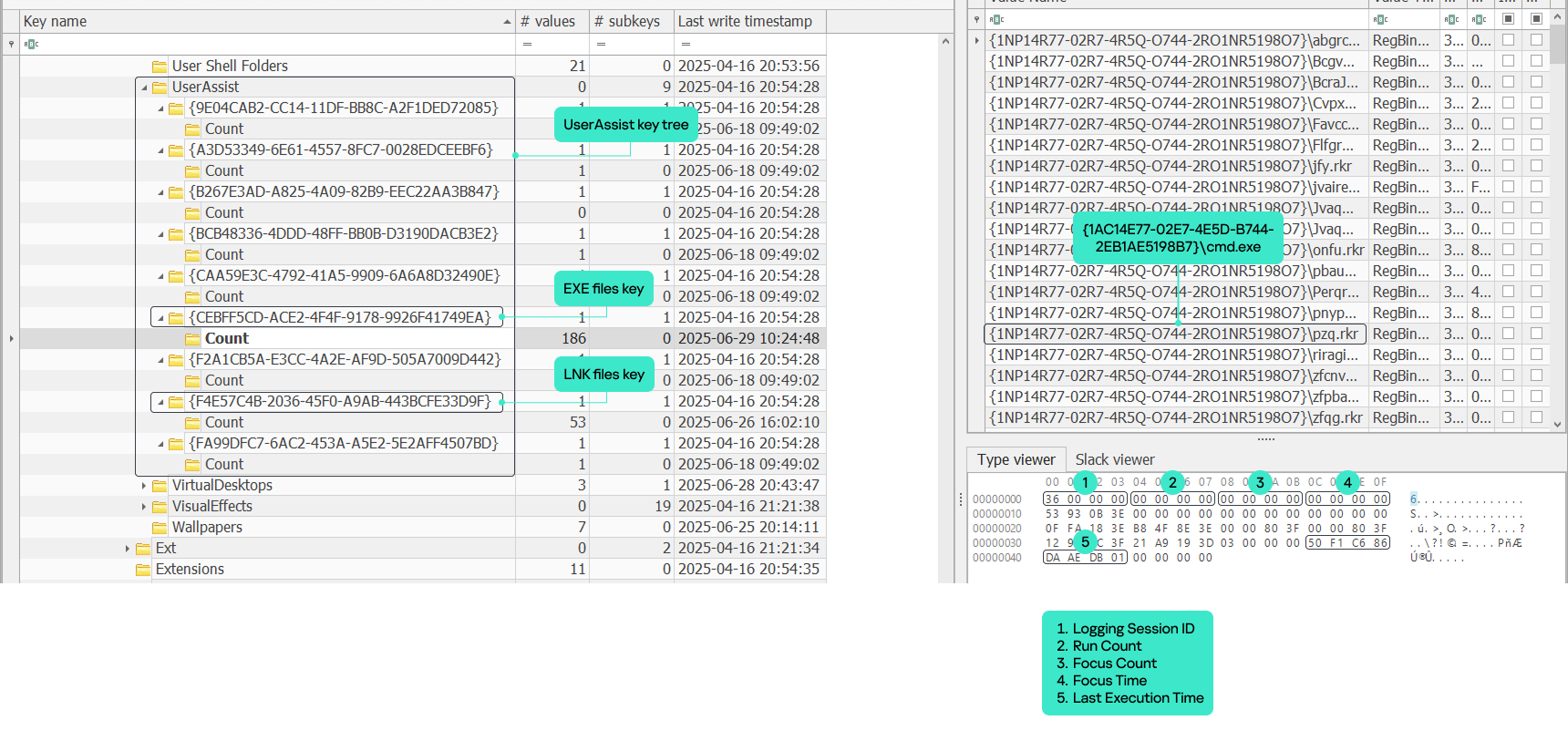
The UserAssist artifact is a registry key under each NTUSER.DAT hive located at SoftwareMicrosoftWindowsCurrentVersionExplorerUserAssist. The key consists of subkeys named with GUIDs. The two most important GUID subkeys are:
Each subkey has its own subkey named “Count”. It contains values that represent the executed programs. The value names are the program paths encrypted using the ROT-13 cipher.
The values contain structured binary data that includes the run count, focus count, focus time and last execution time of the respective application. This structure is well-known and represents the CUACount object. The bytes between focus time and last execution time have never been described or analyzed publicly, but we managed to determine what they are and will explain this later in the article. The last four bytes are unknown and contained a zero in all the datasets we analyzed.
UserAssist artifact
Data inconsistency
Over the course of many investigations, the UserAssist data was found to be inconsistent. Some values included all of the parameters described above, while others, for instance, included only run count and last execution time. Overall, we observed five combinations of UserAssist data inconsistency.
Cases
Run Count
Focus Count
Focus Time
Last Execution Time
1
✓
✓
✓
✓
2
✓
✕
✕
✓
3
✕
✓
✓
✕
4
✓
✕
✓
✓
5
✕
✕
✓
✕
Workflow analysis
Deep dive into Shell32 functions
To understand the reasons behind the inconsistency, we must examine the component responsible for registering and updating the UserAssist data. Our analysis revealed that the component in question is shell32.dll, more specifically, a function called FireEvent that belongs to the CUserAssist class.
Argument 1: GUID that is a subkey of the UserAssist registry key containing the registered data. This argument most often takes the value {CEBFF5CD-ACE2-4F4F-9178-9926F41749EA} because executed programs are mostly EXE files.
Argument 2: integer enumeration value that defines which counters and data should be updated.
Value 0: updates the run count and last execution time
Value 1: updates the focus count
Value 2: updates the focus time
Value 3: unknown
Value 4: unknown (we assume it is used to delete the entry).
Argument 3: full executable path that has been executed, focused on, or closed.
Argument 4: focus time spent on the executable in milliseconds. This argument only contains a value if argument 2 has a value of 2; otherwise, it equals zero.
Furthermore, the FireEvent function relies heavily on two other shell32.dll functions: s_Read and s_Write. These functions are responsible for reading and writing the binary value data of UserAssist from and to the registry whenever a particular application is updated:
The s_Read function reads the binary value of the UserAssist data from the registry to memory, whereas s_Write writes the binary value of the UserAssist data to the registry from the memory. Both functions have the same arguments, which are as follows:
Argument 1: pointer to the memory buffer (the CUACount struct) that receives or contains the UserAssist binary data.
Argument 2: size of the UserAssist binary data in bytes to be read from or written to registry.
Argument 3: undocumented structure containing two pointers.
The CUADBLog instance pointer at the 0x0 offset
Full executable path in plain text that the associated UserAssist binary data needs to be read from or written to the registry.
When a program is executed for the first time and there is no respective entry for it in the UserAssist records, the s_Read function reads the UEME_CTLCUACount:ctor value, which serves as a template for the UserAssist binary data structure (CUACount). We’ll describe this value later in the article.
It should be noted that the s_Read and s_Write functions are also responsible for encrypting the value names with the ROT-13 cipher.
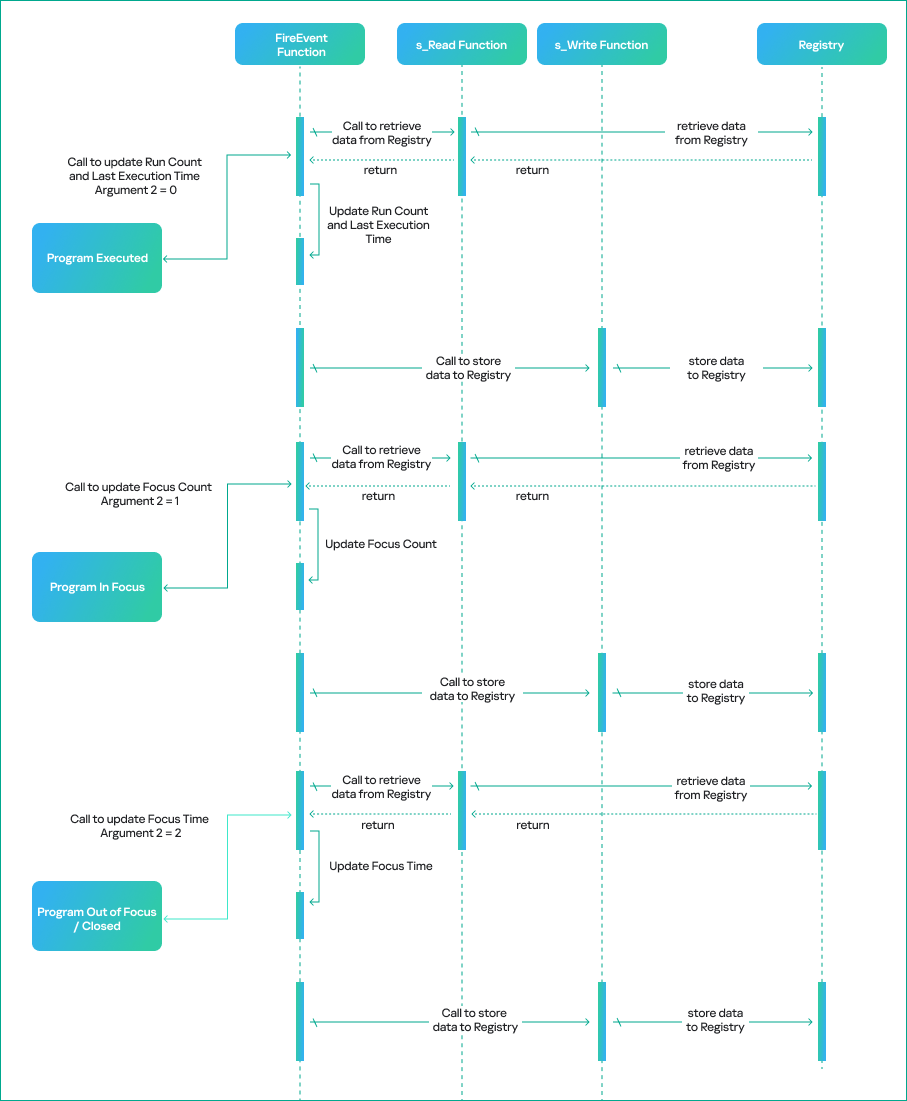
UserAssist data update workflow
Any interaction with a program that displays a GUI is a triggering event that results in a call to the CUserAssist::FireEvent function. There are four types of triggering events:
Program executed.
Program set in focus.
Program set out of focus.
Program closed.
The triggering event determines the execution workflow of the CUserAssist::FireEvent function. The workflow is based on the enumeration value that is passed as the second argument to FireEvent and defines which counters and data should be updated in the UserAssist binary data.
The CUserAssist::FireEvent function calls the CUADBLog::s_Read function to read the binary data from registry to memory. The CUserAssist::FireEvent function then updates the respective counters and data before calling CUADBLog::s_Write to store the data back to the registry.
The diagram below illustrates the workflow of the UserAssist data update process depending on the interaction with a program.
UserAssist data update workflow
The functions that call the FireEvent function vary depending on the specific triggering event caused by interaction with a program. The table below shows the call stack for each triggering event, along with the modules of the functions.
Triggering event
Module
Call Stack Functions
Details
Program executed (double click)
SHELL32
CUserAssist::FireEvent
This call chain updates the run count and last execution time. It is only triggered when the executable is double-clicked, whether it is a CLI or GUI in File Explorer.
Windows.storage
UAFireEvent
Windows.storage
NotifyUserAssistOfLaunch
Windows.storage
CInvokeCreateProcessVerb:: _OnCreatedProcess
Program in focus
SHELL32
CUserAssist::FireEvent
This call chain updates the focus count and only applies to GUI executables.
This call chain updates the focus time and applies to GUI and CLI executables. However, CLI executables are only updated if the program was executed via a double click or if conhost was spawned as a child process.
As previously mentioned, we observed five combinations of UserAssist data. Our thorough analysis shows that these inconsistencies arise from interactions with a program and various functions that call the FireEvent function. Now, let’s examine the triggering events that cause these inconsistencies in more detail.
1. All data
The first combination is all four parameters registered in the UserAssist record: run count, focus count, focus time, and last execution time. In this scenario, the program usually follows the normal execution flow, has a GUI and is executed by double-clicking in Windows Explorer.
When the program is executed, the FireEvent function is called to update the run count and last execution time.
When it is set in focus, the FireEvent function is called to update the focus count.
When it is set out of focus or closed, the FireEvent function is called to update focus time.
2. Run count and last execution time
The second combination occurs when the record only contains run count and last execution time. In this scenario, the program is run by double-clicking in Windows Explorer, but the GUI that appears belongs to another program. Examples of this scenario include launching an application with an LNK shortcut or using an installer that runs a different GUI program, which switches the focus to the other program file.
During our test, a copy of calc.exe was executed in Windows Explorer using the double-click method. However, the GUI program that popped up was the UWP app for the calculator Microsoft.WindowsCalculator_8wekyb3d8bbwe!App.
There is a record of the calc.exe desktop copy in UserAssist, but it contains only the run count and last execution time. However, both focus count and focus time are recorded under the UWP calculator Microsoft.WindowsCalculator_8wekyb3d8bbwe!App UserAssist entry.
3. Focus count and focus time
The third combination is a record that only includes focus count and focus time. In this scenario, the program has a GUI, but is executed by means other than a double click in Windows Explorer, for example, via a command line interface.
During our test, a copy of Process Explorer from the Sysinternals Suite was executed through cmd and recorded in UserAssist with focus count and focus time only.
4. Run count, last execution time and focus time
The fourth combination is when the record contains run count, last execution time and focus time. This scenario only applies to CLI programs that are run by double-clicking and then immediately closed. The double-click execution leads to the run count and last execution time being registered. Next, the program close event will call the FireEvent function to update the focus time, which is triggered by the lambda function (5b4995a8d0f55408566e10b459ba2cbe).
During our test, a copy of whoami.exe was executed by a double click, which opened a console GUI for a split second before closing.
5. Focus time
The fifth combination is a record with only focus time registered. This scenario only applies to CLI programs executed by means other than a double click, which opens a console GUI for a split second before it is immediately closed.
During our test, a copy of whoami.exe was executed using PsExec instead of cmd. PsExec executed whoami as its own child process, resulting in whoami spawning a conhost.exe process. This condition must be met for the CLI program to be registered in UserAssist in this scenario.
We summed up all five combinations with their respective interpretations in the table below.
Inconsistency combination
Interpretation
Triggering events
All Data
GUI program executed by double click and closed normally.
· Program Executed · Program In Focus · Program Out of Focus · Program Closed
Run Count and Last Execution Time
GUI program executed by double click but focus switched to another program.
· Program Executed
Focus Count and Focus Time
GUI program executed by other means.
· Program In Focus · Program Out of Focus · Program Closed
Run Count, Last Execution Time and Focus Time
CLI program executed by double click and then closed.
· Program Executed · Program Closed
Focus Time
CLI program executed by other means than double click, spawned conhost process and then closed.
· Program Closed
CUASession and UEME_CTLSESSION
Now that we have addressed the inconsistency of the UserAssist artifact, the second part of this research will explain another aspect of UserAssist: the CUASession class and the UEME_CTLSESSION value.
The UserAssist database contains value names for every executed program, but there is an unknown value: UEME_CTLSESSION. Unlike the binary data that is recorded for every program, this value contains larger binary data: 1612 bytes, whereas the regular size of values for executed programs is 72 bytes.
CUASession is a class within shell32.dll that is responsible for maintaining statistics of the entire UserAssist logging session for all programs. These statistics include total run count, total focus count, total focus time and the three top program entries, known as NMax entries, which we will describe below. The UEME_CTLSESSION value contains the properties of the CUASession object. Below are some functions of the CUASession class:
In the context of CUASession and UEME_CTLSESSION, we will refer to run count as launches, focus count as switches, and focus time as user time when discussing the parameters of all executed programs in a logging session as opposed to the data of a single program.
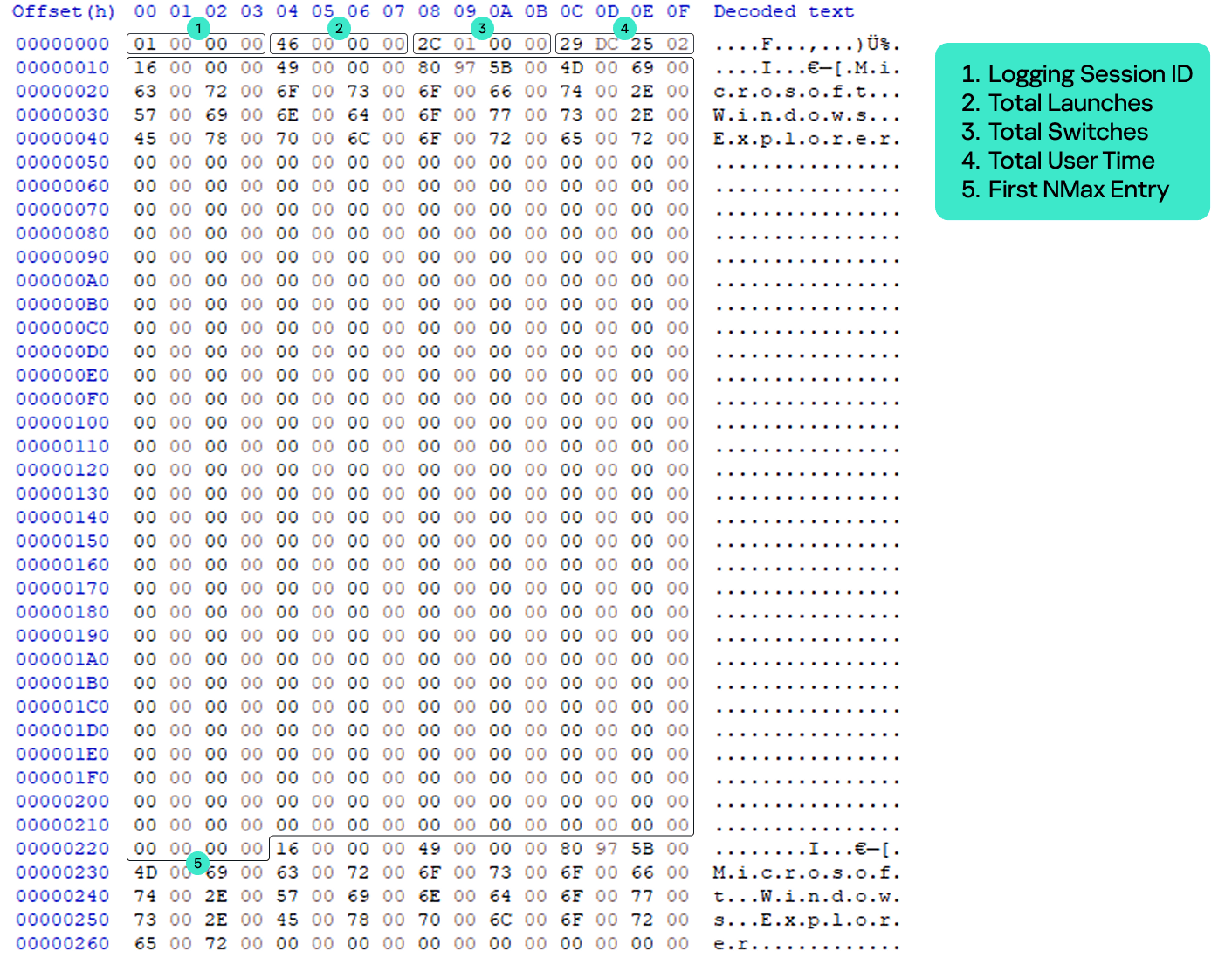
The UEME_CTLSESSION value has the following specific data structure:
0x0 offset: general total statistics (16 bytes)
0x0: logging session ID (4 bytes)
0x4: total launches (4 bytes)
0x8: total switches (4 bytes)
0xC: total user time in milliseconds (4 bytes)
0x10 offset: three NMax entries (1596 bytes)
0x10: first NMax entry (532 bytes)
0x224: second NMax entry (532 bytes)
0x438: third NMax entry (532 bytes)
UEME_CTLSESSION structure
Every time the FireEvent function is called to update program data, CUASession updates its own properties and saves them to UEME_CTLSESSION.
When FireEvent is called to update the program’s run count, CUASession increments Total Launches in UEME_CTLSESSION.
When FireEvent is called to update the program’s focus count, CUASession increments Total Switches.
When FireEvent is called to update the program’s focus time, CUASession updates Total User Time.
NMax entries
The NMax entry is a portion of the UserAssist data for the specific program that contains the program’s run count, focus count, focus time, and full path. NMax entries are part of the UEME_CTLSESSION value. Each NMax entry has the following data structure:
0x0 offset: program’s run count (4 bytes)
0x4 offset: program’s focus count (4 bytes)
0x8 offset: program’s focus time in milliseconds (4 bytes)
0xc offset: program’s name/full path in Unicode (520 bytes, the maximum Windows path length multiplied by two)
NMax entry structure
The NMax entries track the programs that are executed, switched, and used most frequently. Whenever the FireEvent function is called to update a program, the CUADBLog::_CheckUpdateNMax function is called to check and update the NMax entries accordingly.
The first NMax entry stores the data of the most frequently executed program based on run count. If two programs (the program whose data was previously saved in the NMax entry and the program that triggered the FireEvent for update) have an equal run count, the entry is updated based on the higher calculated value between the two programs, which is called the N value. The N value equation is as follows:
N value = Program’s Run Count*(Total User Time/Total Launches) + Program’s Focus Time + Program’s Focus Count*(Total User Time/Total Switches)
The second NMax entry stores the data of the program with the most switches, based on its focus count. If two programs have an equal focus count, the entry is updated based on the highest calculated N value.
The third NMax entry stores the data of the program that has been used the most, based on the highest N value.
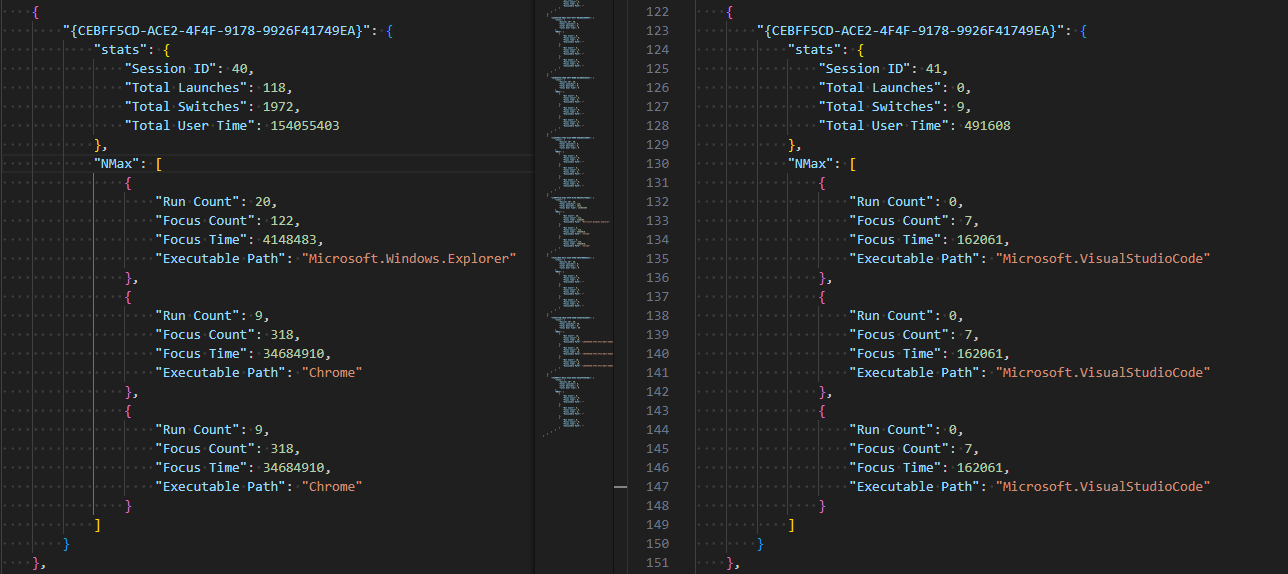
The parsed UEME_CTLSESSION structure with NMax entries is shown below.
1
2
3
4
5
6
7
8
9
10
11
12
13
14
15
16
17
18
19
20
21
22
23
24
25
26
27
28
{
“stats”:{
“Session ID”:40,
“Total Launches”:118,
“Total Switches”:1972,
“Total User Time”:154055403
},
“NMax”:[
{
“Run Count”:20,
“Focus Count”:122,
“Focus Time”:4148483,
“Executable Path”:“Microsoft.Windows.Explorer”
},
{
“Run Count”:9,
“Focus Count”:318,
“Focus Time”:34684910,
“Executable Path”:“Chrome”
},
{
“Run Count”:9,
“Focus Count”:318,
“Focus Time”:34684910,
“Executable Path”:“Chrome”
}
]
}
UEME_CTLSESSION data
UserAssist reset
UEME_CTLSESSION will persist even after logging off or restarting. However, when it reaches the threshold of two days in its total user time, i.e., when the total focus time of all executed programs of the current user equals two days, the logging session is terminated and almost all UserAssist data, including the UEME_CTLSESSION value, is reset.
The UEME_CTLSESSION value is reset with almost all its data, including total launches, total switches, total user time, and NMax entries. However, the session ID is incremented and a new logging session begins.
UEME_CTLSESSION comparison before and after reset
The newly incremented session ID is copied to offset 0x0 of each program’s UserAssist data. Besides UEME_CTLSESSION, other UserAssist data for each program is also reset including run count, focus count, focus time, and the last four bytes, which are still unknown and always contain zero. The only parameter that is not reset is the last execution time. However, all this data is saved in the form of a usage percentage before resetting.
Usage percentage and counters
We analyzed the UserAssist data of various programs to determine the unknown bytes between the focus time and last execution time sections. We found that they represent a list of a program’s usage percentage relative to the most used program at that session, as well as the rewrite counter (the index of the usage percentage last written to the list) for the last 10 sessions. Given our findings, we can now revise the structure of the program’s UserAssist binary data and fully describe all of its components.
UserAssist revised structure
0x0: logging session ID (4 bytes).
0x4: run count (4 bytes).
0x8: focus count (4 bytes).
0xc: focus time (4 bytes).
0x10: element in usage percentage list [0] (4 bytes).
0x14: element in usage percentage list [1] (4 bytes).
0x18: element in usage percentage list [2] (4 bytes).
0x1c: element in usage percentage list [3] (4 bytes).
0x20: element in usage percentage list [4] (4 bytes).
0x24: element in usage percentage list [5] (4 bytes).
0x28: element in usage percentage list [6] (4 bytes).
0x2c: element in usage percentage list [7] (4 bytes).
0x30: element in usage percentage list [8] (4 bytes).
0x34: element in usage percentage list [9] (4 bytes).
0x38: index of last element written in the usage percentage list (4 bytes).
0x3c: last execution time (Windows FILETIME structure) (8 bytes).
0x44: unknown value (4 bytes).
The values from 0x10 to 0x37 are the usage percentage values that are called r0 values and calculated based on the following equation.
r0 value [Index] = N Value of the Program / N Value of the Most Used Program in the session (NMax entry 3)
If the program is run for the first time within an ongoing logging session, its r0 values equal -1, which is not a calculated value, but a placeholder.
The offset 0x38 is the index of the last element written to the list, and is incremented whenever UEME_CTLSESSION is reset. The index is bounded between zero and nine because the list only contains the r0 values of the last 10 sessions.
The last four bytes equal zero, but their purpose remains unknown. We have not observed them being used other than being reset after the session expires.
The table below shows a sample of the UserAssist data broken down by component after parsing.
UserAssist revised data structure parsed
Forensic value
The r0 values are a goldmine of valuable information about a specific user’s application and program usage. These values provide useful information for incident investigations, such as the following:
Programs with many 1 values in the r0 values list are the programs most frequently used by the user.
Programs with many 0 values in the r0 values list are the programs that are least used or abandoned by the user, which could be useful for threat hunting and lead to the discovery of malware or legitimate software used by adversaries.
Programs with many -1 values in the r0 values list are relatively new programs with data that has not been reset within two days of the user interactive session.
UserAssist data template
As mentioned above, when the program is first executed and doesn’t yet have its own UserAssist record (CUACount object), a new entry is created with the UEME_CTLCUACount:ctor value. This value serves as a template for the program’s UserAssist binary data with the following values:
Logging session ID = -1 (0xffffffff). However, this value is copied to the UserAssist entry from the current UEME_CTLSESSION session.
Run count = 0.
Focus count = 0.
Focus time = 0.
Usage percentage list [0-9] = -1 (0xbf800000) because these values are float numbers.
Usage percentage index (counter) = -1 (0xffffffff).
Last execution time = 0.
Last four bytes = 0.
UEME_CTLCUACount:ctor data
New parser
Based on the findings of this research, we created a new parser built on an open source parser. Our new tool parses and saves all UEME_CTLSESSION values as a JSON file. It also parses UserAssist data with the newly discovered r0 value structure and saves it as a CSV file.
Conclusion
We closely examined the UserAssist artifact and how its data is structured. Our thorough analysis helped identify data inconsistencies. The FireEvent function in shell32.dll is primarily responsible for updating the UserAssist data. Various interactions with programs trigger calls to the FireEvent function and they are the main reason for the inconsistencies in the UserAssist data.
We also studied the UEME_CTLSESSION value. It is mainly responsible for coordinating the UserAssist logging session that expires once the accumulated focus time of all programs reaches two days. Further investigation of UEME_CTLSESSION revealed the purpose of previously undocumented UserAssist binary data values, which turned out to be the usage percentage list of programs and the value rewrite counter.
The UserAssist artifact is a valuable tool for incident response activities, and our research can help make the most of the data it contains.
A journalist who was on the Rainbow Warrior voyage to Rongelap last night condemned France for its “callous” attack of an environmental ship, saying “we haven’t forgotten, or forgiven this outrage”.
David Robie, the author of Eyes of Fire: The Last Voyage and Legacy of the Rainbow Warrior, said at the launch that the consequences of almost 300 US and French nuclear tests – many of them “dirty bombs” — were still impacting on indigenous Pacific peoples 40 years after the bombing of the ship.
French saboteurs had killed “our shipmate Fernando Pereira” on 10 July 1985 in what the New Zealand prime minister at the time, David Lange, called a “sordid act of international state-backed terrorism”.
Although relations with France had perhaps mellowed over time, four decades ago there was a lot of hostility towards the country, Dr Robie said.
“And that act of mindless sabotage still rankles very deeply in our psyche,” he said at the launch in Auckland Central’s Ellen Melville Centre on the anniversary of July 10.
About 100 people gathered in the centre’s Pioneer Women’s Hall for the book launch as Dr Robie reflected on the case of state terrorism after Greenpeace earlier in the day held a memorial ceremony on board Rainbow Warrior III.
“One of the celebrated French newspapers, Le Monde, played a critical role in the investigation into the Rainbow Warrior affair — what I brand as ‘Blundergate’, in view of all the follies of the bumbling DGSE spy team,” he said.
Plantu cartoon “And one of the cartoons in that newspaper, by Plantu, who is a sort of French equivalent to Michael Leunig, caught my eye.
“You will notice it in the background slide show behind me. It shows François Mitterrand, the president of the French republic at the time, dressed in a frogman’s wetsuit lecturing to school children during a history lesson.
“President Mitterrand says, in French, ‘At that time, only presidents had the right to carry out terrorism!’
Tahitian advocate Ena Manurevia . . . the background Plantu cartoon is the one mentioned by the author. Image: Asia Pacific Report
He noticed that in the Mitterrand cartoon there was a “classmate” sitting in the back of the room with a moustache. This was none other than Edwy Plenel, the police reporter for Le Monde at the time, who scooped the world with hard evidence of Mitterrand and the French government’s role at the highest level in the Rainbow Warrior sabotage.
Dr Robie said that Plenel now published the investigative website Mediapart, which had played a key role in 2015 revealing the identity of the bomber that night, “the man who had planted the limpet mines on the Rainbow Warrior — sinking a peace and environmental ship, and killing Fernando Pereira.”
Jean-Luc Kister, a retired French colonel and DGSE secret agent, had confessed to his role and “apologised”, claiming the sabotage operation was “disproportionate and a mistake”.
“Was he sincere? Was it a genuine attempt to come to terms with his conscience. Who knows?” Dr Robie said, adding that he was unconvinced.
Hilari Anderson (right on stage), one of the speakers, with Del Abcede and MC Antony Phillips (obscured) . . . the background image shows Helen Clark meeting Fernando Pereira’s daughter Marelle in 2005. Image: Greenpeace
French perspective Dr Robie said he had asked Plenel for his reflections from a French perspective 40 years on. Plenel cited three main take ways.
“First, the vital necessity of independent journalism. Independent of all powers, whether state, economic or ideological. Journalism that serves the public interest, the right to know, and factual truths.
“Impactful journalism whose revelations restore confidence in democracy, in the possibility of improving it, and in the usefulness of counterbalancing powers, particularly journalism.”
Secondly, this attack had been carried out by France in an “allied country”, New Zealand, against a civil society organisation. This demonstrated that “the thirst for power is a downfall that leads nations astray when they succumb to it.
“Nuclear weapons epitomise this madness, this catastrophe of power.”
Eyes of Fire 10 years ago . . . same author, same publisher. Video: Pacific Media Centre
Finally, Plenel expressed the “infinite sadness” for a French citizen that after his revelations in Le Monde — which led to the resignations of the defence minister and the head of the secret services — nothing else happened.
“Nothing at all. No parliamentary inquiry, no questioning of François Mitterrand about his responsibility, no institutional reform of the absolute power of the president in a French republic that is, in reality, an elective monarchy.”
‘Elective monarchy’ trend Dr Robie compared the French outcome with the rapid trend in US today, “a president who thinks he is a monarch, a king – another elective monarchy.”
He also bemoaned that “catastrophe of power” that “reigns everywhere today – from the horrendous Israeli genocide in Gaza to the Russian invasion of Ukraine, from Trump to Putin to Netanyahu, and so many others.”
The continuous Gaza massacres were a shameful indictment of the West that had allowed it to happen for more than 21 months.
Dr Robie thanked many collaborators for their help and support, including drama teacher Hilari Anderson, an original crew member of the Rainbow Warrior, and photographer John Miller, “who have been with me all the way on this waka journey”.
He thanked his wife, Del, and family members for their unstinting “patience and support”, and also publisher Tony Murrow of Little Island Press.
Eyes of Fire: The Last Voyage and Legacy of the Rainbow Warrior . . . published 10 July 2025. Image: David Robie/Little Island Press
Launching the book, Greenpeace Aotearoa programme director Niamh O’Flynn said one thing that had stood out for her was how the legacy of the Rainbow Warrior had continued despite the attempt by the French government to shut it down 40 years ago.
“We said then that ‘you can’t sink a rainbow’, and we went on to prove it.
“When the Rainbow Warrior was bombed in Auckland harbour, it was getting ready to set sail to Moruroa Atoll, to enter the test exclusion zone and confront French nuclear testing head-on.”
So threatened The French government had felt so threatened by that action that it had engaged in a state-sanctioned terror attack to prevent the mission from going ahead.
“But we rebuilt, and the Rainbow Warrior II carried on with that mission, travelling to Moruroa three times before the French finally stopped nuclear testing in the Pacific.
“That spirit and tenacity is what makes Greenpeace and what makes the Rainbow Warrior so special to everyone who has sailed on her,” she said.
“It was the final voyage of the Rainbow Warrior to Rongelap before the bombing that is the focus of David Robie’s book, and in many ways, it was an incredibly unique experience for Greenpeace — not just here in Aotearoa, but internationally.
“And of course David was a key part in that.”
O’Flynn said that as someone who had not even been born yet when the Rainbow Warrior was bombed, “I am so grateful that the generation of nuclear-free activists took the time to pass on their knowledge and to build our organisation into what it is today.
“Just as David has by writing down his story and leaving us with such a rich legacy.”
Greenpeace Aotearoa programme director Niamh O’Flynn . . . “That spirit and tenacity is what makes Greenpeace and what makes the Rainbow Warrior so special to everyone who has sailed on her.” Image: APR
Other speakers Among other speakers at the book launch were teacher Hilari Anderson, publisher Tony Murrow of Little Island Press, Ena Manuireva, a Mangarevian scholar and cultural adviser, and MC Antony Phillips of Heritage New Zealand Pouhere Taonga.
Anderson spoke of the Warrior’s early campaigns and acknowledged the crews of 1978 and 1985.
“I have been reflecting what these first and last crews of the original Rainbow Warrior had in common, realising that both gave their collective, mostly youthful energy — to transformation.
“This has involved the bonding of crews by working hands-on together. Touching surfaces, by hammer and paint, created a physical connection to this beloved boat.”
She paid special tribute to two powerful women, Denise Bell, who tracked down the marine research vessel in Aberdeen that became the Rainbow Warrior, and the indomitable Susi Newborn, who “contributed to naming the ship and mustering a crew”.
Manuireva spoke about his nuclear colonial experience and that of his family as natives of Mangareva atoll, about 400 km from Muroroa atoll, where France conducted most of its 30 years of tests ending in 1995.
He also spoke of Tahitian leader Oscar Temaru’s pioneering role in the Nuclear-Free and Independent Pacific (NFIP) movement, and played haunting Tahitian songs on his guitar.
Teresa Sindelar always knew she wanted to be a part of human spaceflight, but she was unsure how to make that dream a reality until a chance encounter with former NASA astronaut Tom Stafford when she was 11 years old. The pair met in a local jewelry shop near Sindelar’s Nebraska home, where Gen. Stafford was signing autographs. In addition to his photo, Gen. Stafford gave Sindelar a valuable tip – she should check out the Kansas Cosmosphere, a space museum in Hutchinson, Kansas. “I proceeded to attend every camp the Cosmosphere offered as a student, interned during college, and worked there full time while earning my graduate degree,” Sindelar said.
She discovered a passion for teaching and mentoring young students through her work in the museum’s education department and a stint as a high school science teacher. When she began looking for opportunities at NASA, she sought a position that melded instruction with technical work. “I like pouring into others and watching them grow,” she said. Today, Sindelar is a chief training officer (CTO) within the Flight Operations Directorate at NASA’s Johnson Space Center in Houston. Along with her fellow CTOs, Sindelar oversees the correct and complete training of NASA astronauts, crew members representing international partners, and all flight controllers. “I put the pieces together,” she said. “It is my job to make sure instructors, schedulers, outside partners, facility managers, and others are all in sync.” She added that CTOs have a unique position because they see the big picture of a training flow and understand the long-term training goals and objectives.
“I get to do a lot of cool things and go to a lot of cool places,” she said, noting that the training facilities at Johnson and other NASA centers, as well as facilities managed by international partners, are top-notch. While she does enjoy watching astronauts work through problems and learn new systems, she has a special fondness for flight controller training and mentoring young professionals. “What fills my cup the most is seeing a brand-new employee right out of college blossom into a confident flight controller, do their job well, and make our missions better,” she said. “I like knowing that I had something to do with that.” Sindelar has been part of the Johnson team since 2010 and worked as an educator in what was then called the center’s Office of Education and as a crew training instructor in the Space Medicine Operations Directorate before becoming a CTO. In March 2025, Sindelar received a Space Flight Awareness Program Honoree Award for her outstanding leadership in the Private Astronaut Mission (PAM) program, which is an important component of NASA’s strategy for enabling a robust and competitive commercial economy in low Earth orbit. As the lead CTO for the third PAM, Axiom Mission 3, Sindelar managed training while identifying critical inefficiencies, enhancing mission safety and performance. She spearheaded a key stakeholder retreat to streamline operations, reorganized training resources for improved accessibility, and implemented efficiency improvements that optimized mission support. Sindelar’s work was recognized during an award ceremony at NASA’s Kennedy Space Center in Florida, and she got to attend the launch of NASA’s SpaceX Crew-10 mission as a special guest. In her 15 years with the agency, she has learned the importance of leading by example. “My team needs to see that I meet the bar I set,” she said. “Leading is about motivating your people so they are committed, not just compliant.”
Keeping a team motivated and on track is particularly important to training success and safety. “We only get a matter of months to train astronauts to do the most hazardous activities that humans have done, or to train flight controllers who literally have the mission and the lives of astronauts in their hands,” Sindelar said, adding that they cannot afford to have an unfocused or indifferent team. Sindelar observed that Johnson’s training team is acutely aware of their responsibilities. “We live and work in the same communities as the crew members,” she said. “We see them at school functions, at the grocery store, at the park. We know their families are counting on us to bring their loved ones home safely.” She has also learned that her voice matters. “When I was a young professional, I just never felt I could be influential, but the only person holding me back was me,” she said. “I had to learn to trust in my own instincts. That was definitely outside of my comfort zone.” She credits her mentors with helping her build confidence and knowing when and how to speak up. “I have had many giants of the spaceflight community mold and shape me in my career, from my counselors at the Cosmosphere all the way to flight directors and astronauts,” she said. “It is my privilege to learn from them, and I am grateful to each of them.” Outside of work, Sindelar uses her voice in a different way – as part of her church choir. She also plays piano, stating that she is as passionate about music and volunteerism as she is about human spaceflight. She is a member of the Friendswood Volunteer Fire Department, as well, serving on its rehab team and as the department’s chaplain
As NASA prepares to return humans to the Moon and journey on to Mars, Sindelar hopes she has taught the next generation of explorers enough so they can show the world the wonders of the universe. “This next generation will see and do things my generation never even thought of,” she said, adding that it is time for them to start leading. “Use your voice. Take care of each other along the way. Reach out and help the next one in line.” Sindelar keeps a reminder of that important message on her desk: the picture Gen. Stafford signed all those years ago.
Sixty years ago, NASA’s Mariner 4 captured groundbreaking views of the Red Planet, leading to a steady stream of advances in the cameras used to study other worlds. In 1965, NASA’s Mariner 4 mission brought Mars into American living rooms, where TV sets showed fuzzy black-and-white images of a cratered landscape. The spacecraft took 21 complete pictures — the first ever captured of another planet — as it flew by as close as 6,118 miles (9,846 kilometers) above the surface. The mission team couldn’t wait to see what the camera aboard the spacecraft would return. When the actual images were delayed, they went so far as to create a color-by-numbers image, assigning hues to specific values in the data. Their handiwork wasn’t far off, and the barren landscape Mariner 4 captured ignited the imaginations of future scientists and engineers who would go on to work on a succession of missions, each revealing Mars in a way it had never been seen before. Millions of Mars images have been taken since then, many of which are captivating in their own way. The images that follow highlight some of the “firsts” in the way the agency has used imaging to help unlock the secrets of Mars. Viking 1 Sets Foot on Mars July 20, 1976
Viking 1 became the first spacecraft to touch down on Mars on July 20, 1976. The first high-resolution image it sent to Earth captured a dry, rocky landscape that dashed any hope among scientists of discovering life on the surface. But the crisp images that followed from the lander’s 360-degree cylindrical scan camera underscored the scientific value of seeing Mars from the ground and generated excitement for a more ambitious visit: a robotic spacecraft that could drive across this alien world. Portrait of Mars by Viking 1 Orbiter 1980
When the twin Viking landers arrived at Mars, each descended from an orbiter that used cameras to map Mars in a way Earth-based telescopes couldn’t. They began capturing images before the landers even touched down, continuing until 1980. That year, the Viking 1 orbiter captured images that were later stitched into a defining portrait of Valles Marineris — the “Grand Canyon of Mars.” Sojourner Starts to Explore July 5, 1997
By the time NASA returned to the Martian surface in 1997 with the Pathfinder lander and its microwave-oven-size Sojourner rover, much had changed on Earth since Mariner 4’s images beamed to TV viewers: Now, the internet was bringing around-the-clock news to personal computers, allowing a young generation of space fans to witness the tentative first steps of a new form of planetary exploration. The panoramic images from the ground were the first since Viking and, as part of NASA’s “faster, better, cheaper” initiative, offered more detail and a comparatively lower cost. Opportunity Spots Passing Dust Devil March 31, 2016
In 2004, NASA’s golf-cart-size twin rovers Spirit and Opportunity set down on the Red Planet, beginning a new phase of Martian exploration. Equipped with both mast-mounted panoramic and arm-mounted microscopic imagers, the roving spacecraft let scientists, engineers, and the world discover new terrain each day. They captured colorful views of Martian vistas and revealed details of pebble-size “blueberries.” Mars was beginning to feel less like an unfamiliar world than a place with recognizable landmarks. MRO’s HiRISE Views Victoria Crater July 18, 2009
Since Viking, a series of increasingly advanced orbiters have arrived at Mars with new science tools and cameras. Using increasingly sophisticated imagers, they have mapped the planet’s hills and valleys, identified significant minerals, and found buried glaciers. A camera that has been in operation aboard NASA’s Mars Reconnaissance Orbiter since 2006, the High-Resolution Imaging Science Experiment (HiRISE) frequently captures individual dunes, boulders, and craters, as with this picture of Victoria Crater, revealing features that had been blurry in previous images. The camera has also identified landing sites and places where future rovers (perhaps even astronauts) could explore. Curiosity, Perseverance Bring More Cameras and Color Aug. 5, 2012 and Feb. 18, 2021
Both Curiosity and Perseverance arrived at Mars (in 2012 and 2021, respectively) loaded with cameras that pack millions of pixels into their images and peer farther into the distance than Spirit or Opportunity ever could. They also feature upgraded arm-mounted cameras for studying fine details like sand particles and rock textures. Perseverance took a step beyond Curiosity in several ways, including with high-speed cameras that showed its parachute deploying and its rocket-powered jetpack flying away during entry, descent, and landing on Mars. Another advance can be seen in each vehicle’s hazard-avoidance cameras, which help rover drivers spot rocks they might bump into. As seen in the first images each rover sent back, Curiosity’s black-and-white cameras were upgraded to color and higher resolution for Perseverance, providing clearer views of the surface. Ingenuity Spots Perseverance at Belva Crater Aug. 22, 2023
Just as Pathfinder brought the tiny Sojourner rover to Mars, NASA’s next-generation Perseverance rover carried the Ingenuity helicopter. Along with proving flight in Mars’ thin air was possible, Ingenuity used a commercial, off-the-shelf color camera to take aerial views over the course of 72 flights. During one of those flights, Ingenuity even spotted Perseverance in the distance — another first on the Red Planet. Future Mars helicopters might be able to scout paths ahead and find scientifically interesting sites for robots and astronauts alike. More About These Missions NASA JPL, which is managed for the agency by Caltech in Pasadena, California, built Mariner 4, the Viking 1 and 2 orbiters, Pathfinder, Sojourner, Spirit and Opportunity, Curiosity, Perseverance, and Ingenuity. It continues to operate Curiosity and Perseverance. Lockheed Martin Space in Denver built MRO and supports its operations, while JPL manages the mission. The University of Arizona, in Tucson, operates HiRISE, which was built by BAE Systems, in Boulder, Colorado. The Viking 1 and 2 landers were built by Martin Marietta; the Viking program was managed by NASA’s Langley Research Center in Hampton, Virginia. JPL led operations for the Viking landers and orbiters. News Media Contacts Andrew GoodJet Propulsion Laboratory, Pasadena, Calif.818-393-2433andrew.c.good@jpl.nasa.gov Karen Fox / Molly WasserNASA Headquarters, Washington202-358-1600karen.c.fox@nasa.gov / molly.l.wasser@nasa.gov 2025-088
NASA astronaut Shannon Walker retired July 10, concluding a career that spanned 38 years, including 30 years of federal service and more than 21 years as an astronaut. During two spaceflights, she spent 330 days in orbit, contributing to hundreds of scientific experiments and technology demonstrations for the benefit of humanity. Walker served as a mission specialist during NASA’s SpaceX Crew-1 mission to the International Space Station in 2020, the first crewed operational Dragon spacecraft flight. She also was the first woman to fly aboard a Dragon spacecraft. Once aboard the orbiting laboratory, Walker joined the Expedition 64/65 crew and briefly commanded Expedition 65, logging 167 days in space before returning to Earth in May 2021. She spent 163 days in space during her first spaceflight in 2010 as a member of the space station’s Expedition 24/25 crew. She was the pilot of the Soyuz TMA-19, which became the first crew to dock with the station’s Rassvet module. “Shannon’s dedication to human space exploration has left an incredible impact, not just here in Houston, but across the industry,” said Steve Koerner, acting director of NASA’s Johnson Space Center in Houston. “Her leadership and guidance will be missed immensely, but she leaves behind a legacy of excellence that will continue to inspire the next generation of explorers for decades to come.” Most recently, Walker served as the deputy chief of the Astronaut Office. She also oversaw the 2021 class of astronaut candidates, supervising their training and graduation in 2024. “Shannon and I were a part of the same astronaut class back when we first started,” said Joe Acaba, chief of the Astronaut Office at NASA Johnson. “She has been a great friend to me ever since and a great leader within the Astronaut Office. I could not imagine a better partner by my side when, nearly 20 years later, we’d become chief and deputy chief. She has undoubtedly been a positive influence on this office, and her retirement is well-deserved.” Walker began her career as a flight controller in the Mission Control Center at NASA Johnson, supporting several shuttle missions. She next worked in the International Space Station Program Office, helping to develop, build, and integrate hardware for the space station. In the early days of the space station, she returned to mission control, leading the engineering team responsible for the space station’s technical health. She was selected as an astronaut in 2004. After completing her initial two years of training, she served as a crew support astronaut and worked as a capsule communicator, or capcom. She also held leadership positions within the several branches of the Astronaut Office focused on International Space Station operations, crew Soyuz missions, and supporting astronauts with flight assignments. She also commanded the NASA Extreme Environment Mission Operations project, or NEEMO 15 underwater mission. “I had always known I wanted to be an astronaut when I grew up, but looking back on the past 38 years, I never would have imagined how many adventures my career would take me on,” said Walker. “I feel fortunate to have been able to work with people all over the world in the pursuit of space exploration. I have seen a lot of change in the evolution of human spaceflight, and I know the future is in good hands with all the talented people we have here and the generations yet to come.” The Houston native attended Rice University in her hometown, where she earned a bachelor’s degree in physics, followed by a master’s degree and doctorate in space physics. Learn more about how NASA explores the unknown and innovates for the benefit of humanity at: https://www.nasa.gov/ -end- Chelsey Ballarte Johnson Space Center, Houston 281-483-5111 Chelsey.n.ballarte@nasa.gov
strong>ST. LOUIS – Disaster Recovery Centers in St. Louis City and St. Louis County will have new operating hours beginning this Sunday, July 13 to assist residents and businesses affected by the May 16 disaster. All locations will be closed on Sundays. St. Louis City Locations
LOCATIONS HOURS OF OPERATION
Urban League Entrepreneurship and Women’s Business Center 4401 Natural Bridge Ave.St. Louis, MO 63115 Monday-Friday: 8 a.m.-7 p.m.Saturday: 9 a.m.-4 p.m. Sunday: Closed
Sumner High School — Parking Lot4248 Cottage Ave.St. Louis, MO 63113 Monday-Friday: 8 a.m.-7 p.m.Saturday: 9 a.m.-4 p.m. Sunday: Closed
Union Tabernacle M.B. Church626 N. Newstead Ave.St. Louis, MO 63108 Monday-Friday: 8 a.m.-7 p.m.Saturday: 9 a.m.-4 p.m. Sunday: Closed
St. Louis County Locations
LOCATIONS HOURS OF OPERATION
St. Louis County LibraryMid-County Branch7821 Maryland Ave.Clayton, MO 63105 Monday-Thursday: 8 a.m.-7 p.m.Friday: 8 a.m.-5 p.m. Saturday: 9 a.m.-4 p.m.Sunday: Closed
St. Louis County LibraryPrairie Commons Branch915 Utz Ln.Hazelwood, MO 63042 Monday-Thursday: 8 a.m.-7 p.m.Friday: 8 a.m.-5 p.m. Saturday: 9 a.m.-4 p.m.Sunday: Closed
You can visit any Disaster Recovery Center, no matter where you are staying now.At all locations, FEMA and the U.S. Small Business Administration will help impacted residents with their disaster assistance applications, answer questions, and upload required documents. To save time, please apply for FEMA assistance before coming to a Disaster Recovery Center. Apply online at DisasterAssistance.gov or by calling 1-800-621-3362. If you are unable to apply online or by phone, someone at the Disaster Recovery Center can assist you. The FEMA application deadline for the May 16 disaster is August 11, 2025. If your home or personal property sustained damage not covered by insurance, FEMA may be able to provide money to help you pay for home repairs, a temporary place to live, and replace essential personal property that was destroyed.
Over the past six months, the headlines have been dominated by stories of fear, division and hatred.However, activists around the world are working away to ensure hope prevails. Here are some of the human rights wins we can be proud of from January to June 2025.
January
Afghanistan
In 2023, Amnesty International released a report on the Taliban’s war on women. Following its findings, the International Criminal Court (ICC) Prosecutor filed a request for arrest warrants against the Taliban’s Supreme Leader and their Chief Justice, citing crimes against humanity.
The request charges the Taliban’s Supreme Leader and their Chief Justice for gender persecution against women, girls, and LGBTI people since their return to power in August 2021. Although the warrants are still subject to the approval of ICC judges these are the first public arrest warrants sought by the ICC in Afghanistan since the country became a member of the court in 2003.
Cameroon
Dorgelesse Nguessan was released on 16 January after spending more than four years in prison for participating in a protest. The hairdresser and single mother had never been politically active yet joined a protest after growing concerned about the high cost of living. She was charged with insurrection, tried by a military court and sentenced to five years in prison on 7 December 2021.
I thank those who directly or indirectly work for your organization and contributed to my release.
Dorgelesse Nguessan
Dorgelesse was part of Amnesty International’s 2022 Write for Rights campaign, where thousands of supporters called for her release. Amnesty also provided short-term relief support to assist Dorgelesse and her family through the difficult moments of her detention. On 16 January, the Court of Appeal reduced her sentence.
“I thank you for all the efforts you have devoted as I was arbitrarily detained,” said Dorgelesse. “I thank those who directly or indirectly work for your organization and contributed to my release.”
Chile
On 2 January, two police [Carabineros] officers were sentenced to prison for shooting activist Renzo Inostroza and blinding him in one eye. The court concluded that their actions violated both Chile’s national regulations and international obligations. This conviction set a judicial precedent in the struggle to ensure the Chilean justice system pursues criminal responsibility for the unlawful actions of the Carabineros. This conviction follows Amnesty’s landmark Eyes on Chile report, which analyzed patterns and individual cases of police violence during the social unrest that broke out in Chile in October 2019. Renzo’s case was part of the report.
Saudi Arabia
From January to February, Amnesty successfully campaigned for the release of several human rights defenders in Saudi Arabia. On 7 January, human rights defender and former prisoner of conscience, Mohammed al-Qahtani, was conditionally released after spending 12 years in prison for his human rights work. On 13 February, 47-year-old teacher Asaad bin Nasser al-Ghamdi was released from prison following an unfair trial before the notorious Specialized Criminal Court (SCC). Asaad was arrested in 2022 and initially sentenced to 20 years in prison for social media posts criticizing the government’s Vision 2030 programme. On 10 February 2025, Leeds University PhD student and mother of two, Salma al-Shehab, was released from prison after completing a four-year prison term following an unfair trial before the SCC. Following a grossly unfair trial, the SCC had convicted Salma al-Shehab of terrorism-related offences for publishing tweets in support of women’s rights.
USA
The United States sanctioned a number of companies involved in the transfer of weapons into Sudan and Darfur. These sanctions follow Amnesty’s innovative briefing, published in July 2024, that combined business trade data and video analysis to show how the constant import of foreign-manufactured arms into Sudan was fuelling relentless civilian suffering.
Amnesty International members long campaigned for the release of Native American activist Leonard Peltier and most recently called on President Biden to grant Leonard Peltier clemency on humanitarian grounds and as a matter of justice.
USA
Leonard Peltier, a Native American activist, was imprisoned for nearly 50 years in the USA for a crime he maintains he did not commit. There were serious concerns about the fairness of his trial and conviction. Tribal Nations, Nobel Peace Laureates, former FBI agents, numerous others, and even the former U.S. Attorney, James Reynolds, whose office handled the prosecution, have called for Leonard Peltier’s release. Amnesty International members had long campaigned for his release, and most recently called on President Biden to grant Leonard Peltier clemency on humanitarian grounds and as a matter of justice. In the final hour of his presidency, former President Biden commuted Peltier’s life sentence to home confinement. Amnesty recently offered him short-term relief support as he works to rebuild his life after his release.
February
Algeria
Thanks to sustained advocacy work from Amnesty International Algeria and several national women’s rights organizations, Algeria’s president Abdelmadjid Tebboune announced a series of concrete measures to combat violence against women – moving from commitment to action.
The Ministry of Solidarity has since launched a national toll-free helpline, available 24/7 across the country, enabling victims to report abuse, be referred to appropriate support services, and receive emergency assistance when in danger. It is already proving effective. A Guide for Women Victims of Violence has been published in Arabic and English and is currently being distributed nationwide. New legal measures, including the possibility of issuing an immediate restraining order against perpetrators of violence, have also been announced.
Benin
Thousands of Beninese families living in coastal areas have been living an endless nightmare, victims of forced evictions orchestrated in the name of tourism development. However, in February the authorities issued a public call for people awaiting proper compensation to come forward so their case can be followed up. The National Agency for Land and Property’s direct also asked Amnesty International for a list of people who have not received appropriate reparations.
The move follows the release of an Amnesty International report on forced evictions in Benin in December 2023 and a subsequent campaign calling for proper compensation for those who have been unfairly evicted, which proved vital in securing this positive outcome.
Thank you all very much. Without your help, we could not have saved my husband.
Zaynura Hasan
Amnesty International had been campaigning for his freedom since he was initially detained in July 2021. Zaynura Hasan, Idris’ wife, thanked the organization for the relentless support.
“Thank you all very much. Without your help, we could not have saved my husband.”
Serbia
Recent research by Amnesty International’s Security Lab and European Regional Office documented how Serbian police and intelligence authorities are using advanced phone spyware alongside mobile phone forensic products to unlawfully target journalists, environmental activists and other individuals in a covert surveillance campaign.
In a significant human rights win, Cellebrite (a company specialising in digital intelligence and forensics) announced it will stop the use of its digital forensic equipment for some of its customers in Serbia as a direct result of Amnesty’s research. Simultaneously, Serbia’s Prosecutor for High Technological Crime, the Ombudsman and Data Protection Commissioner started separate investigations based on the research findings.
Senegal
In a positive step forward, the Senegalese government invited Amnesty International to provide support and assistance for people who have been arrested for participating in protests, as well as former detainees.
Since 2021, Amnesty International has denounced the unlawful use of force by security forces during protests, compiled a list of those who have been killed, and condemned the arbitrary detention of hundreds of people for having called for or participated in protests. According to figures gathered by Amnesty International and other civil society organizations, at least 65 people were killed, the majority by firearms, with at least 1,000 wounded. A further 2,000 people were arrested.
Amnesty International continues to call for the repeal of the amnesty law adopted by the former government, for justice and reparation for the victims and their family members.
Taner Kılıç, a refugee rights lawyer and former Chair of Amnesty International’s Türkiye section, was finally acquitted after nearly eight years of judicial proceedings.
Türkiye
Taner Kılıç, a refugee rights lawyer and former Chair of Amnesty International’s Türkiye section, was finally acquitted after nearly eight years of judicial proceedings.
Arrested in June 2017 and imprisoned for over 14 months, he was unjustly convicted in 2020 despite no credible evidence. He faced more than six years in prison for “membership of a terrorist organization”. Amnesty provided relief support to him and his family as they navigated the difficulty of his imprisonment.
Reflecting on the case, Taner said: “This nightmare that has gone on for almost eight years is finally over… The only thing I was sure of throughout this process was that I was right and innocent, and the support from all over the world gave me strength. I thank each and every one who stood up for me.”
In a landmark ruling, Brazilian actor Juan Darthés was found guilty for the rape of Argentinian actress Thelma Fardin. Amnesty provided legal and psychosocial support to Thelma.
Latin America
In a landmark ruling for women’s rights in Latin America, a Brazilian court convicted actor Juan Darthés of sexual violence against Argentine actress Thelma Fardin, who accused him in 2018 of abusing her when she was 16. Amnesty provided support for transport related costs, and psychosocial support for Thelma throughout her case. The sentence sets an important precedent for sexual violence cases in the region.
After a five-year legal battle across three countries, Thelma stated: “Today I can look my 16-year-old self in the eye and say we did it.”
Philippines
Former Philippine President Rodrigo Duterte was arrested by police on the basis of an arrest warrant issued by the International Criminal Court (ICC) for crimes against humanity.
Thousands of people, mostly from poor and marginalized communities, were unlawfully killed by the police – or by armed individuals suspected to have links to the police – during Duterte’s so-called “war on drugs”. Amnesty has been calling for his arrest for a number of years and described it as “a long-awaited and monumental step for justice”. He is now due to stand trial at the ICC.
Sierra Leone
Hawa Hunt, a reality TV star, was freed from detention on 4 March and cleared of all the cybercrime related charges against her. She was arrested on live television in December 2024 and charged with insulting the President and First Lady in a social media video.
Amnesty International called on authorities to release her and to ensure her rights were upheld.
Her daughter Alicia said: “In one of the very few phone calls I was able to have with my mother as she was in jail, I told her how Amnesty International spoke up for her. She and our whole family were very touched by the support. We believe it played a very key role in her being released.”
Since May 1995, the Saturday Mothers have held peaceful weekly protests demanding justice for relatives forcibly disappeared in the eighties and nineties.
Türkiye
Since May 1995, the Saturday Mothers have held regular peaceful protests at Galatasaray Square every Saturday, demanding justice for relatives forcibly disappeared in the eighties and nineties. Their 700th vigil on 25 August 2018 was banned and violently dispersed by police using tear gas and water cannons.
Forty-six people were detained and later released, but in 2020, they were prosecuted for “attending illegal meetings and marches without weapons and not dispersing despite warnings”.
Thanks to the determination of the Saturday Mothers and their supporters – including Amnesty International who provided legal aid – all were acquitted in March 2025.
USA
On March 17, US immigration authorities detained Alberto, the father of a Venezuelan family of four, separating him from his wife and two children. Despite the family having pending asylum applications, he was charged with “illegal” entry to the United States. His case was an example of the Trump administration’s use of a provision of immigration law to target individuals and families that have been in the United States for years, rather than recent arrivals at the US-Mexico border. On April 21, 2025, Alberto was granted bond and released from ICE detention, following calls from Amnesty International and reunited with his wife and two children.
May
Chile
Romario Veloz was shot and killed by an army captain during social unrest in La Serena, Chile, in 2019. The police officer who shot Romario Veloz was imprisoned in May 2025 – setting a precedent in cases of human rights violations committed by state agents. Despite the victory, widespread impunity for police violence continues. Romario was also part of Amnesty’s Eyes on Chile investigation (2020). Amnesty provided support to Romario’s young child, helping her access education as well as covering the legal expenses for the family’s quest to seek justice.
Alongside the report, Amnesty was part of the Advisory Unit for Police Reform, wrote letters to the Chilean president and gave numerous media interviews on police violence. Amnesty Chile’s relentless campaigning paid off and helped to stop the implementation of the use of tasers by Chilean police forces.
Côte d’Ivoire
On 7 May, Ghislain Duggary Assy, Communications Secretary of the Movement of Teachers for the Dignity Dynamic union, was provisionally released pending his trial, due to international pressure from Amnesty International. A month earlier, he had been sentenced to two years’ imprisonment solely for having called for strike action in primary and secondary schools.
Amnesty International condemned the flagrant violation of workers’ rights, in particular the right to strike and freedom of association and will continue to call for his unconditional release.
Greece
Two years ago, the Pylos shipwreck led to the death of more than 600 people. Now, 17 Greek coastguard officers face charges in connection with it, including causing a shipwreck, exposure to danger and failure to provide assistance. These developments may pave the way towards accountability for the worst shipwreck in the Mediterranean in recent years.
Amnesty has been calling for justice through sustained advocacy and campaigning.
Türkiye
Afghan asylum seeker Tabriz Saifi is blind due to chronic diabetes and relies on dialysis three times a week. However, his international protection application was rejected by the Turkish authorities on 28 February, which meant he no longer had access to life-saving healthcare. Amnesty International immediately launched an urgent action, calling for the decision to be reversed.
On 2 May, his family was informed that the decision had been reversed and that his asylum seeker status had been reinstated, along with full access to free healthcare.
Girls and women support the right to abortion in Argentina.
Argentina
An Argentine private health insurer was fined over $4,000 USD for denying a legal abortion to a woman whose pregnancy posed serious health risks — a clear violation of the country’s reproductive rights law.
Amnesty International Argentina provided legal advice and stressed that rulings like this reinforce the need to guarantee access to legal abortion as a right, not an exception subject to individual or institutional discretion.
Council of Europe
Following sustained advocacy by Amnesty International and the Omega Research Foundation, the Council of Europe’s Steering Committee for Human Rights (CDDH) adopted a report on measures against the trade in goods used for death penalty, torture and other cruel, inhuman or degrading treatment or punishment.
Georgia
After months of public pressure, protests and legal action, the Georgian Ministry of Justice announced it would end the humiliating practice of fully stripping detainees during body searches.
The decision followed a lawsuit from the Public Defender in February, a report from Amnesty International condemning the practice as degrading and unlawful, as well as a video featuring Georgian artist and activist Kristina Botkoveli, who was subjected to a forced strip search, harassment, and threats after participating in protests.
Following calls from Amnesty International and other organizations, the revised Sámi Parliament Act has now been approved by the Finnish parliament.
Finland
The Sámi are a group of Indigenous people that come from the region of Sápmi, which stretches across the northern parts of Norway, Sweden, Finland and the Kola peninsula in Russia.
For a number of years, they have been subjected to human rights violations. However, following calls from Amnesty International and other organizations, the revised Sámi Parliament Act has now been approved by the Finnish parliament.
The amended Act strengthens Indigenous Sámi people’s right to self-determination and improves the way in which the Sámi Parliament operates. It also corrects human rights violations highlighted by international human rights treaty bodies.
Hungary
On 28 June, Budapest Pride proceeded despite restrictive anti-Pride laws and police targeting the march. Around 200,000 people, including over 280 Amnesty International activists and staff from Hungary and 22 other countries, peacefully demanded equality and assembly rights. This was Budapest’s largest Pride in 30 years, symbolizing strong public resistance to discrimination and highlighting the resilience of Hungary’s LGBTI community. Amnesty’s Let Pride March campaign helped raise awareness, mobilize activists, and urged police to respect peaceful protest. With over 120,000 global actions supporting the event – it demonstrated that solidarity can overcome oppression, though challenges for LGBTI rights in Hungary persist.
Activists and speakers – including King Okabi of the Ogale community – call for an end to Shell’s pollution of the Niger Delta and compensation outside the Royal Courts of Justice in London, on day one of the Ogale and Bille communities vs Shell trial, 13 February 2025.
Nigeria/UK
After a decade-long fight for justice, a UK court ruled that Shell can be held liable for the oil spills and leaks it has failed to clean up in the Niger Delta – regardless of how long ago they happened.
The judgement is an important step towards justice for communities in the Niger Delta and a vital opportunity to make Shell pay for the devastating pollution it has caused to the Ogale and Bille communities’ lands.
In parallel with this decision, the Nigerian government also pardoned the Ogoni Nine. The group of activists, led by Ken Saro-Wiwa, Nigerian author and campaigner, were executed 30 years ago by a government that wanted to hide the crimes of Shell and other oil companies that were destroying the lives and livelihoods of tens of thousands of people across the Niger Delta.
Amnesty has been supporting and campaigning for justice for the Ogoni Nine for years and documenting the destruction Shell has left behind through a series of powerful reports. While these are positive outcomes, much more needs to be done to ensure justice is achieved for communities in the Niger Delta, including holding Shell and other oil companies to account for the damage they have done and continue to do – and Amnesty will be there every step of the way!
Ukraine
On 24 June, President Volodymyr Zelenskyy and Secretary General of the Council of Europe Alain Berset signed an agreement establishing a Special Tribunal for the Crime of Aggression Against Ukraine in Strasbourg, following calls from Amnesty International and others. It is hoped this will help hold perpetrators of the crime of aggression accountable.
Mahmoud Khalil, a Palestinian activist and student organizer who recently graduated from Columbia University, was targeted for his role in student protests at Columbia University.
USA
On March 9, US immigration authorities unlawfully arrested and arbitrarily detained Mahmoud Khalil, a Palestinian activist, lawful permanent resident of the USA, and student organizer who recently graduated from Columbia University. Mahmoud was targeted for his role in student protests at Columbia University, where he was exercising his rights to freedom of expression and peaceful assembly. He was not charged with a crime yet was held in a detention centre, told that his permanent residency status was “revoked”, and placed in deportation proceedings. Amnesty International demanded that authorities release Mahmoud immediately and respect his rights to freedom of expression, peaceful assembly, and due process. After 104 days in a Louisiana immigration detention centre, Mahmoud Khalil was released on bail in June 21, however he’s still facing threats of deportation by US authorities. He has since filed a $20 million USD lawsuit against the Trump administration.
Global warming has picked up pace since around 2010, leading to the recent string of record warm years. Why this is happening is still unclear, and among the biggest questions in climate science today. Our new study reveals that reductions in air pollution – particularly in China and east Asia – are a key reason for this faster warming.
Cleanup of sulphur emissions from global shipping has been implicated in past research. But that cleanup only began in 2020, so it’s considered too weak to explain the full extent of this acceleration. Nasa researchers have suggested that changes in clouds could play a role, either through reductions in cloud cover in the tropics or over the North Pacific.
One factor that has not been well quantified, however, is the effect of monumental efforts by countries in east Asia, notably China, to combat air pollution and improve public health through strict air quality policies. There has already been a 75% reduction in east Asian sulphur dioxide emissions since around 2013, and that cleanup effort picked up pace just as global warming began accelerating.
Our study addresses the link between east Asian air quality improvements and global temperature, building on the efforts of eight teams of climate modellers across the world.
We have found that polluted air may have been masking the full effects of global warming. Cleaner air could now be revealing more of the human-induced global warming from greenhouse gases.
In addition to causing millions of premature deaths, air pollution shields the Earth from sunlight and therefore cools the surface. There has been so much air pollution that it has held human-induced warming in check by up to 0.5°C over the last century.
With the cleanup of air pollution, something that’s vital for human health, this artificial sunshade is removed. Since greenhouse gas emissions have kept on increasing, the result is that the Earth’s surface is warming faster than ever before.
Modelling the cleanup
Our team used 160 computer simulations from eight global climate models. This enabled us to better quantify the effects that east Asian air pollution has on global temperature and rainfall patterns. We simulated a cleanup of pollution similar to what has happened in the real world since 2010. We found an extra global warming of around 0.07°C.
While this is a small number compared with the full global warming of around 1.3°C since 1850, it is still enough to explain the recent acceleration in global warming when we take away year-to-year swings in temperature from natural cycles such as El Niño, a climate phenomenon in the Pacific that affects weather patterns globally.
Based on long-term trends, we would have expected around 0.23°C of warming since 2010. However, we actually measured around 0.33°C. While the additional 0.1°C can largely be explained by the east Asian air pollution cleanup, other factors include the change in shipping emissions and the recent accelerated increase in methane concentrations in the atmosphere.
Air pollution causes cooling by reflecting sunlight or by changing the properties of clouds so they reflect more sunlight. The cleanup in east Asian air pollution influences global temperatures because it reduces the shading effect of the pollution over east Asia itself. It also means less pollution is blown across the north Pacific, causing clouds in the east Pacific to reflect less sunlight.
The pattern of these changes across the North Pacific simulated in our models matches that seen in satellite observations. Our models and temperature observations also show relatively strong warming over the North Pacific, downwind from east Asia.
The main source of global warming is still greenhouse gas emissions, and a cleanup of air pollution was both necessary and overdue. This did not cause the additional warming but rather, removed an artificial cooling that has for a time helped shield us from some of the extreme weather and other well-established consequences of climate change.
Global warming will continue for decades. Indeed, our past and future emissions of greenhouse gases will affect the climate for centuries. However, air pollution is quickly removed from the atmosphere, and the recent acceleration in global warming from this particular unmasking may therefore be short-lived.
Don’t have time to read about climate change as much as you’d like?
Laura Wilcox receives funding from the Natural Environment Research Council (NERC), the Research Council of Norway, the Clean Air Fund, and Horizon Europe.
Bjørn H. Samset receives funding from the Research Council of Norway, the Clean Air Fund, and Horizon Europe.
Reappointment of a non-lay member of the Legal Services Board
The Lord Chancellor has approved the reappointment of Habib Motani as a non-lay member of the Legal Services Board.
The Lord Chancellor has approved the reappointment of Habib Motani as a non-lay member of the Legal Services Board for four years from 18 April 2026.
Mr Motani qualified as a solicitor in 1980. He is a Consultant to Clifford Chance LLP having spent over 30 years as a partner in the firm’s banking and finance practice. He is a Visiting Professor at the School of Law at the University of Edinburgh. and a Trustee at: The British Institute of International and Comparative Law, the Institute of Ismaili Studies and The Aga Khan University (International) in the United Kingdom. He is also a member of the Steering Group of the Canary Wharf Multi-faith Chaplaincy.
The Legal Services Board (LSB) is the independent body overseeing the regulation of lawyers in England and Wales. Its goal is to reform and modernise the legal services marketplace by putting the interests of consumers at the heart of the system. It is independent of government and the legal profession and oversees the approved regulators, which themselves regulate lawyers.
The LSB also oversees the Office for Legal Complaints and its administration of the Legal Ombudsman scheme that resolves complaints about lawyers.
Appointments and reappointments are made, by the Lord Chancellor, under the Legal Services Act 2007 and are regulated by the Commissioner for Public Appointments. This reappointment has been made in line with the Governance Code on Public Appointments.
An important disclaimer is at the bottom of this article.
Today, the Yandex Education student camp on NLP (Natural Language Processing) started at the Novosibirsk State University. It is attended by 100 students from IT departments of universities from all over the country. In two weeks, the participants will master key approaches to text processing, as well as work with large language models BERT, GPT and YandexGPT (used for content analysis and generation) in practice. At the end of the student camp, students will defend team projects that they can add to their own portfolios. Participants will teach artificial intelligence to structure information, find contradictions in texts, search for data in complex documents where text, tables and graphs are mixed, and also improve the reasoning skills of language models.
Minister of Digital Development and Communications of the Novosibirsk Region Sergey Tsukar emphasized: The Novosibirsk Region, as the capital of IT personnel, always supports the holding of various educational events on digital topics and is happy to host IT students from all over the country.
— In the Novosibirsk Region, 10 universities and 14 colleges train IT specialists. NSU is our reliable partner. The guys had a chance to study at one of the best universities — world-class and at one of the leading scientific centers of Russia — Akademgorodok. This is a unique opportunity — to get concentrated, fundamental knowledge in the field of artificial intelligence in two weeks, which usually takes months to study. Artificial intelligence is no longer just a trend, it is our reality today. I thank Yandex for such relevant, interesting, free educational projects, — noted Sergey Tsukar.
NSU has been cooperating with Yandex for many years. Based on Faculty of Mechanics and Mathematics of NSU A master’s program was opened with the support of the School of Data Analysis – “Applied Machine Learning and Big Data”. Many graduates of the program work in large IT companies.
— It is an honor for us that such an event is held at Novosibirsk University. The student camp is an intensive course in IT areas, which is held by Yandex Education together with the leading universities of our country. Of course, our university, which is located in the very center of Akademgorodok, is one of such universities. I hope that these two weeks will be truly intensive for you, there will be intense work. There was a very big competition for the student camp, the best were selected. You will leave here not only with new acquaintances, friends, new impressions, but also with new knowledge. You will be taught by experts from Yandex and our university. I think this will help you in your professional career, and in some time, I am sure, we will be proud of many of you, — said the rector of NSU, academician of the Russian Academy of Sciences Mikhail Fedoruk.
The first week of the student camp is devoted to getting acquainted with key approaches to NLP. Participants will understand the architecture of transformers (models that use the attention mechanism for fast learning), study methods of adaptation and interpretation of models, and master the tasks of classification, generation and error tolerance. They will also study advanced technologies: attention mechanisms, autoregressive models, multimodality and RAG (Retrieval Augmented Generation). In the second week, students will focus on practice: they will work with data analysis and the final defense of a project that solves real problems at the intersection of science and industry.
Kirill Barannikov, Head of Strategic Development of Higher Education at Yandex Education, notes:
— We focus on new formats of education, and student camps are one of them. Full-time intensive programs are open to students from all over Russia. They provide not only relevant knowledge, access to big tech technologies, but also the opportunity to meet practicing industry experts and teachers from the country’s strongest universities. In addition, in two weeks, participants have time to put together a full-fledged project for their portfolio and immerse themselves in a new socio-cultural environment – the city and university where the student camp is taking place. Almost 1,200 students from 200 universities applied for the NLP program at NSU – the competition was about 12 people per place. The selected participants will study natural language processing technologies, which are used today in various fields: from developing voice assistants to analyzing big data.
Yandex Education student camps are two-week intensive courses in mathematics, IT and artificial intelligence, which are held at leading Russian universities in a face-to-face format. Participating students come to the university for two weeks to immerse themselves in an educational program on a specific topic and create a team project for their own portfolio.
Experts from Yandex, SHAD and the host university participate in creating content for student camps. The creators of the program include both practicing specialists and theorists with experience in teaching.
The project is designed for 3rd-4th year undergraduate students who are already studying computer science at the university and have a base in programming and mathematics. Junior students can also participate in the selection if their knowledge allows them to master the program.
Please note: This information is raw content obtained directly from the source of the information. It is an accurate report of what the source claims and does not necessarily reflect the position of MIL-OSI or its clients.
Source: Peter the Great St. Petersburg Polytechnic University –
An important disclaimer is at the bottom of this article.
The 3rd Meeting of Gazprom’s target students took place in the shift settlement of Yamburg (YaNAO). It was attended by 150 students from the company’s specialized universities from all over the country. The meeting was held for the first time at an operating gas production facility.
The program of the meeting included lectures on the development of gas production at the Kara Sea shelf fields, trainings, team-building events and a team case championship. The students saw Gazprom production facilities at the Yamburg oil and gas condensate field, visited social and household facilities of the rotational village, and got acquainted with the culture and traditions of the indigenous peoples of the North.
Two students from the Institute of Power Engineering, in the Electrical Power Engineering and Electrical Engineering program, participated in the meeting from the Polytechnic University: Leonid Golubev (3rd year bachelor’s degree student) and Vladimir Sergeev (1st year master’s degree student), target students of Gazprom Transgaz Saint Petersburg.
“The gathering included interesting training sessions on soft skills development. It was interesting to solve cases, learn new things, improve communication and teamwork skills. The organizers also tried to fill the program with excursions, events “at the edge of the earth”. This gathering will be remembered for the knowledge acquired, friends and emotions,” Vladimir shared.
“Surrounded by one and a half hundred talented students from all over Russia, I solved current problems of developing new deposits. All this together helped me to start believing in myself more, not to be afraid to move forward, to learn to look for new non-standard solutions,” Leonid said.
Polytechnic employees also participated in the event as experts on the case championship jury: Elvira Tuktamysheva, Head of the Employment Assistance Sector, and Janis Olekhnovich, Curator of the “PAO Gazprom Flagship University” project.
“Immersion in the corporate culture, production and business processes of the company shows students their immediate future after graduation,” Elvira Tuktamysheva noted. “Thanks to this, the likelihood of stress during the transition from studying at a university to working in a company is reduced. Such a system helps the guys more easily adapt to a new stage in their professional career.”
Please note: This information is raw content obtained directly from the source of the information. It is an accurate report of what the source claims and does not necessarily reflect the position of MIL-OSI or its clients.
Source: People’s Republic of China – State Council News
Amna bint Abdullah Al Dahak, the UAE’s minister of climate change and environment, concluded a high-level visit to China from July 7-10, the UAE Embassy in Beijing said, as the two countries seek to deepen cooperation on climate action, sustainable agriculture and food security.
UAE Ambassador to China Hussein Ibrahim Al Hammadi (R) and UAE Minister of Climate Change and Environment Amna bint Abdullah Al Dahak (L) pose for photo in Beijing, July 7, 2025. [Photo Provided to China.org.cn]
Al Dahak described UAE-China relations as “a comprehensive and interconnected strategic partnership and a unique model for successful cooperation across various fields and projects.”
She said the UAE views China as an important partner and hopes to combine China’s agricultural innovation capabilities with the UAE’s National Food Security Strategy 2051 to boost food production in both countries while expanding climate cooperation and people-to-people exchanges.
UAE Ambassador to China Hussain bin Ibrahim Al Hammadi said the visit “opens a new chapter for cooperation between the two countries in climate, agriculture and other fields, reflecting the vision of leaders of both countries to build a prosperous future.”
Representatives from China and the UAE pose for a group photo at the UAE-China Friendship Forest of Date Palm in Wenchang, Hainan province, July 10, 2025. [Photo Provided to China.org.cn]
A key part of the delegation’s itinerary was a visit to the UAE-China Friendship Forest of Date Palm in Wenchang, south China’s Hainan province. The project, launched by UAE President Sheikh Mohamed bin Zayed Al Nahyan during his 2019 visit to China, aims to plant 100,000 date palm seedlings.
Two phases of planting have been completed so far, totaling 25,000 seedlings. The remaining 75,000 will be planted in two phases in 2026 and 2028.
The delegation also visited institutions including the Beijing Tongzhou International Seed Industry Science and Technology Centre, Tsinghua University and the Chinese Academy of Agricultural Sciences to exchange views on seed science, the circular economy and the transfer of sustainable agricultural technologies.
Meetings on air pollution control and solid waste management were conducted with the Chinese Research Academy of Environmental Sciences, alongside discussions on data transparency with the Institute of Public and Environmental Affairs. Some members also visited technology firm Inspur Group to explore tech-based environmental solutions.
The delegation comprised senior officials from the UAE Ministry of Climate Change and Environment, agricultural institution heads and university experts.
The embassy said the visit reflects the UAE’s comprehensive determination to deepen cooperation with China at the government, academic and private sector levels.
Source: Hong Kong Government special administrative region – 4
Following is the speech by the Chief Secretary for Administration, Mr Chan Kwok-ki, at the Student of the Year Awards 2024/25 Presentation Ceremony today (July 12):
Catherine (Chief Executive Officer of the South China Morning Post (SCMP), Ms Catherine So), Dr Lake Wang (Executive Director, People and Organisational Development of the Hong Kong Jockey Club), Tammy (Editor-in-Chief of the South China Morning Post, Ms Tammy Tam), Advisory Board members, ladies and gentlemen,
Good morning. And what a great morning this is for Hong Kong. Today, we celebrate our secondary schools and the exceptional professionalism and dedication of principals, teachers and support staff. We also thank parents for their endless support. And, most importantly, we honour the students among us today – the winners and finalists of this 44th annual Student of the Year Awards.
This year, over 840 students from 177 schools were nominated. And that, I’m delighted to say, is a new record high for the Awards.
Rewarding excellence is no easy task, yet Hong Kong is fortunate to have so many deserving students.
The judging panel had the tough task of bringing all those impressive nominations down to 40 finalists for the Awards’ 10 student categories, including the Grand Prize.
The Government is firmly committed to youth development.
The Youth Development Blueprint for Hong Kong, released in late 2022, outlines our guiding principles for promoting long-term youth development. Its original 160-plus measures have been expanded, since then, to about 250, in an ongoing effort to ensure that the Blueprint evolves to meet the changing needs of our youth.
Our vision is to raise a new generation of youth instilled with a global perspective, a positive mindset and a deep love for our city and our country.
That demands a community-wide effort, including valued partnerships with organisations like the SCMP and the Jockey Club, working closely with educational institutions and families, to create an enabling environment for the youth of Hong Kong.
This year’s theme, “Building Tomorrow: Growth Through Action”, reflects that shared vision.
My congratulations to each and every one of this year’s awardees and finalists. Remember, this city, together with your proud parents, your school, teachers and mentors, and so many others who have helped you along the way, believe in you and look forward to your future with great expectations.
I am grateful to the South China Morning Post and the Hong Kong Jockey Club for organising this prestigious event year after year and, in doing so, putting a brilliant spotlight on education, our youth and Hong Kong.
My thanks, too, to the Awards’ judges, nearly 40 in all, for their invaluable time and expertise, and their compelling commitment to excellence.
Ladies and gentlemen, I know you will all enjoy this memorable day in the life.
Source: Hong Kong Government special administrative region – 4
Following is the speech by the Chief Secretary for Administration, Mr Chan Kwok-ki, at the Student of the Year Awards 2024/25 Presentation Ceremony today (July 12):
Catherine (Chief Executive Officer of the South China Morning Post (SCMP), Ms Catherine So), Dr Lake Wang (Executive Director, People and Organisational Development of the Hong Kong Jockey Club), Tammy (Editor-in-Chief of the South China Morning Post, Ms Tammy Tam), Advisory Board members, ladies and gentlemen,
Good morning. And what a great morning this is for Hong Kong. Today, we celebrate our secondary schools and the exceptional professionalism and dedication of principals, teachers and support staff. We also thank parents for their endless support. And, most importantly, we honour the students among us today – the winners and finalists of this 44th annual Student of the Year Awards.
This year, over 840 students from 177 schools were nominated. And that, I’m delighted to say, is a new record high for the Awards.
Rewarding excellence is no easy task, yet Hong Kong is fortunate to have so many deserving students.
The judging panel had the tough task of bringing all those impressive nominations down to 40 finalists for the Awards’ 10 student categories, including the Grand Prize.
The Government is firmly committed to youth development.
The Youth Development Blueprint for Hong Kong, released in late 2022, outlines our guiding principles for promoting long-term youth development. Its original 160-plus measures have been expanded, since then, to about 250, in an ongoing effort to ensure that the Blueprint evolves to meet the changing needs of our youth.
Our vision is to raise a new generation of youth instilled with a global perspective, a positive mindset and a deep love for our city and our country.
That demands a community-wide effort, including valued partnerships with organisations like the SCMP and the Jockey Club, working closely with educational institutions and families, to create an enabling environment for the youth of Hong Kong.
This year’s theme, “Building Tomorrow: Growth Through Action”, reflects that shared vision.
My congratulations to each and every one of this year’s awardees and finalists. Remember, this city, together with your proud parents, your school, teachers and mentors, and so many others who have helped you along the way, believe in you and look forward to your future with great expectations.
I am grateful to the South China Morning Post and the Hong Kong Jockey Club for organising this prestigious event year after year and, in doing so, putting a brilliant spotlight on education, our youth and Hong Kong.
My thanks, too, to the Awards’ judges, nearly 40 in all, for their invaluable time and expertise, and their compelling commitment to excellence.
Ladies and gentlemen, I know you will all enjoy this memorable day in the life.
Source: Peter the Great St. Petersburg Polytechnic University –
An important disclaimer is at the bottom of this article.
A key meeting of the Council of the Consortium of Educational and Scientific Organizations was held, dedicated to the approval of candidates for the honorary title of “Ambassador of Russian Education and Science”. In February 2023, an agreement was signed on the consortium for the implementation of the “Ambassadors of Russian Education and Science” program, among its participants is the Polytechnic University. The session considered 21 submissions from 12 Russian universities. The Polytechnic nominated Liu Wei (China) and Issa Togo (Mali).
The activities of both candidates have been promoting Russian education abroad for decades. Secretary General of the Institute of Russia at Tsinghua University Liu Wei has been overseeing scientific and technical cooperation with the Russian Federation since 2002. Dozens of projects have been implemented under her leadership, including Russian-Chinese dialogues on innovation, the creation of Russian language testing centers, and youth competitions.
A 1985 graduate of the Leningrad Polytechnic Institute, associate professor at SPbPU and Honorary Consul of Mali in St. Petersburg, Issa Togo coordinates academic ties with African universities, participates in the reform of higher education in Mali and heads a large-scale hydroelectric project.
The consortium council unanimously approved the candidates, sending the documents for final approval to the Russian Ministry of Education and Science. If successful, Liu Wei and Issa Togo will join the ranks of 24 current ambassadors from 22 countries.
“Liu Wei and Issa Togo are not just allies, but living bridges between cultures. Their dedication to education is the polytechnic spirit in action: when a graduate, wherever he is, continues to carry the banner of his alma mater. We are proud that it is our candidates who set the tone in promoting Russian values abroad. Their recognition is an investment in the future, where science and education know no boundaries,” commented Dmitry Arsenyev, Vice-Rector for International Affairs at SPbPU.
Under the program “Ambassadors of Russian Education and Science”, which unites 44 universities of the country, since 2023, 24 experts from Europe, Asia, Africa and Latin America have been awarded the title. Polytechnic University is traditionally among the most active participants in the initiative.
Please note: This information is raw content obtained directly from the source of the information. It is an accurate report of what the source claims and does not necessarily reflect the position of MIL-OSI or its clients.
Ambassador Selby Pillay represented Mr Sylvestre Radegonde, Minister of Foreign Affairs and Tourism of the Republic of Seychelles, at the 47th Ordinary Session of the Executive Council of the African Union in Malabo, Equatorial Guinea from 10th to 11th July 2025.
The 47th Ordinary Session was conducted under the theme: “Justice for Africans and People of African Descent through reparations”. It adopted the African Union Commission budget for 2026, assessed the implementation of the Agenda 2063, considered the roadmap on the theme of the year 2026, and endorsed decisions on critical issues affecting the African Continent.
During the discussions on the roadmap of the theme for the year 2026: “Assuring Sustainable Water Availability and Safe Sanitation Systems to Achieve the Goals of Agenda 2063”, Ambassador Pillay recognised the inseparable linkage between water and other factors such as health, agriculture, and climate resilience. He further underscored that “Seychelles, as a Small Island Developing State, will always be a strong advocate for environment sustainability and climate change, due to its vulnerabilities mainly from the devasting effects of climate change”.
The Ordinary Session further witnessed the election of Professor Gaspard Banyankimbona from Burundi as the new African Union Commissioner for Education, Science, Technology and Innovation (ESTI) and Mrs Francisca Tatchouop Belobe from Equatorial Guinea as the new Commissioner for Economic Development, Trade, Tourism, Industry and Minerals (ETTIM). This completes the election and appointment process of the Senior Leadership of the African Union Commission, a process which started in February 2025.
Ambassador Pillay was accompanied by Mrs Patricia Ilunga, Second Secretary at the Embassy of Seychelles in Addis Ababa.
Distributed by APO Group on behalf of Ministry of Foreign Affairs and Tourism, Republic of Seychelles.
Source: People’s Republic of China in Russian – People’s Republic of China in Russian –
An important disclaimer is at the bottom of this article.
Source: People’s Republic of China – State Council News
SHANGHAI, July 14 (Xinhua) — The SCO Think Tank Forum 2025, themed “Promoting Sustainable Development Guided by the Shanghai Spirit,” was held from Saturday to Sunday at the SCO Center for International Legal Training and Cooperation (China) based at the Shanghai University of Political Science and Law.
Nearly 100 experts and scholars from leading universities and think tanks in China and abroad attended the forum. They held in-depth exchanges of views on the issues of “SCO and the Transformation of the Global Governance System,” “SCO’s Own Construction and Reform,” “Striving for Sustainable Common Security,” “Inclusiveness, Win-Win, Mutually Beneficial Cooperation, and Striving for Common Prosperity,” “Searching for Universal Values in the Diversity of Civilizations,” and “Development Prospects for the SCO.”
Rector of Shanghai University of Political Science and Law, Director of the Office of the Center for International Legal Training and Cooperation of the SCO /China/ Liu Xiaohong noted that over the past 20 years, guided by the “Shanghai Spirit”, the SCO has achieved significant success in regional security, economic cooperation and humanitarian exchanges and serves as an important example of a new type of regional cooperation mechanism. She also expressed hope that the forum will give new impetus to regional cooperation.
According to Sun Zhuangzhi, Director of the Institute of Russia, Eastern Europe and Central Asia at the Chinese Academy of Social Sciences (CASS), the launch of the “SCO Year of Sustainable Development” within the framework of China’s rotating chairmanship of the SCO will contribute to the development of global governance in a more just and rational direction and will make the SCO’s contribution to promoting peace and development throughout the world.
Speaking at the event, former SCO Secretary-General Vladimir Norov suggested that SCO think tanks focus on priority tasks, including aligning national strategies for transport infrastructure development, developing a unified mechanism for monitoring carbon emissions with the involvement of national environmental agencies, and expanding research into SCO humanitarian diplomacy, which, he said, not only reflect the realities of the current geopolitical and economic context, but also outline a concrete agenda that can transform the SCO from a platform of declarations into a mechanism for practical solutions.
The forum was jointly organized by the Shanghai University of Political Science and Law, the SCO Center for International Legal Training and Cooperation (China), the China Institute of International Studies (CIIS) and the China Center for SCO Studies. -0-
Please note: This information is raw content obtained directly from the source of the information. It is an accurate report of what the source claims and does not necessarily reflect the position of MIL-OSI or its clients.
Source: People’s Republic of China – State Council News
China’s Wang Chuqin swept Japan’s Tomokazu Harimoto in the men’s singles final, while university teacher and former World Cup winner Zhu Yuling returned to the top by defeating Chen Yi in a clash of female giant-killers at the WTT US Smash in Las Vegas on Sunday.
Wang, who became China’s first left-handed men’s singles world champion earlier this year, gave little chance to the third-seeded Harimoto, who has a reputation for struggling against left-handed opponents.
Displaying confidence and control, the second-seeded Wang dominated with wide-angled shots and steady rallies, securing an 11-3, 11-6, 12-10, 11-8 victory.
“I kept level-headed either in lead or trailing,” said Wang. “I felt so relieved when the tournament was over. I need a short break and come back again.”
Zhu, once a key player on the Chinese national team and now representing Macao, China, used her experience, strong backhands and unpredictable rhythm changes to overcome a two-set deficit and defeat Chen 7-11, 8-11, 11-7, 11-5, 11-9, 11-8 in 56 minutes.
Zhu had previously stepped away from the sport to recover from cancer, pursue academic studies, become a professor at Tianjin University, and manage her family business. She returned to competitive play last year and upset world No. 2 Wang Manyu on her way to the final. Chen, 20, had earlier eliminated several top seeds, including reigning world champion Sun Yingsha.
“This isn’t a typical clash of speed and power,” said Zhu. “We battled against each other in terms of patience, tenacity, spin, offense and defense.”
TAINAN, Taiwan and HSINCHU, Taiwan, July 14, 2025 (GLOBE NEWSWIRE) — Himax Technologies, Inc. (Nasdaq: HIMX) (“Himax” or “Company”), a leading supplier and fabless manufacturer of display drivers and other semiconductor products, and Rabboni Co., Ltd. (“Rabboni”), a Taiwan-based company integrating next-generation semiconductor sensing and edge computing to enable smart living, smart sensing and wearable devices, today jointly announced the unveiling of bboni Ai, the world’s first multi-scenario endpoint AI sensing system. bboni Ai integrates Rabboni’s high-precision IMU (Inertial Measurement Unit) motion sensors with Himax’s ultralow power WiseEye2 AI processor, opening a new chapter for real-time endpoint AI inference for wearable devices and accelerating the transition of AI from concept to real-world implementation.
WiseEye2 AI processor features a high-performance architecture built on Cortex-M55 cores and is equipped with the Ethos-U55 AI inference engine. It supports always-on sensing, dynamic voltage and frequency scaling (DVFS), and a multi-level power management structure. The design empowers dynamic adjustments in core voltage and frequency based on the scenarios of wearable devices, enabling data collection, event triggering, and endpoint AI inference at ultralow power consumption of just a few milliwatts. This architecture significantly reduces reliance on cloud transmission, effectively lowering latency and power consumption. It also enhances real-time responsiveness and data privacy, delivering a commercially viable endpoint AI solution for devices requiring long-hour operation. Notably, WiseEye™ AI can also collaborate with cloud-based large language models (LLMs), further enhancing the device’s ability to perceive, understand, and interact with complex real -world scenarios.
bboni Ai Brings AI to the Endpoint: On-Device AI Processing. No Cloud Needed
Featuring integrated motion sensing capability and ultralow power AI powered by Himax’s WiseEye2 AI processor, the bboni Ai system enables real-time motion analysis, posture recognition, and behavior interpretation directly on the endpoint device, eliminating the need for cloud computing. With low-latency, high-efficiency, and privacy-preserving on-device AI, bboni Ai delivers a truly scalable and deployable endpoint AI solution. bboni Ai not only enhances system stability but also meets the stringent requirements for data immediacy and security in applications such as healthcare and education.
bboni Ai Transforms Everyday Life Across Diverse Wearable Applications: Demonstrates broad real-world readiness across multiple use cases
Smart Healthcare: Supports WHO’s ICOPE (Integrated Care for Older People) framework, facilitating seniors to monitor physical function and rehabilitation progress at home, reducing the cost of care
Sports Technology: Real-time detection of user movements and behavior, providing instant motion feedback, optimizing training postures through AI analysis, improving training efficiency and reducing the risk of injury
Education and Interaction: Enables hands-on STEM and AI education by leveraging motion sensing and behavior analysis to foster interdisciplinary learning and innovation, cultivating the next generation of talent
Powered by Taiwan–Based Team with bboni Ai Developer Program to Launch in July 2025
To accelerate the development of innovative AI applications, Himax will officially launch the bboni Ai Developer Program in late-July 2025. This initiative will provide a complete set of APIs and SDKs, inviting developers, academic institutions, and corporate partners jointly to create a robust and commercial-ready endpoint AI ecosystem, advancing Taiwan’s AI technology around the globe.
“The bboni Ai system was entirely developed by a Taiwanese team, integrating key technologies such as semiconductor design, sensor technology, AI algorithms, and software-hardware integration, showcasing Taiwan’s technical strength in smart sensing and endpoint AI,” said Richard Chiang, Chairman of Rabboni.
“WiseEye’s ultralow power and always-on sensing capabilities make it a perfect fit for power-constrained endpoint devices, especially wearable applications in smart care, interactive education, and health monitoring that require long-hour operation,” said Mark Chen, Vice President of Smart Sensing Business at Himax. “Himax is excited to collaborate with Rabboni to integrate our respective technological strengths and bring AI out of the conceptual stage and into everyday life, enabling truly meaningful smart applications.”
About Rabboni Co., Ltd.
Rabboni Co., Ltd., originating from Silicon Instruments Co., Ltd. founded in 2009, is dedicated to integrating next-generation semiconductor sensing and edge computing to build the foundation of smart living. The company empowers professionals across various service domains to achieve digital and AI transformation, thereby enhancing their value-added services. For years, Rabboni has supported National Yang Ming Chiao Tung University (NYCU) in university social responsibility (USR) programs and MIT-collaborated science outreach projects, as well as medical research initiatives. Through these efforts, Rabboni has developed interdisciplinary platform technologies and established a comprehensive industry chain for smart sensing and wearable technologies.
Rabboni also introduced the TEA Innovation Service Platform, inspired by the concept: “Technology x Experts x Aids = Brew better futures.” In collaboration with Himax’s engineering team, Rabboni successfully completed the development of the bboni Ai platform. An Endpoint AI Startup Competition will soon be co-hosted by Himax, Rabboni, and NYCU, featuring the world’s tiniest and ultralow power bboni Ai system.
About Himax Technologies, Inc.
Himax Technologies, Inc. (NASDAQ: HIMX) is a leading global fabless semiconductor solution provider dedicated to display imaging processing technologies. The Company’s display driver ICs and timing controllers have been adopted at scale across multiple industries worldwide including TVs, PC monitors, laptops, mobile phones, tablets, automotive, ePaper devices, industrial displays, among others. As the global market share leader in automotive display technology, the Company offers innovative and comprehensive automotive IC solutions, including traditional driver ICs, advanced in-cell Touch and Display Driver Integration (TDDI), local dimming timing controllers (Local Dimming Tcon), Large Touch and Display Driver Integration (LTDI) and OLED display technologies. Himax is also a pioneer in tinyML visual-AI and optical technology related fields. The Company’s industry-leading WiseEyeTM Ultralow Power AI Sensing technology which incorporates Himax proprietary ultralow power AI processor, always-on CMOS image sensor, and CNN-based AI algorithm has been widely deployed in consumer electronics and AIoT related applications. Himax optics technologies, such as diffractive wafer level optics, LCoS microdisplays and 3D sensing solutions, are critical for facilitating emerging AR/VR/metaverse technologies. Additionally, Himax designs and provides touch controllers, OLED ICs, LED ICs, EPD ICs, power management ICs, and CMOS image sensors for diverse display application coverage. Founded in 2001 and headquartered in Tainan, Taiwan, Himax currently employs around 2,200 people from three Taiwan-based offices in Tainan, Hsinchu and Taipei and country offices in China, Korea, Japan, Germany, and the US. Himax has 2,609 patents granted and 370 patents pending approval worldwide as of June 30, 2025.
Factors that could cause actual events or results to differ materially from those described in this conference call include, but are not limited to, the effect of the Covid-19 pandemic on the Company’s business; general business and economic conditions and the state of the semiconductor industry; market acceptance and competitiveness of the driver and non-driver products developed by the Company; demand for end-use applications products; reliance on a small group of principal customers; the uncertainty of continued success in technological innovations; our ability to develop and protect our intellectual property; pricing pressures including declines in average selling prices; changes in customer order patterns; changes in estimated full-year effective tax rate; shortage in supply of key components; changes in environmental laws and regulations; changes in export license regulated by Export Administration Regulations (EAR); exchange rate fluctuations; regulatory approvals for further investments in our subsidiaries; our ability to collect accounts receivable and manage inventory and other risks described from time to time in the Company’s SEC filings, including those risks identified in the section entitled “Risk Factors” in its Form 20-F for the year ended December 31, 2024 filed with the SEC, as may be amended.
Company Contacts:
Karen Tiao, Head of IR/PR Himax Technologies, Inc. Tel: +886-2-2370-3999 Fax: +886-2-2314-0877 Email: hx_ir@himax.com.tw www.himax.com.tw
Mark Schwalenberg, Director Investor Relations – US Representative MZ North America Tel: +1-312-261-6430 Email: HIMX@mzgroup.us www.mzgroup.us
Over the weekend, the Indian Aircraft Accident Investigation Bureau released a preliminary report on last month’s crash of Air India flight 171, which killed 260 people, 19 of them on the ground.
The aim of a preliminary report is to present factual information gathered so far and to inform further lines of inquiry. However, the 15-page document has also led to unfounded speculation and theories that are currently not supported by the evidence.
Here’s what the report actually says, why we don’t yet know what caused the crash, and why it’s important not to speculate.
What the preliminary report does say
What we know for certain is that the aircraft lost power in both engines just after takeoff.
According to the report, this is supported by video footage showing the deployment of the ram air turbine (RAT), and the examination of the air inlet door of the auxiliary power unit (APU).
The RAT is deployed when both engines fail, all hydraulic systems are lost, or there is a total electrical power loss. The APU air inlet door opens when the system attempts to start automatically due to dual engine failure.
The preliminary investigation suggests both engines shut down because the fuel flow stopped. Attention has now shifted to the fuel control switches, located on the throttle lever panel between the pilots.
Data from the enhanced airborne flight recorder suggests these switches may have been moved from “run” to “cutoff” three seconds after liftoff. Ten seconds later, the switches were moved back to “run”.
The report also suggests the pilots were aware the engines had shut down and attempted to restart them. Despite their effort, the engines couldn’t restart in time.
We don’t know what the pilots did
Flight data recorders don’t capture pilot actions. They record system responses and sensor data, which can sometimes lead to the belief they’re an accurate representation of the pilot’s actions in the cockpit.
While this is true most of the time, this is not always the case.
In my own work investigating safety incidents, I’ve seen cases in which automated systems misinterpreted inputs. In one case, a system recorded a pilot pressing the same button six times in two seconds, something humanly impossible. On further investigation, it turned out to be a faulty system, not a real action.
We cannot yet rule out the possibility that system damage or sensor error led to false data being recorded. We also don’t know whether the pilots unintentionally flicked the switches to “cutoff”. And we may never know.
As we also don’t have a camera in the cockpit, any interpretation of pilots’ actions will be made indirectly, usually through the data sensed by the aircraft and the conversation, sound and noise captured by the environmental microphone available in the cockpit.
We don’t have the full conversation between the pilots
Perhaps the most confusing clue in the report was an excerpt of a conversation between the pilots. It says:
In the cockpit voice recording, one of the pilots is heard asking the other why did he cutoff. The other pilot responded that he did not do so.
This short exchange is entirely without context. First, we don’t know who says what. Second, we don’t know when the question was asked – after takeoff, or after the engine started to lose power? Third, we don’t know the exact words used, because the excerpt in the report is paraphrased.
Finally, we don’t know whether the exchange referred to the engine status or the switch position. Again, we may never know.
What’s crucial here is that the current available evidence doesn’t support any theory about intentional fuel cutoff by either of the pilots. To say otherwise is unfounded speculation.
We don’t know if there was a mechanical failure
The preliminary report indicates that, for now, there are no actions required by Boeing, General Electric or any company that operates the Boeing 787-8 and/or GEnx-1B engine.
This has led some to speculate that a mechanical failure has been ruled out. Again, it is far too early to conclude that.
What the preliminary report shows is that the investigation team has not found any evidence to suggest the aircraft suffered a catastrophic failure that requires immediate attention or suspension of operations around the world.
This could be because there was no catastrophic failure. It could also be because the physical evidence has been so badly damaged that investigators will need more time and other sources of evidence to learn what happened.
Why we must resist premature conclusions
In the aftermath of an accident, there is much at stake for many people: the manufacturer of the aircraft, the airline, the airport, civil aviation authority and others. The families of the victims understandably demand answers.
It’s also tempting to latch onto a convenient explanation. But the preliminary report is not the full story. It’s based on very limited data, analysed under immense pressure, and without access to every subsystem or mechanical trace.
The final report is still to come. Until then, the responsible position for regulators, experts and the public is to withhold judgement.
This tragedy reminds us that aviation safety depends on patient and thorough investigation – not media soundbites or unqualified expert commentary. We owe it to the victims and their families to get the facts right, not just fast.
Guido Carim Junior has received funding from Boeing R&D Australia to conduct research projects in the past five years.
Over the weekend, the Indian Aircraft Accident Investigation Bureau released a preliminary report on last month’s crash of Air India flight 171, which killed 260 people, 19 of them on the ground.
The aim of a preliminary report is to present factual information gathered so far and to inform further lines of inquiry. However, the 15-page document has also led to unfounded speculation and theories that are currently not supported by the evidence.
Here’s what the report actually says, why we don’t yet know what caused the crash, and why it’s important not to speculate.
What the preliminary report does say
What we know for certain is that the aircraft lost power in both engines just after takeoff.
According to the report, this is supported by video footage showing the deployment of the ram air turbine (RAT), and the examination of the air inlet door of the auxiliary power unit (APU).
The RAT is deployed when both engines fail, all hydraulic systems are lost, or there is a total electrical power loss. The APU air inlet door opens when the system attempts to start automatically due to dual engine failure.
The preliminary investigation suggests both engines shut down because the fuel flow stopped. Attention has now shifted to the fuel control switches, located on the throttle lever panel between the pilots.
Data from the enhanced airborne flight recorder suggests these switches may have been moved from “run” to “cutoff” three seconds after liftoff. Ten seconds later, the switches were moved back to “run”.
The report also suggests the pilots were aware the engines had shut down and attempted to restart them. Despite their effort, the engines couldn’t restart in time.
We don’t know what the pilots did
Flight data recorders don’t capture pilot actions. They record system responses and sensor data, which can sometimes lead to the belief they’re an accurate representation of the pilot’s actions in the cockpit.
While this is true most of the time, this is not always the case.
In my own work investigating safety incidents, I’ve seen cases in which automated systems misinterpreted inputs. In one case, a system recorded a pilot pressing the same button six times in two seconds, something humanly impossible. On further investigation, it turned out to be a faulty system, not a real action.
We cannot yet rule out the possibility that system damage or sensor error led to false data being recorded. We also don’t know whether the pilots unintentionally flicked the switches to “cutoff”. And we may never know.
As we also don’t have a camera in the cockpit, any interpretation of pilots’ actions will be made indirectly, usually through the data sensed by the aircraft and the conversation, sound and noise captured by the environmental microphone available in the cockpit.
We don’t have the full conversation between the pilots
Perhaps the most confusing clue in the report was an excerpt of a conversation between the pilots. It says:
In the cockpit voice recording, one of the pilots is heard asking the other why did he cutoff. The other pilot responded that he did not do so.
This short exchange is entirely without context. First, we don’t know who says what. Second, we don’t know when the question was asked – after takeoff, or after the engine started to lose power? Third, we don’t know the exact words used, because the excerpt in the report is paraphrased.
Finally, we don’t know whether the exchange referred to the engine status or the switch position. Again, we may never know.
What’s crucial here is that the current available evidence doesn’t support any theory about intentional fuel cutoff by either of the pilots. To say otherwise is unfounded speculation.
We don’t know if there was a mechanical failure
The preliminary report indicates that, for now, there are no actions required by Boeing, General Electric or any company that operates the Boeing 787-8 and/or GEnx-1B engine.
This has led some to speculate that a mechanical failure has been ruled out. Again, it is far too early to conclude that.
What the preliminary report shows is that the investigation team has not found any evidence to suggest the aircraft suffered a catastrophic failure that requires immediate attention or suspension of operations around the world.
This could be because there was no catastrophic failure. It could also be because the physical evidence has been so badly damaged that investigators will need more time and other sources of evidence to learn what happened.
Why we must resist premature conclusions
In the aftermath of an accident, there is much at stake for many people: the manufacturer of the aircraft, the airline, the airport, civil aviation authority and others. The families of the victims understandably demand answers.
It’s also tempting to latch onto a convenient explanation. But the preliminary report is not the full story. It’s based on very limited data, analysed under immense pressure, and without access to every subsystem or mechanical trace.
The final report is still to come. Until then, the responsible position for regulators, experts and the public is to withhold judgement.
This tragedy reminds us that aviation safety depends on patient and thorough investigation – not media soundbites or unqualified expert commentary. We owe it to the victims and their families to get the facts right, not just fast.
Guido Carim Junior has received funding from Boeing R&D Australia to conduct research projects in the past five years.
A series of atrocity sites of the Khmer Rouge regime in Cambodia have been formally entered onto the World Heritage list, as part of the 47th session of the World Heritage Committee.
This is not only important for Cambodia, but also raises important questions for atrocity sites in Australia.
Before this, the World Heritage list only recognised seven “sites of memory” associated with recent conflicts, which UNESCO defines as “events having occurred from the turn of the 20th century” under its criterion vi. These sat within a broader list of more than 950 cultural sites.
In recent years, experts have intensely debated the question of whether a site associated with recent conflict could, or should, be nominated and evaluated for World Heritage status. Some argue such listings would contradict the objectives of UNESCO and its spirit of peace, which was part of the specialised agency’s mandate after the destruction of two world wars.
Sites associated with recent conflicts can be divisive. For instance, when Japan nominated the Hiroshima Peace Memorial, both China and the United States objected and eventually disassociated from the decision. The US argued the nomination lacked “historical perspective” on the events that led to the bomb’s use. Meanwhile, China argued listing the property would not be conducive for peace as other Asian countries and peoples had suffered at the hands of the Japanese during WWII.
Heritage inscriptions risk reinforcing societal divisions if they conserve a particular memory in a one-sided way.
Nonetheless, the World Heritage Committee decided in 2023 to no longer preclude such sites for inscription. This was done partly in recognition of how these sites may “serve the peace-building mission of UNESCO”.
Shortly after, three listing were added: the ESMA Museum and Site of Memory, a former clandestine centre for detention, torture and extermination in Argentina; memorial sites of the Rwandan genocide at Nyamata, Murambi, Gisozi and Bisesero; and funerary and memory sites of the first world war in Belgium and France.
A number of legacy sites associated with Nelson Mandela’s human rights struggle in South Africa were also added last year.
Atrocities of the Khmer Rouge
The recently inscribed Cambodian Memorial Sites include prisons S-21 (now known as Tuol Sleng Genocide Museum) and M-13, as well as the execution site Choeung Ek.
These sites were nominated for their value in showing the development of extreme mass violence in relation to the security system of the Khmer Rouge in 1975–79. They also have value as places of memorialisation, peace and learning.
The Khmer Rouge developed its methods of disappearance, incarceration and torture of suspected “enemies” during the civil conflict of 1970–75. It established a system of local-level security centres in so-called “liberated” areas.
One of these centres was known as M-13, a small, well-hidden prison in the country’s rural southwest. A man named Kaing Guek Eav – also called Duch – was responsible for prisoners at M-13.
Shortly after the entire country fell to the Khmer Rouge in April 1975, Duch was assigned to lead the headquarters of the regime’s security system: a large detention and torture centre known as S-21.
Under his instruction, tens of thousands of people were detained in inhumane conditions, tortured and interrogated. Many detainees were later taken to the outskirts of the city to be brutally killed and buried in pits at a place called Choeung Ek.
The sites operated until early 1979, when the Khmer Rouge was forced from power.
The S-21 facility and the mass graves at Choeung Ek have long been memorialised as the Tuol Sleng Genocide Museum and the Choeung Ek Genocidal Centre.
However, the former M-13 site shows few visual clues to its prior use, and has only recently been investigated by an international team led by Cambodian archaeologist and museum director Hang Nisay. The site is on an island in a small river that forms the boundary between the Kampong Chhnang and Kampong Speu provinces.
Further research, site protection and memorialisation activities will now be supported, with help from locals.
From repression to reflection
The Cambodian memorial sites have been recognised as holding “outstanding universal value” for the way they evidence one of the 20th century’s worst atrocities, and are now places of memory.
In its nomination dossier for these sites, Cambodia drew on findings from the Khmer Rouge Tribunal to verify and link the conflict and the sites.
In 2010, the tribunal found Duch guilty of crimes against humanity and grave breaches of the Geneva Conventions. Duch was sentenced to 30 years in prison (which eventually turned into life imprisonment). He died in 2020.
While courts such as the International Criminal Court have previously examined the destruction of heritage as an international crime, drawing on legal findings to assert heritage status is an unusual inverse. It raises important questions about the legacies of former UN-supported tribunals and the ongoing implications of their findings.
The recent listings also raise questions for Australia, which has many sites of documented mass killing associated with colonisation and the frontier wars that lasted into the 20th century.
Might Australia nominate any of these atrocity sites in the future? And could other processes such as truth-telling, reparation and redress support (or be supported by) such nominations?
Rachel Hughes has consulted to UNESCO Cambodia.
Maria Elander does not work for, consult, own shares in or receive funding from any company or organisation that would benefit from this article, and has disclosed no relevant affiliations beyond their academic appointment.
In the runup to each election, federal treasury produces a “blue book” and a “red book”, with advice tailored to the priorities of the two alternative governments.
One of these is given to the incoming government and the other is never released. Freedom of Information requests have generally resulted in only heavily redacted versions of the incoming government brief being made public.
But this week, the table of contents was accidentally released, revealing treasury’s view of how the government should be handling the economy.
Taxes “need to be raised”
Treasury suggests more tax should be raised. This is unsurprising – there is bipartisan support for more defence spending, and an ageing population means more spending on health and aged care, only partially offset by less spending on education.
The government is hoping to slow spending on the National Disability Insurance Scheme but it is still projected to grow much faster than government revenue.
No one wants to default on government debt. So higher bond yields and the deficits incurred during the COVID pandemic, and projected for the next decade, mean governments will be paying more interest.
There are few areas of government spending expected to contract. So the cruel arithmetic is unless we are happy to keep government debt – already close to a trillion dollars – growing indefinitely, taxes need to rise.
The challenge is to find the most efficient way to do so. We don’t know whether Treasury made specific suggestions.
As we will probably hear at next month’s Economic Reform Roundtable, most economists think we should be putting more tax on things we want to discourage (greenhouse gas emissions, consumption of unhealthy products) and less on things we want to encourage (working, saving).
We want more taxes that do not alter economic activity (such as on land and excess profits from minerals) and less that discourage useful economic activities (such as stamp duties, which discourage mobility). We also want less tax where activity is being driven into black markets (arguably the case with cigarettes).
There may be some areas where tax concessions are excessive. Superannuation tax concessions are subsidising some rich people to build much larger savings than are needed for a comfortable retirement. (A proposal from the government to trim these will be before the Senate when parliament resumes next week.)
We also want to consider equity. Most people accept that a tax system should be progressive. This means the rich pay a higher proportion of income in taxes than do the poor. In our current tax system, income and land taxes are progressive but GST and some other excises are regressive. The overall system is roughly proportional.
Housing target “will not be met”
Treasury also warned the government that its pledge to build 1.2 million homes over five years will be very difficult to achieve. In the year to June 2024, just 176,000 homes were built.
Even the relevant ministers have described the target as “ambitious”. Treasurer Jim Chalmers said on Monday “we will need more effort”.
Treasury has cast doubt on the government’s plans to build 1.2 million new homes over five years. So far only 176,000 have been built. Inga Blessas/Shutterstock
Many commentators have described how difficult it will be to achieve this target.
over the past 30 years, the number of dwellings completed per hour worked by housing construction workers has declined by 53%.
Concerns about the US
Another unsurprising revelation in the briefing is Treasury is concerned about the economic consequences of Donald Trump as US president.
One threat comes from the ever-changing array of tariffs Trump is introducing. If other countries retaliate by raising their own tariffs, the adverse impact on the global economy will be even greater.
We can get some idea of the possible impact on Australia from modelling published by the Reserve Bank. In its Statement on Monetary Policy, the bank presented two alternative scenarios.
Under what it called the “trade war” scenario, global gross domestic product declines by more than it did during the 2007 global financial crisis. Australian unemployment increases to nearly 6%. Under the “trade peace” scenario, unemployment remains around its current 4% level.
Another concern held by Treasury was the possible loss of independence of the US Federal Reserve Board (or “Fed”), the counterpart to Australia’s Reserve Bank. Trump has vowed to replace Fed chair Jerome Powell with someone more compliant when Powell’s term ends next year.
Trump wants the Fed to slash short-term interest rates regardless of the economic circumstances. This would raise the risk of a surge in inflation. It could also lead to higher bond yields, which would flow into higher interest rates charged by banks on loans. This could plunge the US economy into recession, with impacts felt around the world.
John Hawkins was formerly a senior economist in the Australian Treasury.