Category: Education

  • MIL-OSI Global: Going off grid is a financial win for some, but it’s a threat for poorer families and the environment

    Source: The Conversation – Canada – By Joshua M. Pearce, John M. Thompson Chair in Information Technology and Innovation and Professor, Western University

    How would you like to never have another electric bill? Advances in technology have made it possible for some consumers to disconnect from the power grid — a move that was once only available to the ultra-wealthy who could afford the associated costs, or survivalists willing to trade convenience for freedom. This is no longer the case.

    A recent study I coauthored with energy researcher Seyyed Ali Sadat reveals that the balance of economics has shifted and now many families may be better off financially by cutting ties to the grid. However, this might not be a good thing for everyone.

    How did we get here?

    Back in the 2000s, solar was costly. The solar industry’s goal was to push the cost of solar panels below $3 per watt because that would produce solar electricity at a low enough cost to be economically competitive without subsidies. Over the year, the cost of solar plummeted.

    By 2011, we showed for the first time in both the United States and Canada that the levelized cost of solar electricity had reached grid parity. This means people could have a net-metered, grid-connected solar system and pay the same for electricity as the grid costs.

    Your utility meter would spin backward during the day as you amassed solar electric credits, then spin forward at night when you used grid electricity. If you sized your solar correctly, you would never pay an electric bill.

    When I moved to Michigan in 2011, I installed solar, earning a return on investment of more than 10 per cent. Many other faculty members at Michigan Tech did the same, and our area was the first to hit Michigan’s arbitrarily mandated one per cent distributed generation limit.

    Solar costs kept dropping, and ten years later, I collaborated with an engineer from Sweden — where nearly every house has a heat pump — to show that solar costs were so low they could effectively subsidize heat pumps into profitability in both northern Michigan and Ontario. Although the return on investment was modest — only a few per cent — it was enough to make solar-powered heating more viable than natural gas.

    Concern among electric utilities

    Today, more heat pumps are sold that normal furnaces in the U.S., but Canada is still warming up to them. The price of solar modules has since dropped well below $1 per watt.

    This shift caused concern among some electric companies; under their traditional business models, every new solar customer reduces their profit. Forward-thinking companies embraced solar and funded it for their customers. Some even rented their customers’ roofs for solar panel use.

    Many electric companies, however, took a different path by trying to weaken net metering. Some manipulated the rate structure by increasing unavoidable charges for customers while decreasing the electric rate, making net-metered solar systems less appealing for customers. As off-grid systems are now more affordable, this strategy could push customers away.

    Solar costs continued to drop and are now the lowest cost power in history. The costs of electric batteries also plummeted by over 50 per cent just last year.

    Grid defection is a real option

    Grid-tied residential solar systems currently dominate the market, primarily due to historical net metering. As utility rate structures shift away from real net metering, increase unavoidable fees or restrict grid access, solar consumers are finding that going off-grid is becoming more economically viable.

    Our recent study shows that grid defection is economically advantageous for many families because of these rate structure changes.

    Consider a typical family in San Diego, for example. After an initial investment of $20,000 on the off-grid system (solar, diesel generator and batteries), they could pay 45 per cent less for electricity than if they remained connected to the grid.

    The system would pay for itself in just six years, and even with a battery replacement, they would break even again in year eight. Over the lifespan of the system, these families could save over $40,000 in electricity costs.

    Since our analysis using data from one year ago, battery costs have dropped even further, increasing the return on investment. Locations that were previously on the borderline of economic viability are now clear opportunities for grid defection.

    These trends, coupled with increasing grid electricity costs and decreases in both solar and battery costs, have made economic grid defection a salient issue.

    But this also raises concerns about potential “utility death spirals,” where as more customers leave the grid to save money, the ones who are left face higher electricity costs, prompting even more to leave until the utility is bankrupt.

    Stay on the grid

    This trend raises two major concerns. First, those who can’t afford to leave the grid — often the poorest households — will end up paying the most for left-over fossil fuel electricity from the grid. Leaving the grid requires a hefty up-front cost, and not everyone can afford it.

    Second, our research shows that the diesel generators used as back up for off-grid solar and battery systems will cause significant pollution — even more than the grid in some locations.

    Our results show that regulators must consider mass economic grid defection of PV-diesel generator-battery systems as a very real possibility in the near future. To prevent utility death spirals and increased carbon emissions, it’s imperative we have rate structures that encourage solar producers to remain on the grid.

    The worst thing regulators can do is allow the electric utilities to increase unavoidable costs for their short-term profits. This can backfire, as utilities will lose customers entirely in the long run. With solar and battery costs continuing to decline, this problem is only becoming more urgent.

    Joshua M. Pearce has received funding for research from the Natural Sciences and Engineering Research Council of Canada, the Canada Foundation for Innovation, Mitacs, the U.S. Department of Energy and the Advanced Research Projects Agency-Energy, U.S. Department of Defense, The Defense Advanced Research Projects Agency, and the National Science Foundation. His past and present consulting work and research is funded by the United Nations, the National Academies of Science, Engineering and Medicine, and many companies in the energy and solar photovoltaic fields. He does not directly work for any solar manufacturer and has no direct conflicts of interests.

    ref. Going off grid is a financial win for some, but it’s a threat for poorer families and the environment – https://theconversation.com/going-off-grid-is-a-financial-win-for-some-but-its-a-threat-for-poorer-families-and-the-environment-240615

    MIL OSI – Global Reports

  • MIL-OSI: Peapack-Gladstone Bank Hires Michael Anthony Guarino, Esq., CRCM as Senior Vice President

    Source: GlobeNewswire (MIL-OSI)

    BEDMINSTER, N.J., Oct. 09, 2024 (GLOBE NEWSWIRE) — Peapack-Gladstone Financial Corporation (NASDAQ Global Select Market: PGC) and Peapack-Gladstone Bank are proud to announce that Michael Anthony Guarino, Esq. has joined the Bank as a Senior Vice President, Attorney.

    Working out of the Bank’s Headquarters in Bedminster, New Jersey and its new location at 300 Park Avenue, New York City, Mr. Guarino is primarily responsible for responding to all legal issues arising out of the Company’s New York office, in addition to working with the Bank’s General Counsel in providing support and advice to the Bank’s executive and leadership teams on all matters of law and policy.

    An accomplished and seasoned corporate attorney, Mr. Guarino has over 25 years of experience in financial services, including legal, regulatory risk assessment and compliance management, fraud and AML investigations, and vendor management/contract review with evolving risk.  He most recently served as Senior Vice President and Senior Counsel at Metropolitan Commercial Bank.  Prior to that as Compliance Officer & Risk/Counsel Risk Assessment at Israel Discount Bank of New York where he held roles as Compliance Officer & Counsel/Risk Assessment/Quality Control/ and Legal Counsel.  Additional roles included Assistant Counsel/Vice President & Regulatory Compliance Manager, First Fidelity, First Union Bank and Assistant Treasurer, Legal Liaison/Risk Manager, International Trade Products Department, and Legal Investigator/Analyst at Chase Manhattan Bank, New York, NY.

    Michael earned his Bachelor of Arts in Spanish, Political Science and Pre-Law from Rutgers University in New Brunswick, along with a summer studies program in Valencia, Spain.  He obtained his Juris Doctor from the Seton Hall Law School, with a concentration in Banking, UCC Business, Trusts and International Law.  Michael is a member of both the New Jersey and New York Bars and holds certifications as a Certified Compliance Manager (ICB), and Certified Regulatory Compliance Manager (CRCM).  In addition to his studies in Spanish, Michael has a working knowledge of Italian.

    About the Company

    Peapack-Gladstone Financial Corporation is a New Jersey bank holding company with total assets of $6.5 billion and assets under management and/or administration of $11.5 billion as of June 30, 2024.  Founded in 1921, Peapack-Gladstone Bank is a commercial bank that offers a client-centric approach to banking, providing high-quality products along with customized and innovative wealth management, investment banking, commercial and retail solutions.  Peapack Private, a division of Peapack-Gladstone Bank, offers comprehensive financial, tax, fiduciary and investment advice and solutions to individuals, families, privately held businesses, family offices and not-for-profit organizations, which help them to establish, maintain and expand their legacy.  Together, Peapack-Gladstone Bank and Peapack Private offer an unparalleled commitment to client service.  Visit http://www.pgbank.com and http://www.peapackprivate.com for more information.

    Contact:  Rosanne Schwab, Peapack-Gladstone Bank, Vice President, Public Relations and Corporate Communications Manager, 500 Hills Drive, Suite 300, Bedminster, NJ  07921 rschwab@pgbank.com, (908) 719-6543.

    Attachment

    The MIL Network

  • MIL-OSI Global: Seasonal change can affect people’s moods — and their moral values

    Source: The Conversation – Canada – By Ian Hohm, PhD student, Psychology, University of British Columbia

    Changing seasons aren’t only about changes in the weather, but also many additional changes in the rhythms and patterns of our lives. (Shutterstock)

    Moral values are the principles that guide a person’s perceptions of good and bad, and right and wrong. They shape our prejudices, political ideologies and many other consequential attitudes and actions.

    It’s tempting to assume that a person’s moral values are stable across time and circumstances, and to some extent they are — but not entirely. Moral values are malleable and can sometimes change depending on the specific thoughts, feelings and motivations that arise in different situations.

    Our research examined whether moral values might change with the seasons, too.

    Changing values

    Seasons are characterized not just by changes in the weather, but also by many additional changes in our surroundings and the rhythms of our lives. These may include spring cleaning, spending more time with family in summer, back-to-school shopping in the autumn or preparing for winter holidays.

    Consequently, changes in the seasons lead to changes in the things that people think, feel and do. Most people know that seasonal changes in the weather have effects on people’s moods, but that’s just the tip of the iceberg. Psychological research has revealed seasonal effects on attention and memory, generosity, colour preferences and many other things.

    Research shows that colour preferences can change with the season.
    (Shutterstock)

    And so, in our recent research, we investigated whether there might also be seasonal cycles in the moral values that people endorse.

    We examined five core principles that previous research has identified as fundamental moral values. Two of these principles — don’t hurt other people and treat all people fairly — pertain to individual rights and are referred to as “individualizing” values.

    Three other principles — be loyal to one’s group, respect authority and maintain group traditions — promote group cohesion and are referred to as “binding” values.

    Most people endorse all these values, but people differ in the extent to which they prioritize them, and these priorities have important implications. People who prioritize individualizing values are more politically liberal, whereas people who prioritize binding values are more conservative, more punitive and express stronger prejudices against out-groups.

    Seasonal cycles

    Do the seasons affect the extent to which people endorse these core moral values? To find out, we obtained data from YourMorals, a research website that uses online survey methods to assess people’s self-reported endorsement of all five of these core moral values.

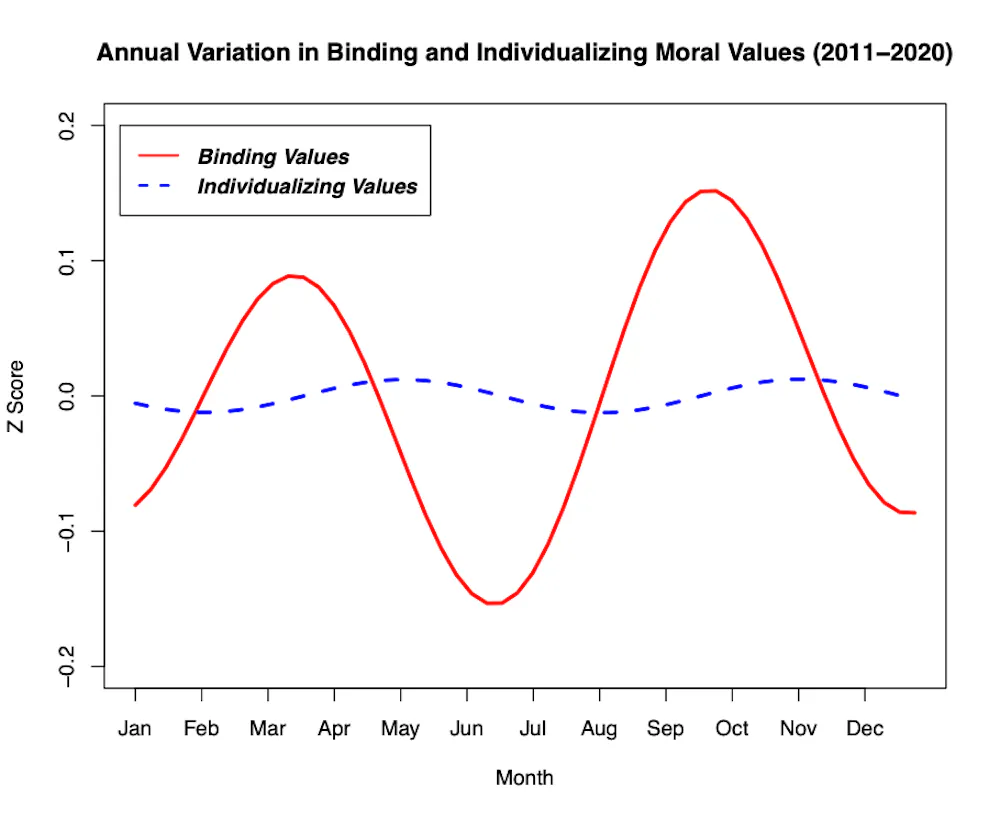
    Our analyses focused on the values reported by 232,975 respondents in the United States across a decade (2011-20) of data. The results revealed no apparent seasonal cycle in Americans’ endorsement of individualizing values, but there was clear and consistent seasonal cycle in Americans’ endorsement of all three binding moral values.

    This seasonal cycle was bimodal, with two peaks and two valleys each year: Americans endorsed binding moral values (valuing loyalty, authority and group traditions) most strongly in the spring and autumn, and least strongly in midsummer and midwinter. This bimodal seasonal cycle in binding moral values showed up again and again in the data, year after year.

    A graph depicting Americans’ endorsement of binding and individualizing moral values.
    (I. Hohm and M. Schaller), CC BY

    This seasonal cycle in binding moral values wasn’t unique to the U.S. either. Additional analyses on data from Canada and Australia revealed similar patterns: Canadians and Australians also endorsed binding moral values most strongly in the spring and autumn, and least strongly in midsummer and midwinter.

    Anxiety patterns

    What might explain this seasonal cycle in people’s endorsement of binding moral values? One possibility is that it has something to do with the perception of threat, which encourages people to close ranks within a group. Previous research has linked this to increased endorsement of binding moral values.

    To test this idea, we analyzed data on an emotion associated with threat perception: anxiety. Results revealed that Americans’ self-reported anxiety showed the same bimodal seasonal cycle, and so did 10 years of data on Americans’ Google searches for anxiety-related words. This seasonal cycle in anxiety helps to explain the seasonal cycle in binding values.

    Anxiety tends to change with the seasons, decreasing in summer and midwinter.
    (Shutterstock)

    This explanation raises a new question: what might explain the seasonal cycle in anxiety? Although we can only speculate, our analyses on moral values revealed an intriguing clue. The summertime dip in Americans’ endorsement of binding moral values was bigger in places with more extreme seasonal changes in the temperature. There was no such effect on the size of the midwinter dip.

    Perhaps something similar might be going on with anxiety: maybe that summertime decrease is the result of pleasant weather, whereas the midwinter decrease is more of a holiday effect.

    Double-edged sword

    Regardless of the cause, seasonal cycles in binding moral values could have consequences that affect people’s lives, for better or worse. Binding moral values promote cohesion, conformity and co-operation within groups, which can be beneficial, especially when coping with crises.

    The implication is that groups might cope better with crises that emerge in the spring and autumn, compared to those that occur in the summer and winter.

    But binding moral values also promote distrust of people who fail to adhere to group norms and traditions. The implication is that there may also be seasonal cycles in prejudices against immigrants, racial minorities, LGBTQ+ individuals and anybody else who is perceived to be different.

    People who more strongly endorse binding moral values are also more punitive, so there could be seasonal effects on judicial decision-making in the millions of legal cases that occur every year.

    And given the link between binding moral values and conservative attitudes, there are potential implications for politics. One intriguing possibility: the timing of political elections (whether they are scheduled for summer or autumn, for instance) might have some subtle effect on some votes — which, for an election that is especially tight, might even influence its outcome.

    Mark Schaller receives funding from the Social Sciences and Humanities Research Council of Canada.

    Ian Hohm does not work for, consult, own shares in or receive funding from any company or organisation that would benefit from this article, and has disclosed no relevant affiliations beyond their academic appointment.

    ref. Seasonal change can affect people’s moods — and their moral values – https://theconversation.com/seasonal-change-can-affect-peoples-moods-and-their-moral-values-236626

    MIL OSI – Global Reports

  • MIL-OSI USA: NIH launches large study to tackle type 2 diabetes in young people

    Source: US Department of Health and Human Services – 2

    News Release

    Wednesday, October 9, 2024

    Effort to identify risk factors for youth-onset type 2 diabetes to improve prevention and treatment.

    The National Institutes of Health has launched a nationwide consortium to address the dramatic rise in youth diagnosed with type 2 diabetes over the past two decades, a trend that is expected to continue. The effort aims to advance understanding of the biologic, social, and environmental drivers of youth-onset type 2 diabetes, with the goals of determining which children are at highest risk for developing the disease and how to better prevent, screen for, and manage type 2 diabetes in young people.

    “Our children who are overweight or have obesity are at risk, but we don’t know how best to identify the children who will progress to type 2 diabetes,” said Rose Gubitosi-Klug, M.D., Ph.D., study lead, and chief of pediatric endocrinology at Case Western Reserve University/Rainbow Babies and Children’s Hospital, Cleveland. “This study will bring us closer to our goal of prevention of type 2 diabetes in future generations of youth.”

    The observational study is funded by the NIH’s National Institute of Diabetes and Digestive and Kidney Diseases (NIDDK) and builds on previous NIDDK-funded research indicating that youth-onset type 2 diabetes is more challenging to treat and progresses more aggressively compared to adult-onset type 2 diabetes. In youth with type 2 diabetes, good blood glucose control is harder to achieve, and the ability of the pancreas to secrete insulin declines much more rapidly. Many young people with type 2 diabetes also don’t respond well to metformin, the drug most commonly used as the first-line treatment for diabetes in adults. In addition, youth-onset type 2 diabetes is associated with earlier development of diabetes-related complications, such as damage to the eyes, kidneys, and nerves.  

    “These factors all create a picture of a disease that is much more aggressive in youth than in adults, but we don’t understand what drives these differences,” said Barbara Linder, M.D., Ph.D., NIDDK program director who is overseeing the study. “Consequently, young people are developing devastating complications of the disease during what should be the most productive years of their life.”

    The study will aim to identify unique drivers of youth-onset type 2 diabetes distinguishing it from the disease in adults, which will help clinicians better understand which children will develop the disease and guide more effective, targeted prevention and intervention strategies. Study sites across the country will recruit 3,600 participants, ages 9 to 14, who are considered at risk for developing type 2 diabetes. They must have started puberty, have overweight or obesity, and have high-normal to above-normal hemoglobin A1c (HbA1c) levels but not high enough for a diagnosis of diabetes. The participants will reflect the U.S. population of youth with type 2 diabetes, including people from diverse racial and ethnic, socioeconomically disadvantaged, and underserved rural populations.

    The research team is also seeking extensive input from youth, young adults, and parents with lived experience of type 2 diabetes on both study design and conduct, including how to best recruit and retain participants, how frequently participants should be seen during the study, what questionnaires should be used to collect data, and more.

    In addition to looking at biological factors, the study team will gather comprehensive data from participants and their families to understand what social and environmental factors may be adversely contributing to health disparities and poor outcomes among youth with type 2 diabetes. Research has suggested that these social determinants of health—the conditions in which people are born, grow, work, live, and age—have a powerful influence on shaping health outcomes. For example, people without access to healthy food and safe places to engage in physical activity may be more likely to develop obesity, which is associated with type 2 diabetes.

    “Most children we currently consider ‘at-risk’ for developing type 2 diabetes will not actually do so, so we need to better understand what factors define who is at risk and would benefit from targeted prevention strategies,” said Dr. Linder. “These efforts are critical to lessen the immense burden, not just on young people and their families, but also the U.S. healthcare system, arising from the growing numbers of youth living with this disease and its debilitating complications.”

    For more information about the study, known as DISCOVERY of Risk Factors for Type 2 Diabetes in Youth, please visit discovery.bsc.gwu.edu.

    Funding: DISCOVERY is funded through NIH grants DK134971, DK134984, DK134975, DK134996, DK134958, DK134967, DK135002, DK134982, DK135007, DK134988, DK134978, DK134981, DK135012, DK135015, DK134976, and DK134966.

    The NIDDK, a component of the NIH, conducts and supports research on diabetes and other endocrine and metabolic diseases; digestive diseases, nutrition and obesity; and kidney, urologic and hematologic diseases. Spanning the full spectrum of medicine and afflicting people of all ages and ethnic groups, these diseases encompass some of the most common, severe, and disabling conditions affecting Americans. For more information about the NIDDK and its programs, see https://www.niddk.nih.gov.

    About the National Institutes of Health (NIH): NIH, the nation’s medical research agency, includes 27 Institutes and Centers and is a component of the U.S. Department of Health and Human Services. NIH is the primary federal agency conducting and supporting basic, clinical, and translational medical research, and is investigating the causes, treatments, and cures for both common and rare diseases. For more information about NIH and its programs, visit http://www.nih.gov.

    NIH…Turning Discovery Into Health®

    ###

    MIL OSI USA News

  • MIL-OSI Economics: Australasia Young Professionals Subcommittee Hosts “Intro to Well Design & DrillPlan” Workshop

    Source: International Association of Drilling Contractors – IADC

    Headline: Australasia Young Professionals Subcommittee Hosts “Intro to Well Design & DrillPlan” Workshop

    On 30 August, the IADC Australasia Young Professionals (YP) Subcommittee (SC) hosted an “Introduction to Well Design and DrillPlan” workshop. The event was co-hosted with the SPE Edith Cowan University Student Chapter WA Australia and sponsored by SLB and the IADC Australasia YP SC. 

    The workshop featured an insightful session led by Farshid Hafezi, Senior Drilling Engineer at SLB. Attendees gained valuable knowledge on well design and DrillPlan, and the event was enriched with networking opportunities and a quiz with exciting prizes.

    The IADC Australasia YP SC expressed its gratitude for all the volunteers and participants for making this a successful workshop, and to Edith Cowan University for providing the venue. 

    MIL OSI Economics

  • MIL-OSI Economics: 2024 IADC/SPE Managed Pressure Drilling & Underbalanced Operations Conference Convenes in Brazil

    Source: International Association of Drilling Contractors – IADC

    Headline: 2024 IADC/SPE Managed Pressure Drilling & Underbalanced Operations Conference Convenes in Brazil

    The 2024 IADC/SPE Managed Pressure Drilling & Underbalanced Operations Conference & Exhibition took place on 17-18 September in Rio de Janeiro, Brazil.

    Over two days, esteemed subject matter experts and young professionals came together to discuss:

    • Case Studies
    • Human Factors & Training
    • Non-Conventional MPD Operations
    • Riser Gas Handling
    • Completions
    • Design & Optimization
    • MPD Equipment & Control Systems
    • UBD
    • Well Control & Well Integrity

    Drilling Contractor Interviews from the 2024 IADC/SPE MPD & UBO Conference

    Last year, the IADC Underbalanced Operations and Managed Pressure Drilling (UBO &MPD) Committee published the Riser Gas Handling Guidelines to address challenges associated with gas in the riser during deepwater drilling while utilizing surface back pressure MPD or installed riser gas handling systems. During the 2024 IADC/SPE MPD & UBO Conference in Rio de Janeiro, members of IADC’s Gas in the Riser Subcommittee presented a series of papers discussing the underlying concepts behind the guidelines and the practical applications of the guidelines in the field.

    Speaking to DC from the conference, Mario Teixeira, Senior Engineer – Drilling and Wells at Equinor and a member of the subcommittee, spoke about these concepts. Some of these, he noted, are little known in industry or inconsistently applied in field operations. In particular, he discussed the uncontrolled riser unloading that can result from unaddressed gas-in-riser events and why it is important for industry to better understand the risks involved.

    Focusing on the human element is critical to preventing errors within any operation, including those involving managed pressure drilling (MPD). As automated systems decrease human interactions with complex equipment while increasing cognitive workloads, the need to account for human factors has become even more important. Understanding human factors and its role in safe drilling operations can help provide a path for drillers to mitigate errors and identify the root causes of those errors should they occur, said Matt Kvalo, VP of Engineering and Technology at Stasis Drilling Solutions.

    In this interview with DC from the 2024 IADC/SPE MPD & UBO Conference, Mr. Kvalo talks about how the definition of human factors has changed, from one that identifies the root cause of most errors to a model that identifies errors as a systemic problem.

    The IADC Underbalanced Operations and Managed Pressure Drilling (UBO & MPD) Committee is working on a number of initiatives aimed at helping the industry better understand the challenges associated with MPD operations. In this interview with DC taken from the 2024 IADC/SPE MPD & UBO Conference, Andre Alonso Fernandes, Chairman of the Committee, explains the IADC Riser Gas Handling Guidelines, a resource that was released last year. He also discusses the committee’s goal for opening a dialogue with industry and academia on the feasibility of the guidelines, plus any further challenges with gas-in-riser incidents that may need to be addressed in the future. Mr. Fernandes also spoke about the committee’s work in revising API RP 92M and API RP 92S, which each address MPD operations with surface back pressure.

    Thank you to everyone who attended, presented, exhibited, sponsored, and organized this conference! 

    MIL OSI Economics

  • MIL-OSI Economics: Southern Arabian Peninsula Chapter Tackles Critical Issues at Q3 Gathering

    Source: International Association of Drilling Contractors – IADC

    Headline: Southern Arabian Peninsula Chapter Tackles Critical Issues at Q3 Gathering

    The IADC Southern Arabian Peninsula Chapter (SAPC) hosted its Q3 meeting in Doha, Qatar on 12 September. There were 129 total participants present, and the event was filled with insightful discussions and invaluable networking opportunities. 

    The meeting opened with updates regarding the Chapter, workgroups, IADC headquarters, and the SAPC Annual Golf Tournament. Afterward, a series of guest speakers presented on various topics: 

    • Manish Kumar, GM Wells at Shell, presented on “Job By Design V2.0 – Learning from Normal Work,” discussing the importance of designing jobs with safety and predictable results in mind.
    • Pamela Cordova, Principal Research Analyst at S&P Global, gave an insightful presentation on the “Jackup Market Outlook,” analyzing current trends and future projections for the industry.
    • Steve Beedie, Author of Unspoken Wounds, delivered an inspiring presentation titled “Open the Bleed Off – Inspiring Energy to Open Up,” addressing mental health and well-being in the oil and gas industry.
    • Mike Cadigan, President/CEO of Billy Pugh Company, presented on “Safety Innovations Through Industry Engagement,” focusing on the future of personnel transfer technology and safety improvements.

    Following the guest speakers, the Qatar-based winners of the SAPC 2023 Safety Awards were recognized for their outstanding safety initiatives:

    • 2023 Statistical Safety Performance Award ‘Number of Consecutive Years Recordable Incident -Free’ Best Individual Offshore Drilling Rig: Gulf Drilling International’s Al-Wajba
    • Safety Initiative Award’s ‘Highly Commendable Non-Drilling Contractor Initiative’ – ( Global Gravity Aps

    After the closing remarks, attendees had the opportunity to meet Steve Beedie for a book signing while the networking reception was being set up. 

    Congratulations to the SAPC for another successful event, and thank you to everyone who participated!

    MIL OSI Economics

  • MIL-OSI USA: Treasurer Stacy Garrity Announces Major Milestone for Keystone Scholars

    Source: US State of Pennsylvania

    October 09, 2024Pittsburgh, PA

    Treasurer Stacy Garrity Announces Major Milestone for Keystone Scholars

    Treasurer Stacy Garrity joined representatives of Neighborhood Allies and Point Park University to celebrate more than $100 million saved by Keystone Scholars families in companion PA 529 College and Career Savings Program accounts.

    Keystone Scholars automatically provides a $100 education investment for every baby born to, or adopted by, a Pennsylvania family since January 1, 2019, using no taxpayer money. PA 529 accounts provide a tax-advantaged way to save for post-high school education.

    “Keystone Scholars is designed to encourage families to save early for education, and today’s announcement shows that it’s working,” Treasurer Garrity said. “Our oldest Keystone Scholars are already in kindergarten, and our youngest were born today. It’s tremendous to see so many families claiming their accounts and committing to saving for the future. Saving early and often will really pay off when a child picks their career path – no matter where it leads, whether it’s a four-year degree at Point Park University, community college, technical training, or an apprenticeship. Taking the first step is often the hardest part of saving, but Keystone Scholars does that for you.”

    Speakers Include:
    Stacy Garrity, Pennsylvania Treasurer
    Toni Corinealdi, Senior Program Manager of Empowerment and Outreach, Neighborhood Allies
    Presley Gillespie, President and CEO, Neighborhood Allies
    Marlin Collingwood, VP of Enrollment Management, Point Park
    University

    MIL OSI USA News

  • MIL-OSI USA: Governor Polis and Department of Higher Education Announce Waived College Application Fees Oct. 15-17

    Source: US State of Colorado

    DENVER – To encourage Coloradans to continue their education, Governor Jared Polis and the Department of Higher Education announced today that all 32 public colleges and universities in Colorado and several private institutions will allow students to apply for free from Tuesday, Oct. 15 through Thursday, Oct. 17, 2024, as part of the seventh annual Colorado Free Application Days. View Gov. Polis’ announcement in English and Spanish. 

    “We want to help Coloradans save money on college, and Free Application Days do exactly that. I encourage every Colorado student to take advantage of this opportunity to avoid application fees. In Colorado, we are focused on breaking down barriers to accessible, affordable education and connecting Coloradans to the skills necessary for a good-paying job and power Colorado’s thriving economy,” said Governor Polis. 

    The Colorado Department of Higher Education (CDHE) has posted admissions application and fee waiver information for each college and university that allows students to apply, from Oct. 15-17 only, with no application fees to as many participating institutions as they are interested in. For the fourth consecutive year, the program has been extended from one day to three days. 

    The Free Application Days campaign is a conscious effort by the state, designed to increase Colorado’s college-going and FAFSA and CASFA completion rates. This statewide push strategically aims to support low-income and first-generation students, while keeping Colorado students in state. According to 2023 numbers from CDHE’s Pathways to Prosperity Report, 49.9% of high school graduates enrolled in postsecondary education the fall after graduation (a slight decrease from 2020) – race and ethnicity enrollment gaps persist. 

    “We want Coloradans to shoot for the stars. Free Application Days supports students in achieving their postsecondary goals,” said Dr. Angie Paccione, executive director of CDHE. “If we increase FAFSA and CASFA completion through these two campaigns, then not only do our students and families benefit but Colorado benefits as a whole.” 

    During last year’s campaign, students turned in nearly 65,000 applications, and 44% came from students of color and over a third from first-generation students. Statewide, 2023 applications were up 1% compared to 2022. 

    By waiving application fees—a common barrier to higher education—Colorado Free Application Days aims to improve access to further education and training, which is becoming increasingly critical in the state’s rapidly changing economy. The 2023 Colorado Talent Pipeline Report identified that 94.7% of Tier 1 Top Jobs and 64.7% of Tier 2 Top Jobs required some type of postsecondary education past a high school diploma or equivalent to be relevant for a particular role and 70.4% of Tier 2 top jobs require a credential beyond high school. According to the Lumina Foundation, 60.5% of Coloradans 25 and older hold a postsecondary credential, indicating a supply-and-demand gap for some occupations. 

    In response to these workforce demands, the Colorado Commission on Higher Education set a strategic goal to increase the number of Coloradans benefiting from valuable career skills, obtained while in high school or via postsecondary education, that –at a minimum– enable additional lifetime earnings greater than the cost of attendance, in its statewide plan for higher education, Building Skills for an Evolving Economy. Increasing postsecondary enrollment and reducing equity gaps—the racial disparities in educational attainment—are priority strategies to improve access and reduce costs for Coloradans. 

    For more information, visit the Colorado Free Application Day webpage. 

    ###

    MIL OSI USA News

  • MIL-OSI USA: Lt. Governor Austin Davis Kicks Off Listening Tour to Inform the Work of the Office of Gun Violence Prevention

    Source: US State of Pennsylvania

    October 08, 2024Harrisburg, PA

    Lt. Governor Austin Davis Kicks Off Listening Tour to Inform the Work of the Office of Gun Violence Prevention

    Lieutenant Governor Austin Davis and the Pennsylvania Commission on Crime and Delinquency (PCCD) joined the Departments of Health, Human Services, Community and Economic Development, State Police, Military and Veterans Affairs, Office of the Victim Advocate and advocacy organizations CeaseFirePA, Everytown for Gun Safety, GIFFORDS, Johns Hopkins Center for Gun Violence Solutions, and others to kick off the first in a series of listening sessions that will inform the work of PCCD’s Office of Gun Violence Prevention.

    “I believe every Pennsylvanian deserves to be safe and feel safe in their communities – and my Administration took real action to re-establish Pennsylvania’s Office of Gun Violence Prevention and put real resources behind this effort,” said Governor Shapiro. “Under Lieutenant Governor Davis’ leadership at PCCD, we are listening to Pennsylvanians about their experiences with gun violence and bringing together public safety and public health experts, gun violence survivors and advocates, and leaders from state and local agencies to address and prevent violence across the Commonwealth. We’re going to continue to work together to ensure that every Pennsylvanian has the real freedom that comes when you can walk down the street in your community without worrying about gun violence.”

    List of Speakers:
    Lt. Governor Austin Davis
    PA Commission on Crime & Delinquency Executive Director Mike Pennington
    PA Commission on Crime & Delinquency Interim Director Samantha Koch
    Department of Health Secretary Dr. Debra Bogen
    Department of Human Services Executive Deputy Secretary Andrew Barnes
    Department of Education Secretary Dr. Khalid Mumin
    Office of Victim Advocate Suzanne Estrella
    Department of Human Services Deputy Secretary Andrew Barnes
    Department of Community & Economic Development Deputy Secretary Rick Vilello

    MIL OSI USA News

  • MIL-OSI USA: Rep. Adams to Host Military Service Academy Day

    Source: United States House of Representatives – Congresswoman Alma Adams (12th District of North Carolina)

    CHARLOTTE – Congresswoman Alma S. Adams, Ph.D. (NC-12) invites students, families, and teachers to attend the 12th Congressional District Military Service Academy Day. More information can be found below. 

    WHO:  

    • Congresswoman Alma S. Adams, Ph.D. 

    • Students, families, and teachers in the 12th district with interest in U.S. Service Academies. 

    Representatives from:  

    • US Air Force Academy 

    • US Naval Academy 

    • US Coast Guard Academy

    WHAT: An event providing a comprehensive overview of the Military Academies, the application processes, and nominations. Academy representatives will be present to discuss their respective programs. 

    WHERE: West Charlotte High School; 2219 Senior Drive, Charlotte, NC, 28216 

    WHEN: Saturday, October 19, 2024, 10am -11:30am 

    RSVPs: Please submit RSVPs here or or email adams.press@mail.house.gov 

    ### 

    Congresswoman Alma S. Adams, Ph.D. represents North Carolina’s 12th Congressional District (Charlotte, Mecklenburg County, Cabarrus County) and serves on the House Committee on Agriculture and the House Committee on Education & the Workforce, where she serves as ranking member of the Workforce Protections Subcommittee. For more information contact the Office of Congresswoman Alma Adams: (202)225-1510. 

    MIL OSI USA News

  • MIL-OSI Canada: Message from the Minister of Health and the Minister of Mental Health and Addictions and Associate Minister of Health – Breast Cancer Awareness Month, October 2024

    Source: Government of Canada News

    Statement

    October 9, 2024 | Ottawa, Ontario | Public Health Agency of Canada

    October is Breast Cancer Awareness Month, a period when we come together to support and honor those impacted by this disease.

    Breast cancer is one of the most common forms of cancer and the second leading cause of cancer-related death among womenFootnote * living in Canada. One in eight women is expected to be diagnosed with breast cancer in their lifetime.

    Raising awareness of breast cancer screening, which aims to detect cancer at an earlier, more treatable stage, is crucial for the Government of Canada. We are dedicated to advancing women’s health through comprehensive breast cancer screening and prevention efforts. We are also taking action by collaborating with partners and stakeholders to address identified gaps in breast cancer research.

    The Canadian Institutes of Health Research has invested almost $140 million over the past five years to advance breast cancer research in Canada. Through more than 500 grants and awards, these investments are supporting cutting-edge research to prevent, detect, and treat breast cancer more effectively.

    For example, researchers from Sunnybrook Hospital Research Institute are using artificial intelligence to develop more personalized breast cancer screening strategies; a team from the University of Saskatchewan is developing new techniques that combine radiation therapy and the body’s immune system to target breast cancer; and a project led by McGill researchers is examining how to prevent breast cancer from spreading to surrounding tissues. With support from the Government of Canada, the Canadian Partnership Against Cancer is refining its OncoSim-Breast microsimulation model, a tool used in the development of more effective breast cancer prevention and treatment policies.

    The Public Health Agency of Canada (PHAC) is working closely with Statistics Canada to conduct analyses of national cancer trends. They are looking at differences in breast cancer rates based on where people live, their age and ethnicity, and how advanced it is when people are diagnosed. Statistics Canada is also examining data on access to, and participation in, breast cancer screening by mammography to fill identified data gaps. These initiatives will enhance our understanding of the current state of breast cancer in Canada.

    Breast cancer touches the lives of so many, either through a personal diagnosis or that of a loved one. We strongly believe that nobody should have to face this alone. If you or a loved one is having difficulty coping with a cancer diagnosis, there are many ways you can seek support. Visit Canada.ca/mental-health or visit the Canadian Cancer Society’s community services locator, which helps cancer patients, caregivers and healthcare providers find the services they need to feel supported.

    Let’s empower everyone to make informed health care decisions, supported by the best available science and evidence.

    Reference

    Footnote *

    Cisgendered women and other adults assigned female at birth, such as transgender men and nonbinary people

    Return to footnote * referrer

    Contact

    Matthew Kronberg
    Press Secretary
    Office of the Honourable Mark Holland
    Minister of Health
    343-552-5654

    Yuval Daniel
    Director of Communications
    Office of the Honourable Ya’ara Saks
    Minister of Mental Health and Addictions and Associate Minister of Health
    819-360-6927

    Media Relations
    Health Canada
    613-957-2983
    media@hc-sc.gc.ca

    MIL OSI Canada News

  • MIL-OSI Security: FBI Assists in Identifying Victims of Tennessee Floods

    Source: Federal Bureau of Investigation (FBI) State Crime News

    FBI agents often dust for fingerprints to track down criminals and unravel complex cases. But this mission was different. The fingerprints here are not about solving crimes—they are about providing answers in the face of a tragedy that devastated parts of their community.

    After deadly floods swept through East Tennessee and Western North Carolina last week, the FBI has joined local authorities in the grim task of identifying victims. Special agents from the FBI’s Johnson City Resident Agency are working alongside the Tennessee Bureau of Investigation (TBI) and the Northeast Regional Medical Examiner’s Office at East Tennessee State University, employing cutting-edge technology to provide grieving families with some semblance of closure.

    In a region mostly unfamiliar with natural disasters, the flood’s devastation has left communities reeling. But the FBI’s involvement here is somewhat atypical. Known usually for connecting crime scenes to criminals, the FBI’s fingerprint expertise is being used not to solve crimes but to reunite families with loved ones.

    “When you’re doing this, you still take extra care because that was a human and that was somebody’s loved one, it was somebody’s mother, brother, sister,” said Special Agent Paul Durant, who has been with the FBI for five years. “It’s tough, but it’s rewarding to know that we can provide some answers to families who are suffering.”

    Durant, alongside Special Agent Reanna O’Hare, used electronic fingerprint devices to collect prints from victims, sometimes resorting to advanced forensic methods to recover identities. The fingerprints were sent directly to the FBI Laboratory in Quantico, Virginia, using smartphone technology, streamlining what can otherwise be a lengthy process.

    FBI Special Agent Paul Durant at the William L. Jenkins Northeast Tennessee Regional Forensics Center where agents have been working with state and local partners to help identify flood victims from North Carolina and Tennessee.

    The process is both emotionally and physically taxing. The agents often had to work with severely compromised remains made unidentifiable through traditional means. Some victims were swept across state lines from North Carolina into Tennessee, compounding the challenge.

    “The first time I walked into the morgue, I was hit with a sense of disbelief,” Durant said. “I had never been to a medical examiner’s office before, so it was surreal. You know what your job is, but it doesn’t fully sink in until you’re standing there, face to face with the victims. That’s when it becomes real, and you switch into work mode. There were days when it was overwhelming—seeing the destruction and hearing the stories. But at the end of the day, knowing we can help identify these victims and bring some comfort to their families makes it all worth it.”

    Special Agent O’Hare, who has served as the senior team leader on the Knoxville FBI’s Evidence Response Team, echoed the sentiment: “And just seeing the pictures and knowing that people have lost everything, including their family members, it’s devastating.”

    The FBI’s files only have fingerprints that are lawfully collected and the identification effort was not without its technical challenges. In several cases, agents had to use advanced forensic techniques to obtain usable prints. This method, often seen as a last resort in forensic work, is both unsettling and necessary for precise identification.

    “Knowing we have this unique access to national fingerprint files that others might not is critical,” said O’Hare, emphasizing the FBI’s role in tapping into Department of Defense and Department of Homeland Security databases. “We’ve been able to identify some victims who otherwise might have remained unknown.”

    The FBI’s efforts in these floods are part of a broader collaboration with local and state authorities. Special Agent J.D. Anderson, the aupervisory senior resident agent overseeing the efforts in Johnson City, stressed the importance of such partnerships. “Our hearts go out to the families affected by this tragedy. We are committed to doing everything in our power with our partners to bring them closure.”

    “It’s not just about the fingerprints; it’s about the people and the families we’re serving,” said Joe Carrico, special agent in charge of the FBI in Tennessee. “Our role is to support our state and local partners in bringing answers to those who need them most. In moments like these, it’s impossible not to feel the weight of that responsibility.”

    Durant and O’Hare relied heavily on the Mobile Biometrics Application (MBA) and Special Processing Center (SPC) teams to expedite the identification of victims. These specialized units, operating out of the FBI’s Criminal Justice Information Services in West Virginia, provided agents in the field with real-time support, often pulling fingerprints and running them through reference files within minutes. In some cases, results were returned in as little as 15 to 20 minutes, streamlining the identification process during critical moments.

    The MBA team, in particular, played a vital role by not only processing prints swiftly but also actively monitoring quality control and troubleshooting more difficult cases. When automated systems didn’t yield a match, the SPC team took over, applying manual processes to assist with identification. This seamless coordination between field agents and the FBI’s lab-based experts highlights the bureau’s ability to deploy advanced technology in disaster zones, ensuring that victims’ families receive answers as quickly as possible.

    While working to bring closure to grieving families, the agents also feel the storm’s personal impact. Special Agent O’Hare’s daughter and grandchildren evacuated from North Carolina to stay with her in Upper East Tennessee after being displaced by power loss. They plan to return to their town later this week now that power has been restored. “I joined the FBI to help people,” O’Hare said. “In situations like this, that’s why I am doing my very small part to try to provide some closure for the families of the victims.”

    MIL Security OSI

  • MIL-OSI Security: Man Who Bound and Raped Au Pair, Victimized Other Women and Girls, Sentenced to Life in Prison

    Source: Federal Bureau of Investigation (FBI) State Crime Alerts (b)

              GRAND RAPIDS, MICHIGAN — U.S. Attorney for the Western District of Michigan Mark Totten today announced that Arisknight Winfree, 32, of East Lansing, was sentenced to life in federal prison for sexually exploiting four women, including two minors, in 2022. Winfree was convicted on multiple charges that included Kidnapping (Count 1), Coercion and Enticement (Count 2), Attempted Coercion and Enticement (Count 3), and Production of Child Pornography (Counts 4 and 5).

              “Arisknight Winfree is a sexual predator whose horrendous acts caused immeasurable harm to the women and girls upon whom he preyed,” said U.S. Attorney Mark Totten. “This life sentence is necessary to protect the community and bring a measure of justice to the survivors.”

              Winfree targeted his victims in multiple ways, including through use of the messaging service on various social media apps and through an online service that connects individuals, often young women, with host families in need of childcare and light housework. The Court convicted Winfree of five crimes involving four victims.

              First, Winfree was convicted of Kidnapping (Count 1) and Coercion and Enticement (Count 2) for the crimes he committed against S.D. The victim was a young woman living in Italy who Winfree contacted on September 5, 2022 through AuPair.com, a website service that connects young women with potential host families. Winfree falsely represented that his family was in search of an au pair to care for his niece. On October 12, 2022, S.D. flew from Italy to Detroit, Michigan, and then took a bus to Winfree’s residence in East Lansing, Michigan. The day after she arrived, Winfree handcuffed his victim’s hands behind her back, placed a gag ball in her mouth, and raped her. Winfree considered killing his victim and hiding her body to avoid prosecution.

              Second, Winfree was convicted of Attempted Coercion and Enticement (Count 3) for the crimes he committed against A.S. Winfree connected with A.S. through AuPair.com in July 2022, falsely representing he needed someone to watch his 7-year-old niece every other week. Winfree paid for A.S. to fly to Michigan on September 14, 2022. When A.S. got to Winfree’s residence, she noticed all the windows were covered with paper and cardboard. She also noticed there were cameras around the house. A.S. saw no signs of children. She saw several knives and guns around the house. On September 16, 2022, A.S.’s family called the East Lansing Police Department and requested a welfare check for A.S. With the assistance of the police, the victim left the residence with her belongings and returned to Kansas.

              Third, Winfree was convicted of Production of Child Pornography (Count 4) for the crimes he committed against Minor Victim 1 (MV1). Winfree connected with MV1 on Instagram in November 2022, when the victim was 17 years old. From November 29-30, MV1 created nude images at Winfree’s request and sent them to him through the social media app’s messaging feature. On November 30, 2022, Winfree picked MV1 up from her high school, drove her to his home, and engaged in sexual acts with her.

              Fourth, Winfree was convicted of another count of Production of Child Pornography (Count 5) for the crimes he committed against Minor Victim 2 (MV2). Winfree connected with MV2 in September or October of 2022 on SnapChat, when the victim was 16 years old. He instructed MV2 to engage in sexual acts and send images and videos to him through SnapChat and later through WhatsApp.

              Further details are provided in the attached Complaint and the United States’ Statement of Facts Establishing Defendant’s Guilt.

              “The sentencing of Arisknight Winfree marks a significant step towards healing for all those who suffered from his callous and heinous criminal acts,” said Cheyvoryea Gibson, Special Agent in Charge of the FBI in Michigan. “Individuals who engage in sexual exploitation involving minors will be investigated and arrested by the FBI and our law enforcement partners in Michigan. The collective investigative efforts by members from FBI Michigan, the East Lansing Police Department, and the prosecutorial efforts of the United States Attorney’s Office of Western Michigan prevented another crime from being committed by Mr. Winfree.”

              “The East Lansing Police Department would like to thank the FBI and the U.S. Attorney’s Office for the Western District of Michigan for their commitment to this case,” said ELPD Police Chief Chad Pride. “Arisknight Winfree’s conviction on multiple charges shows our collaborative partnerships were essential in bringing justice to the survivors of these awful acts and holding Arisknight accountable for his actions.”

              This case is part of Project Safe Childhood, a nationwide initiative designed to protect children from online exploitation and abuse. The U.S. Attorney’s Office, county prosecutor’s offices, the Internet Crimes Against Children task force (ICAC), federal, state, tribal, and local law enforcement are working closely together to locate, apprehend, and prosecute individuals who exploit children. The partners in Project Safe Childhood work to educate local communities about the dangers of online child exploitation, and to teach children how to protect themselves. For more information about Project Safe Childhood, please visit the following website: http://www.projectsafechildhood.gov. Individuals with information or concerns about possible child exploitation should contact local law enforcement officials.

              Assistant United States Attorney Davin Reust prosecuted this case. The East Lansing Police Department, Michigan State University Police and Public Safety, and the FBI investigated it.

              The U.S. Attorney’s Office for the Western District of Michigan issued the previous press releases in this case and a related case:

    ###

    MIL Security OSI

  • MIL-OSI United Kingdom: Go Flourish opens outdoor learning garden at North Kessock Primary School

    Source: Scotland – Highland Council

    A nature pilot project founded by the Go Flourish charity was officially opened on Saturday 5 October by Raoul Curtis-Machin, Director of Horticulture, Royal Botanic Garden Edinburgh, much to the excitement of the many North Kessock Primary School pupils, parents and carers, teachers, and local community members who attended the event.

    The Go Flourish Charity was established by Jane-Julia Gladwin in 2023 to bring a range of benefits to schools by establishing high quality teaching gardens within school grounds. The three-year North Kessock pilot project will be monitored by researchers at the University of St Andrews, Psychology and Neuroscience School, to examine the impact of the gardening programme on children’s well-being and to demonstrate proof of concept by gathering data on a range of benefits.

    The North Kessock PS Go Flourish project is supported by fully qualified teacher, Laura Dorantt, who, as Liaison Teacher, has been working with the school over the last year in preparation to establish the garden in the school’s outdoor education curriculum. With the garden now installed and open, she will lead timetabled classes for pupils, and as the garden develops, will liaise with the local community to develop and sustain the Go Flourish Garden for the benefits of education, health, and community resilience. Based on the enthusiastic attendance of the school and local community at the Opening Day, Go Flourish is off to a very promising start.

    The Highland Council’s Education Committee Chair, Cllr John Finlayson said: “This partnership project, designed to improve wellbeing and essential life skills is supported by the vision of the “Go Flourish Project” and St Andrews University’s School of Psychology and Neuroscience who will collate appropriate data and analysis to demonstrate the impact of the pilot project.

    “I would like to acknowledge our gratitude to the Go Flourish founder and Garden Designer, Julia-Jane Gladwin for her unwavering support and I really look forward to visiting the outdoor classroom and learning from the pupils, staff and community involved in this wonderful project.”  

    This pilot project will provide:

    • A three-year scoping study funded by Go Flourish and St Andrews University.
    • Quantitative data to demonstrate educational, financial and societal benefits of Go Flourish school gardens.
    • Data backed evidence to inform local education authorities across Scotland and to the Scottish Government on the benefits of incorporating “Go Flourish Gardens” within school communities.
    • Learning the procedures and steps needed to establish and maintain sustainable gardens on Highland schools.

    Go Flourish Charity Founder, Julia-Jane Gladwin said: “Our vision is to reinstate nature at the heart of education. The children at North Kessock Primary School will themselves be the proof of the intrinsic value of this.”

    Primary 6 Pupil said: “The garden is cool! I like looking up through the trees when you see the sun shining through. And it smells really nice. It makes me happy.”

    To learn more about the work of the Flourish charity visit – http://www.flourishcharity.org (external link)

    MIL OSI United Kingdom

  • MIL-Evening Report: New Zealand’s BMI threshold for publicly funded fertility treatment is outdated and unethical. Here’s why it should go

    Source: The Conversation (Au and NZ) – By Carina Truyts, Associate Research Fellow (Deakin) and Research Officer, Monash University

    Getty Images

    Women seeking publicly funded fertility treatment in New Zealand must have a body mass index (BMI) under 32, according to clinical priority assessment criteria for access to assisted reproductive technology.

    But as our in-depth interviews and a growing body of evidence show, this approach is outdated and unethical.

    One of our study participants described the system as “completely rigged if you’re a fat person”. Nina, a 37-year-old dance teacher, was denied public funding support to help her conceive because her BMI was above 32 – even though the cause of infertility was her husband’s sperm count.

    Nina is not alone. Paratta, who moved to Aotearoa from Sri Lanka in 2009, was also denied because of her BMI. She raced to lose the required weight in spite of a medical condition, but was then denied again because she had reached 40, the age limit for access to public funding.

    Both women’s experiences highlight New Zealand’s obsolete and discriminating BMI limit. The United Kingdom does not include BMI as a criterion for public funding, and international cutoffs are generally between 35 and 45.

    We argue New Zealand’s BMI threshold must be scrapped to reflect impactful research and respond ethically to New Zealand’s diverse population.

    BMI and fertility

    One in six people worldwide are affected by infertility, according to the World Health Organization’s most recent estimate. They suffer severe social and psychological consequences.

    There are numerous factors that can affect fertility, and obesity is certainly one of them, impacting 6% of women who have never been pregnant.

    But the BMI is an outdated method of assessing this risk. It doesn’t measure body fat percentage, distribution or differences across populations.

    Our study participants have raised concerns about the BMI limit. International and local studies concur with them. Research shows Polynesians are much leaner than Europeans at significantly higher BMIs, meaning Māori and Pacific women are disadvantaged before they even step into the clinic.

    Quick weight loss unlikely to help

    In New Zealand, people seeking public support are told that “making lifestyle changes like quitting smoking or losing weight” could help them become eligible. They are given a stand-down period wherein they must lose the requisite weight before referrals.

    As in Paratta’s case, this can lead to a race to lose weight before the inflexible age limit of 40 is reached. Evidence-based research advises that fertility care should balance the risk of age-related fertility decline with weight-loss advice.

    Nina rejected the advice to lose weight. She was concerned that quick weight loss would require unhealthy practices that could affect her success rate during the embryo transfer.

    Lifestyle changes made within a short time before conception don’t improve outcomes.
    Getty Images

    At the Australia and New Zealand Fertility Association’s annual conference last month, US obstetrician Kurt Barnhart confirmed that lifestyle interventions made weeks or months before conception are unlikely to improve outcomes. They may even cause harm.

    He discussed the FIT—PLESE randomised control study, which compared two groups of infertile women. One underwent a targeted weight-loss program and another exercised but did not lose weight. The results showed no statistically significant difference between the groups’ fertility and live-birth rates. These findings suggest the stand-down period should be revised.

    Barnhart also highlighted that weight loss through lifestyle changes can be practically impossible given obesity is often linked to endocrine issues that have nothing to do with choice. He observed signals that the medical community is changing its views on obesity as a “lifestyle” choice – a welcome shift.

    BMI, lifestyle and ethics

    Social science research has long challenged a colonial and biomedical habit of imposing standards on women whose bodies do not conform to Western ideas of a healthy or ideal body.

    Historically, the emphasis on weight as a criterion for reproductive health echoes harmful eugenicist beliefs. As US science historian Arleen Tuchman writes, the discovery of insulin prompted some groups to recommended banning marriages for people with diabetes to prevent the “unfit” from reproducing. New Zealand’s BMI criteria similarly suggest only those who fit specific physical standards deserve access to fertility care.

    The idea that lifestyle and health are straightforward individual choices is also challenged by research in epigenetics and philosophy. Obesity is often linked with poverty, which in turn is linked to broader social and living environments, including access and income.

    The high economic burden of obesity has led biomedical experts to recommended obese people should be considered for particular support, given the prohibitive cost of assisted reproductive technologies.

    Nina exercises more than eight hours a week and Paratta leads an active lifestyle. For both women, behavioural advice – and the stigma and assumptions it underscores – is offensive.

    Weight-loss advice can be particularly culturally offensive for Māori and Pacific peoples, who may be stigmatised in clinic settings for being too “fat” but considered “skinny” in their communities if they lose the required weight.

    New Zealand’s assessment criteria for publicly funded fertility treatment have not been updated in 27 years. While infertility and health risks associated with obesity during pregnancy and at birth should not be ignored, research shows these risks can be managed effectively and with empathy through a transdisciplinary approach.

    The Australian state of Victoria now offers two free cycles of fertility treatment to any Medicare-holding woman, regardless of BMI, up to the age of 42. The program deliberately reaches out to specific groups whose ethnicity, sexuality and environment limit their access. It has been highly successful and should inspire New Zealand to approach fertility funding with fresh perspectives.

    The authors do not work for, consult, own shares in or receive funding from any company or organisation that would benefit from this article, and have disclosed no relevant affiliations beyond their academic appointment.

    ref. New Zealand’s BMI threshold for publicly funded fertility treatment is outdated and unethical. Here’s why it should go – https://theconversation.com/new-zealands-bmi-threshold-for-publicly-funded-fertility-treatment-is-outdated-and-unethical-heres-why-it-should-go-240295

    MIL OSI AnalysisEveningReport.nz

  • MIL-Evening Report: The dangers of voice cloning and how to combat it

    Source: The Conversation (Au and NZ) – By Leo S.F. Lin, Senior Lecturer in Policing Studies, Charles Sturt University

    David Herraez Calzada/Shutterstock

    The rapid development of artificial intelligence (AI) has brought both benefits and risk.

    One concerning trend is the misuse of voice cloning. In seconds, scammers can clone a voice and trick people into thinking a friend or a family member urgently needs money.

    News outlets, including CNN, warn these types of scams have the potential to impact millions of people.

    As technology makes it easier for criminals to invade our personal spaces, staying cautious about its use is more important than ever.

    What is voice cloning?

    The rise of AI has created possibilities for image, text, voice generation and machine learning.

    While AI offers many benefits, it also provides fraudsters new methods to exploit individuals for money.

    You may have heard of “deepfakes,” where AI is used to create fake images, videos and even audio, often involving celebrities or politicians.

    Voice cloning, a type of deepfake technology, creates a digital replica of a person’s voice by capturing their speech patterns, accent and breathing from brief audio samples.

    Once the speech pattern is captured, an AI voice generator can convert text input into highly realistic speech resembling the targeted person’s voice.

    With advancing technology, voice cloning can be accomplished with just a three-second audio sample.

    While a simple phrase like “hello, is anyone there?” can lead to a voice cloning scam, a longer conversation helps scammers capture more vocal details. It is therefore best to keep calls brief until you are sure of the caller’s identity.

    Voice cloning has valuable applications in entertainment and health care – enabling remote voice work for artists (even posthumously) and assisting people with speech disabilities.

    However, it raises serious privacy and security concerns, underscoring the need for safeguards.

    How it’s being exploited by criminals

    Cybercriminals exploit voice cloning technology to impersonate celebrities, authorities or ordinary people for fraud.

    They create urgency, gain the victim’s trust and request money via gift cards, wire transfers or cryptocurrency.

    The process begins by collecting audio samples from sources like YouTube and TikTok.

    Next, the technology analyses the audio to generate new recordings.

    Once the voice is cloned, it can be used in deceptive communications, often accompanied by spoofing Caller ID to appear trustworthy.

    Many voice cloning scam cases have made headlines.

    For example, criminals cloned the voice of a company director in the United Arab Emirates to orchestrate a $A51 million heist.

    A businessman in Mumbai fell victim to a voice cloning scam involving a fake call from the Indian Embassy in Dubai.

    In Australia recently, scammers employed a voice clone of Queensland Premier Steven Miles to attempt to trick people to invest in Bitcoin.

    Teenagers and children are also targeted. In a kidnapping scam in the United States, a teenager’s voice was cloned and her parents manipulated into complying with demands.

    It only takes a few seconds of audio for AI to clone someone’s voice.

    How widespread is it?

    Recent research shows 28% of adults in the United Kingdom faced voice cloning scams last year, with 46% unaware of the existence of this type of scam.

    It highlights a significant knowledge gap, leaving millions at risk of fraud.

    In 2022, almost 240,000 Australians reported being victims of voice cloning scams, leading to a financial loss of $A568 million.

    How people and organisations can safeguard against it

    The risks posed by voice cloning require a multidisciplinary response.

    People and organisations can implement several measures to safeguard against the misuse of voice cloning technology.

    First, public awareness campaigns and education can help protect people and organisations and mitigate these types of fraud.

    Public-private collaboration can provide clear information and consent options for voice cloning.

    Second, people and organisations should look to use biometric security with liveness detection, which is new technology that can recognise and verify a live voice as opposed to a fake. And organisations using voice recognition should consider adopting multi-factor authentication.

    Third, enhancing investigative capability against voice cloning is another crucial measure for law enforcement.

    Finally, accurate and updated regulations for countries are needed for managing associated risks.

    Australian law enforcement recognises the potential benefits of AI.

    Yet, concerns about the “dark side” of this technology have prompted calls for research into the criminal use of “artificial intelligence for victim targeting.”

    There are also calls for possible intervention strategies that law enforcement could use to combat this problem.

    Such efforts should connect with the overall National Plan to Combat Cybercrime, which focuses on proactive, reactive and restorative strategies.

    That national plan stipulates a duty of care for service providers, reflected in the Australian government’s new legislation to safeguard the public and small businesses.

    The legislation aims for new obligations to prevent, detect, report and disrupt scams.

    This will apply to regulated organisations such as telcos, banks and digital platform providers. The goal is to protect customers by preventing, detecting, reporting, and disrupting cyber scams involving deception.

    Reducing the risk

    As cybercrime costs the Australian economy an estimated A$42 billion, public awareness and strong safeguards are essential.

    Countries like Australia are recognising the growing risk. The effectiveness of measures against voice cloning and other frauds depends on their adaptability, cost, feasibility and regulatory compliance.

    All stakeholders — government, citizens, and law enforcement — must stay vigilant and raise public awareness to reduce the risk of victimisation.

    The authors do not work for, consult, own shares in or receive funding from any company or organisation that would benefit from this article, and have disclosed no relevant affiliations beyond their academic appointment.

    ref. The dangers of voice cloning and how to combat it – https://theconversation.com/the-dangers-of-voice-cloning-and-how-to-combat-it-239926

    MIL OSI AnalysisEveningReport.nz

  • MIL-Evening Report: Rebates for buying e-bikes and e-scooters are good but unlikely to greatly boost sustainable transport on their own

    Source: The Conversation (Au and NZ) – By Abraham Leung, Senior Research Fellow, Cities Research Institute, Griffith University

    BikePortland/Flickr, CC BY

    Queensland has joined Tasmania as the second Australian state or territory to offer a A$500 rebate for buyers of new e‑bikes. The pre-election announcement includes a smaller $200 rebate for e‑scooters.

    The Queensland e‑mobility rebate scheme is first come, first served, until its $2 million budget ($1 million was added last week) is used up. The Tasmanian scheme has closed for this reason.

    These schemes follow a trend of government incentives to buy e‑bikes in North America and Europe. The Australian schemes differ from most schemes overseas by including e‑scooters too.

    It’s a welcome move to promote sustainable transport. These personal transport devices have smaller environmental footprints to produce and operate than electric cars. Owning e‑bikes or e‑scooters can enable people to drive less – reducing congestion and emissions – and avoid high fuel costs.

    However, my research and other studies suggest ownership doesn’t guarantee much greater use. Additional measures will be needed to boost use of these sustainable transport modes.

    Why own e-bikes or e-scooters when you can share?

    The rebate is likely to boost retailers’ sales. More than 860 rebate applications were received within three days of the scheme starting on September 23.

    And existing owners now have an incentive to upgrade or replace models. They might then sell their pre-loved e‑bikes or e‑scooters on the second-hand market. This means others could get them more cheaply.

    Queensland was the first Australian state to legalise the use of e‑scooters in 2018, when Brisbane introduced shared e‑scooter operations. Regional cities such as Townsville and Cairns launched similar schemes. Dockless e‑bikes later replaced Brisbane’s initial CityCycle bike-sharing scheme.

    I recently conducted research to understand why South-East Queensland residents want to own e‑scooters. The study methods were comparable to an earlier e‑bike user survey.

    Both sets of owners cite replacing car use as their top reason for ownership. However, their motivations differ.

    E‑scooter owners are mainly driven by the lower price and the fun factor of riding. E‑bike owners focus more on fitness and the health benefits of getting some exercise when riding. Australian regulations require e‑bikes to be pedal-assisted.

    But does this mean people will ride more?

    Since 2022, the Queensland government has offered a rebate of up to $6,000 for buying full-sized electric vehicles (that scheme closed last month). It now appears to have responded to calls to do the same for e‑bikes and e‑scooters.

    Buyers certainly won’t mind freebies and rebates, but rebate-induced ownership might not increase overall use by much.

    An Australia-wide survey in 2023 found 57% of respondents had access to at least one working bicycle at home and this proportion has been increasing. However, only 15% reported riding in the previous week. Only 36.7% had ridden in the past year.

    Overall cycling participation has declined over the past decade, except during the COVID pandemic when work and travel patterns were more local. For all periods, men are significantly more likely to cycle than women.

    The same 2023 survey revealed only about 2.1% own e‑bikes. The rebate will likely increase this rate in Queensland.

    Some preliminary evidence suggests e‑bike users ride more often and further than those riding non-electric bikes. It also helps older people get into cycling. And it has the potential to replace car use even in rural areas.

    Despite e‑bikes offering advantages over traditional bikes, riders of both face obstacles to greater use, such as road safety and poor cycling infrastructure.

    What kinds of incentives do other countries offer?

    Australian policymakers should consider offering incentives to ensure the new purchases are well used, not sitting idle most of the time.

    The United Kingdom has a long-standing cycle-to-work scheme that offers commuters a tax exemption for buying bicycles or e‑bikes.

    In the Netherlands, incentive schemes have used smartphone technology to track their mileage. For example, in the B-Riders scheme, riders earn €0.08–0.15 (A$0.13–0.21) per kilometre. There was a 68% increase in e‑bike use by former car commuters after one month and 73% increase after six months of participation.

    Schemes in North America tend to be aimed at lower-income households. They are more likely to be involuntarily carless, so e‑bikes can improve their access to jobs, goods and services.

    There are alternatives to rebates. North Vancouver, for example, is trialling e‑cargo bike lending to replace car shopping trips, as these bulky bikes are not practical for every household to own.

    In France, residents can claim a bike or e‑bike subsidy of up to €2,000 (A$3,210). Second-hand devices sold by approved repairers are covered too, which is likely to help reduce e‑waste. Australian schemes so far only cover new purchases.

    What more can be done?

    For e‑bike and e‑scooter owners, the main barrier to riding more is the lack of safe and well-connected infrastructure. Numerous studies have connected rates of riding to the quality and quantity of infrastructure. Extensive, high-quality and safe cycling networks can deliver lasting shifts towards sustainable transport.

    When the Spanish city of Seville built such networks, cycling rates surged 11-fold in a few years.

    In the Netherlands, this infrastructure is so well-funded and extensive that it’s no surprise cycling is popular there.

    Riders don’t just need bikeways. They also need end-of-trip facilities with secure parking (and maybe free charging too).

    In Australia, cycling gets only around 2% of transport funding.

    In Brisbane, despite not being anywhere close to the European level of cycling infrastructure, new “green bridges” and bikeways will be expanded to more areas of the city (and other Queensland venues). It’s part of preparations to host “climate-positive” Olympic and Paralympic Games in 2032. This year’s games host, Paris, successfully upgraded infrastructure and boosted cycling rates.

    Another benefit of more riders on the streets is that it creates “safety in numbers”. Greater numbers would also help attract more funding for infrastructure that makes cycling and scooting safer and more attractive.

    Both e‑bikes and e‑scooters are already worthwhile investments. Using them often would free yourself from car dependence – and that’s good for the planet and your wallet.

    Abraham Leung received funding from the Transport Academic Partnership (Queensland Department of Transport and Main Roads (TMR) and the Motor Accident Insurance Commission) and the Transport Innovation and Research Hub (Brisbane City Council, BCC). The data from the Privately Owned Electric Mobility User Survey (POEMUS) used in this article is funded and commissioned by BCC.

    His current Advance Queensland Industry Research Fellowship is funded and/or partnered with TMR, BCC, Townsville City Council, and micromobility operators Neuron and Beam. He is also an active member of PedBikeTrans.

    ref. Rebates for buying e-bikes and e-scooters are good but unlikely to greatly boost sustainable transport on their own – https://theconversation.com/rebates-for-buying-e-bikes-and-e-scooters-are-good-but-unlikely-to-greatly-boost-sustainable-transport-on-their-own-239939

    MIL OSI AnalysisEveningReport.nz

  • MIL-Evening Report: Our new study shows life expectancy is stagnating for Australians under 50

    Source: The Conversation (Au and NZ) – By Sergey Timonin, Research Fellow in Demography, School of Demography, Australian National University

    Global life expectancy has increased dramatically over the past century, with Australia among the best performing countries.

    But during the last two decades, some high-income countries have reported stagnation or even declining life expectancy, particularly the United States and the United Kingdom.

    Could this indicate a broader decline in health advancements in English-speaking countries? Our new study compared life expectancy between English-speaking countries and against other high-income countries.

    We found Australians born between 1930 and 1969 continue to do exceptionally well for life expectancy. But the picture for those under 50 is not so rosy – life expectancy is stagnating for that younger group.

    Why measure life expectancy?

    Life expectancy is a valuable and widely used measure to examine health trends and patterns over time and compare different places or population groups.

    It estimates the average number of years a person would be expected to live. This is calculated using the mortality – or death rates – across different age groups within a specific period. When death rates fall, life expectancy rises, and vice versa.

    Life expectancy can tell a story about a population’s overall health.
    Christian Wiediger/Shutterstock

    Not only does life expectancy tell us about mortality in a population, it is indirectly a measure of overall population health. Most leading causes of death in high-income countries are chronic diseases. These typically affect the health of a person for multiple years before their death.

    Stagnations or reversals in life expectancy can be warning signs of both longstanding and emerging health problems.

    Nobel Prize-winning economist Amartya Sen has also pointed to mortality as a key indicator of economic success and failure. This makes it a powerful tool for researchers and policymakers.

    Thanks to a long and largely standardised tradition of collecting mortality statistics across high-income countries, researchers are able to carry out in-depth, comparative studies. This can help uncover how specific causes of death have contributed to the changes in life expectancy.

    What we did

    In our study, we analysed mortality trends and patterns in a broader group of English-speaking countries and compared them with other high-income countries. English-speaking countries have shown similarities in recent mortality trends and their causes, such as patterns of drug overdose and obesity prevalence.

    Our analysis focuses on six high-income English-speaking countries: Australia, Canada, Ireland, New Zealand, the UK and US. We compared them with the average in 14 other high-income, low-mortality countries from Western Europe (such as France and Norway), plus Japan. This was the “comparison group”.

    We used data from 1970 onwards from well-established, comprehensive sources of high-quality mortality data: the Human Mortality Database and World Health Organization Mortality Database.

    For each English-speaking country and the comparison group, we estimated:

    • life expectancy at birth
    • partial life expectancy between ages 0 and 50 years
    • remaining life expectancy at age 50
    • average length of life.

    Looking at average length of life helps to compare the mortality of the birth cohorts (people born in the same calendar year) as they age. This measure is the closest way to estimate how long people in different populations actually live, and can be used to assess the differences in survival between populations.

    First we looked at how age and causes of death were contributing to a gap between English-speaking countries and the comparison group. Then we compared the average length of life of different birth cohorts.

    What we found

    In the pre-COVID period, both men and women in Australia had a higher life expectancy at birth, compared to the non-English speaking comparison group (the average between those 14 countries). This was also true for men in Ireland, New Zealand and Canada. In the UK and US, however, life expectancy at birth was lower for both men and women, compared to the non-English speaking group.

    But the most striking finding was the difference in mortality for those under 50 in English-speaking versus non-English speaking countries.

    Relatively high death rates for those under 50 dragged the overall life expectancy at birth down for each English-speaking country, including Australia. Suicides and drug or alcohol-related deaths were the main reason for these trends.

    But over age 50, Australia performs exceptionally well in life expectancy for both men and women. Australians born in the 1930s-60s are likely to live longer than those in the non-English speaking comparison group and all other English-speaking countries. But Australians born in the 1970s onwards had lower life expectancy than the comparison group.

    This means overall, life expectancy at birth in Australia is higher than the average for the non-English group. But when you break it down by age, the results show a clear distinction in life expectancy according to when you were born.

    For example, in 2017-19 , male life expectancy between ages 0 and 50 years was 0.3 years lower in Australia compared to the average for the non-English group, while remaining life expectancy at age 50 was 1.45 years higher.

    What this means

    Our study shows a worrying trend for people born from the 1970s onwards. This is true in all English-speaking countries, even before accounting for the negative impacts of the COVID pandemic in places like the UK and US.

    In Australia, the results point to significant generational differences in life expectancy compared to other high-income countries. If the relatively high mortality rates of Australians born from the 1970s onwards continue into the future, then the gains in Australian life expectancy will likely slow. Our status as having one of the highest life expectancies of any country will diminish.

    Our research aimed to examine trends and potential causes of stagnating life expectancy, rather than make policy recommendations.

    But the results suggest real improvement could come through measures that reduce inequality and structural disadvantages that lead to poor health outcomes, such as improving access to education and security of employment and housing, supporting mental health and drug-related safety, and addressing diseases like obesity and diabetes.

    Sergey Timonin receives funding from the Australian Research Council (DP210100401).

    Tim Adair receives funding from the Australian Research Council.

    ref. Our new study shows life expectancy is stagnating for Australians under 50 – https://theconversation.com/our-new-study-shows-life-expectancy-is-stagnating-for-australians-under-50-240790

    MIL OSI AnalysisEveningReport.nz

  • MIL-Evening Report: How can you help your child learn to self-regulate?

    Source: The Conversation (Au and NZ) – By Natalie Day, Postdoctoral research fellow, Early Start, University of Wollongong

    Allan Mas/ Pexels , CC BY

    Throughout our lives, we need to be able to manage our thoughts and behaviour. We need to do this to reach various goals and to get along with others – even if other distractions and impulses get in the way.

    This is our ability to self-regulate, and it starts to develop between the ages of three and five.

    My colleagues and I have been researching what parents can do to help children learn to self-regulate. What are the dos and don’ts?

    Why is self-regulation important?

    A child’s ability to self-regulate has a huge impact on shorter-term outcomes such as making and keeping friends, engaging in school and making academic progress.

    Self-regulation allows children to keep going with a task or situation when things are tough, and to keep their emotions and behaviour focused on reaching the goal.

    For example, when playing a game with friends, a child who can self-regulate can wait their turn, stay within the rules, and keep playing even when they are losing. A child with low levels of self-regulation may become easily upset and show frustration, and in some cases be dysregulated. This can include meltdowns.

    But there can also be impacts later in life. Low levels of self-regulation at preschool age have been associated with a range of problems in adulthood, such as gambling, substance abuse, poor health, poor sleep and weight issues.

    The capacity to self-regulate emerges from around three years of age, when the brain undergoes rapid physical growth. The period of peak growth is typically between three to five.

    The capacity to self-regulate is not only influenced by genetics, but also by children’s environment and their experiences. This is where parents come in.

    Self-regulation is important for children’s short and long-term development.
    Artem Podrez/ Pexels, CC BY

    Jumping in to ‘help’

    Naturally, parents want to protect their children from difficulty. But sometimes this desire to protect and “help” kids can hamper their development.

    Children experience challenges all the time – this may be opening a water bottle, trying to find a certain toy in their bedroom, or tying their shoelaces. As parents, we can often rush to fix the problem straight away.

    But it is important for children’s brain development to experience and cope with challenges. When parents let children face a tricky task, they can learn to think flexibly, create solutions and persist toward the goal. It also teaches them they can handle things themselves.

    Persistence when playing a game can translate to persistence when tying their shoelaces, and in time, fewer meltdowns.

    What should parents do instead?

    This is not to say you should ignore your child if they are very distressed and stuck up a tree, or have fallen and seriously hurt themselves.

    But there are many other occasions when you can wait, or help in less obvious ways.

    For example, if a child is struggling to find the right puzzle piece, parents should wait for the child to either ask for help or show visible signs of frustration.

    If possible, start just by using guiding words to help, rather than taking a hands-on approach. You could try encouragement, questions, hints and suggestions to lead your child to a solution. For example, “have you tried all the pieces yet?”

    Or if they are playing with Lego, parents may remind the child of their last success or ask them “what does the diagram show?”, they might give a hint such as “I sometimes need to go back some steps to find where I went wrong”, or maybe more directly, “how about we look through the steps together?”.

    This type of guidance means the child is still the one solving the problem.

    Parents start by just using verbal prompts or tips to their child.
    eggegg/Shutterstock

    Step up your approach

    If the child is still stuck, parents can use their hands to offer more guidance.

    When completing a section of a puzzle, a parent may move some pieces closer to the child to draw their attention to them.

    If needed, a more direct approach would be to identify the piece the child is looking for, and hand it to the child so that they can put it in and remain active in completing the task.

    The child may not have the piece the right way round, so the parent should revert to using verbal guidance for encouragement or suggest turning the piece to see if it fits.

    Kids are still in charge

    The key thing to remember is the child should be guiding your approach to helping them.

    Don’t intervene without them asking you, and don’t offer full support straight away.

    You can use encouragement, hints and suggestions, and then hands-on help. Keep offering your child the chance to work elements out for themselves. And know their way of solving the problem might be different from yours.

    Natalie Day’s research was funded by a Faculty Postgraduate Research Scholarship and International Postgraduate Tuition Award from the University of Wollongong, with a contribution from the NSW Institute of Educational Research—Distinguished Student Award.

    ref. How can you help your child learn to self-regulate? – https://theconversation.com/how-can-you-help-your-child-learn-to-self-regulate-240454

    MIL OSI AnalysisEveningReport.nz

  • MIL-OSI USA: Sinema, Kelly Announce $300k From Bipartisan Infrastructure Law for the City of Glendale to Increase Energy Efficiency

    US Senate News:

    Source: United States Senator Kyrsten Sinema (Arizona)
    Bipartisan infrastructure law led by Sinema and shaped by Kelly provides $300,000 to lower energy costs and improve operations at the City of Glendale’s water treatment facility. 
    WASHINGTON – $300,000 will be invested in the City of Glendale to perform a detailed energy analysis and replace two chillers at the city’s water treatment facility from bipartisan Infrastructure Investment and Jobs led by Senator Kyrsten Sinema and shaped by Senator Mark Kelly.
    The City of Glendale will receive $300,000 through the Industrial Training and Assessment Centers (ITAC) Implementation Grant Program – a program supported by Sinema and Kelly’s bipartisan infrastructure to help small- and medium-sized manufacturers make improvements at their facilities to save energy, reduce carbon pollution, lower costs, and strengthen our domestic manufacturing sector.  
    “We’re proud to deliver these funds to lower energy costs and increase efficiency at Glendale’s water treatment facility,” said Sinema, co-author and lead negotiator of the bipartisan infrastructure law.  
    “These kinds of investments are exactly what we need to modernize our energy infrastructure and secure Arizona’s water future,” said Kelly. “These federal resources will help local facilities optimize their energy usage and bring down costs for Arizonans.”  
    Sinema led bipartisan Senate negotiations with Republican Senator Rob Portman of Ohio that included Senator Kelly and senators from both parties.
    For more than four decades, the ITAC program has supported small and medium-sized manufacturers who are looking to make investments in energy efficiency and modern manufacturing processes. The Bipartisan Infrastructure Law provided $80 million to support the ongoing goals of the ITAC program.
    The bipartisan infrastructure law was supported by groups including The U.S. Chamber of Commerce, Business Roundtable, The National Association of Manufacturers, The AFL-CIO, The National Retail Federation, The Bipartisan Policy Center, North America’s Building Trades Unions, the Outdoor Industry Association, The American Hotel and Lodging Association, The National Education Association, as well as hundreds of mayors across all 50 states.

    MIL OSI USA News

  • MIL-OSI USA: The University of Kansas Must Immediately Fire Professor Who Said Men Who Don’t Vote For Kamala Should be ‘Lined Up and Shot’

    US Senate News:

    Source: United States Senator for Kansas Roger Marshall

    Washington, D.C. – U.S. Senator Roger Marshall, M.D. is calling for the immediate termination of a University of Kansas professor after a disturbing video circulated of the professor saying men who don’t vote for Kamala Harris should be ‘lined up and shot’ to a class at a KU lecture. 
    “The University of Kansas must fire this professor immediately. Anyone who says that people who don’t vote for Kamala Harris should be ‘lined up and shot’ are completely deranged and shouldn’t be around students nor in academia. This promotion of political violence should be met with quick action by KU,” Senator Marshall said.
    You may click HERE or on the tweet above to see the video.

    MIL OSI USA News

  • MIL-OSI Canada: Streaming online and airing on PBS affiliates. Thao Lam and Kjell Boersma’s multi-award-winning National Film Board of Canada animated short Boat People featured on POV Shorts, starting November 12.

    Source: Government of Canada News (2)

    Beginning November 12, 2024, Thao Lam and Kjell Boersma’s acclaimed new National Film Board of Canada (NFB) animated short Boat People will be featured in season seven of POV Shorts—a collection of the best and boldest independent short films streaming free of charge on POV.org and on the PBS App.

    October 8, 2024 – Montreal – National Film Board of Canada (NFB)

    Beginning November 12, 2024, Thao Lam and Kjell Boersma’s acclaimed new National Film Board of Canada (NFB) animated short Boat People will be featured in season seven of POV Shorts—a collection of the best and boldest independent short films streaming free of charge on POV.org and on the PBS App.

    POV Shorts will be airing on PBS affiliate stations—check local listings.

    Canadians can also continue to enjoy Boat People on the NFB’s free online screening platform, nfb.ca.

    About the film

    Boat People by Thao Lam and Kjell Boersma (10 min)
    Produced by Justine Pimlott and Jelena Popović for the NFB
    Press kit: mediaspace.nfb.ca/epk/boat-people-2

    • As a little girl in Vietnam, Thao’s mother would rescue ants from bowls of sugar water. The tiny creatures would later return the favour, leading her desperate family through darkness—and pointing the way to safety.
    • With Boat People, illustrator and author Thao Lam undertakes a creative rescue mission of her own, joining forces with animator Kjell Boersma to recount the experiences of her family, who were among over 1.6 million refugees who fled the chaotic aftermath of the Vietnam War, venturing across the South China Sea in precarious open boats.
    • Boat People employs a hybrid of traditional 2D animation, stop-motion multiplane, and 3D rendering to capture the unique aesthetic of Lam’s handmade paper textures and patterns. The film speaks across time and culture to anyone who’s ever fought to protect their family or community.

    Acclaim for Boat People

    • Boat People has been selected by more than 30 festivals around the world, including the Ottawa International Animation Festival, DOC NYC, the Stuttgart International Festival of Animated Film and the Clermont-Ferrand International Short Film Festival.
    • The film has garnered 10 awards and mentions to date, including the Milos Stehlik Global Impact Award at the Chicago International Children’s Film Festival, a Special Mention at the Oberhausen International Short Film Festival in Germany, and the Audience Award and Helen Hill Award for Animated Short at the New Orleans Film Festival, a short-films qualifying festival for the 97th Academy Awards.

    About the filmmakers

    • Thao Lam is a critically acclaimed Vietnamese-Canadian children’s book author and illustrator who arrived in Canada with her parents at the age of three as a refugee from Vietnam. Her books include the multi-award winning Wallpaper (2018) and Paper Boat (2020).
    • Kjell Boersma is a writer, director and animator whose projects combine traditional and digital animation techniques in novel ways. He directed the short film Monster Slayer (2015) and was commissioned by the Toronto Symphony Orchestra and TIFF Kids to write and direct DAM! The Story of Kit the Beaver (2017).

    About the National Film Board of Canada

    Founded in 1939, the National Film Board of Canada (NFB) is a one-of-a-kind producer, co-producer and distributor of engaging, relevant and innovative documentary and animated films. As a talent incubator, it is one of the world’s leading creative centres. The NFB has enabled Canadians to tell and hear each other’s stories for over eight decades, and its films are a reliable and accessible educational resource. The NFB is also recognized around the world for its expertise in preservation and conservation, and for its rich and vibrant collection of works, which form a pillar of Canada’s cultural heritage. To date, the NFB has produced more than 14,000 works, 7,000 of which can be streamed free of charge at nfb.ca. The NFB and its productions and co-productions have earned over 7,000 awards, including 11 Oscars and an Honorary Academy Award for overall excellence in cinema.

    About American Documentary, Inc.

    American Documentary, Inc. (AmDoc) is a multimedia organization dedicated to creating, identifying and presenting contemporary stories that express opinions and perspectives rarely featured in mainstream media outlets. AmDoc is a catalyst for public culture, developing collaborative strategic engagement activities around socially relevant content on television, online and in community settings. These activities are designed to trigger action, from dialogue and feedback to educational opportunities and community participation.

    Major funding for POV is provided by PBS, the Open Society Foundations, The John D. and Catherine T. MacArthur Foundation, the Wyncote Foundation, Reva & David Logan Foundation, Park Foundation, and Perspective Fund. Additional funding comes from the National Endowment for the Arts, New York State Council on the Arts, public funds from the New York City Department of Cultural Affairs in partnership with the City Council, Chris and Nancy Plaut, Ann Tenenbaum and Thomas H. Lee, Acton Family Giving, and public television viewers. POV is presented by a consortium of public television stations, including KQED San Francisco, WGBH Boston and THIRTEEN in association with WNET.ORG.

    About PBS

    PBS, with more than 330 member stations, offers all Americans the opportunity to explore new ideas and new worlds through television and digital content. Each month, PBS reaches over 120 million people through television and 26 million people online, inviting them to experience the worlds of science, history, nature and public affairs; to hear diverse viewpoints; and to take front row seats to world-class drama and performances. PBS’s broad array of programs has been consistently honored by the industry’s most coveted award competitions. Teachers of children from pre-K through 12th grade turn to PBS for digital content and services that help bring classroom lessons to life. Decades of research confirm that PBS’s premier children’s media service, PBS KIDS, helps children build critical literacy, math and social-emotional skills, enabling them to find success in school and life. Delivered through member stations, PBS KIDS offers high-quality educational content on TV—including a 24/7 channel, online at pbskids.org, via an array of mobile apps and in communities across America. More information about PBS is available at http://www.pbs.org, one of the leading dot-org websites on the internet, or by following PBS on TwitterFacebook or through our apps for mobile and connected devices. Specific program information and updates for press are available at pbs.org/pressroom or by following PBS Communications on Twitter.

    About POV

    Produced by American Documentary, POV is the longest-running independent documentary showcase on American television. Since 1988, POV has presented films on PBS that capture the full spectrum of the human experience, with a long commitment to centering women and people of color in front of, and behind, the camera. The series is known for introducing generations of viewers to groundbreaking works like Tongues Untied (1989), Hearts of Darkness: A Filmmaker’s Apocalypse (1992), Rabbit in the Room (1999), Of Civil Wrongs & Rights: The Fred Korematsu Story (2001), Made in L.A. (2007), American Promise (2013), Not Going Quietly (2021), While We Watched (2022), A House Made of Splinters (2022) and the mini-series And She Could be Next (2020). Throughout its history POV has featured the work of award-winning, innovative filmmakers including Jonathan Demme, Laura Poitras, Nanfu Wang, Frederick Wiseman, Emiko Omori, Janus Metz Pedersen and Ava DuVernay. In 2018, POV Shorts launched as one of the first PBS series dedicated to bold and timely short-form documentaries. In 2024, Indiewire named seven POV films in its roundup of “The 50 Best Documentaries of the 21st Century”: Faya Dayi (2021), The Mole Agent (2020), Minding The Gap (2018), Cameraperson (2016), The Look of Silence (2015), The Act of Killing (2013) and After Tiller (2013). All POV programs are available for streaming concurrent with broadcast on all station-branded PBS platforms, including PBS.org and the PBS App, available on iOS, Android, Roku streaming devices, Apple TV, Android TV, Amazon Fire TV, Samsung Smart TV, Chromecast and VIZIO. For more information about PBS Passport, visit the PBS Passport FAQ website.

    POV goes “beyond the broadcast” to bring powerful nonfiction storytelling to viewers wherever they are. Free educational resources accompany every film and a community network of thousands of partners nationwide work with POV to spark dialogue around today’s most pressing issues. POV continues to explore the future of documentary through innovative productions with partners such as The New York Times and the National Film Board of Canada and on platforms including Snapchat and Instagram.

    POV films and projects have won 48 Emmy Awards, 28 George Foster Peabody Awards, 16 Alfred I. duPont-Columbia University Awards, three Academy Awards® and the first-ever George Polk Documentary Film Award. Learn more at pbs.org/pov and follow @povdocs on social media.

    About POV Shorts

    POV Shorts launched in 2018 as one of the first PBS series dedicated to bold and timely short-form documentaries. The series is known for its curation, and for broadcasting award-winning titles, including: Emmy®-nominated Earthrise, Water Warriors, The Changing Same, Emmy® winner The Love Bugs and the Oscar® shortlisted A Broken House and Aguilas. It won Best Short Form Series at the IDA Documentary Awards in 2023, 2022 and 2020.

    – 30 –

    Stay Connected

    Online Screening Room: NFB.ca
    NFB Facebook | NFB Twitter | NFB Instagram | NFB Blog | NFB YouTube | NFB Vimeo
    Curator’s perspective | Director’s notes

    About the NFB

    Lily Robert
    Director, Communications and Public Affairs, NFB
    C.: 514-296-8261
    l.robert@nfb.ca

    MIL OSI Canada News

  • MIL-OSI USA: State Arts Agency encourages high schools to sign up for 20th Poetry Out Loud Recitation Competition

    Source: US State of Rhode Island

    This school year marks the 20th anniversary of Poetry Out Loud�, the national and local arts education program and dynamic poetry recitation competition for high school students. A partnership of the National Endowment for the Arts (NEA), Poetry Foundation, and Rhode Island State Council on the Arts (RISCA), the competition boasts “lifting poetry off the page” and improving students’ public speaking skills.

    The state’s arts agency, RISCA, a 20-year participant, has opened registration and is calling on high schools to participate in the competition. The deadline to sign up is Nov. 17. This year’s state championship will occur Saturday, March 8, at the Providence Public Library.

    “RISCA is a proud partner with the NEA and the Poetry Foundation for this venerable arts education program, which inspires an appreciation of great classic and contemporary poems. Additionally, students gain public speaking skills and life-long confidence,” said Todd Trebour, Executive Director of RISCA. “Rhode Island is looking forward to celebrating Poetry Out Loud’s incredible milestone. We invite high schools to register and take part in this program that has 20 years of proven success.”

    All 50 states, American Samoa, District of Columbia, Guam, Puerto Rico, and the U.S. Virgin Islands participate in the Poetry Out Loud competitions. Poetry Out Loud provides free poetry education resources nationally, including lesson plans and other educational materials for teachers and organizers, tips on reciting, and an online anthology of more than 1,200 classic and contemporary poems.

    Poetry Out Loud starts at the local level in the classroom where students memorize and recite poems they select from supplied materials. Each school’s winner advances to the state competition. The state champion moves onto the Regional and National Finals.

    The state winner receives $200, and the school receives a $500 stipend for the purchase of poetry materials. The first runner-up will receive $100, with $200 for his or her school library. Other prize money will be given out at the national and regional finals as stipends to winning finalists, schools or organizations.

    R.I. Poetry Out Loud champions for the past 20 years were:

    � 2024: Jennifer Shon, Portsmouth Abbey School

    � 2023: Natasha Connolly, Classical High School

    � 2022: Mariama Hawa Bandabaila, Classical High School

    � 2021: Virginia Keister, Chariho Regional High School

    � 2020: Nayeli Santana Vazquez, Central Falls High School

    � 2019: Haley Long, Classical High School

    � 2018: Steven Rosario, Trinity Academy for the Performing Arts

    � 2017 Simon Rabatin, Moses Brown School

    � 2016: Austin Paulhus, Central Falls High School

    � 2015: Zoe Butler, Portsmouth Abbey School

    � 2014: Yesenia Rego, Barrington Christian Academy

    � 2013: Jenifer Henriquez, Classical High School

    � 2012 & 2011: Daraja Aranda Hinds, Jacqueline M. Walsh School for the Performing and Visual Arts

    � 2010 & 2009: Amber Rose Johnson, Classical High School

    � 2008: Andrew Westlake, Burrillville High School

    � 2007: Jean-Paul D. Lagace, Providence Country Day School

    � 2006: Kris Aponte, William M. Davies Career and Technical Institute

    For the 2024-25 school year, Rhode Island’s coordinators for the Poetry Out Loud R.I. Program are its director, Damont Combs and teaching artists, Marlon Carey and Sarah Ashley, all live in Providence.

    In 2004, the Poetry Foundation and the National Endowment for the Arts began developing and piloting a first-of-its-kind national poetry recitation program for high school students. Poetry Out Loud launched at the start of the following school year in time for the 2005-06 school year. Since then, the program has reached more than 4.4 million students and 81,000 teachers from 20,000 schools across the nation.

    A study completed in 2020 found that participation in Poetry Out Loud can help schools become more vibrant learning spaces and support students in their academic, literary and social-emotional development.

    MIL OSI USA News

  • MIL-OSI USA: NASA Astronauts, Leadership Visit Children’s Hospital, Cancer Moonshot Event

    Source: NASA

    NASA astronauts, scientists, and researchers, and leadership from the University of California, San Francisco (UCSF) met with cancer patients and gathered in a discussion about potential research opportunities and collaborations as part of President Biden and First Lady Jill Biden’s Cancer Moonshot initiative on Oct. 4.
    Roundtable discussions centered conversation around the five hazards of human spaceflight: space radiation, isolation and confinement, distance from Earth, gravity, and closed or hostile environments. Many of these hazards have direct correlations to a cancer patient’s lived experience, like the isolation of a hospital room and long-term effects of radiation.
    During the visit with patients at the UCSF Benioff Children’s Hospital San Francisco, NASA astronaut Yvonne Cagle and former astronaut Kenneth Cockrell answered questions about spaceflight and life in space.
    Patients also received a video message from NASA astronauts Suni Williams and Butch Wilmore from the International Space Station, and met with Vanessa Wyche, director of NASA’s Johnson Space Center in Houston, Eugene Tu, director of NASA’s Ames Research Center in California’s Silicon Valley, and other agency leaders.

    By connecting the dots between human space research and cancer research, NASA and the University of California hope to open doors to innovative new research opportunities. NASA is working with researchers, institutions, and agencies across the federal government to help cut the nation’s cancer death rate by at least 50% in the next 25 years, a goal of the Cancer Moonshot Initiative.
    Learn more about the Cancer Moonshot at:
    https://www.whitehouse.gov/cancermoonshot

    MIL OSI USA News

  • MIL-OSI USA: Kennedy in the Ouachita Citizen: Don’t forget the American hostages who remain in Hamas’s captivity

    US Senate News:

    Source: United States Senator John Kennedy (Louisiana)
    MADISONVILLE, La. – Sen. John Kennedy (R-La.) penned this op-ed in the Ouachita Citizen arguing that America must stand firm alongside Israel until every American hostage is home safe. Kennedy noted that Hamas is still holding four American citizens in Gaza and argued that the Biden-Harris administration must do more to hold Hamas and its supporters accountable. 
    Key excerpts of the op-ed are below:
    “While our hearts go out to the many Israeli families who lost loved ones during Hamas’s attack, we cannot forget that October 7 was an attack on Americans, too.”
    . . .
    “At least four American hostages are still alive in Gaza, including Edan Alexander, Omer Neutra, Sagui Dekel-Chen, and Keith Siegel. Israeli officials believe three other Americans—Judith Weinstein Haggai, Gadi Haggai, and Itay Chen—died in captivity, but Hamas refuses to turn over the bodies of these Americans so their families can finally lay them to rest.”
    . . .
    “Both President Biden and Vice President Harris seem to have fallen silent in their support for Israel to appease a handful of leftist institutions that believe Hamas was justified in raping and murdering innocent people.
    “The Biden-Harris administration continues to support the United Nations Relief and Work Agency (UNRWA), for example, despite clear evidence that the global organization is riddled with Hamas supporters. Just last week, Israel killed a Hamas leader in Lebanon who just happened to be an UNRWA employee.”
    . . .
    “The same is true on college campuses. Last spring, anti-Israel rioters set up encampments on public property, vandalized buildings with antisemitic slogans, and blocked Jewish students from attending classes. One protester at Columbia University even held up a sign stating that Hamas’s ‘next targets’ were the Jewish students on American campuses. As some of the most influential universities in America devolved into campgrounds for antisemites, the Biden-Harris administration sat on its hands.
    “These campus protestors—and far too many of my colleagues in Washington—seem to be confused about who the bad guys are in this conflict between Israel and Hamas. People in Louisiana, however, aren’t confused.
    “Louisianians understand that the Hamas terrorists who brutally murdered and kidnapped innocent civilians are the bad guys. They know these campus protesters who are rooting for Hamas are like rocks, only dumber. They support the Israelis who are fighting to free the hostages, not the monsters who carried out the October 7 attack.
    “As we reflect on the anniversary of the October 7 attacks, I hope President Biden, Vice President Harris, and my colleagues in Washington will remember why we need to stand strong alongside Israel in its fight against evil. We must have Israel’s back until every American is home and Hamas is in ruins.” 
    Read Kennedy’s full op-ed here.  

    MIL OSI USA News

  • MIL-OSI USA: Project Engineer Miranda Peters Flips the Script on Neurological Differences

    Source: NASA

    In her six years working with NASA, Miranda Peters has filled a variety of roles. She trained in flight control for the International Space Station, worked as a safety engineer in the station’s program office, and served as a project engineer working on next-generation spacesuit assembly and testing.
    She has also embraced an unofficial duty: speaking openly and honestly about her neurodivergence.
    “I used to hide it or avoid talking about it. I used to only see it as an impediment, but now I see how I can also do things or think about things in a unique way because of my disability,” she said. Peters said that when her neurodivergence impacts her ability to do something, she is honest about it and seeks help from her colleagues. “My hope is that when I talk about it openly, I am creating an environment where others with disabilities also feel comfortable being their true selves, in addition to humanizing the disabled community for those who are not a part of it.”

    Over time, Peters has also shifted her self-perception. “I’m an anxious person and was made to feel self-conscious about that in the past, but that anxiety also makes me transparent about what I’m doing and where the gaps in my knowledge are, which has earned praise from team leadership,” she said. Similarly, while Peters once saw her sensitivity as a weakness, she learned to appreciate her ability to empathize with and anticipate the needs of others. “That makes me a good mentor and leader,” she said.
    Learning to filter feedback has been another important lesson. “Advice and criticism are both useful tools, but not all of the time,” she explained. “I found myself tightly holding on to all of the criticism I received. It was easier to determine which advice didn’t work for me.” When Peters stopped to ask herself if she would take advice from the same person who was critiquing her, it became easier to take their feedback “with a pinch of salt.”

    Peters applies these lessons learned as a design verification and test hardware lead within the Spacesuit and Crew Survival Systems Branch at Johnson Space Center in Houston. She currently supports tests of the Portable Life Support System (xPLSS) that will be integrated into the new spacesuits worn by astronauts on future missions to explore the lunar surface. She is responsible for assembling and disassembling test units, making hardware and software updates, and integrating the xPLSS with various components of the spacesuit, known as the xEMU.   
    Peters’ most recent prior position was assembly and integration engineer within the same branch. She had an opportunity to serve as the interim xPLSS hardware lead when a colleague went on leave for several months, and suddenly found herself managing a major project. “We got a lot done in a short amount of time without loss of procedural integrity, even when we encountered unexpected changes in schedule,” she said. “I also used this large amount of lab work as an opportunity to train new hires and interns in assembly processes.” When the colleague returned, Peters was promoted to the newly created  role overseeing design verification and testing.
    “I really love how universal spacesuits are in their ability to excite and draw wonder from across the human spaceflight community and the general public,” she said. “Working on the xEMU project has affirmed for me that human surface mobility is the field that I want to make my career.” That realization inspired Peters to pursue a graduate degree in space architecture from the University of Houston, which she expects to complete in May 2026.

    Peters looks forward to a future where NASA’s astronaut classes include individuals with different abilities. She encourages agency leaders, contractors, and others to have open conversations about workplace accommodations early in their hiring and performance review processes. “I think if we provide the opportunity to talk about accommodations and how to request them, employees would be more empowered to ask for what they need to be successful,” she said. Educating managers about available accommodations and allocating resources to expand the accessibility of those accommodations would also be helpful.
    Peters hopes to pass that feeling of empowerment on to the Artemis Generation. “Empowerment to be themselves, to do the hard things, and to not limit themselves,” she said. “We need to take advantage of all the opportunities we can, and not let the fear of failure or not being ‘good enough’ stop us from going where we want to.”

    MIL OSI USA News

  • MIL-OSI Asia-Pac: Ministry of Housing and Urban Affairs (MoHUA), observes World Habitat Day 2024 today in New Delhi

    Source: Government of India (2)

    Ministry of Housing and Urban Affairs (MoHUA), observes World Habitat Day 2024 today in New Delhi

    Youth are the Missing Piece of the Urban Puzzle: Shri Tokhan Sahu

    Posted On: 09 OCT 2024 5:54PM by PIB Delhi

    The Ministry of Housing and Urban Affairs (MoHUA), Government of India observed the World Habitat Day 2024 on 9th October, 2024 at Vigyan Bhawan, New Delhi. The Minister of State, Ministry of Housing and Urban Affairs (MoHUA), Government of India, Shri Tokhan Sahu honored the event. The event was also graced by Shri Srinivas Katikithala, Secretary, MoHUA, Shri Satinder Pal Singh, Additional Secretary (Housing), MoHUA and Shri Dinesh Kapila, Economic Adviser (Housing). The other invitees at the event included various stakeholders from Central and State Government functionaries, Mr. Shombi Sharp, Resident Coordinator UNINDIA, senior officials of the Ministry, senior officials of public-sector and autonomous organisations, research and academic institutions and civil-society organisations

    “Youth of the country, are crucial and somewhat missing piece of the urban puzzle, to achieve faster growth and also build a brighter and more sustainable future for cities.”, said Shri Tokhan Sahu during his address at the World Habitat Day 2024 Celebration. Minister of State (HUA), in alignment with the theme of World Habitat Day, ‘Engaging Youth to Create a Better Urban Future’, highlighted that India’s population of youth is significantly high compared to other nations with an average age below 35. Therefore, active involvement of the Youth becomes imperative for the success of any scheme/ policy and for achieving the Government’s vision of Viksit Bharat by 2047. Expressing heartfelt wishes for a bright future for the children, the Honourable Minister of State (HUA) also extended sincere congratulations and best wishes to their teachers and parents for their invaluable guidance and support

    The theme for this year’s World habitat Day is ‘Engaging Youth to Create a Better Urban Future’ which aims at addressing the challenges and opportunities of rapid urbanisation through involvement of youth in participatory processes and local leadership opportunities. The emphasis is on advocating for young people’s active participation in urban planning and decision-making processes to create more inclusive, resilient and sustainable urban environments.

    The Secretary, Shri Srinivas Katikithala stressed that India is experiencing a demographic window of opportunity, a “youth bulge”. This youth bulge, can yield critical thinkers, change makers and leaders who will drive India’s growth with proper guidance and support. This young demographic profile of India will be a key driver in reshaping our urban centre, which is marked by their digital proficiency, innovative thinking, and an entrepreneurial spirit. The Secretary, further elaborated on several programmes of the Government such as PMAY-U, DAY-NULM, AMRUT 2.0 etc. which meaningfully engage youth for creating better Urban future.

    Additional Secretary (Housing) welcomed all the dignitaries and drew attention to the current theme of the World Habitat Day of Engaging Youth to Create a Better Urban Future. He underlined the importance of identifying and cultivating the skills for unlocking the potential of young people for sustainable urban development and economic growth.

    The Government of India has also introduced a range of initiatives in the Union Budget 2024-25 to boost youth education, skill development, innovation, and overall progress. Internship opportunities would be provided to 1 crore youth in the coming 5 years in 500 top companies. A special allocation of ₹2 lakh crore has been allocated towards providing employment and skilling opportunities to 4.1 crore youth over the next five years.

     On this occasion, Mr. Shombi Sharp, UN Resident Coordinator delivered the message of the Secretary General, United Nations and Ms. Parul Agarwala, Country Programme Manager read out the message of Executive Director, UN Habitat. They emphasised that cities are growing rapidly, and by 2030, 60 percent of urban residents will be under the age of 18. This demographic shift presents a unique opportunity to harness the energy of youth to address urban challenges and create sustainable solutions.

    The event was marked by the release of publications by the Minister of State (HUA) and other distinguished guests and prize distribution to school children including specially-abled children in various competitions organised to commemorate the event.

     The winners of ‘HUDCO Best Practices award to improve the living environment’ were also felicitated during the event. Shri Dinesh Kapila, Economic Advisor, MoHUA delivered the Vote of Thanks

    Sushil Kumar

    (Release ID: 2063577) Visitor Counter : 74

    MIL OSI Asia Pacific News

  • MIL-OSI Asia-Pac: Prime Minister Shri Narendra Modi Inaugurates Indian Institute of Skills (IIS) Mumbai

    Source: Government of India (2)

    Prime Minister Shri Narendra Modi Inaugurates Indian Institute of Skills (IIS) Mumbai

    The Institute to train 5000 students annually in Industry 4.0 skills

    Posted On: 09 OCT 2024 7:13PM by PIB Delhi

    The Prime Minister, Shri Narendra Modi laid the foundation stone for various development projects in Maharashtra worth over Rs 7600 crore via video conference today. In a significant step towards enhancing the employability of Indian youth for national and global opportunities, the Prime Minister inaugurated the Indian Institute of Skills (IIS) in Mumbai as one of these projects, which aims to cultivate an industry-ready workforce for Industry 4.0, equipped with cutting-edge technology and hands-on training across a range of trades including factory automation, digital manufacturing, mechatronics, artificial intelligence, data analytics, and additive manufacturing catering to both the services and manufacturing sectors, as well as other emerging businesses.

    Established through a Public-Private Partnership (PPP) model, the institute is a collaboration between the Ministry of Skill Development and Entrepreneurship, Government of India and Tata IIS (a section 8 company under Tata Trusts).

    The Prime Minister emphasized that the world only trusts a country when its youth is filled with confidence. He noted that the confidence of today’s young India is writing the story of a new future for the nation and highlighted that the global community sees India as a significant hub for human resources, with vast opportunities in education, skilling, healthcare, and software development across the globe. To prepare India’s youth for these opportunities, the Prime Minister emphasised that the government is aligning their skills with global standards.


    Expressing his happiness on the inauguration of IIS Mumbai, Shri Jayant Chaudhary, Hon’ble Minister of State (Independent Charge), Ministry of Skill Development and Entrepreneurship and Minister of State, Ministry of Education, Govt of India remarked, “Institutions like IIS are pivotal in shaping a future-ready workforce, translating the Hon’ble Prime Minister’s vision of India as the ‘Skill Capital of the World’ into a reality. By equipping our youth with cutting-edge expertise, this institute is not merely opening doors to opportunities within India but is positioning them to compete and excel in global markets as well.”

    Built on a sprawling 4-acre campus within the National Skill Training Institute (NSTI) in Chunabhatti, Mumbai, IIS is designed to cultivate an industry-ready workforce equipped with cutting-edge technology and hands-on training. IIS Mumbai will offer specialized training in key sectors such as factory automation, digital manufacturing, mechatronics, artificial intelligence, data analytics, and additive manufacturing.

    The institute will initially launch six specialized courses: Advanced Industrial Automation & Robotics, Industrial Automation Fundamentals, Advanced ARC Welding Techniques, Additive Manufacturing, Electric Vehicle Battery Specialist, and 2&3 Wheeler EV Technician. The institute will also extend hostel facilities for candidates to enhance their learning experience in the near future.

    “By imparting advanced technical skills and hands-on experience to our youth, we are positioning India at the forefront of global skill development. This initiative is about more than just training; it’s about creating pathways for young talent across the nation to not only excel but also become pivotal contributors to India’s economic and technological progress. We are forging strategic partnerships like these with cutting-edge industries to ensure our skilling frameworks are not only relevant but also visionary—preparing an agile, future-ready workforce capable of meeting the fast-evolving demands of a globalized economy,” Shri Chaudhary added.

    Mangal Prabhat Lodha, Minister for Skills, Employment, Entrepreneurship and Innovation, Government of Maharashtra said “The IIS centre launched today is going to be a state-of-the-art facility that will attract people from around the World. The Tata Group is a synonym for trust and growth. This is an opportunity for every candidate associated with this organization to work and learn. The Prime Minister has emphasized on prioritizing upskilling at many occasions and provided the necessary budget for ongoing and upcoming skilling initiatives.”

    The institute will initially have advanced laboratories developed in partnership with over 15 global and Indian Original Equipment Manufacturers (OEMs), ensuring that students gain practical experience at an affordable cost, using real industry equipment. Once their training is complete, they will be ready to be absorbed by new-age industries like EV manufacturers, AI, and robotics, among others.

    In addition to its core offerings, IIS will also provide short-term courses in collaboration with industry partners, such as Industrial Robotics with Fanuc India, Industrial Automation with SMC India, and Culinary & Core Housekeeping with Taj Skyline. With its innovative approach to vocational training and robust industry ties, Tata IIS Mumbai is poised to emerge as a premier institution for skill development in India.

    India’s growing economy increasingly demands a skilled, resilient workforce – which can, in turn, advance productivity, economic growth, prosperity, and national development. By equipping our youth with useful skills, we can empower them to lead lives of independence and dignity and prepare them to keep pace with the evolving needs of industry today. The Indian Institute of Skills, Mumbai, with its world-class facilities, is a symbol of the Tata Group’s vision to take bold and agile steps to solve the nation’s challenges and help the youth transition to employment and enterprise,” said Shri Venu Srinivasan, Chairman, Tata Indian Institute of Skills

    The event was graced by several distinguished dignitaries, including Shri Atul Kumar Tiwari, Secretary, Ministry of Skill Development and Entrepreneurship (MSDE), and Shri Nilambuj Sharan, Senior Economic Advisor, MSDE. Key figures from Tata Trusts and Tata companies were also in attendance, including Shri Venu Srinivasan, Chairman of Tata IIS, Shri Siddharth Sharma, CEO of Tata Trusts, Shri Sabyasachi Das, CEO of Tata IIS, and Shri Girish Krishnamurthy, CEO of Tata MD. Additionally, Shri H N Shrinivas, Senior Advisor at Tata IIS, along with other senior dignitaries, faculty members, and trainees from IIS Mumbai, were present to celebrate this milestone moment in the evolution of skill development in India.

    ****

    PSF

    (Release ID: 2063625) Visitor Counter : 54

    Read this release in: Hindi

    MIL OSI Asia Pacific News

  • MIL-OSI United Nations: Experts of the Committee on the Elimination of Discrimination against Women Praise Saudi Arabia’s Efforts to Promote Women’s Economic Empowerment, Ask about Progress in Abolishing the Male Guardianship System and Promoting Women’s Access to Justice

    Source: United Nations – Geneva

    The Committee on the Elimination of Discrimination against Women today concluded its consideration of the fifth periodic report of Saudi Arabia, with Committee Experts praising the State’s measures promoting women’s economic empowerment and raising questions about its progress in abolishing the male guardianship system and promoting women’s access to justice.

    A Committee Expert welcomed initiatives for women within the Saudi Vision 2030.  The increase in women’s participation in the labour force showed the State’s efforts to promote the economic empowerment of women.

    One Committee Expert said the State party continued to entrust the protection of women to male guardians. The guardianship system led to women being controlled by their guardians and being subjected to domestic violence. When would the Kingdom abolish male guardianship?

    Nahla Haidar, Committee Expert and Rapporteur for Saudi Arabia, noted that there were barriers to access to justice for women in Saudi Arabia, including due to the guardianship system. What measures were in place to ensure women could benefit from legal services?

    Hala Mazyad Altuwaigri, President of the Human Rights Commission of Saudi Arabia and head of the delegation, said the Saudi Vision 2030 included numerous programmes that sought to increase women’s participation in the labour market.  The Government had launched the “Qurra” programme to support childcare services for working women, and part-time and remote work programmes for women. As a result of these national efforts, the participation rate of women in the labour market until the end of the second quarter of 2024 was 35.4 per cent.

    In 2017, the delegation reported, a Royal Decree was adopted that made the guardianship system obsolete.  Women no longer needed permission to receive State services, including police services. Husbands were not allowed to impose obedience on their wives; such actions were grounds for the dissolution of marriages.

    Access to justice was ensured for women on an equal footing with men, the delegation said. Women were allowed to access the judicial system in marriage and divorce matters.  An application had been developed that allowed the Ministry of Justice to share documents and rulings on court cases with women living in rural areas, giving them access to justice.

    In closing remarks, Ms. Altuwaigri said the recommendations provided by the Committee would be heeded and followed up on by Saudi Arabia. The Government was determined to take all measures necessary to fulfil women’s rights and eliminate discrimination of women, in cooperation with all relevant international bodies, including the Committee.

    Ana Peláez Narváez, Committee Chair, in her concluding remarks, said the dialogue had allowed the Committee to better understand the situation of women and girls in Saudi Arabia.  The Committee commended the State party for its efforts and encouraged it to take all necessary measures to better implement the Convention for the benefit of all women and girls in the country.

    The delegation of Saudi Arabia consisted of representatives from the Human Rights Commission; Shura Council; Ministry of Justice; Council of Ministers’ Experts Authority; Ministry of Education; Public Prosecution; Ministry of Foreign Affairs; Ministry of Islamic Affairs, Dawah and Guidance; Ministry of Human Resources and Social Development; Ministry of Information; Ministry of Interior; Ministry of Culture; Family Affairs Council; General Authority for Statistics; King Salman Humanitarian Aid and Relief Centre; National Women’s Observatory; Quality of Life Programme; Digital Transformation Programme Centre; Ministry of Economy and Planning; and the Permanent Mission of Saudi Arabia to the United Nations Office at Geneva.

    The Committee will issue the concluding observations on the report of Saudi Arabia at the end of its eighty-ninth session on 25 October.  All documents relating to the Committee’s work, including reports submitted by States parties, can be found on the session’s webpage.  Meeting summary releases can be found here.  The webcast of the Committee’s public meetings can be accessed via the UN Web TV webpage.

    The Committee will next meet at 10 a.m. on Thursday, 10 October to consider the ninth periodic report of New Zealand (CEDAW/C/NZL/9).

    Report

    The Committee has before it the fifth periodic report of Saudi Arabia (CEDAW/C/SAU/5).

    Presentation of Report

    HALA MAZYAD ALTUWAIGRI, President of the Human Rights Commission of Saudi Arabia and head of the delegation, said significant changes had been achieved in Saudi Arabia in the interest of women and girls over the reporting period.  The empowerment of women was one of the goals of the National Transformation Programme, one of the programmes of the “Saudi Vision 2030”, which implemented more than 150 reforms and policy measures.  In the field of human rights, more than 50 legislative, institutional, judicial and procedural reforms and measures were devoted to women’s rights and empowerment.

    The report was prepared by the Standing Committee for the Preparation of Reports, which was established in January 2015; it was the national mechanism for the preparation of reports to treaty bodies and follow-up to the implementation of treaty body recommendations.  It had found that most of the Committee’s previous recommendations had been implemented.

    Many laws had been amended and issued to ensure gender equality and equal opportunities and promote women’s empowerment, and to harmonise them with international standards. Among these was the amendment of the travel document system to ensure that women had access to travel documents and travel abroad on an equal basis with men.  The civil status law was amended to allow women to obtain civil documents and to report marriages, divorces and deaths on an equal basis with men. The social insurance system was amended to achieve gender equality in the retirement age, which was now 60 years for both sexes. 

    The labour law was amended to ensure equality between women and men in job interviews, employment, wages, allowances, benefits and training.  The protection from abuse law was amended to enhance the protection of victims of violence, provide them with assistance, and prosecute perpetrators, by doubling penalties in specific cases that required severe punishment.  The personal status law strengthened the rights of women and girls by restricting the discretionary power of judges, as well as by setting a minimum age for marriage, giving women priority in the custody of their children, and prohibiting the banning of women from marrying those they consented to.  In 2017, a Royal Order was also issued that removed the requirement for women to obtain a guardian’s permission to obtain services or complete procedures in all aspects of life.

    The National Policy to Encourage Equal Opportunities and Equal Treatment in Employment and Occupation was released in January 2023 to eliminate all discrimination in the field of work, enabling marginalised groups to enter the labour market.  The Government had launched the “Qurra” programme to support childcare services for working women, the “Self-Employment Support” programme, which expanded opportunities to increase women’s income according to their skills, and part-time and remote work programmes, which enabled women to achieve a balance between work and family. 

    As a result of these national efforts, the participation rate of women in the labour market until the end of the second quarter of 2024 was 35.4 per cent.  The number of women in senior positions in government jobs in 2023 reached 27,942, an improvement of 38 per cent compared to 2019. The number of women in senior and middle positions in the private sector in 2023 increased by 282 per cent compared to 2019. 

    An initiative had been launched to empower women in the field of cybersecurity, which had resulted in an increase in women’s participation in communications and information technology jobs, from seven per cent in 2017 to 25 per cent in 2024. Around 250 women had been appointed to the judiciary in the Public Prosecution, and the number of female lawyers had reached 2,136.  Women also actively participated in the security and military sectors alongside men, and had played a role in the evacuation of civilians of various nationalities during the Sudanese crisis in 2023.

    In 1961, Saudi Arabia had only four female university students.  Today, the number of girls graduating from universities almost exceeded the number of male graduates.  There had been a significant increase in the enrolment rates of girls at various educational levels.  More than 1,000 educational projects have been launched in various regions and governorates of the Kingdom, and places in kindergartens had been increased by 400,000.

    The Government had provided a package of basic health services for women before and during pregnancy and after childbirth.  Mobile clinics covered remote and rural areas, providing maternal care, mental health, and programmes to prevent chronic diseases.  As a result of efforts in the field of health, the Kingdom ranked 44 out of 143 countries in the Global Women’s Health Index.

    Saudi Arabia worked in cooperation with friendly countries to promote and protect women’s rights by highlighting Islamic values that enhanced the status of women in society and ensured their enjoyment of all their rights.  The Kingdom would continue to fulfil its obligations under the Convention and endeavour to strengthen partnership and cooperation with international organizations and mechanisms concerned with human rights.  It would continue reforms in the field of women’s rights and empowerment to achieve the best possible results for women, within the framework of the “Saudi Vision 2030”.

    Questions by a Committee Expert 

    NAHLA HAIDAR, Committee Expert and Rapporteur for Saudi Arabia, welcomed Saudi Arabia’s reforms to improve the situation of women, including reforms allowing women the right to a driver’s licence and passports.  Reforms needed to be effectively implemented.  There were challenges to fulfilling women’s rights, however, including related to the guardianship system, free speech, the protection of foreign workers, domestic violence and the death penalty.

    The 1982 basic law did not include guarantees of non-discrimination and gender equality.  Would this law be amended?  It was welcome that the State party had a national human rights institute, but it was not in line with the Paris Principles.  Would the State party make it fully independent?

    There were barriers to access to justice for women, including due to the guardianship system.  How many female judges were there in Saudi Arabia?  What measures were in place to ensure women could benefit from legal services?  Was there gender sensitive handling of cases?  Did the country plan to amend the 2017 law on the financing of terrorism and the anti-cybercrime law to bring them in line with international standards? Could the State party provide data on the women subjected to the death penalty?  Would the State party implement a moratorium on the death penalty?

    How many complaints of discrimination against women had been received by the national human rights institute. Could women leave care centres without the permission of their guardians?  Would the State party stop issuing the death penalty to women who acted in self-defence?

    Another Committee Expert said that the State party’s reservation to the Convention was counter to article 27 of the Vienna Convention.  Would the State party review this reservation?

    Responses by the Delegation

    The delegation said that the basic law was based on transparency and justice and instilled the virtue of equality between men and women.  The Convention was included in State legislation and relevant agencies had been tasked with implementing it.  Discrimination against women was prohibited in law and in practice.

    There were seven women judges, and the State party was encouraging women to become judges.  Access to justice was ensured for women on an equal footing with men. Women were allowed to access the judicial system in marriage and divorce matters.  Marriage documents were provided to both spouses.  An application had been developed that allowed the Ministry of Justice to share documents and rulings on court cases with women living in rural areas, giving them access to justice.

    The national human rights institute was independent in its activities and worked in step with the Paris Principles. It was not directly linked to the executive power.  Its members were well-trained in human rights.  It received complaints through a hotline, prepared annual reports on the situation of human rights in the country, and expressed opinions on draft and promulgated laws.  The complaints it received were referred to competent authorities as required.

    There were thousands of members of civil society advocating for women’s rights in Saudi Arabia in the press and through social media.  Such practices were guaranteed so long as they did not threaten the security of society. Imprisoned persons had committed criminal acts under the Kingdom’s legislation, including inciting hatred.

    Capital punishment was only imposed for the most serious crimes.  Death penalties were required to be reviewed in appellate courts by 13 judges.  The State party was developing databases on domestic workers to inform policies related to such workers.  There were only two domestic workers on death row in 2023 and one in 2024.  One of these women had killed a child by suffocation, another had killed another woman using acid, while a third had set fire to a man while he was sleeping.

    Saudi Arabia had the right to express reservations to the international treaties to which it was a party.  The reservation made at the time of ratification was precautionary but had not been an obstacle to the State’s fulfilment of its commitments under the Convention.

    Questions by Committee Experts 

    A Committee Expert said Saudi Arabia had taken positive steps for women, including by establishing the Council of Family Affairs and the Committee for Women under the Ministry of Resources, which all contributed to the empowerment of women.  Did the Council have sufficient status and budget?  What outcomes had been achieved by these bodies? The Government had included a budget for the empowerment of women within the national budget.  What achievements had been made through this budget?

    There had been reports of torture by authorities against women who protested the male guardianship system. These individuals were imprisoned for long periods and issued travel bans.  Did the State party plan to lift travel bans and other laws inhibiting the activities of women activists?

    Another Committee Expert welcomed initiatives for women within the Saudi Vision 2030.  The increase in women’s participation in the labour force showed the State’s efforts to promote the economic empowerment of women.  Did the State party plan to increase the representation of women within the Shura Council from the current 20 per cent? What quota was being debated? What steps had been taken to collaborate with civil society to implement temporary special measures to fulfil the rights of women?  Did the Saudi Vison 2030 include plans to appoint female judges and lawyers?  Did women have access to training that prepared them for high-level Government positions and positions in science and technology fields?

    Responses by the Delegation

    The delegation said that the Council of Family Affairs was established in 2016.  It was independent of the Government.  The Committee on Women included specialists and experts.  It revised policies and took initiatives to empower women in all sectors.  The State party had developed a “Strategy of Women” which sought to provide economic opportunities and training to enhance women’s participation in information and communication fields and increase the work-life balance for women.  The budget for the Council for 2023 was 49 million riyals, which guaranteed the sustainability of its programmes.  The Ministry of Finance was working to establish a coding system to determine the overall budget allocated for women.

    The Saudi Vision 2023 aimed to empower civil society, which effectively partnered with the Government.  Civil society organizations received complaints of abuse from women and conducted awareness raising on the rights of women and the Convention.  They had produced a shadow report to the Committee.

    There was no restriction on the freedom of movement of women, except when they had violated the law. Restrictions aimed to ensure the security of society and prevent the repetition of crimes.

    The national strategy for women aimed to increase opportunities for women in leadership positions.  There were programmes in place to improve the quality of life of Saudi women in all facets of life.  There were indicators in place on women’s representation in leadership positions in the 13 districts in the State.  There had been an improvement in women’s representation in high-level Government positions by around 30 per cent between 2019 and 2023, and a three-fold increase in their representation in high-level positions in the private sector. The Government aimed to reach gender parity in the Shura Council.

    Laws in the Kingdom underwent constant review, including laws on terrorism and capital punishment. Persons could not be punished for exercising their right to self-defence.  The “Qurra” programme promoted childcare for working women. Over 117,000 women had benefitted from childcare programmes.  The cost of transport had also been reduced for working women, and women’s choices for specialisation in university and vocational education had been expanded.

    The Saudi Vision 2030 included numerous programmes that sought to improve access to services for women, increase women’s participation in the labour market, and strengthen the empowerment of women.  In 2024, women’s participation in the labour market had increased to 37 per cent.  The Government was also supporting women’s participation in sporting and cultural programmes.

    Follow-Up Questions by Committee Experts 

    A Committee Expert asked how the State party monitored and evaluated policies for women.

    Another Committee Expert asked why the State party had many more female lawyers than judges.  Were there plans to appoint more female judges?

    NAHLA HAIDAR, Committee Expert and Rapporteur for Saudi Arabia, asked if there was a possibility to reopen cases of travel bans issued for women human rights defenders.

    ANA PELÁEZ NARVÁEZ, Committee Chair, asked about obstacles to introducing a moratorium on the death penalty.

    Responses by the Delegation

    The delegation said the Council of Family Affairs ensured that Government bodies were playing their roles regarding matters concerning families and women.

    The right to go before the judicial system was guaranteed for all individuals.  Legal aid was provided to individuals to appeal decisions such as travel bans.  There were plans to support increased appointments of women judges and magistrates. The judiciary was completely independent and could not be interfered with.  This ensured that trials were fair and that human rights were respected.

    Questions by Committee Experts 

    A Committee Expert asked if the State party would develop a national action plan on women, peace and security that called for women’s leadership in the field.  The Committee acknowledged the State’s efforts to promote ceasefire talks between warring parties in Sudan.  How many women had participated in these talks?

    The State party continued to entrust the protection of women to male guardians.  The guardianship system led to women being controlled by their guardians and being subjected to domestic violence.  When women left home without permission, guardians could compel them to return through the courts.  When would the Kingdom abolish male guardianship?  Would it accord women with the same legal capacity as men?  Would the State party ensure that the definition of rape in the upcoming Penal Code was based on affirmative consent, and that the Code addressed psychological violence?

    Saudi women were subjected to various forms of digital violence.  The potential weaponizing of the cybersecurity law could shrink the civil space for women human rights defenders.  How would the State party address these issues?

    One Committee Expert said Saudi Arabia had developed many measures to prevent trafficking in persons and support victims of trafficking.  The Expert welcomed efforts to harmonise legislation on trafficking with international standards.  However, domestic workers continued to lack sufficient legal protections, making them vulnerable to trafficking.  The State’s anti-trafficking hotlines were available in only two languages, limiting access for migrants.  Domestic workers also lacked labour law protections, leading to a high risk of forced labour.  Did the State party plan to increase the number of shelters for victims of human trafficking?  How did the State party ensure that all persons in migration shelters were assessed to determine if they were victims of trafficking, and how was it protecting domestic workers from trafficking and forced labour?

    Responses by the Delegation

    The delegation said Saudi Arabia was implementing the Security Council resolution on women, peace and security. Women were engaging in conflict resolution efforts and humanitarian activities.

    In 2017, a Royal Decree was adopted that stipulated that women did not need permission to obtain State services. This Decree made the guardianship system obsolete.  Women no longer needed permission to receive State services, including police services. Women could marry a person of their choice.  Husbands were not allowed to impose obedience on their wives; such actions were grounds for the dissolution of marriages.  Decisions on guardianship considered the opinions of mothers and medical professionals.

    The Kingdom had set up a national committee to combat trafficking in persons and a national action plan on combatting the phenomenon, and had established the crime of trafficking in persons.  The national action plan enhanced measures to identify and protect victims and prosecute perpetrators.  The State party was enhancing cooperation mechanisms with international organizations and civil society to combat the crime.  It was working to ensure migrant workers were aware of their rights and complaints procedures.  Around 141 persons had been convicted between 2020 and 2024 for trafficking, with sentences of up to 15 years imprisonment issued.  All migrant workers had the right to keep their passports and they could not be ordered to work for more than 10 hours per day.  In 2021, 76 victims of trafficking were identified, and 128 were identified in 2023.  Victims of trafficking were given priority access to justice.

    State legislation regulated the behaviour of people in cyberspace and protected children from online abuse. Last month, a national conference on the empowerment of women in cyberspace was held.

    Questions by Committee Experts

    A Committee Expert commended Saudi Arabia for leading the implementation of the Security Council resolution on women, peace and security.  What support would the State party give to women in developing countries to access digital technology?  Remnants of the guardianship system still lingered in the Kingdom.  How was the State party addressing these?

    ANA PELÁEZ NARVÁEZ, Committee Chair, said that male guardianship of minors and persons with disabilities continued.  When would the State party abolish the guardianship system for women with disabilities?

    One Committee Expert said that since 2016, Saudi Arabia had shown a great capacity to promote change for women, but violence and discrimination against women persisted.  Implementation of the 2018 law on harassment was thus essential.

    Another Committee Expert said that children born to Saudi women married to foreign men were not automatically granted Saudi nationality.  Did the State party plan to amend nationality legislation in this regard?  It was welcome that kindergarten education was free for foreign children; did they have access to higher education and free healthcare?  How many children born to Saudi mothers and foreign fathers had been granted nationality in the past 12 months?  Foreign mothers did not have the right to register the births of their children. Why was this?  Saudi Arabia hosted a large population of Bedouins who were not eligible for Saudi citizenship.  How was the State party strengthening protections for this population?

    Responses by the Delegation

    The delegation said the State party had launched several initiatives to promote women’s empowerment in the digital environment.  Forty thousand women had been trained in artificial intelligence and digital security.

    There were numerous non-governmental organizations working to detect cases of trafficking and providing shelters for victims of trafficking. 

    Guardianship was only implemented for certain persons with disabilities who could not make autonomous decisions, not for all persons with disabilities.

    Women were included in the Saudi team working to achieve a peaceful resolution to the conflict in Sudan.  A large percentage of the State’s diplomatic corps were women.  There was no maximum representation of women in the Shura Council.  The Government had taken measures to protect women refugees, providing them with shelter, and psychological and legal aid.  The Government was addressing all forms of violence against refugee women and girls and helping them to integrate into their community.  Around 292 projects had been developed for displaced persons around the world. Female aid workers were providing aid in disaster zones.

    Saudi legislation ensured that foreign citizens could receive Saudi nationality if they fulfilled certain conditions, such as mastering Arabic, and forfeiting their original nationality.  A decree was passed that granted the children of Saudi women married to foreigners with the same rights as Saudi children.  Non-nationals could receive education in the State’s higher education facilities.

    The State party and its national human rights institute had implemented awareness raising campaigns on domestic violence, as well as training programmes for civil servants and civil society on the Convention and on combatting gender-based violence and domestic violence.

    Questions by Committee Experts 

    One Committee Expert congratulated Saudi Arabia on making education free and mandatory for children up to 15 years. It was commendable that 98 per cent of women had received an education.  What temporary special measures had been put in place to ensure that girls had the same opportunities as boys to participate in sports and physical education?  Women made up 69 per cent of students in higher education, but this did not translate to their employment.  There was a disproportionate percentage of men in sectors such as engineering and construction.  Why was this?  How had temporary special measures been used to encourage women’s representation in the oil and gas sector?  How many girls had pursued education outside of the country without the permission of guardians compared to boys?  How many women held professorships in universities?

    A Committee Expert asked about barriers that remained regarding women’s labour participation and how they were being addressed.  How was the State party working to narrow the gender pay gap and encouraging women to pursue non-traditional career paths?  How were the national policy on equality in work and anti-discrimination laws being enforced?  How was the State party combatting workplace harassment against women?

    Women had the right to maternity leave with full pay for up to 10 weeks.  What challenges had the State party encountered in enforcing maternity leave, and were there plans to extend maternity leave to 14 weeks in line with international standards?  What steps had been taken to establish labour inspections and complaints mechanisms for domestic workers?  How did the State party ensure that domestic workers were not penalised when they reported abuse?  Did the State party intend to ratify International Labour Organization Convention 189 on domestic workers?

    Responses by the Delegation

    The delegation said Saudi Arabia was working to implement measures to ensure quality education for boys and girls. Forty per cent of scholarships were granted to girls to receive education in science and technology. Around 75 per cent of teachers were female.

    The State party had prohibited discrimination and harassment in the public and private sector workplaces and implemented a code of workplace behaviour to prevent discrimination. Workers could submit complaints regarding wage discrepancies to the Government.  Inspections were carried out to ensure that labour laws were being respected.  Sanctions were issued to companies that discriminated against women in terms of wages. 

    Migrant workers could change jobs without requiring consent from their former employers; the State party had abolished the kafala system.  National legislation on domestic work prohibited employing workers under 21 years of age, and forbade discrimination and breaches of the dignity of migrant workers. Abuse of domestic workers was a crime. A law had been implemented in 2024 to protect domestic workers from being penalised for reporting abuse. There were housing units that provided shelter, and psychological and medical support to migrant victims of abuse. Persons who came to these units were screened to ensure that they were not victims of trafficking.

    Vocational training had been provided to 15,000 women, which had led to a 25 per cent increase in the number of women in the labour market.  There was also a digital training programme in place, which around 1,000 women had benefited from.  The State party had recently extended maternal leave to 12 weeks with full pay and four weeks with partial pay.

    Questions by Committee Experts 

    One Committee Expert asked about the reasons for gaps in education and employment outcomes between boys and girls. Why did the oil and gas sector have the lowest inclusion rate of women of all sectors?

    Another Committee Expert welcomed amendments to legislation to include “women’s health” as a public service and to make maternity healthcare free.  Did the State party include a gender sensitive approach in mental health programmes?  Did women still require guardians’ permission to access certain health services, such as reproductive health services?  Did women have full autonomy in relation to their reproductive health rights? 

    Abortion was illegal in Saudi Arabia except in cases to save a woman’s life.  Male guardians’ approval was necessary to receive abortions.  Did the State party plan to increase the situations in which abortion was allowed, including in cases of rape, and to remove the requirement of permission from male guardians to receive abortions? Would it decriminalise abortion? There were reports that migrants found to have AIDS were immediately detained and deported.  How did the State party ensure that migrant women, including women with AIDS, had access to health care?

    A Committee Expert asked how the State party was combatting stereotypes related to women in the labour force. Over 3,000 women had received business licences over the reporting period.  How did this compare to the number of licences issued to men?  Were there microfinancing programmes in place for women-led small businesses?  What reforms were being made to the social insurance scheme to benefit women, and what was the timeline for reforms?  How was the State party encouraging women’s participation in sports?

    Responses by the Delegation

    The delegation said the Government provided comprehensive health care services to all citizens on an equal footing. Reproductive and maternal health services were available for women across the State.  Around 88 per cent of women visited health care centres before childbirth.  Permission was not required from legal guardians to receive health care services. Abortion could only take place for medical reasons and needed to take place before the 20th week of pregnancy.

    The State party provided comprehensive health care and health care insurance to all residents, including non-nationals.  Persons with HIV/AIDS were guaranteed the right to education, work and psychological counselling.  Medical centres were required to provide services to persons with HIV/AIDS.

    The State party’s social security system supported the cost of living.  The State was supporting access to low-rate bank loans for women. Mortgage loans for women with favourable conditions were also being offered.  There had been a large increase in beneficiaries of these loans over the past five years.

    Saudi Arabia had six female ambassadors and 204 female diplomats who held key posts in the Foreign Ministry. The share of female diplomats had increased to over 30 per cent of the foreign service in 2024.

    There were seven women presidents of sports federations, which had over 50,000 female members.  The number of sport clubs for women had increased by 37 per cent from 2018 to 2024.  Sports facilities had been constructed in 590 schools for boys and girls.  Women were being encouraged to become physical education teachers.

    Questions by Committee Experts 

    A Committee Expert asked about the number of medical practitioners who had been punished for performing illegal abortions over the reporting period.

    One Committee Expert welcomed legal reforms to eliminate barriers to education and employment for women with disabilities, and efforts to combat desertification and drought and support small-scale rural farmers.  Far fewer women were employed in agriculture compared to men.  How would the State party ensure women’s equal participation in agriculture and the blue economy, and boost women’s knowledge of agribusiness?

    Female migrant workers, refugees and asylum seekers continued to face arbitrary detention and other forms of abuse. How was the State party addressing this? Did it intend to ratify the 1951 Refugee Convention?

    The Committee welcomed the State party’s initiatives to combat climate change.  Saudi Arabia regularly faced heatwaves and the adverse effects of climate change, which disproportionately affected marginalised women.  How were these women involved in climate change mitigation strategies and decision making on risk management?

    Another Committee Expert said that many public and private institutions continued to demand the permission of guardians without consequences.  Did the State party plan to impose sanctions for such actions?  Were there plans to provide training to officials on legislation on the provision of services?  What were the exceptional cases in which child marriage was allowed?  What awareness raising campaigns were in place regarding child marriage?  Men received a higher portion of inheritance than women.  Did the State party plan to amend legislation to provide women with equal access to inheritance?

    Many husbands reportedly prevented their wives from participating in work or education.  Muslim women could only marry Muslim men, but Muslim men could marry women of other faiths.  Women did not have the right to unilaterally end a marriage.  After divorces, the custody of children was automatically granted to women until the children reached age 15, but men retained guardianship of the children.  What measures were in place to provide equal marriage and divorce rights to women?

    A Committee Expert cited reports of Saudi women who sought asylum in other countries being intercepted by the Government.  Could the State party comment on these reports?

    Responses by the Delegation

    The delegation said rural women helped Saudi Arabia to achieve sustainable development.  The State party had implemented a programme that supported women farmers to access land and training without discrimination.  In 2022, there were 57,000 beneficiaries of the programme, 63 per cent of whom were women.

    The Kingdom provided humanitarian aid to refugees, helping them to access passports, health services, education, care and assistance.  It also guaranteed their freedom of movement.  The competent Saudi authorities were considering the possibility of ratifying the 1951 Refugee Convention.  The State party had responded to the individual cases brought to it by United Nations bodies regarding asylum seekers through written responses published on a Government website.

    Civil society organizations and the national human rights institute provided avenues for women to lodge complaints related to direct and indirect discrimination.  Saudi Arabia planned to develop its statistics on women and had created the National Observatory on Women towards this aim.

    Inheritance was regulated by the personal status law, which was based on the Islamic Sharia.  There were more than 30 situations in which inheritance was equal for women and men.  The Personal Status Code did not contain provisions that suppressed the rights of women. It promoted women’s rights and the best interests of the child

    Concluding Remarks 

    HALA MAZYAD ALTUWAIGRI, President of the Human Rights Commission of Saudi Arabia and head of the delegation, said the recommendations provided by the Committee would be heeded by Saudi Arabia and followed up on by the dedicated Standing Committee.  The Government was determined to take all measures necessary to fulfil women’s rights and eliminate discrimination of women, in cooperation with all relevant international bodies, including the Committee.

    ANA PELÁEZ NARVÁEZ, Committee Chair, said the dialogue had allowed the Committee to better understand the situation of women and girls in Saudi Arabia.  The Committee commended the State party for its efforts and encouraged it to take all necessary measures to better implement the Convention for the benefit of all women and girls in the country.  The Committee would select measures for immediate follow-up and called on the State party to report on the implementation of these measures within the required period.


    Produced by the United Nations Information Service in Geneva for use of the media; 
    not an official record. English and French versions of our releases are different as they are the product of two separate coverage teams that work independently.


    CEDAW24.024E

    MIL OSI United Nations News