NewzIntel.com

    • Checkout Page
    • Contact Us
    • Default Redirect Page
    • Frontpage
    • Home-2
    • Home-3
    • Lost Password
    • Member Login
    • Member LogOut
    • Member TOS Page
    • My Account
    • NewzIntel Alert Control-Panel
    • NewzIntel Latest Reports
    • Post Views Counter
    • Privacy Policy
    • Public Individual Page
    • Register
    • Subscription Plan
    • Thank You Page

Category: Energy

  • MIL-OSI Europe: Answer to a written question – Reducing and sharing network costs – P-001316/2025(ASW)

    Source: European Parliament

    Significant capital is required for investments in modernising and expanding our grid. This is essential to facilitate the deployment of renewables and electrification. Investing EUR 2 billion per year in cross-border networks provides EUR 5 billion in benefits for citizens yearly. In parallel, it is important to mitigate network costs impact on electricity bills. Spreading these investments over time and optimising the use of existing grids can help ensure that costs remain contained for consumers.

    In the Affordable Energy Action Plan[1], the Commission has announced a series of actions to address the impact of network tariffs on consumer bills to be put forward by the second quarter of 2025. This includes a methodology for network charges that encourages flexibility and investments in electrification, guidance on using public budgets to reduce network charges in line with state aid rules, and guidance for anticipatory investments. The EU also provides substantial funding for grids, including through the Connecting Europe Facility to support key cross-border energy infrastructure projects. In addition, the Commission has proposed to facilitate funding of energy interconnectors and related transmission infrastructure as part of a modernised cohesion policy[2].

    Infrastructure projects with cross-border impact face challenges with rising costs and fair distribution of costs and benefits. Regarding sharing costs across benefiting countries, the cross-border cost-allocation in the Trans-European Networks for Energy (TEN-E) framework has helped the allocation of costs across borders for Projects of Common Interest. In addition, the Commission will develop effective cost-sharing mechanism in the upcoming European Grids Package.

    • [1] https://energy.ec.europa.eu/strategy/affordable-energy_en.
    • [2] COM(2025)0163 final.
    Last updated: 14 May 2025

    MIL OSI Europe News –

    May 15, 2025
  • MIL-OSI Europe: Briefing – EU electricity grids – 14-05-2025

    Source: European Parliament

    The modernisation and expansion of electricity grids lies at the heart of the EU’s energy transition and decarbonisation efforts. In the context of the rising share of electricity in final energy consumption, there is increasing demand for grid upgrades to accommodate the new generation capacity and to adapt, in particular, to the intermittent nature of renewable energy sources. Key concerns include ageing infrastructure, investment shortfalls, and regulatory complexities that hinder rapid modernisation of grids and efficient integration of decentralised energy production. Interconnectivity between EU Member States is important to ensure energy security and reliability: the integration of European electricity markets benefits consumers by up to €34 billion every year. To meet the challenge posed by electricity infrastructure modernisation, various innovative solutions, including the adoption of smart grids, digitalisation, and grid enhancement technologies, should be considered. In addition, ways of increasing private and public sector financing should be explored to meet the challenge of the massive investments that are needed in this sector in the coming decades; methodologies and scenarios for anticipating future needs constitute an essential element in ensuring a cost-effective approach to the development of grids. Globally, electricity grids will need to increase by more than 20 % in length by 2030 to meet energy and climate pledges in time and in full, which requires annual average investment in grids to rise to US$600 billion from around US$300 billion today, according to the International Energy Agency. Concerning supply chain risks, the need for resilient and effective grid manufacturing supply chains is recognised by the Net-Zero Industry Act, which designates grid technologies as strategic net-zero technologies. Recognising the critical importance of grids for the EU energy union and economy as a whole, the European Commission came forward with an EU action plan for grids in November 2023, while a new European grids package is expected in the coming months. Parliament’s Committee on Industry, Research and Energy adopted an own-initiative report on the subject on 13 May 2025.

    MIL OSI Europe News –

    May 15, 2025
  • MIL-OSI USA: King Lashes Out at Administration’s Decision to Cut Critical Research Budgets

    US Senate News:

    Source: United States Senator for Maine Angus King
    WASHINGTON, D.C. — U.S. Senator Angus King (I-ME), in a hearing of the Energy and Natural Resource (ENR) Committee, pressed Connor Prochaska, nominee to serve as the Director of Advanced Research Projects Agency within the Department of Energy, and Dr. Ned Mamula to serve as the Director of U.S. Geological Survey within the Department of the Interior, on extreme budget cuts impacting critical research programs at both departments. During his exchange with Prochaska, Senator King repeatedly asked him to justify drastic budget cuts to the Advanced Research Project Agency for Energy (ARPA-E) after he touted the value of its work, and grilled him on the Trump Administration’s attacks on renewable energy sources such as wind and solar.
    “One of the sages of New England, Ralph Waldo Emerson said, ‘what you do speak so loudly that I cannot hear what you say.’ I have never been at a hearing where what’s being done is at such variance with what is being said. Mr. Prochaska, you waxed eloquent about the talented and dedicated staff of ARPA-E and all the great work that they’ve done. Their budget’s being cut by 57%. How do you justify all this nice talk about what you’re going to do when your agency’s being cut more than in half? You can talk until you’re blue in the face, but what speaks here is 57% cut. Tell me. And you went through your entire testimony, all of your answers to your questions, until you got to Senator Cortez-Masto, and never once mentioned renewables, the fastest growing, cheapest source of electricity in the United States today. And let me read from the budget document, ‘green new scam technologies are not supported.’ That’s in the ARPA-E budget document, green new scam technology are not supported. That means no renewables, right? You’ve got an order from the President of the United States, no renewables. Is that correct,” began Senator King.
    “That is not correct,” said Prochaska.
    “So what? What does he mean? Green, new scam technologies. He’s talking about solar and wind. Everybody knows that,” replied Senator King.
    “Senator, I can’t opine on what the definition of that language is. I can commit to, if confirmed, that the ARPA-E and the portfolio that we investigate and we look into will include all technologies,” Prochaska responded.
    “So, it was just a coincidence that when you listed the technologies, the nearest you got to renewables was a mention of geothermal. You never mentioned solar and wind, and you use the code word reliable, which is a new code word for we don’t like solar and wind because they’re intermittent, but as you indicated in your answer to Senator Cortez-Masto, when you have batteries with solar and wind, it’s base load. Is that correct,” asked Senator King.
    “Senator, it very well could be. It depends on the situation. But the portfolio that we will investigate will include all technologies and reliable is important to the energy that we need for the future, to fund some of the some of the emerging technologies that we’ve talked about,” Prochaska replied.
    “I appreciate what you’re saying here. What I’m going to watch is what you do. Understood, budgets are policy, and this budget, the policy of this budget, is a drastic cut, a drastic cut, more than half in the in ARPA-E, I think, one of the most important agencies the United States government. It’s where fracking started. The shale revolution started with research funds for the Department of Energy, and we’re talking about a more than half cut. So, I’m going to watch what you do and not what you say,” concluded Senator King.
    Later in the hearing, Senator King raised his concerns to Dr. Mamula about the Trump Administration’s attempts to downsize the U.S. Geological Survey’s (USGS) biology and hydrology research, including the stream gauge program which provides data on river and stream flow that is critical to ensure adequate water supply and safety. During the exchange, Dr. Mamula refused to provide satisfactory answers about his familiarity with the Administration’s slashes to the USGS’ budget.
    “Now, Mr. Mamula, you talked about the importance of data and science and all of those kinds of things. And yet, there have been reports in the last few weeks that biological research in the in the USGS is being cut entirely, and 25 water science centers, which are stream gages measuring storms. I get the feeling this is like, if we don’t measure anything on climate change, it will go away. Is that what’s going on here,” asked Senator King.
    “I don’t think so, Senator, thanks for the question. Let’s discuss it. Again, I’m not at the survey, but I want to take a look, if confirmed, I want to go out and look at each and every single program, its budget and cuts proposed,” replied Dr. Mamula.
    “Somebody has already done that and cut your budget 37% before you even walk in the door. Assuming Congress agrees, which I hope they won’t,” said Senator King.
    “Yeah, I don’t know about that either, but I’m not familiar. But the program, the contents of the program that has a cut associated with it, I’m not familiar. I don’t know what’s in, what’s being cut,” responded Dr. Mamula.
    “I thought you’re pretty familiar with USGS,” questioned Senator King.
    “I am, but I don’t know what —,” said Dr. Mamula.
    “Do you believe it’s appropriate to cut all of their biological research programs,” pressed Senator King.
    “Well, I have to see what they’re talking about, if they’re talking about,” replied Dr. Mamula.
    “All means all as I understand it,” finished Senator King.
    As a member of the Senate Energy and Natural Resources Committee, Senator King has advocated for climate solutions that deliver on the clean energy potential of the historic Inflation Reduction Act. He has repeatedly emphasized the importance of permitting reform to deliver carefully considered, timely approvals of sorely-needed clean energy projects. Senator King has also been one of the Senate’s most vocal advocates for improving energy storage technologies and development and worked to include significant storage investments in the Bipartisan Infrastructure Law and Inflation Reduction Act. Earlier this year, Senator King reiterated the importance of an “all of the above” energy policy strategy during an ENR hearing considering the nominations of Energy Secretary Chris Wright and Interior Secretary Doug Burgum. In a recent ENR hearing, he received agreement from two nominees to prioritize renewable energy storage technology.

    MIL OSI USA News –

    May 15, 2025
  • MIL-OSI: Equinor ASA: Minutes from the annual general meeting 2025

    Source: GlobeNewswire (MIL-OSI)

    On 14 May 2025, the annual general meeting in Equinor ASA (OSE: EQNR, NYSE: EQNR) approved the annual report and accounts for Equinor ASA and the Equinor group for 2024, as proposed by the board of directors.

    Further, the annual general meeting approved a cash dividend of US dollar (USD) 0.37 per share to be distributed for the fourth quarter of 2024.

    The fourth quarter 2024 dividend accrues to the shareholders as registered in Equinor’s shareholder register with the Norwegian Central Securities Depository (VPS) as of expiry of 16 May 2025. Subject to ordinary settlement in VPS, this implies that the right to dividend accrues to shareholders as of 14 May 2025. The shares will be traded ex-dividend on the Oslo Stock Exchange (Oslo Børs) from and including 15 May 2025. For US ADR (American Depository Receipts) holders, dividend accrues to the ADR-holders as of 14 May 2025, and the ex-dividend date will be from and including 16 May 2025.

    Shareholders whose shares trade on the Oslo Stock Exchange will receive their dividend in Norwegian kroner (NOK). The NOK-dividend will be communicated on 22 May 2025. The expected payment date for the dividend is 28 May 2025.

    The general meeting authorised the board of directors to resolve dividend payments based on the company’s approved annual accounts for 2024. The authorisation is valid until the next annual general meeting, but no later than 30 June 2026.

    The general meeting supported the company’s energy transition plan available at www.equinor.com/investors/2025-annual-general-meeting.

    The plan describes the strategy for the company’s energy transition, including its actions and climate ambitions, its support for the Paris Agreement and how it plans to deliver energy with lower emissions over time while protecting long-term shareholder value and competitiveness.

    Ten proposals from shareholders were up for voting. The shareholders’ supporting statements and the board of directors’ responses are available at www.equinor.com/investors/2025-annual-general-meeting. None of the shareholder proposals were adopted. Details are included in the attached minutes.

    The general meeting endorsed the board’s report on Corporate Governance for 2024 and the board of directors’ 2024 Remuneration report.

    Remuneration to the company’s external auditor for 2024 was approved.

    The general meeting adopted the nomination committee’s recommendation on election of members to the corporate assembly and the nomination committee, effective as from 1 June 2025 and until the annual general meeting in 2026. See attached minutes for details on elected members.

    In accordance with the proposal from the nomination committee, the general meeting adopted the remuneration to the corporate assembly and to the nomination committee, effective as from 15 May 2024.

    The general meeting authorised the board of directors on behalf of the company to acquire Equinor shares in the market to continue the company’s share-based incentive plans for employees. The authorisation is valid until 30 June 2026. See attached minutes for details.

    As part of the company’s share buyback programme, the general meeting approved a reduction in capital through the cancellation of own shares and the redemption of shares belonging to the Norwegian State. See attached minutes for details.

    To enable Equinor’s board of directors to utilise the share buyback mechanism permitted by the Norwegian Public Limited Liability Companies Act with respect to the distribution of capital to the company’s shareholders, the general meeting authorised the board of directors on behalf of the company to acquire Equinor shares in the market. It is a precondition that the repurchased shares are subsequently cancelled through a resolution by a new general meeting to reduce the company’s share capital. The authorisation is valid until the next annual general meeting, but no later than 30 June 2026.

    Minutes of the annual general meeting are enclosed.

    Contact persons:

    Investor relations: Bård Glad Pedersen, senior vice president,
    +47 918 01 791

    Media relations: Sissel Rinde, vice president,
    +47 412 60 584

    This information is subject to the disclosure requirements pursuant to Section 5-12 of the Norwegian Securities Trading Act

    Attachment

    • Minutes from Annual General Meeting in Equinor ASA 14 May 2025

    The MIL Network –

    May 15, 2025
  • MIL-OSI USA: Republicans Shoot Down Rep. Peters’ Amendment to Save Medicaid for Millions of Needy Americans

    Source: United States House of Representatives – Congressman Scott Peters (52nd District of California)

    [embedded content]

    Washington, D.C. – Today, during the 17th hour of the marathon Energy and Commerce Committee meeting on the Republican tax plan, Representative Scott Peters (CA-50) offered an amendment to protect millions of Americans from being kicked off Medicaid. Their legislation would kick 13.7 million people off their healthcare, according to a new analysis by the non-partisan Congressional Budget Office. In every state that has experimented with so-called “work requirements,” employment was not increased, but tens of thousands of people – many of whom are in fact working – have lost their healthcare. The Republican majority on the committee rejected Rep. Peters’ commonsense amendment to protect sick and uninsured Americans on a party-line vote of 23-28.  


    Speaking on his amendment, Rep. Peters stated, “I want to talk about what’s at stake today. Medicaid covers more than 72 million Americans. That includes nearly 40 million children, 7 million seniors, and 15 million people with disabilities. In my district alone, Medicaid (or Medi-Cal, as we call it), covers nearly one in five people. Across the San Diego region, that number is almost one in three. Medicaid helps working families who don’t get health insurance through their jobs, and it keeps struggling rural hospitals afloat. Medicaid provides treatment for opioid addiction and mental health services for those who need them the most. And let’s not forget: Medicaid is also the largest provider of long-term care in this country.” 


    He continued, “Look, I believe that work is valuable. It provides stability, dignity, and a path toward opportunity. I also believe deeply that every American who can work should be encouraged and supported in doing so. But time and again, when states have made these cuts, we have not seen increases in employment. But we have seen people lose health coverage, more red tape for doctors, and worse health outcomes.” 


    And he concluded, “People who should qualify still lose coverage. My constituents—veterans with post-traumatic stress injury, new mothers recovering from childbirth, or people managing chronic conditions often can’t make it through the reporting process in time. My Republican colleagues will point to the bill text and say people with disabilities are clearly exempted. Tragically, it already takes people who are disabled almost 8 months to receive a formal determination from the Social Security Administration. So, this bill would kick disabled people who have health care today off of their coverage. That’s because many of them are covered by the Affordable Care Act’s Medicaid expansion, which the legislation before us would gut. And even for those who do work — often in low-wage, unstable jobs — these mandates create a penalty for workers. A missed shift, a lost job, or a technical error can trigger a cascade that ends in lost coverage. That’s not promoting work. It’s punishing job loss. When people lose Medicaid, they don’t stop getting sick. They just stop getting preventive care. They end up in the emergency room, often sicker, and often at greater cost to their family and the taxpayers.”  


    Watch Rep. Peters’ opening statement against the Republican tax plan here.  

    Watch Rep. Peters’ remarks on the Republican tax plan’s fossil fuel favoritism here.   


    CA-50 Medicaid Facts:  

    • 156,100 people in the district rely on Medicaid for health coverage—that’s 20 percent of all district residents. 
      • 34,700 children in the district are covered by Medicaid. 
      • 17,700 seniors in the district are covered by Medicaid. 
      • 64,900 adults in the district have Medicaid coverage through Medicaid expansion—that includes pregnant women who are able to access prenatal care sooner because of Medicaid expansion, parents, caretakers, veterans, people with substance use disorder and mental health treatment needs, and people with chronic conditions and disabilities. 
    • At least five hospitals in the district had negative operating margins in 2022. These hospitals would be especially hard-hit by cuts to Medicaid. For example: 
      • Scripps Mercy Hospital had a negative 25.3 percent operating margin—and nearly 22 percent of its revenue came from Medicaid. 
      • Sharp Coronado Hospital had a negative 3.5 percent operating margin—and over 36 percent of its revenue came from Medicaid. 
      • University of California San Diego Medical Center had a negative 2.4 percent operating margin—and nearly 19 percent of its revenue came from Medicaid. 
    • There are 54 health center delivery sites in the district that serve 529,944 patients. 
    • Those health centers and patients rely on Medicaid—statewide, 69 percent of health center patients rely on Medicaid for coverage. 
    • Health centers will not be able to stay open and provide the same care that they do today, with more uninsured and underinsured patients. They are already operating on thin margins—in 2023, nationally, nearly half of health centers had negative operating margins. 
    • Medicaid cuts put health centers at risk, including: 
      • Family Health Centers of San Diego 
      • Neighborhood Healthcare 
      • North County Health Project 
      • San Diego American Indian Health Centers 
      • St. Vincent De Paul Village 


    Read Rep. Peters full remarks below:  


    I want to talk about what’s at stake today. Medicaid covers more than 72 million Americans. That includes nearly 40 million children, 7 million seniors, and 15 million people with disabilities. 


    In my district alone, Medicaid (or Medi-Cal, as we call it), covers nearly one in five people. Across the San Diego region, that number is almost one in three.   


    Medicaid helps working families who don’t get health insurance through their jobs, and it keeps struggling rural hospitals afloat. 


    Medicaid provides treatment for opioid addiction and mental health services for those who need them the most. And let’s not forget: Medicaid is also the largest provider of long-term care in this country. 


    If you have a loved one who relies on home care or if you have a grandparent in a nursing home, Medicaid is there to make sure they get the care they need. 


    So, when Republicans propose slashing Medicaid, let’s be clear about what that really means. It means seniors will be kicked out of nursing homes. It means people with disabilities will lose their independence. It means kids will miss critical doctor visits. 


    We know this because we’ve seen it before. 


    Let’s look at Arkansas. When the state piloted its Medicaid work requirement, over 18,000 people lost coverage. 


    Not because they refused to work, but because they struggled to report their hours in a newly created, online-only portal. 


    The vast majority of these people had jobs. Many more were caring for disabled relatives, recovering from illness, or navigating mental health challenges. The problem is: the work requirement didn’t account for that. 


    Local doctors and clinics felt the strain almost immediately. Physicians reported longer waits. Patients missed their follow-up appointments. Emergency rooms saw increases in uncompensated care. 


    It wasn’t just those subject to the mandate who suffered—everyone in the system felt the impact including the elderly, pregnant women, children, and people with disabilities. 


    Similar results followed when Georgia experimented with its own mandate. The evidence is consistent: Republican policies will increase red tape and cut health care coverage for everyone, but they do not increase employment for “able-bodied” people. 


    Medicaid is the difference between children getting the medication they need or not. It’s the difference between a working mother affording prenatal care or risking her pregnancy. 


    It’s the difference between a senior being able to stay in their home or being forced into a nursing facility. 


    Look, I believe that work is valuable. It provides stability, dignity, and a path toward opportunity. I also believe deeply that every American who can work should be encouraged and supported in doing so. 


    But time and again, when states have made these cuts, we have not seen increases in employment. But we have seen people lose health coverage, more red tape for doctors, and worse health outcomes. 


    We’ve heard plenty of arguments today that there are exemptions for the elderly or people with disabilities. 


    The problem is: in practice, these exemptions are often poorly implemented and difficult to navigate, as is the bill before us. 


    People who should qualify still lose coverage. My constituents—veterans with post-traumatic stress injury, new mothers recovering from childbirth, or people managing chronic conditions often can’t make it through the reporting process in time. 


    My Republican colleagues will point to the bill text and say people with disabilities are clearly exempted.  


    Tragically, it already takes people who are disabled almost 8 months to receive a formal determination from the Social Security Administration. 


    So, this bill would kick disabled people who have health care today off of their coverage. 


    That’s because many of them are covered by the Affordable Care Act’s Medicaid expansion, which the legislation before us would gut. 


    And even for those who do work—often in low-wage, unstable jobs—these mandates create a penalty for workers. 


    A missed shift, a lost job, or a technical error can trigger a cascade that ends in lost coverage. That’s not promoting work. It’s punishing job loss. 


    When people lose Medicaid, they don’t stop getting sick. They just stop getting preventive care. They end up in the emergency room, often sicker, and often at greater cost to their family and the taxpayers. 


    The evidence is overwhelming: these policies will drastically cut Medicaid funding and take health care away from more than 13 million Americans. 


    The short-term spending cuts we may see on our balance sheet will be outweighed by downstream costs—in both dollars and American lives. 


    We can do better than this, I encourage my colleagues to vote yes on my amendment. 

    ### 

    MIL OSI USA News –
    May 15, 2025
  • MIL-OSI USA: Republicans Reject Amendment to Protect Women’s Health Care as GOP Reconciliation Bill Risks Worsening Maternal Mortality Crisis

    Source: United States House of Representatives – Congresswoman Lori Trahan (D-MA-03)

    WASHINGTON, DC – During today’s House Energy and Commerce Committee markup on the Republican reconciliation legislation, Congresswoman Lori Trahan (MA-03) spoke in support of an amendment to prevent the bill from accelerating the closure of community hospitals and women’s health clinics, which will worsen the maternal mortality crisis in the United States. The amendment introduced by Congresswoman Lizzie Fletcher (TX-07) would reverse the GOP cuts to Planned Parenthood and other health care organizations that provide lifesaving women’s health care, despite the existing ban on using taxpayer funds to perform abortion care.
    “At a time when maternal health outcomes are worsening across this country, when we’re dead last in maternal mortality among developed nations, this bill doesn’t just turn a blind eye – it pours gasoline on a fire that is already consuming our hospitals, our providers, and our patients,” Congresswoman Trahan said.
    CLICK HERE or the image below to view Trahan’s remarks during the Committee’s consideration of reconciliation legislation. A transcript is embedded below.

    The House Energy and Commerce Committee is currently marking up House Republicans’ reconciliation package that, according to the Congressional Budget Office, would cut $715 billion from Medicaid and eliminate health coverage for at least 13.7 million Americans. Medicaid is the largest single-payer of maternity care in the United States, covering an estimated 40% of births. One in five women, and nearly half the country’s children, are covered by Medicaid.
    The amendment introduced by Congresswoman Fletcher would strike the provision limiting federal Medicaid funding for Planned Parenthood, which would force clinic closures and force more patients to visit hospitals that will be stretched thin by other Medicaid cuts in the bill. During debate over the amendment, Trahan pointed to the recent closing of the maternal birth center in Leominster as well as the devastation caused by the Steward Health Care crisis that closed two hospitals in Massachusetts, including Nashoba Valley Medical Center in her district.
    “Maternal health is life or death, and right now, far too many women are dying because our health care system is failing them. In my district, that failure is not theoretical. We don’t have sprawling hospital systems with billion-dollar reserves. We have community hospitals that barely survived COVID and now face impossible decisions,” Congresswoman Trahan continued. “In 2023, the only maternity ward in the western part of my district shut down due to staffing shortages. Last year, two more hospitals closed during the Steward Health Care crisis, including one that served as the primary care provider for thousands of families. These aren’t hypothetical losses. These are real delivery rooms, real emergency rooms – closed for good. Hallways dark. Doors locked. Services gone.”
    The amendment was defeated following a vote along party lines, with all Republicans voting against it.
    A copy of the amendment can be accessed HERE.
    ——————————————–
    Congresswoman Lori Trahan
    Remarks As Delivered
    House Energy and Commerce Committee Markup – Hospital Closure & Maternal Health Amendment
    May 13, 2025
    I move to strike the last word, and I want to thank my colleague from Texas for introducing this important amendment.
    Every one of us has heard stories from constituents – mothers, daughters, families – about how hard it is to access the care they need. And yet, this bill crafted behind closed doors by Republicans on this committee will only deepen that crisis.
    At a time when maternal health outcomes are worsening across this country, when we’re dead last in maternal mortality among developed nations, this bill doesn’t just turn a blind eye – it pours gasoline on a fire that is already consuming our hospitals, our providers, and our patients.
    Cutting Medicaid means cutting off care when women are most vulnerable. Pregnancy is not a luxury. Safe childbirth isn’t a partisan issue. Maternal health is life or death, and right now, far too many women are dying because our health care system is failing them.
    In my district, that failure is not theoretical. We don’t have sprawling hospital systems with billion-dollar reserves. We have community hospitals that barely survived COVID and now face impossible decisions.
    In 2023, the only maternity ward in the western part of my district shut down due to staffing shortages. Last year, two more hospitals closed during the Steward Health Care crisis, including one that served as the primary care provider for thousands of families. These aren’t hypothetical losses. These are real delivery rooms, real emergency rooms – closed for good. Hallways dark. Doors locked. Services gone.
    When a maternity ward shuts down, it sends a chilling message: that a community’s needs aren’t worth the investment. That we’re okay forcing mothers to drive two or three hours just to give birth. That we’ll accept more premature births, more untreated complications, and more babies who never take their first breath.
    According to the March of Dimes, 1 in every 25 obstetric units has closed in just the last two years. Over a thousand counties in America are now classified as maternity care deserts, meaning 2.3 million women live in places where there isn’t a single birthing facility – not one obstetrician.
    These women are not numbers on a chart. They’re real people. Women who fear bleeding out in labor with the nearest hospital 90 minutes away. Women who skip prenatal care because they can’t afford the gas. Women who bury their babies because help came too late.
    And now, Republicans want to gut the very program that keeps these fragile systems afloat just to pay for tax cuts for billionaires like Elon Musk who loves to talk about falling birth rates but refuses to fund the health care that women need to give birth safely?
    It doesn’t stop there. This bill targets Planned Parenthood, blocking their health centers from receiving Medicaid dollars in states where abortion is already banned. I want to be clear – these centers aren’t performing abortions. What they’re doing is delivering cancer screenings, birth control, STI testing, and preventive care in places where there’s no other option.
    So let’s call this what it is – not a fight over abortion, but a deliberate campaign to dismantle reproductive health care altogether. And it’s happening while maternal mortality is rising and Black women are three times more likely to die from pregnancy-related causes than white women.
    Cutting Medicaid, which covers half of all births in this country, will only make that crisis worse. We will lose coverage. We will lose hospitals. And we will lose lives.
    If you care about healthy moms and babies, if you care about rural communities surviving, if you care about the basic dignity of giving birth safely in America in 2025,  then you cannot support the bill as written. 
    Give us a meaningful Mother’s Day gift this year. Support this amendment, and do not balance your budget on the backs of mothers.
    I yield back.
    ###

    MIL OSI USA News –

    May 15, 2025
  • MIL-OSI Global: Trump administration moves to undo appliance efficiency standards that save consumers billions, reduce pollution and fight climate change

    Source: The Conversation – USA – By David J. Vogel, Professor Emeritus of Business Ethics and Political Science, University of California, Berkeley

    Refrigerators were the target of the very first energy efficiency standards for appliances, back in 1974. Justin Sullivan/Getty Images

    The Trump administration has begun the process of undoing decades of regulations that improved energy efficiency in American household appliances. In a statement announcing the move, the U.S. Department of Energy said those regulations are “driving up costs and lowering quality of life for the American people.”

    The legality of this effort is problematic, however, as federal law prohibits the Department of Energy from reversing already approved appliance efficiency standards.

    And as a scholar of environmental regulations, I know those regulations were created to save energy and lower utility bills for consumers. I also know that many companies and consumers have supported federal regulation to strengthen energy efficiency standards and generally have opposed weakening them.

    The first government-set energy efficiency standards for appliances were issued by California in 1974. They were initially for refrigerators, the household appliance that used the most energy. Subsequently, several other household appliances were added. During the next decade, more states issued standards, as saving energy would help avoid the costs of constructing new power plants.

    The proliferation of state standards led the federal government to prohibit states from issuing appliance efficiency standards once the federal government had done so. The first federal standards, in 1987, applied to 13 household products, including refrigerators.

    Since then, the federal government has created standards for additional products and tightened existing ones. Those changes have progressively made home appliances and business and industrial equipment more efficient, saving consumers billions of dollars, decreasing air pollution from power plants and reducing carbon dioxide emissions that contribute to climate change.

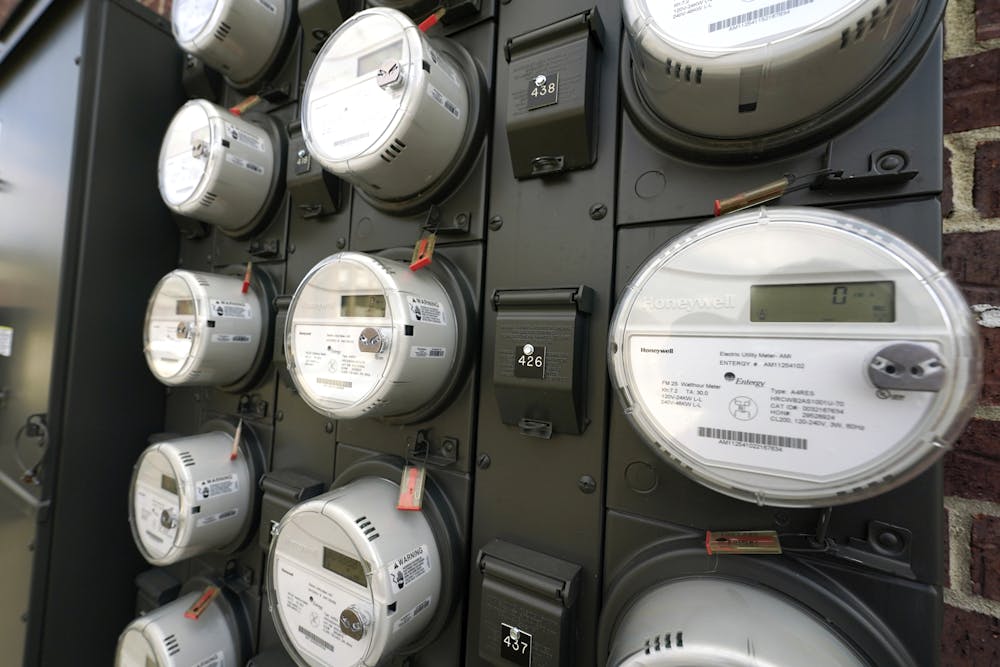
    Electric meters like these at a Mississippi apartment complex keep track of how much – or how little – electricity residents use.
    AP Photo/Rogelio V. Solis

    Broad application

    Federal data indicates that 40% of total U.S. energy consumption – and 28% of U.S. carbon dioxide emissions – is attributable to household and industrial appliances, such as heating and cooling systems, refrigerators, lighting and various kinds of equipment, such as computers, printers and electric motors.

    At present, the U.S. Department of Energy’s Appliance and Equipment Standards Program covers more than 70 products that the government estimates consume about 90% of energy used in homes, 70% of energy in commercial buildings and 30% of energy used in industry. The government estimates the standards saved American consumers $105 billion just in 2024 – with a typical household saving about $576 over the expenses if there were no efficiency standards.

    Appliance energy efficiency standards now in place are cumulatively expected by the Department of Energy to reduce U.S. greenhouse gas emissions by approximately 2 billion metric tons over 30 years. That’s as much carbon dioxide as 15 million gas-powered cars would emit in that same period.

    Many federal standards, including on light bulbs, electric motors and commercial heating and cooling equipment, have been based on those previously adopted by one or more states. Federal law permits states to issue standards for products that the federal government has not yet regulated: As of 2024, 18 states had set efficiency rules for a total of 22 types of appliances, including computers and televisions.

    Additional benefits

    These appliance standards have reduced American energy use, including electricity. The existing national standards are projected to reduce overall national energy consumption by 10% between 2025 and 2035.

    Those standards also improve public health, because there is less need to build new fossil-fuel power plants or operate existing ones. As a result, power generators have been able to reduce their emissions of dangerous pollutants such as nitrogen oxides, sulfur dioxide and mercury.

    Energy efficiency standards reduce the need for fossil fuel-powered electric plants, like this one in Ohio.
    Jim West/UCG/Universal Images Group via Getty Images

    A popular policy

    Making appliances more energy efficient has proved popular. A national survey released by the Consumer Federation of America in 2018 found that 71% of Americans “support the idea that the government should set and update energy efficiency standards for appliances.” Significantly, 72% of those surveyed named lowering electrical bills and 57% stated that avoiding construction of new power plants to keep electricity rates from rising were important reasons to increase appliance efficiency.

    Support remains strong: A June 2024 YouGov poll found that 60% of Americans support tougher appliance efficiency standards.

    From 1987 through 2007, more than three-quarters of national appliance energy efficiency standards were passed into law by Congress, with the rest created by administrative processes under existing laws. These legal standards received bipartisan support and were signed into law by Republican Presidents Ronald Reagan, George H.W. Bush and George W. Bush.

    But more recently, partisanship has affected the setting of standards. Since 2008, whether standards improve or remain unchanged has depended on whether Democrats or Republicans occupied the White House.

    Political back-and-forth

    The Obama administration enacted among the most ambitious energy efficiency standards for appliances and equipment to date. New standards for commercial air conditioners and furnaces affected heating and cooling equipment for half of the square footage used by the nation’s businesses. The rules were projected to reduce energy costs to businesses by $167 billion over the life of the regulated products.

    But during the first Trump administration, improvements in existing standards came to a halt.

    When Joe Biden became president, his administration resumed issuing new standards, most notably phasing out incandescent light bulbs. The Biden administration also issued new standards for furnaces, residential water heaters, stoves, washing machines and refigerators.

    Electric induction stoves, like this one, are more energy efficient than gas stoves.
    Hans Gutknecht/MediaNews Group/Los Angeles Daily News via Getty Images

    Controversy continues

    A new Biden rule for electric motors, which are widely used in manufacturing and processing equipment, incorporated recommendations from businesses and advocacy organizations. The rule was slated to take effect in 2028 and was expected to save businesses and consumers up to $8.8 billion over a 30-year period.

    But the Trump administration has withdrawn this standard, along with others issued by the Biden administration, including for ceiling fans, dehumidifers and external power supplies. The administration has postponed the effective dates of other standards that had been finalized before Trump took office. The administration said the reversals would “slash unnecessary red tape and regulations that raise prices, reduce consumer choice, and frustrate the American people.”

    Another set of politically controversial standards Biden introduced sought to encourage consumers to switch from stoves, furnaces and water heaters that use natural gas or propane to electric ones. The electric versions of those appliances are more energy efficient, while gas cooking emits toxic chemicals into the home. Switching can be expensive, and many consumers prefer gas-powered appliances, as of course does the natural gas industry, which has opposed these federal efforts.

    And in early April 2025, Republicans in Congress used their legislative authority to overturn the regulations for natural gas water heaters. But most of the federal standards – and all of the state ones – remain in effect, at least for now.

    This article, originally published April 17, 2025, was updated on May 14, 2025, to reflect the Trump administration’s latest move on efficiency standards.

    David J. Vogel does not work for, consult, own shares in or receive funding from any company or organization that would benefit from this article, and has disclosed no relevant affiliations beyond their academic appointment.

    – ref. Trump administration moves to undo appliance efficiency standards that save consumers billions, reduce pollution and fight climate change – https://theconversation.com/trump-administration-moves-to-undo-appliance-efficiency-standards-that-save-consumers-billions-reduce-pollution-and-fight-climate-change-253673

    MIL OSI – Global Reports –

    May 15, 2025
  • MIL-OSI USA: Senators Peters and Blackburn Introduce Bipartisan Bill to Protect U.S. Nuclear Facilities from Drone Threats

    US Senate News:

    Source: United States Senator for Michigan Gary Peters
    Published: 05.14.2025

    WASHINGTON, DC – U.S. Senators Gary Peters (D-MI) and Marsha Blackburn (R-TN) introduced bipartisan legislation to protect our nation’s nuclear facilities from the growing threat of unmanned aircraft systems (UAS), or drones. The senators’ Nuclear Ecosystem Drone Defense (NEDD) Act would expand the Department of Energy’s (DOE) authority to counter drones presenting threats to U.S. nuclear facilities and assets, specifically to cover facilities that store and transport nuclear material as well as facilities used to research, design, or manufacture components for nuclear weapons. As drones become more advanced, this legislation would help to better secure America’s major nuclear sites as well as smaller facilities that are critical to national security.  
    “As drone technologies evolve and advance, we need to be taking every step necessary to protect our national security and keep America’s nuclear assets, and the communities near them, safe,” said Senator Peters. “This bill would give the Department of Energy the additional authority it needs to counter evolving drone threats and protect some of our nation’s most sensitive and critical infrastructure.” 
    “Unmanned aircraft systems are threatening our nuclear and national security,” said Senator Blackburn. “The NEDD Act would protect nuclear facilities from unauthorized drones, enhancing the Department of Energy’s ability to safeguard its assets, and counter threats to our national security.”
    Between 2022 and 2024, the National Nuclear Security Administration (NNSA) reported six unauthorized drone sightings at the Nevada National Security Site (NNSS), one suspicious UAS overflight of the Pantex Plant (PTX), and five suspicious drone overflights of the Los Alamos National Labs (LANL) restricted airspace. These events have underscored the need for DOE to have expanded authorities and capabilities to combat evolving drone threats. 
    The NEDD Act would help address weaknesses in DOE’s current drone authorities to better counter nefariously operated drones. While current law focuses on protecting high-profile sites where special nuclear materials are stored, the U.S. is also home to other important facilities, such as those involved in research or production, that are not thoroughly covered. This bipartisan bill would help close those gaps and ensure that DOE can respond quickly to threats and implement comprehensive safeguards for all sites under its purview.  Peters has been fighting to expand authorities to ensure our nation is prepared to address public safety threats from drones. Last year, he pressed his colleagues to pass long overdue, bipartisan legislation he authored that would provide state and law enforcement with tools to better detect and track drones so they can protect their communities. Peters’ legislation is supported by a wide range of stakeholders including the National Football League, airports and law enforcement organizations.   

    MIL OSI USA News –

    May 15, 2025
  • MIL-OSI USA: Ricketts Leads Letter Backing President Trump’s Call for Full Dismantlement of Iran’s Nuclear Program

    US Senate News:

    Source: United States Senator Pete Ricketts (Nebraska)
    WASHINGTON, D.C. – Today, U.S. Senator Pete Ricketts (R-NE) led a letter to President Donald Trump regarding the administration’s ongoing negotiations with Iran. The letter calls on the Trump administration to secure a deal that results in the full dismantlement of the Iranian nuclear program, including permanently ending the regime’s capacity to enrich uranium. The letter was signed by 52 Senate Republicans. The letter states:
    “We write to express our strong support for your efforts to secure a deal with Iran that dismantles its nuclear program, and to reinforce the explicit warnings that you and officials in your administration have issued that the regime must permanently give up any capacity for enrichment.
    “We cannot afford another agreement that enables Iran to play for time, as the JCPOA did. The Iranian regime should know that the administration has Congressional backing to ensure their ability to enrich uranium is permanently eliminated,” the letter continues. “As always we stand ready to provide you and your administration whatever resources you need to advance American national security interests.”
    The letter was also signed by Senators Ted Cruz (TX), Tom Cotton (AR), Leader John Thune (SD), Jim Risch (ID), Mike Crapo (ID), Jim Justice (WV), Steve Daines (MT), John Curtis (UT), John Cornyn (TX), Kevin Cramer (ND), Chuck Grassley (IA), Dave McCormick (PA), James Lankford (OK), Tim Scott (SC), Susan Collins (ME), Markwayne Mullin (OK), Tim Sheehy (MT), Rick Scott (FL), Cynthia Lummis (WY), Jim Banks (IN), John Hoeven (ND), John Boozman (AR), Jon Husted (OH), John Barrasso (WY), Roger Wicker (MS), Thom Tillis (NC), Shelly Moore Capito (WV), Mike Lee (UT), Katie Britt (AL), Marsha Blackburn (TN), Ashley Moody (FL), Ted Budd (NC), Mitch McConnell (KY), Dan Sullivan (AK), Joni Ernst (IA), Cindy Hyde-Smith (MS), Mike Rounds (SD), Deb Fischer (NE), Bill Cassidy (LA), Todd Young (IN), John Kennedy (LA), Tommy Tuberville (AL), Bernie Moreno (OH), Jerry Moran (KS), Lisa Murkowski (AK), Bill Hagerty (TN), Eric Schmitt (MO), Roger Marshall (KS), Josh Hawley (MO), Ron Johnson (WI), and Lindsey Graham (SC).
    Read the full letter here or below:
    Dear Mr. Trump:
    We write to express our strong support for your efforts to secure a deal with Iran that dismantles its nuclear program, and to reinforce the explicit warnings that you and officials in your administration have issued that the regime must permanently give up any capacity for enrichment.
    During your first term you withdrew the United States from the deeply broken Joint Comprehensive Plan of Action (JCPOA) and imposed maximum pressure on the regime. As you said then, a fatal flaw of the deal was that it “allowed Iran to continue enriching uranium and, over time, reach the brink of a nuclear breakout.”  The JCPOA allowed Iran to sell oil, provided waivers allowing third countries to help Iran build out its nuclear program, and included the termination of United Nations sanctions on the regime. Despite critics claiming your withdrawal from the deal would allow Iran to advance its nuclear ambitions, the Iranian regime remained deterred from making substantial nuclear progress throughout your term because of your maximum pressure campaign.
    Tragically, the Biden administration systematically undid that pressure, functionally re-implementing the nuclear deal. They immediately rescinded your decision to reimpose U.N. sanctions, allowed Iran to sell oil at JCPOA-levels, and even re-issued waivers allowing Iran to build out its nuclear program. As you predicted, those policies indeed allowed Iran to reach the brink of nuclear breakout, which is where they are today. The Biden administration made those concessions without any reciprocal concessions from Iran, and Iran even ceased providing international inspectors access to significant parts of its nuclear program in the early days of the Biden administration.
    The scope and breadth of Iran’s nuclear buildout have made it impossible to verify any new deal that allows Iran to continue enriching uranium. In its most recent report, published on February 26, the International Atomic Energy Agency confirmed that because of Iran’s activities over the last four years, “the Agency has lost continuity of knowledge in relation to the production and current inventory of centrifuges, rotors and bellows, heavy water and UOC, which it will not be possible to restore.”
    You and your administration have therefore correctly drawn a redline against any deal that allows Iran to retain any enrichment capability. Your National Security Presidential Memorandum on Iran stated that “Iran’s nuclear program, including its enrichment- and reprocessing-related capabilities and nuclear-capable missiles, poses an existential danger to the United States and the entire civilized world,” and you recently said that only “full dismantlement” of those capabilities would be acceptable. Special Presidential Envoy Steve Witkoff has made it clear in that context of negotiation that for any final arrangement to work, “Iran must stop and eliminate its nuclear enrichment and weaponization program.” 
    We cannot afford another agreement that enables Iran to play for time, as the JCPOA did. The Iranian regime should know that the administration has Congressional backing to ensure their ability to enrich uranium is permanently eliminated. 
    As always we stand ready to provide you and your administration whatever resources you need to advance American national security interests.

    MIL OSI USA News –

    May 15, 2025
  • MIL-OSI USA: Reps. Russell Fry (SC-07) and Mike Levin (CA-49) Introduce MAPOceans Act to Enhance Access to Recreational Waterway Data

    Source:

    Reps. Russell Fry (SC-07) and Mike Levin (CA-49) Introduce MAPOceans Act to Enhance Access to Recreational Waterway Data

    Washington, D.C. – Today, Congressmen Russell Fry (SC-07) and Mike Levin (CA-49) introduced the Modernizing Access to Our Public Oceans (MAPOceans) Act, legislation that will modernize public access to vital data about U.S. waterways. By requiring the Secretary of Commerce to digitize and display real-time marine data through GPS and smartphone applications, the bill aims to improve the recreational experience for boaters and anglers, support safe and legal activity on the water, and strengthen coastal economies.

    Building on the success of the MAPLand Act (2022) and the MAPWaters Act (which passed the House in January 2025), the MAPOceans Act would require the National Oceanic and Atmospheric Administration (NOAA) to consolidate, standardize, and digitize public information about U.S. marine waters and make that information easily accessible in real time.

    Specifically, the bill would:

    • Provide real-time status updates on which waterways are open or closed to entry or watercraft, low-elevation aircraft, or diving.

    • Digitize restrictions related to motorized propulsion, fuel type, and specific types of watercraft (e.g., motorboats, kayaks, personal watercraft, airboats, ships).

    • Display fishing regulations and restrictions, including no-take zones, marine protected areas, and rules about specific equipment or bait (such as circle hooks or descending devices).

    • Publish continuously updated geographic information (GIS) data on navigation, bathymetric information, and depth charts.

    • Require the Department of Commerce to partner with non-federal entities—including states, Indian Tribes, Native Hawaiian organizations, private industry, data experts, and academic institutions—to ensure accurate and up-to-date information.

    “The MAPOceans Act is a commonsense bill to help Americans enjoy our nation’s waters and coastlines more safely and responsibly,” said Congressman Fry. “Whether you’re a fisherman or a boater, this bill gives individuals the easily accessible real-time information they need and ensures that Americans who rely on our waterways—whether for work or recreation—have the tools to access and enjoy our natural resources.”

    “Our district is home to terrific coastal waters that offer recreational and economic benefits to our entire region,” said Congressman Levin. “Every resident and visitor should be able to easily access clear information about how to responsibly enjoy these areas. This bipartisan bill will help ensure that’s the case while promoting the long-term protection of these natural resources. I look forward to working with Rep. Fry to advance this important legislation through the House.”

    Senators Ted Cruz (R-TX) and Angus King (I-ME) reintroduced the bill in the Senate, where it passed the Senate Commerce, Science, and Transportation Committee by voice vote in March 2025.

    The bill has received endorsements from the following organizations: South Carolina Boating & Fishing Alliance, American Sportfishing Association, Theodore Roosevelt Conservation Partnership, Marine Retailers Association of the Americas, International Game Fish Association, Center for Sportfishing Policy, Congressional Sportsmen’s Foundation, Boat Owners Association of The United States (BoatUS), and National Marine Manufacturers Association (NMMA).

    “Boaters and anglers want to follow the rules, but too often those rules are buried in scattered websites or outdated PDFs,” said President and CEO of the South Carolina Boating & Fishing Alliance Gettys Brannon. “For a coastal state like South Carolina, where access to our waterways drives tourism, supports small businesses, and defines our way of life, the MAPOceans Act will bring clarity to the chaos. It gives the public one clear source to understand where they can fish, anchor, or operate. It’s a long-overdue fix that makes federal waterways more accessible and more manageable for everyone on the water. We thank Congressman Fry for his leadership on this important legislation.”

    “The MAPOceans Act will provide many benefits for the millions of saltwater anglers who fish our nation’s marine waters every year,” said President and CEO of the American Sportfishing Association (ASA) Glenn Hughes. “This legislation will ease access to information on federal fishing regulations through navigation tools and mapping applications, helping anglers and boaters stay up-to-date with changing regulations and opportunities. ASA and the recreational fishing industry thank Representatives Fry and Levin for their leadership of this legislation, which will simplify access to a wide range of recreational information, allowing anglers to feel confident they’re in compliance with the law as they’re heading out on the water.”

    “America’s incredible saltwater recreation opportunities should be easily enjoyed by all,” said President and CEO of the Theodore Roosevelt Conservation Partnership Joel Pedersen. “The MAPOceans Act will help simplify boating and recreational fishing information by digitizing not easily accessible regulations and making them readily available to the public. TRCP thanks Representatives Fry and Levin for their leadership to introduce and advance this important public access legislation.”

    “Accurate charts are one of the basic safety tools for all boaters,” said Government Affairs Manager for Boat Owners Association of The United States, BoatUS David Kennedy. “The MAPOceans Act will ensure the information collected by federal agencies will get on the chart plotters, mobile devices and even paper charts that boaters rely upon.”

    “The National Marine Manufacturers Association (NMMA) applauds the introduction of the MAPOceans Act, which would provide recreational boaters and anglers with more easily accessible resources and information to enjoy America’s waterways in a responsible and safe way,” said NMMA President and CEO Frank Hugelmeyer. “NMMA appreciates Representatives Fry and Levin’s support of the $230 billion recreational boating community and their steadfast leadership on this issue.”

    Several organizations also submitted this letter.

    Congressman Fry serves on both the House Energy and Commerce Committee and the House Judiciary Committee. To stay up to date with Congressman Fry and his work for the Seventh District, follow his official Facebook, Instagram, and X pages and visit his website at fry.house.gov.

    MIL OSI USA News –

    May 15, 2025
  • MIL-OSI United Kingdom: UK advocates clean energy development in Guatemala

    Source: United Kingdom – Executive Government & Departments

    World news story

    UK advocates clean energy development in Guatemala

    • English
    • Español de América Latina

    An official from the UK’s Department of Energy Security and Net Zero (DESNZ) engaged with stakeholders in Guatemala to advance energy transition.

    Mitchell Lloyd, Senior Policy Advisor on International Energy Transition at DENZ visited Guatemala 12-14 May.  He met with the General Directorate of Energy at the Ministry of Energy and Mines, other government departments, private sector and international financing institutions developing clean energy initiatives in Guatemala.

    The discussions included a series of topics ranging from the need to galvanize global and local leadership and foster international cooperation on a clean energy transition, to unlocking clean growth, job opportunities and build robust clean energy supply chains.

    Guatemala has significant potential to develop clean energy projects, with a renewable capacity potential of 3,700 MW that could be integrated into the country’s electricity grid between 2024 and 2040. This includes various sources such as solar, wind, hydro, and geothermal energy.

    The visit supports the UK’s government mission to become a clean energy superpower, protecting households from unstable fossil fuel markets, including coal, while at the same time unlocking job opportunities at home and abroad for the clean energy sector.

    Share this page

    The following links open in a new tab

    • Share on Facebook (opens in new tab)
    • Share on Twitter (opens in new tab)

    Updates to this page

    Published 14 May 2025

    MIL OSI United Kingdom –

    May 15, 2025
  • MIL-OSI Global: Why spring 2025 is so dry

    Source: The Conversation – UK – By Jack Marley, Environment + Energy Editor, UK edition

    April showers bring May flowers according to an old English saying.

    This phrase, which might have originated in a verse written by poet Thomas Tusser in 1557, harks back to a time when most people depended on rough rules that were borne of practical experience to know when to plant crops. “Such weather lore was the only forecast available”, says meteorologist Rob Thompson at the University of Reading.


    Read more:
    ‘April showers’ – a rainfall scientist explains what they are and why they are becoming more intense


    UK farmers waited in vain for showers this April. The unusually dry month gave lie to the centuries-old expression, which hints at a climate that was generally more obedient to familiar rhythms. The heating of Earth’s atmosphere and ocean, predominantly caused by the mass burning of fossil fuels, has changed that. What we can expect in each season is no longer so assured.

    So, how do we keep our bearings on a warming planet?


    This roundup of The Conversation’s climate coverage comes from our award-winning weekly climate action newsletter. Every Wednesday, The Conversation’s environment editor writes Imagine, a short email that goes a little deeper into just one climate issue. Join the 45,000+ readers who’ve subscribed.


    Forecasting chaos

    Forecasters have an enormous challenge in predicting how the weather in each season will change, and in communicating the role of climate change.

    “Overall, we can be confident that climate change is bringing warmer conditions in all seasons,” say atmospheric scientists Simon H. Lee and Matthew Patterson at the University of St Andrews. Europe in particular has been a hotspot for warming, with temperatures rising at roughly double the global average.

    Patterson suspects that this has already warped our perceptions of what a “normal” season feels like. When a month arrives with temperatures closer to the long-term average for instance, like June 2024, people tend to experience it as unusually cold.


    Read more:
    Average months now feel cold thanks to climate change


    “Scientists also have strong evidence to suggest that drought conditions will become more common,” Lee and Patterson continue.

    The UK has had roughly half the rainfall it would usually expect for March and April, and spring 2025 is on track to be the country’s driest on record. Some of the latest research on Earth’s water cycle predicts that these dry bouts will get drier, while wet ones will get wetter, and that the switch from drought to deluge will be more sudden (“weather whiplash”, as some have called it).


    Read more:
    Landmark new research shows how global warming is messing with our rainfall


    This doesn’t fully explain the UK’s record-warm and dry spring, however. There are also “weather blocks” to factor in.

    “A blocking event is a disruption to the usual weather patterns of Earth’s middle latitudes,” explains Tim Woollings, a professor in physical climate science at the University of Oxford. In this part of the world it’s the jet stream, a river of air high in the atmosphere, that typically sets the agenda by driving transient weather over the British Isles from the Atlantic.

    Since the beginning of March, a zone of high pressure has rested above the UK and blocked the jet stream like a boulder in a river, Lee and Patterson say. The weather has effectively remained “stuck”. This phenomenon is responsible for a lot of extreme weather in the middle latitudes, as blocks prevent relief from heatwaves or cold snaps, Woollings adds.


    Read more:
    How weather ‘blocks’ have triggered more extreme heatwaves and floods across Europe


    There isn’t conclusive evidence to suggest these blocks are becoming more common as the climate warms according to Lee and Patterson. But one thing is clear: the climate is incredibly complex – and our continuing intervention in it is reckless.

    High-temperature haiku

    Seasons are our living world’s accommodation of the variation in day length, temperature and weather during the year.

    What we perceive as seasonal features, like the shedding of leaves, the arrival and departure of migratory animals, are the adaptations species have made to the average set of conditions that have remained within a particular range for several thousands of years.

    Changes in Earth’s orbit and spin axis gradually influenced the climate and seasons over millennia. More recently, fossil fuel burning has been the dominant influence.

    “As such, humanity is currently on the path to compressing millions of years of temperature change into just a couple of centuries,” say ancient climate experts Dan Lunt (University of Bristol) and Darrell Kaufman (Northern Arizona University).

    The seasonal signals we once thought of as immutable are changing to match these changing conditions. It’s too much, too fast for most species to deal with – including our own.


    Read more:
    Humanity is compressing millions of years of natural change into just a few centuries


    To reorient around a rapidly changing climate, we could do as Tusser did six centuries ago, and write poetry.

    Haiku is perhaps our most useful cultural barometer of climate change. These poems, which originated in 17th-century Japan, comprise three short lines and usually include a reference to the season in which they were composed.

    “A successful haiku could be described as a half-finished poem,” say lecturer in publishing Jasmin Kirkbride (University of East Anglia) and creative writing PhD candidate Paul Chambers (University of Bristol). The listener must complete the scene in their head by linking it with an intense moment of perception from their own life, in which “the vast is perceived in one thing”.


    Read more:
    Haiku has captured the essence of seasons for centuries – new poems contain a trace of climate change


    As seasons have shifted, so have their markers in haiku. Snowdrops, once a feature of February haiku, now appear close to Christmas. The language used to describe certain species has altered too, the pair say, to become “soaked in grief”. Butterflies that once formed “clouds” in earlier haiku, for example, are now “lone survivors… pushing against time”.

    Kirkbride and Chambers urge a new generation of poets to continue recording these changes in haiku: “The vast climate crisis is upon us, and we should write about it.”

    – ref. Why spring 2025 is so dry – https://theconversation.com/why-spring-2025-is-so-dry-256709

    MIL OSI – Global Reports –

    May 15, 2025
  • MIL-OSI USA: Sinaloa cartel leaders charged with narco-terrorism, material support of terrorism and drug trafficking in ICE, FBI investigation

    Source: US Immigration and Customs Enforcement

    SAN DIEGO – An indictment unsealed May 13 is the first in the nation to charge alleged leaders of the Sinaloa Cartel with narco-terrorism and material support of terrorism in connection with trafficking massive amounts of fentanyl, cocaine, methamphetamine and heroin into the United States. U.S. Immigration and Customs Enforcement and the FBI are investigating this case.

    “These charges highlight the unwavering efforts of transnational criminal organizations like the Sinaloa Cartel to flood our communities with deadly drugs,” said ICE Homeland Security Investigations San Diego Special Agent in Charge Shawn Gibson. “HSI and our law enforcement partners will not allow cartel-driven drug trafficking to threaten the safety and stability of our neighborhoods. We are all lasered focused on a unified effort to dismantling these networks and their factions in bringing those responsible to justice.”

    Pedro Inzunza Noriega and his son, Pedro Inzunza Coronel, are charged with narco-terrorism, drug trafficking and money laundering as key leaders of the Beltran Leyva Organization, a powerful and violent faction of the Sinaloa Cartel that is believed to be the world’s largest known fentanyl production network. Five other BLO leaders are charged with drug trafficking and money laundering. The indictment is a direct result of President Trump’s Executive Order 14157 which designated the Sinaloa Cartel as a Foreign Terrorist Organization and the Secretary of State’s subsequent designation of the same on February 20, 2025.

    “The Sinaloa Cartel is a complex, dangerous terrorist organization and dismantling them demands a novel, powerful legal response,” said Attorney General Pamela Bondi. “Their days of brutalizing the American people without consequence are over — we will seek life in prison for these terrorists.”

    “Operation Take Back America initiatives reflect the reality that narco-terrorists operate as a cancer within a state,” said U.S. Attorney Adam Gordon. “They metastasize violence, corruption and fear. If left unchecked, their growth would lead to the death of law and order. This indictment is what justice looks like when the full measure of the Department of Justice along with its law enforcement partners is brought to bear against the Sinaloa Cartel.”

    “BLO, under the leadership of Inzunza Noriega, is allegedly responsible for some of the largest-ever drug seizures of fentanyl and cocaine destined for the United States,” said FBI San Diego Acting Special Agent in Charge Houtan Moshrefi. “Their drugs not only destroy lives and communities, but also threaten our national security. The law enforcement efforts against the Noriegas reaffirms our commitment to dismantling and disrupting this very dangerous narco-terrorist group and combating narco-trafficking.”

    According to court documents, since its inception the Beltran Leyva faction has been considered one of the most violent drug trafficking organizations to operate in Mexico, engaging in shootouts, murders, kidnappings, torture and violent collection of drug debts to sustain its operations. The Beltran Leyva faction controls numerous territories and plazas throughout Mexico – including Tijuana – and operates with violent impunity, trafficking in deadly drugs, threatening communities, and targeting key officials, all while making millions of dollars from their criminal activities.

    Pedro Inzunza Noriega works closely with his son, Pedro Inzunza Coronel, to produce and aggressively traffic fentanyl to the United States, the government has alleged. Court documents indicate that together the father and son lead one of the largest and most sophisticated fentanyl production networks in the world. Over the past several years, they have trafficked tens of thousands of kilograms of fentanyl into the United States. On December 3, 2024, Mexican law enforcement raided multiple locations in Sinaloa that are controlled and managed by the father and son and seized 1,500 kilograms (more than 1.65 tons) of fentanyl – the largest seizure of fentanyl in the world.

    These indictments follow a notable tradition in the Southern District of California for targeting leadership and operations of powerful Mexican cartels – from the dismantling of the Arellano Felix Cartel to major strikes against today’s most dangerous, powerful and violent cartels, including the Sinaloa Cartel, Jalisco New Generation Cartel and now the Beltran Leyva Organization. It is the first indictment from the newly formed Narco-Terrorism Unit which was established upon the swearing in of U.S. Attorney Gordon on April 11, 2025.

    The indictment of Pedro Inzunza Noriega reflects the Southern District of California’s pursuit of the Sinaloa Cartel. Federal drug trafficking indictments are pending against all alleged leaders of its Beltran Leyva faction, including:

    • Fausto Isidro Meza Flores aka “Chapo Isidro,” case number: 19-CR-1272 in the Southern District of California and 12-116BAH in the District of Columbia
    • Oscar Manuel Gastelum Iribe aka “El Musico,” case number 19-CR-3736 in the Southern District of California; 09-CR-00672 in the Northern District of Illinois; 15-CR-00195 in the District of Columbia, and
    • Pedro Inzunza Noriega aka “Sagitario,” case number 25cr1505.

    The Southern District of California also has indictments pending against other leaders of the Sinaloa Cartel, including:

    • Ivan Archivaldo Guzman Salazar aka “El Chapito,” case number 14-cr-00658 in the Southern District of California and 09-CR-383 in the Northern District of Illinois
    • Ismael Zambada Sicairos aka “Mayito Flaco,” case number: 14-cr-00658 in the Southern District of California; and
    • Jose Gil Caro Quintero aka “El Chino,” case number 22-cr-00036 in the District of Columbia

    This case is being prosecuted by Assistant U.S. Attorneys Joshua Mellor and Matthew Sutton.

    Defendants for Case Number 25cr1505

    Name Age Location
    Pedro Inzunza Noriega | aka “Sagitario,” aka “120,” aka “El De La Silla” 62 Los Mochis, Sinaloa, Mexico
    Pedro Inzunza Coronel | aka “Pichon,” Aka “Pajaro”, aka “Bird” 33 Los Mochis, Sinaloa, Mexico
    David Alejandro Heredia Velazquez | aka “Tano,” aka “Mr. Jordan” 50 Guadalajara, Jalisco, Mexico and Culiacan, Sinaloa, Mexico
    Oscar Rene Gonzalez Menendez | aka “Rubio” 45 Guatemala City, Guatemala
    Elias Alberto Quiros Benavides 53 San Jose, Costa Rica
    Daniel Eduardo Bojorquez | aka “Chopper” 47 Nogales, Sonora, Mexico
    Javier Alonso Vazquez Sanchez | aka “Tito”, aka “Drilo” 31 Los Mochis, Sinaloa, Mexico

    Summary of Charges

    • Title 21, U.S.C., Secs. 960a and 841 – Narco-Terrorism
      Maximum penalty: Life in prison, mandatory minimum 20 years in prison; $20 million fine
    • Title 18, U.S.C. Sec. 2339B – Providing Material Support to Terrorism
      Maximum penalty: Twenty years in prison and $250,000 fine
    • Title 21, U.S.C., Sec. 848(a) -Continuing Criminal Enterprise
      Maximum penalty: Life in prison, mandatory minimum 20 years; $10 million fine
    • Title 21, U.S.C., Secs. 952, 959, 960, and 963 – International Conspiracy to Distribute Controlled Substances
      Maximum penalty: Life in prison, mandatory minimum 10 years; $10 million fine
    • Title 21, U.S.C., Secs. 841(a)(1) and 846 – Conspiracy to Distribute Controlled Substances
      Maximum penalty: Life in prison, mandatory minimum 10 years in prison; $10 million fine
    • Title 21, U.S.C., Secs. 952, 960 and 963 – Conspiracy to Import Controlled Substances
      Maximum penalty: Life in prison, mandatory minimum 10 years; $10 million fine
    • Money Laundering Conspiracy – Title 18, U.S.C., Section 1956(h)
      Maximum penalty: Twenty years in prison and a fine of the greater of $500,000 or twice the value of the monetary instrument or funds involved

    The charges and allegations contained in an indictment or complaint are merely accusations, and the defendants are considered innocent unless and until proven guilty.

    This case is part of Operation Take Back America, a nationwide initiative that marshals the full resources of the Department of Justice to repel the invasion of illegal immigration, achieve the total elimination of cartels and transnational criminal organizations, and protect our communities from the perpetrators of violent crime. Operation Take Back America streamlines efforts and resources from the Department’s Organized Crime Drug Enforcement Task Forces and Project Safe Neighborhood.

    This case is the result of ongoing efforts by the Organized Crime Drug Enforcement Task Force, a partnership that brings together the combined expertise and unique abilities of federal, state and local law enforcement agencies. The principal mission of the OCDETF program is to identify, disrupt, dismantle and prosecute high-level members of drug trafficking, weapons trafficking and money laundering organizations and enterprises.

    MIL OSI USA News –

    May 15, 2025
  • MIL-OSI USA: Trahan Rips GOP Giveaway to Big Tech Billionaires in Reconciliation Package

    Source: United States House of Representatives – Congresswoman Lori Trahan (D-MA-03)

    WASHINGTON, DC – During today’s House Energy and Commerce Committee markup on the Republican reconciliation legislation, Congresswoman Lori Trahan (MA-03) railed against a massive giveaway to Big Tech companies that would harm consumers and kids online. The provision buried in the bill would prohibit state-level protections on AI, allowing tech companies to deploy this emerging technology without restriction.
    “A ban on state regulations of AI for ten years shows where Republicans’ loyalty is: to Big Tech and the wealthy. Dismantling states’ regulations on technology amounts to a financial windfall of epic proportions, consistent with tax cuts for the rich that the Ways & Means Republicans marked up today,” Congresswoman Trahan said. “This provision absolves companies of any responsibility to protect consumers from the harms of AI. It is also drafted so broadly as to implicate states’ privacy and online safety laws, directly harming our kids.”
    CLICK HERE or the image below to view Trahan’s remarks during the Committee’s consideration of reconciliation legislation. A transcript is embedded below.

    The House Energy and Commerce Committee is currently marking up House Republicans’ reconciliation package that, according to the Congressional Budget Office, would cut $715 billion from Medicaid and eliminate health coverage for at least 13.7 million Americans. Included in that bill is a provision that would ban states from creating or implementing laws to limit potential harms of AI, effectively allowing Big Tech companies to deploy a rapidly changing technology without any accountability for its negative impacts.
    During debate over the legislation, Trahan spoke in support of an amendment filed by House Energy and Commerce Committee Ranking Member Frank Pallone, Jr. (NJ-06) to strike the 10-year moratorium on state AI regulation.
    “This handout for big tech and ultra-wealthy tech barons in the same reconciliation bill that guts healthcare for millions is what people hate about Washington. It’s lop-sided and it’s insulting,” Congresswoman Trahan continued. “If Republicans had chosen to start this hearing with the faces and stories of who they are advocating for, you wouldn’t see everyday Americans like us Democrats held up. We’d be looking at posters of Elon Musk, Mark Zuckerberg, and Jeff Bezos.”
    Following debate on the amendment, every House Republican on the committee voted No, preserving the provision in the legislation.
    ———————————————

    Congresswoman Lori Trahan
    Remarks As Delivered
    House Energy and Commerce Committee Markup – AI Moratorium Amendment
    May 14, 2025
    I move to strike the last word.
    Very soon, this Committee will be debating the biggest cuts to Medicaid in our nation’s history. Cuts that will strip health insurance from over 13 million Americans all to pay for tax cuts that disproportionately benefit the wealthiest in our country.
    Republicans will say that they aren’t cutting Medicaid – that they are simply implementing quote “sensible” work requirements. But please stay skeptical.
    Republicans are implementing cumbersome requirements because added paperwork will lead to less compliance and ultimately, less people enrolled, conveniently giving them enough space to fill the pot for their super-rich friends. A group of friends that, we should note, is headlined by the same big tech CEOs who stood behind President Trump at his inauguration. A group of friends who will say they want a federal privacy policy, a national AI framework while spending millions of dollars to make sure those bills never see the House Floor.
    A ban on state regulations of AI for ten years shows where Republicans’ loyalty is: to Big Tech and the wealthy. Dismantling states’ regulations on technology amounts to a financial windfall of epic proportions, consistent with tax cuts for the rich that the Ways & Means Republicans marked up today.
    This provision absolves companies of any responsibility to protect consumers from the harms of AI. It is also drafted so broadly as to implicate states’ privacy and online safety laws, directly harming our kids. Simply put, this provision, this single paragraph snuck into a massive budget bill, would undermine digital rights duly provided to millions of Americans by their state legislatures. 
    States have taken the lead in regulating technology while Congress has stalled out amidst a barrage of endless lobbying. If privacy and kids’ online safety are any indication, this Congress will not pass meaningful, comprehensive regulation of AI.
    And I ask my colleagues: what gives you so much optimism that Congress can pass meaningful protections for AI, privacy, or online safety? You claim that states have created a patchwork of regulations – why do you think state lawmakers have done that? You think they want to be legislating on difficult questions of technology policy?
    No. No, state lawmakers have stepped up because their federal counterparts – we – have consistently failed to act. Americans are fed up, and instead they’re asking state legislatures to protect them and their kids online.
    Make no mistake: this provision is a product of big tech lobbying. Companies including Meta and Google have long asked for it, and trade associations for big tech rejoiced when Republicans included it in this bill. Because what this provision represents is the biggest gift to the tech industry in its history.
    Put in context, however, this ban on tech regulation is not just bad policy, it’s morally bankrupt. We can work together on modernizing our systems, leveraging our data and our analytics. But Mr. Chairman, think about it: Republicans are effectively eliminating requirements on technology companies to make their products safe and trustworthy while, at the same time, adding requirements for Americans to receive lifesaving healthcare. 
    Under their bill, Americans will have to jump through hoops and complete mounds of paperwork to prove that they are working. Technology companies, on the other hand, won’t have to show their work at all. This handout for big tech and ultra-wealthy tech barons in the same reconciliation bill that guts healthcare for millions is what people hate about Washington. It’s lop-sided and it’s insulting.
    If Republicans had chosen to start this hearing with the faces and stories of who they are advocating for, you wouldn’t see everyday Americans like us Democrats held up. We’d be looking at posters of Elon Musk, Mark Zuckerberg, and Jeff Bezos.
    Requirements, compliance, and paperwork for busy, working class Americans, but not for billionaire big tech donors. That’s the Republican way, according to this legislation.
    But I’d love to be proven wrong. So vote yes on the amendment. I yield back.

    ###

    MIL OSI USA News –

    May 15, 2025
  • MIL-OSI Africa: CORRECTION: Mauritania Moves to Private Power Model, Set to Receive Independent Power Producer (IPP) Bids Within Weeks

    Source: Africa Press Organisation – English (2) – Report:

    PARIS, France, May 14, 2025/APO Group/ —

    Mauritania is accelerating its shift toward a fully privatized power generation model, with bids due in the next two to three weeks for a new independent power plant tied to the Greater Tortue Ahmeyim (GTA) gas project. The country’s Minister of Petroleum and Energy, Mohamed Ould Khaled, made the announcement at the Invest in African Energy 2025 Forum in Paris on Tuesday.

    “All new power generation projects in Mauritania will be private. State-owned companies will no longer be involved in power generation,” said the Minister. He added that two projects currently being developed as IPPs will be fueled by domestic gas and will contribute a combined 550 MW to the national grid over the next couple of years.

    The power sector reform is part of a wider transformation aimed at enabling Mauritania to harness its significant gas and renewable energy resources to power industrialization, expand electricity access and drive inclusive growth.

    “We want to develop large-scale natural gas and renewable energy resources. We want to expand affordable, clean power access to our people and industries and power inclusive economic growth, especially to unleash our mining potential.” 

    Mauritania currently has 57% energy access and aims to achieve full national coverage by 2030, according to the Minister. Gas from the GTA project – shared with Senegal – will play a central role in this transition, supplying enough fuel for a 250 MW combined-cycle power plant in each country during the project’s first phase, he said.

    The Minister described Mauritania as uniquely positioned for energy leadership on the continent and beyond, citing its combination of gas, solar, wind and strategic proximity to Europe. He also highlighted Mauritania’s position as the African leader in green hydrogen project development, backed by newly modernized regulatory frameworks.

    “Mauritania holds the largest pipeline of green hydrogen projects in Africa, which are designed not only to export molecules, but to catalyze industrialization in Mauritania and decarbonize hard-to-abate sectors. We have the potential to produce 12 million tons of green hydrogen production per year, with wind speeds of 10 meters per second and amazing solar.”

    “To support this transformation, we have completely modernized our framework,” the Minister continued. “We have opened up the electricity sector to private investments, introduced a new local content policy, and implemented new PPP and investment codes. Additionally, we have launched Africa’s first green hydrogen code, which provides clarity and long-term stability for investors.”

    Looking ahead, Mauritania’s integrated energy vision includes the expanded development of the BirAllah gas field – another major deepwater discovery – along with subsequent phases of the GTA project to reach 10 million tons of LNG per year, cross-border electricity trade with neighboring countries and further development of its mining sector.

    MIL OSI Africa –

    May 15, 2025
  • MIL-OSI: TMD Energy Limited Reports 2024 Full-Year Results

    Source: GlobeNewswire (MIL-OSI)

    Kuala Lumpur, Malaysia, May 14, 2025 (GLOBE NEWSWIRE) — TMD Energy Limited (NYSE: TMDE) (the “Company” or “TMDEL”), together with its subsidiaries (the “Group” or “TMDEL Group”) is a Malaysia and Singapore based service provider engaged in integrated bunkering services segment which involves ship-to-ship transfer of marine fuels, ship management services and vessel chartering services, today reported its financial results for the fiscal year ended December 31, 2024.

    Fiscal Year 2024 Financial Results Highlights

    • Group Revenue increased by 8.8% to $688.6 million in FY2024 from $633.1 million in FY2023.  Notably, revenue from our Bunkering Services Segment rose by $55.5 million.
    • Despite revenue grew by 8.8%, gross profit surged 32.7% to $16.0 million, with gross margin improving to 2.3% in FY2024 from 1.9% in FY2023.
    • Income from operations increased substantially by more than 130% to $6.0 million in FY2024 from $2.6 million in FY2023.
    • Net income remained stable at $1.9 million in FY2024, compared to $2.0 million for FY2023.

    Dato’ Sri Kam Choy Ho, Director and Chief Executive Officer of the Company commented, “In FY2024, the Company experienced sustainable revenue growth, primarily driven by the success of our Bunkering Services Segment.  Revenue notably increased by 8.8% in FY2024 to over $688 million, while net income remained stable at about $1.9 million, compared to $2.0 million a year earlier.”

    “The Bunkering Services Segment accounted for most of our revenue and net income, which benefited from improved operational efficiency and an expanding customer base. The redeployment of a vessel from vessel chartering services to the bunkering segment further enhanced our bunkering capacities, allowing us to better meet our client growing needs.”

    “Looking ahead, we recognize the importance of maintaining this momentum. Our focus will remain on optimizing balance sheet by enhancing our operational efficiencies and exploring new customer opportunities in the bunkering sector.  With our existing internal team of ship managers who are qualified professional mariners, we aim to continue growing our ship management revenue by targeting our existing bunkering client and external clients.  We’ll also maintain competitive pricing via our supplier leverage and transparent practices as we stay committed to leveraging our strengths to drive sustainable growth and deliver value to our stakeholders.”

    Financial Performance Overview

    Our Group reported an overall revenue of $688.6 million for FY2024, an increase of 8.8%, or equivalent to $55.5 million from $633.1 million in FY2023 due to rise in contribution from the Bunkering Services Segment.  This segment which contributed more than 99% of the Group’s revenue had enjoyed a 6.0% increase in the volume of oil cargo bunkered as our Group expanded its customer base.  Meanwhile, the Ship Management Segment had contributed the remaining $0.4 million of the Group’s revenue.

    We recorded an overall increase of 32.7% in our gross profit, or equivalent to $3.9 million, to $16.0 million for FY2024 from $12.1 million in FY2023.  As we strategically focus on penetrating new markets and expanding our customer base, we had managed to improve our gross profit margin from 1.91% in FY2023 to 2.33% in FY2024.

    General and administrative expenses had increased by $0.1 million in FY2024 to $5.2 million from $5.1 million as we participated in environmental, social and governance activities as part of our commitment to a sustainable green environment and incurring additional travelling expenses for our business expansion.

    Depreciation had increased by $0.5 million from $4.3 million in FY2023 to $4.8 million in FY2024 as we continued to maintain and dry-dock our vessels periodically to ensure their sea worthiness and condition when carrying out a safe and efficient bunkering operation.

    Interest expense had increased by $2.4 million to $4.6 million in FY2024, up from $2.2 million in FY2023 as higher volume of trade financing facilities were utilized to meet the increase in volume of oil cargo bunkered.

    Overall, net income remained stable at $1.9 million in FY2024, compared to $2.0 million for FY2023.

    About TMD Energy Limited

    TMD Energy Limited and its subsidiaries are principally involved in marine fuel bunkering services specializing in the supply and marketing of marine gas oil and marine fuel oil of which include high sulfur fuel oil, low sulfur fuel oil and very low sulfur fuel oil, to ships and vessels at sea. TMDEL Group is also involved in the provision of ship management services for in-house and external vessels, as well as vessels chartering. As of today, TMDEL Group operates in 19 ports across Malaysia with a fleet of 15 bunkering vessels. 

    For more information about our Company and its business activities, please visit our website at: www.tmdel.com.

    Forward-Looking Statements

    Certain statements in this announcement are forward-looking statements, including but not limited to, the Company’s Offering.  These forward-looking statements involve known and unknown risks and uncertainties and are based on the Company’s current expectations and projections about future events that the Company believes may affect its financial condition, result of operations, business strategy and financial needs.  Investors can identify these forward-looking statements by words or phrases such as “may”, “could”, “will”, “should”, “would”, “expect”, “plan”, “intend”, “anticipate”, “believe”, “estimate”, “predict”, “potential”, “project” or “continue” or the negative of these terms or other comparable terminology.  The Company undertakes no obligation to update or revise publicly any forward-looking statements to reflect subsequent occurring events or circumstances, or changes in its expectations, except as may be required by law.  Although the Company believes that the expectations expressed in these forward looking statements are reasonable, it cannot assure you that such expectations will turn out to be correct, and the Company cautions investors that actual results may differ materially from the anticipated results and encourages investors to review other factors that may affect its future results in the Company’s financial results filings with the SEC.

    For investor and media inquiries, please contact:

    TMD ENERGY LIMITED
    e-Mail : corporate@tmdel.com

    WFS INVESTOR RELATIONS
    e-Mail : services@wealthfsllc.com

    The MIL Network –

    May 15, 2025
  • MIL-OSI USA: Fact Sheet: President Donald J. Trump Secures Historic $1.2 Trillion Economic Commitment in Qatar

    US Senate News:

    Source: The White House
    MAKING AMERICAN MANUFACTURING AND INNOVATION GREAT AGAIN: Today in Qatar, President Donald J. Trump signed an agreement with Qatar to generate an economic exchange worth at least $1.2 trillion. President Trump also announced economic deals totaling more than $243.5 billion between the United States and Qatar, including an historic sale of Boeing aircraft and GE Aerospace engines to Qatar Airways.   
    The landmark deals celebrated today will drive innovation and prosperity for generations, bolster American manufacturing and technological leadership, and put America on the path to a new Golden Age.
    Since President Trump took office, his commitment to American manufacturing and innovation has attracted trillions of dollars in investments and global commercial deals. Allies like Qatar are partnering in the United States’ success. 
    The following represent just a few of the many groundbreaking deals secured in Qatar:
    Boeing and GE Aerospace secured a landmark order from Qatar Airways, a $96 billion agreement to acquire up to 210 American-made Boeing 787 Dreamliner and 777X aircraft powered by GE Aerospace engines. This is Boeing’s largest-ever widebody order and largest-ever 787 order. This historic agreement will support 154,000 U.S. jobs annually, totaling over 1 million jobs in the United States during the course of production and delivery of this deal.
    McDermott has a strong partnership with Qatar Energy in advancing critical energy infrastructure, with seven active projects worth $8.5 billion. As the sole provider of offshore components for Qatar’s major LNG expansion, McDermott’s work directly supports thousands of U.S. energy sector jobs.
    Parsons has successfully won 30 projects worth up to $97 billion. These high-value engagements have fueled significant company growth, supporting thousands of jobs across the United States and reinforcing American leadership in cutting-edge engineering and innovation.
    Quantinuum finalized a Joint Venture Agreement with Al Rabban Capital, a prominent Qatari company, to invest up to $1 billion in state-of-the-art quantum technologies and workforce development in the United States, supporting U.S. jobs and leadership in this critical emerging technology.  

    Today’s signings mark President Trump’s intent to accelerate Qatar’s defense investment in the U.S.-Qatar security  partnership—enhancing regional deterrence and benefitting the U.S. industrial base.
    The defense deals secured today lock in Qatar’s procurement of state-of-the-art military equipment from two leading U.S. defense companies.
    Raytheon, an RTX business, secured a $1 billion agreement for Qatar’s acquisition of counter-drone capabilities, signed by the U.S. and Qatari governments. This deal establishes Qatar as the first international customer for Raytheon’s Fixed Site – Low, Slow, Small Unmanned Aerial System Integrated Defeat System (FS-LIDS) designed to counter unmanned aircraft. The deal directly supports high-skilled manufacturing and engineering jobs in the United States and reinforces America’s leadership in innovative defense technologies.
    General Atomics secured a nearly $2 billion agreement for Qatar’s acquisition of the MQ-9B remotely piloted aircraft system, signed by the U.S. and Qatari governments. This deal will strengthen the U.S.-Qatar bilateral relationship and provide the Qatari Armed Forces with the most advanced multi-mission remotely piloted aircraft in the world, powered by U.S. products made in America.
    The United States and Qatar also signed a statement of intent to further strengthen our security partnership, outlining over $38 billion in potential investments including support for burden-sharing at Al Udeid Air Base and future defense capabilities related to air defense and maritime security.

    These new agreements and instruments aim to drive the growth of the U.S.-Qatar bilateral commercial relationship, create thousands of well-paying jobs, and open new trade and investment opportunities for both countries over the coming decade and beyond.
     CATALYZING PROSPERITY THROUGH GREATER TRADE AND INVESTMENT: The United States and Qatar have a long history of trade and a strong commercial relationship, including significant long-term aviation, critical infrastructure, information technology, and consulting deals. 
    Qatar’s strategic goals outlined in Qatar National Vision 2030 create opportunities for U.S. businesses in multiple sectors.
    The United States had a $2 billion trade surplus with Qatar in 2024 and has had a positive trade balance with Qatar since 2003.
    In 2024, U.S.-Qatar trade totaled $5.64 billion, with $3.8 billion in U.S. exports and $1.8 billion in Qatari imports.
    Qatar’s greenfield investment in the United States totaled $3.3 billion in 2023, focused on hotels and tourism, information technology, advanced manufacturing, financial services, and oil and gas.

    This visit advances opportunities for U.S. companies to expand long-standing partnerships and for Qatari entities to embrace U.S. technologies, adopt best practices, and finalize new agreements for significant sales and investments.
    Qatar has made significant investments in the United States across hotels and tourism, financial services, technology, healthcare, and energy, with plans to invest even more over the next five years. These investments strengthen the U.S. economy by supporting good-paying jobs for millions of American workers, expanding U.S. exports, and funding research and development. 
    Qatar has the third largest proven reserves of natural gas in the world, and has invested in American energy infrastructure, directly contributing to U.S. energy security and industrial resilience.
    Starting in 2019, QatarEnergy initiated $18 billion in investments in the U.S. energy sector with ExxonMobil’s Golden Pass LNG Terminal ($10 billion) and Chevron Phillips Chemical’s Golden Triangle Polymers Plant ($8 billion), both located on the Texas Gulf Coast.

    Qatar is our 12th largest Foreign Military Sales partner with active cases valued at more than $26 billion.
    Qatar’s expansive investment in and trade with the United States contribute to U.S. and Qatari economic growth and prosperity, and Qatar’s choice of U.S. industry’s best-fit solutions supports the U.S. strategic goal of growing our industrial presence throughout the Gulf and the region as a whole.   
     THE ART OF THE DEAL: President Trump is securing billions in investments to revitalize American manufacturing, delivering on his promise to bring back “Made in America” and usher in a new Golden Age of prosperity.
    Today’s announcement builds on yesterday’s $600 billion investment commitment secured in Saudi Arabia.
    It also follows the announcement of an historic trade agreement with the United Kingdom and a joint agreement with China to reduce reciprocal tariffs. 
    By securing these investments, President Trump is spurring a manufacturing renaissance, driving economic growth, and creating high-paying jobs across the nation.
    Prior to this historic deal, President Trump had already attracted trillions in U.S.-based investments, laying the foundation for an era of unprecedented American prosperity.
    President Trump is building on his record of success with Qatar, exemplified by his leadership in the 2019 GE Aerospace GEnx engine sale to power Qatar Airways’ then-newly acquired Boeing 787-9 aircraft—a monumental purchase in the history of both companies.
    As the dealmaker in chief, President Trump’s latest achievement in Qatar is another win for America.

    MIL OSI USA News –

    May 15, 2025
  • MIL-OSI USA News: Fact Sheet: President Donald J. Trump Secures Historic $1.2 Trillion Economic Commitment in Qatar

    Source: The White House

    MAKING AMERICAN MANUFACTURING AND INNOVATION GREAT AGAIN: Today in Qatar, President Donald J. Trump signed an agreement with Qatar to generate an economic exchange worth at least $1.2 trillion. President Trump also announced economic deals totaling more than $243.5 billion between the United States and Qatar, including an historic sale of Boeing aircraft and GE Aerospace engines to Qatar Airways.   

    • The landmark deals celebrated today will drive innovation and prosperity for generations, bolster American manufacturing and technological leadership, and put America on the path to a new Golden Age.
    • Since President Trump took office, his commitment to American manufacturing and innovation has attracted trillions of dollars in investments and global commercial deals. Allies like Qatar are partnering in the United States’ success. 
    • The following represent just a few of the many groundbreaking deals secured in Qatar:
      • Boeing and GE Aerospace secured a landmark order from Qatar Airways, a $96 billion agreement to acquire up to 210 American-made Boeing 787 Dreamliner and 777X aircraft powered by GE Aerospace engines. This is Boeing’s largest-ever widebody order and largest-ever 787 order. This historic agreement will support 154,000 U.S. jobs annually, totaling over 1 million jobs in the United States during the course of production and delivery of this deal.
      • McDermott has a strong partnership with Qatar Energy in advancing critical energy infrastructure, with seven active projects worth $8.5 billion. As the sole provider of offshore components for Qatar’s major LNG expansion, McDermott’s work directly supports thousands of U.S. energy sector jobs.
      • Parsons has successfully won 30 projects worth up to $97 billion. These high-value engagements have fueled significant company growth, supporting thousands of jobs across the United States and reinforcing American leadership in cutting-edge engineering and innovation.
      • Quantinuum finalized a Joint Venture Agreement with Al Rabban Capital, a prominent Qatari company, to invest up to $1 billion in state-of-the-art quantum technologies and workforce development in the United States, supporting U.S. jobs and leadership in this critical emerging technology.  
    • Today’s signings mark President Trump’s intent to accelerate Qatar’s defense investment in the U.S.-Qatar security  partnership—enhancing regional deterrence and benefitting the U.S. industrial base.
      • The defense deals secured today lock in Qatar’s procurement of state-of-the-art military equipment from two leading U.S. defense companies.
      • Raytheon, an RTX business, secured a $1 billion agreement for Qatar’s acquisition of counter-drone capabilities, signed by the U.S. and Qatari governments. This deal establishes Qatar as the first international customer for Raytheon’s Fixed Site – Low, Slow, Small Unmanned Aerial System Integrated Defeat System (FS-LIDS) designed to counter unmanned aircraft. The deal directly supports high-skilled manufacturing and engineering jobs in the United States and reinforces America’s leadership in innovative defense technologies.
      • General Atomics secured a nearly $2 billion agreement for Qatar’s acquisition of the MQ-9B remotely piloted aircraft system, signed by the U.S. and Qatari governments. This deal will strengthen the U.S.-Qatar bilateral relationship and provide the Qatari Armed Forces with the most advanced multi-mission remotely piloted aircraft in the world, powered by U.S. products made in America.
      • The United States and Qatar also signed a statement of intent to further strengthen our security partnership, outlining over $38 billion in potential investments including support for burden-sharing at Al Udeid Air Base and future defense capabilities related to air defense and maritime security.
    • These new agreements and instruments aim to drive the growth of the U.S.-Qatar bilateral commercial relationship, create thousands of well-paying jobs, and open new trade and investment opportunities for both countries over the coming decade and beyond.

     
    CATALYZING PROSPERITY THROUGH GREATER TRADE AND INVESTMENT: The United States and Qatar have a long history of trade and a strong commercial relationship, including significant long-term aviation, critical infrastructure, information technology, and consulting deals. 

    • Qatar’s strategic goals outlined in Qatar National Vision 2030 create opportunities for U.S. businesses in multiple sectors.
    • The United States had a $2 billion trade surplus with Qatar in 2024 and has had a positive trade balance with Qatar since 2003.
      • In 2024, U.S.-Qatar trade totaled $5.64 billion, with $3.8 billion in U.S. exports and $1.8 billion in Qatari imports.
      • Qatar’s greenfield investment in the United States totaled $3.3 billion in 2023, focused on hotels and tourism, information technology, advanced manufacturing, financial services, and oil and gas.
    • This visit advances opportunities for U.S. companies to expand long-standing partnerships and for Qatari entities to embrace U.S. technologies, adopt best practices, and finalize new agreements for significant sales and investments.
      • Qatar has made significant investments in the United States across hotels and tourism, financial services, technology, healthcare, and energy, with plans to invest even more over the next five years. These investments strengthen the U.S. economy by supporting good-paying jobs for millions of American workers, expanding U.S. exports, and funding research and development. 
      • Qatar has the third largest proven reserves of natural gas in the world, and has invested in American energy infrastructure, directly contributing to U.S. energy security and industrial resilience.
      • Starting in 2019, QatarEnergy initiated $18 billion in investments in the U.S. energy sector with ExxonMobil’s Golden Pass LNG Terminal ($10 billion) and Chevron Phillips Chemical’s Golden Triangle Polymers Plant ($8 billion), both located on the Texas Gulf Coast.
    • Qatar is our 12th largest Foreign Military Sales partner with active cases valued at more than $26 billion.
    • Qatar’s expansive investment in and trade with the United States contribute to U.S. and Qatari economic growth and prosperity, and Qatar’s choice of U.S. industry’s best-fit solutions supports the U.S. strategic goal of growing our industrial presence throughout the Gulf and the region as a whole.   

     
    THE ART OF THE DEAL: President Trump is securing billions in investments to revitalize American manufacturing, delivering on his promise to bring back “Made in America” and usher in a new Golden Age of prosperity.

    • Today’s announcement builds on yesterday’s $600 billion investment commitment secured in Saudi Arabia.
    • It also follows the announcement of an historic trade agreement with the United Kingdom and a joint agreement with China to reduce reciprocal tariffs. 
    • By securing these investments, President Trump is spurring a manufacturing renaissance, driving economic growth, and creating high-paying jobs across the nation.
    • Prior to this historic deal, President Trump had already attracted trillions in U.S.-based investments, laying the foundation for an era of unprecedented American prosperity.
    • President Trump is building on his record of success with Qatar, exemplified by his leadership in the 2019 GE Aerospace GEnx engine sale to power Qatar Airways’ then-newly acquired Boeing 787-9 aircraft—a monumental purchase in the history of both companies.
    • As the dealmaker in chief, President Trump’s latest achievement in Qatar is another win for America.

    MIL OSI USA News –

    May 15, 2025
  • MIL-OSI USA: Luján, Welch, Klobuchar, Wyden, Merkley, Oregon Governor Kotek Fight Back Against Republicans’ Attack on SNAP, Nutrition Programs

    US Senate News:

    Source: United States Senator Ben Ray Luján (D-New Mexico)

    Washington, D.C. — U.S. Senator Ben Ray Luján (D-N.M.), Ranking Member of the Senate Agriculture Committee Subcommittee on Nutrition and Specialty Crops, U.S. Senator Peter Welch (D-Vt.), Ranking Member of the Senate Agriculture Committee Subcommittee on Rural Development, Energy, and Credit, U.S. Senator Amy Klobuchar (D-Minn.), Ranking Member of the Senate Agriculture Committee, U.S. Senators Ron Wyden (D-Ore.) and Jeff Merkley (D-Ore.), Oregon Governor Tina Kotek, and nutrition advocates hosted a press call on Republicans’ efforts to gut the Supplemental Nutrition Assistance Program (SNAP), a critical anti-hunger program that helps more than 41.6 million Americans.  

    Tuesday night and Wednesday morning, the House Agriculture Committee held a markup on the Republican tax bill, which will cut $290 billion in SNAP benefits.

    “Something that we all know to be true is everyone deserves to have access to affordable, healthy, nutritious food, and make sure it’s on the table. In my state, 1 in 4 people rely on SNAP, many of whom are children. If this program is cut at that level, it devastates it,” said Senator Luján. “Republicans are not looking out for their constituents who depend on federal programs—they’re looking out for the wealthiest Americans and corporate interests, plain and simple.” 

    “We’re at the moment of truth—it’s the time for action and no longer just talk. Here’s the truth: Republicans’ plan is about taking things away from people who need them and depend on them. In Vermont, about 1 in 10 Vermonters are receiving SNAP benefits. And that is our poorest Vermonters, low-income folks, kids—it makes a huge difference in their life that they can have access to SNAP,” said Senator Welch. “Now, our Republican colleagues are talking about taking about $290 billion out of the SNAP program. This is really about taking away basic nutritional security that is so absolutely essential to the wellbeing of our families and our kids in Vermont and in every single state across the nation.” 

    “Instead of working with Democrats to lower costs from President Trump’s across-the-board tariffs, House Republicans have decided to pull the rug out from under families by cutting the SNAP benefits that 42 million Americans rely on to put food on the table – all to fund a tax cut for billionaires. That’s shameful,” said Ranking Member Klobuchar. 

    “The combination of less food assistance for seniors and kids and Republican cuts in Medicaid is a prescription for a sicker America. This is health care 101: you need access to food to be healthy, and you need access to timely health care when you’re ill. Under the Republican program, more people are going to get sicker,” said Senator Wyden. “We are all in on this battle—we’ll be damned if we’re going to see access to nutrition and health care lost in order to give tax breaks to people at the top.” 

    “This Republican reconciliation bill is clear: families lose, billionaires win,” said Senator Merkley. “Millions of children will lose health care and go hungry—there’s a good chance that lots of kids won’t even be able to study in school. Nobody learns anything when they’re hungry. It’s pretty outrageous—we need to say, ‘hell no’ to this.” 

    “SNAP is one of the most effective anti-poverty and pro-health programs we have in America. It helps over 700,000 Oregonians, more than half of them children, seniors, or people with disabilities, put food on the table. When you cut SNAP, you’re not cutting bureaucracy—you’re cutting a child’s breakfast, their dinner, and their family’s dignity,” said Governor Tina Kotek. “These changes are not just unsustainable cost shift to states – they are an attack on the food security of millions of hard-working Americans. They make it harder for states like mine to do our jobs, to meet urgent needs, and to plan responsibly. Instead of this shortsighted plan, we need to invest in American families and the food security that we know strengthens communities, supports our economies, and reflects the basic decency we owe one another.” 

    In Congress, Senator Luján has long fought to protect and improve SNAP, leading legislation to protect local grocers from transaction fees that would make it harder for them to accept SNAP benefits, championing legislation that would support merit staff and protect SNAP integrity, and fighting to protect access to SNAP in the Farm Bill.

    Watch a livestream of the press call here. 

    MIL OSI USA News –

    May 15, 2025
  • MIL-OSI Canada: Government of Saskatchewan Prepares for Possible Canada Post Strike

    Source: Government of Canada regional news

    Released on May 14, 2025

    The Government of Saskatchewan is preparing for a possible postal strike that could begin as early as May 22, 2025. Ministries, Crowns and agencies have put contingency plans in place to limit service disruptions.

    The government encourages all clients, suppliers and businesses to switch to direct deposit, as those payments will not be impacted by any changes to postal services.

    Social Services Payments

    Building on the experience with the 2024 Canada Post service disruption, the Ministry of Social Services is preparing contingency plans for clients who receive benefit cheques by mail. Most ministry clients already receive benefit payments by direct deposit and these payments will continue as usual. We encourage clients to switch to direct deposit.

    Drug Plan and Extended Benefits 

    Residents requiring letters to submit to their private insurance providers for Special Support, Seniors’ Drug Plan, or Exception Drug Status may submit the request through the online Saskatchewan Formulary. Letters will be mailed once the Canada Post service disruption is resolved. 

    Health Cards and Vital Statistics Certificates

    Incoming and outgoing mail delays may affect applications for health cards and certificates for births, deaths or marriages. Visit eHealthsask.ca for options to minimize delays, including ordering online. 

    Crop Insurance/AgriStability Information and Payments 

    The Saskatchewan Crop Insurance Corporation (SCIC) will work with customers to determine alternate options for accessing information typically delivered through Canada Post, such as faxing, emailing or delivering to a local SCIC office for pick-up. Producers are encouraged to sign-up for direct deposit for receiving program payments. The direct payment form is available on SCIC’s website. 

    Payments to Government of Saskatchewan Suppliers

    The Ministry of Finance will make supplier cheques available for pickup in Regina for suppliers unable to register for direct deposit. Suppliers should call 306-787-7450 to make arrangements.

    Taxes, Refunds and Grant Payments

    In the event of a postal dispute, businesses are expected to ensure they file and pay taxes to the Ministry of Finance on time. Mail delays do not change tax deadlines or the assessment of penalties and interest. For more information, please review the Information Notice – IN 2025-03, Filing and Paying Provincial Taxes in the Event of a Postal Disruption.

    Tax clients are encouraged to sign up for the secure and convenient Saskatchewan eTax Services (SETS) online portal to file and pay taxes electronically and avoid any delays in meeting tax obligations. 

    Tax refunds and grant payments sent by direct deposit will not be delayed. Those who do not use direct deposit can call 1-800-667-6102 to set it up, delay the refund or grant payment, or request a courier delivery at their own cost.

    Crown Utility Accounts, Bills and More

    SGI, SaskTel, SaskPower and SaskEnergy invite customers to sign up for online billing and notifications to ensure they receive information about their utility bills, driver’s licence and vehicle registration renewals and other important communications. This helps avoid delays in receiving bills and account updates. Longer than usual wait times for customer service representatives are anticipated in the event of postal service disruptions, so customers are encouraged to visit the respective Crown websites or to call for more information regarding customer service options. Information is also available online regarding options for paying outstanding bills in the event mail-in payments are not possible.   

    Public Guardian and Trustee 

    The Public Guardian and Trustee’s office is preparing backup options for clients and client service providers who get payment cheques by mail. Many clients and service providers already use direct deposit and will not be affected. Clients and service providers are encouraged to switch to direct deposit as soon as possible. They can do so by contacting their trust officer or the Public Guardian and Trustee’s office at 1-877-787-5424 or by email at pgt@gov.sk.ca. 

    In the event of a postal strike, clients and suppliers and businesses can visit www.saskatchewan.ca/postal-strike for more detailed information.  

    -30-

    For more information, contact:

    MIL OSI Canada News –

    May 15, 2025
  • MIL-OSI USA: Governor Stein Announces Additional 330 New Jobs Coming to Wayne County Production Facility

    Source: US State of North Carolina

    Headline: Governor Stein Announces Additional 330 New Jobs Coming to Wayne County Production Facility

    Governor Stein Announces Additional 330 New Jobs Coming to Wayne County Production Facility
    lsaito
    Wed, 05/14/2025 – 10:57

    Raleigh, NC

    Today Governor Josh Stein joined business leaders and local officials to announce a major expansion for Prolec-GE Waukesha, Inc., one of the nation’s largest manufacturers of power transformers. The company will add 330 new jobs as it invests $140 million to build a second manufacturing facility in Goldsboro.

    “Prolec GE’s expansion in North Carolina further solidifies the state as a manufacturing powerhouse across all sectors,” said Governor Josh Stein. “Our strong economy and world-class workforce continue to give businesses the confidence to keep investing in North Carolina. We’re excited about Prolec GE’s commitment to Wayne County.”

    Prolec GE Waukesha is a subsidiary of GE Prolec Transformers, Inc., a U.S. joint venture between Xignux and GE Vernova, and is headquartered in Waukesha, Wisconsin. Prolec GE Waukesha engineers, manufactures, installs, and services high-quality power transformers for investor-owned utilities, co-ops, municipalities, renewable project developers, data centers and other industrial sites. The company will build a new state-of-the-art manufacturing plant at its existing site to support the growing demand for power grid capacity in the United States. With new, sophisticated equipment, this expansion will double the Goldsboro facility’s current production volume of medium power transformers.

    “It is essential for government, industry, and community leaders to collaborate early and frequently to drive growth in the manufacturing sector,” said Juan Ignacio Garza Herrera, Xignux CEO and Prolec GE Chairman. “This $140M investment reflects our long-term commitment to creating sustainable value for North America’s energy market and our pride in energizing life and society to contribute to a better world. Our collaboration with the state of North Carolina, Wayne County, and our joint venture partner, GE Vernova, will be instrumental in helping us turn this commitment into something tangible that will benefit our customers and all those that rely on the country’s power grid.” 

    “It’s not a coincidence that another energy company is deepening its roots in North Carolina,” said Commerce Secretary Lee Lilley. “Prolec GE’s expansion is a vote of confidence in our workforce training efforts, infrastructure improvements, and recruitment tools that are attracting growing companies to every corner of the state.”

    While salaries for the new positions will vary, the average annual salary is expected to be $71,912, which exceeds the Wayne County average of $46,211. These new jobs could create a potential annual payroll impact of more than $23.7 million to the local economy.

    Prolec GE’s operation in North Carolina will be facilitated, in part, by a Job Development Investment Grant (JDIG) approved by the state’s Economic Investment Committee earlier today. Over the course of the 12-year term of this grant, the project is estimated to grow the state’s economy by $1.05 billion. Using a formula that takes into account the new tax revenues generated by the new jobs and capital investment, the JDIG agreement authorizes the potential reimbursement to the company of up to $4,696,000, spread over 12 years. State payments only occur following performance verification by the departments of Commerce and Revenue that the company has met its incremental job creation and investment targets.

    The project’s projected return on investment of public dollars is 106 percent, meaning for every dollar of potential cost to the state, the state receives $2.06 in state revenue. JDIG projects result in positive net tax revenue to the state treasury, even after taking into consideration the grant’s reimbursement payments to a given company.

    “On behalf of Wayne County, we welcome Prolec GE’s expansion. The new jobs and the investment into our county will bring economic growth and stability to Eastern NC,” said Senator Buck Newton. “The people of Wayne County will continue to support this company as it grows to its full potential insuring the equipment necessary to provide reliable energy is made in America. I am looking forward to witness the benefits this project will bring.”

    “Announcements like these happen through collaboration,” said Representative John R. Bell, IV. “With the partnership and diligence of our state and local officials, as well as the economic developers, we’re able to inject another surge of energy into our regional economy through Prolec GE’s expansion.”

    In addition to the North Carolina Department of Commerce and the Economic Development Partnership of North Carolina, other key partners in this project include the North Carolina General Assembly, the North Carolina Community College System, Wayne Community College, North Carolina Global TransPark Economic Development Region, Wayne County, Wayne County Development Alliance, North Carolina’s Southeast, and Duke Energy. 

    May 14, 2025

    MIL OSI USA News –

    May 15, 2025
  • MIL-OSI USA: Congresswoman Tenney Celebrates the Passage of the One Big Beautiful Bill from the Ways and Means Markup

    Source: United States House of Representatives – Congresswoman Claudia Tenney (NY-22)

    Washington, DC – Congresswoman Claudia Tenney (NY-24) today released the following statement on the passage of “The One, Big, Beautiful Bill” from the House Ways and Means Committee Markup.

    “Today, the House Ways and Means Committee voted to advance our portion of the One, Big, Beautiful Bill to deliver on President Trump’s America First agenda. This landmark legislation makes several aspects of the 2017 Trump Tax Cuts permanent, including reduced tax rates for individuals and families, the doubled standard deduction, and the doubled child tax credit. Not only did we extend this tax relief for families and prevent a 25% tax hike on taxpayers in NY-24, but we also made permanent the 199A Small Business Deduction that was set to expire at the end of 2025, protecting 40,720 small businesses in NY-24 from being hit with a 43.4% tax rate. While this legislation did not include all of my initiatives, including the New Markets Tax Credit, Technology for Energy Security, BASIC Act, Susan Muffley Act, the High-Quality Charter Schools Act and various other legislative priorities, I understand that individual priorities do not take precedence over ensuring that American families, workers, and businesses do not face the largest tax hike in the history of our country. House Republicans are moving ahead with President Trump’s One, Big, Beautiful Bill, working to solidify the promises we made to the American people by strengthening our economy and providing direct tax relief to families, farmers, and small businesses in rural America,” said Congresswoman Tenney.

    Highlights of this portion of the One, Big, Beautiful Bill include language to:

    • Make the 2017 Trump Tax Cuts permanent, preventing a 25% tax hike on taxpayers in NY-24.
    • Renew and make permanent the 199A small business deduction critical for the success of Main Street.
    • Save the average American family $1,700, the equivalent of 9 weeks of groceries.
    • Establish Savings Accounts for newborns.
    • Increase the university endowment tax.
    • Repeal the 1099-K gig worker reporting threshold, which would require Venmo, PayPal, and gig transactions over $600 to be reported to the IRS.
    • Enhance the Opportunity Zone program to create over $100 billion in new investments in 10 years.
    • Deliver on President Trump’s no tax on tips priority.
    • Create 6 million jobs for American workers.
    • Extend and expand the doubled Death Tax Exemption for 2 million family-owned farms.
    • Modernize and enhance the Low Income Housing Tax Credit, a critical tool to help address our nation’s ongoing housing shortage.
    • Terminate the tax-exempt status of terrorist-supporting organizations.

    ###

    MIL OSI USA News –

    May 15, 2025
  • MIL-OSI USA: Statement by Commissioner Summer K. Mersinger on her Departure from the Commodity Futures Trading Commission

    Source: US Commodity Futures Trading Commission

    After careful consideration, long discussions with my family, and lots of prayers, I have decided to step down from my position as Commissioner at the Commodity Futures Trading Commission (“CFTC”) at the end of the month, to pursue new opportunities.  This decision is not easy, and it breaks my heart to leave the agency that I have grown to love so much over the last five years.  It has been a privilege to work and serve at the CFTC in both the first and the current Trump Administrations, doing my part to assist in pursuing the President’s important policies. 
    While I have spoken often of my agricultural roots, I have not spent much time talking about my upbringing.  My parents did not go to college.  They went straight from high school to the workforce. My dad worked from the early morning hours until late at night, and my mom sometimes worked two jobs to make ends meet.  We lived in a small trailer house, our family outings were church on Sunday, and the only time we ate out was when our church hosted a potluck lunch after Mass.  Despite the lack of material comforts, we never lacked love, support, or encouragement.  My parents sacrificed so that my siblings and I could live out our dreams.
    My background really is not unique or noteworthy, and I suspect many Americans share a similar life story.  I share this to explain just how grateful I am for the opportunities I have had throughout my life.  When I started answering phones for Congressman John Thune in the summer of 1999, I could not possibly imagine the career opportunities before me, and I am still in awe today.  I owe a huge debt of gratitude to my parents who worked to support my dreams, and to Majority Leader John Thune who took a chance on a small-town kid from Onida, South Dakota.
    Over the last three years as a commissioner, I have been incredibly fortunate to be surrounded by a stellar team who made me look good every day.  Thank you to Terry Arbit, Libby Mastrogiacomo, Josh Beale and Tim Achinger for sharing your brilliant legal minds and for all the hours and effort you selflessly contributed over the years. 
    Thanks to Lauren Fulks, an absolute hidden gem in the agency, who took my vision for the Energy and Environmental Markets Advisory Committee (“EEMAC”) and made it a reality, and Lillian Cardona and JonMarc Buffa for diligently working with an extraordinary team of professionals to create masterful reports from our EEMAC subcommittees. 
    A special thanks to the members of the EEMAC for their intellectual curiosity and willingness to go “off-road” in the pursuit of understanding America’s energy sector. 
    I also want to thank LaTasha Pate and Janet Schmautz for keeping the office, and the staff, running smoothly. 
    And finally, I need to say thank you to my chief of staff, Chris Lucas.  The title of chief of staff does not come close to covering all of Chris’s duties over the last few years.  Chris was the optimism to my realism, the morning person to my hatred of anything happening before 10 am, my cheerleader, and the voice of reason when I needed someone to tell me the hard truth. 
    Thank you to all my staff for working so hard on my behalf and on behalf of the CFTC and, most importantly, thank you for your willingness to tell me “No” when I needed to hear it.
    I will miss the work and my fellow commissioners, who have become close friends.  But most of all, I will miss the amazing team at the CFTC.  The talented staff at this agency are true public servants committed to fulfilling the agency’s mission.  They are the heart of the agency and of great value to the United States government. It has been an honor to both work with you and learn from you.  Thank you.
    I have always loved the following quote from A.A. Milne, and I can think of no better words to express my sentiment as I prepare to step into the next adventure in my career: 
    “How lucky am I to have something that makes saying goodbye so hard.” 

    MIL OSI USA News –

    May 15, 2025
  • MIL-OSI United Nations: Kazakhstan and Armenia launch SDG roadmaps on affordable and clean energy, with UNECE and ESCAP support

    Source: United Nations Economic Commission for Europe

    To help accelerate their progress towards Sustainable Development Goal (SDG) 7, which aims to ensure access to affordable, reliable, sustainable and modern energy for all, SDG 7 Roadmaps for Kazakhstan and Armenia have been developed under a joint UNDA project implemented by ESCAP and UNECE.  

    Kazakhstan has already achieved universal access to electricity and is very close to achieving universal access to clean cooking, which stood at 97.8 per cent in 2021. It is estimated that universal access to clean cooking will be achieved by 2030 under the current policy settings. Energy efficiency improvement needs to be boosted across different sectors in order to achieve a 3.4 per cent annual improvement, which would reduce energy intensity to 4.0 MJ/USD by 2030. There is significant scope to increase the efficiency of the country’s energy system. Concerted effort is needed to improve energy efficiency across the entire economy. The power sector is heavily reliant on coal leading to substantial GHG emissions. An increase in renewable energy-based power generation is essential to reduce emissions. 

    The Roadmap sets out the following four key policy recommendations to help Kazakhstan achieve the SDG 7 targets:  

    1) Improve energy efficiency across all economic sectors;  

    2) Proceed with electrification of the transport sector, which will reduce emissions and improve energy security;  

    3) Decarbonize the power supply, which is the key to achieving net zero emissions by 2050;  

    4) Decarbonize the heating sector to reduce emissions and improve energy security. 

    With the presence of multiple enabling frameworks, Armenia’s progress towards achieving the SDG 7 and NDC targets is promising. Armenia has achieved universal access to electricity in recent years. The current pace will be enough to close the clean cooking access gap by 2030. In Armenia, electricity is mainly generated by nuclear, hydro and thermal power plants. Armenia depends heavily on natural gas in its energy system, with a low share of renewable energy.  

    However, renewable energy capacity is expected to increase to almost 53 per cent by 2030, meeting the 50 per cent renewable capacity target, since a significant amount of solar and wind generation capacity will come on stream. Armenia’s energy efficiency plans could also improve the energy intensity. Following the SDG 7.3 energy efficiency definition, Armenia’s energy intensity is expected to be 2.8 MJ/US$2017 in 2030 under the current policy scenario. Armenia can even further lower its energy intensity to 2.7 MJ/US$2017 in order to align with the global energy efficiency improvement rate of 4 per cent per year. In addition to a highly efficient energy system, a faster transition towards cleaner energy sources, especially renewables in both electricity and heat generation, will help Armenia to reach Net Zero GHG emissions by 2050. 

    The Roadmap sets out the following four key policy recommendations to help Armenia achieve the SDG 7 targets as well as reduce reliance on imported energy sources:  

    1) Strong policy measures are required to address the gap in clean cooking by 2030;  

    2) Accelerating the efficiency of energy use in all economic sectors should be pursued; 

    3) Fuel switching strategies, including electrification, accelerate SDG 7 progress and provide multiple benefits in the long run;  

    4) Decarbonization of the power and heating supply provides the highest potential in GHG emission reduction as well as improvement of energy security. 

    The Launch events were held in Astana on 29 April 2025 and in Yerevan on 14 May 2025 respectively. The Launch in Yerevan was organized jointly by UNDP, UNECE, and ESCAP. Both documents are a result of ESCAP and UNECE efforts involving data collection, analysis, stakeholder consultations at the national level, and modelling using the National Expert SDG Tool for Energy Planning (NEXSTEP) that started in 2022. 

    UNECE and ESCAP remain committed to assisting Kazakhstan and Armenia in delivering a secure, resilient and sustainable energy future. 

    MIL OSI United Nations News –

    May 15, 2025
  • MIL-OSI USA: Dingell Remarks on Republican Budget Proposal to Cut Health Care from Millions of Americans

    Source: United States House of Representatives – Congresswoman Debbie Dingell (12th District of Michigan)

    Congresswoman Debbie Dingell (MI-06) opened today’s Energy and Commerce Committee Markup on the Republican budget proposal by sharing the story of a Michigan family from Warren whose six-year-old son, George, has Down syndrome, and relies on Medicaid to get the care he needs.

    The independent Congressional Budget Office (CBO) determined that at least 13.7 million more Americans will go uninsured on Trump and Congressional Republicans’ watch.

    New analysis from the nonpartisan CBO found the health provisions in Energy and Commerce Committee Republicans’ bill will cut at least $715 billion and will result in at least 8.6 million more Americans going uninsured because of cuts to Medicaid and the Affordable Care Act. In additional analysis, CBO determined 5.1 million more Americans will go uninsured as a result of Republicans refusing to extend the Affordable Care Act tax credits, as well as full implementation of the Marketplace Integrity Rule.

    Watch Dingell’s remarks here, and read them below.

    “Thank you, M. Chair,

    Please meet George, who I met this morning, who is full of energy – and my office somehow survived.

    Welcome, George. Here’s the letter I got from his mom:

    ‘Our son, George, is six and has Down’s Syndrome. We adopted him at 3 weeks old. Losing Medicaid would cripple our family, absolutely destroy us. We’ve been very lucky until now because of Medicaid. It’s been very instrumental for our family’s ability to survive. My husband and I both primarily do gig work, both employed full time, but we don’t have workplace insurance. It’s not super reliable for the kinds of jobs we do, so we have marketplace insurance. It’s a huge fear that we’d lose Medicaid, because it’s necessary for our family’s lives.

    ‘The disability world, our community, is really worried about cuts to Medicaid. The general narrative right now is one of terror.

    ‘It’s a death sentence to cut Medicaid. It’s intrinsically and undeniably tied to disability rights and justice in our country. If we’re not serving our most vulnerable children, what are we even doing as a country? You’re leaving families with no options and putting us in an impossible position. It’s so obvious that they don’t care about disabled people or poor people.’

    They cared strongly enough to come.

    There’s a poll this week that shows 83% of people in Michigan support Medicaid. 2.6 million people get health insurance through Medicaid in Michigan, representing approximately 1 in 4 Michiganders. Medicaid provides coverage for 38% of births in Michigan, 2 in 5 children, 3 in 5 nursing home residents, and 3 in 8 working-age adults with disabilities.

    And I want to say to my colleagues, Michigan’s Medicaid program is efficient with per-enrollee costs among the 10 lowest in the country. To all my colleagues who say you’re cutting waste and fraud, Medicaid is 22% more cost-effective than any private insurance plan. We have to protect George, other children, seniors in nursing homes, and people with disabilities.

    Please don’t say you’re not going to hurt them, because many things in this bill are a back-door way of doing so.

    Thank you and I yield back.”

    Watch a live stream of the Committee markup here. 

    MIL OSI USA News –

    May 15, 2025
  • MIL-OSI Africa: Africa’s Oil Frontiers Urged to Accelerate Development at Invest in African Energy (IAE) 2025

    Source: Africa Press Organisation – English (2) – Report:

    PARIS, France, May 14, 2025/APO Group/ —

    African oil and gas markets must act swiftly to turn exploration wins into production success if they hope to emulate the rapid energy transformation seen in Guyana. This was the consensus from panelists speaking on the Exploring New Territories: Technology Innovation in African E&P panel at the Invest in African Energy Forum in Paris on Tuesday.

    “My advice to Namibia is to capture the moment and do whatever you can to support companies, in terms of an enabling environment, to develop and produce. Great exploration success is nothing if it’s not produced,” said Gil Holzman, CEO of Eco (Atlantic) Oil & Gas.

    Eco (Atlantic) has been active in Namibia since 2009 and currently holds four blocks in the Walvis Basin, along with Block 3B/4B in the Orange Basin, where it plans to drill a first exploration well by the end of this year or early 2026 with its joint venture partners. Last year, the company also acquired a 75% operating stake in Block 1 in the Orange Basin.

    Referencing Guyana’s path to production, where over 13 billion barrels have been discovered and output is expected to reach one million barrels per day by 2026, Holzman noted: “Proximity to the U.S. and the fact that Guyana didn’t have existing infrastructure opened the door for international companies to set the tone – in line with PSCs – to bring in technology and expertise.”

    Drawing clear parallels between international success stories and emerging opportunities in Africa, Jean-Marc Kloss, Managing Director for West Africa at SLB, emphasized the role of global collaboration and talent mobility in accelerating project timelines.

    “Fast-tracking development in Africa is possible,” he said. “From exploration to discovery to drilling, there is a lot of learning, technology and people that we have brought in from Guyana. We are in a global environment.”

    He pointed to Brazil and Nigeria to underscore Africa’s untapped potential and the need for greater project sanctioning. “Brazil has 30 deepwater rigs – Nigeria has one. Brazil has 54 FPSOs – Nigeria has 14. There is huge potential, unbelievable resources in Africa,” Kloss said. “There has been no sanction of a deepwater project in years – the first one was the $5 billion [UTM FLNG facility] last year.”

    Arthur Ename, Vice President, Global Accounts, Africa at NOV, emphasized the difference between drilling success and actual resource monetization.

    “It’s one thing to drill – it’s another to produce the reserve that is underground. Eni did extremely well with [the Baleine project in Ivory Coast] by bringing infrastructure in-country that allowed them to start production very fast.”

    Moderated by Justin Cochrane, Director of African Regional Research at S&P Global Commodity Insights, the panel made clear that while Africa has entered a promising new chapter in exploration, translating that promise into value will depend on swift regulatory decisions, infrastructure planning and technology transfer.

    MIL OSI Africa –

    May 15, 2025
  • MIL-OSI Africa: TotalEnergies’ Mike Sangster Talks Multi-Energy Strategy at Invest in African Energy (IAE) 2025

    Source: Africa Press Organisation – English (2) – Report:

    PARIS, France, May 14, 2025/APO Group/ —

    Mike Sangster, Senior Vice President for Africa at TotalEnergies, outlined the company’s multi-energy strategy in Africa at the Invest in African Energy (IAE) 2025 Forum in Paris. Speaking during a one-on-one conversation with America Hernandez, Energy Correspondent at Reuters, Sangster said that the company is committed to producing more energy in a sustainable manner.

    In the oil sector, TotalEnergies continues to invest in established markets such as the Republic of Congo and Angola as well as in emerging markets such as Namibia, Uganda and South Africa. According to Sangster, TotalEnergies’ African portfolio constitutes half of the company’s operated production globally. “The largest part of our exploration budget is also in Africa,” he said.

    In South Africa, the company hopes to start drilling in 2026. The company is currently awaiting the requisite permits. In Namibia, the company is spearheading efforts to produce first oil by 2029 through its Venus project. A field development plan is currently underway, with plans to make a final investment decision by Q4, 2026. Given the complexity of the deepwater project, Venus will target oil production.

    “The site is extremely remote, 300 km offshore and at a depth of 1,900 m,” Sangster said, highlighting that much of the associated gas discovered would need to be reinjected.

    Monetizing Africa’s natural gas resources through LNG deployment and flare reduction represents a core part of TotalEnergies’ African strategy. “Part of our growth target is focused on LNG,” Sangster stated, adding that “we finished routine flaring in Nigeria, Gabon and Angola. In the Republic of Congo, we will eliminate flaring this year.”

    In Nigeria, TotalEnergies is ramping up gas investments to support both local energy needs and exports. “It’s important to monetize gas and its reservoirs,” Sangster noted. “In Nigeria, there are significant reserves and we are actively developing this sector. There are high-quality fields that can also serve export markets.”

    Beyond oil and gas investments, TotalEnergies’ broader energy strategy includes the development of renewable energy projects. Sangster reiterated TotalEnergies’ rebranding from an oil major to a multi-energy company, stating that “It makes sense to expand integrated energy activities. We have invested in renewables, green hydrogen and even mining in Africa. The future of our industry is integrated energy combined with new technologies to meet growing demand sustainably.”  

    Meanwhile, TotalEnergies is committed to supporting capacity building across the markets in which it operates. Sangster explained that through projects such as Tilenga, TotalEnergies “has generated around 20,000 direct jobs in Uganda and Tanzania. We are also training 200 local people. These are high-paying jobs that will be there for the next 20 years.”

    In Nigeria, TotalEnergies works closely with local educational institutions to transfer skills and enhance capacity building. “In Nigeria, we have the Petroleum Institute, and we’re fully committed to developing [capacity] in the country,” Sangster said. These initiatives not only support the development of projects, but create tangible opportunities for local communities. 

    MIL OSI Africa –

    May 15, 2025
  • MIL-OSI USA: Rep. Peters Calls out Republican Cuts to Clean Energy and Fossil Fuel Favoritism in Tax Plan

    Source: United States House of Representatives – Congressman Scott Peters (52nd District of California)

    [embedded content]

    Washington, D.C. – Today, during the Energy and Commerce Committee’s consideration of the Republican tax plan, which will kick 13.7 million people off their healthcare, Representative Scott Peters (CA-50) called out provisions that will make it easier to build polluting coal power plants and cut back on investments in clean energy technologies.

    Watch Rep. Peters’ opening statement against the Republican tax plan here.

    Speaking on the Republican plan, Rep. Peters said, “Last Congress, my Republican colleagues were insistent that we should have an all-of-the-above energy strategy, one that leveraged our natural resources, unleashed American innovation, and cut through bureaucratic red tape. Which is why I am confused that we are considering a reconciliation bill that picks winners and losers, and elevates expensive, outdated, and inefficient sources like coal over cheap American-made energy like solar, wind, and storage.”


    He continued, “Why does this bill provide government-backed insurance to coal plants, as the President of the United States single-handedly kills hundreds if not thousands of clean energy jobs across the country by illegally targeting projects and weaponizing the permitting process?”

    And he concluded, “We need to face reality; we can’t build anything in America anymore. North America has built about 7 gigawatts of interregional transmission since 2014, with less than half of that in the U.S. In that same time frame, South America has built 22 gigawatts, Europe has built 44 gigawatts, and China has built 260. There is a growing bipartisan coalition for permitting reform. Whether it’s forest management, electric transmission, or building housing, I have reached across the aisle and found success in moving solutions forward. Many of us have voiced our desire to work in a bipartisan way to make America more energy dominant. Now is the time to put our money where our mouth is, and focus on durable, common-sense, and all-of-the-above policies that provide certainty for industry and consumers.”

    CA-50 Medicaid Facts:

    • 156,100 people in the district rely on Medicaid for health coverage—that’s 20 percent of all district residents.
      • 34,700 children in the district are covered by Medicaid.
      • 17,700 seniors in the district are covered by Medicaid.
      • 64,900 adults in the district have Medicaid coverage through Medicaid expansion—that includes pregnant women who are able to access prenatal care sooner because of Medicaid expansion, parents, caretakers, veterans, people with substance use disorder and mental health treatment needs, and people with chronic conditions and disabilities.
    • At least five hospitals in the district had negative operating margins in 2022. These hospitals would be especially hard-hit by cuts to Medicaid. For example:
      • Scripps Mercy Hospital had a negative 25.3 percent operating margin—and nearly 22 percent of its revenue came from Medicaid.
      • Sharp Coronado Hospital had a negative 3.5 percent operating margin—and over 36 percent of its revenue came from Medicaid.
      • University of California San Diego Medical Center had a negative 2.4 percent operating margin—and nearly 19 percent of its revenue came from Medicaid.
    • There are 54 health center delivery sites in the district that serve 529,944 patients.
    • Those health centers and patients rely on Medicaid—statewide, 69 percent of health center patients rely on Medicaid for coverage.
    • Health centers will not be able to stay open and provide the same care that they do today, with more uninsured and underinsured patients. They are already operating on thin margins—in 2023, nationally, nearly half of health centers had negative operating margins.
    • Medicaid cuts put health centers at risk, including:
      • Family Health Centers of San Diego
      • Neighborhood Healthcare
      • North County Health Project
      • San Diego American Indian Health Centers
      • St. Vincent De Paul Village

    Read Rep. Peters full remarks below:

    Last Congress, my Republican colleagues were insistent that we should have an all-of-the-above energy strategy, one that leveraged our natural resources, unleashed American innovation, and cut through bureaucratic red tape.

    Which is why I am confused that we are considering a reconciliation bill that picks winners and losers, and elevates expensive, outdated, and inefficient sources like coal over cheap American-made energy like solar, wind, and storage.

    Why does this bill expedite permitting for natural gas pipelines – an undeniably important component of our energy system – while completely ignoring transmission lines, without which we would not be able to meet a single kilowatt of energy demand?

    Why does this bill provide government-backed insurance to coal plants, as the President of the United States single-handedly kills hundreds, if not thousands, of clean energy jobs across the country by illegally targeting projects and weaponizing the permitting process?

    This entire Congress, my Republican colleagues have focused almost exclusively on our need to build baseload power to meet energy demand from data centers, manufacturing, and AI. 

    However, when they have an opportunity to ensure this baseload power can move from where it’s generated to where it will be used, my Republican colleagues have not only chosen to completely ignore the problem, but are rescinding funds to make it easier to build out the energy infrastructure we need to reduce costs and keep the lights on.

    We need to face reality; we can’t build anything in America anymore. North America has built about 7 gigawatts of interregional transmission since 2014, with less than half of that in the U.S. In that same time frame, South America has built 22 gigawatts, Europe has built 44 gigawatts, and China has built 260.

    There is a growing bipartisan coalition for permitting reform. Whether it’s forest management, electric transmission, or building housing, I have reached across the aisle and found success in moving solutions forward.

    Many of us have voiced our desire to work in a bipartisan way to make America more energy dominant. Now is the time to put our money where our mouth is, and focus on durable, common-sense, and all-of-the-above policies that provide certainty for industry and consumers. 

    This bill, however, doesn’t come anywhere close to meeting the moment. It isn’t real permitting reform, it doesn’t make us energy dominant, and it only makes things more uncertain for industry, for Americans, and for our future.

    Instead of making it easier to build everything, once again we are cutting off our feet in the race to energy resilience. This is the definition of picking winners and losers. And this not the way we will achieve a resilient, energy-abundant future.

    ###

    MIL OSI USA News –

    May 15, 2025
  • MIL-OSI: Heads up! Alectra reminds residents to stay safe around powerlines

    Source: GlobeNewswire (MIL-OSI)

    MISSISSAUGA, Ontario, May 14, 2025 (GLOBE NEWSWIRE) — Powerline Safety Week is here, and Alectra Utilities is urging the public to be extra cautious around powerlines, whether working on job sites or tackling spring projects at home.

    According to the Electrical Safety Authority, more than 40 per cent of Ontarians mistakenly believe that direct contact is required to get a shock or burn from a powerline. However, electricity can arc from the line to any object that comes within three metres, such as a ladder, branch or tool, and cause serious injury or death.

    “Powerline Safety Week is an important time to remind everyone about the serious and frequently misunderstood risks that powerlines present,” said Patience Cathcart, Director of Data Science and Public Safety Officer, Electrical Safety Authority. “Public safety is one of our highest priorities. By working together to raise awareness, we can help reduce the risk of accidents and protect lives.”

    “Ensuring the safety of Alectra employees, customers and the public remains our top priority,” said Chris Hudson, Senior Vice President, Network Operations at Alectra Utilities. “Together, we can ensure an electrically safe and secure community for all.”

    Every year, injuries and even fatalities occur when people inadvertently come into contact with overhead, often during routine activities like landscaping, digging, or operating equipment under overhead powerlines.

    Here are six essential safety tips to always follow:

    1. Look up and look out: Always maintain awareness of overhead powerlines when engaging in outdoor activities. Identify all powerlines, including those obscured by foliage, near residential and work areas.
    2. Stay back 3 meters from overhead powerlines: You do not have to touch a powerline to get a deadly shock. Electricity can jump or “arc” to you or your tools if you get too close. Always keep a 3-metre gap between you, your tools and powerlines.
    3. Stay 10 metres from a downed powerline: There is no way of knowing if a powerline is live just by looking at it. Wires do not have to spark to indicate they are live. Always assume a downed powerline is energized and dangerous. Call 9-1-1 and the local utility immediately and ensure everyone stays at least 10 metres back—about the length of a school bus—from fallen powerlines.
    4. Call before you dig: Prioritize safety by contacting Ontario One Call at 1-800-400-2255 before initiating any excavation or construction project, ensuring the detection of underground utilities, including powerlines. The locate will only identify utility owned underground line. Customer owned underground lines will require a private locate.
    5. Be mindful of equipment: Avoid flying kites, drones, or other objects near powerlines, as even non-metallic items can conduct electricity, posing severe risks.
    6. Talk to your kids about powerline safety: Help children find safe places to play, away from utility poles and powerlines. Remind children never to climb trees near powerlines, since leaves and branches can hide the wires.

    For more information about powerline safety, visit: Powerline Safety | Alectra Utilities.

    About Alectra Utilities

    Serving more than one million homes and businesses in Ontario’s Greater Golden Horseshoe area, Alectra Utilities is now the largest municipally-owned electric utility in Canada, based on the total number of customers served. We contribute to the economic growth and vibrancy of the 17 communities we serve by investing in essential energy infrastructure, delivering a safe and reliable supply of electricity, and providing innovative energy solutions. Our mission is to be an energy ally, helping our customers and the communities we serve to discover the possibilities of tomorrow’s energy future.

    X: https://x.com/alectranews
    Facebook: https://www.facebook.com/alectranews/
    Instagram: https://www.instagram.com/alectranews/?hl=en
    LinkedIn: https://www.linkedin.com/company/16178435/admin/
    Bluesky: https://bsky.app/profile/alectranews.bsky.social
    YouTube: https://www.youtube.com/alectranews

    Media Contact

    Ashley Trgachef, Media Spokesperson | Email: ashley.trgachef@alectrautilities.com | Telephone: 416.402.5469 | 24/7 Media Line: 1-833-MEDIA-LN

    An image accompanying this announcement is available at https://www.globenewswire.com/NewsRoom/AttachmentNg/1ff1df77-3979-4d30-9568-6392cda7596f

    The MIL Network –

    May 15, 2025
  • MIL-OSI Economics: NEW REPORT: Clean Energy Contracts with Fortune 500 Companies Surge in 2024 

    Source: American Clean Power Association (ACP)

    Headline: NEW REPORT: Clean Energy Contracts with Fortune 500 Companies Surge in 2024 

    In 2024 alone, the clean energy industry invested nearly $80 billion to deploy nearly 49 GW of new clean energy projects and build 45 manufacturing facilities
    New data shows industry supports 1.4 million American jobs—460,000 directly and nearly a million more in supply chains and supporting industries
    Clean energy power purchase agreements (PPAs) reached record levels in 2024, showing increasing demand for clean energy resources from economic sectors

    WASHINGTON, D.C., May 14, 2025 – The American Clean Power Association (ACP) today released its Clean Power Annual Market Report | 2024. The data from ACP shows an industry critical to the viability of the American economy, supporting 1.4 million American jobs and investing nearly $80 billion last year.  
    The top purchasers of clean energy include Fortune 100 and 500 companies, largely comprised of utilities and major tech companies. In 2024, Amazon, Microsoft, Meta, and Google collectively contracted 11.3 GW of clean power—nearly matching the total clean power capacity installed across Florida, the fifth largest clean power state in the U.S., and showcasing the criticality of clean energy to power the growing data center market. 
    “Clean energy is fueling America’s economy and creating opportunities for American workers and communities all across the country,” said ACP CEO Jason Grumet. “Solar, wind, and battery storage are leading an all of the above energy future powered by affordable, reliable, and secure American resources.”
    Key 2024 Highlights 
    Rapidly Scaling and Deploying:  
    The clean energy industry invested nearly $80 billion to deploy nearly 49 GW of new clean power infrastructure. 
    45 new manufacturing projects came online, representing more than $9 billion dollars of investment in domestic manufacturing. 
    For the first time, wind and utility-scale solar generation exceeded coal output, accounting for nearly 16% of U.S. electricity generation, marking a significant shift in the energy mix.
    Total generation in the interconnection queue at the end of 2023 was 2,367 GW, with over 95% represented by wind, solar, and storage.
    Meeting the Moment of Rising Demand:  
    Building new clean power will be essential to meeting additional demand in the near- and medium-term, as clean energy resources are significantly quicker to deploy than traditional sources.
    The U.S. will need more than 900 GW of renewables and batteries and 60-100 GW of new gas capacity by 2040 to maintain grid reliability.
    Powering the U.S. Economy:  
    The clean energy industry supports 1.4 million Americans with jobs—460,000 directly and nearly a million more in supply chains and communities.   
    Clean power companies have invested more than $600 billion over the past two decades, transforming America’s energy infrastructure and boosting local economies in all 50 states. 
    Power Purchase Agreement (PPA) announcements surged 56%, reflecting strong demand and market confidence. 
    Discover more about American clean power’s historic year in the data-driven webpage. A public version of the 160-page full report is available, with the full report and underlying datasets available exclusively to ACP members.  
    ###   

    MIL OSI Economics –

    May 15, 2025
←Previous Page
1 … 137 138 139 140 141 … 358
Next Page→
NewzIntel.com

NewzIntel.com

MIL Open Source Intelligence

  • Blog
  • About
  • FAQs
  • Authors
  • Events
  • Shop
  • Patterns
  • Themes

Twenty Twenty-Five

Designed with WordPress