NewzIntel.com

    • Checkout Page
    • Contact Us
    • Default Redirect Page
    • Frontpage
    • Home-2
    • Home-3
    • Lost Password
    • Member Login
    • Member LogOut
    • Member TOS Page
    • My Account
    • NewzIntel Alert Control-Panel
    • NewzIntel Latest Reports
    • Post Views Counter
    • Privacy Policy
    • Public Individual Page
    • Register
    • Subscription Plan
    • Thank You Page

Category: Energy

  • MIL-OSI Analysis: Indonesia can expand its gastrodiplomacy via plant-based meals in Europe: Research

    Source: The Conversation – Indonesia – By Meilinda Sari Yayusman, Researcher in International Relations and European Studies, Badan Riset dan Inovasi Nasional (BRIN)

    Raw vegetable and lettuce salad with Indonesian fried tempeh. Gekko Gallery/Shutterstock

    Gastrodiplomacy as the practice of a country’s diplomacy by promoting its cuisine, is now gaining popularity in several countries across the globe, including South Korea and Thailand.

    South Korea, for example, has introduced its so-called “Kimchi Diplomacy” in the world for the past years as part of the country’s soft power in promoting culinary culture. Thailand, meanwhile, has been spreading the influence of Thai food and expanding Thai restaurants around the globe, attracting the global communities to eat authentic Thai cuisine.

    Indonesia, with diverse food and beverages as well as indigenous spices, has also started to resort to this strategy to promote the country in the global forum.

    Our unpublished observation based on fieldwork in May 2023 and literature reviews since mid-2021 resulted in a recommendation for the Indonesian government to take advantage of its diverse menu for its gastrodiplomacy agenda.

    We recommend Indonesia emphasise plant-based dishes for its gastrodiplomacy strategy in Europe, given the region’s rising trend of plant-based food consumption.

    Why plant-based food

    A growing number of people are increasingly considering plant-based food as a dietary alternative to maintain their health following global concerns on the negative impacts of processed foods on health, society and the environment.

    Gado-gado (Indonesian authentic salad with peanut dressing).
    Endah Kurnia P/Shutterstock

    Indonesia has a lot of ingredients and spices to create plant-based menus that have met global healthy standards.

    Among them are tempeh, a traditional Indonesian food made from fermented soybeans. The fermentation increases its nutritional quality. Tempeh has been known in the Netherlands and already has consumers in Europe. However, it is not widespread yet in the whole continent.

    Gado-gado, the famous Indonesian salad with its authentic peanut butter dressing, has also seen an emerging popularity in the global market. From our fieldwork, we have learned that almost all Indonesian restaurants worldwide, such as in The Hague and Amsterdam, the Netherlands, usually have gado-gado on their menus.

    Other plant-based cuisines that have potential to gain popularity abroad are asinan (fruit salad preserved with vinegar) and gudeg (jackfruit stewed in coconut milk).

    However, our observation shows that Indonesian vegan menus have yet to be widely known in Europe and other continents. Indonesia should promote them in the global market.

    Why Europe

    Plant-based food trend has been currently growing in many industrialised countries, especially in Europe.

    Gudeg, a traditional Javanese dish from Indonesia’s Yogyakarta, is made from young unripe jack fruit stewed for several hours with palm sugar, and coconut milk.
    Ricky_herawan/Shutterstock

    In Europe, the value of plant-based food sales increased by 49% between 2018 and 2020. This includes an expansion in the market for plant-based substitutes for meat and dairy.

    In the Netherlands, for example, sales rose by 50% during the same period. Germany and Poland have also witnessed a notable surge in the sales of plant-based food products, with an increase of 97% and 62%, respectively.

    With the change in people’s food consumption habits, Europe can be a significant, promising market for Indonesia to expand the promotion of its plant-based food products.

    Taking advantage of current presence

    The fact that Indonesia’s culinary presence in Europe is already evident, particularly in the Netherlands, should benefit Indonesia.

    Based on our finding, no less than 392 Indonesian restaurants are operating in West and South Europe, majority of which (295) is in the Netherlands. They have become popular since the 1970s.

    For hundreds of years, the Netherlands colonised parts of what is now Indonesia. The colonial history between the two nations has created a sense of romanticism, including what and how they ate in the past.

    Many Indonesian citizens living in European countries own Indonesian cuisine restaurants, and recently, they have started to develop plant-based menus in their kitchens.

    The Netherlands offers a promising hub for introducing Indonesian foods and establishing Indonesian restaurants in other parts of Europe.

    Tofu is an Indonesian traditional food made from soybean.
    Erly Damayanti/Shutterstock

    As part of our observation, we visited some Indonesian restaurants in the Netherlands that are developing plant-based menus in their kitchens for vegans and vegetarians, in response to the rising popularity of plant-based food in European society.

    Among them were De Vegetarische Toko, Toko Kalimantan, Bali Brunch 82 and Praboemoelih. They serve gado-gado, variants of tempeh and tofu and tumis buncis (vegetable stir-fry).

    De Vegetarische Toko, for example, has creatively transformed some authentic Indonesian foods into vegan and vegetarian-friendly versions. They replace the meats in menus like rendang (slow-cooked beef stew in coconut milk and spices) and semur (beef stew) with tempeh, tofu, beans and peanuts.

    With these creative innovations, these restaurants may have an excellent opportunity to extend and promote Indonesian plant-based meals more widely to other parts of Europe, thus supporting Indonesia’s gastrodiplomacy.

    More support needed

    Indonesia has acknowledged its gastrodiplomacy potential through several programs.

    In 2021, Indonesia launched “Indonesia Spice Up the World”. It becomes the country’s first-ever concrete initiative to promote Indonesian cuisine and attract investment opportunities in local spices and herbs.

    The initiative aims to increase Indonesian spice exports to US$2 billion, launch approximately 4,000 Indonesian restaurants abroad by 2024 and make Indonesia a culinary destination in the future.

    To support this kind of initiative, the Indonesian government should regularly and intensively communicate with all stakeholders involved in the Indonesian culinary industry. The partnership should aim to support Indonesian diaspora entrepreneurs looking to start businesses in the food sector abroad.

    One example is offering soft loans to these food entrepreneurs.
    Bank BNI, Indonesia’s fourth-largest bank, has begun offering this kind of loan.

    It is time for Indonesia to strengthen its international existence through gastrodiplomacy by taking advantage of the rising consumption of plant-based meals among global communities. Tempeh, gado-gado, asinan and gudeg can become a powerful weapon of Indonesia’s soft diplomacy on the global stage.

    The Conversation

    Meilinda Sari Yayusman receives funding by the Institute of Social Sciences and Humanities, National Research and Innovation Agency (BRIN), Indonesia.

    Andika Ariwibowo receives funding by the Institute of Social Sciences and Humanities, National Research and Innovation Agency (BRIN), Indonesia.

    Prima Nurahmi Mulyasari receives funding by the Institute of Social Sciences and Humanities, National Research and Innovation Agency (BRIN), Indonesia.

    Ahmad Nuril Huda tidak bekerja, menjadi konsultan, memiliki saham, atau menerima dana dari perusahaan atau organisasi mana pun yang akan mengambil untung dari artikel ini, dan telah mengungkapkan bahwa ia tidak memiliki afiliasi selain yang telah disebut di atas.

    – ref. Indonesia can expand its gastrodiplomacy via plant-based meals in Europe: Research – https://theconversation.com/indonesia-can-expand-its-gastrodiplomacy-via-plant-based-meals-in-europe-research-209193

    MIL OSI Analysis –

    July 5, 2025
  • MIL-OSI Analysis: The US and Israel’s attack may have left Iran stronger

    Source: The Conversation – UK – By Bamo Nouri, Honorary Research Fellow, City St George’s, University of London

    Israel’s attack on Iran last month and the US bombing of the country’s nuclear facilities, the first-ever direct US attacks on Iranian soil, were meant to cripple Tehran’s strategic capabilities and reset the regional balance.

    The strikes came after 18 months during which Israel had effectively dismantled Hamas in Gaza, dealt a devastating blow to Hezbollah in Lebanon, weakened the Houthis in Yemen, and seen the collapse of the Assad regime in Syria – a longstanding and key Iranian ally.

    From a military standpoint, these were remarkable achievements. But they failed to deliver the strategic outcome Israeli and US leaders had long hoped for: the collapse of Iran’s influence and the weakening of its regime.

    Instead, the confrontation exposed a deeper miscalculation. Iran’s power isn’t built on impulse or vulnerable proxies alone. It is decentralised, ideologically entrenched and designed to endure. While battered, the Islamic Republic did not fall. And now, it may be more determined – and more dangerous – than before.


    Get your news from actual experts, straight to your inbox. Sign up to our daily newsletter to receive all The Conversation UK’s latest coverage of news and research, from politics and business to the arts and sciences.


    Israel’s attack – dubbed “operation rising lion” – began with attacks on Iranian radar systems, followed by precision airstrikes on Iranian enrichment facilities and senior military officers and scientists. Israel spent roughly US$1.45 (£1.06 billion) billion in the first two days and in the first week of strikes on Iran, costs hit US$5 billion, with daily spending at US$725 million: US$593 million on offensive operations and US$132 million on defence and mobilization.

    Iran’s response was swift. More than 1,000 drones and 550 ballistic missiles, including precision-guided and hypersonic variants. Israeli defences were breached. Civilian infrastructure was hit, ports closed, and the economy stalled

    The day after the US strikes, the Israeli prime minister, Benjamin Netanyahu, spoke with Donald Trump about a ceasefire. He and his generals were reportedly keen to bring the conflict to a speedy end. Reports suggest that Netanyahu wanted to avoid a lengthy war of attrition that Israel could not sustain, and was already looking for an exit strategy.

    Crucially, the Iranian regime remained intact. Rather than inciting revolt, the war rallied nationalist sentiment. Opposition movements remain fractured and lack a common platform or domestic legitimacy. Hopes of a popular uprising that might topple the regime expressed by both Trump and Netanyahu were misplaced.

    In the aftermath, Iranian authorities launched a sweeping crackdown on suspected dissenters and what it referred to as “spies”. Former activists, reformists and loosely affiliated protest organisers were arrested or interrogated. What was meant to fracture the regime instead reinforced its grip on power.

    Most notably, Iran’s parliament voted to suspend cooperation with the International Atomic Energy Agency (IAEA), ending inspections and giving Tehran the freedom to expand its nuclear programme – both civilian and potentially military – without oversight.

    Perhaps the clearest misreading came from Israel and the US treating Syria as a template. The 2024 fall of Bashar al-Assad was hailed as a turning point. His successor, Ahmed al-Sharaa – a little-known opposition figure, former al-Qaeda insurgent and IS affiliate – was rebranded as a pragmatic reformer, who Trump praised as “attractive” and “tough”.

    For western and Israeli strategists, Syria offered both a way to weaken Iran and a blueprint of how eventual regime change could play out: collapse the regime, install cooperative leadership in a swift reordering process. But this analogy was dangerously flawed. Iran’s stronger institutions, military depth, resistance-driven identity and existence made it a fundamentally different and more resilient state.

    Tactical wins, strategic ambiguity

    While Iran’s regional network has taken significant hits over the past year –Hamas dismantled, Hezbollah degraded, the Houthis depleted, and the Assad regime toppled – Tehran recalibrated. It deepened military cooperation with Russia and China, secured covert arms shipments, and accelerated its nuclear ambitions.

    Both Israel and Iran, however, came away with new intelligence. Israel learned that its missile defences and economic resilience were not built for prolonged, multi-front warfare. Iran, meanwhile, gained valuable insight into how far its arsenal – drones, missiles and regional proxies – could reach, and where its limits lie.

    Most of Iran’s drones and missiles were intercepted — up to 99% in the cases of drones — exposing critical weaknesses in accuracy, penetration, and survivability against modern air defenses. Yet the few that did break through caused significant damage in Tel Aviv, striking residential areas and critical infrastructure.

    This war was not only a clash of weapons but a real-time stress test of each side’s strategic depth. Iran may now adjust its doctrine accordingly – prioritising survivability, mobility and precision in anticipation of future conflicts.

    Israel’s vulnerabilities

    Internally, Israel entered the war politically fractured and socially strained. Netanyahu’s far-right coalition was already under fire for attempting to weaken judicial independence. The war has temporarily united the country, but the economic and human toll have reignited deeper concerns.

    Israel’s geographic and demographic constraints have become clear. Its high-tech economy, tightly integrated with global markets, could not weather prolonged instability. And critically, the damage inflicted by the US bombing was more limited than hoped for. While Washington joined in the initial strikes, it resisted deeper involvement, partly to avoid broader regional escalation and largely because of the lack of domestic appetite for war and high potential for energy inflation, if Iran was to close the Strait of Hormuz.

    What happens now?

    The war of 2025 did not produce peace. It produced recalibration. Israel emerges militarily capable but politically shaken and economically strained. Iran, though damaged, stands more unified, with fewer international constraints on its nuclear ambitions. Its crackdown on dissent, withdrawal from IAEA oversight, and deepening ties to rival powers suggest a regime preparing not for collapse, but for survival, perhaps even confrontation.

    The broader lesson is sobering. Regime change cannot be engineered through precision strikes. Tactical brilliance does not guarantee strategic victory. And the assumption that Iran could unravel like Syria was not strategy, it was hubris.

    Both sides now better understand each other’s strengths and limits, a clarity that could deter future war – or make the next one more dangerous. In a region shaped by trauma and shifting power, mistaking resistance for weakness or pause for peace remains the gravest miscalculation.

    Bamo Nouri does not work for, consult, own shares in or receive funding from any company or organisation that would benefit from this article, and has disclosed no relevant affiliations beyond their academic appointment.

    – ref. The US and Israel’s attack may have left Iran stronger – https://theconversation.com/the-us-and-israels-attack-may-have-left-iran-stronger-260314

    MIL OSI Analysis –

    July 5, 2025
  • MIL-OSI Analysis: ‘Gas station heroin’: the drug sold as a dietary supplement that’s linked to overdoses and deaths

    Source: The Conversation – UK – By Michelle Sahai, Computational Biochemist, Brunel University of London

    US Food and Drug Administration, Office of Regulatory Affairs, Health Fraud Branch

    The US Food and Drug Administration (FDA) has issued an urgent warning about tianeptine – a substance marketed as a dietary supplement but known on the street as “gas station heroin”.

    Linked to overdoses and deaths, it is being sold in petrol stations, smoke shops and online retailers, despite never being approved for medical use in the US.

    But what exactly is tianeptine, and why is it causing alarm?


    Get your news from actual experts, straight to your inbox. Sign up to our daily newsletter to receive all The Conversation UK’s latest coverage of news and research, from politics and business to the arts and sciences.


    Tianeptine was developed in France in the 1960s and approved for medical use in the late 1980s as a treatment for depression.

    Structurally, it resembles tricyclic antidepressants – an older class of antidepressant – but pharmacologically it behaves very differently. Unlike conventional antidepressants, which typically increase serotonin levels, tianeptine appears to act on the brain’s glutamate system, which is involved in learning and memory.

    It is used as a prescription drug in some European, Asian and Latin American countries under brand names like Stablon or Coaxil. But researchers later discovered something unusual, tianeptine also activates the brain’s mu-opioid receptors, the same receptors targeted by morphine and heroin – hence it’s nickname “gas station heroin”.

    As a prescription drug, tianeptine is sold under various brand names, including Stablon.
    Wikimedia Commons

    At prescribed doses, the effect is subtle, but in large amounts, tianeptine can trigger euphoria, sedation and eventually dependence. People chasing a high might take doses far beyond anything recommended in medical settings.

    Despite never being approved by the FDA, the drug is sold in the US as a “wellness” product or nootropic – a substance supposedly used to enhance mood or mental clarity. It’s packaged as capsules, powders or liquids, often misleadingly labelled as dietary supplements.

    This loophole has enabled companies to circumvent regulation. Products like Neptune’s Fix have been promoted as safe and legal alternatives to traditional medications, despite lacking any clinical oversight and often containing unlisted or dangerous ingredients.

    Some samples have even been found to contain synthetic cannabinoids and other drugs. According to US poison control data, calls related to tianeptine exposure rose by over 500% between 2018 and 2023. In 2024 alone, the drug was involved in more than 300 poisoning cases. The FDA’s latest advisory included product recalls and import warnings.

    Users have taken to the social media site Reddit, including a dedicated channel, and other forums to describe their experiences, both the highs and the grim withdrawals. Some report taking hundreds of pills a day. Others struggle to quit, describing cravings and relapses that mirror those seen with classic opioid addiction.

    Since tianeptine doesn’t show up in standard toxicology screenings, health professionals may not recognise it. According to doctors in North America, it could be present in hospital patients without being detected, particularly in cases involving seizures or unusual heart symptoms.

    People report experiencing withdrawal symptoms that resemble those of opioids, like fentanyl, including anxiety, tremors, insomnia, diarrhoea and muscle pain. Some have been hospitalised due to seizures, loss of consciousness and respiratory depression.

    UK legality

    In the UK, tianeptine is not licensed for medical use by the Medicines and Healthcare products Regulatory Agency and it is not classified as a controlled substance under the Misuse of Drugs Act 1971. That puts it in a legal grey area, not formally approved, but not illegal to possess either.

    It can be bought online from overseas vendors, and a quick search reveals dozens of sellers offering “research-grade” powder and capsules.

    There is little evidence that tianeptine is circulating widely in the UK; to date, just one confirmed sample has been publicly recorded in a national drug testing database. It’s not mentioned in recent Home Office or Advisory Council on the Misuse of Drugs briefings, and it does not appear in official crime or hospital statistics.

    But that may simply reflect the fact that no one is looking for it. Without testing protocols in place, it could be present, just unrecorded.

    Because of its chemical structure and unusual effects, if tianeptine did show up in a UK emergency department, it could easily be mistaken for a tricyclic antidepressant overdose, or even dismissed as recreational drug use. This makes it harder to diagnose and treat appropriately.

    It’s possible, particularly among people seeking alternatives to harder-to-access opioids, or those looking for a legal high. With its low visibility, online availability and potential for addiction, tianeptine ticks many of the same boxes that once made drugs like mephedrone or spice popular before they were banned.

    The UK has seen waves of novel psychoactive substances emerge through similar routes, first appearing online or in head shops, then spreading quietly until authorities responded. If tianeptine follows the same path, by the time it appears on the radar, harm may already be underway.

    Michelle Sahai does not work for, consult, own shares in or receive funding from any company or organisation that would benefit from this article, and has disclosed no relevant affiliations beyond their academic appointment.

    – ref. ‘Gas station heroin’: the drug sold as a dietary supplement that’s linked to overdoses and deaths – https://theconversation.com/gas-station-heroin-the-drug-sold-as-a-dietary-supplement-thats-linked-to-overdoses-and-deaths-259194

    MIL OSI Analysis –

    July 5, 2025
  • MIL-OSI Analysis: Hope for a ceasefire in Gaza (but not much)

    Source: The Conversation – UK – By Jonathan Este, Senior International Affairs Editor, Associate Editor

    This article was first published in The Conversation UK’s World Affairs Briefing email newsletter. Sign up to receive weekly analysis of the latest developments in international relations, direct to your inbox.


    Each day that has passed recently has brought another report of mass killings in Gaza. Today’s headline was as grim as any: according to reports from Gaza’s Hamas-run health ministry, another 118 people were killed in the past 24 hours, including 12 people trying to get aid supplies. This is a particularly unpalatable feature of a wretched conflict: the number of people being killed as they queue for food.

    A bulletin carried on the United Nations website bore the headline: “GAZA: Starvation or Gunfire – This is Not a Humanitarian Response.” It said that more than 500 Palestinians have been killed and almost 4,000 injured just trying to access or distribute food.

    There are, however, hopes of a hiatus in the violence. Donald Trump announced on July 2 that Israel had accepted terms for a 60-day ceasefire and Hamas is reportedly reviewing the conditions. Donald Trump on his TruthSocial platform wrote: “I hope… that Hamas takes this Deal, because it will not get better – IT WILL ONLY GET WORSE.”


    Sign up to receive our weekly World Affairs Briefing newsletter from The Conversation UK. Every Thursday we’ll bring you expert analysis of the big stories in international relations.


    For his part, the Israeli prime minister, Benjamin Netanyahu, said: “There will be no Hamas [in postwar Gaza]”. This doesn’t bode well for the longevity of any deal, writes Julie M. Norman.

    Norman, an expert in international security at UCL who specialises in the Middle East, says we’ve been here before. The ceasefire deal negotiated with great fanfare as the Biden presidency passed over to Trump’s second term in January, fell to bits after phase one of a mooted three-phase deal, with accusations of bad faith on both sides.

    Further talk of a new deal in May never got any further than the drawing board. And the two sides’ positions seem to remain utterly irreconcilable. Hamas wants the ceasefire to end in a permanent peace deal and the withdrawal of Israeli forces from Gaza. Israel wants Hamas dismantled, out of Gaza and out of the picture, full stop.

    Netanyahu is due to visit Washington next week, for the third time in less than six months. Whether the US president can bring pressure to bear on Netanyahu to compromise remains to be seen.

    As Norman points out after the 12-day war against Iran, which both Trump and Netanyahu have been trumpeting as a huge success, the Israeli prime minister may have the political clout to defy his more hardline colleagues in pursuit of a deal. Trump, meanwhile, having done everything he can to help Netanyahu, can call in some big favours in his quest to play dealmaker. Hamas is seriously weakened and its main ally in the region, Iran, seems unlikely to intervene after its recent conflict with Israel and the US.

    So while recent history makes a cessation of violence in Gaza seem as far off as ever, there is at least some reason for hope.


    Read more:
    A new Gaza ceasefire deal is on the table – will this time be different?


    As noted higher up, one of the more terrible features of this wretched conflict of late has been the number of people being killed as they queue to get food. The death toll at aid distribution centres has mounted steadily since Israel, with US backing, introduced a new system run by an American company: Gaza Humanitarian Foundation (GHF). This organisation replaced more than 400 aid points (previously run by a UN agency) with just four, mainly in the south of the Gaza Strip.

    This was always going to cause problems, writes Leonie Fleischmann of City St George’s, University of London, who specialises in the conflict between Israel and Palestine. While Israel says the new system is designed to prevent Hamas taking control of aid supplies, all reports are that the scenes around the four distribution centres are descending into anarchy. According to a UN report, “Thousands [of people] released into chaotic enclosures to fight for limited food supplies … These areas have become sites of repeated massacres in blatant disregard for international humanitarian law.”

    “Arguably, this chaos and violence is inbuilt in the new aid delivery system,” writes Fleischmann, who concludes that the new system should be seen as a “a mechanism of forced displacement” which is part of a plan by the Netanyahu government “relocate Palestinians to a ‘sterile zone’ in Gaza’s far south” as it continues to clear the north of the Gaza strip.


    Read more:
    Chaotic new aid system means getting food in Gaza has become a matter of life – and often death


    The 12-day war

    But if Trump and Netanyahu think the recent short war will lead to a complete reset in the region, leaving a crippled Iran licking its wounds, they way well have miscalculated. That’s the assessment of the situation by Bamo Nouri, a Middle East specialist at City St George’s, University of London. He believes that the 12-day war may prove to have been a strategic blunder by Israel and the US.

    For a start, he writes, one outcome of the conflict is that Iran suspended cooperation with the International Atomic Energy Agency (IAEA), ending inspections and giving Tehran the freedom to expand its nuclear programme with no oversight. And its response to Israel’s airstrikes, involving more than 1,000 missiles and drones, breached the country’s “iron dome” defensive system, causing considerable damage and inflicting a serious psychological blow against Israel.

    Tehran has also deepened its relationships with both Moscow and Beijing. And far from prompting regime change, the war appears to have prompted an upsurge in nationalist sentiment in Iran.

    Nouri concludes: “Israel emerges militarily capable but politically shaken and economically strained. Iran, though damaged, stands more unified, with fewer international constraints on its nuclear ambitions.”


    Read more:
    The US and Israel’s attack may have left Iran stronger


    It’s hard to get a clear picture of what was achieved, which isn’t surprising when you consider that there remains considerable doubt, even in this information age, what was achieved by the US bombing raid against Iran’s heavily fortified nuclear installations.

    First they were “completely obliterated”. Or at least that was what Donald Trump posted on the night of the raid. Then it seemed that they may not have been as obliterated as first thought. In fact an initial assessment prepared by the US Office of Defense Intelligence thought that the damage may only have hindered Iran’s nuclear programme by a few months.

    Cue outrage from the US president and his senior colleagues, amplified by their friends in the US media. There followed some new intelligence which seemed to favour Trump’s position. Then the head of the IAEA, Rafael Grossi, weighed in, saying Iran could be enriching uranium again in a “matter of months”. The latest contribution was from the Pentagon which is saying that timescale is actually closer to “one to two years”. Clear as mud then.

    But as Rob Dover reminds us, former US defense secretary Donald Rumsfeld once pronounced: “If it was a fact it wouldn’t be called intelligence.” Dover, who is an intelligence specialist at the University of Hull, explains that intelligence almost always has a political dimension and should be viewed through that prism.

    “The assessment given to the public may well be different from the one held within the administration,” writes Dover. This is not necessarily a bad thing, he concludes as “security diplomacy is best done behind closed doors”. Or at least it used to be. Now the US president seems happy to discuss sensitive information in public.


    Read more:
    Row over damage to Iran’s nuclear programme raises questions about intelligence


    The medium is the message

    But then, as Sara Polak observes, Donald Trump’s use of social media is changing the way government is conducted in the US. Polak is a specialist in US politics at Leiden University with a particular interest in the way politics and media intersect.

    As she writes, for more than a century since Teddy Roosevelt cultivated print journalists, through FDR’s adept use of radio and JFK’s mastery of television, each new media platform has its master. For Trump it is social media. And he is using it to remake politics.


    Read more:
    How Trump plays with new media says a lot about him – as it did with FDR, Kennedy and Obama


    Nowhere has Trump’s mastery of art of issuing simple messages which make for effective soundbites been displayed so clearly than in the name of his landmark tax-cutting legislation still being wrangled over in the US Congress at the time of writing: the One Big Beautiful Bill Act.

    While undoubtedly big – it runs to 940 pages – its beauty is what the US House of Representatives has been debating fiercely for 24 hours or more, after it passed the Senate with the help of a casting vote from US president J.D. Vance when three Republican senators voted against it.

    Dafydd Townley from the University of Portsmouth, who writes regularly for The Conversation about US politics, has written this incisive analysis of the politics around the legislation which appears set to continue for some time to come.


    Read more:
    Trump wins again as ‘big beautiful bill’ passes the Senate. What are the lessons for the Democrats?


    World Affairs Briefing from The Conversation UK is available as a weekly email newsletter. Click here to get updates directly in your inbox.


    – ref. Hope for a ceasefire in Gaza (but not much) – https://theconversation.com/hope-for-a-ceasefire-in-gaza-but-not-much-260460

    MIL OSI Analysis –

    July 5, 2025
  • MIL-OSI Analysis: A brief history of the slogan T-shirt

    Source: The Conversation – UK – By Liv Auckland, Lecturer in Fashion Communication and Creative Direction and Curation for Fashion, Nottingham Trent University

    You probably have a drawer full of T-shirts. They’re comfy, easy to style, cheap and ubiquitous. But the T-shirt is anything but basic. For 70 years, they’ve been worn as a tool for self-expression, rebellion and protest. And in 2025, the slogan T-shirt is as powerful as it has ever been.

    Previously worn as an undergarment, the T-shirt became outerwear after the second world war. Snugly dressed on the bodies of physically fit young men, it came to signify heroism, youth and virility.

    The T-shirt was adopted by sub-cultural groups such as bikers and custom car fanatics. And it was popularised by Hollywood stars, including Marlon Brando and James Dean. By the mid-1950s, it had become a symbol of rebellion and cool.


    Looking for something good? Cut through the noise with a carefully curated selection of the latest releases, live events and exhibitions, straight to your inbox every fortnight, on Fridays. Sign up here.


    From the 1960s onwards, slogan T-shirts gained momentum in America and Britain, and women began wearing them as the fashions became more casual. In the postmodern era, language became less about function and more about individualistic expression and exploration. This playful approach to words, combined with an emphasis on design and social commentary, made the T-shirt an ideal canvas for the championing of individual thought.

    Anti-war messaging dominated slogans in the US during the Vietnam war and amid the increasing threat of nuclear war. Perhaps the most recognised slogan featured the artwork from John Lennon and Yoko Ono’s famous 1969 “War is Over” campaign, a T-shirt which is still being replicated today. Messages of peace on clothing, whether featuring words or symbols, have stayed in our collective wardrobe ever since, from high fashion to high street.

    In the 1970s, the New York Times called T-shirts the “the medium of the message”, and the message itself was becoming ever more subversive. Slogan tees sought to provoke, whether through humour or controversy.

    Punks were especially good at it. They constructed what subculture theorist Dick Hebdige called a “guttersnipe rhetoric” in his 1979 study Subculture: The Meaning of Style. Designers Vivienne Westwood and Malcolm McLaren paved the way for a DIY approach where slogans were often scrawled, expressive and upended social codes.

    The slogan shirt in the fight for LGBTQ+ rights

    Manufacturing and printing advancements in the postmodern era also meant that more designs could be printed en masse – a development used by the LGBTQ+ community and its allies.

    Some of the most memorable slogan T-shirts in history were created in response to the Aids epidemic in the 1980s. The most poignant simply read “Silence = Death”. Originally a poster, the design was printed on T-shirts by the Aids Coalition to Unleash Power (known as “Act Up”) for protesters to wear.

    Those affected by Aids were demonised and largely ignored, so the queer community was reliant on activism to incite action from government and their fellow citizens.

    In After Silence: A History of Aids through Its Images (2018), author Avram Finkelstein describes the grassroots activism of the time as an “act of call and response, a request for participation” for the lives at stake. In a pre-internet world, T-shirts provided a platform to make the fight visible.

    The 80s also saw slogan T-shirts enter pop cultural spaces as well as political ones, most notably with designs from Katharine Hamnett. Known for their oversized fit, their politically charged messages adorned the torsos of celebrities including George Michael and Debbie Harry. In 1984, Hamnett made fashion history when she met then-prime minister Margaret Thatcher while wearing a T-shirt emblazoned with “58% Don’t Want Pershing”, referencing her anti-nuclear sentiment.

    That same year, Hamnett’s “Choose Life” design gained icon status when it was worn in a music video by Wham!. Originally a reference to the central teachings of Buddhism, “Choose Life” took on complex meaning when read in the context of the Aids epidemic, Thatcherism and economic instability.

    The Choose Life shirt featured in Wham!‘s video for Wake Me Up Before You Go-Go.

    The slogan was later used in the opening monologue of the cult film Trainspotting (1996), which is set in an impoverished and drug-fuelled Edinburgh. The design has been reworked countless times, including by Hamnett herself for the refugee charity Choose Love.

    In author Stephanie Talbot’s 2013 book Slogan T-shirts: Cult and Culture, she explains that slogan tees can move through time to achieve iconic status. While the Choose Life tee has transcended time and generations, it also shows how the intended message of a slogan can change depending on the wearer and the observer, and the environment within which it’s worn.

    Today, to Hamnett’s consternation, Choose Life has been co-opted by pro-life campaigners, not only taking on a different meaning but flipping across the political spectrum.

    Who gets to wear a slogan shirt?

    When we wear a slogan T-shirt, we are transferring our internal self to an external, public self, creating an extension of ourselves that invites others to perceive us. This creates opportunities for conflict as well as connection and community, putting our bodies (particularly those that are marginalised) at risk.

    In 2023 for example, numerous peaceful protesters were arrested for wearing Just Stop Oil T-shirts, highlighting how unsafe – and potentially unlawful – it can be to wear a slogan T-shirt.

    Actor Pedro Pascal wears the ‘Protect the Dolls’ shirt by Connor Ives.
    Fred Duval/Shutterstock

    However, the LGBTQ+ community is continuing to seize the power of the slogan T-shirt – not in spite of law changes, but because of them.

    Designer Connor Ives closed his 2025 London Fashion Week show wearing a T-shirt that read “Protect the Dolls”, during a time of increasing politicisation of trans lives and gender healthcare. The term “dolls” is one of endearment in queer spaces that refers to those who identify as feminine, including trans women.

    After receiving a “groundswell” of support, the T-shirt went into production to raise money for American charity Trans Lifeline. Numerous celebrities have since worn the design, including actor Pedro Pascal and musician Troye Sivan, to show their support in the face of multiple law changes.

    In a world that increasingly feels like it’s in turmoil, for many, the humble T-shirt still feels like a space where we can express how we truly feel.

    This article features references to books that have been included for editorial reasons, and may contain links to bookshop.org. If you click on one of the links and go on to buy something from bookshop.org The Conversation UK may earn a commission.

    Liv Auckland does not work for, consult, own shares in or receive funding from any company or organisation that would benefit from this article, and has disclosed no relevant affiliations beyond their academic appointment.

    – ref. A brief history of the slogan T-shirt – https://theconversation.com/a-brief-history-of-the-slogan-t-shirt-258766

    MIL OSI Analysis –

    July 5, 2025
  • MIL-OSI: LNG Energy Group Informs Material Events

    Source: GlobeNewswire (MIL-OSI)

    TORONTO, July 04, 2025 (GLOBE NEWSWIRE) — LNG Energy Group Corp. (TSXV: LNGE) (TSXV: LNGE.WT) (OTCQB: LNGNF) (FWB: E26) (the “Company” or “LNG Energy Group”) announces that the Failure-to-File Cease Trade Orders in Multiple Jurisdictions (FFTCO) continues and that the Company expects to file the Company’s annual audited financial statements for the fiscal year ended December 31, 2024, the related management’s discussion and analysis, and the CEO and CFO certificates relating to the audited annual financial statements as required by National Instrument 52-109 – Certification of Disclosure in Issuers’ Annual and Interim Filings (collectively, the “Required Documents”) for the fiscal year ended December 31, 2024, within the timeframe granted by the Ontario Securities Commission (the “OSC”). Such filings will constitute the Company’s application to have the FFCTO revoked. There can be no assurance that the FFCTO will be revoked on the timeline contemplated by the Company.

    As part of the strategic review process the Company announced on December 04, 2024, the Company has contemplated with its financial and legal advisors a number of alternatives including financings, corporate reorganization, strategic partnerships, acquisitions, assets spin-offs and/or farm-outs, sale, and other forms of business combination. As part of this process, the Company has decided to terminate the long-term Gas Sales Agreements in place, and it will evaluate natural gas marketing alternatives more in tune with its current sales volumes and present market conditions. Lenders under the Credit Agreement have notified the Company of an event of default under its Credit Agreement, and LNG Energy Group and the lenders are in conversations about the situation. The Company’s Colombian branch applied for admittance into the Proceso de Recuperación Empresarial (“PRES”) as regulated under the Colombia Law 2437 of 2024, for insolvency protection, which should result in operations optimization and renegotiation of obligations with suppliers and other parties.

    LNG Energy Group continues with its initiatives to stabilize natural gas production, optimize costs and enhance its liquidity position. We expect to announce soon the results of this comprehensive strategic review process.

    About LNG Energy Group

    The Company is focused on the acquisition and development of natural gas production and exploration assets in Latin America. For more information, please visit www.lngenergygroup.com.

    For more information please contact:

    Angel Roa, Chief Financial Officer LNG Energy Group Corp.
    Website: www.lngenergygroup.com
    Email: investor.relations@lngenergygroup.com

    Find us on social media:
    LinkedIn: https://www.linkedin.com/company/lng-energy-group-inc/
    Instagram: @lngenergygroup
    X: @LNGEnergyCorp

    CAUTIONARY NOTE REGARDING FORWARD-LOOKING INFORMATION:

    This news release contains certain forward-looking information that reflect the current views and/or expectations of management of LNG Energy Group with respect to performance, business and future events. Forward-looking information can often be identified by words such as “may”, “will”, “would”, “could”, “should”, “believes”, “estimates”, “projects”, “potential”, “expects”, “plans”, “intends”, “anticipates”, “targeted”, “continues”, “forecasts”, “designed”, “goal”, or the negative of those words or other similar or comparable words. Forward-looking statements are based on the then-current expectations, beliefs, assumptions, estimates and forecasts about the business and the industry and markets in which LNG Energy Group operates. Forward-looking information involves known and unknown risks, uncertainties and other factors that may cause actual results to differ materially from those expressed or implied in the forward-looking information, readers should not place undue reliance on such information. The risks and uncertainties include, but are not limited to, the anticipating timing of filing the Required Documents. Forward-looking information is current as of the date it is made and is based on reasonable estimates and assumptions made by us at the relevant time in light of our experience and perception of historical trends, current conditions and expected future developments, as well as other factors that we believe are appropriate and reasonable in the circumstances. LNG Energy Group does not undertake any obligation to release publicly any revisions for updating any voluntary forward-looking statements, except as required by applicable securities law.

    Neither the TSX Venture Exchange nor its Regulation Services Provider (as that term is defined in the policies of the TSX Venture Exchange) accepts responsibility for the adequacy or accuracy of this release.

    The MIL Network –

    July 5, 2025
  • MIL-OSI: LNG Energy Group Informs Material Events

    Source: GlobeNewswire (MIL-OSI)

    TORONTO, July 04, 2025 (GLOBE NEWSWIRE) — LNG Energy Group Corp. (TSXV: LNGE) (TSXV: LNGE.WT) (OTCQB: LNGNF) (FWB: E26) (the “Company” or “LNG Energy Group”) announces that the Failure-to-File Cease Trade Orders in Multiple Jurisdictions (FFTCO) continues and that the Company expects to file the Company’s annual audited financial statements for the fiscal year ended December 31, 2024, the related management’s discussion and analysis, and the CEO and CFO certificates relating to the audited annual financial statements as required by National Instrument 52-109 – Certification of Disclosure in Issuers’ Annual and Interim Filings (collectively, the “Required Documents”) for the fiscal year ended December 31, 2024, within the timeframe granted by the Ontario Securities Commission (the “OSC”). Such filings will constitute the Company’s application to have the FFCTO revoked. There can be no assurance that the FFCTO will be revoked on the timeline contemplated by the Company.

    As part of the strategic review process the Company announced on December 04, 2024, the Company has contemplated with its financial and legal advisors a number of alternatives including financings, corporate reorganization, strategic partnerships, acquisitions, assets spin-offs and/or farm-outs, sale, and other forms of business combination. As part of this process, the Company has decided to terminate the long-term Gas Sales Agreements in place, and it will evaluate natural gas marketing alternatives more in tune with its current sales volumes and present market conditions. Lenders under the Credit Agreement have notified the Company of an event of default under its Credit Agreement, and LNG Energy Group and the lenders are in conversations about the situation. The Company’s Colombian branch applied for admittance into the Proceso de Recuperación Empresarial (“PRES”) as regulated under the Colombia Law 2437 of 2024, for insolvency protection, which should result in operations optimization and renegotiation of obligations with suppliers and other parties.

    LNG Energy Group continues with its initiatives to stabilize natural gas production, optimize costs and enhance its liquidity position. We expect to announce soon the results of this comprehensive strategic review process.

    About LNG Energy Group

    The Company is focused on the acquisition and development of natural gas production and exploration assets in Latin America. For more information, please visit www.lngenergygroup.com.

    For more information please contact:

    Angel Roa, Chief Financial Officer LNG Energy Group Corp.
    Website: www.lngenergygroup.com
    Email: investor.relations@lngenergygroup.com

    Find us on social media:
    LinkedIn: https://www.linkedin.com/company/lng-energy-group-inc/
    Instagram: @lngenergygroup
    X: @LNGEnergyCorp

    CAUTIONARY NOTE REGARDING FORWARD-LOOKING INFORMATION:

    This news release contains certain forward-looking information that reflect the current views and/or expectations of management of LNG Energy Group with respect to performance, business and future events. Forward-looking information can often be identified by words such as “may”, “will”, “would”, “could”, “should”, “believes”, “estimates”, “projects”, “potential”, “expects”, “plans”, “intends”, “anticipates”, “targeted”, “continues”, “forecasts”, “designed”, “goal”, or the negative of those words or other similar or comparable words. Forward-looking statements are based on the then-current expectations, beliefs, assumptions, estimates and forecasts about the business and the industry and markets in which LNG Energy Group operates. Forward-looking information involves known and unknown risks, uncertainties and other factors that may cause actual results to differ materially from those expressed or implied in the forward-looking information, readers should not place undue reliance on such information. The risks and uncertainties include, but are not limited to, the anticipating timing of filing the Required Documents. Forward-looking information is current as of the date it is made and is based on reasonable estimates and assumptions made by us at the relevant time in light of our experience and perception of historical trends, current conditions and expected future developments, as well as other factors that we believe are appropriate and reasonable in the circumstances. LNG Energy Group does not undertake any obligation to release publicly any revisions for updating any voluntary forward-looking statements, except as required by applicable securities law.

    Neither the TSX Venture Exchange nor its Regulation Services Provider (as that term is defined in the policies of the TSX Venture Exchange) accepts responsibility for the adequacy or accuracy of this release.

    The MIL Network –

    July 5, 2025
  • MIL-OSI Analysis: More and more tourists are flocking to Antarctica. Let’s stop it from being loved to death

    Source: The Conversation – Global Perspectives – By Darla Hatton MacDonald, Professor of Environmental Economics, University of Tasmania

    VCG via Getty Images

    The number of tourists heading to Antarctica has been skyrocketing. From fewer than 8,000 a year about three decades ago, nearly 125,000 tourists flocked to the icy continent in 2023–24. The trend is likely to continue in the long term.

    Unchecked tourism growth in Antarctica risks undermining the very environment that draws visitors. This would be bad for operators and tourists. It would also be bad for Antarctica – and the planet.

    Over the past two weeks, the nations that decide what human activities are permitted in Antarctica have convened in Italy. The meeting incorporates discussions by a special working group that aims to address tourism issues.

    It’s not easy to manage tourist visitors to a continent beyond any one country’s control. So, how do we stop Antarctica being loved to death? The answer may lie in economics.

    Future visitor trends

    We recently modelled future visitor trends in Antarctica. A conservative scenario shows by 2033–34, visitor numbers could reach around 285,000. Under the least conservative scenario, numbers could reach 450,000 – however, this figure incorporates pent-up demand from COVID shutdowns that will likely diminish.

    The vast majority of the Antarctic tourism industry comprises cruise-ship tourism in the Antarctic Peninsula. A small percentage of visitors travel to the Ross Sea region and parts of the continent’s interior.

    Antarctic tourism is managed by an international set of agreements together known as the Antarctic Treaty System, as well as the International Association of Antarctica Tour Operators (IAATO).

    The Treaty System is notoriously slow-moving and riven by geopolitics, and IAATO does not have the power to cap visitor numbers.

    Pressure on a fragile continent

    About two-thirds of Antarctic tourists land on the continent. The visitors can threaten fragile ecosystems by:

    • compacting soils
    • trampling fragile vegetation
    • introducing non-native microbes and plant species
    • disturbing breeding colonies of birds and seals.

    Even when cruise ships don’t dock, they can cause problems such as air, water and noise pollution – as well as anchoring that can damage the seabed.

    Then there’s carbon emissions. Each cruise ship traveller to Antarctica typically produces between 3.2 and 4.1 tonnes of carbon, not including travel to the port of departure. This is similar to the carbon emissions an average person produces in a year.

    Global warming caused by carbon emissions is damaging Antarctica. At the Peninsula region, glaciers and ice shelves are retreating and sea ice is shrinking, affecting wildlife and vegetation.

    Of course, Antarctic tourism represents only a tiny fraction of overall emissions. However, the industry has a moral obligation to protect the place that maintains it. And tourism in Antarctica can compound damage from climate change, tipping delicate ecosystems into decline.

    Some operators use hybrid ships and less polluting fuels, and offset emissions to offer carbon-neutral travel.

    IAATO has pledged to halve emissions by 2050 – a positive step, but far short of the net-zero targets set by the International Maritime Organization.

    Can economics protect Antarctica?

    Market-based tools – such as taxes, cap-and-trade schemes and certification – have been used in environmental management around the world. Research shows these tools could also prevent Antarctic tourist numbers from getting out of control.

    One option is requiring visitors to pay a tourism tax. This would help raise revenue to support environmental monitoring and enforcement in Antarctica, as well as fund research.

    Such a tax already exists in the small South Asian nation of Bhutan, where each tourist pays a tax of US$100 (A$152) a night. But while a tax might deter the budget-conscious, it probably wouldn’t deter high income, experience-driven tourists.

    Alternatively, a cap-and-trade system would create a limited number of Antarctica visitor permits for a fixed period. The initial distribution of permits could be among tourism operators or countries, via negotiation, auction or lottery. Unused permits could then be sold, making them quite valuable.

    Caps have been successful at managing tourism impacts elsewhere, such as Lord Howe Island, although there are no trades allowed in that system.

    Any cap on tourist numbers in Antarctica, and rules for trading, must be based on evidence about what the environment can handle. But there is a lack of precise data on Antarctica’s carrying capacity. And permit allocations amongst the operators and nations would need to be fair and inclusive.

    Alternatively, existing industry standards could be augmented with independent schemes certifying particular practices – for example, reducing carbon footprints. This could be backed by robust monitoring and enforcement to avoid greenwashing.

    Looking ahead

    Given the complexities of Antarctic governance, our research finds that the most workable solution is a combination of these market-based options, alongside other regulatory measures.

    So far, parties to the Antarctic treaty have made very few binding rules for the tourism industry. And some market-based levers will be more acceptable to the parties than others. But doing nothing is not a solution.


    The authors would like to acknowledge Valeria Senigaglia, Natalie Stoeckl and Jing Tian and the rest of the team for their contributions to the research upon which this article was based.

    Darla Hatton MacDonald receives funding from the Australian Research Council, the Australian Forest and Wood Innovations Centre, the Department of Climate Change, Energy, the Environment and Water, and the Soils CRC. She has received in-kind support from Antarctic tour operator HX.

    Elizabeth Leane receives funding from the Australian Research Council, the Dutch Research Council, and DFAT. She also receives in-kind support and occasional funding from Antarctic tourism operator HX and in-kind support from other tour operators.

    – ref. More and more tourists are flocking to Antarctica. Let’s stop it from being loved to death – https://theconversation.com/more-and-more-tourists-are-flocking-to-antarctica-lets-stop-it-from-being-loved-to-death-258294

    MIL OSI Analysis –

    July 5, 2025
  • MIL-OSI Submissions: A brief history of the slogan T-shirt

    Source: The Conversation – UK – By Liv Auckland, Lecturer in Fashion Communication and Creative Direction and Curation for Fashion, Nottingham Trent University

    You probably have a drawer full of T-shirts. They’re comfy, easy to style, cheap and ubiquitous. But the T-shirt is anything but basic. For 70 years, they’ve been worn as a tool for self-expression, rebellion and protest. And in 2025, the slogan T-shirt is as powerful as it has ever been.

    Previously worn as an undergarment, the T-shirt became outerwear after the second world war. Snugly dressed on the bodies of physically fit young men, it came to signify heroism, youth and virility.

    The T-shirt was adopted by sub-cultural groups such as bikers and custom car fanatics. And it was popularised by Hollywood stars, including Marlon Brando and James Dean. By the mid-1950s, it had become a symbol of rebellion and cool.


    Looking for something good? Cut through the noise with a carefully curated selection of the latest releases, live events and exhibitions, straight to your inbox every fortnight, on Fridays. Sign up here.


    From the 1960s onwards, slogan T-shirts gained momentum in America and Britain, and women began wearing them as the fashions became more casual. In the postmodern era, language became less about function and more about individualistic expression and exploration. This playful approach to words, combined with an emphasis on design and social commentary, made the T-shirt an ideal canvas for the championing of individual thought.

    Anti-war messaging dominated slogans in the US during the Vietnam war and amid the increasing threat of nuclear war. Perhaps the most recognised slogan featured the artwork from John Lennon and Yoko Ono’s famous 1969 “War is Over” campaign, a T-shirt which is still being replicated today. Messages of peace on clothing, whether featuring words or symbols, have stayed in our collective wardrobe ever since, from high fashion to high street.

    In the 1970s, the New York Times called T-shirts the “the medium of the message”, and the message itself was becoming ever more subversive. Slogan tees sought to provoke, whether through humour or controversy.

    Punks were especially good at it. They constructed what subculture theorist Dick Hebdige called a “guttersnipe rhetoric” in his 1979 study Subculture: The Meaning of Style. Designers Vivienne Westwood and Malcolm McLaren paved the way for a DIY approach where slogans were often scrawled, expressive and upended social codes.

    The slogan shirt in the fight for LGBTQ+ rights

    Manufacturing and printing advancements in the postmodern era also meant that more designs could be printed en masse – a development used by the LGBTQ+ community and its allies.

    Some of the most memorable slogan T-shirts in history were created in response to the Aids epidemic in the 1980s. The most poignant simply read “Silence = Death”. Originally a poster, the design was printed on T-shirts by the Aids Coalition to Unleash Power (known as “Act Up”) for protesters to wear.

    Those affected by Aids were demonised and largely ignored, so the queer community was reliant on activism to incite action from government and their fellow citizens.

    In After Silence: A History of Aids through Its Images (2018), author Avram Finkelstein describes the grassroots activism of the time as an “act of call and response, a request for participation” for the lives at stake. In a pre-internet world, T-shirts provided a platform to make the fight visible.

    The 80s also saw slogan T-shirts enter pop cultural spaces as well as political ones, most notably with designs from Katharine Hamnett. Known for their oversized fit, their politically charged messages adorned the torsos of celebrities including George Michael and Debbie Harry. In 1984, Hamnett made fashion history when she met then-prime minister Margaret Thatcher while wearing a T-shirt emblazoned with “58% Don’t Want Pershing”, referencing her anti-nuclear sentiment.

    That same year, Hamnett’s “Choose Life” design gained icon status when it was worn in a music video by Wham!. Originally a reference to the central teachings of Buddhism, “Choose Life” took on complex meaning when read in the context of the Aids epidemic, Thatcherism and economic instability.

    The Choose Life shirt featured in Wham!‘s video for Wake Me Up Before You Go-Go.

    The slogan was later used in the opening monologue of the cult film Trainspotting (1996), which is set in an impoverished and drug-fuelled Edinburgh. The design has been reworked countless times, including by Hamnett herself for the refugee charity Choose Love.

    In author Stephanie Talbot’s 2013 book Slogan T-shirts: Cult and Culture, she explains that slogan tees can move through time to achieve iconic status. While the Choose Life tee has transcended time and generations, it also shows how the intended message of a slogan can change depending on the wearer and the observer, and the environment within which it’s worn.

    Today, to Hamnett’s consternation, Choose Life has been co-opted by pro-life campaigners, not only taking on a different meaning but flipping across the political spectrum.

    Who gets to wear a slogan shirt?

    When we wear a slogan T-shirt, we are transferring our internal self to an external, public self, creating an extension of ourselves that invites others to perceive us. This creates opportunities for conflict as well as connection and community, putting our bodies (particularly those that are marginalised) at risk.

    In 2023 for example, numerous peaceful protesters were arrested for wearing Just Stop Oil T-shirts, highlighting how unsafe – and potentially unlawful – it can be to wear a slogan T-shirt.

    Actor Pedro Pascal wears the ‘Protect the Dolls’ shirt by Connor Ives.
    Fred Duval/Shutterstock

    However, the LGBTQ+ community is continuing to seize the power of the slogan T-shirt – not in spite of law changes, but because of them.

    Designer Connor Ives closed his 2025 London Fashion Week show wearing a T-shirt that read “Protect the Dolls”, during a time of increasing politicisation of trans lives and gender healthcare. The term “dolls” is one of endearment in queer spaces that refers to those who identify as feminine, including trans women.

    After receiving a “groundswell” of support, the T-shirt went into production to raise money for American charity Trans Lifeline. Numerous celebrities have since worn the design, including actor Pedro Pascal and musician Troye Sivan, to show their support in the face of multiple law changes.

    In a world that increasingly feels like it’s in turmoil, for many, the humble T-shirt still feels like a space where we can express how we truly feel.

    This article features references to books that have been included for editorial reasons, and may contain links to bookshop.org. If you click on one of the links and go on to buy something from bookshop.org The Conversation UK may earn a commission.

    Liv Auckland does not work for, consult, own shares in or receive funding from any company or organisation that would benefit from this article, and has disclosed no relevant affiliations beyond their academic appointment.

    – ref. A brief history of the slogan T-shirt – https://theconversation.com/a-brief-history-of-the-slogan-t-shirt-258766

    MIL OSI –

    July 5, 2025
  • MIL-OSI Analysis: From glass and steel to rare earth metals, new materials have changed society throughout history

    Source: The Conversation – USA – By Peter Mullner, Distinguished Professor in Materials Science and Engineering, Boise State University

    Steel played a large role in the Industrial Revolution. Monty Rakusen/DigitalVision via Getty Images

    Many modern devices – from cellphones and computers to electric vehicles and wind turbines – rely on strong magnets made from a type of minerals called rare earths. As the systems and infrastructure used in daily life have turned digital and the United States has moved toward renewable energy, accessing these minerals has become critical – and the markets for these elements have grown rapidly.

    Modern society now uses rare earth magnets in everything from national defense, where magnet-based systems are integral to missile guidance and aircraft, to the clean energy transition, which depends on wind turbines and electric vehicles.

    The rapid growth of the rare earth metal trade and its effects on society isn’t the only case study of its kind. Throughout history, materials have quietly shaped the trajectory of human civilization. They form the tools people use, the buildings they inhabit, the devices that mediate their relationships and the systems that structure economies. Newly discovered materials can set off ripple effects that shape industries, shift geopolitical balances and transform people’s daily habits.

    Materials science is the study of the atomic structure, properties, processing and performance of materials. In many ways, materials science is a discipline of immense social consequence.

    As a materials scientist, I’m interested in what can happen when new materials become available. Glass, steel and rare earth magnets are all examples of how innovation in materials science has driven technological change and, as a result, shaped global economies, politics and the environment.

    How innovation shapes society: Pressures from societal and political interests (orange arrows) drive the creation of new materials and the technologies that such materials enable (center). The ripple effects resulting from people using these technologies change the entire fabric of society (blue arrows).
    Peter Mullner

    Glass lenses and the scientific revolution

    In the early 13th century, after the sacking of Constantinople, some excellent Byzantine glassmakers left their homes to settle in Venice – at the time a powerful economic and political center. The local nobility welcomed the glassmakers’ beautiful wares. However, to prevent the glass furnaces from causing fires, the nobles exiled the glassmakers – under penalty of death – to the island of Murano.

    Murano became a center for glass craftsmanship. In the 15th century, the glassmaker Angelo Barovier experimented with adding the ash from burned plants, which contained a chemical substance called potash, to the glass.

    The potash reduced the melting temperature and made liquid glass more fluid. It also eliminated bubbles in the glass and improved optical clarity. This transparent glass was later used in magnifying lenses and spectacles.

    Johannes Gutenberg’s printing press, completed in 1455, made reading more accessible to people across Europe. With it came a need for reading glasses, which grew popular among scholars, merchants and clergy – enough that spectacle-making became an established profession.

    By the early 17th century, glass lenses evolved into compound optical devices. Galileo Galilei pointed a telescope toward celestial bodies, while Antonie van Leeuwenhoek discovered microbial life with a microscope.

    The glass lens of the Vera Rubin Observatory, which surveys the night sky.
    Large Synoptic Survey Telescope/Vera Rubin Observatory, CC BY

    Lens-based instruments have been transformative. Telescopes have redefined long-standing cosmological views. Microscopes have opened entirely new fields in biology and medicine.

    These changes marked the dawn of empirical science, where observation and measurement drove the creation of knowledge. Today, the James Webb Space Telescope and the Vera C. Rubin Observatory continue those early telescopes’ legacies of knowledge creation.

    Steel and empires

    In the late 18th and 19th centuries, the Industrial Revolution created demand for stronger, more reliable materials for machines, railroads, ships and infrastructure. The material that emerged was steel, which is strong, durable and cheap. Steel is a mixture of mostly iron, with small amounts of carbon and other elements added.

    Countries with large-scale steel manufacturing once had outsized economic and political power and influence over geopolitical decisions. For example, the British Parliament intended to prevent the colonies from exporting finished steel with the iron act of 1750. They wanted the colonies’ raw iron as supply for their steel industry in England.

    Benjamin Huntsman invented a smelting process using 3-foot tall ceramic vessels, called crucibles, in 18th-century Sheffield. Huntsman’s crucible process produced higher-quality steel for tools and weapons.

    One hundred years later, Henry Bessemer developed the oxygen-blowing steelmaking process, which drastically increased production speed and lowered costs. In the United States, figures such as Andrew Carnegie created a vast industry based on Bessemer’s process.

    The widespread availability of steel transformed how societies built, traveled and defended themselves. Skyscrapers and transit systems made of steel allowed cities to grow, steel-built battleships and tanks empowered militaries, and cars containing steel became staples in consumer life.

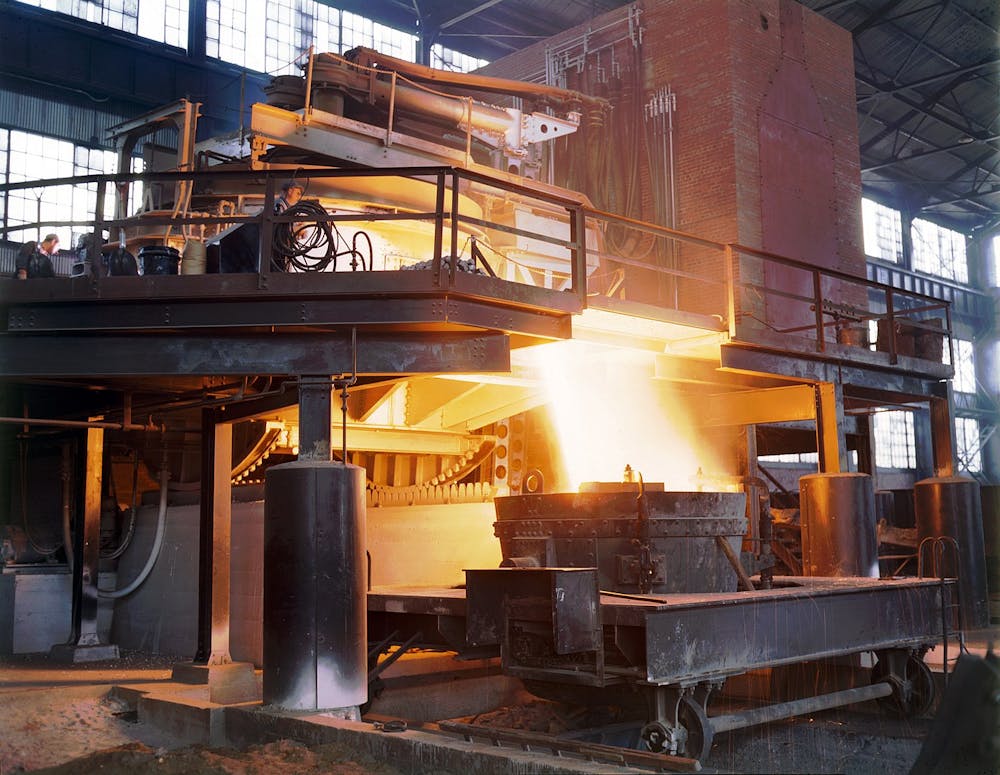
    White-hot steel pouring out of an electric arc furnace in Brackenridge, Penn.
    Alfred T. Palmer/U.S. Library of Congress

    Control over steel resources and infrastructure made steel a foundation of national power. China’s 21st-century rise to steel dominance is a continuation of this pattern. From 1995 to 2015, China’s contribution to the world steel production increased from about 10% to more than 50%. The White House responded in 2018 with massive tariffs on Chinese steel.

    Rare earth metals and global trade

    Early in the 21st century, the advance of digital technologies and the transition to an economy based on renewable energies created a demand for rare earth elements.

    Offshore turbines use several tons of rare earth magnets to transform wind into electricity.
    Hans Hillewaert/Wikimedia Commons, CC BY-SA

    Rare earth elements are 17 chemically very similar elements, including neodymium, dysprosium, samarium and others. They occur in nature in bundles and are the ingredients that make magnets super strong and useful. They are necessary for highly efficient electric motors, wind turbines and electronic devices.

    Because of their chemical similarity, separating and purifying rare earth elements involves complex and expensive processes.

    China controls the majority of global rare earth processing capacity. Political tensions between countries, especially around trade tariffs and strategic competition, can risk shortages or disruptions in the supply chain.

    The rare earth metals case illustrates how a single category of materials can shape trade policy, industrial planning and even diplomatic alliances.

    Mining rare earth elements has allowed for the widespread adoption of many modern technologies.
    Peggy Greb, USDA

    Technological transformation begins with societal pressure. New materials create opportunities for scientific and engineering breakthroughs. Once a material proves useful, it quickly becomes woven into the fabric of daily life and broader systems. With each innovation, the material world subtly reorganizes the social world — redefining what is possible, desirable and normal.

    Understanding how societies respond to new innovations in materials science can help today’s engineers and scientists solve crises in sustainability and security. Every technical decision is, in some ways, a cultural one, and every material has a story that extends far beyond its molecular structure.

    The National Science Foundation, the Department of Energy, NASA, and other national and regional agencies have funded former research of Peter Mullner.

    – ref. From glass and steel to rare earth metals, new materials have changed society throughout history – https://theconversation.com/from-glass-and-steel-to-rare-earth-metals-new-materials-have-changed-society-throughout-history-258244

    MIL OSI Analysis –

    July 5, 2025
  • MIL-OSI Economics: FortisBC announces upcoming call for power

    Source: – Press Release/Statement:

    Headline: FortisBC announces upcoming call for power

    CanREA applauds FortisBC for a new call for power that will expand market opportunities for the renewable energy industry in British Columbia.

    Vancouver, July 4, 2025—The Canadian Renewable Energy Association (CanREA) welcomes a new call for power in British Columbia, to be launched later this year, as announced by FortisBC on July 3.

    “This is the third call for power announced in BC in the past two years,” said Vittoria Bellissimo, CanREA’s President and CEO. “This growing momentum demonstrates BC’s commitment to developing renewable energy and energy storage to contribute to the province’s energy security, clean economy and reconciliation goals.”

    This is the next step after the Request for Expression of Interest (RFEOI) issued in 2024, which targeted up to 1,100 gigawatt hours (GWh) of energy supply.

    This call for power will be offered by invitation only to the successful RFEOI participants. Projects must have a minimum of 25% equity participation by First Nations and directly connect to the Fortis Electricity system in the Southern Interior. The focus will be on wind projects that can provide energy in the winter.

    “We are encouraged to see FortisBC prioritize the development of projects with significant Indigenous equity participation,” said Patricia Lightburn, CanREA’s BC Director. “New wind energy projects will quickly deliver economic development opportunities to First Nations and other local communities, while helping to meet BC’s growing demand for clean electricity.”

    BC recently passed legislation to streamline regulatory approvals that will help get these projects online sooner, without compromising on environmental protection and community engagement.

    Going forward, CanREA will engage with FortisBC to inform the call for power.

    Quotes

    “This is the third call for power announced in BC in the past two years. This growing momentum demonstrates BC’s commitment to developing renewable energy and energy storage to contribute to the province’s energy security, clean economy and reconciliation goals.”
    —Vittoria Bellissimo, President and CEO, Canadian Renewable Energy Association (CanREA)

    “We are encouraged to see FortisBC prioritize the development of projects with significant Indigenous equity participation. New wind energy projects will quickly deliver economic development opportunities to First Nations and other local communities, while helping to meet BC’s growing demand for clean electricity.”
    —Patricia Lightburn, BC Director, Canadian Renewable Energy Association (CanREA)

    For media inquiries or interview opportunities, please contact: 

    Communications Canadian Renewable Energy Association communications@renewablesassociation.ca 

    About CanREA 

    The Canadian Renewable Energy Association (CanREA) is the voice for wind energy, solar energy and energy storage solutions that will power Canada’s energy future. We work to create the conditions for a modern energy system through stakeholder advocacy and public engagement. Our diverse members are uniquely positioned to deliver clean, low-cost, reliable, flexible and scalable solutions for Canada’s energy needs. For more information on how Canada can use wind energy, solar energy and energy storage to help achieve its net-zero commitments, consult “Powering Canada’s Journey to Net-Zero: CanREA’s 2050 Vision.” Follow us on Bluesky and LinkedIn here. Learn more at renewablesassociation.ca. 
    The post FortisBC announces upcoming call for power appeared first on Canadian Renewable Energy Association.

    MIL OSI Economics –

    July 5, 2025
  • MIL-OSI United Kingdom: Minister Smith Keynote Speech at SKOPE Skills Summit, Oxford

    Source: United Kingdom – Executive Government & Departments

    Speech

    Minister Smith Keynote Speech at SKOPE Skills Summit, Oxford

    Speech delivered by Skills Minister Jacqui Smith at the University of Oxford on higher education reform, access and participation and working with the FE sector

    Introduction

    Good morning.

    Thank you for inviting me today.

    I am delighted to see the exciting work on skills education being led by SKOPE’s research on joined-up tertiary education systems.  It is being discussed across the sector.

    And I include government in that, as part of our commitment to evidence-based policymaking.

    It’s a pleasure to be back in Oxford, where I studied all those years ago.

    I was at Hertford, 5 minutes down the road, a college with a proud tradition of inclusion. I was a beneficiary of the Hertford Scheme to encourage state school pupils to apply.

    I hardly dared hope on a snowy December day in 1980 that I could be the first person from my Worcestershire comprehensive to study here.

    It was Hertford, with its pioneering approach to outreach, that gave me the confidence to apply.

    Starting in 1965, it dramatically raised the college’s academic standards and performance.

    In fact, at one point, the university threatened to disassociate Hertford for unfairly ‘poaching’ the best students!

    But many colleges set up similar schemes to emulate its success, before admissions were finally standardised in 1984.

    Why am I telling you this?

    Because it shows that breaking down barriers to opportunity is the key to success.

    For Oxford to succeed, it must welcome-in the best talent, from across the whole population.

    Challenging Oxford

    Oxford recently released their state school admissions data for 2024.

    And the results were poor.

    66.2% – the lowest entry rate since 2019.

    I want to be clear, speaking at an Oxford college today, that this is unacceptable.

    The university must do better.

    The independent sector educates around 6% of school children in the UK.

    But they make-up 33.8% of Oxford entrants.

    Do you really think you’re finding the cream of the crop, if a third of your students come from 6% of the population?

    It’s absurd.

    Arcane, even.

    And it can’t continue.

    It’s because I care about Oxford and I understand the difference that it can make to people’s lives that I’m challenging you to do better.  But it certainly isn’t only Oxford that has much further to go in ensuring access. 

    For example, it is shocking how few care leavers attend university, let alone this one!

    Just 14% enter higher education, and they are more than twice as likely to drop-out.

    University entry is supposed to be a meritocracy.

    But there’s still an awful lot of untapped talent out there.

    People with the potential to soar in higher education.

    Universities have got to go further.

    Play a stronger role in expanding access, and improve outcomes for disadvantaged students.

    And this must include more support for care leavers, some of the most vulnerable people in our society.

    I welcome Oxford’s recent commitment, along with other Russell Group universities, to do more for students who grew-up in care.

    And to increase your admissions transparency, and use of contextual admissions.

    I look forward to seeing some tangible outcomes from this pledge.

    I’m not looking for tinkering at the edges. A leg-up here, a bursary there.

    As a Labour government, we want Big Picture change.

    This is about individual opportunity, but it matters across government,

    from education, to health, to the economy. Just yesterday, Wes and Bridget have set out how we’re asking universities to do more to support our mission to break down the barriers to opportunity.  We’re looking at better transparency over university admissions, starting with publishing data on medical schools’ admission of those from lower socio-economic backgrounds.

    We must strive to ensure, from early years all the way through to higher education, that background never equals destiny.

    And that’s where our Post-16 Education and Skills Strategy comes in.

    The Post-16 Education and Skills Strategy

    We will publish the strategy soon.  

    It will include our vision for a world-leading skills system.

    One that takes a whole-system, mission-driven approach to breaking down barriers to opportunity to unleash growth.

    This means:

    • A more focused skills system, underpinned by Skills England’s national view of skills needs.

    • Clear, high-quality qualifications that ensure every learner has a clear route to further study or work.

    • Firm foundations, putting the system on a financially stable footing that supports strategic specialisation.

    And finally,

    • A new culture of ‘skills first’ where it is everyone’s responsibility – individuals, employers, and the state – to ensure workers reskill and upskill throughout their lives.

    This will boost personal and national prosperity, and reduce reliance on migration to fill skills gaps.

    What do we need to do to achieve this?

    First, there needs to be a renewed partnership between government and business.

    This means both local and central government working with business to identify skills gaps and develop solutions.

    We’ve heard the calls for more flexibility in the skills offer by introducing foundation and short apprenticeships.

    Now we’re going further with new short courses from April 2026, funded through the Growth and Skills Levy, in areas such as digital, artificial intelligence and engineering.

    These support priority sectors named in our Industrial Strategy, like the Creative Industries and Advanced Manufacturing.

    Because we recognise the importance of key sectors to delivering our Industrial Strategy and our Plan for Change.

    That’s why we’ve adopted a sector-based approach to address key skills needs.

    We started with our construction skills package, worth £625 million.

    To train up to 60,000 extra construction workers – crucial for delivering on our pledge to build 1.5 million new homes.

    We announced a further three further packages in the Industrial Strategy:

    • An Engineering package worth over £100 million, to support the pipeline of engineers into priority sectors like Advanced Manufacturing,

    • Clean Energy Industries, and Digital Technology.

    • A Defence package that is foundational for national security and economic growth,
      including establishing Defence Technical Excellence Colleges.

    • And a Digital package, including £187 million investment for digital and AI skills,
      and a commitment to train 7.5 million UK workers in essential AI skills
      by 2030, through a new industry partnership with major tech players.

    Raising the prestige of Further Education

    We understand that the economy needs both technical skills and academic disciplines in order to grow.

    It’s not a zero sum game – because both have so much to offer our people and our economy.

    And, dare I say it, much to learn from each other!

    Further education needs to emerge from the shadow of Higher Education as an equal partner.

    That means positive prominence in careers advice.

    And public recognition that’s long overdue.

    Technical education needs to be a respected alternative to academic pathways.

    And Technical Excellence Colleges will be at the heart of this.

    Only when there is parity, will we secure high-quality post-16 routes for all learners, rather than the lucky few.

    For learners from 16-19, we will be guided by the independent  Curriculum and Assessment Review, set to publish this autumn.

    High esteem follows high-quality teaching and student outcomes.

    We will provide funding to recruit and retain high-quality Further Education teachers, especially for courses delivering scarce skills to priority sectors.

    And this is backed by funding secured at the recent Spending Review.

    We are investing £1.2 billion a year more in skills by 2028-29, alongside over £2 billion of capital investment in skills to support the condition and capacity of the estate.

    Strengthening Higher Education’s role within the skills system I said earlier that Further Education needs to be an equal partner of Higher Education. Since we came into Government in July, we’ve ended the culture of talking down universities, and dismissing the opportunities higher education provides.

    We’re doing quite the opposite, working with you to:

    • drive up standards;
    • maintain our position as a world-class beacon of excellence;
    • build on a proud history of innovation and brilliance in higher education.

    But as the world changes, so must our higher education system.

    We cannot allow the town and gown divide to widen, and for universities and their communities to drift.

    We need collaboration, partnership, and mutual respect.

    Higher Education needs to reach out and play a bigger role in the skills system.

    Because ‘high-quality post-16 routes for all learners’ doesn’t necessarily mean they must choose between HE and FE.

    Our analysis shows the majority of the future skills we’ll need will be at higher levels.

    This means technical students will need access to cutting-edge facilities and courses, as they build their qualifications.

    So the artificial barriers between Further and Higher Education must come down – in a coordinated, effective way.

    And this will be facilitated by the Lifelong Learning Entitlement.

    The Lifelong Learning Entitlement

    The ability to learn across our working lives is no longer just admirable, or valuable. It’s essential.

    People aren’t just working for longer.

    They are changing roles and careers more frequently.

    And the skills needed for those roles are also evolving rapidly.

    Yet despite all this change, the student finance system still largely operates on the assumption that learning only happens early in life.

    To break down the barriers to opportunity, we must support learning at every stage of life.

    This is exactly what the Lifelong Learning Entitlement – or LLE – will do, offering choice, flexibility and opportunity to adults across their working lives.

    From January 2027, the LLE will replace the student finance system.

    It will continue to fund students entering higher education to take traditional degrees.

    But it will also fund new, flexible modular pathways, widening student finance to a broader range of courses and learners.

    That includes those returning to education later in life, who may be working whilst studying. Providing flexibility around personal commitments like caring responsibilities.

    What does means in practice?

    I want you to imagine Sarah, a full-time receptionist and mother who decides she wants a career change. However, Sarah is concerned about committing to studying full-time, as her family is still growing, and she is struggling to take out time to pursue retraining in computer science.

    Through the LLE and the funding of individual modules, Sarah will be able to study one module at a time, to build up her credits over time, alongside her work and family commitments.

    The LLE will not just change the type of provision on offer.

    It also has the potential to transform how employers work with providers to train and recruit staff, allowing modular top-up to build or update their skills.

    We’re already seeing this play out through our modular acceleration programme.

    We want education providers to innovate in how they respond to the new model, so that lifelong upskilling becomes accessible and unremarkable.

    At the same time, employers must be active partners in LLE provision, co-designing flexible courses that create accessible pathways into the workforce.

    We will shortly set-out the final policy design of the LLE, so FE and HE providers can plan for this transformational change.

    Improving local join-up

    The final thing we must do to widen opportunity and build growth is better local join-up. This means strategic collaboration between local education providers, employers, research hubs and health services.

    We set the scene at the end of last year with our ‘Get Britain Working’ and ‘English Devolution’ White Papers.

    These described how mayors and Local Growth Plans will play a key role in shaping their regional skills systems. Local Get Britain Working plans will drive joined-up action to reduce economic inactivity, and take forward our Youth Guarantee.

    This is key for ensuring young people in difficult circumstances are supported to achieve good qualifications and good employment.

    The skills system is at its most effective when detailed local understanding is matched with insight from local employers and training providers.

    Many young adults face complex barriers to engaging with skills courses; an estimated 1 in 8 young people are NEET – not in education, employment or training.

    Improving the accessibility of training will be crucial to reducing the number of NEETs,.

    But to bring them into the fold, you have to understand local barriers as well as national, systemic issues.

    Further Education colleges often do this well by working with many local partners. They are big participants in Local Skills Improvement Plans (or LSIPs).

    These collaborations identify and respond to gaps in skills provision, giving employers a more strategic role in the system.

    I believe in LSIPs because they facilitate partnership  

    Early evidence shows Plans are already having an impact, raising the number of learners training in priority sectors – with more employers telling us that local skills provision meets their needs.

    But we must go further to join-up local systems to drive opportunity and growth.

    Which bring me back to universities.

    Discussions on LSIPs should involve all local providers, and all levels of education – including up to Doctorate level! 

    If your university offers a course that relates to your local skills offer, or local employers, you have something to contribute to these discussions.

    And to the outcomes of local students studying beyond your campus, in neighbouring colleges.

    And let’s not forget the role of research and innovation.

    Universities are renowned for delivering solutions to global challenges.

    But this also happens at a local level, as seen with the Oxford Local Policy Lab.

    HE also brings new ideas to market, through start-ups and partnerships with industry.

    Whichever way you look at it, Higher Education has a huge role in driving local growth and opportunity.

    You need to be part of this conversation.

    Universities involved in local growth

    And this is not just some government aspiration!

    There are plenty of examples of institutions stepping-up to play their part.

    The London South Bank University group acts as an anchor institution within the local education community. It brings together FE colleges, sixth form colleges and employers – particularly the NHS – to ensure a truly collaborative approach to education, training and skills provision.

    You’ll hear later from Professor Kathryn Mitchell, Vice Chancellor of Derby University.

    They work closely with FE colleges and local employers, particularly Rolls Royce to ensure clear links between education and the labour market.

    And in the North East, organisations like Sunderland Software City are leading the tech industry to match local education and training provision with regional requirements.

    It’s great to see – and shows just what university participation in inclusive growth can do for the local economy and community.

    Conclusion

    I know I’m not alone here in admiring this, and wanting change.

    Many people in this room who are working to make Further and Higher Education better – to better serve our people and our nation.

    I’d like to thank you for your innovation and dedication to this – which can sometimes be uphill work!

    I’m grateful to SKOPE, who’ve worked with my officials to share their expertise in developing our Post-16 Education and Skills Strategy.

    And to the Nuffield Foundation for helping to fund SKOPE’s research.

    The strategy is just the beginning, by the way!

    The different parts of the system will need to work together to meet its vision.

    To bring about a fairer society, where everyone has the chance to gain good qualifications, get a good job, support their family, and contribute to their community and our economy.

    Let’s make it happen!

    Thank you.

    Updates to this page

    Published 5 July 2025

    MIL OSI United Kingdom –

    July 5, 2025
  • MIL-OSI Analysis: Military force may have delayed Iran’s nuclear ambitions – but history shows that diplomacy is the more effective nonproliferation strategy

    Source: The Conversation – Global Perspectives – By Stephen Collins, Professor of Government and International Affairs, Kennesaw State University

    View of the United Nations logo at a 2022 conference of the Parties to the Treaty on the Non-Proliferation of Nuclear Weapons. Angela Weiss/AFP via Getty Images)

    While the U.S. military’s strikes on Iran on June 21, 2025, are believed to have damaged the country’s critical nuclear infrastructure, no evidence has yet emerged showing the program to have been completely destroyed. In fact, an early U.S. Defense Intelligence Agency assessment surmised that the attack merely delayed Iran’s possible path to a nuclear weapon by less than six months. Further, Rafael Mariano Grossi, director of the United Nations’ International Atomic Energy Agency, stated that Iran may have moved its supply of enriched uranium ahead of the strikes, and assessed that Tehran could resume uranium enrichment “in a matter of months.”

    Others have warned that the strikes may intensify the Islamic Republic’s nuclear drive, convincing the government of the need to acquire a bomb in order to safeguard its survival.

    As a scholar of nuclear nonproliferation, my research indicates that military strikes, such as the U.S. one against Iran, tend not to work. Diplomacy — involving broad and resolute international efforts — offers a more strategically effective way to preempt a country from obtaining a nuclear arsenal.

    The diplomatic alternative to nonproliferation

    The strategy of a country using airstrikes to attempt to eliminate a rival nation’s nuclear program has precedent, including Israel’s 1981 airstrike on Iraq’s Osirak nuclear reactor and its 2007 air assault on Syria’s Kibar nuclear complex.

    Yet neither military operation reliably or completely terminated the targeted program. Many experts of nuclear strategy believe that while the Israeli strike destroyed the Osirak complex, it likely accelerated Iraq’s fledgling nuclear program, increasing Saddam Hussein’s commitment to pursue a nuclear weapon.

    The Osirak nuclear power research station in 1981.
    Jacques Pavlovsky/Sygma via Getty Images

    In a similar vein, while Israeli airstrikes destroyed Syria’s nascent nuclear facility, evidence soon emerged that the country, under its former leader, Bashar Assad, may have continued its nuclear activities elsewhere.

    Based on my appraisal of similar cases, the record shows that diplomacy has been a more consistently reliable strategy than military force for getting a targeted country to denuclearize.

    The tactics involved in nuclear diplomacy include bilateral and multilateral engagement efforts and economic tools ranging from comprehensive sanctions to transformative aid and trade incentives. Travel and cultural sanctions – including bans on participating in international sporting and other events – can also contribute to the effectiveness of denuclearization diplomacy.

    The high point of denuclearization diplomacy came in 1970, when the majority of the world signed the Treaty on the Non-Proliferation of Nuclear Weapons. The treaty obliged nonnuclear weapons states to refrain from pursuing them, and existing nuclear powers to share civilian nuclear power technology and work toward eventual nuclear weapons disarmament.

    I’ve found that in a majority of cases since then – notably in Argentina, Brazil, Libya, South Africa, South Korea and Taiwan – diplomacy played a pivotal role in convincing nuclear-seeking nations to entirely and permanently relinquish their pursuit of nuclear weapons.

    Case studies of nuclear diplomacy

    In the cases of U.S. allies Argentina, Brazil, South Korea and Taiwan, the military option was off the table for Washington, which instead successfully used diplomatic pressure to compel these countries to discontinue their nuclear programs. This involved the imposition of significant economic and technological sanctions on Argentina and Brazil in the late-1970s, which substantially contributed to the denuclearization of South America. In the South Korea and Taiwan cases, the threat of economic sanctions was effectively coupled with the risk of losing U.S. military aid and security guarantees.

    South Africa represents one of the most compelling cases in support of diplomatic measures to reverse a country’s nuclear path. In the latter years of the Cold War, the country had advanced beyond threshold nuclear potential to assemble a sizable arsenal of nuclear weapons. But in 1991, the country decided to relinquish that arsenal, due in large part to the high economic, technological and cultural costs of sanctions and the belief that its nuclear program would prevent its reintegration into the international community following years of apartheid.

    Completing the denuclearization of Africa, diplomatic pressure applied by the U.S. was the primary factor in Libya’s decision to shutter its nuclear program in 2003, as ending U.S. sanctions and normalizing relations with Washington became a high priority for the government of Moammar Gadhafi.

    In the case of Iraq, the Hussein regime eventually did denuclearize in the 1990s, but not through a deal negotiated directly with the U.S. or the international community. Rather, Hussein’s decision was motivated by the damaging economic and technological costs of the U.N. sanctions and his desire to see them lifted after the first Gulf War.

    In the 11 countries in which diplomacy was used to reverse nuclear proliferation, only in the cases of India and Pakistan did it fail to induce any nuclear reversal.

    In the case of North Korea, while Pyongyang did for a time join the Treaty on the Non-Proliferation of Nuclear Weapons, it later left the accord and subsequently built an arsenal now estimated at several dozen nuclear weapons. The decades-long efforts at diplomacy with the country cannot, therefore, be coded a success. Still, these efforts did result in notable moves in 1994 and 2007 by North Korea to curtail its nuclear facilities.

    Meanwhile, analysts debate whether diplomacy would have been more successful at containing North Korea’s nuclear program if the George W. Bush administration had not shifted toward a more confrontational policy, including naming North Korea as a member of the “axis of evil” and delaying aid promised in the 1994 U.S.-North Korean Agreed Framework.

    The Iran deal and beyond

    Consistent with the historical track record for diplomacy concerning other nuclear powers, Iran offers compelling evidence of what diplomacy can achieve in lieu of military force.

    Diplomatic negotiations between the U.S, Iran and five leading powers yielded the landmark Joint Comprehensive Plan of Action in 2015. The so-called Iran deal involved multilateral diplomacy and a set of economic sanctions and incentives, and persuaded Iran to place stringent limits on its nuclear program for at least 10 years and ship tons of enriched uranium out of the country. A report from the International Atomic Energy Agency in 2016 confirmed that Iran had abided by the terms of the agreement. Consequently, the U.S., European Union and U.N. responded by lifting sanctions.

    Representatives of the nations involved in signing the 2015 Iran nuclear deal pose for a group photo following talks in July 2015.
    AP Photo/Ronald Zak

    It was only after President Donald Trump ordered the U.S. withdrawal from the agreement in 2018, and reimposed sanctions on Iran, that Tehran resumed its alarming enrichment activities.

    Trump signaled quickly after the recent attack on Iran a willingness to engage in direct talks with Tehran. However, Iran may rebuff any agreement that effectively contains its nuclear program, opting instead for the intensified underground approach Iraq took after the 1981 Osirak attack.

    Indeed, my research shows that combining military threats with diplomacy reduces the prospects of successfully reaching a disarmament agreement. Nations will be more reluctant to disarm when their negotiating counterpart adopts a threatening and combative posture, as it heightens their fear that disarmament will make it more vulnerable to future aggression from the opposing country.

    A return to an Iran nuclear deal?

    Successful denuclearization diplomacy with Iran will not be a panacea for Middle East stability; the U.S. will continue to harbor concerns about Iran’s military-related actions and relationships in the region.

    It is, after all, unlikely that any U.S. administration could strike a deal with Tehran on nuclear policy that would simultaneously settle all outstanding issues and resolve decades of mutual acrimony.

    But by signing and abiding to the terms of the JCPOA, Iran has demonstrated a willingness to cooperate on the nuclear issue in the past. Under the agreement, Iran accepted a highly limited and low-proliferation-risk nuclear program subject to intrusive inspections by the international community.

    That arrangement was beneficial for regional stability and for buttressing the global norm against nuclear proliferation. A return to a JCPOA-type agreement would reinforce a diplomatic approach to relations with Iran and create an opening for progress with the country on other areas of concern.

    Stephen Collins does not work for, consult, own shares in or receive funding from any company or organization that would benefit from this article, and has disclosed no relevant affiliations beyond their academic appointment.

    – ref. Military force may have delayed Iran’s nuclear ambitions – but history shows that diplomacy is the more effective nonproliferation strategy – https://theconversation.com/military-force-may-have-delayed-irans-nuclear-ambitions-but-history-shows-that-diplomacy-is-the-more-effective-nonproliferation-strategy-259769

    MIL OSI Analysis –

    July 5, 2025
  • MIL-OSI Analysis: Agatha Christie’s mid-century ‘manosphere’ reveals a different kind of dysfunctional male

    Source: The Conversation – UK – By Gill Plain, Professor of English Literature and Popular Culture, University of St Andrews

    This piece contains spoilers for Towards Zero.

    Agatha Christie, a middle-class English crime writer who preferred to be known as a housewife, is the world’s bestselling novelist. Since her death in 1976, her work has been translated into over 100 languages and adapted for cinema, TV and even video games.

    Her writing is characterised by its cheerful readability and ruthless dissection of hypocrisy, greed and respectability. Christie is fascinated by power and its abuse, and explores this through the skilful deployment of recognisable character types. The suspects in her books are not just there for the puzzle – they also exemplify the attitudes, ideals and assumptions that shaped 20th-century British society.

    If we want to know about the mid-century “manosphere”, then, there is no better place to look than in the fiction of Agatha Christie. What did masculinity mean to this writer, and would we recognise it in the gender types and ideals of today? Some answers might be found through the recent BBC adaptation of Towards Zero, which confronts viewers with a range of dysfunctional male types.


    Looking for something good? Cut through the noise with a carefully curated selection of the latest releases, live events and exhibitions, straight to your inbox every fortnight, on Fridays. Sign up here.


    Chief among these is Thomas Royde, a neurotic twitching figure driven to breakdown by the shame of having his word doubted. Gaslit by his pathologically perfect cousin Nevile, Thomas has been dispatched to the colonies, where he has compounded his injuries through financial failure. Broke and broken, the adaptation imagines him returning to the family home with trauma quite literally written on his body.

    This is not the Thomas Royde of Christie’s original 1944 novel. That figure was stoic, silent and perfectly capable of managing his failure to live up to the spectacular masculinity of cousin Nevile. Christie’s Thomas may have regretted his romantic losses and physical limitations, but the idea of exposing his pain in public would have horrified him.

    This is not a case of repression; rather it speaks to a world in which pain is respected, but simply not discussed. Thomas’s friends, we are told, “had learned to gauge his reactions correctly from the quality of his silences”. The stoical man of few words is a recurrent type within Christie’s fiction. It’s a mode of masculinity of which she approves – even while poking fun at it – and one recognised by her mid-20th century audience.

    These are men who embody ideal British middle-class values: steady, reliable, resilient, modest, good humoured and infinitely sensible. They find their fictional reward in happy unions, sometimes with sensible women, sometimes with bright young things who benefit from their calm assurance.

    Christie also depicted more dangerous male types – attractive adventurers who might be courageous, or reckless and deadly. These charismatic figures present a troubling mode of masculinity in her fiction, from the effortlessly charming Ralph in The Murder of Roger Ackroyd (1926), to Michael Rogers, the all too persuasive narrator of Endless Night (1967).

    Superficially, these two types of men might be mapped onto Christie’s own experiences. Her autobiography suggests that she was irresistibly drawn to something strange and inscrutable in her first husband, Archie. By contrast, her second husband, the archaeologist Max Mallowan, brought friendship and shared interests.

    Yet while it’s possible to see biographical resonances in these types, it is equally important to recognise them as part of a middle-class world view that set limits on acceptable masculinities. In my book, Agatha Christie: A Very Short Introduction, I explore these limits, examining a cultural climate riven with contradictions.

    A different time

    Mid-20th century culture insisted that men be articulate when discussing public matters – science, politics, sport – but those who extended this to the emotions were not to be trusted. They were seen to be glib, foolish or possibly dangerous.

    British masculinity acts rather than talks and does a decent job of work. As a result, work itself is a vital dimension of man-making in Christie’s novels, and in the fiction of contemporaries like Nigel Balchin, Hammond Innes and Nevil Shute.

    These writers witnessed the conflicting pressures on men, expected to be both soldiers and citizens, capable of combat and domestic breadwinning. They saw the damage caused by war, unemployment and the loss of father figures. But the answer wasn’t talking. Rather, the best medicine for wounded masculinity was the self-respect that comes with doing a good day’s work.

    This ideology still resonates within understandings of “healthy” masculinity, but there are limits to the problems that can be solved through a companionable post-work pint. Which brings us back to the BBC’s Towards Zero. Contemporary adaptations often speak to the preoccupations of their moment, and the plot is driven by one man’s all-consuming hatred of his ex-wife.

    With apologies for plot spoilers, perfect Nevile turns out to be a perfect misogynist, scheming against the woman who has – to his mind – humiliated him. But the world of his hatred is a long way from the online “manosphere” of our contemporary age.

    Quite aside from the technological gulf separating the eras, Christie does not imagine misogyny as an abusive mass phenomenon, a set of echo chambers which figure men as the victims of feminism. Rather, Nevile, like all Christie’s murderers, kills for reasons that can clearly be defined, detected and articulated: he is an isolated madman, not a cultural phenomenon.

    Towards Zero’s topicality – its preoccupation with celebrity, resentment of women and a manipulative gaslighting villain – does much to explain its adaptation, but it does not account for the radical revision of Thomas Royde. Is it an indication that stoicism is out of fashion? Or simply a desire to convert Christie’s cool-tempered fictions into melodramas appropriate for a social-media age?

    Whatever the thinking, there is a familiar consolation for Thomas’s pain. He might not get the girl of his dreams, but he does get something better: a steady, reliable woman whose modest virtues illustrate that, in Christie’s world, “ideal masculinity” is unexpectedly non-binary. Women can be just as stoic, reserved and resilient as men.

    Christie’s “manosphere”, then, has its share of haters, but they are isolated figures forced to disguise their resentments. They also, frequently, meet untimely ends – another reason why Christie remains a bestseller to this day.


    This article features references to books that have been included for editorial reasons, and may contain links to bookshop.org. If you buy something, The Conversation UK may earn a commission.

    Gill Plain does not work for, consult, own shares in or receive funding from any company or organisation that would benefit from this article, and has disclosed no relevant affiliations beyond their academic appointment.

    – ref. Agatha Christie’s mid-century ‘manosphere’ reveals a different kind of dysfunctional male – https://theconversation.com/agatha-christies-mid-century-manosphere-reveals-a-different-kind-of-dysfunctional-male-254726

    MIL OSI Analysis –

    July 5, 2025
  • MIL-OSI NGOs: Update 300 – IAEA Director General Statement on Situation in Ukraine

    Source: International Atomic Energy Agency (IAEA) –

    Ukraine’s Zaporizhzhya Nuclear Power Plant (ZNPP) lost all off-site power for several hours today, once again underlining the extremely fragile nuclear safety situation at the site, IAEA Director General Rafael Mariano Grossi said today.

    The plant’s connection to its last remaining 750 kilovolt (kV) power line was cut at 17:37 local time today and restored around 21:11, forcing it to rely on emergency diesel generators for more than three and a half hours. While the cause was not immediately known, it coincided with air raid alarms in the region, Director General Grossi said, citing information from the Ukrainian nuclear regulator.

    It was the ninth time the ZNPP suffered a complete loss of off-site power since the conflict began in February 2022, and the first since 2 December 2023.

    The IAEA team based at the site, Europe’s largest nuclear power plant (NPP), reported that 18 emergency diesel generators immediately started operating to generate the electricity the plant needs to be able to cool the reactors and the spent fuel pools. The plant has diesel fuel for at least 10 days on-site, and arrangements in place to secure further supplies. Once off-site power was restored, the diesel generators were switched off.

    “What was once virtually unimaginable – that a major nuclear power plant would repeatedly lose all of its external power connections – has unfortunately become a common occurrence at the Zaporizhzhya Nuclear Power Plant. Almost three and a half years into this devastating war, nuclear safety in Ukraine remains very much in danger,” Director General Grossi said.

    “Our team on the ground will continue to follow the situation very closely and report on further developments there,” he said.

    The ZNPP’s six reactors have been in cold shutdown since 2024 but still require cooling water for their reactor cores and spent fuel pools. The ZNPP lost the connection to its last remaining 330 kV back-up power line on 7 May, leaving the plant dependent on its sole 750 kV line. Before the conflict, it had ten off-site power lines available, highlighting the extent to which nuclear safety has deteriorated since February 2022.

    MIL OSI NGO –

    July 5, 2025
  • MIL-OSI United Nations: Update 300 – IAEA Director General Statement on Situation in Ukraine

    Source: International Atomic Energy Agency (IAEA)

    Ukraine’s Zaporizhzhya Nuclear Power Plant (ZNPP) lost all off-site power for several hours today, once again underlining the extremely fragile nuclear safety situation at the site, IAEA Director General Rafael Mariano Grossi said today.

    The plant’s connection to its last remaining 750 kilovolt (kV) power line was cut at 17:37 local time today and restored around 21:11, forcing it to rely on emergency diesel generators for more than three and a half hours. While the cause was not immediately known, it coincided with air raid alarms in the region, Director General Grossi said, citing information from the Ukrainian nuclear regulator.

    It was the ninth time the ZNPP suffered a complete loss of off-site power since the conflict began in February 2022, and the first since 2 December 2023.

    The IAEA team based at the site, Europe’s largest nuclear power plant (NPP), reported that 18 emergency diesel generators immediately started operating to generate the electricity the plant needs to be able to cool the reactors and the spent fuel pools. The plant has diesel fuel for at least 10 days on-site, and arrangements in place to secure further supplies. Once off-site power was restored, the diesel generators were switched off.

    “What was once virtually unimaginable – that a major nuclear power plant would repeatedly lose all of its external power connections – has unfortunately become a common occurrence at the Zaporizhzhya Nuclear Power Plant. Almost three and a half years into this devastating war, nuclear safety in Ukraine remains very much in danger,” Director General Grossi said.

    “Our team on the ground will continue to follow the situation very closely and report on further developments there,” he said.

    The ZNPP’s six reactors have been in cold shutdown since 2024 but still require cooling water for their reactor cores and spent fuel pools. The ZNPP lost the connection to its last remaining 330 kV back-up power line on 7 May, leaving the plant dependent on its sole 750 kV line. Before the conflict, it had ten off-site power lines available, highlighting the extent to which nuclear safety has deteriorated since February 2022.

    MIL OSI United Nations News –

    July 5, 2025
  • MIL-OSI USA: One Big Beautiful Bill Act Signed Into Law by President Trump

    Source: United States House of Representatives – Congressman Rick Allen (R-GA-12)

    Today, President Donald J. Trump signed H.R. 1, the One Big Beautiful Bill Act, into law. Following the signing ceremony held at the White House, Congressman Rick W. Allen (GA-12) issued the statement below:

    “Last November, the American people overwhelmingly elected President Donald Trump and gave Republicans control of the House and Senate. They did so—not for more of the same tired D.C. rhetoric—but for bold change and a renewed sense of confidence in what makes our nation great. H.R. 1 is more than a fulfilled promise—it is a return to policies that put American households, workers, job creators, businesses, veterans, and farmers first.

    “With President Trump’s signature on the One Big Beautiful Bill Act, families will keep more of their hard-earned money, our borders will remain secure, the U.S. economy will thrive, workers will see higher wages, businesses will grow, and programs intended for our most vulnerable communities will be sustained and strengthened for future generations. Despite the misinformation and fearmongering tactics employed by House and Senate Democrats throughout this process, I am proud that House Republicans and the administration stood firm and got the job done.

    “As this legislation begins to take effect over the coming months and years, I look forward to the positive impact it will have on the 12th District, the state of Georgia, and the United States of America.”

    BACKGROUND: The One Big Beautiful Bill Act, otherwise known as the reconciliation bill, is a combination of individual bills advanced by 11 House committees as instructed by the Republican Budget Framework. Congressman Allen sits on two of the 11 committees, the House Energy and Commerce Committee and the House Education and Workforce Committee, in which he played an integral role in crafting and advancing the language under each committee’s jurisdiction. On May 22, Congressman Allen supported the House version of the bill. On July 3, Congressman Allen supported the Senate-amended version of the bill, clearing the way for President Trump’s signature.

    MIL OSI USA News –

    July 5, 2025
  • MIL-OSI USA: One Big Beautiful Bill Act Signed Into Law by President Trump

    Source: United States House of Representatives – Congressman Rick Allen (R-GA-12)

    Today, President Donald J. Trump signed H.R. 1, the One Big Beautiful Bill Act, into law. Following the signing ceremony held at the White House, Congressman Rick W. Allen (GA-12) issued the statement below:

    “Last November, the American people overwhelmingly elected President Donald Trump and gave Republicans control of the House and Senate. They did so—not for more of the same tired D.C. rhetoric—but for bold change and a renewed sense of confidence in what makes our nation great. H.R. 1 is more than a fulfilled promise—it is a return to policies that put American households, workers, job creators, businesses, veterans, and farmers first.

    “With President Trump’s signature on the One Big Beautiful Bill Act, families will keep more of their hard-earned money, our borders will remain secure, the U.S. economy will thrive, workers will see higher wages, businesses will grow, and programs intended for our most vulnerable communities will be sustained and strengthened for future generations. Despite the misinformation and fearmongering tactics employed by House and Senate Democrats throughout this process, I am proud that House Republicans and the administration stood firm and got the job done.

    “As this legislation begins to take effect over the coming months and years, I look forward to the positive impact it will have on the 12th District, the state of Georgia, and the United States of America.”

    BACKGROUND: The One Big Beautiful Bill Act, otherwise known as the reconciliation bill, is a combination of individual bills advanced by 11 House committees as instructed by the Republican Budget Framework. Congressman Allen sits on two of the 11 committees, the House Energy and Commerce Committee and the House Education and Workforce Committee, in which he played an integral role in crafting and advancing the language under each committee’s jurisdiction. On May 22, Congressman Allen supported the House version of the bill. On July 3, Congressman Allen supported the Senate-amended version of the bill, clearing the way for President Trump’s signature.

    MIL OSI USA News –

    July 5, 2025
  • MIL-OSI USA: One Big Beautiful Bill Act Signed Into Law by President Trump

    Source: United States House of Representatives – Congressman Rick Allen (R-GA-12)

    Today, President Donald J. Trump signed H.R. 1, the One Big Beautiful Bill Act, into law. Following the signing ceremony held at the White House, Congressman Rick W. Allen (GA-12) issued the statement below:

    “Last November, the American people overwhelmingly elected President Donald Trump and gave Republicans control of the House and Senate. They did so—not for more of the same tired D.C. rhetoric—but for bold change and a renewed sense of confidence in what makes our nation great. H.R. 1 is more than a fulfilled promise—it is a return to policies that put American households, workers, job creators, businesses, veterans, and farmers first.

    “With President Trump’s signature on the One Big Beautiful Bill Act, families will keep more of their hard-earned money, our borders will remain secure, the U.S. economy will thrive, workers will see higher wages, businesses will grow, and programs intended for our most vulnerable communities will be sustained and strengthened for future generations. Despite the misinformation and fearmongering tactics employed by House and Senate Democrats throughout this process, I am proud that House Republicans and the administration stood firm and got the job done.

    “As this legislation begins to take effect over the coming months and years, I look forward to the positive impact it will have on the 12th District, the state of Georgia, and the United States of America.”

    BACKGROUND: The One Big Beautiful Bill Act, otherwise known as the reconciliation bill, is a combination of individual bills advanced by 11 House committees as instructed by the Republican Budget Framework. Congressman Allen sits on two of the 11 committees, the House Energy and Commerce Committee and the House Education and Workforce Committee, in which he played an integral role in crafting and advancing the language under each committee’s jurisdiction. On May 22, Congressman Allen supported the House version of the bill. On July 3, Congressman Allen supported the Senate-amended version of the bill, clearing the way for President Trump’s signature.

    MIL OSI USA News –

    July 5, 2025
  • MIL-OSI Security: Update 300 – IAEA Director General Statement on Situation in Ukraine

    Source: International Atomic Energy Agency – IAEA

    Ukraine’s Zaporizhzhya Nuclear Power Plant (ZNPP) lost all off-site power for several hours today, once again underlining the extremely fragile nuclear safety situation at the site, IAEA Director General Rafael Mariano Grossi said today.

    The plant’s connection to its last remaining 750 kilovolt (kV) power line was cut at 17:37 local time today and restored around 21:11, forcing it to rely on emergency diesel generators for more than three and a half hours. While the cause was not immediately known, it coincided with air raid alarms in the region, Director General Grossi said, citing information from the Ukrainian nuclear regulator.

    It was the ninth time the ZNPP suffered a complete loss of off-site power since the conflict began in February 2022, and the first since 2 December 2023.

    The IAEA team based at the site, Europe’s largest nuclear power plant (NPP), reported that 18 emergency diesel generators immediately started operating to generate the electricity the plant needs to be able to cool the reactors and the spent fuel pools. The plant has diesel fuel for at least 10 days on-site, and arrangements in place to secure further supplies. Once off-site power was restored, the diesel generators were switched off.

    “What was once virtually unimaginable – that a major nuclear power plant would repeatedly lose all of its external power connections – has unfortunately become a common occurrence at the Zaporizhzhya Nuclear Power Plant. Almost three and a half years into this devastating war, nuclear safety in Ukraine remains very much in danger,” Director General Grossi said.

    “Our team on the ground will continue to follow the situation very closely and report on further developments there,” he said.

    The ZNPP’s six reactors have been in cold shutdown since 2024 but still require cooling water for their reactor cores and spent fuel pools. The ZNPP lost the connection to its last remaining 330 kV back-up power line on 7 May, leaving the plant dependent on its sole 750 kV line. Before the conflict, it had ten off-site power lines available, highlighting the extent to which nuclear safety has deteriorated since February 2022.

    MIL Security OSI –

    July 5, 2025
  • MIL-OSI Security: Update 300 – IAEA Director General Statement on Situation in Ukraine

    Source: International Atomic Energy Agency – IAEA

    Ukraine’s Zaporizhzhya Nuclear Power Plant (ZNPP) lost all off-site power for several hours today, once again underlining the extremely fragile nuclear safety situation at the site, IAEA Director General Rafael Mariano Grossi said today.

    The plant’s connection to its last remaining 750 kilovolt (kV) power line was cut at 17:37 local time today and restored around 21:11, forcing it to rely on emergency diesel generators for more than three and a half hours. While the cause was not immediately known, it coincided with air raid alarms in the region, Director General Grossi said, citing information from the Ukrainian nuclear regulator.

    It was the ninth time the ZNPP suffered a complete loss of off-site power since the conflict began in February 2022, and the first since 2 December 2023.

    The IAEA team based at the site, Europe’s largest nuclear power plant (NPP), reported that 18 emergency diesel generators immediately started operating to generate the electricity the plant needs to be able to cool the reactors and the spent fuel pools. The plant has diesel fuel for at least 10 days on-site, and arrangements in place to secure further supplies. Once off-site power was restored, the diesel generators were switched off.

    “What was once virtually unimaginable – that a major nuclear power plant would repeatedly lose all of its external power connections – has unfortunately become a common occurrence at the Zaporizhzhya Nuclear Power Plant. Almost three and a half years into this devastating war, nuclear safety in Ukraine remains very much in danger,” Director General Grossi said.

    “Our team on the ground will continue to follow the situation very closely and report on further developments there,” he said.

    The ZNPP’s six reactors have been in cold shutdown since 2024 but still require cooling water for their reactor cores and spent fuel pools. The ZNPP lost the connection to its last remaining 330 kV back-up power line on 7 May, leaving the plant dependent on its sole 750 kV line. Before the conflict, it had ten off-site power lines available, highlighting the extent to which nuclear safety has deteriorated since February 2022.

    MIL Security OSI –

    July 5, 2025
  • MIL-OSI Security: Update 300 – IAEA Director General Statement on Situation in Ukraine

    Source: International Atomic Energy Agency – IAEA

    Ukraine’s Zaporizhzhya Nuclear Power Plant (ZNPP) lost all off-site power for several hours today, once again underlining the extremely fragile nuclear safety situation at the site, IAEA Director General Rafael Mariano Grossi said today.

    The plant’s connection to its last remaining 750 kilovolt (kV) power line was cut at 17:37 local time today and restored around 21:11, forcing it to rely on emergency diesel generators for more than three and a half hours. While the cause was not immediately known, it coincided with air raid alarms in the region, Director General Grossi said, citing information from the Ukrainian nuclear regulator.

    It was the ninth time the ZNPP suffered a complete loss of off-site power since the conflict began in February 2022, and the first since 2 December 2023.

    The IAEA team based at the site, Europe’s largest nuclear power plant (NPP), reported that 18 emergency diesel generators immediately started operating to generate the electricity the plant needs to be able to cool the reactors and the spent fuel pools. The plant has diesel fuel for at least 10 days on-site, and arrangements in place to secure further supplies. Once off-site power was restored, the diesel generators were switched off.

    “What was once virtually unimaginable – that a major nuclear power plant would repeatedly lose all of its external power connections – has unfortunately become a common occurrence at the Zaporizhzhya Nuclear Power Plant. Almost three and a half years into this devastating war, nuclear safety in Ukraine remains very much in danger,” Director General Grossi said.

    “Our team on the ground will continue to follow the situation very closely and report on further developments there,” he said.

    The ZNPP’s six reactors have been in cold shutdown since 2024 but still require cooling water for their reactor cores and spent fuel pools. The ZNPP lost the connection to its last remaining 330 kV back-up power line on 7 May, leaving the plant dependent on its sole 750 kV line. Before the conflict, it had ten off-site power lines available, highlighting the extent to which nuclear safety has deteriorated since February 2022.

    MIL Security OSI –

    July 5, 2025
  • MIL-OSI Submissions: Military force may have delayed Iran’s nuclear ambitions – but history shows that diplomacy is the more effective nonproliferation strategy

    Source: The Conversation – Global Perspectives – By Stephen Collins, Professor of Government and International Affairs, Kennesaw State University

    View of the United Nations logo at a 2022 conference of the Parties to the Treaty on the Non-Proliferation of Nuclear Weapons. Angela Weiss/AFP via Getty Images)

    While the U.S. military’s strikes on Iran on June 21, 2025, are believed to have damaged the country’s critical nuclear infrastructure, no evidence has yet emerged showing the program to have been completely destroyed. In fact, an early U.S. Defense Intelligence Agency assessment surmised that the attack merely delayed Iran’s possible path to a nuclear weapon by less than six months. Further, Rafael Mariano Grossi, director of the United Nations’ International Atomic Energy Agency, stated that Iran may have moved its supply of enriched uranium ahead of the strikes, and assessed that Tehran could resume uranium enrichment “in a matter of months.”

    Others have warned that the strikes may intensify the Islamic Republic’s nuclear drive, convincing the government of the need to acquire a bomb in order to safeguard its survival.

    As a scholar of nuclear nonproliferation, my research indicates that military strikes, such as the U.S. one against Iran, tend not to work. Diplomacy — involving broad and resolute international efforts — offers a more strategically effective way to preempt a country from obtaining a nuclear arsenal.

    The diplomatic alternative to nonproliferation

    The strategy of a country using airstrikes to attempt to eliminate a rival nation’s nuclear program has precedent, including Israel’s 1981 airstrike on Iraq’s Osirak nuclear reactor and its 2007 air assault on Syria’s Kibar nuclear complex.

    Yet neither military operation reliably or completely terminated the targeted program. Many experts of nuclear strategy believe that while the Israeli strike destroyed the Osirak complex, it likely accelerated Iraq’s fledgling nuclear program, increasing Saddam Hussein’s commitment to pursue a nuclear weapon.

    The Osirak nuclear power research station in 1981.
    Jacques Pavlovsky/Sygma via Getty Images

    In a similar vein, while Israeli airstrikes destroyed Syria’s nascent nuclear facility, evidence soon emerged that the country, under its former leader, Bashar Assad, may have continued its nuclear activities elsewhere.

    Based on my appraisal of similar cases, the record shows that diplomacy has been a more consistently reliable strategy than military force for getting a targeted country to denuclearize.

    The tactics involved in nuclear diplomacy include bilateral and multilateral engagement efforts and economic tools ranging from comprehensive sanctions to transformative aid and trade incentives. Travel and cultural sanctions – including bans on participating in international sporting and other events – can also contribute to the effectiveness of denuclearization diplomacy.

    The high point of denuclearization diplomacy came in 1970, when the majority of the world signed the Treaty on the Non-Proliferation of Nuclear Weapons. The treaty obliged nonnuclear weapons states to refrain from pursuing them, and existing nuclear powers to share civilian nuclear power technology and work toward eventual nuclear weapons disarmament.

    I’ve found that in a majority of cases since then – notably in Argentina, Brazil, Libya, South Africa, South Korea and Taiwan – diplomacy played a pivotal role in convincing nuclear-seeking nations to entirely and permanently relinquish their pursuit of nuclear weapons.

    Case studies of nuclear diplomacy

    In the cases of U.S. allies Argentina, Brazil, South Korea and Taiwan, the military option was off the table for Washington, which instead successfully used diplomatic pressure to compel these countries to discontinue their nuclear programs. This involved the imposition of significant economic and technological sanctions on Argentina and Brazil in the late-1970s, which substantially contributed to the denuclearization of South America. In the South Korea and Taiwan cases, the threat of economic sanctions was effectively coupled with the risk of losing U.S. military aid and security guarantees.

    South Africa represents one of the most compelling cases in support of diplomatic measures to reverse a country’s nuclear path. In the latter years of the Cold War, the country had advanced beyond threshold nuclear potential to assemble a sizable arsenal of nuclear weapons. But in 1991, the country decided to relinquish that arsenal, due in large part to the high economic, technological and cultural costs of sanctions and the belief that its nuclear program would prevent its reintegration into the international community following years of apartheid.

    Completing the denuclearization of Africa, diplomatic pressure applied by the U.S. was the primary factor in Libya’s decision to shutter its nuclear program in 2003, as ending U.S. sanctions and normalizing relations with Washington became a high priority for the government of Moammar Gadhafi.

    In the case of Iraq, the Hussein regime eventually did denuclearize in the 1990s, but not through a deal negotiated directly with the U.S. or the international community. Rather, Hussein’s decision was motivated by the damaging economic and technological costs of the U.N. sanctions and his desire to see them lifted after the first Gulf War.

    In the 11 countries in which diplomacy was used to reverse nuclear proliferation, only in the cases of India and Pakistan did it fail to induce any nuclear reversal.

    In the case of North Korea, while Pyongyang did for a time join the Treaty on the Non-Proliferation of Nuclear Weapons, it later left the accord and subsequently built an arsenal now estimated at several dozen nuclear weapons. The decades-long efforts at diplomacy with the country cannot, therefore, be coded a success. Still, these efforts did result in notable moves in 1994 and 2007 by North Korea to curtail its nuclear facilities.

    Meanwhile, analysts debate whether diplomacy would have been more successful at containing North Korea’s nuclear program if the George W. Bush administration had not shifted toward a more confrontational policy, including naming North Korea as a member of the “axis of evil” and delaying aid promised in the 1994 U.S.-North Korean Agreed Framework.

    The Iran deal and beyond

    Consistent with the historical track record for diplomacy concerning other nuclear powers, Iran offers compelling evidence of what diplomacy can achieve in lieu of military force.

    Diplomatic negotiations between the U.S, Iran and five leading powers yielded the landmark Joint Comprehensive Plan of Action in 2015. The so-called Iran deal involved multilateral diplomacy and a set of economic sanctions and incentives, and persuaded Iran to place stringent limits on its nuclear program for at least 10 years and ship tons of enriched uranium out of the country. A report from the International Atomic Energy Agency in 2016 confirmed that Iran had abided by the terms of the agreement. Consequently, the U.S., European Union and U.N. responded by lifting sanctions.

    Representatives of the nations involved in signing the 2015 Iran nuclear deal pose for a group photo following talks in July 2015.
    AP Photo/Ronald Zak

    It was only after President Donald Trump ordered the U.S. withdrawal from the agreement in 2018, and reimposed sanctions on Iran, that Tehran resumed its alarming enrichment activities.

    Trump signaled quickly after the recent attack on Iran a willingness to engage in direct talks with Tehran. However, Iran may rebuff any agreement that effectively contains its nuclear program, opting instead for the intensified underground approach Iraq took after the 1981 Osirak attack.

    Indeed, my research shows that combining military threats with diplomacy reduces the prospects of successfully reaching a disarmament agreement. Nations will be more reluctant to disarm when their negotiating counterpart adopts a threatening and combative posture, as it heightens their fear that disarmament will make it more vulnerable to future aggression from the opposing country.

    A return to an Iran nuclear deal?

    Successful denuclearization diplomacy with Iran will not be a panacea for Middle East stability; the U.S. will continue to harbor concerns about Iran’s military-related actions and relationships in the region.

    It is, after all, unlikely that any U.S. administration could strike a deal with Tehran on nuclear policy that would simultaneously settle all outstanding issues and resolve decades of mutual acrimony.

    But by signing and abiding to the terms of the JCPOA, Iran has demonstrated a willingness to cooperate on the nuclear issue in the past. Under the agreement, Iran accepted a highly limited and low-proliferation-risk nuclear program subject to intrusive inspections by the international community.

    That arrangement was beneficial for regional stability and for buttressing the global norm against nuclear proliferation. A return to a JCPOA-type agreement would reinforce a diplomatic approach to relations with Iran and create an opening for progress with the country on other areas of concern.

    Stephen Collins does not work for, consult, own shares in or receive funding from any company or organization that would benefit from this article, and has disclosed no relevant affiliations beyond their academic appointment.

    – ref. Military force may have delayed Iran’s nuclear ambitions – but history shows that diplomacy is the more effective nonproliferation strategy – https://theconversation.com/military-force-may-have-delayed-irans-nuclear-ambitions-but-history-shows-that-diplomacy-is-the-more-effective-nonproliferation-strategy-259769

    MIL OSI –

    July 5, 2025
  • MIL-OSI Submissions: Military force may have delayed Iran’s nuclear ambitions – but history shows that diplomacy is the more effective nonproliferation strategy

    Source: The Conversation – Global Perspectives – By Stephen Collins, Professor of Government and International Affairs, Kennesaw State University

    View of the United Nations logo at a 2022 conference of the Parties to the Treaty on the Non-Proliferation of Nuclear Weapons. Angela Weiss/AFP via Getty Images)

    While the U.S. military’s strikes on Iran on June 21, 2025, are believed to have damaged the country’s critical nuclear infrastructure, no evidence has yet emerged showing the program to have been completely destroyed. In fact, an early U.S. Defense Intelligence Agency assessment surmised that the attack merely delayed Iran’s possible path to a nuclear weapon by less than six months. Further, Rafael Mariano Grossi, director of the United Nations’ International Atomic Energy Agency, stated that Iran may have moved its supply of enriched uranium ahead of the strikes, and assessed that Tehran could resume uranium enrichment “in a matter of months.”

    Others have warned that the strikes may intensify the Islamic Republic’s nuclear drive, convincing the government of the need to acquire a bomb in order to safeguard its survival.

    As a scholar of nuclear nonproliferation, my research indicates that military strikes, such as the U.S. one against Iran, tend not to work. Diplomacy — involving broad and resolute international efforts — offers a more strategically effective way to preempt a country from obtaining a nuclear arsenal.

    The diplomatic alternative to nonproliferation

    The strategy of a country using airstrikes to attempt to eliminate a rival nation’s nuclear program has precedent, including Israel’s 1981 airstrike on Iraq’s Osirak nuclear reactor and its 2007 air assault on Syria’s Kibar nuclear complex.

    Yet neither military operation reliably or completely terminated the targeted program. Many experts of nuclear strategy believe that while the Israeli strike destroyed the Osirak complex, it likely accelerated Iraq’s fledgling nuclear program, increasing Saddam Hussein’s commitment to pursue a nuclear weapon.

    The Osirak nuclear power research station in 1981.
    Jacques Pavlovsky/Sygma via Getty Images

    In a similar vein, while Israeli airstrikes destroyed Syria’s nascent nuclear facility, evidence soon emerged that the country, under its former leader, Bashar Assad, may have continued its nuclear activities elsewhere.

    Based on my appraisal of similar cases, the record shows that diplomacy has been a more consistently reliable strategy than military force for getting a targeted country to denuclearize.

    The tactics involved in nuclear diplomacy include bilateral and multilateral engagement efforts and economic tools ranging from comprehensive sanctions to transformative aid and trade incentives. Travel and cultural sanctions – including bans on participating in international sporting and other events – can also contribute to the effectiveness of denuclearization diplomacy.

    The high point of denuclearization diplomacy came in 1970, when the majority of the world signed the Treaty on the Non-Proliferation of Nuclear Weapons. The treaty obliged nonnuclear weapons states to refrain from pursuing them, and existing nuclear powers to share civilian nuclear power technology and work toward eventual nuclear weapons disarmament.

    I’ve found that in a majority of cases since then – notably in Argentina, Brazil, Libya, South Africa, South Korea and Taiwan – diplomacy played a pivotal role in convincing nuclear-seeking nations to entirely and permanently relinquish their pursuit of nuclear weapons.

    Case studies of nuclear diplomacy

    In the cases of U.S. allies Argentina, Brazil, South Korea and Taiwan, the military option was off the table for Washington, which instead successfully used diplomatic pressure to compel these countries to discontinue their nuclear programs. This involved the imposition of significant economic and technological sanctions on Argentina and Brazil in the late-1970s, which substantially contributed to the denuclearization of South America. In the South Korea and Taiwan cases, the threat of economic sanctions was effectively coupled with the risk of losing U.S. military aid and security guarantees.

    South Africa represents one of the most compelling cases in support of diplomatic measures to reverse a country’s nuclear path. In the latter years of the Cold War, the country had advanced beyond threshold nuclear potential to assemble a sizable arsenal of nuclear weapons. But in 1991, the country decided to relinquish that arsenal, due in large part to the high economic, technological and cultural costs of sanctions and the belief that its nuclear program would prevent its reintegration into the international community following years of apartheid.

    Completing the denuclearization of Africa, diplomatic pressure applied by the U.S. was the primary factor in Libya’s decision to shutter its nuclear program in 2003, as ending U.S. sanctions and normalizing relations with Washington became a high priority for the government of Moammar Gadhafi.

    In the case of Iraq, the Hussein regime eventually did denuclearize in the 1990s, but not through a deal negotiated directly with the U.S. or the international community. Rather, Hussein’s decision was motivated by the damaging economic and technological costs of the U.N. sanctions and his desire to see them lifted after the first Gulf War.

    In the 11 countries in which diplomacy was used to reverse nuclear proliferation, only in the cases of India and Pakistan did it fail to induce any nuclear reversal.

    In the case of North Korea, while Pyongyang did for a time join the Treaty on the Non-Proliferation of Nuclear Weapons, it later left the accord and subsequently built an arsenal now estimated at several dozen nuclear weapons. The decades-long efforts at diplomacy with the country cannot, therefore, be coded a success. Still, these efforts did result in notable moves in 1994 and 2007 by North Korea to curtail its nuclear facilities.

    Meanwhile, analysts debate whether diplomacy would have been more successful at containing North Korea’s nuclear program if the George W. Bush administration had not shifted toward a more confrontational policy, including naming North Korea as a member of the “axis of evil” and delaying aid promised in the 1994 U.S.-North Korean Agreed Framework.

    The Iran deal and beyond

    Consistent with the historical track record for diplomacy concerning other nuclear powers, Iran offers compelling evidence of what diplomacy can achieve in lieu of military force.

    Diplomatic negotiations between the U.S, Iran and five leading powers yielded the landmark Joint Comprehensive Plan of Action in 2015. The so-called Iran deal involved multilateral diplomacy and a set of economic sanctions and incentives, and persuaded Iran to place stringent limits on its nuclear program for at least 10 years and ship tons of enriched uranium out of the country. A report from the International Atomic Energy Agency in 2016 confirmed that Iran had abided by the terms of the agreement. Consequently, the U.S., European Union and U.N. responded by lifting sanctions.

    Representatives of the nations involved in signing the 2015 Iran nuclear deal pose for a group photo following talks in July 2015.
    AP Photo/Ronald Zak

    It was only after President Donald Trump ordered the U.S. withdrawal from the agreement in 2018, and reimposed sanctions on Iran, that Tehran resumed its alarming enrichment activities.

    Trump signaled quickly after the recent attack on Iran a willingness to engage in direct talks with Tehran. However, Iran may rebuff any agreement that effectively contains its nuclear program, opting instead for the intensified underground approach Iraq took after the 1981 Osirak attack.

    Indeed, my research shows that combining military threats with diplomacy reduces the prospects of successfully reaching a disarmament agreement. Nations will be more reluctant to disarm when their negotiating counterpart adopts a threatening and combative posture, as it heightens their fear that disarmament will make it more vulnerable to future aggression from the opposing country.

    A return to an Iran nuclear deal?

    Successful denuclearization diplomacy with Iran will not be a panacea for Middle East stability; the U.S. will continue to harbor concerns about Iran’s military-related actions and relationships in the region.

    It is, after all, unlikely that any U.S. administration could strike a deal with Tehran on nuclear policy that would simultaneously settle all outstanding issues and resolve decades of mutual acrimony.

    But by signing and abiding to the terms of the JCPOA, Iran has demonstrated a willingness to cooperate on the nuclear issue in the past. Under the agreement, Iran accepted a highly limited and low-proliferation-risk nuclear program subject to intrusive inspections by the international community.

    That arrangement was beneficial for regional stability and for buttressing the global norm against nuclear proliferation. A return to a JCPOA-type agreement would reinforce a diplomatic approach to relations with Iran and create an opening for progress with the country on other areas of concern.

    Stephen Collins does not work for, consult, own shares in or receive funding from any company or organization that would benefit from this article, and has disclosed no relevant affiliations beyond their academic appointment.

    – ref. Military force may have delayed Iran’s nuclear ambitions – but history shows that diplomacy is the more effective nonproliferation strategy – https://theconversation.com/military-force-may-have-delayed-irans-nuclear-ambitions-but-history-shows-that-diplomacy-is-the-more-effective-nonproliferation-strategy-259769

    MIL OSI –

    July 5, 2025
  • MIL-OSI Submissions: Military force may have delayed Iran’s nuclear ambitions – but history shows that diplomacy is the more effective nonproliferation strategy

    Source: The Conversation – Global Perspectives – By Stephen Collins, Professor of Government and International Affairs, Kennesaw State University

    View of the United Nations logo at a 2022 conference of the Parties to the Treaty on the Non-Proliferation of Nuclear Weapons. Angela Weiss/AFP via Getty Images)

    While the U.S. military’s strikes on Iran on June 21, 2025, are believed to have damaged the country’s critical nuclear infrastructure, no evidence has yet emerged showing the program to have been completely destroyed. In fact, an early U.S. Defense Intelligence Agency assessment surmised that the attack merely delayed Iran’s possible path to a nuclear weapon by less than six months. Further, Rafael Mariano Grossi, director of the United Nations’ International Atomic Energy Agency, stated that Iran may have moved its supply of enriched uranium ahead of the strikes, and assessed that Tehran could resume uranium enrichment “in a matter of months.”

    Others have warned that the strikes may intensify the Islamic Republic’s nuclear drive, convincing the government of the need to acquire a bomb in order to safeguard its survival.

    As a scholar of nuclear nonproliferation, my research indicates that military strikes, such as the U.S. one against Iran, tend not to work. Diplomacy — involving broad and resolute international efforts — offers a more strategically effective way to preempt a country from obtaining a nuclear arsenal.

    The diplomatic alternative to nonproliferation

    The strategy of a country using airstrikes to attempt to eliminate a rival nation’s nuclear program has precedent, including Israel’s 1981 airstrike on Iraq’s Osirak nuclear reactor and its 2007 air assault on Syria’s Kibar nuclear complex.

    Yet neither military operation reliably or completely terminated the targeted program. Many experts of nuclear strategy believe that while the Israeli strike destroyed the Osirak complex, it likely accelerated Iraq’s fledgling nuclear program, increasing Saddam Hussein’s commitment to pursue a nuclear weapon.

    The Osirak nuclear power research station in 1981.
    Jacques Pavlovsky/Sygma via Getty Images

    In a similar vein, while Israeli airstrikes destroyed Syria’s nascent nuclear facility, evidence soon emerged that the country, under its former leader, Bashar Assad, may have continued its nuclear activities elsewhere.

    Based on my appraisal of similar cases, the record shows that diplomacy has been a more consistently reliable strategy than military force for getting a targeted country to denuclearize.

    The tactics involved in nuclear diplomacy include bilateral and multilateral engagement efforts and economic tools ranging from comprehensive sanctions to transformative aid and trade incentives. Travel and cultural sanctions – including bans on participating in international sporting and other events – can also contribute to the effectiveness of denuclearization diplomacy.

    The high point of denuclearization diplomacy came in 1970, when the majority of the world signed the Treaty on the Non-Proliferation of Nuclear Weapons. The treaty obliged nonnuclear weapons states to refrain from pursuing them, and existing nuclear powers to share civilian nuclear power technology and work toward eventual nuclear weapons disarmament.

    I’ve found that in a majority of cases since then – notably in Argentina, Brazil, Libya, South Africa, South Korea and Taiwan – diplomacy played a pivotal role in convincing nuclear-seeking nations to entirely and permanently relinquish their pursuit of nuclear weapons.

    Case studies of nuclear diplomacy

    In the cases of U.S. allies Argentina, Brazil, South Korea and Taiwan, the military option was off the table for Washington, which instead successfully used diplomatic pressure to compel these countries to discontinue their nuclear programs. This involved the imposition of significant economic and technological sanctions on Argentina and Brazil in the late-1970s, which substantially contributed to the denuclearization of South America. In the South Korea and Taiwan cases, the threat of economic sanctions was effectively coupled with the risk of losing U.S. military aid and security guarantees.

    South Africa represents one of the most compelling cases in support of diplomatic measures to reverse a country’s nuclear path. In the latter years of the Cold War, the country had advanced beyond threshold nuclear potential to assemble a sizable arsenal of nuclear weapons. But in 1991, the country decided to relinquish that arsenal, due in large part to the high economic, technological and cultural costs of sanctions and the belief that its nuclear program would prevent its reintegration into the international community following years of apartheid.

    Completing the denuclearization of Africa, diplomatic pressure applied by the U.S. was the primary factor in Libya’s decision to shutter its nuclear program in 2003, as ending U.S. sanctions and normalizing relations with Washington became a high priority for the government of Moammar Gadhafi.

    In the case of Iraq, the Hussein regime eventually did denuclearize in the 1990s, but not through a deal negotiated directly with the U.S. or the international community. Rather, Hussein’s decision was motivated by the damaging economic and technological costs of the U.N. sanctions and his desire to see them lifted after the first Gulf War.

    In the 11 countries in which diplomacy was used to reverse nuclear proliferation, only in the cases of India and Pakistan did it fail to induce any nuclear reversal.

    In the case of North Korea, while Pyongyang did for a time join the Treaty on the Non-Proliferation of Nuclear Weapons, it later left the accord and subsequently built an arsenal now estimated at several dozen nuclear weapons. The decades-long efforts at diplomacy with the country cannot, therefore, be coded a success. Still, these efforts did result in notable moves in 1994 and 2007 by North Korea to curtail its nuclear facilities.

    Meanwhile, analysts debate whether diplomacy would have been more successful at containing North Korea’s nuclear program if the George W. Bush administration had not shifted toward a more confrontational policy, including naming North Korea as a member of the “axis of evil” and delaying aid promised in the 1994 U.S.-North Korean Agreed Framework.

    The Iran deal and beyond

    Consistent with the historical track record for diplomacy concerning other nuclear powers, Iran offers compelling evidence of what diplomacy can achieve in lieu of military force.

    Diplomatic negotiations between the U.S, Iran and five leading powers yielded the landmark Joint Comprehensive Plan of Action in 2015. The so-called Iran deal involved multilateral diplomacy and a set of economic sanctions and incentives, and persuaded Iran to place stringent limits on its nuclear program for at least 10 years and ship tons of enriched uranium out of the country. A report from the International Atomic Energy Agency in 2016 confirmed that Iran had abided by the terms of the agreement. Consequently, the U.S., European Union and U.N. responded by lifting sanctions.

    Representatives of the nations involved in signing the 2015 Iran nuclear deal pose for a group photo following talks in July 2015.
    AP Photo/Ronald Zak

    It was only after President Donald Trump ordered the U.S. withdrawal from the agreement in 2018, and reimposed sanctions on Iran, that Tehran resumed its alarming enrichment activities.

    Trump signaled quickly after the recent attack on Iran a willingness to engage in direct talks with Tehran. However, Iran may rebuff any agreement that effectively contains its nuclear program, opting instead for the intensified underground approach Iraq took after the 1981 Osirak attack.

    Indeed, my research shows that combining military threats with diplomacy reduces the prospects of successfully reaching a disarmament agreement. Nations will be more reluctant to disarm when their negotiating counterpart adopts a threatening and combative posture, as it heightens their fear that disarmament will make it more vulnerable to future aggression from the opposing country.

    A return to an Iran nuclear deal?

    Successful denuclearization diplomacy with Iran will not be a panacea for Middle East stability; the U.S. will continue to harbor concerns about Iran’s military-related actions and relationships in the region.

    It is, after all, unlikely that any U.S. administration could strike a deal with Tehran on nuclear policy that would simultaneously settle all outstanding issues and resolve decades of mutual acrimony.

    But by signing and abiding to the terms of the JCPOA, Iran has demonstrated a willingness to cooperate on the nuclear issue in the past. Under the agreement, Iran accepted a highly limited and low-proliferation-risk nuclear program subject to intrusive inspections by the international community.

    That arrangement was beneficial for regional stability and for buttressing the global norm against nuclear proliferation. A return to a JCPOA-type agreement would reinforce a diplomatic approach to relations with Iran and create an opening for progress with the country on other areas of concern.

    Stephen Collins does not work for, consult, own shares in or receive funding from any company or organization that would benefit from this article, and has disclosed no relevant affiliations beyond their academic appointment.

    – ref. Military force may have delayed Iran’s nuclear ambitions – but history shows that diplomacy is the more effective nonproliferation strategy – https://theconversation.com/military-force-may-have-delayed-irans-nuclear-ambitions-but-history-shows-that-diplomacy-is-the-more-effective-nonproliferation-strategy-259769

    MIL OSI –

    July 5, 2025
  • MIL-OSI Submissions: Agatha Christie’s mid-century ‘manosphere’ reveals a different kind of dysfunctional male

    Source: The Conversation – UK – By Gill Plain, Professor of English Literature and Popular Culture, University of St Andrews

    This piece contains spoilers for Towards Zero.

    Agatha Christie, a middle-class English crime writer who preferred to be known as a housewife, is the world’s bestselling novelist. Since her death in 1976, her work has been translated into over 100 languages and adapted for cinema, TV and even video games.

    Her writing is characterised by its cheerful readability and ruthless dissection of hypocrisy, greed and respectability. Christie is fascinated by power and its abuse, and explores this through the skilful deployment of recognisable character types. The suspects in her books are not just there for the puzzle – they also exemplify the attitudes, ideals and assumptions that shaped 20th-century British society.

    If we want to know about the mid-century “manosphere”, then, there is no better place to look than in the fiction of Agatha Christie. What did masculinity mean to this writer, and would we recognise it in the gender types and ideals of today? Some answers might be found through the recent BBC adaptation of Towards Zero, which confronts viewers with a range of dysfunctional male types.


    Looking for something good? Cut through the noise with a carefully curated selection of the latest releases, live events and exhibitions, straight to your inbox every fortnight, on Fridays. Sign up here.


    Chief among these is Thomas Royde, a neurotic twitching figure driven to breakdown by the shame of having his word doubted. Gaslit by his pathologically perfect cousin Nevile, Thomas has been dispatched to the colonies, where he has compounded his injuries through financial failure. Broke and broken, the adaptation imagines him returning to the family home with trauma quite literally written on his body.

    This is not the Thomas Royde of Christie’s original 1944 novel. That figure was stoic, silent and perfectly capable of managing his failure to live up to the spectacular masculinity of cousin Nevile. Christie’s Thomas may have regretted his romantic losses and physical limitations, but the idea of exposing his pain in public would have horrified him.

    This is not a case of repression; rather it speaks to a world in which pain is respected, but simply not discussed. Thomas’s friends, we are told, “had learned to gauge his reactions correctly from the quality of his silences”. The stoical man of few words is a recurrent type within Christie’s fiction. It’s a mode of masculinity of which she approves – even while poking fun at it – and one recognised by her mid-20th century audience.

    These are men who embody ideal British middle-class values: steady, reliable, resilient, modest, good humoured and infinitely sensible. They find their fictional reward in happy unions, sometimes with sensible women, sometimes with bright young things who benefit from their calm assurance.

    Christie also depicted more dangerous male types – attractive adventurers who might be courageous, or reckless and deadly. These charismatic figures present a troubling mode of masculinity in her fiction, from the effortlessly charming Ralph in The Murder of Roger Ackroyd (1926), to Michael Rogers, the all too persuasive narrator of Endless Night (1967).

    Superficially, these two types of men might be mapped onto Christie’s own experiences. Her autobiography suggests that she was irresistibly drawn to something strange and inscrutable in her first husband, Archie. By contrast, her second husband, the archaeologist Max Mallowan, brought friendship and shared interests.

    Yet while it’s possible to see biographical resonances in these types, it is equally important to recognise them as part of a middle-class world view that set limits on acceptable masculinities. In my book, Agatha Christie: A Very Short Introduction, I explore these limits, examining a cultural climate riven with contradictions.

    A different time

    Mid-20th century culture insisted that men be articulate when discussing public matters – science, politics, sport – but those who extended this to the emotions were not to be trusted. They were seen to be glib, foolish or possibly dangerous.

    British masculinity acts rather than talks and does a decent job of work. As a result, work itself is a vital dimension of man-making in Christie’s novels, and in the fiction of contemporaries like Nigel Balchin, Hammond Innes and Nevil Shute.

    These writers witnessed the conflicting pressures on men, expected to be both soldiers and citizens, capable of combat and domestic breadwinning. They saw the damage caused by war, unemployment and the loss of father figures. But the answer wasn’t talking. Rather, the best medicine for wounded masculinity was the self-respect that comes with doing a good day’s work.

    This ideology still resonates within understandings of “healthy” masculinity, but there are limits to the problems that can be solved through a companionable post-work pint. Which brings us back to the BBC’s Towards Zero. Contemporary adaptations often speak to the preoccupations of their moment, and the plot is driven by one man’s all-consuming hatred of his ex-wife.

    With apologies for plot spoilers, perfect Nevile turns out to be a perfect misogynist, scheming against the woman who has – to his mind – humiliated him. But the world of his hatred is a long way from the online “manosphere” of our contemporary age.

    Quite aside from the technological gulf separating the eras, Christie does not imagine misogyny as an abusive mass phenomenon, a set of echo chambers which figure men as the victims of feminism. Rather, Nevile, like all Christie’s murderers, kills for reasons that can clearly be defined, detected and articulated: he is an isolated madman, not a cultural phenomenon.

    Towards Zero’s topicality – its preoccupation with celebrity, resentment of women and a manipulative gaslighting villain – does much to explain its adaptation, but it does not account for the radical revision of Thomas Royde. Is it an indication that stoicism is out of fashion? Or simply a desire to convert Christie’s cool-tempered fictions into melodramas appropriate for a social-media age?

    Whatever the thinking, there is a familiar consolation for Thomas’s pain. He might not get the girl of his dreams, but he does get something better: a steady, reliable woman whose modest virtues illustrate that, in Christie’s world, “ideal masculinity” is unexpectedly non-binary. Women can be just as stoic, reserved and resilient as men.

    Christie’s “manosphere”, then, has its share of haters, but they are isolated figures forced to disguise their resentments. They also, frequently, meet untimely ends – another reason why Christie remains a bestseller to this day.


    This article features references to books that have been included for editorial reasons, and may contain links to bookshop.org. If you buy something, The Conversation UK may earn a commission.

    Gill Plain does not work for, consult, own shares in or receive funding from any company or organisation that would benefit from this article, and has disclosed no relevant affiliations beyond their academic appointment.

    – ref. Agatha Christie’s mid-century ‘manosphere’ reveals a different kind of dysfunctional male – https://theconversation.com/agatha-christies-mid-century-manosphere-reveals-a-different-kind-of-dysfunctional-male-254726

    MIL OSI –

    July 5, 2025
  • MIL-OSI Submissions: From glass and steel to rare earth metals, new materials have changed society throughout history

    Source: The Conversation – USA – By Peter Mullner, Distinguished Professor in Materials Science and Engineering, Boise State University

    Steel played a large role in the Industrial Revolution. Monty Rakusen/DigitalVision via Getty Images

    Many modern devices – from cellphones and computers to electric vehicles and wind turbines – rely on strong magnets made from a type of minerals called rare earths. As the systems and infrastructure used in daily life have turned digital and the United States has moved toward renewable energy, accessing these minerals has become critical – and the markets for these elements have grown rapidly.

    Modern society now uses rare earth magnets in everything from national defense, where magnet-based systems are integral to missile guidance and aircraft, to the clean energy transition, which depends on wind turbines and electric vehicles.

    The rapid growth of the rare earth metal trade and its effects on society isn’t the only case study of its kind. Throughout history, materials have quietly shaped the trajectory of human civilization. They form the tools people use, the buildings they inhabit, the devices that mediate their relationships and the systems that structure economies. Newly discovered materials can set off ripple effects that shape industries, shift geopolitical balances and transform people’s daily habits.

    Materials science is the study of the atomic structure, properties, processing and performance of materials. In many ways, materials science is a discipline of immense social consequence.

    As a materials scientist, I’m interested in what can happen when new materials become available. Glass, steel and rare earth magnets are all examples of how innovation in materials science has driven technological change and, as a result, shaped global economies, politics and the environment.

    How innovation shapes society: Pressures from societal and political interests (orange arrows) drive the creation of new materials and the technologies that such materials enable (center). The ripple effects resulting from people using these technologies change the entire fabric of society (blue arrows).
    Peter Mullner

    Glass lenses and the scientific revolution

    In the early 13th century, after the sacking of Constantinople, some excellent Byzantine glassmakers left their homes to settle in Venice – at the time a powerful economic and political center. The local nobility welcomed the glassmakers’ beautiful wares. However, to prevent the glass furnaces from causing fires, the nobles exiled the glassmakers – under penalty of death – to the island of Murano.

    Murano became a center for glass craftsmanship. In the 15th century, the glassmaker Angelo Barovier experimented with adding the ash from burned plants, which contained a chemical substance called potash, to the glass.

    The potash reduced the melting temperature and made liquid glass more fluid. It also eliminated bubbles in the glass and improved optical clarity. This transparent glass was later used in magnifying lenses and spectacles.

    Johannes Gutenberg’s printing press, completed in 1455, made reading more accessible to people across Europe. With it came a need for reading glasses, which grew popular among scholars, merchants and clergy – enough that spectacle-making became an established profession.

    By the early 17th century, glass lenses evolved into compound optical devices. Galileo Galilei pointed a telescope toward celestial bodies, while Antonie van Leeuwenhoek discovered microbial life with a microscope.

    The glass lens of the Vera Rubin Observatory, which surveys the night sky.
    Large Synoptic Survey Telescope/Vera Rubin Observatory, CC BY

    Lens-based instruments have been transformative. Telescopes have redefined long-standing cosmological views. Microscopes have opened entirely new fields in biology and medicine.

    These changes marked the dawn of empirical science, where observation and measurement drove the creation of knowledge. Today, the James Webb Space Telescope and the Vera C. Rubin Observatory continue those early telescopes’ legacies of knowledge creation.

    Steel and empires

    In the late 18th and 19th centuries, the Industrial Revolution created demand for stronger, more reliable materials for machines, railroads, ships and infrastructure. The material that emerged was steel, which is strong, durable and cheap. Steel is a mixture of mostly iron, with small amounts of carbon and other elements added.

    Countries with large-scale steel manufacturing once had outsized economic and political power and influence over geopolitical decisions. For example, the British Parliament intended to prevent the colonies from exporting finished steel with the iron act of 1750. They wanted the colonies’ raw iron as supply for their steel industry in England.

    Benjamin Huntsman invented a smelting process using 3-foot tall ceramic vessels, called crucibles, in 18th-century Sheffield. Huntsman’s crucible process produced higher-quality steel for tools and weapons.

    One hundred years later, Henry Bessemer developed the oxygen-blowing steelmaking process, which drastically increased production speed and lowered costs. In the United States, figures such as Andrew Carnegie created a vast industry based on Bessemer’s process.

    The widespread availability of steel transformed how societies built, traveled and defended themselves. Skyscrapers and transit systems made of steel allowed cities to grow, steel-built battleships and tanks empowered militaries, and cars containing steel became staples in consumer life.

    White-hot steel pouring out of an electric arc furnace in Brackenridge, Penn.
    Alfred T. Palmer/U.S. Library of Congress

    Control over steel resources and infrastructure made steel a foundation of national power. China’s 21st-century rise to steel dominance is a continuation of this pattern. From 1995 to 2015, China’s contribution to the world steel production increased from about 10% to more than 50%. The White House responded in 2018 with massive tariffs on Chinese steel.

    Rare earth metals and global trade

    Early in the 21st century, the advance of digital technologies and the transition to an economy based on renewable energies created a demand for rare earth elements.

    Offshore turbines use several tons of rare earth magnets to transform wind into electricity.
    Hans Hillewaert/Wikimedia Commons, CC BY-SA

    Rare earth elements are 17 chemically very similar elements, including neodymium, dysprosium, samarium and others. They occur in nature in bundles and are the ingredients that make magnets super strong and useful. They are necessary for highly efficient electric motors, wind turbines and electronic devices.

    Because of their chemical similarity, separating and purifying rare earth elements involves complex and expensive processes.

    China controls the majority of global rare earth processing capacity. Political tensions between countries, especially around trade tariffs and strategic competition, can risk shortages or disruptions in the supply chain.

    The rare earth metals case illustrates how a single category of materials can shape trade policy, industrial planning and even diplomatic alliances.

    Mining rare earth elements has allowed for the widespread adoption of many modern technologies.
    Peggy Greb, USDA

    Technological transformation begins with societal pressure. New materials create opportunities for scientific and engineering breakthroughs. Once a material proves useful, it quickly becomes woven into the fabric of daily life and broader systems. With each innovation, the material world subtly reorganizes the social world — redefining what is possible, desirable and normal.

    Understanding how societies respond to new innovations in materials science can help today’s engineers and scientists solve crises in sustainability and security. Every technical decision is, in some ways, a cultural one, and every material has a story that extends far beyond its molecular structure.

    The National Science Foundation, the Department of Energy, NASA, and other national and regional agencies have funded former research of Peter Mullner.

    – ref. From glass and steel to rare earth metals, new materials have changed society throughout history – https://theconversation.com/from-glass-and-steel-to-rare-earth-metals-new-materials-have-changed-society-throughout-history-258244

    MIL OSI –

    July 5, 2025
  • MIL-OSI Russia: Dmitry Chernyshenko: 540 thousand applicants have already submitted about 4 million applications as part of the admission campaign for the 2025/2026 academic year

    Translation. Region: Russian Federal

    Source: Government of the Russian Federation – An important disclaimer is at the bottom of this article.

    Dmitry Chernyshenko during a visit to the Siberian Federal University. Left: Governor of Krasnoyarsk Krai Mikhail Kotyukov, Acting Rector of SFU Maxim Rumyantsev and Deputy Minister of Education and Science Dmitry Afanasyev

    July 4, 2025

    Dmitry Chernyshenko during a visit to the Siberian Federal University. On the left is the Governor of Krasnoyarsk Krai Mikhail Kotyukov, on the right is the Acting Rector of SFU Maxim Rumyantsev

    July 4, 2025

    Dmitry Chernyshenko during a visit to the Siberian Federal University. On the right is the Governor of Krasnoyarsk Krai Mikhail Kotyukov, on the left is the acting rector of SFU Maxim Rumyantsev

    July 4, 2025

    Dmitry Chernyshenko: 540 thousand applicants have already submitted about 4 million applications as part of the admission campaign for the 2025/2026 academic year

    July 4, 2025

    Previous news Next news

    Dmitry Chernyshenko during a visit to the Siberian Federal University. Left: Governor of Krasnoyarsk Krai Mikhail Kotyukov, Acting Rector of SFU Maxim Rumyantsev and Deputy Minister of Education and Science Dmitry Afanasyev

    During a visit to the Siberian Federal University (SFU), Deputy Prime Minister of Russia Dmitry Chernyshenko discussed the progress of the admissions campaign at SFU and other Russian universities. The event took place as part of the Deputy Prime Minister’s working visit to Krasnoyarsk Krai.

    To ensure continuous monitoring and control of the admissions campaign, a dashboard has been deployed on the platform of the Coordination Center of the Government of the Russian Federation. It can be used to track the progress of the admissions campaign in each subject, educational organization, including in individual areas of training and specialties. The panel allows you to identify deviations in the processing of applicants’ applications and promptly respond to them.

    “The admissions campaign is an important and responsible period not only for applicants, but for the entire country. The achievement of technological leadership, a national goal set by President Vladimir Putin, depends on the choice of applicants and the quality of their preparation. In total, almost 620 thousand budget places are available for higher education programs this academic year. About 540 thousand applicants have already submitted almost 4 million applications within the framework of competitive groups, of which more than 3 million – through the super service “Online University Admission”, – said Dmitry Chernyshenko.

    About 73% of the total number of budget places are allocated to regional universities.

    Among the most popular areas are computer science and computing, education and pedagogical sciences, and clinical medicine.

    In Krasnoyarsk Krai, applicants have already submitted almost 70 thousand applications to universities within the framework of competitive groups, including more than 61.2 thousand using the super service “Online University Admission”.

    The Deputy Prime Minister noted the active participation of the Siberian Federal University in government support measures, including those implemented under the national project “Youth and Children”.

    Governor of Krasnoyarsk Krai Mikhail Kotyukov noted that SFU is one of the leading universities in Russia: “Siberian Federal University is developing quite dynamically today. The university is of interest to applicants not only from Krasnoyarsk Krai, but also from neighboring regions. Quite a lot of foreigners come. We carefully preserve the legacy of the Universiade, all the facilities are working, all the facilities are involved. Moreover, we are already forming the next development plans.”

    Currently, SFU has about 27 thousand students, 83.4% of whom are full-time students. For the 2025/2026 academic year, Siberian Federal University has allocated more than 5.5 thousand budget places for higher education programs. As part of the current admissions campaign at SFU, applicants have already submitted over 30 thousand applications within competitive groups, including almost 25.5 thousand using the super service “Online University Admission”. Among the most popular areas of training among applicants are computer science and computer engineering; applied geology, mining, oil and gas engineering and geodesy; education and pedagogical sciences; mechanical engineering.

    The event was also attended by the Governor of Krasnoyarsk Krai Mikhail Kotyukov, Deputy Minister of Science and Higher Education of the Russian Federation Dmitry Afanasyev, and Acting Rector of the Siberian Federal University Maxim Rumyantsev.

    Dmitry Chernyshenko also assessed the infrastructure of SFU, in particular the classrooms and the urban farming laboratory of the Institute of Gastronomy. This is one of 20 educational institutes that are part of the university structure; it was founded as a joint project of the Siberian Federal University and the Krasnoyarsk restaurant group. The Institute of Gastronomy trains specialists in the restaurant business and hospitality industry.

    Please note: This information is raw content directly from the source of the information. It is exactly what the source states and does not reflect the position of MIL-OSI or its clients.

    MIL OSI Russia News –

    July 5, 2025
  • MIL-OSI Europe: Written question – Potential electricity grid imbalance due to intermittent supply from renewables – E-002586/2025

    Source: European Parliament

    Question for written answer  E-002586/2025
    to the Commission
    Rule 144
    Julie Rechagneux (PfE), Rody Tolassy (PfE), Aleksandar Nikolic (PfE), Tomáš Kubín (PfE), Auke Zijlstra (PfE), Mathilde Androuët (PfE), France Jamet (PfE), Marie-Luce Brasier-Clain (PfE), Silvia Sardone (PfE), Pierre Pimpie (PfE), Catherine Griset (PfE), Isabella Tovaglieri (PfE), Virginie Joron (PfE), António Tânger Corrêa (PfE), Pascale Piera (PfE), Jana Nagyová (PfE), André Rougé (PfE), Mireia Borrás Pabón (PfE), Hermann Tertsch (PfE), Raffaele Stancanelli (PfE), Nikola Bartůšek (PfE), Jorge Martín Frías (PfE), Christophe Bay (PfE)

    On 28 April 2025, a major power outage affected almost all of the Iberian Peninsula and part of south-west France. According to several analysts, this instability was caused by rapid synchronisation failures in the grid, which is highly dependent on intermittent production from renewable sources.

    In February 2024, Redeia, the Spanish operator, warned that the electricity system was becoming increasingly vulnerable due to the lack of dispatchable capacities and the difficulty of maintaining a balance between production and consumption in real time.

    In parallel, the Renewable Energy Directive (RED III) sets a renewable energy use target of 42.5 % for each Member State by 2030. Several countries, including Spain, have already surpassed this threshold, even though their grid infrastructure or dispatchable capacity might not be entirely suitable.

    In view of the above:

    • 1.Does the Commission have a consolidated assessment of grid imbalance incidents in the Member States linked to predominantly intermittent production?
    • 2.Does it believe that it is possible to meet the renewable energy target of 42.5 % by 2030, when several national electricity grids are already struggling to integrate a high share of intermittent energy without compromising the system’s stability?
    • 3.Will it take account of reliability, flexibility or security of supply when assessing the national plans to contribute to the RED III goals?

    Submitted: 26.6.2025

    MIL OSI Europe News –

    July 5, 2025
  • MIL-OSI Europe: Answer to a written question – European Oceans Pact and the emissions trading system covering buildings, road transport and additional sectors (ETS2). – E-002014/2025(ASW)

    Source: European Parliament

    All sectors, including waterborne activities, need to contribute to the EU climate neutrality goal by 2050.

    The Commission announced in the European Ocean Pact[1] that it will propose measures to decarbonise and modernise the fisheries fleet, supported by the Energy Transition Partnership for the fisheries and aquaculture sector.

    In addition, it recalled the importance of the recent extension of the EU Emissions Trading System (ETS) to maritime and the implementation of the FuelEU Maritime Regulation[2] to accelerate the decarbonisation of the EU maritime transport sector.

    Furthermore, the Commission is launching a study on greenhouse gas emission reduction costs and pathways for EU fisheries to achieve net zero by 2050[3].

    The ETS2 — which will be fully operational from 2027 onwards — will cover and address the CO2 emissions from fuel combustion in buildings, road transport and industry not covered by the existing EU ETS.

    While emissions from waterborne activities are not included in its scope, Member States can decide, on a voluntary basis, to opt-in additional emissions. Some Member States, including Austria, Finland, the Netherlands and Sweden, have already decided to include, within the scope of ETS2, emissions from some smaller vessels, inland navigation and/or fishing.

    In addition, the Commission will examine, no later than end of 2026, the feasibility and economic, environmental and social impacts of including ships below 5 000 gross tonnage within the scope of the ETS Directive[4].

    The Commission will notably build its analysis on its recent report[5] looking at the potential inclusion of small ships, including fishing vessels, in the scope of the EU regulation for the Monitoring, Reporting and Verification (MRV) of maritime emissions.

    • [1]  COM(2025) 281 final — https://eur-lex.europa.eu/legal-content/EN/ALL/?uri=comnat:COM_2025_0281_FIN.
    • [2] https://eur-lex.europa.eu/eli/reg/2023/1805/oj/eng.
    • [3] The study is expected to be published by the end of 2025 and will explore complementary scenarios, including the introduction of fisheries into the MRV and ETS systems.
    • [4] Directive 2003/87/EC of the European Parliament and of the Council of 13 October 2003 establishing a scheme for greenhouse gas emission allowance trading within the Community and amending Council Directive 96/61/EC (OJ L 275, 25.10.2003, p. 32).
    • [5]  COM(2025) 109 final — https://eur-lex.europa.eu/legal-content/EN/TXT/?uri=CELEX%3A52025DC0109&qid=1749048682099.

    MIL OSI Europe News –

    July 5, 2025
←Previous Page
1 … 40 41 42 43 44 … 358
Next Page→
NewzIntel.com

NewzIntel.com

MIL Open Source Intelligence

  • Blog
  • About
  • FAQs
  • Authors
  • Events
  • Shop
  • Patterns
  • Themes

Twenty Twenty-Five

Designed with WordPress