Category: Entertainment

  • MIL-OSI: Bitget Announces Pre-Market Trading for Cros Token (CROS) AI Platform for In-Game Advertising

    Source: GlobeNewswire (MIL-OSI)

    VICTORIA, Seychelles, Oct. 21, 2024 (GLOBE NEWSWIRE) — Bitget, the leading cryptocurrency exchange and Web3 company, has announced the listing of Cros Token (CROS) in pre-market trading, allowing users to trade the token ahead of its official spot trading debut. The pre-market period will run from October 17, 2024, 10:00 (UTC), to October 23, 2024, 10:30 (UTC), with spot trading beginning shortly after on October 23, 2024, at 11:00 (UTC). This early trading option is designed to give users a unique opportunity to participate in the CROS market prior to its full availability.

    Bitget’s pre-market trading platform allows users to engage in over-the-counter transactions of new tokens before their official listing. This feature offers a peer-to-peer marketplace where buyers and sellers can negotiate prices, facilitating advanced liquidity and strategic investment opportunities. Participants can secure coins at favorable prices, allowing for optimized investments without the immediate need for sellers to possess the coins.

    Cros Token (CROS) is an Ethereum Layer 2 token with an advanced AI platform designed for in-game advertising. This platform connects advertisers, developers, and a global audience of over 3 billion players, providing developers with tools to monetize games and enabling advertisers to reach a vast, diverse gaming ecosystem. With non-disruptive, immersive ads integrated directly into gameplay, the platform offers advertisers the ability to engage users across mobile, PC, console, and gaming metaverses.

    CROS has a total supply of 1,000,000,000 tokens, positioning itself as a forward-looking project in the intersection of blockchain, gaming, and advertising sectors. Its unique approach to in-game advertising and developer collaboration aims to enhance player experiences while generating revenue streams within the growing digital entertainment industry.

    Bitget’s introduction of CROS through its pre-market mechanism shows the platform’s strategy to provide users early access to emerging blockchain projects. This early engagement benefits both the token’s market exposure and user participation, making it an integral part of Bitget’s expanding crypto ecosystem.

    Bitget has established itself as one of the leading crypto spot trading platforms, offering a diverse selection of over 800 coins and more than 900 trading pairs across various ecosystems, including Ethereum, Solana, Base, and recently, TON. The pre-market platform, launched in April 2024, has facilitated early access to over 150 high-profile projects such as EigenLayer (EIGEN), Zerolend (ZERO), Notcoin (NOT), and ZkSync (ZKSYNC), providing a unique opportunity for investors to engage with emerging tokens at an early stage. The addition of CROS to this lineup further enhances Bitget’s commitment to offering users access to promising Web3 projects.

    CROS’s introduction on Bitget’s platform signifies a growing interest in AI-gaming projects that incorporate both gaming mechanics and financial elements, creating a symbiotic relationship between entertainment and decentralized finance. This listing is expected to attract a diverse range of participants, from avid gamers to crypto enthusiasts, who are eager to explore and invest in the evolving landscape of blockchain.

    For more information on CROS, please visit here.

    About Bitget

    Established in 2018, Bitget is the world’s leading cryptocurrency exchange and Web3 company. Serving over 45 million users in 150+ countries and regions, the Bitget exchange is committed to helping users trade smarter with its pioneering copy trading, AI bot and other trading solutions. Bitget Wallet is a world-class multi-chain crypto wallet that offers an array of comprehensive Web3 solutions and features including wallet functionality, swap, NFT Marketplace, DApp browser, and more. Bitget inspires individuals to embrace crypto through collaborations with credible partners, including being the Official Crypto Partner of the World’s Top Professional Football League, LALIGA, in EASTERN, SEA and LATAM, as well as a global partner of Olympic Athletes Buse Tosun Çavuşoğlu (Wrestling world champion), Samet Gümüş (Boxing gold medalist) and İlkin Aydın (Volleyball national team).

    For more information, visit: WebsiteTwitterTelegramLinkedInDiscordBitget Wallet
    For media inquiries, please contact: media@bitget.com

    Risk Warning: Digital asset prices may fluctuate and experience price volatility. Only invest what you can afford to lose. The value of your investment may be impacted and it is possible that you may not achieve your financial goals or be able to recover your principal investment. You should always seek independent financial advice and consider your own financial experience and financial standing. Past performance is not a reliable measure of future performance. Bitget shall not be liable for any losses you may incur. Nothing here shall be construed as financial advice.

    A photo accompanying this announcement is available at https://www.globenewswire.com/NewsRoom/AttachmentNg/1aef26a1-22b6-43d4-adf2-d838cba25432

    The MIL Network

  • MIL-OSI Russia: Students from 22 countries and 24 universities united at the “Golden Autumn”

    MILES AXLE Translation. Region: Russian Federation –

    Source: Peter the Great St Petersburg Polytechnic University – Peter the Great St Petersburg Polytechnic University –

    On October 17, the final of the interethnic student festival “Golden Autumn – 2024” took place. The culture of 22 countries and republics was represented by 24 higher and secondary specialized educational institutions of St. Petersburg. The festival of creativity and diversity of cultures, organized by the Committee on Science and Higher Education of the city government, was hosted by Peter the Great St. Petersburg Polytechnic University.

    27 years ago, “Golden Autumn” was born in the Polytechnic University, the largest university in the city in terms of the number of foreign students. This year, the festival opened its doors to talented children from Russia, China, Angola, Indonesia, Belarus, Latvia, Gabon, Tanzania, Serbia, Slovakia, Vietnam, Zimbabwe, Lebanon, Kazakhstan, Uzbekistan, Kyrgyzstan, Abkhazia, Mongolia, Moldova.

    “Every year new and varied competitions appear, they are born and disappear, and the festival “Golden Autumn” with its 27-year history already has a quality mark! Our task, as a university of the wonderful city of St. Petersburg, is to preserve traditions and continuity through such competitions,” said Maxim Pasholikov, Vice-Rector for Youth Policy and Communication Technologies at SPbPU, at the opening. “”Golden Autumn” is a vivid confirmation of the fact that culture and creativity will always unite people, helping them find a common language and build harmonious relationships.”

    Children from all over the world presented their talents on the stage of the White Hall of SPbPU, gave the audience the opportunity to immerse themselves in the world of traditions and customs of different nations, introduced them to the amazing beauty and diversity of the cultural heritage of their countries. The jury members were representatives of national public organizations of St. Petersburg and higher educational institutions. They assessed the performances from the point of view of bright national color, originality of performance and artistry.

    A song in the language of the African Shona people was performed by ITMO student from Zimbabwe Sauramba Yvonne Pamela, the national anthem of Angola was performed by Jose Santo Antonio Manuel, a student of the N. G. Kuznetsov Naval Academy. The fiery lezginka of the North Caucasus region was presented by the Drive ensemble from the St. Petersburg University of the Ministry of Foreign Affairs, and a male group of students from the Russian Customs Academy performed a Kyrgyz folk dance. Performers on the piano, clarinet, and accordion presented the musical culture of their countries in the Instrumental Music nomination. The jury highly appreciated the performance of the participant from Moldova, a student of the N. A. Rimsky-Korsakov St. Petersburg State Conservatory Lev Solomonovich.

    “Thank you to the jury for the high rating! I received a sea of pleasure and emotions on the stage of the White Hall of the Polytechnic, performing the native music of my beloved Moldova,” Lev shared.

    The best in the “Dance nomination” was recognized as the “Backshotcrew” team from the St. Petersburg State University of Architecture and Civil Engineering. The guys presented modern choreography with folk and ethnic motifs. First place in the vocal nomination, which has the largest number of participants, was taken by Artem Stoyanov, a student of the P. F. Lesgaft National State University of Physical Education, Sports and Health. His baritone and the song “How Young We Were” captivated the jury.

    “I have the most sincere words of gratitude to the organizers of “Golden Autumn” for the wonderful creative atmosphere. I am amazed by the level and scale of the festival, I am grateful for the opportunity to take part in the event, and thank you to the jury for the high rating,” said Artem.

    The Polytechnic was represented by vocalist Ilham Maulana from Indonesia, as well as a group of students from Vietnam, who received the audience award for their dance. The multinational rock group “Secret Scarlet” opened the non-competitive program of the festival.

    The winners and prize-winners of the “Golden Autumn” were presented with memorable gifts from the Committee on Science and Higher Education of the Government of St. Petersburg. These were statuettes in the form of gold, silver and bronze maple leaves and certificates for visiting cultural events. The festival finale ended with a joint performance of the song “Closing the Circle”. All participants once again proved that music is a universal language that transcends borders and national barriers, making the world brighter and kinder.

    Please note: This information is raw content directly from the source of the information. It is exactly what the source states and does not reflect the position of MIL-OSI or its clients.

    Please note; This information is raw content directly from the information source. It is accurate to what the source is stating and does not reflect the position of MIL-OSI or its clients.

    http://www.spbstu.ru/media/nevs/culture/students-22-countries-from-24-universities-united-golden-autumn/

    MIL OSI Russia News

  • MIL-OSI Global: AI could transform film visual effects. But first, the technology needs to address copyright debate

    Source: The Conversation – UK – By Dominic Lees, Associate Professor in Filmmaking, University of Reading

    While many people in the creative industries are worrying that AI is about to steal their jobs, Oscar-winning film director James Cameron is embracing the technology. Cameron is famous for making the Avatar and Terminator movies, as well as Titanic. Now he has joined the board of Stability.AI, a leading player in the world of Generative AI.

    In Cameron’s Terminator films, Skynet is an artificial general intelligence that has become self-aware and is determined to destroy the humans who are trying to deactivate it. Forty years after the first of those movies, its director appears to be changing sides and allying himself with AI. So what’s behind this?

    Valued at around a billion dollars, Stability.AI was, until recently at least, headquartered above a chicken shop in Notting Hill. It is famous for Stable Diffusion, a text-to-image tool that creates hyperreal pictures from text requests (or prompts) by its users. Now it is moving into AI-created video.

    Cameron appears to see their work as a potential game changer in film visual effects: “I was at the forefront of CGI over three decades ago, and I’ve stayed on the cutting edge since. Now, the intersection of generative AI and CGI image creation is the next wave,” he commented in a media release from Stability.AI.

    Filmmakers supplement the live action reality that they shoot with two kinds of effects: special effects (SFX) and visual effects (VFX). They come at two different stages of film production. During the shoot, SFX are all the physical effects used to create spectacle – explosions, blood squibs, vehicle crashes, prosthetics, mechanical movement of sets.

    During postproduction, VFX are the digital systems that add new elements to live-action filmed images – computer-generated imagery (CGI), compositing, motion capture rendering. They also combine separately shot images together.

    James Cameron says the intersection of generative AI and CGI image creation is the ‘next wave’ in VFX.
    Paul Smith-Featureflash / Shutterstock

    A recent development of film technology, Virtual Production, has brought some VFX techniques into the film shoot. This process uses what are known as “games engines” – a technology developed for the creation of video games. Actors are filmed in front of sophisticated LED walls, which screen dynamic, pre-produced virtual worlds around the performer.

    The real-world physicality of SFX means that artificial intelligence will have very limited impact here. It is in VFX where AI may have a transformative effect. I’ll be talking about the subject of deepfakes and AI in film at a public lecture on October 30, 2024: ‘Deepfakes and AI in film and media: seeing is not believing’.

    We are also investigating the subject through the Synthetic Media Research Network, a group that I co-lead which brings together film creatives, academic researchers and AI developers. I spoke to a member of this collective, Christian Darkin, a VFX artist who now works as Head of Creative AI for Deep Fusion Films.

    He sees the impact of generative AI on VFX as creating infinite choice in post-production. In future, filming the actors will be just the beginning. “You’ll put in the background later, you’ll change the camera angles, you’ll change the expressions, you’ll ramp up the emotion in the acting, you’ll change the voices, the costumes, the people’s faces, everything,” Christian told me.

    One key motive for the film industry’s incorporation of AI into VFX is simple: the expense of traditional VFX. If you have watched the end credits of a blockbuster movie, you’ll have seen the number of VFX technicians that they employ. Generative AI offers a cheaper way to achieve spectacular screen images, potentially with no loss of quality.

    The implication is that a lot of VFX technicians will lose their jobs as a result. However, in conversations that I have had with people working in these roles there’s a sense that, being highly skilled and technologically savvy, they will probably move into new roles in emerging areas of tech.

    The ethics of AI technology

    Media creatives are now presented with a huge selection of generative AI Tools that offer new ways of creating images, text, voices and music. However, a key problem related to the technology still needs to be addressed: have these AI tools been created ethically?

    Each generative AI tool, from ChatGPT to Midjourney to Runway, rests on a foundation model that has been exposed to vast amounts of data, often from the internet, in order to help it improve at what it does. This process is called “training”.

    AI developers build huge reservoirs of training data by using “crawlers”, bots that scour the internet for useful material and download trillions of files for their own use. This can include books, music, images, the spoken word and videos, created by artists who retain copyright over their material.

    Stability.ai has been involved in a legal action over copyright in the UK courts. Getty Images, holder of a huge collection of pictures and photographs, is currently suing the company.

    A former executive at Stability.ai, Ed Newton-Rex, resigned in November 2023 over the company scraping for creative content to train the model, without payment and claiming it is “fair use”.

    Perhaps Cameron thinks that the AI developers will win the court cases against them and continue their technological trajectory. I asked Stability.ai if, before Cameron joined the company, they had scraped any of his creative material from the internet to use as training data for their foundation models – and did they ask his permission?

    Their response was: “We’re not able to comment on the source of Stability
    AI’s training data.”

    Cameron’s Terminator films warned about the potential catastrophic effects of rogue AI. Yet the director now clearly thinks that he is now sitting on a winning horse.

    Dominic Lees receives funding from the AHRC Impact Acceleration Account (University of Reading).

    ref. AI could transform film visual effects. But first, the technology needs to address copyright debate – https://theconversation.com/ai-could-transform-film-visual-effects-but-first-the-technology-needs-to-address-copyright-debate-240348

    MIL OSI – Global Reports

  • MIL-OSI Africa: Afreximbank enters deal for EUR 245 million facility with New World Television (NWTV) for African sports broadcast rights acquisition

    Source: Africa Press Organisation – English (2) – Report:

    ALGIERS, Algeria, October 22, 2024/APO Group/ —

    African Export-Import Bank (Afreximbank) (www.Afreximbank.com) has announced the signing of a EUR 245-million global facility with the New World Television (NWTV) network. The funding will part finance the network’s acquisition of media licensing rights for selected broadcasting sport copyrights from global media rights holders to permit broadcast across Africa.

    The facility agreement, signed on October 17, 2024, on the sidelines of the just concluded CANEX WKND 2024, covers broadcasting sport copyrights from the International Federation of Football Association (FIFA), Union of European Football Associations (UEFA), Confederation Africaine de Football (CAF), French Ligue and Spanish LaLiga.

    Granted within Afreximbank’s CANEX Financing Programme, under the Sports Development Framework of its Creative Economy Strategy which seeks to mitigate constraints to creative enterprise development and to stimulate intra- and extra-African export of creative products, the facility is expected to support the development of Africa’s sports value chain by placing the ownership of African sports content firmly in African hands.

    The deal signing was overseen by Mrs. Kanayo Awani, Executive Vice President, Intra-African Trade and Export Development, Afreximbank and Mr. Louis Biyao, representative of the Chairman and Chief Executive Officer of NWTV.

    Speaking on the facility, Mrs. Awani said: “The import of this facility lies in the significant impact it will make in empowering African enterprises, particularly in the creative sector, to assume control of African sports. By taking control of these broadcasting rights, we will see the fostering of local content production, creation of job opportunities and strengthening of the continent’s competitive edge in the global market while promoting cultural identity and economic growth. Afreximbank is strongly committed to supporting African enterprises driving progress in the creative sector and this transaction is a testament to that commitment.” 

    On his part, Mr. Biyao commented: “It is a great honour for NWTV to benefit from such support, which allows it to streamline its transactions without the constraints related to currency exchanges. This agreement opens new opportunities for NWTV, guided by the motto ‘produced by Africans, for Africans in Africa,’ to offer premium content to a larger number of Africans. This is content that is accessible and closely aligned with their reality, at a very affordable cost.”

    He added: “NWTV aims to provide an innovative and accessible alternative in the African audiovisual landscape, broadcasting high-quality content in local languages, tailored to the expectations of African populations. This approach is fully in line with NWTV’s commitment to bringing audiovisual content closer to every African household.”

    The facility is expected to address the challenge of African sports being largely controlled by non-African networks and broadcasting houses, marking a strategic shift towards empowering African entities to take control of the broadcasts, celebrate local sports talent and showcase the richness of the continent’s sporting culture.

    It will also boost the development of the African television industry ecosystem by growing revenue opportunities for television stations that would now be able to add more content into their rotations and that would be able to sell more advertisement spaces, in addition to enabling NWTV to promote the diffusion of sports content in local languages. NWTV, which is currently able to develop broadcast content in seven local languages in 24 countries, is working on three additional languages to be deployed in 2024.

    The four-day CANEX WKND 2024, organised by Afreximbank was held from 16 – 19 October, under the theme “One People, United in Culture, Creating for the World” and was attended by almost 4,000 delegates representing a diversity of creative sectors from across Africa and the diaspora.

    CANEX WKND 2024 featured live performances, speeches by industry leaders and experts, masterclass sessions, sporting events, fashion shows, high energy music concerts and gastronomical showcases alongside a vibrant market and exhibition all aimed at advancing and expanding Africa’s unrivalled creative and cultural industries, with the aim of implementing pan-African measures that support the continent’s cultural sectors.

    MIL OSI Africa

  • MIL-OSI USA: Sols 4338-4340: Decisions, Decisions

    Source: NASA

    3 min read

    Earth planning date: Friday, Oct. 18, 2024

    On sol 4338, we have a science block planned as well as some arm activities. Our science activities include a ChemCam observation of “Donkey Lake.” This is a bedrock target with exposed laminations. In geology, lamination is a sequence of small-scale, embedded fine layers of sedimentary rock. Next, we will do an RMI mosaic as well as Mastcam imaging on “Fascination Turret” to document the boulder configuration for study of both debris flow and rock deposition processes. We’ll also do a Navcam dust devil survey to study the Martian atmosphere, before moving into our arm backbones. We’ll perform a DRT and APXS on several bedrock targets with exposed layering. An exciting sol for geology!

    Sol 4339 presented some interesting decisions for our planning team to make. We started out with a science block. This included a ChemCam LIBS analysis on a soil target with interesting color differences. We also performed an RMI mosaic and Mastcam imaging of “Whitebark Pass” to study possible surface erosion. After this science block, we planned to do a long traverse, which is where planning got a bit tricky. 

    The drive was a bit complicated to plan. The terrain had lots of rocks which ultimately prevented us from planning a guarded drive (i.e., a drive using auto navigation), which would have extended the drive length. There are occlusion considerations — we always want to end the drive in a good orientation for a communications link. When evaluating our end of drive, there are potential configurations where the line of sight for communications would be blocked, either due to terrain or due to objects on the rover deck. Here, because of the many and large size of rocks in our terrain, we were not confident that auto-navigation would not fault and position us in a bad orientation for our next communications window. With this risk, we decided to take a shorter drive with a sure unoccluded end-of-drive orientation. As planned, our drive will reach about 27 meters (almost 89 feet), whereas a guarded drive if the terrain was better might have yielded around 50 meters (about 164 feet). After the drive, we’ll take some imaging and do a Mastcam survey to observe soils along the traverse path.

    On sol 4340, we planned for two science blocks. The first included a ChemCam AEGIS activity — this will allow the rover to examine its surroundings and pick out some interesting targets for analysis. We will also perform a Navcam dust devil movie to capture any interesting dust activities in the atmosphere. Next, we’ll move into our second science block, which is focused on environmental science. We’ll first take Mastcam tau observations, which will allow us to study and measure the optical depth of the atmosphere, which is often used as a proxy to understand the dust in the atmosphere. We’ll also do some early morning remote science, including Navcam cloud movies at zenith and at suprahorizon.

    Written by Remington Free, Operations Systems Engineer at NASA’s Jet Propulsion Laboratory

    MIL OSI USA News

  • MIL-OSI: DeepComputing and Andes Technology Partner to Develop the World’s First RISC-V AI PC with 7nm QiLai SoC, Featuring Ubuntu Desktop

    Source: GlobeNewswire (MIL-OSI)

    San Jose, CA, Oct. 22, 2024 (GLOBE NEWSWIRE) — DeepComputing, a pioneer in RISC-V innovation, today announced a strategic partnership with Andes Technology Corporation, a leading provider of high-efficiency, low-power 32/64-bit RISC-V processor cores. Together, the two companies collaborate to develop the world’s first RISC-V AI PC, powered by Andes’ 7nm QiLai SoC. This innovated low-power PC will come equipped with Ubuntu Desktop and aims to redefine AI computing by combining industry-leading hardware and software designed specifically for RISC-V.

    The collaboration marks a significant milestone in the evolution of AI PCs, which utilize artificial intelligence to enhance productivity, creativity, entertainment, security, and more. The power-efficient RISC-V AI PC, based on the QiLai SoC, integrates a multi-core CPU, vector processor, GPU, and various peripherals for optimal performance, and AI workload handling. This product is designed to cater to developers and enterprises looking for advanced, open-standard RISC-V solutions.

    Revolutionizing AI Computing with RISC-V and Andes Technology

    The Andes QiLai SoC contains 2 Andes RISC-V processors: a high-performance quad-core  AX45MP cluster and an NX27V vector processor. The AX45MP superscalar multicore is optimized for Linux-based applications by configuring a 2MB Level-2 cache and a Memory Management Unit (MMU). The NX27V vector processor, with a 512-bit vector length and data path width, is specifically designed to handle AI workloads efficiently. Running at up to 2.2 GHz (AX45MP) and 1.5 GHz (NX27V), the QiLai SoC delivers high performance while maintaining low power consumption of approximately 5W at full speed. A configuration of the AX45MP is used in the Renesas RZ/Five MPU while two instances of the NX27V help construct the PE’s (Processing Elements) in the 8×8 PE array of the Meta Training and Inference Accelerator (MTIA).

    “We are excited to work with DeepComputing and Canonical for this AI PC project based on our newly-introduced QiLai SoC.” said Frankwell Lin, Chairman and CEO of Andes. “The QiLai leverages TSMC’s 7nm process technology and underscores our commitment to supporting the expansion of the RISC-V ecosystem. As always, Andes continues its position as a pure-play IP provider, not entering the chip business. Andes welcome chip company considering to license QiLai as an SoC IP for production. This AI PC project will demonstrate the power of the RISC-V architecture for general application processing and AI acceleration, and provide a powerful RISC-V platform for application development and processor IP evaluation.”

    The World’s First RISC-V AI PC

    The RISC-V AI PC developed by DeepComputing and Andes will feature Ubuntu Desktop. In addition, there are a suite of tools and frameworks optimized for AI workloads, including the AndeSight™ toolchains, AndeSoft™ software stacks, and AndesAIRE™ NN SDK, which compiles AI/ML models to executables running on the NX27V vector processor.

    The product represents a breakthrough in AI PC design, offering an open and modular approach that caters to the growing RISC-V developer community. Designed for a wide range of use cases, the RISC-V AI PC supports diverse AI-driven applications, from productivity and creativity to gaming and security.

    Gordan Markuš, Director of Silicon Alliances at Canonical noted, “We are thrilled to collaborate with DeepComputing and Andes on this groundbreaking project. By equipping the world’s first RISC-V AI PC with Ubuntu Desktop, we’re not only offering a powerful development platform but also enabling a robust, open-source software ecosystem. This partnership will help accelerate the adoption of RISC-V technology and broaden the possibilities for developers and businesses working with AI at the edge.”

    Expanding the RISC-V Ecosystem

    By offering the world’s first RISC-V AI PC, DeepComputing and Andes aim to accelerate the development of RISC-V-based AI solutions and expand the reach of RISC-V in the broader computing landscape. This collaboration is driven by the growing demand for RISC-V platforms that enable fast software development, evaluation, and deployment.

    “We’re excited to partner with Andes Technology on this innovative project,” said Yuning, CEO of DeepComputing. “This partnership aligns with our mission to push the boundaries of RISC-V technologies and provide developers with the tools and platforms they need to shape the future of AI computing.”

    The RISC-V AI PC platform will be unveiled at the RISC-V Summit NA 2024, where it will be showcased at the DeepComputing booth. The product will be officially available in early 2025.

    About Andes Technology

    Nineteen years in business and a Founding Premier member of RISC-V International, Andes is publicly-listed company (TWSE: 6533SIN: US03420C2089ISIN: US03420C1099) and a leading supplier of high-performance/low-power 32/64-bit embedded processor IP solutions, and the driving force in taking RISC-V mainstream. Its V5 RISC-V CPU families range from tiny 32-bit cores to advanced 64-bit Out-of-Order processors with DSP, FPU, Vector, Linux, superscalar, functional safety and/or multi/many-core capabilities. By the end of 2023, the cumulative volume of Andes-Embedded™ SoCs has surpassed 14 billion. For more information, please visit https://www.andestech.com. Follow Andes on LinkedInFacebookXBilibili  and YouTube

    About Canonical

    Canonical, the publisher of Ubuntu, provides open source security, support and services. Their portfolio covers critical systems, from the smallest devices to the largest clouds, from the kernel to containers, from databases to AI. With customers that include top tech brands, emerging startups, governments and home users, Canonical delivers trusted open source for everyone. Learn more at https://canonical.com/.

    About DeepComputing

    Formed in 2022 by a group of dedicated RISC-V enthusiasts, DeepComputing is a pioneer in RISC-V innovation, leading the way in connecting developer communities, suppliers, tools and systems with the world of RISC-V. We are committed to advancing the adoption and implementation of RISC-V beyond existing ISA chipsets. Together with a diverse and dedicated array of partners, we are focused on driving development of the RISC-V ecosystem through our DeepComputing laptops, pads, workstations, AI speakers and routers, as well as our BravoMonster autonomous remote-control toys and real-world vehicles.

    The MIL Network

  • MIL-OSI Global: ‘Nobody Wants This’ amps laughs about intermarriage in Judaism but intended humour hurts

    Source: The Conversation – Canada – By Celia E. Rothenberg, Associate Professor, Department of Religious Studies, McMaster University

    Kristen Bell and Adam Brody star in ‘Nobody Wants This.’ (Netflix)

    Netflix’s new rom-com Nobody Wants This debuted with great success: it occupied the No. 1 spot on Netflix’s Top 10 list for two weeks. It has been praised by a range of critics for its humour, “millennial magic” and pitch-perfect casting.

    Nobody Wants This presents viewers with a mix of classic stereotypes of both Jewish women and men, and the contemporary issue of intermarriage — marriage of two partners who are members of different religions — in Jewish communities.

    It revolves around a young, ambitious rabbi, Noah (Adam Brody), who falls in love with a non-Jewish woman, Joanne (Kristen Bell).

    Joanne and her sister Morgan (Justine Lupe) produce a podcast that features frank, spontaneous talk about sex and relationships, a discursive foil for Rabbi Noah’s carefully composed and tame sermons.

    The show is loosely inspired by creator Erin Foster’s own life as an agnostic woman who fell in love with her husband, Simon Tikhman, a Jewish man. Tikhman, although not a rabbi, wanted to marry a Jewish woman, leading Foster to convert to Judaism. Her conversion and involvement in her Jewish family led to the creation of Nobody Wants This.

    Foster has said she wanted to shed positive light on Jewish culture and her experiences of being brought into it.

    From my perspective as a scholar who has examined aspects of Jewish life and practice in North America, the problem is that Foster’s good intentions fall flat at best, and at worst, could hurt the very people Foster has joined.

    The character Joanne and her sister Morgan produce a podcast which features frank, spontaneous talk about sex and relationships.
    (Netflix)

    Stereotypes of women

    Quickly following the accolades, criticism of the show has particularly focused on its problematic stereotypes of Jewish women. Jessica Radloff wrote in Glamour that after watching two episodes she called her mom and said (speaking of Jewish women), “we come off as controlling, marriage-hungry women who want to plan dinner parties and alienate anyone who doesn’t share those same dreams.” Jessica Grose in the New York Times argues that nearly all the Jewish women in Nobody Wants This are “manipulative, spoiled and selfish.”

    Nobody Wants This reflects long-standing and popular Jewish stereotypes consistently featured in American films – the meddling matriarch, pampered princess and neurotic nebbish – stereotypes that have proven to be widely appealing and thus quite profitable.

    Rabbi Noah’s mother, Bina, is not only the meddling matriarch extreme version, but also a hypocrite who refuses to accept Joanne’s hostess gift when they first meet — a lovely charcuterie tray — because it contains pork (prosciutto). Joanne later discovers Bina secretly stuffing the prosciutto into her mouth.

    Noah’s ex-girlfriend, sister-in-law and their friends seem the epitome of pampered princesses, or JAPs (Jewish American Princesses) — one-dimensional characters who exclude Joanne from their social circle, often appearing overly concerned with jewelry or solely focused on husbands, children and social lives.

    The rabbi

    Foster has said the character of a weed-smoking Rabbi Noah defies stereotypes of a rabbi, yet he can equally be seen to echo the neurotic nebbish, an American Jewish man who is “emasculated, insecure, passive, … romantically obsessed with Gentile women.”

    While Rabbi Noah might be called “hot rabbi” at his Jewish summer camp by teen girls, he works to appease his mother’s demands, he can’t (really) play basketball and he won’t commit to his long-term Jewish girlfriend (who eventually finds his hidden engagement ring and gives it to herself).

    Foster has said these characters are “not, in my opinion, Jewish stereotypes. They’re comedic points of view,” and has also pointed to the show’s sensitive female characters, such as a female rabbi who welcomes Joanne. Present in the writer’s room, Foster noted, were Jewish women, including converts, as well as men with a variety of Jewish backgrounds.

    Rabbi Steve Leder, former senior rabbi of Wilshire Boulevard Temple in Los Angeles was also a consultant on the show.

    Trailer for ‘Nobody Wants This.’

    Perhaps there is some room for comedy here, but the timing is less than ideal. Antisemitism is at a new level of ferocity in the United States and around the world.

    Stereotypes, however potentially humorous, can create, affirm or increase prejudice and distorted understandings of Jews and Jewish life.

    Religious intermarriage

    And what of intermarriage, the seemingly most pressing issue standing between Rabbi Noah and Joanne?

    Is intermarriage so unimaginable, impractical and undesirable for rabbis and their congregants to navigate? There are rabbis who work within liberal streams of Judaism who are not only not opposed to intermarriage, but also in intermarriages themselves.

    Rabbi Gershon Winkler, a formerly Orthodox rabbi who left Orthodoxy and now identifies as independent, points to Jewish precedent for such marriages: the Biblical and Talmudic figures of Moses, Eliezer the High Priest, Joshua, Boaz and Rabbi Akiva who were all married to non-Jews.

    Intermarried rabbis exist within Humanist, Reform (Rabbi Noah’s most likely affiliation), Jewish Renewal and Reconstructionist Jewish movements, although not within Conservative and Orthodox streams.

    Statistics about intermarriage in the U.S. demonstrate quite a varied portrait of Jewish life: overall, 42 per cent of American Jewish adults have a non-Jewish spouse; among those who married after 2010, intermarriage rates reach 61 per cent. Of non-Orthodox Jews, 72 per cent are intermarried, while 98 per cent of Orthodox Jews report their spouse is Jewish.

    In real life, harmful stereotypes of Jews persist, while intermarriage in Jewish communities, lived by many couples and families in the U.S. and beyond, is a nuanced and rich reality reflecting many factors.

    Nobody Wants This makes for a successful and profitable rom-com that hurts some while others laugh.

    Celia E. Rothenberg does not work for, consult, own shares in or receive funding from any company or organisation that would benefit from this article, and has disclosed no relevant affiliations beyond their academic appointment.

    ref. ‘Nobody Wants This’ amps laughs about intermarriage in Judaism but intended humour hurts – https://theconversation.com/nobody-wants-this-amps-laughs-about-intermarriage-in-judaism-but-intended-humour-hurts-241070

    MIL OSI – Global Reports

  • MIL-OSI Banking: Grandoreiro, the global trojan with grandiose ambitions

    Source: Securelist – Kaspersky

    Headline: Grandoreiro, the global trojan with grandiose ambitions

    Grandoreiro is a well-known Brazilian banking trojan — part of the Tetrade umbrella — that enables threat actors to perform fraudulent banking operations by using the victim’s computer to bypass the security measures of banking institutions. It’s been active since at least 2016 and is now one of the most widespread banking trojans globally.

    INTERPOL and law enforcement agencies across the globe are fighting against Grandoreiro, and Kaspersky is cooperating with them, sharing TTPs and IoCs. However, despite the disruption of some local operators of this trojan in 2021 and 2024, and the arrest of gang members in Spain, Brazil, and Argentina, they’re still active. We now know for sure that only part of this gang was arrested: the remaining operators behind Grandoreiro continue attacking users all over the world, further developing new malware and establishing new infrastructure.

    Every year we observe new Grandoreiro campaigns targeting financial entities, using new tricks in samples with low detection rates by security solutions. The group has evolved over the years, expanding the number of targets in every new campaign we tracked. In 2023, the banking trojan targeted 900 banks in 40 countries — in 2024, the newest versions of the trojan targeted 1,700 banks and 276 crypto wallets in 45 countries and territories, located on all continents of the world. Asia and Africa have finally joined the list of its targets, making it a truly global financial threat. In Spain alone, Grandoreiro has been responsible for fraudulent activities amounting to 3.5 million euros in profits, according to conservative estimates — several failed attempts could have yielded beyond 110 million euros for the criminal organization.

    In this article, we will detail how Grandoreiro operates, its evolution over time, and the new tricks adopted by the malware, such as the usage of 3 DGAs (domain generation algorithm) in its C2 communications, the adoption of ciphertext stealing encryption (CTS), and mouse behavior tracking, aiming to bypass anti-fraud solutions. This evolution culminates with the appearance of lighter, local versions, now focused on Mexico, positioning the group as a challenge for the financial sector, law enforcement agencies and security solutions worldwide.

    Grandoreiro: One malware, many operators, fragmented versions

    Grandoreiro is a banking trojan of Brazilian origin that has been active since at least 2016. Grandoreiro is written in the Delphi programming language, and there are many versions, indicating that different operators are involved in developing the malware.

    Since 2016, we have seen the threat actors behind Grandoreiro operations regularly improving their techniques to stay unmonitored and active for a longer time. In 2020, Grandoreiro started to expand its attacks in Latin America and later in Europe with great success, focusing its efforts on evading detection using modular installers.

    Grandoreiro generally operates as Malware-as-a-Service, although it’s slightly different from other banking trojan families. You won’t find an announcement on underground forums selling the Grandoreiro package — it seems that access to the source-code or builders of the trojan is very limited, only for trusted partners.

    After the arrests of some operators, Grandoreiro split its codebase into lighter versions, with fewer targets. These fragmented versions of the trojan are a reaction to the recent law enforcement operations. This discovery is supported by the existence of two distinct codebases in simultaneous campaigns: newer samples featuring updated code, and older samples which rely on the legacy codebase, now targeting only users in Mexico — customers of around 30 banks.

    2022 and 2023 campaigns

    Grandoreiro campaigns commonly start with a phishing email written in the target country language. For example, the emails distributed in most of Latin America are in Spanish. However, we also saw the use of Google Ads (malvertising) in some Grandoreiro campaigns to drive users to download the initial stage of infection.

    Phishing emails use different lures to make the victim interact with the message and download the malware. Some messages refer to a pending phone bill, others mimic a tax notification, and son. In early 2022 campaigns, the malicious email included an attached PDF. As soon as the PDF is opened, the victim is prompted with a blurred image except for a part containing “Visualizar Documento” (“View Document” in Spanish). When the victim clicks the button, they are redirected to a malicious web page which prompts them to download a ZIP file. Since May 2022, Grandoreiro campaigns include a malicious link inside the email body that redirects the victim to a website that then downloads a malicious ZIP archive on the victim’s machine. These ZIP archives commonly contain two files: a legitimate file and a Grandoreiro loader, which is responsible for downloading, extracting and executing the final Grandoreiro payload.

    The Grandoreiro loader is delivered in the form of a Windows Installer (MSI) file that extracts a dynamic link library (DLL) file and executes a function embedded in the DLL. The function will do nothing if the system language is English, but otherwise the final payload is downloaded. Most likely, this means that the analyzed versions didn’t target English-speaking countries. There have also been other cases where a VBS file is used instead of the DLL to execute the final payload.

    Grandoreiro recent infection flow

    As for the malware itself, in August 2022 campaigns, the final payload was an incredibly big 414 MB portable executable file disguised with a PNG extension (which is later renamed to EXE dynamically by the loader). It masked itself as an ASUS driver using the ASUS icon and was signed with an “ASUSTEK DRIVER ASSISTANTE” digital certificate.

    In 2023 campaigns, Grandoreiro used samples with rather low detection rates. Initially, we identified three samples related to these campaigns, compiled in June 2023. All of them were portable executables, 390 MB big, with the original name “ATISSDDRIVER.EXE” and internal name “ATIECLXX.EXE”. The main purpose of these samples is to monitor the victims’ visits to financial institution websites and steal their credentials. The malware also allows threat actors to remotely control the victim machines and perform fraudulent transactions within them.

    In the campaign involving the discussed samples, the malware tries to impersonate an AMD External Data SSD driver and is signed with an “Advice informations” digital certificate in order to appear legitimate and evade detection.

    Implant impersonating AMD driver

    Digital certificate used by Grandoreiro malware

    In both cases, the malware is an executable that registers itself to be launched with Windows. However, it is worth noting that in the majority of Grandoreiro attacks, a DLL sideloading technique is employed, using legitimate binaries that are digitally signed to run the malware.

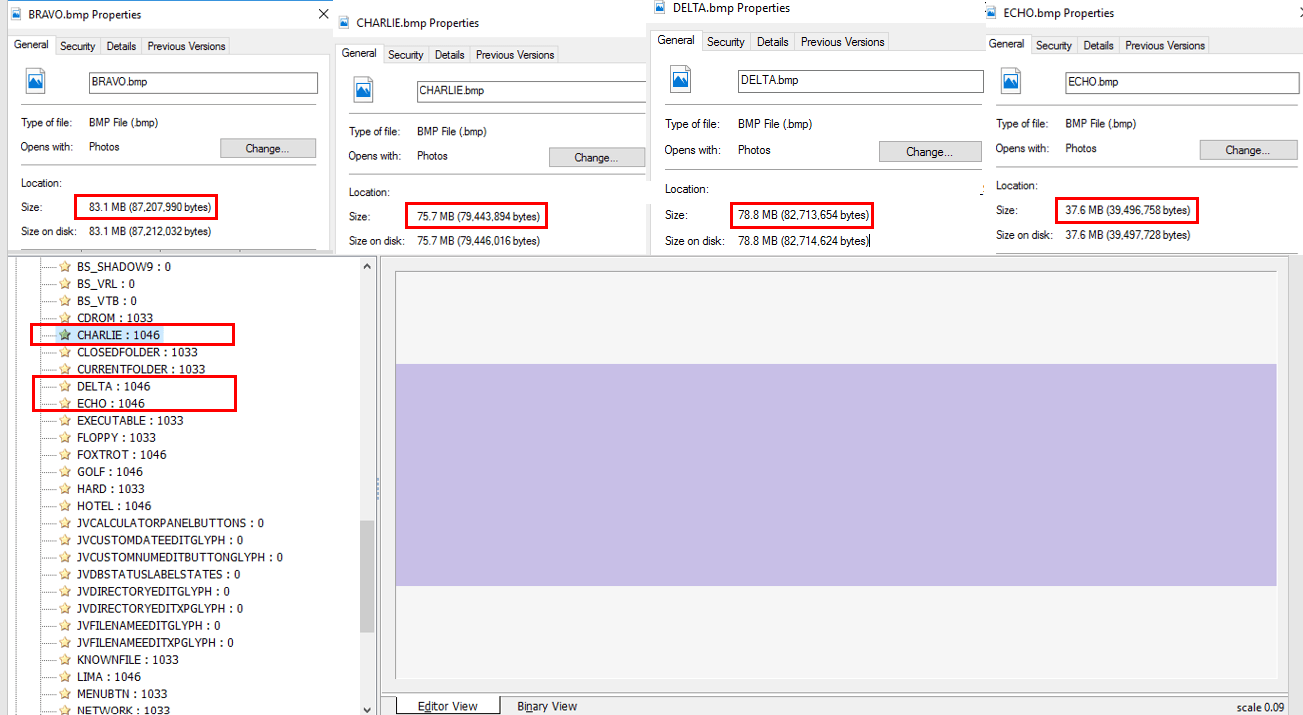
    The considerable size of the executables can be explained by the fact that Grandoreiro utilizes a binary padding technique to inflate the size of the malicious files as a way to evade sandboxes. To achieve this, the attackers add multiple BMP images to the resource section of the binary. In the example below, the sample included several big images. The sizes of the highlighted images are around 83.1 MB, 78.8 MB, 75.7 and 37.6 MB. However, there are more of them in the binary, and together all the images add ~376 MB to the file.

    Binary padding used by Grandoreiro

    In both 2022 and 2023 campaigns, Grandoreiro used a well-known XOR-based string encryption algorithm that is shared with other Brazilian malware families. The difference is the encryption key. For Grandoreiro, some magic values were the following:

    Date Encryption key
    March 2022 F5454DNBVXCCEFD3EFMNBVDCMNXCEVXD3CMBKJHGFM
    March 2022 XD3CMBKJCEFD3EFMF5454NBVDNBVXCCMNXCEVDHGFM
    August 2022 BVCKLMBNUIOJKDOSOKOMOI5M4OKYMKLFODIO
    June 2023 B00X02039AVBJICXNBJOIKCVXMKOMASUJIERNJIQWNLKFMDOPVXCMUIJBNOXCKMVIOKXCJ
    UIHNSDIUJNRHUQWEBGYTVasuydhosgkjopdf

    The various checks and validations aimed at avoiding detection and complicating malware analysis were also changed in the 2022 and 2023 versions. In contrast with the older Grandoreiro campaigns, we found that some of the tasks that were previously executed by the final payload are now implemented in the first stage loader. These tasks include security checks, anti-debugging techniques, and more. This represents a significant change from previous campaigns.

    One of these tasks is the use of the geolocation service http://ip-api.com/json to gather the target’s IP address location data. In a campaign reported in May 2023 by Trustwave, this task is performed by a JScript code embedded in an MSI installer before the delivery of the final payload.

    There are numerous other checks that have been transferred into the loader, although some of them are still present in the banking trojan itself. Grandoreiro gathers host information such as operating system version, hostname, display monitor information, keyboard layout, current time and date, time zone, default language and mouse type. Then the malware retrieves the computer name and compares it against the following strings that correspond to known sandboxes:

    • WIN-VUA6POUV5UP;
    • Win-StephyPC3;
    • difusor;
    • DESTOP2457;
    • JOHN-PC.

    Computer name validation

    It also collects the username and verifies if it matches with the “John” or “WORK” strings. If any of these validations match, the malware stops its execution.

    Grandoreiro includes detection of tools commonly used by security analysts, such as regmon.exe, procmon.exe, Wireshark, and so on. The process list varies across the malware versions, and it was significantly expanded in 2024, so we’ll share the full list later in this post. The malware takes a snapshot of currently executing processes in the system using the CreateToolhelp32Snapshot() Windows API and goes through the process list using Process32FirstW() and Process32NextW(). If any of the analysis tools exists in the system, the malware execution is terminated.

    Grandoreiro also checks the directory in which it is being executed. If the execution paths are D:programming or D:script, it terminates itself.

    Another anti-debugging technique implemented in the trojan involves checking for the presence of a virtual environment by reading data from the I/O Port “0x5658h” (VX) and looking for the VMWare magic number 0x564D5868. The malware also uses the IsDebuggerPresent() function to determine whether the current process is being executed in the context of a debugger.

    Last but not least, Grandoreiro searches for anti-malware solutions such as AVAST, Bitdefender, Nod32, Kaspersky, McAfee, Windows Defender, Sophos, Virus Free, Adaware, Symantec, Tencent, Avira, ActiveScan and CrowdStrike. It also looks for banking security software, such as Topaz OFD and Trusteer.

    In terms of the core functionality, some Grandoreiro samples check whether the following programs are installed:

    • CHROME.EXE;
    • MSEDGE.EXE;
    • FIREFOX.EXE;
    • IEXPLORE.EXE;
    • OUTLOOK.EXE;
    • OPERA.EXE;
    • BRAVE.EXE;
    • CHROMIUM.EXE;
    • AVASTBROWSER.EXE;
    • VeraCrypt;
    • Nortonvpn;
    • Adobe;
    • OneDrive;
    • Dropbox.

    If any of these is present on the system, the malware stores their names to further monitor user activity in them.

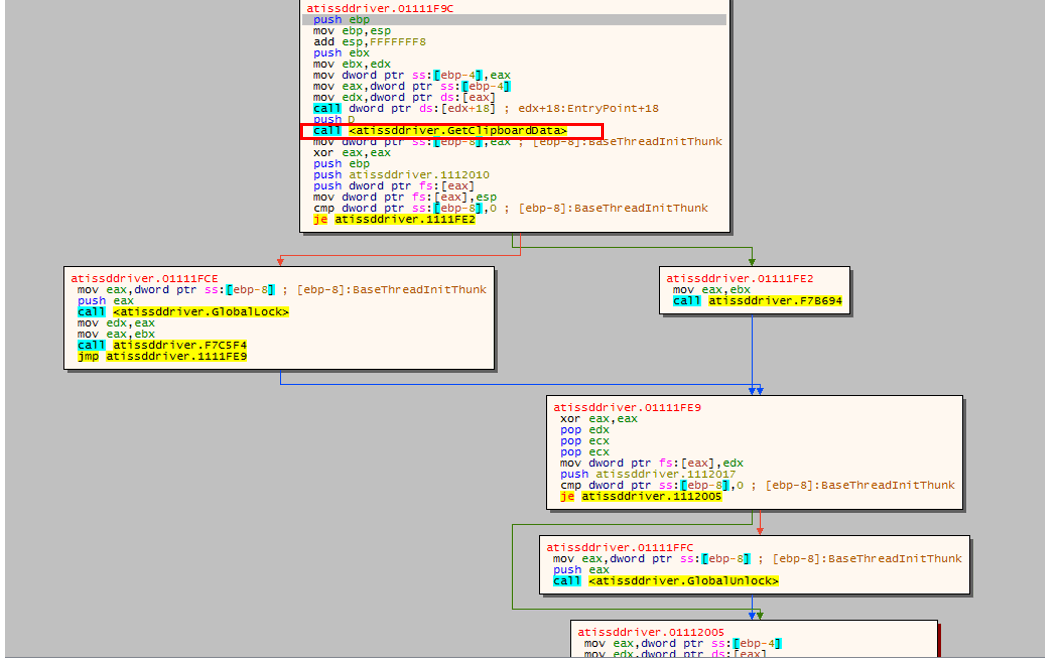
    Grandoreiro also checks for crypto wallets installed on the infected machine. The malware includes a clipboard replacer for crypto wallets, monitoring the user’s clipboard activity and replacing the clipboard data with the threat actor keys.

    Clipboard replacer

    2024 campaigns

    During a certain period of time in February 2024, a few days after the announcement of the arrest of some of the gang’s operators in Brazil, we observed a significant increase in emails detected by spam traps. There was a notable prevalence of Grandoreiro-themed messages masquerading as Mexican CFDI communications. Mexican CFDI, short for “Comprobante Fiscal Digital por Internet” is an electronic invoicing system administered by the Mexican Tax Authority (SAT — Servicio de Administración Tributaria). It facilitates the creation, transmission, and storage of digital tax documents, mandatory for businesses in Mexico to record transactions for tax purposes.

    In our investigation, we have acquired 48 samples associated not only with this instance but also with various other campaigns.

    Notably, this new campaign added a new sandbox detection mechanism, namely a CAPTCHA before the execution of the main payload, as a way to avoid the automatic analysis used by some companies:

    Grandoreiro anti-sandbox CAPTCHA

    It is worth noting that in the 2024 Grandoreiro campaigns, the new sandbox evasion code has been implemented in the downloader. Although the main sample still has anti-sandbox functionality too, if a sandbox is detected, it is simply not downloaded. Besides that, the new version also added detection of many tools to its arsenal, aiming to avoid analysis. Here is whole list of analysis tools detected by the newest versions:

    regmon.exe hopper.exe nessusd.exe OmniPeek.exe
    procmon.exe jd-gui.exe PacketSled.exe netmon.exe
    filemon.exe canvas.exe prtg.exe colasoft.exe
    Wireshark.exe pebrowsepro.exe cain.exe netwitness.exe
    ProcessHacker.exe gdb.exe NetworkAnalyzerPro.exe netscanpro.exe
    PCHunter64.exe scylla.exe OmniPeek.exe packetanalyzer.exe
    PCHunter32.exe volatility.exe netmon.exe packettotal.exe
    JoeTrace.exe cffexplorer.exe colasoft.exe tshark.exe
    ollydbg.exe angr.exe netwitness.exe windump.exe
    ida.exe pestudio.exe netscanpro.exe PRTG Probe.exe
    x64dbg.exe die.exe packetanalyzer.exe NetFlowAnalyzer.exe
    cheatengine.exe ethereal.exe packettotal.exe SWJobEngineWorker2x64.exe
    ollyice.exe Capsa.exe tshark.exe NetPerfMonService.exe
    fiddler.exe tcpdump.exe windump.exe SolarWinds.DataProcessor.exe
    devenv.exe NetworkMiner.exe PRTG Probe.exe ettercap.exe
    radare2.exe smartsniff.exe NetFlowAnalyzer.exe apimonitor.exe
    ghidra.exe snort.exe SWJobEngineWorker2x64.exe apimonitor-x64.exe
    frida.exe pcap.exe NetPerfMonService.exe apimonitor-x32.exe
    binaryninja.exe SolarWinds.NetPerfMon.exe SolarWinds.DataProcessor.exe x32dbg.exe
    cutter.exe nmap.exe ettercap.exe x64dbg.exe
    scylla.exe apimonitor.exe PCHunter64.exe x96dbg.exe
    volatility.exe apimonitor-x64.exe PCHunter32.exe fakenet.exe
    cffexplorer.exe apimonitor-x32.exe JoeTrace.exe hexworkshop.exe
    angr.exe x32dbg.exe ollydbg.exe Dbgview.exe
    pestudio.exe x64dbg.exe ida.exe sysexp.exe
    die.exe x96dbg.exe x64dbg.exe vmtoolsd.exe
    ethereal.exe fakenet.exe cheatengine.exe dotPeek.exe
    Capsa.exe hexworkshop.exe ollyice.exe procexp64.exe
    tcpdump.exe Dbgview.exe fiddler.exe procexp64a.exe
    NetworkMiner.exe sysexp.exe devenv.exe procexp.exe
    smartsniff.exe vmtoolsd.exe radare2.exe cheatengine.exe
    snort.exe dotPeek.exe ghidra.exe ollyice.exe
    pcap.exe procexp64.exe frida.exe pebrowsepro.exe
    cain.exe procexp64a.exe binaryninja.exe gdb.exe
    nmap.exe procexp.exe cutter.exe Wireshark.exe
    nessusd.exe regmon.exe hopper.exe ProcessHacker.exe
    PacketSled.exe procmon.exe jd-gui.exe SolarWinds.NetPerfMon.exe
    prtg.exe filemon.exe canvas.exe NetworkAnalyzerPro.exe

    These are some RAT features that we found in this version:

    • Auto-update feature allows newer versions of the malware to be deployed to the victim’s machine;
    • Sandbox/AV detection, still present in the main module, which includes more tools than previous versions;
    • Keylogger feature;
    • Ability to select country for listing victims;
    • Banking security solutions detection;
    • Checking geolocation information to ensure it runs in the target country;
    • Monitoring Outlook emails for specific keywords;
    • Ability to use Outlook to send spam emails.

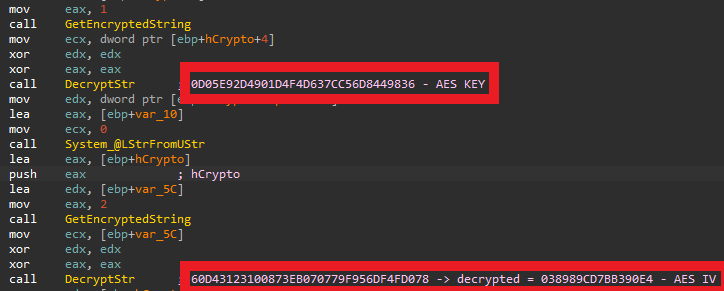
    In terms of static analysis protection, in 2024 versions, Grandoreiro has implemented enhanced encryption measures. Departing from its previous reliance on commonly shared encryption algorithms found in other malware, Grandoreiro has now adopted a multi-layered encryption approach. The decryption process in the newer versions is the following. Initially, the string undergoes deobfuscation through a simple replacement algorithm. Following this, Grandoreiro employs the encryption algorithm based on XOR and conditional subtraction typically utilized by Brazilian malware; however, it differs from them by incorporating a lengthy, 140759-byte string instead of smaller magic strings we saw in 2022 and 2023 samples. Subsequently, the decrypted string undergoes base64 decoding before being subjected to decryption via the AES-256 algorithm. Notably, the AES key and IV are encrypted within Grandoreiro’s code. Upon completion of all these steps, the decrypted string is successfully recovered.

    Grandoreiro AES key and IV

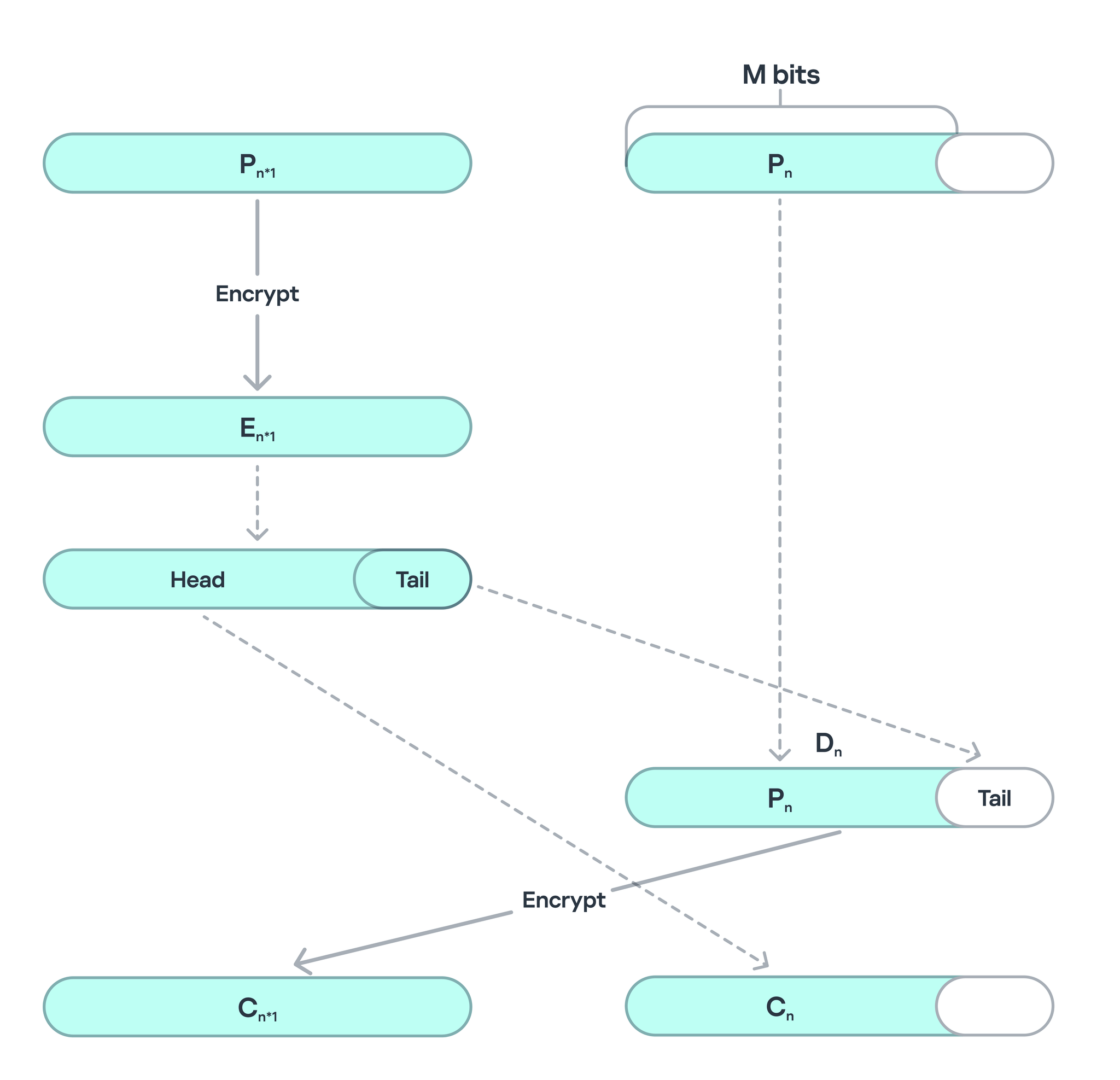
    In newer samples, Grandoreiro upgraded yet again the encryption algorithm using AES with CTS, or Ciphertext Stealing, a specialized encryption mode used when the plaintext is not a multiple of the block size, which in this case is the 128-bit (16-byte) block size used by AES. Unlike more common padding schemes, such as PKCS#7, where the final block is padded with extra bytes to ensure it fits a full block, CTS operates without padding. Instead, it manipulates the final partial block of data by encrypting the last full block and XORing its output with the partial block. This allows encryption of any arbitrary-length input without adding extra padding bytes, preserving the original size of the data.

    ECB Encryption Steps for CTS

    In the case of Grandoreiro, the malware’s encryption routine does not add standard padding to incomplete blocks of data. Their main goal is to complicate analysis: it takes time to figure out that CTS was used, and then more time to implement decryption in this mode, which makes the extraction and obfuscation of strings more complicated. This marks the first time this particular method has been observed in a malware sample.

    As the threat actors continue to evolve their techniques, changing the encryption in every iteration of the malware, the use of CTS in malware may signal a shift toward more advanced encryption practices.

    Local versions: old meets new

    In a recent campaign, our analysis has revealed the existence of an older variant of the malware that utilizes legacy encryption keys, outdated algorithms, and a simplified structure, but which runs in parallel to the campaign using the new code. This variant targets fewer banks — about 30 financial institutions, mainly from Mexico. This analysis clearly indicates that another developer, likely with access to older source code, is conducting new campaigns using the legacy version of the malware.

    How they steal your money

    Operators behind Grandoreiro are equipped with a wide variety of remote commands, including an option to lock the user screen and present a custom image (overlay) to ask the victim for extra information. These are usually OTPs (one-time passwords), transaction passwords or tokens received by SMS, sent by financial institutions.

    A new tactic that we have discovered in the most recent versions found in July 2024 and later suggests that the malware is capturing user input patterns, particularly mouse movements, to bypass machine learning-based security systems. Two specific strings found in the malware — “GRAVAR_POR_5S_VELOCIDADE_MOUSE_CLIENTE_MEDIA” (“Record for 5 seconds the client’s average mouse speed”) and “Medição iniciada, aguarde 5 segundos!” (“Measurement started, please wait 5 seconds!”) — indicate that Grandoreiro is monitoring and recording the user’s mouse activity over a short period. This behavior appears to be an attempt to mimic legitimate user interactions in order to evade detection by anti-fraud systems and security solutions that rely on behavioral analytics. Modern cybersecurity tools, especially those powered by machine learning algorithms, analyze user’s behavior to distinguish between human users and bots or automated malware scripts. By capturing and possibly replaying these natural mouse movement patterns, Grandoreiro could trick these systems into identifying the activity as legitimate, thus bypassing certain security controls.

    This discovery highlights the continuous evolution of malware like Grandoreiro, where attackers are increasingly incorporating tactics designed to counter modern security solutions that rely on behavioral biometrics and machine learning.

    To perform the cash-out in the victim’s account, Grandoreiro operators’ options are to transfer money to the account of local money mules, using transfer apps, buy cryptocurrency or gift cards, or even going to an ATM. Usually, they search for money mules in Telegram channels, paying $200 to $500 USD per day:

    Grandoreiro operator looking for money mules

    Infrastructure

    The newest Grandoreiro version uses 3 Domain Generation Algorithms (DGAs), generating valid domains for command and control (C2) communications. The algorithm uses the current daytime to select strings of predefined lists and concatenates them with a magic key to create the final domain.

    By dynamically generating unique domain names based on various input data, the algorithm complicates traditional domain-based blocking strategies. This adaptability allows the malicious actors to maintain persistent command-and-control communications, even when specific domains are identified and blacklisted, requiring security solutions to base their protection not on a fixed list of domains, but on an algorithm for generating them.

    Since early 2022, Grandoreiro leverages a known Delphi component shared among different malware families named RealThinClient SDK to remotely access victim machines and perform fraudulent actions. This SDK is a flexible and modular framework for building reliable and scalable Windows HTTP/HTTPS applications with Delphi. By using RealThinClient SDK, the program can handle thousands of active connections in an efficient multithreaded manner.

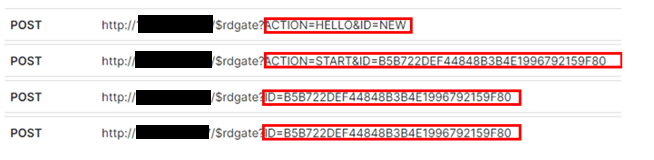
    Grandoreiro C2 Communication

    Operator tool

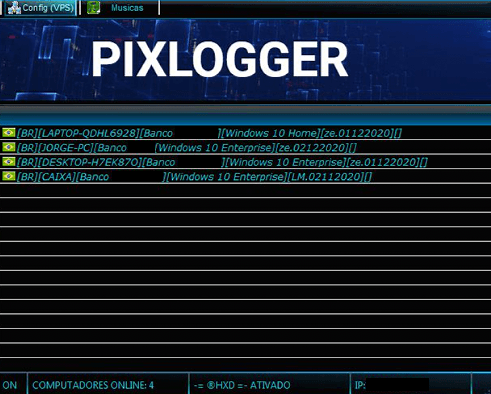
    Grandoreiro’s Operator is the tool that allows the cybercriminal to remotely access and control the victim’s machine. It’s a Delphi-based software that lists its victims whenever they start browsing a targeted financial institution website.

    Grandoreiro’s Operator tool

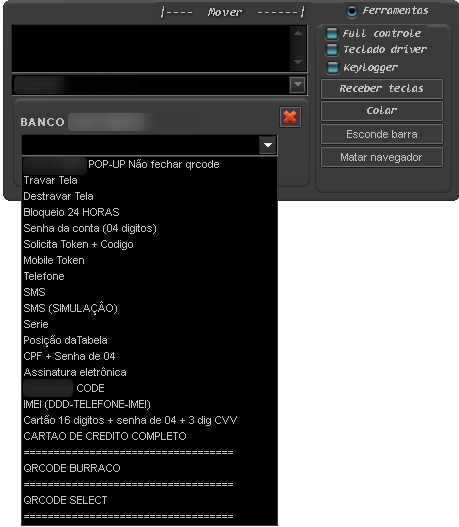
    Once the cybercriminal chooses a victim to operate on, they will be presented with the following screen, seen in the image below, which allows many commands to be executed and visualizes the victim’s desktop.

    Grandoreiro’s Operator commands

    Cloud VPS

    One overlooked feature of the Grandoreiro malware is what is called “Cloud VPS” by the attackers — it allows cybercriminals to set up a gateway computer between the victim’s machine and the malware operator, thus hiding the cybercriminal’s real IP address.

    This is also used by them to make investigation harder, as the first thing noted is the gateway’s IP address. When requesting a seizure, an investigator just finds the gateway module. Meanwhile, the criminal has already set up a new gateway somewhere else and new victims connect to the new one through its DGA.

    Grandoreiro Cloud VPS

    Victims and targets

    The Grandoreiro banking trojan is primed to steal the credentials accounts for 1,700 financial institutions, located in 45 countries and territories. After decrypting the strings of the malware, we can see the targeted banks listed separated by countries/territories. This doesn’t mean that Grandoreiro will target a specific bank from the list; it means it is ready to steal credentials and act, if there is a local partner or money mule who can operationalize and complete the action. The banks targeted by Grandoreiro are located in Algeria, Angola, Antigua and Barbuda, Argentina, Australia, Bahamas, Barbados, Belgium, Belize, Brazil, Canada, Cayman Islands, Chile, Colombia, Costa Rica, Dominican Republic, Ecuador, Ethiopia, France, Ghana, Haiti, Honduras, India, Ivory Coast, Kenya, Malta, Mexico, Mozambique, New Zealand, Nigeria, Panama, Paraguay, Peru, Philippines, Poland, Portugal, South Africa, Spain, Switzerland, Tanzania, Uganda, United Kingdom, Uruguay, USA, and Venezuela. It’s important to note that the list of targeted banks and institutions tend to slightly change from one version to another.

    From January to October 2024, our solutions blocked more than 150,000 infections impacting more than 30,000 users worldwide, a clear sign the group is still very active. According to our telemetry, the countries most affected by Grandoreiro infections are Mexico, Brazil, Spain, and Argentina, among many others.

    Conclusion

    We understand how difficult it is to eradicate a malware family, but it is possible to impede their operation with the cooperation of law enforcement agencies and the private sector — modern financial cybercrime can and must be fought.

    Brazilian banking trojans are already an international threat; they’re filling the gaps left by Eastern European gangs who have migrated into ransomware. We know that in some countries, internet banking is declining on desktops, forcing Grandoreiro to target companies and government entities who are still using operating in that way.

    The threat actors behind the Grandoreiro banking malware are continuously evolving their tactics and malware to successfully carry out attacks against their targets and evade security solutions. Kaspersky continues to cooperate with INTERPOL and other agencies around the world to fight the Grandoreiro threat among internet banking users.

    This threat is detected by Kaspersky products as HEUR:Trojan-Banker.Win32.Grandoreiro, Trojan-Downloader.OLE2.Grandoreiro, Trojan.PDF.Grandoreiro and Trojan-Downloader.Win32.Grandoreiro.

    For more information, please contact: crimewareintel@kaspersky.com

    Indicators of Compromise

    Host based
    f0243296c6988a3bce24f95035ab4885
    dd2ea25752751c8fb44da2b23daf24a4
    555856076fad10b2c0c155161fb9384b
    49355fd0d152862e9c8e3ca3bbc55eb0
    43eec7f0fecf58c71a9446f56def0240
    150de04cb34fdc5fd131e342fe4df638
    b979d79be32d99824ee31a43deccdb18

    MIL OSI Global Banks

  • MIL-OSI Security: California Man Sentenced to Seven Years in Federal Prison for Orchestrating $23 Million Fraud Scheme

    Source: Federal Bureau of Investigation (FBI) State Crime News

    CHICAGO — A California man has been sentenced to seven years in federal prison for orchestrating a fraudulent investment scheme that swindled investors out of $23.1 million.

    SEAN GRUSD formed three funds that he claimed would invest in private financial technology companies.  Beginning in 2021, Grusd provided potential investors with marketing materials containing numerous falsehoods about the funds’ purported investment history and successes.  Among other things, the promotional materials falsely claimed that one of Grusd’s funds had been an early investor in successful startup companies, such as Instacart, Coinbase, and Shippo.  Grusd also falsely claimed that he had graduated from a prestigious law school and that he managed the personal portfolio of the CEO of a large investment management firm.  Based on these and other false representations, more than a dozen victims invested $23.1 million in Grusd’s funds.

    Instead of investing the victims’ money, Grusd transferred the funds to his personal bank accounts and spent the money on a lavish lifestyle, including high-end automobiles, luxurious condos in Chicago and Montreal, and lavish travel and entertainment expenses.  Many of the victims had invested a significant portion of their life savings with Grusd.

    Grusd, 32, of Los Angeles, Calif., pleaded guilty last year in federal court in Chicago to a wire fraud charge.  In addition to the seven-year prison term, U.S. District Judge Sara L. Ellis on Wednesday ordered Grusd to pay more than $21 million in restitution to his victims.

    The sentence was announced by Morris Pasqual, Acting United States Attorney for the Northern District of Illinois, and Douglas S. DePodesta, Special Agent-in-Charge of the Chicago Field Office of the FBI.

    “Defendant’s fraud was brazen and unmitigated,” Assistant U.S. Attorney Corey B. Rubenstein argued in the government’s sentencing memorandum.  “It was an appalling stream of deliberate choices over almost two years targeting numerous victims and resulting in huge losses.”

    MIL Security OSI

  • MIL-OSI Asia-Pac: HKETO, Brussels hosts Hong Kong Film Night in Amsterdam (with photos)

    Source: Hong Kong Government special administrative region

         The Hong Kong Economic and Trade Office in Brussels (HKETO, Brussels) held with the Hong Kong Trade Development Council (HKTDC) a Hong Kong Film Night on 21 October in Amsterdam, the Netherlands (Amsterdam time). Participants enjoyed a networking reception and the screening of the Hong Kong movie “Band Four”, directed by young Hong Kong director Lai Yan-chi, in this film event.

         Opening the event, Deputy Representative of HKETO, Brussels, Miss Fiona Li, outlined the vision to provide more exposure and opportunities for emerging filmmakers and other artists from Hong Kong in Europe. She said that this film event with the HKTDC was a targeted attempt “to create our platform to showcase Hong Kong productions, and to arouse more interests in our young filmmakers and accomplished talent among the local arts, cultural and creative sectors in Europe, hence offering both sides more opportunities for possible collaboration”. 

         Miss Li elaborated that through arts and culture, Hong Kong’s advantages and soft power are better seen in Europe. The Government of the Hong Kong Special Administrative Region strives to elevate Hong Kong’s arts and creative industries to the international stage and to present Hong Kong talent globally, fostering the development of Hong Kong into an international cultural exchange centre.    

         For the film industry, the Government provides financial support to help promising Hong Kong filmmakers gain international visibility and to encourage international co-operation. One of the recent measures is the launch of the Hong Kong-Europe-Asian Film Collaboration Funding Scheme under the Film Development Fund, which supports eligible film projects co-produced by filmmakers from European or Asian countries that feature Hong Kong, European and Asian cultures.   

    MIL OSI Asia Pacific News

  • MIL-OSI Russia: Transcript of World Economic Outlook October 2024 Press Briefing

    Source: IMF – News in Russian

    October 22, 2024

    Speakers:
    Pierre‑Olivier Gourinchas, Director, Research Department, IMF
    Petya Koeva Brooks, Deputy Director, Research Department, IMF
    Jean‑Marc Natal, Division Chief, Research Department, IMF

    Moderator:
    Jose Luis De Haro, Communications Officer, IMF

    Mr. De Haro: OK. I think we can start. First of all, welcome, everyone. Good morning for those who are joining, as online. I am Jose Luis De Haro with the Communications Department here at the IMF. And once again, we are gathered here today for the release of our new World Economic Outlook, titled Policy Pivot Raising Threats. I hope that by this time, all of you have had access to a copy of the flagship. If not, I would encourage you to go to IMF.org. There, you’re going to find the document, but also, you’re going to find Pierre‑Olivier’s blog, the underlying data for the charts, videos, and other assets that I think are going to be very, very helpful for your reporting. And what’s best, that to discuss all the details of the World Economic Outlook that, to be joined here today by Pierre‑Olivier Gourinchas, the Economic Counsellor Chief Economist and the Director of the Research Department. Next to him are Petya Koeva Brooks. She is the Deputy Director of the Research Department. And also with us, Jean‑Marc Natal, the Division Chief at the Research Department. We are going to start with some opening remarks from Pierre‑Olivier, and then we will proceed to take your questions. I want to remind everyone that this press conference is on the record and that we will also be taking questions online.

    With no further ado, Pierre‑Olivier, the floor is yours.

    Mr. Gourinchas: Thank you, Jose, and good morning, everyone. Let me start with the good news. The battle against inflation is almost won. After peaking at 9.4 percent year on year in the third quarter of 2022, we now project headline inflation will fall to 3.5 percent by the end of next year, and in most countries, inflation is now hovering close to central bank targets.

    Now, inflation came down while the global economy remained resilient. Growth is projected to hold steady at 3.2 percent in 2024 and 2025. The United States is expected to cool down, while other advanced economies will rebound. Performance in emerging Asia remains robust, despite the slight downward revision for China to 4.8 percent in 2024. Low‑income countries have seen their growth revised downwards, some of it because of conflicts and climate shocks.

    Now, the decline in inflation without a global recession is a major achievement. Much of that disinflation can be attributed to the unwinding of the unique combination of supply and demand shocks that caused the inflation in the first place, together with improvements in labor supply due to immigration in many advanced countries. But monetary policy played a decisive role, keeping inflation expectations anchored.

    Now, despite the good news, on inflation, risks are now tilted to the downside. This downside risks include an escalation in regional conflicts, especially in the Middle East, which could cause serious risks for commodity markets. Policy shifts toward undesirable trade and industrial policies could also significantly lower output, a sharp reduction in migration into advanced economies, which can unwind some of the supply gains that helped ease inflation in recent quarters. This could trigger an abrupt tightening of global financial conditions that would further depress output. And together, these represent about a 1.6 percent of global output in 2026.

    Now, to mitigate these downside risks and to strengthen growth, policymakers now need to shift gears and implement a policy triple pivot.

    The first pivot on monetary policy is already underway. The decline in inflation paved the way for monetary easing across major central banks. This will support activity at a time when labor markets are showing signs of cooling, with rising unemployment rates. So far, however, this rise has been gradual and does not point to an imminent slowdown. Lower interest rates in major economies will also ease the pressure on emerging market economies. However, vigilance remains key. Inflation in services remains too elevated, almost double prepandemic levels, and a few emerging market economies are seeing rising price pressures, calling for higher policy rates. Furthermore, we have now entered a world dominated by supply shocks, from climate, health, and geopolitical tensions. And this makes the job of central banks harder.

    The second pivot is on fiscal policy. It is urgent to stabilize debt dynamics and rebuild much‑needed fiscal buffers. For the United States and China, current fiscal plans do not stabilize debt dynamics. For other countries, despite early improvements, there are increasing signs of slippage. The path is narrow. Delaying consolidation increases the risk of disorderly adjustments, while an excessively abrupt turn toward fiscal tightening could hurt economic activity. Success requires implementing, where necessary, and without delay, a sustained and credible multi‑year fiscal adjustment.

    The third pivot and the hardest is toward growth‑enhancing reform. This is the only way we can address many of the challenges we face. Many countries are implementing industrial and trade policy measures to protect domestic workers and industries. These measures can sometimes boost investment and activity in the short run, but they often lead to retaliation and ultimately fail to deliver sustained improvements in standards of living. They should be avoided when not carefully addressing well‑identified market failures or narrowly defined national security concerns.

    Economic growth must come, instead, from ambitious domestic reforms that boost innovation, increase human capital, improve competition and resource allocation. Growth‑enhancing reforms often face significant social resistance. Our report shows that information strategies can help improve support, but they only go so far. Building trust between governments and citizens and inclusion of proper compensation measures are essential features.

    Building trust is an important lesson that should also resonate when thinking about ways to further improve international cooperation to address common challenges in the year that we celebrate the 80th anniversary of the Bretton Woods Institutions. Thank you.

    Mr. De Haro: Thank you, Pierre‑Olivier. Before we open the floor for your questions, let’s remind some ground rules. First of all, if you have any question that it is related to a country program or a country negotiation, I would recommend not to formulate that question here. Basically, those questions can be formulated in the different regional press briefings that are going to happen later this week.

    Also, if you want to ask a question, just raise your hand, wait until I call you. Identify yourself and the outlet that you represent. And let’s try to keep it to just one question. I know that there are going to be many, many questions. We might not be able to take all of you. So please be patient. There are going to be many other opportunities to ask questions throughout the week.

    Let me start—how I am going to start. I am going to start in the center. A couple of questions here. Then I am going to go to my right, and then I am going to go there. I am going to start in the first row, the lady with the white jacket, thank you.

    QUESTION: Thank you, Jose, for taking my question. I am Moaling Xiong from Xinhua News Agency. I want to ask about the geopolitical tensions that was mentioned in the report. It says there are rising geopolitical tensions. So far, the impact has been limited. But further intensification of geopolitical rifts could weigh on trade, investment, and beyond. I wonder whether Pierre‑Olivier, could you talk a little bit about what are the economic impacts of growing geopolitical tensions? Thank you.

    Mr. Gourinchas: Thank you. This is, of course, a very important question. This is something that we are very concerned about, the rising geoeconomic fragmentation, trade tensions between countries, measures that are disrupting trade, disrupting cross‑border investment. This is something that we have looked at in our World Economic Outlook report. In Chapter 1, we have a box that evaluates the impact of various adverse measures, measures that could be taken by policymakers or various of shocks that would impact output. And when we look at the impact that rising trade tensions could have, there are two dimensions of this. One is, of course, you are increasing tariffs, for instance, between different blocs. That would disrupt trade. That will misallocate resources. That will weigh down on economic activity. But there is also an associated layer that comes from the uncertainty that increases related to future trade policy. And that will also depress investment, depress economic activity and consumption. When we put these two together, what we find is, we find an impact on world output that is on the order of about 0.5 percent of output levels in 2026. So it’s a quite sizable effect of both an increase in tariffs between different countries and an increase in trade policy uncertainty.

    Mr. De Haro: OK. I’m going to continue here in the center. We’re going to go to the gentleman on the third row. Yep. There. There, third row, there. Third row. Thank you.

    QUESTION: Hi. Thanks very much for taking my question. I just want to ask about the inflation side of the WEO. You mentioned just now inflation, you know, the battle is almost won. I am just wondering, there’s sort of a divergence between the advanced economies and emerging markets and developing economies. When do you expect inflation to sort of fall toward that 2 percent target in emerging markets and developing economies? Thanks.

    Mr. Gourinchas: Yes. So inflation, the progress on inflation has been more pronounced for advanced economies, and now we expect advanced economies to be back to their target sometime in 2025 for most of them. For emerging markets and developing economies, there is more variation, and we see an increase in dispersion of inflation, so a lot of countries have made a lot of progress. You look, for instance, at emerging Asia. There are inflation levels very similar to advanced economies for a number of them. You look at other regions—in the Middle East, for instance, or sub‑Saharan Africa—and you have countries that still have double‑digital inflation rates and will maybe take more time to converge back. So we see an increased divergence that reflects some of the shocks that are specific to some of these regions. Of course, conflict or climate‑related shocks can have an impact on inflation, and that’s what we’re seeing in these two regions I mentioned.

    Mr. De Haro: OK. Now I’m going to move to my right. The first row here, the lady with the red suit.

    QUESTION: Hello. This is Norah from Asharq Business with Bloomberg from Dubai.

    Pierre, you mentioned that the geopolitical tensions could account for 0.5 percent of output if things kind of get out of hand. To what extent is this a very optimistic number here? Because we’re talking about tensions not only in the Middle East. You have things going down in the Taiwan Strait. We have the Russian‑Ukraine war still ongoing. And there is a very big risk that shipping lines, straits might get disrupted. And this would affect very substantially the price of oil and other commodities. To what extent this would affect output—again, global output and inflation levels? Would inflation be a big risk again if major commodities prices increased substantially?

    Mr. Gourinchas: Yes. So you are absolutely right. The scenario I was referring to earlier is a scenario where we have increased trade disruptions, tariffs, and trade policy uncertainty. But one can think also about geopolitical tensions impacting commodity market or shipping. Now, this is not something that we looked at in this report. That’s something that we had looked at in our April report. And in April, when we looked at the potential for escalation in conflicts in the Middle East, the impact it could have on oil prices or on shipping costs, we found that this would very much be in the nature of adverse supply shock. It would negatively impact output, and it would increase inflation pressures. Now, the numbers we had when we did that exercise back in April, they’re still very relevant for the environment we’re in now. And that was one of the layers I showed today, is that it would reduce output by another about 0.4 percent by 2026 and would increase inflation by something on the order of 0.7 percent higher inflation in 2025. So this is something that is very much on top of the other tensions that I mentioned. This is why we are living in this world where there are multiple layers of risk that could be compounding each other.

    Mr. De Haro: I’m going to stay here. First row, here. Thank you.

    QUESTION: Thank you. My name is Simon Ateba. I am with Today News Africa Washington, D.C. I would like you to talk a little bit more about the situation in Africa. I know two years ago it was about COVID and then Ukraine. What do you see now? And what are some of the recommendations for sub‑Saharan Africa? Thank you.

    Mr. Gourinchas: So sub‑Saharan African region is one that is seeing growth rates that are fairly steady this year, compared to last year, at about 3.6 percent, and then expected to increase to about 4.2 percent next year. So we’re seeing some pickup in growth from this year to next year. But now, this is certainly a region that’s been adversely impacted by weather shocks and, in some cases, conflict. So the growth remains subdued and somewhat uneven, and that’s certainly something that we are concerned about.

    Let me turn it over to my colleague Jean‑Marc Natal to add some color.

    Mr. Natal: I would be happy to. Do you hear me? OK.

    So yes, so there has been over the last year, year and a half, there has been some progress in the region. You saw, you know, inflation stabilizing in some countries going down even. And reaching close—level close to the target. But half of them is still at distance, large distance from the target. And a third of them are still having double‑digital inflation.

    In terms of growth, as Pierre‑Olivier mentioned, it’s quite uneven, but it remains too low. The other issue is debt in the region. Obviously, it is still high. It has not increased. It has stopped increasing, and in some countries already starting to consolidate. But it’s still too high. And the debt service is correspondingly still high in the region. So the challenges are still there. There has been some progress. So in terms of the recommendation, in countries where inflation is very high, you would recommend, you know, tight monetary policy and in some cases, when possible, helped by consolidation on the fiscal side.

    It’s complicated. In many countries, you know, there are trade‑offs, and, you know, consolidating fiscal is difficult when you also have to provide for relief, like in Nigeria, for example, due to the flooding. So targeting the support to the poor and the vulnerable is part of the package when you consolidate. I will stop here.

    Mr. De Haro: OK. I am moving to my left. I am going to go to the gentleman in the first row.

    QUESTION: Thank you very much. Joel Hills from ITV News. We know that the chancellor in the United Kingdom is planning on changing the fiscal rule on debt to allow for—to borrow more for investment. Pierre‑Olivier, do you support this idea? And what, in your view, are the risks? And should the U.K. government continue to target a fall in debt of some description or a rise in public sector net worth?

    Mr. De Haro: Pierre‑Olivier, before you answer, are there any other questions on the U.K. in the room? I am going to take just two more from this group of U.K. reporters on my right that they are very eager. Just two questions more. We do not want to overwhelm—

    QUESTION: Alex Brummer from the Daily Mail in London. Again, around the chancellor’s upcoming budget. In your opening remarks, you referred to the possibility of abrupt changes in fiscal policy, disrupting what might happen to economies. U.K., according to your forecast, is in a quite good place in terms of growth heading upward. Do you fear that too strong a change in direction in fiscal policy in the U.K. could affect future growth?

    Mr. De Haro: Just one more question.

    QUESTION: Mehreen Khan from The Times. You mentioned that there are some countries at risk of fiscal slippage because governments have promised to do their consolidation have struggled to execute. Is the U.K. in that group? Also, the IMF has previously recommended that countries are under fiscal strain should—can keep sort of investment flowing if they do shift to measures like public sector net worth. Is that still a recommendation that you stand by in particular relevance for the U.K.?

    Mr. De Haro: And to give Pierre‑Olivier a little bit of time, I just want to remind everyone that we will have regional press briefings later this week, and some of these questions can be brought to all heads of departments that are going to be talking later on in the week. Pierre‑Olivier?

    Mr. Gourinchas: First, I will make three quick remarks. We are going to wait and see at the end of this month, on October 30, the details of the budget that will be announced by the U.K. government. And at that point, we’ll be able to evaluate and see the detail of the measures and how they will impact the U.K. economy.

    The broader question, I think, is relevant for many countries, not just the U.K. And it goes to the second pivot I mentioned, this narrow path in terms of fiscal consolidation. I think when countries have elevated debt levels, when interest rates are high, when growth is OK but not great, there is a risk that things could escalate or get out of control quickly. And so there is a need to bring debt levels down, stabilize them when they are not stabilized and rebuild fiscal buffers. That is true for many countries around the world. And if you are not doing that—and that is getting to the question that was asked by the gentleman on the right here—if you’re not doing that, that’s when you find yourself potentially later on at the mercy of market pressures that will force an adjustment that is uncontrolled to a large extent. At which point you have very few degrees of freedom, so you do not want to get in that position. And I think the effort to stabilize public debt has to be seen in that context.

    Now, the other side of the narrow path is, of course, if you try to do too much too quickly, you might have an adverse impact on growth. And you have to be careful there because we do have important—most countries have important needs when it comes to spending, whether it’s about central services, what we think about healthcare, or if we think about public investment and climate transition. So we need to protect also the type of spending that can be good for growth. So finding ways—and this is something that our colleagues in the Fiscal Monitor report emphasize, finding ways to consolidate by reducing expenditures where it’s needed. Maybe raising revenues. Often, it’s a combination of both but doing so in a way that is least impactful on growth. It’s country by country. There is no general formula. But that’s kind of the nature of the exercise.

    That pivot, that second pivot is absolutely essential. At the point we’re at again precisely because we’re in a world in which there will be more shocks and countries need to be prepared and need to have some room on the fiscal side to be able to build that.

    Mr. De Haro: OK. Last question on this side. Then I will go online, and then I will go around the room again. The gentleman in the second row.

    QUESTION: Thanks, Jose. Pierre‑Olivier, a question on Argentina. The IMF is maintaining its projections for the country for next year, improving GDP and inflation, 45 percent at the end of the year. Oh, yes. Sorry. Alam Md Hasanul from International.

    A question on Argentina. The IMF is maintaining its projections for next year, but I wanted to see if you could give us a little bit more detail on, where do you see the economy going. And if it’s accurate to say at this point that the worst of the crisis is in the past? Thanks.

    Mr. De Haro: We have received other questions regarding Argentina online from Lilliana Franco. Basically, she wants to know what’s behind our expectations for inflation for 2025. And I think that there are other Argentine reporters in the room. I see them in the back. Please, if somebody can get them the mic and we can get all the questions on Argentina and then move on to other regions. There. There. Those two, please. Try to keep it short.

    QUESTION: Hi. Patricia Valli from El Cronista. You mentioned the need to keep going with the reforms. And the government in Argentina is implementing a series of reforms. What’s the take of the IMF in terms of these? And if they are perhaps hurting the most vulnerable due to the increase of poverty numbers in Argentina in the past report?

    QUESTION: Hello. Juan Manuel Barca from Clarín Newspaper. I want to know if you raised your employment projection compared to the April—compared to the July forecast.

    Mr. Gourinchas: Yes. So let me first state at the outset that our projections for Argentina have not been updated since July, and the reason for this is because there are ongoing program discussions between the authorities and the Fund. And so while that process is going on, we did not update the projections for the October round.

    Now, to come to the question that was asked on the left. There are two things that are relevant for Argentina, two main things. One is what’s happening on the inflation side. Here, I think the progress has been very substantial. We are now seeing month‑on‑month inflation in Argentina close to 3.5 percent, and this is down from about 25 percent month on month back in December of last year. So very, very significant decline in the inflation rate. So that’s something to acknowledge. And the hope is, of course, that the measures in place will continue to improve the situation on that front.

    On the growth front, what we are saying is that activity has contracted substantially in the first half of the year, but there are signs that it’s starting to gradually recover. Now how much again, I cannot give you an update because we do not have it as of now. But there are signs that there is a recovery in real wages and in private credit and activity.

    Now, of course, this has been difficult for the Argentine economy, the decline in growth of that nature. And that’s something that, again, we are engaged in discussions with the authorities on the best way forward. I cannot comment more than that.

    Mr. De Haro: OK. Now I am going to get a question from our colleagues on WebEx. I think that Weier is there.

    QUESTION: I have a question on China. Given China’s recent implementation of various stimulus measures, such as support for the real estate—real sector and interest rate reductions and other economic incentives, we’ve already seen a major boost in its capital market. So how do you assess the potential impact of these developments on China’s economic recovery and growth perspective?

    Also, how the external effects, such as the Federal Reserve’s easing monetary path, will play a role here. Thank you.

    Mr. De Haro: Before you answer on the Federal Reserve, there’s other questions on China of a similar nature. Recent stimulus announced by the Governor and its effects.

    Mr. Gourinchas: OK. So China, as I mentioned in my opening remarks, we have a slight downward revision for its 2024 growth, compared to our July projections to 4.8 percent. And that’s a revision that’s coming largely due to a weaker second quarter of the year. And that weaker second quarter of the year is reflecting continued decline in confidence in the household and corporate sector and also the continued problems in the property sector in China.

    Now, this is something that, of course, is a top priority to address for the Chinese authorities. And we’ve seen a number of measures that have been announced since the end of last month. First measures, monetary and financial measures announced by the People’s Bank of China, and then some fiscal measures that were announced a few weeks ago.

    These measures in general go in the right direction, from our perspective. They are trying to improve the situation in the property sector. They’re trying to, for instance, lowering borrowing rates or trying to improve the balance sheet of the property developers.

    In our view, in our assessment, the measures announced at the end of last month by the PBOC, although they go in the right direction, are not sufficient to lift growth in a substantially material way. And that’s why our forecast is still at about 4.8 percent for 2024 and is unchanged for next year, at 4.5 percent.

    The new, more recent measures announced a few weeks ago by the Ministry of Finance are not incorporated in our forecast. We are waiting to see the details. I should mention, however, that since then, there has also been a release of the Q3 growth for China, and this has also been a little bit on the disappointing side. So I would say that what we’re seeing in terms of where the Chinese economy might be going is a little bit of a downward revision coming from the Q3 forecast and then potentially some measures that will help lift the economy going forward.

    Mr. De Haro: OK. So we have an additional question online. Basically, it comes from a reporter in Israel who wants to know how the current conflict is affecting the region and the global economy. Also, if there’s any other questions regarding the ongoing conflict, we can go here in the first row, please.

    QUESTION: Hi. Amir Goumma from Asharq with Bloomberg. With the GCC countries increasingly focusing and diversifying their economies away from oil now, how the IMF sees the progress and how you assess that with geopolitical tensions that may affect the attraction of the investment?

    Mr. Gourinchas: OK. So on the impact of the conflict in the Middle East on the countries in the region, and more broadly, let me ask my colleague Petya Koeva Brooks to come in.

    Ms. Koeva Brooks: Sure. Indeed, the conflict has inflicted a heavy toll on the region, and our hearts go to all who have been affected by it. We are monitoring the situation very closely. And what we could say at this stage is apart from the enormous uncertainty that we see is that the fallout has been the hardest in the countries in the region, at the epicenter of the conflict. We’ve seen significant declines in output in West Bank, in Gaza. Lebanon has also been hard hit. Now, we’ve also seen impact in the—on the economy in Israel, although there, I think the—so far at least, the impact has been smaller.

    Now, beyond that, there has also been an impact on commodity prices, on oil prices. We’ve seen quite a lot of volatility, though, as other factors have also come in, such as the concerns about global demand kind of have pushed prices in the opposite direction.

    Now, beyond that, when it comes to specific countries in the GCC region, when it comes to, for instance, Saudi Arabia, we’ve seen there, actually the non‑oil output has done very well, and we do have a small downward revision in the overall growth rate, but that is pretty much because of the voluntary oil cuts that have now been extended through November. Let me stop here. Thank you.

    Mr. De Haro: OK. We are coming here to the center of the room. I’m going to go way back. The gentleman in the blue shirt that I think is the third row from the back. Yep. There. He has—there, there, there. A little bit. Can you stand up? Yep. Perfect. And then I will go with you, with the lady.

    QUESTION: Thank you for doing this. Your alternative scenario about the trade war does not seem so far from reality. Indeed, especially if Trump wins the elections. So could you augment about that? Thank you.

    Mr. De Haro: We have a couple of questions similar to that nature.

    Mr. Gourinchas: Yes. So, I mean, of course, I will first preface by saying we are not commenting on elections or potential platforms here at the IMF. What we are seeing and when we’re looking at the world economy goes beyond what might be happening in a single country. This is why the scenario that we are looking at in Box 1.2 of our World Economic Outlook is one that focuses on, if you want, an escalation of trade tensions between different regions—whether the U.S., the European Union, or China. And the numbers I quoted earlier are reflecting our model estimates of the cumulative impact of this increase in tensions. So I think that this is something that we are very concerned about. We’ve seen a very sharp increase in a number of trade‑distorting measures implemented by countries since 2019, roughly. They’ve gone from 1,000 to 3,000, so tripling of trade‑distorting measures implemented by countries, and 2019 was not a low point. That was already something that was above what we were seeing in the 2010s. So there is definitely, you know, a direction of travel here that we are very concerned about because a lot of these trade‑distorting measures could reflect decisions by countries that are self‑centered but could be ultimately harmful not just to the global economy, but this is the benefits of doing a scenario analysis like the one we did. They are also hurtful for the countries that want to implement them, as well, because the impact on global trade also makes the residents of a country poorer.

    Mr. De Haro: OK. I’m going to take a question from WebEx and then I’m going to go to you. I think that we have a question on the U.S. Please go ahead.

    QUESTION: My question would be regarding the U.S. resilience toward inflation shock. I remember talks about this during the April meetings and the April report. And I wanted to ask you whether you’re still committed to this forecast of the U.S. resiliency, and whether we can still see the risk of recession in the U.S. since recent talks about the unemployment data, it has not always come to the expectations of what the bond market or the stock exchange thinks.

    So is the U.S. still as resilient as you saw it in April this year?

    Mr. Gourinchas: Yes. So, I mean, the news on the U.S. is good in a sense. We have had an upgrade in growth forecasts for 2024 and 2025. The historical numbers have also been revised, so even upgraded 2023, that is already sort of behind us. But the numbers came in, and they were stronger than what was realized. And that strong growth performance has been happening in a context of a continued disinflation. There have been some bumps in the road. The disinflation may not have been proceeding, especially earlier in the year, as quickly as was projected, but lately it has been quite substantial.

    So what accounts for this is two things that are really important there. One is, there is strong productivity growth that we see when we look at the U.S. That’s somewhat unlike other advanced economies, in fact. When we look around the world. And the second is also a very significant role that immigration has played, the increase in foreign‑born workers in the U.S. that have been integrated fairly quickly into the labor force. Now, the increase in unemployment that we’ve seen recently—I just showed it in my opening remarks—reflects to a large extent the fact that you have this increase in foreign‑born workers. And it takes—they have been integrated quickly in the labor force, but still there was an influx of them or there was an influx of them, and it’s taken a little bit of time to absorb them. And that’s what is reflected in the increased unemployment rate. So the labor market picture remains one that is fairly, fairly robust, even though it has cooled off but from very, very tight levels. Growth is solid. So I think the answer to the question that was posed, I think a risk of a recession in the U.S. in the absence of a very sharp shock would be somewhat diminished.

    Now, that is really what paved the way when you think about what the Federal Reserve is doing, seeing this inflation coming down a lot but noticing the increase in unemployment, pivoting away from just fighting inflation, that fight is almost done, and now being more concerned about, maybe what might be happening going forward with the labor market and wanting to make sure that that cooling off of the labor market does not turn into something that is more negative.

    Mr. De Haro: OK. The clock here says that I have seven minutes that I can push a little bit, but we go there. Then we will go to this side. And come back here and maybe end around here.

    QUESTION: Thank you very much. My name is Hope Moses‑Ashike from Business Day Nigeria. So I am right here in this room, in April, you projected the Nigeria economy to grow by 3.3 percent, and you cited improved oil sector, security, and then agriculture. So I want to understand, what has changed since then in terms of Nigeria’s growth and the factors you mentioned? Thank you.

    Mr. Gourinchas: Thank you. Jean‑Marc, do you want to comment on Nigeria?

    Mr. Natal: Yes. Rightly so. We revised growth for Nigeria in 2024 by .2 down. And, you know, things are volatile, I suppose, because the reason for the revision is precisely issues in agriculture related to flooding. And also issues in the production of oil related to security issues, and also maintenance issues that have pushed down the production of oil. So these two factors have played a role.

    Mr. De Haro: OK. We go to this side. I’m going to go to the front row, the lady with the white jacket. Thank you.

    QUESTION: Thank you. So this is still a follow‑up question since you just answered on Nigeria. What’s the IMF’s projection for the social impacts on full subsidy removal, especially when you—full subsidy removal and forex unification in terms of poverty, inequality, and food insecurity? And also, can give us your medium‑term projections for Nigeria’s growth? Thank you.

    Mr. Gourinchas: So I am afraid on this one I will have to go back and check because I do not have the number ready on the impact of the removal of the fuel subsidies specifically that you asked about. I do not know if my colleagues—

    Mr. De Haro: And I would encourage you to formulate this question in the press briefing for the regional outlook for the African Department. Probably there, you will get your answer, but reach out to us bilaterally and then we will get you the question.

    We are going to stay—we’re going to go to the gentleman in the back. Yep.

    QUESTION: Thanks very much. Andy Robinson of La Vanguardia, Barcelona, Spain. There seems to be a strange sort of divergence in the euro zone economy in which Spain—you have revised upwards Spain’s GDP growth forecast a whole point, percentage point, whilst Germany is languishing. Could I ask you, is Spain’s performance sustainable? And Germany’s in a recession?

    Also, one other question. You seem in your box on inflation and wage share and profit share, wage share you seem to be suggesting if there’s any danger of increasing inflation in the future, it’s more an excessive profit share than exactly wage? Could you tell me if that’s a correct interpretation? Thanks.

    Mr. Gourinchas: Yes. So just a few words on the euro area in general. And then I will let my colleague Petya come in on Spain. We do see some divergence across the different countries of the euro area. And one of the drivers is how reliant they are on manufacturing, as one of the key sectors in domestic production. And what you are seeing is, there is a general weakness in manufacturing and that’s heating countries like Germany. While countries that are maybe a bit more reliant on services, including tourism—and Spain is one of them—are seeing a better performance.

    Now, on the second part of your question, and I will turn it over to Petya, on the profit share and wages. We’re seeing now wage growth that is in excess of inflation. And sometimes people say, well, that’s a problem because that means, you know, maybe that cannot be sustained and therefore there will be more inflation. Well, not quite. That’s not the view we have here at the Fund. A lot of the increase in wages in excess of inflation right now—so that’s an improvement in real wages in standards of living—is reflecting a catchup phenomenon. It’s after years during which inflation was higher than wage inflation, wage increase. So real wages are catching up. They are covering lost ground.

    Now, during those years when inflation was higher than wages, profit margins somewhere were higher in the economy. And that is the profit margin that is being eroded back. So it’s not that we’re squeezing profits inordinately right now. It’s just they’re coming back more toward their historical level as real wages are catching up, and that’s not necessarily a concern in terms of inflation dynamics going forward. With this, let me turn it over to Petya.

    Ms. Koeva Brooks: Thank you. Indeed Spain does stand out as one of the countries with a substantial upward revision for this year. We’re now projecting growth to be 2.9, after last year, when it was 2.7. So what’s behind this revision is the positive surprises that we’ve already seen, especially in the second quarter, as well as some of the revisions to the back data.

    And then when we look at the composition of these surprises, again, it was net exports and the receipts from tourism that were a substantial contributor. But also, private consumption and investment also played a role, which may imply that some of the impact of the national recovery plan and the EU funds that are being used could—we could already be seeing the impact of that. And then when we move forward, we are expecting a slowdown in growth next year, but, again, if these—if this investment continues, of course, that would be a very positive factor behind the recovery. Thanks.

    Mr. De Haro: OK. I have time for just one question because literally, we have 15 seconds. So I’m going to go with the gentleman here.

    QUESTION: Thank you. Barry Wood, Hong Kong Radio. Mr. Gourinchas, in April you said likely we will see one rate cut in the United States. We’ve seen it. The data, as you just said, is very good. Would further rate cuts be counterproductive?

    Mr. Gourinchas: Well, in our projections, of course, we need to make some assumptions about what central banks, and this round of projection is no exception. So in our projections just released today, we’re assuming that there will be two more rate cuts by the Fed in 2024 and then four additional rate cuts in 2025. And that would bring the policy rate towards the terminal rate that is around 2.75, 3. Why do we see the additional rate cuts? Well, in part it’s the progress on inflation. And then as I mentioned earlier, as an answer to an earlier question, the fact that we’re seeing the labor markets cooling and therefore the concern for the Fed is now to make sure that that last part of the disinflation process is not one that is going to hit activity. In the Chapter 2 of our report, we describe how that last mile could be somewhat more costly because, as the supply constraints have eased and moved away, it becomes harder to bring down inflation in that last mile without hurting economic activity, so it’s important to also adjust the policy rate path in a direction of a little bit more easing, as the economy is smooth landing.

    Mr. De Haro: OK. As in life, all good things have to come to an end. But before that, I want to thank you all, on behalf of Pierre‑Olivier, Petya, and Jean‑Marc. Also, on behalf of the Communications Department and a couple of reminders for all of you, the Global Financial Stability Report press briefing is going to happen in this same room at around 10:15 a.m. Tomorrow morning, you have the press briefing for the Fiscal Monitor, and later on in the week, you will have the Managing Director’s press briefing and all the regional press briefings that we’ve been talking about. I want to encourage you to go to IMF.org, download the flagships, the World Economic Outlook, and if you have any questions, comments, feedback, everything to media at IMF.org. So have a great day.

    IMF Communications Department
    MEDIA RELATIONS

    PRESS OFFICER:

    Phone: +1 202 623-7100Email: MEDIA@IMF.org

    @IMFSpokesperson

    https://www.imf.org/en/News/Articles/2024/10/22/tr102224-weo-transcript

    MIL OSI

    MIL OSI Russia News

  • MIL-OSI Asia-Pac: Union Minister Sh Jyotiraditya M. Scindia unveils BSNL’s new logo and seven customer centric services

    Source: Government of India (2)

    Posted On: 22 OCT 2024 7:58PM by PIB Delhi

    • With the launch of 7 indigenous services, BSNL from now on will always be at the forefront of technological innovations in India: Minister Scindia.
    • BSNL to soon deploy indigenous 5G services, have successfully conducted trials of 5G RAN and core in both the 3.6 GHz and 700 MHz bands.
    • Under PM Sh Narendra Modi Ji’s leadership, BSNL has transformed itself from being a follower to now becoming a leader: Sh Scindia.


    Union Minister of Communications and Development of North Eastern Region, Sh Jyotiraditya M. Scindia today unveiled Bharat Sanchar Nigam Limited (BSNL)’s new logo and its seven citizen centric services. These services represents BSNL’s renewed focus on delivering secure, affordable, and reliable connectivity to every corner of Bharat. The logo was launched in presence of Hon. MoS for Communications & Rural Development, Dr Pemmasani Chandra Sekhar. The launch ceremony was held at Bharat Sanchar Bhavan and was attended by Secretary Telecom, CMD BSNL& senior Officers from DoT, BSNL, CDoT, ITI & TCIL.

    Alongside the new logo, seven pioneering initiatives were also launched, aimed at revolutionizing how India connects, communicates, and enhances its digital security.

    BSNL from now on will always be at the forefront of technological innovations in India: Minister Scindia

    Union Minister of Communication Sh Jyotiraditya M. Scindia while unveiling the new logo shared that BSNL’s new logo is a symbol of our commitment towards customer service. He added that the bouquet of these 7 citizen centric services, are Made in India, Made for India and Made by India.

    He mentioned that BSNL is the only Telecom Service Provider (TSP) in India to launch these seven indigenous services, which from now on will always keep BSNL at the forefront of technological innovations in India.

    BSNL to soon deploy 5G services, have successfully conducted trials of 5G RAN and core in both the 3.6 GHz and 700 MHz bands.

    Talking about India’s indigenous 5G vision, the Minister shared that BSNL has embarked upon several initiatives to strengthen India’s ambitious 5G roll-out. We have conducted successful trials of Indigenous 5G RAN and Core in both 3.6 GHz and 700 MHz bands and India will soon deploy indigenous 5G services. He added that out of the 1,00,000 BSNL 4G sites planned to be set-up by mid-2025, many will also be graduated to 5G connectivity.

    Under PM Sh Narendra Modi Ji’s leadership, BSNL has transformed itself from being a follower to now becoming a leader: Sh Scindia

    Minister Scindia mentioned that under the leadership of Prime Minister Sh Narendra Modi, BSNL has transformed itself from being a follower to now becoming a Leader. He highlighted that the launch of the new logo and seven citizen centric services is a testament to the same.

    The Minister of State for Communication and Rural Development Dr Pemmasani Chandra Sekhar gracing the occasion, highlighted that time and again, BSNL has stood as the nation’s backbone, providing telecom services in remote, challenging terrains. The Minister emphasized that BSNL has unwavering Govt support and has received two revival packages . BSNL is deploying fully indigenous 4G equipment showing the capability of technological advancement . The Minister mentioned that BSNL has skilled manpower and has nationwide reach. Minister stressed that unveiling of new logo  will bring refreshed identity for BSNL and shows the intent of BSNL for readiness to transform and innovate.

    New Logo – Vibrancy, Trust, and Nationwide Reach

    BSNL’s new logo symbolizes strength, trust, and accessibility. The green and white arrows surrounding India emphasize the company’s expansive nationwide reach, while the vibrant orange backdrop signifies warmth and inclusivity. The bold tagline ‘Connecting Bharat‘ highlights BSNL’s unwavering mission to bridge the digital divide by offering a modern, reliable telecom network that connects both urban and rural India.

    Seven New Initiatives Built on Three Key Pillars

    Security:

    1. Spam! Free Network

    BSNL’s spam-blocking solution automatically filtering out phishing attempts and malicious SMS and creates a safer communication environment for user without the need to issue alerts to customers, ensuring seamless and secure communication for all users.

    Affordability:


    1. BSNL National Wi-Fi Roaming

    BSNL is launching a first-of-its-kind seamless Wi-Fi roaming service for its FTTH customers, enabling high-speed internet access at BSNL hotspots at no extra charge, thus minimizing data costs for users.


    1. BSNL IFTV

    A first for India, BSNL’s fiber-based intranet TV service offers 500+ live channels and Pay TV through its FTTH network. This service will be accessible for all BSNL FTTH subscribers without additional charges. The data used for the TV viewing will not be consuming the FTTH Data pack.


    1. Any Time SIM (ATS) Kiosks

    A first of it kind- Automated SIM kiosks allow users to purchase, upgrade, port or replace SIMs on 24/7basis , leveraging UPI/QR-enabled payments with seamless KYC integration and multi-lingual access.


    Reliability:


    1. Direct-to-Device Service

    India’s first Direct-to-Device (D2D) connectivity solution converges satellite and terrestrial mobile networks to deliver seamless, reliable connectivity. This groundbreaking technology is particularly useful in emergency situations and isolated regions, and can enable UPIpayments in such areas.

    1. ‘Public Protection & Disaster Relief’ – as a solution

    BSNL’s scalable, secure network for disaster response is India’s first guaranteed encrypted communication for government and relief agencies during crises, enhancing national disaster management capabilities. The robust network design guarantees uninterrupted connectivity and also uses innovative drone-based and balloon-based systems to extend coverage during disasters.


    1. First Private 5G in Mines

    BSNL introduces reliable, low-latency, 5G connectivity for mining operations in partnership with C-DAC, leveraging Made-in-India equipment and BSNL’s technological expertise. This service enables advanced AI and IoT applications, in underground mines and large opencast mine which require high speed low latency connectivity, such as safety analytics, real-time remote control of AGVs, AR enabled remote maintenance, fleet tracking & optimization, etc.

    These launches signal BSNL’s continuing commitment in transforming India’s telecom landscape, ensuring that secure, affordable and reliable connectivity remains accessible to all.

    Tweet link of the Minister:

    https://x.com/JM_Scindia/status/1848678264157442304

    Speech of the Minister: https://www.youtube.com/watch?v=qthCVOcNyQk

    ******

    SB/DP/ARJ

    (Release ID: 2067144) Visitor Counter : 40

    MIL OSI Asia Pacific News

  • MIL-Evening Report: Are cats good for our health?

    Source: The Conversation (Au and NZ) – By Susan Hazel, Associate Professor, School of Animal and Veterinary Science, University of Adelaide

    Yerlin Matu/Unsplash

    Cats have lived with humans for thousands of years. And long before cat memes and viral TikToks took over the internet, they’ve been comforting us with their purrs and making us laugh with their weird antics.

    But what does the research say – are cats good for us?

    Living with a cat can have a profound – and sometimes surprising – effect on our physical and mental health. Still, living with cats is not without risks.

    Part of the family

    You may have heard cats don’t have owners, they have “staff”. In fact, multiple studies show the humans who live with them feel more like beloved relatives.

    In a study of 1,800 Dutch cat owners, half said their cat was family. One in three viewed their cat as a child or best friend and found them loyal, supportive and empathetic.

    Another US study developed a “family bondedness” scale and found cats were just as important a part of families as dogs.


    Read more:
    Is owning a dog good for your health?


    Many cats would choose human interaction over food or toys. And they can distinguish when we are talking to them (rather than another human).

    In fact we’ve adapted to each other. Cats are more likely to approach human strangers who first give a “kitty kiss” – narrowing your eyes and blinking slowly. And research suggests cats have developed specific meows that tune into our nurturing instincts.

    What does this close relationship mean for health outcomes?

    Cats slow blink when they’re feeling relaxed.
    beton studio/Shutterstock

    A sense of purpose

    Owning a pet is associated with less social isolation. And some cat owners say “providing for the cat” increases their feelings of enjoyment and sense of purpose.

    But the benefits of the relationship may depend on how you relate to your cat.

    One study looked at different relationship styles between humans and cats, including “remote”, “casual” and “co-dependent”. It found people whose relationship with their cat was co-dependent or like a friend had a higher emotional connection to their pet.

    Links to heart health

    People who own – or have owned – a cat have a lower risk of dying from cardiovascular diseases such as stroke or heart disease. This result has been repeated in several studies.

    However a problem interpreting population studies is they only tell us about an association. This means while people with cats have lower risk of dying from cardiovascular diseases, we can’t say for sure cats are the cause.

    People who own a cat – or have in the past – are at lower risk of stroke and heart disease.
    Ruth McHugh-Dillon, CC BY-NC

    Cat ownership has also been associated with some positive changes in the gut microbiota, especially in women, such as improved blood glucose control and reduced inflammation.

    Helping mental health

    Having cat or dog is also associated with higher psychological well-being. For people with depression, patting or playing with their cat has been shown to reduce symptoms (although this was over a short, two-hour period and can’t be extrapolated longer-term).

    Another way to find out about the health impact of cats is qualitative research: asking people what their cats mean to them, beyond the numbers.

    When colleagues and I surveyed veterans, we found people more attached to their pets actually had poorer mental health scores. But their survey responses told a different story. One respondent said, “my cats are the reason I get up in the morning”.

    Another wrote:

    I consider my pet to be a service animal. My cat helps me to relax when I’m dealing with my anxiety, depression or when I wake during the night from the frequent nightmares I have. My cat isn’t just a pet to me, my cat is a part of me, my cat is part of my family.

    It may be that veterans were more attached to their cats because they had worse mental health – and relied on their cats more for comfort – rather than the other way around.

    Mental health downsides

    It is possible being attached to your cat has downsides. If your cat becomes sick, the burden of caring for them may have a negative impact on your mental health.

    In our study of owners whose cats had epilepsy, around one third experienced a clinical level of burden as caregivers that was likely to interfere with their day-to-day functioning.

    People with depression report reduced symptoms after playing with their cat.
    Artacke Pictures/Shutterstock

    Toxoplasmosis

    Cats can also carry zoonotic diseases, which are infections which spread from animals to humans.

    They are the main host for toxoplasmosis, a parasite excreted in cat faeces which can affect other mammals, including humans. The parasite is more likely to be carried by feral cats that hunt for their food than domestic cats.

    Most people have mild symptoms that may be similar to flu. But infection during pregnancy can lead to miscarriage or stillbirth, or cause problems for the baby including blindness and seizures.

    Pregnant women and people with lowered immunity are most at risk. It is recommended these groups don’t empty cat litter trays, or use gloves if they have to. Changing the litter tray daily prevents the parasite reaching a stage that could infect people.

    Allergies

    Up to one in five people have an allergy to cats and this is increasing.

    When cats lick their fur, their saliva deposits an allergen. When their fur and dander (flakes of skin) come loose, it can set off an allergic reaction.

    People without severe allergies can still live with cats if they regularly wash their hands, clean surfaces and vacuum to eliminate dander. They can also exclude cats from areas they want to be allergen-free, such as bedrooms.

    People with allergies can live with cats if their symptoms aren’t severe.
    Ruth McHugh-Dillon, CC BY-NC

    While cats can provoke allergic reactions, there is also evidence contact with cats can have a protective role in preventing asthma and allergic reactions developing. This is because exposure may modify the immune system, making it less likely allergic reactions will occur.

    Susan Hazel is affiliated with the Dog & Cat Management Board of South Australia, Animal Therapies Ltd and the RSPCA South Australia.

    ref. Are cats good for our health? – https://theconversation.com/are-cats-good-for-our-health-238993

    MIL OSI AnalysisEveningReport.nz

  • MIL-OSI Canada: CRTC adds Uvagut TV to basic TV package in Canada

    Source: Government of Canada News

    Today, the CRTC approved the addition of Uvagut TV, a channel offered by the Nunavut Independent Television Network, to the basic TV package in Canada.

    October 22, 2024—Ottawa–Gatineau—Canadian Radio-television and Telecommunications Commission (CRTC)

    Today, the CRTC approved the addition of Uvagut TV, a channel offered by the Nunavut Independent Television Network, to the basic TV package in Canada.

    Uvagut TV primarily offers programming in Inuktut, which will provide Inuit communities, who previously lacked access, with culturally relevant content. This addition also enriches the diversity of programming available to all Canadians.

    The CRTC received more than 5,000 comments from the public in support of the addition of an Inuit television service to the basic TV package.

    Importantly, Uvagut TV will be included in the basic TV package without increasing its maximum monthly cost of $25.

    Associated links

    General Inquiries
    Telephone: 819-997-0313
    Toll free: 1-877-249-CRTC (2782)
    TTY: 819-994-0423

    MIL OSI Canada News

  • MIL-OSI: Eos Energy Enterprises Announces Date for Third Quarter 2024 Financial Results

    Source: GlobeNewswire (MIL-OSI)

    EDISON, N.J., Oct. 22, 2024 (GLOBE NEWSWIRE) — Eos Energy Enterprises, Inc. (NASDAQ: EOSE) (“Eos” or the “Company”), a leading provider of safe, scalable, efficient, and sustainable zinc-based long duration energy storage systems, today announced it will release its third quarter 2024 financial results after the U.S. market closes on November 5, 2024. A conference call to discuss its results will take place the following morning on November 6 at 8:30 a.m. Eastern Time.

    Registration Information

    A live webcast of the earnings call will be available on the “Investor Relations” page of the Company’s website at https://investors.eose.com or may be accessed using this link (registration link). To avoid delays, we encourage participants to join the conference call fifteen minutes ahead of the scheduled start time.

    The conference call replay will be available via webcast through Eos’ investor relations website for twelve months following the live presentation. The webcast replay will be available from 11:30 a.m. ET on November 6, 2024, and can be accessed by visiting https://investors.eose.com/events-and-presentations.

    About Eos Energy Enterprises

    Eos Energy Enterprises, Inc. is accelerating the shift to clean energy with positively ingenious solutions that transform how the world stores power. Our breakthrough Znyth™ aqueous zinc battery was designed to overcome the limitations of conventional lithium-ion technology. It is safe, scalable, efficient, sustainable, manufactured in the U.S., and the core of our innovative systems that today provides utility, industrial, and commercial customers with a proven, reliable energy storage alternative for 3 to 12-hour applications. Eos was founded in 2008 and is headquartered in Edison, New Jersey. For more information about Eos (NASDAQ: EOSE), visit eose.com.

    Contacts        
    Investors:            ir@eose.com
    Media:                 media@eose.com

    The MIL Network

  • MIL-OSI Europe: MOTION FOR A RESOLUTION on the situation in Azerbaijan, violation of human rights and international law and relations with Armenia – B10-0141/2024

    Source: European Parliament

    Rasa Juknevičienė, François‑Xavier Bellamy, Michael Gahler, Andrzej Halicki, David McAllister, Sebastião Bugalho, Nicolás Pascual De La Parte, Isabel Wiseler‑Lima, Daniel Caspary, Loucas Fourlas, Sandra Kalniete, Łukasz Kohut, Andrey Kovatchev, Andrius Kubilius, Miriam Lexmann, Vangelis Meimarakis, Ana Miguel Pedro, Davor Ivo Stier, Michał Szczerba
    on behalf of the PPE Group

    B10‑0141/2024

    European Parliament resolution on the situation in Azerbaijan, violation of human rights and international law and relations with Armenia

    (2024/2890(RSP))

    The European Parliament,

     having regard to its previous reports and resolutions on Azerbaijan and Armenia,

     having regard to the European Convention on Human Rights of 1950, ratified by Azerbaijan in 2002,

     having regard to the relevant documents and international agreements, including but not limited to the United Nations Charter, the Helsinki Final Act of 1 August 1975 and the Alma-Ata Declaration of 21 December 1991,

     having regard to the Partnership and Cooperation Agreement between the European Communities and their Member States, of the one part, and the Republic of Azerbaijan, of the other part, signed on 22 April 1996[1],

     having regard to Rule 136(2) of its Rules of Procedure,

    A. whereas 300 people remain in detention in Azerbaijan on politically motivated charges; whereas prominent human rights defender and climate advocate, Anar Mammadli, has been in pre-trial detention since 30 April 2024 on bogus charges of conspiracy to bring illegal foreign currency into the country and his health has deteriorated significantly while in custody; whereas economist and political activist Gubad Ibadoghlu was moved to house arrest on 22 April 2024 after 274 days in detention;

    B. whereas Azerbaijan has also intensified its repression against the remaining independent media, such as Abzas Media and Toplum TV, through detentions and judicial harassment;

    C. whereas the Azerbaijani laws regulating the registration, operation and funding of non-governmental organisations (NGOs) are highly restrictive and arbitrarily implemented, thus effectively criminalising unregistered NGO activity;

    D. whereas Freedom House’s 2024 index ranks Azerbaijan among the least free countries in the world, below Russia and Belarus;

    E. whereas on 19 September 2023, after a nine-month illegal blockade of the Lachin corridor and disregarding both the commitments it made in the trilateral statement of 9 November 2020 and an International Court of Justice (ICJ) ruling, Azerbaijan launched an offensive on the remaining parts of Nagorno-Karabakh not already under its control;

    F. whereas more than 100 000 Armenians had to flee the territory, including 30 000 children, resulting in Nagorno-Karabakh being almost entirely emptied of its Armenian population, who had been living there for centuries; whereas this amounts to ethnic cleansing;

    G. whereas the Russian peacekeeping force did not act in accordance with its mandate, as laid down in the trilateral statement of 9 November 2020, taking no action against Azerbaijan’s blockade of the Lachin corridor, the establishment of the Azerbaijani checkpoint at the entrance to the corridor or the offensive in Nagorno-Karabakh in September 2023;

    H. whereas the Azerbaijani leadership continues to make irredentist statements with reference to the sovereign territory of Armenia; whereas the Azerbaijani army continues to occupy no less than 170 km2 of the sovereign territory of Armenia;

    1. Stresses its profound concern regarding the human rights situation in Azerbaijan;

    2. Urges the Azerbaijani authorities to immediately and unconditionally release all human rights defenders, journalists, environmental, political and other activists prosecuted under fabricated and or politically motivated charges; recalls in this context the names of Tofig Yagublu, Akif Gurbanov, Bakhtiyar Hajiyev, as well as human rights defenders and journalists including Ulvi Hasanli, Sevinj Vagifgizi, Nargiz Absalamova, Hafiz Babali and Elnara Gasimova, Aziz Orujov, Rufat Muradli, Avaz Zeynalli, Elnur Shukurov, Alasgar Mammadli and Farid Ismayilov; underlines that since April 2024, Azerbaijan has carried out further arrests of civil society activists on bogus charges, including Farid Mehralidze, Igbal Abilov, Bahurz Samadov, Emin Ibrahimov and Famil Khalilov;

    3. Recalls the need to lift the travel ban in force against Gubad Ibadoghlu and drop all charges against him, and calls on Azerbaijan urgently to ensure an independent medical examination by a doctor of his own choosing, and allow him to receive treatment abroad;

    4. Reminds the Azerbaijani authorities of their obligations to respect human dignity and fundamental freedoms in accordance with their international commitments and calls on them to repeal repressive legislation that drives independent NGOs and media to the margins of the law;

    5. Calls for the EU to impose sanctions under its global human rights sanctions regime on Azerbaijani officials who have committed serious human rights violations; reiterates its position that the EU should be ready to impose sanctions on any individuals and entities that threaten the sovereignty, independence and territorial integrity of Armenia;

    6. Recalls that the 1996 EU-Azerbaijan Partnership and Cooperation Agreement, which is the legal basis for bilateral relations, is based on respect for democracy and the principles of international law and human rights and that these have been systematically violated in Azerbaijan;

    7. Reiterates the EU’s unequivocal support for the sovereignty, territorial integrity and inviolability of the borders of Armenia; strongly supports the normalisation of relations between Armenia and Azerbaijan on the basis of the principles of the mutual recognition of territorial integrity and the inviolability of borders based on the 1991 Alma-Ata Declaration;

    8. Recalls its previous condemnation of the pre-planned and unjustified military attack by Azerbaijan of 19-20 September 2023 against the Armenians of Nagorno-Karabakh, which led to the expulsion of the entirety of the ethnic Armenian community which had been living there for centuries, amounting to ethnic cleansing; recalls that this attack resulted in the complete dissolution of the structures of the Republic of Nagorno-Karabakh and the establishment of full Azerbaijani control over the region; demands the release of all remaining Armenian political prisoners and prisoners of war;

    9. Reiterates its demand for the withdrawal of Azerbaijan’s troops from the entirety of the sovereign territory of Armenia; rejects and expresses its grave concern regarding the irredentist and inflammatory statements made by the Azerbaijani President and other Azerbaijani officials threatening the territorial integrity and sovereignty of Armenia; warns Azerbaijan against any potential military adventurism against Armenia proper; highlights that Azerbaijan’s connectivity issues with its exclave of Nakhchivan should be resolved with full respect for the sovereignty and territorial integrity of Armenia;

    10. Calls on Azerbaijan to genuinely engage in a comprehensive and transparent dialogue with the Karabakh Armenians to ensure respect for their rights and guarantee their security, including their right to return to and live in their homes in dignity and safety, overseen by an international presence, to access their land and property rights, to maintain their distinct identity and to fully enjoy their civic, cultural, social and religious rights;

    11. Calls for the establishment of an ad hoc committee within the European institutions to identify or develop international mechanisms to guarantee the collective, safe, dignified and sustainable return of the inhabitants of Nagorno-Karabakh to their ancestral land; calls for the creation of a mechanism to monitor the implementation of the reports and resolutions adopted by Parliament on Nagorno-Karabakh;

    12. Urges Azerbaijan to refrain from further destroying, neglecting or altering the origins of cultural, religious or historical heritage in the region, bearing in mind the destruction of cultural, religious and historical heritage that has occurred since the beginning of the Nagorno-Karabakh conflict, and calls on it to instead strive to preserve, protect and promote this rich diversity; demands the protection of the Armenian cultural, historical and religious heritage in Nagorno-Karabakh in line with UNESCO standards and Azerbaijan’s international commitments;

    13. Recognises the urgent need to strengthen the cooperation between the EU and Armenia in the field of security and defence; welcomes the fact that Armenia has frozen its participation in the Collective Security Treaty Organization; notes the added value of regular EU-Armenian Political and Security Dialogues, as an umbrella platform for all security related matters; welcomes the actions undertaken by several Member States to provide defensive military support to Armenia and urges other Member States to consider similar initiatives;

    14. Expresses its support for the decision of Armenia to discontinue the presence of Russian Federal Security Service border guards at the international airport in Yerevan, and its understanding for the suspension of relations with Belarus;

    15. Calls for the EU to end its dependency on gas exports from Azerbaijan; is seriously concerned about Azerbaijan’s import of Russian gas and the substantial Russian share in the production and transportation of Azerbaijani gas for the EU, which contradicts the EU’s objective of undermining Russia’s capacity to continue its war of aggression against Ukraine by cutting its revenues from oil and gas exports to the EU; urges the Commission to investigate suspicions that Azerbaijan actually exports Russian gas to the EU;

    16. Calls for the suspension of all imports of oil and gas from Azerbaijan to the EU; recalls its demand, in the light of Azerbaijan’s 2023 invasion of Nagorno-Karabakh, for the suspension of the Memorandum of Understanding on a Strategic Partnership in the Field of Energy between the European Union and Azerbaijan;

    17. Supports all initiatives and activities that could lead to the establishment of peace between Armenia and Azerbaijan and the signing of a long-awaited peace agreement; believes that if a peace agreement is to be lasting, it requires genuine engagement from the parties, not the escalation of rhetoric and demands; welcomes the recent achievement in the Commission on Delimitation and Border Security of a preliminary agreement on the delimitation of several sectors of the Armenia-Azerbaijan border;

    18. Welcomes the new momentum in bilateral relations between the EU and Armenia, which is strongly supported by the authorities in Yerevan; takes good note of Armenia’s European aspirations, as expressed by the Armenian foreign minister, among others; recalls its previous position that, pursuant to Article 49 of the Treaty on European Union, any European state may apply to become a member of the European Union provided that it adheres to the Copenhagen criteria and the principles of democracy, respects fundamental freedoms and human and minority rights, and upholds the rule of law; considers that, should Armenia be interested in applying for candidate status and continuing on its current path of sustained reforms consolidating its democracy, this could set the stage for a transformative phase in EU-Armenia relations; calls on the Commission and the Council to actively support Armenia’s desire for increased cooperation with the EU, not only in the area of economic partnership but also in political dialogue, people-to-people contacts, sectoral integration and security cooperation; believes that the experience stemming from the Association Agreements / Deep and Comprehensive Free Trade Areas with Ukraine, Georgia and the Republic of Moldova should serve as a good basis for closer EU-Armenia cooperation, in particular in relation to a gradual sectoral integration with the single market;

    19. Welcomes the decision of 22 July 2024 to launch the visa liberalisation dialogue with Armenia, which is the first step towards achieving a visa free regime for short stays in the EU; welcomes further the decision to adopt the first assistance measure under the European Peace Facility (EPF) in support of the Armed Forces of the Republic of Armenia, worth EUR 10 million; calls for the EU to cease all technical and financial assistance to Azerbaijan that might contribute to strengthening its military or security capabilities; calls on the Member States to freeze exports of all military and security equipment to Azerbaijan;

    20. Condemns the Baku Initiative Group’s repeated attempts to denigrate and destabilise EU Member States; condemns in particular its support for irredentist groups and disinformation operations targeting France, especially in the French departments and territories of New Caledonia, Martinique and Corsica; recalls that these methods were used against Germany in 2013; denounces the smear campaigns targeting Denmark; strongly opposes the allegations made by Ilham Aliyev himself at the Baku Initiative Group meeting in Baku in November 2023;

    21. Condemns the arbitrary arrests of EU citizens based on spurious accusations of espionage and their disproportionate sentencing;

    22. Regrets the smear campaign aimed at damaging France’s reputation by calling into question its capacity to host the 2024 Olympic Games, launched by actors suspected of being close to the Azerbaijani regime;

    23. Strongly condemns the intimidation, death threats and assassination attempts against opponents of the Azerbaijani Government, including in EU countries, and against Azerbaijani citizens who have been granted political asylum by Member States, such as Mahammad Mirzali in France; calls on the Member States to cooperate, if necessary, in the investigation into the murder, in September 2024, of Vivadi Isgandarl, an Azerbaijani political opponent residing in France; stresses that for the Member States, preventing any act of retaliation on their territory is a matter of democracy, human rights, security and sovereignty; insists that Europol should closely monitor this matter;

    24. Strongly condemns the public insults and direct threats made by Azerbaijani diplomatic or government representatives, or members of the Azerbaijani Parliament, targeting elected officials of EU Member States; demands, in this regard, that access for all Azerbaijani officials to EU institutional buildings be denied until further notice;

    25. Welcomes the fact that the Republic of Armenia formally deposited the instrument of ratification of the Rome Statute of the International Criminal Court in 2023 and that the statute entered into force for Armenia on 1 February 2024;

    26. Deplores steps taken by Azerbaijan towards the secessionist entity in occupied Cyprus, which are against international law and the provisions of UN Security Council Resolutions 541 (1983) and 550 (1984); calls on Azerbaijan to respect the principles of sovereignty and territorial integrity of states and to not invite the secessionist entity in occupied Cyprus to any meetings of the Organization of Turkic States;

    27. Instructs its President to forward this resolution to the Council, the Commission, the Vice-President of the Commission / High Representative of the Union for Foreign Affairs and Security Policy, the Member States and the President, Government and Parliament of Azerbaijan.


    MIL OSI Europe News

  • MIL-OSI Europe: MOTION FOR A RESOLUTION on the situation in Azerbaijan, violation of human rights and international law and relations with Armenia – B10-0133/2024

    Source: European Parliament

    Sergey Lagodinsky, Ville Niinistö, Maria Ohisalo, Catarina Vieira, Hannah Neumann, Nicolae Ştefănuță, Markéta Gregorová, Michael Bloss, Alice Kuhnke, Isabella Lövin, Pär Holmgren, Marie Toussaint
    on behalf of the Verts/ALE Group

    B10‑0133/2024

    European Parliament resolution on the situation in Azerbaijan, violation of human rights and international law and relations with Armenia

    (2024/2890(RSP))


    The European Parliament,

     having regard to its previous resolutions on Azerbaijan and Armenia, and in particular its resolution of 25 April 2024 on Azerbaijan, notably the repression of civil society and the cases of Dr Gubad Ibadoghlu and Ilhamiz Guliyev[1],

     having regard to the International Covenant on Civil and Political Rights,

     having regard to the International Covenant on Economic, Social and Cultural Rights,

     having regard to the UN Convention against Torture and Other Cruel, Inhuman or Degrading Treatment or Punishment,

     having regard to the European Convention on Human Rights,

     having regard to the United Nations Standard Minimum Rules for the Treatment of Prisoners,

     having regard to the Partnership and Cooperation Agreement between the European Communities and their Member States, of the one part, and the Republic of Azerbaijan, of the other part[2],

     having regard to the statement of 29 May 2024 by the Spokesperson of the Vice-President of the Commission / High Representative of the Union for Foreign Affairs and Security Policy on the human rights situation in Azerbaijan,

     having regard to Council of Europe Parliamentary Assembly (PACE) resolution 2527 (2024) of 24 January 2024 entitled ‘Challenge, on substantive grounds, of the still unratified credentials of the parliamentary delegation of Azerbaijan’,

     having regard to Rule 136(2) of its Rules of Procedure,

    A. whereas Azerbaijan’s track record on human rights has reached a historic low point owing to the fact that, since late 2022, the government has intensified its systematic repression of critics and dissident voices, with a new and ongoing wave of arrests of human rights defenders, political and civic activists, journalists and independent researchers on the basis of politically motivated baseless charges;

    B. whereas the detained journalists and activists listed in its urgency resolution of 25 April 2024 remain in custody;

    C. whereas these developments are taking place in the lead-up to the 29th Conference of the Parties to the United Nations Framework Convention on Climate Change (COP29) in Baku, as part of a concerted effort by the Azerbaijani authorities to effectively silence the few remaining dissenting voices and stifle Azerbaijani civil society; whereas Azerbaijan was granted the status of COP29 host city by the UN Regional Group of Eastern European States, which includes 11 EU Member States;

    D. whereas people are being detained for actions such as participating in public protests, giving media interviews, criticising the government on social media, exposing police brutality and alleging government corruption, which is in violation of the Azerbaijani Government’s obligations under international human rights law; whereas in addition to politically motivated persecution, the Azerbaijani authorities also use tools of intimidation and harassment to incite fear and effectively censor independent voices;

    E. whereas there are credible reports of severe acts of ill treatment and even of torture inflicted upon detained persons by police officers in Azerbaijan; whereas Azerbaijan refuses to cooperate with the Council of Europe’s European Committee for the Prevention of Torture and Inhuman or Degrading Treatment or Punishment;

    F. whereas Anar Mammadli, who leads the Election Monitoring and Democracy Studies Center and is a founding member of the Climate Justice Initiative, which seeks to advocate for civic freedoms and environmental justice in conjunction with COP29, was arrested by Azerbaijani authorities on 29 April 2024 on bogus smuggling charges; whereas Mr Mammadli’s health has deteriorated significantly while in custody;

    G. whereas researcher and activist Bahruz Samadov was arrested on 21 August 2024 and charged with ‘high treason’ for his articles criticising Azerbaijan’s Nagorno-Karabakh policy;

    H. whereas women human rights defenders continue to face threats, coercion, violations of their right to privacy and smear campaigns that are gender-specific and target them as women;

    I. whereas Azerbaijani laws regulating the registration, operation and funding of non-governmental organisations (NGOs) are highly restrictive, and Azerbaijani authorities arbitrarily implement these laws; whereas this results in the effective criminalisation of unregistered NGO activity;

    J. whereas civil society activists have been fleeing the country in growing numbers since November 2023; whereas the ongoing crackdown on freedom of expression in Azerbaijan is also reflected in reports of transnational repression and reprisals against family members of detainees;

    K. whereas the media sector is under the official control of the authorities, and any remaining independent media outlets, primarily AbzasMedia and Toplum TV, have been targeted through judicial harassment and the detention of its journalists;

    L. whereas many international and domestic human rights activists and organisations have called on the international community to recognise and respond to the urgency and gravity of the human rights situation in Azerbaijan;

    M. whereas PACE officially suspended the Azerbaijan delegation on 24 January 2024 owing to Azerbaijan’s failure to conduct free and fair elections and ensure the separation of powers, the weakness of its legislature vis-à-vis the executive, and the lack of independence of the judiciary and respect for human rights;

    N. whereas a number of European Court of Human Rights decisions have found that Azerbaijan has violated human rights; whereas more than 320 court judgments against Azerbaijan have not yet been executed or have been only partially implemented, which is the highest number among all state parties to the European Convention on Human Rights;

    O. whereas the EU has intensified its energy trade relations with Azerbaijan over the past two years with a Memorandum of Understanding (MoU) on a Strategic Partnership in the Field of Energy and more recently an MoU on wind energy cooperation; whereas Commissioner Kadri Simson earlier this year praised the dynamism of the EU’s energy cooperation with Azerbaijan;

    P. whereas Article 21 of the Treaty on European Union (TEU) stipulates that the Union’s action must be guided by democracy, the rule of law, the universality and indivisibility of human rights and fundamental freedoms, respect for human dignity, the principles of equality and solidarity, and respect for the principles of the United Nations Charter and international law;

    Q. whereas, separately, peace talks between Azerbaijan and Armenia are ongoing, with both sides stating that negotiations are edging towards a peace agreement; whereas several significant deadlocks seemingly remain, owing to issues including Azerbaijani demands in relation to Armenia’s constitution and a corridor to connect mainland Azerbaijan with its Nakhchivan exclave via southern Armenia, disregarding Armenia’s sovereignty; whereas earlier this year a deal was signed on a joint border commission to demarcate and delimit their shared border;

    1. Reiterates its profound concern regarding the human rights situation in Azerbaijan, in particular the government’s severe restrictions on freedoms of expression, assembly and association that have worsened over the past two years;

    2. Is deeply concerned about the systematic repression of freedom of expression by the Azerbaijani authorities, targeting civil society, civic and political activists, journalists and human rights defenders, including acts of harassment, intimidation, arbitrary detention and severe ill treatment and torture by police officers, and politically motivated legal persecution; expresses deep concern about the environment of fear that this has created inside the country, leaving civil society effectively silenced;

    3. Urges the Government of Azerbaijan to immediately and unconditionally release Anar Mammadli, Bahruz Samadov, Igbal Abilov, Farid Mehralizade, Emin Ibrahimov and Famil Khalilov, as well as political prisoners named in previous urgency resolutions, including Ilhamiz Guliyev, Tofig Yagublu, Akif Gurbanov and Bakhtiyar Hajiyev, and human rights defenders and journalists Ulvi Hasanli, Sevinj Vagifgizi, Nargiz Absalamova, Hafiz Babali, Elnara Gasimova, Aziz Orujov, Rufat Muradli, Avaz Zeynalli, Elnur Shukurov, Alasgar Mammadli and Farid Ismayilov; calls, further, for the vacation of any convictions against those released and the removal of restrictions on their freedom of movement;

    4. Reminds Azerbaijan that the provision of healthcare for prisoners is the responsibility of the state; calls for adequate healthcare and medical treatment to be provided to all those detained in Azerbaijan on politically motivated charges;

    5. Urges the Azerbaijani authorities to drop all charges against renowned scholar, anti-corruption activist and shortlisted finalist of the 2024 Sakharov Prize for Freedom of Thought Dr Gubad Ibadoghlu, release him from house arrest, and allow him to travel abroad for urgent medical care without delay and attend the Sakharov Prize ceremony in Strasbourg in December;

    6. Is deeply concerned about Azerbaijan’s violations of the freedom of association through undue restrictions and misuse of NGO legislation, resulting in the persecution of civil society and curtailing of its work; calls on the Azerbaijani Government to repeal the restrictive NGO and media legislation and ensure that civil society can operate without undue hindrance or fear of reprisals and persecution;

    7. Encourages the Commission to review its approach to supporting human rights in Azerbaijan and recommends a reassessment of its funding mechanisms for Azerbaijani independent civil society and media, aligning them more closely with the strategies used to support these sectors in Belarus;

    8. Condemns the continued repression of the right to freedom of assembly, for instance in the case of anti-pollution protests in the village of Soyudlu in 2023, which were quashed by security forces using violence and arrests;

    9. Calls on the Azerbaijani Government to swiftly comply with long-standing recommendations of the Council of Europe’s European Committee for the Prevention of Torture and Inhuman or Degrading Treatment or Punishment on the subject of the widespread recourse to physical ill treatment (including, on occasion, torture) by the police in Azerbaijan;

    10. Calls on the Azerbaijani Government to implement all decisions by the European Court of Human Rights, reminds it of its obligations to respect human dignity and fundamental freedoms and calls on it to repeal repressive legislation on the registration and funding of NGOs, to bring it in line with Venice Commission recommendations;

    11. Deeply regrets statements by various Commission representatives, including President Ursula von der Leyen, calling Azerbaijan a ‘reliable partner’ in the field of energy; insists that, in the interest of its geopolitical security, integrity and pursuit of the Sustainable Development Goals, the EU end its reliance on fossil-fuel-rich authoritarian countries once and for all;

    12. Reiterates its denunciation of Azerbaijan’s systematic bribery of European politicians, including in the context of PACE;

    13. Considers that the ongoing human rights violations in Azerbaijan are incompatible with the country’s role as COP29 host; urges the EU and the Member States to use COP29 as an occasion for the international community to remind Azerbaijan of its international obligations and to condemn and address in a meaningful way Azerbaijan’s human rights violations in interactions with the Azerbaijani authorities in Baku during COP29; calls on delegates attending COP29 on behalf of the EU and the Member States, in particular President Ursula von der Leyen, to make public and private calls for the immediate and unconditional release of arbitrarily detained journalists, activists and human rights defenders and to request meetings with political prisoners while in the country;

    14. Stresses the fact that Azerbaijan will host COP29 on behalf of the UN Regional Group of Eastern European States, which includes EU Member States, and that they cannot allow the Azerbaijani Government to use the occasion to whitewash its image and human rights track record; demands that the organisers and the Member States make clear to the Azerbaijani authorities how important a thriving and independent civil society is to the conference’s success, and ensure that human rights, fundamental freedoms and the effective participation of civil society are guaranteed during the event;

    15. Calls for the EU and the Member States to prioritise, in line with Article 21 TEU, addressing Azerbaijan’s appalling human rights situation in their relations with the country and introducing stronger human rights conditions in the EU’s relations with Azerbaijan; calls for the EU’s economic and political ties with and support for Azerbaijan, including any cooperation on energy, to be made conditional on the release of all political prisoners, reform of laws and regulations governing NGOs and their funding, and the improvement of the overall human rights situation in the country; insists, in this regard, that the EU and the Member States suspend all energy trade relations with Azerbaijan, including the MoU on a Strategic Partnership in the Field of Energy, and make any reinstatement conditional on meeting the above requirements;

    16. Calls on the Commission to investigate options for imposing targeted sanctions under the EU Global Human Rights Sanctions Regime on those individuals responsible for the grave and consistent human rights violations in Azerbaijan;

    17. Welcomes, separately, the ongoing negotiations between Armenia and Azerbaijan on all pending issues with the aim of concluding a peace treaty, and calls on both parties to remain fully committed to a lasting and peaceful settlement of the long-standing dispute, through dialogue and negotiations; believes that an agreement between these two countries needs to be negotiated in good faith and be based on the recognition of sovereignty, territorial integrity and non-use of force; recalls that, meanwhile, all rights of the Armenian minority in Azerbaijan must be safeguarded and calls for all prisoners of war to be released in line with the 1949 Third Geneva Convention;

    18. Urges the Commission and the Council to ensure the EU’s ability to credibly and effectively continue supporting the negotiations directed at a lasting peace for the benefit of all people in the region;

    19. Calls on Türkiye to take more diplomatic responsibility in the region by actively contributing to the promotion of peace negotiations between Armenia and Azerbaijan, and by playing a constructive role in facilitating a lasting and peaceful resolution of the conflict;

    20. Instructs its President to forward this resolution to the Council, the Commission, the Vice-President of the Commission / High Representative of the Union for Foreign Affairs and Security Policy, the European External Action Service, the governments and parliaments of the Member States, the President and Parliament of Azerbaijan and the President, Prime Minister and Parliament of Armenia.


    MIL OSI Europe News

  • MIL-OSI Europe: Written question – Liability of online marketplaces – E-002043/2024

    Source: European Parliament

    14.10.2024

    Question for written answer  E-002043/2024
    to the Commission
    Rule 144
    Christel Schaldemose (S&D)

    Has the Commission given thought to whether online marketplaces should be regulated at all according to the same principles as social media and music and film services, etc., the former being intermediaries for physical products and the latter involving speech and intangible content?

    Submitted: 14.10.2024

    Last updated: 22 October 2024

    MIL OSI Europe News

  • MIL-OSI China: BRICS urged to enhance its solidarity

    Source: People’s Republic of China – State Council News

    Beijing has highlighted the need for BRICS to build on openness and solidarity among the Global South countries, as the Foreign Ministry announced that President Xi Jinping will attend the 16th BRICS Summit in Kazan, Russia, from Tuesday to Thursday.

    Analysts are closely following this year’s summit because they said it is the first to be held after the most recent historic expansion of BRICS, and it is also the first year of what its members have called “greater BRICS cooperation”.

    During the summit, Xi will attend small-group and large-group talks, as well as the BRICS Plus leaders’ dialogues, and deliver important speeches.

    He will have in-depth exchanges with leaders on the current international situation, BRICS practical cooperation, the development of the BRICS mechanism and important issues of common concern.

    “China stands ready to work with other parties to strive for the steady and sustained development of greater BRICS cooperation, open a new era for the Global South to seek strength through solidarity and jointly promote world peace and development,” said Foreign Ministry spokeswoman Mao Ning.

    Since the establishment of BRICS, member countries have always upheld the spirit of openness, inclusiveness and win-win cooperation, she told a regular news conference on Friday.

    These members have “remained true to its founding purpose of seeking strength through solidarity, stayed committed to upholding multilateralism and become a positive and stable force for good in international affairs”, she said.

    Experts and officials said the BRICS cooperation mechanism has grown to be an essential platform for emerging market countries and developing countries to strengthen solidarity and cooperation and safeguard common interests.

    After the most recent expansion, BRICS countries’ share of global trade has exceeded 20 percent, further expanding their international influence.

    In the first three quarters of this year, China’s imports and exports with the other BRICS member countries totaled 4.62 trillion yuan ($650.6 billion), a year-on-year increase of 5.1 percent, according to China’s General Administration of Customs.

    “Under the guidance of the BRICS spirit of openness, inclusiveness, cooperation and win-win, the big BRICS family has continued to achieve new fruits in trade and exchanges,” said Wang Lingjun, deputy director of the General Administration of Customs.

    In the industrial sector, China and other BRICS countries “have been complementing each other in fundamental sectors such as iron and steel, chemicals and textiles”, he said at a news conference on Monday.

    “In the first three quarters, China’s exports of intermediate goods such as integrated circuits, flat-panel display modules and aircraft parts to other BRICS countries all saw double-digit growth,” he added.

    With the first summit after the latest expansion ready to kick off, China’s economic and trade cooperation with the other BRICS countries “will also continue to go deeper and be more solid” in the future, he said.

    Speaking of the upcoming Kazan summit, Chinese Ambassador to Russia Zhang Hanhui said Russia is an important BRICS partner of China. Beijing “is pleased with the progress made by Russia as the chair of BRICS”, and it will continue to support Russia as a good host to make the summit a success, he added.

    “The BRICS countries play an important role on the international stage,” Zhang told a Russian TV station last week.

    The ambassador also referred to the special summit of BRICS leaders on the Palestine-Israel issue held last year, as well as the BRICS countries’ joint efforts to defend the rights and interests of developing countries in multilateral mechanisms, such as the Group of 20.

    MIL OSI China News

  • MIL-OSI Asia-Pac: Bus parade and exhibition amid 75th National Day celebrations review important role of bus services in public transport system

    Source: Hong Kong Government special administrative region

    Bus parade and exhibition amid 75th National Day celebrations review important role of bus services in public transport system
    Bus parade and exhibition amid 75th National Day celebrations review important role of bus services in public transport system
    ******************************************************************************************

         Organised by the Transport Department (TD), the Bus Parade cum Exhibition for Celebrating the 75th Anniversary of the Founding of the People’s Republic of China, featuring buses from the past and present, was launched today (October 19) in Victoria Park in Causeway Bay. It is one of the highlight events held by the Hong Kong Special Administrative Region Government amid National Day celebrations this year.     Speaking at the kick-off ceremony this morning, the Secretary for Transport and Logistics, Mr Lam Sai-hung, said, “Bus services have long been an indispensable and important part of Hong Kong’s economy and people’s livelihoods. Buses have not only met the travel needs of Hong Kong people every day, but have also witnessed the city’s developments.” The event marked the evolution of franchised buses in Hong Kong from the past to the present, engaging with the public to experience the crucial role of bus services in the public transport system, he added.     Mr Lam said, “The rapid development of new energy technologies of our country in recent years has enriched Hong Kong’s choices of new energy public transport. Numerous electric double-decker buses and hydrogen fuel cell buses introduced into Hong Kong in the past few years were China-made models. Our country has been forging ahead steadfastly in the last 75 years and continuous innovations in such areas as energy and transport technology not only reflect our country’s leading role in this field, but also bring the convenience of technology into the lives of the general public.”     Also officiating at the ceremony were Legislative Council (LegCo) Member (Transport) Mr Frankie Yick; the Chairman of the LegCo Panel on Transport, Dr Chan Han-pan; the Permanent Secretary for Transport and Logistics, Ms Mable Chan; the Under Secretary for Transport and Logistics, Mr Liu Chun-san; the Director of Broadcasting, Mr Eddie Cheung; the Commissioner for Transport, Ms Angela Lee; the Chairman of the Transport Advisory Committee (TAC), Professor Stephen Cheung, and the management of franchised bus operators co-organising the event. Some 750 participants from the Transport and Logistics Bureau, the TD, LegCo Members, the TAC, major public transport operators, Members of District Councils and district personalities attended the ceremony.     The officiating guests then boarded an open-top bus themed on the 75th National Day to lead a parade of eight retired and in-service buses from Victoria Park to Man Kwong Street, via Gordon Road, King’s Road, Causeway Road, Hennessy Road, Fleming Road and Lung Wo Road, which was about 6 kilometres long. Members of the public enjoyed the parade along the route across districts and took photos to share the joy. The convoy engaged with the public and tourists at locations such as Hennessy Road near Jardine’s Bazaar in Causeway Bay, Golden Bauhinia Square in Wan Chai and the destination at Central Pier.     In addition, the four-day bus exhibition at the soccer pitches of Victoria Park is open to registered members of the public free of charge from this afternoon. The exhibition features a total of 10 retired and in-service buses, including the first-generation double-decker bus introduced 75 years ago and the newly introduced China-made new energy double-decker buses. Bus model exhibits, photo-taking spots simulating a bus driver and passengers, a neon light installation as well as bus service-related memorabilia including bus captain uniforms of different generations and vintage bus tickets are also on display.     The TD reminded members of the public registered to queue up and enter the exhibition via its entrance at Soccer Pitch No. 4 of Victoria Park (near the jogging track) with a QR code at the selected time slot. Each visitor can obtain one commemorative ticket on-site. Following an overwhelming response to the exhibition, all quotas including those for additional sessions are full. The TD thanked the public for their support.     The event is fully supported by Radio Television Hong Kong (RTHK). The public may refer to the RTHK and the RTHK Radio 5 Facebook page for the live ceremony webcast.

     
    Ends/Saturday, October 19, 2024Issued at HKT 12:26

    NNNN

    MIL OSI Asia Pacific News

  • MIL-OSI Security: Seven jailed following Peckham shootings thanks to work of Met detectives

    Source: United Kingdom London Metropolitan Police

    Seven men who “retaliated to violence with more violence” have been jailed for a total over 102 years following multiple shootings in Peckham in May 2023.

    Tyreke Smikle, 26, Kai Davis Francis, 25, Duan Correa, 21, Shaquille Marsh, 26, Tyreece Quartey, 25, Malachi David Francis, 21 and Timothy Newton, 18 appeared at the Central Criminal Court on Friday, 18 October.

    The investigation comes as part of the Met’s strategy to tackle firearms and make the capital safer.

    Met detectives launched an investigation into the group in May 2023 after an escalation of violence in the Peckham area.

    Officers pieced together the movements of the group, speaking to multiple witnesses and analysing hours’ worth of phone data and CCTV.

    Enquiries revealed how in the early hours of Sunday, 7 May an acquaintance of Smikle and Newton was stabbed in Peckham. The pair had visited the victim in hospital before going to collect a bag containing weapons. The two men then met with the rest of the group to form a ‘revenge plan’ for those who had assaulted their friend earlier that day.

    CCTV showed the group wearing balaclavas and all splitting up between three vehicles, including a stolen moped. Smikle was carrying a loaded shotgun and ammunition, while the others had machetes and knives.

    The groups’ two vehicles pursued a vehicle before Tyreke Smikle fired a shotgun through the driver’s window. The group then pull alongside another vehicle on a nearby street and fired a second time at a second victim. They continued to chase the car, which crashed and flipped over as it tried to drive away. As the third victim ran off, Tyreke Smikle chased him into a nearby garden and shot him in the leg at almost point blank range.

    Witnesses also later saw the group in the possession of a large machete.

    Thankfully, no one involved received life-threatening injuries.

    Detective Constable Luke Martinez, who led the investigation, said:

    “This group retaliated to violence with more violence, bringing a firearm and other weapons to the streets of London which could have seriously injured or killed someone.

    “These shootings took place during daylight hours, with one occurring just metres away from a mother and her child.

    “Today’s sentencing has taken dangerous individuals off the streets – I hope it serves as a stark warning to those seeking to threaten the safety of Londoners by brandishing such dangerous weapons.”

    When arresting Tyreke Smikle, officers the shotgun and a quantity of Class A drugs, as well as a stab-proof vest, a knife and burner phones.

    Tyreke Smikle was convicted of conspiracy to commit grievous bodily harm, two counts of wounding with intent, possession of a firearm with intent to endanger life, possession of a firearms and possession with intent to supply Class A drugs.

    The remaining defendants were convicted of conspiracy to commit Grievous Bodily Harm (GBH).

    In addition to the conspiracy to commit Grievous Bodily Harm conviction, Kai Davis-Francis and Timothy Newton were convicted of possession with intent to supply Class A drugs.

    The group were sentenced to the following:

    Tyreke Smikle, 26 (20.03.1998) of Rupack Street, was sentenced to life imprisonment to serve a minimum term of 17 years and seven months.

    Kai Davis-Francis, 25 (18.09.1999) of Arngask Road, was sentenced to 17 years and six months in prison.

    Timothy Newton, 18 (30.10.2005) of Brackley Avenue, was sentenced to nine years and six months in prison.

    Duan Correa, 21 (20.07.2003) of Nunhead Lane, was sentenced to 16 years in prison.

    Shaquille Marsh, 26 (19.01.1998) of Rainham South Road, was sentenced to 14 years and six months in prison.

    Tyreece Quartey, 25 (11.08.1999) of Woodmill Street, was sentenced to 13 years in prison.

    Malachi David Francis, 21 (31.05.2003) of Ivydale Road, was sentenced to 14 years and six months in prison.

    Smikle was also granted an indefinite Criminal Behaviour Order whilst the others were also given Criminal Behaviour Orders with fixed terms.

    Specialist detectives in the Met continue to pursue criminals who use guns and endanger the lives of others. Earlier this year, Met police announced a record low in firearms offences in the last fifteen years across London. Last year alone, 386 illegal firearms were seized across the capital – more than one a day. Since March 2023 there has been a reduction from 196 firearms offences to 145.

    Anyone with information relating to firearms or shootings is asked to call 101, while information can also be provided anonymously to the independent charity Crimestoppers on 0800 555 111. 

    Breakdown of convictions

    Tyreke Smikle, 26 (20.03.1998) of Rupack Street, previously found guilty of conspiracy to commit GBH with intent and two counts of wounding with intent, possession of a firearm with intent to endanger life, possession of a firearm and possession with intent to supply class A drugs at a hearing at The Central Criminal Court on the 18 July 2024.

    Kai Davis-Francis, 25 (18.09.1999) of Arngask Road, previously was found guilty of conspiracy to commit GBH with intent at a hearing at The Central Criminal Court on the 18 July 2024.

    Timothy Newton, 18 (30.10.2005) of Brackley Avenue, previously was found guilty of conspiracy to commit GBH with intent at a hearing at The Central Criminal Court on the 18 July 2024.

    Duan Correa, 21 (20.07.2003) of Nunhead Lane, previously previously was found guilty of conspiracy to commit GBH with intent at a hearing at The Central Criminal Court on the 18 July 2024.

    Shaquille Marsh, 26 (19.01.1998) of Rainham South Road, previously was found guilty of conspiracy to commit GBH with intent at a hearing at The Central Criminal Court on the 18 July 2024.

    Tyreece Quartey, 25 (11.08.1999) of Woodmill Street, previously was found guilty of conspiracy to commit GBH with intent at a hearing at The Central Criminal Court on the 18 July 2024.

    Malachi David Francis, 21 (31.05.2003) of Ivydale Road, previously was found guilty of conspiracy to commit GBH with intent at a hearing at The Central Criminal Court on the 18 July 2024.

    MIL Security OSI

  • MIL-OSI Security: Man jailed for gunpoint robbery and attempted robbery of two women

    Source: United Kingdom London Metropolitan Police

    A man who robbed a woman, and attempted to rob another woman, at gunpoint has been jailed after ­­­Met detectives worked with the victims to build a strong case against the defendant.

    Ismail Tajzai, 26, (29.01.98) of Moberly Road, SW4 appeared at Wood Green Crown Court on Friday, 18 October after he pleaded guilty to robbery, attempted robbery and two counts of having an imitation firearm with intent to commit an indictable offence, namely robbery.

    He also pleaded guilty to making a threat to kill, strangulation and perverting the course of justice.

    He was sentenced to 14 years in jail. and a restraining order was put in place banning him from contact with the two victims.

    The court heard Tajzai committed the offences on February 21 and 22 after arranging an appointment with two sex workers.

    In the first incident Tajzai produced a handgun, tied the woman up and then stole approximately £2,000 from her.

    The next day, Tajzai attempted to rob a second woman after producing the handgun, which he hit her with. He also attempted to strangle her after she fought back, before he fled.

    Detectives in Westminster launched an investigation and identified Tajzai’s DNA and fingerprints at the scene in Kensington.

    An extensive CCTV trawl was conducted, which provided facial imagery of Tajzai. The gun and cable ties were recovered at the time of his arrest in a backpack thrown from the balcony at his home address.

    Detective Constable Stephanie Clarke, of the Westminster Public Protection team, said: “This case demonstrates the support police will offer to all victims of crime in order to prosecute violent, dangerous men.

    “The defendant sought to exploit vulnerable sex workers, and deliberately aimed to commit crimes against a group of people whom he assumed were scared to report crimes to police.

    “I had first-hand experience during the investigation of how scared the victims were to report to police, out of fear of repercussions that could be caused to them. I would urge anyone else who has been the victim of similar crime to contact police and an investigation will be launched with specialist support for the victims.”

    Detective Inspective Luke Bacon, of the Westminster Public Protection team, said: “I would like to commend my officers for their dedication in identifying this particularly dangerous individual and the swift action they took to ensure his arrest and prosecution. This was a time-sensitive investigation, and I firmly believe that if it were not for the actions they took, more attacks would have occurred.

    “I would also like to reserve particular praise for the victims involved in this terrifying case. They showed immense bravery in coming forward to report to the police in the first instance, and in doing so they have ensured that this dangerous individual was caught, prosecuted and convicted.”

    MIL Security OSI

  • MIL-OSI China: ​TV executive Jack Gao highlights AI’s transformative power

    Source: China State Council Information Office 3

    During the recent 6th World Media Summit in Urumqi, northwest China’s Xinjiang Uygur autonomous region, top TV executive Jack Gao addressed a forum about how artificial intelligence (AI) is reshaping the world with boundless potential and evolving at an unprecedented pace.

    Jack Gao speaks at a forum during the 6th World Media Summit in Urumqi, northwest China’s Xinjiang Uygur autonomous region, Oct. 14, 2024. [Photo courtesy of Whale TV]

    “AI possesses the ability to speak, write, see, create and learn — mimicking the very cognitive capabilities that define us as human,” said Gao, chairman of Whale TV. “I view AI as a new digital species, one that is both our companion and our partner.”

    Having spent his career at the intersection of technology and entertainment — from Microsoft China and News Corp. to Fox, Legendary Pictures, AMC Theatres, and now Whale TV — the executive has been uniquely placed to witness firsthand the transformative power of technology in the media industry. He even believes AI’s impact on human civilization may very well surpass that of fire, agriculture or electricity.

    Despite its growing prominence, there is still widespread misunderstanding about AI, he pointed out, and many people are either unaware of its potential or hold misconceptions about its capabilities. “AI is not overhyped; if anything, it demands more attention and awareness,” he said. “Today, AI is no longer a buzzword, but a profound force revolutionizing media production and audience engagement.”

    The executive has observed several key trends shaping the media landscape: personalization at scale, whereby AI enables highly individualized experiences; interactivity and immersion, with AI, AR and VR transforming passive consumption into active participation; media-commerce integration, allowing audiences to seamlessly purchase products directly from media content; and cross-screen synergy, with AI enabling seamless media consumption across multiple devices.

    “These trends offer exciting opportunities — new revenue streams, cost efficiencies and more. However, they also present significant challenges. With great AI power comes the responsibility to navigate issues of privacy, ethics and the preservation of storytelling as an art form,” he noted.

    As a former board director of AMC Theatres, Gao noted the significant challenges theatres face in an age of home entertainment. However, he believes AI is revitalizing the cinema experience by offering immersive and interactive content that can be tailored in real-time. Meanwhile, personal computers and tablets have evolved into true creative powerhouses. With the help of AI, virtually anyone can produce professional-quality content, democratizing media creation in unprecedented ways. Whether it is an independent filmmaker or a young child with a great idea, the tools to create are now within reach, he said.

    In terms of smartphones, the most personal and ubiquitous screen, Gao explained that AI is personalizing content consumption at an individual level, from bite-sized videos to augmented reality experiences. The executive believes phones have essentially become personal media assistants, curating experiences to people’s preferences. However, this heightened personalization presents challenges in managing attention spans and addressing the ethical implications of AI’s influence on user behavior.

    Television has transformed from the bulky analog devices of the past to today’s sleek, connected digital platforms, while streaming now dominates TV consumption, replacing traditional cable and satellite. AI has made connected TV predictive, anticipating viewers’ preferences before they themselves know, Gao said. Television now serves as the central hub of smart homes, linking security systems, appliances and more, which offers media companies dynamic and profitable engagement opportunities, he added.

    The promising prospects prompted Gao to join Whale TV, which powers over 100 million connected devices globally, and he eventually became the company’s chairman. “I can confidently say that connected TV operating systems will be a critical component of the media landscape in the years to come,” he said. “These systems will integrate AI and other emerging technologies, creating a future where media is not just consumed, but experienced in ways we can scarcely imagine today.”

    MIL OSI China News

  • MIL-OSI Video: Trafficking in persons, gender & security – Press Conference by Special Rapporteur | United Nations

    Source: United Nations (Video News)

    Press Conference by the Special Rapporteur on trafficking in persons, especially women and children, Siobhán Mullally.

    —————————–

    Briefing reporters in New York City, a UN expert highlighted that limited progress has been made to integrate measures to combat trafficking in persons into the Women and Peace and Security (WPS) agenda, nearly 25 years after the adoption of Security Council Resolution 1325.

    Siobhán Mullally, the Special Rapporteur on trafficking in persons, especially women and children delivered a report to the 79th session of the General Assembly that “looks at the intersections between trafficking in persons and Gender Peace and Security, extending beyond the attention on Women Peace and Security to include a wider focus on gender and gender equality, recognizing the significance of gender in the realization of justice, peace and security.”

    Mullally said, “the achievement of gender equality requires a transformation of gendered relations of power and inequality and a recognition of the indivisibility of economic, social and cultural and civil and political rights.”
    In her report to the General Assembly, Mullally called for effective measures to address the gendered impact of trafficking in persons in the WPS agenda and related action plans and programmes. She presents targeted recommendations to strengthen action to combat trafficking in persons in the WPS agenda, prioritising human rights of trafficked persons, effective prevention and accountability measures, including reparations and guarantees of non-recurrence.

    While recognition of trafficking in persons for purposes of sexual exploitation, or sexual slavery, as a form of sexual violence in conflict has increased attention to such risks, other forms of trafficking in persons, for purposes of forced labour, forced marriage, or domestic servitude, receive less attention, resulting in failures to identify, assist and protect victims of trafficking, and failures of prevention, the Special Rapporteur’s report noted.

    She also raised concerns about limited attention to rights of persons with disabilities in WPS actions, and in peacebuilding measures, despite women and girls with disabilities being disproportionately impacted by armed conflict.
    Mullally said racism and racial discrimination play a pivotal role in increasing the risks of trafficking in persons and in limiting the effectiveness of prevention, protection and assistance measures. She said, “in conflict and post conflict situations, discrimination and violence against indigenous peoples, persons of African descent and racialized and minority communities intersect with gender to increase risks of trafficking for all purposes of exploitation, including by armed groups and armed forces and by criminal organizations and networks.”

    The expert concluded by saying the best way to prevent trafficking in persons is “ensuring safe migration, planned relocation, for example, in the context of climate displacement, and effective access to asylum resettlement opportunities without discrimination.”

    https://www.youtube.com/watch?v=MwJhTVBb8rU

    MIL OSI Video

  • MIL-OSI Global: What does class mean today in Britain? Podcast

    Source: The Conversation – UK – By Laura Hood, Host, Know Your Place podcast, The Conversation

    Gig economy workers take a break in Chinatow, London. Shutterstock/Grant Rooney

    Social class continues to influence British people’s opportunities and the way they think about them, even if the boundaries between those classes have shifted.

    In the third part of Know Your Place: what happened to class in British politics, a podcast series from The Conversation Documentaries, we explore how class is defined and measured, and how the UK’s changing class identity interacts with identity politics.

    Over the course of the last half century, there’s been a big shift in the make up of the labour market, and a decline in what are traditionally considered working class jobs, such as in manufacturing. And yet, data from the annual British Social Attitudes (BSA) survey run by the National Centre for Social Research, found that 52% of people identify as working class compared with 43% who identify as middle class.

    According to Oliver Heath, professor of politics at Royal Holloway University of London, who co-authored the chapter on class for the BSA report in 2023, people still think about themselves in class terms to exactly the same degree as they did 40 years ago.

    There’s been no decline in terms of whether people think of themselves as identifying with a class, and no decline in whether they identify with being working class or not. So that seems remarkably stable and if anything showed some signs of actually increasing.

    The growth of self-employment, and in particular the gig economy, has disrupted the UK’s traditional class structure, according to Daniel Evans, a lecturer of criminology, sociology and social policy at Swansea University.

    The size of the formally self-employed has absolutely exploded. It’s close to about 5 million,  which is coming very close to the size of the entire public sector. This is absolutely unprecedented. In the early 1970s, it was about 1 million self-employed people.

    Evans argues this has also muddled what it means to be part of the petit bourgeoisie, someone who own the means of your own production in a Marxist sense.

    So many people are doing almost like bogus forms of self-employment. Whereas in the past, lots and lots of people are doing this voluntarily, a lot of working class people aspired to join the ranks of the self-employed because they wanted to be their own boss … more and more people have been forced, basically, into self-employment.

    Education, education, education

    Amid these shifts, education has become a dominant force in recent years, overriding class defined by occupation or income as the most influential factor in voter behaviour. According to Paula Surridge, professor of political sociology at the University of Bristol, this was true for the Brexit vote too, she says.

    Education is a stronger predictor of Brexit vote than class, with those with degree or higher level education more likely to vote remain than those with lower level qualifications. And the reason for that is the Brexit vote was primarily driven by a set of social values that don’t relate to economics.

    Town and gown: Britain’s modern political divide.
    Shutterstock

    This can be a tricky dynamic to talk about. The education divide is not a term intended to deliver a value judgement but describes two distinct experiences of life. The university population in the UK has exploded since the 1990s and going to university has a profound effect on a person’s outlook, according to John Curtice, professor of politics at the University of Strathclyde and senior research fellow at Natcen:

    The experience of university, where people get mixed with people from diverse backgrounds, they’re encouraged, particularly in the humanities, to be critically reflective about culture, etc. that that seems to create a rather more socially liberal ambience.

    For more analysis, listen to the full episode of Know Your Place: what happened to class in British politics on The Conversation Documentaries.

    A transcript is available on Apple Podcasts.


    Know Your Place: what happened to class in British politics is produced and mixed by Anouk Millet for The Conversation. It’s supported by the National Centre for Social Research.

    Newsclips in the episode from BBC Newsnight, Financial Times, The Frost Report, CBC News, Sky News, France24 English, AP Archive, BBC News, Official Jeremy Corbyn Channel and Channel 4 News.

    Listen to The Conversation Documentaries via any of the apps listed above, download it directly via our RSS feed or find out how else to listen here.

    John Curtice receives funding from UKRI-ESRC. Tim Bale has previously received funding for research on the Conservative Party and party members from the Leverhulme Trust and from the Economic and Social Research Council. Oliver Heath does not work for, consult, own shares in or receive funding from any company or organisation that would benefit from this article, and has disclosed no relevant affiliations beyond their academic appointment. Paula Surridge does not work for, consult, own shares in or receive funding from any company or organisation that would benefit from this article, and has disclosed no relevant affiliations beyond their academic appointment. Daniel Evans does not work for, consult, own shares in or receive funding from any company or organisation that would benefit from this article, and has disclosed no relevant affiliations beyond their academic appointment. Know Your Place: what happened to class in British politics is supported by the National Centre for Social Research.

    ref. What does class mean today in Britain? Podcast – https://theconversation.com/what-does-class-mean-today-in-britain-podcast-241412

    MIL OSI – Global Reports

  • MIL-OSI USA: The receding waters of Nuphar Lake, near Norris Geyser Basin

    Source: US Geological Survey

    Yellowstone Caldera Chronicles is a weekly column written by scientists and collaborators of the Yellowstone Volcano Observatory. This week’s contribution is from Michael Poland, geophysicist with the U.S. Geological Survey and Scientist-in-Charge of the Yellowstone Volcano Observatory.

    Nuphar Lake is a small, non-thermal body of water—more pond than lake, really—adjacent to the entrance road to Norris Geyser Basin.  It was mostly unremarkable until the past few years, when some interesting changes began occurring.

    In 2021 and 2022, the lake level started to rise dramatically, by several feet (about a meter), and the water changed color from dark green to a bright milky blue.  These changes were caused by the input of hot water from hydrothermal features on a ridge just above the lake.  Those features normally sent water into the adjoining Porcelain Basin of Norris Geyser Basin—a plain full of colorful and active geysers and hot springs.  When the hot water started to flow instead into Nuphar Lake, the water changed color to the milky blue that is typical of many hydrothermal ponds and pools, and the water level began to rise.  By early 2024 the lake was threatening to overtop its edges and possibly flow into Porcelain Basin. 

    High-resolution satellite images of Norris Geyser Basin showing the area of Porcelain Basin and Nuphar Lake (both images cover the same area).  In the left image, acquired on April 2, 2024, springs on Porcelain Terrace are full of water, and warm hydrothermal water is flowing into Nuphar Lake from the area circled in yellow.  This warm water kept the north part of the lake free of ice, the lake level is high, and the color is a milky blue.  Boardwalks in the area appear as white lineations because they are covered in snow. In the right image, acquired on August 20, 2024, the lake level is lower, and the color is a deep green.  The variations in lake level and color were caused by the cessation of thermal water flowing into the lake from nearby hydrothermal features—a change that was coincident with a hydrothermal explosion in the area on April 15, 2024.  Imagery were processed by R. Greg Vaughan (USGS), and data were collected by WorldView-3 satellite and made available thanks to the NEXTVIEW End User License Agreement between Maxar (formerly DigitalGlobe, Inc.), which supports Earth science research and applications.

    By the end of summer in 2024, however, the lake level had receded, and the water had returned to its previous deep green color.  What happened?

    An explosion happened. That’s what.

    Photo of dead trees along the edge of Nuphar Lake.  The white staining at the base of the trees is a telltale sign that the trees were immersed in thermal water containing silica.  USGS photo by Mike Poland, September 1, 2024.

    On April 15, 2024, a newly installed monitoring station in Norris Geyser Basin detected an explosion from the direction of the hydrothermal features above Nuphar Lake.  Inspection of the area in May revealed a crater measuring about 10 feet (about 3 meters) across, surrounded by cracked and disrupted ground.  Also, the nearby hydrothermal features were no longer emitting water—not into Nuphar Lake, and not into Porcelain Basin.  Instead, only some vigorous steam vents and a pool of hot, but not boiling, water were present in the area.

    It appears that pressure had been building beneath the hydrothermal features above Nuphar Lake during the preceding years.  This pressure resulted in an increase in hot water and steam emissions, but the plumbing must have become clogged and sealed in April.  The explosion on April 15—similar to, but smaller than, the well-observed explosion in Biscuit Basin on July 23, 2024—broke that seal and disrupted the hot-water plumbing to the features.

    Because hot water was no longer flowing into Nuphar Lake after the explosion, the lake level dropped over the course of the summer of 2024, and the milky blue color faded as silica settled out of the water and was not replaced.  The changes are especially visible in satellite images of the area.

    The formerly high level of thermal water still left its mark, though.  Nuphar Lake is now surrounded by a ring of dead trees along the shoreline. These trees, some of which have already fallen into the lake, were killed when they were inundated by the silica-rich water, marked by telltale white stains on the tree trunks.

    Hydrothermal activity in the area of Nuphar Lake seems to have calmed significantly since 2021–2022, but the lesson of Yellowstone is one of change.  The thermal areas of Yellowstone National Park are dynamic, so it would not be a surprise if the pools and vents above Nuphar Lake surged to life in the future and sent their hot, silica-laden water coursing into the lake once again.

    MIL OSI USA News

  • MIL-OSI USA: Interested Parties Memo: Biden-⁠ Harris Administration Expands Coverage of Contraception Under the Affordable Care Act as Republican Elected Officials Continue Attacks on Reproductive  Freedom

    US Senate News:

    Source: The White House
    Jennifer Klein, Director, White House Gender Policy Council
    Under President Biden and Vice President Harris’s leadership, the Administration is taking bold action to expand coverage of contraception for the 52 million women of reproductive age with private health insurance, marking the most significant expansion of contraception benefits under the Affordable Care Act in more than a decade. Today’s announcement builds on the Biden-Harris Administration’s strong record of defending access to reproductive health care and commitment to ensuring that women have the freedom to make deeply personal health care decisions, including if and when to start or grow their family.
    Meanwhile, Republican elected officials continue to threaten women’s health, lives, and freedom through extreme abortion bans, some with no exceptions for rape or incest. Women are being denied essential medical care while doctors and nurses are threatened with jail time. Abortion, contraception, and IVF are under attack, while Republicans in Congress refuse to protect nationwide access to this vital reproductive health care. This extreme agenda is out-of-touch with the American people—which is why voters have overwhelmingly chosen to protect reproductive freedom in every state where abortion has been on the ballot.President Biden and Vice President Harris stand with the vast majority of Americans in supporting a woman’s right to choose, and they will continue the fight against a national abortion ban and call on Congress to restore the protections of Roe v. Wade in federal law once and for all.
    Women’s Health and Lives at RiskFrom day one, President Biden and Vice President Harris knew that state abortion bans would have devastating consequences for women’s health and lives. Since Roe was overturned, more than 1 in 3 women of reproductive age live in the more than 20 states with dangerous and extreme abortion bans in effect.
    Abortion bans are leaving women without emergency care. Courageous women and their families have shared harrowing stories about being denied urgently needed care because of state abortion bans. Women have died because they did not get the care they needed—or women only received care after developing sepsis or losing more than half of their blood. Some women are suing their states so other women with severe and dangerous pregnancy complications will not be similarly forced to the brink of death before they can receive an abortion.
    Abortion bans are worsening maternal mortality. States with abortion bans have higher rates of maternal mortality than states where abortion remains legal. For instance, after a dangerous Texas abortion ban went into effect in 2021, maternal mortality increased by 56% (compared to 11% nationwide). One year after Dobbs, two-thirds of OBGYNs reported that the Court’s decision worsened pregnancy-related mortality and their ability to manage pregnancy-related emergencies. And criminal and civil penalties under state abortion bans are causing doctors to flee abortion ban states, exacerbating the maternal health crisis and creating maternity care deserts that impact entire communities. 
    Abortion bans are making it even harder to access contraception and other essential care. Since Roe was overturned, abortion bans have caused dozens of reproductive health care clinics to shutter, jeopardizing access to abortion, contraception, and preventive care that women rely on. In states with abortion bans, there were over 4% fewer filled prescriptions for oral contraception in the first year after Roe was overturned. Some states had far greater declines: Texas, for instance, had a 28% decline in filled prescriptions for oral contraception.
    Abortion bans are forcing women to travel hundreds of miles for care. State abortion bans are forcing many women to travel to another state to obtain care that would have been available in their state if Roe were still the law of the land. Women in nearly a quarter of counties in America—especially in the South—have been forced to travel more than 200 miles to get the essential care they need.
    Abortion bans are jeopardizing our ability to train the next generation of medical providers. States with abortion bans continue to see a decrease in medical and residency student applications, especially among prospective OBGYNs. Nearly 60% of third- and fourth-year medical students said they were unlikely or very unlikely to apply to a single residency program in a state with abortion restrictions, while nearly 80% said that access to abortion care would influence where they would pursue their residency. And about 1 in 5 OBGYN residents said that the overturning of Roe changed where they had planned to practice medicine, and those who had planned to practice in a state with abortion bans were eight times more likely to change their intended practice location.
    Republican Officials’ Extreme Agenda
    Despite the devastating impact of state abortion bans, Republican officials continue to push for a nationwide abortion ban to restrict the rights of women in every state, deny access to emergency medical care, and eliminate access to safe and effective, FDA-approved medication abortion.
    Republicans in Congress have proposed four national abortion bans that would deny every woman in America the right to choose, regardless of where she lives. This includes a nationwide abortion ban with no exceptions for rape or incest that puts IVF treatment squarely at risk. House Republicans have also attacked contraception access nationwide by repeatedly proposing to defund the Title X Family Planning Program. And Senate Republicans continue to block federal legislation that would safeguard nationwide access to abortion, contraception, and IVF.
    Republican elected officials have enacted or enforced abortion bans in more than 20 states. Republican attorneys general have made clear they seek to access women’s medical records—even for out-of-state care—and have tried to discourage women from traveling out-of-state to receive lawful abortion care by threatening those who help them with criminal charges.
    Republican elected officials filed more than 350 bills restricting abortion during the 2024 legislative session. In Louisiana, Republican officials classified medications used in abortion and miscarriage management as controlled substances, making it even harder to access these critical medications during an emergency. In Florida, state officials are attempting to undermine support for a reproductive freedom ballot measure, including by threatening TV stations that run ads with criminal charges. And Republican state legislators are proposing legislation that would jeopardize access to IVF.
    Republican elected officials want to ban medication abortion nationwide, including in states where abortion remains lawful. They are also fighting to prevent women from receiving the emergency medical care they are entitled to under federal law— including abortion care when necessary to save a woman’s health or life.
    No attempt to “rebrand” can change the fact that Republican elected officials have spent decades undermining reproductive freedom. Republican elected officials will not stop pursuing extreme policies until there is a national abortion ban in place.

    MIL OSI USA News

  • MIL-OSI: Pineapple Energy Announces Two Additional Commercial Solar Installations, with Work Scheduled to Begin November 2024

    Source: GlobeNewswire (MIL-OSI)

    RONKONKOMA, N.Y., Oct. 21, 2024 (GLOBE NEWSWIRE) — Pineapple Energy Inc. (Nasdaq: PEGY) (“Pineapple” or the “Company”), a leading provider of sustainable solar energy and backup power to households, businesses, municipalities, and for servicing existing systems, today announced that work will soon be commencing on two new commercial contracts for solar projects on Long Island.

    The work will be performed under contract for facilities within the arts & entertainment and consumer retail sectors and is expected to begin in the fourth quarter of 2024. In terms of renewable energy production, generation across the two distinct sites is expected to yield a total of 87 kW of clean energy across a total of 176 rooftop modules.

    “Once again, the market demonstrates that there is ample demand for commercial and industrial work in the renewable energy space,” Scott Maskin, Pineapple’s Interim CEO, said. “As energy prices continue to increase, commercial, industrial, and institutional property owners see the value, savings, and energy security that solar delivers.”

    In providing this update, the Company reiterated that it remains confident that the second half of the year, notably on the commercial side of the business, will show marked improvement when compared to the first six months of 2024.

    “We’ve been saying for months that there has been an uptick on the commercial and industrial side of the business, and believe that these latest agreements validate this position,” John Mucci, SUNation’s General Manager of New York Operations, added. “These additional awards reflect the robust nature of our project pipeline and the diverse opportunities we are pursuing.”

    About Pineapple Energy
    Pineapple is focused on growing leading local and regional solar, storage, and energy services companies nationwide. Our vision is to power the energy transition through grass-roots growth of solar electricity paired with battery storage. Our portfolio of brands (SUNation, Hawaii Energy Connection, E-Gear) provide homeowners and businesses of all sizes with an end-to-end product offering spanning solar, battery storage, and grid services.

    Forward Looking Statements 
    This press release includes certain forward-looking statements within the meaning of the Private Securities Litigation Reform Act of 1995. These statements are based on the Company’s current expectations or beliefs and are subject to uncertainty and changes in circumstances, including the Company’s expectations regarding its ability to effect the reverse stock split and regain compliance with Nasdaq’s continued listing standards. While the Company believes its plans, intentions, and expectations reflected in those forward-looking statements are reasonable, these plans, intentions, or expectations may not be achieved. For information about the factors that could cause such differences, please refer to the Company’s filings with the Securities and Exchange Commission, including, without limitation, the statements made under the heading “Risk Factors” in the Company’s Annual Report on Form 10-K for the year ended December 31, 2023 and in subsequent filings. The Company does not undertake any obligation to update or revise these forward-looking statements for any reason, except as required by law.

    Safe Harbor Statement
    Our prospects here at Pineapple Energy Inc. are subject to uncertainties and risks. This news release (video statement) contains forward-looking statements within the meaning of Section 27A of the Securities Act of 1933 and Section 21E of the Securities Act of 1934. The Company intends that such forward-looking statements be subject to the safe harbor provided by the foregoing Sections. These forward-looking statements are based largely on the expectations or forecasts of future events, can be affected by inaccurate assumptions, and are subject to various business risks and known and unknown uncertainties, a number of which are beyond the control of management. Therefore, actual results could differ materially from the forward-looking statements contained in this presentation. The Company cannot predict or determine after the fact what factors would cause actual results to differ materially from those indicated by the forward-looking statements or other statements. The reader should consider statements that include the words “believes”, “expects”, “anticipates”, “intends”, “estimates”, “plans”, “projects”, “should”, or other expressions that are predictions of or indicate future events or trends, to be uncertain and forward-looking. We caution readers not to place undue reliance upon any such forward-looking statements. The Company does not undertake to publicly update or revise forward-looking statements, whether because of new information, future events or otherwise. Additional information respecting factors that could materially affect the Company and its operations are contained in the Company’s filings with the SEC which can be found on the SEC’s website at http://www.sec.gov.

    Contacts:
    Scott Maskin
    Interim Chief Executive Officer
    +1 (631) 823-7131
    scott.maskin@pineappleenergy.com

    Pineapple Investor Relations
    +1 (952) 996-1674
    IR@pineappleenergy.com

    The MIL Network

  • MIL-OSI Security: Chiasson Office  — Have you seen this stolen ATV?

    Source: Royal Canadian Mounted Police

    The Lamèque RCMP is asking for the public’s help to locate a stolen all-terrain vehicle (ATV) from Chiasson Office, N.B.

    The theft is believed to have occurred sometime between October 11, 2024, and the afternoon of October 14, 2024, at a residence on Chiasson Road, in Chiasson Office.

    The ATV is described as a grey 2012 Can-Am Outlander 650 Max XT with New Brunswick licence plate YE2884, and vehicle identification number 3JBEPXJ18CJ000464.

    If you have seen the ATV since the night of October 11, or if you have information that could help further the investigation, please contact the Lamèque RCMP at 506-344-2006. Information can also be provided anonymously through Crime Stoppers at 1-800-222-TIPS (8477), by downloading the secure P3 Mobile App, or by Secure Web Tips at http://www.crimenb.ca.

    MIL Security OSI

  • MIL-OSI: Live Oak Ventures Participates in Financing of Synply, Inc.

    Source: GlobeNewswire (MIL-OSI)

    WILMINGTON, N.C., Oct. 21, 2024 (GLOBE NEWSWIRE) — Live Oak Ventures, the investment arm of Live Oak Bancshares, Inc., has announced an investment in Synply Inc., a cloud-based technology company dedicated to transforming the loan syndication process for banks.

    “Live Oak’s entrepreneurial environment is fertile ground for new and exciting companies like Synply to enter the fintech landscape,” said Stephanie Mann, Live Oak Bank Chief Strategy Officer. “After incubating the Synply platform at Live Oak, we are excited to see the company level the playing field for all banks to compete in the syndicated loan space.”

    Synply offers banks a simplified tool to centralize the entire process of syndicated lending and portfolio management.

    “We built Synply because we saw a critical need for a modern and intuitive platform specifically designed for the loan syndication process,” said Corbin Penland, CEO of Synply and former managing director of loan syndications at Live Oak Bank. “Our team of experienced bankers understands the pain points associated with current tools and workflows. Synply empowers banks to focus on building relationships and growing their business, not managing cumbersome processes.”

    The Synply platform offers end-to-end efficiency by allowing all banks participating in a loan to manage the entire loan syndication process, from origination to servicing, all within one platform.

    About Live Oak Ventures
    Live Oak Ventures, a wholly owned subsidiary of Live Oak Bancshares (NYSE: LOB), is a fintech-focused investor that aims to bring innovation and performance excellence to the forefront of the banking industry. By investing in companies that accelerate the delivery of open digital solutions to the market, Live Oak Ventures intends to change the landscape of financial services and small business banking.

    About Synply
    Synply is a cloud-based technology company dedicated to transforming the loan syndication process for banks. Developed by experienced bankers and incubated within Live Oak Bank, a leading industry player, Synply offers a comprehensive and user-friendly platform that empowers banks to easily navigate the complexities of loan syndication.

    Contact:
    Claire Parker
    Live Oak Bank, SVP Corporate Communications
    910.597.1592
    claire.parker@liveoak.bank

    The MIL Network