Category: Entertainment

  • MIL-OSI: Narda-MITEQ Awarded Prototype to Optimize Power Dividers in Growler Aircrafts for DoN

    Source: GlobeNewswire (MIL-OSI)

    LOS ANGELES, June 18, 2025 (GLOBE NEWSWIRE) — Naval Air Systems Command (NAVAIR) Program Manager Air (PMA)–265 and Naval Surface Warfare Center, Crane Division (NSWC Crane), in partnership with NSTXL through the S²MARTS OTA, have announced a prototype award to optimize Power Dividers for the EA–18G aircraft. NAVAIR is qualifying a new design and source of supply for the Power Dividers, which are utilized in the ALQ-218(V)2 Tactical Jamming Subsystem Receiver (TJSR). The prototyping and qualification will be awarded to Narda-MITEQ.

    Prior to the award, NAVAIR participated in an event in which organizations interested in submitting could engage with NAVAIR and ask questions about the opportunity, as well as clarify government needs. The Strategic & Spectrum Missions Advanced Resilient Trusted Systems (S²MARTS) Other Transaction Authority (OTA), the agreement vehicle for the opportunity, hosted the event as well as an industry networking event to encourage teaming. OTAs are a modern, efficient prototyping vehicle suitable for opportunities like Power Dividers that need to move quickly.

    The S2MARTS OTA is managed by National Security Technology Accelerator (NSTXL). NSTXL is a consortium manager focused on revolutionizing government innovation. With accelerated prototyping processes through OTAs, DoD can make leading technologies like power dividers available to the Warfighter faster than ever.

    About S2MARTS
    The Strategic & Spectrum Missions Advanced Resilient Trusted Systems (S²MARTS), managed by NSTXL, is the premier rapid OT agreement vehicle for the Department of Defense (DoD) in trusted microelectronics, strategic & spectrum mission, and other critical mission areas. The Naval Surface Warfare Center (NSWC), Crane Division created S²MARTS to grow and engage an elite network of innovators, shorten the path to defense prototype development, and advance national security efforts.

    For media inquiries contact:
    NSTXL Press
    press@nstxl.org

    The MIL Network

  • MIL-OSI USA: PASSED: Cortez Masto’s Bill to Create Jobs at Apex Industrial Park in North Las Vegas

    US Senate News:

    Source: United States Senator for Nevada Cortez Masto

    FTP for TV stations of her remarks is available here.

    “This legislation cuts through unnecessary government obstacles and allows our businesses to grow at a sustainable pace. It is essential to ensure businesses can efficiently continue to build and expand in Nevada, including at the Apex Industrial Park, [which] will bring new jobs to North Las Vegas and will continue to strengthen our economy.”

    Washington, D.C. – Today, U.S. Senator Catherine Cortez Masto (D-Nev.) passed her Apex Area Technical Corrections Act, legislation to create thousands of new jobs at North Las Vegas’ Apex Industrial Park. Under the legislation, new and existing businesses at Apex would be allowed to expand their operations without going through an outdated and burdensome permitting process for basic utilities and infrastructure. The legislation, also introduced by Congressman Steven Horsford (D-Nev.-04), passed the House of Representatives earlier this year. This bill now goes to the President’s desk for signature.

    Senator Cortez Masto introduced her Apex legislation to help the industrial park grow and create jobs in the Las Vegas Valley and has toured the site, speaking to workers there. She has also worked across the board to strengthen and diversify Nevada’s economy and create new jobs by passing legislation to upgrade American infrastructure, support Nevada’s manufacturing industry, and invest in Nevada’s booming clean-energy economy.

    MIL OSI USA News

  • MIL-Evening Report: Is Sabrina Carpenter’s Man’s Best Friend album cover satire or self-degradation? A psychology expert explores our reactions

    Source: The Conversation (Au and NZ) – By Katrina Muller-Townsend, Lecturer in Psychology, Edith Cowan University

    Island Records

    Sabrina Carpenter’s Man’s Best Friend album cover has fans divided.

    Carpenter poses on all fours, her glossy blond hair grasped by a male figure cropped from the frame. Her wide-eyed expression intensifies an ambiguous performance of subservience, tapping into a visual language tied to female objectification, from classic pin-up imagery to contemporary pop culture.

    The emotionally loaded image plays on her hyper-feminine, tongue-in-cheek pop star persona, forcing us to question where irony ends and objectification begins.

    Is it satire, or self-degradation?

    Up for debate

    At first glance, the cover seems like just another stylised, provocative pop image. It delivers what we’ve come to expect: a bold, ironic twist on the exaggerated Juno-style pose she reinvents on stage.

    To some fans, it’s clever satire: a pop star reclaiming and amplifying her image to mock industry norms. Satire uses exaggeration, irony, or humour to critique power structures – and Carpenter’s pose walks that tightrope.

    To others it crosses a line, reinforcing regressive attitudes about women’s sexuality and drawing criticism from domestic violence advocates.

    The debate reflects our unresolved discomfort about gender, power and control. There is a tension between Carpenter’s ironic persona and the submissive pose, creating uncertainty for the viewer.

    We can use psychology to better understand this dichotomy.

    The schema violation

    This mismatch between expectation and perception is a schema violation.

    A schema is a mental shortcut: a template built from experience and unspoken rules that helps us make sense of the world and predict what to expect. When something breaks that pattern, it’s called a schema violation.

    Carpenter’s brand is cheeky, self-aware irony – so when she adopts a pose steeped in submission and hyper-femininity as in this album image, it feels off.

    That can trigger cognitive dissonance: the mental tension we feel when two ideas (here, empowerment and obedience) don’t align.

    To resolve the conflict, some fans reinterpret the image as feminist sarcasm. Others reject it, fearing it panders to outdated, dangerous norms.

    Both reactions reflect our emotional and ideological investments in who Carpenter is or should be.

    Exploring confirmation bias

    Part of this conflicted reaction is driven by confirmation bias: our tendency to filter information to support what we already believe.

    Fans who see Carpenter as witty and empowered interpret the image as intentionally ironic. Others – more sceptical of the industry’s history of exploiting female sexuality – view it as a throwback to damaging norms.

    Either way, our interpretations often reflect more about ourselves than about Carpenter’s intent.

    When her image contradicts both her public persona and our social values, it creates a gap between what we think is right and what we want to be right. So, we try to explain it away, by either defending the image or criticising it.

    Satire and scandal

    Carpenter’s cover follows a long tradition of female artists whose work straddles satire and scandal, complicating public reception.

    Madonna’s Like a Prayer drew outrage for mixing religion with sexual imagery. Yet it positioned her as a provocateur – a woman resisting the lack of agency that so often defines sexualised media.

    Miley Cyrus’ Bangerz era shocked fans with a bold shift from Hannah Montana innocence to hypersexualised rebellion, challenging the narrow roles women in pop culture are confined to.

    Doja Cat’s shift from glam pop princess to glitch villainess unsettled audiences. Was it satire, rebellion, or just chaos?

    These women, like Carpenter, force us to confront our own discomfort with women who won’t stay in one lane.

    Performer and provocateur

    Audience reaction is also shaped by emotional investment in Carpenter’s persona. Through carefully curated social media, interviews and lyrics, fans build intimate narratives forming parasocial relationships – one-sided emotional bonds with celebrities.

    When an image contradicts that imagined persona, it can feel jarring, even like betrayal.

    Audiences often expect idols to be empowering but not polarising, sexy but safe, to challenge norms – but only in ways that affirm our own values.

    Carpenter’s image breaks that implicit contract, which creates discomfort for some viewers.

    Carpenter’s cover raises uncomfortable but necessary questions about how much freedom female artists have to be both critical and complicit. Can they play with society and play along, to be both performer and provocateur?

    This highlights the double bind many women face in media and popular culture. Female artists are expected to both subvert and satisfy; to entertain without offending; empower without alienating. The burden to be palatable and provocative is one male artists rarely face.

    It’s what we make of it

    Is Carpenter undermining herself or subverting the system? Perhaps both. Or perhaps the image isn’t the message: our reaction is.

    The image forces us to confront not only our perception of Sabrina Carpenter but also our cultural discomfort with women who defy neat categorisation. Satire demands interpretation, especially when it comes from women addressing sex or power.

    More than provocation, Carpenter’s cover mirrors our cultural struggle to accept women who defy simple labels of satire or submission. The image can reflect broader social ideals and tensions projected onto public figures.

    What we see says more about our assumptions than her intent. Understanding those reactions doesn’t kill the fun – it deepens it.

    Katrina Muller-Townsend does not work for, consult, own shares in or receive funding from any company or organisation that would benefit from this article, and has disclosed no relevant affiliations beyond their academic appointment.

    ref. Is Sabrina Carpenter’s Man’s Best Friend album cover satire or self-degradation? A psychology expert explores our reactions – https://theconversation.com/is-sabrina-carpenters-mans-best-friend-album-cover-satire-or-self-degradation-a-psychology-expert-explores-our-reactions-259043

    MIL OSI AnalysisEveningReport.nz

  • MIL-Evening Report: Is Sabrina Carpenter’s Man’s Best Friend album cover satire or self-degradation? A psychology expert explores our reactions

    Source: The Conversation (Au and NZ) – By Katrina Muller-Townsend, Lecturer in Psychology, Edith Cowan University

    Island Records

    Sabrina Carpenter’s Man’s Best Friend album cover has fans divided.

    Carpenter poses on all fours, her glossy blond hair grasped by a male figure cropped from the frame. Her wide-eyed expression intensifies an ambiguous performance of subservience, tapping into a visual language tied to female objectification, from classic pin-up imagery to contemporary pop culture.

    The emotionally loaded image plays on her hyper-feminine, tongue-in-cheek pop star persona, forcing us to question where irony ends and objectification begins.

    Is it satire, or self-degradation?

    Up for debate

    At first glance, the cover seems like just another stylised, provocative pop image. It delivers what we’ve come to expect: a bold, ironic twist on the exaggerated Juno-style pose she reinvents on stage.

    To some fans, it’s clever satire: a pop star reclaiming and amplifying her image to mock industry norms. Satire uses exaggeration, irony, or humour to critique power structures – and Carpenter’s pose walks that tightrope.

    To others it crosses a line, reinforcing regressive attitudes about women’s sexuality and drawing criticism from domestic violence advocates.

    The debate reflects our unresolved discomfort about gender, power and control. There is a tension between Carpenter’s ironic persona and the submissive pose, creating uncertainty for the viewer.

    We can use psychology to better understand this dichotomy.

    The schema violation

    This mismatch between expectation and perception is a schema violation.

    A schema is a mental shortcut: a template built from experience and unspoken rules that helps us make sense of the world and predict what to expect. When something breaks that pattern, it’s called a schema violation.

    Carpenter’s brand is cheeky, self-aware irony – so when she adopts a pose steeped in submission and hyper-femininity as in this album image, it feels off.

    That can trigger cognitive dissonance: the mental tension we feel when two ideas (here, empowerment and obedience) don’t align.

    To resolve the conflict, some fans reinterpret the image as feminist sarcasm. Others reject it, fearing it panders to outdated, dangerous norms.

    Both reactions reflect our emotional and ideological investments in who Carpenter is or should be.

    Exploring confirmation bias

    Part of this conflicted reaction is driven by confirmation bias: our tendency to filter information to support what we already believe.

    Fans who see Carpenter as witty and empowered interpret the image as intentionally ironic. Others – more sceptical of the industry’s history of exploiting female sexuality – view it as a throwback to damaging norms.

    Either way, our interpretations often reflect more about ourselves than about Carpenter’s intent.

    When her image contradicts both her public persona and our social values, it creates a gap between what we think is right and what we want to be right. So, we try to explain it away, by either defending the image or criticising it.

    Satire and scandal

    Carpenter’s cover follows a long tradition of female artists whose work straddles satire and scandal, complicating public reception.

    Madonna’s Like a Prayer drew outrage for mixing religion with sexual imagery. Yet it positioned her as a provocateur – a woman resisting the lack of agency that so often defines sexualised media.

    Miley Cyrus’ Bangerz era shocked fans with a bold shift from Hannah Montana innocence to hypersexualised rebellion, challenging the narrow roles women in pop culture are confined to.

    Doja Cat’s shift from glam pop princess to glitch villainess unsettled audiences. Was it satire, rebellion, or just chaos?

    These women, like Carpenter, force us to confront our own discomfort with women who won’t stay in one lane.

    Performer and provocateur

    Audience reaction is also shaped by emotional investment in Carpenter’s persona. Through carefully curated social media, interviews and lyrics, fans build intimate narratives forming parasocial relationships – one-sided emotional bonds with celebrities.

    When an image contradicts that imagined persona, it can feel jarring, even like betrayal.

    Audiences often expect idols to be empowering but not polarising, sexy but safe, to challenge norms – but only in ways that affirm our own values.

    Carpenter’s image breaks that implicit contract, which creates discomfort for some viewers.

    Carpenter’s cover raises uncomfortable but necessary questions about how much freedom female artists have to be both critical and complicit. Can they play with society and play along, to be both performer and provocateur?

    This highlights the double bind many women face in media and popular culture. Female artists are expected to both subvert and satisfy; to entertain without offending; empower without alienating. The burden to be palatable and provocative is one male artists rarely face.

    It’s what we make of it

    Is Carpenter undermining herself or subverting the system? Perhaps both. Or perhaps the image isn’t the message: our reaction is.

    The image forces us to confront not only our perception of Sabrina Carpenter but also our cultural discomfort with women who defy neat categorisation. Satire demands interpretation, especially when it comes from women addressing sex or power.

    More than provocation, Carpenter’s cover mirrors our cultural struggle to accept women who defy simple labels of satire or submission. The image can reflect broader social ideals and tensions projected onto public figures.

    What we see says more about our assumptions than her intent. Understanding those reactions doesn’t kill the fun – it deepens it.

    Katrina Muller-Townsend does not work for, consult, own shares in or receive funding from any company or organisation that would benefit from this article, and has disclosed no relevant affiliations beyond their academic appointment.

    ref. Is Sabrina Carpenter’s Man’s Best Friend album cover satire or self-degradation? A psychology expert explores our reactions – https://theconversation.com/is-sabrina-carpenters-mans-best-friend-album-cover-satire-or-self-degradation-a-psychology-expert-explores-our-reactions-259043

    MIL OSI AnalysisEveningReport.nz

  • MIL-Evening Report: Jaws at 50: how a single movie changed our perception of white sharks forever

    Source: The Conversation (Au and NZ) – By John Long, Strategic Professor in Palaeontology, Flinders University

    Shane Myers Photography/Shutterstock

    It’s been 50 years since Steven Spielberg’s movie Jaws first cast a terrifying shadow across our screens.

    At a low point during production, Spielberg worried he’d only ever be known for “a big fish story”. The film, however, did not tank.

    Jaws broke box office records and became the highest-grossing movie at the time, only surpassed by the first Star Wars released two years later in 1977.

    A combination of mass advertising, familiar “hero” tropes and old-school showmanship launched Jaws as the first modern blockbuster.

    Hollywood, and our relationship to oceans and the sharks within them, would never be the same.

    The novel Jaws was based on was a bestseller in its own right.
    Snap Shot/Shutterstock

    An unrealistic monster

    In Peter Benchley’s 1974 novel that Jaws is based on, the shark is 6 metres long. For added screen excitement, in the movie it grew to a whopping 7.6 metres.

    However, that’s unrealistically large.

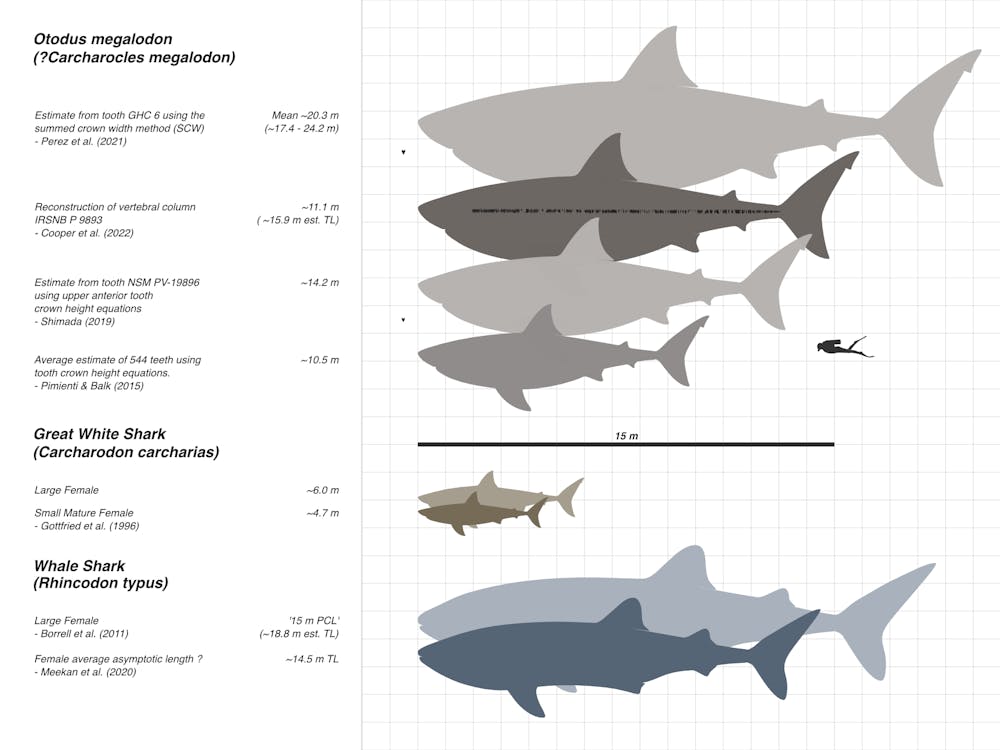
    The average size of a mature great white (Carcharodon carcharias, also known as the white shark) is between 4.6 and 4.9 metres for female sharks and up to 4 metres for male sharks.

    The largest recorded living specimens peak at about 6 metres, with one monster specimen caught in Cuba in 1945 reaching 6.4 metres.

    Earth’s oceans have seen bigger predatory sharks in the past. The biggest one of all time was the megalodon (Otodus megalodon) which lived from 23 to 3 million years ago, and may have been up to 24 metres in length. However, it looked nothing like the modern white shark.

    We don’t know precisely how big the megalodon was, but certainly larger than the great white shark.
    Steveoc 86/Wikimedia Commons, CC BY-SA

    They’re not even directly related – another thing scientists learned quite recently.

    Who was the megalodon, then?

    White sharks first evolved between 6 and 4 million years ago in the shadows of the megalodon. A recent study showed the megalodon’s large serrated teeth show signs of it being a supreme opportunistic super-predator.

    That means it ate just about anything, but especially liked whales and marine mammals.


    Read more:
    Friday essay: Giant shark megalodon was the most powerful superpredator ever. Why did it go extinct?


    But white sharks are not directly related to the megalodon, whose lineage began with a shark called Cretalamna during the age of dinosaurs about 100 million years ago.

    By contrast, the white shark lineage began with an ancient mako shark, Carcharodon hastalis. It was 7 to 8 metres long and had large, similarly shaped teeth to the modern white shark but lacking serrated edges.

    A fossil intermediate species, Carcharodon hubbelli shows the transition over time from weakly serrated to strongly serrated teeth.

    White shark fossil species. Left, the serrated fossil tooth teeth of the extant white shark; right, a similarly shaped unserrated tooth of the extinct giant mako shark which gave rise to white sharks.
    John Long, CC BY

    How did Jaws affect white shark populations?

    Last year, the International Shark Attack File reported 47 unprovoked shark bites to humans worldwide, resulting in seven fatalities. This was well below the previous ten-year average of 70 bites per year; your chances of getting bitten by a shark are extremely rare.

    Following the movies that made up the Jaws franchise, there was an increase in hunting and killing sharks – with a particular focus on great white sharks that were already going into a decline due to overfishing, trophy hunting and lethal control programs.

    Between 80% and 90% of white sharks have disappeared globally since the middle of the 20th century. Recent estimates calculate there are probably less than 500 individual white sharks in Australian waters right now.

    When Jaws first aired, scientists didn’t know how long sharks took to reproduce, or how many offspring a white shark could have each year. We now know it takes about 26 years for a male and 33 years for a female to sexually mature before they can start having pups.

    Data about white shark births is sparse, but recently a 5.6-metre-long female caught on a drum line off the coast of Queensland had just four large pups inside her. This is a very small number. Some large sharks, such as the whale shark, can give birth to up to 300 young.

    Now that we know just how slow they are to breed, it’s clear it will take many decades to reestablish the “pre-Jaws” population of white sharks – important apex predators in the marine ecosystem.

    Charlie Huveneers from Flinders University about to take a tissue sample for research on white sharks. There is still a lot we don’t know about their biology.
    Andrew Fox, Adelaide, CC BY

    Will white sharks survive?

    White sharks are currently listed as vulnerable.

    This classification means if we don’t change the current living conditions for white sharks, including impacts caused by human activities such as commercial fishing, and the impacts of climate change and ocean pollution, they will continue to decline and eventually could go extinct.

    Currently, white sharks are protected in several countries and form the basis for an important tourist industry in Australia, South Africa, western United States and most recently Nova Scotia, Canada.

    These sharks are iconic apex predators that fascinate people. One of us (John) went cage diving with them recently off the Neptune Islands of South Australia and can attest to how breathtaking it is to watch them in their natural environment.

    In terms of economic impact, they are worth far more alive than dead.

    White sharks are a growing tourism draw in several countries.
    Andrew Fox, Adelaide, CC BY

    There’s still much we don’t know about white sharks

    The complete white shark genome was first published only in 2019. It has 4.63 billion base pairs, making it much larger than the human genome (3.2 billion base pairs).

    The genome revealed some surprising things, like how white sharks show strong molecular adaptations for wound-healing processes, and a suite of “genome stability” genes – those used in DNA repair or DNA damage response.

    The transcriptome (or sum total of the messenger RNA) of the white shark showed greater similarity to the human transcriptome than to that of other fishes. This hints that “unexpressed genes” in the shark could one day play a role in uncovering genetic pathways for potential cures in human diseases.

    Jaws and its sequels certainly brought white sharks to the attention (and nightmares) of humans, with devastating impacts on how we treated them as a species.

    Our relationship with white sharks reflects our relationship with nature more broadly – a feared antagonist within the current capitalist paradigm; an enemy to be tamed, contained or consumed.

    As we learn more of the peril and potential of these remarkable creatures, we can learn how to live with them, to see beyond our fears and value their role within our delicate ocean ecosystems.

    John Long receives funding from The Australian Research Council.

    Heather L. Robinson does not work for, consult, own shares in or receive funding from any company or organisation that would benefit from this article, and has disclosed no relevant affiliations beyond their academic appointment.

    ref. Jaws at 50: how a single movie changed our perception of white sharks forever – https://theconversation.com/jaws-at-50-how-a-single-movie-changed-our-perception-of-white-sharks-forever-258306

    MIL OSI AnalysisEveningReport.nz

  • MIL-OSI: Red Cat Holdings Announces Closing of $46.75 Million Registered Direct Offering of Common Stock

    Source: GlobeNewswire (MIL-OSI)

    SAN JUAN, Puerto Rico, June 18, 2025 (GLOBE NEWSWIRE) — Red Cat Holdings, Inc. (Nasdaq: RCAT) (“Red Cat” or “Company”), a drone technology company integrating robotic hardware and software for military, government, and commercial operations, has successfully closed the previously announced registered direct offering with certain institutional investors for the purchase and sale of 6,448,276 shares of common stock resulting in gross proceeds of approximately $46.75 million, before deducting placement agent fees and other offering expenses. The offering closed on June 18, 2025.

    The Company intends to use net proceeds from the offering for general corporate and working capital purposes, including but not limited to operating expenditures related to its new unmanned surface vessel division.

    “We believe this financing positions Red Cat for significant growth in the drone industry and will accelerate our product development and production for our newly formed Unmanned Surface Vessels (USVs) division for the maritime autonomy market,” said Jeff Thompson, Founder, Chairman and Chief Executive Officer of Red Cat.

    Recent Operational Highlights

    • Expansion of our manufacturing capacity by moving the Edge 130 production to a new, larger facility that will produce 150 Edge 130s per month and is in process of doubling the Black Widow production capacity, enabling an eventual production of 1,000 per month.
    • We have been diligently working to identify top talent and manufacturing capacity for our USV division to meet end market demand for maritime applications.
    • Reiterate 2025 annual revenue guidance of $80 to $120 million for calendar year 2025, which consists of:
      • $25 to $65 million in SRR-related Black Widow sales
      • $25 million in Non-SRR Black Widow sales
      • $25 million in Edge 130 sales
      • $5m in Fang FPV sales

    Northland Capital Markets acted as the exclusive placement agent and Ladenburg Thalmann served as financial advisor for the transaction.

    The offering is being made pursuant to an effective shelf registration statement on Form S-3 (File No. 333-283242), which was declared effective by the Securities and Exchange Commission (the “SEC”) on December 11, 2024. A final prospectus supplement and the accompanying prospectus relating to the registered direct offering will be filed with the SEC and will be available on the SEC’s website located at http://www.sec.gov. Additionally, when available, electronic copies of the final prospectus supplement and the accompanying prospectus may be obtained, when available, from Northland Securities, Inc., 150 South Fifth Street, Suite 3300, Minneapolis, MN.

    This press release shall not constitute an offer to sell or the solicitation of an offer to buy any of the securities described herein, nor shall there be any sale of these securities in any state or jurisdiction in which such offer, solicitation, or sale would be unlawful prior to registration or qualification under the securities laws of any such state or jurisdiction.

    About Red Cat Holdings, Inc.

    Red Cat (Nasdaq: RCAT) is a drone technology company integrating robotic hardware and software for military, government, and commercial operations. Through two wholly owned subsidiaries, Teal Drones and FlightWave Aerospace, Red Cat has developed a leading-edge Family of Systems. This includes the flagship Black Widow™, a small unmanned ISR system that was awarded the U.S. Army’s Short Range Reconnaissance (SRR) Program of Record contract. The Family of Systems also includes TRICHON™, a fixed wing VTOL for extended endurance and range, and FANG™, the industry’s first line of NDAA compliant FPV drones optimized for military operations with precision strike capabilities. Learn more at www.redcat.red.

    Safe Harbor Forward-Looking Statements

    This press release contains “forward-looking statements” that are subject to substantial risks and uncertainties. All statements, other than statements of historical fact, contained in this press release are forward-looking statements. Forward-looking statements contained in this press release may be identified by the use of words such as “anticipate,” “believe,” “contemplate,” “could,” “estimate,” “expect,” “intend,” “seek,” “may,” “might,” “plan,” “potential,” “predict,” “project,” “target,” “aim,” “should,” “will” “would,” or the negative of these words or other similar expressions, although not all forward-looking statements contain these words. Such statements include, but are not limited to, statements relating to our intended use of proceeds from the offering, annual revenue guidance, future manufacturing capacities and future market demand. Forward-looking statements are based on Red Cat Holdings, Inc.’s current expectations and are subject to inherent uncertainties, risks and assumptions that are difficult to predict. Further, certain forward-looking statements are based on assumptions as to future events that may not prove to be accurate. These and other risks and uncertainties are described more fully in the section titled “Risk Factors” in the Form 10-KT filed with the Securities and Exchange Commission on March 31, 2025. Forward-looking statements contained in this announcement are made as of this date, and Red Cat Holdings, Inc. undertakes no duty to update such information except as required under applicable law.

    Contact:

    INVESTORS:
    E-mail: Investors@redcat.red

    NEWS MEDIA:
    Phone: (347) 880-2895
    Email: peter@indicatemedia.com

    The MIL Network

  • MIL-OSI: Red Cat Holdings Announces Closing of $46.75 Million Registered Direct Offering of Common Stock

    Source: GlobeNewswire (MIL-OSI)

    SAN JUAN, Puerto Rico, June 18, 2025 (GLOBE NEWSWIRE) — Red Cat Holdings, Inc. (Nasdaq: RCAT) (“Red Cat” or “Company”), a drone technology company integrating robotic hardware and software for military, government, and commercial operations, has successfully closed the previously announced registered direct offering with certain institutional investors for the purchase and sale of 6,448,276 shares of common stock resulting in gross proceeds of approximately $46.75 million, before deducting placement agent fees and other offering expenses. The offering closed on June 18, 2025.

    The Company intends to use net proceeds from the offering for general corporate and working capital purposes, including but not limited to operating expenditures related to its new unmanned surface vessel division.

    “We believe this financing positions Red Cat for significant growth in the drone industry and will accelerate our product development and production for our newly formed Unmanned Surface Vessels (USVs) division for the maritime autonomy market,” said Jeff Thompson, Founder, Chairman and Chief Executive Officer of Red Cat.

    Recent Operational Highlights

    • Expansion of our manufacturing capacity by moving the Edge 130 production to a new, larger facility that will produce 150 Edge 130s per month and is in process of doubling the Black Widow production capacity, enabling an eventual production of 1,000 per month.
    • We have been diligently working to identify top talent and manufacturing capacity for our USV division to meet end market demand for maritime applications.
    • Reiterate 2025 annual revenue guidance of $80 to $120 million for calendar year 2025, which consists of:
      • $25 to $65 million in SRR-related Black Widow sales
      • $25 million in Non-SRR Black Widow sales
      • $25 million in Edge 130 sales
      • $5m in Fang FPV sales

    Northland Capital Markets acted as the exclusive placement agent and Ladenburg Thalmann served as financial advisor for the transaction.

    The offering is being made pursuant to an effective shelf registration statement on Form S-3 (File No. 333-283242), which was declared effective by the Securities and Exchange Commission (the “SEC”) on December 11, 2024. A final prospectus supplement and the accompanying prospectus relating to the registered direct offering will be filed with the SEC and will be available on the SEC’s website located at http://www.sec.gov. Additionally, when available, electronic copies of the final prospectus supplement and the accompanying prospectus may be obtained, when available, from Northland Securities, Inc., 150 South Fifth Street, Suite 3300, Minneapolis, MN.

    This press release shall not constitute an offer to sell or the solicitation of an offer to buy any of the securities described herein, nor shall there be any sale of these securities in any state or jurisdiction in which such offer, solicitation, or sale would be unlawful prior to registration or qualification under the securities laws of any such state or jurisdiction.

    About Red Cat Holdings, Inc.

    Red Cat (Nasdaq: RCAT) is a drone technology company integrating robotic hardware and software for military, government, and commercial operations. Through two wholly owned subsidiaries, Teal Drones and FlightWave Aerospace, Red Cat has developed a leading-edge Family of Systems. This includes the flagship Black Widow™, a small unmanned ISR system that was awarded the U.S. Army’s Short Range Reconnaissance (SRR) Program of Record contract. The Family of Systems also includes TRICHON™, a fixed wing VTOL for extended endurance and range, and FANG™, the industry’s first line of NDAA compliant FPV drones optimized for military operations with precision strike capabilities. Learn more at www.redcat.red.

    Safe Harbor Forward-Looking Statements

    This press release contains “forward-looking statements” that are subject to substantial risks and uncertainties. All statements, other than statements of historical fact, contained in this press release are forward-looking statements. Forward-looking statements contained in this press release may be identified by the use of words such as “anticipate,” “believe,” “contemplate,” “could,” “estimate,” “expect,” “intend,” “seek,” “may,” “might,” “plan,” “potential,” “predict,” “project,” “target,” “aim,” “should,” “will” “would,” or the negative of these words or other similar expressions, although not all forward-looking statements contain these words. Such statements include, but are not limited to, statements relating to our intended use of proceeds from the offering, annual revenue guidance, future manufacturing capacities and future market demand. Forward-looking statements are based on Red Cat Holdings, Inc.’s current expectations and are subject to inherent uncertainties, risks and assumptions that are difficult to predict. Further, certain forward-looking statements are based on assumptions as to future events that may not prove to be accurate. These and other risks and uncertainties are described more fully in the section titled “Risk Factors” in the Form 10-KT filed with the Securities and Exchange Commission on March 31, 2025. Forward-looking statements contained in this announcement are made as of this date, and Red Cat Holdings, Inc. undertakes no duty to update such information except as required under applicable law.

    Contact:

    INVESTORS:
    E-mail: Investors@redcat.red

    NEWS MEDIA:
    Phone: (347) 880-2895
    Email: peter@indicatemedia.com

    The MIL Network

  • MIL-OSI USA: Durbin: Instead Of Conducting Critical Oversight, Judiciary Committee Republicans Are Holding Partisan Hearing Armchair Diagnosing Former President Biden

    US Senate News:

    Source: United States Senator for Illinois Dick Durbin

    June 18, 2025

    WASHINGTON – U.S. Senate Democratic Whip Dick Durbin (D-IL), Ranking Member of the Senate Judiciary Committee, slammed Senate Judiciary Committee Republicans for holding a partisan hearing today where they plan to armchair diagnose former President Biden. In his opening remarks, Durbin called out the lack of oversight the Committee has conducted so far under the Trump Administration, despite the numerous, critical challenges facing the nation that are under the Committee’s jurisdiction.

    By this date in Durbin’s first year as Chair, the Committee had already held two major oversight hearings with Biden Administration agency heads, including one with FBI Director Wray on domestic terrorism threats. So far, the Republican majority on this Committee has not held a single oversight hearing.

    “This Committee has oversight responsibility over the Department of Justice, the Federal Bureau of Investigation, and the Department of Homeland Security. We have a constitutional duty to hold these agencies accountable with public hearings,” Durbin said. “In the last week alone, several events have demanded this Committee’s immediate attention: the horrific assassination in Minnesota, the treatment of our colleague Senator Padilla by federal agents in Los Angeles, and President Trump’s unprecedented deployment of the U.S. military in Los Angeles.”

    Durbin continued, “We should hear without delay from Attorney General Bondi and FBI Director Patel about what they are doing to address the unacceptable political violence in our country, including threats to Article III judges and justices, as well as members of Congress. And we need to hear from Homeland Security Secretary Noem about the treatment of our colleagues, Senator Padilla, and this Administration’s mass deportation campaign against immigrants. But instead of exercising this constitutional oversight duty, my Republican colleagues are holding this hearing. Apparently, armchair diagnosing former President Biden is more important than the current issues of grave concern that I have mentioned.”

    Durbin went on to note just a few examples of issues that the Senate Judiciary Committee should be addressing.

    “The Trump Administration has removed dozens of senior career prosecutors and FBI officials with decades of national security expertise, leaving our nation more vulnerable to terrorism and other national security threats. This should be explained to this Committee,” Durbin said. “The Justice Department has diverted hundreds of law enforcement agents away from combatting cartels, drug trafficking, and gun violence to participate in President Trump’s mass deportation campaign. This should be addressed in an open hearing of this Committee.”

    Durbin continued, “The Justice Department is also turning a blind eye to corruption. The Administration has gutted the Department of Justice’s Public Integrity Section, which oversees political corruption cases, just as the President’s shameful crypto scheme unfolds. And the Administration has removed the Department of Justice’s career ethics officials and shut down the office charged with investigating misconduct by DOJ attorneys.”

    Durbin then called out how his Republican colleagues are eager to discuss President Biden’s pardons, but are ignoring the actual pardon crisis of President Trump’s “pay-to-play” scheme. Durbin highlighted the story of Paul Walczak, whom President Trump pardoned after Walczak pleaded guilty in 2024 to withholding more than $7 million of taxes from his employees’ paychecks and failing to pay the IRS.

    “What warranted Mr. Walczak’s swift pardon by President Trump? His pardon application explicitly cited millions of dollars his mother raised for President Trump’s campaigns and other efforts to support the President. But that was not enough,” Durbin said. “It was three weeks after Mr. Walczak’s mother attended a $1 million a person Trump fundraiser in April of this year that Mr. Walczak was miraculously receiving his pardon—and now he no longer must pay $4.4 million to the taxpayers of this country. That’s one example of the many pardons granted to President Trump’s wealthy donors and political supporters.”

    Durbin continued, “And, of course, these pay-to-play pardons are in addition to the more than 1,500 January 6 rioters who received blanket pardons from President Trump, including 169 who violently assaulted law enforcement officials.”

    Durbin concluded, “If my colleagues are truly interested in issues of presidential succession and disability under the 25th Amendment, I would suggest they embark on this constitutional journey with a proposed amendment, not today’s political adventure.”

    Video of Durbin’s opening statement is available here.

    Audio of Durbin’s opening statement is available here.

    Footage of Durbin’s opening statement is available here for TV Stations.

    -30-

    MIL OSI USA News

  • MIL-OSI Canada: Alberta’s tourism soars past national average

    Source: Government of Canada regional news (2)

    MIL OSI Canada News

  • MIL-Evening Report: Tracing the Drax family’s millions – a story of British landed gentry, slavery and sugar plantations

    Source: The Conversation (Au and NZ) – By Paul Lashmar, Reader in Journalism, City St George’s, University of London

    ‘Planting the sugar-cane’: vast fortunes were made from the trades in both sugar and human slaves in the Americas. Schomburg Center for Research in Black Culture, Photographs and Prints Division, The New York Public Library

    Rich British aristocratic families with a legacy of owning colonial slave plantations are often accused by campaigners that their wealth solely originates from these plantations. One frequent target of this criticism has been the Drax family of Dorset, which is headed by Richard Grosvenor Plunkett-Ernle-Erle-Drax, who was the Conservative MP for South Dorset until July 2024.

    Historian Alan Lester of the University of Sussex has noted of Drax (as he is commonly known): “Much of his fortune is inherited, coming down the family line from ownership of the Drax sugar plantations and the 30,000 enslaved people who worked them as Drax property for 180 years before emancipation in Barbados.”

    Recently, I have researched and written a book on the Drax family’s history and involvement in the slave trade in the Caribbean, Drax of Drax Hall, that gives fresh insights into the level of wealth they derived from the sugar trade and the trade in African slaves who worked their plantations – as well as the family’s other income sources.

    I searched the archives in the UK and Caribbean for evidence of their revenue streams until Britain’s 1834 abolition of slavery in the colonies. I estimate that the family today are worth more than £150 million from their land and property in Dorset and Yorkshire.


    Get your news from actual experts, straight to your inbox. Sign up to our daily newsletter to receive all The Conversation UK’s latest coverage of news and research, from politics and business to the arts and sciences.


    Over a period of two centuries until 1834, eight generations of Drax ancestors owned and worked hundreds of enslaved African captives at any one time. The latest beneficiary of primogeniture – the legal concept that recognises the first-born child as heir to a familiy’s fortune – Richard Drax inherited the family’s still-operating 621-acre Drax Hall plantation in Barbados in 2021.

    Drax, 67, has said: “I am keenly aware of the slave trade in the West Indies, and the role my very distant ancestor played in it is deeply, deeply regrettable. But no one can be held responsible today for what happened many hundreds of years ago. This is a part of the nation’s history, from which we must all learn.”

    My research reveals the sources of his family’s wealth are more complex than the critics’ claims that it all derives from the slave-worked plantations.

    Like most British landed gentry, much of the Drax family income has come as extensive landlords of their British estates which, in 1883, exceeded 23,000 acres across various counties. Today, it includes nearly 16,000 acres in Dorset and 2,520 acres in the Yorkshire Dales.

    However, my research also shows the Drax family made more money from slavery than was previously thought, when taking into account the way revenues from their plantations were channelled into the family’s British estates over the two centuries of slavery.

    Drax Hall plantation in Barbados

    The Drax Hall plantation in the Barbados parish of Saint George has been described by Barbadian historian Sir Hilary Beckles, chair of the Caribbean Community reparations commission, as a “killing field” where as many as 30,000 slaves died in brutal conditions. Despite pressure from reparation campaigners in the Caribbean, Britain and elsewhere, Richard Drax has declined to make a formal public apology or gesture of recompense in the Caribbean for the years of slavery.

    A 19th-century drawing of Drax Hall plantation in Barbados.
    Unknown source, Wikimedia Commons

    As the prime minister of Barbados, Mia Mottley, explained in April 2024, despite the efforts of her government Drax has yet to agree to a settlement, pay reparations or contribute all or part of his family’s Drax Hall plantation to provide affordable housing or become a memorial to those who worked and died in colonial enslavement on the island.

    Some other British landed families whose ancestors owned slave plantations in the Caribbean, including the Trevelyans (who owned six slave plantations in Grenada) and the Gladstones (British prime minister William Gladstone’s father owned plantations in Guyana), have made formal apologies and reparations. And while some families have kept the terms of these reparations private, longtime BBC reporter Laura Trevelyan made a US$100,000 (£73,000) donation to a Caribbean development fund.

    The largest family estate

    Four thousand miles from Barbados, Richard Drax lives in Charborough House, a historic 17th-century mansion in Dorset. He oversees the 23.5-square mile estate, the largest family estate in Dorset with over 120 properties, many of which are rented out.

    Charborough was acquired by Drax’s ancestor Walter Erle by marriage in 1549. The family has gradually increased the estate over the centuries. Historically, their income comes from renting land to tenant farmers and cottages to agricultural workers. This, I identified, is where the bulk of their income has come from.

    Charborough House: the Drax family seat in Dorset.
    John Lamper/Wikimedia Commons, CC BY-SA

    However, profits from sugar produced by slavery also poured into the family coffers over 200 years. Richard Drax’s remote ancestor James Drax (1609-1661) was one of the first settler group to arrive in the then-uninhabited island of Barbados in 1627. In his introduction to my book, TV historian David Olusoga writes that the Drax family were key players – arguably the key players – in the origin story of British slavery:

    The Drax Hall plantation, the first estate on which a crop of sugar was commercially grown and processed by any English planter, became one of the laboratories in which early English slavery was developed and finessed.

    Built around 1650, the Jacobean plantation house is thought to be the one of the three oldest extant residential buildings in the Americas. From the 17th into the 18th century, the Draxes created and owned the largest acreage in Barbados with the Drax Hall and and Mount plantations – plus a 3,000-acre estate, also called Drax Hall, in Jamaica. The family became enormously wealthy: James Drax was said by a visitor to Drax Hall in the 1640s to “live like a prince”, putting on lavish dinners for friends and guests.

    In addition to owning slaves, James Drax shipped African captives to Barbados as a key part of the trade in slaves. Knighted by both Oliver Cromwell and Charles I, by 1660 he was a director and investor in the English East India Company which, in part, traded and exploited enslaved people.

    Paul Lashmar’s book, Drax of Drax Hall.
    Bookshop.com

    In her 1930 study, American historian Elizabeth Donnan presented evidence that the Draxes of the 17th century operated “off the books” – buying enslaved people from, and selling them to, “interloper” ships that circumvented the Royal African Company’s monopoly of slave trading to the colonies.

    The Drax family married into the Erle family in 1719, combining three fortunes: that of the Erles of Charborough, the Draxes of Yorkshire, Barbados and Jamaica, and the landed-gentry Ernles of Wiltshire.

    Despite being deeply involved in the South Sea Bubble scandal, the Drax family flourished. The slave registers in the National Archives show that between 1825 and 1834, the Drax Hall plantation in Barbados produced an average of 163 tonnes of sugar and 4,845 gallons of rum per year. This gave the family an average annual net profit of £3,591 – equivalent to about £600,000 now. Today, the plantation still produces 700 tonnes of sugar a year, earning the family something in the region of £250,000.

    Pressure for reparations

    In recent years, the value of Drax Hall’s land in Barbados has greatly increased as it is sought after for housing, and could now be worth as much as Bds$150,000 (£60,000) per acre. At the same time, pressure for reparations is growing. In 2023, the African Union threw its weight behind the Caribbean reparations campaign.

    David Comissiong, deputy chairman of the Barbados reparations task force, has said: “Other families are involved, though not as prominently as the Draxes. This reparations journey has begun.”

    Yet to date, the only reparations paid in the story of the Drax family’s involvement in the slave trade were to the family itself. In 1837, Jane-Frances Erle-Drax, the heiress of Charborough, received £4,293 12s 6d (worth more than £614,000 today) in reparations for freeing 189 slaves from Drax Hall plantation after the abolition of slavery in the colonies.

    In the course of researching and writing my book, I approached Richard Drax both directly and through his lawyers and put the claims made here to him. He had no comment to add.

    This page contains references to books included for editorial reasons, which may include links to bookshop.org. If you click on one of the links and go on to buy something from bookshop.org, The Conversation UK may earn a commission.

    Paul Lashmar is affiliated with the Labour Party.

    ref. Tracing the Drax family’s millions – a story of British landed gentry, slavery and sugar plantations – https://theconversation.com/tracing-the-drax-familys-millions-a-story-of-british-landed-gentry-slavery-and-sugar-plantations-257376

    MIL OSI AnalysisEveningReport.nz

  • MIL-OSI United Nations: Experts of the Committee on the Elimination of Discrimination against Women Commend Mexico’s Equality Achievements in Political and Public Life, Raise Questions on the Judiciary’s Response to Gender Crimes and Gender-Based Violence in Schools

    Source: United Nations – Geneva

    The Committee on the Elimination of Discrimination against Women today concluded its consideration of the tenth periodic report of Mexico, with Committee Experts commending Mexico’s achievements in guaranteeing equality in political and public life, while raising questions on how the judiciary responded to gender crimes and how the State was tackling gender-based violence in schools.

    A Committee Expert said the Committee commended the State party’s achievements in guaranteeing equality in political and public life.  Reforms had been implemented towards preventing and eliminating gender discrimination.  This had resulted in a 43 per cent improvement in women’s public leadership positions.  The Committee lauded the 2019 constitutional reform, entitled “gender parity in everything”, which guaranteed political rights of women towards certifying gender parity for all candidates for elected political office, including municipalities with indigenous and Afro-Mexican populations. 

    An Expert asked what mechanisms the State had put in place to guarantee an effective, gender-sensitive judicial response?  Were there reparations available for victims of gender crimes?  What measures were being planned to ensure elected judges had knowledge to judge with a gender perspective?  Could statistics be provided on the fast-track and pretrial procedure, to illustrate how female victims had benefitted from these changes? Had the performances of judges who had been trained been assessed? 


    A Committee Expert said the Committee noted with concern the high school dropout rates due to pregnancy and violence.  The ongoing persistence and increase of violence against women and adolescents, at all educational levels, was also concerning, particularly high levels of sexual violence.  What measures had the State taken to guarantee education for pregnant teenagers and to prevent them from leaving school?  How was it ensured that comprehensive sexual education was provided at all levels and in all states?  Was there a plan to ensure the eradication of gender-based violence in schools?  What measures was the State taking to guarantee standardisation and the enforcement of penalties?


    The delegation said Mexico had special prosecution services in different bodies.  These ensured that the highest standards were used when investigating cases of femicide.  In cases of femicide, it was important to comply with standards relating to the crime.  Protocols had been standardised for the crimes of femicide.  The Tribunal of Judicial Discipline had been created to combat impunity.  The Women’s Secretariat was working with the Department of Prosecutions to create a network of female lawyers to provide advice and organise strategic lawsuits.

    The delegation said in 2024, Mexico significantly invested in the training of teachers, as part of the national strategy to deal with and prevent teenage pregnancy.  This also focused on keeping teenagers who were pregnant in school.  A programme called violence free schools supported people working in schools.  A protocol had been ratified to ensure the referral, channelling, follow-up and prevention of sexual violence in schools.  School dropout rates had fallen by 75 per cent for basic education, 26 per cent for secondary education, and 18 per cent in further education.  A national strategy was in place to prevent early pregnancy and there had been a 10 per cent drop in early pregnancy in Mexico over the past three years.   

    Introducing the report, Citlalli Hernández Mora, Secretary, Women’s Secretariat of Mexico and head of the delegation, said for decades, there had been a system of structural inequality which had intensified violence against women in Mexico. Legislative reforms by the President, which came into force in November 2024, established reinforced duties of the State to combat all types of violence against women, as well as the eradication of the gender wage gap.  The reforms also created the Women’s Secretariat, tasked with preventing violence against women, promoting a society of care, and reducing structural gaps. From 2019 to 2024, the gender pay gap was reduced by 29 per cent at the local level.

    In closing remarks, Ms. Hernández Mora commended the Committee for its work and the experts for their questions and comments.  The Committee’s recommendations were very important for the Government, and the dialogue had been an enriching experience.  Mexico was committed to changing the lives of all women in the country.

    In her closing remarks, Nahla Haidar, Committee Chair, thanked Mexico for the constructive dialogue which had provided further insight into the situation of women and girls in the country. 

    The delegation of Mexico was comprised of representatives of the Ministry of Foreign Affairs; the Ministry of Public Education; the Ministry of Health; the Secretariat of Women; the Mexican Social Security Institute; the Legislative Branch; the Judiciary; the National Institute of Statistics and Geography; the Electoral Tribunal of the Judicial Branch of the Federation; the National Electoral Institute; the National Council of Indigenous Peoples; and the Permanent Mission of Mexico to the United Nations Office at Geneva.

    The Committee on the Elimination of Discrimination against Women’s ninety-first session is being held from 16 June to 4 July.  All documents relating to the Committee’s work, including reports submitted by States parties, can be found on the session’s webpage.  Meeting summary releases can be found here.  The webcast of the Committee’s public meetings can be accessed via the UN Web TV webpage.

    The Committee will next meet at 10 a.m. on Thursday, 19 June, to begin its consideration of the eighth periodic report of Thailand (CEDAW/C/THA/8).

    Report

    The Committee has before it the tenth periodic report of Mexico (CEDAW/C/MEX/10).

    Presentation of Report

    FRANCISCA E. MÉNDEZ ESCOBAR, Ambassador and Permanent Representative of Mexico to the United Nations Office at Geneva, said Mexico had hosted the First World Conference on Women in 1975 and was an active promoter of the Convention. Mexico was also involved in the creation of numerous mechanisms and groups, including United Nations Women. The State was committed to respecting, protecting, and promoting the human rights of women and girls in all their diversity.

    CITLALLI HERNÁNDEZ MORA, Secretary, Women’s Secretariat of Mexico and head of the delegation, said under the leadership of the first woman President of Mexico and as the State’s first Secretary for Women, she was pleased to lead the delegation. 

    For decades, there had been a system of structural inequality which had intensified violence against women in Mexico.  Legislative reforms by the President, which came into force in November 2024, established reinforced duties of the State to combat all types of violence against women, as well as the eradication of the gender wage gap.  The reforms also created the Women’s Secretariat, tasked with preventing violence against women, promoting a society of care, and reducing structural gaps. 

    In 2024, Mexico had 132.27 million inhabitants, of which 51.08 per cent were women; 9 per cent were indigenous women; 2 per cent were women with disabilities; and 1 per cent were Afro-Mexican women, requiring the State to build inclusive and intercultural policies.  The poorest person in Mexico was an indigenous girl with disabilities, which was why 45 billion dollars had been invested, allowing 3.5 million women to escape moderate poverty over the past six years. 

    From 2019 to 2024, the gender pay gap was reduced by 29 per cent at the local level.  The implementation of the New Mexican School System with a gender perspective had promoted actions to guarantee inclusive, egalitarian and quality education for children and young people in Mexico.  The first 12 of the 200 Education and Child Centres were being built, prioritising highly vulnerable areas such as the maquiladoras on the northern border.  The Pension Fund was launched this year for women between 60 and 64 years of age and had reached over 900,000 women. 

    The Women’s Secretariat had installed 678 LIBRE centres throughout the national territory, with an investment of almost 40 million dollars per year, which sought to offer comprehensive care, legal and psycho-emotional support to those who experience violence.  In March of this year, the Tejedoras de la Patria initiative was launched, which encompassed a national network of women protagonists to guide, lead and support their communities. 

    INGRID GÓMEZ, Undersecretary for the Right to a Life Free of Violence, Women’s Secretariat of Mexico, said femicide violence was one of the greatest challenges faced by the Mexican State.  The implementation of targeted territorial strategies, the strengthening of protection mechanisms for women at risk, and the improvement of victim care systems had resulted in a sustained downward trend in the incidence of femicides. During the first two months of 2025, there had been a decrease of 29.23 per cent reported cases compared to the same period in 2024.  This was the result of a coordinated institutional response, which included early warning of risk, strengthening and expanding the Women’s Justice Centres, specialised shelters, mobile units, and other protection measures. 

    Following the recommendation of the Committee, Mexico had made progress in the legislative harmonisation of the criminal category of femicide, which had been achieved in 28 of the 32 states.  The National Programme against Trafficking in Persons had been the backbone, promoting prevention, protection, prosecution and comprehensive care for victims.  The Office of the Special Prosecutor for the Investigation of Crimes in the Matter of Trafficking in Persons was created, which was a significant step. 

    JENNIFER FELLER, Director General of Human Rights and Democracy of the Ministry of Foreign Affairs of Mexico, said the Protection Mechanism for Human Rights Defenders and Journalists was a key tool to guarantee the safety and integrity of women human rights defenders and journalists.  As of April 2025, it had a total of 2,341 people, including female journalists, human rights defenders and their family members. 

    The Mexican State was sensitive to cases of disappearance of persons, including women. In 2019, the National Search Commission was created and, for the first time, a National Registry of Missing and Unlocated Persons was developed.  With the Attorney General’s Office and the State Prosecutors’ Offices, visits had been made to expert service institutions, temporary protection centres, cemeteries and shelters, to carry out human identification processes and interventions to recover remains deposited in mass graves.  The Mexican State continued with the search actions to locate all these people and had undertaken dialogue with almost 200 collectives of relatives of disappeared persons, with multiple Government institutions. 

    TERESA RAMOS ARREOLA, Head of the National Centre for Gender Equity, Sexual and Reproductive Health of Mexico, said 100 commitments had been made for the President’s six-year term, including the Care Programme from the first 1,000 days of life, which guaranteed access to women’s health services, especially reproductive health, bodily autonomy, and the prevention of gender violence.  In Mexico, contraception was free and 24 of the country’s 32 states had decriminalised abortion.  A technical note had been issued which outlined the obligation of the health sector to have available personnel and the necessary technical capacities to provide safe abortion services.


    YANETH DEL ROSARIO CRUZ GÓMEZ, Representative of Mexico’s National Council of Indigenous Peoples, said the reform of the second article of the Constitution, published in September 2024, should be celebrated.  It constituted a historic advance in the recognition of indigenous peoples as rights holders, with legal recognition and their own assets. However, the implementation of these rights was a challenge.  It was urgent for indigenous rights to be effectively implemented. 

    Indigenous and Afro-Mexican women were developing the general law on the rights of indigenous and Afro-Mexican peoples.  The resources allocated to indigenous peoples and communities, through the Contribution Fund for Social Infrastructure for Indigenous and Afro-Mexican Peoples, were welcomed. 

    MARTHA LUCÍA MICHER CAMARENA, Federal Senator and President of the Commission for Gender Equality of the Senate of the Republic, said in Mexico, they had a parity legislative power; there were 14 female governors in 32 states.  In December 2024, amendments were approved to various secondary laws, including the general law for equality between women and men; the general law on women’s access to a life free of violence; the National Code of Criminal Procedure; and the general law of the national public security system, among others.  Between 2021 and 2024, key legislative reforms were also adopted, including amendments to the Federal Penal Code and 22 local penal codes that now criminalised acid attacks, as well as other types of violence, within the criminal category of family violence. 

    MÓNICA SOTO, Presiding Magistrate of the Electoral Tribunal of the Judicial Branch of the Federation, said the Electoral Tribunal of the Judicial Branch of the Federation had issued rulings to seek balanced representation in the Government. In 2024, the first parity federal Congress was constituted, after 108 years as an independent Republic. Despite this, there were significant challenges, with only 28 per cent of municipal presidencies headed by women. In many cases, violations of their rights persisted. 

    Gender-based political violence against women continued to be a reality.  However, in a historical precedent in 2021, the Superior Chamber of the Court annulled the election results in Iliatenco, Guerrero for gender-based political violence against an indigenous woman.  Authorities had been trained, and guides and protocols had been issued for judgment with a gender perspective in electoral matters and, in May 2024, the Specialised Ombudsman’s Office for the Care of Women was created. 

    MARYCARMEN COLOR VARGAS, Director of Gender Equality of the Supreme Court of Justice of the Nation, said the Supreme Court of Justice had issued a protocol for judging with a gender perspective, which was updated in 2020.  To ensure its implementation, the Court and the Council of the Federal Judiciary had deployed a training strategy with case law notebooks, manuals, thematic notes, specialised works, and self-management courses. To date, 59 per cent of federal civil servants had completed mandatory training in gender and human rights.  The Comprehensive Inclusion Policy had been adopted, which increased the participation of women at the highest judicial levels from 20 per cent to 31 per cent. 

    CITLALLI HERNÁNDEZ MORA, Secretary, Women’s Secretariat of Mexico and head of the delegation, said Mexico reaffirmed at the highest level its commitment to this Committee, to peace, and to the fight against discrimination against women and girls in all their diversity.

    Questions by a Committee Expert

    YAMILA GONZÁLEZ FERRER, Committee Expert and Country Rapporteur, said Mexico was a great country which faced colossal challenges.  Mexico should be congratulated on electing its first female President in its history, and the Committee recognised the State’s decision to adopt a feminist foreign policy, as well as the 2024 constitutional reform that incorporated the right to substantive equality, a life free from violence, and decent care.  The Committee also welcomed the constitutionalisation of the National Care System, the ratification of International Labour Organization Convention 189 on domestic work, and the progressive decriminalisation of abortion in several states.

    However, there were several issues.  The National Council to prevent discrimination seemed to have been weakened and seemed to lack power to strengthen itself; what had been done to strengthen this institution?   What steps had been taken to put in place criminal legislation which provided legal certainty for women?  What measures had the State taken to strengthen the independence of the National Human Rights Commission?  What help had it provided to women searching for the disappeared?   

    What mechanisms did the State put in place to guarantee an effective, gender-sensitive judicial response?  Were there interpreters available in indigenous languages?  Were there reparations available for victims of gender crimes? What measures were being planned to ensure elected judges had knowledge to judge with a gender perspective? Could statistics be provided on the fast-track and pretrial procedure, to illustrate how female victims had benefitted from these changes?  Had the performances of judges who had been trained been assessed? 

    Responses by the Delegation

    The delegation said that since 2018, the country had been experiencing deep seated change, including in the public administration system.  Mexico was a federal republic with 32 different constitutional bodies. It was important to mention the inclusion of discrimination in article 1 of Mexico’s Constitution.  The law on equality between men and women included a new law on discrimination.  There was a worsening situation for women in Mexico.  In non-progressive States, the situation was worse for women.  This was due to religious ideas, which impacted women’s sexual and reproductive health rights. 

    Mexico had special prosecution services in different bodies.  These ensured that the highest standards were used when investigating cases of femicide.  In cases of femicide, it was important to comply with standards relating to the crime. Protocols had been standardised for the crimes of femicide.  The Tribunal of Judicial Discipline had been created to combat impunity.  Lack of access to justice often took the form of impunity.  The Women’s Secretariat was working with the Department of Prosecutions to create a network of female lawyers to provide advice and organise strategic lawsuits.

    The National Human Rights Commission was a public independent body, with independence guaranteed in Mexican laws.  It issued recommendations on human rights violations when there was a gender element, and had general recommendations on femicide.  The Constitutional reform outlined the rights of indigenous peoples to be assisted by an interpreter, which must be taken into account to ensure appropriate defence in court. 

    The reform of the judiciary began with a desire to see parity in access, including equal representation of men and women as judges and magistrates.  Currently, only 30 per cent of these positions were held by women.  A judicial school would focus specifically on training.  A guidebook was being created for gender-based judgements which would represent a crucial tool.  There was one training programme which was binding for all members of the judiciary, and it was helping the State achieve progress. 

    The previous corruption of the judiciary did not allow women or relatives of killed women to defend themselves.  Unofficial pretrial was used due to the corruption of the judiciary.  Many judges would free perpetrators of femicide who would then threaten the relatives of murdered women. 

    Questions by Committee Experts

    A Committee Expert congratulated Mexico on the election of the first female President, and recognised the steps taken to achieve gender equality, including the creation of the first Ministry for Women in 2024.  What concrete steps was Mexico taking to strengthen effective coordination between national institutions on policies relating to the rights of women and girls, in light of technical and financial challenges; what concrete steps were being provided to strengthen their international capacity?  How was it ensured that institutions received technical resources to support their work? 

    Another Expert said Parliament had a high level of women’s representation, and as heads of Government.  However, while women comprised 50 per cent of candidates for mayoral elections, they were not being elected at the same rate, and faced barriers, including political violence and stereotypes.  Why had Mexico not adopted temporary special measures in this regard?  What temporary special measures had the State adopted to ensure parity in decision-making positions?  What about for the heads of corporate and private companies? Would the State consider adopting a positive discrimination act?   

    Responses by the Delegation

    The delegation said since 2018, Mexico had promoted the participation of women in the peace and security sector.  Work had been carried out to mainstream gender issues in all budgets and Government actions.  This year, half the budget was allocated for men, and half for women.  The budget aimed to make up areas of weakness in inequality.  The National Programme for Equality between men and women had mechanisms for follow-up and for impact assistance.  A national system was in place for the prevention and eradication of violence. A national database included a recording or registration of incidents of violence of women and girls; this was a register which different bodies fed information into.  The State aimed to have a living database which gave a clear overview of cases. 

    Mexico already had a law on equality.  As part of the 2021 electoral process, the competitive block system had been used. As part of the block, three levels of competitiveness were established in different areas.  This aimed to ensure women were candidates in places where they had a real chance of winning, which aimed to improve women’s participation at the local political levels.  In Mexico, there was no quota in place, but legislation was amended to bring about equality between men and women in elections. 

    A network of defenders had been put in place throughout the country, and within the network, there was now a defenders training network.  These people were selected to train and pass on their knowledge and skills, including on electoral justice.  The recent 2024 election had resulted in 540 female local authority council leaders.  The burden of proof had been reversed to ensure defendants had to provide they were not violent to women in the local council. 

    During the pandemic in 2021, the health system put in place special measures for women and girls to deal with the additional burden on them to provide caring in the home. This meant there had to be coordination on mental health services.  There were now centres which provided services to workers in the mental health sector and users of the mental health system.  Issues such as anxiety, post-traumatic stress, and depression, and their treatments, were key focuses.  Mental health services had been provided during lockdowns.

    There had been political party shenanigans when quotas were in place.  Mexico had equality.  Any electoral list needed to be composed of 50 per cent women and 50 per cent men. Positive discrimination and quotas were previously essential, but the State did not need them now because political equality had been achieved and Mexico was working to maintain it.

    Questions by Committee Experts

    An Expert said the Committee was concerned about the different definitions of feminicide, which meant many murders of women were not classified as feminicide.  Currently just 20 per cent of female murders were classed as femicide.  The persistence of stereotypes in the media, which mainly impacted minority women, was concerning.  Nonconsensual surgeries which impacted women with disabilities and indigenous women were also concerning.  What training was provided to the judiciary?  Was its impact assessed?  The search protocol for women and girls who had been disappeared was not effectively implemented throughout the country, which was concerning. 

    The Committee was also worried at the lack of inclusion of an intersectional approach in investigation protocols.  The lack of access to information, including rulings on violence against women, was additionally concerning.  The Committee was worried about the lack of a broad reparations policy for victims, particularly victims of violence or those who had been disappeared.  Data was lacking in many areas, including for women and girls who had been disappeared. 

    What measures were put in place for companies running social media to ensure they sanctioned criminal postings on their websites?  Could information be provided about women who were deprived of liberty? 

    A Committee Expert said the improvement of legislation on trafficking, including the general law to prevent, punish and eradicate trafficking in persons, was a positive step, as well as the creation of the Inter-Secretarial Commission on Trafficking, and the work of the Commission for Victim Support.  Nevertheless, the lack of sufficient implementation and coordination persisted as well as inefficient investigations, and the complicity of authorities with organised crime related to trafficking.

    What specific measures had the State adopted to prevent, investigate and punish trafficking in women for the purpose of sexual exploitation, and with what results?  How was it ensured that trafficking policies did not criminalise or re-victimise victims?  What actions had been developed against trafficking networks affecting migrant women and girls?  What programmes existed to guarantee reparation and mental health care to victims?  How were victims, who had been forced to engage in illegal acts by the cartels, protected?  How would the State party maintain a gender focus in their security policy?  Weapons in the United States were the main reasons for killings in the country. What follow-up measures did the Government consider in regard to United States manufacturers of weapons? 

    Responses by the Delegation

    The delegation said 71 justice centres existed in the country.  A programme was in place to shed light on situations of violence which took place in different parts of the country, and bring down the levels of violence nation-wide.  In 2024, the Charter was created to protect citizens from trafficking in persons, published in multiple languages, as well as in indigenous languages, and disseminated throughout the Government and federal bodies.  A manual on trafficking and an agreement had been developed, allowing local staff to be used to assist victims of femicide.  There was now a legal obligation to disseminate all decisions; these were now publicly available.  All persons were required to undergo mandatory training from the judiciary. 

    Mexico was aware that gender needed to be mainstreamed.  Around 62 per cent of mothers seeking the disappeared were located in seven federal states of Mexico.  Among the Constitutional reforms carried out, the comprehensive act on the national system of public security had been amended to create a special chapter on protection measures.  The Women’s Secretariat was raising the visibility of these measures to prevent violence against women.  The Mexican State had committed to developing a register to track orphans who were victims of femicide.  The State had been working on the harmonisation of the search protocols for women and girls.  The coverage of the justice centres for women had been enlarged, and there were now almost 80 in operation. 

    The fast-track procedure for femicide should not be compared to impunity.  This process was an opportunity to have access to truth, if the accused was convicted.  It enabled important information to be secured to ensure no further information escaped the prosecution.  The programme to combat trafficking was being updated this year. 

    Mexico had 33 criminal codes nationwide, due to the country’s federal makeup.  In the national criminal procedure, there was one single definition; femicide was criminalised, with gender stipulated as a ground.  Work had been undertaken on media violence, and several secondary laws which suppressed online and media violence had been amended.  Anyone guilty of online violence was liable to be punished.  The definition of femicide had been reworked, as had the measures to provide compensation to victims.  Mexico had developed protection measures for victims of online and media violence, which was something no other country had done before. 

    Legal reforms and awareness campaigns had been put in place to eradicate forced marriage.  It was essential to put in place a law which stipulated that marriage should only take place at the age of 18.  It was vital to eradicate child marriage in indigenous communities.  There had been a drop in this phenomenon of four per cent since 2018. 

    The State recognised the difficult situation of women in a mobility situation and the risk of gender-based violence.  The right to apply for refugee status was recognised in Mexico and was supported by various agreements. 

    There was no militarisation of Mexico’s security system.  It was acknowledged that violations had been committed by Mexico’s armed forces, and the State was committed to ensuring these events did not reoccur.   Mexico would ensure that codes were in line, so all crimes were dealt with the same way across the whole country.  The State would review communications and assess how femicide was reported, which could often lead to revictimisation of the victim.  It was vital to combat impunity in order to combat violence. 

    Civil society organizations had been key in achieving progress in Mexico, including in the areas of digital violence.  The State aimed to work together with social media platforms to prevent digital violence from occurring.  Mexico was a victim of trafficking in weapons.  It was essential for the State to continue to wage war on this phenomenon. 

    When considering how to classify crimes of femicide, the rulings related to several factors, including the relationship between the victim and the perpetrator.  Criteria were now in place which mandated that any violent death of a woman was to be investigated as a femicide.  It was vital to ensure the prosecution services were strengthened.  There were now 40 prosecutors and around 100 people investigating cases of femicide. For 2024, there had been 2,564 first degree murders of women, as well as more than 800 femicides. 

    Questions by a Committee Expert

    A Committee Expert said the Committee commended the State party’s achievements of guaranteeing equality in political and public life.  Reforms had been implemented towards preventing and eliminating gender discrimination.  This had resulted in a 43 per cent improvement in women’s public leadership positions.  The Committee lauded the 2019 constitutional reform entitled “gender parity in everything”, which guaranteed the political rights of women towards certifying gender parity for all candidates for elected political office, including municipalities with indigenous and Afro-Mexican populations.  Law 303 against violence was also lauded, which prevented male aggressors or those sentenced for violence from holding public office. However, concerns remained. 

    Could the State party outline existing measures to prevent political violence against women? What special measures had been adopted to ensure the political participation of indigenous women and other minority groups?  What percentage of women heading embassies and multilateral organizations was held by traditionally marginalised women?  What plans existed to combat women’s low levels of political participation and strengthen their participation in the community and social participation beyond elections?   

    Responses by the Delegation

    The delegation said Mexico produced disaggregated data regarding the situation of women.  There were 78 programmes desegregating data by gender.  The national survey on domestic relationships provided information on violence against women at home.  It reflected a falling trend in domestic violence.  Concerning financial issues, according to data, more than 26 per cent of women now had increased access to financial products, including loans and credit. The State was using available data to design and monitor public policies which were evidence-based.

    Around 200,000 firearms unlawfully entered Mexico every year.  Mexico was awaiting the decision of the International Criminal Court of Justice on this.  Trafficking in arms was a scourge in the country, and it was important to combat this. Gender gaps needed to be reduced in leadership roles.  The most recent survey stated that women made up 37 per cent of the diplomatic core, only 25 per cent of whom were ministers.  There were training programmes in place for public officials regarding political violence against women.  Specialised meetings had been carried out to disseminate the rights of women, including those with disabilities, migrant women, and rural women. In connection with civil society, a network had been created with women human rights defenders, guaranteeing the participation of these groups in courts.  It was mandatory to ensure parity in municipal bodies. 

    Questions by a Committee Expert

    A Committee Expert welcomed the provision in the law which permitted the transmission of nationality to descendants, including children born abroad.  What measures had the State adopted to ensure universal birth registration?  Had rural offices for birth registration been established?  What measures had been adopted to overcome barriers that indigenous women faced when they sought to register their children?  How was access to identity documents ensured?  What measures had been taken to facilitate the return of Mexican citizens to Mexico and guarantee their access to identity papers? 

    Responses by the Delegation

    The delegation said coordination groups had been established with the state civil registry, and registration campaigns had been launched.  Mobile units addressed issues regarding the registration of migrant births. There was no restriction on the status of a migrant person, whether documented or undocumented, to process their application to have access to services.

    Questions by a Committee Expert

    A Committee Expert commended Mexico for progress made in the area of education, including the education act which recognised the right to secular, free, inclusive education, which was gender and human rights based.  The State party was encouraged to continue and consolidate these efforts. What measures were underway to guarantee access to education?  What was Mexico doing to ensure that gender equality was truly maintained in school curricula?  What percentage of the educational budget was set aside for gender-based programmes? How were their impacts assessed? 

    The Committee noted with concern the high school drop-out rates due to pregnancy and violence. The ongoing persistence and increase of violence against women and adolescents, at all educational levels, was also concerning, particularly high levels of sexual violence.  What measures had Mexico taken to guarantee education for pregnant teenagers and to prevent them from leaving school?  How was it ensured that comprehensive sexual education was provided at all levels and in all states?  Was there a plan to ensure the eradication of gender-based violence in schools?  What measures was the State taking to guarantee standardisation and the enforcement of penalties?

    Responses by the Delegation

    The delegation said the new school model was based on the gender perspective, and the new sexual education syllabus had been created under this model.  In 2024, Mexico significantly invested in the training of teachers, as part of the national strategy to deal with and prevent teenage pregnancy.  This also focused on keeping teenagers who were pregnant in school.  A programme called violence-free schools supported people working in schools.  A protocol had been ratified to ensure the referral, channelling, follow-up and prevention of sexual violence in schools. 

    School dropout rates had fallen by 75 per cent for basic education, 26 per cent for secondary education, and 18 per cent in further education.  Mexico had invested just over 500,000 dollars on school infrastructure.  A national strategy was in place to prevent early pregnancy and there had been a 10 per cent drop in early pregnancy in Mexico over the past three years. Particular focus was paid to rural and isolated areas, where the issue was connected to others such as forced marriage.  Schools feeding programmes offered food and support to Afro and indigenous students. There were also scholarships available for higher education. 

    Questions by a Committee Expert

    A Committee Expert said the Government had adopted gender responsive labour reforms which promoted women’s access to employment, which was commendable.  However, the majority of women were concentrated in the informal market, and only 25 per cent of managers were women in private and public sectors.  Women also faced sexual harassment and threats in the workplace. 

    What actions had Mexico taken to close the gender wage gap between women and men?  How could women be helped to improve their digital literacy to start their own businesses and ensure employment?  How was it ensured that women employed in the domestic, care and agricultural sectors enjoyed social security and paid care benefits? How could indigenous women, women with disabilities, and migrant women have access to paid employment and social security?  What complaints mechanisms were in place for women in the labour market? 

    Responses by the Delegation

    The delegation said a programme was in place for rural and agricultural workers and temporary workers, with more than 20,000 women enrolled.  A programme had been put in place for domestic workers, with 60,000 domestic workers enrolled.  Nearly 200,000 persons benefitted from childcare schemes.  Legislation had been drafted allowing for pregnant persons to ask to be placed back on their post when they returned to work.  Short-term contracts were available for pregnant persons, which had to be extended after maternity leave had been taken. 

    A pilot project was being developed in Mexico, and legislation had been promulgated on rights for domestic workers.  Mexico had made progress in the areas of health, education and welfare.  A new minimum wage policy had been instigated to ensure a decent wage to those who earned the least.  The gender pay gap had been reduced by 29 per cent at the local level between 2019 and 2024.  The minimum wage for workers in border areas with the United States had increased significantly.  Over the past six years, there had been an 18.7 per cent increase in the number of women covered by social security systems.  In 2022, an agreement was struck between the private and public sector which aimed to monitor and assess the gender pay gap. 

    Questions by a Committee Expert

    A Committee Expert said since the last meeting with Mexico, there had been significant progress in sexual and reproductive health, but challenges still remained.  How was care for women guaranteed in State hospitals? Why did vaccination coverage dramatically drop from 100 per cent to 28 per cent to 2021?  What was the reason for the increase in breast cancer cases in the country?  What was the State doing to target women’s health? 

    Mexico should be commended for progress made in legalising abortion; however, it had still not been decriminalised in nine jurisdictions.  Care services for women who had chosen to have an abortion due to rape were still linked to the judicial system.  Some young children were detained because they had had an abortion. How was the State party planning to resolve these challenges?  How did the State intend to address issues such as hostile health workers or access to modern contraception? 

    How would the State combat the forced sterilisation of indigenous women and those with disabilities? Had there been reparations for victims? What measures were being taken to ensure a gender perspective when assessing the disabilities of women?  How could women who were victims of gender-based violence have access to mental health services without stigmatisation? Were there special services for the rehabilitation of children whose mothers were victims of violence? 

    Responses by the Delegation 

    The State was revising the law to ensure that cases of rape were not linked to the judicial system. It did not need to be proven that sexual violence had taken place to have access to a safe abortion.  The federal system continued to work with the nine states where abortion had not been decriminalised.  All contraception products were free and provided by the health care system for anyone who required them.  Mexico was reviewing all informed consent in relation to the health system to ensure they were accessible to persons with disabilities, and to allow anyone to have full control over decisions being taken or any procedure recommended for them. 

    The new health system guaranteed all women had the same quality, standardised care throughout the country.  One of the emblematic programmes of the new administration covered treatment for the elderly and persons with disabilities.  Thousands of doctors and nurses had been recruited and went door to door seeking out these people and helping them to create a medical file to receive the care they needed.  More than 80 justice centres provided free psychological and counselling services. The State needed to recruit additional specialised healthcare workers to bolster mental health services. 

    Mexico was working closely with offices that defended the rights of children and adolescents to enable them to identify children and adolescents at risk in all areas. Guidelines had been issued in February this year, focusing on obstetric violence.  No woman in Mexico was in prison because she had carried out an abortion. An amnesty had been declared last year for anyone in prison for this reason.  The State had been working to ensure all these women were released. 

    Questions by a Committee Expert

    A Committee Expert commended the State party on its notable initiatives to advance the economic and social benefits of women, including the microcredits for wellbeing programme, with over 70.5 per cent of the 1.25 million loans allocated to women. Nonetheless, their impact was limited. Mexico had the lowest rate of women’s economic participation in the region and would not reach gender parity on corporate boards until 2052.  What plans were in place to integrate unpaid care and domestic work into macroeconomic frameworks?  Were women non-governmental organizations consulted to capture their views and voices in the design? 

    What measures were in place to increase female leadership in economic sectors, financial portfolios, and procurement opportunities?  How were women, particularly indigenous, Afro-Mexican, rural and migrant women, and women with disabilities benefiting from targeted economic interventions?  What concrete plans existed to expand women’s participation in sports leadership?  Were there gender targets within the investment plan and the sovereign wealth fund?  The State should be commended on the act which regulated the digital sector. Was there data available on the level of reparations provided by companies regarding violations of women’s rights? 

    Responses by the Delegation

    The delegation said Mexico aimed to boost domestic trade through a number of credit lines, and aimed to empower workers economically.  The President had created the very first cooperative with the cleaners in the Presidential Palace.  Significant progress had been recorded in the reduction of poverty. 

    There had been a 12 percent increase in the income of rural women.  There had been a financial transfer to women between the ages of 60 and 64.  Women athletes earned up to 500 per cent less than men for the same sport.  An initiative had been developed to ensure that women who were professional sports persons were entitled to a basic wage, which so far did not exist for female athletes.  Around 5,403 economic projects had been supported by the State to drive forward activities for productive education for communities and regions. This year, Mexico would be creating 200 childcare centres to ensure that women, particularly rural and indigenous women, did not have to leave their job to care for their children.

    All economic projects had a gender-based approach.  Everything began with consultations with the community.  Many new governmental funds were earmarked for the fostering of the participation of women in rural areas, including for land titles. 

    Questions by a Committee Expert

    A Committee Expert asked if the Mexico City law for the murder of trans people for reasons of identity would be extended to all 32 states?  Would the ratification of the new United Nations Cybercrime Convention of 2025 be considered?  While Mexico had seen an 18 per cent reduction in rural poverty, this issue persisted.  How would the plan developed address rural poverty?  Would rural women be able to overcome cultural taboos to land ownership? 

    Around 46.1 per cent of those in pretrial detention were women.  Women were sometimes kept in prison awaiting sentencing for many years. How would the State strengthen their due process rights in this regard?  How would the State bring a survivor-centred approach to justice for the disappeared and their families?  It was acknowledged that the President had committed her office to addressing enforced disappearance; however, it was important to bring a gender perspective to this. 

    Responses by the Delegation

    The delegation said more than 10 million people had come out of poverty over the past seven years, due to the social policies in place specifically targeting rural and indigenous areas.  Mexico had social protection caravans, ensuring protection and advice was taken to women in different areas.  Training was provided to rural women and they were given special tools and knowledge to exercise their land rights.  The State had reached the goal to issue 150,000 land titles. 

    Special gynaecological and trauma services had been provided for women in prisons.  There was special care for pregnant women in prison and children detained with their mothers.  A mechanism was in place to follow-up on cases of torture.  The Public Defender had carried out 5,600 visits to female detainees, and ensured that measures they had implemented had yielded results, including special care for trans women.  Lengthy pre-trial detention periods had to be overseen by a court.  Mexico had stated at the Conference of States parties that they did not agree with the implementation of a declaration which rid the Convention against Enforced Disappearances of its meaning.  This was a unilateral decision by the Committee.   

    Questions by a Committee Expert

    A Committee Expert asked what was being done to help women facing intersectional discrimination to claim their rights in court?  What would be done to harmonise indigenous rules with gender equality?  What had been the impact of efforts targeting law enforcement authorities?  What were the plans for the future to make family judges and lawyers, social workers and local authorities fully aware of women’s rights?  The Committee commended Mexico for positive trends in combatting child marriage.  What was being done to raise awareness about the minimum age of marriage and further improve respect for the prohibition of early marriage? 

    Responses by the Delegation

    The delegation said Mexico had made constitutional reforms and reforms to secondary law to protect all women in their diversity, including migrant women, domestic workers, and indigenous women. A lot of progress had been made in protecting the intersectional rights of women.  A court had noted that it was mainly women who had caring responsibilities, and the State was focusing on the situation on the division of labour. Measures had been taken to provide information in indigenous languages.

    Closing Remarks 

    CITLALLI HERNÁNDEZ MORA, Secretary, Women’s Secretariat of Mexico and head of the delegation, commended the Committee for its work and the Experts for their questions and comments.  All the different sectors of the State were involved in drafting the report.  Mexico had made progress but there were areas where challenges remained.  Mexico had a striving civil society and a strong feminist movement, as well as the first woman President.  The Committee’s recommendations were very important for the Government, and the dialogue had been an enriching experience.  Mexico was committed to changing the lives of all women in the country.

    NAHLA HAIDAR, Committee Chair, said she had been privileged to meet the President of Mexico and was hopeful about her vision.  It was an exceptional opportunity for the world to have a female in this position.  Ms. Haidar thanked Mexico for the constructive dialogue which had provided further insight into the situation of women and girls in the country. 

    ___________

    Produced by the United Nations Information Service in Geneva for use of the media; 
    not an official record. English and French versions of our releases are different as they are the product of two separate coverage teams that work independently.


    CEDAW25.0013E

    MIL OSI United Nations News

  • MIL-OSI Europe: Text adopted – Adoption by the Union of the Agreement on the interpretation and application of the Energy Charter Treaty – P10_TA(2025)0126 – Wednesday, 18 June 2025 – Strasbourg

    Source: European Parliament

    THE EUROPEAN PARLIAMENT AND THE COUNCIL OF THE EUROPEAN UNION,

    Having regard to the Treaty on the Functioning of the European Union, and in particular Article 194 thereof,

    Having regard to the proposal from the European Commission,

    After transmission of the draft legislative act to the national parliaments,

    Having regard to the opinion of the European Economic and Social Committee(1),

    After consulting the Committee of the Regions,

    Acting in accordance with the ordinary legislative procedure(2),

    Whereas:

    (1)  In its judgment of 2 September 2021 in case C‑741/19(3), Republic of Moldova v Komstroy (the ‘Komstroy judgment’), the Court of Justice of the European Union (CJEU) held that Article 26(2), point (c), of the Energy Charter Treaty, approved on behalf of the European Communities by Council and Commission Decision 98/181/EC, ECSC, Euratom(4), is to be interpreted as not being applicable to disputes between a Member State and an investor of another Member State concerning an investment made by that investor in the first Member State, i.e. intra-EU disputes.

    (2)  Despite the Komstroy judgment, arbitral tribunals have continued to accept jurisdiction and to issue awards in intra-EU arbitration proceedings which are purportedly based on Article 26(2), point (c), of the Energy Charter Treaty. According to the CJEU, any such award is incompatible with Union law, in particular Articles 267 and 344 of the Treaty on the Functioning of the European Union. Therefore, such awards cannot produce legal effects and the payment of compensation further to those awards cannot be enforced.

    (3)  The effective implementation of Union law is being undermined by the issuing of awards violating Union law in intra-EU arbitration proceedings. There is a risk of a conflict between the Treaties, on the one hand, and the Energy Charter Treaty as interpreted by some arbitral tribunals, on the other, which would, if confirmed by the courts of a third country, become a de facto legal conflict where such awards were circulating in the legal orders of third countries.

    (4)  According to the case law of the CJEU, the risk of a legal conflict is sufficient to render an international agreement incompatible with Union law. The risk of such a conflict between the Treaties and the Energy Charter Treaty should therefore be eliminated. The adoption of an instrument of international law, in the form of an agreement setting out the common understanding of the parties to that agreement on the non-applicability of Article 26 of the Energy Charter Treaty as a basis for intra-EU arbitration proceedings, would help to eliminate that risk.

    (5)  The Commission, on behalf of the Union, and the ▌ Member States have ▌ concluded negotiations on the terms of an agreement on the interpretation and application of the Energy Charter Treaty. The common understanding contained in that agreement has been reiterated in the ‘Declaration on the legal consequences of the judgment of the Court of Justice in Komstroy and common understanding on the non-applicability of Article 26 of the Energy Charter Treaty as a basis for intra-EU arbitration proceedings’ of 26 June 2024(5).

    (6)  The Agreement on the interpretation and application of the Energy Charter Treaty should therefore be approved in order to enable its signature by the Union and to express the Union’s consent to be bound by it,

    HAVE ADOPTED THIS DECISION:

    Article 1

    The Agreement on the interpretation and application of the Energy Charter Treaty accompanying this Decision is hereby approved.

    Article 2

    This Decision shall enter into force on the twentieth day following that of its publication in the Official Journal of the European Union.

    Done at …,

    For the European Parliament For the Council

    The President The President

    AGREEMENT ON THE INTERPRETATION

    AND APPLICATION OF THE ENERGY CHARTER TREATY ▌

    THE KINGDOM OF BELGIUM,

    THE REPUBLIC OF BULGARIA,

    THE CZECH REPUBLIC,

    THE KINGDOM OF DENMARK,

    THE FEDERAL REPUBLIC OF GERMANY,

    THE REPUBLIC OF ESTONIA,

    IRELAND,

    THE HELLENIC REPUBLIC,

    THE KINGDOM OF SPAIN,

    THE FRENCH REPUBLIC,

    THE REPUBLIC OF CROATIA,

    THE ITALIAN REPUBLIC,

    THE REPUBLIC OF CYPRUS,

    THE REPUBLIC OF LATVIA,

    THE REPUBLIC OF LITHUANIA,

    THE GRAND DUCHY OF LUXEMBOURG,

    THE REPUBLIC OF MALTA,

    THE KINGDOM OF THE NETHERLANDS,

    THE REPUBLIC OF AUSTRIA,

    THE REPUBLIC OF POLAND,

    THE PORTUGUESE REPUBLIC,

    ROMANIA,

    THE REPUBLIC OF SLOVENIA,

    THE SLOVAK REPUBLIC,

    THE REPUBLIC OF FINLAND,

    THE KINGDOM OF SWEDEN and

    THE EUROPEAN UNION ▌

    hereinafter jointly referred to as the ‘Parties’

    HAVING in mind the Energy Charter Treaty, signed in Lisbon on 17 December 1994(6) and approved on behalf of the European Communities by Council and Commission Decision 98/181/EC, ECSC, Euratom on 23 September 1997(7), as last amended ,

    HAVING in mind the rules of customary international law as codified in the Vienna Convention on the Law of Treaties, done at Vienna on 23 May 1969,

    CONSIDERING that the members of a Regional Economic Integration Organisation within the meaning of Article 1, point 3, of the Energy Charter Treaty hereby express a common understanding on the interpretation and application of a treaty in their inter se relations,

    RECALLING that withdrawal from the Energy Charter Treaty does not affect the composition of the Regional Economic Integration Organisation referred to in that Treaty, nor does it preclude an interest in expressing a common understanding on the interpretation and application of that Treaty for as long as it may be held to produce legal effects in relation to a Party that withdrew, and in particular in respect of Article 47(3) of the Energy Charter Treaty,

    HAVING in mind the Treaty on European Union (TEU), the Treaty on the Functioning of the European Union (TFEU) ▌ and the general principles of European Union ▌ law,

    CONSIDERING that the references to the European Union in this Agreement are to be understood also as references to its predecessor, the European Economic Community and, subsequently, the European Community, until the latter was superseded by the European Union,

    RECALLING that, in line with the case-law of the Permanent Court of International Justice(8) and of the International Court of Justice(9), the right of giving an authoritative interpretation of a legal rule belongs to the parties to an international agreement in relation to that agreement,

    RECALLING that the Member States of the European Union (‘Member States’) have assigned the right of giving authoritative interpretations of Union ▌law to the Court of Justice of the European Union (CJEU), as explained by the CJEU in its judgment of 30 May 2006 in case C-459/03, Commission v Ireland (Mox Plant)(10), which held that the exclusive competence to interpret and apply Union ▌law extends to the interpretation and application of international agreements to which the European Union and its Member States are parties in the case of a dispute between two Member States or between the European Union and a Member State,

    RECALLING that, in accordance with Article 344 TFEU ▌, Member States undertake not to submit a dispute concerning the interpretation or application of the Treaties to a method of settlement other than those provided for therein,

    RECALLING that in its judgment of 6 March 2018 in case C-284/16, Achmea(11), the CJEU held that Articles 267 and 344 TFEU must be interpreted as precluding a provision in an international agreement concluded between Member States under which an investor from one of those Member States may, in the event of a dispute concerning investments in the other Member State, bring proceedings against the latter Member State before an arbitral tribunal whose jurisdiction that Member State has undertaken to accept,

    RECALLING the consistently reiterated position of the European Union that the Energy Charter Treaty was not meant to apply in intra-EU relations and that it was not, and could not have been, the intention of the European Union, of the European Atomic Energy Community and of their Member States that the Energy Charter Treaty would create any obligations among them since it was negotiated as an instrument of the European Union’s external energy policy with a view to establishing a framework for energy cooperation with third countries whereas, by contrast, the European Union’s internal energy policy consists of an elaborate system of rules designed to create an internal market in the field of energy which exclusively regulates relations between Member States in that field,

    RECALLING that in its judgment of 2 September 2021 in case C-741/19, Republic of Moldova v Komstroy(12) (the ‘Komstroy judgment’), as confirmed in its opinion of 16 June 2022, 1/20(13), the CJEU held that Article 26(2), point (c), of the Energy Charter Treaty must be interpreted as not being applicable to disputes between a Member State and an investor of another Member State concerning an investment made by the latter in the former Member State,

    RECALLING that, as an interpretation by the competent court and reflecting a general principle of public international law, the interpretation of the Energy Charter Treaty in the Komstroy judgment applies as of the approval of the Energy Charter Treaty by the European Communities and their Member States,

    CONSIDERING that Articles 267 and 344 TFEU must be interpreted as precluding an interpretation of Article 26 of the Energy Charter Treaty that allows for disputes between, on the one hand, an investor of one Member State and, on the other hand, another Member State or the European Union ▌to be resolved before an arbitral tribunal (‘intra-EU arbitration proceedings’),

    CONSIDERING, in any event, that, where a dispute between, on the one hand, an investor of one Member State and, on the other hand, another Member State or the European Union cannot be settled amicably, a party to that dispute may as always choose to submit it for resolution to the competent courts or administrative tribunals in accordance with national law, as guaranteed by general principles of law and respect for fundamental rights enshrined, inter alia, in the Charter of Fundamental Rights of the European Union,

    SHARING the common understanding expressed in this Agreement ▌that, as a result, a clause such as Article 26 of the Energy Charter Treaty could not in the past and cannot now or in the future serve as the legal basis for arbitration proceedings initiated by an investor from one Member State concerning investments in another Member State,

    REITERATING Declaration No 17 concerning primacy, annexed to the Final Act of the Intergovernmental Conference which adopted the Treaty of Lisbon, which recalls that the Treaties and the law adopted by the Union on the basis of the Treaties have primacy over the law of the Member States, and that the principle of primacy constitutes a conflict rule in their mutual relations,

    RECALLING, consequently, that, in order to resolve any conflict of norms, an international agreement concluded by the Member States under international law may apply in intra-EU relations only to the extent that its provisions are compatible with the EU Treaties,

    CONSIDERING that, as a result of the non-applicability of Article 26 of the Energy Charter Treaty as a legal basis for intra-EU arbitration proceedings, Article 47(3) of the Energy Charter Treaty cannot extend, and was not intended to extend, to such proceedings,

    CONSIDERING that, as a result of the non-applicability of Article 26 of the Energy Charter Treaty as a legal basis for intra-EU arbitration proceedings, Parties▌ that are concerned by pending intra-EU arbitration proceedings, whether as respondent or as the Member State of an investor, should cooperate in order to ensure that the existence of this Agreement is brought to the attention of the arbitral tribunal concerned to allow the appropriate conclusion to be drawn as to the absence of jurisdiction of that tribunal,

    CONSIDERING, in addition, that no new intra-EU arbitration proceedings should be registered, and AGREEING that, where a notice of arbitration is nevertheless delivered, the ▌ Parties that are concerned by those proceedings, whether as respondent or as the Member State of an investor, should cooperate in order to ensure that the existence of this Agreement is brought to the attention of the arbitral tribunal concerned to allow the appropriate conclusion to be drawn that Article 26 of the Energy Charter Treaty cannot serve as a legal basis for such proceedings,

    CONSIDERING, nevertheless, that settlements and awards in intra-EU investment arbitration cases that can no longer be annulled or set aside and that were voluntarily complied with or definitively enforced should not be challenged,

    REGRETTING that arbitral awards have already been rendered, continue to be rendered and could still be rendered, by arbitral tribunals in intra-EU arbitration proceedings initiated with reference to Article 26 of the Energy Charter Treaty, in a manner contrary to European Union law▌, including as expressed in the case-law of the CJEU,

    also REGRETTING that such arbitral awards are the subject of enforcement proceedings, including in third countries, that in pending intra-EU arbitration proceedings purportedly based on Article 26 of the Energy Charter Treaty arbitral tribunals do not decline competence and jurisdiction, and that arbitral institutions continue to register new arbitration proceedings and do not reject them as manifestly inadmissible due to lack of consent to submit to arbitration,

    CONSIDERING, therefore, that it is necessary to reiterate, expressly and unambiguously, the consistent position of the Parties by means of an agreement reaffirming their common understanding on the interpretation and application of the Energy Charter Treaty, as interpreted by the CJEU, to the extent that it concerns intra-EU arbitration proceedings,

    CONSIDERING that, in accordance with the judgment of the International Court of Justice of 5 February 1970, Barcelona Traction, Light and Power Company, Limited(14), and as explained by the CJEU in the Komstroy judgment, certain provisions of the Energy Charter Treaty are intended to govern bilateral relations,

    CONSIDERING therefore that this Agreement only concerns bilateral relationships between the Parties and, by extension, investors from those Member States as Contracting Parties to the Energy Charter Treaty, and that, as a result, this Agreement affects only those Contracting Parties to the Energy Charter Treaty that are governed by the law of the European Union▌ as a Regional Economic Integration Organisation within the meaning of Article 1, point 3, of the Energy Charter Treaty and does not affect the enjoyment by the other Contracting Parties to the Energy Charter Treaty of their rights under that Treaty or the performance of their obligations,

    RECALLING that the Parties have informed the ▌ Contracting Parties to the Energy Charter Treaty of their intention to conclude this Agreement,

    CONSIDERING that by concluding this Agreement and in line with their legal obligations under European Union ▌law, but without prejudice to their right to make such claims as they consider appropriate in relation to costs incurred by them as respondents in relation to intra-EU arbitration proceedings, the Parties ensure full and effective compliance with the Komstroy judgment, and underline the unenforceability of existing arbitral awards, the obligation for arbitral tribunals to immediately terminate any pending intra-EU arbitration proceedings, the obligation for arbitral institutions not to register any future intra-EU arbitration proceedings, in line with their respective powers under Article 36(3) of the Convention on the Settlement of Investment Disputes between States and Nationals of Other States (‘ICSID’), concluded in Washington on 18 March 1965, and Article 12 of the Stockholm Chamber of Commerce (‘SCC’) arbitration rules, and the obligation for arbitral tribunals to declare that any intra-EU arbitration proceedings sought to be registered before them lack a legal basis,

    UNDERSTANDING that this Agreement covers investor-State arbitration proceedings involving the ▌Parties in intra-EU disputes based on Article 26 of the Energy Charter Treaty under any arbitration convention or set of rules, including ICSID and the ICSID arbitration rules, the Arbitration Institute of the SCC arbitration rules, the United Nations Commission on International Trade Law arbitration rules and ad hoc arbitration, and

    BEARING in mind that the provisions of this Agreement are without prejudice to the right of the European Commission or any Member State to bring an action before the CJEU based on Articles 258, 259 and 260 TFEU,

    HAVE AGREED AS FOLLOWS:

    SECTION 1

    Common understanding on the non-applicability of article 26 of the Energy Charter Treaty as a basis for Intra-EU arbitration proceedings

    Article 1

    Definitions

    For the purposes of this Agreement, the following definitions shall apply:

    (1)  “Energy Charter Treaty” means the Energy Charter Treaty signed at Lisbon on 17 December 1994 and approved on behalf of the European Communities by Decision 98/181/EC, ECSC, Euratom on 23 September 1997, as it may be amended from time to time;

    (2)  “intra-EU relations” means relations between Member States ▌ or between a Member State and the European Union ▌;

    (3)  “intra-EU arbitration proceedings” means any proceedings before an arbitral tribunal initiated with reference to Article 26 of the Energy Charter Treaty to resolve a dispute between, on the one hand, an investor of one Member State and, on the other hand, another Member State or the European Union ▌.

    Article 2

    Common understanding ▌on the interpretation and continued non-applicability of Article 26 of the Energy Charter Treaty and the lack of legal basis for intra-EU arbitration proceedings

    1.  The ▌ Parties hereby reaffirm, for greater certainty, that they share a common understanding on the interpretation and application of the Energy Charter Treaty according to which Article 26 of that Treaty cannot and never could serve as a legal basis for intra-EU arbitration proceedings.

    The common understanding expressed in the first subparagraph is based on the following elements of European Union law:

    (a)  the interpretation by the CJEU of Article 26 of the Energy Charter Treaty to mean that that provision does not apply, and should never have been applied, as a basis for intra-EU arbitration proceedings; and

    (b)  the primacy of European Union law, recalled in Declaration No 17, annexed to the Final Act of the Intergovernmental Conference which adopted the Treaty of Lisbon, as a rule of international law governing conflict of norms in their mutual relations, with the result that, in any event, Article 26 of the Energy Charter Treaty does not and could not apply as a basis for intra-EU arbitration proceedings.

    2.  The ▌ Parties reaffirm, for greater certainty, that they share the common understanding that, as a result of the absence of a legal basis for intra-EU arbitration proceedings pursuant to Article 26 of the Energy Charter Treaty, Article 47(3) of the Energy Charter Treaty does not extend, and could not have extended at any time, to such proceedings. Accordingly, Article 47(3) of the Energy Charter Treaty cannot have produced legal effects in intra-EU relations when a Member State withdrew from the Energy Charter Treaty prior to the conclusion of this Agreement and would not produce legal effects in intra-EU relations if a ▌ Party withdrew from the Energy Charter Treaty subsequently.

    3.  For greater certainty, the ▌ Parties are in agreement that, in accordance with the common understanding expressed in paragraphs 1 and 2 of this Article, and without prejudice thereto, Article 26 of the Energy Charter Treaty does not apply as a basis for intra-EU arbitration proceedings and Article 47(3) of the Energy Charter Treaty does not produce legal effects in intra-EU relations.

    4.  Paragraphs 1 to 3 are without prejudice to the interpretation and application of other provisions of the Energy Charter Treaty to the extent that they concern intra-EU relations.

    SECTION 2

    Final Provisions

    Article 3

    Depositary

    1.  The Secretary-General of the Council of the European Union shall act as depositary of this Agreement (the ‘Depositary’).

    2.  The Depositary shall notify the ▌ Parties of:

    (a)  the deposit of any instrument of ratification, approval or acceptance in accordance with Article 5;

    (b)  the date of entry into force of this Agreement in accordance with Article 6(1);

    (c)  the date of entry into force of this Agreement for each ▌ Party in accordance with Article 6(2).

    3.  The Depositary shall publish this Agreement in the Official Journal of the European Union and notify the depositary of the Energy Charter Treaty, as well as the Energy Charter Secretariat, of its adoption and entry into force.

    4.  The Depositary shall invite the depositary of the Energy Charter Treaty to notify this Agreement to the other Contracting Parties to the Energy Charter Treaty.

    5.  This Agreement shall be registered by the Depositary with the United Nations Secretariat, in accordance with Article 102 of the Charter of the United Nations, following its entry into force.

    Article 4

    Reservations

    No reservations shall be made to this Agreement.

    Article 5

    Ratification, approval or acceptance

    This Agreement shall be subject to ratification, approval or acceptance.

    The ▌ Parties shall deposit their instruments of ratification, approval or acceptance with the Depositary.

    Article 6

    Entry into force

    1.  This Agreement shall enter into force 30 calendar days after the date on which the Depositary receives the second instrument of ratification, approval or acceptance.

    2.  For each ▌ Party which ratifies, approves or accepts it after its entry into force in accordance with paragraph 1, this Agreement shall enter into force 30 calendar days after the date of deposit by such ▌ Party of its instrument of ratification, approval or acceptance.

    Article 7

    Authentic texts

    This Agreement, drawn up in a single original in the Bulgarian, Croatian, Czech, Danish, Dutch, English, Estonian, Finnish, French, German, Greek, Hungarian, Irish, Italian, Latvian, Lithuanian, Maltese, Polish, Portuguese, Romanian, Slovak, Slovenian, Spanish and Swedish languages, each text being equally authentic, shall be deposited in the archives of the Depositary.

    IN WITNESS WHEREOF, the undersigned Plenipotentiaries, duly authorised to this effect, have signed this Agreement.

    Done at …, this … day of … in the year …

    For the Kingdom of Belgium,

    For the Republic of Bulgaria,

    For the Czech Republic,

    For the Kingdom of Denmark,

    For the Federal Republic of Germany,

    For the Republic of Estonia,

    For Ireland,

    For the Hellenic Republic,

    For the Kingdom of Spain,

    For the French Republic,

    For the Republic of Croatia,

    For the Italian Republic,

    For the Republic of Cyprus,

    For the Republic of Latvia,

    For the Republic of Lithuania,

    For the Grand Duchy of Luxembourg,

    For the Republic of Malta,

    For the Kingdom of the Netherlands,

    For the Republic of Austria,

    For the Republic of Poland,

    For the Portuguese Republic,

    For Romania,

    For the Republic of Slovenia,

    For the Slovak Republic,

    For the Republic of Finland,

    For the Kingdom of Sweden and

    For the European Union

    __________________

    (1) Opinion of 4 December 2024 (OJ C, C/2025/776, 11.2.2025, ELI: http://data.europa.eu/eli/C/2025/776/oj).
    (2) Position of the European Parliament of 18 June 2025.
    (3) Judgment of the Court of Justice of 2 September 2021, Republic of Moldova v Komstroy, C‑741/19, ECLI:EU:C:2021:655, paragraph 66.
    (4) Council and Commission Decision 98/181/EC, ECSC, Euratom of 23 September 1997 on the conclusion, by the European Communities, of the Energy Charter Treaty and the Energy Charter Protocol on energy efficiency and related environmental aspects (OJ L 69, 9.3.1998, p. 1, ELI: http://data.europa.eu/eli/dec/1998/181/oj).
    (5) OJ L, 2024/2121, 6.8.2024, ELI: http://data.europa.eu/eli/declar/2024/2121/oj.
    (6) Final Act of the Conference on the European Energy Charter (OJ L 380, 31.12.1994, p. 24, ELI: http://data.europa.eu/eli/agree_internation/1994/998/oj).
    (7) Council and Commission Decision 98/181/EC, ECSC, Euratom of 23 September 1997 on the conclusion, by the European Communities, of the Energy Charter Treaty and the Energy Charter Protocol on energy efficiency and related environmental aspects (OJ L 69, 9.3.1998, p. 1, ELI: http://data.europa.eu/eli/dec/1998/181/oj).
    (8) Permanent Court of International Justice, Question of Jaworzina (Polish-Czechoslovakian Frontier), Advisory Opinion, [1923] PCIJ Series B, No. 8, p. 37.
    (9) International Court of Justice, Reservations to the Convention on the Prevention and Punishment of the Crime of Genocide, Advisory Opinion, [1951] I.C.J. Reports, 15, p. 20.
    (10) Judgment of the Court of Justice of 30 May 2006, Commission v Ireland, C-459/03, ECLI EU:C:2006:345, paragraphs 129 to 137.
    (11) Judgment of the Court of Justice of 6 March 2018, Achmea, C-284/16, ECLI EU:C:2018:158.
    (12) Judgment of the Court of Justice of 2 September 2021, Republic of Moldova v Komstroy, C‑741/19, ECLI:EU:C:2021:655, paragraph 66.
    (13) Opinion of the Court of Justice of 16 June 2022, 1/20, EU:C:2022:485, paragraph 47.
    (14) Judgment of the International Court of Justice of 5 February 1970, Barcelona Traction, Light and Power Company, Limited (ICJ Reports 1970, p. 3, paragraphs 33 and 35).

    MIL OSI Europe News

  • MIL-OSI Africa: Merck Foundation’s 7th Edition of First Ladies Initiative Summit Brings Together 14 African and Asian First Ladies to discuss the impact of their programs

    Source: Africa Press Organisation – English (2) – Report:

    • Link to Live Stream of Inaugural Session of Merck Foundation First Ladies Initiative – MFFLI Summit 2025: https://apo-opa.co/3G1Afxo

    Merck Foundation (www.Merck-Foundation.com), the philanthropic arm of Merck KGaA Germany, conducted the 7th Edition of Merck Foundation First Ladies Initiative – MFFLI Summit 2025 on 19th and 20th June in Dubai, United Arab Emirates. It was inaugurated by Prof. Dr. Frank Stangenberg-Haverkamp, Chairman of Merck Foundation Board of Trustees, and Senator, Dr. Rasha Kelej, CEO of Merck Foundation and President of Merck Foundation First Ladies Initiative along with The First Ladies of 14 African and Asian countries, who joined as the Guests of Honor and Keynote Speakers.

    Senator Dr. Rasha Kelej, CEO of Merck Foundation and President of “Merck Foundation First Ladies Initiative” emphasized, “It is my great honor to welcome our esteemed Guests of Honor and Keynote Speakers, The First Ladies of Africa and Asia, and Ambassadors of our ‘More Than a Mother’ campaign to the 7th Edition of the Merck Foundation First Ladies Initiative – MFFLI Summit.

    Through this important platform, we have collectively exchanged valuable experiences and engaged in meaningful discussions on the impact of our programs, which are aimed at transforming patient care and raising awareness of a wide range of critical social and health issues.”

    Prof. Dr. Frank Stangenberg Haverkamp, Chairman of Merck Foundation Board of Trustees added, “At Merck Foundation, our goal is improving overall health and well-being by building healthcare capacity and by providing access to quality & equitable healthcare solutions in the Africa, Asia and beyond. I would like to sincerely thank our Ambassadors and partners. Together, with your unwavering support and collaboration, we will continue to work towards our vision of a world where everyone can lead a healthy and happy life.”

    The First Ladies of 14 countries, who are also the Ambassadors of “Merck Foundation More Than a Mother”, joined as Guests of Honor and Keynote Speakers. They are:

    • H.E. Dr. ANA DIAS LOURENÇO, The First Lady of the Republic of Angola
    • H.E. Dr. DÉBORA KATISA CARVALHO, The First Lady of the Republic of Cabo Verde
    • H.E. Madam BRIGITTE TOUADERA, The First Lady of the Central African Republic
    • H.E. Madam ZITA OLIGUI NGUEMA, The First Lady of the Gabonese Republic
    • H.E. Mrs. FATOUMATTA BAH-BARROW, The First Lady of the Republic of The Gambia
    • H.E. Mrs. LORDINA DRAMANI MAHAMA, The First Lady of the Republic of Ghana
    • H.E. Mrs. RACHEL RUTO E.G.H., The First Lady of the Republic of Kenya
    • H.E. Mrs. KARTUMU YARTA BOAKAI, The First Lady of the Republic of Liberia
    • H.E. Mrs. SAJIDHA MOHAMED, The First Lady of the Republic of Maldives
    • H.E. Dr. GUETA SELEMANE CHAPO, The First Lady of the Republic of Mozambique
    • H.E. Senator OLUREMI TINUBU, CON, The First Lady of the Federal Republic of Nigeria
    • H.E. Mrs. MARIA DE FATIMA VILA NOVA, The First Lady of the Democratic Republic of São Tomé and Príncipe
    • H.E. Madam MARIE KHONE FAYE, The First Lady of the Republic of Senegal
    • H.E. Amai Dr. AUXILLIA MNANGAGWA, The First Lady of the Republic of Zimbabwe

    Senator, Dr. Rasha Kelej stated, “I am proud to share that Merck Foundation has provided more than 2280 scholarships for young doctors from 52 countries in 44 critical and underserved specialties. Many of our Merck Foundation Alumni are becoming the first specialists in their countries. Together with our Ambassadors and Partners, we are making history and transforming the patient care landscape across Africa and beyond. Many of them are becoming the first specialists in their countries.”

    “During our Conference, we also marked together the World Infertility Awareness Month, observed in June, through our signature campaign “Merck Foundation More Than a Mother”, which aims to empower infertile and childless women by providing access to information, education, and change of mindset. I am happy to share that out of the total 2280 scholarships, more than 700 scholarships have been provided for training in Fertility, Embryology, Sexual and Reproductive Medicine, Clinical Psychiatry, Women’s Health, Urology, Laparoscopic Surgical Skills, and Family Medicine, to improve access to fertility care and women’s health”, she further added. 

    During the 7th Edition of Merck Foundation First Ladies Initiative -MFFLI Summit, two important occasions were marked; the 8th Anniversary of Merck Foundation and 13 years of Merck Foundation’s development programs that started in 2012.

    On the first day, the Plenary Session of the Merck Foundation First Ladies Initiative -MFFLI Summit took place, featuring a high-level panel discussion with the participating First Ladies of Africa and Asia. Moreover, a high-level ministerial panel discussion was held with African Ministers and top healthcare experts from across the globe.

    The Day 2 of the conference will have three key parallel session will be held- Two medical and scientific sessions covering Oncology and Fertility Topics, and a community awareness session, Merck Foundation Health Media Training. This session will emphasize the critical role of the media in influencing communities and driving cultural change, with regards to a wide range of social and health issues like Breaking Infertility Stigma, Supporting Girls’ Education, Stopping GBV, Ending Child Marriage & FGM, Empowering Women, Diabetes and Hypertension Awareness.

    The conference is being conducted in a hybrid format, enabling over 6,000 audiences from more than 70 countries to benefit, meet and discuss strategies and solutions for the health and social challenges in their countries safely and effectively.

    Countries participating in the 7th Edition of Merck Foundation First Ladies Initiative:

    Angola, Bangladesh, Benin, Botswana, Burkina Faso, Burundi, Cameroon, Canada, Central Africa Republic, Cambodia, Chad, Côte d’Ivoire, Republic of the Congo, Democratic Republic of the Congo, Egypt, Ethiopia, France, Gabon, Germany, Ghana, Guinea – Bissau, Guinea – Conakry, India, Indonesia, Kenya, Lesotho, Liberia, Malawi, Malaysia, Maldives, Mali, Mauritania, Mauritius, Mexico, Mozambique, Myanmar, Namibia, Nepal, Niger, Nigeria, Peru, Philippines, Russia, Rwanda, Senegal, Sierra Leone, Somalia, South Africa, Sri Lanka, Sudan, Tanzania, Thailand, The Gambia, Togo, Tunisia, U.A.E, UK, Uganda, US, Vietnam, Zambia, Zimbabwe and more.

    The 7th Edition of Merck Foundation First Ladies Initiative is streamed live on the social media handles of Merck Foundation and Senator, Dr. Rasha Kelej, CEO of Merck Foundation:

    @ Merck Foundation: Facebook (https://apo-opa.co/4edCwCi), X (https://apo-opa.co/4n8k2qI), Instagram (https://apo-opa.co/3G4ZQ8w), and YouTube (https://apo-opa.co/4kQbVOf).

    @ Rasha Kelej: Facebook (https://apo-opa.co/3ZBhIi7), X (https://apo-opa.co/3FT5D13), Instagram (https://apo-opa.co/3HNpOOr), and YouTube (https://apo-opa.co/3ZF3Xiq).

    Link to the Facebook live stream of Inaugural Session of Merck Foundation First Ladies High Level Panel: https://apo-opa.co/3G1Afxo

    Merck Foundation is transforming the Patient care landscape and making history together with their partners in Africa, Asia, and beyond, through:

    • 2280+ Scholarships provided by Merck Foundation for doctors from 52 Countries in more than 44 critical and underserved medical specialties.  

    Merck Foundation is also creating a culture shift and breaking the silence about a wide range of social and health issues in Africa and underserved communities through:

    3700+ Media Persons from more than 35 countries trained to better raise awareness about different social and health issues

    8 Different Awards launched annually for best media coverage, fashion designers, films, and songs

    • Around 30 songs to address health and social issues, by local singers across Africa

    8 Children’s Storybooks in three languages – English, French, and Portuguese

    7 Awareness Animation films in five languages – English, French, Portuguese, Spanish and Swahili to raise awareness about prevention and early detection of Diabetes & Hypertension and supporting girl education.

    Pan African TV Program “Our Africa by Merck Foundation” addressing Social and Health Issues in Africa through “Fashion and ART with Purpose” Community

    950+ Scholarships provided to high performing but under-privileged African schoolgirls to empower them to complete their studies

    15 Social Media Channels with more than 8 Million Followers.

    – on behalf of Merck Foundation.

    Contact:
    Mehak Handa
    Community Awareness Program Manager
    +91 9310087613
    +91 9319606669
    mehak.handa@external.merckgroup.com

    Join the conversation on our social media platforms below and let your voice be heard!
    Facebook: https://apo-opa.co/4edCwCi
    X: https://apo-opa.co/4n8k2qI
    YouTube: https://apo-opa.co/4kQbVOf
    Instagram: https://apo-opa.co/3G4ZQ8w
    Threads: https://apo-opa.co/460CnzW
    Flickr: https://apo-opa.co/460Conu
    Website: www.Merck-Foundation.com
    Download Merck Foundation App: https://apo-opa.co/460ClIk

    About Merck Foundation:
    The Merck Foundation, established in 2017, is the philanthropic arm of Merck KGaA Germany, aims to improve the health and wellbeing of people and advance their lives through science and technology. Our efforts are primarily focused on improving access to quality & equitable healthcare solutions in underserved communities, building healthcare & scientific research capacity, empowering girls in education and empowering people in STEM (Science, Technology, Engineering, and Mathematics) with a special focus on women and youth. All Merck Foundation press releases are distributed by e-mail at the same time they become available on the Merck Foundation Website.  Please visit www.Merck-Foundation.com to read more. Follow the social media of Merck Foundation: Facebook (https://apo-opa.co/4edCwCi), X (https://apo-opa.co/4n8k2qI), Instagram (https://apo-opa.co/3G4ZQ8w), YouTube (https://apo-opa.co/4kQbVOf), Threads (https://apo-opa.co/460CnzW) and Flickr (https://apo-opa.co/460Conu).

    The Merck Foundation is dedicated to improving social and health outcomes for communities in need. While it collaborates with various partners, including governments to achieve its humanitarian goals, the foundation remains strictly neutral in political matters. It does not engage in or support any political activities, elections, or regimes, focusing solely on its mission to elevate humanity and enhance well-being while maintaining a strict non-political stance in all of its endeavors.

    Media files

    Download logo

    MIL OSI Africa

  • MIL-OSI: Music Licensing, Inc. Announces Entry of Final Default Judgment Totaling $187,624.95 USD Plus Interest

    Source: GlobeNewswire (MIL-OSI)


    NAPLES, FL, June 18, 2025 (GLOBE NEWSWIRE) — Music Licensing, Inc. (OTC: SONG), also known as Pro Music Rights, announces the entry of a Final Default Judgment in its favor in the amount of $187,624.95 USD, as reflected in a recent court filing in Collier County, Florida.

    This judgment accrues interest at a rate of 9.15% per annum until paid in full, as mandated by applicable law. The judgment reflects Music Licensing, Inc.’s continued commitment to enforcing its legal rights and protecting the value of its intellectual property assets and contractual obligations.

    This outcome underscores Music Licensing, Inc.’s resolve in pursuing remedies through all appropriate legal avenues when obligations to the company remain unfulfilled.

    About Music Licensing, Inc. (OTC: SONG) (ProMusicRights.com)

    About Music Licensing, Inc. (OTC:SONG)  (ProMusicRights.com)

    Music Licensing, Inc. (OTC: SONG), also known as Pro Music Rights, is a diversified holding company and the fifth public performance rights organization (PRO) established in the United States. It is recognized under the federal registry of the United States government. The company licenses music to some of the most prominent platforms and businesses, including TikTok, iHeartMedia, Triller, Napster, 7Digital, Vevo, and many others.

    Pro Music Rights holds an estimated 7.4% market share in the United States, representing a catalog of more than 2.5 million works by notable artists such as A$AP Rocky, Wiz Khalifa, Pharrell, Young Jeezy, Juelz Santana, Lil Yachty, MoneyBagg Yo, Larry June, Trae Pound, Sauce Walka, Trae Tha Truth, Sosamann, Soulja Boy, Lex Luger, Trauma Tone, Lud Foe, SlowBucks, Gunplay, OG Maco, Rich The Kid, Fat Trel, Young Scooter, Nipsey Hussle, Famous Dex, Boosie Badazz, Shy Glizzy, 2 Chainz, Migos, Gucci Mane, Young Dolph, Trinidad James, Chingy, Lil Gnar, 3OhBlack, Curren$y, Fall Out Boy, Money Man, Dej Loaf, Lil Uzi Vert, and many others, including works generated by artificial intelligence (AI).

    Additionally, Music Licensing, Inc. (OTC: SONG) holds royalty interests in Listerine “Mouthwash” Antiseptic and a vast portfolio of musical works by globally renowned artists, including The Weeknd, Justin Bieber, Kanye West, Elton John, Mike Posner, blackbear, Lil Nas X, Lil Yachty, DaBaby, Stunna 4 Vegas, Miley Cyrus, Lil Wayne, XXXTentacion, BlueFace, The Game, Jeremih, Ty Dolla $ign, Eric Bellinger, Ne-Yo, MoneyBagg Yo, Halsey, Desiigner, DaniLeigh, Rihanna, and many others.

    Forward-Looking Statements:

    This press release contains certain forward-looking statements within the meaning of Section 27A of the Securities Act of 1933, as amended and Section 21E of the Securities Exchange Act of 1934, which are intended to be covered by the safe harbors created thereby. Investors are cautioned that, all forward-looking statements involve risks and uncertainties, including without limitation, the ability of Music Licensing, Inc. & Pro Music Rights, Inc. to accomplish its stated plan of business. Music Licensing, Inc. & Pro Music Rights, Inc. believes that the assumptions underlying the forward-looking statements contained herein are reasonable, any of the assumptions could be inaccurate, and therefore, there can be no assurance that the forward-looking statements included in this press release will prove to be accurate. In light of the significant uncertainties inherent in the forward-looking statements included herein, the inclusion of such information should not be regarded as a representation by Pro Music Rights, Inc., Music Licensing, Inc., or any other person.

    Non-Legal Advice Disclosure:

    This press release does not constitute legal advice, and readers are advised to seek legal counsel for any legal matters or questions related to the content herein.

    Non-Investment Advice Disclosure:

    This communication is intended solely for informational purposes and does not in any way imply or constitute a recommendation or solicitation for the purchase or sale of any securities, commodities, bonds, options, derivatives, or any other investment products. Any decisions related to investments should be made after thorough research and consultation with a qualified financial advisor or professional. We assume no liability for any actions taken or not taken based on the information provided in this communication

    Contact: investors@ProMusicRights.com

    SOURCE: Music Licensing, Inc

    The MIL Network

  • MIL-OSI United Kingdom: BHC Dhaka celebrate official birthday of His Majesty King Charles III

    Source: United Kingdom – Executive Government & Departments

    World news story

    BHC Dhaka celebrate official birthday of His Majesty King Charles III

    British High Commission in Dhaka celebrated the official birthday of His Majesty King Charles III on 18 June.

    The event paid tribute to His Majesty The King, the UK’s Head of State and the Head of the Commonwealth, who has been a global champion of climate action, sustainable development, the arts, healthcare and education for decades. 

    British High Commissioner to Bangladesh Sarah Cooke welcomed guests to the celebration, which featured traditional British and Bangladeshi cuisine, music and a ceremonial toast to His Majesty and continued growth of the UK-Bangladesh relationship. 

    Syeda Rizwana Hasan, Honourable Adviser to the Ministry of Environment, Forest and Climate Change and the Ministry of Water Resources, attended the event as the Chief Guest. The event also brought together distinguished guests from the Interim Government of Bangladesh, the Diplomatic Corps, political parties and representatives from the fields of trade, business, academia, social development, arts, culture, media and sports. 

    British High Commissioner to Bangladesh Sarah Cooke said: 

    It is my privilege to celebrate His Majesty’s official birthday with our friends, partners and sponsors in Bangladesh. We chose the theme of climate resilience and sustainable development for the event. These are issues which His Majesty has consistently championed, and which are a vital part of the UK/Bangladesh partnership. 

    This year’s celebration also reflects the UK’s ongoing commitment to supporting Bangladesh on its path towards a democratic, inclusive and prosperous future.

    This year’s King’s Birthday Party celebrations were made possible by the gracious support of HSBC, Standard Chartered Bank, Unilever, Airbus, OxfordAQA, Menzies Aviation and Le Méridien. 

    Further information

    • the Official Birthday of His Majesty The King is celebrated by British High Commissions and Embassies around the world. This year, The King turns 77 on 14 November

    • His Majesty The King is Head of the Commonwealth, which is a family of 56 countries working together for prosperity, democracy and peace. Bangladesh is a member of the Commonwealth

    Updates to this page

    Published 18 June 2025

    MIL OSI United Kingdom

  • MIL-OSI Global: Blinding lights: the hidden science behind gambling’s glow

    Source: The Conversation – UK – By Glen Dighton, Research Officer at the Centre for Military Gambling Research (MilGAM), Swansea University

    MMPhoto21/Shutterstuck

    There’s a reason casinos rarely have windows or clocks, they’re engineered to make you lose track of time. But what if it’s not just time you’re losing? New research suggests that the lighting used in gambling environments could be quietly altering how we make decisions, making us more prone to take risks.

    The colour of the lights surrounding us can do more than just set the mood. It can shape our behaviour.

    The new study from researchers at Flinders University in Australia found that blue-enriched lighting (the same cold, bright hue used in many modern LED lights and digital screens) can reduce a gambler’s sensitivity to losses. In a controlled experiment, participants exposed to this kind of light took riskier bets and responded less emotionally to losing.

    The researchers believe this change in decision-making is rooted in our biology. The human body is sensitive to different wavelengths of light, not just for vision but also for regulating our internal clocks and emotional states. Blue light in particular has been shown to suppress melatonin production, a hormone which signals to the body it’s time to prepare for sleep.


    Get your news from actual experts, straight to your inbox. Sign up to our daily newsletter to receive all The Conversation UK’s latest coverage of news and research, from politics and business to the arts and sciences.


    Research has also shown blue light can increase alertness and influence brain areas tied to reward and motivation by stimulating the neural circuits involved in anticipation and decision-making. In the case of gambling, this heightened arousal might dampen our natural aversion to loss, even when the odds are stacked against us.

    Light can influence us in many other surprising ways. Studies have shown that cooler, blue-toned lighting can enhance cognitive performance and alertness during the day, which is why it’s often used in offices and classrooms. Warmer lighting is more relaxing and is typically recommended by sleep scientists and health professionals for evenings to promote better sleep.

    Blue light can make you less sensitive to losing.
    Joshua Resnick/Shutterstock

    Retailers, too, have long exploited the psychological effects of lighting, using bright, targeted lighting – often in the form of spotlighting or high-intensity LEDs – to draw attention to products.

    The colour and intensity of lighting can also affect consumers’ perception of value and attractiveness. This encourages spending by increasing visual salience, making a product stand out more and grab your attention, and creating a more engaging sensory experience.

    Specific colours of light seem to have an array of effects in different environments. Red lighting may have effects which increase appetite. This is possibly because it stimulates the sympathetic nervous system, which is associated with arousal and physiological readiness. Meanwhile studies suggest green light may reduce pain and light sensitivity for migraine sufferers.

    But lighting is only one half of the sensory equation in casinos. Sound design plays a major role in immersive gambling environments. Upbeat music can make people less risk-averse by speeding up decision-making and creating a sense of urgency.

    Jingles and celebratory sounds serve as auditory rewards, reinforcing positive feelings even in the absence of a financial win. When players lose, slot machines often produce celebratory sounds and flashing lights, creating what researchers call a “loss disguised as a win”. This sensory mismatch tricks the brain into thinking it’s succeeding, distorting our ability to assess risk or stop playing.

    In gambling environments, red light combined with casino‑style sounds has been shown to eliminate the usual cognitive slowdown after losses during decision-making tasks, leading players to make faster choices without the normal pause for reflection.

    A 2018 study showed that flashing animations and vivid colours can increase arousal and attention, making gambling more stimulating and immersive. This, in turn, delays self-regulation and increases time spent gambling. In effect, your surroundings are constantly nudging you to stay, to play, and to believe the next win is just around the corner.

    As gambling moves increasingly online, these principles are being translated to digital platforms. Online slot games often use flashing animations, vivid colours, and background music that mimic the ambience of a physical casino. The blue light emitted from screens can be just as stimulating – especially late at night – potentially exacerbating the effects seen in the Flinders University study.

    Online and mobile gambling uses these techniques to keep you playing too.
    Marko Aliaksandr/Shutterstock

    If subtle changes to lighting can lead to riskier decisions, then regulating these features might help promote less harmful gambling behaviour. For instance, encouraging warmer lighting in gambling venues or digital settings could help prevent excessive play.

    The lights and sounds that surround us in these environments aren’t just decoration. They’re carefully designed to heighten arousal, dull sensitivity to losses, and encourage riskier decisions.

    Our responses to colour, brightness and sound happen at a subconscious level, meaning even informed players can still be swayed by them. Reducing your device’s screen brightness, using blue light filters at night, or turning off in-game sounds can help counteract some of these psychological effects for online gambling.

    But meaningful change will probably require policy intervention that treats environmental design not as a neutral backdrop, but as a powerful behavioural influence – one that should be shaped with responsibility to the wellbeing of the consumer, not just profit, in mind.

    If you believe your or someone else may benefit from support with gambling behaviour, please access the International Support Contact for your jurisdiction or GamCare for UK specific support.

    In the last three years, Dr Glen Dighton has received funding from Bristol Hub for Gambling Harms Research, and an honorarium from Greo Evidence Insights for grant-proposal review

    ref. Blinding lights: the hidden science behind gambling’s glow – https://theconversation.com/blinding-lights-the-hidden-science-behind-gamblings-glow-258623

    MIL OSI – Global Reports

  • MIL-OSI Global: Tracing the Drax family’s millions – a story of British landed gentry, slavery and sugar plantations

    Source: The Conversation – UK – By Paul Lashmar, Reader in Journalism, City St George’s, University of London

    ‘Planting the sugar-cane’: vast fortunes were made from the trades in both sugar and human slaves in the Americas. Schomburg Center for Research in Black Culture, Photographs and Prints Division, The New York Public Library

    Rich British aristocratic families with a legacy of owning colonial slave plantations are often accused by campaigners that their wealth solely originates from these plantations. One frequent target of this criticism has been the Drax family of Dorset, which is headed by Richard Grosvenor Plunkett-Ernle-Erle-Drax, who was the Conservative MP for South Dorset until July 2024.

    Historian Alan Lester of the University of Sussex has noted of Drax (as he is commonly known): “Much of his fortune is inherited, coming down the family line from ownership of the Drax sugar plantations and the 30,000 enslaved people who worked them as Drax property for 180 years before emancipation in Barbados.”

    Recently, I have researched and written a book on the Drax family’s history and involvement in the slave trade in the Caribbean, Drax of Drax Hall, that gives fresh insights into the level of wealth they derived from the sugar trade and the trade in African slaves who worked their plantations – as well as the family’s other income sources.

    I searched the archives in the UK and Caribbean for evidence of their revenue streams until Britain’s 1834 abolition of slavery in the colonies. I estimate that the family today are worth more than £150 million from their land and property in Dorset and Yorkshire.


    Get your news from actual experts, straight to your inbox. Sign up to our daily newsletter to receive all The Conversation UK’s latest coverage of news and research, from politics and business to the arts and sciences.


    Over a period of two centuries until 1834, eight generations of Drax ancestors owned and worked hundreds of enslaved African captives at any one time. The latest beneficiary of primogeniture – the legal concept that recognises the first-born child as heir to a familiy’s fortune – Richard Drax inherited the family’s still-operating 621-acre Drax Hall plantation in Barbados in 2021.

    Drax, 67, has said: “I am keenly aware of the slave trade in the West Indies, and the role my very distant ancestor played in it is deeply, deeply regrettable. But no one can be held responsible today for what happened many hundreds of years ago. This is a part of the nation’s history, from which we must all learn.”

    My research reveals the sources of his family’s wealth are more complex than the critics’ claims that it all derives from the slave-worked plantations.

    Like most British landed gentry, much of the Drax family income has come as extensive landlords of their British estates which, in 1883, exceeded 23,000 acres across various counties. Today, it includes nearly 16,000 acres in Dorset and 2,520 acres in the Yorkshire Dales.

    However, my research also shows the Drax family made more money from slavery than was previously thought, when taking into account the way revenues from their plantations were channelled into the family’s British estates over the two centuries of slavery.

    Drax Hall plantation in Barbados

    The Drax Hall plantation in the Barbados parish of Saint George has been described by Barbadian historian Sir Hilary Beckles, chair of the Caribbean Community reparations commission, as a “killing field” where as many as 30,000 slaves died in brutal conditions. Despite pressure from reparation campaigners in the Caribbean, Britain and elsewhere, Richard Drax has declined to make a formal public apology or gesture of recompense in the Caribbean for the years of slavery.

    A 19th-century drawing of Drax Hall plantation in Barbados.
    Unknown source, Wikimedia Commons

    As the prime minister of Barbados, Mia Mottley, explained in April 2024, despite the efforts of her government Drax has yet to agree to a settlement, pay reparations or contribute all or part of his family’s Drax Hall plantation to provide affordable housing or become a memorial to those who worked and died in colonial enslavement on the island.

    Some other British landed families whose ancestors owned slave plantations in the Caribbean, including the Trevelyans (who owned six slave plantations in Grenada) and the Gladstones (British prime minister William Gladstone’s father owned plantations in Guyana), have made formal apologies and reparations. And while some families have kept the terms of these reparations private, longtime BBC reporter Laura Trevelyan made a US$100,000 (£73,000) donation to a Caribbean development fund.

    The largest family estate

    Four thousand miles from Barbados, Richard Drax lives in Charborough House, a historic 17th-century mansion in Dorset. He oversees the 23.5-square mile estate, the largest family estate in Dorset with over 120 properties, many of which are rented out.

    Charborough was acquired by Drax’s ancestor Walter Erle by marriage in 1549. The family has gradually increased the estate over the centuries. Historically, their income comes from renting land to tenant farmers and cottages to agricultural workers. This, I identified, is where the bulk of their income has come from.

    Charborough House: the Drax family seat in Dorset.
    John Lamper/Wikimedia Commons, CC BY-SA

    However, profits from sugar produced by slavery also poured into the family coffers over 200 years. Richard Drax’s remote ancestor James Drax (1609-1661) was one of the first settler group to arrive in the then-uninhabited island of Barbados in 1627. In his introduction to my book, TV historian David Olusoga writes that the Drax family were key players – arguably the key players – in the origin story of British slavery:

    The Drax Hall plantation, the first estate on which a crop of sugar was commercially grown and processed by any English planter, became one of the laboratories in which early English slavery was developed and finessed.

    Built around 1650, the Jacobean plantation house is thought to be the one of the three oldest extant residential buildings in the Americas. From the 17th into the 18th century, the Draxes created and owned the largest acreage in Barbados with the Drax Hall and and Mount plantations – plus a 3,000-acre estate, also called Drax Hall, in Jamaica. The family became enormously wealthy: James Drax was said by a visitor to Drax Hall in the 1640s to “live like a prince”, putting on lavish dinners for friends and guests.

    In addition to owning slaves, James Drax shipped African captives to Barbados as a key part of the trade in slaves. Knighted by both Oliver Cromwell and Charles I, by 1660 he was a director and investor in the English East India Company which, in part, traded and exploited enslaved people.

    Paul Lashmar’s book, Drax of Drax Hall.
    Bookshop.com

    In her 1930 study, American historian Elizabeth Donnan presented evidence that the Draxes of the 17th century operated “off the books” – buying enslaved people from, and selling them to, “interloper” ships that circumvented the Royal African Company’s monopoly of slave trading to the colonies.

    The Drax family married into the Erle family in 1719, combining three fortunes: that of the Erles of Charborough, the Draxes of Yorkshire, Barbados and Jamaica, and the landed-gentry Ernles of Wiltshire.

    Despite being deeply involved in the South Sea Bubble scandal, the Drax family flourished. The slave registers in the National Archives show that between 1825 and 1834, the Drax Hall plantation in Barbados produced an average of 163 tonnes of sugar and 4,845 gallons of rum per year. This gave the family an average annual net profit of £3,591 – equivalent to about £600,000 now. Today, the plantation still produces 700 tonnes of sugar a year, earning the family something in the region of £250,000.

    Pressure for reparations

    In recent years, the value of Drax Hall’s land in Barbados has greatly increased as it is sought after for housing, and could now be worth as much as Bds$150,000 (£60,000) per acre. At the same time, pressure for reparations is growing. In 2023, the African Union threw its weight behind the Caribbean reparations campaign.

    David Comissiong, deputy chairman of the Barbados reparations task force, has said: “Other families are involved, though not as prominently as the Draxes. This reparations journey has begun.”

    Yet to date, the only reparations paid in the story of the Drax family’s involvement in the slave trade were to the family itself. In 1837, Jane-Frances Erle-Drax, the heiress of Charborough, received £4,293 12s 6d (worth more than £614,000 today) in reparations for freeing 189 slaves from Drax Hall plantation after the abolition of slavery in the colonies.

    In the course of researching and writing my book, I approached Richard Drax both directly and through his lawyers and put the claims made here to him. He had no comment to add.

    This page contains references to books included for editorial reasons, which may include links to bookshop.org. If you click on one of the links and go on to buy something from bookshop.org, The Conversation UK may earn a commission.

    Paul Lashmar is affiliated with the Labour Party.

    ref. Tracing the Drax family’s millions – a story of British landed gentry, slavery and sugar plantations – https://theconversation.com/tracing-the-drax-familys-millions-a-story-of-british-landed-gentry-slavery-and-sugar-plantations-257376

    MIL OSI – Global Reports

  • MIL-OSI Banking: Rosneft Supports Construction of a Large Cultural Centre in Yakutia

    Source: Rosneft

    Headline: Rosneft Supports Construction of a Large Cultural Centre in Yakutia

    The foundation stone laying ceremony of the Multifunctional Cultural Centre took place in the administrative centre of Botuobuya village in the Tas-Yuryakh district of Yakutia. Rosneft and the Republic of Sakha signed a financing agreement for its construction at the IX Eastern Economic Forum.

    Aysen Nikolaev, the head of the Sakha Republic, attended the ceremony and thanked the oil company for helping to implement the project, which is very important for the Republic.

    Rosneft actively supports social projects aimed at creating favourable living conditions in the regions where it operates. The Company pays great attention to cultural and educational projects.

    The centre will become the focal point of the village’s social and cultural life. The 1,533-square-metre building houses a cinema-concert hall equipped with ergonomic seating and state-of-the-art sound, lighting and video technology. The centre will also house an exhibition hall, a library, a reading room and a billiards room, as well as spaces for creative and folklore activities. There is a multipurpose sports hall for basketball, volleyball, mini-football and other activities.

    The project also involves equipping the building with modern heating, water supply and ventilation systems. The building’s architecture combines modern solutions with national traditions.

    Rosneft focuses on supporting educational, social, cultural and outreach projects in Yakutia. A new building for the Small Academy of Sciences, complete with a boarding school for 100 children, has opened in the village of Chapayevo in the Khangalassky District. The building was constructed and equipped by Rosneft. The Academy has become a hub for research and project activities involving schoolchildren from across the Far East region. A training centre called the ‘Factory of Oil and Gas Full Cycle Processes’ was established on the basis of the Regional Technical College in the town of Mirny for the practical training of oil and gas industry specialists.

    In the village of Tas-Yuryakh, oil workers have created a comfortable environment for local residents by renovating the school rooms for robotics, 3D modelling and the school press centre. In addition, the school boasts a TV studio, a language laboratory, a history museum and a local history museum with exhibitions and educational displays, as well as a modern stadium and a children’s playground.

    For reference:

    Rosneft is represented in Yakutia by Taas-Yuryakh Neftegazodobycha, the enterprise responsible for developing the Srednebotuobinskoye oil and gas condensate field. The enterprise is one of Rosneft’s three largest production assets in Eastern Siberia. It is responsible for developing 11 licence blocks, including the Central Block and the Kurungsky licence block of the Srednebotuobinskoye oil and gas condensate field.

    Department of Information and Advertising
    Rosneft
    April 18, 2025

    MIL OSI Global Banks

  • MIL-OSI United Kingdom: Great British Railways in action – passengers benefit from track and train being united on South Eastern Railway

    Source: United Kingdom – Government Statements

    Press release

    Great British Railways in action – passengers benefit from track and train being united on South Eastern Railway

    Collaboration has seen consistently low levels of cancellations, with operational costs expected to reduce by £50 million every year.

    Credit: South Eastern Railway

    • Southeastern and Network Rail unite to operate under a single, more efficient leadership team known as South Eastern Railway 
    • under public ownership, Southeastern are delivering some of the lowest cancellation rates nationally and has forecast a £50 million reduction in taxpayer subsidy
    • South Eastern Railway marks a significant milestone towards Great British Railways and creating clear accountability for performance, delivering better public transport

    Southeastern and Network Rail Kent route have united under a single leadership team to drive investment and efficiency and deliver for passengers and freight in an important step towards Great British Railways (GBR). Further regional arrangements will come into place as other services transfer into public ownership.

    Operating as the South Eastern Railway team and overseen by Managing Director Steve White, the streamlined structure will allow for a more responsive railway with a common purpose and clear accountability for railway performance across the network.

    Already under public ownership, Southeastern has been able to work increasingly closely with Network Rail, which manages railway infrastructure, for over a year. This collaborative approach has resulted in greater efficiency with better, faster decisions for customers and taxpayers, leading to an improved railway. For example:

    • consistently low levels of cancellations
    • customer satisfaction at 86%
    • subsidy required to operate Southeastern expected to reduce by £50 million year on year

    Joint planning has led to more efficient and innovative solutions for reducing delays. This includes enabling engineers to access the track during the day to carry out repairs more efficiently, while maintaining a service for customers. Collaboration has also seen the railway trial drones up and down the network to identify and reduce incidents of trespass. More joined-up working also means matching trains to when passengers want to take them, delivering at least £3 million a year in additional revenue for the rail industry.

    This is a significant milestone in the government’s plans to overhaul the railways through the creation of Great British Railways, uniting train and track with the sole focus of delivering for passengers.

    This new integrated, collaborative approach across the south-east sets the path for how GBR will operate, including the high standards expected before the branding is given to operators. The standards, which will be tailored for each operator, will revolve around delivering high-performing, better-coordinated, more efficient and more responsive services.

    Rail Minister, Lord Peter Hendy, said:

    Track and train are 2 sides of the same coin, but for too long they have operated independently of each other – leaving customers and taxpayers to bear the consequences of this illogical approach.

    Uniting track and train leadership in the south-east is the first step in our journey to create a railway we can all be proud of; delivering the government’s Plan for Change with better connectivity, leading to more growth, jobs and homes and ultimately to the creation of Great British Railways.

    Under the new ways of working, South Eastern Railway have further plans to deliver for passengers and taxpayers over the next year/few years. This includes:

    • investing over £40 million in station improvements, including the country’s largest Access for All Scheme at Hither Green
    • modernising the rolling stock on the Metro service to deliver more accessible and passenger-focused journeys
    • fitting passenger trains with thermal imaging cameras and AI CCTV to monitor tracks and give early indications of issues that should be addressed before they affect customers – improving performance and reducing delays
    • recruiting the next generation of talent for a more inclusive and diverse workforce and delivering real social value and social mobility

    South Eastern Railway Managing Director, Steve White, said:

    We know that for our customers, what matters most is a railway they can depend on, is reliable and responsive when things go wrong. By joining together track and train under a single leadership team, with accountability for the whole railway instead of different parts, we can remove friction and make better, faster decisions to deliver a better service.

    This new way of working puts customer needs front and centre, and will deliver a more joined up, responsive and sustainable railway.

    This follows on from a watershed moment last month when South Western Railway (SWR) services became the first to transfer back into public control since the passing of the Public Ownership Bill, ending almost 30 years of fragmentation and waste under privatisation.

    Rail media enquiries

    Media enquiries 0300 7777878

    Switchboard 0300 330 3000

    Updates to this page

    Published 18 June 2025

    MIL OSI United Kingdom

  • MIL-OSI: American Power Company awarded $100,000 NSF SuperBoost grant to optimize battery cell formation using AI

    Source: GlobeNewswire (MIL-OSI)

    ROCHESTER, N.Y., June 18, 2025 (GLOBE NEWSWIRE) — American Power Company (APC), a pioneer in AI-driven battery manufacturing optimization, has been awarded a $100,000 SuperBoost grant from the National Science Foundation Energy Storage Engine in Upstate New York. The funding will accelerate the development of APC’s AI-powered cell formation optimization model, designed to improve lithium-ion battery performance, reduce production time and lower manufacturing costs.

    The formation cycling process — the precise charge-discharge sequence that activates a newly assembled battery — plays a crucial role in determining a battery’s efficiency, longevity and energy density. However, current methods remain slow and costly. APC’s project will integrate artificial intelligence and active learning techniques to refine this process, offering a pathway to faster, more cost-effective and higher-performing battery production.

    The ability to optimize battery formation cycling has broad implications for the energy storage sector. By reducing the formation cycle time from multiple days to just hours, APC’s AI-driven solution could significantly cut production costs and enable faster scaling of lithium-ion gigafactories worldwide. With an initial focus on lithium iron phosphate (LFP) pouch cells, the project will use the RIT Battery Development Center to conduct experimental validation and process refinement.

    “Battery cell formation is a well-known bottleneck in lithium-ion cell production,” said Lincoln Miara, CTO of American Power Company. “Our AI-driven approach has the potential to drastically reduce cycle times while enhancing battery quality. With the support of the NSF Energy Storage Engine in Upstate New York, we’re developing a scalable solution that will optimize global battery production.”

    The SuperBoost program, a core initiative of the Energy Storage Engine, is designed to fast-track the commercialization of transformative battery technologies. By reducing the time-to-market from over five years to under two years, the program connects startups with funding, infrastructure and industry partnerships to support rapid technology deployment.

    SuperBoost funding has already accelerated numerous groundbreaking projects, and AI-driven manufacturing is a particularly critical area of focus as the industry looks to scale battery production efficiently.

    Fernando Gómez-Baquero, translation pillar director for the NSF Energy Storage Engine in Upstate New York, emphasized that APC’s innovation aligns directly with the Engine’s mission to enhance U.S. battery manufacturing capabilities. “The SuperBoost program is about advancing technologies that make energy storage manufacturing more efficient, scalable and cost-effective. American Power Company’s AI-powered approach to formation cycling will help streamline production while improving battery performance, a critical step in strengthening U.S. battery supply chains.”

    Bridging the gap between laboratory research and commercial-scale production is a defining goal of the Engine’s strategy. Meera Sampath, CEO of the NSF Energy Storage Engine in Upstate New York, noted the broader industry impact of AI-driven innovation in battery production. “This is exactly the type of technology needed to advance the next generation of lithium-ion battery production,” she said. “By supporting innovations in AI-driven manufacturing, we are helping companies like APC optimize production workflows and accelerate the adoption of cutting-edge battery solutions.”

    With this funding, American Power Company is set to refine its AI-driven formation model, pilot real-world applications, and bring a next-generation battery manufacturing optimization tool to market. The project aligns with the Engine’s broader mission to position upstate New York as a global leader in battery technology, manufacturing, and commercialization.

    About American Power Company

    American Power Company is revolutionizing lithium-ion battery manufacturing with AI- powered optimization models that enhance energy efficiency, reduce production costs, and improve battery performance. By leveraging machine learning and experimental validation, APC develops advanced manufacturing solutions that drive innovation in the EV, energy storage and consumer electronics sectors. Learn more at www.americanpower.ai.

    Contact:
    Lincoln Miara, Ph.D.
    CTO, American Power Company lmiara@americanpower.ai

    About the NSF Energy Storage Engine in Upstate New York

    The NSF Energy Storage Engine in Upstate New York, led by Binghamton University, is a National Science Foundation-funded, place-based innovation program. The coalition of 40+ academic, industry, nonprofit, state, and community organizations includes Cornell University, Rochester Institute of Technology, Syracuse University, Griffiss Institute, Launch-NY and NY-BEST as core partners. The Engine advances next-gen battery technology development and manufacturing to drive economic growth and bolster national security. Its vision is to transform upstate New York into America’s Battery Capital.

    For more information on the NSF Energy Storage Engine in Upstate New York, visit https://upstatenyengine.org/.

    Contact:
    Fernando Gómez-Baquero, Ph.D.
    Translation Pillar Director
    NSF Energy Storage Engine in Upstate New York fernando@cornell.edu

    The MIL Network

  • MIL-OSI: American Power Company awarded $100,000 NSF SuperBoost grant to optimize battery cell formation using AI

    Source: GlobeNewswire (MIL-OSI)

    ROCHESTER, N.Y., June 18, 2025 (GLOBE NEWSWIRE) — American Power Company (APC), a pioneer in AI-driven battery manufacturing optimization, has been awarded a $100,000 SuperBoost grant from the National Science Foundation Energy Storage Engine in Upstate New York. The funding will accelerate the development of APC’s AI-powered cell formation optimization model, designed to improve lithium-ion battery performance, reduce production time and lower manufacturing costs.

    The formation cycling process — the precise charge-discharge sequence that activates a newly assembled battery — plays a crucial role in determining a battery’s efficiency, longevity and energy density. However, current methods remain slow and costly. APC’s project will integrate artificial intelligence and active learning techniques to refine this process, offering a pathway to faster, more cost-effective and higher-performing battery production.

    The ability to optimize battery formation cycling has broad implications for the energy storage sector. By reducing the formation cycle time from multiple days to just hours, APC’s AI-driven solution could significantly cut production costs and enable faster scaling of lithium-ion gigafactories worldwide. With an initial focus on lithium iron phosphate (LFP) pouch cells, the project will use the RIT Battery Development Center to conduct experimental validation and process refinement.

    “Battery cell formation is a well-known bottleneck in lithium-ion cell production,” said Lincoln Miara, CTO of American Power Company. “Our AI-driven approach has the potential to drastically reduce cycle times while enhancing battery quality. With the support of the NSF Energy Storage Engine in Upstate New York, we’re developing a scalable solution that will optimize global battery production.”

    The SuperBoost program, a core initiative of the Energy Storage Engine, is designed to fast-track the commercialization of transformative battery technologies. By reducing the time-to-market from over five years to under two years, the program connects startups with funding, infrastructure and industry partnerships to support rapid technology deployment.

    SuperBoost funding has already accelerated numerous groundbreaking projects, and AI-driven manufacturing is a particularly critical area of focus as the industry looks to scale battery production efficiently.

    Fernando Gómez-Baquero, translation pillar director for the NSF Energy Storage Engine in Upstate New York, emphasized that APC’s innovation aligns directly with the Engine’s mission to enhance U.S. battery manufacturing capabilities. “The SuperBoost program is about advancing technologies that make energy storage manufacturing more efficient, scalable and cost-effective. American Power Company’s AI-powered approach to formation cycling will help streamline production while improving battery performance, a critical step in strengthening U.S. battery supply chains.”

    Bridging the gap between laboratory research and commercial-scale production is a defining goal of the Engine’s strategy. Meera Sampath, CEO of the NSF Energy Storage Engine in Upstate New York, noted the broader industry impact of AI-driven innovation in battery production. “This is exactly the type of technology needed to advance the next generation of lithium-ion battery production,” she said. “By supporting innovations in AI-driven manufacturing, we are helping companies like APC optimize production workflows and accelerate the adoption of cutting-edge battery solutions.”

    With this funding, American Power Company is set to refine its AI-driven formation model, pilot real-world applications, and bring a next-generation battery manufacturing optimization tool to market. The project aligns with the Engine’s broader mission to position upstate New York as a global leader in battery technology, manufacturing, and commercialization.

    About American Power Company

    American Power Company is revolutionizing lithium-ion battery manufacturing with AI- powered optimization models that enhance energy efficiency, reduce production costs, and improve battery performance. By leveraging machine learning and experimental validation, APC develops advanced manufacturing solutions that drive innovation in the EV, energy storage and consumer electronics sectors. Learn more at www.americanpower.ai.

    Contact:
    Lincoln Miara, Ph.D.
    CTO, American Power Company lmiara@americanpower.ai

    About the NSF Energy Storage Engine in Upstate New York

    The NSF Energy Storage Engine in Upstate New York, led by Binghamton University, is a National Science Foundation-funded, place-based innovation program. The coalition of 40+ academic, industry, nonprofit, state, and community organizations includes Cornell University, Rochester Institute of Technology, Syracuse University, Griffiss Institute, Launch-NY and NY-BEST as core partners. The Engine advances next-gen battery technology development and manufacturing to drive economic growth and bolster national security. Its vision is to transform upstate New York into America’s Battery Capital.

    For more information on the NSF Energy Storage Engine in Upstate New York, visit https://upstatenyengine.org/.

    Contact:
    Fernando Gómez-Baquero, Ph.D.
    Translation Pillar Director
    NSF Energy Storage Engine in Upstate New York fernando@cornell.edu

    The MIL Network

  • MIL-OSI: ThoughtSpot Named a Leader in the 2025 Gartner® Magic Quadrant™ for Analytics and BI Platforms

    Source: GlobeNewswire (MIL-OSI)

    MOUNTAIN VIEW, Calif., June 18, 2025 (GLOBE NEWSWIRE) — ThoughtSpot, the Agentic Analytics Platform company, today announced Gartner Inc. has positioned the company in the Leaders quadrant in the 2025 Gartner® Magic Quadrant™ for Analytics and BI Platforms. A complimentary copy of the report can be found here.

    We believe the 2025 Gartner Magic Quadrant arrives amidst a transformative period, characterized by a rapid surge in demand for trusted generative AI solutions that customers can rely on. Business, data, and product leaders are faced with the challenge of scaling efficiently, sparking innovation and delivering differentiated experiences – or risk being left behind. Traditional BI tools characterized by static charts and standalone dashboards that require the user to go and find the insight are long over. We’re now in a world where self-service is delivering the experience it always meant to be.

    ThoughtSpot’s recognition as a Leader in this dynamic landscape of GenAI analytics we feel is a testament to how our agentic analytics platform is connecting users with accessible, governed, transparent AI-powered insights embedded directly in their flow of work. We believe the recognition underscores ThoughtSpot’s unwavering commitment to redefining how the world gets insights, empowering businesses to drive decisions on data and AI at scale.

    Customers like Capital One, Comcast, Lyft, and Klaviyo are turning to ThoughtSpot as an innovative business partner they can trust to deliver value in their GenAI analytics strategies.

    As reviewed on Gartner Peer Insights™ by customers across industries and roles:

    • “ThoughtSpot has been an excellent choice for our business users who may not be technically savvy, but have mastery of their data. This tool allows them to drill down into levels of detail quickly and easily to help them understand how the business is performing, detect anomalies, and perform data-driven strategic planning,” said a VP of data engineering at $30B insurance firm; source.
    • “We wanted the best natural language search BI tool that leverages generative AI and helps both technical and non-technical business users access their data and get their questions answered. We were able to successfully implement a production analytics offering within 4 months from contract signing, which was incredible including we were able to keep the team optimised… Spotter is tech that’s best in class, drill down on visuals was also really important to always be able to access the underlying data,” said the data product manager at an IT Services company; source.

    “We are incredibly proud to be recognized as a Leader in the 2025 Gartner Magic Quadrant as the industry fully embraces the transformative power of AI-powered analytics – a shift that legacy BI solutions simply weren’t built for,” said Ketan Kharkanis, CEO at ThoughtSpot. “ThoughtSpot has surged in driving Agentic Analytics for the market, enabling customers across the Fortune 500 to agile startups in operationalizing data and AI at scale with connected insights that meet you where you are. Our robust platform supports data teams in preparing AI ready data in Analyst Studio, equips business users with a conversational data experience that takes them from insight to action, and allows product builders and developers to effortlessly create smart apps and intelligent experiences. As a trusted partner, we empower our customers to unlock unprecedented value and drive their businesses forward with confidence. This continued recognition is a testament to our relentless pursuit of innovation, from pioneering search-driven analytics to now leading the industry with agentic analytics.”

    Key Business Achievements

    The report publication follows a year of exceptional growth and innovation for ThoughtSpot, including:

    • The launch of Spotter, an agentic AI analyst, built for every business user and transforming the way users proactively derive actionable and meaningful insights from their data.
    • The expansion of the ThoughtSpot platform with the introduction of Analyst Studio, the creator space that empowers data teams to get data ready for AI and analytics, manage cloud costs, seamlessly switch between ad-hoc analysis and advanced data science, and focus on driving strategic impact—all within a unified, flexible, and integrated platform.
    • ThoughtSpot announced two additional agentic capabilities including ThoughtSpot Agentic MCP Server, allowing users to bring the power of the world’s leading Agentic Analytics Platform to any AI agent or application that supports MCP and the introduction of ThoughtSpot’s Agentic Semantic Layer designed for the AI era. This advanced semantic layer acts as the intelligent bridge between your data and the business logic that drives decision-making.
    • Deepened relationships with global partnerships across our ecosystem with the launch of ThoughtSpot’s agentic analytics platform for Snowflake customers, DataSpot, ThoughtSpot’s agentic analytics platform for Databricks customers, and a new channel partnership with Panasonic Solution Technology Partners in Japan.
    • Key leadership appointments that have accelerated the global vision and growth of ThoughtSpot, including naming Ketan Karkhanis as CEO, Micheline Nijmeh as CMO and Brad Roberts as CFO.
    • Rapid expansion of ThoughtSpot’s global presence with significant growth in Japan, ANZ and across EMEA. These key regions are pivotal to continued growth and helping leading organizations across the globe with AI-powered data-driven decision making.
    • ThoughtSpot has also been recognized by CRN in the 2025 Cloud 100, AI 100 and Big Data 100 lists, a leader in Snowflake’s Modern Marketing Data Stack Report and a Proddy Award winner for the Top Embedded Analytics Product by Product School.
    • These milestones are underpinned by ThoughtSpot posting significant fiscal growth in Fiscal Year 2024, closing with 40% year-over-year SaaS growth and more than doubling its monthly active users.

    Download the report here.

    About the Gartner Magic Quadrant

    Magic Quadrant reports are a culmination of rigorous, fact-based research in specific markets, providing a wide-angle view of the relative positions of providers in markets where growth is high and provider differentiation is distinct. Providers are positioned into four quadrants: Leaders, Challengers, Visionaries and Niche Players. The research enables companies to get the most from market analysis in alignment with their unique business and technology needs.

    Gartner, Magic Quadrant for Analytics and Business Intelligence Platforms, Anirudh Ganeshan, Edgar Macari, Jamie O’Brien, Kurt Schlegel, Christopher Long, June 16, 2025.

    GARTNER is a registered trademark and service mark of Gartner, Inc. and/or its affiliates in the U.S. and internationally, and MAGIC QUADRANT is a registered trademark of Gartner, Inc. and/or its affiliates and are used herein with permission. All rights reserved.

    Gartner does not endorse any vendor, product or service depicted in its research publications, and does not advise technology users to select only those vendors with the highest ratings or other designation. Gartner research publications consist of the opinions of Gartner’s research organization and should not be construed as statements of fact. Gartner disclaims all warranties, expressed or implied, with respect to this research, including any warranties of merchantability or fitness for a particular purpose.

    About ThoughtSpot
    ThoughtSpot is the Agentic Analytics Platform that empowers every enterprise to transform insights into action. Our mission is to create a more fact-driven world by delivering a platform where anyone can effortlessly explore any data, ask any question, and uncover actionable insights faster—leading to growth, better business outcomes, and efficiency in their organizations. Agentic AI combined with ThoughtSpot’s intuitive natural language search, every user can confidently discover proactive insights from their business data creating real-time decisioning with impact. The platform’s unified capabilities, along with our agentic AI analyst, Spotter, ensures insights are connected and pervasive, enabling users to create precise, transparent, personalized, and actionable insights with enterprise grade trust, security, and scale. Accessible via the web and mobile app, ThoughtSpot ensures intelligent decision-making happens seamlessly, wherever and whenever needed. For organizations looking to drive value, ThoughtSpot Embedded provides a low-code solution to integrate AI-powered analytics directly into products and services that make every application an intelligent experience, driving data monetization and boosting user engagement for customers. Industry leaders like NVIDIA, Toyota, Hilton Worldwide, Capital One and Matillion rely on ThoughtSpot to transform how their employees and customers take advantage of data to create better business outcomes. Try ThoughtSpot today and experience the new era of analytics.

    PR Contact:
    Lindsay Noonan
    Director of Communications, ThoughtSpot
    press@thoughtspot.com

    The MIL Network

  • MIL-OSI: ThoughtSpot Named a Leader in the 2025 Gartner® Magic Quadrant™ for Analytics and BI Platforms

    Source: GlobeNewswire (MIL-OSI)

    MOUNTAIN VIEW, Calif., June 18, 2025 (GLOBE NEWSWIRE) — ThoughtSpot, the Agentic Analytics Platform company, today announced Gartner Inc. has positioned the company in the Leaders quadrant in the 2025 Gartner® Magic Quadrant™ for Analytics and BI Platforms. A complimentary copy of the report can be found here.

    We believe the 2025 Gartner Magic Quadrant arrives amidst a transformative period, characterized by a rapid surge in demand for trusted generative AI solutions that customers can rely on. Business, data, and product leaders are faced with the challenge of scaling efficiently, sparking innovation and delivering differentiated experiences – or risk being left behind. Traditional BI tools characterized by static charts and standalone dashboards that require the user to go and find the insight are long over. We’re now in a world where self-service is delivering the experience it always meant to be.

    ThoughtSpot’s recognition as a Leader in this dynamic landscape of GenAI analytics we feel is a testament to how our agentic analytics platform is connecting users with accessible, governed, transparent AI-powered insights embedded directly in their flow of work. We believe the recognition underscores ThoughtSpot’s unwavering commitment to redefining how the world gets insights, empowering businesses to drive decisions on data and AI at scale.

    Customers like Capital One, Comcast, Lyft, and Klaviyo are turning to ThoughtSpot as an innovative business partner they can trust to deliver value in their GenAI analytics strategies.

    As reviewed on Gartner Peer Insights™ by customers across industries and roles:

    • “ThoughtSpot has been an excellent choice for our business users who may not be technically savvy, but have mastery of their data. This tool allows them to drill down into levels of detail quickly and easily to help them understand how the business is performing, detect anomalies, and perform data-driven strategic planning,” said a VP of data engineering at $30B insurance firm; source.
    • “We wanted the best natural language search BI tool that leverages generative AI and helps both technical and non-technical business users access their data and get their questions answered. We were able to successfully implement a production analytics offering within 4 months from contract signing, which was incredible including we were able to keep the team optimised… Spotter is tech that’s best in class, drill down on visuals was also really important to always be able to access the underlying data,” said the data product manager at an IT Services company; source.

    “We are incredibly proud to be recognized as a Leader in the 2025 Gartner Magic Quadrant as the industry fully embraces the transformative power of AI-powered analytics – a shift that legacy BI solutions simply weren’t built for,” said Ketan Kharkanis, CEO at ThoughtSpot. “ThoughtSpot has surged in driving Agentic Analytics for the market, enabling customers across the Fortune 500 to agile startups in operationalizing data and AI at scale with connected insights that meet you where you are. Our robust platform supports data teams in preparing AI ready data in Analyst Studio, equips business users with a conversational data experience that takes them from insight to action, and allows product builders and developers to effortlessly create smart apps and intelligent experiences. As a trusted partner, we empower our customers to unlock unprecedented value and drive their businesses forward with confidence. This continued recognition is a testament to our relentless pursuit of innovation, from pioneering search-driven analytics to now leading the industry with agentic analytics.”

    Key Business Achievements

    The report publication follows a year of exceptional growth and innovation for ThoughtSpot, including:

    • The launch of Spotter, an agentic AI analyst, built for every business user and transforming the way users proactively derive actionable and meaningful insights from their data.
    • The expansion of the ThoughtSpot platform with the introduction of Analyst Studio, the creator space that empowers data teams to get data ready for AI and analytics, manage cloud costs, seamlessly switch between ad-hoc analysis and advanced data science, and focus on driving strategic impact—all within a unified, flexible, and integrated platform.
    • ThoughtSpot announced two additional agentic capabilities including ThoughtSpot Agentic MCP Server, allowing users to bring the power of the world’s leading Agentic Analytics Platform to any AI agent or application that supports MCP and the introduction of ThoughtSpot’s Agentic Semantic Layer designed for the AI era. This advanced semantic layer acts as the intelligent bridge between your data and the business logic that drives decision-making.
    • Deepened relationships with global partnerships across our ecosystem with the launch of ThoughtSpot’s agentic analytics platform for Snowflake customers, DataSpot, ThoughtSpot’s agentic analytics platform for Databricks customers, and a new channel partnership with Panasonic Solution Technology Partners in Japan.
    • Key leadership appointments that have accelerated the global vision and growth of ThoughtSpot, including naming Ketan Karkhanis as CEO, Micheline Nijmeh as CMO and Brad Roberts as CFO.
    • Rapid expansion of ThoughtSpot’s global presence with significant growth in Japan, ANZ and across EMEA. These key regions are pivotal to continued growth and helping leading organizations across the globe with AI-powered data-driven decision making.
    • ThoughtSpot has also been recognized by CRN in the 2025 Cloud 100, AI 100 and Big Data 100 lists, a leader in Snowflake’s Modern Marketing Data Stack Report and a Proddy Award winner for the Top Embedded Analytics Product by Product School.
    • These milestones are underpinned by ThoughtSpot posting significant fiscal growth in Fiscal Year 2024, closing with 40% year-over-year SaaS growth and more than doubling its monthly active users.

    Download the report here.

    About the Gartner Magic Quadrant

    Magic Quadrant reports are a culmination of rigorous, fact-based research in specific markets, providing a wide-angle view of the relative positions of providers in markets where growth is high and provider differentiation is distinct. Providers are positioned into four quadrants: Leaders, Challengers, Visionaries and Niche Players. The research enables companies to get the most from market analysis in alignment with their unique business and technology needs.

    Gartner, Magic Quadrant for Analytics and Business Intelligence Platforms, Anirudh Ganeshan, Edgar Macari, Jamie O’Brien, Kurt Schlegel, Christopher Long, June 16, 2025.

    GARTNER is a registered trademark and service mark of Gartner, Inc. and/or its affiliates in the U.S. and internationally, and MAGIC QUADRANT is a registered trademark of Gartner, Inc. and/or its affiliates and are used herein with permission. All rights reserved.

    Gartner does not endorse any vendor, product or service depicted in its research publications, and does not advise technology users to select only those vendors with the highest ratings or other designation. Gartner research publications consist of the opinions of Gartner’s research organization and should not be construed as statements of fact. Gartner disclaims all warranties, expressed or implied, with respect to this research, including any warranties of merchantability or fitness for a particular purpose.

    About ThoughtSpot
    ThoughtSpot is the Agentic Analytics Platform that empowers every enterprise to transform insights into action. Our mission is to create a more fact-driven world by delivering a platform where anyone can effortlessly explore any data, ask any question, and uncover actionable insights faster—leading to growth, better business outcomes, and efficiency in their organizations. Agentic AI combined with ThoughtSpot’s intuitive natural language search, every user can confidently discover proactive insights from their business data creating real-time decisioning with impact. The platform’s unified capabilities, along with our agentic AI analyst, Spotter, ensures insights are connected and pervasive, enabling users to create precise, transparent, personalized, and actionable insights with enterprise grade trust, security, and scale. Accessible via the web and mobile app, ThoughtSpot ensures intelligent decision-making happens seamlessly, wherever and whenever needed. For organizations looking to drive value, ThoughtSpot Embedded provides a low-code solution to integrate AI-powered analytics directly into products and services that make every application an intelligent experience, driving data monetization and boosting user engagement for customers. Industry leaders like NVIDIA, Toyota, Hilton Worldwide, Capital One and Matillion rely on ThoughtSpot to transform how their employees and customers take advantage of data to create better business outcomes. Try ThoughtSpot today and experience the new era of analytics.

    PR Contact:
    Lindsay Noonan
    Director of Communications, ThoughtSpot
    press@thoughtspot.com

    The MIL Network

  • MIL-OSI Global: 50 years after ‘Jaws,’ researchers have retired the man-eater myth and revealed more about sharks’ amazing biology

    Source: The Conversation – USA – By Gareth J. Fraser, Associate Professor of Evolutionary Developmental Biology, University of Florida

    The shark in ‘Jaws’ became a terrifying icon. Universal Pictures via Getty Images

    The summer of 1975 was the summer of “Jaws.”

    The movie was adapted from a novel by Peter Benchley.
    Universal History Archive/Universal Images Group via Getty Images

    The first blockbuster movie sent waves of panic and awe through audiences. “Jaws” – the tale of a killer great white shark that terrorizes a coastal tourist town – captured people’s imaginations and simultaneously created a widespread fear of the water.

    To call Steven Spielberg’s masterpiece a creature feature is trite. Because the shark isn’t shown for most of the movie – mechanical difficulties meant production didn’t have one ready to use until later in the filming process – suspense and fear build. The movie unlocked in viewers an innate fear of the unknown, encouraging the idea that monsters lurk beneath the ocean’s surface, even in the shallows.

    And because in 1975 marine scientists knew far less than we do now about sharks and their world, it was easy for the myth of the rogue shark as a murderous eating machine to take hold, along with the assumption that all sharks must be bloodthirsty, mindless killers.

    People lined up to get scared by the murderous shark at the center of the ‘Jaws’ movie.
    Bettmann Archive via Getty Images

    But in addition to scaring many moviegoers that “it’s not safe to go in the water,” “Jaws” has over the years inspired generations of researchers, including me. The scientific curiosity sparked by this horror fish flick has helped reveal so much more about what lies beneath the waves than was known 50 years ago. My own research focuses on the secret lives of sharks, their evolution and development, and how people can benefit from the study of these enigmatic animals.

    The business end of sharks: Their jaws and teeth

    My own work has focused on perhaps the most terrifying aspect of these apex predators, the jaws and teeth. I study the development of shark teeth in embryos.

    Small-spotted catshark embryo (Scyliorhinus canicula), still attached to the yolk sac. This is the stage when the teeth begin developing.
    Ella Nicklin, Fraser Lab, University of Florida

    Sharks continue to make an unlimited supply of tooth replacements throughout life – it’s how they keep their bite constantly sharp.

    Hard-shelled prey, such as mollusks and crustaceans, from sandy substrates can be more abrasive for teeth, requiring quicker replacement. Depending on the water temperature, the conveyor belt-like renewal of an entire row of teeth can take between nine and 70 days, for example, in nurse sharks, or much longer in larger sharks. In the great white, a full-row replacement can take an estimated 250 days. That’s still an advantage over humans – we never regrow damaged or worn-out adult teeth.

    Magnified microscope image of a zebra shark (Stegostoma tigrinum) jaw. They have 20 to 30 rows of teeth in each jaw, each a new generation ready to move into position like on a conveyor belt. Humans have only two sets!
    Gareth Fraser, University of Florida

    Interestingly, shark teeth are much like our own, developing from equivalent cells, patterned by the same genes, creating the same hard tissues, enamel and dentin. Sharks could potentially teach researchers how to master the process of tooth renewal. It would be huge for dentistry if scientists could use sharks to figure out how to engineer a new generation of teeth for human patients.

    Extraordinary fish with extraordinary biology

    As a group, sharks and their cartilaginous fish relatives – including skates, rays and chimaeras – are evolutionary relics that have inhabited the Earth’s oceans for over 400 million years. They’ve been around since long before human beings and most of the other animals on our planet today hit the scene, even before dinosaurs emerged.

    Sharks have a vast array of super powers that scientists have only recently discovered.

    Their electroreceptive pores, located around the head and jaws, have amazing sensory capabilities, allowing sharks to detect weak electrical fields emitted from hidden prey.

    CT scan of the head of a small-spotted catshark (Scyliorhinus canicula) as it hatches. Skin denticles cover the surface, and colored rows of teeth are present on the jaws.
    Ella Nicklin, Fraser Lab, University of Florida

    Their skin is protected with an armor of tiny teeth, called dermal denticles, composed of sensitive dentin, that also allows for better drag-reducing hydrodynamics. Biologists and engineers are also using this “shark skin technology” to design hydrodynamic and aerodynamic solutions for future fuel-efficient vehicles.

    Fluorescent skin of the chain catshark (Scyliorhinus retifer).
    Gareth Fraser, University of Florida

    Some sharks are biofluorescent, meaning they emit light in different wavelengths after absorbing natural blue light. This emitted fluorescent color pattern suggests visual communication and recognition among members of the same species is possible in the dark depths.

    Sharks can migrate across huge global distances. For example, a silky shark was recorded traveling 17,000 miles (over 27,000 kilometers) over a year and a half. Hammerhead sharks can even home in on the Earth’s magnetic field to help them navigate.

    Greenland sharks exhibit a lengthy aging process and live for hundreds of years. Scientists estimated that one individual was 392 years old, give or take 120 years.

    Still much about sharks remains mysterious. We know little about their breeding habits and locations of their nursery grounds. Conservation efforts are beginning to target the identification of shark nurseries as a way to manage and protect fragile populations.

    Tagging programs and their “follow the shark” apps allow researchers to learn more about these animals’ lives and where they roam – highlighting the benefit of international collaboration and public engagement for conserving threatened shark populations.

    Sharks under attack

    Sharks are an incredible evolutionary success story. But they’re also vulnerable in the modern age of human-ocean interactions.

    Sharks are an afterthought for the commercial fishing industry, but overfishing of other species can cause dramatic crashes in shark populations. Their late age of sexual maturity – as old as 15 to 20 years or more in larger species or potentially 150 years in Greenland sharks – along with slow growth, long gestation periods and complex social structures make shark populations fragile and less capable of quick recoveries.

    Take the white shark (Carcharodon carcharias), for example – Jaws’ own species. Trophy hunting, trade in their body parts and commercial fishery impacts caused their numbers to dwindle. As a result, they received essential protections at the international level. In turn, their numbers have rebounded, especially around the United States, leading to a shift from critically endangered to vulnerable status worldwide. However, they remain critically endangered in Europe and the Mediterranean.

    Protections and conservation measures have helped white sharks make a comeback.
    Dave Fleetham/Design Pics Editorial/Universal Images Group via Getty Images

    “Jaws” was filmed on the island of Martha’s Vineyard, in Massachusetts. After careful management and the designation of white sharks as a prohibited species in federal waters in 1997 and in Massachusetts in 2005, their populations have recovered well over recent years in response to more seals in the area and recovering fish stocks.

    You might assume more sharks would mean more attacks, but that is not what we observe. Shark attacks have always been few and far between in Massachusetts and elsewhere, and they remain rare. It’s only a “Jaws”-perpetuated myth that sharks have a taste for humans. Sure, they might mistake a person for prey; for instance, surfers and swimmers can mimic the appearance of seals at the surface. Sharks in murky water might opportunistically take a test bite of what seem to be prey.

    But these attacks are rare enough that people can shed their “Jaws”-driven irrational fears of sharks. Almost all sharks are timid, and the likelihood of an interaction – let alone a negative one – is incredibly rare. Importantly, there more than 500 species of sharks in the world’s oceans, each one a unique member of a particular ecosystem with a vital role. Sharks come in all shapes and sizes, and inhabit every ocean, both the shallow and deep-end ecosystems.

    Most recorded human-shark interactions are awe-inspiring and not terrifying. Sharks don’t really care about people – at most they may be curious, but not hungry for human flesh. Whether or not “Jaws” fans have grown beyond the fear of movie monster sharks, we’re gonna need a bigger conservation effort to continue to protect these important ocean guardians.

    Gareth J. Fraser receives funding from the National Science Foundation (NSF).

    ref. 50 years after ‘Jaws,’ researchers have retired the man-eater myth and revealed more about sharks’ amazing biology – https://theconversation.com/50-years-after-jaws-researchers-have-retired-the-man-eater-myth-and-revealed-more-about-sharks-amazing-biology-258151

    MIL OSI – Global Reports

  • MIL-OSI Global: 50 years after ‘Jaws,’ researchers have retired the man-eater myth and revealed more about sharks’ amazing biology

    Source: The Conversation – USA – By Gareth J. Fraser, Associate Professor of Evolutionary Developmental Biology, University of Florida

    The shark in ‘Jaws’ became a terrifying icon. Universal Pictures via Getty Images

    The summer of 1975 was the summer of “Jaws.”

    The movie was adapted from a novel by Peter Benchley.
    Universal History Archive/Universal Images Group via Getty Images

    The first blockbuster movie sent waves of panic and awe through audiences. “Jaws” – the tale of a killer great white shark that terrorizes a coastal tourist town – captured people’s imaginations and simultaneously created a widespread fear of the water.

    To call Steven Spielberg’s masterpiece a creature feature is trite. Because the shark isn’t shown for most of the movie – mechanical difficulties meant production didn’t have one ready to use until later in the filming process – suspense and fear build. The movie unlocked in viewers an innate fear of the unknown, encouraging the idea that monsters lurk beneath the ocean’s surface, even in the shallows.

    And because in 1975 marine scientists knew far less than we do now about sharks and their world, it was easy for the myth of the rogue shark as a murderous eating machine to take hold, along with the assumption that all sharks must be bloodthirsty, mindless killers.

    People lined up to get scared by the murderous shark at the center of the ‘Jaws’ movie.
    Bettmann Archive via Getty Images

    But in addition to scaring many moviegoers that “it’s not safe to go in the water,” “Jaws” has over the years inspired generations of researchers, including me. The scientific curiosity sparked by this horror fish flick has helped reveal so much more about what lies beneath the waves than was known 50 years ago. My own research focuses on the secret lives of sharks, their evolution and development, and how people can benefit from the study of these enigmatic animals.

    The business end of sharks: Their jaws and teeth

    My own work has focused on perhaps the most terrifying aspect of these apex predators, the jaws and teeth. I study the development of shark teeth in embryos.

    Small-spotted catshark embryo (Scyliorhinus canicula), still attached to the yolk sac. This is the stage when the teeth begin developing.
    Ella Nicklin, Fraser Lab, University of Florida

    Sharks continue to make an unlimited supply of tooth replacements throughout life – it’s how they keep their bite constantly sharp.

    Hard-shelled prey, such as mollusks and crustaceans, from sandy substrates can be more abrasive for teeth, requiring quicker replacement. Depending on the water temperature, the conveyor belt-like renewal of an entire row of teeth can take between nine and 70 days, for example, in nurse sharks, or much longer in larger sharks. In the great white, a full-row replacement can take an estimated 250 days. That’s still an advantage over humans – we never regrow damaged or worn-out adult teeth.

    Magnified microscope image of a zebra shark (Stegostoma tigrinum) jaw. They have 20 to 30 rows of teeth in each jaw, each a new generation ready to move into position like on a conveyor belt. Humans have only two sets!
    Gareth Fraser, University of Florida

    Interestingly, shark teeth are much like our own, developing from equivalent cells, patterned by the same genes, creating the same hard tissues, enamel and dentin. Sharks could potentially teach researchers how to master the process of tooth renewal. It would be huge for dentistry if scientists could use sharks to figure out how to engineer a new generation of teeth for human patients.

    Extraordinary fish with extraordinary biology

    As a group, sharks and their cartilaginous fish relatives – including skates, rays and chimaeras – are evolutionary relics that have inhabited the Earth’s oceans for over 400 million years. They’ve been around since long before human beings and most of the other animals on our planet today hit the scene, even before dinosaurs emerged.

    Sharks have a vast array of super powers that scientists have only recently discovered.

    Their electroreceptive pores, located around the head and jaws, have amazing sensory capabilities, allowing sharks to detect weak electrical fields emitted from hidden prey.

    CT scan of the head of a small-spotted catshark (Scyliorhinus canicula) as it hatches. Skin denticles cover the surface, and colored rows of teeth are present on the jaws.
    Ella Nicklin, Fraser Lab, University of Florida

    Their skin is protected with an armor of tiny teeth, called dermal denticles, composed of sensitive dentin, that also allows for better drag-reducing hydrodynamics. Biologists and engineers are also using this “shark skin technology” to design hydrodynamic and aerodynamic solutions for future fuel-efficient vehicles.

    Fluorescent skin of the chain catshark (Scyliorhinus retifer).
    Gareth Fraser, University of Florida

    Some sharks are biofluorescent, meaning they emit light in different wavelengths after absorbing natural blue light. This emitted fluorescent color pattern suggests visual communication and recognition among members of the same species is possible in the dark depths.

    Sharks can migrate across huge global distances. For example, a silky shark was recorded traveling 17,000 miles (over 27,000 kilometers) over a year and a half. Hammerhead sharks can even home in on the Earth’s magnetic field to help them navigate.

    Greenland sharks exhibit a lengthy aging process and live for hundreds of years. Scientists estimated that one individual was 392 years old, give or take 120 years.

    Still much about sharks remains mysterious. We know little about their breeding habits and locations of their nursery grounds. Conservation efforts are beginning to target the identification of shark nurseries as a way to manage and protect fragile populations.

    Tagging programs and their “follow the shark” apps allow researchers to learn more about these animals’ lives and where they roam – highlighting the benefit of international collaboration and public engagement for conserving threatened shark populations.

    Sharks under attack

    Sharks are an incredible evolutionary success story. But they’re also vulnerable in the modern age of human-ocean interactions.

    Sharks are an afterthought for the commercial fishing industry, but overfishing of other species can cause dramatic crashes in shark populations. Their late age of sexual maturity – as old as 15 to 20 years or more in larger species or potentially 150 years in Greenland sharks – along with slow growth, long gestation periods and complex social structures make shark populations fragile and less capable of quick recoveries.

    Take the white shark (Carcharodon carcharias), for example – Jaws’ own species. Trophy hunting, trade in their body parts and commercial fishery impacts caused their numbers to dwindle. As a result, they received essential protections at the international level. In turn, their numbers have rebounded, especially around the United States, leading to a shift from critically endangered to vulnerable status worldwide. However, they remain critically endangered in Europe and the Mediterranean.

    Protections and conservation measures have helped white sharks make a comeback.
    Dave Fleetham/Design Pics Editorial/Universal Images Group via Getty Images

    “Jaws” was filmed on the island of Martha’s Vineyard, in Massachusetts. After careful management and the designation of white sharks as a prohibited species in federal waters in 1997 and in Massachusetts in 2005, their populations have recovered well over recent years in response to more seals in the area and recovering fish stocks.

    You might assume more sharks would mean more attacks, but that is not what we observe. Shark attacks have always been few and far between in Massachusetts and elsewhere, and they remain rare. It’s only a “Jaws”-perpetuated myth that sharks have a taste for humans. Sure, they might mistake a person for prey; for instance, surfers and swimmers can mimic the appearance of seals at the surface. Sharks in murky water might opportunistically take a test bite of what seem to be prey.

    But these attacks are rare enough that people can shed their “Jaws”-driven irrational fears of sharks. Almost all sharks are timid, and the likelihood of an interaction – let alone a negative one – is incredibly rare. Importantly, there more than 500 species of sharks in the world’s oceans, each one a unique member of a particular ecosystem with a vital role. Sharks come in all shapes and sizes, and inhabit every ocean, both the shallow and deep-end ecosystems.

    Most recorded human-shark interactions are awe-inspiring and not terrifying. Sharks don’t really care about people – at most they may be curious, but not hungry for human flesh. Whether or not “Jaws” fans have grown beyond the fear of movie monster sharks, we’re gonna need a bigger conservation effort to continue to protect these important ocean guardians.

    Gareth J. Fraser receives funding from the National Science Foundation (NSF).

    ref. 50 years after ‘Jaws,’ researchers have retired the man-eater myth and revealed more about sharks’ amazing biology – https://theconversation.com/50-years-after-jaws-researchers-have-retired-the-man-eater-myth-and-revealed-more-about-sharks-amazing-biology-258151

    MIL OSI – Global Reports

  • MIL-OSI: Break the Limits with BexBack: 100x Leverage, $50 Welcome Bonus & Double Deposit Match — No KYC

    Source: GlobeNewswire (MIL-OSI)

    SINGAPORE, June 18, 2025 (GLOBE NEWSWIRE) — With Bitcoin holding steady at the $100,000 mark for a long time, the cryptocurrency market has once again attracted global attention. Many analysts now agree that a full-blown bull run has returned. But unlike in the past, this bull run favors flexible, high-leverage strategies over traditional HODLing. To help traders seize the moment, BexBack offers an unparalleled trading experience with up to 100x leverage, 100% deposit bonus, and a $50 welcome bonus – all without KYC certification.

    Why Use 100x Leverage to Trade Crypto?

    While Bitcoin’s bullish momentum is clear, price swings remain sharp and fast. High-leverage futures trading is an essential tool for traders aiming to:

    • Multiply Profits: Control 100x larger positions with the same capital — turn 1 BTC into a 100 BTC trading power.
    • React Fast: Open and close trades quickly to capture short-term price movements.
    • Profit in Any Market: Go long or short and profit whether prices rise or fall.
    • Boost ROI: With leverage and BexBack’s deposit bonuses, even modest price changes can produce exponential returns.

    Example:
    With BTC at $100,000, a trader opens a 1 BTC long contract using 100x leverage (position size = 100 BTC).
    If BTC rises just 5% to $105,00, the trader earns 5 BTC in profit — a 500% return.
    With BexBack’s 100% deposit bonus, that ROI could double to 1000%.

    What Is the Double Deposit Bonus?

    When you deposit to BexBack, you can receive 100% of your deposit as trading bonus.

    • Example: Deposit 1 BTC → Get 1 BTC in bonus funds.
    • The bonus can’t be withdrawn directly, but it can:
      • Be used as margin to open larger positions.
      • Help absorb market volatility by reducing liquidation risk.
      • Generate profits that can be fully withdrawn once earned.

    Why Trade Crypto Futures on BexBack?

    • No KYC Required — Trade anonymously and instantly
    • 100% Deposit Bonus — Double your margin, double your opportunity
    • 100x Leverage — Maximize capital efficiency
    • Demo Account — Practice risk-free with 10 BTC virtual balance
    • Powerful Platform — Available via Web and Mobile, with no spread or slippage
    • Global Support — 24/7 customer service available worldwide
    • Affiliate Program — Earn up to 50% commission sharing

    About BexBack

    BexBack is a global cryptocurrency derivatives exchange offering futures trading with up to 100x leverage on over 50 major crypto assets, including BTC, ETH, XRP, ADA, and SOL. Headquartered in Singapore, BexBack also has offices in Hong Kong, Japan, the U.S., the U.K., and Argentina. The platform is fully licensed under the U.S. FinCEN MSB (Money Services Business) registration and currently serves more than 500,000 users worldwide, including traders in the U.S., Canada, and Europe.

    Start Today— Unlock Your Path to Wealth on BexBack

    If you missed the last crypto bull run, now is your chance. With Bitcoin holding strong above $105,000, traders are flocking to high-leverage platforms to capture fast gains. BexBack is giving you everything you need — $50 bonus, 100% deposit match, 100x leverage, and no KYC.

    Sign Up Now on BexBack — Start your journey to rapidly accumulate wealth and enjoy a better life.

    Website: www.bexback.com

    Contact: business@bexback.com

    Contact:
    Amanda
    business@bexback.com

    Disclaimer: This content is provided by BexBack. The statements, views, and opinions expressed in this content are solely those of the content provider and do not necessarily reflect the views of this media platform or its publisher. We do not endorse, verify, or guarantee the accuracy, completeness, or reliability of any information presented. We do not guarantee any claims, statements, or promises made in this article. This content is for informational purposes only and should not be considered financial, investment, or trading advice.Investing in crypto and mining-related opportunities involves significant risks, including the potential loss of capital. It is possible to lose all your capital. These products may not be suitable for everyone, and you should ensure that you understand the risks involved. Seek independent advice if necessary. Speculate only with funds that you can afford to lose. Readers are strongly encouraged to conduct their own research and consult with a qualified financial advisor before making any investment decisions. However, due to the inherently speculative nature of the blockchain sector—including cryptocurrency, NFTs, and mining—complete accuracy cannot always be guaranteed.Neither the media platform nor the publisher shall be held responsible for any fraudulent activities, misrepresentations, or financial losses arising from the content of this press release. In the event of any legal claims or charges against this article, we accept no liability or responsibility. Globenewswire does not endorse any content on this page.

    Legal Disclaimer: This media platform provides the content of this article on an “as-is” basis, without any warranties or representations of any kind, express or implied. We assume no responsibility for any inaccuracies, errors, or omissions. We do not assume any responsibility or liability for the accuracy, content, images, videos, licenses, completeness, legality, or reliability of the information presented herein. Any concerns, complaints, or copyright issues related to this article should be directed to the content provider mentioned above.

    Photos accompanying this announcement are available at:

    https://www.globenewswire.com/NewsRoom/AttachmentNg/027c1dc1-43b8-4392-871c-fa59143ebf61

    https://www.globenewswire.com/NewsRoom/AttachmentNg/8ae4e1db-c4b7-48c3-a800-19906de28a78

    https://www.globenewswire.com/NewsRoom/AttachmentNg/174a3407-dd43-4543-b116-d7a7920a453c

    https://www.globenewswire.com/NewsRoom/AttachmentNg/e8a17924-1656-4156-80b3-98bb17dfec69

    https://www.globenewswire.com/NewsRoom/AttachmentNg/fffec9bd-3fef-462d-8166-a0c2277e6581

    The MIL Network

  • MIL-OSI: Break the Limits with BexBack: 100x Leverage, $50 Welcome Bonus & Double Deposit Match — No KYC

    Source: GlobeNewswire (MIL-OSI)

    SINGAPORE, June 18, 2025 (GLOBE NEWSWIRE) — With Bitcoin holding steady at the $100,000 mark for a long time, the cryptocurrency market has once again attracted global attention. Many analysts now agree that a full-blown bull run has returned. But unlike in the past, this bull run favors flexible, high-leverage strategies over traditional HODLing. To help traders seize the moment, BexBack offers an unparalleled trading experience with up to 100x leverage, 100% deposit bonus, and a $50 welcome bonus – all without KYC certification.

    Why Use 100x Leverage to Trade Crypto?

    While Bitcoin’s bullish momentum is clear, price swings remain sharp and fast. High-leverage futures trading is an essential tool for traders aiming to:

    • Multiply Profits: Control 100x larger positions with the same capital — turn 1 BTC into a 100 BTC trading power.
    • React Fast: Open and close trades quickly to capture short-term price movements.
    • Profit in Any Market: Go long or short and profit whether prices rise or fall.
    • Boost ROI: With leverage and BexBack’s deposit bonuses, even modest price changes can produce exponential returns.

    Example:
    With BTC at $100,000, a trader opens a 1 BTC long contract using 100x leverage (position size = 100 BTC).
    If BTC rises just 5% to $105,00, the trader earns 5 BTC in profit — a 500% return.
    With BexBack’s 100% deposit bonus, that ROI could double to 1000%.

    What Is the Double Deposit Bonus?

    When you deposit to BexBack, you can receive 100% of your deposit as trading bonus.

    • Example: Deposit 1 BTC → Get 1 BTC in bonus funds.
    • The bonus can’t be withdrawn directly, but it can:
      • Be used as margin to open larger positions.
      • Help absorb market volatility by reducing liquidation risk.
      • Generate profits that can be fully withdrawn once earned.

    Why Trade Crypto Futures on BexBack?

    • No KYC Required — Trade anonymously and instantly
    • 100% Deposit Bonus — Double your margin, double your opportunity
    • 100x Leverage — Maximize capital efficiency
    • Demo Account — Practice risk-free with 10 BTC virtual balance
    • Powerful Platform — Available via Web and Mobile, with no spread or slippage
    • Global Support — 24/7 customer service available worldwide
    • Affiliate Program — Earn up to 50% commission sharing

    About BexBack

    BexBack is a global cryptocurrency derivatives exchange offering futures trading with up to 100x leverage on over 50 major crypto assets, including BTC, ETH, XRP, ADA, and SOL. Headquartered in Singapore, BexBack also has offices in Hong Kong, Japan, the U.S., the U.K., and Argentina. The platform is fully licensed under the U.S. FinCEN MSB (Money Services Business) registration and currently serves more than 500,000 users worldwide, including traders in the U.S., Canada, and Europe.

    Start Today— Unlock Your Path to Wealth on BexBack

    If you missed the last crypto bull run, now is your chance. With Bitcoin holding strong above $105,000, traders are flocking to high-leverage platforms to capture fast gains. BexBack is giving you everything you need — $50 bonus, 100% deposit match, 100x leverage, and no KYC.

    Sign Up Now on BexBack — Start your journey to rapidly accumulate wealth and enjoy a better life.

    Website: www.bexback.com

    Contact: business@bexback.com

    Contact:
    Amanda
    business@bexback.com

    Disclaimer: This content is provided by BexBack. The statements, views, and opinions expressed in this content are solely those of the content provider and do not necessarily reflect the views of this media platform or its publisher. We do not endorse, verify, or guarantee the accuracy, completeness, or reliability of any information presented. We do not guarantee any claims, statements, or promises made in this article. This content is for informational purposes only and should not be considered financial, investment, or trading advice.Investing in crypto and mining-related opportunities involves significant risks, including the potential loss of capital. It is possible to lose all your capital. These products may not be suitable for everyone, and you should ensure that you understand the risks involved. Seek independent advice if necessary. Speculate only with funds that you can afford to lose. Readers are strongly encouraged to conduct their own research and consult with a qualified financial advisor before making any investment decisions. However, due to the inherently speculative nature of the blockchain sector—including cryptocurrency, NFTs, and mining—complete accuracy cannot always be guaranteed.Neither the media platform nor the publisher shall be held responsible for any fraudulent activities, misrepresentations, or financial losses arising from the content of this press release. In the event of any legal claims or charges against this article, we accept no liability or responsibility. Globenewswire does not endorse any content on this page.

    Legal Disclaimer: This media platform provides the content of this article on an “as-is” basis, without any warranties or representations of any kind, express or implied. We assume no responsibility for any inaccuracies, errors, or omissions. We do not assume any responsibility or liability for the accuracy, content, images, videos, licenses, completeness, legality, or reliability of the information presented herein. Any concerns, complaints, or copyright issues related to this article should be directed to the content provider mentioned above.

    Photos accompanying this announcement are available at:

    https://www.globenewswire.com/NewsRoom/AttachmentNg/027c1dc1-43b8-4392-871c-fa59143ebf61

    https://www.globenewswire.com/NewsRoom/AttachmentNg/8ae4e1db-c4b7-48c3-a800-19906de28a78

    https://www.globenewswire.com/NewsRoom/AttachmentNg/174a3407-dd43-4543-b116-d7a7920a453c

    https://www.globenewswire.com/NewsRoom/AttachmentNg/e8a17924-1656-4156-80b3-98bb17dfec69

    https://www.globenewswire.com/NewsRoom/AttachmentNg/fffec9bd-3fef-462d-8166-a0c2277e6581

    The MIL Network

  • MIL-OSI: Ninepoint Partners LP Announces Proposed Changes to Name, Investment Objective, Investment Strategies and Other Changes for Ninepoint Resource Fund

    Source: GlobeNewswire (MIL-OSI)

    TORONTO, June 18, 2025 (GLOBE NEWSWIRE) — Ninepoint Partners LP (Ninepoint Partners) announced today that, subject to unitholder approval, it proposes to change the investment objective (the IO Change) of Ninepoint Resource Fund (the Fund) to primarily focus the Fund’s investments in global equity and equity-related securities of companies that are involved diretly or indirectly in the metals and mining sector. If the IO Change is approved by unitholders, Ninepoint Partners will adjust the Fund’s investment strategies to implement the new investment objective, and will change the name of the Fund to: Ninepoint Mining Evolution Fund.

    Corresponding with the IO Change, Ninepoint Partners proposes to change the reference index used by the Fund for the purposes of calculating its risk rating and the incentive fee payable by the Fund. Such reference index will be changed at the time of the IO Change and, subject to unitholder approval, the incentive fee calculation for the Fund will be reset at such time.

    Ninepoint Partners will seek the approval of unitholders of the Fund in respect of the proposed IO Change and incentive fee reset (the Proposed Material Changes) at a special meeting to be held on or about August 11, 2025. Next month, details of the Proposed Material Changes will be sent to investors in the Fund who are entitled to vote. If the requisite approval is obtained, it is expected that the Proposed Material Changes will be implemented effective after the meeting on or about August 11, 2025.

    About Ninepoint Partners

    Based in Toronto, Ninepoint Partners LP is one of Canada’s leading alternative investment management firms overseeing approximately $7 billion in assets under management and institutional contracts. Committed to helping investors explore innovative investment solutions that have the potential to enhance returns and manage portfolio risk, Ninepoint offers a diverse set of alternative strategies spanning Equities, Fixed Income, Alternative Income, Real Assets, F/X and Digital Assets.

    For more information on Ninepoint Partners LP, please visit www.ninepoint.com or please contact us at (416) 943-6707 or (866) 299-9906 or invest@ninepoint.com.

    Sales Inquiries:
    Ninepoint Partners LP
    Neil Ross
    416-945-6227 
    nross@ninepoint.com 

    The MIL Network

  • MIL-OSI: Ninepoint Partners LP Announces Proposed Changes to Name, Investment Objective, Investment Strategies and Other Changes for Ninepoint Resource Fund

    Source: GlobeNewswire (MIL-OSI)

    TORONTO, June 18, 2025 (GLOBE NEWSWIRE) — Ninepoint Partners LP (Ninepoint Partners) announced today that, subject to unitholder approval, it proposes to change the investment objective (the IO Change) of Ninepoint Resource Fund (the Fund) to primarily focus the Fund’s investments in global equity and equity-related securities of companies that are involved diretly or indirectly in the metals and mining sector. If the IO Change is approved by unitholders, Ninepoint Partners will adjust the Fund’s investment strategies to implement the new investment objective, and will change the name of the Fund to: Ninepoint Mining Evolution Fund.

    Corresponding with the IO Change, Ninepoint Partners proposes to change the reference index used by the Fund for the purposes of calculating its risk rating and the incentive fee payable by the Fund. Such reference index will be changed at the time of the IO Change and, subject to unitholder approval, the incentive fee calculation for the Fund will be reset at such time.

    Ninepoint Partners will seek the approval of unitholders of the Fund in respect of the proposed IO Change and incentive fee reset (the Proposed Material Changes) at a special meeting to be held on or about August 11, 2025. Next month, details of the Proposed Material Changes will be sent to investors in the Fund who are entitled to vote. If the requisite approval is obtained, it is expected that the Proposed Material Changes will be implemented effective after the meeting on or about August 11, 2025.

    About Ninepoint Partners

    Based in Toronto, Ninepoint Partners LP is one of Canada’s leading alternative investment management firms overseeing approximately $7 billion in assets under management and institutional contracts. Committed to helping investors explore innovative investment solutions that have the potential to enhance returns and manage portfolio risk, Ninepoint offers a diverse set of alternative strategies spanning Equities, Fixed Income, Alternative Income, Real Assets, F/X and Digital Assets.

    For more information on Ninepoint Partners LP, please visit www.ninepoint.com or please contact us at (416) 943-6707 or (866) 299-9906 or invest@ninepoint.com.

    Sales Inquiries:
    Ninepoint Partners LP
    Neil Ross
    416-945-6227 
    nross@ninepoint.com 

    The MIL Network

  • MIL-OSI Global: ‘Jaws’ and the two musical notes that changed Hollywood forever

    Source: The Conversation – USA – By Jared Bahir Browsh, Assistant Teaching Professor of Critical Sports Studies, University of Colorado Boulder

    Many film historians see ‘Jaws’ as the first true summer blockbuster. Steve Kagan/Getty Images

    “Da, duh.”

    Two simple notes – E and F – have become synonymous with tension, fear and sharks, representing the primal dread of being stalked by a predator.

    And they largely have “Jaws” to thank.

    Fifty years ago, Steven Spielberg’s blockbuster film – along with its spooky score composed by John Williams – convinced generations of swimmers to think twice before going in the water.

    As a scholar of media history and popular culture, I decided to take a deeper dive into the staying power of these two notes and learned about how they’re influenced by 19th-century classical music, Mickey Mouse and Alfred Hitchcock.

    When John Williams proposed the two-note theme for ‘Jaws,’ Steven Spielberg initially thought it was a joke.

    YouTube video not showing up for me

    The first summer blockbuster

    In 1964, fisherman Frank Mundus killed a 4,500-pound great white shark off Long Island.

    After hearing the story, freelance journalist Peter Benchley began pitching a novel based on three men’s attempt to capture a man-eating shark, basing the character of Quint off of Mundus. Doubleday commissioned Benchley to write the novel, and in 1973, Universal Studios producers Richard D. Zanuck and David Brown purchased the film rights to the novel before it was published. The 26-year-old Spielberg was signed on to be the director.

    Tapping into both mythical and real fears regarding great white sharks – including an infamous set of shark attacks along the Jersey Shore in 1916 – Benchley’s 1974 novel became a bestseller. The book was a key part of Universal’s marketing campaign, which began several months before the film’s release.

    Starting in the fall of 1974, Zanuck, Brown and Benchley appeared on a number of radio and television programs to simultaneously promote the release of the paperback edition of the novel and the upcoming film. The marketing also included a national television advertising campaign that featured emerging composer Williams’ two-note theme. The plan was for a summer release, which, at the time, was reserved for films with less than stellar reviews.

    TV ads promoting the film featured John Williams’ two-note theme.

    Films at the time typically were released market by market, preceded by local reviews. However, Universal’s decision to release the film in hundreds of theaters across the country on June 20, 1975, led to huge up-front profits, sparking a 14-week run as the No. 1 film in the U.S.

    Many consider “Jaws” the first true summer blockbuster. It catapulted Spielberg to fame and kicked off the director’s long collaboration with Williams, who would go on to earn the second-highest number of Academy Award nominations in history – 54 – behind only Walt Disney’s 59.

    The film’s beating heart

    Though it’s now considered one of the greatest scores in film history, when Williams proposed the two-note theme, Spielberg initially thought it was a joke.

    But Williams had been inspired by 19th and 20th century composers, including Claude Debussy, Igor Stravinsky and especially Antonin Dvorak’s Symphony No. 9, “From the New World.” In the “Jaws” theme, you can hear echoes of the end of Dvorak’s symphony, as well as the sounds of another character-driven musical piece, Sergei Prokofiev’s “Peter and the Wolf.”

    “Peter and the Wolf” and the score from “Jaws” are both prime examples of leitmotifs, or a musical piece that represents a place or character.

    The varying pace of the ostinato – a musical motif that repeats itself – elicits intensifying degrees of emotion and fear. This became more integral as Spielberg and the technical team struggled with the malfunctioning pneumatic sharks that they’d nicknamed “Bruce,” after Spielberg’s lawyer.

    As a result, the shark does not appear until the 81-minute mark of the 124-minute film. But its presence is felt through Williams’ theme, which some music scholars have theorized evoke the shark’s heartbeat.

    Mechanical issues with ‘Bruce,’ the mechanical shark, during filming forced Steven Spielberg to rely more on mood and atmosphere.
    Screen Archives/Moviepix via Getty Images

    Sounds to manipulate emotions

    Williams also has Disney to thank for revolutionizing character-driven music in film.

    The two don’t just share a brimming trophy case. They also understood how music can heighten emotion and magnify action for audiences.

    Although his career started in the silent film era, Disney became a titan of film, and later media, by leveraging sound to establish one of the greatest stars in media history, Mickey Mouse.

    When Disney saw “The Jazz Singer” in 1927, he knew that sound would be the future of film.

    On Nov. 18, 1928, “Steamboat Willie” premiered at Universal’s Colony Theater in New York City as Disney’s first animated film to incorporate synchronized sound.

    Unlike previous attempts to bring sound to film by having record players concurrently play or deploying live musicians to perform in the theater, Disney used technology that recorded sound directly on the film reel.

    It wasn’t the first animated film with synchronized sound, but it was a technical improvement to previous attempts at it, and “Steamboat Willie” became an international hit, launching Mickey’s – and Disney’s – career.

    The use of music or sound to match the rhythm of the characters on screen became known as “Mickey Mousing.”

    “King Kong” in 1933 would deftly deploy Mickey Mousing in a live action film, with music mimicking the giant gorilla’s movements. For example, in one scene, Kong carries away Ann Darrow, who’s played by actress Fay Wray. Composer Max Steiner uses lighter tones to convey Kong’s curiosity as he holds Ann, followed by ominous, faster, tones as Ann escapes and Kong chases after her. In doing so, Steiner encourages viewers to both fear and connect with the beast throughout the film, helping them suspend disbelief and enter a world of fantasy.

    Mickey Mousing declined in popularity after World War II. Many filmmakers saw it as juvenile and too simplistic for the evolving and advancing film industry.

    When less is more

    In spite of this criticism, the technique was still used to score some iconic scenes, like the playing of violins in the shower as Marion Crane is stabbed in Alfred Hitchcock’s “Psycho.”

    Spielberg idolized Hitchcock. A young Spielberg was even kicked off the Universal lot after sneaking on to watch the production of Hitchcock’s 1966 film “Torn Curtain.”

    Although Hitchcock and Spielberg never met, “Jaws” clearly exhibits the influence of Hitchcock, the “Master of Suspense.” And maybe that’s why Spielberg initially overcame his doubts about using something so simple to represent tension in the thriller.

    Steven Spielberg was just 26 years old when he signed on to direct ‘Jaws.’
    Universal/Getty Images

    The use of the two-note motif helps overcome the production issues Spielberg faced directing the first feature length movie to be filmed on the ocean. The malfunctioning animatronic shark forced Spielberg to leverage Williams’ minimalist theme to represent the shark’s ominous presence in spite of the limited appearances by the eponymous predatory star.

    As Williams continued his legendary career, he would deploy a similar sonic motif for certain “Star Wars” characters. Each time Darth Vader appeared, the “Imperial March” was played to set the tone for the leader of the dark side.

    As movie budgets creep closer to a half-billion dollars, the “Jaws” theme – and the way those two notes manipulate tension – is a reminder that in film, sometimes less can be more.

    Jared Bahir Browsh does not work for, consult, own shares in or receive funding from any company or organization that would benefit from this article, and has disclosed no relevant affiliations beyond their academic appointment.

    ref. ‘Jaws’ and the two musical notes that changed Hollywood forever – https://theconversation.com/jaws-and-the-two-musical-notes-that-changed-hollywood-forever-255379

    MIL OSI – Global Reports