Category: Environment

  • MIL-OSI USA: Klobuchar, Colleagues Raise Concerns About How Great Lakes Will Be Impacted by NOAA Firings

    US Senate News:

    Source: United States Senator Amy Klobuchar (D-Minn)

    WASHINGTON, D.C. – U.S. Senator Amy Klobuchar (D-MN) led her colleagues in pressing the National Oceanic and Atmospheric Administration (NOAA) for more information about the termination of probationary staff and the potential impact these firings will have on the Great Lakes.

    “We write to express our deep concern over the firing of probationary staff at the National Oceanic and Atmospheric Administration (NOAA) and the potential impact these firings will have on the Great Lakes,” wrote the Senators.

    “The Great Lakes are among the United States’ greatest natural treasures, strengthening our economy and attracting millions of visitors each year. The Lakes provide drinking water to over 30 million people, generate clean hydropower, and generate $3.1 trillion in gross domestic product,” the Senators continued. “National and regional NOAA programs help protect these lakes and support our constituents who call the Great Lakes home.”

    The Senators pressed Admiral Hann to detail (1) the number of people fired at NOAA during her tenure as Acting Administrator, (2) the number of people fired at each NOAA program serving the Great Lakes, (3) the services that will be terminated as a result, and (4) her plan to preserve these services.

    In addition to Klobuchar, the letter was also signed by Leader Chuck Schumer (D-NY) and Senators Dick Durbin (D-IL), Elissa Slotkin (D-MI), Tina Smith (D-MN), Tammy Baldwin (D-WI), Kirsten Gillibrand (D-NY), and Gary Peters (D-MI).

    The full text of the letter is available here and below.

    Dear Vice Admiral Nancy Hann:

    We write to express our deep concern over the firing of probationary staff at the National Oceanic and Atmospheric Administration (NOAA) and the potential impact these firings will have on the Great Lakes. We request information on these firings—including at the Great Lakes Environmental Research Laboratory (GLERL) and any other NOAA installations and programs that serve the Great Lakes area—as well as a concrete plan for re-establishing terminated public services.

    The Great Lakes are among the United States’ greatest natural treasures, strengthening our economy and attracting millions of visitors each year. The Lakes provide drinking water to over 30 million people, generate clean hydropower, and generate $3.1 trillion in gross domestic product.

    National and regional NOAA programs help protect these lakes and support our constituents who call the Great Lakes home. The National Weather Service provides our weather and climate forecasts and warnings. The National Sea Grant Program helps conserve our aquatic resources. The Marine Debris Program prevents microplastics and litter from entering the Great Lakes, protecting our wildlife, natural resources, fishing and boating economy, and nearby residents’ health. The Cooperative Institute for Great Lakes Research invests in our clean drinking water. And the Great Lakes Environmental Research Laboratory (GLERL) provides critical information for resource use and management decisions, including information on algal blooms and hypoxia, invasive species, ice cover and shipping navigability, and storm surges and coastal flooding.

    We are deeply concerned that the layoffs at NOAA will harm these critical initiatives. The staffing reductions have already required the GLERL, for example, to take an “indefinite hiatus” from its public communications, depriving the public of critical information such as what to do during a flood warning and how to stay safe in the extreme cold. When these communications go dark, the public suffers.

    Therefore, we request the following information by March 28, 2025:

    1. The number of people fired at NOAA during your tenure as Acting Administrator.
    1. The number of people fired at each NOAA program that serves the Great Lakes: 
      1. National Weather Service
      2. National Estuarine Research Reserve System
      3. NOAA National Marine Sanctuaries
      4. National Sea Grant Program
      5. NOAA Marine Debris Program
      6. Integrated Ocean Observing System (IOOS)
      7. Great Lakes Bay Watershed Education and Training (B-WET)
      8. Great Lakes Environmental Research Laboratory
      9. Great Lakes Information Network (GLIN)
      10. Cooperative Institute for Great Lakes Research (CIGLR)
      11. Cooperative Institute for Meteorological Satellite Studies (CIMSS)
      12. Midwestern Regional Climate Center (MRCC)
    1. The services that will be terminated as a result of the firings at each of the above programs.
    1. Your plan to maintain or restore these services.

    Thank you for your attention to this important matter.

    MIL OSI USA News

  • MIL-OSI USA: SBA Announces 2025 National Small Business Week Program and Specialty Award Winners

    Source: United States Small Business Administration

    WASHINGTON — Today, the U.S. Small Business Administration announced the national program and specialty award winners for SBA’s 2025 National Small Business Week, which will take place May 4-10, 2025. These awards recognize businesses and resource partners for their efforts in government contracting and disaster recovery as well as individual awards for exporter, small business investment company and surety bond agent of the year.

    “The Small Business Administration is proud to recognize excellence across our small businesses and key resource partners,” SBA Administrator Kelly Loeffler said. “As we prepare to highlight just a few of the many success stories during National Small Business Week, we are laser-focused on our mission to empower American job creators and drive economic growth.”

    Government Contracting-related Awards

    8(a) Graduate of the Year: Owner/President Gina Hill, G.M. Hill Engineering Inc., Jacksonville, Fla.

    Small Business Prime Contractor of the Year: President and CEO Karen Renee Paschal, Conco Inc., Louisville, Ky.

    Small Business Subcontractor of the Year: President and CEO Antonio Martinez, Renaissance Global Services LLC, Holmdel, N.J.

    Dwight D. Eisenhower Awards for Excellence

    These awards recognize small business prime contractors that have excelled in using small businesses as suppliers and subcontractors in various industries.

    • Construction: Vice President, Contracts and Compliance Glenn Sweatt, Environmental Chemical Corporation, Burlingame, Calif.
    • Manufacturing: Executive Director, Supplier Diversity and Sustainability Rondu Vincent, Bristol Myers Squibb, Lawrence Township, N.J.
    • Services: Small Business Liaison Officer and Senior Manager of Supply Chain Excellence Lisa Tanner, Savannah River Nuclear Solutions, Aiken, S.C.

    Phoenix Awards for Disaster Recovery

    These awards recognize inspiring resilience in the aftermath of devastating natural disasters and outstanding contributions toward recovery efforts.

    Small Business: Luis and Amy Fuentes Ruiz, Island Catering LLC, Lahaina, Hawaii

    Outstanding Contributions, Public Official: Mayor Jennifer Linam Hobbs, Wynne, Ark.

    Outstanding Contributions, Volunteer: Senior Pastor John Grayson, Gospel Tabernacle Church, Selma, Ala.

    SBA Resource Partner Awards

    These awards recognize SBA-funded training and assistance partners for their impact on local economic growth, job creation and entrepreneurial support.

    SCORE Chapter of the Year: SCORE Greater Seattle, Seattle, Wash., led by Chapter Chair Suvendoo Ray

    Small Business Development Center Excellence and Innovation Center Award: Angelo State University Small Business Development Center, San Angelo, Texas, led by Director Dezaray Kathlaine Johnson

    Women’s Business Center of Excellence Award: Women’s Business Center of Utah, Salt Lake City, Utah, led by Director Anne Marie Wallace

    Veterans Business Outreach Center of the Year: Veterans Business Outreach Center at University of Texas Arlington College of Business, Arlington, Texas, led by Director Patrick Alcorn

    Exporter of the Year

    President and CEO Louis Auletta and Senior Vice President, Sales and Marketing Michael Auletta, Bauer Inc., Bristol, Conn.

    Small Business Investment Company of the Year – Established Manager

    GMB Capital Partners, Minneapolis, Minn.

    Surety Bond Agent of the Year

    Vice President of Bond Operations Alicia Marasco, Capstone Risk Management Services, Las Vegas, Nev.

    Details on the National Small Business Week virtual summit, registrations and speakers are featured on National Small Business Week and will be updated as additional information and activities are confirmed. Local events will be featured on Find upcoming events and identifiable by searching with #SmallBusinessWeek.  

    # # #

    About the U.S. Small Business Administration

    The U.S. Small Business Administration helps power the American dream of entrepreneurship. As the leading voice for small businesses within the federal government, the SBA empowers job creators with the resources and support they need to start, grow, and expand their businesses or recover from a declared disaster. It delivers services through an extensive network of SBA field offices and partnerships with public and private organizations. To learn more, visit www.sba.gov.

    MIL OSI USA News

  • MIL-OSI Global: Fungi are among the planet’s most important organisms — yet they continue to be overlooked in conservation strategies

    Source: The Conversation – Canada – By Jonathan Cazabonne, Doctorant en mycologie et écologie des vieilles forêts, Université du Québec en Abitibi-Témiscamingue (UQAT)

    Fungi are among the most important organisms on Earth. Even though most of the world’s described 157,000 fungal species are only visible with a microscope, these organisms are essential to our ecosystems, our societies and economies.

    They break down organic matter and interact with all groups of organisms — including other fungi. They’re key actors in forest carbon storage, nutrient cycling, as well as plant growth and resistance to environmental stress.

    Fungi are also important to human cultures — including as a source of food, medicine and art. Economically, fungi also support a growing economy centred around mycotourism — with a growing number of travellers visiting Canada and Spain each year to forage for wild mushrooms.


    Read more:
    Rural communities in Québec are embracing ‘mushroom tourism’ to boost local economies


    All the benefits fungi provide to humans are estimated to be worth the equivalent of US$54.57 trillion. This is why it’s an understatement to say that the world’s ecosystems and human societies are shaped by fungi.

    And yet fungi continue to be an important but overlooked element of conservation strategies.

    Why fungi are forgotten

    Conservation efforts have long focused on protecting well-studied animals and plants. This is reflected in the number of species that have been assigned a conservation status by the International Union for the Conservation of Nature (IUCN).

    Around 84 per cent of known species of vertebrates have received an IUCN conservation status. But just 0.5 per cent of all described fungi — 818 fungal species — are currently present on the IUCN Red List of Threatened Species. Considering scientists estimate that there could be around 2.5 million fungal species in the world — of which we currently only know about six per cent of them — this means just 0.03 per cent of all fungi have been assigned a conservation status.

    Several factors explain this alarming reality.

    Fungi are difficult to study in both nature and under experimental conditions. This is because of many species’ microscopic size, their short lifespan and the hidden habitats they call home — such as soils, the tissues of other organisms and dung deposits.

    Many species of fungi are difficult to study because of their microscopic size.
    (Shutterstock)

    Fungi are also considered “uncharismatic” — meaning they don’t have the level of human appeal that some other species have. Much of their diversity is cryptic, as well. This means that while many fungi were once considered to be a single species, in reality they’re made up of multiple species that may look similar but are genetically distinct from one another. Because of this, conservation projects for fungi are poorly funded and do not easily capture public interest.

    Protecting the unknown

    In recent years, there’s been momentum within the scientific community to recognise fungi as a distinct kingdom within conservation strategies — one that’s on equal footing with animals and plants.

    A significant milestone in this movement has been the adoption of the term “funga,” which mirrors “fauna” and “flora”. This designates the fungal diversity within a given environment or habitat.

    Another important advancement was the recent pledge for fungal conservation that was presented at the 2024 Conference of Parties (COP16) in Colombia. This pledge urged parties to make fungal conservation a priority given fungi are central to achieving the biodiversity targets set out by the Kunming-Montréal Global Biodiversity Framework.

    More local initiatives are also emerging. In Québec, over 70 mycologists and biologists signed an opinion letter encouraging the government to integrate fungi into its legislative framework.

    Such progress is not trivial and may help correct misconceptions about fungi that continue to be present among the public, economic sectors and policymakers. For example, the misconception that fungi are plants is something that still persists to this day. Allowing this misconception to continue being perpetuated is harmful to the field of mycology, and may be preventing it from becoming a standalone discipline that deserves dedicated funding and specialists.

    Still, there’s much we don’t know about these unique, important organisms. And in order for us to be able to protect and preserve the planet’s fungi, we need to begin by formally identifying areas where knowledge is lacking and close these gaps.

    Last year, researchers used Laboulbeniomycetes — a class of poorly understood microfungi — as a case study to understand what biodiversity and conservation shortfalls continue to affect funga. This group of fungi includes species that rely on arthropods to disperse their spores or act as hosts for them. Many of these fungi live as minute parasites on the surface of insects such as cockroaches and ladybirds.

    The case study uncovered four major biodiversity shortfalls that are undermining the conservation of funga. These include knowledge gaps in species diversity, distribution, conservation assessments and species persistence.

    Part of conservation

    Failing to protect fungi means, by extension, failing to protect the roles they play in our ecosystems and daily lives.

    This is especially timely, as fungi, like animals and plants, are also facing numerous threats. Habitat degradation, pollution, invasive species and climate change may all increase their risks of extinction.

    And, as recently exemplified in vertebrates, many undescribed species of fungi may be even more at peril than we might know. This is because they’re most likely to be found in remote geographical regions — such as tropical rainforests — and thus heavily susceptible to human-induced changes.

    A key priority to better integrate fungi into conservation biology is to accumulate data on species diversity. But in order to accumulate data and understand how we can better protect fungal species worldwide, we need to fund research on fungi and make mycology a more attractive field for young scientists.

    One thing remains certain: the more we explore, the more we realise just how little we know.

    Jonathan Cazabonne is financially supported by a B2X doctoral research fellowship from the Fonds de Recherche du Québec – Nature et technologies (FRQNT).

    Danny Haelewaters receives funding from the Czech Academy of Sciences (Lumina Quaeruntur Fellowship LQ200962501).

    ref. Fungi are among the planet’s most important organisms — yet they continue to be overlooked in conservation strategies – https://theconversation.com/fungi-are-among-the-planets-most-important-organisms-yet-they-continue-to-be-overlooked-in-conservation-strategies-250483

    MIL OSI – Global Reports

  • MIL-OSI NGOs: EPA aligns with corporate polluters in devastating public betrayal

    Source: Greenpeace Statement –

    WASHINGTON, DC – (March 17, 2025) In response to the U.S. Environmental Protection Agency’s (EPA’s) plan to abandon critical regulations and climate rules, John Noel, Greenpeace USA Deputy Climate Director, said: 

    “We are deeply disturbed by this calculated betrayal of public health and the environment by EPA Administrator Lee Zeldin, who seems to believe his job is to serve corporate polluters rather than the American people. This decision isn’t just a setback—it’s an all-out assault on communities nationwide, opening the floodgates to more pollution, more harm, and a worsening climate crisis.

    “For decades, these EPA regulations have been a critical line of defense against harmful pollution, protecting public health and tackling the climate crisis. Yet even these safeguards have never been enough. This year alone, our country has been ravaged by extreme hurricanes, devastating wildfires, and record-breaking heat—in large part, consequences of pollution. Instead of holding these industries accountable, the EPA is giving them a free pass. 

    “EPA exists to protect our health and environment—not to gut the very safeguards that protect us. As the climate crisis grows, the agency must reverse this reckless course and recommit to its core mission: protecting people and, not the economic interests of polluting corporations.”

    Contact: Gigi Singh, Communications Manager at Greenpeace USA
    (+1)  631-404-9977, [email protected]  Greenpeace USA is part of a global network of independent campaigning organizations that use peaceful protest and creative communication to expose global environmental problems and promote solutions that are essential to a green and peaceful future. Greenpeace USA is committed to transforming the country’s unjust social, environmental, and economic systems from the ground up to address the climate crisis, advance racial justice, and build an economy that puts people first. Learn more at www.greenpeace.org/usa.

    MIL OSI NGO

  • MIL-OSI Canada: Nova Scotia’s First Accessibility Standard Addresses Outdoor Spaces, Recreation Buildings

    Source: Government of Canada regional news

    The Province has taken another important step on the way to an accessible Nova Scotia by 2030 – adopting the first of six accessibility standards.

    The government has approved the Built Environment Accessibility Standard. It focuses on rules for outdoor and recreational spaces that will be required in the design and planning of new infrastructure starting April 1, 2026.

    “Every Nova Scotian deserves equal access to buildings and outdoor spaces. This milestone is crucial in our efforts to create a more accessible province and represents a significant step toward ensuring that all Nova Scotians can participate and thrive,” said Justice Minister Becky Druhan, Minister responsible for the Accessibility Act.

    The built environment includes the spaces where people live, work, learn and play across Nova Scotia. The Nova Scotia Building Code Regulations will be amended to address the accessibility of buildings. Together, the building code and the Built Environment Accessibility Standard will enable a more accessible built environment.

    The standard will help ensure things like better parking options, easier access to eating areas and benches in parks, and accessible lockers and pools in new recreation facilities for people with disabilities.

    In addition to the built environment, other areas with standards under development include education, employment, goods and services, public transportation and information and communication.

    Quotes:

    “Nova Scotia has always been an early adopter of new codes and standards. The adoption of the Built Environment Accessibility Standard is no exception and will improve accessibility for all Nova Scotians where they live, work, learn and play, now and in the future.”
    George Cotaras, President, Nova Scotia Association of Architects


    Quick Facts:

    • Nova Scotians have been extensively involved in developing the built environment standard and others through committees and providing input on recommendations
    • raising awareness of the new built environment standard and educating people about it will continue through 2026
    • almost two in five Nova Scotians over the age of 15 identify as having a disability; this number is expected to grow as the population ages
    • almost 59 per cent of Nova Scotians with disabilities report experiencing barriers in the built environment
    • the accessibility standards will be enacted as regulations under the Accessibility Act

    Additional Resources:

    The Built Environment Accessibility Standard Regulations are available at: https://novascotia.ca/accessibility/built-environment/

    Accessibility Act: https://nslegislature.ca/sites/default/files/legc/statutes/accessibility.pdf

    More information on accessibility standards in development is at: https://accessible.novascotia.ca/creating-accessibility-standards

    Access By Design 2030, Nova Scotia’s road map for an equitable, inclusive and accessible province where everyone has opportunities to thrive: https://novascotia.ca/accessibility/access-by-design/access-by-design-2030.pdf

    News release – Province to Adopt 2020 National Building Codes: https://news.novascotia.ca/en/2024/09/20/province-adopt-2020-national-building-codes


    Other than cropping, Province of Nova Scotia photos are not to be altered in any way

    MIL OSI Canada News

  • MIL-OSI United Kingdom: Investigation with National Trading Standards find ‘nicotine free’ vapes are falsely advertised

    Source: City of Salford

    • A Department of Health and Social Care (DHSC) initiative tracked the sale of illicit vapes and underage sales, working with Salford City Council
    • Tests carried out on ‘nicotine free’ vapes find one in every eight products were found to contain nicotine 
    • Consumers exposed to nicotine in significant quantities, equal to the amount in a packet of 20 cigarettes

    Led by National Trading Standards (NTS), Salford City Council’s Trading Standards team alongside Heart of the South West Trading Standards Service and the Trading Standards team in Berkshire, have worked collaboratively to test ‘nicotine free’ vapes on sale to UK consumers and track the sale of illicit vapes and underage sales.

    As part of Operation Joseph, the DHSC government funded initiative was set up to tackle specific aspects of enforcement and compliance around the sale of vaping products. The project includes collating national data on enforcement, helping to support local authorities and increase enforcement activity as well as targeted testing and port seizure work. 

    According to data released from NTS at the end of 2024, the sale of illicit vapes and underage sales found:

    • 1.19 million illegal vapes seized by Trading Standards in 2023-24, a 59% increase
    • 299,224 vapes confiscated in Quarter 4 2023-24
    • 24% of 775 test purchases in Quarter 4 2023-24 resulted in illegal sales of vapes to under 18s

    Consumers who expect to buy nicotine free products have been warned, as a result of the investigation, that they are being unknowingly exposed to nicotine and its addictive effects in significant quantities.

    The key findings of 76 products sold and tested as nicotine free vapes showed that:

    • More than one in every eight (13.2%) of products tested contained nicotine in amounts ranging from 0.06 mg/ml to 27.02 mg/ml, the amount equivalent to a packet of 20 cigarettes
    • Of the products found to contain nicotine, they also exceeded the limit on the amount of e-liquid permitted in vapes
    • Consumers have unknowingly taken high levels of nicotine in significant quantities, with eight of ten samples failing at part of tests

    Councillor Barbara Bentham Lead, Member for Neighbourhoods, Environment and Community Safety at Salford City Council said: “As a key priority in our Corporate Plan, it’s pivotal that we make sure that everyone in Salford has the opportunity to live longer, healthier and happier lives. That means protecting the health of our residents and in particular, safeguarding children from the flood of dangerous, illegal products that are being sold in our city and across the UK.

    “As a growing national concern, we are committed to working with partners like National Trading Standards to remove illegal vapes from our communities and urge businesses to ensure that vaping products are not sold to children. Those who choose to ignore legal regulations will face thorough investigations to enforce compliance so that we continue to ensure the highest standards of safety are met.”

    Suspected cases can be reported to the Citizens Advice consumer service by calling 0808 223 1133.

    Share this


    Date published
    Monday 17 March 2025

    Press and media enquiries

    MIL OSI United Kingdom

  • MIL-OSI Europe: Armenian financial institutions strengthen their crypto capabilities

    Source: Organization for Security and Co-operation in Europe – OSCE

    Headline: Armenian financial institutions strengthen their crypto capabilities

    On 17 and 18 March 2025, the OSCE conducted an introductory workshop for financial institutions on investigating the criminal use of virtual assets in Armenia. The workshop brought together representatives from the Central Bank of Armenia, the Financial Monitoring Center, and private banks. The aim of the workshop was to enhance participants’ capabilities in identifying and mitigating risks related to virtual assets and financial crime.
    The event featured interactive discussions, hands-on exercises, and case studies on key topics such as blockchain compliance, the role of anonymity in virtual asset transactions, and investigative techniques for tracking illicit financial flows using virtual assets. In addition, the workshop highlighted the importance between cross-sector and private-public collaboration between financial institutions.
    “This is a crucially important training for us”, said a participant from the Central Bank of Armenia. “By equipping professionals with the latest investigative techniques and compliance strategies, trainings like this help us safeguard against financial crime and ensure regulatory adherence”, she added.
    This workshop is part of OSCE’s extra-budgetary project “Innovative Policy Solutions to Mitigate Money-Laundering Risks of Virtual Assets”, implemented by the Office of the Co-ordinator of OSCE Economic and Environmental Activities and financially supported by Germany, Italy, Poland, Romania, the United Kingdom and the United States.

    MIL OSI Europe News

  • MIL-OSI United Nations: 17 March 2025 News release Nearly 50 million people sign up call for clean air action for better health

    Source: World Health Organisation

    In an unprecedented show of unity, more than 47 million health professionals, patients, advocates, representatives from civil society organizations, and individuals worldwide have signed a resounding call for urgent action to reduce air pollution and to protect people’s health from its devastating impacts.

    Air pollution is one of the biggest environmental threats to human health and a major contributor to climate change. Around 7 million people die from air pollution each year, mainly from respiratory and cardiovascular diseases.

    This global call to action, spearheaded by the World Health Organization (WHO) and international health organizations will be presented at the Second Global Conference on Air Pollution and Health, set to take place in Cartagena, Colombia, on 25–27 March 2025.

    “Forty-seven million people from the health community have issued a clarion call for urgent, bold, science-driven action on air pollution, and their voices must be heard,” said Dr Tedros Adhanom Ghebreyesus, WHO Director-General. “Around the world, WHO is supporting countries to implement evidence-based tools to address air pollution and prevent the disease it causes. At the second WHO Conference on Air Pollution and Health in Cartagena, we hope to see concrete commitments from countries to implement those tools and save lives.”

    Hosted by WHO and the Government of Colombia, the conference will bring together political leaders, representatives from civil society organizations, UN agencies and academia to drive a global clean air agenda which promises benefits for public health, climate change response and sustainable development, both globally and locally.

    Recognizing the heavy toll of air pollution, the health community is calling on governments to take immediate and ambitious steps to reduce emissions, enforce stricter air quality standards, and transition to cleaner energy sources, unlocking multiple benefits for the health of people and planet. The topic will also be a focus ahead of the 2025 UN High-Level Meeting on noncommunicable diseases (NCDs), where world leaders will be called upon to take stronger action.

    Key facts:

    • Air pollution in both cities and rural areas generates fine particulate matter which results in NCDs such as stroke, heart disease, lung cancer, chronic respiratory diseases as well as acute conditions such as pneumonia.  
    • Around 2.1 billion people are exposed to dangerous levels of household air pollution, while using polluting open fires or stoves for cooking.
    • Noncommunicable diseases (NCDs), are among the leading causes of death, many are linked to air pollution exposure. The global NCD epidemic claims 41 million lives annually. Addressing air pollution is a key strategy in reducing the burden of NCDs and improving global health.
    • Sources of air pollution are varied and context-specific. The major pollution sources include polluting energy sources used in homes, energy production, industrial emissions, transport, agriculture, waste as well as natural sources such as desert and dust storms or wildfires.

    Improving air quality by implementing well-known and available solutions will prevent premature deaths, improve health, drive sustainable economic development, and mitigate climate change.

    At the conference, countries are expected to commit to concrete measures, including setting and enforcing stronger air quality standards aligned with the WHO Global Air Quality Guidelines. WHO, in collaboration with the Swiss Tropical and Public Health Institute (Swiss TPH), has unveiled the updated 2025 Air Quality Standards database last month, which now includes data from approximately 140 countries, showcasing their air pollution regulatory efforts aimed at protecting public health.

    “While the challenge is immense, progress is possible. Many cities and countries have significantly improved air quality by enforcing stricter pollution limits,” said Dr Maria Neira, WHO Director for Environment, Climate Change and Health. “Clean air is not a privilege; it is a human right as recognized by the UN General Assembly. We need to work together urgently to scale up transitioning from coal-fired power to renewable energy, expanding public and sustainable transport, establishing low-emission zones in cities and promoting clean energy for cooking and solar power in healthcare facilities.”

    The commitments made at the upcoming Second Global Conference on Air Pollution and Health and the UN High-Level Meeting on NCDs will play a crucial role in paving the way for a healthier, more sustainable future for all. Now is the time to take the call and step up efforts for cleaner air, everywhere.

    For interviews, please contact WHO Media Team.

    MIL OSI United Nations News

  • MIL-OSI United Nations: UNECE Resource Management Week 2025: Advancing Sustainable Resource Governance for a Just Energy Transition 

    Source: United Nations Economic Commission for Europe

    As demand for critical mineral resources surges and energy transitions reshape economies, UNECE Resource Management Week 2025 is where global experts, policymakers and industry leaders will come together to shape the policies and strategies to support a more sustainable future for resource governance. 

    Strengthening Global Resource Governance with UNFC and UNRMS 

    As critical minerals become increasingly essential to the energy transition, the 16th Session of the Expert Group on Resource Management (24–28 March) will explore how to ensure transparent, sustainable, and responsible resource governance. Discussions will focus on the United Nations Framework Classification for Resources (UNFC) and UN Resource Management System (UNRMS) and their role in securing supply while balancing environmental and social concerns and implementing UNFC under the EU Critical Raw Material Act. The International Centres of Excellence on Sustainable Resource Management in Central Asia, Mexico, Russian Federation and UK will share their national and regional priorities to deploy and disseminate UNFC and UNRMS.  

    The session will also feature the Geneva Dialogues on Mineral and Metal Resources, with a Joint UNEP and UNECE side event focused on circular economy solutions and responsible mining practices. Lectures will bring fresh insights, including a discussion led by the Norwegian Offshore Directorate’s Stig-Morten Knutsen on the potential of seabed minerals for energy and industry, addressing both opportunities and environmental risks. Other sessions will explore AI’s role in resource management and women’s leadership in resource management. The FutuRaM annual event on 26 March will highlight advancements in secondary raw materials (SRMs) management, showcasing two years of research on how urban mining and anthropogenic resources can strengthen supply chains. Experts will discuss how the latest Urban Mine Platform updates can support informed decision-making in resource management. 

    With competition for minerals intensifying, EGRM-16 will play a role in shaping policies that secure resources responsibly while advancing long-term sustainability goals. 

    Two Decades of Advancing Mine Safety, Methane Management, and Just Transition 

    As pressure mounts to curb methane emissions and phase out coal, UNECE’s Group of Experts on Coal Mine Methane and Just Transition will mark its 20th session (24–25 March 2025) by unveiling new tools for methane abatement and discussing ways to integrate emission reductions into national climate targets (NDCs). With mine closures accelerating, experts will present business models from Poland and Spain that repurpose sites for clean energy. Just transition strategies in Tajikistan and Uzbekistan will also highlight efforts to support coal-dependent communities. The session underscores the growing urgency to align mine safety, environmental goals, and economic resilience in the energy transition. 

    UNECE to Tackle Gas Sector’s Role in Energy Security and Climate Action

    The 12th Session of the UNECE Group of Experts on Gas (GEG-12) will address the future of gas in a rapidly evolving landscape. Discussions will focus on biogases as alternatives to fossil fuels, hydrogen infrastructure, and resilience amid supply shocks. For the first time, Just Transition in the gas sector will be explored, alongside new methane reduction measures 

    Driving Partnerships for a Just and Sustainable Energy Transition 

    The UNECE Resource Management Week 2025 will also highlight collaborations with the European Commission, World Bank, and UNDP on methane reduction and hydrogen projects, as well as partnerships with the UN Country Teams and the Issue-Based Coalition on Environment and Climate Change to shape coherent just transition policies. With a focus on practical solutions and innovation, the event aims to accelerate the energy transition in a fair, inclusive, and sustainable way. 

    MIL OSI United Nations News

  • MIL-OSI Russia: SPbGASU named the winning team of the qualifying round of the International Engineering Championship “CASE-IN”

    Translartion. Region: Russians Fedetion –

    Source: Saint Petersburg State University of Architecture and Civil Engineering – Saint Petersburg State University of Architecture and Civil Engineering – Team “C-Key” (Ekaterina Buryak, Alexandra Leonova, Elizaveta Petrova, Alexey Khimichev, Sofia Tarkhanova, Denis Lebedev, Alexander Katsyuba) and Kirill Pivovarov

    The results of the selection round of the student league of the International Engineering Championship “CASE-IN” in the direction of “Architecture, design, construction and housing and public utilities” were summed up at SPbGASU. The defense of case solutions and the award ceremony for the winners took place on March 12.

    CASE-IN was created 13 years ago to promote engineering and technical education and to train future highly qualified specialists. The organizers of the championship are the Nadezhnaya Smena Foundation, the Youth Forum of Mining Leaders Non-Commercial Partnership, AstraLogika LLC, and the presidential platform Russia – the Land of Opportunities. The championship is included in the Science of Winning initiative of the Decade of Science and Technology in Russia.

    According to Marina Malyutina, Vice-Rector for Youth Policy, SPbGASU has been participating in CASE-IN since 2019. According to Marina Viktorovna, this is a fundamental and important decision for an engineering university. Students show good results, the number of those wishing to participate is growing year after year. In the future, they are offered practice, internship, and employment. Previously, the university participated in the “Engineering Design” competency, and the tasks were not entirely specialized. Now, thanks to the Metropolis company, SPbGASU students have the opportunity to apply the specialized knowledge they receive at the university.

    Artem Korolev, director of the Nadezhnaya Smena charity foundation and founder of the CASE-IN International Engineering Championship, shared his plans for the 13th season in a video message: this year, there will be school, student, and special leagues. 280 schools are expected to participate in the school league. More than 220 universities are expected in the student league, 80 of which will host the in-person selection round. A total of 18,500 participants are expected – schoolchildren, students, young professionals, experts, mentors, and curators. The theme of the 13th season is Technological Innovations.

    The first deputy general director of the autonomous non-profit organization “Russia – Land of Opportunities” Gennady Guryanov spoke about the successes of the project in a video message: during its existence, the project has united more than 120 thousand schoolchildren, students and young professionals from Russia and neighboring countries. Since 2019, together with the presidential platform “Russia – Land of Opportunities”, the project provides young people with opportunities for personal, professional and career growth.

    Eight teams spent 21 days solving a case from Metropolis, the initiator of the direction and strategic partner of the championship. Each team brought together students from different directions. Under the guidance of mentors, future architects, builders, and designers developed a hotel and tourist complex in a natural area. The results of their work were assessed by an expert commission, which included representatives of Metropolis and SPbGASU.

    The architectural and design solutions, power supply systems, heating, ventilation and air conditioning systems, general requirements (technology, fire safety, energy efficiency, automation systems) were assessed. The speakers’ fluency in professional terminology, their ability to express and justify their opinions, the clarity and understandability of the slide structure, the logicality of their answers to questions, etc. were also taken into account. After the defenses, the experts provided targeted feedback to the teams assigned to them: they highlighted strengths and growth areas, provided comments and advice on improving the solution.

    Andrey Surovenkov and Olga Bochkareva

    Olga Bochkareva, a member of the expert committee, deputy dean of the Faculty of Economics and Management for academic work, associate professor of the Department of Construction Management, believes that the championship gave students the opportunity to “pump up” their knowledge in practice, to feel that the entire project depends on the joint work. In addition, the competition showed that students of technical specialties need to learn to speak: “Whatever profession students are studying – builder, designer, architect – it is important to be able to “sell” their project. In the modern world, there is no way around it!”

    Andrey Surovenkov, a member of the expert committee and head of the architectural design department, believes that the benefit of the championship is that students from different specialties, who most likely did not know each other before, unite into a team. For the curators, this is also a useful experience – they had to set the vector for creating a good project.

    Participants of the selection round. Ahead is the expert committee: chief architect of the project OOO Metropolis Alexey Bondarenko, Kirill Pivovarov, chief specialist of the design solutions department Alina Sitova, senior lecturer of the department of heat and gas supply and ventilation of SPbGASU Sergey Kashnikov, deputy director of the educational center of digital competencies of SPbGASU Denis Nizhegorodtsev, associate professor of the department of water use and ecology of SPbGASU Alexander Podporin

    Kirill Pivovarov, Chairman of the Expert Commission and Head of the Metropolis Heating, Ventilation and Air Conditioning Department Group, is confident that for the company, the championship is, first and foremost, about attracting new employees. Moreover, employers have the opportunity to evaluate their abilities without an interview or probationary period. For students, this is an opportunity to create. When compiling the assignment, the company was guided by the students’ current capabilities and, at the same time, sought to bring the tasks closer to reality.

    “This is a great experience for the guys in terms of applying their skills in practice. The theory they study at the university is superimposed on a real project here, and this will help them in their future work. Many students are great: they have quite serious projects at the level of practicing designers. I would rate the overall level of work as very high,” said member of the expert commission, senior lecturer of the Department of Heat and Gas Supply and Ventilation Sergey Kashnikov.

    “I regularly participate in assessing student work at a variety of competitions – both within our university and at other venues. I would like to note that it is precisely such competitions that develop students’ extremely important skills of independent work, including as part of project teams. And it is especially pleasant to see that the level of students’ work is growing from year to year,” said Denis Nizhegorodtsev, a member of the expert commission and deputy director of the Educational Center for Digital Competencies.

    Third place went to the YeezyBIM team (mentor – associate professor of the Department of Heat and Gas Supply and Ventilation Viktor Yakovlev). It included Alina Kizchenko (fourth-year bachelor’s degree student of the Faculty of Environmental Engineering and Urban Management, leader/BIM coordinator), Arina Tereshchenko (fourth-year bachelor’s degree student of the Faculty of Architecture, architect), Olga Gavrichenkova (third-year bachelor’s degree student of the Faculty of Environmental Engineering and Urban Management, water use and sanitation engineer), Anna Yarullina (fourth-year bachelor’s degree student of the Faculty of Environmental Engineering and Urban Management, design engineer of internal electrical equipment and lighting), Yaroslav Perevalov (fourth-year bachelor’s degree student of the Faculty of Civil Engineering, designer), Polina Orlova (fourth-year bachelor’s degree student of the Faculty of Environmental Engineering and Urban Management, heating and ventilation engineer).

    The second place was won by the team “Bim Bam Boom” (mentor – assistant of the Department of Design of Architectural Environment Dmitry Fleisher). The team consists of Emilia Sukhareva (fourth-year bachelor’s degree student of the Faculty of Architecture, leader/architect), Kirill Besedin (fourth-year bachelor’s degree student of the Faculty of Civil Engineering, designer), Daniil Goncharenko (fourth-year bachelor’s degree student of the Faculty of Environmental Engineering and Urban Management, heating and ventilation engineer), Mikhail Danilchenko (third-year bachelor’s degree student of the Faculty of Civil Engineering, designer), Kirill Ivanov (fourth-year bachelor’s degree student of the Faculty of Civil Engineering, BIM coordinator), Sergey Sergeev (fourth-year bachelor’s degree student of the Faculty of Environmental Engineering and Urban Management, power supply engineer), Dmitry Sidorchuk (fourth-year bachelor’s degree student of the Faculty of Environmental Engineering and Urban Management, water supply and sanitation engineer).

    “The team decided to implement the current principle of nature-likeness as the most suitable for the given topic. It implies minimizing the impact on the environment and using natural factors for the functioning of the facility. The team worked under the leadership of captain Emilia Sukhareva, a talented student studying at the Department of DAS. Kirill Besedin is the most experienced and proactive member of the team. Daniil Goncharenko, having project experience, successfully implemented the general concept of ventilation and heating. Dmitry Sidorchuk, having extensive experience in participating in competitions of this kind, managed to provide the facility with water supply and sewerage networks. Sergey Sergeev, also an experienced team member, was engaged in the design of power supply networks and showed an excellent result. Mikhail Danilchenko gained his first experience of participating in a team on this project, but he coped with the tasks set by the KR very well. Kirill Ivanov provided BIM technologies throughout the project and in all its areas. Well done!” – summed up Dmitry Fleisher.

    The first place was awarded to the “C-Key” team (mentor – Deputy Dean for Career Guidance, Associate Professor of the Department of Technosphere Safety Alexander Glukhanov). It included Ekaterina Buryak (third-year specialist student of the Faculty of Construction, chief project engineer), Alexandra Leonova (third-year specialist student of the Faculty of Construction, BIM coordinator), Elizaveta Petrova (third-year undergraduate student of the Faculty of Architecture, architect), Sofia Tarkhanova (third-year specialist student of the Faculty of Construction, designer), Denis Lebedev (third-year specialist student of the Faculty of Construction, designer), Alexey Khimichev (third-year undergraduate student of the Faculty of Architecture, architect), Alexander Katsyuba (third-year undergraduate student of the Faculty of Engineering Ecology and Urban Economy, specialist in engineering networks).

    “It was difficult. But we approached the solution comprehensively, followed all the requirements of the technical specifications and achieved the result!” – Ekaterina Buryak is sure.

    “This is the first experience of such live interaction with the subject area. I worked with guys from other specialties, it was very interesting. I learned some programs all over again, I learned a lot of new things in these three weeks. The experience is colossal!” – shared Alexander Katsyuba.

    “We developed the architectural solutions section together with Elizaveta Petrova. And we want to say that this project was very interesting for us from the point of view of interaction between specialists in related fields. It was interesting to track how architectural issues are connected with issues of utility networks, design solutions, how all issues are resolved in the design system,” said Alexey Khimchev.

    The mentor of the winners, Alexander Glukhanov, gave his comment: “The team developed a concept for the development of a tourist cluster on the Black Sea coast. The students created a detailed description of the construction project, took into account the features of the area, the needs of tourists, and the possibilities of using the infrastructure. They created a harmonious arrangement of the park area located in the heart of the territory, the active recreation area and the entrance area, integrated recreation areas and other functional components of the complex. Special attention was paid to the optimal combination of space-planning solutions: they took into account functional, sanitary and hygienic and fire safety requirements.”

    The champions and prize winners of the Architecture, Design, Construction and Housing and Utilities category will be invited to an internship at Metropolis with the prospect of further employment. The winning team will take part in the final competition, which will be held in Moscow at the end of May. We wish them good luck!

    Please note: This information is raw content directly from the source of the information. It is exactly what the source states and does not reflect the position of MIL-OSI or its clients.

    MIL OSI Russia News

  • MIL-OSI Global: The US military has cared about climate change since the dawn of the Cold War – for good reason

    Source: The Conversation – USA – By Paul Bierman, Fellow of the Gund Institute for Environment, Professor of Natural Resources and Environmental Science, University of Vermont

    Military engineers managing supply routes in Greenland in the 1950s paid attention to the weather and climate.
    US Army/Pictorial Parade/Archive Photos/Getty Images

    In 1957, Hollywood released “The Deadly Mantis,” a B-grade monster movie starring a praying mantis of nightmare proportions. Its premise: Melting Arctic ice has released a very hungry, million-year-old megabug, and scientists and the U.S. military will have to stop it.

    The rampaging insect menaces America’s Arctic military outposts, part of a critical line of national defense, before heading south and meeting its end in New York City.

    Yes, it’s over-the-top fiction, but the movie holds some truth about the U.S. military’s concerns then and now about the Arctic’s stability and its role in national security.

    A poster advertises ‘The Deadly Mantis,’ a movie released in 1957, a time when Americans worried about a Russian invasion. The film used military footage to promote the nation’s radar defenses along the Distant Early Warning line in the Arctic.
    LMPC via Getty Images

    In the late 1940s, Arctic temperatures were warming and the Cold War was heating up. The U.S. military had grown increasingly nervous about a Soviet invasion across the Arctic. It built bases and a line of radar stations. The movie used actual military footage of these polar outposts.

    But officials wondered: What if sodden snow and vanishing ice stalled American men and machines and weakened these northern defenses?

    In response to those concerns, the military created the Snow, Ice and Permafrost Research Establishment, a research center dedicated to the science and engineering of all things frozen: glacier runways, the behavior of ice, the physics of snow and the climates of the past.

    It was the beginning of the military’s understanding that climate change couldn’t be ignored.

    Army engineers test the properties of snow on Greenland’s ice sheet in 1955, a critical determinant of mobility on the ice and one that changes rapidly with temperature and climate.
    U.S. Army

    As I was writing “When the Ice is Gone,” my recent book about Greenland, climate science and the U.S. military, I read government documents from the 1950s and 1960s showing how the Pentagon poured support into climate and cold-region research to boost the national defense.

    Initially, military planners recognized threats to their own ability to protect the nation. Over time, the U.S. military would come to see climate change as both a threat in itself and a threat multiplier for national security.

    Ice roads, ice cores and bases inside the ice sheet

    The military’s snow and ice engineering in the 1950s made it possible for convoys of tracked vehicles to routinely cross Greenland’s ice sheet, while planes landed and took off from ice and snow runways.

    In 1953, the Army even built a pair of secret surveillance sites inside the ice sheet, both equipped with Air Force radar units looking 24/7 for Soviet missiles and aircraft, but also with weather stations to understand the Arctic climate system.

    The public reveal of U.S. military bases somewhere – that remained classified – inside Greenland’s ice sheet, in the February 1955 edition of REAL.
    Paul Bierman collection.

    The Army drilled the world’s first deep ice core from a base it built within the Greenland ice sheet, Camp Century. Its goal: to understand how climate had changed in the past so they would know how it might change in the future.

    The military wasn’t shy about its climate change research successes. The Army’s chief ice scientist, Dr. Henri Bader, spoke on the Voice of America. He promoted ice coring as a way to investigate climates of the past, provide a new understanding of weather, and understand past climatic patterns to gauge and predict the one we are living in today – all strategically important.

    Henri Bader describes drilling high on Greenland’s ice sheet in 1956 or 1957 in a Voice of America recording (National Archives), “The Snows of Yesteryear,” and a movie (U.S. Army). Created by Quincy Massey-Bierman.

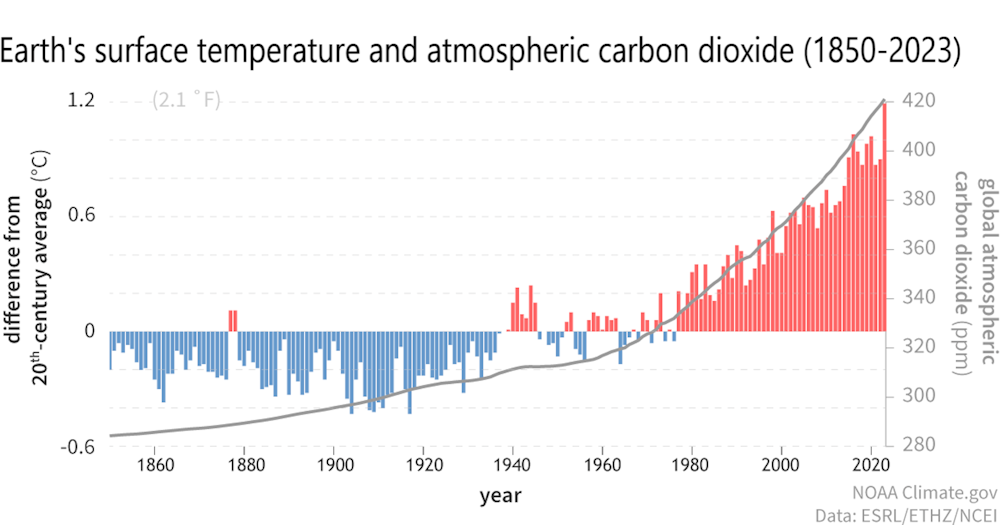
    In the 1970s, painstaking laboratory work on the Camp Century ice core extracted minuscule amounts of ancient air trapped in tiny bubbles in the ice. Analyses of that gas revealed that levels of carbon dioxide in the atmosphere were lower for tens of thousands of years before the industrial revolution. After 1850, carbon dioxide levels crept up slowly at first and then rapidly accelerated. It was direct evidence that people’s actions, including burning coal and oil, were changing the composition of the atmosphere.

    Since 1850, carbon dioxide levels in the atmosphere have spiked and global temperatures have warmed by more than 2.5 degrees Fahrenheit (1.3 Celsius). The past 10 years have been the hottest since recordkeeping began, with 2024 now holding the record. Climate change is now affecting the entire Earth – but most especially the Arctic, which is warming several times faster than the rest of the planet.

    Since 1850, global average temperature and carbon dioxide concentrations in the atmosphere have risen together, reflecting human emissions of greenhouse gases. Red bars indicate warmer years; blue bars indicate colder years.
    NOAA

    Seeing climate change as a threat multiplier

    For decades, military leaders have been discussing climate change as a threat and a threat multiplier that could worsen instability and mass migration in already fragile regions of the world.

    Climate change can fuel storms, wildfires and rising seas that threaten important military bases. It puts personnel at risk in rising heat and melts sea ice, creating new national security concerns in the Arctic. Climate change can also contribute to instability and conflict when water and food shortages trigger increasing competition for resources, internal and cross-border tensions, or mass migrations.

    The military understands that these threats can’t be ignored. As Secretary of the Navy Carlos Del Toro told a conference in September 2024: “Climate resilience is force resilience.”

    A view of aircraft carriers docked at the sprawling Naval Station Norfolk show how much of the region is within a few feet of sea level.
    Stocktrek Images via Getty Images

    Consider Naval Station Norfolk. It’s the largest military port facility in the world and sits just above sea level on Virginia’s Atlantic coast. Sea level there rose more than 1.5 feet in the last century, and it’s on track to rise that much again by 2050 as glaciers around the world melt and warming ocean water expands.

    High tides already cause delays in repair work, and major storms and their storm surges have damaged expensive equipment. The Navy has built sea walls and worked to restore coastal dunes and marshlands to protect its Virginia properties, but the risks continue to increase.

    Planning for the future, the Navy incorporates scientists’ projections of sea level rise and increasing hurricane strength to design more resilient facilities. By adapting to climate change, the U.S. Navy will avoid the fate of another famous marine power: the Norse, forced to abandon their flooded Greenland settlements when sea level there rose about 600 years ago.

    Norse ruins in Igaliku in southern Greenland, illustrated in the late 1800s while flooded at spring tide by sea level, which had risen since the settlement was abandoned around 1400.
    Steenstrup, K.J.V., and A. Kornerup. 1881. Expeditionen til Julianehaabs distrikt i 1876. MeddelelseromGrønland

    Climate change is costly to ignore

    As the impacts of climate change grow in both frequency and magnitude, the costs of inaction are increasing. Most economists agree that it’s cheaper to act now than deal with the consequences. Yet, in the past 20 years, the political discourse around addressing the cause and effects of climate change has become increasingly politicized and partisan, stymieing effective action.

    In my view, the military’s approach to problem-solving and threat reduction provides a model for civil society to address climate change in two ways: reducing carbon emissions and adapting to inevitable climate change impacts.

    The U.S. military emits more planet warming carbon than Sweden and spent more than US$2 billion on energy in 2021. It accounts for more than 70% of energy used by the federal government.

    In that context, its embrace of alternative energy, including solar generation, microgrids and wind power, makes economic and environmental sense. The U.S. military is moving away from fossil fuels, not because of any political agenda, but because of the cost-savings, increased reliability and energy independence the alternatives provide.

    Solar panels generate power on many U.S. military bases. This array at Joint Forces Training Base in Los Alamitos, Calif., generates enough power for more than 15,000 homes and has a backup battery system to provide power when the sun isn’t shining.
    Frederic J . Brown/AFP via Getty Images

    As sea ice melts and Arctic temperatures rise, the polar region has again become a strategic priority. Russia and China are expanding Arctic shipping routes and eyeing critical mineral deposits as they become accessible. The military knows climate change affects national security, which is why it continues to take steps to address the threats a changing climate presents.

    Paul Bierman receives funding from the US National Science Foundation, this work in part supported by grant EAR-2114629.

    ref. The US military has cared about climate change since the dawn of the Cold War – for good reason – https://theconversation.com/the-us-military-has-cared-about-climate-change-since-the-dawn-of-the-cold-war-for-good-reason-246333

    MIL OSI – Global Reports

  • MIL-OSI USA: Final Phase of Gant Overhaul Expected to Start This Summer

    Source: US State of Connecticut

    The multi-year project to overhaul and expand one of UConn’s largest, most visible, and most heavily used academic buildings will soon enter its final stretch with the start of the last phase of renovations.

    The Gant Science Complex, often described colloquially as the workhorse of UConn’s academic infrastructure at Storrs, has undergone extensive renovations that started in 2018 and have significantly transformed much of the once-outdated structure.

    If all remains on schedule, work is slated to begin this summer on the final phase of renovations at the complex, which fronts North Eagleville and Auditorium Roads.

    Completion of the project will mark a milestone for UConn, which received funding for the work under the state’s Next Generation Connecticut initiative.

    UConn students walk through the Gant Science Complex on the first day of classes for the spring 2025 semester on Tuesday, Jan. 21, 2025. (Sydney Herdle/UConn Photo)

    That visionary program is part of the larger UConn 2000 initiative, which has built the state’s innovation economy through investments in its flagship university, as supported by generations of Connecticut legislators and governors since the mid-1990s.

    NextGenCT included construction of UConn’s Science 1 building in addition to the Gant renovations. Science 1 opened nearby in 2023, complementing Gant as interdisciplinary research facilities that anchor the university’s Northwest Science District.

    Both buildings support goals in the 10-year Strategic Plan, including expanding UConn’s research impact, powering a thriving Connecticut, and promoting holistic student success.

    “The hallmarks of a great university are not only the research and academic knowledge it produces, but also its commitment to providing the modern labs, learning spaces, and support facilities that cultivate that important work,” says Anne D’Alleva, UConn’s provost and executive vice president for academic affairs.

    “We often jokingly refer to the Gant Science Complex as the workhorse of our Storrs campus because so much of the hands-on research, teaching, and collaborative learning takes place there on a daily basis,” she says. “The renovations of this important complex will be integral to UConn’s ability to reach new heights and power the Connecticut innovation economy.”

    The U-shaped Gant Science Complex houses several academic departments and their associated classrooms, lecture halls, teaching and research laboratories, faculty offices, and support space.

    It was built between 1970 and 1974 and is named for the late Edward V. Gant, a longtime engineering professor who also served three stints as UConn’s acting president. He died in 1985.

    The science complex that bears his name had about 285,000 gross square feet of space at the start of the renovation, with the current project adding about 25,000 additional square feet upon completion.

    The first phase of renovations, which involved Gant South, was completed in 2019, followed by a two-year renovation period at Gant West. In both cases, the full wings were overhauled along with the connector between the wings and the central plaza.

    A central Light Court area, a new signature feature of the complex, was completed and occupied in January 2020.

    The phased approach has allowed UConn to continue using large portions of the complex even when other areas were under construction, minimizing disruption to academic operations and eliminating the need for temporary facilities.

    Construction on the last phase will start this summer if all remains on schedule with bidding, timely availability of equipment, and other factors.

    The third and final phase of work at Gant will involve renovating and expanding the North Wing and its connector to the West Wing and includes a fourth-floor addition for advanced research.

    The renovated North Wing will offer updated laboratory teaching facilities and support spaces for the Department of Ecology & Environmental Biology, as well as multidisciplinary science teaching labs and teaching labs for Biology 1000 level courses on the ground through second floors.

    Support spaces include a new advising and tutoring center for the College of Liberal Arts & Sciences and a new facility for biology central storage. The third and fourth floors will be prepared for future advanced research activities.

    UConn’s Board of Trustees recently gave its approval to begin working toward the final phase, which would start with demolition and abatement, site work, and purchasing equipment with long lead times for delivery.

    In addition to the interior renovations, the building’s façade and roof are being reconstructed to better prevent leaks and save energy, while the outdoor plaza area is being improved to be more inviting and accessible to the campus community.

    If all remains on schedule, the renovated North Wing will open during the 2027-28 academic year.

    The project also aligns with UConn’s commitment to sustainability and environmental stewardship, meeting Connecticut High Performance Building standards and aiming for LEED Gold certification.

    LEED-certified buildings are designed with methods to reduce operating costs, conserve energy and water, cut down on waste sent to landfills, reduce harmful greenhouse gas emissions, and ensure a healthy working environment for occupants. The U.S. Green Building Council confers the certification after a review process.

    MIL OSI USA News

  • MIL-OSI Russia: SPbGASU student Ivan Baranovsky received two awards for his contribution to public activities and support of SVO

    Translartion. Region: Russians Fedetion –

    Source: Saint Petersburg State University of Architecture and Civil Engineering – Saint Petersburg State University of Architecture and Civil Engineering –

    Ivan Baranovsky, a student at the Faculty of Environmental Engineering and Urban Management, received two honorary medals for his active civic position and contribution to public life.

    The first medal was awarded to Ivan for assistance in conducting the Special Military Operation (SMO). The young man actively participated in organizing assistance to military personnel, collected and delivered humanitarian aid, and provided support to the families of SMO participants. His work was highly appreciated by the university and representatives of military structures.

    The second medal, “Active Participant in the Volunteer Movement,” was a recognition of Ivan’s achievements in the field of volunteerism.

    Ivan commented on his achievements as follows: “It is important for me to help people and be useful to my country. These awards are not only my merit, but also the result of the work of our entire team of volunteers. Thank you to everyone who supports us!”

    We congratulate Ivan Baranovsky on his well-deserved awards and wish him further success in his studies and social activities.

    Please note: This information is raw content directly from the source of the information. It is exactly what the source states and does not reflect the position of MIL-OSI or its clients.

    MIL OSI Russia News

  • MIL-OSI USA: DLNR News Release – GROUNDED SAILBOAT REMOVED FROM HONOLUA BAY March 15, 2025

    Source: US State of Hawaii

    DLNR News Release – GROUNDED SAILBOAT REMOVED FROM HONOLUA BAY March 15, 2025

    Posted on Mar 15, 2025 in Latest Department News, Newsroom


    STATE OF HAWAIʻI

    KA MOKU ʻĀINA O HAWAIʻI


    DEPARTMENT OF LAND AND NATURAL RESOURCES

    KA ‘OIHANA KUMUWAIWAI ‘ĀINA


    JOSH GREEN, M.D.
    GOVERNOR


    DAWN CHANG
    CHAIRPERSON


    GROUNDED SAILBOAT REMOVED FROM HONOLUA BAY


    FOR IMMEDIATE RELEASE 

    March 15, 2025


    HONOLUA BAY, Maui – The 65-foot catamaran Hula Girl that had become an unwelcome fixture at Maui’s Honolua-Mokulē‘ia Marine Life Conservation District for almost two months, has been removed.


    Its long-awaited exit Friday afternoon brought a collective sigh of relief to the vessel’s owner, Kapalua Kai Sailing, Inc., the salvage crew, and the West Maui community.


    A storm, in addition to a compromised motor, led to the sailing vessel’s undoing in January. Inhibited in its ability to operate and recover, the catamaran was dragged onto Honolua Bay’s rocky shoreline, where it’s been languishing since. The DLNR Division of Boating and Ocean Recreation (DOBOR) and Division of Aquatic Resources (DAR) worked closely with the vessel’s owner to develop and execute the salvage plan.


    Several factors contributed to delays in the boat’s removal including high winds, inclement weather and uncooperative tides. Hiring a company to tackle the salvage also proved challenging. After weeks of refusals and uncertainty, Cates Marine Service, LLC signed on for the job. Owner Randy Cates is a seasoned veteran with decades in the boat salvage business. He’s also no stranger to groundings in the bay.


    The Cates team handled the removal of the luxury yacht Nakoa from Honolua in 2023. Two years later, almost to the day, again with help from Foss Marine, it managed to tug Hula Girl free from the rocks.


    Rigging lines and other preparations on Hula Girl were finalized on Thursday and early Friday. Just after noon on Friday, and on the incoming tide, the Foss Marine tug arrived. Notice was given to surfers and snorkelers in the water to avoid the area. Once the lines were connected between the tug and Hula Girl, the catamaran didn’t put up too much of a fight. The sailing vessel was successfully freed within an hour. 


    An initial damage assessment by a DAR dive team suggested no coral, fish, or invertebrates in the bay were harmed. Another assessment is planned now that the Hula Girl has been moved. Natural resources in nearshore ecosystems often bear the brunt of boat groundings. In this case, it appears at least initially that no fuel or oil was spilled, and no reef was scarred.


    Hula Girl’s next stop is a designated mooring offshore at Māla small boat ramp, where it will undergo an evaluation for temporary repairs before being towed to O‘ahu.


    # # #


    RESOURCES

    (All images/video Courtesy: DLNR)


    HD video – Hula Girl media clips (March 13, 2025):

    https://www.dropbox.com/scl/fi/5tki8qvf8h9xadqm2psct/Hula-Girl-March-13-2025-media-clips.mov?rlkey=cr84k0lz0t3y965dwlu1m1g2w&st=bo9h6jet&dl=0


    HD video – Hula Girl media clips (March 14, 2025:

    https://www.dropbox.com/scl/fi/syp2z7laa5xb35e8xp6v2/Hula-Girl-March-14-2025-media-clips.mov?rlkey=uaw9ix4f3121tpi1rvta0yj5f&st=28ufuug5&dl=0


    Photographs – Hula Girl removal (March 13-14, 2025):

    https://www.dropbox.com/scl/fo/8jeu2r9sa6w9oepg5irjm/AMPW4DykcC-GYvDzZqcPgIA?rlkey=e9bscflp42a3qghy20h0eoo7x&st=wgbgfchu&dl=0


    Media Contact: 

    Ryan Aguilar

    Communications Specialist

    Hawai‘i Dept. of Land and Natural Resources

    808-587-0396 

    Email: [email protected] 

    MIL OSI USA News

  • MIL-OSI United Kingdom: Building a better future with the law

    Source: United Kingdom – Executive Government & Departments

    News story

    Building a better future with the law

    GLD lawyers played a critical role in delivering the Planning and Infrastructure Bill

    The Planning and Infrastructure Bill introduced to Parliament on 11 March is a key element of the Government’s Growth Mission.

    The Bill supports the Government’s commitments to build 1.5 million new homes in this Parliament, kickstart economic growth and make Britain a clean energy superpower through reforms to the planning system. 

    The key objective of the Bill is to streamline planning processes to accelerate house building and major infrastructure projects. The Bill will also support the government’s Clean Power 2030 mission by speeding up the delivery of clean energy infrastructure.

    Successful delivery of the Bill has involved outstanding cross government collaboration by Government Legal Department lawyers advising in 5 key departments: MHCLG, DfT, DESNZ, Defra and MoJ.

    GLD lawyers worked closely with lawyers in the Office for Parliamentary Counsel who drafted the Bill.

    Thanks to expert legal advice from across the Civil Service, we have been able to deliver all aspects of the Bill, and associated products such as the Explanatory Notes Delegated Powers Memorandum and Human Rights memorandum.  

    Innovative and creative thinking helped deliver legal solutions to support the delivery of housebuilding, the creation of a Nature Restoration Fund, and improvements to infrastructure and clean energy.

    The Bill’s measures which introduce environmental delivery plans make targeted amendments to existing environmental legislation, like the Conservation of Habitats and Species Regulations 2017, in order to assist the securing of improved outcomes for the environment.

    In response to Lord Banner KC’s independent review into legal challenges of Development Consent Orders[1], the Bill also makes provision for the removal of the paper permission stage for judicial reviews of National Policy Statements and Development Consent Orders, introduced by the Planning Act 2008, and removes the right to appeal for cases deemed totally without merit at the oral permission hearing.


    [1] Independent review into legal challenges against Nationally Significant Infrastructure Projects – GOV.UK

    Updates to this page

    Published 17 March 2025

    MIL OSI United Kingdom

  • MIL-OSI Asia-Pac: List of Outcomes: Official Visit of Prime Minister of New Zealand, Rt. Hon Christopher Luxon, to India

    Source: Government of India

    Posted On: 17 MAR 2025 2:27PM by PIB Delhi

    Announcements:

    1. Launch of negotiations between India and New Zealand on a Free Trade Agreement (FTA);

    2. Launch of negotiations between India and New Zealand on an arrangement facilitating the mobility of professionals and skilled workers;

    3. New Zealand joins the Indo-Pacific Oceans’ Initiative (IPOI);

    4. New Zealand becomes member of the Coalition for Disaster Resilient Infrastructure (CDRI)

    Bilateral Documents:

    1. Joint Statement

    2. Memorandum of Understanding on Defence Cooperation between the Ministry of Defence of India and the New Zealand Ministry of Defence;

    3. Authorized Economic Operator – Mutual Recognition Agreement (AEO-MRA) between the Central Board of Indirect Taxes and Customs of India (CBIC) and the New Zealand Customs Service;

    4. Memorandum of Cooperation on Horticulture between the Ministry of Agriculture and Farmers’ Welfare of India and the Ministry for Primary Industries of New Zealand;

    5. Letter of Intent on Forestry between the Ministry of Environment, Forest, and Climate Change of India and the Ministry for Primary Industries of New Zealand;

    6. Education Cooperation Agreement between the Ministry of Education of the Republic of India and the Ministry of Education of New Zealand; and

    7. Memorandum of Cooperation in Sports between the Ministry of Youth Affairs & Sports of the Government of India and the Sport New Zealand of the Government of New Zealand


    ***

    MJPS/ST

    (Release ID: 2111745) Visitor Counter : 114

    MIL OSI Asia Pacific News

  • MIL-OSI Europe: Answer to a written question – Relevance of Commission financial support for the French-Brazilian initiative by Cirad and Embrapa to treat pathogenic fungus Ceratobasidium sp. in Guyana – E-002778/2024(ASW)

    Source: European Parliament

    The Commission is aware of the challenges facing the EU’s outermost regions and French Guyana in terms of food security and farming and is fully committed to supporting the development of these regions.

    The outermost regions can receive support under the Single Market Programme[1] for the implementation of phytosanitary programmes for the control of pests. However, Ceratobasidium sp. does not feature among the pests eligible for funding in the phytosanitary programme 2025-2027[2].

    The outermost regions can also benefit from support through the Horizon Europe programme for plant health research and innovation.

    This area is a priority under cluster 6 ‘Food, Bioeconomy, Natural Resources, Agriculture and Environment’ of the Horizon Europe Programme[3], and will remain a key focus in future work programmes[4].

    Under Horizon 2020[5] and Horizon Europe, numerous projects in plant health were funded, including initiatives addressing emerging threats from plant pests.

    The outermost regions benefit from further support for agriculture and food autonomy under the Common Agricultural Policy and the Programme of options specifically relating to remoteness and insularity.

    The French Common Agricultural Policy Strategic Plan supports research projects for agriculture through the European Agricultural Fund for Rural Development[6], enabling outermost regions to address plant health challenges.

    The LIFE[7] programme under which the outermost regions benefit from bonus points for their applications, also supports biodiversity protection and projects relating to invasive alien species.

    Outermost regions also benefit from the ‘BESTLIFE2030: Grant scheme for biodiversity in EU Overseas’[8] that finances small biodiversity projects with 95% financing.

    • [1] Regulation (EU) 2021/690 of the European Parliament and of the Council establishing a programme for the internal market, competitiveness of enterprises, including small and medium-sized enterprises, the area of plants, animals, food and feed, and European statistics (Single Market Programme).
    • [2] Commission Implementing Decision of 8.4.2024 on adoption of the multiannual work programme for 2025-2027 for the implementation of veterinary programmes for animal diseases and zoonoses and phytosanitary programmes for plant pests.
    • [3] https://research-and-innovation.ec.europa.eu/funding/funding-opportunities/funding-programmes-and-open-calls/horizon-europe/cluster-6-food-bioeconomy-natural-resources-agriculture-and-environment_en
    • [4] https://research-and-innovation.ec.europa.eu/funding/funding-opportunities/funding-programmes-and-open-calls/horizon-europe/strategic-plan_en
    • [5] https://research-and-innovation.ec.europa.eu/funding/funding-opportunities/funding-programmes-and-open-calls/horizon-2020_en
    • [6] https://commission.europa.eu/funding-tenders/find-funding/eu-funding-programmes/european-agricultural-fund-rural-development-eafrd_en
    • [7] https://cinea.ec.europa.eu/programmes/life_en
    • [8] https://bestlife2030.org/

    MIL OSI Europe News

  • MIL-OSI Europe: Answer to a written question – Are EU officials and activist groups working together to undermine more flexible management of the wolf population? – E-003025/2024(ASW)

    Source: European Parliament

    Following the adoption of the EU proposal[1] to change the protection status of the wolf under the Bern Convention[2], after its entry into force, the Commission will present a targeted legislative proposal to implement this change in EU law and to modify accordingly the protection regime of the wolf under the Habitats Directive[3].

    The change of protection status of the wolf under EU law, once agreed and transposed into national law, would increase m anagement flexibility for Member States.

    However, they would remain obliged to maintain or restore a favourable conservation status of the wolf populations on their national territory, in accordance with the directive’s requirements, with the relevant rulings of the Court of Justice of the European Union[4] and with the international commitments under the Bern Convention.

    The legal protection status of species is differentiated, in the Habitats Directive, through their listing under the different Annexes[5].

    However, the requirement to achieve and maintain a favourable conservation status is the overall objective set by the directive , and it applies to all species (and habitat types) covered by it.

    Monitoring, assessment and reporting on the conservation status of species and habitats covered by the Habitats Directive is carried out by national authorities.

    The related guidelines establishing common formats and criteria[6] have been elaborated and are regularly updated in the competent expert group, in close cooperation with representatives from all Member States, stakeholders and the European Environment Agency[7].

    • [1] https://ec.europa.eu/commission/presscorner/detail/en/ip_24_6202
    • [2] https://www.coe.int/en/web/bern-convention
    • [3] Council Directive 92/43/EEC of 21 May 1992 on the conservation of natural habitats and of wild fauna and flora, OJ L 206, 22.7.1992, p. 7-50.
    • [4] E.g. Case C-436/22 on wolf hunting in Spain: https://curia.europa.eu/jcms/upload/docs/application/pdf/2024-07/cp240118en.pdf and Case C-601/22 on derogations to kill wolves in Austria: https://curia.europa.eu/jcms/upload/docs/application/pdf/2024-07/cp240111en.pdf
    • [5] In particular, species listed in Annex IV are subject to a strict protection regime, while species in Annex V are only subject to a protection regime (allowing more management flexibility).
    • [6] https://cdr.eionet.europa.eu/help/habitats_art17/Reporting2025/Final%20Guidelines%20Art.%2017_2019-2024.pdf/
      https://cdr.eionet.europa.eu/help/habitats_art17/Reporting2025/Explanatory%20notes%20Art%2017%20final_update%20Nov%202023.pdf/
    • [7] https://www.eea.europa.eu/en

    MIL OSI Europe News

  • MIL-OSI Asia-Pac: Buddhist Thematic Circuit under Swadesh Darshan Scheme

    Source: Government of India (2)

    Posted On: 17 MAR 2025 3:56PM by PIB Delhi

    Ministry of Tourism through its central sector schemes of ‘Swadesh Darshan (SD)’, and ‘Pilgrimage Rejuvenation and Spiritual, Heritage Augmentation Drive (PRASHAD)’ extends financial assistance to the State Governments/UT Administrations for development of Buddhist Tourism. The ‘Buddhist Circuit’ has been identified as one of the thematic circuits for development under the Swadesh Darshan Scheme. Details of projects sanctioned under the Buddhist thematic circuit is at Annexure.

    The Archaeological Survey of India (ASI) under the Ministry of Culture undertakes conservation and preservation of protected monuments as well as take action for providing public amenities such as toilets, drinking water, parking, pathways, signage, benches, ramps, wheel chairs etc. at various monuments including protected Buddhist Sites, under the Annual Conservation program. Providing public amenities and improving them is a regular activity.

    The 1st Asian Buddhist Summit (ABS), was organized by the Ministry of Culture in collaboration with the International Buddhist Confederation (IBC), New Delhi, a grantee body of this Ministry. The said summit was based on Asian spirit tradition and cultural & religious cooperation among Asian Nations. The 1st Asian Buddhist Summit witnessed presence of more than 650 delegates including 130 foreign delegates from 26 Asian countries, diplomats from 12 countries and 40 Monks each from Mahayana and Theravada traditions. It has been decided to hold Asian Buddhist Summit in alternate years.

    This information was given by Union Minister for Culture and Tourism Shri Gajendra Singh Shekhawat in a written reply in Lok Sabha today.

    ***


    Sunil Kumar Tiwari

    pibculture[at]gmail[dot]com


    Annexure


    Details of projects sanctioned under the Buddhist thematic circuit:


    S. No.

    State/UT

    Circuit

    Sanction Year

    Name of the Project

    Amount Sanctioned (₹ Cr.)

    Amount Released/ Authorized

    (₹ Cr.)*

    1

    Andhra Pradesh

    Buddhist Circuit

    2017-18

    Development of Buddhist Circuit: Shalihundam- Bavikonda- Bojjanakonda -Amravati- Anupu

    35.24

    30.02

    2

    Bihar

    Buddhist Circuit

    2016-17

    Development of Buddhist circuit- Construction of Convention Centre at Bodhgaya

    95.18

    95.18

    3

    Gujarat

    Buddhist Circuit

    2017-18

    Development of Junagadh- Gir Somnath- Bharuch-Kutch- Bhavnagar- Rajkot- Mehsana

    26.68

    22.28

    4

    Madhya Pradesh

    Buddhist Circuit

    2016-17

    Development of Sanchi-Satna-Rewa-Mandsaur-Dhar

    74.02

    72.75

    5

    Uttar Pradesh

    Buddhist Circuit

    2016-17

    Development of Srawasti, Kushinagar, & Kapilwastu

    87.89

    72.56


    * Includes amount of authorization to CNA through TSA Model I for Central Sector Scheme.

    Under the PRASHAD Scheme, ‘Development of Pilgrimage Facilitation at Four Patron Saints at Yuksom, Sikkim’ project was sanctioned for an amount of Rs.33.32 Crore in the year 2020-21.

    Under the Special Assistance to States/Union Territories for Capital Investment (SASCI) Scheme of Department of Expenditure, Ministry of Finance, the operational guidelines for Development of Iconic Tourist Centres to Global Scale were issued by the Ministry of Tourism. In line with the guidelines, on 26.11.2024 Government of India has approved a Project ‘Integrated Buddhist Tourism Development in Shrawasti’ in Uttar Pradesh for a cost of Rs. 80.24 Crore.


    ****


    (Release ID: 2111822) Visitor Counter : 67

    MIL OSI Asia Pacific News

  • MIL-OSI Asia-Pac: Promotion of Sustainable Tourism

    Source: Government of India

    Posted On: 17 MAR 2025 3:46PM by PIB Delhi

    Development and promotion of tourist destinations and products, including sustainable tourism and traditional art forms is undertaken by the respective State Government/Union Territory (UT) Administration. The Ministry complements the efforts of States/UTs by developing and promoting various tourism products of the country, including sustainable tourism and traditional art forms through various schemes and initiatives.

    Environmental Sustainability and Socio-Cultural Sustainability are two key pillars in the National Strategy for Sustainable Tourism formulated by the Ministry. In line with the strategy, Travel for LiFE programme has been initiated to promote sustainable tourism in the country and to encourage tourists and tourism businesses to adopt sustainable tourism practices.

    The Swadesh Darshan Scheme of the Ministry has been revamped as Swadesh Darshan 2.0 (SD2.0) with the objective to develop sustainable and responsible tourism destinations following a tourist & destination centric approach. The Scheme encourages adoption of principles of sustainable tourism including environmental sustainability, socio-cultural sustainability and economic sustainability.

    This information was given by Union Minister for Tourism and Culture Shri Gajendra Singh Shekhawat in a written reply in Lok Sabha today.

    ***

    Sunil Kumar Tiwari

    tourism4pib[at]gmail[dot]com

    (Release ID: 2111808) Visitor Counter : 27

    MIL OSI Asia Pacific News

  • MIL-OSI Asia-Pac: Carbon Emissions in Mining Operations

    Source: Government of India

    Posted On: 17 MAR 2025 3:37PM by PIB Delhi

    In line with India’s Panchamrit & Nationally Determined Contribution (NDC) commitments, Ministry of Coal is promoting sustainable coal mining and reduction in carbon footprint by encouraging the following:


    • Greening InitiativesBio-Reclamation/Plantation: The Coal/Lignite PSUs have been constantly making efforts to minimize the footprints of coal mining through sustained reclamation and afforestation of areas in and around their operating mines.
    • Energy Efficiency Measures: Coal/Lignite PSUs have been taking various energy conservation and efficiency measures over the years to reduce carbon intensity such as replacement of conventional lights with LED lights, installation of energy-efficient air conditioners, super fans, deployment of EVs and installation of efficient water heaters, energy-efficient motors for pumps, auto timers in street lights etc.
    • Green Credit Programme: Coal PSUs are also participating in extensive plantation under Green Credit Program launched by MoEF&CC.
    • First Mile Connectivity (FMC) projects: The Coal PSUs have taken steps to upgrade the mechanized coal transportation and loading system under ‘First Mile Connectivity’ projects. Commissioning of FMC projects in coal mining areas reduces consumption of diesel significantly and therefore reduces carbon emissions.
    • Deployment of Blast free technology in coal mining: Coal companies are deploying modern equipment having environment friendly features, like Surface Miner, Continuous Miner in coal mining, which eliminates the drilling, blasting and crushing operations in coal and hence, in turn, obviates pollution caused due to these operations. Rippers are also being deployed for blast-less removal of overburden in some mines.
    • Renewable Energy and clean coal initiatives: Coal PSUs have also started commissioning Renewable Energy power projects. Additionally, they are venturing into various clean coal technologies like Coal gasification, Coal Bed methane (CBM) etc.

    Sustainable coal production is being promoted by ensuring compliance with applicable environmental laws like prior Environmental Clearance (EC), Forest Clearance (FC), Consent to Operate (CTO), Consent to Establish (CTE) etc. In addition, the steps adopted to reduce carbon emissions and environmental impact due to coal mining includes:


    • Use of surface miners, continuous miners, highwall / longwall mining, etc.
    • Increasing installation & usage of First Mile Connectivity (FMC) initiatives to reduce coal transport via roads.
    • Improving energy efficiency across coal mining projects.
    • Reclamation and eco-restoration of mined-out areas including development of eco-parks, mine tourism sites, etc.
    • Conceptualizing re-purposing of de-coaled areas for sustainable uses like installation of renewable energy generation plants, development of agricultural avenues for surrounding communities, development of mine sumps, etc.

    At present, there is no specific directive / guideline stipulating the number of times mining companies are required to review their Environmental Impact Assessment (EIA), particularly with reference to carbon emissions.

    This information was given by Union Minister of Coal and Mines Shri G. Kishan Reddy in a written reply in Rajya Sabha today.

    *****

    Shuhaib T


    (Release ID: 2111792) Visitor Counter : 66

    MIL OSI Asia Pacific News

  • MIL-OSI Asia-Pac: Coal Supply and Logistics to Meet Electricity Demand

    Source: Government of India

    Posted On: 17 MAR 2025 3:36PM by PIB Delhi

    There is adequate availability of coal in the country. The focus of the Government is on increasing the domestic production of coal to meet the energy requirement of the country. The country has witnessed highest ever coal production in the year 2023-24. The all-India domestic coal production in the year 2023-2024 was 997.826 MT in comparison to 893.191 MT in the year 2022-2023 with the growth of about 11.71 %.

    In the current year 2024-25, the country has produced 929.15 MT (provisional) of coal (upto February, 2025) in comparison to 881.16 MT in the corresponding period of the last year 2023-24 with a growth rate of 5.45%.

    Ministry of Power communicated their domestic coal requirement of 906.1 million tonnes (MT) for the financial year 2025-26, against which Ministry of Coal (MOC) has conveyed the domestic coal supply plan of 906.1 million tonnes (MT) to the power sector for FY 2025-26.

    As per Central Electricity Authority (CEA), the coal stock at domestic coal-based power plants stands at 53.49 million tonne (MT) as on 10.03.2025, in comparison to 44.51 MT in the corresponding day of the last year 2023-24 with a growth rate of 20.20%. The current coal stock is sufficient for about 20 days at 85% Plant load factor (PLF).

    The supply of coal to the power plants is a continuous process. Coal supply is continuously monitored by the coal companies and also by an Inter-Ministerial Sub-Group comprising of representatives from Ministry of Power, Ministry of Coal, Ministry of Railways, Central Electricity Authority (CEA), Coal India Limited (CIL) and Singareni Collieries Company Limited (SCCL) which meet regularly to take various operational decisions to enhance supply of coal to Thermal Power Plants.

    Besides, an Inter-Ministerial Committee (IMC) has also been constituted comprising of Chairman, Railway Board; Secretary, Ministry of Coal; Secretary, Ministry of Environment, Forest and Climate Change and Secretary, Ministry of Power; to monitor augmentation of coal supply and power generation capacity. Secretary, Ministry of New and Renewable Energy and Chairperson, CEA are co-opted as Special Invitees as and when required by the IMC.

    This information was given by Union Minister of Coal and Mines Shri G. Kishan Reddy in a written reply in Rajya Sabha today.

    *******

    Shuhaib T

    (Release ID: 2111791) Visitor Counter : 62

    MIL OSI Asia Pacific News

  • MIL-OSI: Diversified Achieves Strong Final Year-End 2024 Results, Delivers on Capital Allocation Promises, and Introduces 2025 Combined Company Outlook

    Source: GlobeNewswire (MIL-OSI)

    2024 Achievements Position Diversified on a Meaningful Path Forward as a Stronger and Larger Company

    Executed Approximately $2 Billion of Acquisitions in an Advantageous Pricing Environment

    Third year of Consistent Operating Costs Despite Broader Industry and Inflationary Pressures

    Maverick Integration Anticipated to Provide Meaningful Financial and Operational Benefits to Drive Free Cash Flow Acceleration

    Created a PDP Solution for Upstream Peers to Facilitate Operated Acquisitions with an Undeveloped Inventory Focus

    BIRMINGHAM, Ala., March 17, 2025 (GLOBE NEWSWIRE) — Diversified Energy Company PLC (LSE: DEC; NYSE: DEC) is pleased to announce its operational and final audited results for the year ended December 31, 2024.

    Diversified remains a differentiated key player in acquiring and building a portfolio of assets through value-accretive transactions while simultaneously unlocking hidden value through its unique operational framework, strategic development partnerships, and growing adjacent business segments, including coal mine methane (CMM), energy marketing and well-retirement. By completing over $4.0 billion of acquisitions since its public listing in 2017, Diversified has built a large-scale integration and operating company that remains focused on delivering de-risked, reliable cash flow for its shareholders. With the combination of maturing assets and M&A activity leading to growth-oriented E&P’s recycling capital through divestment, there remains an ample opportunity set for Diversified’s continued growth. Additionally, with most upstream acquisitions today focusing on increasing undeveloped inventory, Diversified provides a creative and actionable solution as the PDP purchasing partner for those E&P’s that only value inventory.

    Only Publicly Traded Champion of the PDP Subsector with Unique Strategic Advantages

    • Large Operational Scale: Multiple geographies in core basins including Western Anadarko (largest producer), Permian, Appalachia, Barnett and Ark-La-Tex with commodity product diversification
    • Vertical Integration: In-house marketing, extensive midstream network, wholly-owned processing infrastructure, and a well retirement business segment
    • Leading Technology Platform: 100% cloud architecture, supporting well level data capture, information for actionable production optimization, and real-time monitoring which mitigates production downtime
    • Beneficial Financing Solution: Demonstrated ability to access numerous capital solutions, including investment grade, low-cost Asset Backed Securities, commercial banking facilities and equity investment partners
    • Flexible Capital Allocation: shareholder returns-focused model prioritizing Free Cash Flow for systematic debt reduction, fixed dividend payments, opportunistic share repurchases, and accretive acquisitions
    • Proven Process to Capture Synergies: established integration playbook and sophisticated corporate infrastructure provides considerable expense savings and unlocks sustainable value

    Delivering Consistent and Reliable Results in 2024        

    • Delivered average net daily production: 791 MMcfepd (132 MBoepd)
      • December exit rate of 864 MMcfepd (144 MBoepd)
    • Year end 2024 reserves of 4.5 Tcfe (747 MMBoe; PV10 of $3.3 billion(b))
    • Total Revenue, inclusive of hedges of $946 million(e), net of $151 million in commodity cash hedge receipts that supplemented Total Revenue of $795 million
    • Operating Cash Flow of $346 million; Net loss of $87 million, inclusive of $141 million tax-effected, non-cash unsettled derivative fair value adjustments
    • Adjusted EBITDA of $472 million(c); Adjusted Free Cash Flow of $211 million(d)
      • 2024 Adjusted EBITDA Margin of 51%(c)
      • 2024 Adjusted Operating Cost per unit of $1.70/Mcfe ($10.22/Boe)

    Achieving Expectations

    • Recommend a final quarterly dividend of $0.29 per share
    • Generated $49 million of cash proceeds through land sales and Coal Mine Methane Revenues
    • Retired over $200 million in debt principal through amortizing debt payments
    • Returned $105 million to shareholders, including $21 million in share buybacks(h)
    • Completed $585 million (gross) in strategic and bolt-on acquisitions during 2024
    • Retired 202 Diversified wells in Appalachia, marking third consecutive year to exceed 200 wells
    • OGMP Gold Standard and MSCI AA Rating for third and second consecutive year, respectively
    • Decreased Scope 1 methane intensity to 0.7 MT CO2e per MMcfe, a 13% reduction from 2023

    Powerful Step Forward

    • Closed transformative $1.3 billion acquisition of Maverick Natural Resources (“Maverick”)
      • Largest Producer in the Western Anadarko Basin (WAB)
      • Entry into the Permian basin
      • Expecting to achieve over $50 million in annual synergies by year-end 2025
    • Closed the accretive bolt-on acquisition of assets from Summit Natural Resources
      • Anticipate over 300% increase in cash flow from CMM environmental credit sales in the next 24 months
    • Developed a unique partnership to create an innovative, reliable, net-zero data center power solution
    • Enhancing free cash flow growth in 2025 by advantageously added natural gas hedges (related to ABS & recent acquisitions) and planning approximately $40 million from the divestiture of undeveloped leasehold during the first half of 2025

    CEO Rusty Hutson, Jr. commented:

    “Our over 1,600 women and men of Diversified remain the driving force behind our strong operational and financial performance in 2024. Whether it’s natural gas to power the technology of the future or the everyday needs of families and businesses across our operating region, Diversified provides the reliable and sustainable energy needed, and we continue to invest in growing our business while expanding our opportunity set of cash flow generation through verticals in a variety of end markets.

    We have built a Company that remains highly focused on long-term value creation through the growth of our platform and our ability to leverage vertical integration and scale to operate a structurally and dependably higher-margin business that delivers de-risked, consistent cash flow. Our focused strategy, disciplined leadership team, sound operating practices, and the strong demand for natural gas provide us with momentum as we begin the year and the confidence to achieve our full-year 2025 expectations while executing against our capital allocation strategy. We are starting the year in a position of strength as a bigger, better business, and there has never been a more exciting time for our Company and the energy industry. We feel privileged to be at the heart of the energy renaissance as the Right Company at the Right Time to help provide essential energy needs.”

    Combined Company 2025 Outlook

    Following the recently completed acquisition of Maverick, Diversified expects to realize significant operational synergies associated with a larger, consolidated position in Oklahoma and the ability to improve the overall cost structure of the Maverick Natural Resources assets while continuing to prioritize returns and Free Cash Flow generation.

    The following outlook incorporates a nine-month contribution from the recently acquired Maverick.

      2025 Guidance
    Total Production (Mmcfe/d) 1,050 to 1,100
    % Liquids ~25%
    % Natural Gas ~75%
    Total Capital Expenditures (millions) $165 to $185
    Adj. EBITDA(millions) $825 to $875
    Adj. Free Cash Flow(millions) ~$420
    Leverage Target 2.0x to 2.5x
    Combined Company Synergies (millions) >$50
    Includes the value of anticipated cash proceeds for 2025 land sales
     

    Posting of 2024 Annual Report and Notice of Annual General Meeting

    Diversified has published to the Company’s website its 2024 Annual Report and Notice of AGM, along with the form of proxy for the AGM. These documents can be viewed or downloaded from Diversified’s website at https://ir.div.energy/financial-info.

    The Company has also provided copies of these documents to the National Storage Mechanism that, in accordance with UK Listing Rule 6.4.1R, will be available for inspection at https://data.fca.org.uk/#/nsm/nationalstoragemechanism.

    Annual General Meeting Arrangements

    The Company’s AGM will be held on April 9, 2025 at 1:00pm BST (8:00am EDT) at the offices of FTI Consulting, 200 Aldersgate, Aldersgate Street, London EC1A 4HD.

    Presentation and Webcast

    DEC will host a conference call today at 12:30 pm GMT (8:30am EDT) to discuss these results. The conference call details are as follows:

    A corporate presentation will be posted to the Company’s website before the conference call. The presentation can be found at https://ir.div.energy/presentations.

    Footnotes:

    (a) Corporate decline rate of ~10% calculated as the change in average daily production for the month of December 2023 (775 MMcfepd), adjusted for the impact of acquisitions and divestitures occurring during the 2024 calendar year, to the average daily production for the month of December 2024.
    (b) Based on the Company’s year-end PDP reserves and using 10-year NYMEX strip, as at December 31, 2024.
    (c) Adjusted EBITDA represents earnings before interest, taxes, depletion, and amortization, and includes adjustments for items that are not comparable period-over-period; As presented, Adjusted EBITDA includes the impact of the accounting basis for land sales; Adjusted EBITDA Margin represents Adjusted EBITDA (excluding the adjustment for the accounting basis on land sales) as a percent of Total Revenue, Inclusive of Settled Hedges; For purposes of comparability, Adjusted EBITDA Margin excludes Other Revenue of $16 million and Lease Operating Expense of $19 million in 2024 associated with Diversified’s wholly owned plugging subsidiary, Next LVL Energy. For more information, please refer to Non-IFRS Measures, below.
    (d) Free Cash Flow represents net cash provided by operating activities less expenditures on natural gas and oil properties and equipment and cash paid for interest; As used herein, Adjusted Free Cash Flow represents Free Cash Flow, plus cash proceeds from undeveloped acreage sales; For more information, please refer to Non-IFRS Measures, below.
    (e) Calculated as total revenue recorded for the period, inclusive of the impact of derivatives settled in cash. For more information, please refer to Non-IFRS Measures, below.
    (f) Calculated as the availability on the Company’s Revolving Credit Facility (“SLL”) and cash on hand (unrestricted)of December 31, 2024; Does not include the impact of Letters of Credit.
    (g) Net Debt-to-Adjusted EBITDA, or “Leverage” or “Leverage Ratio,” is measured as Net Debt divided by Pro Forma Adjusted EBITDA; Pro forma adjusted EBITDA includes adjustments for the year ended December 31, 2024 for the annualized impact of acquisitions completed during the year. Net Debt calculated as of December 31, 2024 and includes total debt as recognized on the balance sheet, less cash and restricted cash; Total debt includes the Company’s borrowings under the Company’s Revolving Credit Facility (“SLL”) and borrowings under or issuances of, as applicable, the Company’s subsidiaries’ securitization facilities. For more information, please refer to Non-IFRS Measures, below.
       

    For Company-specific items, refer also to the Glossary of Terms and/or Alternative Performance Measures found in Diversified’s 2024 Annual Report

    For further information, please contact:  
    Diversified Energy Company PLC +1 973 856 2757
    Doug Kris dkris@dgoc.com
    www.div.energy  
       
    FTI Consulting dec@fticonsulting.com
    U.S. & UK Financial Public Relations  
       

    About Diversified Energy Company PLC

    Diversified is a leading publicly traded energy company focused on natural gas and liquids production, transport, marketing, and well retirement. Through our differentiated strategy, we acquire existing, long-life assets and invest in them to improve environmental and operational performance until retiring those assets in a safe and environmentally secure manner. Recognized by ratings agencies and organizations for our sustainability leadership, this solutions-oriented, stewardship approach makes Diversified the Right Company at the Right Time to responsibly produce energy, deliver reliable free cash flow, and generate shareholder value.

    Important Notices

    This announcement may contain certain forward-looking statements, beliefs or opinions, with respect to the financial condition, results of operations and business of the Company, and its wholly owned subsidiaries (“the Group”) following the Maverick Acquisition. These statements, which contain the words “anticipate”, “believe”, “intend”, “estimate”, “expect”, “may”, “will”, “seek”, “continue”, “aim”, “target”, “projected”, “plan”, “goal”, “achieve”, “outlook” and words of similar meaning, reflect the Company’s beliefs and expectations and are based on numerous assumptions regarding the Company’s present and future business strategies and the environment the Company and the Group will operate in and are subject to risks and uncertainties that may cause actual results to differ materially. No representation is made that any of these statements or forecasts will come to pass or that any forecast results will be achieved. Forward-looking statements involve inherent known and unknown risks, uncertainties and contingencies because they relate to events and depend on circumstances that may or may not occur in the future and may cause the actual results, performance or achievements of the Company or the Group to be materially different from those expressed or implied by such forward looking statements. Many of these risks and uncertainties relate to factors that are beyond the Company’s or the Group’s ability to control or estimate precisely, such as future market conditions, currency fluctuations, the behaviour of other market participants, the actions of regulators and other factors such as the Company’s or the Group’s ability to continue to obtain financing to meet its liquidity needs, changes in the political, social and regulatory framework in which the Company or the Group operate or in economic or technological trends or conditions, and the Company’s or Group’s ability to realize expected benefits of the Maverick acquisition. Past performance of the Company cannot be relied on as a guide to future performance. As a result, you are cautioned not to place undue reliance on such forward-looking statements. The list above is not exhaustive and there are other factors that may cause the Company’s or the Group’s actual results to differ materially from the forward-looking statements contained in this announcement, including the risk factors described in the “Risk Factors” section in the Company’s Annual Report and Form 20-F for the year ended December 31, 2024, filed with the United States Securities and Exchange Commission.

    Forward-looking statements speak only as of their date and neither the Company, nor the Group nor any of its respective directors, officers, employees, agents, affiliates or advisers expressly disclaim any obligation to supplement, amend, update or revise any of the forward-looking statements made herein, except where it would be required to do so under applicable law. In light of these risks, uncertainties and assumptions, the events described in the forward-looking statements in this announcement may not occur. No statement in this announcement is intended as a profit forecast or a profit estimate and no statement in this announcement should be interpreted to mean that the financial performance of the Company for the current or future financial years would necessarily match or exceed the historical published for the Company.

    The contents of this announcement are not to be construed as legal, business or tax advice. Each shareholder should consult its own legal adviser, financial adviser or tax adviser for legal, financial or tax advice respectively.

    Percentages in tables have been rounded and accordingly may not add up to 100 per cent. Certain financial data have also been rounded. As a result of this rounding, the totals of data presented in this announcement may vary slightly from the actual arithmetic totals of such data.

    Use of Non-IFRS Measures

    Certain key operating metrics that are not defined under IFRS (alternative performance measures) are included in this announcement. These non-IFRS measures are used by us to monitor the underlying business performance of the Company from period to period and to facilitate comparison with our peers. Since not all companies calculate these or other non-IFRS metrics in the same way, the manner in which we have chosen to calculate the non-IFRS metrics presented herein may not be compatible with similarly defined terms used by other companies. The non-IFRS metrics should not be considered in isolation of, or viewed as substitutes for, the financial information prepared in accordance with IFRS. Certain of the key operating metrics are based on information derived from our regularly maintained records and accounting and operating systems.

    Non-IFRS Disclosures

    Adjusted EBITDA

    As used herein, EBITDA represents earnings before interest, taxes, depletion, depreciation, and amortization. Adjusted EBITDA further adjusts for items that are not comparable period-over-period, including accretion of asset retirement obligations, other (income) expense, loss on joint and working interest owners receivable, (gain) loss on bargain purchases, (gain) loss on fair value adjustments of unsettled financial instruments, (gain) loss on natural gas and oil property and equipment, costs associated with acquisitions, other adjusting costs, non-cash equity compensation, (gain) loss on foreign currency hedge, net (gain) loss on interest rate swaps and other similar items.

    Adjusted EBITDA should not be considered in isolation or as a substitute for operating profit (loss), net income (loss), or cash flows provided by (used in) operating, investing, and financing activities. However, we believe this measure is useful to investors in evaluating our financial performance because it (1) is widely used by investors in the natural gas and oil industry as an indicator of underlying business performance; (2) helps investors more meaningfully evaluate and compare the results of our operations from period to period by removing the often-volatile revenue impact of changes in the fair value of derivative instruments prior to settlement; (3) is used in the calculation of a key metric in one of our Credit Facility financial covenants; and (4) is used by us as a performance measure in determining executive compensation. When evaluating this measure, we believe investors also commonly find it useful to assess this metric as a percentage of our total revenue, inclusive of settled hedges, which we refer to as adjusted EBITDA margin.

      Year Ended
      December 31,
    2024
    December 31,
    2023
    December 31,
    2022
    Net income (loss) $ (87,001 ) $ 759,701   $ (620,598 )
    Finance costs   137,643     134,166     100,799  
    Accretion of asset retirement obligations   30,868     26,926     27,569  
    Other (income) expense(a)   (1,257 )   (385 )   (269 )
    Income tax (benefit) expense   (136,951 )   240,643     (178,904 )
    Depreciation, depletion and amortization   256,484     224,546     222,257  
    (Gain) loss on bargain purchases           (4,447 )
    (Gain) loss on fair value adjustments of unsettled financial instruments   189,030     (905,695 )   861,457  
    (Gain) loss on natural gas and oil properties and equipment(b)   15,308     4,014     93  
    (Gain) loss on sale of equity interest   7,375     (18,440 )    
    Unrealized (gain) loss on investment   4,013     (4,610 )    
    Impairment of proved properties(c)       41,616      
    Costs associated with acquisitions   11,573     16,775     15,545  
    Other adjusting costs(d)   22,375     17,794     69,967  
    Loss on early retirement of debt   14,753          
    Non-cash equity compensation   8,286     6,494     8,051  
    (Gain) loss on foreign currency hedge       521      
    (Gain) loss on interest rate swap   (190 )   2,722     1,434  
    Total adjustments $ 559,310   $ (212,913 ) $ 1,123,552  
    Adjusted EBITDA $ 472,309   $ 546,788   $ 502,954  
    Pro forma adjusted EBITDA(e) $ 548,570   $ 553,252   $ 574,414  
    1. Excludes $1 million in dividend distributions received for our investment in DP Lion Equity Holdco during the year ended December 31, 2024.
    2. Excludes $27 million, $24 million and $2 million in cash proceeds received for leasehold sales during the years ended December 31, 2024, 2023 and 2022, respectively, less $14 million and $4 million of basis in leasehold sales for the years ended December 31, 2024 and 2023, respectively.
    3. For the year ended December 31, 2023, the Group determined the carrying amounts of certain proved properties within two fields were not recoverable from future cash flows, and therefore, were impaired.
    4. Other adjusting costs for the year ended December 31, 2024, were primarily associated with legal and professional fees related to the U.S. listing, legal fees for certain litigation, and expenses associated with unused firm transportation agreements. For the year ended December 31, 2023, these costs were primarily related to legal and professional fees for the U.S. listing, legal fees for certain litigation, and expenses for unused firm transportation agreements. For the year ended December 31, 2022, these costs mainly included $28 million in contract terminations, which enabled the Group to secure more favorable future pricing, and $31 million in deal breakage and/or sourcing costs for acquisitions.
    5. Includes adjustments for the year ended December 31, 2024 for the Oaktree, Crescent Pass, and East Texas II acquisitions to pro forma their results for the full twelve months of operations. Similar adjustments were made for the year ended December 31, 2023 for the Tanos II Acquisition, as well as for the year ended December 31, 2022 for the East Texas I and ConocoPhillips acquisitions.

    Total Revenue, Inclusive of Hedges and Adjusted EBITDA Margin

    As used herein, total revenue, inclusive of settled hedges, accounts for the impact of derivatives settled in cash. We believe that total revenue, inclusive of settled hedges, is a useful measure because it enables investors to discern our realized revenue after adjusting for the settlement of derivative contracts.

    As used herein, adjusted EBITDA margin is calculated as adjusted EBITDA expressed as a percentage of total revenue, inclusive of settled hedges. Adjusted EBITDA margin encompasses the direct operating costs and the portion of general and administrative costs required to produce each Mcfe. This metric includes operating expense, employee costs, administrative costs and professional services, and recurring allowance for credit losses, which cover both fixed and variable costs components. We believe that adjusted EBITDA margin is a useful measure of our profitability and efficiency, as well as our earnings quality, because it evaluates the Group on a more comparable basis period-over-period, especially given our frequent involvement in transactions that are not comparable between periods.

      Year Ended
      December 31,
    2024
    December 31,
    2023
    December 31,
    2022
    Total revenue $ 794,841   $ 868,263   $ 1,919,349  
    Net gain (loss) on commodity derivative instruments(a)   151,289     178,064     (895,802 )
    Total revenue, inclusive of settled hedges $ 946,130   $ 1,046,327   $ 1,023,547  
    Adjusted EBITDA $ 472,309   $ 546,788   $ 502,954  
    Adjusted EBITDA margin   50 %   52 %   49 %
    Adjusted EBITDA margin, excluding Next LVL Energy   51 %   53 %   50 %
    1. Net gain (loss) on commodity derivative settlements represents the cash paid or received on commodity derivative contracts. This excludes settlements on foreign currency and interest rate derivatives, as well as the gain (loss) on fair value adjustments for unsettled financial instruments for each of the periods presented.

    Free Cash Flow

    As used herein, free cash flow represents net cash provided by operating activities, less expenditures on natural gas and oil properties and equipment, and cash paid for interest. We believe that free cash flow is a useful indicator of our ability to generate cash that is available for activities beyond capital expenditures. The Directors believe that free cash flow provides investors with an important perspective on the cash available to service debt obligations, make strategic acquisitions and investments, and pay dividends.

      Year Ended
      December 31,
    2024
    December 31,
    2023
    December 31,
    2022
    Net cash provided by operating activities $ 345,663   $ 410,132   $ 387,764  
    LESS: Expenditures on natural gas and oil properties and equipment   (52,100 )   (74,252 )   (86,079 )
    LESS: Cash paid for interest   (123,141 )   (116,784 )   (83,958 )
    Free cash flow $ 170,422   $ 219,096   $ 217,727  
    Cash generated through divestitures of land $ 40,986   $ 28,160   $ 2,472  
    Adjusted free cash flow $ 211,408   $ 247,256   $ 220,199  


    Net Debt and Net Debt-to-Adjusted EBITDA (“Leverage”)

    As used herein, net debt represents total debt as recognized on the balance sheet, minus cash and restricted cash. Total debt includes borrowings under our Credit Facility and borrowings under, or issuances of, our subsidiaries’ securitization facilities. We believe net debt is a useful indicator of our leverage and capital structure.

    As used herein, net debt-to-adjusted EBITDA, also referred to as “leverage” or the “leverage ratio,” is calculated by dividing net debt by adjusted EBITDA. We believe this metric is a crucial measure of our financial liquidity and flexibility, and it is also used in the calculation of a key metric in one of our Credit Facility financial covenants.

      As of
      December 31,
    2024
    December 31,
    2023
    December 31,
    2022
    Total debt(a) $ 1,693,242   $ 1,276,627   $ 1,440,329  
    LESS: Cash   5,990     3,753     7,329  
    LESS: Restricted cash(b)   46,269     36,252     55,388  
    Net debt $ 1,640,983   $ 1,236,622   $ 1,377,612  
           
    Adjusted EBITDA $ 472,309,000   $ 546,788,000   $ 502,954,000  
    Pro forma adjusted EBITDA(c) $ 548,570   $ 553,252   $ 574,414  
    Net debt-to-pro forma adjusted EBITDA(d) 2.9x
      2.2x
      2.4x
     
    1. Includes adjustments for deferred financing costs and original issue discounts, consistent with presentation on the Statement of Financial Position.
    2. The increase of restricted cash as of December 31, 2024, is due to the addition of $21 million and $3 million in restricted cash for the ABS VIII Notes and ABS IX Notes, respectively, offset by $7 million and $9 million for the retirement of the ABS III Notes and ABS V Notes, respectively.
    3. Includes adjustments for the year ended December 31, 2024 for the Oaktree, Crescent Pass, and East Texas II acquisitions to pro forma their results for the full twelve months of operations. Similar adjustments were made for the year ended December 31, 2023 for the Tanos II Acquisition, as well as for the year ended December 31, 2022 for the East Texas I and ConocoPhillips acquisitions.
    4. Excludes long-term plant financing of $30 million for the year ended December 31, 2024.

    The MIL Network

  • MIL-OSI Economics: Samsung To Showcase Diverse HVAC Solutions at ISH 2025 Under ‘Connected Flow’ Theme

    Source: Samsung

     
    Samsung Electronics today announced its participation in ISH 2025,1 the world’s leading trade fair for the sanitary and HVAC industries, to be held March 17-21 in Frankfurt. Samsung will showcase innovative solutions designed to enhance comfort, convenience and connectivity across residential and commercial environments.
     
    “This year marks our second time participating in ISH after our debut in 2023, and we’re excited to present more advanced products along with a variety of smart solutions such as SmartThings Pro and b.IoT Lite,2 that align with the ‘Connected Flow’ theme,” said Wim Vangeenberghe, Vice President of Samsung Electronics Air Conditioner Europe B.V. “It’s a meaningful opportunity to showcase our next-generation innovations and underline our commitment to delivering smarter living experiences.”
     
     
    Product Exhibition: Highlighting Advanced HVAC Solutions

     
    At ISH 2025, Samsung will display a wide array of systems and solutions, including Slim Fit EHS ClimateHub and Mono R290, touch controllers, Wi-Fi modules and other solutions. One of the key highlights will be the unveiling of the new Bespoke AI WindFree air conditioner models, which have been designed to elevate comfort and usability.
     
    The new Bespoke AI WindFree air conditioners for 2025 feature AI3 Fast & Comfort Cooling, which employs AI technology to provide rapid cooling and meet users’ preferences. When turning on the mode, Fast Cooling quickly lowers the room temperature first. AI technology then continuously analyzes the indoor and outdoor environments to detect if it’s reaching the user’s preferred temperature, and then it switches its mode into WindFree Cooling.


    Additionally, new Comfort Drying technology enables dehumidification without cold drafts. While conventional dry modes reduce the set temperature for dehumidification, Comfort Drying maintains a comfort humidity level under temperatures set by the user, satisfying customers who do not want to feel cold during dehumidification. Also, users can utilize AI Energy Mode in SmartThings application to reduce energy use by up to 30%.4 This is possible as the compressor’s rotating frequency is controlled by AI analysis, preventing sudden stops or increases.
     
     
    Design Excellence Recognized

     
    Samsung also announced that its Slim Fit EHS ClimateHub indoor units — the ClimateHub Mono and the Hydro Unit Mono5 — have won the prestigious Designplus Award in the “Water & Efficiency +” category at ISH 2025. This award acknowledges products that combine innovative design with technology, with a focus on new concepts that deliver added value through technological advancements.
     
    These models have a slim fit design6 that allows the product to be installed in various locations and coordinates with anywhere in the house. Despite the slim fit design, key components like magnetic filters, three-way valves and an expansion vessel for space heating are all included as standard features, which ensures timely installation. Moreover, they come with the 7” AI Home,7 an expansive screen that significantly improves convenience. It allows users to intuitively control the temperature and settings. Additionally, users can monitor the status and energy usage8 of connected solar photovoltaic (PV) systems using the zone overview, as well as control other SmartThings-connected appliances.9


    Seamless Integration: SmartThings Pro for Advanced Business Environment
    In line with the “Connected Flow” theme, Samsung will also demonstrate the benefits of smart solutions utilizing SmartThings Pro10 through various scenarios and spaces. Visitors will see how SmartThings Pro makes it easy to create a customized business environment with Samsung appliances and some third-party devices — like light bulbs and solar cells — and facilitates comprehensive energy monitoring across the entire home.
     
    Additionally, Samsung will showcase SmartThings Pro and b.IoT Lite for business environments and solutions for commercial spaces like hotels and retail stores. These solutions enhance operational efficiency, enabling smarter management of heating, cooling and energy consumption.
     
    Samsung remains committed to expanding its HVAC business globally and continue to innovate and provide innovative climate solutions to customers worldwide. Visitors to Samsung’s booth at ISH 2025 will have the opportunity to explore new products packed with these technologies, engage with representatives and experience the future of HVAC solutions firsthand.
     
     
    1 The “Internationale Sanitär- und Heizungsmesse” (ISH) translates from German to “International Sanitation and Heating Fair.”2 b.IoT Lite is an integrated control solution designed to optimize the operation of VRF systems in small to medium-sized buildings. As a server-based platform, it provides advanced functionality such as predictive maintenance and energy management.3 To use AI Auto Cooling, a Wi-Fi connection and Samsung account SmartThings are required.4 The testing was conducted in Samsung’s 132m² residential environment laboratory at a temperature of 35°C / 24°C (dry bulb/wet bulb, KS C 9306: air conditioner). Results provided to and interpreted by Intertek, comparing the power consumption between AI energy mode on and off in AI comfort mode of AR07D9181HZN model. Actual savings may vary by usage patterns and environment and the set temperature may increase by up to 2 degrees. Requires the use of the SmartThings App and a Samsung account.5 The ClimateHub Mono has an integrated water tank, while the Hydro Unit Mono is a wall-mounted unit without a water tank.6 Dimensions: ClimateHub Mono = 598(W) x 1,850(H) x 600(D) mm, Hydro Unit Mono = 530(W) x 840(H) x 350(D) mm.7 AI Home refers to the 7’’ LCD screen on the product. Does not mean all services available on the AI Home are AI or generate information or outcome using AI. Certain functions accessible through the AI Home utilize AI-based algorithms, which may be updated periodically to improve accuracy. AI-based algorithms may generate incomplete or incorrect information. A Wi-Fi connection and a Samsung account are required. You may need to use a separate device e.g. your laptop/desktop or mobile device, to create/log into a Samsung Account. If you choose not to log-in, you will not be able to enjoy any features available on AI Home, such as the services available on the SmartThings App.8 Requires a connection between the EHS and PV system and is activated using the PV function in AI Home.9 Requires a Samsung account. Appliances must be connected to the Wi-Fi network and registered in the SmartThings App.10 Must download the SmartThings app available on Android and iOS. A Wi-Fi connection and a Samsung account are required.

    MIL OSI Economics

  • MIL-OSI Banking: Samsung To Showcase Diverse HVAC Solutions at ISH 2025 Under ‘Connected Flow’ Theme

    Source: Samsung

     
    Samsung Electronics today announced its participation in ISH 2025,1 the world’s leading trade fair for the sanitary and HVAC industries, to be held March 17-21 in Frankfurt. Samsung will showcase innovative solutions designed to enhance comfort, convenience and connectivity across residential and commercial environments.
     
    “This year marks our second time participating in ISH after our debut in 2023, and we’re excited to present more advanced products along with a variety of smart solutions such as SmartThings Pro and b.IoT Lite,2 that align with the ‘Connected Flow’ theme,” said Wim Vangeenberghe, Vice President of Samsung Electronics Air Conditioner Europe B.V. “It’s a meaningful opportunity to showcase our next-generation innovations and underline our commitment to delivering smarter living experiences.”
     
     
    Product Exhibition: Highlighting Advanced HVAC Solutions

     
    At ISH 2025, Samsung will display a wide array of systems and solutions, including Slim Fit EHS ClimateHub and Mono R290, touch controllers, Wi-Fi modules and other solutions. One of the key highlights will be the unveiling of the new Bespoke AI WindFree air conditioner models, which have been designed to elevate comfort and usability.
     
    The new Bespoke AI WindFree air conditioners for 2025 feature AI3 Fast & Comfort Cooling, which employs AI technology to provide rapid cooling and meet users’ preferences. When turning on the mode, Fast Cooling quickly lowers the room temperature first. AI technology then continuously analyzes the indoor and outdoor environments to detect if it’s reaching the user’s preferred temperature, and then it switches its mode into WindFree Cooling.


    Additionally, new Comfort Drying technology enables dehumidification without cold drafts. While conventional dry modes reduce the set temperature for dehumidification, Comfort Drying maintains a comfort humidity level under temperatures set by the user, satisfying customers who do not want to feel cold during dehumidification. Also, users can utilize AI Energy Mode in SmartThings application to reduce energy use by up to 30%.4 This is possible as the compressor’s rotating frequency is controlled by AI analysis, preventing sudden stops or increases.
     
     
    Design Excellence Recognized

     
    Samsung also announced that its Slim Fit EHS ClimateHub indoor units — the ClimateHub Mono and the Hydro Unit Mono5 — have won the prestigious Designplus Award in the “Water & Efficiency +” category at ISH 2025. This award acknowledges products that combine innovative design with technology, with a focus on new concepts that deliver added value through technological advancements.
     
    These models have a slim fit design6 that allows the product to be installed in various locations and coordinates with anywhere in the house. Despite the slim fit design, key components like magnetic filters, three-way valves and an expansion vessel for space heating are all included as standard features, which ensures timely installation. Moreover, they come with the 7” AI Home,7 an expansive screen that significantly improves convenience. It allows users to intuitively control the temperature and settings. Additionally, users can monitor the status and energy usage8 of connected solar photovoltaic (PV) systems using the zone overview, as well as control other SmartThings-connected appliances.9


    Seamless Integration: SmartThings Pro for Advanced Business Environment
    In line with the “Connected Flow” theme, Samsung will also demonstrate the benefits of smart solutions utilizing SmartThings Pro10 through various scenarios and spaces. Visitors will see how SmartThings Pro makes it easy to create a customized business environment with Samsung appliances and some third-party devices — like light bulbs and solar cells — and facilitates comprehensive energy monitoring across the entire home.
     
    Additionally, Samsung will showcase SmartThings Pro and b.IoT Lite for business environments and solutions for commercial spaces like hotels and retail stores. These solutions enhance operational efficiency, enabling smarter management of heating, cooling and energy consumption.
     
    Samsung remains committed to expanding its HVAC business globally and continue to innovate and provide innovative climate solutions to customers worldwide. Visitors to Samsung’s booth at ISH 2025 will have the opportunity to explore new products packed with these technologies, engage with representatives and experience the future of HVAC solutions firsthand.
     
     
    1 The “Internationale Sanitär- und Heizungsmesse” (ISH) translates from German to “International Sanitation and Heating Fair.”2 b.IoT Lite is an integrated control solution designed to optimize the operation of VRF systems in small to medium-sized buildings. As a server-based platform, it provides advanced functionality such as predictive maintenance and energy management.3 To use AI Auto Cooling, a Wi-Fi connection and Samsung account SmartThings are required.4 The testing was conducted in Samsung’s 132m² residential environment laboratory at a temperature of 35°C / 24°C (dry bulb/wet bulb, KS C 9306: air conditioner). Results provided to and interpreted by Intertek, comparing the power consumption between AI energy mode on and off in AI comfort mode of AR07D9181HZN model. Actual savings may vary by usage patterns and environment and the set temperature may increase by up to 2 degrees. Requires the use of the SmartThings App and a Samsung account.5 The ClimateHub Mono has an integrated water tank, while the Hydro Unit Mono is a wall-mounted unit without a water tank.6 Dimensions: ClimateHub Mono = 598(W) x 1,850(H) x 600(D) mm, Hydro Unit Mono = 530(W) x 840(H) x 350(D) mm.7 AI Home refers to the 7’’ LCD screen on the product. Does not mean all services available on the AI Home are AI or generate information or outcome using AI. Certain functions accessible through the AI Home utilize AI-based algorithms, which may be updated periodically to improve accuracy. AI-based algorithms may generate incomplete or incorrect information. A Wi-Fi connection and a Samsung account are required. You may need to use a separate device e.g. your laptop/desktop or mobile device, to create/log into a Samsung Account. If you choose not to log-in, you will not be able to enjoy any features available on AI Home, such as the services available on the SmartThings App.8 Requires a connection between the EHS and PV system and is activated using the PV function in AI Home.9 Requires a Samsung account. Appliances must be connected to the Wi-Fi network and registered in the SmartThings App.10 Must download the SmartThings app available on Android and iOS. A Wi-Fi connection and a Samsung account are required.

    MIL OSI Global Banks

  • MIL-OSI Global: Chewing gum is plastic pollution, not a litter problem

    Source: The Conversation – UK – By David Jones, Sessional Teaching Fellow, School of the Environment and Life Sciences, University of Portsmouth

    Wirestock Collection/Shutterstock

    Thousands of tonnes of plastic pollution could be escaping into the environment every year … from our mouths. Most chewing gum on sale is made from a variety of oil-based synthetic rubbers – similar to the plastic material used in car tyres.

    If you find that thought slightly unsettling, you are not alone. I have been researching and speaking about the plastic pollution problem for 15 years. The people I talk to are always surprised, and disgusted, when they find out they’ve been chewing on a lump of malleable plastic. Most manufacturers just don’t advertise what gum is actually made of – they dodge around the detail by listing “gum base” in the ingredients.

    There’s no strict definition of synthetic gum base. Chewing gum brand, Wrigley Extra partners with dental professionals around the world to promote the use of sugar-free chewing gum to improve oral health.

    The brand’s Wrigley Oral Health Program states that: “Gum base puts the “chew” in chewing gum, binding all the ingredients together for a smooth, soft texture. We use synthetic gum base materials for a consistent and safe base that provides longer-lasting flavour, improved texture, and reduced tackiness.“

    It almost sounds harmless. But chemical analysis shows that gum contains styrene-butadiene (the durable synthetic chemical used to make car tyres), polyethylene (the plastic used to make carrier bags and bottles) and polyvinyl acetate (woodglue) as well as some sweetener and flavouring.

    The chewing gum industry is big business, worth an estimated US$48.68 billion (£37.7 billion) in 2025. Three companies own 75% of the market share, the largest of which is Wrigley, with an estimated 35%. There are few reliable statistics available about the amount of gum being produced, but one peer-reviewed global estimate states 1.74 trillion pieces are made per year.

    I examined several types of gum and found that the most common weight of an individual piece of gum is 1.4g – that means that globally, a staggering 2.436 million tonnes of gum are produced each year. About a third (30%) of that weight, or just over 730,000 tonnes, is synthetic gum base.

    If the idea of chewing plastic isn’t disturbing enough, consider what happens after you spit it out. Most people have experienced discarded gum under bench seats, school desks and on street pavements. But, like other plastics, synthetic chewing gum does not biodegrade and can persist in the environment for many years.

    In the environment it will harden, crack and breakdown into microplastics but this can take decades. Cleaning it up is not cheap because it is labour intensive. The average cost is £1.50 per square metre and estimates suggest that the annual clean-up cost for chewing gum pollution for councils in the UK is around £7 million.

    There have been some efforts to address the problem. In many public locations around the UK, gum collection pots supplied by Dutch company Gumdrop Ltd have been installed to collect and recycle used gum. Signage provided by councils encouraging responsible disposal is also now a regular feature in some UK high streets, and there is a growing number of small producers offering plant-based alternatives.

    In the UK, the environmental charity Keep Britain Tidy launched the chewing gum task force in 2021. This collaboration involves three major manufacturers who have committed to investing up to £10 million in order to clean up “historic gum staining and changing behaviour so that more people bin their gum”.


    Read more:
    Car tyres shed a quarter of all microplastics in the environment – urgent action is needed


    But, here lies the crux of the issue.

    The first objective implies that cleaning up gum is a solution to this form of plastic pollution; it isn’t. Manufacturers making a financial contribution to clean-up efforts is like plastic manufacturers paying for litter pickers and bin bags at volunteer beach cleans. Neither addresses the root cause of the problem.

    Binning gum is not the solution either. Addressing gum as a plastic pollutant dictates that the prevention of gum pollution should include the well-known tenets, like all plastic pollution, of reduce, reuse, recycle and redesign. It is not only a disposal issue.

    Another issue that I have uncovered is definition. In the two annual reports published by the gum litter task force since its inception, there is no mention of the word pollution. The distinction between litter and pollution is important. By calling it chewing gum pollution, the narrative changes from an individual negligence issue to a corporate one. That places an onus for accountability onto the producers rather than the consumers.

    Single-use solutions

    Like single-use plastic items, chewing gum pollution needs to be tackled from all angles – education, reduction, alternatives, innovation, producer responsibility, and legislation.

    Educating people about the contents of gum and the environmental consequences those ingredients have will reduce consumption and encourage better disposal habits. More transparent labelling on packaging would empower shoppers to make informed choices. Stricter regulations can hold manufacturers to account – a levy tax on synthetic gum can help pay for clean ups. In turn, this would incentivise more investment in plant-based gums and other sustainable alternatives.

    We can all reduce the environmental consequences of this plastic pollution by kicking the gum habit, calling on councils to enforce stricter pollution penalties and encouraging governments to put a tax levy on manufacturers to fund clean ups and force them to list the contents of gum base.

    Throwing away any non-disposable, inorganic products is unsustainable. Chewing gum pollution is just another form of plastic pollution. It’s time we start treating it as such.


    Don’t have time to read about climate change as much as you’d like?

    Get a weekly roundup in your inbox instead. Every Wednesday, The Conversation’s environment editor writes Imagine, a short email that goes a little deeper into just one climate issue. Join the 40,000+ readers who’ve subscribed so far.


    David Jones is affiliated with the marine conservation charity Just One Ocean

    ref. Chewing gum is plastic pollution, not a litter problem – https://theconversation.com/chewing-gum-is-plastic-pollution-not-a-litter-problem-251662

    MIL OSI – Global Reports

  • MIL-OSI United Kingdom: Radical action plan to cut red tape and kickstart growth

    Source: United Kingdom – Executive Government & Departments

    News story

    Radical action plan to cut red tape and kickstart growth

    The Chancellor will meet top regulator bosses in Downing Street today (Monday 17 March) as she unveils an action plan to deliver on the pledge to cut the administrative cost of regulation on business by a quarter, make Britain the best place to do business and drive economic growth.

    • Chancellor meets regulators in Downing Street as she unveils action plan to cut red tape as part of Plan for Change to kickstart economic growth.

    • Radical shake up will boost infrastructure building by simplifying guidance to protect bat habitats that blocks vital new homes and infrastructure.

    • Business to save billions as more regulators are axed and core legal duties are streamlined.

    • Action plan comes alongside 60 growth-boosting measures from watchdogs designed to make it easier to do business in the UK and delivers on the Prime Minister’s pledge to cut administration costs for businesses by a quarter.

    The radical shake up will cut costly red tape that fails to deliver for local communities, such as hundreds of pages of guidance on protecting bat habitats – which goes far beyond legal requirements, needlessly costs businesses money and slows down planning decisions for major infrastructure projects.  

    A streamlined process for environmental regulations will also be put in place for major projects. This could include Lower Thames Crossing, subject to planning approval, as well as future schemes like Heathrow expansion. The new system will require just one point of contact and will end the merry-go-round of developers seeking planning approvals from multiple authorities who often disagree with each other.  

    This Action Plan will save businesses across the country billions of pounds by cutting the number of regulators, streamlining their core legal duties and cracking down on complexity in the regulatory system. 

    The Plan comes after the Prime Minister set out his vision for a more lean and agile state in a speech last week, abolishing the world’s biggest quango – NHS England – to scrap duplication and give more power and tools to local leaders so they can better deliver for their communities. The Prime Minister and Chancellor are clear that regulators must work for the people of Britain, not get in the way of progress.  

    Following weeks of intense negotiations, watchdogs have signed up to 60 growth boosting measures – including:  

    • Fast-tracking new medicines to market through a new pilot to provide parallel authorisations from key healthcare regulators, so that patients can access the medicine they need quicker;

    • Attracting more investment from international financial services firms by setting up a bespoke ‘concierge service’ to help them get to grips with UK regulations, making it easier to do business in the UK;

    • Paving the way for package deliveries by drone, as the Civil Aviation Authority permits at least two more large drone-flying trials in the coming months – which have already helped cut travel times for blood samples from 30 minutes down to 2 minutes between hospitals – and streamlines the regulatory process for manufacturing drones;

    • Allowing families to manage their spending safely as the Financial Conduct Authority reviews contactless payment limits, including the £100 cap on individual payments, while speeding up queues at checkout.

    • Support for homeownership as the Financial Conduct Authority simplifies mortgage lending rules, including making it easier to re-mortgage with a new lender and reduce mortgage terms.

    • Helping start-ups secure funding to grow through the Financial Conduct Authority issuing more notices where they are likely to approve applications from budding entrepreneurs.

    The government will continue to work closely with regulators to ensure they are regulating for growth, not just risk. Cabinet Ministers will report back to the Chancellor in the summer with further suggestions for streamlining the regulatory landscape and better regulation will be a key part of the upcoming Modern Industrial Strategy.    

    Chancellor of the Exchequer Rachel Reeves said: 

    “The world is changing and that’s why we must go further and faster to deliver on our Plan for Change to kickstart economic growth. Today we are taking further action to free businesses from the shackles of regulation. By cutting red tape and creating a more effective system, we will boost investment, create jobs and put more money into working people’s pockets.”  

    Business and Trade Secretary Jonathan Reynolds said: 

    “Unnecessary regulation chokes competition and stifles business – that’s why we’re taking action to unleash industry right across the UK to go for growth.  

    “With a regulatory system that encourages innovation and economic growth combined with our Industrial Strategy, our Plan for Change can make the UK the best place to startup, invest and thrive.”  

    Further pro-business measures announced today include cutting red tape that blocks new housing and infrastructure.  

    It should not be the case that to convert a garage or outbuilding you need to wade through hundreds of pages of guidance on bats.  Environmental guidance, including on protecting bats, will be looked at afresh. Natural England has agreed to review and update their advice to Local Planning Authorities on bats to ensure there is clear, proportionate and accessible advice available.  

    We will make it simpler and faster for projects to agree environmental permits, in some case removing them altogether for low-risk and temporary projects, putting an end to delays that can slow down decisions needed to get spades in the ground. Combined with the appointment of a single lead environmental regulator, this will speed up approvals and save businesses millions in time and resource.    The government will also consult on allowing regulators to be more agile in making sensible decisions on which low-risk activities should be exempt from environmental permits. This will allow them to focus on high-impact, high-priority areas, such as low-carbon infrastructure – while ensuring nature protections are not weakened.    

    These come alongside action to crack down on complexity in the UK regulatory system, with the Chancellor promising to significantly cut the number of regulators by the end of the Parliament to reduce overlap.    

    Regulators will be summoned for performance reviews twice a year from the relevant Secretary of State and will be judged against a set of targets agreed with the businesses they affect, which could how quickly they make decision on planning applications and new licenses for businesses and products. The regulators will immediately begin discussing these targets with businesses and publish them by June. 

    Following the decision to primarily consolidate the Payment Systems Regulator into the Financial Conduct Authority, the Regulator for Community Interest Companies will be folded into Companies House to avoid duplicative disclosure requirements for companies which provide a benefit to their community. Cabinet ministers will report back to the Chancellor by the summer with further suggestions to cut numbers and create a more effective system.  

    Major regulators will also have their legal duties slimmed down, so that they do not waste time satisfying redundant duties that do not align with their core purpose or the public’s priorities. This work will begin with the financial services regulators, energy watchdog Ofgem, water regulator Ofwat and the Office for Road and Rail.  

    The Treasury will also explore ways to streamline financial services regulators’ ‘have regards’ to improve predictability and business confidence. The role of the Financial Ombudsman Service will also be reviewed to ensure that it is acting as an impartial service that provides quick and predictable resolutions to disputes – not as a quasi-regulator.   

    The new system will also support businesses to innovate instead of putting obstacles in the way, led by Lord Willetts as Chair of the Regulatory Innovation Office (RIO). The RIO works with businesses and regulators to embed a pro-innovation regulatory system that enables ground-breaking new technologies to reach the market quicker.   

    The RIO is focused on ensuring regulation supports transformative applications of emerging technologies, for example using AI to improve the efficiency and accuracy of radiology reporting, and the use of engineering biology by world leading UK companies developing innovative foods like lab grown meats.  

    Stakeholder quotes: 

    Rain Newton-Smith, CEO of the CBI, said:   

    “The UK’s Gordian knot of regulations hinders investment with compliance costs that are too high, leaving us trailing the international competition. Today’s announcement signals a shift towards a more proportionate, outcomes based approach that should deliver more sustainable growth and investment.  

    “Smart, proportionate regulation could be the UK’s international calling card once more, bringing confidence and easing the burden on many sectors.   

    “This announcement builds on the welcome commitment from the Prime Minister to reduce the thicket of regulation, and it is critical that this approach is reflected across the board including finding a landing zone for the Employment Rights Bill that supports growth, investment, and jobs.” 

    Irene Graham OBE, CEO of the ScaleUp Institute, said: 

    “It is excellent to see the Government turning its Plan for Change into real practical action. 

    “Scaling businesses have long cited infrastructure constraints and regulatory hurdles as hampering their growth. The practical initiatives set out in this Action Plan on planning reforms, the fast tracking, simplifying and streamlining of regulatory approvals and processes, and the emergence of concierge services should collectively have a significant impact in propelling the growth of these innovative firms forward across every sector and local economy.  

    “We look forward to continuing to work with the government on the next steps of this pro-growth regulatory agenda.” 

    David Postings, Chief Executive of UK Finance, said: 

    “We need a regulatory environment that supports investment and is internationally competitive. I’ve been delighted to see the progress already made by government and regulators, who are listening to the ideas put forward by UK Finance and industry and taking bold action. Today’s announcement builds on that progress, most notably reviewing how the Financial Ombudsman Service operates. It currently acts as a quasi-regulator, which was not the original intention, and addressing this issue is a key one for our sector. I look forward to continuing to work with the government to ensure financial services helps deliver growth up and down the country.” 

    Debbie Crosbie, CEO of Nationwide, said: 

    “I welcome the government’s decisive action to deliver better regulation. Clear and predictable rules will help firms focus on growth and innovation for the benefit of consumers. The target to reduce the administrative cost of regulation by 25% could make a meaningful difference to the regulatory burden and economic growth.”  

    Craig Beaumont, Executive Director of the Federation of Small Businesses, said: 

    “Today’s announcement shows the Chancellor is willing to put in the hard yards to let businesses do what they do best. Business owners are not bureaucrats. The delays, time wasting and sheer stress from having to handle layers of poorly designed regulation makes it harder and harder for small businesses to grow, generate jobs and provide for their customers. 

    “Every month a project might be delayed makes it harder to go ahead, and every second wasted on unnecessary forms is time away from business, staff and family. We have made clear recommendations to CEOs of the regulators visiting No.10 today, to transform regulation so they help, not hinder, small business growth and investment.  This is a necessary pre-condition for increasing living standards, building a stronger economy and creating new jobs.” 

    Shevaun Haviland, Director General of the British Chambers of Commerce, said: 

    “This is an eye-catching package of measures which has a real potential to speed up decision-making and give businesses more certainty. 

    “Changes that would fast-track major infrastructure projects, such as the Lower Thames Crossing and Heathrow expansion, are especially welcome. 

    “Over half of firms tell us they are planning to raise prices, and with fresh uncertainty around tariffs, a 25 percent cut in the cost of regulation would be very welcome.” 

    Notes to editors 

    • The Action Plan can be found here. This sets out the strategic vision and actions that will be taken to create a regulatory system that drives growth while continuing to protect millions of people.

    • Regulators in attendance at the meeting:

    • Financial Conduct Authority

    • Prudential Regulation Authority

    • Environment Agency

    • Natural England

    • Medicines and Healthcare products Regulatory Agency

    • Health and Safety Executive

    • Information Commissioner’s Office

    • The Regulatory Innovation Office

    Updates to this page

    Published 17 March 2025

    MIL OSI United Kingdom

  • MIL-OSI: Final Results for the Year-Ended December 31, 2024

    Source: GlobeNewswire (MIL-OSI)

    Diversified Achieves Strong Final Year-End 2024 Results, Delivers on Capital Allocation Promises, and Introduces 2025 Combined Company Outlook

    2024 Achievements Position Diversified on a Meaningful Path Forward as a Stronger and Larger Company

    Executed Approximately $2 Billion of Acquisitions in an Advantageous Pricing Environment

    Third year of Consistent Operating Costs Despite Broader Industry and Inflationary Pressures

    Maverick Integration Anticipated to Provide Meaningful Financial and Operational Benefits to Drive Free Cash Flow Acceleration

    Created a PDP Solution for Upstream Peers to Facilitate Operated Acquisitions with an Undeveloped Inventory Focus

    BIRMINGHAM, Ala., March 17, 2025 (GLOBE NEWSWIRE) — Diversified Energy Company PLC (LSE: DEC; NYSE: DEC) is pleased to announce its operational and final audited results for the year ended December 31, 2024.

    Diversified remains a differentiated key player in acquiring and building a portfolio of assets through value-accretive transactions while simultaneously unlocking hidden value through its unique operational framework, strategic development partnerships, and growing adjacent business segments, including coal mine methane (CMM), energy marketing and well-retirement. By completing over $4.0 billion of acquisitions since its public listing in 2017, Diversified has built a large-scale integration and operating company that remains focused on delivering de-risked, reliable cash flow for its shareholders. With the combination of maturing assets and M&A activity leading to growth-oriented E&P’s recycling capital through divestment, there remains an ample opportunity set for Diversified’s continued growth. Additionally, with most upstream acquisitions today focusing on increasing undeveloped inventory, Diversified provides a creative and actionable solution as the PDP purchasing partner for those E&P’s that only value inventory.

    Only Publicly Traded Champion of the PDP Subsector with Unique Strategic Advantages

    • Large Operational Scale: Multiple geographies in core basins including Western Anadarko (largest producer), Permian, Appalachia, Barnett and Ark-La-Tex with commodity product diversification
    • Vertical Integration: In-house marketing, extensive midstream network, wholly-owned processing infrastructure, and a well retirement business segment
    • Leading Technology Platform: 100% cloud architecture, supporting well level data capture, information for actionable production optimization, and real-time monitoring which mitigates production downtime
    • Beneficial Financing Solution: Demonstrated ability to access numerous capital solutions, including investment grade, low-cost Asset Backed Securities, commercial banking facilities and equity investment partners
    • Flexible Capital Allocation: shareholder returns-focused model prioritizing Free Cash Flow for systematic debt reduction, fixed dividend payments, opportunistic share repurchases, and accretive acquisitions
    • Proven Process to Capture Synergies: established integration playbook and sophisticated corporate infrastructure provides considerable expense savings and unlocks sustainable value

    Delivering Consistent and Reliable Results in 2024        

    • Delivered average net daily production: 791 MMcfepd (132 MBoepd)
      • December exit rate of 864 MMcfepd (144 MBoepd)
    • Year end 2024 reserves of 4.5 Tcfe (747 MMBoe; PV10 of $3.3 billion(b))
    • Total Revenue, inclusive of hedges of $946 million(e), net of $151 million in commodity cash hedge receipts that supplemented Total Revenue of $795 million
    • Operating Cash Flow of $346 million; Net loss of $87 million, inclusive of $141 million tax-effected, non-cash unsettled derivative fair value adjustments
    • Adjusted EBITDA of $472 million(c); Adjusted Free Cash Flow of $211 million(d)
      • 2024 Adjusted EBITDA Margin of 51%(c)
      • 2024 Adjusted Operating Cost per unit of $1.70/Mcfe ($10.22/Boe)

    Achieving Expectations

    • Recommend a final quarterly dividend of $0.29 per share
    • Generated $49 million of cash proceeds through land sales and Coal Mine Methane Revenues
    • Retired over $200 million in debt principal through amortizing debt payments
    • Returned $105 million to shareholders, including $21 million in share buybacks(h)
    • Completed $585 million (gross) in strategic and bolt-on acquisitions during 2024
    • Retired 202 Diversified wells in Appalachia, marking third consecutive year to exceed 200 wells
    • OGMP Gold Standard and MSCI AA Rating for third and second consecutive year, respectively
    • Decreased Scope 1 methane intensity to 0.7 MT CO2e per MMcfe, a 13% reduction from 2023

    Powerful Step Forward

    • Closed transformative $1.3 billion acquisition of Maverick Natural Resources (“Maverick”)
      • Largest Producer in the Western Anadarko Basin (WAB)
      • Entry into the Permian basin
      • Expecting to achieve over $50 million in annual synergies by year-end 2025
    • Closed the accretive bolt-on acquisition of assets from Summit Natural Resources
      • Anticipate over 300% increase in cash flow from CMM environmental credit sales in the next 24 months
    • Developed a unique partnership to create an innovative, reliable, net-zero data center power solution
    • Enhancing free cash flow growth in 2025 by advantageously added natural gas hedges (related to ABS & recent acquisitions) and planning approximately $40 million from the divestiture of undeveloped leasehold during the first half of 2025

    CEO Rusty Hutson, Jr. commented:

    “Our over 1,600 women and men of Diversified remain the driving force behind our strong operational and financial performance in 2024. Whether it’s natural gas to power the technology of the future or the everyday needs of families and businesses across our operating region, Diversified provides the reliable and sustainable energy needed, and we continue to invest in growing our business while expanding our opportunity set of cash flow generation through verticals in a variety of end markets.

    We have built a Company that remains highly focused on long-term value creation through the growth of our platform and our ability to leverage vertical integration and scale to operate a structurally and dependably higher-margin business that delivers de-risked, consistent cash flow. Our focused strategy, disciplined leadership team, sound operating practices, and the strong demand for natural gas provide us with momentum as we begin the year and the confidence to achieve our full-year 2025 expectations while executing against our capital allocation strategy. We are starting the year in a position of strength as a bigger, better business, and there has never been a more exciting time for our Company and the energy industry. We feel privileged to be at the heart of the energy renaissance as the Right Company at the Right Time to help provide essential energy needs.”

    Combined Company 2025 Outlook

    Following the recently completed acquisition of Maverick, Diversified expects to realize significant operational synergies associated with a larger, consolidated position in Oklahoma and the ability to improve the overall cost structure of the Maverick Natural Resources assets while continuing to prioritize returns and Free Cash Flow generation.

    The following outlook incorporates a nine-month contribution from the recently acquired Maverick.

      2025 Guidance
    Total Production (Mmcfe/d) 1,050 to 1,100
    % Liquids ~25%
    % Natural Gas ~75%
    Total Capital Expenditures (millions) $165 to $185
    Adj. EBITDA(millions) $825 to $875
    Adj. Free Cash Flow(millions) ~$420
    Leverage Target 2.0x to 2.5x
    Combined Company Synergies (millions) >$50
    Includes the value of anticipated cash proceeds for 2025 land sales
     

    Posting of 2024 Annual Report and Notice of Annual General Meeting

    Diversified has published to the Company’s website its 2024 Annual Report and Notice of AGM, along with the form of proxy for the AGM. These documents can be viewed or downloaded from Diversified’s website at https://ir.div.energy/financial-info.

    The Company has also provided copies of these documents to the National Storage Mechanism that, in accordance with UK Listing Rule 6.4.1R, will be available for inspection at https://data.fca.org.uk/#/nsm/nationalstoragemechanism.

    Annual General Meeting Arrangements

    The Company’s AGM will be held on April 9, 2025 at 1:00pm BST (8:00am EDT) at the offices of FTI Consulting, 200 Aldersgate, Aldersgate Street, London EC1A 4HD.

    Presentation and Webcast

    DEC will host a conference call today at 12:30 pm GMT (8:30am EDT) to discuss these results. The conference call details are as follows:

    A corporate presentation will be posted to the Company’s website before the conference call. The presentation can be found at https://ir.div.energy/presentations.

    Footnotes:

    (a) Corporate decline rate of ~10% calculated as the change in average daily production for the month of December 2023 (775 MMcfepd), adjusted for the impact of acquisitions and divestitures occurring during the 2024 calendar year, to the average daily production for the month of December 2024.
    (b) Based on the Company’s year-end PDP reserves and using 10-year NYMEX strip, as at December 31, 2024.
    (c) Adjusted EBITDA represents earnings before interest, taxes, depletion, and amortization, and includes adjustments for items that are not comparable period-over-period; As presented, Adjusted EBITDA includes the impact of the accounting basis for land sales; Adjusted EBITDA Margin represents Adjusted EBITDA (excluding the adjustment for the accounting basis on land sales) as a percent of Total Revenue, Inclusive of Settled Hedges; For purposes of comparability, Adjusted EBITDA Margin excludes Other Revenue of $16 million and Lease Operating Expense of $19 million in 2024 associated with Diversified’s wholly owned plugging subsidiary, Next LVL Energy. For more information, please refer to Non-IFRS Measures, below.
    (d) Free Cash Flow represents net cash provided by operating activities less expenditures on natural gas and oil properties and equipment and cash paid for interest; As used herein, Adjusted Free Cash Flow represents Free Cash Flow, plus cash proceeds from undeveloped acreage sales; For more information, please refer to Non-IFRS Measures, below.
    (e) Calculated as total revenue recorded for the period, inclusive of the impact of derivatives settled in cash. For more information, please refer to Non-IFRS Measures, below.
    (f) Calculated as the availability on the Company’s Revolving Credit Facility (“SLL”) and cash on hand (unrestricted)of December 31, 2024; Does not include the impact of Letters of Credit.
    (g) Net Debt-to-Adjusted EBITDA, or “Leverage” or “Leverage Ratio,” is measured as Net Debt divided by Pro Forma Adjusted EBITDA; Pro forma adjusted EBITDA includes adjustments for the year ended December 31, 2024 for the annualized impact of acquisitions completed during the year. Net Debt calculated as of December 31, 2024 and includes total debt as recognized on the balance sheet, less cash and restricted cash; Total debt includes the Company’s borrowings under the Company’s Revolving Credit Facility (“SLL”) and borrowings under or issuances of, as applicable, the Company’s subsidiaries’ securitization facilities. For more information, please refer to Non-IFRS Measures, below.
       

    For Company-specific items, refer also to the Glossary of Terms and/or Alternative Performance Measures found in Diversified’s 2024 Annual Report

    For further information, please contact:  
    Diversified Energy Company PLC +1 973 856 2757
    Doug Kris dkris@dgoc.com
    www.div.energy  
       
    FTI Consulting dec@fticonsulting.com
    U.S. & UK Financial Public Relations  
       

    About Diversified Energy Company PLC

    Diversified is a leading publicly traded energy company focused on natural gas and liquids production, transport, marketing, and well retirement. Through our differentiated strategy, we acquire existing, long-life assets and invest in them to improve environmental and operational performance until retiring those assets in a safe and environmentally secure manner. Recognized by ratings agencies and organizations for our sustainability leadership, this solutions-oriented, stewardship approach makes Diversified the Right Company at the Right Time to responsibly produce energy, deliver reliable free cash flow, and generate shareholder value.

    Important Notices

    This announcement may contain certain forward-looking statements, beliefs or opinions, with respect to the financial condition, results of operations and business of the Company, and its wholly owned subsidiaries (“the Group”) following the Maverick Acquisition. These statements, which contain the words “anticipate”, “believe”, “intend”, “estimate”, “expect”, “may”, “will”, “seek”, “continue”, “aim”, “target”, “projected”, “plan”, “goal”, “achieve”, “outlook” and words of similar meaning, reflect the Company’s beliefs and expectations and are based on numerous assumptions regarding the Company’s present and future business strategies and the environment the Company and the Group will operate in and are subject to risks and uncertainties that may cause actual results to differ materially. No representation is made that any of these statements or forecasts will come to pass or that any forecast results will be achieved. Forward-looking statements involve inherent known and unknown risks, uncertainties and contingencies because they relate to events and depend on circumstances that may or may not occur in the future and may cause the actual results, performance or achievements of the Company or the Group to be materially different from those expressed or implied by such forward looking statements. Many of these risks and uncertainties relate to factors that are beyond the Company’s or the Group’s ability to control or estimate precisely, such as future market conditions, currency fluctuations, the behaviour of other market participants, the actions of regulators and other factors such as the Company’s or the Group’s ability to continue to obtain financing to meet its liquidity needs, changes in the political, social and regulatory framework in which the Company or the Group operate or in economic or technological trends or conditions, and the Company’s or Group’s ability to realize expected benefits of the Maverick acquisition. Past performance of the Company cannot be relied on as a guide to future performance. As a result, you are cautioned not to place undue reliance on such forward-looking statements. The list above is not exhaustive and there are other factors that may cause the Company’s or the Group’s actual results to differ materially from the forward-looking statements contained in this announcement, including the risk factors described in the “Risk Factors” section in the Company’s Annual Report and Form 20-F for the year ended December 31, 2024, filed with the United States Securities and Exchange Commission.

    Forward-looking statements speak only as of their date and neither the Company, nor the Group nor any of its respective directors, officers, employees, agents, affiliates or advisers expressly disclaim any obligation to supplement, amend, update or revise any of the forward-looking statements made herein, except where it would be required to do so under applicable law. In light of these risks, uncertainties and assumptions, the events described in the forward-looking statements in this announcement may not occur. No statement in this announcement is intended as a profit forecast or a profit estimate and no statement in this announcement should be interpreted to mean that the financial performance of the Company for the current or future financial years would necessarily match or exceed the historical published for the Company.

    The contents of this announcement are not to be construed as legal, business or tax advice. Each shareholder should consult its own legal adviser, financial adviser or tax adviser for legal, financial or tax advice respectively.

    Percentages in tables have been rounded and accordingly may not add up to 100 per cent. Certain financial data have also been rounded. As a result of this rounding, the totals of data presented in this announcement may vary slightly from the actual arithmetic totals of such data.

    Use of Non-IFRS Measures

    Certain key operating metrics that are not defined under IFRS (alternative performance measures) are included in this announcement. These non-IFRS measures are used by us to monitor the underlying business performance of the Company from period to period and to facilitate comparison with our peers. Since not all companies calculate these or other non-IFRS metrics in the same way, the manner in which we have chosen to calculate the non-IFRS metrics presented herein may not be compatible with similarly defined terms used by other companies. The non-IFRS metrics should not be considered in isolation of, or viewed as substitutes for, the financial information prepared in accordance with IFRS. Certain of the key operating metrics are based on information derived from our regularly maintained records and accounting and operating systems.

    Non-IFRS Disclosures

    Adjusted EBITDA

    As used herein, EBITDA represents earnings before interest, taxes, depletion, depreciation, and amortization. Adjusted EBITDA further adjusts for items that are not comparable period-over-period, including accretion of asset retirement obligations, other (income) expense, loss on joint and working interest owners receivable, (gain) loss on bargain purchases, (gain) loss on fair value adjustments of unsettled financial instruments, (gain) loss on natural gas and oil property and equipment, costs associated with acquisitions, other adjusting costs, non-cash equity compensation, (gain) loss on foreign currency hedge, net (gain) loss on interest rate swaps and other similar items.

    Adjusted EBITDA should not be considered in isolation or as a substitute for operating profit (loss), net income (loss), or cash flows provided by (used in) operating, investing, and financing activities. However, we believe this measure is useful to investors in evaluating our financial performance because it (1) is widely used by investors in the natural gas and oil industry as an indicator of underlying business performance; (2) helps investors more meaningfully evaluate and compare the results of our operations from period to period by removing the often-volatile revenue impact of changes in the fair value of derivative instruments prior to settlement; (3) is used in the calculation of a key metric in one of our Credit Facility financial covenants; and (4) is used by us as a performance measure in determining executive compensation. When evaluating this measure, we believe investors also commonly find it useful to assess this metric as a percentage of our total revenue, inclusive of settled hedges, which we refer to as adjusted EBITDA margin.

      Year Ended
      December 31,
    2024
    December 31,
    2023
    December 31,
    2022
    Net income (loss) $ (87,001 ) $ 759,701   $ (620,598 )
    Finance costs   137,643     134,166     100,799  
    Accretion of asset retirement obligations   30,868     26,926     27,569  
    Other (income) expense(a)   (1,257 )   (385 )   (269 )
    Income tax (benefit) expense   (136,951 )   240,643     (178,904 )
    Depreciation, depletion and amortization   256,484     224,546     222,257  
    (Gain) loss on bargain purchases           (4,447 )
    (Gain) loss on fair value adjustments of unsettled financial instruments   189,030     (905,695 )   861,457  
    (Gain) loss on natural gas and oil properties and equipment(b)   15,308     4,014     93  
    (Gain) loss on sale of equity interest   7,375     (18,440 )    
    Unrealized (gain) loss on investment   4,013     (4,610 )    
    Impairment of proved properties(c)       41,616      
    Costs associated with acquisitions   11,573     16,775     15,545  
    Other adjusting costs(d)   22,375     17,794     69,967  
    Loss on early retirement of debt   14,753          
    Non-cash equity compensation   8,286     6,494     8,051  
    (Gain) loss on foreign currency hedge       521      
    (Gain) loss on interest rate swap   (190 )   2,722     1,434  
    Total adjustments $ 559,310   $ (212,913 ) $ 1,123,552  
    Adjusted EBITDA $ 472,309   $ 546,788   $ 502,954  
    Pro forma adjusted EBITDA(e) $ 548,570   $ 553,252   $ 574,414  
    1. Excludes $1 million in dividend distributions received for our investment in DP Lion Equity Holdco during the year ended December 31, 2024.
    2. Excludes $27 million, $24 million and $2 million in cash proceeds received for leasehold sales during the years ended December 31, 2024, 2023 and 2022, respectively, less $14 million and $4 million of basis in leasehold sales for the years ended December 31, 2024 and 2023, respectively.
    3. For the year ended December 31, 2023, the Group determined the carrying amounts of certain proved properties within two fields were not recoverable from future cash flows, and therefore, were impaired.
    4. Other adjusting costs for the year ended December 31, 2024, were primarily associated with legal and professional fees related to the U.S. listing, legal fees for certain litigation, and expenses associated with unused firm transportation agreements. For the year ended December 31, 2023, these costs were primarily related to legal and professional fees for the U.S. listing, legal fees for certain litigation, and expenses for unused firm transportation agreements. For the year ended December 31, 2022, these costs mainly included $28 million in contract terminations, which enabled the Group to secure more favorable future pricing, and $31 million in deal breakage and/or sourcing costs for acquisitions.
    5. Includes adjustments for the year ended December 31, 2024 for the Oaktree, Crescent Pass, and East Texas II acquisitions to pro forma their results for the full twelve months of operations. Similar adjustments were made for the year ended December 31, 2023 for the Tanos II Acquisition, as well as for the year ended December 31, 2022 for the East Texas I and ConocoPhillips acquisitions.

    Total Revenue, Inclusive of Hedges and Adjusted EBITDA Margin

    As used herein, total revenue, inclusive of settled hedges, accounts for the impact of derivatives settled in cash. We believe that total revenue, inclusive of settled hedges, is a useful measure because it enables investors to discern our realized revenue after adjusting for the settlement of derivative contracts.

    As used herein, adjusted EBITDA margin is calculated as adjusted EBITDA expressed as a percentage of total revenue, inclusive of settled hedges. Adjusted EBITDA margin encompasses the direct operating costs and the portion of general and administrative costs required to produce each Mcfe. This metric includes operating expense, employee costs, administrative costs and professional services, and recurring allowance for credit losses, which cover both fixed and variable costs components. We believe that adjusted EBITDA margin is a useful measure of our profitability and efficiency, as well as our earnings quality, because it evaluates the Group on a more comparable basis period-over-period, especially given our frequent involvement in transactions that are not comparable between periods.

      Year Ended
      December 31,
    2024
    December 31,
    2023
    December 31,
    2022
    Total revenue $ 794,841   $ 868,263   $ 1,919,349  
    Net gain (loss) on commodity derivative instruments(a)   151,289     178,064     (895,802 )
    Total revenue, inclusive of settled hedges $ 946,130   $ 1,046,327   $ 1,023,547  
    Adjusted EBITDA $ 472,309   $ 546,788   $ 502,954  
    Adjusted EBITDA margin   50 %   52 %   49 %
    Adjusted EBITDA margin, excluding Next LVL Energy   51 %   53 %   50 %
    1. Net gain (loss) on commodity derivative settlements represents the cash paid or received on commodity derivative contracts. This excludes settlements on foreign currency and interest rate derivatives, as well as the gain (loss) on fair value adjustments for unsettled financial instruments for each of the periods presented.

    Free Cash Flow

    As used herein, free cash flow represents net cash provided by operating activities, less expenditures on natural gas and oil properties and equipment, and cash paid for interest. We believe that free cash flow is a useful indicator of our ability to generate cash that is available for activities beyond capital expenditures. The Directors believe that free cash flow provides investors with an important perspective on the cash available to service debt obligations, make strategic acquisitions and investments, and pay dividends.

      Year Ended
      December 31,
    2024
    December 31,
    2023
    December 31,
    2022
    Net cash provided by operating activities $ 345,663   $ 410,132   $ 387,764  
    LESS: Expenditures on natural gas and oil properties and equipment   (52,100 )   (74,252 )   (86,079 )
    LESS: Cash paid for interest   (123,141 )   (116,784 )   (83,958 )
    Free cash flow $ 170,422   $ 219,096   $ 217,727  
    Cash generated through divestitures of land $ 40,986   $ 28,160   $ 2,472  
    Adjusted free cash flow $ 211,408   $ 247,256   $ 220,199  


    Net Debt and Net Debt-to-Adjusted EBITDA (“Leverage”)

    As used herein, net debt represents total debt as recognized on the balance sheet, minus cash and restricted cash. Total debt includes borrowings under our Credit Facility and borrowings under, or issuances of, our subsidiaries’ securitization facilities. We believe net debt is a useful indicator of our leverage and capital structure.

    As used herein, net debt-to-adjusted EBITDA, also referred to as “leverage” or the “leverage ratio,” is calculated by dividing net debt by adjusted EBITDA. We believe this metric is a crucial measure of our financial liquidity and flexibility, and it is also used in the calculation of a key metric in one of our Credit Facility financial covenants.

      As of
      December 31,
    2024
    December 31,
    2023
    December 31,
    2022
    Total debt(a) $ 1,693,242   $ 1,276,627   $ 1,440,329  
    LESS: Cash   5,990     3,753     7,329  
    LESS: Restricted cash(b)   46,269     36,252     55,388  
    Net debt $ 1,640,983   $ 1,236,622   $ 1,377,612  
           
    Adjusted EBITDA $ 472,309,000   $ 546,788,000   $ 502,954,000  
    Pro forma adjusted EBITDA(c) $ 548,570   $ 553,252   $ 574,414  
    Net debt-to-pro forma adjusted EBITDA(d) 2.9x
      2.2x
      2.4x
     
    1. Includes adjustments for deferred financing costs and original issue discounts, consistent with presentation on the Statement of Financial Position.
    2. The increase of restricted cash as of December 31, 2024, is due to the addition of $21 million and $3 million in restricted cash for the ABS VIII Notes and ABS IX Notes, respectively, offset by $7 million and $9 million for the retirement of the ABS III Notes and ABS V Notes, respectively.
    3. Includes adjustments for the year ended December 31, 2024 for the Oaktree, Crescent Pass, and East Texas II acquisitions to pro forma their results for the full twelve months of operations. Similar adjustments were made for the year ended December 31, 2023 for the Tanos II Acquisition, as well as for the year ended December 31, 2022 for the East Texas I and ConocoPhillips acquisitions.
    4. Excludes long-term plant financing of $30 million for the year ended December 31, 2024.

    The MIL Network

  • MIL-OSI Asia-Pac: The Nanzih Technology Industrial Park’s first quarter employment recruitment event kicks off on March 21. Six major enterprises will offer over 100 job vacancies.

    Source: Republic Of China Taiwan 2

    The Nanzih Technology Industrial Park (NTIP) will host the first-quarter on-site employment recruitment event on Friday, March 21, bringing together six well-known enterprises, including OSE, ASE Semiconductor, WinWay Technology, Ralec, Taiwan SumiKo Materials Co., LTD., and Sinso Enterprise Co., LTD., offering 139 job vacancies. Salaries go up to NT$42,000 per month, covering positions such as process engineers, equipment maintenance engineers, and environmental management personnel, aiming to attract professionals with relevant backgrounds.
    The Bureau of Industrial Parks (BIP) of the Ministry of Economic Affairs (MOEA) stated that this employment recruitment event not only provides technical and managerial positions but also includes a comprehensive training program to help job seekers integrate into the workplace quickly. Among them, OSE offers positions such as process engineers, quality assurance engineers, and product engineers, with starting salaries of NT$37,000, targeting talents with electronics, electrical engineering, or mechanical engineering backgrounds. Meanwhile, Sinso Enterprise Co., LTD. offers 50 environmental management positions with salaries of up to NT$42,000 per month, along with vacancies for cleaning management supervisors and on-site administrators.
    The employment recruitment event also underscores corporate social responsibility, with OSE establishing a dedicated section for job seekers with disabilities, offering suitable positions tailored to their expertise. This initiative not only expands employment opportunities but also promotes workplace diversity and inclusion.
    The BIP of MOEA emphasized that as NTIP continues to develop as a high-tech industrial hub in southern Taiwan, this employment recruitment event serves as an effective platform for connecting companies with job seekers. Businesses can use this opportunity to recruit top talent, while job seekers can secure employment quickly, creating a win-win situation for all parties.
    Interested job seekers are encouraged to bring their resumes and attend on-site interviews at the New Employee Service Center of Nanzih Technology Industrial Park (3rd Floor, Rooms 304 & 305, No. 8, Xinjian South Road, Nanzih District, Kaohsiung City) on March 21. For more details, visit the event website: https://pse.is/76umpu or contact Ms. He at the Nanzi Employment Service Desk of the Training and Employment Center (07-3640508).

    Contact Person: Liang, Shu-Juan (Industrial Safety and Labor Affairs Section of the Environment and Labor Affairs Division)
    Contact Number: 886-7-3611212 ext. 418
    Email: ab0413@bip.gov.tw

    MIL OSI Asia Pacific News

  • MIL-OSI Australia: Research breakthrough offers hope for Canola growers

    Source: New South Wales Department of Primary Industries

    17 Mar 2025

    Researchers from the NSW Department of Primary Industries and Regional Development (DPIRD) have opened the door to enhancing canola production in challenging growing environments, after identifying a key gene that helps protect plants from manganese toxicity in acidic soils.

    Soil acidity is a significant challenge for crop production in Australia, and crops like canola are particularly vulnerable to the adverse effects of acidic soils which can limit growth and reduce yields.

    Dr Harsh Raman, Senior Principal Research Scientist at NSW DPIRD, said the the discovery is the result of five years of dedicated research by an international team of scientists, with NSW DPIRD leading the effort.

    “Soil acidity is a global issue, severely limiting crop production and affecting a huge 13.7 million hectares in NSW alone,” Dr Raman said.

    “After conducting a range of experiments in controlled field conditions, NSW DPIRD has successfully cloned the specific gene responsible for manganese tolerance in acidic soils.”

    “We have also uncovered new insights into the genetic networks that influence this trait, which will enable the research team to develop practical methods for selecting canola plants with manganese tolerance based on morphological traits and molecular markers.”

    According to Dr Raman, the discovery could lead to higher productivity and improved profitability for Canola growers.

    “By understanding how canola plants cope with excessive manganese in acidic soils, researchers and crop breeding companies can now work towards developing new crop varieties that are more resilient to thestresses of manganese toxicity. ,” Dr Raman said.

    While manganese is an essential nutrient for plant growth, excessive amounts in acidic soils (pH <5) can lead to severe toxicity which can stunt plant growth and reduce crop yields. This is most common in waterlogged soils or those with poor drainage, particularly under high-temperature conditions.

    Dr. Raman said that while researchers still recommend a regular application of lime to manage high-acidity soils, manganese tolerance is a valuable enhancement trait for canola varieties by allowing growers to get about their business without having to wait for the lime to ameliorate into the soil.

    “Thanks to this research, canola farmers will no longer exclusively need to invest significant time and money into lime applications and wait for amelioration to proceed before they can grow high yield crops.

    Now, by unlocking the secret to cultivating varieties that are tolerant to acidic soils, growers can grow high yielding canola whilst applying lime to improve their soils long term PH, increasing productivity and profitability.”

    “As farmers face increasing challenges  such as soil degradation, this research provides a promising new tool to enhance crop resilience and secure long-term food production,” Dr Raman said.

    The project was supported by the NSW Department of Primary Industries and Regional Development, Grains Research and Development Cooperation, Oil Crops Research Institute China, Monash University, ARC Training Centre for Future Crops Development at Australian National University and Wagga Wagga, and INRA France.

    The research findings were recently published in Plant Cell and Environment, available at (Genome‐Wide Association Study Elucidates the Genetic Architecture of Manganese Tolerance in Brassica napus – Raman – Plant, Cell & Environment – Wiley Online Library).

    Media contact: pi.media@dpird.nsw.gov.au

    Vision pack available at https://tinyurl.com/5n7f56ca

    MIL OSI News