Union Minister of State Shri Kirti Vardhan Singh addresses the Inaugural Session of the National Workshop on India’s National Adaptation Plan (NAP) on Climate Change Adaptation is ‘Not Just an Option but an Absolute Necessity’ – a continuous cycle of planning, implementing, learning and refining: Shri Kirti Vardhan Singh
India’s threefold NAP priorities – Strengthening Knowledge Systems, Reducing Exposure to Climate Risks and Enhancing Adaptive Capacity: MoS Shri Singh
Posted On: 18 MAR 2025 5:21PM by PIB Delhi
“The National Adaptation Plan (NAP) we are building today will be a cornerstone of our march towards Viksit Bharat”, said Union Minister of State for Environment, Forest and Climate Change, Shri Kirti Vardhan Singh, in his inaugural address today at the national level workshop on National Adaptation Plan on Climate Change. The workshop was organised by the Union Ministry of Environment, Forest and Climate Change at Bharat Mandapam, New Delhi, under the ongoing Green Climate Fund Readiness Programme.
The workshop focused on engaging with stakeholders in identifying sectoral adaptation priorities and understanding regional vulnerabilities across nine key sectors namely water, agriculture, disaster management & infrastructure resilience, health, forests, ecosystems & biodiversity, poverty alleviation & livelihoods, traditional knowledge & heritage and adaptation resourcing covered under India’s upcoming first National Adaptation Plan (NAP). The consultation also explored cross-cutting themes, including gender, traditional knowledge, and technology in adaptation strategies.
Speaking on the occasion, Shri Singh said that under the dynamic leadership of Prime Minister Shri Narendra Modi, India has taken an important role in tackling Climate Change. He stated that now the country has emerged as an inspiration for nations around the world when it comes to tackling global issues pertaining to climate action, environmental protection, and sustainable development. He also stated that India’s ambition to achieve developed nation status by 2047 is fundamentally anchored in the vision of inclusive and sustainable development.
Shri Singh mentioned that India’s National Adaptation Plan is not just a document but a dynamic process, evolving with time, driven by science and innovation, and guided by grassroot realities. He highlighted that it will be a blueprint for how we integrate adaptation into national development plans and policies across economic sectors, ensuring a systematic and long-term approach. It will contribute to building resilience and reducing vulnerability to climate-related risks across various sectors such as agriculture, water resources, the Himalayan region, coastal regions, health, disaster management etc., the Minister added.
The Minister further emphasised that India aims to develop a comprehensive and inclusive Adaptation Plan that aligns with sustainable development goals and ensures climate resilience for all regions and sectors. He added that NAP priorities identified for India are threefold: Strengthening knowledge systems, reducing exposure to climate risks and enhancing adaptive capacity. Shri Singh stressed that Adaptation is not just an option but an absolute necessity. Rather than being a one-time exercise, it’s a continuous cycle – planning, implementing, learning and refining, the Minister added.
Secretary (MoEFCC), Shri Tanmay Kumar, emphasized that India’s adaptation plan would be guided by the latest climate data, validated research & risk assessments and aligned with existing policies and programmes. He also mentioned that India’s NAP will be based on the eight key principles i.e., Country-driven, Integrated & Multi-sectoral, Gender-responsive, Participatory & Transparent, Inclusive of Vulnerable Groups, Communities & Ecosystems, Science-driven & Informed by Traditional Knowledge, Iterative & Adaptive and through a coordinated ‘Whole of Government’ and ‘Whole of Society’ approach. He also emphasized upon the ‘Mission LiFE’, launched by Prime Minister Shri Narendra Modi, for adopting environment-friendly lifestyle as an important step in combating climate change. The role of ‘Ek Ped Maa ke Naam’, launched by the Prime Minister, was also emphasized in combating Climate Change.
Speaking at workshop, Resident Representative of the United Nations Development Programme (UNDP) in India, Dr. Angela Lusigi, emphasized the critical role of the NAP in embedding climate adaptation across key sectors in India. She also highlighted that the National Adaptation Plan (NAP) is more than a policy document – it serves as a strategic roadmap to build climate resilience and ensure sustainable development.
Additional Secretary (MoEFCC), Shri Naresh Pal Gangwar, mentioned that India’s NAP will guide our adaptation & resilience priorities and actions moving forward. Economic Advisor (MoEFCC), Ms. Rajasree Ray, presented India’s ongoing NAP process, vulnerability and adaptation needs.
Posted on Mar 18, 2025 in Latest Department News, Newsroom
STATE OF HAWAIʻI
KA MOKU ʻĀINA O HAWAIʻI
DEPARTMENT OF LAND AND NATURAL RESOURCES
KA ‘OIHANA KUMUWAIWAI ‘ĀINA
JOSH GREEN, M.D. GOVERNOR
DAWN CHANG CHAIRPERSON
CORAL PROJECT SEEKS FEEDBACK FOR OʻAHU TRANSPLANTING SITES
FOR IMMEDIATE RELEASE
March 18, 2025
HONOLULU — Community input is sought in shaping the restoration of Oʻahu’s coral reefs.TheDLNR Division of Aquatic Resources (DAR) encourages participation in meetings or an online survey to help determine the locations of new sites for transplanting coral, or outplanting.
The potential restoration sites are:
Waikīkī: Choose between Turtle Canyon or Waikīkī Marine Life Conservation District
South Shore O‘ahu:Choose between Kewalo or Maunalua Bay (offshore of Kawaikui Beach Park/Hawai‘i Loa ridge)
These nearshore locations were chosen to help rebuild our reefs and provide an educational opportunity for residents and visitors to see restoration in action due to their proximity to popular scuba diving and snorkel sites. “These sites were selected because of their need for restoration and the strong likelihood of successful coral outplanting,” said Christina Jayne, curator of DAR’s Hawaiʻi Coral Restoration Nursery.“We want to hear from stakeholders because they access these sites frequently and notice subtle changes in the reef. They provide valuable insights as partners in our decision making.”
Many species of Hawaiʻi’s coral exist only in the waters around our islands. They are extremely slow growing compared to other corals found around the world, which makes natural recovery challenging. This project aims to restore the reef ecosystem by planting 80-100 nursery-grown corals at the selected sites by the end of 2026.
Stakeholder feedback opportunities:
In-Person Meeting: March 27 from 5:30 p.m. – 7:00 p.m. at the Waikīkī Aquarium Classroom. Light refreshments will be provided, with the exhibit hall open to guests after the meeting.
Zoom Meeting: April 1 from 12:00 p.m. – 1:30 p.m. and April 9 from 5:30 p.m. – 7:00 p.m.
# # #
RESOURCES
(All images/video courtesy: DLNR)
Meeting flyer: see attached
For in-person meeting at Waikīkī Aquarium, March 27:RSVP HERE
Zoom Meeting registration: April 1 from 12 p.m. – 1:30 p.m.
Zoom Meeting registration: April 9 from 5:30 p.m. – 7 p.m.
For the online survey:click here
More information: https://dlnr.hawaii.gov/coralreefs/hcrn/coral-restore-proj/
HD Video,Photographsand site maps–DAR Oʻahu Coral Outplanting Project: https://www.dropbox.com/scl/fo/lc82vk93ja11pds3djf3x/ADAEwyudrNlhrXamxpz5Ouw?rlkey=rpx0s30c86i34lrp0qs1g0qyb&st=0x8f84t8&dl=0
The Highland Council is providing more time for people and organisations with an interest in future development and investment in the area, to respond to its current consultation on its evidence papers for the Highland Local Development Plan. The deadline for responding to the consultation on evidence has been extended to 12 noon on Friday, 2 May, 2025.
The new Highland Local Development Plan to be prepared will ultimately be used to determine planning applications and steer future development and investment in the area. The consultation seeks views on the evidence collated so far to inform preparation of the new plan.
Chair of the Council’s Economy and Infrastructure Committee, Councillor Ken Gowans said: “The Evidence Papers highlight the unique challenges that Highland is facing and what evidence is needed to address them. This is presented for Housing and Economy, Infrastructure First, Transport and Connectivity, Climate Change and Energy, Natural Environment, Our Coastline and Design, Wellbeing and Placemaking. The Evidence Papers also contain Area Profiles that focus on how each of Highland’s sub-regions functions, along with important facts and figures and attributes.”
The evidence needs to be sufficient, and the Council needs to assess the implications of its evidence before preparing the new plan, so in the evidence papers the Council is asking for views on this.
Getting feedback on this is important as it can help with the next stage, as the Council prepares its formal ‘Evidence Report’ that will be submitted for independent review later in 2025, before a draft plan is prepared.
Councillor Gowans added: “Feedback is welcome on all the sections of the consultation or just those parts of most interest to the person or organisation responding.”
Alongside the evidence consultation, the Council is inviting the submission of new development site suggestions to be considered for inclusion in the new plan. Feedback to that call for development sites is particularly encouraged from landowners, developers and communities that have land or building opportunities that they wish to promote for housing, industry or mixed-use development. The deadline for submissions is 12 noon on Friday, 2 May, 2025.
WASHINGTON, DC – U.S. Senators Jacky Rosen (D-NV) and Catherine Cortez Masto (D-NV) joined Senator Adam Schiff (D-CA) and 29 of their colleagues in demanding the Department of Agriculture reverse its cancellation of food purchase programs across the United States, warning of the harmful impacts this move will have on both families and American farmers. Nevada utilizes these federal funds to support the state’s food bank network and school nutrition programs by purchasing local foods from farmers and producers in Nevada, benefiting students, families, and the local economy.
“We write to express serious concerns regarding the cancellation of U.S. Department of Agriculture (USDA) programs supporting local and regional food purchases providing assistance to those in need,” wrote the Senators. “These successful programs, the Local Food Purchase Assistance Cooperative Agreement Program (LFPA) and the Local Food for Schools Cooperative Agreement Program (LFS), allow states, territories, and Tribes to purchase local foods from nearby farmers and ranchers to be used for emergency food providers, schools, and child care centers.”
“At a time when food insecurity remains high, providing affordable, fresh food to food banks and families while supporting American farmers is critical,” they continued. “We have grave concerns that the cancellation of LFPA and LFS poses extreme harm to producers and communities in every state across the country.”
The full letter can be found HERE.
Senators Rosen and Cortez Masto have been vocal opponents of the Trump Administration’s efforts to cut critical programs Nevadans rely on all while trying to give further tax breaks to the ultra-wealthy. The Senators have pushed multiple Departments under the Trump Administration for detailed, public information regarding the impacts of President Trump’s federal funding freeze, hiring freeze, and terminations on Nevada – including to the Department of the Interior, the U.S. Forest Service, the National Nuclear Security Administration, the Department of Veterans Affairs, the Department of Agriculture, and the General Services Administration. Earlier this year, Rosen and Cortez Masto urged the Department of the Interior to immediately cease its freeze of Inflation Reduction Act funding for the Lower Colorado River System Conservation and Efficiency Program.
Oak Ridge, Tennessee, March 18, 2025 (GLOBE NEWSWIRE) — LIS Technologies Inc. (“LIST” or “the Company”), a proprietary developer of advanced laser technology and the only USA-origin and patented laser uranium enrichment company, today announced that it has convened a panel of independent reviewers to perform a Technology Readiness Level Assessment (TRA) of the CRISLA-3G technology at the LIST facility in Oak Ridge, TN during the week of March 11 – 13, 2025.
The CRISLA-3G laser isotope separation technology was evaluated and determined to meet all elements required for TRL-4, conforming to the Department of Energy guide DOE G 413.3-4A. It shows that all critical components were successfully validated in a laboratory environment, supported by experimental results from the integrated system.
The TRA Team leveraged a well-established TRA process developed and implemented by the U.S. Department of Energy (DOE) Office of Environmental Management (EM). Each Critical Technology Element (CTE) was assessed against TRL-4, TRL-5, and TRL-6 calculator elements, which address technical, manufacturing, and programmatic factors. The Technology Readiness Level (TRL) is a technology maturity system ranging from TRL-1 (basic principles observed and reported) to TRL-9 (actual system operated over full range of expected conditions). The TRL rating system was developed by NASA and DoD to evaluate the deployment readiness of a given technology and has been adopted by agencies across the federal government.
“We are very pleased that the independent Technology Readiness Assessment team scored our TRL at 4, meeting 27 out of 27 criteria,” said Christo Liebenberg, CEO and Co-Founder of LIS Technologies Inc. “Also identified were the critical technical elements (CTE’s) to progress through TRL5, 6 and 7 in the coming years. We have high confidence that we can meet all these CTEs in our roadmap to commercialization.”
“With our interaction with the TRL assessment team, I feel reassured that our technology is moving forward in the right direction,” said Viktor Chikan, Ph.D., Co-Chief Technical Officer of LIS Technologies Inc. “In my view, the TRL assessment provides the necessary transparency for both investors and the technical team to execute on the project plan and realize the commercial enrichment facility based on CRISLA technology.”
“This is a very important milestone for the advancement of CRISLA technology,” said Keith EverlyHead of Security and IP Management of LIS Technologies Inc. “I am pleased that our self-assessment of our progress with the CRISLA technology process is in good alignment with the assessment of a qualified independent board of reviewers.”
“The Technology Readiness Level framework is essential for guiding innovative technologies toward full-scale commercialization,” said Jay Yu, Executive Chairman and President of LIS Technologies Inc. “This review of our patented CRISLA technology underscores the substantial progress LIST’s technical team has achieved in preparing the system for the demonstration activities required for TRL 5. Successfully completing those demonstration steps will be a major threshold in establishing our leadership in this space.”
About LIS Technologies Inc.
LIS Technologies Inc. (LIST) is a USA based, proprietary developer of a patented advanced laser technology, making use of infrared lasers to selectively excite the molecules of desired isotopes to separate them from other isotopes. The Laser Isotope Separation Technology (L.I.S.T) has a huge range of applications, including being the only USA-origin (and patented) laser uranium enrichment company, and several major advantages over traditional methods such as gas diffusion, centrifuges, and prior art laser enrichment. The LIST proprietary laser-based process is more energy-efficient and has the potential to be deployed with highly competitive capital and operational costs. L.I.S.T is optimized for LEU (Low Enriched Uranium) for existing civilian nuclear power plants, High-Assay LEU (HALEU) for the next generation of Small Modular Reactors (SMR) and Microreactors, the production of stable isotopes for medical and scientific research, and applications in quantum computing manufacturing for semiconductor technologies. The Company employs a world class nuclear technical team working alongside leading nuclear entrepreneurs and industry professionals, possessing strong relationships with government and private nuclear industries.
In 2024, LIS Technologies Inc. (Laser Isotope Separation Technologies) was selected as one of six domestic companies by the U.S. Department of Energy (DOE) to participate in the Low-Enriched Uranium (LEU) Enrichment Acquisition Program. This initiative allocates up to $3.4 billion overall, with contracts lasting for up to 10 years. Each awardee is slated to receive a minimum contract of $2 million.
This news release contains “forward-looking statements” within the meaning of Section 21E of the Securities Exchange Act of 1934, as amended, and the Private Securities Litigation Reform Act of 1995. In this context, forward-looking statements mean statements related to future events, which may impact our expected future business and financial performance, and often contain words such as “expects”, “anticipates”, “intends”, “plans”, “believes”, “will”, “should”, “could”, “would” or “may” and other words of similar meaning. These forward-looking statements are based on information available to us as of the date of this news release and represent management’s current views and assumptions. Forward-looking statements are not guarantees of future performance, events or results and involve known and unknown risks, uncertainties and other factors, which may be beyond our control. For LIS Technologies Inc., particular risks and uncertainties that could cause our actual future results to differ materially from those expressed in our forward-looking statements include but are not limited to the following which are, and will be, exacerbated by any worsening of global business and economic environment: (i) risks related to the development of new or advanced technology, including difficulties with design and testing, cost overruns, development of competitive technology, loss of key individuals and uncertainty of success of patent filing, (ii) our ability to obtain contracts and funding to be able to continue operations and (iii) risks related to uncertainty regarding our ability to commercially deploy a competitive laser enrichment technology, (iv) risks related to the impact of government regulation and policies including by the DOE and the U.S. Nuclear Regulatory Commission; and other risks and uncertainties discussed in this and our other filings with the SEC. Only after successful completion of our Phase 2 Pilot Plant demonstration will LIS Technologies be able to make realistic economic predictions for a Commercial Facility. Readers are cautioned not to place undue reliance on these forward-looking statements, which apply only as of the date of this news release. These factors may not constitute all factors that could cause actual results to differ from those discussed in any forward-looking statement. Accordingly, forward-looking statements should not be relied upon as a predictor of actual results. We do not undertake to update our forward-looking statements to reflect events or circumstances that may arise after the date of this news release, except as required by law.
A city resident reported an incident of suspected fly tipping to the council through Shop a Tipper. Because their information led to a prosecution, the resident received a £100 Enjoy Wolverhampton gift card.
Officers are now reminding offenders that they are being watched – and warning them not to ignore council investigations.
In the latest prosecution, Shannon Mattox, of Waltho Street, Whitmore Reans, was found guilty in her absence of one obstruction charge under section 110 of The Environment Act 1995 for failing to comply with investigating officers’ requests for assistance.
Dudley Magistrates Court ordered Mattox to pay a fine and costs totalling £1,716 during the hearing on 12 March. The costs awarded to the council will be reinvested back into its environmental crime service.
In this case, a woman was seen on 16 February last year wheeling a bin with a house number on it. She was then seen throwing bags of household waste from the bin onto an open space off Waltho Street.
Correspondence with a name and address was found among the waste and Mattox was served with a notice asking her to attend the Civic Centre. She failed to attend as required.
The incident was reported under the council’s Shop a Tipper scheme by 3 independent witnesses. One of the witnesses provided an information statement and will receive a £100 Enjoy Wolverhampton gift card.
Under the council’s Shop a Tipper campaign, residents are encouraged to report any incidents of fly tipping.
If the information provided leads to successful identification, and Fixed Penalty Notices are issued and paid or a prosecution takes place, residents receive a £100 Enjoy Wolverhampton gift card.
Eight gift cards have recently been given out to residents in Whitmore Reans, Penn, Bushbury South and Heath Town.
In total, 29 gift cards have been issued under the Shop a Tipper scheme. In each case, residents have reported incidents of fly tipping and provided the council with evidence to issue a Fixed Penalty Notice.
In addition to the reporting scheme, officers from the council’s environmental crime team have seized 2 vehicles in the last 3 weeks in relation to fly tipping offences under their ongoing work.
Councillor Bhupinder Gakhal, cabinet member for resident services at City of Wolverhampton Council, said: “This is a great result for our Shop a Tipper scheme, and I’d really like to thank the resident who came forward and provided the vital information which led to another successful prosecution.
“Shop a Tipper allows residents to report this horrible crime and means our officers can investigate and bring people to justice.
“We continue to work hard to deter fly tipping through a variety of methods including our Shop a Tipper scheme, CCTV cameras, a drone and the recent increase in our Fixed Penalty Notice to £1,000.
“Suspected fly tippers should be aware that they are being watched – and they can’t ignore our investigations.”
Residents are reminded that waste can be disposed of free of charge at our Household Waste and Recycling Centres (tips) which are open 7 days a week from 8am to 4pm. Centres are at Anchor Lane, Lanesfield, Bilston and Shaw Road, Wolverhampton.
A bulky item collection service to dispose of big unwanted items is also available, find out more at Bulky item collection.
Source: United States Senator for Wyoming Cynthia Lummis
Washington, D.C. — U.S. Senator Cynthia Lummis (R-WY) released the following statement after President Trump appointed Cyrus M. Western to serve as the U.S. Environmental Protection Agency (EPA) Region 8 administrator. As regional administrator, Western will implement President Trump’s environmental priorities in Wyoming, Colorado, Utah, Montana, North Dakota, South Dakota, and with 28 federally-recognized Tribes.
“I am delighted to see Cyrus Western appointed as the new Region 8 Regional Administrator for the EPA,” said Lummis. “Having someone like Cyrus who truly understands Wyoming and will restore the EPA’s commitment to cooperative federalism is a significant win for western states. I look forward to collaborating with Cyrus and Administrator Zeldin to advance President Trump’s American energy resurgence.”
Western previously served as the House Majority Whip in the Wyoming Sate House of Representatives, representing District 51. During his tenure, he served on the Minerals, Business, and Economic Development Committee, chaired the Oil and Gas Bonding Working Group, and was vice chair of the Tourism, Recreation, and Wildlife Committee.
Home » Latest News » Work starts on sea defences upgrade for Herne Bay
Work to improve our sea defences and raise the standard of protection for Herne Bay has begun.
A new 80m long rear wall, east of the Neptune car park, will be built in yellow bricks with a stone coping to match the existing sea defence walls along the front.
Work is expected to last 12 weeks. Eight on-street parking bays in Central Parade will be out of action to allow it to happen.
We will keep the promenade open to the public as much as we can and it should all be completed before the summer season kicks in, weather permitting.
The project also includes two new floodgates, promenade resurfacing and refurbishment of the seafront hand railings.
Our Engineering team secured £297,000 of Environment Agency for this project.
Source: Government of the Russian Federation – An important disclaimer is at the bottom of this article.
Square on Novikov Street, Balaklava, Sevastopol
Since the reunification of Crimea with Russia in 2014, a large-scale comprehensive work on infrastructure development has been carried out on the peninsula, aimed at creating comfortable living conditions for people and sustainable socio-economic development of the regions. Modern housing, roads, social institutions, housing and communal services facilities are being built, and public spaces are being improved, Deputy Prime Minister Marat Khusnullin reported.
“Today we celebrate 11 years since the Crimean Peninsula returned to Russia. During this time, the peninsula has been transformed almost beyond recognition. The state program of socio-economic development, national projects and targeted support instruments have allowed us to create and update the peninsula’s infrastructure at an accelerated pace. This work has yielded results. I would like to note the good pace of housing construction. In particular, effective regional development instruments have contributed – infrastructure budget and special treasury loans (IBK and STK). The projects implemented since 2022 with their help have stimulated the commissioning of 215.5 thousand square meters of housing and attracted more than 22.1 billion rubles of private investment to the local economy,” said Marat Khusnullin.
Thus, with the involvement of IBC and SKK funds, six housing and communal services facilities were commissioned in the Republic of Crimea. Among them are the reconstructed Moinaki electrical substations in Yevpatoria, Foton and Severnaya in Simferopol. They made it possible to ensure a stable and uninterrupted power supply to thousands of consumers, and also, due to the increase in capacity, to form a reserve for connecting new facilities to the power grid. In addition, the reconstruction of Mramorny Lane, leading to a developing residential area in Simferopol, was completed, and a kindergarten for 250 children was built in the city of Saki. At the expense of IBC, the construction of a kindergarten for 280 children in Yevpatoria and Antichny Prospekt in Sevastopol continues.
When creating comfortable living conditions for people, much attention is also paid to the improvement of populated areas. This work was successfully carried out within the framework of the national project “Housing and Urban Environment”.
“Since 2019, about 500 public areas and courtyards have been renovated in the Republic of Crimea and Sevastopol. Moreover, the opinions of local residents are taken into account when choosing priority locations. Last year, more than 213 thousand residents of the peninsula took part in the voting for improvement sites. Now, work on creating a comfortable urban environment continues within the framework of the national project “Infrastructure for Life”. In 2025, it is planned to improve 100 public areas: 77 in Crimea and 23 in Sevastopol,” said Minister of Construction and Housing and Public Utilities Irek Fayzullin.
For example, the central city square in Yalta was improved. A light and music fountain was installed there, an amphitheater was arranged, navigation systems, shaded areas, and places for tourist groups to gather appeared for the convenience of vacationers. Now this square can host small events and open-air film screenings.
A promising mechanism for the high-quality renewal of cities, the formation of a comfortable environment for life, work and recreation of citizens is the integrated development of territories. This tool allows for the renewal of housing stock, modernization or creation of the necessary social, communal and transport infrastructure, and the involvement of inefficiently used areas in municipalities in circulation.
“By the decision of the Government, the Territorial Development Fund, with the involvement of a subsidiary, is implementing the KRT project in the village of Privetnoye in the urban district of Alushta. The total area of the territory to be developed is 480.6 hectares. It is planned to build more than 3.2 million square meters of real estate there. The implementation of the project will contribute to the socio-economic development of the Republic of Crimea, create a year-round resort with beaches and berths for small vessels, as well as with modern infrastructure for comfortable living, increase the tourist flow and attract additional investment to the region. Currently, urban development documentation is being developed, support measures for the construction of infrastructure facilities are being worked out,” said Ilshat Shagiakhmetov, General Director of the Territorial Development Fund.
In addition, large social facilities are being built on the peninsula. Thus, on the instructions of the President, the Federal Children’s Rehabilitation Center is being built in Yevpatoria. The work is being carried out under the supervision of the public-law company “Single Customer in the Sphere of Construction”.
“The first stage of the center’s construction is currently being completed. A consultative and diagnostic building and a hospital building with 300 beds have already been erected. They are currently being equipped with new technological and medical equipment. The administrative building was previously put into operation. The construction of a boarding house for accommodating young patients with their parents and a dormitory for medical workers is also ongoing,” said Karen Oganesyan, General Director of the Unified Customer PPC.
Construction and reconstruction of facilities is underway on the territory of the Kiparisny and Solnechny camps of the International Children’s Center Artek. The infrastructure for the Krymsky training center in Alushta is actively developing – a new sports complex with a swimming pool and a hotel are already ready, and reconstruction of the incline-cross track is ongoing.
Also in Sevastopol, on Cape Khrustalny, a large cultural cluster with a total area of 150 thousand square meters will appear. The Academy of Choreography has already opened and is working. The museum complex, in which the Russian State Art Gallery will open, is at a high level of readiness.
The work on the development of the peninsula is aimed not only at updating the infrastructure, but also at creating a favorable investment climate. The growth of the economy of Crimea and Sevastopol is also facilitated by the free economic zone, which has been operating since 2015, and which provides for a special legal regime for doing business. In 2024 alone, its participants invested 58.2 billion rubles in the economy. Today, there are 1,526 participants in the free economic zone, thanks to which 6.4 thousand infrastructure facilities have been commissioned and 111.5 thousand jobs have been created, and 481.2 billion rubles have been invested in the economy of the peninsula, including 272.4 billion rubles in capital investments.
Please note: This information is raw content directly from the source of the information. It is exactly what the source states and does not reflect the position of MIL-OSI or its clients.
Things feel different this time around. Critics seem quieter. Some point to fear of retribution. But there’s also a sense that the protests of Trump’s first term were ultimately futile. This has contributed to a widespread mood of despair.
As The New York Times noted not long ago, Trump “had not appeared to be swayed by protests, petitions, hashtag campaigns or other tools of mass dissent.” That’s a commonperspective these days.
But what if it’s wrong?
As a historian, I study how our narratives about the past shape our actions in the present. In this case, it’s particularly important to get the history right.
In fact, popular resistance in Trump’s first term accomplished more than many observers realize; it’s just that most wins happened outside the spotlight. In my view, the most visible tactics – petitions, hashtags, occasional marches in Washington – had less impact than the quieter work of organizing in communities and workplaces.
Understanding when movements succeeded during Trump’s first term is important for identifying how activists can effectively oppose Trump policy in his second administration.
Progressive activists were a key reason. By combining decentralized organizing and nationwideresource-sharing, they successfully pushed scores of stateand local governments to adopt sanctuary laws that limited cooperation with Immigration and Customs Enforcement, or ICE.
When the sociologist Adam Safer examined thousands of cities and dozens of states, he found that a specific type of sanctuary law that activists supported – barring local jails and prisons from active cooperation with ICE – successfully reduced ICE arrests. A study by legal scholar David K. Hausman confirmed this finding. Notably, Hausman also found that sanctuary policies had “no detectable effect on crime rates,” contrary to what many politicians allege.
Another important influence on state and local officials was employers’ resistance to mass deportation. The E-Verify system requiring employers to verify workers’ legal status went virtually unenforced, since businesses quietly objected to it. As this example suggests, popular resistance to Trump’s agenda was most effective when it exploited tensions between the administration and capitalists.
The ‘rising tide’ against fossil fuels
In his effort to prop up the fossil fuel industry, Trump in his first term withdrew from the Paris climate agreement, weakened or eliminated over 100 environmental protections and pushed other measures to obstruct the transition to green energy.
Researchers projected that these policies would kill tens of thousands of people in just the United States by 2028, primarily from exposure to air pollutants. Other studies estimated that the increased carbon pollution would contribute to tens of millions of deaths, and untold other suffering, by century’s end.
That’s not the whole story, though. Trump’s first-term energy agenda was partly thwarted by a combination of environmental activism and market forces.
His failure to resuscitate the U.S. coal industry was especially stark. Coal-fired plant capacity declined faster during Trump’s first term than during any four-year period in any country, ever. Some of the same coal barons who celebrated Trump’s victory in 2016 soon went bankrupt.
CBS News covered the bankruptcy of coal firm Murray Energy, founded by Trump supporter Robert E. Murray.
The most obvious reasons for coal’s decline were the U.S. natural gas boom and the falling cost of renewable energy. But its decline was hastened by the hundreds of local organizations that protested coal projects, filed lawsuits against regulators and pushed financial institutions to disinvest from the sector. The presence of strong local movements may help explain the regional variation in coal’s fortunes.
Environmentalists also won some important battles against oil and gas pipelines, power plants and drilling projects. In a surprising number of cases, organizers defeated polluters through a combination of litigation, civil disobedience and other protests, and by pressuring banks, insurers and big investors.
In 2018, one pipeline CEO lamented the “rising tide of protests, litigation and vandalism” facing his industry, saying “the level of intensity has ramped up,” with “more opponents” who are “better organized.”
Green energy also expanded much faster than Trump and his allies would have liked, albeit not fast enough to avert ecological collapse. The U.S. wind energy sector grew more in Trump’s first term than under any other president, while solar capacity more than doubled. Research shows that this progress was due in part to the environmental movement’sorganizing, particularly at the state and local levels.
As with immigration, Trump’s energy agenda divided both political and business elites. Some investors became reluctant to keep their money in the sector, and some even subsidized environmental activism. Judges and regulators didn’t always share Trump’s commitment to propping up fossil fuels. These tensions between the White House and business leaders created openings that climate activists could exploit.
Nonetheless, workers’ direct action on the job won meaningful victories. For example, educators across the country organized dozens of major strikes for better pay, more school funding and even against ICE. Workers in hotels, supermarkets and other private-sector industries also walked out. Ultimately, more U.S. workers went on strike in 2018 than in any year since 1986.
In addition to winning gains for workers, the strike wave apparently also worked against Republicans at election time by increasing political awareness and voter mobilization. The indirect impact on elections is a common side effect of labor militancy and mass protest.
Quiet acts of worker defiance also constrained Trump. The early months of the COVID-19 pandemic featured widespread resistance to policies that raised the risk of infection, particularly the lack of mask mandates.
Progressive movements have no direct influence over Republicans in Washington. However, they have more potential influence over businesses, lower courts, regulators and state and local politicians.
Of these targets, business ultimately has the most power. Business will usually be able to constrain the administration if its profits are threatened. Trump and Elon Musk may be able to dismantle much of the federal government and ignore court orders, but it’s much harder for them to ignore major economic disruption.
While big marches can raise public consciousness and help activists connect, by themselves they will not block Trump and Musk. For that, the movement will need more disruptive forms of pressure. Building the capacity for that disruption will require sustained organizing in workplaces and communities.
Kevin A. Young does not work for, consult, own shares in or receive funding from any company or organization that would benefit from this article, and has disclosed no relevant affiliations beyond their academic appointment.
In 1950, global plastic production was about 2 million tons. It’s now about 400 million tons – an increase of nearly 20,000%.
As a material, it has seemingly limitless potential. Plastic is inexpensive to produce while being lightweight and sturdy. Its applications range from food and beverage packing to clothing and health care.
When a plastic item ends its useful life, it can take a very long time to decompose, up to 500 years in some cases. Even then, the plastic pieces don’t disappear entirely – instead, they break down into smaller and smaller pieces, eventually becoming microplastics that end up in the soil where we grow food, the water we drink and the air we breathe.
Research has linked these microplastics to health issues such as diabetes, heart disease and low male fertility.
For years, local governments and manufacturers have relied on recycling as the answer to keep plastic waste from accumulating. However, despite their efforts to sort and separate recyclables, most plastics still end up in landfills – or worse, in green spaces and waterways.
According to the U.S. Environmental Protection Agency, the overall recycling rate for plastics is 8.7%. About a third of milk jugs and plastic bottles are recycled – a higher rate than other types of plastic.
Because plastic is so commonly used, finding new ways to manage and recycle plastic waste is becoming ever more important. Plastic waste pyrolysis is one technology that could help address this issue.
This is a relatively new technique, so researchers still have only a limited knowledge of the pyrolysis process. As analytical chemists, we strive to understand the composition of complex mixtures, especially new creations from sources such as plastic waste pyrolysis.
What is plastic pyrolysis?
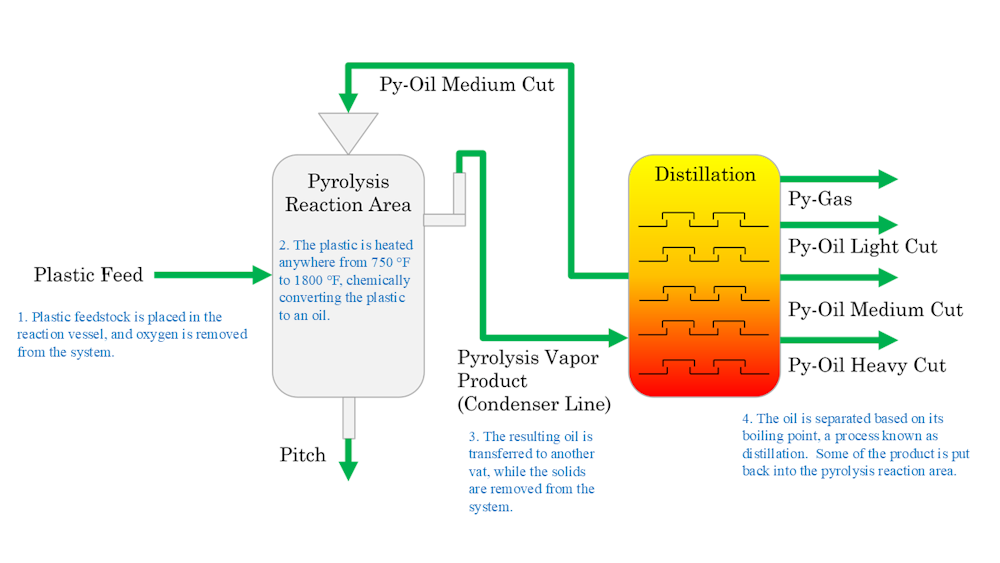
Plastic pyrolysis is a chemical process that involves chemically breaking down plastics into other molecules by heating the plastics to extremely high temperatures in the absence of oxygen.
Plastics are fed into the pyrolysis reactor, where they get hot and turn to oil. The oil moves to another vat where it’s boiled and distilled. Alexander Kaplitz and Kevin A. Schug
Unlike traditional plastic recycling, pyrolysis theoretically isn’t limited to specific types of plastic. It could be made to accommodate many of them, although current technology is limited to a few types – polyethylene and polypropylene, used in food containers and bottles – at an industrial scale.
So, plastic pyrolysis could help handle the waste from consumer products such as plastic bags, bottles, milk jugs, packaging materials, wet wipes and even discarded children’s toys. Pyrolysis can also handle more complex plastic waste such as tires and discarded electronics, although solid waste handlers and recyclers avoid certain plastic types in pyrolysis, such as polyvinyl chloride – or PVC, which is found in pipes and roofing products – and polystyrene, used in packaging, as these can create harmful byproducts.
During pyrolysis, the plastic polymers are broken down into smaller molecules, resulting in the production of liquid oil, fuel source gases such as methane, propane and butane, and char.
Char is the solid residue left at the end of the pyrolysis process. It can be used as a carbon-rich material for various applications, including adding it to soil to make it healthier for farming, as it increases soil moisture and pH, benefiting nutrient absorption. Char also has the ability to absorb harmful carbon gases from the air, which can help prevent climate change.
The main downside of char is if it’s used too much it can increase soil alkalinity, which may hinder plant growth.
Plastic pyrolysis uses heat to break down plastic, with the intent to convert plastic waste into usable materials.
How pyrolosis works
The plastic pyrolysis process typically involves several key steps.
In the first step of pyrolysis, community recyclers collect the plastic waste and clean it to remove any contaminants. The plastic then gets shredded into smaller pieces to facilitate the pyrolysis process. Unlike traditional recycling, it needs only minimal sorting.
Chemical recyclers operating pyrolysis plants feed the shredded plastic into a pyrolysis reactor, where they heat it to temperatures ranging from 600 to 1,600 degrees Fahrenheit (315 to 871 degrees Celsius). Without oxygen, plastics in the reactor don’t catch fire and emit fumes into the air. Instead, this high-temperature environment causes the plastic polymers to break down into smaller hydrocarbon molecules. These smaller molecules can be further refined.
The high temperature turns some molecules into vapors, which condense into liquid oil. Chemical companies can further refine this oil to be used as fuel or as a raw material to make other chemicals or plastics.
In addition to liquid oil, the pyrolysis process generates natural gases, such as methane, ethane, butane and propane. Pyrolysis operators then capture these gases, and they can sometimes use them as a source of energy to power the pyrolysis reactor or other industrial processes.
Plastic pyrolysis generates oil, which engineers can use to create new materials or fuels. BASF, CC BY-NC-ND
Benefits of pyrolysis
When done effectively, plastic pyrolysis offers several benefits.
By expanding recycling beyond just plastic bottles and milk jugs, pyrolysis could reduce the amount of plastic waste pollution that ends up in landfills and oceans.
Additionally, converting plastic waste into usable products could help lower the production demand for new plastics from petroleum hydrocarbons. The byproducts could get used in recycled plastics.
Some researchers are also testing pyrolysis oils to see whether they can use them instead of gasoline to fuel vehicles. The gases produced during pyrolysis can even generate energy that fuels the pyrolysis reactor, making the process more self-sustaining and reducing the need for external energy sources.
Currently, about 15% to 20% of the pyrolysis products are recycled into new propylene and ethylene, while most – about 80% to 85% – becomes diesel fuel, hydrogen, methane and other chemicals.
While plastic pyrolysis holds some promise, it also faces challenges. The cost of setting up and operating pyrolysis plants is high. How profitable the process is depends on the availability of suitable plastic waste, the market demand for the oils and gases produced, and the costs of energy and staff necessary to operate the reactor.
Another issue is quality control. Most plastic types can undergo pyrolysis, but different plastics create oils with different chemical makeups. Scientists will need to understand the composition of these oils before industry can determine which plastic types to focus on and how each oil could create new materials.
Pyrolysis oils have unique chemical compositions depending on the type of plastics used to create them. Alexander Kaplitz and Kevin A. Schug
Researchers like us at The University of Texas at Arlington and our international colleagues are studying new chromatography-based oil-separation techniques that can successfully identify some types of pyrolysis oils. Chromatography is the process of separating components in a mixture by passing them through a stiff material.
Different components in the mixture are attracted to this material to different degrees. So, they exit the chromatography system at different times, which separates them from one another.
With more research into the technique’s efficiency and technological advancements to scale up pyrolysis, this technique could be one part of a sustainable solution to plastic waste management. In the meantime, pyrolysis is being used now, with one report estimating the market for pyrolysis plants at US$40 billion in 2024 and predicting it to grow to $1.2 billion by 2033.
Kevin A. Schug receives funding from the National Science Foundation, the National Institutes for Health, ExxonMobil, and Weaver Consultants Group. He is affiliated with VUV Analytics, Inc. and Infinity Water Solutions as a member of their scientific advisory boards. Lummus Technology, LLC provided the funding for research on plastic waste pyrolysis oils at UT Arlington.
Alexander Kaplitz does not work for, consult, own shares in or receive funding from any company or organization that would benefit from this article, and has disclosed no relevant affiliations beyond their academic appointment.
Rep. Simpson Secures Permanent Pay Fix for Wildland Firefighters
Washington, March 18, 2025
WASHINGTON—Idaho Congressman Mike Simpson—Chairman of the House Interior and Environment Appropriations Subcommittee—secured a key provision in the Full-Year Continuing Appropriations and Extensions Act that prioritizes funding for Wildland Fire Management, including permanently addressing wildland firefighter pay. The Full-Year Continuing Appropriations and Extensions Act passed Congress on March 14 and was signed into law by President Trump. “The men and women who fight catastrophic wildfires across the nation deserve stability and adequate compensation for their courageous work,” said Rep. Simpson. “A permanent pay fix for our wildland firefighters will strengthen recruitment and retention while providing financial security to the first responders who protect our communities. I have long fought for this critical provision, and I am grateful to my colleagues and the Trump administration for their support in making it a reality.” Congressman Simpson’s Interior Appropriations bill included a permanent pay fix for federal wildland firefighters and passed the House in July 2024. Rep. Simpson also released an op-ed on why a permanent pay fix is needed. The full text of the bill is available here.
WASHINGTON, D.C. (March 18, 2025) – In response to the unlawful detainment of student activist and U.S. legal permanent resident Mahmoud Khalil, Greenpeace USA has signed on to a letter alongside a coalition of organizations urging Congress to uphold their oath to defend the Constitution. We believe Congress must act now to protect the rights of those they claim to represent, and demand the immediate release of Mr. Khalil from ICE custody. Greenpeace USA Democracy Campaign Director, Dr. Folabi Olagbaju said:
“In my home country of Nigeria, I have seen climate activists killed for daring to fight for a clean and just future. Like Mr. Khalil, I was also a student activist – one who was forced to watch my fellow classmates be killed for peacefully and nonviolently protesting the military dictatorship. When I came to the United States, I believed its foundation in democracy meant that people could speak out without fear of persecution, detainment, or death. That is no longer the case.
“The detention of Mahmoud Khalil sends a chilling message that dissent is no longer just being silenced, it is being punished. This is happening as the defenders of our freedom remain silent. As we’ve said before, universities have a responsibility of protection to uphold in regard to their students. Hiding behind statements about an obligation ‘to comply with the law’ holds no merit when those laws are being weaponized to violate constitutional and human rights. It is an egregious dereliction of duty to stand by as this administration attempts to illegally detain and deport a legal permanent resident of the United States.”Greenpeace USA encourages individuals to sign this petition to demand Mr. Khalil’s release and the dismissal of the threats against his legal status.
Contact: Madison Carter, Greenpeace USA Senior Communications Specialist, [email protected]
Greenpeace USA is part of a global network of independent campaigning organizations that use peaceful protest and creative communication to expose global environmental problems and promote solutions that are essential to a green and peaceful future. Greenpeace USA is committed to transforming the country’s unjust social, environmental, and economic systems from the ground up to address the climate crisis, advance racial justice, and build an economy that puts people first. Learn more at www.greenpeace.org/usa.
Source: Saint Petersburg State University of Architecture and Civil Engineering – Saint Petersburg State University of Architecture and Civil Engineering – Alexander Kolpakov
Representatives of the North-West Office of the Federal Service for Environmental, Technological and Nuclear Supervision (Rostekhnadzor) met with students to tell them about their activities and employment opportunities for young professionals.
“The demand for specialists capable of ensuring reliable, uninterrupted operation of energy facilities and safety of technological processes is growing. State inspectors who carry out control and supervisory activities play a key role in this. Practice shows that some of those who receive higher education today will not work in their chosen specialty and in the industry as a whole. Today’s meeting is educational in nature for future specialists in the energy sector who can link their professional activities with the field closest to their specialty,” said Alexander Kolpakov, Deputy Head of the Department for State Energy Supervision of Consumer Electrical Installations of the North-West Department of the Federal Service for Environmental, Technological and Nuclear Supervision (in the sphere of state energy supervision).
He explained that the North-West Department of Rostekhnadzor carries out state control and supervision in industrial safety, safety of hydraulic structures, electric power industry, construction in St. Petersburg, Leningrad, Arkhangelsk, Vologda, Kaliningrad, Murmansk, Novgorod, Pskov regions and the Republic of Karelia. In the sphere of state energy supervision, inspectors conduct inspections of legal entities and individual entrepreneurs for their compliance with reliability and safety requirements, regulatory legal acts within their competence. They are among the first to go to the largest and most significant facilities in order to subsequently issue a permit for the commissioning of electrical installations. Among such facilities are the most technologically advanced stadium in the country, Gazprom Arena, the new multifunctional sports complex SKA Arena, the northernmost skyscraper in the world, Lakhta Center, and the metro.
“Everything is developing rapidly today: new technologies are being introduced, modern materials are being used, unique facilities are being built, and it is very interesting to work in our field. Public service differs from civil work due to requirements and restrictions. The main requirements are: Russian citizenship, reaching the age of eighteen, and proficiency in the state language. You can become a specialist expert, senior or chief inspector, department head or deputy only if you have a higher education. Support specialists only need to have a secondary vocational education. There are no requirements for experience: inspectors can be recruited directly from their studies, and students can undergo industrial training,” concluded Alexander Kolpakov. The conversation about work, including at large, well-known facilities, interested the students not only in terms of employment, but also in terms of organizing energy supply to them.
Please note: This information is raw content directly from the source of the information. It is exactly what the source states and does not reflect the position of MIL-OSI or its clients.
Source: United Kingdom – Executive Government & Departments
News story
Energy Secretary visits China to launch climate dialogue
Ed Miliband resumes formal energy and climate talks with China
Energy Secretary Ed Miliband met his Chinese counterparts in Beijing this week to re-start formal energy and climate discussions and demonstrate global climate leadership.
On Saturday (15 March) the Secretary of State met Chinese Minister Huang at the Ministry of Ecology and Environment. They discussed strengthening cooperation on climate issues such as nationally-determined contributions (NDCs) looking ahead to COP30.
He then travelled to Tsinghua University where he spoke to students about UK action and global cooperation on climate change as part of the university’s climate lecture series.
On Sunday (16 March), the Energy Secretary visited Carbon Capture and Storage (CCUS) and hydrogen power projects in Energy Valley, an area which drives the development of clean energy technologies in the country.
He then met with British business representatives based in Beijing, to hear about the opportunities and challenges for business and how the UK can support in increasing UK clean energy exports to drive growth and create jobs.
On Monday (17 March), the Secretary of State visited China’s National Energy Administration to engage in a formal UK-China Energy Dialogue. Along with Administrator Wang, he led discussions focused on clean energy technologies, pathways to the energy transition including phasing out coal, energy security and international energy governance.
At the end of the meeting, Ed Miliband signed the Clean Energy Partnership Memorandum of Understanding (MoU) with Administrator Wang, which agrees to enhance cooperation on renewables, grid modernisation and clean technologies, while protecting the UK’s national security.
The visit concluded with a visit to the Great Hall of the People, where the Energy Secretary met Chinese Vice Premier Ding Xuexiang to agree to continue cooperation on energy and climate. The Secretary of State also took the opportunity to raise the UK government’s concerns on issues including Russia, forced labour and Jimmy Lai.
Energy Secretary Ed Miliband said:
We can only keep future generations safe from climate change if all major emitters act. It is simply an act of negligence to today’s and future generations not to engage China on how it can play its part in taking action on climate.
That is why I met Chinese ministers for frank conversations about how both countries can fulfil the aims of the Paris Climate Agreement, to which both countries are signed up.
Our Plan for Change and clean energy superpower mission is about energy security, lower bills, good jobs and growth for the British people. It is with this mission that we can also influence climate action on a global stage, fight for our way of life and keep our planet safe for our children and grandchildren.
Source: The Conversation – UK – By Craig Jackson, Professor of Occupational Health Psychology, Birmingham City University
US astronauts Sunni Williams and Barry Wilmore have been stranded in low earth orbit onboard the International Space Station for nine months. They are now finally due to return to Earth. Their planned return from their one week mission was abandoned due to concerns with the return vehicle, the Boeing Starliner-1, and this resulted in them being in space for 290 days.
Wilmore and Williams do not hold the record for the longest stay in orbit, which belongs to cosmonaut Valeri Polyakov, who spent 437 continuous days on the Soviet Mir space station. Nine other US astronauts have spent more than 200 days each in orbit during a single spaceflight – but Wilmore and Williams do hold the record for the longest unplanned spaceflight among US astronauts. Could the unplanned nature of their extended trip produce effects not seen in other planned long-term spaceflights?
The risks and hazards of space flight are well understood by Nasa and referred to as “RIDGE” – short for Radiation, Isolation and confinement, Distance from Earth, Gravity effects and hostile Environments. Aerospace medicine takes such issues seriously.
Some physical effects include blood clots and pooling, reductions in bone density, poor digestion, lower nutrient absorption, musculoskeletal atrophy (muscle and bone loss), and poorer cardiovascular function due to reduced blood pumping in zero gravity. Other impacts include changes to the eyeballs due to the pooling of fluids, pooled cerebrospinal fluid around the skull area, and a semi-permanent feeling of congestion.
The reduced sense of smell may be a blessing, as many space capsules develop an unpleasant smell. Physical effects from fluids can be improved, but not entirely negated, by cuff compression (a fabric sleeve that compresses an area of the body) to relieve pain and swelling. Musculoskeletal atrophy can be reduced with the help of an aerobic treadmill and resistive exercises to help maintain the muscles and cardiovascular function.
Exposure to radiation is a serious concern, and longer exposures can increase the likelihood of astronauts developing some cancers later in life. The health of Wilmore and Williams will be monitored for many years to come.
While stranded, Wilmore and Williams will have been providing vital data to help measure the impacts of prolonged stays – every bladder and bowel movement they had will have been weighed and checked for any signs of illness and to monitor changes brought about by their unplanned extension.
On their return to Earth, they will require gentle physiotherapy to regain muscle function and strength, and for cardiovascular rehabilitation, paced carefully due to the physical fatigue and limitations they will suffer for a few weeks. Dizzy spells, reduced muscle function, and visual disturbances will be common and even walking will take some practice. Their skin will be “baby soft” after nine months of not having their clothes rub against their bodies.
Of more interest may be the psychological challenges they face, from their concerns over the “near miss” by not returning to Earth in the vehicle they arrived in because Nasa decided it was too risky, through to having to live in confined quarters with others for so long, with a lack of privacy, and enforced companionship.
Behaviour in others that was initially a minor annoyance can quickly become serious sources of stress and irritation during enforced confinement. Astronauts are selected and screened based on temperament, personality, aptitude and their ability to cope when things go wrong. A problem solving mentality and a will to live, coupled with an ability to follow commands and maintain order in the most difficult of circumstances are what makes astronauts better than most of us.
They are trained to cope under any situation, such as crash-landings in deserts, or technical failures on board the spacecraft. But despite excellent training, human fallibility and failings will emerge given time.
Astronaut training also instils the importance of resilience, despite the most trying circumstances, and they will have been trained to keep their fears and anxieties hidden for the benefit of the mission. It might only be after their return that Wilmore and Williams may express their relief. Depression and anxiety can be common after returning to Earth according to others who have been there, with Buzz Aldrin admitting it happened to him and others in his 1973 autobiography Return to Earth.
Keeping busy will have helped keep worries away. Nasa
They may have experienced feelings of abandonment and questioned why they could not be rescued sooner, or may have developed an understandable lack of trust in technology, and a lack of faith in their fellow mission crew members. They will no doubt have missed important dates with their families, experienced homesickness and possibly even questioned if they could last until rescued.
Video-link contact with family will have kept them going but will have also been painful and difficult at the same time. Knowing that their families are worried about them, yet equally unable to do anything about it must have been particularly difficult. Although keeping themselves busy as a distraction will have helped, there would have been downtime when their worries must have been almost overwhelming.
Sleep disturbances and the inability to get regular sleep to allow their brains to rest will have led to cumulative fatigue – both physical and mental. Some astronauts struggle to ever get used to sleeping in space – resulting in lack of performance in the sufferer.
Being stranded on the ISS and unable to get back home while being able to see home fly by with every rotation of the Earth presents a unique form of frustration. One positive effect reported by many astronauts is the “overview effect” where a sense of peace and oneness with the planet is experienced when viewing the Earth from a whole new perspective. The overview effect seems to have a permanent impact, staying with astronauts for the rest of their lives.
A complication in understanding any psychological effects of spaceflight is that many astronauts hope to continue their careers and have more missions, and therefore may not be honest about any negatives they experienced. With Nasa planning missions to Mars at some point in the future, the unique experiences of Wilmore and Williams will be useful to behavioural scientists planning such future missions and trying to understand the best psychological characteristics for selecting astronauts for long term spaceflights.
Craig Jackson does not work for, consult, own shares in or receive funding from any company or organisation that would benefit from this article, and has disclosed no relevant affiliations beyond their academic appointment.
As a young climate advocate, I have always believed that speaking up can change the world. That when we raise our voices for our planet, people will listen. That when we fight for a future where clean air and water are not privileges but rights, justice will be on our side. But this lawsuit against Greenpeace International and Greenpeace entities in the USA by Energy Transfer feels like a punch to the gut—a brutal reminder that those who destroy our home will stop at nothing to silence those who protect it.
This is not just a lawsuit. It is an attack on our future. A warning shot aimed at every single person who dares to challenge the greed that fuels the climate crisis. If they can go after Greenpeace with a $300 million lawsuit, what is stopping them from coming after me? Or you? Or the millions of young people who refuse to stand by as our future is stolen from us?
We are running out of time. The climate crisis is already here. It is in the super typhoons that rip through our homes, tearing apart walls and washing away entire neighborhoods. It is in the unbearable heat that suffocates our cities, turning streets into furnaces and claiming lives in deadly heat waves. It is in the rising seas swallowing entire communities, forcing families to abandon the lands their ancestors called home. It is in the devastating droughts that turn fertile lands into wastelands, leaving nothing but cracked earth and dying crops. It is in the raging wildfires that reduce forests to ash and choke the air with smoke.
Yet instead of holding polluters accountable, they are trying to silence those who fight to protect what little we have left.What kind of world does that leave us with? One where speaking the truth is punished? Where corporations decide who gets to thrive and who gets left behind? Where the next generation inherits nothing but disasters, displacement, and destruction?
I refuse to accept that. We refuse to accept that.
This case is not just about Greenpeace. It is about every young person who dreams of a future worth living in. It is about our right to fight for that future without fear. It is about ensuring that the voices of the youth are not drowned out by the wealth and power of those destroying our planet.
But let me be clear: we are not alone. We are millions, standing shoulder to shoulder, refusing to be silenced. They can try to intimidate us, but they cannot break us. And we will keep fighting—because we have no other choice. This is our home. This is our future. And we will defend it with everything we have.
We stand with Greenpeace. We stand with every environmental defender. We stand for justice, for truth, and for a world where young people are not punished for caring about the only planet we have.
To everyone reading this: Stand with us. Speak up. Take action—share this message, join the movement, and demand accountability. Our voices, our actions, and our solidarity are stronger than their fear tactics. The future belongs to those who refuse to be silenced. And we will not be silenced.
The fight is far from over. Stand with us, raise your voice, and make it clear: those who seek to silence us will never succeed. We will speak. We will fight. And we will win—because justice demands it, and the planet we call home is worth fighting for.
Source: United Kingdom – Executive Government & Departments
News story
Members of the Committee on Fuel Poverty reappointed
Caroline Flint (chair), Gordon McGregor, Belinda Littleton and Anthony Pygram have been reappointed to the Committee on Fuel Poverty (CFP).
Caroline Flint has been reappointed to the Committee on Fuel Poverty (CFP) in the role of Chair. This reappointment took effect from 31 January 2025 and will last for 3 years.
Belinda Littleton, Anthony Pygram and Gordon McGregor have also been reappointed to the Committee. Gordon McGregor’s reappointment takes effect from 17 May 2025 for 2 years. Belinda and Anthony’s reappointments each take effect from 3 May 2025 for 3 years.
The Committee on Fuel Poverty advises on the effectiveness of policies aimed at reducing fuel poverty and encourages greater co-ordination across the organisations working to reduce fuel poverty.
Biographies
Caroline Flint
Caroline has a wealth of experience in politics as a Labour MP for Don Valley, from 1997-2019. She was the first woman MP for Don Valley and a Minister in 5 government departments, developing legislation and leading major policy initiatives, before serving in Her Majesty’s Opposition Shadow Cabinet from 2010 to 2015. During her significant political career, she led the Smoke Free England legislation, led Opposition strategy on energy market reform and climate change, has contributed to multiple All-Party Parliamentary Groups and committees, including the Commons Public Accounts Committee and Intelligence and Security Committee.
Caroline was appointed chair of Humber Teaching NHS Foundation Trust in 2021 and has been re-appointed for a second term. She was a member of the UK Commission on COVID Commemoration which reported to the government on how our collective experience of the pandemic should be remembered. Caroline is an Advisory Board member for the thinktank Reform, works with Dods delivering training on how government and Parliament works and is a broadcaster and commentator on news and current affairs. She won Celebrity Mastermind in 2021 with her specialist subject the movie ‘Alien’ raising money for the National Association for Children of Alcoholics (NACOA). She lives in Doncaster.
Belinda Littleton
Belinda Littleton works for National Grid and is currently Head of Asset Engineering Assurance, Electricity Transmission. She is a Chartered Engineer and a Fellow of the Institute of Engineering and Technology. Belinda’s work at National Grid has included:
leading a team of specialists to deliver appropriate system upgrades that provide value to the consumer during the clean energy transition
focusing on enabling a net zero future that doesn’t leave anyone behind
setting out National Grid’s strategic perspective on the decarbonisation of transport
Previously working as an economist at Ofgem, Belinda looked at the impact of the smart meter rollout on vulnerable customers.
Belinda has also previously worked at PwC. During this time she worked with the former Department of Energy and Climate Change to develop their Household Energy Efficiency Strategy considering the carbon reduction contribution that could be made by households.
Belinda is passionate about designing inclusivity into future policy that delivers against net zero commitments within the UK.
Anthony Pygram
Anthony Pygram is a regulatory expert. He was the Director of Conduct and Enforcement at Ofgem (where, amongst other things, he oversaw the development of Ofgem’s Consumer Vulnerability Strategy). He was subsequently a specialist adviser to the House of Lords Industry and Regulators Committee for its Ofgem and net zero inquiry, and more recently a Senior Manager at the Payment Systems Regulator.
Anthony is Lay Vice President and a member of the Solicitors Disciplinary Tribunal, a Lay Member of the Regulatory Board of the Institute of Chartered Accountants of England and Wales, and the independent Chair of the Code Change Committee for the non-household water market.
Gordon McGregor
Gordon has worked for over 3 decades in the energy and utilities sector. He has a depth of experience working in retail, distribution, generation and corporate management. Most recently, he has helped lead a number of highly innovative companies that have a strong focus on energy efficiency, renewables and clean technology.
Gordon was a founding member of the Electricity Association Taskforce on Fuel Poverty, working on how energy regulation and industry structures could improve energy efficiency and affordability. Throughout his career, he has helped design energy efficiency programmes, developed affordable payment approaches, created social action initiatives and has helped design tariffs that help priority and vulnerable customers. He has also been involved in market design and managed the implementation of regulations to support new renewable targets. As a director of a vertically integrated utility, he helped lead the transition from a largely fossil fuel based portfolio towards a lower carbon alternative.
Gordon is Chief Sustainability and Digital Officer for Sweco UK & Ireland, a leading European engineering and architecture consultancy. Gordon also sits on the Natural Environmental Research Council and is a member of the UKRI Advisory Board for Building a Green Future.
On a sunny morning in late February, a group of students from the UConn Forest Crew work through the sugar maple stand, affixing taps and lines to the trees, and then running them back to a storage tank.
They are working alongside Tom Worthley, a UConn Extension forestry educator, preparing the sugar bush for the upcoming sap season. The group is preparing the trees for the warm days and cold nights that prompt the sugar maple trees (Acer saccharum) to produce sap for transformation into maple syrup’s golden goodness.
Each gallon of maple syrup requires about 40 gallons of sap, creating a hive of activity for the weeks-long sap season each year.
“I’m involved because of the student experience and to promote trees and forests to people around the state, creating materials like maple syrup that link people to the resource. There’s also a lot of satisfaction that comes from having something you grew or made and can enjoy later,” Worthley says.
Connecticut is in the heart of the sugar maple range and ranks eleventh nationally in maple syrup production. The UConn Sugar House is one of many throughout the state offering a high-quality and delicious product each year.
Maple syrup production in the United States increased in 2024, with the highest yield from the past 25 years, due in part to an increased number of taps and favorable weather conditions.
Despite strong promotional campaigns from Vermont, New York, and Canada, once sap is syrup, it’s basically impossible to tell where it came from. As long as the sugar producer uses high-quality production methods, all of these syrups will taste about the same.
“All the more reason to support Connecticut maple producers,” says Worthley.
The timeless tradition began with Indigenous cultures in North America, who moved their families to a sugar bush, or stand of sugar maple trees, in late winter as the snow began to melt.
The sap’s sweetness was likely discovered by sap icicles on the trees, and this led to collecting sap for use throughout the year. Without pots for boiling, the Indigenous people made three types of sugar instead, and later the tradition evolved to syrup production.
UConn’s sugar house is tucked in behind the Farm Services buildings, near where the Woodsmen Teams maintain their timber mill and practice yard.
Extension professionals, faculty from the Department of Natural Resources and the Environment, and UConn students have made syrup here for over 30 years, preparing the next generation of maple producers and selling their syrup to support the sugar house and equipment.
“Our student-run maple program illustrates one of the great benefits that the UConn Forest provides to our campus community, the hands-on, practical educational experiences that our students can engage in,” says Robert Fahey, Goerge F. Cloutier Professor in Forestry. “Through work experiences and internships we are able to provide training that gives our students the technical skills they need as well as real-world experience conducting and managing forest-related activities such as maple-syrup production, creating value-added wood products, and trails and recreation management.”
UConn students boiling maple sap for syrup (Contributed photo)
For some students, this is just one element of their “forest education.”
“It’s exciting to learn what the forest is capable of, how we utilize forests, and that it’s not just by cutting them down,” says Zach Placzek ’25 (CAHNR). Placzek’s desire to protect the forest led him to seek certification to fight fires, and he is working with the UConn fire chief to help establish a controlled burn operation to control invasive species in a recently harvested area of the forest.
The 2,100-acre UConn Forest has several sugar bushes, and the students rest a sugar bush and use another at times as part of their forest stewardship. Sugar maple trees thrive on north facing slopes with deep soils, and while the UConn Forest has several such locations, Worthley also mentions growing more sugar maple trees, and perhaps developing or cultivating a stand closer to the sugar house.
“The ability to produce maple syrup locally in Connecticut is one of the many positive benefits created by living in a well-forested state” says Amy Harder, associate dean for Extension. “Many producers also benefit from integrating agritourism into their operations so the public can see, smell, and taste the entire experience – something my family loves to do!”
Sap runs just below the bark on sunny days, dripping from the taps into the buckets or lines affixed to each tree. Once the sap really starts running, the students need to empty the tank at the sugar bush daily. It’s transported back to the sugar house on campus in their 60-gallon transfer tank and pumped into another tank outside the sugar house. Gravity feeds the sap into the evaporator inside the house.
The wood-fired pans are heated to 219 degrees Fahrenheit, boiling the water out of the sap, with steam rising through the vent in the sugar house’s roof. Sap becomes syrup as the water evaporates and the sugar content increases. Next, it’s filtered to remove any solids and then reheated to over 180 degrees Fahrenheit. Bottles are carefully filled with the 180-degree sap and turned upside down to seal the lids.
Maple syrup comes in four colors, Golden, Amber, Dark, and Very Dark. Lighter syrup – golden and amber – is from early sap and has a milder flavor. The lighter colors are often the syrup of choice for breakfast foods, added to coffee, or drizzled over ice cream. Later season sap is darker because it has more sugars in it, and the sugars make the darker syrup with its robust flavor. Many people use darker syrups for baking and cooking, although some prefer this flavor on breakfast foods.
Sap season wraps up by the end of March, sometimes earlier if the weather warms faster than expected. The students clean the equipment and conduct any needed repairs or maintenance on the equipment before storing it for next year. UConn’s 30-year-old evaporator is in its last season, and the off-season challenge this year is fundraising to replace it.
“For myself, being a researcher and doing a lot of outreach work with the local professional foresters, I find immense value in having this living lecture hall to teach from,” says Amanda Bunce, a Ph.D. student studying tree biomechanics and silviculture. “Students do much better learning in the real thing than from a classroom, and I find it so much easier to share my own enthusiasm for ecology when we’re out in it.”
Find a Sugar House near you in Connecticut by visitingConnecticut Grown.
This work relates to CAHNR’s Strategic Vision areas of Advancing Adaptation and Resilience in a Changing Climate and Fostering Sustainable Landscapes at the Urban-Rural Interface.
Source: United Kingdom – Executive Government & Departments
News story
The Persistent Organic Pollutants (Amendment) Regulations 2025: impact assessment – RPC statement of lateness
RPC statement about the Department for Environment, Food and Rural Affairs’ (DEFRA) late submission of the impact assessment relating to the regulations
The Regulatory Policy Committee (RPC) produces opinions of impact assessments (IAs) to help departments ensure that the evidence and analysis in them is sufficiently robust. We provide an independent opinion to assist ministerial decision making and parliamentary scrutiny of regulatory proposals. We publish these to assist parliamentarians and to ensure that they are available to external stakeholders. Government departments are expected to submit IAs to the RPC in time for the RPC to issue an opinion before the relevant legislation is laid before Parliament.
The Persistent Organic Pollutants (Amendment) Regulations 2025 were laid before Parliament on 11 March 2025. The same day, DEFRA submitted an IA for RPC scrutiny. The RPC is currently reviewing the IA and will produce an opinion when its scrutiny has been completed. This will be made available to the Government and Parliament and published on the RPC’s website, when this statement will be updated.
Source: United Kingdom – Executive Government & Departments
News story
New non-executive directors join Defra board
Sachin Jogia and Indro Mukerjee appointed to the departmental board
The Department for Environment, Food and Rural Affairs (Defra) has today (18 March 2025) announced the appointment of two new non-executive board members – Sachin Jogia and Indro Mukerjee.
Non-executive board members are senior figures from outside government, appointed to provide challenge to government departments. All non-executive board member appointments are made in line with the Governance Code on Public Appointments.
Sachin and Indro begin their appointments today, with their terms lasting for three years.
The Defra board provides strategic, corporate leadership to the department and has particular responsibility for monitoring performance and delivery.
Biographies
Sachin Jogia
Sachin Jogia has a technology and product leadership background across global organisations, most recently as Group Director of Technology Strategy and Transformation at Sky.
Previously, he was Chief Technology Officer at Ofcom, overseeing innovation across the areas they regulate including online safety, broadcasting and telecoms. Before that, he spent nine years at Amazon in the UK and USA, most recently as General Manager for Alexa Smart Home International.
Sachin was the founding Chairman of the British Heart Foundation’s Technology Advisory Group and has championed initiatives supporting disadvantaged communities, including Amazon Future Engineer. He is a Trustee and non-executive director at City Year UK, a founding member of the Corporate Advisory Board at Save The Children UK and has mentored Imperial College students and senior leaders with BeTheBusiness.
Indro Mukerjee
Indro was CEO of Innovate UK, the UK’s innovation agency, for three and half years until September 2024.
He is a highly experienced business leader, with CEO experience across technology and industrial businesses from multinationals to startups and private equity-backed ventures.
With a global career spanning Asia, the US, and Europe, Indro has led innovation, fast growth, spinouts, M&A, and business transformation across many different business situations. He has been strongly committed to supporting skills development, including co-founding and chairing the UK Electronics Skills Foundation.
He has an engineering degree from Oxford University, a graduate of the Wharton Advanced Management Program, a Fellow of the Royal Society of Arts and an elected Honorary Fellow of the Royal Academy of Engineering and the Academy of Medical Sciences.
Charter committing to openness, transparency and accountability
Welsh public organisations pledge new approach focused on the bereaved and survivors of public tragedies.
Organisations across Wales have signed a charter which commits them to responding to public tragedies with openness, transparency and accountability.
The Charter for Families Bereaved by Public Tragedy calls for a cultural shift in public bodies’ engagement with bereaved families, ensuring the lessons of the 1989 Hillsborough disaster and its aftermath are learned to prevent those who are affected by public tragedy in the future from having the same experience.
Organisations across Wales – including Welsh Government, local authorities, police forces, Welsh Ambulance Service, fire and rescue services, and the Mining Remediation Authority – have all signed up to support bereaved families and the community in the aftermath of a major incident, with a clear commitment to people and to providing services that meet their needs before, during and after an event.
A launch event will be held in Merthyr Tydfil today (Tuesday 18 March 2025), attended by Bishop James Jones KBE, who wrote the charter as part of his report on lessons from the Hillsborough tragedy.
He will be joined by the bereaved and survivors of public tragedies, including Hillsborough, Grenfell Tower, Manchester Arena and Aberfan, which stands only a few miles from the launch.
Bishop Jones said:
Today the nation of Wales is leading the way with more than 50 of its public bodies signing the charter. In doing so the culture of the organisations has begun to change and there is a renewed commitment to public service and to respecting the humanity of those we are called to serve.
The charter represents a promise that after any future tragedy no one will be left to navigate their grief and survival alone. That no one will endure again the ‘patronising disposition of unaccountable power’.
This is a pivotal moment in the life of the nation as we embrace the principles of the charter and pledge to respect the humanity of all its citizens which should be at the heart of all public service.
North Wales Fire and Rescue Service Chief Fire Officer Dawn Docx, chair of the Joint Emergency Services Group in Wales, said:
We recognise that co-operation when supporting families affected by public tragedy is vital for ensuring the wellbeing and resilience of our communities.
By working together we can use our collective expertise and resources to provide meaningful support to those in need during times of crisis and beyond.
South Wales Police Deputy Chief Constable Mark Travis added:
By signing the charter, each and every organisation is making a public statement to learn the lessons of the Hillsborough disaster and other tragedies to ensure that we never lose sight of the perspective of bereaved families and ensure that they are treated with care and compassion, not only at the time of emergency and tragedy but in the weeks, months and years after.
While today is a landmark, the real challenge is to embed the charter into our training and culture to ensure it becomes an integral part of our response to any public tragedy.
The involvement of the bereaved and survivors of public tragedy has been a driving force in bringing about today’s momentous step forward.
Julia Draycon, Environment Director at the Mining Remediation Authority, said:
As a 24/7 emergency response organisation, with staff across Great Britain ready to respond to incidents, we are proud to sign up to the charter For Families Bereaved Through Public Tragedy and we’re committed to upholding the principles within it.
We act with integrity, respect and empathy; we take pride in the way we are dedicated to delivering for the communities we serve.
For media enquiries contact the community response team
Waste company prosecuted for ignoring audit at Notts site
A Midlands-based waste company and a partner in the business have been prosecuted for failing to comply with a demand for information about materials accepted.
Droitwich-based business ordered to pay total of £52,405.05 for failing to provide details of metals processed
Partner in firm to pay total of £7,996.05 for his part in running Welbeck Colliery operation
Case heard at Worcester Magistrates Court on 14 March 2025
At Worcester Magistrates Court on Friday 14 March, Tetron Welbeck Limited Liability Partnership pleaded guilty and were fined £44,800 and ordered to pay costs of £5,605.05.
The Partnership was also ordered to pay the victim surcharge of £2,000. In total the Partnership has to pay £52,405.05.
Edward Seekings, a designated member of the Partnership, also pleaded guilty and was fined £1,708.
Seekings, 41, of Bridge Lane Court, Bawtry, Doncaster, was also ordered to pay costs of £5,605.05 and the victim surcharge of £683, coming to a total of £7,996.05.
The court was told that the Partnership, whose office is at Hadzor Court, Hadzor, Droitwich, Worcestershire, had an environmental permit since 2013 to operate a site at Welbeck Colliery near Mansfield, Nottinghamshire. It was stated that the business changed hands around 2020.
The Partnership failed to comply with a formal information notice served on it after it failed to provide information requested by the Environment Agency.
The information was required to allow the Environment Agency to conduct an audit of the site to ensure waste within the correct category was being accepted.
The deadline in the notice for the receipt of the information was the 15 June 2023. No information was received.
Seekings sent a work plan on 15 June 2023 but it did not include the required information. He engaged with the Environment Agency but did not provide the information required.
Further attempts by the Environment Agency to obtain the relevant information failed.
A spokesperson for the Environment Agency said:
We welcome this sentence which should act as a deterrent to others considering flouting the law.
As a regulator, the Environment Agency will not hesitate to pursue any person failing to provide information requested.
The Environment Agency served a formal legal notice in this case requiring information to be provided. It is a criminal offence to fail to comply with a notice requiring information.
>If anyone is suspicious of waste activities they should call our 24/7 hotline on 0800 80 70 60 or Crimestoppers anonymously and in confidence on 0800 555 111.
The Charge
Tetron Welbeck LLP (Company Number OC366746) failed without reasonable excuse by 15 June 2023 to furnish to the Environment Agency information required by a Notice in writing dated 15th May 2023.
This was served on it pursuant to section 71(2) of the Environmental Protection Act 1990, contrary to section 71(3) of the Environmental Protection Act 1990.
The offence was committed with the consent or connivance of, or was attributable to any neglect on the part of Edward Seekings, contrary to Section 157(1) of the Environmental Protection Act 1990.
The London Assembly agreed a motion in December 2018, calling for “the Mayor to declare a Climate Emergency, supported by specific emergency plans with the actions needed to make London carbon neutral by 2030 …”.1
The following month, the Mayor declared a climate emergency for London and has brought forward the target for London to be net zero from 2050 to 2030.2
The Greater London Authority (GLA) states that:
“A climate budget is a governance system that mainstreams climate considerations into decision making via the budget allocation process and highlights a city’s short-term actions to deliver the long-term climate targets (in line with the city’s climate action plan or Net Zero Pathway).”3
Tomorrow, the London Assembly Budget and Performance Committee will meet to examine the impact of the Mayor’s Climate Budget and Green Finance Fund, and the impact this has had on achieving London’s net zero 2030 target.
Guests include:
Panel 1—Climate Budgeting
Heidi Sørensen,Head of the Agency for Climate, City of Oslo
Professor Carly McLachlan,the Director of The Tyndall Centre for Climate Change Research at Manchester University
Mark Johnson,Public sector lead, Association of Chartered Certified Accountants
Panel 2—Climate Budgeting and Green Finance Fund at the GLA
Fay Hammond, Chief Finance Officer, GLA
Pete Daw, Head of Climate Change, GLA
Megan Life, Assistant Director of Environment and Energy, GLA
Sam Longman, Head of Sustainability and Corporate Environment, Transport for London
Kenroy Quellennec-Reid, Head of Impact Investment and Analysis, London Treasury, GLA
The meeting will take place on Wednesday 19 March from 10am, in the Chamber at City Hall, Kamal Chunchie Way, E16 1ZE.
Media and members of the public are invited to attend.
The meeting can also be viewed LIVE or later via webcast or YouTube.
Source: Moscow Government – Government of Moscow –
The protection of plantings is one of the fundamental principles of caring for Moscow’s green fund. The city has enshrined this provision in the law on the protection of the green fund. Owners and users of land plots on which trees and shrubs are located are obliged to monitor their condition and ensure normal development. Specialists from the capital’s Department of Nature Management and Environmental Protection explained how to determine that a tree is feeling well.
“A healthy tree has thick green foliage of normal size, it has a well-developed crown, no signs of disease, pest damage, and no mechanical damage. The condition of such a tree is assessed as good,” noted Elena Gavrilenko, dendrologist, chief expert on urban ecosystems of the State Budgetary Institution “MosEcoMonitoring” of the Department of Nature Management of Moscow.
Long-term observations show that the capital’s green spaces are stable and adapt well to the city’s growing conditions. Linden, Norway maple and birch are often used for city greening.
Meanwhile, the presence of some shortcomings in trees is allowed. “The foliage is lighter than usual, the crown is weakly open, the presence of individual dry branches nevertheless allow the tree to continue to grow and develop. In this case, the condition of the plant is assessed as satisfactory,” Elena Gavrilenko specified.
Experts monitor the condition of green spaces in Moscow every year. Trees are examined at 130 permanent observation sites, including in the territory of TiNAO. They are located in different types of green areas with different anthropogenic loads, which allows for a general description to be obtained through selective surveys.
Based on the information received, recommendations are given to tenants or owners of green fund territories on timely implementation of protective and security measures. In particular, to improve the health of trees, sanitary pruning of the crown, removal of damaged branches, strengthening of trunks and treatment against insects are required.
Please note: This information is raw content directly from the source of the information. It is exactly what the source states and does not reflect the position of MIL-OSI or its clients.
Please Note; This Information is Raw Content Directly from the Information Source. It is access to What the Source Is Stating and Does Not Reflect
The Wildlife Trusts are a grassroots movement of people from a wide range of backgrounds and all walks of life, who believe that we need nature and nature needs us. We have more than 900,000 members, over 39,000 volunteers, 3,600 staff and 600 trustees. There are 46 individual Wildlife Trusts, each of which is a place-based independent charity with its own legal identity, formed by groups of people getting together and working with others to make a positive difference to wildlife and future generations, starting where they live and work.
Every Wildlife Trust is part of The Wildlife Trusts federation and a corporate member of the Royal Society of Wildlife Trusts, a registered charity in its own right founded in 1912 and one of the founding members of IUCN – the International Union for the Conservation of Nature. Taken together this federation of 47 charities is known as The Wildlife Trusts
Not for distribution, directly or indirectly, in or into the United States or any jurisdiction in which such distribution would be unlawful.
[Seche Environment SA]
Pre-stabilisation Period Announcement
BNP Paribas (contact: Stanford Hartman telephone: 0207 595 8222 hereby gives notice, as Stabilisation Coordinator, that the Stabilisation Manager(s) named below may stabilise the offer of the following securities in accordance with Commission Delegated Regulation EU/2016/1052 under the Market Abuse Regulation (EU/596/2014).
The securities:1
Issuer:
Seche Environment SA
Guarantor (if any):
N/A
Aggregate nominal amount:
EUR 350,000,000.00
Description:
EUR 5YR
Offer price:
TBC
Other offer terms:
Stabilisation:
Stabilisation Manager(s)
BNP Paribas, Natixis
Stabilisation period expected to start on:
18/03/2025
Stabilisation period expected to end no later than:
24/04/2025
Existence, maximum size and conditions of use of over‑allotment facility:
The Stabilisation Manager(s) may over‑allot the securities to the extent permitted in accordance with applicable law.
Stabilisation trading venue:
OTC
In connection with the offer of the above securities, the Stabilisation Manager(s) may over‑allot the securities or effect transactions with a view to supporting the market price of the securities during the stabilisation period at a level higher than that which might otherwise prevail. However, stabilisation may not necessarily occur and any stabilisation action, if begun, may cease at any time. Any stabilisation action or over‑allotment shall be conducted in accordance with all applicable laws and rules.
This announcement is for information purposes only and does not constitute an invitation or offer to underwrite, subscribe for or otherwise acquire or dispose of any securities of the Issuer in any jurisdiction.
This announcement and the offer of the securities to which it relates are only addressed to and directed at persons outside the United Kingdom and persons in the United Kingdom who have professional experience in matters related to investments or who are high net worth persons within Article 12(5) of the Financial Services and Markets Act 2000 (Financial Promotion) Order 2005 and must not be acted on or relied on by other persons in the United Kingdom.
In addition, if and to the extent that this announcement is communicated in, or the offer of the securities to which it relates is made in, the UK or any EEA Member State before the publication of a prospectus in relation to the securities which has been approved by the competent authority in the UK or that Member State in accordance with Regulation (EU) 2017/1129 (the “Prospectus Regulation”) (or which has been approved by a competent authority in another Member State and notified to the competent authority in the UK or that Member State in accordance with the Prospectus Regulation), this announcement and the offer are only addressed to and directed at persons in the UK or that Member State who are qualified investors within the meaning of the Prospectus Regulation (or who are other persons to whom the offer may lawfully be addressed) and must not be acted on or relied on by other persons in the UK or that Member State.
This announcement is not an offer of securities for sale into the United States. The securities have not been, and will not be, registered under the United States Securities Act of 1933 and may not be offered or sold in the United States absent registration or an exemption from registration. There will be no public offer of securities in the United States.
HA NOI, VIET NAM (18 March 2025) — The Asian Development Bank (ADB) has led and signed a $150 million syndicated sustainability-linked loan with Vinschool Joint Stock Company. The loan will be used to expand the Vinschool education system, providing educational facilities for 20,400 students in urban areas of Ha Noi, Ho Chi Minh City (HCMC), and Hung Yen.
“This project marks ADB’s first private sector investment in Viet Nam’s education sector and highlights our commitment to fostering sustainable development in the country,” said ADB Country Director for Viet Nam Shantanu Chakraborty. “By supporting the country’s first sustainability-linked loan in the education sector, we aim to enhance educational infrastructure while contributing to new residential hub development in the country.”
As the mandated lead arranger and bookrunner, ADB has syndicated and structured a financing package that includes a $40 million loan from ADB Ordinary Capital Resources, a $35 million loan from the Leading Asia’s Private Sector Infrastructure Fund 2 (LEAP 2) administered by ADB, and $75 million in parallel loans.
The parallel loans comprise $40 million from ILX, an Amsterdam-based emerging market asset manager, and $35 million from the Emerging Africa & Asia Infrastructure Fund, an emerging market infrastructure debt fund established by the Private Infrastructure Development Group and managed by NinetyOne. The loan has been validated through a second-party opinion from DNV Business Assurance Vietnam Co., Ltd.
Viet Nam has made significant progress in expanding education coverage, achieving an impressive 98% literacy rate and over 98% primary education enrollment. However, as the nation strives to transition from a developing to a middle-income country, there is a critical need to improve education quality and enhance education access in rapidly urbanizing cities. The private sector, including institutions like Vinschool, is vital in bridging this gap.
“We are delighted to partner with ADB and other impact focused lenders on this groundbreaking initiative. This investment will enable us to provide high-quality learning opportunities to more students while setting a benchmark for sustainable education in Viet Nam,” said Vinschool Chief Executive Officer Phan Ha Thuy. “This is a project that underscores Vinschool’s commitment to Environmental, Social, and Governance principles, reinforcing its dedication to sustainable development.”
LEAP 2 is an ADB-managed fund with a $1.5 billion commitment from the Japan International Cooperation Agency (JICA). It focuses on sustainable private sector infrastructure projects that reduce carbon emissions, improve energy efficiency, and provide affordable health care, education, and communication services to ADB’s developing member countries.
Established in 2013, Vinschool is the largest private school system in Viet Nam, offering high quality education from kindergarten to high school. Vinschool currently serves more than 48,000 students across 54 campuses in Ha Noi, HCMC, and four other provinces, offering both national curriculum and Cambridge bilingual programs. Vinschool is a subsidiary of Vingroup Joint Stock Company, one of Viet Nam’s largest conglomerates.
ADB is a leading multilateral development bank supporting sustainable, inclusive, and resilient growth across Asia and the Pacific. Working with its members and partners to solve complex challenges together, ADB harnesses innovative financial tools and strategic partnerships to transform lives, build quality infrastructure, and safeguard our planet. Founded in 1966, ADB is owned by 69 members—49 from the region.
Source: Hong Kong Government special administrative region
Buildings Energy Efficiency (Amendment) Bill 2025 to be gazetted The spokesperson said, “The Amendment Bill seeks to enhance the buildings energy efficiency management regime of Hong Kong. It improves the energy efficiency of buildings to reduce the demand for power consumption and generation, which will not only reduce carbon emissions but also lessen the financial burden on the public for the increased use of clean fuels for electricity generation, thereby assisting Hong Kong to achieve carbon neutrality by 2050.”
The Amendment Bill contains five parts, namely regulating the energy efficiency standards of building services installations for all data centres in Hong Kong; requiring more types of buildings to conduct regular energy audits; shortening the intervals of energy audits; disclosing certain technical information in energy audit reports; and including more qualifications eligible for registration as Registered Energy Assessors. If the Amendment Bill is passed by the Legislative Council (LegCo) and implemented in full, it is estimated that an additional 500 million kilowatt-hours of electricity, equivalent to the annual electricity consumption of about 150 000 three-person households, could be saved in 2035.
The spokesperson added, “The proposed amendments to the Ordinance aims to achieve a win-win scenario of saving electricity cost for buildings, reducing carbon emission, and boosting the development of green economy.”
The EEB has extensively consulted relevant stakeholders on the legislative amendment proposals, which include trade associations, the property management sector, the construction industry, professional bodies, public services bodies, and the LegCo Panel on Environmental Affairs. The views received have been incorporated into the Amendment Bill as appropriate. Stakeholders generally support the proposals.
The Amendment Bill will be introduced into the LegCo for first reading and commencement of the second reading debate on March 26. The Government will fully support the work of the LegCo in scrutinising the Amendment Bill and looks forward to the LegCo’s support and passage of the Amendment Bill. Issued at HKT 15:08
OPENING REMARKS by Dr Shamila Nair-Bedouelle, Director UNESCO Pacific Regional Office.
Dear Honorable Minister T. C. Schuster, Samoa Minister of Natural Resources and Environment (MNRE)
Dear Diplomatic Corps, High Commissioners, Ambassadors, Heads of UN Agencies
I warmly welcome Dear Representatives from the Pacific Countries who have braved the storm and travelled a long way to be with us today. My most sincere and humble thanks to you. PNG, Solomon Islands, Kiribati, New Caledonia, Vanuatu, Fiji, Tonga, French Polynesia, Tuvalu, Cook Islands and Samoa. Certain experts were held back to monitor the weather situation in their countries.
These experts and representatives are mainly from National Geological Services, National Tsunami Warning Centers, National Volcano Observatories and National Disaster Management Offices (NDMO).
I Warmly thank and Welcome, our partners, the Samoa Meteorological Services, Samoa Disaster Management Office, SPREP, UNDRR, regional partners, the Pacific Community (SPC), JICA, USGS and other partners………… connected online. Especially those who were unable to travel due to the current cyclonic weather conditions.
Dear friends of UNESCO,
It is my honor and pleasure to address you at the opening ceremony of the Science and partnerships for geohazard resilience in the Pacific region towards a Multi-hazard Early Warning System
Firstly, let me extend my deep appreciation to the Government of Samoa for hosting this important event and for their flexibility in organizing this event in such uncertain weather conditions and ALLOWING FOR HYBRID SESSIONS.
Geohazards
Geohazards are defined as an adverse geologic condition capable of causing damage or loss of property or life. These processes only become hazards when humans get in their way.
The Pacific Small Island Developing States (PSIDS) proximity to the Ring of Fire, where volcanic eruptions, earthquakes and tsunamis occur, makes it one of the most vulnerable regions to geohazards in the world.
In celebration of the International Geoscience programme on healing the earth, the 50th Anniversary in 2022 noted and I quote
ONE HEALTH
Earth and Ocean Sciences contribution to the implementation of the SDG’s
The Earth gives and the Earth takes away. It gives humanity the rich tapestry of landscapes within which civilisations and complex societies have flourished, providing the raw materials to build livelihoods and the resources to feed and fuel our modern world.
It takes away through the disasters that emerge from geological violence In the coming decades our planet faces a geological tipping point that threatens the future of humanity and the natural world that sustains it. Geoscience – the science of planet Earth an the ocean sciences – will be vital in averting that calamity.
Geosciences and the ocean sciences
Geoscience studies how our planet works, unravels its four and a half billion year history, and applies that past understanding to present and future societal concerns.
Geohazards History of the PICTs
I am told that,
• 30% of global seismicity is observed in the Southwest Pacific Region
(Lebellegard et al., 2007) and less than 3% of seismic stations are available for
real time monitoring within this area (repartition based on GEVN network).
• 15% of deadly tsunami’s originate from the Southwest Pacific
• 80% of these tsunamis are caused by an earthquake.
• 69% of world tsunamis originate from the Pacific Ocean Basin and marginal seas
• 99% of deaths in the Pacific are caused by local and regional tsunamis.
• We need not to be reminded by the recent events in Vanuatu on 17th December
2024 and the 2022 Hunga- Tonga Hunga Ha’apai Volcano Eruption and Tsunami
Why UNESCO and how can UNESCO support the management of geohazards?
Vision of a world at peace could not be a world without science
Since its establishment after WW2, UNESCO promotes international cooperation in the natural sciences, and marine sciences through its inter governmental and international scientific programmes. UNESCO is home to the inter-governmental hydrological programme, international basic sciences and UNESCO is the only organization with a mandate in the earth sciences. This is the S in UNESCO.
The International Geoscience Programme (IGCP) is the oldest and most successful example of a scientific partnership between a non-governmental organization (the International Union of Geological Sciences; IUGS) and an intergovernmental organization (UNESCO). The IUGS, founded in 1961, with 121 national members representing over a million geoscientists, is one of the world’s largest scientific organizations. It encourages international co-operation and participation in the Earth sciences in relation.
Since 1972, UNESCO, through the International Geoscience Programme (IGCP) and in partnership with the International Union of Geological Sciences (IUGS), has harnessed the intellectual capacity of a worldwide network of geoscientists to lay the foundation for our planet’s future, focusing on responsible and environmental resource extraction, natural hazard resilience and preparedness, and adaptability in an era of changing climate.
For 60 years, UNESCO’s inter governmental Oceanographic Commission promotes international cooperation in marine sciences to improve management of the oceans, coasts and marine resources.
UNESCO, is leading the United Nations OCEAN DECADE FOR SUSTAINABLE DEVELOPMENT 2020-2023 and have launched the Ocean Decade Tsunami Programme (ODTP) in 2021. This is an effort to bolster the global tsunami warning system by reducing response times and enhancing community readiness.
Its main objectives are to:
o Enhance systems’ capacity to issue actionable and timely warnings for tsunamis from all identified sources to 100% of coasts at risk;
o Guarantee that 100% of communities at risk are prepared and resilient to tsunamis by 2030 through efforts like the UNESCO-IOC Tsunami Ready Recognition Programme.
Our UNESCO Natural and Ocean Sciences have joined efforts in convening this Regional Geohazards week-long meeting responding to the call of Pacific Islands Countries and Territories.
UNESCO recognizes the efforts of Pacific Islands Countries and Territories in their collaboration to better understand the science and geohazards risks under the Oceania Regional Seismic Network (ORSNET), Melanesia Volcano Network (MVN), Pacific Islands Landslide Network and the Regional Working Group on Tsunami Warning and Mitigation System for Pacific Islands Countries and Territories (WG-PICT).
Therefore in 2023, the inaugural Science and Partnership for Geohazard Resilience Workshop in Nadi, Fiji was launched. Since then, we can review the outcomes:
• Among PICTs, UNESCO in collaboration with regional and international partners to strengthen PICTs understanding of geoscience and Geohazards through the UNESCO’s.
o International Geoscience Programme (IGCP) and Global Geoparks
In collaboration with SPTO and SPC, Fiji, Vanuatu, Tuvalu recently targeted on the establishment of Geoparks.
o DRR Programme, UNESCO supports Member States.
In collaboration with SPC, UNDRR, UNICEF and others UNESCO is supporting PICTs ( Solomon Islands, Kiribati and Tuvalu) on a 2-year Funded project on Information Management.
o Tsunami Resilience Programme, UNESCO supported;
The review of National Tsunami SOP in Fiji- a pre-requisite for an FJD 72 million Concessional loan
Review of National Tsunami warning and response SOP in Tonga, Solomon Islands and Vanuatu.
Pacific Wave Exercise 2024 – Regional PICT Exercise and National Tsunami Drills in Fiji and Tonga.
Official recognition of 6 PICT communities to be UNESCO/IOC Tsunami Ready Community in 2023-2024.
In December 2023, the PSIDS regional geohazards community of practice discussed the need to better understand the science of geohazards to clearly ascertain threats posed by geohazards among PICTs and the status of:
a) in-country capability of geohazard monitoring and detection and multi-hazard early warning system.
b) Volcano, earthquake, tsunami, and landslide sciences among PICTs
c) seismic data sharing for earthquake, volcano and tsunami monitoring and
detection
This Inaugural Science and Partnerships for Geohazards Resilience Meeting identified the need to develop a Regional Geohazards Strategic Framework to inform programmes or projects to address the capacity gaps in scientific hazard monitoring, assessment, warning, and disseminations to enable the public to better understands their risks and threats from a geohazard.
Since December 2023, the PSIDS regional geohazards community have been exploring opportunities to strengthen the science and scientific data and knowledge that informs geohazard programmes, policies.
• UNESCO is a major global partner of the UNEW4ALL supporting the four lead
agencies, UNDRR, WMO, ITU and International Federation of the Red Crescent
Society,
• UNESCO recognizes the call of the Pacific Islands Leaders under the 2050 Strategy for the Blue Pacific Continent and intends to work closely with regional UN and CROP agencies to accelerate progress of PICTs towards achieving the goals of the 2050 Strategy for the Blue Pacific Continent.
• The PICT geohazards community is critical in advising Pacific Island Leaders on threats posed by Geohazards to PICTs.
Your meeting this week builds on the outcomes of the inaugural 2023 meeting. But also other scientific and technical meetings organised by the partners.
• Your meeting this week is timely in order to;
Identify and consolidate the gaps and needs in your geohazards operations and services.
Identify spaces for constructive and meaningful engagement (on geohazards scientific and technical advice) with Pacific Islands Leaders through the Pacific DRR Ministers Meeting (in consultation with Pacific Disaster Managers Meeting) and the Pacific Meteorological Ministers Meeting (in consultation with the Pacific Meteorological Council.
The PSIDS regional geohazards community mostly includes Geological Services with Geohazard Management Units/ Sections are mostly hosted by Meteorological Services or Mining/Mineral/Natural Resources Departments. These are mainly a small team of technical and scientific officers who monitors, detects, and provide public advisories on geohazards. This regional community is mainly coordinated within UNESCO/IOC Tsunami Warning Systems in collaboration with Geoscience Australia, GNS New Zealand and USGS including CROP Agencies such as The Pacific Community (SPC) and SPREP.
At the regional level, under the Pacific Resilience Programme (PRP), a technical working group on Multi-Hazard Early Warning System have been established to provide the overarching common DRR frameworks as well as guidance and coordination support.
Scientific applications for seismic monitoring and detection like SeisComP is widely used by PICTs however, its full potential is not realized due to limited staff capacity and capacity development. Current Staffs of Geological Servies need proper scientific training with the support of partners such as USGS, Geoscience Australia, and GNS New Zealand.
Measuring the impacts on girls and women who bear the burdens of geohazards in a community. A high number of UNESCO’s geoscience projects are led by women Earth scientists, in 2020 women are project leaders in 38% of the active geoscience projects.
The meeting will also provide a platform to
i) stock take progress and share learning considering vulnerabilities and level of
exposure of different members of public to geohazards such as tsunami, volcano, earthquake and landslides.
ii) The meeting will include sessions of the Inter governmental coordination group
for the Pacific Tsunami warning and mitigation system
iii) It will include sessions on Volcano under Melanesia Volcanic Network (MVN) and
JICA/ volcano research project with Landslides and earthquakes under ORSNET
Oceania Regional Seismic Network.
This meeting comes at a critical point as a culmination of all scientific technical workshops held recently with different stakeholders.
– 2023-UNESCO inaugural science and partnerships for geohazards resilience
– Pacific Islands Science, Technology and Resources Network (STAR) Conference
held in Fiji on 20-22nd November 2024 and the
– Forecasting and Communicating Earthquake Hazard and Risk (FORCE) project, Understanding Earthquake Hazard and Risk in the Pacific Region Workshop 18-19th November 2024 gathering national officials from National Geohazards Observatories, National Tsunami Warning Centers and National Disaster Management Office (NDMO).
Two questions arise:
i) Should there be a platform for a PSIDS Regional Geohazards Strategy.
The PSIDS Regional Geohazards Strategy could inform programmes or projects developed at national and regional level and stimulate collaboration and partnerships among government agencies, development partners, universities, CROP Agencies and UN Agencies particularly UNESCO.
ii) Given the success, momentum on geohazards resilience, should there be a
Multi-hazard Early Warning system bringing together the different entities
Thanks
Specifically thank, our partners UNDRR, SPC, Weather Ready Programme at SPREP, USGS and Tokyo University in supporting this Regional Geohazard Meeting.
Lastly, this meeting is brought to you by UNESCO’s Natural Science Programme coordinator Susan Schneegans and UNESCO/IOC Tsunami Resilience Programme Coordinator Jiuta Korovulvula, and their team Arti Devi. Other colleagues from UNESCO based here These programmes coordinate this regional gathering of Pacific Islands Countries and Territories Geohazards Community since the Inaugural 2023 Regional Geohazards Meeting in Nadi, Fiji.
Dear Experts, this is your platform and your meeting. I greatly thank you.
I thank the Diplomatic Corps and heads of agencies for their presence and time. I have no doubt their participation would lead to further avenues for collaboration with the geohazards community to combat and build back better.
I am certain that the exchanges that we will hear in the upcoming days will be inspiring and will provide a basis to extend and increase the excellent cooperation between UNESCO and all of you. UNESCOs’ Intergovernmental scientific and international programmes support its Member States to strengthen their national capacity in oceans and geosciences for the management of both geohazards risk reduction.
Let me end i0 by wishing you all fruitful exchanges and thank once again the Government of Samoa and Honorable Minister Schuster for the great work in converting this into the first Regional meeting on Science and partnerships for geohazard resilience in the Pacific Region: towards a multi- hazard early warning system.
And before I close I would like to go back to the reflection on science and development
Vision of a world at peace could not be a world without science
In 2021 UNESCO’s 193 Member States endorsed the first standard setting instrument Recommendation on Open Science. Open science is a set of principles and practices that aim to make scientific research from all fields accessible to everyone for the benefits of scientists and society as a whole. Open science is about making sure not only that scientific knowledge is accessible but also that the production of that knowledge itself is inclusive, equitable and sustainable.
Open science:
• increases scientific collaborations and sharing of information for the benefits of
science and society;
• opens the processes of scientific knowledge creation, evaluation and communication to societal actors beyond the traditional scientific community.
Our interconnected world needs open science to help solve complex social, environmental, and economic challenges and achieve the Sustainable Development Goals. By promoting science that is more accessible, inclusive and transparent, open science furthers the right of everyone to share in scientific advancement and its benefits as stated in Article 27.1 of the Universal Declaration of Human Rights.