Category: Environment

  • MIL-OSI USA: Fischer Reintroduces Legislation to Expedite Federal Cost-Sharing Relief After Natural Disasters

    US Senate News:

    Source: United States Senator for Nebraska Deb Fischer

    Today, U.S. Senator Deb Fischer (R-Neb.), a member of the Senate Agriculture Committee, and U.S. Senator Ben Ray Luján (D-N.M.) reintroduced legislation to expedite producers’ access to federal disaster relief.

    The bipartisan Emergency Conservation Program Improvement Act would reform the Emergency Conservation Program (ECP) and Emergency Forest Restoration Program (EFRP) to offer producers impacted by disasters the option to receive an increased, up-front cost-share. The bill would also adjust eligibility for relief to include any wildfire caused or spread due to natural causes, as well as wildfires caused by the federal government. A provision was added this Congress that would extend the timeframe for eligible participants to use the rehabilitative funds, allowing more time for work to be completed.

    “In times of crisis, Nebraskans deserve relief—not additional burdens. The ECP’s current distribution system too often fails to provide the support it was designed to offer. My bill will streamline the recovery process, helping to restore agricultural land more quickly following emergencies,” said Senator Fischer.

    “Far too many of New Mexico’s farmers and ranchers have been impacted by extreme weather events—including drought, wildfires, and flooding—that have made it more difficult to feed the nation,” said Senator Luján. “I’m proud to once again partner with Senator Fischer to reintroduce this bipartisan legislation that will quickly deliver emergency funds to producers impacted by extreme weather events. In New Mexico and across the country, our agricultural community continues to recover from extreme weather events in recent months and years, and this legislation will help our farmers and ranchers get back on their feet and continue their recovery.”

    “During times of crisis, the last thing Nebraska beef cattle producers should be worrying about is bureaucratic red tape. We thank Senator Fischer for her continued efforts to protect producers’ access to critical assistance and create a more efficient emergency conservation program,” said Nebraska Cattlemen

     President Dick Pierce.

    “Nebraska has seen its share of weather-related disasters over the past several years, including widespread flooding and large wildfires. These events have unfortunately led many farmers and ranchers to seek disaster assistance through USDA’s Emergency Conservation Program (ECP). Senator Fischer’s Emergency Conservation Program Improvement Act is a must-pass piece of legislation that addresses many of the shortcomings we’ve heard from farmers and ranchers about the program. Rebuilding fencing for livestock or clearing substantial debris from fields shouldn’t be slowed down by bureaucratic red tape. We thank Senator Fischer for offering this legislation to help make some needed improvements to this important program,” said

     Nebraska Farm Bureau Federation President Mark McHargue.

    Background:

    The Emergency Conservation Program (ECP) and Emergency Forest Restoration Program (EFRP) were created to help lessen the burden of natural disasters by providing producers with financial and technical assistance to repair and restore their land.

    These programs, however, are often slow to respond to wildfires, floods, and other disasters. This means producers face significant delays and red tape when trying to access financial assistance. For many producers, that significant time delay forces them to put off needed repair work or risk beginning the recovery process without a guarantee of federal help.

    While some conservation work requires speed to get done, there are other instances where conservation work may need to take place over a couple of months. ECP currently requires that conservation work be done within 60 days after funds are disbursed.

    Currently, to participate in ECP, the cause of a wildfire must be determined to be natural. It can be difficult to determine the exact source and cause of a wildfire and to ensure that it was not from a private actor. This leaves many producers who are far removed from the starting point of a wildfire liable for damages.

    Click 

    here to read the text of the bill.

    MIL OSI USA News

  • MIL-OSI Canada: Legislation helps expand parks, recognize Indigenous history

    Legislation has been introduced to expand three existing provincial parks and rename two parks to recognize Indigenous connections.

    Through proposed amendments to the Protected Areas of British Columbia Act, Enderby Cliffs Park near Salmon Arm will be renamed Tplaqín/Enderby Cliffs Park. Maquinna Marine Park near Tofino will be renamed Nism̓aakqin Park.

    Tplaqín (pronounced T-bla-qeen) means cliff in Interior Salish. The name Nism̓aakqin (pronounced nis-mock-kin) means “our land that we care for” in Nuu-chah-nulth.

    “Indigenous people have been stewards of the water, land and wildlife for millennia,” said Tamara Davidson, Minister of Environment and Parks. “Renaming these parks to traditional Indigenous names recognizes significant cultural values and supports ongoing reconciliation with First Nations. Expanding B.C.’s parks and protected-areas system enhances protection of important ecological, recreational, cultural and historical values that make these places special.”

    The proposed additions will add approximately 143 hectares to three parks:

    • Naikoon Park (Haida Gwaii): 104 hectares of land that is already surrounded by the existing park. The land will provide further protection of wildlife habitat.
    • Wells Gray Park (near Clearwater): 33 hectares of land to protect wetland and forest that is surrounded by the existing park on three sides;
    • Cinnemousun Narrows (near Sicamous): three hectares of land and three hectares of adjacent lake shore.

    As part of the amendments, Kilby Park near Harrison Mills will be formally transferred to the Province’s Heritage Branch, which has managed the park and the adjacent Kilby Historic Site since 2003.

    The amendments will also remove one hectare from Naikoon Park to allow the expansion of a neighbouring cemetery and will make administrative updates to several protected-area boundary descriptions.

    Quick Facts:

    • B.C. has 1,050 provincial parks, recreation areas, conservancies, ecological reserves and protected areas covering more than 14 million hectares, or approximately 14.7% of the land base.
    • The Province acquires land each year through the BC Parks Land Acquisition Program to expand parks and protected areas.
    • Provincial funding for the cost for these acquisitions is often augmented by partnerships with conservation groups, individual donors and corporations.

    Learn More:

    For more information about BC Parks, visit: https://bcparks.ca/

    For a summary of the types of parks and protected areas, visit: https://bcparks.ca/about/our-mission-responsibilities/types-parks-protected-areas/

    For more information about B.C. legislation, visit: https://strongerbc.gov.bc.ca/Legislation

    MIL OSI Canada News

  • MIL-OSI Russia: Government meeting (2025, No. 5)

    Translartion. Region: Russians Fedetion –

    Source: Government of the Russian Federation – An important disclaimer is at the bottom of this article.

    1. On the allocation of budgetary appropriations to the Ministry of Labor of Russia in 2025 from the reserve fund of the Government of the Russian Federation for the provision of another inter-budget transfer to the budget of the Kursk region

    The draft order is aimed at providing social support to citizens living in the Kursk region and who have lost essential property.

    2. On the draft amendments of the Government of the Russian Federation to the draft federal law No. 770471-8 “On Amending Article 5 of the Federal Law “On Biological Safety in the Russian Federation””

    The draft amendments propose to introduce changes that, among other things, provide for the granting of authority to the Russian Ministry of Health to establish the procedure for applying clinical recommendations.

    3. On amending the Resolution of the Government of the Russian Federation of June 19, 2012 No. 608 (in terms of amending the Regulation on the Ministry of Health of the Russian Federation)

    The draft resolution provides for the Russian Ministry of Health to be empowered to approve a list of identity documents that can be used to establish the age of a person purchasing potentially dangerous gas-containing household goods.

    4. On the draft federal law “On Amendments to Article 8 of the Federal Law “On the Development of Small and Medium-Sized Entrepreneurship in the Russian Federation”

    The bill is aimed at specifying the list of support programs, information about the recipients of which must be entered by the bodies and organizations that provided such support into the unified register of small and medium-sized businesses that are recipients of support.

    5. On amendments to the Resolution of the Government of the Russian Federation of July 28, 2018 No. 884 (in terms of amendments to the Regulation on the Ministry of Education of the Russian Federation)

    The draft resolution is aimed at granting the Russian Ministry of Education the authority to approve a federal program of educational work for children’s recreation and health organizations.

    6. On Amendments to the Resolution of the Government of the Russian Federation of July 30, 2004 No. 401 (in terms of amending the Regulation on the Federal Service for Environmental, Technological and Nuclear Supervision)

    The draft resolution is aimed at clarifying the powers of Rostekhnadzor concerning the establishment of standards for permissible emissions of radioactive substances, as well as the approval of methods for developing these standards.

    Moscow, February 19, 2025

    The content of the press releases of the Department of Press Service and References is a presentation of materials submitted by federal executive bodies for discussion at a meeting of the Government of the Russian Federation.

    Please note: This information is raw content directly from the source of the information. It is exactly what the source states and does not reflect the position of MIL-OSI or its clients.

    MIL OSI Russia News

  • MIL-OSI USA: Senator Collins’ Statement on Acadia National Park Hiring Freeze

    US Senate News:

    Source: United States Senator for Maine Susan Collins
    Published: February 19, 2025

    Washington, D.C. – U.S. Senator Susan Collins issued the following statement regarding the recently announced hiring freeze at Acadia National Park:
    “In response to conversations with officials from Friends of Acadia and the National Parks Conservation Association, I discussed with Secretary of the Interior Doug Burgum the problems that the Department’s hiring freeze creates for Acadia because the Park would not be able to hire the seasonal employees required to collect entrance fees and perform other essential tasks such as maintaining trails and providing first responder services to visitors.
    “Secretary Burgum has informed me that he has now secured an exception to the hiring freeze that will allow seasonal hiring to proceed.  I am continuing to work with the Secretary on the remaining problems caused by the sweeping hiring freeze and the elimination of probationary workers.”

    MIL OSI USA News

  • MIL-OSI New Zealand: Regional Tourism Boost to attract international visitors

    Source: New Zealand Government

    A new $3 million fund from the International Conservation and Tourism Visitor Levy will be used to attract more international visitors to regional destinations this autumn and winter, Tourism and Hospitality Minister Louise Upston says.  

    The Government has a clear priority to unleash economic growth and getting our visitor numbers back to 2019 levels will be critical to our economic growth goals.

    “The Regional Tourism Boost contestable fund will open at the end of February for activity in the April to July period.”

    Speaking to the Regional Tourism New Zealand members’ meeting in Auckland, Louise Upston said collaboration between tourism organisations would be essential. Regions applying would also need to promote travel opportunities outside main tourism hotspots. 

    “I expect regions to join up to accelerate work to promote their wider region, so visitors have opportunities to explore multiple parts of our wonderful country.

    “Quality is also part of the process. Regions will demonstrate they have the capacity to host an increased number of visitors, ensuring a smooth and special experience once they arrive.

    “This initiative is another push in our Tourism Boost, developed by the Government in partnership with industry to support immediate growth in visitor numbers, drive export activity and deliver economic growth. 

    “Tourism is a crucial part of our focus on economic growth, with domestic and international tourism expenditure at almost $38 billion and supporting nearly 200,000 jobs.

    “We’re ramping up marketing activity and this fund, plus my recent announcement for additional Australia campaign activity, will start to give tourism the boost it needs.

    “We know it will be supported by New Zealanders – 93 per cent of New Zealanders surveyed last year agreed that tourism is good for the country. 

    “This is a year of opportunity. 2025 is our chance to reinforce the value of tourism to a humming, vibrant country, where we welcome anyone, from anywhere, anytime,” Louise Upston says.

    Notes to the editor:

    • The Fund is open to groups of collaborating organisations, but each group must include at least two Regional Tourism Organisations (RTO) and have an RTO as a lead organisation.
    • Funding is available for existing or new activities that can be delivered between April and July 2025, in order to increase visitation over the Autumn/Winter season.

    MIL OSI New Zealand News

  • MIL-Evening Report: Two in five scientists report harassment and intimidation. Often, the perpetrators are inside the institution

    Source: The Conversation (Au and NZ) – By Robert Hales, Director, Centre for Sustainable Enterprise, Griffith University

    Roman Samborskyi/Shutterstock

    The goal of science is to uncover truths and create new knowledge. But this is not always welcome. Increasingly, scientific findings are being attacked or downplayed. And scientists themselves face intimidation or harassment.

    In our global study of more than 2,000 scientists across six areas of science, two-fifths (41%) of respondents had, as a result of their work, been harassed or intimidated at least once over a five-year period.

    Intimidation efforts included online abuse, physical threats, and threats to budgets or employment. Harassment, while personal, could be meted out by superiors, colleagues or outsiders. Some scientists felt their leaders had thrown them under the bus to protect the institution’s reputation.

    Who’s doing the intimidation? Strikingly, a majority of cases of intimidation and harassment actually came from inside the institution for most fields. That is, it was perpetrated by senior colleagues or managers. But for climate scientists, most intimidation efforts came from outside.

    Intimidation of scientists doesn’t happen in a vacuum. In recent years, there has been a rise in populist leaders who pour scorn on “elites” and evidence. Scientific issues are increasingly politicised. Disinformation is rampant. This atmosphere adds to the pressure faced by scientists, especially those working in politically sensitive areas such as climate science or COVID.

    Harassment and intimidation can silence or isolate scientists.
    Hayk_Shalunts/Shutterstock

    What did we find?

    We used an online database of scientists to find and contact experts publishing in six fields: climate science, medical health, humanities and social science, food and plant science, astronomy, and other STEM areas.

    More than 2,000 responded to our survey on whether they had experienced various types of intimidation or harassment. We asked respondents for more detail on the perpetrators, what triggered the incident, and what effect it had on them.

    Many respondents had a clear view as to what the intimidation or harassment was meant to do. The motivations of perpetrators varied greatly. But the most common reasons were to damage their reputation, to stop them from publishing certain types of research, or to “put me in my place”.

    Specific fields of science were more prone to harassment and intimidation – in particular climate science, and humanities and social science.

    Among those scientists who had been intimidated, climate scientists reported online abuse three times more often than astronomers. Climate science is politically charged, because climate change is clearly linked to pollution from some of the world’s largest industries – oil, gas and coal. Astronomy is not. Half of the climate scientist respondents experiencing intimidation saw the bad behaviour as a way to discourage them from undertaking specific research and speaking about it.

    Researchers from humanities and social sciences faced similar levels of online abuse to climate scientists.

    When it came to personal harassment, there was a clear gender dimension. Among those who reported experiencing harassment, female scientists were more than four times more likely to report “unwelcome or inappropriate behaviour of a sexual nature” than their male counterparts. Women were affected almost twice as much as men by non-sexual forms of personal harassment.

    Our findings follow earlier research finding similar rates of intimidation. For instance, a 2021 survey of 321 scientists working on COVID-19 found 15% had received death threats and 22% received threats of sexual violence.

    Intimidation and harassment are damaging

    The consequences of intimidation are profound and far-reaching. Many scientists told us the experience had caused lasting damage, whether to wellbeing, career prospects or research activities.

    More than 40% of those affected said their career prospects had worsened following incidents of harassment. Just over a third (34%) reported a decline in their desire to work in science. Scientists who experienced intimidation often cut back their collaboration with colleagues (35%), leaving them more isolated.

    Many of our respondents described flow-on effects such as decreased access to funding (35% of respondents) and less public communication from their institution about their work (23%).

    Scientists targeted with multiple types of harassment reported very damaging effects, from difficulty finding their next job to poor mental health.

    Intimidation slows progress

    Intimidation and harassment have a chilling effect on science. This, in turn, could hinder progress on crucial issues such as climate change, public health and technological advancements.

    The disproportionate impact on women and researchers in politically sensitive fields threatens to undermine diversity and inclusivity in science.

    Without targeted interventions, women in science may continue to suffer disproportionate levels of harassment and intimidation. This will have long-term implications for gender diversity in scientific leadership and the direction of research in various fields.

    In the United States, the Trump administration’s withdrawals from the Paris climate agreement and the World Health Organization are likely to further embolden anti-science movements. Many American scientific institutions are engaged in anticipatory obedience of the Trump administration’s demands that diversity and anti-discrimination programs be abolished, or climate change stop being mentioned. Many even go beyond what is explicitly sought.

    Female scientists are targeted in different ways.
    PeopleImages.com – Yuri A/Shutterstock

    What can be done?

    Science and academia is often seen as a bastion of free inquiry and open discussion. One of our most surprising findings was how common intimidation was within scientific institutions.

    The key to beating intimidation is organisational support and clear strategies, not obedience. These include:

    • genuine commitment to institutional policies protecting scientists from both internal and external intimidation

    • formal, well-resourced support systems for researchers facing harassment or pressure (not the HR office)

    • programs to increase public understanding of the scientific process to build trust and resilience to misinformation

    • boosting international collaboration between scientists and policymakers to ensure resilience against country-specific efforts to undermine science

    • educating the public on the importance of scientific independence and of fostering respectful dialogue around contentious topics.

    As populist movements gain traction in many countries, scientists working on controversial issues will face heightened scrutiny – and potentially more intimidation.

    Climate science is likely to remain a particularly contested field. As the damage wrought by climate change becomes more and more apparent, it will get even more contentious.

    Over the last few centuries, science has produced breakthroughs in many areas. But the integrity of science is not guaranteed. Harassment and intimidation from both inside and outside institutions has a very real effect on scientists.

    The future of evidence-based decision-making and ability to tackle global challenges depends on fostering an environment where scientists can work free from fear and undue pressure.

    Robert Hale receives funding from the Australian Research Council.

    David Peetz undertook research over many years with occasional financial support from governments from both sides of politics, employers and unions. He has been and is involved in several Australian Research Council-funded projects, including this one.

    Ian Lowe was president of the Australian Conservation Foundation from 2004 to 2014.

    Carolyn Troup and Georgina Murray do not work for, consult, own shares in or receive funding from any company or organisation that would benefit from this article, and have disclosed no relevant affiliations beyond their academic appointment.

    ref. Two in five scientists report harassment and intimidation. Often, the perpetrators are inside the institution – https://theconversation.com/two-in-five-scientists-report-harassment-and-intimidation-often-the-perpetrators-are-inside-the-institution-248013

    MIL OSI AnalysisEveningReport.nz

  • MIL-OSI USA: Governor Newsom proposes $125 million in mortgage relief to benefit victims of recent natural disasters

    Source: US State of California 2

    Feb 19, 2025

    Survivors of the Park Fire, Franklin Fire, and the recent Palisades and Eaton fires would be eligible for direct mortgage relief

    What you need to know: Governor Newsom is proposing an over $125 million package that includes disaster mortgage relief for homeowners whose homes have been damaged or destroyed by natural disasters since 2023 and are at risk of foreclosure, as well as mortgage counseling services.

    LOS ANGELES — Governor Newsom today announced a new proposal to create an over $125 million mortgage relief program to assist homeowners whose homes were destroyed or severely damaged by recent natural disasters, placing them at risk of foreclosure. The proposal also includes funding to extend an existing counseling services program which would help affected homeowners navigate their recovery. The package would utilize existing mortgage settlement funding, and would not impact the proposed 2025-2026 budget. 

    “As survivors heal from the trauma of recent disasters, the threat of foreclosure should be the last thing on their minds. This disaster mortgage relief program would help lift this burden and give families more time to focus on recovery.”

    Governor Gavin Newsom

    The package will be administered by the California Housing Finance Agency (CalFHA) and includes over $100 million in direct mortgage assistance, with an additional $25 million to extend an existing program that provides mortgage counseling and serves survivors by offering guidance on FEMA disaster assistance and other related needs. The program will provide mortgage relief for homeowners at risk of foreclosure and whose property was destroyed or substantially damaged as a result of declared emergencies since January 1, 2023. The proposal will be considered at CalHFA’s next meeting on February 20. Survivors of natural disasters since 2023, including those affected by the Park Fire, Franklin Fire, and the recent Palisades and Eaton Fires, would be eligible for mortgage assistance. Once approved, the direct assistance program and eligibility criteria will be developed and announced in more detail.

    The Governor last month announced that five major lenders (Bank of America, Citi, JPMorgan Chase, U.S. Bank, and Wells Fargo) and recently announced that there are now 420 state-chartered banks, credit unions, and mortgage lenders who have committed to offering impacted homeowners a 90-day forbearance of their mortgage payments, without reporting these payments to credit reporting agencies, and the opportunity for additional relief.

    Funding for the mortgage relief program comes from settlement funds California secured from big banks resolving allegations of misconduct during the mortgage crisis.

    This adds to the Governor’s work to provide tax and mortgage relief to those impacted by the Los Angeles area firestorms. California postponed the individual tax filing deadline to October 15 for Los Angeles County taxpayers. Additionally, the state extended the January 31, 2025, sales and use tax filing deadline for Los Angeles County taxpayers until April 30 — providing critical tax relief for businesses. Governor Newsom suspended penalties and interest on late property tax payments for a year, effectively extending the state property tax deadline. The Governor also worked with state– and federally-chartered banks that have committed to providing mortgage relief for survivors in certain zip codes.

    Historic recovery and rebuilding efforts — faster than ever before 

    As the Los Angeles community recovers from the firestorm disaster, Governor Newsom is removing barriers and helping survivors quickly by: 

    • Cutting red tape to help rebuild Los Angeles faster and stronger. Governor Newsom issued an executive order to streamline the rebuilding of homes and businesses destroyed — suspending permitting and review requirements under the California Environmental Quality Act (CEQA) and the California Coastal Act. The Governor also issued an executive order further cutting red tape by reiterating that permitting requirements under the California Coastal Act are suspended for rebuilding efforts and directing the Coastal Commission not to issue guidance or take any action that interferes with or conflicts with the Governor’s executive orders. The Governor also issued an executive order removing bureaucratic barriers, extending deadlines, and providing critical regulatory relief to help fire survivors rebuild, access essential services, and recover more quickly.
    • Fast-tracking temporary housing and protecting tenants. To help provide necessary shelter for those immediately impacted by the firestorms, the Governor issued an executive order to make it easier to streamline construction of accessory dwelling units, allow for more temporary trailers and other housing, and suspend fees for mobile home parks. Governor Newsom also issued an executive order that prohibits landlords in Los Angeles County from evicting tenants for sharing their rental with survivors displaced by the Los Angeles-area firestorms.
    • Mobilizing debris removal and cleanup. With an eye toward recovery, the Governor directed fast action on debris removal work and mitigating the potential for mudslides and flooding in areas burned. He also signed an executive order to allow expert federal hazmat crews to start cleaning up properties as a key step in getting people back to their properties safely. The Governor also issued an executive order to help mitigate risk of mudslides and flooding and protect communities by hastening efforts to remove debris, bolster flood defenses, and stabilize hillsides in affected areas. 

    • Safeguarding survivors from price gouging. Governor Newsom expanded restrictions to protect survivors from illegal price hikes on rent, hotel and motel costs, and building materials or construction. Report violations to the Office of the Attorney General here.

    • Directing immediate state relief. The Governor signed legislation providing over $2.5 billion to immediately support ongoing emergency response efforts and to jumpstart recovery efforts for Los Angeles. California quickly launched CA.gov/LAfires as a single hub of information and resources to support those impacted and bolsters in-person Disaster Recovery Centers. The Governor also launched LA Rises, a unified recovery initiative that brings together private sector leaders to support rebuilding efforts. Governor Newsom announced that individuals and families directly impacted by the recent fires living in certain zip codes may be eligible to receive Disaster CalFresh food benefits.

    • Getting kids back in the classroom. Governor Newsom signed an executive order to quickly assist displaced students in the Los Angeles area and bolster schools affected by the firestorms.

    • Protecting survivors from real estate speculators. The Governor issued an executive order to protect firestorm survivors from predatory land speculators making aggressive and unsolicited cash offers to purchase their property.

    • Helping businesses and workers get back on their feet. The Governor issued an executive order to support small businesses and workers, by providing relief to help businesses recover quickly by deferring annual licensing fees and waiving other requirements that may impose barriers to recovery.

    •  

    Press Releases, Recent News

    Recent news

    News State continues raising awareness of dangerous drug  What you need to know: California is using a multifaceted approach to tackle illicit fentanyl, including seizing nearly $300 million of illicit fentanyl since 2023 and increasing public education in schools…

    News SACRAMENTO – Governor Gavin Newsom today announced the following appointments:Melissa Stone, of Elk Grove, has been appointed Chief Deputy Director at the Department of Child Support Services. Stone has been Deputy Director of the Disability Insurance Branch at…

    News What you need to know: California’s work to pre-deploy resources ahead of this week’s major storms paid off with successful rescue efforts and no major damage reported. SACRAMENTO — Governor Gavin Newsom today praised the proactive emergency response efforts that…

    Feb 19, 2025

    What you need to know: The passage of Proposition 1 by California voters adds rocket fuel to Governor Gavin Newsom’s transformational overhaul of the state’s behavioral health system. These reforms refocus existing funds to prioritize Californians with the most serious mental health and substance use issues, who are too often experiencing homelessness. They also fund more than 11,150 new behavioral health beds and supportive housing units and 26,700 outpatient treatment slots.

    Los Angeles, California – California took a major step forward in correcting the damage from 50 years of neglect to the state’s mental health system with the passage of Proposition 1. This historic measure — a signature priority of Governor Gavin Newsom — adds rocket fuel to California’s overhaul of the state’s behavioral health systems. It provides a full range of mental health and substance abuse care, with new accountability metrics to ensure local governments deliver for their communities.

    This is the biggest reform of the California mental health system in decades and will finally equip partners to deliver the results all Californians need and deserve. Treatment centers will prioritize mental health and substance use support in the community like never before. Now, it’s time to roll up our sleeves and begin implementing this critical reform – working closely with city and county leaders to ensure we see results.

    Governor Gavin Newsom

    newsom-news-template
    IMG_3682-min
    contact-governor-landing
    workers-FxAJ5fkakAAtVI3
    priorities-and-progress-image
    economy-F-isBKpbsAAxdab
    gun-violence-San Diego Guns Package 2.18.22_2

    What they’re saying: 

    • Sacramento Mayor Darrell Steinberg, original author of the Mental Health Services Act: “Twenty years ago, I never could have dreamed that we would have the strong leadership we have today, committing billions and making courageous policy changes that question the conventional wisdom on mental health. Now, with the passage of Proposition 1. California is delivering on decades old promises to help people living with brain-based illnesses, to live better lives, to live independently and to live with dignity in our communities. This is a historic moment and the hard work is ahead of us.“
    • Senator Susan Eggman (D-Stockton), author of Senate Bill 326: “Today marks a day of hope for thousands of Californians who are struggling with mental illness – many of whom are living unhoused. I am tremendously grateful to my fellow Californian’s for passing this important measure.  And I am very appreciative of this Governor’s leadership to transform our behavioral health care system!”
    • Assemblymember Jacqui Irwin (D-Thousand Oaks), author of Assembly Bill 531: “This started as an audacious proposal to address the root cause of homelessness and today, Californians can be proud to know that they did the right thing by passing Proposition 1. Now, it’s time for all of us to get to work, and make sure these reforms are implemented and that we see results.”

    Bigger picture: Transforming the Mental Health Services Act into the Behavioral Health Services Act and building more community mental health treatment sites and supportive housing is the last main pillar of Governor Newsom’s Mental Health Movement – pulling together significant recent reforms like 988 crisis line, CalHOPE, CARE Court, conservatorship reform, CalAIM behavioral health expansion (including mobile crisis care and telehealth), Medi-Cal expansion to all low-income Californians, Children and Youth Behavioral Health Initiative (including expanding services in schools and on-line), Older Adult Behavioral Health Initiative, Veterans Mental Health Initiative, Behavioral Health Community Infrastructure Program, Behavioral Health Bridge Housing, Health Care Workforce for All and more.

    More details on next step here

    Press Releases, Recent News

    Recent news

    News State continues raising awareness of dangerous drug  What you need to know: California is using a multifaceted approach to tackle illicit fentanyl, including seizing nearly $300 million of illicit fentanyl since 2023 and increasing public education in schools…

    News SACRAMENTO – Governor Gavin Newsom today announced the following appointments:Melissa Stone, of Elk Grove, has been appointed Chief Deputy Director at the Department of Child Support Services. Stone has been Deputy Director of the Disability Insurance Branch at…

    News What you need to know: California’s work to pre-deploy resources ahead of this week’s major storms paid off with successful rescue efforts and no major damage reported. SACRAMENTO — Governor Gavin Newsom today praised the proactive emergency response efforts that…

    Feb 19, 2025

    What you need to know: The passage of Proposition 1 by California voters adds rocket fuel to Governor Gavin Newsom’s transformational overhaul of the state’s behavioral health system. These reforms refocus existing funds to prioritize Californians with the most serious mental health and substance use issues, who are too often experiencing homelessness. They also fund more than 11,150 new behavioral health beds and supportive housing units and 26,700 outpatient treatment slots.

    Los Angeles, California – California took a major step forward in correcting the damage from 50 years of neglect to the state’s mental health system with the passage of Proposition 1. This historic measure — a signature priority of Governor Gavin Newsom — adds rocket fuel to California’s overhaul of the state’s behavioral health systems. It provides a full range of mental health and substance abuse care, with new accountability metrics to ensure local governments deliver for their communities.

    This is the biggest reform of the California mental health system in decades and will finally equip partners to deliver the results all Californians need and deserve. Treatment centers will prioritize mental health and substance use support in the community like never before. Now, it’s time to roll up our sleeves and begin implementing this critical reform – working closely with city and county leaders to ensure we see results.

    Governor Gavin Newsom

    newsom-news-template
    IMG_3682-min
    contact-governor-landing
    workers-FxAJ5fkakAAtVI3
    priorities-and-progress-image
    economy-F-isBKpbsAAxdab
    gun-violence-San Diego Guns Package 2.18.22_2

    What they’re saying: 

    • Sacramento Mayor Darrell Steinberg, original author of the Mental Health Services Act: “Twenty years ago, I never could have dreamed that we would have the strong leadership we have today, committing billions and making courageous policy changes that question the conventional wisdom on mental health. Now, with the passage of Proposition 1. California is delivering on decades old promises to help people living with brain-based illnesses, to live better lives, to live independently and to live with dignity in our communities. This is a historic moment and the hard work is ahead of us.“
    • Senator Susan Eggman (D-Stockton), author of Senate Bill 326: “Today marks a day of hope for thousands of Californians who are struggling with mental illness – many of whom are living unhoused. I am tremendously grateful to my fellow Californian’s for passing this important measure.  And I am very appreciative of this Governor’s leadership to transform our behavioral health care system!”
    • Assemblymember Jacqui Irwin (D-Thousand Oaks), author of Assembly Bill 531: “This started as an audacious proposal to address the root cause of homelessness and today, Californians can be proud to know that they did the right thing by passing Proposition 1. Now, it’s time for all of us to get to work, and make sure these reforms are implemented and that we see results.”

    Bigger picture: Transforming the Mental Health Services Act into the Behavioral Health Services Act and building more community mental health treatment sites and supportive housing is the last main pillar of Governor Newsom’s Mental Health Movement – pulling together significant recent reforms like 988 crisis line, CalHOPE, CARE Court, conservatorship reform, CalAIM behavioral health expansion (including mobile crisis care and telehealth), Medi-Cal expansion to all low-income Californians, Children and Youth Behavioral Health Initiative (including expanding services in schools and on-line), Older Adult Behavioral Health Initiative, Veterans Mental Health Initiative, Behavioral Health Community Infrastructure Program, Behavioral Health Bridge Housing, Health Care Workforce for All and more.

    More details on next step here

    Press Releases, Recent News

    Recent news

    News State continues raising awareness of dangerous drug  What you need to know: California is using a multifaceted approach to tackle illicit fentanyl, including seizing nearly $300 million of illicit fentanyl since 2023 and increasing public education in schools…

    News SACRAMENTO – Governor Gavin Newsom today announced the following appointments:Melissa Stone, of Elk Grove, has been appointed Chief Deputy Director at the Department of Child Support Services. Stone has been Deputy Director of the Disability Insurance Branch at…

    News What you need to know: California’s work to pre-deploy resources ahead of this week’s major storms paid off with successful rescue efforts and no major damage reported. SACRAMENTO — Governor Gavin Newsom today praised the proactive emergency response efforts that…

    MIL OSI USA News

  • MIL-OSI USA: Rosen, Cortez Masto Express Concern, Demand Transparency Regarding Termination of Forest Service and Department of the Interior Employees

    US Senate News:

    Source: United States Senator Jacky Rosen (D-NV)
    WASHINGTON, DC – Today, U.S. Senators Jacky Rosen (D-NV) and Catherine Cortez Masto (D-NV) sent two letters to the Trump Administration regarding his recent decision to terminate several thousand employees at the United States Forest Service (USFS) and the Department of the Interior (DOI). The senators expressed deep concerns about the risks that these mass firings could have on the millions of acres of public lands in Nevada and demanded transparency about the projects the terminated employees had been responsible for. 
    “President Trump’s reckless firing of thousands of employees at the Department of the Interior and the United States Forest Service raises serious concerns about the impacts this could have on Nevada’s public lands,” said Senator Rosen. “I’m joining Senator Cortez Masto in pushing back and requesting more information from the Trump Administration to understand how this will impact ongoing projects across our state.”
    “The Trump administration has made the chaotic decision to fire thousands of hard-working federal employees who keep Nevadans safe from wildfires and protect their access to clean water,” said Senator Cortez Masto. “The federal government is responsible for managing over 80% of the land in Nevada, and our families deserve answers about how this decision will impact their communities.”
    Nevada has the highest percentage of land managed by DOI – more than any other state. Specifically, the Bureau of Land Management (BLM) manages over 60 percent (approximately 48 million acres) of Nevada’s land. Nevada is also home to prominent lands managed by the Bureau of Reclamation (BOR), National Park Service (NPS), and U.S. Fish and Wildlife Service (USFWS). Additionally, the USFS manages approximately 5.9 million acres of land in Nevada, including some of our most cherished landscapes such as the Lake Tahoe Basin, the Ruby Mountains within the Humboldt-Toiyabe National Forest, and the Spring Mountains National Recreation Area outside of Las Vegas. Many Nevadans rely on the services provided by Forest Service staff. 
    The Senators asked that the following information about the terminated employees be made public:
    The number of employees terminated. 
    A description of the position and responsibilities of each terminated employee.
    A list and description of the projects to which each terminated employee was assigned.
    A description of what information the terminated employees were provided.
    The letter to the USFS can be found here and the letter to the DOI can be found here. 
    Senators Rosen and Cortez Masto are champions for Nevada’s great outdoor spaces and public lands. They recently joined Nevada’s Congressional delegation in urging the Trump Administration to preserve national monument designations in Nevada. The Senators passed critical legislation to permanently fund the Land and Water Conservation Fund (LWCF), which protects public lands in Nevada and across the U.S. They also passed bipartisan, bicameral legislation to reauthorize the Lake Tahoe Restoration Act, and they delivered critical funding to protect Lake Tahoe in the Bipartisan Infrastructure Law. Last year, Senators Rosen and Cortez Masto announced over $375 million for recreation and conservation projects across Nevada.

    MIL OSI USA News

  • MIL-OSI USA: Ricketts Questions Infrastructure Experts on the Permitting Process and Necessary Reforms

    US Senate News:

    Source: United States Senator Pete Ricketts (Nebraska)
    February 19, 2025
    WASHINGTON, D.C. – Today, U.S. Senator Pete Ricketts (R-NE) questioned infrastructure policy experts during a Senate Environment and Public Works Committee hearing on improving the federal environmental review and permitting process. During the hearing, Sen. Ricketts said the following: 
    Click here to watch
    “I believe we can make common-sense permitting reform to unleash projects for American energy, infrastructure, homebuilding, agriculture, all those sort of things—while protecting our environment. Permitting reform is about modernizing our regulatory system to ensure that we’re deploying projects efficiently, not about undercutting environmental standards. Regulatory delay for permitting infrastructure, energy and environmental projects is a hidden tax on Americans,” Sen. Ricketts said. “As Governor, one of the things I did to be able to help streamline this was I implemented a process called Lean Six Sigma. It’s about streamlining the process, which we’ve been all talking about here today. So, for example, we can’t change environmental regulations for the state, but we could look at the process. It was 110 steps long, for example, to issue an air construction permit. We cut that down to 22 and cut the time delay down for issuing that permit from 190 days to just 65 days. Those are the kind of reforms that are possible.”

    MIL OSI USA News

  • MIL-OSI Security: St. John’s — RCMP NL thanks snow plow operators for successful rescue of stranded motorists on TCH during recent winter storm

    Source: Royal Canadian Mounted Police

    Snow plow operators went above and beyond to rescue two motorists who recently found themselves stuck on the Trans-Canada Highway in severe weather on February 17, 2025.

    On Monday morning, the Wreckhouse area, north of Port aux Basques, experienced extremely poor winter driving conditions with snow and high winds with gusts of up to 150 km/h. During this time, Channel-Port aux Basques RCMP received separate reports of two motorists who were stranded on the highway, due to these adverse weather conditions.

    After becoming stuck, one motorist opened the door of the vehicle which blew off with the wind. The vehicle, with three occupants inside, was at risk of blowing over an embankment. Another motorist founds themselves stuck partially off of the highway in white out conditions.

    With severely poor road conditions, police and other first responders were unable to travel on the TCH. Snow plow operators with the provincial department of Transportation and Infrastructure, based out of Doyles and Port aux Basques, located the stranded motorists and brought them to safety.

    RCMP NL thanks the involved snow plow operators for going above and beyond to potentially save the lives of those stranded.

    Those heading out on the highways at this time of year are encouraged to follow RCMP NL’s social media accounts, including Facebook and X, for updates on road closures or condition. Additionally, prior to travel, motorists are encouraged to familiarize themselves with alerts and forecasts issued by various meteorologists or agencies, including Environment Canada. Motorists who choose to drive during poor road conditions may find themselves stuck for a number of hours, as emergency personnel may be unable to respond.

    MIL Security OSI

  • MIL-OSI Global: Expanding seaweed farms pose a risk to vital marine life

    Source: The Conversation – UK – By Benjamin L.H. Jones, Chief Conservation Officer, Project Seagrass & Research Affiliate, Swansea University

    Seaweeds are commonly grown from long lines of rope. This string of _Eucheuma_ seaweed in Indonesia is positioned above a seagrass meadow. Benjamin Jones/Project Seagrass, CC BY

    Seaweed farming is a rapidly expanding global industry. As a food resource, it has high nutritional value and doesn’t need fertilisers to grow. Seaweed provides valuable habitats for marine life, takes up carbon and absorbs nutrients, plus it helps protect our coastlines from erosion.

    Usually, seaweeds grow on hard, rocky surfaces. Yet, to farm seaweed, potential areas need to be easily accessible and relatively sheltered. This is where seaweed can grow with limited risk of being dislodged by waves. Seaweed farms in Asia, in countries like China and Indonesia, are responsible for more than 95% of global seaweed production. Seaweed farms, particularly those in Southeast Asia, are commonly in the very same environments where seagrass meadows thrive. Competition for resources ensues.

    Evidence shows that tropical seaweed farms, when placed in or on top of tropical seagrass meadows leads to a decline in the growth and productivity of seagrass. There is also evidence that seaweeds outcompete seagrasses in cooler waters, especially when nutrients in the water are very high.

    Despite negative interactions, such as shading, between seaweed and seagrass, some scientists now advocate for a global expansion of seaweed farming in areas where seagrass grows. This call, comes at a time when seagrass global initiatives are trying to stem seagrass loss.

    Efforts are underway to expand these habitats to their once extensive range to help fight climate change and biodiversity loss. Seagrass meadows are a crucial store of carbon, providing habitats for a wide array of animals.

    Why farm seaweed on top of seagrass?

    The reason that some scientists are advocating for farming seaweed in seagrass is that their research claims that the presence of seagrass reduces disease causing bacterial pathogens by 75%. A major win for a relatively low tech industry where seaweed disease outbreaks hinder production. These scientists are not the only ones advocating for seaweed production at scale.

    Global conservation charities, like World Wildlife Fund and The Nature Conservancy, as well as the Earthshot prize launched by Prince William all support seaweed cultivation programmes in areas likely to contain abundant seagrass.

    However, together with other scientists, we have argued in an academic response in the journal PNAS that their claim is premature. We are concerned that, without appropriate management, these seaweed programmes threaten marine biodiversity and the benefits that humans get from the ocean.

    Despite historic and globally widespread seaweed cultivation, effects on seagrass have mostly been ignored. Where studies exist, effects have been negative for seagrass, its ability to capture carbon, and the diverse animals that call it home.

    Entanglement of migratory animals, such as turtles and dugong with seaweed also needs wider consideration. This is especially the case given new legal frameworks to protect their habitat, and there is ongoing concern for these species being killed by seaweed farmers. The equity of coastal fishing grounds also comes into question, as communities that use seagrass for fishing are most likely to lose access.

    Conservation charities advocate for tropical seaweed farms for good reason. This is to improve community resilience in the face of degrading coral reefs and overfishing.

    While projects mostly have the best intentions, they often don’t consider cascading unintended consequences, nor the equity of the whole community. In reality, seaweed farm placement is effectively akin to ocean grabbing (the act of dispossession or appropriation of marine resources or spaces) with farmers winning on a “first come, first serve” basis, despite not owning the seabed.

    Sustainable standards

    If seaweed farming is to be expanded, standards for sustainability must be upheld and strengthened. In 2017, a sustainable seaweed standard was launched by the Aquaculture and Marine Stewardship Councils.

    But few tropical seaweed farms meet the criteria outlined in this standard due to known consequences that affect seagrass (rightly defined in the standard as vulnerable marine habitats) and likely negative effects on endangered species, like dugong, that frequent seagrass habitats.

    Seaweed cultivation strategies have mixed evidence for long-term success. In Tanzania, many farmers have abandoned the industry due to low monetary rewards compared to the investments they put in, and some evidence suggests that the activity reduces income and health, particularly for women. Where seaweed cultivation has been implemented to reduce fishing pressure, it has instead increased (and often just displaced) fishing activity.

    Given the rapidly increasing threats faced by tropical marine habitats despite the role they play in climate resilience, understanding trade-offs prior to large scale expansion of seaweed farming is a priority. To reduce further any negative effects, international programmes and research advocating for large-scale seaweed farms need to align more readily with the seaweed standard.


    Don’t have time to read about climate change as much as you’d like?

    Get a weekly roundup in your inbox instead. Every Wednesday, The Conversation’s environment editor writes Imagine, a short email that goes a little deeper into just one climate issue. Join the 40,000+ readers who’ve subscribed so far.


    The authors do not work for, consult, own shares in or receive funding from any company or organisation that would benefit from this article, and have disclosed no relevant affiliations beyond their academic appointment.

    ref. Expanding seaweed farms pose a risk to vital marine life – https://theconversation.com/expanding-seaweed-farms-pose-a-risk-to-vital-marine-life-248329

    MIL OSI – Global Reports

  • MIL-OSI Global: How satellites revolutionised climate change science

    Source: The Conversation – UK – By Will de Freitas, Environment + Energy Editor, UK edition

    aappp / shutterstock

    Until relatively recently, humans were limited by the horizon. Climate scientists of the early 20th century could gather data from the world around them and perhaps what they were able to see from a hot air balloon or plane. But the really big picture – the global snapshot – remained out of sight.


    This roundup of The Conversation’s climate coverage comes from our award-winning weekly climate action newsletter. Every Wednesday, The Conversation’s environment editor writes Imagine, a short email that goes a little deeper into just one climate issue. Join the 40,000+ readers who’ve subscribed.


    The first satellite of any kind was the USSR’s Sputnik 1, launched in 1957. But it wasn’t until the 1960s that satellites designed specifically to observe the Earth and its climate made it into orbit and gave us the first overview of weather patterns. By the 1970s Nasa’s Landsat satellites were able to monitor things like tree cover.

    Jonathan Bamber, a climate scientist at the University of Bristol, says this “revolutionised our ability to carry out a comprehensive and timely health check on the planetary systems we rely on for our survival”. Data that once required months or even years of fieldwork was suddenly available in the time it took a satellite to orbit the planet.

    These days, this data can be remarkably precise and detailed. Bamber says: “We can measure changes in sea level down to a single millimetre, changes in how much water is stored in underground rocks, the temperature of the land and ocean and the spread of atmospheric pollutants and greenhouse gases, all from space.”

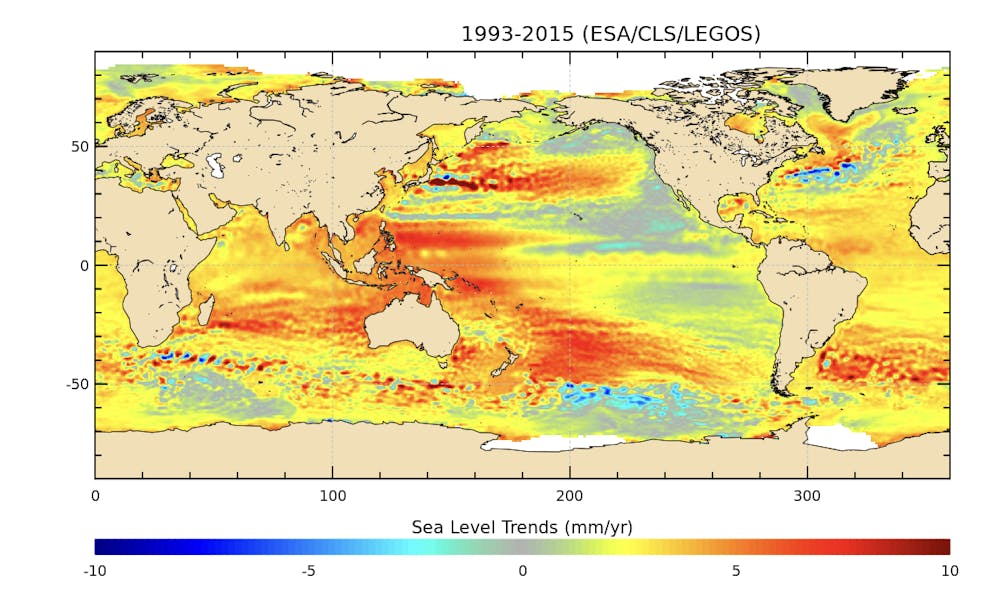
    Here’s a map of sea level rise, from Bamber’s article highlighting five satellite images that show how fast our planet is changing:

    The sea is rising quickly – but not evenly.
    ESA/CLS/LEGOS, CC BY-SA

    “This image,” writes Bamber, “shows mean sea level trends over 13 years in which the global average rise was about 3.2mm a year. But the rate was three or four times faster in some places, like the south western Pacific to the east of Indonesia and New Zealand, where there are numerous small islands and atolls that are already very vulnerable to sea level rise.”


    Read more:
    Five satellite images that show how fast our planet is changing


    In recent years, scientists have used AI to sift through and analyse satellite data. Bamber’s latest research, published in January this year, illustrates this nicely.

    A team of scientists, lead by Tian Li also of the University of Bristol, gathered millions of satellite images of glaciers in Svalbard, a remote and icy archipelago in the Arctic Ocean. In their write up, they note that human researchers once painstakingly looked through this sort of data.

    “This process”, they write, “is highly labour-intensive, inefficient and particularly unreproducible as different people can spot different things even in the same satellite image. Given the number of satellite images available nowadays, we may not have the human resources to map every region for every year.”

    Their solution was to use AI to “quickly identify glacier patterns across large areas”. The satellite-AI combo meant they could examine Svalbard’s retreating glaciers – surely among the least accessible places on the planet – in “unprecedented scale and scope”.

    They found that 91% of the many glaciers that flow into the sea around the archipelago have been “shrinking significantly”. They note that the same types of glacier can be found across the Arctic, and “what happens to glaciers in Svalbard is likely to be repeated elsewhere”.


    Read more:
    We built an AI model that analysed millions of images of retreating glaciers – what it found is alarming


    Many of those glaciers can be found in Greenland, home of the northern hemisphere’s largest ice sheet. In research published earlier this month, Tom Chudley of Durham University used satellite images to assess crevasses (cracks in the glaciers) in Greenland.

    A large glacier in west Greenland flows into the sea. That iceberg filled fjord is several miles wide.
    Copernicus Sentinel / lavizzara / shutterstock

    Chudley also combined satellite images with computerised analysis. His work made use of “ArcticDEM”, three dimensional maps of the polar regions based on high resolution satellite images.

    “By applying image-processing techniques to over 8,000 maps, we could estimate how much water, snow or air would be needed to “fill” each crevasse across the ice sheet. This enabled us to calculate their depth and volume, and examine how they evolved.“

    His conclusion was very blunt: the Greenland ice sheet is falling apart.


    Read more:
    The Greenland ice sheet is falling apart – new study


    Health watchdogs

    Many of you will be well aware that satellites are being used to monitor the health of the planet. What’s less well known is the role they can play in monitoring human health.

    Dhritiraj Sengupta, a satellite scientist at Plymouth Marine Laboratory, says satellites have become Earth’s new health and nature watchdog. His article details how satellites can map mosquito breeding sites to combat malaria, for instance, or can identify air pollution hotspots in cities.

    In his own research, he’s used satellite-derived chlorophyll data to assess the risk of cholera. Chlorophyll is the green pigment in plants that helps them use sunlight to make their food and grow.

    “Many bacteria like Vibrio cholerae which causes cholera, thrive in stagnant water,” Sengupta writes. “My team worked with the European Space Agency to show that its presence can be modelled using the concentration of chlorophyll found on the surface of bodies of water.”


    Read more:
    How satellites have become Earth’s new health and nature watchdogs


    So far, so good. Satellites have undeniably been useful for climate scientists. But in the longer-term, the satellites themselves may have an unforeseen effect on the climate.

    Last year, SpaceX announced it would “deorbit” 100 of its Starlink satellites to burn up in the atmosphere. Fionagh Thomson is a space expert, also at Durham University. She says that “atmospheric scientists are increasingly concerned that this sort of apparent fly-tipping by the space sector will cause further climate change down on Earth.”

    Particles from the satellites themselves won’t have a huge effect compared to the “440 tonnes of meteoroids that enter the atmosphere daily, along with volcanic ash and human-made pollution from industrial processes on Earth.”

    But one team “recently, and unexpectedly, found potential ozone-depleting metals from spacecraft in the stratosphere, the atmospheric layer where the ozone layer is formed.” The worry is that satellite debris may help form certain types of clouds that lead to ozone loss and may add to the greenhouse effect.

    She notes that this is all uncertain and needs more research. “But,” she writes, “we’ve also learnt that if we wait until indisputable evidence is available, it may be too late, as with the loss of ozone. It’s a constant dilemma.”

    Something for SpaceX scientists to look into, perhaps, once they’ve finished rescuing stranded astronauts from the International Space Station.


    Read more:
    Satellites are burning up in the upper atmosphere – and we still don’t know what impact this will have on the Earth’s climate


    ref. How satellites revolutionised climate change science – https://theconversation.com/how-satellites-revolutionised-climate-change-science-250312

    MIL OSI – Global Reports

  • MIL-OSI USA: WISER Awarded Eight UConn Projects to Advance Weather Innovation and Energy Resilience

    Source: US State of Connecticut

    The National Science Foundation (NSF) has awarded UConn and its partners several new projects to advance weather- and climate-based solutions for the energy industry.

    On Feb. 6-7, the NSF Industry-University Cooperative Research Center (IUCRC) for Weather Innovation and Smart Energy and Resilience (WISER) hosted its Industry Advisory Board meeting. During the gathering, the NSF announced funding for 10 new projects, with UConn is involved in eight of them.

    UConn Tech Park Executive Director Emmanouil Anagnostou speaks at a recent meeting with the WISER Industry Advisory Board. (contributed photo)

    Established in 2023, WISER NSF IUCRC is a two-site center shared by the University at Albany and UConn. The Center combines cutting-edge technologies with the benefits of industry partnerships to address the evolving challenges posed by extreme weather and climate change.

    “By fostering collaboration between academia and industry, WISER is poised to become a leading resource for solutions that enhance resilience and sustainability in the energy sector, says Emmanouil Anagnostou, the primary investigator for UConn’s WISER site.

    During the meeting, the 10-member Advisory Board announced the awarded projects following a highly competitive selection process. The Board was enthusiastic about WISER’s proposals, continuing a legacy of successful and impactful projects that have resulted from the collaboration between the UConn and Albany.

    The projects will expand WISER’s research portfolio in weather and power outage prediction, energy demand, grid resilience, and risk management. “I am excited by the number of highly competitive proposals submitted by UConn faculty and look forward to growing UConn’s research and technology innovation on energy resilience and security,” Says Anagnostou.

    This year WISER’s Industry Advisory Board consists of ten members: Avangrid, Central Hudson Gas & Electric Corp, Con Edison, Eversource Energy, Hydro‑Québec, National Grid, New York Power Authority, New York State Energy Research and Development Authority, New York State Foundation for Science, Technology, and Innovation, and Pacific Gas and Electric Company.

    The following are the eight WISER projects in which UConn will take part:

    • Wind power resources for Northeast US under a changing climate (PI: M. Astitha, School of Civil and Environmental Engineering)
    • Extreme heat metrics for more accurate energy demand prediction (PI: G. Wang, School of Civil and Environmental Engineering)
    • Integrating interdisciplinary resilience indices for power outages and restorations (PI: W. Zhang, School of Civil and Environmental Engineering)
    • Predicting extreme weather–induced power outages with spatially aware hybrid graph neural networks (PI: D. Song, School of Computing)
    • A mapping tool for addressing socioeconomic and demographic disparities in power outage impacts (PI: A. Bagtzoglou, School of Civil and Environmental Engineering)
    • Quantifying grid resiliency using GFM with HELICS co-simulation for enhancing outage management during the extreme weather events (PI: S.Y. Park, Department of Electrical and Computer Engineering)
    • Weather-power-grid testbed experiments for risk contingency management during hazards: cascading failures, fragility curves, and grid and weather monitoring needs (PI: M. Peña, School of Civil and Environmental Engineering)
    • Snowstorm changes and their impact on power outages over the Northeast (co-PI: D. Cerrai, School of Civil and Environmental Engineering)

    MIL OSI USA News

  • MIL-OSI Security: Spring Hill Man Sentenced for Dog Fighting

    Source: Office of United States Attorneys

    Tampa, FL — Jose Miguel Carrillo, of Spring Hill, Florida, was sentenced yesterday to 84 months in prison after pleading guilty to conspiring to violate the dog fighting prohibitions of the federal Animal Welfare Act and being a felon in possession of a firearm.

    According to court filings, Carrillo conspired with others to purchase, acquire, and breed dogs for use in dog fights. Carillo also staged dog fights at his home and traveled to dog fights in Massachusetts, Florida, and Connecticut.

    A June 2023 search warrant was executed at Carrillo’s home and led to the seizure of 10 pit bull-type dogs, most of which were later adopted by new owners, as well as a firearm and ammunition. Carrillo also possessed dog fighting paraphernalia including a bloodstained dog fighting box, a skin stapler, syringes, and injectable veterinary medications.

    “To its core, dog fighting is a cruel and criminal exploitation of animals for entertainment,” said Principal Deputy Assistant Attorney General Adam Gustafson of the Justice Department’s Environment and Natural Resources Division. “Today’s sentence sends a strong deterrent message that the Justice Department will vigorously prosecute these cases.”

    “Exploiting and endangering the welfare of animals for personal gain is cruel and abhorrent,” said Acting U.S. Attorney Sara C. Sweeney for the Middle District of Florida. “Because of the hard work of our law enforcement partners, justice was served.”

    “The Office of Inspector General is committed to working with all of our law enforcement and prosecutorial partners in pursuing individuals who choose to participate in animal fighting activities and engage in violations involving animal welfare, while also committing other serious offenses in our communities,” said Special Agent in Charge Charmeka Parker of the U.S. Department of Agriculture’s Office of Inspector General (USDA-OIG).

    Photo of dogs at Carrillo’s home, from court documents in United State v. Jose Carrillo, number 8:23-CR-00222, in U.S. District Court for the Middle District of Florida.

    Photo of a bloodstained dog fighting pit at Carrillo’s home, from court documents in United State v. Jose Carrillo, number 8:23-CR-00222, in U.S. District Court for the Middle District of Florida.

    To report animal fighting crimes, please contact your local law enforcement or the USDA-OIG’s complaint hotline at: usdaoig.oversight.gov/hotline or 1-800-424-9121.

    The USDA-OIG; Bureau of Alcohol, Tobacco, Firearms, and Explosives; Pasco (Florida) Sheriff’s Office and the Fitchburg (Massachusetts) Police Department investigated the case. Assistance was provided by the U.S. Marshals Service, Massachusetts State Police, New Hampshire State Police, Animal Rescue League of Boston’s Law Enforcement Division, U.S. Coast Guard Investigative Service, Homeland Security Investigations and U.S. Customs and Border Protection.

    Senior Trial Attorney Matthew T. Morris of the Environment and Natural Resources Division’s Environmental Crimes Section and Assistant U.S. Attorneys Erin Favorit and Tiffany Fields for the Middle District of Florida prosecuted the case. Trial Attorney Caitlyn Cook of the Environment and Natural Resources Division’s Wildlife and Marine Resources Section assisted with the transfer of the seized dogs to new owners.

    MIL Security OSI

  • MIL-OSI Economics: Apple debuts iPhone 16e: A powerful new member of the iPhone 16 family

    Source: Apple

    Headline: Apple debuts iPhone 16e: A powerful new member of the iPhone 16 family

    February 19, 2025

    PRESS RELEASE

    Apple debuts iPhone 16e: A powerful new member of the iPhone 16 family

    iPhone 16e joins the iPhone 16 lineup, featuring the fast performance of the A18 chip, Apple Intelligence, extraordinary battery life, and a 48MP 2-in-1 camera system — all at an incredible value

    CUPERTINO, CALIFORNIA Apple today announced iPhone 16e, a new addition to the iPhone 16 lineup that offers powerful capabilities at a more affordable price. iPhone 16e delivers fast, smooth performance and breakthrough battery life, thanks to the industry-leading efficiency of the A18 chip and the new Apple C1, the first cellular modem designed by Apple. iPhone 16e is also built for Apple Intelligence, the intuitive personal intelligence system that delivers helpful and relevant intelligence while taking an extraordinary step forward for privacy in AI. The 48MP Fusion camera takes gorgeous photos and videos, and with an integrated 2x Telephoto, it is like having two cameras in one, so users can zoom in with optical quality. When outside of cellular and Wi-Fi coverage, Apple’s groundbreaking satellite features — including Emergency SOS, Roadside Assistance, Messages, and Find My via satellite — help iPhone 16e users stay connected and get assistance when it matters most.1

    iPhone 16e will be available in two elegant matte finishes — black and white — with colorful cases available to accessorize. Pre-orders begin Friday, February 21, with availability beginning Friday, February 28.

    “iPhone 16e packs in the features our users love about the iPhone 16 lineup, including breakthrough battery life, fast performance powered by the latest-generation A18 chip, an innovative 2-in-1 camera system, and Apple Intelligence,” said Kaiann Drance, Apple’s vice president of Worldwide iPhone Product Marketing. “We’re so excited for iPhone 16e to complete the lineup as a powerful, more affordable option to bring the iPhone experience to even more people.”

    A Beautiful and Durable Design with Breakthrough Battery Life

    iPhone 16e is built to last, featuring splash, water, and dust resistance with a rating of IP68; the Ceramic Shield front cover with an advanced formulation that is tougher than any smartphone glass; and the toughest back glass in a smartphone.2 The 6.1-inch Super Retina XDR display with OLED technology has an edge-to-edge design that is perfect for watching HDR videos, playing games, and reading crisp text.3 iPhone 16e has the best battery life ever on a 6.1-inch iPhone, lasting up to six hours longer than iPhone 11 and up to 12 hours longer than all generations of iPhone SE.4 And with Face ID enabled by the TrueDepth camera system, users can securely unlock their iPhone, authenticate purchases, sign in to apps, and more. iPhone 16e also offers convenient charging options, including both wireless charging and USB-C for easy connection to a wide range of accessories.

    Performance and Connectivity

    iPhone 16e is powered by Apple’s latest-generation A18 chip, which enables fast, smooth performance, incredible power efficiency, and Apple Intelligence. The 6-core CPU is up to 80 percent faster than the A13 Bionic chip on iPhone 11, handling both everyday and intensive tasks with ease — from simple workloads, to more demanding actions with Apple Intelligence. The 4-core GPU powers stunning graphics performance and unlocks next-level mobile gaming on the go, enabling graphically demanding AAA titles and hardware-accelerated ray tracing for more realistic lighting and reflections. The 16-core Neural Engine is optimized for large generative models and runs machine learning (ML) models up to 6x faster than A13 Bionic.

    Expanding the benefits of Apple silicon, C1 is the first modem designed by Apple and the most power-efficient modem ever on an iPhone, delivering fast and reliable 5G cellular connectivity. Apple silicon — including C1 — the all-new internal design, and the advanced power management of iOS 18 all contribute to extraordinary battery life.

    Built for Apple Intelligence

    iPhone 16e is built for Apple Intelligence, unlocking exciting new capabilities that make iPhone even more helpful and powerful. With the Clean Up tool, it’s easy to remove distracting elements in images, and natural language search in the Photos app allows users to search for just about any photo or video by simply describing what they are looking for.

    Users can also explore creative new ways to express themselves visually with Image Playground, create the perfect emoji with Genmoj, and make their writing even more dynamic with Writing Tools. They can now type to Siri, and Siri is more conversational with the ability to follow along if users stumble over their words. Siri can also maintain context from one request to the next. With extensive product knowledge, Siri can answer thousands of questions about the features and settings of Apple products, so users can learn how to do things like take a screen recording or schedule a text message to send later.

    With access to ChatGPT seamlessly integrated into Writing Tools and Siri, users can choose to access ChatGPT’s expertise without jumping between applications, so they can get things done faster and easier than ever before. In addition, users can access ChatGPT for free without creating an account, and privacy protections are built in — their IP addresses are obscured and OpenAI won’t store requests. Users can choose whether to enable ChatGPT integration, and are in full control of when to use it and what information is shared with ChatGPT.

    Apple Intelligence marks an extraordinary step forward for privacy in AI and is designed to protect users’ privacy at every step. It starts with on-device processing, meaning that many of the models that power Apple Inteligence run entirely on device. For requests that require access to larger models, Apple’s groundbreaking Private Cloud Compute extends the privacy and security of iPhone into the cloud to unlock even more intelligence. When using Private Cloud Compute, users’ data is never stored or shared with Apple; it is used only to fulfill their request.

    Access Favorite Features and Unlock Visual Intelligence with the Action Button

    iPhone 16e features the Action button, allowing users to easily access a variety of functions with just a press. Once customized in Settings, the Action button can be used to quickly open the camera or flashlight; switch between Ring and Silent modes; recognize music with Shazam; activate Voice Memos, Focus, Translate, and accessibility features like Magnifier; or use Shortcuts for more options. The Action button can even access in-app functionality like launching the camera in Snapchat, unlocking a car door with FordPass, tracking a child’s sleep schedule with Napper, and more.

    The Action button on iPhone 16e also unlocks a new visual intelligence experience that builds on Apple Intelligence to help users learn about objects and places. Visual intelligence can summarize and copy text, translate text between languages, detect phone numbers or email addresses with the option to add to contacts, identify an animal or plant, and more. Visual intelligence also allows users to search Google so they can see where they can buy an item, or benefit from ChatGPT’s problem-solving skills. Users are in control of when third-party tools are used and what information is shared.

    A Powerful Camera System to Capture Any Moment

    The powerful 2-in-1 camera system on iPhone 16e is perfect for capturing everyday moments and important memories, including in Night mode and Portrait mode. Using computational photography, the 48MP Fusion camera takes super-high-resolution photos, so users can capture gorgeous images that balance light and detail. With an integrated 2x Telephoto, users have the equivalent of two cameras in one, and can zoom in with optical quality to get closer to the subject and easily frame their shot. And the front-facing TrueDepth camera with autofocus enables sharper close-ups and beautiful group selfies. The latest generation of HDR captures subjects and the background with true-to-life renderings of skin tones, while ensuring photos have bright highlights, rich mid-tones, and deep shadows.

    iPhone 16e takes stunning videos with the ability to record in 4K with Dolby Vision up to 60 fps, and users can stop and restart a recording for more flexibility when capturing the moment. iPhone 16e also records video in Spatial Audio for immersive listening with AirPods, Apple Vision Pro, or a surround sound system, and enables more ways to edit video sound with Audio Mix. Users can adjust their sound after capture to focus on the voice of the person on camera, make it sound like the video was recorded inside a professional studio, or position vocal tracks in the front and environmental noises in surround sound. With wind noise reduction, powerful ML algorithms automatically reduce unwanted noise for better audio quality.

    Groundbreaking Safety and Communication Capabilities

    iPhone 16e helps users stay connected and get assistance when it matters most. Apple’s satellite features help users text via satellite when they’re outside of cellular and Wi-Fi coverage. This includes Messages via satellite to text friends and family; Emergency SOS via satellite to connect with emergency services; and Roadside Assistance via satellite to reach a roadside assistance provider in case of car trouble. Users can also use the Find My app to share their location via satellite, reassuring friends and family of their whereabouts while traveling off the grid. Crash Detection on iPhone 16e can detect a severe car crash and automatically dial emergency services if a user is unconscious or unable to reach their iPhone.5

    Featuring iOS 18

    iOS 18 makes iPhone 16e more personal, capable, and intelligent than ever.6 With more customization options, users can give apps and widgets a new dark or tinted look and arrange them in any open space on the Home Screen. The controls at the bottom of the Lock Screen can be customized; Control Center has been redesigned to provide users with easier access to many of the things they use every day, including third-party apps; and new privacy protections include the ability to lock and hide apps to protect sensitive apps and the information inside them. iOS 18 also provides powerful updates for staying connected. In Messages, users can use text effects to bring words, phrases, sentences, and more to life. Tapbacks expand to include emoji, Genmoji, or stickers, and now users can schedule a message to send later. When messaging contacts who do not have an Apple device, the Messages app now supports RCS for richer media and more reliable group messaging when compared to SMS and MMS.

    Better for the Environment

    iPhone 16e is designed with the environment in mind. As part of Apple 2030, the company’s ambitious goal to be carbon neutral across its entire carbon footprint by the end of this decade, Apple is transitioning to renewable electricity for its manufacturing, and investing in wind and solar projects around the world to address the electricity used to charge all Apple products, including iPhone 16e. Today, all Apple facilities run on 100 percent renewable electricity — including the data centers that power Apple Intelligence.

    To achieve Apple 2030, the company is designing products with more recycled and renewable materials, which further drives down the carbon footprint. iPhone 16e features over 30 percent recycled content overall, including 100 percent recycled cobalt and 95 percent recycled lithium in the battery, 85 percent recycled aluminum in the enclosure, and more.7 Additionally, the main logic board and back glass of iPhone 16e are designed to be manufactured more efficiently, reducing the amount of raw materials needed. The packaging is also entirely fiber-based, bringing Apple closer to its goal of removing plastic from its packaging by the end of this year.8

    Pricing and Availability

    • iPhone 16e will be available in white and black in 128GB, 256GB, and 512GB storage capacities, starting at $599 (U.S.) or $24.95 (U.S.) per month for 24 months.
    • Apple offers great ways to save and upgrade to the latest iPhone. With Apple Trade In, customers can get up to $120 (U.S.) in credit when they trade in iPhone 11, or up to $170 (U.S.) in credit when they trade in iPhone 12. With a carrier offer, customers can get up to $400 (U.S.) in credit when they trade in iPhone 11, or up to $599 (U.S.) in credit when they trade in iPhone 12 to put toward an iPhone 16e. Customers can take advantage of these offers by visiting the Apple Store online or an Apple Store location. For carrier offer eligibility requirements and more details, see apple.com/shop/buy-iphone/carrier-offers. To see what their device is worth and for Apple Trade In terms and conditions, customers can visit apple.com/shop/trade-in.
    • Customers in 59 countries and regions, including Australia, Canada, China, France, Germany, India, Japan, Malaysia, Mexico, South Korea, Türkiye, the UAE, the UK, and the U.S., will be able to pre-order iPhone 16e beginning at 5 a.m. PST on Friday, February 21, with availability beginning Friday, February 28.
    • Apple Intelligence is available in localized English for Australia, Canada, Ireland, New Zealand, South Africa, the UK, and the U.S. Additional languages — including French, German, Italian, Portuguese (Brazil), Spanish, Japanese, Korean, Chinese (simplified), English (Singapore), and English (India) — will be available in April, with more languages coming over the course of the year, including Vietnamese. Some features, applications, and services may not be available in all regions or all languages.
    • Visual intelligence is available in iOS 18.2 or later on all iPhone 16 models. For more information on visual intelligence, visit support.apple.com/guide/iphone.
    • iPhone 16e Silicone Case will be available in five colors for $39 (U.S.): winter blue, fuchsia, lake green, black, and white.
    • AppleCare+ for iPhone provides unparalleled service and support. This includes unlimited incidents of accidental damage, battery service coverage, and 24/7 support from the people who know iPhone best. For more information, visit apple.com/support/products/iphone.
    • iCloud+ plans start at just $0.99 (U.S.) per month and offer up to 12TB of additional storage to keep photos, videos, files, and more safe in the cloud and available across devices. An iCloud+ subscription gives access to premium features such as unlimited event creation in the new Apple Invites app, as well as Private Relay, Hide My Email, and custom email domains. With Family Sharing, users can share their subscription with five other family members at no extra cost.
    • Customers who purchase iPhone 16e may receive three free months of Apple Music, Apple TV+, Apple Arcade, Apple News+, and Apple Fitness+, with a new subscription. Offer and services availability varies by region. See apple.com/promo for details.

    About Apple Apple revolutionized personal technology with the introduction of the Macintosh in 1984. Today, Apple leads the world in innovation with iPhone, iPad, Mac, AirPods, Apple Watch, and Apple Vision Pro. Apple’s six software platforms — iOS, iPadOS, macOS, watchOS, visionOS, and tvOS — provide seamless experiences across all Apple devices and empower people with breakthrough services including the App Store, Apple Music, Apple Pay, iCloud, and Apple TV+. Apple’s more than 150,000 employees are dedicated to making the best products on earth and to leaving the world better than we found it.

    1. Apple’s satellite features are included for free for two years starting at the time of activation of a new iPhone 14 or later. For Emergency SOS via satellite availability, visit support.apple.com/en-us/HT213426. Messages via satellite will be available in the U.S. and Canada in iOS 18 or later. SMS availability will depend on carrier. Carrier fees may apply. Users should check with their carrier for details. Roadside Assistance via satellite is currently available in the U.S. with AAA and Verizon Roadside Assistance, and in the UK with Green Flag. Participating roadside assistance providers may charge for services, and iPhone users who are not members can take advantage of their roadside assistance services on a pay-per-use basis. Apple’s satellite features were designed for use in open spaces with a clear line of sight to the sky. Performance may be impacted by obstructions such as trees or surrounding buildings.
    2. iPhone 16e is splash-, water-, and dust-resistant. It was tested under controlled laboratory conditions and has a rating of IP68 under IEC standard 60529 (maximum depth of 6 meters for up to 30 minutes). Splash, water, and dust resistance are not permanent conditions. Resistance might decrease as a result of normal wear. Do not attempt to charge a wet iPhone; refer to the user guide for cleaning and drying instructions. Liquid damage is not covered under warranty.
    3. The display has rounded corners that follow a beautiful curved design, and these corners are within a standard rectangle. When measured as a standard rectangular shape, the screen is 6.06 inches diagonally. The actual viewable area is smaller.
    4. All battery claims depend on the cellular network, location, signal strength, feature configuration, usage, and many other factors; actual results will vary. The battery has limited recharge cycles and may eventually need to be replaced. Battery life and charge cycles vary by use and settings. Battery tests are conducted using specific iPhone units. See apple.com/batteries and apple.com/iphone/compare for more information.
    5. Crash Detection is designed for four-wheel passenger vehicle crashes with certain mass, G-force, and speed profiles consistent with severe, life-threatening crashes. It was designed for severe, life-threatening, high-impact front and rear, side-swipe, T-bone, and rollover crashes. Crash Detection is available worldwide on iPhone 14 or later, Apple Watch Series 8 or later, Apple Watch SE, and Apple Watch Ultra or later.
    6. Some features may not be available for all countries or all areas. For more information on iOS 18, visit apple.com/ios/ios-18.
    7. All cobalt and lithium references use a mass balance allocation.
    8. Based on retail packaging as shipped by Apple. Breakdown of U.S. retail packaging by weight. Adhesives, inks, and coatings are excluded from calculations of plastic content and packaging weight.

    Press Contacts

    Blair Ranger

    Apple

    blair_ranger@apple.com

    Alex Kirschner

    Apple

    alexkirschner@apple.com

    Apple Media Helpline

    media.help@apple.com

    MIL OSI Economics

  • MIL-OSI USA: Public invited to learn more about study for future improvements on SR 3 in Gorst

    Source: Washington State News 2

    In-person open house scheduled for Feb. 26

    BREMERTON – It’s no secret: Traffic backups in and around Gorst are a common occurrence.

    The Washington State Department of Transportation is conducting a study to look at State Routes 3, 16, 166 and 304 in Gorst. The study focuses on improving transportation in the area.

    The public is invited to learn more about this Planning and Environmental Linkages study in online and in-person events.

    Beginning Wednesday, Feb. 19, community members can visit the online open house to see the options WSDOT is looking at to relieve congestion in Gorst and create a stronger highway system in the surrounding area.

    After this open house, the study team will work to find the best options for a future project. A second open house will be held in late 2025 to review these options.

    Public feedback will be incorporated into the study’s recommendations. After the study is complete in early 2026, recommended options will go through a National Environmental Policy Act review.

    SR 3 Gorst area online open house information

    When:  Feb. 19 to March 11, 2025

    Where:  engage.wsdot.wa.gov/sr-3-gorst-area/

    Details:  Information about the study is available online 24/7 for people to visit and leave comments whenever best fits their schedule through Tuesday, March 11. The information is available in English, Spanish and Tagalog.

    SR 3 Gorst area in-person open house information

    When:  4:30 to 6:30 p.m. Wednesday, Feb. 26, 2025

    Where:  Naval Avenue Elementary School, 900 Olympic Ave., Bremerton, WA 98312 

    Details:  The in-person open house will have the same information as the online open house. There is no formal presentation. Attendees are welcome to drop by anytime during the two-hour event. Project team members will be available to explain the project, answer questions and take comments. Translators fluent in Spanish and Tagalog will be present.

    Free, temporary internet access is available to those who do not have broadband service in locations throughout the state. To find the nearest Drive-In WiFi Hotspot visit: www.commerce.wa.gov/building-infrastructure/washington-state-drive-in-wifi-hotspots-location-finder/.

    Free WiFi access is available at these locations for people who wish to participate in the online open house:

    • Kitsap Regional Library – Bremerton, 612 Fifth St., Bremerton, WA 98337
    • Kitsap Regional Library – Port Orchard, 87 Sidney Ave., Port Orchard, WA 98366
    • North Mason Timberland Library – 23081 NE State Route 3, Belfair, WA 98528

    MIL OSI USA News

  • MIL-OSI United Kingdom: expert reaction to study looking at aspartame artificial sweetener and insulin levels and blood vessel inflammation in mice

    Source: United Kingdom – Executive Government & Departments

    A study published in Cell Metabolism looks at the artificial sweetener aspartame, insulin levels and blood inflammation in mice. 

    Prof Naveed Sattar, Professor of Cardiometabolic Medicine/Honorary Consultant, University of Glasgow, said:

    “This seems like worrying findings but of course, before it can taken seriously, the findings have to be replicated in man.  There is no good evidence from trials that exogenous insulin increases cardiovascular risks in people with prior cardiovascular disease AND in people with type 1, by improving glucose levels, exogenous insulin lowers many risks.  Whether excess pancreatic insulin occurs with aspartame in amounts regularly consumed occurs and then accelerates vascular risks in man is also not proven.  For now, I remain happy to take sweeteners and related diet beverages instead of sugar filled drinks as the former limits excess calorie intake.”

    Prof James Leiper, Director of Research, British Heart Foundation, said:

    “This study has revealed much more about the known potential risks of artificial sweeteners.  In these mice, a diet that included an artificially high level of aspartame did exacerbate the size and number of fatty plaques in their arteries.  The effect of these plaques was not measured here, but they are known to greatly increase the risk of a heart attack or stroke.

    “While it is important to note that these findings have not yet been seen in humans, the results highlight the importance of further research to determine whether these additions to our food, and their effect on insulin levels, are contributing to an increased risk of cardiovascular events.

    “These sweeteners are now found in many foods and drinks, and people are probably consuming more than they realise.  But this research is not a green light to have more sugar instead.  We all need to reduce our intake of the processed foods and beverages that contain high levels of fat, sugars, sweeteners and salt.  This is the best way of ensuring a healthy diet and a lowered risk of heart and circulatory disease.”

    Prof Oliver Jones, Professor of Chemistry, RMIT University in Melbourne, said:

    “I have several concerns about this study.

    “The authors claim that the consumption of Aspartame by adults and children “often exceeds those levels recommended by the FDA” – this is extremely unlikely in my view.  The FDA-acceptable daily intake of Aspartame is 50 mg per kg of body weight per day.  I weigh 80 kg, so this means this means the FDA-based safe dose for me is 4000 mg (or 4 grams) of Aspartame per day, every day, for life.  Given a diet drink contains about 200 mg of Aspartame, I would have to drink the equivalent of 20 cans of diet soda a day to get this dose.  A child of 40 kg would have to drink 10 cans a day, every day.  Even then, the 50 mg/kg dose has a safety factor of 100 built-in.

    “The study design also has some issues.  The main one is that the authors used a particular type of lab mouse called an ApoE mouse, which is bred to be prone to heart disease.  They also fed it a high-fat, high-cholesterol diet, which itself increases the risk of heart disease.  They also don’t seem to have measured how much of the Aspartame water the mice drank, or the Aspartame level in the blood, so it is unknown what the mice actually received.

    “To my mind, the authors’ admission that feeding mice that are already genetically susceptible to heart disease with a high-fat, high-cholesterol diet that is known to cause heart disease “diminishes clinical relevance” is somewhat of an understatement.

    “Contrary to the paper’s claims, it is quite well-established that Aspartame doesn’t stimulate glucose or insulin levels in humans [1, 2].

    “Aspartame is essentially just two common amino acids (aspartic acid and phenylalanine) joined together.  In the gut, it is broken down to aspartic acid and phenylalanine.  There is no reason to think amino acids from Aspartame would be worse than those from any other source.

    “The authors would appear to think little work has been done on safety testing in Aspartame; this is just not true.  All food ingredients are rigorously tested and safety assessed before they are approved for use.  Aspartame is one of the most researched ingredients in the world.  It is just that a lot of the data is in safety assessments for regulatory approval, not the academic literature.

    “Finally, even if Aspartame did cause some increase in cardiovascular risk (which this study does not prove), then that risk would likely be very small compared to things like high fat/high sugar diets and lack of exercise, etc.

    “In short, I don’t think this study itself gives us more reason to worry about diet drinks or aspartame.”

    References

    1 Santos, N. C., de Araujo, L. M., De Luca Canto, G., Guerra, E. N. S., Coelho, M. S., Borin, M. de F. (2017). Metabolic effects of aspartame in adulthood: A systematic review and meta-analysis of randomized clinical trials. Critical Reviews in Food Science and Nutrition, 58(12), 2068-2081. https://doi.org/10.1080/10408398.2017.1304358

    2 Stern S.B., Bleicher S.J., Flores A., Gombos G., Recitas D., Shu J. Administration of aspartame in non-insulin-dependent diabetics. (1976) Journal of Toxicology and Environmental Health,. 2(2):429-39. https:// 10.1080/15287397609529444

    ‘Sweetener aspartame aggravates atherosclerosis through insulin-triggered inflammation’ by Weijie Wu et al. was published in Cell Metabolism at 16:00 UK time on Wednesday 19 February 2025. 

    DOI: 10.1016/j.cmet.2025.01.006

    Declared interests

    Prof Naveed Sattar: “Takes occasional diet drinks.

    Has consulted for several companies that make diabetes medicines but also contributed to several lifestyle trials.

    “For Novo Nordisk: have consulted for company in advisory boards but not on any of their weight loss drug trial committees; am on steering committee for ZEUS trial but this is not a weight loss trial product but anti-inflammatory.  Do not have any shares either for any product in health etc.

    “N.S. declares consulting fees and/or speaker honoraria from Abbott Laboratories, Afimmune, Amgen, AstraZeneca, Boehringer Ingelheim, Eli Lilly, Hanmi Pharmaceuticals, Janssen, Merck Sharp & Dohme, Novartis, Novo Nordisk, Pfizer, and Sanofi; and grant support paid to his university from AstraZeneca, Boehringer Ingelheim, Novartis, and Roche Diagnostics.”

    Prof James Leiper: “No conflicts of interest to declare.”

    Prof Oliver Jones: “I have no conflicts of interest to declare.”

    MIL OSI United Kingdom

  • MIL-OSI United Kingdom: expert reaction to study of glacier melt this century

    Source: United Kingdom – Science Media Centre

    A study published in Nature estimates global glacier melting from 2000 to 2023. 

    Prof Andrew Shepherd, Head of Department of Geography and Environmental Science, Northumbria University, said:

    “This is really important as it’s an authoritative assessment from the community working on this topic. It confirms that the pace of glacier melting is accelerating over time. Glacier melting has two main impacts; it causes sea level rise and it disrupts the water supply in rivers that are fed by meltwater. Around 2 billion people depend on meltwater from glaciers and so their retreat is a big problem for society – it’s not just that we are losing them from our landscape, they are an important part of our daily lives.

    “Even small amounts of sea level rise matter because it leads to more frequent coastal flooding. Every centimetre of sea level rise exposes another 2 million people to annual flooding somewhere on our planet.

    “Community assessments like GLAMBIE are vital as they give people confidence to make use of their findings. That includes other climate scientists, governments, and industry, plus of course anyone who is concerned about the impacts of global warming. Around 2 billion people depend on meltwater from glaciers and so their retreat is a big problem for society – it’s not just that we are losing them from our landscape, they are an important part of our daily lives.”

    Prof Martin Siegert, Professor of Geosciences and Deputy VC at the University of Exeter, said:

    “Two centimetres might not sound a lot, but this is the contribution from small glaciers – not the whole of the ice on the planet, and not from Greenland and Antarctica. Sea level has risen by 20cm since 1850; 50% from the sea being warmer and expanding, 50% (10cm) due to glacier melt. However, ice sheets are now losing mass at increasing rates (6x more than 30 years ago), and when they change, we stop talking centimetres and start talking metres. For example, the last ice age was 20,000 years ago, and between then and 10,000 years ago as we warmed out of the ice age, sea level rose by 130m, due primarily to collapse of ice sheets.

    “This research is concerning to us, because it predicts further glacier loss, which can be considered like a ‘canary in the coal mine’ for ice sheet reaction to global warming and far more sea level rise this century and beyond. The IPCC indicates 0.5-1m this century – but that is with a 66% certainty – hence 1/3 chance it could be higher under ‘strong’ warming, which unfortunately is the pathway we are on presently.”

    Community estimate of global glacier mass changes from 2000 to 2023’ by The GlaMBIE Team was published in Nature at 16:15 UK time on Wednesday 19th February. 

    Declared interests

    Prof Andrew Shepherd: No conflicts to declare

    Prof Martin Siegert: No COI

    MIL OSI United Kingdom

  • MIL-OSI USA: Florida Man Sentenced for Dog Fighting

    Source: US State Government of Utah

    Jose Miguel Carrillo, of Spring Hill, Florida, was sentenced yesterday to 84 months in prison after pleading guilty to conspiring to violate the dog fighting prohibitions of the federal Animal Welfare Act and being a felon in possession of a firearm.

    According to court filings, Carrillo conspired with others to purchase, acquire, and breed dogs for use in dog fights. Carillo also staged dog fights at his home and traveled to dog fights in Massachusetts, Florida, and Connecticut.

    A June 2023 search warrant was executed at Carrillo’s home and led to the seizure of 10 pit bull-type dogs, most of which were later adopted by new owners, as well as a firearm and ammunition. Carrillo also possessed dog fighting paraphernalia including a bloodstained dog fighting box, a skin stapler, syringes, and injectable veterinary medications.

    “To its core, dog fighting is a cruel and criminal exploitation of animals for entertainment,” said Principal Deputy Assistant Attorney General Adam Gustafson of the Justice Department’s Environment and Natural Resources Division. “Today’s sentence sends a strong deterrent message that the Justice Department will vigorously prosecute these cases.”

    “Exploiting and endangering the welfare of animals for personal gain is cruel and abhorrent,” said Acting U.S. Attorney Sara C. Sweeney for the Middle District of Florida. “Because of the hard work of our law enforcement partners, justice was served.”

    “The Office of Inspector General is committed to working with all of our law enforcement and prosecutorial partners in pursuing individuals who choose to participate in animal fighting activities and engage in violations involving animal welfare, while also committing other serious offenses in our communities,” said Special Agent in Charge Charmeka Parker of the U.S. Department of Agriculture’s Office of Inspector General (USDA-OIG).

    To report animal fighting crimes, please contact your local law enforcement or the USDA-OIG’s complaint hotline at: usdaoig.oversight.gov/hotline or 1-800-424-9121.

    The USDA-OIG; Bureau of Alcohol, Tobacco, Firearms, and Explosives; Pasco County (Florida) Sheriff’s Office and the Fitchburg (Massachusetts) Police Department investigated the case. Assistance was provided by the U.S. Marshals Service, Massachusetts State Police, New Hampshire State Police, Animal Rescue League of Boston’s Law Enforcement Division, U.S. Coast Guard Investigative Service, Homeland Security Investigations and U.S. Customs and Border Protection.

    Senior Trial Attorney Matthew T. Morris of the Environment and Natural Resources Division’s Environmental Crimes Section and Assistant U.S. Attorneys Erin Favorit and Tiffany Fields for the Middle District of Florida prosecuted the case. Trial Attorney Caitlyn Cook of the Environment and Natural Resources Division’s Wildlife and Marine Resources Section assisted with the transfer of the seized dogs to new owners. 

    MIL OSI USA News

  • MIL-OSI Security: Florida Man Sentenced for Dog Fighting

    Source: United States Attorneys General 1

    Jose Miguel Carrillo, of Spring Hill, Florida, was sentenced yesterday to 84 months in prison after pleading guilty to conspiring to violate the dog fighting prohibitions of the federal Animal Welfare Act and being a felon in possession of a firearm.

    According to court filings, Carrillo conspired with others to purchase, acquire, and breed dogs for use in dog fights. Carillo also staged dog fights at his home and traveled to dog fights in Massachusetts, Florida, and Connecticut.

    A June 2023 search warrant was executed at Carrillo’s home and led to the seizure of 10 pit bull-type dogs, most of which were later adopted by new owners, as well as a firearm and ammunition. Carrillo also possessed dog fighting paraphernalia including a bloodstained dog fighting box, a skin stapler, syringes, and injectable veterinary medications.

    “To its core, dog fighting is a cruel and criminal exploitation of animals for entertainment,” said Principal Deputy Assistant Attorney General Adam Gustafson of the Justice Department’s Environment and Natural Resources Division. “Today’s sentence sends a strong deterrent message that the Justice Department will vigorously prosecute these cases.”

    “Exploiting and endangering the welfare of animals for personal gain is cruel and abhorrent,” said Acting U.S. Attorney Sara C. Sweeney for the Middle District of Florida. “Because of the hard work of our law enforcement partners, justice was served.”

    “The Office of Inspector General is committed to working with all of our law enforcement and prosecutorial partners in pursuing individuals who choose to participate in animal fighting activities and engage in violations involving animal welfare, while also committing other serious offenses in our communities,” said Special Agent in Charge Charmeka Parker of the U.S. Department of Agriculture’s Office of Inspector General (USDA-OIG).

    To report animal fighting crimes, please contact your local law enforcement or the USDA-OIG’s complaint hotline at: usdaoig.oversight.gov/hotline or 1-800-424-9121.

    The USDA-OIG; Bureau of Alcohol, Tobacco, Firearms, and Explosives; Pasco County (Florida) Sheriff’s Office and the Fitchburg (Massachusetts) Police Department investigated the case. Assistance was provided by the U.S. Marshals Service, Massachusetts State Police, New Hampshire State Police, Animal Rescue League of Boston’s Law Enforcement Division, U.S. Coast Guard Investigative Service, Homeland Security Investigations and U.S. Customs and Border Protection.

    Senior Trial Attorney Matthew T. Morris of the Environment and Natural Resources Division’s Environmental Crimes Section and Assistant U.S. Attorneys Erin Favorit and Tiffany Fields for the Middle District of Florida prosecuted the case. Trial Attorney Caitlyn Cook of the Environment and Natural Resources Division’s Wildlife and Marine Resources Section assisted with the transfer of the seized dogs to new owners. 

    MIL Security OSI

  • MIL-OSI Security: Security News: Florida Man Sentenced for Dog Fighting

    Source: United States Department of Justice 2

    Jose Miguel Carrillo, of Spring Hill, Florida, was sentenced yesterday to 84 months in prison after pleading guilty to conspiring to violate the dog fighting prohibitions of the federal Animal Welfare Act and being a felon in possession of a firearm.

    According to court filings, Carrillo conspired with others to purchase, acquire, and breed dogs for use in dog fights. Carillo also staged dog fights at his home and traveled to dog fights in Massachusetts, Florida, and Connecticut.

    A June 2023 search warrant was executed at Carrillo’s home and led to the seizure of 10 pit bull-type dogs, most of which were later adopted by new owners, as well as a firearm and ammunition. Carrillo also possessed dog fighting paraphernalia including a bloodstained dog fighting box, a skin stapler, syringes, and injectable veterinary medications.

    “To its core, dog fighting is a cruel and criminal exploitation of animals for entertainment,” said Principal Deputy Assistant Attorney General Adam Gustafson of the Justice Department’s Environment and Natural Resources Division. “Today’s sentence sends a strong deterrent message that the Justice Department will vigorously prosecute these cases.”

    “Exploiting and endangering the welfare of animals for personal gain is cruel and abhorrent,” said Acting U.S. Attorney Sara C. Sweeney for the Middle District of Florida. “Because of the hard work of our law enforcement partners, justice was served.”

    “The Office of Inspector General is committed to working with all of our law enforcement and prosecutorial partners in pursuing individuals who choose to participate in animal fighting activities and engage in violations involving animal welfare, while also committing other serious offenses in our communities,” said Special Agent in Charge Charmeka Parker of the U.S. Department of Agriculture’s Office of Inspector General (USDA-OIG).

    To report animal fighting crimes, please contact your local law enforcement or the USDA-OIG’s complaint hotline at: usdaoig.oversight.gov/hotline or 1-800-424-9121.

    The USDA-OIG; Bureau of Alcohol, Tobacco, Firearms, and Explosives; Pasco County (Florida) Sheriff’s Office and the Fitchburg (Massachusetts) Police Department investigated the case. Assistance was provided by the U.S. Marshals Service, Massachusetts State Police, New Hampshire State Police, Animal Rescue League of Boston’s Law Enforcement Division, U.S. Coast Guard Investigative Service, Homeland Security Investigations and U.S. Customs and Border Protection.

    Senior Trial Attorney Matthew T. Morris of the Environment and Natural Resources Division’s Environmental Crimes Section and Assistant U.S. Attorneys Erin Favorit and Tiffany Fields for the Middle District of Florida prosecuted the case. Trial Attorney Caitlyn Cook of the Environment and Natural Resources Division’s Wildlife and Marine Resources Section assisted with the transfer of the seized dogs to new owners. 

    MIL Security OSI

  • MIL-OSI United Kingdom: National Wealth Fund makes first investment in Scotland

    Source: United Kingdom – Executive Government & Departments

    Scottish Secretary welcomes £43.5m boost for sustainable packaging firm that will encourage growth, creating jobs and prosperity

    The National Wealth Fund has made its first investment in Scotland since its transformation to help boost growth as part of the UK Government’s Plan for Change.

    The NWF is committing £43.5m in direct equity for sustainable packaging company Pulpex, which is to build its first commercial-scale manufacturing facility near Glasgow. A further £10m co-investment is coming from the Scottish National Investment Bank with an additional boost coming from existing investors to take the total funds behind the firm to £62m.

    The company has developed a unique fibre-based bottle as an alternative to glass and plastic. The product is manufactured from sustainably-sourced wood pulp and designed to be recycled in the same way as paper or card in normal household recycling streams. Its patented technology results in a recyclable and biodegradable end-product with a lower carbon impact than current glass or plastic packaging.

    Pulpex’s Glasgow plant, which will produce 50 million bottles per year and create the UK’s first fibre bottle supply chain, will create 35 new jobs in Scotland.

    Chancellor of the Exchequer Rachel Reeves said:

    Our Plan for Change is about going further and faster to kickstart economic growth so working people have more money in their pockets.  That’s why we established the National Wealth Fund which in the last six months has fuelled 8,600 jobs and unlocked £1.6 billion of private investment in the industries that turbocharge growth in our economy. This latest NWF investment is welcome news, creating jobs, sustainable growth and opportunity in Scotland.  

    Scottish Secretary Ian Murray said:

    I’m delighted to see this first investment in Scotland from the new National Wealth Fund. Boosting business is a cornerstone of our Plan for Change and will create jobs and opportunities to raise living standards.

    Just last month, we announced that Glasgow had been chosen as one of four areas where the UK Government will develop investment pipelines and this new Pulpex facility, to be built on the outskirts of the city, is a prime example of how supporting regional growth will benefit people right across the UK. The firm’s innovative bottling solution will aid the decarbonisation of our packaging industry and help accelerate our Net Zero goals as we drive delivery of clean power by 2030.

    Deputy First Minister Kate Forbes said:

    “This investment by the Scottish National Investment Bank will build on Glasgow’s rich history of innovation and deliver more green jobs for the future. To drive investment into Scotland, we have allocated £200 million to the Bank for the next financial year. The Bank has a strong track record of success and has generated more than £1.4 billion of private sector investment since opening for business in 2020.”

    The investment announced today will enable the construction of Pulpex’s first manufacturing facility to reach commercial-scale capacity. The financing will help create the conditions for growth in both Scotland and the wider alternative packaging sector. 

    A move from plastic and glass to paper packaging will enable a step change in decarbonising the packaging industry and its efforts to increase the recycling rates of consumer goods, with the material benefiting from the highest recycling rates and most sophisticated infrastructure compared to other packaging alternatives.

    In the UK alone, over 38.5 million plastic bottles are used every day, with around 16 million ending up in landfill, being burnt, or littering the environment and waterways, according to Water UK. The UK’s 25 Year Environment Plan aims to double resource productivity and eliminate all avoidable waste, including plastic, by 2050. This means investments in economically viable and ready-to-go options like Pulpex are critical interventions for the future sustainability of the consumer goods industry.

    John Flint, National Wealth Fund CEO, said:

    “We need to recycle more and unlock the growth potential of the circular economy. That requires sophisticated, long-term investment, both in infrastructure and packaging innovation. Exciting technological advancements like Pulpex are a great example of that potential, but they need catalytic investment to scale and commercialise. Through financing Pulpex’s new facility in Glasgow, we will help remove barriers to future investment from private capital and lay the foundations for further growth.”

    Scott Winston, Pulpex, said:

    “Thanks to the National Wealth Fund, the Scottish National Investment Bank, our Pulpex team and to our stakeholders for their continued support. This investment will drive the decarbonisation of the packaging sector using leading edge Material Bioscience to ensure this much-needed alternative to glass and plastic will deliver its ambition. Accelerated by the incredible business ecosystem that flourishes within Glasgow, this will be a visible shining star demonstrating the scalability of Pulpex technology for partners to adopt globally.”

    Updates to this page

    Published 19 February 2025

    MIL OSI United Kingdom

  • MIL-OSI Global: Climate change is threatening Lake Ontario — lessons from the Little Ice Age show us why we need to adapt

    Source: The Conversation – Canada – By Daniel Macfarlane, Associate Professor of Environment and Sustainability, Western Michigan University

    Humans have always had a close connection with Lake Ontario. For centuries, this Great Lake has been a backbone of the region’s economy — relied upon for trade, food and industry. But a warming climate could dramatically change this relationship.

    This wouldn’t be the first time climate change has affected how humans use this Great Lake, as I show in my new book The Lives of Lake Ontario: An Environmental History. During the Little Ice Age, which spanned roughly the 14th to 19th centuries, Indigenous and settler societies had to adapt to the cooling Lake Ontario environment.

    As we again face a changing climate, the way our predecessors adapted during the Little Ice Age teaches us why it’s necessary we change how we use and interact with Lake Ontario today.

    The Little Ice Age

    Prior to the onset of the Little Ice Age, the Lake Ontario region was occupied exclusively by different Indigenous Peoples — including the Haudenosaunee and Anishinaabeg. These groups regularly came to Lake Ontario to hunt, harvest and trade. They were highly attuned to local climate conditions, adapting their agricultural strategies accordingly.

    But the Little Ice Age altered the climate in the region — with average temperatures about 1-2°C lower than normal. I argue in my book that the impact this period’s climate had on the environment and those living in the region helped change the course of empires in North America — both Indigenous and Euro-American.

    This cooler climate led to seasonal unpredictability. This forced the region’s various occupants to adjust their resource and food acquisition strategies. A higher frequency of summer droughts could mean failed crops — while extremely heavy snows made it harder to hunt. These factors may have contributed to the severe decline of Indigenous populations in the region.

    The origins of the fur trade — which dramatically reorganized society and altered political power in the Great Lakes region — are also at least partly attributable to the Little Ice Age. The cooler climate drove the desire for fur in Europe while also affecting the pelt thickness of North American animals.

    The climate during the Little Ice Age also influenced various military campaigns due to its effects on the region’s weather and the lake’s conditions.

    During the War of 1812, for instance, two American warships sank in a sudden summer squall north of Port Dalhousie. A lack of appreciation for the lake’s capriciousness could mean disaster — while those commanders who respected the local environment had the upper hand.

    Agriculture

    But alongside the challenges this cooling climate created, it also provided new opportunities.

    As I contend in my book, climate changes during the period encouraged the diversification of agriculture and food production — such as the cultivation of wheat strains hardy enough to survive cooler conditions. Settlers also believed the mass conversion of forests and wetlands to fields could modify the climate, making it warmer. The influx of settlers reliant on these new types of agriculture fundamentally shaped the emerging political and economic systems around Lake Ontario.

    Heavier ice cover on Lake Ontario actually made winter transportation easier in some ways.

    Temperatures during the Little Ice Age frequently caused a thick freeze in the lake’s nearshore waters. This enabled alternative forms of wintertime travel which were generally cheaper, more flexible, and more dependable than travelling by boat. Skates, sleighs and iceboats were developed for both economic and recreational needs.

    As the Little Ice Age began releasing its grip during the 19th century, Euro-Americans moved to the Lake Ontario basin in larger numbers. This climatic shift proved integral to settler expansion.

    Ice on Lake Ontario enabled cheaper forms of travel.
    (William Armstrong, Public domain/Wikimedia Commons)

    Resilient yet fragile

    The Toronto region could not have become Canada’s economic and cultural capital without the resources of Lake Ontario.

    But all this economic and political growth has come at a tremendous cost. Lake Ontario is now imperilled because of the way we’ve come to rely on it.

    In the 19th century, we cut down forests, dammed and polluted tributaries, dug canals and obliterated fish species in the region.

    In the 20th century, our impacts only expanded: overwhelming pollution, invasive species, urban sprawl, larger canals and hydroelectric dams. These human costs have led to nutrient overloads in the water from wastewater and farming runoff, impoverished biodiversity, fluctuating water levels, toxic chemicals and plastics in the lake.

    This ongoing degradation — coupled with climate change exacerbating ecological challenges and creating new ones — is further undercutting Lake Ontario’s ability to cope with our many abuses.

    A hotter lake could alter the entire food web, which could have ripple effects on local species, energy flows and biodiversity.

    The changing climate is also causing extreme fluctuations in lake levels. Recent record-high levels eroded shorelines — affecting houses and infrastructure while threatening septic systems, nuclear power stations and fuel refineries.

    Resilience

    We’re lucky that Lake Ontario is remarkably resilient. But the lake is being pushed to the brink. We have a small window to both adapt to the already changing climate and prevent it from changing further.

    Of course, the Little Ice Age involved the climate getting cooler, while today it’s getting warmer — with humanity being the primary driver for this changing climate. In the face of climate change, we too can adapt how we use and interact with the lake — just as was done in the Little Ice Age.

    But our response nowadays needs to be as much about stopping old practices as starting new ones. We need to cease contributing to global warming and other negative impacts on Lake Ontario through our unsustainable industry, flawed economic systems and overconsumption, massive pollution and reliance on fossil fuels.

    Daniel Macfarlane does not work for, consult, own shares in or receive funding from any company or organisation that would benefit from this article, and has disclosed no relevant affiliations beyond their academic appointment.

    ref. Climate change is threatening Lake Ontario — lessons from the Little Ice Age show us why we need to adapt – https://theconversation.com/climate-change-is-threatening-lake-ontario-lessons-from-the-little-ice-age-show-us-why-we-need-to-adapt-246292

    MIL OSI – Global Reports

  • MIL-OSI Global: Greenland’s rapidly melting ice and landslide-prone fjords make the oil and minerals Trump covets dangerous to extract

    Source: The Conversation – USA – By Paul Bierman, Fellow of the Gund Institute for Environment, Professor of Natural Resources and Environmental Science, University of Vermont

    Greenland has large deposits of rare earth minerals along its coasts, but these are also geologically hazardous regions. Alex Hibbert/The Image Bank via Getty Images

    Since Donald Trump regained the presidency, he has coveted Greenland. Trump has insisted that the U.S. will control the island, currently an autonomous territory of Denmark, and if his overtures are rejected, perhaps seize Greenland by force.

    During a recent congressional hearing, senators and expert witnesses focused on Greenland’s strategic value and its natural resources: critical minerals, fossil fuels and hydropower. No one mentioned the hazards, many of them exacerbated by human-induced climate change, that those longing to possess and develop the island will inevitably encounter.

    That’s imprudent, because the Arctic’s climate is changing more rapidly than anywhere on Earth. Such rapid warming further increases the already substantial economic and personal risk for those living, working and extracting resources on Greenland, and for the rest of the planet.

    Arctic surface temperatures have been rising faster than the global average.
    Arctic Report Card 2024, NOAA Climate.gov

    I am a geoscientist who studies the environmental history of Greenland and its ice sheet, including natural hazards and climate change. That knowledge is essential for understanding the risks that military and extractive efforts face on Greenland today and in the future.

    Greenland: Land of extremes

    Greenland is unlike where most people live. The climate is frigid. For much of the year, sea ice clings to the coast, making it inaccessible.

    An ice sheet, up to 2 miles thick, covers more than 80% of the island. The population, about 56,000 people, lives along the island’s steep, rocky coastline.

    While researching my book “When the Ice is Gone,” I discovered how Greenland’s harsh climate and vast wilderness stymied past colonial endeavors. During World War II, dozens of U.S. military pilots, disoriented by thick fog and running out of fuel, crashed onto the ice sheet. An iceberg from Greenland sunk the Titanic in 1912, and 46 years later, another sunk a Danish vessel specifically designed to fend off ice, killing all 95 aboard.

    Now amplified by climate change, natural hazards make resource extraction and military endeavors in Greenland uncertain, expensive and potentially deadly.

    Rock on the move

    Greenland’s coastal landscape is prone to rockslides. The hazard arises because the coast is where people live and where rock isn’t hidden under the ice sheet. In some places, that rock contains critical minerals, such as gold, as well as other rare metals used for technology, including for circuit boards and electrical vehicle batteries.

    The unstable slopes reflect how the ice sheet eroded the deep fjords when it was larger. Now that the ice has melted, nothing buttresses the near-vertical valley walls, and so, they collapse.

    In 2017, a northwestern Greenland mountainside fell 3,000 feet into the deep waters of the fjord below. Moments later, the wave that rockfall generated (a tsunami) washed over the nearby villages of Nuugaatsiaq and Illorsuit. The water, laden with icebergs and sea ice, ripped homes from their foundations as people and sled dogs ran for their lives. By the time it was over, four people were dead and both villages lay in ruin.

    Steep fjord walls around the island are littered with the scars of past rockslides. The evidence shows that at one point in the last 10,000 years, one of those slides dropped rock sufficient to fill 3.2 million Olympic swimming pools into the water below. In 2023, another rockslide triggered a tsunami that sloshed back and forth for nine days in a Greenland fjord.

    A cellphone video captures the June 2017 tsunami wave coming ashore in northwestern Greenland.

    There’s no network of paved roads across Greenland. The only feasible way to move heavy equipment, minerals and fossil fuels would be by sea. Docks, mines and buildings within tens of feet of sea level would be vulnerable to rockslide-induced tsunamis.

    Melting ice will be deadly and expensive

    Human-induced global warming, driven by fossil fuel combustion, speeds the melting of Greenland’s ice. That melting is threatening the island’s infrastructure and the lifestyles of native people, who over millennia have adapted their transportation and food systems to the presence of snow and ice. Record floods, fed by warmth-induced melting of the ice sheet, have recently swept away bridges that stood for half a century.

    As the climate warms, permafrost – frozen rock and soil – which underlies the island, thaws. This destabilizes the landscape, weakening steep slopes and damaging critical infrastructure.

    An excavator tries to save a bridge over the Watson River at Kangerlussuaq, Greenland. Part of the bridge and the machine were eventually swept away by the rushing meltwater from the Greenland Ice Sheet during a heat wave in July 2012.

    Permafrost melt is already threatening the U.S. military base on Greenland. As the ice melts and the ground settles under runways, cracks and craters form – a hazard for airplanes. Buildings tilt as their foundations settle into the softening soil, including critical radar installations that have scanned the skies for missiles and bombers since the 1950s.

    Greenland’s icebergs can threaten oil rigs. As the warming climate speeds the flow of Greenland’s glaciers, they calve more icebergs in the ocean. The problem is worse close to Greenland, but some icebergs drift toward Canada, endangering oil rigs there. Ships stand guard, ready to tow threatening icebergs away.

    An iceberg passes near an oil drilling rig in eastern Canada.
    Geoffrey Whiteway/500px Plus via Getty Images

    Greenland’s government banned drilling for fossil fuels in 2021 out of concern for the environment. Yet, Trump and his allies remain eager to see exploration resume off the island, despite exceptionally high costs, less than stellar results from initial drilling, and the ever-present risk of icebergs.

    As Greenland’s ice melts and water flows into the ocean, sea level changes, but in ways that might not be intuitive. Away from the island, sea level is rising about an inch each six years. But close to the ice sheet, it’s the land that’s rising. Gradually freed of the weight of its ice, the rock beneath Greenland, long depressed by the massive ice sheet, rebounds. That rise is rapid – more than 6 feet per century. Soon, many harbors in Greenland may become too shallow for ship traffic.

    Streams of meltwater flow over the silt-covered surface of the Greenland Ice Sheet as it melts in summer heat near Kangerlussuaq in western Greenland.
    REDA/Universal Images Group via Getty Images

    Greenland’s challenging past and future

    History clearly shows that many past military and colonial endeavors failed in Greenland because they showed little consideration of the island’s harsh climate and dynamic ice sheet.

    Changing climate drove Norse settlers out of Greenland 700 years ago. Explorers trying to cross the ice sheet lost their lives to the cold. American bases built inside the ice sheet, such as Camp Century, were quickly crushed as the encasing snow deformed.

    In the past, the American focus in Greenland was on short-term gains with little regard for the future. Abandoned U.S. military bases from World War II, scattered around the island and in need of cleanup, are one example. Forced relocation of Greenlandic Inuit communities during the Cold War is another. I believe that Trump’s demands today for American control of the island to exploit its resources are similarly shortsighted.

    Piles of rusting fuel drums sit at an abandoned U.S. base from World War II in Ikateq, in eastern Greenland.
    Posnov/Moment via Getty Images

    However, when it comes to the planet’s livability, I’ve argued that the greatest strategic and economic value of Greenland to the world is not its location or its natural resources, but its ice. That white snow and ice reflect sunlight, keeping Earth cool. And the ice sheet, perched on land, keeps water out of the ocean. As it melts, Greenland’s ice sheet will raise global sea level, up to about 23 feet when all the ice is gone.

    Climate-driven sea level rise is already flooding coastal regions around the world, including major economic centers. As that continues, estimates suggest that the damage will total trillions of dollars. Unless Greenland’s ice remains frozen, coastal inundation will force the largest migration that humanity has ever witnessed. Such changes are predicted to destabilize the global economic and strategic world order.

    These examples show that disregarding the risks of natural hazards and climate change in Greenland courts disaster, both locally and globally.

    Paul Bierman receives funding from the US National Science Foundation and the University of Vermont Gund Institute for Environment

    ref. Greenland’s rapidly melting ice and landslide-prone fjords make the oil and minerals Trump covets dangerous to extract – https://theconversation.com/greenlands-rapidly-melting-ice-and-landslide-prone-fjords-make-the-oil-and-minerals-trump-covets-dangerous-to-extract-249985

    MIL OSI – Global Reports

  • MIL-OSI Russia: Marat Khusnullin: 38.4 million square meters of non-residential buildings will be commissioned in Russia in 2024

    Translartion. Region: Russians Fedetion –

    Source: Government of the Russian Federation – An important disclaimer is at the bottom of this article.

    According to the results of 2024, positive dynamics of non-residential real estate construction are noted – 7.7% more was commissioned compared to 2023. This was reported by Deputy Prime Minister Marat Khusnullin.

    “The construction of non-residential real estate is a key factor in the balanced development of territories. To create a modern residential development, it is necessary to have a developed infrastructure, as well as commercial, sports and socio-cultural facilities. In turn, new business projects seek to be located in prosperous residential areas, which helps to create a comfortable environment for citizens. Thus, according to the results of the completed national project “Housing and Urban Environment”, last year 38.4 million square meters of non-residential real estate were commissioned, which is 7.7%, or 2.7 million square meters, higher than the 2023 figures. The largest increase is observed in the commissioning of commercial (by 23.6%) and industrial (by 19.9%) buildings. The new national project “Infrastructure for Life” is the successor to the national project “Housing and Urban Environment” and is aimed, among other things, at building high-quality housing in combination with a comfortable urban environment, which attracts both residents and investors,” said Marat Khusnullin.

    The Deputy Prime Minister noted that when analyzing the structure of commissioned non-residential facilities, the largest share is occupied by commercial buildings (9.5 million sq. m), transport, communications, religious, etc. facilities (8.8 million sq. m), followed by industrial buildings (6.6 million sq. m) and educational institutions (6.4 million sq. m). These categories account for approximately 80% of all non-residential buildings constructed.

    Marat Khusnullin added that the leaders in terms of total commissioning of non-residential buildings in 2024 are the Central (13 million sq. m), Volga (6.9 million sq. m) and Northwestern (4.2 million sq. m) federal districts. The largest increase in total commissioning in 2024 is in the Far Eastern (52.7% compared to 2023), Siberian (34% compared to 2023) and Northwestern (15.5% compared to 2023) federal districts.

    “Among the regions leading in terms of commissioning of non-residential premises, it is worth noting the Moscow Region (5.2 million sq. m) and the city of Moscow (3.5 million sq. m), the Krasnodar Region (2.4 million sq. m), the city of St. Petersburg (2.2 million sq. m) and the Republic of Tatarstan (1.8 million sq. m). The new national project “Infrastructure for Life” provides for a number of tools to support the construction of infrastructure, including the provision of loans, direct subsidies, as well as the development of key settlements,” said Minister of Construction and Housing and Public Utilities Irek Fayzullin.

    About a quarter of the commissioned non-residential real estate is commercial buildings; in 2024, the share of buildings of this type in the total volume of commissioned buildings was 24.6%.

    “Today, the leaders in terms of commercial building commissioning volume are Moscow Region (1.3 million sq. m), Moscow (1.6 million sq. m), Krasnodar Region (0.89 million sq. m), Sverdlovsk Region (0.49 million sq. m), the Republic of Bashkortostan (0.34 million sq. m), as well as the Republic of Tatarstan (0.31 million sq. m) and Stavropol Region (0.31 million sq. m). For the regions, the development of commercial real estate is especially important, since thanks to this, large investments come to the territories and they can actively develop. This indicates that a comfortable investment climate and other attractive conditions for business development have been created for companies in these regions,” emphasized Dina Safiullina, Director of the Federal Autonomous Institution “Project Directorate of the Ministry of Construction of Russia”.

    In Russia in 2024, 25,881 permits were issued for the construction of non-residential buildings (3.2% of 2023) with a total area of 62 million square meters (12.7% of 2023). The construction area under valid permits as of December 31, 2024 amounted to 155 million square meters (15.2% of 2023).

    Please note: This information is raw content directly from the source of the information. It is exactly what the source states and does not reflect the position of MIL-OSI or its clients.

    MIL OSI Russia News

  • MIL-OSI Global: How plants are able to remember stress without a brain

    Source: The Conversation – UK – By Jurriaan Ton, Professor of Plant Environmental Signalling, University of Sheffield

    Sergey Nivens/Shutterstock

    It may sound strange but plants can remember stress. Scientists are still learning about how plants do this without a brain. But with climate change threatening crops around the world, understanding plant stress memory could help food crops become more resilient.

    Since their colonisation of the land 500 million years ago, plants have evolved ways to defend themselves against pests and disease. One of their most fascinating abilities is to “remember” stressful encounters and use this memory to defend themselves.

    This phenomenon, called immune priming, is similar to how vaccines help humans build immunity but is based on different mechanisms.


    Many people think of plants as nice-looking greens. Essential for clean air, yes, but simple organisms. A step change in research is shaking up the way scientists think about plants: they are far more complex and more like us than you might imagine. This blossoming field of science is too delightful to do it justice in one or two stories.

    This story is part of a series, Plant Curious, exploring scientific studies that challenge the way you view plantlife.


    So how do they do it without a brain?

    Plants are genetically resistant to the vast majority of potentially harmful microbes. However, a small number of microbes have evolved the ability to suppress innate immunity, enabling them to infect organisms and cause disease.

    This is why vertebrates, including humans, have evolved a mobile immune system that relies on B and T memory cells. These memory cells are activated by exposure to a disease or vaccinations, which helps us become more resistant to recurrent infections.

    Plants don’t have specialised cells to acquire immune memory. Instead, they rely on so-called “epigenetic” changes within their cells to store information about past attacks and prime their innate immune system. Once primed, plants can resist pests and diseases better – even if they were genetically susceptible to begin with.

    Research over the past ten to 15 years has shown that repeated and prolonged exposure to pests or diseases can cause long-lasting epigenetic changes to plant DNA without altering the underlying sequence of the DNA. This enables plants to stay in a primed defence state.

    Immune priming has been reported in different plants species, ranging from short-lived annuals, such as thale cress Arabidopsis thaliana that lives several weeks, to long-living tree species, such as Norway spruce that can live up to 400 years.

    Immune priming comes at a cost for the plant though, such as reduced growth. So the primed memory is reversible and dwindles over longer periods without stress. However, depending on the strength of the stress stimulus, priming can be lifelong and even be transmitted to following generations. The stronger the stress, the longer plants remember.

    Plants constantly change the activity of their genes in order to develop and adapt to their environment. Genes can be switched off over prolonged periods of time by epigenetic changes. In plants, these changes most frequently happen at transposons (also known as “jumping genes”) – pieces of DNA that can move within the genome. Transposons are usually inactive because they can cause mutations. But stress changes the epigenetic activity in the plant cell that can partially “wake them up”.

    Plants can pass on stress memories down the generations.
    boommavel/Shutterstock

    This drives the establishment and maintenance of long-lasting memory in plants.

    In plants that haven’t yet experienced stress, defence genes are mostly inactive to prevent unnecessary and costly immune activity. Lasting epigenetic changes to transposons after recovery from disease can prime defence genes for a faster and stronger activation upon recurrent stress. Although scientists are still uncovering exactly how this works, it is clear that epigenetic changes at these jumping genes play an essential role in helping plants adapt to threats.

    Soil as a memory bank

    Plants don’t only rely on internal epigenetic memory to improve their resilience against pests and diseases. They can also use their environment to store stress memory. When under attack, plants release chemicals from their roots, attracting helpful microbes that can suppress diseases. If this soil conditioning is strong enough, it can leave a long-lasting “soil legacy” that can benefit plants of the next generation. Once the soil is conditioned, these helpful microbes stay near plant roots to help the plant fight off diseases.

    In some plant species, such as maize, scientists have identified the secondary metabolites driving this external stress memory. These are specialised metabolites that are not essential for the cell’s primary metabolism. They often play a role in defence or other forms of environmental signalling, such as attracting beneficial microbes or insects.

    Some of the genes controlling these root chemicals are regulated by stress-responsive epigenetic mechanisms. This indicates that the mechanisms driving internal and external plant memory are interconnected.

    Understanding how plants store and use stress memories could revolutionise crop protection. Harnessing plants’ natural ability to cope with pests and diseases might help us reduce reliance on chemical pesticides and create crops that are better at handling environmental stresses. As we face growing challenges from human-made climate change and rising food demands, this research could offer promising tools to develop more sustainable crop protection schemes.

    Jurriaan Ton receives funding from UKRI-BBSRC (BB/W015250/1)

    ref. How plants are able to remember stress without a brain – https://theconversation.com/how-plants-are-able-to-remember-stress-without-a-brain-246615

    MIL OSI – Global Reports

  • MIL-OSI United Kingdom: Hebden Bridge Flood Alleviation Scheme designs to be put on show

    Source: United Kingdom – Executive Government & Departments

    Officers from the Environment Agency are hosting two events where residents can view final designs for the scheme, ask any questions and meet the project team.

    On Thursday 27 February and Thursday 6 March, designs will be displayed at Hebden Bridge Town Hall.

    People are invited to pop in from 12pm to 8pm to view the designs and ask any questions, prior to the main planning application being submitted to the council.  

    Environment Agency work to reduce flood risk from the River Calder and Hebden Water will consist of raising and strengthening river walls, using glass panels and raising barriers to minimise any intrusion on the iconic views for those living on the riverside.  

    Working in partnership with Calderdale Council, the Hebden Bridge Flood Alleviation Scheme is designed to reduce flood risk from the River Calder and Hebden Water.  

    Jo Arnold, Calderdale Programme and Partnership Manager at the Environment Agency, said: 

    We are really pleased to share our plans for the Hebden Bridge Flood Alleviation Scheme with the local community and we’d encourage all residents to attend to see what the final designs entail, ask questions and provide comment, prior to our plans being submitted for planning approval.  

    It’s a great opportunity to see the designs in detail, find out what the work will entail, ask any questions and speak directly with the team behind the project. 

    This scheme will play a key role in better protecting homes, businesses, and critical infrastructure across the town and support their long-term resilience against flooding. 

    Information on preparing for flooding

    Environment Agency officers will also be on hand to help anyone who’d like information on how to be prepared for flooding, provide practical advice, and help people sign up for flood warnings. 

    Even with flood defences in place, people can never be fully protected against flooding, so the Environment Agency always urge people to check their risk and sign up to flood warnings.

    Calderdale Council’s Cabinet Member for Climate Action and Housing, Cllr Scott Patient, said:

    It’s great news that the Hebden Bridge Flood Alleviation Scheme is reaching the final stages of development and crucial that we now move into delivery. I hope people take the time to find out more about the plans to better protect the town from flooding.

    It’s now nearly ten years since Storm Eva and five years since Storm Ciara caused significant flooding in the upper valley, but the risk is ever present, and we continue to work in partnership to minimise risk and build resilience.

    The planning application is expected to be submitted later this summer. It is anticipated that pre-construction preparation work will commence later in 2025. 

    Hebden Bridge Flood Information Centre on Valley Road continues to open on Mondays and Fridays from 10am to 2pm where people can get any further information.

    The project team can also be contacted by email.

    Updates to this page

    Published 19 February 2025

    MIL OSI United Kingdom

  • MIL-OSI Asia-Pac: LCQ20: Quality of lunch boxes of primary school lunch suppliers

    Source: Hong Kong Government special administrative region

    LCQ20: Quality of lunch boxes of primary school lunch suppliers
    LCQ20: Quality of lunch boxes of primary school lunch suppliers
    ***************************************************************

         Following is a question by Dr the Hon So Cheung-wing and a written reply by the Secretary for Education, Dr Choi Yuk-lin, in the Legislative Council today (February 19): Question:      It is learnt that as most primary schools in Hong Kong are whole-day schools now, students of these schools have to have lunch at school, and many students eat lunch boxes pre-ordered by schools from lunch suppliers (pre-‍ordered lunch boxes). However, many parents have relayed that the quality of pre-ordered lunch boxes varies, and some students find them unpalatable or discard them just after having a few bites, causing worries about inadequate nutrition uptake in students. There are views that while requiring lunch suppliers to provide nutritious lunches, the Nutritional Guidelines on Lunch for Students published by the Department of Health provide no specific recommendations on the overall food quality of the lunches. On the other hand, it has been reported by Mainland media that many primary schools on the Mainland are equipped with their own canteens, providing students with lunches prepared by cooks on site that are both nutritious and delicious. In this connection, will the Government inform this Council: (1) whether it will consider formulating guidelines on the overall food quality of pre-ordered lunch boxes to ensure that students can enjoy lunches that are both nutritious and delicious; (2) in the past three years, whether it received complaints from parents about the food quality of pre-ordered lunch boxes; if so, how the complaints were dealt with; and (3) whether it will consider emulating the practice of some primary schools in our country and set up canteens at subsidised schools to provide students with nutritious and delicious lunches prepared on site? Reply: President,      The Government attaches great importance to healthy eating among children and has been encouraging schools to formulate a policy on healthy eating conducive to promoting students’ good eating habits and healthy lifestyle. Schools generally take into account factors like scales of suppliers, food quality and hygiene, prices, views of parents holistically when choosing school lunch suppliers.      In consultation with the Health Bureau, the Department of Health (DH), and the Environment and Ecology Bureau, our consolidated reply to the question raised by Dr the Hon So Cheung-wing is as follows: (1) The current Nutritional Guidelines on Lunch for Students was published by the DH in 2006 and has been updated ever since. The main objectives of the Guidelines are to ensure that primary and secondary school students can have nutritionally balanced school lunches that meet the needs of their growth and development, and serve as a reference for the quantity and quality of food as stipulated in the contracts signed between schools and lunch suppliers. The Guidelines also recommend the use of ingredients low in oil, salt, and sugar, and more natural ingredients, herbs, and spices to enhance the flavour of dishes, making lunches more appetising. The Education Bureau (EDB) has also issued circulars to call on schools to refer to relevant guidelines when arranging lunch for students and observe the principles of healthy eating such as the suggested ratio of grains, vegetables and meat in a lunch box, and reducing intake of fat, salt and sugar by students. Moreover, it was announced in the Chief Executive’s 2024 Policy Address that the Whole School Health Programme launched by the DH will be strengthened. Health reports will be compiled for each participating school to recommend targeted school-based health promotion measures, which will include diet arrangements focusing on nutrition, growth and development needs. (2) The EDB has been promoting home-school co-operation to encourage schools to explain to parents the schools’ policy on healthy eating and encourage parents to echo with schools’ efforts by guiding their children to consume food with high nutritional value and having the meals with them in order to help children develop healthy eating habits. Schools are also encouraged to engage parents in the discussion of lunch arrangements such as inviting them to join the lunch supplier selection team to formulate lunch requirements, selection criteria and marking scheme. Schools should also maintain communication with parents on the nutritional value and quality of the lunch provided, collect views from parents and students regularly and provide timely feedback to the lunch suppliers so as to jointly monitor and improve the quality of school lunch. If necessary, parents may prepare healthy lunchboxes for their children. From the 2022/23 school year up to January of the current school year, the EDB received a total of two complaints about the food quality of school lunch boxes from parents. The cases were found unsubstantiated after investigation.  (3) Given the different conditions and needs of schools, schools may opt for lunchboxes prepacked by lunch suppliers, or adopt on-site meal portioning as encouraged by the EDB. In on-site meal portioning, school lunch suppliers may cook rice and vegetables on-site and reheat other food (e.g. meat) at the school campuses. Schools built according to the EDB’s Schedule of Accommodation updated in 2009/10 are provided with a tuck shop-cum-central portioning area as part of the standard provision of school facilities for implementation of on-site meal portioning.

     
    Ends/Wednesday, February 19, 2025Issued at HKT 11:40

    NNNN

    MIL OSI Asia Pacific News

  • MIL-OSI USA: 2025-28 O‘AHU GRAND JURY INDICTS FORMER NONPROFIT EXECUTIVE DIRECTOR FOR EMBEZZLING FUNDS

    Source: US State of Hawaii

    2025-28 O‘AHU GRAND JURY INDICTS FORMER NONPROFIT EXECUTIVE DIRECTOR FOR EMBEZZLING FUNDS

    Posted on Feb 18, 2025 in Latest Department News, Newsroom

    STATE OF HAWAIʻI

    KA MOKU ʻĀINA O HAWAIʻI


    DEPARTMENT OF THE ATTORNEY GENERAL

    KA ʻOIHANA O KA LOIO KUHINA


    JOSH GREEN, M.D.
    GOVERNOR

    KE KIAʻĀINA


    ANNE LOPEZ

    ATTORNEY GENERAL

    LOIO KUHINA


    O‘AHU GRAND JURY INDICTS FORMER NONPROFIT EXECUTIVE DIRECTOR FOR EMBEZZLING FUNDS

    News Release 2025-28

    FOR IMMEDIATE RELEASE                                                       

    February 17, 2025 

    HONOLULU – On February 14, 2025, Moanaoio Bjur, 49, was indicted by the O‘ahu Grand Jury and charged with Computer Fraud in the First Degree, Theft in the First Degree, Computer Fraud in the Second Degree, and Theft in the Second Degree. Bjur was arrested over the weekend and booked on the charges.  

    Bjur is the former executive director of the nonprofit Conservation Council for Hawai‘i. While employed with the Conservation Council for Hawai‘i, Bjur allegedly issued herself approximately 24 unauthorized payroll payments via QuickBooks and made three unauthorized withdrawals from a PayPal account totaling just over $81,000.

    Attorney General Anne Lopez stated, “Nonprofit organizations serve important charitable roles within Hawai‘i, and in exchange, they receive special tax exemptions. My department is dedicated to investigating and prosecuting those who exploit their positions within nonprofit organizations to steal funds intended for the public good within our communities.”

    Computer Fraud in the First Degree is a class A felony offense punishable by up to 20 years in prison and a $50,000 fine. Theft in the First Degree and Computer Fraud in the Second Degree are class B felony offenses punishable by up to 10 years in prison and a $20,000 fine. Theft in the Second Degree is a class C felony offense punishable by up to five years in prison and a $10,000 fine.

    The investigation was conducted by the Department of the Attorney General’s Special Investigation and Prosecution Division (SIPD).  SIPD is the state of Hawai‘i’s primary law enforcement unit responsible for investigating and prosecuting corruption, fraud, and economic crimes. 

    The case, State v. Moanaoio Bjur, 1CPC-25-0000178, is being prosecuted by SIPD Deputy Attorney General Thomas Michener. A copy of the indictment can be found here.

    Bjur is presumed innocent unless and until proven guilty beyond a reasonable doubt in a court of law.


    # # #

    Media contacts:

    Dave Day

    Special Assistant to the Attorney General

    Office: 808-586-1284                                                  

    Email: [email protected]        

    Web: http://ag.hawaii.gov

    Toni Schwartz
    Public Information Officer
    Hawai‘i Department of the Attorney General
    Office:
    808-586-1252
    Cell: 808-379-9249
    Email:
    [email protected] 

    Web: http://ag.hawaii.gov


    MIL OSI USA News

  • MIL-OSI Asia-Pac: FEHD raids unlicensed cold store in Yuen Long District (with photos)

    Source: Hong Kong Government special administrative region

    FEHD raids unlicensed cold store in Yuen Long District (with photos)
    FEHD raids unlicensed cold store in Yuen Long District (with photos)
    ********************************************************************

         The Food and Environmental Hygiene Department (FEHD) raided an unlicensed cold store last night (February 18) at Tai Shu Ha Road West, Yuen Long.     During the operation, the FEHD arrested one person and initiated procedures on prosecution for the suspected operation of an unlicensed cold store. About 6 956 kilograms of chilled poultry with official health certificates were found on the premises, and about 173kg of chilled poultry and offal without official health certificates were seized for disposal.     Under the Food Business Regulation, the maximum penalty for operating an unlicensed cold store is a fine of $50,000 and six months’ imprisonment upon conviction.     “We will continue our stringent enforcement action against unlicensed food business to safeguard food safety and public health,” a spokesman for the FEHD said.     Members of the public can report any suspected illegal food business activities by calling the FEHD hotline at 2868 0000.

     
    Ends/Wednesday, February 19, 2025Issued at HKT 18:30

    NNNN

    MIL OSI Asia Pacific News