Category: Environment

  • MIL-OSI Global: As Colombia hosts a UN biodiversity summit, its own Amazonian rainforest is in crisis

    Source: The Conversation – UK – By Jesica Lopez, PhD Candidate, Centre for Environmental and Climate Research, Lund University

    Colombia hosts 18% of the world’s bird species – more than any other country. Ariboen / shutterstock

    The city of Cali, in Colombia, is hosting the UN’s 16th biodiversity summit, known as Cop16. The summit, which runs until Friday, November 1, is focused on how countries will fulfil previous pledges to protect at least 30% of the world’s land and water and restore 30% of degraded ecosystems by 2030.

    It’s a noble aim, yet Colombia itself shows just how far we have to go.

    If you travel south east from Cali, over the Andes mountains, you drop into the Amazon basin. From there, rainforest stretches for hundreds of kilometres to the border with Brazil – and far beyond. This rainforest is the main reason Colombia ranks as the fourth most biodiverse country in the world. Nowhere else has as many species of birds. Only Brazil and China have more trees.

    But the region is experiencing an environmental crisis. I recently completed a PhD on the northern Colombian Amazon, in which I tracked how the rainforest is fast being deforested and turned into pastures for cattle ranches. I particularly looked at how this affects hotspots of plant and animal life in rugged valleys on the Amazonian side of the Andes – spectacularly biodiverse places even by Colombian standards – and looked at what can be done to protect them.

    ‘Natural regions’ of Colombia. Most of Amazonia (dark green) is rainforest, along with parts of the Orinoco basin (light green) and the Pacific region (purple).
    Milenioscuro / wiki / Geographic Institute Agustín Codazzi, CC BY-SA

    This is not an easy part of the world in which to do such work – the NGO Global Witness ranks Colombia as the single most dangerous country for environmental defenders. While documenting legal and illegal cattle ranching, I was often reminded to be aware of exactly who I was contacting and to be wary of which questions I was asking.

    Activists and researchers often face violence from those who profit from deforestation, and I had to work closely with organisations and authorities that secured own safety. Very harrowing experiences are not uncommon.

    Despite these risks, many continue their efforts, driven by a deep commitment to protecting the Amazon and its biodiversity. Their bravery only underscores the urgent need for stronger protections and enforcement.

    Peace led to more deforestation

    For decades, the region was mostly controlled by the Farc guerrilla army. The Farc was largely funded by kidnappings and the drug trade, and wasn’t interested in large-scale farming.

    All this changed after the government of Colombia signed a peace agreement with the Farc in 2016. Since then, deforestation has increased, as both legal and illegal land tenants have acquired land for farming through what they call “sustainable development” practices. This mostly involves turning forest into pasture for cattle, the main driver of deforestation across Latin America.

    Cattle ranches are the main driver of deforestation.
    Jordi Romo / shutterstock

    Things peaked in 2018, when 2,470 square kilometres of forest was lost in Colombia – equivalent to a circular area more than 50 kilometres across. Rates of deforestation have reduced slightly since then (though the data isn’t very reliable), but appear to be increasing once again in 2024.

    The recent increase might be attributed to the demand to produce more coca or rear more cattle, along with pressure from extractive industries like mining. The spread of roads and other infrastructure further into the rainforest have also opened up new opportunities.

    Billions more needed to stop deforestation

    In its 2018 Living Forest Report, the WWF included Colombia’s Chocó-Darién and Amazon forests in its list of 11 “deforestation fronts” across the planet. These fronts are where it projected the largest concentrations of forest loss or severe degradation would occur in the period till 2030.

    No wonder then that Colombia’s environmental crisis has drawn international attention. Countries like Germany, Norway and the UK have supported its efforts to reduce deforestation, pledging about €22 million under the UN’s reducing emissions from deforestation and forest degradation scheme (known as REDD+). This is a good start, but much more is needed.

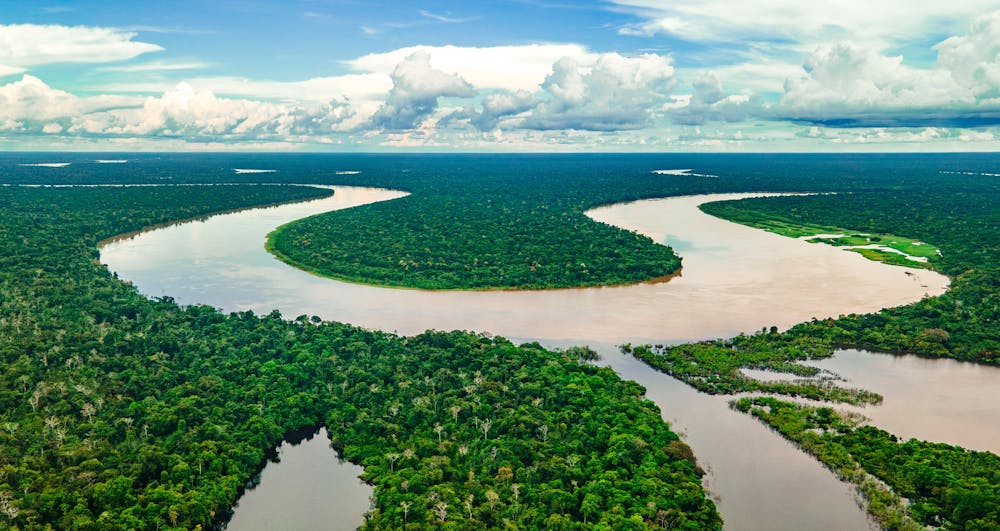
    The Amazon winds through dense forest on the border between Colombia and Peru.
    Jhampier Giron M / shutterstock

    Indeed, the Global Biodiversity Framework, the international treaty that underlies the Cop16 negotiations in Cali, estimates we’ll need an extra US$700 billion each year to protect biodiversity.

    An important issue at the summit is therefore how to mobilise sufficient financial resources, particularly for developing countries. The previous global biodiversity summit, held in Canada in 2022, established that wealthy countries should provide US$30 billion annually to low-income countries by 2030.

    Ahead of this year’s summit, countries were expected to submit new national biodiversity plans detailing how they’ll meet the 30% protection goals. Most failed to do so – including Colombia. Despite this setback, delegates in Cali will hopefully develop robust mechanisms to monitor progress and ensure countries are held accountable for meeting their targets.

    Other critical issues include reforms to benefit small-scale farmers in the Amazon. The region’s current economic model is centred on reshaping the land and extracting resources, but it has not generated prosperity for these more sustainable farmers. That same economic model has also failed to protect the forest itself.

    The summit should also work towards recognising indigenous peoples’ rights and traditional knowledge, and including their voices in policy decisions, and must address violence against environmental defenders.

    These are all huge issues in Colombia and indeed any country where cattle farmers are eyeing up pristine rainforest. The summit in Cali represents a great opportunity for the world to seriously tackle the dual biodiversity and climate crisis.


    Don’t have time to read about climate change as much as you’d like?

    Get our award-winning weekly roundup in your inbox instead. Every Wednesday, The Conversation’s environment editor writes Imagine, a short email that goes a little deeper into just one climate issue. Join the 40,000+ readers who’ve subscribed so far.


    Jesica Lopez works for Lund University.

    ref. As Colombia hosts a UN biodiversity summit, its own Amazonian rainforest is in crisis – https://theconversation.com/as-colombia-hosts-a-un-biodiversity-summit-its-own-amazonian-rainforest-is-in-crisis-241776

    MIL OSI – Global Reports

  • MIL-OSI USA: Biden-Harris Administration announces nearly $35 million for water infrastructure in New Hampshire through Investing in America agenda

    US Senate News:

    Source: United States Senator for New Hampshire Maggie Hassan
    BOSTON (Oct. 23, 2024) –Today, the U.S. Environmental Protection Agency (EPA) announced $3.6 billion in new funding under the Biden-Harris Administration’s Bipartisan Infrastructure Law to upgrade water infrastructure and keep communities safe. Combined with $2.6 billion announced earlier this month, this $6.2 billion in investments for Fiscal Year 2025 will help communities across the country upgrade water infrastructure that is essential to safely managing wastewater, protecting local freshwater resources, and delivering safe drinking water to homes, schools, and businesses.
    These Bipartisan Infrastructure Law funds will flow through the Clean Water and Drinking Water State Revolving Funds (CWSRF and DWSRF), a long-standing federal-state water investment partnership. This multibillion-dollar investment will fund state-run, low-interest loan programs that address key challenges in financing water infrastructure. Today’s announcement includes allotments for Bipartisan Infrastructure Law Clean Water General Supplemental funds for New Hampshire ($24,867,000), Emerging Contaminant funds ($2,146,000), and $7,640,000 under the Drinking Water Emerging Contaminant Fund.
    This funding is part of a five-year, $50 billion investment in water infrastructure through the Bipartisan Infrastructure Law – the largest investment in water infrastructure in American history. To ensure investments reach communities that need them the most, the Bipartisan Infrastructure Law mandates that a majority of the funding announced today must be provided to disadvantaged communities in the form of grants or loans that do not have to be repaid.
    “Water keeps us healthy, sustains vibrant communities and dynamic ecosystems, and supports economic opportunity. When our water infrastructure fails, it threatens people’s health, peace of mind, and the environment,” said EPA Administrator Michael S. Regan. “With the Bipartisan Infrastructure Law’s historic investment in water, EPA is working with states and local partners to upgrade infrastructure and address local challenges—from lead in drinking water, to PFAS, to water main breaks, to sewer overflows and climate resilience. Together, we are creating good-paying jobs while ensuring that all people can rely on clean and safe water.”
    “Clean, reliable water is at the heart of every thriving community. Yet too many communities—especially those overburdened by pollution or left behind by past investments—face challenges accessing the resources they need to upgrade water infrastructure,” said EPA Regional Administrator David W. Cash. “Thanks to the Biden-Harris Administration, we are delivering transformative funding to support local solutions to water issues, from fixing aging infrastructure to addressing emerging contaminants like PFAS. These investments don’t just protect public health and reduce pollution in waterways; they also create good-paying jobs and help communities become more resilient for the future.”
    “The health and vitality of Granite State communities depend on clean water,” said U.S. Senator Jeanne Shaheen. “As a lead negotiator of the water provisions of the Bipartisan Infrastructure Law, I’m thrilled to see this funding headed to New Hampshire to strengthen our wastewater infrastructure, address forever chemicals and keep our lakes and rivers clean.”
    “Every Granite Stater deserves safe, clean drinking water, and this new $34 million in funding for New Hampshire through the bipartisan infrastructure law will help make that possible for more families,” said U.S. Senator Maggie Hassan. “I helped negotiate and pass into law this historic infrastructure package to help deliver results for our communities, and I am pleased to see these continued investments flowing to New Hampshire to upgrade our water systems and protect public health.”
    “Safe, clean water is essential to the health and well-being of our communities, our economy, and our way of life,” said U.S. Representative Annie Kuster. “With these resources made available through the Bipartisan Infrastructure Law, New Hampshire will be able to make critical improvements to our state’s water infrastructure, protect our freshwater ecosystems, and ensure more families and businesses have access to clean drinking water.”
    “Our drinking water and waste water systems in New Hampshire require investment and modernization to serve the needs of Granite Staters. That is why I fought to pass the bipartisan infrastructure law to deliver these federal resources to New Hampshire,” said U.S. Representative Chris Pappas. “I’ll keep fighting to ensure this law benefits Granite Staters by delivering clean drinking water, protecting our environment, and helping our communities and economy grow for the future.”
    EPA is changing the odds for communities that have faced barriers to planning and accessing federal funding through its Water Technical Assistance program, which helps disadvantaged communities identify water challenges, develop infrastructure upgrade plans, and apply for funding. Communities seeking Water Technical Assistance can request support by completing the WaterTA request form. These efforts also advance the Biden-Harris Administration’s Justice40 Initiative, which sets the goal that 40% of the overall benefits of certain Federal investments flow to disadvantaged communities that are marginalized by underinvestment and overburdened by pollution.
    To read stories about how unprecedented investments in water from the Bipartisan Infrastructure Law are transforming communities across the country, visit EPA’s Investing in America’s Water Infrastructure Storymap. To read more about additional projects, see EPA’s recently released Quarterly Report on Bipartisan Infrastructure Law Funded Clean Water and Drinking Water SRF projects.
    For more information, including the state-by-state allocation of 2025 funding and a breakdown of EPA SRF funding available under the Bipartisan Infrastructure Law, please visit the Clean Water State Revolving Fund website and Drinking Water State Revolving Fund website. Additionally, the SRF Public Portal allows users to access data from both the Drinking Water and Clean Water SRF programs through interactive reports, dashboards, and maps.
    The State Revolving Fund (SRF) programs have been the foundation of water infrastructure investments for more than 30 years, providing low-cost financing for local projects across America. SRF programs are critically important programs for investing in the nation’s water infrastructure. They are designed to generate significant and sustainable water quality and public health benefits across the country. Their impact is amplified by the growth inherent in a revolving loan structure, in which payments of principal and interest on loans become available to address future needs.

    MIL OSI USA News

  • MIL-OSI USA: Assessing the U.S. and Global Climate in September 2024

    Source: US National Oceanographic Data Center

    September Highlights:

    The release of the September 2024 U.S. and Global Climate Reports was delayed due to significant infrastructure damage near NOAA National Centers for Environmental Information (NCEI) headquarters in Asheville, NC from Hurricane Helene. NCEI is in the process of returning to full operations and anticipates restoration of most data feeds in the near future.

    • Temperatures were above average across much of North and South America as well as Europe, but globally, temperatures averaged cooler than what was observed during September 2023, ending the 15-month record streak of record warm global temperatures.
    • The year-to-date global temperature was the warmest such period on record, with North America, South America, Europe, and Africa each ranking first.
    • The contiguous U.S. was second warmest on record with record warm conditions blanketing portions of the northern Plains, Upper Midwest, and south Florida.
    • Year-to-date temperatures across the contiguous U.S. averaged second warmest on record.
    • Hurricane Helene was the strongest hurricane on record to strike the Big Bend region of Florida, the deadliest Atlantic hurricane since Maria (2017), and the deadliest to strike the U.S. mainland since Katrina (2005).
    • Three new hurricanes (Debby, Helene, and Milton) and one tornado outbreak were added to the 2024 Billion Dollar Weather and Climate Disaster total. The year-to-date total now stands at 24 events — the second-highest event total for this period.
       

    Temperature

    The September global surface temperature was 2.23°F (1.24°C) above the 20th-century average of 59.0°F (15.0°C), making it the second warmest September on record. This value was 0.34°F (0.19°C) cooler than what was observed during September 2023. According to NCEI’s Global Annual Temperature Outlook, there is a 99.8% chance that 2024 will rank as the warmest year on record.

    The average temperature of the contiguous U.S. in September was 68.6°F, 3.8°F above average, ranking second warmest in the 130-year record. Generally, September temperatures were above average across much of the contiguous U.S., with near average temperatures observed from portions of central Texas to the central Atlantic Coast. Arizona, Wyoming, North Dakota, South Dakota, and Minnesota each ranked warmest on record for September.

    Other Highlights

    • Arctic sea ice extent was the sixth smallest in the 46-year record at 1.69 million square miles. Antarctic sea ice extent was 6.59 million square miles, the second lowest on record.
    • The Northern Hemisphere snow cover extent in September was slightly below average. Snow cover over North America was below average (by 320,000 square miles); Eurasia was slightly above average (by 90,000 square miles).
    • Global Precipitation in September was near the long-term average. Notably, much of the Sahara desert had its wettest September on record, driven by the rare passage of an extratropical cyclone on September 7-8.  
    • The U.S. has sustained 400 separate weather and climate disasters since 1980 where overall damages/costs reached or exceeded $1 billion (including CPI adjustment to 2024). The total cost of these 400 events exceeds $2.790 trillion.
      • Cost estimates for Hurricanes Helene and Milton have yet to be determined and are not part of the cost total at this time. 
      • The 2024 Billion Dollar Weather and Climate Event Disaster total of 24 events through mid-October is second only to the 27 events reported by this time last year.

    This monthly summary from NOAA’s National Centers for Environmental Information is part of the suite of climate services NOAA provides to government, business, academia and the public to support informed decision-making. For additional information on the statistics provided here, visit the Climate at a Glance and National Maps webpages. For a more complete summary of global climate conditions and events, explore our Climate at a Glance Global Time Series.
     

    MIL OSI USA News

  • MIL-OSI USA: USGS Reinvents Widely Used NLCD

    Source: US Geological Survey

    Annual NLCD arrived October 24, 2024, with a new ability to look at land cover and land change year by year, and over a longer time span than previous versions: from 1985 to 2023.

    Two years of effort went into the reinvention of a resource that’s widely used by federal agencies, state and local governments, researchers and many others. NLCD has contributed to a foundation of data essential for land monitoring, planning and decision-making.

    While Annual NLCD focuses on the ground, it relies on data captured 438 miles up. Satellites in the Landsat Program provide the long time series of data that allows users of Annual NLCD to compare change over time such as city growth, wildfire effects and forest fluctuations. 

    Previously, NLCD offered land cover information every two to three years from 2001 to 2021. Annual NLCD offers land cover information for every year for nearly four decades and has a shorter production time going forward. The new October release, called Annual NLCD Collection 1.0, includes information from the previous year for the lower 48 United States, just as the update in 2025 will include information from 2024.


    Upgrading ‘Built-in, Foundational Layer’ 

    Annual NLCD, produced at the USGS Earth Resources Observation and Science (EROS) Center, is part of a larger suite of land cover mapping and monitoring data produced by the Multi-Resolution Land Characteristics (MRLC) consortium, a group of federal agencies that coordinate and generate consistent and relevant land cover information at the national scale.

    The new “Annual” part of NLCD comes in response to the needs of people who use NLCD data. As Earth Observation Applications Coordinator for the USGS National Land Imaging Program, it’s Zhuoting Wu’s job to know what kinds of Earth observation products are valued most by federal agencies. 

    Through a survey, Wu discovered: “NLCD is the most widely used observation product we surveyed. People use it pretty much for everything. It goes into models or applications as a built-in, foundational layer.”

    Terry Sohl, Chief of the Integrated Science and Applications Branch at EROS, agreed. “The user community is so extensive,” he said. “There are so many federal agencies that absolutely rely on it, whether it’s the Bureau of Land Management, whether it’s the Environmental Protection Agency for regulatory concerns, whether it’s Fish and Wildlife for habitat management, or whether it’s Health and Human Services. It’s hard to find an agency that does not use NLCD.”

    However, in the federal survey from Wu, users did express the desire for annual updates produced more quickly.

    In the meantime, another EROS-led land cover project arose to provide annual land cover and change information stretching back to 1985. However, Land Change Monitoring, Assessment and Projection (LCMAP), first released in 2020, did not contain as much detail about land cover types as NLCD, especially in urban and forested areas.

    Wu said users found NLCD useful for its classification detail and LCMAP for its frequency, but “a combination of the two really gets the needs met.” That combination is Annual NLCD.

    The USGS EROS Center’s production of the Annual National Land Cover Database (NLCD) involves Terry Sohl, Chief of the Integrated Science and Applications Branch; Physical Scientist Jon Dewitz; and Research Geographer Jesslyn Brown.

    Evolution of NLCD Leads to ‘Touching Every Landsat Pixel’

    Work on the original NLCD product began well before high performance computing and cloud computing could provide automation. Processes have changed since Annual NLCD team member Jon Dewitz spent two years leading field work nearly 20 years ago to figure out which land classes should be labeled where. 

    “Making a land cover map from scratch is very different than developing an algorithm,” Dewitz said.

    That hard-earned information proved foundational to the progression of NLCD, however; processes for each data release grew more automated over time. “This has been a gradual evolution,” Dewitz said. “It’s another magnitude of effort to produce Annual NLCD because are we touching every Landsat pixel.”

    That “magnitude of effort” might be stating it mildly. The number of Landsat pixels processed for Annual NLCD numbered 295 trillion, from a total of 310 terabytes of Landsat data used.

    The task of creating Annual NLCD required new methods involving a lot of research and development, along with engineering. 

    One improvement that helped the team produce Annual NLCD in just two years was the ability to process the vast amount of imagery in the cloud alongside the Landsat data. “That is enabling us to make things faster,” said Jesslyn Brown, the Annual NLCD project manager, compared to previously having to move the imagery to a supercomputer for processing.

    Deep Learning Key to Development 

    Deep learning is another technological advantage the team leveraged for processing. Deep learning is a type of artificial intelligence that uses large amounts of data and, like the human brain, learns to recognize patterns—in imagery, for example—to solve problems or make predictions. This was especially important for Annual NLCD because datasets that helped with past NLCD land cover decisions didn’t go as far back as 1985. 

    The six different Annual NLCD science products, with examples all shown of the Marysville, Washington, area. 

    “We had to rely a lot more on the spectral imagery and also on deep learning to do a better job of inferring what’s happening in the Landsat imagery,” Dewitz said. “Deep learning really did a great job of linking all of that data together.”

    EROS Center Director Pete Doucette has long been an advocate for the use of data science to help solve scientific challenges. “Annual NLCD is blazing the trail as among the first generation of operational products at EROS that incorporate deep learning methods to improve performance,” Doucette said. “And I believe that we’re just getting started with where we can take machine learning methods at EROS.”

    Rylie Fleckenstein, the Research and Development (R&D) technical lead for Annual NLCD and a contractor at EROS, looked at previous methods for producing NLCD and LCMAP to help determine the new Annual NLCD process—“moving away from the hand editing, so to speak, and incorporating algorithms or different approaches to automate the process.”

    That production process included a change detection component, like LCMAP had, to determine where and when change had occurred on the landscape, and also a classification component to determine the type of land cover in an area. Some refinement was necessary in areas with trickier or inaccurate classifications. 

    The resulting new release contains a suite of six products associated with land cover and change: 

    • Land Cover: The predominant land cover class
    • Land Cover Change: The change between one year and the next
    • Land Cover Confidence: The probability value for the land cover class
    • Fractional Impervious Surface: The amount of area covered by artificial surfaces like pavement or concrete
    • Impervious Descriptor: The differentiation between roads and other artificial surfaces
    • Spectral Change Day of Year: The timing of a significant change in Landsat data  

    Team Met Challenges During ‘Intense Two Years’

    Brown estimated about 30 people have been involved in producing Annual NLCD. That includes scientists and engineers involved in the research and production stages, and also those collecting reference data to check for errors and validate the results.

    Dewitz praised the team for all they accomplished in the two-year timeframe. “The R&D team was challenged and pushed, and they performed wonderfully,” he said. 

    The engineering side had to do much of their work while R&D was still going on. “Thankfully we have an excellent engineering team,” Dewitz said. “They worked in pieces and did kind of a hybrid engineering process.”

    Sohl, the EROS science chief, thinks the infrastructure developed to produce Annual NLCD should be helpful for other science projects, too. 

    “This has been an intense two years,” Sohl said. “I’m just so proud of the team. They have worked so hard, and they performed a minor miracle in terms of completely revamping the methodology and moving all of the technology into the cloud. Now that we have this infrastructure set up, it really facilitates the next level of improvements for Annual NLCD.”


    Improvements Helpful for Heat and Flooding Studies

    Annual NLCD is national in scope, but on a local level, it fills the need that cities or other entities have for detailed and accurate land cover information that spans decades.

    George Xian, a research physical scientist at EROS, is grateful that Annual NLCD has arrived so he can start using it in his urban heat island work. He is in the midst of expanding his study of trends in changing average surface temperatures and hotspot locations from 50 to 300 U.S. cities.

    This type of information is important for cities to know because they can develop plans to help residents cope during periods of extreme heat, which can cause illness or death in vulnerable populations.

    For the 50-city study, Xian and his colleagues needed the annual land cover data beginning with 1985 that LCMAP provided, but also the more detailed information about paved surfaces, concrete and rooftops—collectively called impervious surfaces, which typically retain more heat—contained in NLCD. “We had to use a so-called hybrid way to integrate NLCD and LCMAP to gather the data for this four-category urban area and also annual change,” Xian said.

    The Annual National Land Cover Database (NLCD) is produced at the USGS EROS Center, which is located in a rural area north of Sioux Falls. Sioux Falls has steadily grown in size and population, as seen here in red in an Annual NLCD animation spanning nearly 40 years. Annual NLCD provides four different developed classes to provide more detailed information about cities.

    For the expanded study with more than 300 cities from 1985 to 2023, Xian said, “we can use Annual NLCD to directly define our urban categories into four categories. We can study their variations and their variation impact to the urban heat island. We can directly pull the data into our algorithm and use it. We don’t need to regenerate the data.”

    Ryan Corcoran is looking forward to using Annual NLCD as well. He serves as the Coordinated Needs Management Strategy (CNMS) team lead at Niyam IT, which is part of the Advancing Resilience in Communities joint venture that provides planning, engineering and mapping support for FEMA’s Zone 1.  One aspect that Corcoran and his colleagues work with involves checking whether flood studies of river and coastal areas remain valid after a period of time, or whether conditions have changed and require a new study.

    In the past, Corcoran said they have had to use multiple data sources, including NLCD, for baseline watershed information and to assess annual changes. 

    “We are excited about the upcoming expansion of the NLCD. It will make it easier for us to calculate baseline watershed imperviousness and land use changes using a single dataset,” Corcoran said. “The availability of this extensive data is critical, as we sometimes validate flood studies that date back to the 1970s. Increased data availability allows us to better evaluate flood risk, especially when validating older flood studies.”

    More Access to Annual NLCD Data

    Annual NLCD users have more options to access the data than before. The data is still available on the MRLC website, but it also has been added to the cloud and to the USGS EROS data access site EarthExplorer. 

    “We’re trying to respond to people’s requests for data in all kinds of different ways,” said Brown, the Annual NLCD project manager.

    The data will be updated more frequently, too. “In the past, it’s usually taken over a year, if not more, to do an NLCD update,” said science branch chief Sohl. “We’re setting the stage where, by the middle of every year, we’re going to have an update for the previous year.”

    Annual NLCD is providing more useful information more quickly for the people relying on it—which, as it turns out, might be most of us, with NLCD’s history as a key source of data woven into the background of society.   

    “Annual NLCD represents the next generation of highly accurate mapping information that keeps pace with evolving user needs,” said EROS Director Doucette. “Annual NLCD products will become increasingly relevant toward assessing land use and land condition. They provide key change indicators for understanding environmental interactions and consequences. These are the kinds of things that decision makers ultimately want to know.”

    MIL OSI USA News

  • MIL-OSI USA: Six State Revolving Fund loans awarded for water and sanitary sewer projects

    Source: US State of North Dakota

    The State Revolving Fund (SRF) programs, jointly administered by the North Dakota Department of Environmental Quality and the North Dakota Public Finance Authority, have awarded six loans for water and sanitary sewer projects since August.

    • The Clean Water State Revolving Fund (CWSRF) awarded $350,000 to Drayton, $15 million to Fargo, and $3.3 million to Jamestown. These cities will replace aging water meters to ensure accurate accounting of water use and identify potential leaks.
    • Grand Forks received a $6.9 million CWSRF loan for Phases 2 through 5 of a sanitary sewer collection installation. This project will serve areas currently on septic systems, reducing potential groundwater impacts.
    • Southeast Water Users District received a $5.7 million Drinking Water State Revolving Fund (DWSRF) loan towards the construction of a new water treatment plant, a new ground storage reservoir, and the expansion of the existing wellfield. This project aims to improve water quality for users in Dickey, LaMoure and Logan counties.
    • Mandan received a $5.5 million DWSRF loan towards replacing the Collins Reservoir, ensuring adequate water storage for the community.

    The U.S. Environmental Protection Agency provides part of the SRF programs’ funding, which offers below-market interest rate loans to political subdivisions for financing projects authorized under the Clean Water Act and Safe Drinking Water Act. SRF programs operate nationwide to provide funding to maintain and improve the infrastructure that protects our vital water resources.

    Loans are awarded to projects listed on the project priority list based on project eligibility determined by the Department of Environmental Quality and the Public Finance Authority’s review of repayment ability. The Public Finance Authority is overseen by the North Dakota Industrial Commission, consisting of Governor Doug Burgum as chairman, Attorney General Drew H. Wrigley, and Agriculture Commissioner Doug Goehring. Please contact the Department of Environmental Quality at ndsrf@nd.gov regarding specific detail on any of the projects mentioned above.

    MIL OSI USA News

  • MIL-OSI Canada: Statement from Environment and Climate Change Minister Tracy Schmidt on International Day of Climate Action

    Source: Government of Canada regional news

    Statement from Environment and Climate Change Minister Tracy Schmidt on International Day of Climate Action


    Today, as Manitoba marks International Day of Climate Action, our government is reaffirming our commitment to taking meaningful climate action to protect Manitoba’s lands and waters and work towards net zero targets.

    Started by young people concerned about the impact of climate change, the International Day of Climate Action has grown into a worldwide movement that our government stands proudly behind. I would like to say thank you to all those who continue to raise awareness and push this important issue to the forefront around the world and right here in Manitoba.

    In our first year in government, we’ve made protecting our beautiful province from climate change a priority and we have been working hard to make real change for Manitobans. Some of the notable steps we’ve taken include:

    • Introduced the Manitoba Electric Vehicle Rebate Program, which provides rebates of $4,000 on the purchase of a new eligible electric vehicle, $1,000 to $4,000 on leasing an eligible electric vehicle, and $2,500 on the purchase of pre-owned eligible electric vehicles, ensuring more Manitobans can make the switch away from fossil fuels.
    • Advanced, for the first time in Manitoba’s history, a plan to support Indigenous owned, utility-scale electricity resource supply through the creation of government-to-government partnerships in wind generation.
    • Invested in projects to reduce greenhouse gas emissions through the Low Carbon Economy Fund, in partnership with the federal government.
    • Enacted the first-ever formal nutrient reduction target for Lake Winnipeg and its tributaries for improving water quality in Manitoba.
    • Signed a memorandum of understanding with the Seal River Watershed Alliance, Indigenous nations and Government of Canada to formally work together on a feasibility assessment to establish a potential Indigenous protected and conserved area in the 50,000 square kilometre Seal River Watershed.
    • Unveiled the Affordable Energy Plan, which charts the path towards Manitoba’s energy future through building out the grid to grow new clean energy, including wind generation to increase good green jobs, grid reliability, and keep energy rates low for years to come.
    • Restored almost $400,000 in funding to Climate Change Connection, Green Action Centre, and Manitoba Eco-Network to help take tangible action on climate change.
    • Invested in projects to reduce greenhouse gas emissions through the Low Carbon Economy Fund, in partnership with the federal government.
    • Enacted the first-ever formal nutrient reduction target for Lake Winnipeg and its tributaries for improving water quality in Manitoba.
    • Appointed a new board of directors for Efficiency Manitoba and issued a new mandate letter to the Crown corporation, focusing on reducing our fossil fuel emissions.
    • Supported the City of Winnipeg with $10 million for wastewater infrastructure.

    There still remains a lot of work to do, and we are up for the challenge. As the minister of environment and climate change, I look forward to working closely with all Manitobans as we create a greener and cleaner Manitoba.

    – 30 –

    MIL OSI Canada News

  • MIL-OSI Canada: Federal government launches new initiative to support climate resilient housing and infrastructure across communities

    Source: Government of Canada News

    News release

    Ottawa, Ontario, October 24, 2024 —Communities across Canada will be able to build environmentally friendly, climate-resilient housing and infrastructure with support from the Climate Toolkit for Housing and Infrastructure (CTHI).

    Today, Sean Fraser, Minister of Housing, Infrastructure and Communities, launched a suite of tools, resources, and support services that will be available, free of cost, to communities to help them adapt their infrastructure to changing climate conditions, and also reduce greenhouse gas emissions during new home and infrastructure constructions. The federal government invested $94.7 million in CTHI, and it will include a help desk, an online platform, and a roster of climate and infrastructure experts.

    The Climate Help Desk provides communities with direct support and guidance on infrastructure and climate-related concerns. Housing, Infrastructure and Communities Canada operates the help desk which offers advice and best practices on how to make environmentally friendly and climate resilient considerations during project planning and development.

    In collaboration with ICLEI Canada – an organization that supports local governments by providing them with the expertise and resources to take climate action in their communities – we have also launched the ClimateInsight.ca Platform. The platform will ease the burden of data collection for small and medium sized communities. With guided navigation, the platform will provide easy access to curated tools and resources on one dedicated website.

    Finally, in partnership with the Canadian Urban Institute (CUI) – a national research organization dedicated to achieving healthy urban development – we will be launching the Roster of Climate and Infrastructure Experts in December 2024. The federal government’s investment will help CUI  establish a roster of employees consisting of housing, infrastructure, and climate experts. This service will allow small communities with eligible infrastructure and housing projects to request climate related support. The roster will match communities with specialized experts to provide project-specific advice on reducing emissions and increasing climate resilience.

    Investing in the tools and services needed to improve the resiliency of Canadian infrastructure will support the continued success and economic growth of communities for years to come.

    Quotes

    “As we deal with the growing impacts of climate change, the Climate Toolkit for Housing and Infrastructure will help us work with communities across the country to ensure that new homes and infrastructure have minimal impact on the environment, while better protecting people, their houses, their businesses, and their livelihoods from the impacts of climate change.”

    The Honourable Sean Fraser, Minister of Housing, Infrastructure and Communities

    “The impacts of extreme weather and climate change are no longer distant concerns. This is a new reality municipalities need to prepare for now more than ever while simultaneously shifting towards a net-zero future. Climate Insight will play a crucial role in equipping local practitioners with the data and information they need to build low-carbon, climate-resilient communities.”

    Megan Meaney, Executive Director, ICLEI Canada

    “Communities across Canada are facing an unprecedented challenge in adapting to the growing impacts of climate change while modernizing critical infrastructure. To help advance a sustainable and resilient future, we must support these communities from coast to coast to coast, empowering them to consider climate information in infrastructure decision making. The Roster of Climate and Infrastructure Experts plays a vital role by equipping local governments in smaller communities with the specialized expertise needed to integrate innovative approaches to infrastructure projects that foster locally specific climate solutions.”

    Mary W. Rowe, President & CEO, Canadian Urban Institute

    Quick facts

    • On June 27, 2023, the federal government released National Adaptation Strategy. It commits $1.6 billion in new federal funding to help address both immediate and future climate risks to Canadian communities. 

    • The National Adaptation Strategy and Government of Canada Adaptation Action Plan have committed $94.7M over 5 years to deliver a climate toolkit and services through the Climate Toolkit for Housing and Infrastructure initiative (CTHI).

    • The Climate Toolkit for Housing and Infrastructure will support the development of integrated climate-related tools, resources and services for communities:

      • Climate Help Desk to provide direct support to address infrastructure and climate-related inquiries;
      • Roster of Climate and Infrastructure Experts to provide access to expert advice to strengthen climate-related considerations of public infrastructure and housing projects; and
      • Climate Tools and Resources that are widely available and accessible through the ClimateInsight.ca Platform.

    Associated links

    Contacts

    For more information (media only), please contact:

    Sofia Ouslis
    Press Secretary
    Office of the Minister of Housing, Infrastructure and Communities
    sofia.ouslis@infc.gc.ca

    Media Relations
    Housing, Infrastructure and Communities Canada
    613-960-9251
    Toll free: 1-877-250-7154
    Email: media-medias@infc.gc.ca
    Follow us on Twitter, Facebook, Instagram and LinkedIn
    Web: Housing, Infrastructure and Communities Canada

    MIL OSI Canada News

  • MIL-OSI USA: Lead pollution in a remote Tibetan glacier reveals far-reaching human activities

    Source: US Government research organizations

    The Tibetan Plateau’s glaciers are among the world’s most remote and untouched places. Researchers say these ice fields provide water for millions of people and play a vital environmental role.

    Now, geoscientists funded by the U.S. National Science Foundation have tracked pollution in the form of lead in the glaciers. The findings are reported in the journal Nature Communications Earth and Environment.

    The Tibetan Plateau is often called the “Roof of the World.” It’s the highest and largest plateau on Earth. In a study of the Guliya Ice Cap there, Franco Marcantonio of Texas A&M University and his colleagues discovered that significant lead pollution of the ice cap began in 1974, with the highest levels between 2000 and 2007.

    The team measured lead isotopes in samples dating to 36,000 years ago. The ice serves as a historical record, giving scientists a way of comparing levels of modern lead contamination to those of pre-industrial times.

    “Even though Pb [lead] has been used by ancient civilizations for millennia, it was not until the Industrial Revolution and later, when leaded gasoline was introduced … in the 1920s, that the emission of Pb from human activities skyrocketed,” state the scientists in their paper. “By the 1980s, emissions surpassed their natural and pre-industrial contribution by about two orders of magnitude.”

    The Tibetan Plateau “is considered to be a pristine place due to the very low industrial activity in the region,” write the researchers. Nonetheless, lead found its way there, and its history of human use was captured in the Guliya Ice Cap.

    “This study advances our understanding of the breadth and timing of environmental impacts from human activities,” says Margaret Fraiser, a program director in the NSF Division of Earth Sciences.

    MIL OSI USA News

  • MIL-OSI USA: Speech of Commissioner Summer K. Mersinger to Keynote at the S&P Global Commodity Insights Nodal Trader Conference

    Source: US Commodity Futures Trading Commission

    Good morning, and thank you for the warm welcome.  A special thank you to Nodal for inviting me to join your annual Trader Conference again this year.  It is truly an honor to address all of you this morning.  I am more than two years into my role as a commissioner at the Commodity Futures Trading Commission, and I still feel humbled by the opportunity to stand on a stage with a microphone to address accomplished professionals like all of you.  My children, on the other hand, are surprised that anyone would want to hear me talk about anything, and they are even more shocked that I would need a microphone to be heard as they are convinced that the only volume I ever use when speaking is shouting.

    The topic for my speech on today’s agenda is:  New Perspectives on Energy Trading and Power Markets, and I plan to focus on the road ahead for these markets.  But before discussing the road ahead, I will start with a story from my childhood about when I learned to drive.  I say this is a story from my childhood because in South Dakota, children as young as fourteen years old are allowed to obtain a driver’s license.  As much as I miss my home state, when I look at my fourteen-year-old son and think about him driving, I see the wisdom in Virginia’s approach.

    At the ripe old age of twelve, my dad decided it was time for me to learn how to drive.  As a tall child, I could reach the gas and brake pedals, which was apparently the minimum criteria for beginning driving lessons on the farm.  To be honest, I was scared to death of driving.  But my parents said I should learn because if there was ever an emergency, and I was the only one home, I may need to drive for help.  That logic just made me scared of driving and being left alone on the farm.

    My experience as a parent teaching two teenagers to drive involved multiple practice sessions in empty parking lots before slowly graduating to quiet side roads before paying another adult to do the really scary stuff, such as driving on highways and making left turns across oncoming traffic.  I suspect that sounds familiar to many in this room as well. 

    But that suburban approach is not how I learned to drive.  My lesson – notice I said lesson, not lessons—was a little more hands-off.  On the day I learned to drive, my dad had me jump in the passenger seat of his 1977 blue Chevy pick-up truck to take a ride with him.  Oddly, my older brother jumped in another farm truck and followed close behind.

    After driving a few miles away from our house, my dad drove the truck into the middle of a freshly plowed field.  Dad threw the truck into park, jumped out, and told me to slide over to the driver’s seat.  He then shut the door, leaned into the window, and told me to drive around the field until I was comfortable enough to drive myself home.  At that point, I realized why my brother had followed us in another vehicle—it was my dad’s getaway car.

    Honestly, I panicked.  I screamed, pleaded, and begged.  But my dad was confident in his approach.  And he left me with this advice:  always keep your eyes on the road.  But don’t just look at the road immediately in front of the vehicle; be sure to watch the road ahead so you know where you are going—and so that you do not smash into a deer.

    I’m sharing this story with you today for two reasons.  First, to offer some entertainment.

    Second, I found the advice my dad gave me that day relevant to the topic for my speech today.  Specifically, I want to share with you some thoughts and observations on energy markets, the road ahead for these markets, and potential down-the-road effects on the derivatives markets that are regulated by the CFTC.

    Being a derivatives regulator can feel a little like being that driver who is looking down the road to see what is ahead.  Our markets are forward looking, offering a view into points off in the distance so drivers are prepared for the path ahead.  But, just like a careful driver needs to see what is right in front of the vehicle as much as what is on the road ahead, careful regulation requires us to also keep our eyes on current market conditions, in addition to ensuring the reliability and safety of the futures markets, which reflect the road ahead.  The CFTC is always surveilling markets, spotting trends, and monitoring for risk that could impact the futures markets.

    Now, here is where this speech will diverge from my story of learning to drive.  While I was left to teach myself how to drive and had no one willing to share their expertise with me, our work at the CFTC in following markets occurs with the benefit of a variety of internal resources (such as the Market Intelligence Branch of the Division of Market Oversight and the Office of the Chief Economist) as well as external resources (such as our advisory committees).

    At the CFTC, we have five advisory committees, each of which is sponsored by a commissioner.  These committees are comprised of subject matter experts representing a variety of viewpoints, such as private sector stakeholders, non-profit groups, academia, and other governmental entities.  As many of you know, especially those who are members, I sponsor the Energy and Environmental Markets Advisory Committee.

    Growing up on a farm in South Dakota, I always understood that the price of energy had a major impact on whether it was a good year or a bad year for the farm.  Even at a young age, I could tell you the exact cost-per-gallon of diesel because either my dad was grumbling about it as he left for the field, or it was the topic of discussion at the local café in town where the older farmers convened for their morning coffee.

    The price of diesel determined the cost of running planters, tractors, combines, and trucks.  The cost of fertilizers and pesticides are also directly linked to fossil fuel input prices, and spreading those fertilizers and pesticides required hiring a spray pilot whose services were priced based on the cost of the aviation fuel.

    Even after our crops were harvested, energy costs were critical.  Energy prices influenced the cost of storage at the grain elevators and transportation; barges and ships run on bunker fuel and trains need diesel.  Everything in the farm economy depends on the price of energy.  You might have perfect temperatures, exactly the right amount of rain at exactly the right time, and high yields but still see your net profit shrink due to high energy prices.

    As the only Commissioner with a background in production agriculture, sponsoring the Commission’s Agriculture Advisory Committee may have seemed like the obvious choice.  But I saw the EEMAC as an opportunity to focus on sectors critical to the agricultural economy and to study those energy markets to understand their impact on the markets we regulate.  The goal is for the energy futures complex to serve end-users who need to hedge those costs and to mitigate the frequent price volatility experienced by the underlying cash markets.

    As the EEMAC has held meetings and participated in discussions around energy markets, we have heard over and over that the United States has critical gaps in its energy and power infrastructure.  As those gaps widen, so do risks to the stability of these markets that become more sensitive and less resilient to forces beyond US control.  Instability and volatility in spot energy markets and prices have a direct impact on the derivative products we regulate.

    Energy infrastructure’s impact on energy prices is something that cannot be ignored, and this reality has become even more apparent in the last decade.  Of course, it makes sense that energy transmission and delivery directly impact the cost to the end consumer.  However, truly understanding how energy infrastructure market fundamentals influence energy spot and derivatives prices requires hearing directly from hardworking domestic energy producers and seeing the infrastructure up close.

    With that in mind, the EEMAC has held a series of meetings on the road, and members of the advisory committee have joined me in getting outside of Washington to see our energy production and infrastructure and to talk directly with the experts who manage these facilities.

    In our first meeting, we visited Oklahoma and focused on more traditional energy markets such as crude oil and natural gas.[1]  We visited Cushing, Oklahoma, where the WTI Crude Oil contract settles to see the pipelines and storage facilities as well as to talk with those in charge of storing, blending, and moving the oil to locations throughout the US.  During the EEMAC meeting, a witness from the Federal Energy Regulatory Commission described an anomaly in the price of natural gas in New England.[2]  Despite having one of the largest concentrations of natural gas in the Marcellus Shale just over two hundred miles away, a lack of pipeline capacity makes it impossible to fully supply New England with gas from the Marcellus Shale.[3]  This situation means that New England relies on liquified natural gas (“LNG”) supplies from tanker ships.  As a result, the price New England end users pay is based on the Henry Hub price for exported LNG, rather than the domestic production price.  This circumstance creates an unusual situation where the spot price that a natural gas-fired power plant in Massachusetts pays for its fuel is more dependent on Europe’s desire for natural gas and a global market thousands of miles away than on the price and availability of natural gas produced two states away in Pennsylvania.

    To examine power markets and electrification, we held meetings in Roy, Utah; Nashville, Tennessee; and Golden, Colorado.[4]  In the course of those meetings, we had the opportunity to tour a large Ford EV production facility in Spring Hill, Tennessee, the Bingham Canyon Copper Mine in Utah, and a startup company looking to reuse mine tailings to produce critical metals and minerals in Golden, Colorado.

    Here in the United States, we have some of the largest deposits of the metals necessary for power generation, transmission, and use, but large gaps in our infrastructure and policies render these advantages almost meaningless.  In Golden, Colorado, we learned that despite a startup company’s cutting-edge technology that can turn mine waste into critical metals and minerals, China’s dominance in rare earth markets means that they can manipulate prices at will and squeeze out competition and force any US production into bankruptcy.

    Southwest of Salt Lake City, Utah, we toured the Bingham Canyon Copper Mine.  The Bingham County Mine is the largest man-made excavation in the world.[5]  It’s also the world’s deepest open pit mine, and it has produced more copper than any other mine in the world.[6]  As you can probably guess, the US has abundant supplies of copper; however, because of a lack of domestic smelting capacity, much of the copper mined in the US must be shipped overseas, often to China, to be processed and refined.  In fact, since 2000, China has been responsible for 75% of the global smelter capacity growth.[7]

    Finally, in Spring Hill, Tennessee, we learned that car companies are increasingly concerned  about logistical challenges reducing their  ability to provide cost-competitive electric vehicles.  This is not an idle concern.  Just four weeks ago, Rivian disclosed that it will be forced to reduce production and decrease its sales target in 2024 by almost 20% because of difficulties sourcing a component used in its electric motor.[8]  And last week, to secure a steady supply of lithium, GM announced an almost $1 billion investment in the Thacker Pass mine in Nevada.[9]

    For years, the problem for domestic energy policy was how to mine, drill, and import enough raw materials to satisfy America’s growing energy demand.[10]  Even after the oil glut of the 1980s and lower energy prices, we were still concerned with our reliance on foreign energy.[11]  The continuous mantra of Presidents starting with Richard Nixon was the concept of “Energy Independence” as a policy goal.[12]  Now, not because of government mandates, plans, or policies, but thanks to technological innovation, hard work, and the deployment of private capital, that goal has largely been achieved.  We have the raw materials in the ground that we need to power American energy independence; however, we need our infrastructure to catch-up with our domestic supply.

    Returning to my driving lesson, when I look at the road ahead, I see the United States coming to a crossroads.  One road leads to more resilient infrastructure, lower prices, and energy abundance.  The other road leads to energy scarcity, higher prices, and a loss of energy independence.  The direction we take as a country will have a major impact on the energy markets and the futures markets we regulate at the CFTC.  Unfortunately, gaps in energy infrastructure lead to instability and volatility in energy markets, which have a direct impact on the derivatives markets.  If derivatives markets fail to offer adequate price discovery and risk mitigation, they will no longer serve producers and end users as appropriate tools to hedge their exposure.  That is a road we cannot afford to go down.

    As a regulator, the CFTC is not the driver of this car, but we definitely have an interest in taking the road that leads to liquid, stable, and vibrant derivatives markets that serve as a tool for hedging against risk. We can do that by ensuring that new derivative products come to market efficiently without the fear of litigation or unreasonable staff positions, and by cultivating new market structures that minimize conflicts and instill market confidence.  Our enforcement efforts should be focused on ‘bad actors’ and not on trying to shortcut deliberative policymaking.  The CFTC should prefer “responsible regulation” over “regulation by enforcement.”  To arrive at our desired destination, we all need to keep our eyes on the road, to see what is right in front of us while simultaneously paying attention to the road ahead.

    Thank you for taking this road trip with me today.  I look forward to answering your questions.


    [1] CFTC Energy and Environmental Markets Advisory Committee meeting in Stillwater, Oklahoma, September 20, 2022.

    [4] CFTC Energy and Environmental Markets Advisory Committee meeting in Nashville, Tennessee, February 28, 2023.  CFTC Energy and Environmental Markets Advisory Committee meeting in Roy, Utah, June 27, 2023.  CFTC Energy and Environmental Markets Advisory Committee meeting in Golden, Colorado, February 13, 2024.

    [5] Kristine L. Pankow, Jeffrey R. Moore, J. Mark Hale, Keith D. Koper, Tex Kubacki, Katherine M. Whidden, and Michael K. McCarter.  “Massive landslide at Utah copper mine generates wealth of geophysical data.” Geological Society of America, vol. 24, no. 1, January 2014.

    [7] Securing Copper Supply: No China, No Energy Transition, WoodsMcKenzie, August 2024, Nick Pickens, Robin Griffin, Eleni Joanides, and Zhifei Liu.

    [8] Ed Ludlow and Kiel Porter. “Rivian Misstep Triggered Parts Shortage Hobbling Its EV Output.” Bloomberg, October 7, 2024.

    [9] Camilla Hodgson.  “General Motors increases investment in lithium mine to nearly $1bn.” Financial Times, October 6, 2024.

    [10] US Energy Information Administration, “U.S. energy facts explained, Imports & Exports.”  Last updated July 15, 2024, with data from the Monthly Energy Review.

    [12] Charles Homans, “Energy Independence: A Short History.”  Foreign Policy, January 3, 2012.

    MIL OSI USA News

  • MIL-OSI USA: Wexton Announces $40 Million in Federal Infrastructure Law Funding for New Dulles Airport Terminal Project

    Source: United States House of Representatives – Congresswoman Jennifer Wexton (D-VA)

    Washington, DC – Today, Congresswoman Jennifer Wexton (D-VA) announced a new $40 million grant from the Bipartisan Infrastructure Law’s Airport Terminals Program (ATP) to aid in the construction of Washington Dulles International Airport’s new 14-gate regional and commuter terminal. This is the fourth consecutive fiscal year that the new terminal project has received funding through the Bipartisan Infrastructure Law, after receiving $49.6 million in 2022, $20 million in 2023, and $35 million in 2024.

    “I’m proud that our Bipartisan Infrastructure Law is once again delivering critical funding that will help grow and enhance travel and economic activity here in Virginia’s 10th District at Dulles Airport,” said Congresswoman Wexton. “Today’s announcement brings the total to more than $144 million in federal funds to make this new terminal project a reality. A top priority for the airport, it will save passengers’ time, reduce crowding, and make the passenger experience smoother and more convenient. The investments we’ve made through this historic infrastructure law continue to have an impact in our community and local economy that will have benefits for generations to come.”

    The new terminal will be conveniently located atop the underground Concourse C/D Aerotrain station, providing quick and easy access to passengers and reducing transit times for passengers with connections at Dulles who must currently use shuttle buses or long walkways. The new terminal will allow for jet bridge boarding that reduces boarding times and is more accessible for passengers with disabilities, rather than forcing passengers to board using outdoor covered walkways and aircraft stairs. It will be nearly four times larger than the current facility, which will reduce crowding, allow for expanded concessions and passenger amenities, and create additional space for operational areas, offices, aircraft servicing, and baggage handling.

    The new regional and commuter terminal project will also improve Dulles’s environmental footprint, as the proposed new facility will be built to LEED Silver Certifiable standards. Environmental improvements include support for electric aircraft servicing vehicles and the use of modern energy efficient construction methods and materials.

    The Airport Terminals Program, established by the Bipartisan Infrastructure Law which Wexton voted to pass in 2021, provides $1 billion in grants annually for five years to address aging infrastructure at our nation’s airports.

    ###

    MIL OSI USA News

  • MIL-OSI USA: Rep. Sewell Announces $43.7 Million for Water Infrastructure in Alabama

    Source: United States House of Representatives – Congresswoman Terri Sewell (AL-07)

    Birmingham, AL – Today, U.S. Rep. Terri Sewell (AL-07) announced that the U.S. Environmental Protection Agency (EPA) is investing $3.6 billion in new funding under the Biden-Harris Administration’s Bipartisan Infrastructure Law to upgrade our nation’s water infrastructure, including $43.7 million for the State of Alabama. This funding will help communities across Alabama upgrade water infrastructure that is essential to safely managing wastewater and drinking water in our homes, schools, and businesses.

    “I voted for the Biden-Harris Infrastructure Law because it promised to make the largest investment in wastewater and drinking water infrastructure in our nation’s history,” said Rep. Sewell. “Thanks to the Biden-Harris Administration, we are delivering on that promise. I am thrilled to announce that Alabama will receive over $43.7 million to help communities upgrade wastewater and drinking water infrastructure. Access to clean water is a basic human right, and this investment represents critical progress in our continued fight for equitable and safe wastewater systems. I thank President Biden and Vice President Harris for this historic investment, and I look forward to working with the State of Alabama to ensure these new resources reach the communities that need them most.” 

    “Water keeps us healthy, sustains vibrant communities and dynamic ecosystems, and supports economic opportunity. When our water infrastructure fails, it threatens people’s health, peace of mind, and the environment,” said EPA Administrator Michael S. Regan. “With the Bipartisan Infrastructure Law’s historic investment in water, EPA is working with states and local partners to upgrade infrastructure and address local challenges—from lead in drinking water, to PFAS, to water main breaks, to sewer overflows and climate resilience. Together, we are creating good-paying jobs while ensuring that all people can rely on clean and safe water.”

    The Bipartisan Infrastructure Law funds will flow through the Clean Water and Drinking Water State Revolving Funds (CWSRF and DWSRF), a long-standing federal-state water investment partnership. This multibillion-dollar investment will fund state-run, low-interest loan programs that address key challenges in financing water infrastructure. Today’s announcement includes allotments for Bipartisan Infrastructure Law Clean Water General Supplemental funds for Alabama ($27,824,000), Emerging Contaminant funds ($2,402,000), and ($13,490,000) under the Drinking Water Emerging Contaminant Fund.

    This funding is part of a five-year, $50 billion investment in water infrastructure through the Bipartisan Infrastructure Law – the largest investment in water infrastructure in American history. To ensure investments reach communities that need them the most, the Bipartisan Infrastructure Law mandates that most of the funding announced today must be provided to disadvantaged communities in the form of grants or loans that do not have to be repaid. 

    To read stories about how unprecedented investments in water from the Bipartisan Infrastructure Law are transforming communities across the country, visit EPA’s Investing in America’s Water Infrastructure Storymap. To read more about additional projects, see EPA’s recently released Quarterly Report on Bipartisan Infrastructure Law Funded Clean Water and Drinking Water SRF projects.

    For more information, including the state-by-state allocation of 2025 funding and a breakdown of EPA SRF funding available under the Bipartisan Infrastructure Law, please visit the Clean Water State Revolving Fund website and Drinking Water State Revolving Fund website. Additionally, the SRF Public Portal allows users to access data from both the Drinking Water and Clean Water SRF programs through interactive reports, dashboards, and maps.

    The State Revolving Fund (SRF) programs have been the foundation of water infrastructure investments for more than 30 years, providing low-cost financing for local projects across America. SRF programs are critically important programs for investing in the nation’s water infrastructure. They are designed to generate significant and sustainable water quality and public health benefits across the country. Their impact is amplified by the growth inherent in a revolving loan structure, in which payments of principal and interest on loans become available to address future needs.

    ###

    MIL OSI USA News

  • MIL-OSI Security: IAEA and Prince Albert II of Monaco Foundation Strengthen Long-Term Partnership on Ocean Acidification

    Source: International Atomic Energy Agency – IAEA

    Ocean acidification impacts marine life, particularly organisms with calcium-based shells or skeletons, such as corals and molluscs.  (Photo: The Ocean Agency/Ocean Image Bank) 

    A new partnership has been signed which formalizes a long standing collaboration between the IAEA Marine Environment Laboratories, hosted by the Principality of Monaco, and the Prince Albert II of Monaco Foundation on ocean acidification and ocean-based solutions to climate change. The new Partnership falls under the framework of the IAEA’s Ocean Acidification International Coordination Centre and the Foundation’s initiative Ocean Acidification and other Ocean Change – Impacts and Solutions and was signed by the Foundation’s Vice President and CEO, Olivier Wenden, and IAEA Deputy Director General Najat Mokhtar.

    Ocean acidification occurs when the ocean absorbs carbon dioxide (CO2) released into the atmosphere by human activities. The ocean absorbs about 25 per cent of human-caused CO2 emissions, leading to a series of changes in seawater chemistry, including an increase in acidity.  Ocean acidification impacts marine life, particularly organisms with calcium-based shells or skeletons, such as corals and molluscs. Along with ocean warming and oxygen depletion, these changes create complex and unpredictable challenges for marine ecosystems.

    Created in 2006, the Prince Albert II of Monaco, Foundation (PA2F) aims to protect the environment and promote sustainable development.  Ocean acidification and ocean change has been a key focus of the PA2F since 2013 when the Ocean Change – Impacts and Solutions (OACIS) Initiative was launched.

    “Ocean acidification is a global problem, but how the effects play out depend on local factors,” said Wenden. “Ocean acidification will hit harder in many regions of the world which do not necessarily have the resources or the capacity to monitor and to adapt. We are thrilled to be teaming up with the IAEA Marine Environment Laboratories to help bring knowledge and capacity to study ocean acidification to scientists across the globe”.

    OACIS brings together the main organizations working on ocean acidification based in the Principality of Monaco (PA2F, the Monaco Government, the Oceanographic Museum, the Centre Scientifique de Monaco and the IAEA Marine Environment Laboratories), as well as the Villefranche Oceanographic Laboratory (French National Centre for Scientific Research (CNRS) /Sorbonne Universités), IDDRI and the International Union for Conservation of Nature.

    Mokhtar said: “The IAEA is delighted and proud to formalize its long-lasting collaboration with the Prince Albert II of Monaco Foundation, a key player in marine conservation both in Monaco and internationally, with whom we share the same values and interests. We are excited to continue to work together to make sure that the scientific data and information needed to take action on ocean acidification is available, and to amplify our impact together, enabling lasting progress for IAEA Member States”.

    Olivier Wenden, DDG Najat Mokhtar and Director Florence Descroix Comanducci, Lina Hansson, Jean-Pierre Cayol, Noura El-Haj on the steps of the Prince Albert II of Monaco Foundation, 3 October 2024, Monaco (Photo:Ludovic Arneodo/FPA2)

    Ocean acidification is included under the Sustainable Development Goals under Goal 14, and its Target 3, which calls on countries to “minimize and address the impacts of ocean acidification, including through enhanced scientific cooperation at all levels”. Addressing ocean acidification is also part of the new Global Biodiversity Framework of the Convention of Biological Diversity, under Target 8. Yet, the capacity to monitor and study the effects of ocean acidification on marine biodiversity is largely insufficient in many parts of the world.

    The IAEA’s Ocean Acidification International Coordination Centre (OA-ICC) promotes international collaboration on ocean acidification. The Centre organizes training courses for countries, provides access to data and resources and develops standardized methodologies and best practices. The OA-ICC also works to raise awareness among various stakeholders about the role that nuclear and isotopic techniques can play in assessing ocean acidification’s impacts. Scientists at the IAEA’s Marine Environment Laboratories in Monaco use these techniques to investigate the impacts of ocean acidification and its interaction with other environmental stressors.

    Under the new partnership, the IAEA and the Foundation will co-organize training courses and expert meetings to empower countries to study and act on ocean acidification and ensure that research in this field is inclusive and participatory. They also plan to organize joint events to raise awareness about the latest research on ocean acidification and ocean-based solutions among policymakers, resource managers and other stakeholders at key ocean gatherings, such as the annual Monaco Ocean Week and the United Nations Ocean Conference and related events to be held in Nice and Monaco in June 2025.

    Additionally, the partnership will also explore joint activities related to plastic pollution, another critical area where both the IAEA, through its flagship initiative on plastic pollution (NUTEC Plastics), and the PA2F are actively engaged.

    As part of their joint upcoming activities, the two partners are organizing an international Winter School on Ocean Acidification and Multiple Stressors for researchers new to the field, which will take place at the IAEA Marine Environment Laboratories in Monaco from 18-29 November 2024.

    MIL Security OSI

  • MIL-OSI USA: Senator Baldwin Leads Senate Resolution Designating October 23 National Marine Sanctuary Day

    US Senate News:

    Source: United States Senator for Wisconsin Tammy Baldwin

    WASHINGTON, D.C. – Today, U.S. Senator Tammy Baldwin (D-WI) introduced a Senate Resolution designating October 23, 2024 as “National Marine Sanctuary Day.” The resolution highlights the role of national marine sanctuaries in increasing access to nature, protecting biodiversity, and boosting economic activity for coastal communities.

    “Wisconsin Shipwreck Coast National Marine Sanctuary is an engine for tourism and world-class research along Lake Michigan, stimulating our local economies and pioneering breakthroughs for our Great Lakes,” said Senator Baldwin. “I’m proud to have fought for and delivered a national marine sanctuary for Wisconsin, and will continue to fight to protect our nation’s natural resources and ensure generations to come can enjoy our coastlines.”

    Senator Baldwin has fought to support national marine sanctuaries, successfully leading the charge to bring a National Marine Sanctuary to Wisconsin in 2021. In October 2013, Senator Baldwin urged the National Oceanic and Atmospheric Administration (NOAA) to re-open the public nomination process for marine sanctuaries for the first time in 20 years. After the Administration announced in June 2014 that Americans would be given the opportunity to nominate nationally significant marine and Great Lakes areas as national marine sanctuaries, Wisconsin’s Lake Michigan proposal was submitted and Senator Baldwin called on NOAA to support their efforts. The Wisconsin Shipwreck Coast National Marine Sanctuary was officially designated in 2021.

    As a member of the Senate Appropriations Committee, Senator Baldwin has continued to advocate for Wisconsin’s Great Lakes by supporting robust funding for the National Marine Sanctuaries Program and by requesting federal funding for the Wisconsin Shipwreck Coast National Marine Sanctuary Foundation.

    The resolution is co-sponsored by Senators Richard Blumenthal (D-CT), Maria Cantwell (D-WA), Ben Cardin (D-MD), Martin Heinrich (D-NM), Mazie Hirono (D-HI), Patty Murray (D-WA), Alex Padilla (D-CA), Brian Schatz (D-HI), Chris Van Hollen (D-MD), Raphael Warnock (D-GA), Peter Welch (D-VT), Cory Booker (D-NJ), and Gary Peters (D-MI).

    The resolution is supported by Alabama Coastal Foundation, Azul, California Academy of Sciences, Carolina Ocean Alliance, Creation Justice Ministries, EarthEcho International, The Florida Aquarium, Friends of the Mariana Trench, Global Rewilding Alliance, Greater Farallones Association, GreenLatinos, Guy Harvey Foundation, Healthy Ocean Coalition, Inland Ocean Coalition, Minorities in Shark Sciences, Monterey Bay Aquarium, National Aquarium, National Ocean Protection Coalition, National Wildlife Federation, Next 100 Coalition, Ocean Defense Initiative, Point Defiance Zoo & Aquarium + Northwest Trek Wildlife Park, Shark Stewards, Shedd Aquarium, South Carolina Aquarium, Surfrider Foundation, Sustainable Ocean Alliance, The Ocean Project, WILDCOAST, Wildlife Conservation Society, and World Ocean Day.

    “National marine sanctuaries are special places in America’s waters where people show up as part of the solution to steward our blue planet,” said Joel R. Johnson, President and CEO of the National Marine Sanctuary Foundation. “From the Great Lakes to the Gulf of Mexico, the Chesapeake Bay to Pacific Islands, national marine sanctuaries connect us with wildlife and our shared history making us feel like we are part of something much greater than ourselves. Our continued support for these treasured waters is more essential than ever and makes a positive impact for present and future generations.”

    “The conservation of our special ocean and Great Lakes places is vital for the species that depend on them, the communities that rely on them, and the future generations that dream about them,” said Ayana Melvan, Director of Conservation Action of the Aquarium Conservation Partnership.

    “The ACP and its members strive to celebrate the science and stories of our National Marine Sanctuary System at every opportunity. We’re proud to stand behind the Senator’s resolution to recognize the 600,000 sq. miles and growing of marine and Great Lake waters that truly make America beautiful,” said Kim McIntyre, Executive Director of the Aquarium Conservation Partnership.

    A full version of this resolution is available here and below.

    Designating October 23, 2024, as “National Marine Sanctuary Day”.

    Whereas, on October 23, 1972, the Marine Protection, Research, and Sanctuaries Act of 1972 (33 U.S.C. 1401 et seq.) became law and ushered in a new era of ocean conservation;

    Whereas the National Marine Sanctuary System is a nationwide network that conserves spectacular oceans, coasts, and Great Lakes;

    Whereas communities across the United States can nominate their most treasured marine and Great Lakes waters for consideration as national marine sanctuaries;

    Whereas national marine sanctuaries protect biodiversity, safeguard extraordinary seascapes, historic shipwrecks, and sacred cultural places, and provide abundant recreational opportunities;

    Whereas national marine sanctuaries seek opportunities to partner with indigenous governments and communities to achieve shared conservation goals and to support the care-taking of ecological resources and cultural sites of indigenous peoples;

    Whereas national marine sanctuaries protect vital habitats for countless species of fish and wildlife, including many species that are listed as threatened or endangered;

    Whereas the conservation of marine ecosystems is vital for healthy oceans, coasts, and Great Lakes, for addressing climate change, and for sustaining productive coastal economies;

    Whereas the National Marine Sanctuary Foundation and its partners work to protect and nurture the growth of the National Marine Sanctuary System;

    Whereas national marine sanctuaries increase access to nature for all, support coastal communities, and generate billions of dollars annually in local communities by providing jobs in the United States, supporting commercial, Tribal, and recreational fisheries, bolstering tourism and recreation, engaging businesses in stewardship, and driving the growth of the blue economy;

    Whereas national marine sanctuaries connect people and communities through science, education, United States history, recreation, and stewardship and inspire community-based solutions that help individuals understand and protect the spectacular underwater habitats, wildlife, archaeological resources, and cultural seascapes of the United States;

    Whereas national marine sanctuaries are living laboratories that enable cooperative science and research that improves resource management and advances innovative public-private partnerships;

    Whereas national marine sanctuaries can help make oceans, coasts, and Great Lakes more resilient by protecting ecosystems that sequester carbon, by safeguarding coastal communities from flooding and storms, and by protecting biodiversity;

    Whereas the United States is a historic maritime Nation, and oceans, coasts, and Great Lakes are central to the way of life of the people of the United States;

    Whereas engaging communities as stewards of these protected waters makes national marine sanctuaries unique and provides a comprehensive, ecosystem-based, highly participatory approach to managing and conserving marine and Great Lakes environments for current and future generations; and

    Whereas October 23, 2024, is recognized as “National Marine Sanctuary Day” to increase awareness about the importance of the National Marine Sanctuary System and healthy oceans, coasts, and Great Lakes and to celebrate the many recreational opportunities available for the enjoyment of this network of protected waters: Now, therefore, be it

    Resolved, That the Senate—

    (1) designates October 23, 2024, as “National Marine Sanctuary Day”;

    (2) encourages the people of the United States and the world to responsibly visit, experience, recreate in, and support the treasured national marine sanctuaries of the United States;

    (3) acknowledges the importance of national marine sanctuaries in supporting community resilience, protecting biodiversity, and increasing access to nature;

    (4) recognizes the importance of national marine sanctuaries for their recreational opportunities and contributions to local and national economies across the United States;

    (5) celebrates the ability of the National Marine Sanctuary System to protect nationally significant places in oceans, coasts, and Great Lakes;

    (6) calls on the National Oceanic and Atmospheric Administration to partner with communities and to complete designations of new national marine sanctuaries; and

    (7) encourages Federal agencies to balance priorities and work together to support the priorities of the Marine Protection, Research, and Sanctuaries Act of 1972 (33 U.S.C. 1401 et seq.).

    MIL OSI USA News

  • MIL-OSI: CVB Financial Corp. Reports Earnings for the Third Quarter 2024

    Source: GlobeNewswire (MIL-OSI)

    Third Quarter 2024

    • Net Earnings of $51 million, or $0.37 per share
    • Return on Average Assets of 1.23%
    • Return on Average Tangible Common Equity of 14.93%
    • Net Interest Margin of 3.05%

    Ontario, CA, Oct. 23, 2024 (GLOBE NEWSWIRE) — CVB Financial Corp. (NASDAQ:CVBF) and its subsidiary, Citizens Business Bank (the “Company”), announced earnings for the quarter ended September 30, 2024.

    CVB Financial Corp. reported net income of $51.2 million for the quarter ended September 30, 2024, compared with $50.0 million for the second quarter of 2024 and $57.9 million for the third quarter of 2023. Diluted earnings per share were $0.37 for the third quarter, compared to $0.36 for the prior quarter and $0.42 for the same period last year. Net income of $51.2 million for the third quarter of 2024 produced an annualized return on average equity (“ROAE”) of 9.40%, an annualized return on average tangible common equity (“ROATCE”) of 14.93%, and an annualized return on average assets (“ROAA”) of 1.23%.

    David Brager, President and Chief Executive Officer of Citizens Business Bank, commented, “We are pleased with our third quarter results. The Bank continues to execute on our strategy of banking the best small to medium sized businesses in the markets we serve. The results in the third quarter represent our 190th consecutive quarter of profitability. I am very proud of the commitment of our associates to our mission and the loyalty of our customers to our shared vision of success.“

    Highlights for the Third Quarter of 2024

    • Net interest margin of 3.05%
    • Efficiency Ratio of 46.5%
    • TCE Ratio = 9.7% & CET1 Ratio > 15%
    • Net income grew by 2.4%, compared to the second quarter of 2024
    • Deposits and customer repurchase agreements increased $408 million compared to the end of the second quarter of 2024
    • Noninterest-bearing deposits were 59% of total deposits
    • Early redemption of $1.3 billion of Bank Term Funding Program borrowings
    • Sold $312 million in AFS securities for a loss of $11.6 million
    • Executed the sale and leaseback of two buildings generating gains of $9.1 million
    • Loans declined by $109 million, or 1.3% from the end of the second quarter of 2024
    • Net recoveries were $156,000 for the third quarter of 2024

    INCOME STATEMENT HIGHLIGHTS

      Three Months Ended   Nine Months Ended  
      September 30,
    2024

        June 30,
    2024

        September 30,
    2023

        September 30,
    2024

        September 30,
    2023

       
      (Dollars in thousands, except per share amounts)
    Net interest income $ 113,619     $ 110,849     $ 123,371     $ 336,929     $ 368,634    
    Recapure of (provision for) credit losses               (2,000 )           (4,000 )  
    Noninterest income   12,834       14,424       14,309       41,371       40,167    
    Noninterest expense   (58,835 )     (56,497 )     (55,058 )     (175,103 )     (163,956 )  
    Income taxes   (16,394 )     (18,741 )     (22,735 )     (53,339 )     (67,918 )  
    Net earnings $ 51,224     $ 50,035     $ 57,887     $ 149,858     $ 172,927    
    Earnings per common share:                  
    Basic $ 0.37     $ 0.36     $ 0.42     $ 1.07     $ 1.24    
    Diluted $ 0.37     $ 0.36     $ 0.42     $ 1.07     $ 1.24    
                       
    NIM   3.05 %     3.05 %     3.31 %     3.06 %     3.32 %  
    ROAA   1.23 %     1.24 %     1.40 %     1.23 %     1.41 %  
    ROAE   9.40 %     9.57 %     11.33 %     9.43 %     11.50 %  
    ROATCE   14.93 %     15.51 %     18.82 %     15.19 %     19.24 %  
    Efficiency ratio   46.53 %     45.10 %     39.99 %     46.29 %     40.11 %  

    Net Interest Income
    Net interest income was $113.6 million for the third quarter of 2024. This represented a $2.8 million, or 2.50%, increase from the second quarter of 2024, and a $9.8 million, or 7.90%, decrease from the third quarter of 2023. The quarter-over-quarter increase in net interest income was primarily due to a $7.0 million increase in interest income resulting from a $513 million average increase in our interest-earning balances due from the Federal Reserve, partially offset by a $3.8 million increase in interest on deposits. The decline in net interest income compared to the third quarter of 2023 was primarily due to a 26 basis point decline in net interest margin.

    Net Interest Margin
    Our tax equivalent net interest margin was 3.05% for both the second and third quarters of 2024, compared to 3.31% for the third quarter of 2023. Our cost of funds compared to the second quarter of 2024 increased nine basis points, which was offset by a six basis point increase in our interest-earning asset yield. The six basis point increase in our interest-earning asset yield was due to a five basis point increase in loan yields and funds on deposit at the Federal Reserve increasing as a percentage of earnings assets to 8.2%, from 4.8% in the prior quarter. Average funds held at the Federal Reserve of $1.22 billion, grew by $513 million from the second quarter of 2024, earning 5.4% on average for the third quarter. Our cost of funds increased in the third quarter to 1.47%, as our cost of deposits and customer repurchase agreements increased by 14 basis points to 1.01%. The cost of interest-bearing non-maturity deposits increased from the prior quarter by 22 basis points. On average, borrowings decreased by $121 million compared to the second quarter, while continuing to have an average cost of 4.77%. The 26 basis point decrease in net interest margin compared to the third quarter of 2023, was primarily the result of a 55 basis point increase in cost of funds. This increase in cost of funds from the prior year quarter was the result of a 46 basis point increase in the cost of deposits and an increase in the level of borrowings, which grew on average by $411 million. A 25 basis point increase in earning asset yields over the prior year quarter partially offset the increase in funding costs. The higher earning asset yields, included higher loan yields, which grew from 5.07% for the third quarter of 2023 to 5.31% for the third quarter of 2024. The higher earning asset yield was also the result of the increase in average funds held at the Federal Reserve, which grew from 3.1% of earning assets in the third quarter of 2023 to 8.2% in the third quarter of 2024.

    Earning Assets and Deposits
    On average, total earning assets grew by $262 million, or 1.79%, quarter-over-quarter. This growth includes the $513 million increase in average funds on deposit at the Federal Reserve. Investment securities and loans declined on average by $126.9 million and $126.3 million, respectively, when compared to the second quarter of 2024. The decline in investment securities includes the impact of selling approximately $300 million of AFS securities during the third quarter. Compared to the third quarter of 2023, the mix of assets changed modestly, with the average balance of investment securities decreasing by $462.6 million, declining from 37% to 34% of total earning assets. Conversely, the average amount of funds held at the Federal Reserve increased by $748.8 million, growing from 3.1% of total earning assets in the third quarter of 2023 to 8.2% for the third quarter of 2024. Noninterest-bearing deposits declined on average by $28.4 million, or 0.40%, from the second quarter of 2024 and interest-bearing deposits and customer repurchase agreements increased on average by $279.2 million. Compared to the third quarter of 2023, total deposits and customer repurchase agreements declined on average by $503.7 million, or 3.90%, including a decline of $688 million, or 8.8%, in noninterest-bearing deposits. Non-maturity interest-bearing deposits and customer repurchase agreements decreased by $247.5 million on average, while time deposits grew on average by $431.9 million. On average, noninterest-bearing deposits were 59.10% of total deposits during the most recent quarter, compared to 60.20% for the second quarter of 2024 and 62.09% for the third quarter of 2023.

        Three Months Ended  
    SELECTED FINANCIAL HIGHLIGHTS September 30, 2024   June 30, 2024   September 30, 2023  
        (Dollars in thousands)  
    Yield on average investment securities (TE)   2.67 %     2.71 %     2.64 %  
    Yield on average loans   5.31 %     5.26 %     5.07 %  
    Yield on average earning assets (TE)   4.43 %     4.37 %     4.18 %  
    Cost of deposits   0.98 %     0.88 %     0.52 %  
    Cost of funds   1.47 %     1.38 %     0.92 %  
    Net interest margin (TE)   3.05 %     3.05 %     3.31 %  
                               
    Average Earning Asset Mix Avg   % of Total   Avg   % of Total   Avg   % of Total
      Total investment securities $ 5,080,033   34.01 %   $ 5,206,959   35.49 %   $ 5,542,590   37.20 %  
      Interest-earning deposits with other institutions   1,232,551   8.25 %     716,916   4.89 %     473,391   3.18 %  
      Loans   8,605,270   57.61 %     8,731,587   59.51 %     8,862,462   59.48 %  
      Total interest-earning assets   14,935,866         14,673,474         14,900,003      

    Provision for Credit Losses
    There was no provision for credit losses in the third and second quarter of 2024, compared to $2.0 million in provision in the third quarter of 2023. Net recoveries for the third quarter of 2024 were $156,000, compared to net charge-offs $31,000 in the prior quarter. Allowance for credit losses represented 0.97% of gross loans at September 30, 2024, compared to 0.95% at June 30, 2024.

    Noninterest Income
    Noninterest income was $12.8 million for the third quarter of 2024, compared with $14.4 million for the second quarter of 2024 and $14.3 million for the third quarter of 2023. During the third quarter of 2024, the Bank executed sale-leaseback transactions with the sale of two buildings, which operate as Banking Centers, and were simultaneously leased back, resulting in a pre-tax net gain of $9.1 million. The gains on selling the buildings were offset by realizing a pre-tax net loss of $11.6 million on the sale of $312 million of AFS securities. Third quarter income from Bank Owned Life Insurance (“BOLI”) increased by $557,000 from the second quarter of 2024 and increased by $2 million compared to the third quarter of 2023. We experienced $320,000 in death benefits that exceeded the asset value on certain policies in the third quarter of 2024, compared to no death benefits in the second quarter of 2024 and no death benefits in the third quarter of 2023. The year-over-year increase of $2 million in BOLI income was primarily due to the restructuring and enhancements in BOLI policies during the fourth quarter of 2023. Trust and investment service fees grew by 4.0% or $137,000 compared to the prior quarter and by 9.8% or $319,000 compared to the third quarter of 2023.  

    Noninterest Expense
    Noninterest expense for the third quarter of 2024 was $58.8 million, compared to $56.5 million for the second quarter of 2024 and $55.0 million for the third quarter of 2023. The $2.3 million quarter-over-quarter increase included a $1.2 million increase in staff related expense, as annual salary increases took effect in July. The $690,000 quarter-over-quarter increase in regulatory assessments was due to the $700,000 accrual adjustment in the second quarter of 2024 related the FDIC special assessment. There was a $750,000 recapture of provision for unfunded loan commitments in the third quarter of 2024, compared to a $500,000 recapture of provision in the second quarter of 2024 and $900,000 recaptured in the third quarter of 2023. Occupancy and equipment expense grew by $432,000 or 7%, compared to the prior quarter, including the impact of the two buildings that were sold and leased back during the third quarter.

    The $3.8 million increase in noninterest expense year-over-year included increased staff related expenses of $1.9 million, or 5.48%. Professional services increased $738,000, including a $627,000 increase in legal expense year-over-year. Occupancy and equipment expense increased by $586,000, or 10.43% and software expense increased $258,000, or 7% year-over-year. As a percentage of average assets, noninterest expense was 1.42% for the third quarter of 2024, compared to 1.40% for the second quarter of 2024 and 1.33% for the third quarter of 2023. The efficiency ratio for the third quarter of 2024 was 46.53%, compared to 45.10% for the second quarter of 2024 and 39.99% for the third quarter of 2023.  

    Income Taxes
    Our effective tax rate for the nine months ended September 30, 2024 was 26.25%, compared with 28.20% for the same period of 2023. Our estimated annual effective tax rate can vary depending upon the level of tax-advantaged income from municipal securities and BOLI, as well as available tax credits.

    BALANCE SHEET HIGHLIGHTS

    Assets
    The Company reported total assets of $15.4 billion at September 30, 2024. This represented a decrease of $748.3 million, or 4.63%, from total assets of $16.15 billion at June 30, 2024. The decrease in assets included a $416.9 million decrease in interest-earning balances due from the Federal Reserve, a $304.8 million decrease in investment securities, and a $109.4 million decrease in net loans.

    Total assets decreased by $617.8 million, or 3.86%, from total assets of $16.02 billion at December 31, 2023. The decrease in assets included a $549.9 million decrease in investment securities, and a $328.4 million decrease in net loans, partially offset by a $142.9 million increase in interest-earning balances due from the Federal Reserve.

    Total assets at September 30, 2024 decreased by $499.8 million, or 3.14%, from total assets of $15.90 billion at September 30, 2023. The decrease in assets was primarily due to a $491.8 million decrease in investment securities and a $299.0 million decrease in net loans, partially offset by an increase of $188.6 million in interest-earning balances due from the Federal Reserve and a $57.1 million increase in the cash surrender value of BOLI.

    Sale-Leaseback Transaction
    During the third quarter of 2024, the Bank executed sale-leaseback transactions and sold two buildings, that are utilized as Banking Centers, for an aggregate sale price of $17 million. The Bank simultaneously entered into lease agreements with the respective purchasers for initial terms of 15 and 18 years. These sale-leaseback transactions resulted in a pre-tax net gain of $9.1 million for the third quarter of 2024. The Bank also recorded Right of Use (“ROU”) assets and corresponding operating lease liabilities each totaling $11.2 million.

    Investment Securities and BOLI
    Total investment securities were $4.87 billion at September 30, 2024, a decrease of $549.9 million, or 10.14% from December 31, 2023, and a decrease of $491.8 million, or 9.17%, from $5.36 billion at September 30, 2023.  

    At September 30, 2024, investment securities available-for-sale (“AFS”) totaled $2.47 billion, inclusive of a pre-tax net unrealized loss of $367.7 million. AFS securities decreased by $280.2 million from the prior quarter end, by $490.5 million, or 16.59%, from December 31, 2023 and decreased by $407.6 million, or 14.19%, from $2.87 billion at September 30, 2023. Pre-tax unrealized loss decreased by $120.2 million from the end of the prior quarter, and declined by $82.1 million from December 31, 2023 and by $260.7 million from September 30, 2023.

    Concurrent with the sale-leaseback transactions during the third quarter of 2024, the Bank sold AFS securities with a book value of $312 million, resulting in a net pre-tax loss of $11.6 million.

    At September 30, 2024, investment securities held-to-maturity (“HTM”) totaled $2.41 billion, a decrease of $24.6 million from the prior quarter end, a $59.4 million, or 2.41% decline from December 31, 2023, and a decrease of $84.2 million, or 3.38%, from September 30, 2023.

    Combined, the AFS and HTM investments in mortgage backed securities (“MBS”) and collateralized mortgage obligations (“CMO”) totaled $3.82 billion or approximately 78% of the total investment securities at September 30, 2024. Virtually all of our MBS and CMO are issued or guaranteed by government or government sponsored enterprises, which have the implied guarantee of the U.S. Government. In addition, at September 30, 2024, we had $552.6 million of Government Agency securities that represent approximately 11.3% of the total investment securities.

    Our combined AFS and HTM municipal securities totaled $485.7 million as of September 30, 2024, or 10% of our total investment portfolio. These securities are located in 35 states. Our largest concentrations of holdings by state, as a percentage of total municipal bonds, are located in Texas at 16.09%, Minnesota at 11.07%, and California at 9.71%.

    At September 30, 2024, the Company had $316.6 million of Bank Owned Life insurance (“BOLI”), compared to $308.7 million at December 31, 2023 and $259.5 million at September 30, 2023. The $57.1 million increase in value of BOLI, when compared to September 30, 2023, was primarily due to a restructuring of the Company’s life insurance policies at the end of 2023, including a $4.5 million write-down in value on surrender policies that was offset by a $10.9 million enhancement to cash surrender values, as well as additional policy purchases totaling $41 million. This restructuring has increased returns on our BOLI policies resulting in additional non-taxable noninterest income in 2024.

    Loans
    Total loans and leases, at amortized cost, of $8.57 billion at September 30, 2024 decreased by $109.3 million, or 1.26%, from June 30, 2024. The quarter-over quarter decrease in loans included decreases of $46.3 million in commercial real estate loans, $37.5 million in construction loans, $19.7 million in commercial and industrial loans, and $8.1 million in dairy & livestock and agribusiness loans.

    Total loans and leases, at amortized cost, decreased by $332.3 million, or 3.73%, from December 31, 2023. The decrease in total loans included decreases of $165.9 million in commercial real estate loans, $70.5 million in dairy & livestock and agribusiness loans, $52.0 million in construction loans, and $33.4 million in commercial and industrial loans.

    Total loans and leases, at amortized cost, decreased by $305.1 million, or 3.44%, from September 30, 2023. The $305.1 million decrease included decreases of $224.4 million in commercial real estate loans, $48.3 million in construction loans, $13.1 million in SBA loans, $9.0 million in dairy & livestock and agribusiness loans, and $8.0 million in municipal lease financings.

    Asset Quality
    During the third quarter of 2024, we experienced credit charge-offs of $26,000 and total recoveries of $182,000, resulting in net recoveries of $156,000. The allowance for credit losses (“ACL”) totaled $82.9 million at September 30, 2024, compared to $82.8 million at June 30, 2024 and $89.0 million at September 30, 2023. At September 30, 2024, ACL as a percentage of total loans and leases outstanding was 0.97%. This compares to 0.95% at June 30, 2024 and 0.98% at December 31, 2023 and 1.00% at September 30, 2023.

    Nonperforming loans, defined as nonaccrual loans, including modified loans on nonaccrual, plus loans 90 days past due and accruing interest, and nonperforming assets, defined as nonperforming plus OREO, are highlighted below.

    Nonperforming Assets and Delinquency Trends September 30,
    2024
      June 30,
    2024
      September 30,
    2023
       
               
    Nonperforming loans   (Dollars in thousands)    
    Commercial real estate   $ 18,794     $ 21,908     $ 3,655      
    SBA     151       337       1,050      
    Commercial and industrial     2,825       2,712       4,672      
    Dairy & livestock and agribusiness     143             243      
    SFR mortgage                 339      
    Consumer and other loans                 4      
    Total   $ 21,913     $ 24,957     $ 9,963   [1]  
    % of Total loans     0.26 %     0.29 %     0.11 %    
    OREO                
    Commercial real estate   $     $     $      
    Commercial and industrial     647       647            
    SFR mortgage                      
    Total   $ 647     $ 647     $      
                     
    Total nonperforming assets   $ 22,560     $ 25,604     $ 9,963      
    % of Nonperforming assets to total assets     0.15 %     0.16 %     0.06 %    
                     
    Past due 30-89 days (accruing)                
    Commercial real estate   $ 30,701     $ 43     $ 136      
    SBA                      
    Commercial and industrial     64       103            
    Dairy & livestock and agribusiness                      
    SFR mortgage                      
    Consumer and other loans                      
    Total   $ 30,765     $ 146     $ 136      
    % of Total loans     0.36 %     0.00 %     0.00 %    
                     
    Classified Loans   $ 124,606     $ 124,728     $ 92,246      
         
    [1] Includes $2.6 million of nonaccrual loans past due 30-89 days.    

    The $3.0 million decrease in nonperforming loans from June 30, 2024 was primarily due to the payoff of one nonperforming commercial real estate loans totaling $2.3 million and $1.4 million in paydowns of nonperforming commercial real estate loans associated with two relationships. Past due loans grew to more than $30 million on September 30, 2024. Classified loans are loans that are graded “substandard” or worse. Classified loans decreased $122,000 quarter-over-quarter, primarily due to a $668,000 net decrease in classified commercial real estate loans, which included the payoff of 4 loans totaling $11.5 million that were partially offset by the addition of six classified commercial real estate loans in the third quarter of 2024. Classified dairy & livestock and agribusiness loans declined by $3.5 million due to paydowns and classified commercial and industrial loans increased $3.5 million primarily due to the addition of one classified commercial and industrial loan.

    Deposits & Customer Repurchase Agreements
    Deposits of $12.07 billion and customer repurchase agreements of $394.5 million totaled $12.47 billion at September 30, 2024. This represented a net increase of $407.9 million compared to June 30, 2024. Total deposits at September 30, 2024 included $400 million in brokered time deposits. Total deposits and customer repurchase agreements increased $761.7 million, or 6.51%, when compared to $11.71 billion at December 31, 2023 partially due to the growth in brokered deposits, and decreased $161.3 million, or 1.28% when compared to $12.63 billion at September 30, 2023.

    Noninterest-bearing deposits were $7.14 billion at September 30, 2024, an increase of $46.7 million, or 0.66%, when compared to $7.09 billion at June 30, 2024. Noninterest-bearing deposits decreased by $69.4 million, or 0.96% when compared to $7.21 billion at December 31, 2023, and decreased by $449.8 million, or 5.93% when compared to $7.59 billion at September 30, 2023. At September 30, 2024, noninterest-bearing deposits were 59.12% of total deposits, compared to 60.13% at June 30, 2024, 63.03% at December 31, 2023, and 61.39% at September 30, 2023.

    Borrowings
    As of September 30, 2024, total borrowings consisted of $500 million of FHLB advances. The FHLB advances include maturities of $300 million, at an average cost of approximately 4.73%, maturing in May of 2026, and $200 million, at a cost of 4.27% maturing in May of 2027. During the third quarter of 2024, we repaid the $1.3 billion of borrowings from the Federal Reserve’s Bank Term Funding Program, with a cost of 4.76%, that were scheduled to mature in January of 2025.

    Capital
    The Company’s total equity was $2.20 billion at September 30, 2024. This represented an overall increase of $119.9 million from total equity of $2.08 billion at December 31, 2023. Increases to equity included $149.9 million in net earnings and a $48.7 million increase in other comprehensive income, that were partially offset by $83.9 million in cash dividends. We engaged in no stock repurchases during the first nine months of 2024. Our tangible book value per share at September 30, 2024 was $10.17.

    Our capital ratios under the revised capital framework referred to as Basel III remain well-above regulatory standards. 

            CVB Financial Corp. Consolidated  
    Capital Ratios   Minimum Required Plus Capital Conservation Buffer   September 30, 2024   December 31, 2023   September 30, 2023  
                       
    Tier 1 leverage capital ratio   4.0 %   10.6 %   10.3 %   10.0 %  
    Common equity Tier 1 capital ratio   7.0 %   15.8 %   14.6 %   14.4 %  
    Tier 1 risk-based capital ratio   8.5 %   15.8 %   14.6 %   14.4 %  
    Total risk-based capital ratio   10.5 %   16.6 %   15.5 %   15.3 %  
                       
    Tangible common equity ratio       9.7 %   8.5 %   7.7 %  
                       

    CitizensTrust

    As of September 30, 2024, CitizensTrust had approximately $4.7 billion in assets under management and administration, including $3.3 billion in assets under management. Revenues were $3.6 million for the third quarter of 2024, compared to $3.2 million for the same period of 2023. CitizensTrust provides trust, investment and brokerage related services, as well as financial, estate and business succession planning.

    Corporate Overview
    CVB Financial Corp. (“CVBF”) is the holding company for Citizens Business Bank. CVBF is one of the 10 largest bank holding companies headquartered in California with more than $15 billion in total assets. Citizens Business Bank is consistently recognized as one of the top performing banks in the nation and offers a wide array of banking, lending and investing services with more than 60 banking centers and three trust office locations serving California.

    Shares of CVB Financial Corp. common stock are listed on the NASDAQ under the ticker symbol “CVBF”. For investor information on CVB Financial Corp., visit our Citizens Business Bank website at www.cbbank.com and click on the “Investors” tab.

    Conference Call
    Management will hold a conference call at 7:30 a.m. PDT/10:30 a.m. EDT on Thursday, October 24, 2024 to discuss the Company’s third quarter 2024 financial results. The conference call can be accessed live by registering at: https://register.vevent.com/register/BI6b56a1a5e9bf45efa402c04252b87308

    The conference call will also be simultaneously webcast over the Internet; please visit our Citizens Business Bank website at www.cbbank.com and click on the “Investors” tab to access the call from the site. Please access the website 15 minutes prior to the call to download any necessary audio software. This webcast will be recorded and available for replay on the Company’s website approximately two hours after the conclusion of the conference call and will be available on the website for approximately 12 months.

    Safe Harbor
    Certain statements set forth herein constitute forward-looking statements within the meaning of the Private Securities Litigation Reform Act of 1995. Words such as “will likely result”, “aims”, “anticipates”, “believes”, “could”, “estimates”, “expects”, “hopes”, “intends”, “may”, “plans”, “projects”, “seeks”, “should”, “will,” “strategy”, “possibility”, and variations of these words and similar expressions help to identify these forward-looking statements, which involve risks and uncertainties that could cause actual results or performance to differ materially from those projected. These forward-looking statements are based on management’s current expectations and beliefs concerning future developments and their potential effects on the Company including, without limitation, plans, strategies, goals and statements about the Company’s outlook regarding revenue and asset growth, financial performance and profitability, capital and liquidity levels, loan and deposit levels, growth and retention, yields and returns, loan diversification and credit management, stockholder value creation, tax rates, the impact of economic developments, and the impact of acquisitions we have made or may make. Such statements involve inherent risks and uncertainties, many of which are difficult to predict and are generally beyond the control of the Company, and there can be no assurance that future developments affecting the Company will be the same as those anticipated by management. The Company cautions readers that a number of important factors, in addition to those set forth below, could cause actual results to differ materially from those expressed in, or implied or projected by, such forward-looking statements.

    General risks and uncertainties include, but are not limited to, the following: the strength of the United States economy in general and the strength of the local economies in which we conduct business; the effects of, and changes in, trade, monetary, and fiscal policies and laws, including interest rate policies of the Board of Governors of the Federal Reserve System; inflation/deflation, interest rate, market and monetary fluctuations; the effect of acquisitions we have made or may make, including, without limitation, the failure to obtain the necessary regulatory approvals, the failure to achieve the expected revenue growth and/or expense savings from such acquisitions, and/or the failure to effectively integrate an acquisition target, key personnel and customers into our operations; the timely development of competitive products and services and the acceptance of these products and services by new and existing customers; the impact of changes in financial services policies, laws, and regulations, including those concerning banking, taxes, securities, and insurance, and the application thereof by regulatory agencies; the effectiveness of our risk management framework and quantitative models; changes in the level of our nonperforming assets and charge-offs; the effect of changes in accounting policies and practices or accounting standards, as may be adopted from time-to-time by bank regulatory agencies, the U.S. Securities and Exchange Commission (“SEC”), the Public Company Accounting Oversight Board, the Financial Accounting Standards Board or other accounting standards setters; possible credit related impairments or declines in the fair value of loans and securities held by us; possible impairment charges to goodwill on our balance sheet; changes in customer spending, borrowing, and savings habits; the effects of our lack of a diversified loan portfolio, including the risks of geographic and industry concentrations; periodic fluctuations in commercial or residential real estate prices or values; our ability to attract or retain deposits (including low cost deposits) or to access government or private lending facilities and other sources of liquidity; the possibility that we may reduce or discontinue the payment of dividends on our common stock; changes in the financial performance and/or condition of our borrowers; changes in the competitive environment among financial and bank holding companies and other financial service providers; technological changes in banking and financial services; systemic or non-systemic bank failures or crises; geopolitical conditions, including acts or threats of terrorism, actions taken by the United States or other governments in response to acts or threats of terrorism, and/or military conflicts, which could impact business and economic conditions in the United States and abroad; catastrophic events or natural disasters, including earthquakes, drought, climate change or extreme weather events that may affect our assets, communications or computer services, customers, employees or third party vendors; public health crises and pandemics, and their effects on our asset credit quality, business operations, and employees, as well as the impact on general economic and financial market conditions; cybersecurity threats and fraud and the costs of defending against them, including the costs of compliance with legislation or regulations to combat fraud and cybersecurity threats; our ability to recruit and retain key executives, board members and other employees, and our ability to comply with federal and state employment laws and regulations; ongoing or unanticipated regulatory or legal proceedings or outcomes; and our ability to manage the risks involved in the foregoing. Additional factors that could cause actual results to differ materially from those expressed in the forward-looking statements are discussed in the Company’s 2023 Annual Report on Form 10-K filed with the SEC and available at the SEC’s Internet site (http://www.sec.gov).

    The Company does not undertake, and specifically disclaims any obligation, to update any forward-looking statements to reflect occurrences or unanticipated events or circumstances after the date of such statements, except as required by law. Any statements about future operating results, such as those concerning accretion and dilution to the Company’s earnings or shareholders, are for illustrative purposes only, are not forecasts, and actual results may differ.

    Non-GAAP Financial Measures — Certain financial information provided in this earnings release has not been prepared in accordance with U.S. generally accepted accounting principles (“GAAP”) and is presented on a non-GAAP basis. Investors and analysts should refer to the reconciliations included in this earnings release and should consider the Company’s non-GAAP measures in addition to, not as a substitute for or as superior to, measures prepared in accordance with GAAP. These measures may or may not be comparable to similarly titled measures used by other companies.

    CVB FINANCIAL CORP. AND SUBSIDIARIES
    CONDENSED CONSOLIDATED BALANCE SHEETS
    (Unaudited)
    (Dollars in thousands)
                 
                 
        September 30,
    2024
      December 31,
    2023
      September 30,
    2023
     
    Cash and due from banks   $ 200,651     $ 171,396     $ 176,488  
    Interest-earning balances due from Federal Reserve     252,809       109,889       64,207  
    Total cash and cash equivalents     453,460       281,285       240,695  
    Interest-earning balances due from depository institutions     24,338       8,216       4,108  
    Investment securities available-for-sale     2,465,585       2,956,125       2,873,163  
    Investment securities held-to-maturity     2,405,254       2,464,610       2,489,441  
    Total investment securities     4,870,839       5,420,735       5,362,604  
    Investment in stock of Federal Home Loan Bank (FHLB)     18,012       18,012       18,012  
    Loans and lease finance receivables     8,572,565       8,904,910       8,877,632  
    Allowance for credit losses     (82,942 )     (86,842 )     (88,995 )
    Net loans and lease finance receivables     8,489,623       8,818,068       8,788,637  
    Premises and equipment, net     36,275       44,709       44,561  
    Bank owned life insurance (BOLI)     316,553       308,706       259,468  
    Intangibles     11,130       15,291       16,736  
    Goodwill     765,822       765,822       765,822  
    Other assets     417,164       340,149       402,372  
    Total assets   $ 15,403,216     $ 16,020,993     $ 15,903,015  
    Liabilities and Stockholders’ Equity            
    Liabilities:            
    Deposits:            
    Noninterest-bearing   $ 7,136,824     $ 7,206,175     $ 7,586,649  
    Investment checking     504,028       552,408       560,223  
    Savings and money market     3,745,707       3,278,664       3,906,187  
    Time deposits     685,930       396,395       305,727  
    Total deposits     12,072,489       11,433,642       12,358,786  
    Customer repurchase agreements     394,515       271,642       269,552  
    Other borrowings     500,000       2,070,000       1,120,000  
    Other liabilities     238,381       167,737       203,276  
    Total liabilities     13,205,385       13,943,021       13,951,614  
    Stockholders’ Equity            
    Stockholders’ equity     2,472,660       2,401,541       2,378,539  
    Accumulated other comprehensive loss, net of tax     (274,829 )     (323,569 )     (427,138 )
    Total stockholders’ equity     2,197,831       2,077,972       1,951,401  
    Total liabilities and stockholders’ equity   $ 15,403,216     $ 16,020,993     $ 15,903,015  
                 
    CVB FINANCIAL CORP. AND SUBSIDIARIES
    CONDENSED CONSOLIDATED AVERAGE BALANCE SHEETS
    (Unaudited)
    (Dollars in thousands)
                         
                         
          Three Months Ended
       Nine Months Ended
        September 30,
    2024
      June 30,
    2024
      September 30,
    2023
      September 30,
    2024
      September 30,
    2023
    Assets                    
    Cash and due from banks   $ 162,383     $ 162,724     $ 176,133     $ 162,385     $ 176,559  
    Interest-earning balances due from Federal Reserve     1,216,671       704,023       467,873       786,282       285,573  
    Total cash and cash equivalents     1,379,054       866,747       644,006       948,667       462,132  
    Interest-earning balances due from depository institutions     15,880       12,893       5,518       13,161       7,630  
    Investment securities available-for-sale     2,661,990       2,764,096       3,040,965       2,774,981       3,139,369  
    Investment securities held-to-maturity     2,418,043       2,442,863       2,501,625       2,439,427       2,524,799  
    Total investment securities     5,080,033       5,206,959       5,542,590       5,214,408       5,664,168  
    Investment in stock of FHLB     18,012       18,012       21,560       18,012       27,460  
    Loans and lease finance receivables     8,605,270       8,731,587       8,862,462       8,720,058       8,905,697  
    Allowance for credit losses     (82,810 )     (82,815 )     (86,986 )     (83,788 )     (86,222 )
    Net loans and lease finance receivables     8,522,460       8,648,772       8,775,476       8,636,270       8,819,475  
    Premises and equipment, net     38,906       43,624       45,315       42,291       45,731  
    Bank owned life insurance (BOLI)     315,435       312,645       258,485       312,574       257,358  
    Intangibles     11,819       13,258       17,526       13,216       19,256  
    Goodwill     765,822       765,822       765,822       765,822       765,822  
    Other assets     365,740       390,834       357,280       368,951       343,782  
    Total assets   $ 16,513,161     $ 16,279,566     $ 16,433,578     $ 16,333,372     $ 16,412,814  
    Liabilities and Stockholders’ Equity                    
    Liabilities:                    
    Deposits:                    
    Noninterest-bearing   $ 7,124,952     $ 7,153,315     $ 7,813,120     $ 7,153,557     $ 7,908,749  
    Interest-bearing     4,931,220       4,728,864       4,769,897       4,705,566       4,624,848  
    Total deposits     12,056,172       11,882,179       12,583,017       11,859,123       12,533,597  
    Customer repurchase agreements     363,959       287,128       340,809       320,280       461,478  
    Other borrowings     1,729,405       1,850,330       1,318,098       1,856,771       1,273,521  
    Other liabilities     196,832       157,463       164,624       174,328       133,046  
    Total liabilities     14,346,368       14,177,100       14,406,548       14,210,502       14,401,642  
    Stockholders’ Equity                    
    Stockholders’ equity     2,479,766       2,456,945       2,383,922       2,456,348       2,357,028  
    Accumulated other comprehensive loss, net of tax     (312,973 )     (354,479 )     (356,892 )     (333,478 )     (345,856 )
    Total stockholders’ equity     2,166,793       2,102,466       2,027,030       2,122,870       2,011,172  
    Total liabilities and stockholders’ equity   $ 16,513,161     $ 16,279,566     $ 16,433,578     $ 16,333,372     $ 16,412,814  
                         
    CVB FINANCIAL CORP. AND SUBSIDIARIES
    CONDENSED CONSOLIDATED STATEMENTS OF EARNINGS
    (Unaudited)
    (Dollars in thousands, except per share amounts)
                         
                         
          Three Months Ended
           Nine Months Ended
        September 30,
    2024
      June 30,
    2024
      September 30,
    2023
      September 30,
    2024
      September 30,
    2023
    Interest income:                    
    Loans and leases, including fees   $ 114,929     $ 114,200     $ 113,190     $ 345,478     $ 332,574
    Investment securities:                    
    Investment securities available-for-sale     20,178       21,225       22,441       62,849       61,393
    Investment securities held-to-maturity     13,284       13,445       13,576       40,131       41,272
    Total investment income     33,462       34,670       36,017       102,980       102,665
    Dividends from FHLB stock     375       377       598       1,171       1,430
    Interest-earning deposits with other institutions     16,986       9,825       6,422       32,884       11,583
    Total interest income     165,752       159,072       156,227       482,513       448,252
    Interest expense:                    
    Deposits     29,821       25,979       16,517       77,166       32,647
    Borrowings and customer repurchase agreements     22,312       22,244       16,339       68,418       46,971
    Total interest expense     52,133       48,223       32,856       145,584       79,618
    Net interest income before provision for (recapture of) credit losses     113,619       110,849       123,371       336,929       368,634
    Provision for (recapture of) credit losses                 2,000             4,000
    Net interest income after provision for (recapture of) credit losses     113,619       110,849       121,371       336,929       364,634
    Noninterest income:                    
    Service charges on deposit accounts     5,120       5,117       5,062       15,273       15,244
    Trust and investment services     3,565       3,428       3,246       10,217       9,475
    Loss on sale of AFS investment securities     (11,582 )                 (11,582 )    
    Gain on sale leaseback transactions     9,106                   9,106      
    Other     6,625       5,879       6,001       18,357       15,448
    Total noninterest income     12,834       14,424       14,309       41,371       40,167
    Noninterest expense:                    
    Salaries and employee benefits     36,647       35,426       34,744       108,474       103,539
    Occupancy and equipment     6,204       5,772       5,618       17,541       16,585
    Professional services     2,855       2,726       2,117       7,836       6,375
    Computer software expense     3,906       3,949       3,648       11,380       10,372
    Marketing and promotion     1,964       1,956       1,628       5,550       4,664
    Amortization of intangible assets     1,286       1,437       1,567       4,161       5,006
    (Recapture of) provision for unfunded loan commitments     (750 )     (500 )     (900 )     (1,250 )    
    Other     6,723       5,731       6,636       21,411       17,415
    Total noninterest expense     58,835       56,497       55,058       175,103       163,956
    Earnings before income taxes     67,618       68,776       80,622       203,197       240,845
    Income taxes     16,394       18,741       22,735       53,339       67,918
    Net earnings   $ 51,224     $ 50,035     $ 57,887     $ 149,858     $ 172,927
                         
    Basic earnings per common share   $ 0.37     $ 0.36     $ 0.42     $ 1.07     $ 1.24
    Diluted earnings per common share   $ 0.37     $ 0.36     $ 0.42     $ 1.07     $ 1.24
    Cash dividends declared per common share   $ 0.20     $ 0.20     $ 0.20     $ 0.60     $ 0.60
                         
    CVB FINANCIAL CORP. AND SUBSIDIARIES
    SELECTED FINANCIAL HIGHLIGHTS
    (Unaudited)
    (Dollars in thousands, except per share amounts)
                         
        Three Months Ended   Nine Months Ended
        September 30,
    2024
      June 30,
    2024
      September 30,
    2023
      September 30,
    2024
      September 30,
    2023
    Interest income – tax equivalent (TE)   $ 166,285     $ 159,607     $ 156,771     $ 484,120     $ 449,888  
    Interest expense     52,133       48,223       32,856       145,584       79,618  
    Net interest income – (TE)   $ 114,152     $ 111,384     $ 123,915     $ 338,536     $ 370,270  
                         
    Return on average assets, annualized     1.23 %     1.24 %     1.40 %     1.23 %     1.41 %
    Return on average equity, annualized     9.40 %     9.57 %     11.33 %     9.43 %     11.50 %
    Efficiency ratio [1]     46.53 %     45.10 %     39.99 %     46.29 %     40.11 %
    Noninterest expense to average assets, annualized     1.42 %     1.40 %     1.33 %     1.43 %     1.34 %
    Yield on average loans     5.31 %     5.26 %     5.07 %     5.29 %     4.99 %
    Yield on average earning assets (TE)     4.43 %     4.37 %     4.18 %     4.38 %     4.04 %
    Cost of deposits     0.98 %     0.88 %     0.52 %     0.87 %     0.35 %
    Cost of deposits and customer repurchase agreements     1.01 %     0.87 %     0.51 %     0.87 %     0.34 %
    Cost of funds     1.47 %     1.38 %     0.92 %     1.39 %     0.75 %
    Net interest margin (TE)     3.05 %     3.05 %     3.31 %     3.06 %     3.32 %
    [1] Noninterest expense divided by net interest income before provision for credit losses plus noninterest income.        
                         
    Tangible Common Equity Ratio (TCE) [2]                    
      CVB Financial Corp. Consolidated     9.71 %     8.68 %     7.73 %        
      Citizens Business Bank     9.59 %     8.57 %     7.63 %        
    [2] (Capital – [GW+Intangibles])/(Total Assets – [GW+Intangibles])        
                         
    Weighted average shares outstanding                    
    Basic     138,649,763       138,583,510       138,345,000       138,415,424       138,360,531  
    Diluted     138,839,499       138,669,058       138,480,633       138,548,651       138,481,462  
    Dividends declared   $ 27,977     $ 28,018     $ 27,901     $ 83,881     $ 83,695  
    Dividend payout ratio [3]     54.62 %     56.00 %     48.20 %     55.97 %     48.40 %
    [3] Dividends declared on common stock divided by net earnings.        
                         
    Number of shares outstanding – (end of period)     139,678,314       139,677,162       139,337,699          
    Book value per share   $ 15.73     $ 15.12     $ 14.00          
    Tangible book value per share   $ 10.17     $ 9.55     $ 8.39          
                         
        September 30,
    2024
      December 31,
    2023
      September 30,
    2023
           
                   
    Nonperforming assets:                    
    Nonaccrual loans   $ 21,913     $ 21,302     $ 9,963          
    Other real estate owned (OREO), net     647                      
    Total nonperforming assets   $ 22,560     $ 21,302     $ 9,963          
    Modified loans/performing troubled debt restructured loans (TDR) [4]   $ 15,769     $ 9,460     $ 7,304          
                         
    [4] Effective January 1, 2023, performing and nonperforming TDRs are reflected as Loan Modifications to borrowers experiencing financial difficulty.        
                         
    Percentage of nonperforming assets to total loans outstanding and OREO     0.26 %     0.24 %     0.11 %        
    Percentage of nonperforming assets to total assets     0.15 %     0.13 %     0.06 %        
    Allowance for credit losses to nonperforming assets     367.65 %     407.67 %     893.26 %        
                         
        Three Months Ended    Nine Months Ended
        September 30,
    2024
      June 30,
    2024
      September 30,
    2023
      September 30,
    2024
      September 30,
    2023
    Allowance for credit losses:                    
     Beginning balance   $ 82,786     $ 82,817     $ 86,967     $ 86,842     $ 85,117  
    Total charge-offs     (26 )     (51 )     (26 )     (4,344 )     (224 )
    Total recoveries on loans previously charged-off     182       20       54       444       102  
    Net recoveries (charge-offs)     156       (31 )     28       (3,900 )     (122 )
    Provision for (recapture of) credit losses                 2,000             4,000  
    Allowance for credit losses at end of period   $ 82,942     $ 82,786     $ 88,995     $ 82,942     $ 88,995  
                         
    Net recoveries (charge-offs) to average loans     0.002 %     -0.000 %     0.000 %     -0.045 %     -0.001 %
                         
    CVB FINANCIAL CORP. AND SUBSIDIARIES  
    SELECTED FINANCIAL HIGHLIGHTS  
    (Unaudited)  
    (Dollars in millions)  
                                             
    Allowance for Credit Losses by Loan Type                                    
                                             
        September 30, 2024   December 31, 2023   September 30, 2023    
        Allowance
    For Credit
    Losses
      Allowance
    as a % of
    Total Loans
    by Respective
    Loan Type
      Allowance
    For Credit
    Losses
      Allowance
    as a % of
    Total Loans
    by Respective
    Loan Type
      Allowance
    For Credit
    Losses
      Allowance
    as a % of
    Total Loans
    by Respective
    Loan Type
       
                                             
    Commercial real estate   $ 69.7     1.05 %     $ 69.5     1.02 %     $ 70.9     1.04 %      
    Construction     0.5     3.07 %       1.3     1.91 %       1.0     1.59 %      
    SBA     2.5     0.92 %       2.7     0.99 %       3.0     1.08 %      
    Commercial and industrial     5.3     0.56 %       9.1     0.94 %       9.3     0.99 %      
    Dairy & livestock and agribusiness     3.8     1.12 %       3.1     0.75 %       3.6     1.01 %      
    Municipal lease finance receivables     0.2     0.28 %       0.2     0.29 %       0.3     0.33 %      
    SFR mortgage     0.4     0.16 %       0.5     0.20 %       0.5     0.20 %      
    Consumer and other loans     0.5     0.99 %       0.4     0.85 %       0.4     0.82 %      
                                             
    Total   $ 82.9     0.97 %     $ 86.8     0.98 %     $ 89.0     1.00 %      
                                             
    CVB FINANCIAL CORP. AND SUBSIDIARIES  
    SELECTED FINANCIAL HIGHLIGHTS  
    (Unaudited)  
    (Dollars in thousands, except per share amounts)  
                               
    Quarterly Common Stock Price  
                               
          2024       2023       2022    
    Quarter End   High   Low   High   Low   High   Low  
    March 31,   $ 20.45   $ 15.95     $ 25.98     $ 16.34     $ 24.37     $ 21.36    
    June 30,   $ 17.91   $ 15.71     $ 16.89     $ 10.66     $ 25.59     $ 22.37    
    September 30,   $ 20.29   $ 16.08     $ 19.66     $ 12.89     $ 28.14     $ 22.63    
    December 31,   $   $     $ 21.77     $ 14.62     $ 29.25     $ 25.26    
                               
    Quarterly Consolidated Statements of Earnings  
                               
            Q3   Q2   Q1   Q4   Q3  
              2024       2024       2024       2023       2023    
    Interest income                          
    Loans and leases, including fees       $ 114,929     $ 114,200     $ 116,349     $ 115,721     $ 113,190    
    Investment securities and other         50,823       44,872       41,340       42,357       43,037    
    Total interest income         165,752       159,072       157,689       158,078       156,227    
    Interest expense                          
    Deposits         29,821       25,979       21,366       18,888       16,517    
    Borrowings and customer repurchase agreements     22,312       22,244       23,862       19,834       16,339    
    Total interest expense         52,133       48,223       45,228       38,722       32,856    
    Net interest income before (recapture of)                      
    provision for credit losses         113,619       110,849       112,461       119,356       123,371    
    (Recapture of) provision for credit losses                       (2,000 )     2,000    
    Net interest income after (recapture of)                      
    provision for credit losses         113,619       110,849       112,461       121,356       121,371    
                               
    Noninterest income         12,834       14,424       14,113       19,163       14,309    
    Noninterest expense         58,835       56,497       59,771       65,930       55,058    
    Earnings before income taxes         67,618       68,776       66,803       74,589       80,622    
    Income taxes         16,394       18,741       18,204       26,081       22,735    
    Net earnings       $ 51,224     $ 50,035     $ 48,599     $ 48,508     $ 57,887    
                               
    Effective tax rate         24.25 %     27.25 %     27.25 %     34.97 %     28.20 %  
                               
    Basic earnings per common share       $ 0.37     $ 0.36     $ 0.35     $ 0.35     $ 0.42    
    Diluted earnings per common share     $ 0.37     $ 0.36     $ 0.35     $ 0.35     $ 0.42    
                               
    Cash dividends declared per common share   $ 0.20     $ 0.20     $ 0.20     $ 0.20     $ 0.20    
                               
    Cash dividends declared       $ 27,977     $ 28,018     $ 27,886     $ 27,945     $ 27,901    
                               
    CVB FINANCIAL CORP. AND SUBSIDIARIES
    SELECTED FINANCIAL HIGHLIGHTS
    (Unaudited)
    (Dollars in thousands)
                         
    Loan Portfolio by Type
        September 30, June 30,   March 31,   December 31,   September 30,
          2024       2024       2024       2023       2023  
                         
    Commercial and industrial   $ 6,618,637     $ 6,664,925     $ 6,720,538     $ 6,784,505     $ 6,843,059  
    Construction     14,755       52,227       58,806       66,734       63,022  
    SBA     272,001       267,938       268,320       270,619       283,124  
    SBA – PPP     1,255       1,757       2,249       2,736       3,233  
    Commercial and industrial     936,489       956,184       963,120       969,895       938,064  
    Dairy & livestock and agribusiness     342,445       350,562       351,624       412,891       351,463  
    Municipal lease finance receivables     67,585       70,889       72,032       73,590       75,621  
    SFR mortgage     267,181       267,593       276,475       269,868       268,171  
    Consumer and other loans     52,217       49,771       57,549       54,072       51,875  
    Gross loans, at amortized cost     8,572,565       8,681,846       8,770,713       8,904,910       8,877,632  
    Allowance for credit losses     (82,942 )     (82,786 )     (82,817 )     (86,842 )     (88,995 )
    Net loans   $ 8,489,623     $ 8,599,060     $ 8,687,896     $ 8,818,068     $ 8,788,637  


    Deposit Composition by Type and Customer Repurchase Agreements
                         
        September 30, June 30,   March 31,   December 31,   September 30,
          2024       2024       2024       2023       2023  
                         
    Noninterest-bearing   $ 7,136,824     $ 7,090,095     $ 7,112,789     $ 7,206,175     $ 7,586,649  
    Investment checking     504,028       515,930       545,066       552,408       560,223  
    Savings and money market     3,745,707       3,409,320       3,561,512       3,278,664       3,906,187  
    Time deposits     685,930       774,980       675,554       396,395       305,727  
    Total deposits     12,072,489       11,790,325       11,894,921       11,433,642       12,358,786  
                         
    Customer repurchase agreements     394,515       268,826       275,720       271,642       269,552  
    Total deposits and customer repurchase agreements   $ 12,467,004     $ 12,059,151     $ 12,170,641     $ 11,705,284     $ 12,628,338  
                         
    CVB FINANCIAL CORP. AND SUBSIDIARIES  
    SELECTED FINANCIAL HIGHLIGHTS  
    (Unaudited)  
    (Dollars in thousands)  
                           
    Nonperforming Assets and Delinquency Trends  
        September 30, June 30,   March 31,   December 31,   September 30,
     
          2024       2024       2024       2023       2023    
    Nonperforming loans:                      
    Commercial real estate   $ 18,794     $ 21,908     $ 10,661     $ 15,440     $ 3,655    
    Construction                                
    SBA     151       337       54       969       1,050    
    Commercial and industrial     2,825       2,712       2,727       4,509       4,672    
    Dairy & livestock and agribusiness     143             60       60       243    
    SFR mortgage                 308       324       339    
    Consumer and other loans                             4    
    Total   $ 21,913     $ 24,957     $ 13,810     $ 21,302     $ 9,963   [1]
    % of Total loans     0.26 %     0.29 %     0.16 %     0.24 %     0.11 %  
                           
    Past due 30-89 days (accruing):                      
    Commercial real estate   $ 30,701     $ 43     $ 19,781     $ 300     $ 136    
    Construction                                
    SBA                 408       108          
    Commercial and industrial     64       103       6       12          
    Dairy & livestock and agribusiness                                
    SFR mortgage                       201          
    Consumer and other loans                       18          
    Total   $ 30,765     $ 146     $ 20,195     $ 639     $ 136    
    % of Total loans     0.36 %     0.00 %     0.23 %     0.01 %     0.00 %  
                           
    OREO:                      
    Commercial real estate   $     $     $     $     $    
    SBA                                
    Commercial and industrial     647       647       647                
    SFR mortgage                                
    Total   $ 647     $ 647     $ 647     $     $    
    Total nonperforming, past due, and OREO   $ 53,325     $ 25,750     $ 34,652     $ 21,941     $ 10,099    
    % of Total loans     0.62 %     0.30 %     0.40 %     0.25 %     0.11 %  
                           
      [1] Includes $2.6 million of nonaccrual loans past due 30-89 days.                
                           
       
    CVB FINANCIAL CORP. AND SUBSIDIARIES  
    SELECTED FINANCIAL HIGHLIGHTS  
    (Unaudited)  
                       
    Regulatory Capital Ratios  


            CVB Financial Corp. Consolidated  
    Capital Ratios   Minimum Required Plus
    Capital Conservation Buffer
      September 30,
    2024
      December 31,
    2023
      September 30,
    2023
     
                       
    Tier 1 leverage capital ratio   4.0 %   10.6 %   10.3 %   10.0 %  
    Common equity Tier 1 capital ratio   7.0 %   15.8 %   14.6 %   14.4 %  
    Tier 1 risk-based capital ratio   8.5 %   15.8 %   14.6 %   14.4 %  
    Total risk-based capital ratio   10.5 %   16.6 %   15.5 %   15.3 %  
                       
    Tangible common equity ratio       9.7 %   8.5 %   7.7 %  
                       
    Tangible Book Value Reconciliations (Non-GAAP)
     
    The tangible book value per share is a Non-GAAP disclosure. The Company uses certain non-GAAP financial measures to provide supplemental information regarding the Company’s performance. The following is a reconciliation of tangible book value to the Company stockholders’ equity computed in accordance with GAAP, as well as a calculation of tangible book value per share as of September 30, 2024, December 31, 2023 and September 30, 2023.   
     
                   
          September 30,
    2024
      December 31,
    2023
      September 30,
    2023
     
          (Dollars in thousands, except per share amounts)  
                 
    Stockholders’ equity   $ 2,197,831     $ 2,077,972     $ 1,951,401  
    Less: Goodwill     (765,822 )     (765,822 )     (765,822 )
    Less: Intangible assets     (11,130 )     (15,291 )     (16,736 )
    Tangible book value   $ 1,420,879     $ 1,296,859     $ 1,168,843  
    Common shares issued and outstanding     139,678,314       139,344,981       139,337,699  
    Tangible book value per share   $ 10.17     $ 9.31     $ 8.39  
                 
    Return on Average Tangible Common Equity Reconciliations (Non-GAAP)
                             
    The return on average tangible common equity is a non-GAAP disclosure. The Company uses certain non-GAAP financial measures to provide supplemental information regarding the Company’s performance. The following is a reconciliation of net income, adjusted for tax-effected amortization of intangibles, to net income computed in accordance with GAAP; a reconciliation of average tangible common equity to the Company’s average stockholders’ equity computed in accordance with GAAP; as well as a calculation of return on average tangible common equity.
     
          Three Months Ended     Nine Months Ended
          September 30, June 30,   September 30, September 30, September 30,
            2024       2024       2023       2024       2023    
          (Dollars in thousands)  
                             
      Net Income   $ 51,224     $ 50,035     $ 57,887     $ 149,858     $ 172,927    
      Add: Amortization of intangible assets     1,286       1,437       1,567       4,161       5,006    
      Less: Tax effect of amortization of intangible assets [1]     (380 )     (425 )     (463 )     (1,230 )     (1,480 )  
      Tangible net income   $ 52,130     $ 51,047     $ 58,991     $ 152,789     $ 176,453    
                             
      Average stockholders’ equity   $ 2,166,793     $ 2,102,466     $ 2,027,030     $ 2,122,870     $ 2,011,172    
      Less: Average goodwill     (765,822 )     (765,822 )     (765,822 )     (765,822 )     (765,822 )  
      Less: Average intangible assets     (11,819 )     (13,258 )     (17,526 )     (13,216 )     (19,256 )  
      Average tangible common equity   $ 1,389,152     $ 1,323,386     $ 1,243,682     $ 1,343,832     $ 1,226,094    
                             
      Return on average equity, annualized [2]     9.40 %     9.57 %     11.33 %     9.43 %     11.50 %  
      Return on average tangible common equity, annualized [2]     14.93 %     15.51 %     18.82 %     15.19 %     19.24 %  
                             
                             
      [1] Tax effected at respective statutory rates.                      
      [2] Annualized where applicable.                      
                             

    Contact:        
    David A. Brager        
    President and Chief Executive Officer
    (909) 980-4030

    The MIL Network

  • MIL-OSI USA: Brownley, Schneider, Kildee Introduce Legislation to Expand Sustainable Aviation Fuel Production and Reduce Carbon Emissions

    Source: United States House of Representatives – Julia Brownley (D-CA)

  • MIL-OSI New Zealand: Leave Denniston relics where they lie

    Source: Department of Conservation

    Date:  24 October 2024

    The call comes amid reports of people illegally digging and moving material at the historic site.

    Senior Heritage Advisor Tom Barker says that people travel to Denniston to learn about the history there, and the historic artifacts and relics are all part of the experience. For many decades, Denniston was the largest producing coal mining area in New Zealand, staffed by pioneering people who braved the hilltop and windswept location.

    “The mining history of Denniston is among the premier attractions in our district. It’s an incredible piece of West Coast history that we should be proud to share and must preserve for all visitors to observe and learn about.

    “Denniston is a legally protected Category 1 Historic Place under the Heritage New Zealand Pouhere Taonga Act 2014. Anyone found taking or disturbing material there risks a fine of up to $300,000.

    “Around 20,000 people visit Denniston each year to marvel at the breathtaking brakehead, ponder on the harsh reality for the inhabitants of the once bustling coal mining township, and take in spectacular coastal views”

    Tom says in the past it was common for local people to remove building material from Denniston and other abandoned sites in the district.

    “A lot of those materials and whole houses were moved to Westport and other Buller settlements off the hill. However, we are in a different time now. Taking items from Denniston is stealing from our West Coast heritage and tourism offering.”

    Contact

    For media enquiries contact:

    Email: media@doc.govt.nz

    MIL OSI New Zealand News

  • MIL-OSI New Zealand: Key Council decisions made: cruise ship support, annual report and representation

    Source: Environment Canterbury Regional Council

    Council’s regular meeting took place today (Wednesday 23 October), with several key topics on the agenda.

    Annual Report 2023/24 adopted

    Our Annual Report covering the 2023/24 financial year was adopted at the Council meeting.

    The report highlighted that we achieved 90 per cent of our levels of service, compared to 75 per cent the previous year. Similarly, 95 per cent of targets were achieved compared to 89 per cent in 2022/23.

    Other highlights from the report included:

    • 14.5 million passenger trips on our public transport network – up by nearly 2.9 million on 2022/23 (and the highest patronage levels since the 2011 Christchurch earthquakes)
    • 3,115 labour hours spent controlling sycamore, cotoneaster, wild cherry and wilding conifers in the Rakaia Gorge
    • 63 water and land projects funded by the Canterbury Water Management Strategy zone committees to implement their action plans
    • 1,266 resource consent application decisions
    • As of the end of 2023/24, we have resolved over 50 per cent of legacy applications and expect to clear them all by the end of 2024, meaning we can focus on new applications and processing consents more efficiently for our customers. We are now processing 70 per cent of new applications within the statutory timeframes.

    In adopting the Annual Report, Chair Craig Pauling and the Councillors acknowledged the mahi (work) put in by staff, both during the year and in producing the Annual Report.

    “This reflects all the work that we have done for our community over the last 12 months. It’s been a massive effort on all fronts, and to get an unmodified opinion from Audit New Zealand is a really great result.”

    Representation arrangements stays with status quo

    Following community feedback, the Council agreed to retain a similar representation arrangement to what is currently in place for the 2025 elections.

    The status quo means two Councillors for each of the seven existing constituencies, with some minor boundary adjustments to the Christchurch City constituencies:

    • Aligning the Christchurch constituency boundaries to the current city ward boundaries
    • Altering the boundary of the Christchurch Central/Ōhoko constituency to exclude the Linwood Ward and include the Papanui Ward
    • Altering the boundary of the Christchurch North-East/Ōrei constituency to exclude the Papanui Ward and to include the Linwood Ward.

    This is a change from the initial proposal the Council consulted the community on earlier this year.

    Visit our Have Your Say website for more information on the representation review.

    Support for cruise ships re-introduced

    Councillors have decided to allocate up to $210,000 from the public transport reserves to meet potential demand on the Metro network for the upcoming cruise ship season.

    This will see the extra provision of public transport on Route 8 on eight key days during the cruise ship season to minimise disruption, particularly around school and commuter peaks.

    This would provide on-street ticketing and additional capacity.

    Find out more: Public transport support on its way to help customers this cruise ship season

    Our Waitarakao Strategy adopted

    A strategy to restore the mauri (life force) of Waitarakao Washdyke Lagoon catchment, near Timaru, has been approved by two of its four partners this week, following extensive community feedback and the recent endorsement from the project’s joint steering group.

    Both Timaru District Council and we have this week approved the Our Waitarakao: Waitarakao Washdyke Lagoon Catchment Strategy at their respective Council meetings. The remaining two project partners, Te Rūnanga o Arowhenua and the Department of Conservation, will now consider approval through their processes.

    Find out more about the Our Waitarakao: Waitarakao Washdyke Lagoon Catchment Strategy

    MIL OSI New Zealand News

  • MIL-OSI New Zealand: First RMA Amendment Bill passes third reading

    Source: New Zealand Government

    The coalition Government’s Resource Management (Freshwater and Other Matters) Amendment Bill has passed its third reading in Parliament, delivering on the Government’s commitment to improve resource management laws and give greater certainty to councils and consent applicants, RMA Reform Minister Chris Bishop, Agriculture Minister Todd McClay, Environment Minister Penny Simmonds and Associate Minister for the Environment Andrew Hoggard say.

    “Our RMA Reform programme is happening in three phases. We repealed the previous government’s excessively complicated reforms through Phase One before Christmas last year. Now in Phase Two we’re implementing a one-stop-shop fast-track consenting regime, legislating for a raft of ‘quick fixes’ to the interim RMA through two Amendment Bills and a suite of changes to national direction, and then in Phase Three we’ll fully replace the RMA with a new regime guided by private property rights,” Mr Bishop says.

    “This first Amendment Bill is focused on targeted changes that can take effect quickly and give certainty to councils and consent applicants, while new legislation to replace the RMA is developed,” Ms Simmonds says.

    “Farming, mining and other primary industries are critical to rebuilding the New Zealand economy. This Bill reduces the regulatory burden on resource consent applicants and supports development in these key sectors,” Mr McClay says.

    The Bill makes several changes to the Resource Management Act and national direction.

    The Bill:

    • clarifies that resource consent applicants no longer need to demonstrate their proposed activities follow the Te Mana o te Wai hierarchy of obligations, as set out in the National Policy Statement for Freshwater Management (NPS-FM).
    • amends stock exclusion regulations in relation to sloped land.
    • repeals the permitted and restricted discretionary intensive winter grazing regulations and replaces these with new regulations relating to critical source areas and riparian setbacks
    • aligns the consenting pathway for coal mining with the pathway for other extractive activities across the National Policy Statement for Indigenous Biodiversity (NPS-IB), NPS-FM, and the National Environmental Standards for Freshwater (NES-F).
    • suspends the requirement for councils to identify new Significant Natural Areas (SNAs) in accordance with the NPS-IB for three years, to give enough time for a thorough review of how they operate.
    • streamlines the process for preparing national direction under the RMA
    • clarifies councils’ ability to consent discharges where consent conditions will reduce effects over time
    • pauses the roll out of Freshwater Farm Plans across the country
    • restricts councils’ ability to notify new freshwater plans from 22 October 2024 until the gazettal of the replacement National Policy Statement for Freshwater Management (NPS-FM).

    Agriculture Minister Todd McClay says improving primary sector profitability is key to boosting our largest exporting sector. Regulations need to be fit-for-purpose and not place unnecessary compliance costs on farmers and growers. 

    “By removing the need for resource consent applicants to demonstrate that their activities follow the hierarchy of obligations, we’ve cut an unnecessary compliance burden and are reducing costs faced by farmers and growers,” Mr McClay says.

    “The changes to stock exclusion and winter grazing regulations represent a move to a more risk-based, catchment-focussed approach.

    “We’ve removed the low slope map and will let regional councils and individual farmers determine where stock need to be excluded, based on risk. The focus is on farm-level and regionally suitable solutions. 

    “Regional councils tell us there has been a significant improvement in winter grazing practices, with farmers changing where they plant fodder crops and how they manage winter grazing.

    “Importantly, non-regulatory measures are already in place to support the continued improvement of winter grazing practices going forward.” Mr McClay says.

    Associate Environment Minister Andrew Hoggard says freshwater farm plans are an essential for managing freshwater risks. 

    “The intention is that freshwater farm plans will provide an effective way to manage the impacts of farming activities on freshwater, including winter grazing and stock exclusion, in a risk-based and practical way.

    “These changes will help bring efficiencies to a system that was too complex. The Government has worked at pace to simplify and improve the freshwater farm plan system. We have delivered for farmers and growers.”

    The Resource Management (Freshwater and Other Matters) Amendment Bill will come into force the day after it receives Royal Assent.

    MIL OSI New Zealand News

  • MIL-OSI Australia: Krill research aquarium to be named after pioneering marine biologist Dr Isobel Bennett

    Source: Australian Government – Antarctic Division

    A new state-of-the-art krill aquarium and research facility, being built in the Hobart suburb of Taroona, will be named after pioneering marine biologist, Dr Isobel Bennett.
    Dr Bennett AO (1909 – 2008) was a distinguished researcher who, among other things, undertook early studies of Australian plankton and wrote about the shores of sub-Antarctic Macquarie Island when she joined the Australian National Antarctic Research Expedition (ANARE) in 1959.

    The new facility is being built in collaboration with the University of Tasmania and will provide scientists with the systems required to conduct research on Antarctic krill and other vitally important Southern Ocean species.
    It will interface directly with RSV Nuyina’s containerised aquaria, providing a globally unique end-to-end research aquarium logistics system which extends live specimen research long after the duration of a single Antarctic voyage.
    “This facility will give us a step change in capability for the research we can do, not only on Antarctic krill but also on the related species in the ecosystem that are critically important for supporting the recovering populations of great whales, seals and seabirds,”  the Australian Antarctic Division’s Krill Research Systems Manager, Rob King, said. 
    “We’ve had a purpose-built aquarium for Antarctic krill for the last 23 years at the Australian Antarctic Division in Kingston.
    “It really was a prototype facility. It was the first of its kind to warm the water for filtration, which increased its capability. Now we’ve proven that works, we’ve run out of space because it works so well and we don’t have the floor area. This new aquarium will give us 18 seperate research labs where we currently only have three.”
    Due to be completed in 2028, the research centre will be known as the Dr Isobel Bennett Southern Ocean Research Aquarium.
    “Dr. Bennett was one of Australia’s most distinguished and prominent marine scientists who achieved a notable research record,” the Australian Antarctic Division’s Head of Division, Emma Campbell, said.
    “Her early work on plankton and studies ranging from the sub-Antarctic to the Great Barrier Reef paved the way for so many of todays’ marine scientists.
    “Australia leads the world in live Antarctic krill research and this facility will maintain that position.”
    The Federal Minister for the Environment and Water, Tanya Plibersek, officially announced the name at the site on Wednesday 16 October, 2024.
    This content was last updated 8 hours ago on 24 October 2024.

    MIL OSI News

  • MIL-OSI New Zealand: Greenpeace says Luxon rolling in the mud with Fed Farmers lobbyists

    Source: Greenpeace

    Greenpeace says Luxon must have been “rolling in the mud” with pro-pollution Federated Farmers lobbyists, as the Resource Management (Freshwater and Other Matters) Amendment Bill passed into law last night.
    Greenpeace spokesperson Will Appelbe says, “With such grievous weakening of freshwater protection in this bill, it’s clear that Luxon has been rolling in the mud with Federated Farmers lobbyists who are terrified of the possibility that the dairy industry will face consequences for polluting rivers and contaminating drinking water.”
    “Everyone, no matter where they live or who they voted for, deserves access to safe drinking water and should be able to go for a swim in their local lakes and rivers. But with the Resource Management Amendment Bill, this Government is taking away some of the only rules that protect fresh water.”
    The Bill will eliminate rules around intensive winter grazing and stock exclusions. It will remove local governments’ ability to use Te Mana o Te Wai – a policy that puts the health of freshwater ecosystems first, the health of people second, and commercial use of water last. In June, a Greenpeace OIA revealed that even the Department of Conservation had advised against the Bill on the grounds that it would make freshwater quality worse.
    This news comes hot on the heels of the Government’s announcement that they would make an additional last-minute amendment to the bill – after public consultation had finished – to prevent local councils from implementing stronger freshwater protections.
    “In his ongoing war on nature, Luxon is putting fresh water at risk and undermining local democracy because local governments are not adhering to his pro-pollution agenda,” says Appelbe.
    “It’s no coincidence that this latest amendment came the day before the Otago Regional Council planned to vote to proceed with their Land and Water Regional Plan, which would have set in place stronger and more ambitious freshwater protections.”
    More than twenty thousand people have signed a Greenpeace petition calling on the Government to leave the current freshwater protections in place, and Greenpeace says more resistance will come.
    “This move happened just a week after community members in the Central Hawke’s Bay gathered to voice their opposition to the Ruataniwha Dam – renamed the Tukituki water storage scheme – which will ruin an incredibly important braided river and flood 22 hectares of conservation land,” says Appelbe.
    “New Zealanders are not new to this fight, and together, we will protect fresh water. We value the lakes, rivers, and drinking water that Luxon’s government seeks to pollute.
    “Luxon is new to this job, and he may find he’s in for more than he’s bargained for. While he was CEO of Air New Zealand, Hawke’s Bay locals, Greenpeace and Forest & Bird campaigned relentlessly over many years to stop version one of the Ruataniwha Dam. That resolve remains even stronger now.”

    MIL OSI New Zealand News

  • MIL-OSI New Zealand: First Responders – Waikato wetland fire update #10

    Source: Fire and Emergency New Zealand

    Fire and Emergency crews remain busy at the wetlands fire near Meremere.
    The fire remains contained and controlled. However, following further mapping, the size of the fire has been refined to 1039 hectares, with a 19-kilometre perimeter.
    There are road closures in the area this morning, including Island Block Road from State Highway 1 to the Falls Road intersection, Falls Road and the Bridge on Falls Road.
    Incident Controller Mark Tinworth says several hotspots were identified by the drone crews overnight.
    “We are using air operations to dampen these hotspots down,” he says.
    There are two fire investigators on the ground this morning to investigate the cause of the fire. It is too early to give an indication of cause.
    Mark Tinworth says people near the fire should contact the Environmental Health Officer for advice before using food, feed or water from storage tanks for drinking as these may have been impacted by smoke and ash from the fire.
    “We acknowledge people will be impacted by this fire and have worked hard to limit those impacts.
    “Our crews gave it their all to bring this fire under control as quickly as they did, and I want to thank them for that.”
    The next update will be late afternoon. 

    MIL OSI New Zealand News

  • MIL-Evening Report: King Charles arrives in Samoa for ‘resilient environment’ CHOGM

    By Susana Suisuiki, RNZ Pacific journalist in Apia

    King Charles III and his wife Queen Camilla have landed in Apia, Samoa.

    The monarch has been greeted by a guard of honour at the airport before being escorted to his accommodation in Siumu.

    Local villagers have lined the roadsides with lanterns to welcome His Royal Highness.

    King Charles will deliver an address to the Commonwealth Heads of Government Meeting (CHOGM) on Friday.

    The royal office said as well as attending CHOGM, the King’s programme in Samoa would be supportive of one of the meeting’s key themes, “a resilient environment”, and the meeting’s focus on oceans.

    The King and Queen were to be formally welcomed by an ‘Ava Fa’atupu ceremony before meeting people at an engagement to highlight aspects of Samoan traditions and culture.

    Charles will also attend the CHOGM Business Forum to hear about progress on sustainable urbanisation and investment in solutions to tackle climate change.

    He will visit a mangrove forest, a National Park, and Samoa’s Botanical Garden, where he will plant a tree marking the opening of a new area within the site, which will be called ‘The King’s Garden’.

    MIL OSI AnalysisEveningReport.nz

  • MIL-OSI USA: Sullivan, House Republicans Urge Biden-Harris Admin to Improve Plastic Management Treaty at U.N.

    US Senate News:

    Source: United States Senator for Alaska Dan Sullivan
    10.23.24
    WASHINGTON—U.S. Senator Dan Sullivan (R-Alaska) sent a letter to Secretary of State Antony Blinken urging the Biden-Harris administration to press for improvements to a global plastics treaty being negotiated by United Nations participating countries. Sen. Sullivan expressed concerns that the treaty could be plagued with vague requirements and expensive efforts that do not provide adequate solutions to the pressing issue of plastic waste. The letter was first reported on in an article by Politico’s Jordan Wolman on October 16.
    “Since this treaty has no enforcement provisions and relies on the good faith and self-reporting of signatory countries, the treaty needs to be common-sense and future-looking, building on reducing demand for single use plastic, on technical innovation, and on implementing measures that enhance the circularity of plastic,” Sen. Sullivan wrote. “I urge the Biden-Harris administration to focus on securing an agreement that the U.S. can join and one that will result in a lasting solution to end plastic pollution.”
    Representative Dan Crenshaw (R-Texas) led a similar letter in the House joined by 26 of his Republican colleagues.
    Click here to read the full letter.
    Senator Sullivan has led on the issue of plastic pollution, specifically in regard to oceans and marine ecosystems, with his Save our Seas (SOS) 2.0 Act, introduced with Senator Sheldon Whitehouse (D-R.I.) and signed into law in December 2020. This legislation has fostered multiple efforts to eliminate plastic pollution and mitigate the impacts on the environment, including:
    The Solid Waste Infrastructure for Recycling Grant Program (SWIFR), authorized by SOS 2.0 and implemented by the Environmental Protection Agency (EPA), has provided $375 million in infrastructure and recycling programs for local communities.
    The Save Our Seas Initiative, launched by USAID in 2022, has implemented programs in 25 cities across 10 countries to reduce the flow of ocean plastic pollution. The initiative’s recently-launched CIRCLE Initiative (Catalyzing Inclusive, Resilient and Circular Local Economies) is a public-private partnership that furthers this aim.
    The Department of State leads inter-agency efforts to negotiate a 175+ country global treaty on plastic pollution, including in the marine environment. The Department also launched the End Plastic Pollution International Collaborative; EPPIC is a public-private partnership built to catalyze governments, NGOs, and businesses to support innovative solutions to the plastic pollution crisis.
    The Marine Debris Foundation, a charitable and nonprofit foundation established by SOS 2.0, announced Juneau, Alaska as its headquarters, following strong support by Sen. Sullivan to locate the headquarters in Alaska.
    The National Academies of Sciences, Engineering and Medicine (NASEM) published a landmark report on the U.S. contribution to global ocean plastic waste; other members of the Interagency Marine Debris Coordinating Committee have published additional reports that further our understanding and galvanize action to combat plastic pollution.

    MIL OSI USA News

  • MIL-OSI USA: Congresswoman Lee Announces More Than $21 Million to Protect Nevada’s Water Resources

    Source: United States House of Representatives – Congresswoman Susie Lee (NV-03)

    Made possible by the Bipartisan Infrastructure Law that Lee helped negotiate and pass

    WASHINGTON – Today, Congresswoman Susie Lee (NV-03) announced more than $21 million in federal investments from the Environment Protection Agency (EPA) to help safely manage wastewater, protect local water resources, and deliver safe drinking water to homes, schools, and businesses in Nevada. These Fiscal Year 2025 investments were made possible by the Bipartisan Infrastructure Law, which Congresswoman Lee helped negotiate and pass. 

    Specifically, the federal investments are coming to Nevada by way of EPA’s State Revolving Funds: 

    • $13,270,000 is coming via the Clean Water State Revolving Fund (CWSRF) — $1,054,000 of which will specifically address emerging contaminants such as PFAS in wastewater, stormwater, and nonpoint source pollution. 
    • $7,921,000 is coming via the Drinking Water State Revolving Fund (DWSRF), with the primary purpose of addressing emerging contaminants — including PFAS — in drinking water.

    “Protecting our local water supply means making sure that Nevada’s water is clean and safe from harmful contaminants like PFAS,” said Congresswoman Lee. “I helped negotiate and pass the Bipartisan Infrastructure Law because it I knew it would secure the federal resources we need in Nevada, just like today’s investments. I’ll continue working to bring back federal dollars so we can deliver clean drinking water to our homes, schools, and businesses while safely managing our wastewater.” 

    In 2023 alone, Congresswoman Lee helped deliver more than $122 million in federal water investments to southern Nevada and recently secured all three of her priorities in the bi-annual Water Resources Development Act that passed out of the House. 


    ###

    MIL OSI USA News

  • MIL-OSI New Zealand: Playing a key role in managing cruise ship activity

    Source: Environment Canterbury Regional Council

    Our Harbourmaster’s Office plays a key role in managing cruise ship activity across Waitaha/Canterbury.  

    There are four places in Canterbury that get visits from cruise ship ships during the summer months – they are Kaikōura, Lyttelton, Akaroa and Timaru. 

    Our team in the Harbourmaster’s Office are responsible for several functions including:  

    • granting permissions to enter the Kaikōura and Akaroa anchorage sites
    • enforcing speed and wake requirements
    • maintaining communications with the ship as necessary.  

    We also work closely alongside other agencies to ensure cruise ship operations are completed in a safe and coordinated manner.  

    “This season, we have reduced the number of designated anchorages down to three in Akaroa harbour due to concerns about the environment and seabed,” said Guy Harris, Harbourmaster.  

    “We have also further limited the maximum size of a cruise ships that may enter Akaroa without requiring a resource consent.”  

    Working together to reduce cruise ship impact  

    In partnership with the Department of Conservation, Christchurch City Council, and ChristchurchNZ, we continue to closely monitor cruise ship activity in Akaroa. 

    Cruise ship visits in Akaroa have been a matter of community interest and discussion in recent years, with concerns raised over the number of ships visiting, potential damage to the seabed and safety.  

    The reduction in cruise ship visits to Akaroa is consistent with the intent of the Parliamentary Commissioner for the Environment 2021 report, which focuses on reducing the environmental footprint of the tourism industry.   

    Limiting ship length and thruster use 

    Information from a risk assessment in 2019 led us to limit thruster use by ships at anchor, to reduce the potential for seabed disturbance. A survey of the Akaroa Harbour in 2021 led us to close some anchorages and limit the size of ships coming into the Harbour from 260 lengths between perpendiculars (LBP) to 200m LBP. For a larger ship to enter it would need to get resource consent first. 

    “A repeat survey of the open and closed anchorages in Akaroa was undertaken by Southern Hydrographic in 2023 with an additional survey planned for 2025.  

    “This will help us determine the rate of physical recovery of the closed anchorages and inform future operational decisions,” said Guy. 
    A total of 17 cruise ships are scheduled to visit Akaroa this season.  

    Construction of a new Akaroa Wharf 

    Christchurch City Council will soon begin work to rebuild the Akaroa Wharf. Construction is expected to get underway in late 2025 and be completed in 2027.  

    Drummonds Jetty is currently being extended in preparation as a temporary replacement while the main wharf is constructed. The Harbourmaster’s Office team will be installing some channel marker buoys for vessels approaching Drummonds Jetty and have been working with Christchurch City Council on shifting some swing moorings to ensure there is a clear channel.  

    MIL OSI New Zealand News

  • MIL-OSI New Zealand: Check the rules before you burn outdoors

    Source: Environment Canterbury Regional Council

    Around this time of year, we get many calls complaining about smoky or smelly outdoor fires. To avoid complaints from your neighbours and a visit from one of our incident response officers, get familiar with the outdoor burning rules and consider alternatives to burning.

    Under 2 hectares? You can’t burn outdoors

    Remember that if your property is under two hectares (20,000 square metres), you can’t burn outdoors, even if you live in a rural area.

    If your property is over two hectares, you can burn only paper, cardboard, untreated wood, and dry vegetation from your property and a neighbour’s property. Smoke must not cause a nuisance beyond your property boundary or be blown towards a township. If you live in a Clean Air Zone, you may only burn between 1 September and 30 April. For more information about the outdoor burning rules, visit our outdoor burning page.

    Check it’s alright before you light

    Before lighting any fires, visit checkitsalright.nz to find out whether your area is in an open, restricted or prohibited fire season and what you should do to keep yourself and others safe.

    Rubbish fires are a no-go

    No matter how large your property is, you must not burn rubbish. Burning rubbish causes toxic chemicals to be released into the air and creates a health hazard as well as a nuisance for you and your neighbours. Materials that must not be burned in Waitaha/Canterbury include:

    • plastic
    • metals
    • batteries
    • painted or treated wood
    • rubber
    • coated wire
    • oil
    • chemicals
    • tar and bitumen
    • materials containing asbestos
    • containers that have stored hazardous materials.

    Plastic and wood can be disposed of with general rubbish, but batteries, paint and hazardous materials need to be taken to a transfer station. Visit your local council’s website to find out how to sort your waste and the location of your nearest transfer stations.

    Of particular concern in the rural environment is the burning of bale wrap and other household rubbish. Bale wrap and other farm waste can be recycled through Agrecovery or Plasback.

    Burn only dry organic material

    “Burning wet organics, like freshly felled trees for example, generates much more smoke than a dry burn. That’s when you get thick, black smoke that causes a real nuisance to the surrounding community,” said compliance team leader, north, Brian Reeves. “The smoke contains small particles that can irritate the nose and throat and even have more serious health impacts over time.”

    Outdoor burning rules state that the moisture content of any material being burnt must not be greater than 25 per cent.

    Alternatives to outdoor burning

    Consider smoke-free alternatives for dealing with your green waste. Garden waste can go in the green bin or the compost. Grass clippings and leaves can also be used as mulch in the garden.

    Cooking outdoors is allowed

    Whether you prefer a barbecue, pizza oven, hāngī or umu, you can cook outdoors as long as the smoke is not offensive or objectionable beyond your property boundary.

    How to report outdoor burning

    If smoke from outdoor burning is causing a nuisance for you, call us on 0800 765 588 (24 hours) or use the Snap Send Solve app to report an issue from your mobile phone.

    MIL OSI New Zealand News

  • MIL-OSI New Zealand: Suspension of new SNAs passes its third reading

    Source: New Zealand Government

    The three-year suspension of identification of new significant natural areas (SNAs) has passed its third reading.

    “We’ve made this change via the Resource Management (Freshwater and Other Matters) Amendment Act because we’ve heard concerns from some stakeholders that the approach to identifying new SNAs was too broad, capturing areas with less significant native biodiversity and overly restricting land use,” Associate Minister for the Environment Andrew Hoggard says.

    Councils had to identify new SNAs and include them in district plans as part of the National Policy Statement for Indigenous Biodiversity.

    “The suspension of this requirement allows time for a review of SNAs that will consider how they should be identified, assessed and managed.”

    Some SNA implementation timeframes have also been extended to 31 December 2030 under the new legislation.

    As part of the review of SNAs, Ministry for the Environment officials met with selected groups and individuals with technical knowledge including ecologists, local government officials, Māori, landowners and others.  

    Policy options have been prepared and will be sent to Ministers in due course.

    Consultation on proposed changes to the NPSIB following the review will take place early next year.

    “We want to work collaboratively with landowners to make sure that the most unique and special environments are sensibly protected, without putting undue restrictions on land use change.”

    Notes to editors: 
    Under the NPSIB, an area qualifies as an SNA if it meets any one of the attributes of the following four criteria: (a) representativeness; (b) diversity and pattern; (c) rarity and distinctiveness and (d) ecological context and once the council has followed processes for consultation and engagement with landowners.

    National direction supports local decision-making under the Resource Management Act 1991 (RMA). It includes national policy statements, national environmental standards, national planning standards and section 360 regulations.

    In May, the Government introduced a Resource Management (Freshwater and Other Matters) Amendment Bill which proposed, amongst other matters, to suspend for three years NPSIB requirements for councils to identify new SNAs and include them in district plans. This Bill today passed its third reading.

    The obligation to protect indigenous biodiversity under the Resource Management Act is unaffected by the suspension. Other NPSIB provisions including the management of existing SNAs continue to apply.
     

    MIL OSI New Zealand News

  • MIL-OSI USA: “Grave Concern”: Senator Reverend Warnock and Rep. Johnson Question BioLab’s Leadership Over Safety Concerns at Conyers Facility

    US Senate News:

    Source: United States Senator Reverend Raphael Warnock – Georgia

    “Grave Concern”: Senator Reverend Warnock and Rep. Johnson Question BioLab’s Leadership Over Safety Concerns at Conyers Facility

    In a letter to Michael Sload, CEO of KIK Consumer Products, the owner of the lab, Senator Reverend Warnock requested details regarding the September fire and what the company is doing to ensure it doesn’t happen again
    Additionally, the lawmakers inquired about the company’s plans to work with residents in the community that were impacted by the smoke plume
    ICYMI from the AJC: Sen. Warnock, Rep. Johnson want answers from BioLab as pressure mounts following fire
    Senator Reverend Warnock, lawmakers: “This fire is just one of BioLab’s safety violations, and BioLab cannot continue to put the Rockdale community in this position”
    Washington, D.C. – Today, U.S. Senator Reverend Raphael Warnock (D-GA), led a bicameral push alongside U.S. Congressman Hank Johnson (D-GA-04) to Michael Sload, the CEO of KIK Consumer Products, the company that owns and operates the BioLab in Conyers, GA, urging responses to a series of questions about the company’s plans to address long-standing safety lapses and prevent future emergencies at the facility, as well as its efforts to compensate local families following the September 29th fire that produced a chemical smoke plume over the surrounding area and impacted local residents. 
    “We write with grave concern regarding BioLab’s September 29, 2024, fire at the company’s Conyers, Georgia facility, the resulting chemical plume and debris, and the immediate and potential long-term effects on communities in Georgia. This fire is just one of BioLab’s safety violations, and BioLab cannot continue to put the Rockdale community in this position,” wrote the lawmakers.
    “While any fire of this magnitude is concerning, we are particularly alarmed that the September 2024 fire was the third major chemical event at BioLab’s Conyers facility in the past two decades. In May 2004 and again in September 2020, chemical incidents at this exact facility caused residential evacuations and shut down U.S. Interstate 20 (I-20)—just as we saw on September 29. Chemical incidents are not the only failures to occur at BioLab.” continued the lawmakers. 
    Specifically, the lawmakers requested the company’s leadership respond in detail to questions regarding the events of September 29, BioLab’s prior safety failures and workplace violations, and BioLab’s plan to address any financial, health, and potential environmental harms to the Rockdale County and metro Atlanta community.
    “BioLab must correct its pattern of safety failures to prevent similar incidents from occurring in the future,” the lawmakers concluded.
    This latest effort to hold BioLab accountable for the September 29 fire and its impact on the local community follows a letter sent recently, led by Senator Warnock and Congressman Johnson urging the Environmental Protection Agency (EPA) to strengthen federal oversight of facilities manufacturing or storing certain hazardous chemicals. The lawmakers pushed EPA Administrator Michael Regan to enhance federal oversight of facilities that manufacture and/or store Trichloroisocyanuric Acid (TCCA), which is at the heart of the incident at the BioLab plant in Conyers. 
    The letter can be found HERE.

    MIL OSI USA News

  • MIL-Evening Report: Want to built healthier cities? Make room for bird and tree diversity

    Source: The Conversation (Au and NZ) – By Rachel Buxton, Assistant Professor, Department of Biology, Carleton University

    More than five million Canadians — approximately one in eight of us — are living with a mood, anxiety or substance use disorder. The prevalence of mental disorders is on the rise, with a third of those with a disorder reporting unmet or partially met needs for mental health-care services.

    The stresses of the city, where more than 70 per cent of Canadians now live, can increase the risk of poor mental health even further.

    When most people think about caring for their mental health, they may think about getting more exercise, getting more sleep and making sure they’re eating healthy. Increasingly, research is showing that spending time in nature surrounded by plants and wildlife can also contribute to preventing and treating mental illness.

    Our research focuses on the importance of birds and trees in urban neighbourhoods in promoting mental well-being. In our study, we combined more than a decade of health and ecological data across 36 Canadian cities and found a positive association between greater bird and tree diversity and self-rated mental health.

    The well-being benefits of healthy ecosystems will probably not come as a great surprise to urban dwellers who relish days out in the park or hiking in a nearby nature reserve. Still, the findings of our study speak to the potential of a nature-based urbanism that promotes the health of its citizens.


    Read more:
    How the health of honeybee hives can inform environmental policies in Canadian cities


    Birds, trees and human connection

    Across cultures and societies, people have strong connections with birds. The beauty of their bright song and colour have inspired art, music and poetry. Their contemporary cultural relevance has even earned them an affectionate, absurdist internet nickname: “birbs”.

    There’s something magical about catching a glimpse of a bird and hearing birdsong. For many urbanites, birds are our daily connection to wildlife and a gateway to nature. In fact, even if we don’t realize it, humans and birds are intertwined. Birds provide us with many essential services — controlling insects, dispersing seeds and pollinating our crops.

    People have similarly intimate connections with trees. The terms tree of life, family trees, even tree-hugger all demonstrate the central cultural importance trees have in many communities around the world. In cities, trees are a staple of efforts to bring beauty and tranquility.

    When the Australian city of Melbourne gave urban trees email addresses for people to report problems, residents responded by writing thousands of love letters to their favourite trees. Forest bathing, a practice of being calm and quiet among trees, is a growing wellness trend.

    Birds and trees as promoters of urban wellness

    Contact with nature and greenspace have a suite of mental health benefits.

    Natural spaces reduce stress and offer places for recreation and relaxation for urban dwellers, but natural diversity is key. A growing amount of research shows that the extent of these benefits may be related to the diversity of different natural features.

    For example, in the United States, higher bird diversity is associated with lower hospitalizations for mood and anxiety disorders and longer life expectancy. In a European study, researchers found that bird diversity was as important for life satisfaction as income.

    People’s connection to a greater diversity of birds and trees could be because we evolved to recognize that the presence of more species indicates a safer environment — one with more things to eat and more shelter. Biodiverse environments are also less work for the brain to interpret, allowing restoration of cognitive resources.

    To explore the relationship between biodiversity and mental health in urban Canada, we brought together unique datasets. First, we collected bird data sourced from community scientists, where people logged their bird sightings on an app. We then compared this data with tree diversity data from national forest inventories.

    Finally, we compared both of these data sets to a long-standing health survey that has interviewed approximately 65,000 Canadians each year for over two decades.

    We found that living in a neighbourhood with higher than average bird diversity increased reporting of good mental health by about seven per cent. While living in a neighbourhood with higher than average tree diversity increased good mental health by about five per cent.

    Importance of urban birds and trees

    The results of our study, and those of others, show a connection between urban bird and tree diversity, healthy ecosystems and people’s mental well-being. This underscores the importance of urban biodiversity conservation as part of healthy living promotion.

    Protecting wild areas in parks, planting pollinator gardens and reducing pesticide use could all be key strategies to protect urban wildlife and promote people’s well-being. Urban planners should take note.


    Read more:
    Eco-anxiety: climate change affects our mental health – here’s how to cope


    We’re at a critical juncture: just as we are beginning to understand the well-being benefits of birds and trees, we’re losing species at a faster rate than ever before. It’s estimated that there are three billion fewer birds in North America compared to the 1970s and invasive pests will kill 1.4 million street trees over the next 30 years.

    By promoting urban biodiversity, we can ensure a sustainable and healthy future for all species, including ourselves.

    Rachel Buxton receives funding from Natural Sciences and Engineering Research Council of Canada, National Institutes of Health, and Environment and Climate Change Canada.

    Emma J. Hudgins received funding from the Natural Sciences and Engineering Research Council of Canada and the Fonds de Recherche du Québec – Nature et Technologies for this work. She currently receives funding from Plant Health Australia.

    Stephanie Prince Ware has received funding from the Canadian Institutes of Health Research.

    ref. Want to built healthier cities? Make room for bird and tree diversity – https://theconversation.com/want-to-built-healthier-cities-make-room-for-bird-and-tree-diversity-235379

    MIL OSI AnalysisEveningReport.nz

  • MIL-OSI Global: Want to built healthier cities? Make room for bird and tree diversity

    Source: The Conversation – Canada – By Rachel Buxton, Assistant Professor, Department of Biology, Carleton University

    More than five million Canadians — approximately one in eight of us — are living with a mood, anxiety or substance use disorder. The prevalence of mental disorders is on the rise, with a third of those with a disorder reporting unmet or partially met needs for mental health-care services.

    The stresses of the city, where more than 70 per cent of Canadians now live, can increase the risk of poor mental health even further.

    When most people think about caring for their mental health, they may think about getting more exercise, getting more sleep and making sure they’re eating healthy. Increasingly, research is showing that spending time in nature surrounded by plants and wildlife can also contribute to preventing and treating mental illness.

    Our research focuses on the importance of birds and trees in urban neighbourhoods in promoting mental well-being. In our study, we combined more than a decade of health and ecological data across 36 Canadian cities and found a positive association between greater bird and tree diversity and self-rated mental health.

    The well-being benefits of healthy ecosystems will probably not come as a great surprise to urban dwellers who relish days out in the park or hiking in a nearby nature reserve. Still, the findings of our study speak to the potential of a nature-based urbanism that promotes the health of its citizens.


    Read more:
    How the health of honeybee hives can inform environmental policies in Canadian cities


    Birds, trees and human connection

    Across cultures and societies, people have strong connections with birds. The beauty of their bright song and colour have inspired art, music and poetry. Their contemporary cultural relevance has even earned them an affectionate, absurdist internet nickname: “birbs”.

    There’s something magical about catching a glimpse of a bird and hearing birdsong. For many urbanites, birds are our daily connection to wildlife and a gateway to nature. In fact, even if we don’t realize it, humans and birds are intertwined. Birds provide us with many essential services — controlling insects, dispersing seeds and pollinating our crops.

    People have similarly intimate connections with trees. The terms tree of life, family trees, even tree-hugger all demonstrate the central cultural importance trees have in many communities around the world. In cities, trees are a staple of efforts to bring beauty and tranquility.

    When the Australian city of Melbourne gave urban trees email addresses for people to report problems, residents responded by writing thousands of love letters to their favourite trees. Forest bathing, a practice of being calm and quiet among trees, is a growing wellness trend.

    Birds and trees as promoters of urban wellness

    Contact with nature and greenspace have a suite of mental health benefits.

    Natural spaces reduce stress and offer places for recreation and relaxation for urban dwellers, but natural diversity is key. A growing amount of research shows that the extent of these benefits may be related to the diversity of different natural features.

    For example, in the United States, higher bird diversity is associated with lower hospitalizations for mood and anxiety disorders and longer life expectancy. In a European study, researchers found that bird diversity was as important for life satisfaction as income.

    People’s connection to a greater diversity of birds and trees could be because we evolved to recognize that the presence of more species indicates a safer environment — one with more things to eat and more shelter. Biodiverse environments are also less work for the brain to interpret, allowing restoration of cognitive resources.

    To explore the relationship between biodiversity and mental health in urban Canada, we brought together unique datasets. First, we collected bird data sourced from community scientists, where people logged their bird sightings on an app. We then compared this data with tree diversity data from national forest inventories.

    Finally, we compared both of these data sets to a long-standing health survey that has interviewed approximately 65,000 Canadians each year for over two decades.

    We found that living in a neighbourhood with higher than average bird diversity increased reporting of good mental health by about seven per cent. While living in a neighbourhood with higher than average tree diversity increased good mental health by about five per cent.

    Importance of urban birds and trees

    The results of our study, and those of others, show a connection between urban bird and tree diversity, healthy ecosystems and people’s mental well-being. This underscores the importance of urban biodiversity conservation as part of healthy living promotion.

    Protecting wild areas in parks, planting pollinator gardens and reducing pesticide use could all be key strategies to protect urban wildlife and promote people’s well-being. Urban planners should take note.


    Read more:
    Eco-anxiety: climate change affects our mental health – here’s how to cope


    We’re at a critical juncture: just as we are beginning to understand the well-being benefits of birds and trees, we’re losing species at a faster rate than ever before. It’s estimated that there are three billion fewer birds in North America compared to the 1970s and invasive pests will kill 1.4 million street trees over the next 30 years.

    By promoting urban biodiversity, we can ensure a sustainable and healthy future for all species, including ourselves.

    Rachel Buxton receives funding from Natural Sciences and Engineering Research Council of Canada, National Institutes of Health, and Environment and Climate Change Canada.

    Emma J. Hudgins received funding from the Natural Sciences and Engineering Research Council of Canada and the Fonds de Recherche du Québec – Nature et Technologies for this work. She currently receives funding from Plant Health Australia.

    Stephanie Prince Ware has received funding from the Canadian Institutes of Health Research.

    ref. Want to built healthier cities? Make room for bird and tree diversity – https://theconversation.com/want-to-built-healthier-cities-make-room-for-bird-and-tree-diversity-235379

    MIL OSI – Global Reports