Category: Environment

  • MIL-Evening Report: Author condemns ‘callous’ health legacy of French, US nuclear bomb tests in Pacific

    Asia Pacific Report

    A journalist who was on the Rainbow Warrior voyage to Rongelap last night condemned France for its “callous” attack of an environmental ship, saying “we haven’t forgotten, or forgiven this outrage”.

    David Robie, the author of Eyes of Fire: The Last Voyage and Legacy of the Rainbow Warrior, said at the launch that the consequences of almost 300 US and French nuclear tests – many of them “dirty bombs” — were still impacting on indigenous Pacific peoples 40 years after the bombing of the ship.

    French saboteurs had killed “our shipmate Fernando Pereira” on 10 July 1985 in what the New Zealand prime minister at the time, David Lange, called a “sordid act of international state-backed terrorism”.

    Although relations with France had perhaps mellowed over time, four decades ago there was a lot of hostility towards the country, Dr Robie said.

    “And that act of mindless sabotage still rankles very deeply in our psyche,” he said at the launch in Auckland Central’s Ellen Melville Centre on the anniversary of July 10.

    About 100 people gathered in the centre’s Pioneer Women’s Hall for the book launch as Dr Robie reflected on the case of state terrorism after Greenpeace earlier in the day held a memorial ceremony on board Rainbow Warrior III.

    “One of the celebrated French newspapers, Le Monde, played a critical role in the investigation into the Rainbow Warrior affair — what I brand as ‘Blundergate’, in view of all the follies of the bumbling DGSE spy team,” he said.

    Plantu cartoon
    “And one of the cartoons in that newspaper, by Plantu, who is a sort of French equivalent to Michael Leunig, caught my eye.

    “You will notice it in the background slide show behind me. It shows François Mitterrand, the president of the French republic at the time, dressed in a frogman’s wetsuit lecturing to school children during a history lesson.

    “President Mitterrand says, in French, ‘At that time, only presidents had the right to carry out terrorism!’

    Tahitian advocate Ena Manurevia . . . the background Plantu cartoon is the one mentioned by the author. Image: Asia Pacific Report

    He noticed that in the Mitterrand cartoon there was a “classmate” sitting in the back of the room with a moustache. This was none other than Edwy Plenel, the police reporter for Le Monde at the time, who scooped the world with hard evidence of Mitterrand and the French government’s role at the highest level in the Rainbow Warrior sabotage.

    Dr Robie said that Plenel now published the investigative website Mediapart, which had played a key role in 2015 revealing the identity of the bomber that night, “the man who had planted the limpet mines on the Rainbow Warrior — sinking a peace and environmental ship, and killing Fernando Pereira.”

    Jean-Luc Kister, a retired French colonel and DGSE secret agent, had confessed to his role and “apologised”, claiming the sabotage operation was “disproportionate and a mistake”.

    “Was he sincere? Was it a genuine attempt to come to terms with his conscience. Who knows?” Dr Robie said, adding that he was unconvinced.

    Hilari Anderson (right on stage), one of the speakers, with Del Abcede and MC Antony Phillips (obscured) . . . the background image shows Helen Clark meeting Fernando Pereira’s daughter Marelle in 2005. Image: Greenpeace

    French perspective
    Dr Robie said he had asked Plenel for his reflections from a French perspective 40 years on. Plenel cited three main take ways.

    “First, the vital necessity of independent journalism. Independent of all powers, whether state, economic or ideological. Journalism that serves the public interest, the right to know, and factual truths.

    “Impactful journalism whose revelations restore confidence in democracy, in the possibility of improving it, and in the usefulness of counterbalancing powers, particularly journalism.”

    Secondly, this attack had been carried out by France in an “allied country”, New Zealand, against a civil society organisation. This demonstrated that “the thirst for power is a downfall that leads nations astray when they succumb to it.

    “Nuclear weapons epitomise this madness, this catastrophe of power.”

    Finally, Plenel expressed the “infinite sadness” for a French citizen that after his revelations in Le Monde — which led to the resignations of the defence minister and the head of the secret services — nothing else happened.

    “Nothing at all. No parliamentary inquiry, no questioning of François Mitterrand about his responsibility, no institutional reform of the absolute power of the president in a French republic that is, in reality, an elective monarchy.”

    ‘Elective monarchy’ trend
    Dr Robie compared the French outcome with the rapid trend in US today, “a president who thinks he is a monarch, a king – another elective monarchy.”

    He also bemoaned that “catastrophe of power” that “reigns everywhere today – from the horrendous Israeli genocide in Gaza to the Russian invasion of Ukraine, from Trump to Putin to Netanyahu, and so many others.”

    The continuous Gaza massacres were a shameful indictment of the West that had allowed it to happen for more than 21 months.

    Dr Robie thanked many collaborators for their help and support, including drama teacher Hilari Anderson, an original crew member of the Rainbow Warrior, and photographer John Miller, “who have been with me all the way on this waka journey”.

    He thanked his wife, Del, and family members for their unstinting “patience and support”, and also publisher Tony Murrow of Little Island Press.

    Eyes of Fire: The Last Voyage and Legacy of the Rainbow Warrior . . . published 10 July 2025. Image: David Robie/Little Island Press

    Launching the book, Greenpeace Aotearoa programme director Niamh O’Flynn said one thing that had stood out for her was how the legacy of the Rainbow Warrior had continued despite the attempt by the French government to shut it down 40 years ago.

    “We said then that ‘you can’t sink a rainbow’, and we went on to prove it.

    “When the Rainbow Warrior was bombed in Auckland harbour, it was getting ready to set sail to Moruroa Atoll, to enter the test exclusion zone and confront French nuclear testing head-on.”

    So threatened
    The French government had felt so threatened by that action that it had engaged in a state-sanctioned terror attack to prevent the mission from going ahead.

    “But we rebuilt, and the Rainbow Warrior II carried on with that mission, travelling to Moruroa three times before the French finally stopped nuclear testing in the Pacific.

    “That spirit and tenacity is what makes Greenpeace and what makes the Rainbow Warrior so special to everyone who has sailed on her,” she said.

    “It was the final voyage of the Rainbow Warrior to Rongelap before the bombing that is the focus of David Robie’s book, and in many ways, it was an incredibly unique experience for Greenpeace — not just here in Aotearoa, but internationally.

    “And of course David was a key part in that.”

    O’Flynn said that as someone who had not even been born yet when the Rainbow Warrior was bombed, “I am so grateful that the generation of nuclear-free activists took the time to pass on their knowledge and to build our organisation into what it is today.

    “Just as David has by writing down his story and leaving us with such a rich legacy.”

    Greenpeace Aotearoa programme director Niamh O’Flynn . . . “That spirit and tenacity is what makes Greenpeace and what makes the Rainbow Warrior so special to everyone who has sailed on her.” Image: APR

    Other speakers
    Among other speakers at the book launch were teacher Hilari Anderson, publisher Tony Murrow of Little Island Press, Ena Manuireva, a Mangarevian scholar and cultural adviser, and MC Antony Phillips of Heritage New Zealand Pouhere Taonga.

    Anderson spoke of the Warrior’s early campaigns and acknowledged the crews of 1978 and 1985.

    “I have been reflecting what these first and last crews of the original Rainbow Warrior had in common, realising that both gave their collective, mostly youthful energy — to transformation.

    “This has involved the bonding of crews by working hands-on together. Touching surfaces, by hammer and paint, created a physical connection to this beloved boat.”

    She paid special tribute to two powerful women, Denise Bell, who tracked down the marine research vessel in Aberdeen that became the Rainbow Warrior, and the indomitable Susi Newborn, who “contributed to naming the ship and mustering a crew”.

    Manuireva spoke about his nuclear colonial experience and that of his family as natives of Mangareva atoll, about 400 km from Muroroa atoll, where France conducted most of its 30 years of tests ending in 1995.

    He also spoke of Tahitian leader Oscar Temaru’s pioneering role in the Nuclear-Free and Independent Pacific (NFIP) movement, and played haunting Tahitian songs on his guitar.

    MIL OSI AnalysisEveningReport.nz

  • MIL-OSI New Zealand: Storm damage cuts off access to part of Kahurangi National Park

    Source: NZ Department of Conservation

    Date:  14 July 2025

    DOC Northern South Island Operations Director Martin Rodd says storm damage to DOC-managed sites is wide-spread and it will take time to understand the full extent across conservation areas and facilities.

    As of Monday, the region is still in a state of emergency and people are asked to delay their trips until the tracks have had a chance to dry out, Martin says.

    “DOC staff are out assessing tracks and other sites where it’s safe to do so. This will take some time as many roads are closed.”

    “The situation is changing rapidly and people should check DOC’s website for up-to-date information about particular huts and tracks.”  

    DOC knows about some significant damage already, with the Motueka area seemingly the hardest hit, Martin says.

    “In Kahurangi National Park, there’s no access to Flora car park as Graham Valley Rd is closed as a section has been undercut by the river. This closure is expected to be in place for some time. Flora car park is commonly used to access the region’s most popular alpine walks including Wharepapa/Mt Arthur tracks and huts.

    “The access road into the Cobb Valley has several large slips across it and is impassable, and access to the Wangapeka is closed by the wider flood response. This means all access roads to the south-eastern part of the Kahurangi are closed.”

    Martin says Abel Tasman Coast Track is being assessed as a priority and one section has been temporarily closed.

    “Due to cracking on the track, the southern section between Mārahau and Anchorage has been closed for safety while we have a damage assessment done. This will happen in the coming days.

    “At the northern end, the access road to Tōtaranui is also closed due to slips.

    “We’ve had reports of some small slips, treefall and other minor impacts on other parts of the track which we will tidy up when we can.

    “Heaphy Track remains open but there is some minor damage, and anyone using the track once it has dried out should take extra care.”

    This was the second major weather event in as many weeks and some DOC sites were already affected, Martin says.

    “In the Blenheim region, the Whites Bay campsite and the local tracks remains closed as it suffered significant damage from flooding in late-June.

    “Several access roads in the Marlborough Sounds and into the Mount Richmond Forest Park are also closed.”

    Martin says staff are working on a plan to repair the track damage where possible, but this will take some time, and there’s currently no timeline or estimate of how much this could cost.

    “Our thoughts are with the people and communities affected by this damaging weather event,” Martin says.

    Contact

    For media enquiries contact:

    Email: media@doc.govt.nz

    MIL OSI New Zealand News

  • MIL-Evening Report: How much salt is OK in drinking water? Without limits, Australia’s health gap widens in remote and regional areas

    Source: The Conversation (Au and NZ) – By Juliette Crowther, Researcher in Food Policy, George Institute for Global Health

    Andrew Merry/Getty

    Most Australians consume far too much sodium, mostly in the form of salt (sodium chloride) in the food they eat.

    The National Health and Medical Research Council recommends no more than 2,000 milligrams of sodium a day, roughly one teaspoon of salt.

    Yet the average Australian consumes nearly twice that.

    In some regional and remote communities, salty drinking water is quietly adding to this problem – yet sodium levels in tap water are often overlooked.

    Our new research reviewed 197 countries and shows when drinking water standards for sodium exist, they’re usually based on taste, not health.

    Most follow guidance from the World Health Organization (WHO) which, in its global campaign to lower sodium intake, has focused on diet but largely ignored drinking water.

    Salty water is an overlooked health risk

    Excess sodium is a major risk factor for high blood pressure and cardiovascular diseases, such as heart attacks and stroke. These are leading causes of death and disability across the world.

    In 2013, these health risks led the WHO to set a global target to reduce sodium intake by 30% by 2025. The WHO has since extended this to 2030, due to slow progress.

    Public health efforts to reduce sodium (salt) have focused mainly on food, not drinking water. This is because most tap water contains low sodium levels (usually below 20mg per litre).

    But some natural water sources contain excessively high sodium. In Australia, this mainly affects remote and rural communities.

    Evidence suggests it’s a growing issue, compounded by climate change, rising sea levels, more frequent storms, prolonged droughts, and human activities, including over extraction of groundwater and agricultural runoff.

    What does the WHO say about water?

    The WHO’s recommended threshold for sodium in water – no more than 200mg/L – is based on how water tastes (palatability), not what is safe for health.

    Worryingly, the WHO recommendations about drinking water are based on an outdated 2003 report that found evidence linking sodium with high blood pressure was lacking.

    Convincing evidence has since confirmed that higher sodium intake is directly related to increased blood pressure.

    The WHO updated its dietary guidelines for sodium in 2012 to reflect these health risks. But water guidelines have not changed.

    What our new research shows

    Our new research, published in recent weeks, reviewed guidelines for sodium in drinking water in 197 countries.

    It found 20% of countries – home to 30% of the world’s population – have no sodium limit in drinking water.

    Among the 132 countries that do, most (92%) follow WHO guidelines.

    Our research found only 12 countries cited health reasons for setting sodium limits, and just two of these set stricter limits than WHO guidelines.

    This means across the world, most drinking standards for sodium continue to be guided by taste, not health.

    Palatability is highly subjective. Just as some people enjoy salty chips and others find them overpowering, sensitivity to sodium in water varies.

    In contrast, the health risks of too much salt are clear.

    What do Australia’s guidelines say?

    Australia’s drinking water guidelines include a non-mandatory sodium limit of 180mg/L, also based on taste.

    But this is still too high to protect health.

    Drinking two litres of water at this concentration in one day would mean having 360mg of sodium – almost one-fifth of the recommended maximum. This is equivalent to eating a large bag of sea-salt popcorn.

    While the guidelines do recommend that people with high blood pressure drink water with less than 20mg/L sodium, there is no clear plan for how this can be achieved equitably, especially when the alternative is expensive bottled water.

    Water inequity in Walgett

    The consequences of this policy gap are stark in places such as Walgett, a remote town in north-western New South Wales with a high Aboriginal population (almost 50%).

    In 2018, when the local river ran dry, the town switched to bore water. Residents immediately noticed the water was slimy and undrinkable.

    Local Aboriginal community controlled organisations asked researchers from the University of New South Wales to test the water. This revealed sodium levels over 300mg/L.

    In 2020, the New South Wales government eventually installed a desalination plant, but due to issues managing waste, it was decommissioned a few months later.

    Today, Walgett still lacks a long-term solution to provide drinking water with low levels of sodium.

    Water inequality is health inequality

    Walgett isn’t an isolated case. Many inland and remote towns, often with high Aboriginal populations, rely on rivers and bore water increasingly affected by drought and agricultural overuse.

    This inequity in access to safe drinking water worsens the health gap.

    Indigenous Australians already face higher rates of high blood pressure, cardiovascular disease, and chronic kidney disease – all worsened by excess sodium.

    In places such as Walgett, where some people report spending as much as A$50 a week on bottled water, families are forced to choose between safe hydration and essentials such as food or medicine.

    Without mandatory health-based limits, these communities have no way to compel authorities to make their water safe.

    Safe drinking water is a human right

    In 2023, the European Union mandated legally binding drinking water standards in all member states.

    Although still based on the outdated 200mg/L taste threshold, this legal framework gives communities a basis to advocate for safer water – something Australia currently lacks.

    A sodium limit closer to the United States Environmental Protection Agency guideline of 30–60mg/L would better align with health advice.

    Without enforceable, health-based limits, Australia risks falling behind on its commitments to the sodium reduction targets and sustainable development goals set by the United Nations.

    No one should have to fight for safe drinking water. If we want to protect our most vulnerable communities, water policy must catch up with science and public health priorities.

    We would like to thank all of the authors of the paper, and the Yuwaya Ngarra-li, a community-led partnership between the Dharriwaa Elders Groups in Walgett and the University of New South Wales.

    This research was funded by the National Health and Medical Research Council. The George Institute’s Food Policy Group is a World Health Organization Collaborating Centre on Population Salt Reduction. Juliette Crowther has no other conflicts of interest to declare.

    Jacqui Webster receives salary funding from a National Health and Medical Research Council (NHMRC) Investigator Grant (#2018015) and DFAT. Jacqui Webster is Chief Investigator on the NHMRC Ideas grant (#2003862) that this research is funded through.

    ref. How much salt is OK in drinking water? Without limits, Australia’s health gap widens in remote and regional areas – https://theconversation.com/how-much-salt-is-ok-in-drinking-water-without-limits-australias-health-gap-widens-in-remote-and-regional-areas-260496

    MIL OSI AnalysisEveningReport.nz

  • MIL-OSI Submissions: Why Texas Hill Country, where a devastating flood killed more than 130 people, is one of the deadliest places in the US for flash flooding

    Source: The Conversation – USA (2) – By Hatim Sharif, Professor of Civil and Environmental Engineering, The University of Texas at San Antonio

    A Kerrville, Texas, resident watches the flooded Guadalupe River on July 4, 2025. Eric Vryn/Getty Images

    Texas Hill Country is known for its landscapes, where shallow rivers wind among hills and through rugged valleys. That geography also makes it one of the deadliest places in the U.S. for flash flooding.

    In the early hours of July 4, 2025, a flash flood swept through an area of Hill Country dotted with summer camps and small towns about 70 miles northwest of San Antonio. More than 130 people died in the flooding. The majority of them were in Kerr County, including more than two dozen girls and counselors at one summer camp, Camp Mystic. Dozens more people were still unaccounted for a week later.

    The flooding began with a heavy downpour, with more than 10 inches of rain in some areas, that sent water sheeting off the hillsides and into creeks. The creeks poured into the Guadalupe River.

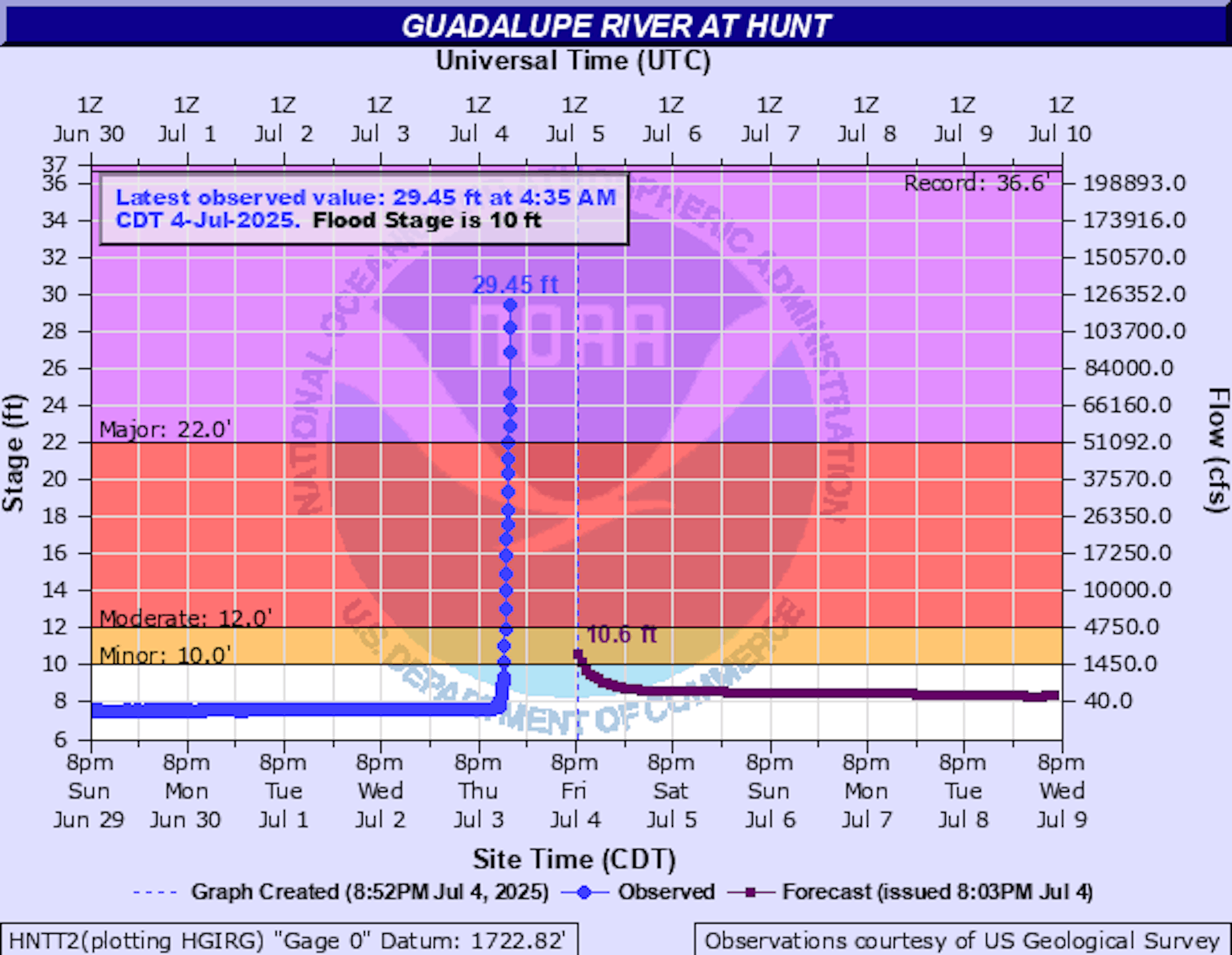
    A river gauge at Hunt, Texas, near Camp Mystic, showed how quickly the river flooded: Around 3 a.m. on July 4, the Guadalupe River was rising about 1 foot every 5 minutes at the gauge, National Weather Service data shows. By 4:30 a.m., it had risen more than 20 feet. As the water moved downstream, it reached Kerrville, where the river rose even faster.

    Flood expert Hatim Sharif, a hydrologist and civil engineer at the University of Texas at San Antonio, explains what makes this part of the country, known as Flash Flood Alley, so dangerous.

    What makes Hill Country so prone to flooding?

    Texas as a whole leads the nation in flood deaths, and by a wide margin. A colleague and I analyzed data from 1959 to 2019 and found 1,069 people had died in flooding in Texas over those six decades. The next highest total was in Louisiana, with 693.

    Many of those flood deaths have been in Hill County. It’s part of an area known as Flash Flood Alley, a crescent of land that curves from near Dallas down to San Antonio and then westward.

    The hills are steep, and the water moves quickly when it floods. This is a semi-arid area with soils that don’t soak up much water, so the water sheets off quickly and the shallow creeks can rise fast.

    When those creeks converge on a river, they can create a surge of water that wipes out homes and washes away cars and, unfortunately, anyone in its path.

    Hill Country has seen some devastating flash floods. In 1987, heavy rain in western Kerr County quickly flooded the Guadalupe River, triggering a flash flood similar to the one in 2025. Ten teenagers being evacuated from a camp died in the rushing water.

    San Antonio, at the eastern edge of Hill Country, was hit with a flash flood on June 12, 2025, that killed 13 people whose cars were swept away by high water from a fast-flooding creek near an interstate ramp in the early morning.

    Why does the region get such strong downpours?

    One reason Hill Country gets powerful downpours is the Balcones Escarpment.

    The escarpment is a line of cliffs and steep hills created by a geologic fault. When warm air from the Gulf rushes up the escarpment, it condenses and can dump a lot of moisture. That water flows down the hills quickly, from many different directions, filling streams and rivers below.

    As temperature rise, the warmer atmosphere can hold more moisture, increasing the downpour and flood risk.

    A tour of the Guadalupe River and its flood risk.

    The same effect can contribute to flash flooding in San Antonio, where the large amount of paved land and lack of updated drainage to control runoff adds to the risk.

    What can be done to improve flash flood safety?

    First, it’s important for people to understand why flash flooding happens and just how fast the water can rise and flow. In many arid areas, dry or shallow creeks can quickly fill up with fast-moving water and become deadly. So people should be aware of the risks and pay attention to the weather.

    Improving flood forecasting, with more detailed models of the physics and water velocity at different locations, can also help.

    Probabilistic forecasting, for example, can provide a range of rainfall scenarios, enabling authorities to prepare for worst-case scenarios. A scientific framework linking rainfall forecasts to the local impacts, such as streamflow, flood depth and water velocity, could also help decision-makers implement timely evacuations or road closures.

    Education is particularly essential for drivers. One to two feet of moving water can wash away a car. People may think their trucks and SUVs can go through anything, but fast-moving water can flip a truck and carry it away.

    Officials can also do more to barricade roads when the flood risk is high to prevent people from driving into harm’s way. We found that 58% of the flood deaths in Texas over the past six decades involved vehicles. The storm on June 12 in San Antonio was an example. It was early morning, and drivers had poor visibility. The cars were hit by fast-rising floodwater from an adjacent creek.

    This article, originally published July 5, 2025, has been updated with the death toll rising.

    Hatim Sharif does not work for, consult, own shares in or receive funding from any company or organization that would benefit from this article, and has disclosed no relevant affiliations beyond their academic appointment.

    ref. Why Texas Hill Country, where a devastating flood killed more than 130 people, is one of the deadliest places in the US for flash flooding – https://theconversation.com/why-texas-hill-country-where-a-devastating-flood-killed-more-than-130-people-is-one-of-the-deadliest-places-in-the-us-for-flash-flooding-260555

    MIL OSI

  • MIL-OSI Analysis: Lemurs can help save Madagascan forests, but first we need to protect them

    Source: The Conversation – Canada – By Colombe Nirina Sehenomalala, PhD candidate, Anthropology, Université de Montréal

    Most people’s encounters with lemurs have occurred through their representations in popular children’s media, like Zoboomafoo or Madagascar. However, most people don’t know that lemurs play an important role in forest renewal and that they’re currently in grave danger from climate change.

    In my home country of Madagascar, there is an amazing array of creatures that are not found anywhere else in the world. Madagascar is a biodiversity hotspot, and approximately 90 per cent of plant and animal species on this island are endemic.

    Among them are lemurs, a group of primates that are not only the flagship symbols of the island’s fauna, but also one of the key players in the health and stability of Madagascar’s ecosystems because they do the very important work of dispersing seeds.

    I am a primatologist who researches the interactions between infant-and-mother lemur dyads in wild. Their bond is a reminder of what we stand to lose, as it shows care, learning and viability. When forests disappear, so does this fragile bond, and a whole way of life we can never replace.

    Lemurs’ habitats and survival are increasingly being threatened by human activities such as deforestation, forest resource exploitation and hunting. There is an urgent need for conservation projects that involve local communities in preserving Madagascar’s unique biodiversity.

    A lemur trap encountered in the field during our research.
    (C.N. Sehenomalala), CC BY

    Charismatic animals

    Due to their charisma, media attention and their biological significance, lemurs attract tourists and researchers to Madagascar. The viability of lemurs is essential to the island’s future, both economically but especially in terms of protecting biodiversity. As they eat fruits from trees like ebony, mammea and wild coffee and then scatter seeds through their droppings, they help new plants grow.

    Among the 105 lemur species of Madagascar, Propithecus candidus, commonly known as the silky sifaka, is one of the most endangered species. Only around 250 of them are currently living in the wild.

    As their name implies, silky sifakas have visually striking long white hair, and they can only be found in the misty, mountainous rainforests of northeastern Madagascar.

    Silky sifakas are primarily active during the daytime, and can travel very quickly through the trees by vertically clinging to them and leaping from tree to tree using their powerful legs. They have highly specialized diets consisting of leaves, flowers and fruits like Diospyros pervilleana, a native ebony species from Madagascar.

    A BBC Nature documentary clip on silky sifakas.

    Observing mothers and infants

    I have spent 10 years studying and following lemurs daily. During my fieldwork in northeastern Madagascar, I closely observed how deforestation and habitat fragmentation affect silky sifaka females and their young.

    I studied these females during their lactation season in three different forest contexts: Marojejy National Park (a mostly untouched primary rainforest), Makira Natural Park (a mix of old-growth and re-generating forest) and Anjanaharibe-Sud Special Reserve (known as COMATSA-Sud, a primary forest with heavily degraded areas).

    At each forest, the forest canopy, which provides both shelter and food for the lemurs, measured above 10 metres at all sites, but was semi-open, which is a sign of habitat degradation. A semi-open canopy allows more light to permeate the forest canopy, but it also exposes animals to predators and decreases the quantity of high-quality food.

    Mothers’ movements and behaviours

    One clear difference between the three sites is how mother–infant pairs move and use space. In Marojejy, where the forest is more continuous even if the canopy is partly open, mothers and babies stay within fairly fixed areas, following the same paths and resting spots.

    But in places like Makira and COMATSA-Sud, where the forest is broken up into separate patches, mothers have to travel farther and more unpredictably, moving between these isolated patches. This extra travelling causes them to burn more energy and face higher risks from predators and hunters.

    These differences show that fragmentation doesn’t just affect food availability, but also changes how these lemurs move and survive.

    Forest fragmentation affects lemurs’ social behaviour and grouping patterns to deal with low food availability. It also impacts their health and development; a poor diet causes malnourishment in the lemurs.

    Lemurs are social animals, but scarce resources can cause competitive behaviours to emerge.
    (Simponafotsy/Wikimedia Commons), CC BY

    Poor nutritional quality

    While the food availability for silky sifakas in northeastern Madagascar during the lactation season is relatively abundant, it is of low nutritional quality.

    This leads to increased stress and competition as dominant lactating females, desperate to feed their infants, attack subordinates to accumulate more nutrients to produce higher quality milk.

    As offspring start to feed on non-milk foods, the poor nutritional quality of available plants after weaning can lead to poor health and stunted growth.

    Engaging the community

    The decline of lemur populations, particularly silky sifakas, shows the need for urgent conservation action. Continued monitoring — as well as sustained support and funding for Malagasy scientists — is crucial for long-term lemur and biodiversity conservation.

    When it comes to the effects of human activity, this decline — habitat fragmentation, global climate change and deforestation — is the result of large-scale activites such as extraction, tourism and state infrastructural development.

    Education and awareness campaigns are crucial, both in Madagascar and internationally, to inform people about lemurs’ habitat needs and what can be done to prevent their extinction.

    Conservation will never be successful without building an appreciation of the environmental, cultural and economic value of lemurs and the forests they inhabit.

    The authors do not work for, consult, own shares in or receive funding from any company or organisation that would benefit from this article, and have disclosed no relevant affiliations beyond their academic appointment.

    ref. Lemurs can help save Madagascan forests, but first we need to protect them – https://theconversation.com/lemurs-can-help-save-madagascan-forests-but-first-we-need-to-protect-them-256300

    MIL OSI Analysis

  • MIL-OSI Analysis: Guineafowl can outsmart extreme temperatures: we spent a year finding out how

    Source: The Conversation – Africa (2) – By Johann van Niekerk, Doctor, Department of Environmental Sciences, University of South Africa

    Have you ever wondered how wild birds cope with baking hot afternoons and freezing cold mornings? Our new study has taken a close look at one of Africa’s most familiar birds – the helmeted guineafowl – and uncovered surprising answers about how they deal with extreme temperatures.

    The helmeted guineafowl (Numida meleagris) is a common sight across sub-Saharan Africa’s savannas and semi-arid regions. They are instantly recognisable with their spotted plumage, bony helmet, bare blue head, and loud cackling calls. These birds are famously social, often seen roaming in noisy flocks.

    Helmeted guineafowl can endure air temperatures from -4°C up to 40°C in South Africa.

    The idea that animals huddle to stay warm – known as social thermoregulation – is well documented in mammals and birds like penguins. This theory proposes that animals huddle together to conserve heat in cold conditions, but is this what guineafowl are doing?

    Together with colleagues in Spain, we set out to find the answer because understanding whether birds group to keep warm or for other reasons helps ecologists uncover the true drivers of social behaviour. This can also inform how species will respond to changing climates and help guide conservation strategies.

    We studied a wild population of guineafowl in South Africa’s Madikwe Game Reserve, a protected area near the Botswana border. It’s known for its sharp daily temperature fluctuations during winter, with cold, frosty mornings dropping to 0°C and sweltering afternoons reaching up to 40°C.

    To spy on the birds without disturbing them, we set up a live-streaming webcam at a busy waterhole, recording their behaviour over an entire year. We watched how group size, body posture and daily routines shifted with the seasons and weather.

    What we found was striking.

    Our study challenges some common assumptions about how animals survive in extreme climates. Guineafowl don’t rely on cuddling for warmth like some penguins and some species of monkeys. Rather, they use behaviour – adjusting posture, timing their activity and changing group sizes according to food and safety needs – to navigate life’s temperature extremes.

    This strategy may help them cope with the growing unpredictability of climate.

    When they get together, it’s to exploit a food patch and nurture their offspring within close-knit social groups while foraging, or to fend off predators during coordinated mobbing behaviour.

    What we found

    The evidence we gathered shows that the guineafowl did not form bigger groups when temperatures dropped. There was no evidence they huddled together to stay warm. Even at night, when they roosted in trees, they perched in small family units – just two or three birds per branch.

    Our findings suggest that the reason guineafowl form groups has more to do with food and safety.

    During the dry winter months, when seeds and vegetation are scarce, the birds form large foraging flocks to help find food and stay safe from predators. More eyes mean better chances of spotting danger. This supports the widely recognised “many eyes” hypothesis, which shows that individuals in larger groups benefit from improved predator detection. But once the rains return and food becomes more plentiful and spread out, the guineafowl split into pairs or small groups to focus on breeding.

    While group size wasn’t tied to temperature, the birds used clever body postures to handle both heat and cold. On chilly mornings below 17°C, they puffed out their collar feathers and tucked their bare necks deep into their bodies, creating a rounded, fluffy ball that trapped heat.

    On warmer days, they stood tall with their necks fully extended, legs exposed, and feathers sleek to release excess heat. When temperatures soared above 30°C, they opened their beaks to pant, spread their wings slightly away from their bodies, and exposed bare skin to cool off, much as a dog pants on a hot day.

    One of the most delightful behaviours observed was “sunning”. On frosty winter mornings, guineafowl would fly down from their roosts and stand facing the rising sun, fluffing their feathers and soaking up warmth before starting their day. It’s a simple, effective way to heat up after a cold night.

    Another surprise was how rarely the birds drank water. Despite living in a dry environment, only about 2% of observed guineafowl visits were to the waterhole. In wet seasons, they likely get most of their moisture from eating green plants and insects. In the cold, dry season, when food is drier, drinking increased slightly, but still far less than expected.

    They drank even less when it was both hot and windy, possibly because the noise of the wind makes it harder to detect predators when standing out in the open. Avoiding water during hot periods is usual among helmeted guineafowl, which typically avoid exposing themselves during peak heat due to increased predation risk and the physiological stress of extreme temperatures. Most galliforms (gamebirds) and terrestrial species favour early morning or late afternoon activity patterns, limiting mid-day exposure.

    Every evening, the flock gathered at the same familiar “launching pad” near the waterhole and flew into nearby trees to roost. But once again, warmth wasn’t the reason for this behaviour. They roosted to avoid ground predators, not to share body heat. I have seen them for many years going into trees when predators or dogs chase them, unlike spurfowl and francolin just flying further on.

    Why insights are useful

    This research carries important lessons for understanding animal adaptation. Rather than relying on group warmth, guineafowl show how behavioural flexibility, adjusting posture, timing and habitat use, can buffer them against harsh conditions. It highlights how survival depends not just on temperature or water availability, but on having access to diverse habitat types: open grasslands for foraging and trees or dense bush for roosting and safety.

    As climates shift and ecosystems change, understanding how animals like guineafowl cope with extremes will be crucial for conservation planning.

    Johann van Niekerk does not work for, consult, own shares in or receive funding from any company or organisation that would benefit from this article, and has disclosed no relevant affiliations beyond their academic appointment.

    ref. Guineafowl can outsmart extreme temperatures: we spent a year finding out how – https://theconversation.com/guineafowl-can-outsmart-extreme-temperatures-we-spent-a-year-finding-out-how-260439

    MIL OSI Analysis

  • MIL-OSI Africa: Guineafowl can outsmart extreme temperatures: we spent a year finding out how

    Source: The Conversation – Africa – By Johann van Niekerk, Doctor, Department of Environmental Sciences, University of South Africa

    Have you ever wondered how wild birds cope with baking hot afternoons and freezing cold mornings? Our new study has taken a close look at one of Africa’s most familiar birds – the helmeted guineafowl – and uncovered surprising answers about how they deal with extreme temperatures.

    The helmeted guineafowl (Numida meleagris) is a common sight across sub-Saharan Africa’s savannas and semi-arid regions. They are instantly recognisable with their spotted plumage, bony helmet, bare blue head, and loud cackling calls. These birds are famously social, often seen roaming in noisy flocks.

    Helmeted guineafowl can endure air temperatures from -4°C up to 40°C in South Africa.

    The idea that animals huddle to stay warm – known as social thermoregulation – is well documented in mammals and birds like penguins. This theory proposes that animals huddle together to conserve heat in cold conditions, but is this what guineafowl are doing?

    Together with colleagues in Spain, we set out to find the answer because understanding whether birds group to keep warm or for other reasons helps ecologists uncover the true drivers of social behaviour. This can also inform how species will respond to changing climates and help guide conservation strategies.

    We studied a wild population of guineafowl in South Africa’s Madikwe Game Reserve, a protected area near the Botswana border. It’s known for its sharp daily temperature fluctuations during winter, with cold, frosty mornings dropping to 0°C and sweltering afternoons reaching up to 40°C.

    To spy on the birds without disturbing them, we set up a live-streaming webcam at a busy waterhole, recording their behaviour over an entire year. We watched how group size, body posture and daily routines shifted with the seasons and weather.

    What we found was striking.

    Our study challenges some common assumptions about how animals survive in extreme climates. Guineafowl don’t rely on cuddling for warmth like some penguins and some species of monkeys. Rather, they use behaviour – adjusting posture, timing their activity and changing group sizes according to food and safety needs – to navigate life’s temperature extremes.

    This strategy may help them cope with the growing unpredictability of climate.

    When they get together, it’s to exploit a food patch and nurture their offspring within close-knit social groups while foraging, or to fend off predators during coordinated mobbing behaviour.

    What we found

    The evidence we gathered shows that the guineafowl did not form bigger groups when temperatures dropped. There was no evidence they huddled together to stay warm. Even at night, when they roosted in trees, they perched in small family units – just two or three birds per branch.

    Our findings suggest that the reason guineafowl form groups has more to do with food and safety.

    During the dry winter months, when seeds and vegetation are scarce, the birds form large foraging flocks to help find food and stay safe from predators. More eyes mean better chances of spotting danger. This supports the widely recognised “many eyes” hypothesis, which shows that individuals in larger groups benefit from improved predator detection. But once the rains return and food becomes more plentiful and spread out, the guineafowl split into pairs or small groups to focus on breeding.

    While group size wasn’t tied to temperature, the birds used clever body postures to handle both heat and cold. On chilly mornings below 17°C, they puffed out their collar feathers and tucked their bare necks deep into their bodies, creating a rounded, fluffy ball that trapped heat.

    On warmer days, they stood tall with their necks fully extended, legs exposed, and feathers sleek to release excess heat. When temperatures soared above 30°C, they opened their beaks to pant, spread their wings slightly away from their bodies, and exposed bare skin to cool off, much as a dog pants on a hot day.

    One of the most delightful behaviours observed was “sunning”. On frosty winter mornings, guineafowl would fly down from their roosts and stand facing the rising sun, fluffing their feathers and soaking up warmth before starting their day. It’s a simple, effective way to heat up after a cold night.

    Another surprise was how rarely the birds drank water. Despite living in a dry environment, only about 2% of observed guineafowl visits were to the waterhole. In wet seasons, they likely get most of their moisture from eating green plants and insects. In the cold, dry season, when food is drier, drinking increased slightly, but still far less than expected.

    They drank even less when it was both hot and windy, possibly because the noise of the wind makes it harder to detect predators when standing out in the open. Avoiding water during hot periods is usual among helmeted guineafowl, which typically avoid exposing themselves during peak heat due to increased predation risk and the physiological stress of extreme temperatures. Most galliforms (gamebirds) and terrestrial species favour early morning or late afternoon activity patterns, limiting mid-day exposure.

    Every evening, the flock gathered at the same familiar “launching pad” near the waterhole and flew into nearby trees to roost. But once again, warmth wasn’t the reason for this behaviour. They roosted to avoid ground predators, not to share body heat. I have seen them for many years going into trees when predators or dogs chase them, unlike spurfowl and francolin just flying further on.

    Why insights are useful

    This research carries important lessons for understanding animal adaptation. Rather than relying on group warmth, guineafowl show how behavioural flexibility, adjusting posture, timing and habitat use, can buffer them against harsh conditions. It highlights how survival depends not just on temperature or water availability, but on having access to diverse habitat types: open grasslands for foraging and trees or dense bush for roosting and safety.

    As climates shift and ecosystems change, understanding how animals like guineafowl cope with extremes will be crucial for conservation planning.

    – Guineafowl can outsmart extreme temperatures: we spent a year finding out how
    – https://theconversation.com/guineafowl-can-outsmart-extreme-temperatures-we-spent-a-year-finding-out-how-260439

    MIL OSI Africa

  • MIL-OSI NGOs: Delhi Parks 10°C Cooler, But 8 out of 10 parks Lack Water, Gates Shut in Heat

    Source: Greenpeace Statement –

    Delhi, 12 July, 2025: A recent audit of 50 parks across Delhi has revealed stark contrasts in surface temperatures – with shaded green areas being up to 20°C cooler in some parks than nearby unshaded concrete spaces, while an average 10°C temperature difference was recorded. In one instance, the concrete zones peaked at 53.3°C, while tree-covered spots within the same park remained at 35°C, underscoring the critical cooling power of urban forests.

    Yet despite this natural relief, the audit led by Greenpeace India in collaboration with COHAS and Youth For Climate Justice, South Asia highlights a troubling picture: 8 out of 10 parks lack drinking water facilities for the public, and none of the parks had official provisions for nests or birdhouses to protect urban birdlife from soaring temperatures.

    The audit was conducted to assess how well Delhi’s green spaces, which serve as vital buffers against extreme heat, are currently equipped to meet the needs of residents, animals, and birds during peak summer months. It surveyed basic amenities such as access to water, cooling infrastructure, biodiversity support, and equitable access across Delhi’s zones.

    While Delhi is said to have green cover across 25% of its geographical area, the reality is that most parks are concentrated in just five districts, leaving large swathes of the city, particularly low-income, congested areas with minimal access to green relief. This inequity, combined with concretisation of urban forests, further enhances heat vulnerability in the capital.

    “At a time of record-breaking heat waves, Delhi cannot afford to lose its lung spaces. Urban forests and parks are not ornamental — they are life-saving infrastructure and help our cities fight climate change. This audit clearly shows that green cover lowers temperatures dramatically, yet our policies prioritize concrete over canopies. The forest cover in Delhi has and is still under threat of being converted into big infrastructural projects. Forest areas like Dwarka forest, Aravalis act as carbon sinks for Delhi and destroying these will further aggravate the impacts of climate change. There is a need to save some of the forests. If we are serious about climate resilience, we need urgent, actionable changes,” said Aakiz Farooq, Climate & Energy Campaigner at Greenpeace India.

    “We conducted this audit in the middle of the heat as we wanted to understand what people are really going through. In many low-income neighbourhoods, the heat lingers late into night, yet most parks are locked. It made us realise that parks aren’t luxuries, they’re life-saving infrastructure. We also noticed how tree roots were choked with concrete, green patches were disappearing under paving, and drinking water was missing. We recorded a significant temperature difference between green, shaded spaces. Parks should be open 24×7, with water facilities and shade as these are basic, life-saving necessities,” said Priyanka, member of the audit team from COHAS

    Key Findings of the Audit:

    • Temperature Variance: Up to 20°C difference between shaded green areas and adjacent concrete zones in some parks while an average of 10°C difference was recorded. 
    • Average Surface Temperatures: 39.2°C in unshaded concrete spaces vs. 28.9°C under tree cover.
    • Lack of Drinking Water: 78% of parks lacked public drinking water points.
    • Neglected Wildlife Needs: While 73% of parks had water bowls for animals and birds, almost all were set up by local residents or caretakers, not authorities.
    • Poor Water Body Management: Only 28% of parks had water bodies, many of which were dirty or drying up.
    • No Birdhouses: None of the parks had installed nests or birdhouses.
    • Access Restrictions: 74% of parks were closed at some time of the day, with 64% shut during night hours — limiting respite for residents in heat-stressed neighborhoods.

    This audit report, part of Delhi Rising campaign underscores an urgent truth: our cities cannot survive rising heat without inclusive, well-maintained green spaces. Public parks and urban forests must be protected — not converted into malls, parking lots, or gated “clean zones.” They must be accessible, equitable, and ecologically alive.

    ENDS

    For Media queries: Nibedita Saha, Media Officer, [email protected]

    MIL OSI NGO

  • MIL-OSI USA: Congressman Johnson Offers Six Amendments to Trump’s Big Ugly Bill, Seeks Exemption To Worst Effects in Georgia

    Source: United States House of Representatives – Representative Hank Johnson (GA-04)

    Congressman Seeks Deal to Exempt Georgia, While Also Focusing on Reversing Cuts to Healthcare Access for Children, Providing Counsel for Unaccompanied Minors, and Strengthening Environmental Protections

    WASHINGTON, D.C. – Tonight, Congressman Hank Johnson (GA-04) offered six amendments to Donald Trump’s One Big, Ugly Bill, including an effort to exempt Georgia from the worst impacts of the bill, a rule to protect families’ access to Children’s Health Insurance Program (CHIP), provide funding for attorneys for unaccompanied immigrant children, and protect critical funds for innovation and Georgia projects.

    To watch his speech, click HERE.

    ###
     

    MIL OSI USA News

  • MIL-OSI USA: Amo and Lofgren Demand Commerce Secretary Lutnick Appear Before Committee to Answer for NWS Staff Shortages

    Source: US Congressman Gabe Amo (Rhode Island 1st District)

    The demand for testimony comes as search and rescue efforts continue in Central Texas after horrifying flooding devastated the area. 

    Washington, DC –  Yesterday, Congressman Gabe Amo (D-RI), Ranking Member of the House Science, Space, and Technology Environment Subcommittee and Science, Space, and Technology Ranking Member, Congresswoman Zoe Lofgren (D-CA) sent a letter to Department of Commerce Secretary Lutnick demanding he testify before the Committee to explain his plan to address staff shortages at the National Weather Service (NWS). The letter comes after the devastating flooding in Central Texas that has since called into question whether the Trump Administration’s mass firing and intimidation of federal employees may have impaired the ability of the NWS to carry out its mission.

    “We write to you to demand your testimony before the Committee on Science, Space, and Technology regarding staff shortages at the National Weather Service (NWS) and your plan to address them,” said the Members in the letter. “The NWS is a critical public safety agency. In addition to its role as the source of everyday weather data for the country, the NWS is charged with forecasting extreme weather events and communicating those forecasts promptly to the public in order to save lives and livelihoods. Americans rely on the NWS every single day to keep us safe. But the NWS is only as strong as its people. And under your leadership, the Department of Commerce (DOC) has overseen an indiscriminate wave of firings, deferred resignations, and early retirements that has thrown the NWS into crisis. The dangers arising from that crisis have been laid bare in the wake of the horrifying, tragic flooding that struck parts of Central Texas on July 4th. While it is too soon to draw definitive conclusions about what happened, it is already clear that this is precisely the type of situation in which the existence of a short-staffed, depleted NWS heightens the risk of tragedy. There will be more such extreme weather events – there always are. You must appear before the Committee immediately and explain to us how you intend to restore the NWS to full strength as quickly as possible so that the agency will be fully prepared to carry out its lifesaving mission when the next disaster strikes.”

    “It will take time to fully understand whether any part of this past weekend’s tragedy in Texas could have been avoided,” the Members continued. “We cannot rush to judgment based on the limited information available to us now. But it is apparent to us, Secretary Lutnick, that your actions to drastically slash staffing at the National Weather Service have increased the broader risks to Americans of extreme weather events by impairing the ability of the NWS to do its job. Simply put, you cut too deep. You refused to listen to the warnings from experts, from Congress, and from the NWS itself. And the flooding in Central Texas illustrates, in the most terrible fashion, the disastrous risks you invite by taking the lifesaving role of the NWS for granted.”

    Access the letter here.

    ###

    MIL OSI USA News

  • MIL-OSI USA: Ranking Members Amo and Stanton Slam Trump’s Staffing Cuts to FEMA and NWS After Tragic Texas Flooding

    Source: US Congressman Gabe Amo (Rhode Island 1st District)

    With 120+ dead and 150+ missing, tragic Texas flooding highlights extreme danger of Trump’s staffing cuts to FEMA and the National Weather Service

    Providence, RI –  Yesterday, Congressman Gabe Amo (D-RI), Ranking Member of the Science, Space, and Technology Committee Subcommittee on Environment and Congressman Greg Stanton (D-AZ), Ranking Member of the Economic Development, Public Buildings and Emergency Management Subcommittee of the House Committee on Transportation and Infrastructure hosted a virtual press conference to highlight the potentially deadly consequences of President Trump’s staffing cuts to the Federal Emergency Management Agency (FEMA) and the National Weather Service (NWS).

    “My thoughts are with the families and survivors of the flash floods in Texas. Despite a lack of support from the Trump administration, National Weather Service staff kept local officials and the public informed throughout the deadly flooding. ” said Ranking Member of the Science, Space, and Technology Subcommittee on the Environment, Gabe Amo (D-RI). “I’ve kept raising the alarm about the costs of cuts to our nation’s weather workforce and our ability to research and respond to climate-fueled weather disasters. Refusing to study extreme weather and purging our scientific workforce isn’t going to stop disasters and help families, it’s just going to undermine our ability to be prepared and save lives.”

    “My heart breaks for the families in Texas who have been devastated by these horrific floods,” said Congressman Greg Stanton (D-AZ). “Extreme weather is only becoming more frequent and more severe, from wildfires to extreme heat in Arizona to flash floods in Texas, the federal government must be fully staffed, fully funded and fully prepared to respond to these disasters. Texans and all Americans deserve a FEMA that is strong, capable and ready on day one, not one deliberately undermined by its own leadership. As we continue to pray for all of those affected, House Democrats will continue to relentlessly demand transparency and accountability for and on behalf of the American people, especially those experiencing unimaginable tragedy.”

    Watch the full press conference here. 

    Background

    On July 4, after heavy rain in the Texas Hill Country, the Guadalupe and other rivers breached their banks causing catastrophic flooding leaving more than 120 dead. 

    Ranking Member Amo and Ranking Member Stanton alongside Science, Space, and Technology Ranking Member Zoe Lofgren (D-CA) and Transportation and Infrastructure Ranking Member Rick Larsen (D-WA) sent a letter to the Federal Emergency Management Administration (FEMA) and the National Oceanographic and Atmospheric Administration (NOAA) seeking answers on federal activity in preparation for and in response to the tragic floods. 

    Amo, Ranking Member Lofgren, and Science, Space, and Technology Oversight Subcommittee Ranking Member Emilia Sykes (D-OH) also sent a letter calling on Secretary of Commerce Howard Lutnick to testify before the Committee about the staffing shortages at the National Weather Service and their potential impact on the Texas flash floods. 

    Amo also joined Homeland Security Subcommittee onEmergency Management And Technology Ranking Member Timothy Kennedy (D-NY) in calling for answers from Acting FEMA Administrator David Richardson and Acting Under Secretary of Commerce for NOAA Laura Grimm about the status of FEMA and the National Weather Service’s preparedness for and response to the disastrous flooding in Texas. 

    ###

    MIL OSI USA News

  • MIL-OSI USA: Congressman Harris Applauds EPA Finding of Offshore Wind Permit Error

    Source: United States House of Representatives – Congressman Andy Harris (MD-01)

    Washington, D.C. – Today, Congressman Andy Harris, M.D. (MD-01) issued the following statement in response to the U.S. Environmental Protection Agency’s (EPA) determination that the Maryland Department of the Environment (MDE) improperly issued its final permit decision for the U.S. Wind offshore wind project off the coast of Ocean City, Maryland.

    In a letter issued to MDE Secretary Serena McIlwain, the EPA outlined multiple legal errors in the agency’s approval of the US Wind permit, including providing misleading information about the public’s right to appeal under federal law. The EPA is now requiring MDE to reissue the permit in accordance with proper federal procedures, a move that if left uncorrected, could lead to the invalidation of the permit on appeal.

    Statement From Congressman Harris:

    “The EPA has confirmed what many of us knew for years — this project was approved with glaring procedural and legal flaws. The Maryland Department of the Environment had no business directing the public to appeal a federal permit to a state court, and such a decision showed both incompetence and a disregard for public input from my affected constituents in Worcester County. For many years, my constituents across the First Congressional District have been overwhelmingly clear: they do not want offshore wind off their coast. This ruling is a major victory for the Eastern Shore, the environment, and our local economies that are existentially threatened by this project.”

    The EPA letter can be read HERE.
    For media inquiries, please contact Anna Adamian at Anna.A@mail.house.gov

    MIL OSI USA News

  • MIL-OSI USA: MATSUI, SEEC LANDS, WATERS, AND NATURE TASK FORCE BLASTS DEPARTMENT OF INTERIOR MOVE TO UNDERMINE PUBLIC LAND MANAGEMENT

    Source: United States House of Representatives – Congresswoman Doris Matsui (D-CA)

    Washington, D.C. – The Co-Chairs of the House Sustainable Energy and Environment Coalition (SEEC) Lands, Waters, and Nature Task Force Reps. Doris Matsui (CA), Don Beyer (VA), and Maxine Dexter (OR) sent a letter to the Department of the Interior (DOI) Secretary Doug Burgum in response to DOI’s Regulatory Reform Request for Information (RFI) published on May 20, which aims to undermine public land management on behalf of polluting industries.

    “In carrying out its duties, the Department is guided by multiple statutes and a well-developed suite of regulations promulgated over many decades. While we can appreciate the goal of establishing a more efficient regulatory program at DOI and agree wholeheartedly with the importance of effective stewardship of our public lands and resources, it appears the true intent of the RFI is the ‘deconstruction of the overbearing and burdensome administrative state.’ This goal is contrary to existing law, Congressional intent, and the continued exercise of the DOI’s many responsibilities,” the Task Force wrote.

    “Existing regulations protect human health and the environment from harmful practices and polluting from bad actors. Eliminating them means that companies could fail to clean up oil spills in waterways that are sources of drinking water, neglect to install equipment that prevents air pollution, and destroy the scenic landscapes where we hike, fish, and play. Our children deserve to inherit a safe and habitable planet where they can breathe clean air and drink clean water.”

    Read the full letter here.


    ###

    MIL OSI USA News

  • MIL-OSI USA: MATSUI, MULLIN, WHITEHOUSE, PADILLA REINTRODUCE LEGISLATION TO REDUCE OCEAN SHIPPING POLLUTION, MODERNIZE MARITIME INDUSTRY

    Source: United States House of Representatives – Congresswoman Doris Matsui (D-CA)

    WASHINGTON, D.C. – Congresswoman Doris Matsui (D-CA-07), Congressman Kevin Mullin (D-CA-15), and U.S. Senators Sheldon Whitehouse (D-RI)and Alex Padilla (D-CA), reintroduced legislation aimed at reducing harmful pollution from the global shipping industry. Maritime shipping is a significant source of greenhouse gas pollution around the world and a major contributor to local air pollution in port communities.


    The bicameral International Maritime Pollution Accountability Act would address pollution from large cargo ships and oil tankers by charging a fee for greenhouse gases and other hazardous air pollutants emitted by these ships. The revenue from collected fees would be used to fund cleaner ships and port equipment, protecting our port communities and fighting climate change, while also revitalizing the U.S. shipping industry.  

    “The climate crisis isn’t a distant threat. It’s here, it’s accelerating, and it’s devastating communities across our state and our country,” said Congresswoman Matsui. “We must act quickly to reduce greenhouse gases and other harmful air pollution across our economy. The International Maritime Pollution Accountability Act takes decisive action to slash pollution from cargo ships and provide urgently needed investment in clean maritime technology and infrastructure. While the International Maritime Organization made history this spring by approving a global net-zero shipping framework, President Trump tried to derail negotiations and continues to block any action to fight climate change. This bill would ensure the U.S. is leading—not lagging—on climate action. As Trump and his allies double down on climate denial and fossil fuel handouts, we’re fighting back with real solutions that protect public health and the planet.”


    “Communities near our ports—like those in the San Francisco Bay Area—bear the brunt of pollution from ships that fuel global trade,” said Congressman Mullin. “The International Maritime Pollution Accountability Act ensures that the global shipping industry does its part to reduce emissions. The revenue from these pollution fees will help speed the shift to cleaner ships and healthier ports. I’m proud to partner with Congresswoman Matsui to advance this policy that meets the urgency of the climate crisis while protecting the people and places most impacted by maritime emissions.” 


    “As climate change destroys lives and drives up costs for families, we need an all-hands-on-deck approach to avoid the worst consequences for communities, businesses, and the environment,” said Senator Whitehouse. “Encouragingly, the International Maritime Organization (IMO) has put forward a global carbon price on shipping emissions. This legislation reinforces that work, further cutting harmful emissions while supporting the maritime innovators that are pioneering clean technologies to protect public health and can help put us on course to climate safety.”


    “California’s ports are the powerhouse of our country’s economy, moving critical freight and providing good-paying jobs, all while leading the nation’s decarbonizing efforts. But neighboring communities have been forced to shoulder the brunt of global shipping pollution for too long,” said Senator Padilla. “Our legislation would strengthen the sustainability of our shipping industry by reducing emissions in maritime transportation while simultaneously protecting coastal communities. The health of our communities and our planet requires us to be forward-looking and ambitious — we owe future generations nothing less than bold, transformative action.”

    The International Maritime Pollution Accountability Act would:

    • Impose a $150 per ton fee on greenhouse gas pollution emitted by ships carrying cargo destined for the U.S., as well as fees for nitrogen oxides ($6.30/lb.), sulfur dioxide ($18/lb.), and soot (PM2.5) ($38.90/lb.) that ships emit in U.S. waters. The fees would only apply to large foreign-flagged ships with 5,000 gross tonnage or more.
    • Provide critical funding to modernize the Jones Act fleet with low-carbon vessels, revitalizing and electrifying U.S. shipbuilding, and addressing and reducing pollutants in America’s port communities, along our coasts, and in our oceans.


    The International Maritime Pollution Accountability Act has been endorsed by EV Maritime, Friends of the Earth, GreenLatinos, Ocean Conservancy, Pacific Environment, San Pedro & Peninsula Homeowners Coalition, Sierra Club, 350 Bay Area Action, and 350 Brooklyn.

    “We applaud Senator Whitehouse and Representative Matsui for reintroducing the International Maritime Pollution Accountability Act of 2025,” said Antonio Santos, Federal Climate Policy Director, Pacific Environment. “This bill will ensure that the shipping industry pays its fair share in the fight against climate change. It will raise billions of dollars over the next decade, funds that would be reinvested into cleaner ships and port infrastructure, as well as maritime workforce training and development. The bill will curb the shipping industry’s massive pollution problem and help protect port communities that are disproportionately exposed to harmful emissions. Now is the time for the U.S. to show global leadership in the transition to a zero-emission shipping industry, and we call on Congress to pass this important legislation.”

    “Global shipping is responsible for 1 billion metric tons of carbon dioxide emissions every year, equal to the emissions from 112 billion gallons of gasoline,” said Caroline Bonfield, Ocean Conservancy’s Shipping Emissions U.S. Policy Manager. “This pollution heats our ocean, drives climate change and chokes portside communities with toxic fumes. But the U.S. can chart a new course. The International Maritime Pollution Accountability Act would charge a fee to large ships offloading cargo at U.S. ports for their emissions, and use the funds to make critical upgrades here in the U.S., like electrifying ports, modernizing vessels and switching to cleaner fuel. Passing this bill would protect the ocean, reduce climate impacts and create cleaner air for millions of Americans living near ports. It would also make the entire U.S. maritime sector including American ships more efficient and competitive. Ocean Conservancy is grateful for the leadership of Representative Matsui and Senator Whitehouse on this critical issue. For the health of our ocean and our communities, we urge Congress to pass this common sense legislation.” 

    # # #

    MIL OSI USA News

  • MIL-OSI USA: Underwood Secures More Than $1.6 Million in Federal Funding for Affordable Housing, Environmental Cleanup, and Research

    Source: United States House of Representatives – Congresswoman Lauren Underwood (IL-14)

    WASHINGTON — This week, Representative Lauren Underwood announced a new round of federal funding she has secured for affordable housing, environmental cleanup, and research in the 14th District.

    As a member of the Appropriations Committee, Underwood has made securing federal resources for northern Illinois a top priority. The following funds will support programs in the 14th District with federal resources:

    The Neighbor Project, Aurora, Illinois – $57,000

    The Neighbor Project will receive $57,000 in federal funding from NeighborWorks America through the NeighborWorks Flexible Impact Grant program.

    This grant will support efforts to lower housing costs, expand housing supply, spark economic opportunity, revitalize neighborhoods, and strengthen communities across Illinois’s 14th Congressional District. NeighborWorks America, a public nonprofit established by Congress in 1978, provides financial and technical support to nearly 250 local and regional partner organizations nationwide.

    Rep. Underwood helped secure this funding through her work on the Appropriations Committee.

    City of Ottawa, Ottawa, Illinois – $1,243,270

    The City of Ottawa will receive $1,243,270 in federal funding from the U.S. Environmental Protection Agency’s Brownfields Cleanup Grant Program.

    The grant will fund the cleanup of the former Beer Depot site at 429 W. Lafayette Street, which was previously used for oil and coal distribution from 1891 until the 1970s. The site, vacant since the 1970s and contaminated with semi-volatile organic compounds, metals, and pesticides, will be remediated to support community revitalization and economic redevelopment.

    Rep. Underwood helped secure this funding through the Bipartisan Infrastructure Law and her work on the Appropriations Committee.

    A Cubed Design LLC, Aurora, Illinois – $305,000

    A Cubed Design LLC has been awarded federal funding from the National Science Foundation (NSF) through a Small Business Innovation Research (SBIR) Phase I grant to develop an affordable, durable, and user-repairable refreshable braille display.

    This project aims to address the high cost and limited accessibility of current refreshable braille technology, which hinders braille literacy and digital access for blind and low-vision individuals. The innovation has strong commercial potential in a rapidly growing market and is expected to benefit thousands of users within three years of launch, expanding access to education, employment, and digital tools for the blind and low-vision community.

    Rep. Underwood helped secure this funding through her work on the Appropriations Committee.

    ###

    MIL OSI USA News

  • MIL-OSI USA: Rep. Neguse Leads Coalition of Lawmakers Opposing Proposed Cuts to NOAA

    Source: United States House of Representatives – Congressman Joe Neguse (D-Co 2)

    In letters to Commerce Secretary Howard Lutnik and Subcommittee Chairman Hal Rogers, lawmakers urge the rejection of proposed funding cuts and facility closures at NOAA. 

    Washington, DC— Following the release of the White House’s Fiscal Year 2026 budget proposal, Congressman Joe Neguse (CO-02) led a coalition of 23 lawmakers urging both the Department of Commerce and their colleagues on the House Appropriations Committee to reject devastating proposed cuts to the National Oceanic and Atmospheric Administration (NOAA) by the Trump administration. The budget proposal would decimate funding for NOAA’s critical programs, including the Oceanic and Atmospheric Research (OAR), and terminate several Weather Laboratories and Cooperative Institutes, including several in Colorado’s Second Congressional District.   

    In their letter, the lawmakers condemned the proposed budget cuts to NOAA and underscored the importance of the agency and its Cooperative Institutes. Colorado is home to several of NOAA’s Climate Laboratories, including the Physical Sciences Laboratory (PSL), the Chemical Sciences Laboratory (CSL), and the Global Monitoring Laboratory (GML), all located in Boulder, CO. 

    Colorado is also the only state in the nation home to two Cooperative Institutes, the Cooperative Institute for Research in the Atmosphere (CIRA) at Colorado State University and the Cooperative Institute for Research in Environmental Sciences (CIRES) at the University of Colorado Boulder, which are academic and non-profit research centers that have provided invaluable support to NOAA’s mission and work in drought, wildfire, and space weather since 1967. The lawmakers denounced the proposed cuts in their letter to Department of Commerce Secretary Howard Lutnick and Subcommittee Chairman Rogers and Ranking Member Meng, as well as any plans to terminate funding for these institutions, making clear the damage to our nation would be irreversible, and emphasizing the important work that is ongoing at both CIRES and CIRA.  

    “CIs are home to experienced researchers and long-standing data collection programs with major impacts on human societies. If these sweeping cuts are made, the damage will be irreversible. Even short-term interruptions in their research could threaten the safety and economies of the communities that CIs serve across the nation. These cuts would primarily leave tornado and weather research and ocean observation to be reprogrammed to other offices, effectively moving weather research and development under the National Weather Service, while getting rid of most of the people and infrastructure that do this critical work.” 

    They continued: “The value NOAA and its programs, like OAR, provide to our communities cannot be overstated. OAR operates research laboratories across the country providing the foundation for understanding and predicting changes in Earth’s atmosphere, oceans, and inland waters. This work improves weather and climate forecasts, provides early warnings for natural disasters, and enhances our understanding of Earth’s systems. The work our scientists and civil servants do at NOAA is essential to U.S. national security and economic prosperity, as well as the personal safety and daily lives of Americans. Any attempt to gut these essential programs would have devastating effects on Americans.” 


    Read their full letter HERE and below: 

    July 8, 2025

    The Honorable Howard Lutnick 

    Secretary

    U.S. Department of Commerce 

    1401 Constitution Ave. NW 

    Washington, DC 20230


    The Honorable Laura Grimm

    Acting Administrator

    National Oceanic and Atmospheric Administration

    1401 Constitution Avenue NW Washington, DC 20230
     

    Dear Secretary Lutnick and Acting Administrator Grimm,

    We write to implore you to reject the proposed funding cuts to the National Oceanic and Atmospheric Administration (NOAA) as laid out in the Office of Management and Budget (OMB) Fiscal Year 2026 budget request. NOAA’s programs provide essential services to all Americans, and gutting its programs and research would be gravely irresponsible.

    In NOAA’s FY26 Congressional Justification document, the agency lays out plans to effectively eliminate NOAA’s Operations, Research, and Facilities for FY26. This includes a decrease in 216 employees and complete termination of Oceanic and Atmospheric Research (OAR) Climate Laboratories and Cooperative Institutes. 

    This document also proposes closing down several NOAA facilities across the United States that are in our respective districts. This includes the Atlantic Oceanographic & Meteorological Laboratory (AOML) in Miami, FL; the Air Resources Laboratory (ARL) in College Park, MD, Idaho Falls, ID, and Oak Ridge, TN, Physical Sciences Laboratory (PSL) in Boulder, CO; the Chemical Sciences Laboratory (CSL) in Boulder, CO; the Geophysical Fluid Dynamics Laboratory (GFDL) in Princeton, NJ; , as well as a nation-wide network of soil moisture sensors; the Global Monitoring Laboratory (GML) in Boulder, CO, Utqiaġvik, AK; Mauna Loa, HI; Hilo, HI; Big Island, HI; American Samoa, and the South Pole; and the Pacific Marine Environmental Laboratory (PMEL) in Seattle. Shutting down these facilities would be devastating for our communities.

    These cuts would also affect Cooperative Institutes (CIs), which are academic and non-profit research institutions that support NOAA’s goals, containing 80 universities and institutions across 33 states. CIs are home to experienced researchers and long-standing data collection programs with major impacts on human societies. If these sweeping cuts are made, the damage will be irreversible. Even short-term interruptions in their research could threaten the safety and economies of the communities that CIs serve across the nation.

    These cuts would primarily leave tornado and weather research and ocean observation to be reprogrammed to other offices, effectively moving weather research and development under the National Weather Service, while getting rid of most of the people and infrastructure that do this critical work. You cannot simply shuffle a handful of programs across NOAA offices while terminating an entire line office responsible for providing the research base for the agency and expect continued success; to maintain American excellence in this work requires continuity of OAR’s core functions as well as its skilled workforce, including at the labs and CIs.

    The value NOAA and its programs, like OAR, provide to our communities cannot be overstated. OAR operates research laboratories across the country providing the foundation for understanding and predicting changes in Earth’s atmosphere, oceans, and inland waters. This work improves weather and climate forecasts, provides early warnings for natural disasters, and enhances our understanding of Earth’s systems. The work our scientists and civil servants do at NOAA is essential to U.S. national security and economic prosperity, as well as the personal safety and daily lives of Americans. Any attempt to gut these essential programs would have devastating effects on Americans. As such, we urge you to reject these proposed funding cuts and facility closures at NOAA.

    Sincerely,


    Read their full letter HERE and below: 

    July 8, 2025


    The Honorable Hal Rogers 

    Chairman

    Subcommittee on Commerce, Justice, Science, and Related Agencies

    Committee on Appropriations

    H-310 The Capitol Washington, DC 20515


    The Honorable Grace Meng

    Ranking Member

    Subcommittee on Commerce, Justice, Science,

    and Related Agencies

    Committee on Appropriations

    H-310 The Capitol, Washington, DC 20515


    Dear Chairman Rogers and Ranking Member Meng,

    As you continue crafting the Fiscal Year 2026 Commerce, Justice, Science, and Related Agencies appropriations bill, we write to implore you to reject the proposed funding cuts to the National Oceanic and Atmospheric Administration (NOAA) as laid out in the Office of Management and Budget (OMB) Fiscal Year 2026 budget request. NOAA’s programs provide essential services to all Americans, and gutting its programs and research would be gravely irresponsible.

    In NOAA’s FY26 Congressional Justification document, the agency lays out plans to effectively eliminate NOAA’s Operations, Research, and Facilities for FY26. This includes a decrease in 216 employees and complete termination of Oceanic and Atmospheric Research (OAR) Climate Laboratories and Cooperative Institutes. 

    This document also proposes closing down several NOAA facilities across the United States that are in our respective districts. This includes the Physical Sciences Laboratory (PSL) in Boulder, CO; the Chemical Sciences Laboratory (CSL) in Boulder, CO; the Geophysical Fluid Dynamics Laboratory (GFDL) in Princeton, NJ; Atlantic Oceanographic & Meteorological Laboratory (AOML) in Miami, FL; the Air Resources Laboratory (ARL) in College Park, MD, Idaho Falls, ID, and Oak Ridge, TN, as well as a nation-wide network of soil moisture sensors; the Global Monitoring Laboratory (GML) in Boulder, CO, Utqiaġvik, AK; Mauna Loa, HI; Hilo, HI; Big Island, HI; American Samoa, and the South Pole; and the Pacific Marine Environmental Laboratory (PMEL) in Seattle. Shutting down these facilities would be devastating for our communities.

    These cuts would also affect Cooperative Institutes (CIs), which are academic and non-profit research institutions that support NOAA’s goals, containing 80 universities and institutions across 33 states. CIs are home to experienced researchers and long-standing data collection programs with major impacts on human societies. If these sweeping cuts are made, the damage will be irreversible. Even short-term interruptions in their research could threaten the safety and economies of the communities that CIs serve across the nation.

    These cuts would primarily leave tornado and weather research and ocean observation to be reprogrammed to other offices, effectively moving weather research and development under the National Weather Service, while getting rid of most of the people and infrastructure that do this critical work. You cannot simply shuffle a handful of programs across NOAA offices while terminating an entire line office responsible for providing the research base for the agency and expect continued success; to maintain American excellence in this work requires continuity of OAR’s core functions as well as its skilled workforce, including at the labs and CIs.

    The value NOAA and its programs, like OAR, provide to our communities cannot be overstated. OAR operates research laboratories across the country providing the foundation for understanding and predicting changes in Earth’s atmosphere, oceans, and inland waters. This work improves weather and climate forecasts, provides early warnings for natural disasters, and enhances our understanding of Earth’s systems. The work our scientists and civil servants do at NOAA is essential to U.S. national security and economic prosperity, as well as the personal safety and daily lives of Americans. Any attempt to gut these essential programs would have devastating effects on Americans. As such, we urge you to reject these proposed funding cuts and facility closures at NOAA, and to instead fully fund NOAA in the FY26 Commerce, Justice, Science, and Related Agencies appropriations bill.

    Sincerely,

    ###

    MIL OSI USA News

  • MIL-OSI USA: Chairman Capito Announces Funding for Statewide Truck Parking Project

    US Senate News:

    Source: United States Senator for West Virginia Shelley Moore Capito
    CHARLESTON, W.Va. – Today, U.S. Senator Shelley Moore Capito (R-W.Va.), Chairman of the Senate Environment and Public Works (EPW) Committee and a member of the Senate Appropriations Committee, announced a $24,837,048 grant for the West Virginia Department of Transportation (WVDOT) through the U.S. Department of Transportation (DOT) BUILD program. 
    This funding, which was made available through the Infrastructure Investment and Jobs Act, will construct truck parking capacity expansion improvements at three existing West Virginia Division of Highways (WVDOH) facilities along I-81, I-64, and I-79 in Berkeley, Cabell, Monongalia Counties. Chairman Capito authored a letter in support of the WVDOH’s application for this project earlier this year. 
    “Efforts to upgrade facilities along West Virginia portions of major interstates will enhance the safety of our drivers, support the regional and national movement of goods, and encourage economic investments across our state. As Chairman of the EPW Committee, I made this investment a priority and I’m thankful DOT recognized its importance. This support will help WVDOT and WVDOH continue their mission of safe and efficient transportation in West Virginia,” Chairman Capito said.

    MIL OSI USA News

  • MIL-OSI USA: Chairman Capito Announces Funding for Statewide Truck Parking Project

    US Senate News:

    Source: United States Senator for West Virginia Shelley Moore Capito
    CHARLESTON, W.Va. – Today, U.S. Senator Shelley Moore Capito (R-W.Va.), Chairman of the Senate Environment and Public Works (EPW) Committee and a member of the Senate Appropriations Committee, announced a $24,837,048 grant for the West Virginia Department of Transportation (WVDOT) through the U.S. Department of Transportation (DOT) BUILD program. 
    This funding, which was made available through the Infrastructure Investment and Jobs Act, will construct truck parking capacity expansion improvements at three existing West Virginia Division of Highways (WVDOH) facilities along I-81, I-64, and I-79 in Berkeley, Cabell, Monongalia Counties. Chairman Capito authored a letter in support of the WVDOH’s application for this project earlier this year. 
    “Efforts to upgrade facilities along West Virginia portions of major interstates will enhance the safety of our drivers, support the regional and national movement of goods, and encourage economic investments across our state. As Chairman of the EPW Committee, I made this investment a priority and I’m thankful DOT recognized its importance. This support will help WVDOT and WVDOH continue their mission of safe and efficient transportation in West Virginia,” Chairman Capito said.

    MIL OSI USA News

  • MIL-OSI USA: “This is Groundhog Day!” – Cortez Masto Presses Forest Service Chief on Reversal of Ruby Mountains Speculative Drilling Ban

    US Senate News:

    Source: United States Senator for Nevada Cortez Masto
     ***VIDEO AVAILABLE***

    FTPs for TV stations is available here.
    Washington, D.C. – U.S. Senator Catherine Cortez Masto (D-Nev.) pressed U.S. Forest Service Chief Tom Schultz for answers about the Trump administration’s decision to reopen the Ruby Mountains to speculative oil and gas drilling. She emphasized the broad opposition to this reversal in Nevada. Cortez Masto led the push that resulted in the Biden administration protecting the Rubies from speculative drilling in 2024.
    Sen. Cortez Masto questioned Chief Schultz on why the Forest Service made this sudden reversal on the Ruby Mountains: “The Biden administration announced it was establishing a 20-year administrative withdrawal process to protect Ruby Mountain area from oil and gas leasing. However, this administration, the Trump administration, reversed these protections for the Rubies. […] Let me just be clear: Nevadans don’t want drilling in the Ruby Mountains. So, I’m curious, what production of critical minerals does the Forest Service expect to develop in the Ruby Mountains?”
    Chief Schultz responded, “Typically what happens with leasing of minerals, the Forest Service isn’t out there trying to basically promote a certain activity or not, but it would be made available if someone deemed there was a resource there, that would be available for leasing.”
    In 2019, during President Trump’s first term, the Forest Service had already deemed the Ruby Mountains unsuitable for speculative leasing. Senator Cortez Masto called out the absurdity of Schultz’s suggestion: “But that’s already been done, that is my point. It seems like everything that has been done in the past, including the speculative leasing that has been denied in the past, is being ignored because it was done under a previous administration. It makes no sense. We’re wasting the resources of your men and women […] because this administration thinks they have to start from scratch. […] This is Groundhog Day! I mean, literally, we are repeating this over and over again. What is going on?”
    Senator Cortez Masto has been a champion for Nevada’s great outdoor spaces and public lands. She passed critical legislation to permanently fund the Land and Water Conservation Fund (LWCF), which protects public lands in Nevada and across the U.S., and her bipartisan, bicameral legislation to restore Lake Tahoe was passed into law last year. She delivered critical funding to protect Lake Tahoe in the Bipartisan Infrastructure Law. Cortez Masto also helped pass the historic Great American Outdoors Act, which was signed into law and provides robust funding to preserve and maintain public lands across the country. 

    MIL OSI USA News

  • MIL-OSI: ETC Announces Fiscal 2026 First Quarter Results

    Source: GlobeNewswire (MIL-OSI)

    SOUTHAMPTON, Pa., July 11, 2025 (GLOBE NEWSWIRE) — Environmental Tectonics Corporation (OTC Pink: ETCC) (“ETC” or the “Company”) today reported its financial results for the thirteen week period ended May 30, 2025 (the “2026 first fiscal quarter”).

    Robert L. Laurent, Jr., ETC’s Chief Executive Officer and President stated, “We are pleased with the 39% increase in ETC operating income vs. prior year driven by an increase in sales of Aircrew Training Systems (“ATS”) and a decrease in operating expenses as compared to the prior year, as well as our 34% gross profit margin excluding the impact of lower margin sales related to construction of an aeromedical center during the 2026 first fiscal quarter. We exit the quarter with a sales backlog of $73 million and a large pipeline of opportunities.”

    Fiscal 2026 First Quarter Results of Operations

    Net Income

    Net income was $1.3 million, or $0.07 diluted earnings per share, in the 2026 first fiscal quarter, compared to net income of $1.4 million during the 2025 first fiscal quarter, or $0.08 diluted earnings per share. The $0.1 million decrease is primarily attributable to a $0.4 million, or 385.3% increase in interest expense, net and a $0.4 million, or 1850.0% increase in income tax provision in the 2026 first fiscal quarter as compared to 2025 first fiscal quarter partially offset by the net effect of a $0.9 million increase in ATS net sales, excluding the Aeromedical center building revenue, and a $0.7 million decrease in Commercial/Industrial Systems (“CIS”) net sales, and a $0.5 million decrease in operating expenses.

    Net Sales

    Net sales in the 2026 first fiscal quarter were $17.6 million, an increase of $4.1 million, or 30.5%, compared to 2025 first fiscal quarter net sales of $13.5 million. The increase in net sales was mainly a result of a $4.8 million, or 74.9% increase in ATS sales, $3.9 million of which relates to aeromedical center building revenue, slightly offset by a $0.8 million, or 14.2% decrease in Sterilizer Systems sales in the 2026 first fiscal quarter as compared to 2025 first fiscal quarter.

    Gross Profit

    Gross profit for the 2026 first fiscal quarter was $4.7 million (26.5% of net sales) compared to $4.5 million in 2025 first fiscal quarter (33.6% of net sales). The decrease in gross profit margin as a percentage of sales was a direct result of the increase in aeromedical center building revenue within the ATS business unit, which is lower margin than ETC’s core businesses as the work is being performed by a sub-contracted construction firm. Excluding the impact of the aeromedical center building revenue, gross profit margin was 34.3% for first fiscal quarter 2026 as compared to 33.9% for first fiscal quarter 2025.

    Operating Expenses

    Operating expenses, including sales and marketing, general and administrative, and research and development, for the 2026 first fiscal quarter were $2.5 million, a decrease of $0.5 million, or 16.0%, compared to $3.0 million for the 2025 first fiscal quarter. The decrease in operating expenses was due primarily to lower research and development expense at ETC-PZL in 2026 first fiscal quarter as compared to 2025 first fiscal quarter. In 2025 first fiscal quarter, ETC-PZL had limited sales which resulted in employees working on non-chargeable research and development projects.

    Operating Income

    Operating income for the 2026 fiscal first quarter was $2.2 million, an increase of $0.6 million, or 39.4%, compared to $1.6 million for the 2025 first fiscal quarter. The increase in operating income is attributable to the net effect of a $0.9 million increase in ATS net sales, excluding the Aeromedical center building revenue, and a $0.7 million decrease in Commercial/Industrial Systems (“CIS”) net sales, and a $0.5 million decrease in operating expenses.

    Interest Expense, Net

    Interest expense, net, for the 2026 first fiscal quarter was $0.6 million compared to $0.1 million in the 2025 first fiscal quarter, an increase of $0.4 million, or 385.3%, reflecting increased borrowing attributable to the leaseback of the demonstration equipment in 2025 fourth fiscal quarter.

    Income Tax Provision

    Income tax provision for the 2026 first fiscal quarter was $0.4 million compared to $0.0 million in the 2025 first fiscal quarter, an increase of $0.4 million, or 1850.0%. The increase is a non-cash tax expense attributable to the utilization of our Net Operating Loss (NOL) carryforward for which a deferred tax asset was established in the fourth quarter of fiscal 2025.

    Cash Flows from Operating, Investing, and Financing Activities

    During the 2026 first fiscal quarter, cash flows used in operating activities were $2.7 million, a decrease of $5.6 million compared to cash flows provided by operating activities of $2.9 million during 2025 first fiscal quarter. Cash flows during the 2026 first fiscal quarter primarily decreased as a result of an increase in accounts receivable, net, slightly offset by an increase in accounts payable, trade for 2026 first fiscal quarter as compared to 2025 first fiscal quarter.

    Cash used for investing activities primarily relates to funds used for capital expenditures of equipment and software development. The Company’s investing activities used $0.1 million during the 2026 and 2025 first fiscal quarter.

    The Company’s financing activities provided $1.0 million of cash during the 2026 first fiscal quarter from borrowings under the Company’s credit facility as compared to repayments under the Company’s credit facility of $3.1 during the 2025 first fiscal quarter.

    About ETC

    ETC was incorporated in 1969 in Pennsylvania. For over five decades, we have provided our customers with products, services, and support. Innovation, continuous technological improvement and enhancement, and product quality are core values that are critical to our success. We are a significant supplier and innovator in the following areas: (i) software driven products and services used to create and monitor the physiological effects of flight, including high performance jet tactical flight simulation, fixed and rotary wing upset prevention and recovery and spatial disorientation, and both suborbital and orbital commercial human spaceflight, collectively, Aircrew Training Systems (“ATS”); (ii) altitude (hypobaric) chambers; (iii) hyperbaric chambers for multiple persons (multiplace chambers); (iv) Advanced Disaster Management Simulators (“ADMS”); (v) steam and gas (ethylene oxide) sterilizers (“Sterilizer Systems” or “Sterilizers”); and (vi) Environmental Testing and Simulation Systems (“ETSS”).

    We operate in two primary business segments, Aerospace Solutions (“Aerospace”) and Commercial/Industrial Systems (“CIS”). Aerospace encompasses the design, manufacture, and sale of: (i) ATS products; (ii) altitude (hypobaric) chambers; (iii) hyperbaric chambers for multiple persons (multiplace chambers); and (iv) ADMS, as well as integrated logistics support (“ILS”) for customers who purchase these products or similar products manufactured by other parties. These products and services provide customers with an offering of comprehensive solutions for improved readiness and reduced operational costs. Sales of our Aerospace products are made principally to U.S. and foreign government agencies and to civil aviation organizations. CIS encompasses the design, manufacture, and sale of: (i) steam and gas (ethylene oxide) sterilizers; and (ii) ETSS; as well as parts and service support for customers who purchase these products or similar products manufactured by other parties. Sales of our CIS products are made principally to the healthcare, pharmaceutical, and automotive industries.

    ETC-PZL Aerospace Industries Sp. z o.o. (“ETC-PZL”), our 100%-owned subsidiary in Warsaw, Poland, is currently our only operating subsidiary. ETC-PZL manufactures certain simulators and provides software to support products manufactured domestically within our Aerospace segment.

    The majority of our net sales are generated from long-term contracts with foreign and U.S. governments and agencies (including foreign military sales (“FMS”) contracted through the U.S. Government) for the research, design, development, manufacture, integration, and sustainment of ATS products, including Chambers and the simulators manufactured and sold through ETC-PZL, collectively, ATS as well as long-term contracts with domestic and international customers for the sale of Sterilizer systems. The Company also enters into long-term contracts with domestic customers for the sale of ETSS. Net sales of ADMS are generally much shorter term in nature and vary between domestic and international customers. We generally provide our products and services under fixed-price contracts.

    ETC’s unique ability to offer complete systems, designed and produced to high technical standards, sets it apart from its competition. ETC’s headquarters is located in Southampton, PA. For more information about ETC, visit http://www.etcusa.com/. The information contained on our website is not incorporated by reference in this news release.

    Forward-looking Statements

    This news release contains forward-looking statements, which are based on management’s expectations and are subject to uncertainties and changes in circumstances. Words and expressions reflecting something other than historical fact are intended to identify forward-looking statements, and these statements may include words such as “may”, “will”, “should”, “expect”, “plan”, “anticipate”, “believe”, “estimate”, “future”, “predict”, “potential”, “intend”, or “continue”, and similar expressions. We base our forward-looking statements on our current expectations and projections about future events or future financial performance. Our forward-looking statements are subject to known and unknown risks, uncertainties and assumptions about ETC and its subsidiaries that may cause actual results to be materially different from any future results implied by these forward-looking statements. We caution you not to place undue reliance on these forward-looking statements. Except as required by law, we assume no obligation to update or revise any forward looking statements.

    Contact: Tim Kennedy, CFO
    Phone: (215) 355-9100 x1531
    E-mail: tkennedy@etcusa.com
       

    – Financial Table Follows –

    Table A                
    ENVIRONMENTAL TECTONICS CORPORATION  
    SUMMARY TABLE OF RESULTS  
    (in thousands, except per share information)  
    (unaudited)  
                     
      Thirteen weeks ended   Variance  
    (in thousands, except per share information) May 30, 2025   May 24, 2024   ($)   (%)  
    Net sales $ 17,601     $ 13,492     $ 4,109     30.5    
    Cost of goods sold   12,939       8,965       3,974     44.3    
    Gross Profit   4,662       4,527       135     3.0    
    Gross profit margin %   26.5 %     33.6 %     -7.1 %   -21.1 %  
                     
    Operating expenses   2,498       2,975       (477 )   -16.0    
    Operating income   2,164       1,552       612     39.4    
    Operating margin %   12.3 %     11.5 %     0.8 %   6.9 %  
                     
    Interest expense, net   563       116       447     385.3    
    Other (income) expense, net   (78 )     55       (133 )   -241.8    
    Income before income taxes   1,679       1,381       298     21.6    
    Pre-tax margin %   9.5 %     10.2 %     -0.7 %   -6.9 %  
                     
    Income tax provision   390       20       370     1850.0    
    Net income   1,289       1,361       (72 )   -5.3    
    Preferred Stock dividends   (121 )     (121 )         0.0    
    Income attributable to common and                
    participating shareholders $ 1,168     $ 1,240     $ (72 )   -5.8    
                     
    Per share information:                
    Basic earnings per common and participating share:                
    Distributed earnings per share:                
    Common $     $     $        
    Preferred $ 0.02     $ 0.02     $     0.0    
    Undistributed earnings per share:                
    Common $ 0.07     $ 0.08     $ (0.01 )   -12.5    
    Preferred $ 0.07     $ 0.08     $ (0.01 )   -12.5    
    Diluted earnings per share $ 0.07     $ 0.08     $ (0.01 )   -12.5    
                     
                     
    Total basic weighted average common and participating shares   15,665       15,569            
                     
    Total diluted weighted average shares   16,998       16,062            
     

    The MIL Network

  • MIL-OSI USA: RIDOH and DEM Recommend Avoiding Contact with Select Roger Williams Park Ponds

    Source: US State of Rhode Island

    The Rhode Island Department of Health (RIDOH) and Rhode Island Department of Environmental Management (DEM) are advising people to avoid contact with Roger William Park Ponds (Edgewood Lake, Cunliff Lake, and Elm Lake) in Providence due to a confirmed cyanobacteria bloom. Cyanobacteria, also known as blue-green algae, are naturally present in bodies of water, but under certain environmental conditions will form harmful algae blooms (HABs). All recreation, including swimming, fishing, boating and kayaking, is high risk to health and recommended to be avoided at these locations. HABs can produce toxins which can be harmful to humans and animals. Toxins and/or high cell counts have been detected by the RIDOH State Health Laboratory from water samples collected by DEM at these locations. This advisory recommendation remains in effect until further notice.

    Use caution in all areas of Roger William Park Ponds as cyanobacteria HABs can move locations in ponds and lakes. People should not drink untreated water or eat fish from affected waterbodies. Pet owners should not allow pets to drink or swim in this water.

    Skin contact with water containing toxin-producing cyanobacteria can cause irritation of the skin, nose, eyes, and throat. Symptoms from ingestion of water can include stomachache, diarrhea, vomiting, and nausea. Less common symptoms can include dizziness, headache, fever, liver damage, and nervous system damage. Young children and pets are at higher risk for health effects associated with cyanobacteria HABs because they are more likely to swallow water when they are in or around bodies of water. People who have had contact with these ponds and experience those symptoms should contact their healthcare provider.

    If you or your pet come into contact with a cyanobacteria HAB: — Rinse your skin with clean water right away. — Shower and wash your cloths when you get home. — If your pet was exposed, wash it with clean water immediately and don’t let it lick algae from its fur. — Call a vet if your pet shows signs of illness like tiredness, no eating, vomiting, diarrhea or other symptoms within a day. — If you feel sick after contact, call a healthcare provider.

    Affected waters might look bright to dark green, with thick algae floating on the surface. It may resemble green paint, pea soup, or green cottage cheese. If you see water like this, people and pets should avoid contact with the water. To report suspected cyanobacteria blooms, contact DEM’s Office of Water Resources at 401-222-4700 Press 6 or DEM.OWRCyano@dem.ri.gov and if possible, send a photograph of the reported algae bloom.

    ###

    MIL OSI USA News

  • MIL-OSI Europe: Text adopted – 2023 and 2024 reports on North Macedonia – P10_TA(2025)0157 – Wednesday, 9 July 2025 – Strasbourg

    Source: European Parliament

    The European Parliament,

    –  having regard to the Stabilisation and Association Agreement between the European Communities and their Member States, of the one part, and the Republic of North Macedonia, of the other part(1),

    –  having regard to North Macedonia’s application for membership of the European Union, submitted on 22 March 2004,

    –  having regard to the European Council decision of 16 December 2005 to grant North Macedonia EU candidate country status,

    –  having regard to the European Council conclusions of 19-20 June 2003, including the annex thereto entitled ‘The Thessaloniki agenda for the Western Balkans: Moving towards European integration’,

    –  having regard to Regulation (EU) 2021/1529 of the European Parliament and of the Council of 15 September 2021 establishing the Instrument for Pre-Accession assistance (IPA III)(2),

    –  having regard to Regulation (EU) 2024/1449 of the European Parliament and of the Council of 14 May 2024 on establishing the Reform and Growth Facility for the Western Balkans(3),

    –  having regard to the Commission communication of 5 February 2020 entitled ‘Enhancing the accession process – A credible EU perspective for the Western Balkans’ (COM(2020)0057),

    –  having regard to the Commission communication of 8 November 2023 entitled ‘2023 Communication on EU Enlargement Policy’ (COM(2023)0690), accompanied by the Commission staff working document entitled ‘North Macedonia 2023 Report’ (SWD(2023)0693),

    –  having regard to the Commission communication of 8 November 2023 entitled ‘New growth plan for the Western Balkans’ (COM(2023)0691),

    –  having regard to the Commission communication of 20 March 2024 on pre-enlargement reforms and policy reviews (COM(2024)0146),

    –  having regard to the Commission communication of 24 July 2024 entitled ‘2024 Rule of Law Report’ (COM(2024)0800), accompanied by the Commission staff working document entitled ‘2024 Rule of Law Report – Country Chapter on the rule of law situation in North Macedonia’ (SWD(2024)0830),

    –  having regard to the Commission communication of 30 October 2024 entitled ‘2024 Communication on EU enlargement policy’ (COM(2024)0690), accompanied by the Commission staff working document entitled ‘North Macedonia 2024 Report’ (SWD(2024)0693),

    –  having regard to the Reform Agenda of North Macedonia as approved by the Commission under the Reform and Growth Facility on 23 October 2024,

    –  having regard to the declarations of the EU-Western Balkans summits of 13 December 2023 and of 18 December 2024 in Brussels as well as the declarations of the EU-Western Balkans summits held in Sofia, Zagreb and Brdo pri Kranju in 2018, 2020 and 2021 respectively, and the Declaration on the Common Regional Market and the Declaration on the Green Agenda for the Western Balkans agreed on 10 November 2020 at the Sofia Summit within the Berlin Process,

    –  having regard to the Council conclusions of 18 July 2022 on Enlargement – North Macedonia and Albania and the Council conclusions on Enlargement of 17 December 2024,

    –  having regard to the final report of 23 September 2024 of the Organization for Security and Co-operation in Europe (OSCE) Office for Democratic Institutions and Human Rights (ODIHR) Election Observation Mission on North Macedonia’s presidential election on 24 April 2024 and parliamentary elections on 8 May 2024,

    –  having regard to the Berlin Process launched on 28 August 2014,

    –  having regard to the Treaty of friendship, good neighbourliness and cooperation between Bulgaria and North Macedonia, signed on 1 August 2017 and ratified in January 2018;

    –  having regard to the Final Agreement for the settlement of the differences as described in the United Nations Security Council resolutions 817 (1993) and 845 (1993), the termination of the Interim Accord of 1995, and the establishment of a strategic partnership between Greece and North Macedonia, agreed on 17 June 2018, also known as the Prespa Agreement,

    –  having regard to the joint staff working document entitled ‘Objectives and Indicators to frame the implementation of the Gender Action Plan III (2021-25)’ (SWD(2020)0284) accompanying the joint communication of the Commission and the High Representative of the Union for Foreign Affairs and Security Policy of 25 November 2020 entitled ’EU Gender Action Plan (GAP) III – An ambitions vision for gender equality and women’s empowerment in EU external action (JOIN(2020)0017), as well as the Country Level Implementation Plan (CLIP) for North Macedonia,

    –  having regard to the 2023 European Commission against Racism and Intolerance (ECRI) Report on North Macedonia, adopted on 29 June 2023 and published on 20 September 2023,

    –  having regard to the declaration and joint recommendations adopted at the 23rd meeting of the EU-North Macedonia Joint Parliamentary Committee, held on 27 and 28 February 2025 in Skopje,

    –  having regard to its previous resolutions on North Macedonia, and in particular its resolution of 24 October 2019 on opening accession negotiations with North Macedonia and Albania(4),

    –  having regard to Rule 55 of its Rules of Procedure,

    –  having regard to the report of the Committee on Foreign Affairs (A10-0118/2025),

    A.  whereas North Macedonia has held EU candidate country status since 2005 and successfully completed the screening process in December 2023;

    B.  whereas the aspirations of citizens of North Macedonia to become part of the EU have led to progress in terms of democracy and socio-economic reforms, while the EU accession process continues to experience regrettable delays for various reasons;

    C.  whereas the EU has mobilised approximately EUR 210 million in macro-financial assistance loans since 2020, aimed at stabilising the Macedonian economy, aiding its recovery from the COVID-19 pandemic and accelerating its reform progress;

    D.  whereas North Macedonia is a partner that is aligned with the EU’s common foreign and security policy in the vast majority of cases and has played a constructive role in the region; whereas North Macedonia’s recent abstention from United Nations General Assembly Resolution ES-11/7 of 24 February 2025 on Ukraine and its co-sponsorship of an alternative resolution led by the United States indicates an unexpected and regrettable shift in its foreign policy alignment;

    E.  whereas North Macedonia participates in EU military crisis management operations, including EUFOR Althea in Bosnia and Herzegovina;

    F.  whereas the Council reached new conclusions in July 2022 which mean that North Macedonia needs to adopt the outstanding constitutional changes, in line with its commitments, so that the opening phase of accession negotiations can be completed immediately;

    G.  whereas the geopolitical changes, the war in Ukraine, disinformation and misinformation have a strong impact on all European countries, both politically and economically;

    H.  whereas North Macedonia remains a target of foreign malign influence operations, including efforts to fracture the country’s social fabric and weaponise anti-EU sentiment, notably via Serbian-language tabloids and media outlets, which function as regional amplifiers of Kremlin narratives and enjoy considerable influence; whereas North Macedonia expelled 13 Russian diplomats between 2018 and 2023 for activities incompatible with their diplomatic status, suggesting an ongoing presence of covert influence networks; whereas China has sought to expand its influence through information control, investment diplomacy and coercive clauses in infrastructure loan agreements;

    I.  whereas North Macedonia’s authorities have proposed solutions for constitutional change that did not meet the conditions of the July 2022 Council conclusions;

    J.  whereas any accession country is expected to respect democratic values, the rule of law and human rights, and to abide by EU law;

    K.  whereas the Council has not excluded unequivocally the adoption of further new conditions for the starting of accession negotiations;

    1.  Reiterates its full support for North Macedonia’s continued and persistent commitment to join the EU and for the necessary transformative changes that are required to fulfil the accession criteria; commends the country’s commitment to European integration and encourages continued efforts in advancing EU-aligned reforms, despite the challenges and setbacks that have tested the patience and trust of the Macedonian society;

    2.  Underlines that EU accession remains a matter of political will in fulfilling the criteria and implementing the commitments undertaken, in terms of both making the necessary reforms and adopting the necessary constitutional amendments;

    3.  Recalls the need to maintain the momentum and credibility of the EU integration process; notes that North Macedonia continues to demonstrate commitment to EU integration and alignment with EU policies; calls for the swift advancement of accession negotiations, while noting the importance of adopting the constitutional amendments; urges the European Council to signal, publicly and unequivocally, that the Council intends to swiftly and unconditionally take the positive decision to enter into the next phase of accession negotiations with North Macedonia once the conditions of its conclusions of 18 July 2022 have been fulfilled; encourages all political parties in North Macedonia to engage in constructive dialogue to achieve the necessary consensus on these amendments, which would strengthen the country’s multi-ethnic character and accelerate its progress towards EU membership; believes that strengthening the links between the multiple ethnicities is essential for improving social cohesion and ensuring more effective governance; calls on the Member States, the Council and the Commission to safeguard the predictability and credibility of the accession process, also with a view to maintaining popular support for accession in enlargement countries;

    4.  Welcomes the successful completion of the screening process for North Macedonia at the end of 2023; encourages North Macedonia to adopt the constitutional amendments that the country committed to making and implementing, as required by the Council, in order for the accession negotiation process to proceed;

    5.  Commends the commitment of the Macedonian people to EU integration and the support they show to this project two decades on from starting the process; urges the Commission to do the utmost to help the authorities of North Macedonia accomplish the necessary steps before entering into the next negotiation phase as well as further along the negotiation process, to help deliver on the expectations of citizens and the country and to explore all measures for gradual integration into the EU structures, thus increasing trust in the EU and its democratic values;

    6.  Recalls that the accession process should not be used to settle bilateral disputes, obstruct merit-based progress on the European path or outweigh the broader strategic interests of the Union, but that such disputes must rather be addressed through open dialogue and genuine cooperation; underlines that accession negotiations should follow a clear path, guided by objective criteria and solely based on merit and the fulfilment of the accession criteria (Copenhagen criteria), which require in-depth reforms across fundamental areas, as well as the presence of stable institutions that guarantee democracy, the rule of law, human rights and respect for and the protection of minorities;

    7.  Reaffirms that the respect for linguistic, cultural and national identity is a fundamental component of the EU accession process and a cornerstone of democratic societies which will be further affirmed with the accession to the family of European nations;

    8.  Repeats its calls for the EU’s capacity to act to be enhanced through a reform of its decision-making, including through the introduction of qualified majority voting on the intermediate steps in the accession process, in particular at the start of negotiations and the opening and closing of individual negotiating clusters and chapters;

    9.  Welcomes the new Reform and Growth Facility for the Western Balkans which will provide EUR 750 million in grants and loans to North Macedonia when it meets the conditions set out in its Reform Agenda; welcomes, in this context, the excellent and ambitious Reform Agenda, which sets clear, transparent goals and targets, and calls on the authorities to focus on its rigorous implementation; underlines the need to focus on incentivising reforms and reinforcing economic stability as well as on public administration, governance, the rule of law and the fight against corruption, decarbonisation and the green transition, digitalisation, connectivity and human capital development, while addressing social challenges;

    10.  Notes the funds being received by North Macedonia from individual Member States and the good cooperation between them; warns however about strengthening alliances with illiberal regimes;

    11.  Commends North Macedonia on its continued commitment to the EU integration process and regrets the delays in the accession process; welcomes the stability of and encourages continued efforts to secure interethnic relations and the implementation of the Ohrid Framework Agreement;

    12.  Encourages North Macedonia to achieve tangible results in complying with the EU’s expectations under the negotiating framework and the Council conclusions of July 2022, including relevant constitutional changes, in line with the country’s commitments;

    13.  Urges North Macedonia to intensify efforts to strengthen the rule of law and judicial independence, including in judicial appointments and the functioning of the Judicial Council, to counter corruption, reform its public administration and improve the transparency and concentration of media ownership; encourages further implementation of systemic measures to ensure transparency and efficiency in governance;

    14.  Expresses its profound sorrow and heartfelt solidarity following the tragic Kočani nightclub fire that led to the death of more than 50 young people and injuries to more than 150 others and offers its condolences to the victims and their families; commends the rapid use of the EU Civil Protection Mechanism and the help provided by the Member States to save as many lives as possible; commends neighbouring and EU countries, in particular Greece and Bulgaria, for the immediate support and solidarity they showed and the medical treatment they provided to victims;

    Functioning of democratic institutions

    15.  Notes that, while democratic institutions in North Macedonia function satisfactorily, political polarisation remains a major stumbling block to necessary reforms; calls on the political parties represented in the country’s parliament to work together to reach an agreement on those reforms;

    16.  Welcomes the adoption of new rules of procedure by the Assembly of the Republic of North Macedonia (Sobranie), facilitated by the European Parliament within the framework of the Jean Monnet Dialogue; stresses, however, that persistent political polarisation continues to delay important reforms and appointments; emphasises that cross-party collaboration and an improved political climate remain vital to accelerate the implementation of EU-related reforms and strengthen democratic institutions;

    17.  Notes with concern that about half of all laws enacted by the Sobranie in 2023 were approved through shortened procedures; calls on the Sobranie to improve its legislative planning, coordination and quality through proper consultation procedures and parliamentary oversight, in particular with a view to the conclusions of the Jean Monnet Dialogue and to avoid fast-track procedures;

    18.  Stresses that, while the 2024 parliamentary and presidential elections were competitive, and democratic and amendments to the Electoral Code have been made, comprehensive electoral reform is still needed; calls strongly for the implementation of the outstanding recommendations made by the OSCE/ODIHR and the Venice Commission through an inclusive revision of the Electoral Code, while underlining the importance of insulating future electoral processes from malign foreign interference and information manipulation, including through the adoption of robust cybersecurity and online campaign transparency rules;

    19.  Calls for improved regulation of the financing of political parties and campaigns, including measures to increase transparency regarding the funds and expenses of political parties; urges a revision of the rules on state advertising in commercial media and paid political advertisement; emphasises the need for functioning oversight mechanisms to ensure integrity in party financing and for equal and adequate media access for political parties and independent candidates;

    20.  Calls for the continued modernisation of a merit-based public administration, addressing systemic challenges of politicisation, strengthening transparent recruitment processes, and reforming local self-government to provide better social services for citizens and to develop tailor-made local and regional development strategies; urges the authorities to step up their efforts and adopt and implement the necessary legislation with a view to improving public trust in the administration and fostering a resilient and capable public service that can effectively respond to contemporary challenges and serve the needs of the community; commends the 2023-2030 public administration strategy and the related action plan for 2023-2026 adopted in July 2023; acknowledges that they cover all relevant reform areas and set out a clear baseline, objectives and targets, thus identifying crucial policy challenges; regrets, however that the implementation rate remains low;

    21.  Calls for further steps to ensure the systemic accountability of public institutions through meaningful and public stakeholder consultations, including with regard to the implementation of the Reform Agenda, and to provide feedback from the consultations conducted; commends the law on general administrative procedures that is providing for simplification, but strongly recommends that it be implemented systematically across the administration;

    22.  Urges the authorities of North Macedonia to refrain from opaque, politicised dismissals from, and appointments to, positions within independent bodies and agencies, as well as to ensure that the institutions are adequately funded and that decisions and recommendations are implemented consistently; notes with regret the continued lack of progress in strengthening the office of the Ombudsman;

    Media and civil society

    23.  Welcomes North Macedonia’s steady progress in assuring media freedom; recalls however, the need for continued reforms to ensure an independent and resilient media landscape, including reforming the legal framework governing online and offline media to align fully with the European Media Freedom Act(5), addressing persistent challenges in media ownership transparency, digital media disclosure and media concentration; underlines the need for media reform that prioritises anti-concentration measures to safeguard journalistic integrity; emphasises the urgent need to counter malign foreign influence in the media landscape, including disinformation disseminated by actors linked to Russia and China;

    24.  Calls on the authorities to adopt a legal framework that effectively protects journalists, human rights defenders, environmental activists and other stakeholders from strategic lawsuits against public participation (SLAPPs), and to implement the provisions of the EU Anti-SLAPP Directive(6);

    25.  Urges the authorities to ensure full transparency and unimpeded access to information for citizens;

    26.  Notes with concern the reinstatement of government advertising in commercial media in North Macedonia; stresses the heightened risk of this measure opening the media market to disruption and undue political influence, thus endangering media independence and media pluralism; reiterates its calls for the comprehensive reform of the rules governing state financing and political party advertising in the media, noting the lack of transparency, the ongoing misuse of state funds for political advertising, and the continued risk of compromising media independence through opaque funding mechanisms; calls strongly for these reforms to be adopted and implemented before the local elections planned for autumn 2025;

    27.  Underlines the need to strengthen the independence and capacity of the media regulator, the public service broadcaster and the regulator of electronic communication;

    28.  Encourages action to enhance the editorial and financial independence, impartiality and professionalism of public service broadcasters and media regulators, while noting the continued delay in appointing key oversight bodies and the need for comprehensive modernisation efforts; calls for stricter transparency and ownership rules to expose covert influence, including foreign-sponsored media content, and for the establishment of mechanisms to identify and disrupt coordinated foreign disinformation networks;

    29.  Notes that certain Chinese diplomatic entities have financed paid content and opinion pieces in Macedonian media outlets without clear labelling; recalls that a 2023 analysis found that Russian state-affiliated actors had used Serbian media proxies to disseminate narratives hostile to NATO and to claim that the EU is pressuring North Macedonia to ‘abandon its identity’;

    30.  Expresses concern over the ongoing threats and attacks against independent journalists and media professionals, including misogynistic online harassment targeting women journalists, often targeting those reporting on the rule of law, corruption and justice; welcomes the assignment of a dedicated prosecutor to monitor these attacks on journalists and oversee the establishment of cyberbullying reporting mechanisms; calls for stronger measures to protect media professionals from physical and non-physical threats, harassment and the inappropriate use of language by public figures;

    31.  Encourages North Macedonia to continue the efforts to combat hate speech in all of its forms and targeting all groups, to proactively prevent and thoroughly investigate all instances of hate speech, hate crimes and intimidation, systematically prosecute related attacks, with a view to achieving convictions and ensuring the safety and security of their targets, such as journalists, people belonging to minorities, communities such as Bulgarians, and other vulnerable groups;

    32.  Expresses concern about the rise in hate speech and growing threats from disinformation in online media, over which the national Agency for Audio and Audiovisual Media Services has no regulatory authority; calls for strengthened measures to support investigative journalism, fact-checking capabilities and media literacy and to improve the legal framework and interinstitutional capacity in order to combat hate speech, disinformation and foreign interference; is concerned by widespread disinformation campaigns which call into question democratic values and the country’s goal of EU membership; calls, in this regard, for the support of the EU institutions to help the country mitigate these malicious effects; welcomes civil society initiatives promoting media fact-checking, digital literacy in schools and the combating of the spread of hate speech, and notes that nearly 50 % of the citizens of North Macedonia have adopted false narratives about international events, particularly regarding the war in Ukraine, underscoring the urgency of reinforcing societal resilience against malign information manipulation;

    33.  Underlines that civil society is vital in fostering democracy and pluralism and promoting good governance and social progress; welcomes the country’s vibrant and constructive civil society, which plays a very crucial and positive role in the reform process, and recalls that further efforts are needed to ensure inclusive, timely and meaningful consultation and transparency, as well as formal mechanisms for cooperation; welcomes, against this backdrop, the recent initiation of the process for re-establishing the Council for Cooperation with and Development of the Civil Society Sector and calls for enhanced cooperation between the government and civil society, especially in mitigating the implications for civil society of the recent ‘freeze’ of US Agency for International Development (USAID) funds; notes that, while civil society organisations operate in an overall enabling environment, legal and financial frameworks need to be implemented to ensure that their public funding is increased and that public funding mechanisms are transparent; is concerned about reports of an increase in hostile statements towards civil society and encourages the Ministry of Internal Affairs to work with civil society organisations to develop a security protocol for human rights defenders to ensure their protection against threats from non-state actors; calls strongly for further enhancement of the role of civil society by ensuring that it continues to be meaningfully included in the decision-making process and by consulting the Venice Commission before adopting future legislation related to non-governmental organisations (NGOs);

    Fundamental rights

    34.  Commends North Macedonia for ratifying most international human rights instruments; expresses concern, however, about the level of implementation, the lack of progress in gender equality, the rise of anti-gender movements and the increase in their influence, which have a negative impact on legislative and policymaking processes; urges the government to fully implement the Istanbul Convention; calls on the authorities to adopt the new Law on Gender Equality and to strengthen formal government structures designed to promote gender equality and improve the status and rights of women at all levels, as well as to ensure the effective implementation of the gender equality strategy and the national action plan, notably by ensuring adequate funding, enhancing interinstitutional coordination and aligning national policies with the EU acquis;

    35.  Urges the authorities to ensure the full and effective implementation of the existing legal framework for the protection of victims of gender-based and domestic violence, by allocating sufficient budgetary resources for prevention, and by improving access to support services, protection mechanisms and the enforcement of legally guaranteed social and economic rights of survivors; notes, against this background, the adoption in 2023 of the Law on Payment of Monetary Compensation to Victims of Violent Crimes, which integrates the standards of the Istanbul Convention to provide better protection for victims of gender-based violence; urges the authorities, furthermore, to strengthen their efforts to reduce and mitigate gender-based violence and domestic violence, and to increase shelter capacity and personnel, as well as the number of well-trained and gender-sensitive law enforcement officers, judges, medical personnel and social workers;

    36.  Notes, with concern, the dire situation of young women in prison, including juvenile girls aged between 14 and 16, who lack education and job skills training and are often overmedicated, with insufficient healthcare; urges the authorities of North Macedonia to take urgent measures to improve the detention conditions for all inmates, to reduce corruption and stop inhuman treatment, and to enhance the probation and reintegration of ex-prisoners into society;

    37.  Urges North Macedonia to fully implement the recommendations outlined in the 2023 ECRI report on North Macedonia in order to effectively address the human rights violations identified;

    38.  Welcomes the fact that interethnic relations remain stable and the Ohrid Framework Agreement continues to be implemented; commends North Macedonia’s efforts in strengthening minority rights protections, while encouraging further financial support; calls for adequate funding and staffing for institutions protecting the rights of non-majority communities; calls on political representatives of minority communities to avoid promoting divisive ethnic narratives echoing policies that caused profound suffering and wars in the region’s recent past; urges North Macedonia to fully implement the recommendations of the Advisory Committee on the Framework Convention for the Protection of National Minorities as regards the ‘One society for all and interculturalism’ strategy; calls on North Macedonia to provide sufficient funding and staff for the Language Implementation Agency and the Agency for Community Rights Realization; regrets that North Macedonia did not ratify the European Charter for Regional or Minority Languages; awaits a final decision on the contested Law on the Use of Languages, which may have an impact on interethnic relations;

    39.  Welcomes the progress the country has achieved in aligning its legislative and institutional framework for the rights of the child with the EU acquis and international human rights standards; notes the progress in implementing the strategy for deinstitutionalisation and welcomes the successful relocation of children from institutions to foster care or small group homes; notes with concern, however, the continued instances of child violence and discrimination, including against Roma children; calls, therefore, for the country to set up a national body responsible for coordinating all policies relating to the implementation of the UN Convention on the Rights of the Child and the optional protocols thereto;

    40.  Encourages North Macedonia to take meaningful steps toward recognising and incorporating national minorities and communities into its constitution, fostering inclusivity, protecting diversity, fighting discrimination and strengthening social cohesion in line with European values and democratic principles; calls on North Macedonia to fully guarantee equal rights and opportunities for all ethnic communities in the country;

    41.  Notes that persons with disabilities continue to face significant barriers as the country’s legislation is still not aligned with the UN Convention on the Rights of Persons with Disabilities; welcomes the national strategy for the rights of persons with disabilities for 2023-2030 and calls strongly for its proper implementation, including in regard to ensuring a sufficient number of educational assistants, in order to effectively and smoothly include children with disabilities in the education process;

    42.  Welcomes the first court ruling on hate speech against the LGBTIQ+ community, but calls strongly for the systematic prosecution of all instances of hate speech, hate crimes and intimidation, as well as for the inclusion of hate speech in the Criminal Code and for the state institutions responsible to keep adequate statistics on cases of hate speech and hate crimes;

    43.  Notes with concern the widespread hate speech on social media, particularly towards Roma, LGBTIQ+ persons and other marginalised groups; urges all political actors to amend the Law on Civil Registry and ensure swift and unimpeded legal gender recognition on the basis of self-determination, to uphold human rights, ensure dignity, and establish a clear and accessible legal process in line with international standards; recommends that the new Law on Primary Education maintain explicit protection against discrimination based on gender, sexual orientation and gender identity, ensuring alignment with national and international commitments; encourages the Assembly of North Macedonia to promptly (re-)establish an active interparliamentary LGBTIQ+ group to support and advance LGBTIQ+ rights;

    44.  Calls on North Macedonia to strengthen migration management, improve alignment with the EU acquis and address persistent challenges in handling regular and irregular migration while upholding fundamental human rights; welcomes enhanced cooperation on border management and the strengthening of the country’s capacity to manage migration flows and combat migrant smuggling, human trafficking and other organised crime; encourages the continued development of asylum procedures and integration policies and the improvement of reception conditions, in alignment with EU migration frameworks; stresses the importance of regional cooperation in migration management and urges the EU to provide further support in terms of resources, technical assistance and capacity-building in order to address migration challenges effectively;

    45.  Calls on North Macedonia to step up its efforts in the fight against human trafficking, notably by further aligning the Criminal Code with the EU acquis and its legislation on drugs;

    Rule of law

    46.  Notes, with serious concern, that the country’s track record in fighting corruption, including high-level corruption, has worsened, as also evidenced by its decline in Transparency International’s Corruption Perceptions Index, particularly owing to Criminal Code amendments that have weakened the legal framework, resulting in the termination of many ongoing cases; reiterates that this decline underscores the urgent need for comprehensive reforms; calls strongly for the anti-corruption framework to be strengthened and for effective accountability to be ensured, in particular in high-level corruption cases, through proper investigation, prosecution and convictions; urges a review of recent amendments to the Criminal Code in relation to sentencing standards and the statute of limitations, in order to ensure that the prosecution of corruption, especially of complex and high-level cases, is not negatively affected;

    47.  Recalls that sufficient financial and human resources are needed to ensure effective and consistent application of dissuasion, prevention, detection, investigation and sanction mechanisms for public office holders through broad measures covering conflicts of interest, lobbying, codes of ethics and whistle-blower protection;

    48.  Notes that the perceived level of trust in the judiciary remains very low and that further efforts are needed to prevent undue influence and intimidation; underlines the lack of progress in the implementation of the 2020 strategies for human resources management in the courts and in the public prosecutor’s office; calls strongly for the critical shortage of judges and prosecutors, which impacts the quality and efficiency of justice, to be addressed; calls for the independence and transparency of judicial bodies to be strengthened and for the funds necessary for their effective functioning to be allocated;

    49.  Calls for the strengthening of the Judicial Council and the Council of Prosecutors and for the allocation of necessary funds, while ensuring their independence; strongly urges political actors to cease interfering in judicial institutions;

    50.  Notes, with concern, the lack of progress in preventing and fighting corruption, and that financial investigations remain problematic; underlines how corruption continues to severely affect crucial policy areas; calls for the operational capacity and cooperation of agencies responsible for fighting organised crime and financial crime to be significantly strengthened, including through ensuring the necessary financial resources; encourages the country to improve its fight against organised and economic crime and cybercrime through a strengthened partnership with Europol, the European Cybercrime Centre and Eurojust; calls on North Macedonia to enhance its efforts to combat money laundering;

    51.  Calls for all necessary measures to be put in place to effectively counter organised crime; urges the authorities to improve coordination through the National Coordination Centre for the Fight Against Organised Crime as well as to allocate the necessary funds and staffing to the Office of the Basic Public Prosecutor for Organised Crime and Corruption; underlines the need to direct particular attention and resources towards uncovering money-laundering schemes;

    52.  Notes, with concern, North Macedonia’s partial alignment with the EU acquis in the fight against organised crime; reiterates its call for further alignment with the EU acquis and for systematic financial investigations, stepping up the freezing, confiscation, management and disposal of illegally acquired assets;

    53.  Calls for a thorough and transparent investigation of the Kočani nightclub fire on 16 March 2025, to bring to justice the persons responsible, and also for the legislation to be updated and thoroughly implemented to prevent similar tragedies and ensure better public safety and regulatory compliance to protect citizens;

    54.  Calls for the swift implementation of the ongoing reforms in the security and intelligence sectors, and for the independence of security and intelligence bodies to be strengthened through the establishment of appropriate regulatory frameworks, while also enhancing democratic oversight mechanisms; notes, with concern, that the National Security Agency is still located on the premises of the Ministry of Internal Affairs, calling into question its status as an independent state administration body;

    55.  Commends North Macedonia’s strong determination to counter hybrid threats; welcomes the government’s initiative to create a national strategic framework to counter disinformation as well as the adoption of the national cybersecurity strategy 2025-2028; calls for further efforts to build resilience against foreign interference and information manipulation; underlines the need to work on a national strategy to build resilience against disinformation as a security threat to the state, including through enhanced cybersecurity measures and strategic communication as well as education and media literacy; calls for the full operationalisation of EU mechanisms, such as the rapid alert system, to detect malign foreign influence in real time during key democratic processes, including elections;

    56.  Is deeply concerned that North Macedonia and other EU accession countries in the Western Balkans are being particularly hard hit by foreign interference and disinformation campaigns, including hybrid threats, strategic corruption, opaque financial flows and coercive investment practices, notably originating in Russia and China; is alarmed by the roles of the Hungarian and Serbian Governments in advancing China’s and Russia’s geopolitical objectives; notes, in this context, the risk of dependence on China caused by asymmetrical loan agreements, as well as the recent loan from the Hungarian bank Eximbank, which appears to be sourced from China;

    Socio-economic reforms

    57.  Recommends that North Macedonia continue to pursue steps to improve the business climate and infrastructure, strengthen education and digital infrastructure, and enhance social protection systems and their connection to employment initiatives; welcomes the inclusion of human capital-related reforms in the Growth Plan Reform Agenda and calls on North Macedonia to dedicate sufficient effort to implementing these reforms to achieve sustainable results in the development of human capital for children and young people, as the foundation of resilient societies and sustainable growth;

    58.  Welcomes the adoption of the Reform Agenda and the multiannual work programme under the Reform and Growth Facility for North Macedonia, which will provide support for small and medium-sized enterprises, cut red tape and digitalise the public system, and welcomes the steps provided for in the Reform Agenda regarding the digital infrastructure roll-out and the new Law on Electronic Communications, aligning the national legislation with the relevant EU acquis and keeping up with the digital transition worldwide;

    59.  Encourages labour market activation strategies for young people, the long-term unemployed, and low-skilled individuals, as well as for women, persons with disabilities and Roma, and calls for these measures to be properly evaluated; takes note of the long-term improvement in unemployment rates, notes, however, that this must be accompanied by a rise in real wages, the improvement of working conditions and the protection of workers’ rights, including trade union rights; calls for the full implementation of the Law on the Peaceful Settlement of Labour Disputes;

    60.  Encourages North Macedonia to advance its digital transformation, particularly by improving the digital skills of all citizens and by providing online access to public services; recognises the demographic challenges faced by North Macedonia, including population decline, the emigration of young professionals, and an ageing workforce, and underlines the need to address the brain drain, especially in the medical, technological and educational fields; calls for the implementation of targeted policies to reverse the brain drain, enhance family-friendly social policies and attract return migration; encourages cooperation with the EU on demographic resilience strategies, including labour market incentives, housing support for young families, and investment in education and skills development to align with future job market needs; calls for increased support for innovation and competitiveness;

    61.  Welcomes the positive effects of the Youth Guarantee on the reduction of youth unemployment; calls on North Macedonia to intensify its efforts to reduce the unemployment rate of young people aged between 15 and 24, which remains high at 29.3 %; underlines the need to address social challenges, ensure quality employment policies, foster upward social cohesion and convergence towards EU standards and support progress on the principles of the European Pillar of Social Rights;

    62.  Welcomes the efforts to amend the labour law; urges full alignment of the Law on Working Relations with EU directives to effectively guarantee the right to equal pay for equal work, ensure pay transparency and enhance protection against discrimination based on pregnancy and maternity; insists on the need to strengthen the competencies and capacities of the State Labour Inspectorate to ensure effective protection of workers’ rights, including safeguards against labour discrimination;

    63.  Commends North Macedonia for joining the single euro payments area (SEPA), recognising this as an important step toward deeper financial integration with the European market and the facilitation of faster, more efficient cross-border transactions; urges North Macedonia to introduce structural reforms to strengthen the economy and secure the country’s debt sustainability;

    64.  Welcomes the calls for the prompt integration of all of the Western Balkans into the EU’s digital single market at the earliest opportunity, which would crucially benefit the creation of a digitally safe environment;

    65.  Urges the authorities to fully implement existing legal provisions to ensure access to primary healthcare services, with a particular focus on sexual and reproductive health for women, mothers and children, and eliminate barriers related to geography, finances or other hardships; calls for targeted measures to support vulnerable groups of women in accessing healthcare, including Roma women, rural women and those living in poverty;

    66.  Welcomes the progress made in the implementation of the Strategy for Inclusion of Roma 2022-2030; regrets, however, that the strategy lacks a clear approach to participation, empowerment and capacity building; calls on the authorities to implement the respective action plans, ensuring proper monitoring and meaningful and transparent participation of civil society organisations, notably from the Roma community;

    Environment, biodiversity, energy and transport

    67.  Welcomes the adoption of the Energy Law in 2025 and underscores its importance for guaranteeing a safe, secure and high-quality supply of energy as well as for creating an efficient, competitive and financially sustainable energy sector; encourages the authorities to continue on this ambitious path and recalls that additional efforts are needed to fully meet the targets for energy efficiency, renewable energy, security of supply and emissions reductions; urges the country’s authorities to align their environment and climate change legislation with the EU acquis and to ensure its enforcement; notes, with concern, the lack of progress on climate action and the pending adoption of key legislation; stresses the need to integrate gender equality and social inclusion into climate action planning so that women, low-income households and marginalised communities are actively consulted and benefit equitably from the transition;

    68.  Welcomes the European Investment Bank’s continued financial and technical support in North Macedonia, including strategic infrastructure projects such as the Rail Corridors VIII and X, the Skopje wastewater treatment plant, and municipal water infrastructure development; calls for an inclusive and just transition which protects the socially vulnerable, by mobilising public and private financing for the green transition, fully operationalising dedicated funding mechanisms and leveraging EU and international support; stresses the need to address the problems of a lack of specialised staff and weak institutional and administrative capacity, which undermine quality control and the adequate performance of environmental impact assessments;

    69.  Notes, with concern, that air and water quality and wastewater management remain particularly challenging issues for the country; urges the central government and local authorities to step up their efforts in order to improve air quality and reduce potentially lethal pollution; recalls that the situation is particularly alarming in Skopje, which has consistently been one of the most polluted cities in Europe;

    70.  Recognises North Macedonia’s great potential as a regional hub with regard to the use of renewable energy sources; urges North Macedonia to fully align its environmental impact assessment with the EU acquis, with a particular focus on secondary legislation concerning small hydropower projects;

    71.  Stresses the urgent need to prioritise environmental protection; strongly urges the authorities to adopt the necessary legislation and to step up measures on biodiversity, water, air and climate action, and regional waste management, including through comprehensive impact assessments, rigorous prosecution of environmental crime and proper public consultation that allows for the meaningful and transparent involvement of local communities, NGOs and scientific institutions;

    72.  Calls on North Macedonia to establish legal protections for Emerald Sites designated under the Convention on the Conservation of European Wildlife and Natural Habitats (the Bern Convention) to safeguard them from environmentally harmful projects; encourages the country to expand its protected areas, with a view to fulfilling the Kunming-Montreal Global Biodiversity Framework targets; reiterates the urgent need to adopt the law on the re-proclamation of Mavrovo National Park to ensure the continuation and completion of its essential conservation efforts; encourages North Macedonia to include Jablanica on its list of protected areas, thus ensuring the conservation of habitats that are critical to the survival of species;

    73.  Encourages the authorities of North Macedonia to implement stricter protection and management strategies for the habitats of endangered species, as well as for the species themselves, particularly the Balkan lynx, including rigorous enforcement of laws against wildlife crimes, specifically illegal killing and poaching, to safeguard biodiversity;

    74.  Welcomes North Macedonia’s continued cooperation with Kosovo and Albania regarding the transboundary Sharr Mountains National Park; encourages North Macedonia to intensify and speed up collaborative efforts with its neighbouring countries to designate transboundary protected areas and establish coherent transboundary management plans;

    75.  Stresses the need to tackle financial challenges faced by national parks to improve various aspects, including human resources and overall management, with the aim of strengthening their role in biodiversity conservation, providing recreational opportunities and supporting local economies;

    76.  Welcomes the progress made in the construction of Corridors VIII and X of the Trans-European Transport Network (TEN-T) and commends the completion of the Kriva Palanka–Dlabochica–Stracin expressway; urges, however, the authorities of North Macedonia to step up their efforts to prioritise sustainable transport and upgrade energy infrastructure work towards integration in European networks and regional connectivity as well as to address persistent delays in the development of critical infrastructure, including through bilateral negotiations; calls on the Commission to assist in these efforts where needed;

    77.  Calls for additional efforts to accelerate progress on all priority sections of the core network for both rail and road, including by increasing the number of border crossings wherever possible; notes the strategic importance of Corridor VIII for the EU’s and NATO’s geostrategic autonomy, serving as a key logistics route along NATO’s southern flank;

    Regional cooperation and foreign policy

    78.  Welcomes North Macedonia’s valuable and significant contributions to regional cooperation and stability via its engagement in regional economic and diplomatic initiatives such as the Berlin Process, the Growth Plan for the Western Balkans, and the implementation of common regional market agreements, underlining the importance of their inclusiveness;

    79.  Welcomes the country’s commitment to nurturing good neighbourly relations and acknowledges its role as a model for the peaceful resolution of bilateral disputes through dialogue and mutual understanding; emphasises, in this regard, the importance of full implementation of international agreements with tangible results in good faith by all sides, including the Prespa Agreement with Greece and the Treaty of friendship, good neighbourliness and cooperation with Bulgaria; calls for consistent commitment to dialogue and cooperation with neighbouring countries to strengthen regional stability and foster mutual trust; calls for the further promotion of people-to-people contacts across south-eastern Europe;

    80.  Expresses concern about the so-called ‘Serbian world’ project and that some representatives of the Government of North Macedonia have been advocating and promoting this concept; condemns the participation in meetings that attempt to establish a sphere of influence undermining the sovereignty of other countries and the stability of the region;

    81.  Recalls the need to open up Yugoslav secret service archives (UDBA and KOS), kept in both North Macedonia and Serbia; emphasises the need to open these archives region-wide to deal with the totalitarian past in a transparent way, with a view to strengthening democracy, accountability and institutions in the Western Balkans;

    82.  Welcomes North Macedonia’s continued commitment to Euro-Atlantic security; commends North Macedonia’s active role in the OSCE, in particular its chairmanship of the OSCE in 2023 in a complex geopolitical environment, and substantial contributions to EU crisis management missions and military operations; commends the country’s alignment with the EU’s foreign, security and defence policy, including its clear-cut response to Russia’s war of aggression in Ukraine by aligning with the EU’s restrictive measures against Russia and Belarus and providing support to Ukraine; welcomes the signing of a security and defence partnership with the EU in 2024;

    83.  Regrets, however, that North Macedonia, was the only country in the Western Balkans to abstain on the European resolution on Ukraine in the UN General Assembly in February 2025 and instead co-sponsored the US resolution, alongside countries such as Georgia and Hungary, representing a negative signal regarding North Macedonia’s alignment with the EU’s common foreign and security policy and with the collective European commitment to upholding peace, international law and democratic principles;

    84.  Acknowledges North Macedonia’s NATO membership as a significant geostrategic contribution to regional security and Euro-Atlantic stability, including through the country’s active participation in NATO missions and operations and its strategic role in fostering peace and cooperation in the Western Balkans, as well as through the ongoing modernisation of its armed forces and reforms in the fields of crisis management, critical infrastructure and cyber defence; highlights the fact that NATO membership strengthens North Macedonia’s defence capabilities, enhances security coordination with EU and NATO allies, and serves as a deterrent against external destabilisation efforts; encourages North Macedonia to deepen cooperation with the EU and NATO on countering hybrid threats, including through cybersecurity coordination, joint disinformation tracking and resilience-building, and to pursue its efforts to deter external destabilisation attempts; encourages North Macedonia to continue its investment in defence modernisation and alignment with NATO strategic priorities in order to further solidify its role as a reliable security partner;

    85.  Welcomes the agreement concluded at the EU-Western Balkans summit in Tirana on reduced roaming costs; calls, in this respect, on the authorities, private actors and all stakeholders to facilitate achieving the agreed targets of a substantial reduction of data roaming charges between the Western Balkans and the EU and further reductions leading to prices close to the domestic prices by 2027; welcomes the entering into force of the first phase of implementation of the roadmap for roaming between the Western Balkans and the EU;

    o
    o   o

    86.  Instructs its President to forward this resolution to the President of the European Council, the Council, the Commission, the Vice-President of the Commission / High Representative of the Union for Foreign Affairs and Security Policy, the governments and parliaments of the Member States, and the President, Government and Assembly of the Republic of North Macedonia.

    (1) OJ L 84, 20.3.2004, p. 13, ELI: http://data.europa.eu/eli/agree_internation/2004/239(2)/oj.
    (2) OJ L 330, 20.9.2021, p. 1, ELI: http://data.europa.eu/eli/reg/2021/1529/oj.
    (3) OJ L, 2024/1449, 24.5.2024, ELI: http://data.europa.eu/eli/reg/2024/1449/oj.
    (4) OJ C 202, 28.5.2021, p. 86.
    (5) Regulation (EU) 2024/1083 of the European Parliament and of the Council of 11 April 2024 establishing a common framework for media services in the internal market and amending Directive 2010/13/EU (European Media Freedom Act) (OJ L, 2024/1083, 17.4.2024, ELI: http://data.europa.eu/eli/reg/2024/1083/oj).
    (6) Directive (EU) 2024/1069 of the European Parliament and of the Council of 11 April 2024 on protecting persons who engage in public participation from manifestly unfounded claims or abusive court proceedings (‘Strategic lawsuits against public participation’) (OJ L, 2024/1069, 16.4.2024, ELI: http://data.europa.eu/eli/dir/2024/1069/oj).

    MIL OSI Europe News

  • MIL-OSI USA: July 11, 2025 Mullin, Matsui, Whitehouse, Padilla Reintroduce Legislation to Reduce Ocean Shipping Pollution, Modernize Maritime Industry Today, U.S. Senators Sheldon Whitehouse (D-RI), Ranking Member on the Senate Environment and Public Works Committee (EPW), and Alex Padilla (D-CA), a member of the Committee, along with Representatives Doris Matsui (D-CA-07) and Kevin Mullin (D-CA-15), reintroduced legislation aimed at… Read More

    Source: United States House of Representatives – Representative Kevin Mullin California (15th District)

    Today, U.S. Senators Sheldon Whitehouse (D-RI), Ranking Member on the Senate Environment and Public Works Committee (EPW), and Alex Padilla (D-CA), a member of the Committee, along with Representatives Doris Matsui (D-CA-07) and Kevin Mullin (D-CA-15), reintroduced legislation aimed at reducing harmful pollution from the global shipping industry.  Maritime shipping is a significant source of greenhouse gas emissions around the world and a major contributor to air pollution in port communities.

    Led by Senators Whitehouse and Padilla and Representatives Matsui and Mullin, the bicameral International Maritime Pollution Accountability Act would decarbonize the emissions-heavy maritime shipping industry, prevent the release of criteria air pollutants in port communities, and revitalize the U.S. shipping industry.  Senators Martin Heinrich (D-NM) and Peter Welch (D-VT) are cosponsors. 

    “Communities near our ports—like those in the San Francisco Bay Area—bear the brunt of pollution from ships that fuel global trade. The International Maritime Pollution Accountability Act ensures that the global shipping industry does its part to reduce emissions. The revenue from these pollution fees will help speed the shift to cleaner ships and healthier ports. I’m proud to partner with Congresswoman Matsui to advance this policy that meets the urgency of the climate crisis while protecting the people and places most impacted by maritime emissions,” said Congressman Kevin Mullin, who co-led reintroduction of the International Maritime Pollution Accountability Act in the House.

    “As climate change destroys lives and drives up costs for families, we need an all-hands-on-deck approach to avoid the worst consequences for communities, businesses, and the environment,” said Ranking Member Whitehouse.  “Encouragingly, the International Maritime Organization (IMO) has put forward a global carbon price on shipping emissions.  This legislation reinforces that work, further cutting harmful emissions while supporting the maritime innovators that are pioneering clean technologies to protect public health and can help put us on course to climate safety.”

    “California’s ports are the powerhouse of our country’s economy, moving critical freight and providing good-paying jobs, all while leading the nation’s decarbonizing efforts. But neighboring communities have been forced to shoulder the brunt of global shipping pollution for too long,” said Senator Padilla. “Our legislation would strengthen the sustainability of our shipping industry by reducing emissions in maritime transportation while simultaneously protecting coastal communities. The health of our communities and our planet requires us to be forward-looking and ambitious — we owe future generations nothing less than bold, transformative action.”

    “The climate crisis isn’t a distant threat. It’s here, it’s accelerating, and it’s devastating communities across our state and our country,” said Congresswoman Matsui, who co-led reintroduction of the International Maritime Pollution Accountability Act in the House. “We must act quickly to reduce greenhouse gases and other harmful air pollution across our economy. The International Maritime Pollution Accountability Act takes decisive action to slash pollution from cargo ships and provide urgently needed investment in clean maritime technology and infrastructure. While the International Maritime Organization made history this spring by approving a global net-zero shipping framework, President Trump tried to derail negotiations and continues to block any action to fight climate change. This bill would ensure the U.S. is leading—not lagging—on climate action.  As Trump and his allies double down on climate denial and fossil fuel handouts, we’re fighting back with real solutions that protect public health and the planet.”

    “Investing in green transportation–both on land and at sea–is vital to tackling the climate crisis. That includes supporting clean shipping initiatives that help protect communities from harmful emissions,” said Senator Welch, a cosponsor of the International Maritime Pollution Accountability Act.  “I’m glad to join Senator Whitehouse in introducing this bill to increase accountability for large polluters and help modernize America’s shipping fleet and port infrastructure.”

    Globally, maritime shipping is a major source of climate-warming pollution, including climate-warming GHG emissions (carbon dioxide, methane, and nitrous oxide) and harmful air pollutant emissions (oxides of nitrogen, sulfur dioxide, and fine particulate matter). According to the International Maritime Organization 2020 GHG Study, the global shipping industry emits approximately one billion tons of GHG emissions per year, roughly three percent of total anthropogenic global-warming carbon-dioxide emissions. The study projects in future scenarios that shipping’s GHG emissions could more than double between 2018 and 2050 without action. These emissions are not only harmful for the environment, but they jeopardize the air quality and public health of the nearly 40 percent of Americans who live within three miles of a port.

    Maritime shipping is the largest source of traded goods, both for the U.S. and globally.  Unlike other modes of transportation (trucks, planes, etc.), marine shipping vessels rarely pay fuel taxes.  Implementing a pollution fee would address this loophole while encouraging domestic manufacturing and reducing the U.S. trade deficit, which approached $1.2 trillion in 2024.

    International Maritime Pollution Accountability Act

    The International Maritime Pollution Accountability Act would:

    ·        Impose a pollution fee on the largest marine vessels offloading cargo at U.S. ports, driving industry-wide decarbonization efforts and incentivizing the use and development of cleaner maritime fuels. 

    ·        Levy a $150 per ton fee on the carbon emissions of fuel burned on an inbound trip, as well as fees for the nitrogen oxides ($6.30/lb.), sulfur dioxide ($18/lb.), and particle pollution (PM2.5) ($38.90/lb.) that ships emit.  The fees would apply only to those ships with 5,000 gross tonnage or more, excluding most of the domestic industry, and the fee on carbon emissions would sunset if the IMO implemented and enforced a fee on the greenhouse gas emissions of marine shipping that was equal to or greater than the $150 per ton fee levied in the bill. 

    ·        Provide critical funding for modernizing the Jones Act fleet with low-carbon vessels, revitalizing and electrifying U.S. shipbuilding, and addressing pollutants in America’s port communities, along our coasts, and in our oceans.

    The International Maritime Pollution Accountability Act has been endorsed by EV Maritime, Friends of the Earth, GreenLatinos, Ocean Conservancy, Pacific Environment, San Pedro & Peninsula Homeowners Coalition, Sierra Club, 350 Bay Area Action, and 350 Brooklyn.

    Full text of the International Maritime Pollution Accountability Act is available HERE, and a one-pager is available HERE. 

    ###

    MIL OSI USA News

  • MIL-OSI USA: Kaptur, Doggett, & Sorensen Lead Call for Urgent Federal Action After Deadly Texas Flood

    Source: United States House of Representatives – Congresswoman Marcy Kaptur (OH-09)

    Washington, DC — Congresswoman Marcy Kaptur (OH-09) Ranking Member of the House Appropriations Energy and Water Subcommittee, joined by Congressman Lloyd Doggett (TX-37) Dean of the Texas Congressional Delegation, and Congressman Eric Sorensen (IL-17) the only meteorologist serving in Congress, today led a forceful letter to federal agencies calling for immediate action following the catastrophic flash flooding in Kerr County, Texas, that claimed over 100 lives. The letter — sent to President Donald J. Trump, NOAA leadership, and the US Army Corps of Engineers — demands an urgent review of staffing shortages, stalled forecasting improvements, and insufficient flood preparedness that contributed to the disaster.

    The lawmakers point to dangerous gaps in public warning coordination and a 15% reduction in National Weather Service (NWS) staffing since January as critical failures that must be addressed before the next extreme weather event. Accurate weather forecasts are not enough. It is imperative that these warnings are adequately communicated to members of the public and in a way that prompts the appropriate lifesaving action by emergency managers, first responders, and the public at-large.  

    “This flood was not just a natural disaster but a failure of foresight and leadership,” said Congresswoman Marcy Kaptur (OH-09). “A changing climate is rewriting the rules of weather, and our federal agencies must keep pace. The American people deserve a weather warning system that does more than sound the alarm. It must be fully staffed and ready to act to ensure that everyone in harms way receives it. This letter is a demand for accountability, but more importantly, it’s a demand for lives to be protected anywhere severe weather strikes.”

    “As Texans in my state are faced with much pain and uncertainty, we cannot wait to ask the hard questions,” said Congressman Lloyd Doggett (TX-37). “Effective oversight saves lives. That is why we need a full account of the ways in which the Trump administration’s recent actions have undermined the federal response, both before and after this catastrophe. Learning from these failures and recognizing that weather intensification driven by climate change increasingly endangers lives will help prevent more tragedies.”

    “As someone who has reported on dangerous floods for my neighbors as a meteorologist in my local community, I know how critical it is for NWS meteorologists, local media, and emergency management coordinators to work together seamlessly and quickly to share urgent warnings,” said Congressman Eric Sorensen (IL-17). “The deadly toll of the flash floods that hit Texas last week beg the question of what went wrong with the warning systems in place and what more could have been done to prevent this tragedy. The Trump Administration’s cuts to NOAA and the NWS are already having a real impact on the accuracy of our nation’s weather forecasting, creating cause for major concern. That is why I am calling on President Trump, NOAA, and the Army Corps of Engineers to undertake a full-scale investigation into what went wrong and what can be done to prevent catastrophes like this in the future.” 

    This tragedy echoes a troubling national pattern of accelerating flash flood disasters that have claimed lives in recent years: 46 lives in the greater New York City area in September 2021, 45 lives in Kentucky in July 2022, 20 lives in Tennessee in August 2021, and 250 lives across the Southeast in September 2024.  These events are not anomalies — they are harbingers of a climate-disrupted future.

    Kaptur, Doggett, and Sorensen request a response within 30 days and underscore that federal weather services must not be the weak link in the nation’s climate resilience.

    A full copy of the letter can be found by clicking here or reading below: 

    July 11, 2025

    Honorable Donald J. Trump 
    President of the United States
    The White House

    1600 Pennsylvania Ave NW 
    Washington, DC 20500

    Laura Grimm
    Chief of Staff, performing the duties of Undersecretary for Commerce of Oceans and Atmosphere and Administrator, National Oceanic and Atmospheric Administration 
    1401 Constitution Ave NW

    Washington, DC 20230

    Lieutenant General William H. Graham Jr. 
    Commanding General and 56th Chief of Engineers
    U.S. Army Corps of Engineers 

    441 G St NW

    Washington DC, 20314 


    Dear Mr. President, Ms. Grimm, and General Graham:

    We write with deep concern about the recent flooding in Kerr County, Texas, by both the severity of this event and the structural shortcomings at the federal, state, and local levels that contributed to the tragic loss of life. On July 4, 2025, Kerr County was struck by a flash flood of devastating impact. The Guadalupe River rose by more than 20 feet in less than two hours,[1] engulfing homes and campsites, and leaving over a hundred dead in its wake.[2] This tragedy echoes a troubling national pattern of accelerating flash flood disasters that have claimed lives: 46 lives in the greater New York City area in September 2021,[3] 45 lives in Kentucky in July 2022, 20 lives in Tennessee in August 2021, and 250 lives across the Southeast in September 2024.[4]  These events are not anomalies—they are harbingers of a climate-disrupted future.

    Atmospheric scientists have long warned that warmer air holds more water vapor and thus latent energy produces heavier rainfall. In 1989, the Director of NASA’s Goddard Institute for Space Studies, James Hansen, wrote presciently that “the greenhouse effect enhances both ends of the hydrologic cycle…, there is an increased frequency of extreme wet situations, as well as increased drought. Model results are shown to imply that increased greenhouse warming will lead to more intense thunderstorms, that is, deeper thunderstorms with greater rainfall.”[5]

    While the National Weather Service (NWS) forecast may have been accurate, accurate weather forecasts are not enough. It is imperative that these warnings are adequately communicated to members of the public and in a way that prompts the appropriate lifesaving action by emergency managers, first responders, and the public at-large.  We are concerned that there seems to have been a breakdown at this stage starting with the first flash flood watches issued on Thursday afternoon.

    Following a series of catastrophic tornadoes in the spring of 2011 that culminated in the worst tornado in a generation in Joplin, Missouri, NWS acknowledged that accurate forecasts were not enough to protect life and property, and thereby elevated the importance of properly communicating to the public about life-threatening weather events.  As a result, NWS developed the Weather Ready Nation initiative to ensure that Americans knew how to appropriately respond to dangerous weather conditions when alerted by NWS or the private weather enterprise. In support of this effort, Congress codified the position of Warning Coordination Meteorologist in every weather forecast office (WFO) around the country in the 2017 Weather Act.

    While staffing across NWS has long been a bipartisan concern, the staffing reductions mandated by the Department of Government Efficiency has greatly magnified the issue, with NWS losing nearly 15% of its staff nationwide since January.  The forecast accuracy and timeliness during this event in Texas was a testament to the dedication of the local NWS staff who flexed their schedules to ensure adequate coverage during such a high-impact event. That is not a sustainable solution, nor is it reliable enough for the increasing incidence of dangerous weather events.

    In particular, the loss of the Warning Coordination Meteorologist at the San Antonio weather forecast office (WFO) and the reduced number of forecasters put the people of Texas at risk. Lacking a full staff complement requires the team to focus only on issuing the forecasts and warnings. Outreach and coordination, a key responsibility of the Warning Coordination Meteorologist, do not occur. Also, we understand that the funding supporting travel to the community for outreach and coordination, including meeting with emergency managers and elected officials, has been suspended. Having the Warning Coordination Meteorologist position and the vacancies filled may have been critical to saving more lives by connecting with as many local community leaders as possible in the hours between the 1 a.m. NWS warning and 4 a.m. when the most dangerous conditions began impacting residents.[6]  

    Given these concerns, we intend to work quickly to enact the Weather Staffing Improvement Act, which will streamline the hiring of federal weather forecasters. Meanwhile, we request that NWS expedites the backfilling of vacancies at all WFOs and the National Centers for Environmental Prediction. Further, we request that, despite proposed cuts to programs in the fiscal year 2026 budget request, no other reductions in funding or staffing occur without the explicit direction of Congress to programs that support precipitation prediction and decision support or the improvement of those services, including, but not limited to the work of the Office of Oceanic and Atmospheric Research.

    NWS Director Ken Graham has also laid out strategic priorities to transform NWS’ staffing models and organizational effectiveness, known as “Ken’s 10”.[7] We applaud his thoughtful proposals, though we urge NOAA to provide more detailed information for Congress to consider prior to wholesale implementation.  Further, we urge that any adoption and implementation be done in a measured way so as to prevent any failures in the current system during the transition.   

    We ask that your agencies please provide the following information:

    1. Staffing Cuts: Provide a breakdown of NWS staffing levels since 2017 at WFOs and the National Centers for Environmental Protection.  Identify how many WFOs, and for how long each, has lacked each of the following positions over that time: Meteorologist in Charge, a Science Operations Officer, and a Warning Coordination Meteorologist? What performance impacts have resulted?
    2. Communication Gaps: How did the absence of a Warning Coordination Meteorologist and reduced staffing affect warning distribution, communication and coordination in Kerr County and other nearby jurisdictions? What is the standard operating procedure for such a role in such critical weather events?
    3. Precipitation Prediction: Atlas-15 will provide detailed estimates of maximum probable precipitation rates for any location in the U.S., critical information for planning for severe weather events.  Please explain any reasons for the current delays in Atlas-15’s national release.  Are sufficient funds available for the completion of this tool?  Have any funds been redirected away from this purpose?
    4. Status of PPGC: The Precipitation Prediction Grand Challenge (PPGC), an initiative to dramatically improve the accuracy of forecasting when, where, and how much precipitation will occur has been chronically underfunded.  Please provide an update on the current efforts to date and the requirements to make significant progress over the next 5 years.
    5. Adopting Graham’s Priorities: Which of Ken Graham’s ten transformation proposals have been implemented? Provide projected costs and timelines.
    6. Corps Flood Control Improvements: This event also highlights the need for improvements from the U.S. Army Corps of Engineers (Corps) who is tasked with flood control across the country. How has the Corps updated its standard operating procedures to recognize the increased risk of extreme precipitation?  What is the status of the adoption of the Forecast-Informed Reservoir Operations (FIRO) to reduce flooding risk and maximize water availability? What additional research and monitoring is necessary, and on what timeline, to incorporate FIRO into the Corps’ standard procedures?
    7. Interagency Collaboration: What NOAA and Corps coordination mechanisms are in place to improve rural flood-warning infrastructure and emergency preparedness, including hydrology modeling and flood response planning?
    8. Future Preparedness Plan: Describe plans to adapt federal weather services to the growing frequency of extreme precipitation events attributable to climate change.

    Across America, we are entering a perilous new era of extreme precipitation. The science is clear: a warming world means heavier rains, more frequent flash floods, and rising stakes. Failure to learn from this disaster will only exacerbate future risk. Now is the moment to prioritize investments—restoring NOAA staffing and accelerating research and coordinating flood preparedness across the Federal Government. We respectfully ask for your prompt attention and response within 30 days to ensure federal weather infrastructure is not the weak link in our national resilience.  We further request a quick response to the July 8, 2025 letter from Rep. Doggett, the Dean of the Texas Congressional Delegation.


    Sincerely,

    # # #
     

    MIL OSI USA News

  • MIL-OSI USA: SPC Tornado Watch 505 Status Reports

    Source: US National Oceanic and Atmospheric Administration

    Search by city or zip code. Press enter or select the go button to submit request
    Local forecast by”City, St” or “ZIP” 

    SPC on Facebook

    @NWSSPC

    NCEP Quarterly Newsletter

    Home (Classic)SPC Products   All SPC Forecasts   Current Watches   Meso. Discussions   Conv. Outlooks   Tstm. Outlooks   Fire Wx Outlooks     RSS Feeds   E-Mail AlertsWeather Information   Storm Reports   Storm Reports Dev.   NWS Hazards Map   National RADAR   Product Archive   NOAA Weather RadioResearch   Non-op. Products   Forecast Tools   Svr. Tstm. Events   SPC Publications   SPC-NSSL HWTEducation & Outreach   About the SPC   SPC FAQ   About Tornadoes   About Derechos   Video Lecture Series   WCM Page   Enh. Fujita Page   Our History   Public ToursMisc.   StaffContact Us   SPC Feedback

    Watch 505 Status Reports

    Watch 505 Status Message has not been issued yet.

    Top/Watch Issuance Text for Watch 505/All Current Watches/Forecast Products/Home

    Weather Topics:Watches, Mesoscale Discussions, Outlooks, Fire Weather, All Products, Contact Us

    NOAA / National Weather ServiceNational Centers for Environmental PredictionStorm Prediction Center120 David L. Boren Blvd.Norman, OK 73072 U.S.A.spc.feedback@noaa.govPage last modified: July 11, 2025
    DisclaimerInformation QualityHelpGlossary
    Privacy PolicyFreedom of Information Act (FOIA)About UsCareer Opportunities

    MIL OSI USA News

  • MIL-OSI USA: VIDEO: Capito Highlights WV’s Impact to NOAA Operations, Weather Warning System Improvement

    US Senate News:

    Source: United States Senator for West Virginia Shelley Moore Capito

    [embedded content]

    Click here or on the image above to watch Senator Capito’s questions. 

    WASHINGTON, D.C. — This week, U.S. Senator Shelley Moore Capito (R-W.Va.), a member of the U.S. Senate Committee on Commerce, Science, and Transportation, participated in a nominations hearing for Dr. Neil Jacobs to be Under Secretary of Commerce for Oceans and Atmosphere, Taylor Jordan to be an Assistant Secretary of Commerce for Environmental Observation and Prediction, and Harry Kumar to be an Assistant Secretary of Commerce for Legislative and Intergovernmental Affairs. 

    Senator Capito’s questions focused on West Virginia’s contributions to the National Oceanic and Atmospheric Administration (NOAA) operations, as well as nominees’ plans to improve weather warning systems for communities across the country. 

    HIGHLIGHTS:

    ON NOAA’S ENVIRONMENTAL SECURITY COMPUTING CENTER IN FAIRMONT, WEST VIRGINIA: 

    SENATOR CAPITO: “The I-79 tech park in Fairmont is a unique asset for NOAA and the broader adoption of AI. The park houses the supercomputing operation with the high-performance computers named Hera and Raya…what is your institutionalization of AI at NOAA and how would you use these assets that I’ve referenced?” 

    ON IMPROVING WEATHER WARNING SYSTEMS: 

    SENATOR CAPITO: I’d like to pivot to the storms in Texas and weather predicting. Obviously, I live in an area that is prone to rapid flooding like that, but the tragedy we see in Texas is like nothing I’ve seen. It’s unimaginable for many of us. Community engagement, community warning systems, how can that be improved?” 

    DR. JACOBS: Even if you have a perfect forecast, if you can’t get the information to the people, it’s totally useless. So having a way to distribute the watches and warnings, and particularly in regions that don’t have good cell coverage, I think there’s an opportunity to modernize NOAA Weather Radio…Probably an all-of-the-above approach and modernizing these watches and warnings is something that’s going to be a top priority.” 

    MIL OSI USA News

  • MIL-OSI USA: Senator Peters Secures Funding for Michigan Priorities in Agriculture Appropriations Bill

    US Senate News:

    Source: United States Senator for Michigan Gary Peters

    WASHINGTON, DC – U.S. Senator Gary Peters (MI) helped the Senate Appropriations Committee pass the Fiscal Year 2026 Agriculture, Rural Development, Food and Drug Administration, and Related Agencies Appropriations Act. This bipartisan legislation would fund critical federal agencies and programs that support rural communities, food safety, and America’s robust agricultural economy. The bill also supports Michigan’s agriculture priorities as well as high-impact local projects across Michigan. The bill now advances to the full Senate. 

    “This bill makes investments that matter to Michigan, like strengthening local emergency response efforts, supporting our robust agricultural economy, and improving access to affordable food,” said Senator Peters. “It also delivers resources for food safety initiatives that will help keep all Americans healthy. I’ll keep advocating for these key priorities as this bill moves to the full Senate.” 

    Meanwhile, the House of Representatives is considering their own funding bills. The Senate and House will then need to reach an agreement on a final funding bill and have it pass both chambers before being sent to the President to be signed into law.

    The bill includes numerous measures led and supported by Peters, including: 

    Funding to Support Communities in Michigan:

    New Fire Truck for City of Alpena: Peters secured $1,105,000 in the bill for the City of Alpena to replace an essential aerial ladder fire truck to help ensure safe and efficient operations.

    Improving Public Safety in Bad Axe: The bill includes $850,000 to support the construction of a new public safety building for the City of Bad Axe. The project would help ensure that first responders have the resources they need to efficiently and effectively respond to emergencies.

    New Fire Engine for the City of Berkley: The bill would provide $385,000 to replace the City of Berkley’s primary front-line fire engine responsible for responding to fire and vehicle extraction emergencies.

    Upgrading Emergency Communications Infrastructure in Big Creek Township: Peters secured $74,000 for the Big Creek Township Fire Department to upgrade its radio system. The new system will ensure department staff can efficiently and effectively communicate when responding to emergencies. 

    New Fire Truck for City of Big Rapids: The bill includes $378,000 for the City of Big Rapids to purchase a new fire truck, which will improve community safety and be used to better protect both people and property. 

    New Aerial Ladder Truck for Escanaba: The bill would provide $700,000 for the Escanaba Public Safety Department to replace an aerial ladder fire truck essential to providing safe and efficient emergency and fire services for the community.

    Training First Responders in Grand Traverse County: Peters secured $80,000 in the bill to support the construction of a new training facility for the Northwest Regional Fire Training Center Authority. The facility would support education and training needs for fire, EMS, local and state law enforcement, and maritime professionals. 

    Improving Wildfire Response in Montcalm: The bill would provide $245,000 for the Lakeview District Fire Department in Montcalm to purchase equipment needed to adequately protect the community and property from growing threats of wildfires. 

    Expanding Access to Child Care in Stanton: Peters secured $225,000 to expand the Central Montcalm Public School’s Early Childhood Center to provide more childcare and educational services for the community. 

    New Plow Truck for Village of Ontonagon: The bill includes $169,000 for the Village of Ontonagon to purchase a new plow truck, which will help keep streets and alleyways clear of snow and ice for the safety of both residents and visitors to the nearby Porcupine Mountains State Park.

    New Fire Engine for the City of Rockwood: The bill would provide $765,000 for the City of Rockwood to purchase a new fire engine to help strengthen its fire response for the community. 

    Improving Library Access in Caro: The bill includes $200,000 secured by Peters, which will be used to modernize a 46-year-old elevator currently in use at the Caro Area District Library.

    Supporting Farmers & Michigan’s Agricultural Sector:

    Funding for Animal and Plant Health Inspection Service (APHIS): This bill includes funding for APHIS, which helps farmers combat specialty crop pests. This funding would support Peters’ Spotted Wing Abatement Trust (SWAT) Act, legislation that aims to reduce the spread of, and advance research on, the spotted wing drosophila (SWD). SWD an invasive insect that harms fruit growers and their crops in Michigan and across the country.  

    Research to Advance Technology in Agriculture: Peters supported a provision in the bill to provide funding for the Agricultural Research Service Crop Production Program, which would allow researchers to identify and develop new methods for increasing crop production sustainably using emerging technologies. These methods include satellites, geospatial systems, and artificial intelligence. 

    Promoting Urban Farming and Indoor Agriculture Sector: The bill includes funding for the Urban Agriculture and Innovative Production Program, which seeks to promote urban, indoor, and other innovative agricultural practices that have been adopted for use in both urban and rural areas to bolster local food systems and extend short growing seasons. 

    Boosting Agricultural Research: The bill includes funding for the National Institute of Food and Agriculture (NIFA), which provides funding for key research projects that can contribute to substantial breakthroughs in food, agriculture, natural resources, and human sciences. Investments from NIFA help ensure that farmers, ranchers, and foresters have access to fair and competitive markets, while supporting resilient growing practices that produce nutritious and affordable foods for American families.

    Strengthen Public Health & Expand Nutrition Assistance:

    Funding to Protect Domestic Violence Survivors and Their Pets: Peters secured $3 million in funding for the Emergency and Transitional Pet Shelter and Housing Assistance Grant Program, which provides funding to facilities who harbor survivors of domestic violence, along with their pets, as well as animal shelters that partner with domestic violence service providers. This program was established by Peters’ PAWS Act, which was signed into law in 2018. 

    Funding to Improve Food Safety: The bill includes funding for the Food and Drug Administration’s (FDA) Human Foods Program, which aims to ensure the food we consume is safe and nutritious, including baby food and infant formula. The bill’s report language will begin the work to support FDA’s oversight of baby formula production and update food labeling and consumer guidance. This language was inspired by Peters’ Protect Infant Formula from Contamination Act, which would strengthen FDA’s oversight of infant formula manufacturing and improve the security of our nation’s infant formula supply, ensuring American families have access to safe, affordable formula.

    Language Requiring the FDA to Develop Monitoring Guidelines for Human Cell and Tissue Products (HCT/P): The bill includes language Peters secured that would require the FDA to examine the feasibility of implementing tissue-tracking protocols for HCT/Ps, similar to those required for solid organs and blood products. The bill also requests that the FDA works with other federal agencies to develop routine post HCT/P implant monitoring guidelines similar to current practices for all tissue allograft recipients. This provision builds on Senator Peters’ previous efforts to prevent tuberculosis contaminations in HCT/Ps, including introduction last Congress of the Shandra Eisenga Human Cell and Tissue Products Safety Act, which would establish an education campaign to prevent tuberculosis (TB) outbreaks from infected HCTP donations. 

    Supporting Nutrition Assistance: The bill funds critical programs that help meet the nutrition needs of American families across the country. The bill funds the Special Supplemental Nutrition Program for Women, Infants, and Children (WIC), which provides nutrition assistance to millions of women and children nationwide and includes funding to support fruit and vegetable benefits. 

    The bill also funds the Supplemental Nutrition Assistance Program (SNAP) which assists millions of Americans every month. Additionally, the bill funds vital nutrition programs aimed at supporting children in school, such as the federal school lunch and breakfast programs, and the Summer EBT program. The funding provided by this bill will support approximately 5 billion lunches and 2.7 billion breakfasts to children across the country. 

    Improving Food Safety: The bill provides funding for the Food Safety and Inspection Service (FSIS), a vital agency that helps protect the safety and resiliency of America’s food supply. 

    Improving Transparency in FDA Oversight: Peters secured language in the bill that would prevent the FDA from using funds for activities that are non-compliant with the Federal Advisory Committee Act (FACA), which governs the establishment, operation, and termination of advisory committees within the executive branch of the federal government. FACA’s main purpose is to ensure transparency and improve public access to the guidance provided by these committees.

    Improving Public Infrastructure:

    Strengthening Dam Infrastructure: The bill includes $1 million for the Natural Resources Conservation Service’s Watershed Rehabilitation Program. This program provides technical and financial assistance to communities seeking to extend the service life of aging dam infrastructure and bring dams into compliance with current safety and performance standards. 

    Rental Assistance in Rural Communities: The bill provides funding for rental assistance for Americans living in rural areas to help expand access to safe and affordable housing options.  

    MIL OSI USA News

  • MIL-OSI USA: Kaptur, Doggett, & Sorenson Lead Call for Urgent Federal Action After Deadly Texas Flood

    Source: United States House of Representatives – Congresswoman Marcy Kaptur (OH-09)

    Washington, DC — Congresswoman Marcy Kaptur (OH-09), joined by Congressman Lloyd Doggett (TX-37) and Congressman Eric Sorenson (IL-17), today led a forceful letter to federal agencies calling for immediate action following the catastrophic flash flooding in Kerr County, Texas, that claimed over 100 lives. The letter — sent to President Donald J. Trump, NOAA leadership, and the US Army Corps of Engineers — demands an urgent review of staffing shortages, stalled forecasting improvements, and insufficient flood preparedness that contributed to the disaster.

    The lawmakers point to dangerous gaps in public warning coordination and a 15% reduction in National Weather Service (NWS) staffing since January as critical failures that must be addressed before the next extreme weather event. Accurate weather forecasts are not enough. It is imperative that these warnings are adequately communicated to members of the public and in a way that prompts the appropriate lifesaving action by emergency managers, first responders, and the public at-large.  

    “This flood was not just a natural disaster but a failure of foresight and leadership,” said Congresswoman Marcy Kaptur (OH-09). “A changing climate is rewriting the rules of weather, and our federal agencies must keep pace. The American people deserve a weather warning system that does more than sound the alarm. It must be fully staffed and ready to act to ensure that everyone in harms way receives it. This letter is a demand for accountability, but more importantly, it’s a demand for lives to be protected anywhere severe weather strikes.”

    “As Texans in my state are faced with much pain and uncertainty, we cannot wait to ask the hard questions,” said Congressman Lloyd Doggett (TX-37). “Effective oversight saves lives. That is why we need a full account of the ways in which the Trump administration’s recent actions have undermined the federal response, both before and after this catastrophe. Learning from these failures and recognizing that weather intensification driven by climate change increasingly endangers lives will help prevent more tragedies.”

    “As someone who has reported on dangerous floods for my neighbors as a meteorologist in my local community, I know how critical it is for NWS meteorologists, local media, and emergency management coordinators to work together seamlessly and quickly to share urgent warnings,” said Congressman Eric Sorensen (IL-17). “The deadly toll of the flash floods that hit Texas last week beg the question of what went wrong with the warning systems in place and what more could have been done to prevent this tragedy. The Trump Administration’s cuts to NOAA and the NWS are already having a real impact on the accuracy of our nation’s weather forecasting, creating cause for major concern. That is why I am calling on President Trump, NOAA, and the Army Corps of Engineers to undertake a full-scale investigation into what went wrong and what can be done to prevent catastrophes like this in the future.” 

    This tragedy echoes a troubling national pattern of accelerating flash flood disasters that have claimed lives in recent years: 46 lives in the greater New York City area in September 2021, 45 lives in Kentucky in July 2022, 20 lives in Tennessee in August 2021, and 250 lives across the Southeast in September 2024.  These events are not anomalies — they are harbingers of a climate-disrupted future.

    Kaptur, Doggett, and Sorenson request a response within 30 days and underscore that federal weather services must not be the weak link in the nation’s climate resilience.

    A full copy of the letter can be found by clicking here or reading below: 

    July 11, 2025

    Honorable Donald J. Trump 
    President of the United States
    The White House

    1600 Pennsylvania Ave NW 
    Washington, DC 20500

    Laura Grimm
    Chief of Staff, performing the duties of Undersecretary for Commerce of Oceans and Atmosphere and Administrator, National Oceanic and Atmospheric Administration 
    1401 Constitution Ave NW

    Washington, DC 20230

    Lieutenant General William H. Graham Jr. 
    Commanding General and 56th Chief of Engineers
    U.S. Army Corps of Engineers 

    441 G St NW

    Washington DC, 20314 


    Dear Mr. President, Ms. Grimm, and General Graham:

    We write with deep concern about the recent flooding in Kerr County, Texas, by both the severity of this event and the structural shortcomings at the federal, state, and local levels that contributed to the tragic loss of life. On July 4, 2025, Kerr County was struck by a flash flood of devastating impact. The Guadalupe River rose by more than 20 feet in less than two hours,[1] engulfing homes and campsites, and leaving over a hundred dead in its wake.[2] This tragedy echoes a troubling national pattern of accelerating flash flood disasters that have claimed lives: 46 lives in the greater New York City area in September 2021,[3] 45 lives in Kentucky in July 2022, 20 lives in Tennessee in August 2021, and 250 lives across the Southeast in September 2024.[4]  These events are not anomalies—they are harbingers of a climate-disrupted future.

    Atmospheric scientists have long warned that warmer air holds more water vapor and thus latent energy produces heavier rainfall. In 1989, the Director of NASA’s Goddard Institute for Space Studies, James Hansen, wrote presciently that “the greenhouse effect enhances both ends of the hydrologic cycle…, there is an increased frequency of extreme wet situations, as well as increased drought. Model results are shown to imply that increased greenhouse warming will lead to more intense thunderstorms, that is, deeper thunderstorms with greater rainfall.”[5]

    While the National Weather Service (NWS) forecast may have been accurate, accurate weather forecasts are not enough. It is imperative that these warnings are adequately communicated to members of the public and in a way that prompts the appropriate lifesaving action by emergency managers, first responders, and the public at-large.  We are concerned that there seems to have been a breakdown at this stage starting with the first flash flood watches issued on Thursday afternoon.

    Following a series of catastrophic tornadoes in the spring of 2011 that culminated in the worst tornado in a generation in Joplin, Missouri, NWS acknowledged that accurate forecasts were not enough to protect life and property, and thereby elevated the importance of properly communicating to the public about life-threatening weather events.  As a result, NWS developed the Weather Ready Nation initiative to ensure that Americans knew how to appropriately respond to dangerous weather conditions when alerted by NWS or the private weather enterprise. In support of this effort, Congress codified the position of Warning Coordination Meteorologist in every weather forecast office (WFO) around the country in the 2017 Weather Act.

    While staffing across NWS has long been a bipartisan concern, the staffing reductions mandated by the Department of Government Efficiency has greatly magnified the issue, with NWS losing nearly 15% of its staff nationwide since January.  The forecast accuracy and timeliness during this event in Texas was a testament to the dedication of the local NWS staff who flexed their schedules to ensure adequate coverage during such a high-impact event. That is not a sustainable solution, nor is it reliable enough for the increasing incidence of dangerous weather events.

    In particular, the loss of the Warning Coordination Meteorologist at the San Antonio weather forecast office (WFO) and the reduced number of forecasters put the people of Texas at risk. Lacking a full staff complement requires the team to focus only on issuing the forecasts and warnings. Outreach and coordination, a key responsibility of the Warning Coordination Meteorologist, do not occur. Also, we understand that the funding supporting travel to the community for outreach and coordination, including meeting with emergency managers and elected officials, has been suspended. Having the Warning Coordination Meteorologist position and the vacancies filled may have been critical to saving more lives by connecting with as many local community leaders as possible in the hours between the 1 a.m. NWS warning and 4 a.m. when the most dangerous conditions began impacting residents.[6]  

    Given these concerns, we intend to work quickly to enact the Weather Staffing Improvement Act, which will streamline the hiring of federal weather forecasters. Meanwhile, we request that NWS expedites the backfilling of vacancies at all WFOs and the National Centers for Environmental Prediction. Further, we request that, despite proposed cuts to programs in the fiscal year 2026 budget request, no other reductions in funding or staffing occur without the explicit direction of Congress to programs that support precipitation prediction and decision support or the improvement of those services, including, but not limited to the work of the Office of Oceanic and Atmospheric Research.

    NWS Director Ken Graham has also laid out strategic priorities to transform NWS’ staffing models and organizational effectiveness, known as “Ken’s 10”.[7] We applaud his thoughtful proposals, though we urge NOAA to provide more detailed information for Congress to consider prior to wholesale implementation.  Further, we urge that any adoption and implementation be done in a measured way so as to prevent any failures in the current system during the transition.   

    We ask that your agencies please provide the following information:

    1. Staffing Cuts: Provide a breakdown of NWS staffing levels since 2017 at WFOs and the National Centers for Environmental Protection.  Identify how many WFOs, and for how long each, has lacked each of the following positions over that time: Meteorologist in Charge, a Science Operations Officer, and a Warning Coordination Meteorologist? What performance impacts have resulted?
    2. Communication Gaps: How did the absence of a Warning Coordination Meteorologist and reduced staffing affect warning distribution, communication and coordination in Kerr County and other nearby jurisdictions? What is the standard operating procedure for such a role in such critical weather events?
    3. Precipitation Prediction: Atlas-15 will provide detailed estimates of maximum probable precipitation rates for any location in the U.S., critical information for planning for severe weather events.  Please explain any reasons for the current delays in Atlas-15’s national release.  Are sufficient funds available for the completion of this tool?  Have any funds been redirected away from this purpose?
    4. Status of PPGC: The Precipitation Prediction Grand Challenge (PPGC), an initiative to dramatically improve the accuracy of forecasting when, where, and how much precipitation will occur has been chronically underfunded.  Please provide an update on the current efforts to date and the requirements to make significant progress over the next 5 years.
    5. Adopting Graham’s Priorities: Which of Ken Graham’s ten transformation proposals have been implemented? Provide projected costs and timelines.
    6. Corps Flood Control Improvements: This event also highlights the need for improvements from the U.S. Army Corps of Engineers (Corps) who is tasked with flood control across the country. How has the Corps updated its standard operating procedures to recognize the increased risk of extreme precipitation?  What is the status of the adoption of the Forecast-Informed Reservoir Operations (FIRO) to reduce flooding risk and maximize water availability? What additional research and monitoring is necessary, and on what timeline, to incorporate FIRO into the Corps’ standard procedures?
    7. Interagency Collaboration: What NOAA and Corps coordination mechanisms are in place to improve rural flood-warning infrastructure and emergency preparedness, including hydrology modeling and flood response planning?
    8. Future Preparedness Plan: Describe plans to adapt federal weather services to the growing frequency of extreme precipitation events attributable to climate change.

    Across America, we are entering a perilous new era of extreme precipitation. The science is clear: a warming world means heavier rains, more frequent flash floods, and rising stakes. Failure to learn from this disaster will only exacerbate future risk. Now is the moment to prioritize investments—restoring NOAA staffing and accelerating research and coordinating flood preparedness across the Federal Government. We respectfully ask for your prompt attention and response within 30 days to ensure federal weather infrastructure is not the weak link in our national resilience.  We further request a quick response to the July 8, 2025 letter from Rep. Doggett, the Dean of the Texas Congressional Delegation.


    Sincerely,

    # # #
     

    MIL OSI USA News

  • MIL-OSI Europe: Environment – France and the IUCN celebrate 20 years of partnership by signing a new framework agreement (July 11, 2025)

    Source: Republic of France in English
    The Republic of France has issued the following statement:

    In 2025, the French government and the International Union for the Conservation of Nature

    (IUCN) mark 20 years of joint action for nature and sustainable development.

    The celebration of that anniversary on July 8 highlighted the achievements of a historic partnership that since 2005 has played a key role in protecting biodiversity at the global level. The occasion was marked by the signing of a new partnership agreement for 2026-2029, reflecting the two parties’ ongoing commitment to tackle climate and biodiversity challenges. This new partnership will expand global climate and environmental commitments ahead of the World Conservation Congress in Abu Dhabi (from October 9 to 15) and the UN Climate Change Conference (COP30) in Belém, Brazil (from November 10 to 21).

    The signing ceremony was held in Paris. Those present included Thani Mohamed-Soilihi, Minister Delegate for Francophonie and International Partnerships; Barbara Pompili, Ambassador for the Environment; Bertrand Walckenaer, Deputy CEO of the French Development Agency (AFD); and Grethel Aguilar, Director General of the IUCN.

    A network of government and civil society organizations, the IUCN has historically played a key role in preserving protected areas and threatened species. Since 2005, its partnership with France has contributed to large-scale conservation projects generating concrete results for global biodiversity, particularly in Africa and the Mediterranean basin. France and the IUCN spearheaded the development and international promotion of the Global Standard for Nature-based Solutions (NbS), which serves as a guide for public and private stakeholders seeking to ensure the effectiveness of actions to protect and restore natural or modified ecosystems. The Partnership has also worked on ocean conservation through projects in France’s overseas territories and by actively participating in negotiations of the UN Agreement on Marine Biological Diversity of Areas beyond National Jurisdiction (BBNJ). It also prioritizes such crucial challenges to biodiversity as sustainable food and agricultural systems and the interface between science and politics.

    MIL OSI Europe News

  • MIL-OSI Canada: Increasing natural flood and drought protections

    The new funding includes $3.5 million for 20 new projects to help restore and protect watersheds across the province. The new funding will help make Alberta more flood and drought resistant.

    Healthy and resilient watersheds help prevent floods during storms, release water during droughts, and help Alberta’s growing communities and environment thrive. They carry water through rivers, lakes and streams, helping to sustain ecosystems.

    This funding will help one city, two counties and 17 non-profits restore riverbanks and watersheds, stabilize streambanks, and improve the natural movement of water to mitigate floods and droughts.

    “By investing in watersheds, we are improving community protections from future floods and droughts. This funding not only supports landowners, it also results in cleaner water, thriving ecosystems, and a healthier environment for people and wildlife across the province.”

    Rebecca Schulz, Minister of Environment and Protected Areas

    “Our government is proud to fund and support our local partners who play a vital role in restoring wetlands and riparian areas while fostering stewardship to protect Alberta’s water systems for future generations.”

    Grant Hunter, Associate Minister of Water

    The new Watershed Resiliency and Restoration Program funding is investing in important projects across the province, from improving watershed health in the Lesser Slave region to revitalizing the urban banks of Calgary’s Elbow River. In Medicine Hat, students will gain hands-on experience in bioengineering techniques for stabilizing riverbanks, blending restoration with education. Drought resilience efforts will help urban homeowners in Lethbridge manage water more effectively and support landowners in Milk River as they design sustainable irrigation plans.

    Applications are now open for another $3.5 million in funding to support even more watershed resilience and restoration projects. Organizations, non-profits, Indigenous communities, and municipalities can apply until September 15, 2025.

    “Funding from the Watershed Resiliency and Restoration Program will help our residents implement long-term strategies to address drought in Lethbridge. By transitioning to water-wise, drought resilient landscaping, homeowners can put plans in action today that will lead to water conservation success in the future. Environment Lethbridge is thrilled to be able to use this funding to help urban residents achieve their outdoor water conservation goals.”

    Kathleen Sheppard, executive director, Environment Lethbridge Council

    “With funding from the province’s WRRP program, the Lesser Slave Watershed Council maintains capacity to engage with municipal and community partners, educate and inform watershed residents about the importance of resilient riparian areas and wetlands, assess riparian condition on streams in our basin, and work one-on-one with landowners to implement on-the-ground projects that protect or enhance valuable riparian habitat. The program has been essential to the Lesser Slave Watershed Council’s Watershed Resiliency Program since 2016.”

    Meghan Payne, executive director, Lesser Slave Watershed Council

    Quick facts

    • Since 2020, Alberta’s government has invested approximately $50 million through the Watershed Resiliency and Restoration Program.
    • To date, the program has provided 215 grants to 85 organizations that have helped support the restoration, enhancement and conservation of 5,475 hectares of wetlands as well as more than 2,300 hectares of riparian areas covering 320 kilometres of streambank.
    • More than 11,000 Albertans have participated in training workshops funded through the program on natural restoration techniques and other practices that enhance watershed resiliency.

    Related information

    • Watershed Resiliency and Restoration Program
    • List of funded projects

    MIL OSI Canada News